Why Do Primers Form Secondary Structures? Causes, Consequences, and Solutions for Molecular Assays
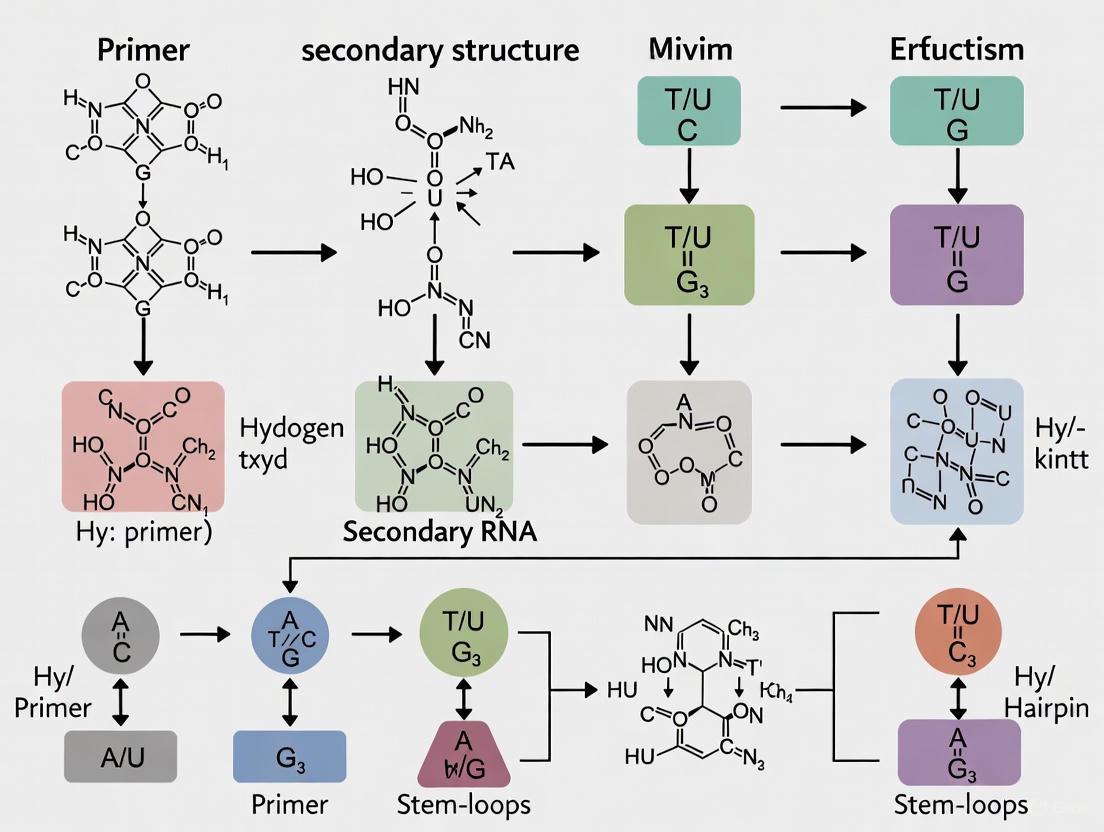
This article provides a comprehensive analysis of primer secondary structure formation, a critical challenge in molecular biology that impacts PCR, qPCR, and sequencing efficiency.
Why Do Primers Form Secondary Structures? Causes, Consequences, and Solutions for Molecular Assays
Abstract
This article provides a comprehensive analysis of primer secondary structure formation, a critical challenge in molecular biology that impacts PCR, qPCR, and sequencing efficiency. We explore the fundamental thermodynamic and sequence-based causes of structures like hairpins and primer-dimers. The content details practical design strategies to prevent these issues, advanced troubleshooting methods for problematic templates, and validation techniques using both in silico tools and novel biochemical reagents. Designed for researchers and drug development professionals, this guide bridges theoretical principles with actionable protocols to enhance assay reliability and data integrity in biomedical research.
The Fundamental Science: Unraveling Why Primer Secondary Structures Form
Within the broader context of research into why primers form secondary structures, it is essential to recognize that these structures represent a fundamental challenge in molecular biology, significantly impacting the efficacy of polymerase chain reaction (PCR) and quantitative PCR (qPCR) assays [1]. Primer secondary structures are undesirable conformations that primers can adopt, which interfere with their primary function: to anneal specifically and efficiently to the target DNA template [2]. The formation of these structures is driven by the innate tendency of single-stranded nucleic acids to maximize stability through intramolecular and intermolecular base pairing, a principle grounded in thermodynamic spontaneity [3]. When primers form secondary structures, they become unavailable for the amplification reaction, leading to poor or failed experiments, reduced product yield, and inaccurate quantification in qPCR applications [1] [4]. Understanding the defining characteristics, formation mechanisms, and experimental consequences of hairpins, self-dimers, and cross-dimers is therefore not merely a procedural formality but a critical determinant of success in genetic research, diagnostics, and drug development [2].
Defining Core Concepts: Types of Primer Secondary Structures
Hairpins
Hairpins, also known as stem-loops, are formed by intramolecular interactions within a single primer molecule [4]. This occurs when a region of three or more nucleotides within the primer is complementary to another region within the same primer, causing the molecule to fold back on itself [2] [3]. The stability of a hairpin is commonly represented by its Gibbs Free Energy (ΔG) value, which indicates the energy required to break the secondary structure [1]. A more negative ΔG value indicates a more stable, and therefore more problematic, hairpin structure [1]. Hairpins are particularly detrimental when they form at the 3' end of the primer, as this is where DNA polymerase initiates synthesis, and their presence can block the enzyme from binding and extending [1].
Self-Dimers
Self-dimers are formed by intermolecular interactions between two identical primers (e.g., two forward primers or two reverse primers) [5]. This happens when a primer sequence has complementarity to itself, allowing two molecules to anneal to each other instead of to the template DNA [3]. The formation of self-dimers reduces the effective concentration of functional primers available for the intended reaction [1]. In a typical PCR, where primer concentrations are high relative to the target DNA, this can lead to a significant reduction in product yield as primers preferentially form dimers with each other rather than hybridizing with the target DNA [1].
Cross-Dimers
Cross-dimers, a specific type of heterodimer, are formed by intermolecular interactions between the forward and reverse primers of a primer pair due to inter-primer homology [1] [4]. When the sense and antisense primers have complementary sequences, they can anneal to each other, forming a primer-duplex that is unusable for amplification of the target template [1] [3]. Like self-dimers, cross-dimers sequester primers from the reaction, but they pose the additional risk of being efficiently extended by DNA polymerase since both primers provide free 3'-OH groups, leading to the amplification of short, primer-derived artifacts that compete with the target amplicon [3].
Table 1: Summary of Primer Secondary Structure Types
| Structure Type | Cause | Key Characteristic | Primary Consequence |
|---|---|---|---|
| Hairpin | Intra-primer homology [4] | Primer folds back on itself [3] | Blocks polymerase binding and extension [1] |
| Self-Dimer | Inter-primer homology (identical primers) [5] | Two copies of the same primer anneal [1] | Reduces available primer concentration [1] |
| Cross-Dimer | Inter-primer homology (F & R primers) [4] | Forward and reverse primers anneal [3] | Produces non-specific artifacts and reduces yield [3] |
Figure 1: Schematic of secondary structure formation pathways from different primer starting states.
Thermodynamic Stability and Quantitative Design Parameters
The formation and stability of secondary structures are governed by thermodynamics. The key parameter is the Gibbs Free Energy (ΔG), which measures the spontaneity of a reaction—in this case, the formation of a secondary structure [1] [3]. A negative ΔG value indicates that the structure forms spontaneously and is stable, with larger negative values representing more stable, and therefore more problematic, structures [1] [3]. The ΔG is calculated as ΔG = ΔH – TΔS, where ΔH represents the change in enthalpy (energy from base-pair bonds) and ΔS represents the change in entropy (disorder) [1].
Researchers have established generally tolerated thresholds for the ΔG values of different secondary structures to guide primer design [1] [6]. These thresholds represent a balance; structures with ΔG values more negative than these are likely to be too stable to be easily denatured under standard PCR annealing conditions, thereby interfering with the reaction.
Table 2: Generally Tolerated ΔG Thresholds for Primer Secondary Structures [1] [6]
| Secondary Structure | Location | Generally Tolerated ΔG Threshold (kcal/mol) |
|---|---|---|
| Hairpin | 3' End | ≥ -2.0 |
| Hairpin | Internal | ≥ -3.0 |
| Self-Dimer | 3' End | ≥ -5.0 |
| Self-Dimer | Internal | ≥ -6.0 |
| Cross-Dimer | 3' End | ≥ -5.0 |
| Cross-Dimer | Internal | ≥ -6.0 |
Beyond ΔG, other sequence characteristics heavily influence a primer's propensity to form secondary structures. A GC content between 40% and 60% is recommended, as G and C bases form three hydrogen bonds, creating more stable duplexes than A and T bases, which form only two [2] [5] [3]. While a "GC clamp" (one or two G or C bases at the 3' end) is beneficial for specific binding, more than three G/C bases in the last five bases at the 3' end should be avoided, as this can promote non-specific priming [1] [7]. Furthermore, runs of a single base (e.g., "AAAA") and di-nucleotide repeats (e.g., "ATATAT") can cause mispriming and should be avoided [1] [4] [3].
Experimental Consequences and Broader Research Implications
The practical consequences of primer secondary structures in the laboratory are severe and multifaceted. The most common outcome is a significant reduction in PCR product yield [1] [4]. This occurs because primers engaged in hairpins or dimers are functionally unavailable to anneal to the template DNA [1]. In quantitative applications like qPCR, this reduction in efficiency directly compromises data accuracy, leading to incorrect quantification of gene expression levels [8]. Furthermore, the formation of primer-dimers, especially cross-dimers, can lead to non-specific amplification, generating unwanted artifacts that compete for reaction components and can be mistaken for true amplification products in gel electrophoresis [2] [3]. In worst-case scenarios, typically when stable secondary structures form at the primers' 3' ends, the reaction can fail completely, yielding no amplification at all [1] [4].
Understanding why primers form these structures extends beyond troubleshooting failed experiments. It is a fundamental aspect of nucleic acid biochemistry with broad implications for research. The principles of intra- and intermolecular base pairing that govern primer behavior are the same ones that drive the formation of complex secondary and tertiary structures in functional RNAs, such as riboswitches, microRNAs, and ribosomal RNAs [9]. Misfolding in these molecules can disrupt critical regulatory functions and is implicated in various diseases [9]. Consequently, the tools and knowledge used to predict and avoid secondary structures in primers are directly applicable to predicting and understanding the function of natural RNA molecules. This knowledge is also leveraged in the design of therapeutic oligonucleotides and in forced evolution experiments to select for RNA aptamers with desired binding properties, making it highly relevant for drug development professionals [9].
Methodologies for Analysis and Validation
In Silico Analysis and Screening Protocols
The first and most crucial line of defense against secondary structures is computational analysis using specialized software tools.
- Screening with OligoAnalyzer Tool: Tools like the IDT OligoAnalyzer allow for thorough thermodynamic analysis [5] [6]. The procedure involves entering the primer sequence into the tool and using its functions to analyze for hairpins and self-dimers/homodimers. For cross-dimer analysis, both the forward and reverse sequences must be entered to check for heterodimers. The key output to evaluate is the ΔG value for any predicted structure, which should be compared against the tolerated thresholds (see Table 2) [5] [6]. IDT recommends that the ΔG of any self-dimers, hairpins, and heterodimers should be weaker (more positive) than -9.0 kcal/mol [5].
- Specificity Checking with BLAST: After designing primers, it is critical to check their specificity by performing a BLAST search against the appropriate genomic database (e.g., the non-redundant database for the target organism) [1] [7]. This identifies regions with significant cross-homology, which should be avoided during primer design to ensure amplification of only the intended target [1].
Figure 2: A recommended workflow for the analysis and validation of primers to avoid secondary structures.
Experimental Validation Techniques
After in silico screening, experimental validation is essential to confirm primer performance.
- Gel Electrophoresis for Specificity: After PCR amplification, the product should be analyzed by electrophoresis on a 1.5% agarose gel [8]. A single, sharp band at the expected amplicon size confirms specific amplification and the absence of significant primer-dimer artifacts, which typically appear as a fuzzy band around 50 bp or lower [8].
- Melt Curve Analysis for qPCR: In qPCR experiments, performing a melt curve analysis is a critical step post-amplification [8]. The reaction is slowly heated while fluorescence is continuously measured. A single, sharp peak in the melt curve indicates that a single, specific PCR product has been amplified. The presence of multiple peaks or a broad peak suggests non-specific amplification or primer-dimer formation, indicating problematic primers [8].
- Empirical Determination of Annealing Temperature (Tₐ): Even with well-designed primers, the annealing temperature must be optimized. A gradient PCR is performed by setting a thermal cycler to a range of annealing temperatures (e.g., from 5°C below to 5°C above the calculated Tₐ) [4]. The resulting products are analyzed by gel electrophoresis. The highest temperature that produces the strongest, most specific band is the optimal Tₐ, as it maximizes stringency and minimizes non-specific binding and secondary structure stability [4].
Table 3: Key Research Reagent Solutions and Tools for Primer Analysis
| Tool or Reagent | Primary Function | Application Context |
|---|---|---|
| OligoAnalyzer (IDT) | Thermodynamic analysis of hairpins, dimers, and Tm [5] | In silico primer screening and design |
| Primer-BLAST (NCBI) | Integrated primer design and specificity checking [8] [10] | In silico design of target-specific primers |
| UNAFold Tool | Analysis of oligonucleotide secondary structure [5] | Advanced in silico folding prediction |
| SYBR Green Master Mix | Fluorescent dye for detecting double-stranded DNA in qPCR [8] | Experimental validation via qPCR and melt curve analysis |
| Agarose | Matrix for gel electrophoresis to separate DNA by size [8] | Experimental validation of amplicon specificity and size |
| Thermal Cycler with Gradient | Instrument for PCR that allows temperature optimization across blocks [4] | Empirical determination of optimal annealing temperature (Tₐ) |
In the context of a broader thesis investigating why primers form secondary structures, understanding the governing thermodynamic principles is paramount. Nucleic acid primers do not exist as simple, linear single strands; they spontaneously fold into complex secondary structures—such as hairpins, self-dimers, and cross-dimers—through intramolecular and intermolecular base pairing [3] [11] [12]. The formation and stability of these structures are dictated by the fundamental laws of thermodynamics, primarily the Gibbs Free Energy (ΔG) and the Melting Temperature (Tm). These parameters are not merely abstract concepts but are critical, predictable forces that determine a primer's availability for binding to its target template. Failure to account for them during experimental design can lead to primer-dimer artifacts, non-specific amplification, and complete PCR failure [3] [11]. This whitepaper provides an in-depth technical guide on how ΔG and Tm govern the folding of primer secondary structures, equipping researchers with the knowledge to design more effective primers and oligonucleotide-based therapeutics.
Core Thermodynamic Principles
Gibbs Free Energy (ΔG) and Spontaneity
The Gibbs Free Energy (ΔG) is a measure of the spontaneity of a chemical reaction, in this case, the folding of a nucleic acid strand into a secondary structure. The stability of any secondary structure is commonly represented by its ΔG value, which is the energy required to break it [12].
- Negative ΔG (ΔG < 0): A spontaneous, exothermic reaction. Structures with large negative ΔG values (e.g., -5 kcal/mol) are stable and undesirable in primers, as they form easily and require significant energy (heat) to reverse [3].
- Positive ΔG (ΔG > 0): A non-spontaneous, endothermic reaction. Recent research demonstrates that even structures with positive ΔG° can form and exist at appreciable concentrations, significantly impacting hybridization kinetics. These "thermodynamically unfavorable" structures can change hybridization rates by two orders of magnitude and lead to non-Arrhenius behavior [13].
Table 1: Stability and Implications of Common Primer Secondary Structures
| Structure Type | Description | Stability (ΔG) | Impact on PCR |
|---|---|---|---|
| Hairpin | Intramolecular binding within a single primer, forming a loop [3] [12]. | 3' end: > -2 kcal/molInternal: > -3 kcal/mol [12] | Reduces primer availability; 3' end hairpins are most detrimental [12]. |
| Self-Dimer | Intermolecular binding between two identical primers [11] [12]. | 3' end: > -5 kcal/molInternal: > -6 kcal/mol [12] | Consumes primers, leading to low product yield or primer-dimer artifacts [11]. |
| Cross-Dimer | Intermolecular binding between forward and reverse primers [11] [12]. | 3' end: > -5 kcal/molInternal: > -6 kcal/mol [12] | Can cause catastrophic reaction failure by preventing target binding [11]. |
Melting Temperature (Tm) and Duplex Stability
The Melting Temperature (Tm) is defined as the temperature at which half of the DNA duplexes dissociate into single strands [12]. For secondary structures, the Tm indicates the thermal stability of these unintended conformations.
- Calculation: The most accurate method for calculating Tm is the nearest neighbor thermodynamic model, which accounts for the sequence-dependent stacking energies of dinucleotide pairs [12]. Simpler formulas, such as
Tm = 4°C x (G+C) + 2°C x (A+T), provide a rough estimate but are less reliable [11]. - Experimental Relevance: If the Tm of a primer's secondary structure is higher than the reaction's annealing temperature (Ta), the structure will not unfold, and the primer will be unavailable for binding [12]. This is a common cause of PCR failure. Optimal primer Tm generally falls between 52°C and 65°C, with primer pairs having Tms within 5°C of each other [11] [12] [14].
Experimental Protocols for Characterization
Accurately characterizing the thermodynamic properties of primers requires a combination of experimental techniques. The following protocols are standard in the field for validating primer behavior and verifying in silico predictions.
Stopped-Flow Fluorescence Kinetics
This method is used to measure the hybridization kinetics of oligonucleotides and is particularly effective for quantifying the influence of positive ΔG° secondary structures [13].
- Objective: To determine the second-order rate constant of DNA hybridization and observe non-Arrhenius behavior caused by nucleation-limited folding [13].
- Procedure:
- Sample Preparation: Dilute two complementary oligonucleotide strands in an appropriate buffer. One strand is typically fluorescently labeled.
- Rapid Mixing: The two strands are rapidly mixed in the stopped-flow instrument, initiating the hybridization reaction.
- Data Acquisition: Fluorescence change (e.g., from a dye like FRET pair) is monitored in real-time as a function of time after mixing.
- Data Analysis: The resulting kinetic trace is fitted to a second-order reaction model to obtain the rate constant (k). Experiments are repeated at various temperatures to study temperature dependence [13].
Thermal Melting Analysis
This protocol determines the melting temperature (Tm) and thermodynamic parameters (ΔH, ΔS, ΔG) of DNA duplexes and secondary structures.
- Objective: To experimentally determine the Tm and stability of primer secondary structures and primer-template duplexes [13] [12].
- Procedure:
- Sample Preparation: Prepare a solution containing the oligonucleotide at a defined concentration in a standardized buffer.
- Spectrophotometer Setup: Load the sample into a UV-Vis spectrophotometer equipped with a temperature-controlled cell holder.
- Denaturation-Renaturation Cycle: Slowly heat the sample (e.g., from 20°C to 95°C) while monitoring the absorbance at 260 nm. Then, cool the sample back to the starting temperature.
- Data Analysis: Plot the absorbance versus temperature to generate a melting curve. The Tm is the point of the maximum first derivative of this curve. The thermodynamic parameters ΔH and ΔS can be calculated from a van't Hoff analysis of the melting curve [12].
Gradient PCR for Empirical Validation
This method empirically determines the optimal annealing temperature (Ta) for a PCR primer pair, which is directly influenced by the Tm of both the primer-template duplex and any primer secondary structures [11].
- Objective: To find the Ta that maximizes specific product yield while minimizing non-specific amplification and primer-dimer formation.
- Procedure:
- Reaction Setup: Set up a standard PCR master mix and aliquot it into multiple tubes or wells.
- Thermal Cycler Programming: Program a thermal cycler with a gradient across the blocks, typically spanning a range of 5-10°C below to above the calculated Ta.
- Amplification: Run the PCR protocol.
- Analysis: Analyze the PCR products using agarose gel electrophoresis. The well with the strongest band of the correct size and the least non-specific product indicates the optimal Ta [11].
Diagram 1: Experimental workflow for primer design and validation.
Advanced Considerations and Computational Design
The Challenge of "Unfavorable" Structures and Kinetics
The classical view that only stable (negative ΔG) secondary structures impact hybridization is incomplete. Groundbreaking research has shown that even thermodynamically unfavorable secondary structures (positive ΔG°) can alter hybridization kinetics by two orders of magnitude [13]. These structures exist in a dynamic equilibrium with the unfolded state, especially when |ΔG°| is small. Under isothermal conditions common in biosensors and DNA nanotechnology, these structures can trap oligonucleotides in a non-functional state, making hybridization nucleation-limited and leading to observed non-Arrhenius kinetics [13]. This necessitates kinetic models, not just thermodynamic equilibrium models, for accurate prediction in these contexts.
Integrated Thermodynamic Models in Primer Design
Modern primer design software has moved beyond simple rules-of-thumb to integrate sophisticated thermodynamic models.
- Pythia: This advanced method uses statistical mechanical models to compute the binding affinity between all relevant DNA dimers and the folding energy of individual nucleic acids. It then employs chemical reaction equilibrium analysis to model 11 competing reactions in a PCR (e.g., primer folding, dimerization, correct binding). The equilibrium concentrations of all species are calculated, and primer quality is assessed by the fraction of primers bound to their correct sites [15].
- Specificity Heuristics: Tools like Pythia also use thermodynamics to assess specificity, identifying the shortest stable suffix at the 3'-end of a primer and searching for exact matches in the background genome to predict off-target binding [15].
Diagram 2: Thermodynamic competition model in PCR.
Table 2: Research Reagent Solutions for Thermodynamic Studies
| Reagent / Tool | Function | Technical Notes |
|---|---|---|
| Stopped-Flow Spectrofluorometer | Measures rapid kinetics of nucleic acid hybridization [13]. | Essential for characterizing the influence of unstable secondary structures on hybridization rates [13]. |
| UV-Vis Spectrophotometer with Peltier | Measures thermal melting curves (Tm) of oligonucleotides [12]. | Data is used for van't Hoff analysis to determine ΔH and ΔS [12]. |
| Thermal Cycler with Gradient Function | Empirically determines optimal primer annealing temperature (Ta) [11]. | Critical for bridging in silico predictions with experimental reality [11] [14]. |
| DNA Polymerase Master Mix | Enzymatic amplification of the target DNA [14]. | Proofreading polymerases may degrade primers; this can be inhibited by phosphorothioate linkages at the 3' end [14]. |
| In Silico Design Software | Predicts secondary structures, ΔG, Tm, and specificity [15] [12]. | Tools include Primer3, Pythia, and commercial suites. They implement nearest-neighbor thermodynamics [15] [12]. |
The folding of primers into secondary structures is a direct physical consequence of the thermodynamic landscape, governed by ΔG and Tm. A deep understanding of these principles—including the nuanced role of kinetically significant, positive ΔG° structures—is fundamental to the "why" behind primer folding. Moving beyond basic design rules and leveraging integrated thermodynamic models and empirical validation allows researchers to proactively manage these forces. This approach is crucial for advancing robust PCR assay development, enhancing the efficacy of oligonucleotide therapeutics, and pushing the boundaries of DNA nanotechnology.
The formation of secondary structures in primers is not a random occurrence but a direct consequence of specific sequence determinants that dictate intermolecular and intramolecular interactions. This whitepaper provides an in-depth technical analysis of how GC content, palindromic sequences, and base repeats fundamentally influence primer folding and dimerization. Within the broader thesis of why primers form secondary structures, we examine the biophysical principles governing these interactions, present optimized experimental protocols for mitigating structural issues, and provide a curated research toolkit. By understanding these sequence-based determinants, researchers can design more effective oligonucleotides, thereby enhancing the specificity and efficiency of molecular assays critical to diagnostic and therapeutic development.
In polymerase chain reaction (PCR) and quantitative PCR (qPCR) assays, primers are the cornerstone of specificity and sensitivity. However, their performance is critically dependent on their linearity and ability to hybridize exclusively to the intended target sequence. The propensity of primers to form secondary structures—such as hairpins, self-dimers, and cross-dimers—is primarily encoded within their own nucleotide sequence [16]. These structures, which include intra-primer homology (complementarity within a single primer) and inter-primer homology (complementarity between forward and reverse primers), compete with target binding and can lead to failed amplification, reduced yield, and inaccurate quantification [17] [3].
This guide explores the core sequence determinants that predispose oligonucleotides to these problematic conformations: GC content, palindromic sequences, and base repeats. A deep understanding of these elements is not merely a design consideration but a fundamental prerequisite for reliable assay development in research and drug discovery contexts. The following sections detail the mechanisms, quantitative impacts, and practical strategies for managing these determinants.
GC Content: A Primary Driver of Stability and Structure
The Biophysical Basis of GC Influence
The guanine-cytosine (GC) pair is stabilized by three hydrogen bonds, compared to the two hydrogen bonds that stabilize adenine-thymine (AT) pairs [2] [18]. This difference in bond strength means that regions with high GC content exhibit significantly greater thermodynamic stability. This stability directly increases the primer's melting temperature (Tm), which is the temperature at which 50% of the DNA duplex is in a single-stranded state [17] [3]. While stable binding to the target is desired, this same principle facilitates unwanted intramolecular and intermolecular interactions when the primer is in a single-stranded state, leading to secondary structure formation.
GC-rich regions (typically defined as >60%) are particularly problematic because they are "bendable" and readily form stable secondary structures like hairpins that can block polymerase binding and extension [18]. Conversely, primers with very low GC content may lack the binding stability required for specific amplification.
Optimal GC Content and the GC Clamp
The consensus across multiple sources is that primers should have a GC content between 40% and 60% [17] [2] [5]. This range provides a balance between specificity and the avoidance of excessive stability that promotes secondary structures.
A critical design feature is the GC clamp. This refers to the presence of one or more G or C bases at the 3' end of the primer. The stronger hydrogen bonding of a GC clamp promotes more efficient binding by the DNA polymerase [17] [3]. However, caution is advised: more than three G or C bases at the 3' end can promote non-specific binding and false-positive results [2].
Table 1: Guidelines for Managing GC Content in Primer Design
| Parameter | Recommended Value | Rationale | Consequence of Deviation |
|---|---|---|---|
| Overall GC Content | 40–60% [17] [5] | Balances specificity and binding stability without promoting excessive structure. | Low: Reduced Tm, poor binding. High: Increased secondary structure, non-specific binding. |
| GC Clamp | 1–2 G/C bases in the last 5 nucleotides at the 3' end [17] [3] | Stabilizes the critical polymerase binding site. | Too many (>3): Increases risk of primer-dimer and non-specific amplification [2]. |
| Consecutive Gs | Avoid runs of 4 or more [5] | Reduces complexity of synthesis and potential for non-standard structures. | Can lead to mispriming and difficult-to-denature quadruplex structures. |
Experimental Solutions for GC-Rich Target Amplification
Amplifying GC-rich templates (≥60% GC) requires specialized reagents and conditions to counteract their high stability and secondary structure formation.
- Polymerase and Buffer Systems: Use polymerases specifically optimized for GC-rich templates, such as OneTaq or Q5 High-Fidelity DNA Polymerase. These are often supplied with specialized GC Buffers and GC Enhancers [18]. These enhancers typically contain additives like betaine, DMSO, or glycerol, which help denature stable secondary structures by reducing the melting temperature of GC-rich DNA [19] [18].
- Mg²⁺ Concentration Optimization: Magnesium is a critical cofactor for polymerase activity. While standard reactions use 1.5–2 mM MgCl₂, GC-rich PCR may require fine-tuning. A gradient from 1.0 to 4.0 mM in 0.5 mM increments can help find the optimal concentration for specific amplification [18].
- Thermal Cycling Parameters: Using a higher denaturation temperature (e.g., 98°C instead of 95°C) or a longer denaturation time can help melt stubborn secondary structures. A touchdown PCR protocol, starting with an annealing temperature higher than the calculated Tm and gradually decreasing it over subsequent cycles, can improve specificity [18].
Palindromic Sequences and Primer Self-Complementarity
Defining the Problem: Hairpins and Dimers
Palindromic sequences, which read the same in the 5' to 3' direction on one strand as their complementary sequence does on the opposite strand, are a major source of secondary structures. When these sequences occur within a single primer, they enable intra-primer homology, leading to the formation of hairpin loops [3] [2]. When complementary sequences exist between two primers (or two copies of the same primer), they enable inter-primer homology, leading to the formation of self-dimers or cross-dimers [17] [3].
These structures are problematic because they consume primers that would otherwise be available for target amplification. Furthermore, if a primer's 3' end is involved in dimer formation, it can be extended by the polymerase, efficiently amplifying the dimer and competing with the desired product.
Quantifying and Evaluating Self-Complementarity
The stability of secondary structures is measured by their Gibbs Free Energy (ΔG). More negative ΔG values indicate a more stable, and therefore more problematic, structure [3]. IDT recommends that the ΔG of any predicted self-dimer, heterodimer, or hairpin should be weaker (more positive) than –9.0 kcal/mol [5].
Tools like the IDT OligoAnalyzer or Beacon Designer can be used to calculate ΔG and visualize potential secondary structures. It is critical to check for 3' end complementarity, as dimers or hairpins involving the 3' end are far more detrimental to PCR efficiency than those involving the 5' end [3].
Table 2: Types of Primer Secondary Structures and Their Characteristics
| Structure Type | Cause | Description | Key Design Check |
|---|---|---|---|
| Hairpin Loop | Intra-primer homology [3] | A single primer folds back on itself to form a stem-loop structure. | Avoid regions of ≥3 bases that are complementary within the primer [17]. |
| Self-Dimer | Inter-primer homology (identical primers) [3] | Two identical primers (e.g., two forward primers) anneal to each other. | Check for complementarity between copies of the same primer sequence. |
| Cross-Dimer | Inter-primer homology (different primers) [17] | The forward and reverse primers anneal to each other instead of the template. | Check for complementarity between the forward and reverse primer sequences. |
PST-PCR: An Advanced Application of Palindromic Sequences
Interestingly, palindromic sequences can be harnessed for specific experimental goals. The Palindromic Sequence-Targeted (PST) PCR method uses walking primers (PST primers) whose 3'-ends are designed to be complementary to short, naturally occurring palindromic sequences (PST sites) in the genome [20] [21]. This method, used for genome walking and transposon display, demonstrates a controlled application where knowledge of palindrome behavior is leveraged for specific annealing, avoiding the random priming that plagues other methods like TAIL-PCR [20]. The PST-PCR v.2 method is rapid (2–3 hours) and efficient, requiring only one or two PCR rounds due to its specific primer design that minimizes off-target annealing and RAPD-like amplification [21].
The Problem of Mononucleotide and Dinucleotide Repeats
Mechanisms of Mispriming
Runs of identical bases (homopolymers, e.g., AAAA) or dinucleotide repeats (e.g., ATATAT) are another significant sequence determinant of poor primer performance [17] [3]. These repetitive sequences increase the likelihood of the primer binding to non-target sites in the template genome that feature similar short repeats—a phenomenon known as mispriming. This occurs because the primer does not require perfect complementarity over its entire length to initiate polymerization; a repetitive sequence can find multiple partially complementary sites to bind to, especially at lower annealing temperatures.
Design Rules for Avoiding Repeats
The universal recommendation is to avoid runs of four or more of a single base (e.g., ACCCC) and dinucleotide repeats of four or more (e.g., ATATATAT) [17] [3]. Oligonucleotides containing these sequences are often more difficult to synthesize and may form non-Watson-Crick secondary structures that interfere with their intended function [17]. During the design process, the primer sequence should be visually inspected for such repeats, a check that is also a standard feature of most modern primer design software.
Essential Experimental Protocols
Protocol 1: PCR Amplification of GC-Rich Targets
This protocol is adapted from recommendations for challenging GC-rich amplicons [19] [18].
Reaction Setup:
- Polymerase: Use a polymerase optimized for GC-rich templates (e.g., Q5 High-Fidelity DNA Polymerase, OneTaq DNA Polymerase).
- Buffer: Use the accompanying GC Buffer.
- Additives: Add 1x final concentration of the supplied GC Enhancer.
- Template: 75 ng genomic DNA or equivalent.
- Primers: 1.0 µM each, designed with a GC clamp and checked for secondary structures.
- dNTPs: 2.5 mM mix.
- Mg²⁺: The buffer typically contains Mg²⁺, but optimization from 1.0–4.0 mM may be required.
Thermal Cycling Conditions:
- Initial Denaturation: 98°C for 4 minutes.
- Amplification (30 cycles):
- Denaturation: 94°C for 50 seconds.
- Annealing: Optimize using a temperature gradient, starting ~5°C above the calculated Tm.
- Extension: 72°C for 2 minutes.
- Final Extension: 72°C for 7 minutes.
Analysis: Analyze 5 µL of the PCR product on a 1.5% agarose gel.
Protocol 2: Primer Validation and Specificity Check
Ensuring primer specificity is a critical step before experimental use [16] [5].
In Silico Analysis:
- Secondary Structures: Analyze primers using tools like OligoAnalyzer to check for hairpins and self-dimers (ΔG > -9.0 kcal/mol).
- Specificity Check: Perform an NCBI Primer-BLAST analysis. This tool checks the specificity of the primer pair against the entire nucleotide database to ensure it will only amplify the intended target [22].
- Cross-Homology: Verify that primers are unique to the desired target sequence and do not have significant homology to other genes or regions.
Wet-Lab Validation:
- Perform a temperature gradient PCR to empirically determine the optimal annealing temperature.
- Include a no-template control (NTC) to check for primer-dimer formation.
- Sequence the PCR product to confirm amplification of the correct target.
The Scientist's Toolkit: Research Reagent Solutions
Table 3: Essential Reagents and Tools for Managing Primer Secondary Structures
| Tool / Reagent | Category | Primary Function | Example Use Case |
|---|---|---|---|
| OligoAnalyzer Tool (IDT) | In Silico Tool | Analyzes Tm, hairpins, dimers, and ΔG values for oligonucleotides [5]. | Pre-design validation to screen out primers with stable secondary structures (ΔG < -9.0 kcal/mol). |
| NCBI Primer-BLAST | In Silico Tool | Designs primers and checks their specificity against the NCBI database to avoid off-target binding [22]. | Ensuring primers are unique to the target gene and do not have cross-homology. |
| Q5 High-Fidelity DNA Polymerase with GC Enhancer | Wet-Lab Reagent | High-fidelity enzyme with additives to denature GC-rich secondary structures [18]. | Amplifying targets with >70% GC content or persistent hairpins. |
| OneTaq GC Enhancer | Wet-Lab Reagent | Additive containing betaine/DMSO that reduces DNA secondary structure stability [18]. | Added to the PCR mix to improve yield and specificity for GC-rich templates. |
| DMSO / Betaine / Formamide | Wet-Lab Additive | Additives that lower DNA Tm, disrupt hydrogen bonding, and increase primer stringency [19] [18]. | Empirical testing to overcome amplification failure due to template or primer structure. |
The formation of secondary structures in primers is a direct and predictable result of specific sequence elements: high GC content provides the thermodynamic stability for structure formation, palindromic sequences provide the complementary geometry for intra- and intermolecular binding, and base repeats increase the probability of mispriming. Within the broader thesis of why primers form secondary structures, this guide establishes that these determinants are not independent but often interact, compounding their negative effects on PCR efficacy. By applying the design rules, experimental protocols, and toolkit resources outlined herein, researchers and drug developers can proactively diagnose and prevent these issues. This leads to more robust, reproducible, and specific molecular assays, accelerating the pace of scientific discovery and diagnostic innovation.
The kinetic competition between intramolecular and intermolecular interactions is a fundamental determinant of macromolecular behavior, influencing processes from protein folding to the self-assembly of amyloid fibrils. This interplay is of paramount importance in molecular biology, dictating whether a polypeptide chain adopts a functional native structure or progresses toward pathological aggregation. Within the context of primer design for polymerase chain reaction (PCR) methodologies, this same competition determines whether a single-stranded DNA oligonucleotide remains available for hybridization with its target template or forms stable, non-productive secondary structures. Such primer dimerization and self-folding are a significant source of experimental artifact, reducing assay specificity, sensitivity, and robustness. This whitepaper explores the governing principles of this kinetic competition, drawing upon quantitative studies of protein aggregation to illuminate the analogous challenges in nucleic acid research. We provide a structured analysis of key quantitative parameters, detailed experimental protocols for characterizing these interactions, and strategic guidance for mitigating their adverse effects in scientific and diagnostic applications.
The fate of a polymeric molecule, be it a protein or a single-stranded DNA primer, is often decided by a kinetic race between two types of interactions. Intramolecular interactions occur between different parts of the same molecule, promoting its collapse into a stable, defined structure, such as a globular protein fold or a primer hairpin loop. In contrast, intermolecular interactions occur between two or more separate molecules, driving their association into larger complexes, such as amyloid fibrils or primer dimers [23] [24].
The outcome of this competition has profound consequences. In proteins, a shift in favor of intermolecular interactions can lead to aggregation diseases such as Alzheimer's and Parkinson's [23] [25]. In PCR, the formation of intramolecular (secondary structures) or intermolecular (primer-dimer) complexes directly competes with the desired intermolecular hybridization between the primer and the target DNA template [16]. This results in failed amplification, reduced yield, and inaccurate quantification. The principles governing this competition are universal, revolving around the relative strengths, dynamics, and accessibility of these interaction networks.
Quantitative Data and Comparative Analysis
The kinetic parameters of folding and aggregation reveal the core of the competition. The following table summarizes key quantitative data from protein aggregation studies, which provide a conceptual framework for understanding similar processes in nucleic acids.
Table 1: Quantitative Parameters in Protein Folding and Aggregation Kinetics
| Parameter | Description | Impact on Competition | Typical Range/Value |
|---|---|---|---|
| Lag Time | The initial slow phase in aggregation, often involving nucleation. | A longer lag time indicates a higher kinetic barrier to intermolecular association, favoring intramolecular folding. | Minutes to hours, highly sequence-dependent [23] |
| Elongation Rate | The apparent rate constant for fibril growth after nucleation. | A faster elongation rate favors intermolecular aggregation once nucleation has occurred. | Measured by Thioflavin T fluorescence kinetics [25] |
| Aggregation Propensity | The intrinsic tendency of a sequence segment to form intermolecular β-sheets. | Modulated by residual structure in the precursor state [23] | Calculated by algorithms like Zyggregator [23] [25] |
| Intramolecular Bond Strength | Energy required to break internal bonds (e.g., H-bonds in a folded protein or primer hairpin). | Stronger intramolecular bonds protect against intermolecular aggregation [24] | ~464 kJ/mol for covalent H-O bonds (intramolecular) [24] |
| Intermolecular Bond Strength | Energy of bonds formed between molecules (e.g., in a fibril or primer dimer). | Stronger intermolecular bonds drive aggregation. | ~19 kJ/mol for water-water bonds (intermolecular) [24] |
For PCR primers, the competition is similarly quantifiable. The annealing temperature (Ta) of a primer to its target is a critical variable, rather than its theoretical melting temperature (Tm). The optimal Ta must be determined experimentally, as it defines the temperature at which the maximum amount of primer is bound to its target, thereby outcompeting intramolecular folding or primer-dimer formation [16]. Furthermore, the efficiency of the PCR reaction, ideally close to 100%, is a direct measure of successful intermolecular priming; reduced efficiency often signals competition from non-productive structures.
Case Study: Amyloid Formation in β₂-Microglobulin
A seminal study on human β₂-microglobulin (β₂m) provides a powerful illustration of this kinetic competition. At low pH, β₂m exists in an acid-denatured state that lacks persistent tertiary structure but contains significant non-random hydrophobic interactions (intramolecular) [23] [25].
Experimental Protocol and Workflow
The investigation employed a multi-faceted approach to dissect the aggregation mechanism:
- Site-Directed Mutagenesis: Key regions of the β₂m sequence were altered to perturb specific intramolecular interactions and assess their impact on aggregation kinetics.
- Quantitative Kinetic Analysis: The kinetics of fibril formation were monitored using thioflavin T (ThT) fluorescence, which binds specifically to amyloid structures. The output of this assay provides two critical kinetic parameters: the length of the lag phase and the apparent elongation rate [25].
- NMR Spectroscopy: Used to characterize the residual structure and conformational properties of the acid-unfolded monomeric precursor state.
- Computational Prediction: The experimental data from NMR was incorporated into the Zyggregator algorithm to predict aggregation-prone regions and rationalize the kinetic data [23].
Despite the presence of multiple regions with a significant intrinsic propensity for aggregation, the study revealed that only a single region of about 10 residues in length was the primary determinant of the fibril formation rate. This key region was shielded by residual intramolecular interactions in the denatured state. Mutations that disrupted these protective intramolecular contacts significantly accelerated the aggregation kinetics by exposing this aggregation-prone "hot spot" [23] [25]. This demonstrates that the intrinsic aggregation propensity of a sequence is powerfully modulated by the conformational properties of its precursor state.
Visualizing the Kinetic Competition Pathway
The pathway of this competition, from functional monomer to pathological aggregate, can be summarized in the following workflow. The central decision point is the kinetic competition between intramolecular folding and intermolecular association.
The Scientist's Toolkit: Essential Research Reagents and Materials
Successful experimental analysis of intramolecular and intermolecular interactions requires a suite of specific reagents and tools. The following table details key materials used in the featured β₂m study and their analogous applications in nucleic acid research.
Table 2: Key Research Reagent Solutions for Studying Molecular Interactions
| Reagent/Material | Function in Protein Studies | Analogous Tool in Nucleic Acid Research |
|---|---|---|
| Thioflavin T (ThT) | A fluorescent dye that binds specifically to amyloid fibrils, allowing quantitative kinetic analysis of aggregation [25]. | SYBR Green I; a fluorescent dye that intercalates into double-stranded DNA, enabling real-time monitoring of PCR amplification. |
| Site-Directed Mutagenesis Kits | To systematically alter protein sequence and probe the role of specific residues in intramolecular vs. intermolecular interactions [23]. | Oligonucleotide Synthesis Services; for custom-designing and ordering primer variants with modified sequences to avoid secondary structures. |
| NMR Spectroscopy | To characterize residual structure and dynamics in denatured monomeric states at atomic resolution [23] [25]. | Thermal Denaturation (Tm) Analysis; using UV spectrophotometry to assess the stability and melting profile of primer secondary structures. |
| Zyggregator Algorithm | A computational prediction algorithm that identifies aggregation-prone regions in protein sequences [23] [25]. | Primer Design Software (e.g., mFold, OligoAnalyzer); in silico tools to predict primer secondary structures, dimer formation, and annealing properties [16]. |
| qPCR Master Mixes | Not applicable to protein studies. | Optimized Buffers; commercial master mixes containing optimized salts, buffers, and enzymes to promote specific primer-template binding over non-productive interactions [16]. |
Connecting the Principles to Primer Secondary Structure Research
The principles elucidated in the β₂m case study translate directly to the challenge of why primers form secondary structures. A single-stranded DNA primer, much like an unfolded polypeptide, is a flexible chain with competing internal and external interaction potentials.
Residual Structure and "Hot Spots": Just as residual structure in the acid-denatured β₂m masked its primary aggregation "hot spot," a primer's sequence can contain self-complementary regions that act as nucleation points for intramolecular folding (e.g., hairpin loops) or intermolecular dimerization with another primer [16]. These structures are often stable and can outcompete the desired binding to the target template, especially under suboptimal reaction conditions.
Kinetics and Experimental Robustness: The competition is governed by kinetics. A robust PCR assay is one where the rate of correct primer-template hybridization is vastly favored. This is achieved by careful primer design to avoid stable intramolecular structures and by empirical optimization of the annealing temperature (Ta) [16]. A primer that only functions within a narrow Ta range is inherently non-robust, indicating a precarious balance where slight perturbations can tip the scales in favor of non-productive interactions.
Visualizing Primer Competitive Pathways
The fate of a primer in a PCR reaction is determined by a kinetic competition analogous to that of proteins, as shown in the following pathway.
Experimental Protocol: A Standardized Workflow for Primer Validation
To mitigate the risks posed by secondary structures, a rigorous and standardized experimental workflow is essential. The following protocol, aligned with systems biology best practices for generating reproducible quantitative data [26], ensures robust PCR assay design and validation.
Objective: To empirically validate primer specificity and optimize reaction conditions to minimize the impact of intramolecular and intermolecular competition.
Materials:
- Purified template DNA (concentration accurately quantified)
- Designed forward and reverse primers
- qPCR master mix (commercial, from a defined lot)
- Nuclease-free water
- Thermal cycler (calibrated)
Procedure:
In Silico Analysis:
- Target Identification: Acquire the correct target sequence from a curated database (e.g., NCBI RefSeq) and always refer to its accession number [16].
- Primer Characterization: Use oligonucleotide analysis software to check for self-complementarity, hairpin formation, and potential for primer-dimer artifacts. Calculate theoretical Tm values.
Empirical Optimization:
- Annealing Temperature Gradient: Run a thermal gradient PCR, typically spanning 3-5°C below and above the calculated average Tm of the primer pair. The goal is to identify the temperature that yields the lowest Cq (quantification cycle) value with the highest fluorescence (ΔRn) and no non-specific amplification [16].
- Specificity Verification: Analyze the amplification products from the gradient run using gel electrophoresis. A single band of the expected size confirms specific amplification. Alternatively, analyze the melt curve for a single, sharp peak.
Validation and Data Processing:
- Efficiency Calculation: Perform a serial dilution (at least 5 points) of the template and run qPCR at the optimized Ta. The slope of the log (template concentration) versus Cq plot is used to calculate amplification efficiency (E) using the formula: E = 10^(-1/slope) - 1. Ideal efficiency is 100% (slope = -3.32) [16].
- Data Documentation: Report all critical information, including primer sequences, accession number of the target, optimized Ta, calculated efficiency, and the master mix used, as per the MIQE guidelines [16].
The kinetic competition between intramolecular and intermolecular interactions is a unifying principle across macromolecular biochemistry. The detailed study of amyloid-forming proteins like β₂-microglobulin provides a quantitative and mechanistic framework for understanding this contest, revealing that the intrinsic propensity of a chain to self-associate is powerfully modulated by the structural dynamics of its monomeric state. In the realm of molecular biology, this same competition underpins the critical challenge of primer secondary structure formation, which can subvert the accuracy and efficiency of PCR-based assays. By applying the lessons from protein biophysics—emphasizing rigorous in silico design, empirical optimization, and standardized validation—researchers can effectively steer the kinetic competition toward the desired intermolecular outcome, ensuring the generation of specific, reliable, and reproducible data.
Single-stranded DNA (ssDNA) intermediates, essential during DNA replication, recombination, and repair, remain vulnerable to enzymatic degradation and secondary structure formation. These structures, including hairpins and loops, pose a significant biochemical challenge by impeding the progression of replicative enzymes like DNA polymerase (DNAp). Single-stranded DNA-binding proteins (SSBs) protect these transiently exposed regions by coating ssDNA, preventing hairpin formation, and recruiting replication machinery. However, this protective mechanism creates a paradox: given SSBs' high affinity for ssDNA, how do replicative enzymes efficiently navigate these potential barriers during DNA synthesis? The mechanism by which polymerases overcome or displace SSB-DNA complexes without hindering replication remains a fundamental yet incompletely resolved question in molecular biology [27].
This whitepaper explores the biochemical consequences of secondary structures and protein-bound DNA on polymerase function, framed within the broader thesis of primer secondary structure research. We examine how these structures mechanically hinder polymerase binding and primer extension, detailing the experimental approaches used to quantify these effects at the single-molecule level. Understanding these dynamics is critical for drug development professionals targeting DNA replication processes in therapeutic interventions.
Quantitative Effects of Structural Obstacles on Polymerization
Single-molecule studies reveal that structural obstacles on the DNA template, including bound SSB proteins and intrinsic secondary structures, modulate DNA replication rates in a force-dependent manner. This relationship highlights the direct mechanical challenge these structures pose to the polymerase.
Table 1: Force-Dependent Replication Rates With and Without SSB Proteins
| Template Tension | Experimental Condition | Replication Rate (bp/s, mean ± SEM) | Probability of Exonuclease (backtracking) Events | Key Interpretation |
|---|---|---|---|---|
| 10 pN | No SSB | 180 ± 10 (N=67) | Higher | Secondary structures impede replication; SSB prevents these, enhancing rate. |
| 10 pN | With SSB | 230 ± 20 (N=72) | Lower | SSB coating prevents secondary structure formation, accelerating replication by ~20% (p=0.0467). |
| 20 pN | No SSB | 130 ± 10 (N=63) | Lower | Minimal secondary structure exists; replication proceeds without major hindrance. |
| 20 pN | With SSB | 80 ± 5 (N=81) | Lower | SSB proteins become unnecessary obstacles, reducing replication efficiency (p<0.0001). |
The data in Table 1, derived from high-resolution optical tweezers studies, demonstrate SSB's dual role. At lower tension (10 pN), conducive to secondary structure formation, SSB binding is beneficial, enhancing the replication rate by approximately 20%. In contrast, at higher tension (20 pN), which inherently disrupts secondary structures, SSB proteins impede replication, reducing the rate by nearly 40%. This force-dependent modulation provides direct evidence of how physical obstructions on the template strand biochemically consequence polymerase progression [27].
Experimental Methodologies for Investigating Polymerase Obstruction
Investigating the dynamic interplay between DNA polymerase and template obstacles requires methodologies capable of capturing real-time, high-resolution biomolecular processes. The following protocols outline key experimental approaches.
Single-Molecule Force Spectroscopy with Optical Tweezers
This technique measures DNA length changes catalyzed by DNA polymerase under controlled template tension [27].
- 1. Experimental Setup: A DNA template is tethered between two optically trapped beads, allowing precise application and measurement of force on the DNA molecule. The end-to-end distance (EED) between the beads is monitored in real-time.
- 2. Interpreting EED Changes:
- Polymerase Activity: At lower tensions (e.g., 10-20 pN), DNA synthesis converts ssDNA to double-stranded DNA (dsDNA), shortening the EED.
- Exonuclease Activity: At higher tensions (e.g., 50 pN), the polymerase preferentially switches to its exonuclease mode, digesting DNA and increasing the ssDNA fraction, thereby lengthening the EED.
- 3. Data Analysis:
- Replication Kinetics: The number of base pairs synthesized over time is calculated from the EED, accounting for SSB-induced compaction of ssDNA.
- Activity Transition Points: A change-point detection algorithm is applied to base pair-time traces to identify shifts between polymerase and exonuclease activities, quantifying the enzyme's binding preference and backtracking frequency.
Dual-Color Single-Molecule Imaging
This approach visualizes the spatial and temporal dynamics between polymerase and SSBs directly [27].
- 1. Fluorescent Labeling: T7 SSB and T7 DNA polymerase are labeled with distinct fluorescent tags (e.g., different fluorophores for dual-color imaging).
- 2. Imaging and Tracking: The co-localization and movement of these labeled proteins on the DNA template are observed using fluorescence microscopy.
- Key Finding: SSBs remain stationary as the DNA polymerase advances, supporting a sequential displacement model rather than a cooperative pushing mechanism.
- 3. FRET Analysis: Fluorescence Resonance Energy Transfer (FRET) is used to detect close spatial proximity (typically <10nm) between the polymerase and SSB during encounters, indicating direct physical interaction or "collision."
Molecular Dynamics (MD) Simulations
MD simulations provide atomic-level insights into the transient events of SSB displacement, which are challenging to capture experimentally [27].
- 1. Model System: A coarse-grained protein model like AWSEM is employed, which has been benchmarked for simulating protein-DNA interactions and large-scale motions.
- 2. Simulation of Encounter: The simulation models the approach of DNA polymerase towards an SSB-ssDNA complex.
- 3. Energy Analysis:
- The binding energy of the SSB-ssDNA complex is calculated in the presence and absence of DNA polymerase.
- A reduction in the dissociation energy barrier in the polymerase's presence indicates an active, facilitative displacement mechanism.
- Analysis of electrostatic interactions reveals the role of specific protein domains, such as the SSB's C-terminal tail.
Visualizing the Mechanistic Workflow and Key Findings
The following diagrams, created using Graphviz and adhering to the specified color and contrast guidelines, illustrate the core experimental workflow and the mechanistic findings.
Polymerase-SSB Interplay Workflow
Sequential Displacement Mechanism
The Scientist's Toolkit: Essential Reagents and Materials
Table 2: Research Reagent Solutions for Polymerase Obstruction Studies
| Item | Function in Research | Technical Application Notes |
|---|---|---|
| Bacteriophage T7 Replication System | A well-characterized model system for studying polymerase-SSB interactions. | Includes T7 SSB (binds as a monomer) and T7 DNA polymerase. Mechanistically similar to more complex organisms [27]. |
| T7 SSB with C-terminal Tail | Critical for efficient polymerase-mediated displacement. The acidic tail interacts with polymerase. | The C-terminal truncated mutant (mut T7 SSB) shows reduced replication efficiency, validating its functional role [27]. |
| Optical Tweezers Setup | Applies controlled tension to a single DNA molecule to study replication mechanics. | Enables precise measurement of replication rates and enzyme mode switching (polymerase vs. exonuclease) under force [27]. |
| Fluorophore-labeled Proteins | Enables visualization of protein dynamics via dual-color imaging and FRET. | Used to track SSB and polymerase positions in real-time and confirm their close spatial proximity during collisions [27]. |
| Coarse-Grained MD Simulation (AWSEM) | Provides atomic-level insights into SSB displacement mechanics and energy landscapes. | Models the reduction in SSB-ssDNA binding energy facilitated by polymerase interaction, predicting mechanistic steps [27]. |
The journey of DNA polymerase along its template is fraught with structural impediments, from intrinsic secondary structures to protective SSB proteins. The biochemical consequence is a force-dependent modulation of replication efficiency, where these structures can either facilitate or hinder polymerase binding and extension depending on the template's conformational state. The mechanistic model that emerges is one of active, sequential displacement of SSBs, critically dependent on specific protein-protein interactions mediated by the SSB's C-terminal tail.
For researchers and drug development professionals, these findings highlight the delicate balance the replication machinery must maintain between DNA protection and synthesis efficiency. Targeting the interaction interfaces identified in these studies—such as the SSB C-terminal tail or the polymerase's basic patch region—offers a potential avenue for novel therapeutic interventions. Disrupting this precise spatiotemporal coordination could provide a powerful mechanism for controlling cellular replication in diseases like cancer, underscoring why research into primer secondary structures and their consequences remains a critical frontier in molecular biology.
Strategic Primer Design: Methodologies to Prevent Secondary Structures
In molecular biology, the polymerase chain reaction (PCR) serves as a fundamental technique for DNA amplification, with its success critically dependent on the design of oligonucleotide primers. Primer secondary structures such as hairpins and primer-dimers represent a significant challenge in assay development, directly impacting efficiency, specificity, and sensitivity. These structures form due to inherent complementarity within a single primer or between primer pairs, leading to unintended amplification events that compete with the target sequence [28] [29]. Within the context of a broader thesis on why primers form secondary structures, this guide establishes the core design rules—optimizing length, GC content, and melting temperature (Tm)—as the primary strategy for enhancing primer stability and assay performance. Understanding the thermodynamic principles governing these parameters enables researchers to proactively minimize non-specific interactions, thereby ensuring the accuracy and reliability of results in applications ranging from basic research to clinical diagnostics and drug development [2] [19].
Core Principles of Primer Design
The stability and specificity of a primer are governed by three interdependent physicochemical properties: its length, guanine-cytosine (GC) content, and melting temperature (Tm). Adherence to established ranges for these parameters reduces the potential for secondary structure formation by minimizing regions of self-complementarity and ensuring balanced binding energy.
Primer Length
Primer length directly influences both specificity and hybridization efficiency. Excessively short primers risk non-specific binding, while overly long primers hybridize more slowly and can form complex secondary structures [2].
- Optimal Range: 18–30 nucleotides is the generally recommended length for PCR primers [17] [30] [2]. This range provides a sufficient sequence for specific binding while maintaining efficient annealing.
- Mechanism: Shorter primers within this range (e.g., 18–24 bases) anneal more efficiently to the target sequence, requiring fewer PCR cycles for amplicon generation [2]. Specificity is sufficiently maintained because the probability of a unique sequence of 18 bases or longer occurring by chance in a complex genome is very low.
GC Content
The GC content, which is the percentage of guanine (G) and cytosine (C) bases in the primer, dictates the strength of the primer-template binding due to the three hydrogen bonds formed in a GC base pair compared to the two in an AT base pair [2].
- Optimal Range: A GC content of 40–60% is considered ideal for most applications [17] [30] [2].
- GC Clamp: The presence of one or two G or C bases in the last five nucleotides at the 3' end of the primer is known as a GC clamp. This promotes stronger binding at the terminus where DNA polymerase initiates synthesis. However, more than three G or C bases at the 3' end should be avoided, as this can promote non-specific binding [17] [2].
Melting Temperature (T~m~)
The melting temperature (Tm) is the temperature at which 50% of the DNA duplex dissociates into single strands. It is a critical parameter for determining the optimal annealing temperature in a PCR protocol [2].
- Optimal Range: Primers should have a Tm between 54°C and 65°C, with many protocols recommending an optimal Tm around 60°C [17] [30] [2].
- Primer Pair Matching: The Tm of the forward and reverse primers should be within 1–5°C of each other to ensure both primers anneal to their target sequences simultaneously and with similar efficiency [17] [30]. A maximum difference of 4°C is often stipulated [30].
The following table summarizes these core design parameters:
Table 1: Core Design Parameters for Primer Optimization
| Parameter | Optimal Range | Rationale | Consequence of Deviation |
|---|---|---|---|
| Length | 18–30 nucleotides [17] [2] | Balances specificity with efficient hybridization. | Short: Non-specific binding; Long: Slower hybridization, increased secondary structure risk [2]. |
| GC Content | 40–60% [17] [30] | Ensures stable yet not overly strong binding. | Low: Weak binding; High: Mismatches, primer-dimer formation [2]. |
| Melting Temp (T~m~) | 54–65°C [30] [2] | Allows for specific annealing at a practicable temperature. | Low: Non-specific amplification; High: Reduced efficiency or no yield [28]. |
| T~m~ Difference (Pair) | ≤ 4°C [30] | Ensures synchronized annealing of both primers. | Large difference: One primer anneals inefficiently, reducing yield [30]. |
The Structural Biology of Primer Defects
When core design rules are neglected, primers become prone to forming stable secondary structures that severely compromise PCR efficiency. These defects arise from predictable thermodynamic interactions and can be visualized as specific structural entities.
Primer-Dimers
Primer-dimers are short, unintended DNA fragments formed when primers anneal to each other instead of the target template. This occurs through two primary mechanisms [28]:
- Self-Dimerization: A single primer contains regions complementary to itself, allowing two copies to hybridize.
- Cross-Dimerization: The forward and reverse primers have complementary regions, causing them to bind together.
In both cases, the hybridized primers create a free 3' end that DNA polymerase can extend, effectively amplifying the primer dimer itself. This consumes reaction components and competes with the amplification of the desired target [28] [29]. In quantitative PCR (qPCR), this non-specific amplification can lead to false-positive signals and inaccurate quantification [29].
Hairpin Structures
Hairpins (or stem-loops) are intramolecular structures that form when two regions within a single primer are complementary, causing the molecule to fold back on itself [2] [19]. This is particularly problematic in longer primers, such as the 40–45 base inner primers used in loop-mediated isothermal amplification (LAMP) [29].
- Formation Mechanism: The complementary regions form a stable double-stranded "stem," while the non-complementary loop region remains single-stranded.
- Impact on PCR: Hairpins can prevent the primer from binding to its template sequence. If the hairpin structure has complementarity at the 3' end, it can become a self-amplifying structure, leading to non-specific background amplification and consuming reagents [29].
Table 2: Characteristics and Impacts of Common Primer Secondary Structures
| Structure | Formation Mechanism | Key Impact on PCR | Identification Method |
|---|---|---|---|
| Primer-Dimer | Inter-primer complementarity [28]. | Consumes primers/dNTPs; competes with target; causes smears on gels [28] [29]. | No-template control (NTC) shows amplification; fuzzy bands below 100 bp [28]. |
| Hairpin | Intra-primer complementarity [2]. | Blocks template binding; can self-amplify; reduces efficiency [29] [19]. | Primer design software (e.g., calculates self 3'-complementarity) [30] [2]. |
| Self-Amplifying Hairpin | Hairpin with a free, complementary 3' end [29]. | Causes exponential non-specific amplification in negative controls. | Real-time monitoring shows rising baseline in NTC [29]. |
The following diagram illustrates the logical relationship between poor design, the formation of these structural defects, and their ultimate negative consequences in the PCR process.
Diagram 1: Primer Defect Formation and Consequences
Experimental Protocols for Optimization and Troubleshooting
In Silico Design and Validation Workflow
A rigorous computational workflow is essential for designing robust primers and identifying potential structural defects before synthesis.
- Step 1: Sequence Retrieval and Preparation. Retrieve the target gene sequence from a curated database like NCBI. For genes with unknown sequences in the target organism, use sequences from closely related organisms and perform multiple sequence alignment using tools like CLUSTALW to identify conserved regions [31].
- Step 2: Primer Design with Primer3. Use Primer3 with the parameters outlined in Table 1. Key settings include: Primer Size: Min=18, Opt=20, Max=27; Tm: Min=62°C, Opt=64°C, Max=66°C; GC%: Min=40, Opt=50, Max=60 [31].
- Step 3: Specificity Check with BLAST. Run the designed primer sequences through the NCBI Primer-BLAST tool to ensure they are unique to the intended target and do not bind off-target to other genes or homologous sequences [32] [31].
- Step 4: Secondary Structure Analysis. Use tools like OligoAnalyzer (IDT) or the Multiple Prime Analyzer (Thermo Fisher) to check for self-dimers, cross-dimers, and hairpins. The parameters "self-complementarity" and "self 3'-complementarity" should be as low as possible [2] [29]. The stability of any predicted hairpin, particularly near the 3' end, is a critical factor for potential self-amplification [29].
Wet-Lab Optimization of Problematic Primers
When secondary structures persist or amplification fails, empirical optimization is required.
Protocol 1: Tackling Primer-Dimers.
- Lower Primer Concentration: Reducing primer concentration (a common working stock is 10–100 µM) gives primers fewer opportunities to interact with each other [28] [33].
- Increase Annealing Temperature: Incrementally raise the annealing temperature by 2–5°C above the calculated Tm to disrupt nonspecific interactions [28].
- Use Hot-Start Polymerase: Hot-start polymerases remain inactive until a high-temperature denaturation step, preventing polymerase activity during reaction setup and reducing primer-dimer formation [28].
Protocol 2: Amplifying GC-Rich Targets. Genes with high GC content (e.g., >70%) are prone to forming stable secondary structures that halt polymerase progression [19].
- Primer Redesign via Codon Optimization: For protein-coding sequences, modify the primer sequence by substituting bases at the wobble position of codons. This changes the DNA sequence without altering the amino acid sequence, effectively breaking up long GC stretches and disrupting stable secondary structures [19].
- Add PCR Enhancers: Include additives like 3–6% DMSO or glycerol in the reaction mix. These reduce the melting temperature of DNA and help denature stubborn secondary structures [19].
- Adjust Thermocycling Parameters: Increase the denaturation temperature and/or time to ensure the GC-rich template is fully melted at each cycle [19].
Protocol 3: Empirical Determination of Annealing Temperature.
- Use a Tm Calculator: Input primer sequences and concentration into a calculator to get a recommended Tm and a starting annealing temperature [34].
- Run a Temperature Gradient PCR: Using the calculated annealing temperature as a midpoint, set a thermal gradient that spans a range of 6–10°C to empirically determine the ideal temperature for specificity and yield [34].
The Scientist's Toolkit: Research Reagent Solutions
The following reagents and tools are essential for implementing the protocols described in this guide and for achieving successful, specific amplification.
Table 3: Essential Reagents and Tools for Primer Design and Optimization
| Tool/Reagent | Function/Description | Example Use-Case |
|---|---|---|
| Hot-Start DNA Polymerase | An enzyme inactive at room temperature, activated only at high temperatures (~95°C). | Minimizes primer-dimer formation and non-specific amplification during reaction setup [28]. |
| Primer Design Software (Primer3) | A freely available online tool for designing primers based on user-defined parameters. | The primary tool for generating candidate primer pairs with optimal length, Tm, and GC content [30] [31]. |
| Secondary Structure Analysis Tool (OligoAnalyzer) | A tool for calculating Tm, GC%, and analyzing potential for dimers and hairpins. | Used to screen and reject primers with high self-complementarity or stable 3' hairpins [2] [19]. |
| DMSO (Dimethyl Sulfoxide) | A PCR additive that reduces nucleic acid melting temperature. | Added to PCR mixes (e.g., 5% v/v) to assist in denaturing templates and primers with high GC content or secondary structure [19]. |
| No-Template Control (NTC) | A control reaction containing all PCR components except the template DNA. | Critical for identifying contamination and confirming that amplification signals (e.g., in qPCR) are not from primer-dimers [28]. |
| T~m~ Calculator | A tool for calculating primer melting temperature and recommending annealing temperature. | Provides a data-driven starting point for setting annealing temperature, especially for novel polymerases [34]. |
In polymerase chain reaction (PCR) experiments, the success of the entire amplification process hinges on the precise molecular events occurring at the 3' end of oligonucleotide primers. This region serves as the initiation point for DNA synthesis by thermostable DNA polymerase. Incomplete binding or mispriming at the 3' end frequently results in inefficient PCR or complete amplification failure [35]. This guide examines two fundamental principles governing 3' end functionality: the implementation of a GC clamp to stabilize primer-template binding and the avoidance of complementarity patterns that lead to secondary structures. These considerations are not merely theoretical recommendations but are empirically derived from analyses of thousands of successful PCR experiments across diverse template types and experimental conditions [35]. Understanding these principles provides critical insight into the broader question of why primers form secondary structures and how these structures interfere with experimental outcomes.
The GC Clamp: Biochemical Principles and Implementation
The Molecular Basis of the GC Clamp
The GC clamp refers to the strategic placement of guanine (G) or cytosine (C) bases within the last five nucleotides from the 3' end of a primer. This design principle leverages the stronger bonding stability of G-C base pairs compared to A-T base pairs. While A-T pairs form two hydrogen bonds, G-C pairs form three hydrogen bonds, creating a more thermodynamically stable interaction [36] [37]. This enhanced stability at the 3' terminus promotes specific binding and facilitates the initiation of polymerase extension [12]. The 3' end of a primer is particularly critical because thermostable DNA polymerase begins nucleotide attachment precisely from this point during the extension step of PCR [35].
Empirical Evidence and Optimal Configuration
Analysis of over 2,000 primer sequences from successful PCR experiments reveals that while all 64 possible 3'-end triplets can yield successful amplification, certain triplets appear with significantly higher frequency [35]. The most successful triplets (AGG, TGG, CTG, TCC, ACC, CAG, AGC, TTC, GTG, CAC, and TGC) share a common characteristic: they typically contain 2-3 G or C bases, effectively creating a GC clamp without exceeding the recommended limit [35].
Table 1: Optimal and Non-Preferred 3'-End Triplets Based on Empirical Analysis
| Category | Triplet Examples | Frequency in Successful PCR | Key Characteristics |
|---|---|---|---|
| Most Preferred | AGG, TGG, CTG, TCC, ACC | >2.34% (Mean + SD) | Typically 2-3 G/C bases; strong terminal stability |
| Neutral | AAA, CCA, GCA, TCA | 1.0-2.0% | Mixed G/C and A/T content; moderate stability |
| Least Preferred | TTA, TAA, CGA, ATT, CGT, GGG | <0.93% (Mean - SD) | Low G/C content or excessive G repeats |
The recommendation for a GC clamp specifically suggests including at least 2 G or C bases within the final five bases at the 3' end [3]. However, designers should avoid incorporating more than 3 G or C bases in this region, as excessively stable clamps can promote primer-dimer formation and other non-specific artifacts [36] [12]. The undesirable performance of the GGG triplet, despite its high GC content, underscores the importance of balanced distribution rather than maximal GC content [35].
Complementarity and Primer Secondary Structures
Patterns of Problematic Complementarity
Complementarity in molecular biology describes the relationship between nucleotide sequences that allows them to bind through specific hydrogen bonding [37]. While this principle enables specific primer-template binding, problematic complementarity occurs when primers interact with themselves or each other instead of the target template. Three primary forms of detrimental complementarity require consideration during primer design:
Hairpins (Intramolecular Complementarity): Formed when a primer folds back on itself, creating a stem-loop structure. This occurs when regions within a single primer contain complementary sequences, particularly when these regions are inverted repeats [12]. Hairpins with ΔG values more negative than -2 kcal/mol at the 3' end or -3 kcal/mol internally are particularly problematic as they resist unfolding during the annealing step [12].
Self-Dimers (Intermolecular Self-Complementarity): Occur when two identical primers (forward-forward or reverse-reverse) anneal to each other through complementary sequences. This is especially detrimental when the 3' ends participate in the dimerization, as polymerases can extend these dimers, consuming reagents without producing the desired product [17].
Cross-Dimers (Inter-Primer Complementarity): Formed when forward and reverse primers anneal to each other rather than to the template DNA. Like self-dimers, cross-dimers involving 3' ends are particularly destructive to PCR efficiency [12].
The Broader Context: Why Primers Form Secondary Structures
The propensity of primers to form secondary structures stems from fundamental molecular principles. Single-stranded nucleic acids are inherently unstable and seek to maximize hydrogen bonding to achieve lower energy states [37]. This drive for stability manifests as spontaneous folding when complementary sequences exist within the same molecule (hairpins) or between molecules (dimers). The stability of these unintended structures is governed by their Gibbs Free Energy (ΔG), with more negative values indicating greater stability and resistance to unfolding at standard PCR temperatures [3].
Secondary structure formation follows predictable rules based on sequence composition. Runs of identical bases or dinucleotide repeats increase the likelihood of mispriming and self-complementarity [17]. Similarly, overall GC content influences secondary structure stability, as G-C rich regions form more stable unintended structures due to their three hydrogen bonds [38]. These principles explain why specific sequence patterns must be avoided during primer design.
Experimental Protocols and Validation Methodologies
In Silico Design and Analysis Workflow
Modern primer design employs computational tools to identify potential secondary structures before physical experimentation. The following protocol ensures comprehensive evaluation:
Sequence Input and Parameter Setting: Input the target template sequence into primer design software (e.g., Primer3, Primer Premier, Beacon Designer). Set core parameters: primer length (18-25 bp), Tm (50-72°C with ≤5°C difference between primers), and GC content (40-60%) [12] [3].
3' End Optimization: Manually verify that potential primers terminate with optimal 3' triplets where possible (see Table 1). Ensure the last five bases contain 2-3 G/C bases but avoid triple G/C repeats [35] [17].
Complementarity Analysis: Use software algorithms to screen for secondary structures. Evaluate hairpin formation with specific attention to ΔG values (reject primers with 3' end hairpins < -2 kcal/mol or internal hairpins < -3 kcal/mol) [12]. Similarly, screen for self-dimers and cross-dimers (reject primers with 3' end dimers < -5 kcal/mol or internal dimers < -6 kcal/mol).
Specificity Validation: Perform in silico PCR and BLAST analysis against relevant databases to ensure primers bind uniquely to the intended target [12] [3]. This step identifies potential cross-homology that could lead to amplification of non-target sequences.
Template Secondary Structure Assessment: For challenging applications like qPCR, analyze the template sequence for stable secondary structures at the binding sites using mfold or similar algorithms [12]. Avoid designing primers where the template region forms stable structures that could impede primer access.
Diagram: In Silico Primer Design and Analysis Workflow
Wet-Lab Validation and Optimization
Computational design requires empirical validation through controlled laboratory experiments:
Temperature Gradient PCR: Implement a thermal gradient spanning 5-10°C below to 5°C above the calculated Tm to empirically determine optimal annealing temperature [3]. This identifies the temperature that maximizes specific product yield while minimizing artifacts.
Analytical Gel Electrophoresis: Separate PCR products on 2-3% agarose gels to visualize amplification specificity. Look for a single, sharp band of expected size. Smearing, multiple bands, or primer-dimer formations (low molecular weight haze) indicate suboptimal primer design [38].
Quantitative Analysis (for qPCR): For SYBR Green-based qPCR assays, analyze melt curves post-amplification. A single, sharp peak indicates specific amplification, while multiple peaks suggest non-specific products or primer-dimer formation [17].
Troubleshooting Problematic Primers: When secondary structures are suspected, consider:
- Touchdown PCR: Start with annealing temperature 5-10°C above estimated Tm and decrease gradually over cycles [38].
- Additives: Include DMSO, betaine, or formamide for GC-rich templates to reduce secondary structure stability [38].
- Re-optimization: Redesign primers with modified 3' ends if empirical testing confirms structure-related failures.
Table 2: Research Reagent Solutions for Primer Design and Validation
| Reagent/Resource | Function/Application | Technical Considerations |
|---|---|---|
| Thermostable DNA Polymerase | Enzyme catalyzing DNA synthesis from the 3' primer end | Choice depends on fidelity (proofreading), processivity, and application (standard PCR, qPCR, RT-PCR) [38] |
| dNTPs | Nucleotide substrates for DNA chain extension | Quality and concentration affect yield and fidelity; typical concentration 200-250 μM each dNTP [3] |
| Buffer Systems | Maintain optimal pH, salt conditions, and co-factors for polymerase activity | Mg²⁺ concentration (1.5-2.5 mM) is critical; may require optimization for specific primer-template pairs [12] |
| PCR Additives | Modifiers of nucleic acid stability and structure | DMSO (1-10%), betaine (0.5-1.5M), or formamide reduce secondary structures in GC-rich templates [38] |
| Primer Purification Methods | Remove synthetic impurities from oligonucleotide synthesis | HPLC or cartridge purification recommended for cloning and critical applications; desalting sufficient for routine PCR [17] |
| In Silico Design Tools | Computational primer design and analysis | Software packages (Primer3, Primer Premier, AlleleID, Beacon Designer) incorporate design rules and secondary structure prediction [12] |
The critical importance of the 3' end in PCR primer design extends beyond theoretical considerations to practical application across diverse experimental contexts. Proper implementation of the GC clamp enhances binding specificity through stabilized hydrogen bonding, while vigilant avoidance of problematic complementarity prevents the formation of secondary structures that subvert amplification efficiency. These principles find empirical support in the statistical analysis of successful PCR experiments and are enabled by sophisticated computational tools that predict molecular interactions before laboratory implementation. As PCR methodologies continue to evolve, these foundational principles remain essential for researchers developing robust, specific, and efficient amplification assays across basic research, diagnostic, and therapeutic applications.
The formation of secondary structures in primers is a significant challenge in molecular biology, often leading to experimental failures in polymerase chain reaction (PCR), DNA sequencing, and various diagnostic applications. These undesirable structures—including hairpins, self-dimers, and hetero-dimers—occur due to intramolecular and intermolecular complementarity within the primer sequences themselves. When primers form stable secondary structures, they become unavailable for binding to the target DNA template, resulting in reduced amplification efficiency, nonspecific products, or complete amplification failure [39] [7].
The stability of these secondary structures is governed by thermodynamic principles, primarily Gibbs free energy (ΔG), where more negative values indicate stronger, more stable structures that are more likely to interfere with experiments [40]. In silico tools have become indispensable for predicting and preventing these issues before costly wet-lab experiments begin. This guide provides a comprehensive workflow for leveraging Primer-BLAST and OligoAnalyzer to design primers that minimize secondary structure formation while maximizing specificity and efficiency, framed within ongoing research into why primers form these problematic structures.
Primer Design Fundamentals and Parameters
Effective primer design requires balancing multiple biochemical parameters to ensure optimal performance while avoiding structural complications. The table below summarizes the key design criteria and their optimal values established through decades of molecular biology research and empirical validation [39] [7].
Table 1: Critical Parameters for Effective Primer Design
| Parameter | Optimal Range | Rationale | Consequences of Deviation |
|---|---|---|---|
| Length | 18-25 nucleotides | Sufficient for specificity without sacrificing binding efficiency | Too short: lacks specificity; Too long: promotes secondary structures [39] |
| GC Content | 40-60% | Balanced duplex stability | Too high: increases Tm risk; Too low: reduces binding stability [39] [7] |
| Melting Temperature (Tₘ) | 55-65°C | Compatible with standard PCR protocols | Wide Tₘ difference: asymmetric amplification [7] |
| Tₘ Difference (Forward vs. Reverse) | ≤2°C | Ensures simultaneous primer binding | >5°C: inefficient amplification [7] |
| 3'-End Design | Max 2 G/C bases | Prevents overly stable binding & non-specific amplification | 3+ G/C bases: increases mispriming risk [7] |
| Runs/Repeats | Avoid >4 identical consecutive bases | Prevents mispriming and slippage | Long repeats: binding instability [7] |
The propensity for secondary structure formation in primers is influenced by several of these parameters. Primers with high GC content are particularly prone to stable hairpin formation due to the three hydrogen bonds between G and C bases compared to the two bonds between A and T bases [39]. Similarly, palindromic sequences within primers create self-complementary regions that can fold back on themselves, forming hairpin structures that make the primer unavailable for target binding [7]. The thermodynamic stability of these unwanted structures often competes with the desired primer-template binding, reducing experimental efficiency.
Comprehensive Workflow for In Silico Primer Design
Define Target Region and Initial Parameters
The primer design process begins with precisely defining the target region. Obtain the reference sequence from a reliable database such as NCBI or Ensembl, preferably in FASTA format or using an accession number [7]. Determine the exact flanking boundaries where primers will bind, ensuring they encompass the region of interest while avoiding single nucleotide polymorphisms (SNPs) or repetitive elements that could compromise specificity [7].
Establish your initial design constraints based on the parameters outlined in Table 1. For most applications, aim for a product size between 200-500 base pairs, with primer lengths of 18-25 nucleotides and GC content of 40-60% [39] [7]. These constraints will guide the automated design tools in generating suitable candidates.
Initial Primer Design with Primer-BLAST
NCBI's Primer-BLAST represents a powerful integration of the Primer3 design engine with BLAST-based specificity checking, making it an ideal starting point for in silico primer design [22] [7].
Table 2: Key Primer-BLAST Parameters for Specificity Checking
| Parameter | Setting | Purpose |
|---|---|---|
| Database | Refseq mRNA, Refseq representative genomes, or core_nt | Defines sequences for specificity checking [22] |
| Organism | Specify your target organism | Limits specificity checking to relevant taxonomy [22] |
| Exon Junction Span | Primer must span exon-exon junction | For cDNA/coding sequence applications to ensure mRNA-specific amplification [22] |
| Product Size Range | 200-500 bp (adjust based on application) | Controls amplicon length [7] |
| Tₘ Range | 58-62°C | Ensures appropriate melting temperature [7] |
To use Primer-BLAST effectively:
- Access the tool through the NCBI website
- Input your target sequence or accession number
- Set the parameters according to Tables 1 and 2
- Enable "Check primer specificity" and select the appropriate database and organism
- Submit the job and await candidate primer pairs [22] [7]
Primer-BLAST will return multiple candidate primer pairs with predicted parameters including GC content, Tₘ, amplicon length, and specificity scores. The tool automatically excludes primers with significant off-target binding potential, providing a strong foundation for subsequent analysis [22].
Structural Analysis with OligoAnalyzer
After obtaining candidate primers from Primer-BLAST, the IDT OligoAnalyzer Tool provides essential thermodynamic analysis to evaluate secondary structure formation potential [41] [40]. This step is critical for understanding why primers form problematic structures and how to avoid them.
For each candidate primer from Primer-BLAST:
- Access the OligoAnalyzer Tool through the IDT website
- Enter the primer sequence in the 5' to 3' orientation
- Adjust buffer conditions to match your experimental setup (especially Mg²⁺ and dNTP concentrations, as these significantly impact Tₘ)
- Perform three key analyses:
Interpret the results using thermodynamic parameters:
- For hairpins, the Tₘ should be lower than your experimental annealing temperature
- For self-dimers and hetero-dimers, the Gibbs free energy (ΔG) value should be greater than -9 kcal/mol (i.e., less negative) [40]
- Primers with strong negative ΔG values for secondary structures should be rejected or modified
Final Validation and Selection
The final step involves comparative analysis of all candidate primers to select the optimal pair:
- Compile results from Primer-BLAST and OligoAnalyzer for all candidates
- Prioritize primers that meet all criteria in Table 1
- Select primer pairs with minimal secondary structure potential (based on ΔG values)
- Verify specificity again through individual BLAST analysis of each primer
- Use in silico PCR tools (e.g., UCSC in silico PCR) to confirm expected product size and sequence [7]
Table 3: Acceptance Criteria for Secondary Structure Analysis
| Analysis Type | Acceptance Criteria | Interpretation |
|---|---|---|
| Hairpin Formation | Tₘ < experimental annealing temperature | Hairpin will not be stable under reaction conditions [40] |
| Self-Dimer | ΔG > -9 kcal/mol | Dimer formation is thermodynamically unfavorable [40] |
| Hetero-Dimer | ΔG > -9 kcal/mol | Primer-primer interaction is minimal [40] |
| GC Content | 40-60% | Balanced stability without excessive structure potential [39] [7] |
Experimental Protocols for Validation
In Silico Specificity Validation Protocol
- Retrieve candidate primers from your Primer-BLAST results
- Perform individual BLAST analysis for each primer:
- Navigate to NCBI BLAST
- Select "Somewhat similar sequences" (blastn)
- Enter primer sequence as query
- Limit to target organism if desired
- Analyze results for off-target binding sites with perfect or near-perfect matches
- Reject primers with significant off-target binding, especially at the 3' end
- Document results for each primer including number of off-target matches and binding positions [22] [7]
Secondary Structure Analysis Protocol
- Access OligoAnalyzer Tool from IDT website
- Enter sequence of first candidate primer
- Set experimental conditions:
- Oligo concentration: 250 nM (standard) or your planned concentration
- Na⁺ concentration: 50 mM (standard) or your buffer concentration
- Mg²⁺ concentration: 1.5-3.0 mM (typical for PCR)
- Run analyses:
- Click "Hairpin" to identify self-complementarity
- Click "Self-Dimer" to check for homologous primer interactions
- For primer pairs, click "Hetero-Dimer" with both sequences entered
- Record ΔG values and Tₘ for any detected structures
- Compare against acceptance criteria in Table 3
- Repeat for all candidate primers [41] [40]
Visualization of Workflows and Relationships
In Silico Primer Design and Validation Workflow
Factors Leading to Primer Secondary Structure Formation
Table 4: Essential In Silico Tools for Primer Design and Validation
| Tool/Resource | Primary Function | Key Features | Access |
|---|---|---|---|
| Primer-BLAST | Integrated primer design & specificity checking | Combines Primer3 with BLAST; organism-specific checking; exon junction spanning [22] | https://www.ncbi.nlm.nih.gov/tools/primer-blast/ |
| OligoAnalyzer | Thermodynamic analysis & secondary structure prediction | Hairpin, self-dimer, hetero-dimer prediction; ΔG calculations; buffer condition adjustments [41] [40] | https://eu.idtdna.com/pages/tools/oligoanalyzer |
| RefSeq Database | Curated reference sequences | Non-redundant sequences; verified annotations; reliable template source [22] | https://www.ncbi.nlm.nih.gov/refseq/ |
| UCSC In Silico PCR | Virtual PCR amplification | Product size verification; genomic context analysis [7] | https://genome.ucsc.edu/cgi-bin/hgPcr |
The systematic application of in silico tools like Primer-BLAST and OligoAnalyzer provides a robust framework for designing primers that minimize secondary structure formation while maximizing experimental success. By understanding the thermodynamic principles that drive unwanted hairpin and dimer formation—particularly the roles of GC content, self-complementarity, and sequence repeats—researchers can proactively address these challenges during the design phase rather than through costly troubleshooting after experimental failure.
The integrated workflow presented in this guide emphasizes the critical importance of combining specificity analysis with structural assessment to select optimal primers. This approach not only improves individual experiments but also advances our broader understanding of nucleic acid interactions, contributing to ongoing research into why primers form secondary structures and how to predict and prevent these problematic configurations through intelligent design.
The formation of secondary structures in primers is not a random occurrence but a direct consequence of the fundamental principles of molecular thermodynamics. Within the context of broader research on why primers form secondary structures, these problematic conformations arise primarily from intra- and intermolecular interactions driven by sequence complementarity. When primers contain self-complementary regions, particularly within their 3' ends, or when forward and reverse primers share complementary sequences, the resulting secondary structures such as hairpins and primer-dimers can severely compromise experimental outcomes [17] [2]. These structures represent lower energy states that primers can adopt instead of binding to the intended template, creating a thermodynamic competition that redirects the polymerase chain reaction (PCR) toward artifactual products.
The challenge intensifies significantly when amplifying complex DNA templates, particularly those with high GC-content or repetitive sequences. GC-rich regions, defined as sequences where 60% or more of the bases are guanine or cytosine, form exceptionally stable secondary structures due to the three hydrogen bonds in G-C base pairs compared to the two in A-T pairs [42]. These regions are not merely theoretical curiosities; they are functionally significant, frequently found in gene promoters, including those of housekeeping and tumor suppressor genes [42]. Similarly, repetitive DNA sequences, which constitute a substantial portion of many genomes, present their own amplification challenges through mechanisms like polymerase slippage and mispriming, leading to truncated products and recombinant artifacts [43]. Understanding the molecular basis of these failures provides the foundation for developing advanced strategies to overcome them, ensuring accurate amplification and reliable experimental results across diverse genomic contexts.
Mastering GC-Rich Templates
Understanding the GC-Rich Challenge
GC-rich templates pose multiple simultaneous challenges that can disrupt PCR amplification. The primary issue stems from the increased thermodynamic stability of GC-rich duplexes, which requires more energy to denature. This inherent stability promotes the formation of persistent secondary structures such as hairpins and stem-loops that physically block polymerase progression [42]. Furthermore, these stable secondary structures resist complete denaturation during standard PCR cycling, preventing primers from accessing their binding sites. The primers themselves, when designed for GC-rich targets, often contain complementary regions that foster primer-dimer formation, further reducing amplification efficiency [42]. These combined effects frequently manifest experimentally as complete amplification failure, smeared bands on gels, or significantly reduced product yield.
Strategic Solutions for GC-Rich Amplification
Success with GC-rich templates requires a multi-pronged approach addressing both reagent composition and cycling parameters. The following experimental protocol synthesizes the most effective strategies:
Table 1: Optimized Reaction Setup for GC-Rich PCR
| Component | Standard PCR | GC-Rich Optimization | Rationale |
|---|---|---|---|
| Polymerase | Standard Taq | Specialized polymerase (e.g., OneTaq, Q5) | Enhanced capacity to read through stable secondary structures [42] |
| Buffer System | Standard buffer | GC buffer + GC enhancer (e.g., 10-20% final concentration) | Additives disrupt secondary structures and increase primer stringency [42] |
| Mg²⁺ Concentration | 1.5-2.0 mM | Gradient testing (0.5 mM increments from 1.0-4.0 mM) | Optimal Mg²⁺ concentration varies for GC-rich templates; essential for polymerase activity and primer binding [42] |
| Additives | None | DMSO (3-10%), Betaine (1-1.3 M), or Formamide | Reduce secondary structure formation by lowering Tm; improve specificity [42] |
| Denaturation Temperature | 94-95°C | 98°C | Higher temperature improves separation of stable GC-rich duplexes [44] |
| Denaturation Time | 15-30 seconds | Extended (1-3 minutes) initial denaturation | Ensures complete separation of template strands before cycling begins [44] |
The following workflow diagram illustrates the strategic decision-making process for optimizing GC-rich PCR:
GC-Rich PCR Optimization Workflow
A critical first step is polymerase selection. While standard Taq polymerase often struggles with GC-rich templates, specialized enzymes such as OneTaq DNA Polymerase or Q5 High-Fidelity DNA Polymerase have been specifically optimized for these challenging sequences [42]. These enzymes demonstrate superior performance when combined with their proprietary GC enhancers, which contain optimized mixtures of additives that disrupt secondary structures while maintaining polymerase activity. For particularly stubborn templates, implementing a touchdown PCR approach, where the annealing temperature starts several degrees above the calculated Tm and gradually decreases, can dramatically improve specificity by ensuring that only perfectly matched primers initiate amplification during the early cycles [45].
Special Considerations for Primer Design
When designing primers for GC-rich regions, adhere to these specific guidelines:
- Maintain GC content between 40-60%, but distribute G and C residues evenly throughout the sequence rather than clustering them [17] [45]
- Include a GC clamp (one or two G or C bases at the 3' end) to promote specific binding, but avoid more than three G/C bases in the last five nucleotides to prevent non-specific amplification [17] [7]
- Carefully screen for self-complementarity and secondary structure formation using prediction tools, as these issues are more prevalent in GC-rich sequences [2] [7]
- Aim for primer lengths of 20-30 nucleotides to enhance specificity despite the challenging template [17] [45]
Conquering Repetitive DNA Regions
The Molecular Basis of Repetitive DNA Amplification Challenges
Repetitive DNA sequences present a distinct set of challenges that differ from GC-rich templates. The primary amplification difficulties arise from slippage events during polymerization, where the DNA polymerase dissociates and reassociates out of register with the template strand [43]. This phenomenon occurs because repetitive elements allow multiple complementary binding possibilities along the template. Experimental evidence demonstrates that during amplification of templates containing transcription activator-like effector (TALE) repeats, polymerases frequently skip multiple repetitive domains, generating hybrid repeats and producing a characteristic laddering effect on agarose gels rather than a single clean band [43]. These artifacts complicate product isolation and can lead to incorrect experimental conclusions when undetected.
The slippage mechanism operates through a misalignment process where the primer or extending strand partially dissociates then reanneals at an incorrect but homologous position downstream. This generates deletion artifacts that systematically remove repetitive units, explaining the consistent size patterns observed in problematic amplifications [43]. Unlike GC-rich challenges that stem from thermodynamic stability, repetitive DNA issues originate from the sequence homology that permits these template switching events during polymerization.
Strategic Framework for Repetitive Sequence Amplification
Table 2: Solutions for Repetitive DNA Amplification Challenges
| Challenge | Solution Strategy | Experimental Implementation |
|---|---|---|
| Polymerase Slippage | Use high-processivity enzymes | Select polymerases with high strand displacement activity [43] |
| Mispriming on Repetitive Elements | Increase annealing temperature | Step-up 2-5°C above calculated Tm; use touchdown PCR [43] [45] |
| Template Switching | Modify cycling conditions | Reduce denaturation time; increase extension time [43] |
| Complex Secondary Structures | Add structure-disrupting agents | Incorporate DMSO (3-5%) or betaine (1 M) [43] |
| Artifact Formation | Optimize primer binding sites | Design primers that flank rather than include repetitive regions [43] [7] |
The following diagram outlines the molecular mechanism of amplification artifacts in repetitive DNA and the corresponding solutions:
Repetitive DNA Problems and Solutions
Successful amplification of repetitive sequences requires careful primer design positioned to flank rather than include the repetitive region whenever possible [7]. When primers must bind within repetitive elements, ensure they are long enough (24-30 nucleotides) to provide sufficient unique sequence for specific binding. Employ polymerases with high processivity and strand displacement activity that are less prone to dissociation when encountering repetitive structures. Additionally, implement modified cycling parameters with reduced denaturation times (15-30 seconds) to minimize strand separation that facilitates misalignment, while simultaneously increasing extension times to accommodate slower polymerization through problematic regions [43].
Essential Research Reagents and Tools
The following toolkit compiles critical reagents and resources essential for successful amplification of complex templates:
Table 3: Research Reagent Solutions for Complex Templates
| Reagent/Tool Category | Specific Examples | Function and Application |
|---|---|---|
| Specialized Polymerases | OneTaq DNA Polymerase, Q5 High-Fidelity DNA Polymerase [42] | Enhanced performance on GC-rich templates and repetitive sequences |
| GC-Rich Specific Buffers | GC Buffer, GC Enhancer [42] | Disrupt secondary structures and improve specificity |
| Structure-Disrupting Additives | DMSO, Betaine, Formamide [42] [43] | Reduce secondary structure formation; lower effective Tm |
| Tm Calculation Tools | NEB Tm Calculator, OligoAnalyzer Tool [42] [46] | Accurate melting temperature prediction using nearest-neighbor methods |
| Specificity Validation Tools | Primer-BLAST, OligoAnalyzer [7] [47] | Check for off-target binding and secondary structures |
| Salt Solutions | MgCl₂ optimization gradients [42] [48] | Fine-tune cation concentration for specific template requirements |
Experimental Protocols for Validation and Optimization
Systematic Optimization Protocol for GC-Rich Templates
When standard protocols fail for GC-rich templates, implement this stepwise optimization procedure:
Initial Setup: Begin with a specialized polymerase system such as Q5 High-Fidelity DNA Polymerase with GC Enhancer according to manufacturer recommendations [42]
Additive Titration: Prepare master mixes containing varying concentrations of DMSO (0%, 3%, 5%, 7%) or betaine (0 M, 0.5 M, 1.0 M, 1.5 M) while keeping other components constant
Mg²⁺ Optimization: Test a Mg²⁺ gradient from 1.0 mM to 4.0 mM in 0.5 mM increments to identify the optimal concentration for your specific template [42]
Thermal Cycling Optimization: Employ the following modified cycling parameters:
- Extended initial denaturation: 98°C for 3 minutes [44]
- Cyclic denaturation: 98°C for 20-30 seconds
- Annealing: Use a temperature gradient (e.g., 60-72°C) to identify optimal Ta [44]
- Extension: 72°C for 1-2 minutes per kb (extend time for longer products)
- Cycle number: Increase to 35-40 cycles if necessary
- Final extension: 72°C for 5-10 minutes to ensure complete extension [44]
Validation: Analyze results on agarose gels; successful amplification should produce a single clean band of expected size without smearing or multiple bands
Repetitive DNA Amplification Protocol
For challenging repetitive sequences, follow this specialized protocol:
Primer Design: Design primers that flank repetitive regions when possible. When primers must bind within repetitive elements, ensure they are 24-30 nucleotides long with balanced GC content [7]
Polymerase Selection: Choose a high-processivity polymerase with proofreading activity to minimize slippage errors [43]
Reaction Assembly:
- Use manufacturer-recommended buffer systems
- Include 3-5% DMSO to reduce secondary structure formation
- Maintain Mg²⁺ concentration at 2.0 mM as starting point
- Use primer concentrations at the lower end of recommended range (0.1-0.3 μM) to reduce mispriming
Thermal Cycling Parameters:
- Initial denaturation: 98°C for 1 minute (shorter than for GC-rich templates) [43]
- Denaturation: 98°C for 10-15 seconds (minimal necessary to reduce strand separation)
- Annealing: Set temperature 2-5°C higher than calculated Tm to increase specificity [43]
- Extension: Allow 2-3 minutes per kb to accommodate polymerase pausing at repetitive structures
- Cycle number: Limit to 25-30 cycles to reduce artifact accumulation
Product Analysis: Clone and sequence multiple colonies to verify absence of deletions or rearrangements when working with repetitive elements [43]
Successfully amplifying GC-rich and repetitive DNA templates requires both a theoretical understanding of the underlying challenges and practical implementation of specialized strategies. The formation of primer secondary structures represents a significant thermodynamic competitor to proper template binding, particularly problematic in these complex templates. By employing structured optimization approaches—including specialized polymerases, strategic buffer formulations, carefully designed primers, and optimized thermal cycling parameters—researchers can overcome these persistent challenges. The protocols and frameworks presented here provide a systematic methodology for troubleshooting amplification failures and achieving reliable results with even the most recalcitrant templates, advancing research in gene regulation, genome engineering, and diagnostic applications where these difficult sequences are frequently encountered.
The formation of secondary structures in primers is not merely a theoretical concern but a fundamental experimental variable that directly determines the success of molecular biology applications. When primers form intra-molecular hairpins or inter-molecular dimers, they compete with the intended template binding, leading to reduced efficiency, failed reactions, and inaccurate results. Research into why primers form these structures reveals that sequence composition, thermodynamic properties, and experimental conditions collectively influence this behavior [49] [50]. This guide explores how a sophisticated understanding of secondary structure formation enables researchers to tailor primer design for three critical applications: qPCR, cloning, and sequencing, providing technical specifications, experimental protocols, and analytical workflows to optimize outcomes.
Core Principles of Primer-Secondary Structure Interactions
Thermodynamic Foundations of Structure Formation
Secondary structures in primers, particularly hairpins and primer-dimers, form through spontaneous molecular interactions driven by Gibbs free energy (ΔG). Structures with negative ΔG values form easily and spontaneously without additional energy input, while those with positive ΔG require energy to form [3]. The stability of these undesirable structures depends on their ΔG values, with more negative values indicating higher stability that requires substantial heat to reverse. This thermodynamic competition between proper primer-template binding and aberrant secondary structure formation lies at the heart of failed amplification experiments.
The molecular basis for these structures stems from complementary base pairing within a single primer (hairpins) or between multiple primers (dimers). Guanine and cytosine form three hydrogen bonds, creating more stable structures than adenine and thymine, which form only two bonds [2]. Consequently, GC-rich regions, especially at the 3' end, dramatically increase the likelihood of stable secondary structure formation that can resist denaturation at standard PCR temperatures.
Quantitative Impact on Experimental Outcomes
The effects of secondary structures on qPCR quantification have been systematically investigated in controlled studies. Research demonstrates that hairpins positioned inside amplicons cause notably stronger suppression of amplification than those outside, with suppression magnitudes increasing with longer stem lengths and smaller loop sizes [49]. With very long stems (e.g., 20-bp), the effect is particularly drastic, potentially preventing targeted amplification products altogether. These effects primarily occur through competitive inhibition of primer binding to the template, substantially impacting quantification accuracy [49].
Table 1: Effects of Hairpin Structures on qPCR Amplification Efficiency
| Hairpin Location | Stem Length | Loop Size | Amplification Impact | Mechanism |
|---|---|---|---|---|
| Inside amplicon | Increasing | Decreasing | Significant suppression | Competitive primer binding inhibition |
| Outside amplicon | Increasing | Decreasing | Notable suppression | Competitive primer binding inhibition |
| Inside amplicon | 20-bp | Various | No targeted products | Complete binding failure |
Application-Specific Primer Design Strategies
qPCR Primer Design for Precise Quantification
Quantitative PCR demands exceptional primer specificity and efficiency, as any deviation directly impacts quantification accuracy. Beyond fundamental design principles, qPCR primers require meticulous attention to secondary structure potential in both the primers and the template DNA. Research indicates that stable secondary structures forming in the vicinity of primer-binding sites significantly suppress amplification, necessitating analysis of at least 60-bp sequences around primer-binding sites, both inside and outside the amplicons [49].
Critical Design Parameters:
- Length: 18-24 nucleotides for optimal specificity and binding kinetics [2]
- Melting Temperature (Tm): 54-65°C for both primers, within 2°C of each other [2]
- GC Content: Maintain 40-60% without consecutive G/C runs at the 3' end [17] [50]
- GC Clamp: Include at least 2 G or C bases in the last 5 nucleotides at the 3' end [17] [3]
- Specificity Validation: Essential BLAST analysis against relevant databases to ensure target-specific binding [22]
Secondary Structure Mitigation: Hairpin formation within templates presents a particularly challenging scenario for qPCR. When DNA templates form secondary structures, they competitively inhibit primer binding, notably suppressing amplification [49]. To prevent this, carefully analyze the template sequence for potential stable secondary structures, especially within the amplicon region where they have the most significant impact. Utilize tools like OligoAnalyzer or SnapGene to predict these structures before experimental validation [41] [51].
Cloning Primer Design for Seamless Assembly
Seamless cloning methods, such as In-Fusion and Gibson assembly, require specialized primer design with distinct 5' and 3' regions serving different functions. The 3' end must provide specific template binding (typically 18-25 bases with 40-60% GC content), while the 5' end contains homology arms matching the vector sequence (15-25 bases depending on the system) [52].
Critical Design Parameters:
- Homology Arms: 15-base overlaps for single-insert cloning, 20-base overlaps for multiple-insert cloning in In-Fusion systems [52]
- Tm Considerations: Calculate Tm based only on the 3' gene-specific portion (aim for 58-65°C), not the entire primer [52]
- Polymerase Selection: Use high-fidelity DNA polymerases to maintain sequence accuracy in cloned inserts [52]
- 3' End Stability: The last five nucleotides at the 3' end should contain no more than two G or C bases to prevent non-specific binding [52]
Structural Considerations: Avoid complementarity within and between primers to prevent hairpin structures and primer dimers that would compromise the integrity of the homology arms [52]. Since cloning primers are typically longer than standard PCR primers (often >45 nucleotides), secondary structure prediction becomes increasingly important. Consider PAGE purification for primers longer than 45 nucleotides to ensure product quality and minimize truncated sequences that could generate aberrant clones [52].
Sequencing Primer Design for Accurate Readability
While sequencing shares many design considerations with PCR, several distinct factors optimize performance for sequencing applications. The critical distinction lies in the single-primer nature of sequencing, which eliminates concerns about primer-dimer formation between forward and reverse primers but increases the importance of single-primer secondary structures.
Critical Design Parameters:
- Length: 18-24 nucleotides for optimal specificity [3]
- Tm: 50-60°C with sequencing reactions typically performed at 50°C [3]
- GC Content: Maintain 40-60% distribution with a GC clamp at the 3' end [3]
- Specificity: Absolute requirement for unique binding site to ensure clear read alignment
Structural Considerations: Avoid intra-primer homology (more than 3 complementary bases within the primer) to prevent hairpin formation that would interfere with polymerase binding and processivity [17]. Particularly avoid stable secondary structures near the 3' end where extension initiates, as these structures can cause premature termination or sequencing artifacts. Use primer analysis tools to identify and eliminate primers with significant self-complementarity, especially at the 3' terminus where it most drastically impacts extension efficiency.
Table 2: Application-Specific Primer Design Specifications
| Parameter | qPCR | Cloning | Sequencing |
|---|---|---|---|
| Optimal Length | 18-24 nt [2] | 3' end: 18-25 nt; 5' overlap: 15-25 nt [52] | 18-24 nt [3] |
| Tm Range | 54-65°C [2] | 58-65°C (3' end only) [52] | 50-60°C [3] |
| GC Content | 40-60% [17] | 40-60% (3' end) [52] | 40-60% [3] |
| Critical Focus | Template secondary structures [49] | Homology arm design [52] | Single-primer specificity |
| Structural Concerns | Both primer and template hairpins [49] | Primer-dimers compromising homology | 3' end hairpins |
Experimental Protocols for Secondary Structure Analysis
In Silico Secondary Structure Prediction Workflow
Computational prediction of secondary structures provides a crucial first step in primer validation before proceeding to laboratory experiments. This protocol utilizes publicly available tools to identify potential structural issues.
Materials and Reagents:
- Computer with internet access
- Primer sequences in FASTA or plain text format
- Template sequence (for contextual analysis)
Procedure:
- Sequence Input: Enter primer sequences individually into analysis tools such as OligoAnalyzer (IDT) or Multiple Primer Analyzer (Thermo Fisher) [53] [41]
- Parameter Setting: Adjust calculation parameters to match your experimental conditions, including temperature, oligo concentration (typically 0.05-1.0 µM), and salt concentrations [41] [50]
- Hairpin Analysis: Select the "Hairpin" function to identify intra-molecular secondary structures, noting the ΔG values (should be > -3 kcal/mol for internal hairpins, > -2 kcal/mol for 3' end hairpins) [3]
- Self-Dimer Analysis: Use "Self-Dimer" function to identify potential inter-primer interactions for each primer individually [41]
- Hetero-Dimer Analysis: For PCR applications, analyze forward and reverse primers together using "Hetero-Dimer" function to identify complementarity between primer pairs [41]
- Template Analysis: For qPCR, analyze potential secondary structures in the template DNA using tools like SnapGene, examining at least 60-bp around primer-binding sites [49] [51]
Interpretation: Focus on structures with negative ΔG values, particularly those below -3 kcal/mol, which indicate stable formations likely to interfere with experiments. Prioritize resolving issues at the 3' end where they most significantly impact polymerase binding and extension. For problematic primers, consider increasing annealing temperature or redesigning primers to eliminate complementary regions.
Empirical Validation of Primer Performance
While in silico prediction provides valuable guidance, laboratory validation remains essential for confirming primer performance in specific experimental contexts.
Materials and Reagents:
- Designed forward and reverse primers
- High-fidelity DNA polymerase (e.g., CloneAmp HiFi PCR Premix, PrimeSTAR Max) [52]
- PCR-grade water and reaction buffers
- Quality DNA template
- Thermocycler
- Agarose gel electrophoresis equipment
- SYBR Green qPCR master mix (for qPCR validation)
Procedure for PCR Optimization:
- Initial Testing: Set up standard PCR reactions with recommended primer concentrations (0.05-1.0 µM) [50]
- Temperature Gradient: Perform thermal gradient PCR starting 5°C below the lowest Tm of the primer pair to determine optimal annealing temperature [3]
- Product Analysis: Run PCR products on agarose gel to assess specificity, yield, and potential primer-dimer formation
- qPCR Validation: For qPCR applications, run standard curves with serial dilutions to calculate amplification efficiency (ideally 90-110%)
- Sequencing Verification: For cloning applications, sequence resulting clones to confirm accurate amplification without mutations
Troubleshooting: If secondary structures are suspected despite in silico prediction, consider:
- Increasing annealing temperature in 2°C increments
- Adding additives like DMSO or betaine to destabilize secondary structures
- Implementing touchdown PCR protocols where the annealing temperature starts above the estimated Tm and gradually decreases [50]
- Redesigning primers with problematic regions of self-complementarity
Diagram 1: Primer Design and Validation Workflow. This workflow integrates secondary structure analysis as a critical step in primer design.
Computational Tools for Primer Design and Analysis
Table 3: Essential Computational Tools for Primer Design and Structural Analysis
| Tool Name | Primary Function | Key Features | Application Specificity |
|---|---|---|---|
| NCBI Primer-BLAST [22] | Primer design with specificity checking | Integrated BLAST search, exon junction spanning, organism-specific filtering | General PCR, qPCR |
| OligoAnalyzer [41] | Secondary structure prediction | Tm calculator, hairpin/dimer prediction, salt concentration adjustment | All applications |
| Multiple Primer Analyzer [53] | Multi-primer comparison | Batch analysis, primer-dimer estimation, physical parameter calculation | All applications |
| SnapGene [51] | Visual primer and structure analysis | Graphical secondary structure display, homodimer prediction, sequence visualization | Cloning, sequencing |
| In-Fusion Primer Design Tool [52] | Cloning-specific primer design | Automated homology arm addition, vector linearization support | Seamless cloning |
Laboratory Reagents and Materials
Essential Reagents:
- High-Fidelity DNA Polymerase: Essential for cloning applications to maintain sequence accuracy (e.g., CloneAmp HiFi PCR Premix) [52]
- PCR-Grade Water: Essential for reconstituting primers and reaction setup to avoid nuclease contamination [52]
- SYBR Green Master Mix: For qPCR applications requiring intercalating dyes for quantification
- Agarose Gel Electrophoresis Equipment: For initial validation of PCR products and primer-dimer assessment
- Spectrophotometer: For accurate quantification of primer concentrations using molar extinction coefficient (ε260) and absorbance at 260 nm [50]
Primer Quality Considerations: Primer synthesis quality varies by vendor and lot. For standard applications, desalted oligonucleotides generally suffice, but for longer primers (>45 nucleotides) or critical applications, PAGE purification may be necessary to remove truncated synthesis products [52]. Proper primer storage in aliquots prevents degradation from multiple freeze-thaw cycles, a common cause of failed PCR experiments [50].
Strategic primer design that accounts for secondary structure formation represents a critical foundation for successful molecular biology experiments. The application-specific guidelines presented here for qPCR, cloning, and sequencing emphasize that while core principles remain consistent, each technique demands unique considerations. By integrating in silico prediction tools with empirical validation protocols, researchers can systematically overcome the challenges posed by primer secondary structures. This approach transforms primer design from an art to a science, ensuring reliable, reproducible results across diverse experimental applications. As molecular techniques continue evolving, the fundamental understanding of why primers form secondary structures will remain essential for developing increasingly sophisticated experimental designs.
Troubleshooting and Optimization: Solving Secondary Structure Problems in the Lab
In molecular assay development, symptoms such as low yield or no product are frequently the direct consequence of nucleic acid secondary structures interfering with reaction efficiency. Primer secondary structures, including hairpins and self-dimers, present a significant challenge in polymerase chain reaction (PCR) and related techniques by preventing proper primer binding to the target DNA template. When primers form stable secondary structures, they become unavailable for hybridization, leading to reduced amplification efficiency or complete reaction failure. Research into why primers form secondary structures is fundamental for diagnosing these issues, as it reveals how sequence composition, environmental conditions, and thermodynamic properties dictate folding pathways. Understanding these principles enables scientists to move beyond superficial troubleshooting to address the underlying structural mechanisms causing assay failure, thereby improving reliability in diagnostic, research, and drug development applications where assay robustness is non-negotiable [54].
Linking Common Failure Symptoms to Structural Root Causes
Recognizing the connection between observable assay problems and their structural origins is the first step in systematic troubleshooting. The following table categorizes common symptoms, their structural causes, and the specific mechanisms by which they disrupt amplification.
Table 1: Common PCR Failure Symptoms and Their Structural Causes
| Observed Symptom | Primary Structural Cause | Mechanism of Failure |
|---|---|---|
| No Amplification | Stable primer hairpins, especially at the 3' end | The polymerase cannot extend from a sequestered 3' end, blocking the initiation of DNA synthesis [55]. |
| Low Product Yield | Primer-dimer formation and non-specific binding | Primers anneal to each other or to non-target sites, competing for reagents and reducing available primers for correct target amplification [56]. |
| Non-Specific Bands/Smearing | Low-complexity regions within the primer sequence | Promotes mis-priming on non-target sequences with partial complementarity, generating multiple incorrect products [55] [56]. |
| Inconsistent Replicate Results | Alternative conformational states in the template | The target DNA or RNA can fold into multiple, alternative secondary structures, some of which may mask the primer binding site in a stochastic manner [54]. |
The underlying mechanism often involves the stability of these secondary structures. For example, a hairpin with a long, GC-rich stem is exceptionally stable and will not spontaneously unfold under standard annealing conditions, permanently blocking the primer from engaging with its target. Similarly, the formation of primer-dimers is often driven by complementary bases at the 3' ends of primers, leading to a "self-priming" event that the polymerase efficiently extends, consuming dNTPs and enzymes in a futile side reaction [56].
Experimental Protocols for Diagnosing Structural Issues
In Silico Analysis of Primer Structure
Before synthesizing primers, computational analysis provides a fast and cost-effective way to screen for potential structural problems.
- Procedure:
- Sequence Input: Obtain the full nucleotide sequence of the primer.
- Software Selection: Use specialized oligonucleotide analysis software (e.g., OligoAnalyzer, mfold) or the analysis tools integrated into primer design suites [54].
- Parameter Setting: Set the critical reaction parameters for the analysis, including temperature (e.g., 55-60°C for annealing), monovalent cation concentration (e.g., 50 mM), and divalent cation concentration (e.g., 1.5-2.0 mM Mg²⁺).
- Structure Prediction: Run the algorithms to predict secondary structures like hairpins and self-/cross-dimers.
- Threshold Evaluation: Review the results against accepted thresholds. A ΔG value for hairpins more negative than -3.0 kcal/mol or a dimerization ΔG more negative than -5.0 kcal/mol is often considered problematic and warrants re-design [55].
Enzymatic Probing with Structure-Specific Nucleases
This method experimentally validates the secondary structure of DNA molecules by using enzymes that cleave at specific structural features.
- Procedure:
- Sample Preparation: Generate the target DNA fragment (typically 200-500 bp) via PCR, with one strand 5'-end labeled with a fluorescent tag (e.g., TET or fluorescein) [54].
- Denaturation and Renaturation: Heat the purified PCR product to 95°C for 15 seconds in a MOPS buffer (e.g., 5 mM, pH 7.5) to denature it, then rapidly cool it to the desired folding temperature (e.g., 55°C). This step allows the DNA to adopt its secondary structure [54].
- Enzymatic Digestion: Incubate the folded DNA with a structure-specific 5′-nuclease (e.g., TaqExo) for 60-90 seconds. This enzyme specifically recognizes and cleaves hairpin structures with stem duplexes longer than 6 bp [54].
- Reaction Termination: Stop the digestion by adding a denaturing stop solution (e.g., 95% formamide, 10 mM EDTA) [54].
- Analysis: Resolve the cleavage products on a high-resolution denaturing polyacrylamide gel (e.g., 10%) and visualize using a fluorescence scanner. The resulting pattern of fragments is unique to the secondary structure of the DNA molecule under investigation [54].
This workflow for enzymatic probing can be visualized as follows:
Gel Electrophoresis for Product Profile Analysis
Analyzing the physical output of the PCR reaction provides direct evidence of structural failure modes.
- Procedure:
- Gel Preparation: Prepare a standard agarose gel (concentration suitable for expected product size, e.g., 1.5-2%).
- Sample Loading: Mix PCR products with a DNA loading dye and load into the gel wells. Include a DNA molecular weight ladder.
- Electrophoresis: Run the gel at a constant voltage (e.g., 100V) until bands are sufficiently separated.
- Visualization: Stain the gel with an intercalating dye (e.g., ethidium bromide, SYBR Safe) and visualize under UV light.
- Interpretation:
- A single, sharp band at the expected size indicates a successful, specific reaction.
- A smear suggests non-specific amplification, often from mis-priming on complex templates or degraded DNA [56].
- A band lower than the expected size, particularly around 50-100 bp, is a strong indicator of primer-dimer formation [56].
- Multiple discrete bands point to amplification of non-target sequences due to low primer specificity [55].
The Scientist's Toolkit: Key Reagents for Structural Analysis
Successful diagnosis and resolution of structure-based assay failures require a set of specialized reagents and tools.
Table 2: Essential Reagents and Tools for Structural Troubleshooting
| Tool/Reagent | Function in Structural Analysis |
|---|---|
| Hot-Start DNA Polymerase | Prevents non-specific priming and primer-dimer formation during reaction setup by remaining inactive until a high-temperature activation step [56]. |
| Betaine (PCR Additive) | Destabilizes DNA secondary structures, especially in GC-rich templates and primers, by acting as a kosmotrope and reducing the melting temperature of DNA [56]. |
| DMSO (PCR Additive) | Improves amplification efficiency by disrupting hydrogen bonding, thereby reducing the stability of secondary structures formed by both the template and primers. |
| Structure-Specific Nucleases (e.g., TaqExo) | Enzymatically probes secondary structure by cleaving at specific sites, such as hairpin loops, providing experimental data on DNA folding [54]. |
| Mg²⁺ Ions | Cofactor for DNA polymerase; its concentration critically affects enzyme fidelity and primer annealing stringency. Optimization is key to suppressing non-specific products [55] [56]. |
| BSA (Bovine Serum Albumin) | Helps to overcome PCR inhibition by binding to contaminants that may interfere with polymerase activity or exacerbate structural issues [56]. |
| High-Fidelity DNA Polymerase | Reduces sequence errors during amplification, which is crucial when the root cause of failure is suspected to be a mutation in the template that alters its secondary structure. |
A Structured Workflow for Failure Analysis
A systematic approach to troubleshooting ensures that structural causes are efficiently identified and corrected. The following diagram outlines a logical diagnostic pathway.
The failure analysis process begins with a clear definition of the problem, followed by data collection (e.g., gel images, sequencing results) and the creation of a timeline to understand the sequence of failure events [57]. This initial phase directs the subsequent application of specific analytical techniques, the results of which are reviewed to formulate, test, and apply a corrective solution [57] [58]. This rigorous methodology transforms random troubleshooting into a reproducible engineering practice.
Diagnosing assay failures rooted in the secondary structure of primers and templates requires a blend of predictive computational tools, definitive experimental probes, and systematic troubleshooting protocols. By linking symptoms like low yield to specific structural anomalies and employing a rigorous analytical workflow, researchers and drug development professionals can move beyond superficial fixes. Integrating an understanding of why primers form secondary structures into the assay design and validation process is fundamental to developing robust, reliable molecular diagnostics and research tools. This proactive approach mitigates the risk of failure and enhances the reproducibility and accuracy of results across the life sciences.
Polymersse Chain Reaction (PCR) is a cornerstone technique in molecular biology, yet its success is highly dependent on the fine-tuning of reaction components, primarily the annealing temperature (Ta) and magnesium ion (Mg2+) concentration. These parameters are not merely procedural details but are fundamental to overcoming the inherent tendency of oligonucleotide primers to form secondary structures, a significant challenge that can derail an entire experiment. Primer secondary structures—such as hairpins, self-dimers, and cross-dimers—reduce the pool of primers available for binding to the intended target, leading to poor specificity, low yield, or complete amplification failure [12]. The stability of these undesirable structures is governed by Gibbs Free Energy (ΔG), where larger negative values indicate more stable and problematic formations [12].
Within the context of a broader thesis on why primers form secondary structures, this guide establishes that optimization is not a trial-and-error process but a targeted strategy to outcompete these structures. The annealing temperature and magnesium concentration directly influence the reaction's thermodynamic landscape. An optimal Ta provides the necessary stringency to favor specific primer-template binding over primer self-interaction, while Mg2+, as a crucial cofactor for DNA polymerase, also stabilizes the DNA duplex and affects the melting temperature (Tm) of both the intended product and the unintended secondary structures [59] [12]. This in-depth technical whitapaper provides researchers, scientists, and drug development professionals with detailed methodologies and data-driven protocols to systematically optimize these key parameters, thereby enhancing the reliability and efficiency of their PCR assays in diagnostic and research applications.
Theoretical Foundation: The Interplay of Ta and Mg2+
The Annealing Temperature (Ta) and Primer Specificity
The annealing temperature is a critical determinant of PCR specificity. It is intrinsically linked to the melting temperature (Tm) of the primer-template duplex, which is defined as the temperature at which 50% of the DNA duplex dissociates into single strands [59]. Setting the Ta correctly is a balancing act. If the Ta is too high (e.g., above the Tm of the primers), the primer will not anneal efficiently, resulting in little to no product. Conversely, if the Ta is set too low, the reaction becomes permissive of non-specific binding, where primers anneal to partially homologous sequences, leading to off-target amplification and primer-dimer artifacts [59] [60].
The relationship between Tm and Ta is guided by established principles. For standard PCR, the annealing temperature is typically set 2–5°C below the Tm of the primers [7] [60]. A more precise formula, respected for its accuracy, is the Rychlik formula: Ta Opt = 0.3 x Tm(primer) + 0.7 x Tm(product) – 14.9, where Tm(primer) is the Tm of the less stable primer and Tm(product) is the melting temperature of the PCR product [12]. Furthermore, the two primers in a pair should have closely matched Tm values, ideally within 2°C of each other, to ensure both primers bind with similar efficiency during each cycle [5] [7].
Magnesium Concentration: A Key Reaction Cofactor
Magnesium ions (Mg2+) are an essential cofactor for DNA polymerase enzyme activity [59]. However, their role extends beyond enzyme catalysis. The free concentration of Mg2+ in the reaction mix chelates the negatively charged phosphates of DNA (including primers, dNTPs, and template), thereby reducing electrostatic repulsion and stabilizing the DNA duplex [59]. This stabilization directly affects the observed Tm of all DNA interactions in the reaction—both the desired primer-template binding and the undesired secondary structures.
Because dNTPs also bind Mg2+, the effective free Mg2+ concentration is influenced by the dNTP concentration in the reaction. A change in Mg2+ concentration can therefore be used to fine-tune the reaction's stringency. Increasing Mg2+ generally stabilizes DNA duplexes, which can help promote efficient primer binding in suboptimal conditions but can also stabilize non-specific products and primer-dimers. Decreasing Mg2+ can increase stringency, helping to suppress secondary structure formation and off-target binding, but may also reduce the yield of the desired product if the stability of the specific primer-template duplex is compromised [59].
Table 1: Summary of Key Primer Design Parameters Influencing Optimization
| Parameter | Recommended Range | Impact on PCR & Rationale |
|---|---|---|
| Primer Length | 18-30 nucleotides [5] [60] | Balances specificity and efficient binding. Longer primers are more specific for complex templates. |
| Melting Temp (Tm) | 60-64°C (ideal) [5] | Determines the annealing temperature. Ensures efficient and specific binding. |
| Tm Difference (Pair) | ≤ 2°C [5] [7] | Ensures both primers anneal simultaneously and efficiently. |
| GC Content | 40-60% [12] [60] | Provides optimal sequence complexity and stability. Avoid extremes that promote strong secondary structures. |
| GC Clamp | Avoid >3 G/C in last 5 bases [12] | Prevents overly stable 3' ends that can promote mis-priming. |
Experimental Protocols for Systematic Optimization
Determining the Optimal Annealing Temperature
A gradient PCR is the most robust empirical method for determining the ideal annealing temperature for a specific primer pair and reaction setup.
Protocol: Gradient PCR Optimization
- Reaction Setup: Prepare a master mix containing all standard PCR components: buffer, dNTPs, DNA polymerase, primers (0.05–1.0 µM each), template, and nuclease-free water. Aliquot the master mix evenly across PCR tubes or a multi-well plate [60].
- Thermocycler Programming: Program your thermocycler to use a gradient annealing step across a temperature range. The starting range should be calculated based on the predicted Tm of your primers. A typical range is from 5°C below to 5°C above the calculated Tm [59].
- Analysis: After amplification, analyze the PCR products using agarose gel electrophoresis. Identify the temperature that yields the highest intensity of the correct amplicon size with the absence of non-specific bands or primer-dimers.
- Validation: Use this empirically determined optimal temperature for subsequent experiments. For protocols requiring utmost reproducibility, such as quantitative PCR (qPCR), this step is non-negotiable.
Optimizing Magnesium Ion Concentration
Mg2+ optimization is typically performed by testing a series of reactions with varying Mg2+ concentrations, as the buffer supplied with the DNA polymerase may not be optimal for every primer-template system.
Protocol: Mg2+ Titration
- Stock Solution: Prepare a stock solution of MgCl2 or MgSO4 (depending on polymerase requirements) at a concentration that allows for easy dilution and addition to the reaction. Common stock concentrations are 25 mM or 50 mM.
- Reaction Series: Set up a series of PCR reactions from a master mix that excludes Mg2+. The master mix should contain a buffer without Mg2+. Spike each individual reaction with a volume of the MgCl2 stock solution to achieve a final concentration across a range, typically from 1.0 mM to 4.0 mM in 0.5 mM increments [59].
- Execution and Analysis: Run the PCR using the previously determined optimal annealing temperature or a standard temperature. Analyze the results via gel electrophoresis. The optimal Mg2+ concentration is the lowest concentration that produces a strong, specific amplicon with minimal background.
Table 2: Troubleshooting Common PCR Problems via Ta and Mg2+ Adjustment
| Problem | Potential Causes | Optimization Strategy |
|---|---|---|
| No Amplification | Ta too high; Mg2+ too low | Lower the Ta in 2°C increments; Increase Mg2+ concentration. |
| Non-specific Bands/Smearing | Ta too low; Mg2+ too high | Increase the Ta to enhance stringency; Decrease Mg2+ concentration. |
| Primer-Dimer Formation | Ta too low; primer 3'-end complementarity; excessive Mg2+ | Increase Ta; Redesign primers to avoid 3' complementarity; Decrease Mg2+. Check dimer ΔG (should be > -9 kcal/mol) [5] [12]. |
| Low Yield | Suboptimal Ta or Mg2+; secondary structures | Fine-tune Ta and Mg2+ using gradient and titration. For secondary structures, consider additives like DMSO. |
The Scientist's Toolkit: Research Reagent Solutions
A successful PCR optimization experiment relies on high-quality reagents and specialized tools. The following table details essential materials and their functions.
Table 3: Essential Reagents and Tools for PCR Optimization
| Item | Function / Explanation |
|---|---|
| High-Fidelity DNA Polymerase | Engineered enzymes with superior accuracy and processivity, often supplied with Mg-free buffers for flexible optimization. |
| Molecular Grade MgCl2/MgSO4 | High-purity stock solutions (e.g., 25-50 mM) for precise Mg2+ titration without contaminants. |
| Gradient Thermocycler | Instrument that allows different wells to run at different temperatures during the annealing step, enabling rapid Ta determination in a single run. |
| dNTP Mix | Deoxynucleotide triphosphates (dATP, dCTP, dGTP, dTTP). Consistent quality is vital, as dNTPs chelate Mg2+. |
| OligoAnalyzer Tool (e.g., IDT SciTools) | Free online tool for calculating Tm, checking for secondary structures (hairpins, dimers), and analyzing ΔG values to flag problematic primers before ordering [5]. |
| Tm Calculator (e.g., NEB Tm Calculator) | Buffer-specific calculator that accounts for salt concentrations to provide a more accurate Tm estimate for setting the gradient range [59]. |
| Agarose Gel Electrophoresis System | Standard method for visualizing PCR products post-optimization to assess amplicon size, specificity, and yield. |
Workflow and Mechanism Visualization
The following diagrams illustrate the logical workflow for empirical optimization and the mechanistic role of magnesium in stabilizing DNA interactions.
PCR Optimization Workflow
Magnesium's Role in DNA Duplex Stability
The principles of Ta and Mg2+ optimization are profoundly critical in advanced molecular applications. For instance, in the development of a multiplex PCR-based assay for bloodstream infections, researchers meticulously optimized primer concentrations, Mg2+ levels, and PCR cycling procedures to maximize the simultaneous detection of 33 different pathogens. This rigorous optimization was paramount to achieving a higher sensitivity and accuracy compared to traditional blood culture methods [61]. Similarly, in synthetic biology projects involving the construction of complex genetic circuits in engineered strains, precise PCR conditions are a prerequisite for successfully validating genetic constructs via colony PCR and subsequent sequencing [62].
In conclusion, the propensity of primers to form secondary structures is a fundamental challenge in PCR that can be systematically addressed through rational optimization of annealing temperature and magnesium concentration. This guide has provided a detailed framework for this process, from theoretical principles to executable protocols and troubleshooting. By treating Ta and Mg2+ not as fixed parameters but as dynamic variables that can be tuned to create a thermodynamic landscape favoring specific primer-template binding, researchers can significantly enhance the robustness, specificity, and yield of their PCR assays. This approach is essential for any high-stakes application, from clinical diagnostics to advanced research and drug development.
The formation of stable intramolecular secondary structures in nucleic acids represents a fundamental obstacle in molecular biology research, particularly in polymerase chain reaction (PCR) and related amplification technologies. These structures—including hairpins, G-quadruplexes, and other complex conformations—arise from predictable molecular interactions yet create unpredictable experimental outcomes that compromise research reproducibility and efficiency. Within the broader context of primer secondary structure research, these problematic configurations inhibit enzymatic processes by physically blocking polymerase progression, promoting primer-dimer formation, and facilitating non-specific amplification events. The stability of these structures is particularly pronounced in GC-rich sequences (defined as >60% GC content), where the three hydrogen bonds between guanine and cytosine significantly increase thermal stability compared to the two bonds in AT base pairs [63] [64].
The research landscape has therefore increasingly focused on chemical interventions that destabilize these problematic structures without compromising enzymatic activity. Among the various strategies employed, the use of the isostabilizing agents dimethyl sulfoxide (DMSO) and betaine has emerged as a particularly effective approach. These compounds facilitate strand separation through distinct yet complementary biochemical mechanisms, enabling researchers to overcome structural barriers that would otherwise require extensive sequence redesign or optimization. Their utility extends beyond conventional PCR to applications including long-range amplification, cloning of difficult sequences, and sequencing of structurally challenging templates such as the inverted terminal repeats (ITRs) of adeno-associated virus (AAV) vectors [65] [66]. This technical guide examines the mechanistic basis, practical application, and experimental implementation of DMSO and betaine as essential tools for destabilizing problematic secondary structures in molecular biology workflows.
Biochemical Mechanisms of Action
Understanding the distinct mechanisms through which DMSO and betaine operate provides researchers with the foundational knowledge necessary for their appropriate application and troubleshooting. While both additives ultimately facilitate the amplification of structurally challenging templates, they achieve this outcome through different biochemical pathways.
Dimethyl Sulfoxide (DMSO)
DMSO functions primarily as a secondary structure destabilizer through its interaction with the aqueous environment and DNA molecules. Its mechanism involves several key aspects:
Reduction of DNA Melting Temperature (Tm): DMSO interacts with water molecules surrounding the DNA strand, reducing their hydrogen bonding capacity with the nucleic acid backbone. This interaction effectively lowers the thermal energy required for strand separation, enabling DNA denaturation at lower temperatures [67]. This property is particularly valuable for maintaining template integrity while still achieving sufficient denaturation.
Disruption of Hydrogen Bonding Networks: By penetrating and disrupting the intricate hydrogen bonding networks that stabilize secondary structures, DMSO directly interferes with the maintenance of hairpins and other GC-stabilized configurations [65]. This action occurs without permanent modification of the DNA molecule.
Enzyme Activity Considerations: A critical trade-off with DMSO utilization is its concentration-dependent inhibition of DNA polymerases. While lower concentrations (2-5%) effectively destabilize secondary structures, higher concentrations (>10%) can significantly reduce polymerase processivity and fidelity [67]. This dual nature necessitates careful optimization for each application.
Betaine
Betaine (N,N,N-trimethylglycine) operates through a fundamentally different mechanism known as isostabilization:
Equalization of Base Pair Stability: Betaine acts as an osmoprotectant that interacts with the negatively charged groups on the DNA strand, effectively reducing electrostatic repulsion between complementary strands [67]. This interaction diminishes the differential stability between GC and AT base pairs, creating a more uniform melting profile across the template [65].
Reduction of Secondary Structure Formation: By eliminating the dependence on base pair composition for DNA melting characteristics, betaine significantly reduces the formation potential for stable secondary structures that depend on GC-rich regions for their stability [67]. This property makes it particularly effective for amplifying templates with heterogeneous GC distribution.
Concentration-Dependent Effects: Unlike DMSO, betaine does not significantly inhibit polymerase activity at effective working concentrations (typically 0.5-1.5 M), making it potentially preferable for applications requiring high enzyme processivity [65].
Table 1: Comparative Mechanisms of DMSO and Betaine
| Characteristic | DMSO | Betaine |
|---|---|---|
| Primary Mechanism | Disrupts hydrogen bonding with water molecules | Equalizes Tm between GC and AT base pairs |
| Effect on DNA Tm | Lowers overall melting temperature | Reduces differential melting between regions |
| Impact on Polymerase | Inhibitory at higher concentrations (>10%) | Generally non-inhibitory at working concentrations |
| Optimal Concentration | 2-10% [67] | 0.5-1.5 M (approximately 1-1.7M) [67] |
| Best Applications | GC-rich templates with strong hairpins | Templates with extreme GC content (>80%) |
Experimental Implementation and Protocols
The effective application of DMSO and betaine requires careful consideration of concentration, compatibility with polymerase systems, and integration with other reaction parameters. The following protocols and optimization strategies are derived from established methodologies in the literature.
Standardized Additive Incorporation Protocol
The following workflow provides a systematic approach for integrating DMSO and betaine into PCR experiments:
Diagram 1: Experimental workflow for optimizing PCR with DMSO or betaine
Specific Protocol for GC-Rich Gene Synthesis
Research demonstrates particular efficacy of DMSO and betaine in the de novo synthesis of GC-rich genes. The following methodology is adapted from a study investigating the synthesis of tumorigenesis-implicated genes IGF2R and BRAF [65]:
Gene Fragment Design: Obtain target sequences (e.g., IGF2R bases 32-548, ACCESSION: NM000876; BRAF bases 1-512, ACCESSION: NM004333) from the NCBI database. Process sequences through Gene2Oligo to generate 40 bp fragments with 20 bp hybridizable overlaps without normalizing for Tm [65].
Oligodeoxynucleotide Synthesis: Synthesize ODNs using standard phosphoramidite chemistry on a DNA synthesizer (e.g., Applied Biosystems 3900). Use 1000 Å CPG columns for 50 nmole-scale synthesis with standard cycling conditions. Cleave and deprotect with ammonium hydroxide overnight at 55°C [65].
Assembly Methods:
- Polymerase Chain Assembly: Pool unmodified +/- strands (100 μM) and add to High Fidelity Advantage polymerase mix. Perform two iterations of assembly PCR: 94°C for 5 min; 20 cycles of [94°C for 15 sec, 55°C for 30 sec, 68°C for 60 sec] [65].
- Ligase Chain Reaction: Pool strands separately, enzymatically phosphorylate 5' ends using T4 Polynucleotide Kinase. Desalt using chromatography columns, then pool phosphorylated strands. Perform ligation with Ampligase: 21 cycles of [95°C for 1 min, 70°C for 4 min] with a -1°C per cycle decrease in annealing temperature [65].
PCR Amplification with Additives: Following assembly, amplify target products using outside primers with the following conditions: 94°C for 5 min; 25 cycles of [94°C for 15 sec, 55°C for 30 sec, 68°C for 60 sec]; 68°C for 5 min. Incorporate either DMSO (2-10%) or betaine (1-1.7 M) directly into the PCR mixture [65].
Analysis: Evaluate 10 μL of PCR product by electrophoresis through 1.25% agarose gel. Compare band intensity and specificity between additive-enhanced reactions and negative controls [65].
Quantitative Performance Comparison
Table 2: Experimental Performance of DMSO and Betaine in GC-Rich Amplification
| Experimental Metric | DMSO | Betaine | Control (No Additive) |
|---|---|---|---|
| Target Product Yield | Greatly improved [65] | Greatly improved [65] | Low or undetectable |
| Product Specificity | High (reduced mispriming) [65] | High (reduced mispriming) [65] | Low (multiple bands) |
| Effective GC Content Range | Up to 80% [63] | Up to 80% [63] | Typically <60% |
| Inhibition Threshold | >10% concentration [67] | Minimal at working concentrations [67] | N/A |
| Compatibility with LCR/PCA | High (no protocol modification) [65] | High (no protocol modification) [65] | N/A |
Integration with Broader Experimental Considerations
The effective application of DMSO and betaine requires consideration beyond simple additive incorporation. These compounds function within a complex biochemical environment where multiple factors influence amplification success.
Complementary Optimization Parameters
While DMSO and betaine address structural challenges, several complementary parameters require simultaneous optimization:
Polymerase Selection: Standard Taq polymerase may struggle with GC-rich templates despite additive incorporation. Polymerases specifically engineered for difficult templates (e.g., Q5 High-Fidelity DNA Polymerase, OneTaq DNA Polymerase) often provide superior results, particularly when used with manufacturer-formulated GC enhancers that may include proprietary additive combinations [63].
Magnesium Ion Concentration: As an essential polymerase cofactor, Mg²⁺ concentration significantly impacts reaction success. Standard concentrations (1.5-2.0 mM) may require optimization for GC-rich templates with additives. Empirical testing through a concentration gradient (1.0-4.0 mM in 0.5 mM increments) is recommended to identify optimal conditions [63] [67].
Thermal Cycling Parameters: Structural complexity often necessitates modified thermal cycling conditions. Increased denaturation temperature (98°C), longer denaturation times (30-45 seconds), and stepped annealing protocols (Touchdown PCR) can provide additional stringency when combined with additive incorporation [63].
Advanced Applications and Limitations
Recent research has expanded the application scope for DMSO and betaine while also delineating their limitations:
Extreme Structural Challenges: For templates with exceptionally stable secondary structures—such as the inverted terminal repeat (ITR) sequences of adeno-associated virus vectors—conventional additives may prove insufficient. One study demonstrated that neither DMSO nor betaine improved amplification of AAV ITRs, while novel approaches using specifically designed "disruptor" oligonucleotides achieved success [66].
Additive Combinations: In some instances, combining DMSO and betaine with other enhancers such as 7-deaza-2'-deoxyguanosine (which reduces hydrogen bonding in GC pairs) provides synergistic effects for particularly challenging templates [68] [63].
Mechanistic Interference: Some evidence suggests that DMSO and betaine may interfere with certain DNA polymerases under specific conditions, potentially reducing processivity or fidelity. Appropriate concentration controls are essential to balance structural destabilization with enzymatic function [66].
The Scientist's Toolkit: Essential Reagents and Materials
Table 3: Key Research Reagents for Secondary Structure Destabilization
| Reagent/Material | Function/Purpose | Example Specifications |
|---|---|---|
| DMSO (Dimethyl Sulfoxide) | Destabilizes DNA secondary structures by reducing hydrogen bonding and lowering Tm | Molecular biology grade, sterile-filtered [65] |
| Betaine (Betaine Monohydrate) | Equalizes Tm differences between GC and AT base pairs; reduces secondary structure formation | Molecular biology grade; use betaine monohydrate rather than hydrochloride to avoid pH effects [67] |
| High-Fidelity DNA Polymerase | Amplifies difficult templates with higher processivity and reduced error rates | e.g., Q5 High-Fidelity DNA Polymerase, OneTaq DNA Polymerase [63] |
| GC Enhancer | Proprietary formulations that improve amplification of GC-rich templates | Often supplied with optimized polymerases; may contain multiple synergistic additives [63] |
| dNTPs | Building blocks for DNA synthesis | High-purity, PCR-grade mixtures at neutral pH [64] |
| MgCl₂ Solution | Essential cofactor for DNA polymerase activity | PCR-grade, supplied as separate component for concentration optimization [67] |
| Thermostable Ligase | For ligase-based assembly methods (LCR) | e.g., Ampligase for LCR assembly of oligonucleotides [65] |
| T4 Polynucleotide Kinase | 5' phosphorylation of oligonucleotides for LCR assembly | Includes 10X buffer with ATP [65] |
The strategic deployment of DMSO and betaine represents a powerful approach to overcoming the persistent challenge of secondary structures in molecular biology applications. Through their distinct yet complementary mechanisms of action, these additives significantly expand the experimental accessibility of GC-rich templates and other structurally complex nucleic acid sequences. When integrated within a comprehensive optimization framework that includes polymerase selection, magnesium concentration tuning, and thermal profile adjustment, these chemical interventions enable researchers to successfully amplify targets that would otherwise remain refractory to conventional approaches. As molecular techniques continue to advance toward increasingly complex genomic targets, the fundamental principles of secondary structure destabilization detailed in this guide will remain essential components of the molecular biologist's experimental arsenal.
In molecular biology, the formation of stable intramolecular secondary structures within single-stranded DNA or RNA templates represents a fundamental bottleneck for techniques reliant on hybridization and enzymatic amplification, most notably the polymerase chain reaction (PCR). These structures, including hairpins, stem-loops, and G-quadruplexes, arise from complementary base pairing within a single nucleic acid strand. Their stability is governed by thermodynamic factors, primarily the Gibbs free energy (ΔG), with more negative ΔG values indicating higher stability and greater resistance to denaturation [69]. During PCR, these stable secondary structures can physically block the progression of DNA polymerase, impair primer binding, and lead to reduced amplification efficiency, complete amplification failure, or biased results [70] [69].
The challenge is particularly acute when working with notoriously difficult templates, such as the Inverted Terminal Repeats (ITRs) of Adeno-Associated Virus (AAV) vectors. AAV-ITRs form ultra-stable, T-shaped hairpin structures that are notorious for causing PCR failure and unreliable Sanger sequencing results [70]. Traditional strategies to mitigate these issues have involved the use of chemical additives like dimethyl sulfoxide (DMSO) and betaine. These reagents are believed to function as helix destabilizers by reducing the melting temperature of DNA, thereby facilitating the unwinding of secondary structures. However, their action is non-specific, affecting the entire DNA molecule and the PCR reaction as a whole. This can lead to significant drawbacks, including increased replication error rates, general inhibition of polymerase activity, and, crucially, a frequent lack of efficacy against the most stable secondary structures [69]. It is within this context of an unresolved and critical problem in molecular biology that a novel class of reagents—disruptor oligonucleotides—was developed, offering a targeted and potent solution.
Disruptor Oligonucleotides: A Targeted Mechanistic Solution
Disruptors represent a new class of oligonucleotide reagents that are specifically engineered to overcome the limitations of traditional chemical additives. Unlike the broad, non-specific action of DMSO and betaine, disruptors function through a sequence-specific, strand invasion mechanism to unwind unwanted intramolecular structures [70].
Core Components and Mechanism
A disruptor oligonucleotide is a multi-functional molecule composed of three distinct parts, as illustrated in the diagram below:
- Anchor: This is a sequence at the 3' end of the disruptor, designed to be complementary to a region of the template immediately adjacent to the stable secondary structure. Its primary function is to initiate specific binding to the template, a step identified as critical for the disruptor's activity [70].
- Effector: This central portion of the disruptor is complementary to the sequence that forms the intramolecular secondary structure. Once the anchor is bound, the effector region mediates strand displacement, competitively binding to the template and unwinding the stable hairpin or loop.
- 3' Blocker: The 3' terminus of the disruptor is chemically modified (e.g., with a C3 spacer or other moieties) to prevent DNA polymerase from elongating the disruptor itself. This ensures the disruptor functions solely as a hybridization partner and not as a PCR primer [70].
The proposed mechanism of action is a two-step process consistent with the observation that the anchor plays a more critical role than the effector. First, the anchor sequence binds to its target on the single-stranded template. This localized hybridization then nucleates the strand invasion process, where the effector sequence displaces one arm of the secondary structure, forcing the template into a linear, accessible conformation. This opened structure is now amenable to efficient primer annealing and polymerase extension [70].
Experimental Validation and Protocol
The efficacy of disruptor oligonucleotides has been rigorously tested, with one of the most compelling demonstrations being the successful amplification of AAV-ITR regions, which are notoriously resistant to PCR.
Key Experimental Workflow
The general workflow for incorporating disruptors into a PCR protocol is outlined below, using AAV-ITR amplification as an example [69]:
Detailed Methodology for AAV-ITR Amplification
The following protocol is adapted from Ma et al. [69]:
- Disruptor Design: Design disruptors to target the regions flanking the stable secondary structure of the AAV-ITR. The anchor should be complementary to a sequence just outside the ITR, while the effector should target the palindromic sequences within the ITR itself.
- PCR Reaction Setup:
- Prepare a standard PCR master mix containing:
- DNA polymerase buffer (1X)
- DNA polymerase (e.g., a high-fidelity enzyme)
- dNTPs (e.g., 200 µM each)
- Forward and reverse primers (e.g., 0.2 µM each)
- Template DNA (e.g., AAV vector genome)
- Critical Step: Add disruptor oligonucleotides to the reaction. A typical working concentration is 0.5 µM.
- For comparison, parallel reactions can be set up with traditional additives like DMSO (e.g., 5%) or betaine (e.g., 1 M), or with no additive.
- Prepare a standard PCR master mix containing:
- Thermal Cycling:
- Use a standard thermal cycling profile. Notably, disruptors do not typically require alterations to standard PCR conditions.
- Example profile:
- Initial Denaturation: 98°C for 2 minutes
- 35 cycles of:
- Denaturation: 98°C for 15 seconds
- Annealing: 55-65°C for 30 seconds
- Extension: 72°C for 1 minute/kb
- Final Extension: 72°C for 5 minutes
- Analysis:
- Analyze the PCR products by agarose gel electrophoresis.
- Confirm the identity and fidelity of the amplified product by Sanger sequencing.
Quantitative Performance Data
The table below summarizes quantitative data demonstrating the superior performance of disruptors compared to traditional reagents in amplifying structured templates [70]:
Table 1: Comparative Performance of PCR Additives on a Structured Template (AAV-ITR)
| Additive | Final Concentration | PCR Amplification Efficiency | Effect on Sanger Sequencing | Key Limitations |
|---|---|---|---|---|
| None | N/A | Failed or highly inefficient | Failed or unreadable | N/A |
| DMSO | 5-10% | No improvement observed | No improvement observed | Increases replication error rate; inhibits polymerase |
| Betaine | 0.5 - 1.5 M | No improvement observed | No improvement observed | Ineffective against ultra-stable structures |
| Disruptor Oligos | 0.2 - 0.5 µM | Successful and efficient amplification | Successful and reliable sequencing | Requires specific design for each target structure |
The Scientist's Toolkit: Essential Reagents for Structured Template Analysis
The following table details key research reagents and their functions in experiments involving difficult secondary structures, as featured in the cited research.
Table 2: Research Reagent Solutions for Structured Templates
| Reagent / Material | Function / Description | Example Use Case |
|---|---|---|
| Disruptor Oligonucleotide | Sequence-specific strand invasion reagent to unwind stable intramolecular secondary structures. | Targeted unwinding of AAV-ITR hairpins for PCR and sequencing [70] [69]. |
| High-Fidelity DNA Polymerase | Thermostable enzyme for DNA synthesis with high processivity and low error rate, essential for amplifying long or difficult templates. | Amplification of GC-rich or structured genomic regions [69]. |
| Phosphorothioate-Modified Oligos | Oligonucleotides with a sulfur atom replacing a non-bridging oxygen in the phosphate backbone, conferring nuclease resistance. | Used in antisense therapeutics and to enhance stability of primers/disruptors in vivo [71]. |
| Bottlebrush Polymer (pacDNA) | A charge-neutral, covalently linked polymer-oligonucleotide conjugate used for in vivo delivery; provides entropic shielding against nucleases and improves pharmacokinetics [72]. | Delivery of therapeutic oligonucleotides to extrahepatic tissues with reduced toxicity and immune activation [72]. |
| GalNAc Conjugate | N-acetylgalactosamine ligand conjugated to oligonucleotides to enable targeted delivery to hepatocytes via the asialoglycoprotein receptor. | Subcutaneous delivery of siRNA therapeutics for liver-specific diseases (e.g., Givosiran) [72]. |
The development of disruptor oligonucleotides addresses a central thesis in molecular biology: the formation of primer and template secondary structures is a major determinant of experimental success, demanding intelligent, targeted solutions rather than generic interventions. Disruptors exemplify a shift towards rational reagent design in molecular biology. By leveraging the specificity of Watson-Crick base pairing, they act as "programmable helicases," precisely dismantling the structural barriers that impede enzymatic processes like PCR.
This approach stands in stark contrast to the empiricism of using broad-acting chemical destabilizers like DMSO. The demonstrated success of disruptors in overcoming one of the most challenging templates in virology—the AAV-ITR—highlights their potential to unlock new areas of research and biotechnology that were previously hampered by technical limitations in nucleic acid amplification and sequencing [70]. Furthermore, the conceptual framework of using designed oligonucleotides to modulate nucleic acid structure has profound parallels in therapeutic development. Just as disruptors bind to and alter DNA secondary structure to improve PCR, other oligonucleotide therapeutics, such as those targeting toxic RNA foci in myotonic dystrophy, operate on a similar principle of structure-specific intervention [73].
As the field of oligonucleotide-based research and therapeutics continues to mature, the principles underpinning disruptor technology—specificity, rational design, and multi-functionality—will undoubtedly become increasingly central to advancing both basic science and clinical applications.
Inverted Terminal Repeats (ITRs) are essential DNA sequences flanking the gene of interest in adeno-associated virus (AAV) vectors, serving as the primary packaging signals for the viral genome [74]. These ~145 base-pair regions form highly stable, T-shaped hairpin structures due to their palindromic nature and high GC content [75] [76]. This complex secondary structure is not merely a technical inconvenience; it is fundamental to the AAV life cycle, facilitating viral replication, genome circularization, and long-term transgene expression in gene therapy applications [74]. However, these same structural characteristics create formidable analytical challenges that can compromise the development and quality control of AAV-based therapeutics.
The core problem resides in the biophysical properties of GC-rich DNA. The three hydrogen bonds between guanine and cytosine bases create significantly greater thermodynamic stability compared to the two bonds in A-T base pairs [77]. This enhanced stability allows single-stranded DNA to fold back upon itself, forming stable intra-strand secondary structures including hairpins, knots, and tetraplexes that hinder molecular biology techniques [78] [79]. For AAV ITRs, this manifests as two primary technical obstacles: structural instability during plasmid propagation in bacterial systems, where spontaneous deletions routinely occur [75], and analytical intractability during standard sequencing and amplification procedures [75] [80].
This case study examines the multifaceted strategies developed to overcome these challenges, with implications extending beyond AAV vector development to the broader question of why primers and nucleic acid templates form secondary structures and how these structural features can be managed in molecular biology applications.
The Technical Challenge: ITR Instability and Analytical Complexities
Instability During Bacterial Propagation
The palindromic nature of ITR sequences renders them notoriously unstable during standard molecular cloning procedures. When AAV plasmids are propagated in bacterial hosts, the secondary structures formed by ITRs are recognized as aberrant DNA, triggering recombination and repair pathways that often result in partial or complete ITR deletions [75]. Research indicates that even when using standard recombination-deficient bacterial strains, 5-15% of plasmid DNA in a typical preparation may contain mutated ITR sequences [75]. The underlying mechanism involves secondary structure formation and strand slippage at the replication fork in bacteria, with mutations conferring a growth advantage that allows them to rapidly dominate the culture [75].
Challenges in Sequencing and Amplification
The analytical challenges presented by ITRs stem from their robust secondary structure, which creates physical barriers to enzymatic processes:
Sequencing Obstacles: Standard Sanger sequencing protocols fail to read through ITR regions due to polymerase stalling at the stable hairpin structures, leading to premature termination and signal drop-off in chromatograms [75] [76]. Common sequencing enhancements, including additives like DMSO or betaine, typically prove ineffective against the extreme stability of ITR structures [75].
Amplification Difficulties: PCR amplification of ITR regions faces similar hurdles. The high GC content (>60%) and palindromic nature resist complete denaturation, preventing primer annealing and causing polymerase enzymes to stall at secondary structures [78] [77]. This results in truncated amplification products or complete PCR failure, compliciting quality assessment and vector construction.
Table 1: Primary Challenges in AAV ITR Analysis
| Challenge Category | Specific Technical Issues | Impact on AAV Vector Development |
|---|---|---|
| Structural Instability | Spontaneous deletions in bacteria; Mixed plasmid populations | Compromised packaging efficiency; Variable experimental results |
| Sequencing Limitations | Polymerase stalling; Signal drop-off in chromatograms | Inability to confirm ITR integrity; Undetected mutations |
| Amplification Difficulties | Incomplete denaturation; Primer annealing failure | Limited material for analysis; Failed quality control assays |
| Detection Sensitivity | Restriction digest misses small deletions; Gel resolution limits | False confidence in ITR integrity; Contaminated vector preps |
Methodological Solutions: Optimized Workflows for ITR Analysis
Specialized Bacterial Strains for Plasmid Propagation
Conventional recombination-deficient strains (e.g., SURE2, Stabl3, XL10-Gold) provide partial solutions but remain insufficient for maintaining ITR integrity across challenging AAV constructs. Specialized bacterial strains specifically engineered for AAV plasmid propagation significantly outperform commercial alternatives. In comparative testing of eight different AAV plasmids, proprietary optimized strains successfully maintained ITR integrity for all constructs, while standard commercial strains failed to generate clones with fully intact ITRs for at least two of the most challenging plasmids [75]. These specialized strains reduce the frequency of mutagenesis, making plasmid preparation less tedious by requiring fewer colonies to be screened and minimizing the risk of mutation accumulation during culture scale-up.
Advanced Sequencing Methodologies
Overcoming the sequencing challenges presented by ITRs requires specialized approaches that address both the structural stability and sequence composition:
Enhanced Sanger Sequencing: Proprietary AAV-ITR Sanger sequencing methods have been developed specifically to read through the challenging ITR regions. These protocols maintain strong sequencing signal throughout the entire ITR, enabling confirmation of ITR integrity at single-nucleotide resolution [75] [76]. This advancement is particularly crucial as some truncated ITRs form hairpin structures with even greater stability than wild-type ITRs, making them potentially more difficult to sequence with conventional methods.
Next-Generation Sequencing Approaches: Both short-read (Illumina) and long-read (PacBio) sequencing platforms offer complementary advantages for analyzing packaged AAV DNA. Illumina sequencing provides highly sensitive quantification of DNA species and mutations, while PacBio sequencing enables full-length contiguous reads that identify truncation hotspots, resolve contaminant size, and detect chimeric sequences [76]. The integration of both methods provides a comprehensive picture of the packaged product.
Table 2: Comparison of ITR Sequencing and Analysis Methods
| Method | Key Features | Advantages | Limitations |
|---|---|---|---|
| Standard Sanger | Standard protocols; DMSO/betaine additives | Low cost; Rapid turnaround | Fails at ITR secondary structures; Cannot confirm integrity |
| Enhanced AAV-ITR Sanger | Proprietary chemistry; Optimized for hairpins | Single-nucleotide resolution; Detects truncations | Specialized service required; Higher cost |
| Restriction Digest (SmaI/SrfI) | Enzymatic cleavage within ITR; Gel analysis | Simple protocol; Low technical barrier | Misses small deletions; Limited resolution |
| Illumina NGS | Short-read; Deep sequencing | High sensitivity; Accurate quantification | Assembly challenges; PCR bias |
| PacBio Long-Read | Single-molecule; Real-time sequencing | Full-length reads; No amplification needed | Higher input requirement; Lower throughput |
Single-Stranded DNA Production for Quality Control
A novel method for generating high-quality single-stranded DNA standards representative of packaged AAV genomes has been developed to improve quality control. This approach starts with plasmid DNA containing the rAAV genome, which is linearized and filled in with biotinylated deoxynucleotide triphosphates (dNTPs) [81]. The biotinylated DNA is bound to streptavidin-coupled magnetic beads, followed by restriction enzyme digestion to remove the plasmid backbone. Finally, alkaline strand separation yields pure ssDNA that can serve as analytical standards for method development and system suitability testing [81]. This method enables production of both full-length and truncated ssDNA standards within one day, facilitating robust quality assessment of AAV genome integrity without dependence on actual viral production.
Experimental Protocols: Detailed Methodologies for ITR Analysis
Comprehensive ITR Integrity Assessment Workflow
A robust quality control framework for AAV vector development requires multiple checkpoints to ensure ITR integrity throughout the cloning process. The following workflow represents best practices for maintaining and verifying ITR sequences:
Diagram 1: AAV ITR Quality Control Workflow
This workflow incorporates quality verification at three critical stages: (1) initial plasmid stock assessment, (2) post-cloning validation of the transfer plasmid, and (3) final analysis of the packaged DNA product [76]. At each checkpoint, specialized AAV-ITR sequencing provides the necessary analytical capability to confirm sequence integrity.
Optimized PCR Protocol for GC-Rich Templates
While standard PCR typically fails with ITR templates, the following optimized protocol can be applied to challenging GC-rich sequences, incorporating multiple enhancement strategies:
Reagents and Equipment:
- High-fidelity DNA polymerase with proofreading activity (e.g., Q5 High-Fidelity or OneTaq DNA Polymerase)
- GC enhancer solution or individual additives (DMSO, betaine, formamide)
- MgCl₂ solution for concentration optimization
- Thermocycler with gradient annealing capability
Procedure:
- Polymerase Selection: Choose a polymerase specifically optimized for GC-rich templates. Q5 High-Fidelity DNA Polymerase can amplify targets with up to 80% GC content when supplemented with GC enhancer [77].
- Additive Optimization: Test individual or combined additives in a matrix approach:
- DMSO at 3-10% final concentration
- Betaine at 0.5-1.5 M final concentration
- Formamide at 1-5% final concentration
- Magnesium Concentration: Perform a MgCl₂ gradient from 1.0 to 4.0 mM in 0.5 mM increments to identify optimal concentration [77].
- Thermal Cycling Parameters:
- Initial denaturation: 98°C for 30 seconds
- 35 cycles of:
- Denaturation: 98°C for 10 seconds
- Annealing: Temperature gradient from 60-72°C for 30 seconds (optimized for specific primers)
- Extension: 72°C for 30 seconds/kb
- Final extension: 72°C for 2 minutes
- Touchdown Modification: For the first 10 cycles, decrease the annealing temperature by 0.5°C per cycle, then maintain at the final temperature for the remaining 25 cycles [77].
This multi-pronged approach addresses the fundamental challenges of GC-rich amplification by reducing secondary structure stability, enhancing primer specificity, and optimizing enzymatic activity under challenging conditions.
Table 3: Research Reagent Solutions for AAV ITR Analysis
| Reagent/Resource | Specific Function | Application Notes |
|---|---|---|
| ITR-Optimized Bacterial Strains | Maintain ITR integrity during plasmid propagation | Outperform standard recA- strains; Reduce mutation frequency [75] |
| Enhanced AAV-ITR Sanger Sequencing | Sequence verification through hairpin structures | Provides single-nucleotide resolution; Detects challenging truncations [75] [76] |
| High-Fidelity DNA Polymerases with GC Enhancer | Amplification of GC-rich templates | Q5 and OneTaq systems with specialized buffers enable amplification up to 80% GC content [77] |
| Biotin-Streptavidin ssDNA Production System | Generation of ssDNA standards for quality control | Enables production of full-length and truncated ssDNA standards within one day [81] |
| Next-Generation Sequencing Platforms | Comprehensive analysis of packaged AAV DNA | Illumina provides sensitivity; PacBio offers full-length reads for structural insight [76] |
| Specialized Additives (DMSO, Betaine, Formamide) | Disruption of secondary structures in PCR | Reduce DNA melting temperature; Improve polymerase processivity [78] [77] |
Implications for Broader Research: Primer Secondary Structures
The challenges encountered with AAV ITR sequences provide a compelling case study that illuminates broader principles governing nucleic acid secondary structure formation and its experimental consequences. The fundamental biophysics underlying ITR hairpin formation—hydrogen bonding, base stacking interactions, and sequence palindromicity—apply equally to primer design and optimization. This relationship is illustrated in the following conceptual framework:
Diagram 2: Secondary Structure Challenge and Solution Framework
The methodological advancements developed specifically for AAV ITR analysis—including specialized polymerases, structural additives, and thermal optimization—represent transferable strategies with broad applicability across molecular biology. Research on GC-rich nicotinic acetylcholine receptor subunits demonstrates nearly identical challenges and solution strategies, confirming the universal nature of these principles [78]. Similarly, studies of human centromeric DNA reveal that intrinsic self-hybridizing properties of repetitive GC-rich sequences generate complex topological structures that impact fundamental biological processes including replication and transcription [79].
The development of robust methodologies for analyzing GC-rich AAV ITR sequences represents a critical advancement in gene therapy vector development. The integration of specialized biological systems, enhanced analytical chemistries, and comprehensive quality control workflows has transformed previously intractable technical challenges into manageable processes with defined solutions. These approaches provide a template for addressing similar challenges across molecular biology, particularly for applications involving structured nucleic acids.
Future directions in this field will likely focus on further integration of long-read sequencing technologies with advanced computational algorithms specifically designed to resolve complex secondary structures [80]. Additionally, the continued development of novel polymerases and reaction additives with enhanced capability to process structured templates will benefit not only AAV vector development but the broader field of nucleic acid research. As these technologies mature, they will facilitate more efficient production of AAV-based therapeutics while advancing our fundamental understanding of nucleic acid structure-function relationships.
The study of AAV ITR amplification challenges ultimately serves as a paradigm for the broader investigation of primer secondary structures, demonstrating that through targeted methodological innovation, even the most structurally complex nucleic acid sequences can be successfully characterized and utilized for therapeutic advancement.
Validation and Comparative Analysis: Ensuring Primer Specificity and Efficiency
In silico validation using the Basic Local Alignment Search Tool (BLAST) represents a critical first step in the design of polymerase chain reaction (PCR) primers, ensuring specificity and reducing experimental failure rates. This technical guide provides researchers with a comprehensive framework for employing BLAST-based specificity checking, with particular emphasis on preventing non-specific amplification caused by primer secondary structures and off-target binding. We detail specialized BLAST parameters, workflow optimization, and integration with experimental design, providing drug development professionals with robust methodologies to enhance primer efficacy in diagnostic and therapeutic applications.
The formation of secondary structures in primers represents a fundamental challenge in molecular biology that directly impacts the efficiency and reliability of PCR assays. Secondary structures, including hairpins and self-dimers, can significantly reduce primer availability for template binding, leading to decreased amplification efficiency or complete PCR failure [82]. The stability of these structures is governed by the primer's sequence and Gibbs free energy, making in silico prediction an essential component of primer design.
Incorporating BLAST-based specificity checks into primer design workflows addresses a complementary but equally critical issue: off-target binding. Primers with partial complementarity to non-target genomic regions can generate spurious amplification products, compromising experimental results and leading to false conclusions [83] [84]. The integration of in silico validation provides a cost-effective strategy to identify these potential pitfalls computationally before committing resources to wet-lab experimentation, dramatically improving the success rate of molecular assays [85] [86].
For researchers investigating why primers form secondary structures, BLAST analysis offers insights into sequence properties that contribute to both specificity and structural stability. This guide details a structured approach to primer validation, emphasizing parameters and methodologies tailored to address these interconnected challenges.
Primer Specificity and Secondary Structures: Theoretical Foundation
Mechanisms of Non-Specific Amplification
Non-specific amplification in PCR occurs through two primary mechanisms: off-target binding and primer-dimer formation. Off-target binding arises when primers anneal to partially complementary sequences elsewhere in the genome, leading to amplification of unintended products. This is particularly problematic in clinical diagnostics, where false positives can have significant implications [83]. Primer-dimer formation occurs when primers self-anneal or anneal to each other through complementary regions, often at their 3' ends, resulting in short, non-target amplification products that compete with the desired reaction.
The molecular basis for these artifacts lies in the thermodynamics of nucleic acid hybridization. Even partial complementarity, especially at the 3' end of primers, can provide sufficient stability for DNA polymerase to initiate synthesis under typical cycling conditions. Secondary structures exacerbate this problem by altering the effective concentration of available primers and creating alternative annealing templates.
Impact of Secondary Structures on PCR Efficiency
Secondary structures in primers, particularly stable hairpins, interfere with PCR efficiency through multiple mechanisms:
- Reduced effective concentration: Primers engaged in intramolecular structures are unavailable for binding to the target template.
- Elongation inhibition: DNA polymerase may stall when encountering structured regions.
- Altered annealing kinetics: The melting temperature ((T_m)) of structured primers does not reflect their true binding capacity to the target template.
Research on ColE1 primer formation demonstrated that alterations in RNA secondary structure during transcription can inhibit primer formation even when changes occur hundreds of nucleotides upstream from the replication origin [82]. This highlights the long-range effects of nucleic acid structure and its potential impact on DNA synthesis.
Experimental Protocols: A Step-by-Step Guide to BLAST Validation
Protocol 1: Specificity Checking for Single Primers
This protocol describes the process for validating individual primer sequences using NCBI's BLAST to identify potential off-target binding sites.
Materials and Reagents:
- Primer sequence in FASTA format or as nucleotide sequence
- Computer with internet access
- NCBI BLAST access (https://blast.ncbi.nlm.nih.gov/)
Methodology:
- Access BLAST Interface: Navigate to the NCBI BLAST website and select "Nucleotide BLAST" (blastn).
- Enter Query Sequence: Input the primer sequence (20-30 nucleotides) in the query box.
- Configure Database: Select the appropriate genomic database for your organism (e.g., "Genome (chromosome from organism)" for targeted searching).
- Adjust Algorithm Parameters:
- Set
Programto "Highly similar sequences (megablast)" for exact matches or "More dissimilar sequences (discontiguous megablast)" for less stringency. - Set
Word sizeto 7 for enhanced sensitivity to short sequences. - Deselect
Low complexity regionsfilter to avoid missing repetitive sequences. - Set
Expect thresholdto 1000 to increase result sensitivity. - Set
Match/Mismatch Scoresto 1/-3 to penalize mismatches more heavily.
- Set
- Execute Search: Click "BLAST" and await results.
- Interpret Results: Examine hits for:
- Perfect or near-perfect matches to non-target genes
- Multiple alignment positions across the genome
- Potential for cross-hybridization with related gene family members
Troubleshooting:
- If no hits are found, verify the database contains the target organism.
- If excessive hits are returned, increase stringency by reducing word size to 11 or increasing E-value threshold.
- For primers with high self-complementarity, consider redesign before proceeding.
Protocol 2: Specificity Checking for Primer Pairs
This protocol validates that primer pairs specifically amplify only the intended target region, which is critical for diagnostic and research applications [83].
Materials and Reagents:
- Forward and reverse primer sequences
- Template sequence or accession number
- NCBI Primer-BLAST tool (https://www.ncbi.nlm.nih.gov/tools/primer-blast/)
Methodology:
- Access Primer-BLAST: Navigate to the Primer-BLAST tool through NCBI.
- Input Template Information: Enter the target sequence as an accession number or in FASTA format in the "PCR Template" section.
- Enter Primer Sequences: Input forward and reverse primer sequences in their respective fields under "Primer Parameters."
- Configure Specificity Parameters:
- Select the appropriate source organism under "Primer Pair Specificity Checking Parameters."
- Choose the smallest relevant database (e.g., RefSeq mRNA for transcript amplification).
- For whole-genome amplification, select the genomic database for your organism.
- Set PCR Product Size Range: Define expected amplicon size based on experimental needs.
- Execute Search: Click "Get Primers" and await analysis (may take several minutes).
- Analyze Results: Examine the graphical output for:
- Primary amplification at the expected target locus
- Absence of secondary amplification products
- Proper orientation and placement of primers
Troubleshooting:
- If non-specific products are predicted, adjust primer positions or redesign.
- For mRNA targets, select "Primer must span an exon-exon junction" to ensure specificity for spliced transcripts [22].
- If no specific primers are found, relax constraints incrementally (e.g., increase maximum product size).
Protocol 3: Concatenated Primer BLAST Search
This advanced protocol helps identify potential off-target amplification sites where both primers might bind in close proximity, enabling spurious amplification [87] [84].
Materials and Reagents:
- Forward and reverse primer sequences
- Sequence editing software (e.g., BioEdit, ApE)
- Standard BLAST access
Methodology:
- Concatenate Primers: Combine forward and reverse primer sequences into a single query separated by 5-10 "N" nucleotides (e.g.,
ForwardPrimer+NNNNN+ReversePrimer). - Execute BLAST Search:
- Use the
blastn-shorttask for optimal alignment of short sequences. - Disable low complexity filtering with
-dust no. - Turn off soft masking with
-soft_masking false. - Apply stringent scoring:
-reward 1 -penalty -3 -gapopen 5 -gapextend 2.
- Use the
- Interpret Results: Identify genomic regions where both primers align in proper orientation with appropriate spacing (typical PCR product size).
Figure 1: Workflow for concatenated primer BLAST analysis. This method identifies genomic regions where both primers might bind in proximity.
Parameter Optimization for Primer-Specific BLAST Searches
Critical BLAST Parameters for Short Sequences
Standard BLAST parameters are optimized for longer sequences and often lack sensitivity for primer-length queries. The following table summarizes essential parameter adjustments for effective primer validation:
Table 1: Optimized BLAST parameters for primer specificity checking
| Parameter | Standard Setting | Primer-Optimized Setting | Rationale |
|---|---|---|---|
Task |
megablast |
blastn-short |
Increases sensitivity for short sequences |
Word Size |
11 or 28 | 7 | Enables detection of shorter matches |
E-value |
10 | 1000 | Returns more results for statistical analysis |
Filtering |
Enabled | -dust no |
Prevents masking of repetitive regions |
Soft Masking |
Enabled | -soft_masking false |
Ensures entire genome is searchable |
Scoring |
1/-2 | 1/-3 | Increases penalty for mismatches |
Gap Costs |
Existence: 5, Extension: 2 | Existence: 5, Extension: 2 | Maintains stringent gap penalties |
These parameter adjustments are critical because primers typically range from 18-30 nucleotides, below the default word size of many BLAST implementations [84]. Without these modifications, potential off-target binding sites may remain undetected, compromising experimental validity.
Database Selection Strategies
Appropriate database selection significantly impacts the efficiency and accuracy of in silico specificity validation:
Table 2: Database selection guidelines for primer specificity checking
| Application | Recommended Database | Advantages | Limitations |
|---|---|---|---|
| mRNA detection | RefSeq mRNA |
Comprehensive, curated | May miss novel transcripts |
| Genomic DNA amplification | RefSeq representative genomes |
Broad taxonomic coverage | Potential redundancy |
| Bacterial targets | Core_nt |
Faster search speed | Excludes eukaryotic sequences |
| Eukaryotic organisms | Genomes for selected eukaryotic organisms |
Primary assemblies only | Excludes alternate loci |
| Custom applications | Custom database |
User-defined scope | Requires sequence compilation |
For most applications, restricting searches to organism-specific databases improves speed and relevance by excluding irrelevant matches from distantly related species [22] [88]. However, when working with samples containing multiple organisms (e.g., microbiome studies), broader databases may be necessary.
Advanced Applications and Integration with Experimental Workflows
Specialized Primer Design Considerations
Different experimental applications require tailored approaches to in silico validation:
Genomic DNA vs. cDNA Amplification When designing primers for genomic DNA (gDNA) amplification, avoid regions with repetitive elements and consider intron-exon boundaries. For cDNA amplification (RT-PCR), designing primers that span exon-exon junctions prevents amplification of contaminating gDNA [84]. Primer-BLAST can enforce this requirement through the "Primer must span an exon-exon junction" option [22].
Differentiating Between Splice Variants For studies targeting specific mRNA splice variants, leverage the Reference Sequence mRNA (RefSeq_mRNA) database and provide the specific transcript accession number as the PCR template. This ensures primers are specific to the variant of interest [22].
Multiplex PCR Applications In multiplex PCR where multiple primer pairs are used simultaneously, comprehensive in silico validation must check for cross-reactivity between all primer combinations in addition to genomic specificity. Concatenated BLAST searches between all possible primer combinations can identify potential primer-dimer formations.
Interpretation of BLAST Results
Proper interpretation of BLAST outputs is essential for accurate specificity assessment:
- Hit Significance: Focus on hits with high percent identity (>80%) and minimal gaps, especially at the 3' end of primers where extension is most efficient.
- Genomic Context: Evaluate the genomic location of hits—intergenic regions may be less concerning than coding sequences.
- Strand Orientation: For paired primers, verify that off-target hits are in proper orientation and spacing to facilitate amplification.
- Sequence Variants: Consider known polymorphisms in the target population that might affect primer binding.
Figure 2: Decision pathway for interpreting BLAST results. Multiple factors determine primer specificity risk assessment.
Integration with Broader Research Workflows
In silico BLAST validation serves as a critical component in comprehensive primer design pipelines that address both specificity and secondary structure concerns:
Complementary Validation Tools Following BLAST analysis, researchers should employ additional bioinformatic tools to assess:
- Secondary structure formation using mFold or UNAFold
- Self-complementarity and primer-dimer potential
- Physicochemical properties (Tm, GC content, ΔG)
Experimental Correlation Studies have demonstrated strong correlation between in silico predictions and experimental results. For example, in SARS-CoV-2 primer design, comprehensive in silico validation against thousands of viral sequences successfully identified primers with robust experimental performance [83]. Similarly, integrated computational approaches have proven effective in drug discovery pipelines, where in silico screening significantly enriched hits in experimental validation [85] [89].
Table 3: Essential resources for in silico primer validation and related experimental work
| Resource | Function | Access |
|---|---|---|
| NCBI Primer-BLAST | Integrated primer design and specificity checking | https://www.ncbi.nlm.nih.gov/tools/primer-blast/ |
| NCBI BLAST | Sequence similarity search | https://blast.ncbi.nlm.nih.gov/ |
| SequenceServer | Local BLAST implementation with graphical interface | https://sequenceserver.com/ |
| IDT OligoAnalyzer | Primer secondary structure analysis | https://www.idtdna.com/calc/analyzer |
| UCSC Genome Browser | Genomic context visualization | https://genome.ucsc.edu/ |
| Ensembl BLAST | Eukaryotic genome-focused search | https://ensembl.org/Multi/Tools/Blast |
| Primer3 | Core primer design algorithm | https://primer3.org/ |
In silico validation of PCR primers using BLAST represents an essential step in modern molecular assay development, providing critical insights into specificity and potential amplification artifacts. The structured protocols and parameter optimizations detailed in this guide empower researchers to proactively identify and resolve issues related to off-target binding and secondary structures before experimental implementation. As molecular diagnostics and therapeutic development increasingly rely on precise nucleic acid detection, robust in silico validation methodologies will continue to grow in importance for ensuring assay reliability and reproducibility.
The integration of these computational approaches with experimental validation creates a powerful framework for advancing our understanding of primer behavior and improving the success rate of PCR-based applications across diverse research and clinical contexts.
The formation of secondary structures in single-stranded nucleic acids (ssNAs), particularly in primers and oligonucleotides, represents a significant challenge in molecular biology and drug development. These structures, including hairpins, inner loops, bulges, and more complex motifs like pseudoknots, arise from intramolecular base pairing and can severely impede experimental processes by inhibiting primer annealing, reducing polymerase efficiency, and leading to erroneous results in applications ranging from standard PCR to diagnostic assays [90] [19]. The genome of Mycobacterium tuberculosis, for instance, with its exceptionally high GC content (66%), exemplifies the practical challenges, as stable secondary structures in primer binding sites can prevent gene amplification entirely using standard procedures [19]. Understanding and predicting these structures is therefore not merely an academic exercise but a critical necessity for research and development efficiency.
Computational tools provide a powerful means to anticipate and mitigate these issues in silico, saving valuable time and resources. This whitepaper provides a comparative analysis of three tools—Mfold, Primer3, and DFold (as represented by the contemporary tool RNAfold)—framed within the practical context of why primers form secondary structures. We evaluate their underlying algorithms, performance, and specific applicability to experimental design, providing researchers with a guide to select the appropriate tool for their needs.
The Critical Problem of Primer Secondary Structure
Structural Motifs and Their Experimental Consequences
Single-stranded nucleic acids exhibit a diverse range of secondary structure motifs driven by thermodynamics. The most common elements are stems, inner loops, bulges, and hairpins. More complex motifs include G-quadruplexes, pseudoknots, and multiple-ways junctions [90]. For primers and probes, the hairpin loop is often the most problematic. A hairpin forms when a segment of the oligonucleotide folds back on itself to create a double-helical stem capped by an unpaired loop. This can physically block the primer's 3' end, which is crucial for polymerase extension, rendering the primer ineffective [19].
The stability of these structures is quantifiable by their free energy change (ΔG). A more negative ΔG indicates a more stable, and therefore more problematic, structure. Research has shown that the 3' terminus is the most critical region of a primer; any secondary structure here will directly interfere with the polymerase, drastically reducing amplification sensitivity and efficiency [91].
Impact on Key Biotechnological Applications
The interference from secondary structures has tangible consequences across multiple applications:
- PCR Amplification: Stable secondary structures, especially at primer binding sites or within the template itself, are a long-recognized problem that can lead to complete PCR failure [19]. This is particularly acute when amplifying GC-rich regions, as the higher thermodynamic stability of G•C base pairs (three hydrogen bonds) compared to A•T base pairs (two hydrogen bonds) promotes the formation of highly stable, recalcitrant structures.
- Diagnostic Assays and qPCR: The sensitivity of quantitative PCR (qPCR) and other diagnostic assays is highly dependent on primer efficiency. A primer with a tendency to form a hairpin or dimerize will not bind optimally to its target, increasing the cycle threshold (Ct) value and potentially leading to false negatives [91].
- DNA Origami and Oligo Hybridization Probes: The field of DNA nanotechnology relies on the predictable hybridization of synthetic oligonucleotides. Inaccurate folding predictions due to unaccounted-for secondary structures can lead to failures in constructing nanoscale devices [92].
Mfold: The Established Minimum Free Energy Model
Algorithm and Foundation: Mfold is one of the pioneering tools for nucleic acid folding prediction, based on the principle of calculating the minimum free energy (MFE) conformation [90] [93]. It utilizes dynamic programming and a set of thermodynamic parameters (nearest-neighbor energy rules) to identify the structure with the lowest predicted free energy, which is considered the most stable.
Key Parameters and Usage: Mfold allows users to tailor predictions by adjusting parameters to match experimental conditions, including:
- Temperature: Folding temperature can be set between 0°C and 100°C (default is 37°C) [93].
- Ionic Conditions: Concentrations of monovalent (Na⁺) and divalent (Mg²⁺) ions can be specified, as they significantly impact structure stability [93].
- Suboptimal Foldings: A crucial feature is the "percent suboptimality" parameter (default 5%), which allows Mfold to compute not just the MFE structure, but also a set of alternative foldings within a specified free energy increment of the MFE. This provides a more comprehensive view of the structural landscape [90] [93].
Typical Workflow: A researcher inputs a DNA or RNA sequence, defines the experimental conditions, and Mfold returns the optimal and suboptimal secondary structures, each with its predicted free energy (ΔG), enthalpy (ΔH), and entropy (ΔS) [93].
Primer3: The Specialized Primer Design Engine
Algorithm and Foundation: Primer3 is not a general-purpose folding tool but a highly specialized system for designing target-specific PCR primers and hybridization probes. Its core algorithm evaluates millions of potential primer pairs against a comprehensive set of constraints to select optimal candidates [94]. It incorporates thermodynamic models to predict undesirable primer properties, such as self-complementarity (ANY and 3' scores), hairpin formation, and primer-dimer potential [91] [94].
Key Parameters and Usage: Primer3 offers granular control over the design process with more than 150 parameters. The most critical for secondary structure include:
- Self-Complementarity (ANY/3'): Scores that measure a primer's tendency to anneal to itself, with a focus on the 3' end.
- Melting Temperature (Tm): Calculated using improved thermodynamic models for accuracy.
- Primer Placement: Precise control over where a primer can bind on the template, which can be used to avoid structured regions [94].
Typical Workflow: A user submits a template DNA sequence, and Primer3 returns a list of ranked primer pairs that meet the specified constraints, flagging those with a high potential for forming secondary structures or dimers.
DFold (RNAfold) and the Evolution of Folding Prediction
Note on Nomenclature: The search results do not specifically mention a tool named "DFold." However, they extensively cover RNAfold from the ViennaRNA package, a direct and widely used comparator to Mfold that also employs an MFE-based approach [90]. For the purpose of this analysis, "DFold" will be discussed in the context of these modern MFE and AI-based tools, with RNAfold serving as a key representative of the MFE paradigm.
Algorithm and Foundation: RNAfold, like Mfold, is based on MFE prediction using dynamic programming but often incorporates different or updated sets of thermodynamic parameters [90]. It can also calculate partition functions and base pairing probabilities, offering insights into the ensemble of possible structures.
The Rise of AI-Based Tools: Recent years have seen the development of tools that leverage machine learning (ML) and deep learning (DL). Notable examples from the benchmark include:
- MXfold2: A deep learning tool that integrates thermodynamic principles, achieving performance comparable to the best MFE-based tools [90].
- UFold & SPOT-RNA: DL-based tools that are uniquely capable of predicting complex pseudoknots, a structural motif that traditional MFE-based algorithms struggle with [90].
- CONTRAfold: A machine learning-based tool that also demonstrated high accuracy in comparative studies [90].
Comparative Performance Analysis
A 2023 comparative study of nine freely available ssNA secondary structure prediction tools provides critical quantitative data for benchmarking [90]. The study evaluated tools on a dataset of 538 ssNAs with known experimental structures.
Table 1: Performance Benchmark of Secondary Structure Prediction Tools
| Tool | Prediction Approach | Exact Predictions | Pseudoknot Prediction | ssDNA-Specific Parameters | Key Characteristics |
|---|---|---|---|---|---|
| Mfold | MFE-based | ~50% | No | Yes | Good all-around performer; improved by suboptimal solutions [90] |
| RNAfold | MFE-based | ~50% | No | Yes | Performance on par with Mfold; part of ViennaRNA suite [90] |
| MXfold2 | Deep Learning & Thermodynamic | ~50% | No | No | High performance, combining AI with energy models [90] |
| CONTRAfold | Machine Learning | ~50% | No | No | Strong performance, among the best in its class [90] |
| UFold | Deep Learning | N/A | Yes | No | High success rate for pseudoknots [90] |
| SPOT-RNA | Deep Learning | N/A | Yes | No | Capable of pseudoknot prediction [90] |
| MC-Fold | Machine Learning | ~11% | Yes | No | Lowest performing tool in the benchmark [90] |
The benchmark reveals that MFE-based tools (Mfold, RNAfold) and some AI-based tools (MXfold2, CONTRAfold) currently provide the best overall accuracy, with approximately 50% of predictions matching experimental structures exactly. The study also highlighted that including 5–10 suboptimal solutions significantly improves the performance of Mfold and RNAfold [90].
Table 2: Functional and Operational Comparison
| Feature | Mfold | Primer3 | RNAfold & Modern Tools |
|---|---|---|---|
| Primary Use Case | General ssNA folding analysis | Primer/probe design for PCR | General ssNA folding analysis |
| Core Algorithm | MFE with dynamic programming | Constraint-based selection & thermodynamic checks | MFE; Partition function; ML/DL |
| Key Outputs | Secondary structure plots, ΔG, ΔH, ΔS | Primer sequences, Tm, GC%, structure scores | Secondary structure, ΔG, ensemble probabilities |
| Handles Pseudoknots | No | N/A | Yes (UFold, SPOT-RNA) |
| Speed | O(n³) | Fast for primer design | Varies (O(n³) for MFE; LinearFold offers O(n)) |
A key finding is that despite the advent of AI, thermodynamics-based models remain highly competitive. However, AI shows immense potential in overcoming specific limitations, such as predicting pseudoknots and other complex motifs [90]. Furthermore, the benchmark indicated that predicting ssDNA secondary structures remains a challenge, with some effort required to achieve accurate results [90].
Experimental Protocols for Validation
Protocol 1: In Silico Primer Analysis and Optimization
This protocol uses computational tools to pre-emptively identify and rectify primers with a high propensity for secondary structure.
- Initial Design: Use Primer3 to generate candidate primer pairs for your target sequence. Set stringent parameters for self-complementarity (e.g., low ANY and 3' scores) [94].
- Secondary Structure Screening: Input each candidate primer sequence (individually) into Mfold or RNAfold.
- Conditions: Set the folding temperature to your PCR annealing temperature. Adjust ionic conditions to match your PCR buffer (e.g., 50 mM for [Na⁺] and 1.5-3.0 mM for [Mg²⁺] are common starting points) [91].
- Analysis: Examine the optimal and suboptimal structures. A primer with a highly negative ΔG (e.g., < -5 kcal/mol) for a hairpin, particularly one involving its 3' end, should be rejected or modified [91].
- Primer Modification:
- Codon Optimization: For problematic GC-rich primers, consider replacing bases at the wobble position of codons (if within a coding sequence) to reduce GC content without altering the amino acid sequence. This was successfully used to amplify recalcitrant Mycobacterium genes [19].
- Adding Non-Template Tails: If primer sequences are fixed, adding a 5' non-complementary A/T-rich extension can help raise the Tm of a primer to better match its partner, though this must be checked to ensure it does not introduce new secondary structures [91].
- Re-evaluation: Re-analyze the modified primer sequences with Mfold/Primer3 to confirm improved thermodynamic properties.
Protocol 2: Empirical Validation Using High-Throughput Melting
Computational predictions require experimental validation. Array Melt is a high-throughput method for quantifying DNA folding thermodynamics.
- Library Design: Synthesize a library of DNA hairpins incorporating the structural motifs of interest (e.g., Watson-Crick pairs, mismatches, bulges, hairpin loops of various lengths) within constant scaffold sequences [92].
- Preparation: Amplify the library and load it onto a repurposed Illumina MiSeq flow cell. Anneal a fluorophore-labeled oligonucleotide to the 5' end of the hairpin and a quencher-labeled oligonucleotide to the 3' end [92].
- Thermal Denaturation: Gradually increase the temperature from 20°C to 60°C while measuring fluorescence. As the hairpin melts, the distance between fluorophore and quencher increases, leading to a fluorescence increase [92].
- Data Analysis: Fit the melt curves to a two-state model to determine the thermodynamic parameters ΔH (enthalpy) and Tm (melting temperature). Calculate ΔG₃₇ (free energy at 37°C) and ΔS (entropy) from these values [92].
- Model Validation: Compare the experimentally derived ΔG values with those predicted by Mfold, RNAfold, and other tools to benchmark their accuracy under your specific conditions.
Visualization of Workflows and Relationships
The following diagrams illustrate the key experimental and decision-making processes discussed in this whitepaper.
Diagram 1: Integrated Primer Design and Analysis Workflow - This diagram outlines a robust pipeline for designing primers and evaluating their secondary structure potential.
Diagram 2: High-Throughput Experimental Validation (Array Melt) - This workflow details the process for empirically determining DNA folding thermodynamics to validate computational predictions.
Table 3: Key Reagents and Computational Resources for Secondary Structure Research
| Item | Function | Example/Note |
|---|---|---|
| Mfold Web Server / UGENE | Predicts nucleic acid secondary structures and folding thermodynamics. | Access via mfold.org or integrated within UGENE software [93]. |
| Primer3Plus / Primer3Web | Web interfaces for the Primer3 core, facilitating easy primer design. | User-friendly forms to input parameters and retrieve results [94]. |
| ViennaRNA Package | A suite of tools including RNAfold for structure prediction. | Offers command-line and web interfaces for advanced analysis [90]. |
| IDT OligoAnalyzer | Online tool for quick analysis of oligonucleotide properties, including hairpin ΔG. | Useful for rapid checks of individual primers [91]. |
| Array Melt Platform | High-throughput experimental system for measuring DNA folding thermodynamics. | Uses repurposed Illumina flow cells to assay thousands of sequences in parallel [92]. |
| DMSO / PCR Enhancers | Chemical additives added to PCR mixes to reduce secondary structure stability. | Helpful for amplifying difficult, GC-rich templates [19]. |
| SYBR Green I Dye | Fluorescent dye used in qPCR and techniques like Array Melt to monitor dsDNA formation. | Binds to double-stranded regions, reporting on folding state [92] [95]. |
| Proofreading & Mutagenic Polymerases | Enzymes for PCR with varying fidelity to control mutation rates in experimental evolution. | Used in systems like "Oli" to evolve new functional oligonucleotides [95]. |
The formation of secondary structures in primers is an inherent property of single-stranded nucleic acids with profound implications for the success of molecular experiments. This analysis demonstrates that computational tools like Mfold, Primer3, and modern AI-driven successors are indispensable for anticipating and solving these problems. While MFE-based tools like Mfold and RNAfold remain robust and accurate for general prediction, the field is rapidly evolving. Tools like MXfold2 that combine deep learning with thermodynamic models show great promise, while specialized tools like UFold are breaking new ground in predicting complex pseudoknots.
A holistic strategy that leverages the primer design capabilities of Primer3, the detailed folding analysis of Mfold/RNAfold, and the empirical validation power of high-throughput methods like Array Melt provides the most effective pathway to reliable experimental outcomes. As thermodynamic models continue to be refined by large-scale experimental data and enhanced by machine learning, the accuracy and scope of these in silico predictions will only increase, further solidifying their role as a cornerstone of molecular research and development.
In molecular biology, the success of polymerase chain reaction (PCR) and related amplification techniques hinges on the specific interaction between primers and their target DNA sequences. A core challenge in this process is the propensity for primers to form secondary structures, such as hairpins and self-dimers. These structures arise from intramolecular base pairing within a single primer or intermolecular pairing between primers, preventing them from binding efficiently to the template DNA. Research into why primers form these structures is critical, as they can severely compromise amplification efficiency, lead to non-specific products, and ultimately confound experimental results. Within this investigative framework, empirical validation methods are indispensable for diagnosing such issues. Gel electrophoresis and melt curve analysis stand as two foundational techniques for confirming amplification specificity, each providing distinct yet complementary insights into the products of a nucleic acid amplification reaction. This guide details the protocols, interpretation, and application of these methods specifically for troubleshooting and validating primers affected by secondary structures.
Gel Electrophoresis: A Fundamental Separation Technique
Core Principle and Workflow
Agarose gel electrophoresis is a staple molecular biology technique used to separate DNA fragments based on their size. The fundamental principle involves applying an electric field to a gel matrix, through which negatively charged DNA molecules migrate. Larger fragments move more slowly through the gel pores than smaller fragments, resulting in separation by molecular weight [96].
Detailed Protocol:
- Gel Preparation: Prepare a 1-3% agarose gel by dissolving agarose powder in an appropriate buffer, typically Tris-acetate-EDTA (TAE) or Tris-borate-EDTA (TBE). The percentage of agarose should be chosen based on the expected size of the PCR amplicon; higher percentages provide better resolution for smaller fragments.
- Staining: Add a fluorescent intercalating dye, such as ethidium bromide or a safer alternative like SYBR Safe, to the molten agarose before casting, or stain the gel after electrophoresis.
- Sample Loading: Mix the PCR reaction product with a DNA loading dye containing a dense compound (e.g., glycerol) to allow the sample to sink into the well, and a tracking dye to monitor migration.
- Electrophoresis: Load the samples into the wells of the solidified gel and run the gel at a constant voltage (e.g., 5-10 V/cm distance between electrodes) until the tracking dye has migrated a sufficient distance.
- Visualization: Place the gel under an ultraviolet (UV) light transilluminator to visualize the DNA bands. The presence of a single, sharp band at the expected size indicates specific amplification [96].
Interpreting Results and Identifying Secondary Structures
The banding pattern on a gel provides a direct snapshot of the reaction contents, which is vital for identifying artifacts caused by primer secondary structures.
- Single, Discrete Band: A clean, single band at the expected amplicon size is the ideal result, indicating specific amplification of the target [96].
- Primer-Dimer Formation: A diffuse or smeared band, typically between 50-100 base pairs, appears when primers anneal to themselves or each other and are extended by the polymerase [97]. This is a direct consequence of inter-primer homology and is a common symptom of suboptimal primer design [17].
- Non-specific Amplification: Multiple bands or a smear at various sizes suggest that primers have bound to non-target sequences and been amplified [98]. This can occur if the annealing temperature is too low or if primers have insufficient specificity.
- No Band: A complete lack of amplification can indicate severe secondary structures, such as stable hairpins, that prevent the primer from binding to the template [98].
Table 1: Troubleshooting PCR Results on Agarose Gels
| Observation | Interpretation | Potential Link to Primer Issues |
|---|---|---|
| Single, sharp band at expected size | Specific, successful amplification | Well-designed primers without problematic structures. |
| Faint, fast-migrating band (~50-100 bp) | Primer-dimer formation | High complementarity between primer 3'-ends [29] [17]. |
| Multiple bands or a smear | Non-specific amplification | Low primer specificity; potential for intermolecular secondary structures [98]. |
| No band | Amplification failure | Severe intramolecular secondary structures (e.g., hairpins) or mispriming [98]. |
The following workflow outlines the decision-making process for analyzing gel results and troubleshooting primer issues:
Melt Curve Analysis: A Probe-Free Specificity Check
Core Principle and Methodology
Melt curve analysis is a powerful technique used primarily in quantitative PCR (qPCR) with intercalating dyes like SYBR Green to assess amplicon specificity without needing gel electrophoresis [97]. The method is based on the thermal denaturation (melting) of double-stranded DNA. SYBR Green dye fluoresces strongly when bound to double-stranded DNA, and fluorescence decreases as the DNA denatures into single strands with increasing temperature. By monitoring fluorescence as a function of temperature, a melting profile for the amplified product is generated [96] [99].
Detailed Protocol:
- Amplification: Perform the qPCR run as programmed.
- Melting: After the final amplification cycle, the instrument is programmed to incrementally increase the temperature (e.g., from 65°C to 95°C in 0.5°C increments) while continuously monitoring fluorescence.
- Data Transformation: The raw data (fluorescence vs. temperature) is often converted into a derivative plot (-dF/dT vs. Temperature). This transformation converts the melting curve into peaks, where the Tm is the temperature at the peak maximum. This simplifies visualization and interpretation, as each peak represents a distinct DNA species [99].
Advanced Interpretation and Multi-State Melting
The standard assumption is a two-state transition (double-stranded to single-stranded), where a single peak indicates a single, pure amplicon. However, the DNA melting process can be more complex. A single amplicon can melt in multiple phases if it contains domains with different stabilities, leading to multiple peaks. For example, a G/C-rich region within an amplicon may remain double-stranded until a higher temperature than an A/T-rich region [96]. This directly relates to primer design, as primers amplifying such heterogeneous regions will produce complex melt curves.
- Single, Sharp Peak: This is the ideal result, strongly indicating a single, specific PCR product [97].
- Multiple Peaks or Shoulders: This suggests the presence of more than one DNA species. This could be due to non-specific amplification, primer-dimer formation (which typically melts at a lower temperature), or the presence of a heterogenous amplicon [97].
- Broad or Asymmetrical Peaks: This can indicate a complex melting process, often due to a mixture of products or a single product with significant sequence heterogeneity [97].
Table 2: Interpreting Melt Curve Analysis Results
| Observation | Interpretation | Implications for Primer Specificity |
|---|---|---|
| Single, sharp peak | High likelihood of a single, specific amplicon. | Primers are specific and free from major structural issues. |
| Multiple distinct peaks | Multiple amplification products (e.g., specific target + primer-dimer). | Probable primer-dimer formation or non-specific binding [97]. |
| Shoulder on main peak | Presence of a secondary product or heterogeneous amplicon. | Possible non-specificity or amplification of a sequence variant. |
| Broad, low Tm peak | Presence of primer-dimers. | Significant complementarity between primers, leading to self-annealing [29]. |
| Broad or asymmetric peak | Complex melting profile; multiple domains or products. | Amplicon may have regions of differing stability; may not indicate failure. |
uMelt Software for Prediction
To distinguish between multiple products and a single, complex amplicon, predictive software like uMelt can be employed. This tool uses nearest-neighbor thermodynamics to predict the melting behavior of a given DNA sequence in silico [96]. By inputting the amplicon sequence, researchers can obtain a predicted melt curve. If the predicted curve matches the experimental data, the multiple peaks can be attributed to the sequence of a single, specific product rather than non-specific amplification, preventing misinterpretation [96].
Integrated Workflow for Primer Validation
The most robust strategy for validating primers and diagnosing secondary structures involves using gel electrophoresis and melt curve analysis in concert. The following workflow integrates these two techniques with modern computational tools:
This integrated approach is particularly powerful. For instance, a study identifying fish species of the Mullidae family developed a real-time PCR assay coupled with melt curve analysis. The distinct melt profiles for each species allowed for reliable identification, a result that was further corroborated by the expected single bands on an agarose gel, providing a robust validation of their species-specific primers [100].
Research Reagent Solutions
The following table details key reagents essential for performing these validation methods effectively.
Table 3: Essential Reagents for Empirical Validation
| Reagent / Tool | Function / Description | Application Notes |
|---|---|---|
| Agarose | Polysaccharide polymer used to create the separation matrix for electrophoresis. | Choose concentration based on expected amplicon size (e.g., 2% for products 100-1000 bp). |
| SYBR Green I Dye | Intercalating dye that fluoresces when bound to double-stranded DNA. | Essential for melt curve analysis in qPCR; confirms specificity without probes [97]. |
| DNA Ladder | A mixture of DNA fragments of known sizes. | Run alongside samples on a gel to determine the size of PCR amplicons accurately. |
| uMelt Software | Free online tool for predicting melting curves of DNA amplicons. | Critically distinguishes complex single amplicons from multiple products [96]. |
| OligoAnalyzer Tool | Bioinformatics tool for analyzing primer secondary structure (hairpins, self-dimers). | Used during design phase to preemptively flag problematic primers [98]. |
| Bst 2.0 WarmStart Polymerase | DNA polymerase for isothermal amplification (e.g., LAMP). | Used in studies examining impact of primer dimers/hairpins in non-PCR assays [29]. |
In the meticulous design of quantitative polymerase chain reaction (qPCR) systems, the sequences of primers are justifiably the primary concern for most researchers. However, the secondary structures of the DNA templates themselves represent a critical and often underestimated variable that can profoundly compromise the accuracy and reliability of results. While the question of "why do primers form secondary structures" is a well-established area of inquiry, the impact of template secondary structures presents a parallel and equally complex challenge. Template hairpins—stable, stem-loop structures formed within the DNA template—can competitively inhibit the fundamental process of primer binding and extension. This suppression leads to skewed amplification efficiencies, potentially resulting in both false negatives and inaccurate quantification, which is particularly critical in fields like diagnostics and drug development where precision is paramount. This whitepaper synthesizes recent experimental findings to quantify the suppressive effects of template hairpins and provides a detailed methodological framework for their identification and mitigation within qPCR assays.
The Mechanistic Basis of Amplification Suppression
The Core Mechanism: Competitive Inhibition
The primary mechanism by which template hairpins suppress qPCR amplification is through competitive inhibition. When a stable hairpin forms in the vicinity of a primer-binding site, it directly competes with the primer for access to that specific template sequence [49]. The thermodynamic stability of the hairpin structure can prevent the single-stranded DNA from adopting the linear conformation necessary for the primer to anneal. During the qPCR annealing step, the primer must hybridize to its complementary sequence on the template. If that sequence is already engaged in an intramolecular secondary structure, the binding of the primer is either blocked entirely or significantly delayed, leading to a reduction in the efficiency of the amplification reaction [49]. This competition is not merely a theoretical concern; it has been quantitatively demonstrated to correlate with measurable decreases in amplification efficiency, directly impacting the accuracy of quantitative data [49].
Advanced Insights from Deep Learning
Cutting-edge research utilizing deep learning models has begun to elucidate more complex, sequence-specific mechanisms that contribute to poor amplification efficiency. By training one-dimensional convolutional neural networks (1D-CNNs) on large datasets of synthetic DNA pools, researchers can now predict sequence-specific amplification efficiencies based on sequence information alone [101]. Subsequent model interpretation through frameworks like CluMo (Motif Discovery via Attribution and Clustering) has identified specific sequence motifs adjacent to adapter priming sites that are closely associated with inefficient amplification [101]. This challenges long-standing PCR design assumptions and points toward novel mechanisms, such as adapter-mediated self-priming, as a major cause of low amplification efficiency. These insights reveal that the problem extends beyond simple thermodynamic stability into more intricate sequence-specific interactions [101].
Quantitative Analysis of Hairpin Impact on qPCR Efficiency
Systematic Investigation of Hairpin Parameters
A seminal study systematically investigated the effects of various hairpin structures placed near primer-binding sites to quantify their impact on qPCR amplification [49]. The researchers engineered hairpins with controlled variations in stem length and loop size, positioning them both inside the amplicon region and outside of it. The results unequivocally demonstrated that the formation of a hairpin, regardless of its position, notably suppresses amplification. The magnitude of this suppression was found to be directly correlated with the structural stability of the hairpin.
Table 1: Impact of Hairpin Structural Parameters on qPCR Amplification Efficiency
| Hairpin Parameter | Impact on Amplification | Magnitude of Suppression | Key Experimental Finding |
|---|---|---|---|
| Stem Length (Increase) | Increased Suppression | Positively Correlated | 20-bp stems completely prevented targeted amplification [49]. |
| Loop Size (Decrease) | Increased Suppression | Negatively Correlated | Smaller loops resulted in more stable hairpins and greater suppression [49]. |
| Hairpin Position (Inside Amplicon) | Severe Suppression | More Significant | Hairpins formed inside the amplicon had a more drastic effect than those outside [49]. |
| Hairpin Position (Outside Amplicon) | Notable Suppression | Less Significant | Suppression still occurred but was generally less severe [49]. |
Reproducibility and Pool Diversity Independence
The reproducibility of hairpin-induced suppression and its independence from pool composition further underscore its significance as a fundamental source of bias. Orthogonal experiments have verified that sequences identified as having low amplification efficiency in complex, multi-template PCR are consistently and reproducibly under-represented [101]. In one validation, when sequences from a diverse pool were categorized by their attributed amplification efficiency and re-synthesized into a new pool, the same patterns emerged. Sequences with low attributed efficiency were "effectively drowned out completely" after 60 PCR cycles, regardless of the surrounding pool diversity [101]. This confirms that the poor amplification of these sequences is an intrinsic property of their sequence, likely due to stable secondary structures, rather than an artifact of a specific pool's composition.
Experimental Protocols for Evaluation and Mitigation
In Silico Workflow for Primer and Template Evaluation
A robust bioinformatics workflow is essential for the prospective evaluation of both primer specificity and template sequence to prevent secondary structure issues.
Table 2: Bioinformatics Workflow for Assay Design Evaluation
| Step | Tool/Resource | Function | Critical Output |
|---|---|---|---|
| 1. Target Identification | NCBI Nucleotide Database | Accumulate all known splice variants, paralogues, and pseudogene sequences for the target. | Accession numbers (e.g., NM_ for curated mRNA) for reliable sequence information [16]. |
| 2. Specificity Analysis | NCBI Primer BLAST | Check primer specificity against the entire genomic background. | Validation of intended target binding and absence of cross-hybridization to similar sequences [102]. |
| 3. Secondary Structure Prediction | mFOLD or UNAFold | Analyze at least 60-bp around primer-binding sites for stable secondary structures [49]. | Identification of hairpins with long stems (>10 bp) or small loops that could inhibit primer binding. |
| 4. Amplicon Validation | uMelt Analysis | Predict melting curves and dynamic melting profiles of the amplicon [103]. | Detection of atypical melt curves due to AT-rich regions or amplicon secondary structure [103]. |
Wet-Lab Protocols for Troubleshooting Difficult Templates
When in silico analysis indicates potential secondary structures, or when qPCR efficiency is empirically found to be low, the following wet-lab protocols can be employed to mitigate the issue.
Protocol 1: Use of PCR Additives
- Principle: Chemical additives like betaine, DMSO, or formamide can help to destabilize secondary DNA structures by interfering with hydrogen bonding, thereby allowing the polymerase to pass through regions that would otherwise cause a halt [104].
- Methodology:
- Prepare a master mix with varying concentrations of the chosen additive (e.g., DMSO at 3%, 5%, or 10% v/v; Betaine at 0.5 M, 1.0 M, 1.5 M).
- It is critical to include a no-additive control.
- Run the qPCR protocol with a modified denaturation step (e.g., a higher denaturation temperature of 98°C or a longer denaturation time) to ensure full template denaturation before each cycle [104].
- Compare the Cq values and amplification efficiency between conditions. An improvement with an additive indicates secondary structure was likely hindering the reaction.
Protocol 2: Nucleotide Analog Incorporation
- Principle: Substituting 7-deaza-dGTP for dGTP in the PCR reaction destabilizes secondary structures by preventing alternative Hoogsteen base pairing, which is critical for the formation of complex structures like tetraplexes, without affecting standard Watson-Crick base pairing [104].
- Methodology:
- Use a hot-start PCR technology to prevent non-specific amplification.
- Substitute dGTP in the master mix with a 1:3 ratio of 7-deaza-dGTP to dGTP [104].
- Execute the standard qPCR protocol. Note that the incorporation of 7-deaza-dGTP may require optimization of polymerase and buffer conditions.
- This method is particularly effective for GC-rich templates that are prone to forming highly stable secondary structures.
Protocol 3: Empirical Validation with Gradient PCR
- Principle: The optimal annealing temperature (Ta) for a primer is its most critical variable and must be established experimentally, as it defines the temperature at which the maximum amount of primer is bound to its target [16]. This is especially important when secondary structures are suspected.
- Methodology:
- Design a qPCR run with an annealing temperature gradient, typically spanning 55–68°C.
- Analyze the results for Cq and amplicon specificity (e.g., via melt curve analysis for dye-based assays).
- A robust assay will perform well over a broad temperature range, whereas an assay susceptible to secondary structures will only work within a narrow optimum [16].
- Select the highest Ta that yields the lowest Cq and a single, specific amplicon.
Diagram 1: Experimental troubleshooting workflow for template hairpins.
The Scientist's Toolkit: Essential Reagents and Materials
Table 3: Research Reagent Solutions for Managing Template Secondary Structures
| Reagent/Material | Function | Example Use Case |
|---|---|---|
| Betaine | A chemical additive that destabilizes DNA secondary structures by acting as a osmolyte, facilitating the denaturation of GC-rich regions. | Added to PCR master mix at 0.5-1.5 M final concentration to improve amplification through GC-rich templates and hairpins [104]. |
| DMSO (Dimethyl Sulfoxide) | A polar solvent that reduces the melting temperature of DNA, helping to denature stable secondary structures that form in the template. | Used at 3-10% (v/v) in the PCR reaction to aid in the amplification of templates with complex secondary structures [104]. |
| 7-deaza-dGTP | A nucleotide analog that lacks nitrogen at the 7th position of the purine ring; this destabilizes secondary structures by preventing Hoogsteen base pairing. | Substituted for dGTP in a 1:3 ratio with standard dGTP to sequence through difficult, GC-rich hairpins [104]. |
| Proofreading Polymerases | DNA polymerase enzymes with 3'→5' exonuclease activity, often used with specialized buffers that may enhance processivity. | Selected for their ability to potentially synthesize DNA through regions of template secondary structure more effectively than standard Taq [16]. |
| Hot-Start PCR Master Mix | A formulation that keeps the polymerase inactive until a high-temperature initial denaturation step, preventing primer-dimer and mispriming artifacts. | Essential when using additives or nucleotide analogs to maintain reaction specificity during setup [104]. |
The quantitative evidence is clear: stable secondary structures in DNA templates, particularly hairpins, are a significant source of suppression in qPCR amplification efficiency. The impact is not trivial; it can range from a quantifiable reduction in efficiency to a complete failure of the assay. The guiding principle for robust qPCR design must therefore expand beyond primer specificity to include a comprehensive analysis of the template sequence. As the field moves forward, the integration of advanced computational tools, including deep learning models capable of predicting sequence-specific amplification efficiency, will become increasingly vital [101] [105]. These tools promise to transform qPCR from an art dependent on troubleshooting into a more predictable science, enabling the design of inherently homogeneous and efficient assays. For researchers in drug development and clinical diagnostics, adopting these rigorous design and validation standards is paramount to ensuring that the data underlying critical decisions are both accurate and reliable.
The formation of stable intramolecular secondary structures in DNA templates represents a fundamental challenge in molecular biology, particularly in polymerase chain reaction (PCR) and sequencing applications. These structures, which include hairpins, loops, and stable stem-loop formations, directly impair experimental performance by hindering primer annealing and reducing polymerase processivity. Within the broader thesis research on why primers form secondary structures, this whitepaper provides a critical benchmarking analysis of conventional reagent additives against a novel class of oligonucleotide disruptors.
The imperative to overcome these structural barriers is especially acute in modern applications such as CRISPR base editing, mRNA therapeutic development, and single-cell sequencing, where the integrity of genetic analysis is paramount [48]. Traditional approaches have relied on chemical additives to modify duplex stability, but their effectiveness is inconsistent. A novel class of reagents, termed "disruptors," employs a mechanistic approach to directly unwind these problematic secondary structures, demonstrating significant performance improvements where traditional methods fail [70]. This guide provides researchers and drug development professionals with a quantitative framework for evaluating these technologies, complete with detailed protocols and analytical workflows for rigorous benchmarking.
Background: The Problem of Secondary Structures and Conventional Solutions
The Primer Secondary Structure Problem
Intramolecular secondary structures form when single-stranded nucleic acid templates fold back on themselves via complementary base pairing. These stable formations are a primary reason for PCR failure or inefficient Sanger sequencing, as they prevent primers from accessing their complementary binding sites and can cause polymerase stalling [70] [7]. Templates with high GC-content are particularly prone to forming ultra-stable, T-shaped hairpin structures, such as those found in the inverted terminal repeat (ITR) sequences of adeno-associated virus (AAV) vectors, which are notoriously difficult to amplify and sequence [70].
Traditional Additives: Mechanisms and Limitations
Conventional chemical additives work primarily by altering the physicochemical environment of the reaction to destabilize hydrogen bonding in secondary structures.
- DMSO (Dimethyl sulfoxide): Lowers the melting temperature (Tm) of DNA duplexes by approximately 0.5–0.7°C per 1% concentration. It reduces secondary structure formation but can also inhibit polymerase activity at concentrations above 10% [48].
- Betaine: Acts as a universal base-pair isostere, reducing the differential in stability between GC and AT rich regions. It can help in amplifying GC-rich templates but shows variable effects depending on the sequence context [70].
A key limitation of these traditional additives is their non-specific mechanism. They do not directly target the specific sequence responsible for the secondary structure, leading to inconsistent performance. As noted in one study, "both DMSO and betaine, two PCR additives routinely used to facilitate PCR amplification and Sanger sequencing of GC-rich templates, did not demonstrate any improving effect" on templates with ultra-stable secondary structures [70].
Novel Disruptor Reagents: A Targeted Mechanistic Approach
Mechanism of Action
Disruptors represent a novel class of oligonucleotide reagents designed to actively unwind stable intramolecular secondary structures. Their mechanism is mediated by three distinct functional components [70]:
- Anchor: A sequence-designed region that initiates specific binding to a predefined site on the single-stranded template.
- Effector: The active component that mediates strand displacement, directly competing with and unwinding the intramolecular base pairs of the secondary structure.
- 3' Blocker: A chemical modification (e.g., a dideoxynucleotide or inverted dT) that prevents DNA polymerase from extending the disruptor oligonucleotide itself.
The proposed functional mechanism is sequential: the anchor first binds to the template, followed by the effector-mediated strand invasion that actively displaces the stable secondary structure, rendering the template accessible for primer binding and polymerase extension [70].
Key Advantages
The primary advantage of disruptors is their sequence-specific, targeted action. Unlike bulk chemical additives, they are designed to bind a specific sequence and directly unwind the problematic structure. This makes them uniquely effective against some of the most challenging templates, such as AAV ITRs, where conventional additives show no beneficial effect [70]. Their action is consistent and predictable, as the anchor sequence is designed to be complementary to a known template region, offering a universally effective approach to improve PCR performance on structured templates [70].
Quantitative Benchmarking: Performance Data Comparison
The following tables summarize key performance metrics and parameters for traditional additives and novel disruptor reagents, based on experimental findings.
Table 1: Performance Characteristics of Traditional vs. Novel Reagents
| Parameter | Traditional Additives (DMSO/Betaine) | Novel Disruptor Reagents |
|---|---|---|
| Primary Mechanism | Non-specific thermodynamic destabilization | Sequence-specific strand displacement and unwinding |
| Effect on Tm | Lowers Tm globally | No direct effect on primer-template Tm |
| Target Specificity | None; affects entire reaction | High; targeted to specific sequence |
| Consistency | Variable; highly sequence-dependent | High; universally effective on target [70] |
| Key Application | General GC-rich templates | Templates with ultra-stable secondary structures (e.g., AAV ITRs) [70] |
| Reported Outcome on AAV ITRs | No improving effect demonstrated [70] | Successful amplification and Sanger sequencing [70] |
Table 2: Experimental Design Parameters for Reagent Evaluation
| Parameter | Standard PCR | Recommended for Benchmarking | Impact on Results |
|---|---|---|---|
| Template | Standard plasmids | Templates with known stable structures (e.g., AAV ITRs) | Essential for validating disruptor efficacy |
| [Mg²⁺] | 1.5 - 2.5 mM | Keep constant across comparisons | Critical for polymerase activity; affects Tm [48] |
| [Na⁺]/[K⁺] | 50 mM | Keep constant across comparisons | Impacts duplex stability and Tm calculations [48] |
| DMSO | 0 - 5% | Use consistent, low percentage (e.g., 0-2%) if required | Lowers Tm; can be synergistic or mask effects |
| Betaine | 0 - 1.2 M | Avoid in disruptor tests to isolate effect | Reduces base-composition bias; confounds analysis |
| Cycles | 30 - 35 | Increase to 40 for low-efficiency reactions | Reveals differences in amplification efficiency |
| Analysis | End-point gel | Quantitative PCR (qPCR) for efficiency calculation | Provides objective measure of performance gain |
Experimental Protocols for Benchmarking
Protocol 1: Standardized PCR Amplification of Structured Templates
This protocol is designed for the direct comparison of traditional additives and disruptor reagents.
Materials:
- Template: DNA containing a known challenging secondary structure (e.g., AAV ITR sequence diluted to 10 ng/µL).
- Primers: Validated primers flanking the structured region.
- Reagents: Standard PCR master mix, DMSO, Betaine, Disruptor oligonucleotide (e.g., 10 µM stock).
- Equipment: Thermocycler, gel electrophoresis system, qPCR instrument.
Procedure:
- Reaction Setup: Prepare master mixes for each condition to minimize pipetting error.
- Control: PCR master mix + primers + template.
- DMSO: Control + 3% DMSO (final concentration).
- Betaine: Control + 1 M Betaine (final concentration).
- Disruptor: Control + Disruptor oligonucleotide (e.g., 0.5 µM final concentration).
- Disruptor + DMSO: Control + Disruptor + 3% DMSO.
- Thermocycling:
- 95°C for 3 min (initial denaturation)
- 40 cycles of:
- 95°C for 30 sec (denaturation)
- Optimal Annealing Temp (Ta) for 30 sec (see Table 2)
- 72°C for 1 min/kb (extension)
- 72°C for 5 min (final extension)
- Analysis:
- Gel Electrophoresis: Analyze 5 µL of product on a 1.5% agarose gel. Compare band intensity and specificity.
- qPCR Analysis: If using a qPCR master mix, calculate amplification efficiency (E) from the standard curve or Cq values for a minimum of 3 replicates. Efficiency = ( 10^{(-1/slope)} - 1 ). A higher efficiency indicates better performance.
Protocol 2: Sanger Sequencing of Amplified Products
This protocol validates that the amplified product is correct and suitable for sequencing.
Procedure:
- Purification: Purify the PCR products from Protocol 1 using a PCR clean-up kit.
- Sequencing Reaction: Set up Sanger sequencing reactions using the same primers used for amplification. Use a standard sequencing kit.
- Capillary Electrophoresis: Run the reactions on a sequencer.
- Analysis: Examine the chromatogram data for the region of the secondary structure. Look for improvements in read length through the structured region and a reduction in sequence compression artifacts and background noise. Successful sequencing of previously unsequenceable regions like AAV ITRs is a key indicator of disruptor efficacy [70].
Visualization of Workflows and Mechanisms
Disruptor Oligonucleotide Mechanism
The following diagram illustrates the proposed functional mechanism of a novel disruptor reagent.
Experimental Benchmarking Workflow
This flowchart outlines the complete experimental process for benchmarking reagent performance.
The Scientist's Toolkit: Essential Research Reagent Solutions
Table 3: Key Reagents and Materials for Secondary Structure Research
| Item | Function/Description | Example Application |
|---|---|---|
| Novel Disruptor Oligos | Multi-component oligonucleotides with anchor, effector, and 3' blocker to unwind secondary structures. | Amplifying and sequencing ultra-stable templates like AAV ITRs [70]. |
| DMSO (Dimethyl Sulfoxide) | A polar chemical additive that destabilizes DNA secondary structures by reducing Tm. | Standard additive for reducing secondary structure in GC-rich templates in PCR [48]. |
| Betaine | A zwitterionic additive that equalizes the stability of GC and AT base pairs, reducing secondary structure formation. | Amplifying genomic regions with extreme GC content or strong hairpins. |
| Commercial PCR Enhancers | Proprietary blends often containing combinations of reagents like trehalose, glycerol, and non-ionic detergents. | General-purpose improvement of PCR yield and specificity when the cause of failure is unknown. |
| Tm-Calculator with Salt Correction | Software using nearest-neighbor thermodynamics and Owczarzy's Mg²⁺ correction for accurate Tm prediction. | Pre-experiment in-silico assessment of primer binding stability under specific buffer conditions [48]. |
| Secondary Structure Predictor | Bioinformatics tool (e.g., mfold/UNAFold) calculating ΔG of intramolecular structures. | Identifying problematic templates/primers prone to forming stable hairpins (ΔG < -3 kcal/mol) [48]. |
| High-Fidelity DNA Polymerase | Thermostable enzymes with proofreading activity (3'→5' exonuclease) for accurate replication of structured DNA. | Essential for all amplification experiments to minimize polymerase errors, especially when enzymes stall. |
The benchmarking data and protocols presented confirm that novel disruptor reagents represent a paradigm shift in managing primer secondary structures. Moving beyond the non-specific, and often inconsistent, action of traditional additives, disruptors offer a targeted, mechanistic solution grounded in strand-displacement biochemistry. Their demonstrated success in applications like AAV ITR analysis, where conventional additives fail, underscores their potential to unlock previously intractable targets in molecular biology [70].
For research focused on why primers form secondary structures, disruptors are not merely a troubleshooting tool but a powerful investigative probe. They allow researchers to experimentally isolate and neutralize specific structural elements, enabling a deeper functional understanding of their impact on replication and transcription. As the fields of genomics and therapeutic development continue to push into more complex and structured genomic territories, the adoption of such precise reagent systems will be crucial for ensuring robustness, reproducibility, and success in advanced genetic analyses.
Conclusion
Primer secondary structure formation is an inherent challenge rooted in the thermodynamics of nucleic acid interactions, with significant consequences for the sensitivity and specificity of molecular assays. A successful mitigation strategy requires a holistic approach, combining rigorous in silico design that avoids self-complementary sequences with empirical validation and the strategic use of laboratory reagents. The development of novel solutions, such as disruptor oligonucleotides, opens new avenues for working with notoriously difficult templates like AAV inverted terminal repeats. For the biomedical research community, mastering these principles is not merely a technical exercise but a critical step towards ensuring the reproducibility and reliability of genetic data, which directly underpins advancements in diagnostics and therapeutic development. Future progress will likely hinge on the integration of more sophisticated predictive algorithms and the creation of next-generation polymerase enzymes resistant to structural inhibition.
References
- 1. Design Guide for PCR :: Learn Designing Primer for PCR Primers [https://premierbiosoft.com/tech_notes/PCR_Primer_Design.html]
- 2. design guide - 5 tips for best PCR results Primer [https://the-dna-universe.com/2022/09/05/primer-design-guide-the-top-5-factors-to-consider-for-optimum-performance/]
- 3. Guide to Primer Design for PCR [https://www.benchling.com/primer-design-for-pcr]
- 4. How to design primers for PCR | INTEGRA [https://www.integra-biosciences.com/china/en/blog/article/how-design-primers-pcr]
- 5. Rules and Tips for PCR & qPCR Primer Design | IDT [https://www.idtdna.com/page/support-and-education/decoded-plus/how-to-design-primers-and-probes-for-pcr-and-qpcr/]
- 6. Mike Barnkob:Protocols/Cloning/ Primer Design - OpenWetWare [https://openwetware.org/wiki/Mike_Barnkob:Protocols/Cloning/Primer_Design]
- 7. How to Design Primers for DNA Sequencing | Practical... - CD Genomics [https://www.cd-genomics.com/resource-how-to-design-primers-for-dna-sequencing.html]
- 8. Real-Time Quantitative PCR: Primer Design, Reference ... [https://pmc.ncbi.nlm.nih.gov/articles/PMC10384377/]
- 9. Use cases of RNA secondary prediction - Biology Stack... structure [https://biology.stackexchange.com/questions/25903/use-cases-of-rna-secondary-structure-prediction]
- 10. qPCR Primer Design: A Handy Step-by-Step Guide [https://bitesizebio.com/10041/designing-qpcr-primers/]
- 11. How to design primers for PCR - INTEGRA Biosciences [https://www.integra-biosciences.com/united-states/en/blog/article/how-design-primers-pcr]
- 12. PCR Primer Design Guidelines [http://www.premierbiosoft.com/tech_notes/PCR_Primer_Design.html]
- 13. Influence of thermodynamically unfavorable secondary ... [https://pmc.ncbi.nlm.nih.gov/articles/PMC5778496/]
- 14. Proven tips for PCR primer design [https://www.neb.com/en-us/nebinspired-blog/proven-tips-for-pcr-primer-design?srsltid=AfmBOoqt2zacFerYMh9n2-rx7ydWDIoYoLW5_jPpYDA2ZWTrYTsXzA5C]
- 15. A thermodynamic approach to PCR primer design - PMC [https://pmc.ncbi.nlm.nih.gov/articles/PMC2715258/]
- 16. qPCR primer design revisited - PMC - PubMed Central - NIH [https://pmc.ncbi.nlm.nih.gov/articles/PMC5702850/]
- 17. PCR Primer Design Tips - Behind the Bench [https://www.thermofisher.com/blog/behindthebench/pcr-primer-design-tips/]
- 18. Four tips for PCR amplification of GC-rich sequences [https://www.neb.com/en/nebinspired-blog/four-tips-for-pcr-amplification-of-gc-rich-sequences?srsltid=AfmBOooAGUUP5t-ASNumzLs_WwdL7cwWEdOlnhNfwvbCRPNOfdw3QIE2]
- 19. Primer Based Approach for PCR Amplification of High GC ... [https://pmc.ncbi.nlm.nih.gov/articles/PMC3982478/]
- 20. Palindromic sequence-targeted (PST) PCR: a rapid and ... [https://www.nature.com/articles/s41598-019-54168-0]
- 21. Palindromic Sequence-Targeted (PST) PCR, Version 2 [https://pmc.ncbi.nlm.nih.gov/articles/PMC8258406/]
- 22. Primer designing tool - NCBI - NIH [https://www.ncbi.nlm.nih.gov/tools/primer-blast/]
- 23. Competition between intramolecular and intermolecular ... [https://pubmed.ncbi.nlm.nih.gov/19393661/]
- 24. Intermolecular Forces [https://chemed.chem.purdue.edu/genchem/topicreview/bp/intermol/intermol.html]
- 25. Competition between Intramolecular and Intermolecular ... [https://www.sciencedirect.com/science/article/pii/S0022283609004872]
- 26. Standardizing experimental protocols [https://www.sciencedirect.com/science/article/abs/pii/S0958166908000773]
- 27. DNA polymerase actively and sequentially displaces single ... [https://www.nature.com/articles/s41467-025-62531-1]
- 28. Troubleshooting primer dimer in PCR [https://www.minipcr.com/primer-dimer-pcr/]
- 29. Impact of Primer Dimers and Self-Amplifying Hairpins on ... [https://pmc.ncbi.nlm.nih.gov/articles/PMC5922443/]
- 30. How to Design PCR Primers in Geneious Prime [https://www.geneious.com/tutorials/primer-design]
- 31. Designing and experimental evaluation of gene-specific ... [https://pmc.ncbi.nlm.nih.gov/articles/PMC6234199/]
- 32. An optimized protocol for stepwise optimization of real-time RT ... [https://pmc.ncbi.nlm.nih.gov/articles/PMC8325682/]
- 33. Top Ten Pitfalls in Quantitative Real-time PCR Primer ... [https://www.thermofisher.com/us/en/home/references/ambion-tech-support/rtpcr-analysis/general-articles/top-ten-pitfalls-in-quantitative-real-time-pcr-primer.html]
- 34. Tm Calculator for Primers [https://www.thermofisher.com/us/en/home/brands/thermo-scientific/molecular-biology/molecular-biology-learning-center/molecular-biology-resource-library/thermo-scientific-web-tools/tm-calculator.html]
- 35. End Triplets for Polymerase Chain Reaction Primers - PMC [https://pmc.ncbi.nlm.nih.gov/articles/PMC7121268/]
- 36. pcr - When designing primers how important is the GC clamp? - Biology Stack Exchange [https://biology.stackexchange.com/questions/10843/when-designing-primers-how-important-is-the-gc-clamp]
- 37. Complementarity (molecular biology) [https://en.wikipedia.org/wiki/Complementarity_(molecular_biology)]
- 38. Proven tips for PCR primer design [https://www.neb.com/en-us/nebinspired-blog/proven-tips-for-pcr-primer-design?srsltid=AfmBOoq89dDUwVkM0znwvAa8oY-fa5eV3OjDWIMvDpuZ9w1Q2EkeHtNP]
- 39. Primer Design Tool [https://en.vectorbuilder.com/tool/primer-design.html]
- 40. How to use the OligoAnalyzer Tool [https://eu.idtdna.com/page/support-and-education/decoded-plus/using-the-oligoanalyzer-program/]
- 41. Primer Analysis Tool and Tm Calculator [https://eu.idtdna.com/pages/tools/oligoanalyzer]
- 42. Four tips for PCR amplification of GC-rich sequences [https://www.neb.com/en-us/nebinspired-blog/four-tips-for-pcr-amplification-of-gc-rich-sequences?srsltid=AfmBOoqtAhPxcUQo72MndGB2UbaGhqzTcf87X_M8wpPrSFhc9AzLKklC]
- 43. PCR amplification of repetitive DNA: a limitation to genome ... [https://www.nature.com/articles/srep05052]
- 44. PCR Cycling Parameters—Six Key Considerations for ... [https://www.thermofisher.com/us/en/home/life-science/cloning/cloning-learning-center/invitrogen-school-of-molecular-biology/pcr-education/pcr-reagents-enzymes/pcr-cycling-considerations.html]
- 45. Proven tips for PCR primer design [https://www.neb.com/en-us/nebinspired-blog/proven-tips-for-pcr-primer-design?srsltid=AfmBOoounuRoQ84OOhIXR1vD-TePN7wuZGJ20gyC6FLGLaHUJWofEr-I]
- 46. Annealing temperature FAQs | IDT [https://www.idtdna.com/page/support-and-education/decoded-plus/annealing-temperature-faqs/]
- 47. A PCR primer bank for quantitative gene expression analysis [https://pmc.ncbi.nlm.nih.gov/articles/PMC291882/]
- 48. 2025 Oligonucleotide Design Guide: Complete User Manual [https://oligopool.com/resources/user-guide]
- 49. Effects of secondary structures of DNA templates on the ... [https://pubmed.ncbi.nlm.nih.gov/30101656/]
- 50. Proven tips for PCR primer design [https://www.neb.com/en-us/nebinspired-blog/proven-tips-for-pcr-primer-design?srsltid=AfmBOor2RZ9Hz5maicS-1MqqA_aszJEPybpf8IPVj5QYLEeUxBLnrXwV]
- 51. View the Predicted Secondary Structure of a Primer [https://support.snapgene.com/hc/en-us/articles/20584126491796-View-the-Predicted-Secondary-Structure-of-a-Primer-SnapGene-7-1-or-later]
- 52. Primer design tips for seamless PCR cloning [https://www.takarabio.com/learning-centers/cloning/primer-design-and-other-tools/seamless-cloning-primer-design?srsltid=AfmBOooHxK74iSg6MCVhGI9XK3pn4hHuEIsA9dx9z3PWExIhspnCN7OH]
- 53. Multiple Primer Analyzer | Thermo Fisher Scientific - US [https://www.thermofisher.com/us/en/home/brands/thermo-scientific/molecular-biology/molecular-biology-learning-center/molecular-biology-resource-library/thermo-scientific-web-tools/multiple-primer-analyzer.html]
- 54. Secondary structure prediction and structure-specific ... [https://pmc.ncbi.nlm.nih.gov/articles/PMC55824/]
- 55. PCR Basic Troubleshooting Guide [https://www.creative-biogene.com/blog/pcr-basic-troubleshooting-guide]
- 56. PCR Troubleshooting: Common Problems and Solutions [https://www.mybiosource.com/learn/pcr-troubleshooting-common-problems-and-solutions/]
- 57. 6 Steps to Conduct Failure Analysis [https://limblecmms.com/blog/failure-analysis/]
- 58. Failure analysis [https://en.wikipedia.org/wiki/Failure_analysis]
- 59. FAQ: How should I determine the appropriate annealing ... [https://www.neb.com/en-us/faqs/2023/07/27/how-should-i-determine-the-appropriate-annealing-temperature-for-my-reaction?srsltid=AfmBOop4G34HYd_5HAFgPfALdtKgp1GJRwj00zbPiALbQ-XItchWRZnA]
- 60. Proven tips for PCR primer design [https://www.neb.com/en/nebinspired-blog/proven-tips-for-pcr-primer-design?srsltid=AfmBOoqk23YD01Tlgb5YiR5RmZA1jZobcu6ZU0A-uT8WtUtyLlftNsjO]
- 61. Developing a multiplex PCR‐based assay kit for ... [https://pmc.ncbi.nlm.nih.gov/articles/PMC9550966/]
- 62. Experiments | MPA-USA - iGEM 2025 [https://2025.igem.wiki/mpa-usa/experiments]
- 63. Four tips for PCR amplification of GC-rich sequences [https://www.neb.com/en-us/nebinspired-blog/four-tips-for-pcr-amplification-of-gc-rich-sequences?srsltid=AfmBOor1PmvMnSeMIhVfjwBeSwHGrSboUb-BgJ9IbPP3n3BXaUg3xEZf]
- 64. Polymerase Chain Reaction (PCR) – Introduction | abm Inc. [https://info.abmgood.com/polymerase-chain-reaction-pcr-introduction]
- 65. DMSO and Betaine Greatly Improve Amplification of GC- ... [https://pmc.ncbi.nlm.nih.gov/articles/PMC2883997/]
- 66. Disruptors, a new class of oligonucleotide reagents ... [https://www.sciencedirect.com/science/article/abs/pii/S0003269721000701]
- 67. Enhancement of DNA amplification efficiency by using ... [https://www.bocsci.com/blog/enhancement-of-dna-amplification-efficiency-by-using-pcr-additives/?srsltid=AfmBOooyMlc0t6LYMk1kZlRxeKCkgz8LZGPq3hzdwTdr8aVAZ3oGNP9j]
- 68. Types, mechanisms, and applications in long-range PCR [https://www.sciencedirect.com/science/article/abs/pii/S0300908422000499]
- 69. Improved PCR by the Use of Disruptors, a New Class ... [https://pubmed.ncbi.nlm.nih.gov/37608110/]
- 70. Disruptors, a new class of oligonucleotide reagents ... [https://pubmed.ncbi.nlm.nih.gov/33766577/]
- 71. A perspective on oligonucleotide therapy: Approaches to ... [https://www.frontiersin.org/journals/pharmacology/articles/10.3389/fphar.2022.1006304/full]
- 72. Enabling safer, more potent oligonucleotide therapeutics with ... [https://pmc.ncbi.nlm.nih.gov/articles/PMC10922259/]
- 73. Oligonucleotide Therapeutics: Mechanisms & Delivery [https://www.bocsci.com/blog/oligonucleotide-based-therapeutics-mechanisms-challenges-and-opportunities-in-drug-delivery/?srsltid=AfmBOorDwvHWkHflfMo9P5tij1TqRgDB3WScejEab_guYDjzIXaJZ17o]
- 74. AAV vector development, back to the future [https://www.sciencedirect.com/science/article/pii/S1525001625002734]
- 75. Optimizing AAV Plasmid Preparation and ITR Sequencing [https://blog.genewiz.com/optimizing-aav-plasmid-preparation-and-itr-sequencing]
- 76. AAV Vectors in Gene Therapy: Measuring & Optimizing ... [https://blog.genewiz.com/aav-vectors-in-gene-therapy-measuring-optimizing-quality]
- 77. Four tips for PCR amplification of GC-rich sequences [https://www.neb.com/en-us/nebinspired-blog/four-tips-for-pcr-amplification-of-gc-rich-sequences?srsltid=AfmBOoqehddgmfs91e7LPYohQ__qg03mdUN0Vco1B0asrhlTqD_2S0fk]
- 78. Optimizing PCR amplification of GC-rich nicotinic ... [https://pmc.ncbi.nlm.nih.gov/articles/PMC12145843/]
- 79. Article Comparative analysis of predicted DNA secondary ... [https://www.sciencedirect.com/science/article/pii/S0002929724003859]
- 80. AAV ITR Sequencing: Unraveling the Workflow, Result ... [https://www.cd-genomics.com/biomedical-ngs/resource/aav-itr-sequencing-workflow-analysis-challenge-trend.html]
- 81. Generation of high-quality single-stranded DNA for full- ... [https://pmc.ncbi.nlm.nih.gov/articles/PMC12552963/]
- 82. The importance of RNA secondary structure in CoIE1 ... [https://www.sciencedirect.com/science/article/pii/0092867482903130]
- 83. Design and in silico validation of polymerase chain ... [https://www.nature.com/articles/s41598-021-91817-9]
- 84. Check PCR primer specificity using BLAST but without ... [https://sequenceserver.com/blog/check-primer-specificity-with-blast/]
- 85. In silico discovery and biological validation of ligands ... [https://pmc.ncbi.nlm.nih.gov/articles/PMC7449411/]
- 86. Recommendations for the Use of in Silico Approaches ... [https://www.sciencedirect.com/science/article/pii/S1525157822002872]
- 87. Using Primer-BLAST to find PCR primers-tips from IDT [https://www.idtdna.com/page/support-and-education/decoded-plus/tips-for-using-blast-to-locate-pcr-primers/]
- 88. Design PCR primers and check them for specificity - NCBI - NIH [https://www.ncbi.nlm.nih.gov/guide/howto/design-pcr-primers]
- 89. Integrating in-silico and experimental validation ... [https://www.nature.com/articles/s41598-025-19931-6]
- 90. Comparative Study of Single-stranded Oligonucleotides ... [https://pmc.ncbi.nlm.nih.gov/articles/PMC10634105/]
- 91. PrimerChecker [https://primerchecker.okstate.edu/]
- 92. High-throughput DNA melt measurements enable ... [https://www.nature.com/articles/s41467-025-60455-4]
- 93. mfold | UGENE Documentation [https://ugene.net/docs/extensions/mfold/]
- 94. Primer3—new capabilities and interfaces - PMC [https://pmc.ncbi.nlm.nih.gov/articles/PMC3424584/]
- 95. Fold or hold: experimental evolution in vitro - PMC [https://pmc.ncbi.nlm.nih.gov/articles/PMC4274015/]
- 96. Explaining multiple peaks in qPCR melt curve analysis | IDT [https://www.idtdna.com/page/support-and-education/decoded-plus/interpreting-melt-curves-an-indicator-not-a-diagnosis/]
- 97. Trust your SYBR Green qPCR Data [https://www.thermofisher.com/blog/behindthebench/trust-your-sybr-green-qpcr-data/]
- 98. Our Tips to Help You Survive a Difficult PCR [https://bitesizebio.com/37205/how-to-survive-a-difficult-pcr/]
- 99. Melting Curve Analysis - an overview [https://www.sciencedirect.com/topics/biochemistry-genetics-and-molecular-biology/melting-curve-analysis]
- 100. Development of Multiplex PCR and Melt–Curve Analysis for ... [https://pmc.ncbi.nlm.nih.gov/articles/PMC10217914/]
- 101. Predicting sequence-specific amplification efficiency in ... [https://www.nature.com/articles/s41467-025-64221-4]
- 102. A bioinformatics workflow for the evaluation of RT-qPCR ... [https://www.sciencedirect.com/science/article/pii/S0273230020300015]
- 103. Deep Dive: qPCR [https://blog.addgene.org/deep-dive-qpcr]
- 104. HairpinSeq – a sequencing protocol for difficult templates [https://www.seqme.eu/en/blog/article/HairpinSeq]
- 105. Prediction of PCR amplification from primer and template ... [https://www.nature.com/articles/s41598-021-86357-1]