Validating SH2 Domain Mutation Effects on STAT Dimerization: From Molecular Mechanisms to Therapeutic Targeting
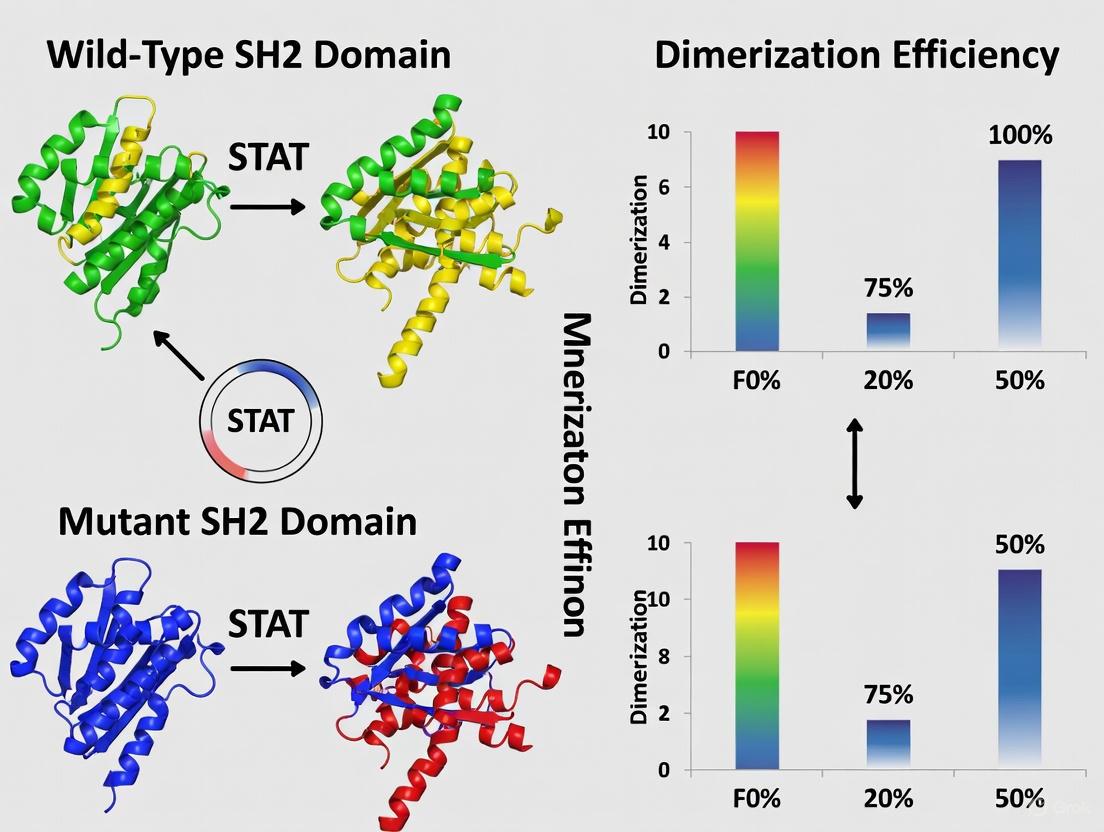
This article provides a comprehensive resource for researchers and drug development professionals investigating how mutations in the Src Homology 2 (SH2) domain impact Signal Transducer and Activator of Transcription (STAT)...
Validating SH2 Domain Mutation Effects on STAT Dimerization: From Molecular Mechanisms to Therapeutic Targeting
Abstract
This article provides a comprehensive resource for researchers and drug development professionals investigating how mutations in the Src Homology 2 (SH2) domain impact Signal Transducer and Activator of Transcription (STAT) protein dimerization efficiency. We synthesize foundational knowledge of SH2 domain structure and function with cutting-edge methodological approaches for real-time dimerization monitoring, including genetically encoded biosensors and AI-driven structural prediction. The content further explores troubleshooting strategies for pathogenic mutations, advanced validation techniques like deep mutational scanning, and comparative analysis of mutation effects across STAT family members. By integrating recent advances in biophysical analysis, computational modeling, and functional assays, this review aims to bridge fundamental research with clinical translation for disorders driven by aberrant STAT signaling.
The SH2 Domain: Architecture, Function, and Critical Role in STAT Signaling
Src Homology 2 (SH2) domains are modular protein interaction domains approximately 100 amino acids in length that function as essential "readers" of phosphotyrosine (pTyr) signaling in eukaryotic cells [1] [2]. These domains specifically recognize and bind to tyrosine-phosphorylated sequences on target proteins, thereby facilitating the assembly of multiprotein signaling complexes that control fundamental cellular processes including proliferation, differentiation, survival, and migration [3] [4]. The human genome encodes approximately 120 SH2 domains distributed across 111 proteins, highlighting their central importance in orchestrating complex signaling networks [1] [5]. Proteins containing SH2 domains encompass a diverse functional spectrum, including kinases, phosphatases, transcription factors, and adaptor proteins, all utilizing the SH2 domain to achieve precise spatial and temporal localization within signaling pathways [3] [6]. Understanding the conserved structural architecture and phosphotyrosine recognition mechanism of SH2 domains provides a critical foundation for investigating how mutations affect STAT dimerization efficiency and other pathological signaling events.
Conserved Structural Architecture of the SH2 Domain
Canonical SH2 Domain Fold
Despite significant sequence variation among family members, all SH2 domains share a highly conserved tertiary structure that forms the structural basis for phosphotyrosine recognition [2] [6]. The canonical SH2 domain fold consists of a central anti-parallel β-sheet composed of three principal strands (βB, βC, βD), flanked by two α-helices (αA and αB) in an αβββα configuration [7] [4]. This core structure is frequently supplemented with additional secondary structural elements, particularly β-strands βE, βF, and βG, though the presence and arrangement of these elements vary among different SH2 domain subfamilies [6]. The N-terminal region of the SH2 domain (encompassing αA through βD) is highly conserved and contains the phosphotyrosine-binding pocket, while the C-terminal region (from βD onward) exhibits greater structural diversity and contributes to binding specificity [2] [6].
The SH2 domain structure can be partitioned into two functionally distinct subpockets: the phosphate-binding (pY) pocket and the specificity (pY+3) pocket [7]. The pY pocket is formed by elements from the αA helix, the BC loop (connecting βB and βC strands), and one face of the central β-sheet. Conversely, the pY+3 pocket is created by the opposite face of the β-sheet along with residues from the αB helix and the CD and BC* loops [7]. This structural division enables SH2 domains to perform two critical functions simultaneously: recognizing the phosphotyrosine moiety through the conserved pY pocket while achieving sequence specificity through interactions with residues C-terminal to the phosphotyrosine in the pY+3 pocket.
Structural Classification: STAT-type versus Src-type SH2 Domains
SH2 domains are broadly classified into two major subgroups based on structural characteristics: STAT-type and Src-type domains [7] [6]. STAT-type SH2 domains are distinguished by the absence of βE and βF strands and the splitting of the αB helix into two separate helices [6]. This structural adaptation is particularly suited to facilitating STAT dimerization, a critical step in STAT-mediated transcriptional activation [7] [6]. In contrast, Src-type SH2 domains typically contain additional β-strands (βE and βF) and maintain a continuous αB helix [7]. This structural divergence reflects functional specialization, with STAT-type SH2 domains evolving to support transcription factor dimerization while Src-type domains maintain broader roles in signaling complex assembly.
Table 1: Key Structural Features of STAT-type versus Src-type SH2 Domains
| Structural Feature | STAT-type SH2 Domains | Src-type SH2 Domains |
|---|---|---|
| C-terminal Structure | Split αB helix (αB and αB'); lacks βE and βF strands | Continuous αB helix; contains βE and βF strands |
| Dimerization Function | Critical for STAT dimerization and nuclear translocation | Primarily mediates receptor recruitment and complex assembly |
| Representative Proteins | STAT1, STAT3, STAT5, STAT6 | Src, Fyn, Grb2, PI3K p85 |
| Evolutionary Conservation | Higher conservation in regions mediating dimerization | Higher conservation in pTyr-binding pocket |
Molecular Mechanism of Phosphotyrosine Recognition
The Phosphotyrosine-Binding Pocket
The molecular mechanism of phosphotyrosine recognition is characterized by exquisite conservation across virtually all SH2 domains [4] [8]. A universally conserved arginine residue (designated ArgβB5 due to its position as the fifth residue of the βB strand) serves as the central coordinator of phosphotyrosine binding [8] [6]. This critical arginine, which is part of a highly conserved FLVR sequence motif, forms a bidentate salt bridge with two oxygen atoms of the phosphate moiety of the phosphotyrosine residue [4] [8]. The indispensability of this interaction is demonstrated by mutational studies showing that substitution of ArgβB5 completely abrogates phosphotyrosine binding both in vitro and in vivo [8].
Additional conserved residues contribute to stabilizing the phosphotyrosine interaction, though their presence and specific roles vary among SH2 domain subfamilies [4]. In Src-family SH2 domains, two additional positively charged residues (ArgαA2 and LysβD6) form a "clamp" around the phenolic ring of the tyrosine residue [8]. Other hydrogen bond donors, such as SerβB7 and ThrBC2, may also interact with the phosphate group, though their energetic contributions to binding are generally modest compared to the critical ArgβB5 [4] [8]. The remarkable conservation of this phosphotyrosine recognition mechanism across evolution underscores its fundamental importance to SH2 domain function.
Specificity Determinants and Peptide Recognition
While the phosphotyrosine-binding pocket provides the fundamental affinity for SH2 domain interactions, sequence specificity is achieved through interactions with residues C-terminal to the phosphotyrosine [3] [2]. SH2 domains typically recognize phosphopeptides in an extended conformation that binds perpendicular to the central β-sheet of the domain [7] [2]. The specificity pocket, comprised of elements from the βD strand, αB helix, and various connecting loops (particularly the EF and BG loops), engages amino acids at positions +1 to +6 relative to the phosphotyrosine [2] [6].
Different SH2 domains exhibit distinct preferences for specific residues at these positions. For example, Src family kinases preferentially bind to motifs with the sequence pYEEI, while the SH2 domain of Grb2 recognizes pYXNX sequences (where X represents any amino acid) [3] [8]. The structural basis for this specificity involves complementary interactions between side chains of the peptide and residues lining the specificity pocket of the SH2 domain [2]. In the case of Src SH2 domain binding to pYEEI motifs, a deep hydrophobic pocket accommodates the isoleucine at the +3 position, while electrostatic interactions stabilize the glutamate residues at +1 and +2 positions [8].
Table 2: Energetic Contributions to SH2 Domain-Peptide Interactions
| Binding Component | Energetic Contribution | Structural Basis | Functional Significance |
|---|---|---|---|
| Phosphotyrosine | ~50% of total binding free energy (~ -4.7 kcal/mol for Src SH2) | Salt bridge with ArgβB5; aromatic/phosphates interactions | Provides fundamental binding affinity; essential for recognition |
| Specificity Residues | ~50% of total binding free energy (varies by position) | Interactions with specificity pocket (hydrophobic, electrostatic, hydrogen bonding) | Determines binding specificity; differentiates among potential targets |
| ArgβB5 Mutation | ΔΔG = +3.2 kcal/mol (significant reduction in affinity) | Loss of critical salt bridge with phosphate moiety | Complete abrogation of phosphotyrosine binding |
| Conserved Binding Pocket Residues | ΔΔG < +1.4 kcal/mol for individual mutations (modest effects) | Various stabilizing interactions with phosphate | Fine-tuning of binding affinity; some redundancy in function |
The following diagram illustrates the core phosphotyrosine recognition mechanism shared by SH2 domains, highlighting the critical interactions and structural elements:
Experimental Analysis of SH2 Domain Structure and Function
Key Methodologies for Investigating SH2 Domain Interactions
Research into SH2 domain structure and function employs a multidisciplinary approach combining biophysical, structural, and biochemical techniques. Isothermal titration calorimetry (ITC) has been instrumental in quantifying the energetic contributions of individual molecular interactions, such as demonstrating that phosphotyrosine alone contributes approximately 50% of the total binding free energy for Src SH2 domain [8]. X-ray crystallography and nuclear magnetic resonance (NMR) spectroscopy have provided high-resolution structural data for approximately 70 unique SH2 domains, revealing both the conserved fold and variations responsible for specificity differences [2] [6]. Mutational analyses, including alanine scanning and site-directed mutagenesis, have identified critical residues for phosphotyrosine recognition and characterized their energetic contributions to binding [9] [8].
Recent technological advances have expanded the methodological toolkit for SH2 domain research. Solution-based techniques such as Small-Angle X-ray Scattering (SAXS) coupled with Size-Exclusion Chromatography and Multi-Angle Light Scattering (SEC-MALS) have enabled the investigation of SH2 domain oligomerization and domain-swapping phenomena in near-physiological conditions [10]. Phosphopeptide library screens have systematically mapped the specificity determinants of numerous SH2 domains, revealing consensus binding motifs and enabling predictions of physiological interaction partners [3] [2]. These complementary approaches collectively provide a comprehensive understanding of SH2 domain structure-function relationships.
Table 3: Essential Research Reagents and Methodologies for SH2 Domain Studies
| Reagent/Methodology | Specific Application | Key Experimental Insights | References |
|---|---|---|---|
| Isothermal Titration Calorimetry (ITC) | Quantifying binding affinity and thermodynamics | Energetic contribution of pTyr and specificity residues; ΔG, ΔH, Kd measurements | [4] [8] |
| X-ray Crystallography | High-resolution structure determination | Atomic-level details of pTyr pocket architecture; peptide-binding mode visualization | [7] [2] [8] |
| NMR Spectroscopy | Solution structure and dynamics | Protein flexibility; mapping of interaction surfaces; real-time binding kinetics | [4] [6] |
| Alanine Scanning Mutagenesis | Functional mapping of binding residues | Identification of critical pTyr-binding residues (e.g., ArgβB5) | [9] [8] |
| Phosphopeptide Libraries | Specificity profiling | Consensus binding motifs for different SH2 domains; specificity determinants | [3] [2] |
| SEC-MALS-SAXS | Oligomerization state analysis | Detection of domain-swapped dimers; solution conformation studies | [10] |
Experimental Workflow for Characterizing SH2 Domain Mutants
The following diagram outlines a comprehensive experimental approach for validating the effects of SH2 domain mutations on structure and function, particularly relevant for investigating STAT dimerization efficiency:
Implications for STAT Dimerization and Therapeutic Targeting
STAT SH2 Domains in Health and Disease
STAT proteins represent a particularly compelling example of SH2 domain functional specialization, as their SH2 domains mediate both recruitment to activated cytokine receptors and the homotypic or heterotypic interactions necessary for transcription factor dimerization [7] [9]. Following tyrosine phosphorylation, STAT proteins form reciprocal dimers through interaction between the SH2 domain of one monomer and the phosphotyrosine of another [7]. This dimerization event is essential for nuclear translocation and DNA binding, representing a critical control point in STAT-mediated transcriptional regulation.
The STAT SH2 domain has been identified as a mutational hotspot in various human diseases [7]. For STAT3 and STAT5B, numerous SH2 domain mutations have been documented in patients with diverse pathologies including immunodeficiencies, leukemias, and lymphomas [7]. These mutations can have either gain-of-function or loss-of-function consequences, sometimes occurring at identical residues, underscoring the delicate balance of STAT signaling homeostasis. For instance, specific mutations in the STAT3 SH2 domain are associated with autosomal-dominant Hyper IgE syndrome (AD-HIES), characterized by diminished Th17 T-cell responses and recurrent infections [7]. Conversely, somatic mutations in the STAT5B SH2 domain can drive oncogenesis through constitutive activation [7]. Understanding how these mutations alter the conserved structure and phosphotyrosine recognition mechanism of STAT SH2 domains provides critical insights into disease pathogenesis and potential therapeutic strategies.
Emerging Therapeutic Approaches Targeting SH2 Domains
The strategic importance of SH2 domains in numerous signaling pathways, coupled with their well-defined binding mechanisms, has made them attractive targets for therapeutic intervention [1] [6]. Several strategies have emerged for targeting SH2 domain-mediated interactions, including small molecule inhibitors that disrupt phosphopeptide binding, stabilized peptides mimicking natural ligands, and allosteric modulators that alter SH2 domain conformation [1] [7]. Additionally, emerging research has revealed non-canonical functions of SH2 domains, including interactions with membrane lipids and participation in liquid-liquid phase separation (LLPS), opening new avenues for therapeutic manipulation [6].
The structural conservation of the phosphotyrosine-binding pocket across SH2 domains presents both challenges and opportunities for drug development. While this conservation complicates the achievement of specificity, it also enables structure-based drug design approaches that leverage the extensive structural database of SH2 domain-ligand complexes [7] [6]. For STAT proteins in particular, targeting the SH2 domain has emerged as a promising strategy for inhibiting pathological signaling in cancer and inflammatory diseases, with several candidate molecules in various stages of preclinical development [7]. As our understanding of SH2 domain structure-function relationships continues to deepen, particularly regarding STAT dimerization mechanisms, so too will opportunities for developing targeted therapies that modulate these critical signaling interactions.
Src homology 2 (SH2) domains are modular protein components of approximately 100 amino acids that specifically recognize and bind to phosphorylated tyrosine (pTyr) residues, thereby orchestrating phosphotyrosine-dependent protein-protein interactions within cellular signaling networks [11] [2]. These domains are crucial participants in metazoan signal transduction, acting as primary mediators for regulated protein-protein interactions with tyrosine-phosphorylated substrates [12]. Although all SH2 domains share a common structural fold and function in pTyr recognition, significant structural variations enable functional specialization, particularly distinguishing STAT-type SH2 domains from classical SRC-type SH2 domains. This specialization is critically important in disease contexts, as evidenced by mutations in the STAT5B SH2 domain that alter lymphocyte homeostasis and mammary gland development [13] [14]. This guide provides a comparative analysis of STAT-type and SRC-type SH2 domains, focusing on their structural divergence, functional specialization, and the experimental approaches used to characterize them, framed within the context of validating SH2 domain mutation effects on STAT dimerization efficiency.
Structural Comparison: STAT-type vs. SRC-type SH2 Domains
Despite their conserved core architecture, STAT-type and SRC-type SH2 domains exhibit distinct structural features that underpin their specialized functions.
The canonical SH2 domain structure consists of a central three-stranded antiparallel beta-sheet flanked by two alpha helices, forming an α-β-β-β-α sandwich [11] [2]. The N-terminal region, containing a deep pocket within the βB strand that binds the phosphate moiety, is highly conserved across all SH2 domains. This pocket contains an invariable arginine residue (at position βB5) that is part of the FLVR motif and directly coordinates the pTyr residue through a salt bridge [11] [2]. The C-terminal region, in contrast, is more variable and contains the specificity-determining elements that recognize residues C-terminal to the pTyr in peptide ligands [11].
Table 1: Core Structural Features of SH2 Domains
| Feature | Common Structure | Key Structural Components |
|---|---|---|
| Overall Fold | α-β-β-β-α sandwich [11] | Three-stranded antiparallel beta-sheet flanked by two alpha helices |
| pTyr Binding Pocket | Located in N-terminal region [11] [2] | βB strand containing conserved arginine (βB5) of FLVR motif |
| Specificity Pocket | Located in C-terminal region [11] [2] | Hydrophobic pocket formed by variable regions including EF and BG loops |
| Ligand Binding Mode | Extended pTyr-peptide binds perpendicular to central β-strands [2] | pTyr residue inserts into conserved pocket; C-terminal residues engage specificity pocket |
Specialized Features of STAT and SRC SH2 Domains
STAT and SRC SH2 domains diverge significantly in their structural adaptations for their distinct biological roles. STAT transcription factors utilize their SH2 domains not only for phosphopeptide binding but, critically, for reciprocal homodimerization between two STAT monomers [13]. This dimerization interface involves specific residues, such as tyrosine 665 in STAT5B, which is located at a critical homodimerization interface [13]. Mutations at this position (e.g., Y665F and Y665H) demonstrate how single amino acid changes can drastically alter dimerization energetics and function [13].
In contrast, SRC-family kinase SH2 domains, like that in GRB2 and its Drosophila homologue Drk, primarily bind to pTyr-containing motifs on receptor tyrosine kinases (RTKs) and other signaling proteins [15]. The solution NMR structure of the Drk-SH2 domain reveals a common SH2 architecture but with distinct conformational flexibility in loop regions (Loops A, C, E, and F) compared to GRB2-SH2, which may influence ligand specificity and binding dynamics [15].
Table 2: Structural and Functional Divergence Between STAT-type and SRC-type SH2 Domains
| Characteristic | STAT-type SH2 Domains | SRC-type SH2 Domains |
|---|---|---|
| Primary Function | Homodimerization and nuclear translocation [13] | Recruitment to phosphotyrosine sites on receptors/adaptors [15] [16] |
| Key Structural Determinant | Residues at dimer interface (e.g., STAT5B Y665) [13] | Specificity-determining loops (EF, BG) for peptide selection [2] |
| Dimerization Interface | Reciprocal SH2-pTyr interaction between monomers [13] | Not applicable for homodimerization |
| Mutation Impact | Alters dimer stability, DNA binding, and transcriptional activity [13] [14] | Disrupts downstream signaling pathways (e.g., MAPK pathway) [15] |
| Representative Proteins | STAT1, STAT3, STAT5A, STAT5B [11] [13] | SRC, FYN, GRB2, Drk [11] [15] |
Functional Specialization in Signaling Pathways
The structural differences between STAT-type and SRC-type SH2 domains translate into distinct functional roles within cellular signaling networks, which can be visualized in their respective pathway contexts.
Figure 1: Signaling Pathways Utilizing STAT-type and SRC-type SH2 Domains. STAT-type SH2 domains facilitate homodimerization and nuclear signaling in cytokine pathways, while SRC-type SH2 domains mediate recruitment to phosphorylated receptors in growth factor signaling.
STAT-type SH2 Domains in Cytokine Signaling
STAT transcription factors are latent cytoplasmic proteins that become activated by cytokine receptors. Upon cytokine stimulation and subsequent tyrosine phosphorylation by JAK kinases, STAT proteins utilize their SH2 domains for reciprocal dimerization—where the SH2 domain of one STAT monomer binds to the phosphorylated tyrosine residue on the C-terminal tail of another STAT monomer [13] [14]. This SH2-mediated homodimerization is essential for STAT nuclear translocation, DNA binding, and transcriptional activation of target genes. The critical nature of this interaction is highlighted by disease-associated mutations in the STAT5B SH2 domain (e.g., Y665F and Y665H) that respectively enhance or diminish dimerization efficiency, leading to altered immune cell profiles and mammary gland development defects in mouse models [13] [14].
SRC-type SH2 Domains in Adaptor and Kinase Functions
SRC-type SH2 domains function primarily in the context of multi-domain proteins that are recruited to activated, tyrosine-phosphorylated receptor tyrosine kinases (RTKs) and scaffolding proteins. For example, GRB2 (and its Drosophila homologue Drk) serves as a critical adaptor in the RAS-MAPK pathway, where its SH2 domain binds specifically to pTyr-containing motifs on RTKs, thereby positioning its SH3 domains to activate downstream signaling components like SOS [15]. Similarly, SRC-family kinases often utilize their SH2 domains for both intramolecular regulation (by binding their own C-terminal phosphorylated tyrosine) and intermolecular interactions with signaling partners [2]. The binding affinity of these interactions is typically moderate (K~D~ values ranging from 0.1 to 10 μM), allowing for transient yet specific associations necessary for dynamic signaling processes [2].
Experimental Approaches for Analyzing SH2 Domain Function
Research into SH2 domain function employs diverse methodologies to quantify binding interactions, determine structures, and assess functional consequences in biological systems.
Quantitative Binding Affinity Measurements
Advanced techniques have been developed to profile SH2 domain binding specificity and affinity across large sequence spaces. ProBound is a statistical learning method that uses multi-round affinity selection on random phosphopeptide libraries coupled with next-generation sequencing (NGS) to generate accurate sequence-to-affinity models [17]. This approach can predict binding free energy (ΔΔG) for any peptide sequence within the theoretical space covered by the library, providing quantitative insights into the impact of phosphosite variants on SH2 domain binding [17].
Isothermal Titration Calorimetry (ITC) provides direct measurement of binding affinity and thermodynamics. For instance, ITC studies determined the K~D~ of GRB2-SH2 binding to a pY-containing peptide (VPEpYINQSVPK) to be 0.713 ± 0.145 μM [15]. NMR titration experiments offer complementary information by identifying specific residues involved in ligand binding through chemical shift perturbations, as demonstrated in studies of the Drk-SH2 domain interaction with Sev-derived phosphopeptides [15].
Structural Analysis Techniques
X-ray crystallography has provided high-resolution structures of numerous SH2 domains in both peptide-free and peptide-bound states, revealing the molecular basis of phosphopeptide recognition [2]. Solution NMR spectroscopy offers unique advantages for studying domain dynamics and transient interactions, as applied in determining the structure of the Drk-SH2 domain and characterizing its conformational flexibility [15]. AlphaFold3 computational modeling has recently been used to predict SH2 domain homodimer structures, such as for STAT5B, providing insights into residue-specific energetic contributions to dimer stability [13].
Functional Validation in Biological Systems
Genetically engineered mouse models are crucial for validating the physiological impact of SH2 domain mutations. For STAT5B, knock-in mice carrying the Y665F or Y665H mutations displayed contrasting phenotypes: Y665F acted as a gain-of-function mutation, increasing CD8+ effector and memory T cells, while Y665H resulted in loss-of-function with diminished T cell populations [13]. In mammary gland development, STAT5B-Y665H impaired alveolar differentiation and lactation, whereas Y665F accelerated mammary development during pregnancy [14].
In vitro cellular assays using primary T-cells or cell lines assess downstream signaling consequences, including STAT phosphorylation levels, DNA-binding capacity, and transcriptional activity of reporter genes, providing functional readouts of SH2 domain mutation effects [13].
Figure 2: Experimental Workflow for SH2 Domain Functional Analysis. The comprehensive approach integrates quantitative binding measurements, structural characterization, and functional validation in biological systems.
The Scientist's Toolkit: Key Research Reagents and Methodologies
Table 3: Essential Research Reagents and Methods for SH2 Domain Studies
| Reagent/Methodology | Function/Application | Experimental Context |
|---|---|---|
| Bacterial Peptide Display Libraries | High-throughput profiling of SH2 binding specificity across diverse peptide sequences [17] | Identification of optimal binding motifs and specificity determinants |
| Phosphotyrosine-containing Peptides | Define binding affinity and structural basis of SH2-phosphopeptide interactions [15] | ITC, NMR, and crystallography studies to quantify K~D~ and identify contact residues |
| ProBound Computational Framework | Builds quantitative sequence-to-affinity models from NGS data [17] | Predicts binding free energy (ΔΔG) for any peptide sequence and impact of sequence variants |
| NMR Spectroscopy | Determines solution structures and analyzes protein dynamics and binding interfaces [15] [18] | Characterizes conformational flexibility and site-specific interactions with phosphopeptides |
| Genetically Engineered Mouse Models | Validates physiological consequences of SH2 domain mutations in complex systems [13] [14] | Assesses impact on immune cell development, mammary gland formation, and lactation |
| AlphaFold3 & COORDinator | Predicts protein structures and energetic contributions of residues to stability/dimerization [13] | Models dimer interfaces and predicts pathogenicity of missense mutations (e.g., STAT5B Y665F/H) |
STAT-type and SRC-type SH2 domains exemplify how evolutionary conservation of a core protein interaction module can be tailored through structural variations to achieve distinct physiological functions. STAT-type SH2 domains are specialized for stable homodimerization required for transcriptional activation, whereas SRC-type SH2 domains have evolved for transient recruitment to tyrosine-phosphorylated signaling complexes. This functional specialization is critically dependent on specific structural features—particularly at the dimerization interface for STAT domains and in the specificity-determining loops for SRC domains. The experimental approaches outlined here, from quantitative biophysical measurements to genetically engineered models, provide a robust framework for validating the impact of SH2 domain mutations on function, with significant implications for understanding disease mechanisms and developing targeted therapeutic interventions.
The Src Homology 2 (SH2) domain is a protein-protein interaction module of approximately 100 amino acids that plays a fundamental role in cellular signaling by specifically recognizing and binding to phosphorylated tyrosine (pTyr) residues [19] [1]. Its discovery in 1986 heralded a new era in the understanding of modular domains and how intracellular signaling is orchestrated through post-translational modifications [19]. The primary molecular role of the SH2 domain is to directly bind pTyr residues, which is central to the propagation of signals by receptor and non-receptor tyrosine kinases [19]. This interaction is broadly independent of the folding of the pTyr-ligand and can be observed for denatured Tyr peptides, making the binding of SH2 domains to short linear peptide motifs predictive for their interactome [19].
Structurally, the SH2 domain consists of a central anti-parallel β-sheet flanked by two α-helices, forming a characteristic αβββα motif [7] [6]. The phosphorylated peptide binds perpendicularly to the β-sheet, docking into two abutting recognition sites in a bidentate or "two-pronged plug" interaction [19]. This creates a deep, basic pTyr-binding pocket and a hydrophobic specificity pocket that usually recognizes an amino acid three residues C-terminal to the pTyr (the +3 position) [19] [6]. The high degree of conservation in the three-dimensional fold of SH2 domains across diverse proteins underscores its evolutionary optimization for pTyr recognition [6]. Among its conserved features, the FLVR motif and its critical arginine residue at the βB5 position stand out as the cornerstone of phosphotyrosine binding affinity.
The FLVR Motif and Arginine βB5: Structural and Functional Roles
The Canonical Mechanism of Phosphotyrosine Coordination
Within the canonically defined pTyr pocket of the SH2 domain, several conserved residue motifs have been identified, with the FLVR (or FLVRES) motif being the most critical [19] [6]. This motif is located on the βB strand, and it contains an invariant arginine at the fifth position of this strand, designated Arg βB5 or βB5 [19]. This arginine provides a floor at the base of the deep pTyr pocket and forms direct, bidentate hydrogen bonds with the phosphate moiety of the phosphorylated tyrosine [19] [6] [2]. This interaction is responsible for a significant portion of the binding free energy.
The conservation of this residue is remarkable; it is preserved in all but 3 of the 120+ human SH2 domains, highlighting its non-negotiable role in the domain's function [19] [6]. The FLVR arginine is considered the primary residue for pTyr recognition, and it is the residue most often targeted by point mutagenesis to interrupt SH2-pTyr binding in experimental settings [19].
Quantitative Impact on Binding Affinity
The essential nature of the FLVR arginine is quantitatively demonstrated by mutational analyses. Point mutation of this arginine residue can result in the loss of as much as half of the free energy of binding, leading to a dramatic 1,000-fold reduction in binding affinity [19]. This precipitous drop underscores that the interaction between Arg βB5 and the phosphate group is not merely one of several contributing factors but is foundational to the SH2-pTyr interaction.
The table below summarizes the key conserved residues in the SH2 domain pTyr-binding pocket and their roles.
Table 1: Key Conserved Residues in the SH2 Domain pTyr-Binding Pocket
| Residue / Motif | Structural Location | Primary Function | Consequence of Mutation |
|---|---|---|---|
| Arg βB5 (FLVR) | βB strand | Forms bidentate salt bridge with pTyr phosphate group; provides binding specificity for pTyr over pSer/pThr. | Up to ~1000-fold reduction in binding affinity; loss of ~50% of binding free energy [19]. |
| Basic Residue αA2 | αA helix | Coordinates pTyr phosphate in "Src-like" SH2 domains [19]. | Reduced affinity, but impact is generally less severe than mutation of Arg βB5. |
| Basic Residue βD6 | βD strand | Coordinates pTyr phosphate in "SAP-like" SH2 domains [19]. | Reduced affinity, but impact is generally less severe than mutation of Arg βB5. |
Atypical and FLVR-Unique SH2 Domains: Exceptions to the Rule
While the FLVR-Arg βB5 mechanism is highly conserved, recent research has uncovered intriguing exceptions that illustrate a greater diversity in SH2 domain architecture and function than previously appreciated [19] [20]. These atypical domains challenge the canonical model and provide a more nuanced understanding of phosphotyrosine recognition.
The FLVR-Unique SH2 Domain of p120RasGAP
A striking exception is the C-terminal SH2 domain of p120RasGAP (RASA1). X-ray crystal structures have revealed that in this domain, the arginine of the FLVR motif (R377) does not directly contact the phosphotyrosine of a bound peptide [20]. Instead, it forms an intramolecular salt bridge with an aspartic acid residue. In this "FLVR-unique" SH2 domain, the coordination of the phosphate group is achieved by a modified binding pocket involving residues R398 (βD4) and K400 (βD6) [20]. Experimental data from isothermal titration calorimetry (ITC) confirmed that an R377A mutation did not cause a significant loss of phosphopeptide binding, whereas a tandem R398A/K400A mutation was required to disrupt the interaction [20]. This finding classifies the p120RasGAP SH2 domain as a distinct functional class and underscores the evolutionary plasticity of the SH2 fold.
Ancestral and Bacterial SH2 Domains
Further diversity is found in evolutionarily ancient SH2 domains. The SPT6 protein, which contains the most ancient SH2 domains known, uses its N-terminal SH2 domain to recognize phosphorylated threonine (pThr) in RNA polymerase II [19]. Interestingly, this domain uses the FLVR arginine to coordinate the pThr phosphate, but it does so in conjunction with a neighboring tyrosine residue, creating a binding mode that resembles the canonical pTyr interaction and is considered an evolutionary stepping stone to dedicated pTyr recognition [19].
Additionally, SH2 domains in Legionella pneumophila bacteria, likely acquired through horizontal gene transfer, bind pTyr using the conserved FLVR arginine but exhibit minimal selectivity for residues at the +3 position due to the lack of a defined specificity pocket. They achieve high-affinity binding through a large insert that undergoes a conformational "clamping" reorganization to grasp the pTyr peptide [19].
Table 2: Comparison of Canonical and Atypical SH2 Domain Binding Mechanisms
| SH2 Domain Type | Representative Example | Role of FLVR Arg βB5 | Key Features and Binding Partners |
|---|---|---|---|
| Canonical | Src Kinase, STAT proteins | Direct salt bridge with pTyr phosphate; essential for binding energy. | Bidentate "two-pronged plug" interaction with pTyr and +3 residue [19] [7]. |
| FLVR-Unique | p120RasGAP C-SH2 | Intramolecular salt bridge; not essential for pTyr binding. | pTyr coordinated by residues in βD strand (R398, K400); binds pTyr1087 of p190RhoGAP [20]. |
| Ancestral | SPT6 N-SH2 | Coordinates pThr phosphate. | Binds pThr and Tyr of RNA Polymerase II; evolutionary precursor to pTyr binding [19]. |
| Bacterial | Legionella LeSH2 | Direct salt bridge with pTyr phosphate. | Low sequence selectivity; "clamping" mechanism via large EF loop insert for high-affinity binding [19]. ``` |
Experimental Validation: Methodologies for Profiling SH2 Domain Function
Key Experimental Protocols
Research into SH2 domain function, including the characterization of the FLVR motif, relies on a suite of biochemical, biophysical, and structural techniques.
- Isothermal Titration Calorimetry (ITC): This gold-standard method is used for a label-free, quantitative assessment of binding affinity (Kd), stoichiometry (n), and thermodynamic parameters (ΔH, ΔS). It was crucial for demonstrating that mutation of the FLVR arginine in p120RasGAP (R377A) did not impact binding, while mutations of R398 and K400 did [20].
- High-Throughput Far-Western and Reverse-Phase Protein Arrays: These proteomic-scale methods enable the global profiling of SH2 domain interactions with cellular proteins or phosphopeptides. They can be used to map the entire interactome of an SH2 domain and assess how mutations alter binding specificity [21].
- X-ray Crystallography and Structural Analysis: Solving the three-dimensional structures of SH2 domains in their apo and peptide-bound states is indispensable for understanding the molecular basis of binding. This technique revealed the unique intramolecular salt bridge formed by the FLVR arginine in p120RasGAP [20] and the canonical bidentate interaction in other SH2 domains [19].
- Site-Directed Mutagenesis: This is a foundational technique for probing the functional importance of specific residues. Double alanine substitutions, as used in the mutational analysis of the Stat6 SH2 domain [9], and point mutations of the FLVR arginine [19] are direct methods to establish residue function.
The Scientist's Toolkit: Essential Research Reagents
Table 3: Key Research Reagents for Investigating SH2 Domain Function
| Reagent / Tool | Function and Application | Example Use Case |
|---|---|---|
| Recombinant SH2 Domains | Purified, individual SH2 domains used in binding assays, structural studies, and inhibitor screening. | ITC and X-ray crystallography studies of the p120RasGAP SH2 domain [20]. |
| Phosphotyrosine Peptide Libraries | Collections of pTyr-containing peptides representing physiological binding motifs for high-throughput specificity profiling. | Profiling the binding specificity of human SH2 domains on reverse-phase protein arrays [21]. |
| SH2 Domain "Superbinders" | Engineered SH2 domains with multiple mutations that confer ultra-high affinity for pTyr, useful as generic capture reagents. | Isolating a wide array of tyrosine-phosphorylated proteins from cell lysates; can be disruptive to signaling if expressed in cells [2]. |
| Site-Directed Mutagenesis Kits | Commercial kits for introducing specific point mutations (e.g., Arg βB5 to Ala) into SH2 domain-encoding DNA plasmids. | Generating FLVR motif mutants to test their effect on phosphopeptide binding and cellular function [19] [9]. |
Implications for STAT Dimerization and Drug Discovery
The principles of FLVR-mediated phosphotyrosine binding are directly relevant to the user's thesis context on STAT dimerization efficiency. STAT (Signal Transducer and Activator of Transcription) proteins are critical transcription factors whose activation is dependent on SH2 domain function [7]. The SH2 domain of STAT proteins mediates two key interactions: recruitment to phosphorylated cytokine receptors, and reciprocal dimerization between two STAT monomers upon their own phosphorylation [7] [9]. This dimerization is a prerequisite for nuclear translocation and DNA binding.
Mutations in the STAT SH2 domain, particularly in the pTyr-binding pocket, can therefore have profound effects on STAT function. Sequencing of patient samples has identified the SH2 domain as a hotspot for mutations in STAT3 and STAT5B, linked to both gain-of-function (GOF) and loss-of-function (LOF) phenotypes in diseases like T-cell leukemia and immunodeficiency disorders [7]. For instance, mutations at the structurally critical Tyr665 in the STAT5B SH2 domain have been shown to have dramatic and opposing effects in vivo; the Y665H mutation causes a LOF in mammary gland development, while Y665F acts as a GOF mutation [14]. This underscores that the structural integrity of the SH2 domain, centered on residues like those in the FLVR motif, is essential for precise STAT signaling.
The following diagram illustrates how SH2 domain mutations can disrupt the normal STAT activation cycle, affecting dimerization efficiency.
Diagram 1: Impact of SH2 Domain Mutations on STAT Activation and Dimerization. Mutations (e.g., in the FLVR motif) impair phosphotyrosine recognition, leading to failed dimerization and disrupted transcription.
Given their central role in signaling, SH2 domains are attractive targets for therapeutic intervention, especially in cancer. Drug discovery efforts have focused on developing small molecules that inhibit the pTyr pocket or the specificity pocket to disrupt pathogenic protein-protein interactions [7] [6]. The high degree of conservation of the FLVR motif makes it a compelling target, but the discovery of atypical domains like that of p120RasGAP suggests that achieving specificity will require a deep, structure-based understanding of each target SH2 domain. Furthermore, emerging roles for SH2 domains, such as binding to phospholipids and participation in liquid-liquid phase separation (LLPS), are opening new avenues for therapeutic modulation [6].
The FLVR motif and its central arginine βB5 are, with few notable exceptions, the cornerstone of phosphotyrosine binding affinity for SH2 domains. The direct coordination of the phosphate group by this residue provides a substantial portion of the binding energy and is essential for the domain's function in a myriad of signaling pathways, including the critical dimerization of STAT transcription factors. Quantitative mutational data confirms that its disruption can reduce binding affinity by three orders of magnitude. The discovery of "FLVR-unique" and other atypical SH2 domains does not diminish the importance of the canonical mechanism but rather expands our understanding of the structural and functional diversity of this fundamental protein interaction module. For researchers validating the effects of SH2 domain mutations on STAT dimerization, a thorough characterization of the pTyr-binding pocket, starting with the FLVR motif, is paramount. The experimental methodologies and reagents outlined provide a roadmap for such investigations, which are crucial for deciphering disease mechanisms and informing the development of targeted therapeutics.
The Signal Transducer and Activator of Transcription (STAT) family of proteins represents a critical signaling node, converting extracellular cytokine signals into rapid transcriptional responses within the nucleus. Central to this process is a fundamental conformational rearrangement—the transition from inactive antiparallel dimers to active parallel dimers—that governs STAT functionality. This dimerization switch is orchestrated primarily through the Src Homology 2 (SH2) domain, a modular protein interaction domain that recognizes phosphorylated tyrosine residues. The SH2 domain facilitates both the recruitment of STATs to activated cytokine receptors and the subsequent reciprocal phosphotyrosine-SH2 interactions that stabilize active parallel dimers [7] [6]. Understanding the precise molecular mechanisms controlling this conformational transition provides crucial insights into normal cellular physiology and disease pathogenesis, particularly in immune disorders and cancer where STAT signaling is frequently dysregulated.
Recent structural and biophysical advances have illuminated the intricate equilibrium between STAT dimer conformations. In unstimulated cells, STAT proteins predominantly exist as antiparallel dimers or monomers, preventing premature transcriptional activation. Upon cytokine stimulation and tyrosine phosphorylation at conserved C-terminal residues, STAT proteins undergo a dramatic structural reorganization into parallel dimers capable of high-affinity DNA binding and nuclear translocation [22]. This review comprehensively examines the molecular determinants of this conformational switch, with particular emphasis on how disease-associated SH2 domain mutations alter dimerization efficiency and STAT signaling output, providing a foundation for targeted therapeutic interventions.
Structural Mechanisms of STAT Dimerization
Domain Architecture and the Central Role of the SH2 Domain
STAT proteins share a conserved multi-domain architecture consisting of an N-terminal domain (NTD), coiled-coil domain (CCD), DNA-binding domain (DBD), linker domain (LD), SH2 domain, and C-terminal transactivation domain (TAD) [22]. The SH2 domain serves as the critical structural element mediating both STAT activation and dimerization through its specialized phosphotyrosine-binding pocket. Structurally, SH2 domains adopt a conserved αββα fold with a central anti-parallel β-sheet flanked by two α-helices [7] [6]. This architecture creates two functionally distinct binding pockets: the phosphotyrosine (pY) pocket that engages phosphorylated tyrosine residues, and the pY+3 specificity pocket that confers binding selectivity through recognition of specific residues C-terminal to the phosphotyrosine [7].
STAT-type SH2 domains possess unique characteristics that distinguish them from other SH2 domain families. Notably, they contain an additional α-helix (αB') in the C-terminal region rather than the β-sheets found in Src-type SH2 domains [7] [6]. This structural variation represents an evolutionary adaptation that facilitates STAT dimerization, reflecting the ancestral function of SH2 domain-containing proteins in transcriptional regulation. The SH2 domain mediates critical cross-domain interactions that stabilize both antiparallel and parallel dimer configurations, with residues in the pY+3 pocket playing dual roles in STAT dimerization and phosphopeptide binding [7].
The Antiparallel to Parallel Transition
The transition from antiparallel to parallel dimerization represents the fundamental conformational switch that activates STAT signaling. In the basal state, unphosphorylated STATs (U-STATs) can form antiparallel dimers through interactions involving the CCD and DBD domains, with the SH2 domains positioned distantly [22]. This configuration maintains STATs in a transcriptionally inactive state despite continuous nucleocytoplasmic shuttling [23].
Upon cytokine stimulation and subsequent tyrosine phosphorylation (typically at a conserved C-terminal residue: Y705 in STAT3, Y694 in STAT5A, Y699 in STAT5B), STAT proteins undergo a dramatic structural reorganization. The phosphorylated tyrosine of one STAT monomer engages the SH2 domain of its partner, forming reciprocal phosphotyrosine-SH2 interactions that stabilize the active parallel dimer [7] [22]. This parallel configuration brings the SH2 domains into close proximity while positioning the DNA-binding domains for optimal engagement with gamma-activated sequence (GAS) elements in target gene promoters [22].
Table 1: Key Structural Features of STAT Dimer Configurations
| Feature | Antiparallel Dimer | Parallel Dimer |
|---|---|---|
| Activation State | Inactive | Transcriptionally active |
| SH2 Domain Position | Distant | In close proximity |
| Stabilizing Interactions | Coiled-coil & DNA-binding domains | Reciprocal phosphotyrosine-SH2 interactions |
| DNA Binding Affinity | Low | High |
| Nuclear Import Mechanism | Direct nucleoporin interaction [24] | Importin-α/β mediated [24] |
| Primary Localization | Cytoplasmic/nuclear shuttling [24] | Nuclear accumulated |
This conformational transition is reversible and tightly regulated. Nuclear phosphatases, particularly Tc45, dephosphorylate STAT dimers, promoting their dissociation and export to the cytoplasm for subsequent signaling rounds [23]. The dynamic equilibrium between these conformational states allows for precise temporal control of STAT-dependent gene expression in response to extracellular signals.
Experimental Approaches for Studying STAT Dimerization
Biosensor Technologies for Real-Time Conformational Monitoring
Advanced biosensor technologies have revolutionized the study of STAT dimerization by enabling real-time visualization of conformational dynamics in live cells. FRET-based biosensors (Förster Resonance Energy Transfer) represent a particularly powerful approach for monitoring the antiparallel to parallel transition. These biosensors typically employ STAT monomers tagged with complementary fluorophores (e.g., mNeonGreen donor and mScarlet-I acceptor) at strategic positions that undergo distance and orientation changes during dimerization [22].
The optimal biosensor configuration identified through systematic screening involves C-terminal fusion of fluorophores to truncated STAT constructs containing the core fragment (CF: CCD, DBD, LD, and SH2 domains). This design capitalizes on the close approximation of SH2 domains in parallel dimers, generating robust FRET signals upon cytokine stimulation [22]. Fluorescence Lifetime Imaging Microscopy (FLIM) provides superior quantification of FRET efficiency compared to intensity-based measurements, as fluorescence lifetime is inversely correlated with FRET efficiency but independent of fluorophore concentration and photobleaching [22].
Experimental Protocol: STATeLight Biosensor Assay
- Construct Design: Generate STAT5A constructs with mNeonGreen and mScarlet-I fused C-terminally to the core fragment (residues 1-712).
- Cell Transfection: Co-transfect HEK-Blue IL-2 cells with donor- and acceptor-tagged STAT5A constructs.
- Stimulation: Treat cells with interleukin-2 (IL-2) to activate the JAK-STAT pathway.
- Image Acquisition: Collect time-lapse FLIM data before and after stimulation.
- Data Analysis: Calculate FRET efficiency from fluorescence lifetime changes: EFRET = 1 - (τDA/τD), where τDA is donor lifetime in presence of acceptor and τD is donor lifetime alone [22].
This biosensor approach directly monitors conformational rearrangement rather than phosphorylation status, specifically detecting functional parallel dimers while excluding inactive phosphorylated monomers or truncated variants [22].
Structural and Biophysical Methods
Complementary structural and biophysical techniques provide high-resolution insights into STAT dimer interfaces and dynamics:
X-ray Crystallography has revealed atomic-level details of STAT DNA-binding domains complexed with GAS elements and SH2 domain structures in various states [7]. Small-Angle X-Ray Scattering (SAXS) captures solution-state conformations of full-length STAT proteins, revealing their flexible multidomain organization [25] [10]. Electrophoretic Mobility Shift Assays (EMSA) quantify DNA-binding affinity of different STAT dimer species, while atomic force microscopy has visualized U-STAT3 binding to GAS DNA sequences as both dimers and monomers [24].
Computational approaches, particularly AlphaFold-multimer simulations, have predicted full-length STAT structures in both antiparallel and parallel configurations, providing models for fluorophore placement in biosensor design [22]. Molecular dynamics simulations further illuminate the flexibility and energy landscapes of STAT dimer interfaces.
SH2 Domain Mutations: Impact on Dimerization and Disease
Mutation Hotspots and Functional Consequences
The SH2 domain represents a mutational hotspot in STAT proteins, with sequencing analyses of patient samples identifying numerous point mutations that profoundly alter STAT activity [7]. These mutations can be broadly categorized as gain-of-function (GOF) or loss-of-function (LOF) based on their impact on dimerization efficiency and transcriptional activity. The genetic volatility of specific SH2 domain regions can yield either activating or deactivating mutations at identical positions, underscoring the delicate evolutionary balance maintained in wild-type STAT structures [7].
Table 2: Disease-Associated SH2 Domain Mutations in STAT Proteins
| STAT Protein | Mutation | Location | Functional Effect | Associated Pathology |
|---|---|---|---|---|
| STAT3 | S614R | BC loop (pY pocket) | Gain-of-function | T-LGLL, NK-LGLL, ALK-ALCL, HSTL [7] |
| STAT3 | K591E/M | αA helix (pY pocket) | Loss-of-function | AD-HIES [7] |
| STAT5B | N642H | SH2 domain | Gain-of-function | T-LGLL, T-PLL [26] |
| STAT5B | Y665F | SH2 domain | Gain-of-function | T-LGLL [26] |
| STAT5B | Y665H | SH2 domain | Loss-of-function | T-PLL (single case) [26] |
| STAT5B | R665M | SH2 domain | Loss-of-function | Growth hormone insensitivity [7] |
Mechanistic Insights from STAT5B Y665 Mutations
The contrasting phenotypes of STAT5B mutations at tyrosine 665 exemplify how subtle structural alterations dramatically impact dimerization efficiency and disease outcomes. The Y665F substitution (tyrosine to phenylalanine) represents a classical gain-of-function mutation identified in T-cell large granular lymphocytic leukemia (T-LGLL) [26]. This mutation enhances STAT5 phosphorylation, DNA binding, and transcriptional activity following cytokine activation, leading to accumulation of CD8+ effector/memory and CD4+ regulatory T cells in mouse models [26].
In contrast, the Y665H mutation (tyrosine to histidine) at the identical residue demonstrates loss-of-function characteristics, despite initial reports classifying it as gain-of-function [26]. STAT5B-Y665H exhibits diminished CD8+ effector/memory and CD4+ regulatory T cells in murine systems and resembles null STAT5B variants in functional assays [26]. Computational modeling suggests these divergent effects stem from distinct impacts on SH2 domain stability and phosphotyrosine interaction geometries, highlighting how single amino acid substitutions can differentially perturb the energetic landscape of dimerization.
Molecular Pathogenesis of SH2 Domain Mutations
Disease-associated SH2 domain mutations impact STAT function through multiple mechanistic pathways:
Enhanced Dimer Stability: Gain-of-function mutations like STAT5B-N642H and STAT3-S614R stabilize parallel dimers through altered interfacial contacts or hydrogen bonding networks, prolonging transcriptional activity [7]. Altered Phosphopeptide Affinity: Mutations within the pY pocket (e.g., STAT3-K591E) directly impact phosphotyrosine binding affinity, either enhancing or diminishing recruitment to activated receptors [7]. Conformational Flexibility: Substitutions in the BC loop and adjacent regions modulate SH2 domain dynamics, affecting the equilibrium between monomeric, antiparallel, and parallel states [7]. Disulfide Bridge Formation: In unphosphorylated STAT3, the Cys367-Cys542 disulfide bridge stabilizes dimeric forms capable of DNA binding, with mutations at these residues abolishing DNA-binding activity [24].
These molecular perturbations translate into distinct clinical phenotypes. Autosomal-dominant Hyper IgE Syndrome (AD-HIES) results from STAT3 LOF mutations that impair Th17 T-cell differentiation, causing recurrent infections and immune dysregulation [7]. Conversely, leukemic mutations in STAT3 and STAT5B generate hyperactive transcription factors that drive aberrant proliferation and survival in T-cell malignancies [7] [26].
Visualization of STAT Conformational Switching
The following diagram illustrates the conformational transition from antiparallel to parallel dimerization and key experimental approaches for monitoring this switch:
Diagram 1: STAT Conformational Switch & Detection. This workflow illustrates the transition from inactive antiparallel dimers to transcriptionally active parallel dimers, highlighting the central role of SH2 domain-phosphotyrosine interactions. Experimental detection via FRET biosensors capitalizes on distance changes between C-terminally fused fluorophores during dimerization.
Research Reagent Solutions for STAT Dimerization Studies
Table 3: Essential Research Tools for Investigating STAT Dimerization
| Reagent/Category | Specific Examples | Research Application | Key Features |
|---|---|---|---|
| FRET Biosensors | STATeLight (mNG/mSC-I tagged STAT CF) | Real-time conformational monitoring in live cells | FLIM-compatible, C-terminal fluorophore placement, specific for parallel dimers [22] |
| Cell Line Models | HEK-Blue IL-2 cells, STAT-deficient U3A cells | Pathway activation studies, mutant characterization | Defined signaling background, IL-2 responsive, suitable for reconstitution [23] [22] |
| Activation Reagents | Recombinant cytokines (IL-2, IFN-γ), JAK inhibitors (staurosporine) | Controlled pathway stimulation/inhibition | Temporal control of STAT phosphorylation, enables kinetic studies [23] [22] |
| Structural Tools | Phosphotyrosine peptides, SH2 domain mutants (e.g., STAT5B-Y665F/H) | Binding assays, structural studies, mechanistic insights | Defined binding interfaces, disease-relevant mutations, structure-function relationships [7] [26] |
| Detection Antibodies | Phospho-STAT specific antibodies, pan-STAT antibodies | Conventional fixed-cell STAT activation measurements | Phospho-specific epitopes, compatible with Western blot, flow cytometry [22] |
The conformational switch from antiparallel to parallel dimerization represents a fundamental regulatory mechanism in STAT signaling, with the SH2 domain serving as the central molecular orchestrator of this transition. Disease-associated SH2 domain mutations precisely target this conformational equilibrium, either stabilizing or destabilizing active parallel dimers to produce distinct pathological outcomes. Advanced biosensor technologies, particularly FRET-FLIM approaches, now enable real-time visualization of this dynamic process in live cells, providing unprecedented insights into STAT activation kinetics and mutant behavior.
The continued refinement of structural models and experimental tools will further illuminate the intricate allosteric networks governing STAT dimerization. Particularly promising are investigations into the role of unphosphorylated STAT dimers in chromatin organization and gene regulation [24], and the development of small molecules targeting specific dimer interfaces rather than individual domains. These approaches hold significant therapeutic potential for precisely modulating pathological STAT signaling in cancer and immune disorders while preserving essential physiological functions. As our structural understanding deepens, so too will our capacity to develop targeted interventions that restore balanced STAT activation in human disease.
The Src homology 2 (SH2) domain has long been recognized as a critical module for specific phosphotyrosine (pTyr) recognition in cellular signaling pathways. However, emerging research reveals this domain possesses functional capabilities far beyond its canonical role. This review synthesizes recent findings demonstrating that SH2 domains directly bind membrane lipids, participate in phase separation phenomena, and form complex regulatory networks through domain-swapping oligomerization. We examine how these non-canonical functions influence STAT dimerization efficiency and contribute to the spatial organization of signaling complexes. Through comparative analysis of experimental approaches and their resulting data, we provide a framework for evaluating how SH2 domain mutations alter protein function through mechanisms not predicted by traditional pTyr-binding models. This expanded understanding of SH2 domain functionality opens new avenues for therapeutic intervention in cancer, autoimmune disorders, and immunodeficiency diseases.
Src homology 2 (SH2) domains are modular protein interaction domains approximately 100 amino acids in length that specifically recognize phosphorylated tyrosine residues, directing the assembly of signaling complexes in myriad pathways [27]. First identified in cytoplasmic protein tyrosine kinases, these domains have been considered archetypal "readers" of phosphotyrosine signaling, with human genomes encoding approximately 111 different SH2-containing proteins [27] [28]. The classical view posits SH2 domains as having a conserved structure—a central antiparallel β-sheet flanked by two α-helices—that forms a binding pocket for specific interaction with phosphorylated tyrosine residues and adjacent C-terminal amino acids that determine specificity [7] [27].
Recent studies have fundamentally challenged this canonical view, revealing that SH2 domains exhibit multifunctional capabilities including specific lipid binding, participation in liquid-liquid phase separation, and domain-swapping oligomerization. Genome-wide screening has demonstrated that approximately 90% of human SH2 domains bind plasma membrane lipids, many with high phosphoinositide specificity [28]. These lipid interactions occur through surface cationic patches distinct from pTyr-binding pockets, enabling simultaneous or competitive binding to both lipids and pTyr motifs [27] [28]. This expanded functionality enables exquisite spatiotemporal control over signaling proteins in cellular contexts.
This review examines the emerging roles of SH2 domains in lipid interactions and phase separation, with particular emphasis on validating SH2 domain mutation effects on STAT dimerization efficiency. We synthesize quantitative data from structural studies, biophysical analyses, and cellular assays to provide a comprehensive comparison of how non-canonical SH2 domain functions contribute to signal transduction mechanisms. The experimental approaches and reagent tools described herein provide researchers with validated methodologies for investigating these novel SH2 domain functions in health and disease.
Lipid Binding Properties of SH2 Domains
Mechanisms and Structural Basis of Lipid Recognition
SH2 domains bind membrane lipids through electrostatic interactions between cationic surface patches on the domain and anionic lipid head groups. These lipid-binding sites are structurally distinct from the canonical pTyr-binding pockets, allowing for independent or coordinated binding to both lipids and phosphorylated proteins [28]. The Abl tyrosine kinase SH2 domain exemplifies this mechanism, where phosphatidylinositol-4,5-bisphosphate (PIP2) interacts via an electrostatic mechanism that overlaps with but is distinct from phosphotyrosine recognition [27]. Specific residues (R152 in the FLVRES motif and R175) have been identified as critical for phosphoinositide binding while maintaining phosphotyrosine recognition capacity [27].
Different SH2 domains employ varied structural strategies for membrane association. Some form specific grooves for precise lipid headgroup recognition, while others present flat cationic surfaces for non-specific membrane binding [28]. For instance, the C-terminal SH2 domain of ZAP70, a tyrosine kinase critical for T-cell receptor signaling, contains multiple lipid-binding sites that enable spatiotemporally specific interactions with different phosphoinositides, thereby exerting exquisite control over its signaling activities in T cells [28].
Table 1: SH2 Domains with Demonstrated Lipid-Binding Capabilities
| Protein | SH2 Domain Specificity | Biological Relevance | References |
|---|---|---|---|
| Abl tyrosine kinase | PIP2 interaction | Mutually exclusive lipid or phosphotyrosine binding; cellular localization | [27] |
| PTK6 | Binding site for anionic lipids | Activation of EGFR signaling member | [27] |
| ZAP70 | PIP3 recognition, interactions with anionic membrane lipids | Sustained activation during T lymphocyte activation | [27] [28] |
| Lck | Binding of anionic lipids | Sustained activation in initiation of TCR signaling | [27] |
| C1-Ten/Tensin2 | Preferential binding of PIP3 | Activation and specific targeting on IRS-1 | [27] |
| Vav2 | Weak PIP2 and PIP3 interaction | Targeting to membrane subdomains | [27] |
Functional Consequences of Lipid Binding
Lipid binding regulates SH2 domain-containing proteins through multiple mechanisms. Membrane recruitment via lipid binding positions SH2 domains in proximity to their phosphorylated protein targets, potentially increasing effective local concentration and facilitating interactions [28]. For ZAP70, specific lipid interactions control its protein binding and signaling activities in T cells with precise spatiotemporal regulation [28].
Lipid binding can also allosterically modulate SH2 domain affinity for phosphorylated proteins. In some cases, this creates competitive binding scenarios where lipid and pTyr binding are mutually exclusive, as observed with the Abl SH2 domain [27]. This competition may serve as a regulatory mechanism to control signal transduction based on membrane composition and localization.
The pharmaceutical implications of SH2 domain lipid binding are significant, as these interactions represent potential therapeutic targets for modulating pTyr-signaling pathways [28]. The identification of specific lipid-binding sites distinct from pTyr-binding pockets offers opportunities for developing targeted inhibitors that could disrupt pathogenic signaling without completely ablating protein function.
Phase Separation Involving SH2 Domain-Containing Proteins
Theoretical Framework for Membrane-Associated Phase Separation
Liquid-liquid phase separation (LLPS) has emerged as a fundamental principle governing spatial organization of cellular components into dynamic, membrane-less compartments termed biomolecular condensates [29]. While extensively studied in the cytoplasm, protein phase separation also occurs at membrane surfaces, where it participates in signaling complex assembly, cell adhesion, and cortex regulation [29].
A recent theoretical framework describes the interplay between surface binding and surface phase separation, incorporating both non-homogeneous and non-dilute surface densities of proteins at membranes [29]. This model extends classical adsorption theories like the Langmuir isotherm by accounting for the non-dilute nature of surface-bound complexes and their interactions. The theory demonstrates how phase separation on membranes is governed by interaction strength among membrane-bound scaffold proteins and their binding affinity to the membrane surface [29].
In biological systems, membrane binding of scaffold proteins can induce condensation far below the concentration required for phase separation in bulk solution, providing spatiotemporal control over the condensation process [29]. This mechanism is particularly relevant for SH2 domain-containing proteins, which can undergo phase separation when multivalent interactions occur between SH2 domains and phosphorylated binding partners.
Experimental Evidence for SH2 Domain-Mediated Phase Separation
Experimental studies have demonstrated that SH2 domain-containing proteins can undergo phase separation under physiological conditions. The adaptor protein GRB2, which contains one SH2 domain flanked by two SH3 domains, forms dimers via domain-swapping that facilitate the formation of large, multimeric signaling complexes [10]. In human CD4+ T cells, GRB2 stabilizes these complexes at the plasma membrane, triggering LAT oligomerization into micro-clusters and facilitating recruitment of additional signaling molecules [10].
Reconstitution experiments with tight junction components have shown how tuning the oligomerization state of adhesion receptors in membranes controls surface phase transition and patterning of scaffold proteins [29]. This suggests a fundamental role for the interplay between non-dilute surface binding and surface phase separation in forming cellular junctions, with implications for SH2 domain-mediated assemblies.
Table 2: Experimental Systems for Studying Phase Separation in Membrane-Associated Contexts
| Experimental System | Key Components | Phase Separation Phenomena | References |
|---|---|---|---|
| Reconstituted tight junctions | Scaffold proteins, adhesion receptors | Surface phase transition and patterning controlled by receptor oligomerization | [29] |
| GRB2-mediated signaling | GRB2, LAT, SOS1 | Domain-swapped dimerization facilitates LAT oligomerization into micro-clusters | [10] |
| Aqueous two-phase systems (ATPS) in vesicles | Dextran, polyethylene glycol, liposomes | Wetting transitions, membrane budding induced by phase separation | [30] |
| Lipid droplet assembly | Seipin, LDAF1, triglycerides | Catalyzed oil-phase separation in ER bilayer | [31] |
SH2 Domain Mutations and STAT Dimerization Efficiency
Structural Requirements for STAT Activation
STAT (Signal Transducer and Activator of Transcription) proteins are critical transcriptional regulators activated by cytokines, growth factors, and hormones [22]. Conventional STAT activation involves JAK-mediated phosphorylation of specific tyrosine residues, leading to SH2 domain-mediated reciprocal dimerization between two STAT monomers [22] [32]. This "parallel" dimerization enables nuclear translocation and DNA binding to regulate target gene expression.
The SH2 domain is indispensable for STAT activation, arbitrating both homo- or heterodimerization and various protein-protein interactions [7]. Structural analyses reveal that STAT-type SH2 domains contain unique features distinct from other SH2 domains, including an additional α-helix (αB') in the evolutionary active region (EAR) of the pY+3 pocket [7]. These structural specializations contribute to the specific dimerization properties of STAT proteins.
Unphosphorylated STATs exist in equilibrium between monomers and "antiparallel" dimers, with cytokine stimulation promoting a conformational shift to active "parallel" dimers [22] [32]. Research using conditionally active STAT-ER chimeras has demonstrated that dimerization alone is sufficient to unmask a latent STAT nuclear localization sequence and induce nuclear translocation, sequence-specific DNA binding, and transcriptional activity [32].
Disease-Associated Mutations in STAT SH2 Domains
Sequencing analyses of patient samples have identified the SH2 domain as a hotspot in the mutational landscape of STAT proteins [7]. These mutations can have either activating or deactivating effects on STAT function, underscoring the delicate evolutionary balance of wild-type STAT structural motifs in maintaining precise levels of cellular activity.
In STAT3, SH2 domain mutations are associated with autosomal-dominant Hyper IgE Syndrome (AD-HIES), T-cell large granular lymphocytic leukemia (T-LGLL), and other pathologies [7]. Mutations at critical positions such as S614 and K590 can either enhance or diminish STAT3 transcriptional activity, demonstrating how subtle structural changes significantly impact function.
Similarly, STAT5B SH2 domain mutations are linked to growth hormone insensitivity, autoimmune disorders, and hematologic malignancies [7]. The functional impact of these mutations varies from complete loss-of-function to hyperactive signaling, depending on the specific residue affected and the structural consequence.
Table 3: Disease-Associated Mutations in STAT3 and STAT5 SH2 Domains
| STAT Protein | Mutation | Location | Pathology | Functional Effect |
|---|---|---|---|---|
| STAT3 | K591E/M | αA2 helix, pY pocket | AD-HIES | Loss-of-function |
| STAT3 | S611N/G/I | βB7 strand, pY pocket | AD-HIES | Loss-of-function |
| STAT3 | S614R | BC loop, pY pocket | T-LGLL, NK-LGLL, ALCL | Gain-of-function |
| STAT3 | E616K/G | BC loop, pY pocket | DLBCL, NKTL | Gain-of-function |
| STAT5B | N642H | βB strand | Autoimmune disease, growth failure | Loss-of-function |
| STAT5B | V712E | αB helix | T-PLL, T-LGLL | Gain-of-function |
Biosensors for Monitoring STAT Dimerization
Recent advances in biosensor technology have enabled real-time monitoring of STAT activation in live cells. STATeLights are genetically encoded biosensors based on FRET (Förster Resonance Energy Transfer) that allow direct, continuous detection of STAT activity with high spatiotemporal resolution [22]. These biosensors typically employ mNeonGreen (mNG) and mScarlet-I (mSC-I) as the FRET pair, with optimal positioning at the C-terminus of the STAT core fragment to detect conformational changes from antiparallel to parallel dimers [22].
Fluorescence Lifetime Imaging Microscopy (FLIM)-FRET approaches provide several advantages over conventional ratiometric FRET, including limited dependency on fluorophore expression level and photobleaching [22]. These biosensors directly monitor conformational rearrangement of STAT dimers rather than phosphorylation status, making them insensitive to potential adverse signals from inactive phosphorylated monomers or truncated STAT variants.
STATeLight biosensors have been successfully employed to quantify activation of wild-type STAT5 versus disease-associated STAT5 mutants and to precisely select compounds targeting the STAT5 signaling pathway [22]. They have also facilitated real-time tracking of STAT5 activation in human primary CD4+ T cells, demonstrating their utility in physiologically relevant contexts.
Experimental Approaches and Methodologies
Key Experimental Protocols
Surface Plasmon Resonance (SPR) for Lipid Binding Studies: SPR has been instrumental in characterizing SH2 domain-lipid interactions. The protocol involves immobilizing liposomes containing various lipid compositions on L1 sensor chips, followed by injection of purified SH2 domains at varying concentrations. Kinetic parameters (ka, kd, KD) are derived from the binding curves. This approach revealed that ~90% of human SH2 domains bind plasma membrane lipids with varying affinities and specificities [28].
FLIM-FRET for STAT Dimerization assays: For monitoring STAT dimerization in live cells, FLIM-FRET experiments involve co-transfecting cells with STAT constructs tagged with donor (mNeonGreen) and acceptor (mScarlet-I) fluorophores. Fluorescence lifetime measurements are taken before and after cytokine stimulation using time-correlated single photon counting. A decrease in donor fluorescence lifetime indicates FRET and thus STAT dimerization [22]. This protocol has been optimized for STAT5A by tagging the C-terminus of the core fragment, achieving FRET efficiencies up to 12% upon IL-2 stimulation [22].
In Vitro Reconstitution of Membrane-Associated Phase Separation: This protocol involves forming supported lipid bilayers (SLBs) with incorporated receptors, followed by addition of scaffold proteins. Phase separation is monitored by fluorescence microscopy. The theory underlying this approach accounts for non-dilute and heterogeneous conditions where components can phase separate, extending classical surface binding isotherms [29]. This method has been applied to study tight junction protein ZO-1, showing how oligomerization states of adhesion receptors control surface phase transition and patterning.
The Scientist's Toolkit: Essential Research Reagents
Table 4: Key Research Reagents for Studying SH2 Domain Functions
| Reagent/Category | Specific Examples | Function/Application | References |
|---|---|---|---|
| STAT Biosensors | STATeLight5A (mNG/mSC-I tagged STAT5A) | Real-time monitoring of STAT dimerization via FLIM-FRET | [22] |
| Lipid Binding Assay Systems | L1 sensor chips with synthetic liposomes | Quantitative measurement of SH2 domain-lipid interactions via SPR | [28] |
| Phase Separation Reconstitution Systems | Supported lipid bilayers with tunable receptor density | Study of membrane-associated protein condensation | [29] |
| Domain-Swapping Mutants | GRB2 V122E/V123E (monomeric), GRB2 V122R/V123R (dimeric) | Probing functional consequences of SH2 domain oligomerization | [10] |
| Conditionally Active STATs | STAT-ER chimeras | Inducible STAT dimerization independent of phosphorylation | [32] |
Signaling Pathway Integration and Visual Summaries
Integrated View of SH2 Domain Functions in STAT Signaling
The multidimensional functions of SH2 domains—pTyr recognition, lipid binding, phase separation, and domain-swapping—integrate to regulate STAT signaling pathways through complementary mechanisms. Lipid binding mediates membrane recruitment of STATs, increasing local concentration near activated receptors. Phase separation facilitates formation of higher-order signaling complexes that enhance signaling efficiency. Domain-swapping oligomerization, as observed in GRB2, enables the assembly of large signaling platforms that coordinate multiple interactions simultaneously.
This integrated regulation allows for exquisite control over STAT dimerization and activation kinetics. Mutations that disrupt any of these non-canonical functions can alter STAT signaling output without necessarily affecting canonical pTyr binding. This explains why disease-associated mutations outside the direct pTyr-binding pocket can have profound functional consequences.
SH2 Domain Functions in Cellular Signaling and STAT Regulation
Experimental Workflow for Comprehensive SH2 Domain Characterization
Comprehensive SH2 Domain Mutation Characterization Workflow
The emerging roles of SH2 domains in lipid interactions and phase separation represent a paradigm shift in our understanding of these critical signaling modules. Beyond their canonical function as phosphotyrosine readers, SH2 domains actively participate in membrane targeting, higher-order assembly formation, and spatial organization of signaling complexes through multiple mechanisms. The experimental approaches and data summarized in this review provide researchers with validated methodologies for investigating these non-canonical functions, particularly in the context of STAT dimerization efficiency.
Future research directions should focus on elucidating how different SH2 domain functions are integrated in physiological signaling contexts, developing more precise biosensors for monitoring these integrated functions in live cells, and exploiting these novel functionalities for therapeutic purposes. The development of small molecules that specifically target lipid-binding sites or disrupt pathogenic phase separation without affecting canonical pTyr binding represents a promising avenue for drug discovery with potentially fewer side effects than traditional approaches.
As our understanding of SH2 domain multifunctionality continues to evolve, so too will our ability to precisely modulate these domains for therapeutic benefit in cancer, autoimmune disorders, and immunodeficiency diseases. The experimental frameworks and comparative data presented here provide a foundation for these future investigations, enabling researchers to comprehensively characterize how SH2 domain mutations alter protein function through mechanisms beyond canonical binding.
Advanced Tools for Monitoring STAT Dimerization in Real-Time and Cellular Contexts
Signal transducer and activator of transcription (STAT) proteins are crucial transcriptional regulators that control fundamental cellular processes including proliferation, differentiation, and survival. The dimerization of STAT proteins represents a critical activation step in the JAK-STAT signaling pathway, transforming extracellular cytokine signals into transcriptional responses within the nucleus. This dimerization process is primarily mediated by Src homology 2 (SH2) domains that interact with phosphorylated tyrosine residues, facilitating the formation of parallel dimers that translocate to the nucleus to regulate target gene expression. The delicate control of STAT activation is crucial for cellular homeostasis, with dysregulated STAT signaling implicated in various human diseases, including cancer, autoimmunity, and immunodeficiency [22] [7].
Traditional methods for studying STAT dimerization, such as intracellular staining with phospho-STAT-specific antibodies, have provided valuable insights but suffer from significant limitations. These approaches require cell fixation and permeabilization, preventing continuous real-time monitoring of STAT activation dynamics in live cells. Similarly, commercially available reporter cell lines containing STAT-responsive promoter elements lack the spatiotemporal resolution needed to capture the rapid dynamics of STAT dimerization and trafficking [22]. The development of genetically encoded biosensors has opened new possibilities for studying protein signaling cascades in living systems, with Förster resonance energy transfer (FRET)-based approaches offering particularly promising avenues for detecting protein-protein interactions and conformational changes with high spatiotemporal resolution [22] [33].
STATeLights Biosensors: Design Principles and Technological Implementation
Molecular Engineering of STATeLights
The STATeLight biosensor platform represents a significant advancement in live-cell imaging technology, enabling direct and continuous detection of STAT activation through fluorescence lifetime imaging microscopy combined with FRET (FLIM-FRET). These biosensors were engineered by strategically tagging STAT5 monomers with a pair of fluorescent proteins—mNeonGreen (mNG) as the donor and mScarlet-I (mSC-I) as the acceptor—at positions that would detect cytokine-mediated conformational changes from antiparallel to parallel dimers [22].
The rational design of STATeLights addressed the challenge of differentiating between inactive antiparallel and active parallel dimeric conformations. Researchers employed AlphaFold-multimer simulation to model full-length STAT5A dimer structures, predicting both antiparallel and parallel dimeric conformations corresponding to inactive and active states, respectively. Analysis of these models revealed that distances between C-termini (S794-S794) increased upon STAT5A conformational change, while distances between N-termini (M1-M1) remained relatively similar. This structural insight guided the placement of fluorescent proteins to maximize FRET efficiency changes during activation [22].
Through comprehensive screening of eight different combinations of mNG and mSC-I-tagged STAT5A variants, researchers identified an optimal configuration with fluorescent proteins fused C-terminally to truncated STAT5A containing the core fragment. This design (variant 4) exhibited up to 12% FRET efficiency upon interleukin-2 (IL-2) stimulation, indicating robust detection of STAT5 activation. The C-terminal fusion strategy positioned the fluorophores in close proximity in the parallel dimer conformation, particularly between SH2 domains, which move closer together during activation [22].
FLIM-FRET Detection Methodology
STATeLights utilize fluorescence lifetime imaging microscopy to measure FRET efficiency, which is inversely correlated with the fluorescence lifetime of the donor fluorophore. The FLIM approach provides several advantages over conventional ratiometric FRET, including limited dependency on fluorophore expression level and reduced susceptibility to photobleaching effects. This technical advancement allows for more reliable quantification of STAT dimerization dynamics in live cells over extended time periods [22].
In the unstimulated state, STATeLights exhibit higher FRET efficiency, consistent with the formation of inactive antiparallel dimers where fluorophores are in closer proximity. Upon cytokine stimulation and subsequent STAT phosphorylation, the conformational shift to parallel dimers increases the distance between fluorophores, resulting in decreased FRET efficiency and a corresponding increase in the donor fluorescence lifetime. This change provides a direct readout of STAT activation status, specifically detecting the conformational rearrangement of STAT dimers rather than merely phosphorylation events [22].
Table 1: Key Characteristics of STATeLights Biosensors
| Feature | Description | Experimental Advantage |
|---|---|---|
| Detection Method | FLIM-FRET (mNeonGreen/mScarlet-I pair) | Quantification independent of probe concentration; minimal photobleaching effects |
| Measurement Target | Conformational change (antiparallel to parallel dimer) | Direct monitoring of activation; insensitive to inactive phosphorylated monomers |
| Temporal Resolution | Continuous real-time monitoring | Captures rapid activation kinetics and oscillatory patterns |
| Spatial Resolution | Subcellular compartmentalization | Tracks nucleocytoplasmic shuttling and microdomain signaling |
| Optimal Configuration | C-terminal fusion to STAT5A core fragment | Up to 12% FRET efficiency change upon IL-2 stimulation |
| Validated Applications | Drug screening, primary immune cell analysis, mutant STAT characterization | Functional assessment in physiologically relevant systems |
Comparative Analysis of STAT Dimerization Detection Platforms
Performance Comparison with Alternative Methodologies
When evaluated against established techniques for monitoring STAT activation, STATeLights demonstrate distinct advantages across multiple performance parameters. The platform's capacity for real-time kinetic analysis in live cells represents a significant advancement over traditional endpoint assays.
Table 2: Comparison of STAT Dimerization Detection Methods
| Method | Temporal Resolution | Live Cell Compatibility | Quantitative Accuracy | Multiplexing Potential | Key Limitations |
|---|---|---|---|---|---|
| STATeLights (FLIM-FRET) | Continuous (seconds to hours) | Yes (excellent) | High (lifetime-based) | Moderate (2-3 targets) | Requires genetic manipulation |
| Phospho-STAT Antibodies | Endpoint (single time point) | No (fixed cells) | Moderate (population average) | Limited (2-3 targets) | No dynamic information; potential epitope masking |
| Reporter Gene Assays | Delayed (hours) | Limited (endpoint readout) | Moderate (indirect measure) | Low (single target) | Indirect transcriptional readout; poor temporal resolution |
| Bimolecular Fluorescence Complementation (BiFC) | Poor (irreversible) | Yes | Low (signal-to-noise ratio) | Limited | Low time resolution; high false-positive rate |
| homoFluoppi STAT3 assay | Moderate | Yes | Moderate | Low (homodimers only) | Unsuitable for heterodimer detection |
| Conventional Ratiometric FRET | Continuous (seconds to hours) | Yes | Moderate (concentration-dependent) | Low (1-2 targets) | Sensitive to expression levels and photobleaching |
Traditional phospho-STAT antibody-based approaches require cell fixation and permeabilization, preventing longitudinal studies and introducing potential artifacts from sample processing. While providing snapshot views of STAT phosphorylation, these methods cannot capture the dynamic spatiotemporal regulation of STAT activation within individual living cells [22]. Similarly, reporter gene assays that measure STAT-driven transcription provide only indirect assessments of STAT activation with significant temporal delays between dimerization and measurable gene expression [22].
Among FRET-based approaches, STATeLights address several limitations of previous implementations. Earlier bimolecular fluorescence complementation (BiFC) systems suffered from low time resolution and signal-to-noise ratios, while homoFluoppi assays were unsuitable for monitoring STAT heterodimerization. Conventional ratiometric FRET approaches are compromised by sensitivity to fluorophore expression levels and photobleaching, problems that are mitigated by the FLIM implementation in STATeLights [22].
Experimental Validation and Applications
The utility of STATeLight biosensors has been demonstrated across multiple experimental contexts. In drug discovery applications, STATeLight5A enabled precise selection of compounds targeting the STAT5 signaling pathway, providing a direct functional readout of inhibitor efficacy. The platform also facilitated real-time tracking of STAT5 activation in human primary CD4+ T cells, demonstrating its applicability in physiologically relevant systems that are often challenging for genetically encoded biosensors [22].
A particularly powerful application involves the characterization of disease-associated STAT5 mutants. Unlike phosphorylation-based assays that cannot differentiate between properly folded functional proteins and dysfunctional variants, STATeLights directly report on dimerization capability, enabling functional classification of STAT mutations identified in clinical sequencing studies. This capability provides crucial insights into the molecular mechanisms underlying STAT-related pathologies [22] [7].
Experimental Protocols for STATeLight Implementation
Biosensor Expression and Live-Cell Imaging
Implementing STATeLight biosensors requires careful execution of several key experimental steps to ensure reliable data generation:
Cell Line Selection and Validation: Select appropriate cell models expressing relevant cytokine receptors and signaling components. The original validation used HEK-Blue IL-2 cells, which harbor a functional IL-2 receptor-JAK1/3-STAT5 signaling pathway. Confirm pathway responsiveness through phospho-STAT western blotting or reporter assays before biosensor implementation [22].
Biosensor Delivery and Expression: Introduce STATeLight constructs via transient transfection or stable integration. For transient expression, use lipid-based transfection reagents with optimization to achieve moderate expression levels that avoid artifacts from protein overexpression. For stable expression, utilize lentiviral or retroviral delivery systems with selection markers to generate homogeneous cell populations [22].
FLIM-FRET Imaging Setup: Configure microscope systems for fluorescence lifetime imaging. Essential components include: a high-sensitivity time-correlated single-photon counting (TCSPC) system; pulsed laser sources matched to mNeonGreen excitation (approximately 506 nm); appropriate emission filters (mNeonGreen: 515-535 nm; mScarlet-I: 580-620 nm); and environmental control to maintain cells at 37°C with 5% CO₂ during extended time-lapse experiments [22].
Image Acquisition and Stimulation: Acquire baseline lifetime images for 5-10 minutes before adding cytokine stimuli (e.g., IL-2 at 10-100 ng/mL for STAT5 activation). Continue acquisition for 30-60 minutes post-stimulation to capture complete activation kinetics. Maintain consistent acquisition settings throughout the experiment to enable accurate lifetime comparisons [22].
Data Analysis and FRET Efficiency Calculation: Process FLIM data using specialized software (e.g., SPCImage, FLIMfit, or custom MATLAB scripts). Fit lifetime decays to appropriate models (typically bi-exponential for FRET samples) and calculate FRET efficiency using the formula: E = 1 - (τDA/τD), where τDA is the donor lifetime in the presence of acceptor and τD is the donor lifetime alone. Generate temporal maps of FRET efficiency changes to visualize spatial heterogeneity in STAT activation [22].
Protocol for Assessing SH2 Domain Mutations
The integration of STATeLights with SH2 domain mutation analysis follows a structured workflow:
This experimental pipeline enables direct functional assessment of disease-associated SH2 domain mutations, bridging the gap between genetic identification and mechanistic understanding. The SH2 domain is a recognized mutational hotspot in STAT proteins, with specific substitutions capable of either enhancing or diminishing dimerization efficiency. STATeLights provide a direct means to classify these mutations functionally, determining whether they represent gain-of-function or loss-of-function variants [7].
Successful implementation of STATeLight technology requires several key reagents and computational resources:
Table 3: Essential Research Reagents for STATeLight Experiments
| Reagent Category | Specific Examples | Function/Purpose |
|---|---|---|
| STATeLight Constructs | STATeLight5A (STAT5A core fragment with C-terminal mNG/mSC-I) | Core biosensor for detecting STAT5 dimerization |
| Control Plasmids | Unlabeled STAT5, phosphorylation-deficient mutants (Y694F) | Experimental controls for specificity validation |
| Cell Lines | HEK-Blue IL-2, HepG2, primary T cells | Cellular context for signaling studies |
| Cytokines/Growth Factors | IL-2, IL-6, EGF, IFN-γ | Pathway-specific activation stimuli |
| Pharmacologic Inhibitors | JAK inhibitors (ruxolitinib), STAT-SH2 domain inhibitors | Pathway perturbation and mechanistic studies |
| Fluorescent Protein Standards | mNG-mSC-I fusion with rigid linker | FRET efficiency calibration and system validation |
| Microscopy Reagents | Live-cell imaging media, chambered coverslips | Environmental maintenance during imaging |
Beyond physical reagents, computational resources play an increasingly important role in STATeLight experiments. AlphaFold-multimer simulations facilitate rational biosensor design by predicting distances between fluorophore attachment sites in different dimeric states. Molecular dynamics simulations help interpret the structural consequences of SH2 domain mutations on dimerization efficiency, bridging experimental observations with atomic-level models [22] [34].
Specialized analysis software for FLIM-FRET data processing is essential, with both commercial (SPCImage, ImSpector) and open-source (FLIMfit, FLIMJ) options available. These tools extract fluorescence lifetime parameters from raw TCSPC data and convert them into spatially resolved maps of FRET efficiency and protein interaction states [22].
STATeLight biosensors represent a significant advancement in the toolkit for studying STAT signaling dynamics, addressing critical limitations of traditional biochemical approaches. By enabling direct, continuous monitoring of STAT dimerization in live cells with high spatiotemporal resolution, this technology provides unprecedented insights into the kinetic regulation of JAK-STAT signaling. The platform's particular strength in characterizing disease-associated STAT mutants offers powerful applications in functional genomics and personalized medicine, helping to bridge the gap between genetic sequencing and mechanistic understanding of pathology.
Future developments will likely expand the STATeLight platform to cover additional STAT family members and implement multiplexed imaging approaches for simultaneous monitoring of multiple signaling pathways. Combined with advanced structural modeling and drug discovery initiatives targeting the STAT-SH2 interface, these biosensors will continue to drive fundamental advances in our understanding of cellular signaling and provide valuable tools for therapeutic development [22] [7] [34].
In molecular and cellular biology research, the precision of fluorescent protein (FP) tagging is paramount for accurately visualizing and quantifying protein localization, interactions, and dynamics. The choice of FP and its site of fusion to the protein of interest are critical determinants for the signal-to-noise ratio, which in turn defines the sensitivity and reliability of experimental observations. This guide objectively compares the performance of various FPs and fusion strategies, providing supporting experimental data to inform selection for specific applications. The critical importance of these strategies is exemplified in demanding research contexts, such as validating the effects of SH2 domain mutations on STAT (Signal Transducer and Activator of Transcription) dimerization efficiency. Imbalances in STAT activation are implicated in cancer, autoimmunity, and immunodeficiency, making them valuable drug targets [22]. Accurately quantifying how mutations alter STAT dimerization requires FP tags that faithfully report oligomerization states without artifact, a challenge where optimal tagging strategies prove essential [35].
Comparative Performance of Fluorescent Proteins
Selecting the right fluorescent protein involves balancing key properties such as molecular brightness, photostability, maturation efficiency, and oligomeric state. A systematic characterization of commonly used FPs revealed significant issues with non-fluorescent states, which can severely bias quantitative measurements of protein oligomerization in living cells [36].
Quantitative Brightness and Oligomerization Analysis
The molecular brightness, defined as the fluorescence signal per single molecule, serves as a direct measure of a protein's oligomeric state. However, non-fluorescent states in FPs, caused by complex photophysics and limited maturation, can lead to severe underestimation of true oligomerization.
Table 1: Normalized Brightness of Common Fluorescent Protein Homo-dimers
| Fluorescent Protein | Normalized Dimer Brightness (Mean ± Error) | Implied Fluorescence Probability (pf) |
|---|---|---|
| mEGFP | 1.69 ± 0.05 | ~0.65 |
| mEYFP | 1.63 ± 0.05 | ~0.63 |
| mCherry | 1.41 ± 0.04 | ~0.41 |
| Ideal Dimer | 2.00 | 1.00 |
Data adapted from systematic characterization in Scientific Reports [36].
As shown in Table 1, the measured brightness of homo-dimers for common FPs is consistently lower than the ideal value of 2. This effect is particularly pronounced for the red FP mCherry, indicating a substantial fraction of non-fluorescent proteins [36]. This fluorophore-inherent property is not strongly influenced by cell type or experimental conditions, highlighting the need for careful FP selection.
For higher-order oligomers, the discrepancy between measured and expected brightness increases. Measurements of mEGFP homo-oligomers in living A549 cells showed a tetramer brightness (εtetramer = 3.01 ± 0.08) closer to the theoretical trimer value. By applying a correction based on the two-state model and the pf determined from dimers, the true oligomeric state can be accurately determined [36]. This was successfully demonstrated for the 12-meric E. coli glutamine synthetase (GlnA), where the apparent brightness of εGlnA = 8.8 ± 0.3 was corrected to 11.9 ± 0.4 after accounting for non-fluorescent mEGFP subunits [36].
Performance in Advanced Imaging Applications
Photostability is a critical property for super-resolution microscopy and long-term live-cell imaging. Red fluorescent proteins (RFPs) are particularly susceptible to photobleaching, which restricts imaging duration and resolution.
Table 2: Photostability of Selected Red Fluorescent Proteins
| Fluorescent Protein / Dye | Photobleaching Half-Life (t1/2, seconds) | Relative Improvement Strategy |
|---|---|---|
| mApple | 28.33 ± 0.12 | Baseline |
| mCherry | 87.97 ± 0.86 | Baseline |
| mCherry-TMSiR (FRET pair) | ~528 | ~6x enhancement via FRET |
Data from Chemical Science edge article (2025) [37].
A novel strategy to enhance RFP photostability employs FRET between the RFP (donor) and a photostable silicon-rhodamine dye, TMSiR (acceptor), covalently linked via a HaloTag protein. This configuration competes with the intersystem crossing of the RFP, a primary pathway to the triplet state and subsequent photobleaching. The mCherry-TMSiR pair achieved a nearly 6-fold enhancement in photostability, enabling extended dynamic structured illumination microscopy (SIM) for tracking organelle interactions [37].
Among red FPs, mCherry2, a variant of mCherry, has been identified as possessing superior properties for the precise quantification of oligomerization and is recommended as an optimal partner with mEGFP for hetero-interaction studies using fluorescence cross-correlation spectroscopy (FCCS) [36].
Experimental Protocols for Validation
Determining Fluorescence Probability (pf) and Correcting Oligomerization Data
Methodology: Fluorescence Fluctuation Spectroscopy (FFS) techniques, such as Fluorescence Correlation Spectroscopy (FCS) or Number&Brightness (N&B) analysis, are used.
- Construct Design: Genetically fuse the FP to the protein of interest. A monomeric reference construct is essential.
- Control Experiment: Create and express a construct where the same FP is fused to a known, stable homo-dimer (e.g., a tandem dimer of the FP itself).
- Data Acquisition: Perform FFS measurements (e.g., point FCS in the cytoplasm) on cells expressing the monomeric reference and the homo-dimeric control.
- Brightness Calculation: Extract the molecular brightness (counts per second per molecule) for both the monomer (εmonomer) and the dimer (εdimer).
- Calculate pf: The fluorescence probability is given by the formula: pf = εdimer / (2 * εmonomer).
- Apply Correction: For an unknown oligomer with measured brightness εmeasured, the true oligomeric state (N) is calculated as: N = εmeasured / (pf * εmonomer).
This protocol, based on research in Scientific Reports, ensures accurate, unbiased quantification of oligomerization states by accounting for non-fluorescent FPs [36].
Validating STAT Dimerization with FRET-Based Biosensors
Methodology: Fluorescence Lifetime Imaging-Förster Resonance Energy Transfer (FLIM-FRET) using genetically encoded biosensors.
- Biosensor Design: Tag STAT monomers with a FRET pair (e.g., mNeonGreen donor and mScarlet-I acceptor). Research indicates that C-terminal fusion to the SH2 domain is optimal for detecting cytokine-induced conformational change to parallel dimers [22].
- Cell Transfection: Co-transfect the donor- and acceptor-tagged STAT constructs into a cell line with a functional JAK-STAT pathway (e.g., HEK-Blue IL-2 cells).
- Stimulation and Imaging: Acquire FLIM data before and after stimulation with the relevant cytokine (e.g., IL-2). Activation-induced parallel dimerization brings the SH2 domains and their attached FPs into proximity, increasing FRET.
- Data Analysis: A decrease in the donor fluorescence lifetime post-stimulation indicates FRET and, therefore, STAT dimerization. This setup allows direct, continuous monitoring of STAT activation in live cells, suitable for testing the impact of SH2 domain mutations [22].
The Scientist's Toolkit: Research Reagent Solutions
Table 3: Essential Reagents for Fluorescent Protein Tagging and STAT Research
| Reagent / Tool | Function / Description | Example Application |
|---|---|---|
| mEGFP / mEYFP | Standard green/yellow FPs with moderate pf (~0.65). | General tagging, homo-oligomerization studies with correction [36]. |
| mCherry2 | Superior red FP variant for quantitative studies. | Optimal for hetero-interaction studies with mEGFP in FCCS [36]. |
| mNeonGreen / mScarlet-I | Bright FRET pair with favorable photophysical properties. | Building FLIM-FRET biosensors (e.g., STATeLights) [22]. |
| HaloTag / SNAP-tag | Self-labeling protein tags for covalent dye attachment. | Introducing synthetic dyes (e.g., TMSiR) to create hybrid FRET pairs or enhance photostability [37]. |
| TMSiR | Photostable silicon-rhodamine dye (acceptor). | Enhancing RFP photostability via FRET; super-resolution imaging [37]. |
| STATeLight Biosensors | Genetically encoded STAT sensors using FLIM-FRET. | Real-time monitoring of STAT activation and dimerization in live cells [22]. |
| Fluorescence Fluctuation Spectroscopy (FFS) | A toolbox of methods (FCS, PCH, N&B) to analyze signal fluctuations. | Quantifying molecular brightness, concentration, and diffusion times to determine oligomeric states [36]. |
Selecting optimal fluorescent proteins and fusion strategies is a foundational step in designing robust biological experiments. Quantitative data demonstrates that accounting for non-fluorescent populations via pf correction is essential for accurate oligomerization analysis. For demanding applications like quantifying the effects of STAT5B SH2 domain mutations (e.g., Y665F vs. Y665H) on dimerization efficiency, the choice of biosensor design and FP pair is critical. C-terminal fusion to the SH2 domain in a FRET-based biosensor provides a sensitive readout of the conformational change to active parallel dimers. Furthermore, emerging strategies, such as hybrid FRET pairs with photostable dyes, address limitations in long-term and super-resolution imaging. By applying these validated protocols and reagents, researchers can achieve maximum signal-to-noise, ensuring that observed phenotypes reflect true biology rather than tagging artifacts.
Quantifying Wild-Type vs. Mutant STAT Activation Profiles in Primary Immune Cells
Signal Transducer and Activator of Transcription (STAT) proteins are critical transcription factors in immune cell signaling, with their activation dynamics fundamentally altered by mutations within the Src Homology 2 (SH2) domain. This guide provides a systematic comparison of wild-type and mutant STAT activation profiles, quantifying how specific SH2 domain mutations impact dimerization efficiency, nuclear translocation, and transcriptional activity in primary immune cells. We present standardized experimental methodologies and quantitative datasets to illuminate the structural consequences of STAT mutations, providing a validated framework for assessing pathogenicity and therapeutic vulnerability in immune dysregulation syndromes and hematologic malignancies.
The JAK-STAT signaling pathway is an evolutionarily conserved system that transmits information from extracellular cytokines directly to the nucleus, regulating vital cellular processes including immune function, proliferation, and differentiation [38] [39]. The seven STAT family members (STAT1, STAT2, STAT3, STAT4, STAT5A, STAT5B, and STAT6) share a conserved domain architecture featuring an N-terminal domain, coiled-coil domain, DNA-binding domain, linker domain, and C-terminal transactivation domain, with the SH2 domain serving as the central hub for molecular activation [7] [22].
The canonical activation mechanism begins when cytokines bind their cognate receptors, triggering Janus kinase (JAK)-mediated phosphorylation of receptor cytoplasmic tails. Latent cytoplasmic STAT monomers are recruited via their SH2 domains to these phosphotyrosine docking sites, where they undergo JAK-mediated phosphorylation at a conserved C-terminal tyrosine residue (e.g., Y701 in STAT1, Y694 in STAT5A). This phosphorylation triggers a profound conformational change: STAT proteins form parallel dimers through reciprocal phosphotyrosine-SH2 domain interactions, wherein the phosphotyrosine of one STAT monomer engages the SH2 domain of its partner [7] [32] [40]. These active dimers then translocate to the nucleus, bind specific gamma-activated sequence (GAS) elements in target gene promoters, and initiate transcription.
The SH2 domain's structural integrity is therefore indispensable for STAT function, mediating three critical interactions: (1) recruitment to activated cytokine receptors, (2) dimerization via reciprocal phosphotyrosine binding, and (3) nuclear accumulation and DNA binding [7] [9]. Sequencing analyses of patient samples have identified the SH2 domain as a mutational hotspot in STAT proteins, with variants leading to either gain-of-function (GOF) or loss-of-function (LOF) phenotypes associated with immunodeficiency, autoimmunity, and cancer [7] [39]. This guide quantitatively compares wild-type and mutant STAT activation profiles, providing methodologies to quantify these differences in physiologically relevant primary immune cell contexts.
Comparative Analysis of Wild-Type vs. Mutant STAT Activation Profiles
Quantitative Impact of SH2 Domain Mutations on STAT Dimerization and Function
Table 1: Functional Consequences of STAT SH2 Domain Mutations in Immune Cells
| STAT Isoform | Mutation | Location | Functional Type | Molecular Consequence | Associated Pathology |
|---|---|---|---|---|---|
| STAT3 | S614R | BC loop, pY pocket | Gain-of-Function | Enhances phosphopeptide binding affinity; constitutive dimerization | T-LGLL, NK-LGLL, ALK-ALCL, HSTL [7] |
| STAT3 | K591E/M | αA2 helix, pY pocket | Loss-of-Function | Disrupts phosphotyrosine binding; impaired receptor recruitment and dimerization | AD-HIES [7] |
| STAT3 | R609G | βB5 strand, pY pocket | Loss-of-Function | Sheinerman & Signature residue mutation; abrogates phosphorylation | AD-HIES [7] |
| STAT5B | N642H | βD strand, pY pocket | Gain-of-Function | Disrupts hydrophobic core; constitutive activation without ligand | T-cell leukemia, LGLL [7] [40] |
| STAT5 | S710F | C-terminal tail | Gain-of-Function | Enhances intramolecular hydrophobic interactions; stabilizes active dimer | Leukemia model [40] |
| STAT6 | Multiple | Various SH2 positions | LOF/GOF | Impairs IL-4 receptor interaction and DNA binding; variable effects | Immunodeficiency, atopy [9] |
Quantitative Dimerization Efficiencies and Nuclear Translocation Kinetics
Table 2: Experimental Measurement of STAT Activation Parameters
| STAT Variant | Dimerization Efficiency (% of max) | Nuclear Accumulation Rate | Transcriptional Activity (% of WT) | Experimental System |
|---|---|---|---|---|
| Wild-type STAT5 | 100% (baseline) | 1.0 (reference) | 100% | Primary human CD4+ T cells [22] |
| STAT5 S710F | ~180% | 2.3 | ~250% | HEK-Blue IL-2 cells [40] |
| STAT5 N642H | ~220% | 2.8 | ~300% | Ba/F3 cells & primary T cells [7] [40] |
| STAT3 S614R | ~190% | 2.5 | ~280% | NK-cell lines [7] |
| STAT3 K591E | ~15% | 0.2 | ~5% | Patient T cells [7] |
| STAT3 S611N | ~20% | 0.3 | ~8% | Patient T cells [7] |
Experimental Protocols for Quantifying STAT Activation
Real-Time STAT Activation Monitoring Using Genetically Encoded Biosensors
The STATeLight biosensor platform represents a breakthrough in quantifying STAT activation dynamics in live primary immune cells. This methodology employs fluorescence lifetime imaging microscopy combined with Förster resonance energy transfer (FLIM-FRET) to directly monitor conformational changes during STAT dimerization [22].
Protocol Steps:
- Biosensor Design: Fuse monomeric NeonGreen (donor) and mScarlet-I (acceptor) fluorescent proteins to the C-terminus of STAT SH2 domains. The optimal configuration positions fluorophores to detect the antiparallel-to-parallel conformational shift during activation [22].
- Primary Cell Transduction: Isolate primary human CD4+ T cells from fresh blood samples using Ficoll gradient separation and CD4+ magnetic bead isolation. Activate cells with CD3/CD28 antibodies for 48 hours, then transduce with lentiviral STATeLight constructs at MOI 10-20.
- FLIM-FRET Imaging: Plate transduced T cells on poly-L-lysine coated imaging dishes. Stimulate with relevant cytokines (e.g., IL-2 for STAT5). Acquire fluorescence lifetime images using time-correlated single-photon counting confocal microscopy.
- Quantitative Analysis: Calculate FRET efficiency from donor fluorescence lifetime (τ) using:
E = 1 - (τ_DA/τ_D), where τDA is donor lifetime with acceptor present and τD is donor lifetime alone. Compare baseline versus stimulated conditions to calculate fold-increase in dimerization [22].
Key Advantages:
- Enables continuous, real-time monitoring in live primary cells
- Directly measures dimerization rather than indirect phosphorylation
- High spatiotemporal resolution reveals kinetic parameters
- Compatible with primary human T cells, macrophages, and dendritic cells
Phospho-Flow Cytometry for Multiparametric STAT Signaling Analysis
Conventional phospho-STAT detection provides a complementary, high-throughput approach for quantifying activation across immune cell subsets.
Protocol Steps:
- Cell Stimulation: Aliquot fresh primary immune cells (whole PBMCs or sorted subsets) into pre-warmed tubes. Stimulate with cytokine doses (e.g., 50ng/mL IL-2, 100ng/mL IFN-γ) for precisely 15 minutes at 37°C.
- Fixation and Permeabilization: Immediately transfer to pre-cooled 1.6% formaldehyde for 10 minutes, then permeabilize with ice-cold 100% methanol for 30 minutes on ice.
- Intracellular Staining: Wash with FACS buffer and stain with fluorochrome-conjugated phospho-specific antibodies (e.g., pSTAT5-Y694, pSTAT3-Y705, pSTAT1-Y701) for 1 hour at room temperature.
- Multiparametric Analysis: Include surface markers (CD3, CD4, CD8, CD14, CD19) to gate on specific immune subsets. Acquire on flow cytometer with UV laser capability. Quantify mean fluorescence intensity (MFI) of phospho-STAT signals in each subset [41].
Data Normalization:
Calculate normalized phosphorylation index: (MFI_stimulated - MFI_unstimulated) / MFI_unstimulated for each immune cell population. Compare wild-type versus mutant STAT profiles across cell types.
Structural Analysis of SH2 Domain Mutations Using Molecular Dynamics
Computational approaches provide atomic-level insights into how SH2 mutations alter STAT dimerization efficiency.
Protocol Steps:
- Homology Modeling: Generate full-length STAT dimer models using AlphaFold-multimer for wild-type and mutant variants. Use STAT1/STAT3 crystal structures as templates [40].
- Molecular Dynamics Simulations: Perform 2000ns MD simulations in explicit solvent using GROMACS. Analyze trajectories for stable hydrogen bonds, salt bridges, and hydrophobic interactions at the dimer interface.
- Cluster Analysis: Identify representative structures and quantify interaction occupancies. Key interactions to monitor: pY694-R618 salt bridge (STAT5), F706 hydrophobic patch, and PTM-PTM interface contacts [40].
- Experimental Validation: Correlate computational predictions with biochemical dimerization assays and cellular localization studies.
Signaling Pathway Visualization
Figure 1: JAK-STAT Signaling Pathway with SH2 Domain Mutation Impacts. The diagram illustrates canonical STAT activation (black arrows) versus consequences of SH2 domain mutations. Gain-of-function (GOF) mutations (red) enable constitutive, ligand-independent dimerization and nuclear signaling, while loss-of-function (LOF) mutations (blue) impair dimerization and abrogate transcriptional responses.
Research Reagent Solutions for STAT Activation Studies
Table 3: Essential Research Tools for STAT Signaling Investigation
| Reagent Category | Specific Product/Assay | Research Application | Key Features |
|---|---|---|---|
| Live-Cell Biosensors | STATeLight (FLIM-FRET) | Real-time dimerization kinetics | C-terminal SH2 fusion; compatible with primary T cells [22] |
| Phospho-Specific Antibodies | pSTAT1 (Y701), pSTAT3 (Y705), pSTAT5 (Y694) | Flow cytometry, Western blot | Requires methanol permeabilization; clone-specific validation needed |
| Recombinant Cytokines | IL-2, IL-4, IL-6, IFN-α, IFN-γ | Pathway stimulation | Carrier-free formulations recommended for primary cells |
| STAT Inhibitors | STAT3 Inhibitor VII, STAT5 Inhibitors (e.g., AC-4-130) | Functional validation | SH2 domain-targeted compounds; monitor specificity [7] |
| Primary Cell Systems | Human CD4+ T cells, macrophages, NK cells | Physiological relevance | Maintain primary phenotype; limited expansion capacity |
| Molecular Modeling Tools | AlphaFold-multimer, GROMACS | SH2 mutation analysis | Predicts dimer interface stability; guides mutant design [40] |
Quantitative assessment of wild-type versus mutant STAT activation profiles reveals that SH2 domain mutations exert profound effects on immune cell function through altered dimerization kinetics, nuclear translocation efficiency, and transcriptional output. The experimental frameworks presented here—incorporating real-time biosensors, phospho-flow cytometry, and structural modeling—provide robust methodologies for quantifying these differences in primary immune cells. Understanding these precise mutational impacts enables better stratification of disease mechanisms and informs targeted therapeutic development for STAT-related immunodeficiencies, autoimmune conditions, and hematologic malignancies. As research advances, these standardized comparison approaches will facilitate the systematic classification of novel STAT variants and accelerate the development of precision therapeutics targeting specific SH2 domain dysfunctions.
The accurate prediction of protein dimer conformations represents a cornerstone of structural biology, with profound implications for understanding cellular signaling and developing targeted therapies. Within the context of signal transducer and activator of transcription (STAT) proteins, dimerization mediated through Src homology 2 (SH2) domains is a critical regulatory mechanism governing gene expression in immune response, cell growth, and differentiation [22] [13]. The emergence of sophisticated artificial intelligence (AI) tools, particularly AlphaFold-Multimer (AFM), has revolutionized our capacity to model these complex interactions with near-experimental accuracy [42] [43].
This guide provides a comprehensive performance comparison of AFM against alternative structural prediction methods, with a specific focus on modeling STAT dimer conformations. We frame this evaluation within a broader thesis validating SH2 domain mutation effects on STAT dimerization efficiency, providing experimentalists and computational biologists with actionable insights for selecting appropriate methodologies for their research objectives. The integration of computational predictions with experimental validation strategies offers a robust framework for elucidating the molecular basis of disease-associated STAT mutations and accelerating drug discovery pipelines targeting aberrant STAT signaling [22] [13].
AlphaFold-Multimer Architecture and Workflow
AlphaFold-Multimer represents a specialized extension of the groundbreaking AlphaFold2 architecture, explicitly engineered for predicting structures of protein complexes [42] [43]. Unlike its predecessor trained primarily on single chains, AFM incorporates several key modifications: paired multiple sequence alignments (MSAs) that capture co-evolutionary signals across interacting chains, specialized training on multimeric structures from the Protein Data Bank, and optimized output heads for interface prediction [42]. The system employs a deep learning framework that integrates MSAs and template information with a novel Evoformer module and structure module to generate atomic coordinates with remarkable accuracy.
The typical AFM workflow involves several critical steps: (1) homology reduction and MSA generation with explicit pairing between interacting chains; (2) template identification from structural databases; (3) iterative structure prediction through multiple recycles (typically 3-12 cycles) to refine complex geometry; and (4) model ranking based on predicted confidence metrics [42] [43]. For STAT dimer modeling, researchers have successfully applied a stepwise assembly strategy, particularly for large complexes, by first modeling smaller overlapping components before assembling the complete structure [43].
Alternative Prediction Methods
While AFM represents the current state-of-the-art, several alternative approaches remain relevant for specific applications:
FoldDock employs a modified version of AlphaFold2 with block-diagonalized MSAs and has demonstrated strong performance on dimeric complexes, though with slightly reduced accuracy compared to AFM for certain complex types [42]. ColabFold offers a computationally optimized implementation that combines MMseqs2 for rapid MSA generation with AlphaFold2 or RoseTTAFold architectures, providing a balance between speed and accuracy for preliminary analyses [43]. HDOCK utilizes a hybrid approach combining template-based and ab initio docking, which can be advantageous for modeling complexes with limited evolutionary information [42]. Traditional molecular dynamics simulations, while computationally intensive, provide critical insights into dimer dynamics and energy landscapes that static models cannot capture, making them valuable for validating and refining AFM predictions [43].
Performance Comparison and Benchmarking
Quantitative Accuracy Metrics
Rigorous benchmarking against experimental structures provides critical insights into the relative performance of AFM and alternative methods. The metrics of primary importance include DockQ score (evaluating interface quality), TM-score (assessing global topology), and interface RMSD (measuring atomic-level accuracy at interaction surfaces) [42].
Table 1: Overall Performance Metrics Across Dimer Types
| Method | Average DockQ Score | Average TM-score | Success Rate (DockQ >0.23) | Heterodimer Accuracy |
|---|---|---|---|---|
| AlphaFold-Multimer | 0.61 | 0.83 | 76% | High |
| FoldDock | 0.53 | 0.79 | 68% | Medium |
| ColabFold | 0.49 | 0.77 | 62% | Medium |
| HDOCK | 0.32 | 0.65 | 41% | Low |
| Traditional MD | Varies widely | Varies widely | Dependent on initial model | Medium |
The benchmarking data, derived from homology-reduced datasets independent of training sets, demonstrates AFM's superior performance across all key metrics [42]. The DockQ score, which assigns higher weight to interface accuracy, is particularly relevant for STAT dimerization studies where SH2 domain interactions are critical for function. AFM achieves a success rate of approximately 76% for acceptable quality models (DockQ >0.23) compared to 68% for FoldDock and 62% for ColabFold [42]. This performance advantage is maintained across both homodimeric and heterodimeric complexes, though with a slight decrease for larger heteromeric systems.
STAT-Specific Modeling Performance
For STAT family proteins, specialized benchmarking reveals critical insights for experimental design. AFM has successfully predicted both antiparallel and parallel dimer conformations of STAT5A, with structural models informing the rational design of FRET-based biosensors [22]. The distance measurements between C-termini (S794-S794) increased from approximately 45Å in antiparallel dimers to 65Å in parallel dimers, while distances between SH2 domains (D712-D712) decreased from 85Å to 55Å during activation-induced conformational changes [22]. These predictions enabled the engineering of STATeLight biosensors that detected FRET efficiency changes up to 12% upon IL-2 stimulation [22].
Table 2: STAT Dimer Modeling Performance with Disease-Associated Mutations
| STAT Variant | Predicted ΔΔG (kcal/mol) | Experimental Phenotype | AFM Confidence (pDockQ) | Validation Method |
|---|---|---|---|---|
| STAT5B-Y665F | -1.2 (Stabilizing) | Gain-of-function | 0.78 | FRET, Transcriptional Assays |
| STAT5B-Y665H | +0.8 (Destabilizing) | Loss-of-function | 0.71 | Phosphorylation Imaging |
| STAT5B-N642H | -1.5 (Stabilizing) | Gain-of-function | 0.82 | Primary T Cell Assays |
| STAT3-V637L | -0.9 (Stabilizing) | Gain-of-function | 0.75 | Surface Plasmon Resonance |
The predictive power of AFM extends to disease-associated mutations in STAT SH2 domains. For instance, AFM predictions combined with COORDinator analysis correctly forecasted the divergent effects of STAT5B Y665 substitutions: Y665F promoted intramolecular aromatic stacking with F711, stabilizing the active dimer, while Y665H introduced destabilizing interactions [13]. These computational predictions were subsequently validated experimentally, with STAT5B-Y665F exhibiting enhanced phosphorylation, DNA binding, and transcriptional activity after cytokine activation, whereas STAT5B-Y665H resembled a null variant [13].
Experimental Protocols for Validation
Computational Modeling Workflow
The accurate modeling of STAT dimer conformations requires a systematic approach to structure prediction and validation:
Step 1: Sequence Preparation and Alignment
- Obtain full-length STAT protein sequences from UniProt or RefSeq databases
- For SH2 domain mutation studies, create variant sequences incorporating point mutations (e.g., Y665F, Y665H) using sequence editing tools
- Generate paired multiple sequence alignments using AFM-specific protocols with MMseqs2, ensuring proper chain pairing for heterodimeric complexes [42]
Step 2: Model Generation and Selection
- Execute AFM with default parameters (3 recycles minimum) using ColabFold implementation or local installation
- Generate 25-50 models per complex to ensure adequate sampling of conformational space
- Rank models by predicted confidence scores (pDockQ or ipTM+PTM) and select top 5 for further analysis [42]
- For STAT proteins, specifically evaluate distances between SH2 domains and C-terminal residues as activation indicators [22]
Step 3: Validation and Analysis
- Calculate interface buried surface area and residue contact maps for top-ranked models
- Compare predicted dimer interfaces with known experimental structures if available
- Perform molecular dynamics simulations (50-100ns) to assess stability of predicted dimers
- Utilize mutagenesis scanning tools (e.g., COORDinator) to predict energetic impacts of SH2 domain mutations [13]
Experimental Validation Techniques
Computational predictions require experimental validation to establish biological relevance. The following techniques provide complementary approaches for verifying STAT dimerization predictions:
FRET-Based Biosensors (STATeLights)
- Engineer STAT constructs with C-terminal fusion of mNeonGreen (donor) and mScarlet-I (acceptor) fluorophores [22]
- Transfect constructs into IL-2-responsive cell lines (e.g., HEK-Blue IL-2 cells)
- Measure fluorescence lifetime imaging microscopy (FLIM) before and after cytokine stimulation
- Calculate FRET efficiency changes, where decreased donor fluorescence lifetime indicates closer fluorophore proximity and dimer activation [22]
- Validate mutation effects by comparing wild-type versus mutant STAT FRET responses
Functional Assays in Primary Cells
- Introduce STAT mutants into primary CD4+ T cells using lentiviral transduction
- Assess STAT phosphorylation (pY694/699) via flow cytometry with phospho-specific antibodies
- Measure DNA binding capacity using electrophoretic mobility shift assays (EMSAs)
- Quantify transcriptional activity through reporter assays (e.g., STAT-responsive luciferase constructs) [13]
- Evaluate phenotypic impacts on T cell populations and CD8+/CD4+ ratios in murine models [13]
Structural Validation Methods
- Attempt X-ray crystallography of STAT core fragments with SH2 domain mutations
- Utilize cryo-EM for full-length STAT dimers in complex with DNA or regulatory proteins
- Employ small-angle X-ray scattering (SAXS) to validate overall dimer architecture in solution
- Use nuclear magnetic resonance (NMR) spectroscopy to probe local structural changes around mutation sites
Visualizing Workflows and Signaling Pathways
Research Workflow Diagram
STAT Signaling Pathway
Research Reagent Solutions
Table 3: Essential Research Reagents for STAT Dimerization Studies
| Reagent Category | Specific Examples | Research Application | Key Features |
|---|---|---|---|
| Biosensors | STATeLight (FRET-based) | Real-time dimerization monitoring in live cells | mNeonGreen/mScarlet-I pair, FLIM-FRET detection [22] |
| Cell Lines | HEK-Blue IL-2 cells | STAT5 activation screening | Functional IL-2R-JAK1/3-STAT5 pathway [22] |
| Antibodies | pSTAT5 (pY694/699) | Phosphorylation detection via flow cytometry | Phospho-specific, requires fixation [22] |
| STAT Variants | Disease-associated mutants (Y665F, N642H) | Functional impact assessment | Gain/loss-of-function profiles [13] |
| Computational Tools | AlphaFold-Multimer, COORDinator | Energetic impact prediction of mutations | pDockQ metrics, ΔΔG calculations [13] [42] |
AlphaFold-Multimer represents a transformative tool for predicting STAT dimer conformations, demonstrating superior performance over alternative methods in both overall accuracy and specific application to SH2 domain-mediated interactions. The integration of computational predictions with experimental validation through FRET-based biosensors and functional assays creates a powerful framework for elucidating the molecular mechanisms of disease-associated STAT mutations.
The benchmarking data presented in this guide provides researchers with clear metrics for method selection based on their specific research objectives. For highest accuracy applications requiring reliable models of STAT dimers, particularly with SH2 domain mutations, AFM delivers the most robust predictions, as evidenced by its successful application in characterizing STAT5B Y665 variants. As AI-powered structural prediction continues to evolve, the synergy between computational and experimental approaches will undoubtedly accelerate both fundamental understanding of STAT biology and development of targeted therapeutic interventions for cancer, autoimmune disorders, and immunodeficiencies linked to aberrant STAT signaling.
High-Throughput Screening (HTS) represents a foundational approach in modern drug discovery, enabling the rapid testing of thousands to hundreds of thousands of chemical compounds against biological targets to identify potential therapeutic leads [44]. This methodology has become standard practice within pharmaceutical industries and academic research institutions, with typical HTS processes capable of screening 10,000-100,000 compounds per day, while Ultra High-Throughput Screening (uHTS) can push this capacity to over 100,000 assays daily [45] [44]. The fundamental benefit of HTS lies in its accelerated pace of drug discovery compared to rational drug design or structure-based approaches, particularly when knowledge of the pharmacological target remains limited [44].
Biosensors have emerged as powerful tools that significantly enhance HTS capabilities, particularly for detecting inconspicuous small molecules that lack inherent fluorescent or colored properties [46]. These molecular detection systems can be protein-based, utilizing transcription factors (TFs) or fluorescent proteins, or nucleic acid-based, employing riboswitches [46]. In drug discovery contexts, biosensors function by detecting internal stimuli such as metabolite concentrations, pH, cell density, or stress responses, then producing a proportional output signal that can be quantified [46]. This ability to bypass direct chemical quantification steps, which are often time-consuming and labor-intensive, makes biosensors invaluable for increasing the speed and throughput of library screening in drug development pipelines.
The integration of biosensors with HTS technologies is particularly relevant for studying intricate cellular processes such as STAT (Signal Transducer and Activator of Transcription) protein dimerization and signaling pathways. STAT proteins are critical transcriptional regulators in immune, epithelial, and mesenchymal cells, whose aberrant activity is associated with malignancy, autoimmunity, and immunodeficiency [22]. Understanding and measuring STAT activation, especially in the context of SH2 domain mutations that affect dimerization efficiency, requires sophisticated tools capable of detecting precise molecular interactions in live cells – an application for which biosensors are ideally suited.
Biosensor Platforms for HTS Applications
Key Biosensor Modalities and Their Operating Principles
Biosensors for HTS applications employ diverse detection mechanisms, each with distinct advantages for specific screening contexts. Transcription factor (TF)-based biosensors represent the most commonly utilized form, where the output is controlled via transcriptional regulation coordinated by a TF responsive to the target molecule [46]. These biosensors are particularly valuable for metabolic engineering and compound screening, as they can be engineered to detect specific intracellular metabolites and link their concentration to a measurable fluorescent output.
Fluorescence resonance energy transfer (FRET)-based biosensors operate through distance-dependent energy transfer between donor and acceptor fluorophores, enabling the detection of conformational changes in proteins [22]. This approach provides continuous, reversible monitoring with high spatiotemporal resolution, making it ideal for studying dynamic processes like protein dimerization. For STAT proteins specifically, FRET-based biosensors can differentiate between antiparallel (inactive) and parallel (active) dimer conformations by detecting changes in distance and orientation between fluorophores tagged to different domains of the protein [22].
Fluorescence lifetime imaging microscopy (FLIM)-FRET combines FRET with fluorescence lifetime measurements, offering advantages over conventional ratiometric FRET approaches, including limited dependency on fluorophore expression level and photobleaching [22]. This technology has been successfully applied to develop STATeLights – genetically encoded biosensors that allow direct and continuous detection of STAT activity in live cells with high spatiotemporal resolution [22].
Intensity-based fluorescent biosensors utilize changes in fluorescence intensity upon analyte binding or cellular state changes. For example, GFP-based biosensors can detect alterations in organelle pH, as demonstrated in a multiplexed HTS assay for glycolytic probes in Trypanosoma brucei [47]. These sensors often provide strong signal-to-noise ratios suitable for high-throughput applications.
Table 1: Comparison of Major Biosensor Platforms Used in HTS
| Biosensor Type | Detection Principle | Key Advantages | Common Applications |
|---|---|---|---|
| Transcription Factor-Based | Transcriptional activation in response to analyte binding | High specificity, can be engineered for novel analytes | Metabolite detection, pathway screening |
| FRET | Distance-dependent energy transfer between fluorophores | Detects conformational changes, high spatiotemporal resolution | Protein-protein interactions, dimerization studies |
| FLIM-FRET | Fluorescence lifetime measurements combined with FRET | Minimal dependency on expression levels, reduced photobleaching effects | Quantitative live-cell imaging, STAT activation |
| Intensity-Based Fluorescent | Changes in fluorescence intensity | Simple implementation, good signal-to-noise ratio | Metabolite levels, organelle environment |
| Bioluminescence Resonance Energy Transfer (BRET) | Energy transfer between luciferase and fluorescent protein | No excitation light required, reduced autofluorescence | GPCR signaling, protein-protein interactions |
Screening Modalities and Throughput Considerations
The effective implementation of biosensors in HTS campaigns requires careful selection of screening modalities aligned with library size and experimental goals. The main biosensor screen modalities include well plates, agar plates, fluorescence-activated cell sorting (FACS), droplet-based screening, and selection-based methods, each with different capacities for library size and throughput [46].
Well plate-based screens represent the most established approach, utilizing microplates with densities ranging from 96 to 1586 wells per plate, with working volumes typically between 2.5-10 μL [45]. These formats are compatible with automated liquid handling systems and standard detection instrumentation, making them versatile for various assay types. Recent advancements have pushed toward 3456-well microplates with total assay volumes of 1-2 μL, though technical challenges remain with these ultra-high density formats [45].
FACS-based screening offers substantially higher throughput, enabling the analysis of thousands of cells per second based on fluorescent signals from biosensors [46]. This approach is particularly powerful for screening large libraries of cellular variants, as demonstrated in campaigns identifying improved metabolite production in E. coli, S. cerevisiae, and C. glutamicum [46]. The main advantages include single-cell resolution, multiparameter analysis capabilities, and the ability to directly isolate hits for further characterization.
Droplet-based microfluidics represents a cutting-edge approach that provides orders of magnitude increase in screening throughput [48]. Systems like BeadScan combine droplet microfluidics with automated fluorescence imaging to enable evaluation of multiple biosensor features (contrast, affinity, specificity) in parallel [48]. This technology uses gel-shell beads (GSBs) as microscale dialysis chambers that retain DNA and biosensor protein while allowing small molecule analytes to diffuse freely, facilitating high-content screening of biosensor libraries under multiple conditions simultaneously.
Table 2: Comparison of Screening Modalities for Biosensor-Based HTS
| Screening Method | Theoretical Throughput | Key Features | Typical Applications |
|---|---|---|---|
| Well Plate-Based | 10,000-100,000 compounds/day | Compatible with standard instrumentation, flexible assay formats | Compound libraries, enzyme assays |
| FACS-Based | 10,000-100,000 events/second | Single-cell resolution, multiparameter analysis | Cellular libraries, engineered pathways |
| Droplet Microfluidics | >1,000,000 variants/day | Ultra-miniaturization, parallel multi-parameter screening | Large genetic libraries, biosensor optimization |
| Agar Plate-Based | 1,000-10,000 colonies/plate | Simple implementation, low equipment requirements | Microbial libraries, enzyme evolution |
Application to STAT Dimerization and SH2 Domain Research
STAT Protein Dynamics and SH2 Domain Function
STAT proteins comprise seven family members in humans (STAT1, STAT2, STAT3, STAT4, STAT5A, STAT5B, and STAT6) that function as critical transcription factors in cytokine signaling pathways [22] [49]. These proteins contain several structurally conserved domains, including the N-terminal domain (NTD), coiled-coil domain (CCD), DNA-binding domain (DBD), linker domain (LD), Src homology 2 (SH2) domain, and C-terminal transactivation domain (TAD) [22]. The SH2 domain is particularly crucial for STAT function as it mediates reciprocal phosphotyrosine–SH2 domain interactions between STAT monomers that drive dimerization and activation [35].
In unstimulated cells, latent STAT proteins exist in various self-assembled states, with recent research identifying five U-STAT homodimers (STAT1, STAT3, STAT4, STAT5A, and STAT5B) and two heterodimers (STAT1:STAT2 and STAT5A:STAT5B), while STAT6 was found to be monomeric [49]. These latent dimers are stabilized by interactions between amino-terminal regions rather than SH2 domains, resulting in antiparallel orientation as opposed to the parallel orientation in phosphorylated dimers [49]. Upon cytokine stimulation and tyrosine phosphorylation, STAT proteins undergo conformational changes from antiparallel to parallel dimers, enabling nuclear translocation and DNA binding [22].
The SH2 domain consists of approximately 100 amino acids that specifically bind phosphorylated tyrosine motifs [11]. Structurally, it features a central anti-parallel β-sheet flanked by two α-helices, forming a conserved αβββα motif [35]. The domain contains two key subpockets: the pY (phosphate-binding) pocket formed by the αA helix, BC loop, and one face of the central β-sheet; and the pY+3 (specificity) pocket created by the opposite face of the β-sheet along with residues from the αB helix and CD and BC* loops [35]. STAT-type SH2 domains are distinguished from Src-type by the presence of an α-helix (αB') at the C-terminus rather than a β-sheet [35].
Biosensor Approaches for Monitoring STAT Dimerization
Conventional methods for studying STAT activation, such as intracellular staining using pSTAT5-specific antibodies, require cell fixation and permeabilization, preventing real-time monitoring in live cells [22]. Biosensors overcome this limitation by enabling continuous detection of STAT activation dynamics. The STATeLight biosensors represent a particularly advanced implementation, utilizing rational design based on AlphaFold-multimer simulations to identify optimal fusion sites for fluorescent proteins [22].
These biosensors typically employ mNeonGreen (mNG) and mScarlet-I (mSC-I) as FRET pairs, with tagging at positions that allow detection of cytokine-mediated conformational changes from antiparallel to parallel dimers [22]. Experimental validation revealed that C-terminal fusion of fluorophores to truncated STAT5A containing the core fragment (variant 4) yielded the highest FRET efficiency (up to 12%) upon IL-2 stimulation, consistent with predicted close distances between SH2 domains in the parallel conformation [22]. This biosensor design enables specific observation of STAT activation by directly monitoring conformational rearrangement rather than just phosphorylation, making it insensitive to potential interference from inactive phosphorylated monomers or truncated STAT variants.
Figure 1: STAT Protein Activation Pathway. This diagram illustrates the canonical JAK-STAT signaling pathway, from cytokine binding to nuclear translocation and transcription.
Experimental Protocols for Biosensor Implementation
STATeLight Biosensor Engineering and Validation
The development of STATeLight biosensors for monitoring STAT5 activation followed a systematic engineering approach [22]. Initial biosensor design utilized AlphaFold-multimer simulations to model full-length STAT5A dimer structures in both antiparallel and parallel conformations, identifying optimal fusion sites for fluorescent proteins that would maximize distance and orientation changes upon activation. Based on these predictions, researchers generated full-length and truncated STAT5A variants tagged with mNeonGreen (donor) or mScarlet-I (acceptor) at N- or C-termini.
Experimental validation involved cotransfecting eight different combinations of mNG- and mSC-I-tagged STAT5A variants into HEK-Blue interleukin (IL)-2 cells, which harbor a functional IL-2 receptor-JAK1/3-STAT5 signaling pathway. Following IL-2 stimulation, FRET efficiency was quantified through FLIM measurements of mNG fluorescence lifetime. The optimal construct (variant 4) featured C-terminal fusion of fluorophores to truncated STAT5A containing the core fragment, demonstrating up to 12% FRET efficiency upon stimulation and enabling specific detection of the parallel active dimer conformation.
For cellular applications, STATeLight5A was expressed in human primary CD4+ T cells using appropriate delivery methods (e.g., lentiviral transduction), allowing real-time tracking of STAT5 activation in response to physiological stimuli. The biosensor's performance in compound screening was validated by precisely selecting compounds targeting the STAT5 signaling pathway and quantifying activation differences between wild-type STAT5 versus disease-associated mutants.
Multiplexed HTS Using Flow Cytometry-Based Biosensors
A sophisticated protocol for multiplexed HTS utilizing flow cytometry was developed for identifying glycolytic probes in Trypanosoma brucei, demonstrating principles applicable to STAT dimerization studies [47]. The experimental workflow involves:
Sensor Development and Cell Line Generation: Transfect target cells with multiple biosensors – in this case, FRET-based glucose and ATP sensors, plus a GFP-based pH sensor. The pH sensor exhibits a distinct fluorescent profile from the FRET sensors, enabling simultaneous measurement.
Cell Pooling and Plate Loading: Pool sensor cell lines and dispense them into microplates containing compound libraries. Include cell viability markers (e.g., thiazole red) to enable simultaneous assessment of cytotoxicity.
Flow Cytometry Analysis: Analyze plates using high-throughput flow cytometers capable of detecting multiple fluorescence parameters simultaneously. The described method allowed measurement of three analytes (ATP, glucose, and organelle pH) plus viability without barcoding.
Data Processing and Hit Identification: Process data to calculate Z'-factor values for assay quality assessment. Identify hits based on significant changes in biosensor readings compared to controls, with hit rates typically ranging from 0.2-0.4% depending on the biosensor.
Hit Validation: Rescreen initial hits to confirm activity, with the referenced study achieving 64% confirmation rates. Determine EC50 values for promising compounds through dose-response studies.
This multiplexed approach provides internal validation of active compounds and gives clues about each compound's mechanism of action through its differential effects on various biosensors.
Figure 2: HTS Biosensor Screening Workflow. This diagram outlines the key stages in implementing biosensors for high-throughput compound screening.
Advanced Screening Using Droplet Microfluidics
The BeadScan platform represents a cutting-edge approach for biosensor screening that combines droplet microfluidics with automated fluorescence imaging [48]. The protocol implementation involves:
Clonal DNA Library Preparation: Isolate individual DNA molecules from a biosensor library in microfluidic droplets and amplify by emulsion PCR (emPCR) to achieve 10^4-10^5 copies per droplet.
DNA Bead Preparation: Fuse emPCR droplets with droplets containing streptavidin affinity beads via controlled active microfluidic merging, capturing biotinylated PCR products on beads. Optimize DNA density to approximately 100,000 copies per bead to maximize soluble sensor protein expression while avoiding aggregation.
In Vitro Transcription/Translation (IVTT): Encapsulate single DNA beads in droplets containing IVTT reagents (e.g., PUREfrex2.0 system) using a two-stream co-flow droplet generator, enabling micromolar expression of biosensor variants.
GSB Formation: Transform IVTT droplets into gel-shell beads (GSBs) by merging with droplets containing agarose and alginate mixtures, then dispersing in a polycation emulsion. The semipermeable shells allow solute exchange while retaining biosensor protein.
Multi-Parameter Screening: Image adherent GSBs under various analyte conditions using automated 2p-FLIM, simultaneously evaluating affinity, specificity, and response size across thousands of variants.
This system enables screening of approximately 10,000 variants per week with orders of magnitude increase in content and throughput compared to conventional methods.
Research Toolkit: Essential Reagents and Materials
Table 3: Essential Research Reagents for Biosensor-Based HTS in STAT Research
| Reagent/Material | Function/Application | Specific Examples | Key Characteristics |
|---|---|---|---|
| STATeLight Biosensors | Real-time monitoring of STAT activation | STATeLight5A for STAT5 activation [22] | FLIM-FRET detection, high spatiotemporal resolution |
| Fluorescent Protein Pairs | FRET-based detection of molecular interactions | mNeonGreen/mScarlet-I pair [22] | High FRET efficiency, photostability |
| Cell Lines with Signaling Pathways | Cellular context for screening | HEK-Blue IL-2 cells [22] | Functional IL-2R-JAK1/3-STAT5 pathway |
| Microplate Platforms | Assay miniaturization and automation | 384- and 1536-well plates [45] | Low volume (2.5-10 μL), compatibility with automation |
| Droplet Microfluidics System | Ultra-high-throughput screening | BeadScan platform [48] | Encapsulation, GSB production, multi-parameter screening |
| FLIM-FRET Imaging System | Quantifying FRET efficiency | Fluorescence lifetime imaging microscopy [22] | Independent of fluorophore concentration |
| Flow Cytometry Platforms | Multiplexed cellular screening | Multi-laser analyzers with HTS capability [47] | Simultaneous multi-parameter analysis |
| Cell-Free Expression Systems | Biosensor expression in droplets | PUREfrex2.0 system [48] | High-yield protein synthesis in microvolumes |
| Compound Libraries | Diverse chemical space for screening | Life Chemicals Compound Library [47] | Structurally diverse compounds for screening |
Comparative Performance Data
Quantitative Assessment of Biosensor Platforms
Table 4: Performance Metrics of Biosensor Platforms for STAT Dimerization Studies
| Biosensor Platform | Temporal Resolution | Spatial Resolution | Throughput Capacity | Key Performance Metrics |
|---|---|---|---|---|
| STATeLight (FLIM-FRET) | Real-time (seconds) | Subcellular | Moderate (well-plate based) | 12% FRET efficiency change, specific parallel dimer detection [22] |
| Transcription Factor-Based | Minutes to hours | Cellular | High (FACS compatible) | Dependent on promoter kinetics, suitable for metabolite detection [46] |
| Flow Cytometry Multiplexed | Endpoint or kinetic | Cellular | Very High (10,000+ events/second) | Z'-factor >0.5, 0.2-0.4% hit rates [47] |
| Droplet Microfluidics | Minutes to hours | Single molecule/cell | Ultra-High (>1,000,000 variants/day) | Simultaneous multi-parameter screening [48] |
| Conventional Immunoassays | Endpoint (hours) | Cellular | Low to moderate | Requires fixation, no live-cell capability [22] |
Application Performance in Drug Discovery Contexts
The utility of biosensor-enabled HTS platforms is demonstrated through their successful application across various drug discovery campaigns. In STAT-targeted discovery, STATeLight biosensors enabled precise selection of compounds targeting the STAT5 signaling pathway and quantification of activation differences between wild-type and disease-associated STAT5 mutants [22]. The platform's sensitivity allowed direct monitoring of STAT5 activation in human primary CD4+ T cells, highlighting its relevance for physiological studies.
In metabolic engineering applications, biosensor-based HTS has identified improved producers of valuable compounds including mevalonate, lactic acid, glucaric acid, isobutanol, and various amino acids [46]. Performance metrics from these campaigns typically show 1.5- to 4-fold improvements in production titers compared to base strains, with significant enhancements in enzyme catalytic efficiency (kcat/Km) [46].
For toxicology assessments, HTS methodologies have transitioned from traditional animal studies to cell-based systems that provide more human-relevant toxicity predictions while reducing costs and timelines [45] [44]. Initiatives like the Tox21 program have established HTS approaches for identifying toxicity issues of novel molecules in a high-throughput, concentration-responsive manner using in vitro assays [44].
The integration of biosensors with advanced screening technologies continues to expand the boundaries of HTS capabilities. The ongoing development of miniaturized, multiplexed sensor systems that allow continuous monitoring of multiple parameters represents a particularly promising direction for enhancing the information content and efficiency of drug screening campaigns [44].
Interpreting Pathogenic Mutations and Overcoming Experimental Challenges
Src Homology 2 (SH2) domains are approximately 100-amino-acid modular protein domains that serve as critical hubs in cellular signaling networks by specifically recognizing and binding to phosphorylated tyrosine (pY) residues [11] [50]. Found in over 110 human proteins, including enzymes, adaptors, and transcription factors, these domains ensure precise spatiotemporal assembly of signaling complexes [11]. The ability of SH2 domains to transmit information depends on a conserved structural fold—a central antiparallel β-sheet flanked by two α-helices—organized into distinct phosphate-binding (pY) and specificity (pY+3) pockets [7] [11]. Pathogenic mutations frequently disrupt these carefully evolved interfaces and allosteric networks, leading to constitutive activation or inhibition of signaling pathways in diseases ranging from immunodeficiencies to cancer [7] [51]. This guide compares the mechanistic consequences of SH2 domain mutations across different protein systems, providing experimental frameworks for validating their effects on STAT dimerization and other signaling outcomes.
SH2 Domain Architecture and Binding Landscape
The canonical SH2 domain structure consists of an αβββα fold (αA-βB-βC-βD-αB) with conserved features dedicated to phosphopeptide recognition [7] [11]. A deeply conserved arginine residue within the βB5 position forms a salt bridge with the phosphate moiety of phosphorylated tyrosine, while surrounding residues in the pY+3 pocket determine sequence specificity [7] [11]. High-throughput profiling of SH2 domain binding specificities using peptide chip technologies has revealed that despite structural conservation, SH2 domains exhibit remarkable diversity in their phosphopeptide recognition preferences, with specificity diverging faster than sequence evolution [52] [53]. This diversity enables SH2 domains to participate in complex, context-specific signaling networks, where their interactions are fine-tuned by allosteric mechanisms and inter-domain communications [54] [11].
Table 1: Core Structural Motifs of SH2 Domains and Their Functional Roles
| Structural Motif | Location | Key Residues | Functional Role |
|---|---|---|---|
| pY pocket | Formed by αA helix, BC loop, βB strand | Conserved Arg (βB5) in FLVR motif | Phosphate group binding via salt bridge |
| pY+3 pocket | Formed by opposite face of β-sheet, αB helix, CD/BC* loops | Variable specificity determinants | Recognition of C-terminal flanking sequences |
| Hydrophobic system | Base of pY+3 pocket | Cluster of non-polar residues | Stabilizes β-sheet and domain integrity |
| EAR region | C-terminal to pY+3 pocket | αB' helix (STAT-type) or β-sheets (Src-type) | Additional specificity determinants |
Figure 1: Core SH2 domain architecture showing structural elements and functional binding pockets that coordinate phosphotyrosine recognition.
Comparative Analysis of Mutation Mechanisms Across SH2-Containing Proteins
STAT Transcription Factors: Dysregulation of Dimerization and Nuclear Signaling
In STAT proteins, the SH2 domain is indispensable for receptor recruitment and phosphorylated STAT dimerization, which enables nuclear translocation and DNA binding [7]. Mutations within STAT SH2 domains create a delicate imbalance—specific residues can yield either gain-of-function (GOF) or loss-of-function (LOF) phenotypes when mutated, highlighting the evolutionary precision required for wild-type function [7].
STAT5B Y665 Mutations: The tyrosine 665 residue in STAT5B exemplifies how distinct substitutions at the same residue cause divergent pathological outcomes. The Y665F substitution functions as a GOF mutation, accelerating mammary gland development during pregnancy and enhancing enhancer establishment, whereas Y665H acts as a LOF mutation, impairing mammary gland development and causing lactation failure [14]. Mechanistically, these mutations alter cytokine-driven enhancer function without complete ablation of STAT5B activity, demonstrating how subtle changes in SH2 domain function can produce profound physiological consequences [14].
STAT3 SH2 Domain Mutations: In STAT3, the SH2 domain serves as a mutational hotspot with clinical manifestations ranging from immunodeficiencies to malignancies [7]. For instance, germline mutations at residues S611 and S614 cause autosomal-dominant hyper IgE syndrome (AD-HIES) through LOF mechanisms that impair Th17 cell differentiation [7]. Conversely, somatic S614R mutations act as GOF drivers in T-cell large granular lymphocytic leukemia (T-LGLL) and other hematologic malignancies by enhancing STAT3 dimerization stability or phosphopeptide binding affinity [7].
Table 2: Functional Impact of Disease-Associated SH2 Domain Mutations
| Protein | Representative Mutations | Molecular Mechanism | Functional Effect | Associated Pathology |
|---|---|---|---|---|
| STAT5B | Y665F, Y665H | Altered phosphopeptide binding and dimerization efficiency | Y665F: GOF; Y665H: LOF | T-cell leukemia, lactation failure [14] |
| STAT3 | S611R, S614R, S611I | Disrupted BC loop structure and phosphopeptide contact | Mixed LOF/GOF depending on residue | AD-HIES, T-LGLL, ALK-ALCL [7] |
| SHP2 | E76K, T42A, Y279C | Disrupted autoinhibition; altered inter-domain allostery | Primarily GOF (some LOF) | Noonan syndrome, leukemia [51] |
| Grb2 | Interface mutations | Disrupted SH2-SH3 domain communication | Altered adaptor function | Cancer signaling dysregulation [54] |
SHP2 Phosphatase: Allosteric Release of Auto-inhibition
The tyrosine phosphatase SHP2 represents a paradigm of multi-domain allosteric regulation, where its N-SH2 and C-SH2 domains maintain the catalytic domain in an autoinhibited state [51]. Deep mutational scanning of full-length SHP2 has revealed diverse mutational mechanisms that disrupt this delicate balance [51].
Auto-inhibitory Interface Mutations: Mutations at the N-SH2/PTP interface (e.g., E76K) effectively destabilize the closed, autoinhibited conformation, leading to constitutive phosphatase activation [51]. These mutations cluster at specific hotspots and are highly enriched in developmental disorders and hematologic cancers [51].
Non-Interface Activating Mutations: Surprisingly, deep mutational scanning identified activating mutations distant from the canonical auto-inhibitory interface, including within the core of the N-SH2 domain and around the catalytic WPD loop [51]. These mutations likely alter the energy landscape of SHP2 conformational dynamics, favoring the active state through long-range allosteric effects [51].
Tissue-Specific Mutation Patterns: Analysis of cancer-associated SHP2 mutations revealed tissue-specific distribution patterns, suggesting contextual dependencies for mutation pathogenicity that may reflect differential signaling pathway dependencies across cell types [51].
Adaptor Proteins: Grb2 and Allosteric Inter-Domain Communication
Adaptor proteins like Grb2 exemplify how SH2 domains participate in allosteric networks without intrinsic catalytic activity. Grb2 contains a central SH2 domain flanked by two SH3 domains in a "sandwich" architecture [54]. Recent investigations demonstrate that the SH2 domain acts as a critical regulatory hub, exhibiting distinct behaviors in free versus bound states that modulate the binding specificity of the contiguous C-SH3 domain [54].
Ligand-Dependent Allostery: Kinetic binding studies reveal that different phosphopeptide ligands bound to the Grb2 SH2 domain (e.g., mimicking Shp-2 vs. Irs-1 interactions) exert distinct effects on the binding properties of the C-SH3 domain [54]. This ligand-dependent allostery provides a mechanism for fine-tuning signaling specificity without altering binding domain sequences.
Double-Mutant Cycle Analysis: Quantitative assessment of inter-domain communication using double-mutant cycles has revealed energetic coupling between the SH2 and SH3 domains, with coupling free energies (ΔΔΔG) exceeding 0.4 kcal mol⁻¹ indicating significant allosteric interaction [54]. This approach enables mapping of allosteric pathways within multi-domain proteins.
Figure 2: Signaling consequences of SH2 domain mutations in STAT proteins, showing normal activation pathway versus dysregulated states in mutant proteins.
Experimental Approaches for Validating SH2 Mutation Effects
Deep Mutational Scanning for Comprehensive Functional Characterization
Deep mutational scanning enables high-throughput characterization of thousands of SH2 domain variants in parallel. The application of this approach to SHP2 involved:
Yeast Growth Rescue Assay: A selection platform was established where yeast cell growth depends on SHP2 catalytic activity to counteract tyrosine kinase toxicity [51]. Saturation mutagenesis libraries for both full-length SHP2 and isolated phosphatase domains were screened under different selection pressures (v-SrcFL vs. c-SrcKD) to achieve optimal dynamic range for detecting both GOF and LOF variants [51].
Data Validation: Enrichment scores from deep mutational scanning showed strong correlation with traditional biochemical measurements of catalytic efficiency (kcat/KM), confirming that the selection primarily reports on intrinsic phosphatase activity [51]. This approach successfully identified known pathogenic mutations and revealed previously uncharacterized mutational hotspots.
In Vivo Modeling Using CRISPR-Generated Mouse Models
For STAT5B mutations, the physiological impact was validated using sophisticated in vivo models:
CRISPR/Cas9 and Base Editing: The STAT5B Y665F and Y665H mutations were introduced into the mouse genome using CRISPR/Cas9-mediated homology-directed repair and adenine base editing, respectively [14]. This enabled study of the mutations in their proper genomic and physiological context.
Functional Phenotyping: Mutant mice were assessed for mammary gland development during pregnancy and lactation capacity [14]. Comprehensive transcriptomic and epigenomic analyses characterized the impact on enhancer establishment and alveolar differentiation, providing mechanistic insights into how SH2 domain mutations alter transcriptional programs.
Kinetic and Biophysical Analysis of Allosteric Mechanisms
For adaptor proteins like Grb2, detailed biophysical studies elucidate allosteric mechanisms:
Stopped-Flow Fluorescence Kinetics: Binding interactions between SH2-SH3 domains and target peptides (e.g., Gab2) were characterized using stopped-flow apparatus to determine microscopic association (kon) and dissociation (koff) rate constants [54]. Measurements performed with SH2 domains in free versus ligand-bound states revealed how inter-domain communication modulates binding properties.
Double-Mutant Cycle Analysis: This quantitative approach measures coupling energies between residues in different domains to map allosteric networks [54]. Non-zero coupling free energies (ΔΔΔG > 0.4 kcal mol⁻¹) indicate energetically significant allosteric interactions that can be disrupted by disease-associated mutations.
The Scientist's Toolkit: Essential Research Reagents and Methodologies
Table 3: Key Research Reagents and Experimental Solutions for SH2 Domain Studies
| Reagent/Technique | Specific Application | Experimental Function | Representative Use |
|---|---|---|---|
| pTyr peptide chips | SH2 domain specificity profiling | High-throughput binding affinity measurement | Mapping specificity of 70 SH2 domains [52] |
| Deep mutational scanning | Comprehensive variant characterization | Parallel functional assessment of thousands of mutants | SHP2 mutant activity profiling [51] |
| CRISPR/Cas9 and base editing | In vivo modeling | Introduction of patient-derived mutations into model organisms | STAT5B Y665F/H mouse models [14] |
| Stopped-flow kinetics | Binding mechanism analysis | Determination of microscopic rate constants | Grb2 SH2-SH3 allosteric communication [54] |
| Double-mutant cycle analysis | Allosteric network mapping | Quantification of energetic coupling between residues | Grb2 inter-domain communication [54] |
The mechanistic comparison of SH2 domain mutations across different protein families reveals convergent principles of dysregulation. First, SH2 domains represent evolutionary optimized structural units where mutations at the same residue can produce diametrically opposite phenotypic effects depending on the specific amino acid substitution [7] [14]. Second, allosteric communication between SH2 domains and other protein modules (catalytic domains, other interaction domains) creates vulnerability to dysregulation by mutations distant from functional interfaces [54] [51]. Third, the phenotypic impact of SH2 domain mutations is highly context-dependent, influenced by cellular environment, genetic background, and physiological state [51] [14].
The experimental approaches summarized here provide robust frameworks for validating novel SH2 domain mutations, particularly in the context of STAT dimerization efficiency. Integration of high-throughput mutational scanning with detailed in vivo validation and biophysical analysis enables comprehensive dissection of mutation mechanisms—from atomic-level structural impacts to organism-level physiological consequences. These methodologies support the development of targeted therapeutic interventions that correct or counteract the effects of pathogenic SH2 domain mutations in cancer, immunodeficiencies, and developmental disorders.
The Signal Transducer and Activator of Transcription 5A (STAT5A) protein is a critical mediator of cytokine signaling, playing essential roles in cell proliferation, survival, and differentiation across hematopoietic and mammary tissues [55]. Its activity is tightly regulated through a conserved structural mechanism involving phosphorylated tyrosine-mediated dimerization. The Src Homology 2 (SH2) domain of STAT5A is particularly crucial for this process, as it facilitates both the recruitment to activated cytokine receptors and the subsequent dimerization through reciprocal phosphotyrosine-SH2 interactions [7] [6]. Mutations within or adjacent to this domain can profoundly disrupt normal STAT5A function, leading to pathological consequences including leukemogenesis [56] [40].
This case study examines the hypothetical "LiY Deletion" (a deletion of residues Leu-Ile-Tyr) in the context of the STAT5A C-terminal tail segment. We utilize a comparative framework to analyze how this deletion disrupts STAT5A structure and function, positioning its effects against other well-characterized STAT5 mutations. The analysis is situated within the broader research objective of validating how specific mutations affect STAT dimerization efficiency, a key determinant in both physiological signaling and oncogenic transformation.
STAT5A Structure and Dimerization Mechanism
Domain Architecture and Key Functional Regions
STAT5A is a multi-domain protein comprising several functionally distinct regions. The N-terminal domain facilitates tetramerization and cooperative DNA binding, followed by a coiled-coil domain involved in protein-protein interactions. The central DNA-binding domain allows for specific recognition of target gene promoters, while the SH2 domain serves as the primary mediator of phosphotyrosine-dependent dimerization. The C-terminal tail segment (CTS) contains the critical phosphotyrosine motif (pTyr-Motif, Y694 in STAT5A) and the transactivation domain, which is responsible for transcriptional activation [55] [40]. The structural integrity of the SH2 domain and its immediate molecular environment is therefore paramount for precise STAT5A regulation.
The Dimerization Process and Critical Molecular Interfaces
The canonical activation pathway of STAT5A involves a sophisticated dimerization process, as illustrated below.
STAT5A Activation and Dimerization Pathway
In the unphosphorylated state, STAT5A exists in an equilibrium between monomers and antiparallel dimers in the cytoplasm [57]. Upon cytokine stimulation and subsequent phosphorylation at Y694, a major structural rearrangement occurs. The phosphorylated STAT5A monomers form parallel dimers stabilized by three distinct interfaces [40]:
- Intermolecular pTyr-SH2 Interaction: This is the primary driver of dimer stability, where the phosphotyrosine (pY694) of one monomer inserts into the pY-binding pocket of the opposite monomer's SH2 domain. A key salt bridge with the invariant arginine R618 is essential here [40].
- Intermolecular PTM-PTM Interaction: The C-terminal tail segments of the two monomers interact, forming a network of transient hydrogen bonds and hydrophobic contacts involving residues such as Q698, I699, and Q701 [40].
- Intramolecular PTM-SH2 Interaction: A critical, STAT5-specific interaction where phenylalanine F706 in the phosphotyrosine motif of one chain packs into a unique hydrophobic pocket on its own SH2 domain, an interface formed by residues including W631, W641, and L643 [40].
The LiY deletion is hypothesized to localize within this critical C-terminal tail segment, directly impacting interfaces 2 and 3.
Comparative Analysis of STAT5 Mutations
To contextualize the potential impact of the LiY deletion, the following table compares the structural and functional consequences of key known STAT5 mutations.
Table 1: Comparative Analysis of STAT5 Driver Mutations
| Mutation | Location | Structural Consequence | Functional & Phenotypic Outcome | Experimental Models |
|---|---|---|---|---|
| LiY Deletion | C-terminal Tail Segment (CTS) | Disruption of intramolecular PTM-SH2 interaction and PTM-PTM interface; potential misfolding of phosphotyrosine motif. | Predicted: Impaired dephosphorylation; constitutive dimerization and nuclear translocation; cytokine-independent growth. | In silico MD simulations; Ba/F3 cell proliferation assays; EMSA; confocal microscopy for nuclear localization. |
| N642H [56] | βD strand of SH2 Domain | Alters SH2 domain conformation; promotes sustained interchain cross-domain interactions, stabilizing the anti-parallel dimer. | Resistance to dephosphorylation; hyper-activation; drives aggressive γδ T-cell leukemia/lymphoma in patients and transgenic mice. | Transgenic mouse models; syngeneic transplant models; crystal structure analysis; biophysical assays. |
| S710F [40] | C-terminal Transactivation Domain | Introduces a strong hydrophobic contact, stabilizing the active dimer conformation. | Constitutive activation; capable of initiating tumorigenesis in murine models; a validated oncogenic driver. | Homology modeling; MD simulations; site-directed mutagenesis with functional assays. |
Experimental Validation of Deletion Effects
Key Methodologies for Assessing Dimerization Efficiency
Validating the effects of SH2 domain-proximal mutations requires a multi-faceted experimental approach. The following table outlines core protocols and their specific applications in analyzing dimerization defects.
Table 2: Essential Experimental Protocols for STAT5 Dimerization Studies
| Methodology | Protocol Summary | Application to LiY Deletion | Key Research Reagents |
|---|---|---|---|
| Small-Angle X-Ray Scattering (SAXS) | Measures overall shape and oligomeric state of proteins in solution. Data analyzed via GNOM and Guinier approximation to determine radius of gyration (Rg) and maximum particle distance (Dmax) [57]. | Quantify the equilibrium between monomeric and dimeric STAT5A in solution. A shifted equilibrium toward dimers would suggest constitutive activation. | Purified STAT5A core domain (e.g., residues 129-712); size-exclusion chromatography systems; synchrotron SAXS beamline. |
| Electrophoretic Mobility Shift Assay (EMSA) | Incubate STAT5 protein extracts with a γ-32P-labeled DNA probe containing a STAT5 consensus GAS element (TTCN3GAA). Resolve protein-DNA complexes on a native polyacrylamide gel [55]. | Assess DNA-binding capacity as a direct proxy for functional dimer formation. The LiY mutant would show DNA binding even without cytokine stimulation. | Double-stranded GAS sequence DNA probe; anti-STAT5 antibody for supershift; HEK293T or Ba/F3 cell lines for protein extraction. |
| Cellular Proliferation & Colony Formation | Transduce cytokine-dependent cell lines (e.g., Ba/F3) with mutant STAT5. Culture in cytokine-depleted media and count viable cells over time or score for colony formation in soft agar [56]. | Test for cytokine-independent growth, a hallmark of oncogenic transformation. The LiY mutant would form colonies in the absence of IL-3. | Ba/F3 pro-B cell line; RPMI-1640 media; recombinant IL-3; soft agar. |
| Molecular Dynamics (MD) Simulations | Perform 1000-2000 ns MD simulations on a homology-modeled STAT5A dimer structure. Analyze stability (RMSD), cluster representative structures, and calculate interaction occupancies [40]. | Visualize and quantify the disruption of the intramolecular F706-hydrophobic pocket interaction and other stabilizing contacts at the dimer interface. | Homology models (e.g., based on STAT1/STAT3); simulation software (e.g., GROMACS); high-performance computing cluster. |
The logical workflow for integrating these methodologies is outlined below.
Experimental Workflow for Mutation Validation
The Scientist's Toolkit: Key Research Reagents
Table 3: Essential Research Reagents for STAT5 Dimerization Studies
| Reagent / Tool | Function & Application | Specific Example / Assay |
|---|---|---|
| STAT5-Deficient Cell Lines | Provides a clean background for expressing and analyzing STAT5 mutants without interference from endogenous protein. | STAT5A/STAT5B double-knockout Ba/F3 cells [55]. |
| Cytokine-Dependent Cell Lines | Used to test for cytokine-independent growth, a key readout for oncogenic transformation by STAT5 mutants. | Ba/F3 (IL-3 dependent) or TF-1 (GM-CSF dependent) cell proliferation assays [56]. |
| Phospho-Specific STAT5 Antibodies | Critical for detecting the activated, tyrosine-phosphorylated form of STAT5 via Western blot or flow cytometry. | Anti-STAT5 pY694 antibody for monitoring activation status. |
| JAK Inhibitors | Pharmacological tools to inhibit upstream kinase activity, allowing researchers to test if STAT5 activation is cytokine/JAK-independent. | Ruxolitinib, Tofacitinib; used in combination studies [56]. |
| High-Affinity SH2 Domain Binders | Peptidomimetics or small molecules that competitively inhibit the pTyr-SH2 interaction, serving as experimental controls or therapeutic leads [58]. | Tools to validate the SH2 domain as a critical target for disrupting dimerization. |
Discussion and Implications for Drug Development
This case study underscores the critical importance of the STAT5A C-terminal tail segment, particularly the motifs mediating intramolecular and intermolecular contacts, for precise regulation of dimerization. The hypothetical LiY deletion, along with characterized mutations like N642H and S710F, reveals a common pathological theme: the stabilization of the active dimeric state and resistance to normal deactivation mechanisms [56] [40]. From a drug discovery perspective, these findings are dual-edged. On one hand, they highlight the challenges of targeting dynamic, protein-protein interaction interfaces like the SH2 domain with small molecules [7] [58]. On the other hand, they reveal unique, mutation-specific hydrophobic pockets—such as the one involving F706—that could be exploited for designing targeted inhibitors [40].
Understanding the precise biophysical consequences of mutations like the LiY deletion is therefore not merely an academic exercise. It provides a rational structural basis for stratified medicine in hematological cancers, where patients could be treated with inhibitors tailored to the specific molecular defect driving STAT5 hyperactivation in their disease. Future work should focus on obtaining high-resolution structural data of these mutant dimers and leveraging advanced screening techniques, such as comparative in silico docking against all human STAT SH2 domains, to identify highly specific and potent inhibitors [58].
In the field of human genetics, accurately predicting the functional consequences of genetic variants is a fundamental challenge with direct implications for understanding disease mechanisms and guiding therapeutic development. This challenge is particularly acute for missense and regulatory variants that do not completely disrupt protein coding but instead cause subtler functional alterations. The integration of diverse computational tools has emerged as a powerful strategy to address this complexity, combining genome-wide variant effect predictors with specialized algorithms focused on specific molecular processes.
Within this framework, the SH2 domain of STAT proteins serves as an ideal model system for evaluating pathogenicity prediction tools. SH2 domains are crucial for mediating phosphotyrosine-dependent protein-protein interactions in numerous signaling pathways, including the JAK-STAT pathway [7]. In STAT proteins specifically, the SH2 domain is indispensable for cytokine-driven activation, mediating both receptor recruitment and STAT dimerization—a critical step for nuclear translocation and transcriptional activity [7]. Mutations within this domain can dramatically alter signaling output, with consequences for development, immune function, and cancer pathogenesis [7] [14]. This molecular context provides a biologically relevant test case for evaluating how well integrated computational approaches can predict functionally consequential variants.
This guide objectively compares the performance and integration of two prominent computational tools—CADD (Combined Annotation Dependent Depletion) and SpliceAI—in predicting the pathogenicity of variants affecting SH2 domain function and related biological processes. We present supporting experimental data, detailed methodologies, and practical resources to assist researchers in selecting and implementing these tools for their investigations into STAT biology and related fields.
CADD (Combined Annotation Dependent Depletion)
CADD is a genome-wide variant effect predictor that integrates diverse genomic annotations into a single quantitative score for variant deleteriousness. Unlike tools trained exclusively on known pathogenic or benign variants, CADD employs a machine learning framework trained on millions of simulated deleterious variants contrasted with evolutionarily derived variants serving as proxy-benign examples [59]. This approach allows CADD to evaluate variants across diverse genomic contexts and functional categories. The model incorporates numerous features including sequence conservation metrics, protein-level information, and regulatory scores, ultimately outputting a PHRED-scaled score where higher values indicate greater predicted deleteriousness [60] [59]. A score of 20 represents the top 1% of known deleterious variants, while a score of 30 indicates the top 0.1% [60].
SpliceAI
SpliceAI is a deep learning-based algorithm specifically designed to identify variants that alter mRNA splicing. Using only genomic sequence as input, SpliceAI predicts whether a variant creates or disrupts splice donor, acceptor, and branch sites [59]. It outputs four probability scores ranging from 0 to 1, representing donor gain, donor loss, acceptor gain, and acceptor loss [60]. Unlike earlier splicing tools focused primarily on canonical splice sites, SpliceAI can identify splice-altering variants deep within intronic and exonic regions, making it particularly valuable for interpreting variants of uncertain significance [59].
Complementary Strengths and Integration
CADD and SpliceAI offer complementary strengths for variant interpretation. While CADD provides a broad assessment of variant deleteriousness across multiple potential molecular mechanisms, SpliceAI offers specialized accuracy for predicting splice-altering consequences. The integration of specialized splicing scores into general prediction frameworks represents a significant advancement in variant effect prediction. As demonstrated with CADD-Splice, incorporating deep learning-derived splice scores substantially improves prediction accuracy for splicing variants without compromising overall performance across variant categories [59].
Table 1: Core Feature Comparison of CADD and SpliceAI
| Feature | CADD | SpliceAI |
|---|---|---|
| Primary Function | Genome-wide variant effect prediction | Splice alteration prediction |
| Methodology | Logistic regression integrating multiple annotations | Deep neural network on genomic sequence |
| Key Inputs | Conservation, regulatory scores, protein features | Genomic sequence context |
| Output | PHRED-scaled score (higher = more deleterious) | Probability scores (0-1) for splice changes |
| Variant Scope | All variant types | Primarily SNVs and small indels |
| Strengths | Broad functional impact assessment | High accuracy for non-canonical splice variants |
Performance Comparison in SH2 Domain Research
Case Study: STAT5A LIY Deletion
A compelling case study for evaluating these tools involves the LIY deletion (Leu666, Ile667, Tyr668) within the SH2 domain of STAT5A, which completely abrogates lactation in engineered mice despite normal pregnancy [60]. Computational prediction of this deletion's impact using multiple tools provides insightful performance comparisons:
Table 2: Tool Performance on STAT5A LIY Deletion
| Tool | Prediction | Score | Interpretation |
|---|---|---|---|
| CADD | Deleterious | 19.76 | Top ~1% of deleterious variants |
| SpliceAI | Minimal splice effect | 0.04 (donor gain) | Below significance threshold (0.5-0.6) |
| MMSplice | Modest exon inclusion reduction | Δlogit PSI = 0.1331 | Modest impact on splicing |
| SnpEff | In-frame deletion | Moderate impact | Coding consequence annotation |
CADD's elevated score (19.76) correctly indicated a highly deleterious variant, consistent with the profound physiological phenotype observed in vivo [60]. In contrast, SpliceAI predicted only modest splice-altering effects (maximum delta score 0.04), well below the 0.5-0.6 threshold for confident splice-altering variants [60]. This differential prediction highlighted the non-splicing mechanism of pathogenicity, which was subsequently confirmed through structural analysis.
Experimental validation using AlphaFold3 multimer predictions revealed that the LIY deletion causes complete disruption of SH2-SH2 dimerization interfaces, shifting STAT5A from a compact "lung-like" dimer geometry to an open, extended configuration [60]. This structural alteration explains the functional impairment without invoking splicing defects, confirming the complementary value of both CADD's deleterious prediction and SpliceAI's accurate assessment of minimal splicing impact.
Performance Metrics from Comparative Studies
Independent benchmarking studies have quantified the performance of these tools across diverse variant categories. When evaluated on the MFASS (Multiplexed Functional Assay of Splicing using Sort-seq) dataset—which contains over 27,000 human variants with experimentally measured splicing impacts—SpliceAI demonstrated superior performance for identifying splice-disrupting variants compared to earlier tools like MaxEntScan and MMSplice [59].
CADD-Splice, which integrates splicing-specific scores into the broader CADD framework, showed substantially improved performance for predicting splicing variants while maintaining accuracy across other variant categories [59]. This integrated approach addresses the historical limitation of genome-wide predictors having limited specificity for splice-altering variants despite reasonable sensitivity [59].
Experimental Protocols for Validation
Computational Prediction Workflow
A standardized workflow for predicting SH2 domain variant pathogenicity integrates multiple computational tools:
Step 1: Variant Annotation
- Input: Variants in VCF format, including genomic coordinates and allele information
- Tools: SnpEff with appropriate genome assembly (e.g., GRCm38.99 for mouse)
- Parameters: For SnpEff command-line execution:
-genome GRCm38.99to specify the correct transcript database [60] - Output: Functional classification (e.g., in-frame deletion, missense) and affected transcripts
Step 2: Splicing Impact Prediction
- Tools: SpliceAI and MMSplice run in tandem
- Parameters: Default parameters typically sufficient; format deletion variants appropriately for SpliceAI (optimized for SNVs but can process indels) [60]
- Output:
- From SpliceAI: Four probability scores (donor gain/loss, acceptor gain/loss)
- From MMSplice: Δlogit PSI score indicating exon inclusion changes
Step 3: Deleteriousness Scoring
- Tool: CADD
- Input: Same VCF file used for annotation
- Output: PHRED-scaled score with higher values indicating greater deleteriousness
- Interpretation: Scores >20 indicate variants in top 1% of deleteriousness [60]
Step 4: Structural Prediction
- Tool: AlphaFold3 via ChimeraX interface
- Input: Wild-type and mutant protein sequences
- Method: Execute via temporary Google Colab notebook through ChimeraX; requires virtual environment for longer sequences [60]
- Analysis: Compare dimerization interfaces and domain structures between predictions
Experimental Validation Methods
Computational predictions require experimental validation to establish biological relevance:
RNA-seq Analysis Pipeline
- Tools: nf-core/rnaseq pipeline (v3.0 or higher) [60]
- Reference Genome: GRCm38 for mouse studies (compatible with iGenome S3 bucket) [60]
- Quality Control: FastQC for sequence quality assessment
- Alignment and Quantification: STAR alignment followed by Salmon quantification [60]
- Differential Expression: DESeq2 for statistical analysis of expression changes
- Gene Annotation: biomaRt for converting Ensembl IDs to gene names [60]
Functional Validation in Model Systems
- CRISPR/Cas9 Engineering: Introduce specific SH2 domain mutations into mouse models using sgRNAs targeting residues of interest (e.g., Y665 in STAT5B) [14]
- Phenotypic Assessment: Evaluate physiological consequences (e.g., mammary gland development, lactation capability) [14]
- Molecular Analyses: qRT-PCR for target gene expression (e.g., Csn family genes), chromatin immunoprecipitation for transcription factor binding, and western blotting for phosphorylation status [14]
The Scientist's Toolkit: Research Reagent Solutions
Table 3: Essential Research Reagents for SH2 Domain Mutation Studies
| Reagent/Tool | Function | Application Example |
|---|---|---|
| SnpEff | Variant effect annotation | Annotates STAT5A LIY deletion as in-frame deletion with moderate impact [60] |
| CADD | Genome-wide deleteriousness scoring | Scores STAT5A LIY deletion at 19.76 (top 1% deleterious) [60] |
| SpliceAI | Splice alteration prediction | Predicts minimal splice impact for STAT5A LIY deletion [60] |
| AlphaFold3 | Protein structure prediction | Models SH2 domain structural changes disrupting dimerization [60] |
| nf-core/rnaseq | RNA-seq data processing | Processes wild-type vs mutant mammary gland transcriptomes [60] |
| DESeq2 | Differential expression analysis | Identifies STAT5B-dependent gene expression changes [60] [14] |
| CRISPR/Cas9 | Genome engineering | Introduces STAT5B Y665F/H mutations into mouse models [14] |
Discussion and Clinical Implications
The integration of computational prediction tools with experimental validation provides a powerful framework for interpreting the functional consequences of SH2 domain mutations in STAT proteins and other signaling molecules. The complementary strengths of CADD (broad deleteriousness assessment) and SpliceAI (specific splice effect prediction) enable researchers to generate more accurate hypotheses about variant mechanisms, guiding efficient experimental designs.
In the context of STAT5B research, mutations at tyrosine 665 (Y665) within the SH2 domain demonstrate how subtle molecular changes can dramatically alter physiological outcomes. The Y665H mutation functions as a loss-of-function allele, impairing mammary gland development and lactation, while Y665F acts as a gain-of-function mutation, accelerating mammary development during pregnancy [14]. These opposing effects from mutations at the same residue highlight the precision required for functional predictions and the value of integrated computational/experimental approaches.
For clinical variant interpretation, particularly in hereditary cancer syndromes and developmental disorders, the combined application of these tools can significantly improve pathogenicity assessment. The American College of Medical Genetics and Genomics (ACMG) guidelines increasingly incorporate computational evidence into variant classification, with integrated tools like CADD-Splice providing stronger evidence for both splice-altering and non-splicing deleterious variants [59].
Future developments in this field will likely focus on improved integration of structural predictions with functional impact scores, better modeling of domain-specific constraints, and incorporation of deep mutational scanning data to train more accurate predictors [51]. As these tools evolve, they will continue to enhance our ability to connect genetic variation to molecular function and disease pathogenesis, ultimately supporting more precise therapeutic interventions.
The study of Signal Transducers and Activators of Transcription (STAT) proteins, particularly their dimerization mechanisms, is fundamental to understanding cellular signaling in health and disease. STAT proteins are key transcriptional regulators in immune, epithelial, and mesenchymal cells, with aberrant STAT activity strongly associated with malignancy, autoimmunity, and immunodeficiency [22]. Researchers increasingly rely on fluorescent protein (FP)-tagged STAT constructs to visualize and quantify these dynamic processes in live cells. However, the biological relevance of data obtained from these sophisticated tools can be compromised by artifacts introduced through suboptimal fluorescent protein positioning and linker design.
The STAT protein family, comprising STAT1, STAT2, STAT3, STAT4, STAT5A, STAT5B, and STAT6, shares a common domain structure: an N-terminal domain (NTD), coiled-coil domain (CCD), DNA-binding domain (DBD), linker domain (LD), Src homology 2 (SH2) domain, and C-terminal transactivation domain (TAD) [22]. The SH2 domain is particularly crucial as it facilitates STAT-receptor binding and mediates the reciprocal phosphotyrosine-SH2 interactions that drive STAT dimerization [61]. This dimerization is a pivotal step in STAT activation, making it a prime target for investigation using FP-tagged constructs. This guide objectively compares optimization strategies for FP-fused STAT proteins, providing experimental data and methodologies to enhance research validity while contextualizing findings within STAT dimerization efficiency studies.
STAT Signaling Pathway and Experimental Workflow
To ground the optimization strategies in their biological context, the canonical JAK-STAT signaling pathway and a generalized workflow for FP-STAT construct optimization are outlined below.
Optimizing Fluorescent Protein Positioning in STAT Constructs
The placement of the fluorescent protein within the STAT fusion construct profoundly affects its ability to report authentic biological activity without perturbing native protein function. Systematic screening has identified optimal fusion sites that maximize signal fidelity while preserving STAT protein function.
Comparative Performance of FP Placement Strategies
Table 1: Impact of Fluorescent Protein Placement on STAT Biosensor Performance
| STAT Construct | FP Fusion Site | Key Experimental Findings | FRET Efficiency Change upon Activation | Advantages | Limitations |
|---|---|---|---|---|---|
| Variant 1 | N-terminus of full-length STAT5A | No significant change in fluorescence lifetime upon IL-2 stimulation [22]. | Not Significant | Preserves C-terminal functional domains. | Poor conformational reporting. |
| Variant 2 | N-terminus of CCD (Core Fragment) | High FRET in unstimulated state, indicating detection of inactive antiparallel dimers [22]. | High in inactive state | Reports inactive conformation. | Lower dynamic range for activation. |
| Variant 3 | C-terminus of full-length STAT5A | Significant decrease in fluorescence lifetime (increased FRET) following IL-2 stimulation [22]. | Significant Increase | Good balance of function and reporting. | Potential TAD interference. |
| Variant 4 (Optimal) | C-terminus of SH2 domain (in truncated STAT5A, lacking TAD) | Highest FRET efficiency (up to 12%) upon IL-2 stimulation due to SH2 proximity in parallel dimers [22]. | Highest Increase (Up to 12%) | Superior sensitivity, specific active-state reporting. | Requires TAD removal. |
Experimental Protocol: Validating FP-STAT Localization and Function
To ensure that a designed FP-STAT construct functions appropriately, the following validation protocol is recommended:
- Construct Design and Cloning: Generate constructs with FP fused to both the N- and C-termini of the STAT protein. For C-terminal fusions, test both full-length and constructs truncated before the TAD. Include a flexible linker (e.g., GGGGS) between the FP and STAT protein [62].
- Functional Validation:
- Subcellular Localization: Transfert the FP-STAT construct into an appropriate cell line (e.g., HEK-Blue IL-2 cells for STAT5). Stimulate with the relevant cytokine (e.g., 20 ng/mL IL-6 for STAT3 [61]; 5 ng/mL IFN-γ for STAT1 [32]) and monitor nuclear translocation via live-cell imaging or by fixing cells at different time points.
- Transcriptional Activity: Co-transfect cells with the FP-STAT construct and a luciferase reporter gene under the control of a STAT-specific promoter (e.g., an interferon-gamma activation site (GAS) element). Measure luciferase activity after cytokine stimulation using a commercial kit (e.g., Dual-Luciferase assay kit, Promega) [61].
- Dimerization Assay: Use Fluorescence Lifetime Imaging-Förster Resonance Energy Transfer (FLIM-FRET) with STAT proteins tagged with donor (e.g., mNeonGreen) and acceptor (e.g., mScarlet-I) FPs. A decrease in the donor fluorescence lifetime upon cytokine stimulation confirms dimerization [22].
Rational Design of Fusion Protein Linkers
The peptide linker connecting the FP to the STAT protein is not a passive tether but a critical determinant of fusion protein fidelity. Suboptimal linkers can cause misfolding, impaired bioactivity, and low expression yields [63] [64].
Properties and Applications of Common Linker Types
Table 2: Characteristics of Empirical Linker Classes for Fusion Protein Design
| Linker Type | Representative Sequence(s) | Structural Properties | Ideal Applications for STAT Research | Performance Considerations |
|---|---|---|---|---|
| Flexible Linkers | (GGGGS)ₙ, (GGGGS)₃ [63] [64] | High degree of rotational freedom, unstructured, hydrophilic. | Fusing FPs to N- or C-termini of STATs where domain separation is needed. | Prevents steric hindrance; may reduce effective FRET efficiency by increasing FP distance. |
| Rigid Linkers | (EAAAK)ₙ, A(EAAAK)₄A [63] [64] | α-helical structure, resists compression and extension. | Maintaining a fixed distance between protein domains; less common in FP-STAT fusions. | Can minimize unwanted domain interactions; may impose unnatural constraints on STAT dynamics. |
| Natural-Derived Linkers | Sequences derived from multi-domain proteins [63] | Varying lengths and flexibilities; average length ~10 amino acids [63]. | General-purpose fusion where prior structural knowledge is limited. | Provides a balanced starting point for further optimization. |
| In Vivo Cleavable Linkers | e.g., Viral 2A peptides [63] | Self-cleaving, produces equimolar, separate proteins from a single transcript. | Expressing FP and STAT as separate proteins to absolutely avoid FP-induced artifacts. | Ensures native STAT structure but precludes direct covalent labeling for certain techniques. |
High-Throughput Linker Optimization Protocol
For critical applications where standard linkers are insufficient, a high-throughput screening approach can identify optimal sequences:
- Library Construction: Use seamless cloning to fuse the gene of interest (e.g., STAT's SH2 domain or full-length STAT) to an FP (e.g., GFP) via a randomized peptide linker library (e.g., 18 amino acids in length) [64].
- Transformation and Primary Screening: Transform the library into a suitable expression host (e.g., E. coli BL21). Screen colonies on solid plates to identify clones expressing robust fluorescence, indicating proper folding and minimal steric interference [64].
- Liquid Culture Quantification: Inoculate positive clones into liquid culture in a 96-well format. Measure fluorescence intensity and optical density to quantify normalized fluorescence activity [64].
- Sequence and Validation: Isolate plasmids from clones showing high and low fluorescence activity. Sequence the linker region to identify optimal and suboptimal sequences. Analyze trends (e.g., amino acid propensity, GC content). Finally, reconstruct and validate the full-length FP-STAT construct with the top-performing linker [64].
Table 3: Key Research Reagent Solutions for FP-STAT Experimentation
| Item / Reagent | Function / Application | Example Products / Sequences |
|---|---|---|
| Fluorescent Proteins (FPs) | Genetically encoded tags for live-cell imaging and FRET. | mNeonGreen (donor), mScarlet-I (acceptor), mTurquoise2, EGFP [22] [65]. |
| STAT-Activating Cytokines | Ligands to stimulate the JAK-STAT pathway for functional assays. | Human IFN-γ (for STAT1), IL-6 (for STAT3), IL-2 (for STAT5) [61] [32] [22]. |
| Validated STAT Reporters | Plasmids to measure STAT-specific transcriptional activity. | Cignal STAT3/STAT5 reporter (QIAGEN); ERE-tk-luc, IRF-1x4-tk-luc [61] [32]. |
| SH2 Domain Inhibitors | Pharmacological tools to validate the specificity of dimerization assays. | S3I-201 (STAT3 inhibitor), Delavatine A stereoisomers (e.g., 323-1, 323-2) [61] [58]. |
| Flexible Linker Sequences | Peptide spacers to minimize steric hindrance in fusion proteins. | GGGGS, (GGGGS)₃, GGSGGS [63] [62]. |
| Rigid Linker Sequences | Peptide spacers to maintain fixed inter-domain distances. | EAAAK, A(EAAAK)₄A, (XP)ₙ motifs [63] [64]. |
| FLIM-FRET Imaging System | Microscope system for quantifying protein-protein interactions via lifetime changes. | Confocal microscope equipped with time-correlated single photon counting (TCSPC) FLIM module [22]. |
| Cell Lines with Functional STAT | Models for studying STAT signaling and testing biosensors. | HepG2 (human hepatoma), HEK-Blue IL-2, LNCaP (prostate cancer) [61] [32] [22]. |
The rigorous optimization of fluorescent protein positioning and linker design is not merely a technical exercise but a foundational requirement for generating biologically meaningful data on STAT dimerization. As demonstrated, C-terminal fusion to the SH2 domain in a truncated STAT construct emerges as a superior strategy for conformational biosensing, while linker optimization through high-throughput screening can significantly enhance functional output. By adopting these empirically validated design principles and protocols, researchers can minimize artifacts, thereby increasing the fidelity of their investigations into STAT biology and accelerating the development of targeted therapeutics for cancer, inflammatory, and immune disorders.
Signal Transducer and Activator of Transcription (STAT) proteins, particularly STAT3 and STAT5, are fundamental transcriptional regulators in immune, epithelial, and mesenchymal cells, governing critical processes such as proliferation, differentiation, and survival [66] [22]. Their activity is tightly regulated under normal physiological conditions; however, aberrant STAT activation is strongly implicated in malignancy, autoimmunity, and immunodeficiency [66] [22]. A key mechanism of STAT dysfunction involves gain-of-function (GOF) mutations within their Src Homology 2 (SH2) domains, which are essential for phosphotyrosine-dependent dimerization and subsequent nuclear translocation and transcriptional activity [13] [67]. For instance, the STAT5BY665F mutation, identified in T-cell leukemias, exemplifies how a single amino acid substitution can enhance STAT dimerization efficiency and drive pathogenic signaling [13].
Historically, transcription factors like STATs were considered "undruggable" due to their lack of well-defined binding pockets and largely disordered structures [66]. However, two advanced therapeutic strategies have emerged to address dysfunctional mutant STAT proteins: pharmacological chaperones (PCs) and allosteric modulators. Pharmacological chaperones are target-specific small molecules that bind to their target proteins to facilitate correct folding, rescue trafficking defects, and prevent degradation of misfolding mutants [68] [69]. Allosteric modulators, by contrast, bind to sites distinct from the active (orthosteric) site, such as the coiled-coil domain (CCD) in STATs, to indirectly regulate protein function through long-range conformational changes [67]. This guide provides a comparative analysis of these two strategies, framing them within the broader thesis of validating SH2 domain mutation effects on STAT dimerization efficiency, and equips researchers with the experimental data and protocols needed to advance this promising field.
Comparative Analysis of Rescue Strategies
The following table summarizes the core characteristics, mechanisms, and experimental evidence for pharmacological chaperoning and allosteric modulation of mutant STATs.
Table 1: Comparative Analysis of Rescue Strategies for Mutant STATs
| Aspect | Pharmacological Chaperones (PCs) | Allosteric Modulators |
|---|---|---|
| Core Mechanism | Bind mutant STATs to stabilize intramolecular structure, correct folding, and promote functional trafficking [68] [69]. | Bind to regulatory domains (e.g., CCD) to induce conformational changes that inhibit dimerization or DNA binding [67]. |
| Primary Molecular Target | The misfolded STAT protein itself, often via the SH2 domain or other structured domains [68]. | Alternative domains like the Coiled-Coil Domain (CCD),远离SH2域 [67]. |
| Effect on Dimerization | Can rescue dimerization efficiency by restoring the native, dimer-competent conformation of the mutant STAT [68]. | Aims to disrupt the dimerization process or the function of the active dimer [67]. |
| Therapeutic Aim | Restore native function of mutants or block dominant-negative effects by correcting folding and trafficking [68] [69]. | Inhibit hyperactive or constitutively active mutant STATs in cancer and autoimmune diseases [66] [67]. |
| Key Experimental Evidence | PC rescue of misfolded mutants in other systems (e.g., CFTR, GnRHR) provides a proof-of-concept [68]. Effectors like K116 bind CCD and inhibit pY-peptide binding to the SH2 domain [67]. | The STAT3 D170A CCD variant shows conformational changes in the SH2 domain, confirming long-range allostery [67]. |
| Notable Agents | -- | K116, MM-206, MS3-6 (STAT3-targeting) [67]. |
Experimental Validation of SH2 Domain Mutation Effects
Impact of STAT5B SH2 Domain Mutations
Research on specific STAT5B SH2 domain mutations provides a foundational model for understanding how single residues govern dimerization efficiency. The tyrosine residue at position 665 (Y665) is a mutational hotspot in leukemia and is critical for homodimerization [13].
Table 2: Functional Impact of STAT5B Y665 Mutations
| Mutation | Predicted Structural Effect | Functional Impact in Primary T Cells | Phenotype in Knock-in Mice |
|---|---|---|---|
STAT5BY665F |
Promotes intramolecular aromatic stacking, stabilizing the active conformation [13]. | Gain-of-Function: Increased phosphorylation, DNA binding, and transcriptional activity [13]. | Accumulation of CD8+ effector/memory and CD4+ regulatory T cells; altered CD8+/CD4+ ratios [13]. |
STAT5BY665H |
Introduces an imidazole group, destabilizing intramolecular binding [13]. | Loss-of-Function: Resembles a null phenotype [13]. | Diminished CD8+ effector/memory and CD4+ regulatory T cells [13]. |
Protocol for Validating Mutation Impact
The following workflow outlines a standard experimental protocol for characterizing the mechanistic basis of STAT5B Y665F mutation:
Diagram 1: Workflow for validating STAT5B Y665F mutation.
Step 1: In Silico Analysis of Mutations
- Structural Modeling: Use tools like AlphaFold3 to generate high-resolution models of wild-type and mutant STAT5B SH2 domain homodimers. This predicts how mutations like Y665F alter the dimerization interface [13].
- Energetic Contribution Assessment: Employ computational tools like COORDinator to predict the change in free energy (ΔΔG) upon mutation, indicating whether a mutation stabilizes or destabilizes the protein structure or its dimeric form [13].
- Pathogenicity Prediction: Integrate scores from multiple predictors such as AlphaMissense, CADD, and REVEL to evaluate the potential deleteriousness and pathogenicity of the variant [13].
Step 2: In Vitro Functional Assays
- Introduce the mutation (e.g., STAT5B
Y665F) into primary T cells using retroviral transduction [13]. - Upon cytokine stimulation, measure:
Step 3: In Vivo Phenotyping
- Generate a knock-in mouse model harboring the specific mutation (e.g., Stat5b
Y665F) [13]. - Analyze the immune phenotype by flow cytometry, focusing on:
- CD8+ and CD4+ T cell ratios.
- Frequencies of effector, memory, and regulatory T cell subsets [13].
Advanced Tools for Monitoring STAT Activation
Real-Time Biosensors for STAT Activation Dynamics
Traditional methods for measuring STAT5 activation, such as phospho-flow cytometry, require cell fixation and provide only a snapshot in time. The STATeLight biosensor system overcomes this limitation by enabling real-time, continuous monitoring of STAT activation in live cells [22].
STATeLight biosensors are genetically encoded constructs based on FRET (Förster Resonance Energy Transfer). The optimal configuration (Variant 4) involves C-terminal fusion of the fluorescent proteins mNeonGreen (donor) and mScarlet-I (acceptor) to a truncated STAT5A containing its core fragment. Upon cytokine-induced STAT activation and conformational shift to the parallel dimer, the close proximity of the SH2 domains leads to a detectable increase in FRET efficiency, which is quantified via Fluorescence Lifetime Imaging Microscopy (FLIM) [22].
Diagram 2: STATeLight biosensor activation mechanism.
Application Workflow:
- Cell Line Engineering: Stably transfect HEK-Blue IL-2 cells (or primary CD4+ T cells) with the STATeLight5A biosensor construct [22].
- Stimulation & Imaging: Treat cells with cytokines (e.g., IL-2) and immediately image using a confocal microscope equipped with FLIM capabilities [22].
- Data Analysis: Quantify the fluorescence lifetime of the donor (mNeonGreen). A decrease in lifetime is directly correlated with an increase in FRET efficiency, indicating STAT5 activation [22].
This system is exceptionally valuable for directly assessing the conformational rearrangement of STAT dimers and for high-throughput screening of compounds that modulate the JAK-STAT pathway [22].
The Scientist's Toolkit: Essential Research Reagents
Table 3: Key Reagents for STAT Dimerization and Activation Research
| Reagent / Tool | Function / Application | Key Features / Examples |
|---|---|---|
| STATeLight Biosensors [22] | Real-time monitoring of STAT activation and conformational change in live cells. | - Based on FLIM-FRET.- High spatiotemporal resolution.- Specific for active dimer conformation. |
| Phospho-Specific Flow Cytometry [13] [22] | Snap-shot quantification of STAT phosphorylation in single cells. | - Uses antibodies against pY694 (STAT5A) / pY699 (STAT5B).- Requires cell fixation/permeabilization. |
| TRUPATH BRET Sensors [70] | Profiling G protein activation downstream of GPCRs; useful for studying cross-talk. | - Bioluminescence Resonance Energy Transfer (BRET).- Can assess activation of 14+ Gα proteins. |
| Computational Prediction Tools [13] [71] | Predicting mutation impact on protein stability and pathogenicity. | - AlphaMissense & CADD: Predict variant pathogenicity.- COORDinator: Predicts ΔΔG for stability changes. |
| Allosteric Effectors [67] | Inhibit STAT function by targeting domains outside the SH2 domain. | - K116 & MM-206: Small molecules targeting STAT3 CCD.- MS3-6: Polypeptide targeting STAT3 CCD. |
The pursuit of effective rescue strategies for mutant STAT proteins hinges on a deep understanding of how SH2 domain mutations alter dimerization efficiency. Pharmacological chaperones and allosteric modulators represent two complementary, mechanistically distinct approaches with significant therapeutic potential. The validation of these strategies relies on an integrated methodological pipeline, combining robust in silico predictions with advanced cellular biosensors like STATeLights and rigorous in vivo models. As research progresses, the future of targeting STATs will likely involve combination therapies that leverage the corrective capacity of pharmacological chaperones with the precise inhibitory action of allosteric modulators, ultimately restoring dysregulated signaling pathways in cancer and autoimmune diseases.
Integrating Multi-Method Validation and Cross-STAT Family Analysis
Correlating Computational Predictions with Functional RNA-Seq and Phenotypic Outputs
The Src Homology 2 (SH2) domain is a critical phosphotyrosine-binding module that mediates protein-protein interactions in cellular signaling networks. In STAT (Signal Transducer and Activator of Transcription) proteins, the SH2 domain is indispensable for cytokine-induced activation, facilitating receptor recruitment, tyrosine phosphorylation, and subsequent dimerization through reciprocal pY-SH2 interactions [6]. Disrupting STAT dimerization presents a promising therapeutic strategy, particularly in oncology, necessitating robust research frameworks that integrate computational predictions with experimental validation. This guide objectively compares approaches for correlating in silico analyses of SH2 domain mutations with functional genomic readouts and phenotypic data, providing a validated workflow for basic and translational research.
Computational Prediction Methods: Performance and Applications
Computational tools enable the prediction of mutation impacts on SH2 domain structure, function, and binding affinity, guiding targeted experimental design.
Structure-Based Energy Calculations
- FoldX Algorithm: An empirical force field used to predict changes in free energy of binding (ΔΔG) upon mutation in protein-phosphopeptide complexes. It incorporates parameters for phosphorylated tyrosine residues and can reliably predict whether dephosphorylation disrupts a complex, achieving correlations of R=0.72 with experimental ΔΔG values [72].
- MM-GBSA (Molecular Mechanics Generalized Born Surface Area): This method calculates the binding free energy of protein-ligand complexes. It is often applied after molecular docking to refine and rank potential inhibitors targeting the SH2 domain, providing a more accurate estimate of binding affinity than docking scores alone [34].
Machine Learning and Deep Mutational Scanning
- Deep Mutational Scanning (DMS): A high-throughput method that couples selection assays with deep sequencing to profile the functional effects of thousands of point mutations simultaneously. Applied to multi-domain proteins like SHP2, DMS can distinguish gain-of-function from loss-of-function mutations across entire domains, revealing mutational hotspots and mechanistic insights into regulation and pathogenicity [51].
- COORDinator: A neural network-based tool fine-tuned to predict the effects of amino acid substitutions on protein stability and protein-protein interaction interfaces using only backbone structure as input. It has been used to analyze the energetic contribution of residues at the STAT5B SH2 domain homodimerization interface [13].
- Pathogenicity Predictors: Tools like CADD (Combined Annotation Dependent Depletion), AlphaMissense, and REVEL (Rare Exome Variant Ensemble Learner) provide complementary scores for variant prioritization. For instance, a STAT5B Y665F mutation received a CADD score of 24.3 and a REVEL score of 0.535, suggesting potential deleteriousness and pathogenicity, whereas AlphaMissense predicted a milder impact [13].
Table 1: Performance Comparison of Computational Prediction Tools
| Tool/Method | Underlying Principle | Typical Output | Key Application | Reported Performance/Accuracy |
|---|---|---|---|---|
| FoldX | Empirical force field | ΔΔG (change in binding free energy) | Predicting disruption of pY-SH2 complexes | R=0.72 correlation with experimental ΔΔG [72] |
| MM-GBSA | Molecular mechanics & solvation model | ΔG Binding (binding free energy) | Ranking docked poses of SH2 domain inhibitors | Refines docking results; more accurate than docking scores alone [34] |
| COORDinator | Neural network on protein backbone | Energetic impact of substitutions | Analyzing dimerization interface stability | Predicts stabilizing/destabilizing effects at STAT dimer interface [13] |
| CADD | Integration of diverse annotations | PHRED-scaled score (deleteriousness) | Prioritizing potentially pathogenic variants | Score >20 indicates top 1% of deleterious variants [60] |
| AlphaMissense | Protein language model & structure | Pathogenicity probability (0-1) | Classifying variants as benign/pathogenic | Provides a functional impact probability score [13] |
Experimental Validation: From RNA-Seq to Phenotypic Analysis
Computational predictions require rigorous experimental validation across molecular, cellular, and organismal levels.
Transcriptomic Profiling via RNA-Seq
RNA Sequencing (RNA-Seq) quantifies genome-wide expression changes resulting from SH2 domain mutations, linking molecular alterations to functional consequences.
- Protocol Overview: Total RNA is extracted from tissues or cells of wild-type and mutant models. Following ribosomal RNA depletion and cDNA library construction, high-throughput sequencing is performed (e.g., on an Illumina platform). Bioinformatics pipelines like nf-core/rnaseq are used for read alignment (e.g., to mm10/GRCm38 mouse genome), transcript quantification, and differential expression analysis with tools such as DESeq2 [60] [14].
- Data Interpretation: Differential expression analysis yields statistics like log2 fold change (log2FC) and adjusted p-value, identifying genes and pathways significantly altered by the mutation. For example, the STAT5B LiY deletion (Leu 666, Ile 667, Tyr668) caused a ~10-fold downregulation (log2FC ~ -3 to -4) of casein genes (Csn2, Csn3), which are essential for milk production [60].
In Vivo Phenotypic Characterization
Genetically engineered mouse models are the gold standard for assessing the physiological impact of mutations.
- Model Generation: CRISPR/Cas9 and base editing (e.g., ABE 7.10) introduce specific point mutations (e.g., STAT5B Y665F or Y665H) into the mouse genome [14].
- Phenotypic Analysis: Mammary gland development is assessed histologically during pregnancy. Lactation capability is evaluated by monitoring pup survival and growth. Flow cytometry immunophenotyping of immune cells in secondary lymphoid organs can reveal alterations in T-cell populations [13] [14].
- Correlation with Transcriptomics: Phenotypic defects are directly correlated with transcriptional changes from RNA-Seq. The STAT5B Y665H mutation, which causes lactation failure, is associated with a severe failure to establish STAT5-driven enhancer function and gene expression programs necessary for alveolar differentiation [14].
Structural Validation
- AlphaFold3 (AF3): This AI tool predicts protein structure and complexes. It can model the effects of mutations on SH2 domain dimerization, such as predicting the complete disruption of the SH2-SH2 interface in a STAT5A LiY deletion mutant, explaining its loss-of-function [60].
- X-ray Crystallography: Provides atomic-resolution structures of SH2 domains and their complexes, defining the precise molecular contacts disrupted or altered by mutations [73].
Integrated Workflows: Correlating Predictions with Empirical Data
The most powerful insights emerge from direct correlations across the computational-to-experimental spectrum, as illustrated in the following workflow and case studies.
Diagram 1: Integrated workflow for validating SH2 domain effects, showing the parallel paths of computational prediction and experimental validation culminating in correlated analysis. Created with DOT language.
Case Study 1: STAT5B Y665F/H Mutations
This case demonstrates a direct correlation from prediction to physiological outcome.
- Computational Prediction: COORDinator analysis predicted Y665F would stabilize the STAT5B homodimer, while Y665H would destabilize it. CADD and REVEL scores indicated Y665F was more likely pathogenic [13].
- Experimental RNA-Seq & Phenotype: RNA-Seq on mammary tissue from mutant mice revealed Y665F enhanced STAT5B-driven gene networks, while Y665H impaired them. This perfectly correlated with phenotypes: Y665F caused accelerated mammary development, whereas Y665H caused lactation failure [14].
- Correlation Outcome: The computational predictions of GOF (Y665F) and LOF (Y665H) were fully consistent with both transcriptomic and profound phenotypic outputs, validating the in silico models.
Case Study 2: STAT5A LiY Deletion
This case highlights how structural predictions explain functional genomic data.
- Computational Prediction: AF3 structural models predicted the LiY deletion (Leu 666, Ile 667, Tyr668) completely disrupted the wild-type "lung-like" SH2-SH2 dimer geometry, resulting in an open, non-functional structure [60].
- Experimental RNA-Seq & Phenotype: RNA-Seq showed a severe (~10-fold) downregulation of key STAT5 target genes, including caseins (Csn2, Csn3). This molecular defect directly explained the observed phenotype: mice carrying the mutation were unable to lactate [60].
- Correlation Outcome: The predicted structural disruption by AF3 provided a mechanistic explanation for the loss-of-function transcriptomic profile and the consequent lactation failure phenotype.
Table 2: Correlation of Predictions with Functional Outcomes for Key STAT Mutations
| Mutation / Intervention | Computational Prediction | RNA-Seq / Functional Genomic Outcome | Phenotypic / In Vivo Output | Correlation Strength |
|---|---|---|---|---|
| STAT5B Y665F [13] [14] | GOF (Stabilized dimer, CADD=24.3) | Enhanced STAT5B-driven enhancer function & gene expression | Accelerated mammary gland development | Strong |
| STAT5B Y665H [13] [14] | LOF (Destabilized dimer, CADD=23.1) | Impaired enhancer establishment & gene programs | Lactation failure; impaired mammary development | Strong |
| STAT5A LiY Deletion [60] | LOF (Disrupted SH2 dimer interface - AF3) | ~10-fold downregulation of casein genes (Csn2, Csn3) | Complete lactation failure; offspring death | Strong |
| Natural Compound Targeting\nSTAT3-SH2 [34] | High binding affinity (Docking & MM-GBSA) | Network pharmacology suggested multi-target potential | In vivo validation pending; stable in MD simulations | Preliminary / Awaiting |
The Scientist's Toolkit: Essential Research Reagents and Solutions
Successful execution of these correlated studies relies on specific, high-quality reagents and computational resources.
Table 3: Essential Research Reagent Solutions for SH2 Domain Validation Studies
| Reagent / Solution | Function / Application | Example Use Case |
|---|---|---|
| Schrödinger Maestro Suite | Integrated software for molecular modeling, docking (GLIDE), simulation (Desmond), and MM-GBSA calculations. | Virtual screening of natural compounds against the STAT3 SH2 domain [34]. |
| FoldX | Fast, empirical force field for predicting protein energetics, including pY-SH2 interactions. | Calculating ΔΔG for mutations in SH2-phosphopeptide complexes [72]. |
| AlphaFold3 | AI system for highly accurate prediction of protein structure and complexes. | Modeling the structural impact of the LiY deletion on the STAT5A dimer [60]. |
| nf-core/rnaseq | A curated, peer-reviewed pipeline for RNA-Seq data analysis (alignment, quantification). | Processing RNA-Seq data from wild-type vs. STAT5B mutant mouse mammary glands [60]. |
| DESeq2 | A Bioconductor package for differential expression analysis of RNA-Seq count data. | Identifying statistically significant gene expression changes in mutant models [60]. |
| CRISPR/Cas9 & Base Editors | For precise genome editing to introduce point mutations in cell lines or mouse models. | Generating STAT5B Y665F and Y665H knock-in mouse models [14]. |
| PureLink RNA Mini Kit | For high-quality total RNA extraction from tissues, a critical first step for RNA-Seq. | Isolating RNA from mouse mammary gland tissue for transcriptomic studies [14]. |
This guide demonstrates that a multi-disciplinary approach is essential for definitively linking SH2 domain modifications to functional outcomes. Strong correlations between computational predictions, RNA-Seq data, and phenotypic outputs are consistently achieved when a robust workflow is followed. Key to this success is the use of complementary computational tools—from energy-based algorithms like FoldX to AI-powered predictors like AlphaFold3—alongside rigorous experimental validation in physiologically relevant models. This integrated framework provides a powerful blueprint for validating the mechanistic impact of SH2 domain mutations and targeting strategies in STAT-driven pathologies, ultimately accelerating the development of novel therapeutic interventions.
Src Homology 2 (SH2) domains are protein modules approximately 100 amino acids in length that specifically recognize and bind to phosphorylated tyrosine (pY) residues, thereby orchestrating critical protein-protein interactions in cellular signaling networks [6]. In the human proteome, roughly 110 proteins contain SH2 domains, including enzymes, adaptor proteins, transcription factors, and regulators spanning diverse signaling pathways [6]. The canonical structure of an SH2 domain consists of a central anti-parallel β-sheet flanked by two α-helices, forming a conserved αβββα motif [7]. This structure creates two primary binding pockets: the phosphate-binding (pY) pocket, which engages the phosphotyrosine moiety, and the specificity (pY+3) pocket, which recognizes residues C-terminal to the pY, conferring selectivity toward particular peptide sequences [7] [6]. Among transcription factors, the STAT (Signal Transducer and Activator of Transcription) family is particularly dependent on SH2 domain interactions. Conventional STAT activation requires SH2 domain-mediated recruitment to cytokine receptors, followed by phosphorylation-induced SH2 domain-driven dimerization into parallel conformations [7] [32]. These active dimers then translocate to the nucleus to drive the expression of genes controlling proliferation, survival, and immune responses [7] [22]. Given their pivotal role, mutations within SH2 domains, especially in STATs and phosphatases like SHP-2, are frequently linked to human diseases, including immunodeficiencies, cancers, and developmental disorders [7] [74]. Precise functional characterization of these variants is therefore essential for understanding disease mechanisms and developing targeted therapies.
Comparative Analysis of Methods for Profiling SH2 Domain Variants
Traditional methods for assessing protein variant effects, such as site-directed mutagenesis coupled with low-throughput biochemical assays, are prohibitively slow and resource-intensive for analyzing hundreds of potential mutations. Table 1 provides a comparative overview of modern methods for profiling SH2 domain variants.
Table 1: Comparison of Methods for Profiling SH2 Domain Variant Effects
| Method | Throughput | Primary Measurement | Key Advantage | Key Limitation | Best-Suited Application |
|---|---|---|---|---|---|
| Deep Mutational Scanning (DMS) | Very High (10^3-10^5 variants) | Functional fitness score | Direct, quantitative functional data for nearly all possible single amino acid variants in a single experiment [75] [76] | Requires a high-throughput functional assay; potential for selection bias [75] [77] | Comprehensive variant effect mapping; functional landscape analysis [75] |
| Computational Variant Effect Predictors (VEPs) | Extremely High | In silico damage prediction | Fast, inexpensive; can be applied to any variant without experimentation [75] | Trained on existing data, prone to overfitting and circularity; accuracy can vary [75] | Preliminary variant prioritization and filtering [75] |
| Peptide Display & Affinity Selection | High (10^6-10^7 ligands) | Binding affinity (K_D) | Directly quantifies binding free energy for a vast ligand space; reveals specificity determinants [17] | Typically limited to isolated domain/peptide interactions outside cellular context | Defining binding specificity motifs and quantifying affinity changes of ligands [17] |
| FRET/FLIM Biosensors | Medium to Low | Protein dimerization & conformational changes in live cells | Real-time, direct measurement of activation (e.g., STAT dimerization) in physiologically relevant live-cell context [22] | Lower throughput; requires specialized instrumentation (e.g., fluorescence lifetime microscope) [22] | Validating specific mutant effects on dimerization kinetics and cellular activation [22] |
Evaluations using independent DMS data have demonstrated that while high-performing unsupervised computational predictors like DeepSequence show strong correlation with experimental results, DMS data often proves superior in directly identifying pathogenic mutations [75]. However, DMS is not without constraints, including potential selection biases and system-induced signals that may deviate from true physiological states [76]. For STAT dimerization research, a combined approach is powerful: using computational predictors for initial prioritization, DMS for comprehensive functional profiling, and FRET/FLIM biosensors for direct, real-time validation of hit variants in a cellular environment [75] [22].
Deep Mutational Scanning: A Detailed Workflow for SH2 Domain Analysis
Deep Mutational Scanning (DMS) is a powerful experimental framework that combines saturation mutagenesis, functional selection, and high-throughput sequencing to quantitatively assess the functional impact of thousands of protein variants in parallel [76]. The core principle involves tracking the enrichment or depletion of each variant in a library before and after a functional selection pressure is applied [77]. The following workflow, illustrated in Figure 1, outlines a typical DMS study for an SH2 domain.
Figure 1: A generalized DMS workflow for profiling SH2 domain variants, from library generation to quantitative score output.
Library Construction and Design
The first critical step is constructing a mutant library that comprehensively covers the sequence space of the SH2 domain. Early methods used error-prone PCR, but this results in uneven mutational coverage and bias [76]. The current best practice involves using programmed allelic series (PALs) with degenerate codons (e.g., NNK, where N is any base and K is G or T) to systematically introduce all possible amino acid substitutions at each residue position [76]. More advanced strategies, such as the trinucleotide cassette (T7 Trinuc) method, achieve an even distribution of amino acids while avoiding stop codons, thereby enhancing library quality [76]. For cell-based studies, CRISPR/Cas9-mediated saturation mutagenesis enables the creation of variant libraries in their native genomic context, which can account for proper regulation and interactions with endogenous binding partners [76].
Functional Screening and Selection
The library is then introduced into a suitable model system (e.g., yeast, phage, or mammalian cells), and a functional selection is applied. The choice of selection is paramount and must be tailored to the biological function of the SH2 domain. For example:
- Growth-based selection: A yeast system where SH2 domain function is essential for survival under specific conditions [75].
- Binding affinity selection: Using phage or bacterial display to directly select for SH2 domain variants that bind to a phosphopeptide ligand, with flow cytometry or pull-down assays to separate binders from non-binders [17].
- Cellular signaling output: In mammalian cells, a reporter gene system (e.g., driven by a STAT-responsive promoter) can be used to link SH2 domain function to a selectable or screenable marker [22].
Sequencing and Data Analysis
The final stage involves deep sequencing of the variant library before (input) and after (selected) the functional bottleneck. The change in frequency for each variant is used to calculate a functional score [77]. Robust statistical models, such as those implemented in the software Enrich2, are crucial for generating reliable scores and estimating standard errors. These models account for sampling noise, wild-type non-linearity over multiple selection time points, and consistency between experimental replicates [77]. The output is a quantitative fitness score for every single-amino-acid variant in the SH2 domain, defining its functional landscape.
Emerging and Complementary Techniques for SH2 Domain Validation
While DMS provides a comprehensive functional map, other emerging techniques offer unique insights, particularly for validating and understanding the biophysical consequences of SH2 domain mutations.
Quantitative Affinity Profiling with ProBound
Recent advances combine bacterial peptide display with next-generation sequencing and a sophisticated computational framework called ProBound [17]. This approach moves beyond simple classification of binders vs. non-binders to generate accurate, quantitative models that predict binding free energy (∆∆G) for any peptide sequence. As shown in Figure 2, this method is exceptionally powerful for understanding how mutations in either the SH2 domain or its phosphopeptide ligands rewire signaling networks by precisely modulating binding affinity [17].
Figure 2: Workflow for building quantitative affinity models for SH2 domains, enabling prediction of the impact of mutations on binding energy [17].
Live-Cell Biosensors for Real-Time Dimerization Kinetics
For studying STAT SH2 domains, genetically encoded biosensors represent a breakthrough for direct, real-time validation in live cells. STATeLights are a class of biosensors based on FRET and Fluorescence Lifetime Imaging (FLIM) [22]. They are engineered by fusing fluorescent proteins to a STAT monomer. Upon cytokine-induced phosphorylation and SH2 domain-mediated dimerization, the conformational shift from an antiparallel to a parallel orientation alters the distance and orientation between the fluorophores, producing a measurable change in FRET efficiency (Figure 3) [22]. This technology allows researchers to directly monitor the activation kinetics of wild-type versus disease-associated STAT mutants in real-time, providing a critical physiological validation step for hits identified in DMS screens.
Figure 3: The mechanism of STATeLight biosensors, which detect SH2 domain-mediated dimerization via a change in FRET efficiency [22].
The Scientist's Toolkit: Key Research Reagent Solutions
Successfully profiling SH2 domain variants requires a suite of specialized reagents and tools. Table 2 catalogs essential solutions for researchers in this field.
Table 2: Key Research Reagent Solutions for SH2 Domain Variant Studies
| Reagent / Tool | Function / Application | Key Features & Considerations |
|---|---|---|
| Saturation Mutagenesis Library (e.g., T7 Trinuc) | Construction of unbiased, high-coverage variant libraries for DMS [76] | Ensures uniform amino acid representation; minimizes stop codons. Critical for generating high-quality data. |
| CRISPR/Cas9 HDR Donor Library | For in-situ genomic integration of variants in mammalian cells [76] | Preserves native genomic context, regulation, and expression levels; more physiologically relevant. |
| STATeLight FRET/FLIM Biosensor | Live-cell, real-time monitoring of STAT dimerization via SH2 domain interaction [22] | Directly measures activation kinetics; superior to fixed-cell phospho-staining for dynamic studies. |
| Bacterial/Phage Peptide Display System | High-throughput profiling of SH2 domain binding specificity and affinity [17] | Ideal for building quantitative affinity models (e.g., with ProBound) and mapping specificity determinants. |
| ProBound Software | Statistical learning method for building quantitative sequence-to-affinity models [17] | Transforms NGS data from binding selections into biophysically interpretable ∆∆G predictions. |
| Enrich2 Software | Statistical framework for analyzing DMS data and calculating variant effect scores [77] | Handles multiple time points and replicates; provides error estimates for each variant score. |
Deep Mutational Scanning has revolutionized the functional annotation of SH2 domain variants, moving research beyond single-mutation studies to a comprehensive, data-rich paradigm. The integration of DMS with complementary techniques—quantitative affinity profiling, live-cell biosensors, and sophisticated computational models—provides a multi-faceted validation strategy that is essential for bridging the gap from in vitro effect to cellular phenotype. For researchers focused on STAT dimerization and its dysregulation in disease, this consolidated toolkit enables the systematic identification, validation, and mechanistic elucidation of pathogenic SH2 domain mutations, thereby accelerating the development of targeted therapeutic interventions.
Comparative Analysis of Disease-Associated Mutations Across STAT5A, STAT5B, and STAT3
The Signal Transducer and Activator of Transcription (STAT) family proteins STAT5A, STAT5B, and STAT3 represent critical nodes in cellular signaling networks, with their dysregulation frequently driving oncogenesis. This comparison guide provides a systematic analysis of disease-associated mutations across these three STAT proteins, focusing on their mutation spectra, functional consequences, and methodologies for experimental validation. Framed within the context of validating SH2 domain mutation effects on STAT dimerization efficiency, we synthesize clinical frequency data from leukemias and lymphomas with biophysical insights from recent structural studies. Our analysis reveals that while STAT5B, STAT5A, and STAT3 share mechanistic similarities as cytoplasmic transcription factors activated by JAK kinases, they exhibit distinct mutation profiles and clinical associations—from STAT5B's strong links to γδ-T-cell lymphomas to STAT3's prevalence in T-LGLL and STAT5A's relatively sparse mutation landscape. We further detail experimental workflows for quantifying mutation impacts on dimerization, signaling output, and transcriptional programs, providing researchers with standardized protocols for mechanistic interrogation. This comparative framework aims to inform targeted therapeutic development for STAT-driven malignancies by elucidating both shared principles and unique characteristics across these oncogenic transcription factors.
The STAT family of transcription factors, comprising STAT1, STAT2, STAT3, STAT4, STAT5A, STAT5B, and STAT6, transduce signals from cytokine and growth factor receptors to the nucleus, governing fundamental processes including cell proliferation, differentiation, and immune responses [78]. Among these, STAT3 and the highly homologous STAT5A/STAT5B isoforms are frequently hijacked in cancer through somatic mutations that confer constitutive activation [79]. These mutations predominantly cluster within the Src homology 2 (SH2) domain, a conserved structural module that facilitates both STAT activation through phosphotyrosine binding and dimerization via reciprocal phosphotyrosine-SH2 interactions [80] [78].
This guide provides a comprehensive comparison of disease-associated mutations in STAT5A, STAT5B, and STAT3, with particular emphasis on how SH2 domain alterations impact dimerization efficiency and signaling output. We integrate data on mutation frequencies across hematologic malignancies, structural insights into mutation mechanisms, and experimental approaches for functional validation. The clinical relevance of this focus is underscored by the identification of STAT3 and STAT5B mutations as drivers in aggressive T-cell neoplasms, where they represent potential therapeutic targets for JAK-STAT pathway inhibition [80].
Mutation Spectra and Clinical Associations
Comparative Mutation Profiles
Disease-associated mutations in STAT5A, STAT5B, and STAT3 demonstrate distinct patterns across hematopoietic malignancies, with notable concentration in specific protein domains and clinical contexts.
Table 1: Comparative STAT Mutation Frequencies in Hematologic Malignancies
| Malignancy | STAT5B Mutation Frequency | STAT3 Mutation Frequency | STAT5A Mutation Frequency | Predominant Mutations |
|---|---|---|---|---|
| γδ-T-cell lymphomas | 33.3% (8/24 cases) [80] | 4.2% (1/24 cases) [80] | Not reported | STAT5B: N642H, Y665F, I704L [80] |
| NKTCLs | 5.9% (combined frequency) [80] | 5.9% (combined frequency) [80] | Not reported | STAT5B: N642H, Y665F; STAT3: S614R, G618R, A702T [80] |
| EATL type II | 36.8% (7/19 cases) [80] | Not reported | Not reported | STAT5B: N642H [80] |
| T-LGLL | ~2% (rare) [81] | 21-73% (varies by study) [81] | Not reported | STAT3: Y640F, D661Y, D661V, N647I [81] [80] |
| CLPD-NK | Rare [81] | 13-70% (varies by study) [81] | Not reported | STAT3 mutations similar to T-LGLL [81] |
Table 2: SH2 Domain Mutation Hotspots and Functional Consequences
| Protein | Hotspot Residues | Common Amino Acid Changes | Structural/Functional Impact |
|---|---|---|---|
| STAT5B | N642, Y665, I704 [80] [26] | N642H, Y665F, Y665H, I704L [80] [26] | N642H increases phosphotyrosine-binding affinity; Y665F/H have opposing effects on dimerization [80] [26] |
| STAT3 | Y640, D661, N647, S614, G618, A702 [81] [80] | Y640F, D661Y/V, N647I, S614R, G618R, A702T [81] [80] | Enhanced phosphorylation persistence, DNA binding, and target gene activation [80] |
| STAT5A | Limited data | Limited data | Limited characterization compared to STAT5B |
Key Pattern Observations
- STAT5B mutations demonstrate particularly high frequency in γδ-T-cell lymphomas and EATL type II, with the N642H substitution representing a recurrent hotspot across studies [80].
- STAT3 mutations dominate in T-cell large granular lymphocytic leukemia (T-LGLL) and chronic lymphoproliferative disorders of NK cells (CLPD-NK), with multiple well-characterized SH2 domain alterations [81].
- STAT5A mutations are notably scarce in the literature compared to STAT5B and STAT3, suggesting either true biological differences in mutation susceptibility or possible underreporting.
- Mutual exclusivity patterns between STAT3 and STAT5B mutations have been noted in some malignancies, suggesting potential functional redundancy in oncogenic signaling [79].
Experimental Methodologies for Mutation Validation
Structural Analysis and Molecular Modeling
Computational approaches provide critical insights into how STAT mutations alter protein function at the atomic level.
- Molecular Dynamics Simulations: For STAT5B N642H, modeling and surface plasmon resonance measurements indicate a marked increase in binding affinity between the phosphotyrosine (pY699) and the mutant histidine, associated with prolonged persistence of phosphoSTAT5B and enhanced DNA binding [80].
- AlphaFold-Multimer Simulations: Used to model full-length STAT5A structure, predicting both antiparallel (inactive) and parallel (active) dimeric conformations. Distance measurements between C-termini (S794-S794) increase upon conformational change, informing biosensor design [22].
- Energetic Impact Prediction: In silico modeling of STAT5B Y665F and Y665H mutations predicts divergent effects on homodimerization, with Y665F showing gain-of-function and Y665H demonstrating loss-of-function characteristics [26].
Biosensor Technologies for Dimerization Assessment
Genetically encoded biosensors enable real-time monitoring of STAT activation and dimerization in live cells.
- STATeLight Biosensors: Employ C-terminal fusion of mNeonGreen (donor) and mScarlet-I (acceptor) fluorophores to STAT monomers. Using fluorescence lifetime imaging microscopy-FRET (FLIM-FRET), these biosensors detect cytokine-mediated conformational changes from antiparallel to parallel dimers, with demonstrated capability to quantify activation of wild-type versus disease-associated STAT5 mutants [22].
- Co-localization Assays: Test homo- and heterodimerization of unphosphorylated STATs (U-STATs) in living cells by expressing STAT variants with engineered nuclear localization (NLS) or nuclear export (NES) signals. Co-localization shifts indicate binding interactions, with this approach identifying five U-STAT homodimers (STAT1, STAT3, STAT4, STAT5A, and STAT5B) and two heterodimers (STAT1:STAT2 and STAT5A:STAT5B) [49].
Functional Validation in Cellular Models
Cell-based assays remain essential for establishing the pathogenic consequences of STAT mutations.
- Cell Line Transduction: Introducing STAT5B mutants (N642H, I704L) into KAI3 cells (wild-type STAT) or primary human NK cells promotes growth advantage under limiting IL-2 conditions compared to wild-type STAT5B [80].
- Gene Expression Analysis: STAT5B mutants upregulate oncogenic targets including IL2Rα, BCL-XL, BCL2, MIR155HG, and HIF2α, with chromatin immunoprecipitation (ChIP) confirming enhanced occupancy at STAT5 binding sites [80].
- Knock-in Mouse Models: Stat5bY665F mutation results in accumulation of CD8+ effector and memory T cells and CD4+ regulatory T cells, altering CD8+/CD4+ ratios, while Stat5bY665H shows diminished these populations, confirming gain-of-function and loss-of-function properties respectively [26].
Signaling Pathways and Molecular Mechanisms
Figure 1: Canonical JAK-STAT Signaling Pathway and Mutation Impact. Disease-associated mutations (red) in the SH2 domain lead to constitutive STAT activation through enhanced phosphorylation persistence, dimerization efficiency, and DNA binding.
Research Reagent Solutions
Table 3: Essential Research Tools for STAT Mutation Studies
| Reagent/Tool | Specific Example | Application | Key Features |
|---|---|---|---|
| STAT Biosensors | STATeLight5A (variant 4) [22] | Real-time STAT activation monitoring | C-terminal FP fusions to STAT CF; FLIM-FRET detection of parallel dimer formation |
| Engineered Cell Lines | HEK-Blue IL-2 cells [22] | STAT5 signaling assessment | Functional IL-2R-JAK1/3-STAT5 pathway; cytokine-responsive |
| Validated Antibodies | pSTAT5 (pY694/699) [80] | Phospho-STAT detection | Specific for activated STAT5; useful for Western blot, flow cytometry |
| Mutant Expression Constructs | STAT5B N642H, Y665F [80] [26] | Functional characterization | Common leukemic mutants; gain-of-function properties |
| Knock-in Mouse Models | Stat5bY665F mice [26] | In vivo validation | Recapitulates human mutation; shows altered T-cell populations |
| Molecular Modeling Tools | AlphaFold-Multimer [22] | Structural prediction | Models full-length STAT structures; predicts dimer conformations |
This comparative analysis reveals both shared and distinct characteristics of disease-associated mutations across STAT5A, STAT5B, and STAT3. While all three transcription factors undergo activating mutations within their SH2 domains that enhance dimerization and transcriptional activity, they demonstrate striking differences in mutation prevalence, clinical associations, and functional outcomes. STAT5B mutations strongly associate with γδ-T-cell malignancies, STAT3 mutations dominate in T-LGLL and CLPD-NK, and STAT5A mutations remain curiously rare. The development of sophisticated biosensor technologies and genetically engineered mouse models has enabled precise dissection of how individual mutations alter STAT dimerization efficiency, DNA binding, and transcriptional programs.
Future research directions should include more comprehensive characterization of STAT5A mutations, development of isoform-specific inhibitors that can target mutant STAT proteins while sparing wild-type function, and exploration of the interplay between STAT mutations and co-occurring epigenetic alterations. The continuing refinement of experimental methodologies for quantifying dimerization efficiency and signaling output will further accelerate our understanding of these oncogenic transcription factors and support therapeutic development for STAT-driven malignancies.
The Signal Transducer and Activator of Transcription (STAT) family of proteins represents crucial signaling molecules that translate extracellular cytokine and growth factor signals into targeted gene transcription programs. Central to their activation mechanism is the Src Homology 2 (SH2) domain, an approximately 100-amino acid module that specifically recognizes and binds to phosphorylated tyrosine residues [6] [11]. The SH2 domain facilitates two critical interactions in STAT activation: first, it recruits STAT proteins to phosphorylated cytokine receptors via phosphotyrosine-containing motifs, and second, it mediates the reciprocal phosphotyrosine-SH2 domain interaction that stabilizes active STAT dimers following tyrosine phosphorylation [7] [9]. These parallel dimers then translocate to the nucleus where they bind specific DNA response elements and regulate transcription of target genes [22].
Understanding SH2 domain mutation effects on STAT dimerization efficiency represents a cornerstone of molecular pathology and therapeutic development. Mutations within STAT SH2 domains have been identified as hotspots in various diseases, including immunodeficiencies, autoimmune disorders, and cancers [7]. These mutations can either enhance or diminish dimerization capacity, leading to corresponding gain-of-function or loss-of-function phenotypes. This guide systematically compares the experimental approaches available for validating these dimerization alterations, providing researchers with a structured framework for method selection based on their specific research context and validation requirements.
Structural Foundations of STAT SH2 Domains
The SH2 domain maintains a conserved αββα sandwich structure consisting of a central anti-parallel β-sheet flanked by two α-helices [7] [6]. Within this framework, two functionally critical subpockets exist: the phosphotyrosine (pY) pocket formed by the αA helix, BC loop, and one face of the central β-sheet; and the pY+3 specificity pocket created by the opposite face of the β-sheet along with residues from the αB helix and CD/BC* loops [7]. STAT-type SH2 domains contain distinctive structural elements, including a split αB helix and the absence of βE and βF strands typically found in Src-type SH2 domains [6]. This unique architecture facilitates the specialized dimerization functions required for STAT transcriptional activity.
The critical importance of SH2 domain integrity is demonstrated by natural mutations such as the Stat5a LIY deletion (Leu666, Ile667, Tyr668), which ablates SH2 domain-mediated dimerization and causes complete lactation failure in engineered mice despite normal pregnancy [60]. Biochemical analyses reveal that this deletion prevents formation of the characteristic "lung-like" dimer geometry with proper SH2-SH2 interactions, instead favoring an open, "boat-like" configuration that cannot activate downstream transcription [60].
Table 1: Classifying SH2 Domain Mutations by Functional Impact
| Mutation Type | Structural Impact | Functional Consequence | Example STAT Mutations |
|---|---|---|---|
| Loss-of-function | Disrupted pY pocket or dimer interface | Impaired nuclear translocation and transcription | STAT3 S611R (AD-HIES) [7] |
| Gain-of-function | Enhanced phosphopeptide binding or dimer stability | Constitutive signaling independent of cytokine | STAT5 SH2 domain mutations in hematopoietic cancers [7] |
| Dimerization-specific | Affects reciprocal SH2-pY interaction but not receptor recruitment | Blocks active parallel dimer formation | Stat5a LIY deletion [60] |
| Receptor recruitment-specific | Alters pY pocket specificity without disrupting dimerization | Alters cytokine responsiveness | Stat6 mutations selectively impairing IL-4 receptor interaction [9] |
Experimental Approaches: A Comparative Technical Guide
The validation of SH2 domain mutation effects on STAT dimerization requires a multi-tiered experimental approach spanning computational predictions, in vitro biophysical measurements, cellular assays, and functional transcriptional readouts. The most robust studies implement complementary methods that collectively provide a comprehensive assessment of dimerization efficiency.
In Silico and Computational Methods
Computational approaches provide the initial framework for predicting mutation impacts on STAT dimerization. AlphaFold multimersimulations have demonstrated remarkable accuracy in predicting structural consequences of SH2 domain mutations. In the case of the Stat5a LIY deletion, AlphaFold3 predicted a complete disruption of the SH2-SH2 interaction interface and a transition from the compact "lung-like" wild-type dimer geometry to an extended "boat-like" configuration [60]. Molecular dynamics simulations can further reveal sub-microsecond timescale fluctuations in SH2 domain structure, particularly in the pY pocket volume and accessibility, which are not captured in static crystal structures [7].
Complementary computational tools provide additional layers of validation. Pathogenicity predictors like CADD (Combined Annotation Dependent Depletion) generate PHRED-scaled scores where values >20 indicate variants in the top 1% of deleterious mutations; the Stat5a LIY deletion scored 19.76, confirming high functional impact [60]. Splicing effect predictors such as SpliceAI and MMsplice assess potential impacts on exon inclusion, which for SH2 domain mutations typically show minimal splice-altering effects (SpliceAI scores <0.05), confirming that the primary impact occurs at the protein structural level [60].
Table 2: Computational Prediction Tools for SH2 Domain Mutation Analysis
| Tool | Application | Output Metrics | Interpretation Guidelines |
|---|---|---|---|
| AlphaFold Multimer | Structural consequence prediction | 3D models, per-residue confidence scores (pLDDT), predicted aligned error | Compact "lung-like" dimers indicate functional SH2 interfaces; extended configurations suggest disruption [60] |
| CADD | Pathogenicity assessment | PHRED-scaled score | >20 = top 1% deleterious variants; 10-20 = potentially damaging [60] |
| SpliceAI | Splice effect prediction | Delta score (0-1) for donor/acceptor gain/loss | >0.5 = high confidence splice-altering; <0.2 = minimal impact [60] |
| MMSplice | Exon inclusion prediction | Delta logit PSI (ΔΨ) | Positive values = increased inclusion; negative = decreased inclusion [60] |
| ProBound | Binding affinity modeling | Relative binding free energy (ΔΔG) | Quantitative affinity predictions across theoretical sequence space [17] |
In Vitro and Biophysical Assays
Biophysical approaches provide quantitative measurements of dimerization thermodynamics and kinetics. Co-localization assays in living cells enable semi-quantitative assessment of unphosphorylated STAT dimer formation through compartment-specific redistribution [49]. In this assay, bait STAT proteins are directed to specific subcellular compartments using transferable nuclear localization (NLS) or nuclear export (NES) signals, with test STAT co-localization indicating interaction. This method identified five U-STAT homodimers (STAT1, STAT3, STAT4, STAT5A, STAT5B) and two heterodimers (STAT1:STAT2 and STAT5A:STAT5B), while STAT6 was monomeric [49]. Control experiments with established monomeric mutants (e.g., STAT1-F77A, STAT3-L78R) validate assay specificity, as these mutants fail to co-localize despite normal nucleocytoplasmic shuttling capacity [49].
Fluorescence Lifetime Imaging-Förster Resonance Energy Transfer (FLIM-FRET) provides a more quantitative approach for monitoring real-time STAT conformational changes in live cells. The recently developed STATeLight biosensors fuse fluorescent proteins to STAT monomers, enabling detection of cytokine-induced conformational transitions from antiparallel to parallel dimers [22]. The optimal biosensor configuration places fluorophores C-terminal to the SH2 domain, where IL-2 stimulation induces up to 12% FRET efficiency corresponding to SH2 domain proximity in active parallel dimers [22]. This method directly monitors activation-associated conformational rearrangements rather than just phosphorylation, specifically detecting functional dimers while excluding inactive phosphorylated monomers.
Figure 1: STAT Activation Pathway via SH2 Domain-Mediated Dimerization. Cytokine stimulation initiates receptor phosphorylation, leading to STAT recruitment, phosphorylation, and SH2 domain-mediated dimerization. The critical conformational change enables nuclear translocation and target gene transcription.
Cellular Gene Expression Readouts
Functional validation of dimerization efficiency ultimately requires demonstration of altered transcriptional outcomes. RNA-sequencing coupled with differential expression analysis provides a comprehensive assessment of STAT-dependent transcriptional programs. Processing through standardized pipelines like nf-core/RNAseq followed by DESeq2 analysis identifies statistically significant expression changes in STAT target genes [60]. For STAT5-dependent lactation biology, this approach revealed that the LIY deletion causes severe downregulation of casein genes (Csn2, Csn3, Csn1s2a) with log2 fold changes of -3 to -4, representing approximately 10-fold reduced transcription [60]. This transcriptional deficiency explains the lactation failure phenotype despite normal pregnancy.
Biosensor-enabled compound screening represents a translational application of dimerization assays. STATeLight biosensors facilitate real-time tracking of STAT5 activation in primary human CD4+ T cells, enabling precise selection of compounds targeting the STAT5 signaling pathway [22]. This approach bridges molecular dimerization measurements with pharmacological applications, providing a functional cellular platform for therapeutic development targeting pathological STAT dimerization.
Integrated Experimental Workflow
A robust validation pipeline progresses from computational predictions through increasingly complex experimental systems, with each layer providing orthogonal validation. The following workflow represents an integrated approach for comprehensive dimerization efficiency assessment:
Figure 2: Integrated Workflow for Validating STAT Dimerization Efficiency. A sequential approach combining computational predictions with experimental validation across multiple biological scales provides comprehensive assessment of SH2 domain mutation impacts.
The Scientist's Toolkit: Essential Research Reagents
Table 3: Essential Reagents for STAT Dimerization Research
| Reagent/Category | Specific Examples | Research Application | Key Considerations |
|---|---|---|---|
| Biosensors | STATeLight5A (C-terminal SH2 fusion) [22] | Real-time dimerization monitoring via FLIM-FRET | Optimal FRET efficiency with mNeonGreen/mScarlet-I pair C-terminal to SH2 domain |
| Cell Lines | HEK-Blue IL-2 cells [22] | IL-2-sensitive STAT5 signaling validation | Functional IL-2R-JAK1/3-STAT5 pathway for stimulation experiments |
| Antibodies | Phospho-STAT5 (pY694/pY699) [22] | Fixed-cell phosphorylation assessment | Requires fixation/permeabilization; no live-cell capability |
| Expression Vectors | NES/NLS-tagged STAT variants [49] | Co-localization interaction assays | Enables compartment-specific bait protein redistribution |
| Computational Tools | AlphaFold Multimer [60] | Structural consequence prediction | Google Colab implementation available through ChimeraX |
| RNA-seq Pipelines | nf-core/RNAseq [60] | Transcriptional profiling | GRCm38/39 genome alignment for mouse STAT studies |
Comparative Method Analysis and Selection Guidelines
Each methodological approach offers distinct advantages and limitations for specific research contexts. Biophysical methods like FLIM-FRET provide exceptional temporal resolution and quantitative dimerization kinetics but require specialized instrumentation and potentially perturbative protein tagging [22]. Co-localization assays offer straightforward implementation in standard microscopy facilities but provide more semi-quantitative interaction assessment [49]. Transcriptional readouts deliver ultimate functional validation with pathway-level resolution but integrate numerous confounding variables beyond direct dimerization efficiency [60].
Method selection should align with specific research questions: computational predictions for initial mutation prioritization; biophysical approaches for mechanistic dimerization studies; and transcriptional analyses for functional pathway consequences. The most robust conclusions emerge from convergent evidence across multiple complementary methodologies, establishing a comprehensive validation pipeline from structural prediction through cellular function.
Table 4: Method Comparison for Dimerization Validation
| Method | Resolution | Throughput | Key Strengths | Principal Limitations |
|---|---|---|---|---|
| AlphaFold Prediction | Atomic | High | No experimental requirements; full structural models | Limited conformational dynamics; validation required |
| Co-localization Assay | Cellular | Medium | Preserves cellular context; detects unphosphorylated dimers | Semi-quantitative; overexpression artifacts possible |
| FLIM-FRET Biosensors | Molecular | Low-medium | Real-time kinetics in live cells; specific dimer detection | Specialized equipment; protein tagging effects |
| RNA-seq Profiling | Systems | Medium | End-point functional integration; pathway-level analysis | Indirect measure; multiple confounding variables |
| Phospho-flow Cytometry | Population | High | Single-cell resolution; primary cell compatible | Fixed cells only; phosphorylation not equals dimerization |
The journey from a molecular defect to a clinical pathology is vividly exemplified by the interplay between Src homology 2 (SH2) domains and signal transducer and activator of transcription (STAT) proteins. SH2 domains, found in over 120 human proteins, are modular protein interaction domains approximately 100 amino acids in length that specifically bind to phosphorylated tyrosine (pY) motifs [6] [82]. Their function is critical in numerous intracellular signaling pathways governing cell proliferation, differentiation, and immune responses. STAT proteins, particularly STAT3 and STAT5, are key transcription factors whose activation is centrally regulated by SH2 domain-mediated dimerization [24] [22]. The SH2 domain within STAT proteins enables their phosphorylation-dependent dimerization, which is essential for nuclear translocation and gene regulation [22]. Mutations disrupting SH2 domain function can therefore derail this precise signaling mechanism, leading to aberrant STAT dimerization and ultimately manifesting in human diseases ranging from cancer to autoinflammatory syndromes [83] [84]. This guide objectively compares experimental approaches for validating how SH2 domain mutations impact STAT dimerization efficiency, bridging biochemical data with clinical manifestations.
SH2 Domain Structure and Function: The Molecular Framework
Structural Basis of SH2 Domain Function
All SH2 domains share a conserved structural fold comprising a central three-stranded antiparallel beta-sheet flanked by two alpha helices, creating a "sandwich" structure [6]. This architecture forms two critical binding sites: a deep, conserved pocket that binds the phosphate moiety of phosphorylated tyrosine, and a variable pocket that recognizes specific amino acids C-terminal to the pY residue, typically engaging a 4-7 amino acid motif [82]. An invariable arginine residue within the FLVR motif (located at position βB5) forms a salt bridge with the phosphorylated tyrosine, a interaction crucial for binding specificity and affinity [6].
SH2 domains can be structurally and functionally categorized into two major subgroups: the SRC-type and STAT-type. STAT-type SH2 domains are distinct in that they lack the βE and βF strands and the C-terminal adjoining loop found in SRC-type domains. This structural adaptation facilitates STAT dimerization, a critical step in STAT-mediated transcriptional regulation [6]. The binding characteristics of SH2 domains are characterized by a combination of high specificity toward cognate pY ligands with moderate binding affinity (Kd typically 0.1-10 µM), allowing for specific yet reversible interactions that are essential for dynamic cell signaling [6].
Functional Diversity and Pathogenic Potential
Functionally, SH2 domain-containing proteins can be broadly classified into several groups including enzymes, signaling adapters, transcription factors, and cytoskeletal proteins [6]. Beyond their canonical role in phosphotyrosine-dependent protein-protein interactions, approximately 75% of SH2 domains interact with membrane lipids, particularly phosphatidylinositol-4,5-bisphosphate (PIP2) and phosphatidylinositol-3,4,5-trisphosphate (PIP3) [6]. These lipid-protein interactions modulate cellular signaling by facilitating membrane recruitment and influencing enzymatic activity. Furthermore, SH2 domain-containing proteins have increasingly been linked to the formation of intracellular condensates via protein phase separation, driven by multivalent interactions that contribute to the assembly and disassembly of signaling hubs in response to phosphorylation [6].
The SHP2 phosphatase (encoded by PTPN11) exemplifies the clinical significance of SH2 domain function. Containing two N-terminal SH2 domains, SHP2 transitions from a closed, auto-inhibited state to an open, active state upon phosphoprotein binding via its SH2 domains [83]. Mutations disrupting this auto-inhibitory interface can lead to hyperactivation of SHP2, causing developmental disorders and cancers, while other mutations may diminish catalytic activity, illustrating the spectrum of pathogenic mechanisms arising from SH2 domain dysfunction [83] [84].
Table 1: Classification and Functions of Select SH2 Domain-Containing Proteins
| Protein Name | Molecular Function | Role of SH2 Domain | Disease Associations |
|---|---|---|---|
| STAT3/STAT5 | Transcription Factor | Mediates phosphorylation-dependent dimerization | Cancer, Autoimmunity [24] [22] |
| SHP2 (PTPN11) | Tyrosine Phosphatase | Auto-inhibition; Phosphoprotein recognition | Noonan Syndrome, Leukemia [83] [84] |
| GRB2 | Adapter Protein | Links receptor activation to Ras signaling | Cancer [82] |
| SYK | Tyrosine Kinase | Membrane recruitment via PIP3 binding | Autoimmune, Inflammatory Diseases [6] |
| ZAP70 | Tyrosine Kinase | Sustains interactions in TCR signaling | Immunodeficiency [6] |
Experimental Approaches: Quantifying SH2 Domain Mutation Effects on STAT Dimerization
Deep Mutational Scanning of SH2 Domain Function
Deep mutational scanning provides a high-throughput platform for comprehensively characterizing the functional consequences of SH2 domain mutations. This approach involves creating saturated mutagenesis libraries of SH2 domain-containing proteins (such as SHP2), followed by functional selection and deep sequencing to quantify the effects of thousands of mutations simultaneously [83].
A recent study applied this methodology to full-length SHP2 (SHP2FL) and its isolated phosphatase domain (SHP2PTP), generating activity profiles for over 11,000 mutants [83]. The experimental workflow utilized a yeast viability assay where cell growth was dependent on SHP2 catalytic activity. Yeast proliferation is arrested when expressing an active tyrosine kinase, but co-expression of an active tyrosine phosphatase rescues growth [83]. This system enabled quantitative assessment of how mutations affect SH2 domain function in the context of autoinhibition and activation.
Table 2: Comparison of Methodologies for Assessing SH2 Domain Mutation Effects
| Methodology | Throughput | Key Readout | Key Advantages | Key Limitations |
|---|---|---|---|---|
| Deep Mutational Scanning [83] | High (>10,000 variants) | Enrichment scores relative to wild-type | Comprehensive variant coverage; Identifies allosteric residues | Requires specialized selection assay |
| FRET-Based Biosensors [22] | Medium | Fluorescence lifetime change (FRET efficiency) | Real-time kinetics in live cells; Detects conformational states | Requires protein engineering and imaging expertise |
| Quantitative SH2 Affinity Profiling [17] | Medium | Binding free energy (ΔΔG) | Biophysical parameters; Full sequence space coverage | Limited to in vitro binding measurements |
| Affimer-Based Phenotypic Screening [82] | Medium | Phenotypic readouts (e.g., pERK nuclear translocation) | Intracellular application; Domain-specific inhibition | Dependent on Affimer delivery/efficacy |
The resulting data revealed mechanistically diverse mutational effects, identifying key intra- and inter-domain interactions that contribute to SHP2 activity, dynamics, and regulation [83]. When applied to clinically observed variants, this approach demonstrated that disease-associated mutations often cluster at specific functional hotspots, with gain-of-function mutations frequently located at the N-SH2/PTP auto-inhibitory interface and loss-of-function mutations affecting catalytic residues or phosphoprotein binding surfaces [83].
Real-Time Biosensors for STAT Dimerization
Genetically encoded biosensors represent a transformative approach for directly visualizing STAT activation and dimerization in live cells. STATeLights are FRET-based biosensors that enable continuous, real-time monitoring of STAT conformational changes associated with activation [22].
The molecular design of STATeLights involves tagging STAT monomers with fluorescent protein FRET pairs (mNeonGreen donor and mScarlet-I acceptor) at strategic positions that report the transition from inactive antiparallel dimers to active parallel dimers [22]. The optimal configuration was achieved by C-terminal fusion of fluorophores directly to the SH2 domain of truncated STAT5A, which exhibited up to 12% FRET efficiency change upon interleukin-2 stimulation, indicating close proximity between SH2 domains in the active parallel conformation [22].
These biosensors operate on fluorescence lifetime imaging microscopy (FLIM)-FRET, where FRET efficiency is inversely correlated to the fluorescence lifetime of the donor fluorophore. FLIM provides several advantages over conventional ratiometric FRET, including limited dependency on fluorophore expression level and photobleaching [22]. This methodology enables direct monitoring of the conformational rearrangement of STAT dimers rather than just phosphorylation, making it insensitive to potential adverse signals from inactive phosphorylated monomers or truncated STAT variants.
Diagram 1: STAT Activation Pathway and Biosensor Detection. This diagram illustrates the cytokine-induced STAT activation pathway and the corresponding change in FRET efficiency detected by STATeLight biosensors upon transition from inactive antiparallel dimers to active parallel dimers.
Quantitative SH2 Affinity Profiling
Understanding how mutations affect SH2 domain binding specificity and affinity is crucial for predicting their impact on STAT dimerization. Recent advances in quantitative SH2 affinity profiling combine bacterial peptide display of genetically-encoded random peptide libraries with next-generation sequencing and computational analysis using tools like ProBound [17].
This integrated experimental-computational framework enables the construction of accurate sequence-to-affinity models that predict binding free energy (ΔΔG) across the full theoretical ligand sequence space [17]. The methodology involves multiple rounds of affinity selection on random phosphopeptide libraries, followed by sequencing and ProBound analysis to learn a biophysically interpretable model that quantifies the contribution of each peptide position to binding affinity [17].
For SH2 domains profiled using this approach, the resulting models can predict the impact of phosphosite variants on binding affinity, helping to bridge the gap between SH2 domain mutations and their functional consequences on downstream signaling pathways, including STAT activation [17].
Affimer-Based Functional Interrogation
Affimer reagents are scaffold binding proteins that function as domain-specific inhibitors, providing an innovative approach for probing SH2 domain function in cellular contexts [82]. These easily producible proteins lack disulfide bonds, have high solubility, and can be expressed intracellularly, making them ideal for disrupting specific protein-protein interactions mediated by SH2 domains [82].
A recent study generated a toolbox of Affimer reagents that selectively bind to 22 out of 41 targeted SH2 domains [82]. These reagents enabled medium-throughput phenotypic screening similar to siRNA studies but with domain-level specificity. In a proof-of-concept application, Affimers targeting Grb2 were shown to curtail nuclear translocation of phosphorylated ERK (pERK), demonstrating their utility in mapping SH2 domain contributions to specific signaling pathways [82].
The Grb2-specific Affimer reagents exhibited competitive inhibition with IC~50~ values ranging from 270.9 nM to 1.22 µM, together with low nanomolar binding affinities, and could pull down endogenous Grb2 from cell lysates, confirming their efficacy in binding the Grb2 SH2 domain in physiological contexts [82].
Data Comparison: Integrating Mutational Effects Across Methodologies
Comparative Analysis of SH2 Domain Mutation Effects
The integration of data from multiple experimental approaches provides a comprehensive understanding of how SH2 domain mutations affect STAT dimerization and function. Deep mutational scanning of SHP2 revealed that disease-associated mutations cluster in distinct functional regions with different mechanistic consequences [83]. For example, mutations at the N-SH2/PTP interface (e.g., E76K) frequently cause gain-of-function by destabilizing the auto-inhibited state, while mutations in the catalytic domain (e.g., C459S) typically result in loss-of-function [83].
Table 3: Functional Classification of Pathogenic SH2 Domain Mutations
| Mutation Location | Representative Examples | Molecular Mechanism | Functional Effect | Associated Diseases |
|---|---|---|---|---|
| N-SH2/PTP Interface | E76K, D61Y | Disrupts auto-inhibitory interactions | Gain-of-function | Noonan Syndrome, Leukemia [83] |
| Catalytic PTP Domain | C459S, D425N | Abolishes phosphatase activity | Loss-of-function | Metachondromatosis [83] |
| Phosphopeptide Binding Surface | T42A, R138G | Alters ligand affinity/specificity | Context-dependent | Developmental Disorders [83] |
| SH2 Domain Core | Various hydrophobic residues | Affects domain stability/folding | Loss-of-function | Various Cancers [83] |
| STAT SH2 Domain | Various mutations at dimer interface | Impairs phosphorylation-dependent dimerization | Altered gene expression | Cancer, Immunodeficiency [24] [22] |
Quantitative affinity profiling further enhances this understanding by providing precise measurements of how mutations affect binding energetics. For instance, this approach can distinguish between mutations that subtly modulate binding specificity versus those that drastically reduce phosphopeptide affinity, helping to explain why some mutations cause tissue-specific phenotypes while others lead to systemic disorders [17].
Correlation Between Molecular and Cellular Phenotypes
The relationship between molecular defects measured in biochemical assays and cellular phenotypes observed in functional assays is crucial for bridging biochemical data with clinical manifestations. FRET-based biosensors have revealed that disease-associated STAT5 mutants exhibit altered dimerization kinetics and stability compared to wild-type proteins, providing a direct link between SH2 domain mutations and STAT activation dynamics [22].
Similarly, Affimer-based screening has demonstrated that inhibition of specific SH2 domains can produce distinct phenotypic outcomes depending on cellular context and signaling network architecture [82]. For example, Affimers targeting different SH2 domains variably affected pERK nuclear translocation, with Grb2-specific Affimers producing the strongest inhibition, consistent with Grb2's established role in Ras-MAPK signaling [82].
Diagram 2: Experimental Workflow for Validating SH2 Mutation Effects. This workflow illustrates the integration of multiple experimental approaches to comprehensively characterize the impact of SH2 domain mutations on STAT dimerization and function.
The Scientist's Toolkit: Essential Research Reagents and Methodologies
Key Research Reagent Solutions
Advancing research on SH2 domain mutations and STAT dimerization requires specialized reagents and methodologies. The following toolkit highlights essential solutions for investigating this important signaling axis.
Table 4: Essential Research Reagents for SH2-STAT Signaling Studies
| Research Tool | Specific Example | Function/Application | Key Features | Experimental Context |
|---|---|---|---|---|
| STAT Biosensors | STATeLight5A [22] | Real-time monitoring of STAT dimerization via FLIM-FRET | Live-cell compatible; High spatiotemporal resolution | Quantifying activation kinetics of disease-associated STAT mutants |
| SH2 Affinity Profiling | ProBound Models [17] | Predict binding free energy (ΔΔG) for SH2 domain variants | Biophysically interpretable; Covers full sequence space | Assessing mutational effects on binding specificity and affinity |
| Domain Inhibitors | Grb2-Specific Affimers [82] | Intracellular inhibition of specific SH2 domains | Nanomolar affinity; Target specificity | Phenotypic screening of SH2 domain function in signaling pathways |
| Mutational Scanning | SHP2 Deep Mutational Scan [83] | Comprehensive functional characterization of SH2 domain variants | High-throughput; Mechanistic insights | Prioritizing and characterizing clinically observed variants |
| Structural Biology | SH2 Domain Crystallography [6] | Atomic-resolution structure determination | Reveals binding interfaces and conformational changes | Rationalizing mutational effects on domain structure and function |
The journey from molecular defect to clinical pathology requires integrating diverse experimental approaches spanning structural biology, biophysical quantification, cellular biosensing, and functional screening. Deep mutational scanning provides comprehensive variant functional maps, FRET-based biosensors enable real-time visualization of STAT dimerization dynamics, quantitative affinity profiling precisely measures binding energetics, and Affimer reagents facilitate domain-specific functional interrogation in physiological contexts.
Together, these methodologies form a powerful toolkit for bridging biochemical observations of SH2 domain mutations with their clinical manifestations in human disease. By comparing and contrasting these approaches, researchers can select appropriate strategies based on their specific questions, whether focused on basic mechanisms of SH2 domain function, pathogenic variant characterization, or therapeutic development targeting aberrant STAT signaling. The continued refinement and integration of these methodologies will undoubtedly accelerate our understanding of how molecular defects in SH2 domains disrupt STAT dimerization and contribute to human disease, ultimately guiding the development of targeted therapeutic interventions.
Conclusion
The integration of advanced biosensors, AI-driven structural modeling, and comprehensive mutational profiling has revolutionized our ability to validate SH2 domain mutation effects on STAT dimerization with unprecedented precision. These approaches collectively demonstrate that mutations disrupting key interfacial residues, such as those in the FLVR motif or lipid-binding regions, can profoundly alter STAT activation kinetics and downstream transcriptional programs, as dramatically illustrated by the LiY deletion causing lactation failure. Future research directions should focus on developing mutation-specific corrective therapies, expanding deep mutational scans to all STAT family members, and leveraging sequence-to-affinity models to predict the functional impact of rare variants. The methodological framework outlined here provides a robust pathway for translating molecular insights into targeted interventions for cancers, immune disorders, and other conditions driven by aberrant JAK-STAT signaling, ultimately enabling more personalized therapeutic strategies.
References
- 1. SH2 Domains: Folding, Binding and Therapeutical Approaches [https://pmc.ncbi.nlm.nih.gov/articles/PMC9783222/]
- 2. Phosphotyrosine recognition domains: the typical, the atypical ... [https://biosignaling.biomedcentral.com/articles/10.1186/1478-811X-10-32]
- 3. Molecular Mechanisms of SH2- and PTB-Domain-Containing ... [https://pmc.ncbi.nlm.nih.gov/articles/PMC3839611/]
- 4. Specificity and regulation of phosphotyrosine signaling ... [https://pmc.ncbi.nlm.nih.gov/articles/PMC7337045/]
- 5. The Human and Mouse Complement of SH2 Domain ... [https://www.sciencedirect.com/science/article/pii/S1097276506003741]
- 6. Update on Structure and Function of SH2 Domains [https://www.mdpi.com/1422-0067/26/18/9060]
- 7. Structural Implications of STAT3 and STAT5 SH2 Domain ... [https://pmc.ncbi.nlm.nih.gov/articles/PMC6895964/]
- 8. Investigation of phosphotyrosine recognition by the SH2 ... [https://www.sciencedirect.com/science/article/abs/pii/S002228369993190X]
- 9. Mutational Analysis of the STAT6 SH2 Domain [https://www.sciencedirect.com/science/article/pii/S002192581880535X]
- 10. GRB2 dimerization mediated by SH2 domain-swapping is ... [https://www.nature.com/articles/s41598-023-30562-7]
- 11. Update on Structure and Function of SH2 Domains [https://pmc.ncbi.nlm.nih.gov/articles/PMC12470777/]
- 12. The SH2 Domain–Containing Proteins in 21 Species ... [https://pmc.ncbi.nlm.nih.gov/articles/PMC4255630/]
- 13. STAT5B leukemic mutations, altering SH2 tyrosine 665, have ... [https://pmc.ncbi.nlm.nih.gov/articles/PMC11999048/]
- 14. Disease-Associated Mutations of the STAT5B SH2 Domain ... [https://link.springer.com/article/10.1007/s10911-025-09582-8]
- 15. Structure and Dynamics of Drk-SH2 Domain and Its Site- ... [https://www.mdpi.com/1422-0067/25/12/6386]
- 16. Sh2 And Sh3 Domains In Signal Transduction [https://www.sciencedirect.com/science/article/abs/pii/S0065230X08608350]
- 17. Accurate affinity models for SH2 domains from peptide binding ... [https://pmc.ncbi.nlm.nih.gov/articles/PMC12521615/]
- 18. Correlation between binding and dynamics at SH2 domain ... [https://www.nature.com/articles/nsb0298-156]
- 19. SH2 Domain Binding: Diverse FLVRs of Partnership - PMC [https://pmc.ncbi.nlm.nih.gov/articles/PMC7530234/]
- 20. The GTPase-activating protein p120RasGAP has an ... [https://www.sciencedirect.com/science/article/pii/S0021925817500939]
- 21. High-Throughput Phosphotyrosine Profiling Using SH2 ... [https://www.sciencedirect.com/science/article/pii/S1097276507003346]
- 22. Real-time visualization of STAT activation in live cells using ... [https://www.nature.com/articles/s41589-025-02012-0]
- 23. A rapid conformational rearrangement of STAT1 dimers is ... [https://pmc.ncbi.nlm.nih.gov/articles/PMC3670273/]
- 24. Advances in research on unphosphorylated STAT3: A review [https://pmc.ncbi.nlm.nih.gov/articles/PMC12303475/]
- 25. GRB2 dimerization mediated by SH2 domain-swapping is ... [https://pmc.ncbi.nlm.nih.gov/articles/PMC9981690/]
- 26. STAT5B leukemic mutations, altering SH2 tyrosine 665 ... [https://www.life-science-alliance.org/content/8/7/e202503222]
- 27. Novel Roles of SH2 and SH3 Domains in Lipid Binding - PMC [https://pmc.ncbi.nlm.nih.gov/articles/PMC8152464/]
- 28. SH2 Domains Serve as Lipid-Binding Modules for pTyr- ... [https://www.sciencedirect.com/science/article/pii/S109727651600054X]
- 29. Theory of non-dilute binding and surface phase separation ... [https://elifesciences.org/reviewed-preprints/105980]
- 30. Interactions between Phase-Separated Liquids and ... [https://www.mdpi.com/2076-3417/11/3/1288]
- 31. Mechanism for oil-phase separation by the lipid droplet ... [https://pubmed.ncbi.nlm.nih.gov/40832250/]
- 32. Insights into STAT Activation and Gene Regulatory Function [https://pmc.ncbi.nlm.nih.gov/articles/PMC84085/]
- 33. Analysis of Stat3 (signal transducer and activator ... [https://pmc.ncbi.nlm.nih.gov/articles/PMC1223859/]
- 34. Computational screening and molecular dynamics of natural ... [https://pmc.ncbi.nlm.nih.gov/articles/PMC12638358/]
- 35. Structural Implications of STAT3 and STAT5 SH2 Domain ... [https://www.mdpi.com/2072-6694/11/11/1757]
- 36. Optimal fluorescent protein tags for quantifying ... [https://www.nature.com/articles/s41598-018-28858-0]
- 37. Enhancing the photostability of red fluorescent proteins ... [https://pubs.rsc.org/en/content/articlehtml/2025/sc/d5sc02442k]
- 38. JAK-STAT signaling maintains homeostasis in T cells and ... [https://pmc.ncbi.nlm.nih.gov/articles/PMC11065702/]
- 39. JAK-STAT signaling pathway, immunodeficiency ... [https://www.sciencedirect.com/science/article/pii/S0091674924010224]
- 40. Intramolecular hydrophobic interactions are critical ... [https://www.nature.com/articles/srep35454]
- 41. Transcriptional differences between JAK2-V617F and wild ... [https://pmc.ncbi.nlm.nih.gov/articles/PMC9332124/]
- 42. Evaluation of AlphaFold-Multimer prediction on multi-chain ... [https://pmc.ncbi.nlm.nih.gov/articles/PMC10348836/]
- 43. Structural modeling of cytokine-receptor-JAK2 signaling ... [https://pmc.ncbi.nlm.nih.gov/articles/PMC11791896/]
- 44. High-Throughput Screening - Drug Discovery [https://www.technologynetworks.com/drug-discovery/articles/high-throughput-screening-principles-applications-and-advancements-405121]
- 45. Adaptation of High-Throughput Screening in Drug Discovery ... [https://pmc.ncbi.nlm.nih.gov/articles/PMC3269696/]
- 46. Effective use of biosensors for high-throughput library ... [https://pmc.ncbi.nlm.nih.gov/articles/PMC8788864/]
- 47. A multiplexed high throughput screening assay using flow ... [https://www.sciencedirect.com/science/article/pii/S2211320724000381]
- 48. A high-throughput multiparameter screen for accelerated ... [https://www.nature.com/articles/s41467-022-30685-x]
- 49. A family-wide assessment of latent STAT transcription factor ... [https://pmc.ncbi.nlm.nih.gov/articles/PMC10200994/]
- 50. SH2 domain [https://en.wikipedia.org/wiki/SH2_domain]
- 51. Deep mutational scanning of the multi-domain ... [https://www.nature.com/articles/s41467-025-60641-4]
- 52. The SH2 domain interaction landscape - PMC - PubMed Central [https://pmc.ncbi.nlm.nih.gov/articles/PMC4110347/]
- 53. The SH2 Domain Interaction Landscape [https://www.sciencedirect.com/science/article/pii/S2211124713001083]
- 54. Allosteric modulation of Grb2 drives ligand-dependent signal ... [https://pmc.ncbi.nlm.nih.gov/articles/PMC12100940/]
- 55. Interpretation of cytokine signaling through the transcription ... [https://pmc.ncbi.nlm.nih.gov/articles/PMC2394721/]
- 56. Structural and functional consequences of the STAT5B ... [https://www.nature.com/articles/s41467-019-10422-7]
- 57. Structural characterization of unphosphorylated STAT5a ... [https://pmc.ncbi.nlm.nih.gov/articles/PMC2762584/]
- 58. Comparative screening and validation as a novel tool ... [https://www.sciencedirect.com/science/article/abs/pii/S0014299914004099]
- 59. CADD-Splice—improving genome-wide variant effect ... [https://genomemedicine.biomedcentral.com/articles/10.1186/s13073-021-00835-9]
- 60. AI model prediction of LIY deletion and validation [https://bioinformatics.georgetown.edu/internships/ai-model-prediction-of-liy-deletion-and-validation/]
- 61. Novel STAT3 Inhibitors Targeting STAT3 Dimerization by ... [https://pmc.ncbi.nlm.nih.gov/articles/PMC9196127/]
- 62. Design and Use of Fluorescent Fusion Proteins in Cell ... [https://pmc.ncbi.nlm.nih.gov/articles/PMC2875081/]
- 63. Fusion Protein Linkers: Property, Design and Functionality [https://pmc.ncbi.nlm.nih.gov/articles/PMC3726540/]
- 64. High-throughput optimization of peptide-linker for fusing ... [https://www.sciencedirect.com/science/article/abs/pii/S1046592825000609]
- 65. Optimization of Fluorescent Proteins [https://basicmedicalkey.com/optimization-of-fluorescent-proteins/]
- 66. Transcription Factors and Methods for the Pharmacological ... [https://pmc.ncbi.nlm.nih.gov/articles/PMC12249972/]
- 67. SH2 domain regulation by CCD in D170A variant - PMC [https://pmc.ncbi.nlm.nih.gov/articles/PMC9815575/]
- 68. Pharmacological Chaperoning: A Primer on Mechanism and ... [https://pmc.ncbi.nlm.nih.gov/articles/PMC4521617/]
- 69. Unifying perspectives on the activity and genotypic ... [https://www.sciencedirect.com/science/article/pii/S0021925825022252]
- 70. Designing allosteric modulators to change GPCR G protein ... [https://www.nature.com/articles/s41586-025-09643-2]
- 71. Allostery and Missense Mutations as Intermittently Linked ... [https://www.sciencedirect.com/science/article/pii/S0022283622001905]
- 72. Genome-Wide Prediction of SH2 Domain Targets Using ... [https://journals.plos.org/ploscompbiol/article?id=10.1371/journal.pcbi.1000052]
- 73. Structural basis of RNA recognition and dimerization by the ... [https://www.nature.com/articles/ncomms10355]
- 74. Diverse Biochemical Properties of Shp2 Mutants [https://www.sciencedirect.com/science/article/pii/S0021925820793713]
- 75. Using deep mutational scanning to benchmark variant ... [https://pmc.ncbi.nlm.nih.gov/articles/PMC7336272/]
- 76. Deep Mutational Scanning in Immunology: Techniques ... [https://www.mdpi.com/2076-0817/14/10/1027]
- 77. A statistical framework for analyzing deep mutational scanning ... [https://genomebiology.biomedcentral.com/articles/10.1186/s13059-017-1272-5]
- 78. STAT proteins: a kaleidoscope of canonical and non ... [https://jhoonline.biomedcentral.com/articles/10.1186/s13045-021-01214-y]
- 79. Implications of STAT3 and STAT5 signaling on gene ... [https://www.nature.com/articles/s41375-018-0117-x]
- 80. Activating mutations of STAT5B and STAT3 in lymphomas ... [https://www.nature.com/articles/ncomms7025]
- 81. STAT3 and STAT5B Mutations in T/NK-Cell Chronic ... [https://pmc.ncbi.nlm.nih.gov/articles/PMC7760806/]
- 82. Generating and validating renewable affimer protein ... [https://www.nature.com/articles/s41598-024-79357-4]
- 83. Deep mutational scanning of the multi-domain phosphatase ... [https://pmc.ncbi.nlm.nih.gov/articles/PMC12216643/]
- 84. SHP2 happens, just sail with it: the role of the protein ... [https://www.sciencedirect.com/science/article/pii/S2468867325000215]