SDS-PAGE vs Native-PAGE: A Comprehensive Guide to Choosing the Right Protein Separation Technique
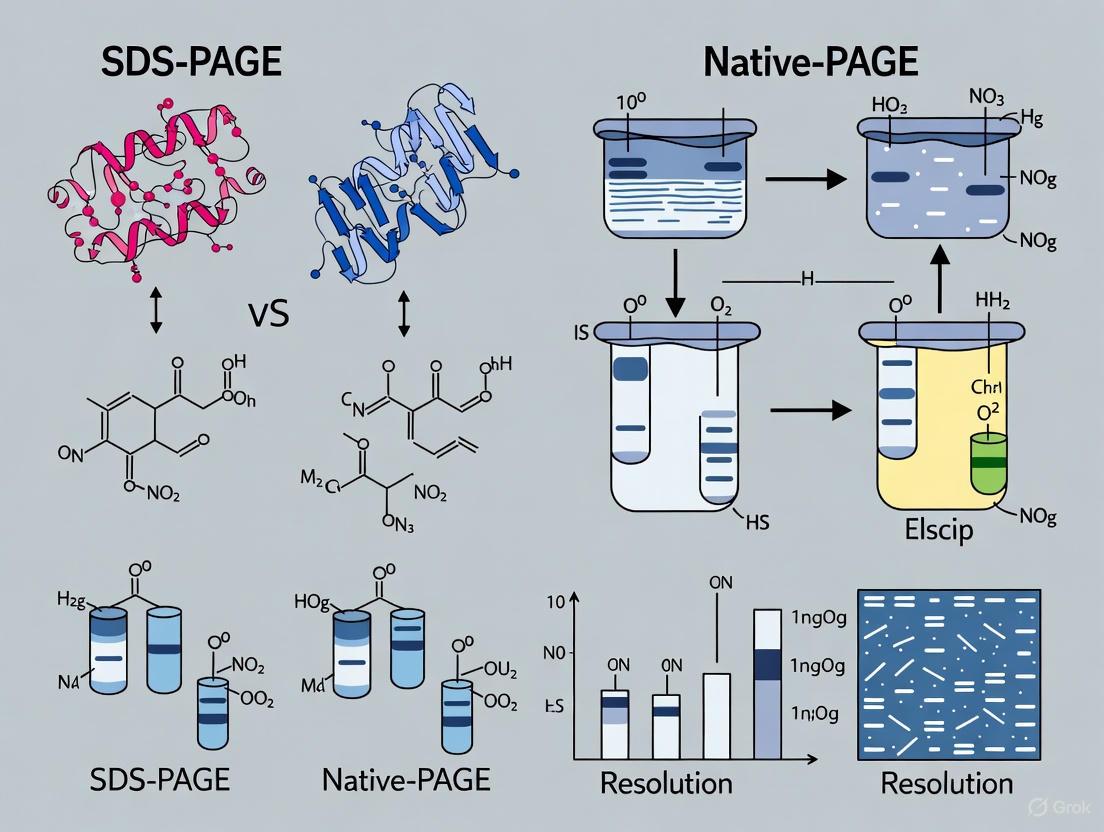
This article provides a definitive comparison of SDS-PAGE and Native-PAGE for researchers, scientists, and drug development professionals.
SDS-PAGE vs Native-PAGE: A Comprehensive Guide to Choosing the Right Protein Separation Technique
Abstract
This article provides a definitive comparison of SDS-PAGE and Native-PAGE for researchers, scientists, and drug development professionals. It covers the core principles, separation mechanisms, and underlying biochemistry of each technique. A detailed methodological guide explains sample preparation, buffer composition, and gel selection for specific applications such as molecular weight determination, activity assays, and protein complex analysis. The content includes practical troubleshooting for common issues like smeared bands and incomplete separation, alongside optimization strategies for resolution and reproducibility. Finally, it explores advanced validation methods and emerging hybrid techniques like Native SDS-PAGE, synthesizing key takeaways to guide experimental design in biomedical and clinical research.
Core Principles of Protein Electrophoresis: Understanding SDS-PAGE and Native-PAGE
In protein analysis research, polyacrylamide gel electrophoresis (PAGE) serves as a fundamental technique for separating and characterizing proteins. The choice between denaturing (SDS-PAGE) and non-denaturing (Native-PAGE) separation methods represents a critical branching point in experimental design, each pathway preserving or eliminating different protein features to serve distinct analytical purposes [1] [2]. This comparison guide objectively examines the performance of these two foundational techniques against key parameters relevant to researchers, scientists, and drug development professionals. While SDS-PAGE dominates routine molecular weight determination due to its simplicity and reproducibility, Native-PAGE provides unique capabilities for functional analysis that make it indispensable for studying native protein complexes, interactions, and enzymatic activity [3]. Understanding the precise applications, limitations, and experimental requirements of each method enables researchers to select the optimal approach for their specific protein characterization needs.
Core Principles and Separation Mechanisms
The fundamental distinction between these techniques lies in their treatment of protein structure during separation. SDS-PAGE employs denaturing agents to unfold proteins, while Native-PAGE maintains proteins in their native, functional state throughout the separation process [1] [2].
SDS-PAGE: Separation by Molecular Weight Alone
In SDS-PAGE, the anionic detergent sodium dodecyl sulfate (SDS) binds uniformly to proteins in a constant weight ratio (approximately 1.4g SDS per 1g of protein) [2]. This SDS-binding process, coupled with heating and reducing agents like dithiothreitol (DTT) or β-mercaptoethanol, effectively denatures proteins by disrupting their secondary, tertiary, and quaternary structures [1] [4]. The bound SDS masks the proteins' intrinsic charges and confers a uniform negative charge density, linearizing the polypeptides into rod-like shapes [1]. Consequently, separation occurs primarily according to molecular weight as these SDS-polypeptide complexes migrate through the polyacrylamide gel matrix, with smaller proteins moving faster than larger ones [2]. This singular focus on molecular weight makes SDS-PAGE exceptionally reliable for mass determination and purity assessment.
Native-PAGE: Separation by Charge, Size, and Shape
In contrast, Native-PAGE preserves proteins in their folded, functional conformations by eliminating denaturing agents from all gel and buffer components [1] [5]. Without SDS to normalize charge, proteins separate according to their intrinsic charge density, molecular size, and three-dimensional shape [2]. In the slightly basic pH conditions typically employed, most proteins carry a net negative charge and migrate toward the anode, with higher charge density correlating with faster migration [1]. Simultaneously, the gel matrix exerts a sieving effect, creating frictional forces that regulate movement according to protein size and shape—smaller, more compact proteins migrate faster than larger, more complex structures [1] [2]. This multi-parameter separation preserves protein complexes, subunit interactions, and biological activity, enabling functional studies impossible with denaturing methods.
Table 1: Fundamental Principles and Separation Characteristics
| Characteristic | SDS-PAGE | Native-PAGE |
|---|---|---|
| Separation Basis | Molecular weight primarily | Size, charge, and shape |
| Protein State | Denatured and linearized | Native, folded conformation |
| Quaternary Structure | Disrupted; subunits separate | Preserved; complexes remain intact |
| Net Charge on Proteins | Uniformly negative due to SDS | Intrinsic charge (positive or negative) |
| Key Reagents | SDS, reducing agents (DTT, β-mercaptoethanol) | No denaturants; may use Coomassie in BN-PAGE |
| Typical Buffer Systems | Tris-glycine-SDS, Bis-Tris-MOPS-SDS | Tris-glycine (pH 8.8 for acidic proteins) |
Comparative Experimental Performance Data
When evaluating technique performance for specific applications, SDS-PAGE and Native-PAGE demonstrate complementary strengths. The selection between them involves trade-offs between resolution, structural preservation, and functional retention.
Resolution and Molecular Weight Determination
SDS-PAGE provides superior resolution for molecular weight determination, typically resolving proteins from 6-200 kDa in Tris-Glycine systems [6]. The denaturation and charge normalization process creates a linear relationship between migration distance and log molecular weight, enabling accurate mass estimation when appropriate standards are used [2]. Native-PAGE offers poorer molecular weight accuracy because a protein's migration depends on multiple factors beyond size [1] [5]. While specialized approaches like plotting Rf values at different gel concentrations can provide molecular weight estimates in Native-PAGE, these require additional experimental steps and offer less precision than SDS-PAGE [5].
Structural and Functional Preservation
Native-PAGE excels in preserving protein structure and function, with research demonstrating that seven of nine model enzymes retained activity after separation using modified native conditions, compared to complete denaturation in standard SDS-PAGE [7]. This structural preservation extends to metal cofactors, with one study reporting 98% zinc retention in metalloproteins using Native-SDS-PAGE versus only 26% with denaturing SDS-PAGE [7]. This capability makes Native-PAGE indispensable for studying metal-binding proteins, enzymatic function, and protein complexes in their biologically active states.
Applicability to Downstream Analyses
The techniques differ significantly in their compatibility with downstream applications. Proteins separated by SDS-PAGE are ideal for western blotting, mass spectrometry analysis, and protein sequencing because the denatured, reduced state facilitates transfer to membranes and peptide digestion [1] [2]. Conversely, proteins separated by Native-PAGE can be recovered in active form for functional assays, enzymatic studies, and interaction analyses through techniques like passive diffusion or electro-elution from gels [2]. This functional preservation enables researchers to correlate separation patterns with biological activity.
Table 2: Performance Comparison for Key Applications
| Performance Metric | SDS-PAGE | Native-PAGE |
|---|---|---|
| Molecular Weight Determination | Accurate and straightforward | Indirect and less accurate |
| Protein Complex Analysis | Disassembles complexes; analyzes subunits | Preserves oligomeric states and complexes |
| Functional Activity Post-Separation | Typically lost | Typically retained |
| Metal Cofactor Retention | Poor (26% in one study) | Excellent (98% in one study) |
| Detection Limit | Microgram quantities sufficient | May require more protein for activity assays |
| Downstream Western Blotting | Excellent compatibility | Possible with caution |
| Enzymatic Activity Assays | Not possible | Directly possible after separation |
Detailed Methodologies and Protocols
Standardized protocols for both techniques ensure reproducible results. The following sections detail established methodologies from commercial and research sources.
SDS-PAGE Protocol
The denaturing SDS-PAGE procedure follows a well-established workflow centered on complete protein denaturation [6]:
Sample Preparation:
- Mix protein sample with 2X Tris-Glycine SDS Sample Buffer containing SDS and reducing agent [6].
- For reduced samples, add DTT to a final concentration of 1X immediately before electrophoresis [6].
- Heat samples at 85°C for 2-5 minutes to ensure complete denaturation [6]. Avoid 100°C heating to prevent proteolysis [6].
Gel Electrophoresis:
- Use pre-cast or freshly poured polyacrylamide gels with appropriate percentage for target protein size [2].
- Assemble gel cassette in electrophoresis chamber with Tris-Glycine SDS Running Buffer [6].
- Load samples and molecular weight markers (e.g., 5-25μg protein per lane) [7].
- Run at constant voltage (125V for mini-gels) for approximately 90 minutes or until dye front reaches bottom [6].
- Typical current ranges from 30-40mA start to 8-12mA end for single mini-gels [6].
Post-Electrophoresis Analysis:
- After separation, proteins can be stained (Coomassie, silver stain), transferred for western blotting, or excised for mass spectrometry [2].
Native-PAGE Protocol
The non-denaturing PAGE method requires modifications to preserve protein structure [6] [5]:
Sample Preparation:
- Mix protein sample with Tris-Glycine Native Sample Buffer (without SDS or reducing agents) [6].
- Do not heat samples to prevent denaturation [6] [5].
- Keep samples at 4°C to maintain stability [8].
Gel Electrophoresis:
- Use polyacrylamide gels cast without SDS or other denaturants [5].
- For basic proteins, adjust buffer pH or reverse electrode configuration [5].
- Assemble gel cassette with Tris-Glycine Native Running Buffer [6].
- Load samples and appropriate native markers.
- Run at constant voltage (125V) for 1-12 hours depending on protein size and complex [6].
- Maintain cooler temperatures (4°C recommended) during extended runs to prevent denaturation [8] [5].
- Expected current: 6-12mA start to 3-6mA end for single mini-gels [6].
Post-Electrophoresis Analysis:
- Detect proteins with Coomassie Brilliant Blue or silver staining [5].
- For functional recovery, passively diffuse or electro-elute proteins from gel slices [2].
Experimental Workflow Visualization
The following workflow diagrams illustrate the key procedural differences between SDS-PAGE and Native-PAGE, highlighting critical branching points that determine experimental outcomes.
Research Reagent Solutions
Successful implementation of either technique requires specific reagent systems tailored to each method's requirements. The following table outlines essential solutions for both SDS-PAGE and Native-PAGE.
Table 3: Essential Reagents for Protein Electrophoresis
| Reagent Category | Specific Products | Function and Application |
|---|---|---|
| Sample Buffers | Tris-Glycine SDS Sample Buffer (2X) [6] | Denatures proteins and provides charge for SDS-PAGE |
| Tris-Glycine Native Sample Buffer (2X) [6] | Maintains native state without denaturation for Native-PAGE | |
| Reducing Agents | NuPAGE Reducing Agent (10X DTT) [6] | Breaks disulfide bonds in reducing SDS-PAGE |
| β-mercaptoethanol [6] | Alternative reducing agent for SDS-PAGE | |
| Running Buffers | Tris-Glycine SDS Running Buffer (10X) [6] | Provides conducting ions and SDS for denaturing separation |
| Tris-Glycine Native Running Buffer (10X) [6] | Conducting buffer without denaturants for native separation | |
| Gel Matrices | Pre-cast Tris-Glycine Gels [6] | Ready-to-use polyacrylamide gels of various percentages |
| Acrylamide/Bis-acrylamide solutions [5] | For casting custom polyacrylamide gels | |
| Detection Reagents | Coomassie Brilliant Blue Staining Kits [5] | Protein visualization in both denaturing and native gels |
| Silver Staining Kits [5] | Higher sensitivity protein detection |
SDS-PAGE and Native-PAGE offer complementary approaches to protein separation, each with distinct advantages for specific research goals. SDS-PAGE provides high-resolution separation based primarily on molecular weight, making it ideal for determining protein size, assessing purity, and preparing samples for western blotting or mass spectrometry [1] [2]. Its standardized protocol, simplicity, and reproducibility explain its widespread adoption in molecular biology laboratories [4]. Conversely, Native-PAGE preserves native protein structure and function, enabling researchers to study protein complexes, oligomeric states, enzymatic activity, and protein-metal interactions [7] [2]. While more technically challenging and providing less precise molecular weight information, Native-PAGE offers unique capabilities for functional proteomics that denaturing methods cannot replicate.
For drug development professionals and researchers designing protein characterization strategies, the choice between these techniques should be driven by specific experimental questions. When determining molecular weight, purity, or subunit composition is paramount, SDS-PAGE delivers superior performance. When investigating biological function, protein-protein interactions, or native structural properties, Native-PAGE provides the necessary preservation of protein activity. In advanced proteomic approaches, these techniques can be combined—using Native-PAGE for first-dimension separation followed by denaturing SDS-PAGE in the second dimension—to leverage the strengths of both methods [2]. Understanding these performance characteristics enables researchers to strategically implement the most appropriate separation technology for their specific protein analysis requirements.
In the field of protein research, the choice of electrophoretic technique fundamentally shapes the experimental outcome. Sodium dodecyl sulfate polyacrylamide gel electrophoresis (SDS-PAGE) and native PAGE represent two foundational approaches with distinct philosophies and applications [8] [3]. SDS-PAGE employs a powerful detergent to dismantle protein structures, creating a uniform population of polypeptides separated strictly by molecular weight [9] [2]. In contrast, native PAGE preserves the delicate, functional architecture of proteins, enabling separation based on the combined interplay of charge, size, and shape [10] [2]. This guide provides a detailed, objective comparison of these techniques, focusing on the transformative role of SDS in denaturation, charge manipulation, and molecular weight-based separation, supported by experimental data and protocols for life science researchers and drug development professionals.
Fundamental Principles and the Defining Role of SDS
The Mechanism of SDS in Protein Denaturation and Charge Conferral
The resolving power of SDS-PAGE hinges on the action of sodium dodecyl sulfate (SDS). This anionic detergent performs two critical functions: it denatures proteins and confers a uniform negative charge [11].
- Protein Denaturation: SDS disrupts the hydrogen bonds and hydrophobic interactions that maintain a protein's secondary and tertiary structure [11]. Its hydrophobic tail interacts with hydrophobic regions of the protein, while its ionic head group disrupts non-covalent interactions. This unfolds the protein into a linear polypeptide chain [11].
- Charge Conferral: SDS binds to the protein backbone at a nearly constant ratio of approximately 1.4 g SDS per 1.0 g of protein [9] [2]. This extensive, uniform binding masks the protein's intrinsic charge, creating a cloud of negative charge around the polypeptide. The result is that all SDS-bound proteins carry a similar charge-to-mass ratio and a nearly identical conformation, transforming a complex mixture of unique proteins into a population that varies primarily in polypeptide chain length [9] [11].
Sample preparation for SDS-PAGE involves heating the protein sample (typically at 95°C for 3-5 minutes) in a buffer containing SDS and a reducing agent like beta-mercaptoethanol (BME) or dithiothreitol (DTT) [8] [9]. Heating further denatures the proteins by breaking hydrogen bonds, while the reducing agents cleave disulfide bridges, ensuring complete unfolding into monomeric subunits [11].
Separation Principles in Native PAGE
Native PAGE operates on a different premise: the preservation of the protein's native state. No denaturing agents are used, so proteins remain in their folded, functional conformation [8] [2]. Consequently, separation depends on three intrinsic properties of the protein within the gel matrix and the alkaline running buffer:
- Net Charge: The protein's inherent charge at the running buffer's pH.
- Size: The molecular weight of the native protein or protein complex.
- Shape: The three-dimensional structure, which affects frictional drag through the gel matrix [10] [2].
This technique is ideal for studying functional properties, protein-protein interactions, and oligomeric states, as the biological activity is often retained post-separation [8] [3]. Some native PAGE systems, such as Blue Native PAGE (BN-PAGE), use Coomassie G-250 dye to impart a slight negative charge to proteins, which helps prevent aggregation and allows even basic proteins to migrate toward the anode [10].
Direct Technique Comparison: SDS-PAGE vs. Native PAGE
The core differences between these two techniques are systematic and impact every aspect of experimental design and outcome.
Table 1: Core Differences Between SDS-PAGE and Native PAGE
| Criteria | SDS-PAGE | Native PAGE |
|---|---|---|
| Separation Basis | Molecular weight (polypeptide chain length) [8] [9] | Native size, overall charge, and 3D shape [8] [10] |
| Gel Type | Denaturing [8] | Non-denaturing [8] |
| SDS Presence | Present in gel and buffer [8] | Absent [8] |
| Reducing Agent | Present (e.g., DTT, BME) [8] | Absent [8] |
| Sample Prep | Heating required [8] [9] | No heating [8] |
| Protein State | Denatured and linearized [8] [11] | Native, folded conformation [8] |
| Protein Function | Function lost [8] | Function often retained [8] |
| Protein Recovery | Typically not recoverable in functional form [8] | Can be recovered for functional studies [8] |
| Primary Applications | Molecular weight determination, purity checks, Western blotting [8] [7] | Studying oligomeric state, protein complexes, enzymatic activity [8] [12] |
Experimental Data and Methodologies
Quantitative Comparison of Protein and Metal Retention
Recent research has explored hybrid approaches, such as native SDS-PAGE (NSDS-PAGE), which modifies standard SDS-PAGE conditions to preserve some native properties while maintaining high resolution. The following data illustrates the functional consequences of choosing different electrophoretic methods.
Table 2: Experimental Comparison of Standard and Modified PAGE Techniques
| Parameter | SDS-PAGE | BN-PAGE | NSDS-PAGE |
|---|---|---|---|
| Zn²⁺ Retention in Proteomic Samples | 26% | Not Specified | 98% [7] |
| Enzymatic Activity Retention | 0 out of 9 model enzymes | 9 out of 9 model enzymes | 7 out of 9 model enzymes [7] |
| Key Modification | Sample heated with SDS and reducing agent; running buffer contains SDS and EDTA [7] | No SDS; uses Coomassie G-250 dye in cathode buffer [7] [10] | No heating, no EDTA; reduced SDS in running buffer (0.0375%) [7] |
Detailed Experimental Protocols
Protocol 1: Standard SDS-PAGE [9] [11]
- Gel Casting: Assemble gel cassette. Prepare the resolving gel (e.g., 12% acrylamide, pH ~8.8) by mixing acrylamide/bis-acrylamide, Tris-HCl buffer, SDS, and ammonium persulfate (APS), and catalyzing polymerization with TEMED. Pour the gel and overlay with water or isopropanol for a flat surface. Once polymerized, pour the stacking gel (e.g., 4% acrylamide, pH ~6.8) on top and insert a comb to create wells.
- Sample Preparation: Mix protein sample with SDS-PAGE sample buffer (containing SDS, glycerol, a tracking dye like Bromophenol Blue, and a reducing agent like DTT or BME). Heat the mixture at 95°C for 3-5 minutes to denature proteins. Centrifuge briefly to collect condensate.
- Electrophoresis: Mount the gel cassette in the electrophoresis tank filled with running buffer (e.g., Tris-Glycine with 0.1% SDS). Load denatured samples and molecular weight markers into the wells. Apply a constant voltage (e.g., 200V for a mini-gel) until the dye front reaches the bottom of the gel.
- Post-Electrophoresis Analysis: Proteins can be visualized by staining (e.g., Coomassie Brilliant Blue, silver stain), or transferred to a membrane for Western blotting.
Protocol 2: Native PAGE for GPCR-mini-G Protein Coupling [12]
- Sample Preparation (Screening Format): Solubilize adherent mammalian cells (e.g., HEK293S) transiently expressing a fluorescently tagged GPCR (e.g., EGFP-tagged) directly in a detergent solution containing Lauryl Maltose Neopentyl Glycol (LMNG) and Cholesteryl Hemisuccinate (CHS). Centrifuge to remove insoluble debris.
- Complex Formation: Incubate the solubilized supernatant with agonist peptides and purified mini-G protein to allow complex formation.
- Electrophoresis: Prepare a native polyacrylamide gel (e.g., hrCNE gel). Load the samples without heating. Run electrophoresis under native conditions (e.g., 150V, room temperature) using an appropriate anode and cathode buffer (without SDS or other denaturants).
- Detection: Visualize the receptor and receptor-mini-G complexes directly in the gel using in-gel fluorescence imaging. A mobility shift indicates successful complex formation.
Visualization of Workflows
The following diagrams illustrate the logical and procedural relationships in the two primary electrophoretic methods.
The Scientist's Toolkit: Essential Research Reagent Solutions
Successful electrophoresis relies on a suite of specialized reagents and materials. The following table details key solutions for both SDS-PAGE and Native PAGE.
Table 3: Essential Research Reagents for PAGE Experiments
| Reagent/Material | Function | Application |
|---|---|---|
| SDS (Sodium Dodecyl Sulfate) | Denatures proteins and confers uniform negative charge [11]. | SDS-PAGE |
| DTT (Dithiothreitol) / BME (Beta-Mercaptoethanol) | Reducing agents that break disulfide bonds to ensure complete unfolding [11]. | SDS-PAGE |
| Coomassie G-250 Dye | Binds hydrophobically to proteins, imparting negative charge without denaturation [10]. | BN-PAGE / Native PAGE |
| Acrylamide/Bis-acrylamide | Monomer and crosslinker that polymerize to form the porous gel matrix [2] [11]. | SDS-PAGE & Native PAGE |
| APS & TEMED | Ammonium persulfate (APS) and TEMED catalyze the polymerization of the polyacrylamide gel [11]. | SDS-PAGE & Native PAGE |
| Tris-based Buffers | Provide the conductive ionic medium and maintain stable pH during electrophoresis [9] [10]. | SDS-PAGE & Native PAGE |
| Molecular Weight Markers | Pre-stained or unstained protein ladders for estimating the molecular weight of unknown proteins [2]. | SDS-PAGE & Native PAGE |
| LMNG / CHS Detergents | Mild detergents for solubilizing membrane proteins while maintaining native structure and interactions [12]. | Native PAGE (Membrane Proteins) |
SDS-PAGE and native PAGE are complementary, not competing, techniques in the protein scientist's arsenal. The role of SDS is definitive: it creates a universal system for separating polypeptides by molecular weight, invaluable for analytical and preparative workflows like Western blotting. In contrast, native PAGE preserves the intricate and functionally crucial world of protein structures, complexes, and activities. The choice between them is not a matter of which is superior, but which is appropriate for the biological question at hand. By understanding their fundamental principles—centered on the role of SDS—and leveraging their distinct capabilities, researchers can design more effective experiments to advance protein science and drug discovery.
In the realm of protein research, the choice of analytical technique is pivotal, dictating the type and quality of information that can be extracted. Native polyacrylamide gel electrophoresis (Native-PAGE) stands as a fundamental method for separating proteins in their folded, functional state. Unlike its denaturing counterpart, SDS-PAGE, Native-PAGE preserves the intricate three-dimensional structure of proteins, allowing researchers to probe characteristics lost in fully denatured systems. This guide provides a detailed objective comparison between Native-PAGE and SDS-PAGE, framing them as complementary tools within a comprehensive protein analysis strategy. The core distinction lies in what property drives the separation: Native-PAGE separates proteins based on a combination of their native charge, size, and shape, whereas SDS-PAGE separates primarily by molecular weight after denaturation [3] [13] [14].
This capability makes Native-PAGE indispensable for experiments where maintaining biological activity is paramount, such as studying enzyme function, protein-protein interactions within complexes, and oligomeric states [10] [3]. The following sections will dissect the principles, methodologies, and applications of Native-PAGE, providing direct comparisons with SDS-PAGE through structured data, experimental protocols, and visual workflows to equip researchers with the knowledge to select the optimal technique for their scientific inquiries.
Fundamental Principles of Separation
The separation mechanism in Native-PAGE is multifaceted, relying on the innate physical properties of proteins in their native conformation. Understanding these principles is key to interpreting experimental results and designing effective protocols.
A Multi-Factor Separation Mechanism
In Native-PAGE, a protein's migration through the polyacrylamide gel matrix is simultaneously influenced by three key factors [15]:
- Charge: The net charge of a protein at the buffer's pH determines its direction and rate of migration. Positively charged proteins (cations) move toward the negative electrode (cathode), while negatively charged proteins (anions) move toward the positive electrode (anode) [16] [15]. This net charge is dictated by the protein's isoelectric point (pI) relative to the pH of the running buffer [17].
- Size: The molecular weight of the protein affects its mobility, with larger proteins generally migrating more slowly than smaller ones due to greater frictional forces [10].
- Shape: The three-dimensional conformation of the native protein influences how easily it navigates the pores of the gel. A compact, globular protein will migrate differently than an elongated fibrous protein of the same molecular weight [15].
This triad of influences contrasts sharply with SDS-PAGE, where the denaturing agent sodium dodecyl sulfate (SDS) and a reducing agent linearize the proteins and confer a uniform negative charge. This simplification means separation in SDS-PAGE occurs almost exclusively based on polypeptide chain length and molecular weight [3] [13] [18].
The Critical Influence of Buffer pH
The buffer pH is a critical experimental parameter in Native-PAGE because it directly determines the net charge of a protein [17]. A protein's net charge is zero at its isoelectric point (pI). In a buffer with a pH below the protein's pI, the protein gains a net positive charge and will migrate toward the cathode. Conversely, in a buffer with a pH above the pI, the protein gains a net negative charge and will migrate toward the anode [17]. This principle allows researchers to manipulate migration direction and separation efficiency simply by selecting an appropriate buffer system.
Direct Technique Comparison: Native-PAGE vs. SDS-PAGE
The choice between Native-PAGE and SDS-PAGE is fundamental to experimental design. The table below provides a systematic, point-by-point comparison of the two techniques, highlighting their optimal applications and limitations.
Table 1: Comprehensive comparison of Native-PAGE and SDS-PAGE characteristics and applications.
| Feature | Native-PAGE | SDS-PAGE |
|---|---|---|
| Separation Basis | Native charge, size, and 3D shape [10] [3] [15] | Molecular weight of polypeptide chains [3] [13] [18] |
| Protein State | Native, folded; multimers intact [10] [3] | Denatured, linearized; subunits dissociated [3] [18] |
| Biological Activity | Retained (enzymatic activity, etc.) [10] [3] | Lost [3] [7] |
| Key Reagents | No SDS or reducing agents; may use Coomassie G-250 (BN-PAGE) [10] [7] | SDS, reducing agents (e.g., β-mercaptoethanol, DTT) [13] [18] |
| Sample Preparation | Non-denaturing buffers; no heating [13] | Boiling in SDS and reducing agent [13] [18] |
| Information Gained | Oligomeric state, protein complexes, native charge [10] [3] | Subunit molecular weight, protein purity, number of subunits [3] [18] |
| Optimal For | Studying functional complexes, enzyme assays, interaction studies [10] [3] | Determining molecular weight, assessing purity, western blotting [3] [4] [18] |
| Limitations | Complex migration interpretation; not universal for all proteins [10] [3] | Loss of functional and structural data; not for native complexes [3] [7] |
Experimental Protocols and Methodologies
A successful Native-PAGE experiment requires careful attention to protocol details, from buffer selection to sample preparation. Below is a detailed methodology for a standard Native-PAGE setup and a specialized variant.
Standard Native-PAGE Protocol Using Tris-Glycine
This protocol is adapted from common laboratory practices and commercial system guidelines [10] [13].
Gel Composition:
- Resolving Gel: Typically 7-12% acrylamide, pH ~8.8. The exact percentage is chosen based on the target protein size.
- Stacking Gel: 4-5% acrylamide, pH ~6.8. This layer concentrates the protein samples into sharp bands before they enter the resolving gel [13].
Buffers and Reagents:
- Running Buffer: Tris-Glycine, pH ~8.3-9.5 [10]. This alkaline buffer ensures most proteins carry a net negative charge and migrate towards the anode [10].
- Sample Buffer: Tris-Glycine Native Sample Buffer, containing glycerol and a tracking dye (e.g., Bromophenol Blue), but no SDS or reducing agents [10] [13].
Step-by-Step Workflow:
- Gel Casting: Prepare and pour the resolving gel. Once polymerized, pour the stacking gel and insert the well comb.
- Sample Preparation: Mix the protein sample with native sample buffer. Do not boil the samples. Centrifuge to remove insoluble debris [13].
- Loading and Running: Load the prepared samples and molecular weight standards into the wells. Run the gel at a constant voltage (e.g., 100-150V) in a cooled tank to minimize heat-induced denaturation [13].
- Visualization: After electrophoresis, proteins can be visualized using Coomassie Brilliant Blue staining or other compatible methods [14].
Specialized Protocol: Blue Native (BN)-PAGE
BN-PAGE is a powerful variant for analyzing membrane protein complexes and proteins with basic pI values.
Key Differentiating Reagent:
- Coomassie G-250 Dye: This anionic dye is added to the cathode buffer and sample. It binds non-specifically to proteins, conferring a negative charge and allowing even basic proteins to migrate towards the anode [10] [7]. It also helps solubilize membrane proteins [10].
Workflow and Data Interpretation: The general workflow is similar to standard Native-PAGE but uses Bis-Tris gels at a near-neutral pH (~7.5) and specific BN-PAGE buffers [10]. The Coomassie dye provides a "charge shift" mechanism, simplifying the separation by ensuring all proteins move in the same direction, but it can sometimes dissociate weakly bound complexes [10] [14].
Quantitative Data from Comparative Studies
Modified electrophoresis methods have been developed to bridge the gap between the high resolution of SDS-PAGE and the native-state preservation of BN-PAGE. One study, as detailed in Metallomics, developed a "Native SDS-PAGE" (NSDS-PAGE) method by drastically reducing SDS concentration and eliminating heating and reducing agents [7]. The quantitative outcomes from this comparative study are summarized below.
Table 2: Quantitative comparison of protein activity and metal retention across PAGE methods.
| Analysis Metric | SDS-PAGE | BN-PAGE | NSDS-PAGE |
|---|---|---|---|
| Retention of Zn²⁺ in Proteome | 26% | Data not provided | 98% |
| Active Enzymes (from 9 tested) | 0 | 9 | 7 |
| Protein Resolution | High | Lower than SDS-PAGE | High, comparable to SDS-PAGE |
This data demonstrates that protocol modifications can significantly impact functional outcomes, such as metal retention and enzymatic activity, while maintaining high-resolution separation [7].
The Scientist's Toolkit: Essential Research Reagents
Selecting the correct reagents is fundamental to the success of any Native-PAGE experiment. The table below lists key solutions and materials, along with their critical functions.
Table 3: Essential reagents and materials for Native-PAGE experiments.
| Reagent/Material | Function & Importance |
|---|---|
| Polyacrylamide Gel | A matrix of cross-linked acrylamide and bis-acrylamide that acts as a molecular sieve. Pore size is adjusted via concentration to separate proteins by size and shape [13] [16]. |
| Tris-Glycine Buffer | A common discontinuous buffer system for Native-PAGE. The pH (8.3-9.5) influences protein charge and mobility [10] [13]. |
| Coomassie G-250 Dye | Key component of BN-PAGE. Binds to proteins, imparting negative charge and aiding in the solubilization of membrane proteins [10] [7]. |
| Native Sample Buffer | Contains glycerol to densify the sample for well loading and a tracking dye (e.g., Bromophenol Blue) to monitor migration. Crucially lacks SDS and denaturants [10] [13]. |
| Molecular Weight Standards | A mixture of native proteins with known molecular weights and characteristics, used to estimate the size and oligomeric state of sample proteins [13]. |
| Coomassie Staining Solution | A standard protein stain (e.g., Coomassie Brilliant Blue R-250) for visualizing separated protein bands post-electrophoresis [14]. |
Native-PAGE and SDS-PAGE are not competing techniques but rather complementary pillars of protein analysis. The decision to use one over the other must be strategically aligned with the specific research question. Native-PAGE is the unequivocal choice when the experimental goal involves probing the native state—whether it be to visualize active protein complexes, measure enzymatic function after separation, or determine the oligomeric status of a purified protein [10] [3]. Its power lies in preserving the delicate, non-covalent interactions that define protein function in the cellular environment.
Conversely, SDS-PAGE provides unparalleled simplicity and resolution for questions related to polypeptide molecular weight, subunit composition, and sample purity [3] [18]. Its ability to denature and linearize proteins removes the confounding variables of native charge and shape, creating a one-dimensional separation that is straightforward to interpret. For a complete picture, researchers often employ these techniques in tandem; for example, by using BN-PAGE in the first dimension to isolate a complex, followed by SDS-PAGE in the second dimension to identify its constituent subunits [7]. By understanding the fundamental principles and practical considerations outlined in this guide, researchers can effectively leverage the strengths of each method to advance their investigations in biochemistry, structural biology, and drug development.
Protein electrophoresis is a fundamental laboratory technique in which charged protein molecules are transported through a solvent by an electrical field, enabling the separation and analysis of complex protein mixtures. [2] This methodology serves as an indispensable tool for researchers, scientists, and drug development professionals who require precise protein characterization. Among the various electrophoretic techniques, Sodium Dodecyl Sulfate-Polyacrylamide Gel Electrophoresis (SDS-PAGE) and Native-PAGE have emerged as cornerstone methods with complementary applications. SDS-PAGE separates proteins primarily by molecular weight under denaturing conditions, while Native-PAGE separates proteins based on both size and charge while preserving their native conformation and biological activity. [3] [2] [8] The evolution of these techniques from their initial development to modern methodologies represents a critical historical progression in protein science, facilitating advances across diverse fields including proteomics, drug discovery, and diagnostic development.
The significance of these methods extends throughout the biopharmaceutical industry, where they are employed for quality control, purity assessment, and characterization of therapeutic proteins. [19] Understanding the historical context and technical evolution of SDS-PAGE and Native-PAGE provides researchers with a foundation for selecting appropriate methodologies for specific applications and appreciating the limitations and advantages inherent in each approach. This comparative guide examines the key historical developments, methodological refinements, and contemporary applications of these essential protein separation techniques, providing objective performance comparisons and supporting experimental data to inform research decisions.
Historical Timeline: From Laemmli to Contemporary Innovations
The development of polyacrylamide gel electrophoresis (PAGE) methodologies represents a series of strategic innovations that have progressively enhanced researchers' ability to characterize proteins. The historical trajectory from initial methodologies to contemporary refinements illustrates how technical challenges have been systematically addressed through scientific ingenuity.
The Laemmli Breakthrough: Standardizing SDS-PAGE
The modern era of protein electrophoresis began with the groundbreaking work of Ulrich K. Laemmli, who in 1970 developed the discontinuous SDS-PAGE system that remains the foundation for most contemporary protein separation protocols. [4] [8] Laemmli's critical insight was incorporating the anionic detergent sodium dodecyl sulfate (SDS) into the electrophoretic system, which fundamentally transformed protein separation by denaturing proteins and conferring a uniform negative charge proportional to their molecular weight. [4] [2] This innovation effectively eliminated the influence of protein shape and intrinsic charge on migration through the polyacrylamide gel matrix, enabling separation based primarily on molecular mass.
The Laemmli method established several foundational components that remain central to SDS-PAGE protocols today. The technique introduced a discontinuous buffer system with stacking and resolving gel phases, dramatically improving band sharpness and resolution compared to previous continuous systems. [2] The stacking gel, with its lower acrylamide concentration and different pH, concentrates protein samples into tight bands before they enter the resolving gel, where separation based on size occurs. This concentration effect allows researchers to load larger sample volumes without sacrificing resolution, significantly enhancing the practical utility of the technique. Additionally, the standardization of sample preparation involving SDS and reducing agents like β-mercaptoethanol or dithiothreitol (DTT) to break disulfide bonds established a reproducible framework for protein denaturation prior to separation. [4]
Native-PAGE: Preserving Native Conformation
While SDS-PAGE was revolutionizing molecular weight determination, the parallel development of Native-PAGE (non-denaturing PAGE) by Ornstein and Davis addressed the complementary need for analyzing proteins in their biologically active state. [8] Unlike SDS-PAGE, Native-PAGE avoids denaturing agents, preserving protein complexes in their native conformation and maintaining enzymatic activity and binding capabilities. [3] [2] This preservation enables researchers to study functional properties, protein-protein interactions, oligomeric states, and enzymatic activities directly following electrophoretic separation.
The methodological framework for Native-PAGE presented distinct technical challenges compared to SDS-PAGE. Without the charge-masking effect of SDS, separation in Native-PAGE depends on both the intrinsic charge of the protein at the running pH and the molecular size and shape, creating a more complex separation profile. [2] [8] The requirement for milder electrophoretic conditions, often including lower temperatures (4°C) and careful buffer formulation, became essential to maintain protein stability and function throughout the separation process. [8] These methodological considerations established Native-PAGE as a more specialized but invaluable technique for functional protein analysis.
Methodological Refinements and Hybrid Approaches
Following these foundational developments, subsequent innovations have refined and expanded the capabilities of both SDS-PAGE and Native-PAGE. The introduction of Blue Native-PAGE (BN-PAGE) by Schägger and von Jagow in 1991 represented a significant advancement for analyzing native protein complexes, particularly membrane protein complexes. [7] This technique incorporates Coomassie Brilliant Blue G-250, which confers negative charge to native protein complexes while maintaining their structure, enabling separation by molecular size under non-denaturing conditions. [7] [8]
More recently, researchers have developed hybrid approaches that seek to balance the high resolution of denaturing methods with the functional preservation of native techniques. A notable innovation is Native SDS-PAGE (NSDS-PAGE), which modifies traditional SDS-PAGE conditions by reducing SDS concentration, eliminating EDTA from buffers, and omitting the heating step during sample preparation. [7] This approach represents a convergence of methodological principles, attempting to maintain certain functional properties while retaining the separation resolution characteristic of traditional SDS-PAGE. Experimental data demonstrates that this modified approach significantly improves metal retention in metalloproteins (from 26% to 98%) and preserves enzymatic activity in seven of nine model enzymes tested. [7]
Table 1: Key Historical Developments in PAGE Methodologies
| Year | Development | Key Innovators | Significance |
|---|---|---|---|
| 1959 | Starch Gel Electrophoresis | Smithies | Early electrophoretic separation method [4] |
| 1970 | Discontinuous SDS-PAGE | Laemmli | Standardized denaturing protein separation by molecular weight [4] |
| 1960s | Native-PAGE | Ornstein and Davis | Enabled separation of native, functional proteins [8] |
| 1991 | Blue Native-PAGE (BN-PAGE) | Schägger and von Jagow | Allowed high-resolution separation of membrane protein complexes [7] |
| 2014 | Native SDS-PAGE (NSDS-PAGE) | PMC Research | Balanced resolution with functional preservation for metalloproteins [7] |
Methodological Comparison: Principles and Procedures
Understanding the fundamental principles and detailed procedures governing SDS-PAGE and Native-PAGE is essential for researchers to select the appropriate technique for specific experimental objectives. While both methods share the common foundation of polyacrylamide gel electrophoresis, their implementation and outcomes differ significantly due to their distinct approaches to protein structure.
Fundamental Separation Principles
SDS-PAGE operates on the principle of molecular weight-based separation under denaturing conditions. The anionic detergent SDS binds to proteins in a constant weight ratio (approximately 1.4 g SDS per 1 g of protein), unfolding them into linear chains and masking their intrinsic charge. [2] [20] This SDS-protein complex migrates through the polyacrylamide gel matrix toward the anode, with separation determined primarily by molecular size due to the sieving effect of the gel pores. [2] Smaller proteins migrate more rapidly through the matrix, while larger proteins experience greater frictional resistance, resulting in band separation correlated with molecular weight.
In contrast, Native-PAGE separates proteins based on both charge and size while maintaining their native conformation. Without denaturing agents, proteins retain their tertiary and quaternary structures, and their migration depends on the net charge at the gel running pH, molecular size, and three-dimensional shape. [3] [2] This multi-parameter separation mechanism provides information about native protein properties but presents greater challenges for molecular weight determination due to the influence of charge and conformation on migration distance.
Detailed Experimental Protocols
SDS-PAGE Protocol:
- Sample Preparation: Protein samples are mixed with SDS-containing sample buffer (typically including Tris-HCl, glycerol, SDS, and bromophenol blue) with or without reducing agents like DTT or β-mercaptoethanol. [4] [2] The mixture is heated at 70-100°C for 5-10 minutes to denature proteins and ensure complete SDS binding. [2] [8]
Gel Preparation: Polyacrylamide gels are cast in two layers: a stacking gel (typically 4-5% acrylamide, pH ~6.8) and a resolving gel (typically 8-15% acrylamide, pH ~8.8), with the appropriate acrylamide concentration selected based on the molecular weight range of target proteins. [2] Lower percentage gels (e.g., 8-10%) resolve higher molecular weight proteins, while higher percentages (e.g., 12-15%) provide better resolution for smaller proteins.
Electrophoresis: Prepared samples and molecular weight markers are loaded into wells, and electrophoresis is performed at constant voltage (typically 100-200V) using running buffers such as Tris-glycine or Tris-acetate containing 0.1% SDS until the dye front approaches the gel bottom. [7] [2]
Protein Visualization: Separated proteins are visualized using staining methods including Coomassie Brilliant Blue (detecting ~50 ng/band), silver staining (detecting 2-5 ng/band), or fluorescent stains, followed by destaining to reduce background. [21]
Native-PAGE Protocol:
- Sample Preparation: Protein samples are mixed with non-denaturing sample buffer (typically containing Tris-HCl, glycerol, and tracking dye) without SDS or reducing agents. [2] [8] Samples are not heated to preserve native structure.
Gel Preparation: Polyacrylamide gels are cast without SDS in the resolving gel, often using the same acrylamide percentages as SDS-PAGE but with different buffer systems optimized for maintaining protein stability. [2] The pH of the running buffer is critical as it determines the net charge on the proteins.
Electrophoresis: Prepared samples are loaded, and electrophoresis is performed at constant voltage, typically at 4°C to maintain protein stability and prevent denaturation during separation. [8] The running buffer lacks SDS and may have different ionic compositions compared to SDS-PAGE buffers.
Protein Detection: Similar staining methods are used, with the additional possibility of activity staining (zymography) for enzymes to detect functional proteins directly in the gel. [2]
Diagram 1: Decision workflow for selecting between SDS-PAGE and Native-PAGE methodologies
Comparative Performance Analysis
Objective evaluation of SDS-PAGE and Native-PAGE performance characteristics reveals distinct advantages and limitations for each technique, guiding researchers in selecting the appropriate method for specific experimental requirements. The following comparative analysis examines resolution capability, functional preservation, and practical considerations based on experimental data and established protocols.
Resolution and Separation Characteristics
SDS-PAGE provides exceptional resolution for separating proteins by molecular weight, effectively resolving complex protein mixtures with small size differences. [22] [20] The denaturing conditions eliminate influences from protein shape and charge heterogeneity, creating a linear relationship between migration distance and logarithm of molecular weight. [2] This high resolution makes SDS-PAGE particularly valuable for assessing protein purity, determining molecular weights, and analyzing subunit composition. The technique demonstrates high sensitivity, detecting trace protein amounts down to nanogram levels when combined with sensitive staining methods like silver staining. [22] [21]
Native-PAGE typically offers lower resolution for complex protein mixtures due to the multi-parameter nature of separation (size, charge, shape). [7] Without the charge uniformity provided by SDS, proteins with similar molecular weights but different charge characteristics may co-migrate or show anomalous migration patterns. However, Native-PAGE provides superior capability for resolving native protein complexes and oligomeric forms, preserving the quaternary structure that would be disrupted in SDS-PAGE. [3] [2] This makes it indispensable for studying protein-protein interactions and complex assembly states.
Functional Preservation and Downstream Applications
A fundamental distinction between these techniques lies in their impact on protein structure and function. SDS-PAGE completely denatures proteins, stripping non-covalently bound cofactors and rendering proteins inactive. [3] [22] While this enables accurate molecular weight determination, it eliminates the possibility of functional analysis following separation. Proteins separated by SDS-PAGE are typically used for immunoblotting, mass spectrometry analysis, or amino acid sequencing rather than activity assays. [3]
In contrast, Native-PAGE preserves biological activity, allowing researchers to recover functional proteins from the gel for enzymatic assays, ligand binding studies, or interaction analyses. [3] [2] [8] This functional preservation enables direct investigation of structure-function relationships and is particularly valuable for characterizing enzymes, multiprotein complexes, and metalloproteins that require non-covalently bound cofactors for activity. Experimental data demonstrates that most enzymes retain activity following Native-PAGE separation, while all are denatured during SDS-PAGE. [7]
Table 2: Performance Comparison Between SDS-PAGE and Native-PAGE
| Performance Characteristic | SDS-PAGE | Native-PAGE |
|---|---|---|
| Separation Basis | Molecular weight primarily [2] [20] | Size, charge, and shape [3] [2] |
| Structural Preservation | Denatured, linearized polypeptides [3] [22] | Native conformation maintained [3] [8] |
| Functional Activity Post-Separation | Lost [3] [7] | Preserved [3] [2] |
| Molecular Weight Determination | Accurate with appropriate standards [2] | Approximate, influenced by charge and shape [3] |
| Resolution of Complex Mixtures | High [22] [20] | Moderate [7] |
| Protein Recovery for Further Analysis | Limited to denatured forms [8] | Functional proteins can be recovered [2] [8] |
| Typical Run Temperature | Room temperature [8] | 4°C [8] |
| Detection Sensitivity | High (ng level with silver staining) [22] [21] | Variable, depends on native structure |
Quantitative Experimental Data
Recent methodological innovations have generated quantitative data highlighting the performance characteristics of various PAGE techniques. Comparative studies of standard SDS-PAGE, Blue Native-PAGE (BN-PAGE), and the hybrid Native SDS-PAGE (NSDS-PAGE) provide insight into their relative capabilities for maintaining protein function while achieving adequate separation.
Research examining zinc metalloproteins demonstrated that standard SDS-PAGE resulted in only 26% retention of bound Zn²⁺, while NSDS-PAGE improved metal retention to 98%. [7] Similarly, enzymatic activity assays following electrophoretic separation revealed that all nine model enzymes tested were denatured during standard SDS-PAGE, while seven of nine retained activity following NSDS-PAGE separation, and all nine remained active after BN-PAGE. [7] These quantitative findings illustrate the functional trade-offs between resolution and activity preservation across different methodological approaches.
Essential Research Reagent Solutions
Successful implementation of SDS-PAGE and Native-PAGE methodologies requires specific reagent systems optimized for each technique's distinct requirements. The following research reagent solutions represent essential components for electrophoretic protein separation, with formulations tailored to preserve denatured or native protein states as required by the specific application.
Table 3: Essential Research Reagent Solutions for PAGE Methodologies
| Reagent Category | Specific Examples | Function in SDS-PAGE | Function in Native-PAGE |
|---|---|---|---|
| Denaturing Agents | SDS (Sodium Dodecyl Sulfate) [2] [20] | Denatures proteins, confers uniform negative charge [2] | Not typically used [8] |
| Reducing Agents | DTT (Dithiothreitol), β-mercaptoethanol [4] | Reduces disulfide bonds [4] | Not typically used [8] |
| Gel Buffers | Tris-glycine, Tris-acetate, Bis-Tris [7] [2] | Provides appropriate pH and conductivity [2] | Maintains native protein structure and activity [2] |
| Tracking Dyes | Bromophenol blue [2] | Visualizes migration front [2] | Visualizes migration front [2] |
| Staining Solutions | Coomassie Brilliant Blue, silver stain [21] | Visualizes separated protein bands [21] | Visualizes separated protein bands [21] |
| Molecular Weight Standards | Pre-stained or unstained protein ladders [2] | Molecular weight calibration [2] | Approximate molecular size estimation [3] |
Contemporary Applications and Methodological Evolution
The ongoing utility of SDS-PAGE and Native-PAGE in contemporary research reflects their adaptability to evolving scientific questions and technological landscapes. Both techniques continue to find diverse applications across multiple disciplines while undergoing methodological refinements that enhance their capabilities and address their limitations.
Current Research Applications
SDS-PAGE Applications:
- Protein Purity Assessment: SDS-PAGE remains a standard method for evaluating purification efficiency and assessing sample homogeneity in protein isolation protocols. [22] [4]
- Molecular Weight Determination: The technique provides reliable molecular weight estimates for unknown proteins when calibrated with appropriate standards. [2] [20]
- Western Blotting: SDS-PAGE serves as the first dimension for immunoblotting analyses, enabling detection of specific proteins with antibodies. [3] [2]
- Expression Analysis: Researchers routinely use SDS-PAGE to monitor protein expression levels in recombinant systems and native tissues. [4] [20]
- Food Science: SDS-PAGE is extensively applied in food protein characterization, species identification, adulteration detection, and monitoring processing-induced changes. [4]
Native-PAGE Applications:
- Protein Complex Analysis: Native-PAGE preserves oligomeric structures, enabling study of multiprotein complexes and quaternary organization. [3] [2]
- Enzymatic Activity Studies: Zymography techniques coupled with Native-PAGE allow direct detection of enzyme activity in gels. [2]
- Protein-Protein Interactions: The technique facilitates investigation of interacting protein partners under non-denaturing conditions. [3]
- Metalloprotein Characterization: Native-PAGE preserves non-covalent metal cofactor binding, enabling analysis of metalloenzymes. [7]
Technological Innovations and Future Directions
The evolution of PAGE methodologies continues through technological innovations that enhance performance, throughput, and compatibility with downstream analytical techniques. Several significant trends are shaping contemporary electrophoretic practices:
Miniaturization and Automation: The development of microfluidic platforms and chip-based electrophoresis systems has reduced sample volume requirements while accelerating run times and improving reproducibility. [19] These systems increasingly interface with digital data capture tools, enabling real-time analysis and automated reporting that align with regulatory requirements in pharmaceutical and diagnostic applications. [19]
Advanced Buffer Formulations: Continued refinement of buffer systems has yielded specialized formulations with enhanced resolution capabilities and application-specific optimizations. [23] Ready-to-use, pre-mixed buffers reduce preparation time and potential errors while improving inter-laboratory reproducibility. [23] The development of environmentally friendly and sustainable buffer options addresses growing concerns about laboratory waste streams. [23]
Integrated Analytical Workflows: PAGE techniques increasingly function as components within integrated analytical pipelines, particularly in proteomic research. Two-dimensional electrophoresis, combining isoelectric focusing (IEF) with SDS-PAGE, provides exceptionally high resolution for complex protein mixtures. [2] Similarly, Native-PAGE followed by denaturing SDS-PAGE enables detailed characterization of complex subunit composition. [7]
The commercial electrophoresis market reflects these technological trends, with growing emphasis on precast gradient gels, specialized staining kits, and integrated imaging systems. [19] [23] As proteomic research becomes increasingly central to pharmaceutical development and clinical diagnostics, both SDS-PAGE and Native-PAGE continue to evolve, maintaining their relevance through adaptation to contemporary research requirements.
Diagram 2: Comparative workflow for SDS-PAGE versus Native-PAGE methodologies
The historical development of protein electrophoresis from Laemmli's foundational SDS-PAGE methodology to contemporary Native-PAGE approaches represents a continuous refinement of tools for protein analysis. Each technique offers distinct advantages: SDS-PAGE provides high-resolution separation by molecular weight under denaturing conditions, while Native-PAGE preserves native structure and function at the cost of some resolution. The choice between these methodologies depends fundamentally on research objectives—whether molecular characterization or functional analysis takes priority.
Recent innovations such as NSDS-PAGE demonstrate ongoing efforts to balance the resolution advantages of denaturing methods with the functional preservation of native techniques. As proteomic research continues to advance, both SDS-PAGE and Native-PAGE maintain their essential roles in protein characterization workflows, adapted through miniaturization, automation, and enhanced buffer formulations to meet contemporary research demands. For drug development professionals and researchers, understanding the historical context, methodological principles, and performance characteristics of these techniques ensures appropriate application selection and optimal experimental design for protein analysis requirements.
Polyacrylamide Gel Electrophoresis (PAGE) is a cornerstone technique in biochemistry and molecular biology laboratories, enabling the separation of macromolecules based on their electrophoretic mobility [13]. For protein analysis, PAGE is often the technique of choice, with its effectiveness hinging on three core components: the polyacrylamide matrix, the buffer systems, and the electrophoresis setup [2]. The polyacrylamide gel serves as a porous sieve, while the buffers establish the pH and ionic environment necessary for controlled protein migration. The electrophoresis apparatus provides the electric field that drives this separation. The specific configuration of these components varies significantly between the two primary PAGE methodologies: SDS-PAGE (Sodium Dodecyl Sulfate-PAGE) and Native-PAGE [3] [8]. SDS-PAGE denatures proteins, separating them primarily by molecular weight, whereas Native-PAGE maintains proteins in their native, folded state, separating them based on a combination of size, charge, and shape [13]. This guide provides a detailed, objective comparison of these essential components, equipping researchers with the knowledge to select and optimize the appropriate system for their specific protein analysis needs.
Core Principles: SDS-PAGE vs. Native-PAGE
The fundamental difference between SDS-PAGE and Native-PAGE lies in the state of the protein during separation. SDS-PAGE is a denaturing technique. The anionic detergent SDS binds uniformly to the protein backbone, masking the protein's intrinsic charge and unfolding it into a linear form [3] [13]. This process, aided by heat and reducing agents like DTT, ensures that separation occurs almost exclusively based on polypeptide size [2] [8]. In contrast, Native-PAGE is a non-denaturing technique. It omits SDS and reducing agents, and samples are not heated [8] [5]. This preserves the protein's higher-order structure, quaternary interactions, and biological activity [3]. Consequently, separation depends on the protein's intrinsic charge, size, and three-dimensional shape [2]. The choice between these methods is dictated by the experimental goal: SDS-PAGE is ideal for determining molecular weight and subunit composition, while Native-PAGE is essential for studying protein function, oligomeric state, and native protein complexes [8].
Table 1: Fundamental Differences Between SDS-PAGE and Native-PAGE
| Criteria | SDS-PAGE | Native-PAGE |
|---|---|---|
| Protein State | Denatured and linearized [3] | Native, folded conformation [3] |
| Separation Basis | Primarily molecular weight [2] | Size, intrinsic charge, and shape [2] |
| Key Reagents | SDS, reducing agents (e.g., DTT, BME) [8] | No denaturants; may use Coomassie dye (BN-PAGE) [24] [8] |
| Sample Preparation | Heating step required [8] | No heating; kept at low temperatures (often 4°C) [8] [5] |
| Protein Function | Biological activity is destroyed [3] | Biological activity is typically retained [3] |
| Primary Applications | Molecular weight determination, purity check, Western blot [8] [7] | Enzyme activity assays, protein-protein interactions, oligomerization studies [3] [8] |
The Polyacrylamide Matrix: A Tunable Molecular Sieve
The separation medium for both SDS-PAGE and Native-PAGE is a cross-linked polyacrylamide gel. This matrix is formed through the co-polymerization of acrylamide monomers and N,N'-methylenebisacrylamide (Bis) cross-linker, a reaction catalyzed by ammonium persulfate (APS) and TEMED (N,N,N',N'-Tetramethylethylenediamine) [2] [13]. The resulting gel is a three-dimensional network whose pore size is critical for separation resolution.
The pore size is precisely controlled by two factors: the total acrylamide concentration (%T) and the cross-linker ratio (%C) [25]. A higher %T creates a denser matrix with smaller pores, providing better resolution for lower molecular weight proteins. Conversely, a lower %T creates larger pores, suitable for separating higher molecular weight proteins [2]. This principle allows for the creation of gels tailored to specific protein size ranges. Furthermore, gradient gels, which have a continuously varying acrylamide concentration (e.g., from 4% to 16%), are highly effective for separating complex protein mixtures with a broad molecular weight range, as the increasing density sieves proteins across a wide spectrum [2] [13].
The gel is cast in two distinct layers: the stacking gel and the resolving gel (or separating gel) [13]. The stacking gel, with a lower acrylamide concentration (typically ~4-5%) and a different pH (e.g., 6.8), acts to concentrate all protein samples into a sharp, unified band before they enter the resolving gel. The resolving gel, with a higher, optimized acrylamide concentration (typically 7-20%) and a higher pH (e.g., 8.8), is where the actual separation of proteins occurs based on their size (SDS-PAGE) or charge-to-size ratio (Native-PAGE) [2] [13]. While the basic composition of the polyacrylamide matrix is similar for both techniques, the use of detergents or dyes in the gel itself differs, as detailed in the buffer section.
Diagram 1: Polyacrylamide Gel Fabrication Workflow. The process begins with an acrylamide mixture whose polymerization is catalyzed by APS and TEMED. The pore size of the resulting gel matrix is controlled by the total acrylamide concentration (%T) and cross-linker ratio (%C), forming a two-layer structure with distinct functions.
Buffer Systems: Establishing the Electrophoretic Environment
The buffer system is a critical component that dictates the success of the electrophoretic separation. PAGE typically employs a discontinuous buffer system (also known as the Ornstein-Davis system) to achieve high-resolution bands [13]. This system utilizes different buffers for the gel and the electrode tanks, creating discontinuities in pH and ionic strength that stack proteins into sharp lines before separation.
Buffer Systems for SDS-PAGE
For SDS-PAGE, the buffers contain the denaturing agent SDS to maintain protein denaturation.
- Gel Buffer: Tris-HCl at different pHs for the stacking gel (e.g., pH 6.8) and resolving gel (e.g., pH 8.8) [13].
- Running Buffer: Tris-Glycine with SDS (typically 0.1%) is most common, providing the ions to carry current and maintain the denaturing environment during electrophoresis [2] [7].
- Sample Buffer: Contains SDS, a reducing agent (DTT or β-mercaptoethanol), glycerol, and a tracking dye (e.g., Bromophenol Blue). The sample is heated (70-100°C) before loading to ensure complete denaturation [8] [7].
Buffer Systems for Native-PAGE
For Native-PAGE, all buffers omit SDS and reducing agents to preserve protein structure and activity.
- Gel and Running Buffers: Tris-based buffers without SDS are common. For basic proteins, the buffer system may require a slightly acidic environment, and the cathode/anode may need to be reversed [5].
- Sample Buffer: Lacks SDS and reducing agents. The sample is not heated to prevent denaturation [8] [5].
- Variants: Specialized Native-PAGE techniques use unique buffers. Blue Native (BN)-PAGE uses Coomassie G-250 dye in the cathode buffer, which confers a negative charge on proteins, aiding in their separation and solubility [24]. Clear Native (CN)-PAGE replaces the dye with mixtures of anionic and neutral detergents to avoid dye interference in downstream activity assays [24]. A hybrid method, Native SDS-PAGE (NSDS-PAGE), uses minimal SDS (e.g., 0.0375%) in the running buffer but no heating or reducing agents, aiming to balance resolution with the retention of some native properties like bound metal ions [7].
Table 2: Comparison of Standard Buffer Compositions
| Buffer Component | SDS-PAGE | Native-PAGE | Blue Native (BN)-PAGE |
|---|---|---|---|
| Sample Buffer | Tris-HCl, SDS, reducing agent (DTT/BME), glycerol, tracking dye [7] [13] | Tris-HCl, glycerol, tracking dye (no denaturants) [5] | 50 mM BisTris, 50 mM NaCl, 10% glycerol [7] |
| Stacking Gel | Low % acrylamide, Tris-HCl (pH ~6.8) [13] | Low % acrylamide, buffer without SDS | Not typically used; single gradient gel common [24] |
| Resolving Gel | Higher % acrylamide, Tris-HCl (pH ~8.8), can contain SDS [13] | Higher % acrylamide, buffer without SDS | Linear gradient gel (e.g., 4-16%), BisTris [24] |
| Running Buffer (Cathode) | Tris-Glycine, 0.1% SDS [7] | Tris-Glycine or TBE, no SDS [13] | BisTris, Tricine, 0.02% Coomassie G-250 [7] |
| Running Buffer (Anode) | Same as cathode buffer | Same as cathode buffer | BisTris, Tricine [7] |
| Key Additive Role | SDS denatures proteins and imparts uniform charge [3] | No denaturants preserve native structure [3] | Coomassie dye charges proteins for migration [24] |
Electrophoresis Setup and Workflow
The physical setup for PAGE is consistent across techniques, comprising a gel cassette, buffer tanks, and a power supply [13]. However, the specific running conditions differ to accommodate the sensitivity of native proteins.
Apparatus and Setup
- Gel Cassette: The polymerized gel is housed between two glass or plastic plates sealed with spacers [2].
- Electrophoresis Tank: The cassette is mounted vertically in a tank filled with running buffer. The tank contains electrodes (cathode and anode) that connect to a power supply [13].
- Temperature Control: This is a critical differentiator. SDS-PAGE is typically run at room temperature [8]. Native-PAGE, however, is often performed at 4°C to minimize protein denaturation and proteolytic activity during the extended run time [8] [5]. An ice bath or a cooled electrophoresis unit may be used.
Standard Experimental Protocols
The following protocols outline the core steps for SDS-PAGE and Native-PAGE.
Protocol 1: SDS-PAGE for Molecular Weight Determination
- Sample Preparation: Mix protein sample with 2X SDS-PAGE loading buffer (e.g., 106 mM Tris HCl, 2% LDS, 10% glycerol, 0.22 mM Phenol Red) [7]. Heat at 70-100°C for 10 minutes [7]. Centrifuge to pellet debris.
- Gel Preparation: Cast or obtain a discontinuous gel (e.g., 4% stacking gel, 12% resolving gel). Ensure running buffer (e.g., 50 mM MOPS, 50 mM Tris Base, 0.1% SDS, 1 mM EDTA, pH 7.7) contains SDS [7].
- Loading and Run: Load samples and molecular weight markers into wells. Run gel at constant voltage (e.g., 200V for ~45 minutes for a mini-gel) at room temperature until dye front reaches the bottom [7].
- Downstream Analysis: Proceed to stain with Coomassie Blue or Sypro Ruby, or transfer to membrane for Western blotting [2].
Protocol 2: Native-PAGE for Protein Functionality Studies
- Sample Preparation: Mix protein sample with non-denaturing loading buffer (e.g., Tris-HCl, glycerol, tracking dye) [5]. Do not heat. Keep samples on ice. Centrifuge to remove debris.
- Gel Preparation: Cast or obtain a gel without SDS in both stacking and resolving layers. Use a running buffer without SDS (e.g., Tris-Glycine) [13].
- Loading and Run: Load samples on ice. Run gel at a constant voltage (e.g., 150V) in a cold room (4°C) or with a cooling apparatus [24] [5]. Run time may be longer than for SDS-PAGE.
- Downstream Analysis: For activity assays, incub gel in appropriate substrate solution [24] [3]. For further analysis, proteins can be recovered from the gel by passive diffusion or electro-elution for functional studies [2].
Diagram 2: Comparative Workflow for SDS-PAGE and Native-PAGE. The workflows diverge immediately at sample preparation, with SDS-PAGE using denaturing conditions and heat, while Native-PAGE avoids them. Temperature control is a critical differentiator throughout the process.
Research Reagent Solutions
Successful PAGE experiments require a suite of reliable reagents. The following table details essential materials and their functions.
Table 3: Essential Research Reagents for PAGE Experiments
| Reagent / Material | Function / Purpose | Key Considerations |
|---|---|---|
| Acrylamide/Bis-acrylamide | Forms the cross-linked polymer network of the gel matrix [2]. | Unpolymerized acrylamide is a neurotoxin; handle with gloves [25]. |
| APS (Ammonium Persulfate) | Initiates the polymerization reaction as a free-radical source [2]. | Prepare fresh solutions for consistent polymerization. |
| TEMED | Catalyzes the polymerization reaction by accelerating radical formation from APS [2]. | Essential for gel formation; add last. |
| SDS (Sodium Dodecyl Sulfate) | Denatures proteins and confers a uniform negative charge density [3] [13]. | Critical for SDS-PAGE; must be omitted for Native-PAGE. |
| DTT or β-Mercaptoethanol | Reducing agents that break disulfide bonds to fully denature proteins [13]. | Used in SDS-PAGE sample buffer. |
| Coomassie G-250 Dye | Used in BN-PAGE to charge proteins; also used for staining post-electrophoresis [24]. | In BN-PAGE, it's part of the running buffer; in staining, it detects proteins. |
| Tris-based Buffers | Provides the pH and ionic environment for electrophoresis and protein stability [13]. | Different pHs and compositions are used for stacking vs. resolving gels. |
| Molecular Weight Markers | A set of proteins of known size run alongside samples to estimate molecular weight [2]. | Essential for SDS-PAGE; available in pre-stained and unstained formats. |
| Coomassie Staining Kit | A set of reagents (fixative, stain, destain) for visualizing protein bands in the gel [5]. | Standard method for detecting proteins post-electrophoresis. |
Practical Protocols and Application-Based Selection Guide
In protein analysis, the journey from a complex cellular mixture to interpretable data begins with sample preparation. This initial step is not merely procedural; it is a decisive factor that determines the success of all subsequent analysis. For researchers choosing between SDS-PAGE and Native-PAGE, the preparation protocol dictates whether proteins will be studied in their denatured, linearized forms or their native, functionally active states. The core differentiator lies in the use of denaturing agents, particularly sodium dodecyl sulfate (SDS), and the application of heat [3] [26]. These treatments fundamentally alter protein structure, thereby defining the type of information—size, purity, or functional activity—that can be gleaned from the experiment. This guide provides a detailed, evidence-based comparison of these critical sample preparation methodologies to inform experimental design in research and drug development.
SDS-PAGE Sample Preparation: Complete Denaturation for Molecular Weight Separation
The goal of SDS-PAGE sample preparation is the complete dismantling of a protein's higher-order structure to ensure separation occurs strictly as a function of polypeptide chain length [26]. This is achieved through a combination of chemical and physical treatments.
Key Denaturing Reagents and Their Roles
- SDS (Sodium Dodecyl Sulfate): This anionic detergent is the primary denaturant. It binds to the hydrophobic regions of proteins in a constant weight ratio (approximately 1.4 g SDS per 1 g of protein), effectively masking the protein's intrinsic charge and imparting a uniform negative charge [27] [26]. Simultaneously, it disrupts nearly all non-covalent interactions, unfolding the protein into a linear chain.
- Reducing Agents (DTT or β-mercaptoethanol): These compounds are added to break covalent disulfide bonds that link cysteine residues within or between polypeptide chains [26] [5]. This is essential for fully dissociating protein subunits and achieving complete unfolding.
- Sample Buffer: The sample is mixed with a loading buffer containing SDS, a reducing agent, glycerol (to increase density for gel loading), and a tracking dye [26] [28].
The Critical Heating Step
After mixing with the sample buffer, the protein solution is heated at 95–100°C for 5–10 minutes [26] [8]. This heating step is non-negotiable; the application of high temperature provides the kinetic energy required to fully disrupt stable secondary and tertiary structures, allowing SDS to bind uniformly and ensuring complete denaturation and reduction of disulfide bonds [26]. The final result is a solution of protein-SDS complexes that are linearly structured and uniformly charged, ready for separation based solely on molecular weight.
Native-PAGE Sample Preparation: Preserving Native Structure for Functional Analysis
In direct contrast, the objective of Native-PAGE sample preparation is to maintain the protein's native conformation, thereby preserving its biological activity, subunit interactions, and bound cofactors [3] [5]. The protocol is designed to avoid any disruption of the protein's structure.
The Absence of Denaturants
The most defining feature of Native-PAGE sample preparation is the omission of SDS and reducing agents [8] [29]. The sample buffer is typically composed of a mild, non-denaturing buffer, glycerol, and a tracking dye. Without SDS, proteins retain their intrinsic three-dimensional shape, their natural charge, and their interactions with other subunits or molecules [27].
The Omission of Heating and Emphasis on Cold Temperatures
Crucially, the heating step is entirely omitted [8]. The protein sample is simply mixed with the non-denaturing sample buffer and kept cold to maintain stability. Furthermore, the entire electrophoresis process is often performed at 4°C to prevent heat-induced denaturation during the run and to minimize proteolytic activity [8] [5]. The outcome is a sample where proteins remain in their native, functionally intact state, allowing for separation based on a combination of size, charge, and shape.
Direct Comparison: Denaturation and Heating Protocols
Table 1: A direct comparison of the critical sample preparation parameters for SDS-PAGE and Native-PAGE.
| Parameter | SDS-PAGE | Native-PAGE |
|---|---|---|
| Denaturing Agent (SDS) | Present | Absent [8] [29] |
| Reducing Agent (DTT/β-ME) | Present | Absent [8] |
| Heating Step | Required (typically 95-100°C for 5-10 min) [26] [8] | Not Performed [8] [5] |
| Separation Basis | Molecular weight [3] [27] | Size, charge, and shape [3] [27] |
| Protein State Post-Prep | Denatured, linearized, inactive [3] [26] | Native, folded, potentially active [3] [5] |
| Primary Application | Molecular weight determination, purity assessment [27] [26] | Study of oligomeric state, enzymatic activity, protein complexes [3] [27] |
Supporting Experimental Data: Impact on Protein Function and Metal Content
The theoretical consequences of these preparation methods are borne out by experimental data. Research has quantitatively demonstrated that the standard SDS-PAGE protocol, which includes SDS and heating, destroys functional properties. In one study, model enzymes subjected to standard SDS-PAGE lost all activity [7].
A modified "Native SDS-PAGE" (NSDS-PAGE) protocol was tested, which involved removing SDS and EDTA from the sample buffer and omitting the heating step, while using a running buffer with a reduced SDS concentration (0.0375%) [7]. The results were striking:
- Metal Retention: Retention of bound Zn²⁺ in proteomic samples increased from 26% (standard SDS-PAGE) to 98% (NSDS-PAGE) [7].
- Enzyme Activity: Seven out of nine model enzymes, including four zinc-binding proteins, retained their activity after separation under the NSDS-PAGE conditions, whereas all were inactivated by standard SDS-PAGE [7].
This data underscores that the denaturation and heating steps are directly responsible for the loss of metal cofactors and enzymatic function, and that their careful modification can preserve these native properties while still allowing for high-resolution separation.
Workflow Visualization
The following diagram illustrates the critical branching point in sample preparation that dictates the entire experimental path and the type of information obtained.
Essential Research Reagent Solutions
Table 2: Key reagents and their functions in SDS-PAGE and Native-PAGE sample preparation.
| Reagent | Function | SDS-PAGE | Native-PAGE |
|---|---|---|---|
| SDS (Sodium Dodecyl Sulfate) | Denatures proteins; imparts uniform negative charge [26] | Required | Not Used [8] |
| DTT or β-Mercaptoethanol | Reduces disulfide bonds [5] | Required | Not Used [8] |
| Non-Denaturing Buffer (e.g., Tris-Glycine) | Maintains pH and ionic strength without disrupting structure | Not Used | Required [5] |
| Glycerol | Increases sample density for easy gel loading [29] | Used | Used |
| Tracking Dye (e.g., Bromophenol Blue) | Visualizes migration progress during electrophoresis | Used | Used |
| Protease Inhibitors | Prevents protein degradation during sample handling | Recommended | Highly Recommended [5] |
In protein analysis research, the choice of electrophoresis technique dictates the type of information obtained, and this choice is fundamentally anchored in the buffer system used. Sodium dodecyl sulfate polyacrylamide gel electrophoresis (SDS-PAGE) and Native PAGE represent two core philosophies in protein separation: denaturing versus native state analysis. Blue Native PAGE (BN-PAGE) is a powerful refinement of Native PAGE specifically designed for investigating intact protein complexes, particularly the oxidative phosphorylation (OXPHOS) system in mitochondria. This guide objectively compares the buffer compositions and experimental protocols for SDS-PAGE, Native-PAGE, and BN-PAGE, providing researchers with the data needed to select the appropriate method for their specific application, whether it's determining molecular weight, studying protein-protein interactions, or analyzing enzymatically active complexes.
Core Principles: How Buffer Chemistry Dictates Separation
The fundamental difference between these techniques lies in how they prepare proteins for separation, which is governed by their respective buffer systems.
SDS-PAGE employs a denaturing approach. The anionic detergent Sodium Dodecyl Sulfate (SDS) binds uniformly to proteins, denaturing them into linear chains and masking their intrinsic charge. This results in separation based almost exclusively on molecular weight [8] [3]. The proteins lose their native conformation and biological activity [7].
Native PAGE utilizes non-denaturing conditions. The buffer lacks SDS and other denaturing agents, allowing proteins to retain their folded native conformation, biological activity, and interactions with co-factors [8] [3]. Separation depends on the protein's intrinsic charge, size, and shape [8].
BN-PAGE is a specialized form of Native PAGE. It uses the mild detergent n-dodecyl-β-D-maltoside for solubilization and the dye Coomassie Blue G-250 to impart a negative charge to the protein complexes. This allows for the separation of intact, multi-subunit complexes—and even larger supercomplexes—in their active states [30] [31] [32]. A related variant, Clear Native PAGE (CN-PAGE), uses mixed micelles of detergents instead of Coomassie dye to avoid dye interference in downstream activity assays [30] [33].
The diagram below illustrates the core experimental workflow and key chemical determinants for each method.
Buffer Compositions: A Detailed Comparison
The specific composition of sample and running buffers is the most critical technical differentiator between these methods. The tables below summarize the key components for each technique.
Table 1: Sample Buffer Composition Comparison
| Component | SDS-PAGE [8] [7] | Native-PAGE [8] | BN-PAGE [32] [7] |
|---|---|---|---|
| Detergent | SDS (1-2%) | None | Mild detergent (e.g., 0.5-2% n-dodecyl-β-D-maltoside) |
| Reducing Agent | DTT or β-mercaptoethanol (50-100 mM) | None | None |
| Charge Provider | SDS molecules | Protein's intrinsic charge | Coomassie Blue G-250 (0.02-0.05%) |
| Buffer & Salt | Tris-HCl, pH ~6.8-8.5 | Low ionic strength buffer | 6-Aminocaproic Acid, Bis-Tris, pH 7.0 |
| Sample Prep | Heating (70-100°C, 10 min) | No heating | Incubation on ice (30 min), centrifugation |
Table 2: Running Buffer Composition Comparison
| Component | SDS-PAGE [8] [7] | Native-PAGE [8] | BN-PAGE [32] |
|---|---|---|---|
| Buffer System | Tris-Glycine or Tris-MOPS, pH ~7.7-8.3 | Tris-Glycine, pH ~8.3-8.8 | Tricine, Bis-Tris, pH 7.0 (Anode) / pH 6.8 (Cathode) |
| Detergent/Dye | SDS (0.1%) | None | Coomassie Blue G-250 (0.02%) in Cathode buffer |
| Other Additives | EDTA (in some protocols) | None | None |
Experimental Protocols: Step-by-Step Methodologies
SDS-PAGE Protocol
This is a standard protocol for denaturing protein separation [8] [7].
- Sample Preparation: Mix protein sample with 4X SDS-PAGE sample buffer (containing Tris-HCl, SDS, glycerol, bromophenol blue, and DTT).
- Denaturation: Heat the mixture at 70-100°C for 5-10 minutes to fully denature the proteins.
- Gel Loading: Load the denatured samples into the wells of a polyacrylamide gel (e.g., 8-15% gradient).
- Electrophoresis: Run the gel at constant voltage (150-200 V) using an SDS-containing running buffer (e.g., Tris-Glycine-SDS) until the dye front reaches the bottom.
- Detection: Proceed with staining (e.g., Coomassie Brilliant Blue) or western blotting.
BN-PAGE Protocol
This protocol is adapted for the analysis of mitochondrial complexes and other protein interactions [30] [32].
- Mitochondria Isolation: Isolate mitochondria from cells or tissue. This step is recommended for a stronger signal [32].
- Solubilization: Resuspend the mitochondrial pellet (e.g., 0.4 mg) in 40 µL of Buffer A (0.75 M 6-aminocaproic acid, 50 mM Bis-Tris, pH 7.0) containing protease inhibitors. Add 7.5 µL of 10% n-dodecyl-β-D-maltoside. Mix and incubate on ice for 30 minutes [32].
- Clarification: Centrifuge at high speed (e.g., 72,000 x g for 30 min) to remove insoluble material. Collect the supernatant [32].
- Sample Staining: Add Coomassie Blue G-250 solution (e.g., 2.5 µL of a 5% suspension) to the supernatant [32].
- Gel Electrophoresis: Load the sample onto a native gradient gel (e.g., 4-16% or 3-12% acrylamide). Run with an anode buffer (50 mM Bis-Tris, pH 7.0) and a cathode buffer (50 mM Tricine, 15 mM Bis-Tris, 0.02% Coomassie Blue G, pH 7.0) at 150 V for about 90 minutes or until the dye front migrates off the gel [32].
Two-Dimensional BN/SDS-PAGE Protocol
This powerful combination separates complexes natively in the first dimension and their subunits denatured in the second [32].
- First Dimension: Perform BN-PAGE as described above.
- Gel Strip Excison: Cut a single lane from the first-dimension BN-PAGE gel.
- Denaturation: Soak the gel strip in SDS-PAGE denaturing buffer (containing SDS and DTT) to dissociate the complexes into their polypeptide subunits.
- Second Dimension: Place the gel strip horizontally on top of an SDS-PAGE gel. Seal it with agarose to ensure good contact.
- Electrophoresis & Analysis: Run the second-dimension SDS-PAGE. The result is a 2D map where spots represent the subunits of the complexes separated in the first dimension.
Applications and Research Data
The choice of technique has a direct impact on the experimental outcome, as demonstrated by their distinct applications.
Table 3: Comparative Applications and Experimental Outcomes
| Aspect | SDS-PAGE | Native-PAGE & BN-PAGE |
|---|---|---|
| Primary Use | Molecular weight determination; protein purity; western blotting [8] [3]. | Study of protein-protein interactions, oligomerization, and native structure [8] [3]. |
| Protein State | Denatured and linearized [8]. | Native, folded, and active [8] [31]. |
| Functional Analysis | Not possible; function is destroyed [7]. | Possible; in-gel activity assays can be performed [30] [31]. |
| Complex Analysis | Dissociates complexes into subunits. | Preserves intact complexes and supercomplexes [30] [34]. |
| Protein Recovery | Cannot be recovered in functional form post-separation [8]. | Can be recovered for functional studies [8]. |
Supporting data from a 2014 study highlights these functional differences. When model enzymes were subjected to SDS-PAGE, all were denatured and lost activity. In contrast, seven out of nine enzymes retained activity after BN-PAGE, and all nine were active after a modified "Native SDS-PAGE" (a mild technique), demonstrating the critical importance of buffer composition for preserving function [7].
Furthermore, BN-PAGE has been instrumental in advancing the study of mitochondrial biology. By using mild detergents like digitonin, researchers can resolve not just individual OXPHOS complexes but also higher-order respirasomes (supercomplexes), providing insights into their assembly pathways and pathological mechanisms in metabolic diseases [30] [34].
The Scientist's Toolkit: Essential Reagents and Materials
Table 4: Key Research Reagent Solutions
| Reagent | Function | Key Consideration |
|---|---|---|
| Sodium Dodecyl Sulfate (SDS) | Denatures proteins and confers uniform negative charge for SDS-PAGE [8] [35]. | A strong ionic detergent that disrupts nearly all non-covalent interactions [35]. |
| n-Dodecyl-β-D-Maltoside | Mild, non-ionic detergent for solubilizing membrane proteins in BN-PAGE without dissociating complexes [30] [32]. | Milder than SDS; critical for preserving native complex structure [31]. |
| Coomassie Blue G-250 | Imparts negative charge to proteins in BN-PAGE, enabling migration in electric field and preventing aggregation [30] [32]. | The namesake of "Blue Native"; can be omitted in CN-PAGE for better activity staining [30]. |
| Dithiothreitol (DTT) | Reducing agent that breaks disulfide bonds in SDS-PAGE [8]. | Essential for full denaturation but omitted in native protocols. |
| 6-Aminocaproic Acid | Zwitterionic salt used in BN-PAGE buffers to aid solubilization without interfering with electrophoresis [30] [32]. | Provides a suitable ionic environment while maintaining a net zero charge at pH 7.0. |
| Digitonin | Very mild, non-ionic detergent used to solubilize membranes for analysis of supercomplexes by BN-PAGE [34]. | Even milder than dodecyl maltoside; allows preservation of weak interactions between complexes. |
SDS-PAGE, Native-PAGE, and BN-PAGE are complementary techniques, each defined by its unique buffer chemistry. SDS-PAGE remains the gold standard for determining molecular weight and analyzing denatured proteins. In contrast, Native-PAGE and its powerful derivative, BN-PAGE, are indispensable for probing the native state of proteins, elucidating the architecture of macromolecular complexes, and investigating functional activity. The decision to use one over the other must be guided by the research question, with a clear understanding that the buffer system is the decisive factor in determining the integrity, function, and interactions of the proteins being studied.
Choosing the Correct Gel Percentage for Your Target Protein Size
Polyacrylamide gel electrophoresis (PAGE) is a fundamental technique in biochemical research for separating and analyzing proteins. The choice between SDS-PAGE (denaturing) and Native-PAGE (non-denaturing) fundamentally shapes experimental design, data interpretation, and the biological insights you can gain [3] [2]. A critical parameter in both systems is the polyacrylamide gel percentage, which acts as a molecular sieve to determine the effective separation size range for your target proteins. This guide provides a detailed, data-driven comparison to help you select the optimal gel percentage based on your protein size and research objectives.
SDS-PAGE vs. Native-PAGE: A Fundamental Comparison
The following table outlines the core differences between these two techniques, which form the basis for subsequent gel percentage selection.
| Criteria | SDS-PAGE | Native-PAGE |
|---|---|---|
| Separation Principle | Molecular weight (mass) of polypeptide chains [3] [8] | Native size, overall charge, and 3D shape of the protein [3] [2] |
| Protein State | Denatured and linearized [3] [2] | Native, folded conformation [3] [8] |
| Detergent | Uses SDS to impart uniform negative charge [2] | No SDS [8] |
| Sample Preparation | Heated with SDS and often a reducing agent [8] [2] | Not heated; no denaturing agents [8] |
| Protein Function Post-Separation | Lost [3] [8] | Often retained [3] [8] [7] |
| Primary Applications | Determining molecular weight, assessing purity, checking expression levels [8] | Studying protein complexes, oligomerization, enzymatic activity, and protein-protein interactions [3] [36] |
Gel Percentage Selection Guidelines
The pore size of a polyacrylamide gel is inversely related to its percentage; lower percentages have larger pores for separating big proteins, while higher percentages have smaller pores for resolving small proteins [2]. The tables below provide recommended gel percentages based on your protein's molecular weight.
For SDS-PAGE
In SDS-PAGE, proteins are denatured and their intrinsic charge is masked, meaning migration is determined solely by polypeptide size [2].
| Target Protein Size (kDa) | Recommended Gel Percentage | Separation Range |
|---|---|---|
| >120 kDa | 6% or 8% | High molecular weight proteins |
| 50 - 120 kDa | 10% | Standard separation |
| 30 - 90 kDa | 12% | Standard separation |
| 10 - 50 kDa | 15% | Low molecular weight proteins |
| < 30 kDa | Tricine-SDS-PAGE or >15% [4] | Very low molecular weight peptides |
For samples with a wide size distribution, a gradient gel (e.g., 4-20%) is highly effective as it self-optimizes the pore size for each protein, sharpening bands across a broad mass range [2].
For Native-PAGE
In Native-PAGE, separation depends on the protein's charge-to-mass ratio and its shape [3] [2]. Consequently, migration does not directly correlate with molecular weight alone [37]. The following table provides a starting point, but empirical optimization is often necessary.
| Target Protein Size | Recommended Gel Percentage | Notes and Considerations |
|---|---|---|
| Very Large Complexes (>500 kDa) | 4 - 8% | Ideal for analyzing oligomeric states and macromolecular assemblies [36]. |
| Standard Proteins | 8 - 12% | A good starting point for many soluble, globular proteins. |
| Small Proteins | >12% | Useful for resolving lower mass proteins in their native state. |
Experimental Protocols and Data Interpretation
Standard SDS-PAGE Protocol
- Sample Preparation: Mix protein sample with an SDS-containing loading buffer. For reducing conditions, include dithiothreitol (DTT) or 2-mercaptoethanol to break disulfide bonds. Heat the sample at 70-100°C for 5-10 minutes to fully denature the proteins [2].
- Gel Casting: Prepare a resolving gel at your chosen percentage (e.g., 12% for 30-90 kDa proteins). Once polymerized, cast a stacking gel (typically 4-5%) on top to concentrate samples into sharp bands before they enter the resolving gel [2].
- Electrophoresis: Load samples and molecular weight markers. Run the gel at a constant voltage (e.g., 150-200V) using a buffer like MOPS or Tris-Glycine with 0.1% SDS until the dye front approaches the bottom [7] [38]. To prevent overheating and "smiling" bands, ensure the apparatus is cool, potentially by running in a cold room or with an ice pack [38].
- Detection: Visualize proteins using stains like Coomassie Blue or fluorescent dyes [2].
SDS-PAGE Experimental Workflow
In-Gel Activity Assay Protocol for Native-PAGE
This protocol, adapted from a 2025 Scientific Reports study on medium-chain acyl-CoA dehydrogenase (MCAD), demonstrates how to detect enzymatic activity directly in a native gel [36].
- Sample Preparation: Keep proteins in their native state. Do not heat or add SDS. Use a non-denaturing buffer to solubilize the sample.
- Electrophoresis: Perform high-resolution clear native-PAGE (hrCN-PAGE) or Blue Native-PAGE (BN-PAGE) at 4°C to maintain protein stability and function [36] [8].
- In-Gel Activity Staining: Incubate the gel in a reaction solution containing the enzyme's physiological substrate (e.g., octanoyl-CoA for MCAD) and a colorimetric electron acceptor like nitro blue tetrazolium (NBT). Active enzymes will catalyze the reduction of NBT, forming an insoluble purple precipitate at their location in the gel [36].
- Analysis: Quantify the intensity of the activity bands via densitometry. This allows you to correlate specific protein complexes (separated by size/charge) with their biological function [36].
Native-PAGE Activity Assay Workflow
Research Reagent Solutions
The following table details essential materials for performing these electrophoresis techniques.
| Reagent / Material | Function | Key Considerations |
|---|---|---|
| Sodium Dodecyl Sulfate (SDS) | Denatures proteins and confers a uniform negative charge proportional to mass [2]. | Essential for SDS-PAGE; omitted from Native-PAGE [8]. |
| Dithiothreitol (DTT) / 2-Mercaptoethanol | Reducing agents that break disulfide bonds in proteins [4]. | Used in reducing SDS-PAGE; omitted to study disulfide-linked subunits in non-reducing SDS-PAGE [4]. |
| Acrylamide/Bis-acrylamide | Forms the cross-linked polymer matrix of the gel that acts as a molecular sieve [2]. | The ratio and total concentration determine gel pore size [2]. |
| Molecular Weight Markers | A set of proteins of known sizes run alongside samples to estimate molecular weight [2]. | Crucial for SDS-PAGE; for Native-PAGE, use native protein standards as migration is not solely based on mass [37]. |
| Nitro Blue Tetrazolium (NBT) | A colorimetric agent that forms a purple precipitate upon reduction [36]. | Used in in-gel activity assays for oxidoreductases after Native-PAGE [36]. |
| Coomassie Brilliant Blue Dye | Used for staining proteins post-electrophoresis and in BN-PAGE buffer to impart charge [36] [8]. |
Advanced Applications and Techniques
Hybrid Methods: Native SDS-PAGE
A modified technique called Native SDS-PAGE (NSDS-PAGE) offers a middle ground. By drastically reducing the SDS concentration in the running buffer (e.g., to 0.0375%) and eliminating the heating step and EDTA from the sample buffer, this method can achieve high-resolution separation while retaining enzymatic activity and bound metal ions for many proteins. In one study, this method increased Zn²⁺ retention in proteomic samples from 26% to 98% compared to standard SDS-PAGE, and seven of nine model enzymes remained active [7].
Troubleshooting Common Issues
- Smeared Bands: Can result from running the gel at too high a voltage. Troubleshoot by using 10-15 volts/cm of gel length or running at a lower voltage for a longer time [38].
- Poor Resolution: If bands are not sharp, ensure the gel was run long enough and that the running buffer was prepared with the correct ionic concentration. For high molecular weight targets, a lower acrylamide percentage or longer run time may be needed [38].
- "Smiling" Bands (curved bands): Caused by excessive heat generation during the run. Mitigate this by running the gel in a cold room, using an ice pack, or lowering the voltage [38].
In protein analysis research, selecting the appropriate electrophoretic technique is fundamental to obtaining accurate and biologically relevant data. SDS-PAGE and Native-PAGE are two foundational methods with distinct philosophies: one denatures proteins for precise molecular weight and purity analysis, while the other preserves their native state for functional studies. This guide provides an objective comparison of their performance in molecular weight determination and purity assessment, supported by experimental data and detailed protocols, to help researchers make an informed choice.
Side-by-Side Comparison: SDS-PAGE vs. Native-PAGE
The core differences between these two techniques are summarized in the table below, which highlights their contrasting principles and applications.
Table 1: Key Characteristics of SDS-PAGE and Native-PAGE
| Criteria | SDS-PAGE | Native-PAGE |
|---|---|---|
| Separation Principle | Based almost solely on molecular weight [29] [39] | Based on size, overall charge, and native shape of the protein [8] [3] |
| Gel Condition | Denaturing [8] [29] | Non-denaturing [8] [29] |
| Key Reagents | SDS (denaturant), often a reducing agent (e.g., DTT, β-mercaptoethanol) [8] [40] | No denaturing or reducing agents; may use Coomassie dye (BN-PAGE) [8] |
| Sample Preparation | Protein samples are heated to denature [8] | Protein samples are not heated [8] |
| Protein State | Denatured, linearized polypeptides [3] | Native, folded conformation [3] |
| Protein Function | Destroyed [8] [3] | Largely retained [8] [3] |
| Protein Recovery | Typically not recoverable in functional form [8] [29] | Can be recovered post-separation for functional assays [8] [29] [3] |
| Primary Application in Purity/ MW Analysis | High-resolution separation for determining subunit molecular weight and assessing sample purity [3] [40] [7] | Assessing native protein complex purity and composition; MW estimation is less straightforward [8] [3] |
Experimental Protocols and Data Interpretation
SDS-PAGE for Molecular Weight Determination
The standard SDS-PAGE protocol denatures proteins, masking their intrinsic charge and creating a uniform charge-to-mass ratio. This allows migration through the gel to be dependent primarily on molecular size, enabling accurate molecular weight estimation [29] [39].
Detailed Protocol:
- Sample Preparation: Mix protein sample with an SDS-containing loading buffer. A reducing agent like β-mercaptoethanol or DTT is often included to break disulfide bonds. Heat the mixture at 70-100°C for 5-10 minutes to ensure complete denaturation [8] [40] [7].
- Gel Loading and Electrophoresis: Load the denatured samples onto a polyacrylamide gel. Alongside the samples, load a pre-stained protein ladder with known molecular weights. Run the gel at room temperature with a constant voltage (e.g., 200V) until the dye front nears the bottom [8] [7].
- Visualization and Analysis: After electrophoresis, stain the gel with a protein-binding dye (e.g., Coomassie Blue). The distance migrated by unknown protein bands is compared to the ladder to estimate molecular weight [40].
Supporting Experimental Data: A study analyzing a protein from a natural source found that on a non-reducing SDS-PAGE gel, it migrated as a single band corresponding to 60 kDa. This indicates that under denaturing (but non-reducing) conditions, the protein exists as a single polypeptide chain of that mass [37].
Native-PAGE for Assessing Native Purity and Oligomerization
Native-PAGE separates proteins based on their intrinsic charge, size, and shape under non-denaturing conditions, making it ideal for studying native complexes [8] [3].
Detailed Protocol:
- Sample Preparation: Mix the protein sample with a non-denaturing loading buffer that lacks SDS and reducing agents. Do not heat the sample [8].
- Gel Loading and Electrophoresis: Load the native sample and an appropriate native protein standard onto a non-denaturing polyacrylamide gel. The gel and running buffers do not contain SDS. The run is often performed at 4°C to maintain protein stability [8].
- Visualization and Analysis: Stain the gel to visualize protein bands. Since migration depends on multiple factors, band position indicates the protein's native state rather than its subunit weight [8].
Supporting Experimental Data: When the same 60 kDa protein from the SDS-PAGE experiment was run on Native-PAGE, it migrated at a size corresponding to 120 kDa [37]. This key observation indicates that in its native state, the protein exists as a dimer of two 60 kDa subunits, and these subunits are not linked by disulfide bonds (as the non-reducing SDS-PAGE showed a single 60 kDa band) [37].
Workflow Comparison
The following diagram illustrates the key procedural differences and outcomes between the two methods.
Research Reagent Solutions
Successful execution of these electrophoretic techniques relies on specific reagents. The table below lists essential materials and their functions.
Table 2: Key Reagents for PAGE Experiments
| Reagent / Material | Function | Key Consideration |
|---|---|---|
| SDS (Sodium Dodecyl Sulfate) | Denatures proteins and confers a uniform negative charge [29] [40]. | Essential for SDS-PAGE; omitted in Native-PAGE. |
| Reducing Agents (DTT, BME) | Breaks disulfide bonds to fully unfold proteins [8] [29]. | Used in reducing SDS-PAGE; omitted in non-reducing SDS-PAGE and Native-PAGE. |
| Polyacrylamide Gel | Forms a porous matrix that separates proteins based on size during electrophoresis [29]. | Pore size can be adjusted via acrylamide concentration for different protein size ranges. |
| Tris-Glycine Buffer | A common running buffer that provides the ionic environment for protein migration [23]. | A standard for many PAGE setups; other buffers like Tris-Acetate offer better resolution for larger complexes. |
| Coomassie Brilliant Blue | A dye used for staining proteins post-electrophoresis to visualize bands [8] [7]. | Used in Blue Native-PAGE (BN-PAGE) to confer charge and for post-run staining in both techniques. |
Advanced Applications and Hybrid Techniques
The distinction between denaturing and native electrophoresis is not always absolute. Native SDS-PAGE (NSDS-PAGE) is a modified technique that reduces the SDS concentration in the running buffer and omits the heating step and EDTA from the sample preparation [7]. This method aims to balance the high resolution of SDS-PAGE with the retention of some native protein features.
- Experimental Support: In a comparative study, standard SDS-PAGE denatured all nine model enzymes tested, while NSDS-PAGE preserved the activity of seven, including four zinc-binding proteins. Furthermore, the retention of bound Zn²⁺ increased from 26% in standard SDS-PAGE to 98% in NSDS-PAGE, demonstrating its utility for analyzing metalloproteins without complete denaturation [7].
SDS-PAGE is also a powerful tool in applied fields. In food science, it is used to:
- Assess process impact on protein molecular weight distribution (e.g., hydrolysis, heating).
- Investigate ingredient quality and lot-to-lot variability.
- Detect potential adulteration by comparing banding patterns to a reference [40].
For the core applications of molecular weight determination and purity assessment, SDS-PAGE is the unequivocal standard. Its ability to denature proteins and separate them based primarily on subunit mass provides high-resolution, reliable data on polypeptide size and sample homogeneity, which is critical for most analytical workflows in research and development.
Conversely, Native-PAGE serves a different, complementary purpose. It is the preferred technique for assessing the purity and composition of proteins in their functional, native state, including the study of oligomeric complexes and protein-protein interactions. The choice between them is not a matter of which is superior, but rather which is appropriate for the specific biological question at hand. For determining the molecular weight of a polypeptide chain and its purity from other contaminating proteins, SDS-PAGE delivers unmatched clarity and precision.
In protein analysis research, the choice between Sodium Dodecyl Sulfate Polyacrylamide Gel Electrophoresis (SDS-PAGE) and Native Polyacrylamide Gel Electrophoresis (Native-PAGE) fundamentally shapes experimental outcomes. While SDS-PAGE denatures proteins to separate them by molecular weight alone, Native-PAGE preserves proteins in their native, functional state, enabling researchers to investigate biological activity and complex interactions directly within the gel matrix. This capability makes Native-PAGE indispensable for characterizing enzymatically active proteins and studying the architecture of multi-subunit complexes—applications where maintaining structural integrity is paramount. Within a broader thesis comparing protein analysis techniques, this guide details the specific experimental applications of Native-PAGE for functional protein studies, providing structured data, validated protocols, and key methodological resources.
Core Principles: Native-PAGE vs. SDS-PAGE
The fundamental difference between these techniques lies in their treatment of protein structure. SDS-PAGE uses the anionic detergent SDS to denature proteins, linearize them, and impart a uniform negative charge. This means separation depends almost exclusively on molecular mass [8] [3] [39]. In contrast, Native-PAGE employs non-denaturing conditions without SDS. This preserves the protein's secondary, tertiary, and quaternary structures, meaning separation depends on the protein's intrinsic charge, size, and three-dimensional shape [8] [29] [39].
Table 1: Fundamental Differences Between SDS-PAGE and Native-PAGE
| Feature | SDS-PAGE | Native-PAGE |
|---|---|---|
| Gel Condition | Denaturing | Non-denaturing |
| Detergent (SDS) | Present | Absent [8] |
| Sample Preparation | Heated with reducing agent [8] | Not heated; no reducing agent [8] |
| Protein State | Denatured, linearized [3] | Native, folded [3] |
| Separation Basis | Molecular weight [8] [39] | Size, intrinsic charge, and shape [8] [39] |
| Protein Function | Lost [8] | Retained [8] |
| Protein Recovery | Not possible | Possible post-separation [8] [29] |
| Primary Applications | Molecular weight determination, purity checks | Enzyme activity assays, protein complex characterization [8] |
Application 1: In-Gel Enzyme Activity Assays
A powerful application of Native-PAGE is the direct visualization and quantification of enzymatic activity after separation. This is achieved by incubating the gel in a reaction mixture containing necessary substrates and cofactors. The enzymatic conversion of substrates into insoluble, colored precipitates results in visible staining directly within the protein band, allowing researchers to link a specific function to a separated protein complex [41].
Experimental Data and Validation
Research has demonstrated the kinetic analysis of mitochondrial oxidative phosphorylation complexes (MOPCs) using this methodology.
Table 2: Experimental Kinetic Data from In-Gel Enzyme Assays
| Enzyme Complex | Reaction Detected | Key Observed Kinetic Phases | Evidence of Catalytic Turnover |
|---|---|---|---|
| Complex IV | Oxidative polymerization of diaminobenzidine (DAB) by cytochrome c [41] | Short initial linear phase for catalytic rate calculation [41] | Sensitivity to inhibitors like cyanide and azide; requires oxygen consumption [41] |
| Complex V | ATP hydrolysis via formation of insoluble lead phosphate [41] | Significant lag phase followed by two distinct linear phases [41] | Sensitivity to the specific inhibitor oligomycin [41] [42] |
Detailed Protocol: Continuous Monitoring of In-Gel Activity
The following workflow, adapted from a study on mitochondrial complexes, allows for continuous kinetic analysis without gel fixation [41].
Key Steps:
- Separation: Perform Native-PAGE according to standard protocols (e.g., Blue Native- or Clear Native-PAGE) using microgram amounts of protein from tissue homogenates or mitochondrial preparations [41].
- Activity Incubation: Place the gel in a custom reaction chamber that allows media recirculation. Circulate an appropriate reaction medium:
- Continuous Imaging: Use a high-resolution digital imaging system with time-lapse capability to continuously capture images of the gel. A filtering system is crucial to remove turbid by-products that can obscure the gel [41].
- Kinetic Analysis: Process the time-lapse images using analysis routines that correct for background deposition. Generate kinetic traces of band intensity over time to analyze reaction time courses and calculate catalytic rates from the initial linear phases [41].
Application 2: Characterization of Protein Complexes
Native-PAGE is a cornerstone technique for studying the composition, stoichiometry, and interactions of native protein complexes, including challenging membrane proteins like G Protein-Coupled Receptors (GPCRs) [12] [43].
Experimental Data and Validation
A key strength is its ability to reveal oligomeric states and dynamic interactions that are disrupted by SDS-PAGE.
Table 3: Characterizing Protein Complexes with Native-PAGE
| Analysis Type | Experimental Observation | Inference |
|---|---|---|
| Oligomeric State | A protein runs at ~120 kDa on Native-PAGE but at ~60 kDa on non-reducing SDS-PAGE [37]. | The protein is a non-covalent dimer of 60 kDa subunits (disulfide bonds are absent) [37]. |
| Membrane Protein Interactions | A detergent-solubilized GPCR shifts mobility on Blue Native PAGE upon addition of its agonist and a mini-G protein [12] [42]. | A stable, agonist-dependent complex between the GPCR and the G protein is formed [12] [42]. |
| Complex Stoichiometry | BN-PAGE enables the elucidation of stoichiometry and dynamic changes of bacterial membrane complexes [43]. | The method resolves intact complexes from biological membranes, revealing their subunit composition [43]. |
Detailed Protocol: GPCR-G Protein Coupling Assay
This protocol uses a high-resolution clear native electrophoresis (hrCNE) method to study GPCR interactions [12] [42].
Key Steps:
- Sample Preparation: Use an EGFP-tagged GPCR expressed in a mammalian cell line (e.g., HEK293S). Prepare crude membranes or use detergent-solubilized cell lysates. The receptor does not require prior purification [12] [42].
- Complex Formation: Incubate the solubilized receptor with the desired agonist and purified mini-G protein (a engineered surrogate for heterotrimeric G proteins) to allow the complex to form in solution [12] [42].
- Separation and Detection: Load the mixture onto a native gel. During electrophoresis, the receptor-mini-G complex migrates differently than the receptor alone, causing a mobility shift. The EGFP tag allows direct visualization of the bands using in-gel fluorescence imaging [12] [42].
- Quantitative Analysis:
- For agonist affinity: Vary the agonist concentration in the presence of constant mini-G to generate a binding curve [12] [42].
- For mini-G affinity & efficacy: Vary the mini-G concentration in the presence of a saturating agonist to generate a binding curve, which provides a measure of agonist efficacy [12] [42].
The Scientist's Toolkit: Essential Reagents and Materials
Successful Native-PAGE experiments require specific reagents to maintain protein native state and ensure proper separation.
Table 4: Key Research Reagent Solutions for Native-PAGE
| Reagent / Material | Function / Purpose | Example Use Case |
|---|---|---|
| Coomassie G-250 | Binds hydrophobic protein patches, imparting negative charge for migration; reduces aggregation [41]. | Standard component in Blue Native PAGE (BN-PAGE) sample buffer [41]. |
| Lauryl Maltose Neopentyl Glycol (LMNG) | Mild, non-ionic detergent for solubilizing membrane proteins while preserving protein-protein interactions [12] [42]. | Solubilizing GPCRs for complex formation studies in hrCNE [12] [42]. |
| Cholesteryl Hemisuccinate (CHS) | Cholesterol analog that stabilizes membrane proteins during solubilization [12] [42]. | Often used in combination with LMNG for GPCR solubilization [12] [42]. |
| Diaminobenzidine (DAB) | Electron donor that forms an insoluble, colored polymer upon oxidation; used for activity staining [41]. | Substrate for detecting cytochrome c oxidase (Complex IV) activity in-gel [41]. |
| Lead Nitrate (Pb(NO₃)₂) | Precipitates with inorganic phosphate to form an insoluble, visible salt [41]. | Used to detect ATP hydrolysis activity (e.g., Complex V) in-gel [41]. |
| Mini-G Proteins | Engineered, stable G protein α subunits that trap GPCRs in an active state for complex formation [12] [42]. | Essential for forming stable GPCR-G protein complexes for Native-PAGE analysis [12] [42]. |
| 6-Aminohexanoic Acid / Tricine | Components of cathode buffers for high-resolution clear native electrophoresis (hrCNE) [12]. | Provides the ionic environment for sharp band separation in membrane protein native PAGE [12]. |
Native-PAGE stands as a uniquely powerful technique for functional proteomics, enabling researchers to move beyond simple molecular weight analysis to probe the active biology of proteins. Its capacity to preserve native structure allows for direct in-gel interrogation of enzymatic kinetics and the characterization of protein complexes in a state close to their physiological reality. While SDS-PAGE remains the workhorse for analytical separation based on mass, Native-PAGE provides the critical, complementary ability to study what proteins do and how they interact. For researchers focused on enzyme mechanism, drug targeting of specific complexes, or mapping interactomes, mastering Native-PAGE applications is an essential skill in the modern biochemical toolkit.
Native PAGE Eliminates the Problem of PEG-SDS Interaction in SDS-PAGE and Provides an Alternative to HPLC in Characterization of Protein PEGylation
In protein analysis research, the choice between SDS-PAGE and Native PAGE represents a fundamental methodological crossroads with significant implications for experimental outcomes. While SDS-PAGE provides reliable molecular weight determination under denaturing conditions, Native PAGE preserves native protein structure and function, making it indispensable for specific applications. This comparison guide objectively evaluates the performance of these techniques within the specialized contexts of analyzing PEGylated proteins and metalloprotein complexes—two areas where maintaining protein integrity is paramount. Through examination of experimental data and protocols, we demonstrate how Native PAGE effectively addresses critical limitations of SDS-PAGE in these applications while providing a viable alternative to HPLC for characterization of protein PEGylation.
Technical Comparison: Fundamental Principles and Applications
The following table summarizes the core differences between SDS-PAGE and Native PAGE:
| Parameter | SDS-PAGE | Native PAGE |
|---|---|---|
| Separation Basis | Molecular weight only [8] [3] | Molecular size, charge, and shape [8] [29] |
| Gel Conditions | Denaturing [8] [29] | Non-denaturing [8] [29] |
| SDS Presence | Present (denatures proteins and imparts negative charge) [8] [29] | Absent [8] [29] |
| Sample Preparation | Heated with reducing agents [8] | Not heated; no denaturing agents [8] |
| Protein State | Denatured and linearized [3] | Native, folded conformation [3] |
| Protein Function | Lost post-separation [8] [29] | Retained post-separation [8] [29] |
| Primary Applications | Molecular weight determination, purity checking, expression analysis [8] [3] | Studying protein complexes, oligomerization, enzymatic activity, functional interactions [8] [3] |
Experimental Performance Data in Specialized Applications
Analysis of PEGylated Proteins
Protein PEGylation—the covalent attachment of polyethylene glycol (PEG) chains to proteins—is a well-established half-life extension strategy for therapeutic proteins [44] [45]. However, characterizing the resulting conjugates presents unique analytical challenges:
- SDS-PAGE Limitations: A comparative study characterizing HSA PEGylation with PEG 5000, 10000, and 20000 found that SDS-PAGE produced smeared or broadened bands due to unfavorable interactions between PEG and SDS, complicating result interpretation [46].
- Native PAGE Advantages: The same study demonstrated that Native PAGE eliminated the PEG-SDS interaction problem and provided superior resolution of various PEGylated products and unmodified protein under nondenatured conditions. Researchers concluded Native PAGE represents a valuable alternative to HPLC for analyzing PEGylation mixtures [46].
Analysis of Metalloprotein Complexes
Metalloproteins contain metal cofactors essential for their structure and function, which standard electrophoretic methods can disrupt:
- SDS-PAGE Limitations: Conventional SDS-PAGE destroys functional properties, including non-covalently bound metal ions. One study reported that standard SDS-PAGE conditions resulted in only 26% retention of Zn²⁺ bound in proteomic samples [7].
- Native SDS-PAGE Development: A modified method called Native SDS-PAGE (NSDS-PAGE)—using reduced SDS concentration (0.0375%) and omitting EDTA and heating steps—increased Zn²⁺ retention to 98%. This protocol preserved activity in seven of nine model enzymes tested, including four Zn²⁺ proteins [7].
- Blue Native PAGE: BN-PAGE preserves native protein interactions but offers lower resolution than SDS-based methods [7].
Detailed Experimental Protocols
Protocol for Analyzing PEGylated Proteins via Native PAGE
This protocol is adapted from methods used to characterize HSA PEGylation [46]:
Sample Preparation:
- Dialyze PEGylation reaction mixture against appropriate buffer (e.g., 20 mM phosphate buffer, pH 7.0-7.5)
- Do not heat samples or add denaturing agents
- Mix sample with Native PAGE sample buffer (without SDS or reducing agents)
Gel Preparation:
- Prepare standard polyacrylamide gels (e.g., 4-12% gradient) without SDS
- Use Tris-glycine or Tris-borate buffer systems at pH 8.3-8.8
Electrophoresis Conditions:
- Run gels at constant voltage (100-150V) for 1.5-2 hours
- Maintain temperature at 4°C to preserve protein stability [8]
- Use pre-chilled running buffer
Detection:
- Visualize proteins using Coomassie Blue, Silver Stain, or specific activity stains
- For PEGylated proteins, note the characteristic band shifts corresponding to mono-, di-, and tri-PEGylated species
Protocol for Native SDS-PAGE (NSDS-PAGE) of Metalloproteins
This protocol preserves metal cofactors and enzymatic activity while maintaining high resolution [7]:
Sample Buffer (4X):
- 100 mM Tris HCl
- 150 mM Tris Base
- 10% glycerol (v/v)
- 0.0185% Coomassie G-250 (w/v)
- 0.00625% Phenol Red (w/v)
- pH 8.5
Running Buffer:
- 50 mM MOPS
- 50 mM Tris Base
- 0.0375% SDS (significantly reduced from standard 0.1%)
- pH 7.7
Critical Modifications:
- Omit EDTA from all buffers to prevent metal chelation
- Do not heat samples before loading
- Pre-run gels in ddH₂O for 30 minutes to remove storage buffers
Electrophoresis Conditions:
- Use standard Bis-Tris precast gels (e.g., 12%)
- Run at constant voltage (200V) for approximately 45 minutes at room temperature
Research Reagent Solutions
The following table details essential materials for these specialized electrophoretic applications:
| Reagent/Material | Function/Application | Special Considerations |
|---|---|---|
| mPEG Reagents (5-40 kDa) | Protein PEGylation; available with different reactive groups (NHS ester, TFP, epoxy, cyanuric chloride) [47] [48] | Select molecular weight and functionality based on target sites (lysine, cysteine, N-terminal) [45] |
| Coomassie G-250 | Tracking dye and mild charge conferral in Native SDS-PAGE [7] | Preferred over SDS for minimal protein denaturation in metalloprotein studies [7] |
| Low-EDTA or EDTA-Free Buffers | Maintaining metalloprotein integrity during electrophoresis [7] | Critical for preserving metal-protein interactions; use Tris, MOPS, or Bis-Tris systems |
| Activity Stain Reagents | Detecting functional enzymes after Native PAGE [7] | Enables visualization of specific enzymatic activities in-gel |
| Specialized PEGylation Kits | Site-selective PEGylation (N-terminal, cysteine-specific) [48] | Reduces heterogeneity; improves conjugate homogeneity and bioactivity |
Method Selection Workflow
The following diagram illustrates the decision-making process for selecting the appropriate electrophoretic method based on research objectives:
The comparative analysis of SDS-PAGE versus Native PAGE for specialized applications reveals a clear distinction: while SDS-PAGE remains the gold standard for molecular weight determination and general protein separation, Native PAGE and its derivatives offer critical advantages for studying structurally and functionally sensitive proteins. Specifically, Native PAGE eliminates the analytical artifacts caused by PEG-SDS interactions, providing superior resolution for characterizing PEGylated therapeutic proteins [46]. Similarly, modified approaches like Native SDS-PAGE enable high-resolution separation of metalloprotein complexes while preserving metal binding and enzymatic activity [7]. These capabilities make Native PAGE techniques indispensable for researchers in drug development and structural biology who require accurate characterization of protein function and interactions beyond simple molecular weight determination.
Solving Common Problems and Optimizing Electrophoretic Resolution
Troubleshooting Smiled Bands, Poor Resolution, and Incomplete Separation
In protein analysis research, the choice between SDS-PAGE and native PAGE represents a fundamental strategic decision with significant implications for experimental outcomes and troubleshooting approaches. SDS-PAGE, utilizing denaturing conditions with sodium dodecyl sulfate, separates proteins primarily by molecular weight, providing excellent resolution for molecular weight determination and purity assessment [8] [18]. In contrast, native PAGE employs non-denaturing conditions, preserving protein structure, function, and complex formation while separating molecules based on size, charge, and shape [8] [3]. This comparative guide examines common electrophoretic challenges—smiled bands, poor resolution, and incomplete separation—within the context of both techniques, providing researchers with evidence-based troubleshooting protocols and performance comparisons to optimize their protein separation experiments.
Fundamental Principles: How Separation Mechanisms Dictate Troubleshooting
The migration behavior of proteins fundamentally differs between SDS-PAGE and native PAGE, establishing distinct frameworks for diagnosing and resolving separation issues. In SDS-PAGE, SDS detergent denatures proteins and imparts a uniform negative charge, creating a consistent charge-to-mass ratio across all proteins [26] [18]. This charge uniformity ensures separation occurs almost exclusively by molecular size as proteins migrate through the polyacrylamide gel matrix [2]. Smaller proteins move more rapidly through the porous gel, while larger ones encounter greater resistance, resulting in size-dependent separation [49].
Native PAGE maintains proteins in their native, folded state without denaturants, preserving biological activity, protein complexes, and enzymatic function [8] [3]. Separation depends on both the intrinsic charge of the protein at the running buffer pH and the protein's hydrodynamic size, which reflects its three-dimensional structure [49] [2]. This complex separation mechanism means a small but loosely folded protein could potentially migrate more slowly than a larger, tightly folded polypeptide [49].
Table: Core Principles Governing SDS-PAGE versus Native PAGE Separation
| Parameter | SDS-PAGE | Native PAGE |
|---|---|---|
| Separation Basis | Molecular weight only [8] | Size, charge, and shape [8] |
| Protein State | Denatured and linearized [18] | Native, folded conformation [3] |
| Net Charge | Uniformly negative from SDS coating [26] | Intrinsic charge (positive or negative) [8] |
| Functional Recovery | Proteins typically non-functional [8] | Proteins often retain function [3] |
| Buffer Additives | SDS, reducing agents (DTT/BME) [8] | No denaturants or reducing agents [8] |
| Sample Preparation | Heating required (70-100°C) [8] [2] | No heating step [8] |
| Typical Applications | Molecular weight determination, purity assessment [18] | Protein complexes, enzymatic activity studies [3] |
Decision Framework for SDS-PAGE versus Native PAGE Selection
Troubleshooting Smiled Bands: Heat Management Across Platforms
SDS-PAGE: The Overheating Dilemma
"Smiling" or upward-curving bands in SDS-PAGE result from uneven heat distribution across the gel, with warmer regions at the edges causing faster protein migration and creating curved band patterns [49] [50]. This phenomenon occurs because excessive heat changes the buffer pH and alters the relative charge of migrating proteins, particularly affecting samples near the gel edges where temperature is highest [49].
Experimental Protocol for Resolution: Running gels at lower voltages (10-15 volts/cm) for extended durations significantly reduces heat generation [50]. For standard mini-gels, 150V represents an appropriate voltage [50]. Implementing active cooling systems, such as conducting electrophoresis in a cold room or incorporating ice packs directly into the gel apparatus, maintains even temperature distribution [50]. Verifying correct buffer composition and ionic strength ensures proper conductivity and minimizes joule heating [49] [50].
Native PAGE: Temperature-Sensitive Separations
Native PAGE presents additional smiling band complications due to its inherent temperature sensitivity. Since native PAGE is typically run at 4°C to preserve protein structure and function [8], inadequate temperature control can cause both smiling bands and protein denaturation. The preservation of native protein structure makes these separations particularly vulnerable to heat-induced artifacts.
Experimental Protocol for Resolution: Maintaining consistent 4°C conditions throughout electrophoresis is crucial [8]. Using pre-cooled running buffers and ensuring sufficient buffer volume in the electrode chambers enhances thermal mass and temperature stability. Extending run times and reducing voltage parameters, similar to SDS-PAGE approaches, provides additional protection against heat-related distortion.
Table: Comparative Solutions for Smiled Bands in SDS-PAGE versus Native PAGE
| Troubleshooting Approach | SDS-PAGE Implementation | Native PAGE Implementation |
|---|---|---|
| Optimal Voltage | 150V for mini-gels [50] | Lower voltages with extended run times |
| Temperature Control | Room temperature with possible cooling [50] | Strict maintenance at 4°C [8] |
| Active Cooling Methods | Cold room or ice packs in apparatus [50] | Pre-cooled buffers and apparatus |
| Buffer Verification | Check composition and pH [49] | Ensure proper ionic composition |
| Gel Format Considerations | Standard 1.0 mm mini-gels [7] | Similar thickness standards apply |
Addressing Poor Resolution and Incomplete Separation
SDS-PAGE: Resolution Challenges and Optimization
Poor resolution in SDS-PAGE manifests as blurry, overlapping protein bands or single broad smears rather than discrete bands [50]. Primary causes include insufficient run time, inappropriate acrylamide concentration, and improper buffer preparation [50] [26].
Experimental Protocol for Resolution: Allowing adequate electrophoresis time is essential, typically until the dye front approaches the gel bottom [50]. For high molecular weight proteins, extended run times may be necessary despite dye front migration [50]. Selecting appropriate acrylamide concentrations critical: 8-10% gels for standard protein ranges (25-200 kDa), 12-15% for smaller proteins (10-100 kDa), and gradient gels (4-20%) for broad molecular weight ranges [49] [26]. For large proteins exceeding 200 kDa, reducing acrylamide concentration or considering agarose gels improves separation [49]. Remaking running buffer ensures proper ion concentration for consistent current flow and pH maintenance [50].
Quantitative data demonstrates resolution optimization: standard 8-10% acrylamide gels run at 150V typically achieve proper ladder separation within 1-1.5 hours [50]. Specific percentage recommendations include 15% acrylamide for 10-50 kDa proteins, 12% for 40-100 kDa proteins, and 10% for proteins above 70 kDa [49].
Native PAGE: Multi-Factorial Resolution Challenges
Poor resolution in native PAGE presents additional complexity due to the influence of both protein size and charge [8] [2]. A small protein with low charge density may migrate slower than a larger protein with high charge density, creating interpretation challenges [49].
Experimental Protocol for Resolution: Optimizing buffer pH relative to protein isoelectric points ensures appropriate charge characteristics for separation [2]. Buffer systems like Tris-glycine (pH 8.8) or Tris-borate work well for many applications, while zwitterionic buffers such as tricine (buffering range pH 7.4-8.8) may improve resolution for specific protein types [49]. Using gradient gels (e.g., 4-16%) enhances separation across diverse protein sizes while maintaining native conditions [7]. Including charge-based standards alongside molecular weight markers helps distinguish size versus charge effects.
Table: Experimental Conditions for Optimal Resolution in SDS-PAGE versus Native PAGE
| Separation Parameter | SDS-PAGE Optimization | Native PAGE Optimization |
|---|---|---|
| Gel Percentage | 8-10% standard [50]15% for small proteins [49] | 4-16% gradient common [7] |
| Run Time | Until dye front nears bottom [50]1-1.5 hours at 150V [50] | Variable, monitor dye migration |
| Buffer Systems | Tris-glycine with SDS [49]MOPS SDS buffer [7] | Tris-glycine without SDS [49] |
| Molecular Weight Range | 5-200 kDa standard [49]Agarose for >700 kDa [49] | Dependent on charge and size |
| Advanced Techniques | Gradient gels [49]Two-dimensional electrophoresis [26] | Blue Native PAGE [7]Clear Native PAGE [8] |
The Emerging Hybrid: Native SDS-PAGE (NSDS-PAGE)
Recent research has developed NSDS-PAGE, which modifies standard SDS-PAGE conditions to retain protein function while maintaining high resolution [7]. This method eliminates SDS and EDTA from sample buffers, omits the heating step, and reduces SDS in running buffers from 0.1% to 0.0375% [7]. Experimental data demonstrates that Zn²⁺ retention in proteomic samples increased from 26% to 98% when shifting from standard SDS-PAGE to NSDS-PAGE conditions [7]. Furthermore, seven of nine model enzymes, including four Zn²⁺ proteins, retained activity after NSDS-PAGE separation compared to complete denaturation in standard SDS-PAGE [7].
Experimental Protocol for NSDS-PAGE: Sample preparation utilizes NSDS sample buffer (100 mM Tris HCl, 150 mM Tris base, 10% glycerol, 0.0185% Coomassie G-250, 0.00625% Phenol Red, pH 8.5) without heating [7]. Running buffer contains reduced SDS concentration (0.0375%) without EDTA [7]. Standard precast Bis-Tris gels can be used after pre-running with double-distilled water to remove storage buffers [7]. Electrophoresis proceeds at 200V for standard mini-gel formats [7].
Troubleshooting Framework for Common PAGE Separation Issues
Research Reagent Solutions: Essential Materials for Electrophoresis
Table: Key Reagents for SDS-PAGE and Native PAGE Experiments
| Reagent/Category | Function/Purpose | Technical Specifications |
|---|---|---|
| SDS (Sodium Dodecyl Sulfate) | Denatures proteins and imparts uniform negative charge [26] [18] | 1.4g SDS:1g protein binding ratio [18] |
| Reducing Agents (DTT, BME) | Breaks disulfide bonds for complete denaturation [18] | Fresh preparation recommended [49] |
| Acrylamide/Bis-acrylamide | Forms porous gel matrix for molecular sieving [49] [2] | Concentration determines pore size (5-20%) [49] |
| APS and TEMED | Polymerization catalyst and stabilizer [2] | Initiates cross-linking reaction [49] |
| Molecular Weight Markers | Reference for size calibration [49] [18] | Pre-stained or unstained formats available [49] |
| Tris-Glycine Buffer | Common running buffer system [49] | Maintains pH and conductivity [49] |
| Coomassie Stain | Protein visualization [49] | Standard sensitivity (50-100 ng) [49] |
| Protease Inhibitors | Prevents protein degradation [49] | Essential for native PAGE applications [49] |
Troubleshooting smiled bands, poor resolution, and incomplete separation requires technique-specific approaches rooted in the fundamental separation mechanisms of SDS-PAGE and native PAGE. SDS-PAGE issues typically stem from heat management, gel concentration selection, and sample preparation factors, while native PAGE challenges more often involve charge considerations and native structure preservation. The emerging NSDS-PAGE methodology offers a promising hybrid approach, combining high resolution with preserved protein function for specialized applications. By applying these targeted troubleshooting protocols and understanding the comparative performance data presented, researchers can effectively diagnose and resolve common electrophoretic challenges, advancing their protein analysis research with greater reliability and reproducibility.
Optimizing Gel Concentration and Acrylamide-to-Bisacrylamide Crosslinking
Polyacrylamide Gel Electrophoresis (PAGE) is a foundational technique in biochemistry and molecular biology for separating protein molecules based on their physical characteristics. The separation occurs as proteins migrate through a porous polyacrylamide gel matrix under the influence of an electric field. The gel composition, specifically the total acrylamide concentration and the ratio of acrylamide to bisacrylamide crosslinker, directly determines the gel's pore size and sieving properties, making optimization critical for resolution success [2].
The two primary approaches—SDS-PAGE (denaturing) and native-PAGE (non-denaturing)—serve fundamentally different research purposes and require distinct optimization strategies. In SDS-PAGE, the anionic detergent sodium dodecyl sulfate (SDS) denatures proteins and confers a uniform negative charge, ensuring separation occurs almost exclusively based on polypeptide molecular weight [13]. In contrast, native-PAGE preserves proteins in their folded, functional state, enabling separation based on the protein's intrinsic charge, size, and three-dimensional shape [29]. This fundamental difference dictates how researchers must optimize gel parameters for their specific experimental goals, whether determining molecular weight or studying native protein complexes and function.
Fundamental Principles of Gel Composition
The Polyacrylamide Matrix
The polyacrylamide gel matrix forms through a polymerization reaction between acrylamide monomers and N,N'-methylenebisacrylamide (bisacrylamide) crosslinkers. Ammonium persulfate (APS) and tetramethylethylenediamine (TEMED) catalyze this reaction, creating a cross-linked network with pores through which proteins migrate during electrophoresis [2]. The porosity of this network is not fixed; it is precisely controlled by two key parameters: the total monomer concentration (%T) and the crosslinker percentage (%C).
- Total Monomer Concentration (%T): This represents the combined percentage (weight/volume) of both acrylamide and bisacrylamide in the gel solution. This is the primary factor determining average pore size. Higher %T values create gels with smaller pores, providing better resolution for lower molecular weight proteins. Conversely, lower %T gels have larger pores, suitable for separating larger proteins or protein complexes [51] [2].
- Crosslinker Percentage (%C): This defines the proportion of bisacrylamide relative to the total monomer content (%T). This ratio fine-tunes the rigidity and porosity of the gel. At a constant %T, increasing the %C generally leads to a smaller pore size [51]. Common bisacrylamide ratios used in many laboratory protocols are 19:1 (5 %C) and 29:1 (3.3 %C) [51].
Comparative Buffer Systems and Running Conditions
The optimal gel composition functions within specific buffer systems that define the electrophoretic conditions. The table below contrasts the typical buffer compositions for SDS-PAGE and Native PAGE, highlighting how their differences support each method's goals.
Table 1: Comparative Buffer Compositions for SDS-PAGE and Native PAGE
| Component | SDS-PAGE | Native PAGE | Functional Significance |
|---|---|---|---|
| Detergent | SDS present (0.1-0.5%) [7] [13] | No SDS [8] [29] | SDS denatures proteins and masks intrinsic charge. |
| Reducing Agent | Often DTT or β-mercaptoethanol [13] | Absent [8] | Reducing agents break disulfide bonds for full denaturation. |
| Sample Prep | Heating (70-100°C) [13] [2] | No heating [8] [13] | Heating denatures proteins; omitted to preserve native state. |
| Running Buffer | Contains SDS (e.g., 0.1%) [7] | No denaturing agents [8] | Maintains denatured or native state during separation. |
| Running Temperature | Room Temperature [8] | Often 4°C [8] | Cool temperature helps maintain protein stability and activity. |
Experimental Optimization and Data Presentation
Quantitative Optimization Data
Optimizing gel parameters requires systematic experimentation. The following table summarizes key quantitative data from experimental studies, illustrating how variations in gel and buffer composition directly impact separation outcomes and protein integrity.
Table 2: Experimental Data on Gel and Buffer Optimization
| Method/Variable | Optimized Condition | Experimental Outcome | Research Implication |
|---|---|---|---|
| SDS-PAGE Running Buffer | Standard (0.1% SDS) [7] | 26% Zn²⁺ retention in metalloproteins [7] | Severe loss of metal cofactors and protein function. |
| NSDS-PAGE Running Buffer | Low SDS (0.0375%) [7] | 98% Zn²⁺ retention [7] | Preserves metalloprotein metal content and native properties. |
| NSDS-PAGE Sample Buffer | No SDS, No EDTA, No Heat [7] | 7 out of 9 model enzymes retained activity [7] | Enables enzymatic activity assays post-electrophoresis. |
| Standard Acrylamide:%Bis | 19:1 (5% C) or 29:1 (3.3% C) [51] | Standard for nucleic acid separation [51] | Provides standard pore structure for size-based separation. |
| Denaturing Mass Photometry | 5 min in 5.4 M Urea [52] | ≥95% irreversible denaturation [52] | Rapid, efficient denaturation for mass analysis of complexes. |
Detailed Experimental Protocol: Native SDS-PAGE (NSDS-PAGE)
The NSDS-PAGE method demonstrates a modern approach to optimizing standard protocols to retain protein function while maintaining high resolution [7]. Below is a detailed methodology based on published work.
1. Gel Preparation:
- Use standard precast gels (e.g., Invitrogen NuPAGE Novex 12% Bis-Tris). Before use, run the gel at 200V for 30 minutes in double-distilled H₂O to remove storage buffer and any unpolymerized acrylamide [7].
- Alternatively, pour a resolving gel with a suitable percentage of acrylamide (e.g., 10-12%) using a Tris-based buffer at pH ~8.8, but omit SDS from the standard SDS-PAGE recipe [2].
2. Sample Preparation:
- Prepare the 4X NSDS-PAGE sample buffer to contain: 100 mM Tris HCl, 150 mM Tris base, 10% (v/v) glycerol, 0.0185% (w/v) Coomassie G-250, and 0.00625% (w/v) Phenol Red, pH 8.5 [7].
- Mix the protein sample with the 4X NSDS sample buffer at a 3:1 ratio (e.g., 7.5 μL sample + 2.5 μL buffer). Do not heat the mixture [7].
3. Running Buffer and Electrophoresis:
- Prepare the NSDS-PAGE running buffer: 50 mM MOPS, 50 mM Tris Base, and 0.0375% SDS, pH 7.7 [7]. The significantly reduced SDS concentration is critical for preserving native structure.
- Load the prepared samples into the wells. Conduct electrophoresis at a constant voltage (e.g., 200V) at room temperature until the dye front migrates to the bottom of the gel [7].
4. Post-Electrophoresis Analysis:
- Proteins can be visualized using standard stains like Coomassie Blue or SYPRO Ruby.
- For functional analysis, the gel can be incubated in an appropriate activity stain or assay buffer to detect enzymatic activity directly in the gel [2].
The Scientist's Toolkit: Essential Reagents and Materials
Successful optimization and execution of PAGE experiments rely on high-quality, specific reagents. The following table lists key materials required for the protocols discussed.
Table 3: Essential Research Reagents for PAGE Optimization
| Reagent/Material | Function | Application Notes |
|---|---|---|
| Acrylamide | Monomer forming the gel matrix. | Molecular biology grade; store in dark to prevent breakdown [51]. |
| Bisacrylamide | Crosslinker creating porous network. | Mixed with acrylamide at specific ratios (e.g., 19:1, 29:1) [51]. |
| Ammonium Persulfate (APS) | Polymerization initiator. | Freshly prepared solution is best; stored at 4°C for up to one month [51]. |
| TEMED | Polymerization catalyst. | Store tightly capped to prevent oxidation [51]. Essential for gel polymerization. |
| SDS (Sodium Dodecyl Sulfate) | Anionic detergent for denaturation and charge masking. | Critical for SDS-PAGE; omitted in native PAGE [13]. |
| Tris-based Buffers | Provides conductive ionic environment. | Common for both gel and running buffers (e.g., Tris-Glycine, Bis-Tris) [13]. |
| β-Mercaptoethanol or DTT | Reducing agent cleaves disulfide bonds. | Used in SDS-PAGE sample buffer; omitted in native PAGE [13]. |
| Coomassie G-250 | Anionic dye for charge shift. | Used in NSDS-PAGE sample buffer and Blue Native PAGE [7]. |
Comparative Analysis and Research Applications
Strategic Selection Guide
Choosing between SDS-PAGE and native PAGE depends entirely on the research question. The table below summarizes the core differences to guide method selection.
Table 4: Strategic Comparison of SDS-PAGE and Native PAGE Applications
| Analysis Criteria | SDS-PAGE | Native PAGE |
|---|---|---|
| Primary Separation Basis | Molecular weight [8] [29] | Size, charge, and shape [8] [29] |
| Protein State | Denatured and linearized [13] | Native, folded conformation [29] |
| Functional Recovery | Function lost [8] [3] | Function often retained [8] [2] |
| Key Applications | - Molecular weight determination [8]- Protein purity assessment- Western blotting [3] | - Study of protein complexes/oligomers [3]- Enzymatic activity assays [2]- Native protein purification [29] |
| Impact of Gel Optimization | Optimizing %T fine-tunes resolution for specific MW range. | Optimizing %T and buffer pH is critical for resolving charge and size. |
Advanced Techniques and Emerging Methods
Beyond standard one-dimensional PAGE, several advanced techniques leverage these separation principles.
- Blue Native PAGE (BN-PAGE): A type of native PAGE that uses Coomassie dye to impart charge to proteins, allowing the separation of intact membrane protein complexes and large oligomeric structures [7] [8].
- Two-Dimensional (2D) PAGE: This technique combines native isoelectric focusing (IEF) in the first dimension with SDS-PAGE in the second dimension, providing the highest resolution for analyzing complex protein mixtures [2].
- Denaturing Mass Photometry (dMP): An emerging, rapid method that complements traditional gel-based analysis. It allows for accurate mass identification and quantification of cross-linked protein species under denaturing conditions in minutes, using significantly less sample material than SDS-PAGE [52].
The optimization of gel concentration and acrylamide-to-bisacrylamide crosslinking is a critical, multi-faceted process that lies at the heart of effective protein separation. There is no universal formulation; the optimal parameters are dictated by the specific technique—SDS-PAGE or native PAGE—and the molecular characteristics of the target proteins. SDS-PAGE, with its simplified separation based primarily on mass, requires optimization of total acrylamide (%T) to resolve the desired molecular weight range. In contrast, native PAGE demands a more nuanced approach, fine-tuning both %T and the buffer system to separate proteins based on a combination of size, charge, and shape while preserving their native structure and function.
The development of hybrid techniques like NSDS-PAGE, which modifies traditional SDS-PAGE conditions to retain protein function, highlights the ongoing innovation in this field. Furthermore, emerging technologies like denaturing Mass Photometry promise to complement traditional gel-based methods with faster analysis and single-molecule sensitivity. Ultimately, a deep understanding of the principles behind gel composition empowers researchers to strategically select and optimize the most appropriate electrophoretic method, enabling precise and reliable protein analysis for advancing drug development and fundamental biological research.
Adjusting Voltage and Run Time for Optimal Band Sharpness
In the realm of protein research, the choice between Sodium Dodecyl Sulfate-Polyacrylamide Gel Electrophoresis (SDS-PAGE) and Native-PAGE represents a fundamental strategic decision based on research objectives [3]. SDS-PAGE, a denaturing technique, separates proteins based primarily on molecular weight by masking intrinsic charges and unfolding secondary structures [2] [53]. In contrast, Native-PAGE preserves proteins in their native, folded state, enabling separation by a combination of size, charge, and shape, thereby maintaining biological activity and complex interactions [3] [2].
Within this analytical framework, the optimization of voltage and run time emerges as a critical technical parameter, particularly for SDS-PAGE, where it directly governs band sharpness, resolution, and the accuracy of molecular weight determination [54] [55]. Excessive voltage generates detrimental heat, causing band smiling and distortion, while insufficient voltage or run time results in poor separation and diffuse bands [55] [26]. This guide provides a detailed, evidence-based comparison of electrophoresis conditions to empower researchers in achieving optimal protein separation.
Fundamental Principles: SDS-PAGE vs. Native-PAGE
The core distinction between these techniques lies in their treatment of protein structure. SDS-PAGE employs the anionic detergent SDS, which denatures proteins and confers a uniform negative charge, ensuring migration through the polyacrylamide gel matrix is inversely proportional to the logarithm of their molecular mass [2] [53] [26]. The process involves a discontinuous buffer system with a stacking gel to concentrate proteins into sharp bands before they enter the separating gel for resolution [53].
Conversely, Native-PAGE forgoes denaturants, allowing proteins to retain their native conformation, quaternary structure, and enzymatic activity [3] [2]. Separation depends on the protein's intrinsic charge, size, and three-dimensional shape, making it ideal for studying functional protein complexes and interactions [3].
The following diagram illustrates the key differences in workflow and outcome between these two foundational methods.
Optimizing Voltage and Run Time for SDS-PAGE
The Interplay of Current, Voltage, and Power
In electrophoresis, voltage (V) is the driving force that propels charged molecules through the gel. Current (I), measured in amperes, is the flow of electric charge, while resistance (R) is the opposition to this flow presented by the gel matrix and buffer [54] [55]. These three factors are interrelated by Ohm's Law (V = I × R). Power (P), calculated as P = I × V, is directly proportional to the heat generated within the system [55]. Managing this Joule heating is paramount, as excessive heat causes gel deformation, smiling bands, and protein denaturation, while insufficient heat can lead to incomplete denaturation and poor resolution [54] [55].
Modes of Operation: Constant Current vs. Constant Voltage vs. Constant Power
Most modern power supplies allow operation in constant current (CC), constant voltage (CV), or constant power (CP) mode, each with distinct advantages and trade-offs affecting band sharpness [55].
- Constant Current (CC): This mode maintains a steady flow of charge. As resistance increases during the run (due to buffer ion depletion), the voltage must rise to maintain the set current, leading to increased heat production over time [55]. This can cause smiling bands but offers predictable run times [55].
- Constant Voltage (CV): This mode applies a steady electrical force. As resistance increases, the current and power decrease, resulting in less heat generation and a lower risk of band distortion [55]. However, the migration rate slows over time, potentially leading to longer runs and slightly diffuse bands [55].
- Constant Power (CP): This mode attempts to maintain a fixed power output. It offers a compromise, but as conditions change, both voltage and current fluctuate in an unpredictable manner, making it less commonly used for standard SDS-PAGE [55].
Quantitative Guidelines for Optimal Band Sharpness
Based on experimental data and established protocols, the following table summarizes optimal voltage and time parameters for different gel sizes to achieve sharp, well-resolved bands.
Table 1: Optimized Voltage and Run Time Parameters for SDS-PAGE
| Gel Size | Initial Stacking Voltage | Resolving Voltage | Approximate Run Time | Key Rationale |
|---|---|---|---|---|
| Mini Gel (~8 cm) | 50–80 V [56] | 100–150 V [55] [26] | 40–90 minutes [26] | Lower heat generation; prevents smiling bands and protein denaturation [54]. |
| Midi/Large Gel | 5–15 V/cm of gel [55] | 150–200 V | 1–2 hours | Higher voltage compensates for longer migration path while managing heat [55]. |
| General Guideline | Low voltage for sharp band stacking [56] | 5–15 V/cm of gel [55] | Until dye front is ~1 cm from bottom | Ensures complete separation without losing low MW proteins [26]. |
A critical best practice is the two-step voltage method: initiating the run at a low voltage (e.g., 50-80 V) while the proteins move through the stacking gel, then increasing to a higher voltage for the resolving phase [56]. This initial low voltage ensures proteins are concentrated into a sharp line before entering the separating gel, which is foundational for high-resolution bands [56].
Comparative Experimental Data: SDS-PAGE vs. Native-PAGE
Experimental Protocol for SDS-PAGE Optimization
Methodology: To systematically evaluate the impact of voltage on band sharpness, a standard protein mixture (e.g., 5–250 kDa molecular weight marker) is loaded across multiple lanes of a 10% or 4–20% gradient polyacrylamide gel [53] [26]. Identical samples are run simultaneously under different voltage conditions (e.g., 80 V, 120 V, 150 V) while monitoring the progress of the bromophenol blue tracking dye [56] [26]. Following electrophoresis, gels are stained with Coomassie Brilliant Blue or a fluorescent stain, destained, and imaged using a gel documentation system [26]. Band sharpness is quantified via densitometry, measuring the pixel intensity and width of each band [26].
Table 2: Comparative Analysis: SDS-PAGE vs. Native-PAGE
| Parameter | SDS-PAGE | Native-PAGE |
|---|---|---|
| Separation Basis | Molecular weight [3] [53] | Native charge, size, and shape [3] [2] |
| Protein State | Denatured and linearized [53] | Native, folded structure retained [3] |
| Key Reagents | SDS, reducing agents (DTT, β-mercaptoethanol) [53] | No denaturants; often cooler temperatures [2] |
| Impact of Voltage/Heat | High heat causes smiling bands; some heat aids denaturation [54] [55] | Crucial to minimize heat to preserve protein activity and complexes [2] |
| Typical Voltage | 100-200 V (mini gel) [55] [26] | Often lower than SDS-PAGE to avoid denaturation |
| Primary Application | Molecular weight determination, purity assessment [53] | Protein-protein interactions, enzymatic activity assays [3] |
| Band Sharpness Concern | Diffusion from prolonged runs; distortion from overheating [55] [26] | Broader bands due to multiple separation factors and native conformation |
The Scientist's Toolkit: Essential Research Reagent Solutions
Table 3: Key Reagents for Electrophoresis Experiments
| Reagent/Material | Function | Application Notes |
|---|---|---|
| SDS (Sodium Dodecyl Sulfate) | Denatures proteins and confers uniform negative charge [53] [26] | Critical for SDS-PAGE; ratio of ~1.4 g SDS per 1 g protein is standard [53]. |
| Acrylamide/Bis-Acrylamide | Forms cross-linked polyacrylamide gel matrix for molecular sieving [2] [53] | Pore size determined by concentration; choose % based on target protein size [26]. |
| APS & TEMED | Catalyzes gel polymerization (free-radical reaction) [2] [53] | Fresh preparation ensures consistent and complete gel polymerization. |
| Tris-based Running Buffers | Conducts current and maintains stable pH during electrophoresis [2] | MOPS or Tris-Glycine buffers are common; can be reused 1-2 times [56]. |
| DTT or β-Mercaptoethanol | Reducing agents that break disulfide bonds [53] | Ensures complete protein unfolding for accurate size analysis in SDS-PAGE. |
| Coomassie & Silver Stains | Visualizes separated protein bands post-electrophoresis [26] | Coomassie for general use; Silver stain for high-sensitivity detection [26]. |
Advanced Optimization and a Note on Native-PAGE
Troubleshooting for Optimal Band Sharpness
- Smiling Bands (curving upward): Often caused by excessive heat, particularly when using constant current mode [55]. Solution: Use constant voltage mode, run the gel in a cold room or with an ice pack, ensure proper buffer volume, and verify correct buffer composition [55].
- Diffuse or Fuzzy Bands: Can result from incomplete gel polymerization, overloading the protein sample, insufficient run time, or incorrect acrylamide percentage [26]. Solution: Ensure fresh APS/TEMED is used, optimize protein load, allow the run to complete, and select a gel percentage appropriate for the protein's size [26].
- Poor Resolution: May occur if the tracking dye front runs off the gel, losing smaller proteins, or if the voltage was too low, leading to diffusion [26]. Solution: Carefully monitor the run and stop before the dye front exits the gel; use the recommended voltage settings [56] [26].
The Native SDS-PAGE Hybrid Approach
A modified technique known as Native SDS-PAGE (NSDS-PAGE) has been developed to bridge the gap between the high resolution of SDS-PAGE and the functional preservation of Native-PAGE [7]. This method significantly reduces the SDS concentration in the running buffer (e.g., to 0.0375%) and omits SDS and EDTA from the sample buffer, avoiding a heating step [7]. Experimental data demonstrates that this approach can retain the enzymatic activity of many proteins and preserve over 98% of bound metal ions in metalloproteins, all while maintaining high-resolution separation [7]. This makes NSDS-PAGE a powerful tool for functional proteomics.
Achieving optimal band sharpness in SDS-PAGE is a carefully balanced process that hinges on the intelligent adjustment of voltage and run time. The evidence confirms that a two-step voltage protocol—starting low for stacking and increasing for resolution—combined with a keen awareness of the heat consequences of different electrical modes (Constant Current vs. Constant Voltage), provides the most reliable path to sharp, publication-quality results.
When contextualized within the broader SDS-PAGE vs. Native-PAGE paradigm, it becomes clear that SDS-PAGE conditions are optimized for analytical resolution based on mass, while Native-PAGE conditions are optimized for functional preservation. The emergence of hybrid techniques like NSDS-PAGE offers a promising avenue for researchers seeking high resolution without sacrificing all functional information. By applying these data-driven guidelines, researchers can significantly enhance the precision and reliability of their protein analyses.
In the field of protein analysis, the choice of electrophoretic technique fundamentally shapes the quality and type of information researchers can obtain. While standard one-dimensional (1D) Sodium Dodecyl Sulfate Polyacrylamide Gel Electrophoresis (SDS-PAGE) and Native PAGE provide foundational separation capabilities, advanced optimization often requires more sophisticated tools [8] [2]. Two such powerful methods—gradient gels and Two-Dimensional PAGE (2D-PAGE)—offer significantly enhanced resolution for complex separation challenges.
Gradient gels improve upon standard 1D electrophoresis by employing a continuously changing polyacrylamide concentration to separate proteins across an exceptionally broad molecular weight range within a single gel [57]. Meanwhile, 2D-PAGE utilizes an orthogonal separation approach, combining isoelectric focusing (IEF) with SDS-PAGE to resolve thousands of proteins simultaneously based on both their isoelectric point (pI) and molecular weight [58] [59]. This guide provides a comparative examination of these advanced techniques, focusing on their operational principles, optimal applications, and experimental implementation to inform researchers' strategic method selection.
Core Technology Comparison
The table below summarizes the key characteristics of standard SDS-PAGE, Native PAGE, and the two advanced techniques discussed in this guide.
Table 1: Comparative Analysis of Protein Electrophoresis Techniques
| Feature | Standard SDS-PAGE | Standard Native PAGE | Gradient Gels | 2D-PAGE |
|---|---|---|---|---|
| Separation Principle | Molecular weight [8] | Size, charge, and native structure [8] [2] | Molecular weight (enhanced sieving) [57] | Isoelectric point (pI) then molecular weight [59] |
| Protein State | Denatured [8] | Native, folded [8] | Denatured | Denatured (in second dimension) |
| Key Advantage | Simple, determines molecular weight [8] | Retains protein function and complex structure [8] [2] | Broad separation range; sharper bands [57] | Highest resolution; detects post-translational modifications [59] |
| Optimal Use Case | Checking protein expression, purity | Studying protein complexes, enzymatic activity | Analyzing proteins with a wide size range in one gel | Comprehensive proteome analysis, biomarker discovery [59] |
| Throughput | High | High | High | Low to Medium [59] |
| Technical Complexity | Low | Medium | Medium | High [59] |
In-Depth Focus: Gradient Gels
Principles and Advantages
Gradient gels are a refinement of SDS-PAGE where the polyacrylamide concentration varies continuously from a low percentage at the top to a high percentage at the bottom [57] [60]. This creates a pore structure with large pores at the top and progressively smaller pores toward the bottom. As proteins migrate, they encounter increasingly restrictive pores, which provides several key advantages over fixed-concentration gels [57]:
- Broad-Range Separation: A single gradient gel can resolve proteins across an extremely wide molecular weight range, which would otherwise require multiple fixed-percentage gels [57].
- Sharper Banding: As a protein band migrates, its leading edge enters a higher-percentage gel and slows down, while the trailing edge continues moving faster in the lower-percentage region. This "stacking" effect compresses the band, resulting in sharper, more defined bands [57].
- Improved Resolution of Similar-Sized Proteins: The sharpening effect and continuous pore gradient allow for better separation between proteins of very similar molecular weights, especially when the gel is run for a longer duration [57].
Experimental Protocol and Selection Guide
The workflow for running a gradient gel is similar to standard SDS-PAGE, with the primary difference being the preparation or procurement of the gel itself. Gradient gels can be poured manually using a gradient mixer or a pipette-based "air bubble" method, or they can be purchased as pre-cast gels for convenience and reproducibility [57].
Selecting the appropriate gradient is critical and depends on the target protein sizes. The table below provides a guide based on common scenarios.
Table 2: Gradient Gel Selection Guide for Different Experimental Needs
| Target Protein Size Range | Recommended Gradient | Typical Application Context |
|---|---|---|
| 4 - 250 kDa | 4% to 20% | Discovery work where the goal is to visualize the entire protein content of a sample [57]. |
| 10 - 100 kDa | 8% to 15% | A more targeted approach to avoid running multiple fixed-percentage gels [57]. |
| 50 - 75 kDa | 10% to 12.5% | High-resolution separation of proteins with very similar molecular weights [57]. |
Diagram 1: Decision workflow for choosing between fixed-percentage and gradient gels.
In-Depth Focus: Two-Dimensional PAGE (2D-PAGE)
Principles and Applications
Two-dimensional PAGE is a high-resolution technique that separates complex protein mixtures based on two independent physicochemical properties in two sequential steps [59]. In the first dimension, proteins are separated by their isoelectric point (pI) through isoelectric focusing (IEF) using immobilized pH gradient (IPG) strips. Each protein migrates until it reaches a pH region where its net charge is zero (its pI) [59]. In the second dimension, the IPG strip is placed on top of an SDS-PAGE gel, and proteins are separated orthogonally by their molecular weight [2] [59].
This orthogonal separation allows 2D-PAGE to resolve thousands of proteins into distinct spots on a single gel, making it a powerful tool for [59]:
- Whole Proteome Analysis: Visualizing the global protein expression profile of a cell, tissue, or organism.
- Detection of Post-Translational Modifications (PTMs): Modifications like phosphorylation or glycosylation alter a protein's pI and/or molecular weight, causing a spot to shift horizontally or vertically, which can be detected on a 2D gel [59].
- Biomarker Discovery: Comparing 2D gel images from different conditions (e.g., healthy vs. diseased) to identify differentially expressed proteins.
Experimental Workflow and Key Considerations
The 2D-PAGE workflow is multi-step and requires careful optimization at each stage to ensure high-quality, reproducible results.
Diagram 2: The core workflow for two-dimensional gel electrophoresis (2D-PAGE).
- Sample Preparation: This is a critical step. The extraction buffer must effectively solubilize and denature proteins while maintaining compatibility with IEF. Buffers typically contain chaotropes (e.g., Urea, Thiourea), detergents (e.g., CHAPS), and reducing agents (e.g., DTT) to break disulfide bonds and prevent protein aggregation [61] [59]. Inefficient extraction leads to poor resolution, streaking, and protein loss [61].
- First Dimension (IEF): Protein samples are loaded onto IPG strips with a defined pH range (e.g., 3-10, 4-7, etc.). IEF is run under high voltage for several hours to achieve sharp, focused protein bands [59].
- Strip Equilibration: Before the second dimension, the IPG strip is incubated in an equilibration buffer containing SDS and a reducing agent. This coats the proteins with SDS, ensuring they are denatured and linearized for separation by molecular weight in the next step [58].
- Second Dimension (SDS-PAGE): The equilibrated strip is placed on a standard SDS-PAGE gel (which can be a gradient or fixed-concentration gel). Proteins are then electrophoresed out of the strip and into the gel, where they are separated by size [2] [59].
- Detection and Analysis: After electrophoresis, proteins are stained (e.g., with Coomassie, silver stain, or fluorescent dyes) and the gel image is captured. Specialized software is used to detect spots, match spots across different gels, and perform quantitative analysis [58] [59].
Advanced 2D-DIGE Technology
A significant advancement in 2D-PAGE is Two-Dimensional Differential In-Gel Electrophoresis (2D-DIGE). This method uses spectrally distinct, size- and charge-matched fluorescent CyDyes (Cy2, Cy3, Cy5) to label different protein samples prior to IEF [62] [59]. The labeled samples are then mixed and run on the same 2D gel. This "multiplexing" minimizes gel-to-gel variation, allowing for more accurate and sensitive quantitative comparisons between samples, such as control versus treated conditions [59].
Essential Reagents and Materials
Successful implementation of these advanced electrophoresis techniques relies on high-quality, specific reagents. The following table lists key solutions and their functions.
Table 3: Key Research Reagent Solutions for Advanced Electrophoresis
| Reagent / Solution | Function / Purpose |
|---|---|
| Acrylamide/Bis-acrylamide | Forms the cross-linked polymer matrix of the gel [2]. |
| SDS (Sodium Dodecyl Sulfate) | Anionic detergent that denatures proteins and confers a uniform negative charge [8] [2]. |
| Urea & Thiourea | Chaotropic agents used in 2D-PAGE sample buffers to disrupt hydrogen bonds and improve protein solubilization, especially for hydrophobic membrane proteins [61] [59]. |
| CHAPS | Zwitterionic detergent used in 2D-PAGE sample buffers to solubilize proteins without interfering with the IEF step [61] [59]. |
| DTT (Dithiothreitol) | Reducing agent that breaks disulfide bonds in proteins, ensuring they are fully denatured [8] [61]. |
| IPG Strips | Pre-cast immobilized pH gradient strips used for the first dimension (IEF) of 2D-PAGE, ensuring high reproducibility [59]. |
| Ampholytes | A mixture of small, charged molecules that form a stable pH gradient in the IPG strip during IEF [59]. |
| Coomassie/SYPRO Ruby | Protein stains. Coomassie is cost-effective, while SYPRO Ruby is more sensitive and compatible with mass spectrometry [59]. |
| Fluorescent CyDyes (for DIGE) | Used in 2D-DIGE to label different samples with different fluorescent tags for multiplexed analysis on a single gel [62] [59]. |
Both gradient gels and 2D-PAGE represent significant advancements in protein separation technology, each addressing specific limitations of standard 1D electrophoresis. Gradient gels offer a practical and effective upgrade for 1D SDS-PAGE, providing broader separation range and sharper bands with a minimal increase in procedural complexity. They are an excellent choice for routine analysis of complex samples with diverse protein sizes.
In contrast, 2D-PAGE is a more specialized, high-resolution tool indispensable for comprehensive proteomic studies. Its ability to separate proteins by two independent parameters makes it uniquely powerful for detecting protein isoforms and PTMs, despite its higher technical demands and lower throughput. The choice between these techniques, as well as their use in conjunction with Native PAGE for functional studies, should be guided by the specific research question, the complexity of the sample, and the required depth of analysis.
In protein analysis research, the choice between SDS-PAGE and native PAGE is fundamental, influencing the interpretation of everything from basic molecular weight determination to complex protein interaction studies. While SDS-PAGE provides high-resolution separation based primarily on molecular mass by denaturing proteins with sodium dodecyl sulfate, native PAGE separates proteins in their folded state based on combined factors of size, charge, and shape [3] [27]. This comparison guide objectively evaluates their performance, with a specific focus on two critical analytical artifacts: PEG-SDS interactions and protein aggregation, providing researchers with experimental data to inform their methodological selections.
The PEG-SDS Interaction Artifact: A Case Study
Polyethylene glycol (PEG) conjugation, or PEGylation, is an important technology for enhancing therapeutic protein properties. However, characterizing PEGylation reaction mixtures presents significant challenges due to inherent incompatibilities with SDS-PAGE methodology.
Experimental Evidence of the Artifact
A comparative study characterizing PEGylation of Human Serum Albumin (HSA) with PEG 5000, 10000, and 20000 revealed critical limitations across analytical methods [46]:
- RP-HPLC failed to provide correct information for PEG 20000 reactions
- SE-HPLC produced very poor resolution for PEG 5000 reactions
- SDS-PAGE resulted in smeared or broadened bands across all PEG sizes
The smearing observed in SDS-PAGE arises from specific interactions between PEG polymers and SDS detergent molecules. This interaction prevents the formation of uniform SDS-protein complexes and creates heterogeneous migration patterns that obscure resolution [46].
Native PAGE as an Effective Alternative
In the same study, native PAGE eliminated the PEG-SDS interaction problem and provided superior resolution for all PEGylated samples [46]. Under nondenaturing conditions, various PEGylated products and unmodified proteins migrated differentially based on their native properties, enabling accurate characterization of the PEGylation mixture without artifacts.
Table 1: Performance Comparison of Methods for Analyzing Protein PEGylation
| Method | Resolution for PEG 5000 | Resolution for PEG 20000 | Artifact Issues |
|---|---|---|---|
| RP-HPLC | Moderate | Fails | Cannot characterize PEG 20000 |
| SE-HPLC | Poor resolution | Moderate | Poor resolution for smaller PEGs |
| SDS-PAGE | Smeared bands | Smeared bands | PEG-SDS interaction |
| Native PAGE | Good resolution | Good resolution | None identified |
Protein Aggregation Artifacts in Electrophoretic Analysis
Protein aggregation presents another significant challenge in electrophoretic analysis, with important implications for biological products where aggregates can induce deleterious immune responses in patients [63].
Mechanisms of Aggregation
Protein aggregation occurs through several distinct pathways, each with different implications for electrophoretic analysis:
- Native Monomer Self-Assembly: Reversible association of native monomers through electrostatic interactions or covalent bonds [63]
- Conformationally Altered Monomers: Transient conformational changes create nonnative monomers with strong association propensity [63]
- Chemically Modified Products: Chemical instabilities (methionine oxidation, deamidation) create "sticky" patches on protein surfaces [63]
Electrophoretic Approaches to Aggregation
The choice between SDS-PAGE and native PAGE significantly impacts how aggregates are detected and characterized:
- SDS-PAGE: Disrupts non-covalent aggregates but may not dissociate covalent aggregates, potentially providing misleading information about native state oligomerization [35] [27]
- Native PAGE: Preserves native oligomeric states and can reveal biologically relevant aggregation patterns, though resolution may be reduced compared to denaturing conditions [3] [8]
Experimental Protocols for Method Comparison
Protocol 1: Analyzing Protein PEGylation
Objective: Characterize PEGylation reaction mixtures while avoiding PEG-SDS interactions.
Methodology [46]:
- Prepare PEGylation reaction mixture containing modified proteins, unreacted PEG, and unmodified protein
- For Native PAGE: Load sample without denaturation using nondenaturing sample buffer
- For SDS-PAGE: Denature sample with SDS and reducing agent, heat at 70-100°C
- Run electrophoresis using appropriate buffers for each method
- Compare band sharpness and resolution between methods
Expected Results: Native PAGE should demonstrate sharp, discrete bands for different PEGylated species, while SDS-PAGE shows smeared or broadened bands due to PEG-SDS interactions.
Protocol 2: Assessing Protein Aggregation States
Objective: Determine native oligomeric states versus SDS-stable aggregation.
- Split protein sample into two aliquots
- For Native PAGE: Mix with nondenaturing buffer (no SDS, no reducing agent)
- For SDS-PAGE: Denature with SDS and DTT or β-mercaptoethanol, heat as needed
- Run electrophoresis simultaneously on both systems
- Compare banding patterns:
- Similar bands indicate covalent aggregates
- Additional higher molecular weight species in native PAGE suggest non-covalent oligomers
Advanced Methodologies: NSDS-PAGE and BN-PAGE
Native SDS-PAGE (NSDS-PAGE)
An advanced technique bridges the gap between fully denaturing and fully native conditions. NSDS-PAGE modifies standard SDS-PAGE conditions by:
- Removing SDS and EDTA from sample buffer
- Omitting the heating step
- Reducing SDS in running buffer from 0.1% to 0.0375% [7]
This approach preserves significant native structure and function while maintaining high resolution. Experimental data demonstrates that Zn²⁺ retention in proteomic samples increased from 26% to 98% when shifting from standard SDS-PAGE to NSDS-PAGE conditions, with seven of nine model enzymes retaining activity [7].
Blue Native PAGE (BN-PAGE)
BN-PAGE represents another specialized native electrophoresis technique that:
- Incorporates Coomassie dye to impart charge for migration
- Preserves protein complexes and interactions
- Enables analysis of oligomeric states [7] [8]
Table 2: Functional Retention Across Electrophoresis Methods
| Method | Metal Cofactor Retention | Enzymatic Activity Preservation | Protein Complex Integrity |
|---|---|---|---|
| SDS-PAGE | 26% (for Zn²⁺) | 0/9 model enzymes | Disrupted |
| NSDS-PAGE | 98% (for Zn²⁺) | 7/9 model enzymes | Partially maintained |
| BN-PAGE | High | 9/9 model enzymes | Maintained |
| Native PAGE | High | High | Maintained |
Research Reagent Solutions
Table 3: Essential Reagents for Electrophoresis-Based Protein Analysis
| Reagent | Function | Application Notes |
|---|---|---|
| SDS (Sodium Dodecyl Sulfate) | Denatures proteins, confers uniform charge | Avoid with PEGylated proteins; use 0.1% for SDS-PAGE, 0.0375% for NSDS-PAGE [46] [7] |
| DTT or β-Mercaptoethanol | Reduces disulfide bonds | Use only in denaturing SDS-PAGE; omit in native methods [27] |
| Coomassie G-250 | Impart charge to proteins in native state | Essential for BN-PAGE; use at 0.02% in cathode buffer [7] |
| Polyacrylamide Gel Matrix | Sieving matrix for separation | Adjust concentration based on target protein size [27] |
| Tris-based Buffers | Maintain pH during electrophoresis | Standard for both denaturing and native systems [7] [27] |
| PEGylated Proteins | Therapeutic protein analogs | Use native PAGE to avoid analytical artifacts [46] |
Visualizing Method Selection and Outcomes
The following workflow diagrams illustrate the experimental considerations and expected outcomes when addressing PEG-SDS interactions and protein aggregation.
Method Selection for Protein Analysis
PEG-SDS Interaction Artifact Mechanism
The comparative analysis of SDS-PAGE and native PAGE reveals that method selection must be guided by specific analytical challenges. For addressing PEG-SDS interactions, native PAGE provides a definitive solution, eliminating the smearing artifacts that plague SDS-PAGE analysis of PEGylated proteins [46]. For protein aggregation studies, method choice depends on whether the focus is on covalent aggregates (best detected with SDS-PAGE) or native oligomeric states (requiring native PAGE) [63].
Advanced techniques like NSDS-PAGE offer a promising middle ground, preserving substantial native functionality while maintaining high resolution [7]. Researchers must align their methodological choices with their specific analytical needs, particularly when working with modified proteins or studying native protein interactions, where conventional SDS-PAGE may introduce significant artifacts.
Technique Validation, Comparative Analysis, and Future Directions
Core Principles and Comparison at a Glance
SDS-PAGE (Sodium Dodecyl Sulfate Polyacrylamide Gel Electrophoresis) and Native PAGE are two fundamental techniques for protein separation that operate on different principles and yield distinct information. SDS-PAGE denatures proteins, separating them primarily by molecular mass, while Native PAGE preserves proteins in their native, functional state, separating them based on a combination of size, charge, and shape [8] [2].
The table below provides a direct comparison of the key characteristics of these two techniques.
| Criteria | SDS-PAGE | Native PAGE |
|---|---|---|
| Separation Criteria | Molecular weight (mass) of polypeptide chains [8] [39] | Native size, overall charge, and 3D shape of the protein [8] [3] |
| Gel Conditions | Denaturing gel [8] [29] | Non-denaturing gel [8] [29] |
| Detergent (SDS) | Present; denatures proteins and imparts uniform negative charge [8] [2] | Absent [8] [29] |
| Sample Preparation | Heated with SDS and often a reducing agent [8] | Not heated; no denaturing agents [8] |
| Protein Structure | Denatured into linear chains; quaternary and tertiary structures are disrupted [8] [3] | Native conformation (folded state) is maintained [8] [3] |
| Protein Recovery & Function | Proteins are typically inactive and cannot be recovered for functional studies [8] | Proteins remain stable, can be recovered post-separation, and retain their biological function [8] [2] |
| Net Charge on Proteins | Uniformly negative due to SDS coating [2] | Intrinsic charge (can be positive or negative) [8] |
| Primary Applications | Determining molecular weight, checking protein purity/expression, Western blotting [8] [4] | Studying protein oligomerization, protein-protein interactions, and enzymatic activity in native form [8] [3] |
Experimental Protocols and Supporting Data
Standard SDS-PAGE Protocol
The following is a typical workflow for denaturing SDS-PAGE, widely used for determining polypeptide molecular weight [2].
1. Sample Preparation:
- Denaturation: Protein samples are mixed with a sample buffer containing Sodium Dodecyl Sulfate (SDS) and a reducing agent (e.g., DTT or β-mercaptoethanol) [8] [4].
- Heating: The mixture is heated to 70–100°C for 10 minutes. This heat, combined with SDS and the reducing agent, fully denatures the proteins by breaking disulfide bonds and non-covalent interactions, resulting in linear polypeptide chains [2].
- SDS Binding: SDS binds to the polypeptides in a constant ratio (~1.4 g SDS per 1 g of protein), masking their intrinsic charge and imparting a uniform negative charge [2].
2. Gel Electrophoresis:
- Gel Matrix: A discontinuous polyacrylamide gel system is used, consisting of a stacking gel (lower % acrylamide, pH ~6.8) on top of a resolving gel (higher % acrylamide, pH ~8.8) [2].
- Running Conditions: The prepared samples and molecular weight markers are loaded into wells. Electrophoresis is performed at room temperature using a running buffer containing SDS (e.g., 0.1%) [8] [7]. A constant voltage (e.g., 200V) is applied for 30-45 minutes [7].
- Separation: In the stacking gel, proteins are concentrated into a sharp band. Upon entering the resolving gel, they are separated based almost solely on their molecular mass, with smaller proteins migrating faster [2].
Standard Native PAGE Protocol
This protocol preserves protein structure and function during separation [8] [2].
1. Sample Preparation:
- Native Conditions: Protein samples are mixed with a non-denaturing sample buffer that lacks SDS, reducing agents, and EDTA [8] [7].
- No Heating: The sample is not heated prior to loading to prevent denaturation [8].
2. Gel Electrophoresis:
- Gel Matrix: A polyacrylamide gel is cast without SDS or other denaturants [8].
- Running Conditions: The gel is run in a running buffer that also lacks SDS [8]. To minimize denaturation during the run, the apparatus is often kept cool (e.g., at 4°C) [8]. A constant voltage (e.g., 150V) is applied [7].
- Separation: Proteins migrate based on their intrinsic charge (dictating direction and speed) and their size and shape (affecting mobility through the gel pores) [2].
Quantitative Data on Functional Outcomes
Experimental data underscores the critical difference in functional outcomes between these methods. A study comparing standard SDS-PAGE with a modified "native SDS-PAGE" (NSDS-PAGE) that omits heating and reduces SDS content demonstrated stark contrasts in metal retention and enzyme activity [7].
| Electrophoresis Method | Retention of Zn²⁺ in Proteomic Samples | Enzyme Activity Retention (Model Enzymes) |
|---|---|---|
| Standard SDS-PAGE | 26% | 0 out of 9 active [7] |
| Native (N)SDS-PAGE | 98% | 7 out of 9 active [7] |
| Blue Native (BN)-PAGE | Not explicitly stated | 9 out of 9 active [7] |
This data confirms that the denaturing conditions of standard SDS-PAGE destroy functional properties, while native conditions (BN-PAGE and NSDS-PAGE) successfully preserve them for most proteins [7].
Workflow and Logical Relationship Diagrams
SDS-PAGE Workflow
Native PAGE Workflow
The Scientist's Toolkit: Essential Research Reagents
The table below lists key reagents and materials required for performing SDS-PAGE and Native PAGE experiments, along with their critical functions [7] [2].
| Reagent/Material | Function | SDS-PAGE | Native PAGE |
|---|---|---|---|
| Acrylamide/Bis-acrylamide | Forms the porous gel matrix for molecular sieving [2] | Required | Required |
| SDS (Sodium Dodecyl Sulfate) | Denatures proteins and imparts uniform negative charge [8] [2] | Required | Not Used |
| Reducing Agent (DTT, BME) | Breaks disulfide bonds to fully denature proteins [8] [4] | Required | Not Used |
| TEMED & Ammonium Persulfate (APS) | Catalyzes and initiates gel polymerization [2] | Required | Required |
| Tris-based Buffers | Provides conductive medium and maintains pH [7] [2] | Required (e.g., Tris-Glycine, Bis-Tris) | Required (e.g., Bis-Tris, Tris HCl) |
| Coomassie Blue Dye | Stains proteins for visualization post-electrophoresis [7] | Optional (for staining) | Optional (for staining; also used in BN-PAGE) [7] |
| Molecular Weight Markers | Standard proteins for estimating sample molecular weight [2] | Required (denatured) | Required (native) |
In protein analysis research, the choice of separation technique fundamentally dictates the appropriate downstream validation method. The core dichotomy between SDS-PAGE (Sodium Dodecyl Sulfate Polyacrylamide Gel Electrophoresis) and Native PAGE establishes a critical framework for this comparison [8] [3]. SDS-PAGE denatures proteins into linear chains, separating them primarily by molecular weight, which inherently destroys native biological activity [8] [64]. In contrast, Native PAGE maintains proteins in their folded, native conformation, preserving their intrinsic charge, complex structure, and most importantly, their biological function [3] [29].
This technical context is paramount when selecting a validation method. In-gel activity staining is a natural partner for Native PAGE, as it directly visualizes proteins based on their enzymatic activity within the gel matrix [8]. Immunodetection (primarily Western blotting), is a more universal technique that relies on antibody-antigen interactions to identify specific protein sequences, and can be applied to proteins separated by either SDS-PAGE or Native PAGE, though the antigen accessibility may differ [65]. This guide provides an objective comparison of these two key validation methodologies, supporting researchers in making informed decisions for their protein analysis workflows.
Core Principle and Workflow Comparison
The following workflows illustrate the fundamental procedural differences between in-gel activity staining and immunodetection, highlighting their alignment with either native or denatured protein states.
In-Gel Activity Staining Workflow
Immunodetection Workflow
Comparative Analysis of Key Parameters
The table below summarizes the core characteristics, strengths, and limitations of each method to facilitate a direct comparison.
| Parameter | In-Gel Activity Staining | Immunodetection (Western Blot) |
|---|---|---|
| Core Principle | Direct detection of enzymatic function using specific substrates [8] | Antibody-based recognition of specific protein sequences (epitopes) [65] |
| Compatible Separation Method | Primarily Native PAGE (non-denaturing conditions) [8] | SDS-PAGE (denaturing) or Native PAGE (non-denaturing) [65] |
| Information Provided | Confirmation of native, functional protein activity | Protein identity, presence, and relative abundance [65] |
| Key Advantage | Direct functional link; confirms protein is active [8] | High specificity and sensitivity; can be used with denatured samples [65] |
| Primary Limitation | Limited to enzymes with available in-gel assays; may require optimization | Does not confirm protein is functional; only confirms presence [65] |
| Typical Experimental Timeline | 1-2 days (separation + incubation) | 1-3 days (separation, transfer, antibody incubations) [65] |
| Sample State for Detection | Native, folded, and functional | Can be native or denatured (depending on separation) |
Supporting Experimental Data and Methodologies
Experimental Protocol for In-Gel Activity Staining
This protocol is adapted from common methodologies used to detect enzymes like catechol oxidase or dehydrogenases in native gels [4].
- Gel Electrophoresis: Perform Native PAGE using a standard non-denaturing, non-reducing buffer system as described by Ornstein and Davis [8]. The gel and running buffer must lack SDS and other denaturing agents.
- Post-Run Gel Incubation: Following electrophoresis, carefully remove the gel from the plates. Rinse it gently with an appropriate buffer (e.g., 50 mM Tris-HCl, pH 7.5). Subsequently, incubate the gel with a specific substrate solution for the target enzyme.
- For an oxidase: The substrate solution might contain 1-5 mM catechol or similar compound in the appropriate buffer. The active enzyme band will develop a colored precipitate at its location [4].
- For a dehydrogenase: The substrate solution would include the specific dehydrogenase substrate (e.g., lactate, malate), NAD⁺ or NADP⁺, and a tetrazolium salt like Nitro-blue tetrazolium (NBT). The reduction of NAD⁺ coupled with the reduction of NBT leads to the formation of an insoluble purple formazan band at the site of enzyme activity.
- Reaction Termination & Documentation: Once bands reach the desired intensity, stop the reaction by transferring the gel to a fixing solution, such as 7.5% acetic acid. Document the results using a standard gel imaging system.
Experimental Protocol for Immunodetection
This standard Western blot protocol is widely used for detecting specific proteins after SDS-PAGE [65].
- Gel Electrophoresis & Transfer: Separate proteins via SDS-PAGE [8] [64]. After separation, electrotransfer the proteins from the gel onto a nitrocellulose or PVDF membrane.
- Blocking and Antibody Incubation: Block the membrane for 1 hour at room temperature with a 5% (w/v) solution of non-fat dry milk in TBST (Tris-Buffered Saline with Tween-20). Then, incubate the membrane with the primary antibody specific to the target protein, diluted in blocking buffer, for 1 hour at room temperature or overnight at 4°C. Wash the membrane three times for 5 minutes each with TBST. Next, incubate with an enzyme-conjugated secondary antibody (e.g., Horseradish Peroxidase-HRP conjugate) for 1 hour at room temperature, followed by another series of washes [65].
- Detection: Detect the signal by incubating the membrane with a chemiluminescent substrate for HRP and exposing it to X-ray film or imaging with a digital chemiluminescence system [65].
Quantitative Performance Comparison
Recent studies have provided direct quantitative comparisons between advanced in-gel detection methods and traditional immunodetection.
| Metric | Connectase-based In-Gel Fluorescence Assay [65] | Traditional Chemiluminescent Western Blot [65] |
|---|---|---|
| Detection Limit | ~0.1 fmol (∼3 pg for a 30 kDa protein) [65] | ~100 fmol (∼3 ng for a 30 kDa protein) [65] |
| Signal-to-Noise Ratio | High [65] | Lower; significant background can complicate quantitation [65] |
| Reproducibility | High; minimal user-dependent variation due to fewer steps and standardized reagents [65] | Variable; highly dependent on antibody quality, transfer efficiency, and user technique [65] |
| Quantitative Linearity | Excellent linear dynamic range for quantification [65] | Often hyperbolic; less reliable for quantification across a wide concentration range [65] |
| Assay Time Post-Electrophoresis | ~30 minutes for labeling, then direct imaging [65] | Several hours to over a day (including transfer, blocking, and antibody incubations) [65] |
A 2023 study directly compared a novel, antibody-free in-gel fluorescence method (using Connectase ligase) with Western blot for detecting tagged recombinant proteins. The study found the in-gel method to be significantly more sensitive, detecting targets at the 0.1 fmol level compared to 100 fmol for Western blot. It also demonstrated a superior signal-to-noise ratio and more reproducible, linear quantification, while completing the detection process in a fraction of the time required for immunodetection [65].
The Scientist's Toolkit: Essential Research Reagents
Successful implementation of these validation methods relies on access to specific, high-quality reagents. The table below details essential materials for each technique.
| Reagent / Solution | Function | Brief Explanation |
|---|---|---|
| For In-Gel Activity Staining | ||
| Non-denaturing Acrylamide Gel | Protein Separation Matrix | Maintains proteins in their native, folded state during electrophoresis [8]. |
| Enzyme-specific Substrate | Activity Visualization | Converted by the target enzyme into a detectable, often colored, insoluble product [4]. |
| Cofactors (e.g., NAD⁺, Metal Ions) | Enzyme Activity Cofactors | Essential for the catalytic function of many enzymes; must be included in the incubation buffer. |
| For Immunodetection | ||
| Nitrocellulose or PVDF Membrane | Protein Immobilization | Provides a solid support for protein binding after transfer from the gel for subsequent antibody probing. |
| Primary Antibody | Target Specificity | Binds specifically to the protein of interest; defines the assay's specificity [65]. |
| Enzyme-conjugated Secondary Antibody | Signal Amplification | Binds to the primary antibody and carries the enzyme (e.g., HRP) for detection [65]. |
| Chemiluminescent Substrate | Signal Generation | Produces light upon reaction with the enzyme on the secondary antibody, enabling film or digital capture [65]. |
| Blocking Agent (e.g., BSA, Non-fat Milk) | Noise Reduction | Covers non-specific binding sites on the membrane to minimize background signal. |
The choice between in-gel activity staining and immunodetection is not a matter of which is universally superior, but which is most appropriate for the specific research question. In-gel activity staining is the definitive method for directly confirming the presence of a functional enzyme within a complex sample, making it indispensable for enzymology studies, purification tracking of active proteins, and confirming that a protein's native structure is intact [8]. Its primary limitation is its restriction to analyzable enzymes. Immunodetection, primarily via Western blot, offers exceptional versatility and specificity for confirming a protein's identity and presence, even from complex denatured samples, and is a cornerstone of protein expression analysis [65]. However, it provides no information on the protein's functional state.
Researchers should select their method based on this fundamental trade-off: function versus identity. For a comprehensive analysis, these techniques can be used complementarily on parallel gels—one native gel for activity staining and one denaturing gel for immunodetection—to gather a complete picture of both a protein's functional integrity and its expression profile.
Analyzing Resolution Power and Limitations of Each Technique
In protein analysis research, the choice of electrophoretic technique fundamentally shapes the type and quality of information obtained. SDS-PAGE (Sodium Dodecyl Sulfate Polyacrylamide Gel Electrophoresis) and Native PAGE represent two foundational approaches with distinct separation mechanisms, resolution capabilities, and applications [3] [66]. SDS-PAGE provides high-resolution separation based primarily on molecular mass under denaturing conditions, making it ideal for determining protein size and purity [27]. In contrast, Native PAGE separates proteins in their native, folded state based on combined factors of size, charge, and shape, preserving biological activity but with different resolution characteristics [27] [8]. Understanding the resolution power and inherent limitations of each method is crucial for selecting the appropriate technique for specific research objectives in biochemistry, molecular biology, and drug development.
Fundamental Separation Principles and Mechanisms
SDS-PAGE: Mass-Dependent Separation Through Denaturation
SDS-PAGE employs the anionic detergent sodium dodecyl sulfate (SDS) to denature proteins and impart uniform negative charge [27] [67]. The mechanism involves:
- Protein denaturation: SDS disrupts hydrogen bonds and hydrophobic interactions, unfolding proteins into linear polypeptides [67]
- Charge masking: SDS molecules bind to polypeptide backbone at constant weight ratio (1.4g SDS:1g protein), masking intrinsic charge and creating uniform charge-to-mass ratio [27]
- Disulfide bond reduction: When used with reducing agents like β-mercaptoethanol or DTT, breaks disulfide linkages between cysteine residues [8] [4]
- Molecular sieving: Denatured polypeptides migrate through polyacrylamide gel matrix toward anode, with separation inversely proportional to polypeptide chain length [27]
The following diagram illustrates the SDS-PAGE experimental workflow:
Native PAGE: Multi-Parameter Separation Preserving Native Structure
Native PAGE separates proteins without denaturation, maintaining tertiary and quaternary structure [27] [66]. The separation mechanism depends on:
- Native charge: Proteins retain intrinsic charge determined by amino acid composition and pH environment [67]
- Size and shape: Folded conformation and hydrodynamic radius affect migration through gel matrix [27]
- Charge-to-mass ratio: Migration rate depends on combination of molecular size and net charge [3]
- Buffer composition: Absence of denaturing agents preserves weak interactions and protein complexes [8]
The Native PAGE process maintains protein structure and function:
Comparative Resolution Analysis: Separation Power and Limitations
Resolution Factors and Performance Metrics
Table 1: Resolution Power and Key Performance Metrics of SDS-PAGE vs Native PAGE
| Parameter | SDS-PAGE | Native PAGE |
|---|---|---|
| Primary Separation Basis | Molecular mass (denatured polypeptides) | Size, charge, and shape (native structure) |
| Mass Resolution Range | 5-250 kDa [29] | Variable, depends on protein characteristics |
| Band Sharpness | High (uniform charge, linear polypeptides) | Moderate (variable shapes and charge densities) |
| Migration Predictability | Excellent (log MW vs. migration linear) | Moderate (influenced by multiple factors) |
| Complex Mixture Resolution | Excellent for polypeptide components | Good for intact complexes, lower for similar charge/mass ratios |
| Molecular Weight Determination | Accurate with standards [27] | Approximate, requires cross-validation |
| Detection Sensitivity | High (multiple staining options) | Moderate (limited by native conformation) |
Quantitative Performance Comparison
Table 2: Experimental Data Comparison from Proteomic Separation Studies
| Performance Measure | SDS-PAGE | Native PAGE | NSDS-PAGE [7] |
|---|---|---|---|
| Zn²⁺ Retention in Metalloproteins | 26% | >95% | 98% |
| Enzyme Activity Retention | 0/9 model enzymes [7] | 9/9 model enzymes [7] | 7/9 model enzymes [7] |
| Run Time (Mini-gel) | ~45 minutes [7] | ~90 minutes [7] | ~45 minutes [7] |
| Required Voltage | 200V [7] | 150V [7] | 200V [7] |
| Proteome Resolution | High | Moderate | High with native properties |
Key Methodological Limitations
SDS-PAGE Limitations:
- Complete destruction of tertiary/quaternary structure and protein function [3] [7]
- Inability to study protein-protein interactions in native state [66]
- Loss of non-covalently bound cofactors, metal ions, and prosthetic groups [7] [68]
- Potential incomplete denaturation of unusually stable protein structures
- Molecular weight anomalies for heavily glycosylated or membrane proteins
Native PAGE Limitations:
- Complex migration patterns complicate molecular weight estimation [27] [66]
- Lower resolution for complex protein mixtures [7]
- Potential protein aggregation or precipitation during electrophoresis [27]
- Limited predictability of migration behavior
- Requires careful pH and temperature control (typically 4°C) [8]
Advanced Applications and Research Utility
Optimal Application Domains
SDS-PAGE excels in:
- Molecular weight determination of denatured polypeptides [27] [67]
- Purity assessment of protein preparations [3]
- Protein expression analysis and quantification [4]
- Western blotting and immunodetection [27]
- Quality control in protein purification [4]
- Peptide mapping and fragmentation studies
Native PAGE is preferred for:
- Enzyme activity studies and zymography [27] [8]
- Protein-protein interaction analysis [3] [66]
- Oligomeric state determination [27]
- Native charge heterogeneity assessment
- Functional metalloprotein analysis [7] [68]
- Purification of active proteins for downstream applications [8]
Hybrid Approach: NSDS-PAGE
Recent advancements include Native SDS-PAGE (NSDS-PAGE), which modifies standard SDS-PAGE conditions by reducing SDS concentration (0.0375% vs standard 0.1%), eliminating EDTA and heating steps, resulting in high-resolution separation while retaining 98% of bound metal ions and activity for most enzymes [7] [68]. This hybrid approach demonstrates the ongoing innovation in electrophoretic methodologies to overcome traditional technique limitations.
Essential Research Reagents and Materials
Table 3: Key Research Reagent Solutions for PAGE Experiments
| Reagent/Material | Function | SDS-PAGE | Native PAGE |
|---|---|---|---|
| Acrylamide/Bis-acrylamide | Gel matrix formation, molecular sieve | Required | Required |
| SDS (Sodium Dodecyl Sulfate) | Protein denaturation, uniform charge | Present (0.1-0.5%) | Absent |
| Reducing Agents (DTT, β-mercaptoethanol) | Disulfide bond reduction | Optional (reducing conditions) | Absent |
| Tris-based Buffers | pH maintenance, conductivity | Tris-glycine, Tris-HCl | Tris-borate, Tris-acetate |
| Ammonium Persulfate (APS) | Gel polymerization initiator | Required | Required |
| TEMED | Polymerization catalyst | Required | Required |
| Coomassie Blue G-250 | Protein stain/charge shifter (BN-PAGE) | Absent | Present in BN-PAGE |
| Glycerol | Sample density agent | Present | Present |
| Tracking Dye | Migration monitoring | Present | Present |
The resolution power and limitations of SDS-PAGE and Native PAGE establish their complementary roles in protein analysis research. SDS-PAGE provides superior resolution for mass-based separation of denatured polypeptides, enabling precise molecular weight determination and high-resolution analysis of complex protein mixtures [27]. Its limitations in preserving functional properties are counterbalanced by Native PAGE, which maintains structural integrity and biological activity at the cost of reduced resolution and more complex interpretation [3] [66]. The emerging development of hybrid techniques like NSDS-PAGE [7] [68] demonstrates continued innovation aimed at overcoming these traditional limitations. Researchers must strategically select electrophoretic methods based on their specific analytical needs, whether prioritizing structural resolution (SDS-PAGE) or functional preservation (Native PAGE), to obtain the most biologically relevant data for their experimental objectives in basic research and drug development.
In the field of protein research, the choice of electrophoretic technique has long presented a dilemma. Sodium dodecyl sulfate polyacrylamide gel electrophoresis (SDS-PAGE) provides high-resolution separation based primarily on molecular weight but destroys native protein structure and function through denaturation [3] [2]. Conversely, Native PAGE preserves protein activity and higher-order structure but offers lower resolution and does not separate proteins strictly by size [8] [1]. This fundamental trade-off between resolution and biological relevance has constrained researchers who need both detailed separation and functional analysis.
A hybrid technique, Native SDS-PAGE (NSDS-PAGE), emerges as an innovative solution that bridges this methodological gap. By strategically modifying traditional SDS-PAGE conditions, NSDS-PAGE achieves high-resolution separation while remarkably preserving native protein properties, including bound metal ions and enzymatic activity [7] [68]. This advancement is particularly valuable for metalloprotein research and functional proteomics, where retention of native structure is essential for meaningful analysis.
Fundamental Technique Comparison: Resolving Power vs. Native Preservation
The core differences between electrophoretic methods reflect their distinct mechanisms of separation and their consequent effects on protein integrity.
How Traditional Methods Work
SDS-PAGE employs the anionic detergent SDS, which binds uniformly to protein backbones at approximately 1.4 g SDS per 1 g of polypeptide [2]. This binding confers a consistent negative charge-to-mass ratio, unfolds proteins into linear chains, and masks intrinsic charges [3] [1]. Separation occurs primarily by molecular size as proteins migrate through the polyacrylamide gel matrix, with smaller proteins moving faster [8]. The process requires heating samples in buffer containing SDS and reducing agents like DTT to fully denature proteins and break disulfide bonds [2] [1].
Native PAGE utilizes a non-denaturing approach without SDS or reducing agents [8] [1]. Proteins remain in their folded, functional states and separate based on complex interactions between their intrinsic charge, size, and three-dimensional shape [3] [2]. This preserves protein complexes, enzymatic activity, and protein-protein interactions, but provides less predictable migration patterns and lower resolution compared to SDS-PAGE [7].
The NSDS-PAGE Innovation
NSDS-PAGE modifies traditional SDS-PAGE conditions to reduce denaturation while maintaining high resolution [7] [68]. Key modifications include eliminating SDS and EDTA from sample buffers, omitting the heating step, and substantially reducing SDS concentration in the running buffer from 0.1% to 0.0375% [7]. These adjustments maintain the charge-based separation mechanism while preserving enough native structure to retain function in most proteins tested.
Table 1: Core Methodological Differences Between Electrophoretic Techniques
| Parameter | SDS-PAGE | Native PAGE | Native SDS-PAGE |
|---|---|---|---|
| Separation Basis | Molecular weight primarily [2] | Size, charge, and shape [8] | Molecular weight with native structure preservation [7] |
| Sample Preparation | Heating with SDS and reducing agents [8] | No heating, no denaturants [1] | No heating, no SDS in sample buffer [7] |
| SDS Presence | 0.1% in running buffer [7] | Absent [8] | 0.0375% in running buffer [7] |
| Protein State | Denatured and linearized [3] | Native, folded conformation [1] | Partially denatured with retained function [7] |
| Functional Retention | None - destroyed [7] | Preserved [3] | Mostly preserved (7 of 9 enzymes active) [7] |
Experimental Evidence: Quantitative Performance Assessment
Direct comparative studies demonstrate the unique advantages of NSDS-PAGE in balancing separation quality with functional preservation.
Metal Retention Capabilities
Metalloprotein analysis represents a particularly challenging application for electrophoresis because metal cofactors are easily lost during denaturation. Research comparing metal retention across techniques revealed striking differences:
Table 2: Metal Retention and Functional Preservation Across PAGE Methods
| Analysis Metric | SDS-PAGE | BN-PAGE | Native SDS-PAGE |
|---|---|---|---|
| Zinc Ion Retention | 26% [7] | Not specified | 98% [7] |
| Enzyme Activity Retention | 0 of 9 model enzymes [7] | 9 of 9 model enzymes [7] | 7 of 9 model enzymes [7] |
| Resolution Quality | High [7] | Lower than SDS-PAGE [7] | Comparable to SDS-PAGE [7] |
| Separation Basis | Molecular weight [2] | Charge and size [8] | Molecular weight with native features [7] |
The dramatically improved zinc retention (98% versus 26%) demonstrates NSDS-PAGE's particular advantage for metalloprotein studies [7]. This preservation of metal cofactors is crucial for understanding the structure and function of an estimated one-third of all proteins that require metal ions for biological activity.
Resolution and Separation Efficiency
Despite its milder conditions, NSDS-PAGE maintains separation quality comparable to traditional SDS-PAGE. Experimental comparisons using pig kidney (LLC-PK1) cell proteome samples showed that the modified conditions of NSDS-PAGE had "little impact on the quality of the electrophoretograms" compared to standard SDS-PAGE, while BN-PAGE "falls short of the high resolution of proteomic mixtures that is attained with SDS-PAGE" [7].
Experimental Protocols: Implementing NSDS-PAGE
Buffer Formulations and Preparation
The specific buffer compositions differentiate NSDS-PAGE from both traditional SDS-PAGE and BN-PAGE methods:
Table 3: Comparative Buffer Compositions for PAGE Methods
| Component | SDS-PAGE | BN-PAGE | Native SDS-PAGE |
|---|---|---|---|
| Sample Buffer | 2% LDS, 0.51 mM EDTA [7] | 50 mM BisTris, 50 mM NaCl [7] | No SDS, no EDTA, 0.01875% Coomassie G-250 [7] |
| Running Buffer | 0.1% SDS, 1 mM EDTA [7] | Cathode: 50 mM BisTris, 50 mM Tricine, 0.02% Coomassie; Anode: 50 mM BisTris, 50 mM Tricine [7] | 0.0375% SDS, no EDTA [7] |
| Critical Additives | SDS, reducing agents [2] | Coomassie dye [7] | Reduced SDS, Coomassie dye [7] |
Step-by-Step NSDS-PAGE Protocol
Sample Preparation: Mix 7.5 μL of protein sample with 2.5 μL of 4X NSDS sample buffer (100 mM Tris HCl, 150 mM Tris base, 10% v/v glycerol, 0.0185% w/v Coomassie G-250, 0.00625% w/v Phenol Red, pH 8.5) [7]. Do not heat the sample.
Gel Pre-electrophoresis: Condition precast NuPAGE Novex 12% Bis-Tris 1.0 mm mini-gels by running at 200V for 30 minutes in double distilled H₂O to remove storage buffer and unpolymerized acrylamide [7].
Sample Loading: Load prepared samples into wells alongside appropriate protein standards.
Electrophoresis: Run gels at constant voltage (200V) for approximately 45 minutes using NSDS-PAGE running buffer (50 mM MOPS, 50 mM Tris Base, 0.0375% SDS, pH 7.7) until the dye front reaches the gel bottom [7].
Post-separation Analysis: Proceed with activity assays, metal detection, or protein visualization using appropriate methods.
Research Reagent Solutions: Essential Materials for NSDS-PAGE
Successful implementation of NSDS-PAGE requires specific reagents optimized for the balance between separation and preservation:
Table 4: Essential Research Reagents for Native SDS-PAGE
| Reagent | Function in NSDS-PAGE | Notes |
|---|---|---|
| Tris-Based Buffers | Maintain pH stability during electrophoresis | Critical for maintaining native protein structure [7] |
| Coomassie G-250 | Provides charge shift for protein separation | Used at 0.01875% concentration in sample buffer [7] |
| Reduced SDS (0.0375%) | Facilitates electrophoretic mobility | Lower concentration than standard SDS-PAGE (0.1%) to minimize denaturation [7] |
| Glycerol | Increases sample density for gel loading | Used at 10% concentration in sample buffer [7] |
| Phenol Red | Tracking dye for migration monitoring | Allows visual monitoring of electrophoresis progress [7] |
| Bis-Tris Gels | Polyacrylamide matrix for separation | Precast 12% Bis-Tris gels provide optimal separation [7] |
Applications and Research Implications
NSDS-PAGE addresses critical limitations in protein analysis, particularly for metalloprotein research and functional proteomics. The technique enables researchers to correlate protein size information with functional data from the same electrophoretic separation, reducing analytical variability and experimental complexity.
This method shows particular promise for:
- Metalloprotein characterization: Studying zinc, iron, copper, and other metal-containing proteins with minimal metal loss
- Enzyme activity screening: Identifying active enzymes in complex mixtures after separation
- Drug discovery applications: Analyzing protein-drug interactions under near-native conditions
- Structural biology: Providing correlates between protein size and function during purification
While NSDS-PAGE does not preserve all native properties equally across all protein types (7 of 9 enzymes retained activity versus 9 of 9 in BN-PAGE), it represents a significant advancement for applications requiring both high resolution and functional preservation [7]. The technique expands the analytical toolbox available to researchers studying complex protein systems where both structural and functional information are essential for comprehensive understanding.
Native SDS-PAGE represents an innovative hybrid approach that successfully bridges the historical gap between high-resolution denaturing techniques and low-resolution native methods. By strategically modifying buffer conditions and eliminating denaturing steps, researchers can achieve electrophoretic separation comparable to traditional SDS-PAGE while preserving critical functional properties including metal binding capacity and enzymatic activity.
This technique expands the analytical capabilities available to researchers studying metalloproteins, functional complexes, and other biologically active proteins where maintaining native structure is essential. As protein analysis continues to advance toward more integrated and multifactorial approaches, NSDS-PAGE offers a valuable methodological compromise that balances the competing demands of resolution and biological relevance.
Within biochemistry and biopharmaceutical development, the analysis of protein PEGylation—the covalent attachment of polyethylene glycol (PEG) chains to proteins—presents distinct analytical challenges. The reaction mixture is typically complex, containing target PEGylated proteins alongside unreacted protein and free PEG reagents. This case study objectively compares the performance of two polyacrylamide gel electrophoresis (PAGE) techniques, SDS-PAGE and Native PAGE, for characterizing these mixtures. Framed within a broader thesis on protein analysis methodologies, this comparison highlights how the fundamental principles of each technique directly impact their suitability for PEGylation analysis, with significant implications for research and drug development workflows.
The core distinction between these electrophoretic techniques lies in their treatment of protein structure, which dictates their application scope and data output.
SDS-PAGE (Sodium Dodecyl Sulfate Polyacrylamide Gel Electrophoresis): This method employs the anionic detergent SDS, which denatures proteins, masks their intrinsic charge, and confers a uniform negative charge proportional to their mass. Separation occurs primarily, though not exclusively, based on molecular weight, providing high-resolution analysis of polypeptide chains. [3] [8] [40] However, the process destroys higher-order protein structure and biological activity. [3] [8]
Native PAGE (Native Polyacrylamide Gel Electrophoresis): This technique separates proteins under non-denaturing conditions, preserving their native conformation, quaternary structure, and biological activity. [3] [8] Migration depends on the protein's intrinsic charge, size, and three-dimensional shape, allowing for the study of functional complexes and oligomeric states. [3] [37] [8]
Table 1: Core Principles and Characteristics of SDS-PAGE and Native PAGE
| Characteristic | SDS-PAGE | Native PAGE |
|---|---|---|
| Separation Basis | Molecular weight | Size, intrinsic charge, and shape |
| Protein State | Denatured (unfolded) | Native (folded) |
| SDS in Gel | Present | Absent |
| Sample Preparation | Heating with SDS and reducing agents | No heating; no denaturants |
| Protein Function Post-Separation | Lost | Retained |
| Primary Applications | Molecular weight determination, purity checks, Western blotting | Studying protein complexes, oligomerization, and enzymatic activity |
Figure 1: A decision workflow illustrating the analytical paths for a PEGylation reaction mixture using SDS-PAGE and Native PAGE, highlighting the different separation principles and resulting outcomes.
Case Study: Characterization of HSA PEGylation Reaction Mixture
A comparative study analyzed the PEGylation reaction mixture of Human Serum Albumin (HSA) with PEG molecules of varying sizes (5 kDa, 10 kDa, and 20 kDa) using two HPLC methods and two electrophoresis methods. [46]
Experimental Data and Performance Comparison
The performance of each analytical technique was evaluated based on its ability to resolve the components of the PEGylation mixture, which included mono-PEGylated HSA, multi-PEGylated HSA, unmodified HSA, and unreacted PEG.
Table 2: Performance Comparison of Techniques for Analyzing HSA PEGylation Mixture [46]
| Analytical Technique | Performance with PEG 5kDa | Performance with PEG 10kDa | Performance with PEG 20kDa | Key Observations and Limitations |
|---|---|---|---|---|
| Reverse-Phase HPLC | Adequate | Adequate | Failed | Provided incorrect information for PEG 20kDa conjugates. |
| Size-Exclusion HPLC | Very Poor Resolution | Adequate | Adequate | Ineffective for resolving the PEG 5kDa reaction mixture. |
| SDS-PAGE | Smearing/Broadening | Smearing/Broadening | Smearing/Broadening | Band distortion due to PEG-SDS interactions; suitable for multiple samples. |
| Native PAGE | Good Resolution | Good Resolution | Good Resolution | Clear, differential migration of all species; no PEG-SDS interference. |
The data demonstrates that Native PAGE was the only method to provide consistently good resolution across all PEG sizes tested, effectively eliminating the analytical problem posed by PEG-SDS interactions. [46]
Detailed Experimental Protocol
Objective: To characterize a model PEGylation reaction mixture (e.g., HSA conjugated with 5kDa, 10kDa, and 20kDa PEG) and compare the efficacy of SDS-PAGE versus Native PAGE.
Materials and Reagents:
- Protein: Human Serum Albumin (HSA).
- PEG Reagents: Methoxy-PEG-activate ester (e.g., mPEG-NHS) of molecular weights 5 kDa, 10 kDa, and 20 kDa.
- Buffers: Reaction buffer (e.g., 0.1 M phosphate buffer, pH 8.0), SDS-PAGE running buffer, Native PAGE running buffer.
- Gels: Pre-cast or hand-cast polyacrylamide gels (e.g., 4-20% gradient gels for optimal separation range).
- Staining: Coomassie Brilliant Blue or SYPRO Ruby protein stain.
Procedure:
- PEGylation Reaction: Conduct PEGylation by incubating HSA with a molar excess of mPEG-NHS in 0.1 M phosphate buffer (pH 8.0) for a defined period (e.g., 1-2 hours) at room temperature. Quench the reaction.
- Sample Preparation:
- Gel Electrophoresis:
- Load equal amounts of protein from each reaction mixture onto separate SDS-PAGE and Native PAGE gels.
- Run SDS-PAGE at room temperature with a constant voltage (e.g., 120-150V) until the dye front reaches the bottom. [8]
- Run Native PAGE at 4°C to maintain protein stability, using a similar voltage. [8]
- Visualization and Analysis: Stain the gels with an appropriate protein stain. Destain and image the gels. Analyze the banding patterns for sharpness, resolution, and the presence of smearing.
The Scientist's Toolkit: Essential Reagents for PEGylation Analysis
Successful analysis requires specific reagents tailored to each electrophoretic method.
Table 3: Key Research Reagent Solutions for PEGylation Analysis
| Reagent / Solution | Function | Key Considerations |
|---|---|---|
| mPEG-NHS Ester | Covalently attaches to lysine residues on the protein surface. | The molecular weight (e.g., 5k, 10k, 20k) influences the analytical challenge. [46] |
| SDS (Sodium Dodecyl Sulfate) | Denatures proteins and imparts uniform negative charge for SDS-PAGE. | Causes problematic interactions with free PEG and PEGylated proteins, leading to smearing. [46] |
| β-Mercaptoethanol / DTT | Reducing agent used in SDS-PAGE to break disulfide bonds. | Ensures complete denaturation and linearization of protein subunits. [8] [40] |
| Native PAGE Running Buffer | Provides ionic environment for electrophoresis without denaturants. | Preserves native protein structure and activity; often run at 4°C for stability. [8] |
| Coomassie Stain | General protein stain for visualizing separated bands post-electrophoresis. | Compatible with both SDS-PAGE and Native PAGE; does not interfere with PEG. |
The comparative data reveals a clear technical divergence. The primary limitation of SDS-PAGE in this application is the PEG-SDS interaction. Both SDS and PEG are amphiphilic molecules, and their interaction leads to abnormal migration, band broadening, and smearing, which obscures the true composition of the PEGylation mixture. [46] In contrast, Native PAGE avoids this pitfall entirely by excluding SDS, thereby providing a cleaner and more reliable profile of the reaction products.
The implications for research and drug development are significant. While SDS-PAGE remains a powerful tool for routine protein analysis, its utility is limited for characterizing PEGylated proteins. Native PAGE emerges as a superior, robust, and information-rich alternative for this specific purpose, enabling researchers to accurately monitor reaction efficiency, identify conjugation species, and optimize PEGylation protocols without the need for more complex instrumentation like HPLC. [46] For a comprehensive analysis of protein PEGylation, Native PAGE should be the method of choice within the researcher's analytical toolkit.
Polyacrylamide Gel Electrophoresis (PAGE) serves as a cornerstone technique in biochemistry and molecular biology laboratories for separating complex protein mixtures. This guide focuses on two principal variants: Sodium Dodecyl Sulfate-PAGE (SDS-PAGE) and Native PAGE. Understanding their fundamental operating principles is critical for selecting the appropriate method for specific research objectives. Both techniques utilize a polyacrylamide gel matrix and an electric field to drive protein separation, but they differ dramatically in their treatment of protein structure and their resulting applications [3] [8] [13].
SDS-PAGE, developed by Ulrich K. Laemmli, employs the anionic detergent sodium dodecyl sulfate (SDS) to denature proteins, linearizing them and masking their intrinsic charge [4] [69]. This results in separation based almost exclusively on molecular weight [66] [13]. In contrast, Native PAGE maintains proteins in their folded, native conformation by omitting denaturing agents, allowing separation based on a combination of the protein's intrinsic charge, size, and shape [3] [8]. This fundamental distinction in protein treatment dictates their respective suitability for different research scenarios, from routine molecular weight determination to the study of functional protein complexes and enzymatic activity.
Technical Comparison: Mechanisms and Methodologies
The experimental workflows for SDS-PAGE and Native PAGE involve critical differences in sample preparation, gel composition, and running conditions that directly impact the outcome of the separation.
Core Procedural Differences
The following workflow diagrams encapsulate the key steps for each method, highlighting points of divergence.
Key Reagents and Their Functions
The execution of both SDS-PAGE and Native PAGE relies on a set of key research reagents, each serving a specific function to ensure successful protein separation.
Table: Essential Research Reagent Solutions for PAGE
| Reagent Name | Function in SDS-PAGE | Function in Native PAGE |
|---|---|---|
| SDS (Sodium Dodecyl Sulfate) | Denatures proteins; binds uniformly to impart negative charge [69]. | Typically omitted to preserve native structure [13]. |
| Reducing Agents (DTT, BME) | Breaks disulfide bonds for complete linearization [4] [13]. | Omitted to maintain protein complexes [8]. |
| Polyacrylamide Gel | Acts as a molecular sieve. Pore size determines separation range [13]. | Acts as a molecular sieve. Pore size determines separation range [13]. |
| Tris-based Buffers | Provides the ionic environment and pH for electrophoresis [13]. | Provides the ionic environment and pH for electrophoresis [13]. |
| Coomassie Blue Dye | Used post-run for protein staining and visualization. | Sometimes included in the sample buffer (BN-PAGE) to impart charge [7]. |
Detailed Methodological Protocols
SDS-PAGE Protocol:
- Sample Preparation: Protein samples are mixed with an SDS-containing sample buffer that includes a reducing agent like dithiothreitol (DTT) or β-mercaptoethanol. This mixture is heated to 95°C for 5 minutes to ensure complete denaturation and reduction [69] [13].
- Gel Preparation: A discontinuous gel system is used, comprising a low-percentage stacking gel (pH ~6.8) layered on top of a higher-percentage resolving gel (pH ~8.8). The stacking gel concentrates proteins into a sharp band before they enter the resolving gel, where separation primarily by molecular weight occurs [69] [13].
- Electrophoresis: The prepared samples are loaded into the gel wells. Electrophoresis is typically performed at room temperature using a running buffer containing SDS (e.g., Tris-glycine-SDS) at a constant voltage (e.g., 100-200V) until the dye front migrates to the bottom of the gel [8] [69].
Native PAGE Protocol:
- Sample Preparation: Protein samples are gently mixed with a non-denaturing sample buffer that lacks SDS and reducing agents. The sample is not heated to preserve the native, folded state of the proteins and their complexes [8] [13].
- Gel Preparation: The polyacrylamide gel is cast without SDS. Similar to SDS-PAGE, a discontinuous buffer system may be used, but the pH and composition are optimized to maintain protein activity [13].
- Electrophoresis: Samples are loaded and electrophoresis is often carried out at 4°C to stabilize proteins and prevent denaturation during the run. The running buffer also omits SDS [8] [7].
Comparative Analysis: Data-Driven Decision Making
A direct, feature-by-feature comparison reveals the complementary strengths and limitations of each technique, guiding researchers toward the correct choice for their specific experimental goals.
Table: Comparative Analysis of SDS-PAGE and Native PAGE
| Analysis Criterion | SDS-PAGE | Native PAGE |
|---|---|---|
| Separation Basis | Molecular weight/size [8] [66] | Size, intrinsic charge, and 3D shape [3] [8] |
| Protein State | Denatured and linearized [3] [13] | Native, folded conformation [3] [66] |
| Biological Activity | Lost post-separation [3] [8] | Retained post-separation [3] [7] |
| Key Reagents | SDS, reducing agents [8] [13] | No SDS or reducing agents [8] [13] |
| Typical Applications | - Molecular weight estimation- Purity assessment- Western blotting [3] [69] | - Enzyme activity assays- Protein-protein/complex studies- Native protein purification [3] [8] |
| Impact on Metal Cofactors | Removes non-covalently bound metal ions [7] | Preserves metal cofactors (e.g., Zn²⁺) [7] |
| Data Interpretation | Straightforward for molecular weight [66] | Complex, influenced by multiple factors [66] |
Advanced Technical Considerations
Resolution and Limitations: While SDS-PAGE provides high-resolution separation based on mass, it can destroy functional properties, including the presence of non-covalently bound metal ions [7]. Native PAGE preserves function but generally offers lower resolution for complex proteomic mixtures compared to SDS-PAGE [7]. To address this, hybrid techniques like Native SDS-PAGE (NSDS-PAGE) have been developed. This method uses minimal SDS and omits heating and EDTA, resulting in high-resolution separation while retaining enzymatic activity and metal cofactors in many proteins [7].
Variants within Native PAGE: Researchers can choose between sub-techniques like Blue Native PAGE (BN-PAGE), which uses Coomassie dye to impart charge, and Clear Native PAGE (CN-PAGE), which relies on the protein's intrinsic charge [8].
The Decision Matrix: Selecting the Right Tool for Your Research Scenario
The choice between SDS-PAGE and Native PAGE is not a matter of one technique being superior, but of matching the technique to the specific research question. The following decision matrix provides a clear framework for this selection.
Application-Specific Guidance
- Molecular Weight Determination: For determining the subunit molecular weight of a protein or verifying the size of a recombinant protein, SDS-PAGE is the unequivocal choice due to its direct relationship between migration distance and mass [3] [66].
- Enzyme Activity Studies: For detecting enzymatic activity directly within a gel (zymography) or when isolating active proteins for functional assays, Native PAGE is essential as it preserves the protein's three-dimensional structure and catalytic function [3] [7].
- Protein Complex and Oligomerization Analysis: To study native protein-protein interactions, quaternary structure, or the oligomeric state of a complex, Native PAGE must be used, as SDS-PAGE would dissociate non-covalently bound subunits [3] [66].
- Food Science Applications: SDS-PAGE is extensively used for protein profiling in complex food matrices, monitoring structural changes induced by processing, detecting adulterants, and identifying allergens in products like cereals, dairy, and meat [4].
SDS-PAGE and Native PAGE are powerful, complementary tools in the protein researcher's arsenal. SDS-PAGE excels in providing high-resolution, mass-based separation ideal for analytical and preparative workflows where denaturation is acceptable. Conversely, Native PAGE is indispensable for functional studies where preserving the native state, activity, and interactions of proteins is paramount. The development of refined techniques like NSDS-PAGE further blurs the lines, offering pathways to high resolution without complete functional loss. By applying the decision matrix and comparative data outlined in this guide, researchers and drug development professionals can make informed, strategic choices, ensuring the selected electrophoretic method aligns perfectly with their experimental objectives and drives efficient, reliable scientific outcomes.
Conclusion
SDS-PAGE and Native-PAGE are complementary, not competing, techniques in the protein analysis toolkit. SDS-PAGE remains the gold standard for determining molecular weight and assessing purity under denaturing conditions, while Native-PAGE is indispensable for studying native conformation, oligomeric state, and biological function. The choice between them hinges on the experimental question: use SDS-PAGE for size-based analysis and Western blotting, and Native-PAGE for functional studies and complex characterization. Emerging methods like Native SDS-PAGE (NSDS-PAGE) offer a promising middle ground, combining high resolution with the retention of native properties like bound metal ions and enzymatic activity. For future research, especially in drug development involving biologics and protein therapeutics, mastering the selection and optimization of these electrophoretic methods is crucial for accurate protein characterization and successful outcomes.
References
- 1. Should I Use A Native Or Denaturing Gel? [https://info.gbiosciences.com/blog/should-i-use-a-native-or-denaturing-gel]
- 2. Overview of Protein Electrophoresis [https://www.thermofisher.com/us/en/home/life-science/protein-biology/protein-biology-learning-center/protein-biology-resource-library/pierce-protein-methods/overview-electrophoresis.html]
- 3. How Is Native PAGE Different from SDS-PAGE? [https://synapse.patsnap.com/article/how-is-native-page-different-from-sds-page]
- 4. Deciphering food proteins: The applications of SDS-PAGE ... [https://www.sciencedirect.com/science/article/abs/pii/S2212429225003025]
- 5. One article explains Native-PAGE [https://www.absin.net/article-1491.html]
- 6. One-Dimensional SDS and Non-Denaturing Gel ... [https://www.thermofisher.com/us/en/home/references/protocols/proteins-expression-isolation-and-analysis/sds-page-protocol/one-dimensional-sds-and-non-denaturing-gel-electrophoresis.html]
- 7. Native SDS-PAGE: High Resolution Electrophoretic ... [https://pmc.ncbi.nlm.nih.gov/articles/PMC4517606/]
- 8. Differences between SDS PAGE and Native PAGE [https://www.geeksforgeeks.org/biology/differences-between-sds-page-and-native-page/]
- 9. The principle and method of polyacrylamide gel ... [https://www.mblbio.com/bio/g/support/method/sds-page.html]
- 10. Native PAGE Gels | Thermo Fisher Scientific - US [https://www.thermofisher.com/us/en/home/life-science/protein-biology/protein-gel-electrophoresis/protein-gels/specialized-protein-gels/nativepage-bis-tris-gels.html]
- 11. Protein Electrophoresis Using SDS-PAGE: A Detailed ... [https://www.goldbio.com/blogs/articles/protein-electrophoresis-sds-page-overview?srsltid=AfmBOoqGbr5l6P737eQtgMoHjOKHuOI1Rp1QU3NlImMIq8RwTh-17xUq]
- 12. A Native PAGE Assay for the Biochemical Characterization ... [https://pmc.ncbi.nlm.nih.gov/articles/PMC8720520/]
- 13. Polyacrylamide Gel Electrophoresis, How It Works, ... [https://www.technologynetworks.com/analysis/articles/polyacrylamide-gel-electrophoresis-how-it-works-technique-variants-and-its-applications-359100]
- 14. Gel electrophoresis of proteins [https://en.wikipedia.org/wiki/Gel_electrophoresis_of_proteins]
- 15. Native Gel Electrophoresis: Videos & Practice Problems [https://www.pearson.com/channels/biochemistry/learn/jason/protein-techniques/native-page]
- 16. Electrophoresis - StatPearls - NCBI Bookshelf - NIH [https://www.ncbi.nlm.nih.gov/books/NBK585057/]
- 17. Total charge of a protein in native gel is determined by the pH [https://www.letstalkacademy.com/total-charge-of-a-protein-in-native-gel-is-determined-by-the-ph/]
- 18. Overview of SDS-PAGE [https://www.creative-proteomics.com/resource/overview-of-sds-page.htm]
- 19. SDS-PAGE Electrophoresis Market Size & Share 2025-2032 [https://www.360iresearch.com/library/intelligence/sds-page-electrophoresis]
- 20. Advantages and Disadvantages of SDS-PAGE Based ... [https://www.mtoz-biolabs.com/advantages-and-disadvantages-of-sds-page-based-protein-separation.html]
- 21. Visualization of proteins in SDS PAGE gels [https://www.qiagen.com/us/knowledge-and-support/knowledge-hub/bench-guide/protein/protein-analysis/visualization-of-proteins-in-sds-page-gels]
- 22. Advantages and Disadvantages of SDS-PAGE for Protein ... [https://www.mtoz-biolabs.com/advantages-and-disadvantages-of-sds-page-for-protein-separation.html]
- 23. SDS-PAGE Electrophoresis Buffer Insightful Analysis [https://www.archivemarketresearch.com/reports/sds-page-electrophoresis-buffer-639442]
- 24. Validation of blue- and clear-native polyacrylamide gel ... [https://pmc.ncbi.nlm.nih.gov/articles/PMC12445495/]
- 25. Choosing Between Agarose and Polyacrylamide Gels [https://www.labx.com/resources/choosing-between-agarose-and-polyacrylamide-gels-a-comparative-guide/5537]
- 26. - SDS guide: Sample preparation to analysis | Abcam PAGE [https://www.abcam.com/en-us/knowledge-center/western-blot/sds-page-guide]
- 27. Overview of Protein Electrophoresis [https://www.thermofisher.com/tr/en/home/life-science/protein-biology/protein-biology-learning-center/protein-biology-resource-library/pierce-protein-methods/overview-electrophoresis.html]
- 28. - SDS : Protein Analysis Made Easy PAGE [https://www.numberanalytics.com/blog/sds-page-protein-analysis-made-easy]
- 29. byjus.com/biology/difference-between- sds - page -and- native - page [https://byjus.com/biology/difference-between-sds-page-and-native-page/]
- 30. Validation of blue- and clear-native polyacrylamide gel ... [https://pubmed.ncbi.nlm.nih.gov/40966204/]
- 31. Blue Native electrophoresis to study mitochondrial and ... [https://www.sciencedirect.com/science/article/abs/pii/S1046202302000385]
- 32. Blue native electrophoresis protocol [https://www.abcam.com/en-us/technical-resources/protocols/blue-native-electrophoresis]
- 33. and clear-native polyacrylamide gel electrophoresis protocols ... [https://journals.plos.org/plosone/article?id=10.1371/journal.pone.0332065]
- 34. Blue-native PAGE in plants: a tool in analysis of protein ... [https://plantmethods.biomedcentral.com/articles/10.1186/1746-4811-1-11]
- 35. SDS protein interactions [https://www.sciencedirect.com/science/article/abs/pii/S0301462225001462]
- 36. High-resolution native electrophoresis in-gel activity assay ... [https://www.nature.com/articles/s41598-025-24684-3]
- 37. Interpret SDS-PAGE vs Native-PAGE Results [https://www.letstalkacademy.com/sds-page-vs-native-page-protein-dimer/]
- 38. Troubleshooting SDS-PAGE Gel Running Issues [https://www.goldbio.com/blogs/articles/troubleshooting-sds-page-gel-running-issues?srsltid=AfmBOooYupyW6p7FTbpchIEQV4eyBKEarmzVQoPchXm-qmCKFkeOO6wa]
- 39. What is the difference between PAGE and SDS-PAGE? [https://www.aatbio.com/resources/faq-frequently-asked-questions/What-is-the-difference-between-PAGE-and-SDS-PAGE]
- 40. SDS-PAGE in Food Science: Elevating Protein Insight and ... [https://www.eurofinsus.com/food-testing/resources/sds-page-in-food-science-elevating-protein-insight-and-product-integrity/]
- 41. Continuous monitoring of enzymatic activity within native ... [https://pmc.ncbi.nlm.nih.gov/articles/PMC3478437/]
- 42. A Native PAGE Assay for the Biochemical Characterization ... [https://bio-protocol.org/en/bpdetail?id=4266&type=0]
- 43. Bacterial protein complexes investigation using blue native ... [https://www.sciencedirect.com/science/article/pii/S0944501310000133]
- 44. Moving Protein PEGylation from an Art to a Data Science [https://pmc.ncbi.nlm.nih.gov/articles/PMC9501918/]
- 45. Process for protein PEGylation [https://www.sciencedirect.com/science/article/abs/pii/S0168365914000686]
- 46. Native PAGE eliminates the problem of PEG-SDS ... [https://pubmed.ncbi.nlm.nih.gov/17702059/]
- 47. Methods of protein surface PEGylation under structure ... [https://pubs.rsc.org/en/content/articlehtml/2016/md/c5md00475f]
- 48. From Synthesis to Characterization of Site-Selective ... [https://pmc.ncbi.nlm.nih.gov/articles/PMC6930235/]
- 49. Western blotting guide: Part 2, Protein separation by SDS- ... [https://www.jacksonimmuno.com/secondary-antibody-resource/technical-tips/western-blotting-guide-part-2/]
- 50. Troubleshooting SDS-PAGE Gel Running Issues [https://www.goldbio.com/blogs/articles/troubleshooting-sds-page-gel-running-issues?srsltid=AfmBOorGn4fIxcJD9BGtWTHJdIlG-bbHMMgUjwTMp_I8XG9X3_5AFgVa]
- 51. Five Considerations for the Nucleic Acid Gel Electrophoresis Process [https://www.thermofisher.com/us/en/home/life-science/cloning/cloning-learning-center/invitrogen-school-of-molecular-biology/na-electrophoresis-education/na-electrophoresis-considerations.html]
- 52. Denaturing mass photometry for rapid optimization of ... [https://www.nature.com/articles/s41467-024-47732-4]
- 53. SDS-PAGE: A Cornerstone of Protein Analysis in Modern ... [https://www.metwarebio.com/sds-page-protein-analysis/]
- 54. How current, voltage, and power settings affect SDS-PAGE [https://www.biossusa.com/blogs/news/how-current-voltage-and-power-settings-affect-sds-page?srsltid=AfmBOopgLSnjpnnUfRa14tRg1h9JOFxk5bRXCeBXWQb73Nd7BrcHLaLi]
- 55. Constant Current or Voltage in SDS-PAGE [https://bitesizebio.com/51744/constant-current-or-voltage-in-sds-page/]
- 56. Best Practices for Sample Volume, Voltage, and Timing [https://www.gelepchina.com/news/optimizing-gel-electrophoresis-best-practices-for-sample-volume-voltage-and-timing/]
- 57. A Guide to Gradient Gels: The Why's and How's [https://bitesizebio.com/47184/gradient-gels/]
- 58. Two-dimensional gel electrophoresis (2D-GE) image ... [https://pmc.ncbi.nlm.nih.gov/articles/PMC7717798/]
- 59. Basics and recent advances of two dimensional [https://clinicalproteomicsjournal.biomedcentral.com/articles/10.1186/1559-0275-11-16]
- 60. What Are the Different Types of Western Blot Gels? [https://www.licorbio.com/blog/types-of-western-blot-gels]
- 61. Optimization of Protein Extraction Method for 2DE ... [https://www.mdpi.com/1420-3049/25/11/2625]
- 62. Evaluation of Two-dimensional Differential Gel ... [https://www.sciencedirect.com/science/article/pii/S1535947620346569]
- 63. Exploring Protein Aggregation in Biological Products [https://link.springer.com/article/10.1208/s12249-025-03189-2]
- 64. Comparing SDS-PAGE and CE-SDS for Antibody Purity ... [https://www.bioprocessintl.com/qa-qc/comparing-sds-page-and-ce-sds-for-antibody-purity-analysis]
- 65. Specific, sensitive and quantitative protein detection by in- ... [https://pmc.ncbi.nlm.nih.gov/articles/PMC10154401/]
- 66. What's the Difference Between SDS-PAGE and Native ... [https://synapse.patsnap.com/article/whatE28099s-the-difference-between-sds-page-and-native-page]
- 67. Gel Electrophoresis, PAGE, SDS - Biochemistry [https://www.medschoolcoach.com/gel-electrophoresis-page-sds-page-mcat-biochemistry/]
- 68. Native SDS-PAGE: high resolution electrophoretic ... [https://pubs.rsc.org/en/content/articlelanding/2014/mt/c4mt00033a]
- 69. SDS-PAGE [https://en.wikipedia.org/wiki/SDS-PAGE]