Protein Gel Staining Methods: A Comprehensive Guide to Coomassie, Silver, and Fluorescent Visualization
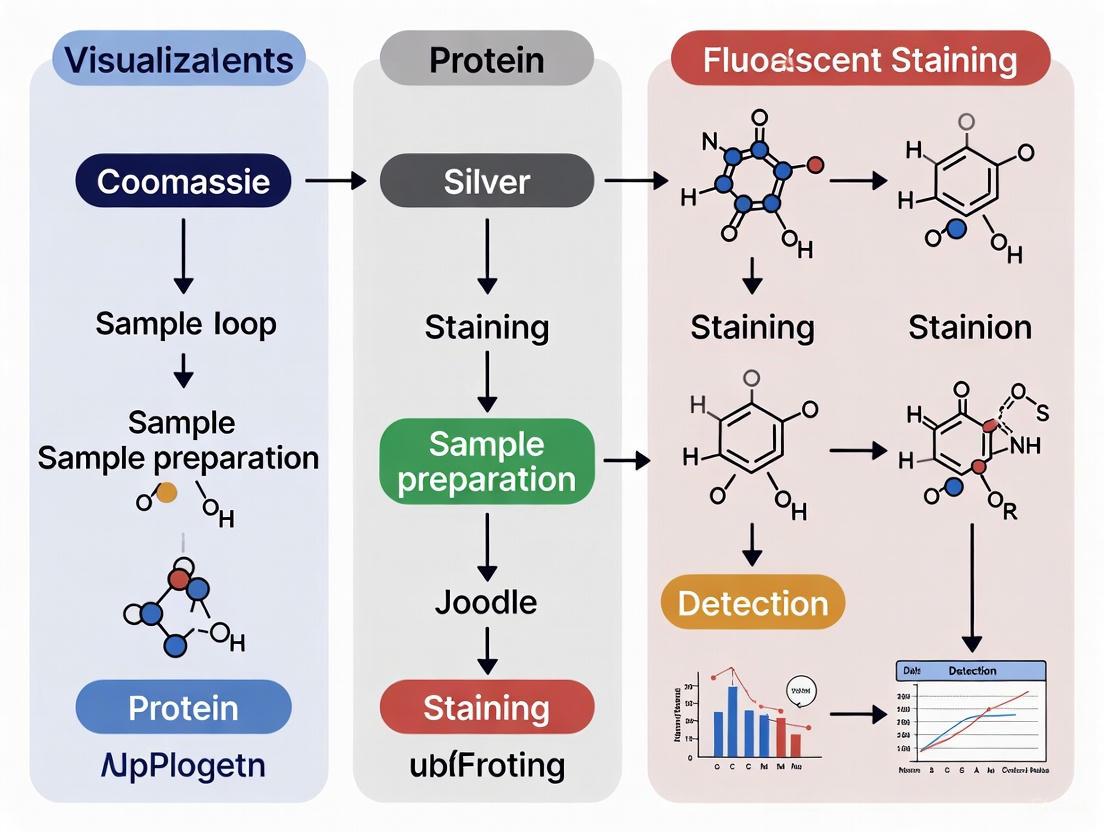
This article provides researchers, scientists, and drug development professionals with a definitive guide to the primary protein gel staining methods.
Protein Gel Staining Methods: A Comprehensive Guide to Coomassie, Silver, and Fluorescent Visualization
Abstract
This article provides researchers, scientists, and drug development professionals with a definitive guide to the primary protein gel staining methods. It covers the foundational principles of Coomassie blue, silver, and fluorescent staining, detailing their protocols, sensitivity, and unique detection mechanisms. The scope extends to practical methodological applications, advanced troubleshooting for common experimental challenges, and a rigorous comparative analysis to guide method selection for specific research goals, including downstream mass spectrometry compatibility. By synthesizing current information, this resource aims to empower professionals in optimizing their protein visualization workflows for both routine analysis and complex proteomic studies.
Understanding Protein Staining: Core Principles and Detection Mechanisms
The Fundamental Goal of Protein Visualization in Gel Electrophoresis
Following the separation of proteins by electrophoresis, visualization is a critical step that transforms the resolved but invisible protein bands into an interpretable data set. The fundamental goal of protein visualization is to detect, characterize, and quantify the separated proteins with the specificity and sensitivity required for downstream analysis [1] [2]. The selection of an appropriate staining method is a strategic decision, balancing factors such as detection sensitivity, quantitative linearity, protocol simplicity, and compatibility with subsequent analytical techniques like mass spectrometry (MS) [1] [3]. This document provides application notes and detailed protocols for the primary protein staining methods, contextualized within modern protein research and drug development.
Comparison of Protein Staining Methods
The choice of stain is pivotal for experimental success. The core properties of the most common staining methods are summarized in the table below.
Table 1: Comparative Overview of Major Protein Gel Staining Methods [1] [2] [4]
| Staining Method | Typical Detection Limit | Dynamic Range | Typical Protocol Time | MS Compatibility | Key Advantages | Major Limitations |
|---|---|---|---|---|---|---|
| Coomassie Blue | 5 - 25 ng [2] | ~2 orders of magnitude [1] | 10 min - 3 hr [1] [2] | Yes [1] | Simple, cost-effective, reversible staining [2] [4] | Lower sensitivity; variable staining based on protein composition [4] |
| Silver Staining | 0.1 - 0.5 ng [3] | ~1 order of magnitude [1] | 30 - 120 min [2] | Specialized protocols only [3] | Very high sensitivity [3] | Complex protocol; protein cross-linking; narrow dynamic range [1] [3] |
| Fluorescent Staining | 0.25 - 0.5 ng [1] [2] | >3 orders of magnitude [1] | ~60 min [2] | Yes (most stains) [1] [2] | High sensitivity, broad linear dynamic range, minimal protein modification [1] [2] | Requires specialized imaging instrumentation [4] |
| Zinc Staining | 0.25 - 0.5 ng [2] | Information Missing | ~15 min [2] | Yes [2] | Very fast, reversible, no protein modification [2] | Negative stain (clear bands on opaque background) [2] |
Detailed Staining Protocols
Coomassie Blue Staining
Principle: Coomassie Brilliant Blue dyes (R-250 or G-250) bind non-covalently to basic and hydrophobic amino acid residues under acidic conditions, causing a color shift from reddish-brown to intense blue upon binding [2] [4].
Table 2: Essential Reagents for Coomassie Blue Staining
| Reagent | Function |
|---|---|
| Coomassie Brilliant Blue R-250 or G-250 | The dye that binds to proteins for visualization. |
| Methanol | Fixes proteins within the gel matrix. |
| Acetic Acid | Fixes proteins and acidifies the environment to promote dye binding. |
| Destain Solution (Methanol/Acetic Acid/Water) | Removes unbound dye from the gel background. |
Step-by-Step Protocol [2] [4]:
- Fixing: Following electrophoresis, immerse the gel in a fixative solution (e.g., 50% methanol and 10% acetic acid) for 30 minutes with gentle agitation. This precipitates proteins and removes interfering substances like SDS.
- Staining: Incubate the gel in Coomassie staining solution (e.g., 0.1% Coomassie Brilliant Blue R-250 in 30% methanol and 10% acetic acid) for 1-2 hours with agitation.
- Destaining: Transfer the gel to a destaining solution (e.g., 30% methanol and 10% acetic acid) to remove background stain. Change the solution periodically until protein bands are clear against a low-background gel. For colloidal Coomassie stains, destaining may only require water [2].
- Storage & Imaging: Store the gel in distilled water or document the results by imaging.
Silver Staining
Principle: Silver ions (Ag⁺) bind to specific functional groups on proteins (e.g., carboxylic acids, amines, sulfhydryls). These bound ions are then chemically reduced to metallic silver (Ag), depositing a dark brown or black precipitate on the protein bands [2] [3].
Step-by-Step Protocol (Alkaline Method) [3]:
- Fixing: Immerse the gel in a fixative solution (50% methanol, 10% acetic acid) for 30 minutes to immobilize proteins.
- Sensitization: Treat the gel with a sensitizer (e.g., 0.02% sodium thiosulfate) for 1 minute to enhance subsequent silver binding.
- Washing: Rinse the gel briefly with distilled water (e.g., 20 seconds) to remove excess sensitizer.
- Silver Impregnation: Incubate the gel in 0.1% silver nitrate solution for 20 minutes to allow silver ions to bind to proteins.
- Washing: Perform a quick water rinse (20 seconds).
- Development: Develop the image by placing the gel in a developer solution (e.g., 2% sodium carbonate, 0.04% formaldehyde) until bands reach desired intensity (typically 2-5 minutes).
- Stopping: Halt the reaction by transferring the gel to 5% acetic acid for 5 minutes.
- Washing & Storage: Rinse with water before storage or imaging.
Note: For MS compatibility, use aldehyde-free protocols that substitute glutaraldehyde and formaldehyde with reagents like tetrathionate and thiosulfate for sensitization [3].
Fluorescent Staining
Principle: Fluorescent dyes (e.g., SYPRO Ruby) bind to proteins through non-covalent mechanisms, such as intercalation into hydrophobic regions or electrostatic interactions. Upon excitation with specific wavelengths of light, the bound dyes emit fluorescence, enabling detection [2] [4].
Step-by-Step Protocol (SYPRO Ruby Example) [1] [2]:
- Fixing: Fix the gel in a solution such as 10% methanol and 7% acetic acid for 30 minutes.
- Staining: Incubate the gel in SYPRO Ruby fluorescent stain for at least 90 minutes, or up to 18 hours for maximum sensitivity, with continuous gentle agitation protected from light.
- Destaining: Rinse the gel with deionized water or a mild destaining solution (e.g., 10% methanol, 7% acetic acid) for 30 minutes to reduce background.
- Imaging: Visualize using a UV transilluminator, laser scanner, or other fluorescence imaging system with the appropriate excitation and emission filters.
The Scientist's Toolkit: Key Research Reagent Solutions
Table 3: Essential Reagents and Kits for Protein Visualization [1] [2]
| Reagent / Kit | Vendor Examples | Primary Function |
|---|---|---|
| Coomassie Stain Kits (Colloidal, Bio-Safe, Rapid) | Bio-Rad, Thermo Fisher, Sigma-Aldrich | Ready-to-use solutions for simple, MS-compatible total protein staining. |
| Silver Stain Kits (Conventional, MS-compatible, Rapid) | Thermo Fisher, Bio-Rad, ABCam | Multi-component kits for high-sensitivity detection; MS-compatible versions avoid aldehyde cross-linkers. |
| Fluorescent Stain Kits (SYPRO Ruby, Krypton, Flamingo) | Thermo Fisher, Bio-Rad, Lonza | Pre-formulated fluorescent dyes for high-sensitivity, broad dynamic range detection. |
| Specialized Stains (Zinc Reversible, Glycoprotein, Phosphoprotein) | Thermo Fisher | For specific applications like rapid MS-compatible staining or detection of post-translational modifications. |
| High-Purity Water & Reagents | N/A | Critical for minimizing background staining, especially in sensitive methods like silver staining. |
| Standardized Protein Ladders | Thermo Fisher, Bio-Rad | Essential molecular weight standards for calibrating gels and estimating protein size. |
Advanced Application: In-Gel Activity Assay
Beyond simple protein detection, specialized visualization techniques can probe protein function. A recent study on Medium-chain acyl-CoA dehydrogenase (MCAD) deficiency utilized an in-gel activity assay to link protein structure and function [5].
Principle: After separating protein complexes via high-resolution clear native electrophoresis (hrCN-PAGE), the gel is incubated with a reaction mixture containing the enzyme's physiological substrate (octanoyl-CoA) and a tetrazolium salt (Nitro Blue Tetrazolium, NBT). Active enzyme tetramers oxidize the substrate, transferring electrons to NBT, which is reduced to an insoluble purple formazan precipitate, revealing active enzyme bands [5].
Significance: This method distinguished the specific activity of intact MCAD tetramers from inactive, fragmented, or aggregated forms caused by pathogenic variants—a capability lacking in standard solution-based activity assays [5]. This demonstrates how specialized visualization strategies can provide unique biological insights into protein structure-function relationships.
Within the comprehensive framework of protein visualization methods, which includes advanced techniques like silver and fluorescent staining, Coomassie Brilliant Blue staining remains the fundamental workhorse for researchers, scientists, and drug development professionals. This dye-binding method is prized for its robustness, simplicity, and cost-effectiveness in detecting proteins separated by gel electrophoresis [6] [2]. Its enduring popularity is attributed to a straightforward protocol that provides excellent sensitivity for routine analysis, typically detecting between 10 to 100 ng of protein per band, and its well-documented compatibility with downstream applications such as mass spectrometry [7] [8] [2]. Understanding the specific mechanism by which Coomassie dye interacts with proteins—a process rooted in specific amino acid interactions—is critical for its effective application in quantitative densitometry, assay development, and proteomic analysis. This application note details the dye-binding mechanism, with a specific focus on amino acid specificity, and provides optimized protocols for reliable protein detection and analysis.
The Chemical Principle: How Coomassie Blue Binds to Proteins
Coomassie Brilliant Blue is an anionic triphenylmethane dye that exists in several ionic forms, each with a distinct color, depending on the pH of its environment [6] [9]. The staining process is typically performed under acidic conditions, which facilitates two primary forms of interaction between the dye and protein molecules.
Ionic and Hydrophobic Interactions
The binding is primarily driven by ionic interactions between the negatively charged sulfonic acid groups on the Coomassie dye and positively charged amino acid residues on the protein [6] [10]. Additionally, hydrophobic interactions and Van der Waals forces contribute to the stability of the dye-protein complex [6]. This dual binding mechanism ensures that a wide range of proteins can be effectively stained.
The Color Shift Mechanism
Upon binding to protein, the dye undergoes a dramatic spectral shift. The free dye in acidic solution has a dull reddish-brown color with an absorbance maximum at 465 nm. When it binds to protein, it stabilizes the anionic form of the dye, resulting in a brilliant blue color with an absorbance maximum at 595 nm [9]. This shift is the basis for both in-gel visualization and the quantitative Bradford protein assay [6] [9].
Amino Acid Specificity and Staining Mechanism
The binding of Coomassie Blue to proteins is not uniform; it shows a distinct preference for specific basic and hydrophobic amino acid side chains.
Primary Amino Acid Interactions
Research has demonstrated a relatively high complexation affinity of Coomassie Blue G-250 for the following basic amino acids:
- Arginine: Contributes strongly to binding via its positively charged guanidinium group.
- Lysine: Interacts with the dye through its primary amine group.
- Histidine: Contributes through its imidazole side chain [11] [6].
These residues serve as primary binding sites because their positive charges attract the anionic dye molecules under the acidic staining conditions [11] [10]. Tyrosine, with its aromatic phenolic ring, also participates, likely through hydrophobic interactions and potential secondary ionic effects [11].
The Staining Enhancement Effect for Mass Spectrometry
Contrary to the assumption that staining might interfere with downstream analysis, recent findings demonstrate that Coomassie Brilliant Blue R-250 staining can actually enhance proteomic analysis. Studies comparing stained and unstained gels following LC-MS/MS analysis showed that stained gels yielded higher protein sequence coverages and quantities [8]. The data indicated that approximately 40% more proteins were detected in nondenaturing PAGE and 18% more in SDS-PAGE from CBB-stained lanes compared to unstained ones [8]. The proposed mechanism is that the dye binding helps retain proteins, particularly those with lower molecular masses (e.g., <30 kDa), within the gel matrix during handling and processing, thereby improving recovery for mass spectrometric detection [8].
Quantitative Comparison of Protein Staining Methods
To contextualize Coomassie staining within the broader landscape of protein visualization techniques, the following table compares its key performance metrics with other common methods.
Table 1: Comparison of Common Protein Gel Staining Methods
| Staining Method | Sensitivity (ng/band) | Typical Protocol Time | Key Advantages | Key Disadvantages | Compatibility with Downstream MS |
|---|---|---|---|---|---|
| Coomassie Blue | 10 - 100 [7] [2] | 10 min - overnight [6] [2] | Simple, cost-effective, reversible staining [2] | Lower sensitivity, variable staining intensity based on protein composition [7] | Excellent compatibility [8] [2] |
| Silver Staining | 0.25 - 0.5 [2] | 30 - 120 min [2] | Highest sensitivity of colorimetric methods [2] | Multiple steps, chemical cross-linking can hinder protein recovery [2] | Limited; certain formulations are compatible [2] |
| Fluorescent Stains | 0.25 - 0.5 [2] | ~60 min [2] | Broad linear dynamic range, high sensitivity [2] | Requires specialized imaging equipment [2] | Most stains are compatible [2] |
| Zinc Staining | 0.25 - 0.5 [2] | ~15 min [2] | Very fast, reversible, no protein modification [2] | Stains the background rather than the protein [2] | Excellent compatibility [2] |
Experimental Protocols for Coomassie Staining
Standard Staining and Destaining Protocol
This protocol is adapted from common laboratory practices and commercial reagent guidelines [6] [12].
Post-Electrophoresis Gel Fixing (Optional but Recommended):
- After electrophoresis, carefully remove the gel from its cassette and place it in a suitable container.
- Submerge the gel in a fixing solution (e.g., 50% ethanol, 10% acetic acid) for 30 minutes to 1 hour with gentle agitation. This step precipitates proteins within the gel matrix and removes interfering substances like SDS [6].
Staining:
- Prepare a Coomassie staining solution. A common laboratory formulation is 0.1% (w/v) Coomassie Brilliant Blue R-250 in 40% ethanol (or methanol) and 10% acetic acid [6] [12].
- Decant the fixing solution and submerge the gel in the staining solution.
- Agitate gently for at least 1 hour. For optimal intensity, stain overnight.
Destaining:
- Prepare a destaining solution (e.g., 40% methanol, 10% acetic acid) [12].
- Transfer the gel to the destaining solution and agitate. Change the solution periodically as it turns blue.
- Continue destaining until the background is clear and protein bands are sharply defined. This can take from a few hours to overnight.
Storage and Imaging:
- For long-term storage, place the destained gel in a solution of 5% acetic acid.
- Image the gel using a white light transilluminator or a standard document scanner [7].
Protocol for Quantitative Densitometry
For studies requiring precise quantification, such as analyzing soybean storage proteins [13], the staining process must reach equilibrium.
- Key Consideration: Different proteins stain at different rates. For a complex mixture, determine the optimal staining time empirically to ensure all proteins of interest have reached staining equilibrium. Failure to do so can lead to significant underestimation of protein abundance [13].
- Procedure: Follow the standard staining protocol but extend the staining time to ensure equilibrium is reached for all protein species of interest (e.g., 8+ hours for complex soybean protein extracts) [13]. Use a series of protein standards of known concentration for calibration when performing densitometry.
Protocol for Gels Destined for Mass Spectrometry
To maximize protein recovery for subsequent LC-MS/MS analysis, consider the following adjustments based on recent research [8].
- Staining: Use standard Coomassie Brilliant Blue R-250 staining protocols as described in section 5.1.
- Key Finding: Do not skip the staining step in a GeLC-MS/MS workflow. Staining has been shown to improve protein detection, likely by helping to retain proteins (especially low molecular weight proteins) within the gel matrix during subsequent processing steps [8].
- Destaining: Ensure thorough destaining with high-purity water or destaining solution to remove all excess dye before proceeding to in-gel digestion.
The Scientist's Toolkit: Essential Reagents and Equipment
Successful Coomassie staining requires a set of core reagents and equipment. The following table lists the essential items and their functions.
Table 2: Essential Research Reagent Solutions for Coomassie Staining
| Item | Function | Example Formulation / Notes |
|---|---|---|
| Coomassie Brilliant Blue Dye | The active staining agent that binds to proteins. | R-250 (reddish hue) for general staining; G-250 (greenish hue) for colloidal/ Bradford assays [6]. |
| Methanol / Ethanol | Fixes proteins in the gel by precipitating them; helps dissolve the dye. | Typically used at 40-50% in staining solutions [6] [12]. |
| Acetic Acid | Acidifies the solution to promote dye-protein binding; assists in fixation and destaining. | Typically used at ~10% [6] [12]. |
| Destaining Solution | Removes unbound dye from the gel background to improve contrast. | 40% Methanol, 10% Acetic Acid [12]. |
| Gel Electrophoresis Apparatus | Separates protein mixtures by molecular weight. | Standard SDS-PAGE setup [6]. |
| Orbital Shaker | Provides gentle, consistent agitation for even staining and destaining. | Essential for consistent results. |
| Gel Documentation System | Captures high-quality images of stained gels for analysis and record-keeping. | Can use white light transillumination or NIR fluorescence [7]. |
Coomassie Brilliant Blue staining remains an indispensable technique in the molecular biology and proteomics toolkit. Its utility extends beyond simple visualization to quantitative analysis and, as recent evidence suggests, enhanced proteomic discovery when coupled with mass spectrometry. The method's reliability stems from a well-understood dye-binding mechanism that favors basic amino acids like arginine, lysine, and histidine. By following the optimized protocols and understanding the principles outlined in this application note, researchers can robustly apply Coomassie staining to achieve accurate and reproducible results in their protein analysis workflows, from routine quality checks to sophisticated drug development research.
Silver staining is a cornerstone colorimetric technique in analytical biochemistry, renowned for its exceptional sensitivity in detecting proteins and nucleic acids separated by gel electrophoresis. The method is based on the selective reduction of silver ions to metallic silver at the sites of biomolecules, forming visible deposits that can be up to 100 times more sensitive than Coomassie Brilliant Blue staining for proteins and several times more sensitive than ethidium bromide for certain polynucleotides [14]. This ultra-sensitive detection capability makes it an indispensable tool for researchers and drug development professionals who need to visualize low-abundance proteins, a critical requirement in biomarker discovery, purity assessment of biopharmaceuticals, and detailed proteome analysis [3].
The technique's foundation lies in the electrochemical reduction chemistry involving silver ions (Ag⁺). These ions interact with specific functional groups on proteins, such as carboxylic acids (from aspartic and glutamic acids), imidazoles (histidine), sulfhydryls (cysteine), and amines (lysine) [2] [3]. Following this binding, a developer, typically containing formaldehyde, reduces the bound ionic silver (Ag⁺) to insoluble, visible metallic silver (Ag). The initial deposit of metallic silver catalyzes the further deposition of more silver, leading to a signal amplification that is the basis for the method's high sensitivity [14]. The resulting protein bands appear in shades from yellow to dark brown or black, with the color intensity and hue depending on the amount of silver incorporated and the scattering of light by the silver grains [14].
Core Chemistry and Principles
The Metallization Process
The fundamental process of silver staining can be viewed as a controlled metallization reaction occurring on a protein template. The procedure involves a precise sequence of steps designed to immobilize the target, facilitate specific silver ion binding, and then catalyze reduction exclusively at the protein sites.
- Fixation: The first critical step involves fixing the gel with a solution such as 50% methanol and 10% acetic acid. This serves to denature and precipitate the proteins within the gel matrix, preventing their diffusion and removing interfering substances like SDS, buffers, and salts that could bind silver and cause high background staining [14] [3].
- Sensitization: Following fixation, the gel is treated with a sensitizing agent. Common sensitizers include sodium thiosulfate or gluteraldehyde. This step enhances the subsequent binding of silver ions and improves the sensitivity and contrast of the final result. Glutaraldehyde, by binding to free amino groups on proteins, introduces reducing aldehyde groups that facilitate the later development process, though it renders the proteins incompatible with mass spectrometry [14] [3].
- Silver Impregnation: The gel is then immersed in a silver nitrate solution (typically 0.1%), allowing Ag⁺ ions to diffuse into the gel and bind to the specific protein functional groups [15] [3].
- Development: The gel is transferred to a developing solution, which contains a reducing agent like formaldehyde in an alkaline buffer (e.g., sodium carbonate). At this stage, the developer reduces the protein-bound silver ions to metallic silver. This reduction is autocatalytic; the initial deposit of metallic silver catalyzes the further reduction of more silver ions, leading to a rapid darkening of the protein bands [14].
- Stopping: The reaction is terminated by transferring the gel to a stopping solution, such as 5% acetic acid, which halts the reduction process and stabilizes the stained image [3].
Key Staining Method Variants
Two principal methodological variants of silver staining are employed, distinguished by the chemical environment of the silver impregnation step [14] [3]:
- Silver Nitrate Staining (Acidic Methods): This approach uses weakly acidic silver nitrate as the silvering agent. Development is subsequently carried out in an alkaline formaldehyde solution. Acidic methods are generally perceived as offering easier control over background staining and are more popular for routine use.
- Ammoniacal Silver Staining (Alkaline Methods): This method uses a silver-diamine complex (created by reacting silver nitrate with ammonium hydroxide and sodium hydroxide) in an alkaline environment. Development is then performed in an acidic formaldehyde solution. Alkaline methods can be more efficient for staining basic proteins.
A more recent innovation is fluorescent silver staining, which uses a fluorogenic probe like TPE-4TA in the developing solution. This probe targets silver ions bound to the protein, forming insoluble aggregates that activate the probe's fluorescence. This method offers the advantage of very low background emission, as unbound probes do not fluoresce [14] [15].
Quantitative Comparison of Protein Staining Methods
The choice of a protein staining method is a trade-off between sensitivity, dynamic range, ease of use, and compatibility with downstream applications. The following table provides a structured comparison of the major staining techniques within the context of protein visualization research.
Table 1: Comparative Analysis of Major Protein Gel Staining Methods
| Method | Detection Sensitivity | Typical Protocol Time | Key Advantages | Key Limitations |
|---|---|---|---|---|
| Coomassie Staining | 5–25 ng per band [2] [4] | 10–135 min [2] | Simple, affordable protocols; reversible staining; fully compatible with MS and Western blotting [2] [4] | Lower sensitivity; protein composition bias (prefers basic/hydrophobic residues) [4] |
| Silver Staining | 0.1–0.5 ng per band [2] [14] [3] | 30–120 min [2] [3] | Ultra-high sensitivity; requires no specialized equipment for visualization [2] [3] | Complex, multi-step protocol; potential for high background; limited dynamic range for quantification; traditional protocols are incompatible with MS [4] [3] |
| Fluorescent Staining | 0.25–0.5 ng per band [2] [4] | ~60 min [2] | Very high sensitivity; broad linear dynamic range for quantification; low background; typically MS compatible [2] [4] | Requires specialized fluorescence imaging equipment; dyes can be expensive; signal may be susceptible to quenching [4] |
| Zinc Staining | 0.25–0.5 ng per band [2] | ~15 min [2] | Extremely fast and reversible; stains the background (negative stain); fully MS compatible [2] | Less common; requires a dark background for visualization [2] |
Detailed Experimental Protocols
Standard Silver Nitrate Staining Protocol
This protocol is adapted from common laboratory practices and commercial kit instructions, suitable for general purpose protein detection in polyacrylamide gels [3].
Table 2: Reagent Setup for Standard Silver Staining
| Reagent | Composition / Preparation | Function |
|---|---|---|
| Fixative Solution | 50% (v/v) Methanol, 10% (v/v) Acetic Acid | Precipitates and immobilizes proteins; removes SDS and interferents. |
| Sensitizing Solution | 0.02% (w/v) Sodium Thiosulfate (Na₂S₂O₃) | Enhances silver binding and improves staining sensitivity/contrast. |
| Silver Nitrate Solution | 0.1% (w/v) AgNO₃ in ultrapure water | Source of Ag⁺ ions that bind to protein functional groups. |
| Developing Solution | 2% (w/v) Sodium Carbonate (Na₂CO₃), 0.04% (v/v) Formaldehyde | Reduces bound Ag⁺ to metallic Ag (Ag⁰), creating visible bands. |
| Stop Solution | 5% (v/v) Acetic Acid | Halts the reduction reaction by neutralizing the alkaline developer. |
Procedure:
- Fixation: After electrophoresis, place the gel in a container with enough Fixative Solution to cover it. Agitate gently on a platform shaker for 30 minutes. This step should be performed at room temperature [3].
- Wash: Discard the fixative and rinse the gel with deionized water for 5 minutes to remove residual acid [3].
- Sensitization: Immerse the gel in Sensitizing Solution for exactly 1 minute with gentle agitation [3].
- Wash: Quickly rinse the gel with distilled water for 20 seconds to remove excess sensitizer [3].
- Silver Impregnation: Transfer the gel to the 0.1% Silver Nitrate Solution. Protect the container from light using aluminum foil and agitate for 20 minutes [3].
- Wash: Perform a very quick wash with distilled water for 20 seconds to remove unbound silver ions [3].
- Development: Place the gel in Developing Solution. Agitate and watch carefully. Protein bands will begin to appear against a clear background within 2 to 5 minutes. Continue development until the desired band intensity is achieved [3].
- Stop Reaction: Once development is complete, immediately transfer the gel to Stop Solution for 5 minutes to terminate the reaction [3].
- Storage: Store the gel in distilled water or dry it between cellophane sheets for permanent record-keeping [3].
Mass Spectrometry-Compatible Silver Staining
Traditional silver staining uses glutaraldehyde or formaldehyde, which cross-link proteins and hinder their identification by mass spectrometry (MS). The following modified protocol is essential for downstream proteomic analysis [14] [3].
Key Modifications:
- Elimination of Aldehydes: Glutaraldehyde is omitted from the sensitization step, and formaldehyde is omitted from the development step.
- Alternative Sensitizers: Sensitization is achieved using a combination of potassium ferricyanide and sodium thiosulfate.
- Extended Development: The development process may take longer than the standard protocol due to the absence of aldehydes.
Procedure Outline:
- Fixation: Fix the gel with 50% ethanol and 5% acetic acid for 30 minutes.
- Washing: Wash the gel with ultrapure water several times to remove all traces of acid.
- Sensitization: Sensitize the gel with a mixture of 0.02% sodium thiosulfate and 0.05% potassium ferricyanide for 1-2 minutes.
- Washing: Wash thoroughly with ultrapure water (3 x 1 minute).
- Silver Impregnation: Impregnate with 0.1% silver nitrate for 20-30 minutes.
- Washing: Rinse briefly with ultrapure water (2 x 1 minute).
- Development: Develop the image using a standard developing solution (without formaldehyde) or a modified carbonated-based developer until bands appear.
- Stop: Stop with 5% acetic acid for 5 minutes.
- Destaining (Critical for MS): For optimal MS results, protein bands of interest should be excised and destained before in-gel digestion to remove the silver deposits, which can interfere with the mass analysis [3].
The Scientist's Toolkit: Essential Research Reagents
Table 3: Key Reagents for Silver Staining and Their Functions
| Reagent / Material | Function / Role in the Protocol | Key Considerations & Safety |
|---|---|---|
| Silver Nitrate (AgNO₃) | Source of Ag⁺ ions for binding to proteins. The core of the metallization reaction. | Corrosive; causes skin irritation and black staining upon light exposure. Use gloves and handle with care [3]. |
| Formaldehyde (HCHO) | Reducing agent in the developer; converts Ag⁺ to metallic Ag. | Potential irritant, sensitizer, and carcinogen. Always handle in a fume hood [3]. |
| Sodium Thiosulfate | Sensitizing agent; improves staining efficiency and contrast. | Relatively safe, but standard laboratory precautions apply. |
| Glutaraldehyde | Powerful sensitizer; binds to protein amines, introducing reducing groups. | Causes irritation and protein cross-linking (incompatible with MS). Handle in a fume hood with gloves [3]. |
| Methanol & Acetic Acid | Components of the fixative solution; precipitate proteins and remove contaminants. | Flammable and corrosive. Use in well-ventilated areas or a fume hood [3]. |
| Ultrapure Water | Used for all solution preparation and washing steps. | Purity is critical to prevent background staining from ionic contaminants. |
Technical Considerations and Troubleshooting
Optimizing Results and Troubleshooting Common Issues
Achieving consistent, high-quality silver staining requires attention to detail. Several factors can significantly impact the outcome:
- Purity of Reagents and Water: The high sensitivity of silver staining makes it susceptible to background staining from impurities. Ultrapure water (18.2 MΩ·cm) is essential for preparing all solutions and for washing steps [3].
- Temperature and Time Control: The staining process is temperature-dependent. Higher room temperatures (>30°C) can accelerate development and lead to increased background. Precisely timing each step, especially development, is crucial for reproducibility [3].
- Gel Thickness: Thicker gels require longer incubation times for reagents to diffuse properly. A silver nitrate concentration of 0.1% is recommended for gels between 0.5 and 3 mm thick [3].
Common Problems and Solutions:
- High Background: This is the most frequent challenge. Causes include impure water/reagents, unclean glassware, over-development, or high temperature. Ensure all equipment is impeccably clean, use high-purity reagents, and carefully monitor development time [3].
- "Silver Mirror" on Gel Surface: Caused by the uncontrolled reduction of silver in the solution. This can be due to contaminated developer or insufficient washing after the silver impregnation step. Ensure a quick and effective water rinse after the silver step [14].
- Faint or No Staining: Could result from exhausted or improperly prepared developer, insufficient silver impregnation time, or over-fixing. Check reagent freshness and ensure steps are performed for the recommended duration.
- Negative Staining (Clear bands on a dark background): Can occur if the gel contains excess reducing agent from electrophoresis buffer or when protein levels are excessively high [14].
Safety and Waste Disposal
- Personal Protective Equipment (PPE): Always wear appropriate gloves, a lab coat, and safety goggles.
- Ventilation: Handle volatile and noxious reagents like acetic acid, formaldehyde, and glutaraldehyde in a fume hood [3].
- Waste Disposal: Silver-containing waste must be collected separately and disposed of according to local environmental health and safety regulations. Do not pour silver solutions down the drain [3].
Experimental Workflow and Signaling Pathway
The following diagram visualizes the logical sequence and key chemical transformations in the standard silver staining protocol.
Diagram 1: Silver staining experimental workflow. The core metallization reaction occurs during Development, where bound Ag⁺ ions are reduced to metallic Ag⁰.
Fluorescent staining is a cornerstone technique in molecular and cellular biology for the detection, localization, and quantification of biomolecules. Its high sensitivity and specificity make it indispensable for researchers and drug development professionals studying protein expression, interactions, and spatial organization within complex biological systems. Unlike colorimetric methods that rely on light absorption, fluorescence detection operates on the principle of light emission, where specific fluorescent dyes bind to target molecules and emit light at characteristic wavelengths upon excitation. This signal emission can be detected with high sensitivity, often enabling the visualization of targets present at very low concentrations. This application note details the practical application of high-sensitivity fluorescent staining, with a specific focus on in-gel protein detection, providing a direct comparison with traditional stains and outlining optimized protocols for robust, reproducible results.
Quantitative Comparison of Staining Methods
The selection of a staining method involves trade-offs between sensitivity, dynamic range, cost, and compatibility with downstream analyses. The table below provides a quantitative comparison of Coomassie Blue (using both densitometric and infrared fluorescence detection) and Sypro Ruby for in-gel protein detection [16] [7] [17].
Table 1: Quantitative comparison of in-gel protein staining methods
| Staining Method | Detection Mechanism | Approximate Lowest Limit of Detection | Linear Dynamic Range | Inter-Protein Variability | Relative Cost per Gel |
|---|---|---|---|---|---|
| Coomassie Blue (Densitometry) | Absorbance of visible light | 10 ng [16] | Limited | High | Low (~$3.50 - $8.33) [16] |
| Coomassie Blue (IR Fluorescence) | Near-infrared fluorescence emission | < 1 ng [16] [17] | Significantly exceeds Sypro Ruby [16] | Lower than densitometry [16] | Low (cost of stain) [16] |
| Sypro Ruby (Fluorescence) | Visible light fluorescence emission | < 1 ng [16] | Broad, but less than CB-IRFD [16] | Low [16] | High (~$11.69) [16] |
This data demonstrates that while traditional Coomassie staining is cost-effective, its sensitivity is limited. However, by leveraging its inherent fluorescent properties when detected in the near-infrared (IR) spectrum, Coomassie can achieve sensitivity rivaling premium fluorescent stains like Sypro Ruby, but with a superior linear dynamic range and at a fraction of the cost [16] [7]. Sypro Ruby remains an excellent, user-friendly option with low inter-protein variability, though it is more expensive [16].
Experimental Protocols
High-Sensitivity Coomassie Staining with Infrared Fluorescence Detection
This protocol is optimized for high sensitivity and quantitative accuracy in gel-based proteomics, based on the systematic optimization of colloidal Coomassie formulations [16] [17].
Materials:
- Neuhoff Colloidal Coomassie Blue (NCCB) Staining Solution: 0.12% (w/v) Coomassie G-250, 10% (w/v) ammonium sulfate, 10% (v/v) phosphoric acid, 20% (v/v) methanol [16] [17].
- Fixing Solution: 50% (v/v) ethanol, 10% (v/v) acetic acid.
- Destaining Solution: 10% (v/v) ethanol, 7.5% (v/v) acetic acid.
- IR-Compatible Imager: An imaging system capable of exciting at ~685 nm and collecting emission at ~700-800 nm [16] [7].
Procedure:
- Post-Electrophoresis Fixing: Following SDS-PAGE, immerse the gel in Fixing Solution for 1 hour with gentle agitation to precipitate proteins and remove SDS.
- Staining: Replace the fixative with a sufficient volume of NCCB Staining Solution to cover the gel. Incubate with agitation for 24-48 hours. Note: Extended staining within this range improves selectivity without compromising sensitivity [17].
- Destaining: Briefly rinse the gel with Destaining Solution for 10-30 minutes to reduce background. The gel can be stored in Destaining Solution or in an aqueous 1% (v/v) acetic acid solution.
- Imaging: Place the gel on the imager bed. For near-infrared fluorescence detection, image using a 685 nm excitation laser and a 700 nm emission filter [7]. Avoid drying the gel.
Sypro Ruby Staining for Fluorescent In-Gel Detection
This protocol outlines the standard procedure for using Sypro Ruby, a ruthenium-based organometallic fluorescent stain known for its ease of use and broad compatibility [16].
Materials:
- Sypro Ruby Stain (commercially available)
- Fixing Solution: 50% (v/v) ethanol, 10% (v/v) acetic acid.
- Wash Solution: 10% (v/v) ethanol, 7.5% (v/v) acetic acid.
- Fluorescence Imager: A system with visible excitation sources (e.g., ~300 nm UV transillumination or 470 nm LED) and appropriate emission filters.
Procedure:
- Post-Electrophoresis Fixing: Immerse the gel in Fixing Solution for 30 minutes to precipitate proteins.
- Staining: Replace the solution with Sypro Ruby Stain. Protect the gel from light and incubate with agitation for a minimum of 3 hours or overnight for highest sensitivity.
- Destaining/Washing: Wash the gel in Wash Solution for 30 minutes to reduce background.
- Imaging: Image the gel using UV transillumination or a compatible blue LED source. Follow the manufacturer's recommendations for optimal excitation and emission settings.
Visualizing Staining Workflows and Dye Effects
The following diagrams illustrate the core experimental workflow and a critical consideration for fluorescent staining.
Diagram 1: General workflow for in-gel protein staining. The process begins with fixation, followed by staining with a specific dye, destaining to reduce background, and finally, image acquisition and analysis.
Diagram 2: The effect of fluorescent labeling on protein binding. The attachment of a fluorescent label, particularly one with a strong net charge, can significantly alter the native binding kinetics and distribution of the probe protein, potentially leading to experimental artifacts [18].
The Scientist's Toolkit: Research Reagent Solutions
Selecting the appropriate reagents is critical for success in fluorescent staining applications. The table below lists key materials and their functions.
Table 2: Essential research reagents for high-sensitivity fluorescent staining
| Reagent / Material | Function / Application | Key Considerations |
|---|---|---|
| Coomassie Blue G-250 / R-250 | Anionic triphenylmethane dye for non-specific protein staining [7]. | G-250 is used in colloidal formulations for lower background. Exhibits fluorescence in the near-IR when bound to protein [16]. |
| Sypro Ruby | Ruthenium-based organometallic fluorescent stain for proteins [16]. | Binds non-covalently to primary amines. High sensitivity, MS-compatible, but expensive [16]. |
| Azure Sapphire Imager (or equivalent) | Imaging system capable of NIR fluorescence, chemiluminescence, and colorimetry [7]. | Essential for exploiting the NIR fluorescence of Coomassie. Must have ~685 nm excitation and ~700 nm emission filters [7]. |
| Neuhoff Colloidal Coomassie (NCCB) | Optimized staining formulation with ammonium sulfate and phosphoric acid [16] [17]. | Provides high sensitivity (<1 ng) and low background for IR fluorescence detection [17]. |
| Methanol & Acetic Acid | Components of fixing and destaining solutions. | Precipitates proteins (fixing) and removes non-specifically bound dye (destaining). |
| Phosphate-Buffered Saline (PBS) | A common buffer solution. | Used as a solvent and rinsing solution for many fluorescent dyes and immunofluorescence protocols [19] [20]. |
| Normal Serum or BSA | Blocking agents in immunofluorescence. | Reduces non-specific antibody binding by saturating hydrophobic or charged sites on the sample [19]. |
In gel-based proteomic analyses, the selection of a protein staining method is a fundamental decision that directly influences the accuracy, reliability, and interpretability of experimental results. The performance of these methods is quantitatively characterized by three critical metrics: sensitivity (the minimum detectable protein amount), dynamic range (the range over which protein concentration can be accurately quantified), and protein-to-protein variation (the consistency of staining response across different proteins) [1]. Within the context of a broader thesis on protein visualization methodologies, this application note delineates these key performance metrics for Coomassie, silver, and fluorescent staining techniques. We provide structured quantitative comparisons and detailed protocols to guide researchers, scientists, and drug development professionals in selecting the optimal staining method for their specific application, whether for routine analysis or advanced proteomic research.
Performance Metrics of Major Staining Techniques
The performance of protein staining methods varies significantly, necessitating a clear understanding of their capabilities and limitations for appropriate experimental design.
Quantitative Comparison of Staining Methods
Table 1: Overall comparison of protein staining methods based on key performance metrics.
| Staining Method | Typical Sensitivity (ng/band) | Linear Dynamic Range | Protein-to-Protein Variation | MS Compatibility |
|---|---|---|---|---|
| Coomassie Blue (Traditional) | 8-10 ng [1] | ~2 orders of magnitude [1] | Low (Good consistency) [1] | Yes [21] [22] |
| Colloidal Coomassie | 1-10 ng [21] [22] [1] | ~2 orders of magnitude [1] | Low (Good consistency) [1] | Yes [21] [1] |
| Silver Stain | 0.1-2 ng [1] | ~1 order of magnitude [1] | High (Substantial variation) [1] | Variable (MS-compatible kits available) [1] |
| Fluorescent Stains (e.g., SYPRO Ruby) | 0.25-2 ng [1] [16] | ~3 orders of magnitude [1] | Low (Good consistency) [1] | Yes [1] |
In-Depth Metric Analysis
- Sensitivity: Defined as the minimum amount of protein detectable per band. Silver and fluorescent stains offer the highest sensitivity, detecting sub-nanogram quantities, which is crucial for analyzing low-abundance proteins [1]. Traditional Coomassie blue is less sensitive (~10 ng), but colloidal Coomassie formulations can improve sensitivity down to 1-10 ng, bridging the gap significantly [21] [22] [1].
- Dynamic Range: This refers to the concentration range over which the staining intensity response is linear, allowing for accurate quantitation. Fluorescent stains like SYPRO Ruby provide a superior linear dynamic range of up to three orders of magnitude, enabling simultaneous quantification of low, medium, and high-abundance proteins on the same gel [1]. Coomassie stains have a range of about two orders, while silver staining has a narrow linear range of approximately one order, complicating quantitative analyses [1].
- Protein-to-Protein Variation: This metric indicates the consistency of dye binding across different proteins, which is influenced by variations in amino acid composition (e.g., content of basic residues like arginine and lysine) [6]. Silver stains are notorious for high inter-protein variability, meaning different proteins stain with different intensities at the same concentration [1]. In contrast, Coomassie and fluorescent stains like SYPRO Ruby demonstrate much lower variability, leading to more reliable comparative quantification [1].
Detailed Experimental Protocols
Protocol 1: Fast Colloidal Coomassie Blue G-250 Staining
This protocol, adapted from Kang et al. and demonstrated for analytical purposes, offers high sensitivity with minimal background [21].
Staining Solution Preparation (for 2000 ml) [21]:
- Components: 0.02% (w/v) CBB G-250 (0.4 g), 5% (w/v) aluminum sulfate hydrate (100 g), 10% (v/v) ethanol (96%, 200 ml), 2% (v/v) orthophosphoric acid (85%, 47 ml). Use high-purity water (e.g., Milli-Q).
- Critical Preparation Order:
- First, dissolve aluminum sulfate in water.
- Add ethanol and homogenize.
- Mix in CBB G-250 until completely dissolved.
- Finally, add phosphoric acid. The addition of acid to the alcoholic media triggers the formation of colloidal particles.
- The final solution should have a dark green-bluish appearance with visible particles. Do not filter [21].
Staining Procedure [21]:
- Post-Electrophoresis Wash: After SDS-PAGE, remove the gel and wash it three times with Milli-Q water for 10 minutes each on a horizontal shaker. This step is critical to remove SDS, which interferes with dye binding.
- Staining: Shake the Coomassie solution to disperse colloids evenly and incubate the gel while agitating for 2-12 hours.
- Note: Protein spots may appear within 10 minutes; ~80% of maximum staining is achieved within 2 hours. Overnight incubation is recommended for 100% development.
- Post-Staining: Remove the staining solution (which can be reused if particles remain) and rinse the gel twice with water.
- Destaining (Optional): To reduce background further, destain for 10-60 minutes with a destaining solution (10% ethanol, 2% orthophosphoric acid). For preparative gels, washing with water alone is sufficient, though a weak Coomassie film may remain.
- Final Rinse: Rinse the gel twice with water. This step re-swells the gel (which shrinks in alcohol-acid media) and enhances the final color intensity.
Protocol 2: Fluorescent Staining with SYPRO Ruby
SYPRO Ruby is a ruthenium-based fluorescent stain known for its high sensitivity and wide dynamic range [1] [16].
- Materials:
- Procedure:
- Fixing: Following electrophoresis, place the gel in fixing solution for at least 30 minutes to precipitate proteins and remove interfering substances.
- Staining: Incubate the gel with SYPRO Ruby stain for 90 minutes to overnight, with gentle agitation. Staining times can vary based on gel thickness and protein content.
- Destaining: Wash the gel in destain solution for 30-60 minutes to reduce background fluorescence.
- Imaging: Image the gel using a UV or laser-based imaging system with appropriate excitation/emission filters (~~excitation ~~300 nm, emission ~~610 nm) [1] [16].
Workflow Visualization
The following diagram illustrates the logical decision-making process for selecting a protein staining method based on primary experimental requirements.
The Scientist's Toolkit: Research Reagent Solutions
Table 2: Essential materials and reagents for protein gel staining experiments.
| Reagent Solution | Function / Purpose | Representative Examples / Notes |
|---|---|---|
| Coomassie Blue Dyes | Anionic triphenylmethane dyes that bind proteins via electrostatic and hydrophobic interactions. | CBB R-250: Reddish-blue; used for traditional staining. CBB G-250: Greenish-blue; used in colloidal stains and Bradford assay [6] [9]. |
| Colloidal Staining Kits | Pre-formulated kits offering enhanced sensitivity with low background. Dye is in colloidal particles that don't penetrate gel matrix easily. | Colloidal Blue Staining Kit (Thermo Fisher): <10 ng sensitivity, MS-compatible [22] [23]. BioSafe Coomassie (BioRad): 3 ng sensitivity, environmentally friendly [1]. |
| Fluorescent Stains | High-sensitivity stains that bind proteins non-covalently and are detected via fluorescence. | SYPRO Ruby: Sensitive (~0.25-1 ng), wide dynamic range, MS-compatible [1] [16]. Krypton Fluorescent Stain: Very high sensitivity (0.25 ng) [1]. |
| Silver Stain Kits | Ultra-sensitive stains where silver ions bind to proteins and are reduced to metallic silver. | Pierce Silver Stain for MS: Sub-nanogram sensitivity, optimized for mass spectrometry [1] [23]. |
| Fixing & Destaining Solutions | Precipitate and immobilize proteins in the gel; remove unbound dye to reduce background. | Typically contain methanol/ethanol and acetic acid (e.g., 50% ethanol, 10% acetic acid) [6]. Some modern Coomassie stains are acid/methanol-free [22] [23]. |
| Specialized Imaging Instruments | Capture and quantify stained protein bands. | White Light Transilluminator: For Coomassie and silver stains [22] [7]. Laser/UV-Based Imagers: For fluorescent stains (e.g., Sapphire Biomolecular Imager, iBright Systems) [22] [7]. NIR Imagers: Can detect Coomassie-bound protein fluorescence, enhancing sensitivity [7] [16]. |
Advanced Detection Method: Near-Infrared Fluorescence of Coomassie Blue
A significant advancement in Coomassie staining is the discovery that protein-bound Coomassie blue fluoresces in the near-infrared (NIR) range when excited at ~650 nm, emitting at 700-800 nm [7] [16]. This detection method can dramatically enhance the performance of Coomassie stains.
- Enhanced Sensitivity: Systematic studies have shown that several Coomassie stain formulations, when imaged via NIR fluorescence, can detect <1 ng of protein in-gel, a sensitivity that can rival or even slightly exceed that of Sypro Ruby [16].
- Superior Dynamic Range: The linear dynamic range of Coomassie Blue NIR fluorescence detection (CB-IRFD) significantly exceeds that of Sypro Ruby, allowing for more reliable quantification across a wider concentration of proteins [16].
- Cost-Effectiveness: This method combines the high performance of fluorescent staining with the low cost and MS-compatibility of Coomassie Blue, making high-sensitivity gel-based proteomics more accessible [16].
Table 3: Comparing detection limits of Coomassie stains using different imaging methods.
| Staining Formulation / Method | Detection Limit (approx.) | Detection Mode |
|---|---|---|
| Traditional Coomassie R-250 | 8-10 ng [1] | Visible, densitometric |
| Colloidal Coomassie G-250 | 1-10 ng [21] [1] | Visible, densitometric |
| Selected Coomassie Formulations | <1 ng [16] | Near-Infrared Fluorescence |
| Sypro Ruby (for comparison) | 0.25-1 ng [1] [16] | Fluorescence |
The selection of an optimal protein staining method is a critical step that hinges on a clear understanding of the key performance metrics: sensitivity, dynamic range, and protein-to-protein variation. While silver staining offers supreme sensitivity, its narrow dynamic range and high variability can limit its utility for quantitative work. Fluorescent stains provide an excellent balance of high sensitivity and wide dynamic range but at a higher cost. Coomassie blue stains, particularly modern colloidal and NIR-fluorescent detection protocols, remain a robust, cost-effective, and versatile choice for a wide array of applications, from routine analysis to advanced proteomic studies. By applying the guidelines and protocols outlined in this document, researchers can make informed decisions to ensure their protein visualization strategy aligns with their specific experimental goals.
Practical Protocols: Step-by-Step Staining Procedures and Best Practices
Within the comprehensive framework of protein visualization methods, Coomassie Brilliant Blue (CBB) staining establishes itself as a fundamental and robust technique for detecting proteins separated by sodium dodecyl sulfate–polyacrylamide gel electrophoresis (SDS-PAGE). Its enduring popularity in research and drug development stems from an effective balance of sensitivity, reproducibility, and simplicity [6]. Unlike the more complex and sensitive silver staining or the highly sensitive but equipment-dependent fluorescent staining, Coomassie staining offers a cost-effective and straightforward approach for routine protein analysis, with the significant advantage of being highly compatible with downstream protein analysis techniques, such as mass spectrometry (MS) [24] [6]. The technique relies on the ability of Coomassie dye molecules to bind non-specifically to proteins through ionic interactions with basic amino acids (arginine, lysine, and histidine) and hydrophobic interactions [25] [6], resulting in distinct blue bands against a clear background.
Core Principles and Staining Reagents
Chemical Principles of Coomassie Staining
Coomassie Brilliant Blue is an anionic dye belonging to the triphenylmethane family. Two primary variants are used in protein staining: Coomassie R-250 (denoting a reddish tint) and Coomassie G-250 (denoting a greenish tint) [26] [6]. The binding of the dye to proteins is a non-covalent process that involves the dye's sulfonic acid groups forming heteropolar bonds with positively charged amino acid residues, while van der Waals forces further stabilize the interaction [6]. Upon binding, the dye's absorbance maximum shifts, and it adopts its stable blue anionic form, enabling visualization and quantification [6]. The G-250 variant, particularly in its colloidal form, is often preferred for its higher sensitivity and because it can be destained with just water, unlike R-250 which typically requires methanol/acetic acid destaining solutions [26] [24].
Essential Research Reagent Solutions
Successful Coomassie staining requires a set of specific reagents, each serving a critical function in the process. The table below details the key components and their roles.
Table 1: Essential Reagents for Coomassie Staining Protocols
| Reagent Solution | Typical Composition | Primary Function in the Protocol |
|---|---|---|
| Fixing Solution | 40-50% Methanol, 10% Acetic Acid [26] [27] | Precipitates and immobilizes proteins within the gel matrix to prevent diffusion and loss of resolution [24]. |
| Coomassie R-250 Stain | 0.1% Coomassie R-250, 40-50% Methanol, 10% Acetic Acid [28] [26] | The classic staining solution that directly binds to proteins for visualization. |
| Colloidal Coomassie G-250 Stain | 0.02-0.1% Coomassie G-250, 10% Ethanol, 2% Phosphoric Acid, 5-10% Ammonium Sulfate [28] [24] | A more sensitive, colloidal stain where dye particles are less permeable, reducing background staining [24]. |
| Destaining Solution | 10-50% Methanol, 7.5-10% Acetic Acid [28] [26] | Removes unbound dye from the gel to reduce background and improve band contrast (for R-250). |
| Washing/Storage Solution | Deionized Water; or 5% Acetic Acid [26] [27] | Used for final washing of colloidal stains or for long-term gel storage. |
Standardized Staining Protocols
This section provides detailed, step-by-step methodologies for the two primary Coomassie staining variants, incorporating best practices from established protocols.
Standard Coomassie R-250 Staining Protocol
The following protocol is adapted from ThermoFisher and AAT Bio protocols [28] [26]. The entire process can be completed within a few hours, though incubation times can be extended for convenience.
- Fixing: After electrophoresis, transfer the gel to a container and immerse it in a sufficient volume of fixing solution (e.g., 40% methanol, 10% acetic acid). Agitate gently on an orbital shaker for 30 minutes to 1 hour to precipitate proteins and remove SDS [26] [24].
- Staining: Decant the fixative. Submerge the gel in Coomassie R-250 staining solution (0.1% R-250, 40% methanol, 10% acetic acid). Agitate for a minimum of 1 hour at room temperature. For increased sensitivity, staining can be continued overnight [28] [26].
- Destaining: Pour off the staining solution. Rinse the gel briefly with deionized water. Add destaining solution (10% ethanol, 7.5% acetic acid, or similar) and agitate. Change the destaining solution periodically until the background is clear and protein bands are sharply defined [28]. To accelerate destaining, the process can be initiated with a brief (e.g., 1 minute) microwave heating, ensuring the solution does not boil [28].
- Storage: For long-term storage, equilibrate the gel in a storage solution (e.g., 5% acetic acid) for at least 1 hour before sealing it in a plastic bag [26].
Improved Colloidal Coomassie G-250 Staining Protocol
This protocol, incorporating a critical fixation step as demonstrated in recent research, offers superior band resolution and sensitivity [24]. It is based on the methods of Dyballa and Metzger with modifications [24].
- Fixing (Critical Step): Following electrophoresis, fix the gel in a solution of 40% methanol and 10% acetic acid with agitation for at least 30 minutes. This step prevents protein diffusion during subsequent washing, significantly improving final band sharpness [24].
- Rinsing: Decant the fixative and rinse the gel briefly with ultrapure water [24].
- Staining: Incubate the gel in colloidal CBB-G staining solution (e.g., 0.02% CBB G-250, 5% aluminium sulfate, 10% ethanol, 2% orthophosphoric acid) for 2 hours to overnight with agitation [24].
- Destaining/Washing: Destain the gel by rinsing briefly with water, then agitating in a CBB-G destain solution (10% ethanol, 2% orthophosphoric acid) for ~5 minutes. Finally, wash the gel with ultrapure water with agitation for 10 minutes or longer until a clear background is achieved. The gel can be stored in water at 4°C [24].
Rapid Staining with Ready-to-Use Products
For efficiency, several ready-to-use stain products are available. The protocol for SimplyBlue SafeStain is representative [28]:
- After electrophoresis, rinse the gel 3 times for 5 minutes with deionized water to remove SDS and buffer salts.
- Submerge the gel in enough SimplyBlue SafeStain to cover it and stain for 1 hour at room temperature with gentle shaking.
- Discard the stain and wash the gel with water for 1-3 hours to clear the background. The gel can be left in water for several days.
The workflow below summarizes the key decision points and steps in a standard Coomassie staining procedure.
Quantitative Data and Protocol Comparison
To inform experimental design, it is crucial to understand the performance characteristics of different staining methods. The following tables summarize key quantitative data and a comparative analysis of the featured protocols.
Table 2: Quantitative Performance of Protein Staining Methods
| Staining Method | Typical Detection Limit | Linear Dynamic Range | Compatibility with Mass Spectrometry |
|---|---|---|---|
| Coomassie R-250 | ~200 ng per band [24] | ~10 ng to 20 µg [25] | High [6] |
| Colloidal Coomassie G-250 | 1 - 10 ng per band [24] | ~10 ng to 20 µg [25] | High [24] [6] |
| Silver Staining | 0.1 - 1 ng [29] | Narrower | Variable, often low [24] [6] |
| Fluorescent Staining | ~1 - 10 ng (comparable to silver) [25] [29] | Wide | High [25] |
Table 3: Comparative Analysis of Coomassie Staining Protocols
| Protocol Characteristic | Classic R-250 | Improved Colloidal G-250 | Ready-to-Use (e.g., SimplyBlue) |
|---|---|---|---|
| Key Steps | Fix, Stain, Destain | Fix, Stain, Water Wash | Rinse, Stain, Water Wash |
| Total Time (Approx.) | 3 hours to overnight | 3.5 hours to overnight | 2 - 4 hours |
| Sensitivity | Lower (~200 ng) [24] | Higher (1-10 ng) [24] | Moderate |
| Background Control | Requires aggressive destaining | Low background due to colloidal properties [24] | Requires water washing |
| Major Advantages | Widely available reagents | Highest sensitivity & resolution [24] | Speed and convenience; bio-safe [28] |
| Major Disadvantages | Uses large volumes of methanol/acetic acid | Staining solution preparation | Can be more expensive per gel |
Troubleshooting and Best Practices
Even with standardized protocols, researchers may encounter issues. The table below outlines common problems and their solutions.
Table 4: Troubleshooting Guide for Coomassie Staining
| Problem | Potential Causes | Recommended Solutions |
|---|---|---|
| Weak or No Bands | Insufficient protein load; over-destaining; incomplete staining. | Increase protein load; optimize staining and destaining times; use a more sensitive colloidal G-250 protocol [6]. |
| High Background | Incomplete destaining/washing; interference from SDS or salts. | Extend destaining/washing with fresh solution; ensure adequate rinsing with water after electrophoresis to remove SDS [28] [6]. |
| Uneven Staining | Inadequate agitation; gel sticking to container. | Ensure constant, gentle agitation throughout all steps; use sufficient liquid volume to fully cover the gel [6]. |
| Diffused or Smeared Bands | Omission of fixation step; overloading of gel. | Always include a fixation step prior to staining, especially with colloidal CBB-G, to immobilize proteins [24]. |
For all procedures, proper safety measures are imperative. Personal protective equipment (PPE) including nitrile gloves, safety goggles, and a lab coat must be worn. Methanol and acetic acid should be handled in a well-ventilated area or fume hood due to their volatile and corrosive nature [6].
The Standard Coomassie Staining Protocol remains a cornerstone technique in the repertoire of protein visualization methods. Its robustness, cost-effectiveness, and compatibility with mass spectrometry make it an indispensable tool for routine protein analysis in academic research and biopharmaceutical development. While the classic R-250 protocol is sufficient for many applications involving abundant protein, the improved colloidal G-250 protocol with fixation offers a demonstrable advance in sensitivity and band resolution for more demanding applications. The ongoing development of rapid, bio-safe, ready-to-use products further enhances the utility and accessibility of Coomassie staining, ensuring its continued relevance in modern proteomics and quality control workflows.
Advanced Colloidal Coomassie Methods for Reduced Background and Faster Staining
Protein gel staining is a pivotal technique in molecular biology and biochemistry for visualizing proteins following their separation by electrophoresis. Among the various staining methods available, Coomassie Brilliant Blue stands out as one of the most effective dyes for visualizing proteins in SDS-PAGE due to its high sensitivity, ease of use, and compatibility with downstream analyses [6]. While traditional Coomassie blue staining has been a laboratory workhorse for decades, recent advancements in colloidal Coomassie methods have specifically addressed historical limitations of high background and prolonged staining/destaining times [6]. These improvements are particularly valuable for researchers and drug development professionals who require rapid, reliable protein visualization without compromising compatibility with subsequent analytical techniques such as mass spectrometry.
The evolution of Coomassie staining represents a significant refinement within the broader context of protein visualization methodologies, which include silver staining, fluorescent staining, and zinc staining [2]. Each method offers distinct advantages and limitations, with the optimal choice depending on experimental priorities regarding sensitivity, speed, cost, and downstream compatibility [4]. Advanced colloidal Coomassie methods occupy a crucial niche in this landscape by offering an optimal balance of these factors—providing enhanced sensitivity over traditional Coomassie with significantly reduced procedural complexity compared to silver staining [30].
Comparative Analysis of Protein Staining Methods
Before delving into the specifics of advanced colloidal Coomassie protocols, it is essential to contextualize its performance relative to other common protein visualization techniques. The table below provides a systematic comparison of key staining methods based on critical performance parameters:
Table 1: Comparison of Major Protein Gel Staining Methods
| Staining Method | Detection Limit | Typical Protocol Time | Dynamic Range | MS Compatibility | Key Advantages | Major Limitations |
|---|---|---|---|---|---|---|
| Colloidal Coomassie | 8-10 ng [2] | 10-135 min [2] | ~1.5 orders of magnitude [31] | Excellent [6] | Simple protocol, low cost, excellent MS compatibility | Moderate sensitivity compared to fluorescent/silver methods |
| Traditional Coomassie | ~100 ng [30] | 20 min to overnight [6] | Limited | Excellent [4] | Inexpensive, established protocols, reversible staining | Low sensitivity, requires destaining, high background |
| Silver Staining | 0.25-0.5 ng [2] | 30-120 min [2] | Narrow [30] | Limited (fixative methods) [2] | Highest sensitivity of colorimetric methods | Complex protocol, reagent sensitivity, potential protein modification |
| Fluorescent Staining | 0.25-0.5 ng [2] | ~60 min [2] | Broad (>3 orders of magnitude) [4] | Excellent for most dyes [2] | Broad dynamic range, high sensitivity | Requires specialized equipment, dye quenching concerns |
| Zinc Staining | 0.25-0.5 ng [2] | ~15 min [2] | Not well characterized | Excellent [2] | Rapid, reversible, no protein modification | Unique negative stain (clear bands on opaque background) |
This comparative analysis reveals that colloidal Coomassie methods occupy a strategic position in the methodological landscape, offering a balanced combination of sensitivity, practicality, and compatibility. While silver and fluorescent methods provide superior detection limits, colloidal Coomassie requires less specialized equipment than fluorescent methods and avoids the complex, potentially cross-linking chemistry of silver staining [2] [30]. This balance makes advanced colloidal Coomassie particularly valuable for routine laboratory applications where robust, reproducible results are essential.
Principles of Colloidal Coomassie Chemistry
Fundamental Binding Mechanisms
Coomassie Brilliant Blue is an anionic synthetic dye that belongs to the triphenylmethane dyes family due to its three phenyl rings [6]. The staining mechanism involves both hydrophobic interactions and heteropolar bonding to basic amino acids [6]. The dye's sulfonic acid groups engage in ionic interactions with positively charged residues on proteins, primarily binding to arginine, lysine, and histidine side chains [6] [32]. Additionally, van der Waals forces drive interaction with hydrophobic protein regions [6].
The colloidal form of Coomassie (G-250) exhibits unique chemical properties that enable reduced background staining. In acidic conditions, the dye forms colloidal particles that are excluded from the gel matrix but can penetrate and bind to protein regions [30]. This selective accessibility forms the foundation for reduced background staining, as the dye cannot significantly penetrate or adhere to the polyacrylamide meshwork itself. Upon binding to proteins, the dye shifts from a reddish-brown (λmax ≈ 470 nm) to intense blue (λmax ≈ 590 nm) anionic form, providing the characteristic visual signal [6].
Forms of Coomassie Dye
Coomassie blue stain exists primarily in two forms with distinct properties [6]:
- Coomassie Brilliant Blue R-250: The "R" denotes a reddish hue; this traditional form requires significant destaining to reduce high background [6] [32]
- Coomassie Brilliant Blue G-250: The "G" indicates a greenish tint; this form enables colloidal formulations that minimize background penetration [6]
The critical structural difference lies in G-250 containing two additional methyl groups compared to R-250 [32]. These modifications profoundly impact the dye's behavior in colloidal suspensions and its binding characteristics, making G-250 particularly suitable for advanced low-background protocols.
Research Reagent Solutions
Successful implementation of advanced colloidal Coomassie methods requires specific reagents optimized for performance and consistency. The following table outlines essential components for establishing these protocols:
Table 2: Essential Reagents for Advanced Colloidal Coomassie Staining
| Reagent Category | Specific Examples | Function & Importance | Performance Considerations |
|---|---|---|---|
| Colloidal Coomassie Dyes | SimplyBlue SafeStain [2], InstantBlue [30] | Ready-to-use stains that provide consistent performance with minimal preparation | Sensitivity to 5-10 ng/band [30], minimal destaining required |
| Rapid Fixation Solutions | Methanol/acetic acid (40-50% methanol, 10% acetic acid) [6] | Precipitates proteins in gel matrix, removes interfering substances | Methanol concentration affects fixation strength; acetic acid enhances precipitation |
| Specialized Destaining Solutions | Methanol (20-40%) with acetic acid (10%) [6] | Removes non-specifically bound dye from gel background | Lower methanol concentrations reduce gel shrinkage and cracking |
| Enhanced Sensitivity Formulations | Near-infrared fluorescent Coomassie [31] | Enables fluorescence detection with sensitivity rivaling Sypro Ruby (<1 ng) | Requires imaging with appropriate excitation/emission filters |
| Stabilizing Additives | Ammonium sulfate [32] | Maintains colloidal suspension of dye particles | Critical for preventing dye precipitation in stock solutions |
Commercial ready-to-use stains such as SimplyBlue SafeStain and InstantBlue provide significant advantages for reproducibility, as their formulations are optimized for consistent lot-to-lot performance [2] [30]. These products typically contain Coomassie dye, ethanol or methanol, phosphoric acid, and specialized solubilizing agents that maintain the colloidal properties of the dye [30]. For laboratories preferring custom formulations, the inclusion of ammonium sulfate helps maintain the colloidal state of G-250 dye, while phosphoric acid creates the acidic environment necessary for proper dye function [32].
Experimental Protocols
Standard Rapid Colloidal Coomassie Protocol
The following workflow details a standardized protocol for rapid colloidal Coomassie staining with minimal background:
Figure 1: Colloidal Coomassie Staining Workflow
Step-by-Step Procedure:
Post-Electrophoresis Processing: Following SDS-PAGE, carefully remove the gel from the electrophoresis apparatus and transfer to a clean staining tray [6].
Initial Wash: Wash the gel with distilled or deionized water for 2 × 5 minutes with gentle agitation to remove electrophoresis buffers and SDS, which can interfere with dye binding [2] [4].
Staining Application: Completely submerge the gel in colloidal Coomassie stain (commercial preparation or laboratory-formulated). Agitate gently at room temperature for 1-2 hours. For accelerated staining, the gel may be briefly heated in a microwave (15-30 seconds) followed by agitation [6].
Optional Destaining: If background remains elevated, briefly destain with water or a mild methanol/acetic acid solution (10% methanol, 7% acetic acid) for 15-30 minutes with agitation [30]. Many colloidal formulations require no destaining.
Documentation: Image the gel against a clear background using standard gel documentation systems [6].
Key Optimization Parameters:
- Agitation: Consistent gentle agitation throughout staining ensures uniform dye distribution and penetration [6]
- Temperature: Room temperature (20-25°C) is typically optimal; elevated temperatures can accelerate staining but may increase background [6]
- Time-Tuning: Staining time can be extended overnight for maximum sensitivity with minimal background increase [30]
Ultra-Rapid Microwave-Assisted Protocol
For situations requiring extremely fast results, a microwave-accelerated protocol can reduce total processing time to under 30 minutes:
Post-Electrophoresis Wash: Rinse gel briefly with water (2 minutes) [6]
Microwave-Assisted Staining: Submerge gel in colloidal Coomassie stain and heat in microwave for 15-45 seconds at medium power [6]
Agitation: Shake at room temperature for 10-15 minutes [6]
Rapid Rinse: Briefly rinse with water to remove surface stain [30]
Imaging: Immediately document results [6]
This accelerated approach is particularly valuable for quick quality control assessments during protein purification or when making rapid decisions about subsequent experimental steps.
Near-Infrared Fluorescent Detection Protocol
Recent research has demonstrated that Coomassie Blue can function as an effective near-infrared fluorescent stain, rivaling the sensitivity of expensive fluorescent stains like Sypro Ruby [31]. The following protocol leverages this advanced detection method:
Standard Staining: Perform colloidal Coomassie staining using the standard or rapid protocol above [31]
Destaining: Destain completely with several changes of 30% methanol, 7% acetic acid until background is minimal [31]
Imaging Setup: Use a laser scanner or imaging system with appropriate near-infrared excitation (∼675 nm) and emission filters (>710 nm) [31]
Image Capture: Scan the gel using fluorescent detection settings optimized for Coomassie's infrared fluorescence [31]
This approach provides sensitivity to <1 ng of protein in-gel, with a linear dynamic range that significantly exceeds that of Sypro Ruby, all at a fraction of the cost [31].
Troubleshooting Guide
Even with optimized colloidal Coomassie methods, researchers may encounter technical challenges. The following table addresses common issues and evidence-based solutions:
Table 3: Troubleshooting Colloidal Coomassie Staining Problems
| Problem | Potential Causes | Recommended Solutions |
|---|---|---|
| Weak or Faint Bands | Insufficient protein loading, incomplete dye binding, over-destaining | Increase protein load (50-100 μg per lane), extend staining time, optimize staining temperature [6] |
| High Background | Incomplete washing of SDS, stain precipitation, excessive staining time | Increase initial water wash duration, filter staining solution before use, optimize staining time [6] |
| Uneven Staining | Inadequate stain coverage, inconsistent agitation during staining | Ensure gel is fully immersed, maintain consistent gentle agitation, use appropriate staining container [6] |
| Artifact Bands | Protein degradation, protease activity, sample preparation issues | Include protease inhibitors, optimize sample preparation, fresh loading buffer [6] |
| Gel Distortion | Excessive microwave heating, osmotic effects from concentrated stains | Reduce microwave power and time, use more dilute staining solutions with longer incubation [6] |
Systematic troubleshooting should begin with verification of protein loading amounts and sample integrity before adjusting staining parameters. Using a positive control protein sample of known concentration and purity is recommended for validating staining performance.
Applications in Protein Research and Drug Development
Advanced colloidal Coomassie methods support diverse applications in both basic research and pharmaceutical development:
Quality Control in Recombinant Protein Production
The rapid staining capabilities of colloidal Coomassie make it ideal for monitoring recombinant protein expression and purification [30]. The method provides quick confirmation of target protein expression levels and purity assessments during multi-step purification protocols, enabling rapid decision-making in protein production workflows [30].
Mass Spectrometry-Compatible Proteomics
Unlike silver staining methods that use cross-linking fixatives, colloidal Coomassie maintains excellent compatibility with downstream mass spectrometric analysis [6] [4]. The non-covalent dye binding does not permanently modify proteins, allowing for effective protein digestion and peptide recovery following in-gel digestion [6]. This compatibility makes advanced colloidal Coomassie particularly valuable in proteomic workflows where protein identification is required after gel-based separation.
Western Blot Validation
Colloidal Coomassie serves as an effective loading control method for western blotting by visualizing total protein patterns prior to transfer [6]. This application confirms uniform loading across lanes and enables accurate normalization without requiring additional housekeeping protein detection [6]. The minimal interference with subsequent immunodetection makes it particularly suitable for this application.
Advanced colloidal Coomassie methods represent a significant refinement in protein visualization technology, specifically addressing the historical limitations of traditional Coomassie staining while maintaining its fundamental advantages of simplicity, cost-effectiveness, and compatibility with downstream applications. These improved protocols offer researchers and drug development professionals a balanced methodological approach that bridges the gap between routine staining needs and high-sensitivity requirements.
The development of rapid staining protocols with reduced background demonstrates how methodological innovations can enhance experimental efficiency without compromising data quality. Furthermore, the recent discovery of Coomassie's near-infrared fluorescent properties opens new possibilities for extending the utility of this established dye into more sensitive detection regimes [31]. As protein analysis continues to evolve in complexity and throughput requirements, these advanced colloidal Coomassie methods provide a robust, accessible platform for routine protein visualization across diverse research applications.
Silver staining is a cornerstone technique in proteomics for visualizing proteins after electrophoretic separation. It occupies a crucial position in the protein visualization toolkit, offering a significant sensitivity advantage over Coomassie blue staining while remaining more accessible than advanced fluorescence-based methods for many laboratories. First established for proteins in 1972, the technique quickly gained favor due to its remarkably higher sensitivity, enhancing detection by a factor of 20–200 and allowing identification of proteins at concentrations as low as 0.1 ng/band [3].
The fundamental principle of silver staining involves the deposition of metallic silver onto protein bands within the gel matrix. Silver ions bind specifically to functional groups on protein surfaces, and through a controlled development process, are reduced to metallic silver, creating dark brown or black bands that enable visual identification and analysis [3]. This technique is particularly valuable for detecting low-abundance proteins that play critical roles in understanding proteomes, developing purification strategies for biopharmaceuticals, and studying subtle changes in protein expression [3].
Silver Staining Chemistry and Critical Factors
Fundamental Chemical Principles
The exceptional sensitivity of silver staining stems from specific chemical interactions between silver ions and protein functional groups. The staining process relies on the reduction of bound silver ions (Ag+) to metallic silver (Ag) at protein sites, building up a visible image composed of finely divided silver metal [33]. The strongest interactions occur with specific protein functional groups: carboxylic acid groups (from aspartate and glutamate), imidazoles (from histidine), sulfhydryls (from cysteine), and amines (from lysine) [3] [2].
The chemical process involves several sequential phases: protein fixation to immobilize proteins and remove interferents, sensitization to enhance subsequent staining, silver impregnation where ions bind to proteins, and development where bound ions are reduced to metallic silver [3] [33]. The variation in color intensity of the resulting bands is primarily attributable to the diffractive scattering caused by silver grains of differing sizes deposited on the proteins [3].
Critical Factors Affecting Staining Quality
Several critical factors influence the effectiveness and reproducibility of silver staining. Although highly sensitive, the technique is notably affected by temperature, gel thickness, and reagent purity [3]. The protocol is temperature-dependent, with higher room temperatures (over 30°C) contributing to increased background staining, while some ammonia-based protocols work poorly below 19-20°C [3] [33].
Background staining represents a frequent challenge, often leading to artefactual results. This background noise arises from the technique's high sensitivity to trace impurities in reagents and water. To mitigate this issue, it is crucial to use high-purity water (resistivity >15 MOhm/cm), maintain optimal temperature conditions, and ensure all glassware and equipment are impeccably clean [3] [33] [34]. Careful timing of each incubation step is also essential for preventing background development [3].
Achieving consistent staining intensity can be challenging as the extent of staining is influenced by multiple variables including precise temperature, duration of developer exposure, gel thickness, and the varying staining properties of different proteins [3]. A silver nitrate concentration of 0.1% is recommended for gels between 0.5 and 3 mm thick, with higher concentrations suitable for ultrathin gels to account for potential diffusion during gel formation [3].
Comparative Analysis of Protein Staining Methods
The selection of an appropriate protein visualization method requires careful consideration of sensitivity requirements, downstream applications, and available resources. The table below provides a comparative overview of major protein staining methods:
Table 1: Comparison of Major Protein Gel Staining Methods
| Staining Method | Sensitivity (per band) | Typical Protocol Time | Key Advantages | Major Limitations |
|---|---|---|---|---|
| Silver Staining | 0.1 - 0.5 ng [3] [2] | 30 min - 2 hours [2] [33] | Highest sensitivity among colorimetric methods [3] | Complex, multi-step process; potential MS incompatibility [3] |
| Coomassie Staining | 5 - 25 ng [2] [4] | 10 - 135 min [2] | Simple protocol; MS and sequencing compatible [2] | Lower sensitivity [3] |
| Fluorescent Staining | 0.25 - 0.5 ng [2] | ~60 min [2] | Broad linear dynamic range; MS compatible [2] | Requires specialized imaging equipment [2] |
| Zinc Staining | 0.25 - 0.5 ng [2] | ~15 min [2] | Rapid; reversible; MS compatible [2] | Stains background rather than proteins [2] |
Silver staining's primary advantage lies in its unrivalled sensitivity for a colorimetric method, detecting proteins at concentrations 20-200 times lower than Coomassie Blue [3]. However, this comes with trade-offs in complexity, potential for background staining, and challenges with quantification due to its narrow dynamic range [3]. Furthermore, traditional silver staining protocols that use aldehydes are often incompatible with mass spectrometry analysis due to protein cross-linking [3].
Detailed Silver Staining Workflow
The complete silver staining process consists of a series of carefully controlled steps that transition from initial protein fixation through to final image preservation. The following diagram illustrates the sequential workflow and key decision points:
Step-by-Step Protocol
Fixation
Purpose: To immobilize protein bands within the gel matrix and eliminate interfering substances such as SDS, buffers, and salts that can cause background staining [3] [4].
Procedure:
- Transfer gel carefully to a clean glass or plastic container [3].
- Immerse gel in 150-200 mL of fixation solution (50% methanol, 10% acetic acid) per gel [35] [34].
- Agitate gently on a platform shaker for 20-30 minutes at room temperature [3] [35].
- Rinse briefly with distilled water to remove residual fixative [3].
Critical Notes: For mass spectrometry compatibility, use only methanol and acetic acid during fixation and avoid formaldehyde or glutaraldehyde [35]. Ensure fixation containers are meticulously clean to prevent contamination.
Sensitization
Purpose: To enhance the efficiency, sensitivity, and contrast of the final staining results by treating the gel with compounds that improve subsequent silver binding [3].
Procedure:
- Incubate gel in 100-150 mL of sensitizing solution (0.02% sodium thiosulfate) for 1 minute with gentle agitation [3] [35].
- Rinse quickly with distilled water (20 seconds to 1 minute) twice to remove excess sensitizer [3] [35].
Critical Notes: Sodium thiosulfate is not highly stable; use fresh solutions or stock solutions no older than one week [33]. Timing is critical - prolonged sensitization can increase background.
Silver Impregnation
Purpose: To allow silver ions to bind to specific functional groups on proteins, forming complexes that will be reduced in the development step [3] [4].
Procedure:
- Submerge gel in 100-150 mL of silver nitrate solution (0.1%) for 20 minutes with gentle agitation [3] [35].
- For some protocols, addition of a small amount of formaldehyde (0.08%) to the silver nitrate solution may be used [35].
- Rinse briefly with distilled water (20 seconds to 1 minute) to remove unbound silver ions [3] [35].
Critical Notes: Silver nitrate is light-sensitive; use amber bottles or cover containers. Higher silver nitrate concentrations (up to 0.2%) may be used for ultrathin gels [3].
Development
Purpose: To reduce protein-bound ionic silver (Ag+) to metallic silver (Ag) by formaldehyde, building up the visible image [3].
Procedure:
- Immerse gel in 100-150 mL of developing solution (2% sodium carbonate with 0.04% formaldehyde) with continuous gentle agitation [3] [35].
- Develop until desired band intensity appears (typically 2-5 minutes) [3].
- If developer turns yellow (often within 30 seconds), discard and replace with fresh developer [35].
Critical Notes: Development is extremely self-catalytic and must be monitored closely. Development time affects staining intensity and background [33].
Stopping and Storage
Purpose: To halt the development process at the optimal point and preserve the stained gel for documentation and analysis.
Procedure:
- When desired staining intensity is reached, immediately transfer gel to 150 mL of stopping solution (5% acetic acid) for 5-10 minutes to terminate development [3] [35].
- Wash gel in distilled water for 5-10 minutes to remove stopping solution [3] [35].
- For permanent storage, incubate gel in preserving solution (glycerol in water) for 20 minutes, or dry between cellophane sheets [35].
Critical Notes: Over-development cannot be reversed, so err on the side of caution. Extended stopping times may reduce background but can also fainten bands.
Mass Spectrometry Compatibility
A significant consideration in modern proteomics is the compatibility of silver staining with downstream mass spectrometry (MS) analysis. Traditional silver staining protocols that use glutaraldehyde or formaldehyde as sensitizers are generally incompatible with mass spectrometry due to protein cross-linking that hinders enzymatic digestion and peptide recovery [3].
For MS compatibility, specialized protocols must be employed that avoid these cross-linking agents. MS-compatible silver staining substitutes glutaraldehyde and formaldehyde with alternatives such as tetrathionate and thiosulfate for sensitization [3]. These modified protocols may also involve destaining of excised protein spots or bands before proceeding with standard digestion protocols [3].
Commercial silver staining kits are available that offer MS compatibility by omitting aldehyde-based sensitizers. Studies have demonstrated that proteins visualized by these modified stains can yield excellent mass spectra by both MALDI and tandem electrospray ionization [3]. The enhanced background rapid silver staining technique utilizes potassium ferricyanide and sodium thiosulfate to improve sensitivity while reducing background without formaldehyde or glutaraldehyde, though selective loss of low-molecular-weight proteins may occur [3].
Research Reagent Solutions
Successful silver staining requires careful preparation and use of specific reagents. The following table details essential materials and their functions:
Table 2: Essential Reagents for Silver Staining
| Reagent | Function/Purpose | Critical Notes & Safety Considerations |
|---|---|---|
| Methanol & Acetic Acid | Protein fixation: immobilizes proteins, removes SDS and interferents [3] [35] | Use high-purity reagents; acetic acid is corrosive - use ventilation [3] |
| Sodium Thiosulfate | Sensitization: enhances staining efficiency and contrast [3] | Prepare fresh solution; not highly stable [33] |
| Silver Nitrate | Silver impregnation: provides silver ions that bind proteins [3] | Light-sensitive; corrosive - can stain skin black [3] |
| Sodium Carbonate | Development: creates alkaline environment for reduction [3] | Make fresh solution for consistent results [35] |
| Formaldehyde | Development: reduces silver ions to metallic silver [3] | Potential carcinogen; use in fume hood [3] |
| Ultrapure Water | All steps: prevents background from impurities [33] [34] | >15 MOhm/cm resistivity required [33] |
| Clean Glassware | All steps: prevents contamination [34] | Designate for silver staining only [34] |
Troubleshooting and Optimization
Even with careful execution, silver staining can present challenges that require troubleshooting. Common issues and their solutions include:
- Excessive Background Staining: Caused by impure reagents, contaminated glassware, water impurities, or temperature too high. Solution: Use highest purity water and reagents, dedicate glassware for staining, ensure temperature below 30°C [3] [33].
- "Hollow" or "Doughnut" Bands: Appear as dark edges with light centers. Caused by over-fixation or proteins binding silver ions too strongly, reducing their reactivity. Solution: Optimize fixation time, use milder fixation [33].
- Uneven Staining: Results from inadequate agitation, gel sticking to container, or uneven developer distribution. Solution: Ensure constant gentle agitation, use sufficient solution volume [33] [34].
- Weak or No Staining: Caused by exhausted reagents, insufficient development time, or temperature too low. Solution: Use fresh reagents, especially developer; extend development time; ensure temperature above 19°C for ammonia-based stains [33].
- Black Precipitate in Gel: Silver mirror formation from direct reduction of silver ions. Caused by contaminated solutions or inadequate washing between steps. Solution: Ensure clean equipment and proper rinsing [3].
For optimal results, consistently use powder-free nitrile gloves (rinsed with deionized water), handle gels carefully without pressure or metal objects, and maintain precise timing for each step [33] [34]. When processing multiple gels, batch processing is possible for steps longer than 5 minutes, but development should be performed with one gel per container to allow individual monitoring [33].
Within the broader research on protein visualization methods, fluorescent staining has emerged as a critical technique for researchers and drug development professionals due to its high sensitivity and compatibility with downstream analytical applications. Unlike colorimetric methods such as Coomassie or silver staining, fluorescent detection provides a broad linear dynamic range, allowing for both the visualization and accurate quantification of proteins [2]. This application note details standardized protocols for efficient fluorescent staining, emphasizing dye incubation, washing steps, and optimal imaging conditions to ensure reproducible and high-quality results in proteomic research.
Comparison of Protein Staining Methods
The choice of a staining method involves trade-offs between sensitivity, detection limits, protocol complexity, and compatibility with subsequent analyses like mass spectrometry (MS). The table below summarizes the key characteristics of the three primary protein gel staining methods.
Table 1: Comparison of Common Protein Gel Staining Methods
| Staining Method | Sensitivity (per band) | Typical Protocol Time | Detection Mechanism | Compatibility with Downstream Applications | Key Advantages |
|---|---|---|---|---|---|
| Coomassie Staining | 5 - 25 ng [2] | 10 - 135 min [2] | Colorimetric, dye-binding | MS and sequencing compatible, western blotting (non-fixative methods) [2] | Quick, simple protocols; reversible staining; cost-effective [2] [6] |
| Silver Staining | 0.25 - 0.5 ng [2] | 30 - 120 min [2] | Colorimetric, chemical deposition of metallic silver | Certain formulations are MS compatible [2] | Lowest detection limits not requiring specialized equipment [2] |
| Fluorescent Staining | 0.25 - 0.5 ng [2] | ~60 min [2] | Fluorescence, dye-binding | Most stains are MS compatible, western blotting [2] | Broad linear dynamic range; low detection limits; no destaining required [2] |
Fluorescent Staining Protocol
The following protocol is applicable to most commercial fluorescent total protein stains, such as SYPRO Ruby, which offer superior sensitivity and a wide linear dynamic range.
Materials and Reagents
Table 2: Research Reagent Solutions for Fluorescent Staining
| Reagent/Equipment | Function | Example/Note |
|---|---|---|
| Fluorescent Stain | Binds non-covalently to proteins for visualization. | SYPRO Ruby, Alexa Fluor conjugates [2] [36] |
| Fixation Solution | Precipitates and retains proteins in the gel matrix. | 40% Ethanol, 10% Acetic Acid [6] |
| Wash Solution | Removes interfering substances like electrophoresis buffers. | Deionized Water or mild acid/alcohol solutions [2] |
| Staining Tray | Holds gel during incubation steps; must be compatible with dyes. | Made of glass, plastic, or aluminum [6] |
| Orbital Shaker | Provides gentle agitation for even staining and washing. | Essential for consistent results [6] |
| Imaging System | Captures fluorescence signal. | Requires appropriate excitation source and emission filters [2] [36] |
Step-by-Step Procedure
Workflow Diagram Title: Fluorescent Staining Process
- Gel Wash: Following electrophoresis, carefully remove the gel from the cassette and immerse it in deionized water or a mild wash solution. Wash with gentle agitation for 15-20 minutes to remove SDS and running buffers, which can interfere with dye binding [2].
- Fixation (Optional): For some fluorescent stains, a fixation step is recommended to prevent protein diffusion. Immerse the gel in a fixative solution (e.g., 40% ethanol, 10% acetic acid) for 30 minutes with agitation. Note that some modern fluorescent stains do not require fixation, simplifying the protocol [2] [6].
- Staining Incubation: Pour off the wash/fixation solution and add enough fluorescent stain to completely cover the gel. Protect the gel from light during incubation to prevent photobleaching. Incubate with gentle agitation for 1 to 3 hours. The optimal incubation time should be determined empirically but is typically shorter than Coomassie staining [2].
- Destaining/Rinsing: Unlike colorimetric stains, most fluorescent stains do not require extensive destaining. Simply pour off the stain (which can often be reused) and rinse the gel briefly with deionized water or the recommended rinse solution for 5-10 minutes to reduce background. The gel can be imaged immediately after rinsing [2].
- Imaging: Place the gel on an appropriate imaging system. Use a UV or blue-light transilluminator or a laser scanner with excitation and emission filters matched to the fluorescent dye's spectrum (e.g., ~470/630 nm for SYPRO Ruby) [2] [36].
Optimization and Troubleshooting
Critical Parameters for Optimal Results
- Dye Incubation Time: While 1 hour is often sufficient, larger or thicker gels may require longer incubation (up to 3 hours) for complete dye penetration. Over-incubation generally does not increase background.
- Washing Efficiency: Incomplete washing after electrophoresis is a primary cause of high background. Ensure the gel is adequately washed to remove all SDS [6].
- Light Protection: Throughout the staining and rinsing process, protect the gel from direct light to maintain dye sensitivity.
- Imaging Conditions: Use the correct excitation and emission wavelengths for your specific dye. For example, Alexa Fluor 488 is excited with blue light (~495 nm) and emits green light (~519 nm), while near-infrared dyes like Cy7 allow for deeper tissue penetration with reduced autofluorescence [37] [36].
Troubleshooting Common Issues
Table 3: Troubleshooting Fluorescent Staining
| Problem | Possible Cause | Solution |
|---|---|---|
| Weak or No Signal | Insufficient protein load; dye degraded; incorrect imaging filters. | Load more protein; use fresh stain; verify imaging system filters match the dye. |
| High Background | Incomplete washing of SDS from gel; contaminated stain. | Increase initial wash time and/or change wash solution; use fresh stain. |
| Uneven Staining | Inadequate agitation during staining; gel sticking to container. | Ensure consistent and gentle agitation; use sufficient stain volume to cover gel. |
Fluorescent staining represents a powerful tool in the suite of protein visualization methods, offering an optimal balance of high sensitivity, a wide dynamic range, and excellent compatibility with mass spectrometry. The protocol outlined herein provides a reliable framework for achieving consistent and efficient fluorescent staining, enabling accurate protein detection and quantification critical for advanced research and drug development.
In-gel staining is a fundamental technique in protein science, enabling researchers to visualize proteins separated by electrophoresis. The choice of staining method is a critical decision that directly impacts the sensitivity, dynamic range, and downstream applicability of experimental results. This selection becomes particularly nuanced when considering different separation dimensions (1D vs. 2D gels) and analytical goals (qualitative vs. quantitative analysis). Within the broader context of protein visualization methods research, understanding the specialized capabilities of Coomassie, silver, fluorescent, and zinc staining is paramount for experimental success. Each method possesses unique chemical mechanisms that confer specific advantages and limitations regarding sensitivity, quantitative linearity, compatibility with mass spectrometry, and suitability for complex protein mixtures. This application note provides detailed guidance on matching these staining technologies to specific research scenarios in drug development and basic research, supported by optimized protocols for implementation.
Fundamental Stain Characteristics and Mechanisms
Chemical Principles and Detection Limits
Protein gel stains operate through distinct mechanisms to visualize proteins within polyacrylamide matrices. Coomassie staining relies on dye-binding principles where the anionic Coomassie dye (G-250 or R-250) binds to basic and hydrophobic amino acid residues under acidic conditions, resulting in a color change from reddish-brown to intense blue [2]. This method typically detects 8-25 ng of protein per band, with some proteins visible at levels as low as 8-10 ng [2]. Silver staining employs a fundamentally different approach involving the deposition of metallic silver onto protein surfaces. Silver ions interact with functional groups like carboxylic acid (Asp, Glu), imidazole (His), sulfhydryls (Cys), and amines (Lys), followed by reduction to metallic silver that creates a brown-black color [2] [33]. This sophisticated process provides exceptional sensitivity in the 0.25-0.5 ng range, making it the most sensitive colorimetric method [2].
Fluorescent stains utilize dye-binding mechanisms where fluorescent dyes non-specifically bind to proteins, with fluorescence induction or enhancement occurring upon protein binding [2] [25]. These methods offer sensitivity comparable to silver staining (0.25-0.5 ng) but with a significantly broader linear dynamic range, making them exceptionally suitable for quantitative applications [2]. Zinc staining operates on an inverse principle by staining the gel background rather than the proteins themselves. Zinc ions complex with imidazole to form a milky-white precipitate throughout the gel except in regions containing SDS-saturated proteins, where proteins remain visible as clear zones against an opaque background [2]. This method provides rapid results (approximately 15 minutes) with sensitivity matching silver staining (0.25-0.5 ng) while maintaining full compatibility with downstream applications [2].
Comprehensive Stain Comparison
Table 1: Comparative Analysis of Major Protein Staining Methods
| Staining Method | Sensitivity (per band) | Typical Protocol Time | Dynamic Range | Compatibility with Downstream Applications | Key Advantages | Major Limitations |
|---|---|---|---|---|---|---|
| Coomassie | 5-25 ng [2] | 10-135 min [2] | ~10 ng - 20 µg [25] | Excellent for MS and sequencing; compatible with western blotting (non-fixative methods) [2] | Simple, quick protocols; reversible staining; cost-effective | Limited sensitivity compared to other methods |
| Silver | 0.25-0.5 ng [2] | 30-120 min [2] | Narrow | Moderate (formaldehyde-free formulations better for MS) [2] [33] | Highest sensitivity of colorimetric methods; does not require specialized equipment | Complex protocol; potential for artifacts; chemical modification may hinder downstream use |
| Fluorescent | 0.25-0.5 ng [2] | ~60 min [2] | Very broad (>3 orders of magnitude) [2] | Excellent for MS and western blotting [2] | Broad linear dynamic range; multiple colors available; compatible with multiplexing | Requires fluorescence imaging instrumentation |
| Zinc | 0.25-0.5 ng [2] | ~15 min [2] | Not specified | Excellent for MS and western blotting [2] | Extremely fast; no protein modification; easily reversible | Proteins appear as clear zones rather than stained bands |
Application-Specific Selection Guidelines
Stain Selection for 1D vs. 2D Gels
The dimensionality of gel electrophoresis significantly impacts stain performance requirements. For 1D SDS-PAGE, where proteins are separated primarily by molecular weight, all staining methods generally perform well. Coomassie staining is particularly advantageous for 1D gels when analyzing abundant proteins, providing excellent resolution with minimal protocol complexity [2]. Silver staining offers enhanced sensitivity for detecting low-abundance proteins in 1D separations but requires careful optimization to minimize background staining [2] [33]. Fluorescent stains are ideal for 1D gels when quantitative comparisons are needed, as they provide the broad linear dynamic range necessary for accurate quantification [2] [25].
For 2D gel electrophoresis, where proteins are separated by both isoelectric point and molecular weight, the staining requirements become more demanding. The larger gel size and greater number of individual spots necessitate exceptional sensitivity and uniformity. Fluorescent stains excel in 2D applications because of their uniformity and compatibility with subsequent image analysis for spot detection and matching [2]. Silver staining also performs well with 2D gels, though it requires more rigorous fixation steps to remove interfering compounds like carrier ampholytes that can cause staining artifacts [33]. Research comparisons have demonstrated that advanced fluorescent labeling techniques like CyDye can detect more protein spots than conventional silver staining in 2D gels [38]. Zinc staining offers rapid visualization of 2D patterns but provides less permanent results ideal for quick assessment before committing to more definitive staining [2].
Stain Selection for Qualitative vs. Quantitative Analysis
The analytical goal—whether qualitative detection or quantitative measurement—should drive stain selection. Qualitative analysis, focused simply on protein presence/absence assessment, can utilize any staining method. Silver staining provides the highest sensitivity for detecting low-abundance proteins in qualitative applications [2] [33]. Coomassie staining offers simplicity and cost-effectiveness when maximum sensitivity is not required [2]. Zinc staining delivers the fastest results for qualitative assessment, ideal for quick verification of separation success before proceeding to downstream applications [2].
Quantitative analysis, requiring accurate measurement of protein abundance differences, demands stains with wide linear dynamic range and consistent staining uniformity. Fluorescent stains are superior for quantitative applications, with linear dynamic ranges exceeding three orders of magnitude [2] [25]. The stability of fluorescent signals and minimal protein-to-protein variation make these stains ideal for comparative quantification. Certain Coomassie stains can also provide quantitative data with a linear range from approximately 10 ng to 20 µg when imaged using NIR fluorescence [25]. Silver staining is generally not recommended for quantitative work due to its narrow linear dynamic range and significant protein-to-protein variability in staining intensity [2] [33].
Table 2: Application-Based Stain Selection Guide
| Application Scenario | Recommended Stains (in priority order) | Rationale | Key Protocol Considerations |
|---|---|---|---|
| Routine 1D Gel Analysis | 1. Coomassie2. Zinc3. Fluorescent | Balance of sensitivity, cost, and simplicity | Coomassie: Single-step staining possible with some formulations [2] |
| 2D Gel Proteomics | 1. Fluorescent2. Silver (MS-compatible formulations)3. Deep Purple | Superior sensitivity and spot detection for complex mixtures | Silver: Requires extended fixation for ampholyte removal [33] |
| Maximum Sensitivity | 1. Silver (ammonia-based)2. Fluorescent3. Zinc | Lowest detection limits for trace proteins | Silver: Aldehyde fixation enhances sensitivity but prevents MS analysis [33] |
| Quantitative Comparison | 1. Fluorescent2. Coomassie (fluorescent imaging)3. Zinc | Broad linear dynamic range for accurate quantification | Fluorescent: Ensure signal is within instrument's linear detection range [2] |
| Downstream MS Analysis | 1. Coomassie2. Zinc3. Fluorescent4. Silver (MS-compatible) | Minimal protein modification for high peptide recovery | Coomassie: No permanent chemical modification of proteins [2] |
| Rapid Assessment | 1. Zinc (15 min)2. Fast Coomassie (1 hr)3. Rapid silver (2 hr) | Quickest protocols for time-sensitive decisions | Zinc: Simple 3-step process with minimal incubation times [2] |
Detailed Staining Protocols
Coomassie Staining Protocol
The Coomassie staining protocol offers a balance between sensitivity and simplicity, with variations available for different applications. For standard Coomassie staining, begin by preparing the staining solution (0.25% Coomassie Brilliant Blue R-250 in 40% distilled water, 10% acetic acid, and 50% methanol) [39]. Following electrophoresis, carefully remove the gel from the cassette and place it in a clean container. Perform an initial water wash for 15-30 minutes to remove residual SDS that interferes with dye binding [2]. Replace the water with sufficient staining solution to completely cover the gel, then incubate with gentle agitation for 4 hours to overnight at room temperature [39]. For destaining, transfer the gel to a solution of 67.5% distilled water, 7.5% acetic acid, and 25% methanol [39]. Change the destaining solution every 30-60 minutes until the background is clear and protein bands are sharply defined. For colloidal Coomassie staining, which provides improved sensitivity, the protocol is simplified with staining possible within 1 hour and destaining requiring only water without methanol or acetic acid [2].
Silver Staining Protocol
Silver staining provides exceptional sensitivity but requires meticulous technique. The protocol consists of five critical phases: fixation, sensitization, silver impregnation, development, and stopping [33]. For fixation, immerse the gel in a solution containing 40% ethanol and 10% acetic acid for at least 30 minutes to precipitate proteins and remove interfering compounds [33]. For 2D gels, extend fixation time to ensure complete removal of carrier ampholytes. Sensitization involves treating the gel with a sensitizer solution (typically containing sodium thiosulfate) for 1-30 minutes to enhance staining sensitivity and uniformity [33]. Silver impregnation is achieved by incubating the gel in either silver nitrate solution (0.1-0.2%) or silver-ammonia complex for 15-30 minutes [33]. The development phase involves incubating the gel in a developing solution (typically containing carbonate and formaldehyde) until protein spots reach the desired intensity [33]. Development must be carefully monitored to prevent excessive background staining. Finally, stop development by transferring the gel to a solution containing 1% acetic acid for 5-10 minutes [33]. For mass spectrometry compatibility, avoid aldehyde-based sensitizers and use formaldehyde-free developers.
Fluorescent Staining Protocol
Fluorescent staining combines good sensitivity with exceptional quantitative capabilities. The protocol is typically straightforward, though specific steps vary by commercial product. Begin by preparing the fluorescent staining solution according to manufacturer instructions (common examples include SYPRO Ruby, Deep Purple, or similar fluorescent dyes) [25]. Following electrophoresis, fix the gel in a solution of 40% ethanol and 10% acetic acid for 30-60 minutes to precipitate proteins and remove SDS [2] [25]. Remove the fixation solution and add sufficient fluorescent stain to completely cover the gel. Incubate with gentle agitation for 1-4 hours, typically protected from light [2] [25]. Destain the gel in a solution of 10% ethanol or 7.5% acetic acid (depending on the specific stain) for 20-60 minutes to reduce background fluorescence [25]. Image the gel using an appropriate fluorescence imaging system with excitation and emission filters matched to the stain's spectral characteristics [2] [25]. For optimal quantitative results, ensure the signal intensity falls within the linear detection range of the imaging system.
Zinc Staining Protocol
Zinc staining offers the fastest visualization method with complete reversibility. The protocol requires minimal steps and can be completed in approximately 15 minutes [2]. Following electrophoresis, briefly rinse the gel in distilled water for 30-60 seconds [2]. Immerse the gel in a solution of 0.2 M imidazole containing 0.1% SDS for approximately 10-15 minutes with gentle agitation [2]. Drain the imidazole solution and quickly rinse the gel with distilled water [2]. Add a solution of 0.3 M zinc chloride (or zinc sulfate) and incubate for 30-60 seconds until the background becomes opaque while protein bands remain clear [2]. Immediately photograph the gel against a dark background for documentation, as the staining is reversible [2]. To reverse the stain for downstream applications, incubate the gel in a solution of 0.1-0.25 M Tris/0.25 M EDTA, pH 8.0, which chelates the zinc and clears the background [2] [39].
Research Reagent Solutions
Table 3: Essential Reagents for Protein Gel Staining
| Reagent/Chemical | Primary Function | Application Notes | Critical Quality Considerations |
|---|---|---|---|
| Coomassie Dyes (R-250, G-250) | Protein binding and visualization | R-250 for standard staining; G-250 for colloidal staining | Dye purity affects background; G-250 provides lower background [2] |
| Silver Nitrate | Source of silver ions for protein binding | Used at 0.1-0.2% concentration; alternative: silver-ammonia complex | High-purity grade essential; stock solutions should be stored in dark bottles [33] |
| SYPRO Ruby/Similar Fluorescent Dyes | Fluorescent protein detection | Compatible with standard UV or laser scanners | Match excitation/emission to available imaging equipment [2] [25] |
| Imidazole | Complexes with zinc for background staining | Critical component in zinc reverse staining | Concentration affects development speed and contrast [2] |
| Formaldehyde/Glutaraldehyde | Enhancing agents for silver staining | Dramatically improve sensitivity but hinder MS compatibility | Use only when MS analysis is not required [33] |
| Sodium Thiosulfate | Sensitizer for silver staining | Increases staining uniformity and sensitivity | Prepare fresh solutions; aging causes background issues [33] |
| Methanol and Acetic Acid | Fixation and destaining | Standard: 40% ethanol/10% acetic acid; methanol can substitute ethanol | High purity reduces background artifacts |
Selecting the optimal protein gel staining method requires careful consideration of research objectives, technical constraints, and downstream applications. Coomassie staining remains the workhorse for routine analysis with its simplicity and cost-effectiveness. Silver staining provides unmatched sensitivity for detecting low-abundance proteins but demands technical expertise. Fluorescent stains excel in quantitative applications and proteomic studies requiring wide dynamic range. Zinc staining offers rapid visualization with complete reversibility for downstream processing. By matching stain characteristics to specific experimental needs in 1D versus 2D separations and qualitative versus quantitative analysis, researchers can maximize data quality while optimizing resource utilization. The protocols provided herein establish robust foundations for implementation across diverse research scenarios in basic science and drug development contexts.
Solving Common Problems: A Troubleshooting Guide for Optimal Staining Results
Troubleshooting High Background in Coomassie and Silver Staining
High background staining is a frequent challenge in protein gel analysis that can obscure results and compromise data interpretation. This issue affects both Coomassie blue and silver staining methods, two cornerstone techniques for protein visualization. Effective troubleshooting requires a systematic approach to identify the root cause, whether it's incomplete destaining, reagent interference, or procedural errors. This guide provides detailed protocols and solutions to achieve clear, high-contrast protein gels, enabling accurate analysis for research and drug development.
Understanding Staining Background Issues
Coomassie Staining: Common Causes and Solutions
High background in Coomassie-stained gels typically arises from incomplete destaining or interference from electrophoresis components. The table below summarizes primary causes and recommended solutions.
Table 1: Troubleshooting High Background in Coomassie Staining
| Cause of Background | Recommended Solution | Technical Notes |
|---|---|---|
| Incomplete destaining | Increase destaining time; use multiple changes of destain solution [7]. | For colloidal Coomassie, destain with water [7]. |
| SDS interference | Wash gel extensively with water before staining to remove residual SDS [40]. | Pre-fixing with 25% isopropanol/10% acetic acid or 12% trichloroacetic acid can help [40]. |
| Low acrylamide percentage | Increase methanol concentration in destain solution [40]. | Incubate gel in 25% methanol until background clears [40]. |
| Dye aggregate settlement | Mix staining reagent thoroughly before use to disperse aggregates [40]. | "Blue chunks" are normal colloids but must be evenly suspended [40]. |
Silver Staining: Common Causes and Solutions
Silver staining is exceptionally sensitive but prone to high background from chemical contaminants and procedural inconsistencies. The following table outlines key troubleshooting strategies.
Table 2: Troubleshooting High Background in Silver Staining
| Cause of Background | Recommended Solution | Technical Notes |
|---|---|---|
| Overdevelopment | Carefully monitor development; reduce development time [40] [3]. | Stop development slightly before desired intensity is reached [40]. |
| Impure water or reagents | Use high-purity water (>18 MΩ·cm resistance) and analytical grade chemicals [40] [3]. | Contaminants in water are a major cause of background noise [40]. |
| Insufficient washing steps | Do not skip or reduce wash steps after sensitization and silver impregnation [40]. | Excessive washing after silver incubation can remove bound silver [41]. |
| Contaminated equipment | Use clean, dedicated staining trays rinsed thoroughly with pure water [40]. | |
| High room temperature | Perform development at controlled room temperature; higher temperatures increase background [3]. |
Detailed Experimental Protocols
Optimized Coomassie Staining Protocol
This protocol is designed for minimal background and is compatible with downstream mass spectrometry analysis [2] [4].
- Post-Electrophoresis Wash: Following electrophoresis, immerse the gel in ultrapure water. Wash with gentle agitation for 15-20 minutes to remove residual SDS and running buffer, which can interfere with dye binding [2] [4].
- Fixing: Transfer the gel to a fixing solution (e.g., 50% methanol, 10% acetic acid) for at least 30 minutes. This step precipitates proteins within the gel matrix [4].
- Staining: Incubate the gel in Coomassie staining solution (e.g., SimplyBlue SafeStain or similar colloidal Coomassie) for 1-2 hours with gentle agitation [2] [7].
- Destaining:
- For traditional Coomassie R-250: Destain with multiple changes of a solution containing 10% acetic acid and 50% methanol until the background is clear and protein bands are sharply visible [30].
- For colloidal Coomassie G-250: Destain with several changes of ultrapure water. No organic solvents are required, as the colloidal dye does not penetrate the gel matrix [30] [4].
- Storage: Store the destained gel in 1% acetic acid or water at 4°C for documentation and analysis.
Optimized Silver Staining Protocol
This protocol, based on commercial kit procedures, emphasizes sensitivity with low background [40] [3]. All steps should be performed with gentle agitation using high-purity water.
- Fixing: Fix the gel in a solution of 50% methanol and 10% acetic acid for 30 minutes to immobilize proteins and remove interferents [3].
- Sensitization (Optional for some kits): Treat the gel with a sensitizer like 0.02% sodium thiosulfate for 1 minute. This enhances subsequent silver binding [3].
- Washing: Rinse the gel briefly (e.g., 20 seconds) with water to remove the sensitizer [3].
- Silver Impregnation: Incubate the gel in 0.1% silver nitrate solution for 20 minutes [3].
- Brief Rinse: Rinse the gel quickly with water (20 seconds) to remove unbound silver [3].
- Development: Develop the gel in a pre-cooled solution containing 2% sodium carbonate and 0.04% formaldehyde. Monitor closely until bands reach desired intensity [3].
- Stopping Reaction: Once development is complete, immediately stop the reaction by immersing the gel in 5% acetic acid for 5 minutes [40] [3].
- Storage: Store the gel in ultrapure water or dry for permanent record-keeping.
Visual Guide to Troubleshooting Staining Workflows
The following diagrams map the critical decision points for identifying and resolving background issues in Coomassie and Silver staining workflows.
Coomassie Staining Troubleshooting Workflow
Silver Staining Troubleshooting Workflow
The Scientist's Toolkit: Essential Research Reagents
Successful staining with low background requires high-quality reagents and materials. The following table lists key solutions and their critical functions in the staining process.
Table 3: Essential Reagents for Protein Gel Staining
| Reagent/Solution | Function/Purpose | Troubleshooting Notes |
|---|---|---|
| Ultrapure Water (>18 MΩ·cm) | Preparation of all solutions and washing steps. | Eliminates background caused by ionic contaminants [40] [3]. |
| Methanol & Acetic Acid | Fixing proteins in gel; component of destaining solutions. | Incomplete fixation can lead to protein diffusion and blurred bands. |
| Coomassie Stain (R-250 or G-250) | Binds basic/hydrophobic protein residues for visualization. | Mix thoroughly to disperse dye aggregates that cause speckling [40]. |
| Silver Nitrate Solution (0.1-0.2%) | Source of silver ions that bind to protein functional groups. | Concentration and incubation time are critical for sensitivity/background [3]. |
| Developing Solution (e.g., Na₂CO₃/Formaldehyde) | Reduces bound silver ions to metallic silver, visualizing bands. | Always prepare fresh; concentration of formaldehyde affects development speed [3]. |
| Stop Solution (e.g., 5% Acetic Acid) | Halts development reaction by neutralizing alkaline developer. | Essential for preventing over-development and uniform background darkening [40]. |
Achieving optimal results in protein gel electrophoresis requires meticulous attention to staining procedures. By understanding the underlying causes of high background and implementing the systematic troubleshooting and optimized protocols outlined here, researchers can significantly enhance the clarity, sensitivity, and reliability of both Coomassie and silver staining. Mastery of these techniques ensures high-quality data, whether for routine protein analysis or critical applications in proteomics and drug development.
Addressing Low Sensitivity and Faint or No Protein Bands
Protein gel electrophoresis is a foundational technique in molecular biology and biochemistry, enabling the separation and analysis of complex protein mixtures. Effective visualization of the separated proteins is a critical subsequent step, with common methods including Coomassie dye staining, silver staining, and fluorescent dye staining. However, researchers frequently encounter the challenge of low sensitivity, resulting in faint or non-detectable protein bands. This application note details the common causes of these issues across different staining methods and provides optimized, detailed protocols to achieve high-sensitivity detection, ensuring reliable results for downstream applications such as mass spectrometry and western blotting.
Understanding Protein Staining Methods and Their Sensitivities
The choice of staining method is a primary determinant of detection sensitivity. The table below summarizes the key characteristics of the three major staining techniques.
Table 1: Comparison of Major Protein Gel Staining Methods
| Staining Method | Sensitivity Range (per band) | Typical Protocol Time | Key Advantages | Major Limitations |
|---|---|---|---|---|
| Coomassie Staining | 8–25 ng [4] [2] | 10–135 minutes [2] | Simple, cost-effective, reversible, MS compatible [4] [2] | Lower sensitivity, protein composition bias [4] |
| Silver Staining | 0.25–0.5 ng [4] [2] | 30–120 minutes [2] | Highest sensitivity of colorimetric methods [4] [2] | Multiple complex steps, potential MS incompatibility [4] |
| Fluorescent Staining | 0.25–0.5 ng [4] [2] | ~60 minutes [4] [2] | High sensitivity, broad dynamic range, MS compatible [4] [2] | Requires specialized imaging equipment [4] |
Systematic Troubleshooting Guide
Faint or absent bands can stem from issues at various stages of the experimental workflow. A systematic approach to troubleshooting is essential.
Pre-Electrophoresis Issues
- Sample Degradation: Protease activity can degrade target proteins. Use fresh protease inhibitors and maintain samples on ice during preparation [42].
- Insufficient Protein Concentration: Accurate quantification is critical. If the protein concentration is too low, increase the loading volume or concentrate the sample [42].
- Incompatible Loading Buffer: For SDS-PAGE, ensure the sample is properly denatured in a buffer containing SDS and reducing agents to break down multimers [42].
Electrophoresis and Post-Electrophoresis Issues
- Over- or Under-Run Gel: Monitor the migration of the leading dye front to prevent proteins of interest from running off the gel [43].
- Inadequate Staining or Destaining:
- Incorrect Imaging Settings: For fluorescent stains, verify that the imaging system uses the correct excitation wavelength and emission filters for the specific dye [43].
Optimized Protocols for Enhanced Sensitivity
High-Sensitivity Coomassie Staining Protocol
While less sensitive than other methods, Coomassie staining can be optimized for improved performance.
- Step 1: Post-Electrophoresis Wash. Immediately after electrophoresis, wash the gel with deionized water for 5-10 minutes to remove interfering SDS [4] [2].
- Step 2: Fixation. Submerge the gel in a fixing solution (e.g., 40% ethanol, 10% acetic acid) for at least 30 minutes to precipitate proteins within the gel matrix [4].
- Step 3: Staining. Incubate the gel with a colloidal Coomassie G-250 stain for a minimum of 1 hour, or overnight for maximum sensitivity, with gentle agitation [2].
- Step 4: Destaining. Destain with multiple changes of water or a mild methanol-acetic acid solution until the background is clear and protein bands are sharply visible [4] [2].
Robust Silver Staining Protocol
Silver staining is highly sensitive but requires meticulous technique to avoid high background.
- Step 1: Fixation. Fix the gel thoroughly (e.g., with 50% methanol, 10% acetic acid) to immobilize proteins. This often involves multiple changes over 30-60 minutes [4].
- Step 2: Sensitization. Treat the gel with a sensitizer like formaldehyde or thiourea to enhance the subsequent binding of silver ions to proteins [4].
- Step 3: Staining. Impregnate the gel with silver nitrate solution (typically 0.1-0.2%) for 20-30 minutes [4] [2].
- Step 4: Development. Rinse the gel briefly and then develop using a solution containing formaldehyde and a weak acid. Closely monitor this step until bands reach desired intensity [4].
- Step 5: Stopping. Once development is complete, stop the reaction by incubating the gel in a solution of acetic acid or a commercial stop solution [4].
High-Contrast Fluorescent Staining Protocol
Fluorescent stains offer an excellent balance of sensitivity and ease of use.
- Step 1: Fixation. Fix the gel as described for silver staining (e.g., 50% methanol, 10% acetic acid) for 30-60 minutes [4].
- Step 2: Staining. Incubate the gel with a fluorescent stain such as SYPRO Ruby for at least 60 minutes, protected from light [4] [2].
- Step 3: Destaining. Wash the gel in a destain solution (e.g., 10% methanol, 7% acetic acid) or simply water for 30-60 minutes to reduce background [4].
- Step 4: Imaging. Visualize using a UV transilluminator, laser scanner, or imaging system with the appropriate excitation/emission filters for the dye used [4].
Diagram 1: Protein Staining Workflow Decision Tree
The Scientist's Toolkit: Essential Research Reagents
The following table lists key reagents and materials crucial for successful, high-sensitivity protein visualization.
Table 2: Essential Research Reagents for Protein Gel Staining
| Reagent/Material | Function/Purpose | Application Notes |
|---|---|---|
| Coomassie Brilliant Blue (G-250/R-250) | Binds basic/hydrophobic protein residues, producing a blue color [4]. | Use colloidal G-250 for less background. Compatible with mass spectrometry [2]. |
| Silver Nitrate | Source of silver ions that bind protein functional groups and reduce to metallic silver [4] [2]. | Requires precise development timing. Formaldehyde-based sensitizers can cross-link proteins, hindering MS analysis [4]. |
| SYPRO Ruby / Orange | Fluorescent dyes that bind proteins via non-covalent interactions [4] [2]. | Offers wide linear dynamic range. Requires a fluorescence scanner or transilluminator for visualization [4]. |
| TrueBlack Background Suppressor | Reduces background from non-specific antibody binding and charged dyes in fluorescent detection [44]. | Critical for improving signal-to-noise ratio in immunofluorescence and fluorescent western blotting [44]. |
| Methanol & Acetic Acid | Key components of fixation and destaining solutions; precipitates proteins and removes unbound dye [4]. | Standard for Coomassie and many fluorescent protocols. Handle with appropriate ventilation. |
| Protease Inhibitor Cocktails | Prevents protein degradation during sample preparation, preserving target protein integrity [42]. | Essential for preventing faint or smeared bands caused by proteolysis. |
Achieving optimal sensitivity in protein gel electrophoresis requires a holistic approach, combining the appropriate choice of staining method with meticulous technique at every step. By understanding the limitations and advantages of Coomassie, silver, and fluorescent staining—and implementing the optimized protocols and troubleshooting guidance provided herein—researchers can consistently overcome the challenge of faint or absent protein bands. This ensures the reliability of their data for critical downstream applications in drug development and basic research.
Resolving Issues with SDS Interference and Incomplete Fixation
In protein visualization methods such as Coomassie, silver, and fluorescent staining, the integrity of experimental results is paramount. Two of the most pervasive challenges that compromise this integrity are SDS interference and incomplete fixation [45] [4]. SDS (sodium dodecyl sulfate), an anionic detergent essential for protein denaturation and charge uniformity during electrophoresis, can persist within the gel matrix post-run. If not thoroughly removed, it competes with staining dyes for protein binding sites, leading to reduced sensitivity, high background staining, and faint or absent protein bands [45] [46]. Conversely, incomplete fixation fails to fully precipitate and retain proteins within the gel's polyacrylamide matrix. This can result in protein loss, diffuse bands, and poor resolution, ultimately skewing the quantitative and qualitative analysis of protein samples [4]. Within the context of a broader thesis on protein visualization, this application note provides detailed protocols and data-driven solutions to overcome these specific obstacles, ensuring reliable and reproducible results for researchers, scientists, and drug development professionals.
The table below summarizes the core characteristics of common protein gel staining methods, highlighting their specific vulnerabilities and recommended solutions for SDS interference and fixation issues.
Table 1: Comparison of Protein Gel Staining Methods and Troubleshooting Guide
| Staining Method | Typical Sensitivity (per band) | Primary Fixation Chemistry | Common Symptoms of SDS Interference | Common Symptoms of Incomplete Fixation | Recommended Solutions for SDS Interference | Recommended Solutions for Incomplete Fixation |
|---|---|---|---|---|---|---|
| Coomassie Staining(Colloidal) | 8 - 25 ng [2] [4] | Acid/Alcohol (e.g., Methanol/Acetic Acid) [4] | High background, faint or absent bands [45] | Diffuse or missing protein bands [4] | Extensive pre-stain water washes; Destain with 25% isopropanol/10% acetic acid [45] | Ensure fixative solution is fresh and used in correct volume; extend fixation time [4] |
| Silver Staining | 0.25 - 0.5 ng [2] [4] | Aldehydes (e.g., Glutaraldehyde, Formaldehyde) & Acid [2] [4] | High, uneven background [45] | Protein loss, fuzzy bands, "ghost" bands [45] [4] | Incorporate pre-fixing step with acid/alcohol; increase wash volumes before sensitization [45] | Adhere strictly to protocol times; use fresh aldehydes for sensitization; do not skip steps [45] |
| Fluorescent Staining | 0.25 - 0.5 ng [2] | Variable (often Acid/Alcohol or included in dye formulation) [2] | Reduced signal intensity, high fluorescent background [2] | Protein diffusion, weak signal [2] | Follow manufacturer's pre-stain wash protocol; often requires SDS removal before staining [2] | Use a dedicated fixing step as recommended for the specific fluorescent stain kit [2] |
Experimental Protocols for Mitigating SDS Interference
Enhanced Pre-Stain Washing Protocol for Coomassie and Silver Stains
This protocol is designed to be incorporated after electrophoresis and before the staining procedure begins.
- Objective: To thoroughly remove residual SDS and running buffer from the gel matrix without causing protein loss or gel damage [45] [4].
- Reagents: Deionized water (dH₂O) or a mild aqueous solution (e.g., 25% methanol).
- Equipment: Staining tray, rotary shaker.
Procedure:
- Initial Rinse: Following electrophoresis, carefully transfer the gel to a clean tray. Rinse the gel briefly with ~100 mL dH₂O for 30 seconds to remove surface SDS [45].
- Extended Washes:
- For Coomassie Stains: Wash the gel in a large volume of dH₂O (e.g., 200 mL for a mini-gel) on a rotary shaker. Perform two washes for 5 minutes each, followed by a final wash for at least 1 hour. For best results, the final wash can be extended overnight [45].
- For Silver Stains: Wash the gel three times for 10 minutes each with a large volume of ultrapure water (>18 MΩ·cm resistance). Do not overwash prior to the development step, as this can lead to protein loss [45].
- Proceed to Staining: After the final wash, decant the water and immediately proceed with the standard staining protocol.
Pre-Fixing Protocol for High-Sensitivity Stains
A dedicated pre-fixing step is highly effective for removing SDS and immobilizing proteins prior to demanding staining protocols like silver staining [45].
- Objective: To precipitate proteins and dissolve away SDS simultaneously.
- Reagents: Fixing solution (e.g., 25% Isopropanol/10% Acetic Acid, or 12% Trichloroacetic Acid (TCA)).
- Equipment: Staining tray, rotary shaker.
Procedure:
- Transfer and Submerge: Place the gel in a clean tray and cover with a large volume of the chosen fixing solution (e.g., 100-200 mL).
- Incubate with Agitation: Shake on a rotary shaker for 15-30 minutes. For TCA, a 5-minute destain can be sufficient [45].
- Rinse: Decant the fixative and perform a brief rinse with dH₂O or proceed directly to the next step of the staining protocol (e.g., sensitization for silver stain).
Experimental Protocols for Ensuring Complete Fixation
Standardized Fixation Protocol for Colorimetric Stains
- Objective: To completely and reliably precipitate all proteins within the gel matrix.
- Reagents: Fixing solution appropriate for the stain (e.g., for Coomassie: 40% Methanol/7% Acetic Acid; for Silver: Aldehyde-based sensitizer).
- Equipment: Staining tray, rotary shaker.
Procedure:
- Solution Preparation: Prepare the fixing solution fresh or use a recently prepared stock. For acidic fixatives, check that the pH is appropriately low. For aldehyde-based sensitizers, ensure reagents have not expired [45].
- Fixation:
- Volume: Use a volume of fixative that is at least 5-10 times the volume of the gel.
- Time: Immerse the gel and agitate on a rotary shaker. A minimum of 30 minutes is standard, but 1 hour is recommended for robust fixation. For some protocols, fixation can be extended to overnight without issue, though this should be validated [45].
- Post-Fixation Wash: After fixation, the gel may be washed as required by the specific staining protocol to remove the fixative before proceeding.
Troubleshooting Incomplete Fixation
- Problem: Persistent protein loss or diffuse bands despite a standard fixation step.
- Solution 1 - Check Reagent Quality: Old methanol or acetic acid can lead to ineffective fixation. Always use fresh or high-quality reagents [45]. For silver staining, impure chemicals or expired precast gels are a common cause of failure [45].
- Solution 2 - Optimize for Gel Type: Low-percentage acrylamide gels have larger pores, which can trap stain colloids and make fixation less effective. If background is high, incubating the gel in 25% methanol can help clear the background, though it may also destain protein bands [45].
- Solution 3 - Validate Sample Integrity: Load a known amount of a purified protein control. If this control stains correctly, the issue may be with the protein sample itself (e.g., no protein present, insufficient amount loaded) [45].
Workflow Visualization
The following diagram illustrates the logical decision-making process for diagnosing and resolving issues related to SDS interference and incomplete fixation.
The Scientist's Toolkit: Research Reagent Solutions
Table 2: Essential Reagents for Troubleshooting Protein Staining
| Reagent / Solution | Primary Function in Troubleshooting | Application Notes |
|---|---|---|
| Ultrapure Water (>18 MΩ·cm) | To remove SDS and electrophoresis buffers without introducing contaminants that cause high background [45]. | Critical for all pre-stain washes, especially in silver staining protocols [45]. |
| Acid/Alcohol Fixative(e.g., 40% Methanol, 7% Acetic Acid) | Precipitates proteins within the gel matrix to prevent diffusion and loss [4]. | Standard for Coomassie protocols. Can be used as a pre-fix for silver stains to remove SDS [45]. |
| Trichloroacetic Acid (TCA) | A strong protein fixative and de-staining agent that effectively removes SDS [45]. | Use at 12% for a rapid (5 min) de-staining/fixing step. Handle with care [45]. |
| Isopropanol/Acetic Acid Solution | Acts as a de-staining and pre-fixing solution to combat SDS-related background [45]. | Effective at 25% Isopropanol/10% Acetic Acid for destaining gels with high background [45]. |
| Aldehyde Sensitizer(e.g., Formaldehyde, Glutaraldehyde) | Enhances sensitivity and staining intensity by covalently modifying proteins during silver staining [2] [4]. | Must be fresh and prepared correctly. Cross-links proteins, making them incompatible with downstream MS analysis [2]. |
| Fresh Electrophoresis Buffers | Ensures correct pH and ion concentration for proper protein migration and denaturation [46]. | Overused or improperly formulated buffers can cause poor band separation and staining artifacts [46]. |
Optimizing Silver Staining to Prevent Over-development and Background Specks
Within the broader context of protein visualization methods, silver staining remains a critical technique for researchers and drug development professionals requiring high-sensitivity detection of proteins separated by gel electrophoresis. While it offers a significant sensitivity advantage over Coomassie blue staining, capable of detecting as little as 0.1 to 0.5 nanograms of protein per band, the method is notoriously prone to technical artifacts [3] [2]. Two of the most frequent and detrimental challenges are over-development, which leads to excessive background staining, and the appearance of background specks, which can obscure protein bands and compromise data interpretation. This application note details optimized protocols and troubleshooting strategies to mitigate these issues, ensuring reproducible, high-quality results for proteomic research and biopharmaceutical development.
Understanding Silver Staining Chemistry and Its Pitfalls
The fundamental principle of silver staining involves the binding of silver ions (Ag+) to specific functional groups on proteins—primarily carboxylic acids (aspartic acid, glutamic acid), imidazoles (histidine), sulfhydryls (cysteine), and amines (lysine)—followed by their reduction to metallic silver (Ag) to form visible dark brown or black deposits [3]. This multi-step process is inherently sensitive to numerous variables.
- Over-development occurs when the reduction reaction is allowed to proceed for too long or proceeds too rapidly. This results in the deposition of metallic silver not only on protein bands but across the entire gel background. The development process is not an endpoint procedure; it must be actively monitored and stopped at the precise moment for optimal results [3] [40].
- Background Specks are often caused by contaminants that act as nucleation sites for the reduction of silver. Common sources include impure water, contaminated glassware, dust, airborne keratin from skin or hair, and impure chemicals used in gel preparation or staining [3] [40]. The high sensitivity of the technique means it will detect these trace impurities as readily as it detects proteins.
Table 1: Common Causes and Impacts of Silver Staining Artifacts
| Artifact | Primary Causes | Impact on Analysis |
|---|---|---|
| Over-development | Excessive development time; high room temperature; outdated or improperly prepared developer [40] | High background obscures protein bands; reduces contrast and sensitivity; prevents accurate quantification. |
| Background Specks | Keratin contamination (from user); impure water or reagents; unclean staining equipment [40] | Obscures low-abundance protein bands; complicates band excision for mass spectrometry. |
| Uniform High Background | Incomplete washing steps; poor water quality; insufficient fixation [3] [40] | Reduces overall contrast and dynamic range, masking faint bands. |
Optimized Protocol for High-Quality Silver Staining
The following protocol is optimized to minimize over-development and background contamination. Adherence to precise timing, reagent quality, and cleanliness is paramount.
Research Reagent Solutions and Essential Materials
Table 2: Key Reagents and Equipment for Optimized Silver Staining
| Item | Function / Purpose | Critical Quality Notes |
|---|---|---|
| Ultrapure Water (>18 MΩ·cm resistance) | Preparation of all solutions and washing steps. | The single most critical factor for low background. Removes ionic contaminants that cause specks [40]. |
| Fixative Solution (40% Ethanol, 10% Acetic Acid) | Precipitates and immobilizes proteins; removes SDS, buffers, and interfering salts. | Incomplete fixation leads to protein diffusion and high background [24]. |
| Sensitizing Solution (0.02% Sodium Thiosulfate) | Enhances subsequent silver binding, improving sensitivity and contrast. | Precise concentration and timing are required for reproducibility [3]. |
| Silver Nitrate Solution (0.1%) | Source of silver ions (Ag+) that bind to protein functional groups. | Concentration may need adjustment for gel thickness [3]. |
| Developing Solution (2% Sodium Carbonate, 0.04% Formaldehyde) | Reduces protein-bound silver ions to metallic silver. | Must be prepared fresh; formaldehyde concentration affects development speed [3]. |
| Stop Solution (5% Acetic Acid) | Halts the reduction reaction by neutralizing the alkaline developer. | Essential for preventing over-development; replace solution if used multiple times [40]. |
| Clean Glassware/Plasticware | Holding gels during staining process. | Dedicated, impeccably clean trays prevent contaminant carryover [40]. |
| Gloves | Handling gels and equipment. | Prevents keratin contamination from fingertips, a major source of specks [40]. |
Step-by-Step Workflow and Critical Control Points
Diagram 1: Optimized silver staining workflow with critical control points.
- Fixation: After electrophoresis, immerse the gel in a fixation solution (e.g., 40% ethanol, 10% acetic acid) for a minimum of 30 minutes with gentle agitation. This step is crucial for removing SDS and immobilizing proteins. Incomplete fixation is a primary cause of high background [24].
- Washing: Rinse the fixed gel with a large volume of ultrapure water (e.g., 3 x 10 minutes) to remove the fixative completely [40].
- Sensitization: Treat the gel with a 0.02% sodium thiosulfate solution for exactly 1 minute with agitation. This step enhances the final staining sensitivity and contrast [3].
- Washing: Quickly rinse the gel with ultrapure water for 20 seconds to remove excess sensitizer. Do not extend this wash [3].
- Silver Impregnation: Incubate the gel in 0.1% silver nitrate solution for 20 minutes in the dark. Protect from light to prevent premature reduction of silver ions.
- Washing: Quickly rinse the gel with ultrapure water for 20 seconds to remove unbound silver nitrate. This brief wash is critical to prevent background crystallization [3].
- Development (Critical Step): Develop the gel in a fresh solution of 2% sodium carbonate and 0.04% formaldehyde. Monitor this step continuously. As soon as the protein bands become visible against a clear background (typically 2-5 minutes), immediately proceed to the stop step. Do not wait for the background to darken.
- Stop the Reaction: Transfer the gel to 5% acetic acid for 5 minutes to halt the development reaction. For best results, replace the acetic acid after the first minute to ensure the reaction is fully quenched [40].
- Storage: Store the gel in ultrapure water or dry between cellophane sheets.
Advanced Troubleshooting and Artifact Resolution
Despite a careful protocol, issues can arise. The following targeted troubleshooting guide addresses specific problems.
Resolving Over-development and High Background
Diagram 2: Troubleshooting guide for over-development and high background.
- Problem: Gel turns uniformly dark brown or black, obscuring protein bands.
- Solutions:
- Reduce Development Time: This is the most common fix. Begin with a shorter development time (e.g., 1 minute) and monitor the gel constantly, removing it to the stop solution as soon as bands begin to appear [40].
- Control Temperature: Perform the development step at a controlled room temperature (20-25°C). Higher temperatures (over 30°C) drastically accelerate development and increase background [3].
- Use Fresh Developer: Always prepare the developing solution immediately before use. Decomposed developer can cause erratic and rapid background staining.
- Ensure Proper Washing: Incomplete washing after fixation or sensitization can leave behind components that react with the developer, leading to a high, uniform background [40].
Eliminating Background Specks
- Problem: Fine black speckles distributed uniformly across the gel surface.
- Solutions:
- Use Ultrapure Water: Employ high-purity water (>18 MΩ·cm resistance) for all solutions and washing steps. This is the most critical factor in eliminating specks [40].
- Ensure Impeccable Cleanliness: Use staining trays dedicated solely to silver staining. Wash all glassware and equipment thoroughly and rinse with ultrapure water before use [3] [40].
- Wear Gloves: Always wear clean gloves when handling gels and equipment to prevent keratin contamination from skin, a primary source of specks [40].
- Filter Solutions: If contamination is suspected, filter solutions (e.g., silver nitrate, developer) through a 0.22 µm filter before use.
- Check Reagent Purity: Use high-purity, analytical-grade chemicals. Impurities in the gel matrix chemicals or silver nitrate can also cause speckling [40].
Comparison with Alternative Protein Staining Methods
While silver staining is invaluable for high-sensitivity applications, selecting the appropriate visualization method depends on the experimental goals. The table below compares key protein staining techniques within the context of a comprehensive protein visualization strategy.
Table 3: Comparative Analysis of Major Protein Gel Staining Methods
| Method | Detection Limit | Dynamic Range | Compatibility with Mass Spectrometry | Key Advantages | Key Disadvantages |
|---|---|---|---|---|---|
| Silver Staining | 0.1 - 0.5 ng [3] [2] | Narrow (~1 order of magnitude) [1] | Requires specific aldehyde-free protocols [3] | Highest sensitivity of colorimetric methods; cost-effective. | Complex, multi-step protocol; protein-protein variation; background issues. |
| Coomassie Staining | 8 - 25 ng [4] [2] | ~2 orders of magnitude [1] | Excellent (proteins not modified) [4] | Simple, robust protocol; cost-effective; excellent MS compatibility. | Lower sensitivity; biased toward basic/hydrophobic proteins. |
| Fluorescent Staining | 0.25 - 0.5 ng [2] [1] | Very broad (~3 orders of magnitude) [1] | Excellent for most dyes [2] | Wide linear dynamic range for quantification; simple protocol. | Requires specialized imaging equipment; dyes can be expensive. |
| Zinc Staining | < 1 ng [2] | N/A | Excellent (proteins not stained) [2] | Very fast (15 min); reversible; excellent for subsequent MS/Western. | Stains the background, not the protein bands. |
Optimizing silver staining to prevent over-development and background specks is achievable through a rigorous, controlled approach. The key principles are unwavering attention to cleanliness, the use of high-purity water and reagents, careful control of development time and temperature, and adherence to a precise protocol. By implementing the strategies outlined in this application note, researchers can reliably obtain the high sensitivity that silver staining offers while minimizing its characteristic artifacts, thereby producing publication-quality data and advancing research in proteomics and drug development. For workflows requiring subsequent protein identification, always employ mass spectrometry-compatible protocols that omit cross-linking agents like glutaraldehyde [3].
Reproducibility is a fundamental requirement in scientific research, particularly in the field of protein visualization where subtle variations in experimental conditions can significantly impact results. Within protein gel staining methodologies—including Coomassie blue, silver, and fluorescent staining—three technical factors emerge as critical: water purity, reagent quality, and consistent timing. These variables directly influence sensitivity, background staining, and inter-experimental consistency. This application note details standardized protocols and controlled parameters to ensure reliable and reproducible protein detection across these fundamental methods, providing researchers with a framework for robust experimental execution.
The Scientist's Toolkit: Research Reagent Solutions
The following table catalogues essential materials and their specific functions in protein gel staining protocols, with particular emphasis on quality specifications that affect reproducibility.
Table 1: Key Research Reagent Solutions for Protein Gel Staining
| Item | Function | Critical Quality & Reproducibility Considerations |
|---|---|---|
| High-Purity Water ( [3]) | Solvent for all reagents; final washing step. | Must be Type I (18.2 MΩ·cm) to prevent contaminant-induced background staining, particularly in silver staining. |
| Silver Nitrate ( [3]) | Silvering agent that provides ions (Ag⁺) for binding to protein functional groups. | High-purity grade required; concentration (typically 0.1%) must be consistent; impurities cause background noise. |
| Formaldehyde ( [3]) | Developing agent that reduces ionic silver (Ag⁺) to metallic silver (Ag). | Concentration must be precise (e.g., 0.04%); fresh preparation is critical as it degrades over time, affecting development speed. |
| Sodium Thiosulfate ( [3]) | Sensitizing agent that enhances staining efficiency and contrast. | Consistent concentration (e.g., 0.02%) and purity are vital for uniform sensitization across gels. |
| Coomassie Brilliant Blue ( [4]) | Dye that binds non-covalently to basic and hydrophobic amino acid residues. | Use of G-250 (colloidal) versus R-250 forms impacts background; dye batch consistency affects binding intensity. |
| SYPRO Ruby / Orange / Red ( [47]) | Fluorescent dyes that bind to SDS micelles or proteins. | Dyes are generally robust; but light sensitivity and storage conditions can impact fluorescence stability. |
| Methanol & Acetic Acid ( [4]) | Fixative solution components that precipitate proteins in the gel and remove interfering substances. | Purity is critical for clean background; ratios in solution (e.g., 50% methanol, 10% acetic acid) must be exact. |
Comparative Analysis of Protein Staining Methods
Understanding the performance characteristics of each staining method is prerequisite to implementing reproducible protocols. The following table provides a quantitative comparison.
Table 2: Quantitative Comparison of Major Protein Gel Staining Methods
| Staining Method | Typical Detection Limit | Dynamic Range | Key Reproducibility Challenges | Compatibility with Mass Spectrometry |
|---|---|---|---|---|
| Coomassie Blue ( [4]) | 8–10 ng (some proteins); ~25 ng (typical) | Limited | Staining bias towards proteins rich in basic/hydrophobic residues; destaining time variation. | Yes, due to non-covalent, reversible binding. |
| Silver Staining ( [3] [4]) | 0.1 - 0.5 ng per band | Narrow | High sensitivity to water purity, reagent temperature, and precise development timing. | Incompatible with traditional protocols; requires aldehyde-free variants. |
| Fluorescent Staining (SYPRO) ( [47]) | 0.25 - 10 ng per band | Broad (over 3 orders of magnitude) | Photobleaching if not handled correctly; requires specific imaging equipment. | Yes, as dyes typically do not covalently modify proteins. |
Experimental Protocols for Reproducible Staining
Protocol 1: Reproducible Silver Staining for High-Sensitivity Detection
Silver staining is notoriously sensitive to procedural variations. The following protocol is optimized for reproducibility.
Workflow Overview:
Detailed Steps and Critical Parameters:
Fixation
- Solution: 50% Methanol, 10% Acetic Acid in high-purity water.
- Time: 30 minutes with continuous, gentle agitation.
- Purpose: Immobilizes proteins and removes SDS, buffers, and salts that cause background staining.
- Quality Control: Use high-purity methanol and acetic acid. Prepare solution fresh or from certified stock.
Sensitization
- Solution: 0.02% Sodium Thiosulfate in high-purity water.
- Time: 1 minute with agitation.
- Purpose: Enhances subsequent staining sensitivity and contrast.
- Critical Timing: This is a short step; use a timer to prevent over- or under-sensitization.
Silver Impregnation
- Solution: 0.1% Silver Nitrate in high-purity water.
- Time: 20 minutes with agitation.
- Purpose: Allows silver ions (Ag⁺) to bind to protein functional groups (carboxylic acids, imidazoles, sulfhydryls, amines).
- Water Purity: This is the most critical step for water quality. Impurities will bind silver, creating high background.
Development
- Solution: 0.04% Formaldehyde in 2% Sodium Carbonate solution.
- Time: 2–5 minutes, or until bands reach desired intensity. Monitor closely.
- Purpose: Reduces protein-bound ionic silver (Ag⁺) to metallic silver (Ag), creating visible dark brown or black bands.
- Reproducibility Key: This is the most variable step. Perform at a consistent temperature (e.g., room temperature 20-25°C). Higher temperatures accelerate development. The developer solution should be prepared fresh.
Stopping
- Solution: 5% Acetic Acid.
- Time: 5 minutes.
- Purpose: Halts the reduction reaction by neutralizing the alkaline developer, stabilizing the image.
Mass Spectrometry Compatibility Note: Traditional protocols using glutaraldehyde or formaldehyde for fixation/sensitization are incompatible with MS due to protein cross-linking. For MS compatibility, follow specialized, aldehyde-free protocols that substitute these with reagents like tetrathionate and thiosulfate, and ensure thorough destaining ( [3]).
Protocol 2: Coomassie Blue Staining for Routine Analysis
While less sensitive, Coomassie staining is more robust. Key reproducibility factors are highlighted.
Workflow Overview:
Critical Reproducibility Notes:
- Destaining: The duration and number of washes must be consistent to achieve comparable background levels across different gels.
- Dye Bias: Be aware that Coomassie dye binds preferentially to proteins rich in arginine, lysine, and histidine, leading to inherent variation in band intensity that is protein-specific, not protocol-related ( [4]).
Achieving reproducible results in protein visualization hinges on rigorous control over fundamental experimental parameters. Silver staining, while highly sensitive, demands exacting standards of water purity, reagent quality, and precise timing to mitigate its inherent variability. Coomassie and fluorescent methods offer greater robustness but still require standardized protocols for reliable comparison. By adhering to the detailed reagent specifications and procedural controls outlined in this document, researchers can significantly enhance the reliability and reproducibility of their protein gel staining data, thereby strengthening the foundational data upon which scientific conclusions and drug development decisions are made.
Method Selection: A Comparative Analysis for Modern Research and Drug Discovery
Within the framework of a broader thesis on protein visualization methods, the selection of an appropriate gel staining technique is a critical decision that directly impacts the success of downstream analyses in biochemical and drug development research. The primary in-gel detection methods—Coomassie staining, silver staining, and fluorescent staining—each offer distinct trade-offs between sensitivity, ease of use, and compatibility with protein recovery. This document provides a detailed head-to-head comparison of these techniques, presenting structured quantitative data, detailed experimental protocols, and essential reagent information to guide researchers in selecting the optimal method for their specific application needs. The fundamental principle shared by all methods involves a series of liquid reagent incubations to fix proteins within the gel matrix, allow a stain to bind or react, and subsequently destain the background for clear visualization [2].
Quantitative Comparison of Staining Methods
The choice of a staining method is predominantly governed by the required detection sensitivity and the intended downstream application. The table below summarizes the core performance characteristics of the three major staining techniques.
Table 1: Key Performance Indicators for Common Protein Staining Methods
| Staining Method | Sensitivity (ng per band) | Typical Protocol Time | Detection Mechanism | Compatibility with Downstream Applications |
|---|---|---|---|---|
| Coomassie | 8 - 25 ng [2] [4] | 10 - 135 minutes [2] | Visual (colorimetric) | Mass spectrometry, sequencing, western blotting (non-fixative methods) [2] |
| Silver Staining | 0.25 - 0.5 ng [2] | 30 - 120 minutes [2] | Visual (colorimetric) | Certain formulations are MS compatible [2] |
| Fluorescent Staining | 0.25 - 0.5 ng [2] | ~60 minutes [2] | UV or blue/green-light transilluminator or imaging instrument | Most stains are MS compatible, western blotting [2] |
Detailed Experimental Protocols
Coomassie Brilliant Blue Staining
Coomassie staining is the most common method due to its simplicity and the non-permanent chemical modification of proteins, allowing for their recovery.
- Principle: Under acidic conditions, Coomassie dye (R-250 or G-250) binds to basic and hydrophobic amino acid residues on proteins, causing a color shift from dull reddish-brown to an intense blue [2]. The G-250 form is often used in colloidal stains that require only water for destaining [2].
- Step-by-Step Protocol:
- Water Wash: Following electrophoresis, immerse the gel in deionized water to remove residual SDS and electrophoresis buffer, which can interfere with dye binding [4].
- Fixing: Incubate the gel in a fixing solution, typically a mixture of methanol and acetic acid (e.g., 40% methanol, 10% acetic acid), for at least 15 minutes. This step precipitates proteins within the gel matrix, preventing their diffusion [4].
- Staining: Transfer the gel to a Coomassie dye solution (e.g., 0.1% Coomassie Brilliant Blue R-250 in 30% methanol/10% acetic acid) and incubate with gentle agitation for approximately 1 hour [2] [4].
- Destaining: Remove excess, unbound dye by washing the gel in a destaining solution (e.g., 10% methanol/10% acetic acid, or just water for colloidal stains) until the background is clear and protein bands are sharply visible [2] [4].
- Advantages and Limitations: The major advantages of Coomassie staining are its simple and quick protocol, low cost, and reversibility, making excised protein bands compatible with mass spectrometry (MS) analysis [2] [4]. Its main limitation is lower sensitivity compared to silver or fluorescent methods, and it can exhibit bias based on protein composition, as it binds more strongly to proteins rich in basic and hydrophobic residues [4].
Silver Staining
Silver staining is the most sensitive colorimetric method, capable of detecting sub-nanogram quantities of protein.
- Principle: Silver ions (from silver nitrate) bind to functional groups on proteins (e.g., carboxylic acids from Asp/Glu, imidazole from His, sulfhydryls from Cys, amines from Lys). These bound ions are then chemically reduced to metallic silver, producing a brown-black deposit at the site of the protein [2] [4].
- Step-by-Step Protocol:
- Fixing and Sensitization: After electrophoresis, the gel is fixed to precipitate proteins. It is then treated with a sensitizing agent (e.g., formaldehyde, thiourea) to enhance the subsequent binding of silver ions and improve sensitivity [4].
- Staining: The gel is incubated with a silver nitrate solution, allowing the silver ions to diffuse into the gel and bind to proteins [2] [4].
- Development: The gel is transferred to a developing solution (e.g., formaldehyde in alkaline carbonate buffer), which reduces the silver ions to metallic silver. This step must be carefully monitored and stopped before the background becomes too dark [2] [4].
- Stopping: The development reaction is halted by replacing the developer with a stopping solution, typically containing acetic acid, which stabilizes the stained image [4].
- Advantages and Limitations: The unparalleled sensitivity of silver staining is its primary advantage, detecting as little as 0.25 ng of protein [2]. However, the multi-step protocol is more complex and time-consuming, and the reagents used (e.g., glutaraldehyde) can cause protein cross-linking, which may hinder protein recovery for downstream MS analysis unless MS-compatible formulations are used [2] [4].
Fluorescent Dye Staining
Fluorescent staining offers sensitivity comparable to silver staining but with a broader dynamic range for quantification.
- Principle: Fluorescent dyes (e.g., SYPRO Ruby, Ruby) bind to proteins primarily through non-covalent interactions. When excited by light at a specific wavelength, the bound dyes emit fluorescence, which is captured using specialized imaging equipment [2] [4].
- Step-by-Step Protocol:
- Fixing (Optional): Depending on the dye, a fixing step in methanol/acetic acid may be required.
- Staining: Incubate the gel in the fluorescent dye solution for about 1-3 hours, protecting it from light [2].
- Destaining/Washing: Wash the gel in deionized water or a specified wash solution to remove unbound dye and reduce background fluorescence [2] [4].
- Imaging: Visualize the gel using a UV transilluminator, blue-light transilluminator, or a fluorescence scanner with appropriate excitation and emission filters for the specific dye used [2].
- Advantages and Limitations: Key advantages include high sensitivity (0.25-0.5 ng), a broad linear dynamic range for accurate quantification, and excellent compatibility with mass spectrometry and western blotting since the dyes typically do not chemically modify proteins [2]. The main limitation is the requirement for specialized and often costly imaging instrumentation [2] [4].
Workflow Visualization
The following diagram illustrates the key decision-making pathway for selecting an appropriate protein gel staining method based on experimental requirements.
The Scientist's Toolkit: Essential Reagent Solutions
Successful protein visualization relies on a set of key reagents. The table below lists essential materials and their functions in the staining workflows.
Table 2: Key Research Reagent Solutions for Protein Gel Staining
| Reagent / Material | Function / Application | Key Characteristics |
|---|---|---|
| Coomassie Brilliant Blue R-250 [48] | General protein stain for colorimetric detection. | Binds basic/hydrophobic residues; Catalog #: C-461-5; CAS 6104-59-2; MW: 825.97 g/mol [48]. |
| Silver Nitrate Solution [49] | Source of silver ions for high-sensitivity silver staining. | CAS 7761-88-8; F.W. 169.87; Light-sensitive; Highly toxic and corrosive [49]. |
| SYPRO Ruby Protein Gel Stain [2] | A widely used fluorescent stain for high-sensitivity protein detection. | Compatible with mass spectrometry; excitation in UV or blue-light range [2]. |
| Methanol and Acetic Acid [4] | Components of fixing and destaining solutions for Coomassie and some fluorescent protocols. | Precipitates proteins; removes unbound dye; acidifies staining solution [4]. |
| Formaldehyde / Glutaraldehyde [2] | Sensitizers and enhancers in silver staining protocols. | Increase sensitivity but can cross-link proteins, hindering MS analysis [2]. |
| Imidazole | Key component in zinc reverse staining protocols. | Complexes with zinc to form a white precipitate, creating opaque background [4]. |
Evaluating Compatibility with Downstream Mass Spectrometry Analysis
Mass spectrometry (MS) has become a cornerstone technology in protein biochemistry and proteomic analysis [50]. The successful identification and characterization of proteins by MS, however, is heavily influenced by upstream sample preparation, particularly the choice of protein visualization method after gel electrophoresis. Within the context of a broader thesis on protein visualization methods, this application note evaluates common staining techniques—Coomassie, silver, and fluorescent staining—for their compatibility with downstream mass spectrometry analysis. In bottom-up proteomics, where proteins are digested into peptides prior to MS analysis, careful sample handling at both protein and peptide levels is critical for successful results [50]. The chemical modifications introduced by some staining methods can interfere with protein digestion, peptide recovery, and ultimately, the sensitivity and accuracy of protein identification. This document provides a structured comparison of staining methodologies, detailed protocols optimized for MS compatibility, and practical guidance for researchers and drug development professionals seeking to integrate robust protein visualization with subsequent proteomic analysis.
Comparative Analysis of Staining Methods
The choice of staining method involves balancing sensitivity requirements with downstream application needs. The following table summarizes the key characteristics of the primary staining methods used in proteomics workflows.
Table 1: Comparison of Protein Gel Staining Methods for MS Compatibility
| Staining Method | Sensitivity (ng per band) | MS Compatibility | Typical Protocol Time | Key Advantages | Major Limitations |
|---|---|---|---|---|---|
| Coomassie Dye [2] [4] | 5 - 25 ng | High | 10 - 135 minutes | Simple, reversible staining; no permanent protein modification [2]. | Lower sensitivity; protein composition bias [4]. |
| Silver Staining [2] [4] | 0.25 - 0.5 ng | Variable (Formulation-Dependent) | 30 - 120 minutes | Extremely high sensitivity [2]. | Glutaraldehyde-based crosslinking hinders MS analysis [50] [4]. |
| Fluorescent Dye [2] [4] | 0.25 - 0.5 ng | High | ~60 minutes | High sensitivity, broad linear dynamic range, minimal chemical modification [2]. | Requires specialized fluorescence imaging equipment [4]. |
| Zinc Staining [2] | 0.25 - 0.5 ng | High | ~15 minutes | No protein chemical modification; fast and reversible [2]. | Proteins appear as clear bands on opaque background [2]. |
Detailed Staining Protocols for MS Analysis
Coomassie Staining Protocol
Coomassie Brilliant Blue staining is a robust and MS-compatible method for detecting proteins in the microgram to nanogram range [2] [4].
- Principle: In acidic conditions, Coomassie dye (typically G-250 or R-250) binds to basic and hydrophobic amino acid residues in proteins, causing a color shift from reddish-brown to intense blue [2] [4].
- Procedure:
- Water Wash: Following electrophoresis, wash the polyacrylamide gel with water to remove residual SDS and electrophoresis buffers, which can interfere with dye binding [4].
- Fixing and Staining: Immerse the gel in a Coomassie dye staining solution. For colloidal Coomassie, this step also fixes the proteins. Incubate with gentle agitation for at least 1 hour [2] [4].
- Destaining: Remove excess dye by destaining with water or a methanol-acetic acid solution until the background is clear and protein bands are sharply visible [2] [4].
- MS Compatibility Notes: Coomassie staining is non-covalent and does not permanently modify proteins. Excised protein bands can be completely destained, and the proteins can be recovered for MS analysis [2].
MS-Compatible Silver Staining Protocol
Traditional silver staining protocols use glutaraldehyde as a sensitizer, which cross-links proteins and makes them incompatible with MS. The following protocol outlines a glutaraldehyde-free method for high-sensitivity, MS-compatible protein detection [50].
- Principle: Silver ions (from silver nitrate) bind to functional groups on proteins (e.g., carboxylic acids from Asp and Glu, sulfhydryls from Cys). These bound ions are then reduced to metallic silver, forming a visible brown-black deposit [2] [4].
- Materials:
- Glutaraldehyde-free silver stain kit OR silver nitrate, formaldehyde, and other reagents prepared with MS-grade water.
- Low-binding, siliconized microcentrifuge tubes.
- Acetonitrile (HPLC/MS-grade).
- Ammonium bicarbonate (NH₄HCO₃).
- Dithiothreitol (DTT) and Iodoacetamide (IAA) for subsequent in-gel digestion.
- Procedure [50]:
- Post-Electrophoresis Fixing: Fix the gel in a solution of 50% methanol and 5% acetic acid for 30 minutes to remove SDS and precipitate proteins.
- Sensitization (Optional): Treat with a sensitizer like sodium thiosulfate, if required by the specific kit. Crucially, avoid glutaraldehyde.
- Staining: Incubate the gel with 0.1% silver nitrate solution for 20-30 minutes.
- Washing: Briefly rinse the gel with MS-grade water to remove unbound silver.
- Development: Develop the stain using a solution containing 2% sodium carbonate and 0.04% formaldehyde until bands reach the desired intensity.
- Stopping: Stop the reaction by incubating the gel with 5% acetic acid.
- Gel Band Excision and Destaining: Excise protein bands of interest and place them in low-binding tubes. Destain by incubating with 100 μL of a 1:1 mixture of 30 mM potassium ferricyanide and 100 mM sodium thiosulfate until the brown color disappears [50]. Wash several times with water.
- Critical Step for MS: The destaining step after gel excision is essential to remove silver ions that can interfere with the enzymatic digestion and MS analysis [50].
Fluorescent Staining Protocol
Fluorescent stains offer an excellent balance of high sensitivity and MS compatibility, as they typically rely on non-covalent dye binding without chemically modifying the protein [2].
- Principle: Fluorescent dyes (e.g., SYPRO Ruby) bind to proteins through non-covalent interactions and emit light at specific wavelengths when excited, allowing for highly sensitive detection [2] [4].
- Procedure [2] [4]:
- Fixing and Washing: Fix and wash the gel according to the dye manufacturer's recommendations, usually with a methanol-acetic acid solution or water.
- Staining: Incubate the gel in the fluorescent dye solution for 1-3 hours with gentle agitation, protected from light.
- Destaining: Wash the gel with water or a specified destaining solution to reduce background fluorescence.
- Imaging: Visualize the protein bands using a fluorescence scanner, transilluminator, or imaging system with the appropriate excitation and emission filters.
- MS Compatibility Notes: Most fluorescent stains do not alter protein functional groups, making them highly compatible with downstream mass spectrometry and western blotting [2]. The broad linear dynamic range also facilitates more accurate quantification [4].
The Scientist's Toolkit: Essential Reagents and Materials
Successful integration of protein staining with mass spectrometry requires careful selection of reagents and materials to prevent contamination and ensure optimal recovery.
Table 2: Essential Research Reagent Solutions for MS-Compatible Staining and Analysis
| Item | Function/Application | MS-Specific Considerations |
|---|---|---|
| Low-Binding, Siliconized Microcentrifuge Tubes [50] | Processing and storing gel pieces and peptide extracts. | Minimizes adsorptive losses of low-abundance proteins and peptides. |
| HPLC/MS-Grade Solvents (e.g., Acetonitrile, Water) [50] | Gel dehydration, peptide extraction, and mobile phase for LC-MS. | Reduces chemical noise and background ions in the mass spectrometer. |
| Sequencing Grade Modified Trypsin [50] | Enzymatic digestion of proteins into peptides for bottom-up proteomics. | High purity prevents autolysis and non-specific cleavages, ensuring reliable identifications. |
| Ammonium Bicarbonate (NH₄HCO₃) [50] | Buffering agent for in-gel digestion steps. | Volatile salt; can be easily removed by vacuum centrifugation, avoiding ion suppression in MS. |
| Dithiothreitol (DTT) and Iodoacetamide (IAA) [50] | Reduction and alkylation of protein disulfide bonds. | Standard steps to denature proteins and prevent reformation of disulfides, maximizing trypsin access. |
| MS-Compatible Silver Stain Kit | High-sensitivity protein visualization. | Formulated without glutaraldehyde or other cross-linking agents that inhibit digestion and peptide recovery. |
Integrated Workflow from Staining to Protein Identification
The following diagram illustrates the critical decision points and procedural steps in a bottom-up proteomics workflow, from gel separation through to protein identification, highlighting stages where staining choice is crucial.
The compatibility of protein gel staining methods with downstream mass spectrometry is a critical consideration in proteomics research. While Coomassie staining offers simplicity and good compatibility, silver staining provides superior sensitivity but requires careful optimization with glutaraldehyde-free formulations and a chemical destaining step to be MS-compatible. Fluorescent stains present an ideal compromise for many applications, combining high sensitivity, a broad dynamic range, and excellent MS compatibility without the need for extensive post-staining processing. By following the detailed protocols and guidelines outlined in this application note, researchers can reliably visualize proteins and seamlessly proceed to successful mass spectrometric analysis, thereby accelerating discovery in fields ranging from basic biology to drug development.
Protein visualization is a cornerstone of life sciences research, enabling the detection and analysis of proteins in fields ranging from basic biochemistry to drug development. The selection of an appropriate staining method is a critical decision that balances multiple factors: the sensitivity required to detect low-abundance proteins, the cost of reagents, the time investment for protocols, and the availability of specialized equipment. This application note provides a detailed cost-benefit analysis of the three predominant protein staining techniques—Coomassie, silver, and fluorescent staining. Within the broader context of optimizing protein visualization methods, we evaluate these techniques to help researchers, scientists, and drug development professionals select the most efficient and effective method for their specific application and resource constraints.
Comparative Analysis of Staining Methods
The choice of a staining method fundamentally shapes the efficiency, cost, and outcome of an experiment. The table below provides a quantitative comparison of the core characteristics of Coomassie, silver, and fluorescent staining methods to form a basis for decision-making [51].
Table 1: Key Characteristics of Common Protein Staining Methods
| Parameter | Coomassie Staining | Silver Staining | Fluorescent Staining |
|---|---|---|---|
| Sensitivity (Limit of Detection) | ~8–25 ng per band [51] | ~0.1–0.5 ng per band [3] [51] | ~0.25–1 ng per band [51] |
| Typical Protocol Time | 10 minutes – 2 hours [52] [51] | 30 minutes – 2 hours [51] | ~60–90 minutes [51] |
| Detection Method | Visual | Visual | UV or laser-based imaging instruments [51] |
| Dynamic Range | Limited | Narrow | Broad, over 3 orders of magnitude [51] |
| Mass Spectrometry (MS) Compatibility | Highly compatible [51] | Requires MS-compatible protocols [3] [51] | Most are highly compatible [53] [51] |
| Key Cost & Reagent Considerations | Inexpensive reagents; some avoid toxic solvents [52] | Multiple, high-purity reagents required; higher cost per gel [3] | Higher reagent cost; requires capital investment in imaging equipment [51] |
Detailed Methodologies and Protocols
Coomassie Staining Protocols
2.1.1 Traditional Coomassie Blue R-250 Staining Coomassie dyes bind to basic and hydrophobic residues of proteins through non-covalent interactions, changing color from reddish-brown to intense blue in acidic conditions [51].
Reagents Required:
- Coomassie Brilliant Blue R-250
- Methanol
- Acetic acid (Glacial)
- Deionized water
Procedure:
- Fixation: Following electrophoresis, immerse the gel in a solution of 50% methanol and 10% acetic acid for 30 minutes to immobilize proteins.
- Staining: Incubate the gel in a staining solution (0.1% Coomassie R-250, 50% methanol, 10% acetic acid) for a minimum of 1 hour with gentle agitation.
- Destaining: Replace the staining solution with a destaining solution (5% methanol, 7% acetic acid).- Change the solution periodically until the background is clear and protein bands are vividly blue.
- Storage: Store the destained gel in deionized water.
Time Investment: Approximately 2-3 hours, with destaining often being the most time-consuming step.
2.1.2 Rapid and Alternative Coomassie Protocols Modern Coomassie formulations and alternative methods can significantly reduce processing time.
- Colloidal Coomassie G-250: Stains proteins while the gel matrix remains largely unstained, eliminating the need for a destaining step [51]. Protocols can be completed in 10-135 minutes [51].
- Walnut-Husk Stain: An economical and environmentally friendly method that uses an aqueous extract from walnut husks, completely avoiding toxic methanol and acetic acid [52].
Silver Staining Protocol
Silver staining involves the deposition of metallic silver onto protein bands. Silver ions bind to functional groups like carboxylic acids (Asp, Glu), imidazoles (His), sulfhydryls (Cys), and amines (Lys), and are subsequently reduced to metallic silver [3] [51].
Reagents Required:
- Fixative (e.g., 50% methanol, 10% acetic acid)
- Sensitizer (e.g., 0.02% sodium thiosulfate)
- Silver nitrate solution (e.g., 0.1%)
- Developer (e.g., 2% sodium carbonate, 0.04% formaldehyde)
- Stop solution (e.g., 5% acetic acid)
Procedure [3]:
- Fixation: Fix the gel in 50% methanol and 10% acetic acid for 30 minutes to remove interfering substances.
- Sensitization: Treat the gel with 0.02% sodium thiosulfate for 1 minute to enhance sensitivity and contrast.
- Washing: Rinse the gel briefly in deionized water (20 seconds).
- Silver Impregnation: Incubate the gel in 0.1% silver nitrate solution for 20 minutes.
- Washing: Another quick rinse in deionized water (20 seconds).
- Development: Develop the gel in a solution containing 2% sodium carbonate and 0.04% formaldehyde. Monitor closely until bands appear (typically 2-5 minutes).
- Stop Reaction: Once desired intensity is achieved, stop the development by immersing the gel in 5% acetic acid for 5 minutes.
- Storage: Store the gel in distilled water.
Critical Considerations:
- Mass Spectrometry Compatibility: Traditional protocols using formaldehyde or glutaraldehyde cross-link proteins, hindering MS analysis. For MS work, use specialized kits that omit these aldehydes and employ alternative sensitizers like tetrathionate and thiosulfate [3] [53].
- Reproducibility: The protocol is highly sensitive to temperature, time, reagent purity, and gel thickness. Use high-purity water and clean glassware to minimize background staining [3].
Fluorescent Staining Protocol
Fluorescent stains typically bind non-covalently to proteins, either through the polypeptide backbone or via interaction with the SDS coat. They offer sensitivity comparable to silver staining but with a wider dynamic range [51].
Reagents Required:
- Fluorescent protein gel stain (e.g., SYPRO Ruby, Krypton)
- Fixative solution (e.g., 10% methanol, 7% acetic acid) - required for some stains
- Deionized water
Procedure (using SYPRO Ruby as an example) [51]:
- Fixation: Post-electrophoresis, fix the gel in a solution of 10% methanol and 7% acetic acid for 30 minutes. This step removes SDS and precipitates proteins within the gel.
- Staining: Incubate the gel in SYPRO Ruby stain for 90 minutes to 3 hours (or overnight for maximum sensitivity) with protection from light.
- Destaining: Destain the gel in 10% methanol and 7% acetic acid for 30 minutes to reduce background fluorescence.
- Imaging: Visualize the gel using a UV or blue-light transilluminator, or a dedicated imaging system with appropriate filters (e.g., excitation at 450 nm, emission at 610 nm for SYPRO Ruby) [51].
Time Investment: Standard protocol can take 90 minutes to overnight, though microwave-assisted staining can reduce this to under 90 minutes [51].
Equipment and Reagent Cost Analysis
The total cost of a staining method extends beyond the price of the stain itself. A comprehensive analysis must include capital equipment and recurring reagent costs.
Table 2: Research Reagent Solutions and Equipment Requirements
| Item | Function/Description | Representative Examples & Costs |
|---|---|---|
| Coomassie Stain | Binds proteins for visual detection; cost-effective. | GelCode Blue, SimplyBlue SafeStain; Walnut-husk extract (low-cost, eco-friendly) [52] [51]. |
| Silver Stain Kit | Provides optimized reagents for sensitive metallic deposition. | Pierce Silver Stain Kits (MS-compatible and standard versions); higher cost per gel than Coomassie [51]. |
| Fluorescent Stain | Binds proteins for detection via specialized imagers. | SYPRO Ruby, Krypton stains; higher reagent cost than colorimetric methods [51]. |
| Gel Imaging System | Essential for documenting and quantifying results. | UV Transilluminator: Basic visualization of fluorescent stains. Laser-Based Imagers: Higher sensitivity and quantification for fluorescent stains; significant capital investment [51]. |
| Specialized Equipment | Automates specific workflow steps. | iBind Flex: Semi-automated system for immunoblotting steps, reducing hands-on time [54]. JESS Simple Western: Fully automated capillary-based system performing all steps from sample loading to analysis; high capital cost [54]. |
The following diagram illustrates the decision-making pathway for selecting an appropriate protein staining method based on key experimental parameters.
- For Routine, High-Throughput, or Educational Labs: Coomassie staining, particularly rapid and colloidal versions, offers the best balance of cost, simplicity, and sufficient sensitivity. The novel walnut-husk method presents an excellent non-toxic alternative, protecting researcher health and reducing environmental impact [52].
- For Detecting Low-Abundance Proteins or Maximum Sensitivity: Silver staining is the traditional choice when specialized imaging equipment is unavailable. However, its narrow dynamic range and potential incompatibility with mass spectrometry are significant limitations [3] [53].
- For Quantitative Analysis and Proteomics Workflows: Fluorescent stains are superior. Their broad linear dynamic range (over 3 orders of magnitude) and excellent compatibility with mass spectrometry make them ideal for rigorous quantification and protein identification in proteomic studies [53] [51]. While reagent costs are higher and an imager is required, the quality and reliability of data often justify the investment.
- Considering Total Workflow Costs: Automation should be considered for high-throughput settings. Semi-automated systems like iBind Flex can standardize immunoblotting, while fully automated systems like JESS Simple Western can drastically reduce hands-on time and improve reproducibility, albeit at a higher initial cost [54].
In conclusion, there is no single "best" protein staining method. The optimal choice is a calculated trade-off dependent on the experimental goals. Researchers must weigh the critical factors of sensitivity, cost, time, and equipment availability against their specific needs to select the most cost-beneficial protein visualization strategy.
Dynamic Range and Quantitative Performance Across Different Stain Types
In proteomic research, the visualization of proteins following gel electrophoresis is a critical step that enables quantitative analysis. Protein staining transforms the separated proteins from invisible molecules into a quantifiable map, allowing researchers to assess separation quality, estimate protein abundance, and select bands or spots for further characterization. The selection of an appropriate staining method represents a significant practical consideration, as it directly influences the sensitivity, dynamic range, and quantitative accuracy of the entire experiment [55].
The ideal protein stain would combine high sensitivity with a wide linear dynamic range, minimal inter-protein variability, full compatibility with downstream mass spectrometric analysis, ease of use, and cost-effectiveness [55]. In practice, however, these characteristics must be balanced according to the specific research requirements. This application note provides a systematic comparison of three principal staining technologies—Coomassie-based, silver-based, and fluorescent staining—focusing on their quantitative performance and practical implementation in drug development and basic research contexts.
Comparative Performance of Protein Stains
Quantitative Characteristics of Major Stain Types
The performance characteristics of protein stains vary significantly across different chemistries, requiring researchers to select methods based on their specific sensitivity, quantitative, and compatibility needs.
Table 1: Performance Comparison of Major Protein Staining Methods
| Stain Type | Detection Limit | Linear Dynamic Range | Inter-protein Variability | MS Compatibility | Best Applications |
|---|---|---|---|---|---|
| Coomassie Brilliant Blue (CBB) | 1-30 ng [55] [6] | ~30-500 ng [55] | Low to moderate [55] | High [55] [24] | Routine analysis, protein quantification, pre-MS screening |
| Silver Stain | 0.3-1 ng [56] | <10-fold [56] | High [56] | Low (unless aldehyde-free) [56] | Detecting trace proteins, purity assessment |
| Fluorescent Stains (SYPRO Ruby) | Comparable to silver [57] | >1000-fold [57] | Moderate | High [55] | Quantitative proteomics, 2D gel analysis |
| Fluorescent Silver Stain | ~1 ng [57] | Broad linear range [57] | Low | Not specified | Quantitative applications requiring high sensitivity |
In-depth Stain Characterization
Coomassie Brilliant Blue Stains
Coomassie Brilliant Blue (CBB) exists in two primary forms: R-250 (reddish tint) and G-250 (greenish tint), with G-250 being the variant used in colloidal formulations and Bradford assays [6]. The staining mechanism involves electrostatic interactions between the dye's sulfonic acid groups and positively charged basic amino acids (arginine, lysine, and histidine), complemented by hydrophobic interactions with aromatic residues [55] [6].
Traditional CBB staining demonstrates a detection limit of approximately 10-30 ng for standard proteins like BSA [55]. However, significant improvements were achieved with colloidal formulations (cCBB), which leverage the colloidal state of CBB G-250 to exclude dye particles from the gel matrix, thereby reducing background staining and improving sensitivity to as low as 1 ng for BSA [55] [24]. The linear dynamic range for cCBB spans from approximately 8-16 ng up to 250-500 ng, with high correlation coefficients (R > 0.98) reported for standard proteins [55]. This wide linear range makes cCBB particularly valuable for quantitative applications. Additionally, cCBB exhibits low inter-protein variability and excellent compatibility with downstream mass spectrometric analysis, providing similar peptide mass profiles and sequence coverage compared to untreated controls [55].
Silver Stains
Silver staining represents one of the most sensitive colorimetric methods, capable of detecting as little as 0.3-1 ng of protein per band [56]. This technique involves saturating gels with silver ions, washing out less tightly bound ions, and reducing protein-bound metal ions to form metallic silver [56]. The method can be categorized into diamine (ammoniacal) silver stains, chemically developed non-diamine stains, and photoreduction silver stains, each with different optimal applications [56].
Despite its superior sensitivity, conventional silver staining suffers from a restricted linear dynamic range (typically 8-10 fold), making quantitative comparisons challenging [56]. The method also demonstrates high inter-protein variability, with some proteins (particularly mucoproteins and proteoglycans) staining poorly or not at all [56]. Most significantly, traditional silver staining methods that use aldehyde-based fixatives are largely incompatible with mass spectrometry, though modified protocols omitting aldehydes can partially address this limitation at the cost of reduced sensitivity and background uniformity [56].
Fluorescent Stains
Fluorescent staining technologies, including SYPRO Ruby and newer fluorescent silver methods, offer compelling alternatives that bridge the sensitivity of silver staining with improved quantitative capabilities. These stains typically provide sensitivity comparable to silver staining (approximately 1 ng) but with a dramatically wider linear dynamic range exceeding 1000-fold [57].
The recently developed fluorescent silver staining method replaces the chromogenic development step with a fluorogenic probe (TPE-4TA) that becomes highly emissive in the presence of silver ions bound to proteins [57]. This approach maintains high sensitivity while enabling robust quantification across a broad concentration range, achieving performance characteristics similar to SYPRO Ruby staining [57]. Fluorescent stains generally show good reproducibility and MS compatibility, though they require specialized imaging equipment with appropriate excitation and emission capabilities.
Detailed Experimental Protocols
Improved Colloidal Coomassie Brilliant Blue G Staining Protocol
The standard colloidal CBB-G staining method has been significantly enhanced through the incorporation of a fixation step, which prevents protein diffusion during washing and improves band resolution without compromising the technique's advantages [24].
Table 2: Key Reagents for Improved Colloidal CBB-G Staining
| Reagent | Composition | Function |
|---|---|---|
| Fixation Solution | 40% methanol, 10% acetic acid | Precipitates and immobilizes proteins in gel |
| CBB-G Staining Solution | 0.02% (w/v) CBB G-250, 5% (w/v) aluminium sulfate, 10% (v/v) ethanol, 2% (v/v) orthophosphoric acid | Selective protein dye binding |
| Destaining Solution | 10% ethanol, 2% orthophosphoric acid | Removes background dye |
Step-by-Step Protocol:
Post-Electrophoresis Fixation: Following SDS-PAGE, transfer the gel to a plastic container and incubate in fixation solution (40% methanol, 10% acetic acid) for 30 minutes with gentle agitation (80 rpm). For convenience, this step can be extended overnight without detrimental effects [24].
Washing: Briefly rinse the fixed gel with ultrapure water to remove residual fixation solution.
Staining: Incubate the gel in CBB-G staining solution for 2 hours to overnight with gentle agitation. For maximum sensitivity, overnight staining is recommended. If the staining solution turns bright blue, replace it with fresh solution [24].
Destaining: Briefly rinse the stained gel with ultrapure water, then destain in CBB-G destaining solution for 3-5 minutes with agitation.
Final Washing: Rinse the gel briefly with water, then wash with ultrapure water for 10 minutes with agitation. Decant the water and rinse until all colloidal particles are removed from the staining container [24].
Storage: Store the stained gel in ultrapure water at 4°C. The fixation step significantly improves band sharpness and resolution compared to the standard protocol, particularly for proteins across all molecular weight ranges [24].
Fluorescent Silver Staining Protocol
This protocol utilizes a fluorogenic silver ion probe (TPE-4TA) to overcome limitations of traditional silver staining, offering improved quantification, sensitivity, and reproducibility [57].
Materials:
- Fixation solution: 40% ethanol, 10% acetic acid
- Silver nitrate working solution: 0.0001% AgNO₃
- TPE-4TA stock solution: 0.1 mM in ultrapure water
- Fluorogenic developing solution: 10 µM TPE-4TA in ultrapure water (pH 7-9)
- Destaining solution: 10% ethanol
Procedure:
Fixation: After electrophoresis, submerge gels in 40% ethanol/10% acetic acid solution for 30 minutes twice (or overnight at 4°C) with agitation [57].
Washing: Wash gels 3 times for 10 minutes each with ultrapure water. This step is critical—residual acid will activate TPE-4TA and cause strong background fluorescence [57].
Silver Impregnation: Incubate the gel in 0.0001% AgNO₃ working solution for 1 hour with agitation in a sealed glass container protected from light. Perform this step under a fume hood [57].
Washing: Quickly wash the gel with ultrapure water (2 washes of 60 seconds each).
Fluorogenic Development: Transfer the gel to fluorogenic developing solution (10 µM TPE-4TA, pH 7-9) and incubate overnight with agitation. For faster results, incubation can be reduced to ~2 hours by preheating the developing solution to 80°C [57].
Destaining and Imaging: Destain the gel in 10% ethanol for 30 minutes, rinse with ultrapure water for 5 minutes, and image using a gel documentation system with a 365 nm or 302 nm channel [57].
Staining Selection Workflow and Visualization
The decision pathway for selecting an appropriate protein staining method depends on multiple experimental factors including sensitivity requirements, quantification needs, and downstream applications.
Diagram 1: Protein Stain Selection Workflow. This decision pathway guides researchers in selecting optimal staining methods based on experimental requirements.
The Scientist's Toolkit: Essential Research Reagents
Successful protein visualization requires specific laboratory reagents and equipment tailored to each staining method. The following table summarizes essential materials referenced in the protocols.
Table 3: Essential Research Reagent Solutions for Protein Staining
| Category | Specific Reagents/Equipment | Function in Protocol |
|---|---|---|
| Staining Dyes | Coomassie Brilliant Blue G-250, Coomassie Brilliant Blue R-250, SYPRO Ruby, TPE-4TA | Primary staining agents for protein detection |
| Chemical Modifiers | Aluminium sulfate, Ammonium sulfate, Orthophosphoric acid, Methanol, Ethanol | Enhance colloidal properties, control staining specificity |
| Fixation Components | Methanol, Ethanol, Acetic acid | Precipitate and immobilize proteins in gel matrix |
| Developing Agents | Formaldehyde, Sodium carbonate, Silver nitrate | Reduce silver ions to metallic silver (traditional methods) |
| Specialized Equipment | Orbital shaker, Gel documentation system with UV capability, UV transilluminator | Ensure even staining, visualize and document results |
| Buffer Systems | Tris-glycine, MES, Transfer buffers | Gel electrophoresis and protein transfer |
The selection of an appropriate protein staining method represents a critical decision point in experimental design that directly influences data quality and downstream applications. Coomassie staining offers robust performance for routine applications with excellent MS compatibility and a favorable dynamic range, particularly in improved colloidal formulations. Silver staining provides unparalleled sensitivity for detecting trace proteins but suffers from limited quantitative capabilities and potential incompatibility with mass spectrometry. Fluorescent methods, including newer fluorescent silver stains, effectively bridge this gap by combining high sensitivity with excellent quantitative performance across broad dynamic ranges.
The incorporation of simple modifications, such as the fixation step in colloidal CBB-G staining, can significantly enhance resolution without compromising practical utility. Researchers should select staining methods based on their specific sensitivity requirements, quantitative accuracy needs, and downstream applications to optimize experimental outcomes in both basic research and drug development contexts.
Protein visualization stands as a cornerstone of modern biological research, drug development, and clinical diagnostics. Traditional methods, including Coomassie Brilliant Blue (CBB), silver, and fluorescent staining, have provided invaluable insights into protein separation, quantification, and identification. These techniques enable researchers to detect proteins separated by electrophoresis through specific chemical reactions that generate visible signals—whether colorimetric, metallic, or fluorescent—within the gel matrix [4]. Despite their widespread adoption, conventional methods present limitations in sensitivity, quantitative dynamic range, and compatibility with downstream analytical applications such as mass spectrometry (MS). The evolving demands of proteomics and precision medicine are now driving innovation beyond these established techniques, catalyzing a new era of detection methodologies.
Recent advancements are tackling these challenges through enhanced staining chemistries, sophisticated instrumentation, and novel approaches that preserve protein integrity for subsequent analysis. This article explores the cutting edge of protein detection technologies, focusing on methods that offer improved sensitivity, minimal background interference, and broader dynamic range. We examine emerging stains, refined protocols for existing techniques, and innovative detection systems that collectively are expanding the frontiers of protein research. These developments are particularly crucial for applications requiring the detection of low-abundance proteins, precise quantification, and the analysis of complex protein interactions within their native cellular environments.
Emerging Stains and Direct Detection Methods
Advanced Colloidal Coomassie Staining
The longstanding workhorse of protein gels, Coomassie staining, is undergoing significant refinement. A key innovation involves the incorporation of a fixation step prior to staining, which substantially improves protein band resolution. This modification addresses a critical drawback of standard colloidal Coomassie Brilliant Blue G-250 (CBB-G) staining: protein diffusion during the washing process, which blurs band sharpness. The improved protocol introduces a fixation solution (40% methanol, 10% acetic acid) applied for 30 minutes after electrophoresis, effectively precipitating proteins within the gel matrix and preventing their diffusion [24].
This simple yet effective modification retains all the advantages of standard colloidal CBB-G staining—including compatibility with mass spectrometry analysis, strong reproducibility, and straightforward procedures—while delivering visibly sharper, more distinct protein bands across a wide molecular weight range [24]. The fixation step is flexible, allowing for extended incubation without adverse effects, making it an easy-to-adopt enhancement for any laboratory relying on Coomassie-based detection. The protocol's simplicity and lack of drawbacks position it as a new standard for routine protein visualization where maximum resolution is desired.
Next-Generation Fluorescent Stains and Applications
Fluorescent dye staining has established itself as a powerful alternative to colorimetric methods, offering superior sensitivity and a broader dynamic range for quantification. These dyes operate by emitting fluorescence upon excitation at specific wavelengths, enabling highly sensitive detection of proteins, often in the sub-nanogram range (0.25-0.5 ng per band) [4]. Recent innovations have expanded their utility into more specialized applications, including the detection of single extracellular vesicles (EVs) and the visualization of liquid-liquid phase separation (LLPS) phenomena.
For challenging targets like individual extracellular vesicles, researchers have developed rigorous indirect fluorescent immunolabeling protocols utilizing quantum dots (Qd). Qds are semiconductor nanocrystals (10–30 nm) prized for their brightness, photostability, broad excitation/emission ranges, and large Stokes shifts [58]. When coupled with nanoparticle tracking analysis (NTA), this approach enables simultaneous determination of EV concentration, size distribution, and surface immunophenotype at the single-vesicle level—a significant advancement over bulk analysis methods. To achieve specific labeling, the protocol combines indirect immunolabeling with size-exclusion chromatography to separate Qd-labeled EVs from unbound Qds, overcoming a major technical hurdle in the field [58].
Table 1: Comparison of Traditional vs. Advanced Fluorescent Detection Methods
| Parameter | Traditional Fluorescent Staining | Advanced Quantum Dot Labeling |
|---|---|---|
| Primary Application | In-gel protein detection | Single extracellular vesicle detection |
| Detection Limit | 0.25-0.5 ng per band [4] | Single particles [58] |
| Key Reagents | SYPRO Ruby, Orange, etc. | Quantum dot-streptavidin conjugates |
| Readout Method | Fluorescence scanner/transilluminator | Nanoparticle tracking analysis (NTA) |
| Key Advantage | Broad dynamic range, MS compatibility | Multi-parameter analysis (size, concentration, phenotype) |
In the realm of cellular biology, fluorescent techniques are revolutionizing the study of liquid-liquid phase separation (LLPS)—a process where biomolecules condense into membraneless compartments. Fluorescence microscopy, particularly when combined with Fluorescence Recovery After Photobleaching (FRAP), enables researchers to visualize the formation, dynamics, and material properties of these condensates in real-time [59]. FRAP analyses provide quantitative data on the internal mobility and fluidity within droplets, distinguishing liquid-like from solid aggregates. These approaches are shedding light on fundamental biological processes and their dysregulation in diseases such as neurodegeneration [59].
Enhanced Detection and Analysis Platforms
Proximity-Dependent Labeling for Interactome Mapping
A transformative innovation in protein interaction mapping is the development of enhanced hybridization-proximity labeling (HyPro) technology. This method enables in-situ proteome profiling of endogenously expressed RNA microcompartments, including individual RNA molecules [60]. The recently re-engineered HyPro2 enzyme features mutations (D14K and K112E) that improve its peroxidase activity and reduce multimerization compared to its predecessor, without compromising solubility [60].
The HyPro methodology involves recruiting an engineered peroxidase (APEX2 derivative) to specific RNA targets in fixed, permeabilized cells using digoxigenin-labeled antisense oligonucleotides. The enzyme then catalyzes the biotinylation of proximal proteins, which are subsequently identified via mass spectrometry [60]. This approach has been successfully applied to map proteins associated with pathogenic RNA foci in amyotrophic lateral sclerosis (ALS), revealing interactions with specific splicing factors and disease-linked paraspeckle markers. To minimize the diffusion of activated biotin—a particular concern when labeling small compartments—researchers optimized the labeling buffer by incorporating trehalose instead of sucrose. Trehalose effectively suppresses diffusion while causing less inhibition of enzyme activity than sucrose, thereby maintaining labeling efficiency and specificity [60].
Advanced Immunodetection and Fixation Methods
Optimizing immunodetection remains a vibrant area of methodological innovation, particularly for challenging targets such as fixative-sensitive proteins located in specialized subcellular compartments. For instance, detecting proteins at the axon initial segment (AIS) has been historically difficult due to epitope masking caused by conventional fixatives [61]. Breakthrough protocols now employ intracardiac perfusion with a solution containing 1% formaldehyde and 0.5% methanol, followed by brief fixation with cold acetone. This approach guarantees excellent tissue integrity while successfully unveiling previously undetectable AIS components, including fibroblast growth factor 14 (FGF14) and voltage-gated Na+ channel Nav1.6, both alone and in combination with cell type-specific neuronal markers [61].
These optimized immunostaining methods address common drawbacks in immunolabeling, including protein relocation, epitope masking, background signal, and poor antibody penetration [62]. The development of such tailored protocols is expanding the detectable proteome, enabling researchers to visualize proteins that were previously "invisible" to standard immunohistochemical methods. This has profound implications for neuroscience and cell biology, where the precise subcellular localization of proteins often dictates their functional roles.
Integrated Interactome Analysis with TIE-UP-SIN
For comprehensive protein-protein interaction (PPI) mapping under native conditions, the TIE-UP-SIN (Targeted Interactome Experiment for Unknown Proteins by Stable Isotope Normalization) method represents a significant advance. This approach combines metabolic labeling with 15N isotopes, reversible in vivo formaldehyde crosslinking, affinity purification, and quantitative mass spectrometry [63]. Its key innovation lies in a triple-sample design (WT/WT, Bait/WT, Bait/Bait) that effectively discriminates specific interactors from non-specific binders.
A major strength of TIE-UP-SIN is its use of stable isotope normalization. By mixing light and heavy cultures before affinity purification, the method embeds an internal reference that persists through all subsequent steps, enabling ratio-based quantification within a single chromatogram. This "mix-before-pull-down" design dramatically reduces experimental variability compared to label-free approaches [63]. TIE-UP-SIN is particularly effective at capturing transient or weak interactions that are often lost in conventional affinity purification-mass spectrometry (AP-MS) workflows, while preserving the native cellular context that is absent from yeast two-hybrid or phage display systems. The method has been successfully applied to map interaction partners of essential bacterial proteins under different physiological conditions, demonstrating its utility for interrogating dynamic interactome changes [63].
Detailed Experimental Protocols
Protocol: Improved Colloidal Coomassie Staining with Fixation
This protocol enhances the standard colloidal Coomassie Brilliant Blue G-250 staining method by incorporating a fixation step that significantly improves protein band resolution [24].
Research Reagent Solutions:
- Fixation Solution: 40% (v/v) methanol, 10% (v/v) acetic acid in ultrapure water
- Staining Solution: 0.02% (w/v) CBB G-250, 5% (w/v) aluminium sulfate, 10% (v/v) ethanol, 2% (v/v) orthophosphoric acid
- Destaining Solution: 10% (v/v) ethanol, 2% (v/v) orthophosphoric acid
- Wash Solution: Ultrapure water
Procedure:
- Post-Electrophoresis Fixation: Following SDS-PAGE, transfer the gel to a clean container and cover with fixation solution. Incubate with gentle shaking (80 rpm) for 30 minutes. For convenience, this step can be extended overnight or up to several days without adverse effects.
- Rinsing: Decant the fixation solution and briefly rinse the gel with ultrapure water.
- Staining: Add sufficient CBB-G staining solution to completely cover the gel. Incubate with shaking for 2 hours or overnight for maximum sensitivity. If the staining solution turns bright blue, replace it with fresh solution.
- Destaining: Briefly rinse the gel with ultrapure water, then destain with CBB-G destaining solution for 3-5 minutes with shaking.
- Final Washing: Rinse the gel briefly with water, then wash with ultrapure water for 10 minutes with shaking. Decant the water and rinse briefly until all colloidal particles are removed from the container.
- Storage: Store the stained gel in ultrapure water at 4°C.
Note: The fixation step prevents protein diffusion during washing, resulting in sharper, more distinct protein bands across all molecular weight ranges while maintaining full compatibility with downstream mass spectrometry analysis [24].
Protocol: HyPro2 for RNA-Protein Interactome Mapping
This protocol outlines the enhanced hybridization-proximity labeling method for mapping protein interactomes associated with specific RNA molecules [60].
Research Reagent Solutions:
- HyPro2 Enzyme: Modified APEX2 derivative with D14K and K112E mutations
- Labeling Buffer with Trehalose: Contains 50% trehalose to suppress diffusion of activated biotin
- Biotinylation Reagents: Biotin-phenol and hydrogen peroxide
- DIG-Modified Antisense Oligonucleotides: Target-specific probes
- Lysis and Streptavidin Enrichment Buffers
Procedure:
- Cell Fixation and Permeabilization: Fix cells with formaldehyde and permeabilize to allow probe access while preserving cellular architecture.
- Hybridization: Incubate fixed cells with DIG-modified antisense oligonucleotides targeting the RNA of interest.
- Enzyme Recruitment: Add the HyPro2 enzyme, which binds to DIG-modified oligonucleotides via its DIG-binding domain.
- Proximity Labeling: Initiate biotinylation by adding biotin-phenol and hydrogen peroxide to the labeling buffer containing trehalose. Incubate for exactly 1 minute.
- Reaction Quenching: Stop the labeling reaction by washing with quenching solution containing Trolox and sodium ascorbate.
- Cell Lysis and Streptavidin Enrichment: Lyse cells and incubate with streptavidin-coated beads to capture biotinylated proteins.
- Protein Identification: Process captured proteins on-bead and identify by liquid chromatography-tandem mass spectrometry (LC-MS/MS).
Note: The modified HyPro2 enzyme demonstrates consistently higher peroxidase activity than the original enzyme, both in solution and when recruited to immobilized DIG-modified probes. The optimized labeling buffer with trehalose suppresses background diffusion while maintaining high labeling efficiency, which is particularly crucial for small RNA-containing compartments [60].
Table 2: Performance Comparison of Protein Detection and Analysis Methods
| Method | Detection Limit | Key Applications | Compatibility with Downstream Analysis | Throughput |
|---|---|---|---|---|
| Improved Colloidal CBB-G | 8-10 ng per band [4] [24] | Routine protein visualization, MS sample prep | Excellent for MS [24] | Medium |
| Silver Staining | 0.25-0.5 ng per band [4] | High-sensitivity detection, low-abundance proteins | Limited due to cross-linking [4] | Low |
| Fluorescent Staining | 0.25-0.5 ng per band [4] | Quantitative analysis, 2D gels | Good for MS [4] | Medium-High |
| HyPro2 | Single RNA molecules [60] | RNA-protein interactome mapping | Specific to MS identification | Low |
| TIE-UP-SIN | Transient PPIs [63] | Protein-protein interaction networks | Specific to MS quantification | Low |
The field of protein detection and visualization is undergoing a remarkable transformation, moving beyond traditional staining methods toward highly specialized, sensitive, and multidimensional approaches. The innovations highlighted in this article—from simple modifications that enhance Coomassie staining resolution to sophisticated proximity labeling systems for mapping molecular interactions—collectively expand the experimental toolbox available to researchers. These advancements share a common theme: the push toward understanding protein function within its native context, whether through preserving protein integrity for downstream analysis, capturing transient interactions, or visualizing previously undetectable targets.
Future directions will likely see further integration of these techniques with advanced imaging platforms, computational analysis, and artificial intelligence. The ongoing development of more sensitive detection chemistries, miniaturized portable devices, and sustainable solutions will continue to drive the field forward, making sophisticated protein analysis more accessible and informative. For researchers in both academic and industrial settings, staying abreast of these methodological innovations is crucial for designing experiments that can answer increasingly complex biological questions, particularly in the realms of disease mechanism elucidation and therapeutic development.
Conclusion
The choice between Coomassie, silver, and fluorescent staining is not a matter of identifying a single 'best' method, but of selecting the most appropriate tool for a specific research question. Coomassie blue remains a robust, cost-effective choice for routine visualization where high sensitivity is not critical. Silver staining offers unparalleled sensitivity for detecting low-abundance proteins but requires meticulous technique and often compromises downstream MS analysis. Fluorescent stains strike an excellent balance, providing high sensitivity, a broad dynamic range for quantification, and strong MS compatibility, though they require specialized imaging equipment. As proteomics continues to drive drug discovery and biomarker identification, the strategic selection and optimization of these staining methods will remain a cornerstone of reliable protein analysis. Future developments will likely focus on enhancing MS-compatible sensitivity, streamlining protocols for higher throughput, and reducing costs to make advanced fluorescent techniques more accessible.
References
- 1. Protein Detection in Gels Using Fixation UNIT 10.5 - PMC [https://pmc.ncbi.nlm.nih.gov/articles/PMC6016542/]
- 2. Protein Gel Staining Methods [https://www.thermofisher.com/us/en/home/life-science/protein-biology/protein-biology-learning-center/protein-biology-resource-library/pierce-protein-methods/protein-gel-stains.html]
- 3. Mastering Silver Staining for Protein Gel Analysis [https://www.abcam.com/en-us/knowledge-center/western-blot/silver-staining-protein-gel-detection-guide]
- 4. Protein Gel Staining: Coomassie, Silver, Fluorescent & More [https://www.creative-proteomics.com/resource/protein-gel-staining-methods.htm]
- 5. High-resolution native electrophoresis in-gel activity assay ... [https://www.nature.com/articles/s41598-025-24684-3]
- 6. Coomassie blue staining - Proteins and protein analysis [https://www.abcam.com/en-us/knowledge-center/proteins-and-protein-analysis/coomassie-blue-staining]
- 7. How to image Coomassie-stained gels [https://azurebiosystems.com/blog/nir-fluorescence-to-image-coomassie-gels/]
- 8. Beneficial effects of Coomassie staining on proteomic ... [https://www.sciencedirect.com/science/article/pii/S157002321831780X]
- 9. Coomassie brilliant blue [https://en.wikipedia.org/wiki/Coomassie_brilliant_blue]
- 10. How Does Coomassie Blue Stain Proteins in Gels? [https://synapse.patsnap.com/article/how-does-coomassie-blue-stain-proteins-in-gels]
- 11. Mechanism studies of coomassie blue and silver staining ... [https://pubmed.ncbi.nlm.nih.gov/2431134/]
- 12. How to Stain and Destain a Protein Gel with Coomassie [https://synapse.patsnap.com/article/how-to-stain-and-destain-a-protein-gel-with-coomassie]
- 13. Optimization of coomassie staining for quantitative ... [https://link.springer.com/article/10.1007/s11746-000-0196-0]
- 14. Silver Staining - an overview [https://www.sciencedirect.com/topics/immunology-and-microbiology/silver-staining]
- 15. Fluorescent Silver Staining: A Technique to Visualize Total ... [https://www.jove.com/v/30344/fluorescent-silver-staining-technique-to-visualize-total-protein]
- 16. Coomassie Blue as a Near-infrared Fluorescent Stain: A Systematic Comparison With Sypro Ruby for In-gel Protein Detection - PMC [https://pmc.ncbi.nlm.nih.gov/articles/PMC3861728/]
- 17. Coomassie blue staining for high sensitivity gel-based proteomics - PubMed [https://pubmed.ncbi.nlm.nih.gov/23428344/]
- 18. How does fluorescent labeling affect the binding kinetics of ... [https://pmc.ncbi.nlm.nih.gov/articles/PMC4836836/]
- 19. Tips for Immunofluorescence Protocols [https://www.sigmaaldrich.com/US/en/technical-documents/technical-article/protein-biology/flow-cytometry/antibody-immunofluorescent-tips-best-practices?srsltid=AfmBOoqhkvtw3kMUiDzFMwYOjGmiohMLUlmy4Szv6nTAj9MwkWoZ-Kcf]
- 20. Quantitative and comparative assessment of dyes and ... [https://www.nature.com/articles/s41598-024-72213-5]
- 21. Fast and Sensitive Colloidal Coomassie G-250 Staining for ... [https://pmc.ncbi.nlm.nih.gov/articles/PMC3149902/]
- 22. Coomassie Blue Gel and Membrane Stains [https://www.thermofisher.com/us/en/home/life-science/protein-biology/protein-gel-electrophoresis/protein-gel-staining-imaging/coomassie-dye-protein-gel-stains.html]
- 23. Protein Stains Support—Getting Started [https://www.thermofisher.com/us/en/home/technical-resources/technical-reference-library/protein-electrophoresis-western-blotting-support-center/protein-stains-support/protein-stains-support-getting-started.html]
- 24. Higher resolution protein band visualisation via improvement ... [https://chembioagro.springeropen.com/articles/10.1186/s40538-022-00297-0]
- 25. Colorimetric and Fluorescent Gel Staining [https://www.licorbio.com/applications/colorimetric-and-fluorescent-gel-staining]
- 26. Protocol for Coomassie Staining [https://www.aatbio.com/resources/application-notes/protocol-for-coomassie-staining]
- 27. Coomassie Blue staining - Cornell Institute of Biotechnology [https://www.biotech.cornell.edu/core-facilities-brc/facilities/proteomics-metabolomics-facility/protocols/coomassie-blue-staining]
- 28. Coomassi Blue Staining [https://www.thermofisher.com/us/en/home/references/protocols/proteins-expression-isolation-and-analysis/staining-protein-gels/coomassie-staining.html]
- 29. Staining proteins in gels [https://pubmed.ncbi.nlm.nih.gov/19170026/]
- 30. Protein Staining Methods: An Overview of 3 of the Best [https://bitesizebio.com/9386/protein-staining-methods/]
- 31. Coomassie Blue as a Near-infrared Fluorescent Stain [https://www.sciencedirect.com/science/article/pii/S1535947620338457]
- 32. Coomassie Blue Staining: Definition & Overview [https://www.excedr.com/resources/coomassie-blue-staining]
- 33. Silver staining of proteins in polyacrylamide gels - PMC [https://pmc.ncbi.nlm.nih.gov/articles/PMC1971133/]
- 34. Silver Staining | Thermo Fisher Scientific - US [https://www.thermofisher.com/us/en/home/references/protocols/proteins-expression-isolation-and-analysis/staining-protein-gels/silver-staining.html]
- 35. Protocol for Silver Staining [https://www.rockefeller.edu/proteomics/protocol-silver-staining/]
- 36. An update on recent advances in fluorescent materials for ... [https://pubs.rsc.org/en/content/articlehtml/2025/ra/d5ra03102h]
- 37. Fluorescent Dye Conjugation Guide [https://bioconjugation.bocsci.com/resources/a-comprehensive-guide-to-dye-conjugation-techniques-applications-and-best-practices.html]
- 38. 2D DIGE vs 2D Gel Silver Staining [https://www.appliedbiomics.com/support/2d-dige-vs-silver-staining/]
- 39. Protein transfer and visualization in western blot [https://www.abcam.com/en-us/technical-resources/guides/western-blot-guide/protein-transfer-and-visualization-in-western-blot]
- 40. Protein Stains Support—Troubleshooting [https://www.thermofisher.com/us/en/home/technical-resources/technical-reference-library/protein-electrophoresis-western-blotting-support-center/protein-stains-support/protein-stains-support-troubleshooting.html]
- 41. Troubleshooting with silver staining - Protein and Proteomics [https://www.protocol-online.org/biology-forums-2/posts/31121.html]
- 42. Common Troubleshooting Tips for Western Blot Results [https://www.bosterbio.com/blog/post/common-troubleshooting-tips-for-western-blot-results-part-1?srsltid=AfmBOorfUie3AaqhPqkjf9eXQJWRRJaF7vAvaVUBy5VOZ8xNXlFRS_RY]
- 43. Nucleic Acid Gel Electrophoresis Troubleshooting [https://www.thermofisher.com/us/en/home/life-science/cloning/cloning-learning-center/invitrogen-school-of-molecular-biology/na-electrophoresis-education/na-electrophoresis-troubleshooting.html]
- 44. Background Reducers for Improved Fluorescent Stains [https://biotium.com/blog/background-reducers-for-improved-fluorescent-stains/]
- 45. Protein Stains Support—Troubleshooting [https://www.thermofisher.com/in/en/home/technical-resources/technical-reference-library/protein-electrophoresis-western-blotting-support-center/protein-stains-support/protein-stains-support-troubleshooting.html]
- 46. 6 Best Tips for Troubleshooting Poor Band Separation on ... [https://azurebiosystems.com/blog/6-tips-for-troubleshooting-poor-band-separation-on-sds-page-gels/]
- 47. Protein Detection on Gels, Blots and Arrays—Section 9.3 [https://www.thermofisher.com/us/en/home/references/molecular-probes-the-handbook/protein-detection-and-proteomics-technology/detection-of-the-total-protein-profile-in-gels-on-blots-on-microarrays-and-in-capillary-electrophoresis.html]
- 48. Coomassie Brilliant Blue R-250 [https://www.goldbio.com/products/coomassie-brilliant-blue-r-250?srsltid=AfmBOoqNMsOlWPDniAN252gwvpVKoTX1eCwm_sjimwFuoid0npqaSNwC]
- 49. Silver Nitrate Solution, 0.1 M, 500 mL [https://www.flinnsci.com/silver-nitrate-solution-0.1-m-500-ml/s0147/?srsltid=AfmBOopMLJpFxoXIgAPBx_GVoDiHzDQgSdDVMCzJOWTVfOSz574Kay1U]
- 50. Preparation of Proteins and Peptides for Mass Spectrometry Analysis in a Bottom-Up Proteomics Workflow - PMC [https://pmc.ncbi.nlm.nih.gov/articles/PMC2905857/]
- 51. Protein Gel and Membrane Stains [https://www.thermofisher.com/us/en/home/life-science/protein-biology/protein-gel-electrophoresis/protein-gel-staining-imaging.html]
- 52. A simple, economical and environmental-friendly method ... [https://www.sciencedirect.com/science/article/abs/pii/S000927972031588X]
- 53. A comparison of silver stain and SYPRO Ruby Protein Gel ... [https://pubmed.ncbi.nlm.nih.gov/11271486/]
- 54. Comparison of Automated and Traditional Western Blotting ... [https://www.mdpi.com/2409-9279/6/2/43]
- 55. Quantitative proteomics: assessing the spectrum of in-gel ... [https://pmc.ncbi.nlm.nih.gov/articles/PMC3022124/]
- 56. Silver Staining - an overview [https://www.sciencedirect.com/topics/biochemistry-genetics-and-molecular-biology/silver-staining]
- 57. Fluorescent Silver Staining of Proteins in Polyacrylamide ... [https://www.jove.com/t/58669/fluorescent-silver-staining-of-proteins-in-polyacrylamide-gels]
- 58. Improved methods for fluorescent labeling and detection of ... [https://www.nature.com/articles/s41598-019-48181-6]
- 59. Visualizing liquid-liquid phase separation and protein ... [https://pmc.ncbi.nlm.nih.gov/articles/PMC12647606/]
- 60. Enhanced hybridization-proximity labeling discovers ... [https://www.nature.com/articles/s41467-025-64282-5]
- 61. Improved Methods for Fluorescence Microscopy Detection ... [https://www.frontiersin.org/journals/cellular-neuroscience/articles/10.3389/fncel.2016.00005/full]
- 62. Ten Approaches That Improve Immunostaining: A Review of ... [https://pmc.ncbi.nlm.nih.gov/articles/PMC8836139/]
- 63. TIE-UP-SIN: a novel method for enhanced identification of ... [https://www.frontiersin.org/journals/microbiology/articles/10.3389/fmicb.2025.1657647/full]