Primer Self-Complementarity and Hairpin Loops: A Comprehensive Guide for Robust Assay Design
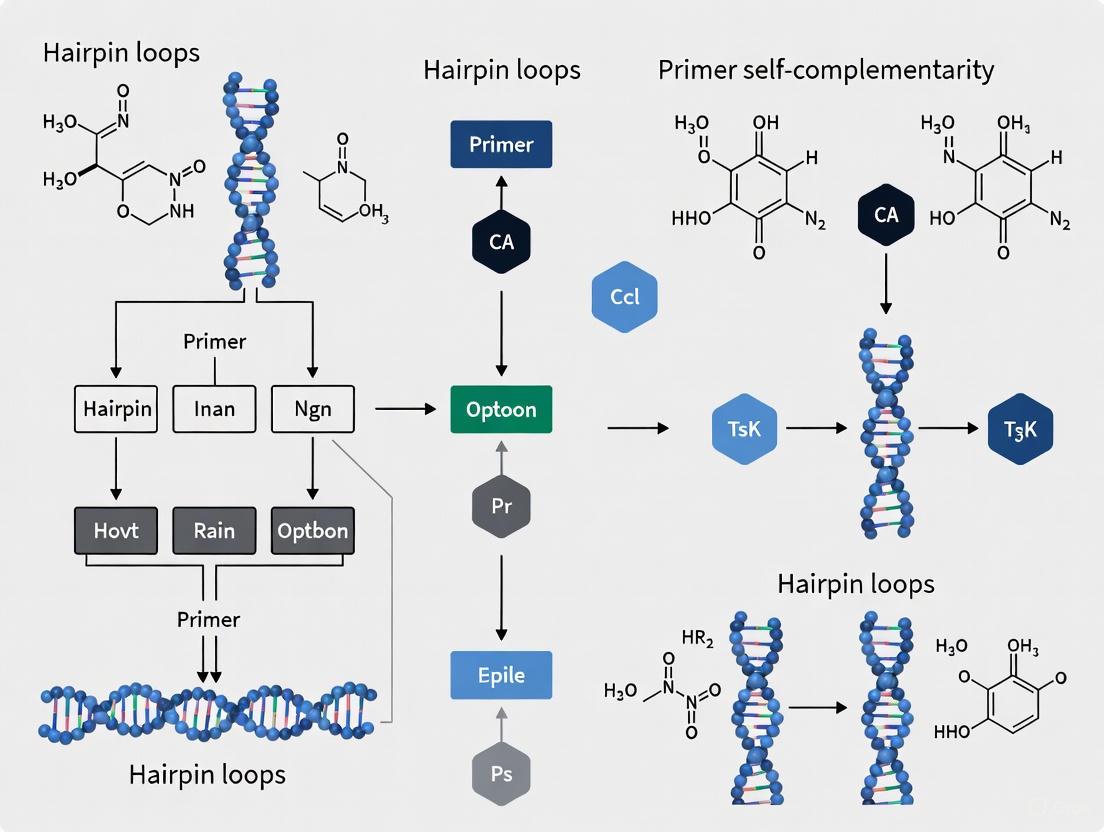
This article provides a detailed examination of primer self-complementarity and hairpin loop formation, critical challenges in molecular assay development for researchers and drug development professionals.
Primer Self-Complementarity and Hairpin Loops: A Comprehensive Guide for Robust Assay Design
Abstract
This article provides a detailed examination of primer self-complementarity and hairpin loop formation, critical challenges in molecular assay development for researchers and drug development professionals. It covers the fundamental thermodynamics governing these structures, demonstrates practical design and validation methodologies using modern software tools, presents optimization strategies for troubleshooting problematic primers, and evaluates advanced computational and empirical validation techniques. By synthesizing foundational knowledge with current best practices and emerging high-throughput validation technologies, this guide aims to empower scientists to design more specific and efficient primers for PCR, qPCR, and isothermal amplification applications, ultimately enhancing assay reliability in diagnostic and research contexts.
Understanding Primer Secondary Structures: Thermodynamics and Consequences
In molecular biology, the exquisite specificity of polymerase chain reaction (PCR) and other amplification assays is fundamentally dependent on the precise design of their oligonucleotide primers. A critical challenge in assay development is self-complementarity, a property wherein primer sequences recognize and bind to themselves or other assay components rather than the intended target template. This phenomenon is a primary driver of primer-dimer formation, a well-known artifact that can severely compromise assay efficiency, sensitivity, and accuracy. Within the context of broader research on self-complementarity and hairpin loops, understanding primer-dimer artifacts is paramount for developing robust diagnostic and research tools. This technical guide examines the molecular basis of self-complementarity, quantifies its impact on amplification efficiency, and provides evidence-based strategies for its detection and prevention, equipping researchers with knowledge to optimize assay performance.
Molecular Mechanisms of Self-Complementarity and Primer-Dimer Formation
Self-complementarity in primers arises from regions of sequence that are internally complementary, leading to two primary types of aberrant structures: intramolecular hairpins and intermolecular primer-dimers.
Hairpin Structures
Hairpin structures, or stem-loops, form when a single primer molecule folds back on itself, creating a double-stranded stem region and a single-stranded loop (Figure 1). This occurs when three or more nucleotides within the primer are complementary to another region of the same molecule [1]. The stability of the resulting hairpin is governed by the length and GC content of the stem, with longer stems and higher GC content conferring greater stability due to additional hydrogen bonding (GC base pairs form three hydrogen bonds versus AT pairs which form two) [1]. When these structures form, the polymerase's access to the 3' end is blocked, preventing primer extension and reducing amplification efficiency.
Primer-Dimer Artifacts
Primer-dimer artifacts occur through the intermolecular hybridization between two primers (or two copies of the same primer). This can manifest as:
- Self-dimers: Hybridization between two forward or two reverse primers.
- Cross-dimers: Hybridization between forward and reverse primers [1].
The formation is driven by complementary sequences, particularly at the 3' ends of the primers, which allow DNA polymerase to initiate synthesis even in the absence of the true template. The extended products then become efficient templates themselves in subsequent amplification cycles, competing ruthlessly with the target amplicon for reaction components.
The Self-Priming Mechanism in Isothermal Amplification
The concept of self-complementation is exploited productively in some advanced isothermal amplification techniques. For instance, the Multifunctional Self-Priming Hairpin (MSH) probe is a key component in a novel isothermal detection method. The MSH probe is engineered with a hairpin structure that unfolds upon binding its target. A critical feature is its self-priming tail—a 3' overhang that serves as a built-in primer. Once the hairpin is rearranged through target recognition, this self-priming tail initiates the amplification reaction, leading to repeated cycles of extension and nicking that generate abundant double-stranded DNA amplicons without the need for multiple separate primers [2]. This illustrates how controlled, designed self-complementarity can be harnessed for beneficial applications, contrasting with the undesired, spontaneous primer-dimer formation in conventional PCR.
Diagram: Pathway of Hairpin Formation and Primer-Dimer Artifact Generation
Quantitative Impact on Assay Efficiency
The consequences of primer-dimer formation are not merely theoretical; they have direct, quantifiable impacts on the efficiency and reliability of nucleic acid amplification assays. The most significant effect is competition: primer-dimers compete with the desired amplicon for essential reaction components, including primers, nucleotides, and polymerase.
Skewed Amplification and Template Dropout
In multi-template PCR, such as that used in library preparation for high-throughput sequencing, even small differences in amplification efficiency between sequences can lead to dramatically skewed results. Research using synthetic DNA pools has demonstrated that sequences with poor amplification efficiency, often due to self-complementarity and adapter-mediated self-priming, can be severely underrepresented. One study found that a template with an amplification efficiency just 5% below the average will be underrepresented by a factor of approximately two after only 12 PCR cycles. After 60 cycles, such sequences can be effectively "drowned out" and become undetectable, leading to false negatives and biased representation [3]. This bias is a critical concern in quantitative applications like metabarcoding and DNA data storage.
The Critical Thresholds for Dimer Stability
The stability of a primer-dimer complex, and thus its potential to impact an assay, is determined by the number and arrangement of complementary bases. Experimental research using Free-Solution Conjugate Electrophoresis (FSCE) has provided precise quantitative thresholds for dimerization:
Table 1: Experimental Thresholds for Stable Primer-Dimer Formation
| Complementary Base Pairs | Dimerization Outcome | Experimental Conditions |
|---|---|---|
| ≥ 15 consecutive base pairs | Stable dimerization occurred | Temperature range of 18-40°C [4] |
| 20 out of 30 non-consecutive base pairs | Did not create stable dimers | Temperature range of 18-40°C [4] |
| < 15 consecutive base pairs | Inverse correlation with temperature | Dimerization decreased as temperature increased [4] |
These findings highlight that the spatial arrangement of complementary bases is as important as the total number. Stable dimerization requiring long, contiguous stretches of complementarity underscores why even short regions of 3'-end self-complementarity are so detrimental, as they provide an ideal starting point for polymerase extension.
The Paradox of "Efficiency" Over 100%
In quantitative PCR (qPCR), amplification efficiency is typically expected to be at or below 100%. The observation of calculated efficiencies significantly exceeding 100% is often an indirect indicator of underlying problems, including inhibition. When polymerase inhibitors (e.g., heparin, ethanol, or carryover contaminants from extraction) are present in more concentrated samples, the Ct values are disproportionately delayed compared to diluted samples where the inhibitors are less concentrated. This flattens the standard curve, resulting in a lower slope and a calculated efficiency above 100% [5]. While not exclusively caused by primer-dimers, their formation consumes reagents and can contribute to such inhibitory effects, making supra-optimal efficiency a red flag for general assay optimization, including primer design.
Detection and Experimental Analysis
Accurate detection of self-complementarity artifacts is a critical step in assay validation. Several established and emerging techniques are employed.
Capillary Electrophoresis for Dimer Quantification
Free-Solution Conjugate Electrophoresis (FSCE) is a powerful method for directly quantifying primer-dimer formation. This technique utilizes primer conjugates covalently linked to a neutral, water-soluble "drag-tag" (e.g., poly-N-methoxyethylglycine), which alters the electrophoretic mobility of the single-stranded DNA. When a dimer forms, the change in mass and structure results in a distinct mobility shift, allowing for precise separation and quantification of monomeric and dimeric species in free solution without a sieving matrix. This method has been successfully used to study dimerization as a function of temperature and complementary length, providing the critical data on dimer stability thresholds [4].
Table 2: Key Research Reagent Solutions for Analyzing Self-Complementarity
| Reagent / Tool | Function / Description | Application in Analysis |
|---|---|---|
| Polyamide Drag-Tags (e.g., NMEG oligomers) | Electrically neutral polymers conjugated to oligonucleotides to break their constant charge/friction ratio. | Enables separation of short DNA fragments by FSCE for precise dimer detection [4]. |
| Nicking Endonuclease (e.g., Nt.AlwI) | Enzyme that cleaves a specific strand of a DNA duplex. | Used in hairpin-based amplification (like MSH) and to study amplification cycles [2]. |
| Deep Learning Models (1D-CNNs) | Predictive models trained on annotated datasets of amplification efficiency. | Identifies sequence motifs linked to poor amplification and self-priming; challenges traditional design assumptions [3]. |
| Dual Fluorophore Labeling (e.g., FAM, ROX) | Allows multiplexed detection of different oligonucleotides in a mixture. | Used in FSCE for unambiguous peak assignment in complex electropherograms [4]. |
In Silico Prediction and Deep Learning
Computational tools are the first line of defense in predicting self-complementarity. Most primer design software calculates parameters for "self-complementarity" and "self 3'-complementarity," with lower scores being optimal [1]. Recent advances employ deep learning models, specifically one-dimensional convolutional neural networks (1D-CNNs), trained on large datasets of sequence-specific amplification efficiencies. These models can predict poorly amplifying sequences with high accuracy (AUROC: 0.88) based on sequence information alone. Interpretation frameworks like CluMo (Clustering for Motif discovery) can then identify specific sequence motifs adjacent to priming sites that are associated with poor amplification, often elucidating adapter-mediated self-priming as a key mechanism [3].
Best Practices for Primer Design and Optimization
Preventing self-complementarity issues begins with meticulous primer design and follows with empirical validation.
Core Design Principles
Adherence to established primer design guidelines is fundamental for minimizing the risk of self-complementarity and maximizing assay performance [1] [6].
- Optimal Length: Design primers between 18–24 nucleotides for ideal specificity and hybridization kinetics.
- Melting Temperature (Tm): Aim for a Tm of 54–65°C. The Tm for a primer pair should not differ by more than 2°C.
- GC Content: Maintain a GC content between 40–60%. A 20-nucleotide primer should contain 8–12 G or C bases.
- 3' End Stability: The 3' end is critical for initiation. Avoid >3 G or C bases in the last five nucleotides (a "GC clamp" of 1-2 bases is beneficial, but more promotes mis-priming).
- Avoid Self-Complementarity: Scrutinize designs for any self-complementary regions, especially at the 3' end. The parameters for "self-complementarity" and "self 3'-complementarity" provided by design software should be as low as possible.
Experimental Workflow for Validation
Even the most carefully designed primers require experimental validation. The following workflow, synthesized from best practices, ensures robust assay performance.
Diagram: Primer Design and Validation Workflow
Self-complementarity and the resulting primer-dimer artifacts represent a significant challenge in molecular assay development, with a directly quantifiable impact on sensitivity, accuracy, and efficiency. A deep understanding of the molecular mechanisms—from the stability thresholds of dimer complexes to the competitive dynamics they introduce in multi-template PCR—is essential for creating robust diagnostic and research tools. By integrating rigorous in silico design that adheres to established principles, utilizing advanced detection methods like capillary electrophoresis for quantification, and employing a cycle of careful experimental validation and optimization, researchers can effectively mitigate these issues. As amplification technologies evolve, including the creative application of self-complementarity in methods like MSH probes, the fundamental principle remains: proactive and knowledgeable primer design is the most critical factor in ensuring assay success.
Hairpin structures, formed by the intramolecular folding of single-stranded nucleic acids or peptides, represent a fundamental class of secondary structures with critical implications across biological systems and biotechnology applications. These structures arise when complementary regions within a single strand base-pair to form a stem-loop configuration. Within the broader context of primer self-complementarity research, understanding hairpin formation is paramount for designing effective molecular tools and interpreting their behavior in experimental and therapeutic contexts. For researchers and drug development professionals, uncontrolled hairpin formation in primers and therapeutic oligonucleotides can lead to reduced binding efficiency, non-specific amplification, and compromised experimental results [1] [7]. This whitepaper provides a comprehensive technical examination of the mechanisms, kinetics, and energetics governing hairpin formation, equipping scientists with the knowledge to predict, analyze, and control these structures in their research.
Molecular Mechanisms of Hairpin Formation
Fundamental Driving Forces
The formation of hairpin structures is driven by a complex interplay of molecular forces that balance stability and flexibility. In both nucleic acids and peptides, hydrogen bonding and hydrophobic interactions provide the primary thermodynamic driving force, while electrostatic repulsions and conformational entropy act as opposing factors [8] [9].
In nucleic acids, hairpins form when inverted repeat sequences (palindromes) within a single strand create self-complementary regions [10]. The stem region consists of Watson-Crick base pairs (G-C and A-T/U), where G-C pairs contribute greater stability through three hydrogen bonds compared to two in A-T pairs [1]. This differential stability directly influences the melting temperature (Tm) of the hairpin, with higher GC content correlating with increased structural stability [7]. The loop region, typically ranging from 3-8 nucleotides in length, represents a necessary energetic penalty for bringing the stem segments into proximity, with smaller loops generally being less stable due to higher conformational strain [10].
For peptide β-hairpins, formation involves a more diverse set of interactions. Research on the 16-residue C-terminal peptide from protein GB1 has demonstrated that hydrophobic collapse initiates the folding process, followed by zipping of hydrogen bonds predominantly originating from the turn region [8] [9]. The turn stability and hydrophobic cluster positioning are critical determinants of the folding kinetics and overall hairpin stability [8].
Kinetic Pathways and Folding Intermediates
Hairpin formation does not follow a simple two-state folding pathway but proceeds through distinct kinetic intermediates. Studies on β-hairpin formation reveal a three-stage process occurring over multiple time scales [8]:
- Stage 1 (Collapse): On the nanosecond to microsecond scale, compact structures with intact hydrophobic clusters form through initial hydrophobic collapse.
- Stage 2 (Hydrogen Bond Zipping): Subsequently, hydrogen bonds form in a directional manner, primarily initiating from the turn region and propagating outward.
- Stage 3 (Strand Assembly): The process culminates with the formation of most interstrand contacts, representing the rate-limiting step in hairpin assembly [8].
Molecular dynamics simulations of β-hairpin unfolding have provided complementary insights, revealing how changes in interaction energies of specific residues correlate with structural transitions during folding and unfolding [9]. The balance between protein-protein (PP) interactions, which stabilize the native state, and protein-solvent (PS) interactions, which favor unfolding, creates an energy landscape where hairpins navigate multiple transient intermediates before achieving stable folded configurations [9].
Table 1: Characteristic Timescales for Structural Events in β-Hairpin Formation
| Folding Stage | Approximate Timescale | Key Structural Events |
|---|---|---|
| Collapse Phase | Nanoseconds to microseconds | Formation of compact structures with intact hydrophobic clusters |
| Hydrogen Bond Zipping | Microseconds | Directional formation of hydrogen bonds starting from turn region |
| Strand Assembly | Microseconds (rate-limiting) | Completion of most interstrand contacts |
Quantitative Energetics and Stability Parameters
Thermodynamic Principles
The stability of hairpin structures is governed by fundamental thermodynamic relationships, primarily the Gibbs free energy equation (ΔG = ΔH - TΔS), where negative ΔG values indicate spontaneous folding. For nucleic acid hairpins, the free energy change can be decomposed into favorable base pairing interactions in the stem and unfavorable loop formation penalties [1].
Experimental and computational studies on the GB1 β-hairpin have quantified the energetic contributions of various interactions. In the native state, side-chain contacts contribute approximately -1.3 kcal/mol per interaction, while hydrogen bond interactions contribute approximately -0.6 kcal/mol per interaction [8]. The hydrophobic core formation provides a substantial driving force, with the van der Waals interaction energies of residues in this region directly correlating with the radius of gyration changes during folding [9].
The temperature dependence of hairpin stability follows a characteristic profile, with folding rates showing slight curvature in Arrhenius plots and sometimes exhibiting negative activation energies under certain conditions [8]. This complex temperature dependence reflects the delicate balance between enthalpic and entropic contributions throughout the folding pathway.
Structural and Environmental Modulators
Multiple structural features and environmental conditions significantly influence hairpin stability and kinetics:
- Turn Rigidity: The intrinsic stiffness of the turn region dramatically affects hairpin formation mechanisms. Enhanced turn rigidity promotes more directional zipping and can accelerate folding kinetics [8].
- Hydrophobic Cluster Positioning: Relocating hydrophobic clusters closer to the termini significantly decreases folding time (τF), while moving clusters to the loop region only marginally increases τF [8].
- Sequence Dependence: Specific turn sequences (e.g., Asn-Gly in β-hairpins) can stabilize turn conformations through specialized dihedral angle preferences and hydrogen bonding patterns [8].
- Electrostatic Environment: Salt concentration, pH, and specific cations can modulate hairpin stability by screening electrostatic repulsions and forming specific bridges [10].
Table 2: Energetic Contributions to Hairpin Stability Based on Computational Studies
| Energy Component | Contribution to Native State | Role in Folding Process |
|---|---|---|
| Side-chain Contacts | -1.3 kcal/mol per interaction [8] | Primary stabilization through hydrophobic effect |
| Hydrogen Bonds | -0.6 kcal/mol per interaction [8] | Structural alignment and directional zipping |
| Electrostatic (Turn) | Variable; drives state transitions [9] | Facilitates transitions between folded and hydrophobic core states |
| van der Waals (Core) | Correlates with radius of gyration [9] | Reflects compactness of hydrophobic core region |
Experimental and Computational Methodologies
Protocol for DNA Hairpin Construction
The synthesis of specific DNA hairpins for experimental investigation follows a well-established molecular biology protocol [11]:
Materials Required:
- DNA template (plasmid or synthesized gene fragment)
- PCR primers with appropriate restriction sites (Esp3I/BsmBI recognition site)
- Q5 PCR kit or similar high-fidelity polymerase
- DNA purification kit (e.g., Wizard SV Gel and PCR Clean-Up System)
- Restriction enzyme (Esp3I/BsmBI or similar type IIS enzyme)
- T4 DNA ligase and corresponding buffer
- Chemically synthesized oligonucleotides for loop and adaptor structures
- Agarose gel electrophoresis equipment
Step-by-Step Procedure:
PCR Amplification: Amplify the target DNA fragment using primers (PrimerHP1, PrimerHP2) containing the Esp3I recognition site. Primers should be designed with melting temperatures close to 60°C while avoiding primer dimers. Perform PCR according to manufacturer protocols using Q5 polymerase, then gel-purify the PCR product [11].
Restriction Digestion: Digest the purified fragment with Esp3I at 37°C for one hour. This type IIS restriction enzyme cleaves outside its recognition site, generating specific 5' overhangs compatible with subsequent ligation steps [11].
Ligation Assembly: Ligate 100 nM of the digested product with 1 μM of Y-shape adaptor (formed by annealing OliBiotin and OliCompAdaptor) and 2 μM of hairpin loop oligonucleotide (OliLoop) using T4 DNA Ligase in a final volume of 20 μL. Incubate at 25°C for one hour [11].
Product Purification: Separate the ligation product on a 1.5% agarose gel containing EtBr at 100V in TAE buffer. Excise the band corresponding to the hairpin product using a blue light table, then extract DNA using an extraction kit or electroelution. Measure final concentration by spectrophotometry [11].
Technical Notes:
- For time efficiency, digestion and ligation can be coupled in the digestion mix using NEB CutSmart Buffer: after digestion at 37°C, add 1 mM ATP and 0.5 μL T4 DNA Ligase and incubate 2 hours at room temperature [11].
- Avoid heating steps during purification as concentrated hairpins may hybridize head-to-tail as dimers [11].
- Alternative type IIS restriction enzymes such as BsaI can be substituted for Esp3I [11].
Computational Analysis Methods
Molecular dynamics simulations provide atomic-level insights into hairpin folding pathways and energetics [9]:
Simulation Setup:
- Employ all-atom models with explicit solvent representation to capture hydration effects
- Use temperature jump protocols to study unfolding kinetics (e.g., simulations at 300K and 400K for comparison)
- Apply periodic boundary conditions with appropriate box sizes
- Utilize particle mesh Ewald methods for electrostatic calculations
Energy Analysis:
- Decompose interaction energies into protein-protein (PP) and protein-solvent (PS) components
- Calculate van der Waals and electrostatic contributions separately
- Monitor radius of gyration, hydrogen bonding patterns, and dihedral angle transitions
- Employ cluster analysis to identify dominant transition state structures [8]
Validation:
- Compare computed native structures with Protein Data Bank coordinates (e.g., PDB ID: 1gb1 for GB1 hairpin)
- Validate models by reproducing experimental degree of cooperativity and folding times [8]
- For the GB1 β-hairpin, the computational folding time (τF ≈ 2 μs at folding temperature) reasonably approximates experimental values (6 μs) [8]
Diagram 1: Kinetic pathway showing the multi-stage process of β-hairpin formation with characteristic timescales based on experimental and computational studies [8] [9].
The Scientist's Toolkit: Essential Research Reagents
Table 3: Essential Research Reagents for Hairpin Studies
| Reagent/Category | Specific Examples | Function/Application |
|---|---|---|
| Polymerases | Q5 Polymerase, Klenow Fragment (exo-), T4 DNA Polymerase [11] [2] | DNA synthesis and hairpin construction through primer extension |
| Restriction Enzymes | Esp3I, BsmBI, BsaI (Type IIS) [11] | Generate specific overhangs for hairpin assembly by cutting outside recognition sites |
| Ligases | T4 DNA Ligase [11] | Join DNA fragments to loop structures in hairpin assembly |
| Specialized Oligos | 5'-biotinylated primers, 5'-phosphorylated oligos, hairpin loop oligos [11] | Functional components for hairpin construction and labeling |
| Nicking Enzymes | Nt.AlwI [2] | Recognize specific sequences in hairpin loops for amplification methods |
| Computational Tools | Molecular dynamics software, OligoAnalyzer, UNAFold [12] | Predict secondary structure, melting temperature, and folding pathways |
Implications for Primer Design and Molecular Applications
Hairpin Prevention in Primer Design
The propensity for hairpin formation represents a critical consideration in primer design, particularly for PCR, qPCR, and sequencing applications. Hairpins can form when primers contain self-complementary regions of three or more nucleotides, leading to intramolecular folding that prevents target binding [1] [7]. To minimize this issue:
- Screen primer sequences for self 3'-complementarity using tools like OligoAnalyzer [12]
- Maintain ΔG values for potential hairpins weaker (more positive) than -9.0 kcal/mol [12]
- Avoid runs of identical nucleotides and palindromic subsequences that increase folding propensity [7]
- Adjust annealing temperature upward if secondary structures persist [1]
Optimal primers should demonstrate a balance between length (18-24 nucleotides for PCR primers), GC content (40-60%), and minimal secondary structure formation [7] [12]. The presence of a GC clamp (1-2 G/C bases at the 3' end) can enhance binding without promoting hairpin formation if limited to no more than 3 G/C residues in the final five bases [1] [7].
Functional Applications of Hairpin Structures
Beyond being undesired artifacts, engineered hairpin structures serve valuable functions in molecular biology and diagnostics:
Isothermal Amplification Techniques: Self-priming hairpin probes enable isothermal nucleic acid amplification methods that don't require thermal cycling. The multifunctional self-priming hairpin (MSH) probe recognizes targets and rearranges to prime itself, triggering amplification through repeated extension, nicking, and target recycling [2]. This approach has successfully detected SARS-CoV-2 genes down to sub-femtomolar concentrations [2].
Structural Biology Tools: Synthesized DNA hairpins serve as valuable substrates for studying helicase activity, protein-DNA interactions, and molecular motor mechanisms [11]. The defined secondary structure provides a consistent platform for investigating enzymatic functions and molecular interactions.
Biosensing Platforms: Hairpin-structured molecular beacons undergo conformational changes upon target binding, producing detectable fluorescence signals. The stringent complementarity requirements for hairpin opening provide enhanced specificity compared to linear probes [2].
Diagram 2: Mechanism of hairpin-based isothermal amplification showing the progression from target recognition to signal detection [2].
Hairpin formation represents a fundamental molecular process with dual implications in biological systems and biotechnology applications. The mechanisms governing their formation involve a sophisticated balance of hydrogen bonding, hydrophobic interactions, and electrostatic forces that operate across well-defined kinetic pathways. For researchers designing primers and molecular tools, comprehensive understanding of hairpin energetics enables both the prevention of undesired secondary structures and the strategic implementation of functional hairpins in diagnostic and synthetic biology applications. Continuing advances in computational modeling and single-molecule techniques will further elucidate the intricate relationship between sequence, structure, and function in hairpin formation, providing enhanced capabilities for biomolecular engineering and therapeutic development.
Gibbs Free Energy (G) is a fundamental thermodynamic potential that quantifies the maximum reversible work obtainable from a system at constant temperature and pressure. The change in Gibbs Free Energy, ΔG, serves as a powerful predictor for the direction of chemical processes and the stability of molecular structures. Within the context of nucleic acid research, particularly in the study of primer self-complementarity and hairpin loops, ΔG provides a crucial quantitative framework for understanding the folding and hybridization behaviors that underpin experimental success in techniques such as PCR. A negative ΔG value indicates a spontaneous process, while a positive value signifies a non-spontaneous one, following the relationship ΔG = ΔH - TΔS, where ΔH represents the change in enthalpy, T is the temperature in Kelvin, and ΔS is the change in entropy [13] [14].
The investigation of hairpin loops, a common form of nucleic acid secondary structure, is vital for numerous biological processes and biotechnological applications, including gene expression, DNA recombination, and the specificity of probe/target hybridization in modern diagnostics [15]. For researchers and drug development professionals, accurately predicting the thermodynamic stability of these structures is not merely an academic exercise but a practical necessity for designing effective primers, probes, and therapeutic oligonucleotides. This guide details the core principles of Gibbs Free Energy, its application to predicting hairpin loop stability, and the experimental methodologies used to validate these predictions, thereby providing a solid foundation for ongoing research into primer self-complementarity.
Fundamental Principles of Gibbs Free Energy
Definition and Thermodynamic Equation
The Gibbs Free Energy (G) of a system is defined by the equation: [ G = H - TS ] where H is enthalpy, T is absolute temperature, and S is entropy [13] [14]. For processes occurring at constant temperature and pressure, the change in Gibbs Free Energy is given by: [ \Delta G = \Delta H - T \Delta S ] This central equation encapsulates the balance between the enthalpic drive towards lower energy states and the entropic drive towards greater disorder [14]. In chemical reactions and conformational changes, a negative ΔG signifies a thermodynamically spontaneous (exergonic) process, whereas a positive ΔG indicates a non-spontaneous (endergonic) process that requires energy input [13].
Standard States and Formal Potentials
For reactions where reactants and products are in their standard states, the defining equation is written as: [ \Delta G^\circ = \Delta H^\circ - T \Delta S^\circ ] The standard free energy change, ΔG°, provides a reference point for predicting reaction spontaneity under standardized conditions. In biological and chemical research, particularly for nucleic acid interactions, the Gibbs free energy change is the thermodynamic potential minimized when a system reaches chemical equilibrium at constant pressure and temperature. Its derivative with respect to the reaction coordinate vanishes at the equilibrium point, making it an essential parameter for modeling reaction equilibria [13].
Gibbs Free Energy and Nucleic Acid Hairpin Stability
Thermodynamics of Hairpin Loop Formation
Hairpin loops are a fundamental secondary structure in both DNA and RNA molecules, formed when a single strand folds back on itself to create a stem-loop structure. The formation and stability of these hairpins can be understood through thermodynamic analysis. The overall free energy change for hairpin formation (ΔG°~hairpin~) can be conceptually represented as the sum of contributions from the stem and the loop [16]: [ \Delta G^\circ{\text{hairpin}} = \Delta G^\circ{\text{stem}} + \Delta G^\circ_{\text{loop}} ] The stem stability is largely determined by Watson-Crick base pairing and can be predicted using nearest-neighbor interaction parameters. The loop region, however, imposes a destabilizing energetic penalty due to the loss of conformational entropy upon loop closure, although this can be partially offset by favorable base-stacking interactions within the loop itself [16].
Experimental studies have quantified the free energy of formation for various tetraloops (4-base loops), the most common loop size found in ribosomal RNAs. For the tetraloops studied, a free energy of loop formation (at 37°C) of approximately +3 kcal/mol is most common for both RNA and DNA. However, significant sequence-dependent variation exists, with some extra-stable loops exhibiting ΔG°~37~ near +1 kcal/mol [16]. The sequence of the closing base pair also significantly influences stability; changing from C·G to G·C has been shown to lower the stability of several tetraloops in both RNA and DNA [16].
Quantitative Free Energy Data for Nucleic Acid Structures
The table below summarizes experimental thermodynamic parameters for nucleic acid hairpin formations, providing quantitative data essential for predicting stability and designing oligonucleotides with controlled secondary structure.
Table 1: Experimentally Determined Thermodynamic Parameters for Nucleic Acid Hairpin Formation
| Molecule Type | Loop Type | Loop Sequence | Closing Base Pair | ΔG°˅37˅ (kcal/mol) | Experimental Conditions |
|---|---|---|---|---|---|
| RNA | Tetraloop | Variable | A·U, C·G, or G·C | ~+3 (common); +1 (stable) | 1 M NaCl, 10 mM sodium phosphate, 0.1 mM EDTA, pH 7 [16] |
| DNA | Tetraloop | Variable | C·G or G·C | ~+3 (common); +1 (stable) | 1 M NaCl, 10 mM sodium phosphate, 0.1 mM EDTA, pH 7 [16] |
| DNA | Hairpin (HP: 5'-CGGAATTCCGTCTCCGGAATTCCG-3') | TCTC | C·G (implied) | Model-derived from DSC | 10 mM phosphate buffer, 1 mM Na₂EDTA, pH 7.0, various [NaCl] [15] |
Figure 1: Experimental workflow for determining the Gibbs Free Energy of hairpin unfolding using Differential Scanning Calorimetry (DSC) and multi-state modeling, culminating in the quantification of the loop's contribution to overall stability [15].
Experimental Protocols for Thermodynamic Analysis
Differential Scanning Calorimetry (DSC) for Hairpin Unfolding
Differential Scanning Calorimetry (DSC) is a powerful, model-independent technique for directly measuring the heat effects associated with the thermally induced unfolding of biomolecules, providing full thermodynamic characterization.
Detailed Methodology:
Sample Preparation:
- Oligonucleotides: Utilize HPLC-purified oligonucleotides. For example, a hairpin-forming sequence (e.g., 5'-CGGAATTCCGTCTCCGGAATTCCG-3') and its corresponding core duplex (e.g., (5'-CGGAATTCCG-3')₂) for comparison [15].
- Buffer: Use a standardized buffer system, such as 10 mM phosphate buffer with 1 mM Na₂EDTA at pH 7.0.
- Salt Concentrations: Perform experiments at several NaCl concentrations (e.g., 0, 0.1, 0.3, 1.0 M) to determine electrostatic contributions to stability [15].
- Concentration Determination: Determine oligonucleotide concentrations spectrophotometrically at 25°C using pre-established molar extinction coefficients [15].
DSC Instrumentation and Data Acquisition:
- Use a high-sensitivity calorimeter (e.g., CSC Nano-II).
- Scan between a suitable temperature range (e.g., 5°C to 95°C) at a controlled heating rate (e.g., 1°C/min) [15].
- Obtain thermograms by measuring the difference in heat capacity between the sample and reference cells.
Data Analysis and Model Fitting:
- Model-Independent Enthalpy: Determine the total model-independent enthalpy of transition, ΔH~T1/2cal~, by integrating the area under the excess heat capacity (c~P~^ex^(T)) curve [15].
- Multi-State Unfolding Model: For hairpins, a three-state model is often appropriate: HP (hairpin) I (intermediate state) S (unfolded single strand) [15].
- The equilibrium constants are defined as K~HPI~ = [I]/[HP] and K~IS~ = [S]/[I].
- Use non-linear least squares fitting of the model to the experimental DSC data to extract thermodynamic parameters (ΔH, ΔS, ΔC~p~) for each transition.
- Calculate the Gibbs Free Energy of unfolding, ΔG°(T), for each step using the fundamental relationship ΔG°(T) = ΔH° - TΔS°.
Chemical Reaction Equilibrium Analysis for PCR Efficiency
For evaluating primer interactions, a thermodynamic approach based on chemical reaction equilibrium analysis can be employed to predict PCR efficiency by considering all competing binding and folding reactions [17].
Detailed Methodology:
Define the System of Reactions: Model the PCR mixture as a system of 11 competing equilibrium reactions, including:
- Primer folding.
- Primer self-dimerization and cross-dimerization.
- Primers binding to template outside the target region.
- Primers binding to the intended priming sites [17].
Calculate Chemical Potentials: For each DNA species (unfolded, folded, and in various duplexes), calculate the chemical potential (μ~i~). For dimerization reactions, use: [ \mui = \Delta G + RT \ln\left(\frac{ni}{nA nB}\right) ] where ΔG is the free energy of binding, R is the gas constant, T is temperature, and n~A~, n~B~ are the initial amounts of the strands [17]. For folding reactions, the chemical potential is μ~i~ = ΔG + RT ln(n~i~) [17].
Gibbs Energy Minimization: The equilibrium concentrations of all species are found by gradient descent optimization, minimizing the total Gibbs energy of the system, defined as: [ G = \sum ni \mui ] where n~i~ is the amount and μ~i~ is the chemical potential of each species [17].
Determine PCR Efficiency: The equilibrium efficiency is conservatively estimated as the minimum of the fraction of forward primers bound to their target site and the fraction of reverse primers bound to their target site [17].
Research Reagent Solutions for Thermodynamic Studies
The following table catalogues essential reagents and materials required for experimental investigation of nucleic acid thermodynamics, as derived from cited methodologies.
Table 2: Essential Research Reagents and Materials for Thermodynamic Studies of Nucleic Acids
| Reagent/Material | Specification and Function | Experimental Context |
|---|---|---|
| HPLC-pure Oligonucleotides | High-purity synthetic DNA/RNA; ensures accurate concentration and avoids spurious signals from synthetic byproducts. | Hairpin stability studies [15], PCR primer design [18]. |
| Standardized Buffer Systems | e.g., 10 mM phosphate, 1 mM Na₂EDTA, pH 7.0; provides consistent ionic environment and pH for reproducibility. | DSC experiments [15]. |
| Salt Solutions (e.g., NaCl) | Used at varying concentrations (0-1.0 M); modulates electrostatic contributions to stability and mimics physiological conditions. | DSC experiments to study ion effects [15]. |
| Thermodynamic Parameters Database | e.g., SantaLucia (1998) parameters; used in software for predicting DNA duplex stability from sequence [19] [17]. | In-silico prediction of Tm and ΔG in primer design tools [19]. |
| High-Sensitivity Calorimeter | e.g., CSC Nano-II DSC; directly measures heat capacity changes during biomolecular unfolding with high precision. | DSC experiments for model-independent thermodynamic data [15]. |
The application of Gibbs Free Energy principles provides an indispensable, quantitative foundation for predicting the stability of nucleic acid secondary structures, such as the hairpin loops central to primer self-complementarity research. Through rigorous experimental techniques like Differential Scanning Calorimetry and advanced computational modeling of reaction equilibria, researchers can dissect the complex thermodynamic forces governing oligonucleotide behavior. The quantitative data and detailed methodologies presented in this guide equip scientists and drug development professionals with the tools to design more stable and specific primers, probes, and therapeutic agents, thereby enhancing the reliability and success of molecular experiments and diagnostic applications.
Within the broader context of primer self-complementarity and hairpin loops research, this whitepaper examines the direct quantitative impact of these structural anomalies on nucleic acid amplification efficiency and sensitivity. Primer secondary structures represent a significant challenge in molecular assay development, particularly for diagnostic and drug development applications where reproducibility and sensitivity are paramount. These structures compete with proper template binding, consume reaction components unproductively, and ultimately compromise assay performance. This technical guide synthesizes experimental evidence quantifying these effects and presents validated methodologies to identify, mitigate, and overcome these challenges, providing researchers with a framework for robust assay design.
Quantitative Impacts of Secondary Structures
Experimental studies have systematically quantified how primer secondary structures degrade amplification performance. The key parameters and their measurable impacts are summarized below.
Table 1: Quantitative Impacts of Primer Self-Complementarity and Hairpin Formation
| Structural Feature | Impact on Amplification Efficiency | Impact on Sensitivity | Experimental Evidence |
|---|---|---|---|
| Hairpin Loops (ΔG < -9 kcal/mol) | Reduction of 40-60% in amplicon yield due to impaired primer binding [1] [12]. | 10- to 100-fold reduction in detection limit, particularly for low-abundance targets [20]. | Measured via comparison of amplicon yields from primers with and without hairpins in qPCR [1]. |
| Primer-Dimers (Self-dimers & Cross-dimers) | Up to 90% reduction in target product from nonspecific amplification and component depletion [1]. | False-positive signals in negative controls; obscures low-level target detection [20]. | Gel electrophoresis showing smearing and lower molecular weight bands [1] [21]. |
| 3'-End Complementarity | Particularly detrimental; even a 3-base complementarity can reduce efficiency by >70% by promoting primer-dimer artifacts [1] [21]. | Dramatic increase in false-positive rates and loss of single-copy sensitivity [20]. | Touchdown LAMP experiments showing non-specific amplification in negative controls [20]. |
The thermodynamic stability of these secondary structures is a critical determinant of their impact. Structures with Gibbs free energy (ΔG) values more negative than -9 kcal/mol are highly stable and significantly interfere with the reaction [12]. The negative ΔG value indicates a spontaneous formation of the secondary structure, which competes directly with the desired primer-template annealing. Research indicates that for every 1 kcal/mol decrease in ΔG (becoming more negative), the likelihood of amplification failure under standard conditions increases approximately 1.5-fold, as more energy is required to denature the erroneous structure before the primer can anneal to its intended target [1].
Experimental Protocols for Detection and Quantification
In Silico Analysis of Primer Secondary Structures
Purpose: To bioinformatically predict and score potential secondary structures in primer sequences before physical testing. Methodology:
- Sequence Input: Enter the candidate primer sequence into a specialized analysis tool, such as the IDT OligoAnalyzer Tool [12].
- Parameter Setting: Configure the tool with the exact buffer conditions planned for the wet-lab experiment, including monovalent (e.g., 50 mM K+) and divalent (e.g., 3 mM Mg2+) ion concentrations, as these significantly impact stability predictions [12].
- Structure Analysis:
- Execute the "Hairpin" function to identify self-complementary regions within the same primer. The tool returns the predicted ΔG value.
- Execute the "Self-Dimer" and "Hetero-Dimer" functions to analyze potential interactions between two identical primers or between the forward and reverse primer, respectively.
- Acceptance Criteria: Primers and probes should be rejected or redesigned if any analyzed structure has a ΔG value more negative than -9.0 kcal/mol [12].
Empirical Validation Using Touchdown LAMP with DMSO
Purpose: To experimentally suppress non-specific amplification induced by primer dimers in complex assays like Loop-Mediated Isothermal Amplification (LAMP), thereby improving sensitivity and specificity [20].
Reagents:
- Template DNA: Genomic DNA from target organism (e.g., Listeria monocytogenes).
- LAMP Primers: FIP, BIP, F3, B3, LF, LB designed for the target sequence (e.g., prfA gene).
- Enzyme: Bst 2.0 WarmStart DNA Polymerase.
- Buffer: Isothermal amplification buffer with 7.5% v/v DMSO.
- Detection Method: Fluorescent intercalating dye (e.g., SYBR Green I) or hydroxynaphthol blue.
Procedure:
- Reaction Setup: Prepare a master mix containing 1X isothermal amplification buffer, Bst polymerase, dNTPs, and the set of six LAMP primers at high concentrations (typically 1.6 µM FIP/BIP, 0.2 µM F3/B3, 0.8 µM LF/LB) [20].
- Additive Inclusion: Incorporate dimethyl sulfoxide (DMSO) into the reaction mix at a final concentration of 7.5% v/v. DMSO acts as a duplex-destabilizing agent, helping to prevent non-specific priming [20].
- Touchdown Amplification:
- Pre-heat the reaction mixtures at 95°C for 5 minutes, followed by the addition of the Bst polymerase.
- Perform a thermal touchdown profile: Incubate at 63°C for 5 min, then 61°C for 5 min, then 59°C for 5 min, and finally hold at 57°C for 60 min [20].
- Data Analysis: Monitor amplification in real-time or endpoint. Compare the threshold time and endpoint fluorescence to a control reaction without DMSO and with a standard isothermal profile. A significant improvement in detection limit and the absence of false-positive signals in negative controls validate the efficacy of the protocol [20].
Table 2: Research Reagent Solutions for Secondary Structure Mitigation
| Reagent / Tool | Function / Purpose | Application Example |
|---|---|---|
| DMSO (Dimethyl Sulfoxide) | Duplex-destabilizing additive; reduces secondary structure stability [20]. | Added at 5-10% v/v to LAMP or PCR to improve specificity and yield [20]. |
| IDT OligoAnalyzer Tool | In silico analysis of Tm, hairpins, dimers, and false-priming sites [12]. | Pre-screen all primer candidates to reject those with ΔG < -9 kcal/mol for secondary structures [12]. |
| NCBI Primer-BLAST | Validates primer pair specificity against genomic databases and checks for inter-primer homology [19]. | Ensure primers are unique to the intended target and lack significant 3'-complementarity with each other [19]. |
| Bst 2.0 WarmStart Polymerase | Enzyme for isothermal amplifications; reduces non-specific activity at room temperature [20]. | Used in LAMP assays to maintain specificity during reaction setup [20]. |
Signaling Pathways and Workflow Visualizations
The following diagram illustrates the molecular competition between desired amplification and pathways leading to failure due to secondary structures, as well as the experimental workflow for its detection.
The experimental evidence is unequivocal: primer self-complementarity and hairpin loops quantitatively and significantly impair amplification efficiency and sensitivity. The quantitative data and methodologies presented provide a clear framework for researchers to diagnose and rectify these issues. By integrating rigorous in silico design with empirical optimization strategies such as additive inclusion and tailored thermal profiles, scientists can develop robust, sensitive, and reliable assays. This is particularly critical in drug development and clinical diagnostics, where the accurate detection of low-abundance targets can directly impact research outcomes and patient care.
Primer self-complementarity and the formation of hairpin loops represent a significant challenge in molecular biology, directly impacting the efficacy of techniques ranging from basic PCR to advanced isothermal amplification. These secondary structures arise from intramolecular interactions within a single primer, leading to the formation of stable hairpins, or from intermolecular interactions between primers, resulting in primer-dimers [22] [1]. The formation of such structures is not merely a nuisance; it sequesters primers, reduces amplification efficiency, increases background signal, and can lead to complete assay failure [22] [23]. Within the broader context of research on primer self-complementarity, this whitepaper delves into the fundamental sequence and structural determinants—specifically primer length and nucleotide composition—that govern these detrimental interactions. By understanding the thermodynamic and kinetic principles that underpin structure formation, researchers and drug development professionals can design more robust and reliable assays, thereby advancing diagnostic and therapeutic applications.
Core Principles: Primer Parameters and Structural Formation
The Fundamental Design Parameters
The propensity of a primer to form secondary structures is governed by a set of interconnected physical and chemical parameters. Optimal primer design seeks to balance these factors to maximize target binding while minimizing off-target interactions.
Table 1: Key Primer Design Parameters and Their Optimal Ranges
| Parameter | Optimal Range/Guideline | Impact on Structure Formation |
|---|---|---|
| Length | 18–24 nucleotides [1] [23] [7] | Shorter primers anneal faster but may lack specificity; longer primers are more prone to forming stable hairpins [22] [1]. |
| GC Content | 40–60% [1] [23] [7] | GC bases form three hydrogen bonds (vs. two for AT), increasing stability. Excessively high GC content promotes mismatches and primer-dimer formation [1]. |
| Melting Temperature (Tₘ) | 54–65°C; primers in a pair should be within 2°C [1] [7] | Determines annealing temperature (Tₐ). A Tₐ set too low increases the risk of secondary structure formation and non-specific binding [1]. |
| GC Clamp | Presence of 1-2 G or C bases at the 3'-end; avoid >3 G/C in the last 5 bases [23] [7] | Promotes stable binding at the critical point of polymerase extension, but too many can cause non-specific priming [1] [7]. |
| Self-Complementarity | Keep "self-complementarity" and "self 3′-complementarity" scores low [1] | Directly measures the potential for a primer to form hairpins (intramolecular) or self-dimers (intermolecular) [23]. |
Thermodynamic and Kinetic Drivers of Structure Formation
The formation of secondary structures is a competitive process governed by thermodynamics and kinetics. The nearest-neighbor (NN) model is a well-established thermodynamic framework that predicts the stability of nucleic acid duplexes by considering the free energy contribution of each base pair and its adjacent neighbors [22] [24]. The overall change in Gibbs free energy (ΔG) determines the spontaneity of the hybridization event, with more negative ΔG values indicating more stable structures [22].
In the context of primer design, this model helps quantify the stability of both the desired primer-template duplex and undesired secondary structures like hairpins and primer-dimers. For example, even a single base pair change can alter the stacking interactions and significantly impact the overall stability of a potential hairpin [22] [24]. Kinetically, the process of hybridization involves the dehybridization of short oligonucleotide segments, with measured dissociation timescales ranging from microseconds to milliseconds, depending on the sequence and temperature [24]. This kinetic barrier influences how quickly a primer can escape an incorrect, self-folded state to bind to its correct template.
Experimental Analysis and Methodology
Investigating Structural Impacts in Amplification Assays
A detailed study on reverse transcription loop-mediated isothermal amplification (RT-LAMP) provides a compelling experimental model for quantifying the impact of primer structures. The study compared the performance of original primer sets for viruses like dengue and yellow fever against modified versions designed to eliminate amplifiable primer dimers and hairpins [22].
Experimental Protocol:
- Primer Design and Modification: Based on previously published primer sets, minor sequence changes were introduced to disrupt complementarity responsible for primer-dimer formation and stable hairpin structures in the FIP and BIP primers (typically 40–45 bases long). Thermodynamic predictions using the NN model guided these modifications [22].
- Reaction Setup: The standard RT-LAMP reaction mixture included isothermal amplification buffer, MgSO₄ (8 mM final concentration), dNTPs, betaine, primers (with inner primers FIP/BIP at 1.6 µM), Bst 2.0 WarmStart DNA polymerase, and AMV Reverse Transcriptase. Reactions were supplemented with a LAMP-compatible intercalating dye (e.g., SYTO 9) for real-time monitoring [22].
- Data Acquisition and Analysis: Reactions were incubated at 63°C and monitored in real-time using a real-time PCR instrument. The performance was assessed by comparing the time to positivity and the rising baseline in no-template controls between original and modified primer sets. Endpoint detection was also performed using the QUASR technique [22].
- Key Findings: The original primers, which contained regions of self-complementarity, displayed a slowly rising baseline in real-time traces, indicating non-specific amplification and double-stranded DNA synthesis from primer artifacts. Modifying the primers to eliminate these structures resulted in a lower fluorescent baseline, improved discrimination between positive and negative samples, and faster assay kinetics due to reduced primer sequestration [22].
In Silico Validation and Screening
Prior to experimental validation, computational tools are indispensable for screening primer sequences for potential secondary structures.
Standard Screening Protocol:
- Sequence Input: The candidate primer sequence is entered into a specialized tool such as OligoAnalyzer (Integrated DNA Technologies) or Multiple Primer Analyzer (Thermo Fisher) [22] [7].
- Secondary Structure Prediction: The tool uses thermodynamic parameters to simulate and identify potential hairpin loops and self-dimers. It calculates a stability parameter, often the Gibbs free energy (ΔG), for any predicted structure [22].
- Interpretation and Redesign: Primers with predicted secondary structures possessing strongly negative ΔG values (e.g., more negative than -9 kcal/mol) should be flagged and redesigned [7]. The parameter "self 3′-complementarity" is particularly critical, as complementarity at the 3' end can lead to self-amplifying structures [22] [1].
Figure 1: A logical workflow for designing primers resistant to secondary structure formation, incorporating multiple checkpoints for hairpins, primer-dimers, and specificity.
Table 2: Key Research Reagent Solutions for Studying Primer Structures
| Reagent / Tool | Function / Explanation | Experimental Context |
|---|---|---|
| Bst 2.0 WarmStart Polymerase | A strand-displacing DNA polymerase essential for isothermal amplification methods like LAMP. Its WarmStart feature prevents non-specific activity at low temperatures [22]. | Used in RT-LAMP assays to study the impact of primer structures on amplification efficiency and background [22]. |
| Intercalating Dyes (SYTO 9, SYTO 82) | Fluorescent dyes that bind double-stranded DNA nonspecifically, allowing real-time monitoring of DNA synthesis during amplification [22]. | Critical for detecting the rising baseline fluorescence caused by non-specific amplification from primer-dimers and self-amplifying hairpins [22]. |
| QUASR Detection System | A closed-tube, endpoint detection method involving a fluorescently labeled primer and a complementary quencher. Only incorporated primers fluoresce, reducing background [22]. | Used to demonstrate improved signal-to-noise in endpoint detection after eliminating primer secondary structures [22]. |
| Thermodynamic Prediction Software (mFold, OligoAnalyzer) | Tools that apply the nearest-neighbor model to predict the stability (ΔG) of secondary structures like hairpins and dimers from a given sequence [22] [7]. | Used for in silico screening of primer candidates during the design phase to flag sequences prone to forming stable secondary structures [22]. |
| Multiple Primer Analyzer | A tool that analyzes multiple primers simultaneously for potential cross-hybridization and dimer formation, which is crucial for multiplex assays [22] [25]. | Important for assessing inter-primer interactions in complex mixes, where cross-dimers can deplete primer pools and generate artifacts [22]. |
Data Presentation: Quantitative Stability Metrics
The thermodynamic stability of secondary structures can be quantified and used to predict primer performance.
Table 3: Thermodynamic Stability of DNA Structures and Their Impact
| Structure Type | Experimental ΔG / K_d | Experimental Context and Impact |
|---|---|---|
| Conventional Duplex | ΔG = -12.23 kcal/mol, K_d = 1.3 nM [26] | Represents the desired, specific primer-template interaction. High stability is sought after. |
| Switchback DNA | ΔG = -10.26 kcal/mol, K_d = 30.7 nM [26] | An artificial parallel-stranded structure; demonstrates that non-canonical structures can be less stable than duplexes, but can still form. |
| Dinucleotide Hybridization | K_d values from ~10 mM (G:C) to ~200 mM (A:T) for overhang templates [24] | Illustrates the fundamental weakness of short interactions. However, in the context of a longer primer, multiple short stretches can collectively form a stable, undesired dimer. |
| Hairpin Structures | Not explicitly quantified, but modification to eliminate them "dramatically reduce non-specific background" [22] | The presence of amplifiable hairpins in LAMP inner primers (FIP/BIP) leads to a rising baseline in real-time amplification plots, indicating non-specific amplification and reduced efficiency [22]. |
The formation of primer secondary structures is a direct consequence of their sequence and composition. Through a detailed understanding of the thermodynamic principles, such as those captured by the nearest-neighbor model, and the rigorous application of both in silico and experimental validation protocols, researchers can effectively mitigate these issues. The strategic modification of primers to disrupt regions of self-complementarity, guided by quantitative stability parameters, has been proven to enhance assay performance by reducing background, improving sensitivity, and increasing reliability. As molecular techniques continue to form the backbone of modern diagnostics and drug development, mastering the sequence and structural determinants of primer behavior remains a critical frontier in scientific research and application.
Proactive Design Strategies and Computational Tools for Optimal Primers
The pursuit of reliable polymerase chain reaction (PCR) and quantitative PCR (qPCR) results hinges on the precise design of oligonucleotide primers, a foundational step in molecular biology and diagnostic assay development. While the core parameters of primer length, GC content, and melting temperature (Tm) are universally acknowledged, their optimization becomes critically important when considering the detrimental effects of self-complementarity and hairpin loop formation. Such secondary structures can severely compromise primer efficiency by preventing target binding, promoting primer-dimer artifacts, and ultimately leading to amplification failure or skewed quantitative data. This in-depth technical guide synthesizes established design principles with cutting-edge research to provide a rigorous framework for optimizing these key parameters. By integrating quantitative specifications, detailed experimental protocols from recent studies, and specialized tools, this whitepaper equips researchers with the methodologies necessary to design robust primers that maintain functionality and accuracy within the complex context of DNA secondary structure.
In modern molecular biology, primers are indispensable tools directing DNA polymerase to initiate synthesis of specific nucleic acid sequences. Their design is paramount to the success of techniques ranging from basic PCR to advanced next-generation sequencing and diagnostic assays. As Rodríguez et al. (2015) note, specific guidelines for length, temperature, and GC content determine the success and quality of PCR and qPCR analysis [1]. The exponential nature of PCR amplification means that even minor inefficiencies in primer binding, often caused by suboptimal design, are compounded over cycles, leading to significant reductions in yield, specificity, and data reliability.
The challenge of design is further complicated by the propensity of oligonucleotides to form secondary structures. Intramolecular interactions can cause a primer to fold into hairpin loops, while intermolecular complementarity can lead to self-dimer or cross-dimer formation. These structures compete with the primer-template annealing process, effectively reducing the available concentration of functional primers. Recent research underscores that non-homogeneous amplification in multi-template PCR, a key technique in metabarcoding and DNA data storage, is often a direct result of sequence-specific amplification efficiencies linked to such secondary structures [3]. Therefore, a deep understanding of the core parameters governing primer stability and specificity is not merely a procedural formality but a fundamental requirement for generating accurate and reproducible scientific data in genomics, diagnostics, and drug development.
Core Design Parameters and Quantitative Specifications
The stability, specificity, and efficiency of a primer are governed by three interdependent physical parameters: length, GC content, and melting temperature. Optimizing these factors in concert is essential for minimizing secondary structures and ensuring uniform amplification.
Primer Length
Primer length directly dictates its specificity and hybridization efficiency. Excessively short primers risk binding to off-target sites, while overly long primers hybridize slowly and can form stable secondary structures.
Table 1: Optimal Ranges for Primer Design Parameters
| Parameter | Recommended Range | Ideal Value | Rationale & Considerations |
|---|---|---|---|
| Primer Length | 18–30 nucleotides [23] [12] | 18–24 nucleotides [1] [7] | Balances specificity with efficient hybridization and reduces risk of secondary structure. |
| GC Content | 40–60% [23] [1] | 50% [12] | Provides balanced binding strength. >60% risks non-specific binding; <40% weakens stability. |
| Melting Temperature (Tm) | 60–75°C [23] [12] | 60–64°C [12] | Must be compatible with polymerase activity. The two primers in a pair should be within 2°C [12] [7]. |
| Annealing Temperature (Ta) | 2–5°C below primer Tm [12] [7] | 3°C below the lower Tm of the pair | A Ta that is too low causes non-specific binding; too high reduces efficiency. |
| GC Clamp | G or C at the 3'-end | A maximum of 2–3 G/C in the last 5 bases [23] [1] | Stabilizes primer binding at the critical point of elongation. More than 3 can cause non-specific binding. |
GC Content and GC Clamp
The GC content of a primer is the percentage of nitrogenous bases that are either Guanine (G) or Cytosine (C). Since G-C base pairs form three hydrogen bonds—one more than A-T pairs—they confer greater stability to the primer-template duplex. An unbalanced GC content can lead to issues; for instance, a GC content that is too high may promote non-specific binding, while one that is too low can result in weak and unstable binding [1]. A related concept is the "GC clamp," which refers to the presence of one or two G or C bases at the 3' end of the primer. This feature promotes stronger binding at the terminus where DNA extension initiates. However, one should avoid more than three G or C bases in the last five nucleotides, as this can exacerbate non-specific priming [23] [7].
Melting Temperature (Tm) and Annealing Temperature (Ta)
The melting temperature (Tm) is a critical parameter defined as the temperature at which 50% of the primer-template duplexes dissociate into single strands. It is a direct measure of duplex stability. The Tm can be calculated using established formulas that consider length, sequence, and buffer conditions, such as the nearest-neighbor method [12]. The annealing temperature (Ta) of the PCR cycle is then set based on the Tm, typically 2–5°C below the Tm of the primers to ensure efficient binding [12]. For a pair of primers (forward and reverse), it is crucial that their Tm values are closely matched, ideally within 2°C, to ensure both primers bind to their respective targets with similar efficiency during each cycle [12] [7].
Advanced Considerations: Self-Complementarity and Hairpin Loops
Moving beyond the basic parameters, a sophisticated primer design must account for secondary structures like hairpins and self-dimers, which are major contributors to amplification bias and failure.
The Impact of Secondary Structures
Self-complementarity within a primer can lead to the formation of hairpin loops, where the primer folds back on itself, creating a stem-loop structure. This intramolecular binding prevents the primer from annealing to its intended target template. Furthermore, complementarity between two primers or between two copies of the same primer can lead to primer-dimer formation, where primers anneal to each other instead of the template. These structures are a significant source of non-specific amplification and consume reagents, thereby reducing the yield of the desired product [1] [7].
The formation of these secondary structures is not merely a theoretical concern. Recent deep-learning models trained to predict sequence-specific amplification efficiency in multi-template PCR have identified that "adapter-mediated self-priming" is a major mechanism causing low amplification efficiency [3]. This finding challenges long-standing PCR design assumptions and highlights the need for careful in silico screening. Thermodynamic stability, measured by the Gibbs free energy (ΔG), can predict the likelihood of these structures forming. It is recommended that the ΔG of any predicted self-dimers, cross-dimers, or hairpins should be weaker (more positive) than –9.0 kcal/mol to ensure they do not interfere with the reaction [12].
Experimental Insights from DNA Folding Thermodynamics
The thermodynamics of DNA folding are central to understanding and predicting secondary structure. Traditional "nearest-neighbor" models, which predict stability by summing the energies of adjacent base pairs, have historically struggled with the diverse sequence-dependence of motifs like hairpin loops due to a lack of large-scale experimental data [27]. A 2025 study addressed this bottleneck with a massively parallel method called "Array Melt," which measured the equilibrium stability of millions of DNA hairpins simultaneously [27]. This high-throughput data enabled the development of improved thermodynamic models and a graph neural network (GNN) that identified relevant interactions beyond nearest neighbors. Such advancements are leading to more accurate in silico predictions of DNA folding, which directly benefits the design of primers and probes by allowing for better pre-screening of problematic sequences.
The unfolding pathway of hairpins can also be complex. A DSC (Differential Scanning Calorimetry) study of a model hairpin (5′-CGGAATTCCGTCTCCGGAATTCCG-3′) revealed that its thermally induced unfolding follows a three-state model (HP I S), involving an intermediate state (I), rather than a simple two-state process [15]. This intermediate state exhibits a more flexible loop structure while the duplex stem remains largely unchanged, illustrating the complex contribution of the loop to the overall stability of the hairpin.
Experimental Protocols and Workflows
This section outlines specific experimental methodologies cited in this whitepaper, providing a detailed framework for investigating primer efficiency and DNA folding thermodynamics.
Protocol: Serial PCR Amplification for Quantifying Sequence-Specific Efficiency
This protocol, derived from a 2025 Nature Communications study, is designed to track and quantify the amplification efficiency of thousands of sequences in a complex pool [3].
- Oligonucleotide Pool Design and Synthesis: A synthetic DNA pool is designed, comprising thousands of unique random sequences, all flanked by common, truncated TruSeq adapter sequences (primer binding sites). A second pool with sequences constrained to 50% GC content (GCfix) can be synthesized in parallel to control for GC bias.
- Serial PCR Amplification: The pool is subjected to a series of six consecutive PCR reactions, with each reaction consisting of 15 cycles (90 cycles total).
- Sequencing and Coverage Analysis: After each 15-cycle PCR reaction, an aliquot is taken and prepared for high-throughput sequencing. The read coverage for each unique sequence in the pool is quantified at each time point.
- Data Fitting and Efficiency Calculation: For each sequence, the change in coverage over the PCR cycles is fitted to an exponential amplification model. The fit yields two key parameters: the initial coverage bias from synthesis and the sequence's individual amplification efficiency (εi). Sequences are then categorized based on their calculated efficiency.
The workflow for this experimental protocol is visualized below.
Protocol: High-Throughput DNA Melt Measurement (Array Melt)
This protocol, based on a 2025 Nature Communications paper, enables the large-scale measurement of DNA hairpin stability [27].
- DNA Library Design and Cluster Generation: A diverse library of over 40,000 DNA hairpin sequences is designed, synthesized as an oligo pool, and amplified with sequencing adapters. The pool is loaded onto an Illumina MiSeq flow cell, where single DNA molecules are amplified into localized clusters.
- Fluorophore and Quencher Labeling: A Cy3-labeled oligonucleotide is annealed to the 5' end of the hairpin library and a Black Hole Quencher (BHQ)-labeled oligonucleotide to the 3' end via engineered binding sites.
- Temperature Ramp and Fluorescence Imaging: The flow cell is subjected to a controlled temperature ramp from 20°C to 60°C. Fluorescence images are captured at incremental temperatures. As a hairpin melts, the distance between the fluorophore and quencher increases, leading to a brighter fluorescence signal in that cluster.
- Melt Curve Analysis and Quality Control: Fluorescence versus temperature data (melt curves) are extracted for each cluster. Curves are normalized and fitted to a two-state melting model to determine the thermodynamic parameters (ΔH, Tm, ΔG37). Rigorous quality control is applied, filtering out variants that do not exhibit two-state behavior.
The workflow for the Array Melt protocol is as follows.
Successful primer design and validation rely on a suite of computational tools and laboratory reagents.
Table 2: Research Reagent Solutions for Primer Design and Analysis
| Item | Function / Description | Example Use Case |
|---|---|---|
| Synthetic DNA Oligo Pools | Custom-synthesized complex libraries of thousands of DNA sequences. | Serves as a controlled template source for high-throughput efficiency studies (e.g., [3]). |
| Fluorophore-Quencher Pairs (e.g., Cy3 & BHQ) | A dye (fluorophore) and a molecule (quencher) that suppresses its fluorescence when close. | Used in high-throughput melt assays (Array Melt) and qPCR probes to monitor hybridization and unfolding [27]. |
| Thermostable DNA Polymerase | Enzyme that catalyzes DNA synthesis at high temperatures. | Essential for PCR, with specific optimal temperature ranges dictating primer Tm requirements [12]. |
| Differential Scanning Calorimeter (DSC) | Instrument that measures the heat capacity of a solution as a function of temperature. | Gold standard for detailed thermodynamic studies of biomolecular folding/unfolding, such as hairpin melting [15]. |
| NCBI Primer-BLAST | A web tool that combines primer design with specificity checking against genomic databases. | Validates primer specificity to ensure they bind only to the intended target, preventing off-target amplification [7] [19]. |
| OligoAnalyzer Tool (IDT) | Online suite for analyzing Tm, hairpins, self-dimers, and heterodimers. | Rapidly screens candidate primer sequences for potential secondary structures before ordering [12]. |
| Primer Premier Software | Comprehensive commercial software for designing and analyzing PCR primers. | Automates the search for optimal primers based on multiple constraints and screens for secondary structures [28]. |
The optimization of primer length, GC content, and melting temperature forms the cornerstone of effective assay design in molecular biology. However, as research into DNA folding thermodynamics advances, it is clear that a profound understanding of self-complementarity and hairpin loops is equally critical. The parameters outlined in this guide are not independent but are deeply interconnected, influencing the delicate balance between specific target binding and the formation of problematic secondary structures. By adhering to the quantitative specifications, leveraging the detailed experimental protocols for validation, and utilizing the sophisticated tools now available, researchers and drug developers can systematically overcome the challenges of primer design. This rigorous approach ensures the generation of specific, efficient, and reliable primers, thereby underpinning the integrity of genomic data and the success of downstream applications in diagnostics and therapeutic development.
In molecular biology and diagnostic assay development, the precision of primer and probe design is a fundamental determinant of success. Bioinformatic tools have become indispensable for moving beyond simple sequence matching to a sophisticated analysis of the thermodynamic interactions that govern nucleic acid behavior. This is particularly critical when addressing the challenge of primer self-complementarity and the formation of hairpin loops—secondary structures that can severely compromise experimental outcomes by reducing amplification efficiency, increasing background noise, and leading to false positives or failed reactions [29] [22]. These structures form when regions within a single primer are complementary, causing the molecule to fold back on itself, forming a stem-loop structure. When this occurs, the primer is unavailable for hybridization to its intended target, as polymerases cannot initiate elongation until the 3' end is properly bound [29]. This guide provides an in-depth examination of three powerful bioinformatic tools—NUPACK, Primer-BLAST, and OligoAnalyzer—framed within the context of ongoing research into preventing these detrimental secondary structures.
The following table summarizes the core focus and primary application of each tool discussed in this guide.
Table 1: Bioinformatics Tool Overview
| Tool Name | Primary Developer/Provider | Core Focus | Primary Application in Primer Design |
|---|---|---|---|
| NUPACK | California Institute of Technology (Caltech) | Analysis and design of nucleic acid strand interactions, including complexes of multiple strands [30]. | Predicting and minimizing secondary structures in complex, multi-strand systems; ideal for hairpin probe design [30]. |
| Primer-BLAST | National Center for Biotechnology Information (NCBI) | Integrating primer design with specificity validation against genomic databases [19]. | Ensuring primer pairs are unique to the intended target sequence to avoid off-target amplification. |
| OligoAnalyzer | Integrated DNA Technologies (IDT) | Rapid analysis of physical properties and secondary structures of single oligonucleotides [31] [32]. | Quick assessment of hairpin formation, self-dimerization, Tm, and GC content for individual primers. |
Deep Dive: Tool Specifications and Workflows
NUPACK
NUPACK operates on a unified dynamic programming framework that models the thermodynamics of nucleic acid interactions, making it a powerful instrument for probing self-complementarity [30].
- Key Algorithm: Based on the nearest-neighbor model and partition function calculations, it predicts the equilibrium base-pairing properties of complex DNA/RNA systems.
- Critical Outputs: The software calculates the free energy of secondary structure formation, which quantitatively indicates the stability of a predicted hairpin. A more negative free energy (ΔG) signifies a more stable, and therefore more problematic, structure [30].
- Research Context: A 2024 study on designing a self-priming extension DNA hairpin probe for miRNA detection highlights NUPACK's utility. Researchers used it to calculate the free energy and target binding energy of various probe candidates, allowing them to select the sequence with the most favorable thermodynamic profile before any wet-lab experimentation [30].
Primer-BLAST
Primer-BLAST combines the primer design capabilities of Primer3 with the powerful specificity-checking engine of BLAST (Basic Local Alignment Search Tool) [19].
- Specificity Checking: This is its standout feature. Users can select from numerous databases (e.g., RefSeq mRNA, genomic assemblies) and restrict searches to specific organisms. The tool then returns only primer pairs that are predicted to generate PCR products unique to the intended template [19].
- Key Parameters: Users can set the number of mismatches required between the primer and unintended targets, particularly at the 3' end, to further enhance specificity. It checks for specificity not only of the primer pair but also for forward-forward and reverse-reverse pairs [19].
- Experimental Integration: While it performs comprehensive specificity checks, its analysis of local secondary structures like hairpins is less intensive than NUPACK or OligoAnalyzer, making it part of a complementary workflow.
OligoAnalyzer
IDT's OligoAnalyzer is a web-based tool designed for the rapid, user-friendly analysis of individual oligonucleotides.
- Core Functionality: It provides standard analysis including Tm, GC content, molecular weight, and extinction coefficient. Its most relevant features for hairpin research are the dedicated Hairpin and Self-Dimer analysis functions [31] [32].
- Interpretation of Results: For hairpin analysis, the tool returns a predicted structure and its melting temperature (Tm). IDT recommends that the Tm of any hairpin be lower than the experimental annealing temperature at which the oligo will be used [32]. It also provides a Gibbs free energy (ΔG) value, with recommendations that ΔG be greater than -9 kcal/mol for self-dimers and hetero-dimers to indicate a weak, likely non-problematic interaction [32].
Comparative Analysis: A Quantitative Framework
To aid in tool selection and data interpretation, the following table synthesizes key quantitative metrics and their implications for evaluating primer self-complementarity.
Table 2: Quantitative Metrics for Assessing Self-Complementarity and Hairpins
| Metric | Optimal Range | Calculation Method/Tool | Impact of Deviation from Optimal Range |
|---|---|---|---|
| Hairpin ΔG | > -9 kcal/mol (less negative) [32] | NUPACK, OligoAnalyzer (Nearest-neighbor model) [30] [32] | More negative ΔG indicates a stable hairpin, sequestering primers and reducing amplification efficiency [29]. |
| Hairpin Tm | Below reaction annealing temperature [32] | OligoAnalyzer (SantaLucia 1998 parameters) [19] [32] | A hairpin Tm above the annealing temperature means the secondary structure is stable during the reaction, blocking target binding. |
| 3'-Complementarity | Minimal (especially ≤ 3 bases) [1] | OligoAnalyzer, Primer-BLAST | Strong 3' complementarity allows self-priming and extension, generating non-specific product and consuming dNTPs/polymerase [22]. |
| GC Content | 40-60% [1] [33] | All Tools | >60% increases binding strength, favoring misfolded structures; <40% can require longer primers to achieve necessary Tm [1]. |
| Tm of Primer Pair | Within 5°C of each other [33] | All Tools (Various salt-adjusted algorithms) | A large Tm difference prevents simultaneous optimal binding of both primers to the target, leading to asymmetric or failed amplification. |
Experimental Protocols: From In Silico to In Vitro Validation
Protocol 1: Designing and Validating a Hairpin Probe Using NUPACK
This protocol is adapted from a study on microRNA detection, demonstrating a direct application for controlling hairpin formation in diagnostic probes [30].
- Define Sequence Constraints: Input the target sequence (e.g., miR-200a). Define the required functional domains for the hairpin probe, such as the target-binding region and the self-priming extension region.
- Generate Candidate Probes: Use NUPACK to generate a series of candidate sequences that satisfy the domain constraints.
- Calculate Free Energy: For each candidate, use NUPACK to compute two key parameters:
- The free energy of the probe itself in its folded state.
- The free energy of binding between the probe and the target miRNA.
- Select Optimal Candidate: Synthesize the candidate probe with the most favorable free energy values (i.e., a stable probe-target complex but minimal self-structure).
- In Vitro Validation: Perform the detection assay (e.g., PS-THSP) in human serum samples. Use the results to refine the NUPACK model, creating a feedback loop that improves future designs [30].
Protocol 2: Systematic Screening of LAMP Primers for Amplifiable Hairpins
This protocol addresses the specific vulnerability of long LAMP inner primers (FIP/BIP) to forming self-amplifying hairpins, a key issue in isothermal amplification [22].
- Initial In Silico Screening: Input all LAMP primer sequences (F3, B3, FIP, BIP, LoopF, LoopB) into OligoAnalyzer. Perform a hairpin analysis for each.
- Thermodynamic Analysis: Pay close attention to primers where the hairpin structure shows complementarity at or very near the 3' end. Calculate the ΔG of this self-amplifying structure.
- Primer Modification: For primers with stable 3' hairpins (ΔG << -9 kcal/mol), introduce minor sequence bumps—small mutations or base substitutions—to disrupt the complementarity in the stem while preserving target specificity.
- Re-analysis: Re-check the modified primers in both OligoAnalyzer and Primer-BLAST to confirm the reduction of the hairpin and maintained specificity.
- Bench Validation: Run RT-LAMP reactions with the original and modified primer sets using an intercalating dye (e.g., SYTO 9). Compare the baseline fluorescence and time-to-positive for no-template controls and samples containing target RNA. Successful modification should result in a lower background and more reliable detection [22].
Essential Research Reagents and Materials
The following table lists key reagents mentioned in the cited research that are crucial for experimental validation of bioinformatically designed primers.
Table 3: Research Reagent Solutions for Experimental Validation
| Reagent / Material | Function / Application | Example from Research |
|---|---|---|
| Bst 2.0 WarmStart DNA Polymerase | Isothermal DNA amplification for LAMP/RT-LAMP assays [22]. | Used to study the impact of primer hairpins on non-specific background in RT-LAMP [22]. |
| Phosphorothioate (PS) Modifications | Incorporation into oligonucleotides to increase nuclease resistance and can destabilize strands to influence folding [30]. | Used in the PS-THSP strategy to improve the folding efficiency of a terminal hairpin probe for miRNA detection [30]. |
| Betaine | Additive used to disrupt GC-rich secondary structures, improving amplification efficiency of difficult templates [22]. | A standard component in the RT-LAMP reaction mixture to assist in strand separation and primer access [22]. |
| SYTO 9 / SYTO 82 Dyes | Intercalating fluorescent dyes for real-time monitoring of DNA amplification in LAMP and PCR [22]. | Used to quantify the rising baseline fluorescence in LAMP caused by non-specific amplification from primer dimers/hairpins [22]. |
| AMV Reverse Transcriptase | Enzyme for reverse transcribing RNA into cDNA for RT-LAMP and RT-PCR assays [22]. | Combined with Bst polymerase in RT-LAMP reactions to detect viral RNA from Yellow Fever and Dengue virus [22]. |
Workflow Visualization
The following diagram illustrates the integrated bioinformatics workflow for designing and validating primers, emphasizing the control of self-complementarity.
Diagram 1: Primer Design and Validation Workflow
The challenge of primer self-complementarity and hairpin formation sits at the intersection of in silico design and biochemical reality. As demonstrated, tools like NUPACK, Primer-BLAST, and OligoAnalyzer provide a multi-faceted defense. NUPACK offers deep thermodynamic modeling for complex systems, Primer-BLAST ensures target specificity across genomic backgrounds, and OligoAnalyzer allows for rapid, intuitive checks of individual oligonucleotides. The research context makes it clear that these tools are not merely for preliminary screening but are integral to a rigorous experimental workflow. By leveraging their complementary strengths and adhering to quantitative thermodynamic guidelines—such as monitoring ΔG and hairpin Tm—researchers can systematically eliminate secondary structures at the design stage. This leads to more robust, efficient, and reliable molecular assays, accelerating progress in diagnostics and drug development.
Implementing the Nearest-Neighbor Model for Accurate Stability Predictions
The accurate prediction of nucleic acid secondary structure stability is a cornerstone of molecular biology, with particular significance for the design of primers and probes in diagnostic assays. The nearest-neighbor (NN) model serves as the predominant thermodynamic method for estimating the folding stability of RNA and DNA secondary structures, providing critical insights into problematic structures such as primer dimers and self-amplifying hairpins [34]. Within the context of primer self-complementarity research, understanding and applying this model is essential for mitigating non-specific amplification and optimizing assay performance.
The fundamental principle of the NN model is that the stability of a nucleic acid duplex can be approximated by summing the free energy contributions of adjacent base pairs, or "nearest neighbors" [34]. This approach, derived from optical melting experiments on small model oligonucleotides, has been formalized into parameter sets that enable quantitative predictions of secondary structure stability [35]. For researchers investigating primer self-complementarity, these parameters provide a mechanistic framework for explaining and preventing the formation of amplifiable secondary structures that compromise experimental results, such as the slowly rising baselines observed in LAMP assays due to primer dimer interactions [22].
Core Principles of the Nearest-Neighbor Thermodynamic Model
Fundamental Equations and Parameters
The nearest-neighbor model estimates the folding free energy change (ΔG°) of a nucleic acid secondary structure relative to a random coil state by summing incremental contributions from its structural components [34]. The model's predictive power stems from its parameterization based on empirical data from optical melting experiments, which measure the temperature-dependent unfolding of model oligonucleotides with known sequences [36] [35].
The overall free energy change for a structure is calculated as: ΔG°₃₇(total) = Σ ΔG°₃₇(helical stacks) + Σ ΔG°₃₇(loops) + Σ ΔG°₃₇(other motifs)
Where ΔG°₃₇ represents the free energy change at 37°C [37]. The parameters for these calculations are continually refined as new experimental data becomes available, with recent expansions accounting for additional sequence dependencies at helix termini and improved treatment of GU pairs [36].
The Nearest Neighbor Database (NNDB) provides comprehensive parameter sets for predicting nucleic acid secondary structure stability [34] [37]. This freely available web resource (https://rna.urmc.rochester.edu/NNDB) archives complete nearest neighbor sets, including rules, parameter values, example calculations, and tutorials. The database has recently been expanded to include parameters for DNA and RNA with modified nucleotides, alongside the established Turner parameters for RNA [34].
Table 1: Key Resources for Nearest-Neighbor Parameter Implementation
| Resource Name | Type | Key Features | Access |
|---|---|---|---|
| NNDB (Nearest Neighbor Database) | Web Database | RNA (1999, 2004), DNA, and RNA+m6A parameter sets; example calculations; tutorials | https://rna.urmc.rochester.edu/NNDB |
| Turner Parameters | Parameter Set | Most widely used RNA folding parameters; updated in 2004 with expanded experimental data | Available via NNDB |
| RNAstructure | Software Package | Implements nearest neighbor parameters for secondary structure prediction | https://rna.urmc.rochester.edu |
Implementing the Model for Primer Self-Complementarity Analysis
Predicting Stability of Problematic Primer Structures
The implementation of nearest-neighbor principles to primer self-complementarity research involves calculating the thermodynamic stability of unintended secondary structures that can form during amplification reactions. For hairpin loops, the folding free energy change is calculated using the equation [38]:
ΔG°₃₇ hairpin (>3 nucleotides) = ΔG°₃₇ initiation(n) + ΔG°₃₇ (hairpin terminal mismatch)
Where n represents the number of nucleotides in the loop, and the terminal mismatch parameter is sequence-dependent, accounting for the first mismatch stacking on the terminal base pair [38]. For hairpin loops of exactly three unpaired nucleotides, the calculation simplifies to ΔG°₃₇ initiation(3) without the terminal mismatch term [38].
Research has demonstrated that even hairpins with complementarity one or two bases away from the 3' end can self-amplify in the presence of DNA polymerase, leading to non-specific background amplification [22]. This is particularly problematic for long primers such as the 40-45 base FIP and BIP primers used in LAMP assays, which are especially prone to stable hairpin formation due to their length [22].
Thermodynamic Calculations for Stability Assessment
The application of nearest-neighbor models to primer design requires calculation of the thermodynamic parameters for all possible secondary structures. The stability of base pair interactions in nucleic acid hybridization strongly depends on the identity and orientation of neighboring base pairs, which the nearest-neighbor model quantifies using the Gibbs free energy change (ΔG°) [22]. Researchers can compute a single thermodynamic parameter that correlates with the probability of non-specific amplification for a given primer set [22].
Table 2: Experimental Reagents for Nearest-Neighbor Validation Studies
| Reagent / Material | Specifications / Supplier Examples | Function in Experimental Validation |
|---|---|---|
| Synthetic Oligonucleotides | Custom DNA/RNA primers; typically 15-45 bases in length | Serve as model systems for measuring thermodynamic parameters and testing primer interactions |
| Thermostable DNA Polymerase | Bst 2.0 WarmStart (New England Biolabs) | Enzymatic amplification for testing primer dimer formation and hairpin amplification |
| Reverse Transcriptase | AMV Reverse Transcriptase (Life Science Advanced Technologies) | RNA template conversion to cDNA for RT-LAMP assays |
| Fluorescent Dyes | SYTO 9, SYTO 82, SYTO 62 (Thermo Fisher) | Real-time monitoring of amplification in nucleic acid intercalation assays |
| Isothermal Amplification Buffer | 1× Isothermal Amplification Buffer with 8 mM Mg⁺⁺ and 0.8 M betaine | Optimal reaction conditions for LAMP-based amplification studies |
| Optical Melting Instrument | UV-Vis Spectrophotometer with temperature control | Direct measurement of nucleic acid duplex melting temperatures for parameter validation |
Experimental Protocols for Validation
RT-LAMP Assay Protocol for Hairpin Impact Assessment
The following detailed protocol, adapted from the study on primer dimers and self-amplifying hairpins, allows for systematic evaluation of primer secondary structures [22]:
Reaction Mixture Preparation:
- 1× Isothermal amplification buffer supplemented with MgSO₄ to a final concentration of 8 mM Mg⁺⁺
- 1.4 mM each dNTP
- 0.8 M betaine
- Primer concentrations: 0.2 µM each F3 and B3; 1.6 µM each FIP and BIP; 0.8 µM each LoopF and LoopB
- Enzyme mixture: 3.2 units Bst 2.0 WarmStart DNA polymerase and 2.0 units AMV Reverse Transcriptase
- 1-2 µM LAMP-compatible intercalating dye (SYTO 9, SYTO 82, or SYTO 62)
- Total reaction volume: 10 µL
Amplification Conditions:
- Incubation at 63°C for 30-60 minutes
- Real-time monitoring using a real-time PCR instrument (e.g., Bio-Rad CFX 96) with appropriate fluorescence channels
Data Interpretation:
- A slowly rising baseline in real-time fluorescence curves indicates non-specific amplification from primer dimers or hairpins
- Compare amplification efficiency between original primers and modified versions with disrupted secondary structures
QUASR Technique for Endpoint Detection
The QUASR (Quenching of Unincorporated Amplification Signal Reporters) technique provides a fluorescent endpoint detection method that is particularly sensitive to non-specific amplification [22]:
Reaction Supplementation:
- Add a dye-labeled primer (typically an inner or loop primer) to the standard RT-LAMP mixture
- Include a 1.5× concentration of the corresponding quencher (e.g., 2.4 µM quencher for a dye-labeled BIP)
Detection Principle:
- Unincorporated labeled primers are quenched after amplification
- Incorporated labeled primers in specific amplicons are protected from quenching
- Positive reactions produce bright fluorescent signals while non-specific amplification yields minimal signal
Endpoint Visualization:
- Capture fluorescence using a plate reader or gel imager
- Compare signal intensity between test reactions and no-template controls
Diagram 1: Workflow for primer optimization using the nearest-neighbor model.
Data Analysis and Interpretation
Quantitative Stability Parameters for Primer Optimization
Research on RT-LAMP primer sets for dengue virus and yellow fever virus demonstrates that minor primer modifications to eliminate amplifiable primer dimers and hairpins significantly improve assay performance [22]. The thermodynamic calculations reveal that a single stability parameter can effectively correlate with non-specific amplification probability.
Table 3: Thermodynamic Parameters for Secondary Structure Stability Prediction
| Structure Type | Key Stability Parameters | Calculation Method | Impact on Amplification |
|---|---|---|---|
| Hairpin Loops | ΔG°₃₇ initiation(n) + ΔG°₃₇ (terminal mismatch) | Nearest-neighbor model with sequence-dependent terms | Stable hairpins (particularly with 3' complementarity) cause self-amplification and rising baselines |
| Primer Dimers | ΔG°₃₇ for intermolecular duplex formation | Sum of nearest-neighbor stacking energies | Primer dimer interactions deplete effective primer concentration and cause non-specific amplification |
| 3' Complementarity | Stability of 3' terminal interactions | Special consideration of terminal base pairs | Even 1-2 base complementarity near 3' end enables polymerase extension and spurious amplification |
The implementation of these thermodynamic principles requires careful attention to the refined understanding of helix end stability. Recent parameter expansions account for the finding that terminal penalties depend on the identity of adjacent penultimate base pairs, improving prediction accuracy for structures containing GU pairs [36].
Correlation Between Thermodynamic Predictions and Experimental Results
Studies have systematically demonstrated that primers with predicted stable secondary structures (ΔG° < -5 kcal/mol) consistently produce non-specific amplification in no-template controls [22]. Modifying these primers to disrupt the stable structures while maintaining target specificity eliminated the false-positive signals without compromising assay sensitivity. This validation approach confirms the predictive value of the nearest-neighbor model for diagnostic primer design.
Diagram 2: Component-based structure prediction using nearest-neighbor parameters.
The implementation of the nearest-neighbor model for stability predictions provides an essential framework for advancing primer design in molecular diagnostics. By applying the thermodynamic parameters and experimental validation protocols outlined in this guide, researchers can systematically address the challenges of primer self-complementarity and hairpin formation. The integration of computational predictions with empirical validation creates a robust methodology for optimizing assay specificity, particularly in complex amplification techniques like LAMP that utilize multiple primers targeting distinct regions. As thermodynamic parameters continue to be refined with expanded experimental databases, the precision of these predictions will further enhance their utility in diagnostic development and nucleic acid research.
In molecular biology, the success of techniques such as polymerase chain reaction (PCR), quantitative PCR (qPCR), and isothermal amplification methods hinges on the precise design of oligonucleotide primers. Well-designed primers specifically anneal to their target sequences, enabling accurate and efficient amplification of nucleic acids. However, primer self-complementarity and the formation of stable hairpin loops represent significant challenges that can compromise assay performance by promoting non-specific amplification, reducing efficiency, and generating false-positive results [22]. Within diagnostic and therapeutic drug development, these primer artifacts can have profound implications, leading to inaccurate results in pathogen detection or genetic screening. This guide provides a comprehensive technical workflow for retrieving biological sequences and designing primers with rigorous in silico screening to mitigate these critical issues, thereby enhancing the reliability of molecular assays in research and development pipelines.
Sequence Retrieval from Biological Databases
The primer design process begins with the acquisition of a high-quality, relevant template sequence. Biological databases store and organize vast amounts of sequence information, and selecting the appropriate source is fundamental [39].
Database Selection and Access
- Nucleotide Sequence Databases: For DNA template retrieval, the primary public repositories are the International Nucleotide Sequence Database Collaboration (INSDC) members: GenBank (NCBI), the European Nucleotide Archive (ENA) (EBI), and the DNA Data Bank of Japan (DDBJ) [39]. These databases synchronize data daily.
- Protein Sequence Databases: When designing primers to amplify a gene based on a protein of interest, UniProtKB/Swiss-Prot is the premier resource for curated protein sequences and functional information [39].
- Search Methodology: Efficient retrieval requires structured queries using Boolean operators (AND, OR, NOT) and field-specific searches (e.g., by gene name, organism, or accession number) [39]. For bulk retrieval, programmatic access via NCBI's E-utilities or EBI's RESTful APIs is recommended.
Practical Retrieval Workflow
- Identify Target: Define the exact genomic or cDNA region of interest (e.g., an exon, promoter, or specific viral gene).
- Source Sequence: Obtain the reference sequence using a unique accession number (e.g., a RefSeq ID like
NM_000492.3for CFTR mRNA) from the NCBI or EBI portals [7]. - Verify Context: Ensure the retrieved sequence spans the entire region of interest with sufficient flanking sequence for primer binding.
- Format and Save: Save the target sequence in FASTA format for input into primer design tools. The FASTA header can be modified for clarity, but the sequence itself must remain unchanged.
Primer Design Fundamentals and Parameterization
Once the target sequence is acquired, the next step is defining the primer design parameters. Adhering to established thermodynamic and sequence composition guidelines is crucial for developing robust assays [7] [1].
Table 1: Core Parameters for Primer Design
| Parameter | Optimal Range | Rationale & Impact of Deviation |
|---|---|---|
| Length | 18–24 nucleotides [7] [1] | Balances specificity (longer) with hybridization efficiency and low mispriming (shorter). |
| GC Content | 40–60% [7] [1] | Ensures stable binding; low GC reduces Tm and stability, high GC promotes non-specific binding. |
| Melting Temperature (Tm) | 50–65°C; primers in a pair should be within 2°C [7] | Ensures simultaneous annealing; a large Tm difference causes asymmetric amplification. |
| GC Clamp | 1-2 G/C bases in last 5 at 3' end [7] | Stabilizes binding at the critical point of polymerase extension; >3 G/C bases can cause non-specific priming. |
The Critical Issue of Self-Complementarity
A primary focus within the thesis context is avoiding structures that lead to self-amplification.
- Hairpin Loops: Intramolecular folding where regions within a primer are complementary. Stable hairpins, especially those with 3' complementarity, can act as self-amplifying templates, depleting reagents and creating background signal [22].
- Self-Dimers and Cross-Dimers: Intermolecular interactions between two identical primers or forward/reverse primers, respectively. These interactions reduce the effective primer concentration available for target binding and can be amplified themselves, leading to primer-dimer artifacts [1].
A Practical Workflow for In Silico Primer Design and Screening
This integrated workflow leverages bioinformatics tools to translate a target sequence into specific, validated primer pairs.
Figure 1: The end-to-end workflow for retrieving a biological sequence and designing primers, with critical screening steps for self-complementarity highlighted in red.
Step-by-Step Protocol
- Define Target and Retrieve Sequence: Follow the procedures outlined in Section 2 to obtain your template FASTA sequence.
- Utilize Primer Design Tools: Use the NCBI Primer-BLAST tool, which integrates the design engine of Primer3 with the specificity checking of BLAST [19] [7].
- Paste your FASTA sequence into the Primer-BLAST input.
- Set parameters according to Table 1 (e.g., Product Size: 200-500 bp; Tm Min/Max: 58-62°C; Max Tm Difference: 2°C).
- Under 'Specificity Check,' select the appropriate organism genome database (e.g., "RefSeq mRNA" or "Refseq representative genomes") to ensure primers are unique and do not bind to off-target sequences [19].
- Generate and Filter Candidates: Execute the search. Primer-BLAST will return a list of candidate primer pairs ranked by suitability. Select several candidates for further analysis.
Rigorous In Silico Validation of Primer Specificity and Structure
Candidate primers must undergo rigorous secondary screening to eliminate those prone to forming hairpins and dimers.
Experimental Protocol for Secondary Structure Analysis
This protocol uses publicly available tools to quantitatively assess primer secondary structures.
- Objective: To identify and eliminate candidate primers with thermodynamically stable hairpin loops and self-dimers.
- Materials:
- Candidate primer sequences (FASTA format).
- Internet access to the OligoAnalyzer Tool (Integrated DNA Technologies) or similar software.
- Methodology:
- Hairpin Analysis: Input a single primer sequence into the analysis tool. Set the reaction temperature to your assay's annealing/extension temperature (e.g., 60°C for PCR, 63°C for LAMP). The tool will calculate the change in Gibbs Free Energy (ΔG) for potential hairpin formations. Hairpins with a ΔG ≤ -4 kcal/mol are considered stable and should be avoided [40].
- Self-Dimer and Cross-Dimer Analysis: Use the "Hetero-Dimer" function in OligoAnalyzer. Test the forward primer against itself and against the reverse primer. Examine the predicted ΔG value for dimer formation. Ideal dimer ΔG values should be > -9 kcal/mol (i.e., less negative); values more negative than this indicate stable dimer formation that can compete with target binding [7].
- Validation Criterion: A primer is suitable for further consideration only if it passes both checks: hairpin ΔG > -4 kcal/mol and dimer ΔG > -9 kcal/mol.
Final Specificity Confirmation
- In Silico PCR: Use tools like UCSC's In-Silico PCR or perform a local BLAST with the selected primer pair against the target genome to confirm the amplicon is the expected size and location.
- Cross-Platform Verification: Re-run the final candidate sequences through Primer-BLAST to perform a last check for any off-target binding that may have been missed in earlier stages.
Table 2: Troubleshooting Common Primer Design Issues
| Problem | Typical Cause | Corrective Action |
|---|---|---|
| Non-specific Amplification | Primer binds to off-target sites; low annealing temperature (Ta). | Increase Ta; use Primer-BLAST for specificity check; redesign [7]. |
| Primer-Dimer Formation | High complementarity within or between primer 3' ends. | Redesign primers to avoid 3' complementarity; screen for weak dimer ΔG [7] [1]. |
| Hairpin Interference | Primer folds into stable secondary structure. | Redesign primer to break palindromic sequences; screen for high hairpin ΔG [7]. |
| Poor Yield / Low Efficiency | Weak binding stability, mismatches at 3' end, or secondary structure. | Redesign with optimal GC%; verify no mismatches at 3' end; check for hairpins [7]. |
Table 3: Key Research Reagent Solutions for Primer Design and Validation
| Tool / Resource | Function | Application in Workflow |
|---|---|---|
| NCBI Primer-BLAST | Integrated primer design and specificity checking [19]. | Primary tool for generating target-specific primer candidates. |
| IDT OligoAnalyzer | Thermodynamic analysis of nucleic acids [22]. | Screening for hairpin loops and primer-dimer formation (ΔG calculation). |
| BLAST Suite | Sequence similarity search [39]. | Validating primer specificity and checking for off-target binding sites. |
| mFold / UNAFold | Nucleic acid folding prediction [22]. | Advanced analysis of secondary structure stability. |
| Muscle / Clustal Omega | Multiple sequence alignment [40]. | Identifying conserved regions for primer design across variants. |
| Bst 2.0 WarmStart DNA Polymerase | Strand-displacing DNA polymerase. | Essential enzyme for isothermal amplification methods like LAMP [22]. |
A methodical workflow from sequence retrieval to rigorous in silico screening is non-negotiable for developing robust molecular assays in research and diagnostics. By strictly adhering to primer design parameters and prioritizing the elimination of primers with significant self-complementarity and hairpin-forming potential, researchers can dramatically reduce non-specific background amplification [22]. This practice is fundamental to achieving reliable, reproducible, and sensitive detection, whether for academic research, pathogen surveillance, or the development of molecular diagnostics in the drug development pipeline. The tools and protocols outlined here provide a practical framework for ensuring primer quality, thereby strengthening the foundation of molecular biology work.
The integrity of molecular diagnostic assays is critically dependent on the specific binding of primers to their target sequences. A significant challenge in this field is the phenomenon of primer self-complementarity, which can lead to the formation of hairpin loops—secondary structures where a primer folds back and base-pairs with itself. These structures are particularly problematic in complex amplification techniques utilizing multiple long primers, such as reverse transcription loop-mediated isothermal amplification (RT-LAMP). When these hairpins form with 3' complementarity, they can become self-amplifying structures, leading to false-positive signals, reduced assay sensitivity, and depletion of reagents, even in the absence of the target template [22] [41]. This case study examines a specific instance of this problem within the development of RT-LAMP assays for viral RNA detection and details the systematic, evidence-based approach taken to redesign the primers, thereby eliminating amplifiable hairpins and restoring assay reliability. This work underscores a critical aspect of a broader thesis: that meticulous attention to primer thermodynamics is not merely a design suggestion but a fundamental requirement for robust molecular diagnostic development.
Background: The Hairpin Problem in Nucleic Acid Amplification
Hairpin structures form when regions within a single oligonucleotide strand are complementary, allowing the strand to fold and create a stem-loop structure [2]. While some degree of hairpin formation may be tolerated, it becomes detrimental when the 3' end of a primer is involved in the stem structure. In such cases, the 3' end can be stabilized and serve as a primer for the DNA polymerase, initiating non-template-directed amplification [22]. This self-amplification depletes dNTPs and primers, generates non-specific double-stranded DNA, and raises the fluorescent background in real-time detection systems, ultimately compromising the assay's limit of detection and its ability to distinguish true negatives from false positives.
The inner primers (FIP and BIP) used in LAMP and RT-LAMP assays, which are typically 40–45 bases in length, are especially prone to forming stable secondary structures due to their increased complexity and length compared to standard PCR primers [22] [41]. This inherent vulnerability was central to the performance issues encountered in the viral detection assays explored in this case study.
Case Study: Redesigning RT-LAMP Primers for Dengue and Yellow Fever Virus
Initial Problem: Non-Specific Amplification in Viral RNA Detection
Researchers encountered performance issues with previously published RT-LAMP primer sets designed for the detection of Dengue virus (DENV) and Yellow Fever virus (YFV) [22]. The assays exhibited a slowly rising baseline fluorescence when monitored in real-time with intercalating dyes like SYTO 9 or SYTO 82. This phenomenon indicated the generation of non-specific double-stranded DNA amplification products even in no-template control reactions, suggesting that the signal was not originating from the target viral RNA [22]. Initial troubleshooting ruled out amplicon contamination, pointing instead to intrinsic primer properties as the likely culprit.
Diagnostic Investigation and Hairpin Identification
A systematic investigation was launched to identify the source of the non-specific amplification.
- Thermodynamic Analysis: The primer sequences were analyzed using the nearest-neighbor model to estimate the Gibbs free energy (ΔG) of all possible secondary structures. Tools like mFold (Integrated DNA Technologies) were employed for this purpose [22].
- Identification of Self-Amplifying Hairpins: The analysis revealed that the inner primers (FIP and BIP) were prone to forming stable hairpin structures. Critically, some of these hairpins possessed 3' complementarity, enabling them to act as self-priming structures that the Bst DNA polymerase could extend [22]. It was noted that even hairpins with complementarity located one or two bases away from the 3' end retained the capacity to self-amplify under isothermal conditions.
Table 1: Key Experimental Reagents and Tools
| Reagent/Tool | Function/Description |
|---|---|
| Bst 2.0 WarmStart DNA Polymerase | Strand-displacing DNA polymerase for isothermal amplification. |
| SYTO 9 / SYTO 82 dyes | Intercalating fluorescent dyes for real-time monitoring of DNA amplification. |
| mFold Tool | Software for predicting nucleic acid secondary structure and stability. |
| Multiple Primer Analyzer | Tool for analyzing potential primer-dimer and hairpin interactions. |
| Nearest-Neighbor Model | Thermodynamic model for calculating stability of DNA secondary structures. |
Primer Redesign Strategy and Implementation
To resolve the issue, minor but critical modifications were made to the primer sequences. The goal was to disrupt the stability of the self-complementary structures without affecting the primers' binding affinity for their intended viral targets.
- Objective: The redesign aimed to eliminate the 3' complementarity responsible for the self-priming activity and reduce the overall stability of the amplifiable hairpin structures [22].
- Method: The primer sequences were slightly altered. The thermodynamic stability of the original and modified primers was recalculated, focusing on the ΔG of the problematic hairpin structures. A single thermodynamic parameter was established to correlate with the probability of non-specific amplification [22].
- Validated Design Workflow: The following workflow synthesizes the general best practices for primer design with the specific corrective actions taken in this case study.
Experimental Validation and Performance Metrics
The effectiveness of the primer modifications was validated through a series of comparative experiments.
- Real-Time Fluorescence Monitoring: The original and modified primer sets were used in RT-LAMP reactions monitored in real-time. The modified primers showed a significant reduction or elimination of the rising baseline in no-template controls, indicating the successful suppression of non-specific amplification [22].
- Endpoint Detection with QUASR: The primer sets were also evaluated using the QUASR (Quenching of Unincorporated Amplification Signal Reporters) technique, a fluorescent endpoint detection method. The elimination of self-amplifying hairpins resulted in higher contrast between positive and negative reactions, improving the visual readout of the assay [22].
- Thermodynamic Correlation: The study established a correlation between the calculated stability (ΔG) of the amplifiable secondary structures and the observed non-specific amplification, providing a predictive parameter for future primer design [22].
Table 2: Performance Comparison Before and After Primer Redesign
| Parameter | Original Primers | Redesigned Primers |
|---|---|---|
| Baseline Fluorescence (No-Template Control) | High, slowly rising | Low, flat |
| Specificity (Signal-to-Noise Ratio) | Compromised | High |
| QUASR Endpoint Signal Contrast | Low | High |
| Probability of Non-Specific Amplification | High | Low |
| Effective Primer Concentration | Reduced due to sequestration | High |
Discussion and Best Practices for Primer Design
This case study highlights that primer design must extend beyond simple sequence complementarity to the target. The following best practices are essential for avoiding self-complementarity and hairpin loops:
- Comprehensive In Silico Analysis: Always screen all primers for secondary structures using tools like OligoAnalyzer (IDT) or mFold. Pay particular attention to long primers (>40 bases) used in techniques like LAMP [22] [12].
- Focus on the 3' End: The terminal 3-5 bases at the 3' end of a primer are critical. Avoid any self-complementarity in this region that could facilitate self-priming [22] [7].
- Set Thermodynamic Thresholds: Use Gibbs free energy (ΔG) as a quantitative filter. The ΔG of any hairpin or self-dimer should be weaker (more positive) than approximately -9.0 kcal/mol to prevent stable, problematic structures from forming [12] [7].
- Validate Experimentally: In silico predictions must be confirmed with experimental data. Run no-template controls and monitor reactions in real-time to detect any non-specific amplification early in the assay development process [22] [6].
The successful redesign of RT-LAMP primers for dengue and yellow fever virus detection provides a compelling case study on the critical impact of primer self-complementarity. By moving beyond simple sequence alignment to incorporate a rigorous thermodynamic analysis of secondary structures, researchers were able to identify and eliminate self-amplifying hairpins that caused debilitating non-specific amplification. The corrective strategy—involving precise sequence modifications to disrupt 3' complementarity—resulted in restored assay specificity, sensitivity, and reliability. This work solidifies the principle that robust primer design is a cornerstone of molecular diagnostics. It provides a validated workflow and a set of best practices that can be generalized to other amplification technologies, ultimately contributing to more accurate and reliable diagnostic tools for research and clinical applications.
Diagnosing and Solving Common Primer Secondary Structure Problems
In nucleic acid amplification technologies, the formation of primer secondary structures such as hairpins and primer-dimers represents a significant challenge for assay specificity and efficiency. This technical guide explores the critical role of Gibbs Free Energy (ΔG) in quantifying the stability of these structures and establishing thermodynamic thresholds for problematic formation. Within the broader context of primer self-complementarity research, we examine how ΔG values correlate with non-specific amplification background and primer sequestration. By integrating quantitative thermodynamic parameters with experimental validation protocols, this whitepaper provides researchers and drug development professionals with a framework for interpreting ΔG thresholds to optimize primer design, ultimately enhancing the reliability of molecular diagnostics and research assays.
The reliability of nucleic acid amplification techniques, including PCR and isothermal methods, depends critically on the specific interaction between primers and their target sequences. Self-complementarity within primers and inter-primer complementarity can lead to the formation of alternative structures that compete with target binding, ultimately compromising assay performance [1] [7]. These structures primarily manifest as hairpin loops (intramolecular folding) and primer-dimers (intermolecular associations), which reduce the effective primer concentration available for target amplification and can generate non-specific amplification products [42].
The thermodynamic stability of these aberrant structures determines their potential to interfere with amplification assays. While visual inspection of primer sequences provides initial clues about potential secondary structures, a quantitative assessment is necessary for robust assay design. The Gibbs Free Energy (ΔG) parameter provides this quantitative foundation, representing the energy change associated with the formation of secondary structures [42]. Larger negative ΔG values indicate more stable, and therefore more problematic, structures that are less likely to dissociate under standard reaction conditions. This whitepaper establishes clear ΔG thresholds for identifying problematic hairpins and dimers, supported by experimental evidence and thermodynamic principles relevant to ongoing research in primer self-complementarity.
Quantitative ΔG Thresholds for Problematic Structures
Extensive empirical testing has established consistent thermodynamic thresholds that correlate with problematic amplification performance. These values provide critical benchmarks for primer design and evaluation.
Hairpin Formation Thresholds
Hairpin stability depends on the length of the complementary regions and the loop size. The table below summarizes critical ΔG thresholds for hairpin formation:
Table 1: ΔG Thresholds for Hairpin Formation
| Hairpin Location | Problematic ΔG Threshold | Acceptable ΔG Range | Structural Impact |
|---|---|---|---|
| 3' End Hairpin | ≤ -2 kcal/mol [42] | > -2 kcal/mol | Prevents polymerase binding and extension, most critical [43] |
| Internal Hairpin | ≤ -3 kcal/mol [42] | > -3 kcal/mol | Sequesters primer, reduces hybridization efficiency |
Hairpins forming at the 3' terminus present the most severe functional consequence as they directly interfere with the polymerase's ability to initiate extension [43]. Even hairpins with complementarity located one or two bases away from the 3' end can still self-amplify and generate background signal [22].
Primer-Dimer Thresholds
Primer-dimer formation involves intermolecular interactions between primers. The stability of these dimers follows distinct thresholds:
Table 2: ΔG Thresholds for Primer-Dimer Formation
| Dimer Type | Problematic ΔG Threshold | Acceptable ΔG Range | Functional Consequence |
|---|---|---|---|
| 3' End Self-Dimer | ≤ -5 kcal/mol [42] | > -5 kcal/mol | Generates amplifiable non-target products |
| Internal Self-Dimer | ≤ -6 kcal/mol [42] | > -6 kcal/mol | Reduces functional primer concentration |
| 3' End Cross-Dimer | ≤ -5 kcal/mol [42] | > -5 kcal/mol | Most common source of primer-dimer artifacts |
| Internal Cross-Dimer | ≤ -6 kcal/mol [42] | > -6 kcal/mol | Primer sequestration |
Research demonstrates that eliminating amplifiable primer dimers through primer modification dramatically reduces non-specific background amplification in techniques like RT-LAMP, improving both sensitivity and specificity [22]. The 3' complementarity is particularly detrimental as it facilitates polymerase extension, creating permanent primer depletion.
Experimental Protocols for ΔG Validation
Validating predicted ΔG values through empirical testing is crucial for assay development. The following methodologies provide robust approaches for correlating thermodynamic predictions with experimental observations.
Differential Scanning Calorimetry (DSC) for Hairpin Stability
DSC provides a model-independent method for directly measuring the thermodynamics of hairpin unfolding [15].
Protocol:
- Sample Preparation: Prepare oligonucleotide solutions at concentrations of 10-100 μM in appropriate buffer (e.g., 10 mM phosphate buffer, 1 mM Na₂EDTA, pH 7.0) with varying salt concentrations (0-1 M NaCl) [15].
- Instrument Calibration: Perform baseline scans with matched buffer in both sample and reference cells using a high-sensitivity calorimeter (e.g., CSC Nano-II DSC).
- Thermal Ramping: Scan from 5°C to 95°C at a controlled rate of 0.25-1.0°C/min while monitoring heat capacity changes [15].
- Data Analysis: Integrate the heat capacity curve (c_P^ex vs. T) to determine the total enthalpy of unfolding (ΔH). Analyze the thermogram shape to determine if unfolding follows a two-state or multi-state model [15].
- ΔG Calculation: Using the relationship ΔG = ΔH - TΔS, calculate the free energy change at desired temperatures, typically 20°C or 37°C.
DSC studies reveal that hairpin unfolding often occurs through intermediate states rather than simple two-state transitions, highlighting the complexity of these structures [15]. This protocol allows researchers to compare measured ΔG values with in silico predictions and correlate them with functional assay performance.
Real-Time Amplification Monitoring
This protocol evaluates how secondary structures with different ΔG values impact amplification efficiency in functional assays [22].
Protocol:
- Reaction Setup: Prepare amplification reactions (PCR or LAMP) with primers previously characterized for their ΔG values for hairpins and dimers. Include intercalating dyes (e.g., SYTO 9, SYTO 82) for real-time monitoring [22].
- Thermal Cycling/Incubation: Perform amplification with appropriate temperature profiles (e.g., 63°C for RT-LAMP) while monitoring fluorescence in real-time [22].
- Data Collection: Record amplification curves, specifically noting the baseline fluorescence and amplification onset (Cq or Tt values).
- Analysis: Correlate ΔG values with observed parameters: rising baseline fluorescence (indicator of non-specific amplification), delayed amplification onset, and reduced amplification efficiency.
Studies applying this methodology have demonstrated that primer sets with stable secondary structures (negative ΔG values) display slowly rising baselines in real-time monitoring, indicating background amplification from primer-dimers or self-amplifying hairpins [22].
Thermodynamic Analysis of Secondary Structures
The stability of secondary structures follows well-established thermodynamic principles that enable accurate prediction of their behavior under assay conditions.
Nearest-Neighbor Model for ΔG Calculation
The nearest-neighbor model provides the fundamental framework for calculating ΔG values of nucleic acid secondary structures. This model estimates the change in Gibbs free energy by summing contributions from adjacent base pairs rather than considering individual pairs in isolation [22]. The model incorporates the sequence-specific stacking interactions between neighboring nucleotides, which account for the primary stabilization energy in duplex formations [42].
The overall free energy change for a secondary structure is calculated as: ΔG = ΔH - TΔS Where ΔH represents the enthalpy change (heat content), T is the temperature in Kelvin, and ΔS is the entropy change (disorder) [42]. For hairpin structures, the total ΔG includes contributions from the stem duplex, loop region, and any terminal mismatches. Loop formation is generally destabilizing (positive ΔG contribution), with larger loops typically being more destabilizing than smaller ones, though specific sequences can exhibit unusual stability [44].
Salt Concentration Effects
The stability of secondary structures is significantly influenced by the ionic strength of the reaction buffer through its effect on the entropy term (ΔS). Higher salt concentrations stabilize duplex formation by shielding the negative charges on the phosphate backbone, reducing electrostatic repulsion [15] [42]. The salt correction for the entropy term follows: ΔS(salt correction) = ΔS(1M NaCl) + 0.368 × N × ln([Na⁺]) Where N is the number of nucleotide pairs in the primer and [Na⁺] is the sodium ion concentration [42]. This relationship explains why identical primer sequences may exhibit different secondary structure propensities under varying buffer conditions, necessitating context-specific ΔG evaluation.
Research Reagent Solutions
The following table details essential materials and tools for investigating primer secondary structures:
Table 3: Essential Research Reagents and Tools for ΔG Analysis
| Reagent/Tool | Function/Application | Specific Examples |
|---|---|---|
| Thermodynamic Analysis Software | Predict ΔG values for hairpins and dimers | IDT OligoAnalyzer, mFold [43] |
| High-Sensitivity Calorimeter | Direct measurement of ΔG via thermal unfolding | CSC Nano-II DSC [15] |
| Real-Time PCR Instruments | Functional monitoring of amplification efficiency | Bio-Rad CFX 96 [22] |
| DNA Polymerases | Amplification with varying tolerance to secondary structures | Bst 2.0 WarmStart [22] |
| Fluorescent Dyes | Detection of double-stranded DNA formation | SYTO 9, SYTO 82, SYTO 62 [22] |
| Specificity Checking Tools | In silico validation of primer specificity | NCBI Primer-BLAST [19] |
These research tools enable comprehensive characterization of primer secondary structures from initial in silico prediction through experimental validation. The combination of computational and empirical approaches provides the most robust assessment of potentially problematic primers.
Implications for Primer Design and Optimization
Integrating ΔG threshold analysis into primer design workflows significantly enhances assay development efficiency and success rates.
Strategic Primer Modification
When confronted with primers that violate ΔG thresholds, several strategic modifications can improve performance without compromising target specificity:
Terminal Base Adjustment: Modifying the 3' terminal nucleotides to reduce complementarity while maintaining target specificity can effectively disrupt primer-dimer formation [22]. This approach is particularly effective for LAMP inner primers (FIP/BIP) that are prone to stable hairpin structures due to their length (40-45 bases) [22].
Sequence Frameshifting: Moving the primer binding site slightly upstream or downstream by 1-3 bases can dramatically alter secondary structure propensity while maintaining similar target binding characteristics [43]. Even single-base shifts can eliminate stable dimers without affecting core functionality.
Non-Template Additions: Adding 5' non-complementary nucleotides to primers with lower Tm can help balance melting temperatures between primer pairs, though this requires careful reassessment of secondary structure formation [43].
Design Workflow Integration
A robust primer design workflow should incorporate ΔG screening as a critical validation step:
This integrated approach ensures that thermodynamic considerations inform the design process before experimental validation, reducing optimization cycles and resource expenditure. Research demonstrates that minor primer modifications to eliminate amplifiable primer dimers and hairpins significantly improve assay performance in both real-time monitoring and endpoint detection methods like QUASR [22].
The interpretation of ΔG thresholds provides a quantitative foundation for assessing the potential impact of hairpins and primer-dimers on amplification assays. The established thresholds of -2 kcal/mol for 3' hairpins and -5 kcal/mol for 3' dimers represent critical design criteria that correlate strongly with experimental observations of non-specific amplification and reduced efficiency. Through the integration of computational prediction tools like the nearest-neighbor model with experimental validation methods including DSC and real-time amplification monitoring, researchers can effectively identify and remediate problematic primers early in the assay development process. As molecular diagnostics continue to advance toward more complex multiplexed applications and point-of-care formats, rigorous attention to these thermodynamic principles will be essential for developing robust, reliable detection systems. The research framework presented here establishes a standardized approach for evaluating primer self-complementarity within the broader context of nucleic acid biochemistry and assay optimization.
In the broader context of primer self-complementarity and hairpin loops research, the terminal region of an oligonucleotide, particularly the 3'-end, emerges as a non-negotiable determinant of amplification success. This region serves as the initiation point for polymerase-driven extension; its structural integrity and sequence composition directly control the specificity, efficiency, and fidelity of polymerase chain reaction (PCR) and next-generation sequencing (NGS) assays [7] [45]. Suboptimal sequences at the 3'-end can lead to primer-dimer formation, self-amplifying hairpins, and mis-priming events that deplete reaction reagents, generate nonspecific background, and ultimately compromise diagnostic accuracy and research validity [7] [22]. This technical guide provides a structured framework for implementing strategic base substitutions and 3'-end optimization, offering actionable methodologies to correct common primer design flaws identified within primer self-complementarity research.
Core Principles of 3'-End Optimization
Thermodynamic Stability and Sequence Composition
The stability of the primer-template duplex at the 3'-end is governed by its Gibbs free energy (ΔG). A lower (more negative) ΔG value indicates a more stable interaction, which is crucial for efficient primer extension but must be balanced to avoid overly stable secondary structures that promote non-specific amplification [7] [46].
GC Clamp Strategy: Incorporating one or two G or C bases within the last five nucleotides at the 3'-end enhances binding stability through stronger hydrogen bonding compared to A-T pairs [7]. However, avoid placing more than three G/C residues in the final five bases, as this can paradoxically increase non-specific priming [7]. The terminal base itself warrants particular attention: empirical evidence suggests terminating with a thymine (T) rather than an adenine (A) can reduce the likelihood of extension in the event of a mismatch, thereby enhancing reaction specificity [46].
Empirical Analysis of 3'-End Triplets
Theoretical recommendations for 3'-end composition abound, but analysis of primers successfully deployed in refereed publications reveals clear empirical preferences. An examination of 2,137 PCR primers from the VirOligo database demonstrated that the 64 possible 3'-end triplets are not uniformly distributed, with certain combinations appearing with significantly higher frequency in successful assays [45].
Table 1: Empirical Frequency of 3'-End Triplets from Successful PCR Primers
| Triplet | Frequency (%) | Triplet | Frequency (%) |
|---|---|---|---|
| AGG | 3.27 | TGC | 2.34 |
| TGG | 2.95 | AAA | 1.45 |
| CTG | 2.85 | AAT | 1.22 |
| TCC | 2.76 | ACG | 1.31 |
| ACC | 2.76 | TCG | 1.08 |
| CAG | 2.71 | CGA | 0.65 |
| AGC | 2.57 | ATT | 0.75 |
| TTC | 2.48 | CGT | 0.75 |
| GTG | 2.48 | TAA | 0.61 |
| CAC | 2.38 | TTA | 0.42 |
The most frequently used triplets (e.g., AGG, TGG, CTG) predominantly feature two strong bases (S: G or C) and one weak base (W: A or T), specifically in the WSS or SWS configurations [45]. Conversely, the least frequent triplets often comprise three weak bases (WWW, e.g., TTA, TAA) or contain disfavored dinucleotide pairs like CG [45]. This empirical data provides a validated scoring system for selecting optimal 3'-end sequences, moving beyond purely theoretical recommendations.
Strategic Base Substitutions to Mitigate Secondary Structures
Identifying Problematic Sequences
The initial step in corrective modification involves comprehensive in silico analysis to identify sequences prone to forming stable secondary structures. Primer-dimer potential is quantified by the Gibbs free energy (ΔG) of duplex formation between primers, while hairpin stability is assessed by calculating the ΔG of intramolecular folding [7] [22].
Critical Thresholds:
- Any 3'-terminal dimer with ΔG < -2.0 kcal/mol is considered high-risk for extension [47].
- Total dimer stability should be weak (ΔG ≥ -6.0 kcal/mol) [47].
- Hairpins with complementarity near the 3'-end, even one or two bases away, can still self-amplify and must be addressed [22].
Implementation of Corrective Base Substitutions
Strategic nucleotide substitutions can disrupt complementarity while maintaining target specificity. The following substitution strategies are recommended, in order of priority:
- Disrupt Long Runs and Repeats: Replace bases in mono-nucleotide runs (e.g., "AAAA") or di-nucleotide repeats (e.g., "ATATAT") that promote mispriming and slippage [7].
- Eliminate 3'-End Complementarity: For primer-dimers, prioritize base changes at the 3'-end of one or both primers, ensuring the final 3-4 bases lack complementarity [7].
- Modify Internal Palindromic Sequences: For hairpins, target substitutions within the internal palindromic region to disrupt stem stability while minimizing changes to the critical 3'-terminal bases.
- Address CG Dinucleotides: If a disfavored CG dinucleotide occurs at the 3'-end, consider substituting with a preferred GC combination or alternative sequence, as CGA and CGT triplets are significantly under-represented in successful primers [45].
Table 2: Base Substitution Strategies for Common Structural Problems
| Structural Problem | Target for Substitution | Recommended Action | Expected Outcome |
|---|---|---|---|
| Primer-Dimer Formation | 3'-terminal complementary bases | Replace G/C pairs with A/T to weaken ΔG; avoid creating new CG dinucleotides | ΔG ≥ -2.0 kcal/mol for 3'-end duplex |
| Self-Amplifying Hairpin | Bases forming the stem, particularly near 3'-end | Introduce non-complementary bases in the stem while preserving overall Tm | Elimination of amplifiable hairpin structure |
| GC Clamp Excess | Clustered G/C in final 5 bases | Replace one G/C with A/T, prioritizing positions -2 to -5 from the 3'-end | Retention of clamp stability without excessive ΔG |
| Unstable 3'-End (WWW) | Terminal triplet | Introduce a single G or C at position -2 or -3 from 3'-end | Shift to preferred WSS or SWS configuration |
Experimental Protocols for Validation
In Silico Analysis and Specificity Verification
Before synthesizing modified primers, comprehensive computational validation is essential to confirm the efficacy of base substitutions.
Workflow Protocol:
- Sequence Analysis: Input modified primer sequences into multiple bioinformatics tools (e.g., OligoAnalyzer, mFold) to quantify ΔG values for all potential secondary structures [7] [22].
- Specificity Check: Perform BLAST analysis against the appropriate genome database (e.g., NCBI nr/nt) to ensure substitutions have not created off-target binding sites [7] [48].
- Cross-Dimer Screening: Use tools like Multiple Prime Analyzer (Thermo Fisher) to check for hetero-dimer formation between all primer pairs in multiplex assays [22].
- In Silico PCR: Validate expected amplicon size and specificity using tools like UCSC in silico PCR [7].
Diagram: Primer optimization workflow showing iterative validation process.
Wet-Lab Validation of Corrected Primers
Following in silico confirmation, experimental validation is crucial to demonstrate functional improvement.
Real-Time PCR Optimization Protocol:
- Primer Concentration Titration: Prepare a matrix of forward and reverse primer concentrations (e.g., 50 nM to 600 nM) to identify the combination yielding the lowest quantification cycle (Cq) with minimal background [47].
- Annealing Temperature Gradient: Utilize a thermal cycler with gradient capability to test annealing temperatures from 55°C to 65°C in 2°C increments [47] [49].
- Specificity Assessment: Analyze amplification products via melt-curve analysis (for SYBR Green assays) or agarose gel electrophoresis to confirm a single, specific product of expected size [47].
- Sensitivity Determination: Perform limit of detection (LOD) analysis using serial dilutions of target template to quantify improvement in assay sensitivity post-optimization [48].
Interpretation: Successful correction is demonstrated by a single, sharp melt peak or clean gel band, reduced Cq values, absence of primer-dimer artifacts in no-template controls, and improved amplification efficiency (90-110%) [47].
Table 3: Key Research Reagents and Computational Tools
| Tool/Reagent | Function/Application | Implementation Example |
|---|---|---|
| OligoAnalyzer (IDT) | Thermodynamic analysis of secondary structures | Calculate ΔG of primer-dimers and hairpins; assess melting temperature (Tm) [7] |
| NCBI Primer-BLAST | Integrated primer design and specificity validation | Check for off-target binding sites across genomic databases [7] [48] |
| mFold Tool | Prediction of nucleic acid folding and secondary structure | Evaluate stability of hairpin structures in long primers (e.g., LAMP FIP/BIP) [22] |
| Bst 2.0 WarmStart Polymerase | Isothermal amplification for LAMP assays | Reduce non-specific amplification during low-temperature incubation [22] |
| DMSO (2-10%) | Additive for GC-rich template amplification | Disrupt strong secondary structures in template DNA that impede polymerization [50] [49] |
| Betaine (1-2 M) | Additive for homogenizing DNA stability | Equalize melting temperatures across amplicons with variable GC content [49] |
| SYTO 9 Dye | Real-time monitoring of DNA amplification | Detect non-specific background amplification in no-template controls [22] |
Strategic base substitutions and 3'-end optimization represent a critical refinement process in primer design, directly addressing the challenges of primer self-complementarity and hairpin loops. By integrating empirical triplet preference data with thermodynamic principles, researchers can implement targeted corrections that significantly enhance assay specificity and reliability. The methodologies outlined provide a systematic framework for transforming problematic primers into robust molecular tools, advancing the accuracy of diagnostic assays and the validity of research findings in genomics and drug development.
Within the broader context of research on primer self-complementarity and hairpin loops, the optimization of reaction conditions emerges as a critical determinant of experimental success. These intrinsic primer properties can precipitate assay failure through the formation of stable secondary structures and primer-dimers, which sequester primers from the intended amplification process. This technical guide provides an in-depth analysis of two pivotal intervention points—annealing temperature and reaction additives—detailing their mechanistic roles in suppressing aberrant primer behavior. The protocols and data presented herein are designed to equip researchers and drug development professionals with robust strategies to rescue assays compromised by challenging primer sequences, thereby ensuring the specificity and yield essential for downstream applications.
Theoretical Foundation: Primer Properties and PCR Dynamics
Fundamental Primer Design Parameters
The foundation of any successful PCR lies in prudent primer design. Adherence to established parameters for primer sequence composition is the primary defense against complications such as hairpin loops and self-dimers.
Table 1: Critical Primer Design Parameters and Their Specifications
| Parameter | Optimal Specification | Rationale & Impact |
|---|---|---|
| Length | 18–30 nucleotides [1] [21] [51] | Balances specificity (longer) with efficient hybridization (shorter). |
| Melting Temperature (Tm) | 55–70°C; primers in a pair should be within 5°C [21] [51] | Ensures simultaneous and efficient binding of both primers to the template. |
| GC Content | 40–60% [1] [21] [51] | Prevents overly strong (high GC) or weak (low GC) binding that promotes mishybridization. |
| GC Clamp | Avoid >3 G or C bases at the 3' end [1] [21] | Prevents non-specific binding and mispriming from the 3' terminus, which is critical for extension. |
| Self-Complementarity | Keep parameters "self-complementarity" and "self 3'-complementarity" low [1] | Minimizes the risk of hairpin formation within a primer and dimerization between primers. |
The thermodynamic behavior of primers, particularly their melting temperature (Tm), is intrinsically linked to their sequence composition. The Tm can be calculated using the following basic formula, which is dependent on the length and base composition of the primer: Tm = 4(G + C) + 2(A + T) [1]. This calculation provides a starting point for predicting primer behavior in solution.
The Problem: Hairpin Loops and Primer-Dimers
Hairpin loops and primer-dimers represent two classes of secondary structures that derail amplification efficiency.
- Hairpin Loops: These are formed when two regions three or more nucleotides in length within a single primer are complementary to each other, causing the primer to fold onto itself [1]. This intramolecular structure can physically block the DNA polymerase from accessing the 3' end, preventing primer extension and leading to a complete absence of the desired amplicon [1].
- Primer-Dimers: These are intermolecular artifacts. Self-dimers occur when two identical primers (e.g., two forward primers) hybridize, while cross-dimers form between forward and reverse primers [1]. These structures are typically facilitated by complementary sequences, especially at the 3' ends. Once formed, DNA polymerase can extend the primers, effectively amplifying the dimer itself and consuming reaction components that would otherwise be used for target amplification [1].
The following diagram illustrates the logical relationship between suboptimal primer design, the formation of these secondary structures, and the subsequent experimental outcomes, while also introducing the key optimization strategies discussed in this guide.
Optimizing Annealing Temperature (Ta)
The Relationship Between Tm and Ta
The annealing temperature (Ta) is arguably the most critical cycling parameter for ensuring specificity. It is directly derived from the primer's melting temperature (Tm), which is the temperature at which 50% of the DNA duplex is in a single-stranded state [1]. A common strategy is to set the Ta 2–5°C above the calculated Tm of the primers [1]. This "stringent" annealing condition favors the formation of only the perfectly matched primer-template duplexes, as mismatched hybrids (which are less stable) are unable to form or persist at this elevated temperature. This effectively discriminates against primers binding to off-target sequences or to each other.
Experimental Protocol: Ta Gradient PCR
A robust empirical method for determining the optimal Ta is to perform a gradient PCR.
- Reaction Setup: Prepare a master mix containing all standard PCR components: template DNA (5–50 ng gDNA or 0.1–1 ng plasmid), DNA polymerase (1–2 units), primers (0.1–1.0 µM each), dNTPs (0.2 mM each), and reaction buffer with MgCl₂ [21].
- Thermocycler Programming: Aliquot the master mix into identical tubes or wells. Program the thermocycler to run a standard denaturation and extension profile, but set the annealing step to a temperature gradient that spans a range (e.g., 50°C to 70°C). The gradient should be centered on the calculated Tm of the primer pair.
- Analysis: Analyze the resulting amplicons using agarose gel electrophoresis. The optimal Ta is identified as the highest temperature within the gradient that produces a strong, specific band of the expected size, with minimal to no non-specific products or primer-dimer smears [51].
- Advanced Technique: Touchdown PCR: For particularly challenging assays, Touchdown PCR can be employed. This method starts with an initial annealing temperature 5–10°C above the estimated Tm and progressively decreases the temperature in increments (e.g., 1°C per cycle) over a series of cycles until the calculated Tm is reached. This approach selectively amplifies the specific target in the early, high-stringency cycles, giving it a competitive advantage that is maintained in later cycles [51].
Leveraging Reaction Additives
When adjusting the annealing temperature is insufficient, chemical additives can be introduced to the reaction mix to alter the hybridization dynamics and stabilize the DNA polymerase.
Common Additives and Their Mechanisms
Table 2: Common PCR Additives for Troubleshooting Secondary Structures
| Additive | Common Concentration | Mechanism of Action | Considerations |
|---|---|---|---|
| DMSO | 1–10% (v/v) | Disrupts base pairing by reducing the Tm; helps denature GC-rich secondary structures. | High concentrations can inhibit Taq polymerase. |
| Betaine | 0.5–1.5 M | Equalizes the stability of AT and GC base pairs; effective for amplifying GC-rich templates. | Can be used in combination with DMSO. |
| Formamide | 1–5% (v/v) | Acts as a denaturant, lowering the Tm and helping to prevent secondary structure formation. | Use with caution as it can be inhibitory. |
| BSA | 0.1–0.8 μg/μL | Binds to inhibitors in the reaction (e.g., from template prep); stabilizes the polymerase. | Does not directly affect primer thermodynamics. |
Experimental Protocol: Additive Titration
The effective concentration of an additive is highly dependent on the specific primer-template system and must be determined empirically.
- Stock Solution Preparation: Prepare stock solutions of the chosen additives in nuclease-free water. Ensure they are thoroughly mixed and filter-sterilized if necessary.
- Master Mix and Aliquoting: Prepare a standard PCR master mix, omitting the additive. Aliquot the master mix into a series of tubes.
- Additive Addition: Spike each aliquot with a varying volume of the additive stock to create a concentration gradient (e.g., 0%, 2%, 4%, 6%, 8% DMSO).
- PCR Amplification and Analysis: Run the PCR using a standard thermal cycling profile or one with a Ta that was suboptimal in previous experiments. Analyze the results by gel electrophoresis. The optimal concentration is the one that yields the highest amount of specific product with the lowest background of non-specific amplification.
The Scientist's Toolkit: Research Reagent Solutions
Table 3: Essential Reagents for PCR Optimization
| Reagent / Material | Function / Role in Optimization | Key Specifications & Notes |
|---|---|---|
| High-Fidelity DNA Polymerase | Catalyzes DNA synthesis; many are engineered for high processivity and resistance to inhibitors. | Preferred for long, GC-rich, or complex templates. Often supplied with proprietary optimization buffers [21]. |
| dNTP Mix | Provides the essential nucleotides (dATP, dCTP, dGTP, dTTP) for new DNA strand synthesis. | Use balanced, high-purity solutions. Standard working concentration is 0.2 mM each [21]. |
| MgCl₂ Solution | Acts as an essential cofactor for DNA polymerase activity. | Concentration is critical; optimal range is typically 1.5–4.0 mM. Titration is recommended [21]. |
| PCR Additives (e.g., DMSO) | Modifies nucleic acid hybridization dynamics to suppress secondary structures. | Must be titrated for optimal results (see Section 4.2). |
| Primer Design Software | In silico assessment of primer specificity, Tm, and potential for secondary structures. | Tools like NCBI Primer-BLAST check for specificity against genomic databases [19]. |
| Spectrophotometer / Fluorometer | Accurately quantifies primer and template DNA concentrations. | Essential for ensuring primers are used at optimal concentrations (0.1–1.0 µM) to avoid mispriming [51]. |
Integrated Workflow for Troubleshooting
The following experimental workflow diagram provides a consolidated, step-by-step guide for diagnosing and resolving issues related to primer secondary structures.
The mitigation of primer self-complementarity and hairpin loops is not a singular task but a systematic process of reaction conditioning. As detailed in this guide, the interplay between precise annealing temperature control and the strategic use of chemical additives provides a powerful, two-tiered approach to overcome these thermodynamic challenges. By adhering to the outlined experimental protocols—employing gradient PCR for Ta optimization and methodically titrating additives like DMSO—researchers can transform a failing reaction into a robust and specific assay. This rigorous approach to PCR optimization is fundamental to generating reliable, reproducible data that can accelerate discovery and development in scientific research and pharmaceutical applications.
Within the broader context of primer self-complementarity and hairpin loops research, the GC clamp represents a fundamental design element that directly influences the success of polymerase chain reaction (PCR) and other nucleic acid amplification technologies. The GC clamp refers to the strategic placement of guanine (G) or cytosine (C) bases within the last five bases from the 3' end of a primer, a region critically important for initiation of polymerase-mediated extension. This design principle leverages the stronger hydrogen bonding between G and C bases (three hydrogen bonds) compared to adenine (A) and thymine (T) bases (two hydrogen bonds), thereby promoting specific binding at the primer's 3' terminus [52] [23] [42].
The stability afforded by this configuration must be carefully balanced against the risk of promoting non-specific binding and primer-dimer formation, both of which fall under the umbrella of primer self-complementarity issues. This technical guide explores the optimization of GC clamp parameters, providing a detailed framework for researchers and drug development professionals to enhance primer specificity while mitigating the risks of aberrant primer binding. Through systematic analysis of thermodynamic principles, empirical data, and experimental protocols, we establish evidence-based guidelines for implementing GC clamps across diverse molecular biology applications.
Theoretical Foundations: Thermodynamic Principles of Primer-Template Binding
Molecular Basis of GC Stabilization
The enhanced stability provided by GC bases stems from fundamental thermodynamic properties of nucleotide base pairing. The additional hydrogen bond in GC pairs compared to AT pairs translates to greater enthalpy change (ΔH) during duplex formation, resulting in increased hybrid stability [42]. This stability is quantitatively expressed through the melting temperature (Tm), defined as the temperature at which half of the DNA duplexes dissociate into single strands. The relationship between base composition and duplex stability forms the theoretical basis for GC clamp implementation, as the 3' end stability critically influences priming efficiency [42].
The Gibbs Free Energy (ΔG) provides another crucial parameter for evaluating primer-template interactions, representing the spontaneity of the hybridization reaction. More negative ΔG values indicate thermodynamically favorable reactions. The presence of GC residues at the 3' terminus contributes to a favorable ΔG, facilitating the initial stabilization required for polymerase binding and extension [42]. However, excessively negative ΔG values at the 3' end can promote non-specific binding, creating a critical optimization challenge.
Primer Secondary Structures: Hairpins and Self-Dimers
The stability conferred by GC-rich regions must be evaluated in the context of potential secondary structures that compromise primer efficiency. Hairpins form through intramolecular interactions when a primer contains complementary regions that fold back on themselves, creating stem-loop structures [42]. These structures reduce primer availability for target binding and are particularly detrimental when involving the 3' end, where they can block polymerase extension.
Self-dimers occur through intermolecular interactions between identical primers, while cross-dimers form between forward and reverse primers in a PCR pair [53] [42]. Both phenomena are facilitated by complementary regions, especially those involving GC-rich sequences, and compete with proper template binding. The stability of these aberrant structures is similarly quantified by ΔG values, with more negative values indicating more stable problematic structures [42].
Table 1: Thermodynamic Stability Thresholds for Primer Secondary Structures
| Structure Type | Location | Maximum Recommended Stability (ΔG) | Potential Impact |
|---|---|---|---|
| Hairpin | 3' end | -2 kcal/mol | Blocks polymerase extension |
| Hairpin | Internal | -3 kcal/mol | Reduces primer availability |
| Self-dimer | 3' end | -5 kcal/mol | Primer depletion |
| Self-dimer | Internal | -6 kcal/mol | Reduced amplification efficiency |
| Cross-dimer | 3' end | -5 kcal/mol | Primer-dimer artifacts |
| Cross-dimer | Internal | -6 kcal/mol | Reduced product yield |
GC Clamp Optimization Parameters: Quantitative Guidelines
Optimal GC Clamp Configuration
Based on empirical data and thermodynamic principles, specific parameters govern effective GC clamp design. The optimal configuration includes 1-3 G or C bases within the final five nucleotides at the primer's 3' end [52] [23] [42]. This range provides sufficient stabilization for specific binding while minimizing risks of non-specific interactions. Exceeding three G/C bases in this region significantly increases the potential for primer-dimer formation and mispriming due to excessive stability at the terminus [52] [42].
The overall GC content of the primer should remain between 40-60%, distributed relatively evenly throughout the sequence rather than concentrated exclusively at the 3' end [23] [42]. This balanced distribution prevents the creation of overly stable local domains that might promote non-specific binding while maintaining adequate primer-template stability during the annealing phase of PCR amplification.
Avoiding Problematic Sequences
Beyond simple GC count, specific sequence patterns warrant careful consideration. Runs of identical bases (e.g., GGGG) and dinucleotide repeats (e.g., GCGCGC) should be avoided, as they increase the likelihood of slippage and mispriming [23] [42]. These sequences can form stable non-canonical structures that interfere with specific binding, particularly when located near the 3' terminus. Additionally, researchers should avoid complementarity between forward and reverse primers at their 3' ends, as this dramatically increases the probability of primer-dimer formation [53] [42].
Table 2: Comprehensive GC Clamp Design Parameters
| Parameter | Recommended Value | Rationale | Risk of Deviation |
|---|---|---|---|
| G/C in last 5 bases | 1-3 nucleotides | Optimal 3' end stability without excessive binding | <1: Reduced specificity; >3: Primer-dimer formation |
| Overall GC content | 40-60% | Balanced Tm and specificity | <40%: Low Tm; >60%: Non-specific binding |
| Maximum 3' end ΔG | -9 kcal/mol (less negative preferred) | Prevents overly stable non-specific binding | More negative: Increased false priming |
| Terminal 3' base | G or C preferred | Strong binding for elongation | A or T: Reduced extension efficiency |
| Consecutive G/C | ≤3 bases | Minimizes secondary structure risk | >3: Hairpin formation and mispriming |
| Cross-primer 3' complementarity | ≤3 complementary bases | Prevents primer-dimer formation | >3: Amplification of primer artifacts |
Experimental Protocols: Validation and Troubleshooting
In Silico Analysis of Primer Design
Step 1: Secondary Structure Prediction Utilize bioinformatics tools such as OligoAnalyzer (IDT) or NetPrimer (Premier Biosoft) to calculate ΔG values for potential secondary structures [54]. Input the primer sequence and examine results for:
- Hairpin formation with particular attention to 3' end involvement
- Self-dimerization potential between identical primers
- Cross-dimerization between forward and reverse primers
Step 2: Specificity Verification Perform BLAST analysis against the appropriate genome database to ensure primer uniqueness, especially in the 3' region containing the GC clamp [42]. Verify that the GC clamp sequence does not create unintended homology with non-target sequences that might facilitate mispriming.
Step 3: Thermodynamic Parameter Calculation Calculate Tm using the nearest neighbor method, which provides superior accuracy compared to simple percentage-based calculations [42]. Ensure that the Tm difference between forward and reverse primers is less than 5°C to maintain balanced amplification efficiency. Verify that the 3' end stability (ΔG of the last five bases) is not excessively negative.
GC Clamp Design and Validation Workflow
Wet-Lab Validation and Optimization
Protocol 1: No-Template Control (NTC) Testing
- Set up standard PCR reactions including all components except template DNA
- Replace template with nuclease-free water
- Use identical cycling conditions as experimental reactions
- Analyze results by gel electrophoresis: primer dimers typically appear as smeary bands below 100 bp [53]
- Interpretation: Significant amplification in NTC indicates primer-dimer formation requiring redesign
Protocol 2: Annealing Temperature Optimization
- Perform gradient PCR with annealing temperatures ranging from 55°C to 70°C
- Identify the highest temperature that provides specific product yield
- Higher annealing temperatures typically reduce primer-dimer formation by destabilizing non-specific interactions [53]
- Balance must be maintained to avoid excessively high temperatures that reduce specific product yield
Protocol 3: Magnesium Concentration Titration
- Test Mg2+ concentrations across a range (e.g., 1.5-6 mM in 0.5 mM increments)
- Higher Mg2+ concentrations can stabilize non-specific products [54]
- Identify the lowest concentration that supports efficient amplification of the target
Case Study: SARS-CoV-2 Diagnostic Primer Optimization
The critical importance of GC clamp optimization was prominently demonstrated during the COVID-19 pandemic with the CDC's RT-qPCR diagnostic assay. Researchers observed late unspecific amplifications in 56.4% of negative samples and 57.1% of no-template controls specifically in the N2 primer-probe set, while positive samples showed normal amplification [54]. This pattern suggested dimer formation between primer and probe components rather than target-specific amplification.
In silico analysis revealed significant complementarity in the N2 primer-probe set, with particularly stable dimer formations exhibiting ΔG values of -13.09 kcal/mol for probe-probe dimers, -8.98 kcal/mol for forward primer-probe dimers, and -9.89 kcal/mol for reverse primer-probe dimers [54]. The 3' end homology between forward primer and probe further exacerbated the issue, creating extended regions that could be amplified despite the absence of viral template.
Through systematic optimization of reaction conditions, researchers achieved an 80% reduction in non-specific amplification by implementing the following modified parameters:
- Primer concentration reduction from 400 nM to 213 nM
- Probe concentration reduction from 100 nM to 54 nM
- MgSO4 increase from 3 mM to 6 mM
- Annealing/extension temperature increase from 60°C to 63°C
This case highlights how empirical optimization can rescue assays with suboptimal primer design, though fundamental redesign with proper GC clamp principles represents the preferred approach for new assays.
Advanced Applications: Specialized Amplification Techniques
Recombinase Polymerase Amplification (RPA)
RPA represents an isothermal amplification technology with distinct primer design considerations. Recent research has systematically characterized the impact of primer-template mismatches in RPA, revealing that terminal cytosine-thymine and guanine-adenine mismatches in the 3' anchor region prove most detrimental to amplification efficiency [55]. Unlike PCR, certain mismatch combinations in RPA can completely inhibit amplification, highlighting the critical nature of 3' end complementarity.
For RPA applications, GC clamp implementation requires careful consideration of the lower operating temperature (37-42°C). The enhanced stability provided by terminal G/C bases becomes particularly important for maintaining reaction specificity under these isothermal conditions. However, excessive stability must be avoided to prevent non-specific initiation at off-target sites, which represents a significant challenge in complex genomes.
SNP Genotyping and Mutation Detection
The strategic implementation of GC clamps facilitates single-nucleotide polymorphism (SNP) genotyping through techniques like amplification refractory mutation system (ARMS) PCR. By positioning the polymorphic base at the 3' terminus and incorporating a stabilizing GC clamp in the penultimate positions, researchers can create allele-specific primers with enhanced discrimination capability [55].
For mutagenesis applications, best practice positions mismatched bases toward the middle of the primer rather than at the 3' end, maintaining proper GC clamp structure to support efficient extension while introducing the desired mutation [23]. This approach preserves the thermodynamic benefits of the GC clamp while enabling precise genome engineering.
Research Reagent Solutions
Table 3: Essential Research Tools for GC Clamp Optimization
| Reagent/Software | Manufacturer/Provider | Primary Function | Application Notes |
|---|---|---|---|
| TwistAmp fpg Kit | TwistDx Ltd. | RPA isothermal amplification | Useful for testing primer performance in isothermal applications [55] |
| OligoAnalyzer | Integrated DNA Technologies | In silico primer analysis | Calculates ΔG values for dimer and hairpin formation [54] |
| NetPrimer | Premier Biosoft | Comprehensive primer design | Evaluates multiple parameters including secondary structures [54] |
| Hot-Start DNA Polymerase | Various | PCR with reduced non-specific amplification | Minimizes primer-dimer formation during reaction setup [53] |
| AutoDimer | National Institute of Standards and Technology | Screening for primer interactions | Specifically designed for short oligomers (<30 nt) [29] |
| Primer Premier | Premier Biosoft | Advanced primer design | Incorporates all standard design guidelines with customization [42] |
GC clamp optimization represents a critical balance between enhancing primer specificity and minimizing non-specific binding risks. The strategic placement of 1-3 G/C bases within the terminal five positions of the 3' end provides optimal stabilization for polymerase extension while avoiding the pitfalls of excessive stability that promote primer-dimer formation and mispriming. Through rigorous in silico analysis, careful attention to thermodynamic parameters, and empirical validation, researchers can implement GC clamps that significantly improve amplification efficiency across diverse applications from basic research to clinical diagnostics. As nucleic acid amplification technologies continue to evolve, the fundamental principles of GC clamp design maintain their relevance, providing a foundation for specific and robust molecular assays.
Systematic Approaches to Resolve Non-Specific Amplification and Rising Baseline Fluorescence
In polymerase chain reaction (PCR) and quantitative PCR (qPCR), the precision of results is paramount for scientific and diagnostic validity. Two persistent challenges—non-specific amplification and rising baseline fluorescence—often share a common origin in the physicochemical properties of the primers themselves, particularly self-complementarity and the formation of hairpin loops. These secondary structures act as significant confounding variables in data interpretation, compromising assay sensitivity, specificity, and accuracy [1] [29]. Within the broader context of primer self-complementarity research, it is understood that these structures can drastically reduce the pool of primers available for binding to the intended target sequence. When primers anneal to themselves or to each other instead of the template DNA, they instigate a cascade of issues, including the amplification of unintended products and the generation of spurious fluorescent signals that obscure meaningful data [1] [56]. This technical guide outlines a systematic, evidence-based approach to diagnosing and resolving these challenges, ensuring the integrity of molecular assays.
Systematic Diagnosis of PCR Artifacts
A methodical troubleshooting strategy begins with correctly identifying the symptoms and their root causes. The following table provides a clear diagnostic framework.
Table 1: Diagnostic Guide to Common PCR Artifacts
| Observation | Primary Suspect | Underlying Mechanism & Secondary Confirmation |
|---|---|---|
| Multiple bands or smears on gel electrophoresis | Non-specific amplification | Mechanism: Primer annealing to off-target sequences, often due to low annealing temperature or excessive Mg2+ [56] [57].Confirmation: Check primer specificity using BLAST; analyze melt curves for multiple peaks. |
| Low yield or no product | Primer secondary structures (e.g., hairpins) | Mechanism: Stable hairpins, particularly those involving the 3' end, prevent primers from binding to the template [29].Confirmation: Use oligo analyzer software to evaluate self-complementarity. |
| Rising baseline (qPCR) | Primer-dimer formation | Mechanism: The 3' ends of primers cross-hybridize and are extended, generating a low-temperature amplification product that fluoresces [1] [56].Confirmation: Observe a low-temperature melt peak (~60–75°C); run gel electrophoresis to detect a fast-migrating band. |
The Critical Role of Primer Self-Complementarity
Hairpin loops, a form of intramolecular self-complementarity, are a particularly insidious problem. Research into DNA folding thermodynamics has demonstrated that stable hairpins can form with as few as four GC base pairs in the stem and three nucleotides in the loop [29]. The stability of these structures is intensely studied, with recent high-throughput data enabling improved models of DNA folding thermodynamics that more accurately predict hairpin stability [27]. When a primer forms a hairpin, it becomes unavailable for hybridization. From a practical standpoint, this effectively creates a "smaller, and therefore less specific" primer, as the entire sequence is no longer engaged in discriminating the correct target [29]. Furthermore, strong secondary structures at the 3' end are especially detrimental because the DNA polymerase can begin elongating from a partially bound primer, leading to the amplification of non-target sequences [1] [29].
Experimental Protocols for Investigation and Validation
Protocol 1: In Silico Analysis of Primer Secondary Structures
Purpose: To computationally predict and quantify potential self-complementarity and hairpin formation in primer sequences before physical experiments [1] [29].
Methodology:
- Sequence Input: Obtain the nucleotide sequences (5' to 3') for all forward and reverse primers.
- Software Utilization: Utilize reliable primer analysis tools. These can range from commercial packages like the Eurofins Genomics tools to publicly available software such as the AutoDimer program, originally developed for forensic multiplex PCR assay development [1] [29].
- Parameter Evaluation:
- Self-Complementarity: This parameter measures the tendency of a single primer to hybridize to itself. A lower score is indicative of a better primer [1].
- Self 3'-Complementarity: This specifically assesses the potential for hairpin formation involving the critical 3' end. Any significant complementarity here should be avoided [1].
- Cross-Dimer Formation: Screen for complementarity between the forward and reverse primers to prevent primer-dimer artifacts [1].
- Interpretation: Primers with high scores for self- or cross-complementarity should be redesigned. The goal is to select primers with minimal predicted secondary structure.
Protocol 2: Empirical Optimization Using Gradient PCR
Purpose: To experimentally determine the optimal annealing temperature (Ta) that maximizes specific product yield while minimizing non-specific amplification and primer-dimer [56] [57].
Methodology:
- Reaction Setup: Prepare a standard PCR master mix containing template DNA, primers, dNTPs, buffer, and polymerase.
- Thermal Cycling: Program the thermocycler with an annealing temperature gradient that spans a range, typically from 5°C below to 5°C above the calculated melting temperature (Tm) of the primers [57].
- Analysis: Resolve the PCR products using agarose gel electrophoresis.
- Selection: Identify the highest Ta that still produces a robust, specific amplicon with no visible non-specific bands or smearing. A higher Ta promotes stringency, forcing primers to bind only to their perfect complements [56].
Protocol 3: Melt Curve Analysis for qPCR Specificity
Purpose: To validate reaction specificity in qPCR by distinguishing the target amplicon from non-specific products like primer-dimer based on their dissociation characteristics [56].
Methodology:
- Assay Execution: Perform the qPCR run as planned.
- Melt Curve Stage: After the final amplification cycle, the instrument slowly ramps the temperature from a low (e.g., 60°C) to a high (e.g., 95°C) value while continuously monitoring fluorescence.
- Data Interpretation: Plot the negative derivative of fluorescence (-dF/dT) against temperature. A single, sharp peak indicates a single, specific amplicon. Multiple peaks or a broad peak at a lower temperature suggests the presence of non-specific products or primer-dimer, which melts at a lower temperature due to its shorter length and lower stability [56].
The following workflow diagram illustrates the systematic experimental approach for troubleshooting these issues, from initial design to final validation.
Optimization Strategies and Reagent Solutions
Once problematic primers are identified, a combination of refined design principles and strategic reagent selection is required for resolution.
Primer Design and Reaction Optimization
- Adhere to Design Guidelines: Ensure primers are 18–24 nucleotides long, with a GC content between 40–60%, and a melting temperature (Tm) of 54°C or higher [1]. Both primers in a pair should have similar Tm values (within 2°C).
- Avoid 3' End Complements: A "GC clamp" (one or two G/C bases) at the 3' end can help binding, but more than three consecutive G or C nucleotides should be avoided as they promote mispriming [1] [56].
- Optimize Reaction Conditions:
- Mg2+ Concentration: Titrate Mg2+ in 0.2–1 mM increments. Excess Mg2+ can stabilize non-specific primer-template interactions [57].
- Hot-Start Polymerase: Use a hot-start DNA polymerase to inhibit enzyme activity at room temperature, preventing primer-dimer formation and mispriming during reaction setup [56] [57].
- Use of Additives: For templates prone to secondary structures (e.g., GC-rich sequences), include additives like DMSO, betaine, or commercial GC enhancers to help denature stable structures [56] [57].
Research Reagent Solutions
The following table catalogues essential reagents and their specific functions in mitigating the discussed issues.
Table 2: Key Research Reagents for Troubleshooting PCR Artifacts
| Reagent / Tool | Primary Function | Role in Mitigating Non-Specificity & Fluorescence |
|---|---|---|
| Hot-Start DNA Polymerase | Enzyme remains inactive until a high-temperature activation step. | Precludes enzymatic activity during setup, drastically reducing primer-dimer and non-specific amplification [56] [57]. |
| MgCl2 Solution | Essential co-factor for DNA polymerase activity. | Concentration must be optimized; lower concentrations can increase specificity by reducing non-specific primer binding stability [56] [57]. |
| PCR Additives (e.g., DMSO, Betaine) | Reduce secondary structures in DNA. | Aid in denaturing GC-rich templates and primer hairpins, making the target sequence more accessible [56]. |
| Oligo Analysis Software (e.g., AutoDimer, NEB Tm Calculator) | Computationally screens for secondary structures. | Allows for pre-experimental identification and rejection of primers with high self-complementarity or hairpin potential [1] [29]. |
| Gradient Thermocycler | Enables testing of multiple annealing temperatures in a single run. | Empirically determines the highest possible annealing temperature for specific primer binding, suppressing off-target amplification [57]. |
Advanced Investigation: Mechanistic Insights into Hairpin Stability
Understanding the fundamental thermodynamics of hairpin formation provides a deeper rationale for the empirical guidelines. The stability and dynamics of nucleic acid hairpins are governed by complex intraloop interactions and are highly dependent on salt conditions [58]. The free energy cost of loop formation scales with loop length, but in a manner that is much steeper than predicted by simple entropic models, indicating significant stabilizing interactions within small loops [58]. This explains why even short loops can be remarkably stable and disruptive to PCR.
Recent advances in high-throughput measurement techniques, such as the "Array Melt" method, are enabling improved models of DNA folding thermodynamics. This technique uses fluorescence-based quenching on sequencing flow cells to measure the equilibrium stability of millions of DNA hairpins simultaneously [27]. The resulting large-scale datasets are pushing the frontier of in silico prediction, leading to more accurate models that go beyond traditional nearest-neighbor parameters. These improved models allow for more effective computational design of qPCR primers and hybridization probes by providing a more reliable prediction of secondary structure stability directly from sequence [27]. The following diagram illustrates the core mechanism of how hairpin formation leads to rising baseline fluorescence in qPCR assays.
Non-specific amplification and rising baseline fluorescence are not independent failures but are often symptomatic of a common underlying issue: problematic primer interactions stemming from self-complementarity and hairpin loops. A systematic approach that integrates rigorous in silico design, empirical optimization of reaction conditions, and post-assay validation through melt curve analysis is fundamental to robust assay development. The ongoing research into the thermodynamics of DNA folding, powered by high-throughput measurement techniques, continues to refine our understanding and predictive capabilities [27]. By adhering to these structured protocols and leveraging advanced reagent solutions, researchers can effectively silence the background noise of these artifacts, ensuring that the true signal of their scientific inquiry is clearly and accurately detected.
Empirical and High-Throughput Validation of Primer Performance
The integrity of primer design is a foundational element in molecular biology, directly influencing the specificity, efficiency, and reliability of polymerase chain reaction (PCR) and related amplification techniques. Within the context of a broader thesis on primer self-complementarity and hairpin loops, this guide addresses the critical post-assay validation techniques required to confirm reaction specificity and identify artifacts. Primer self-complementarity can lead to the formation of intramolecular hairpin structures or intermolecular primer dimers, which compete for reagents and reduce amplification efficiency, ultimately compromising quantitative and diagnostic accuracy [59]. These aberrant structures are a significant source of error in genetic research and diagnostic assay development, including for infectious diseases and cancer biomarkers [60] [61]. This technical guide provides an in-depth examination of two cornerstone validation methodologies—melt curve analysis and gel electrophoresis—framing them as essential tools for researchers and drug development professionals to verify amplicon purity and validate their experimental outcomes.
Melt Curve Analysis
Principle and Workflow
Melt curve analysis is a powerful technique used post-amplification in quantitative PCR (qPCR) to characterize the identity and purity of amplification products. It is most commonly applied with intercalating dye chemistries, such as SYBR Green I. The fundamental principle involves the gradual denaturation of double-stranded DNA (dsDNA) amplicons while monitoring fluorescence. Intercalating dyes fluoresce intensely when bound to dsDNA, but fluorescence drops significantly as the DNA denatures into single strands with increasing temperature [62]. The resulting data is plotted as the negative derivative of fluorescence over temperature (-dF/dT) versus temperature, producing distinct peaks that correspond to specific amplicons [63].
The process is typically automated within a qPCR instrument: after the final amplification cycle, the temperature is incrementally increased from a point below the expected melting temperature (Tm) to a point where all dsDNA is denatured. A pure, specific amplicon will typically produce a single, sharp peak, while multiple peaks or broad shoulders suggest non-specific amplification, primer-dimer formation, or the presence of multiple true products [62] [63].
Interpretation and Common Pitfalls
Interpreting melt curves requires understanding that a single peak generally indicates a single, pure amplicon, but this assumption has critical exceptions. Multiple peaks can arise from non-specific amplification or primer dimers. However, a single amplicon can also produce multiple peaks due to its intrinsic sequence properties [62]. For instance, if an amplicon contains regions with significantly different GC contents or stable secondary structures, it can melt in distinct phases, a phenomenon known as a multi-state melting process [62]. Table 1 summarizes the interpretation of different melt curve profiles.
Table 1: Interpretation of Melt Curve Analysis Data
| Observed Curve Profile | Initial Interpretation | Alternative Explanation & Validation |
|---|---|---|
| Single, sharp peak [63] | A single, specific amplicon is present. | Confirmation of specificity is often required, especially for novel assays. |
| Multiple distinct peaks [62] | Multiple amplicons are present (e.g., non-specific binding or contamination). | A single amplicon with heterogeneous sequence stability (e.g., GC-rich and AT-rich domains) can melt in phases [62]. Validate via gel electrophoresis or uMelt prediction. |
| Broad peak or shoulder [63] | Presence of primer dimers or non-specific products. | Can also indicate a single amplicon with complex melting behavior. |
| Shift in Tm | A sequence variant is present (e.g., SNP, mutation). | The melting temperature is highly dependent on GC content and sequence length. Must be compared to a known control. |
As illustrated in Table 1, the presence of multiple peaks is not a definitive diagnosis of non-specificity. Research has demonstrated that a single amplicon from CFTR exon 7 can produce a double-peak melt curve, which was validated as a single product by gel electrophoresis. This occurs because stable, GC-rich regions within the amplicon remain double-stranded until a sufficiently high temperature is reached, creating multiple melting transitions [62].
Complementary Validation Tools
Given the potential for misinterpretation, results from melt curve analysis should be confirmed with other techniques:
- Agarose Gel Electrophoresis: This is considered a gold standard for direct visualization of PCR products. A single, bright band of the expected size confirms a specific amplification, while a smear or multiple bands indicate issues. Primer dimers often appear as a diffuse band around 30-50 bp [62] [63].
- uMelt Analysis: uMelt is a free online software tool that predicts the theoretical melt curve and dynamic melting profile of a given amplicon sequence. By inputting the DNA sequence, researchers can determine if a multi-peak curve is expected for their specific, pure amplicon, preventing misdiagnosis. Its predictions have been shown to closely match experimentally derived melt curves [62].
Gel Electrophoresis
Technical Foundations and Selection Criteria
Gel electrophoresis is a fundamental laboratory technique that separates nucleic acid fragments based on their size and molecular weight using an electric field applied across a gel matrix. The choice of gel matrix is critical and depends on the size of the nucleic acids to be resolved. The two primary matrices are agarose and polyacrylamide [64].
Table 2: Comparison of Agarose and Polyacrylamide Gel Matrices
| Parameter | Agarose Gel | Polyacrylamide Gel |
|---|---|---|
| Source | Polysaccharide from red algae [64] | Synthetic polymer of acrylamide and bis-acrylamide [64] |
| Gel Formation | Physical: dissolves in buffer via heating and cooling [64] | Chemical: polymerized via free radical reaction (APS/TEMED) [64] |
| Separation Range | 50 bp - 25 kbp [64] | 1 bp - 3,000 bp (denaturing); 5 bp - 1,000 bp (non-denaturing) [64] |
| Resolving Power | ~5-10 nucleotides [64] | Single-nucleotide resolution [64] |
| Common Applications | Routine analysis and size determination of PCR products, DNA digests. | Detection of short products (e.g., miRNA), high-resolution analysis of small size differences, hairpin-duplex interconversion studies [65] [61]. |
As shown in Table 2, agarose gels are suitable for general analysis of PCR products, while polyacrylamide gels are preferred for detecting short amplification products, such as those from miRNA assays or primer dimers, due to their superior resolving power [64] [61].
Protocol for Detecting Amplification Artifacts
The following protocol outlines the steps for using gel electrophoresis to validate PCR reactions and detect artifacts like hairpin structures and primer dimers.
Detailed Methodology:
- Gel Preparation: Select an appropriate agarose concentration based on the expected amplicon size (e.g., 2-3% for products in the 100-1000 bp range). For higher resolution of small fragments (<100 bp) like primer dimers, a polyacrylamide gel (e.g., 10-20%) is necessary [64]. The gel is cast in an electrophoresis tank submerged in a conducting buffer (e.g., 1x TBE or TAE).
- Sample and Ladder Preparation: Mix a portion of the PCR reaction (typically 5-20 µL) with a DNA loading buffer containing a dense solute (e.g., glycerol) and tracking dyes. A DNA ladder with fragments of known sizes must be loaded alongside samples for accurate size determination.
- Electrophoretic Run: Apply a constant voltage (e.g., 100 V for a mini-gel) until the tracking dye has migrated a sufficient distance through the gel. The run time and voltage are optimized based on gel concentration and the desired resolution.
- Visualization and Documentation: After electrophoresis, stain the gel with a nucleic acid intercalating dye such as ethidium bromide, SYBR Safe, or 4S Green Plus. Image the gel under UV light using a gel documentation system [66] [64].
Advanced Application: Analysis of Hairpin Structures
Beyond routine validation, polyacrylamide gel electrophoresis (PAGE) is a powerful tool for studying the equilibrium between hairpin and duplex DNA structures, which is directly relevant to investigating primer self-complementarity. Researchers can measure the hairpin-duplex equilibrium constant by analyzing radiolabeled DNA on non-denaturing PAGE. The distribution of monomeric (hairpin) and dimeric (duplex) forms, and the intensity between peaks resulting from interconversion during electrophoresis, can be used to calculate thermodynamic constants [65]. This method provides direct, experimental insight into the stability of hairpin structures that problematic primers may form.
Comparative Analysis and Application in Diagnostic Assays
Side-by-Side Technique Comparison
Melt curve analysis and gel electrophoresis offer complementary strengths and weaknesses, making them suitable for different phases of assay development and validation.
Table 3: Comparative Analysis of Two Validation Techniques
| Aspect | Melt Curve Analysis | Gel Electrophoresis |
|---|---|---|
| Throughput & Speed | High-throughput; automated data collection post-amplification [67]. | Lower throughput; requires manual post-PCR processing [64]. |
| Information Provided | Indirect analysis based on amplicon thermodynamics; indicates purity and can hint at sequence variation [62]. | Direct visualization of product size and number; confirms amplicon length and reveals non-specific products [62]. |
| Sensitivity & Resolution | High sensitivity for detecting sequence variants (e.g., using HRM) [67]. | Lower sensitivity for small Tm differences; resolution depends on gel type (agarose vs. PAGE) [64]. |
| Key Limitation | Can be confounded by complex amplicon melting behavior [62]. | Requires physical handling of toxic dyes (e.g., ethidium bromide) and is less quantitative [64]. |
| Ideal Use Case | Rapid, initial validation of assay specificity and for screening SNPs/VOCs in large sample sets [67]. | Definitive confirmation of product size, identification of primer dimers, and troubleshooting failed reactions [62]. |
Case Studies in Molecular Diagnostics
These validation techniques are not merely academic exercises but are critical in developing robust diagnostic assays.
- Detection of Short and Similar Sequences: In miRNA detection, which uses short target sequences (~22 nt), catalytic hairpin assembly (CHA) coupled with gel electrophoresis has been successfully employed. The method designs hairpin probes that, upon target recognition, form HDP/HAP complexes of a specific length, which are easily resolved and quantified via PAGE, achieving sensitivity down to fM levels [61]. This demonstrates gel electrophoresis's utility in validating assays for challenging targets where primer design is constrained.
- Rapid Identification of SARS-CoV-2 Variants: During the COVID-19 pandemic, RT-qPCR melting curve analysis assays were developed to detect single-nucleotide polymorphisms (SNPs) in the SARS-CoV-2 spike protein (e.g., N501Y, E484K). These assays used EasyBeacon probes designed to have a higher Tm when bound perfectly to the mutant sequence compared to the wild-type. The distinct Tm shift in the melt curve allowed for rapid (turn-around time of 3-6 hours) and sensitive identification of Variants of Concern (VOCs), proving more practical for contact tracing than slower sequencing methods [67].
Research Reagent Solutions
The following table details key reagents and materials essential for implementing the validation techniques discussed in this guide.
Table 4: Essential Reagents and Materials for Validation Experiments
| Reagent / Material | Function / Application | Specific Examples / Notes |
|---|---|---|
| Intercalating Dyes [62] | Binds dsDNA for fluorescence-based detection in qPCR and melt curve analysis. | SYBR Green I, 4S Green Plus, EvaGreen. |
| EasyBeacon Probes [67] | Mutation-specific probes for melt curve analysis; provide high signal-to-noise and nuclease resistance. | Used in SNP detection assays (e.g., for SARS-CoV-2 VOCs). |
| Agarose [64] | Polysaccharide matrix for gel electrophoresis of nucleic acids; used for separating larger DNA fragments. | Standard and Low Melting Point (LMP) agarose. |
| Polyacrylamide [64] | Synthetic gel matrix for high-resolution electrophoresis of nucleic acids; used for separating small fragments and proteins. | Composed of acrylamide and bis-acrylamide; requires catalysts APS and TEMED for polymerization. |
| Nucleic Acid Ladders [64] | Molecular weight standards for sizing DNA/RNA fragments on gels. | Essential for determining the size of amplified products. |
| DNA Stains [66] [64] | Visualize nucleic acids after gel electrophoresis. | Ethidium bromide, SYBR Safe, 4S Green Plus. Note: safety precautions are required for mutagenic stains. |
| CHA Hairpin Probes [61] | Rationally designed DNA hairpins for enzyme-free, isothermal amplification and detection of targets like miRNA. | HDP (Hairpin Detection Probe) and HAP (Hairpin Assistant Probe). |
Melt curve analysis and gel electrophoresis are indispensable, complementary techniques in the molecular biologist's toolkit for validating amplification assays and diagnosing issues related to primer self-complementarity. While melt curve analysis offers speed and convenience for high-throughput screening, gel electrophoresis provides direct visual confirmation of product size and identity, which is often necessary for definitive troubleshooting. The sophisticated application of these methods, including the use of predictive software like uMelt and the thermodynamic analysis of hairpin structures via PAGE, enables researchers to move beyond simple validation to a deeper understanding of the biochemical events underlying their assays. As demonstrated in advanced diagnostic applications, the judicious use of these techniques ensures the development of specific, reliable, and robust assays critical for both basic research and clinical diagnostics.
The accurate prediction of molecular interactions is a cornerstone of modern biological research and drug development. Within the specific context of primer design for nucleic acid amplification techniques, the thermodynamic stability of oligonucleotides directly governs assay success. Primer self-complementarity and the formation of hairpin loops are two critical thermodynamic phenomena that can lead to significant experimental pitfalls, including primer-dimer artifacts, reduced amplification efficiency, and false results in diagnostic assays [22]. This whitepaper provides a comparative analysis of thermodynamic models used to predict these events, framing the discussion within broader research on primer self-complementarity. It is intended to equip researchers and drug development professionals with the knowledge to select appropriate models, interpret their predictions, and implement robust experimental protocols.
Thermodynamic models are indispensable tools for predicting the behavior of molecular systems under varying conditions. They provide crucial guidance for new process development, optimization, and design, significantly reducing experimental effort [68]. In the realm of nucleic acid thermodynamics, several models and computational approaches have been developed to predict the stability of secondary structures.
The Nearest-Neighbor (NN) Model: This is the most established model for predicting nucleic acid hybridization and secondary structure stability [22]. The model estimates the change in Gibbs free energy (ΔG) for duplex formation by considering the sequence not as independent base pairs, but as sets of adjacent nucleotides. The total free energy is calculated as a sum of these "nearest-neighbor" contributions, along with initiation and penalty terms for specific structures like terminal mismatches. Its primary strength is its high accuracy for predicting the stability of short duplexes and simple secondary structures, making it the de facto standard for initial primer screening [22] [1].
Machine Learning (ML) and Ensemble Approaches: With the advent of large datasets, machine learning offers a promising avenue for expediting the discovery of new compounds and predicting thermodynamic stability with significant advantages in time and resource efficiency [69]. Ensemble frameworks, such as those based on stacked generalization, amalgamate models rooted in distinct domains of knowledge to mitigate the limitations and inductive biases of individual models [69]. For instance, a framework might integrate a model based on elemental property statistics (like Magpie), a graph neural network for interatomic interactions (like Roost), and a novel model based on electron configuration (ECCNN) to create a super learner with enhanced predictive performance for material stability [69]. While these are more commonly applied to inorganic compounds, the conceptual approach is highly relevant for complex biological polymers.
Equation of State (EoS) Models: A wide range of thermodynamic models, including cubic equations (e.g., SRK, PR), CPA, and various versions of the Statistical Associating Fluid Theory (SAFT) such as PC-SAFT, SAFT-VR Mie, and SAFT-γ Mie, have been developed and analyzed for their performance in predicting derivative properties [70]. Among general models, SAFT-VR Mie and SAFT-γ Mie have demonstrated superior performance over conventional cubic models, particularly in predicting second-order derivative properties, which are crucial for understanding detailed molecular behavior [70]. While these models are typically applied to fluid-phase equilibria, their rigorous foundation in statistical mechanics makes them conceptually important in the broader thermodynamic modeling landscape.
Table 1: Comparative Summary of Thermodynamic Model Types
| Model Type | Fundamental Principle | Primary Application in Nucleic Acid Research | Key Advantages | Inherent Limitations |
|---|---|---|---|---|
| Nearest-Neighbor (NN) | Summation of free energy contributions from adjacent nucleotide pairs [22]. | Predicting melting temperature (Tm), duplex stability, and simple secondary structures like hairpins [1]. | High accuracy for short sequences; well-validated with extensive parameters. | Limited accuracy for complex, long-range interactions and multistate equilibria. |
| Statistical Mechanical Partition Function | Calculation of the equilibrium distribution of all possible secondary structures [22]. | Predicting complex secondary structure landscapes, including suboptimal folds. | Considers the entire ensemble of structures, providing a more complete picture. | Computationally intensive; requires sophisticated software. |
| Machine Learning (ML) | Learning patterns and relationships from large datasets of known sequences and structures [69]. | Stability prediction for novel compounds; feature recognition in complex sequence spaces. | Can handle high-dimensional data and discover non-obvious correlations. | Dependent on quality and size of training data; "black box" nature can obscure rationale. |
Application to Primer Self-Complementarity and Hairpin Loops
In primer design, thermodynamic models are critical for assessing two major sources of failure: hairpins and primer-dimers.
Hairpin Loops: Hairpins are formed due to intramolecular interaction within a single primer, where two regions of three or more nucleotides are complementary to each other [1]. When they anneal, a stable stem-loop structure is formed. This can sequester the primer's 3'-end, making it unavailable for extension by DNA polymerase and leading to inefficient amplification or no amplicon yield [1]. The stability of a hairpin is quantified by its Gibbs free energy (ΔG). Highly negative ΔG values indicate stable, problematic structures. Research on Loop-mediated Isothermal Amplification (LAMP), which uses long inner primers (40-45 bases), has shown that these primers are particularly prone to forming stable hairpins [22]. Even hairpins with complementarity one or two bases away from the 3' end can self-amplify, creating a rising fluorescent baseline in real-time assays and depleting primer concentration [22].
Primer-Dimers: Primer-dimers are hetero- or homodimers formed by complementary sequences between two primers (cross-dimer) or within the same primer (self-dimer) [1]. This is represented by the parameter "self-complementarity" in primer design tools [1]. When the 3' ends of two primers are complementary, DNA polymerase can extend them, creating a short, amplifiable product that competes with the target amplicon for reagents. This is a common cause of non-specific amplification in both PCR and isothermal methods [22]. The formation of amplifiable primer-dimers is a thermodynamic process that can be predicted by analyzing the interaction energy between primers.
The following diagram illustrates the thermodynamic decision process for evaluating primer sequences and the subsequent experimental consequences of hairpin formation.
Diagram: Thermodynamic workflow for primer evaluation, showing analysis paths and experimental consequences of hairpin and dimer formation.
Experimental Protocols for Validation
Computational predictions require empirical validation. The following protocols detail key experiments for quantifying the impact of primer secondary structures.
Protocol: Quantifying Impact of Hairpins and Primer-Dimers using Real-Time Fluorescence
This protocol is adapted from studies on RT-LAMP to quantitatively assess non-specific amplification caused by primer secondary structures [22].
- Objective: To measure the effect of primer dimers and self-amplifying hairpins on the reaction baseline and amplification efficiency in an isothermal amplification assay.
- Materials:
- Template RNA/DNA (or no-template control).
- Primer sets (original and modified).
- 1× Isothermal Amplification Buffer (e.g., New England Biolabs).
- MgSO₄ (final concentration 8 mM).
- dNTPs (final concentration 1.4 mM each).
- Betaine (final concentration 0.8 M).
- WarmStart Bst 2.0 DNA Polymerase (or similar strand-displacing polymerase).
- Reverse Transcriptase (for RT-LAMP).
- LAMP-compatible intercalating dye (e.g., SYTO 9, SYTO 82).
- Method:
- Reaction Setup: Prepare two master mixes. The test mix contains the original primer set suspected of forming dimers/hairpins. The control mix contains a modified primer set where problematic sequences have been adjusted to eliminate amplifiable secondary structures [22]. Primers are typically used at 0.2 µM each for F3/B3, 1.6 µM each for FIP/BIP, and 0.8 µM each for LoopF/LoopB.
- Real-Time Monitoring: Aliquot the master mixes into reaction tubes, add template (or water for no-template controls), and incubate at a constant temperature (e.g., 63°C for LAMP) in a real-time PCR instrument.
- Data Collection: Monitor fluorescence continuously in the appropriate channel (e.g., FAM for SYTO 9) for 60-90 minutes.
- Analysis: Compare the fluorescence baselines of the no-template controls (NTCs). A slowly rising baseline in the NTC of the original primer set indicates non-specific amplification from primer-dimers or hairpins. Successful primer modifications will show a flat NTC baseline and a lower time-to-positive (Tp) for true positive samples, indicating improved efficiency [22].
Protocol: Endpoint Analysis using QUASR (Quenching of Unincorporated Amplification Signal Reporters)
QUASR is a probe-based endpoint detection method that provides high-contrast signals and is particularly sensitive to non-specific amplification [22].
- Objective: To visually distinguish specific amplification from non-specific background using fluorescently labeled primers and quencher oligos.
- Materials:
- All materials from Protocol 4.1.
- Fluorescently labeled primer (e.g., one inner or loop primer labeled with FAM).
- Complementary short quencher oligo (with Iowa Black FQ or BHQ-1).
- Method:
- Reaction Setup: Set up amplification reactions as in Protocol 4.1, supplementing with a 1.5× concentration of the quencher oligo and the dye-labeled primer.
- Amplification: Incubate the reactions at the isothermal temperature for the required time.
- Endpoint Detection: After amplification, illuminate the reactions with a light source appropriate for the fluorophore (e.g., blue light for FAM) and capture an image using a gel imager or other camera system.
- Analysis: In a positive target reaction, the labeled primer is incorporated into the amplicon, protecting it from the quencher and resulting in a bright fluorescent signal. In a negative reaction with significant primer-dimer formation, the labeled primer is incorporated into non-specific products, still producing a bright signal (false positive). Effective primer modifications that eliminate dimers will yield a dark background in negative reactions, providing clear contrast [22].
The Scientist's Toolkit: Research Reagent Solutions
The following table details essential materials and their functions for conducting research on primer thermodynamics and validation.
Table 2: Key Research Reagents for Thermodynamic Stability Experiments
| Reagent / Tool | Function / Application | Example Product / Specification |
|---|---|---|
| Strand-Displacing DNA Polymerase | Essential for isothermal amplification methods (e.g., LAMP, HAIR) as it synthesizes DNA while displacing downstream strands without the need for denaturation [22] [71]. | Bst 2.0 WarmStart DNA Polymerase (New England Biolabs) |
| Isothermal Amplification Buffer | Provides the optimal pH, salt, and co-factor conditions for strand-displacing polymerase activity. Often requires supplementation with Mg²⁺ and betaine [22]. | 1× Isothermal Amplification Buffer (New England Biolabs) |
| Betaine | Additive used to destabilize GC-rich secondary structures in the DNA template and primers, improving amplification efficiency and uniformity [22]. | Final concentration of 0.8 M |
| Intercalating Dye | For real-time monitoring of DNA amplification. Binds double-stranded DNA products (both specific and non-specific) and fluoresces, allowing for kinetic analysis [22]. | SYTO 9, SYTO 82 (Thermo Fisher Scientific) |
| Nickase | Enzyme that cleaves a specific strand of a DNA duplex. A key component in some isothermal methods (e.g., HAIR, NEAR) to generate new priming sites for exponential amplification [71]. | Nt.BstNBI (New England Biolabs) |
| Thermodynamic Prediction Software | Uses the Nearest-Neighbor model and partition function algorithms to predict secondary structures, melting temperature (Tm), and dimerization potential of oligonucleotides. | mFold (IDT), Multiple Prime Analyzer (Thermo Fisher) |
Thermodynamic prediction models are powerful tools for de-risking experimental biology, particularly in the nuanced domain of primer design. The comparative analysis presented here underscores that no single model is universally superior; rather, they serve complementary roles. The Nearest-Neighbor model provides a foundational, highly accessible method for initial screening, while more complex statistical mechanical and machine-learning approaches offer deeper insights for challenging cases. The experimental validation protocols for hairpins and primer-dimers are not merely confirmatory but are essential for translating in silico predictions into reliable assay outcomes, as even minor primer modifications can dramatically reduce non-specific background [22]. Emerging techniques like the Hairpin-Assisted Isothermal Reaction (HAIR), which deliberately exploits hairpin structures for primer-free amplification, further highlight the dual nature of these thermodynamic phenomena—as both a challenge to be mitigated and a mechanism to be harnessed [71]. For researchers in drug development and diagnostics, a rigorous, model-informed approach to primer design, coupled with robust experimental validation, is critical for developing specific, sensitive, and efficient molecular assays.
The thermodynamics of DNA secondary structure formation is fundamental to diverse biological processes and biotechnological applications, from PCR primer design to DNA origami. Accurately predicting DNA folding energetics from sequence information has long been a challenge in molecular biology. Nearest-neighbor models, which calculate folding energy by summing energies of neighboring base pairs, have served as the foundational computational approach for decades. However, these models struggle to accurately capture the diverse sequence dependence of secondary structural motifs beyond Watson-Crick base pairs, including hairpin loops, mismatches, and bulges [27].
The primary limitation of traditional models has been a data generation bottleneck. The most widely used parameter sets were derived from laborious UV melting and differential scanning calorimetry experiments involving merely hundreds of sequences. This extremely limited dataset is insufficient for capturing the enormous combinatorial diversity of DNA sequence space. Array Melt technology addresses this fundamental limitation by providing massively parallel experimental measurements of DNA folding thermodynamics, enabling the development of substantially improved thermodynamic models [27].
Array Melt Methodology and Workflow
Core Technological Principle
Array Melt is a fluorescence-based method that measures the equilibrium stability of nucleic acid secondary structures in high throughput. The technique is built on a repurposed Illumina sequencing flow cell, leveraging the existing infrastructure for parallel processing of millions of DNA sequences simultaneously. The fundamental operating principle involves monitoring temperature-dependent structural changes through fluorescence quenching [27].
The experimental system is engineered with a DNA hairpin library flanked by two "AA" linkers and specific oligonucleotide binding sites. A common region is designed for annealing a 3'-fluorophore-labeled oligonucleotide (Cy3) to the 5'-end of the hairpin and a 5'-quencher-labeled oligonucleotide (Black Hole Quencher) to the 3'-end. At lower temperatures where the hairpin remains folded, the fluorophore and quencher remain in close proximity, resulting in quenched fluorescence. As temperature increases and the hairpin unfolds, the distance between fluorophore and quencher increases, producing a measurable fluorescence increase that serves as a proxy for the unfolding transition [27].
Experimental Workflow and Quality Control
The Array Melt protocol follows a systematic workflow from library preparation to data analysis, with multiple quality control checkpoints to ensure data reliability [27]:
Figure 1: Array Melt Experimental Workflow. The process begins with comprehensive library design, proceeds through sequencing infrastructure preparation, temperature-dependent fluorescence measurement, and concludes with rigorous data analysis and quality control.
The library design incorporates diverse structural motifs—including Watson-Crick pairs, mismatches, bulges, and hairpin loops of various lengths—inserted into multiple constant hairpin scaffolds with varying energetic stabilities. This design strategy ensures that at least one variant for each structural element falls within the dynamic range of the measurement system. Following data collection, thorough quality control is implemented by requiring clusters and variants to accurately fit a two-state model and melt within the measurable temperature range. This stringent filtering resulted in 27,732 sequence variants with reliable two-state melting behavior derived from 6,393,050 individual melt curves being used for subsequent analysis [27].
Key Research Reagent Solutions
Table 1: Essential Research Reagents for Array Melt Technology
| Reagent/Component | Function | Specifications |
|---|---|---|
| Illumina Flow Cell | Platform for parallel measurement | Repurposed MiSeq chip with clustered DNA molecules |
| Fluorophore Oligo | Fluorescence signal generation | 3'-Cy3-labeled, anneals to 5' binding site |
| Quencher Oligo | Fluorescence quenching | 5'-Black Hole Quencher-labeled, anneals to 3' binding site |
| DNA Hairpin Library | Experimental variants | 41,171 designed sequences across structural motif classes |
| Two-State Model | Data analysis framework | Assumes folded/unfolded states, enables parameter extraction |
Experimental Protocols and Validation
Fluorescence Normalization and Data Processing
The Array Melt data processing pipeline involves multiple normalization and fitting steps to extract accurate thermodynamic parameters [27]:
Initial Fluorescence Normalization: Raw fluorescence signals from single clusters are normalized to the initial fluorescence after Cy3 hybridization to account for cluster size variations and sequence-dependent effects.
Control-Based Normalization: Additional normalization uses control variants to compensate for temperature dependency and photobleaching effects during the measurement.
Two-State Model Fitting: Normalized melt curves are fitted to a two-state model to determine enthalpy change (ΔH) and melting temperature (Tm) using the equation:
( F(T) = f{min} + (f{max} - f{min}) \times \frac{1}{1 + e^{-\frac{\Delta H}{R} \left( \frac{1}{T} - \frac{1}{Tm} \right)}} )
where ( F(T) ) is the fluorescence at temperature T, ( f{min} ) and ( f{max} ) are the minimum and maximum fluorescence values, and R is the gas constant.
Parameter Calculation: Following ΔH and Tm determination, free energy at 37°C (ΔG37) and entropy change (ΔS) are calculated using fundamental thermodynamic relationships.
For variants exhibiting complete melting behavior, ( f{max} ) and ( f{min} ) are directly inferred from the melt curves. For variants that do not fully reach these extremes, distributions of ( f{max} ) or ( f{min} ) are estimated from initial fitting rounds to aid refined fitting processes [27].
Method Validation and Precision Assessment
The Array Melt method underwent rigorous validation to establish its reliability and precision for high-throughput thermodynamic measurements [27]:
Figure 2: Array Melt Validation Framework. The method was validated through multiple orthogonal approaches including quenching calibration, technical reproducibility, equilibrium confirmation, and uncertainty quantification.
The validation established that the fluorescence signal responds nearly linearly to distance variations up to approximately 8 nucleotides, closely aligning with theoretical static quenching curves. Technical replicate measurements demonstrated exceptional reproducibility with correlation coefficients R > 0.94. Furthermore, melt curves highly correlated with anneal curves (R = 0.964), confirming that DNA molecules were measured at equilibrium throughout the experiments. Analysis of measurement precision revealed that variants with ΔG37 values between -1.5 and 0.5 kcal/mol have tight uncertainty levels around 0.1 kcal/mol, establishing Array Melt as a precise quantitative method for thermodynamic profiling [27].
Key Quantitative Findings and Data Analysis
Thermodynamic Parameter Distributions
The massive dataset generated by Array Melt enables comprehensive analysis of DNA folding thermodynamics across diverse sequence spaces and structural motifs. The experimental measurements reveal the distribution of key thermodynamic parameters across the tested library [27]:
Table 2: Experimentally Determined Thermodynamic Parameters from Array Melt
| Parameter | Measurement Range | Key Observations | Implications |
|---|---|---|---|
| Melting Temperature (Tm) | Measured between 20-60°C | Varied systematically with GC content and structural motifs | Enables sequence-specific stability predictions |
| Free Energy (ΔG37) | -1.5 to 0.5 kcal/mol (key range) | High precision range with ±0.1 kcal/mol uncertainty | Provides reliable energetics for biotech applications |
| Enthalpy (ΔH) | Experimentally derived from curve fitting | Foundation for calculating ΔG37 and ΔS | Enables complete thermodynamic characterization |
| Two-State Variants | 27,732 of 41,171 original | 67% pass stringent quality controls | High-quality, reliable dataset for model development |
Model Performance and Improvement Metrics
The Array Melt dataset enabled the development of three significantly improved thermodynamic models with distinct architectures and applications [27]:
Table 3: Thermodynamic Models Developed from Array Melt Data
| Model Type | Key Features | Performance Advantages | Applications |
|---|---|---|---|
| NUPACK-Compatible (dna24) | Traditional framework with expanded parameters | Improved accuracy for mismatches, bulges, and hairpin loops | Direct upgrade for existing bioinformatics pipelines |
| Rich Parameter Model | Expanded thermodynamic parameter set | Higher accuracy across diverse structural motifs | Research requiring maximum prediction accuracy |
| Graph Neural Network (GNN) | Identifies relevant interactions beyond nearest neighbors | Comparable accuracy to measurement uncertainties | Insight into non-local DNA interactions and design |
The models demonstrate substantially improved predictive power compared to traditional nearest-neighbor approaches, particularly for non-canonical structural elements. The GNN model specifically identifies relevant interactions within DNA that extend beyond immediate neighbors, providing both predictive accuracy and mechanistic insights into DNA folding energetics [27].
Applications in Primer Design and Diagnostics
The improved thermodynamic parameters derived from Array Melt measurements have direct applications in molecular diagnostics and biotechnology, particularly in addressing challenges related to primer self-complementarity and hairpin formation. Accurate prediction of DNA folding thermodynamics enables more effective in silico design of qPCR primers, oligo hybridization probes, and DNA origami components by reliably anticipating and avoiding problematic secondary structures [27].
Hairpin-based probes have emerged as powerful tools in diagnostic applications, leveraging their structural properties for enhanced specificity. The multifunctional self-priming hairpin (MSH) probe represents one such advancement, where the hairpin structure recognizes target nucleic acids and initiates subsequent amplification reactions. These systems depend critically on the thermodynamic stability of the hairpin structure, which must be stable enough to prevent non-specific amplification yet readily unfold upon target binding. The precise thermodynamic parameters provided by Array Melt enable optimal design of such systems by balancing these competing requirements [2].
Array Melt also contributes to solving the challenge of sequence-specific amplification efficiency in multi-template PCR, where hairpin formation and other secondary structures can cause significant amplification biases. Deep learning models trained on large-scale efficiency datasets have identified specific motifs adjacent to adapter priming sites that correlate with poor amplification, challenging long-standing PCR design assumptions. The thermodynamic principles elucidated through Array Melt measurements provide the foundation for understanding and addressing these amplification biases in complex molecular systems [3].
Benchmarking Software Accuracy Against Experimental Gold Standards
In molecular biology research, particularly in studies of primer self-complementarity and hairpin loop formation, the accuracy of computational tools directly impacts experimental validity and therapeutic development. As research increasingly relies on software for primer design and nucleic acid analysis, establishing rigorous benchmarking protocols against experimental gold standards becomes essential for scientific progress. This technical guide provides a comprehensive framework for evaluating bioinformatics software accuracy using experimental data, specifically within the context of primer optimization and hairpin loop research. The integration of computational predictions with experimental validation creates a feedback loop that enhances both software development and biological understanding, enabling researchers to make informed decisions about tool selection and experimental design while advancing drug development pipelines.
Defining Accuracy Metrics for Molecular Biology Software
Core Accuracy Dimensions
Accuracy assessment for molecular biology software requires evaluation across multiple complementary dimensions, each addressing different aspects of performance. Functional accuracy measures whether software outputs correctly predict experimental outcomes, while precision and relevance evaluate the practical usefulness of these predictions in laboratory settings. Additionally, operational efficiency considers the computational resources required to achieve results, creating important trade-offs in resource-constrained environments [72] [73].
For primer design tools specifically, accuracy evaluation centers on several critical capabilities. Tool calling accuracy refers to the software's ability to correctly identify appropriate parameters and constraints for specific experimental contexts, with industry benchmarks setting expectations of 90% or higher for top-performing tools. Context retention measures how well software maintains awareness of experimental constraints throughout multi-step design processes, similarly targeting 90% or higher performance thresholds. Answer correctness evaluates the biological validity of primer suggestions based on their performance in subsequent laboratory verification [72].
Quantitative vs. Qualitative Assessment
Effective benchmarking incorporates both quantitative metrics and qualitative evaluation to provide a comprehensive accuracy assessment. Quantitative measures include specificity scores (percentage of primers correctly identified as problematic), sensitivity rates (detection of true positive hairpin formations), and predictive correlation (statistical alignment between predicted and experimental stability measurements). Qualitative assessment examines usability factors such as interface intuitiveness, result interpretability, and integration with laboratory workflows, which significantly impact practical adoption and effectiveness [72] [74].
Industry standards for 2025 establish minimum performance thresholds, with top-tier tools achieving at least 90% accuracy across multiple metric categories. These benchmarks are particularly important in therapeutic development contexts, where primer failures can significantly impact research timelines and resource allocation. The convergence of computational predictions with experimental validation creates a virtuous cycle of improvement for both software developers and research scientists [72].
Experimental Gold Standards in Hairpin Loop Research
Established Experimental Methodologies
Research into nucleic acid secondary structures employs several well-established experimental techniques that provide reliable reference data for software benchmarking. Laser temperature-jump spectroscopy serves as a gold standard for monitoring hairpin folding/unfolding kinetics in real-time, providing quantitative data on loop stability and dynamics. This technique measures relaxation rates following rapid temperature changes, yielding precise thermodynamic parameters that computational tools must accurately predict [58].
Fluorescence correlation spectroscopy (FCS) and single-molecule FRET measurements provide complementary approaches for characterizing hairpin formation under physiological conditions, offering insights into heterogeneities and rare states that bulk measurements might obscure. These techniques enable researchers to quantify end-to-end contact formation times and identify transient intermediate states that contribute to folding pathways. Additionally, calorimetric methods directly measure thermodynamic parameters including enthalpy (ΔH) and entropy (ΔS) changes associated with hairpin formation, providing essential validation data for computational predictions [58].
Quantitative Stability Measurements
Experimental studies have established precise quantitative relationships between hairpin loop characteristics and stability metrics. Research on ssDNA hairpins with poly(dT) or poly(dA) loops ranging from 4 to 12 bases demonstrated that the free energy cost of loop formation scales with loop length (L) as ΔGloop ∼ L8.5 ± 0.5 in 100 mM NaCl, indicating significant intraloop stacking interactions that stabilize smaller loops. Interestingly, in 2.5 mM MgCl2, the stability dependence decreases to ∼L4 ± 0.5 for both ssDNA and RNA hairpins, highlighting the significant influence of ionic conditions on loop stability [58].
Folding kinetics also exhibit strong loop-size dependence, with folding times for ssDNA hairpins (in 100 mM NaCl) scaling as ∼L2.2 ± 0.5 and RNA hairpins (in 2.5 mM MgCl2) as ∼L2.6 ± 0.5, despite differences in salt conditions and stem sequences. This consistent scaling suggests that the rate-limiting step in hairpin formation is primarily an entropic search for the correct nucleating conformation, albeit with slowed chain dynamics due to intrachain interactions in the unfolded state [58].
Table 1: Experimental Hairpin Loop Stability Measurements
| Loop Length (nt) | ssDNA ΔG (100mM NaCl) | RNA ΔG (2.5mM MgCl₂) | Folding Time (μs) | Organism/Conditions |
|---|---|---|---|---|
| 4 | -3.2 kcal/mol | -2.8 kcal/mol | 12.4 ± 0.6 | Synthetic oligos |
| 8 | -1.8 kcal/mol | -1.6 kcal/mol | 24.7 ± 1.2 | Synthetic oligos |
| 12 | -0.9 kcal/mol | -0.8 kcal/mol | 41.3 ± 2.1 | Synthetic oligos |
| 16 | -0.4 kcal/mol | -0.5 kcal/mol | 68.9 ± 3.4 | Synthetic oligos |
Benchmarking Methodologies and Protocols
Structured Benchmarking Approaches
Implementing a structured benchmarking process ensures consistent, reproducible evaluation of software tools against experimental standards. The performance benchmarking phase begins with gathering and comparing quantitative data against established metrics and key performance indicators, identifying performance gaps between computational predictions and experimental results. This quantitative assessment should be followed by practice benchmarking, which involves collecting and comparing qualitative information about how analysis activities are conducted through people, processes, and technology [75].
Benchmarking methodologies can be categorized into four distinct types, each serving different evaluation purposes. Internal benchmarking compares metrics and practices across different units or departments within the same organization, establishing baseline performance standards. Competitive benchmarking evaluates performance against direct competitors in the field, while functional benchmarking examines specific functions or processes across different industries. Generic benchmarking looks beyond immediate industry boundaries to identify innovative solutions and best practices from unrelated sectors [75] [76].
Implementation Workflow
A systematic benchmarking workflow consists of multiple phases that ensure comprehensive evaluation. The planning phase defines the focused subject of study, forms cross-functional teams, and establishes management support. The collection phase involves gathering data from partner organizations through questionnaires, interviews, or site visits, acquiring both process descriptions and numeric data. The analysis phase compares collected data to identify performance gaps and determine the practice differences that cause these gaps. Finally, the adaptation phase develops goals and action plans based on findings, followed by implementation and monitoring [77].
For molecular biology applications, this workflow should be tailored to incorporate experimental validation at multiple stages. Beginning with clearly defined biological questions and well-characterized experimental systems establishes a foundation for meaningful comparison. Incorporating orthogonal validation methods (e.g., combining thermodynamic and kinetic measurements) provides more robust reference data than single-method approaches. Additionally, testing across diverse sequence contexts and environmental conditions ensures that benchmarking results reflect general performance rather than context-specific optimization [58] [77].
Diagram 1: Benchmarking Process Workflow
Primer Design Software Evaluation Framework
Critical Performance Metrics
Evaluating primer design software requires assessment across multiple performance dimensions that impact practical utility. Accuracy metrics include specificity (percentage of primers correctly identified as problematic), sensitivity (detection of true positive hairpin formations), and prediction correlation (statistical alignment between predicted and experimental stability measurements). Speed metrics encompass both response time (duration from query submission to result display) and update frequency (how quickly new information becomes searchable), with industry benchmarks targeting response times under 1.5-2.5 seconds for optimal user experience [72].
User experience metrics evaluate interface intuitiveness, customization options, and reporting quality, significantly influencing adoption rates and practical effectiveness. Additionally, cost-effectiveness metrics assess total ownership costs including implementation, training, and integration expenses relative to capabilities delivered. For specialized applications, therapeutic development metrics may include success rates in clinical assay development, regulatory compliance features, and integration with quality control systems [72] [1].
Technical Parameters for Evaluation
Primer design software must accurately optimize multiple interdependent parameters to avoid hairpin formation and self-complementarity issues. Length optimization targets 18-24 nucleotides for standard PCR primers, balancing specificity (improved with longer sequences) against hybridization efficiency (better with shorter sequences). Melting temperature (Tm) should be 54°C or higher for maintenance of specificity, with annealing temperature (Ta) typically 2-5°C above Tm. Software should ensure that paired primers have similar Tm values (differences ≤2°C) for synchronized binding during amplification [1].
GC content should be maintained between 40-60%, with 3' ends avoiding stretches of more than three G or C residues to prevent non-specific binding. Software must minimize self-complementarity (hairpin formation) and cross-complementarity (primer-dimer formation) through algorithmic detection of complementary sequences. The presence of a GC clamp (Gs or Cs in the last five nucleotides at the 3' end) promotes complete primer binding but requires careful optimization to avoid false-positive results [1].
Table 2: Primer Design Software Accuracy Benchmarks
| Evaluation Category | Performance Metrics | Gold Standard Threshold | Testing Methodology |
|---|---|---|---|
| Hairpin Prediction | Sensitivity, Specificity | >90% for both measures | Comparison with experimental structural data |
| Thermodynamic Parameters | Tm accuracy, ΔG prediction | ±2°C Tm, ±0.5 kcal/mol ΔG | DSC validation, melting curves |
| Processing Speed | Response time, throughput | <2.5 seconds for standard queries | Load testing with diverse sequences |
| Usability | Interface intuitiveness, workflow efficiency | <15 minutes training time | User testing with novice researchers |
| Specificity Checking | Off-target amplification detection | >95% cross-hybridization detection | BLAST validation against genomic databases |
Integrated Assessment Framework
Multi-Dimensional Rating Systems
Advanced benchmarking approaches employ unified rating systems that combine multiple performance dimensions into actionable scores. The Concentric Incremental Rating Circle (CIRC) method provides deterministic Euclidean-based rankings with static trade-offs that are robust to outliers, quantifying each model's inefficiency by its distance to the most optimal achievable objectives. This approach works particularly well for straightforward comparisons where consistent weighting of criteria is desirable [73].
The Observation to Expectation Rating (OTER) method offers trend-aware evaluation with dynamic trade-offs that capture complex correlations between different performance metrics, comparing observed performance against statistically expected values given resource investments. This parametric model is particularly valuable when evaluating tools with specialized capabilities or when performance trade-offs are non-linear and context-dependent. Both approaches can rate software on a simplified 1-5 scale that balances granularity with practical interpretability, where a rating of 5 indicates strong performance across all evaluated dimensions [73].
Custom Benchmark Development
For specialized applications in hairpin research and therapeutic development, custom benchmark development often becomes necessary to address domain-specific requirements. Task-specific test sets should reflect actual application requirements rather than general capabilities, incorporating manually curated challenging examples (10-15 high-quality test cases), synthetic generation of additional test cases at scale, and real user data from existing applications that naturally reflects actual usage patterns [74].
Custom evaluation rubrics can employ LLM-as-a-judge methodologies where language models evaluate software outputs against defined criteria, focusing on single dimensions (correctness, tone, conciseness) rather than attempting to evaluate everything simultaneously. Research shows that properly configured judge models can achieve up to 85% alignment with human judgment—higher than the agreement among humans themselves (81%). Effective benchmarking combines quantitative and qualitative metrics, integrating task-specific measurements, business alignment assessments, and multiple evaluation methods (human labeling, user feedback, automated evaluation) for balanced assessment [74].
Diagram 2: Software Accuracy Assessment Framework
Successful benchmarking requires access to both experimental capabilities and computational tools that collectively enable comprehensive accuracy assessment. The table below details essential resources for evaluating software performance against experimental gold standards in hairpin loop research.
Table 3: Essential Research Resources for Benchmarking Studies
| Resource Category | Specific Tools/Reagents | Primary Function | Validation Approach |
|---|---|---|---|
| Experimental Characterization | Laser T-jump spectroscopy, FCS, FRET | Quantify folding kinetics and stability | Method correlation, reproducibility assessment |
| Thermodynamic Analysis | DSC, ITC, UV melting curves | Measure thermodynamic parameters | Internal consistency, literature comparison |
| Primer Design Tools | NCBI Primer-BLAST, Eurofins Genomics tools | Design and specificity checking | Experimental validation of primer performance |
| Structure Prediction | Mfold, NUPACK, ViennaRNA | Predict secondary structure | Comparison with structural data |
| Specificity Assessment | BLAST, custom genome searches | Identify off-target binding | Experimental amplification testing |
| Benchmarking Frameworks | BRACE, CIRC/OTER methods | Standardized accuracy assessment | Inter-method reliability testing |
Rigorous benchmarking of software accuracy against experimental gold standards represents a critical component of modern molecular biology research, particularly in fields investigating primer self-complementarity and hairpin loop formation. By implementing structured evaluation frameworks that integrate both quantitative metrics and qualitative assessments, researchers can make informed decisions about tool selection and experimental design. The continuing evolution of both computational methods and experimental techniques ensures that benchmarking practices must similarly advance, incorporating more sophisticated rating systems like CIRC and OTER that capture complex trade-offs between different performance dimensions. For therapeutic development professionals, robust accuracy assessment directly impacts development timelines and resource allocation, making systematic benchmarking an essential practice rather than an optional consideration.
Correlating In Silico Predictions with Experimental Amplification Efficiency
The accuracy of in silico predictions of Polymerase Chain Reaction (PCR) efficiency represents a critical challenge in molecular biology, directly impacting the reliability of applications in genomics, diagnostics, and synthetic biology. While computational tools have advanced significantly, a persistent gap often exists between predicted and experimental amplification outcomes, particularly concerning complex sequence-specific behaviors. This technical guide examines the correlation between computational forecasts and laboratory results within a specific research context: the investigation of primer self-complementarity and the formation of hairpin loops. These secondary structures are major contributors to amplification bias and failure, as they compete with primer-template binding, reducing effective primer concentration and reaction efficiency [1]. The following sections provide a detailed analysis of prediction methodologies, experimental validation frameworks, and integrated protocols designed to bridge the computational-experimental divide, ultimately enabling the design of more robust and efficient PCR assays.
Fundamentals of PCR Amplification Efficiency
Defining PCR Efficiency
PCR efficiency (E) quantifies the effectiveness of a PCR amplification reaction. An ideal reaction, where the DNA product doubles exactly every cycle, has an efficiency of 1 (or 100%). In practice, efficiency is calculated from a dilution series standard curve using the formula: [ E = 10^{(–1/S)} – 1 ] where S is the slope of the standard curve plotting threshold cycle (Ct) against the logarithm of the template concentration [78]. Even small deviations in efficiency significantly impact quantification. For instance, a template with an efficiency just 5% below the average will be underrepresented by a factor of approximately two after only 12 PCR cycles [3]. This exponential nature of PCR makes precise efficiency prediction and measurement paramount for quantitative applications.
The Critical Role of Primer Secondary Structures
A primary source of efficiency loss is the formation of secondary structures, such as primer self-dimers and hairpin loops.
- Hairpin Loops: Intramolecular interactions within a single primer cause it to fold back on itself, creating a stem-loop structure. This prevents the primer from binding to its target template [1]. The stability of these structures is influenced by the melting temperature (Tm) of the self-complementary regions.
- Primer-Dimers: Intermolecular interactions between two primers (either two of the same, "self-dimers," or between forward and reverse primers, "cross-dimers") lead to the amplification of short, non-target products, depleting reaction reagents [1].
- Adapter-Mediated Self-Priming: Recent deep-learning studies have identified specific motifs adjacent to adapter priming sites as closely associated with poor amplification, challenging long-standing PCR design assumptions and highlighting adapter-mediated self-priming as a major mechanism causing low amplification efficiency [3].
In Silico Prediction Methods and Tools
Computational tools predict potential secondary structures and assess primer quality using thermodynamic models and sequence analysis.
Table 1: Key In Silico Prediction Tools and Their Functions
| Tool Name | Primary Function | Methodology | Key Outputs |
|---|---|---|---|
| Pythia [17] | Primer Design & Quality Assessment | Chemical reaction equilibrium analysis to compute efficiency based on DNA binding affinity and folding energy. | Thermodynamic efficiency score, specificity assessment. |
| primerJinn [79] | Multiplex PCR Primer Design | Uses Primer3 and clustering to select optimal primer sets based on Tm, amplicon size, and heterodimer formation. | Optimized primer sets for multiplexing, in silico PCR evaluation. |
| FastPCR [80] | In Silico PCR & Primer Analysis | Virtual PCR on linear/circular DNA templates; handles standard, inverse, and fingerprinting PCR. | Predicted amplicon size/location, multiplex PCR validation. |
| pcrEfficiency [81] | PCR Efficiency Prediction | A web tool using a statistical model to predict PCR efficiency from the amplicon and primer sequence. | Predicted amplification efficiency. |
| In Silico PCR Tool [82] | Primer Binding Site Prediction | Searches for primer binding sites in a target genome with a focus on off-target effects. | List of potential amplicons, mismatch identification. |
Thermodynamic Foundations
Advanced tools like Pythia employ statistical mechanical models to compute the binding affinity between DNA dimers and the folding energy of nucleic acid molecules [17]. These models use dynamic programming to evaluate the stability of various configurations, integrating stabilities of all conformations into a final prediction. The calculations are based on established thermodynamic parameters for base pairing, stacking, and loop formations [17]. This rigorous physical chemistry approach provides a more meaningful prediction of primer behavior under reaction conditions compared to ad hoc scoring systems.
Diagram: In Silico PCR Efficiency Prediction Workflow. The process begins with sequence input and proceeds through iterative checks for secondary structures that could lead to primer rejection.
Experimental Validation of Amplification Efficiency
Quantitative PCR (qPCR) Methods
Experimental validation of PCR efficiency is most accurately performed using real-time qPCR. The gold-standard method involves generating a standard curve from a serial dilution of a known template quantity [78] [83]. The CT values from amplifying these dilutions are plotted against the logarithm of the initial concentration, and the slope of the line is used to calculate efficiency [78]. To address the fact that amplification efficiency is not constant throughout the entire PCR process, more advanced analysis models have been developed. The Full Process Kinetics-PCR (FPK-PCR) approach reconstructs the entire chain of cycle efficiencies from the amplification profile, providing a more accurate, per-sample efficiency value without relying on a standard curve [81].
Multi-Template PCR and Deep Sequencing Validation
For complex assays like multi-template PCR (e.g., for metabarcoding or DNA data storage), efficiency must be assessed for thousands of sequences in parallel. This is achieved by tracking the change in amplicon coverage over multiple PCR cycles using deep sequencing [3]. In one experimental design, a pool of synthetic DNA sequences with common adapters is subjected to serial amplification (e.g., six consecutive PCR reactions of 15 cycles each). The amplicon composition is sequenced at each stage, and a per-sequence amplification efficiency (εi) is calculated by fitting the coverage data to an exponential amplification model, accounting for both initial synthesis bias and PCR-induced bias [3]. This method robustly identifies sequences with poor efficiency (e.g., as low as 80% relative to the mean) that are progressively lost during amplification.
Correlation Framework: Bridging In Silico and Experimental Data
Deep Learning for Predictive Modeling
The correlation between sequence features and experimental efficiency can be modeled directly using advanced machine learning. A recent study employed one-dimensional convolutional neural networks (1D-CNNs) to predict sequence-specific amplification efficiencies based on sequence information alone [3]. Trained on large, reliably annotated datasets from synthetic DNA pools, these models achieved high predictive performance (AUROC: 0.88), demonstrating that sequence features are key determinants of efficiency. This approach successfully identified poorly amplifying sequences, enabling the design of more homogeneous amplicon libraries.
Interpretable AI for Mechanistic Insight
To move beyond "black-box" predictions, interpretation frameworks like CluMo (Motif Discovery via Attribution and Clustering) can identify specific sequence motifs associated with poor amplification [3]. By analyzing the deep learning model's attributions, CluMo pinpoints problematic motifs—often adjacent to adapter priming sites—that lead to mechanisms like self-priming. This provides a direct, interpretable link between in silico predictions and the physical mechanisms (e.g., hairpin formation) causing experimental failure, allowing for principled primer redesign.
Table 2: Correlation of Sequence Features with Experimental Amplification Efficiency
| Sequence Feature | Impact on Experimental Efficiency | Quantitative Effect | Validated By |
|---|---|---|---|
| GC Content | Strong deviation from 40-60% reduces efficiency. | Constraining GC to 50% did not eliminate all poor amplifiers [3]. | Deep sequencing of synthetic pools [3]. |
| Self-Complementarity | Hairpin formation inhibits primer binding. | Not quantified globally; a key metric for rejection in tools like Pythia [17]. | Thermodynamic equilibrium analysis [17]. |
| 3'-End Complementarity | Primer-dimer formation depletes reagents. | Not quantified globally; a key metric for rejection in tools like Pythia [17]. | Gel electrophoresis, qPCR amplification plots [1]. |
| Specific Motifs near Primers | Adapter-mediated self-priming causes severe dropout. | ~2% of a random pool had efficiencies ~80%, drowned out by cycle 60 [3]. | Deep learning (CluMo) & orthogonal qPCR validation [3]. |
Integrated Experimental Protocol
This protocol provides a detailed methodology for correlating in silico predictions of hairpin formation with experimental amplification efficiency.
Stage 1: In Silico Screening and Primer Selection
- Sequence Input: Prepare a FASTA file of the candidate primer sequences.
- Primary Design Check: Use a tool like primerJinn [79] or the guidelines in [1] to ensure basic parameters:
- Length: 18-24 nucleotides.
- Tm: 54-65°C for each primer; pair with ΔTm ≤ 2°C.
- GC Content: 40-60%.
- Secondary Structure Prediction:
- Input candidate primers into a tool like Pythia [17] or FastPCR [80].
- Execute the analysis to compute the thermodynamic equilibrium between primer-template binding and competing reactions (primer folding, dimerization).
- Rejection Criteria: Automatically reject any primer with a predicted equilibrium concentration bound to its target site below a set threshold (e.g., <50%) due to stable hairpin or dimer formation [17].
- Specificity Check: Perform an in silico PCR (ePCR) using primerJinn [79] or FastPCR [80] against the relevant genome(s) to ensure amplification of a single target of the expected size.
Stage 2: Experimental qPCR Validation
- Sample Preparation: Use a standardized DNA template (e.g., plasmid containing target sequence) at a known, low concentration.
- Standard Curve Generation:
- Prepare a 10-fold serial dilution of the template (at least 5 points).
- For each dilution and each validated primer set, perform qPCR in triplicate [83].
- Use an intercalating dye (e.g., SYBR Green) and a standard thermocycling protocol (e.g., 40 cycles of 95°C for 15s, 60°C for 20s, 72°C for 30s) [83].
- Data Collection: Record the CT value for each reaction.
- Efficiency Calculation:
- Plot the average CT value for each dilution against the log of the initial template concentration.
- Perform linear regression to determine the slope (S).
- Calculate efficiency: ( E = 10^{(–1/S)} – 1 ) [78].
- Alternatively, use software that implements per-reaction efficiency calculation like FPK-PCR [81].
Stage 3: Correlation and Model Refinement
- Data Compilation: Create a dataset pairing the in silico efficiency score (from Stage 1) with the experimentally derived efficiency (from Stage 2) for each primer.
- Statistical Analysis: Perform linear or non-linear regression to determine the correlation coefficient (R²) between predicted and observed values.
- Threshold Determination: Establish a cut-off for the in silico score that reliably predicts experimental failure (e.g., E < 0.85).
- Model Refinement (Optional): For advanced users, the compiled dataset can be used to fine-tune or retrain a predictive deep learning model, improving its accuracy for specific experimental conditions [3].
Diagram: Integrated Workflow for Efficiency Correlation. The process integrates computational screening, experimental validation, and data analysis to refine predictive models.
Table 3: Key Research Reagent Solutions for PCR Efficiency Analysis
| Reagent / Resource | Function / Description | Application in Protocol |
|---|---|---|
| High-Fidelity DNA Polymerase (e.g., Q5 Hot Start) | Provides high accuracy and robust amplification; buffer composition significantly affects primer Tm. | Multiplex PCR amplification with primer sets designed for specific Tm [79]. |
| SYBR Green I Mastermix | Fluorescent dye that intercalates into double-stranded DNA, allowing real-time monitoring of amplification. | qPCR for standard curve generation and efficiency calculation [83]. |
| Synthetic Oligo Pools | Defined pools of thousands of DNA sequences; provide a controlled, reproducible template for efficiency analysis. | Training deep learning models and validating sequence-specific efficiency biases [3]. |
| Nicking Endonuclease (e.g., Nt.AlwI) | Enzyme that cleaves a specific strand of a DNA duplex. Used in complex isothermal amplification methods. | Techniques like MSH amplification that rely on hairpin probes and nicking for signal generation [2]. |
| DreamTaq DNA Polymerase | Standard, economical Taq polymerase for routine PCR and DNA fingerprinting. | Inter-repeat amplification polymorphism (IRAP) analysis [80]. |
The precise correlation between in silico predictions and experimental amplification efficiency is an attainable goal that requires a methodical, integrated approach. By leveraging modern thermodynamic modeling tools, comprehensive experimental validation via qPCR, and advanced interpretable deep learning frameworks, researchers can directly link computational forecasts to laboratory performance. This guide has underscored that primer self-complementarity and hairpin loops are not merely abstract parameters but are tangible, predictable drivers of PCR failure. The provided protocols and correlation framework empower scientists to move beyond iterative, costly experimental optimization. Instead, they can adopt a predictive design strategy, creating primers and assays with inherently high and homogeneous efficiency, thereby enhancing the accuracy and reliability of their molecular diagnostics, genomic research, and synthetic biology applications.
Conclusion
Effective management of primer self-complementarity and hairpin structures is not merely a theoretical concern but a practical necessity for developing robust molecular assays. Mastering the thermodynamic principles, leveraging sophisticated computational tools for proactive design, and employing rigorous empirical validation collectively form the foundation of successful primer development. Future directions point toward the integration of high-throughput experimental data, like that from Array Melt technology, with advanced machine learning models to create next-generation prediction algorithms with unprecedented accuracy. These advancements will be crucial for pushing the boundaries of clinical diagnostics, personalized medicine, and complex multiplexed assays, where primer specificity and efficiency are paramount. By adopting the comprehensive framework outlined here, researchers can significantly reduce assay development time and cost while improving reliability and performance across diverse applications.
References
- 1. Primer design guide - 5 tips for best PCR results [https://the-dna-universe.com/2022/09/05/primer-design-guide-the-top-5-factors-to-consider-for-optimum-performance/]
- 2. Multifunctional self-priming hairpin probe-based isothermal ... [https://www.sciencedirect.com/science/article/abs/pii/S0956566324001520]
- 3. Predicting sequence-specific amplification efficiency in ... [https://www.nature.com/articles/s41467-025-64221-4]
- 4. Quantitative Experimental Determination of Primer-Dimer ... [https://pmc.ncbi.nlm.nih.gov/articles/PMC3416024/]
- 5. Understanding qPCR Efficiency and Why It Exceeds 100% [https://biosistemika.com/blog/qpcr-efficiency-over-100/]
- 6. qPCR primer design revisited [https://www.sciencedirect.com/science/article/pii/S221475351730181X]
- 7. How to Design Primers for DNA Sequencing | Practical Lab ... [https://www.cd-genomics.com/resource-how-to-design-primers-for-dna-sequencing.html]
- 8. Mechanisms and kinetics of β-hairpin formation - PMC [https://pmc.ncbi.nlm.nih.gov/articles/PMC15965/]
- 9. Understanding β-Hairpin Formation by Molecular ... [https://www.sciencedirect.com/science/article/pii/S0006349501758961]
- 10. Folded DNA in Action: Hairpin Formation and Biological ... [https://pmc.ncbi.nlm.nih.gov/articles/PMC3008174/]
- 11. DNA Hairpin - an overview [https://www.sciencedirect.com/topics/biochemistry-genetics-and-molecular-biology/dna-hairpin]
- 12. Rules and Tips for PCR & qPCR Primer Design | IDT [https://www.idtdna.com/page/support-and-education/decoded-plus/how-to-design-primers-and-probes-for-pcr-and-qpcr/]
- 13. Gibbs free energy [https://en.wikipedia.org/wiki/Gibbs_free_energy]
- 14. Gibbs (Free) Energy [https://chem.libretexts.org/Bookshelves/Physical_and_Theoretical_Chemistry_Textbook_Maps/Supplemental_Modules_(Physical_and_Theoretical_Chemistry)/Thermodynamics/Energies_and_Potentials/Free_Energy/Gibbs_(Free)_Energy]
- 15. Influence of a Hairpin Loop on the Thermodynamic Stability ... [https://pmc.ncbi.nlm.nih.gov/articles/PMC3166569/]
- 16. Thermodynamic parameters for loop formation in RNA and ... [https://pmc.ncbi.nlm.nih.gov/articles/PMC312023/]
- 17. A thermodynamic approach to PCR primer design - PMC [https://pmc.ncbi.nlm.nih.gov/articles/PMC2715258/]
- 18. Proven tips for PCR primer design [https://www.neb.com/en-us/nebinspired-blog/proven-tips-for-pcr-primer-design?srsltid=AfmBOor9BbW159YMBXVL1aTTBz-sQPWyjVY66ewq3DIvseT3SQ8E7D9P]
- 19. Primer designing tool - NCBI - NIH [https://www.ncbi.nlm.nih.gov/tools/primer-blast/]
- 20. Two Methods for Increased Specificity and Sensitivity in ... [https://pmc.ncbi.nlm.nih.gov/articles/PMC6272222/]
- 21. PCR Setup—Six Critical Components to Consider [https://www.thermofisher.com/us/en/home/life-science/cloning/cloning-learning-center/invitrogen-school-of-molecular-biology/pcr-education/pcr-reagents-enzymes/pcr-component-considerations.html]
- 22. Impact of Primer Dimers and Self-Amplifying Hairpins on ... [https://pmc.ncbi.nlm.nih.gov/articles/PMC5922443/]
- 23. PCR Primer Design Tips - Behind the Bench [https://www.thermofisher.com/blog/behindthebench/pcr-primer-design-tips/]
- 24. Thermodynamics and kinetics of DNA and RNA dinucleotide ... [https://pmc.ncbi.nlm.nih.gov/articles/PMC10465710/]
- 25. Statistical Thermodynamics and Kinetics of DNA Multiplex ... [https://www.sciencedirect.com/science/article/pii/S0006349506721294]
- 26. The unusual structural properties and potential biological ... [https://www.nature.com/articles/s41467-024-50348-3]
- 27. High-throughput DNA melt measurements enable ... [https://www.nature.com/articles/s41467-025-60455-4]
- 28. A Comprehensive PCR Primer Design Software [https://www.premierbiosoft.com/primerdesign/]
- 29. Archived | DNA Amplification | No self-complementarily | National Institute of Justice [https://nij.ojp.gov/nij-hosted-online-training-courses/dna-amplification/overview/primer-design/no-self-complementarily]
- 30. Design and analysis of self-priming extension DNA hairpin probe for miRNA detection based on a unified dynamic programming framework - ScienceDirect [https://www.sciencedirect.com/science/article/abs/pii/S0003267024003313]
- 31. Primer Analysis Tool and Tm Calculator [https://eu.idtdna.com/pages/tools/oligoanalyzer]
- 32. How to use the OligoAnalyzer Tool [https://eu.idtdna.com/page/support-and-education/decoded-plus/using-the-oligoanalyzer-program/]
- 33. Proven tips for PCR primer design [https://www.neb.com/en-us/nebinspired-blog/proven-tips-for-pcr-primer-design?srsltid=AfmBOoohSOuq3mxNKlcNtng--btnN3G7QZTMz-9ZVhBoudUlwHDhwPXd]
- 34. NNDB: An Expanded Database of Nearest Neighbor ... [https://www.sciencedirect.com/science/article/abs/pii/S002228362400144X]
- 35. Analysis of RNA nearest neighbor parameters reveals ... [https://pmc.ncbi.nlm.nih.gov/articles/PMC6191722/]
- 36. Nearest neighbor rules for RNA helix folding thermodynamics [https://pmc.ncbi.nlm.nih.gov/articles/PMC9122537/]
- 37. NNDB: the nearest neighbor parameter database for ... [https://pmc.ncbi.nlm.nih.gov/articles/PMC2808915/]
- 38. Nearest Neighbor Database - 25 Hairpin Loops [https://rna.urmc.rochester.edu/NNDB/dna/dna_hairpin_loops.html]
- 39. Data retrieval and submission | Bioinformatics Class Notes [https://fiveable.me/bioinformatics/unit-2/data-retrieval-submission/study-guide/HosLVUTcyVcQdGXc]
- 40. Reverse transcription loop-mediated isothermal ... [https://pmc.ncbi.nlm.nih.gov/articles/PMC10728416/]
- 41. Impact of primer dimers and self-amplifying hairpins ... - PubMed [https://pubmed.ncbi.nlm.nih.gov/29620773/]
- 42. PCR Primer Design Guidelines [http://www.premierbiosoft.com/tech_notes/PCR_Primer_Design.html]
- 43. PrimerChecker [https://primerchecker.okstate.edu/]
- 44. Thermodynamics of DNA hairpins: contribution of loop size ... [https://pmc.ncbi.nlm.nih.gov/articles/PMC309599/]
- 45. Selection for 3′ end triplets for polymerase chain reaction ... [https://pmc.ncbi.nlm.nih.gov/articles/PMC7127618/]
- 46. Mastering PCR Primer Design: The 12 Golden Rules for Su... [https://www.sbsgenetech.com/blog/mastering-pcr-primer-design-the-12-golden-rules-for-success?srsltid=AfmBOorcq59_DhPY8JCIRkOjzR5QgEK3XjYo3o25uUVPBm5XILWrnrEA]
- 47. PCR Assay Optimization and Validation [https://www.sigmaaldrich.com/US/en/technical-documents/technical-article/genomics/pcr/assay-optimization-and-validation?srsltid=AfmBOorgM00S2TRg12sgji0g2IWpFHYGNHJQ8XDavlLEjjAWUI9tYZWb]
- 48. UMPlex™: a targeted next-generation sequencing primer ... [https://pmc.ncbi.nlm.nih.gov/articles/PMC12228999/]
- 49. Optimizing PCR Reaction Conditions for High Fidelity and ... [https://www.labx.com/resources/optimizing-pcr-reaction-conditions-for-high-fidelity-and-yield/5579]
- 50. Optimizing your PCR [https://www.takarabio.com/learning-centers/pcr/faq/optimization?srsltid=AfmBOorL56JP3u2hkXAvfhjN1kBDELi3yYyippHoFCVFxb1yVpbjxlg6]
- 51. Proven tips for PCR primer design [https://www.neb.com/en-us/nebinspired-blog/proven-tips-for-pcr-primer-design?srsltid=AfmBOopUblFPlalyDQI4XbZX7ppHDIsqHuLC5o5cpFSjpmVVVUw2DbIK]
- 52. pcr - When designing primers how important is the GC clamp? - Biology Stack Exchange [https://biology.stackexchange.com/questions/10843/when-designing-primers-how-important-is-the-gc-clamp]
- 53. Troubleshooting primer dimer in PCR [https://www.minipcr.com/primer-dimer-pcr/]
- 54. Adjusting RT-qPCR conditions to avoid unspecific ... [https://pmc.ncbi.nlm.nih.gov/articles/PMC7598553/]
- 55. Characterizing the Impact of Primer-Template Mismatches ... [https://pmc.ncbi.nlm.nih.gov/articles/PMC12179515/]
- 56. PCR Troubleshooting Guide | Thermo Fisher Scientific - US [https://www.thermofisher.com/us/en/home/life-science/cloning/cloning-learning-center/invitrogen-school-of-molecular-biology/pcr-education/pcr-reagents-enzymes/pcr-troubleshooting.html]
- 57. PCR Troubleshooting Guide [https://www.neb.com/en-us/tools-and-resources/troubleshooting-guides/pcr-troubleshooting-guide?srsltid=AfmBOoqeJUGWPrUXLKqnMOHJg7fst_EXtQixKCQz7qROoY1g65UX0Va9]
- 58. Loop dependence of the stability and dynamics of nucleic acid ... [https://pmc.ncbi.nlm.nih.gov/articles/PMC2275088/]
- 59. Primer Dimer - an overview [https://www.sciencedirect.com/topics/neuroscience/primer-dimer]
- 60. Programmable design of isothermal nucleic acid diagnostic ... [https://pmc.ncbi.nlm.nih.gov/articles/PMC8960814/]
- 61. Catalytic hairpin assembly gel assay for multiple and ... [https://www.thno.org/v08p2646.htm]
- 62. Explaining multiple peaks in qPCR melt curve analysis | IDT [https://www.idtdna.com/page/support-and-education/decoded-plus/interpreting-melt-curves-an-indicator-not-a-diagnosis/]
- 63. Deep Dive: qPCR [https://blog.addgene.org/deep-dive-qpcr]
- 64. Steps in Nucleic Acid Gel Electrophoresis [https://www.thermofisher.com/kr/en/home/life-science/cloning/cloning-learning-center/invitrogen-school-of-molecular-biology/na-electrophoresis-education/na-electrophoresis-workflow.html]
- 65. Characterization of hairpin-duplex interconversion of DNA ... [https://www.sciencedirect.com/science/article/pii/S0301462298002178]
- 66. Catalytic Hairpin Assembly-Based Self-Ratiometric Gel ... [https://pmc.ncbi.nlm.nih.gov/articles/PMC11118829/]
- 67. Validation and advantages of using novel RT-qPCR ... [https://www.nature.com/articles/s41598-022-17339-0]
- 68. Thermodynamic models for predicting and correlating solid ... [https://pubs.rsc.org/en/content/articlelanding/2025/cp/d5cp02059j]
- 69. Predicting thermodynamic stability of inorganic compounds ... [https://www.nature.com/articles/s41467-024-55525-y]
- 70. Evaluation of thermodynamic models for the prediction ... [https://www.sciencedirect.com/science/article/pii/S0378381225000342]
- 71. New Method of Isothermal, Hairpin Assisted, Primer ... [https://www.mdpi.com/2673-6411/3/3/10]
- 72. 2025 search tool benchmark: key metrics to evaluate ... [https://www.glean.com/blog/2025-search-tool-benchmark-key-metrics-to-evaluate-accuracy-and-speed]
- 73. Smart but Costly? Benchmarking LLMs on Functional ... [https://arxiv.org/html/2511.07698v1]
- 74. LLM Benchmarking Decoded: Updates In May 2025 [https://empathyfirstmedia.com/llm-benchmarking-decoded-updates-in-may-2025/]
- 75. What are the Four Types of Benchmarking? [https://www.apqc.org/resources/blog/what-are-four-types-benchmarking]
- 76. Understanding Benchmarking Analysis: A Step-by- ... [https://www.comparables.ai/articles/understanding-benchmarking-analysis-step-by-step-guide]
- 77. What is Benchmarking? Technical & Competitive ... [https://asq.org/quality-resources/benchmarking?srsltid=AfmBOopXCVSKM-MpPO9uqbWR1f2k2FcREstGvrZE85vBQafvUJdKiDOx]
- 78. PCR efficiency | Determining amplification efficiencies [https://www.qiagen.com/us/knowledge-and-support/knowledge-hub/bench-guide/pcr/pcr-quantification/determining-amplification-efficiencies]
- 79. primerJinn – a tool for rationally designing multiplex PCR ... [https://pmc.ncbi.nlm.nih.gov/articles/PMC10350116/]
- 80. In silico PCR analysis: a comprehensive bioinformatics tool ... [https://www.frontiersin.org/journals/bioinformatics/articles/10.3389/fbinf.2024.1464197/full]
- 81. BioInformatics - PCR Efficiency in real-time PCR [https://www.gene-quantification.de/efficiency.html]
- 82. in silico PCR tool [https://primerdigital.com/tools/epcr.html]
- 83. Experimental validation of novel and conventional ... [https://pmc.ncbi.nlm.nih.gov/articles/PMC167648/]