Primer Dimer Formation: Mechanisms, Impact, and Advanced Strategies for Prevention in Biomedical Research
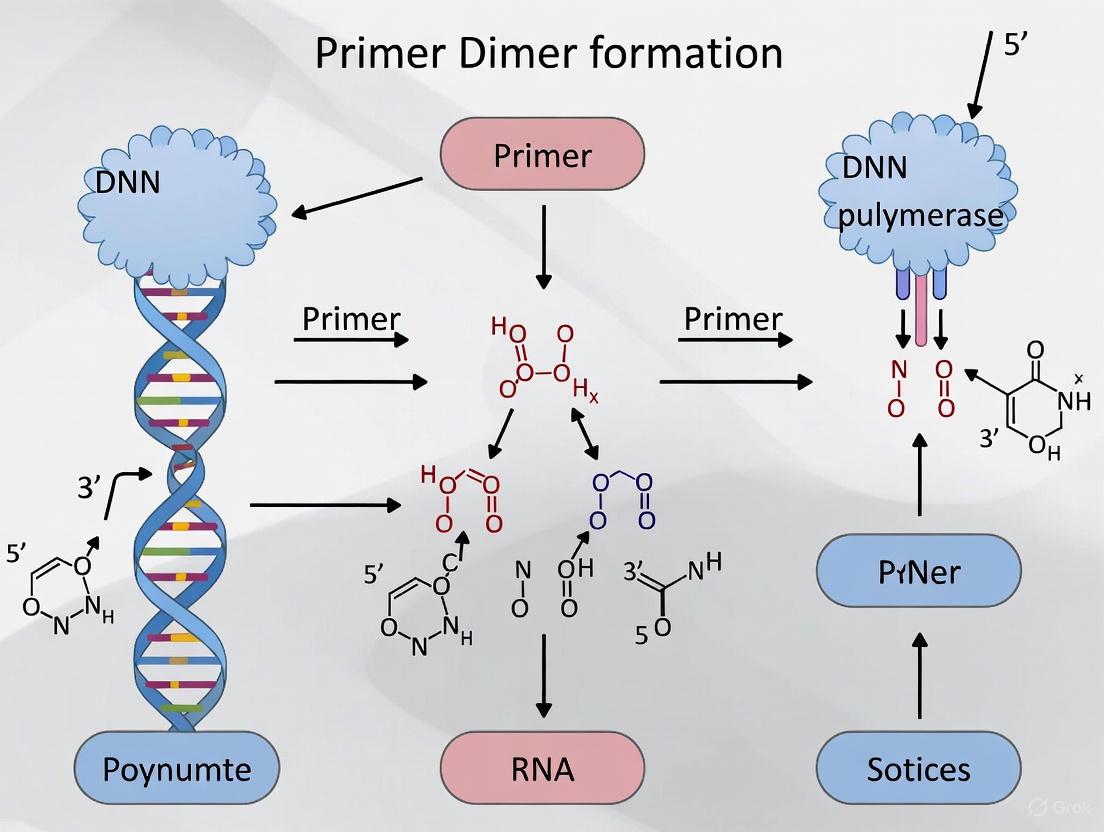
This article provides a comprehensive analysis of primer dimer formation, a common artifact in PCR and other amplification technologies that can severely compromise assay specificity and efficiency.
Primer Dimer Formation: Mechanisms, Impact, and Advanced Strategies for Prevention in Biomedical Research
Abstract
This article provides a comprehensive analysis of primer dimer formation, a common artifact in PCR and other amplification technologies that can severely compromise assay specificity and efficiency. It explores the fundamental biochemical mechanisms driving primer-dimer formation, including the critical role of 3'-end complementarity and the influence of reaction components. The content details state-of-the-art computational and experimental methods for dimer prediction and detection, systematic troubleshooting and optimization protocols for wet-lab practitioners, and a rigorous comparative evaluation of validation frameworks and predictive software. Tailored for researchers, scientists, and drug development professionals, this review synthesizes foundational knowledge with advanced applications to empower the development of robust, highly multiplexed, and sensitive molecular diagnostics and research assays.
The Biochemistry of Primer Dimers: Exploring Fundamental Mechanisms and Contributing Factors
Primer dimers are short, unintended amplification artifacts formed by the hybridization and subsequent extension of two primer oligonucleotides during polymerase chain reaction (PCR) or other enzymatic amplification methods [1]. This nonspecific amplification occurs when primers bind to each other instead of the target template DNA, leading to the generation of nontarget products that can compete with the desired amplification, reduce reaction efficiency, and cause false-positive results [2]. The formation of primer dimers presents a significant challenge in molecular diagnostics, particularly in sensitive applications such as quantitative PCR (qPCR), multiplex assays, and DNA sequencing, where they can severely compromise data accuracy and reliability [3]. Within the broader context of primer dimer formation mechanism research, understanding the structural classifications and biophysical parameters governing dimerization is fundamental to developing effective predictive models and optimization strategies for nucleic acid-based assays.
Structural Classifications: Homodimers and Heterodimers
Primer dimers are systematically categorized based on the identity of the interacting primers, which determines their structural configuration and formation mechanisms. The classification comprises two primary forms with distinct characteristics.
Table 1: Structural Classification of Primer Dimers
| Dimer Type | Interacting Primers | Complementarity Requirement | Structural Consequence |
|---|---|---|---|
| Homodimer (Self-dimer) | Two identical primers [4] [1] | Partial self-complementarity within the same primer sequence [4] | Reduced primer availability for target amplification; potential amplification of primer-only products [1] |
| Heterodimer (Cross-dimer) | Forward and reverse primers [2] [1] | Complementary sequences between two different primers [2] | Generation of short, nonspecific products that consume reagents and emit false signals in qPCR [2] [1] |
The following diagram illustrates the structural relationship and formation mechanisms of homodimers versus heterodimers:
Molecular Mechanisms of Dimer Formation
The formation of primer dimers involves specific molecular interactions that enable primers to hybridize and undergo enzymatic extension despite the absence of the intended template DNA.
Complementary Binding and Initiation
Dimerization initiates when regions of complementarity, typically at the 3' ends of primers, align and form stable duplex structures [3]. Even limited complementarity of 3-4 bases can provide sufficient stability for DNA polymerase to bind and initiate synthesis, particularly if these complementary regions are rich in guanine and cytosine (G/C) bases, which form stronger hydrogen bonds (three bonds per base pair) compared to adenine and thymine (A/T) pairs (two bonds per base pair) [5]. This initial binding can occur during reaction preparation, especially if reagents are mixed at room temperature where Taq DNA polymerase retains some activity [1].
Polymerase-Mediated Extension
Once primers form a stable duplex through complementary regions, DNA polymerase recognizes the 3' hydroxyl groups as legitimate starting points for DNA synthesis [2]. The enzyme extends both primers in opposite directions, effectively copying the primer sequences themselves [1]. This extension creates a double-stranded DNA product that incorporates the primer sequences, which can then serve as a template for subsequent amplification cycles, leading to exponential amplification of the primer-dimer artifact [3].
Structural Determinants of Extensible Dimers
Research has revealed that not all primer-primer interactions result in problematic dimer artifacts. The most detrimental dimers are "extensible dimers" that feature stable complements at the 3' ends, allowing for polymerase binding and elongation [3]. Surprisingly, both 3' ends do not need to form a continuous stable structure for exponential amplification to occur. Stable structures at a single 3' end can regularly form amplification artifacts of high concentrations, with 5' overhangs often duplicated in the resulting dimer product [3]. In contrast, "non-extensible dimers" form stable structures but do not produce spurious dimer products that elongate and amplify efficiently. These non-extensible dimers are less inhibitory to target amplification as they don't significantly reduce available PCR reagents, and the primer sequences remain unaltered [3].
Experimental Analysis and Detection Methodologies
Capillary Electrophoresis with Drag-Tag Conjugates
Recent advances in experimental methodologies have enabled precise quantification of dimerization risk between primer pairs. One innovative approach utilizes free-solution conjugate electrophoresis (FSCE) with lab-made, chemically synthesized poly-N-methoxyethylglycine (NMEG) drag-tags to analyze dimer formation [6]. This method provides quantitatively precise input data to parameterize computational models of dimerization risk.
Table 2: Research Reagent Solutions for Primer Dimer Analysis
| Research Reagent | Composition/Characteristics | Function in Experiment |
|---|---|---|
| Drag-Tags | Linear N-methoxyethylglycines (NMEGs) of length 12, 20, 28, or 36 [6] | Reduces electrophoretic mobility of ssDNA to distinguish it from ds primer-dimers; enables mobility shift assay |
| Fluorophore-Labeled Primers | Oligomers tagged with fluorescein (FAM) or modified at 5'-end with thiol linker and 3'-end with rhodamine (ROX) [6] | Enables two-color laser-induced fluorescence detection for unambiguous peak assignment in electrophoregrams |
| Free-Solution Electrophoresis Buffer | 1× TTE (89 mM Tris, 89 mM TAPS, 2 mM EDTA) with 0.03% pHEA [6] | Provides separation medium without polymer sieving matrix; suppresses electroosmotic flow and sample interactions |
| Dynamic Capillary Coating | PolyDuramide polymer (poly-N-hydroxyethylacrylamide, pHEA) [6] | Suppresses electroosmotic flow and sample interactions with capillary internal surface |
The experimental workflow for this precise dimer analysis methodology is detailed below:
Key Experimental Findings on Dimer Stability
Through systematic experimentation using the capillary electrophoresis method, critical parameters affecting primer dimer stability have been quantified:
- Temperature Dependence: Dimerization is inversely correlated with temperature when less than 30 out of 30 base pairs are bonded [6].
- Base Pairing Requirements: Dimerization occurs when more than 15 consecutive base pairs form, while non-consecutive base pairs do not create stable dimers even when 20 out of 30 possible base pairs bond [6].
- Structural Arrangement: The spatial arrangement of base pairs is crucial in primer-dimer formation, with consecutive bonding being a critical determinant of stability [6].
Gel Electrophoresis and Melting Curve Analysis
Conventional detection methods for primer dimers include agarose gel electrophoresis, where dimers appear as blurred, unsharp bands at the very end of the positive side near the 20 to 50 bp zone due to their short length and rapid diffusion through the gel matrix [1]. In qPCR applications, melting curve analysis is employed to distinguish primer dimers from specific amplification products by gradually increasing the temperature and monitoring fluorescence changes. Primer dimers typically display lower melting temperatures than specific amplicons and appear earlier in the amplification plot with shorter plot height [1].
Quantitative Prediction of Dimer Formation
Gibbs Free Energy (ΔG) as a Predictive Metric
The change in Gibbs free energy (ΔG) resulting from primer hybridization serves as a fundamental indicator of dimer formation potential [3]. Negative ΔG values indicate spontaneous reactions that favor dimer formation, with more negative values representing stronger, more stable dimers. The PrimerDimer algorithm calculates ΔG using nearest-neighbor parameters for duplexes, single mismatches, and 5' overhangs of bases at the 3' ends, with each end treated independently [3]. Bonus values and penalties are added for structures that are more or less conducive to dimer formation, polymerase binding, and transcription initiation.
Table 3: Dimer Prediction Tool Performance Comparison
| Prediction Tool | Prediction Method | Overall Accuracy (AUC) | Key Strengths | Limitations |
|---|---|---|---|---|
| PrimerROC/PrimerDimer | ΔG-based with ROC optimization [3] | >92% [3] | Condition-independent prediction; provides dimer-free threshold | Specifically predicts extensible dimers only |
| Oligo 7 | Proprietary ΔG calculations [3] | Variable (performs well across datasets) [3] | Reliable dimer-free classification | Performance varies with primer length |
| PerlPrimer | Most stable 3' dimer structures [3] | Good for short fusion sets [3] | Effective for short primers | Poor performance with longer primer sets |
| IDT OligoAnalyzer | ΔG calculations with user-defined conditions [7] | Industry standard for basic screening | User-friendly interface; BLAST integration | Limited to simple dimer structures |
Dimer-Free Threshold Determination
The PrimerROC method employs Receiver Operating Characteristic (ROC) curves to determine a ΔG-based dimer-free threshold above which dimer formation is predicted unlikely to occur [3]. This approach identifies the discrimination threshold where the true positive rate is 1 (all dimers correctly identified) and the false negative rate is 0 (no dimers misclassified as dimer-free), while maximizing correct classification of dimer-free primer pairs [3]. This condition-independent prediction method enables researchers to select primer pairs with minimal risk of dimer formation without requiring additional information such as salt concentration or annealing temperature.
The structural dichotomy between homodimers and heterodimers represents a fundamental aspect of primer dimer formation mechanisms with significant implications for assay design and optimization. Through advanced experimental approaches like drag-tag capillary electrophoresis and computational prediction tools utilizing Gibbs free energy calculations and ROC analysis, researchers can now quantitatively assess and mitigate dimerization risks with greater than 92% accuracy. These advancements in understanding primer dimer structures and formation mechanisms provide the scientific community with powerful strategies to enhance the reliability and specificity of nucleic acid amplification assays, particularly in demanding applications such as multiplex PCR, quantitative diagnostics, and next-generation sequencing library preparation. Future research in primer dimer formation mechanisms will likely focus on further refining predictive algorithms and developing novel biochemical approaches to suppress dimerization while maintaining amplification efficiency.
The polymerase chain reaction (PCR) is a foundational technique in molecular biology that enables the exponential amplification of specific DNA sequences in vitro [8]. Since its introduction by Kary Mullis in 1985, PCR has become an indispensable tool for biomedical research, clinical diagnostics, and drug development [8]. The core PCR process involves three fundamental steps—annealing of primers to a DNA template, polymerase extension to synthesize new DNA strands, and thermal denaturation to separate DNA strands for subsequent amplification cycles [9]. Understanding the precise mechanism of these steps is crucial for optimizing PCR performance, particularly for addressing challenges such as primer dimer formation, which remains a significant obstacle in assay development, especially in highly multiplexed applications [10]. This technical guide examines the stepwise mechanism of PCR within the context of primer dimer formation research, providing detailed methodologies and quantitative frameworks for researchers and drug development professionals.
Core PCR Mechanism and Stepwise Formation
The Three-Step Thermal Cycling Process
The standard PCR amplification process consists of three temperature-dependent steps that are repeated for 20-40 cycles [9]:
- Denaturation: The double-stranded DNA template is heated to 94-95°C for 15-60 seconds, disrupting hydrogen bonds between complementary base pairs to produce single-stranded DNA molecules [8] [9].
- Annealing: The temperature is lowered to 55-72°C for 15-60 seconds, allowing oligonucleotide primers to bind to complementary sequences on the single-stranded DNA templates [8]. The optimal annealing temperature depends on the primer length, composition, and specificity requirements [11].
- Extension: The temperature is raised to 70-74°C (optimal for most thermostable DNA polymerases) for 1-2 minutes, enabling DNA polymerase to synthesize new DNA strands in the 5' to 3' direction by adding complementary nucleotides to the 3' ends of annealed primers [8] [9].
These three steps form one amplification cycle, with the number of DNA copies theoretically doubling each cycle, leading to exponential amplification of the target sequence [9]. After 20-40 cycles, this process can amplify the target sequence by a factor of more than a million [9].
Table 1: Standard PCR Thermal Cycling Parameters
| Step | Temperature Range | Duration | Function |
|---|---|---|---|
| Denaturation | 94-95°C | 15-60 seconds | Separates double-stranded DNA into single strands |
| Annealing | 55-72°C | 15-60 seconds | Allows primers to bind to complementary sequences |
| Extension | 70-74°C | 1-2 minutes/kb | Enables DNA synthesis by thermostable polymerase |
Reaction Components and Their Functions
A typical PCR reaction contains several essential components, each playing a critical role in the amplification process [9]:
- DNA Template: The target DNA sequence to be amplified, which can be as minimal as 1-100 ng of DNA or RNA [8].
- Thermostable DNA Polymerase: Typically Taq polymerase isolated from Thermus aquaticus, which retains activity after repeated exposure to high temperatures during cycling [8].
- Oligonucleotide Primers: Short, single-stranded DNA sequences (20-25 nucleotides long) that are complementary to the flanking regions of the target sequence [8].
- Deoxynucleotide Triphosphates (dNTPs): The building blocks (dATP, dCTP, dGTP, dTTP) used by DNA polymerase to synthesize new DNA strands [9].
- Reaction Buffer: Provides optimal chemical conditions (pH, ionic strength) for polymerase activity [9].
- Magnesium Ions (Mg²⁺): An essential cofactor for DNA polymerase activity that influences primer annealing and template specificity [9].
Primer Dimer Formation: Mechanisms and Research Context
Biochemical Basis of Primer Dimer Formation
Primer dimers are aberrant PCR products formed when primers anneal to each other rather than to the template DNA, creating short, double-stranded DNA fragments that are subsequently amplified by DNA polymerase [11]. This occurs primarily due to:
- Complementary 3' Ends: Even limited complementarity (3-4 bases) at the 3' ends of primers can facilitate cross-hybridization, especially at lower temperatures where non-specific annealing is more likely [11].
- Polymerase-Mediated Extension: Once primers anneal to each other, DNA polymerase extends them, creating a stable double-stranded product that competes with the target amplicon for reaction components [11].
The formation of primer dimers is particularly problematic in multiplex PCR applications, where multiple primer pairs are present in a single reaction, dramatically increasing the potential for primer-dimer interactions [10]. In highly multiplexed reactions with N primer pairs, there are (2N choose 2) potential primer-dimer interactions, creating a significant design challenge [10].
Impact on PCR Efficiency and Specificity
Primer dimer formation has several detrimental effects on PCR performance:
- Resource Competition: Primer dimers compete with the target amplicon for essential reaction components including DNA polymerase, dNTPs, and primers, reducing amplification efficiency of the desired product [11].
- Reduced Sensitivity: In quantitative applications, primer dimers can lead to false-positive signals or reduced sensitivity for low-abundance targets [11].
- Downstream Complications: In next-generation sequencing (NGS) applications, primer dimers reduce library complexity and mapping rates, increasing sequencing costs and reducing data quality [10].
Table 2: Common PCR Challenges and Optimization Strategies
| Challenge | Cause | Impact | Solution |
|---|---|---|---|
| Primer Dimers | Complementary 3' ends; low annealing temperatures | Resource competition; reduced specificity | Hot-start PCR; improved primer design [11] |
| Non-specific Amplification | Mispriming at low stringency | Multiple unwanted bands | Touchdown PCR; gradient annealing [11] |
| Poor Yield | Suboptimal conditions; inhibitor presence | Low product concentration | Buffer optimization; additive incorporation [11] |
| GC-rich Templates | Strong secondary structures | Polymerase stalling; failed reactions | DMSO additives; higher denaturation temperatures [11] |
Experimental Protocols for Investigating Primer Dimer Formation
Hot-Start PCR for Primer Dimer Suppression
Hot-start PCR is a widely adopted method to reduce primer dimer formation by inhibiting DNA polymerase activity at room temperature during reaction setup [11].
Protocol:
- Reaction Assembly: Prepare master mix containing all reaction components except DNA polymerase or a critical cofactor (e.g., Mg²⁺) [11].
- Polymerase Inactivation: Use a thermostable DNA polymerase that has been inactivated through:
- Thermal Activation: Subject reactions to initial denaturation at 94-95°C for 2-5 minutes to dissociate the inactivating antibody or chemical modifier [11].
- Standard Cycling: Proceed with standard PCR cycling parameters as described in Section 2.1.
Mechanism: By preventing polymerase activity during reaction setup at ambient temperature, hot-start methods eliminate the extension of misprimed products and primer-dimer complexes that form before thermal cycling begins [11].
Computational Primer Design with SADDLE Algorithm
For highly multiplexed PCR applications, computational primer design is essential to minimize primer dimer formation. The SADDLE (Simulated Annealing Design using Dimer Likelihood Estimation) algorithm provides a robust framework for designing multiplex primer sets with minimal dimer potential [10].
Protocol:
- Primer Candidate Generation:
- Identify "pivot" nucleotides representing target regions [10]
- Generate proto-primers with 3' ends flanking pivot nucleotides [10]
- Trim proto-primers to achieve optimal binding energy (ΔG° ≈ -11.5 kcal/mol) [10]
- Apply filters for GC content (25-75%) and remove candidates with self-complementarity [10]
Initial Primer Set Selection:
Loss Function Evaluation:
- Calculate total "Badness" score representing potential dimer formation: where Badness estimates dimer formation likelihood between primers pₐ and p_b [10]
Iterative Optimization:
Validation: In experimental tests, SADDLE reduced primer dimer formation from 90.7% in naive designs to 4.9% in optimized 96-plex primer sets (192 primers) [10].
Visualization of PCR Mechanisms and Primer Dimer Pathways
The following diagrams illustrate the core PCR mechanism and primer dimer formation pathways using Graphviz DOT language, compliant with the specified color and contrast requirements.
Diagram 1: Core PCR Thermal Cycling Process
Diagram 2: Primer Dimer Formation Mechanism
Diagram 3: Hot-Start PCR Prevention Mechanism
Research Reagent Solutions for PCR Optimization
Table 3: Essential Research Reagents for PCR and Primer Dimer Studies
| Reagent Category | Specific Examples | Function & Mechanism | Application Context |
|---|---|---|---|
| Hot-Start DNA Polymerases | Platinum II Taq, GoTaq G2 Hot Start [11] | Antibody-mediated inhibition at low temperatures; activated during initial denaturation | High-specificity PCR; multiplex applications |
| Reverse Transcriptases | GoScript, SuperScript VILO IV [9] [12] | RNA-directed DNA polymerase for cDNA synthesis; robust activity with difficult templates | RT-PCR; gene expression analysis |
| PCR Additives | DMSO, GC enhancers, betaine [11] | Reduce secondary structure; lower template Tm; improve polymerase processivity | GC-rich templates; long amplicon amplification |
| Multiplex PCR Master Mixes | Platinum Multiplex PCR Master Mix [11] | Optimized buffer formulation with enhanced specificity for multiple primer pairs | Multitarget amplification; NGS library prep |
| High-Fidelity Enzyme Blends | Pfu-Taq mixtures [9] | Proofreading activity combined with processive extension; reduces misincorporation | Long-range PCR; cloning applications |
Advanced Methodologies for Specialized Applications
Tiling PCR for Long-Range Sequencing
Recent advances in PCR methodology include tiling PCR approaches for long-range sequencing applications, such as HIV-1 genotyping [12]. This method utilizes multiple overlapping primer sets to amplify the 5' half of the HIV-1 genome in six overlapping segments of approximately 1,000 bp each, accomplished in only two PCR reactions [12].
Protocol:
- Primer Design: Design primer sets to generate overlapping amplicons (≥100 bp overlap) with consistent Tm (55-60°C) and minimal dimer potential [12]
- Primer Pooling: Combine primers into two multiplex pools (A and B) for efficient amplification [12]
- cDNA Synthesis: Perform reverse transcription with SuperScript VILO IV (10 min at 25°C, 20 min at 50°C, 5 min at 85°C) [12]
- Tiling PCR: Amplify with high-fidelity polymerase (e.g., SuperFi II) using pooled primers under optimized cycling conditions [12]
This approach enables complete coverage of protease-reverse transcriptase and integrase regions in >90% of samples with viral load >5000 copies/mL, identifying additional drug resistance mutations missed by conventional methods [12].
Immune Receptor Profiling and TCR-Antigen Discovery
Comprehensive T-cell receptor (TCR) profiling illustrates specialized PCR applications in immunotherapy discovery [13]. The integrated workflow combines:
- Repertoire Diversity Analysis: DriverMap Targeted Multiplex RT-PCR simultaneously amplifies and sequences >100,000 TCR and BCR receptors from DNA or RNA samples, including challenging specimens like FFPE tissues [13]
- Paired-Chain Reconstruction: Plate-based single-cell assays resolve native TCR α/β pairs for whole receptor characterization [13]
- Functional Validation: Engineered Jurkat TCR KO GFP reporter cells express cloned TCRs for antigen screening via dextramer binding or co-culture with antigen-presenting cells [13]
This platform distinguishes clonal expansion (DNA analysis) from transcriptional activation (RNA analysis), providing a direct route from immune repertoire profiling to antigen identification [13].
The stepwise mechanism of PCR—comprising annealing, polymerase extension, and exponential amplification—represents a sophisticated biochemical process that can be precisely optimized for diverse research applications. Within the context of primer dimer formation research, understanding these fundamental mechanisms enables the development of advanced strategies to suppress non-specific amplification while maintaining high sensitivity and efficiency. The experimental protocols, computational frameworks, and specialized methodologies detailed in this technical guide provide researchers with comprehensive tools to address these challenges across various applications, from basic molecular biology to advanced drug discovery and immunotherapeutics. Continued refinement of these approaches, particularly through algorithms like SADDLE for highly multiplexed assays and innovative methods like tiling PCR for long-range sequencing, will further enhance the precision and utility of PCR-based methodologies in biomedical research.
Primer-dimer formation represents a significant challenge in molecular biology, adversely affecting the efficiency and specificity of polymerase chain reaction (PCR) and other amplification-based applications. These spurious amplification artefacts occur through primer-primer interactions that competitively inhibit target binding, deplete reaction reagents, and reduce overall amplification efficiency [3]. Within the broader context of primer dimer formation mechanism research, this technical guide examines the fundamental contributors to dimerization, focusing on the interrelated roles of primer concentration, sequence characteristics, and GC content. Understanding these mechanisms is particularly crucial for advanced applications including multiplex PCR, real-time quantification, and next-generation sequencing library preparation, where dimerization risks increase substantially [3]. This whitepaper synthesizes current experimental evidence to provide researchers, scientists, and drug development professionals with a comprehensive framework for predicting and preventing primer-dimer formation in experimental design.
Key Contributors to Dimer Formation
Primer Concentration and Mass Action Effects
The role of primer concentration in dimer formation follows fundamental principles of mass action, where increased primer concentrations elevate the probability of primer-primer interactions. Quantitative experimental studies have demonstrated that higher oligonucleotide concentrations favor duplex formation through increased molecular collisions [14]. While exact concentration thresholds vary based on sequence-specific factors, typical PCR conditions utilize primer concentrations between 50-500 nM, with standard reactions often employing 200-500 nM [14]. At these concentrations, the probability of dimer formation increases polynomially with each additional primer in multiplexed reactions according to the function (n² + n)/2, where n represents the number of primers [3]. This relationship explains why multiplex PCR applications, which may incorporate dozens or even hundreds of primers, exhibit particularly high susceptibility to dimerization artefacts.
Experimental evidence indicates that concentration-dependent dimer formation follows a non-linear relationship, with diminishing returns observed at higher concentrations. This suggests that while reducing primer concentration can mitigate dimerization risks, practical limitations exist for maintaining amplification efficiency. Optimization protocols must therefore balance sufficient concentration for target amplification against the risk of promoting primer-primer interactions [15].
Sequence Complementarity and Structural Alignment
Sequence-specific factors constitute the most significant contributor to primer-dimer formation, with particular emphasis on 3'-end complementarity. Experimental analysis of sequenced dimer artefacts confirms that primer-primer interactions containing stable complements at the 3' ends facilitate polymerase binding and elongation [3]. The PrimerDimer algorithm development revealed that both 3' ends do not necessarily need to form a continuous stable structure for exponential amplification to occur. Stable structures at a single 3' end regularly formed amplification artefacts of high concentrations, often with duplicated 5' overhangs in the resulting dimer product [3].
The spatial arrangement of complementary regions significantly influences dimer stability. Research demonstrates that consecutive base pairing exceeding 15 base pairs creates stable dimers, while non-consecutive base pairing does not produce stable dimers even when 20 out of 30 possible base pairs bond [6]. This finding highlights the importance of contiguous complementarity over total complementarity count in predicting dimerization risk.
Table 1: Sequence Factors Influencing Primer-Dimer Formation
| Sequence Factor | Threshold for Dimer Formation | Experimental Evidence | Impact Level |
|---|---|---|---|
| 3' End Complementarity | Stable structures at single 3' end sufficient | Sequenced dimer artefacts show 3' end initiation [3] | Critical |
| Consecutive Base Pairs | >15 consecutive base pairs creates stable dimers | Capillary electrophoresis studies [6] | High |
| Total Complementarity | 20/30 non-consecutive base pairs does not form stable dimers | Free-solution conjugate electrophoresis [6] | Moderate |
| Dimer Structure | 5' overhangs often duplicated in dimer artefact | PrimerDimer algorithm development [3] | Moderate |
GC Content and Stability Considerations
GC content significantly influences dimerization potential through its effect on duplex stability. The number of hydrogen bonds in GC base pairs (three) versus AT base pairs (two) creates inherently more stable interactions, directly impacting the melting temperature (Tm) of potential dimer structures [14]. Optimal GC content for primers generally ranges between 40-60%, with extremes (<30% or >70%) increasing dimerization risks [14]. Low GC content produces unstable primers that may require higher concentrations for effective target binding, indirectly increasing dimerization potential. High GC content promotes stable secondary structures and enhances the stability of incidental primer-primer complements, particularly at 3' ends.
Research indicates that GC distribution patterns may be more significant than overall percentage. Clusters of GC nucleotides, especially at the 3' end, create localized stability regions that can initiate dimer formation even when overall complementarity is limited. This nuanced understanding explains why simple GC percentage calculations provide insufficient protection against dimerization and must be supplemented with more sophisticated structural analysis [14].
Experimental Analysis and Detection Methodologies
Free-Solution Conjugate Electrophoresis (FSCE)
Capillary electrophoresis methods provide quantitative assessment of dimerization risk under controlled conditions. The Free-Solution Conjugate Electrophoresis (FSCE) approach utilizes drag-tag-DNA conjugates to quantify dimerization between primer-barcode pairs [6]. This method employs linear N-methoxyethylglycine (NMEG) drag-tags of varying lengths (12, 20, 28, or 36 units) covalently linked to thiolated 5'-ends of DNA oligomers, with fluorescent labeling (ROX or FAM) for detection. The drag-tags modify electrophoretic mobility without using sieving matrices, enabling clear distinction between single-stranded and dimerized species [6].
The experimental workflow involves:
- Sample Preparation: DNA oligomers are reduced with tris(carboxyethyl)phosphine (TCEP), then conjugated with NMEG drag-tags via sulfosuccinimidyl-4-(N-maleimidomethyl)cyclohexane-1-carboxylate (Sulfo-SMCC) chemistry [6]
- Annealing Conditions: Drag-tagged and non-drag-tagged DNA primers are mixed, heat-denatured at 95°C for 5 minutes, annealed at 62°C for 10 minutes, and cooled to 25°C [6]
- Electrophoresis Separation: Samples are loaded into capillary arrays and electrophoresed under free-solution conditions (1× TTE buffer with 0.03% polyHEA) at various temperatures (18, 25, 40, 55, 62°C) [6]
- Analysis: Proportion of single-stranded to dimerized conformers is quantified via fluorescence detection, with temperature series revealing thermal stability of dimer structures [6]
This methodology enables precise quantification of dimerization propensity under different thermal conditions, providing empirical data correlating sequence characteristics with dimer stability.
ROC-Based Dimer Prediction (PrimerROC)
The PrimerROC method employs Receiver Operating Characteristic (ROC) curves to assess dimer prediction accuracy using Gibbs free energy (ΔG) calculations as diagnostic markers [3]. This approach integrates with PrimerDimer algorithm to establish ΔG-based dimer-free thresholds without requiring specific information about salt concentration or annealing temperature, making it condition-independent [3].
The experimental validation involves:
- Gold-Standard Definition: Presence or absence of primer-primer PCR amplification artefacts in gel electrophoresis serves as the binary outcome measure [3]
- Algorithm Operation: PrimerDimer aligns the 5' end of the longer primer to the 3' end of the shorter primer, forming structures with single 3' overhangs, then calculates ΔG using nearest-neighbor parameters for duplexes, single mismatches, and 5' overhangs [3]
- Threshold Determination: PrimerROC identifies the discrimination threshold where the first dimer forms (true positive rate = 1, false negative rate = 0), maximizing correct classification of dimer-free primer pairs [3]
- Performance Validation: The method achieves >92% predictive accuracy across diverse primer sets, outperforming seven other publicly available dimer prediction tools [3]
This statistical approach enables researchers to establish reliable dimer-free thresholds for experimental design, particularly valuable in multiplex applications where dimer potential increases exponentially with primer number.
Diagram 1: Primer-dimer formation pathway
Research Reagent Solutions
Table 2: Essential Research Reagents for Dimerization Studies
| Reagent / Material | Specific Function | Experimental Context |
|---|---|---|
| Poly-N-methoxyethylglycine (NMEG) Drag-Tags | Modifies electrophoretic mobility of conjugated DNA without sieving matrix | FSCE dimer quantification [6] |
| Sulfo-SMCC Crosslinker | Covalently links drag-tags to thiolated DNA oligomers | FSCE sample preparation [6] |
| Tris-TAPS-EDTA (TTE) Buffer | Provides free-solution electrophoresis conditions | FSCE separation medium [6] |
| PolyDuramide (pHEA) Polymer | Suppresses electroosmotic flow in capillaries | FSCE dynamic coating [6] |
| TRIzol Reagent | Maintains RNA integrity during sample collection | PCR-based validation studies [15] |
| Rhodamine (ROX) & Fluorescein (FAM) | Fluorescent detection of DNA species | Two-color LIF detection in FSCE [6] |
| Nearest-Neighbor Thermodynamic Parameters | Calculates ΔG for dimer structures | PrimerDimer algorithm [3] |
Discussion and Research Implications
The experimental evidence demonstrates that primer dimerization is not a simple function of any single factor, but rather a complex interplay between concentration effects, sequence-specific interactions, and structural stability. The quantitative relationships established through FSCE and PrimerROC methodologies provide researchers with predictive frameworks for experimental design. Particularly significant is the finding that non-consecutive base pairing does not produce stable dimers even with substantial complementarity, highlighting the importance of structural alignment over simple sequence matching [6].
The condition-independent prediction approach offered by PrimerROC addresses a critical gap in primer design methodology, enabling reliable dimer prevention without detailed knowledge of specific reaction conditions [3]. This advancement is particularly valuable for diagnostic applications where primer specificity is paramount, as demonstrated by the optimization of SARS-CoV-2 detection protocols [15] and visceral leishmaniasis diagnostic assays [16]. The documented cases of false-positive results in commercial diagnostic kits underscore the practical importance of rigorous dimer prediction in assay development [15] [16].
Future research directions should focus on integrating these dimerization principles with emerging oligonucleotide applications, including CRISPR guide RNA design [14] and large-scale oligo pool synthesis for gene assembly [17]. The development of CertPrime and other next-generation design tools represents promising approaches for scaling effective dimer prevention to genome-wide applications [17]. As molecular diagnostics continue to advance, the fundamental understanding of dimerization mechanisms will remain essential for developing robust, reliable genetic analysis methods across research, therapeutic, and diagnostic contexts.
The formation of primer dimers presents a significant challenge in polymerase chain reaction (PCR) and related amplification technologies, often leading to false-positive results and reduced amplification efficiency. This technical guide examines the crucial biochemical relationships between magnesium ions (Mg²⁺), deoxynucleotide triphosphates (dNTPs), and enzyme activity that govern primer dimer formation. Through a detailed analysis of reaction conditions and their impact on enzymatic fidelity and primer-template specificity, we provide evidence-based optimization strategies to suppress nonspecific amplification. The synthesis of current research reveals that precise molar balancing of Mg²⁺ and dNTP concentrations, coupled with strategic enzyme selection, establishes reaction conditions that favor specific target amplification over primer-dimer artifacts, thereby enhancing the reliability of molecular diagnostics and research applications.
Primer dimers are short, artifactual double-stranded DNA fragments that form when primers anneal to each other rather than to the target DNA template, subsequently becoming amplified in PCR and isothermal amplification reactions [2]. These structures are classified as either homodimers (between two identical primers) or heterodimers (between forward and reverse primers with complementary sequences) [2]. The formation of primer dimers represents a significant challenge in molecular diagnostics and research, as they compete with target amplification for reagents, reduce amplification efficiency, and can generate false-positive signals that compromise result interpretation [2] [18].
In loop-mediated isothermal amplification (LAMP), which utilizes multiple primers at high concentrations, the risk of primer dimer formation is particularly elevated due to increased opportunities for primer-primer hybridization [2]. The forward internal primers (FIP) and backward internal primers (BIP) in LAMP consist of 40–45 bases, and their length increases the potential for secondary structure formation such as hairpins, which can further interfere with proper primer annealing to the intended target template [2]. The extension of primer dimers by DNA polymerase leads to the production of nonspecific amplification products that may be misinterpreted as positive signals, particularly in detection methods relying on fluorescence or gel electrophoresis [2].
Magnesium Ions: The Essential Cofactor in Nucleic Acid Amplification
Biochemical Role of Mg²⁺
Magnesium ions serve as an indispensable cofactor for all thermostable DNA polymerases, fulfilling multiple critical functions in nucleic acid amplification reactions [19] [20]. The primary biochemical role of Mg²⁺ involves forming a soluble complex with dNTPs through coordination with their phosphate groups, creating the actual substrate that DNA polymerase recognizes and incorporates into the growing DNA chain [21]. This complex formation is essential for the nucleotidyl transferase reaction catalyzed by DNA polymerases [22] [23].
Structural studies of DNA polymerases have revealed that the catalytic mechanism follows a two-metal ion mechanism where one magnesium ion (metal A) lowers the pKa of the 3'-OH of the growing primer terminus, while the second magnesium ion (metal B) coordinates the triphosphate moiety of the incoming nucleotide, facilitating binding and assisting pyrophosphate dissociation [23]. Beyond its direct role in catalysis, Mg²⁺ stabilizes the double-stranded structure of the primer-template hybrid through electrostatic interactions with the phosphate backbone, thereby influencing the stability of this critical hybridization event [19] [20].
Table 1: Effects of Mg²⁺ Concentration on PCR Performance
| Mg²⁺ Concentration | Polymerase Activity | Reaction Specificity | Observed Gel Result |
|---|---|---|---|
| Too Low (<1.5 mM) | Reduced enzymatic activity | Incomplete amplification | Smearing or no bands |
| Optimal (1.5-2.5 mM) | Efficient nucleotide incorporation | High specificity for intended target | Clear, sharp bands |
| Too High (>3.0 mM) | Increased error rate | Reduced specificity, non-specific binding | Multiple or non-specific bands |
Mg²⁺ Concentration and Primer Dimer Formation
The concentration of Mg²⁺ in amplification reactions exhibits a direct and significant impact on primer dimer formation. Elevated Mg²⁺ concentrations stabilize all duplex formations, including the weak, transient interactions between complementary primers that initiate dimer formation [2] [19]. This over-stabilization promotes non-specific binding by allowing primers to anneal to off-target sites with partial complementarity, thereby increasing the likelihood of primer-primer interactions [19] [20].
Excessive Mg²⁺ levels (typically >3.0 mM) can reduce the fidelity of DNA polymerase by diminishing the enzyme's specificity for correct base pairing, further exacerbating nonspecific amplification [19]. Empirical observations demonstrate that high Mg²⁺ concentrations correlate with increased primer dimer formation, as evidenced by spurious bands in gel electrophoresis and elevated background fluorescence in real-time detection systems [21]. This relationship is particularly pronounced in reactions utilizing low copy number templates, where the limited availability of genuine target sequences increases the opportunity for primer-primer interactions [21].
Conversely, insufficient Mg²⁺ concentrations (<1.5 mM) impair polymerase activity, potentially leading to incomplete amplification and reduced yield, which can manifest as smearing on gel electrophoresis [21]. This smearing results from the accumulation of partially extended products that may include partially extended primer dimers, creating a continuum of fragment sizes rather than discrete bands [21].
dNTPs: Composition, Concentration, and Balance
Biochemical Fundamentals of dNTPs
Deoxynucleotide triphosphates (dNTPs) serve as the essential building blocks for DNA synthesis, providing both the nucleotide monomers for chain elongation and the energy required for the polymerization reaction through their high-energy phosphate bonds. The dNTP pool consists of four distinct nucleotides—dATP, dTTP, dCTP, and dGTP—which must be present in balanced equimolar concentrations to support faithful DNA replication [19] [24]. During the polymerization reaction, DNA polymerase catalyzes the nucleophilic attack of the 3'-OH group of the primer terminus on the α-phosphate of the incoming dNTP, resulting in phosphodiester bond formation and release of pyrophosphate [23].
The recommended concentration range for each dNTP in standard PCR reactions typically falls between 20-200μM, with the optimal concentration dependent on factors such as amplicon length, template complexity, and the specific DNA polymerase employed [24]. Longer amplicons and complex templates generally benefit from slightly elevated dNTP concentrations to support processive elongation, while shorter targets can be efficiently amplified with lower nucleotide concentrations [20].
dNTP-Mg²⁺ Stoichiometry and Primer Dimer Formation
The relationship between dNTP and Mg²⁺ concentrations is critically important for reaction optimization, as Mg²⁺ directly coordinates with the phosphate groups of dNTPs to form the biologically active complex recognized by DNA polymerase [21]. This interaction establishes a direct stoichiometric relationship where the total dNTP concentration influences the amount of free Mg²⁺ available in the reaction. The molar concentration of dNTPs must be carefully balanced against Mg²⁺ concentration, with excess Mg²⁺ typically maintained to ensure sufficient enzyme cofactor activity beyond what is complexed with nucleotides [19].
Imbalances in the dNTP:Mg²⁺ ratio can significantly impact primer dimer formation. When dNTP concentrations are excessive relative to Mg²⁺, the limited availability of free Mg²⁺ can impair polymerase processivity, leading to incomplete extension products that may include partially extended primer dimers [19]. Conversely, when Mg²⁺ concentrations are disproportionately high relative to dNTPs, the excess Mg²⁺ stabilizes weak primer-template interactions, including transient primer-primer complementarities that initiate dimer formation [2] [19]. This stabilization allows DNA polymerase to extend these primer dimers, consuming reagents that would otherwise support specific amplification of the target sequence.
Table 2: Optimal Concentration Ranges for PCR Components
| Reaction Component | Stock Solution Concentration | Final Reaction Concentration | Function |
|---|---|---|---|
| MgCl₂ | 25 mM | 1.5-2.5 mM | Essential polymerase cofactor |
| dNTPs (each) | 10 mM | 20-200 μM | DNA synthesis building blocks |
| Primers | 20 μM | 0.1-1.0 μM | Target sequence recognition |
| DNA Template | Variable | 10⁴-10⁶ copies | Amplification substrate |
| Taq DNA Polymerase | 5 U/μL | 1.25-2.5 U/50 μL reaction | Catalyzes DNA synthesis |
Enzyme Selection and Reaction Specificity
DNA Polymerase Characteristics
The selection of appropriate DNA polymerase is paramount for minimizing primer dimer formation and ensuring specific amplification. DNA polymerases vary significantly in their intrinsic properties, including fidelity, processivity, extension rate, and proofreading capability [24]. Standard Taq DNA polymerase, derived from Thermus aquaticus, remains widely used but possesses a relatively high error rate (2×10⁻⁴ to 2×10⁻⁵ errors per base per doubling) and lacks 3'-5' exonuclease activity, making it prone to misincorporation and extension of mismatched primers [24].
High-fidelity polymerases such as Pfu (from Pyrococcus furiosus) and Vent polymerase incorporate 3'-5' exonuclease activity that enables proofreading capability, allowing these enzymes to excise mismatched nucleotides and correct incorporation errors [19] [24]. This proofreading function significantly reduces error rates to as low as 1×10⁻⁶ errors per base per doubling and decreases the likelihood of extending primer dimers by recognizing and rejecting mismatched primer-primer complexes [19]. The enhanced fidelity comes at the cost of potentially slower extension rates, though this trade-off is often justified in applications requiring high accuracy, such as cloning and sequencing [20].
Hot-Start PCR and Engineered Enzyme Variants
Hot-start PCR represents a fundamental methodological improvement for reducing primer dimer formation by preventing enzymatic activity during reaction setup at ambient temperatures [18] [24]. This technique employs various mechanisms to inhibit polymerase activity until elevated temperatures are reached, including heat-labile antibodies that bind and inactivate the enzyme, chemical modifications of the active site, or physical separation of reaction components [24]. By maintaining polymerase inactivity until the denaturation temperature is reached, hot-start methods prevent the extension of primer dimers that form during reaction setup, significantly reducing nonspecific amplification [18].
Recent advances in enzyme engineering have produced novel polymerase variants with enhanced capabilities relevant to primer dimer suppression. For instance, engineered Taq polymerase variants with reverse transcriptase activity have been developed for single-enzyme RT-PCR, demonstrating excellent thermostability (up to 95°C) and compatibility with multiplex applications [25]. These engineered enzymes often contain specific mutations that improve their performance characteristics, such as altered DNA-binding domains that enhance processivity or modified active sites that increase fidelity [25] [24]. The development of polymerases with increased processivity—the number of nucleotides incorporated per binding event—further reduces the opportunity for primer dimer formation by promoting rapid and complete extension of correctly annealed primers [24].
Experimental Optimization Protocols
Mg²⁺ and dNTP Titration Methodology
Systematic optimization of Mg²⁺ concentration represents the most critical step in suppressing primer dimer formation. The following protocol provides a methodological framework for establishing optimal reaction conditions:
Prepare a Mg²⁺ stock solution series: Create a dilution series of MgCl₂ ranging from 0.5 mM to 5.0 mM in 0.5 mM increments, using a Mg²⁺-free reaction buffer as the diluent [19] [21].
Assemble master mixes: Prepare separate master mixes for each Mg²⁺ concentration to be tested, each containing fixed concentrations of buffer, dNTPs, primers, template, and polymerase. Maintain consistent pipetting volumes and technique across all samples to minimize variability.
Implement gradient PCR: Utilize a thermal cycler with temperature gradient capability to simultaneously test a range of annealing temperatures (typically 5°C below to 5°C above the theoretical primer Tm) in combination with the varying Mg²⁺ concentrations [19].
Analyze results: Separate amplification products by agarose gel electrophoresis and determine the Mg²⁺ concentration and annealing temperature combination that yields the strongest specific amplification with minimal primer dimer formation, as evidenced by the absence of low molecular weight bands [21].
For dNTP optimization, follow a similar titration approach while maintaining the optimized Mg²⁺ concentration constant. Test dNTP concentrations across a range of 20-200μM for each nucleotide, ensuring equimolar representation of all four dNTPs [24]. The optimal dNTP concentration typically demonstrates a direct relationship with amplicon length, with longer products requiring higher dNTP concentrations to support complete elongation [20].
Primer Design and Quality Control Measures
Strategic primer design represents the frontline defense against primer dimer formation. The following design parameters should be rigorously applied:
Length and Tm: Design primers between 18-24 nucleotides with melting temperatures (Tm) of 55-65°C and minimal Tm difference (<2°C) between forward and reverse primers [19].
3' End Stability: Ensure the last five bases at the 3' end contain 1-2 G or C bases to promote strong initial binding, but avoid 3' complementarity between forward and reverse primers that would facilitate dimer formation [19] [24].
Secondary Structure Analysis: Utilize computational tools to evaluate potential hairpin formations and self-dimers, rejecting primers with stable secondary structures (ΔG < -3 kcal/mol) [2] [19].
Concentration Optimization: Test primer concentrations between 0.1-1.0μM, with lower concentrations often reducing primer dimer formation while maintaining sufficient amplification efficiency [20] [24].
Advanced techniques such as high-resolution melting (HRM) analysis can further discriminate specific amplification products from primer dimers based on their distinct melting profiles, providing an additional validation step for reaction optimization [18].
Diagram 1: Biochemical Pathways Governing Primer Dimer Formation. This diagram illustrates the competing biochemical pathways through which magnesium ions, dNTPs, and DNA polymerase interact to influence amplification specificity. Balanced reaction conditions promote specific target amplification, while Mg²⁺ imbalances drive primer dimer formation through distinct mechanisms.
Advanced Research Reagent Solutions
Table 3: Research Reagent Solutions for Primer Dimer Suppression
| Reagent Category | Specific Examples | Mechanism of Action | Application Context |
|---|---|---|---|
| High-Fidelity Polymerases | Pfu, Vent, KOD systems | 3'-5' exonuclease activity enables proofreading | Cloning, sequencing, mutagenesis |
| Hot-Start Enzymes | Antibody-mediated, chemical modification | Heat-activated enzymatic activity | All amplification protocols, especially multiplex |
| Buffer Additives | DMSO (1-10%), Betaine (1-2 M), Formamide (1.25-10%) | Reduce secondary structure, homogenize base stability | GC-rich templates, complex secondary structures |
| Enhanced Polymerase Variants | Engineered Taq with RT activity [25] | Single-enzyme reverse transcription and amplification | Multiplex RT-PCR, point-of-care diagnostics |
| Magnesium Salts | MgCl₂, MgSO₄ | Optimize free Mg²⁺ availability | Standard optimization across all applications |
The strategic manipulation of reaction conditions—specifically Mg²⁺ concentration, dNTP balance, and enzyme selection—provides powerful mechanistic control over primer dimer formation in nucleic acid amplification technologies. The interdependent relationship between Mg²⁺ and dNTPs establishes a critical biochemical equilibrium that either promotes specific amplification or facilitates artifactual primer dimer formation. Through systematic optimization of these parameters and implementation of advanced reagent systems, researchers can effectively suppress nonspecific amplification while maintaining robust target detection. The continued development of engineered enzyme variants with enhanced fidelity and specialized functions promises further improvements in amplification specificity, ultimately supporting more reliable molecular diagnostics and research applications.
This guide provides an in-depth examination of primer dimer formation and its consequential effects on amplification efficiency and assay accuracy. Primer dimers, short double-stranded DNA artifacts resulting from primer-primer interactions, represent a significant challenge in polymerase chain reaction (PCR) and related amplification techniques. Within the broader context of primer dimer formation mechanism research, this technical review synthesizes current understanding of how these nonspecific products compete for essential reaction components, generate false positive signals, and reduce amplification efficiency through multiple inhibitory pathways. The following sections detail quantitative impacts, explore underlying mechanisms, present validated experimental methodologies for detection and quantification, and discuss emerging technologies designed to mitigate these detrimental effects, providing researchers and drug development professionals with comprehensive resources for assay optimization.
Primer dimers are short, unintended DNA fragments that form when PCR primers anneal to each other via complementary regions instead of binding to their intended target DNA template [26]. These artifacts manifest primarily as two types: self-dimers (formed by two identical primers) and cross-dimers (heterodimers formed between forward and reverse primers) [2]. The formation of these structures initiates when complementary regions, particularly at the 3' ends of oligonucleotides, align under permissive conditions, allowing DNA polymerase to recognize the duplex and initiate extension [27] [3].
The clinical and research significance of primer dimer formation extends beyond mere reaction inefficiency. In diagnostic applications, particularly quantitative PCR (qPCR) and multiplex assays, primer dimers can lead to false clinical interpretations with potential detrimental impacts on patient health [28]. The problem intensifies in multiplexed reactions where the potential for dimer formation increases polynomially with each additional primer, following the function (n² + n)/2, where n represents the number of primers [3]. Understanding the consequences of these amplification artifacts is therefore fundamental to developing robust, reliable molecular assays across basic research, pharmaceutical development, and clinical diagnostics.
Quantitative Impact of Primer Dimers
The consequences of primer dimer formation can be measured through multiple quantitative parameters, providing researchers with metrics for assessing assay performance and troubleshooting amplification issues.
Table 1: Quantitative Impacts of Primer Dimers on Amplification Efficiency
| Impact Parameter | Experimental Finding | Experimental Context |
|---|---|---|
| Signal Reduction | 2.5 times less fluorescent signal compared to dimer-free reactions [28]. | Probe-based detection in qPCR. |
| Detection Sensitivity | False negatives with only 60 primer-dimers present; signal dampening with 60 primer-dimers for normal primers [29]. | Amplification of 60 template copies. |
| Inhibition Threshold | Successful amplification of 60 template copies with no signal dampening in a background of 150,000,000 primer-dimers with cooperative primers [29]. | Comparison of normal vs. cooperative primers. |
| Cycle Threshold (Ct) Shift | Significant increase in Ct value under the same conditions, depending on primer-dimer tendency [27]. | TaqMan probe Real-Time PCR. |
| Predictive Accuracy | >92% accuracy in predicting dimer-forming primer pairs using advanced algorithms [3]. | ROC analysis of over 300 primer pairs. |
The quantitative impact of primer dimers extends beyond simple competition models. A kinetic model of qPCR demonstrates that primer dimer formation significantly affects reaction rates, effective efficiency, and the accurate estimation of initial target concentrations [30]. The model reveals that the amplification efficiency remains constant for initial cycles but exhibits a gradual decrease as primer concentration becomes limiting, contrasting with a steep decline under nucleotide-limiting conditions [30]. This nuanced understanding explains why simply increasing primer concentrations often has adverse effects, sometimes reducing the final amplified template concentration under rate-limiting enzyme conditions [30].
Consequences for Amplification Efficiency
Resource Competition and Consumption
Primer dimers exert their detrimental effects primarily through competitive consumption of essential reaction components. The formation and amplification of primer dimer artifacts deplete primers, nucleotides, and polymerase enzyme that would otherwise be available for target amplification [27]. This resource competition becomes particularly critical in later amplification cycles when reaction components approach exhaustion, leading to premature plateau phases and reduced overall yield of the desired product [18].
The impact on polymerase activity is especially significant. As DNA polymerase allocates catalytic resources to extending primer dimers, fewer enzyme molecules are available for processive amplification of the target template [27]. This diversion becomes increasingly problematic in reactions with limited enzyme concentrations, where polymerase availability constitutes the rate-limiting factor. The kinetic model of qPCR confirms that under such conditions, increasing primer concentration can paradoxically reduce the final amplified template concentration due to enhanced primer dimer formation [30].
Impact on Reaction Kinetics and Sensitivity
The cumulative effect of resource competition manifests as altered reaction kinetics and reduced analytical sensitivity. The presence of primer dimers consistently increases threshold cycle (Ct) values in quantitative PCR, indicating reduced amplification efficiency [27]. This efficiency loss directly impacts assay sensitivity, particularly for low-abundance targets where the slight advantage in amplification kinetics between specific and nonspecific products can determine detection success [31].
Experimental evidence demonstrates that normal primers experience signal dampening with as few as 60 primer-dimers and false negatives with only 600 primer-dimers in the reaction mixture [29]. This dramatic impact on sensitivity underscores the critical importance of dimer prevention in applications requiring detection of rare targets, such as minimal residual disease monitoring in oncology or detection of low-level pathogens in clinical specimens.
Figure 1: Mechanistic Pathways of Primer Dimer Impacts. This diagram illustrates how primer dimer formation initiates multiple detrimental pathways that collectively compromise amplification efficiency and accuracy through resource competition and false amplification.
Nonspecific Products and False Positives
Mechanisms of False Positive Results
In SYBR Green-based qPCR applications, the dye intercalates nonspecifically into any double-stranded DNA product, including primer dimers, generating fluorescent signal indistinguishable from target amplification [27]. This nonspecific detection mechanism can lead to false positive interpretations, particularly in no-template controls (NTCs) where any amplification signal must inherently derive from artifacts [26]. The problem is particularly acute when primer dimers form efficiently and amplify with kinetics comparable to legitimate targets.
The structure of primer dimers contributes significantly to their amplification potential. Sequencing of primer-dimer artefacts reveals that stable complements at the 3' ends enable polymerase binding and elongation, with exponential amplification occurring even without continuous stable structures at both 3' termini [3]. Surprisingly, stable structures at a single 3' end regularly form amplification artefacts of high concentrations, often with duplicated 5' overhangs in the resulting dimer product [3].
Detection and Interpretation Challenges
The interpretation of amplification results becomes complicated when primer dimers co-amplify with legitimate targets. In gel electrophoresis, primer dimers typically appear as smeary bands below 100 bp, distinguishable from well-defined target amplicons [26]. However, in qPCR applications without post-amplification analysis, these artifacts may remain undetected without proper validation controls.
Melting curve analysis provides a mechanism for distinguishing specific products from primer dimers based on dissociation characteristics [31]. Artifacts typically display lower melting temperatures (Tm) than specific amplicons due to their shorter length and reduced GC content. However, research demonstrates that the occurrence of low and high melting temperature artifacts depends on annealing temperature, primer concentration, and cDNA input [31]. This complexity necessitates systematic optimization rather than reliance on single mitigation strategies.
Experimental Approaches for Detection and Quantification
Capillary Electrophoresis Mobility Shift Assay
Free-solution conjugate electrophoresis (FSCE) with drag-tag modification provides a quantitatively precise method for analyzing dimerization risk between primer-barcode pairs [6]. This approach utilizes capillary electrophoresis with DNA oligomers conjugated to electrically neutral poly-N-methoxyethylglycine (NMEG) drag-tags, which alter electrophoretic mobility to distinguish single-stranded from double-stranded species [6].
Table 2: Key Research Reagents for Primer Dimer Analysis
| Reagent/Equipment | Function in Experiment | Technical Specifications |
|---|---|---|
| Poly-N-methoxyethylglycine (NMEG) Drag-tags | Alters electrophoretic mobility of ssDNA to distinguish from ds primer-dimers [6]. | Linear NMEGs of length 12, 20, 28, or 36; conjugated via Sulfo-SMCC to thiolated 5'-end of DNA [6]. |
| ABI 3100 Capillary Electrophoresis System | Separation and detection of DNA conformers with temperature control [6]. | 16-capillary array (36 cm effective length); 488-nm argon ion laser; temperature range to 62°C [6]. |
| Free-Solution Electrophoresis Buffer | Provides separation medium without sieving matrix effects [6]. | 1× TTE (89 mM Tris, 89 mM TAPS, 2 mM EDTA) with 0.03% polyHEMA for dynamic coating [6]. |
| Fluorescent Dye-Labeled Primers | Enables detection of separated DNA species [6]. | 5'-end thiol modification with 6-carbon spacer; 3'-end rhodamine (ROX) or internal fluorescein-dT (FAM) [6]. |
| PrimerROC Software | Predicts dimer formation likelihood using ROC analysis of ΔG values [3]. | ΔG-based algorithm with >92% accuracy; condition-independent prediction [3]. |
Protocol: Drag-Tag Conjugation and FSCE Analysis
- DNA Modification: Reduce thiolated DNA oligomers with 100:1 molar excess tris(2-carboxyethyl)phosphine (TCEP) [6].
- Conjugation: Incubate reduced DNA with 40:1 molar excess NMEG oligomer overnight at room temperature via Sulfo-SMCC crosslinker [6].
- Sample Preparation: Mix drag-tagged and non-drag-tagged DNA primers, heat-denature at 95°C for 5 minutes, anneal at 62°C for 10 minutes, and cool to 25°C [6].
- Electrophoresis: Load samples using 1 kV (21 V/cm) for 20 seconds, then separate at 15 kV (320 V/cm) at temperatures ranging from 18-62°C [6].
- Analysis: Quantify peaks corresponding to ssDNA and dsDNA conformers; calculate dimerization percentage based on relative peak areas [6].
This method enables precise quantification of dimerization risk as a function of temperature and complementary region length. Experimental results demonstrate that dimerization occurs when more than 15 consecutive basepairs form, while non-consecutive basepairs do not create stable dimers even when 20 out of 30 possible basepairs bond [6].
Gel Electrophoresis and Melting Curve Analysis
Traditional gel electrophoresis remains a widely accessible method for primer dimer detection. Primer dimers typically appear as smeary bands below 100 bp on agarose gels, in contrast to the well-defined bands of specific amplicons [26]. Including a no-template control (NTC) is essential, as primer dimers will appear in this control in the absence of legitimate amplification products [26].
In qPCR applications, melting curve analysis following amplification provides a mechanism for distinguishing specific products from artifacts. The temperature at which DNA strands dissociate (melting temperature, Tm) is characteristic of specific amplicons and typically higher than that of primer dimers [31]. However, research shows that measurement of artifact-associated fluorescence can be minimized by including a small heating step after the elongation phase in the amplification protocol, raising the temperature above the Tm of primer-dimers while below that of the specific product [31].
Figure 2: Experimental Workflow for Primer Dimer Detection. Multiple complementary methods enable researchers to detect and quantify primer dimers through mobility shifts, electrophoretic banding patterns, melting characteristics, and computational predictions.
Emerging Solutions and Technological Advances
Novel Primer Design Strategies
Cooperative primers represent a groundbreaking approach to minimizing primer dimer formation. This technology employs primers with two target recognition sequences linked together—a short primer segment and a longer capture sequence [28]. The primer sequence is too short for stable annealing alone, but the capture sequence anchors it near the complementary target, enabling specific amplification while dramatically reducing primer-dimer formation [29]. This design achieves a remarkable 2.5 million-fold improvement in reducing nonspecific amplification compared to conventional primers, successfully amplifying 60 template copies despite a background of 150,000,000 primer-dimers [29].
Hairpin primer-probes (including Scorpions, Amplifluor, and LUX) incorporate secondary structures that minimize dimer formation through kinetic favorability of intramolecular binding [2]. These oligonucleotides contain hairpin structures that keep fluorophores quenched until specific binding occurs, preventing amplification of unspecific products or primer-dimers [2]. The stem structures offer additional benefits including minimal background signals as unincorporated primer-probes remain quenched [2].
Predictive Algorithms and Improved Polymerase Formulations
Computational approaches have advanced significantly with tools like PrimerROC, which uses receiver operating characteristic (ROC) analysis of Gibbs free energy (ΔG) calculations to predict dimer formation with over 92% accuracy [3]. This condition-independent prediction method determines a dimer-free threshold above which dimer formation is unlikely, without requiring salt concentration or annealing temperature parameters [3].
Hot-start DNA polymerases remain a fundamental solution by remaining inactive until elevated temperatures are reached, preventing polymerase activity during reaction setup when primer dimer formation is most likely [26] [27]. This approach significantly reduces nonspecific amplification that occurs when reaction components are mixed at permissive temperatures before thermal cycling begins.
Primer dimer formation presents multifaceted challenges to amplification efficiency, specificity, and accuracy through mechanisms encompassing resource competition, false product generation, and reaction kinetic alterations. The consequences extend from simple yield reduction to clinically significant false diagnoses, necessitating rigorous attention to primer design and reaction optimization. Emerging technologies in primer engineering, computational prediction, and enzyme formulation offer promising solutions, yet the evolving complexity of multiplexed applications ensures primer dimer management remains an active research frontier. Continued investigation into the fundamental mechanisms of primer dimer formation and propagation will enable further innovations in molecular assay design, supporting advances in research, drug development, and clinical diagnostics.
Detection and Computational Prediction: Methodologies for Accurate Dimer Analysis
Primer dimers (PDs) are common, undesired by-products in polymerase chain reaction (PCR) that form when primers anneal to each other via complementary bases rather than to the intended DNA template [32]. Their formation competitively consumes PCR reagents, such as primers, dNTPs, and polymerase activity, thereby potentially inhibiting the amplification of the target DNA sequence and compromising the efficiency, sensitivity, and accuracy of PCR-based assays [32] [33]. Consequently, the reliable detection and identification of primer dimers are critical steps in optimizing PCR protocols and ensuring data integrity, particularly in sensitive applications like gene expression analysis, diagnostics, and forensic DNA profiling [8] [34]. This guide details three core experimental techniques—gel electrophoresis, melting curve analysis, and capillary electrophoresis—for detecting and analyzing primer dimers, providing in-depth methodologies and data interpretation frameworks for research scientists.
Gel Electrophoresis for Primer Dimer Detection
Gel electrophoresis is a fundamental, post-amplification technique for separating DNA fragments by size, allowing for the visual identification of primer dimers alongside the target amplicon [26].
Experimental Protocol
- Gel Preparation: Prepare a 2-4% agarose gel by dissolving agarose in Tris-acetate-EDTA (TAE) or Tris-borate-EDTA (TBE) buffer. For a 2% gel, add 2g of agarose to 100mL of buffer. Heat until the agarose is completely dissolved. Allow the solution to cool slightly, then add a nucleic acid stain, such as ethidium bromide or a safer alternative like SYBR Safe, according to the manufacturer's instructions. Pour the gel into a casting tray with a comb inserted and allow it to solidify at room temperature [8].
- Sample Loading: After PCR is complete, mix a small aliquot of the PCR reaction (typically 5-10 µL) with a 6X DNA loading dye. Carefully load the mixture into the wells of the solidified agarose gel. Include a DNA ladder covering the 10-500 base pair (bp) range in one well to enable size determination.
- Electrophoresis: Place the gel in an electrophoresis chamber filled with the same buffer used for gel preparation (TAE/TBE). Run the gel at 5-10 V/cm (measured as the distance between electrodes) for 30-60 minutes, or until the dye front has migrated sufficiently.
- Visualization: Image the gel using a UV transilluminator or a gel documentation system. The DNA fragments will appear as distinct bands under UV light [8].
Data Interpretation and Critical Analysis
Primer dimers are typically identified by their specific characteristics on the gel, as summarized in Table 1.
Table 1: Characteristics of Primer Dimers in Gel Electrophoresis
| Feature | Description | Appearance on Gel |
|---|---|---|
| Size | Short length, usually between 30-50 bp [32], but can extend up to 100 bp [26]. | A band or smear located below 100 bp, often near the dye front. |
| Band Morphology | Non-specific, heterogeneous products. | Often appears as a "fuzzy smear" rather than a sharp, well-defined band [26]. |
| Control Verification | Forms independently of the DNA template. | Will be present as the sole or primary amplification product in a no-template control (NTC) reaction, confirming its identity [26]. |
To better distinguish primer dimers from the target amplicon, the gel can be run for a longer duration, which helps separate the fast-migrating primer dimers from the slower, larger target product [26].
Melting Curve Analysis in qPCR
Melting curve analysis is an essential, post-amplification quality control step in quantitative real-time PCR (qPCR) when using intercalating dyes like SYBR Green I [35]. It differentiates products based on their thermal stability and length, which is a function of their nucleotide sequence and GC content.
Experimental Protocol
- qPCR Setup and Run: Perform a standard SYBR Green qPCR reaction according to the manufacturer's instructions. The reaction should include a no-template control (NTC) to assess primer-dimer formation.
- Melting Curve Data Acquisition: Upon completion of the amplification cycles, the real-time PCR instrument executes a melting protocol. This involves steadily increasing the temperature from a low point (e.g., 60°C) to a high point (e.g., 95°C) while continuously monitoring the fluorescence signal [35]. As the temperature rises, double-stranded DNA denatures, causing the SYBR Green dye to be released and the fluorescence to decrease.
- Data Analysis: The instrument software plots the fluorescence as a function of temperature. The data is typically viewed as the negative derivative of the fluorescence over temperature (-dF/dT), which converts the gradual drop in fluorescence into distinct peaks [35]. Each peak corresponds to a specific DNA species in the reaction mix.
Data Interpretation and Critical Analysis
The melting temperature (Tm) of a DNA product is the temperature at which half of the double-stranded DNA is denatured. Primer dimers, being short in length, have a lower Tm than longer, specific amplicons, which typically have higher and sharper Tm peaks [32] [35]. Table 2 outlines the key interpretive features.
Table 2: Interpretation of Melting Curve Analysis Results
| Result | Description | Indication |
|---|---|---|
| Single, Sharp Peak | A single, narrow peak at a high Tm (specific to your amplicon) [35]. | Suggests specific amplification of a single product. The Tm can be predicted based on amplicon length and GC content [36]. |
| Multiple Peaks | Presence of two or more distinct peaks. A lower Tm peak (often below 80°C) is typical for primer dimers [35]. | Indicates amplification of multiple products, including primer dimers and/or non-specific products. |
| Shoulders or Broad Peaks | Asymmetrical or unusually wide peaks on the derivative plot [35]. | Suggests the presence of multiple, co-melting species or heterogeneous products like primer dimers. |
The workflow and decision-making process for this analysis is outlined in the diagram below.
Diagram 1: Melting Curve Analysis Workflow
Capillary Electrophoresis
Capillary electrophoresis (CE) is a high-resolution, automated technique that separates DNA fragments by size in a thin capillary tube filled with a polymer matrix. It is the gold standard for applications requiring precise sizing, such as forensic DNA analysis and Sanger sequencing, and can also resolve complex DNA structures like primer dimers and hairpins [37] [34].
Experimental Protocol
- Sample Preparation: The PCR product is typically diluted and mixed with a size standard labeled with a different fluorescent dye. This standard allows for precise fragment sizing across the analytical window.
- Instrument Loading: The sample-internal standard mixture is loaded into the capillary instrument via an automated sampler.
- Electrophoresis Separation: An high voltage is applied, causing the DNA fragments to migrate through the capillary polymer. Smaller fragments move faster than larger ones. The instrument's laser detector excites the fluorescent dyes as DNA fragments pass by, and the emitted light is captured to generate an electropherogram [34].
- Data Analysis: Software analyzes the data, plotting fluorescence intensity against migration time (converted to base pairs using the internal standard). Peaks are automatically called and sized.
Data Interpretation and Critical Analysis
In CE, primer dimers appear as sharp peaks at low molecular weights (e.g., 30-50 bp). Their high resolution allows for the detection of multiple conformations. For instance, CE has been used to demonstrate that single-stranded DNA oligomers can form not only primer dimers but also hairpin structures, which can appear as distinct peaks in the electropherogram at specific temperatures and ionic strengths [37]. This level of detail is crucial for advanced troubleshooting and validating multiplex PCR assays, where non-specific interactions can lead to artifacts like "marker invasion," where a peak from one locus is mis-assigned to another [34].
The Scientist's Toolkit: Essential Reagents and Materials
Successful detection and mitigation of primer dimers rely on high-quality reagents and optimized protocols. Table 3 lists key solutions used in the featured experiments.
Table 3: Key Research Reagent Solutions for Primer Dimer Analysis
| Reagent/Material | Function | Example Use Case |
|---|---|---|
| SYBR Green I Dye | A fluorescent dye that intercalates into double-stranded DNA, enabling real-time detection and melting curve analysis [35]. | qPCR with melt curve analysis for distinguishing specific amplicons from primer dimers based on Tm. |
| Hot-Start DNA Polymerase | A modified polymerase inactive at room temperature, preventing enzymatic activity during reaction setup and reducing pre-amplification primer-dimer formation [26]. | Used in both conventional and qPCR to improve specificity and yield, especially with challenging primers. |
| Agarose | A polysaccharide polymer that forms a porous gel matrix for separating DNA fragments by size via electrophoresis [8]. | Standard gel electrophoresis for post-PCR visualization of amplicons and primer dimers. |
| Fluorescently-Labeled Size Standard | A mixture of DNA fragments of known sizes, labeled with a fluorescent dye, used for precise fragment sizing in capillary electrophoresis [34]. | Essential for accurate base-pair determination of PCR products and primer dimers in CE. |
| DNA Ladder | A pre-mixed solution of DNA fragments of known lengths, used as a reference for estimating the size of unknown DNA bands in gel electrophoresis. | Loaded alongside PCR samples on an agarose gel to confirm the size of the target band and identify primer dimers (~30-100 bp). |
The effective detection of primer dimers is a cornerstone of robust PCR experimental design. Gel electrophoresis offers a simple, cost-effective method for initial screening. Melting curve analysis provides an indispensable, in-tube quality control step for qPCR assays using intercalating dyes. Capillary electrophoresis delivers the highest resolution for precise sizing and can reveal complex structural interactions. By understanding the principles, protocols, and interpretive skills for each method, researchers can accurately diagnose primer dimer issues, optimize their reactions, and ensure the generation of reliable, high-quality data in their molecular research and diagnostic endeavors.
Within the context of primer dimer formation mechanism research, the development and use of computational tools for primer design are paramount. Primer dimers (PDs) are potential by-products in the polymerase chain reaction (PCR) where two primer molecules hybridize to each other because of complementary bases, leading to the amplification of this dimeric artifact [32]. This undesired product competes for PCR reagents, potentially inhibiting the amplification of the target DNA sequence and interfering with accurate quantification, especially in quantitative PCR [32]. The mechanism of PD formation involves three key steps, beginning with the annealing of two primers at their 3' ends. If this hybridized structure is stable, DNA polymerase can bind and extend the primers, leading to a template that can be amplified in subsequent PCR cycles [32]. Research into these mechanisms aims to understand and prevent such events, a goal that is critically supported by sophisticated primer design software. These tools automate the complex calculations required to predict and minimize primer-dimer interactions, thereby reducing experimental optimization efforts and increasing the sensitivity and specificity of PCR assays [38].
Fundamental Principles of Primer Design
Effective primer design is governed by a set of core physical and chemical principles that dictate the primer's performance in a PCR reaction. Adherence to these principles helps maximize specific target amplification while minimizing side reactions such as primer-dimer formation.
Core Design Parameters
The following parameters are fundamental to designing effective primers [39] [40] [41]:
- Length: Primers should typically be 18–30 nucleotides in length. Shorter primers can produce inaccurate, nonspecific products, while longer primers (>30-mer) can hybridize at a slower rate [39] [40].
- GC Content: The guanine-cytosine (GC) content should ideally be between 40% and 60%, which provides stable yet non-rigid binding [40] [41].
- GC Clamp: Including a G or C residue at the 3' end of the primer, known as a GC clamp, strengthens binding due to the stronger hydrogen bonding of G and C bases. It is often recommended that primers start and end with 1–2 G/C pairs [40] [41].
- Melting Temperature (Tm): Primer pairs should have a Tm between 55°C and 65°C, and within 5°C of each other, to ensure they anneal efficiently at the same temperature [39] [41].
- Sequence Complexity: Primers should be relatively simple and avoid runs of four or more identical bases (e.g., ACCCC) or dinucleotide repeats (e.g., ATATATAT), as these can promote mispriming and secondary structure formation [40] [41].
Avoiding Secondary Structures
A critical aspect of primer design is avoiding sequences that facilitate secondary structures or primer-primer interactions, which are a direct precursor to primer dimers and nonspecific amplification [32] [2].
- Self-Complementarity: Primers should be screened for internal homology (more than 3 bases that complement within the primer itself) to prevent the formation of hairpin loops [40].
- Inter-Primer Complementarity: The forward and reverse primers must be checked for complementary sequences, especially at their 3' ends, to prevent the formation of both homodimers (between two identical primers) and heterodimers (between the forward and reverse primer) [2] [40]. If two primers hybridize at their 3' ends, DNA polymerase can bind and extend them, generating an undesired product that competes with the target amplicon [2].
Table 1: Key Parameters for Standard Primer Design
| Parameter | Ideal Value or Characteristic | Rationale |
|---|---|---|
| Length | 18–30 nucleotides | Balances specificity with efficient binding [39] [40]. |
| GC Content | 40–60% | Provides optimal primer-template stability [40] [41]. |
| 3' End Sequence | End with G or C (GC clamp) | Stronger hydrogen bonding improves specificity and initiation of elongation [40]. |
| Melting Temperature (Tm) | 55–65°C for primer pairs, within 5°C of each other | Ensures both primers anneal simultaneously at a common temperature [39] [41]. |
| Sequence Composition | Avoid runs of 4+ identical bases; avoid dinucleotide repeats | Prevents mispriming and reduces the likelihood of secondary structures [40] [41]. |
A Taxonomy of Primer Design Software
Computational tools for primer design can be broadly classified based on their application in specific PCR methodologies. A 2021 review article classified free PCR primer design software according to their primary functions and use cases [38]. This classification is crucial for researchers to select the most appropriate tool for their experimental needs, from basic PCR to complex, highly multiplexed assays.
Table 2: Classification of Primer Design Software by PCR Application
| PCR Application | Purpose | Example Software Capabilities |
|---|---|---|
| Sanger Sequencing | Sequencing of specific DNA fragments | Designs primers for high-quality sequence read generation. |
| Reverse Transcription Quantitative PCR (qPCR) | Gene expression quantification | Designs primers with high specificity and checks for absence of genomic DNA amplification. |
| Single Nucleotide Polymorphism (SNP) Detection | Identification of point mutations | Designs primers that specifically discriminate between single base differences. |
| Splicing Variant Detection | Detection of different RNA transcripts | Designs primers that span exon-exon junctions to target specific splice variants. |
| Methylation Detection | Analysis of epigenetic modifications | Designs primers for use with bisulfite-treated DNA. |
| Microsatellite Detection | Analysis of short tandem repeats | Designs primers flanking repetitive regions. |
| Multiplex PCR | Amplification of multiple targets in a single reaction | Designs large primer sets that minimize mutual interference and dimer formation [10]. |
| Targeted Next Generation Sequencing | Enriching specific genomic regions for sequencing | Designs numerous primers for tiling across target regions. |
| Conserved/Degenerate Primers | Cloning genes from related species or detecting pathogens | Designs primers that tolerate sequence variations by incorporating degenerate bases. |
Mechanisms of Primer Dimer Prediction
Computational tools incorporate sophisticated algorithms to predict and quantify the potential for primer-dimer formation, a key feature for ensuring successful PCR experiments.
Thermodynamic Modeling
At the heart of dimer prediction is thermodynamic modeling, which calculates the stability of intermolecular interactions between primers.
- Nearest-Neighbor Method: Advanced tools use a modified nearest-neighbor method to calculate the Gibbs free energy (ΔG) of hybridization between two oligonucleotides [42]. This method considers the sequence context by accounting for the stacking energies of adjacent base pairs, providing a more accurate prediction of duplex stability than simple base-counting methods [42].
- Badness Function: In highly multiplexed design algorithms like SADDLE, the potential for dimer formation between a pair of primers is quantified using a "Badness" function [10]. This function is proportional to the amount of primer dimers likely to be formed and is a component of the overall loss function that the algorithm seeks to minimize. The total loss for a primer set is the sum of the Badness values for all possible primer pairs, a calculation that grows quadratically with the number of primers [10].
Key Analyzed Interactions
Software tools analyze several types of undesirable interactions [43] [40]:
- Self-Dimers (Homodimers): The software checks for complementarity within a single primer sequence, which could cause it to fold upon itself or hybridize with another copy of itself.
- Cross-Dimers (Heterodimers): The software checks for complementarity between the forward and reverse primer of a pair, as well as between all possible primer combinations in a multiplex setting.
- Dimer Stability and Location: The analysis pays particular attention to interactions at the 3' ends of the primers. Hybridization at the 3' ends is especially problematic because it provides a ready substrate for DNA polymerase extension, leading to the amplification of the dimer product [32] [2].
Experimental Protocols for In Silico Primer Analysis
The following protocols describe standard methodologies for using computational tools to design and validate primers, with a focus on dimer prediction.
Protocol 1: Basic Primer Design and Dimer Check with Web Tools
This protocol is suitable for designing a single pair of primers for conventional PCR or qPCR [42] [43] [44].
- Sequence Input: Obtain the target DNA sequence in FASTA format. Identify the specific region to be amplified.
- Parameter Setting: Input the desired amplicon size range (e.g., 80–200 bp for qPCR). Set the primer parameters to the following: length of 18–25 bp, Tm between 55–65°C, and GC content between 40–60%.
- Specificity Check: Use a tool like NCBI Primer-BLAST to perform an in silico specificity check against the appropriate genomic database (e.g., RefSeq mRNA) to ensure the primers will amplify only the intended target [44].
- Dimer Analysis: Input the designed primer sequences into a primer analysis tool (e.g., Thermo Fisher's Multiple Primer Analyzer or PrimerAnalyser) [42] [43]. The tool will require the primer sequences in a specified format (e.g., "Name Sequence").
- Results Interpretation: The analyzer will output several physical properties and a primer-dimer estimation [42] [43]. Examine the report for any predicted stable dimers (typically reported as a ΔG value). A more negative ΔG indicates a more stable, and therefore more problematic, dimer. Avoid primer pairs with significant 3' end complementarity.
Protocol 2: Designing Highly Multiplexed PCR Primer Sets with SADDLE
The SADDLE algorithm addresses the computationally intractable problem of designing large multiplex primer sets by using a stochastic optimization approach [10]. The following workflow outlines its key steps:
Diagram 1: SADDLE algorithmic workflow. The protocol can be detailed as follows [10]:
- Primer Candidate Generation: For each gene target, generate a large set of candidate primer pairs from the genomic sequence. Candidates are filtered based on thermodynamic parameters, with an optimal ΔG of hybridization to the cognate template of approximately -11.5 kcal/mol, and GC content between 25% and 75%.
- Initial Primer Set Selection: Randomly select one primer pair candidate for each target to form the initial primer set, S0.
- Loss Function Evaluation: Calculate the total loss, L(S), for the primer set. The loss function is defined as: L(S) = ½ * ΣΣ Badness(p_a, p_b) where Badness(pa, pb) is a rapidly computable function estimating the dimer formation between primers a and b. The sum includes all possible primer pairs in the set.
- Stochastic Optimization (Simulated Annealing): a. Perturbation: Generate a new temporary primer set T by randomly changing one or more primers in the current set. b. Evaluation: Calculate the loss L(T). c. Decision: Probabilistically accept the new set T if L(T) < L(S_g). Even if L(T) is worse, it may be accepted with a small probability to escape local minima. This process is repeated for thousands of generations.
- Output: The result is a highly optimized primer set, S_final, with minimal predicted primer-dimer formation.
The Scientist's Toolkit: Research Reagent Solutions
The following reagents and tools are essential for the computational and experimental aspects of primer design and dimer research.
Table 3: Essential Research Reagents and Tools for Primer Design & Analysis
| Item | Function/Description |
|---|---|
| NCBI Primer-BLAST | A web-based tool that combines primer design with an in silico specificity check against nucleotide databases to ensure target-specific amplification [44]. |
| Multiple Primer Analyzer (Thermo Fisher) | A tool for analyzing physical properties (Tm, GC%, molecular weight) and estimating primer-dimer formation for multiple primers simultaneously [42]. |
| PrimerAnalyser | A comprehensive tool that analyzes oligonucleotides with standard/mixed bases, calculates physical properties, and detects self-dimers and G-quadruplexes [43]. |
| Hot-Start DNA Polymerase | A modified enzyme inactive at room temperature, preventing primer-dimer formation and non-specific amplification during reaction setup [32]. |
| SYBR Green I Dye | A fluorescent intercalating dye used in qPCR for nonspecific detection of double-stranded DNA, including primer-dimer products, which can be distinguished by melting curve analysis [32]. |
| Sequence-Specific Probes (e.g., TaqMan) | Fluorogenic probes that generate a signal only upon hybridization to the specific target sequence, preventing signal acquisition from primer dimers in qPCR [32]. |
| Degenerate Nucleotides | Molecular inserts (e.g., Inosine) or base analogues that can pair with multiple natural bases, used in designing primers for targeting variable sequences [43]. |
| Self-Avoiding Molecular Recognition Systems (SAMRS) | Nucleotide analogues that bind to natural DNA but not to other SAMRS, effectively eliminating primer-primer interactions when incorporated into primers [32]. |
Advanced Concepts and Future Directions
The frontier of computational primer design is being pushed by the demands of highly complex applications, such as highly multiplexed PCR for next-generation sequencing (NGS) and complex diagnostic assays.
The Challenge of Scalability in Multiplex PCR
The primary challenge in designing highly multiplexed PCR primer sets is the combinatorial explosion of potential primer-dimer interactions [10]. For a primer set with N targets (2N primers), the number of potential pairwise dimer interactions is (2N choose 2), which grows quadratically. For a 96-plex assay (192 primers), this means 18,336 potential dimer species must be considered. Furthermore, with numerous candidate sequences available for each target, the total number of possible primer sets is astronomically large, making exhaustive evaluation computationally intractable [10].
Algorithmic Innovations
To address this, advanced algorithms like SADDLE move beyond simple filtering. They employ a stochastic optimization framework that iteratively explores the vast "sequence space" of possible multiplex primer sets [10]. The algorithm is designed to accept temporary setbacks (i.e., a slight increase in the total dimer "Badness") to escape local minima and find a globally superior solution. This approach has enabled the successful design of primer sets with hundreds of primers, reducing the dimer fraction from over 90% in a naive design to under 5% in an optimized set [10]. The relationship between primer properties, dimer formation, and the optimization process in such algorithms can be visualized as follows:
Diagram 2: Dimer minimization via iterative design.
Emerging Applications
These advanced computational capabilities are enabling new applications. For instance, SADDLE has been used to develop a single-tube qPCR assay with 60 primers to detect 56 distinct gene fusions in lung cancer [10]. This level of multiplexing in a qPCR setting was previously very difficult due to primer-dimer interference. The ability to computationally minimize dimers a priori simplifies workflows and increases the robustness of such assays, opening new possibilities in molecular diagnostics and research.
Primer-dimer formation is a prevalent challenge in polymerase chain reaction (PCR) that significantly reduces amplification efficiency, selectivity, and yield by competitively consuming primers, enzymes, and nucleotides [33] [3] [2]. These artefacts are short, unintended DNA fragments that form when primers anneal to each other via complementary regions instead of binding to the intended target DNA template, subsequently undergoing extension by DNA polymerase [26] [2]. The propensity for this deleterious primer-primer interaction is fundamentally governed by thermodynamics, with the change in Gibbs Free Energy (ΔG) serving as a central predictive metric for duplex stability [45] [3]. A more negative ΔG value indicates a spontaneous reaction and a more stable secondary structure, suggesting a higher likelihood of dimer formation [45]. This whitepaper examines the role of ΔG calculations in predicting primer-dimer formation, detailing the computational and experimental methodologies for its determination, and discussing the critical limitations and complementary strategies required for robust assay design.
The Thermodynamic Basis of ΔG in Primer-Dimer Prediction
Fundamentals of Gibbs Free Energy in Nucleic Acid Hybridization
In the context of primer-dimer formation, Gibbs Free Energy (ΔG) represents the amount of energy required for a primer to form a secondary structure with itself or another primer [45]. The spontaneity and stability of these interactions are directly determined by the ΔG value:
- Negative ΔG (ΔG < 0): The dimer formation is spontaneous and exergonic, proceeding without an external energy input. Structures with large negative ΔG values form easily and are highly stable, requiring significant heat to reverse [45].
- Positive ΔG (ΔG > 0): The dimer formation is non-spontaneous and endergonic, requiring energy input to proceed. These structures are less likely to form spontaneously [45].
The stability of primer-dimers is influenced by the nearest-neighbour thermodynamic parameters, which calculate the overall ΔG of a duplex by summing the incremental free energy contributions of adjacent base pairs, rather than considering individual base pairs in isolation [3]. This model accounts for base stacking interactions that significantly contribute to duplex stability.
Structurally Distinct Primer-Dimer Types and Their Energetics
Primer-dimers can form through different structural arrangements, each with distinct thermodynamic implications and functional consequences for PCR. Table 1 summarizes the key dimer types and their ΔG characteristics.
Table 1: Structural Classification of Primer-Dimers and Their Energetic Profiles
| Dimer Type | Structural Description | ΔG Stability & Functional Consequence |
|---|---|---|
| Extensible Dimers [3] | Feature stable complements at the 3' ends, allowing polymerase binding and elongation. | Highly stable (negative ΔG). Consume PCR reagents and amplify competitively, significantly inhibiting target amplification. |
| Non-Extensible Dimers [3] | Form stable structures but cannot be extended by polymerase (e.g., binding at 5' ends or internally). | Moderately stable. Less inhibitory as they do not exhaust reagents via amplification, but may still sequester primers. |
| Hairpins [45] | Intra-primer homology causes a single primer to fold onto itself. | Stability depends on structure. 3' end hairpins (ΔG < -2 kcal/mol) are highly detrimental. Internal hairpins (ΔG < -3 kcal/mol) are tolerated. |
| Self-Dimers [45] | Inter-primer homology between two identical primers (e.g., forward-forward). | Dimer stability is calculated for all possible pairings. Those with strong 3' complementarity are most problematic. |
Among these, extensible dimers are the primary concern for PCR efficiency. Research has confirmed that exponential amplification can occur even without continuous stable structures at both 3' ends; stable structures at a single 3' end can regularly form high-concentration artefacts, often duplicating any 5' overhangs in the resulting dimer [3].
Computational Prediction of Primer-Dimer Using ΔG
The PrimerDimer Algorithm and Workflow
The PrimerDimer algorithm represents an advanced approach for ΔG-based dimer prediction. Its predictive workflow, illustrated below, involves systematic alignment and energy calculation to identify the most stable, and thus most likely, dimer structure.
Figure 1: Computational Workflow for PrimerDimer ΔG Scoring
The algorithm generates a dimer score corresponding to the most negative ΔG value identified across all possible structures and pairings, providing a single, predictive metric for dimerization risk [3].
Establishing Predictive ΔG Thresholds with PrimerROC
Determining a definitive ΔG threshold that discriminates between dimer-forming and dimer-free primer pairs is complex. The PrimerROC method addresses this by employing Receiver Operating Characteristic (ROC) analysis to evaluate the predictive power of ΔG scores without requiring specific reaction condition data [3].
PrimerROC uses empirical gel electrophoresis data (presence/absence of artefacts) as a gold standard against which computational ΔG scores are tested. It identifies a dimer-free threshold - the ΔG cut-off above which dimer formation is predicted to be unlikely and below which at least one dimer forms. At this threshold, the false negative rate is zero, meaning all dimer-forming pairs are correctly identified, while maximizing the correct classification of dimer-free pairs [3]. This approach has demonstrated predictive accuracies exceeding 92% [3].
Table 2: Performance Comparison of ΔG-Based Dimer Prediction Tools
| Tool / Method | Prediction Basis | Reported Performance / Characteristics |
|---|---|---|
| PrimerROC/PrimerDimer [3] | Nearest-neighbour ΔG with ROC-derived threshold. | >92% accuracy; provides a condition-independent dimer-free threshold. |
| Oligo 7 [3] | Proprietary ΔG calculation. | Reliable performance across multiple primer sets; comparable to in-house ΔG calculations. |
| PerlPrimer [3] | Classifies "most stable 3' dimers". | Good for short fusion primers; performance drops with longer primers. |
| Benchling [45] | Visualizes structures and calculates ΔG for dimers. | Provides ΔG values for user interpretation; integrated with primer design suite. |
Experimental Determination and Validation of Primer-Dimer
Free-Solution Conjugate Electrophoresis (FSCE)
While computational predictions are vital for design, experimental validation remains crucial. Desmarais et al. developed a quantitative method using Free-Solution Conjugate Electrophoresis (FSCE) to measure primer-dimer formation risk [46].
Key Reagents and Principles:
- Drag-Tags: Chemically synthesized poly-N-methoxyethylglycine ("peptoid") chains covalently conjugated to ssDNA primers. These tags alter electrophoretic mobility without using a sieving matrix, enabling free-solution separation [46].
- Fluorescent Labeling: Primers are labeled with different fluorophores to distinguish species in capillary electrophoresis [46].
- Separation Mechanism: Drag-tag conjugates shift the mobility of both single-stranded primers and double-stranded primer-dimers, allowing precise quantification of dimerized versus free primer [46].
Protocol Summary:
- Conjugate Preparation: Model primer-barcode conjugates are designed with complementary regions of differing lengths. One primer is covalently conjugated to the drag-tag [46].
- Annealing: Pairs of oligonucleotide primers with defined complementarity are mixed and annealed under controlled temperatures [46].
- Electrophoretic Separation: The annealed mixtures are separated by capillary electrophoresis in free solution (no polymer matrix) at different temperatures [46].
- Detection & Quantification: Fluorescent detection identifies peaks corresponding to free primers and primer-dimer complexes. The area under these peaks is used to quantitate dimer formation as a function of temperature and complementarity [46].
This methodology established that dimerization was inversely correlated with temperature and that stable dimers required more than 15 consecutive base-pairs to form; non-consecutive base-pairs did not create stable dimers even with 20 out of 30 possible bonds [46].
Standard Gel Electrophoresis and No-Template Controls
For routine laboratory validation, standard gel electrophoresis remains a common approach. The telltale signs of primer-dimer on an agarose gel are a smeary, fuzzy band below 100 bp [26]. A critical control for identifying primer-dimer is the No-Template Control (NTC), where water replaces the DNA template. Because primer-dimers do not require a template for formation, their presence as the sole product in the NTC confirms their identity and differentiates them from non-specific amplification of genomic DNA [26].
Limitations of ΔG as a Standalone Predictive Metric
Algorithmic and Condition-Dependent Variability
While ΔG is a fundamental metric, its predictive accuracy has limitations. A significant challenge is the lack of standardization in how different software tools calculate ΔG, leading to varying predictions for the same primer pair [3]. Furthermore, ΔG calculations are sensitive to reaction conditions such as monovalent and divalent cation concentrations (e.g., Mg²⁺, K⁺), which are known to stabilize nucleic acid duplexes but are often not fully accounted for in predictive models [3] [2].
Another key limitation is that standard ΔG calculations focus primarily on hybridization stability but may not fully capture the kinetic competition between primer-template binding and primer-primer binding during the critical annealing step in PCR. A thermodynamically stable dimer might not form if the primer finds its correct template target first.
The Critical Role of Structural Context
The assumption that a single, universal ΔG threshold can predict all problematic dimers is an oversimplification. The structural context and position of the dimerizing sequence are critical. A dimer with a stable structure (highly negative ΔG) near the 5' end of the primers is less detrimental than a less stable dimer located directly at the 3' end, which is primed for extension by DNA polymerase [45] [3]. This explains why some algorithms specifically search for the "most stable 3' dimer" rather than just the overall most stable structure [3].
Complementary and Emerging Strategies for Primer-Dimer Mitigation
Optimization of Reaction Conditions and Primer Design
Beyond relying solely on ΔG predictions, several practical strategies can suppress primer-dimer formation:
- Hot-Start DNA Polymerases: These enzymes remain inactive until a high-temperature activation step, preventing polymerase activity during reaction setup and the initial denaturation cycle when primer-primer interactions are most likely [26].
- Increased Annealing Temperature: Raising the annealing temperature reduces the opportunity for nonspecific, low-stringency interactions between primers [26] [33].
- Lower Primer Concentrations: Reducing primer concentration decreases the probability of primer-primer collisions, thereby lowering dimer formation risk [26].
- Strategic Primer Design: This includes ensuring a stable 3' end (GC clamp), avoiding long complementary regions between primers, and using software to check for cross-homology [26] [45].
Innovative Molecular Technologies
Novel biochemical approaches are being developed to fundamentally circumvent the problem of primer-dimer:
- Self-Avoiding Molecular Recognition Systems (SAMRS): SAMRS are alternative nucleobases (e.g., a, t, g, c) that pair with natural bases (A, T, G, C) but not with other SAMRS. Incorporating SAMRS components into primers allows them to bind perfectly to the DNA template while minimizing primer-primer interactions, thereby reducing dimer formation and improving SNP discrimination [47].
- Co-Primers Technology: This innovative design uses two linked target recognition sequences: a short primer and a longer capture sequence. The capture sequence anchors the Co-Primer near the target, enabling the short primer to bind specifically. This design vastly reduces primer-dimer formation because the short primer will not amplify unless the capture sequence binds its corresponding target [28].
Table 3: Research Reagent Solutions for Primer-Dimer Investigation
| Reagent / Tool | Function in Primer-Dimer Research |
|---|---|
| Hot-Start DNA Polymerase [26] | Inhibits enzyme activity during reaction setup to reduce pre-PCR primer-dimer formation. |
| Peptoid Drag-Tags [46] | Enables free-solution capillary electrophoresis for precise quantification of dimerization. |
| SAMRS Phosphoramidites [47] | Synthetic nucleotides for primer synthesis that minimize primer-primer interactions. |
| Co-Primers with PEG Linker [28] | Chemically modified primers with linked primer/capture sequences to enforce specific binding. |
| Fluorescent Dyes (EvaGreen) [47] | For real-time monitoring of amplification and melting curve analysis in dimer validation. |
| Ion-Exchange HPLC [47] | High-purity purification of SAMRS-containing or other modified oligonucleotides. |
Gibbs Free Energy (ΔG) is an indispensable, quantitative metric for predicting the thermodynamic stability of primer-dimers and assessing the risk of their formation in PCR. Advanced algorithms like PrimerDimer, coupled with validation frameworks like PrimerROC, have refined its use, achieving high predictive accuracy by establishing condition-independent, dimer-free thresholds. However, the limitations of ΔG—including its variability across algorithms, sensitivity to unmodeled reaction conditions, and inability to fully capture the kinetic and structural nuances of the PCR process—preclude it from being a perfect standalone predictor. Therefore, a robust strategy for preventing primer-dimer artefacts must integrate ΔG-based in-silico screening with empirical optimization of reaction conditions and consider the adoption of emerging technologies like SAMRS and Co-Primers that tackle the problem at a molecular level. For researchers in drug development and diagnostics, this multi-faceted approach is critical for developing highly specific, efficient, and reliable PCR-based assays.
The advancement of high-throughput sequencing has revealed a vast number of biomedically relevant DNA sequences, from cancer driver mutations to microbial pathogen DNA, creating an urgent need for highly multiplexed molecular detection techniques [48] [10]. Targeted sequencing using multiplex polymerase chain reaction (PCR) offers shorter workflows and lower DNA input requirements than hybrid-capture approaches, but faces a fundamental scaling limitation: primer dimer formation [48]. Primer dimers are unintended products formed when primers hybridize to each other instead of the target template, leading to nonspecific amplification that consumes reaction resources and generates false-positive signals [2]. This problem intensifies quadratically with increasing primer count; a 96-plex PCR containing 192 primers presents over 18,000 potential primer dimer interactions [48] [10]. Traditional solutions like enzymatic digestion and size selection are labor-intensive and cannot universally eliminate the problem [48]. This technical bottleneck has historically limited most multiplex PCR assays to approximately 70 primer pairs or fewer [10].
The computational challenge of designing dimer-free primer sets is formidable due to the astronomical search space. For a 50-plex assay with just 20 candidate primers per target, the number of possible primer sets reaches approximately 1.3 × 10^130, rendering exhaustive evaluation completely intractable [48] [10]. Furthermore, primer dimer formation emerges from complex interactions within the entire primer set, creating a highly non-convex fitness landscape where mitigating one dimer interaction may introduce others [48]. This article explores the SADDLE algorithm, a simulated annealing-based computational approach that systematically addresses these challenges to enable highly multiplexed PCR assays with minimal primer dimer formation.
The SADDLE Algorithm: Core Principles and Workflow
Simulated Annealing Design using Dimer Likelihood Estimation (SADDLE) is a stochastic optimization framework specifically developed for designing highly multiplexed PCR primer sets [48] [49]. The algorithm employs a simulated annealing strategy, inspired by the metallurgical process of gradually cooling materials to reduce defects, to navigate the complex, high-dimensional search space of possible primer combinations [48]. This approach is particularly suited for multiplex primer design because it can escape local minima in the fitness landscape—a critical capability when changing one primer to resolve a dimer may create new dimers elsewhere in the set [48]. SADDLE's core innovation lies in combining this robust optimization metaheuristic with a rapidly computable loss function that estimates the overall propensity of a primer set to form dimers [48].
The algorithm operates on six fundamental steps that transform initial random primer selections into an optimized dimer-minimized primer set [48] [10]:
- Generation of forward and reverse primer candidates for each gene target
- Selection of an initial primer set S₀ from these candidates
- Evaluation of the Loss function L(S) on the initial primer set
- Generation of a temporary primer set T by randomly modifying the current set
- Probabilistic acceptance of the temporary set based on its loss value
- Iterative repetition of steps 4-5 until convergence to a final primer set S_final
Primer Candidate Generation with Thermodynamic Constraints
The initial phase of SADDLE involves generating potential primer candidates for each genomic target while adhering to biochemical constraints [48]. This process begins with identifying "pivot" nucleotides—specific genomic positions that must be included in the amplicon, such as mutation hotspots [48]. From these pivots, the algorithm generates "proto-primers" with 3' ends positioned just outside the pivot nucleotides, then systematically truncates them from the 3' end until they achieve a target binding energy (ΔG°) between -10.5 kcal/mol and -12.5 kcal/mol [48]. This thermodynamic optimization balances amplification efficiency against nonspecific hybridization; shorter primers may bind inconsistently, while longer primers increase off-target binding risks [48]. Additional filters typically remove candidates with extreme GC content (<25% or >75%) and ensure amplicon lengths fall within specified boundaries [48].
Loss Function: Quantifying Primer Dimer Potential
The loss function L(S) is the computational core of SADDLE, designed to rapidly estimate the overall primer dimer formation potential of any candidate primer set S [48]. Mathematically, it sums the "badness"—a measure of dimer formation likelihood—between every possible pair of primers in the set [48]:
$$ L(S) = \sum{b \ge a} \text{Badness}(pa, pb) = \frac{1}{2} \cdot \sum{a=1}^{2N} \sum{b=1}^{2N} \text{Badness}(pa, pb) + \frac{1}{2} \cdot \underbrace{\sum{a=1}^{2N} \text{Badness}(pa, pa)}_{\text{pre-calculated}} $$
where pₐ and p_b represent primers in set S, and N is the plexity [48]. This formulation allows partial pre-calculation during the candidate generation phase, significantly improving computational efficiency [48]. The "badness" function itself typically incorporates factors like 3'-complementarity and binding free energy, as these strongly correlate with polymerase extension efficiency and primer dimer stability [48].
Experimental Validation and Performance Metrics
Quantitative Assessment of Primer Dimer Reduction
SADDLE has been experimentally validated across multiple plexities, demonstrating dramatic reductions in primer dimer formation compared to naive design approaches [48] [10]. In a 96-plex PCR system (192 primers), SADDLE reduced the primer dimer fraction from 90.7% in a naively designed set to just 4.9% in the optimized set [48]. This performance scaled effectively to higher plexities, with a 384-plex set (768 primers) maintaining similarly low dimer fractions [48]. These improvements directly translate to practical benefits in next-generation sequencing (NGS), including higher mapping rates, reduced sequencing costs, and improved detection sensitivity for low-abundance targets [48] [49].
Table 1: Performance Metrics of SADDLE-Optimized Primer Sets
| Plexity | Number of Primers | Naive Design Dimer Fraction | SADDLE-Optimized Dimer Fraction | Application Context |
|---|---|---|---|---|
| 96-plex | 192 | 90.7% | 4.9% | NGS target enrichment |
| 384-plex | 768 | Not reported | Maintained low dimer fraction | NGS target enrichment |
| 30-plex (qPCR) | 60 | Not applicable | Enabled specific detection | 56 gene fusions in lung cancer |
Beyond NGS applications, SADDLE has enabled unprecedented multiplexing in qPCR formats [48] [49]. Researchers successfully developed a single-tube qPCR assay comprising 60 primers that detects 56 distinct gene fusions with clinical relevance in non-small cell lung cancer [48] [49]. This represents a significant advancement over conventional qPCR, which typically detects no more than 6 markers simultaneously [49].
Detailed Experimental Protocol for Validation
The experimental validation of SADDLE-designed primer sets follows a rigorous methodology to quantify dimer formation and amplification efficiency [48]. Below is a generalized protocol adapted from the validation experiments:
Materials and Reagents:
- SADDLE-designed primer set (lyophilized)
- Control primer set (naively designed)
- DNA template (genomic DNA or cDNA)
- PCR master mix (including DNA polymerase, dNTPs, buffer)
- Quantitative PCR instruments or NGS library preparation reagents
Procedure:
- Primer Reconstitution: Resuspend primer sets in nuclease-free water to create concentrated stocks (e.g., 100 µM). Prepare working mixes by combining all primers for the multiplex assay.
- PCR Amplification: Set up reactions containing 1× PCR buffer, 2.5 mM Mg²⁺, 200 µM dNTPs, 0.1–0.5 µM of each primer, 0.5 U/µL DNA polymerase, and template DNA.
- Thermal Cycling: Use optimized cycling parameters: Initial denaturation at 95°C for 2 min; 30–40 cycles of 95°C for 15 sec, 60°C for 30 sec, and 72°C for 45 sec; final extension at 72°C for 5 min.
- Product Analysis:
- For NGS validation: Prepare sequencing libraries from PCR products. Use bioinformatic analysis to map reads and classify them as on-target amplicons or primer dimers based on size and sequence alignment.
- For qPCR validation: Monitor amplification curves in real-time. Analyze melt curves to detect nonspecific products. Calculate amplification efficiency and specificity.
Troubleshooting Notes:
- High dimer formation may require additional iterations of SADDLE optimization with stricter badness thresholds.
- Uneven amplification across targets may indicate need to adjust primer concentrations or modify the loss function to penalize Tm differences.
Essential Research Reagents for Implementation
Successful implementation of SADDLE-designed highly multiplexed PCR requires specific reagents and computational resources. The following table details key components and their functions in the experimental workflow.
Table 2: Essential Research Reagents and Resources for Highly Multiplexed PCR
| Category | Specific Item | Function/Role in Workflow |
|---|---|---|
| Enzymes & Biochemicals | Thermostable DNA polymerase (e.g., Taq) | Catalyzes DNA synthesis during PCR amplification |
| Deoxynucleotide triphosphates (dNTPs) | Building blocks for DNA synthesis | |
| Magnesium chloride (MgCl₂) | Cofactor for polymerase activity; concentration affects specificity | |
| Primer Design Resources | SADDLE algorithm software | Computes optimized primer sets with minimal dimer potential |
| Genomic sequence database | Provides template sequences for primer design | |
| Thermodynamic parameters | Enables ΔG° calculation for primer candidate evaluation | |
| Analysis Tools | High-throughput sequencer | Validates assay specificity and dimer formation (NGS) |
| Quantitative PCR instrument | Validates assay performance in real-time (qPCR) | |
| Bioinformatic analysis pipeline | Processes NGS data to quantify on-target rates and dimer fractions |
Comparative Analysis with Alternative Approaches
Computational Alternatives and Their Limitations
Several computational approaches have attempted to address the multiplex primer design challenge before SADDLE. The Primer Approximation Multiplex PCR (PAMP) method employed a combinatorial optimization strategy to tile primers across genomic regions with variable rearrangement boundaries [50]. However, PAMP and similar approaches struggled with scaling beyond moderate plexities and often relied on simplified dimer prediction models that underestimated true interaction complexity [50]. Many existing algorithms could not handle more than 70 primer pairs in a single tube, primarily due to computational constraints when evaluating all potential dimer interactions [10]. SADDLE's simulated annealing framework, combined with its efficient loss function calculation, represents a significant advancement in both scalability and optimization efficacy.
Biochemical Versus Computational Solutions
Traditional approaches to managing primer dimers in multiplex PCR have primarily involved biochemical interventions rather than computational prevention [48]. These include enzymatic digestion of modified bases in primers and DNA size selection to remove short dimer-derived products [48]. While partially effective, these methods add procedural complexity, increase hands-on time, and cannot be universally applied to all multiplexed PCR formats [48]. SADDLE's purely computational approach offers the advantage of preventing dimers at the design stage, potentially simplifying workflows and reducing reagent costs. The most robust solutions may combine computational design optimizations like SADDLE with selective biochemical clean-up for particularly challenging applications.
Visualization of the Primer Candidate Generation Process
The initial phase of SADDLE involves a systematic process for generating thermodynamically optimized primer candidates, as visualized below.
The SADDLE algorithm represents a significant advancement in highly multiplexed PCR design by systematically addressing the fundamental challenge of primer dimer formation. Through its simulated annealing framework and efficiently computable loss function, SADDLE enables primer sets at unprecedented plexities (up to 384-plex) while maintaining low dimer fractions [48]. This capability has proven valuable across applications ranging from NGS target enrichment to complex qPCR assays for clinical diagnostics [48] [49]. As targeted sequencing continues to evolve for cancer genomics, infectious disease monitoring, and hereditary disease testing, computational optimization approaches like SADDLE will play an increasingly critical role in balancing comprehensive genomic coverage with practical assay requirements. Future developments may integrate machine learning techniques to refine dimer prediction models and expand into emerging amplification technologies that face similar multiplexing challenges.
Primer dimer formation remains a fundamental challenge in molecular diagnostics, compromising assay sensitivity and specificity through non-specific amplification and competition for reaction resources. This whitepaper examines Co-Primers as a transformative architectural innovation that fundamentally reengineers primer binding mechanics to suppress dimer propagation. We present quantitative performance data demonstrating a 2.5 million-fold improvement in reducing nonspecific amplification compared to conventional primers, alongside experimental validation in clinical malaria detection. The integration of structural modifications, computational design algorithms, and enzyme-assisted strategies provides researchers with a comprehensive toolkit for overcoming persistent limitations in multiplex PCR and low-abundance target detection.
The Primer Dimer Challenge in Molecular Diagnostics
Primer dimers represent a critical vulnerability in polymerase chain reaction (PCR) methodologies, particularly as assays scale in complexity. In multiplexed reactions where large numbers of primers increase the probability of primer dimer formation, enhanced specificity becomes particularly important for maintaining assay reliability [51]. The challenge grows quadratically with primer count; for an N-plex PCR primer set comprising 2N primers, there are (\left(\begin{array}{l}2N\ 2\end{array}\right)) possible primer dimer interactions [10]. This exponential relationship creates significant design constraints for researchers developing highly multiplexed assays for pathogen detection, cancer biomarker identification, and genetic screening.
The detrimental effects of primer dimers manifest through multiple mechanisms. Non-specific amplification products compete with legitimate targets for polymerase enzymes and nucleotides, potentially causing false negatives through signal dampening [29]. Additionally, primer dimers can generate false positive signals that complicate result interpretation, particularly in quantitative applications. Conventional solutions like hot-start PCR can reduce primer-dimer formation but cannot stop their propagation once formed [29], creating an inherent limitation in assay robustness, especially for targets present at low concentrations.
Co-Primers: A Structural Paradigm Shift
Fundamental Architecture and Mechanism
Co-Primers represent a novel class of primer technology that addresses the primer dimer challenge through a segmented architectural approach. Unlike traditional primers consisting of a single continuous sequence, each Co-Primer is divided into two segments separated by a polyethylene glycol (PEG) linker [51]. This design creates a cooperative binding system where both the capture sequence and the priming sequence must cooperate to bind to the DNA or RNA target for successful amplification of the intended region [51].
The mechanism fundamentally prevents primer dimer propagation through structural constraints. In conventional systems, primer dimers that form can propagate throughout the amplification process. However, with Co-Primers technology, primer sequences are intentionally kept short and would ordinarily not amplify the target or form propagating primer dimers because they cannot hybridize to the capture region [51]. This architectural innovation represents the first PCR technology capable of simultaneously curbing both primer-dimer formation and propagation [52].
Figure 1: Comparative Architecture of Traditional Primers versus Co-Primers
Enhanced Capabilities for Multiplexing and Probe Integration
The Co-Primers system extends its utility beyond dimer suppression to address broader assay design challenges. The technology enables narrowing the temperature range of PCR cycles, which can lead to faster time to result while maintaining amplification efficiency [51]. This temperature flexibility provides researchers with additional optimization parameters for challenging targets.
Furthermore, Co-Primers assays can simplify real-time PCR utilizing TaqMan hydrolysis probe chemistry through structural integration. The TaqMan hydrolysis probe can be built directly into the capture sequence, thereby reducing the complexity of the PCR assay reaction [51]. This integration approach maintains the specificity benefits of probe-based detection while streamlining assay design. The system also maintains compatibility with melting analysis using double-stranded DNA dyes, which can be used alone or in combination with acceptor dyes on the primer sequence of the Co-Primers system [51], offering multiple detection modalities for researchers.
Quantitative Performance Advantages
Experimental Evidence of Sensitivity Improvements
Rigorous testing has demonstrated the substantial performance advantages of Co-Primer technology. In foundational research, cooperative primers showed successful amplification of 60 template copies with no signal dampening even in a background of 150,000,000 primer-dimers [29]. This represents a dramatic improvement over conventional primers, which experienced signal dampening with as few as 60 primer-dimers and false negatives with only 600 primer-dimers [29]. The documented 2.5 million-fold improvement in reduction of nonspecific amplification establishes a new benchmark for primer specificity.
The technology has proven particularly valuable in diagnostic applications requiring exceptional sensitivity. In Plasmodium detection, cooperative primer-based real-time PCR assays demonstrated at least 10-fold lower detection limits compared to corresponding conventional primer-based assays [52]. This enhanced sensitivity enabled more accurate detection of nonfalciparum malaria species in clinical samples, with the cooperative primer-based assays identifying prevalence rates of 18.6% for P. malariae and 5.5% for P. ovale among the study population [52].
Table 1: Quantitative Performance Comparison of Cooperative vs Conventional Primers
| Performance Metric | Conventional Primers | Cooperative Primers | Improvement Factor |
|---|---|---|---|
| Template copies amplified | 60 copies | 60 copies | Equivalent |
| Primer-dimer tolerance | Signal dampening with 60 primer-dimers | No dampening with 150,000,000 primer-dimers | >2.5 million-fold [29] |
| False negative threshold | 600 primer-dimers | >150,000,000 primer-dimers | >250,000-fold [29] |
| Detection limit (Plasmodium) | Varies by assay | 10-fold lower than conventional [52] | 10-fold |
| Probe signal intensity | Baseline | 2.5 times more signal than conventional probes [29] | 2.5-fold |
Computational Design Advancements
The development of sophisticated algorithms has complemented structural innovations in primer technology. Simulated Annealing Design using Dimer Likelihood Estimation (SADDLE) represents a computational breakthrough for designing highly multiplexed PCR primer sets that minimize primer dimer formation [10]. In testing, SADDLE reduced the fraction of primer dimers from 90.7% in a naively designed 96-plex primer set (192 primers) to just 4.9% in the optimized set [10]. The algorithm maintained this performance even when scaling to 384-plex (768 primers) designs [10].
The SADDLE framework employs a six-step process that combines primer candidate generation with a loss function that estimates primer dimer severity [10]. Through iterative optimization, the algorithm navigates the computationally intractable search space of possible primer combinations - for M=20 candidate primers and N=50 targets, the number of possible primer sets reaches 20^100 ≈ 1.3 × 10^130 [10]. This systematic approach enables researchers to push the boundaries of multiplexing while maintaining assay reliability.
Experimental Protocol: Cooperative Primer-Based Pathogen Detection
Assay Design and Optimization
The development of SYBR Green-based real-time PCR assays for Plasmodium malariae and Plasmodium ovale detection illustrates the practical implementation of cooperative primer technology. Researchers began by retrieving 18S rRNA gene sequences from the National Center for Biotechnology Information database and aligning them using Clustal Omega to identify conserved genomic regions [52]. Each cooperative primer consisted of a low melting temperature short primer and a capture sequence connected by two units of hexaethylene glycol (spacer 18) [52].
Notably, assay development revealed that neither the forward nor reverse conventional primers, when used alone, would produce detectable primer-dimers [52]. Consequently, researchers successfully paired a cooperative primer with a conventional primer in both the P. malariae and P. ovale assays [52]. For P. ovale detection, one wobble base was introduced into the capture sequence to ensure perfect complementarity to the two P. ovale subspecies: P. ovale curtisi and P. ovale wallikeri [52]. This design flexibility demonstrates how cooperative primers can be adapted to address specific taxonomic challenges.
Figure 2: Experimental Workflow for Cooperative Primer Assay Development
Reaction Setup and Thermal Cycling
The Plasmodium detection assays utilized a total reaction volume of 15 μL containing 1× Luna Universal qPCR Master Mix, 250 nmol/L of each primer (both cooperative and conventional), and 3 μL of template DNA [52]. Thermal cycling conditions consisted of an initial 3-minute denaturation at 95°C, followed by 45 cycles of 15 seconds at 95°C, 40 seconds at 50°C, and 40 seconds at 60°C [52]. This cycling profile incorporates a lower annealing temperature than many conventional PCR protocols, potentially contributing to reduced run times.
Reaction specificity was confirmed through dual validation methods. Researchers analyzed amplification products using melting curve analysis and confirmed product size on 1.5% agarose gels [52]. The combination of these verification methods provides robust quality control, ensuring that amplified products represent specific targets rather than non-specific artifacts. This comprehensive approach to validation is particularly important when establishing new diagnostic assays for clinical applications.
Analytical Validation and Clinical Performance
Comprehensive validation demonstrated both the analytical and clinical reliability of cooperative primer-based assays. Analytical specificity was initially determined using the NCBI Primer-BLAST tool, followed by experimental confirmation with genomic DNA from multiple Plasmodium species [52]. Limit of detection and efficiency calculations were established using 10-fold serial dilutions of plasmid standards, with all assays performed in triplicate to ensure statistical reliability [52].
Clinical validation with 560 samples from two health facilities in Ghana demonstrated the practical utility of these assays. The cooperative primer-based systems successfully identified P. malariae and P. ovale mono-infections at rates of 3.6% (18/499) and 1.0% (5/499) respectively, with the remaining being co-infections with Plasmodium falciparum [52]. This real-world performance underscores the value of cooperative primer technology in enabling accurate detection of low-abundance targets in complex clinical samples.
Research Reagent Solutions
Table 2: Essential Research Reagents for Cooperative Primer Applications
| Reagent/Material | Specification/Function | Application Example |
|---|---|---|
| Cooperative Primers | Capture sequence + priming sequence separated by PEG linker [51] | Core component for specific target amplification |
| Spacer 18 (Hexaethylene Glycol) | Two units as linker between primer segments [52] | Structural component of Co-Primer architecture |
| Luna Universal qPCR Master Mix | 1× concentration in 15 μL reaction [52] | Provides polymerase, nucleotides, and buffer |
| Plasmid DNA Standards | MRA-179 (P. malariae), MRA-180 (P. ovale) [52] | Analytical sensitivity determination |
| SYBR Green Intercalating Dye | Included in master mix for real-time detection [52] | Fluorescent detection of amplification |
| TaqMan Hydrolysis Probes | Optional integration into capture sequence [51] | Specific detection in multiplex assays |
Implementation Considerations and Future Directions
Practical Application Guidelines
Successful implementation of cooperative primer technology requires attention to several design parameters. Researchers should note that cooperative primers are shorter than conventional primers and would ordinarily not amplify the target or form primer dimers [51]. This intentional design characteristic underpins the technology's specificity advantages but may require adjustment of standard concentration optimization protocols. Additionally, the integration of hydrolysis probes directly into the capture sequence provides an opportunity to reduce assay complexity, though this approach may require validation against established probe design rules.
The combination of cooperative primers with conventional primers in some successful assays [52] demonstrates the flexibility of this technology. Researchers should consider this hybrid approach when developing new assays, particularly when one primer in a pair demonstrates problematic dimer formation. The structural modification of just one primer may sufficiently address specificity challenges while simplifying assay design and optimization timelines.
Complementary Technological Synergies
Cooperative primers represent one innovation within a broader ecosystem of approaches addressing amplification specificity. Enzyme-assisted methods utilizing restriction endonucleases and RNA-guided nucleases like CRISPR-Cas systems provide alternative pathways for enhancing mutation detection specificity [53]. The DASH (Depletion of Abundant Sequences by Hybridization) method, for example, uses Cas9 to cleave and remove unwanted wild-type sequences, allowing mutant sequences to be preserved and amplified [53].
Computational design tools continue to evolve in parallel with biochemical innovations. Primer-BLAST remains an essential resource for ensuring primer specificity during the design phase [44], while commercial tools like PrimerQuest offer customization of approximately 45 parameters for PCR and qPCR assay design [54]. These computational resources provide critical support for researchers implementing advanced primer technologies, helping to navigate the complex sequence space constraints inherent in multiplex assay development.
Cooperative primer technology represents a fundamental architectural innovation in nucleic acid amplification, addressing the persistent challenge of primer dimer propagation through structural rather than procedural solutions. The documented 2.5 million-fold improvement in reducing nonspecific amplification [29] establishes a new standard for assay specificity, particularly valuable in multiplex applications and low-abundance target detection. When integrated with computational design tools like SADDLE [10] and enzyme-assisted specificity enhancement methods [53], cooperative primers provide researchers with a powerful approach for advancing molecular diagnostic capabilities. The continued refinement of these technologies promises to expand the boundaries of detectable targets, enhance quantitative accuracy, and support the development of increasingly complex multiplexed assays for research and clinical applications.
Troubleshooting and Optimization: Practical Strategies for Dimer Prevention
Primer dimers (PDs) represent a significant challenge in polymerase chain reaction (PCR) and related amplification technologies, potentially compromising assay sensitivity, specificity, and quantification accuracy. As a critical by-product in PCR, primer dimers form when two primer molecules hybridize to each other through complementary base sequences rather than to the intended target DNA [32]. This unintended interaction creates a short, amplifiable DNA fragment that competes for essential PCR reagents, ultimately inhibiting amplification of the target sequence [32]. The formation of these artifacts is particularly problematic in quantitative PCR (qPCR), where they can interfere with accurate nucleic acid quantification [32]. Within the broader context of primer dimer formation mechanism research, understanding and minimizing 3'-end complementarity and self-homology emerges as a fundamental principle for ensuring robust molecular assay performance across diverse applications from basic research to clinical diagnostics and therapeutic development.
The mechanistic basis of primer dimer formation involves a three-step process: initial annealing of two primers at their 3' ends, DNA polymerase-mediated extension of these hybridized primers, and subsequent amplification of the resulting dimeric product in subsequent PCR cycles [32]. The stability of the initial primer-primer hybrid is heavily influenced by the GC-content at the 3' ends and the length of the complementary overlap [32]. This review comprehensively examines the principles of optimal primer design with specific emphasis on strategies to minimize 3'-end complementarity and self-homology, thereby suppressing primer dimer formation and enhancing assay reliability.
Mechanistic Insights into Primer Dimer Formation
Structural Classifications of Primer Dimers
Primer dimers are categorized based on the nature of the interacting primers, with two primary classifications recognized:
- Homodimers: Formed when two identical primers bind to each other through self-complementary regions [2].
- Heterodimers: Result from hybridization between two different primers (typically forward and reverse) containing complementary sequences [2].
The formation of either dimer type can lead to nonspecific amplification, potentially generating false-positive results and reducing amplification efficiency [2]. The risk of dimer formation escalates in techniques employing multiple primers at high concentrations, such as loop-mediated isothermal amplification (LAMP), where four to six primers are typically used simultaneously [2].
Molecular Consequences of Dimer Formation
The repercussions of primer dimer formation extend beyond mere resource competition in amplification reactions. When primers anneal at their 3' ends, DNA polymerase can bind and extend them, generating an undesired amplification product [2]. This nonspecific amplification depletes dNTPs, primers, and polymerase activity, thereby reducing the efficiency of target amplification [32]. In severe cases, primer dimer formation can lead to complete amplification failure or significant signal loss, particularly problematic in diagnostic applications where false positives carry clinical consequences [2].
Figure 1: Molecular mechanism of primer dimer formation and amplification in PCR. The process initiates with primer-primer annealing at low temperatures, followed by polymerase extension and exponential amplification of the dimer product in subsequent cycles.
Quantitative Design Principles for Optimal Primers
Core Primer Design Parameters
Successful primer design requires careful balancing of multiple physicochemical parameters to ensure specific target binding while minimizing off-target interactions. The following table summarizes key design characteristics and their recommended values for optimal performance:
Table 1: Fundamental primer design parameters and recommendations for minimizing dimer formation
| Design Parameter | Recommended Range | Rationale | Consequences of Deviation |
|---|---|---|---|
| Primer Length | 17-27 nucleotides [55] | Balances specificity with practical constraints | Short primers increase misfolding risk; long primers reduce hybridization rate [2] |
| Melting Temperature (Tₘ) | 50-65°C [55] | Ensures specific annealing | Low Tₘ promotes nonspecific binding; high Tₘ reduces efficiency |
| T₃ Difference (Primer Pairs) | ≤2-4°C maximum [55] | Enables simultaneous primer annealing | Large differences cause inefficient primer utilization |
| GC Content | 40-60% [55] | Maintains stable binding without excessive structure | Low GC reduces stability; high GC promotes secondary structures |
| 3'-End Stability | Avoid GC-rich 3' ends | Minimizes primer-dimer initiation | GC-rich 3' ends facilitate stable dimer formation [32] |
| Self-Complementarity | Minimal at 3' end | Prevents self-dimerization | 3' complementarity enables polymerase extension [2] |
| Cross-Complementarity | Minimal between primers | Prevents heterodimer formation | Inter-primer complementarity creates amplification artifacts [26] |
Advanced Design Considerations
Beyond these fundamental parameters, several sophisticated design strategies can further reduce dimerization potential:
- Avoid Poly-N Regions: Primer sequences should not contain runs of more than four identical bases, as these promote nonspecific binding [55].
- 3'-End Sequence Composition: The 3' terminal nucleotide should ideally be a guanine or cytosine to ensure strong binding to the template, but avoid stretches of several GC-rich nucleotides at the very end [2].
- Secondary Structure Prediction: Primers should be relatively simple and devoid of internal secondary structures that might interfere with template binding [2]. Software tools can predict potential hairpin formation, particularly those with stems that could be extended by DNA polymerase.
- Degeneracy Considerations: When designing degenerate primers for amplifying related sequences, keep degeneracy below 100 to maintain effective primer concentration and avoid degenerate bases at the 3' end where specificity is most critical [55].
Experimental Validation and Detection Methodologies
Gel Electrophoresis Analysis
Conventional PCR products can be analyzed using agarose gel electrophoresis to detect primer dimers. Characteristic features of primer dimers in ethidium bromide-stained gels include:
- Short length: Typically appearing as 30-50 base pair bands or smears [32] [26]
- Smeary appearance: Presenting as fuzzy smears rather than well-defined bands [26]
- Mobility: Running below the last band of a DNA ladder (usually below 100 bp) [26]
To better resolve primer dimers from target amplicons, extended electrophoresis run times are recommended, allowing these small fragments to migrate well ahead of larger specific products [26].
Melting Curve Analysis in qPCR
In quantitative PCR utilizing intercalating dyes like SYBR Green I, primer dimers can be detected through melting curve analysis. Because primer dimers typically consist of short sequences, they denature at lower temperatures than longer target amplicons, producing distinct melting-curve characteristics that can be distinguished from specific products [32]. This approach enables researchers to identify and account for primer dimer formation without additional electrophoresis steps.
No-Template Controls (NTC)
The inclusion of no-template controls represents a critical experimental control for identifying primer-derived amplification artifacts. Since primer dimers form independently of template DNA, they will appear as the sole amplification product in NTC reactions, confirming their origin from primer-primer interactions rather than specific amplification [26]. This control is essential for validating assay specificity, particularly in diagnostic applications.
Figure 2: Experimental workflow for detecting and troubleshooting primer dimers in PCR assays. Multiple detection methods confirm dimer presence, followed by systematic troubleshooting approaches to mitigate the problem.
Computational Tools and Design Workflows
Primer Design Software Capabilities
Modern primer design software implements sophisticated algorithms to minimize dimerization potential by evaluating multiple sequence characteristics:
- Self-Complementarity Checks: Software assesses potential for primers to form stable hybrids with themselves [32].
- Cross-Complementarity Analysis: Tools evaluate potential annealing between forward and reverse primers [32].
- Secondary Structure Prediction: Algorithms detect potential hairpin formations, particularly those with stems that could be extended by DNA polymerase [32] [2].
- Specificity Verification: Programs like Primer-BLAST check primer specificity against database sequences to ensure amplification of only intended targets [44].
These tools typically employ thermodynamic parameters and salt concentration corrections to accurately predict hybridization behavior under experimental conditions [44].
Practical Design Workflow
An effective primer design workflow incorporates both computational prediction and experimental validation:
- Parameter Definition: Establish desired primer characteristics based on experimental requirements (e.g., amplicon size, annealing temperature).
- Candidate Generation: Use automated tools to generate multiple primer candidates meeting specified constraints.
- In Silico Validation: Evaluate candidates for dimer potential, secondary structure, and specificity using tools like Primer-BLAST [44].
- Experimental Testing: Validate selected primers empirically using no-template controls and melting curve analysis.
- Iterative Optimization: Refine primer choices or reaction conditions based on experimental results.
Specialized Reagents and Enzymatic Solutions
Research Reagent Solutions
Table 2: Essential research reagents for preventing and managing primer dimer formation
| Reagent Category | Specific Examples | Mechanism of Action | Application Context |
|---|---|---|---|
| Hot-Start Polymerases | Chemically modified Taq, Antibody-bound polymerases [32] | Inhibits polymerase activity at low temperatures during reaction setup | Standard PCR, qPCR, multiplex PCR |
| PCR Additives | Betaine, DMSO, formamide | Reduces secondary structure stability, improves specificity | High-GC templates, problematic primer pairs |
| Blocked-Cleavable Primers | rhPCR primers [32] | 3' end blocked until specific cleavage at high temperature | Ultra-specific amplification, rare allele detection |
| Structural Primers | HANDS primers [32] | Incorporates complementary tail forming stem-loop structure | Suppresses dimerization while allowing target binding |
| Chimeric Primers | RNA-DNA hybrid primers [32] | Lower Tm for primer-primer vs primer-template interactions | Selective amplification under optimized conditions |
| Sequence-Specific Probes | TaqMan probes, Molecular beacons [32] | Generates signal only upon specific template amplification | qPCR applications where SYBR Green dimer signal interferes |
Hot-Start PCR Mechanisms
Hot-start PCR represents one of the most effective technical approaches for minimizing primer dimer formation. Several implementation strategies have been developed:
- Chemical Modification: A small molecule covalently bound to the polymerase active site is released only after extended high-temperature incubation, rendering the enzyme active only after the reaction reaches denaturing temperatures [32].
- Antibody Inhibition: DNA polymerase is non-covalently bound by a specific antibody that denatures at high temperatures, eliminating inhibition and restoring enzymatic activity [32].
- Physical Separation: Reaction components are physically separated by a wax barrier that melts at high temperatures, allowing mixing only after the reaction reaches denaturation temperatures [32].
- Magnesium Sequestering: Magnesium ions essential for polymerase activity are chemically bound and released only at high temperatures [32].
These approaches collectively prevent enzymatic activity during reaction setup at room temperature, when primer-dimer formation is most likely to occur and be extended by the polymerase [32].
Optimal primer design emphasizing minimization of 3'-end complementarity and self-homology represents a cornerstone principle in molecular assay development. Through careful attention to design parameters, utilization of computational tools, implementation of appropriate detection methods, and application of specialized enzymatic systems, researchers can significantly reduce primer dimer formation and its detrimental effects on assay performance. As molecular technologies continue to evolve toward increasingly sensitive applications—including rare variant detection, single-cell analysis, and point-of-care diagnostics—the principles outlined in this review will remain essential for ensuring data accuracy and experimental reproducibility. Future research directions in primer dimer mechanism studies will likely focus on more sophisticated predictive algorithms leveraging deep learning approaches and the development of novel polymerase systems with enhanced specificity profiles.
In the realm of molecular biology, the polymerase chain reaction (PCR) is an indispensable tool, yet its efficiency is frequently compromised by the formation of primer dimers (PDs). These artifacts are short, unintended DNA fragments that arise when PCR primers anneal to each other via complementary bases rather than to the intended target DNA sequence, leading to their amplification [32] [26]. Within the context of advanced primer dimer formation mechanism research, it is understood that PDs consume valuable PCR reagents—such as primers, DNA polymerase, and dNTPs—thereby competitively inhibiting the amplification of the desired target sequence [32] [27]. This consumption is particularly detrimental in sensitive applications like quantitative PCR (qPCR) and diagnostic assays, where it can lead to reduced sensitivity, false negatives, or in the case of intercalating dye-based detection, false positives [27] [8]. A nuanced understanding of PD formation mechanisms, which can involve direct primer-primer interaction or a more complex genomic DNA-mediated pathway [56], provides the critical foundation for developing rational wet-lab optimization strategies. This guide details these strategies, focusing on the direct adjustment of physical parameters to suppress primer dimer formation and enhance assay robustness.
Core Optimization Parameters
The wet-lab optimization of PCR to minimize primer dimers revolves around manipulating key reaction conditions to favor specific primer-template binding over non-specific primer-primer interactions. The following parameters are the most critical levers for researchers to adjust.
Annealing Temperature
The annealing temperature is perhaps the most crucial parameter for ensuring primer specificity. Using an annealing temperature that is too low permits primers to stably bind to sequences with partial complementarity, including other primers, thereby promoting PD formation [26] [27].
Optimization Strategy: The optimal annealing temperature is typically 5°C below the calculated melting temperature (Tm) of the primers [57]. A systematic approach involves performing a temperature gradient PCR experiment. Using a thermal cycler with gradient functionality, a range of annealing temperatures (e.g., 50°C to 70°C) is tested in a single run. The products are then analyzed by gel electrophoresis. The ideal temperature is the highest one that yields a strong, specific amplicon and minimal to no primer dimer, which typically appears as a fuzzy smear around 30-50 bp [32] [26]. Incrementally increasing the annealing temperature within the 55°C to 72°C range is a standard practice to disrupt the weak bonds of primer-primer hybrids [26] [8].
Table 1: Experimental Design for Annealing Temperature Optimization via Gradient PCR
| Component | Volume per 50 µL Reaction | Final Concentration | Gradient Setup |
|---|---|---|---|
| 10X PCR Buffer | 5 µL | 1X | Keep constant |
| dNTP Mix (10 mM) | 1 µL | 200 µM | Keep constant |
| MgCl₂ (25 mM) | 1.5 - 4 µL | 1.5 - 5.0 mM | Keep constant |
| Forward Primer (20 µM) | 0.5 - 2.5 µL | 0.2 - 1.0 µM | Keep constant |
| Reverse Primer (20 µM) | 0.5 - 2.5 µL | 0.2 - 1.0 µM | Keep constant |
| DNA Template | Variable | 10^4 - 10^7 molecules | Keep constant |
| DNA Polymerase | 0.5 - 1.25 µL | 0.5 - 2.5 units | Keep constant |
| Sterile Water | To 50 µL | - | Keep constant |
| Annealing Temperature | N/A | N/A | Gradient: e.g., 50°C, 53°C, 56°C, 59°C, 62°C, 65°C |
Primer Concentration
High primer concentrations increase the likelihood of primer molecules encountering each other and forming dimers, especially in the early cycles of PCR or during reaction setup at low temperatures [26] [18]. Lowering the concentration reduces this probability but must be balanced against maintaining efficient target amplification.
Optimization Strategy: A titration experiment should be conducted to determine the minimum primer concentration that supports robust target amplification without generating PDs. A typical starting concentration for primers is 0.2 µM each, but the optimal concentration may range from 0.1 to 0.5 µM [57]. The primer-to-template ratio should be optimized; decreasing primer concentration or increasing template concentration can improve specificity [26]. It is critical to include a no-template control (NTC) for each primer concentration tested. The persistence of PDs in the NTC, especially at lower concentrations, indicates a high inherent tendency for dimerization that may require primer redesign [26] [27].
Table 2: Experimental Design for Primer Concentration Titration
| Reaction Tube | Primer Stock (20 µM) | Final Primer Concentration | NTC | Expected Outcome |
|---|---|---|---|---|
| A | 0.5 µL | 0.2 µM | Yes | Baseline; may show PDs |
| B | 0.25 µL | 0.1 µM | Yes | Target band may weaken; PDs reduced |
| C | 0.75 µL | 0.3 µM | Yes | Strong target band; potential for increased PDs |
| D | 1.25 µL | 0.5 µM | Yes | Very strong target; high risk of PDs |
Cycling Conditions
Modifications to the standard three-step PCR cycling protocol can significantly reduce PD formation by minimizing the time available for non-specific annealing and extension.
Optimization Strategy:
- Hot-Start PCR: This is a fundamental technique where a key reaction component (typically the DNA polymerase) is kept inactive until the first high-temperature denaturation step. This prevents enzymatic activity during reaction setup at low temperatures, where primer dimer formation is most likely [32] [26]. Various hot-start methods are available, including antibody-based inhibition, chemical modification, or wax barriers [32].
- Increased Denaturation Time/Temperature: A longer initial denaturation (e.g., 5 minutes at 95°C) can help ensure all components are fully dissociated. Some protocols may use a slightly higher denaturation temperature to further disrupt any transient primer interactions [26].
- Touchdown PCR: This advanced strategy begins with an annealing temperature several degrees above the calculated Tm and progressively decreases it in subsequent cycles. This ensures that only the most specific primer-template hybrids (the desired target) are amplified in the early cycles, giving them a competitive advantage over any primer dimers that might form at lower temperatures in later cycles [47].
The following workflow diagrams the logical process for a systematic optimization campaign, integrating these core parameters.
The Scientist's Toolkit: Research Reagent Solutions
Successful optimization relies on high-quality reagents selected for their ability to enhance specificity and suppress artifacts.
Table 3: Essential Reagents for Primer Dimer Minimization
| Reagent / Material | Function & Role in PD Prevention | Exemplary Product Types |
|---|---|---|
| Hot-Start DNA Polymerase | Core enzyme; inactive at room temperature, preventing pre-PCR priming and extension. Activated only at high temps (e.g., >90°C). | Antibody-inhibited, chemically modified, or aptamer-controlled Taq polymerase [32] [26]. |
| Ultrapure dNTPs | Building blocks for DNA synthesis. Consistent quality ensures proper reaction kinetics and prevents imbalances that can promote mispriming. | Buffered solutions at neutral pH, typically 10 mM each dNTP [57]. |
| Magnesium Chloride (MgCl₂) | Essential cofactor for DNA polymerase. Concentration directly affects primer annealing specificity and fidelity; requires optimization. | Standard 25 mM stock solution, often included in PCR buffer [57]. |
| PCR Enhancers/Additives | Modify nucleic acid melting behavior or polymerase stability. Can help resolve secondary structures that compete with specific priming. | DMSO (1-10%), Betaine (0.5-2.5 M), Formamide (1.25-10%), BSA (10-100 μg/ml) [57]. |
| Agarose & Gel Electrophoresis System | Critical for post-amplification analysis. Allows visualization of target amplicon vs. primer dimers (smear ~30-50 bp) [32] [26]. | Standard agarose, DNA ladder (low range, e.g., 50-1000 bp), ethidium bromide or SYBR-safe stain. |
| No-Template Control (NTC) Tubes | Diagnostic control containing all PCR reagents except template DNA. Confirms primer dimer is not due to contamination. | Sterile, nuclease-free water [26] [27]. |
Advanced Methodologies and Alternative Mechanisms
When standard optimizations are insufficient, advanced techniques and a deeper mechanistic understanding are required. Research indicates that not all "primer dimers" form via simple primer-primer dimerization. An alternative mechanism involves genomic DNA serving as a "scaffold," where primers bind to non-target sites that are close enough on the contaminating or heterologous DNA to allow for extension and the generation of a spurious amplicon that appears as a primer dimer [56]. This pathway can operate even without strong 3'-end complementarity between the primers.
Advanced techniques to address persistent dimers include:
- RNase H-dependent PCR (rhPCR): Uses primers with a blocking group that is only removed by a thermostable RNase HII enzyme at high temperatures, providing an additional layer of specificity and preventing extension of mis-annealed primers [32].
- Self-Avoiding Molecular Recognition Systems (SAMRS): Incorporates synthetic nucleotide analogues into primers. SAMRS components bind to natural DNA but not to other SAMRS components, thereby inherently avoiding primer-primer interactions while maintaining binding to the target template [47].
The diagram below contrasts the standard and alternative genomic DNA-mediated pathways of primer dimer formation.
The wet-lab optimization of annealing temperature, primer concentration, and cycling conditions represents a direct and powerful approach to mitigating the detrimental effects of primer dimers in PCR. A methodical, empirical strategy—employing gradient experiments, titration, and robust controls like NTCs—is essential for success. Furthermore, the integration of hot-start enzymes and an awareness of alternative formation mechanisms equip researchers with a deeper toolkit for troubleshooting. As PCR continues to be a cornerstone of molecular diagnostics and life science research, mastering these optimization techniques is fundamental to ensuring the accuracy, sensitivity, and reliability of this pivotal technology.
The Role of Hot-Start Polymerases in Suppressing Low-Temperature Mishybridization
Polymerase chain reaction (PCR) is a foundational technique in molecular biology, yet its efficacy is often compromised by off-target amplification events such as primer dimer formation and mis-priming, which occur during reaction setup at low temperatures. Hot-start technologies, encompassing specialized DNA polymerases and modified primers, provide a robust solution by enzymatically inhibiting polymerase activity until elevated temperatures are achieved. This whitepaper delineates the mechanisms by which hot-start polymerases suppress low-temperature mishybridization, details experimental protocols for their validation, and presents quantitative data demonstrating their efficacy. Framed within primer dimer formation mechanism research, this guide provides drug development professionals and researchers with the technical insights necessary to enhance PCR specificity and sensitivity in critical applications.
In conventional PCR, reaction components are assembled at room temperature, creating a permissive environment for undesirable interactions. Primer dimers, one of the most prevalent artifacts, are short, double-stranded oligonucleotide products formed when primers hybridize to one another via complementary bases, particularly at their 3'-ends, and are extended by the DNA polymerase [58] [59]. Concurrently, mis-priming occurs when primers anneal to non-target regions on the template DNA with partial complementarity [58]. These nonspecific complexes are extended by the DNA polymerase, which retains residual activity even at ambient temperatures [59].
The formation of these off-target products is mechanistically problematic for several reasons:
- Resource Sequestration: Primer dimers and mis-primed products compete with the desired target for essential reaction components, including primers, dNTPs, and DNA polymerase. This consumption is particularly detrimental when amplifying low-copy-number targets, often leading to complete amplification failure [58] [47].
- Amplification Efficiency: The amplification of short primer dimers is inherently more efficient than that of a longer, specific amplicon. Once formed, they are readily amplified in subsequent cycles, further depleting reaction resources [47].
- Assay Interference: In downstream applications like real-time PCR with fluorescent dyes, primer dimers can generate false-positive signals, complicating data interpretation and reducing detection sensitivity [60].
The core of the problem lies in the fundamental biochemistry of PCR; the stringency of primer hybridization is temperature-dependent. Hot-start technologies are engineered to address this vulnerability by imposing a reversible block on polymerase activity until the first high-temperature denaturation step is reached, thereby maintaining reaction integrity from the moment of setup [61].
Mechanisms of Hot-Start Technologies
Hot-start methodologies function by inactivating the DNA polymerase during reaction setup, with activation occurring only after the reaction mixture is heated to a defined temperature, typically ≥90°C during the initial denaturation step. The principal mechanisms are detailed below.
Antibody-Mediated Inhibition
In this prevalent method, the DNA polymerase is non-covalently complexed with a specific antibody or an Affibody molecule that binds to the enzyme's active site. This binding sterically blocks the polymerase from interacting with its DNA substrate, rendering it inactive at low temperatures [59] [61]. During the initial high-temperature denaturation step of the PCR cycle, the antibody undergoes irreversible denaturation, dissociating from the polymerase and fully restoring its enzymatic activity. Key advantages include rapid activation and the preservation of the polymerase's innate enzymatic profile, as the inhibition is not covalent [61]. Examples include DreamTaq Hot Start and Platinum series polymerases [61].
Chemical Modification
This approach involves the covalent attachment of thermolabile chemical groups to critical amino acid residues within the DNA polymerase's active site. These modifiers physically obstruct the active site, preventing substrate binding and catalysis at room temperature [61]. As the reaction temperature is raised, the chemical modifications are thermally cleaved, releasing the protecting groups and regenerating the active enzyme. While this method can offer stringent inhibition, it may require longer initial activation times and can sometimes lead to incomplete recovery of polymerase activity, potentially affecting the amplification of long targets [61]. AmpliTaq Gold DNA Polymerase is a prominent example of this technology [58] [61].
Aptamer-Based Inhibition
Aptamers are short, single-stranded oligonucleotides that fold into specific three-dimensional structures capable of high-affinity binding to the DNA polymerase. Similar to antibodies, they inhibit activity through steric hindrance at lower temperatures [59] [61]. The aptamer-polymerase complex is stable during reaction setup but dissociates at elevated temperatures (e.g., during the hot start), freeing the active enzyme. A consideration with this method is that the dissociation can be reversible upon cooling, potentially offering slightly less stringent control compared to antibody-based methods [61].
Primer-Based Hot-Start Methods
An alternative strategy implements hot-start control at the level of the primer rather than the enzyme.
- Thermolabile Modifications: Primers are synthesized with thermolabile groups, such as the 4-oxo-1-pentyl (OXP) group, attached to the 3'-terminal internucleotide linkages. These modifications block primer extension by the DNA polymerase. During the initial heating phase, the groups are cleaved, regenerating a standard, extendable primer [58] [60]. Products like CleanAmp primers are available in "Turbo" (fast-activating) and "Precision" (slow-activating) formulations to suit different application needs [60].
- Self-Avoiding Molecular Recognition Systems (SAMRS): SAMRS involve primers incorporating alternative nucleobases (e.g., a, g, c, t) that pair with standard nucleotides (T, C, G, A) but exhibit weak mutual binding (a:t, g:c). This design allows SAMRS-containing primers to bind to their natural DNA targets while minimizing primer-primer interactions that lead to dimer formation [47].
The following diagram illustrates the operational workflow and logical relationships of these different hot-start mechanisms.
Experimental Protocols for Evaluating Hot-Start Efficacy
Validating the performance of a hot-start polymerase is critical for ensuring specific amplification. The following protocols outline key experiments to assess the suppression of low-temperature mishybridization.
Endpoint PCR Assay for Primer Dimer Analysis
This protocol evaluates the ability of a hot-start polymerase to minimize primer dimer formation compared to a standard polymerase.
Materials:
- Test DNA Polymerases: A hot-start polymerase (e.g., antibody-inactivated, chemically modified) and a non-hot-start counterpart.
- Primers: A primer pair known to be prone to dimerization [60].
- Template: Genomic DNA (e.g., bacteriophage λ or HIV-1 tat genomic DNA) at a low concentration (e.g., 10-100 copies) to stress the system, plus a no-template control (NTC).
- PCR Reagents: dNTPs, MgCl₂, and appropriate reaction buffer.
Method:
- Reaction Setup: Prepare two identical master mixes on ice, containing all PCR components except the DNA polymerase. Aliquot the master mix and add the standard polymerase to one set of tubes and the hot-start polymerase to the other.
- Intentional Pre-incubation: To rigorously test the hot-start capability, hold a subset of reactions from both sets at room temperature (e.g., 25°C) for 15-30 minutes before thermal cycling. Keep another subset on ice until cycling begins.
- Thermal Cycling: Perform PCR amplification using a standard cycling program (e.g., initial denaturation at 95°C for 2-5 minutes, followed by 30-40 cycles of denaturation, annealing, and extension).
- Product Analysis: Separate the PCR products by agarose gel electrophoresis (e.g., 2-3% gel) and visualize with an intercalating dye. Analyze for:
- Specific Product Yield: Intensity of the band corresponding to the expected amplicon.
- Primer Dimer Formation: Presence of a low-molecular-weight smear or band in the NTC and low-template reactions [60].
Real-Time PCR for Sensitivity and Specificity Assessment
This protocol uses real-time PCR to quantitatively measure the improvement in sensitivity and specificity afforded by hot-start polymerases.
Materials:
- Test DNA Polymerases: As in Protocol 3.1.
- Primers and Probe: A primer pair and a sequence-specific TaqMan probe or a DNA-binding dye like SYBR Green I.
- Template: Serial dilutions of the target DNA (e.g., from 10^5 to 10^1 copies per reaction).
Method:
- Reaction Setup: Prepare PCR mixtures on ice or a benchtop cooler using the hot-start and standard polymerases.
- Amplification: Run the reactions in a real-time PCR instrument. The program should include an initial hold to activate the hot-start enzyme (if required) and then standard cycling.
- Data Analysis:
- Cq (Quantification Cycle): Compare the Cq values for each template concentration between the two polymerases. A lower Cq with the hot-start polymerase indicates more efficient and earlier amplification.
- Detection Limit: Determine the lowest template concentration that can be reliably detected. Hot-start polymerases typically lower the detection limit by 1-2 logs [60].
- Signal Specificity: In SYBR Green I assays, perform a melt-curve analysis post-amplification. A single, sharp peak indicates a single, specific amplicon, whereas multiple peaks suggest nonspecific products or primer dimers [60].
One-Step Reverse Transcription PCR (RT-PCR) Compatibility
This protocol tests the polymerase's performance in combined reverse transcription and PCR amplification, a common but challenging application.
Materials:
- Test System: A one-step RT-PCR kit or system incorporating a hot-start DNA polymerase.
- RNA Template: Serial dilutions of total RNA.
- Gene-Specific Primers: Primers designed for a target mRNA.
Method:
- Reaction Setup: Assemble one-step RT-PCR reactions according to the manufacturer's instructions, which typically include all components for both reverse transcription and PCR.
- Thermal Cycling: Run the appropriate profile on a thermal cycler, which usually includes a reverse transcription step (e.g., 50°C for 15-30 minutes), a hot-start activation/initial denaturation step (e.g., 95°C for 2 minutes), and then PCR cycling.
- Analysis: Evaluate the endpoint yield on a gel or use real-time detection. Effective hot-start polymerases will show robust specific amplification with minimal background in the NTC, demonstrating that the hot-start mechanism remains effective despite the preceding lower-temperature reverse transcription step [58] [60].
Data Presentation and Analysis
The efficacy of hot-start polymerases is demonstrated through quantitative improvements in PCR performance. The following tables consolidate experimental data from the literature.
Table 1: Comparison of PCR Performance with Different Hot-Start Methods in Endpoint PCR
| Hot-Start Method | Specific Amplicon Yield | Primer Dimer Formation | Key Characteristic |
|---|---|---|---|
| Standard Taq | Moderate | High (Robust) | Baseline for comparison [60] |
| Antibody-Based | High | Low | Rapid activation; full enzyme activity [61] |
| Chemical Modification | High | Very Low | Stringent inhibition; longer activation [61] |
| CleanAmp Turbo Primers | High | Low (Slight after 40 cycles) | Fast-activating primer modification [60] |
| CleanAmp Precision Primers | High (slightly delayed) | None Detected | Pure amplicon formation; best for sensitivity [60] |
Table 2: Impact of Hot-Start Technology on Real-Time PCR Sensitivity
| Experimental Condition | Lower Limit of Detection (Copies) | Cq Value at 50 Copies | Notes |
|---|---|---|---|
| Unmodified Primers | > 500 | Undetected | Amplification curve coincides with NTC [60] |
| CleanAmp Turbo Primers | 50 | Detectable (~5 cycles earlier than unmodified) | 10-fold increase in sensitivity [60] |
| CleanAmp Precision Primers | 5 | Detectable | Greatest sensitivity; essential for low-copy targets [60] |
| Antibody-Based Hot-Start | ~10-50 | Detectable | Improved specificity enhances low-end detection [61] |
Table 3: Performance in Multiplex PCR Applications
| Parameter | Unmodified Primers | CleanAmp Turbo Primers | Advantage |
|---|---|---|---|
| Minimum Detectable Template (Triplex) | 5,000 copies | 50 copies | 100-fold increase in sensitivity [60] |
| Primer Dimer in NTC | High | Significantly Reduced | Cleaner background, less resource competition [60] |
| Amplification Efficiency of Long Targets | Inefficient at low copy numbers | Efficient across all target sizes | Balanced multiplexing regardless of amplicon length [60] |
The Scientist's Toolkit: Essential Research Reagents
Successful implementation of hot-start PCR relies on key reagents and materials. The following table details a core toolkit for researchers investigating primer dimer mechanisms and hot-start solutions.
Table 4: Essential Research Reagents for Hot-Start PCR Studies
| Reagent/Material | Function and Role in Research | Examples / Notes |
|---|---|---|
| Hot-Start DNA Polymerase | The core enzyme for suppressing low-temperature mishybridization. Choice depends on required stringency, activation time, and downstream use. | Antibody-based (Platinum Taq), Chemically modified (AmpliTaq Gold), Affibody-based (Phire Hot Start II) [58] [61]. |
| Hot-Start Modified Primers | Provides hot-start functionality at the primer level, offering an alternative to modified enzymes. | CleanAmp primers (Turbo/Precision) with OXP modifications [58] [60]; SAMRS-containing primers [47]. |
| Primers Prone to Dimerization | Essential negative control reagents for validating the efficacy of any hot-start method. | Primer pairs with 3'-complementarity; used in No-Template Controls (NTC) [60]. |
| Low-Copy-Number Template | Challenges the PCR system to evaluate the improvement in sensitivity and specificity. | Genomic DNA (e.g., Lambda, HIV-1) or cDNA serially diluted to 1-100 copies [58] [60]. |
| SYBR Green I Dye | A fluorescent dye for real-time PCR that intercalates into all double-stranded DNA, allowing detection of both specific amplicons and nonspecific products like primer dimers. | Enables melt-curve analysis for assessing reaction purity [58] [60]. |
| TaqMan Probes | Sequence-specific fluorescent probes that increase the specificity of real-time PCR detection by requiring hybridization to the target amplicon for signal generation. | Reduces false positives from primer dimers in multiplex and quantitative assays [58] [60]. |
Applications in Drug Development and Genetic Analysis
The enhanced specificity provided by hot-start polymerases is critical in pharmaceutical research and development, where accuracy directly impacts diagnostic and therapeutic outcomes.
- Biomarker Discovery and Validation: Quantitative PCR (qPCR) is indispensable for identifying and measuring genomic biomarkers of drug efficacy and toxicity. Hot-start technology ensures that the expression levels of candidate genes (e.g., cytochrome P450 enzymes, kidney injury molecule KIM-1) are quantified accurately without interference from nonspecific artifacts, leading to more reliable biomarkers [62].
- Infectious Disease Diagnostics: PCR-based assays for blood-borne infectious agents and other pathogens require extreme sensitivity to detect low copy numbers. Hot-start methods are vital for eliminating false positives from primer dimers, thereby improving diagnostic accuracy [58] [62].
- Support for Gene Therapy: In adeno-associated virus (AAV)-based gene therapy development, PCR is used for biodistribution studies and vector shedding assays. The high specificity of hot-start polymerases is crucial for accurately tracking vector DNA in complex biological samples [63].
- Genotyping and SNP Detection: The ability to distinguish single-nucleotide polymorphisms (SNPs) is fundamental to pharmacogenetics. Techniques like allele-specific PCR benefit from hot-start activation, which prevents nonspecific primer extension that could lead to mis-genotyping. SAMRS technology, in particular, has demonstrated superior SNP discrimination by virtually eliminating primer-dimer artifacts [47].
The strategic implementation of hot-start polymerases is a cornerstone of robust and reliable PCR. By mechanistically suppressing DNA polymerase activity during reaction setup, these technologies effectively prevent the formation of primer dimers and mis-primed extension products that arise from low-temperature mishybridization. As demonstrated by quantitative data, the benefits are substantial: significantly enhanced amplification specificity, improved sensitivity for low-abundance targets, and greater success in complex applications like multiplex and one-step RT-PCR. For research focused on elucidating the mechanisms of primer dimer formation, hot-start polymerases are not merely a convenience but an essential tool, providing a controlled system to study and mitigate these pervasive artifacts. Their continued development and adoption will be instrumental in advancing the precision of genetic analysis, molecular diagnostics, and drug development.
Gel electrophoresis is a fundamental technique in molecular biology used to separate DNA fragments based on their size. When analyzing Polymerase Chain Reaction (PCR) products, it serves as the primary method for visualizing amplified DNA, confirming target amplicon size, and identifying artifacts such as primer dimers and nonspecific amplification. Within the context of primer dimer formation mechanism research, accurate interpretation of gel electrophoresis results is crucial for distinguishing specific amplification from byproducts that can compromise experimental results, particularly in sensitive applications like drug development and diagnostic assay validation [64] [65].
The separation occurs as DNA fragments migrate through a porous gel matrix under an electric field. The negatively charged phosphate backbone of DNA causes it to move toward the positively charged anode, with smaller fragments moving more rapidly through the gel pores than larger fragments [64]. This size-dependent separation allows researchers to differentiate between the intended PCR products (amplicons) and common artifacts through their distinct banding patterns and migration distances.
Key Species in PCR Gel Electrophoresis
Target Amplicons
Target amplicons are the specific DNA sequences amplified by PCR primers designed to flank a particular genomic region of interest. These products typically appear as sharp, discrete bands at predictable positions on the gel corresponding to their known molecular weight. The intensity of these bands generally correlates with amplification efficiency and product yield [65]. For conventional PCR, amplicons typically range from 100-1000 base pairs (bp), while qPCR products are often shorter, typically between 90-110 bp, to optimize amplification efficiency [66]. Properly amplified target amplicons should align with the appropriate size marker on the DNA ladder and represent the predominant product when PCR conditions have been optimized [64].
Primer Dimers
Primer dimers are amplification artifacts formed when primers anneal to each other rather than to the target DNA template, resulting in polymerase extension that creates short, nonspecific DNA fragments [2] [67]. These structures typically appear as fuzzy bands or smears of low molecular weight (usually below 100 bp), located near the bottom of the gel [64] [66]. The formation mechanism involves reversible annealing between primers followed by enzymatic extension that stabilizes the dimer complex [33].
Primer dimers are particularly problematic in qPCR applications using DNA-binding dyes like SYBR Green, as the dye intercalates with any double-stranded DNA, including primer dimers, generating false-positive fluorescence signals and reducing amplification efficiency by consuming reaction components (primers, dNTPs, polymerase) [67]. In multiplex PCR applications with numerous primer pairs, the potential for primer dimer formation increases quadratically with the number of primers, creating significant design challenges [10].
Smears
Smears appear as broad, diffuse regions on the gel rather than discrete bands and indicate nonspecific amplification or DNA degradation [65]. Smearing can result from several factors: excessive DNA loading that overwhelms the gel's capacity, gel overheating during electrophoresis, insufficient primer specificity, or degradation of DNA templates or products [65]. Specific patterns within smears can provide diagnostic clues: smearing concentrated at the top of gel lanes may suggest high molecular weight genomic DNA contamination, while smearing throughout the lane often indicates random nonspecific amplification or partial degradation of PCR products [64] [65].
Table 1: Characteristic Features of PCR Products in Gel Electrophoresis
| Feature | Target Amplicon | Primer Dimer | Smear |
|---|---|---|---|
| Appearance | Sharp, discrete band | Fuzzy band near gel bottom | Broad, diffuse region |
| Typical Size | 100-1000 bp (conventional PCR); 90-110 bp (qPCR) | < 100 bp | Variable, spread across sizes |
| Band Intensity | Medium to strong | Usually faint | Variable |
| Primary Cause | Specific primer-template annealing | Primer-primer annealing | Nonspecific amplification, DNA degradation, or overloaded gel |
| Impact on PCR | Desired product | Reduces efficiency, causes false positives in qPCR | Indicates poor specificity or quality |
Experimental Protocols for Identification
Gel Electrophoresis Protocol
Materials Required:
- Agarose (molecular biology grade)
- Electrophoresis buffer (TAE or TBE)
- DNA stain (ethidium bromide, SYBR Safe, or GelGreen)
- DNA ladder (100 bp ladder recommended)
- Gel casting tray, comb, and electrophoresis chamber
- Power supply
- UV transilluminator or gel documentation system
Methodology:
- Gel Preparation: Prepare an agarose gel at an appropriate concentration for your expected fragment sizes (see Table 2). Dissolve agarose completely in buffer by heating, then add DNA stain once the solution has cooled slightly. Pour into casting tray with well comb and allow to solidify [65].
Sample Loading: Mix PCR products with loading dye and carefully pipette into wells. Include appropriate controls (negative template control is essential for primer dimer identification) and a DNA ladder in at least one lane [65].
Electrophoresis: Run gel at appropriate voltage (typically 5-10 V/cm distance between electrodes) until the dye front has migrated sufficiently for separation. Excessive voltage can generate heat, causing smearing or gel deformation [65].
Visualization and Documentation: Image gel using UV transilluminator or blue light system. Ensure proper focus and exposure to capture faint bands. Record digital images for analysis and permanent records [65] [68].
Table 2: Recommended Agarose Gel Concentrations for Separation
| Agarose Percentage (%) | Effective Separation Range (bp) |
|---|---|
| 0.5 | 1,000 - 30,000 |
| 0.7 | 800 - 12,000 |
| 1.0 | 500 - 10,000 |
| 1.2 | 400 - 7,000 |
| 1.5 | 200 - 3,000 |
| 3.0-4.0 (sieving agarose) | 10 - 1,000 |
Protocol for Primer Dimer Validation
Melting Curve Analysis (for SYBR Green qPCR):
- After amplification, slowly heat the PCR products from 60°C to 95°C while continuously monitoring fluorescence.
- Plot the negative derivative of fluorescence versus temperature (-dF/dT vs. T).
- A single sharp peak indicates specific amplification, while multiple peaks or a peak at lower temperature suggests primer dimer formation [67].
Alternative Detection Methods:
- BOXTO Dye Inclusion: Include BOXTO fluorescent dye in probe-based qPCR reactions, which enables real-time tracking of nonspecific amplification during the run without post-amplification gel electrophoresis [67].
- High-Performance Liquid Chromatography (HPLC): Analyze PCR products using ion-exchange chromatography, which can separate primer dimers from specific amplicons based on size and charge differences [33].
The Scientist's Toolkit: Research Reagent Solutions
Table 3: Essential Reagents for PCR and Electrophoresis Analysis
| Reagent/Material | Function/Purpose |
|---|---|
| DNA Ladder (100 bp) | Size reference for estimating fragment length of amplicons and artifacts |
| Agarose | Gel matrix for DNA separation by molecular size |
| DNA Stains | Visualization of DNA fragments (ethidium bromide, SYBR Safe, GelGreen) |
| SYBR Green dye | Intercalating dye for qPCR; binds double-stranded DNA including primer dimers |
| BOXTO dye | Alternative dye for real-time detection of nonspecific amplification in probe-based qPCR |
| dNTPs | Nucleotides for DNA synthesis; excess can promote primer dimer formation |
| Taq DNA Polymerase | Thermostable enzyme for PCR amplification; concentration affects specificity |
| Primer Design Software | Computational tools to minimize primer dimer potential during design phase |
Mechanisms of Primer Dimer Formation
Understanding the molecular mechanisms behind primer dimer formation provides critical insights for both interpretation and prevention. The process occurs through a series of coordinated molecular events:
- Initial Annealing: Complementary regions between primers (particularly at the 3' ends) form transient duplexes through reversible annealing [33].
- Stabilization and Extension: DNA polymerase recognizes the partially annealed 3' ends as legitimate templates and extends them, stabilizing the dimer complex [33] [2].
- Amplification: Once extended, these dimerized products can serve as templates for subsequent amplification cycles, efficiently competing with the target amplicon for reaction components [33].
Multiple factors influence primer dimer formation, including primer concentration, sequence complementarity (particularly at 3' ends), reaction temperature, and concentrations of magnesium ions, dNTPs, and DNA polymerase [2] [33]. Higher concentrations of these components generally increase the likelihood of dimer formation. In multiplex PCR applications, the challenge escalates exponentially as the number of potential primer dimer interactions grows quadratically with the number of primers [10].
Diagram 1: Molecular Mechanism of Primer Dimer Formation and Impact
Advanced Computational Approaches for Primer Dimer Prevention
Recent advances in computational biology have addressed the challenge of primer dimer formation through sophisticated algorithmic approaches. Simulated Annealing Design using Dimer Likelihood Estimation (SADDLE) represents a significant innovation for designing highly multiplexed PCR primer sets that minimize primer dimer formation [10].
The SADDLE algorithm employs a stochastic optimization process that:
- Generates multiple candidate primers for each target
- Selects an initial primer set
- Iteratively evaluates and improves the set using a "Badness" function that estimates dimer formation potential
- Accepts or rejects modifications based on probabilistic rules that balance exploration and exploitation [10]
This approach has demonstrated remarkable efficacy, reducing primer dimer fractions from 90.7% in naively designed primer sets to 4.9% in optimized sets for 96-plex PCR (192 primers), and maintains performance even when scaling to 384-plex (768 primers) [10]. For research requiring highly multiplexed detection, such as identifying 56 distinct gene fusions in lung cancer from a single-tube assay, such computational design methods are invaluable.
Diagram 2: SADDLE Algorithm Workflow for Multiplex Primer Design
Troubleshooting Guide and Quality Control
Systematic Gel Quality Assessment
Proper gel quality is fundamental to accurate interpretation. Common issues and solutions include:
- Bubbles in Gel: Allow gel to cool before casting; remove bubbles with pipette tip [65]
- Cloudy Agarose: Indicates incomplete dissolution; ensure complete melting by heating to bubbling point twice with swirling [65]
- Gel Melting During Run: Reduce voltage, use cooler running buffer, or run for shorter duration [65]
- Crooked DNA Migration: Check that gel tray is level; ensure electrodes are straight and unobstructed [65]
- Faint or Smeared Ladder Bands: May indicate overloading, excessive voltage, or insufficient running buffer [65]
DNA Ladder Interpretation
The DNA ladder serves as the critical reference for size determination. A properly run ladder should display clearly resolved bands with the smallest fragments at the bottom and largest at the top. For a 100 bp ladder, expect regularly spaced bands from 100-1000 bp, with possible additional bands at 1500, 2000, and 3000 bp [65]. To estimate amplicon size, visually align bands with the ladder and interpolate between reference points.
Quantitative Analysis
For precise quantification of band intensity, software tools like QuPath and Galaxy imaging platforms enable automated analysis. These tools allow researchers to define regions of interest (ROIs), extract pixel intensity data, and generate quantitative comparisons between samples [68]. This approach reduces user bias and provides reproducible quantification for comparing amplification efficiency or product yield.
Accurate interpretation of gel electrophoresis results requires a systematic approach that integrates technical knowledge of separation principles, understanding of PCR artifacts, and methodological rigor in experimental execution. The ability to distinguish target amplicons from primer dimers and smears is particularly crucial in primer dimer formation mechanism research and assay development for therapeutic applications. By implementing optimized experimental protocols, computational design tools, and thorough troubleshooting practices, researchers can significantly improve PCR specificity and reliability. Future advances in computational primer design and real-time monitoring technologies will continue to enhance our capacity to minimize amplification artifacts while maintaining detection sensitivity in molecular assays.
The Critical Use of No-Template Controls (NTCs) for Diagnosing Dimer Artifacts
In polymerase chain reaction (PCR) and quantitative PCR (qPCR), the integrity of results is paramount. The no-template control (NTC) serves as a critical diagnostic tool for detecting contamination and nonspecific amplification artifacts, with primer-dimers being among the most prevalent challenges. Primer-dimer artifacts form through unintended primer-to-primer hybridization followed by polymerase-mediated extension, ultimately compromising amplification efficiency, reaction yield, and quantitative accuracy [33]. Within the broader context of primer dimer formation mechanism research, proper implementation and interpretation of NTCs provides fundamental insights into the kinetic and thermodynamic parameters governing these aberrant reactions. This technical guide examines the critical role of NTCs in diagnosing dimer artifacts, offering detailed methodologies for their investigation and strategies for their minimization.
The Mechanism and Impact of Primer-Dimer Formation
Kinetic and Thermodynamic Basis
Primer-dimer formation follows a defined mechanistic pathway involving both physical hybridization and enzymatic steps. The process initiates with reversible annealing between two primers via their complementary sequences, forming a transient duplex structure. This complex is subsequently stabilized through enzymatic extension by DNA polymerase, which adds deoxynucleoside triphosphates (dNTPs) to the 3' ends [33]. Experimental evidence confirms that primer-dimer formation absolutely requires the presence of both dNTPs and a functional polymerase enzyme [33].
The reaction exhibits distinct kinetic properties, with dimer concentration typically increasing as PCR cycles progress, often leading to a plateau in target DNA product yield by approximately cycle 35 [33]. This kinetic profile reflects the competitive consumption of reaction components—primers, enzymes, and nucleotides—by the dimerization pathway at the expense of specific target amplification.
Consequences for PCR Efficiency and Specificity
Reduced Amplification Yield: Primer-dimer formation directly consumes available primers, reducing the primer concentration available for target amplification and consequently diminishing overall product yield [33].
Impaired Quantitative Accuracy: In qPCR applications, primer-dimers generate elevated background fluorescence and may lead to false-positive signals or inaccurate quantification, particularly when using DNA-binding dyes like SYBR Green [69].
Competitive Amplification Dynamics: As artifacts accumulate through amplification cycles, they compete with the intended target for polymerase and dNTPs, further reducing reaction efficiency and potentially causing complete amplification failure in extreme cases [33].
The Diagnostic Role of No-Template Controls
Fundamental Principles of NTC Implementation
The No-Template Control (NTC) consists of a complete PCR reaction mixture excluding only the template nucleic acid. This control serves as a critical diagnostic for distinguishing specific amplification from artifact formation. When amplification occurs in the NTC, it unequivocally indicates contamination or nonspecific amplification independent of the target sequence [69].
Proper NTC design requires that all reaction components—master mix, primers, and water—are included in identical concentrations to test reactions, with the template replaced by nuclease-free water. Multiple NTC replicates are recommended to distinguish random contamination events from systematic reagent contamination [69].
Interpretation of NTC Results
The amplification profile and dissociation curve analysis of NTCs provide critical diagnostic information:
Systematic Contamination: When all NTC replicates show similar amplification curves with closely clustered Cq values, this pattern suggests contamination of one or more reaction reagents with template DNA [69].
Random Contamination: Variable amplification across NTC replicates with differing Cq values typically indicates procedural contamination during reaction setup, such as aerosol carryover from sample loading [69].
Primer-Dimer Formation: NTC amplification characterized by low efficiency and confirmed by dissociation curve analysis showing a low melting temperature peak (distinct from the specific product) indicates primer-dimer artifacts [69].
Table 1: Interpretation of NTC Amplification Patterns
| Amplification Pattern | Likely Cause | Diagnostic Features | Corrective Actions |
|---|---|---|---|
| Consistent amplification across all NTCs | Reagent contamination | Similar Cq values across replicates; single peak in melt curve | Replace contaminated reagents; use UNG/UDG carryover prevention |
| Variable amplification in NTCs | Procedural contamination | Inconsistent Cq values; random occurrence | Implement separate work areas; improve pipetting technique |
| Late amplification (Cq > 35) with low Tm peak | Primer-dimer formation | Broad melt peak at low temperature; confirmed by gel electrophoresis | Optimize primer concentration; increase annealing temperature |
Experimental Protocols for Dimer Artifact Investigation
Checkerboard Primer Titration
Checkerboard titration systematically evaluates primer concentration effects on dimer formation and amplification efficiency:
Preparation: Dilute forward and reverse primers to working concentrations of 100 nM, 200 nM, and 400 nM in nuclease-free water [69].
Reaction Setup: Prepare qPCR master mixes containing SYBR Green I master mix, water, and primer combinations according to the matrix below. Include NTCs for each combination.
Amplification Parameters: Perform qPCR with the following cycling conditions: initial denaturation at 95°C for 5 minutes, followed by 45 cycles of 95°C for 10 seconds, 60°C for 20 seconds, and 72°C for 20 seconds [31].
Post-Amplification Analysis: Conduct melting curve analysis from 60°C to 95°C with continuous fluorescence monitoring. Resolve products by electrophoresis on a 3% agarose gel to confirm amplicon size.
Table 2: Checkerboard Primer Titration Matrix
| Reverse Primer (nM) | Forward Primer: 100 nM | Forward Primer: 200 nM | Forward Primer: 400 nM |
|---|---|---|---|
| 100 nM | 100/100 | 200/100 | 400/100 |
| 200 nM | 100/200 | 200/200 | 400/200 |
| 400 nM | 100/400 | 200/400 | 400/400 |
Comprehensive Reaction Optimization
Beyond primer concentration, multiple reaction parameters influence dimer formation:
Annealing Temperature Optimization: Perform thermal gradient PCR with annealing temperatures ranging from 55°C to 68°C to identify the highest temperature that maintains specific amplification while minimizing artifacts [31].
cDNA Input Titration: Test a range of cDNA inputs (e.g., 0.1-20 ng per reaction) to determine the optimal template concentration that minimizes artifact formation while maintaining robust amplification [31].
Hot-Start Implementation: Employ hot-start polymerase formulations to prevent primer extension during reaction setup, effectively reducing low-temperature artifacts that form prior to thermal cycling [31].
The following workflow diagram illustrates the comprehensive experimental approach to diagnosing and addressing primer-dimer formation:
Advanced Computational Approaches for Dimer Prevention
Algorithmic Primer Design Strategies
For highly multiplexed PCR applications, traditional primer design approaches become insufficient due to the quadratic increase in potential dimer interactions. Advanced computational methods like Simulated Annealing Design using Dimer Likelihood Estimation (SADDLE) address this challenge through stochastic optimization [10].
The SADDLE algorithm employs a loss function that estimates primer dimer severity across all possible primer pairs in a multiplex set. Through iterative evaluation and probabilistic acceptance of modified primer sets, the algorithm progressively minimizes the overall dimer formation potential while maintaining amplification efficiency for all targets [10].
Key Parameters in Computational Design
Binding Energy Optimization: Primers are designed to hybridize to their cognate templates with ΔG° ≈ -11.5 kcal/mol, representing the optimal tradeoff between amplification efficiency and nonspecific hybridization [10].
Sequence Complexity Constraints: Implementation of filters for G/C content (typically 0.25-0.75) prevents extreme sequence compositions that promote nonspecific interactions [10].
Multiplex Scaling: Experimental validation demonstrates that SADDLE-designed primer sets maintain low dimer fractions even at high multiplex levels, with 96-plex (192 primers) achieving only 4.9% dimer formation compared to 90.7% in naive designs [10].
The Researcher's Toolkit: Essential Reagents and Methods
Table 3: Key Research Reagents and Methods for Dimer Artifact Investigation
| Reagent/Method | Function/Principle | Application Context |
|---|---|---|
| Hot-Start DNA Polymerase | Prevents enzymatic activity at low temperatures | Reduces pre-cycling artifacts; improves specificity |
| SYBR Green I Master Mix | Binds double-stranded DNA | Fluorescent detection of amplification products and dimers |
| AmpErase UNG/UDG | Degrades uracil-containing DNA | Prevents carryover contamination from previous PCRs |
| Checkerboard Titration | Systematic primer concentration optimization | Identifies optimal primer ratios minimizing dimer formation |
| Melting Curve Analysis | Detects product-specific Tm differences | Distinguishes specific products from primer-dimers |
| Computational Design Tools | Minimizes primer complementarity | Prevents dimer formation in multiplex assays |
Best Practices for NTC Implementation and Workflow Optimization
Procedural Considerations
Spatial Separation: Establish physically separated work areas for master mix preparation, template addition, and post-amplification analysis to prevent cross-contamination [69].
Temporal Optimization: Minimize bench time during reaction setup, as extended exposure to room temperature conditions significantly increases artifact formation even with hot-start enzymes [31].
Enzymatic Prevention: Incorporate uracil-N-glycosylase (UNG) or uracil-DNA glycosylase (UDG) treatment to degrade carryover contamination from previous amplification reactions [69].
Analytical Approaches
Post-Amplification Heating: Include a brief heating step after the elongation phase (e.g., 5-10 seconds at 80-85°C) before fluorescence measurement to denature primer-dimers while maintaining specific product signal [31].
Multiparameter Validation: Combine multiple specificity verification methods including melting curve analysis, gel electrophoresis, and sequencing to conclusively identify amplification products [31].
The relationship between experimental factors and dimer formation is summarized in the following diagram:
The critical use of No-Template Controls represents an essential practice in molecular diagnostics and research applications of PCR. Through systematic implementation of the methodologies described in this guide—including checkerboard primer optimization, thermal gradient validation, and computational design approaches—researchers can effectively diagnose and mitigate the impact of primer-dimer artifacts. As primer dimer formation mechanism research continues to evolve, the fundamental role of NTCs in elucidating the kinetic and thermodynamic principles governing these aberrant reactions remains indispensable. By integrating these practices into routine laboratory workflows, researchers can ensure the reliability, reproducibility, and accuracy of their amplification-based assays.
Validation Frameworks and Tool Comparison: Ensuring Assay Specificity and Accuracy
Primer-dimer (PD) is a common by-product in polymerase chain reaction (PCR) consisting of two primer molecules that have hybridized to each other via complementary bases, leading to their amplification by DNA polymerase [32]. This off-target amplification competitively inhibits binding to target DNA by consuming primers and reagents, resulting in reduced amplification efficiency and suboptimal product yields [3]. The mechanism of PD formation occurs in three distinct steps: (1) two primers anneal at their 3' ends; (2) DNA polymerase extends the primers if the construct is sufficiently stable; (3) the resulting product serves as a template in subsequent cycles, leading to exponential amplification of the dimer product [32]. This process follows a kinetic mechanism where reversible primer annealing leads to a primer1-primer2 complex, followed by enzymatic addition of dNTPs that stabilizes the dimer [33].
The challenge of PD formation becomes exponentially critical in multiplexed PCR applications. For an N-plex PCR primer set comprising 2N primers, the number of potential primer dimer interactions grows quadratically, following the formula (2N² + 2N)/2 [10]. In highly multiplexed reactions, this creates a significant design constraint that can compromise assay performance. For example, in a 96-plex PCR (192 primers), a naively designed primer set can exhibit PD formation rates as high as 90.7% [10]. The impact is particularly significant in applications such as real-time quantitative PCR, next-generation sequencing, and clinical diagnostics, where PDs interfere with accurate quantification and reduce overall assay sensitivity [3] [32].
Fundamentals of ROC Analysis in Diagnostic Test Evaluation
Receiver Operating Characteristic (ROC) analysis provides a statistical framework for evaluating the performance of diagnostic tests and binary classifiers [70]. This method plots the true positive rate (sensitivity) against the false positive rate (1-specificity) across all possible threshold values of a diagnostic marker. The resulting ROC curve and the area under this curve (AUC) offer quantitative measures of a test's discriminatory power [3] [70].
Within clinical epidemiology and evidence-based medicine, ROC analysis enables researchers to translate group comparison data into practical metrics for individual clinical decision-making [70]. The AUC value ranges from 0.5 (no better than chance) to 1.0 (perfect discrimination), providing an overall measure of test accuracy. The ROC framework also facilitates the selection of optimal cut-scores by balancing sensitivity and specificity according to clinical needs, with the option to weight these parameters differently based on the relative costs of false-positive versus false-negative errors [70].
Table 1: Key ROC Analysis Terminology and Interpretation
| Term | Definition | Interpretation in Primer-Dimer Context |
|---|---|---|
| Sensitivity | True positive rate: Proportion of actual dimer-forming pairs correctly identified | High sensitivity ensures most problematic primers are flagged |
| Specificity | True negative rate: Proportion of dimer-free pairs correctly identified | High specificity prevents unnecessary rejection of good primers |
| AUC | Area Under the ROC Curve: Overall measure of predictive accuracy | AUC >0.9 indicates excellent discrimination between dimer-forming and dimer-free pairs |
| Cut-off Threshold | Value that dichotomizes continuous scores into positive/negative predictions | ΔG value below which dimer formation is predicted to occur |
| Diagnostic Likelihood Ratio | How much a given test result changes the odds of having the condition | Quantifies how much a ΔG value alters the probability of actual dimer formation |
PrimerROC: A Novel Framework for Condition-Independent Dimer Prediction
Algorithm Development and Theoretical Basis
PrimerROC represents a significant advancement in primer-dimer prediction through its innovative application of ROC analysis to Gibbs free energy (ΔG) calculations [3]. Traditional primer design programs use ΔG resulting from primer hybridization as an indicator of dimer formation, but each program calculates ΔG differently, and prior to PrimerROC, no studies had empirically demonstrated the efficacy of specific ΔG algorithms at predicting primer-dimer formation [3].
The PrimerDimer algorithm, integrated with PrimerROC, functions by: (1) aligning the 5' end of the longer primer to the 3' end of the shorter primer, forming a structure with a single 3' overhang; (2) sliding the shorter primer along the longer primer to form all possible dimer structures with 5' overhangs; (3) calculating the ΔG of each possible dimer structure using nearest-neighbour parameters for duplexes, single mismatches, and 5' overhangs of bases at the 3' ends; (4) adding bonus values and penalties for structures more or less conducive to dimer formation, polymerase binding, and transcription initiation [3]. This analysis is performed for the three possible primer-primer pairings within forward and reverse primer sets, after which the most negative ΔG-based value is returned as the dimer score [3].
Figure 1: PrimerDimer Algorithm Workflow - This diagram illustrates the computational steps for predicting primer-dimer formation likelihood.
Empirical Validation and Performance Metrics
PrimerROC was empirically validated using sequenced primer-dimer artefacts, which revealed that both 3' ends do not need to form a continuous stable structure for exponential amplification to occur [3]. Stable structures at a single 3' end regularly formed amplification artefacts of high concentrations, with 5' overhangs often duplicated in the resulting dimer artefact [3]. The development of PrimerROC utilized four primer sets with different lengths and 5' fusion sequences, with dimer formation empirically determined via gel electrophoresis of PCR products [3].
A critical distinction in the PrimerROC framework is its focus on predicting extensible dimers while excluding non-extensible dimers from consideration. Non-extensible dimers form stable structures but do not produce spurious dimer products that elongate and amplify [3]. Experimental validation through real-time PCR analysis confirmed no significant difference between the average threshold cycle (CT) values of dimer-free versus non-extensible dimer forming primer pairs, justifying this algorithmic decision [3].
Table 2: PrimerROC Performance Across Different Primer Sets
| Primer Set Type | AUC | Sensitivity | Specificity | Predictive Accuracy | Dimer-Free Threshold |
|---|---|---|---|---|---|
| 2 bp fusion | 0.95 | 0.94 | 0.88 | 92% | ΔG = -4.8 kcal/mol |
| 3 bp fusion | 0.93 | 0.92 | 0.85 | 90% | ΔG = -5.1 kcal/mol |
| 14 bp fusion | 0.96 | 0.95 | 0.90 | 94% | ΔG = -5.3 kcal/mol |
| 20 bp fusion | 0.94 | 0.93 | 0.87 | 91% | ΔG = -5.0 kcal/mol |
Experimental Protocols for Primer-Dimer Detection and Validation
Capillary Electrophoresis with Drag-Tag Modification
A precise method for quantifying primer-dimer formation utilizes free-solution conjugate electrophoresis (FSCE) with drag-tag modification [6]. This protocol employs neutral "drag-tag" molecules conjugated to DNA to add significant hydrodynamic drag, breaking the constant charge-to-friction ratio of DNA and enabling separation of short DNA fragments without a sieving matrix [6].
Protocol Steps:
- Primer Design and Modification: Design fluorescently labeled primer-barcode conjugates with complementary regions of differing lengths. Modify oligomers conjugated to drag-tags at the 5'-end with a thiol linker (6-carbon spacer) and on the 3'-end with rhodamine (ROX). For fluorescein (FAM) labeling, modify oligomers internally with a fluorescein-dT base [6].
- Drag-Tag Conjugation: Reduce DNA samples with a 100:1 molar excess of tris(carboxyethyl)phosphine (TCEP). Incubate reduced DNA oligomers at room temperature overnight with a 40:1 molar excess of N-methoxyethylglycine (NMEG) drag-tag oligomer (lengths of 12, 20, 28, or 36 units) using Sulfo-SMCC as a covalent linker [6].
- Annealing Reactions: Mix drag-tagged and non-drag-tagged DNA primers, heat-denature at 95°C for 5 minutes, anneal at 62°C for 10 minutes, and cool to 25°C [6].
- Capillary Electrophoresis: Load samples (16 pM final dilution) into a capillary array (47 cm length, 36 cm effective length) by applying 1 kV (21 V/cm) for 20 seconds. Electrophorese under free-solution conditions (no sieving matrix) by applying 15 kV (320 V/cm) at temperatures ranging from 18°C to 62°C. Use running buffer composed of 1× TTE (89 mM Tris, 89 mM TAPS, 2 mM EDTA) with 0.03% poly-N-hydroxyethylacrylamide (pHEA) added as dynamic capillary coating [6].
This method enables precise quantification of dimerization risk, revealing that dimerization occurs when more than 15 consecutive basepairs form, while non-consecutive basepairs do not create stable dimers even when 20 out of 30 possible basepairs bond [6].
Gel Electrophoresis Validation for PrimerROC
The PrimerROC validation protocol utilizes standard gel electrophoresis to establish the gold-standard outcomes for ROC analysis [3]:
Protocol Steps:
- PCR Amplification: Perform PCR reactions using standard conditions with the primer pairs being evaluated.
- Gel Preparation: Prepare agarose gels at appropriate concentrations (typically 2-4% depending on expected product sizes).
- Electrophoresis: Run PCR products on the agarose gel alongside appropriate DNA size markers.
- Staining and Visualization: Stain with GelRed or ethidium bromide, with the understanding that GelRed has high sensitivity for single-stranded DNA and may show primer bands, while ethidium bromide has lower sensitivity for single-stranded DNA and thus more specifically highlights double-stranded dimer products [3].
- Classification: Classify primer pairs as "dimer-forming" if distinct bands of approximately 30-50 bp are visible, distinguishable from the target sequence band (typically longer than 50 bp) [3] [32]. Non-extensible dimers appear as small, faint bands in polymerase-free control wells [3].
Figure 2: Experimental Validation Workflow - This diagram outlines the empirical process for validating PrimerROC predictions.
Comparative Performance Analysis of Primer-Dimer Prediction Tools
Benchmarking Against Alternative Methods
PrimerROC was systematically compared against seven publicly available primer design and dimer analysis tools using a dataset of over 300 primer pairs [3]. The evaluation focused on two key metrics: overall predictive accuracy (AUC) and the ability to provide a dimer-free threshold above which dimer formation is predicted unlikely to occur [3].
The benchmarking revealed that PrimerROC consistently outperformed alternative tools, achieving predictive accuracies greater than 92% across diverse primer sets [3]. The only other tool that reliably provided a discrimination threshold above which a substantial proportion of primer pairs were correctly classified as dimer-free was Oligo 7, which performed well across all four datasets but was still outperformed by PrimerROC [3]. Other evaluated algorithms resulted in dimer-free thresholds with low true negative rates in at least one of the primer sets analyzed, indicating inconsistent performance across different experimental conditions [3].
Table 3: Comparative Performance of Primer-Dimer Prediction Tools
| Tool Name | Overall Accuracy (AUC) | Dimer-Free Classification Rate | Condition Dependence | Key Limitations |
|---|---|---|---|---|
| PrimerROC | 0.92-0.96 | 85-90% | Condition-independent | Optimized for extensible dimers only |
| Oligo 7 | 0.85-0.90 | 75-82% | Condition-dependent | Performance varies with primer length |
| PerlPrimer | 0.80-0.88 | 65-85% | Condition-dependent | Inconsistent with longer fusion sequences |
| Primer3 | 0.75-0.82 | 60-70% | Condition-dependent | Limited to 3' complementarity checks |
| AutoDimer | 0.70-0.78 | 55-65% | Condition-dependent | High false positive rate |
Computational Frameworks for Highly Multiplexed PCR Design
The SADDLE (Simulated Annealing Design using Dimer Likelihood Estimation) algorithm represents a complementary approach to PrimerROC, focusing on the design of highly multiplexed PCR primer sets [10]. This algorithmic framework addresses the computational challenge of designing multiplex primer sets, where for N targets with M candidate primers each, the search space reaches M^2N possibilities [10].
The SADDLE algorithm implements a six-step process: (1) generation of forward and reverse primer candidates for each gene target; (2) selection of an initial primer set S₀; (3) evaluation of the Loss function L(S) on S₀; (4) generation of a temporary primer set T by randomly changing one or more primers; (5) probabilistic acceptance of T as Sg+₁ based on the relative values of L(Sg) and L(T); (6) repetition until an acceptable primer set S_final is constructed [10]. This approach reduced primer dimer formation from 90.7% in a naively designed 96-plex primer set to just 4.9% in the optimized set [10].
Research Reagent Solutions for Primer-Dimer Studies
Table 4: Essential Research Reagents for Primer-Dimer Analysis
| Reagent/Chemical | Supplier/Example | Function in Primer-Dimer Research |
|---|---|---|
| N-methoxyethylglycine (NMEG) drag-tags | Lab-synthesized [6] | Covalently linked to DNA to modify electrophoretic mobility for FSCE |
| Sulfo-SMCC crosslinker | Thermo Scientific | Covalently links drag-tags to thiolated DNA oligomers |
| Tris(carboxyethyl)phosphine (TCEP) | Various suppliers | Reduces disulfide bonds in thiolated DNA before drag-tag conjugation |
| Poly-N-hydroxyethylacrylamide (pHEA) | Cambrex BioSciences | Dynamic capillary coating to suppress electroosmotic flow in CE |
| Rhodamine (ROX) and FAM dyes | Integrated DNA Technologies | Fluorescent labels for detection in capillary electrophoresis |
| Hot-start DNA polymerases | Multiple vendors | Reduces primer-dimer formation by inhibiting polymerase activity at low temperatures |
| SAMRS nucleotides | Specialized suppliers | Self-Avoiding Molecular Recognition Systems reduce primer-primer interactions |
Application in Multiplex PCR and Future Directions
The practical utility of accurate primer-dimer prediction is most evident in highly multiplexed PCR applications. Using the PrimerROC-optimized PrimerDimer algorithm, researchers have successfully generated multiplex PCR assays containing up to 126 primers with no observable primer-primer amplification artefacts [3]. Similarly, the SADDLE algorithm has enabled the design of 384-plex PCR primer sets (768 primers) that maintain low dimer formation rates [10].
These computational approaches have direct applications in clinical diagnostics, such as the development of single-tube qPCR assays comprising 60 primers to detect 56 distinct gene fusions with clinical actionability for non-small cell lung cancer [10]. The condition-independent nature of PrimerROC makes it particularly valuable for standardizing primer design across different laboratories and experimental conditions.
Future directions in primer-dimer prediction research will likely focus on integrating these computational approaches with experimental validation in increasingly complex multiplexed assays. Additionally, the incorporation of machine learning approaches may further enhance predictive accuracy by accounting for more complex patterns of primer interaction that go beyond traditional ΔG calculations. As targeted sequencing continues to grow in importance for both research and clinical applications, the development of robust, accurate primer-dimer prediction tools will remain essential for maximizing assay efficiency and reliability.
Primer dimers (PDs) are a common by-product in polymerase chain reaction (PCR) experiments, formed when two primers hybridize to each other via complementary bases rather than to the intended target template [32]. This unintended amplification leads to competition for PCR reagents, potentially inhibiting the amplification of the target DNA sequence and compromising the accuracy of results, especially in quantitative PCR [2] [32]. The challenge of primer dimer formation becomes exponentially more complex with increasing levels of multiplexing in PCR assays [48]. Within the broader context of primer dimer formation mechanism research, the development of robust computational tools to predict and minimize this phenomenon is paramount. This whitepaper provides a comparative analysis of the performance of modern dimer prediction tools, with a specific focus on their reported accuracy and the establishment of condition-independent, dimer-free thresholds.
Mechanisms of Primer Dimer Formation
The formation of a primer dimer is a multi-step process initiated by the transient annealing of two primers at their 3' ends due to complementary sequences [32]. If this hybridized structure is sufficiently stable, the DNA polymerase can bind and extend both primers, synthesizing a short, double-stranded DNA product [32]. In subsequent PCR cycles, this newly synthesized dimer product can serve as a template, leading to its exponential amplification and significant consumption of reaction resources [32]. Factors that increase the likelihood of dimer formation include high GC-content at the 3' ends of the primers, excessive primer concentrations, low annealing temperatures, and the presence of multiple primers in highly multiplexed reactions [48] [2] [18].
The following diagram illustrates the key stages in the formation and amplification of a primer dimer.
Computational tools for predicting primer dimers leverage thermodynamic calculations to assess the potential for primer-primer interactions. The core principle involves estimating the Gibbs free energy (ΔG) of the hybridized dimer structure; a more negative ΔG indicates a more stable, and therefore more likely, dimer [71] [72]. These tools typically evaluate parameters such as self-complementarity and 3'-end complementarity to flag primers with a high propensity for homodimer or heterodimer formation [72] [32].
Table 1: Key Thermodynamic and Specificity Parameters in Dimer Prediction
| Parameter | Description | Interpretation |
|---|---|---|
| ΔG (Gibbs Free Energy) | Energy change during dimer formation; calculated using nearest-neighbor models [72]. | More negative values indicate a more stable, and therefore more likely, dimer [72]. |
| 3' Complementarity Score | Measure of complementarity at the 3' ends of two primers (e.g., calculated by Primer3) [72]. | A value of 0 is ideal; higher scores indicate a greater tendency to form primer-dimers, which is critical as DNA polymerase extends from the 3' end [72]. |
| Self-Complementarity (ANY) | Measure of a primer's tendency to anneal to itself or form secondary structures like hairpins [72]. | Lower values are desirable to avoid internal folding that competes with target binding [72]. |
| Melting Temperature (Tm) | Temperature at which half of the DNA duplex dissociates into single strands. | Large Tm differences between a primer pair can lead to inefficient amplification; ΔTm should be minimized [72]. |
Comparative Performance Analysis of Prediction Tools
A systematic evaluation of dimer prediction accuracy is crucial for tool selection. PrimerROC addresses this need by using Receiver Operating Characteristic (ROC) analysis on a dataset of over 300 primer pairs to determine a ΔG-based dimer-free threshold that is independent of specific assay conditions like salt concentration or annealing temperature [71]. This tool demonstrated a predictive accuracy exceeding 92%, consistently outperforming seven other publicly available primer design and dimer analysis tools [71].
For highly multiplexed scenarios, where the number of potential dimer interactions grows quadratically, specialized algorithms like SADDLE (Simulated Annealing Design using Dimer Likelihood Estimation) are required [48]. SADDLE uses a stochastic optimization approach to navigate the vast sequence space, minimizing a "Badness" function that estimates the severity of dimer formation across all primers in the set [48]. In experimental validation, SADDLE reduced the dimer fraction from 90.7% in a naively designed 96-plex set (192 primers) to 4.9% in the optimized set, and maintained low dimer levels even when scaled to a 384-plex set (768 primers) [48].
Table 2: Comparative Analysis of Primer Dimer Prediction and Design Tools
| Tool Name | Primary Function | Reported Performance / Key Feature |
|---|---|---|
| PrimerROC [71] | Dimer prediction accuracy analysis | >92% accuracy; establishes condition-independent ΔG threshold. |
| SADDLE [48] | Multiplex primer set design | Reduced dimer fraction from 90.7% to 4.9% in a 96-plex set. |
| Multiple Primer Analyzer (Thermo Fisher) [42] | Primer-dimer estimation for combinations | Reports possible dimers based on user-defined parameters; intended as a preliminary guide. |
| PrimerChecker [72] | Holistic primer quality visualization | Plots multiple parameters (ΔG, Tm, 3' score) for visual assessment of primer quality. |
| RNN-based Prediction [73] | PCR success prediction from sequences | 70% accuracy in predicting PCR success/failure from primer-template pseudo-sentences. |
Emerging approaches are leveraging machine learning. One study used a Recurrent Neural Network (RNN) to predict PCR success from pseudo-sentences representing relationships between primers and templates, achieving 70% accuracy [73]. This method aims to comprehensively evaluate factors like dimers, hairpins, and partial template complementarity in a unified model [73].
Experimental Protocols for Tool Validation
Establishing Dimer-Free Thresholds with PrimerROC
The PrimerROC method provides a validated protocol for determining a robust, condition-independent dimer-free threshold.
- Dataset Curation: Compile a large dataset (e.g., >300 primer pairs) with known dimer-forming and dimer-free outcomes through empirical testing [71].
- ΔG Calculation: Calculate the Gibbs free energy (ΔG) for potential dimer structures for each primer pair in the dataset using underlying thermodynamic models [71].
- ROC Analysis: Subject the ΔG values and experimental outcomes to Receiver Operating Characteristic (ROC) analysis. This evaluates the predictive performance of ΔG across all possible thresholds [71].
- Threshold Determination: Identify the specific ΔG value that best discriminates between dimer-forming and dimer-free pairs. This value serves as the condition-independent, dimer-free threshold for future designs [71].
Validating Highly Multiplexed Primer Sets with SADDLE
The SADDLE algorithm employs an iterative, experimental validation workflow to achieve minimal dimer formation in highly complex primer pools.
- Primer Candidate Generation: For each target, generate multiple candidate primers with optimized individual properties (e.g., ΔG° ≈ -11.5 kcal/mol for binding to the cognate template) [48].
- Stochastic Optimization: Initialize a random primer set and iteratively propose new sets by randomly swapping primers from the candidate pool. A "Loss" function (L(S)), which sums the "Badness" of all possible primer-primer interactions, is computed for each set [48].
- Simulated Annealing: Probabilistically accept or reject new primer sets based on their Loss value, allowing the algorithm to escape local minima and find a globally optimized solution [48].
- Experimental Verification: Validate the final computationally optimized primer set using next-generation sequencing (NGS) to directly quantify the fraction of primer dimer reads in the library [48].
The workflow for this experimental validation is detailed below.
The Scientist's Toolkit: Research Reagent Solutions
The following reagents and tools are essential for implementing the experimental protocols described in this guide.
Table 3: Essential Research Reagents and Tools for Dimer Research
| Reagent / Tool | Function / Application |
|---|---|
| Hot-Start DNA Polymerase [32] | Reduces non-specific amplification and primer dimer formation by remaining inactive until high temperatures are reached during the initial PCR denaturation step. |
| GoTaq Green Hot Master Mix [73] | A pre-mixed, hot-start PCR reagent used in validation experiments to provide consistent reaction conditions for testing primer set performance. |
| SYBR Green I Dye [32] | A fluorescent intercalating dye used in qPCR to detect double-stranded DNA products; enables post-amplification melting curve analysis to distinguish specific products from primer dimers. |
| SADDLE Algorithm [48] | A computational tool for designing highly multiplexed PCR primer sets that systematically minimizes the potential for primer-dimer interactions. |
| PrimerROC Web Tool [71] | An online resource for determining the accuracy of dimer prediction and establishing a ΔG-based, condition-independent dimer-free threshold. |
| Multiple Primer Analyzer (Thermo Fisher) [42] | A web-based tool for the rapid preliminary analysis of potential primer-dimer formation among multiple primer sequences. |
The comparative analysis presented herein demonstrates that modern dimer prediction tools, such as PrimerROC and SADDLE, can achieve high accuracy and significantly reduce dimer formation in both standard and highly multiplexed PCR assays. The establishment of condition-independent, ΔG-based dimer-free thresholds provides a robust foundation for reliable primer design. The integration of these advanced computational tools, coupled with the experimental validation protocols and specialized reagents outlined in this whitepaper, provides researchers with a comprehensive strategy to mitigate primer dimer formation. This integrated approach is critical for enhancing the specificity, efficiency, and reliability of PCR-based assays in fundamental research and diagnostic applications.
The advancement of molecular diagnostics and research has been propelled by sophisticated technologies such as Multiplex PCR and Next-Generation Sequencing (NGS). These complex assays enable the simultaneous detection of multiple targets in a single reaction, providing unprecedented efficiency and comprehensive data. However, their complexity introduces significant validation challenges that must be systematically addressed to ensure reliable results. Validation establishes the reliability and relevance of an analytical method for its intended purpose, determining the range of conditions under which the assay will give reproducible and accurate data [74]. For complex assays, this process requires careful consideration of multiple interacting components and potential interference effects.
Within this context, primer-dimer formation represents a critical analytical challenge that directly impacts assay validity. Primer-dimers are artifactual products consisting of low molecular-weight DNA that form when primers anneal to each other rather than to the target template, then undergo polymerase extension [75]. This phenomenon is particularly problematic in multiplexed systems where numerous primer pairs coexist in a single reaction vessel. As we explore the validation frameworks for multiplex PCR and NGS, the insidious effects of primer-dimer formation and strategies for its mitigation will serve as a recurring theme, highlighting how proper validation must address both obvious and subtle sources of error in complex molecular assays.
Validation Frameworks and Regulatory Requirements
Foundational Principles of Assay Validation
Validation of complex molecular assays follows established frameworks designed to ensure that tests are fit for their intended purpose. According to the Organisation for Economic Co-operation and Development (OECD), validation is "the process by which the reliability and relevance of a particular approach, method, process or assessment is established for a defined purpose" [74]. This process evaluates both the reliability (reproducibility within and between laboratories over time) and relevance (scientific basis and usefulness for a particular purpose) of the method. In the United States, the Interagency Coordinating Committee on the Validation of Alternative Methods (ICCVAM) provides guidelines for test method validation, while the European Union Reference Laboratory for Alternatives to Animal Testing (EURL ECVAM) performs similar functions in Europe [74].
The validation framework for molecular assays typically encompasses three key components: analytical validation (demonstrating accurate measurement of the target), qualification (establishing association with clinical endpoints), and utilization (defining specific contexts for use) [74]. For complex assays, this framework must be adapted to address multi-analyte detection, diverse target concentrations, and potential interactions between reaction components. The New York State Department of Health's Clinical Laboratory Evaluation Program (CLEP), whose requirements are widely recognized as a national standard, mandates detailed documentation, quality control metrics, and validation studies including accuracy, precision, and reproducibility for NGS assays [76].
Regulatory Landscape for Complex Assays
Regulatory oversight of complex molecular assays has evolved significantly as these technologies have matured. In the United States, the Food and Drug Administration's recent move to regulate laboratory-developed tests as in vitro diagnostics has heightened attention on validation requirements [76]. International standardization efforts through OECD have established the Mutual Acceptance of Data Decision, which stipulates that "data generated in the testing of chemicals in an OECD Member country in accordance with OECD Test Guidelines and OECD Principles of Good Laboratory Practice shall be accepted in other Member countries" [74]. This international harmonization is particularly important for global research collaborations and pharmaceutical development.
For NGS-based assays, professional organizations have developed specialized validation guidelines. The Association of Molecular Pathology (AMP), with liaison representation from the College of American Pathologists, has established best practice guidelines for NGS gene panel testing of somatic variants [77]. These recommendations emphasize an error-based approach that identifies potential sources of errors throughout the analytical process and addresses these potential errors through test design, method validation, or quality controls to ensure patient safety [77]. This proactive approach to error identification is particularly valuable for complex assays where multiple failure points may exist.
Validation of Multiplex PCR Assays
Analytical Performance Validation
Multiplex PCR assays enable simultaneous amplification of multiple targets in a single reaction, providing significant advantages for efficiency and throughput. However, this multiplexing introduces unique validation challenges, particularly regarding potential interactions between primer pairs and competition for reaction components. A properly validated multiplex PCR assay must demonstrate robust performance across all targets despite these complexities.
Table 1: Analytical Performance Metrics for Multiplex PCR Validation
| Performance Metric | Description | Acceptance Criteria | Example from Literature |
|---|---|---|---|
| Analytical Sensitivity (LoD) | Lowest concentration detectable with 95% probability | Target-dependent; typically <500 copies/mL for pathogens | SARS-CoV-2: 29.3 IU/mL; Influenza A: 179.9 cp/mL; RSV: 283.1 cp/mL [78] |
| Linearity | Ability to obtain results directly proportional to analyte concentration | Consistent across 4-7 log steps with SD 0.18-0.70Ct | Verified over 4-7 log steps with pooled standard differentials (SD) ranging between 0.18-0.70Ct [78] |
| Precision | Agreement between independent measurements | SD between 0.13-0.74Ct for inter/intra-run variability | Inter-/intra-run variability (precision) assessed for all targets over 3 days with SDs between 0.13-0.74Ct [78] |
| Specificity | Ability to distinguish target from non-target analytes | No cross-reactivity with closely related species | No cross-reactions between C. acetobutylicum, C. carboxidivorans, and C. cellulovorans [79] |
| Dynamic Range | Interval between upper and lower analyte concentrations | 6-7 orders of magnitude | Linear range from 3.33×10² to 3.33×10⁷ gene copies/µL spanning 6 log units [79] |
The validation of a multiplex quantitative PCR method for simultaneous quantification of three Clostridium species illustrates a comprehensive approach to assay validation. The method demonstrated excellent reaction efficiencies: 95.1% for C. acetobutylicum, 95.9% for C. carboxidivorans, and 103.8% for C. cellulovorans, with detection limits between 61-169 gene copies [79]. Similarly, a laboratory-developed modular multiplex PCR panel for detection of 16 respiratory viruses showed 99.4% positive agreement for SARS-CoV-2 and 95% for influenza-A compared to reference assays [78].
Primer-Dimer Formation: Mechanisms and Impact on Assay Validity
Primer-dimer formation represents a significant threat to multiplex PCR assay validity. This artifact occurs when "the enzyme makes a product by reading from the 3′ end of one primer across to the 5′ end of the other" [75]. Because each primer serves as both primer and template, a sequence complementary to each primer is produced, which upon denaturation becomes a perfect template for further primer binding and extension. As cycle numbers increase beyond 30, the probability of mispriming increases, along with the amount of artifact formed [75].
The impact of primer-dimer formation on assay performance is multifaceted. The accumulation of large amounts of primer-dimers depletes primers and dNTPs from the reaction mixture and competes for enzyme with the desired target DNA [75]. This competition reduces amplification efficiency of the true targets and can lead to false-negative results or inaccurate quantification. In severe cases, primer-dimer artifacts can be misinterpreted as specific amplification products, potentially leading to false-positive calls, particularly when using non-specific detection methods like intercalating dyes.
Table 2: Experimental Protocols for Primer-Dimer Investigation and Mitigation
| Experimental Approach | Protocol Details | Key Measurements | Validation Insight |
|---|---|---|---|
| Primer Design Optimization | Select primers with 50% GC content, avoid complementary 3' ends, check for secondary structures | Primer-dimer formation, amplification efficiency | Well-designed primers result in 100- to 1000-fold increases in sensitivity [75] |
| In silico Validation | Check primer sequences against target genome and themselves for complementarity | Potential for cross-hybridization, hairpin formation | Essential step to eliminate primer-dimer accumulation [15] |
| Annealing Temperature Optimization | Test across a temperature gradient (e.g., 55-65°C) | Specificity of amplification, primer-dimer formation | Higher annealing temperatures increase specificity but may reduce efficiency [75] |
| Primer Concentration Titration | Vary primer concentrations (0.1-0.5 µM typical range) | Signal intensity, primer-dimer formation | High primer concentrations promote primer-dimer artifacts [75] |
| Multiplex Compatibility Testing | Test all primer pairs individually and in combination | Cross-reactivity, amplification efficiency | Primer pairs should avoid complementarity to prevent "primer dimer" [75] |
Multiplex PCR Experimental Protocol
A robust protocol for developing and validating a multiplex PCR assay involves systematic optimization at each stage. The following protocol is adapted from recent studies on respiratory pathogen detection and Clostridium species quantification [80] [79]:
Primer and Probe Design:
- Select target sequences specific to each analyte of interest
- Design primers to produce amplicons with melting temperatures (Tms) ranging from 75°C to 92°C
- Ensure target-specific Tm values differ by at least 1°C to enable discrimination in melting curve analysis
- For probe-based detection, design species-specific TaqMan probes with distinct fluorophores
- Verify specificity in silico by BLAST analysis against relevant genomes
Assay Optimization:
- Perform primer concentration titration (typically 0.1-0.5 µM) to maximize signal while minimizing primer-dimer
- Optimize annealing temperature using gradient PCR
- Balance primer concentrations in multiplex reactions to equalize amplification efficiency across targets
- For probe-based assays, optimize probe concentrations to maximize fluorescence while minimizing background
- Add stabilizers such as BSA or betaine if necessary to improve efficiency of amplification across multiple targets
Analytical Validation:
- Determine limit of detection (LoD) for each target using serial dilutions of standardized material
- Assess linearity across the expected concentration range (typically 4-7 logs)
- Evaluate precision through inter-run and intra-run replication
- Verify specificity using panels of related non-target organisms
- Test for potential inhibition using spike-in controls in clinical matrices
This systematic approach to assay development and validation ensures that multiplex PCR assays deliver reliable results even in the presence of multiple potential interference factors, including the ever-present risk of primer-dimer formation.
Validation of Next-Generation Sequencing Assays
NGS Assay Validation Framework
Next-generation sequencing represents perhaps the ultimate complex molecular assay, capable of detecting multiple variant types across numerous genomic regions simultaneously. The Association of Molecular Pathology (AMP) and College of American Pathologists have established comprehensive guidelines for validating NGS-based oncology panels [77]. These guidelines address the unique challenges of NGS validation, including the need to validate bioinformatics pipelines alongside wet-bench procedures and the requirement to establish performance characteristics for different variant types.
The validation of NGS assays must establish performance metrics for each class of variant the assay is intended to detect: single-nucleotide variants (SNVs), small insertions and deletions (indels), copy number alterations (CNAs), and structural variants (SVs) [77]. Each variant class presents distinct detection challenges and may demonstrate different performance characteristics within the same assay. For example, detection of CNAs is heavily influenced by the fraction of tumor cells present in the tested sample and the number of probes or amplicons covering the gene of interest [77].
A key consideration in NGS validation is tumor content assessment for oncology applications. Solid tumor samples require microscopic review by a certified pathologist before NGS testing to ensure that expected tumor type has been received and that there is sufficient, non-necrotic tumor for analysis [77]. Estimation of tumor cell fraction is critical for interpreting mutant allele frequencies and CNAs, though this estimation can be affected by many factors and show significant interobserver variability.
NGS Experimental Protocol and Validation Metrics
The following protocol outlines the key steps for validating a targeted NGS panel based on AMP guidelines and recent implementations [77] [81]:
Panel Design and Wet-Bench Validation:
- Select target regions based on clinical utility and technical considerations
- Choose between hybrid capture-based and amplification-based approaches
- For amplification-based approaches, carefully design primers to avoid off-target amplification
- Optimize library preparation protocol to minimize biases and maintain even coverage
- Establish sequencing parameters to achieve required depth (typically >500x for somatic variants)
Bioinformatics Pipeline Validation:
- Select and optimize variant calling algorithms for each variant type
- Establish filtering strategies to minimize false positives while maintaining sensitivity
- Validate bioinformatics pipelines using specimens with known variants
- Implement quality metrics for sequence data (base quality, mapping quality, coverage uniformity)
- Establish variant annotation and interpretation protocols
Performance Establishment:
- Determine sensitivity and positive predictive value for each variant type using reference materials
- Establish limit of detection for variant allele frequency (typically 5% for somatic variants)
- Assess reproducibility through replicate testing
- Verify accuracy by comparison to orthogonal methods
- Define quality control metrics for ongoing monitoring
The implementation of an Ion AmpliSeq custom chimerism panel for monitoring hematopoietic stem cell transplantation demonstrates the application of these principles. The protocol achieved a limit of detection of 1% due to NGS background (<1%), with the custom chimerism panel allowing identification of an average of 16 informative recipient alleles [81]. This sensitivity is crucial for detecting mixed chimerism status in post-transplant patients.
The Critical Role of Primer-Dimer Mechanisms in Assay Validation
Primer-Dimer Formation: A Comprehensive Analysis
The formation of primer-dimers represents a fundamental challenge in molecular assay development that impacts both PCR-based and NGS-based methods. Primer-dimers are artifactual products that form when primers anneal to each other rather than to the intended template, followed by polymerase extension [75]. This process initiates when the 3' ends of primers exhibit sufficient complementarity to allow stable hybridization, after which DNA polymerase extends the annealed 3' ends, creating a double-stranded product that contains primer sequences at both ends.
The kinetics of primer-dimer formation follow a predictable pattern, with the Taq DNA polymerase enzyme, the two primers, and the dNTPs serving as starting materials [82]. As cycle number increases, particularly beyond 30 cycles, the probability of mispriming increases significantly, leading to exponential accumulation of primer-dimer artifacts [75]. This accumulation depletes essential reaction components—primers, dNTPs, and polymerase—reducing the efficiency of target amplification and potentially leading to false-negative results.
In the context of validation studies, primer-dimer formation represents a key source of analytical interference that must be characterized and controlled. The impact of primer-dimers extends beyond simple resource depletion; these artifacts can compete with legitimate targets during amplification, interfere with detection chemistry, and in NGS applications, generate spurious sequences that reduce the quality of data and complicate bioinformatics analysis.
Mitigation Strategies in Complex Assays
Effective mitigation of primer-dimer formation requires a multi-faceted approach throughout assay design and validation:
Primer Design Considerations:
- Avoid complementary 3' ends between primer pairs
- Ensure primers have a 50% GC content with random base distribution
- Eliminate repetitive sequences and stretches of polypurines or polypyrimidines
- Consider adding a "G/C clamp" (two Gs and/or Cs at the 3' end) to promote specific annealing [75]
- Utilize software tools to identify potential cross-hybridization between all primer pairs in multiplex assays
Reaction Optimization:
- Optimize primer concentrations to minimize primer-dimer while maintaining sensitivity
- Increase annealing temperature to enhance specificity
- Reduce cycle number when possible to limit artifact accumulation
- Consider touchdown PCR protocols to enhance specificity in early cycles
- Utilize hot-start polymerase formulations to prevent mispriming during reaction setup
Validation Controls:
- Include no-template controls to monitor primer-dimer formation
- Implement melt curve analysis to distinguish specific products from primer-dimers
- For probe-based assays, design probes that span exon-exon junctions when working with RNA
- Utilize chemical additives such as DMSO or betaine to improve specificity when necessary
The critical importance of these optimization steps was highlighted in the development of SARS-CoV-2 detection protocols, where unoptimized primer sets could inadvertently show false-positive results, raising concerns about commercially available diagnostic kits that might contain primer sets producing false-positive results [15]. This experience underscores how primer-dimer formation and other amplification artifacts represent not just theoretical concerns but practical challenges with potentially significant consequences for clinical decision-making.
Integrated Validation Strategies and Future Directions
Comprehensive Validation Workflows
Successful validation of complex molecular assays requires integrated strategies that address both technical and analytical challenges throughout the assay lifecycle. The following workflow represents a comprehensive approach to validation of multiplex molecular assays:
Pre-validation Phase:
- Define intended use and performance requirements
- Conduct thorough in silico analysis of all assay components
- Optimize individual reaction components and conditions
- Perform feasibility testing with well-characterized reference materials
Analytical Validation:
- Establish accuracy using reference materials and orthogonal methods
- Determine precision through replicate testing across multiple runs
- Assess sensitivity and specificity for all targets
- Verify robustness under varying conditions
- Validate bioinformatics pipelines for NGS assays
Ongoing Quality Monitoring:
- Implement statistical process control for key performance indicators
- Maintain reagent qualification protocols
- Participate in proficiency testing programs
- Document all deviations and implement corrective actions
This comprehensive approach ensures that complex assays maintain their performance characteristics throughout their implementation lifecycle, providing reliable results for research and clinical applications.
The Scientist's Toolkit: Essential Reagents and Materials
Table 3: Research Reagent Solutions for Complex Assay Validation
| Reagent/Material | Function in Validation | Specific Application Examples |
|---|---|---|
| Reference Standards | Establish accuracy and quantification | International reference material for respiratory viruses [78] |
| Control Cell Lines | Provide consistent positive controls | HEK-293T cells for human RNA control [15] |
| Clinical Isolates | Verify assay specificity | Eight clinical strains carrying target AMR genes [80] |
| Nucleic Acid Extraction Kits | Standardize input material quality | MagNA Pure 96 system for automated extraction [80] |
| Polymerase Enzymes | Ensure amplification efficiency | Hot-start Taq polymerase to reduce primer-dimer [75] |
| Quantitation Standards | Enable precise nucleic acid measurement | Digital PCR standards for absolute quantification [78] |
| Multi-target Controls | Verify multiplex reaction performance | Artificial chimeric DNA mixtures [81] |
The validation of complex molecular assays represents a critical bridge between technological innovation and reliable application in research and clinical settings. As multiplex PCR and NGS technologies continue to evolve, with increasing numbers of targets and growing analytical sensitivity, the validation frameworks must similarly advance to address emerging challenges. Throughout this exploration, the recurring theme of primer-dimer formation has illustrated how seemingly minor molecular interactions can have profound effects on assay validity, emphasizing the need for comprehensive validation strategies that address both obvious and subtle sources of error.
The future of complex assay validation will likely involve increased automation, improved reference materials, and more sophisticated bioinformatics approaches to quality monitoring. As regulatory frameworks continue to evolve in response to these technological advances, the fundamental principles of demonstrating reliability, accuracy, and clinical utility will remain paramount. By embracing comprehensive validation strategies that address the full spectrum of potential challenges—from primer-dimer formation to bioinformatics pipeline errors—the scientific community can ensure that these powerful complex assays deliver on their promise to advance both knowledge and human health.
The scalability of multiplex PCR to hundreds of targets in a single reaction tube is fundamentally constrained by primer dimer (PD) formation, a phenomenon where primers anneal to each other instead of the target DNA, leading to nonspecific amplification and reduced reaction efficiency. This case study details the application of the Simulated Annealing Design using Dimer Likelihood Estimation (SADDLE) algorithm to design a 384-plex primer set (768 primers). The optimized design reduced the primer dimer fraction from 90.7% in a naive design to 4.9%, enabling highly efficient target enrichment for next-generation sequencing (NGS). The methodology and validation protocols presented provide a framework for robust, highly multiplexed PCR assay development, with direct implications for genomics, diagnostics, and drug discovery [48] [10].
In targeted sequencing and molecular diagnostics, multiplex PCR is a cornerstone technique for its ability to amplify numerous genomic regions simultaneously. However, its utility diminishes as the number of primer pairs increases due to the quadratic growth in potential primer-dimer interactions [48] [10]. Primer dimers are short, unintended amplification artifacts that form when primers hybridize to one another via complementary regions, particularly at their 3' ends. Once formed, these structures can be extended by DNA polymerase, consuming reaction reagents and generating nonspecific products that compete with target amplicons, ultimately compromising assay sensitivity and specificity [2] [33].
The challenge is twofold: the computational intractability of exhaustively evaluating all possible primer combinations, and the complex, non-linear nature of primer interaction networks. This case study demonstrates how the SADDLE algorithm overcomes these barriers to produce a functional 384-plex primer set, and provides a detailed protocol for its experimental validation [48].
The SADDLE Computational Design Framework
The SADDLE algorithm employs a stochastic optimization approach to navigate the vast sequence space of potential primer sets, systematically favoring configurations with minimal propensity for dimer formation [48] [10].
Core Algorithm Workflow
The following diagram illustrates the six-step iterative process of the SADDLE algorithm:
Key Implementation Details
Primer Candidate Generation
For each target, the process begins by identifying "pivot" nucleotides that must be included in the amplicon. From these, "proto-primers" are generated and systematically truncated from the 3' end until they achieve a target binding free energy (ΔG°) between -10.5 and -12.5 kcal/mol, optimizing the trade-off between amplification efficiency and specificity [48] [10]. Additional filters are applied:
- GC Content: Restricted to 25-75% [10].
- Amplicon Length: Primer pairs generating amplicons outside the desired length range are discarded [10].
The Loss Function
The algorithm's core is a rapidly computable Loss function, L(S), which quantifies the overall dimer-forming potential of a primer set S containing 2N primers. It is defined as the sum of "Badness" scores for all possible primer pairs [48] [10]: L(S) = Σ Badness(pₐ, pբ) for b ≥ a
The "Badness" function estimates the severity of interaction between any two primers (pₐ and pբ), making the evaluation of a candidate set computationally feasible [48] [10].
Experimental Validation Protocol
In silico design requires rigorous experimental validation. The following protocol is adapted from methods used to validate SADDLE-designed primer sets [48] [15].
Workflow for Primer Set Validation
The experimental validation process involves a series of steps to confirm specificity and functionality:
Detailed Methodology
PCR Amplification and Optimization
- Reaction Setup: The 25 µL PCR reaction should contain:
- Template DNA: 10-50 ng of human genomic DNA.
- Primers: The pooled 384-plex SADDLE-designed primer set.
- Polymerase: Use a hot-start DNA polymerase to minimize primer dimer formation during reaction setup [26].
- Thermocycling Conditions:
- Initial Denaturation: 95°C for 2 minutes (activates hot-start polymerase).
- Amplification Cycles (35 cycles):
- Final Extension: 72°C for 5-10 minutes to ensure complete amplification [15].
Post-PCR Purification
- Enzymatic Cleanup: Use an enzyme mix (e.g., a combination of alkaline phosphatase and exonuclease I) to degrade residual primers and dNTPs [48].
- Size Selection: Employ bead-based cleanups (e.g., AMPure XP beads) to remove short fragments (<100 bp), which are predominantly primer dimers [48] [26]. This step is critical for enriching the final library with target amplicons.
Library QC and Sequencing
- Fragment Analysis: Assess library quality and size distribution using a Bioanalyzer or Fragment Analyzer. A successful library will show a dominant peak at the expected amplicon size range with minimal signal in the 50-100 bp region (primer dimer) [26].
- Sequencing: Sequence the library on an appropriate NGS platform (e.g., Illumina MiSeq) to obtain high-depth coverage for analysis [48].
Bioinformatic Analysis
- Data Processing: Map sequencing reads to the reference human genome and a custom reference containing all expected amplicon sequences.
- Key Metrics:
- On-Target Rate: Percentage of reads mapping to the intended target regions.
- Primer Dimer Fraction: Percentage of reads that are short (<100 bp) and do not map to the target genome. This is the primary metric for success [48].
Key Results and Data Presentation
Validation of the SADDLE-designed 384-plex primer set demonstrated a dramatic reduction in primer dimer formation compared to a naive design.
Quantitative Performance of Optimized Primer Sets
Table 1: Comparison of primer dimer fractions in naive vs. SADDLE-optimized designs. Data adapted from Xie et al. [48] [10].
| Primer Set Design | Number of Primers | Primer Dimer Fraction | Key Improvement Measures |
|---|---|---|---|
| Naive Design | 192 (96-plex) | 90.7% | Baseline (unoptimized) |
| SADDLE-Optimized | 192 (96-plex) | 4.9% | 18.5-fold reduction in dimer fraction |
| SADDLE-Optimized | 768 (384-plex) | Maintained low | Scalability to high-plexity demonstrated |
The data confirm that the SADDLE algorithm successfully minimized dimer formation, even when scaling to a 384-plex level. The low dimer fraction in the optimized set ensures that the majority of the sequencing reads are informative, thereby increasing the cost-effectiveness of the NGS assay [48] [10].
The Scientist's Toolkit: Essential Reagents and Materials
Table 2: Key research reagents and materials for executing and validating a highly multiplexed PCR assay.
| Reagent/Material | Function/Role in the Workflow | Specific Examples / Notes |
|---|---|---|
| SADDLE-Optimized Primer Pool | Core reagent for specific target amplification; pre-optimized to minimize mutual interactions. | 384-plex primer set; resuspended in nuclease-free TE buffer. |
| Hot-Start DNA Polymerase | Reduces nonspecific amplification and primer dimer formation by remaining inactive until high temperatures are reached. | Essential for reaction robustness [26]. |
| dNTP Mix | Building blocks for DNA synthesis by the polymerase. | Use a high-quality, PCR-grade mix. |
| MgCl₂ Solution | Cofactor for DNA polymerase; concentration can influence specificity and dimer formation [2]. | Optimize concentration if needed. |
| Post-PCR Enzymatic Cleanup Kit | Degrades leftover primers and dNTPs after PCR to prevent interference with downstream steps. | e.g., Alkaline Phosphatase + Exonuclease I mix [48]. |
| SPRI Size Selection Beads | Paramagnetic beads for post-amplification purification and size selection to remove primer dimers. | e.g., AMPure XP beads [48]. |
| Bioanalyzer/Fragment Analyzer | Microfluidic capillary electrophoresis system for assessing library quality and quantifying primer dimer contamination. | Agilent Bioanalyzer or equivalent [26]. |
| NGS Platform | For high-throughput sequencing of the final amplified library to quantify on-target rates. | Illumina, MGI, or Ion Torrent systems. |
This case study demonstrates that sophisticated computational design is not merely beneficial but essential for overcoming the fundamental biochemical limitations of highly multiplexed PCR. The SADDLE algorithm, through its use of simulated annealing and a carefully constructed loss function, successfully manages the combinatorially complex problem of primer-primer interactions [48] [10].
The implications for research and drug development are substantial. The ability to reliably target hundreds of loci in a single tube streamlines the detection of complex mutation profiles, gene fusions (as demonstrated in lung cancer [48]), and pathogen genomes. This efficiency translates directly into reduced costs, shorter workflow times, and lower DNA input requirements, facilitating the development of more comprehensive genomic panels for clinical diagnostics and biomarker discovery [48] [15].
Future work in this field will likely focus on integrating multiplex PCR designs with emerging sequencing technologies and expanding into single-cell applications. Furthermore, the principles of SADDLE could be adapted to other enzymatic assays prone to oligonucleotide interference, pushing the boundaries of multiplexed molecular analysis even further.
Distinguishing Extensible vs. Non-Extensible Dimers and Their Impact on PCR Efficiency
Primer dimers (PDs) represent a significant challenge in polymerase chain reaction (PCR) efficiency and specificity, particularly in diagnostic applications and quantitative analysis. Within the broader research on primer dimer formation mechanisms, a critical distinction exists between extensible and non-extensible dimer structures. Extensible dimers contain stable complements at their 3' ends that allow DNA polymerase binding and elongation, leading to spurious amplification products that competitively inhibit target amplification by depleting reagents and generating false-positive signals [83] [2]. Conversely, non-extensible dimers form stable structures that lack the necessary 3' end configuration for efficient polymerase extension, making them less detrimental to PCR performance [83]. Understanding this distinction is fundamental for researchers developing robust PCR-based assays in drug development and clinical diagnostics, where amplification reliability directly impacts result validity.
Mechanisms and Structural Determinants
The Extensible Dimer Formation Pathway
The conventional model suggests primer dimers form when two primers hybridize directly at their 3'-ends, creating a structure extensible by DNA polymerase that produces an undesired product slightly shorter than the combined primer lengths [56]. However, sequencing data reveal an alternative mechanism where genomic DNA participates in early PCR cycles, bringing primers into proximity despite few mismatches (denoted by "x" in Figure 1) [56]. This mechanism requires that binding sites for both primers are close together on the background DNA and does not demand strong 3'-end complementarity between the primers themselves [56].
Diagram: Alternative Mechanism of Extensible Primer Dimer Formation
Structural Differences and Polymerase Activity
The critical distinction between extensible and non-extensible dimers lies in their 3' end configuration and resultant polymerase activity. Extensible dimers form when primers hybridize at their 3'-ends, creating free 3' hydroxyl groups that DNA polymerase can recognize and extend in both directions [56] [2]. This extension produces a double-stranded DNA fragment that can subsequently amplify exponentially, directly competing with the target amplicon. Experimental evidence confirms that more than two 3'-overlapping nucleotides cause considerable accumulation of primer dimers [84].
Non-extensible dimers, by contrast, typically form through 5'-end or middle-sequence interactions that do not create efficiently extensible structures [56] [2]. While these non-extensible structures may still form stable hybrids, their configuration prevents efficient polymerase binding and extension. Research demonstrates that proofreading polymerases with exonuclease activity can sometimes convert non-extensible structures to extensible ones by chewing back the primers, explaining why such enzymes often show higher incidence of primer dimer artifacts [56].
Table 1: Characteristics of Extensible vs. Non-Extensible Primer Dimers
| Characteristic | Extensible Dimers | Non-Extensible Dimers |
|---|---|---|
| Structure | 3'-end complementarity with free 3' OH groups | 5'-end or middle-sequence interactions |
| Polymerase Extension | Efficiently extended and amplified | Poorly extended, if at all |
| Impact on PCR | High - consumes reagents, generates false products | Low to moderate - may sequester primers |
| Formation Timing | Early PCR cycles, amplified in later cycles | Can form during reaction setup |
| Detection in Gels | Distinct bands, often smeary | Faint bands, often primer-sized |
| Proofreading Polymerase Effect | May increase formation through exonuclease activity | May convert to extensible forms |
Experimental Detection and Analysis Methodologies
Gel Electrophoresis and Real-Time PCR Analysis
Standard detection of primer dimers employs gel electrophoresis, where they typically appear as smeary bands below 100 bp [26]. To distinguish extensible from non-extensible dimers, researchers should include a no-template control (NTC) and a polymerase-free control in their experimental design. Extensible dimers appear in both NTC and sample wells, while non-extensible dimers may appear in polymerase-free controls due to their formation during reaction setup rather than amplification [83]. Real-time PCR analysis comparing threshold cycle (CT) values reveals that primer pairs forming non-extensible dimers show no significant difference in average CT values compared to dimer-free pairs, confirming their minimal impact on amplification efficiency [83].
Computational Tools and Sequencing Verification
For multiplex PCR applications, computational tools enable post-hoc analysis of primer performance. The URAdime tool analyzes sequencing data to identify dimer artifacts and attributes their generation to specific primers [85]. This approach is particularly valuable for targeted sequencing applications where multiple primers increase dimer formation potential polynomially. For prediction accuracy, PrimerROC achieves >92% accuracy in distinguishing dimer-forming from dimer-free primer pairs using Gibbs free energy (ΔG) calculations and receiver operating characteristic (ROC) curve analysis [83]. Direct sequencing of dimer artifacts confirms that stable structures at a single 3' end regularly form high-concentration amplification artefacts, often with duplicated 5' overhangs in the resulting dimer product [83].
Table 2: Experimental Approaches for Dimer Analysis
| Methodology | Application | Key Parameters | Considerations |
|---|---|---|---|
| Gel Electrophoresis | Initial screening | Band size (<100 bp), appearance (smeary) | Run gel longer to separate from small amplicons |
| No-Template Control (NTC) | Distinguish template-dependent artifacts | Presence/absence in negative control | Essential for identifying primer-derived artifacts |
| Real-Time PCR CT Analysis | Impact on amplification efficiency | CT values vs. dimer-free controls | Non-extensible dimers show no significant CT difference |
| PrimerROC | A priori dimer prediction | ΔG-based dimer scores, ROC curves | >92% accuracy, condition-independent |
| URAdime | Post-hoc sequencing analysis | Levenshtein distance-based primer matching | Identifies problematic primers in multiplex assays |
| Direct Sequencing | Mechanism elucidation | Identification of mysterious central nucleotides | Reveals alternative formation mechanisms |
Research Reagent Solutions Toolkit
Table 3: Essential Reagents for Dimer Research and Prevention
| Reagent/Category | Specific Examples | Function/Application | Experimental Notes |
|---|---|---|---|
| Hot-Start Polymerases | Various commercial systems | Prevents extension during reaction setup | Reduces but doesn't eliminate dimers with stable 3'-overlap [84] |
| Proofreading Polymerases | Pfu polymerase | 3'→5' exonuclease activity for high fidelity | May increase dimer formation by creating extensible ends [56] |
| Predesigned Assays | IDT PrimeTime assays | Optimized primer-probe combinations | Minimizes design effort for common targets |
| Design Tools | PrimerQuest, OligoAnalyzer | In silico primer evaluation | Screen for ΔG values > -9.0 kcal/mol for dimers [7] |
| Modified Bases | LNA, PNA | Enhance specificity and binding | Reduce self-complementarity in advanced designs |
| Digital PCR Systems | Bio-Rad QX200, Qiagen QIAcuity | Absolute quantification without standards | More resistant to dimer competition effects [86] |
Impact on PCR Efficiency and Quantification
Mechanisms of PCR Interference
Extensible primer dimers impact PCR efficiency through multiple mechanisms. They competitively inhibit target amplification by sequestering primers from the reaction pool, particularly in later amplification cycles when primer dimers themselves become templates for amplification [83]. This depletion of reagents extends to dNTPs and polymerase activity, reducing the available resources for target amplification. In quantitative applications, this competition manifests as reduced sensitivity and inaccurate quantification, as fluorescence from dimer artifacts contributes to background signal and disturbs the correlation between target concentration and quantification cycle [2]. Research demonstrates that primer dimers typically occur at large threshold cycle numbers (usually >35 cycles), later than the desired amplicon's amplification [56].
Digital PCR Advantages
Digital PCR (dPCR) platforms offer advantages in managing primer dimer effects through endpoint detection and partitioning. Unlike real-time PCR, dPCR measures fluorescence after amplification completion and uses Poisson distribution statistics to calculate target concentration based on the ratio of positive to negative partitions [86]. This approach renders dPCR less sensitive to PCR inhibitors and dimer competition effects, as partitions containing only dimer artifacts are counted as negative rather than contributing to quantitative measurements [86]. The partitioning nature of dPCR (water-oil emulsion in ddPCR, nanoplates in QIAcuity) means that dimer formation in one partition doesn't affect others, improving quantification accuracy despite dimer presence [86].
Best Practices for Prevention and Optimization
Primer Design Strategies
Effective primer design represents the most robust approach to preventing extensible dimer formation. Researchers should aim for primers with GC content of 35-65% (ideal 50%) and melting temperatures of 60-64°C, with minimal difference (<2°C) between forward and reverse primers [7]. Computational tools should screen for self-dimers, heterodimers, and hairpins, with ΔG values of any secondary structures weaker (more positive) than -9.0 kcal/mol [7]. Strategic 3' end design using terminal AA or TT dinucleotides reduces the likelihood of forming stable dimer structures with extensible 3'-ends [56]. For multiplex applications requiring numerous primers, tools like ThermoBLAST can identify potential genomic DNA-mediated dimer formation by searching for nearby binding sites in large genomes [56].
Diagram: Experimental Workflow for Dimer Analysis
Reaction Condition Optimization
When primer redesign isn't feasible, reaction condition optimization can mitigate dimer formation. Lowering primer concentrations decreases the primer-to-template ratio, reducing opportunities for primer-primer interactions [26]. Increasing annealing temperatures promotes specific binding and discourages nonspecific primer interactions, though this must be balanced against amplification efficiency [26] [7]. Hot-start polymerases, which remain inactive until activated at denaturation temperatures (94-95°C), prevent extension during reaction setup and initial heating phases when primer interactions are most likely [26]. However, research confirms that even hot-start enzymes cannot prevent dimer formation with primers containing stable 3'-overlapping regions [84], emphasizing that reaction optimization complements but doesn't replace proper primer design.
Within the broader research context of primer dimer formation mechanisms, distinguishing extensible from non-extensible dimers is crucial for developing robust PCR assays. Extensible dimers with their 3'-end complementarity and polymerase extension capability represent the primary threat to amplification efficiency and quantification accuracy, particularly in sensitive applications like diagnostic testing and drug development. Researchers can effectively manage this challenge through integrated computational prediction, careful experimental design, and strategic optimization. The ongoing development of specialized tools like PrimerROC and URAdime, combined with digital PCR technologies, provides increasingly sophisticated approaches for identifying and mitigating primer dimer effects, ultimately enhancing the reliability of molecular analyses across life sciences research and development.
Conclusion
Primer dimer formation remains a significant challenge in molecular biology, but a systematic approach combining rigorous primer design, empirical optimization, and sophisticated computational prediction can effectively mitigate its risks. The foundational understanding of dimer mechanics informs robust methodological choices, from basic troubleshooting to the application of novel primer technologies like Co-Primers. Furthermore, validation frameworks such as PrimerROC provide condition-independent metrics to accurately predict and prevent dimerization, enabling the successful scaling of highly multiplexed assays essential for modern genomics and diagnostic test development. Future directions will likely involve the deeper integration of machine learning into design algorithms, the broader adoption of chemically modified primers to inherently block off-target interactions, and the application of these combined strategies to push the limits of sensitivity and multiplexing in single-cell analysis, liquid biopsies, and point-of-care diagnostics, thereby accelerating discovery and improving patient outcomes.
References
- 1. What are Primer Dimers? - A Beginner's Guide [https://geneticeducation.co.in/what-are-primer-dimers-a-beginners-guide/]
- 2. Primer Dimer - an overview [https://www.sciencedirect.com/topics/biochemistry-genetics-and-molecular-biology/primer-dimer]
- 3. PrimerROC: accurate condition-independent dimer ... [https://www.nature.com/articles/s41598-018-36612-9]
- 4. What are self- and homodimers? Selecting primers to avoid ... [https://eu.idtdna.com/pages/support/faqs/what-are-self--and-homo-dimers-and-how-do-i-select-primers-to-avoid-these-problems-]
- 5. Primer design guide - 5 tips for best PCR results [https://the-dna-universe.com/2022/09/05/primer-design-guide-the-top-5-factors-to-consider-for-optimum-performance/]
- 6. Quantitative Experimental Determination of Primer-Dimer ... [https://pmc.ncbi.nlm.nih.gov/articles/PMC3416024/]
- 7. Rules and Tips for PCR & qPCR Primer Design | IDT [https://www.idtdna.com/page/support-and-education/decoded-plus/how-to-design-primers-and-probes-for-pcr-and-qpcr/]
- 8. Polymerase Chain Reaction (PCR) - StatPearls - NCBI - NIH [https://www.ncbi.nlm.nih.gov/books/NBK589663/]
- 9. PCR Amplification | An Introduction to PCR Methods [https://www.promega.com/resources/guides/nucleic-acid-analysis/pcr-amplification/]
- 10. Designing highly multiplex PCR primer sets with Simulated ... [https://www.nature.com/articles/s41467-022-29500-4]
- 11. PCR Methods - Top Ten Strategies [https://www.thermofisher.com/us/en/home/life-science/cloning/cloning-learning-center/invitrogen-school-of-molecular-biology/pcr-education/pcr-reagents-enzymes/pcr-methods.html]
- 12. Development and verification of a novel tiling PCR method ... [https://www.nature.com/articles/s41598-025-03190-6]
- 13. Comprehensive T-cell receptor and antigen profiling [https://www.news-medical.net/health/Comprehensive-T-cell-receptor-and-antigen-profiling-for-immunotherapy-discovery.aspx]
- 14. 2025 Oligonucleotide Design Guide: Complete User Manual [https://oligopool.com/resources/user-guide]
- 15. Optimization of primer sets and detection protocols for ... [https://pmc.ncbi.nlm.nih.gov/articles/PMC7295692/]
- 16. Specificity of Primers and Probes for Molecular Diagnosis ... [https://pmc.ncbi.nlm.nih.gov/articles/PMC12566895/]
- 17. CertPrime: a new oligonucleotide design tool for gene ... [https://www.sciencedirect.com/science/article/pii/S2001037025004064]
- 18. PCR Optimization: Strategies To Minimize Primer Dimer [https://genemod.net/blog/pcr-optimization]
- 19. Optimizing PCR Reaction Conditions for High Fidelity and ... [https://www.labx.com/resources/optimizing-pcr-reaction-conditions-for-high-fidelity-and-yield/5579]
- 20. PCR Optimization: Factors Affecting Reaction Specificity ... [https://www.mybiosource.com/learn/pcr-optimization-factors-affecting-reaction-specificity-and-efficien/]
- 21. Smearing in PCR Amplification | NTA NET LIFE SCIENCE [https://www.letstalkacademy.com/smearing-in-pcr-amplification-due-to-low-mg-ions-concentration/]
- 22. Kinetic mechanism of the Mg2+-dependent nucleotidyl ... [https://pubmed.ncbi.nlm.nih.gov/11687591/]
- 23. Magnesium Induced Assembly of a Complete DNA ... [https://pmc.ncbi.nlm.nih.gov/articles/PMC1868394/]
- 24. Optimizing PCR: Proven Tips and Troubleshooting Tricks [https://www.the-scientist.com/optimizing-pcr-proven-tips-and-troubleshooting-tricks-71660]
- 25. Engineering of novel DNA polymerase variants for single ... [https://www.nature.com/articles/s41598-025-10211-x]
- 26. Troubleshooting primer dimer in PCR [https://www.minipcr.com/primer-dimer-pcr/]
- 27. The Pain of Primer Dimer [https://kilobaser.com/post/the-pain-of-primer-dimer]
- 28. Overcoming the challenge of primer-dimers in multiplexed ... [https://blog.biosearchtech.com/overcoming-the-challenge-of-primer-dimers-in-multiplexed-pcr-assays]
- 29. Cooperative Primers: 2.5 Million–Fold Improvement in the ... [https://www.sciencedirect.com/science/article/pii/S1525157813002493]
- 30. A kinetic model of quantitative real-time polymerase chain ... [https://pubmed.ncbi.nlm.nih.gov/15986490/]
- 31. Amplification of nonspecific products in quantitative ... [https://pmc.ncbi.nlm.nih.gov/articles/PMC5727009/]
- 32. Primer dimer [https://en.wikipedia.org/wiki/Primer_dimer]
- 33. Studies on primer-dimer formation in polymerase chain ... [https://www.academia.edu/89612578/Studies_on_primer_dimer_formation_in_polymerase_chain_reaction_PCR_]
- 34. Enhancing Forensic DNA Profiling Efficiency [https://promega.foleon.com/theishireport/the-ishi-report-august-2025/enhancing-forensic-dna-profiling-efficiency-through-alternative-str-based-multiplex-systems]
- 35. Trust your SYBR Green qPCR Data [https://www.thermofisher.com/blog/behindthebench/trust-your-sybr-green-qpcr-data/]
- 36. Establishment of a simple prediction method for DNA melting ... [https://journals.plos.org/plosone/article?id=10.1371/journal.pone.0321885]
- 37. Capillary Electrophoresis Can Detect the Simultaneous ... [https://pmc.ncbi.nlm.nih.gov/articles/PMC12366245/]
- 38. Classification and review of free PCR primer design software [https://pubmed.ncbi.nlm.nih.gov/33104196/]
- 39. Protocol - How to Design Primers [https://www.addgene.org/protocols/primer-design/]
- 40. PCR Primer Design Tips - Behind the Bench [https://www.thermofisher.com/blog/behindthebench/pcr-primer-design-tips/]
- 41. Primer selection guidelines | Yale Research [https://research.yale.edu/primer-selection-guidelines]
- 42. Multiple Primer Analyzer | Thermo Fisher Scientific - US [https://www.thermofisher.com/us/en/home/brands/thermo-scientific/molecular-biology/molecular-biology-learning-center/molecular-biology-resource-library/thermo-scientific-web-tools/multiple-primer-analyzer.html]
- 43. PrimerAnalyser tool for comprehensive primer analyze [https://primerdigital.com/tools/primer.html]
- 44. Primer designing tool - NCBI - NIH [https://www.ncbi.nlm.nih.gov/tools/primer-blast/]
- 45. Guide to Primer Design for PCR [https://www.benchling.com/primer-design-for-pcr]
- 46. Quantitative experimental determination of primer-dimer ... [https://pubmed.ncbi.nlm.nih.gov/22331820/]
- 47. Eliminating primer dimers and improving SNP detection ... [https://pmc.ncbi.nlm.nih.gov/articles/PMC7200914/]
- 48. Designing highly multiplex PCR primer sets with Simulated ... [https://pmc.ncbi.nlm.nih.gov/articles/PMC9001684/]
- 49. NuProbe Published Method for Designing Highly Multiplex ... [https://nuprobe.com/2022/04/nuprobe-published-method-for-designing-highly-multiplex-pcr-primer-sets/]
- 50. Optimizing PCR Assays for DNA-Based Cancer Diagnostics [https://pmc.ncbi.nlm.nih.gov/articles/PMC3213025/]
- 51. Co-Primers [https://co-dx.com/co-primers/]
- 52. Development of Cooperative Primer-Based Real-Time PCR ... [https://pmc.ncbi.nlm.nih.gov/articles/PMC8591562/]
- 53. Advances in nucleic acid probe-based detection of gene point ... [https://pmc.ncbi.nlm.nih.gov/articles/PMC12507828/]
- 54. PrimerQuest PCR & qPCR Primer Design Tool | IDT [https://www.idtdna.com/pages/tools/primerquest]
- 55. How to Design PCR Primers in Geneious Prime [https://www.geneious.com/tutorials/primer-design]
- 56. Primer Dimer Artifacts Are Due to Dimerization myth [https://www.dnasoftware.com/resources/news/primer-dimer-artifacts-are-due-to-dimerization-myth/]
- 57. Polymerase Chain Reaction: Basic Protocol Plus ... [https://pmc.ncbi.nlm.nih.gov/articles/PMC4846334/]
- 58. Hot Start PCR with heat-activatable primers [https://pmc.ncbi.nlm.nih.gov/articles/PMC2582603/]
- 59. Hot start PCR [https://en.wikipedia.org/wiki/Hot_start_PCR]
- 60. Hot Start PCR update: CleanAmp™ Primers [https://www.glenresearch.com/reports/gr21-11]
- 61. How is Hot-Start Technology Beneficial For Your PCR [https://www.thermofisher.com/us/en/home/brands/thermo-scientific/molecular-biology/molecular-biology-learning-center/molecular-biology-resource-library/spotlight-articles/hot-start-technology-benefits-PCR.html]
- 62. Quantitative real time polymerase chain reaction in drug ... [https://pmc.ncbi.nlm.nih.gov/articles/PMC7163540/]
- 63. Applications of PCR in Drug Development [https://kcasbio.com/blogs/pcr-applications-drug-development/]
- 64. How to Interpret DNA Gel Electrophoresis Results [https://www.goldbio.com/blogs/articles/interpreting-gel-electrophoresis-results?srsltid=AfmBOoo3-BvP6E7XMQqNDd_QJjUjnWnibuLo1PcLZOcCdJ_bWUc55vEE]
- 65. Interpreting Electrophoresis Gels [https://bento.bio/resources/bento-lab-advice/interpreting-electrophoresis-gels-with-bento-lab/]
- 66. A Definitive, Practical Guide to Designing Primers for PCR ... [https://medium.com/@zweyehtut/a-definitive-practical-guide-to-designing-primers-for-pcr-qpcr-88d7bf6e2d93]
- 67. Primer Dimer Testing - Ensure Assay Specificity [https://tataa.com/tataa-blog/primer-dimer-test/]
- 68. Quantification of electrophoresis gel bands using QuPath ... [https://training.galaxyproject.org/training-material/topics/imaging/tutorials/electrophoresis-gel-bands-image-analysis/tutorial.html]
- 69. Amplification of the No Template Control (NTC) [https://www.thermofisher.com/us/en/home/life-science/pcr/real-time-pcr/real-time-pcr-learning-center/real-time-pcr-basics/real-time-pcr-troubleshooting-tool/gene-expression-quantitation-troubleshooting/amplification-no-template-control.html]
- 70. A Primer on Receiver Operating Characteristic Analysis and ... [https://pmc.ncbi.nlm.nih.gov/articles/PMC3936258/]
- 71. accurate condition-independent dimer prediction using ... [https://pubmed.ncbi.nlm.nih.gov/30659212/]
- 72. PrimerChecker [https://primerchecker.okstate.edu/]
- 73. Prediction of PCR amplification from primer and template ... [https://www.nature.com/articles/s41598-021-86357-1]
- 74. Model and Assay Validation and Acceptance - NCBI - NIH [https://www.ncbi.nlm.nih.gov/books/NBK424977/]
- 75. sciencedirect.com/topics/agricultural-and-biological-sciences/ primer ... [https://www.sciencedirect.com/topics/agricultural-and-biological-sciences/primer-dimer]
- 76. A Comprehensive Guide to Achieving New York State ... [https://www.sciencedirect.com/science/article/pii/S1525157825000674]
- 77. Guidelines for Validation of Next-Generation Sequencing– ... [https://pmc.ncbi.nlm.nih.gov/articles/PMC6941185/]
- 78. Analytical and clinical validation of a novel, laboratory ... [https://www.sciencedirect.com/science/article/pii/S1386653224000556]
- 79. Design and validation of a multiplex PCR method for the ... [https://www.nature.com/articles/s41598-023-47007-w]
- 80. Development and validation of multiplex real-time PCR for ... [https://pmc.ncbi.nlm.nih.gov/articles/PMC10848345/]
- 81. A technical application of quantitative next generation ... [https://pmc.ncbi.nlm.nih.gov/articles/PMC5042788/]
- 82. Studies on primer - dimer in polymerase chain reaction (PCR) formation [https://link.springer.com/article/10.1023/A:1008924615839]
- 83. PrimerROC: accurate condition-independent dimer ... [https://pmc.ncbi.nlm.nih.gov/articles/PMC6338771/]
- 84. The influence of quality of primers on the formation ... [https://pubmed.ncbi.nlm.nih.gov/32799617/]
- 85. URAdime – a tool for analyzing primer sequences in ... [https://pmc.ncbi.nlm.nih.gov/articles/PMC11838186/]
- 86. Comparison of two digital PCR platforms for quantification ... [https://pmc.ncbi.nlm.nih.gov/articles/PMC12622311/]