Polyacrylamide Gel Electrophoresis (PAGE): A Comprehensive Guide to Principles, Techniques, and Applications in Biomedical Research
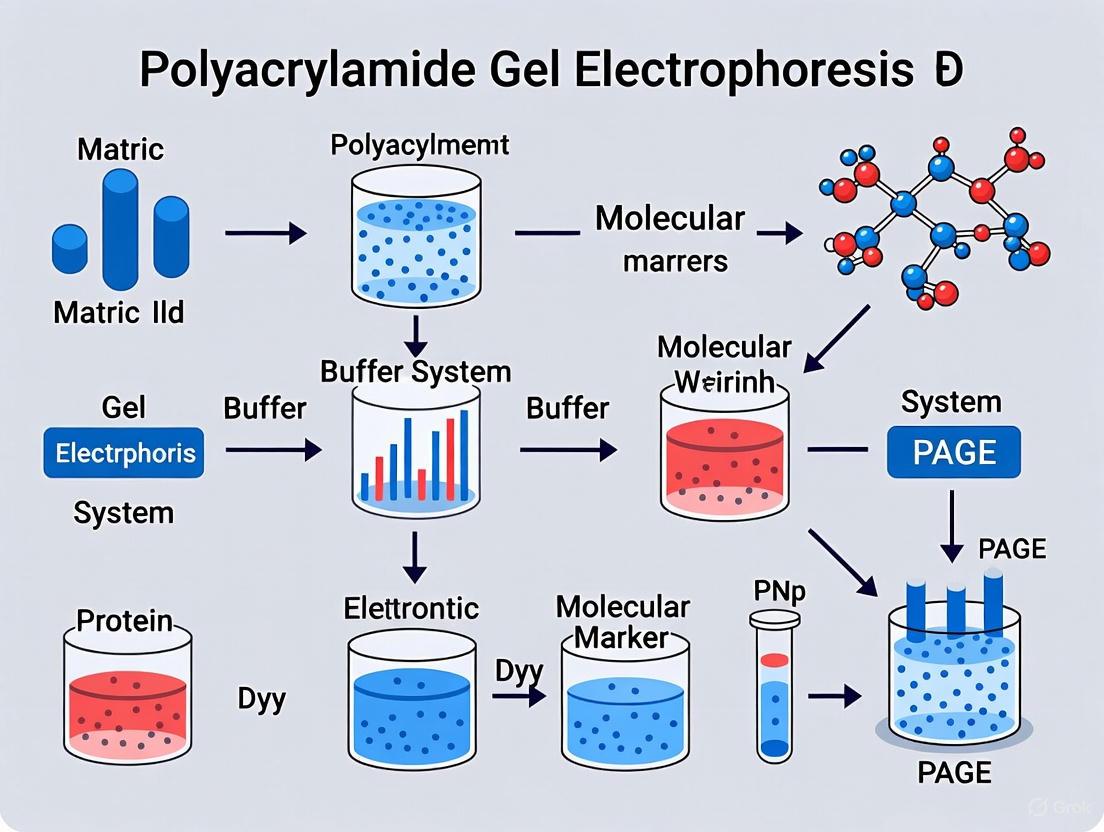
This article provides a comprehensive overview of Polyacrylamide Gel Electrophoresis (PAGE) techniques, a cornerstone method in biochemistry and molecular biology.
Polyacrylamide Gel Electrophoresis (PAGE): A Comprehensive Guide to Principles, Techniques, and Applications in Biomedical Research
Abstract
This article provides a comprehensive overview of Polyacrylamide Gel Electrophoresis (PAGE) techniques, a cornerstone method in biochemistry and molecular biology. Tailored for researchers, scientists, and drug development professionals, it covers foundational principles from gel polymerization chemistry to separation mechanisms. The scope extends to detailed methodologies for SDS-PAGE, native PAGE, and two-dimensional electrophoresis, alongside specialized protocols like Blue-Native PAGE for analyzing protein complexes. A dedicated troubleshooting section addresses common issues like smearing and poor resolution, while the validation segment highlights advanced applications in characterizing mitochondrial complexes and clinical biomarkers. This guide synthesizes established practices with current research to serve as a vital resource for experimental design and optimization.
Understanding PAGE: Core Principles, Gel Chemistry, and Electrophoretic Mobility
The Fundamental Principle of Electrophoretic Separation in Polyacrylamide Gels
Polyacrylamide Gel Electrophoresis (PAGE) is a foundational analytical technique in biochemistry and molecular biology laboratories worldwide, providing high-resolution separation of macromolecules based on their size and charge. This method leverages a cross-linked polyacrylamide gel matrix that acts as a molecular sieve under the influence of an electric field. The technique's exceptional resolving power, reproducibility, and versatility have established it as an indispensable tool for researchers characterizing proteins and nucleic acids [1] [2]. The fundamental principle governing PAGE is that charged molecules migrate through a porous gel matrix when subjected to an electric field, with smaller molecules experiencing less resistance and thus moving faster than larger ones [3] [4].
The significance of PAGE extends across diverse scientific domains, from basic research to clinical diagnostics and pharmaceutical development. In proteomics, PAGE enables detailed protein characterization, assessment of purity, and analysis of expression profiles [5] [2]. In molecular biology, it facilitates the separation of DNA fragments after PCR amplification and supports genetic research [2]. The adaptability of PAGE systems allows researchers to tailor experimental conditions to specific needs, employing either denaturing formats that unfold proteins into linear chains or native conditions that preserve functional conformations and biological activities [6] [2]. This technical guide explores the core principles, methodologies, and applications of PAGE within the broader context of electrophoretic techniques research.
Fundamental Principles of Separation
The Gel Matrix as a Molecular Sieve
The separation mechanism in PAGE relies primarily on the sieving properties of the cross-linked polyacrylamide gel. The gel matrix is formed through a controlled polymerization reaction between acrylamide monomers and a cross-linking agent, typically N,N'-methylenebisacrylamide (BIS) [5] [4]. This reaction creates a three-dimensional network with pores of defined sizes, through which molecules must travel during electrophoresis [1]. The pore size can be precisely manipulated by adjusting the concentrations of acrylamide and bisacrylamide, allowing researchers to optimize separation for specific molecular size ranges [1] [4].
The migration of molecules through this matrix follows a fundamental relationship: smaller molecules migrate more rapidly than larger ones due to decreased frictional resistance with the gel matrix [3] [1] [4]. This molecular sieving effect enables the separation of complex mixtures into discrete bands based on molecular size. The degree of polymerization or cross-linking directly impacts the gel's hardness and resolving capability. Lower percentage gels (e.g., 5-8% acrylamide) with larger pores facilitate the separation of higher molecular weight molecules, while higher percentage gels (e.g., 12-20% acrylamide) with smaller pores provide better resolution for smaller molecules [4].
Charge Manipulation for Size-Based Separation
While the gel matrix provides the sieving mechanism, the electrophoretic mobility of molecules depends on both their size and inherent charge. To achieve separation based primarily on size, PAGE protocols often manipulate the charge characteristics of molecules to create a uniform charge-to-mass ratio. This is particularly important for protein separation, as different proteins possess varying charge properties based on their amino acid composition [4].
In SDS-PAGE (sodium dodecyl sulfate-polyacrylamide gel electrophoresis), the anionic detergent SDS binds strongly to protein backbones at a relatively constant ratio (approximately 1.4g SDS per 1g of protein), masking the proteins' intrinsic charge and conferring a uniform negative charge density [3] [5]. When combined with reducing agents like dithiothreitol (DTT) or β-mercaptoethanol that break disulfide bonds, proteins unfold into linear chains with charge proportional to polypeptide length [3] [5] [4]. This treatment eliminates the influence of molecular shape and charge, ensuring that separation occurs solely based on molecular weight [3] [7] [4].
Table 1: Recommended Polyacrylamide Gel Concentrations for Optimal Separation of Different Molecular Sizes
| Gel Percentage (%T) | Optimal Separation Range for Proteins | Optimal Separation Range for Nucleic Acids (bp) |
|---|---|---|
| 5-8% | Large proteins (>100 kDa) | 100-1,000 (non-denaturing conditions) [8] |
| 8-12% | Most proteins (10-250 kDa) [5] | 60-400 (non-denaturing conditions) [8] |
| 12-15% | Small proteins (5-100 kDa) | 50-200 (non-denaturing conditions) [8] |
| 15-20% | Very small proteins (<50 kDa) | 5-100 (non-denaturing conditions) [8] |
Core Methodologies and Experimental Protocols
Standard SDS-PAGE Protocol
The SDS-PAGE technique represents the most widely used form of polyacrylamide gel electrophoresis for protein analysis. The following step-by-step protocol outlines the key experimental procedures:
Gel Preparation:
- Step 1: Assemble the gel casting apparatus using clean glass plates and spacers [3].
- Step 2: Prepare the separating gel solution with appropriate acrylamide concentration (typically 6-15%) for the target protein size range [3] [5]. The solution includes acrylamide/bis-acrylamide mixture, buffer (usually pH 8.8), and polymerization initiators (ammonium persulfate and TEMED) [5] [4].
- Step 3: Pour the separating gel solution and overlay with water or alcohol to prevent oxygen inhibition of polymerization [3]. Allow 20-30 minutes for complete polymerization [3].
- Step 4: Prepare and pour the stacking gel (with lower acrylamide concentration and pH 6.8) [5], then insert a comb to create sample wells [3]. The stacking gel concentrates proteins before they enter the separating gel, improving resolution [5].
Sample Preparation:
- Step 5: Mix protein samples with SDS-PAGE sample buffer containing SDS, reducing agent, glycerol, and tracking dye [3] [1]. Typical sample buffer includes SDS for denaturation, mercaptoethanol or DTT to reduce disulfide bonds, glycerol to add density, and bromophenol blue as a tracking dye [1] [4].
- Step 6: Heat samples at 95-100°C for 3-5 minutes to ensure complete denaturation [3] [4].
- Step 7: Centrifuge briefly (e.g., 15,000 rpm for 1 minute) to collect condensed sample [3].
Electrophoresis:
- Step 8: Assemble the gel in the electrophoresis apparatus and fill buffer chambers with running buffer containing Tris, glycine, and SDS [3] [5].
- Step 9: Load samples and molecular weight markers into wells [3].
- Step 10: Apply constant voltage (typically 100-200 V) until the tracking dye reaches the gel bottom [3] [1].
- Step 11: Disassemble apparatus and process gel for staining (Coomassie Blue, silver stain) or further analysis like Western blotting [3] [1].
Native PAGE Variations
While SDS-PAGE separates denatured proteins based solely on molecular weight, native PAGE techniques preserve protein structure and function, enabling the study of protein complexes, oligomeric states, and enzymatic activity. Two important variants include:
Blue Native (BN)-PAGE:
- Principle: Uses Coomassie G-250 dye to confer negative charge on proteins without significant denaturation [9] [6]. This method preserves protein-protein interactions and the integrity of multi-subunit complexes [9].
- Applications: Particularly valuable for studying mitochondrial oxidative phosphorylation (OXPHOS) complexes, respiratory chain supercomplexes, and membrane protein complexes [9]. Enables in-gel activity assays for various enzymes [9].
- Protocol: Protein samples are mixed with BN-PAGE sample buffer containing Coomassie G-250, then electrophoresed through native gradient gels with specially formulated cathode and anode buffers [6].
Clear Native (CN)-PAGE:
- Principle: A variation of BN-PAGE that uses different charge-shifting molecules, providing milder protein separation conditions [9].
- Applications: Suitable for delicate protein complexes that might dissociate under BN-PAGE conditions [9].
Native SDS-PAGE (NSDS-PAGE):
- Principle: A hybrid approach that reduces SDS concentration (0.0375% in running buffer) and eliminates heating and reducing agents from sample preparation [6].
- Applications: Enables high-resolution separation while retaining native enzymatic activity and metal cofactors. Research demonstrates 98% zinc retention in Zn-metalloproteins compared to 26% with standard SDS-PAGE [6].
- Protocol: Samples are prepared in NSDS sample buffer without heating, then electrophoresed using reduced SDS concentration in running buffers [6].
Table 2: Comparative Analysis of PAGE Methodologies
| Method | Separation Basis | Protein State | Key Applications | Limitations |
|---|---|---|---|---|
| SDS-PAGE | Molecular weight [3] [5] | Denatured, linearized polypeptides [5] | Molecular weight determination, purity assessment, subunit composition [5] | Loss of native structure and function [6] |
| BN-PAGE | Size, charge, shape [9] | Native, functional complexes [9] [6] | Protein-protein interactions, oligomeric states, in-gel activity assays [9] | Lower resolution compared to SDS-PAGE [6] |
| NSDS-PAGE | Size with mild denaturation [6] | Partially native, functional enzymes [6] | Metalloprotein analysis, functional studies with high resolution [6] | Limited compatibility with some protein types |
Technical Considerations and Optimization
Gel Composition and Buffer Systems
The resolution achieved in PAGE depends significantly on both gel composition and the buffer system employed. The discontinuous buffer system (also called Laemmli system) used in SDS-PAGE enhances separation efficiency through two distinct phases:
- Stacking Gel: A large-pore gel at pH 6.8 where proteins concentrate into narrow bands before entering the separating gel. The differential mobility of chloride ions (leading ions), glycine (trailing ions), and proteins creates this concentrating effect [5].
- Separating Gel: A small-pore gel at pH 8.8 where actual size-based separation occurs as glycine becomes fully deprotonated and migrates faster, creating a uniform separation front [5].
The polymerization process requires careful optimization, as the concentrations of ammonium persulfate (APS) as the initiator and tetramethylethylenediamine (TEMED) as the catalyst determine the rate of gel formation and the resulting pore structure [1] [8]. It is crucial to note that acrylamide is a neurotoxin and potential carcinogen, requiring appropriate safety measures including protective equipment and working under fume hoods during gel preparation [1].
Detection and Visualization Methods
Following electrophoretic separation, multiple staining techniques enable visualization and analysis of separated molecules:
- Coomassie Brilliant Blue: A cost-effective protein stain with detection limits of approximately 10-100 ng protein, suitable for most routine applications [1] [4].
- Silver Staining: A highly sensitive method capable of detecting 0.1-1 ng protein, but with more complex procedures [1].
- Fluorescent and Chemiluminescent Staining: Advanced detection methods offering high sensitivity for specific applications, particularly when combined with Western blotting [1].
- In-Gel Enzyme Activity Staining: Used with native PAGE variants to detect functional enzymes, available for Complexes I, II, IV, and V of the mitochondrial respiratory chain [9].
- Specialized Metal Detection: Techniques like laser ablation-inductively coupled plasma-mass spectrometry and fluorophore staining (e.g., TSQ for zinc) enable detection of metal-containing proteins after NSDS-PAGE [6].
Applications in Research and Industry
PAGE serves as a cornerstone technique across diverse scientific disciplines and industrial applications:
Biomedical and Pharmaceutical Research:
- Protein Characterization: Determination of molecular weight, purity assessment, and verification of recombinant protein integrity [5] [2]. Pharmaceutical companies employ PAGE during drug development to ensure biologics meet regulatory standards [2].
- Expression Analysis: Monitoring protein expression levels across different conditions (e.g., healthy vs. diseased tissues) [5] [1].
- Post-Translational Modification Detection: Identifying phosphorylation, glycosylation, or other modifications that alter electrophoretic mobility [5].
Clinical Diagnostics:
- Genetic Disorder Diagnosis: Hemoglobin electrophoresis detects sickle cell anemia and thalassemia variants [2].
- Serum Protein Analysis: Identification of disease markers through characteristic banding patterns [1].
- Infectious Disease Testing: Detection of pathogen-specific proteins in clinical samples [2].
Biotechnology and Quality Control:
- Biopharmaceutical Manufacturing: Monitoring batch consistency and detecting contaminants in enzyme and therapeutic protein production [2].
- Purity Verification: Ensuring product homogeneity and stability in biopharmaceuticals [1] [2].
Molecular Biology and Genetics:
- Nucleic Acid Separation: High-resolution separation of DNA fragments with single-base resolution possible using denaturing polyacrylamide gels [8].
- PCR Product Analysis: Verification of amplification success and fragment size determination [2].
- Forensic Analysis: DNA fingerprinting for criminal investigations and genetic identification [2].
Essential Research Reagents and Materials
Successful PAGE experimentation requires careful selection and preparation of specific reagents and materials:
Table 3: Essential Reagents for Polyacrylamide Gel Electrophoresis
| Reagent/Material | Function | Technical Considerations |
|---|---|---|
| Acrylamide-Bis Solution | Forms the gel matrix; bis-acrylamide acts as crosslinker [5] [4] | Concentration determines pore size; neurotoxic - handle with protection [1] |
| Ammonium Persulfate (APS) | Free radical initiator for polymerization [5] [1] | Fresh preparation recommended for consistent polymerization |
| TEMED | Catalyst that accelerates polymerization [5] [1] | Amount affects polymerization rate; toxic compound [1] |
| SDS (Sodium Dodecyl Sulfate) | Anionic detergent that denatures proteins and confers negative charge [3] [5] | Binds at ~1.4g per 1g protein; critical for charge uniformity [5] |
| Tris Buffers | Maintain pH during electrophoresis; different pH for stacking (6.8) and separating (8.8) gels [5] | Discontinuous system enhances resolution [5] |
| Glycine | Trailing ion in discontinuous buffer system [5] | Mobility changes with pH enable stacking effect [5] |
| DTT or β-Mercaptoethanol | Reducing agents that break disulfide bonds [5] [1] | Essential for complete unfolding of proteins [5] |
| Coomassie Blue/Silver Stain | Protein visualization after separation [1] [4] | Coomassie for routine detection; silver for high sensitivity [1] |
| Molecular Weight Markers | Reference standards for size determination [5] | Pre-stained or unstained varieties available |
Recent Advancements and Future Perspectives
The evolution of PAGE technology continues to address limitations and expand applications:
Innovative Gel Casting Systems:
- Rapid Casting Technologies: New systems like the mPAGE Lux Casting System eliminate traditional toxic compounds (APS, TEMED) and reduce gel production time to approximately 3 minutes [10].
- Pre-cast Gels: Commercial pre-cast gels offer convenience but with limitations in customization and higher cost [10].
- Bis-Tris Gels: Alternative buffer systems enabling shorter run times and extended shelf lives compared to traditional Tris-Glycine gels [10].
Methodological Innovations:
- NSDS-PAGE Development: Modified SDS-PAGE conditions that preserve metalloprotein metal content (98% zinc retention) and enzymatic activity while maintaining high resolution [6].
- Two-Dimensional Approaches: BN/SDS-PAGE combines native separation of complexes in the first dimension with denaturing separation of subunits in the second dimension [9] [6].
- Enhanced Activity Staining: Improved protocols for in-gel enzyme activity detection, particularly for Complex V of mitochondrial respiratory chain [9].
Future Directions: The integration of digital and automation technologies represents the future of PAGE technology. By 2025, PAGE systems are expected to incorporate more high-throughput capabilities, AI-driven analysis for enhanced accuracy, and potential development of portable devices for point-of-care testing [2]. These advancements will further solidify PAGE's role as an indispensable tool in life science research, clinical diagnostics, and biotechnology innovation.
While PAGE faces challenges including reagent costs, technical complexity, and regulatory requirements, ongoing innovation and cross-sector collaboration continue to expand its applications into emerging fields such as synthetic biology, environmental monitoring, and personalized medicine [2].
Polyacrylamide gel electrophoresis (PAGE) serves as a foundational technique in biochemistry, molecular biology, and biotechnology for separating biological macromolecules based on their electrophoretic mobility [11]. The separation matrix at the heart of this technique is the polyacrylamide gel, a cross-linked polymer network characterized by its tunable pore size, thermal stability, transparency, and relative chemical inertness [11]. The creation of this gel is a polymerization process dependent on a precise interplay of specific chemical components. Acrylamide provides the monomeric backbone, bisacrylamide introduces cross-links to form the porous network, while ammonium persulfate (APS) and tetramethylethylenediamine (TEMED) act in concert to initiate and catalyze the polymerization reaction [11] [12] [13]. Understanding the individual roles and precise functions of these four components is crucial for researchers to reliably prepare gels with properties tailored to their specific separation needs, whether for proteins, nucleic acids, or other biomolecules.
Core Chemical Components and Their Functions
The formation of a polyacrylamide gel is a controlled chemical polymerization process. Each component in the reaction mixture plays a distinct and vital role.
Acrylamide: The Monomer Backbone
Acrylamide (C₃H₅NO) is a vinyl monomer that serves as the fundamental building block of the polyacrylamide gel [11]. In its pure form, it is a white, crystalline powder that is soluble in water and toxic to the human nervous system, necessitating careful handling [11]. During polymerization, individual acrylamide molecules undergo addition polymerization, linking together via their vinyl groups to form long, linear polymer chains of polyacrylamide [12]. The concentration of acrylamide in the gel solution is the primary determinant of the gel's pore size and is thus expressed as a percentage (%) of the total volume. Higher percentages of acrylamide result in gels with smaller average pore sizes, which are more effective at separating smaller proteins or nucleic acid fragments [11]. Typical concentrations for protein separation range from 5% to 20% acrylamide [14].
Bisacrylamide: The Cross-Linking Agent
Bisacrylamide (N,N'-methylenebisacrylamide) is a cross-linking agent that incorporates bridges between adjacent polyacrylamide chains [11] [12]. While acrylamide alone forms linear polymers, the addition of bisacrylamide, which contains two reactive acryloyl groups, creates a three-dimensional mesh-like network [12]. This network constitutes the pores through which molecules migrate during electrophoresis. The ratio of bisacrylamide to acrylamide influences the physical properties of the gel, including its porosity, elasticity, and mechanical strength [11]. The concentration of the cross-linker is typically expressed as a percentage (often denoted as %C) of the total acrylamide content, with a common ratio being about 1 part bisacrylamide to 35 parts acrylamide [11]. A concentration of 5% bisacrylamide is reported to produce the smallest pores [11].
Ammonium Persulfate (APS): The Free Radical Initiator
Ammonium persulfate (APS) is a source of free radicals that initiates the polymerization reaction [12]. Upon dissolution in water, APS decomposes to form sulfate free radicals (SO₄⁻•) [12]. These highly reactive free radicals attack the vinyl groups of acrylamide and bisacrylamide monomers, beginning a chain reaction that leads to polymer growth and cross-linking. APS is typically prepared as a 10% (w/v) aqueous solution and added to the gel mixture just before casting [12]. The rate of APS decomposition, and thus the rate of radical generation, is temperature-dependent.
TEMED: The Free Radical Catalyst
Tetramethylethylenediamine (TEMED) is a stable, organic base that acts as a catalyst for the polymerization reaction [11] [12]. TEMED accelerates the decomposition of APS into free radicals, thereby dramatically increasing the rate at which polymerization begins [13]. It is often described as a free radical stabilizer or a catalyst [12]. Because TEMED is used in its liquid form and is highly efficient, only very small volumes (e.g., microliters per tens of milliliters of gel solution) are required to initiate polymerization [12]. The combination of APS and TEMED creates a potent redox (reduction-oxidation) initiation system that triggers rapid gel formation once added to the monomer solution.
Table 1: Summary of Core Reagents in Polyacrylamide Gel Polymerization
| Component | Chemical Role | Function in Gel Formation | Typical Form & Handling |
|---|---|---|---|
| Acrylamide | Monomer | Forms the linear polymer chains of the gel matrix; primary determinant of gel pore size. | White crystalline powder; neurotoxic, use gloves. |
| Bisacrylamide | Cross-linker | Creates bridges between polyacrylamide chains, forming a porous, mesh-like network. | Powder; handled with same care as acrylamide. |
| Ammonium Persulfate (APS) | Free radical initiator | Decomposes to form sulfate free radicals that initiate the polymerization chain reaction. | Often prepared as a 10% (w/v) aqueous solution. |
| TEMED | Catalyst / Accelerator | Accelerates the decomposition of APS, dramatically speeding up the initiation of polymerization. | Liquid; used in very small quantities (e.g., µL). |
The Polymerization Mechanism and Kinetics
The polymerization of a polyacrylamide gel is a chain-reaction mechanism driven by free radicals. The process begins when TEMED catalyzes the decomposition of APS, producing sulfate free radicals. A representative reaction is shown in the diagram below, which illustrates the initiation, propagation, and termination stages of the polymerization process.
These initiator radicals then attach to acrylamide monomers, converting them into free radicals that subsequently react with other monomers. This propagation step leads to the rapid elongation of polyacrylamide chains. Simultaneously, bisacrylamide molecules, with their two reactive sites, are incorporated into the growing chains, forming cross-links between them and creating the characteristic three-dimensional mesh [12]. The reaction continues until termination occurs, which happens when two free radicals combine or when the reactive ends are otherwise quenched.
Kinetic studies using techniques like Raman spectroscopy have shown that this polymerization reaction can be very efficient. One study monitoring the reaction in capillaries found that polymerization was 98% complete within 1.5 hours and over 99% complete after 2 hours, following second-order kinetics [15]. In practice, for standard gel casting in laboratories, polymerization is often visually complete within 20-30 minutes after the addition of TEMED and APS [3]. The reaction rate is highly dependent on temperature and the concentrations of the initiators. Warmer temperatures and higher concentrations of APS and TEMED will lead to faster polymerization, which can be problematic if the gel sets before it is poured. Conversely, insufficient amounts can lead to delayed or incomplete polymerization.
Table 2: Factors Influencing Gel Polymerization Kinetics and Properties
| Factor | Effect on Polymerization | Influence on Final Gel Properties |
|---|---|---|
| APS/TEMED Concentration | Increased concentration accelerates polymerization. Too little can cause slow or incomplete gelation. | Minimal direct effect on pore size, but affects gel uniformity. |
| Temperature | Higher temperatures significantly increase the rate of polymerization. | Can affect pore size uniformity if polymerization is too rapid. |
| Oxygen | Acts as a free radical scavenger and inhibits polymerization. | Can prevent gel formation if present in the mixture; degassing is sometimes used. |
| Total Acrylamide (%T) | Not a kinetic factor, but defines the gel matrix density. | Higher %T creates a gel with a smaller average pore size. |
| Cross-linker Ratio (%C) | Not a major kinetic factor. | Alters pore structure; a concentration of ~5% bisacrylamide produces the smallest pores [11]. |
Experimental Protocol for Standard Gel Preparation
The following section provides a detailed, step-by-step methodology for preparing a discontinuous SDS-polyacrylamide gel, a common technique used in protein research [12] [13]. This protocol exemplifies the practical application of the polymerization chemistry described in previous sections.
Materials and Reagents (The Researcher's Toolkit)
Table 3: Essential Reagents and Equipment for Gel Casting
| Item | Function / Role | Example / Note |
|---|---|---|
| Acrylamide/Bis-acrylamide Stock Solution | Pre-mixed monomer and cross-linker source, typically 30-40% (w/v) at a standard ratio (e.g., 29:1 or 37.5:1). | Warning: Neurotoxin. Wear gloves and avoid inhalation. |
| Tris-HCl Buffer | Provides the appropriate pH for the polymerization reaction and subsequent electrophoresis. | Resolving gel: 1.5 M Tris, pH 8.8. Stacking gel: 0.5 M Tris, pH 6.8 [12]. |
| Sodium Dodecyl Sulfate (SDS) | Denaturing agent added to gels for SDS-PAGE. | Added as a 10-20% solution [12]. Omitted for native PAGE. |
| 10% Ammonium Persulfate (APS) | Free radical initiator. Freshly prepared in water is recommended. | - |
| TEMED | Catalyst for polymerization. | Added last, just before pouring the gel. |
| Water-Saturated Butanol or Isopropanol | Layered on top of the resolving gel to exclude oxygen and create a flat, smooth gel surface. | - |
| Glass Plates, Spacers, and Combs | Form the casting cassette that contains the gel solution as it polymerizes. | Must be clean and dry to ensure proper polymerization and avoid leaks. |
| Gel Caster and Electrophoresis Apparatus | Hardware to hold the gel cassette and run the electrophoresis. | - |
Step-by-Step Procedure
Assemble the Gel Casting Cassette: Thoroughly clean and dry the glass plates, spacers, and combs. Assemble the cassette according to the manufacturer's instructions to create a leak-proof mold [3] [13].
Prepare and Pour the Resolving Gel:
- In a clean beaker or flask, mix the components for the resolving gel in the following order: deionized water, acrylamide/bis solution, Tris buffer (pH 8.8), and SDS. Do not add APS and TEMED at this stage [12].
- Just before pouring, add the specified volumes of 10% APS and TEMED. Swirl the mixture gently but thoroughly to ensure homogeneity. Work quickly from this point.
- Using a pipette, transfer the resolving gel solution into the gap between the glass plates. Fill to about three-quarters of the total height of the short plate.
- Carefully layer a small amount of water-saturated butanol or isopropanol on top of the gel solution. This step flattens the gel surface and seals it from atmospheric oxygen, which inhibits polymerization [11] [12].
- Allow the gel to polymerize completely. This typically takes 20-30 minutes. Polymerization is indicated by the appearance of a distinct refractive boundary between the gel and the overlaying liquid.
Prepare and Pour the Stacking Gel:
- Once the resolving gel has set, pour off the overlaying butanol or alcohol. Rinse the top of the gel several times with deionized water to remove any residue.
- In a separate container, mix the components for the stacking gel (water, acrylamide/bis, Tris buffer pH 6.8, SDS), again omitting APS and TEMED.
- Add APS and TEMED to the stacking gel solution and mix.
- Pour the stacking gel solution directly onto the polymerized resolving gel. Immediately insert a clean comb into the cassette, being careful to avoid trapping air bubbles under the teeth of the comb.
- Allow the stacking gel to polymerize for another 20-30 minutes.
Post-Polymerization: After polymerization is complete, the comb can be carefully removed, revealing the sample wells. The gel is now ready for electrophoresis. It can be used immediately or stored refrigerated in an airtight bag for a short period [13].
Troubleshooting and Optimization Considerations
Successful gel polymerization is critical for obtaining high-quality electrophoretic separations. Several common issues can arise from problems with the core chemistry.
- Slow or Incomplete Polymerization: This is often caused by old or degraded APS, insufficient amounts of APS or TEMED, or inhibition by oxygen. APS solutions should be fresh or freshly made. Ensure that the gel solution is not excessively aerated and that the overlay step is performed correctly to exclude air.
- Overly Rapid Polymerization: If the gel sets too quickly, it can lead to uneven pore formation or make it impossible to pour the gel before it solidifies. This is typically due to excessively high concentrations of APS and TEMED or a high ambient temperature. Reducing the amount of initiator and catalyst or working in a cooler environment can mitigate this.
- Bubbles or Streaks in the Gel: These artifacts can be caused by air bubbles introduced during pouring or incomplete mixing of the initiators. Pour the gel solution steadily along the edge of the glass plates and mix the solution thoroughly after adding APS and TEMED.
- Soft or Brittle Gels: The physical consistency of the gel is controlled by the acrylamide and bisacrylamide concentrations. Gels with low total acrylamide (%T) are softer and more fragile, while gels with very high cross-linking (%C) can become brittle and opaque. Adjusting these ratios within standard ranges (e.g., 5-20% T, 1-5% C) will produce gels with optimal handling properties.
The chemistry underlying polyacrylamide gel polymerization is a precisely orchestrated process where acrylamide, bisacrylamide, APS, and TEMED each play an indispensable role. Acrylamide forms the polymeric backbone, bisacrylamide establishes the critical porous network, and the APS-TEMED redox system efficiently initiates and drives the reaction to completion. A deep understanding of this chemical foundation—from the kinetics of the free radical mechanism to the practical considerations of reagent quality and concentration—empowers researchers to reliably produce gels with consistent and tailored properties. This reliability is fundamental to the success of PAGE, a technique that remains a cornerstone of modern molecular analysis in both academic research and industrial drug development. As PAGE technology evolves with trends toward automation, miniaturization, and novel detection methods [16] [14] [17], the core principles of its polymerization chemistry remain the essential starting point for innovation and application.
Polyacrylamide gel electrophoresis (PAGE) serves as a foundational technique in biochemistry, molecular biology, and biotechnology for separating biological macromolecules based on their electrophoretic mobility [11]. The resolution achieved through this method—the ability to distinguish between molecules of similar size and charge—is fundamentally governed by the physicochemical properties of the polyacrylamide gel matrix itself [18]. This gel matrix acts as a molecular sieve, and its pore size distribution directly determines the size range of molecules that can be effectively separated [19]. The control over pore architecture is exercised through precise manipulation of two key variables during gel fabrication: the total concentration of acrylamide monomers and the degree of cross-linking between polyacrylamide chains [18] [11]. This technical guide provides an in-depth examination of the relationship between gel composition, pore size, and separation resolution, equipping researchers with the knowledge to optimize PAGE protocols for specific analytical challenges.
The Chemistry of Polyacrylamide Gel Formation
Polymerization Reaction Fundamentals
Polyacrylamide gels are formed through a vinyl addition polymerization reaction. The process involves combining acrylamide monomers with a bifunctional cross-linker, most commonly N,N'-methylenebisacrylamide (bis-acrylamide) [18] [11]. This reaction is initiated by a free-radical generating system, typically ammonium persulfate (APS) as the catalyst, and accelerated by the base N,N,N',N'-tetramethylethylenediamine (TEMED) [18] [11] [19]. TEMED acts as an oxygen scavenger and catalyzes the formation of free radicals from APS, which subsequently initiate the polymerization by attacking the carbon-carbon double bonds of the acrylamide and bis-acrylamide monomers [11]. As the reaction proceeds, long chains of polyacrylamide form and are bridged by the bis-acrylamide cross-links, creating a three-dimensional mesh-like network [18]. The porosity of this final network is not a random characteristic but is determined by the specific concentrations and ratios of the chemical constituents used in the gel solution [19].
Key Components and Their Functions
Table 1: Key Reagents in Polyacrylamide Gel Formation
| Reagent | Chemical Function | Role in Gel Formation |
|---|---|---|
| Acrylamide | Monomer | Forms the primary backbone of the gel polymer chains. |
| Bis-acrylamide | Cross-linker | Connects polyacrylamide chains to form a 3D network. |
| Ammonium Persulfate (APS) | Free-radical initiator (Catalyst) | Generates free radicals to start the polymerization reaction. |
| TEMED | Reaction Accelerator | Catalyzes the formation of free radicals from APS. |
Quantitative Control of Gel Pore Size
Total Monomer Concentration (%T)
The total concentration of acrylamide and bis-acrylamide, expressed as %T (w/v), is the primary factor controlling the average pore size of the gel [18] [19]. The relationship is inverse: as %T increases, the average pore size decreases, creating a tighter mesh that retards the migration of larger molecules [11] [19]. This principle allows researchers to select a gel concentration appropriate for their target macromolecules. Lower percentage gels (e.g., 5-8%) are optimal for resolving high molecular weight proteins or nucleic acids, while higher percentage gels (e.g., 15-20%) provide better resolution for smaller molecules [11] [20]. For example, a 10% gel is generally suitable for proteins in the 15-100 kDa range, whereas a 20% gel is used for smaller peptides in the 8-30 kDa range [19].
Table 2: Guide to Gel Percentage Selection Based on Target Molecule Size
| Total Acrylamide (%T) | Effective Separation Range (Proteins) | Pore Size |
|---|---|---|
| 5-8% | High Molecular Weight (25 - 200 kDa) | Large |
| 10-12% | Mid Molecular Weight (15 - 100 kDa) | Medium |
| 15-20% | Low Molecular Weight (8 - 30 kDa) | Small |
Cross-Linker Concentration (%C)
The degree of cross-linking, defined as the weight percentage of bis-acrylamide relative to the total monomer weight (%C), also critically influences pore morphology [11] [19]. The relationship between %C and pore size is parabolic, not linear [11]. Pore size decreases as %C increases up to an optimal point of approximately 5% C, which yields the smallest possible pores for a given %T [11]. Beyond this point, further increasing the cross-linker concentration can paradoxically lead to an increase in pore size due to the formation of heterogeneous gel structures with dense clusters and large voids [11]. Standard protocols often use a cross-linking ratio between 1:35 and 1:40 (bis-acrylamide to acrylamide), which corresponds to a %C of about 2.5-3.0% [11].
Experimental Protocols for Gel Preparation
Standard Protocol for Discontinuous SDS-PAGE Gel Casting
The following detailed protocol is adapted from standard laboratory practices for casting a discontinuous SDS-PAGE gel, which includes a resolving (separating) gel and a stacking gel [11] [19].
I. Resolving Gel Preparation
- Assemble the gel cassette by securing two clean glass plates with integrated spacers in a casting frame.
- Prepare the resolving gel solution in a beaker by mixing the following components in order:
- Deionized water (variable volume based on %T, see Table 3)
- 1.5 M Tris-HCl buffer, pH 8.8
- Acrylamide/Bis-acrylamide stock solution (30%T, 2.7%C is common)
- 10% (w/v) Sodium Dodecyl Sulfate (SDS)
- 10% (w/v) Ammonium Persulfate (APS) - add last
- TEMED - add last, as it immediately initiates polymerization
- Mix the solution gently and pour it into the gel cassette, leaving space for the stacking gel.
- Overlay the gel solution with isobutanol or water-saturated butanol to exclude oxygen and create a flat, even surface.
- Allow polymerization to complete (typically 20-30 minutes at room temperature). A distinct schlieren line will appear between the gel and the overlay.
II. Stacking Gel Preparation
- Pour off the overlay and rinse the top of the polymerized resolving gel with deionized water.
- Prepare the stacking gel solution in a beaker. A typical 4% stacking gel can be prepared as follows [19]:
- Deionized water: 2.70 mL
- 30% Acrylamide/Bis mix: 0.67 mL
- 1.0 M Tris-HCl, pH 6.8: 0.50 mL
- 10% SDS: 0.04 mL
- 10% APS: 0.04 mL (add last)
- TEMED: 0.004 mL (add last)
- Pour the stacking gel directly onto the resolving gel and immediately insert a clean comb.
- Allow the stacking gel to polymerize completely (15-20 minutes) before carefully removing the comb.
Table 3: Example Compositions for Resolving Gels of Different Percentages (for 10 mL total volume)
| Component | 10% Resolving Gel | 15% Resolving Gel | 20% Resolving Gel |
|---|---|---|---|
| H₂O (mL) | 4.0 | 2.3 | 0.8 |
| 30% Acrylamide/Bis (mL) | 3.3 | 5.0 | 6.7 |
| 1.5 M Tris-HCl, pH 8.8 (mL) | 2.5 | 2.5 | 2.5 |
| 10% SDS (µL) | 100 | 100 | 100 |
| 10% APS (µL) | 100 | 100 | 100 |
| TEMED (µL) | 10 | 10 | 10 |
Protocol for Native PAGE for Lipoprotein Analysis (HI-PAGE)
For specialized applications like lipoprotein profiling, native PAGE (without SDS) is used. The following Histidine-Imidazole PAGE (HI-PAGE) protocol is a modern example [21].
- Gel Casting: Prepare a non-gradient, uniform acrylamide gel (e.g., 3-4%) using a 30% acrylamide-bisacrylamide mixture (19:1 ratio). Use a Tris-HCl buffer without denaturants.
- Running Buffer: Prepare the HI-PAGE running buffer by dissolving Tris and histidine in ultrapure water to a final concentration of, for example, 50 mM Tris and 40 mM histidine. The pH should be approximately 8.4 without adjustment [21].
- Sample Preparation: Mix the serum sample with a pre-staining solution containing a fluorescent dye like Nile Red (for fluorescence detection) or Sudan Black B (for colorimetric detection). A typical ratio is 1:1 (sample:pre-staining solution). Incubate for 5 minutes to allow dye binding [21].
- Electrophoresis: Load the pre-stained samples and run the gel at a constant current (e.g., 20-40 mA) at ambient temperature until the dye front reaches the bottom of the gel (approximately 30-40 minutes for a mini-gel) [21].
The Scientist's Toolkit: Essential Reagents for PAGE
Table 4: Research Reagent Solutions for PAGE Experiments
| Reagent / Material | Function in PAGE | Technical Notes |
|---|---|---|
| Acrylamide / Bis-acrylamide Stock | Provides monomers for gel matrix. | Typically a 30-40% (w/v) solution with a defined %C (e.g., 29:1, 37.5:1). Highly toxic—handle with care. |
| Tris-HCl Buffer | Maintains stable pH during electrophoresis. | Resolving gel uses pH 8.8; Stacking gel uses pH 6.8 (for discontinuous SDS-PAGE). |
| Ammonium Persulfate (APS) | Free-radical initiator for polymerization. | Prepared as a 10% (w/v) solution in water. Stable for weeks at 4°C. |
| TEMED | Catalyst that accelerates polymerization. | Added last to the gel solution. Hygroscopic and should be stored tightly sealed. |
| Sodium Dodecyl Sulfate (SDS) | Anionic detergent that denatures proteins and confers uniform negative charge. | Critical for SDS-PAGE. Used in sample buffer and gel buffer (typically 0.1%). |
| Dithiothreitol (DTT) or β-Mercaptoethanol | Reducing agents that break disulfide bonds in proteins. | Added to the sample buffer for "reducing SDS-PAGE" to fully denature proteins. |
| Coomassie Brilliant Blue R-250 | Protein stain for visualizing separated bands post-electrophoresis. | Staining solution: 0.05% dye in 40% ethanol, 10% acetic acid. Destain with same solution without dye [22]. |
| Molecular Weight Markers | Standard proteins of known mass for calibration and size estimation. | Essential for determining the molecular weight of unknown sample proteins. |
The precise control of pore size through the manipulation of acrylamide concentration (%T) and cross-linker ratio (%C) is the cornerstone of achieving high resolution in polyacrylamide gel electrophoresis. The principles and protocols outlined in this guide provide a framework for researchers to systematically tailor their electrophoretic separations. Mastery of these fundamentals enables the adaptation of PAGE for a vast array of applications, from routine protein analysis to the sophisticated separation of complex macromolecular assemblies like respiratory supercomplexes [23] and engineered nanomaterials [19]. As PAGE continues to be a vital tool in life science research and drug development, a deep understanding of the relationship between gel chemistry and separation performance remains an essential component of the researcher's expertise.
Gel electrophoresis remains a cornerstone technique in molecular biology and biochemistry laboratories worldwide. Its fundamental principle—the separation of charged molecules such as nucleic acids and proteins based on their size and charge—is essential for countless research and diagnostic applications [24]. The fidelity and reproducibility of an experiment hinge on the careful selection of the gel matrix. The two primary matrices employed for this purpose are agarose and polyacrylamide. While both serve as a molecular sieve, their unique physical and chemical properties dictate their suitability for different types of macromolecules and experimental objectives [24]. A deep understanding of these differences is critical for any laboratory professional seeking to optimize their workflow and ensure the integrity of their results, particularly within the context of advanced Polyacrylamide Gel Electrophoresis (PAGE) techniques research [25].
This technical guide provides a detailed comparison of these two fundamental matrices, highlighting key characteristics, applications, and practical considerations. It is framed within the broader scope of electrophoresis methodology, which has evolved from simple slab gel techniques to advanced forms like capillary and microchip electrophoresis [25]. The expanding global PAGE market, projected to reach USD 23.09 billion in the United States by 2033, underscores the technique's enduring importance in pharmaceutical, biotechnology, and academic research [26] [14].
Fundamental Properties and Composition
Agarose Gels
An agarose gel is a matrix derived from a natural polysaccharide polymer extracted from seaweed. The gel is formed by dissolving agarose powder in an aqueous buffer through heating, followed by cooling. This process causes the linear polysaccharide chains to associate via non-covalent hydrogen bonds, forming a three-dimensional lattice with relatively large, non-uniform pores [24]. The pore size can be influenced, though not precisely controlled, by adjusting the gel concentration. Lower agarose concentrations (e.g., 0.5%) produce larger pores suitable for separating very large molecules, while higher concentrations (e.g., 2%) yield smaller pores better for resolving smaller macromolecules [24] [27]. The primary advantages of agarose gels are their ease of preparation and non-toxic nature, making them a safe and convenient option for standard nucleic acid work [24].
Polyacrylamide Gels
In contrast, a polyacrylamide gel is a synthetic polymer matrix formed through a chemical polymerization reaction. The gel is created from the co-polymerization of acrylamide monomer and a cross-linking agent, most commonly N,N'-methylenebisacrylamide (bis-acrylamide) [24]. Acrylamide molecules form long chains, while bis-acrylamide connects these chains to create a tight, highly ordered, three-dimensional mesh. The key advantage of polyacrylamide is the precise control over its pore size. By adjusting the total monomer concentration (%T) and the cross-linker ratio (%C), the average pore size can be finely tuned to create a uniform sieving environment [24]. A higher %T results in a denser matrix with smaller pores, offering superior resolution for smaller molecules. A significant practical consideration is that unpolymerized acrylamide is a potent neurotoxin, requiring strict safety protocols including gloves and lab coats during gel preparation [24].
Comparative Analysis: Agarose vs. Polyacrylamide
The table below summarizes the core technical differences between agarose and polyacrylamide gels, providing a clear guide for researchers.
Table 1: Key Technical Differences Between Agarose and Polyacrylamide Gels
| Feature | Agarose Gel | Polyacrylamide Gel (PAGE) |
|---|---|---|
| Chemical Basis | Natural polysaccharide from seaweed [24] | Synthetic polymer of acrylamide and bis-acrylamide [24] |
| Pore Size | Large (nanometers to micrometers), non-uniform [24] | Small (a few nanometers), uniform, and tunable [24] |
| Typical Gel Concentrations | 0.5% - 3% (can be higher for specific applications) [27] | 5% - 20%+ for proteins; 1% - 8% for DNA [14] |
| Optimal Molecular Size Range | Large DNA/RNA: 100 bp to 25 kbp and beyond [24] | Proteins & small nucleic acids: < 1 kbp for DNA [24] |
| Primary Applications | Nucleic acid electrophoresis (genotyping, PCR verification) [24] | Protein analysis (SDS-PAGE, Native PAGE), high-res DNA separation [24] [28] |
| Resolution Capability | Lower resolution; suitable for fragments differing by >10-20 bp in DNA [24] | Very high resolution; can distinguish molecules differing by 1 kDa in proteins or a single base pair in DNA [24] [27] |
| Preparation & Handling | Simple: dissolved in buffer by heating and poured; non-toxic [24] | Complex: requires chemical polymerization; neurotoxic monomer handling [24] |
| Typical Sample Load | Up to 2.5 µg for a polydisperse HA sample [27] | As low as 0.5 µg for a polydisperse HA sample [27] |
Applications in Research and Diagnostics
Primary Application Domains
The distinct structural properties of each gel matrix directly determine the type of macromolecules they can effectively separate. Agarose gel electrophoresis is the method of choice for the separation of nucleic acids, specifically medium-to-large DNA and RNA fragments [24]. Given the very large size of most DNA fragments, the large, flexible pores of an agarose gel matrix are well-suited for their migration. The concentration of the agarose gel is critical for achieving optimal separation: a 0.8% gel is commonly used for large DNA fragments (5-10 kbp), while a 2% gel provides better resolution for smaller fragments (0.1-1 kbp) [24]. Agarose is also the matrix of choice for specialized techniques like pulsed-field gel electrophoresis (PFGE), used to separate very large chromosomal DNA fragments [24].
Conversely, the primary application of polyacrylamide gel electrophoresis (PAGE) is for the separation of proteins and very small nucleic acid fragments [24]. Proteins are much smaller than most DNA molecules, and the tight, uniform pores of a polyacrylamide gel provide the high resolution necessary to separate them. The most common form is SDS-PAGE, where the detergent SDS denatures proteins and imparts a uniform negative charge, ensuring separation is based almost solely on molecular mass [24]. For applications requiring the separation of proteins in their native, folded state, non-denaturing or Native PAGE is used. The high resolution of PAGE allows for the separation of proteins that differ in molecular weight by as little as a few thousand Daltons [24]. Similarly, for small DNA or RNA molecules, PAGE offers the fine-tuned separation required to resolve fragments differing by a single base pair, which is crucial for techniques like genotyping and miRNA analysis [24] [16].
Advanced and Emerging PAGE Applications
The versatility of PAGE has led to its adoption in advanced research methodologies. Two-dimensional gel electrophoresis (2D-PAGE), which combines isoelectric focusing (IEF) with SDS-PAGE, is a landmark technique in proteomics due to its high resolving power for separating complex protein mixtures based on both charge and size [28]. Furthermore, PAGE is indispensable in western blotting for the immunodetection of specific proteins, diagnostics for conditions like cancer and neurodegenerative diseases, and drug development for quality control and characterizing novel therapeutics [28] [26]. The ongoing innovation in PAGE, including automation, integration with mass spectrometry, and the development of microfluidic "lab-on-a-chip" devices, continues to expand its application frontier in life sciences [16] [14].
Experimental Methodologies
Protocol for Agarose Gel Electrophoresis
This protocol is adapted for the separation of DNA fragments in a standard mini-gel format [24] [27].
- Gel Preparation: Weigh the appropriate amount of agarose powder (e.g., 0.4 g for a 2% gel in 20 ml of buffer) and add it to a flask with the chosen running buffer, typically Tris-Acetate-EDTA (TAE) or Tris-Borate-EDTA (TBE).
- Dissolving Agarose: Heat the mixture in a microwave oven with periodic swirling until the agarose is completely dissolved and the solution is clear.
- Casting the Gel: Cool the solution to approximately 50-60°C, then pour it into a casting tray with a well comb in place. Allow it to solidify at room temperature for 20-30 minutes.
- Sample Loading: Mix DNA samples with a loading dye containing a dense agent (e.g., glycerol) and tracking dyes. Carefully load the mixture into the wells of the submerged gel.
- Electrophoresis Run: Connect the gel tank to a power supply and run at a constant voltage (e.g., 80-120 V). The tracking dye migration can be used to monitor progress.
- Visualization: After electrophoresis, stain the gel with an intercalating dye such as ethidium bromide or a safer alternative like SYBR Safe. Visualize the DNA bands under UV light.
Protocol for SDS-Polyacrylamide Gel Electrophoresis (SDS-PAGE)
This protocol outlines the steps for a standard denaturing protein separation, which can be performed using hand-cast or commercial precast gels [24] [14].
- Gel Casting (for hand-cast gels): Assemble glass plates in a casting stand. Prepare resolving and stacking gel solutions according to the desired percentage, adding catalysts Ammonium Persulfate (APS) and Tetramethylethylenediamine (TEMED) last to initiate polymerization. Pour the resolving gel, overlay with a solvent to ensure a flat interface, and after polymerization, pour the stacking gel and insert the well comb.
- Sample Preparation: Mix protein samples with SDS-PAGE sample buffer, which contains SDS, a reducing agent (like β-mercaptoethanol), glycerol, and a tracking dye. Heat the samples at 95-100°C for 5 minutes to denature the proteins.
- Electrophoresis Run: Load the denatured samples into the wells. Fill the electrophoresis chamber with Tris-Glycine-SDS running buffer. Run the gel at a constant voltage, typically starting at a lower voltage through the stacking gel and increasing for the resolving gel.
- Protein Staining & Visualization: After separation, proteins can be visualized using stains like Coomassie Brilliant Blue, silver stain, or fluorescent dyes. The gel may require fixation and destaining steps to reduce background and reveal clear protein bands.
Decision Framework: Selecting the Appropriate Gel
The choice between an agarose gel and a polyacrylamide gel is a foundational decision that impacts the entire experimental process. The following workflow diagram provides a logical guide for researchers to select the correct matrix based on their experimental needs.
Essential Research Reagent Solutions
Successful gel electrophoresis requires a suite of reliable reagents and materials. The table below details the key components for setting up and performing both agarose and polyacrylamide gel electrophoresis.
Table 2: Essential Reagents and Materials for Gel Electrophoresis
| Item | Function/Purpose | Common Examples / Notes |
|---|---|---|
| Agarose | Forms the porous matrix for nucleic acid separation. | Select type (e.g., standard, high-resolution) and concentration based on target DNA size [24] [27]. |
| Acrylamide/Bis-Acrylamide | Monomer and cross-linker that form the polyacrylamide matrix. | Neurotoxic in monomeric form; handle with gloves. Often purchased as a pre-mixed solution for safety [24]. |
| Electrophoresis Buffer | Carries current and maintains stable pH during the run. | TAE (Tris-Acetate-EDTA) or TBE (Tris-Borate-EDTA) for agarose; Tris-Glycine-SDS for SDS-PAGE [24] [27]. |
| Loading Dye | Adds density to samples for well loading and contains visible tracking dyes to monitor migration. | Contains glycerol/ficoll and dyes (e.g., Bromophenol Blue, Xylene Cyanol) [27]. |
| DNA/Protein Standards (Ladder) | A mixture of molecules of known sizes run alongside samples for size estimation. | Essential for accurate molecular weight determination. |
| Staining Dye | Visualizes separated molecules after electrophoresis. | DNA: Ethidium bromide, SYBR Safe/Gold [27]. Protein: Coomassie Blue, Silver stain, Sypro Ruby [14]. |
| Polymerization Catalysts | Initiate and accelerate the chemical setting of polyacrylamide gels. | Ammonium Persulfate (APS) and TEMED [24]. |
| SDS (Sodium Dodecyl Sulfate) | Anionic detergent that denatures proteins and confers a uniform negative charge per unit mass for SDS-PAGE. | Critical for separation based solely on molecular weight in protein gels [24]. |
The selection of the appropriate gel matrix—be it agarose or polyacrylamide—is a critical decision that directly influences experimental success. Agarose gel excels in separating large nucleic acids with its robust, easily-prepared, and non-toxic matrix, making it the workhorse for most DNA and RNA analysis in research and diagnostics [24]. Its polyacrylamide counterpart, with its fine-tuned pore structure, is the superior choice for high-resolution separation of proteins and small nucleic acid fragments, forming the core of countless proteomics and genomics workflows [24] [28].
This choice is not merely technical but also strategic, impacting laboratory safety, workflow efficiency, and the reliability of results. By meticulously considering the size of the target molecules, the required resolution, and the associated safety and logistical considerations, researchers can make an informed choice that streamlines their workflow and ensures data integrity. This fundamental understanding not only prevents common experimental errors but also empowers scientists to fully leverage the capabilities of electrophoresis in pushing the boundaries of molecular analysis.
Electrophoretic mobility, the movement of charged particles in an electric field, forms the foundational principle of polyacrylamide gel electrophoresis (PAGE), a cornerstone technique in biochemical analysis [29] [30]. The rate at which molecules migrate through the polyacrylamide gel matrix is not governed by a single factor but by a complex interplay of their inherent physical and chemical properties—specifically their net charge, hydrodynamic size, and three-dimensional shape [30] [13]. Understanding this interplay is crucial for researchers, scientists, and drug development professionals who rely on PAGE for protein characterization, purity assessment, and quality control in complex biological samples [29] [13]. This technical guide delves into the core mechanisms of electrophoretic mobility, examining how these factors influence separation under different PAGE configurations and providing detailed methodologies for their experimental investigation.
Fundamental Principles of Electrophoresis
At its core, electrophoresis relies on the simple principle that charged molecules will experience a force and move towards an electrode of opposite charge when placed in an electric field [30] [13]. The matrix through which they move, typically a cross-linked polyacrylamide gel, acts as a molecular sieve, retarding the movement of molecules based on their interaction with the gel pores [29] [30]. The polyacrylamide gel is created by polymerizing acrylamide monomers into long chains and cross-linking them with N,N'-methylenebisacrylamide (bisacrylamide). The pore size of the resulting gel is inversely related to the total percentage of acrylamide; a higher percentage creates a denser network with smaller pores, which is more effective at separating smaller proteins [30] [31] [13].
The mobility (μ) of a molecule in this system can be described by the following relationship:
μ = q / (f)
where q is the net charge of the molecule and f is the frictional coefficient, which is directly influenced by the molecule's size and shape, and the viscosity of the medium [30]. Consequently, a molecule's journey through the gel is a function of its charge density and its ability to navigate the porous matrix.
Diagram 1: Fundamental factors determining electrophoretic mobility. The net charge (q) provides the driving force, while the frictional coefficient (f), influenced by size, shape, and the gel matrix, provides the opposing force.
Factors Influencing Electrophoretic Mobility
Net Charge
The net charge of a protein is determined by the ionization state of its amino acid side chains and is highly dependent on the pH of the running buffer relative to the protein's isoelectric point (pI) [30] [13]. In a native-PAGE system, where proteins are not denatured, the charge of the protein is a primary determinant of its migration. A protein with a higher negative charge density (more negative charges per unit mass) will migrate more rapidly toward the positive anode [30]. This property allows native-PAGE to separate proteins based on their intrinsic charge. However, in techniques like SDS-PAGE, this factor is neutralized. The anionic detergent sodium dodecyl sulfate (SDS) binds to proteins in a constant weight ratio (approximately 1.4 g SDS per 1 g of protein), effectively coating them in a uniform negative charge shield. This overwhelms the protein's intrinsic charge, rendering the charge-to-mass ratio nearly identical for most polypeptides [31] [13].
Molecular Size
When the influence of charge is negated, as in SDS-PAGE, molecular size becomes the dominant factor governing mobility [30] [31]. The linearized SDS-polypeptide complexes must travel through the pores of the polyacrylamide gel. Smaller proteins navigate these pores more easily and thus migrate faster and farther through the gel matrix than larger proteins, which are more hindered by the sieving effect [30] [13]. The relationship between the logarithm of a protein's molecular weight and its relative mobility (Rf) is generally inverse and linear within a certain range, allowing SDS-PAGE to be used for molecular weight estimation [30]. The optimal resolution for different molecular weight ranges is achieved by varying the acrylamide concentration, as detailed in Table 1.
Table 1: Recommended Polyacrylamide Gel Concentrations for Optimal Separation by Protein Size
| Target Protein Size Range | Recommended Acrylamide Percentage | Primary Use Case |
|---|---|---|
| Very Large Proteins (>100 kDa) | 6% - 8% | Large pore size facilitates movement of big molecules. |
| Broad Range (10 - 200 kDa) | 10% - 12% | Standard workhorse concentration for general protein separation. [30] |
| Small Proteins (<30 kDa) | 12% - 20% | Higher percentage creates smaller pores to resolve low MW proteins. [29] [13] |
| Very Small Peptides (<10 kDa) | Tricine-SDS-PAGE | Specialized technique for high resolution of small peptides. [29] |
Molecular Shape
The three-dimensional shape of a protein significantly impacts its electrophoretic mobility, particularly under non-denaturing (native) conditions [30] [13]. A compact, globular protein will experience less frictional drag and migrate more rapidly through the gel than an elongated, fibrous protein of the same molecular weight [30]. This is because the compact molecule presents a smaller hydrodynamic radius to the gel matrix. In SDS-PAGE, the goal is to eliminate the influence of shape by denaturing the protein. The combination of SDS and reducing agents like β-mercaptoethanol or dithiothreitol (DTT) unfolds the protein, breaking disulfide bonds and disrupting secondary and tertiary structures to create a linear polypeptide chain [29] [31] [13]. This linearization ensures that separation is based almost exclusively on polypeptide length (molecular weight) rather than native conformation.
Modes of Polyacrylamide Gel Electrophoresis
The relative contributions of charge, size, and shape to electrophoretic mobility are determined by the specific PAGE method employed. The two primary modes, SDS-PAGE and Native-PAGE, offer complementary information and are selected based on the experimental objectives.
SDS-PAGE (Denaturing Conditions)
SDS-PAGE is a discontinuous, denaturing electrophoresis technique designed to separate proteins based solely on their molecular weight [30] [13]. The "discontinuous" aspect refers to the use of different buffer ions and pH in the gel and tank, and a two-layer gel system comprising a stacking gel and a resolving gel [31] [13]. The stacking gel, with a lower acrylamide concentration (e.g., 4%) and pH (∼6.8), uses a unique ionic interface to concentrate all protein samples into a sharp, narrow band before they enter the resolving gel. The resolving gel, with a higher acrylamide concentration and pH (∼8.8), is where the actual separation by size occurs [31]. This process is facilitated by the differential mobility of glycine ions in the two gel layers, which creates a sharp voltage gradient that herds the proteins into a thin line [31].
Diagram 2: The SDS-PAGE workflow for denaturing proteins. Steps 1 and 2 eliminate the effects of native charge and shape, creating complexes that separate by mass alone in step 3.
Native-PAGE (Non-Denaturing Conditions)
In contrast, Native-PAGE separates proteins in their native, folded state without the use of denaturants like SDS or reducing agents [30] [13]. Consequently, separation depends on the protein's intrinsic net charge, size, and shape [30]. This technique is invaluable when the goal is to study protein complexes in their functional, multimeric form, analyze bound ligands, or assay enzymatic activity post-separation [30] [13]. Since the proteins are not denatured, their biological activity is often retained, allowing for functional assays to be performed directly on the gel [30].
Table 2: Comparative Analysis of SDS-PAGE vs. Native-PAGE
| Parameter | SDS-PAGE (Denaturing) | Native-PAGE (Non-Denaturing) |
|---|---|---|
| Separation Basis | Primarily by molecular mass. | By net charge, size, and shape of the native structure. |
| Sample Treatment | Heated with SDS and reducing agents (e.g., BME, DTT). [29] [13] | No denaturants; sample kept on ice to preserve structure. |
| Protein State | Denatured and linearized. | Native, folded, and functional. |
| Key Applications | Molecular weight determination, purity checking, subunit analysis. [29] [30] | Analysis of native complexes, enzyme activity assays, study of protein-protein interactions. [30] |
| Impact on Structure | Disrupts secondary, tertiary, and quaternary structures. | Preserves quaternary and tertiary structures. |
Experimental Protocols for Investigating Mobility Factors
Protocol: Molecular Weight Determination via SDS-PAGE
This fundamental protocol is used to separate proteins by size and estimate their molecular weight [30] [13].
- Gel Preparation: Cast a discontinuous gel. A 10% resolving gel (7.5 mL 40% acrylamide, 3.9 mL 1% bisacrylamide, 7.5 mL 1.5 M Tris-HCl pH 8.7, 0.3 mL 10% SDS, 0.3 mL 10% APS, 0.03 mL TEMED, water to 30 mL) is common for a broad separation range [30]. Overlay with a stacking gel (lower acrylamide %, Tris-HCl pH 6.8).
- Sample Preparation: Mix protein samples with 2X Laemmli buffer (containing Tris-HCl, SDS, glycerol, bromophenol blue, and β-mercaptoethanol) [31]. Heat the mixture at 95-100°C for 3-5 minutes to fully denature the proteins [13].
- Electrophoresis: Load samples and molecular weight markers into wells. Run the gel at a constant voltage (e.g., 80-150 V) in a Tris-glycine-SDS running buffer until the dye front reaches the bottom of the gel [30] [13].
- Detection: Stain the gel with Coomassie Brilliant Blue (fix in 40% methanol, 10% acetic acid; stain with 0.1% CBB in fixative; destain) or a more sensitive stain like silver stain [32].
- Analysis: Plot the log of the molecular weight of the standards against their migration distance (Rf). Use this standard curve to estimate the molecular weight of unknown proteins [30].
The Scientist's Toolkit: Essential Reagents for PAGE
Table 3: Key Research Reagent Solutions for PAGE Experiments
| Reagent | Function | Key Characteristics |
|---|---|---|
| Acrylamide/Bis-acrylamide | Forms the cross-linked polymer gel matrix that acts as a molecular sieve. [30] | The ratio and total concentration determine gel pore size. |
| SDS (Sodium Dodecyl Sulfate) | Anionic detergent that denatures proteins and confers a uniform negative charge. [31] [13] | Eliminates influence of native charge and shape. |
| TEMED & APS | Catalyzer (TEMED) and initiator (APS) for the polymerization reaction of the polyacrylamide gel. [30] | Forms free radicals to initiate cross-linking. |
| Tris-based Buffers | Provides the conducting medium and maintains stable pH during electrophoresis. [31] [13] | Common buffers include Tris-glycine for running and Tris-HCl for gels. |
| Reducing Agents (DTT, BME) | Cleaves disulfide bonds to fully unfold proteins into subunits. [29] [13] | Essential for analyzing quaternary structure under denaturing conditions. |
| Coomassie Brilliant Blue | Anionic dye that binds non-specifically to proteins, enabling visualization after destaining. [32] | Offers a balance of sensitivity, simplicity, and cost-effectiveness for routine use. |
Advanced Techniques and Future Directions
While 1D-SDS-PAGE is a powerful tool, more complex separations require advanced techniques. Two-dimensional (2D) PAGE combines two orthogonal separation principles: first by a protein's native isoelectric point (pI) using isoelectric focusing (IEF), and second by its molecular weight using standard SDS-PAGE [30]. This technique provides the highest resolution for protein analysis, capable of resolving thousands of proteins from a single sample, and is a cornerstone of proteomic research [30].
The field continues to evolve with technological advancements. Lab-on-chip systems and microfluidic applications are transforming SDS-PAGE, addressing challenges related to analysis time, efficiency, and precision while maintaining its robustness [29]. Furthermore, innovations in detection methods, such as online intrinsic fluorescence imaging (IFI), are being developed to enable accurate, real-time protein quantification without the need for time-consuming staining procedures, demonstrating potential for analyzing complex samples like whey and urine [33].
PAGE in Practice: SDS-PAGE, Native PAGE, 2D-Gels, and Diverse Applications
Sodium dodecyl sulfate-polyacrylamide gel electrophoresis (SDS-PAGE) stands as a cornerstone technique for protein analysis, offering researchers the precision needed to separate molecules by molecular weight. Originating from pioneering work in the 1960s and 1970s by scientists including Ulrick K. Laemmli, who leveraged earlier developments, this method provided one of the first reliable means to separate proteins based on their molecular weight [34]. The technique has evolved from early protocols involving polyacrylamide gels cast in tubes that required mechanical breaking—a stark contrast to modern streamlined systems [34]. Its unparalleled ability to handle complex protein mixtures has driven widespread adoption across pharmaceutical development, academic research, and clinical diagnostics, serving as a foundational tool for applications ranging from biomarker discovery to quality control in biomanufacturing [35].
The core principle of SDS-PAGE relies on the binding of SDS detergent to denatured proteins, imparting a uniform negative charge density that overwhelms proteins' intrinsic charges. When subjected to an electric field within a polyacrylamide gel matrix, these SDS-protein complexes migrate toward the anode, with separation occurring primarily based on molecular size rather than charge [34]. The polyacrylamide gel acts as a molecular sieve, with smaller proteins migrating more rapidly through the porous network than larger complexes [25]. This fundamental process enables researchers to determine protein molecular weights with reasonable accuracy, typically within 5-10% of known values when properly calibrated with standard markers.
Key Methodological Components
Research Reagent Solutions and Essential Materials
Successful SDS-PAGE analysis requires precise preparation and quality reagents. The following table details essential components and their functions in the electrophoresis workflow:
Table 1: Essential Reagents and Materials for SDS-PAGE
| Component | Function | Key Considerations |
|---|---|---|
| SDS (Sodium Dodecyl Sulfate) | Anionic detergent that denatures proteins and confers uniform negative charge | Critical for proportional charge-to-mass ratio; purity affects reproducibility |
| Polyacrylamide | Forms cross-linked gel matrix that separates proteins by size | Concentration determines pore size; neurotoxic in monomer form [34] |
| Buffer Systems | Conducts current and maintains stable pH during separation | Tris-glycine system most common; composition affects resolution [25] |
| Precast Gels | Ready-to-use separation matrices | Offer convenience, eliminate casting variability; available in uniform or gradient formulations [35] |
| Protein Ladders | Molecular weight standards for calibration and quantification | Provide reference points for molecular weight determination; available in various ranges |
| Staining Solutions | Visualize separated protein bands | Coomassie Blue, Silver Stain, or fluorescent dyes; varying sensitivity levels |
| Sample Buffer | Prepares proteins for electrophoresis | Contains SDS, reducing agents (DME/β-mercaptoethanol), glycerol, and tracking dye |
Detailed Experimental Protocol
Gel Preparation
While precast gels are widely available and offer superior reproducibility [35], understanding manual gel preparation remains fundamental. For a standard discontinuous SDS-PAGE system:
- Resolving Gel: Prepare appropriate acrylamide concentration (typically 8-15%) in Tris-HCl buffer (pH 8.8) with 0.1% SDS. Add ammonium persulfate (APS) and tetramethylethylenediamine (TEMED) to initiate polymerization. Pour between sealed glass plates, leaving space for stacking gel.
- Stacking Gel: Prepare lower percentage acrylamide (4-5%) in Tris-HCl buffer (pH 6.8) with 0.1% SDS. After resolving gel polymerization, add stacking gel and immediately insert well comb.
Sample Preparation
- Mix protein samples with SDS-PAGE sample buffer (typically containing Tris-HCl, SDS, glycerol, bromophenol blue, and reducing agent).
- Heat denature at 95-100°C for 5-10 minutes to ensure complete unfolding and SDS binding.
- Centrifuge briefly to collect condensation before loading.
Electrophoresis
- Assemble gel apparatus and fill electrode chambers with running buffer (25 mM Tris, 192 mM glycine, 0.1% SDS, pH 8.3).
- Load prepared samples and molecular weight standards into wells.
- Apply constant voltage (typically 100-200 V) until dye front reaches gel bottom.
- Maintain cool temperature during run to prevent "smiling" artifacts and buffer overheating.
Post-Electrophoresis Processing
- Staining: Fix proteins in gel using 40% ethanol/10% acetic acid, then stain with Coomassie Blue (detection limit ~50-100 ng) or Silver Stain (detection limit ~0.1-1 ng).
- Destaining: Remove background stain with multiple changes of 40% ethanol/10% acetic acid solution.
- Imaging: Document results using gel documentation systems with appropriate lighting and filters.
- Analysis: Use software tools to determine molecular weights based on standard curve from protein ladder.
Technical Evolution and Comparative Analysis
From Traditional SDS-PAGE to Capillary Electrophoresis
The development of slab gels represented a significant improvement over early tube gel systems, enabling multiple sample analysis [34]. However, the most substantial advancement came with capillary electrophoresis (CE), pioneered by Stellan Hjertén and further developed by James W. Jorgenson and Krynn D. Lukacs [34]. This innovation led to CE-SDS (capillary electrophoresis-sodium dodecyl sulfate), which has emerged as a powerful alternative offering several advantages:
Table 2: Comparison of SDS-PAGE and CE-SDS Technologies
| Parameter | Traditional SDS-PAGE | CE-SDS |
|---|---|---|
| Automation Level | Manual steps: casting, loading, staining, destaining [34] | Fully automated: pre-filled capillaries, integrated detection [34] |
| Resolution | Good; limited by band broadening | Superior; narrow-bore capillaries minimize band broadening [34] |
| Reproducibility | Moderate; gel-to-gel variability | High; consistent capillary-to-capillary performance [34] |
| Quantitation | Semi-quantitative; band intensity analysis | Highly quantitative; integrated peak detection [34] |
| Throughput | Moderate (1-2 hours hands-on + run time) | High (rapid run times, minimal hands-on) [34] |
| Sample Consumption | Microliter range | Nanoliter range [34] |
| Toxic Waste | Significant (acrylamide, staining reagents) [34] | Reduced (minimal reagents, no staining) [34] |
| Data Output | Bands on gel | Electropherogram peaks with virtual gel view option [34] |
The transition from SDS-PAGE to CE-SDS represents a paradigm shift in protein analytical technology. While SDS-PAGE remains valuable for educational purposes and quick visual assessment, CE-SDS has become the preferred method in biopharmaceutical development where quantitative precision, regulatory compliance, and high throughput are paramount [34]. The technique produces results in electropherogram format, with software capable of generating virtual gel images for researchers accustomed to traditional gel visualization [34].
Microfluidic and Advanced Detection Technologies
Further innovation has emerged through microfluidic platforms that offer chip-based electrophoresis, drastically reducing sample volume requirements while accelerating run times [35]. These systems seamlessly interface with digital data capture tools, enabling real-time analysis and automated reporting that align with stringent regulatory standards [35]. Additionally, the refinement of precast gel chemistries—spanning uniform and gradient formulations—has improved resolution across a broader molecular weight range, diminishing the need for multiple gel types and simplifying inventory management [35].
Parallel to hardware enhancements, software innovations are empowering researchers with enhanced image analysis algorithms. These tools can automatically detect bands, quantify intensity, and normalize against internal standards, reducing user bias and ensuring reproducibility [35]. Such digital integration not only supports streamlined workflows but also facilitates inter-laboratory data comparison, a critical factor for multi-center studies and global collaborations [35].
Applications in Research and Industry
SDS-PAGE and its advanced derivatives serve critical functions across diverse scientific domains:
Biopharmaceutical Development
In therapeutic protein development, SDS-PDS provides essential analysis of protein purity, aggregation states, and degradation products [34]. CE-SDS has become particularly valuable for monitoring critical quality attributes such as antibody fragmentation and glycosylation patterns during biomanufacturing [34]. The technique's quantitative capabilities support lot-release testing and regulatory filings for commercial biotherapeutics including monoclonal antibodies, bispecific antibodies, antibody-drug conjugates, fusion proteins, and viral vectors [34].
Proteomics and Biomarker Discovery
SDS-PAGE remains fundamental to proteomic research, where it enables separation of complex protein mixtures before mass spectrometry analysis. Two-dimensional electrophoresis (combining isoelectric focusing with SDS-PAGE) provides high-resolution separation of thousands of proteins in discovery workflows aimed at identifying disease biomarkers [25]. The technique's ability to handle relatively large protein amounts makes it valuable for subsequent protein identification and characterization.
Diagnostic Applications
Clinical laboratories employ SDS-PAGE for analysis of serum proteins, urinary proteins, and other biological samples to detect pathological conditions. Abnormal protein patterns can indicate various disorders, including multiple myeloma, kidney diseases, and inflammatory conditions. The technique provides a robust, cost-effective method for protein separation in diagnostic contexts [25].
Workflow Visualization
Separation Mechanism
SDS-PAGE remains an indispensable technique in the molecular biology toolkit, despite the emergence of more advanced technologies like CE-SDS. Its enduring value lies in its conceptual simplicity, visual intuitiveness, and accessibility to researchers across diverse resource settings. The method provides a fundamental separation principle that continues to support basic research, diagnostic applications, and educational contexts.
The evolution from manual gel casting to precast systems and now to fully automated capillary platforms reflects a broader trend toward standardization, reproducibility, and quantitative precision in protein analytics [35] [34]. As proteomic research becomes increasingly central to understanding biological systems and developing targeted therapies, the principles of SDS-based separation continue to provide foundation for innovation. Future developments will likely focus on further miniaturization, enhanced detection sensitivity, and deeper integration with downstream analytical techniques, ensuring that this foundational methodology continues to advance scientific discovery and therapeutic development.
Native polyacrylamide gel electrophoresis (Native PAGE) is a powerful analytical technique used to separate proteins in their native, folded state. Unlike its denaturing counterpart, SDS-PAGE, Native PAGE preserves protein structure, function, and biological activity by omitting denaturing agents such as sodium dodecyl sulfate (SDS) [30]. This fundamental characteristic makes it an indispensable tool for functional proteomics, enabling researchers to study proteins with their quaternary structures, cofactors, and enzymatic activities intact.
The technique separates proteins based on a combination of their intrinsic charge, size, and three-dimensional shape as they migrate through a porous polyacrylamide gel matrix under an electrical field [30]. The higher the negative charge density (more charges per molecule mass), the faster a protein will migrate. At the same time, the frictional force of the gel matrix creates a sieving effect, regulating the movement of proteins according to their size and three-dimensional shape [30]. Because no denaturants are used, subunit interactions within a multimeric protein are generally retained, providing crucial information about quaternary structure that is lost in denaturing methods [30].
Fundamental Principles and Comparative Analysis
Core Mechanism of Native PAGE
In Native PAGE, electrophoretic migration occurs because most proteins carry a net negative charge in alkaline running buffers. The separation mechanism depends on two primary factors: the protein's net charge at the experimental pH and the sieving effect imposed by the gel matrix. Small proteins with high charge density migrate rapidly through the gel, while larger proteins or those with compact structures experience greater frictional resistance and migrate more slowly [30]. The buffer systems used in Native PAGE typically maintain a pH that keeps proteins in their native conformation while providing the necessary conductivity for electrophoretic separation.
Native PAGE vs. SDS-PAGE: A Technical Comparison
The choice between Native PAGE and SDS-PAGE depends entirely on the experimental objectives. The table below summarizes the key differences between these two fundamental electrophoretic techniques:
Table 1: Comparative Analysis of Native PAGE and SDS-PAGE Techniques
| Parameter | Native PAGE | SDS-PAGE |
|---|---|---|
| Protein State | Native, folded structure | Denatured, linearized |
| Separation Basis | Combined charge, size, and shape | Molecular mass primarily |
| Detergent Used | None (non-denaturing) | SDS (denaturing) |
| Disulfide Bonds | Maintained | Reduced (with thiol reagents) |
| Quaternary Structure | Preserved multimeric complexes | Dissociated into subunits |
| Enzymatic Activity | Retained post-separation | Lost |
| Molecular Weight Determination | Approximate (requires native standards) | Accurate with denatured standards |
| Primary Applications | Functional studies, oligomeric state analysis, activity assays | Molecular weight estimation, purity checking |
SDS-PAGE separates proteins primarily by mass because the ionic detergent SDS denatures and binds to proteins in a constant weight ratio (1.4 g SDS:1 g polypeptide), making them uniformly negatively charged [30]. Consequently, proteins migrate through the gel strictly according to polypeptide size. In contrast, Native PAGE separates proteins according to their net charge, size, and shape, providing information about their native structure [30].
Methodological Framework
Essential Reagent Solutions for Native PAGE
Successful execution of Native PAGE requires careful preparation and selection of reagents that maintain protein native state. The following table outlines key research reagent solutions and their specific functions:
Table 2: Essential Research Reagent Solutions for Native PAGE
| Reagent/Solution | Function/Purpose | Key Considerations |
|---|---|---|
| Acrylamide/Bis-acrylamide | Forms the cross-linked porous gel matrix | Concentration determines pore size; affects protein separation range |
| Tris-based Buffers | Maintains pH during electrophoresis | Different pH for stacking (∼6.8) and resolving (∼8.7) gels in discontinuous systems |
| Ammonium Persulfate (APS) | Initiates polymerization of acrylamide | Fresh preparation recommended for optimal free radical generation |
| TEMED | Catalyzes acrylamide polymerization | Promotes production of free radicals from APS |
| Native Running Buffer | Conducts current and maintains pH | Typically Tris-Glycine without SDS; composition affects protein charge |
| Coomassie Staining Solution | Visualizes separated protein bands | Non-denaturing variants preserve activity for subsequent functional assays |
Polyacrylamide gels are prepared by mixing acrylamide with bisacrylamide to form a crosslinked polymer network when the polymerizing agent, ammonium persulfate (APS), is added, with TEMED catalyzing the polymerization reaction [30]. The ratio of bisacrylamide to acrylamide, as well as the total concentration of both components, critically affects the pore size and rigidity of the final gel matrix, which in turn determines the range of protein sizes that can be effectively resolved [30].
Standard Experimental Protocol
The following workflow diagram outlines the key steps in a standard Native PAGE procedure:
Detailed Procedural Steps:
Gel Preparation:
- Resolving Gel: Prepare the separating gel solution with the appropriate acrylamide concentration (typically 6-12% depending on target protein size) in a neutral to alkaline Tris buffer (pH ∼8.8). Add catalysts (APS and TEMED) and pour between glass plates, overlaying with water-saturated butanol or water to ensure a flat interface.
- Stacking Gel: Once polymerized, prepare a lower-concentration acrylamide gel (∼4%) at a slightly acidic pH (∼6.8) and cast on top of the resolving gel. Insert a comb to create wells for sample loading.
Sample Preparation:
- Proteins should be in a compatible non-denaturing buffer (e.g., 50 mM Tris-HCl, pH 7.5). Avoid SDS, β-mercaptoethanol, DTT, or urea.
- Add a non-denaturing loading buffer containing glycerol (for density) and a tracking dye (e.g., bromophenol blue). Do not boil samples.
Electrophoresis:
- Load prepared samples into wells. Assemble the electrophoresis apparatus and fill chambers with native running buffer (e.g., Tris-Glycine without SDS).
- Run electrophoresis at constant voltage (typically 100-150V) preferably in a cold room (4°C) to minimize protein denaturation and proteolysis during separation.
Detection & Analysis:
- Protein Staining: Use Coomassie Blue, Silver stain, or other compatible staining methods to visualize protein bands.
- In-Gel Activity Assays: For enzymes, specific activity stains can be applied to detect functional proteins directly in the gel.
- Western Blotting: Proteins can be transferred to membranes under native conditions for subsequent immunodetection.
Advanced Applications in Research
In-Gel Activity Assays for Functional Analysis
Native PAGE enables direct functional analysis of enzymes after separation through in-gel activity assays. This powerful application was exemplified in a 2025 study investigating medium-chain acyl-CoA dehydrogenase (MCAD) deficiency [36]. Researchers adapted a colorimetric in-gel assay to quantify the activity of MCAD tetramers separately from other protein forms, providing novel insights into how pathogenic variants affect MCAD structure and function [36].
The assay principle involved separating recombinant MCAD by high-resolution clear native PAGE, then staining the gel in a solution containing the physiological substrate (octanoyl-CoA) and nitro blue tetrazolium chloride (NBT) as an oxidizing agent, which forms an insoluble, purple-colored diformazan precipitate at the site of enzymatic activity [36]. This approach demonstrated linear correlations between protein amount, FAD content, and in-gel activity, showing sensitivity sufficient to quantify the activity of less than 1 µg of protein [36]. When applied to clinically relevant MCAD variants, the method distinguished subtle differences in protein shape, enzymatic activity, and FAD content that would be undetectable by standard enzymatic assays [36].
Quantitative Native Proteomics and Complexome Profiling
Advanced Native PAGE applications have expanded into quantitative native proteomics, which aims to measure endogenous protein complexes (complexoforms) in discovery mode on a proteome scale. A 2024 study established capillary zone electrophoresis-mass spectrometry (CZE-MS)-based quantitative native proteomics to determine significant changes in complexoform abundance during bacterial growth phase transitions in Escherichia coli [37].
This innovative approach integrated three key elements: (1) efficient native CZE-MS for label-free quantification of complexoforms, (2) in-source collision-induced dissociation to reveal oligomeric states, and (3) denatured top-down proteomics for identification of proteoforms forming the complexoforms [37]. The research identified differentially expressed complexoforms, including the glutamate decarboxylase beta hexamer (∼317 kDa) which exhibited significantly higher abundance in stationary phase, aligning with its biological function in acid resistance [37]. This represented the first quantitative native proteomics study using online native CZE-MS, demonstrating how Native PAGE principles can be integrated with advanced mass spectrometry for comprehensive complexome analysis.
Troubleshooting and Methodological Considerations
Optimization Strategies for Native PAGE
Successful implementation of Native PAGE requires careful attention to several methodological aspects to preserve protein structure and function:
pH Optimization: Maintain appropriate pH in both sample buffer and running buffer to preserve protein native charge and structure. pH extremes should generally be avoided as they may lead to irreversible protein denaturation or aggregation [30].
Temperature Control: Keep the electrophoresis apparatus cool during separation to minimize protein denaturation and proteolysis. Running gels at 4°C is often recommended for temperature-sensitive proteins [30].
Gel Concentration: Select appropriate acrylamide concentrations based on target protein size. Low-percentage gels (6-8%) are optimal for large protein complexes, while higher percentages (10-12%) better resolve smaller proteins [30].
Electrophoresis Conditions: Use constant voltage rather than constant current to prevent excessive heat generation. Consider longer run times at lower voltages for better resolution of labile complexes.
Common Challenges and Solutions
Table 3: Troubleshooting Guide for Native PAGE Experiments
| Common Issue | Potential Causes | Recommended Solutions |
|---|---|---|
| Poor Resolution | Incorrect gel percentage, excessive voltage, improper buffer conditions | Optimize acrylamide concentration, reduce voltage, verify buffer pH and composition |
| Loss of Enzyme Activity | Denaturation during separation, incompatible buffers, oxidative damage | Run at 4°C, include stabilizers (glycerol, cofactors), use fresh reducing agents if needed |
| Protein Aggregation | High protein concentration, inappropriate pH, lack of necessary ligands | Dilute samples, optimize buffer conditions, include cofactors or substrates |
| Band Streaking | Protein precipitation, overloading, poor sample preparation | Centrifuge samples before loading, reduce loading amount, improve solubilization |
| Abnormal Migration | Altered protein charge, conformational changes, buffer artifacts | Verify protein buffer compatibility, check for modifications, use appropriate native standards |
Native PAGE remains an essential technique in the protein researcher's toolkit, offering unique capabilities for analyzing proteins in their native, functional state. Its ability to preserve protein structure, oligomeric assemblies, and enzymatic activities provides critical insights that complement information obtained from denaturing electrophoretic methods. The continuing development of sophisticated applications—from high-resolution in-gel activity assays to quantitative native proteomics—ensures that Native PAGE will maintain its relevance in advancing our understanding of protein function in health and disease.
For researchers studying multimeric proteins, enzyme kinetics, protein-protein interactions, or complex assembly states, Native PAGE provides a robust, accessible methodological platform that bridges the gap between structural analysis and functional characterization in proteomics research.
Within the broader landscape of polyacrylamide gel electrophoresis (PAGE) techniques, the analysis of native membrane protein complexes presents a unique challenge. Standard denaturing PAGE methods dismantle these fragile complexes into their constituent polypeptides, destroying crucial structural and functional information. Blue-Native (BN-) and Clear-Native (CN-) PAGE are specialized techniques designed to overcome this limitation. They facilitate the separation of intact protein complexes under non-denaturing conditions, providing insights into stoichiometry, oligomeric state, and protein-protein interactions directly from biological membranes. This guide details the principles, methodologies, and applications of these pivotal techniques.
Core Principles and Comparative Analysis
Both BN- and CN-PAGE rely on the substitution of ionic detergents like SDS with mild, non-ionic or charge-shifting detergents to solubilize and native charge to separate complexes.
- BN-PAGE uses Coomassie G-250 dye, which binds to the surface of solubilized protein complexes, imparting a uniform negative charge and allowing separation based on size and shape in a gradient gel.
- CN-PAGE uses a variety of charged molecules (e.g., aminocaproic acid, deoxycholate) to provide the necessary charge for electrophoresis without the Coomassie dye, minimizing potential interference with protein function.
The table below summarizes the key differences:
Table 1: Comparative Analysis of BN-PAGE and CN-PAGE
| Parameter | Blue-Native (BN-) PAGE | Clear-Native (CN-) PAGE |
|---|---|---|
| Charge Provider | Coomassie Brilliant Blue G-250 | Native protein charge + mild anionic detergents (e.g., deoxycholate) or aminocaproic acid |
| Resolution | High (for mass range ~100 kDa to 10 MDa) | Moderate to Low |
| Solubilization | Dodecyl-β-D-maltoside (DDM), Digitonin | DDM, Digitonin, Triton X-100 |
| Compatibility with In-Gel Activity | Low (Coomassie can inhibit function) | High (mild conditions preserve function) |
| Typical Applications | Molecular mass determination, complexome profiling, 2D-PAGE | Functional assays, analysis of labile complexes |
| Appearance | Blue bands during separation | Colorless/clear bands |
Detailed Experimental Protocols
Protocol for BN-PAGE
This protocol is adapted from standard methodologies for mitochondrial complexes.
I. Membrane Protein Solubilization
- Isolate membranes (e.g., mitochondrial pellets) via differential centrifugation.
- Resuspend the membrane pellet in ice-cold solubilization buffer (e.g., 1.5 M 6-aminocaproic acid, 50 mM Bis-Tris, pH 7.0).
- Add a 10% (w/v) stock solution of a non-ionic detergent (e.g., DDM or Digitonin) to a final detergent-to-protein ratio of 2-4 g/g.
- Incubate on ice for 30 minutes with gentle agitation.
- Remove insoluble material by ultracentrifugation at 100,000 x g for 30 minutes at 4°C. Retain the supernatant (solubilized protein complexes).
II. Sample Preparation and Gel Electrophoresis
- To the solubilized supernatant, add Coomassie G-250 dye from a 5% (w/v) stock in 500 mM 6-aminocaproic acid to a final concentration of 0.5-1% (v/v).
- Load the sample onto a pre-cast or hand-cast linear or gradient polyacrylamide gel (e.g., 4-16%).
- Perform electrophoresis using anode (50 mM Bis-Tris, pH 7.0) and cathode buffers.
- Cathode Buffer (Blue): 50 mM Tricine, 15 mM Bis-Tris, 0.02% Coomassie G-250, pH 7.0.
- Cathode Buffer (Colorless): The same buffer without Coomassie, used in the latter stages for sharper bands.
- Run at 4°C, starting at 50-75 V until the sample has entered the gel, then increase to 100-200 V. The run is typically stopped before the dye front exits the gel.
Protocol for CN-PAGE
This protocol is suited for functional studies of complexes like respiratory supercomplexes.
I. Mild Solubilization
- Solubilize membranes as in BN-PAGE, but using a CN-specific buffer (e.g., 50 mM NaCl, 50 mM imidazole/HCl, 2 mM 6-aminocaproic acid, 1 mM EDTA, pH 7.0).
- Use a gentle detergent like Digitonin at a higher ratio (e.g., 4-8 g/g) to preserve supercomplexes.
- Clarify by centrifugation as before.
II. Electrophoresis
- Mix the solubilized sample with a loading buffer containing 0.5% deoxycholate and 5% glycerol (no Coomassie dye).
- Load onto a 3-13% gradient polyacrylamide gel.
- Use anode buffer (50 mM Bis-Tris, pH 7.0) and cathode buffer (50 mM Tricine, 7.5 mM imidazole, pH 7.0, with 0.02% deoxycholate).
- Run at 4°C at low voltages (e.g., 80-100 V) to prevent heating and complex dissociation.
Workflow and Data Interpretation
The following diagram illustrates the logical workflow from sample preparation to analysis.
Title: BN-PAGE vs. CN-PAGE Workflow
The Scientist's Toolkit: Essential Research Reagents
Table 2: Key Reagent Solutions for BN/CN-PAGE
| Reagent | Function | Example & Rationale |
|---|---|---|
| Digitonin | Mild Solubilization | A plant-derived detergent ideal for preserving weak protein-protein interactions, crucial for analyzing respiratory supercomplexes. |
| Dodecyl-β-D-maltoside (DDM) | General Solubilization | A common, mild non-ionic detergent for initial extraction of stable membrane protein complexes. |
| Coomassie G-250 | Charge Shifting | Imparts a uniform negative charge to solubilized complexes in BN-PAGE, enabling separation based on size. |
| 6-Aminocaproic Acid | Ionic Buffer | A key component of the solubilization and gel buffers; provides mild ionic conditions and helps suppress protein aggregation. |
| Bis-Tris / Tricine | Buffering System | Provides a stable, neutral pH environment during electrophoresis, critical for preserving native protein states. |
| Glycerol | Density Agent | Added to samples to increase density for easy loading into gel wells. |
| High-Molecular-Weight Markers | Mass Calibration | Native protein standards (e.g., Thyroglobulin, 669 kDa) are essential for estimating complex sizes. |
Two-dimensional polyacrylamide gel electrophoresis (2D-PAGE) represents a pinnacle of protein separation technology, combining two orthogonal separation techniques to achieve unparalleled resolution of complex protein mixtures. This method sequentially employs isoelectric focusing (IEF) and sodium dodecyl sulfate-polyacrylamide gel electrophoresis (SDS-PAGE) to separate proteins based on independent physicochemical properties [38]. In the first dimension, IEF separates proteins according to their isoelectric point (pI), the specific pH at which a protein carries no net electrical charge [39] [40]. The second dimension then separates these focused proteins by their molecular weight under denaturing conditions [13] [4]. This orthogonal approach can resolve thousands of proteins from a single sample, making it an indispensable tool in proteomics research, biomarker discovery, and drug development [41] [38].
The fundamental power of 2D-PAGE lies in its ability to separate protein isoforms that would be indistinguishable using either method alone. Proteins with identical molecular weights but differing post-translational modifications (such as phosphorylation or glycosylation) can be separated in the first dimension due to charge alterations that affect their pI [39] [40]. Conversely, proteins with similar pI values but different molecular weights are resolved in the second dimension [13]. This comprehensive separation capability has established 2D-PAGE as a cornerstone technique in the global proteomics market, which is currently valued at approximately $25 billion and continues to grow at a significant rate [41].
Fundamental Principles of the Component Techniques
Isoelectric Focusing (IEF): Separation by Charge
IEF is a high-resolution electrophoretic technique that separates proteins based on their intrinsic charge properties in a stable pH gradient [40] [38]. Unlike standard electrophoresis, IEF incorporates a focusing mechanism that causes proteins to migrate until they reach the specific position in the pH gradient corresponding to their pI, at which point they carry no net charge and stop moving [38]. This focusing effect actively concentrates the proteins into sharp, well-defined bands, allowing IEF to resolve species differing by as little as 0.01 pH units in pI [38].
The pH gradient essential for IEF can be established using two primary methods. The traditional approach utilizes carrier ampholytes, which are small, amphoteric molecules that distribute themselves along the electric field to form a continuous pH gradient [38]. More recently, immobilized pH gradients (IPGs) have been developed, where buffering groups are covalently attached to the polyacrylamide matrix, providing enhanced stability, reproducibility, and reduced cathodic drift [41] [38]. Commercial IEF systems, such as the Novex IEF Gels from Thermo Fisher Scientific, are typically 5% polyacrylamide and available in various pH ranges (e.g., pH 3-10 or pH 3-7) to optimize separation for specific protein subsets [39].
SDS-PAGE: Separation by Molecular Weight
SDS-PAGE separates proteins primarily based on their molecular weight by overcoming the inherent differences in protein charge and structure [13] [4]. Sample proteins are denatured and linearized through heating in the presence of the anionic detergent sodium dodecyl sulfate (SDS) and a reducing agent such as β-mercaptoethanol [13]. SDS binds to proteins in a constant ratio (approximately 1.4g SDS per 1g protein), imparting a uniform negative charge density that masks the proteins' native charge [4]. This treatment, combined with the disruption of disulfide bonds by reducing agents, ensures that all proteins adopt a similar linear conformation with identical charge-to-mass ratios [13] [4].
During electrophoresis, these SDS-coated proteins migrate through a polyacrylamide gel matrix toward the anode, with smaller molecules moving more rapidly through the pores than larger ones [4]. The effective separation range can be tuned by adjusting the acrylamide concentration, with lower percentages (e.g., 7-10%) optimal for higher molecular weight proteins and higher percentages (12-20%) better for resolving smaller proteins [4]. Gradient gels, which incorporate an increasing acrylamide concentration from top to bottom, allow simultaneous resolution of a broader molecular weight range [41]. The discontinuous buffer system, pioneered by Laemmli, further enhances resolution by initially concentrating proteins into a sharp band before they enter the separating gel [13].
Table 1: Key Characteristics of IEF and SDS-PAGE Techniques
| Parameter | Isoelectric Focusing (IEF) | SDS-PAGE |
|---|---|---|
| Separation Principle | Isoelectric point (pI) | Molecular weight |
| Separation Basis | Protein charge | Protein size |
| Resolution Capability | 0.01-0.001 pH units [38] | Varies with acrylamide percentage |
| Typical Gel Composition | 5% polyacrylamide [39] | 7-20% polyacrylamide [4] |
| Denaturing Conditions | Often non-denaturing (native) | Denaturing (SDS and reducing agents) |
| Key Reagents | Carrier ampholytes or IPG strips [38] | SDS, β-mercaptoethanol, acrylamide [13] |
| Primary Applications | pI determination, charge variant analysis [39] | Molecular weight estimation, purity assessment [42] |
Integrated 2D-PAGE Methodology
The complete 2D-PAGE process involves a multi-step workflow that requires careful execution at each stage to ensure optimal protein separation and detection. The following diagram illustrates the comprehensive workflow from sample preparation to final analysis:
Sample Preparation
Effective sample preparation is critical for successful 2D-PAGE separation, as proteins vary enormously in their properties and no universal preparation method exists [38]. The primary goal is to completely solubilize and denature proteins while maintaining their primary structure and preventing modifications that could alter their charge or size. Classical sample preparation for IEF relies on non-ionic or zwitterionic reagents to disrupt protein complexes without interfering with the subsequent electrophoretic separation [38].
Key components of 2D-PAGE sample buffers include:
- Chaotropes (typically 8-9 M urea, sometimes with 2 M thiourea) to disrupt hydrogen bonding and partially unfold proteins [38].
- Surfactants (such as CHAPS or Triton X-100) to solubilize hydrophobic residues exposed by denaturation [38].
- Reducing agents (like dithiothreitol or β-mercaptoethanol) to break disulfide bonds [38].
- Carrier ampholytes to improve solubility and stabilize the pH gradient during IEF [38].
It is essential to avoid ionic detergents like SDS at this stage, as they can cause anomalous focusing and horizontal streaking in the first dimension [38]. Salt concentrations should be minimized (typically <50 mM) to prevent interference with the electric field during IEF [38]. Protease and phosphatase inhibitors are often included to prevent protein degradation and maintain post-translational modification states.
First Dimension: Isoelectric Focusing
The first dimension of 2D-PAGE is performed using IEF, typically in thin polyacrylamide gels containing carrier ampholytes or, more commonly today, immobilized pH gradient (IPG) strips [38]. Commercial IPG strips are available in various pH ranges (broad range pH 3-10 or narrow range such as pH 4-7) to optimize resolution for specific protein subsets [39] [40].
The standard protocol for carrier ampholyte IEF involves several key steps. First, the gel is polymerized from a solution containing acrylamide/bis-acrylamide, carrier ampholytes, and catalysts (ammonium persulfate and TEMED) [38]. Protein samples (typically 10-20 μL for analytical gels) are applied to the gel alongside pI marker proteins [38]. Electrode strips soaked in appropriate solutions (0.5 M phosphoric acid for the anode and 0.5 M sodium hydroxide for the cathode) are placed on the gel edges [38]. Focusing is then performed using a programmed voltage protocol that typically includes:
- Prefocusing: 20 minutes at maximum 700 V to establish the pH gradient [38].
- Sample entry: 30 minutes at maximum 500 V to load proteins into the gel [38].
- Separation: 90 minutes at maximum 2000 V to achieve primary separation [38].
- Band focusing: 10 minutes at maximum 2500 V to sharpen protein bands [38].
The entire process is typically performed with cooling (10°C) to prevent heat-induced artifacts [38]. For IPG strips, a similar stepped or graded voltage approach is used, often requiring longer focusing times (several hours to overnight) to achieve optimal separation.
Gel Strip Equilibration
Between the two dimensions, the IEF gel strip must be equilibrated to prepare it for SDS-PAGE. This critical step ensures that proteins are compatible with the second dimension separation system. Equilibration typically involves two baths of 15-20 minutes each in a buffer containing:
- Tris-HCl (pH ~6.8) to establish the appropriate pH for the second dimension.
- Urea and glycerol to maintain protein solubility and prevent diffusion.
- SDS (1%) to coat proteins with the anionic detergent required for SDS-PAGE.
- Iodoacetamide in the second equilibration step to alkylate free sulfhydryl groups and prevent reformation of disulfide bonds.
This process ensures that proteins from the first dimension are completely denatured, reduced, and coated with SDS before entering the second dimension gel.
Second Dimension: SDS-PAGE
For the second dimension, the equilibrated IEF strip is placed directly onto a vertical SDS-polyacrylamide gel, typically with a stacking gel layer to sharpen the protein bands as they enter the resolving gel [13]. The strip is sealed in place with agarose or similar material to prevent migration around the strip. Electrophoresis is then performed using standard SDS-PAGE conditions with Tris-glycine running buffer containing SDS [13].
The choice of acrylamide concentration for the second dimension gel depends on the molecular weight range of interest. Single-concentration gels (e.g., 12% acrylamide) provide good resolution for many protein mixtures, while gradient gels (e.g., 7-15% acrylamide) offer superior separation across a broader molecular weight range [41]. Electrophoresis is typically performed at constant current or voltage until the tracking dye (bromophenol blue) reaches the bottom of the gel [4].
Protein Detection and Visualization
Following 2D-PAGE separation, proteins are visualized using various staining techniques depending on the required sensitivity and downstream applications. Coomassie Brilliant Blue staining provides detection in the microgram range and is compatible with subsequent mass spectrometry analysis [38] [4]. Silver staining offers approximately 10-100 times greater sensitivity (nanogram range) but can be more variable and may interfere with protein identification by mass spectrometry [41]. Fluorescent stains (such as SYPRO Ruby) provide excellent sensitivity with broad linear dynamic ranges and good MS compatibility [41]. After staining, gels are imaged using appropriate scanning systems, and protein spots are analyzed with specialized software for quantification, pattern matching, and database comparisons [41].
Technical Considerations and Optimization Strategies
Research Reagent Solutions for 2D-PAGE
Successful 2D-PAGE requires careful selection of reagents and materials at each step of the process. The following table outlines essential components and their functions in the 2D-PAGE workflow:
Table 2: Essential Research Reagents for 2D-PAGE Experiments
| Reagent/Material | Function/Purpose | Application Notes |
|---|---|---|
| IPG Strips | Establish immobilized pH gradient for first dimension separation [38] | Available in various pH ranges (broad or narrow); choice depends on protein pI |
| Carrier Ampholytes | Generate pH gradient for IEF in tube gels [38] | Typically used at 1-2% concentration; different blends optimize specific pH ranges |
| Urea/Thiourea | Chaotropic agents for protein denaturation and solubilization [38] | Typically 8M Urea, 2M Thiourea; prevents aggregation |
| CHAPS | Zwitterionic detergent for protein solubilization [38] | Maintains protein solubility without interfering with IEF |
| DTT/β-Mercaptoethanol | Reducing agents for disulfide bond cleavage [13] | Prevents protein aggregation; DTT preferred for better stability |
| Iodoacetamide | Alkylating agent for cysteine residues [38] | Prevents reformation of disulfide bonds during equilibration |
| Acrylamide/Bis-acrylamide | Matrix for both IEF and SDS-PAGE gels [13] | Concentration determines pore size; typically T=30-40%, C=2-3% stock |
| SDS | Anionic detergent for protein denaturation and charge uniformity [4] | Binds ~1.4g/g protein; gives uniform charge-to-mass ratio |
| APS/TEMED | Polymerization catalysts for polyacrylamide gels [13] | Fresh preparation required for consistent gel polymerization |
Troubleshooting Common Challenges
Despite its powerful separation capabilities, 2D-PAGE presents several technical challenges that require optimization. Horizontal streaking in the first dimension often results from incomplete protein solubilization, insufficient focusing time, or sample overloading [38]. Vertical streaking in the second dimension can be caused by improper equilibration or precipitation at the interface between the first and second dimensions [38]. Poor resolution may stem from incorrect pH range selection, inadequate focusing, or inappropriate acrylamide concentrations [41]. To address these issues, researchers should optimize sample preparation protocols, ensure proper focusing conditions, and carefully match pH ranges and protein loads to the specific sample characteristics.
Advanced Applications and Future Directions
2D-PAGE remains a fundamental tool in proteomics, enabling comprehensive analysis of complex protein mixtures from various biological sources. Its primary applications include differential expression profiling to compare protein levels between different physiological or pathological states, post-translational modification analysis to detect charge shifts caused by phosphorylation, glycosylation, or deamination, and biomarker discovery for disease diagnosis and therapeutic monitoring [39] [41] [40]. The technique also facilitates protein purification strategies by providing information about pI and molecular weight before large-scale purification [38].
Recent technological advancements are addressing traditional limitations of 2D-PAGE. Imaged capillary IEF (icIEF) systems offer enhanced reproducibility and quantification for charge-based separation, with emerging applications in online coupling with mass spectrometry (icIEF-MS) for direct protein identification [43]. Fluorescent two-dimensional difference gel electrophoresis (2D-DIGE) incorporates spectrally resolvable cyanine dyes to label multiple samples that are then co-separated on the same gel, improving quantitative accuracy and reducing gel-to-gel variability [41]. Automated platforms are streamlining the labor-intensive process of 2D-PAGE, increasing throughput and reproducibility for large-scale studies [41].
The following diagram illustrates the key separation mechanisms and outcomes of the integrated 2D-PAGE technique:
Despite the emergence of alternative technologies like capillary electrophoresis and liquid chromatography-mass spectrometry, 2D-PAGE maintains a unique position in proteomics by providing a direct visual representation of protein complexity across wide dynamic ranges [34] [41]. Its ability to simultaneously resolve thousands of protein isoforms, including modified variants, ensures its continued relevance in comprehensive protein characterization for basic research and drug development [2] [38]. As the biopharmaceutical industry continues to grow—projected to reach $16.5 billion by 2027 for protein separation technologies—2D-PAGE will remain an essential component of the analytical toolkit for characterizing therapeutic proteins and ensuring product quality [41].
Polyacrylamide Gel Electrophoresis (PAGE) is a foundational analytical technique that separates macromolecules like proteins and nucleic acids based on their electrophoretic mobility. The technique utilizes a gel matrix formed from a polymerized mixture of acrylamide and a cross-linking agent, usually N,N'-methylenebisacrylamide (bis-acrylamide) [44]. The pore size of this matrix, which dictates its sieving properties, is precisely controlled by adjusting the total acrylamide concentration (%T) and the proportion of the cross-linker (%C) [44] [13]. This ability to create a molecular sieve with defined porosity makes PAGE an indispensable first step in a wide array of downstream applications in research, biotechnology, and clinical diagnostics.
The versatility of PAGE is evidenced by its various formats. Denaturing SDS-PAGE, which uses sodium dodecyl sulfate (SDS) and reducing agents to linearize proteins and mask their innate charge, allows separation based almost exclusively on molecular weight [44] [13]. In contrast, native PAGE preserves the protein's higher-order structure, enabling separation by a combination of size, charge, and shape [13] [45]. These robust separation capabilities form the basis for the powerful applications detailed in this guide.
Western Blotting: Principles and Protocols
Western blotting (also known as immunoblotting) is a core application of PAGE, allowing for the specific detection of a target protein within a complex mixture. Following separation by PAGE, proteins are transferred to a solid-phase membrane and probed with antibodies, enabling analysis of protein size, abundance, and post-translational modifications [46] [47].
Core Workflow and Mechanism
The western blotting procedure is a multi-stage process that builds upon SDS-PAGE separation, as illustrated below.
Diagram 1: Western blotting workflow.
Sample Preparation and Gel Electrophoresis: The process begins with the preparation of a protein lysate from cells or tissues. The lysis buffer must be chosen based on the subcellular localization of the target protein and the requirements of the antibody's epitope [46]. Common buffers include RIPA buffer for whole cell or nuclear extracts, and NP-40 or Triton X-100 for cytoplasmic extracts [46]. To prevent protein degradation and dephosphorylation, lysis is performed on ice with protease and phosphatase inhibitors [46] [48]. The protein concentration of the lysate is then determined using an assay like BCA or Bradford to ensure equal loading across the gel [46] [48]. Subsequently, the sample is mixed with Laemmli buffer, which contains SDS to denature proteins, glycerol to add density, bromophenol blue as a tracking dye, and a reducing agent like β-mercaptoethanol to break disulfide bonds [44] [48]. The proteins are separated based on molecular weight using SDS-PAGE with a discontinuous buffer system (e.g., Tris-Glycine) [44] [48].
Blotting and Immunodetection: After electrophoresis, the separated proteins are transferred from the gel onto a membrane, typically nitrocellulose or PVDF, via electroblotting [48] [47]. PVDF membranes are often preferred for their higher protein-binding capacity and chemical resistance [48]. The membrane is then incubated with a blocking solution (e.g., BSA or non-fat dry milk) to prevent nonspecific antibody binding [48] [47]. Next, the membrane is probed with a primary antibody specific to the protein of interest, followed by a labeled secondary antibody that recognizes the primary antibody [46] [47]. The target protein is detected based on the label; for example, a chemiluminescent substrate produces light when activated by an HRP-conjugated secondary antibody, and this signal is captured by an imaging system [46] [47].
Advanced Technical Considerations and Automation
Troubleshooting and Controls: A successful western blot requires careful optimization and controls. Common issues include weak or smeared bands (improper sample preparation, high salt concentration), "smiling" bands (incorrect buffer pH or voltage), and non-specific bands (antibody cross-reactivity) [45]. Key controls are essential for valid interpretation:
- Positive Control: A sample known to express the target protein confirms antibody functionality [13].
- Negative Control: A sample known not to express the target protein (e.g., a knockout cell line) identifies non-specific antibody binding [45].
- Loading Control: Detection of a constitutively expressed "housekeeping" protein (e.g., GAPDH, β-actin) verifies equal protein loading across lanes and is used for signal normalization during quantification [48] [45].
Automated Western Blotting: Traditional western blotting can be time-consuming and prone to variability. Automated systems have been developed to address these challenges [49]. The iBind Flex system is a semi-automated device that performs the immunodetection steps (blocking and antibody incubations), reducing hands-on time and reagent volumes [49]. Fully automated systems like JESS Simple Western represent a paradigm shift by replacing the gel and membrane with capillaries where size separation, blotting, and immunodetection occur, automating all steps downstream of sample preparation. This capillary-based method saves time, requires minimal sample, and enhances reproducibility, though at a higher cost for devices and reagents [49].
The Scientist's Toolkit: Key Reagents for Western Blotting
Table 1: Essential reagents for western blotting.
| Reagent Category | Specific Examples | Function |
|---|---|---|
| Lysis Buffers | RIPA Buffer, NP-40 Buffer, Tris-HCl | Solubilizes proteins from cells/tissues; choice depends on protein localization and need for denaturation [46]. |
| Protease Inhibitors | PMSF, Aprotinin, Leupeptin, EDTA | Prevents protein degradation by endogenous proteases during and after cell lysis [46]. |
| Phosphatase Inhibitors | Sodium Orthovanadate, β-glycerophosphate, Sodium Fluoride | Preserves protein phosphorylation states by inhibiting phosphatases [46]. |
| Electrophoresis Buffers | Tris-Glycine-SDS, Laemmli Sample Buffer | Facilitates protein denaturation, reduction, and electrophoretic separation [44] [48]. |
| Membranes | Nitrocellulose, PVDF | Serves as a solid support for transferred proteins for subsequent antibody probing [48] [47]. |
| Blocking Agents | BSA, Non-fat Dry Milk | Reduces background noise by occupying non-specific protein binding sites on the membrane [48] [47]. |
| Antibodies | Target-specific Primary Antibodies, HRP-conjugated Secondary Antibodies | Enable specific detection of the protein of interest through binding and signal generation [46] [47]. |
Protein Purification and Analysis
Beyond immunodetection, PAGE is a critical tool for protein purification and characterization. It provides a high-resolution method to assess protein purity, integrity, and identity during various stages of purification.
Purity Assessment and Characterization
PAGE, particularly SDS-PAGE, is the standard method for evaluating the purity of protein preparations at each step of a purification protocol, such as following column chromatography. The presence of a single band on a Coomassie blue- or silver-stained gel indicates a high degree of purity, while multiple bands reveal contaminants [2]. Silver staining is significantly more sensitive than Coomassie blue, allowing detection of nanogram amounts of protein, which is useful for identifying minor contaminants [44]. Furthermore, by comparing the migration distance of the protein of interest to a molecular weight marker ladder, researchers can estimate the protein's molecular weight and confirm its identity [44] [45].
Preparative PAGE and Native Applications
While analytical PAGE is used for assessment, preparative PAGE is employed to physically isolate proteins for downstream uses. In this context, proteins are separated on a larger scale, and the region of the gel containing the protein band of interest is excised. The protein can then be eluted from the gel matrix for applications such as antibody production, protein sequencing, or functional studies [2]. Native PAGE plays a distinct role in protein analysis. By forgoing denaturants, it allows the separation of proteins in their folded, functional states. This is crucial for studying native protein complexes, oligomeric structure, and enzymatic activity, as the biological function is retained after electrophoresis [13] [45].
Clinical Diagnostics
PAGE is a well-established technique in clinical laboratories, providing a robust and cost-effective method for diagnosing and monitoring a variety of diseases through the analysis of patient samples.
Established and Emerging Diagnostic Applications
The reliability of PAGE makes it suitable for several key diagnostic applications, outlined in the diagram below.
Diagram 2: PAGE in clinical diagnostics.
Serum Protein Electrophoresis (SPE) and Immunofixation: SPE is used to fractionate serum proteins into albumin, alpha, beta, and gamma globulins. Abnormal banding patterns, such as a monoclonal band (M-protein) in the gamma region, can indicate conditions like multiple myeloma or other plasma cell disorders [2] [47]. Immunofixation electrophoresis (IFE), which combines PAGE with the application of specific antibodies, is then used to confirm and isotype the M-protein [13].
Lipoprotein Analysis: PAGE is widely used to separate and profile lipoprotein fractions (LDL, HDL, VLDL) from serum. Newer methods like fluorescence-based Histidine-Imidazole PAGE (fHI-PAGE) offer rapid, high-resolution separation and quantitative analysis of LDL-cholesterol, providing a practical tool for assessing cardiovascular disease risk, especially in cases where traditional calculations are unreliable [50].
Infectious Disease Testing: Although less common now with the advent of improved assays, western blotting has historically been a confirmatory test for infections like HIV and Lyme disease, where it detects specific antibodies to pathogen antigens [48] [47].
Quantitative Data for Clinical PAGE
The following table summarizes key separation parameters for different PAGE applications in a clinical and research context.
Table 2: PAGE separation parameters for proteins and lipoproteins.
| Target Analyte | Recommended Gel Percentage | Molecular Weight / Fraction Range | Typical Application |
|---|---|---|---|
| General Proteins (SDS-PAGE) | 5-18% [44] | 5 - 250 kDa [13] | Protein purity, size estimation [2] |
| Small Proteins/Peptides | 10-18% [44] | < 20 kDa | Peptide analysis [44] |
| Large Proteins | 4-6% [44] | > 200 kDa | Analysis of high molecular weight proteins [44] |
| Lipoproteins (Native PAGE) | 3-4% [50] | N/A (separates by size/charge) | Cardiovascular risk assessment [50] |
Polyacrylamide Gel Electrophoresis remains a cornerstone technique in the life sciences, with its utility powerfully extended through downstream applications like western blotting, protein purification, and clinical diagnostics. Its enduring value lies in its versatility, high resolution, and relative simplicity. While new technologies offer greater automation and throughput, the fundamental principles of PAGE continue to underpin our ability to separate, visualize, and analyze proteins, driving progress in basic research, drug development, and patient care. As evidenced by recent advancements in automation and novel clinical methods, PAGE continues to evolve, ensuring its place as an essential tool for researchers and clinicians alike.
Troubleshooting PAGE: Solving Common Problems for Optimal Results
Within the framework of polyacrylamide gel electrophoresis (PAGE) techniques research, the appearance of sharp, well-resolved bands is a primary indicator of a successful experiment. The global PAGE market, a cornerstone of biotechnology and pharmaceutical research with an estimated value of $2.5 billion, relies heavily on the reproducibility and clarity of results for applications in drug discovery, clinical research, and protein characterization [14]. A smeared band, characterized by its diffuse, fuzzy, and poorly resolved appearance, represents a significant deviation from this ideal and can severely compromise data interpretation [51] [52]. Such smearing obscures the accurate determination of molecular weights, hampers the quantification of protein abundance, and can ultimately lead to erroneous conclusions, potentially derailing downstream applications in critical drug development pipelines. This technical guide provides an in-depth analysis of the principal causes of smeared bands in SDS-PAGE, ranging from sample degradation to improper electrical settings, and offers detailed, actionable protocols for diagnosing and rectifying these issues to ensure the generation of high-quality, publication-ready data.
Core Causes of Smeared Bands
Smeared bands in SDS-PAGE are not a single problem but a symptom of several potential underlying issues within the experimental workflow. These causes can be broadly categorized into factors related to the sample itself, the gel composition and casting, the electrophoresis conditions, and the staining process. A systematic approach to troubleshooting is, therefore, essential. The following logical diagram outlines a structured diagnostic pathway to identify the root cause of smearing in your experiments.
Sample-Related Causes
The integrity of the sample is the first and most critical link in the chain. Compromised samples will inevitably lead to poor results, regardless of the perfection of the subsequent steps.
- Sample Degradation: Proteolytic degradation is a major cause of smearing. This occurs when endogenous proteases in the sample, which were not fully inactivated during preparation, cleave proteins into a heterogeneous mixture of smaller fragments. These fragments migrate at various speeds, creating a continuous smear from the top to the bottom of the gel lane [52]. The presence of nucleases can cause similar smearing in nucleic acid gels [52].
- Protein Overloading: Loading an excessive amount of protein per well is a common mistake. The general recommendation is to load 0.1–0.2 μg of sample per millimeter of a gel well's width [52]. When this limit is exceeded, the gel matrix becomes saturated, preventing clean separation. The result is a dense, smeared band, often with a characteristic U-shape or a trailing smear, as the protein stack cannot resolve sharply [52].
- Incomplete Denaturation and Reduction: SDS-PAGE relies on the uniform negative charge imparted by SDS to separate proteins by size. If proteins are not fully denatured (e.g., due to insufficient heating time or temperature) or disulfide bonds are not reduced (e.g., by β-mercaptoethanol or DTT), proteins may retain secondary or tertiary structure. This leads to anomalous migration, where proteins run at incorrect apparent molecular weights or form high-molecular-weight aggregates that smear near the top of the gel.
- High Salt Concentration in Sample Buffer: Samples prepared in or contaminated with high-salt buffers (e.g., from elution or dialysis) can cause severe smearing [52]. The high ionic strength disrupts the stacking effect at the beginning of the run, leading to poor band definition and distorted migration across the entire lane.
Gel and Electrophoresis-Related Causes
Even with a perfect sample, errors in gel preparation and running conditions can generate smears.
- Incorrect Voltage/Current Setting: Running the gel at too high a voltage generates excessive Joule heat [51] [53]. This heat can cause the gel to swell unevenly and denature proteins as they migrate, leading to smeared, "smiling," or distorted bands [51]. A standard practice is to run standard 1-mm-thick gels at a constant voltage of 5–15 V/cm of gel [53]. Conversely, very low voltage can lead to diffusion of bands before they have adequately separated, also resulting in poor resolution [52].
- Improper Gel Polymerization and Well Formation: Poorly formed wells, due to a dirty comb, pushing the comb too far into the gel, or overfilling the gel tray, can cause sample leakage and connected wells, leading to cross-contamination and smearing between lanes [52]. Inconsistent polymerization of the acrylamide, such as the presence of bubbles or uneven concentrations, creates paths of least resistance, distorting band shapes.
- Incorrect Gel Percentage: Using a gel with a pore size (determined by the acrylamide percentage) that is not optimal for the molecular weight range of your target proteins will result in poor separation. A gel that is too dense will not allow large proteins to enter the resolving gel, while a gel that is too loose will not adequately resolve smaller proteins, causing them to appear as a compressed, smeared band [51].
- Prolonged or Insufficient Run Time: Running the gel for too long can cause smaller proteins and peptides to migrate off the gel entirely, while excessive heat buildup can diffuse the remaining bands [51] [52]. Stopping the run too early, before sufficient separation has occurred, will result in poorly resolved, smeared bands clustered near the top of the gel [51].
Table 1: Quantitative Summary of Key Electrophoresis Parameters and Their Impact on Band Sharpness
| Parameter | Optimal or Recommended Range | Effect of Deviation (Too Low/Too High) |
|---|---|---|
| Voltage | 5-15 V/cm of gel [53] | Low: Diffuse bands, long run times.High: Smeared bands, smiling effect, overheating [51]. |
| Sample Load | 0.1-0.2 μg/mm of well width [52] | Low: Faint bands.High: Smeared, U-shaped, or fused bands [52]. |
| Acrylamide % (Resolving Gel) | 5-20%, depending on target protein size [14] | Low: Poor resolution of small proteins.High: Poor entry/resolution of large proteins [51]. |
| Gel Thickness | 3-4 mm (Agarose) [52]; ~1 mm (standard SDS-PAGE) | Thicker: Increased risk of band diffusion and smearing [52]. |
| Run Time | Until dye front is ~1 cm from bottom [51] | Short: Poorly separated bands.Long: Loss of small proteins, band diffusion [51] [52]. |
Detailed Experimental Protocols for Diagnosis and Resolution
Protocol 1: Systematic Troubleshooting of Sample Integrity
This protocol is designed to conclusively determine if sample degradation or preparation is the source of smearing.
- Objective: To isolate and identify sample-specific factors causing smeared bands.
- Background: Sample degradation, overloading, and improper buffer conditions are leading causes of smearing that can be diagnosed through comparative loading and the use of internal controls [52].
- Materials Required:
- Freshly prepared lysis buffer with robust protease and phosphatase inhibitors.
- Standard protein ladder.
- A previously frozen protein sample suspected of degradation.
- A positive control sample (e.g., a commercially available protein standard known to produce sharp bands).
- 2X Laemmli sample buffer with and without fresh reducing agent.
- Methodology:
- Prepare a Fresh Sample: Harvest and lyse fresh cells or tissue in ice-cold lysis buffer containing a fresh cocktail of protease inhibitors. Immediately mix the lysate with an equal volume of 2X Laemmli buffer containing fresh DTT or β-mercaptoethanol.
- Create a Sample Series:
- Well 1: Protein ladder.
- Well 2: Positive control (full recommended load).
- Well 3: Old, smearing sample (full load).
- Well 4: Old, smearing sample (half load: 0.05-0.1 μg/mm).
- Well 5: Freshly prepared sample (full load).
- Well 6: Freshly prepared sample (half load).
- Denaturation: Heat all samples at 95°C for 5-10 minutes. Ensure the heating block is at full temperature before inserting samples.
- Centrifugation: Briefly centrifuge samples at >12,000 x g for 1 minute to pellet any insoluble debris.
- Electrophoresis: Load the supernatants and run the gel at a constant voltage of 100-150V (for a mini-gel apparatus) until the dye front reaches the bottom.
- Expected Outcomes and Interpretation:
- If the fresh sample and the positive control show sharp bands, but the old sample is smeared, sample degradation is the likely cause.
- If both the half-load and full-load of the old sample show smearing, but the pattern changes, protein overloading is a contributing factor. The half-load should show less severe smearing.
- If the fresh sample also smears, the problem is likely in the general sample preparation method or the electrophoresis conditions, and Protocols 2 and 3 should be followed.
Protocol 2: Optimization of Electrophoresis Conditions
This protocol focuses on fine-tuning the gel running parameters to minimize heat-induced smearing and ensure proper separation.
- Objective: To establish electrophoresis conditions that prevent overheating and ensure optimal protein migration.
- Background: Excessive Joule heating during electrophoresis can denature proteins mid-migration and cause gel distortion, leading to smeared bands and the "smiling" effect [51] [53]. The choice between constant current and voltage also affects run time and heat production.
- Materials Required:
- Standardized protein samples (e.g., BSA or a protein ladder).
- Pre-cast or freshly cast SDS-PAGE gels of the same percentage.
- Freshly prepared running buffer (1X Tris-Glycine-SDS).
- Power supply capable of constant current, voltage, and power modes.
- Ice bath or cooling unit for the gel apparatus.
- Methodology:
- Standard Run: Load the same amount of standardized sample onto three identical gels. Run the first gel at a constant voltage of 150V (for a mini-gel) at room temperature. Note the initial current.
- Cooled Run: Run the second gel at the same constant voltage (150V), but place the entire gel apparatus in an ice bath or use a built-in cooling core.
- Constant Current Run: Run the third gel at a constant current equal to the initial current noted in step 1 (e.g., ~30-50 mA for a mini-gel at the start of the run).
- Extended Run: As a negative control, run a fourth gel for 50% longer than the time it takes for the dye front to reach the bottom.
- Expected Outcomes and Interpretation:
- The cooled run (Step 2) should produce the sharpest bands if heat was the primary issue in the standard run.
- The constant current run will complete faster, but the increasing voltage may generate more heat towards the end, potentially causing some smiling [53].
- The constant voltage run is generally safer and produces less heat over time, though run times may be longer [53].
- The extended run (Step 4) will show smearing of lower molecular weight bands as they run off the gel, indicating the importance of optimal run time [51].
Table 2: Research Reagent Solutions for Smeared Band Troubleshooting
| Reagent/Material | Function | Key Considerations for Preventing Smearing |
|---|---|---|
| Protease Inhibitor Cocktail | Inhibits endogenous proteases to prevent sample degradation. | Must be added fresh to lysis buffer. Different cocktails target specific protease classes (serine, cysteine, metallo-, etc.) [52]. |
| Laemmli Sample Buffer | Denatures proteins and provides negative charge for electrophoresis. | Must include SDS and a reducing agent (DTT/BME). Prepare in aliquots to avoid freeze-thaw cycles. |
| Acrylamide/Bis-Acrylamide | Forms the cross-linked gel matrix for size-based separation. | Concentration must be optimized for target protein size. Filter solution before casting to remove particulates [51]. |
| Tris-Glycine-SDS Running Buffer | Conducts current and maintains pH during electrophoresis. | Must be prepared at the correct concentration (e.g., 1X). Diluted buffer can cause fast, diffuse migration [51]. Re-use can deplete ions, affecting resolution. |
| Precast Gels | Offer convenience and high reproducibility. | Minimize variability in gel polymerization, a common hidden cause of smearing. Ideal for standardized assays and QC [14] [54]. |
Smeared bands in SDS-PAGE are a multifactorial problem, but a methodical approach to troubleshooting can reliably identify and correct the underlying cause. The journey to sharp, publication-quality bands begins with a rigorous assessment of sample integrity, including the use of fresh inhibitors and optimal loading concentrations. Following sample preparation, careful attention must be paid to the electrophoresis conditions, particularly the management of Joule heating through appropriate voltage settings and cooling. Furthermore, the consistency of the gel matrix itself, whether hand-cast or precast, is a fundamental variable that cannot be overlooked. By adhering to the detailed protocols and guidelines outlined in this whitepaper, researchers and drug development professionals can significantly enhance the reliability and interpretability of their PAGE data, thereby strengthening the foundational research that underpins advancements in biotechnology and pharmaceutical science.
In polyacrylamide gel electrophoresis (PAGE), the successful separation of proteins is ultimately validated through the visualization of well-resolved bands. Faint or absent bands represent a frequent yet critical challenge that can compromise experimental outcomes across diverse fields, from basic biochemical research to drug development. This issue stems from a complex interplay of factors spanning sample preparation, electrophoretic separation, and detection methodologies. Within the context of advanced proteomic research, the inability to detect protein bands not only hinders progress but may also indicate underlying problems with sample integrity, reagent efficacy, or technical execution. The detection sensitivity of any staining method defines the lower limit of protein visualization, making it a fundamental parameter in experimental design [55]. This guide provides a systematic framework for troubleshooting faint or absent bands, integrating quantitative data on detection methodologies and detailed protocols to empower researchers in diagnosing and resolving these pervasive issues.
Troubleshooting Faint or Absent Bands: A Systematic Framework
The following diagram outlines a logical troubleshooting pathway for diagnosing the root causes of faint or absent protein bands.
Sample Preparation Issues
The integrity of your results is fundamentally determined at the sample preparation stage. Improper handling here is a primary cause of failed detection.
Insufficient Protein Load: A leading cause of faint bands is simply loading too little protein. A general guideline is to load 10 µg of protein per well for a standard mini-gel [56]. However, optimal loading must be validated for each protein-antibody pair in western blotting [57]. Always include a control sample with a known amount of a purified protein to distinguish between a failed stain and a truly absent sample [58].
Protein Degradation or Aggregation: Proteolysis during sample storage or extraction can degrade your target protein into undetectable fragments. Conversely, protein aggregation can cause clumping that prevents migration from the well. Ensure proper homogenization of your sample source and include protease inhibitors in your lysis buffer. For hydrophobic proteins prone to aggregation, adding 4-8M urea to the lysate or DTT/BME to the lysis solution can help maintain solubility [56].
Improper Denaturation: Proteins must be linearized and uniformly charged to separate strictly by molecular weight. In SDS-PAGE, if proteins are not fully denatured, their inherent tertiary structure can impede migration, leading to poor resolution and faint bands. Ensure your sample buffer contains adequate SDS and a reducing agent (DTT or β-mercaptoethanol). Boil samples for about 5 minutes at 98°C for complete denaturation, then place them immediately on ice to prevent renaturation [57] [5]. Allowing samples to cool slowly can undo the denaturing step.
Electrophoresis and Gel-Related Issues
The conditions during the electrophoretic run and the properties of the gel matrix itself are critical for sharp band resolution.
Overused or Incorrect Buffers: Running buffers with depleted ions or incorrect formulations hinder current flow and protein migration. It is good practice to prepare fresh buffers before each run or as frequently as possible [57]. The discontinuous buffer system (stacking and separating gels with different pH) is essential for sharp band formation; errors in buffer preparation will blur this effect.
Incomplete Gel Polymerization: A gel that has not fully polymerized will have an inconsistent matrix, leading to poor separation and distorted bands. This is often caused by old or improperly stored reagents, especially TEMED and ammonium persulfate (APS). Always ensure all ingredients are fresh and added in correct concentrations. As a simple solution, consider using pre-cast gels [57].
Inappropriate Gel Percentage: The pore size of the polyacrylamide gel must be matched to the size of your target protein. High molecular weight proteins require low-percentage gels (e.g., 8%) with larger pores to migrate effectively. Conversely, low molecular weight proteins require high-percentage gels (e.g., 15%) for sufficient resolution; otherwise, they migrate too quickly and are poorly separated [57] [5]. Gradient gels (e.g., 5-20%) are effective for resolving a wide range of protein sizes simultaneously.
Detection and Staining Issues
Choosing and executing the right detection method is the final, crucial step. The sensitivity and linear dynamic range of stains vary significantly.
Stain Sensitivity Limits: A stain cannot visualize proteins below its detection threshold. As shown in Table 1, different stains have vastly different sensitivities. If your protein of interest is low-abundance, a switch from Coomassie to a more sensitive silver or fluorescent stain may be necessary [55] [59].
SDS Interference or Inadequate Fixation: For Coomassie staining, excess SDS in the gel can interfere with dye binding, increasing background and reducing sensitivity. Wash the gel extensively with water before starting the staining procedure to remove SDS [58]. Furthermore, a modified colloidal Coomassie protocol that includes a fixation step (40% methanol, 10% acetic acid) prior to staining prevents protein diffusion during washing, resulting in sharper, higher-resolution bands [59].
Over-Destaining: Excessive destaining can remove too much dye from protein bands, making them faint. Monitor destaining carefully and stop the process once the background is clear. For colloidal Coomassie, if bands become too light, you can place the gel back into the staining solution to darken the bands [58].
Quantitative Analysis of Protein Detection Methods
Selecting an appropriate detection method is paramount. The following table summarizes the key performance characteristics of common protein stains, which should guide your selection based on experimental needs.
Table 1: Performance Characteristics of Common Protein Stains Used in PAGE
| Stain Type | Reported Lowest Limit of Detection (LLD) | Linear Dynamic Range (LDR) | MS Compatibility | Key Advantages & Disadvantages |
|---|---|---|---|---|
| Coomassie Brilliant Blue (CBB) R-250 [55] | ~10-30 ng | 10 - 200 ng | Moderate (requires destaining) | Adv: Inexpensive, simple protocol.Dis: Low sensitivity, high background. |
| Colloidal Coomassie (CBB G-250) [55] [59] | 1 - 16 ng | 8 - 500 ng | High | Adv: Low background, good MS compatibility, sensitive.Dis: Staining can be time-consuming. |
| Improved Colloidal CBB (with fixation) [59] | Approaches 1 ng | Similar to standard colloidal CBB | High | Adv: Superior band sharpness and resolution, prevents protein diffusion.Dis: Adds a fixation step to protocol. |
| Silver Stain [55] | < 1 ng | Narrow (non-linear) | Variable (requires MS-compatible protocol) | Adv: Extremely high sensitivity.Dis: Narrow dynamic range, more complex protocol, potential for high background. |
| Fluorescent Stains (e.g., Sypro Ruby) [55] | 1 - 2 ng | > 3 orders of magnitude | High | Adv: Wide linear dynamic range, excellent for quantification.Dis: Requires fluorescence imaging equipment. |
Detailed Experimental Protocol: Improved Colloidal Coomassie Staining
The following is a detailed methodology for an improved colloidal Coomassie Brilliant Blue G-250 staining protocol, which incorporates a fixation step to significantly enhance band resolution and sharpness compared to standard methods [59].
Reagents and Solutions
- Fixation Solution: 40% (v/v) methanol, 10% (v/v) acetic acid in ultrapure water.
- Colloidal CBB-G Staining Solution: 0.02% (w/v) CBB G-250, 5% (w/v) aluminium sulfate, 10% (v/v) ethanol, 2% (v/v) orthophosphoric acid. Alternatively, a commercial colloidal Coomassie stain can be used.
- Destain Solution: 10% (v/v) ethanol, 2% (v/v) orthophosphoric acid.
- Ultrapure water (>18 MΩ·cm resistance).
Step-by-Step Procedure
- Post-Electrophoresis Fixation: Following SDS-PAGE, carefully transfer the gel to a clean container. Incubate with fixation solution for 30 minutes with gentle agitation (e.g., 80 rpm on a platform shaker). For convenience, this step can be extended overnight without detrimental effects.
- Rinse: Decant the fixation solution and rinse the gel briefly with ultrapure water.
- Staining: Incubate the gel in colloidal CBB-G staining solution for 2 hours to overnight with agitation. For maximum sensitivity, staining overnight is recommended. If the staining solution turns a bright blue, replace it with a fresh solution.
- Destaining: Briefly rinse the gel with ultrapure water to remove excess stain. Then, destain in destain solution with agitation for ~3-5 minutes.
- Final Wash: Rinse the gel briefly with water, then wash with ultrapure water with agitation for 10 minutes to remove any remaining colloidal particles.
- Storage and Imaging: The gel can be stored in ultrapure water at 4°C. Image the gel on a white light scanner or imaging system.
Protocol Notes and Validation
- Key Modification: The critical improvement in this protocol is the initial fixation step, which precipitates proteins within the gel matrix, preventing their diffusion during subsequent aqueous washing and staining steps. This results in significantly sharper bands [59].
- MS Compatibility: Proteins detected with this improved method remain fully compatible with downstream mass spectrometric analysis. LC-MS/MS identification of proteins from gels stained with this protocol yields high-confidence results [59].
- Troubleshooting the Stain: If background staining is high, ensure the gel was washed thoroughly after destaining. High background in low-percentage acrylamide gels is common due to larger pores trapping colloids; it can be reduced by incubating the gel in 25% methanol, but this will also destain protein bands [58].
Essential Research Reagent Solutions
A successful PAGE experiment relies on the quality and appropriate use of key reagents. The following table outlines critical solutions and their functions.
Table 2: Key Reagents for SDS-PAGE Troubleshooting and Analysis
| Reagent / Solution | Function / Purpose | Key Considerations |
|---|---|---|
| SDS (Sodium Dodecyl Sulfate) [5] | Denatures proteins and confers a uniform negative charge, enabling separation by molecular weight. | Use a high-purity grade. Ensure sufficient SDS in sample buffer (typical ~1-2%). |
| Reducing Agents (DTT, β-mercaptoethanol) [57] [5] | Breaks disulfide bonds in proteins, linearizing multi-subunit complexes for accurate MW analysis. | Must be fresh or properly stored; aliquoting is recommended to prevent oxidation. |
| TEMED & APS [57] | Catalyze the polymerization of acrylamide and bisacrylamide to form the polyacrylamide gel matrix. | These reagents are critical and degrade over time. Use fresh reagents for complete gel polymerization. |
| Laemmli (Tris-Glycine) Buffer System [29] [5] | Discontinuous buffer system (stacking & separating gel) that concentrates samples into sharp bands before separation. | Prepare fresh or avoid overuse, as buffer ion depletion leads to poor resolution and smearing. |
| Polyacrylamide Gels (Pre-cast) [57] | Provide a consistent, sieving matrix for protein separation. | Ideal for avoiding variability and issues related to in-house gel casting. Choose percentage based on target protein size. |
| Coomassie Stain Formulations [59] | Bind to proteins through electrostatic and hydrophobic interactions for visual detection. | Colloidal CBB-G offers better sensitivity and lower background than CBB-R. Adding a fixation step improves resolution. |
Resolving the issue of faint or absent bands in PAGE requires a methodical approach that scrutinizes every stage of the workflow, from sample preparation to final detection. As detailed in this guide, researchers must consider factors ranging from protein integrity and load to the precise chemistry of staining. The incorporation of validated protocols, such as the improved colloidal Coomassie stain with fixation, and a clear understanding of the quantitative capabilities of different detection methods are essential for robust and reproducible protein analysis. By applying this systematic troubleshooting framework and leveraging the provided data on stain performance, scientists and drug development professionals can effectively diagnose and overcome detection challenges, ensuring the reliability of their electrophoretic data within the broader context of proteomic and biochemical research.
Within the broader context of polyacrylamide gel electrophoresis (PAGE) techniques research, achieving crisp, well-separated protein bands is a fundamental requirement for accurate analysis in biochemistry, molecular biology, and drug development. Poor band separation and distortion are frequent challenges that can compromise data integrity, leading to inaccurate molecular weight determination or misinterpretation of sample composition. These issues often stem from two core technical aspects: the optimization of gel concentration to create an optimal sieving matrix for the target proteins, and the proper formation of sample wells to ensure uniform migration onset [60] [57]. This guide provides an in-depth technical examination of these critical factors, offering detailed methodologies and structured data to enable researchers to systematically troubleshoot and optimize their SDS-PAGE procedures.
Core Principles: Gel Concentration and Well Formation
The Role of Gel Concentration in Band Separation
Polyacrylamide gels form a cross-linked, mesh-like matrix through which proteins migrate under an electric field [57]. The porosity of this matrix, determined by the total concentration of acrylamide and bisacrylamide (%T), is the primary factor governing size-based separation [11] [18]. Using a gel with an inappropriate pore size for the molecular weight of the target proteins is a common cause of poor separation.
- High-Percentage Gels (e.g., 12-15%): Gels with higher acrylamide concentrations have smaller pores. This creates a tighter mesh that retards the migration of all proteins but is particularly effective at resolving low molecular weight proteins (<30 kDa) that would otherwise migrate too rapidly and poorly separate in a loose gel [57] [61].
- Low-Percentage Gels (e.g., 8-10%): Gels with lower acrylamide concentrations have larger pores. This allows high molecular weight proteins (>100 kDa) to migrate more freely. A high-percentage gel would trap such large proteins near the top, preventing their resolution [57] [61].
- Gradient Gels: Gradient gels, which have a low percentage of acrylamide at the top and a high percentage at the bottom, can separate a much broader range of protein sizes in a single run [13] [18]. As proteins migrate, they encounter progressively smaller pores, sharpening the bands and improving resolution across a wide mass range.
The Impact of Well Formation on Band Distortion
The sample wells formed in the stacking gel are the starting point for electrophoresis. Imperfect or damaged wells directly lead to band distortion, smiling effects, and sample leakage [60] [52]. Proper well formation ensures that all samples begin their migration as sharp, defined zones.
- Well Wall Integrity: Wells that are torn, irregular, or connected to each other due to improper comb removal or overfilling of the gel tray cause sample leakage between lanes, resulting in smeared or cross-contaminated bands [52].
- The "Edge Effect": A common distortion issue where bands in the outermost lanes of a gel curve or run unevenly compared to central lanes. This is often caused by keeping the outermost wells empty, which disrupts the uniform electric field across the gel [60].
- Sample Leakage: If the bottom of the well is punctured or incompletely polymerized, sample can leak out into the underlying buffer before current is applied, leading to faint or lost bands [52].
Experimental Optimization and Protocols
Optimizing Gel Concentration for Target Protein Size
Selecting the correct acrylamide concentration is paramount. The following table provides a guideline for choosing a gel percentage based on the molecular weight of the protein of interest.
Table 1: Optimal Gel Concentration for Protein Separation Based on Molecular Weight
| Target Protein Molecular Weight Range | Recommended Resolving Gel %T (Acrylamide) | Expected Resolution |
|---|---|---|
| Very High (>200 kDa) | 4-8% | Best resolution for large proteins; higher % gels may trap them. |
| High (100-200 kDa) | 8-10% | Good separation for common high-MW proteins. |
| Medium (30-100 kDa) | 10-12% | Standard range for optimal resolution of many proteins. |
| Low (10-30 kDa) | 12-15% | Improved separation of smaller polypeptides. |
| Very Low (<10 kDa) | 15-20% | Necessary to resolve very small peptides; may require Tris-Tricine |
| Broad/Mixed Range (10-200 kDa) | 4-20% Gradient | Continuous separation across a wide mass range; bands are sharpened. |
Protocol 1: Casting a Discontinuous Polyacrylamide Gel
This protocol outlines the steps for preparing a standard SDS-PAGE gel with a stacking and resolving gel [13] [3].
- Assemble Gel Cassette: Thoroughly clean and dry the glass plates and spacers. Assemble the cassette according to the manufacturer's instructions to create a leak-proof seal [3].
- Prepare and Pour Resolving Gel:
- Mix components in the following order: water, acrylamide/bis-acrylamide stock solution, resolving gel buffer (e.g., 1.5 M Tris-HCl, pH 8.8), 10% SDS, and polymerization initiators (APS and TEMED). Add TEMED last and mix quickly without introducing bubbles [11] [13].
- Pipette the solution into the gel cassette to the desired height (typically ~2/3 of the total height).
- Immediately overlay the gel solution with a thin layer of saturated butanol or water-saturated isopropanol to exclude oxygen and create a flat, even interface. Allow polymerization to proceed for 20-30 minutes at room temperature [11] [3].
- Prepare and Pour Stacking Gel:
- After polymerization, pour off the overlay liquid and rinse the top of the resolving gel with water.
- Prepare the stacking gel mixture (typically 4-5% acrylamide in Tris-HCl, pH 6.8).
- Pour the stacking gel solution onto the resolving gel. Immediately insert a clean, dry comb at an angle to avoid trapping air bubbles. Allow to polymerize for 15-20 minutes [13] [3].
- Remove Comb and Finalize:
- Once set, carefully remove the comb with a steady, straight-upward motion to avoid tearing the well walls.
- Rinse the wells gently with deionized water or running buffer to remove any unpolymerized acrylamide and debris [52].
Troubleshooting Well Formation and Distortion
The following table outlines common well-related problems and their solutions.
Table 2: Troubleshooting Guide for Well Formation and Band Distortion
| Problem Observed | Primary Cause | Troubleshooting and Corrective Action |
|---|---|---|
| Smeared bands across all lanes | Voltage too high; gel overheating [60]. | Run gel at a lower voltage (e.g., 100-150V) for a longer duration to reduce heat generation. Use a cooling stirrer or run in a cold room [60] [61]. |
| "Smiling" bands (curved upwards at edges) | Uneven heat distribution across the gel, causing center to run faster [60]. | Reduce voltage to minimize heating; ensure buffer chamber is full for even heat dissipation; use a magnetic stirrer in the lower buffer chamber; run in a cold room [60] [61]. |
| "Frowning" or distorted bands in peripheral lanes (Edge Effect) | Empty wells at the edges of the gel [60]. | Load all wells. If sample number is insufficient, load dummy samples, protein ladder, or Laemmli buffer in unused lanes to maintain a uniform electric field [60]. |
| Wells are connected, samples leak between lanes | Comb was dirty or damaged; gel tray was overfilled; comb was removed unevenly or too forcefully [52]. | Use a clean, undamaged comb. Avoid overfilling the gel tray. Remove the comb slowly and steadily. Ensure the stacking gel is fully polymerized before comb removal. |
| Sample diffuses out of well before running | Delay between sample loading and starting electrophoresis [60]. | Start electrophoresis immediately after loading the final sample. If a short pause is needed, apply a low voltage (e.g., 50V) to "stack" the samples in the wells. |
| Bands are fuzzy and poorly resolved | Incomplete gel polymerization [57]. | Ensure reagents (especially TEMED and APS) are fresh and added in correct concentrations. Allow sufficient time for complete polymerization. Consider using pre-cast gels for consistency [57]. |
Protocol 2: Diagnostic Run to Evaluate Well Formation and Separation
This experiment helps isolate the cause of separation issues.
- Prepare Control Samples: Use a pre-stained protein molecular weight marker that covers a broad range (e.g., 10-250 kDa).
- Load Gel Strategically:
- Load the marker in the first and last wells to check for the "edge effect" [60].
- Leave one well in the middle empty to observe its effect on adjacent lanes.
- Load a series of known, pure proteins at different concentrations to assess overloading.
- Run Electrophoresis: Run the gel at a standard constant voltage (e.g., 120V).
- Analyze Results:
- Uneven bands in outer lanes: Confirms edge effect; load all lanes in future runs.
- Smiling/Frowning: Indicates overheating; optimize running conditions for cooling.
- Smearing in all lanes: Suggests issues with voltage, buffer, or gel polymerization.
- Smearing only in overloaded lanes: Confirms that protein quantity must be reduced.
The Scientist's Toolkit: Essential Reagents and Materials
Table 3: Key Research Reagent Solutions for PAGE
| Item | Function/Explanation |
|---|---|
| Acrylamide/Bis-acrylamide | The monomer and cross-linker that form the polyacrylamide gel matrix. The ratio determines pore size [11] [18]. |
| TEMED (N,N,N',N'-Tetramethylethylenediamine) | Catalyst that initiates the polymerization reaction by generating free radicals from ammonium persulfate (APS) [11] [18]. Freshness is critical for complete gel polymerization. |
| Ammonium Persulfate (APS) | Free radical initiator for acrylamide polymerization. Often prepared as a 10% (w/v) aqueous solution and stored in aliquots at -20°C [11]. |
| SDS (Sodium Dodecyl Sulfate) | Anionic detergent that denatures proteins and confers a uniform negative charge, allowing separation based primarily on molecular weight [11] [13]. |
| DTT or β-Mercaptoethanol | Reducing agents that break disulfide bonds in proteins, ensuring complete denaturation and linearization [11] [13] [61]. |
| Tris-based Buffers | Provide the appropriate pH for electrophoresis. Different systems (Tris-Glycine, Tris-Tricine) are optimized for different protein size ranges [13] [62]. |
| Pre-cast Gels | Commercially available gels offer high reproducibility, convenience, and are ideal for avoiding polymerization issues, though they are more expensive than hand-cast gels [57]. |
Advanced Techniques and Future Directions
For complex separation challenges, advanced PAGE methodologies offer enhanced capabilities. Gradient gels, with a continuous increase in acrylamide concentration, provide superior resolution across a wide mass range by progressively sharpening protein bands as they migrate [13] [27]. In native PAGE, where protein tertiary structure is maintained, separation depends on charge, size, and shape, making optimization more complex [13] [62]. Recent research explores innovative matrices like thermal gels, whose viscosity can be precisely controlled with temperature, allowing dynamic control over separation parameters in techniques such as thermal gel transient isotachophoresis (TG-tITP) for rapid, high-resolution analysis of native proteins [62]. Furthermore, the principles of well formation and sample integrity extend to other electrophoretic applications. For nucleic acid PAGE, ensuring wells are properly formed and free of residual polyacrylamide is equally critical to prevent smearing and distorted bands [52].
Workflow and Decision Pathway
The following diagram summarizes the logical troubleshooting process for addressing poor band separation and distortion, integrating the key concepts of gel concentration and well formation.
Diagram 1: Troubleshooting Pathway for PAGE Issues. This workflow guides the systematic diagnosis of common problems related to gel concentration and well formation.
Sample preparation is the most critical pre-analytical step in polyacrylamide gel electrophoresis (PAGE), directly determining the resolution, accuracy, and reliability of protein separation and analysis. This technical guide provides an in-depth examination of contemporary strategies for optimizing denaturation, reducing agents, and loading buffers within the broader context of PAGE techniques research. We synthesize recent advances in sample preparation methodologies, including novel denaturation approaches, refined reducing agent applications, and specialized loading buffer formulations for both denaturing and native electrophoresis. The protocols and data presented herein are designed to equip researchers and drug development professionals with practical tools to overcome common challenges in protein analysis, from basic research to applied pharmaceutical development. By implementing these optimized sample preparation strategies, scientists can achieve superior band resolution, improved protein separation, and enhanced detection sensitivity across various PAGE applications.
Sample preparation constitutes the foundational step in polyacrylamide gel electrophoresis (PAGE), a ubiquitous protein analysis technique in biochemical research and drug development. Proper sample preparation ensures that proteins are appropriately denatured, reduced, and complexed with charging agents to migrate strictly according to their molecular weights in denaturing SDS-PAGE, or according to their native charge and size in non-denaturing systems. The recent resurgence of native PAGE techniques, including blue-native (BN-PAGE) and clear-native (CN-PAGE), has further expanded the applications of electrophoresis for studying protein complexes, supercomplexes, and enzymatic activities in their native states [63] [36]. These techniques require specialized sample preparation approaches that preserve protein structure and function while facilitating effective electrophoretic separation.
The critical importance of optimized sample preparation extends across diverse research domains. In food science, SDS-PAGE enables protein profiling, allergen detection, and quality assessment across various food categories, including cereals, pulses, dairy products, meats, seafood, and plant-based alternatives [29]. In clinical research and pharmaceutical development, sample preparation techniques facilitate the detection of disease biomarkers, analysis of protein therapeutics, and investigation of metabolic disorders [63] [36]. Recent methodological advances have introduced innovative approaches such as intrinsic fluorescence detection that bypasses traditional staining procedures [64], and miniaturized sample preparation methods that reduce reagent consumption and processing time [65]. Understanding the fundamental principles and contemporary optimization strategies for sample preparation is therefore essential for researchers seeking to maximize the analytical capabilities of PAGE across these diverse applications.
Core Principles of Denaturation, Reduction, and Loading
Denaturation Strategies and Agents
Denaturation is the process of unfolding proteins to their primary structure, eliminating secondary, tertiary, and quaternary structures that could otherwise influence electrophoretic mobility. Sodium dodecyl sulfate (SDS) remains the cornerstone denaturant in SDS-PAGE, serving dual functions: it disrupts hydrophobic interactions and hydrogen bonds that maintain protein structure, and it confers a uniform negative charge to proteins proportional to their mass [29]. This charge uniformity ensures that separation occurs primarily based on molecular size rather than intrinsic charge. Typically, SDS is used at concentrations of 0.1-1% (w/v) in sample buffers, with higher concentrations sometimes required for particularly resistant proteins or protein complexes.
Heat-induced denaturation represents another critical parameter in sample preparation. Standard protocols recommend heating samples at 90-100°C for 5-10 minutes to ensure complete denaturation [29]. However, recent research indicates that specific protein types may require optimization of this parameter. For instance, membrane proteins with extensive hydrophobic domains may benefit from longer heating times or slightly higher temperatures, while some enzymes or structural proteins may undergo aggregation if overheated. Alternative denaturation strategies include the use of organic solvents, extreme pH conditions, or mechanical disruption, though these are typically reserved for specialized applications beyond routine SDS-PAGE.
Reducing Agents: Mechanisms and Applications
Reducing agents target disulfide bonds, the covalent linkages that stabilize tertiary and quaternary protein structures. The selection of an appropriate reducing agent and optimization of its concentration are crucial for obtaining accurate molecular weight separations. The table below summarizes the properties and applications of common reducing agents used in PAGE sample preparation:
Table 1: Comparison of Common Reducing Agents in PAGE Sample Preparation
| Reducing Agent | Typical Concentration | Mechanism | Advantages | Limitations |
|---|---|---|---|---|
| β-mercaptoethanol (BME) | 1-5% (v/v) | Thiol-disulfide exchange | Inexpensive, effective | Strong odor, toxicity, volatile |
| Dithiothreitol (DTT) | 1-100 mM | Thiol-disulfide exchange | Odorless, more stable than BME | Can oxidize over time, more expensive |
| Dithioerythritol (DTE) | 1-100 mM | Thiol-disulfide exchange | Similar to DTT, stereoisomer | Similar to DTT, less commonly used |
| Tris(2-carboxyethyl)phosphine (TCEP) | 1-10 mM | Direct reduction without thiol group | Odorless, stable, works at wide pH range | More expensive, may interfere with some assays |
The choice between reducing and non-reducing conditions depends on the analytical objectives. Reducing SDS-PAGE, which incorporates agents like dithiothreitol (DTT) or β-mercaptoethanol, breaks down quaternary protein structures and unfolds proteins completely by reducing disulfide linkages [29]. This approach is ideal for determining subunit molecular weights and analyzing protein purity. In contrast, non-reducing SDS-PAGE omits these agents, preserving disulfide-cross-linked subunits and providing information about protein oligomerization and multimeric structures [29]. Recent methodological advances have highlighted the importance of fresh reducing agents, as oxidized forms exhibit diminished efficacy, potentially leading to artifactual bands or smearing patterns.
Loading Buffer Composition and Optimization
Protein loading buffers serve multiple essential functions in PAGE: they provide density for sample deposition into wells, contain tracking dyes to monitor electrophoretic progress, and maintain the denatured and reduced state of proteins. A standard loading buffer typically includes glycerol or sucrose (10-20% v/v) to increase density, tracking dyes like bromophenol blue (0.01-0.05% w/v) to visualize migration, and buffer components (typically Tris-HCl, pH 6.8) to maintain optimal pH [66]. The composition of loading buffers must be tailored to specific electrophoretic techniques, with distinct formulations required for native PAGE versus denaturing SDS-PAGE.
Recent innovations in loading buffer design have addressed specific analytical challenges. For native PAGE applications, loading buffers omit SDS and reducing agents while sometimes including Coomassie G-250 dye (BN-PAGE) or mild detergents (CN-PAGE) to impart charge and enhance protein solubility without denaturation [63] [36]. For specialized applications like in-gel fluorescence detection, loading buffers may be modified to preserve the native fluorescence of proteins without compromising separation efficiency [67]. The optimal loading buffer composition must be determined empirically for specific protein systems and analytical goals, considering factors such as protein stability, detection method, and downstream applications.
Advanced Technical Considerations and Optimization Approaches
Quantitative Optimization of Sample Preparation Parameters
Methodical optimization of sample preparation parameters significantly enhances PAGE results. The following table presents optimized conditions for key sample preparation variables based on recent research findings:
Table 2: Optimized Sample Preparation Parameters for Various PAGE Applications
| Parameter | Standard SDS-PAGE | Native PAGE | Tricine-SDS-PAGE | 2D-PAGE |
|---|---|---|---|---|
| SDS Concentration | 0.1-1% (w/v) | Not used | 0.1-0.5% (w/v) | 2-4% (w/v) for dissolution |
| Reducing Agent | 5-50 mM DTT or 1-5% BME | Not used | 10-100 mM DTT | 20-100 mM DTT or 2-10 mM TCEP |
| Denaturation Temperature | 90-100°C, 5-10 min | Not denatured | 40-60°C, 15-30 min | 25°C, 1 h (with chaotropes) |
| Denaturation Time | 5-10 minutes | Not applicable | 15-30 minutes | 60 minutes |
| Sample Buffer pH | 6.8 | 7.0-7.5 | 8.0-8.5 | 8.0-8.5 (with chaotropes) |
| Additives | Glycerol, tracking dye | Coomassie G-250, digitonin | Glycerol, tracking dye | Urea, thiourea, CHAPS |
Response Surface Methodology (RSM) has emerged as a powerful statistical approach for optimizing multiple interacting parameters in sample preparation. Recent studies have demonstrated the successful application of RSM for optimizing miniaturized sample preparation methods, simultaneously evaluating temperature, solvent-sample ratio, and processing time to maximize analyte recovery [65]. This multivariate approach efficiently identifies optimal conditions while revealing interactions between parameters that might be overlooked in traditional one-variable-at-a-time optimization strategies.
Specialized Techniques and Emerging Methodologies
Recent advancements in PAGE methodologies have necessitated the development of specialized sample preparation techniques. Blue-native PAGE (BN-PAGE) employs the mild, nonionic detergent n-dodecyl-β-d-maltoside to solubilize membrane proteins without dissociating individual oxidative phosphorylation complexes [63]. This technique utilizes Coomassie blue G-250, which binds to hydrophobic protein surfaces and imposes a negative charge shift, forcing even basic proteins to migrate toward the anode while preventing aggregation of hydrophobic proteins during electrophoresis [63]. A related technique, clear-native PAGE (CN-PAGE), replaces Coomassie blue with mixtures of anionic and neutral detergents in the cathode buffer, eliminating residual dye interference during downstream in-gel enzyme activity staining [63] [36].
Innovative detection methods have also influenced sample preparation protocols. The development of online intrinsic fluorescence imaging (IFI) for standard slab gels enables real-time, label-free monitoring of protein separation, requiring sample preparation that maintains native protein fluorescence without compromising separation efficiency [64]. Similarly, direct detection of fluorescent proteins in gels eliminates the need for antibodies and chemiluminescent reagents, necessitating sample preparation protocols that maintain fluorescent proteins in a native, fluorescent state throughout extraction, incubation with sample buffer, and electrophoresis [67]. These emerging methodologies expand the analytical capabilities of PAGE while introducing new considerations for sample preparation optimization.
Experimental Protocols and Methodologies
Standard SDS-PAGE Sample Preparation Protocol
Materials Required:
- Lysis buffer (e.g., RIPA buffer for cell extracts)
- Protein quantification assay (e.g., BCA assay)
- 4X Laemmli sample buffer: 250 mM Tris-HCl (pH 6.8), 8% SDS, 40% glycerol, 20% β-mercaptoethanol, 0.01% bromophenol blue
- Heating block or water bath
- Microcentrifuge tubes
Procedure:
- Protein Extraction: Homogenize tissue or cells in appropriate lysis buffer containing protease inhibitors. For cultured cells, dislodge by trypsinization, wash with phosphate-buffered saline, and lyse directly in culture dish [63].
- Protein Quantification: Determine protein concentration using a compatible protein assay (e.g., BCA, Bradford) to ensure equal loading across gels.
- Sample Preparation: Mix protein extract with 4X Laemmli sample buffer to achieve 1X final concentration. Typical sample volumes range from 10-40 μL per lane, with protein loads of 1-50 μg depending on application and detection method.
- Denaturation: Heat samples at 95-100°C for 5-10 minutes in a heating block or water bath [29].
- Brief Centrifugation: Centrifuge samples at 12,000 × g for 1 minute to collect condensation and ensure complete sample deposition at tube bottom.
- Loading: Load samples directly into gel wells, including appropriate molecular weight standards.
Troubleshooting Notes:
- If protein aggregation is observed, reduce heating temperature to 70-80°C or increase SDS concentration.
- If band smearing occurs, ensure fresh reducing agents are used and consider adding additional DTT (up to 100 mM) or substituting with TCEP.
- For membrane proteins, consider including urea (2-4 M) or increasing SDS concentration to 2-4% to improve solubilization.
Native PAGE Sample Preparation for Enzyme Activity Assays
Materials Required:
- Native sample buffer: 50 mM bis-Tris (pH 7.0), 50 mM NaCl, 10% glycerol, 0.001% Ponceau S
- Detergent solution: n-dodecyl-β-d-maltoside or digitonin
- Protease inhibitors (e.g., PMSF, complete protease inhibitor cocktail)
- Bradford or compatible protein assay
Procedure:
- Mild Extraction: Suspend mitochondrial pellets or membrane fractions in appropriate buffer containing 6-aminocaproic acid to support extraction [63].
- Detergent Solubilization: Add n-dodecyl-β-d-maltoside (for individual complexes) or digitonin (for supercomplex preservation) at optimized detergent-to-protein ratio (typically 2-4 g detergent/g protein) [63] [36].
- Gentle Mixing: Incubate on ice for 10-30 minutes with occasional gentle mixing. Avoid vortexing or vigorous shaking to preserve complex integrity.
- Clarification: Centrifuge at 20,000 × g for 15-30 minutes at 4°C to remove insoluble material.
- Sample Preparation: Mix supernatant with native sample buffer. For BN-PAGE, add Coomassie blue G-250 to 0.25-0.5% final concentration [63].
- Loading: Load samples immediately into pre-cast native gels without heating.
Applications: This protocol is particularly suitable for analyzing mitochondrial complexes [63], detecting enzymatic activities in-gel [36], and studying protein-protein interactions in their native state.
Research Reagent Solutions
Table 3: Essential Research Reagents for PAGE Sample Preparation
| Reagent Category | Specific Examples | Function | Technical Notes |
|---|---|---|---|
| Detergents | SDS, n-dodecyl-β-d-maltoside, digitonin | Solubilize proteins, disrupt membranes | SDS denatures; maltoside/digitonin preserve native complexes |
| Reducing Agents | DTT, β-mercaptoethanol, TCEP | Break disulfide bonds | TCEP more stable, works at wider pH range |
| Chaotropes | Urea, thiourea | Unfold proteins, improve solubility | Essential for 2D-PAGE; use fresh solutions |
| Buffers | Tris-HCl, bis-Tris, imidazole | Maintain pH stability | Bis-Tris for native PAGE; imidazole compatible with protein assays |
| Protease Inhibitors | PMSF, complete protease inhibitor cocktails | Prevent protein degradation | Essential for native PAGE and labile proteins |
| Tracking Dyes | Bromophenol blue, Ponceau S | Visualize migration front | Ponceau S for native PAGE; bromophenol blue for SDS-PAGE |
| Density Agents | Glycerol, sucrose | Enable sample loading | Typically 5-20% final concentration |
Workflow and Pathway Visualizations
Diagram 1: Sample Preparation Decision Pathway for PAGE Applications. This workflow illustrates the critical branching point between denaturing and native PAGE approaches, highlighting the differential processing steps for each methodology.
Optimization of sample preparation components—denaturation conditions, reducing agent selection, and loading buffer composition—represents a fundamental prerequisite for successful polyacrylamide gel electrophoresis. As PAGE methodologies continue to evolve, with emerging applications in structural biology, clinical diagnostics, and pharmaceutical development, sample preparation techniques must correspondingly advance to meet new analytical challenges. The protocols and optimization strategies presented in this technical guide provide researchers with evidence-based approaches for enhancing electrophoretic separations across diverse applications. Future directions in PAGE sample preparation will likely focus on increased miniaturization, enhanced compatibility with downstream analytical techniques such as mass spectrometry, and further development of specialized methods for preserving labile protein modifications and complexes. By systematically applying these optimization principles, researchers can maximize the resolution, reproducibility, and analytical value of their electrophoretic separations.
Within the framework of polyacrylamide gel electrophoresis (PAGE) techniques research, the reliability of experimental data is paramount. Artifacts such as sample leakage, uneven staining, and polymerization failures can compromise the integrity of results, leading to erroneous conclusions in biochemical analysis and drug development. This technical guide provides an in-depth examination of these common pitfalls, offering researchers detailed methodologies and evidence-based solutions to ensure high-quality, reproducible electrophoretic separations. By addressing these core issues systematically, we aim to enhance experimental precision in protein characterization and analysis.
Understanding and Preventing Sample Leakage
Sample leakage from wells during or after loading results in distorted bands, sample loss, and potential cross-contamination between adjacent lanes [68]. This artifact primarily stems from physical damage to the wells or issues with gel polymerization.
Primary Causes and Corrective Methodologies
- Well Damage During Comb Handling: The most frequent cause of leakage is physical damage to wells during comb removal or sample loading. Preventive protocol: Always remove the comb after placing the gel in the running chamber filled with running buffer. This provides hydraulic support that minimizes well collapse [68]. Exercise extreme care when pulling out the comb, using a steady, straight-upward motion without rocking.
- Improper Well Formation: Incomplete or irregular polymerization of the stacking gel leads to structurally weak wells. Experimental verification: Prior to sample loading, fill wells with loading dye to detect any leakage. If dye seeps from wells, the gel should be recast [68].
- Sample Loading Technique: Puncturing well bottoms or sides with pipette tips creates channels for sample escape. Methodology: Use fine-tipped pipettes and load samples carefully without touching the bottom or sides of wells. For precast gels, ensure they are within their validated shelf life [68].
Advanced Technical Considerations
For complex samples or extended electrophoretic runs, additional measures are warranted. When working with high-salt samples (>100 mM), desalting through dialysis or precipitation resuspension in compatible buffers prevents salt-induced well distortion [69]. For temperature-sensitive proteins that require sub-60°C preparation, add 4-8 M urea to the sample buffer to prevent aggregation-induced leakage [69].
Table 1: Troubleshooting Guide for Sample Leakage
| Observed Problem | Potential Cause | Recommended Solution |
|---|---|---|
| Sample leaking from bottom of wells | Comb pushed too far down during gel casting | Ensure 0.5-1.0 mm space between comb bottom and stacking gel interface |
| Horizontal smearing between lanes | Wells torn during comb removal | Remove comb slowly with steady pressure after buffer immersion |
| Irregular well shapes | Incomplete polymerization of stacking gel | Increase APS/TEMED concentrations by 10-15%; ensure polymerization at room temperature |
| Sample floating out of wells | Insufficient glycerol in sample buffer | Maintain 5-10% glycerol in loading buffer for proper density |
Resolving Uneven Staining Artifacts
Uneven staining manifests as variable intensity across the gel, patchy background, or inconsistent band detection, severely impacting protein quantification and analysis.
Fundamental Staining Principles
- Coomassie Staining Protocol: For standard Coomassie staining, fix gels in 40% methanol/7% acetic acid for 30 minutes, stain with 0.1% Coomassie R-250 in 40% methanol/7% acetic acid for 1-4 hours, then destain with 10% methanol/7% acetic acid until background clears [20]. For mass spectrometry compatibility, use compatible Coomassie formulations.
- Silver Staining Enhancement: Silver staining requires meticulous attention to solution freshness and timing. Critical step: Pre-treat gels with glutaraldehyde for proteins <4 kDa to prevent complete loss during staining [69]. Always use fresh-prepared formaldehyde in developer solutions.
- Fluorescent Staining Applications: Fluorescent stains (SYPRO Ruby, Deep Purple) offer broad dynamic range but require specific excitation wavelengths. Methodology: After electrophoresis, fix gels in 40% methanol/7% acetic acid for 30 minutes, stain according to manufacturer's recommended duration (typically 2-4 hours), and image using appropriate excitation/emission filters [20].
Technical Solutions for Staining Irregularities
- High Background Issues: Persistent background staining results from insufficient destaining or precipitate formation. Protocol enhancement: Include multiple changes of destain solution with gentle agitation. For Coomassie, add a few drops of n-butanol to prevent oxidation film formation [20]. Filter all staining solutions through 0.45μm filters before use.
- Patchy or Blotchy Staining: Incomplete gel immersion or air bubbles during staining cause uneven dye distribution. Methodology: Ensure gel is fully submerged with 2-3x its volume of staining solution. Agitate gently on orbital shaker throughout process. For thick gels (>1.5mm), extend staining time by 50% [52].
- Differential Stain Intensity: Variations in staining intensity between gel regions indicate fixation issues or uneven reagent penetration. Experimental adjustment: For gradient gels, pre-soak in transfer buffer to normalize porosity before staining. For western blotting compatibility, use reversible stains like Ponceau S [69].
Table 2: Staining Artifact Troubleshooting
| Staining Artifact | Root Cause | Corrective Action |
|---|---|---|
| High background throughout gel | Incomplete destaining | Increase destain volume, include cellulose sponge or activated charcoal in destain solution |
| Faint protein bands | Stain concentration too low | Prepare fresh staining solution; increase stain concentration by 25% |
| White patches on stained gel | Air bubbles trapped during staining | Ensure gel is fully submerged and agitated during staining process |
| Differential staining between gel top and bottom | Incomplete fixation | Increase fixation time to 60+ minutes with agitation; refresh fixative solution once |
Addressing Polymerization Failures
Proper polyacrylamide gel polymerization is fundamental to successful PAGE, with failures resulting in erratic electrophoresis, poor resolution, and uninterpretable results.
Polymerization Chemistry Fundamentals
Polymerization involves free radical reaction where ammonium persulfate (APS) initiator and tetramethylethylenediamine (TEMED) catalyst trigger acrylamide and bis-acrylamide cross-linking into a porous matrix [13]. The resulting pore size depends on both total acrylamide concentration and crosslinker ratio, typically 29:1 or 37:1 acrylamide:bis-acrylamide for standard protein separations [70].
Diagram 1: Polyacrylamide gel polymerization process.
Troubleshooting Incomplete Polymerization
- Extended Polymerization Time: Normal polymerization occurs within 15-30 minutes. Slower polymerization indicates degraded reagents or suboptimal conditions. Solution: Prepare fresh 10% APS solution weekly, store TEMED under nitrogen, and ensure polymerization occurs at room temperature (20-25°C) [69]. For rapid polymerization, degas acrylamide solution for 5 minutes before adding catalysts.
- Complete Polymerization Failure: When gels remain liquid, verify TEMED and APS were added in correct sequence and concentration. Standard protocol: Use 0.05-0.1% TEMED and 0.1% APS final concentration [13]. If problems persist, test reagents by mixing small volumes - rapid polymerization confirms reagent viability.
- Inconsistent Gel Firmness: Soft, rubbery, or brittle gels indicate incorrect acrylamide:bis ratio or impurities. Methodology: Use electrophoretic grade acrylamide, recrystallize if necessary, and maintain consistent 2.6-3.0% crosslinking density for optimal mechanical properties [69].
Specialized Polymerization Techniques
For gradient gels, prepare high and low percentage acrylamide solutions with increased catalyst (15% more APS/TEMED) to ensure equivalent polymerization rates. For low percentage gels (<8%), add 0.5-1.0% agarose to provide structural support [13]. When investigating temperature-sensitive samples, polymerize gels at 4°C with 25% more catalysts to compensate for reduced reaction kinetics.
Table 3: Polymerization Problem Resolution
| Polymerization Issue | Chemical Cause | Research-Grade Solution |
|---|---|---|
| Gel does not polymerize | TEMED or APS omitted or degraded | Use fresh reagents; test polymerization with small volume before casting |
| Polymerization too rapid, white streaks | Excess catalysts causing exothermic reaction | Reduce APS/TEMED by 30%; polymerize in cool water bath |
| Gel soft and easily torn | Insufficient cross-linker (bis-acrylamide) | Verify acrylamide:bis ratio; use 29:1 for standard gels |
| Gel brittle and opaque | Too high cross-linker concentration | Reduce bis-acrylamide percentage; ensure complete dissolution |
| Interface between stacking and resolving gel not level | Improper overlay or premature polymerization | Use saturated butanol or water for sharp interface; polymerize on level surface |
Integrated Experimental Workflow for Artifact Prevention
A systematic approach to PAGE experimental design incorporates preventive measures at each stage to minimize artifacts. The following workflow outlines a comprehensive strategy for reliable results.
Diagram 2: Integrated PAGE workflow for artifact prevention.
Research Reagent Solutions
Table 4: Essential Reagents for Artifact-Free PAGE
| Reagent | Function | Technical Specification | Artifact Prevention Role |
|---|---|---|---|
| High-purity acrylamide/bis | Gel matrix formation | >99.9% purity, electrophoretic grade | Prevents polymerization failures & smearing |
| TEMED | Polymerization catalyst | Stored under nitrogen, clear liquid | Ensures consistent gel formation |
| Ammonium persulfate | Polymerization initiator | Fresh 10% solution weekly | Guarages complete polymerization |
| SDS | Protein denaturation & charge uniformity | >99% purity, low UV absorbance | Eliminates charge-based separation artifacts |
| β-mercaptoethanol or DTT | Disulfide bond reduction | Freshly added to sample buffer | Prevents vertical streaking & aggregation |
| Tris buffers | pH maintenance | Molecular biology grade, pH verified | Ensures proper glycine ion mobility |
| Coomassie/Silver stains | Protein visualization | Freshly prepared, filtered | Eliminates uneven staining artifacts |
Quality Control Assessments
Implement rigorous quality control checks throughout the PAGE process. For gel polymerization assessment, include a trial polymerization with each gel batch. For staining consistency, incorporate internal standard protein lanes with known quantities (0.5-5μg) to verify linear detection response [69]. Document buffer pH (stacking gel: 6.8, resolving gel: 8.8) and running conditions (constant voltage 100-150V for minigels) to ensure reproducibility [20] [13].
Within the comprehensive study of PAGE techniques, systematic prevention of sample leakage, uneven staining, and polymerization failures represents a critical component of experimental reliability. By implementing the detailed methodologies and troubleshooting guides presented herein, researchers and drug development professionals can significantly enhance the quality and reproducibility of electrophoretic separations. The integration of rigorous reagent preparation, standardized protocols, and systematic quality control measures ensures the generation of robust, artifact-free data essential for advancing proteomic research and therapeutic development.
Advanced PAGE Validation: Techniques for Complex Systems and Clinical Translation
Within the broader context of polyacrylamide gel electrophoresis (PAGE) techniques research, the validation of experimental protocols is paramount for generating reliable, high-quality scientific data. PAGE is a fundamental technique used in biochemistry, genetics, and molecular biology to separate biological macromolecules such as proteins and nucleic acids based on their electrophoretic mobility, which is influenced by molecular size, charge, and shape [71]. As a cornerstone methodology in life sciences, supporting applications from drug development to clinical diagnostics, establishing standardized and validated PAGE protocols ensures consistency and reproducibility across experiments, laboratories, and time [2].
This technical guide provides an in-depth examination of the core principles and practices for validating PAGE protocols, with specific focus on the critical performance parameters of reproducibility, sensitivity, and dynamic range. We present quantitative benchmarking data from inter-laboratory studies, detailed methodological protocols for key validation experiments, and practical resources to assist researchers in implementing rigorous quality control measures for their electrophoretic separations.
Core Principles of PAGE and Validation Parameters
Polyacrylamide gel electrophoresis separates molecules through a polyacrylamide gel matrix under the influence of an electric field [13]. The gel acts as a molecular sieve, with pore sizes controlled by the concentration of acrylamide and bisacrylamide; higher percentages create smaller pores that better resolve smaller molecules [13] [71]. Proteins are typically separated using sodium dodecyl sulfate (SDS)-PAGE, where the SDS detergent denatures proteins and confers a uniform negative charge, allowing separation primarily by molecular weight [13] [71]. Native PAGE preserves the protein's higher-order structure and biological activity, with separation dependent on both size and inherent charge [13].
For nucleic acids, PAGE provides exceptional resolving power, capable of distinguishing fragments differing by as little as 1 base pair in 500 [72]. Denaturing conditions using urea eliminate secondary structure, enabling precise size determination [71].
When validating PAGE protocols, three key parameters must be characterized:
- Reproducibility: The consistency of separation patterns and quantitative measurements when the protocol is repeated within and across laboratories.
- Sensitivity: The minimum amount of a target molecule that can be reliably detected.
- Dynamic Range: The range of analyte concentrations over which quantitative or semi-quantitative measurements can be made.
The following diagram illustrates the core workflow and logical relationships in PAGE protocol validation:
Quantitative Benchmarking of PAGE Performance
Rigorous validation requires establishing quantitative performance benchmarks. The following tables summarize key metrics for assessing PAGE protocol performance, drawing from both generalized technique capabilities and specific validation study findings.
Table 1: PAGE Performance Metrics for Protein Analysis
| Parameter | Typical Range | Optimal Performance | Key Influencing Factors |
|---|---|---|---|
| Reproducibility (CV) | 10-20% (intra-lab)15-25% (inter-lab) | <10% (intra-lab)<15% (inter-lab) | Gel uniformity, staining consistency, sample preparation |
| Sensitivity | 0.1-5 ng/protein band | <1 ng/proband (Coomassie)0.1 ng/proband (Silver) | Detection method, protein characteristics, background interference |
| Dynamic Range | 1-2 orders of magnitude | >2 orders of magnitude | Linear range of detection method, gel capacity |
| Size Resolution | 2-5% MW difference | <2% MW difference | Gel percentage, cross-linking, electrophoresis conditions |
Table 2: Multi-laboratory SWATH-MS Study Performance Metrics Data derived from 11 laboratories analyzing HEK293 cell digests [73]
| Performance Measure | Result | Experimental Conditions |
|---|---|---|
| Protein Detection Consistency | >4,000 proteins consistently detected across sites | 229 SWATH-MS measurements of HEK293 cells |
| Linear Dynamic Range | >6 orders of magnitude | Synthetic peptide dilution series (0.012-10,000 fmol) |
| Reproducibility | Highly reproducible quantification across 11 laboratories | Standardized SWATH-MS acquisition on TripleTOF systems |
Methodologies for Assessing Reproducibility
Reproducibility is foundational to scientific validity. For PAGE protocols, reproducibility should be assessed at multiple levels: within-gel, between gels, and between laboratories.
Intra- and Inter-laboratory Reproducibility Assessment
A comprehensive approach to reproducibility validation should include:
Experimental Design:
- Prepare a standardized sample containing a defined mixture of proteins or nucleic acids with known characteristics
- Distribute identical aliquots to multiple operators/laboratories
- Establish a standardized protocol specifying all critical parameters:
- Gel composition (acrylamide percentage, bis-acrylamide ratio)
- Buffer system (Tris-glycine, Tris-tricine, etc.)
- Electrophoresis conditions (voltage, time, temperature)
- Staining/detection method
- Image analysis protocol
Implementation Protocol:
- Sample Preparation: Use stable reference proteins (e.g., BSA, lysozyme) or nucleic acids at predetermined concentrations [73]. For protein analysis, include both reduced and denatured samples in SDS sample buffer [13].
- Gel Electrophoresis: Follow standardized run conditions. For proteins, the Laemmli system using Tris-glycine buffers with SDS is most common [13].
- Detection: Employ consistent staining (Coomassie, silver, or fluorescent stains) and destaining procedures [13].
- Analysis: Quantify band intensities, positions, and shapes using image analysis software. Calculate migration distances relative to molecular weight standards.
Quality Control Metrics:
- Coefficient of variation (CV) for band intensities within and between gels
- Band migration distance consistency (Rf values)
- Resolution between adjacent bands
- Background staining uniformity
Recent advances in mass spectrometry-based proteomics demonstrate the achievable reproducibility for quantitative protein analysis. In a multi-laboratory assessment of SWATH-mass spectrometry, researchers demonstrated highly reproducible quantification of over 4,000 proteins from HEK293 cells across 11 sites worldwide [73]. This study established that reproducible quantitative proteomics data across multiple laboratories is achievable with proper standardization.
Computational Reproducibility Frameworks
The ENCORE (ENhancing COmputational REproducibility) framework provides a standardized approach to improve transparency and reproducibility in computational research, which can be adapted for PAGE data analysis workflows [74]. Key elements include:
- Standardized file system structure for all project components
- Pre-defined documentation templates
- Integration of data, code, and results
- Version control through GitHub
Implementation of such frameworks addresses common causes of irreproducibility, including undocumented processing steps, unspecified parameters, and incomplete software documentation [74].
Sensitivity and Dynamic Range Determination
Experimental Protocol for Sensitivity and Dynamic Range
Materials and Reagents:
- Purified target protein or nucleic acid of known concentration
- Appropriate molecular weight standards
- Staining reagents (Coomassie Brilliant Blue, Silver Stain, or fluorescent alternatives)
- Gel casting materials and electrophoresis equipment
Procedure:
- Sample Dilution Series: Prepare a logarithmic dilution series of the target analyte (e.g., 2-fold or 10-fold serial dilutions) covering a broad concentration range [73].
- Electrophoresis: Load equal volumes of each dilution alongside molecular weight markers.
- Detection: Process gels using standardized staining protocols appropriate for the expected sensitivity range.
- Image Acquisition: Capture gel images using a calibrated imaging system with linear response characteristics.
- Quantitative Analysis: Measure band intensity using image analysis software. Plot intensity versus known concentration.
Data Analysis:
- Sensitivity: Determine the limit of detection (LOD) as the lowest concentration producing a statistically significant signal above background (typically 3 standard deviations above background).
- Dynamic Range: Identify the concentration range over which the response is linear (typically with R² > 0.98).
- Quantitative Accuracy: Calculate the coefficient of variation for measurements at each concentration.
The exceptional dynamic range achievable with modern electrophoresis techniques is demonstrated by studies incorporating synthetic peptide dilution series, which have established linear dynamic ranges exceeding six orders of magnitude in mass spectrometry-based applications [73].
The Scientist's Toolkit: Essential Reagents and Materials
Successful PAGE validation requires high-quality, consistent materials. The following table details essential research reagent solutions for PAGE experiments.
Table 3: Essential Research Reagent Solutions for PAGE Validation
| Reagent/Material | Function/Purpose | Key Considerations |
|---|---|---|
| Acrylamide-Bis Solution | Forms the porous gel matrix for molecular separation | Ratio of acrylamide to bis-acrylamide determines pore size; concentration (3.75%-20%) determines separation range [13] [54] |
| SDS (Sodium Dodecyl Sulfate) | Denatures proteins and confers uniform charge density | Critical for SDS-PAGE; eliminates influence of protein shape and charge [13] [71] |
| APS (Ammonium Persulfate) and TEMED | Catalyzes acrylamide polymerization | Fresh preparation required for consistent gel polymerization [13] |
| Tris-based Buffers | Provides appropriate pH environment and conductivity | Different buffers used for stacking (pH 6.8) and resolving (pH 8.8) gels in discontinuous systems [13] |
| Molecular Weight Standards | Reference for size determination and quality control | Should cover expected size range; both pre-stained and unstained variants available |
| Staining Reagents | Visualizes separated molecules | Coomassie (μg sensitivity), Silver Stain (ng sensitivity), or fluorescent dyes [13] |
| Precast Gels | Standardized separation matrix | Provide consistency and convenience; increasingly adopted for reproducibility [54] |
Method Selection and Applications
Different PAGE variants are appropriate for specific research applications, each with particular considerations for validation:
SDS-PAGE: The workhorse for protein molecular weight determination and purity assessment [13] [71]. Validation should focus on the linearity of the log(MW) versus migration distance relationship and the consistency of protein separation patterns.
Native PAGE: Essential for studying functional protein complexes, enzyme activity, and protein-protein interactions [13]. Validation parameters should include preservation of biological activity and charge-based separation efficiency.
2D-PAGE: Combines isoelectric focusing with SDS-PAGE for high-resolution separation of complex protein mixtures [71]. Validation requires assessment of spot pattern reproducibility and minimal horizontal/vertical streaking.
Gradient PAGE: Uses increasing acrylamide concentration across the gel to separate molecules of vastly different sizes [13]. Validation should confirm extended separation range and linearity of migration versus size relationship.
The relationships between different PAGE methodologies and their primary applications are visualized below:
Comprehensive validation of PAGE protocols through rigorous assessment of reproducibility, sensitivity, and dynamic range is essential for generating reliable scientific data. The methodologies and benchmarks presented in this guide provide researchers with a framework for establishing robust, standardized electrophoretic techniques. As PAGE continues to evolve with advancements in precast gel technology, detection methods, and computational analysis, validation practices must similarly advance to ensure that this fundamental technique remains a pillar of reproducible life science research.
The integration of standardized protocols with computational reproducibility frameworks like ENCORE represents the future of electrophoretic analysis, promoting transparency and reliability across scientific disciplines [74]. Through diligent application of these validation principles, researchers can maximize the utility and impact of PAGE in diverse applications from basic research to pharmaceutical development and clinical diagnostics.
Characterizing Mitochondrial OXPHOS Complexes with BN-PAGE and In-Gel Activity Assays
The mitochondrial oxidative phosphorylation (OXPHOS) system is fundamental to cellular energy conversion, playing a pivotal role in producing adenosine triphosphate (ATP) through a series of protein-lipid complexes embedded in the inner mitochondrial membrane [9] [75]. This system comprises five multi-subunit complexes: the first four (Complex I-IV) form the mitochondrial respiratory chain responsible for electron transfer and proton pumping, while Complex V (ATP synthase) utilizes the resulting proton gradient to synthesize ATP [75]. Understanding the structure, function, and assembly of these complexes is crucial not only for basic biochemistry but also for clinical science, as mutations in OXPHOS-related genes represent an important cause of metabolic diseases [9].
Blue-Native Polyacrylamide Gel Electrophoresis (BN-PAGE), originally developed by Hermann Schägger in the 1990s, has become an indispensable technique for characterizing these intricate assemblies [9] [76]. Unlike denaturing SDS-PAGE, BN-PAGE preserves non-covalent protein-protein interactions, allowing researchers to separate intact protein complexes under native conditions [77]. This capability makes it particularly valuable for investigating the OXPHOS system, enabling insights into: (1) the assembly pathways of individual complexes, (2) the composition and stoichiometry of higher-order respiratory chain supercomplexes, and (3) pathologic mechanisms in patients with monogenetic OXPHOS disorders [9]. The technique has evolved into a robust, semi-quantitative method that yields reproducible results with compatibility for various downstream applications, including western blot analysis, mass spectrometry, and critically, in-gel activity assays that visualize functional complexes directly within the gel matrix [9] [36].
Principles and Technical Foundations of BN-PAGE
Fundamental Separation Mechanism
BN-PAGE operates on principles distinct from denaturing electrophoresis. While SDS-PAGE uses the strong ionic detergent sodium dodecyl sulfate to denature proteins and impart a uniform negative charge, BN-PAGE employs the mild anionic dye Coomassie Brilliant Blue G-250 to provide the necessary charge for electrophoretic migration while maintaining native protein structures and interactions [77]. This dye binds non-covalently to the surface of protein complexes, conferring a negative charge roughly proportional to their surface area, which enables separation according to molecular size and shape during electrophoresis [78].
The migration of protein complexes through the polyacrylamide gel follows the classical principles of native electrophoresis, where complexes move through the gel matrix until they reach their specific pore size limit in gradient gels [77]. This mechanism allows BN-PAGE to separate an impressive range of macromolecular assemblies, from approximately 100 kDa to 10 MDa, by adjusting the acrylamide concentration gradient to optimize resolution for the complexes of interest [77]. The preservation of native state enables researchers to study proteins in their functional conformations, providing insights that are often lost in denaturing techniques.
Critical Technical Considerations
Several technical aspects are crucial for successful BN-PAGE experiments. The choice of detergent for sample preparation is paramount, as it must adequately solubilize membranes while preserving protein-protein interactions. Mild non-ionic detergents such as digitonin or n-dodecyl-β-D-maltoside are commonly employed, whereas stronger ionic detergents like SDS would disrupt native complexes [76] [78]. The detergent-to-protein ratio must be carefully optimized for each biological system to balance complete solubilization against maintaining complex integrity.
The electrophoretic process itself uses specialized buffer systems, typically based on Bis-Tris/iminodiacetic acid or Bis-Tris/tricine formulations, maintained at pH 7.0 to mimic physiological conditions and further preserve native structures [76] [78]. The cathode buffer contains a low concentration of Coomassie dye (0.02% G-250) to maintain charge during separation, while the anode buffer lacks the dye [76]. Electrophoresis is performed at low temperatures (0-4°C) to prevent heat denaturation, often beginning at constant voltage (e.g., 100 V) until samples enter the gel, then switching to constant current (e.g., 15 mA) for the remainder of the separation [76].
Table 1: Key Advantages and Limitations of BN-PAGE
| Aspect | Advantages | Limitations |
|---|---|---|
| Protein State | Preserves native structure and protein-protein interactions | Coomassie dye may partially disrupt some weak interactions |
| Throughput | Relatively high throughput compared to gel filtration chromatography | Requires optimization for different sample types |
| Detection | Compatible with multiple downstream applications (western blot, mass spectrometry, activity assays) | Antibodies must recognize native epitopes; some only work with denatured antigens |
| Resolution | Can separate complexes from 100 kDa to 10 MDa | Lack of resolution between similarly sized complexes may require gradient optimization |
| Sensitivity | Requires modest protein amounts (e.g., 15-20 μg for in-gel activities) | Comparative insensitivity for some in-gel activities (e.g., Complex IV) |
| Equipment | Inexpensive, requires no specialized equipment | Manual gradient gel casting requires practice for reproducibility |
A related technique, Clear-Native PAGE (CN-PAGE), uses alternative charge-conferring methods without Coomassie dye, potentially causing less disruption to delicate protein interactions [77]. CN-PAGE is particularly valuable for resolving supercomplexes and for certain in-gel activity assays where the dye might interfere with enzymatic function [9] [36]. Recent adaptations include high-resolution CN-PAGE (hrCN-PAGE), which offers enhanced separation for more detailed analysis, as demonstrated in studies of medium-chain acyl-CoA dehydrogenase [36].
Experimental Protocols for OXPHOS Complex Analysis
Mitochondrial Sample Preparation
Proper mitochondrial isolation and solubilization represent the most critical steps in ensuring meaningful BN-PAGE results. The procedure begins with isolation of intact mitochondria from tissues or cultured cells using differential centrifugation. The mitochondrial pellet (typically 0.4 mg) is resuspended in 40 μL of a specialized buffer containing 0.75 M 6-aminocaproic acid and 50 mM Bis-Tris at pH 7.0, which helps maintain native conditions and provides osmotic support [78]. Protease inhibitors (e.g., PMSF, leupeptin, pepstatin) are essential additions to prevent protein degradation during processing [78].
Solubilization follows using non-ionic detergents, with 7.5 μL of 10% n-dodecyl-β-D-maltopyranoside added to the mitochondrial suspension [78]. After thorough mixing, the sample is incubated on ice for 30 minutes to allow complete membrane solubilization while preserving protein complexes. Subsequent centrifugation at 72,000 × g for 30 minutes at 4°C removes insoluble material, and the supernatant containing solubilized mitochondrial complexes is collected [78]. Finally, 2.5 μL of 5% Coomassie blue G in 0.5 M aminocaproic acid is added to the supernatant to provide the necessary charge for electrophoretic separation [78].
BN-PAGE Electrophoresis Procedure
The electrophoretic separation employs hand-cast or commercially available gradient gels, typically with linear acrylamide gradients ranging from 6% to 13% to resolve the broad molecular weight range of OXPHOS complexes and supercomplexes [78]. The gel casting process requires precision, with recipes specifically formulated for native conditions:
Table 2: BN-PAGE Gel Formulations for Gradient Gels
| Component | 6% Acrylamide Solution | 13% Acrylamide Solution |
|---|---|---|
| 30% Acrylamide/Bis (37.5:1) | 7.6 mL | 14 mL |
| ddH₂O | 9 mL | 0.2 mL |
| 1 M Aminocaproic Acid, pH 7.0 | 19 mL | 16 mL |
| 1 M Bis-Tris, pH 7.0 | 1.9 mL | 1.6 mL |
| 10% Ammonium Persulfate (APS) | 200 μL | 200 μL |
| TEMED | 20 μL | 20 μL |
After polymerization, a stacking gel (typically 3-4% acrylamide) is added to concentrate samples before entry into the separating gel. Samples between 5-20 μL are loaded into wells, and electrophoresis is performed at constant voltage (150 V) for approximately 2 hours or until the dye front approaches the gel bottom [78]. Maintaining the apparatus at 4°C throughout the run is essential for preserving complex integrity.
In-Gel Activity Assays for OXPHOS Complexes
A significant advantage of BN-PAGE is the ability to perform direct in-gel activity assays, which provide functional information about resolved complexes. These assays work by coupling the enzymatic activity of specific OXPHOS complexes to visible colorimetric reactions:
- Complex I (NADH Dehydrogenase) Activity: Based on the reduction of NADH and subsequent reduction of tetrazolium salts to colored formazan precipitates [9].
- Complex II (Succinate Dehydrogenase) Activity: Utilizes succinate as substrate with similar tetrazolium salt reduction [9].
- Complex IV (Cytochrome c Oxidase) Activity: Measures the oxidation of cytochrome c, though this assay has comparative insensitivity according to recent validations [9].
- Complex V (ATP Synthase) Activity: A simple enhancement step markedly improves sensitivity for this complex, involving ATP hydrolysis coupled to precipitate formation [9].
Recent adaptations of these assays have demonstrated remarkable sensitivity, with linear correlations observed for protein amounts less than 1 μg, enabling quantitative assessment of enzymatic function directly within the gel matrix [36]. The in-gel activity approach is particularly valuable for distinguishing between fully assembled active complexes and inactive assembly intermediates or aggregates, as demonstrated in studies of MCAD deficiency where pathogenic variants caused tetramer fragmentation without complete activity loss [36].
Diagram 1: BN-PAGE Experimental Workflow for OXPHOS Analysis
Research Reagent Solutions for BN-PAGE
Successful BN-PAGE experiments require specific reagents optimized for native protein separation. The following table details essential materials and their functions:
Table 3: Essential Reagents for BN-PAGE Analysis of OXPHOS Complexes
| Reagent/Category | Specific Examples | Function in BN-PAGE |
|---|---|---|
| Detergents | Digitonin, n-dodecyl-β-D-maltoside, Lauryl maltoside | Solubilize mitochondrial membranes while preserving protein-protein interactions |
| Buffer Components | Bis-Tris, Tricine, 6-Aminocaproic acid, Imidazole/HCl | Maintain pH stability and native conditions during electrophoresis |
| Dyes | Coomassie Brilliant Blue G-250, Ponceau S | Impart negative charge to protein complexes for electrophoretic migration |
| Protease Inhibitors | PMSF, Leupeptin, Pepstatin A | Prevent protein degradation during sample preparation |
| Gel Components | Acrylamide/Bis-acrylamide mix, Ammonium persulfate (APS), TEMED | Form polyacrylamide gradient gel matrix for size-based separation |
| Electrophoresis Buffers | Cathode buffer + dye, Anode buffer, 50% glycerol | Provide appropriate ionic environment and charge for separation |
| Antibodies for Detection | Anti-OXPHOS complex subunits, HRP-linked secondary antibodies | Enable immunodetection of specific complexes after western transfer |
Applications and Recent Advances
Disease Research and Diagnostic Applications
BN-PAGE has proven particularly valuable in clinical research focused on mitochondrial disorders. The technique enables direct assessment of OXPHOS complex assembly defects in patients with suspected mitochondrial diseases, providing insights beyond genetic analysis alone [9]. Recent studies have demonstrated its utility in characterizing the molecular basis of metabolic disorders like medium-chain acyl-CoA dehydrogenase (MCAD) deficiency, where in-gel activity assays distinguished subtle differences in protein conformation, enzymatic activity, and FAD content among clinically relevant variants [36]. This approach revealed that certain pathogenic variants induce conformational changes that alter electrophoretic mobility without complete disruption of tetramer formation, offering profound implications for understanding structure-function relationships in metabolic enzymes [36].
The ability to resolve and quantify supercomplexes (respirasomes) represents another significant application, as these higher-order assemblies of individual OXPHOS complexes may play important roles in metabolic regulation and efficiency [9] [79]. Disruptions in supercomplex formation, detectable by BN-PAGE but not conventional assays, may underlie certain mitochondrial pathologies even when individual complexes appear normal by other measures.
Integration with Modern Structural Biology Techniques
Recent advances have seen BN-PAGE integrated with cutting-edge structural biology approaches, creating powerful synergistic workflows. Large-scale coevolution analysis combined with deep learning-based structure modeling has been used to characterize human mitochondrial protein complexes, with BN-PAGE helping to validate predicted interactions experimentally [80]. These integrated approaches have identified novel protein-protein interactions for several mitochondrial proteins without previously characterized partners, leading to predictions of their molecular functions and involvement in biological processes [80].
The compatibility of BN-PAGE with mass spectrometry has enabled comprehensive complexome profiling, where entire mitochondrial protein interaction networks can be systematically characterized [79]. This application expands the utility of BN-PAGE from focused analysis of known complexes to discovery-based approaches identifying novel assemblies and their compositional changes under different physiological or disease states.
BN-PAGE remains an indispensable technique in the mitochondrial researcher's toolkit, bridging the gap between biochemical function and structural analysis of the OXPHOS system. Its unique ability to preserve native protein interactions while providing size-based separation enables applications ranging from basic complex characterization to clinical diagnosis of mitochondrial disorders. The ongoing development of enhanced protocols, including improved in-gel activity assays and integration with modern structural and computational approaches, ensures that BN-PAGE will continue to yield critical insights into mitochondrial biology and pathology. As the field advances, the technique's adaptability, relatively low cost, and compatibility with multiple downstream analysis methods position it to remain a cornerstone of OXPHOS research, particularly as interest in metabolic regulation and mitochondrial dysfunction in human disease continues to grow.
Cardiovascular disease (CVD) remains a leading cause of mortality worldwide, driving extensive research into improved risk assessment biomarkers. The role of cholesterol in human atherosclerosis has been recognized for over a century, with the association between low-density lipoprotein (LDL) cholesterol and coronary heart disease established in the 1950s [81]. While standard lipid measures (LDL cholesterol, HDL cholesterol, and triglycerides) have long been the cornerstone of CVD risk assessment, lipoprotein subfractions—distinct subspecies of lipoproteins defined by differences in particle size, density, and composition—have emerged as potentially more refined biomarkers for evaluating cardiovascular risk [82] [83].
Lipoprotein particles are spherical complexes of lipids and proteins that transport hydrophobic lipids in the blood. Their structure consists of a non-polar lipid core surrounded by a surface monolayer of phospholipids, free cholesterol, and apolipoproteins [81]. The traditional classification of lipoproteins by density (VLDL, IDL, LDL, and HDL) represents heterogenous groups. Advanced analytical techniques now resolve these broad categories into multiple subfractions, with evidence suggesting that specific subpopulations, particularly small, dense LDL particles, may be more atherogenic than their larger, buoyant counterparts [83]. This technical guide examines the methodologies for analyzing lipoprotein subfractions and evaluates their clinical utility in CVD risk assessment.
Methodologies for Analyzing Lipoprotein Subfractions
Polyacrylamide Gel Electrophoresis (PAGE) Techniques
Electrophoretic separation of lipoproteins typically employs non-denaturing or native polyacrylamide gradient gels, which separate particles based on their size and charge while preserving their native structure [30] [11]. The fundamental principle is that when an electric field is applied, charged lipoprotein molecules migrate through the polyacrylamide gel matrix at rates inversely proportional to their hydrodynamic diameter [11]. The polyacrylamide gel acts as a molecular sieve, with its pore size regulated by the total concentration of acrylamide and bisacrylamide [11].
Gel Preparation and Composition: Polyacrylamide gels are formed through the polymerization of acrylamide monomers cross-linked by bisacrylamide. The polymerization is catalyzed by ammonium persulfate (APS) and tetramethylethylenediamine (TEMED) [30] [84]. The total acrylamide concentration (%T) determines the effective separation range; lower percentages (e.g., 2-4%) are used for stacking gels to concentrate samples, while higher percentages (e.g., 3-15% gradient gels) are used for resolving gels to separate lipoproteins by size [30] [84].
Sample Preparation and Staining: Lipoprotein samples are typically isolated from serum or plasma. For visualization post-electrophoresis, gels are stained with lipid-specific dyes such as Sudan Black, Oil Red O, or Coomassie Brilliant Blue [32]. Staining protocols involve fixing the gel to precipitate lipoproteins within the matrix, applying the stain, and then destaining to remove background dye [32].
Table 1: Key Reagents for Lipoprotein PAGE
| Reagent/Chemical | Function in PAGE |
|---|---|
| Acrylamide-Bisacrylamide | Forms the porous gel matrix that acts as a molecular sieve [30] [11]. |
| Ammonium Persulfate (APS) | Initiates the polymerization reaction by generating free radicals [30] [84]. |
| TEMED | Catalyzes the polymerization reaction by accelerating free radical formation from APS [30] [84]. |
| Sudan Black / Oil Red O | Lipophilic dyes used to stain and visualize lipoprotein bands within the gel [32]. |
| Tris-Glycine Buffer | A common running buffer that conducts current and maintains pH during electrophoresis [30]. |
The following workflow diagram illustrates the general process for lipoprotein subfraction analysis using PAGE:
Nuclear Magnetic Resonance (NMR) Spectroscopy
NMR spectroscopy has become a prominent high-throughput method for lipoprotein subfraction profiling. It exploits the fundamental physical properties of lipoprotein particles, specifically the size-dependent frequency shift of the NMR signals from lipoprotein lipids. This phenomenon arises from the anisotropic magnetic susceptibility caused by the radially oriented surface monolayer of the spherical particles [81]. Unlike PAGE, NMR does not physically separate lipoproteins but quantifies them based on their distinctive spectral signatures.
One widespread NMR methodology quantifies 14 lipoprotein subclasses: six VLDL subcategories (XXL, XL, L, M, S, XS), IDL, three LDL subcategories (L, M, S), and four HDL subcategories (XL, L, M, S) [81]. The platform provides data on particle concentrations (in nmol/L for LDL and HDL, and μmol/L for VLDL), lipid concentrations (triglycerides, phospholipids, cholesteryl ester, and free cholesterol) for each subclass, and apolipoprotein A-I and B concentrations [81] [85]. The analysis is fast, requires minimal sample volume, and is highly automated, making it suitable for large-scale epidemiological studies like the UK Biobank [81].
Other Analytical Techniques
- Analytical Ultracentrifugation: This is a classical "gold standard" method that separates lipoproteins based on their differential flotation densities in a high-speed centrifugal field [81] [85]. While highly resolutive, it is labor-intensive and low-throughput, making it less suitable for clinical applications [81].
- Ion Mobility: This technique separates gas-phase ions based on their size, shape, and charge. It has been used in research settings to characterize lipoprotein subfractions and has shown coherence with NMR findings [82] [83].
- High-Performance Liquid Chromatography (HPLC): HPLC can separate lipoproteins based on size or affinity. It provides detailed data but can be more time-consuming and technically demanding than NMR [83].
Clinical Evidence Linking LDL Subfractions to Cardiovascular Disease
A substantial body of evidence has investigated the association between LDL subfractions and cardiovascular risk. A 2023 systematic review of 33 studies found that the LDL particle number (LDL-P) and the concentration of small dense LDL (sdLDL) are consistently associated with an increased risk for CVD, independent of standard lipid measurements [83].
The following table summarizes key findings from the systematic review regarding NMR-measured LDL subfractions:
Table 2: Association of NMR-Measured LDL Subfractions with Cardiovascular Outcomes [83]
| Cardiovascular Outcome | Study Design | Key Findings |
|---|---|---|
| General CVD Risk | Cross-sectional (n=400) | Higher concentrations of small LDL particles were associated with a higher chance of developing CVD [83]. |
| Mortality in CVD Patients | Cohort Study | Higher sdLDL concentrations increased the risk of mortality in patients with established CVD [83]. |
| Ischemic Stroke | Case-Control (n=112) | sdLDL levels were significantly higher in the stroke group vs. controls. Total LDL and large LDL did not differ [83]. |
| Acute Ischemic Stroke | Cross-sectional (n=100) | Patients had significantly more small LDL (LDL-III/IV) but fewer large LDL (LDL-I/II) particles [83]. |
| Coronary Artery Calcification (CAC) | Cross-sectional (n=182) | Higher concentrations of small/medium LDL subfractions were associated with a higher risk for CAC [83]. |
The atherogenicity of sdLDL is attributed to several biological mechanisms: these particles are more susceptible to oxidation, are more readily taken up by arterial wall macrophages to form foam cells, and have a lower affinity for the LDL receptor, resulting in a prolonged circulation time [83]. The relationship between different lipoprotein subfractions and their contribution to atherosclerosis is complex, as illustrated below:
Comparative Utility in Clinical Risk Assessment
Despite the strong associations between specific lipoprotein subfractions and CVD, the evidence regarding their incremental utility over standard lipid panels remains nuanced. Some large studies using NMR and ion mobility found that lipoprotein subfraction measurements did not substantially improve CVD risk assessment compared to standard lipoprotein assays [82]. A comprehensive NMR analysis of over 11,000 individuals from the Finnish birth cohorts concluded that the "supplemental role of lipoprotein subclass data in cardiometabolic risk assessment is slight" [81].
However, more refined analyses, such as principal component analysis that groups multiple subfraction measurements into distinct metabolic clusters, show promise for improving risk evaluation and for identifying specific targets for therapeutic intervention [82] [81]. The primary value of lipoprotein subfraction analysis may therefore lie not in broad population screening, but in personalized risk assessment for intermediate-risk individuals and in guiding targeted therapies. The combination of detailed lipoprotein subclass data with genetic information in large biobanks offers significant potential for understanding disease mechanisms and optimizing drug development [81].
The analysis of lipoprotein subfractions, particularly via high-throughput methods like NMR spectroscopy and standardized PAGE protocols, provides a detailed window into an individual's lipoprotein metabolism. The consistent association between a higher concentration of small, dense LDL particles and increased cardiovascular risk underscores the pathophysiological importance of this LDL subclass. While the incremental value of these measures for routine clinical risk prediction beyond standard lipids may be limited, they represent a powerful research tool. They hold particular promise for elucidating the metabolic effects of new lipid-modifying drugs and, ultimately, for enabling more personalized management of cardiovascular disease risk. Further research involving refined data analysis and integration with genetic and other metabolic data is likely to solidify the role of lipoprotein subfraction analysis in both clinical therapeutics and pharmaceutical development.
Polyacrylamide Gel Electrophoresis (PAGE) serves as a cornerstone technique in molecular biology and biochemistry, enabling the separation and analysis of proteins and nucleic acids based on their physicochemical properties. This technique leverages a cross-linked polyacrylamide gel matrix that acts as a molecular sieve, through which charged molecules migrate under the influence of an electric field [86]. The versatility of PAGE has led to the development of multiple modalities, each tailored to address specific research questions in proteomics, drug development, and clinical diagnostics [2] [87].
The fundamental principle of PAGE relies on the fact that most biological molecules carry a net charge at any pH other than their isoelectric point and will migrate through a porous gel matrix at a rate proportional to their charge density and inversely related to their size [86]. The matrix itself is created by polymerizing acrylamide monomers into long chains cross-linked by bisacrylamide, with the ratio of bisacrylamide to acrylamide determining the pore size and rigidity of the resulting gel [86]. This tunable porosity allows researchers to optimize separation conditions for molecules across a wide size range.
Within the context of modern biological research, PAGE methodologies have evolved to accommodate increasing demands for throughput, reproducibility, and integration with downstream analytical platforms [16]. The technique's enduring relevance is reflected in the substantial market for PAGE products, estimated at approximately $2.5 billion annually, with applications spanning biotechnology, pharmaceutical development, clinical research, and academic institutes [14]. This review provides a comprehensive technical analysis of the major PAGE modalities, their operational principles, strengths, limitations, and experimental considerations to guide researchers in selecting the optimal approach for their specific applications.
Fundamental Principles of PAGE
At its core, PAGE separates molecules based on their electrophoretic mobility, which is governed by multiple factors including field strength, the molecule's net charge, size, shape, ionic strength of the buffer, and properties of the gel matrix such as viscosity and pore size [86]. The polyacrylamide gel matrix is formed through a polymerization reaction between acrylamide monomers and bisacrylamide cross-linker, catalyzed by ammonium persulfate (APS) and accelerated by TEMED (N,N,N',N'-tetramethylenediamine) [86].
The pore size of the resulting gel is inversely related to the polyacrylamide percentage, with lower percentage gels (e.g., 7-8%) having larger pores suitable for separating high molecular weight proteins, and higher percentage gels (e.g., 12-15%) having smaller pores optimal for resolving lower molecular weight proteins [86]. This relationship allows researchers to tailor the gel composition to their specific separation needs. For complex samples containing proteins of diverse sizes, gradient gels can be prepared with a low percentage of acrylamide at the top and a high percentage at the bottom, enabling a broader range of protein sizes to be separated within a single gel [86].
Most PAGE systems employ a discontinuous buffer system consisting of a stacking gel and a resolving gel. The stacking gel has a lower concentration of acrylamide, lower pH (typically 6.8), and different ionic content compared to the resolving gel. This configuration allows proteins in a loaded sample to be concentrated into a tight band during the initial minutes of electrophoresis before entering the resolving portion of the gel where separation primarily occurs [86]. This stacking effect significantly improves the resolution of separated bands.
The following workflow diagram illustrates the general experimental process for PAGE, highlighting key decision points and procedural steps common across different modalities:
General PAGE Experimental Workflow
Comparative Analysis of PAGE Modalities
SDS-PAGE (Sodium Dodecyl Sulfate-PAGE)
Principles and Methodologies: SDS-PAGE represents the most widely used electrophoresis technique for protein analysis, employing the anionic detergent sodium dodecyl sulfate (SDS) to denature proteins and impart a uniform negative charge [86] [88]. Sample preparation involves heating proteins between 70-100°C in the presence of excess SDS and a reducing agent (such as β-mercaptoethanol or dithiothreitol) to cleave disulfide bonds and fully dissociate proteins into their subunits [86]. Under these conditions, most polypeptides bind SDS in a constant weight ratio (approximately 1.4 g SDS per 1 g of polypeptide), resulting in SDS-polypeptide complexes that have essentially identical charge-to-mass ratios and similar shapes [86]. Consequently, separation occurs primarily according to polypeptide chain mass with minimal influence from compositional differences.
The gel system for SDS-PAGE typically consists of a stacking gel (usually 4-5% acrylamide) layered on top of a resolving gel (ranging from 8-20% acrylamide depending on target protein sizes) [86]. The stacking gel, with lower acrylamide concentration and pH (6.8), concentrates loaded samples into sharp bands before they enter the resolving gel (pH 8.8), where separation based on size occurs. Continuous buffer systems may also be used, though they generally provide inferior resolution compared to discontinuous systems.
Strengths: The primary strength of SDS-PAGE lies in its simplicity, reproducibility, and reliability for determining protein molecular weights [86]. The technique requires only microgram quantities of protein and can be completed within a few hours, making it accessible to virtually any laboratory [88]. Since proteins from almost any source are readily solubilized by SDS, the method has exceptionally broad applicability across sample types [86]. When calibrated with molecular weight markers, SDS-PAGE enables estimation of protein sizes with approximately 5-10% accuracy [86]. The denatured, linearized proteins separated by SDS-PAGE are ideal for subsequent western blotting, as the uniform linear structure facilitates efficient transfer to membranes and antibody binding [88].
Limitations: The most significant limitation of SDS-PAGE is its destruction of protein higher-order structure and, consequently, biological activity [88]. This makes it unsuitable for studying functional properties or native interactions. While excellent for separating monomeric polypeptides, SDS-PAGE may not adequately resolve proteins with similar molecular weights, extreme isoelectric points, or extensive post-translational modifications that affect SDS binding [87]. Additionally, the technique offers limited information about a protein's native charge, oligomeric state, or interaction partners [88].
Native PAGE
Principles and Methodologies: Native PAGE, also called non-denaturing PAGE, separates proteins in their folded, biologically active state without the use of denaturing agents [86] [88]. In this technique, proteins are separated according to their intrinsic charge, size, and three-dimensional shape [86]. Electrophoretic migration occurs because most proteins carry a net negative charge in alkaline running buffers, with higher negative charge density resulting in faster migration [86]. Simultaneously, the frictional force of the gel matrix creates a sieving effect that retards larger proteins more than smaller ones [86].
Two main variants of Native PAGE are commonly employed: Clear-Native PAGE (CN-PAGE) and Blue-Native PAGE (BN-PAGE). CN-PAGE separates acidic water-soluble and membrane proteins (pI < 7) in an acrylamide gradient gel based on the protein's intrinsic charge and the gel's pore size [89]. BN-PAGE uses negatively charged Coomassie dye, which binds to proteins and imposes a charge shift, making all proteins negatively charged regardless of their intrinsic pI and enabling separation primarily by size [89].
Strengths: The primary advantage of Native PAGE is its preservation of protein native structure and biological activity [88]. This allows researchers to study functional properties, including enzymatic activity, which can be assayed directly following separation [86] [89]. Native PAGE is particularly valuable for analyzing protein complexes, oligomeric states, and protein-protein interactions under conditions that mimic the cellular environment [88]. The technique can retain labile supramolecular assemblies of membrane protein complexes that would be dissociated under denaturing conditions [89]. Following separation, proteins can be recovered from native gels by passive diffusion or electro-elution for further functional studies [86].
Limitations: Native PAGE provides less clear resolution of closely related proteins compared to SDS-PAGE, as separation depends on multiple variables (charge, size, shape) rather than primarily size alone [88]. Estimation of native molecular weights is more complicated, particularly with CN-PAGE, where migration distance depends on both intrinsic charge and gel pore size [89]. The technique requires careful control of experimental conditions, including maintaining cool temperatures during electrophoresis to minimize denaturation and avoiding pH extremes that could irreversibly damage proteins [86]. Native PAGE is generally unsuitable for very basic proteins that may not migrate into the gel at standard pH conditions.
Two-Dimensional PAGE (2D-PAGE)
Principles and Methodologies: Two-dimensional PAGE provides the highest resolution separation for protein analysis by combining two orthogonal separation techniques: isoelectric focusing (IEF) in the first dimension and SDS-PAGE in the second dimension [86]. In the first dimension, proteins are separated according to their native isoelectric point (pI) using immobilized pH gradient (IPG) strips that establish a stable pH gradient [86] [87]. Proteins migrate through the IPG strip until they reach the pH position where their net charge is zero (their pI). The IPG strip is then equilibrated in SDS buffer and placed on top of an SDS-PAGE gel for separation in the second dimension based on molecular weight [86].
Strengths: The primary strength of 2D-PAGE is its exceptional resolution power, capable of resolving thousands of proteins on a single gel [86]. This makes it an invaluable technique in proteomic research where comprehensive protein profiling is necessary. The orthogonal separation principle (by pI then by mass) provides much higher resolution than either dimension alone, enabling detection of protein isoforms, post-translational modifications, and processing intermediates that might comigrate in one-dimensional systems [87]. When combined with mass spectrometry, 2D-PAGE enables both quantitative and qualitative protein analysis from complex mixtures [87].
Limitations: Despite its high resolution, 2D-PAGE faces several significant challenges. The technique is technically demanding, time-consuming, and suffers from poor gel-to-gel reproducibility [87]. It has limitations in resolving proteins of extreme molecular weight, pI, or hydrophobicity (particularly membrane proteins) [87] [90]. Sample recovery can be problematic, with poor recovery of proteins from the gel matrix [87]. The method requires substantial manual involvement and expertise, making it less suitable for high-throughput applications [87]. Additionally, the dynamic range of detection is limited, with abundant proteins potentially obscuring less abundant species.
Comparative Performance Analysis
The table below summarizes the key characteristics, applications, advantages, and limitations of the major PAGE modalities:
Table 1: Comparative Analysis of Major PAGE Modalities
| Parameter | SDS-PAGE | Native PAGE | 2D-PAGE |
|---|---|---|---|
| Separation Basis | Molecular weight | Native charge, size, & shape | pI (1st dimension), MW (2nd dimension) |
| Protein State | Denatured, reduced | Native, folded | Denatured (2D) or native (2D-BN) |
| Resolution | High for size-based | Moderate | Very high |
| Throughput | High | Moderate | Low |
| Technical Difficulty | Low | Moderate | High |
| Molecular Weight Determination | Excellent | Possible with BN-PAGE; challenging with CN-PAGE | Excellent in second dimension |
| Biological Activity Preservation | No | Yes | No (in standard 2D) |
| Key Applications | Molecular weight estimation, purity assessment, western blotting | Protein complexes, oligomeric states, functional studies | Proteomic profiling, post-translational modification detection |
| Protein Recovery | Limited due to denaturation | Good for functional proteins | Challenging, limited recovery |
| Sample Requirements | 0.5-20 µg per band | 5-50 µg per band | 50-200 µg per gel |
| Major Limitations | Destroys native structure, limited functional information | Complex data interpretation, limited for basic proteins | Technically challenging, low throughput, limited dynamic range |
Table 2: Quantitative Performance Metrics of PAGE Techniques in Proteomic Analysis [87]
| Technique | Number of Protein Identifications | Average Peptides per Protein | Reproducibility | Dynamic Range |
|---|---|---|---|---|
| 1-D SDS-PAGE | High | Moderate | Moderate | ~2 orders of magnitude |
| Preparative 1-D SDS-PAGE | High | Moderate | Moderate | ~2 orders of magnitude |
| IEF-IPG | Highest | Highest | High | ~2 orders of magnitude |
| 2-D PAGE | Moderate | Low | Low | ~1-2 orders of magnitude |
Advanced Technical Considerations
Detection Methodologies
Following electrophoretic separation, proteins must be detected and quantified within the gel matrix. Traditional methods include Coomassie Brilliant Blue staining, which detects ~50-100 ng of protein per band, and silver staining, offering higher sensitivity (~1-10 ng per band) but with a narrower linear dynamic range for quantification [86]. Fluorescence-based detection methods using dyes like SYPRO Ruby provide excellent sensitivity (1-10 ng) with a wide dynamic range and compatibility with mass spectrometry [16].
Recent advancements in detection technologies include the development of online fluorescence imaging systems that enable real-time monitoring of protein separation without the need for gel disassembly, transfer, or complex staining procedures [17]. These systems can detect proteins at nanogram concentrations and offer improved quantification capabilities compared to traditional staining methods [17]. For specific protein detection, immune PAGE with online fluorescence imaging (PAGE-FI) has been developed, combining the separation power of PAGE with the specificity of antibody recognition in a simplified workflow that completes analysis within 1.5 hours with detection limits as low as 5 ng [17].
Emerging Alternatives and Complementary Technologies
While PAGE remains a fundamental technique in biological research, several emerging technologies offer complementary or alternative approaches for protein analysis. Capillary electrophoresis immunoassay (CEIA) provides high sensitivity, rapid analysis, and the ability to directly detect antigen-antibody interactions in complex matrices without prior purification [17]. However, the high cost of CE instrumentation remains a barrier to widespread adoption [17].
The Interferometric Optical Detection Method (IODM) has recently been reported as a competitive analytical approach for determining molecular weights of proteins [90]. This innovative method allows accurate molecular weight determination using minimal sample volumes and concentrations while employing a simple experimental procedure that eliminates the requirement for protein denaturation [90]. Unlike PAGE, IODM can measure proteins and antibody fragments with few nanograms of concentration and offers advantages of simplicity, sensitivity, and cost reduction [90].
Despite these emerging technologies, PAGE maintains several advantages, including relatively low cost, simplicity, versatility, and the ability to simultaneously analyze multiple samples [14]. The technique also allows visual assessment of sample complexity and integrity through banding patterns, providing qualitative information that may be lost in automated systems.
Research Reagent Solutions
Successful PAGE experiments require careful selection and preparation of reagents. The following table outlines essential reagents and their functions in PAGE workflows:
Table 3: Essential Reagents for PAGE Experiments
| Reagent | Function | Application Notes |
|---|---|---|
| Acrylamide/Bis-acrylamide | Forms the cross-linked polymer matrix | Ratio determines pore size; typically 29:1 or 37.5:1 acrylamide:bis |
| Ammonium Persulfate (APS) | Polymerization initiator | Fresh preparation recommended; concentration affects polymerization rate |
| TEMED | Polymerization catalyst | Accelerates free radical formation from APS |
| Tris-HCl Buffer | Maintains pH during electrophoresis | Different pH for stacking (6.8) and resolving (8.8) gels in SDS-PAGE |
| SDS (Sodium Dodecyl Sulfate) | Denaturing agent, confers negative charge | Critical for SDS-PAGE; typically 0.1% in gels and 0.1-0.5% in buffers |
| Glycine | Leading ion in discontinuous systems | Mobility changes with pH enable stacking effect |
| Molecular Weight Markers | Size calibration standards | Prestained or unstained; available in various size ranges |
| Coomassie Blue/Silver Stain | Protein detection | Coomassie: ~50-100 ng sensitivity; Silver: ~1-10 ng sensitivity |
| Fluorescent Dyes (e.g., SYPRO Ruby) | Sensitive protein detection | ~1-10 ng sensitivity; compatible with mass spectrometry |
The diverse modalities of Polyacrylamide Gel Electrophoresis provide researchers with a versatile toolkit for protein separation and analysis, each offering distinct advantages and limitations. SDS-PAGE remains the gold standard for molecular weight determination and routine protein separation, while Native PAGE offers unique capabilities for studying proteins in their functional state. For the most challenging separation needs, 2D-PAGE provides unparalleled resolution at the cost of technical complexity and throughput.
The choice of PAGE modality depends critically on the specific research objectives, sample characteristics, and downstream applications. For drug development professionals, understanding these tradeoffs is essential for selecting the appropriate analytical method at each stage of the discovery and development process. While emerging technologies like capillary electrophoresis and interferometric detection methods offer promising alternatives for specific applications, PAGE methodologies continue to evolve through integration with automation, improved detection systems, and novel gel matrices [16] [14].
As proteomic research advances toward increasingly complex samples and demanding analytical requirements, the complementary use of multiple PAGE modalities—often in combination with mass spectrometry and other orthogonal techniques—will continue to provide critical insights in basic research, clinical diagnostics, and therapeutic development.
Polyacrylamide Gel Electrophoresis (PAGE) remains a foundational technology in molecular biology, continuously evolving to meet the demands of modern drug discovery and personalized medicine. This technical guide examines the current state and future trajectory of PAGE, highlighting its critical role in protein characterization, quality control, and biomarker validation. As the biotechnology and pharmaceutical sectors expand, PAGE technologies are adapting through automation, miniaturization, and integration with downstream analytical platforms. With the global PAGE market projected to reach $1.5 billion by 2025 and grow at a CAGR of 7.5% through 2033, understanding these advancements is essential for researchers and drug development professionals seeking to leverage this versatile separation technique for improved therapeutic outcomes [2] [54].
Current PAGE Technology Landscape
Established Formats and Methodologies
PAGE techniques separate biomolecules using a polyacrylamide gel matrix under the influence of an electric field, resolving complex mixtures of proteins and nucleic acids based on size, charge, or both. The technology offers multiple formats tailored to specific analytical needs:
- Denaturing PAGE (e.g., SDS-PAGE) unfolds proteins with sodium dodecyl sulfate to analyze molecular weights and subunit composition, providing critical information about primary protein structure [2].
- Native PAGE preserves protein conformation and biological activity, enabling the study of protein complexes, oligomeric states, and functional characteristics [2].
- Two-Dimensional PAGE (2D-PAGE) combines isoelectric focusing with SDS-PAGE to resolve complex protein mixtures with high resolution, remaining a powerful tool for proteomic analyses despite the emergence of alternative technologies [14].
The technique's versatility extends across diverse applications, from routine protein purity assessment to sophisticated biomarker discovery workflows, making it indispensable in both academic and industrial settings.
Market Segmentation and Adoption Trends
The PAGE market demonstrates robust growth driven by increasing demand for precise biomolecular analysis across multiple sectors. Current market intelligence reveals distinct segmentation patterns:
Table 1: Global PAGE Market Segmentation and Characteristics (2025-2033)
| Segment Category | Dominant Subsegment | Market Share/Value | Key Growth Drivers |
|---|---|---|---|
| Application | Biotechnology & Pharmaceutical | >50% [14] | Drug discovery, quality control, regulatory compliance |
| Product Type | Precast Gels | Growing segment [54] [14] | Convenience, reproducibility, time efficiency |
| End User | Academic Institutes | Significant segment [2] [54] | Fundamental research, training requirements |
| Region | North America | Leading market [54] [16] | Established research infrastructure, significant R&D spending |
This segmentation reflects PAGE's embedded position within life sciences workflows, with particularly strong adoption in biopharmaceutical quality control and academic research. The trend toward precast gels highlights the industry's prioritization of reproducibility and workflow efficiency, especially in regulated environments [54] [16].
PAGE in Drug Discovery and Development
Protein Therapeutic Characterization
PAGE serves as a critical analytical tool throughout the biopharmaceutical development pipeline, particularly for characterizing protein-based therapeutics:
- Purity Assessment: SDS-PAGE provides a straightforward method for detecting impurities, protein aggregates, and degradation products in biologic drug candidates. Pharmaceutical companies rely on this technique to verify product quality and ensure compliance with regulatory standards [2].
- Size Heterogeneity Analysis: Gradient gels effectively separate proteins of similar molecular weights, enabling detection of clipped variants, misfolded species, and other size-based heterogeneities that may impact drug safety or efficacy [14].
- Batch-to-Batch Consistency: PAGE analysis of multiple production lots helps manufacturers maintain consistent product quality, a fundamental requirement for regulatory approval of biologics [2] [54].
These applications make PAGE indispensable for quality assurance in biopharmaceutical manufacturing, where precise characterization directly impacts patient safety and therapeutic efficacy.
Quality Control in Manufacturing
Industrial applications of PAGE extend throughout the manufacturing workflow, providing critical quality control checkpoints:
- In-Process Testing: Monitoring protein integrity during various stages of production enables real-time process adjustments and ensures consistent intermediate product quality [2].
- Final Product Release: PAGE-based assays constitute part of the analytical package for final product release testing, confirming identity, purity, and stability of biopharmaceutical products [2] [54].
- Stability Studies: Accelerated degradation studies coupled with PAGE analysis provide data on therapeutic protein stability under various storage conditions, informing expiration dating and storage requirements [54].
The technique's simplicity, reproducibility, and relatively low cost make it particularly suitable for these high-volume quality control applications in industrial settings.
PAGE in Biomarker Validation
Analytical Validation of Biomarker Assays
Biomarker validation requires demonstrating that an assay reliably measures the intended analyte, with PAGE serving multiple roles in this process:
- Specificity and Identity Confirmation: Western blotting following PAGE separation confirms antibody specificity for candidate protein biomarkers, distinguishing between closely related isoforms and post-translationally modified variants [2] [91].
- Reproducibility Assessment: Inter-laboratory PAGE studies evaluate the reproducibility of biomarker detection assays, a critical component of analytical validation [91].
- Reference Method Establishment: PAGE often serves as a reference method for validating newer biomarker quantification platforms, providing orthogonal verification of assay performance [91].
These applications address key validation requirements outlined in regulatory frameworks, including sensitivity, specificity, and reproducibility criteria essential for clinical implementation.
Clinical Validation Support
PAGE methodologies contribute significantly to establishing clinical validity - proving that a biomarker accurately identifies a biological or clinical state:
- Retrospective Cohort Analysis: PAGE analysis of archived specimens from well-characterized patient cohorts helps establish associations between protein biomarkers and clinical outcomes [92] [91].
- Longitudinal Monitoring: Serial PAGE analysis of patient samples tracks biomarker dynamics throughout disease progression or treatment, providing evidence for monitoring applications [93].
- Biomarker Panel Development: 2D-PAGE facilitates discovery of multiple protein biomarkers that can be combined into diagnostic panels, potentially offering better performance than single biomarkers [92].
These approaches help establish the clinical validity required for biomarkers to progress toward regulatory approval and routine clinical use.
Biomarker Validation Workflow
The pathway from biomarker discovery to clinical implementation is complex and multistaged. The following diagram illustrates the central role of PAGE in this workflow:
Diagram 1: PAGE in Biomarker Validation Workflow. PAGE methods (blue nodes) are integral to verification, analytical validation, and prospective study phases.
This workflow highlights how PAGE methodologies integrate at multiple stages of biomarker development, from initial verification through clinical validation, with particular importance in establishing analytical performance characteristics required for regulatory approval.
PAGE in Personalized Medicine
Companion Diagnostic Development
PAGE technologies contribute to personalized medicine through their role in developing companion diagnostics that guide therapeutic decisions:
- Protein Biomarker Detection: PAGE-based assays detect protein expression patterns or modifications that predict response to targeted therapies, enabling patient stratification [93] [94].
- Therapeutic Monitoring: Serial PAGE analysis monitors changes in biomarker levels during treatment, providing pharmacodynamic data to guide therapy adjustments [93] [94].
- Assay Standardization: PAGE helps standardize companion diagnostic assays across multiple laboratories and platforms, ensuring consistent performance in diverse clinical settings [94].
These applications support the growing trend toward biomarker-guided therapies in oncology, autoimmune diseases, and other therapeutic areas where treatment response varies significantly between patient subgroups.
Pharmacoproteomic Applications
Advanced PAGE applications in pharmacoproteomics enable more personalized treatment approaches:
- Pathway Activation Mapping: Analysis of phosphorylation states and other post-translational modifications via Phos-tag or similar PAGE modalities provides insights into pathway activation in individual patients [25].
- Drug Target Expression Profiling: PAGE-based protein expression analysis helps validate potential drug targets in specific patient populations, supporting targeted therapy development [93].
- Therapeutic Antibody Characterization: PAGE methodologies characterize biotherapeutic antibodies, including biosimilars, ensuring consistent performance across manufacturing platforms and patient populations [2] [54].
These sophisticated applications extend PAGE beyond basic separation into functional proteomics, directly informing personalized treatment strategies based on individual molecular profiles.
Emerging Technologies and Methodological Advances
Innovation in PAGE Platforms
The PAGE landscape is evolving through technological innovations that enhance performance, throughput, and applicability:
- Automation and High-Throughput Systems: Integrated platforms automate sample loading, electrophoresis, and imaging, significantly reducing hands-on time while improving reproducibility [14] [16].
- Advanced Detection Modalities: Fluorescence, chemiluminescence, and digital imaging systems enhance detection sensitivity and enable quantitative analysis, expanding PAGE applications to lower-abundance biomarkers [14] [16].
- Microfluidic PAGE Devices: Lab-on-a-chip electrophoretic systems miniaturize separations, reducing reagent consumption and analysis time while maintaining resolution [14] [25].
- Novel Gel Matrices: Development of biodegradable polymers and environmentally friendly formulations addresses sustainability concerns while maintaining or improving separation performance [16].
These innovations position PAGE to maintain relevance alongside emerging separation technologies, particularly for applications requiring visual resolution of complex protein mixtures.
Integration with Complementary Technologies
PAGE increasingly functions within integrated analytical workflows rather than as a standalone technique:
- PAGE-Mass Spectrometry Coupling: PAGE separation followed by in-gel digestion and LC-MS/MS analysis enables protein identification and characterization, combining the resolution of PAGE with the identification power of MS [14] [25].
- Multi-dimensional Separations: 2D-PAGE continues to evolve alongside LC-based proteomic methods, with each approach offering complementary advantages for comprehensive proteome characterization [14].
- Bioinformatic Integration: Advanced software solutions for gel image analysis enable automated band detection, quantification, and database matching, facilitating high-throughput proteomic applications [16].
These integrated approaches leverage the separation power of PAGE while overcoming historical limitations in protein identification and quantification.
Experimental Protocols
Standard SDS-PAGE for Protein Characterization
This foundational protocol describes protein separation by molecular weight for purity assessment and initial characterization:
- Gel Preparation: Prepare resolving gel (8-16% acrylamide depending on target protein size) in Tris-HCl buffer (pH 8.8) with 0.1% SDS. Layer with isopropanol for even polymerization. Prepare stacking gel (4% acrylamide) in Tris-HCl (pH 6.8) with 0.1% SDS after removing isopropanol [2] [25].
- Sample Preparation: Dilute protein samples in Laemmli buffer (62.5 mM Tris-HCl, pH 6.8, 2% SDS, 10% glycerol, 0.01% bromophenol blue) with 5% β-mercaptoethanol. Heat at 95°C for 5 minutes to denature proteins [2].
- Electrophoresis: Load samples into wells alongside molecular weight markers. Run at constant voltage (80-100V) through stacking gel, then increase to 120-150V through resolving gel until dye front approaches bottom (approximately 1-1.5 hours) [2] [25].
- Detection: Stain with Coomassie Blue for total protein visualization or transfer to membrane for Western blotting with specific antibodies [2].
This protocol provides the foundation for most protein analysis applications, with modifications for specific protein types or analytical requirements.
Western Blot for Biomarker Verification
This essential protocol verifies antibody specificity and detects specific protein biomarkers:
- Protein Transfer: Following SDS-PAGE, transfer proteins to PVDF or nitrocellulose membrane using wet or semi-dry transfer systems at constant current (200-400mA) for 1-2 hours [91].
- Blocking: Incubate membrane in blocking buffer (5% non-fat dry milk or BSA in TBST) for 1 hour at room temperature to prevent non-specific antibody binding [91].
- Antibody Incubation: Incubate with primary antibody diluted in blocking buffer overnight at 4°C. Wash membrane (3×10 minutes with TBST), then incubate with HRP-conjugated secondary antibody for 1 hour at room temperature [91].
- Detection: Develop using enhanced chemiluminescence substrate according to manufacturer's instructions. Image using digital imaging system for quantification [16] [91].
This protocol confirms biomarker identity through antibody specificity, a critical step in both discovery and validation workflows.
Essential Research Reagent Solutions
Successful PAGE experimentation requires specific reagents and materials optimized for different applications:
Table 2: Essential PAGE Reagents and Their Functions
| Reagent/Material | Composition/Characteristics | Primary Function | Application Notes |
|---|---|---|---|
| Acrylamide/Bis-acrylamide | 29:1 or 37.5:1 monomer:crosslinker ratios | Forms porous gel matrix for size-based separation | Concentration determines resolution range; neurotoxin handling precautions required |
| Precast Gels | Pre-polymerized gels in various percentages (%) and formats | Ready-to-use separation matrix | Offer superior reproducibility; available as fixed concentration or gradient formats |
| SDS (Sodium Dodecyl Sulfate) | Anionic detergent in sample buffer | Denatures proteins and confers uniform charge | Critical for molecular weight-based separation in SDS-PAGE |
| Tris-Based Buffers | Tris-glycine, Tris-tricine, or Bis-tris systems at specific pH | Maintain stable pH and conductivity during runs | Different buffer systems optimized for various protein size ranges |
| Molecular Weight Markers | Pre-stained or unstained protein standards of known mass | Provide size references for unknown proteins | Essential for molecular weight determination |
| Detection Reagents | Coomassie, silver stain, SYPRO Ruby, or ECL substrates | Visualize separated protein bands | Varying sensitivity levels from ng (Coomassie) to pg (ECL) range |
These core reagents form the foundation of PAGE experimentation, with specific formulations optimized for different separation goals and detection requirements.
Future Outlook and Strategic Directions
The future evolution of PAGE will be shaped by several converging technological and market trends:
- Digital Integration and AI: Artificial intelligence and machine learning algorithms will increasingly automate gel image analysis, improving quantification accuracy and enabling pattern recognition for complex biomarker signatures [2] [16].
- Point-of-Care Applications: Miniaturized, portable PAGE systems may enable diagnostic applications in resource-limited settings, expanding the technology's reach beyond traditional laboratory environments [2].
- Sustainability Initiatives: Growing emphasis on green chemistry will drive development of biodegradable gel matrices, energy-efficient power supplies, and waste reduction protocols [16].
- Personalized Medicine Expansion: As personalized medicine approaches become more widespread, PAGE will play an important role in validating protein biomarkers for patient stratification and treatment monitoring [93] [94].
While alternative technologies like capillary electrophoresis and mass spectrometry continue to advance, PAGE maintains distinct advantages for visual resolution of complex protein mixtures, ensuring its ongoing relevance in both research and clinical applications.
Polyacrylamide Gel Electrophoresis continues to evolve as an essential analytical platform in drug discovery, biomarker validation, and personalized medicine. While mass spectrometry and capillary electrophoresis offer complementary capabilities, PAGE maintains unique advantages for protein separation, visualization, and quantification. Technological innovations in automation, detection, and miniaturization will ensure PAGE remains relevant in increasingly complex analytical workflows. For researchers and drug development professionals, mastery of both fundamental PAGE methodologies and emerging applications will be essential for advancing biomarker discovery and personalized therapeutic strategies. The technique's versatility, reproducibility, and relatively low cost position it for continued growth, particularly in biopharmaceutical quality control and clinical biomarker validation.
Conclusion
Polyacrylamide Gel Electrophoresis remains an indispensable and highly adaptable toolkit for separating and analyzing macromolecules. From the foundational denaturing separation of SDS-PAGE to the sophisticated analysis of native complexes with BN-PAGE, these techniques provide critical insights into protein identity, size, purity, and function. Mastering both core methodologies and advanced troubleshooting is essential for obtaining reliable, publication-quality data. As biomedical research advances, PAGE continues to evolve, finding new applications in characterizing disease mechanisms, validating therapeutic targets, and developing clinical diagnostics. Its integration with downstream analytical techniques ensures its continued relevance in driving discovery across biochemistry, cell biology, and drug development.
References
- 1. Polyacrylamide Gel Electrophoresis – Systems & Devices [https://www.analytik-jena.com/products/life-science/electrophoresis-and-blotting/polyacrylamide-gel-electrophoresis/]
- 2. Polyacrylamide Gel Electrophoresis in the Real World [https://www.linkedin.com/pulse/polyacrylamide-gel-electrophoresis-real-4viec]
- 3. The principle and method of polyacrylamide gel ... [https://www.mblbio.com/bio/g/support/method/sds-page.html]
- 4. What is Polyacrylamide Gel Electrophoresis (PAGE)? [https://www.news-medical.net/life-sciences/What-is-Polyacrylamide-Gel-Electrophoresis-(PAGE).aspx]
- 5. SDS-PAGE: A Cornerstone of Protein Analysis in Modern ... [https://www.metwarebio.com/sds-page-protein-analysis/]
- 6. Native SDS-PAGE: High Resolution Electrophoretic ... [https://pmc.ncbi.nlm.nih.gov/articles/PMC4517606/]
- 7. The Principle and Method of SDS-polyacrylamide Gel ... [https://resources.mblintl.com/scientific-resources/fundamentals-for-planning-research/the-principle-and-method-of-sds-polyacrylamide-gel-electrophoresis-sds-page/]
- 8. Steps in Nucleic Acid Gel Electrophoresis [https://www.thermofisher.com/us/en/home/life-science/cloning/cloning-learning-center/invitrogen-school-of-molecular-biology/na-electrophoresis-education/na-electrophoresis-workflow.html]
- 9. Validation of blue- and clear-native polyacrylamide gel ... [https://pubmed.ncbi.nlm.nih.gov/40966204/]
- 10. SDS-PAGE Technology for the 21st Century | The Scientist [https://www.the-scientist.com/sds-page-technology-for-the-21st-century-71973]
- 11. Polyacrylamide gel electrophoresis [https://en.wikipedia.org/wiki/Polyacrylamide_gel_electrophoresis]
- 12. SDS Page Gel Electrophoresis PAGE [https://williams.chemistry.gatech.edu/course_Information/4581/techniques/gel_elect/page_protein.html]
- 13. Polyacrylamide Gel Electrophoresis, How It Works, ... [https://www.technologynetworks.com/analysis/articles/polyacrylamide-gel-electrophoresis-how-it-works-technique-variants-and-its-applications-359100]
- 14. Polyacrylamide Gel Electrophoresis (PAGE) [https://www.archivemarketresearch.com/reports/polyacrylamide-gel-electrophoresis-page-144817]
- 15. Acrylamide polymerization kinetics in gel electrophoresis ... [https://pubmed.ncbi.nlm.nih.gov/1466453/]
- 16. Polyacrylamide Electrophoresis Gel Market Size 2025-2032 [https://www.360iresearch.com/library/intelligence/polyacrylamide-electrophoresis-gel]
- 17. A Facile and Sensitive Protein Immune Polyacrylamide Gel ... [https://www.sciencedirect.com/science/article/abs/pii/S000326702501253X]
- 18. Polyacrylamide Gel Electrophoresis - an overview [https://www.sciencedirect.com/topics/agricultural-and-biological-sciences/polyacrylamide-gel-electrophoresis]
- 19. Polyacrylamide gel electrophoresis: a versatile tool for the ... [https://pmc.ncbi.nlm.nih.gov/articles/PMC9887536/]
- 20. SDS-PAGE guide: Sample preparation to analysis [https://www.abcam.com/en-us/knowledge-center/western-blot/sds-page-guide]
- 21. A Fluorescence-Based Histidine-Imidazole Polyacrylamide ... [https://www.mdpi.com/2227-9059/13/10/2560]
- 22. Visualization of proteins in SDS PAGE gels [https://www.qiagen.com/us/knowledge-and-support/knowledge-hub/bench-guide/protein/protein-analysis/visualization-of-proteins-in-sds-page-gels]
- 23. and clear-native polyacrylamide gel electrophoresis protocols ... [https://journals.plos.org/plosone/article?id=10.1371/journal.pone.0332065]
- 24. Choosing Between Agarose and Polyacrylamide Gels [https://www.labx.com/resources/choosing-between-agarose-and-polyacrylamide-gels-a-comparative-guide/5537]
- 25. Trends development and applications on electrophoresis ... [https://www.sciencedirect.com/science/article/abs/pii/S0039914025005193]
- 26. United States Polyacrylamide Gel Electrophoresis Market ... [https://www.linkedin.com/pulse/united-states-polyacrylamide-gel-electrophoresis-qnhtf/]
- 27. Agarose and Polyacrylamide Gel Electrophoresis Methods for ... [https://pmc.ncbi.nlm.nih.gov/articles/PMC3207642/]
- 28. Global Electrophoresis Products Market $3.1 Billion by 2033 [https://www.ihealthcareanalyst.com/global-electrophoresis-equipment-supplies-market/]
- 29. Deciphering food proteins: The applications of SDS-PAGE ... [https://www.sciencedirect.com/science/article/abs/pii/S2212429225003025]
- 30. Overview of Protein Electrophoresis [https://www.thermofisher.com/us/en/home/life-science/protein-biology/protein-biology-learning-center/protein-biology-resource-library/pierce-protein-methods/overview-electrophoresis.html]
- 31. SDS-PAGE: The science behind all those bubbles [https://www.antibodiesinc.com/pages/sds-page-demystified?srsltid=AfmBOoq9ckyED4J9xfjgHn5nPtv66Re4Ip1FZl1wiEeJkJvzfg33a81C]
- 32. Comprehensive Guide to Polyacrylamide Gel Staining ... [https://www.alfa-chemistry.com/resources/comprehensive-guide-to-polyacrylamide-gel-staining-techniques.html]
- 33. Protein quantification in complex samples using gel ... [https://pubs.rsc.org/en/content/articlelanding/2025/ay/d4ay02064b]
- 34. The Evolution of SDS-Based Protein Separation [https://www.bio-techne.com/resources/blogs/advantages-of-ce-sds]
- 35. SDS-PAGE Electrophoresis Market Size & Share 2025-2032 [https://www.360iresearch.com/library/intelligence/sds-page-electrophoresis]
- 36. High-resolution native electrophoresis in-gel activity assay ... [https://www.nature.com/articles/s41598-025-24684-3]
- 37. Quantitative Native Proteomics by Capillary Zone ... [https://pmc.ncbi.nlm.nih.gov/articles/PMC12658865/]
- 38. Isoelectric focusing | MyBioSource Learning Center [https://www.mybiosource.com/learn/testing-procedures/isoelectric-focusing/]
- 39. Novex IEF Gels | Thermo Fisher Scientific - US [https://www.thermofisher.com/us/en/home/life-science/protein-biology/protein-gel-electrophoresis/protein-gels/specialized-protein-gels/novex-ief-gels.html]
- 40. Focus on Isoelectric Focusing [https://bitesizebio.com/10912/focus-on-isoelectric-focussing/]
- 41. Comparing Isoelectric Focusing with Gradient SDS-PAGE ... [https://eureka.patsnap.com/report-comparing-isoelectric-focusing-with-gradient-sds-page-efficiency]
- 42. Advantages and Disadvantages of 1D SDS-PAGE and IEF [https://www.mtoz-biolabs.com/advantages-and-disadvantages-of-1d-sds-page-and-ief.html]
- 43. Recent developments of imaged capillary isoelectric ... [https://www.sciencedirect.com/science/article/pii/S0165993625000809]
- 44. Polyacrylamide Gel Electrophoresis - an overview [https://www.sciencedirect.com/topics/pharmacology-toxicology-and-pharmaceutical-science/polyacrylamide-gel-electrophoresis]
- 45. Western blotting guide: Part 2, Protein separation by SDS- ... [https://www.jacksonimmuno.com/secondary-antibody-resource/technical-tips/western-blotting-guide-part-2/]
- 46. Western Blot: The Complete Guide [https://www.antibodies.com/applications/western-blotting]
- 47. Western Blotting: A Powerful Technique for Protein Detection [https://www.omicsonline.org/open-access/western-blotting-a-powerful-technique-for-protein-detection-1165-158X-1000372-135559.html]
- 48. Western Blot - StatPearls - NCBI Bookshelf - NIH [https://www.ncbi.nlm.nih.gov/books/NBK542290/]
- 49. Comparison of Automated and Traditional Western Blotting ... [https://www.mdpi.com/2409-9279/6/2/43]
- 50. A Fluorescence-Based Histidine-Imidazole Polyacrylamide ... [https://pmc.ncbi.nlm.nih.gov/articles/PMC12562126/]
- 51. Troubleshooting SDS-PAGE Gel Running Issues [https://www.goldbio.com/blogs/articles/troubleshooting-sds-page-gel-running-issues?srsltid=AfmBOorWwzCfV6E5cRSUxUYyQfzNLbtj_fSRw0ajtkp__cL3RBbOPahw]
- 52. Nucleic Acid Gel Electrophoresis Troubleshooting [https://www.thermofisher.com/us/en/home/life-science/cloning/cloning-learning-center/invitrogen-school-of-molecular-biology/na-electrophoresis-education/na-electrophoresis-troubleshooting.html]
- 53. Constant Current or Voltage in SDS-PAGE [https://bitesizebio.com/51744/constant-current-or-voltage-in-sds-page/]
- 54. Polyacrylamide Gel Electrophoresis (PAGE) [https://www.datainsightsmarket.com/reports/polyacrylamide-gel-electrophoresis-page-586846]
- 55. Quantitative proteomics: assessing the spectrum of in-gel ... [https://pmc.ncbi.nlm.nih.gov/articles/PMC3022124/]
- 56. Troubleshooting SDS-PAGE Sample Preparation Issues [https://www.goldbio.com/blogs/articles/troubleshooting-sds-page-sample-preparation-issues?srsltid=AfmBOoqG1ci4pA_ImQqtehl-WEf7q1-DXP-ODPiAHlYPCBM_e9kf9y_W]
- 57. 6 Best Tips for Troubleshooting Poor Band Separation on ... [https://azurebiosystems.com/blog/6-tips-for-troubleshooting-poor-band-separation-on-sds-page-gels/]
- 58. Protein Stains Support—Troubleshooting [https://www.thermofisher.com/us/en/home/technical-resources/technical-reference-library/protein-electrophoresis-western-blotting-support-center/protein-stains-support/protein-stains-support-troubleshooting.html]
- 59. Higher resolution protein band visualisation via improvement ... [https://chembioagro.springeropen.com/articles/10.1186/s40538-022-00297-0]
- 60. Troubleshooting SDS-PAGE Gel Running Issues [https://www.goldbio.com/blogs/articles/troubleshooting-sds-page-gel-running-issues?srsltid=AfmBOoqpp38zcpUqOyr7xpG0yysYlLz1cxeNqCA-XBjWiwCLqXgg3ka1]
- 61. Tips for Optimal SDS-PAGE Separation [https://www.rockland.com/resources/tips-for-optimal-sds-page-separation/?srsltid=AfmBOoo5DWnmAqWh7VVLRbBTpacaGYqLTj4KvYovUq-zdjpeJGFGfQ0y]
- 62. Controlling the separation of native proteins with ... [https://pmc.ncbi.nlm.nih.gov/articles/PMC10033466/]
- 63. Validation of blue- and clear-native polyacrylamide gel ... [https://pmc.ncbi.nlm.nih.gov/articles/PMC12445495/]
- 64. Real-time and quantitative protein detection via ... [https://www.sciencedirect.com/science/article/abs/pii/S0003267024000205]
- 65. Optimization of a Miniaturized and Rapid Sample ... [https://link.springer.com/article/10.1007/s12161-025-02809-8]
- 66. Overview: Electrophoresis Buffers [https://www.bostonbioproducts.com/electrophoresis-buffers-overview/]
- 67. Direct observation of fluorescent proteins in gels: A rapid, ... [https://pubmed.ncbi.nlm.nih.gov/39924827/]
- 68. Troubleshooting Gel Casting/ Polymerization Issues in ... [https://www.goldbio.com/blogs/articles/troubleshooting-gel-casting-polymerization-issues-in-sds-page?srsltid=AfmBOooOCVF9lyngvFFSPquedRzm7gUSTn9wyTF29bBNe1hU0BGmws9i]
- 69. Troubleshooting Sodium Dodecyl Sulfate- Polyacrylamide ... [https://www.hycultbiotech.com/sds-page/troubleshooting/]
- 70. Polyacrylamide Gel Electrophoresis - an overview [https://www.sciencedirect.com/topics/biochemistry-genetics-and-molecular-biology/polyacrylamide-gel-electrophoresis]
- 71. An Introduction to Polyacrylamide Gel Electrophoresis [https://www.omicsonline.org/open-access/an-introduction-to-polyacrylamide-gel-electrophoresis-118815.html]
- 72. Polyacrylamide Gel Electrophoresis for Visualization of ... [https://link.springer.com/protocol/10.1007/978-1-0716-4390-7_18]
- 73. Multi-laboratory assessment of reproducibility, qualitative and ... [https://pmc.ncbi.nlm.nih.gov/articles/PMC5566333/]
- 74. ENCORE: a practical implementation to improve ... [https://www.nature.com/articles/s41467-024-52446-8]
- 75. Biochemistry, Oxidative Phosphorylation - StatPearls - NCBI [https://www.ncbi.nlm.nih.gov/books/NBK553192/]
- 76. Blue native polyacrylamide gel electrophoresis - NCBI - NIH [https://www.ncbi.nlm.nih.gov/books/NBK593991/]
- 77. Principles of Blue Native-PAGE [https://blog.benchsci.com/principles-of-blue-native-page]
- 78. Blue native electrophoresis protocol [https://www.abcam.com/en-us/technical-resources/protocols/blue-native-electrophoresis]
- 79. Chapter 13 Blue-native gels to isolate protein complexes ... [https://www.sciencedirect.com/science/article/abs/pii/S0091679X01650143#!]
- 80. Human mitochondrial protein complexes revealed by large ... [https://pubmed.ncbi.nlm.nih.gov/35881696/]
- 81. Apt interpretation of comprehensive lipoprotein data in ... [https://pmc.ncbi.nlm.nih.gov/articles/PMC9189959/]
- 82. Lipoprotein subfractions and cardiovascular disease risk [https://pubmed.ncbi.nlm.nih.gov/20531184/]
- 83. Association of LDL-cholesterol subfractions with ... [https://bmccardiovascdisord.biomedcentral.com/articles/10.1186/s12872-023-03578-0]
- 84. Protein Electrophoresis Using SDS-PAGE: A Detailed ... [https://www.goldbio.com/blogs/articles/protein-electrophoresis-sds-page-overview?srsltid=AfmBOordQsxv4yny7sGuaDFqAkcgagUXroGVbu-4BgXgvtT6W6UWhOMH]
- 85. Quantification of lipoprotein profiles by nuclear magnetic ... [https://www.sciencedirect.com/science/article/pii/S0165993617301024]
- 86. Overview of Protein Electrophoresis [https://www.thermofisher.com/de/en/home/life-science/protein-biology/protein-biology-learning-center/protein-biology-resource-library/pierce-protein-methods/overview-electrophoresis.html]
- 87. Comparison of in-gel protein separation techniques ... [https://pmc.ncbi.nlm.nih.gov/articles/PMC4234072/]
- 88. How Is Native PAGE Different from SDS-PAGE? [https://synapse.patsnap.com/article/how-is-native-page-different-from-sds-page]
- 89. Advantages and limitations of clear-native PAGE [https://pubmed.ncbi.nlm.nih.gov/16220535/]
- 90. Research article Comparative analysis of electrophoresis ... [https://www.sciencedirect.com/science/article/pii/S2405844024119639]
- 91. Biomarker Validation - an overview [https://www.sciencedirect.com/topics/biochemistry-genetics-and-molecular-biology/biomarker-validation]
- 92. Biomarker Discovery and Validation: Statistical Considerations [https://pmc.ncbi.nlm.nih.gov/articles/PMC8012218/]
- 93. Evaluating Novel Biomarkers for Personalized Medicine [https://pmc.ncbi.nlm.nih.gov/articles/PMC10968717/]
- 94. Companion Diagnostics: Strategies for Biomarker ... [https://www.precisionformedicine.com/blog/companion-diagnostics-strategies-for-biomarker-development-and-early-phase-clinical-studies/]