Overcoming PCR Hurdles: A Comprehensive Guide to Tackling Hairpin Structures and GC-Rich Templates
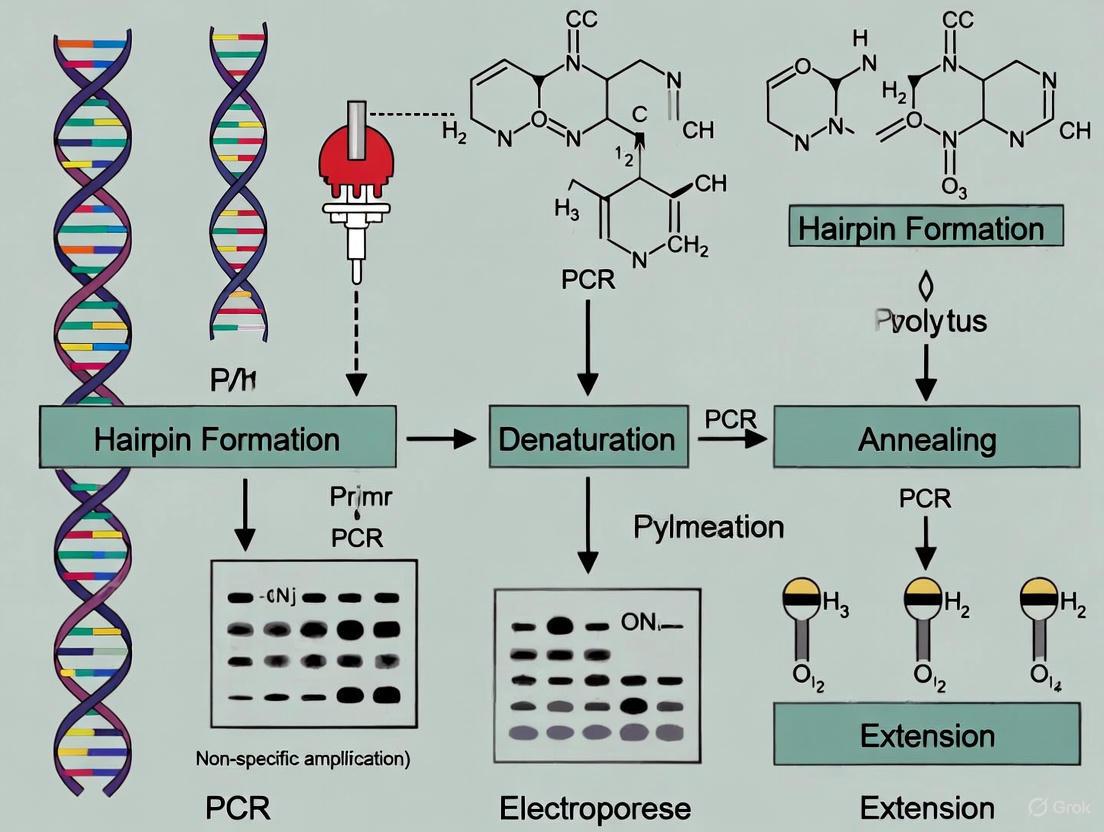
This article provides a systematic guide for researchers and drug development professionals facing PCR failure due to challenging secondary structures.
Overcoming PCR Hurdles: A Comprehensive Guide to Tackling Hairpin Structures and GC-Rich Templates
Abstract
This article provides a systematic guide for researchers and drug development professionals facing PCR failure due to challenging secondary structures. It covers the fundamental principles of how DNA hairpins and GC-rich regions impede polymerase progression, outlines specialized laboratory protocols and reagent choices for robust amplification, presents a step-by-step troubleshooting framework, and discusses validation techniques to confirm reaction success. By integrating foundational knowledge with practical application, this resource aims to equip scientists with the strategies needed to reliably amplify even the most recalcitrant DNA targets, thereby accelerating biomedical research and diagnostic assay development.
Understanding the Enemy: The Science Behind Hairpin Structures and GC-Rich Barriers in PCR
What is a 'GC-Rich' Sequence?
In molecular biology, a DNA sequence is generally considered 'GC-rich' when 60% or more of its nucleotide bases are guanine (G) or cytosine (C) [1]. This simple quantitative definition, however, belies a significant biochemical challenge. While only about 3% of the human genome is composed of such GC-rich regions, they are critically important as they are often found in the promoters of genes, including housekeeping and tumor suppressor genes [1].
The core of the challenge lies in the molecular stability of the GC base pair. A G-C pair is stabilized by three hydrogen bonds, whereas an A-T pair has only two [1] [2]. This extra hydrogen bond makes GC-rich DNA sequences inherently more thermostable, meaning they require more energy (in the form of higher temperature) to separate (denature) than AT-rich regions [1]. It is a common misconception that hydrogen bonding is the primary stabilizer; in fact, base stacking interactions play a major role in the overall stability of the DNA double helix [3].
Why Do Secondary Structures Form?
The combination of high thermostability and single-stranded DNA dynamics during the PCR process creates a perfect environment for problematic secondary structures.
During a PCR cycle, the template DNA is denatured into single strands at a high temperature (e.g., 95°C). The reaction temperature is then quickly lowered for primer annealing. This rapid cooldown favors the formation of intramolecular secondary structures within the single-stranded DNA template before the primers have a chance to bind intermolecularly [4]. The strong bonding of G and C bases means that GC-rich stretches can easily fold back on themselves to form highly stable secondary structures.
The most common and troublesome secondary structures include [1] [3] [2]:
- Hairpin Loops: Also known as stem-loop structures, these form when complementary regions within the same single strand of DNA base-pair with each other.
- Primer-Dimers: These can form when primers anneal to each other due to complementary sequences, instead of to the template DNA.
The table below summarizes how these properties directly lead to experimental failure.
Table 1: Core Characteristics and Consequences of GC-Rich DNA
| Feature | Molecular Basis | Direct Consequence in PCR |
|---|---|---|
| High Thermal Stability | Three hydrogen bonds per G-C base pair (vs. two for A-T); significant base stacking interactions [1] [3]. | Requires higher denaturation temperatures; resists strand separation, preventing primer access [1]. |
| Secondary Structure Formation (e.g., Hairpins) | Stable, intramolecular folding of single-stranded DNA, driven by GC complementarity [3] [4]. | Physically blocks polymerase progression, leading to truncated products and failed amplification [1] [4]. |
| High Melting Temperature (Tm) | The temperature required to denature 50% of the DNA duplex is directly correlated with its GC content [2]. | Makes standard PCR annealing/denaturation temperatures ineffective, requiring specialized cycling conditions [3]. |
The Molecular Mechanism of PCR Failure
Recent research provides a deeper mechanistic insight into how these stable secondary structures cause PCR failure. The process can be visualized as follows:
Diagram Title: Mechanism of PCR Failure via Stem-Loop Structures
The diagram shows the cascade of events leading to failure. A critical step involves the endonuclease activity of Taq DNA polymerase. When the polymerase encounters a stable stem-loop structure it cannot unwind, its inherent 5'→3' exonuclease activity can actually cleave the template strand itself. This digestion unwinds the structure, allowing replication to continue—but now from a truncated template, resulting in shorter, incorrect products [4]. This explains the smeared or multiple bands often seen on gels when amplifying difficult templates.
Troubleshooting Guide & FAQs
This section addresses specific, common problems researchers encounter when working with GC-rich DNA and provides targeted solutions.
Why is my PCR result a blank gel or a DNA smear?
A blank gel (no product) or a DNA smear typically indicates that the polymerase is unable to efficiently amplify the target due to the challenges outlined above. The polymerase may be stalling at secondary structures or failing to denature the template sufficiently [1].
Solutions:
- Use a Specialized Polymerase: Switch to a polymerase specifically engineered for GC-rich or difficult templates, such as Q5 High-Fidelity or OneTaq DNA Polymerase [1] [5]. These often come with specialized buffers and GC Enhancers.
- Employ PCR Additives: Additives can be highly effective. Betaine can help by destabilizing secondary structures. DMSO can also reduce secondary structure formation. BSA can help by binding contaminants that may inhibit the reaction [1] [6] [3].
- Optimize Mg2+ Concentration: Magnesium is a critical cofactor for polymerase activity. Test a gradient of MgCl2 (e.g., from 1.0 mM to 4.0 mM in 0.5 mM increments) to find the optimal concentration for your specific amplicon [1].
How can I prevent non-specific bands and primer-dimer formation?
Non-specific bands and primer-dimer are signs of low reaction specificity, often caused by primers binding to off-target sites or to each other [7] [6].
Solutions:
- Increase Annealing Temperature (Ta): A higher Ta promotes more specific primer binding. Use a temperature gradient to find the highest possible Ta that still yields your product. Touchdown PCR can also be effective [1] [8] [5].
- Use a Hot-Start Polymerase: These enzymes are inactive until a high-temperature activation step, preventing non-specific priming and primer-dimer formation during reaction setup [6] [5].
- Optimize Primer Design: Ensure primers have a GC content between 40-60%, avoid long stretches of Gs or Cs (especially at the 3' end), and have minimal self-complementarity or cross-complementarity [8] [2].
My polymerase seems to be stalling and producing truncated products. What can I do?
This is a classic symptom of the polymerase being blocked by stable secondary structures like hairpins [4].
Solutions:
- Increase Denaturation Temperature: For the first few cycles, using a denaturation temperature of 95-98°C can help melt stubborn structures. Be cautious, as very high temperatures can degrade the polymerase over many cycles [3].
- Use a Polymerase Mix with Proofreading Activity: Proofreading polymerases (those with 3'→5' exonuclease activity) are often more processive and can handle complex templates better. A blend containing a small amount of a proofreading enzyme can significantly improve the amplification of long or difficult products [9].
- Incorporate dGTP Analogs: Adding 7-deaza-2'-deoxyguanosine, a dGTP analog, to the PCR mixture can improve yield. This analog base-pairs with cytosine but disrupts Hoogsteen bonding, which is involved in higher-order structures, making the DNA easier to denature [1] [3].
Experimental Protocols for GC-Rich PCR
Protocol 1: Standard Optimization with Additives
This protocol provides a baseline for amplifying a GC-rich target using a standard Taq polymerase and common additives.
Materials:
- DNA template
- Forward and Reverse primers (designed with GC-content between 40-60%)
- Standard Taq DNA Polymerase and corresponding buffer
- MgCl2 solution
- dNTP mix
- PCR-grade water
- Additives: DMSO, Betaine, BSA
Method:
- Prepare a master mix on ice according to the table below. Set up multiple tubes to test different conditions.
- Run the PCR with the following cycling conditions, optimizing the annealing temperature (Ta) as a gradient:
- Initial Denaturation: 95°C for 2 minutes
- 35 Cycles:
- Denaturation: 95°C for 30 seconds
- Annealing: Ta Gradient from 55°C to 68°C for 30 seconds
- Extension: 72°C for 1 minute per kb
- Final Extension: 72°C for 5 minutes
- Hold: 4°C
Table 2: Master Mix Setup for Additive Testing
| Component | Control | Test 1 (DMSO) | Test 2 (Betaine) | Test 3 (Combination) |
|---|---|---|---|---|
| 10X PCR Buffer | 5 µL | 5 µL | 5 µL | 5 µL |
| 25 mM MgCl2 | 3 µL | 3 µL | 3 µL | 3 µL |
| 10 mM dNTPs | 1 µL | 1 µL | 1 µL | 1 µL |
| Forward Primer (10 µM) | 1.25 µL | 1.25 µL | 1.25 µL | 1.25 µL |
| Reverse Primer (10 µM) | 1.25 µL | 1.25 µL | 1.25 µL | 1.25 µL |
| Taq Polymerase | 0.25 µL | 0.25 µL | 0.25 µL | 0.25 µL |
| Template DNA | Variable | Variable | Variable | Variable |
| DMSO | - | 2.5 µL (5%) | - | 1.25 µL (2.5%) |
| 5M Betaine | - | - | 10 µL (1M) | 10 µL (1M) |
| PCR-Grade Water | to 50 µL | to 50 µL | to 50 µL | to 50 µL |
Protocol 2: Using Specialized Polymerase Systems
For the most challenging targets, using a dedicated system is often the most efficient path to success.
Materials:
- DNA template
- Forward and Reverse primers
- Specialized polymerase (e.g., NEB Q5 or OneTaq)
- Companion GC Enhancer or High GC Buffer
Method:
- Follow the manufacturer's instructions precisely. For example, with NEB's Q5 High-Fidelity DNA Polymerase:
- Use the provided 5X Q5 Reaction Buffer.
- Add the optional 5X Q5 High GC Enhancer to the reaction mixture for targets with >70% GC content [1].
- Cycling conditions may need to be adjusted according to the manufacturer's recommendations, which often include a higher denaturation temperature.
The Scientist's Toolkit: Research Reagent Solutions
Table 3: Essential Reagents for GC-Rich PCR
| Reagent / Kit | Function / Application | Example Product |
|---|---|---|
| High-Fidelity DNA Polymerases | Engineered for high processivity and fidelity on complex templates; often have proofreading activity. | Q5 High-Fidelity DNA Polymerase (NEB #M0491) [1] |
| Specialized Master Mixes | Pre-mixed optimized buffers and enzymes for specific challenges like GC-rich amplification. | OneTaq Hot Start 2X Master Mix with GC Buffer (NEB) [1] |
| GC Enhancer Buffers | Proprietary buffer formulations containing additives that help destabilize secondary structures and increase primer stringency. | OneTaq GC Buffer, Q5 High GC Enhancer [1] |
| PCR Additives | Chemical modifiers that help denature stable DNA structures or reduce non-specific binding. | DMSO, Betaine, Glycerol, Formamide [1] [6] |
| Hot-Start Polymerases | Polymerases inactive at room temperature, preventing non-specific priming and primer-dimer formation during reaction setup. | OneTaq Hot Start DNA Polymerase [5] |
| dGTP Analogs | Nucleotide analogs that replace dGTP to disrupt stable secondary structures during amplification. | 7-deaza-2'-deoxyguanosine [1] [3] |
FAQs: Hydrogen Bonding and Thermostability
Q1: What is the fundamental reason G-C base pairs are more stable than A-T pairs? The higher thermostability of G-C base pairs compared to A-T pairs is fundamentally due to a difference in hydrogen bonding. A G-C pair forms three hydrogen bonds, while an A-T pair forms only two. The additional hydrogen bond in the G-C pair requires more energy (heat) to break, resulting in a higher melting temperature (Tm) for DNA regions rich in G-C content [10] [11].
Q2: How does this hydrogen bond disparity directly impact my PCR experiments? GC-rich DNA templates require higher denaturation temperatures because the three hydrogen bonds in each G-C pair make the double helix more stable and resistant to melting. If the denaturation temperature is too low, the DNA may not fully separate, leading to PCR failure due to polymerase stalling, low yield, or complete amplification failure [11].
Q3: Beyond hydrogen bonds, what other factors make GC-rich sequences problematic in PCR? GC-rich sequences are prone to forming stable secondary structures, such as hairpin loops. These structures form when a single-stranded DNA segment folds back and base-pairs with itself, which can block primer binding or polymerase progression. The same strong hydrogen bonding that stabilizes the double helix also stabilizes these intramolecular structures, compounding the challenge [12] [11].
Q4: What is a DNA hairpin, and how does it interfere with amplification? A DNA hairpin is a secondary structure where a single strand folds back on itself, creating a stem (double-stranded region) and a loop (unpaired region). During PCR, if a hairpin forms within the template or a primer, it can:
- Physically block the DNA polymerase, causing it to stall and produce truncated products [11].
- Prevent primers from annealing to their target sequence, leading to reduced sensitivity or false negatives [12].
Troubleshooting Guide: PCR Amplification of GC-Rich Regions and Hairpin-Prone Templates
Problem: PCR failure (no product or faint smears) with a suspected GC-rich template.
Step 1: Polymerase and Buffer Selection
- Action: Switch to a polymerase specifically engineered for high GC content and use its accompanying specialized buffer.
- Rationale: Standard polymerases like Taq may stall at the stable secondary structures formed by GC-rich templates. High-fidelity polymerases such as Q5 or kits like OneTaq are often optimized for these challenging templates. Many are supplied with a GC Enhancer that contains additives to help disrupt secondary structures [11].
- Protocol:
- Set up a parallel reaction using a polymerase known for amplifying GC-rich targets.
- If provided, add the manufacturer's GC Enhancer at the recommended starting concentration (e.g., 5-10%).
- Compare the results with your standard protocol on an agarose gel.
Step 2: Optimize Thermal Cycling Conditions
- Action: Increase the denaturation temperature and/or use additives.
- Rationale: A higher denaturation temperature provides more energy to break the three hydrogen bonds of G-C pairs and melt hairpin structures.
- Protocol:
- Denaturation: Increase the temperature from the standard 94-95°C to 98°C.
- Annealing: Perform a temperature gradient PCR (e.g., from 60°C to 72°C) to determine the most specific annealing temperature for your primer-template combination. A higher Ta can increase specificity [11].
- Additives: Test the effect of additives like DMSO, betaine, or formamide, which can help denature secondary structures by interfering with hydrogen bonding. Note: It is often more efficient to use a pre-optimized GC Enhancer solution than to test individual additives manually [11].
Step 3: Magnesium Concentration Titration
- Action: Test a range of MgCl₂ concentrations.
- Rationale: Mg²⁺ is a crucial cofactor for polymerase activity and affects primer annealing stringency. The optimal concentration for GC-rich templates may differ from the standard 1.5-2.0 mM [11].
- Protocol:
- Prepare a master mix without MgCl₂.
- Aliquot the master mix and supplement with MgCl₂ to final concentrations of 1.0, 1.5, 2.0, 2.5, 3.0, and 3.5 mM.
- Run the PCR and analyze the products by gel electrophoresis to identify the concentration that gives the strongest specific band.
Problem: Suspected hairpin formation in template or primers.
Step 1: In Silico Analysis
- Action: Use primer design software to check for secondary structures.
- Rationale: Software tools can predict the formation of hairpins in your primers and the stability of secondary structures in the template at the annealing temperature, allowing you to select optimal primer binding sites [12].
- Protocol:
- Use tools like NCBI Primer-BLAST or Primer3 to analyze your primer sequences for self-complementarity and hairpin formation.
- Avoid primers with strong secondary structures, particularly at their 3' ends.
Step 2: Primer Re-design
- Action: Design new primers that anneal to a less structured region.
- Rationale: If the template itself has a persistent hairpin in the amplification region, moving the primer binding site to a more accessible area is the most effective solution [12].
- Protocol:
- Refer to the results of your in silico analysis.
- Design new primers where the binding site has a lower predicted propensity for secondary structure.
Step 3: Utilize a Touchdown PCR Protocol
- Action: Implement a PCR program where the annealing temperature starts high and gradually decreases in later cycles.
- Rationale: A high initial annealing temperature promotes highly specific primer binding and can prevent amplification from primers that are bound non-specifically to secondary structures. As the temperature lowers in subsequent cycles, the specific product is already amplified and can be efficiently replicated [13].
The following tables consolidate key experimental data relevant to the thermodynamics of DNA structures and PCR optimization.
Table 1: Thermodynamic Parameters of DNA Hairpins with Varying Loop Sizes This data demonstrates how the size of the hairpin loop influences its stability, with larger loops generally decreasing the melting temperature (Tm) [14].
| Hairpin Sequence | Loop Size (dT residues) | Melting Temperature (Tm, °C) | Transition Enthalpy (ΔH, kcal/mol) |
|---|---|---|---|
| d(GCGCT₃GCGC) | 3 | 79.1 | ~38.5 |
| d(GCGCT₅GCGC) | 5 | Not Specified | ~38.5 |
| d(GCGCT₇GCGC) | 7 | 57.5 | ~38.5 |
Table 2: Key Reagent Solutions for Troubleshooting GC-Rich PCR This table lists common reagents used to overcome challenges in amplifying difficult templates [11].
| Reagent / Solution | Function / Rationale | Example Use Case |
|---|---|---|
| High-GC Polymerase Mix | Polymerase and buffer optimized for denaturing stable structures. | First-choice solution for amplicons with >60% GC content. |
| GC Enhancer | Proprietary mix of additives (e.g., betaine) to disrupt secondary structures. | Added to the reaction mix to improve yield from structured templates. |
| DMSO | Additive that reduces DNA secondary structure formation. | Typically used at 1-10% final concentration. |
| 7-deaza-dGTP | dGTP analog that reduces hydrogen bonding, incorporated into the product. | Can improve yield but may complicate downstream analysis. |
Experimental Protocol: Assessing Hairpin Formation and Stability
This protocol outlines a method to study DNA hairpin stability using ultraviolet (UV) melting curve analysis, a technique that provides the thermodynamic parameters shown in Table 1 [14].
Objective: To determine the melting temperature (Tm) and thermodynamic profile of a synthesized DNA hairpin.
Materials:
- Synthesized and purified DNA oligonucleotide (e.g., d(GCGCT₅GCGC)).
- UV-vis spectrophotometer with a temperature-controlled cuvette holder.
- Appropriate buffer (e.g., 1X PBS or 10 mM Tris-HCl, pH 7.5).
Methodology:
- Sample Preparation: Dissolve the DNA oligonucleotide in buffer to a final concentration of 1-5 µM. Ensure a homogeneous solution.
- Denaturation and Renaturation: Heat the sample to 95°C for 5 minutes, then slowly cool it to room temperature over 1-2 hours to allow proper hairpin formation.
- UV Melting Experiment:
- Load the sample into a quartz cuvette and place it in the spectrophotometer.
- Set the spectrophotometer to monitor absorbance at 260 nm.
- Program the instrument to heat the sample from 20°C to 95°C at a slow, constant rate (e.g., 0.5-1.0°C per minute).
- Record the absorbance at 260 nm at regular temperature intervals.
- Data Analysis:
- Plot the absorbance at 260 nm versus temperature to generate a melting curve.
- The Tm is defined as the temperature at the midpoint of the absorbance transition (where 50% of the hairpins are unfolded).
- The transition enthalpy (ΔH) can be calculated from the shape and steepness of the melting curve.
Conceptual Diagrams
Diagram 1: Hydrogen Bonding and DNA Thermostability. This diagram illustrates the fundamental structural difference between a G-C base pair, stabilized by three hydrogen bonds, and an A-T base pair, stabilized by two. The additional hydrogen bond in the G-C pair directly contributes to the higher energy requirement for melting, leading to greater thermostability in GC-rich DNA regions [10] [11].
Diagram 2: Troubleshooting Workflow for GC-Rich/Hairpin PCR. This flowchart provides a logical sequence of experimental steps to diagnose and resolve common PCR issues arising from GC-rich templates and hairpin structures. The process begins with in silico analysis and proceeds through wet-lab optimizations of reagents and thermal cycling parameters [12] [11].
What are DNA hairpins and why do they disrupt PCR? DNA hairpins are secondary structures that form when a single-stranded DNA molecule folds back on itself, creating a stem-loop structure. These formations are particularly prevalent in GC-rich sequences, where the strong triple hydrogen bonding between guanine (G) and cytosine (C) nucleotides creates stable structures that can resist denaturation even at high temperatures [15]. During polymerase chain reaction (PCR), these structures present a significant physical barrier to DNA polymerase progression, leading to abrupt stops in amplification, failed reactions, and uninterpretable sequencing results [15] [16].
The challenge is particularly pronounced in specific genomic contexts. Research on the murine Foxd3 locus revealed a 370-nucleotide segment that consistently resisted polymerase read-through during both PCR and sequencing reactions. This region, characterized by 61% GC content, was predicted to form a tight cluster of hairpin structures that defined precise boundaries beyond which polymerases could not extend [15]. Understanding this mechanism is crucial for researchers working with difficult templates, particularly in applications requiring high fidelity such as diagnostic assay development, cloning, and mutational analysis.
The Molecular Mechanism of Polymerase Blockage
How Hairpins Form Physical Barriers
DNA hairpins create impediments to PCR amplification through several interconnected mechanisms:
- Steric Hindrance: The three-dimensional structure of the hairpin physically blocks the polymerase enzyme's progression along the template strand. The enzyme's catalytic site cannot properly engage with bases involved in secondary structures.
- Thermodynamic Stability: GC-rich hairpins exhibit exceptional thermal stability due to their increased number of hydrogen bonds. While typical PCR denaturation temperatures (94-95°C) separate standard double-stranded DNA, stable hairpins can persist at these temperatures, maintaining their structure throughout thermal cycling [17].
- Polymerase Processivity Limitations: Most DNA polymerases have limited strand-displacement activity. When they encounter a stable secondary structure, they cannot unwind it efficiently and may dissociate from the template, terminating amplification [18].
Experimental Evidence from the Foxd3 Locus
A case study examining the Foxd3 locus provides compelling evidence for these mechanisms. Researchers discovered that:
- Sequencing reads consistently terminated at precise positions 442 nt and 811 nt upstream of the Foxd3 ATG start codon, defining a 370-nt resistant region [15]
- PCR amplification across this region failed universally, even with polymerases and conditions tailored for GC-rich templates [15]
- The resistant region exhibited 61% GC content and was predicted by RNAfold software to form a tight cluster of hairpins at 72°C (standard polymerase extension temperature) [15]
- The boundaries of the polymerase-resistant segment corresponded precisely to nucleotides located within long, stable hairpins with the highest base-pairing probability [15]
Table 1: Characteristics of the Polymerase-Resistant Region in Foxd3 Locus
| Parameter | Resistant Region (β) | Upstream Flank (α) | Downstream Flank (γ) |
|---|---|---|---|
| GC Content | 61% | 39% | 71% |
| Polymerase Read-through | No | Yes | Yes |
| Predicted Secondary Structure | Tight hairpin cluster | Minimal structure | Hairpins without strong stability |
| Conservation Across Vertebrates | High | Low | Moderate (mammals only) |
Visualizing the Mechanism
The following diagram illustrates how hairpin structures block polymerase progression during PCR amplification:
Troubleshooting Guide: PCR Failure Due to Hairpin Structures
FAQ: Common Researcher Questions
Q1: How can I determine if my PCR failure is due to hairpin structures rather than other issues? A: Several indicators suggest hairpin-related failure:
- Abrupt sequencing stops at consistent positions despite good signal quality up to that point [16]
- PCR failure specifically in GC-rich regions while other regions amplify successfully
- Inability to amplify even with optimized primer design and standard troubleshooting
- Experimental confirmation through restriction enzyme excision of the problematic region followed by successful amplification of flanking regions [15]
Q2: What specific sequence features should alert me to potential hairpin problems? A: Be vigilant for:
- GC content exceeding 60% [15]
- Long mononucleotide runs (e.g., GGGGG or CCCCC) [19] [20]
- Inverted repeats that can form stable stem-loop structures
- Sequences with dyad symmetry that enable folding back on themselves
Q3: Are there polymerases specifically designed to handle hairpin structures? A: While no polymerase completely eliminates the problem, those with high processivity show better performance on difficult templates [17]. These enzymes maintain stronger attachment to the template and have better strand-displacement activity. Additionally, specialized enzyme blends containing structure-disrupting components may improve results.
Comprehensive Troubleshooting Strategies
Table 2: Troubleshooting Approaches for Hairpin-Related PCR Failure
| Approach | Specific Protocol/Reagent | Mechanism of Action | Expected Outcome |
|---|---|---|---|
| PCR Additives | DMSO (1-10%) [19], Formamide (1.25-10%) [19], Betaine (0.5-2.5 M) [19] | Destabilizes secondary structures by interfering with hydrogen bonding | Reduced hairpin stability, improved amplification |
| Modified Nucleotides | 7-deaza-dGTP, dITP [16] | Reduces hydrogen bonding capacity of GC base pairs | Decreased melting temperature of hairpins |
| Specialized Polymerases | High-processivity enzymes [17], Polymerases with strong strand-displacement activity | Enhanced ability to unwind secondary structures | Better read-through of structured regions |
| Thermal Cycling Modifications | Increased denaturation temperature (up to 98°C) and time [17] | More complete separation of DNA strands | Reduced hairpin formation in single-stranded templates |
| Template Modification | Restriction enzyme digestion to remove problematic region [15] | Physical elimination of hairpin-forming sequence | Enables amplification of flanking regions |
| Primer Placement | One primer annealing within resistant region [15] | Polymerase only needs to traverse one hairpin boundary | Successful amplification across previously blocked regions |
Advanced Experimental Protocols
Protocol: Amplification Across Hairpin-Forming Regions
This protocol adapts methods from successful amplification of the Foxd3 hairpin region [15]:
Design one primer to anneal within the resistant region and one outside it. This strategy requires prior knowledge of the region's sequence, which can be obtained by sequencing outward from within the region using internal primers [15].
Prepare PCR reaction with enhanced conditions:
Apply modified thermal cycling parameters:
- Extended denaturation: 98°C for 1-2 minutes
- Touchdown annealing: Start 10°C above calculated Tm and decrease 1°C per cycle for 10 cycles
- Extended extension: 2-3 minutes per kilobase at 68-72°C
- Increased cycle number: 35-40 cycles
Amplify the region in segments using multiple primer sets that generate overlapping amplicons, then assemble the complete sequence computationally or through subsequent cloning.
Protocol: Sequencing Through Hairpin Barriers
For sequencing through problematic hairpin regions [16]:
Modify sequencing reaction composition:
- Use a 1:4 ratio mix of BigDye to dGTP Sequencing premix
- Alternatively, add approximately 40µM dGTP nucleotide to standard BigDye mix
- Consider using 7-deaza-GTP or dITP in PCR amplification prior to sequencing
Adjust sequencing reaction conditions:
- Increase reaction volume to 20µl
- Extend initial denaturation to 3 minutes at 96°C
- Implement slower ramp times between temperatures
- Use longer extension times (60-90 seconds per cycle)
Employ the Sequence-By-Mutagenesis (SAM) approach to eliminate long mononucleotide runs through silent mutations while maintaining amino acid sequence.
The Scientist's Toolkit: Essential Reagents and Materials
Table 3: Research Reagent Solutions for Hairpin-Related PCR Challenges
| Reagent/Material | Function | Application Notes | Commercial Examples |
|---|---|---|---|
| Betaine | PCR additive that equalizes DNA melting temperatures | Particularly effective for GC-rich templates; use at 0.5-2.5 M final concentration | Sigma-Aldrich B2629, Thermo Fisher Scientific B0300 |
| DMSO | Secondary structure destabilizer | Typically used at 1-10%; higher concentrations may inhibit polymerase | Various molecular biology grade suppliers |
| 7-deaza-dGTP | Modified nucleotide reducing hydrogen bonding | Partial replacement for dGTP (3:1 ratio dGTP:7-deaza-dGTP) | Roche Diagnostics 988 539, Sigma-Aldirect C2899 |
| High-Processivity DNA Polymerases | Enzymes with enhanced strand displacement | Superior performance on structured templates | Platinum SuperFi II, Q5 High-Fidelity, Phusion Plus |
| GC Enhancer Solutions | Proprietary mixtures for difficult templates | Optimized for specific polymerase systems | Invitrogen GC Enhancer, Q5 GC Enhancer |
| dITP Sequencing Mix | Modified nucleotides for sequencing | Helps resolve compression and stops in G-rich regions | BigDye dGTP Sequencing Mix |
Hairpin structures represent a significant challenge in molecular biology applications, particularly for researchers working with GC-rich genomic regions. The mechanisms by which these structures block polymerase progression - through steric hindrance, thermodynamic stability, and limitations in polymerase processivity - can be mitigated through strategic experimental design and specialized reagents.
Successful navigation of these challenges requires a multifaceted approach combining informed primer design, specialized reaction conditions, and appropriate enzyme selection. The protocols and troubleshooting guides presented here provide a foundation for overcoming these obstacles, enabling reliable amplification and sequencing of even the most challenging templates.
As molecular techniques continue to advance, particularly in the realms of genome editing and synthetic biology, understanding and addressing the limitations imposed by DNA secondary structure will remain essential for research progress and technical innovation.
FAQ: Understanding the Core Issue
What is the Foxd3 locus polymerase-resistant region? Researchers discovered a specific 370-nucleotide segment within the murine Foxd3 locus that consistently resisted polymerase read-through during sequencing and PCR amplification, hindering the creation of vectors for genetic engineering [21].
What causes this PCR failure? The resistant segment correlates with a predicted DNA hairpin cluster just upstream of the Foxd3 gene's 5' untranslated region. These stable secondary structures form physical barriers that impede the polymerase enzyme during replication [21].
Is this region biologically significant? Yes, this hairpin-forming region is highly conserved across vertebrate species, suggesting it may have an important, though not yet fully understood, functional role in gene regulation beyond causing technical challenges [21].
Are such PCR failures common? Yes, target secondary structure is a widely recognized cause of false negatives and uneven amplification in PCR. When a DNA template is folded, primers cannot bind effectively, and the polymerase has difficulty traversing the region [12].
Troubleshooting Guide: Overcoming PCR Barriers
Problem: PCR Failure or Weak Amplification Due to Suspected Secondary Structures
| Symptom | Possible Cause | Solution |
|---|---|---|
| No product or very low yield on gel [7] | Stable hairpins in template blocking polymerase [12] [21] | Use PCR enhancers/additives (see Table below). |
| Amplification fails only in specific regions [22] | Localized, high-stability secondary structures [21] | Redesign primers to flank the structured region [22]. |
| Inconsistent results between primer sets [22] | Hairpin formation within the amplicon itself [22] | Switch to a polymerase mixture optimized for complex templates. |
| Allele Dropout (false homozygosity) [22] | Non-primer-site SNV promoting strong amplicon hairpin [22] | Check for SNVs in the amplicon and redesign primers. |
Step-by-Step Experimental Protocol
Step 1: Diagnosis and Confirmation
- Verify Amplification Failure: Use a standard PCR protocol and Taq polymerase. Include a positive control to confirm the reaction itself is not the issue [19].
- In Silico Analysis: Use software like mfold to predict secondary structures within your target DNA sequence. Input the 370-nt Foxd3 sequence to confirm the predicted hairpin cluster [22].
- Test with Alternate Primers: Design a new primer set (E12B in the allele dropout case) that produces a larger amplicon. Successful amplification with the new primers confirms that the original failure was due to local sequence context and not a global issue with the template [22].
Step 2: Implementing Solutions (Methodologies)
- PCR with Additives:
- Prepare a master mix for multiple reactions to minimize pipetting error [19].
- Add potential enhancers to the reaction. A recommended starting formulation is:
- Use a touchdown PCR protocol: Start with an annealing temperature 5-10°C above the calculated Tm and decrease by 0.5°C per cycle for the first 10-20 cycles, then continue at a lower annealing temperature for the remaining cycles [24].
- Primer Redesign:
- Check for SNVs: Always consult updated SNV databases (like dbSNP) for variations in both the primer-binding sites and the entire amplicon region [22].
- Avoid structured regions: Use primer design tools (e.g., NCBI Primer-Blast, Primer3) to create primers that flank, rather than encompass, predicted hairpin clusters [19] [21].
- Validate new primers: Check new primers for self-complementarity and dimer formation before ordering [19].
| Item | Function/Benefit |
|---|---|
| Betaine | Reduces secondary structure formation by equalizing the stability of GC and AT base pairs, helping polymerases traverse GC-rich and structured regions [19] [23]. |
| DMSO | A destabilizing agent that helps unwind DNA secondary structures by interfering with base pairing, facilitating primer annealing and polymerase progression [19]. |
| BSA (Bovine Serum Albumin) | Binds to inhibitors that may be present in the reaction and can stabilize polymerase enzymes, improving overall reaction robustness [19] [23]. |
| High-Fidelity/Proofreading Polymerases | Enzymes like Q5 possess high processivity, enabling them to better unwind and copy through challenging secondary structures where Taq may fail [25]. |
| Touchdown PCR Protocol | A technique that starts with high-stringency annealing to promote specific primer binding first, increasing the chance of initial amplification before lower-stringency cycles [24]. |
| In Silico Prediction Tools (mfold) | Web servers that predict the secondary structure and folding stability (ΔG) of DNA or RNA sequences, allowing for pre-experimental identification of problem areas [22]. |
The following diagram illustrates the logical workflow for diagnosing and resolving PCR failure caused by secondary structures, based on the Foxd3 case study.
Quantitative Data from Related Case Studies
The table below summarizes key quantitative findings from the Foxd3 case and a related allele dropout study, highlighting the impact of secondary structures.
| Case | Affected Region / Variant | Observed Effect | Energetic Stability (ΔG) | Solution |
|---|---|---|---|---|
| Foxd3 Locus [21] | 370 nt upstream of Foxd3 | Barrier to PCR, sequencing, and BAC recombineering | Not specified | Primer redesign to avoid the structured region |
| FAH Gene Allele Dropout [22] | SNV (rs2043691, c.961-35C) in amplicon | False homozygosity due to failed amplification of one allele | -18.25 kcal/mol (C allele) vs.-17.43 kcal/mol (A allele) | New primer set (E12B) producing a larger amplicon |
Key Takeaways for Researchers
- Pre-Emptive Analysis is Crucial: Before experimental work, use tools like mfold to scan your target sequence for potential hairpins, especially in conserved genomic regions [22].
- Think Beyond Primer Binding: The Foxd3 and FAH cases demonstrate that the problem can lie within the amplicon itself, not just at the primer binding sites. A non-primer-site SNV can be enough to create a PCR-resistant structure [21] [22].
- Systematic Troubleshooting Works: A methodical approach combining in silico prediction, primer redesign, and wet-lab optimization with enhancers can overcome even well-defined polymerase-resistant barriers [12] [22].
FAQs and Troubleshooting Guides
Frequently Asked Questions
Q1: What are the most common symptoms of secondary structure issues in Sanger sequencing?
The most common symptoms in the sequencing chromatogram include:
- Sequence suddenly coming to a hard stop after a region of good quality data.
- Poor data quality following a stretch of mononucleotides (a run of a single base), where the trace becomes mixed and unreadable.
- A gradual die-out of the sequence read, where the signal intensity drops dramatically downstream [26].
Q2: Beyond sequencing, how can secondary structures negatively impact PCR?
Secondary structures in the DNA template, such as hairpin loops, can inhibit primer binding. This is a major cause of false negatives and low sensitivity in assays because the polymerase cannot efficiently bind and extend. This problem is exacerbated in multiplex PCR, where uneven amplification of different amplicons can occur [12].
Q3: My sequencing fails repeatedly. What are the primary culprits I should check?
The number one reason for failed sequencing reactions or poor-quality data is suboptimal template concentration and quality [26]. You should verify that:
- The template DNA is free of contaminants like salts, proteins, or ethanol.
- The concentration is within the recommended range (typically 100-200 ng/µL for plasmid DNA).
- The primer is well-designed and not degraded.
Q4: What is a key advantage of using BAC transgenesis over conventional methods?
BAC transgenesis allows for the incorporation of very large DNA segments, often encompassing an entire gene along with its native regulatory elements and tissue-specific enhancers. This enables more physiologically relevant gene expression patterns in model organisms, which is crucial for accurate functional studies and disease modeling [27].
Q5: How does gap-repair recombineering simplify the manipulation of large plasmids?
This method uses λ Red phage-mediated homologous recombination in E. coli to repair a "gap" introduced into a parent plasmid. It is highly efficient for retrieving large DNA fragments from BACs or for introducing specific mutations into large, high-copy-number plasmids, overcoming the inefficiencies of traditional ligation-based cloning, especially for large fragments [28].
Troubleshooting Guide
Here is a structured guide to diagnosing and resolving common issues related to secondary structures and complex cloning.
Table 1: Troubleshooting Sequencing and Cloning Failures
| Problem | Possible Cause | Recommended Solutions |
|---|---|---|
| Failed sequencing reaction (messy trace, no peaks) [26] | Low template concentration or poor quality DNA. | Check concentration via Nanodrop; ensure 260/280 ratio ≥1.8; clean up DNA to remove contaminants. |
| Sequence hard stop or severe degradation after a specific point [26] | Secondary structure (hairpins) in the template DNA blocking polymerase. | Use an "difficult template" sequencing chemistry/kit; design a new primer to sequence through the hairpin or from the reverse direction. |
| Poor sequence quality after mononucleotide repeats [26] | Polymerase slippage on homopolymer stretches. | Design a sequencing primer that starts just after the repeat region. |
| Few or no transformants after BAC/recombineering [29] [30] | Toxic DNA insert; inefficient recombination; suboptimal transformation efficiency. | Use a low-copy-number plasmid and grow cells at a lower temperature (e.g., 30°C); ensure high-quality competent cells and correct electroporation parameters [30] [28]. |
| Transformants with incorrect or truncated inserts [29] | Unstable DNA sequences with direct/inverted repeats. | Use specialized bacterial strains (e.g., Stbl2/Stbl4); pick colonies from fresh plates; avoid over-growing bacterial cultures. |
Table 2: Troubleshooting PCR for Problematic Templates
| Problem | Possible Cause | Recommended Solutions |
|---|---|---|
| Low or no PCR product [7] [19] | High GC content or secondary structure preventing primer binding. | Use PCR additives/enhancers like DMSO (1-10%), formamide (1.25-10%), or Betaine (0.5-2.5 M). Optimize annealing temperature. |
| Multiple/non-specific PCR products [7] | Non-specific primer annealing due to secondary structures. | Incrementally increase the annealing temperature; optimize primer design to avoid self-complementarity; check primer concentration. |
| False negatives in multiplex PCR [12] | Primer-dimer formation or primer-amplicon interactions depleting reagents. | Redesign primers using software that accounts for complex interactions; use a temperature gradient to find optimal annealing conditions. |
Experimental Protocols
Protocol 1: Gap-Repair Recombineering for BAC Retrieval and Plasmid Manipulation
This protocol allows for the efficient retrieval of large DNA fragments from a BAC clone into a high-copy-number plasmid, enabling easier manipulation [28].
1. Design and Clone Homology Arms:
- Design two short (300–600 bp) homology arms (HA) corresponding to the start and end of the genomic sequence you wish to retrieve from the BAC.
- Clone these HAs into your retrieval vector (e.g., a pUC19-based vector). When fused, these arms should form a blunt-cutting restriction site (e.g., EcoRV) for subsequent linearization.
2. Prepare Electrocompetent Cells Expressing λ Red Proteins:
- Transform the pSC101-BAD-gbaA plasmid (which carries the λ Red genes exo, bet, gam under an L-arabinose inducible promoter) into your preferred E. coli strain (e.g., DH5α).
- Grow a culture of these cells to an OD600 of ~0.4-0.6 and induce λ Red expression with 10% L-arabinose for 1 hour.
- Make the cells electrocompetent by washing them repeatedly with ice-cold 10% glycerol [28].
3. Perform Gap-Repair Recombineering:
- Linearize the retrieval vector using the blunt-cutting restriction enzyme at the site joining the two HAs.
- Electroporation: Mix ~100 ng of the linearized vector with 1 µL of purified BAC DNA. Electroporate this mixture into 50 µL of the prepared electrocompetent cells.
- Recovery and Plating: Immediately add SOC media to the cells, recover for 1 hour at 37°C, and then plate on LB agar with the appropriate antibiotic to select for the retrieval vector.
4. Screen and Validate:
- Screen resulting colonies by colony PCR or restriction digest (using a rapid boiling miniprep method) to identify correct clones.
- Validate the final plasmid by full-length sequencing.
Protocol 2: Overcoming Secondary Structures in Sanger Sequencing
This protocol outlines steps to obtain high-quality sequence data from DNA templates prone to forming secondary structures [26].
1. Verify Template Quality and Quantity:
- Precisely quantify your DNA using a fluorescence-based method. For plasmid DNA, aim for a concentration of 100-200 ng/µL in a volume of 5-10 µL. Using too much DNA is a common cause of early sequence termination.
2. Utilize Specialized Sequencing Chemistry:
- If standard sequencing fails with symptoms of a hard stop, request a "difficult template" sequencing service from your core facility. These kits use different dye-terminator chemistries that can help the polymerase navigate through secondary structures.
3. Re-sequence with Strategically Designed Primers:
- Sequence from the reverse direction: Design a primer binding downstream of the problematic region and sequence back through it.
- Prime within the structure: If possible, design a new primer that binds immediately after the predicted secondary structure to obtain the subsequent sequence.
The Scientist's Toolkit
Table 3: Essential Research Reagents and Materials
| Reagent/Material | Function/Application |
|---|---|
| DMSO (Dimethyl sulfoxide) | A PCR additive that disrupts base pairing, helping to denature DNA templates with high GC content or strong secondary structures [19]. |
| Betaine | A chemical additive used in PCR to equalize the stability of AT and GC base pairs, promoting uniform amplification and aiding in the amplification of structured regions [19]. |
| pSC101-BAD-gbaA Plasmid | A low-copy-number plasmid that provides inducible expression of the λ Red recombineering proteins (Exo, Beta, Gam), essential for gap-repair recombineering in standard lab E. coli strains [28]. |
| NEB 5-alpha Competent E. coli | A general-purpose, recA- endA- E. coli strain suitable for high-efficiency transformation and stable propagation of most plasmid DNA, including those generated by recombineering [28]. |
| Stbl2/Stbl4 Competent E. coli | Specialized bacterial strains designed for the stable propagation of unstable DNA sequences, such as those containing direct repeats or retroviral sequences, which can be a problem in BAC manipulation [29]. |
| Q5 High-Fidelity DNA Polymerase | A high-fidelity PCR enzyme used to generate amplicons with extremely low error rates, which is critical when creating fragments for cloning or recombineering where mutations are undesirable [28]. |
Visualizing Workflows and Problems
Secondary Structure Impact on Sequencing
Gap-Repair Recombineering Workflow
Strategic Reagent Selection and Specialized Protocols for Successful Amplification
Why GC-Rich and Structured Templates Challenge Conventional PCR
GC-rich DNA sequences (typically defined as ≥60% GC content) present three major hurdles for polymerase chain reaction (PCR). First, the triple hydrogen bonds of G-C base pairs confer higher thermal stability, requiring higher denaturation temperatures to separate strands [31] [3]. Second, these sequences readily form stable intra-strand secondary structures, such as hairpin loops, which can cause DNA polymerases to stall during extension, leading to truncated products or complete amplification failure [12] [31]. Finally, the primers themselves can form secondary structures or primer-dimers, further depleting reaction components and reducing yield [19] [12]. Overcoming these challenges often requires specialized polymerases, tailored reaction buffers, and optimized thermal cycling protocols.
Troubleshooting Guides
FAQ 1: My PCR for a GC-rich target shows no product or a very faint band on the gel. What should I do?
A failed or low-yield PCR with a GC-rich template is often due to inefficient denaturation or polymerase stalling at secondary structures.
Step 1: Verify Template Quality and Quantity Confirm your template DNA is of high quality and sufficient concentration. Use spectrophotometry/fluorometry and check integrity via gel electrophoresis. For genomic DNA, use 1 ng–1 µg; for plasmid DNA, use 1 pg–10 ng [32].
Step 2: Optimize Your Polymerase and Buffer System Switch to a polymerase specifically engineered for difficult templates. These often come with specialized buffers or enhancers.
Step 3: Adjust Thermal Cycling Conditions
- Increase Denaturation Temperature/Time: Use an initial denaturation at 94°C for 2–4 minutes, and consider a denaturation step up to 98°C for the first 3-5 cycles to help melt stubborn secondary structures [32] [3]. Avoid prolonged high temperatures with less stable polymerases.
- Use a Temperature Gradient: Empirically determine the optimal annealing temperature using a thermal gradient, testing a range above and below the calculated Tm [17].
Step 4: Incorporate PCR Additives Additives can help denature stable structures. Test them systematically, as their effects are target-specific [19] [31] [3].
- DMSO: Use at a final concentration of 1–10%.
- Betaine: Use at a final concentration of 0.5 M to 2.5 M.
- Formamide: Use at 1.25–10%.
- Note: Some additives can inhibit polymerase activity, so may require a slight increase in enzyme concentration [17].
FAQ 2: My gel shows multiple non-specific bands or a smear with my GC-rich target. How can I improve specificity?
Non-specific amplification and smearing occur when primers bind to incorrect sites, often due to low reaction stringency.
Step 1: Increase Annealing Stringency The most common fix is to increase the annealing temperature in increments of 1–2°C. Use a gradient cycler to find the highest temperature that still provides robust yield of your specific product [17]. The optimal temperature is typically 3–5°C below the primer Tm [32].
Step 2: Use a Hot-Start Polymerase Hot-start enzymes remain inactive until a high-temperature activation step, preventing primer-dimer formation and non-specific priming during reaction setup [17]. OneTaq Hot Start DNA Polymerase is an example that reduces these artifacts [32].
Step 3: Optimize Mg²⁺ Concentration Excess Mg²⁺ can reduce specificity. Titrate MgCl₂ or MgSO₄ in 0.2 mM increments from 1.0 mM up to 4.0 mM to find the lowest concentration that supports specific amplification [32] [17]. Remember, dNTPs chelate Mg²⁺, so ensure a sufficient surplus.
Step 4: Check Primer Design Re-evaluate your primers. Ensure they are specific, have minimal self-complementarity (to avoid hairpins), and minimal 3'-end complementarity (to avoid primer-dimers) [19]. Use tools like NCBI Primer-BLAST to check for specificity.
FAQ 3: What is the step-by-step protocol for setting up an optimized PCR for a difficult, GC-rich template?
This protocol uses a specialized polymerase system for robust amplification.
Materials:
- OneTaq Hot Start DNA Polymerase (NEB #M0481) or Q5 Hot Start High-Fidelity DNA Polymerase (NEB #M0493)
- Corresponding 5X Reaction Buffer (Standard and GC Buffer for OneTaq)
- Corresponding High GC Enhancer
- 10 mM dNTPs
- Template DNA and primer pair
- Nuclease-free water
Method:
- Thaw and Prepare Reagents: Thaw all reagents on ice and mix gently before use.
- Assemble Reaction: Set up a 50 µL reaction on ice as follows [19] [32] [31]:
| Component | Final Concentration/Amount | Volume for 50 µL Reaction (OneTaq) |
|---|---|---|
| Nuclease-free Water | Q.S. to 50 µL | 28.5 µL |
| 5X OneTaq GC Buffer | 1X | 10 µL |
| OneTaq High GC Enhancer | 10% (v/v) | 5 µL |
| 10 mM dNTPs | 200 µM | 1 µL |
| Forward Primer (20 µM) | 0.2 µM | 0.5 µL |
| Reverse Primer (20 µM) | 0.2 µM | 0.5 µL |
| Template DNA | 1 ng–1 µg (genomic) | Variable (e.g., 2 µL) |
| OneTaq Hot Start DNA Polymerase | 1.25 units | 0.5 µL |
| Total Volume | 50 µL |
Thermal Cycling: Use the following conditions in a thermal cycler:
Analysis: Analyze 5–10 µL of the PCR product by agarose gel electrophoresis.
The Scientist's Toolkit: Research Reagent Solutions
Table 1: Essential reagents for amplifying GC-rich and structured templates.
| Reagent | Function & Mechanism | Example Use Case |
|---|---|---|
| Specialized Polymerase Blends | Engineered for high processivity and affinity to unwind and copy through stubborn secondary structures. | OneTaq (blend of Taq and Deep Vent) for robust routine/difficult PCR; Q5 for high-fidelity amplification of long or GC-rich targets [32] [31]. |
| GC-Specific Reaction Buffers | Formulated with undisclosed additives that help destabilize G-C bonds and inhibit secondary structure formation. | OneTaq GC Reaction Buffer for targets >50% GC content [32]. |
| High GC Enhancer | A proprietary cocktail of co-solvents (e.g., betaine) that equalizes DNA melting temperatures, reducing secondary structure stability. | Add 10–20% (v/v) to OneTaq or Q5 reactions for targets >65% GC [32] [31]. |
| Mg²⁺ Solution (MgCl₂/MgSO₄) | Essential polymerase cofactor. Concentration directly affects enzyme activity, fidelity, and primer-template stability. | Optimize between 1.0–4.0 mM in 0.2–0.5 mM increments to balance yield and specificity [32] [17]. |
| Chemical Additives (DMSO, Betaine) | Act as DNA denaturants by directly interfering with hydrogen bonding and base stacking, helping to keep templates single-stranded. | Test DMSO at 1–10% or Betaine at 0.5–2.5 M for particularly stubborn hairpins [19] [31] [3]. |
| Hot-Start Polymerases | Remain inactive until a high-temperature activation step, preventing non-specific amplification and primer-dimer formation during setup. | Critical for improving specificity in complex multiplex assays or with sensitive templates [32] [17]. |
Experimental Protocols & Data
Standardized Optimization Workflow
The following diagram outlines a logical, step-by-step strategy for troubleshooting failed PCRs due to hairpin structures and GC-richness.
Quantitative Data for Informed Decision-Making
Table 2: Polymerase and buffer selection guide based on amplicon GC content. Data synthesized from manufacturer guidelines [32] [31].
| Amplicon GC Content | Recommended Default Buffer | Optimization Notes & Reagent Solutions |
|---|---|---|
| <50% | OneTaq Standard Reaction Buffer | Standard protocols usually sufficient. Adjust annealing temperature or primer concentration if needed. |
| 50–65% | OneTaq Standard Reaction Buffer | OneTaq GC Reaction Buffer can be used to enhance performance of difficult amplicons. |
| >65% | OneTaq GC Reaction Buffer | Supplement with 10–20% OneTaq High GC Enhancer for robust amplification. For Q5 polymerase, use the supplied Q5 High GC Enhancer. |
Table 3: Optimization of critical cycling parameters for GC-rich targets [32] [31] [3].
| Parameter | Typical Standard Condition | Recommended GC-Rich Optimization |
|---|---|---|
| Initial Denaturation | 94°C for 30 sec | 94°C for 2–4 min; or 98°C for 30 sec (first 3-5 cycles) |
| Denaturation (Cycling) | 94°C for 15–30 sec | 98°C for 5–10 sec (if enzyme permits) |
| Annealing Temperature (Tₐ) | 5°C below primer Tₘ | Use a gradient to test Tₐ from 45–68°C; often higher than standard. |
| Extension Time | 1 min/kb | 1–2 min/kb; may require increase due to polymerase stalling. |
| Number of Cycles | 25–30 | Increase to 35–40 cycles if input copy number is low. |
Frequently Asked Questions
What are the primary challenges when amplifying GC-rich DNA templates? GC-rich DNA sequences (typically defined as ≥60% GC content) present two major challenges. First, the triple hydrogen bonds of G-C base pairs make these regions more thermally stable and resistant to denaturation than A-T rich areas. Second, this stability promotes the formation of rigid secondary structures, such as hairpin loops, which can block the progression of the DNA polymerase, leading to incomplete or failed amplification [33] [3] [34].
How do commercial enhancer buffers work to overcome these challenges? Commercial enhancer buffers are proprietary mixtures of chemical additives designed to disrupt the secondary structures that inhibit PCR. They generally function through two main mechanisms:
- Destabilizing Secondary Structures: Additives like DMSO, glycerol, and betaine reduce the melting temperature of DNA, helping to unwind stable hairpins and other structures, which makes the template more accessible to the polymerase [33] [3].
- Increasing Primer Stringency: Additives such as formamide and tetramethyl ammonium chloride promote more specific binding between the primer and the template, thereby reducing non-specific amplification and primer-dimer formation [33] [34].
I am using a specialized polymerase but my amplification is still weak. What else can I do? Combining a specialized polymerase with its matched GC enhancer is a powerful first step. Further optimization often involves fine-tuning the Mg²⁺ concentration and annealing temperature. A Mg²⁺ concentration gradient from 1.0 mM to 4.0 mM (in 0.5 mM increments) can identify the optimal level for your specific reaction [33] [35] [34]. Similarly, performing a temperature gradient around your calculated annealing temperature can help find the ideal balance between specificity and yield [33] [34].
Are there any novel methods beyond traditional additives? Yes, recent research has introduced innovative approaches like "disruptor" oligonucleotides. These are specially designed oligonucleotides that bind to the template and actively unwind intramolecular secondary structures through a strand-displacement mechanism. They have proven effective for extremely challenging templates, such as the inverted terminal repeats (ITRs) of adeno-associated virus (AAV) vectors, where traditional additives like DMSO and betaine fail [36].
Troubleshooting Guide for PCR Hindered by Secondary Structures
Problem: No Amplification Product (Blank Gel)
- Potential Cause: The polymerase is completely stalled by stable secondary structures, or the DNA fails to denature properly.
- Solutions:
- Switch Your Enzyme: Use a polymerase system specifically designed for GC-rich templates, such as OneTaq DNA Polymerase with GC Buffer or Q5 High-Fidelity DNA Polymerase [33] [34].
- Apply a GC Enhancer: Supplement your reaction with the commercial GC enhancer that matches your polymerase. These mixtures often contain a combination of structure-disrupting agents [33] [3].
- Increase Denaturation Temperature: Temporarily increase the denaturation temperature to 98°C for the first 3-5 cycles to help melt stubborn structures, then return to a standard temperature (e.g., 95°C) to preserve polymerase activity [3].
Problem: DNA Smear or Multiple Non-Specific Bands
- Potential Cause: Reduced primer annealing specificity, often due to suboptimal Mg²⁺ levels or annealing temperature.
- Solutions:
- Optimize Mg²⁺: Titrate MgCl₂ concentration between 1.0 and 4.0 mM. High Mg²⁺ can reduce specificity [33] [35].
- Increase Annealing Temperature: Raise the annealing temperature in 2°C increments to promote more specific primer binding. Use the NEB Tm Calculator for guidance [33] [34].
- Use High-Stringency Additives: Additives like formamide can be included to increase primer annealing stringency [33].
Problem: Faint or Weak Target Band
- Potential Cause: The polymerase is slowed by secondary structures but not completely blocked.
- Solutions:
- Use Additives: Incorporate DMSO (typically 1-10%), betaine (0.5 M to 2.5 M), or a commercial enhancer to destabilize hairpins [33] [3] [19].
- Increase Cycle Number: Slightly increase the number of PCR cycles (e.g., from 30 to 35) to accumulate more product [37].
- Try "Slow-down PCR": This method uses a dGTP analog (7-deaza-2′-deoxyguanosine) and slower ramp rates to help the polymerase navigate through difficult structures [3].
Quantitative Data on Common PCR Additives
The following table summarizes the concentrations and primary functions of commonly used additives in PCR enhancer buffers.
Table 1: Common Additives in PCR Enhancer Buffers and Their Functions
| Additive | Typical Final Concentration | Primary Mechanism of Action |
|---|---|---|
| Dimethyl sulfoxide (DMSO) | 1 - 10% [19] | Disrupts secondary DNA structures (e.g., hairpins) by reducing thermal stability [33] [3]. |
| Betaine | 0.5 M - 2.5 M [19] | Equalizes the contribution of GC and AT base pairs to DNA stability, aiding in the denaturation of GC-rich regions [33]. |
| Glycerol | - | Helps destabilize secondary structures, similar to DMSO [33]. |
| Formamide | 1.25 - 10% [19] | Increases primer annealing stringency, reducing non-specific binding and off-target amplification [33]. |
| 7-deaza-dGTP | (Partial or full dGTP substitution) | A dGTP analog that incorporates into DNA and reduces the strength of hydrogen bonding, making GC-rich regions easier to denature [33] [3]. |
Experimental Protocol: Testing a Commercial GC Enhancer Buffer
This protocol provides a detailed methodology for testing the efficacy of a commercial GC enhancer on a difficult template.
1. Objective: To determine the optimal concentration of a GC enhancer for the robust amplification of a specific GC-rich DNA target.
2. Materials:
- DNA template (GC-rich target, e.g., >70% GC)
- Forward and Reverse primers (designed with optimal GC content and Tm)
- High-fidelity DNA polymerase (e.g., Q5 Hot Start High-Fidelity DNA Polymerase)
- 5X Q5 Reaction Buffer
- Companion GC Enhancer
- dNTP mix (10 mM)
- Nuclease-free water
- Thermal cycler
3. Procedure:
- Prepare Reaction Master Mix: On ice, prepare a master mix for 6 reactions as specified below. The GC enhancer volume is varied to create a concentration gradient.
Table 2: PCR Reaction Setup for GC Enhancer Titration
| Component | Positive Control | Test Reaction 1 | Test Reaction 2 | Test Reaction 3 | Negative Control |
|---|---|---|---|---|---|
| 5X Q5 Reaction Buffer | 10 µL | 10 µL | 10 µL | 10 µL | 10 µL |
| 10 mM dNTPs | 1 µL | 1 µL | 1 µL | 1 µL | 1 µL |
| 10 µM Forward Primer | 2.5 µL | 2.5 µL | 2.5 µL | 2.5 µL | 2.5 µL |
| 10 µM Reverse Primer | 2.5 µL | 2.5 µL | 2.5 µL | 2.5 µL | 2.5 µL |
| Template DNA | 1 µL (~10-100 ng) | 1 µL | 1 µL | 1 µL | - |
| GC Enhancer | - | 5 µL | 10 µL | 15 µL | 10 µL |
| Nuclease-free Water | 32 µL | 27 µL | 22 µL | 17 µL | 33 µL |
| Q5 Hot Start Polymerase | 0.5 µL | 0.5 µL | 0.5 µL | 0.5 µL | 0.5 µL |
| Total Volume | 50 µL | 50 µL | 50 µL | 50 µL | 50 µL |
Thermal Cycling:
- 98°C for 2 minutes (Initial Denaturation)
- 35 cycles of:
- 98°C for 15-30 seconds (Denaturation)
- Tm + 3°C* for 15-30 seconds (Annealing)
- 72°C for 30-60 seconds/kb (Extension)
- 72°C for 5 minutes (Final Extension)
- 4°C hold
*Note: A higher annealing temperature is often used with GC enhancers to maximize specificity [33].
Analysis:
- Run the PCR products on an agarose gel.
- Compare the yield and specificity of the target band across the different enhancer concentrations.
- The optimal concentration is the one that produces a strong, specific band with the least background smear.
The Scientist's Toolkit: Research Reagent Solutions
Table 3: Key Commercial Reagents for Amplifying Challenging Templates
| Reagent / Kit Name | Supplier | Key Feature & Application |
|---|---|---|
| OneTaq DNA Polymerase with GC Buffer | New England Biolabs | Includes a specialized GC Buffer and optional GC Enhancer for routine amplification of difficult amplicons up to 80% GC content [33] [34]. |
| Q5 High-Fidelity DNA Polymerase | New England Biolabs | A high-fidelity enzyme ideal for long or difficult amplicons. Its GC Enhancer allows robust amplification of templates with very high GC content [33]. |
| AccuPrime GC-Rich DNA Polymerase | ThermoFisher | Sourced from Pyrococcus furiosus, this enzyme is highly processive and thermostable, remaining active after 4 hours at 95°C, making it suitable for high denaturation temperatures [3]. |
| Hieff Ultra-Rapid II HotStart PCR Master Mix | Yeasen Bio | A master mix designed for fast and efficient amplification of complex templates, including high GC content and long fragments [37]. |
| Disruptor Oligonucleotides | (Research Reagent) | A novel class of oligonucleotides that actively unwind ultra-stable secondary structures (e.g., AAV ITRs) via strand displacement, outperforming traditional additives [36]. |
Mechanism of PCR Enhancer Action
The following diagram illustrates the logical workflow of how different enhancer solutions mitigate PCR failure caused by template secondary structures.
This guide addresses a common and persistent challenge in molecular biology research: the failure of Polymerase Chain Reaction (PCR) due to the formation of stable secondary structures, notably hairpins, within the DNA template. These structures are particularly prevalent in GC-rich sequences (where guanine (G) and cytosine (C) content is 60% or higher), as G-C base pairs form three hydrogen bonds, making them more thermostable than A-T pairs [34] [38]. When a DNA strand folds back on itself, it creates a hairpin that can physically block the progression of the DNA polymerase, leading to failed experiments, blank gels, or uninterpretable smears [34] [39]. This technical brief provides a targeted, troubleshooting-focused resource to help researchers overcome these obstacles by strategically employing chemical additives.
Troubleshooting Guides & FAQs
Frequently Asked Questions (FAQs)
Q1: Why are GC-rich regions particularly prone to causing PCR failure? GC-rich templates are challenging for two primary reasons. First, the triple hydrogen bonds between G and C bases require more energy to denature, meaning standard denaturation temperatures and times may be insufficient to fully separate the DNA strands [34] [38]. Second, these regions are highly "bendable," readily forming stable secondary structures like hairpins and stem-loops during the annealing and extension steps of PCR, which can halt polymerase progression [34] [38].
Q2: I see a blank gel or a DNA smear after my PCR. Could hairpins be the cause? Yes. A blank gel often indicates a complete failure of amplification, which can occur if the polymerase is consistently blocked by a structure like a hairpin, preventing any product synthesis [34]. A DNA smear can result from the polymerase stuttering or falling off at the hairpin, generating a heterogeneous mixture of incomplete, shorter molecules [34] [19].
Q3: Besides additives, what other strategies can I use to amplify difficult templates? A multi-pronged approach is often most effective:
- Polymerase Choice: Use polymerases specifically engineered for difficult templates, such as Q5 High-Fidelity or OneTaq DNA Polymerase, which are often supplied with proprietary GC Enhancers [34] [38].
- Thermal Cycling Adjustments: Increase the denaturation temperature or use a longer denaturation time to help melt secondary structures [17] [40].
- Primer Design: Redesign primers to anneal outside the problematic region if possible, or ensure they have optimal melting temperatures and lack self-complementarity [2] [19].
- Magnesium Concentration: Optimize Mg²⁺ concentration, as it is a critical cofactor for polymerase activity and can influence reaction specificity and yield [34] [40].
Troubleshooting Guide: Solving Hairpin-Related PCR Failure
| Problem Observed | Possible Cause | Recommended Actions |
|---|---|---|
| No Product (Blank Gel) | Hairpins completely blocking polymerase; insufficient denaturation. | 1. Add Betaine (1-1.5M) or DMSO (1-10%) to destabilize secondary structures [41] [40] [19]. 2. Increase denaturation temperature or time [17]. 3. Use a polymerase with high processivity and a proprietary GC enhancer [34]. |
| Smear of DNA or Multiple Bands | Polymerase stuttering at hairpins; non-specific priming. | 1. Add Formamide (1.25-10%) or DMSO (3-5%) to increase primer stringency and reduce secondary structures [34] [41] [19]. 2. Optimize Mg²⁺ concentration (test 1.0-4.0 mM in 0.5 mM increments) [34] [40]. 3. Increase the annealing temperature [34] [17]. |
| Sequence "Hard Stops" in Sanger Sequencing | Sequencing polymerase blocked by secondary structures. | 1. Use DMSO (5-10%) or Betaine (1-1.5M) in the sequencing reaction [39]. 2. Switch to a sequencing kit that uses dGTP instead of dITP [39]. 3. Substitute 7-deaza-dGTP for dGTP in the PCR amplification prior to sequencing; this analog disrupts Hoogsteen base pairing in hairpins [39]. |
The Scientist's Toolkit: Research Reagent Solutions
The following table details key reagents used to troubleshoot and resolve PCR issues related to hairpins and difficult templates.
Essential Research Reagents
| Reagent | Function & Mechanism | Common Working Concentration |
|---|---|---|
| Betaine (Trimethylglycine) | A destabilizer of secondary structures. It acts as a kosmotrope, equalizing the stability of G-C and A-T base pairs by hydrating DNA non-specifically. This reduces the melting temperature (Tm) of GC-rich regions, facilitating denaturation and preventing hairpin formation [41] [40]. | 0.5 M to 2.5 M [19]; commonly 1.5 M is used [40]. |
| Dimethyl Sulfoxide (DMSO) | A cosolvent and denaturant. It disrupts base pairing by reducing the DNA's thermal stability, which helps to denature GC-rich templates and secondary structures, allowing the polymerase to proceed [34] [41] [19]. | 1% to 10% (v/v) [17] [40] [19]; 5% is a typical starting point. |
| Formamide | A denaturant and stringency enhancer. It strongly destabilizes hydrogen bonding in DNA, effectively lowering the Tm and helping to keep templates single-stranded. It also increases the specificity of primer annealing [34] [41]. | 1.25% to 10% (v/v) [19]. |
| Glycerol | A stabilizer and secondary structure reducer. It reduces the formation of secondary structures that can inhibit the polymerase, and can also help stabilize the enzyme at higher temperatures [34] [40]. | 1-10% (v/v) [41] [40]; often used at 5-10%. |
| 7-deaza-2'-deoxyguanosine (7-deaza-dGTP) | A nucleotide analog. It lacks a nitrogen atom at the 7-position of the purine ring, which prevents Hoogsteen base pairing critical for guanine quartet formation and hairpin stabilization. This allows the polymerase to read through otherwise impassable structures [39]. | Used as a partial or complete substitute for dGTP in the dNTP mix (e.g., in a 1:3 ratio with dGTP) [39]. |
| GC Enhancer (Proprietary) | Multi-component solutions. Commercial enhancers (e.g., from NEB) often contain a optimized mixture of additives, which may include betaine, DMSO, and other compounds, to provide a synergistic effect against difficult templates [34] [38]. | As per manufacturer's instructions (e.g., 10-20% v/v) [34]. |
Experimental Protocols & Methodologies
Protocol 1: Systematic Optimization of PCR Additives for Hairpin Resolution
This protocol provides a methodology for testing different additives and their concentrations to overcome hairpin-related PCR failure.
1. Principle: Different additives combat secondary structures through distinct mechanisms. By testing them in a systematic grid, the optimal reagent and concentration for a specific problematic amplicon can be identified empirically.
2. Reagents:
- Standard PCR components: polymerase, buffer, dNTPs, primers, template DNA.
- Additive stock solutions:
- 5M Betaine
- Molecular biology grade DMSO (100%)
- Formamide (100%)
- 100% Glycerol
- Proprietary GC Enhancer (if available)
3. Procedure:
- Step 1: Master Mix Preparation. Prepare a master mix containing all standard PCR components except the additive, calculating for
n+1reactions (wherenis the number of additive conditions plus a negative control). - Step 2: Additive Aliquot Preparation. Aliquot the master mix into separate PCR tubes.
- Step 3: Additive Addition. Add each additive to the tubes according to the testing grid below. Ensure the final reaction volume is adjusted with sterile water.
- Step 4: Thermal Cycling. Run the PCR using your standard protocol, or one with a slightly elevated denaturation temperature (e.g., 98°C).
- Step 5: Analysis. Analyze the results by agarose gel electrophoresis. The condition that yields a single, bright band of the expected size should be selected for further validation.
4. Data Presentation: Additive Testing Grid The following table outlines a suggested experimental setup for testing multiple additives. The "Final Concentration" column indicates the target concentration in the total PCR reaction volume.
| Tube | Additive | Volume of Stock to Add (per 50µL rxn) | Final Concentration |
|---|---|---|---|
| 1 | None (Negative Control) | - | - |
| 2 | Betaine | 15 µL of 5M stock | 1.5 M |
| 3 | DMSO | 2.5 µL of 100% stock | 5% |
| 4 | Formamide | 2.5 µL of 100% stock | 5% |
| 5 | Glycerol | 5 µL of 100% stock | 10% |
| 6 | GC Enhancer | 5 µL (per mfr. instructions) | 10% |
Protocol 2: HairpinSeq Sequencing for Difficult Templates
For templates where hairpins cause "hard stops" in Sanger sequencing, this specialized protocol is recommended [39].
1. Principle: This method combines chemical destabilization of secondary structures with the use of a nucleotide analog (7-deaza-dGTP) that is incorporated during the prior PCR amplification, fundamentally altering the DNA's ability to form stable hairpins for the subsequent sequencing reaction.
2. Workflow Diagram: The following diagram illustrates the logical workflow of the HairpinSeq protocol.
3. Procedure:
- Step 1: PCR with 7-deaza-dGTP. Amplify your target region using a standard PCR protocol, but substitute the dGTP in the dNTP mix with 7-deaza-dGTP. A common starting point is a 1:3 ratio of 7-deaza-dGTP to dGTP, or a complete substitution as recommended by the supplier [39]. Using a hot-start polymerase is advised.
- Step 2: Purification. Purify the PCR product using a standard PCR cleanup kit to remove excess nucleotides, enzymes, and salts.
- Step 3: Sequencing Reaction with Additives. Set up the sequencing reaction using the purified product. Include an additive such as 5% DMSO or 1M Betaine in the reaction mix [39].
- Step 4: Kit Selection. Preferably, use a sequencing kit that utilizes dGTP rather than dITP, as dGTP can be more effective for reading through difficult structures, despite a higher risk of compression artifacts [39].
- Step 5: Thermal Cycling. Use a modified sequencing cycle that includes a higher denaturation temperature (e.g., 96°C) and may incorporate a pre-incubation heat denaturation step.
The following diagram provides a logical flowchart for diagnosing and resolving PCR failures suspected to be caused by hairpin structures, integrating the information from this guide.
FAQs: Understanding Hairpin-PCR
What is Hairpin-PCR and what is its primary advantage? Hairpin-PCR is a specialized molecular technique designed to completely separate genuine mutations in a DNA sequence from errors (misincorporations) introduced by the DNA polymerase during amplification [42]. Its primary advantage is the radical elimination of PCR errors, which can improve the sensitivity of mutation detection methods by one to two orders of magnitude [42]. This is crucial for applications like early cancer diagnosis, identification of drug-resistance mutations, and studying spontaneous mutagenesis, where even rare variants must be reliably detected.
How does Hairpin-PCR technically distinguish between real mutations and polymerase errors? The method works by first converting the target DNA sequence into a hairpin structure through the ligation of oligonucleotide "caps" to the DNA ends [42]. This hairpin is then amplified. When the polymerase copies both DNA strands in a single pass within this structure, any misincorporation it makes creates a mismatch in the resulting double-stranded hairpin. In contrast, genuine pre-existing mutations remain fully matched. These mismatches (heteroduplexes) can then be separated from the error-free homoduplex hairpins using techniques like dHPLC [42].
In what research contexts is Hairpin-PCR particularly valuable? This technique is particularly valuable in two main contexts:
- High-Fidelity Mutation Detection: For identifying rare DNA-sequence variants in applications such as early cancer diagnosis, investigation of minimal residual disease, and detection of mutations in single cells [42] [43].
- Epigenetic Analysis (Hairpin-Bisulfite PCR): A related method used to analyze cytosine methylation patterns on both complementary strands of individual DNA molecules. This allows researchers to study the fidelity of methylation inheritance and mechanisms of epigenetic regulation [44].
My PCR/sequencing keeps failing on a GC-rich region. Could hairpin structures in the template be the cause? Yes. Native DNA templates with high GC content can form stable secondary structures, such as hairpin clusters, which present significant physical barriers to polymerase enzymes [45]. This can result in abrupt stops during sequencing reads and failed PCR amplification, even when using polymerases and kits designed for GC-rich templates [45]. If you are experiencing consistent, precise stops in sequencing or PCR failure, a predicted hairpin structure in your template is a likely culprit.
Troubleshooting Guide: Hairpin-Related PCR Failure
Problem: Amplification Failure Due to Template Hairpins
This occurs when the DNA template itself forms stable intramolecular structures (hairpins or loops), preventing the polymerase from reading through the region [45].
Diagnosis Checklist:
- Sequence Analysis: Check your target DNA sequence for GC content exceeding 60% [45].
- Secondary Structure Prediction: Use software like UNAFold or RNAfold to predict potential hairpin formations within your template [45].
- Observing Symptoms: Note if sequencing reads consistently stop at the same nucleotide position or if PCR from primers flanking the region always fails, while PCR with one primer inside the region works [45].
Solutions and Workflows: 1. Modify Reaction Conditions and Chemistry:
- Use Additives: Incorporate reagents like betaine, DMSO, or formamide into your PCR mix. These help denature secondary structures and facilitate polymerase read-through [39].
- Employ Specialty Polymerases: Switch to a high-fidelity (HiFi) DNA polymerase, which has proofreading activity and may handle difficult templates better. Some recent probe systems are now compatible with multiplexed HiFi qPCR [43].
- Nucleotide Analogs: For amplification prior to sequencing, substituting 7-deaza-dGTP for dGTP can destabilize secondary structures by preventing alternative Hoogsteen base pairing [39].
2. Alternative Experimental Strategies:
- Primer Re-design: Design primers to anneal closer to or within the problematic hairpin region, thereby reducing the length of DNA the polymerase must synthesize through the structure [45].
- Restriction and Cloning: If possible, use restriction enzymes to cut within the hairpin-forming region. The smaller fragments can then be subcloned and sequenced individually, as shorter fragments are less prone to forming complex structures [39].
- Adopt Hairpin-PCR Protocol: For error-free amplification, consider implementing the full Hairpin-PCR protocol, which deliberately creates a hairpin to manage errors rather than fighting against native structures [42].
The following workflow summarizes the troubleshooting process for a suspected template hairpin problem:
Problem: Primer-Dimer and Hairpin Formation
This issue involves the primers themselves forming secondary structures (hairpins) or binding to each other (dimers), which outcompetes their binding to the template DNA, leading to low yield or no product.
Key Design and Optimization Strategies:
- Analyze Primer Sequences: Use oligonucleotide analysis tools (e.g., OligoAnalyzer Tool) to check for self-dimers, cross-dimers, and hairpins. The ΔG value for any secondary structure should be weaker (more positive) than -9.0 kcal/mol [46].
- Follow Primer Design Rules:
- Length: Keep primers between 18-30 nucleotides [47] [46].
- Melting Temperature (Tm): Aim for 60-64°C, with forward and reverse primer Tms within 2°C of each other [46].
- GC Content: Maintain 40-60% [48]. Avoid runs of 4 or more G or C residues [46].
- 3' End Stability: Ensure the 3' end does not have a high propensity for dimer formation and does not contain more than 3 G or C bases, which can promote non-specific binding [2].
- Optimize Annealing Temperature: Perform a gradient PCR to determine the optimal annealing temperature (Ta). A Ta that is too low promotes non-specific binding and secondary structure formation, while a Ta that is too high reduces efficiency [48].
Research Reagent Solutions
The following table lists key reagents and their functions for implementing Hairpin-PCR and related troubleshooting protocols.
| Reagent/Material | Function/Application |
|---|---|
| High-Fidelity DNA Polymerase | Enzyme with proofreading activity for reduced misincorporation rates; essential for high-sensitivity variant detection [43]. |
| Oligonucleotide Caps/Linkers | Short DNA sequences ligated to the ends of target DNA to convert it into an amplifiable hairpin structure [42]. |
| dHPLC System | Used to separate homoduplex (error-free) from heteroduplex (error-containing) hairpin PCR products based on their retention time under denaturing conditions [42]. |
| Betaine, DMSO | PCR additives that help denature stable secondary structures in GC-rich templates, facilitating polymerase read-through [39]. |
| 7-deaza-dGTP | A nucleotide analog that destabilizes hairpin formation when used to partially or fully replace dGTP in PCR, aiding in the amplification of difficult templates [39]. |
| Hairpin Bisulfite Reagents | Sodium bisulfite and hydroquinone for converting cytosine to uracil in epigenetic analysis, allowing subsequent determination of methylation patterns [44]. |
Experimental Protocol: Key Workflow for Hairpin-PCR
The following diagram outlines the core workflow for performing Hairpin-PCR to achieve error-free DNA amplification.
Detailed Methodology:
Conversion of Native DNA to a Hairpin Structure:
- Amplify your target sequence from genomic DNA using standard PCR, ensuring it is flanked by appropriate restriction enzyme sites (e.g., TaqI and AluI) [42].
- Digest the PCR product with the restriction enzymes to create defined ends.
- Ligate hairpin-shaped oligonucleotide "caps" (Cap1, Cap2) to the digested ends of the DNA fragment. This is performed using T4 DNA ligase with a molar excess of the caps and can include an overnight incubation at 15°C [42].
Hairpin Amplification:
- Use a specialized DNA polymerase (e.g., Titanium Taq) for efficient hairpin amplification [42].
- Design primers that correspond to the non-complementary linkers now attached to your sequence. These primers can optionally overlap with the target sequence to confer specificity.
- Perform PCR with thermocycling conditions tailored to the polymerase. An example profile is: 94°C for 30s; 25 cycles of (94°C for 30s, 68°C for 60s); final extension at 68°C for 60s [42].
Denaturation and Re-annealing:
- Heat-denature the double-stranded PCR products and then rapidly cool them (e.g., on ice). This allows the original hairpin structures to re-form. During this process, strands containing polymerase errors will form heteroduplexes (mismatches), while error-free strands will form homoduplexes (fully matched) [42].
Separation of Error-Free DNA:
- Inject the re-annealed products into a dHPLC system (e.g., WAVE System).
- Run the sample under partially denaturing conditions optimized for your specific hairpin sequence. The heteroduplex and homoduplex hairpins will have different retention times on the column [42].
- Use the system's fraction collector to isolate the homoduplex peak, which contains the error-free amplified DNA [42].
Downstream Application:
- The recovered hairpin DNA can be used directly in subsequent experiments, or the caps can be removed (e.g., by restriction digest) to regenerate the original linear DNA sequence for mutation detection or other applications without the background of polymerase errors [42].
FAQs: Choosing Between Master Mix and Standalone Polymerase
What is the fundamental difference between using a master mix and a standalone polymerase?
A PCR master mix is a pre-mixed, ready-to-use solution that typically contains a thermostable DNA polymerase, dNTPs (deoxynucleotide triphosphates), MgCl₂, and reaction buffers. Its primary advantage is convenience, helping to ensure consistent results, save time, and reduce pipetting errors during reaction setup [49]. In contrast, a standalone polymerase system involves individual components that you mix yourself during reaction setup. This approach provides greater flexibility to adjust reaction conditions, which is crucial for troubleshooting difficult PCR applications like amplifying templates with complex secondary structures [50].
When should I choose a master mix for my PCR experiments?
Master mixes are ideal for routine, high-throughput PCR applications where convenience, speed, and consistency are priorities. They are particularly suitable when:
- Processing large numbers of samples where pipetting accuracy and efficiency are critical [51]
- Performing standard PCR with well-characterized, simple templates
- Working in diagnostic or quality control settings where standardization is essential
- Training new laboratory personnel to reduce setup errors
Many modern master mixes also include innovative buffers enabling universal primer annealing at 60°C, which eliminates tedious Tm calculations and enhances experimental convenience [49].
When should I consider using a standalone polymerase instead?
Choose a standalone polymerase when you need to optimize challenging PCR applications, particularly those involving problematic templates. Standalone systems are preferable when:
- Amplifying GC-rich templates (>60% GC content) that tend to form stable secondary structures [50]
- Working with difficult templates that may require specialized additives like DMSO, betaine, or GC enhancers
- Fine-tuning Mg²⁺ concentration is necessary for success [50]
- Dealing with samples containing PCR inhibitors that may require adjusted reaction conditions
- Optimizing annealing temperature gradients for primer validation [19]
Table 1: Comparison of Master Mix vs. Standalone Polymerase Approaches
| Feature | Master Mix | Standalone Polymerase |
|---|---|---|
| Setup Speed | Fast (pre-mixed components) | Slower (individual pipetting) |
| Pipetting Errors | Reduced risk | Higher risk with multiple components |
| Reaction Optimization | Limited flexibility | Full control over all components |
| Troubleshooting Flexibility | Restricted | Extensive adjustment possibilities |
| Cost-effectiveness | Economical for routine use [49] | Potential reagent savings for optimization |
| GC-rich PCR | Possible with specialized mixes [49] | Better for difficult templates [50] |
| Mg²⁺ Adjustment | Fixed concentration | Fully adjustable (0.5-5.0 mM range) [19] |
| Additive Compatibility | Limited by pre-mixed formulation | Can incorporate DMSO, betaine, etc. [50] |
How do hairpin structures in DNA templates cause PCR failure?
Hairpin structures form when GC-rich regions of DNA fold back and base-pair with themselves, creating stable secondary structures. These structures pose significant challenges for PCR because:
- They can cause polymerase stalling, resulting in shorter or incomplete amplification products [50]
- They resist denaturation at standard temperatures, making it difficult for primers to access and anneal to their target sequences [50]
- They promote non-specific priming and primer-dimer formation, leading to multiple bands or smears on agarose gels [19]
GC-rich templates are particularly problematic because G-C base pairs form three hydrogen bonds (compared to two in A-T pairs), creating more thermostable structures that require higher denaturation temperatures and specialized reaction conditions [50].
Troubleshooting Guides
Problem: Poor or No Amplification of GC-Rich Templates with Hairpin Structures
Description: Blank gels, faint bands, or smeared DNA when attempting to amplify templates with high GC content (>60%) that tend to form stable secondary structures.
Solution Strategy:
Switch to a specialized polymerase: Use polymerases specifically designed for GC-rich amplification, such as those with proofreading capability or engineered for difficult templates [49]. These often include proprietary buffers that help denature secondary structures.
Incorporate PCR enhancers:
Optimize thermal cycling conditions:
Adjust Mg²⁺ concentration: Test a concentration gradient from 1.0 mM to 4.0 mM in 0.5 mM increments, as higher Mg²⁺ concentrations can help stabilize the polymerase through difficult regions [50].
Problem: Non-specific Amplification and Primer-Dimer Formation
Description: Multiple bands, ladder patterns, or primer-dimers visible on agarose gels, particularly when using master mixes with suboptimal primer design.
Solution Strategy:
Optimize primer design:
Adjust reaction conditions:
Validate primer specificity:
Table 2: Optimization Strategies for Challenging PCR Applications
| Challenge | Master Mix Solution | Standalone Polymerase Solution |
|---|---|---|
| GC-rich Templates | Use specialized GC-rich master mixes [49] | Adjust Mg²⁺; Add betaine, DMSO, or commercial GC enhancers [50] |
| Long Amplicons | Select long-range PCR master mixes (up to 20 kb) [49] | Optimize buffer composition; Use polymerase blends; Extend extension times |
| Multiplex PCR | Choose multiplex-optimized master mixes (up to 15-20 plex) [49] | Carefully balance primer concentrations; Optimize buffer empirically |
| Inhibitor Presence | Use inhibitor-tolerant master mixes [49] | Increase polymerase amount; Add BSA (10-100 μg/mL) [19] |
| High Sensitivity | Select high-sensitivity formulations | Adjust template DNA amount (1 pg-1 μg depending on source) [52] |
Experimental Protocols
Protocol: Systematic Optimization of GC-Rich PCR Using Standalone Polymerase
Purpose: To establish optimal conditions for amplifying DNA templates with high GC content (>65%) and pronounced secondary structures.
Materials:
- Standalone DNA polymerase (e.g., Q5 High-Fidelity or OneTaq DNA Polymerase) [50]
- 10X reaction buffer (supplied with enzyme)
- 25 mM MgCl₂ solution (if not in buffer)
- 10 mM dNTP mix
- PCR primers (10 μM each)
- Template DNA (10-100 ng)
- PCR enhancers: betaine (5M stock), DMSO, commercial GC enhancer
- Sterile PCR-grade water
Method:
Prepare base reaction mixture (on ice):
Component Volume Final Concentration Sterile Water Variable - 10X Buffer 5.0 μL 1X dNTPs (10 mM) 1.0 μL 0.2 mM each MgCl₂ (25 mM) 3.0 μL 1.5 mM (adjustable) Forward Primer (10 μM) 1.25 μL 0.25 μM Reverse Primer (10 μM) 1.25 μL 0.25 μM Template DNA 0.5-2.0 μL 1-100 ng DNA Polymerase 0.25 μL 1.25 Units Test additive conditions:
- Prepare four separate reaction tubes with the base mixture above
- Add the following to each tube:
- Tube 1: No additives (control)
- Tube 2: Betaine (2.5 μL of 5M stock for 1.25 M final)
- Tube 3: DMSO (1.0 μL for 5% final)
- Tube 4: Commercial GC enhancer (as manufacturer recommends)
Thermal cycling conditions:
- Initial denaturation: 98°C for 30 seconds
- 35 cycles of:
- Denaturation: 98°C for 10 seconds
- Annealing: Temperature gradient (55-72°C) for 30 seconds
- Extension: 72°C for 30-60 seconds/kb
- Final extension: 72°C for 2 minutes
Analysis:
The Scientist's Toolkit: Research Reagent Solutions
Table 3: Essential Reagents for Troubleshooting Difficult PCR
| Reagent | Function | Application Examples | Working Concentration |
|---|---|---|---|
| Betaine | Reduces secondary structure formation; equalizes Tm of AT- and GC-rich regions | GC-rich templates, templates with hairpins | 0.5 M to 2.5 M [50] |
| DMSO | Decreases DNA melting temperature; disrupts secondary structures | GC-rich templates, long amplicons | 1-10% [50] [19] |
| Commercial GC Enhancers | Proprietary formulations that combine multiple stabilizing agents | Challenging templates >80% GC content | Manufacturer's recommendation [50] |
| BSA (Bovine Serum Albumin) | Binds inhibitors; stabilizes polymerase | Crude samples, blood, plant extracts | 10-100 μg/mL [19] |
| 7-deaza-dGTP | dGTP analog that reduces secondary structure formation | Extremely GC-rich templates | Partial replacement of dGTP [50] |
| Formamide | Increases primer annealing stringency; reduces non-specific binding | Templates with repetitive sequences | 1.25-10% [19] |
| MgCl₂ | Essential polymerase cofactor; concentration critically affects specificity | All PCR applications; requires optimization | 0.5-5.0 mM (typically 1.5-2.5 mM) [19] |
A Step-by-Step Troubleshooting Protocol for Resolving Hairpin-Related PCR Failure
FAQ: Primer Self-Complementarity and PCR Troubleshooting
What is primer self-complementarity and why is it a problem in PCR?
Primer self-complementarity occurs when regions within a single primer are complementary to each other. This allows the primer to fold onto itself and form an internal secondary structure known as a hairpin [2]. During PCR, this prevents the primer from binding to its target DNA template, leading to reduced amplification efficiency or complete PCR failure [53]. The 3' end of the primer is particularly critical; if it is involved in hairpin formation, the DNA polymerase cannot extend the primer, resulting in little to no amplification of the desired product [2] [54].
How can I identify problematic self-complementarity in my primer sequences?
Self-complementarity is assessed by two main parameters [2]:
- Self-complementarity: Refers to the overall tendency of a primer to hybridize to itself.
- Self 3'-complementarity: Specifically measures the complementarity at the 3' end of the primer, which is most detrimental to amplification. The general rule is that for both parameters, a lower score is better. These values can be determined using most modern primer design software, which will calculate and report them [2].
What are the key strategies for re-designing primers to avoid hairpin structures?
When re-designing primers, follow these guidelines to minimize self-complementarity [53] [54]:
- Avoid long stretches of a single base: Do not include runs of four or more of the same nucleotide (e.g., ACCCC).
- Avoid dinucleotide repeats: Sequences like ATATATAT can facilitate mispriming.
- Ensure balanced sequence composition: Aim for a balanced distribution of GC-rich and AT-rich domains within the primer.
- Check and adjust the GC content: Keep the GC content between 40% and 60% to reduce the chance of strong, stable hairpins forming [2] [53].
- Use specialized software: Leverage primer design tools to automatically check for and flag primers with high self-complementarity scores [2].
Technical Guide: Evaluating and Re-designing Primers
Quantitative Parameters for Primer Evaluation
The following table summarizes the key quantitative parameters to evaluate when assessing primers for self-complementarity and other critical features. These values represent the optimal ranges for standard PCR and qPCR assays [2] [53] [54].
| Parameter | Optimal Range | Rationale & Impact of Deviation |
|---|---|---|
| Self-Complementarity | As low as possible | High scores lead to intramolecular hairpins, preventing template binding [2]. |
| Self 3'-Complementarity | As low as possible | Folding at the 3' end directly prevents polymerase extension, causing PCR failure [2]. |
| Primer Length | 18 - 30 nucleotides | Shorter primers anneal more efficiently but very short primers lack specificity [2] [53] [54]. |
| GC Content | 40% - 60% | GC bases form stronger bonds (3 H-bonds). Content <40% weakens binding; >60% promotes non-specific binding and primer-dimer formation [2] [53]. |
| Melting Temperature (Tm) | 54°C - 65°C; Primer pairs within 2°C | Ensures both forward and reverse primers bind to their targets simultaneously and efficiently [2] [54]. |
Experimental Protocol: In-silico Primer Analysis Workflow
This protocol details the steps for systematically analyzing your primer sequences using available software tools to identify and rectify issues related to self-complementarity.
- Sequence Input: Obtain the precise FASTA sequence of your target amplicon region.
- Primer Design/Input:
- For new assays, use a trusted primer design tool (e.g., from Eurofins Genomics, NCBI Primer-BLAST) to generate candidate primer pairs [2].
- For existing primers, input the sequences (5' to 3') into the analysis software.
- Parameter Setting: In the software, set the optimal parameters for evaluation based on the values in the table above (e.g., Tm between 54-65°C, GC content between 40-60%).
- Analysis Execution: Run the analysis. The software will typically output:
- Estimated Tm and GC content for each primer.
- A report on secondary structures, including scores for "self-complementarity" and "self 3'-complementarity."
- A check for inter-primer complementarity (primer-dimer formation).
- A BLAST report confirming primer specificity to the intended target sequence [54].
- Interpretation and Re-design:
- Pass: If all parameters fall within the optimal ranges and specificity is confirmed, proceed to wet-lab validation.
- Fail - Re-design: If self-complementarity scores are high, or other parameters are suboptimal, re-design the primer.
- Manually adjust the primer sequence by shifting a few nucleotides upstream or downstream.
- Avoid regions with obvious palindromic sequences (e.g., 5'-GGCC...GGCC-3').
- Re-run the analysis with the new sequence until a suitable candidate is found.
The Scientist's Toolkit: Research Reagent Solutions
The following table lists key reagents and their functions specifically useful for troubleshooting and optimizing PCR assays prone to secondary structure issues.
| Research Reagent | Function in Troubleshooting Self-Complementarity |
|---|---|
| Hot-Start DNA Polymerase (e.g., ZymoTaq, Titanium Taq) | Reduces non-specific amplification and primer-dimer formation by inhibiting polymerase activity at low temperatures, allowing for a more stringent hot-start [54]. |
| PCR Additives (e.g., DMSO, Betaine) | Can help destabilize secondary structures in the primer or template, facilitating primer binding and improving the specificity and yield of problematic assays [42]. |
| High-Fidelity Polymerase Blends (e.g., Advantage HF-2, Pfu Turbo) | Polymerase mixtures are often optimized for efficient amplification through complex templates and can improve performance in assays where standard Taq fails [42]. |
| Uracil-DNA Glycosylase (UDG) | Helps prevent carryover contamination from previous PCR products. Useful when re-designing and testing new primers to ensure clean results [42]. |
How can I quickly find the correct annealing temperature for my primers?
Using an annealing temperature gradient is the most efficient method to determine the optimal annealing temperature for a primer pair in a single PCR run.
Detailed Methodology:
- Calculate Melting Temperature (Tm): First, determine the theoretical Tm for each primer. The simplest formula is: Tm = 4(G + C) + 2(A + T) [55]. For greater accuracy, especially with varying salt concentrations, use the formula: Tm = 81.5 + 16.6(log[Na+]) + 0.41(%GC) – 675/primer length or online calculators that use the Nearest Neighbor method [55].
- Set the Gradient: Program your thermal cycler to test a range of annealing temperatures across different wells of the PCR plate. A common starting range is from 5°C below the lowest primer Tm to 5°C above it [56].
- Run and Analyze: Execute the PCR and analyze the products via gel electrophoresis. The optimal temperature will produce a single, strong band of the expected size with little to no non-specific products [55].
The table below summarizes the expected outcomes and actions based on the gradient results:
Table 1: Troubleshooting PCR Results from a Temperature Gradient
| Observation | Indication | Solution |
|---|---|---|
| A single, strong band of the correct size across multiple temperatures | The reaction is robust. | Choose the highest temperature that gives a good yield for maximum specificity [55]. |
| No product or weak product at all temperatures | Annealing temperature is too high. | Lower the temperature range for a new gradient, or check primer design and template quality [55] [56]. |
| Non-specific bands (multiple bands or smearing) at lower temperatures | Annealing temperature is too low, allowing mispriming. | Increase the annealing temperature. The correct temperature is likely at the high end of your gradient where non-specific products disappear [55]. |
My PCR still produces non-specific products even after optimizing the annealing temperature. What is the next step?
When a standard gradient fails, Touchdown PCR is a highly effective strategy to suppress non-specific amplification and favor the desired product [57].
Detailed Protocol: Touchdown PCR involves starting with an annealing temperature higher than the estimated Tm and progressively decreasing it in subsequent cycles until the desired Tm is reached [57]. This early, high-temperature phase selectively enriches the correct target, which then outcompetes non-specific products in later cycles.
Table 2: Example Touchdown PCR Protocol Based on a Primer Tm of 57°C
| Step | Temperature (°C) | Time | Stage & Cycles |
|---|---|---|---|
| 1. Initial Denaturation | 95 | 2-3 minutes | 1 cycle |
| 2. Denaturation | 95 | 20-30 seconds | Stage 1: 10-15 cycles |
| 3. Annealing | 67 (Tm +10) | 30-45 seconds | |
| 4. Extension | 72 | 1 minute per kb | |
| 5. Denaturation | 95 | 20-30 seconds | Stage 2: 20-25 cycles |
| 6. Annealing | 57 (calculated Tm) | 30-45 seconds | |
| 7. Extension | 72 | 1 minute per kb | |
| 8. Final Extension | 72 | 5-10 minutes | 1 cycle |
Key Technical Considerations:
- High Initial Specificity: The initial annealing temperature is set ~10°C above the calculated Tm of the primers [57].
- Gradual Transition: The temperature is typically decreased by 1°C every cycle or every second cycle until the final, calculated Tm is reached [57].
- Total Cycle Number: Keep the total number of cycles (including the touchdown phase) below 35 to prevent the emergence of non-specific bands from over-amplification [57].
The following workflow diagram illustrates the logical decision process for choosing and applying these optimization techniques within a troubleshooting context.
What are the essential reagent solutions for these optimization experiments?
The success of gradient and touchdown PCR relies on a consistent set of high-quality reagents. The following table details key components and their specific roles in the reaction.
Table 3: Research Reagent Solutions for PCR Optimization
| Reagent | Function | Key Considerations for Optimization |
|---|---|---|
| DNA Polymerase | Enzyme that synthesizes new DNA strands. | Use hot-start polymerases to prevent mispriming during reaction setup [57] [56]. Choose high-fidelity enzymes for cloning or sequencing applications [56]. |
| 10X Reaction Buffer | Provides optimal pH and salt conditions for the polymerase. | May contain Mg²⁺. Use buffers with isostabilizing components to allow for a universal annealing temperature and simplify optimization [55]. |
| Magnesium Chloride (MgCl₂) | Cofactor essential for polymerase activity; influences primer annealing and specificity. | Concentration is critical. Optimize in 0.2-1 mM increments. Vortex stock solution thoroughly before use [56] [58]. |
| Primers | Short, single-stranded DNA sequences that define the start and end of the amplified region. | Design primers to avoid secondary structures (e.g., hairpins) and self-complementarity. Typical concentration: 0.05-1 µM [19] [56]. |
| Deoxynucleotides (dNTPs) | Building blocks (dATP, dCTP, dGTP, dTTP) for new DNA strands. | Use balanced concentrations to prevent misincorporation. Aliquot to avoid freeze-thaw degradation [56] [58]. |
| Template DNA | The target DNA to be amplified. | Use high-quality, intact DNA. Concentration guidelines: plasmid (1 pg–10 ng), genomic DNA (1 ng–1 µg) per 50 µL reaction [56]. |
| PCR Additives | Enhance amplification of difficult templates (e.g., GC-rich). | DMSO, formamide, or betaine can help denature stable secondary structures. Note: they lower the effective primer Tm [55]. |
Frequently Asked Questions (FAQs)
Q1: Why is fine-tuning Mg2+ concentration and dNTP levels so critical for amplifying DNA with potential secondary structures? Secondary structures, such as hairpins, are stable, GC-rich formations that can physically block polymerase progression [42] [45]. Mg2+ acts as an essential cofactor for the DNA polymerase, and its concentration directly influences enzyme fidelity and processivity. Unbalanced dNTP concentrations can increase the PCR error rate [59]. Fine-tuning these components is essential to provide the precise reaction conditions needed for the polymerase to denature these stubborn structures and synthesize DNA through them efficiently.
Q2: What are the typical symptoms of a failed PCR due to hairpin structures? The common observable outcomes include:
- No Product: A complete absence of the desired amplicon on an agarose gel [59].
- Abrupt Sequencing Stops: Sanger sequencing reads that terminate consistently at the boundaries of a GC-rich region [45].
- Non-specific Products: Smearing or multiple bands on a gel, as the polymerase is hindered and may generate spurious amplifications [19] [59].
- Allele Dropout: A specific type of false negative where one allele in a heterozygous sample fails to amplify due to a hairpin caused by a single nucleotide variant (SNV) situated outside the primer-binding site [22].
Q3: How do suboptimal Mg2+ and dNTP conditions lead to PCR errors in this context? Excessive Mg2+ concentration can reduce enzyme fidelity and favor misincorporation of nucleotides, thereby increasing the overall error rate [59]. Unbalanced dNTP concentrations also increase the PCR error rate. When a polymerase is already challenged by a physical barrier like a hairpin, these suboptimal conditions compound the problem, leading to a heterogeneous population of PCR products with unintended mutations [19] [59].
Q4: Beyond Mg2+ and dNTPs, what other reaction components can help overcome hairpin barriers? Several additives and co-solvents can help denature stable secondary structures:
- DMSO: Used at a final concentration of 1-10%, it helps disrupt base pairing [19].
- Betaine: Used at 0.5 M to 2.5 M, it can equalize the stability of AT and GC base pairs, aiding in the amplification of GC-rich templates [19].
- Formamide: Used at 1.25-10%, it acts as a denaturant [19].
- BSA (Bovine Serum Albumin): Used at 10-100 μg/ml, it can stabilize the polymerase and neutralize trace inhibitors [19].
Troubleshooting Guide: Common Issues and Solutions
| Observation | Possible Cause | Recommended Solution |
|---|---|---|
| No Product | Suboptimal Mg2+ concentration for the specific template and polymerase. | Optimize Mg2+ concentration in 0.2 to 1.0 mM increments. Ensure the Mg2+ solution is thoroughly mixed into the buffer [59]. |
| Excessively stable hairpin structures preventing polymerase extension. | Increase denaturation temperature and/or time. Use a PCR additive like DMSO or Betaine [17] [19]. | |
| Multiple or Non-Specific Bands | Excess Mg2+ leading to reduced primer specificity and non-specific priming. | Decrease Mg2+ concentration in 0.2 to 1.0 mM increments [59]. |
| Primer annealing temperature is too low. | Increase the annealing temperature stepwise. Use a hot-start polymerase to prevent activity at low temperatures [17] [59]. | |
| Sequence Errors / Low Fidelity | High Mg2+ concentration reducing polymerase fidelity. | Use a high-fidelity polymerase and decrease Mg2+ concentration [59]. |
| Unbalanced dNTP concentrations increasing misincorporation rates. | Prepare a fresh, equimolar dNTP mix to ensure all four nucleotides are at the same concentration [59]. | |
| High number of cycles amplifying early errors. | Reduce the number of PCR cycles and increase the amount of input template if possible [59]. |
Experimental Protocol: Optimizing Mg2+ and dNTPs for Challenging Templates
A. Mg2+ Titration Methodology
Objective: To empirically determine the optimal Mg2+ concentration for efficient amplification of a target with known or suspected secondary structures.
Materials:
- High-fidelity DNA polymerase and its corresponding 10X reaction buffer (without Mg2+).
- 25 mM MgCl2 or MgSO4 solution (check polymerase preference).
- Template DNA (e.g., genomic DNA with the target hairpin region).
- Target-specific forward and reverse primers.
- Sterile, nuclease-free water.
Procedure:
- Prepare a Master Mix for
n+1reactions, containing water, buffer, dNTPs, primers, template, and polymerase. Keep the mix on ice. - Aliquot the Master Mix into 8 separate PCR tubes.
- Add the 25 mM Mg2+ solution to each tube to create a final concentration series. A typical range is 1.0 mM to 4.0 mM in 0.5 mM increments.
- Gently mix the reactions by pipetting and briefly centrifuge.
- Run the PCR using cycling conditions appropriate for your amplicon and polymerase.
- Analyze the results using agarose gel electrophoresis. The tube with the strongest specific band and least background is considered to have the optimal Mg2+ concentration.
B. dNTP Titration and Quality Control
Objective: To ensure that dNTPs are fresh, balanced, and at a concentration that supports high-fidelity amplification without sequestering Mg2+.
Key Considerations:
- Final Concentration: A typical final concentration for each dNTP is 200 μM [19].
- Mg2+ to dNTP Ratio: Since dNTPs chelate Mg2+, a high dNTP concentration can effectively reduce the free Mg2+ available for the polymerase. If you increase dNTPs, you may need to proportionally increase Mg2+.
- Freshness: Always use a fresh, equimolar dNTP mix. Unbalanced nucleotide concentrations significantly increase the PCR error rate [59].
Workflow and Reagent Solutions
Experimental Workflow for Reaction Optimization
The following diagram illustrates the logical workflow for troubleshooting a failed PCR suspected to be caused by hairpin structures, culminating in the fine-tuning of reaction chemistry.
Research Reagent Solutions
The following table details key reagents essential for overcoming PCR obstacles posed by hairpin structures.
| Reagent | Function in Troubleshooting Hairpins | Example & Notes |
|---|---|---|
| High-Processivity/Fidelity Polymerase | Polymerases with high affinity for DNA templates are more suitable for amplifying through difficult secondary structures and GC-rich regions [17]. | Q5 High-Fidelity (NEB), Phusion (Thermo Fisher). These enzymes are engineered for robust performance on complex templates [59]. |
| Mg2+ Salt (MgCl2/MgSO4) | An essential cofactor for DNA polymerase. Its concentration must be optimized to maximize yield and specificity while maintaining high fidelity [19] [59]. | Check polymerase preference (e.g., Pfu works better with MgSO4 [17]). Titrate for each new primer-template system. |
| PCR Additives/Co-solvents | Help denature GC-rich DNA and sequences with secondary structures by disrupting hydrogen bonding and base stacking [17] [19]. | DMSO (1-10%), Betaine (0.5-2.5 M), Formamide (1.25-10%). Use the lowest effective concentration. |
| dNTP Mix | The building blocks for DNA synthesis. A fresh, equimolar mix is critical to prevent misincorporation errors, especially when the polymerase is stalled [59]. | Prepare aliquots of a 10 mM mix (2.5 mM of each dNTP) to avoid freeze-thaw cycles and ensure balanced concentrations. |
Within the broader research on troubleshooting PCR failures due to hairpin structures, a recurrent issue is non-specific amplification caused by primer extension at low temperatures. This section details the implementation of hot-start protocols as a targeted solution to this problem.
Frequently Asked Questions (FAQs)
1. What is the primary cause of non-specific amplification that hot-start PCR aims to prevent? Non-specific amplification in conventional PCR often occurs because the DNA polymerase possesses some enzymatic activity at the ambient temperatures used for reaction setup. This allows for non-specific primer binding and the formation of primer-dimers before the cycling begins, which are then amplified throughout the reaction [60].
2. How does a hot-start protocol improve PCR specificity? Hot-start PCR employs a method to inhibit the DNA polymerase's activity until a high temperature is reached. By keeping the polymerase inactive during reaction setup, it prevents the extension of misprimed oligonucleotides or primer-dimers at low temperatures, thereby dramatically enhancing the specificity and yield of the desired product [60].
3. What are the common technical implementations of hot-start PCR? The core principle is the reversible inhibition of the polymerase until the initial denaturation step. Common methods include:
- Antibody-Mediated Inhibition: A neutralizing antibody binds to the polymerase, blocking its activity. The antibody is denatured during the initial high-temperature step, releasing active polymerase. This activation is very fast, often taking about one minute at 95°C [60].
- Magnesium Sequestration: The essential cofactor Mg²⁺ is chemically bound or sequestered, making it unavailable to the polymerase. The Mg²⁺ is released upon heating, activating the reaction [61].
- Chemical Modifications: The polymerase itself can be chemically modified to render it inactive until a prolonged high-temperature incubation deblocks it.
4. My PCR has multiple bands/smearing on a gel, even with hot-start enzyme. What should I check? While hot-start tackles premature extension, other factors can still cause non-specific products. Key parameters to re-check are [62] [63]:
- Annealing Temperature: The temperature might still be too low. Optimize by performing a gradient PCR, starting 5°C below the calculated Tm of your primers.
- Primer Design: Verify that your primers are specific and do not have complementary regions, especially at their 3' ends, that could promote mispriming or dimer formation.
- Magnesium Concentration: Excess free Mg²⁺ can reduce fidelity and increase non-specific binding. Optimize the Mg²⁺ concentration in 0.2 to 1.0 mM increments [62] [63].
Hot-Start Method Comparison and Protocol
The table below summarizes the key characteristics of different hot-start methods.
Table 1: Comparison of Common Hot-Start PCR Methods
| Method | Mechanism of Inhibition | Activation Requirement | Key Advantages |
|---|---|---|---|
| Antibody-Mediated | Neutralizing antibody binds the polymerase [60]. | Initial denaturation (e.g., 95°C for 1-2 min) [60]. | Rapid activation, simple protocol, widely available. |
| Magnesium Sequestration | Mg²⁺ ions are chemically bound and unavailable [61]. | Heating releases Mg²⁺ into the reaction. | Effective for standard polymerases. |
| Enzyme Chemical Modification | Polymerase is chemically blocked. | Prolonged initial heating (e.g., 10+ minutes). | Very effective inhibition. |
Detailed Experimental Protocol for Antibody-Mediated Hot-Start PCR
Materials:
- JumpStart Taq DNA Polymerase or equivalent antibody-mediated hot-start enzyme [60]
- 10X PCR Reaction Buffer
- dNTP Mix (10 mM each)
- Forward and Reverse Primers (10 µM working stock each)
- Template DNA (e.g., 10-100 ng genomic DNA)
- PCR-grade sterile water
- Thin-walled 0.2 mL PCR tubes and thermal cycler
Workflow:
- Preparation: Thaw all reagents (except the polymerase) on ice and mix briefly by centrifugation. Keep the DNA polymerase on ice or at -20°C until ready for use [60].
- Master Mix Preparation: On ice, combine the following reagents in a sterile 1.5 mL microcentrifuge tube in the order listed. If multiple reactions are planned, create a master mix excluding the template to ensure consistency [60].
- Sterile Water (to a final volume of 25 µL)
- 10X Reaction Buffer (1X final concentration)
- dNTP Mix (200 µM final concentration)
- Forward Primer (0.2-1.0 µM final concentration)
- Reverse Primer (0.2-1.0 µM final concentration)
- Template DNA
- Add Enzyme: Gently mix the master mix and add the appropriate amount of hot-start DNA polymerase last.
- Final Mixing: Mix the reaction by pipetting gently up and down. Avoid introducing bubbles. Centrifuge briefly to collect all liquid at the bottom of the tube.
- Thermal Cycling: Transfer the tubes to a thermal cycler and start the following program:
- Initial Denaturation/Activation: 95°C for 2-10 minutes [60].
- Amplification Cycles (25-50 cycles):
- Denature: 95°C for 30 seconds.
- Anneal: 48-60°C (primer-specific, use a gradient if optimizing) for 30 seconds [60].
- Extend: 72°C for 0.5-2 minutes (depending on product length, ~1 min/kb).
- Final Extension: 72°C for 10 minutes.
- Hold: 4°C ∞.
- Analysis: Analyze the PCR products by agarose gel electrophoresis.
Research Reagent Solutions
Table 2: Essential Reagents for Hot-Start PCR Troubleshooting
| Reagent | Function | Consideration for Hairpin-Prone Templates |
|---|---|---|
| Hot-Start DNA Polymerase | Prevents non-specific amplification during reaction setup [60]. | For GC-rich templates (which can form stable hairpins), use a polymerase blend designed for robust amplification of complex secondary structures [62] [63]. |
| Magnesium Chloride (MgCl₂) | Essential cofactor for DNA polymerase activity [62]. | Concentration critically affects specificity; optimize between 0.5-5.0 mM. Excess Mg²⁺ can increase non-specific products [62] [63]. |
| dNTP Mix | Building blocks for new DNA synthesis. | Use balanced concentrations of dATP, dCTP, dGTP, and dTTP. Unbalanced mixes can reduce yield and polymerase fidelity [63]. |
| PCR Additives (e.g., DMSO, Betaine) | Assist in denaturing DNA templates with high secondary structure [62]. | DMSO (2.5-5%) or betaine can help melt GC-rich hairpins, improving primer access and product yield [62]. |
Mechanism of Hot-Start PCR
The following diagram illustrates the step-wise mechanism of antibody-mediated hot-start PCR, highlighting how it prevents non-specific products.
FAQ: Recognizing and Confirming PCR Inhibition
Q: My PCR failed. How can I be sure that co-purified inhibitors are the cause?
A: PCR inhibition occurs when substances co-purified with your nucleic acid template interfere with the polymerase or other reaction components. You can confirm its presence through several observable signs in your qPCR data and by running specific control experiments [64] [65].
- Altered Amplification Curves (qPCR/dPCR): Inhibition can manifest as a shift in the quantification cycle (Cq) to a later cycle, a flattened curve shape, or failure of the curve to cross the detection threshold entirely. This can indicate polymerase inhibition or fluorescence quenching [66] [64].
- Use of an Internal Positive Control (IPC): This is a highly reliable method. An IPC is a known, non-target sequence spiked into your reaction. If the IPC's Cq value is significantly delayed in your test sample compared to a clean control reaction, it confirms the presence of an inhibitor in the sample [64] [65].
- Reduced Amplification Efficiency: By running a standard curve with a serial dilution of your template, you can calculate PCR efficiency. Acceptable efficiency typically ranges from 90% to 110% (slope of -3.6 to -3.3). Efficiency outside this range suggests inhibition, as it indicates the reaction is not proceeding optimally [65].
Q: What are the most common sources of PCR inhibitors?
A: Inhibitors can originate from the original sample material or be introduced during purification [66] [67].
Table 1: Common PCR Inhibitors and Their Sources
| Inhibitor Category | Specific Examples | Common Sources |
|---|---|---|
| Biological Samples | Hemoglobin, Immunoglobulins (IgG), Lactoferrin | Blood and blood stains [66] |
| Bile Salts, Urea | Feces [67] | |
| Environmental Samples | Humic and Fulvic Acids | Soil, sediment, and outdoor samples [66] |
| Sample Prep Reagents | Phenol, Ethanol, Isopropanol, Sodium Acetate | Residual chemicals from nucleic acid purification [67] |
| Anticoagulants & Chelators | Heparin, EDTA | Blood collection tubes; TE buffer for DNA storage [66] [67] |
Troubleshooting Guide: Strategies to Overcome Inhibition
Problem: Low or no PCR product yield due to suspected inhibitors.
| Possible Cause | Recommended Solution | Underlying Principle |
|---|---|---|
| Carryover of purification reagents | Re-purify the template using a silica-column based clean-up kit or perform ethanol precipitation with a 70% ethanol wash [17] [7]. | These methods more effectively remove salts, solvents, and proteins that can inhibit the polymerase. |
| Inhibitors from complex samples (e.g., soil, blood) | Dilute the template. This dilutes the inhibitor to a sub-critical concentration. Alternatively, use inhibitor-tolerant DNA polymerases, which are specially formulated enzyme blends [66] [17]. | Dilution reduces inhibitor concentration but also dilutes the template, which is not ideal for low-copy targets. Robust polymerases are less susceptible to inhibitor binding. |
| Specific inhibitor types | Add PCR facilitators or additives to the reaction mix. The choice depends on the inhibitor [67]. | Additives like BSA can bind to specific inhibitors, while co-solvents like DMSO can improve amplification of difficult templates. |
| EDTA from TE storage buffer | Re-suspend and store purified DNA in molecular-grade water instead of TE buffer [17] [67]. | EDTA chelates Mg2+ ions, which are essential co-factors for DNA polymerases. |
| General impurity | Use a hot-start DNA polymerase and set up reactions on ice to prevent non-specific amplification and primer degradation before the reaction starts [17]. | This improves specificity and yield, which can help overcome partial inhibition. |
Table 2: Common PCR Additives and Their Applications
| Additive | Typical Working Concentration | Function | Note |
|---|---|---|---|
| BSA (Bovine Serum Albumin) | 0.1 - 0.8 μg/μL | Binds to and neutralizes inhibitors like phenols and humic acids; stabilizes the polymerase [67]. | A versatile and commonly used additive. |
| DMSO | 1 - 10% | Reduces secondary structure in GC-rich templates; helps denature DNA [17]. | Can be inhibitory at high concentrations. |
| Betaine | 0.5 - 1.5 M | Equalizes the contribution of GC and AT base pairs, aiding in the amplification of GC-rich regions [67]. | Useful for templates with high GC content or strong hairpins. |
| Formamide | 1 - 5% | Acts as a denaturant, helping to unwind DNA templates with strong secondary structures [17]. | Use with caution as it can inhibit the polymerase. |
Experimental Protocols for Template Quality Assessment
Protocol 1: Assessing Template Purity Using Spectrophotometry
This is a quick, initial assessment of template quality [7] [67].
- Dilution: Dilute 1-2 μL of your purified DNA or RNA in nuclease-free water (e.g., 1:50 or 1:100).
- Measurement: Use a spectrophotometer to measure absorbance at 230 nm, 260 nm, and 280 nm.
- Interpretation:
- Pure DNA: A260/A280 ≈ 1.8; A260/A230 ≈ 2.0-2.2.
- Pure RNA: A260/A280 ≈ 2.0; A260/A230 ≈ 2.0-2.2.
- Low A260/A280 suggests protein contamination.
- Low A260/A230 suggests contamination from salts, carbohydrates, or residual guanidine.
Protocol 2: Quantifying Inhibition Using an Internal Positive Control (IPC)
This protocol provides definitive evidence of inhibition within your sample [64] [65].
- Preparation: Acquire an IPC, which consists of a synthetic DNA/RNA template and its specific primer/probe set. The amplicon should be distinct from your target.
- Reaction Setup: Prepare your qPCR master mix containing all components for both your target and the IPC.
- Run:
- Add your test sample to the master mix.
- In a separate tube, add the same volume of nuclease-free water (no-inhibition control).
- Analysis: Compare the Cq value of the IPC in the test sample to the control.
- A significant delay (e.g., ΔCq > 1-2 cycles) in the test sample confirms the presence of PCR inhibitors.
Protocol 3: Calculating PCR Amplification Efficiency
This protocol evaluates the overall health of your qPCR reaction [65].
- Dilution Series: Create a serial dilution (e.g., 1:10, 1:100, 1:1000) of your template DNA. Use at least 5 dilution points for a reliable curve.
- qPCR Run: Amplify each dilution in duplicate or triplicate.
- Calculation:
- Plot the Cq values against the logarithm of the relative template concentration.
- Perform a linear regression analysis to get the slope of the trendline.
- Calculate the amplification efficiency (E) using the formula: E = (10-1/slope - 1) × 100%.
- Interpretation: An efficiency between 90% and 110% (slope between -3.6 and -3.3) is generally acceptable. Efficiencies outside this range indicate potential issues with the assay, including inhibition.
The Scientist's Toolkit: Research Reagent Solutions
Table 3: Essential Reagents for Overcoming PCR Inhibition
| Item | Function/Benefit | Example Application |
|---|---|---|
| Inhibitor-Tolerant DNA Polymerase | Enzyme blends engineered for high resistance to a wide range of inhibitors found in blood, soil, and plants [66] [17]. | Ideal for direct PCR from crude samples or samples known to be challenging. |
| Silica-Based Purification Kits | Efficiently bind nucleic acids, allowing for rigorous washing to remove impurities like salts and organic compounds [66]. | Standard post-extraction clean-up to improve template purity. |
| Internal Positive Control (IPC) | A non-target sequence used to distinguish between true target absence and PCR failure due to inhibition [64] [65]. | Critical for diagnostic assays and when validating new sample types. |
| BSA (Molecular Biology Grade) | A versatile additive that binds to and neutralizes various inhibitors, stabilizing the reaction [67]. | Adding to reactions when processing complex samples like feces or plant material. |
| dPCR (digital PCR) Systems | Partitions a sample into thousands of nanoreactions, making the assay less susceptible to the effects of inhibitors present in the bulk sample [66] [68]. | Provides more accurate quantification of samples with known inhibitors (e.g., from tissues). |
Workflow and Strategy Visualization
Template Quality and Inhibition Troubleshooting Workflow
Confirming Success: Analytical Techniques and Comparative Method Assessment
In the context of research focused on troubleshooting PCR failures due to hairpin structures, the analysis of gel electrophoresis results is a critical skill. Hairpin structures in DNA templates or primers can lead to PCR artifacts, inefficient amplification, or complete amplification failure, which manifest as specific band patterns on an agarose gel. This guide provides a structured, question-and-answer approach to help you interpret these patterns, identify the root causes of common issues like smearing, and implement effective solutions to ensure the integrity of your experimental results, particularly in sensitive applications like drug development.
FAQ: Interpreting Common Band Patterns
1. What does a "smear" of DNA on the gel indicate?
A smeared, diffused, or fuzzy band appearance indicates poorly resolved DNA that can obscure your results. The causes and solutions are multifaceted, often relating to sample quality or gel conditions [69].
- Sample Degradation: Nuclease contamination can randomly fragment DNA, creating a continuum of fragment sizes that appears as a smear. Always use nuclease-free reagents and labware, and wear gloves [69] [70].
- Sample Overloading: Loading too much DNA (typically more than 0.1–0.2 μg of DNA per millimeter of well width) can overwhelm the gel's capacity, causing trailing smears and warped bands [69].
- Excessive Voltage or Heat: Running the gel at a very high voltage can generate enough heat to denature the DNA and soften the gel, leading to band diffusion and smearing. Avoid exceeding ~20 V/cm and ensure the run temperature remains below 30°C [71] [70].
- Too Much Salt in the Sample: A high-salt concentration in the loading buffer can disrupt the electric field. If necessary, remove excess salt by ethanol precipitation or purifying the sample before loading [69] [70].
2. Why are my bands faint or absent?
Faint or absent bands compromise analysis and are often due to issues with quantity, visualization, or the electrophoresis run itself [69] [70].
- Insufficient DNA Loaded: The most common cause is simply not loading enough DNA for detection. Increase the amount of DNA, but ensure you do not exceed 50 ng per band to avoid overloading [70].
- DNA Electrophoresed Off the Gel: If the gel is run for too long, the DNA fragments may migrate off the end of the gel. Reduce the run time, use a lower voltage, or use a higher percentage gel to better retain smaller fragments [70].
- Low Stain Sensitivity or Improper Visualization: The fluorescent stain used may not be sensitive enough, or an incorrect light source may be used for visualization. Check the stain's sensitivity, allow more time for staining (especially for thick gels), and ensure the transilluminator's wavelength is optimal for your stain [69].
3. What are the different forms of plasmid DNA seen on a gel?
Understanding the various confirmations of plasmid DNA is essential for interpreting cloning or digestion results. An undigested plasmid sample often shows multiple bands, each representing a different physical state of the DNA [72].
Table 1: Common Forms of Plasmid DNA in Gel Electrophoresis
| Plasmid Form | Description | Relative Migration |
|---|---|---|
| Supercoiled (Covalently Closed Circular) | Compact, naturally isolated form with twisted DNA strands. | Fastest; appears furthest down the gel. |
| Linear | Results from a double-strand cut by a restriction enzyme; both strands are linear. | Intermediate; migrates between supercoiled and open circular forms. |
| Open Circular (Nicked) | One DNA strand is cleaved, causing the plasmid to relax into a larger circle. | Slowest; appears higher in the gel. |
For a completely digested plasmid, you should see a single, clean band corresponding to the linear form [72].
4. How does a hairpin structure in my DNA template affect PCR and the resulting gel?
Intrinsic hairpin structures in gene sequences can hinder PCR efficiency [7]. During PCR, a stable hairpin in the template can cause the polymerase to stall or fall off, leading to:
- Low or No PCR Product Yield: This results in faint or absent bands on the gel [7].
- Short, Non-Specific Products: The polymerase may bypass the hairpin, resulting in truncated or incorrect products that appear as multiple unexpected bands [7].
This is a critical consideration in hairpin-PCR research, where the goal is to distinguish true mutations from polymerase errors. Specialized methods like hairpin-PCR are designed to work with these structures by converting the DNA into a format that can be efficiently amplified, thereby separating genuine mutations from polymerase misincorporations [42].
Troubleshooting Guide: From Gel Problem to Solution
Table 2: Troubleshooting Common Gel Electrophoresis Issues
| Observed Problem | Potential Causes | Recommended Solutions |
|---|---|---|
| Smeared Bands [69] [70] | Sample degradation; Sample overloading; High voltage/temperature; Excess salt. | Use nuclease-free practices; Load appropriate DNA amount (0.1-0.2 μg/mm well width); Run gel at lower voltage (<20 V/cm); Precipitate DNA to remove salt. |
| Faint or No Bands [69] [70] | Insufficient DNA; DNA ran off gel; Low stain sensitivity; Degraded template. | Increase DNA concentration; Shorten run time/increase gel %; Use fresh, sensitive stain; Check DNA quality via spectrophotometer. |
| Poor Band Separation [71] [69] | Incorrect gel percentage; Gel run too short. | Use higher % agarose for small fragments; Run the gel for a longer duration. |
| Crooked or Wavy Bands [71] | Gel not cast or run on a level surface; Electrode issues. | Use a spirit level to check the surface; Inspect and straighten gel tank electrodes. |
| Unexpected Band Sizes [71] [72] | Improper size estimation; Different plasmid forms. | Always run a DNA ladder in an adjacent lane; Refer to Table 1 to identify plasmid conformations. |
Experimental Protocol: Standard Agarose Gel Electrophoresis
This foundational protocol is critical for verifying PCR products and analyzing DNA samples [73].
- Gel Preparation: Dissolve agarose powder in an appropriate buffer (e.g., TAE or TBE) by heating. The percentage of agarose (e.g., 1-2%) should be selected based on the expected size of your DNA fragments. Once dissolved, allow the solution to cool slightly before pouring it into a casting tray with a well-forming comb. Let it solidify completely [73].
- Sample Loading: Mix your DNA samples (e.g., PCR products) with a loading dye. The dye adds density for loading and provides a visible marker to track migration. Carefully load the mixture into the wells. Include a DNA molecular weight ladder in at least one well for size estimation [73].
- Electrophoresis Run: Place the cast gel into an electrophoresis chamber and submerge it in the same running buffer used to make the gel. Connect the electrodes correctly (DNA is negatively charged and will run to the positive anode). Apply a constant voltage (typically 5-10 V/cm of gel length) until the dye front has migrated sufficiently [73].
- Visualization and Analysis: After the run, stain the gel with a fluorescent nucleic acid stain (e.g., ethidium bromide or SYBR Safe). Visualize the gel under a UV transilluminator, where DNA bands will fluoresce. Document the image with a digital camera for analysis and record-keeping [71] [73].
Workflow Diagram: Troubleshooting Gel Electrophoresis
The diagram below outlines a logical pathway for diagnosing and resolving common gel electrophoresis problems, connecting observations to actions.
The Scientist's Toolkit: Essential Research Reagents
Table 3: Key Reagents for Gel Electrophoresis and PCR Troubleshooting
| Reagent / Material | Function | Considerations for Hairpin-Rich Templates |
|---|---|---|
| Agarose | Forms the porous gel matrix that separates DNA by size. | Standard agarose is sufficient for most PCR product checks. |
| DNA Ladder | A mix of DNA fragments of known sizes for estimating sample fragment size. | Essential for confirming the expected size of your amplicon. |
| Fluorescent DNA Stain | Binds to DNA and allows visualization under UV light. | Safer alternatives (e.g., SYBR Safe) are recommended over ethidium bromide. |
| Loading Dye | Provides density for well loading and a visual migration marker. | Ensure the dye's migration size does not mask your band of interest [69]. |
| High-Fidelity Polymerase | Enzyme used to amplify DNA with high accuracy and processivity. | Critical. Specialized polymerases are better at navigating complex secondary structures like hairpins [42] [7]. |
| PCR Additives (e.g., DMSO) | Added to PCR mix to reduce secondary structure formation. | Can help denature stubborn hairpins in the template, improving amplification efficiency [7]. |
Frequently Asked Questions (FAQs)
Q1: My PCR produces no product or very low yield. Electropherograms suggest secondary structures. How can I confirm hairpin structures are the cause? Hairpin structures in primers or the DNA template can prevent polymerase binding and extension, leading to amplification failure. To confirm this is the issue:
- Check Primer Self-Complementarity: Use primer analysis software to evaluate "self 3'-complementarity." A high score indicates a tendency for the primer to form hairpins, especially at the 3' end, which is catastrophic for amplification [19] [2].
- Analyze Template Sequence: Identify GC-rich regions (exceeding 60%) in your target DNA, as these are prone to forming stable secondary structures [17] [9]. Software that predicts DNA folding can simulate these structures in silico.
- Experimental Evidence: Running your primers on a gel without a template may show multiple bands or smears if they form stable secondary structures or primer-dimers [19].
Q2: After successful amplification, my Sanger sequencing results are messy or show overlapping sequences. Could hairpins be affecting sequencing? Yes, secondary structures that persist in the single-stranded DNA template during the sequencing reaction can cause polymerase pausing or "slipping," resulting in noisy chromatograms, baseline drops, and overlapping sequences. This is a classic sign that secondary structures are interfering with the fidelity of the sequencing read [12].
Q3: I have verified that hairpins are a problem. What are the primary strategies to overcome them during amplification? The main strategies involve reagent and protocol optimization:
- Reagent Optimization: Incorporate PCR additives, known as enhancers, that disrupt secondary structures.
- Polymerase Selection: Use polymerases with high processivity, which have a stronger ability to unwind and copy through difficult templates [17] [9].
- Thermal Cycling Adjustment: Increase the denaturation temperature and/or time to ensure template strands fully separate [17] [74].
Q4: What is the ultimate method to ensure a PCR product is error-free before sequencing? For applications requiring the highest fidelity, such as detecting low-frequency mutations, specialized methods exist. Hairpin-PCR is a advanced technique that converts the DNA template into a hairpin structure before amplification. This clever method ensures that any polymerase misincorporation error results in a mismatch within the hairpin, which can then be physically separated from error-free molecules using techniques like dHPLC, yielding "error-free" amplified DNA [42].
Troubleshooting Guides
Guide 1: Preventing Hairpin Formation in Primer Design
The most effective solution is to prevent hairpins at the design stage.
| Design Factor | Recommendation | Rationale |
|---|---|---|
| Primer Length | 18–24 nucleotides [2] | Optimizes specificity and hybridisation efficiency. |
| GC Content | 40–60% [19] [2] | Balances stability; too high GC content promotes strong secondary structures. |
| Melting Temperature (Tm) | 52–65°C; primers in a set should differ by ≤5°C [19] [2] | Ensures both primers anneal efficiently at the same temperature. |
| 3'-End Stability | Avoid 3+ consecutive G or C bases [19] [74] | Prevents "breathing" and non-specific binding at the critical extension point. |
| Self-Complementarity | Avoid repeats and long complementary regions [19] | Minimizes chance of intra-primer hairpin formation. |
Guide 2: Optimizing PCR Components to Disrupt Hairpins
If hairpins are in the template or unavoidable in primers, optimize your reaction mix.
| Reaction Component | Optimization Strategy | Mechanism of Action |
|---|---|---|
| PCR Additives | Include DMSO (1-10%), formamide (1.25-10%), or Betaine (0.5-2.5 M) [19] [17] | Modifies DNA melting behavior, destabilizing secondary structures like hairpins and GC-rich stretches. |
| Magnesium (Mg2+) | Optimize concentration (0.5-5.0 mM); titrate in 0.2-1 mM increments [19] [74] | Cofactor for DNA polymerase; affects enzyme fidelity and processivity. |
| DNA Polymerase | Switch to a high-processivity or proofreading enzyme [17] [9] | These enzymes are more efficient at unwinding and copying through complex secondary structures. |
| dNTPs | Use balanced concentrations of all four nucleotides [74] | Prevents misincorporations that can be exacerbated by polymerase pausing at hairpins. |
Guide 3: Adjusting Thermal Cycling Parameters
Protocol adjustments can help overcome structures that form during the reaction.
| Cycling Parameter | Optimization Strategy | Application Context |
|---|---|---|
| Denaturation | Increase temperature (to 98°C) or time (up to 1 min) [17] | For templates with exceptionally stable secondary structures. |
| Annealing | Use a temperature gradient to find the highest possible Ta [17] [74] | Increases stringency, reducing primer binding to non-specific or self-complementary sites. |
| Extension | For long products (>3 kb), use a lower temperature (68°C) and longer time [9] | Reduces depurination and improves polymerase stability during long synthesis steps. |
| Cycle Number | Increase to 40 cycles if input is low [17] | Compensates for low initial efficiency, but can increase errors. |
Experimental Protocols
Protocol 1: Using Additives to Amplify Through Hairpin Structures
This protocol provides a methodology for testing the effect of different PCR enhancers.
1. Prepare Master Mix:
- On ice, combine the following reagents for a 50 µL reaction [19]:
- 5 µL of 10X PCR Buffer (with Mg2+ if provided)
- 1 µL of 10 mM dNTP Mix
- 1 µL of 20 µM Forward Primer
- 1 µL of 20 µM Reverse Primer
- 0.5–2.5 Units of DNA Polymerase
- 1–1000 ng of Template DNA
- Sterile distilled water to a final volume of 50 µL
2. Aliquot and Add Enhancers:
- Divide the Master Mix into four 0.2 mL PCR tubes, ~45 µL each.
- Add one of the following to each tube, then mix by pipetting [19]:
- Tube 1 (Control): 5 µL of sterile water.
- Tube 2 (DMSO): 5 µL of DMSO (final concentration 10%).
- Tube 3 (Betaine): 5 µL of 5M Betaine (final concentration 0.5 M).
- Tube 4 (Formamide): 5 µL of Formamide (final concentration 10%).
3. Thermal Cycling:
- Use the following standard conditions, adjusting the annealing temperature (Ta) as needed for your primers [19]:
- Initial Denaturation: 95°C for 2 minutes.
- Amplification (35 cycles):
- Denature: 94°C for 30 seconds.
- Anneal: Ta °C for 30 seconds.
- Extend: 72°C for 1 minute per kb of product.
- Final Extension: 72°C for 5–10 minutes.
- Hold: 4°C.
4. Analysis:
- Analyze 5–10 µL of each PCR product by agarose gel electrophoresis. Compare the yield and specificity of the amplified band against the control to identify the most effective enhancer for your target.
Protocol 2: Hairpin-PCR for Error-Free Amplification
This advanced protocol isolates polymerase errors from genuine mutations [42].
1. Convert DNA to a Hairpin:
- Amplify Target: Perform a standard PCR on your genomic DNA template, using primers that incorporate specific restriction sites (e.g., TaqI and AluI) near the ends.
- Digest and Purify: Double-digest the PCR product with the corresponding restriction enzymes and purify the fragment.
- Ligate Caps: Ligate oligonucleotide "caps" to the digested ends using T4 DNA ligase. The cap sequences are designed to be complementary to each other, allowing the linear DNA to cyclize into a hairpin structure upon ligation.
2. Amplify the Hairpin:
- Set Up PCR: Use a high-fidelity polymerase and primers that are complementary to the non-complementary linker sequences in the hairpin caps.
- Thermal Cycling:
- Initial Denaturation: 94°C for 30 seconds.
- Amplification (25-35 cycles): 94°C for 30 seconds, 68°C for 60 seconds.
- Final Extension: 68°C for 60 seconds.
3. Separate Error-Containing Molecules:
- Denature and Renature: Heat-denature the PCR product and rapidly cool it on ice. This allows the hairpins to re-form. Molecules without errors form perfect homoduplexes, while those with polymerase misincorporations form heteroduplexes (mismatches).
- dHPLC Separation: Inject the product into a denaturing High-Performance Liquid Chromatography (dHPLC) system. The heteroduplexes will elute at a different time from the homoduplexes due to their altered physical properties. Collect the homoduplex (error-free) fraction.
4. Recover Original Sequence:
- Remove the hairpin caps from the purified DNA using the appropriate restriction enzymes, recovering the original, error-free amplified sequence for downstream sequencing or cloning.
Workflow and Pathway Diagrams
Diagram Title: Troubleshooting Workflow for Hairpin-Induced PCR Failure
Diagram Title: Hairpin-PCR Mechanism for Error-Free Amplification
The Scientist's Toolkit: Research Reagent Solutions
| Reagent / Material | Function in Troubleshooting Hairpins |
|---|---|
| DMSO (Dimethyl Sulfoxide) | A polar solvent that disrupts secondary DNA structures by interfering with hydrogen bonding, facilitating the denaturation of hairpins [19] [17]. |
| Betaine | A zwitterionic additive that equalizes the stability of AT and GC base pairs, reducing the melting temperature of GC-rich regions and preventing the formation of secondary structures [19]. |
| High-Processivity Polymerase | Engineered DNA polymerases with strong strand displacement activity, enabling them to unwind and copy through stubborn hairpin structures in the template [17] [9]. |
| Proofreading Polymerase | Polymerases with 3'→5' exonuclease activity that corrects misincorporated bases during amplification, crucial for maintaining fidelity when polymerase stalling at hairpins increases error risk [74] [9]. |
| dHPLC System | An instrumental platform used to separate DNA molecules based on their size and sequence under partially denaturing conditions; essential for isolating error-free homoduplexes in the Hairpin-PCR protocol [42]. |
Frequently Asked Questions (FAQs)
Q1: My qPCR amplification curves have an unusual shape or show late amplification. What could be affecting my amplification efficiency?
Poor amplification efficiency, indicated by abnormal curve shapes or delayed quantification cycles (Cq), can stem from several issues [75]. Common causes include:
- PCR Inhibitors or Limiting Reagents: Contaminants in your template or exhausted reaction components can reduce efficiency [76].
- Suboptimal Reaction Conditions: Incorrect annealing temperature, insufficient Mg²⁺ concentration, or unbalanced dNTPs can all negatively impact efficiency [17] [75].
- Assay Design Problems: Primers with melting temperatures (Tm) differing by more than 5°C can lead to unequal extension efficiency. Primers binding to regions with secondary structures, like hairpins, will also cause poor efficiency [75].
Q2: How can I determine if hairpin structures in my template are causing amplification problems?
Hairpin structures can severely inhibit PCR by preventing primer binding and polymerase progression [17]. Signs that you may be dealing with secondary structures include:
- Consistently failed amplification of a specific target despite successful amplification of other targets with the same template.
- Poor assay performance even after verifying primer specificity and reaction components.
- The sequence analysis of your target region reveals potential GC-rich palindromic sequences capable of forming stable intramolecular hairpins.
Q3: I see amplification in my No-Template Control (NTC). What does this mean and how can I resolve it?
Amplification in the NTC indicates contamination, most commonly from PCR amplicons (carried over from previous runs) or from reagents exposed to the target sequence [76] [75]. To address this:
- Decontaminate: Thoroughly clean workspaces and equipment with a 10% bleach solution or specialized DNA-decontaminating agents [77] [75].
- Use UNG: Incorporate uracil-DNA glycosylase (UNG) into your qPCR master mix. This enzyme degrades any prior dUTP-containing amplicons, preventing their re-amplification [77].
- Physically Separate Work Areas: Prepare reaction mixes in a clean area physically separated from where templates or PCR products are handled [77].
Q4: How can I increase the sensitivity of my qPCR assay for a low-abundance target?
For targets with high Cq values (typically >32), consider the following to improve sensitivity [76]:
- Increase Template Input: Use more RNA in the reverse transcription reaction or more cDNA in the qPCR reaction (up to 20% of the reaction volume by volume).
- Optimize Reagents: Try a different reverse transcription kit designed for high cDNA yield or a sensitive qPCR master mix.
- Re-eassay Design: Ensure your primers and probes are optimally designed for high efficiency.
Troubleshooting Guide: Common qPCR Issues and Solutions
The table below summarizes common problems, their potential causes, and recommended solutions to help you optimize amplification efficiency.
| Observation | Potential Causes | Corrective Actions |
|---|---|---|
| No Amplification [76] [17] | PCR inhibitors, degraded template, failed reverse transcription, incorrect primer design. | Purify template, use fresh reagents, include positive control, check primer specificity, ensure RT step was successful for RNA targets. |
| Amplification in NTC [76] [75] | Contamination from amplicons, reagents, or equipment. | Use UNG enzyme, decontaminate workspaces with bleach, prepare master mix in a clean, separate area. |
| Poor Efficiency / Unusual Curves [75] | Inhibitors, suboptimal Mg²⁺, incorrect annealing temperature, primer dimers, secondary structures. | Optimize Mg²⁺ and primer concentrations, perform gradient PCR for annealing temperature, redesign primers if needed, use PCR additives. |
| Non-Specific Amplification [17] | Annealing temperature too low, excess primers/Mg²⁺, poorly designed primers. | Increase annealing temperature, optimize reagent concentrations, use hot-start polymerase, redesign primers for better specificity. |
| Low Yield / Low Sensitivity [76] | Limiting template, degraded reagents, inefficient polymerase, low-abundance target. | Increase amount of input template, use fresh reagents, choose high-sensitivity master mixes, optimize reaction conditions. |
| High Variation Between Replicates [75] | Pipetting errors, insufficient mixing of reagents, low template concentration. | Calibrate pipettes, mix reaction components thoroughly, use positive-displacement pipettes and filtered tips. |
Quantitative Data for Efficiency Assessment
A critical step in validating a qPCR assay is constructing a standard curve using a dilution series of a known template. The following table outlines key parameters and their ideal values for a robust and efficient assay [75].
| Parameter | Ideal Value | Interpretation |
|---|---|---|
| Amplification Efficiency (E) | 90–105% | Efficiency of 100% means the product doubles every cycle. Values outside this range require optimization. |
| Slope (of standard curve) | -3.1 to -3.6 | The slope is used to calculate efficiency: Efficiency = (10^(-1/slope) - 1) * 100%. A slope of -3.32 corresponds to 100% efficiency. |
| Correlation Coefficient (R²) | > 0.98 | Indicates the linearity and precision of the standard curve. Values closer to 1.0 are better. |
| Cq Variation (Technical Replicates) | < 0.5 cycles | High variation suggests pipetting errors or poorly mixed reagents, affecting data reliability. |
Experimental Protocol: Validating qPCR Assay Efficiency and Troubleshooting Hairpins
This protocol provides a step-by-step guide to validate your qPCR assay and includes specific steps to diagnose and overcome amplification issues caused by hairpin structures in the DNA template.
Objective: To determine the amplification efficiency of a qPCR assay and implement strategies to achieve optimal efficiency, particularly when the target sequence is prone to forming secondary structures.
Materials:
- qPCR Master Mix (e.g., SYBR Green or probe-based)
- Forward and Reverse Primers
- Nuclease-free Water
- Known quantity of template DNA (e.g., gBlocks, plasmid, or purified PCR product)
- Optical reaction plates and seals
- Real-Time PCR instrument
Procedure:
Standard Curve Preparation:
- Prepare a minimum of 5 serial dilutions (e.g., 1:10) of your known template, spanning at least 3 orders of magnitude (e.g., from 10^6 to 10^2 copies/µL).
- Include a no-template control (NTC) containing nuclease-free water instead of template.
qPCR Reaction Setup:
- Set up reactions in triplicate for each standard dilution and the NTC.
- A typical 20 µL reaction might contain: 10 µL of 2x Master Mix, 1 µL of forward primer (10 µM), 1 µL of reverse primer (10 µM), X µL of template (from dilutions), and nuclease-free water to 20 µL.
Thermal Cycling:
- Run the following standard protocol on your real-time PCR instrument:
- Initial Denaturation: 95°C for 2-5 minutes
- 40-45 Cycles of:
- Denaturation: 95°C for 15-30 seconds
- Annealing: Y°C for 30 seconds (Use a gradient function if available to optimize)
- Extension: 72°C for 30 seconds (may be combined with annealing)
- Melt Curve Analysis: (If using SYBR Green) 65°C to 95°C, increment 0.5°C.
- Run the following standard protocol on your real-time PCR instrument:
Data Analysis:
- The instrument software will generate Cq values for each well.
- Plot the log of the initial template quantity (from your dilution series) against the mean Cq value for each dilution to create a standard curve.
- From the standard curve, obtain the slope and R² values.
- Calculate the amplification efficiency (E) using the formula: E = (10^(-1/slope) - 1) * 100%.
Troubleshooting Hairpin Structures (If Efficiency is Poor):
- Increase Denaturation Temperature/Time: If the sequence is GC-rich and forms stable hairpins, a higher denaturation temperature (e.g., 98°C) or a longer denaturation time (e.g., 1 minute) can help ensure full strand separation [17].
- Use PCR Additives: Incorporate co-solvents like DMSO (1-5%), formamide (1-3%), or betaine (0.5-1.5 M) into the master mix. These additives help denature GC-rich templates and disrupt secondary structures [17].
- Employ Specialized Polymerases: Use DNA polymerases with high processivity, which have a stronger ability to unwind and copy through difficult structures like hairpins [17].
- Redesign Primers: If possible, redesign your primers to target a different region of the gene that is less prone to forming secondary structures [75].
Experimental Workflow and Hairpin Interference Diagram
The following diagram illustrates the standard workflow for validating qPCR efficiency and the specific point where hairpin structures can disrupt the process.
Research Reagent Solutions
This table lists key reagents and their specific functions in establishing a robust qPCR assay, with a focus on overcoming challenges like hairpin structures.
| Reagent / Material | Function in qPCR Validation | Specific Consideration for Hairpin Targets |
|---|---|---|
| High-Fidelity or High-Processivity Polymerase [17] | Catalyzes DNA synthesis; high-processivity enzymes have strong strand displacement activity. | Essential for denaturing and copying through stable secondary structures like hairpins. |
| PCR Additives (DMSO, Betaine) [17] | Co-solvents that reduce DNA melting temperature and disrupt secondary structures. | Highly recommended for GC-rich targets to prevent hairpin formation and improve amplification efficiency. |
| SYBR Green Dye [76] | Binds double-stranded DNA, allowing fluorescence detection of amplicons. | Check melt curve for single peak to confirm specificity; multiple peaks may indicate primer-dimer or non-specific products. |
| TaqMan Probes [76] | Sequence-specific probes that provide higher specificity than intercalating dyes. | Helps confirm specific amplification of the intended target, even in complex backgrounds. |
| UNG Enzyme [77] | Prevents carryover contamination by degrading PCR products from previous reactions. | Critical for maintaining assay integrity, especially when optimizing new assays with multiple rounds of amplification. |
| Optical Plates & Seals | Ensures clear optical reading and prevents well-to-well contamination and evaporation. | Use high-quality seals to maintain reaction integrity during potentially longer/hotter denaturation steps. |
Frequently Asked Questions
FAQ: What is the primary cause of PCR failure when amplifying sequences with hairpin structures? Hairpin structures in the DNA template can cause polymerases to stall or dissociate, leading to incomplete or failed amplification. This is because the polymerase cannot efficiently unwind and copy through these stable secondary structures during the extension phase [42].
FAQ: How do PCR enhancers help overcome these challenges? PCR enhancers work by lowering the melting temperature (Tm) of DNA, which promotes the thorough denaturation of templates and prevents the re-formation of stable secondary structures like hairpins. Some enhancers, like betaine and trehalose, also thermally stabilize the DNA polymerase, increasing its processivity on difficult templates [78].
FAQ: Are some DNA polymerases inherently better for challenging templates? Yes, some DNA polymerases are engineered for high processivity and robust performance. For instance, KAPA2G Robust and KAPA3G Plant enzymes have demonstrated superior amplification efficiency in the presence of PCR inhibitors and with degraded DNA samples compared to commonly used enzymes like AmpliTaq Gold [79].
FAQ: Can I combine different enhancers? Yes, research indicates that certain combinations can be highly effective. For example, a cocktail of 0.5 M betaine and 0.2 M sucrose was shown to effectively promote the amplification of GC-rich, long DNA fragments while minimizing negative effects on simpler templates [78]. Specialized, non-betaine-based PCR Enhancer Cocktails (PECs) are also commercially available for highly inhibitory samples [80].
Troubleshooting Guides
Problem: Poor or No Amplification of a Target with High GC Content and Predicted Hairpins
Step 1: Re-assess your DNA polymerase. Switching to a more robust enzyme is often the most impactful change.
- Recommendation: Use inhibition-resistant polymerases like KAPA2G Robust or KAPA3G Plant, which are specifically engineered for challenging samples [79].
Step 2: Incorporate a PCR enhancer.
- Recommendation: Begin with 1 M betaine, which has been shown to outperform other enhancers for GC-rich fragments [78].
- Alternative: For complex cases, use a specialized PCR Enhancer Cocktail (PEC) designed for use with inhibitory templates and high GC content [80].
Step 3: Optimize your thermal cycling protocol.
- Recommendation: Employ a touchdown PCR protocol or a slow, gradual ramping rate between the denaturing and annealing temperatures to help resolve secondary structures [42].
Problem: High Background or Non-Specific Bands When Using Enhancers
Step 1: Titrate the enhancer concentration. While enhancers help with specific targets, they can reduce specificity for others.
- Recommendation: Titrate the concentration of your enhancer (e.g., test betaine at 0.5 M, 1.0 M). High concentrations of formamide or DMSO can significantly inhibit polymerases [78].
Step 2: Increase the annealing temperature.
- Recommendation: Perform a temperature gradient PCR to find the highest possible annealing temperature that still yields your specific product.
Data Presentation: Polymerase and Enhancer Performance
Table 1: Quantitative Comparison of PCR Enhancer Efficacy on Templates with Varying GC-Content This table summarizes real-time PCR cycle threshold (Ct) data, where a lower Ct indicates more efficient amplification. The data demonstrates that enhancers can be essential for high-GC targets but may slightly reduce efficiency for moderate-GC templates [78].
| Enhancer | Concentration | Moderate GC (53.8%) Ct ±SEM | High GC (68.0%) Ct ±SEM | Super High GC (78.4%) Ct ±SEM |
|---|---|---|---|---|
| Control (No Enhancer) | - | 15.84 ± 0.05 | 15.48 ± 0.22 | 32.17 ± 0.25 |
| Betaine | 0.5 M | 16.03 ± 0.03 | 15.08 ± 0.10 | 16.97 ± 0.14 |
| Dimethyl Sulfoxide (DMSO) | 5% | 16.68 ± 0.01 | 15.72 ± 0.03 | 17.90 ± 0.05 |
| Formamide | 5% | 18.08 ± 0.07 | 15.44 ± 0.03 | 16.32 ± 0.05 |
| Sucrose | 0.4 M | 16.39 ± 0.09 | 15.03 ± 0.04 | 16.67 ± 0.08 |
| Trehalose | 0.4 M | 16.43 ± 0.16 | 15.15 ± 0.08 | 16.91 ± 0.14 |
Table 2: Comparison of DNA Polymerase Performance in Challenging Conditions A comparison of different polymerases amplifying a short nuclear DNA target, with yield quantified post-amplification. HSTPlus performed best on pure DNA, while KAPA enzymes showed superior inhibitor resistance [79].
| DNA Polymerase | Performance on High-Quality DNA | Performance with Inhibitor (ANFO) | Performance on Degraded Bone DNA |
|---|---|---|---|
| AmpliTaq Gold | Moderate yields | Highly affected | Low efficiency |
| HotStarTaq Plus | Highest yields | Affected | Low efficiency |
| KAPA2G Robust | Good yields, especially at low input | Highest yields | Good efficiency |
| KAPA3G Plant | Good yields | Good yields | Highest efficiency |
Experimental Protocols
Protocol 1: Hairpin-PCR for Radical Elimination of Amplification Errors
This protocol is designed to separate genuine mutations from polymerase errors during amplification, which is crucial for high-sensitivity detection in complex backgrounds [42].
- Template Preparation: Isolate and fragment genomic DNA. Ligate hairpin-forming oligonucleotide "caps" (e.g., Cap1 and Cap2) to the ends of the target DNA fragment using T4 DNA ligase. The caps are designed with non-complementary ends to facilitate subsequent PCR.
- Hairpin Amplification: Set up a PCR reaction with primers that bind to the non-complementary linker sequences in the caps. Use a high-processivity polymerase like Titanium Taq.
- Thermocycling Conditions:
- Initial Denaturation: 94°C for 30 seconds
- 25-35 Cycles: [94°C for 30s, 68°C for 60s]
- Final Extension: 68°C for 60 seconds
- Thermocycling Conditions:
- Heteroduplex Formation: After PCR, heat-denature the product at 94°C for 5 minutes and then rapidly cool on ice. This allows hairpins to re-form, with polymerase errors now present as mismatches (heteroduplexes).
- Error Depletion: Separate heteroduplexes from error-free homoduplexes using dHPLC. Collect the fraction containing the homoduplex hairpins.
- Cap Removal: Digest the collected fractions with restriction enzymes to remove the hairpin caps, recovering the original, error-depleted DNA sequence.
Protocol 2: Standard PCR with Enhancer Cocktails for GC-Rich Templates
- Prepare Master Mix: For a 25 µL reaction, combine the following on ice:
- 1X PCR Buffer
- 200 µM of each dNTP
- 0.5 µM of each forward and reverse primer
- 1 M betaine (or 0.5 M betaine + 0.2 M sucrose)
- 0.5 - 2.5 U of a robust DNA polymerase (e.g., KAPA2G Robust)
- Template DNA (50-100 ng)
- Nuclease-free water to 25 µL
- Thermocycling:
- Initial Denaturation: 94°C for 2 minutes
- 30-40 Cycles: [94°C for 20s, 60-68°C for 20s, 72°C for 20-60s/kb]
- Final Extension: 72°C for 5 minutes
The Scientist's Toolkit: Research Reagent Solutions
| Item | Function/Benefit |
|---|---|
| Betaine | Reduces secondary structure formation; thermal stabilizer for polymerase [78]. |
| Sucrose/Trehalose | Thermal stabilizers for DNA polymerase; improve inhibitor tolerance [78]. |
| KAPA2G Robust Polymerase | Engineered for high resistance to a wide range of PCR inhibitors [79]. |
| KAPA3G Plant Polymerase | Optimized for amplification of degraded and inhibited DNA, e.g., from plants or bones [79]. |
| PCR Enhancer Cocktails (PECs) | Commercial, non-betaine-based solutions for highly inhibitory samples (e.g., blood, feces) [80]. |
| Bovine Serum Albumin (BSA) | Binds to and neutralizes common inhibitors found in biological samples [79]. |
Workflow Visualization
PCR Troubleshooting Workflow
Hairpin-PCR Error Elimination
Within the broader context of troubleshooting failed PCR due to hairpin structures in primers, this guide provides a structured diagnostic approach for researchers and scientists. Polymerase Chain Reaction (PCR) is a powerful technique, but its success hinges on precise reaction conditions and component quality [19]. Failures can arise from various sources, including problematic primer design, suboptimal reaction components, or incorrect thermal cycling parameters. This resource provides a systematic flowchart and detailed FAQs to help you efficiently identify and resolve common PCR issues, with particular attention to challenges like hairpin loops that can impede research and drug development progress.
PCR Troubleshooting Flowchart
The following diagnostic flowchart provides a systematic approach to identifying and resolving the most common PCR failure scenarios. Follow the paths based on your specific experimental observations.
PCR Troubleshooting Decision Tree guides users from initial problem observation to targeted solutions using a systematic branching logic.
Detailed Troubleshooting Guide
For each common problem identified in the flowchart, the table below provides specific causes and evidence-based solutions to implement in your laboratory.
Table 1: Common PCR Problems and Solutions
| Observation | Possible Cause | Recommended Solution |
|---|---|---|
| No Amplification or Low Yield | Poor template quality/quantity [6] [17] | Repurify template DNA; assess integrity by gel electrophoresis; ensure input of 1 pg–1 µg per 50 µl reaction based on complexity [17] [81]. |
| Suboptimal annealing temperature [17] [81] | Calculate primer Tm accurately; use a temperature gradient 3–5°C below the lowest Tm; test in 1–2°C increments [17] [81]. | |
| Inefficient primer design (e.g., hairpins) [19] [82] | Redesign primers (18–30 bp, 40–60% GC content); avoid self-complementarity and long single-base runs; use primer design tools [19]. | |
| Multiple or Non-Specific Products | Annealing temperature too low [17] [81] | Increase annealing temperature stepwise; use touchdown PCR [17]. |
| Excess primers, polymerase, or Mg²⁺ [17] [81] | Optimize primer concentration (0.1–1 µM); titrate Mg²⁺ in 0.2-1 mM increments; use hot-start polymerase [17] [81]. | |
| Non-specific priming [6] [17] | Verify primer specificity using BLAST; avoid GC-rich 3' ends; consider nested PCR for complex templates [19] [17]. | |
| Primer-Dimer Formation | Primer complementarity at 3' ends [19] [6] | Redesign primers to minimize 3' end complementarity; check for secondary structures using design software [19] [82]. |
| High primer concentration [17] | Decrease primer concentration within the 0.1–1 µM range [17]. | |
| Low annealing temperature [6] | Increase annealing temperature; reduce annealing time [6]. | |
| Smeared Bands on Gel | Contamination with non-specific DNA [6] | Use dedicated pre-PCR workspace and equipment; prepare fresh reagents; consider new primer sets [6]. |
| Excessive cycle number [17] | Reduce number of PCR cycles (typically 25–35) [17]. | |
| Degraded DNA template [6] [17] | Check template integrity by gel electrophoresis; store DNA correctly in TE buffer or water [17]. |
Research Reagent Solutions
The table below lists essential reagents and materials critical for successful PCR experiments, along with their specific functions in the reaction.
Table 2: Essential PCR Reagents and Their Functions
| Reagent/Material | Function | Key Considerations |
|---|---|---|
| DNA Polymerase | Enzyme that synthesizes new DNA strands [19]. | Choice depends on application (e.g., high-fidelity for cloning, hot-start for specificity) [17] [81]. |
| Primers | Short oligonucleotides that define the start and end of the amplified sequence [19]. | Should be 18-30 bp, have 40-60% GC content, and similar Tm (52-65°C); avoid secondary structures [19] [82]. |
| dNTPs | Nucleotides (dATP, dCTP, dGTP, dTTP) that are the building blocks for new DNA [19]. | Use balanced concentrations (typically 200 µM of each); unbalanced mixes increase error rate [19] [17]. |
| Magnesium Ions (Mg²⁺) | Essential cofactor for DNA polymerase activity [19] [17]. | Concentration (0.5-5.0 mM) is critical; affects specificity and yield; often requires optimization [19] [17]. |
| Reaction Buffer | Provides optimal pH and salt conditions for the enzyme [19]. | Often supplied with the polymerase; may contain MgCl₂; use the buffer recommended by the manufacturer [19]. |
| PCR Additives | Enhancers like DMSO, BSA, or betaine that help amplify difficult templates [19] [6]. | Can reduce secondary structures (e.g., hairpins) in GC-rich templates; use at appropriate concentrations [19] [17]. |
Frequently Asked Questions (FAQs)
Q1: My primers have been working, but now I get smeared bands. What is the most likely cause?
The gradual accumulation of "amplifiable DNA contaminants" that are specific to your primer sequences is a common cause [6]. Once smears appear, previously reliable primers often fail consistently. The most efficient solution is to switch to a completely new set of primers with different sequences that do not interact with the accumulated contaminants. For prevention, physically separate your pre-PCR and post-PCR laboratory areas and use dedicated equipment and reagents for reaction setup [6].
Q2: How can I prevent primers from forming hairpin structures?
During the design phase, use software tools (e.g., NCBI Primer-BLAST, Primer3) to check for self-complementarity, particularly at the 3' end [19] [82]. Adhere to these design rules: avoid long runs of a single base (max 4), ensure the 3' ends do not form stable hairpins, and maintain a primer length of 18-30 nucleotides [19]. If hairpin-forming primers must be used, certain PCR additives like DMSO (1-10%) or betaine (0.5-2.5 M) can help destabilize secondary structures [19].
Q3: What are the critical steps for optimizing a PCR that is failing due to suspected hairpin structures in the template or primers?
First, verify the problem by running the primers on a gel to check for secondary structures [19]. Then, employ a combination of strategies:
- Use a specialized polymerase: Choose a polymerase with high processivity, which displays higher affinity for templates and is better for difficult targets [17].
- Incorporate additives: Add DMSO (1-10%), formamide (1.25-10%), or GC enhancers to help denature secondary structures [19] [17].
- Adjust thermal cycling: Increase the denaturation temperature and/or time to more effectively melt hairpins [17]. You can also use a slow cooling ramp between denaturation and annealing steps to allow more time for primers to find their specific targets [19].
- Redesign primers: As a last resort, redesign primers to anneal to a different, more accessible region of the template [19] [82].
Conclusion
Successfully navigating PCR amplification through hairpin structures and GC-rich regions requires a multifaceted strategy that combines a deep understanding of DNA biophysics with meticulous empirical optimization. The key takeaways are that polymerase choice, specialized additives, and tailored thermal cycling parameters are critical levers for overcoming these challenges. There is no universal solution; each problematic amplicon demands a customized approach. Looking forward, the continued development of novel polymerases with enhanced strand-displacement activity and more potent structure-disrupting buffers will further empower researchers. Mastering these techniques is paramount for advancing applications in mutation detection, molecular diagnostics, and the genetic engineering of complex loci, ultimately breaking down the persistent barriers that have historically limited the scope of PCR-based analyses in biomedical research and clinical assay development.
References
- 1. Four tips for PCR amplification of GC-rich sequences [https://www.neb.com/en-us/nebinspired-blog/four-tips-for-pcr-amplification-of-gc-rich-sequences?srsltid=AfmBOorvjwQHHbUmGjszhCh-Hxqifcr5Oy8FQjt3d7K0GvtVMPRuCJhQ]
- 2. Primer design guide - 5 tips for best PCR results [https://the-dna-universe.com/2022/09/05/primer-design-guide-the-top-5-factors-to-consider-for-optimum-performance/]
- 3. 5 easy tips to address problems amplifying GC-rich regions [https://bitesizebio.com/24002/problems-amplifying-gc-rich-regions-problem-solved/]
- 4. Transient stem-loop structure of nucleic acid template may ... [https://www.sciencedirect.com/science/article/abs/pii/S0378111920307642]
- 5. PCR Troubleshooting Guide [https://www.neb.com/en-us/tools-and-resources/troubleshooting-guides/pcr-troubleshooting-guide?srsltid=AfmBOoq4aYJMPo5cLZtS8uIMfDVYR_Rbk9EdlVFyUbbA2s5Pcc1SEqg-]
- 6. PCR Troubleshooting: Common Problems and Solutions [https://www.mybiosource.com/learn/pcr-troubleshooting-common-problems-and-solutions/]
- 7. PCR Troubleshooting Guide [https://www.genscript.com/pcr-troubleshooting-guide.html]
- 8. Proven tips for PCR primer design [https://www.neb.com/en-us/nebinspired-blog/proven-tips-for-pcr-primer-design?srsltid=AfmBOoqjMY2QXQQxCYGpYK6Lxp0RQPcsBu98k4hxjEpIqigdMZfNeia9]
- 9. PCR amplification: Long PCR products [https://www.qiagen.com/us/knowledge-and-support/knowledge-hub/bench-guide/pcr/introduction/amplification-of-long-pcr-products]
- 10. Hydrogen Bonding in Natural and Unnatural Base Pairs—A ... [https://pmc.ncbi.nlm.nih.gov/articles/PMC8071019/]
- 11. Four tips for PCR amplification of GC-rich sequences [https://www.neb.com/en-us/nebinspired-blog/four-tips-for-pcr-amplification-of-gc-rich-sequences?srsltid=AfmBOop4tYvXZshzBC5K3WMoF_JOS5YqcmmKopbZkQOPSXzO1q_aUeM8]
- 12. The Four Most Common Problems in Multiplex pcr Design [https://www.dnasoftware.com/common-problems-in-multiplex-panel-design/]
- 13. Inversing the natural hydrogen bonding rule to selectively ... [https://pmc.ncbi.nlm.nih.gov/articles/PMC2475633/]
- 14. Thermodynamics of DNA hairpins: contribution of loop size ... [https://pmc.ncbi.nlm.nih.gov/articles/PMC309599/]
- 15. A predicted hairpin cluster correlates with barriers to PCR ... [https://pmc.ncbi.nlm.nih.gov/articles/PMC3255507/]
- 16. DNA Sequencing Hard Stops [https://www.nucleics.com/DNA_sequencing_support/DNA-sequencing-hard-stops.html]
- 17. PCR Troubleshooting Guide | Thermo Fisher Scientific - US [https://www.thermofisher.com/us/en/home/life-science/cloning/cloning-learning-center/invitrogen-school-of-molecular-biology/pcr-education/pcr-reagents-enzymes/pcr-troubleshooting.html]
- 18. PCR amplification of repetitive DNA: a limitation to genome ... [https://www.nature.com/articles/srep05052]
- 19. Polymerase Chain Reaction: Basic Protocol Plus ... [https://pmc.ncbi.nlm.nih.gov/articles/PMC4846334/]
- 20. 5 Steps to a Better PCR: A Troubleshooting and ... [https://blog.abclonal.com/blog/5-steps-to-a-better-pcr]
- 21. A predicted hairpin cluster correlates with barriers to PCR ... [https://race.elsevierpure.com/en/publications/a-predicted-hairpin-cluster-correlates-with-barriers-to-pcr-seque/]
- 22. Allele dropout caused by a non-primer-site SNV affecting ... [https://www.sciencedirect.com/science/article/abs/pii/S0009898113001058]
- 23. Mutants of Taq DNA polymerase resistant to PCR inhibitors ... [https://pmc.ncbi.nlm.nih.gov/articles/PMC2655666/]
- 24. Embryonic stem cell factor FOXD3 (Genesis) defects in ... [https://pmc.ncbi.nlm.nih.gov/articles/PMC10564589/]
- 25. Examining Sources of Error in PCR by Single-Molecule ... [https://journals.plos.org/plosone/article?id=10.1371/journal.pone.0169774]
- 26. Sanger DNA Sequencing: Troubleshooting [https://dnacore.mgh.harvard.edu/new-cgi-bin/site/pages/sequencing_pages/seq_troubleshooting.jsp]
- 27. Advances in bacterial artificial chromosome (BAC) ... [https://www.sciencedirect.com/science/article/pii/S0378111924008953]
- 28. Gap-repair recombineering for efficient retrieval of large DNA ... [https://bmcmethods.biomedcentral.com/articles/10.1186/s44330-024-00011-6]
- 29. Bacterial Transformation Troubleshooting Guide [https://www.thermofisher.com/us/en/home/life-science/cloning/cloning-learning-center/invitrogen-school-of-molecular-biology/molecular-cloning/transformation/bacterial-transformation-troubleshooting-guide.html]
- 30. Troubleshooting Guide for Cloning [https://www.neb.com/en-us/tools-and-resources/troubleshooting-guides/troubleshooting-guide-for-cloning?srsltid=AfmBOorSENq3N1KMA2HNv7z1wIAub7KmD1d8_ZcAKBxMSTzUKv-YqsP2]
- 31. Four tips for PCR amplification of GC-rich sequences [https://www.neb.com/en-us/nebinspired-blog/four-tips-for-pcr-amplification-of-gc-rich-sequences?srsltid=AfmBOorkGkK1YywMi4ySD3p6hiHr5ZttS3ZNz56Z5VnFNc0FIbOEwsMH]
- 32. Guidelines for PCR Optimization with OneTaq® and ... [https://www.neb.com/en-us/tools-and-resources/usage-guidelines/guidelines-for-pcr-optimization-with-onetaq-and-onetaq-hot-start-dna-polymerases?srsltid=AfmBOorw-NG_D_ExcbXOD2wS-2xbOLPh7dyoKulvb9RSDf-MVRT9pDGi]
- 33. Four tips for PCR amplification of GC-rich sequences [https://www.neb.com/en-us/nebinspired-blog/four-tips-for-pcr-amplification-of-gc-rich-sequences?srsltid=AfmBOor7cPCHxiQKEuUtOcN_N-Zulzk80TFpoa1WX5nKqAKIrpeTJvrs]
- 34. Having trouble when amplifying GC-rich sequences? [https://bionordika.no/science-hub/blog-articles/having-trouble-when-amplifying-gc-rich-sequences-here-are-four-tips-on-how-to-troubleshoot]
- 35. Guidelines for PCR Optimization with Taq DNA Polymerase [https://www.neb.com/en-us/tools-and-resources/usage-guidelines/guidelines-for-pcr-optimization-with-taq-dna-polymerase?srsltid=AfmBOopQ_E9-n2L7tFEYC2RPqQASDKZ-euKbvK_cXzU4mHFq1CVM_M0g]
- 36. Disruptors, a new class of oligonucleotide reagents ... [https://www.sciencedirect.com/science/article/abs/pii/S0003269721000701]
- 37. Free Guide: Top 5 PCR Optimization Tips - Yeasen [https://www.yeasenbio.com/blogs/molecular-biology/free-guide-top-5-pcr-optimization-tips]
- 38. Four tips for PCR amplification of GC-rich sequences [https://www.neb.com/en-us/nebinspired-blog/four-tips-for-pcr-amplification-of-gc-rich-sequences?srsltid=AfmBOoo-GP2hnWb6RjP4mp77GsGUIhozeyvrvjtUu4dDLyq6gwIO3dX7]
- 39. HairpinSeq – a sequencing protocol for difficult templates [https://www.seqme.eu/en/blog/article/HairpinSeq]
- 40. A Comprehensive Guide to Understanding Influences on ... [https://www.sbsgenetech.com/blog/a-comprehensive-guide-to-understanding-influences-on-pcr-reactions?srsltid=AfmBOoqPtKcCnPbWjEXKnS8WW4_uUHmIY2oXFA0B95Y9VnMWdon32bvg]
- 41. Types, mechanisms, and applications in long-range PCR [https://www.sciencedirect.com/science/article/abs/pii/S0300908422000499]
- 42. towards a radical elimination of PCR errors from amplified DNA [https://pmc.ncbi.nlm.nih.gov/articles/PMC152880/]
- 43. Hairpin structure facilitates multiplex high-fidelity DNA ... [https://www.medrxiv.org/content/10.1101/2021.11.10.21266179v2]
- 44. Hairpin-bisulfite PCR: Assessing epigenetic methylation ... [https://pmc.ncbi.nlm.nih.gov/articles/PMC314163/]
- 45. A predicted hairpin cluster correlates with barriers to PCR ... [https://www.nature.com/articles/srep00106]
- 46. Rules and Tips for PCR & qPCR Primer Design | IDT [https://www.idtdna.com/page/support-and-education/decoded-plus/how-to-design-primers-and-probes-for-pcr-and-qpcr/]
- 47. Proven tips for PCR primer design [https://www.neb.com/en-us/nebinspired-blog/proven-tips-for-pcr-primer-design?srsltid=AfmBOooCfoe-OL3wcBai-KJzE4M2R1w4jAnqD5pXZADMyhanVlqXkqU2]
- 48. How to design primers for PCR - INTEGRA Biosciences [https://www.integra-biosciences.com/united-states/en/blog/article/how-design-primers-pcr]
- 49. PCR Enzymes and Master Mixes | Thermo Fisher Scientific - US [https://www.thermofisher.com/us/en/home/life-science/pcr/pcr-enzymes-master-mixes.html]
- 50. Four tips for PCR amplification of GC-rich sequences [https://www.neb.com/en-us/nebinspired-blog/four-tips-for-pcr-amplification-of-gc-rich-sequences?srsltid=AfmBOoqlR3zm_yOK9UvlP9btg8aDFertn-Bil0yCaa54DtwyGINrl5VN]
- 51. PCR tips and tricks (incl. master mix calculations) | INTEGRA [https://www.integra-biosciences.com/united-states/en/blog/article/pcr-tips]
- 52. PCR Setup—Six Critical Components to Consider [https://www.thermofisher.com/us/en/home/life-science/cloning/cloning-learning-center/invitrogen-school-of-molecular-biology/pcr-education/pcr-reagents-enzymes/pcr-component-considerations.html]
- 53. PCR Primer Design Tips - Behind the Bench [https://www.thermofisher.com/blog/behindthebench/pcr-primer-design-tips/]
- 54. How to Design Primers for PCR Experiments [https://www.zymoresearch.com/blogs/blog/how-to-design-primers-for-pcr-experiments?srsltid=AfmBOopzTI6Jbp4OwP4IOjZzehxO3rrAvrf8hjBrdOAoIkYbXBGG43L_]
- 55. PCR Cycling Parameters—Six Key Considerations for ... [https://www.thermofisher.com/us/en/home/life-science/cloning/cloning-learning-center/invitrogen-school-of-molecular-biology/pcr-education/pcr-reagents-enzymes/pcr-cycling-considerations.html]
- 56. PCR Troubleshooting Guide [https://www.neb.com/en-us/tools-and-resources/troubleshooting-guides/pcr-troubleshooting-guide?srsltid=AfmBOoq082Adrb85vu5p1c7eRymcDl_aDoo9eDvGC2BtTqB3O_zrMDjR]
- 57. Touchdown PCR: Easy Intro Plus 5 Expert Tips [https://bitesizebio.com/2203/touchdown-pcr-a-primer-and-some-tips/]
- 58. PCR Basic Troubleshooting Guide [https://www.creative-biogene.com/blog/pcr-basic-troubleshooting-guide]
- 59. PCR Troubleshooting Guide [https://www.neb.com/en-us/tools-and-resources/troubleshooting-guides/pcr-troubleshooting-guide?srsltid=AfmBOop4lgJZmHvqdAVqdFcdkS1KzUuUjC5saahtg39Z0apQeHKAAcLj]
- 60. 终点PCR:特异性和产量增强的抗体介导的热启动PCR 方案 [https://www.sigmaaldrich.com/HK/zh/technical-documents/protocol/genomics/pcr/enzyme-mediated-hot-start-pcr-protocol?srsltid=AfmBOorbMkuYWq-CqeDr81ZXK7EFQl2L5vM3AHyDsf5dwaVlTaTsonKr]
- 61. CN103172700B - Pcr hot start by magnesium sequestration [https://patents.google.com/patent/CN103172700B/en]
- 62. Optimizing your PCR [https://www.takarabio.com/learning-centers/pcr/faq/optimization?srsltid=AfmBOor2NYUsPrh2J6RirP_lCv6oypVC2AsvkfYXPXXJWqXMObZ3tqEC]
- 63. PCR Troubleshooting Guide [https://www.neb.com/en-us/tools-and-resources/troubleshooting-guides/pcr-troubleshooting-guide?srsltid=AfmBOoq7bXAwd5riSbUOkUTyyjLBgT_4BDYhdc8cf1kAJp8m77pnSzvG]
- 64. Dealing with PCR Inhibitors [https://www.promegaconnections.com/dealing-with-pcr-inhibitors/]
- 65. Low input or inhibition? Quantitative approaches to detect ... [https://www.bioecho.com/blog/low-input-or-inhibition-quantitative-approaches-to-detect-qpcr-inhibitors]
- 66. PCR inhibition in qPCR, dPCR and MPS—mechanisms and ... [https://pmc.ncbi.nlm.nih.gov/articles/PMC7072044/]
- 67. The Inhibitors Haunting Your PCR [https://bitesizebio.com/35727/inhibitors-haunting-pcr/]
- 68. In pursuit of sensitivity: Lessons learned from viral nucleic acid ... [https://pmc.ncbi.nlm.nih.gov/articles/PMC8501152/]
- 69. Nucleic Acid Gel Electrophoresis Troubleshooting [https://www.thermofisher.com/us/en/home/life-science/cloning/cloning-learning-center/invitrogen-school-of-molecular-biology/na-electrophoresis-education/na-electrophoresis-troubleshooting.html]
- 70. Trouble Shooting DNA electrophoresis [https://bio.davidson.edu/courses/molbio/tips/trblDNAgel.html]
- 71. Interpreting Electrophoresis Gels [https://bento.bio/resources/bento-lab-advice/interpreting-electrophoresis-gels-with-bento-lab/]
- 72. How to Interpret DNA Gel Electrophoresis Results [https://www.goldbio.com/blogs/articles/interpreting-gel-electrophoresis-results?srsltid=AfmBOootg9UqA7kLHAbRies5JXKc7jbm8kP0S5tGiVqM7ySJGLmW_0gF]
- 73. Mastering Electrophoresis: Techniques, Equipment, and ... [https://www.labx.com/resources/mastering-electrophoresis-techniques-equipment-and-applications-in-dna-rna-and-protei/5535]
- 74. PCR Troubleshooting Guide [https://www.neb.com/en-us/tools-and-resources/troubleshooting-guides/pcr-troubleshooting-guide?srsltid=AfmBOopbY2jBHbir7ParAVEBEoDxnCgmfMogF8OOLU7-ivU2ucj60qA7]
- 75. Troubleshooting qPCR: Interpreting Amplification Curves [https://blog.biosearchtech.com/thebiosearchtechblog/bid/63622/qpcr-troubleshooting]
- 76. Real-Time PCR Basics Support—Troubleshooting [https://www.thermofisher.com/us/en/home/technical-resources/technical-reference-library/real-time-digital-PCR-applications-support-center/real-time-pcr-basics-support/real-time-pcr-basics-support-troubleshooting.html]
- 77. PCR实验常见污染原因及处理方法-资阳动物实验外包-医学实验外包 ... [http://ziyang.dj-cro.com/zhishi/600.html]
- 78. Sweet enhancers of polymerase chain reaction - PMC [https://pmc.ncbi.nlm.nih.gov/articles/PMC11521273/]
- 79. Comparison of DNA polymerases for improved forensic ... [https://www.sciencedirect.com/science/article/abs/pii/S1872497316300953]
- 80. Select a PCR Enhancer Cocktail (PEC) [https://www.klentaq.com/products/pec-comparison]
- 81. PCR Troubleshooting Guide [https://www.neb.com/en-us/tools-and-resources/troubleshooting-guides/pcr-troubleshooting-guide?srsltid=AfmBOorgqK-WSFQO2OFMv2qM6jqDa6Np7e9wixbd_5SRvJNF0xBNmV0n]
- 82. PCR Protocols & Primer Design Guide | Boster Bio [https://www.bosterbio.com/protocol-and-troubleshooting/pcr-protocol?srsltid=AfmBOopSfP5jZ3AZcWlIR-mfl6YMsG76n6PRehgJPA4Xd0npaDzl9cLd]