Optimizing Touchdown PCR with DMSO and Betaine: A Strategic Guide for Amplifying Challenging Targets
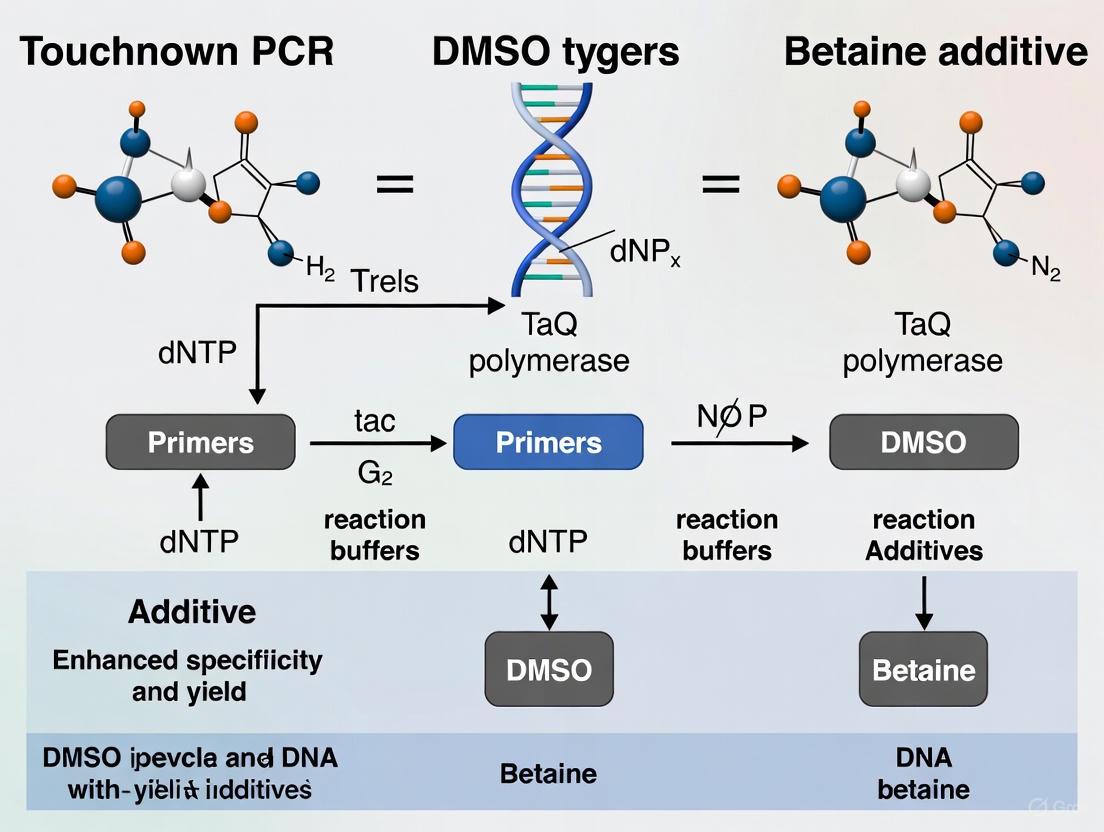
This article provides a comprehensive guide for researchers and drug development professionals on implementing and optimizing touchdown PCR with DMSO and betaine additives.
Optimizing Touchdown PCR with DMSO and Betaine: A Strategic Guide for Amplifying Challenging Targets
Abstract
This article provides a comprehensive guide for researchers and drug development professionals on implementing and optimizing touchdown PCR with DMSO and betaine additives. It covers the foundational principles of how touchdown PCR enhances specificity by incrementally lowering the annealing temperature and how chemical additives like DMSO and betaine destabilize secondary structures in GC-rich templates. The content delivers detailed, step-by-step protocols for setting up reactions, explores advanced applications from metagenomics to diagnostics, and offers a systematic troubleshooting framework for common issues like nonspecific amplification and low yield. Finally, it validates the method through comparative analysis with other techniques and discusses its proven efficacy in clinical and research settings, empowering scientists to reliably amplify the most challenging DNA targets.
Understanding Touchdown PCR and Additives: Core Principles for Overcoming Amplification Hurdles
The Problem of Non-Specific Amplification and GC-Rich Templates in Standard PCR
The polymerase chain reaction (PCR) is an indispensable technique in molecular biology, but its efficiency can be severely compromised by two common challenges: non-specific amplification and difficult template structures. Non-specific amplification occurs when primers anneal to non-target sequences, leading to unwanted products and reduced yield of the desired amplicon [1]. This mispriming is frequently caused by suboptimal annealing temperatures and the activity of DNA polymerases at low temperatures during reaction setup [2]. Concurrently, templates with high guanine-cytosine (GC) content (>65%) present a formidable barrier to successful amplification due to strong hydrogen bonding and secondary structure formation [3] [4].
GC-rich regions pose particular difficulties because their strong hydrogen bonds between guanine and cytosine bases require higher denaturation temperatures [3]. These sequences readily form stable secondary structures such as hairpins, knots, and tetraplexes that hinder DNA polymerase progression and prevent proper primer annealing [3] [5]. The combination of these challenges often results in PCR failure, truncated products, or unacceptably low yields, necessitating specialized approaches for successful amplification [3] [5].
Understanding the Fundamental Problems
Mechanisms of Non-Specific Amplification
Non-specific amplification primarily stems from imperfect primer annealing conditions. When annealing temperatures are too low, primers can bind to sequences with partial complementarity (mispriming) or to each other (forming primer-dimers) [1]. These spurious products compete with the target amplicon for reagents and polymerase access, progressively reducing amplification efficiency with each cycle [2]. The problem is exacerbated by DNA polymerase activity at room temperature, which can extend improperly annealed primers during reaction setup before thermal cycling begins [2].
Structural Challenges of GC-Rich Templates
GC-rich DNA sequences exhibit elevated melting temperatures due to the triple hydrogen bonding between G-C base pairs compared to the double bonding in A-T pairs [3]. This heightened stability prevents complete strand separation under standard denaturation conditions (94-95°C). Furthermore, GC-rich regions have a strong propensity to form complex secondary structures immediately after denaturation as the DNA cools [3] [5]. These structures include intramolecular hairpins and G-quadruplexes that physically block polymerase progression and primer binding, ultimately terminating DNA synthesis prematurely [3].
Table 1: Characterization of Common PCR Challenges
| Challenge Type | Primary Cause | Manifestation | Impact on Amplification |
|---|---|---|---|
| Non-specific Amplification | Low annealing temperature; polymerase activity at room temperature | Multiple bands on gel; primer-dimer formation | Reduced target yield; reagent depletion |
| GC-Rich Templates (>65% GC) | Strong hydrogen bonding; secondary structures | No amplification; smeared bands; truncated products | Complete failure or inefficient amplification |
| Long Amplicons | Polymerase pausing; depurination | Decreased yield with increasing length | Poor amplification of targets >5kb |
Integrated Strategic Solutions
Touchdown PCR: Enhancing Specificity
Touchdown PCR represents a powerful modification to standard protocols that significantly improves amplification specificity. This technique employs an initially high annealing temperature that systematically decreases by 0.5-1°C per cycle until the optimal annealing temperature is reached [6] [1]. The initial high temperature stringently selects for perfectly matched primer-template binding, while the gradual temperature decrease ensures eventual amplification of the specific product even without precise knowledge of the optimal annealing temperature [1].
The protocol implementation involves two distinct phases. In the first phase, the annealing temperature begins approximately 10°C above the calculated primer Tm and decreases by 1°C each cycle for 10-15 cycles [1]. The second phase continues for another 20-25 cycles using the final, lowered annealing temperature [1]. This systematic approach preferentially enriches the desired amplicon, which then outcompetes non-specific products during later cycles [6].
Chemical Additives for GC-Rich Templates
The strategic incorporation of specific additives can dramatically improve amplification of GC-rich templates by modifying DNA melting behavior and polymerase processivity. The most effective additives include:
- Dimethyl sulfoxide (DMSO): Interferes with hydrogen bond formation, preventing inter- and intrastrand reannealing of GC-rich sequences [3] [5]. Recommended concentrations range from 2.5% to 5% [4].
- Betaine: An amino acid analog that reduces the energy required for DNA strand separation by equalizing the contribution of GC and AT base pairs to duplex stability [3]. Standard working concentration is 1M [3].
- Formamide: Increases PCR specificity when working with GC-rich targets by destabilizing secondary structures [5].
These additives are frequently used in combination, with DMSO and betaine showing synergistic effects in many challenging amplifications [3]. When using these additives, annealing temperatures may need adjustment as they can lower the effective primer Tm [6].
Polymerase Selection and Reaction Optimization
The choice of DNA polymerase critically influences success with challenging templates. For GC-rich amplification, specialized polymerases such as PrimeSTAR GXL demonstrate superior performance due to enhanced processivity and stability [4] [5]. Polymerase blends that combine non-proofreading and proofreading enzymes (e.g., Taq and Pfu) facilitate long-range amplification by correcting misincorporated nucleotides that would otherwise terminate synthesis [2].
Reaction conditions require careful optimization, including increased denaturation temperatures (98°C instead of 94°C), shorter annealing times, and adjusted magnesium concentrations [4]. For extremely GC-rich targets, a two-step PCR protocol that combines annealing and extension at higher temperatures (68-72°C) often yields better results than standard three-step protocols [4] [5].
Table 2: Optimization Parameters for Challenging PCR Templates
| Parameter | Standard PCR | Optimized for GC-Rich | Optimized for Specificity |
|---|---|---|---|
| Initial Denaturation | 94°C, 1-2 min | 98°C, 2-5 min | 95°C, 2-3 min |
| Denaturation | 94°C, 30 sec | 98°C, 10 sec | 94°C, 30 sec |
| Annealing | Primer Tm, 30 sec | Primer Tm+5°C, 5-15 sec | Touchdown from Tm+10°C |
| Extension | 72°C, 1 min/kb | 68-72°C, 20-30 sec/kb | 72°C, 1 min/kb |
| Additives | None | DMSO (2.5-5%), Betaine (1M) | None or DMSO (2.5%) |
| Cycles | 25-35 | 35-40 | 35-40 |
Experimental Protocols and Applications
Comprehensive Protocol for GC-Rich Amplification
The following integrated protocol has been demonstrated to successfully amplify challenging GC-rich targets such as the 1794bp Mb0129 gene from Mycobacterium bovis (77.5% GC content) [5]:
Reaction Setup:
- Template DNA: 10-100 ng genomic DNA or 1-10 ng cDNA
- Primers: 0.2-0.5 μM each, with Tm >68°C
- dNTPs: 200 μM each
- PCR buffer: As supplied with polymerase
- DMSO: 2.5-5% (v/v)
- Betaine: 1M (final concentration)
- MgCl₂: 1-2.5 mM (optimize for specific target)
- DNA polymerase: PrimeSTAR GXL or similar high-performance polymerase [5]
Thermal Cycling Conditions:
- Initial denaturation: 98°C for 2 minutes
- 35 cycles of:
- Denaturation: 98°C for 10 seconds
- Annealing/Extension: 68°C for 1 minute per kb (two-step protocol)
- Final extension: 72°C for 5-10 minutes [5]
Critical Notes:
- Use slow ramp speeds (1°C/sec) between annealing/extension and denaturation steps to facilitate complete primer binding and extension [5].
- For targets with extreme GC content (>80%), combine this protocol with touchdown principles by starting annealing/extension at 70°C and decreasing by 0.5°C per cycle for the first 10 cycles.
- Maintain reactions on ice until thermal cycling begins and use hot-start activation to prevent pre-cycling activity [1].
Case Study: Amplification of Nicotinic Acetylcholine Receptor Subunits
Research on nicotinic acetylcholine receptor subunits from Ixodes ricinus (Ir-nAChRb1) and Apis mellifera (Ame-nAChRa1) demonstrates the practical application of these optimization strategies. These targets feature GC contents of 65% and 58% respectively, with lengths of 1743bp and 1884bp [3]. Standard PCR protocols failed completely, necessitating a multipronged optimization approach incorporating DMSO and betaine additives, increased enzyme concentrations, and adjusted annealing temperatures [3]. The successful amplification required meticulous optimization of multiple parameters rather than a single adjustment, highlighting the complexity of GC-rich amplification [3].
Research Reagent Solutions
Table 3: Essential Reagents for Challenging PCR Applications
| Reagent Category | Specific Examples | Function & Application |
|---|---|---|
| Specialized Polymerases | PrimeSTAR GXL, Platinum SuperFi, Phusion High-Fidelity | High processivity and fidelity for GC-rich and long templates [3] [4] |
| PCR Additives | DMSO, Betaine, Formamide | Disrupt secondary structures; reduce melting temperature [3] [5] |
| Hot-Start Systems | Antibody-mediated inhibition, aptamer-based | Prevent non-specific amplification during reaction setup [6] [2] |
| Enhanced Buffers | GC buffers, proprietary enhancer mixes | Optimized salt and cofactor concentrations for challenging templates [4] |
| Reverse Transcriptases | GoScript, SuperScript IV | Efficient cDNA synthesis from structured RNA templates [2] |
Workflow and Mechanism Diagrams
The challenges of non-specific amplification and GC-rich templates in standard PCR necessitate systematic optimization strategies rather than single-parameter adjustments. The integrated approach combining touchdown PCR methodology with chemical additives such as DMSO and betaine provides a robust solution to these persistent problems. Through careful implementation of specialized polymerases, optimized thermal cycling conditions, and strategic additive incorporation, researchers can successfully amplify even the most challenging targets. The protocols and principles outlined herein establish a framework for addressing amplification difficulties within broader thesis research on PCR optimization, providing practical solutions for scientific investigators engaged in molecular biology and drug development.
Touchdown polymerase chain reaction (TD-PCR) is a robust molecular technique that enhances amplification specificity through a programmed stepwise reduction of annealing stringency in initial cycles. This method strategically favors the accumulation of target-specific products early in the reaction, effectively suppressing non-specific amplification that often plagues conventional PCR. By beginning with annealing temperatures 5-10°C above the primers' melting temperature (Tm) and gradually decreasing to the optimal range, TD-PCR leverages thermodynamic principles to outcompete spurious products. This application note explores the core mechanisms of TD-PCR, provides optimized protocols for standard and challenging templates, and demonstrates its utility in pharmaceutical research and diagnostic development, particularly when combined with enhancers like DMSO and betaine for GC-rich targets.
The Specificity Challenge in Conventional PCR
Polymerase chain reaction (PCR) is foundational to molecular biology, yet conventional protocols frequently suffer from non-specific amplification due to mispriming events. Primers may bind to non-target sequences with partial complementarity, especially during reaction setup and initial cycles when stringency is suboptimal [7]. This phenomenon is particularly problematic with complex genomic templates, high GC-content sequences, and when primer-template matching is imperfect [7] [8]. Such non-specific products compete for reaction components, reduce target yield, and complicate downstream analysis.
Fundamental Mechanism of Touchdown PCR
Touchdown PCR addresses these limitations through a cycling strategy that systematically reduces annealing stringency during the initial amplification phases. The process begins at an annealing temperature significantly above the calculated Tm of the primers—typically 5-10°C higher—where only perfect primer-template matches form stable hybrids [7] [8]. Over subsequent cycles (commonly 10-20), the annealing temperature decreases incrementally (1-2°C per cycle or every second cycle) until it reaches or slightly passes the optimal Tm [7] [6]. This gradual "touchdown" creates a kinetic advantage for specific amplicons, which accumulate geometrically during high-stringency cycles and dominate the reaction before non-specific binding becomes favorable [7].
Thermodynamic Basis for Specificity Enhancement
The exceptional specificity of TD-PCR arises from fundamental thermodynamic principles. Perfectly matched primer-template duplexes have melting temperatures approximately 2-5°C higher than those with mismatches [7]. Starting with elevated annealing temperatures effectively prevents amplification from imperfect hybrids while permitting stable binding to exact matches. As the temperature decreases, specific products already undergoing amplification enjoy an exponential advantage over potential non-specific targets. Mathematical modeling demonstrates that for each 1°C difference in Tm, specific products gain approximately a 4-fold efficiency advantage per cycle, resulting in a 1024-fold bias (4⁵) after a 5°C Tm difference across the touchdown phase [7].
Key Optimization Parameters and Reagent Solutions
Successful implementation of TD-PCR requires careful optimization of several critical parameters and selection of appropriate reagents. The table below summarizes essential components and their optimal characteristics for robust TD-PCR.
Table 1: Research Reagent Solutions for Touchdown PCR Optimization
| Component | Recommended Solution | Function/Rationale |
|---|---|---|
| DNA Polymerase | Hot-start, high-fidelity enzymes (e.g., Platinum SuperFi, PrimeSTAR GXL) [3] [5] | Prevents non-specific extension during reaction setup; essential for GC-rich targets |
| Organic Additives | DMSO (2-10%), Betaine (0.5-2 M) [3] [5] | Disrupts secondary structures in GC-rich templates; lowers effective Tm |
| Primer Design | Tm 52-58°C; avoid secondary structures; length 15-30 bp [5] | Ensures efficient binding during touchdown phase; minimizes mispriming |
| Magnesium Concentration | 1.5-3.0 mM (may require optimization) [9] | Cofactor for polymerase; affects primer binding and specificity |
| Template Quality | High-purity DNA or cDNA; avoid contaminating inhibitors [3] | Ensures efficient amplification; critical for sensitive detection |
Enhanced Specificity with Hot-Start PCR
Combining TD-PCR with hot-start methodology provides superior specificity. Hot-start techniques employ antibody-based inhibition, affibodies, aptamers, or chemical modification to block DNA polymerase activity at room temperature [6]. This prevents primer-dimer formation and mispriming during reaction setup. Polymerase activation occurs only during the initial high-temperature denaturation step, synchronizing enzyme activity with the first high-stringency cycles of the TD-PCR program [6] [1].
Standard and Advanced TD-PCR Protocols
Basic Touchdown PCR Protocol
The following protocol is adapted from established methodologies [7] [1] and serves as a robust starting point for most applications. The example assumes primer Tm of 57°C.
Table 2: Standard Touchdown PCR Protocol and Cycling Conditions
| Step | Temperature | Time | Cycles | Purpose |
|---|---|---|---|---|
| Initial Denaturation | 94-95°C | 2-3 minutes | 1 | Activate hot-start polymerase; completely denature template |
| Touchdown Phase | 10 cycles | |||
| Denaturation | 94-95°C | 30 seconds | Separate DNA strands | |
| Annealing | 67°C (Start: Tm +10°C) | 30-45 seconds | Decrease by 1°C each cycle | |
| Extension | 72°C | 1 minute/kb | Synthesize new DNA strands | |
| Main Amplification | 20-25 cycles | |||
| Denaturation | 94-95°C | 30 seconds | Maintain strand separation | |
| Annealing | 57°C (Final: Tm) | 30-45 seconds | Optimal primer binding | |
| Extension | 72°C | 1 minute/kb | Efficient product elongation | |
| Final Extension | 72°C | 5-10 minutes | 1 | Complete all nascent strands |
Protocol for GC-Rich Templates with Additives
Amplifying GC-rich sequences (>60% GC content) presents unique challenges including strong hydrogen bonding, secondary structure formation, and high melting temperatures [3] [5]. The following modified TD-PCR protocol incorporates DMSO and betaine to overcome these obstacles, demonstrated successfully for nicotinic acetylcholine receptor subunits with GC contents up to 65% [3].
Table 3: Enhanced TD-PCR Protocol for GC-Rich Targets
| Parameter | Standard Protocol | GC-Rich Enhanced Protocol | Rationale |
|---|---|---|---|
| Additives | None | DMSO (5-10%), Betaine (1-1.5 M) [3] [5] | Disrupts secondary structures; equalizes Tm |
| Denaturation Temperature | 94-95°C | 98°C [5] | Improved strand separation for stable templates |
| Polymerase | Standard Taq | High-fidelity, GC-tolerant (e.g., PrimeSTAR GXL) [5] | Better processivity through difficult regions |
| Extension Time | 1 min/kb | 1.5-2 min/kb [5] | Accommodates polymerase stalling |
| Initial Annealing Temp | Tm + 5-10°C | Tm + 5-10°C (adjusted for additives) | Additives lower effective Tm; requires calibration |
Procedure:
- Prepare master mix containing 1X polymerase buffer, 200 µM dNTPs, 0.5 µM each primer, 1.5 U high-fidelity DNA polymerase, 5% DMSO, and 1 M betaine [3].
- Add template DNA (10-100 ng genomic DNA or 1-10 ng cDNA).
- Perform thermal cycling using parameters in Table 2, but with denaturation at 98°C and extended elongation times.
- Include a final hold at 4-10°C.
Troubleshooting Common Issues
Despite its robustness, TD-PCR may require optimization for specific applications. The following table addresses common challenges and solutions.
Table 4: TD-PCR Troubleshooting Guide
| Problem | Potential Cause | Solution |
|---|---|---|
| Low yield | Too few cycles; temperature decrements too large | Increase total cycles; use smaller temperature steps (0.5°C) |
| Non-specific products | Initial temperature too low; too many cycles | Increase starting annealing temperature; reduce total cycles to <35 [1] |
| No product | Initial temperature too high; inhibitor presence | Lower starting temperature by 2-3°C; purify template DNA |
| Smear on gel | Primer degradation; excessive magnesium | Use fresh primer aliquots; titrate MgCl₂ concentration |
Research Applications and Case Studies
Pharmaceutical and Diagnostic Development
TD-PCR has proven particularly valuable in pharmaceutical research and diagnostic applications where specificity and reliability are paramount. A recent innovation combines TD-PCR with droplet digital PCR (ddPCR) for absolute quantification of human papillomavirus (HPV) types 16 and 18 in anal samples [10]. This TD-ddPCR assay demonstrated linearity across dilution series (r = 0.9999), detected single copies of HPV, and showed no cross-reactivity with 27 other HPV types [10]. The method's precision was excellent, with inter-assay coefficients of variation of 2.0-6.3% for HPV16 and 4.9-11.6% for HPV18 [10]. This application highlights TD-PCR's utility in clinical settings where precise viral load quantification informs disease prognosis and treatment monitoring.
GC-Rich Target Amplification in Drug Target Research
Research on nicotinic acetylcholine receptors (nAChRs), important therapeutic targets for neurological disorders, requires amplification of GC-rich subunits. A 2025 study demonstrated that conventional PCR failed to amplify the beta1 subunit from Ixodes ricinus (Ir-nAChRb1, 65% GC) and alpha1 subunit from Apis mellifera (Ame-nAChRa1, 58% GC) [3]. By implementing a TD-PCR protocol incorporating DMSO and betaine with high-fidelity polymerases, researchers achieved successful amplification of these challenging targets, enabling subsequent functional characterization [3]. This "multipronged approach" combining TD-PCR with additive enhancement provides a reliable strategy for amplifying pharmacologically relevant targets with high GC content.
Additional Research Applications
Beyond pharmaceutical applications, TD-PCR has demonstrated utility across diverse fields:
- Genotyping and mutation detection: The high specificity enables discrimination between closely related sequences [8].
- Pathogen detection: Broad-spectrum primers with multiple mismatches benefit from TD-PCR's tolerance to sequence variation [10].
- Forensic analysis: Reliable amplification from limited or degraded samples [7].
- Gene cloning and sequencing: Production of specific amplicons with minimal background for downstream processing [7] [9].
Touchdown PCR represents a sophisticated yet accessible molecular technique that significantly enhances amplification specificity through systematic stringency reduction. Its thermodynamic foundation provides a kinetic advantage to target-specific products, effectively suppressing non-specific amplification across diverse template types. When combined with enhancers like DMSO and betaine, TD-PCR successfully overcomes the challenge of amplifying GC-rich targets relevant to drug development. The protocols and case studies presented herein provide researchers with a comprehensive framework for implementing TD-PCR in basic research, diagnostic development, and pharmaceutical applications. As molecular techniques continue to evolve, TD-PCR remains an essential tool in the molecular biologist's arsenal, particularly when precision, reliability, and specificity are paramount.
In the realm of molecular biology, particularly within polymerase chain reaction (PCR) and its derivatives, the amplification of GC-rich DNA templates presents a significant challenge due to the formation of stable secondary structures. These structures, such as hairpin loops and intramolecular base pairing, hinder efficient amplification by preventing primer annealing and polymerase progression. Within the context of optimizing touchdown PCR methods, the use of additives like dimethyl sulfoxide (DMSO) and betaine has proven critical for successful gene synthesis and detection. This application note details the mechanisms by which DMSO and betaine destabilize secondary structures, provides quantitative data on their use, and outlines detailed protocols for their application in touchdown PCR, framed within broader research on robust assay development for drug discovery and diagnostic applications.
The Problem of Secondary Structures in PCR
GC-rich DNA sequences are prone to forming stable secondary structures because guanine and cytosine base pairs are connected by three hydrogen bonds, compared to the two bonds in adenine and thymine pairs. This results in a higher melting temperature (Tm) and increased stability of the double helix. During PCR, especially in the annealing and extension phases, these regions can form intricate hairpins and other structures that cause polymerase enzyme arrest, premature termination, and mispriming. These issues manifest experimentally as poor yield, complete amplification failure, or a high background of non-specific products. The problem is exacerbated in touchdown PCR, where precise annealing is critical for specificity. This technique involves a gradual reduction of the annealing temperature over successive cycles, starting from a temperature above the primer's calculated Tm down to the optimal temperature. While this method favors the accumulation of specific amplicons, secondary structures in the template can obstruct the very first cycles of amplification, where high annealing temperatures are used, thereby compromising the entire process.
Mechanisms of Action: How DMSO and Betaine Work
Dimethyl Sulfoxide (DMSO)
DMSO is an organic polar solvent that enhances PCR amplification of GC-rich templates through two primary, interrelated mechanisms:
- Reduction of DNA Melting Temperature: DMSO interacts with the DNA molecule, making nitrogenous bases, particularly cytosine, more heat-labile. By binding to the DNA and altering its conformation, DMSO effectively lowers the overall melting temperature required for strand separation. This facilitates the denaturation of template DNA and the subsequent annealing of primers to their target sites without requiring excessively high temperatures that could damage the DNA or the polymerase enzyme [11].
- Disruption of Secondary Structure Formation: DMSO interferes with the inter- and intrastrand reannealing of DNA that leads to hairpins and other secondary structures. By preventing the reannealing of denatured DNA strands, it maintains the template in a more accessible, single-stranded state, thereby providing primers with a wider space to bind accurately to their complementary locations. This action directly increases the specificity and yield of the reaction [12] [11].
Betaine
Betaine (N,N,N-trimethylglycine) is an amino acid derivative that acts as an isostabilizing agent, normalizing the melting behavior of DNA:
- Equalization of Base Pair Stability: Betaine possesses both positive and negative charges close to a neutral pH. When added to a PCR mixture, it penetrates the DNA helix and neutralizes the differential stability between GC and AT base pairs. This action effectively eliminates the DNA's Tm dependence on its GC content. By reducing the energy required to melt GC-rich regions, betaine promotes uniform strand separation and prevents the stabilization of secondary structures that halt polymerase progression [13].
- Reduction of Secondary Structures: Similar to DMSO, betaine reduces the formation of secondary structures like hairpin loops, thereby facilitating smoother polymerase extension along the entire template [12].
Table 1: Comparative Mechanisms of DMSO and Betaine
| Additive | Chemical Nature | Primary Mechanism | Effect on Tm | Impact on Secondary Structures |
|---|---|---|---|---|
| DMSO | Polar organic solvent | Binds to DNA, making bases heat-labile | Decreases Tm | Disrupts inter/intrastrand reannealing |
| Betaine | Zwitterionic amino acid analog | Neutralizes differential stability of GC vs AT pairs | Equalizes Tm across sequence | Reduces formation of hairpin loops |
Quantitative Data and Optimization
The efficacy of DMSO and betaine is concentration-dependent, and their optimal use requires careful titration, as excessive amounts can inhibit the PCR reaction.
Research demonstrates that 5% DMSO yielded a 91.6% PCR success rate for amplifying the challenging ITS2 DNA barcode region from plants, whereas 1 M betaine achieved a 75% success rate. Combining both additives in the same reaction did not yield a synergistic effect and sometimes inhibited amplification. The recommended strategy is to use 5% DMSO as a default, substituting it with 1 M betaine only in cases of failed reactions, a strategy that boosted the PCR success rate from 42% to 100% in a 50-species test [14].
Similar concentrations have proven effective in other applications. In de novo gene synthesis of GC-rich constructs, both DMSO and betaine significantly improved target product specificity and yield during PCR amplification [12]. Furthermore, in detecting single nucleotide polymorphisms in the GC-rich EGFR gene promoter, DMSO at 7-10%, glycerol at 10-20%, and betaine at 1-2 M significantly enhanced PCR yield and specificity [15].
Table 2: Effective Concentration Ranges for DMSO and Betaine in PCR
| Application Context | Effective DMSO Concentration | Effective Betaine Concentration | Key Outcome |
|---|---|---|---|
| ITS2 Plant DNA Barcoding [14] | 5% | 1 M | Success rate increased from 42% to 100% |
| GC-rich Gene Synthesis [12] | Not specified | Not specified | Greatly improved specificity and yield |
| EGFR SNP Genotyping [15] | 7-10% | 1-2 M | Enhanced yield and specificity |
| General Guideline [13] | 1-10% (>2% may inhibit) | 0.5-2.5 M | Destabilizes secondary structures |
Experimental Protocols
Protocol 1: Touchdown PCR with Additives for GC-Rich Templates
This protocol is adapted from published methodologies for increased specificity and sensitivity in PCR amplification [1], incorporating the use of DMSO and betaine.
Research Reagent Solutions
| Reagent | Function in the Protocol |
|---|---|
| High-Fidelity DNA Polymerase | Enzyme for accurate DNA amplification. |
| 10X PCR Buffer | Provides optimal pH and salt conditions for polymerase activity. |
| dNTP Mix | Building blocks (dATP, dCTP, dGTP, dTTP) for new DNA strands. |
| MgCl₂ Solution | Essential co-factor for DNA polymerase. |
| Forward & Reverse Primers | Target-specific oligonucleotides that define amplification region. |
| Template DNA | The GC-rich DNA to be amplified. |
| Molecular Grade DMSO | Additive to destabilize DNA secondary structures. |
| Betaine (5M stock) | Additive to equalize DNA melting temperatures. |
| Nuclease-free Water | Solvent to achieve final reaction volume. |
Procedure
- Reaction Mixture Setup: Prepare a master mix on ice for all reactions to ensure consistency. For a single 50 µL reaction, combine the following components in a thin-walled PCR tube:
- Nuclease-free Water: Q.S. to 50 µL
- 10X PCR Buffer: 5 µL
- dNTP Mix (10 mM): 1 µL
- MgCl₂ (25 mM): 2–4 µL (optimization may be required)
- Forward Primer (20 µM): 1 µL
- Reverse Primer (20 µM): 1 µL
- DMSO: 2.5 µL (5% final concentration)
- Betaine (5M stock): 10 µL (1 M final concentration)
- Template DNA: 1–1000 ng (optimize based on source)
- High-Fidelity DNA Polymerase: 0.5–2.5 units
- Thermal Cycling: Program the thermal cycler using the following touchdown parameters, based on an example primer Tm of 57°C [1]:
- Initial Denaturation: 95°C for 3 minutes.
- Touchdown Phase (10 cycles):
- Denature: 95°C for 30 seconds.
- Anneal: Start at Tm +10°C (67°C in this example) for 45 seconds. Decrease the annealing temperature by 1°C per cycle over these 10 cycles.
- Extend: 72°C for 45 seconds (adjust based on product length; 1 min/kb).
- Amplification Phase (20–25 cycles):
- Denature: 95°C for 30 seconds.
- Anneal: Use the final temperature from the touchdown phase (57°C in this example) for 45 seconds.
- Extend: 72°C for 45 seconds.
- Final Extension: 72°C for 5–10 minutes.
- Hold: 4°C.
- Product Analysis: Analyze the amplified DNA by agarose gel electrophoresis and subsequent ethidium bromide or other DNA stain visualization.
Protocol 2: Additive Titration for Reaction Optimization
When working with a novel GC-rich target, empirical determination of the optimal additive concentration is advised.
Procedure
- Preparation: Set up a series of PCR reactions identical to the master mix described in Protocol 1, but omit DMSO and betaine from the main mix.
- Additive Addition: Aliquot the master mix into separate tubes. Add DMSO and/or betaine to each tube to create a matrix of final concentrations. For example:
- Tube 1: No additive (control)
- Tube 2: 3% DMSO
- Tube 3: 5% DMSO
- Tube 4: 1 M Betaine
- Tube 5: 1.5 M Betaine
- Tube 6: 5% DMSO + 1 M Betaine
- Amplification and Analysis: Run the reactions using the thermal cycling conditions deemed most appropriate. Analyze the results via gel electrophoresis to identify the condition that provides the strongest specific yield with the least non-specific amplification. Note that combinations may not always be beneficial [14].
Integration with Touchdown PCR Research
The integration of DMSO and betaine into touchdown PCR protocols represents a powerful combinatorial strategy for challenging amplification tasks. Touchdown PCR itself improves specificity by starting with high-stringency annealing conditions, selectively enriching for correct primer-template matches before entering the exponential amplification phase [1]. The addition of DMSO and betaine directly supports this mechanism by ensuring that the DNA template is accessible during the critical initial high-temperature annealing steps. By destabilizing secondary structures, these additives prevent the template from being "hidden" from primers, thereby increasing the effective concentration of available target and enhancing the specificity and sensitivity of the entire process. This combination is particularly valuable in fields like diagnostics and drug development, where robust and reliable detection of specific genetic targets, often from complex or GC-rich regions, is paramount. Recent research on touchdown LAMP for Giardia duodenalis detection also highlights the utility of betaine in isothermal amplification, underscoring its broad applicability in molecular assay development [16].
Visualization of Mechanisms and Workflow
Diagram 1: Mechanism of DMSO and betaine action on GC-rich DNA, leading to successful PCR amplification.
Diagram 2: A recommended workflow for integrating DMSO and betaine into a touchdown PCR protocol.
DMSO and betaine are indispensable tools in the molecular biologist's toolkit, especially when dealing with the formidable challenge of amplifying GC-rich DNA sequences in techniques like touchdown PCR. Their ability to destabilize secondary structures through distinct but complementary mechanisms—DMSO by lowering Tm and preventing reannealing, and betaine by equalizing base-pair stability—directly translates to enhanced amplification specificity, sensitivity, and yield. The protocols and data presented herein provide a framework for researchers and drug development professionals to effectively employ these additives, thereby enabling more robust and reliable genetic analysis and diagnostic assay development.
The amplification of difficult DNA templates, particularly those with high GC-content, remains a significant challenge in molecular biology and diagnostic research. This application note explores a powerful synergistic methodology combining the procedural specificity of touchdown PCR with the biochemical enhancements of DMSO and betaine. We demonstrate that this integrated approach significantly improves amplification success rates, specificity, and yield for challenging targets such as GC-rich sequences. Within the context of a broader thesis on PCR optimization, we present comprehensive quantitative data, detailed protocols, and mechanistic insights to provide researchers and drug development professionals with a robust framework for overcoming amplification barriers.
Polymerase chain reaction (PCR) efficiency is frequently compromised by non-specific amplification and difficult template structures. Touchdown PCR addresses the former by progressively lowering the annealing temperature from a stringent starting point, thereby favoring the accumulation of specific products in early cycles [1]. Meanwhile, GC-rich templates (exceeding 65% GC content) pose a distinct challenge due to stable secondary structures that hinder polymerase processivity, leading to premature termination and non-specific amplification [6].
Chemical additives like DMSO (Dimethyl Sulfoxide) and betaine function as isostabilizing agents that disrupt these secondary structures. DMSO acts by disrupting inter and intrastrand re-annealing, while betaine equilibrates the melting temperature differential between AT and GC base pairings [12]. Independently, each method offers improvements, but their combination creates a synergistic effect that dramatically enhances PCR performance. Research shows that while standard PCR achieved only a 42% success rate for the ITS2 DNA barcode region, a strategy employing DMSO and betaine increased this rate to 100% [14].
Quantitative Data and Comparative Analysis
Performance of Individual Additives
The efficacy of PCR enhancers varies significantly by template and concentration. The table below summarizes key findings from multiple studies on challenging DNA sequences.
Table 1: Efficacy of Single Additives in Improving PCR Amplification
| Additive | Optimal Concentration | Reported PCR Success Rate | Key Application Context |
|---|---|---|---|
| DMSO | 5% - 10% [14] [15] | 91.6% (ITS2 barcodes) [14] | GC-rich EGFR promoter, plant ITS2 barcodes [14] [15] |
| Betaine | 1 M - 2 M [14] [15] | 75% (ITS2 barcodes) [14] | GC-rich random sequence libraries, EGFR promoter [15] [17] |
| 7-deaza-dGTP | 50 μM [14] [18] | 33.3% (ITS2 barcodes) [14] | RET promoter, LMX1B gene region [18] |
| Formamide | 3% | 16.6% (ITS2 barcodes) [14] | Plant ITS2 barcodes [14] |
Synergistic Combinations
Combining additives can further enhance amplification, particularly for extremely challenging templates. However, some combinations require careful optimization.
Table 2: Efficacy of Additive Combinations in PCR
| Additive Combination | Optimal Concentration | Effect on Amplification | Key Application Context |
|---|---|---|---|
| DMSO + Betaine | 5% + 1 M | Successfully amplified random sequence DNA library; did not improve ITS2 amplification versus DMSO alone [14] [17] | Random sequence DNA libraries, de novo gene synthesis [12] [17] |
| Betaine + 7-deaza-dGTP | 1 M + 50 μM | Achieved amplification of the RET promoter, but nonspecific products were still present [18] | RET promoter region (79% GC) [18] |
| DMSO + Betaine + 7-deaza-dGTP | 5% + 1.3 M + 50 μM | A "powerful mixture" yielding a unique, specific PCR product for extremely GC-rich targets [18] | RET promoter (79% GC), LMX1B (67.8% GC), PHOX2B (72.7% GC) [18] |
Mechanistic Workflow and Signaling Pathways
The synergistic effect of combining touchdown PCR with DMSO and betaine operates through a multi-stage mechanism that enhances specificity and yield. The following diagram illustrates the logical workflow and how each component targets a specific amplification challenge.
The Scientist's Toolkit: Research Reagent Solutions
The successful implementation of this combined methodology requires key reagents, each serving a specific function.
Table 3: Essential Research Reagents for Combined TD-PCR with Additives
| Reagent / Solution | Function / Rationale | Application Notes |
|---|---|---|
| Hot-Start DNA Polymerase | Prevents non-specific amplification and primer-dimer formation during reaction setup by requiring thermal activation [1] [6]. | Critical for maintaining specificity during the initial, high-stringency cycles of touchdown PCR. |
| DMSO (Dimethyl Sulfoxide) | Disrupts secondary structures in GC-rich DNA by reducing intermolecular interactions, facilitating strand separation [12] [6]. | Typical working concentration is 5-10%. Higher concentrations may inhibit polymerase activity [15]. |
| Betaine (Molecular Biology Grade) | Equalizes the contribution of GC and AT base pairs to DNA melting temperature, preventing polymerase stalling [12] [18]. | Commonly used at 1 M concentration. Also known as trimethylglycine. |
| 7-deaza-dGTP | A dGTP analog that reduces hydrogen bonding, thereby weakening secondary structures without compromising base-pairing fidelity [18]. | Used at 50 µM, often in combination with other additives for the most challenging templates [18]. |
| Optimized PCR Buffer | Provides optimal pH, ionic strength, and co-factors (like Mg²⁺) for polymerase activity and fidelity [19] [20]. | MgCl₂ concentration may need re-optimization when adding DMSO or betaine. |
Detailed Experimental Protocols
Core Protocol: Combined Touchdown PCR with DMSO/Betaine
This protocol is designed for amplifying difficult, GC-rich targets and can be adapted to a 25 µL total reaction volume.
Materials:
- Hot-Start DNA Polymerase (e.g., Platinum Taq, KAPA Taq)
- 10X PCR Buffer (supplied with polymerase)
- dNTP Mix (10 mM each)
- Primer Forward and Reverse (10 µM each)
- Template DNA (10-100 ng genomic DNA)
- DMSO (Molecular Biology Grade)
- Betaine (5 M stock solution)
- Nuclease-free Water
Procedure:
- Reaction Mixture Setup (on ice):
- Combine the following components in a sterile PCR tube:
- Nuclease-free Water: to 25 µL final volume
- 10X PCR Buffer: 1X final concentration
- MgCl₂ (25 mM): 1.5-2.0 mM final concentration (may require optimization)
- dNTP Mix (10 mM each): 200 µM each dNTP final
- Primer Forward (10 µM): 0.4 µM final
- Primer Reverse (10 µM): 0.4 µM final
- DMSO: 5% (v/v) final (e.g., 1.25 µL in a 25 µL reaction)
- Betaine (5 M stock): 1 M final (e.g., 5 µL of 5 M stock in a 25 µL reaction)
- Template DNA: 10-100 ng
- Hot-Start DNA Polymerase: 1.25 U
- Combine the following components in a sterile PCR tube:
- Thermal Cycling Conditions:
- Initial Denaturation & Hot-Start Activation: 95°C for 3-5 minutes.
- Touchdown Phase (10-15 cycles):
- Denaturation: 95°C for 30 seconds.
- Annealing: Start at 10°C above the calculated Tm of the primers. Decrease by 1°C per cycle.
- Extension: 72°C for 30-60 seconds per kb.
- Standard Amplification Phase (20-25 cycles):
- Denaturation: 95°C for 30 seconds.
- Annealing: Use the final, lowered temperature from the touchdown phase (e.g., calculated Tm).
- Extension: 72°C for 30-60 seconds per kb.
- Final Extension: 72°C for 5-10 minutes.
- Hold: 4°C.
Optimization and Troubleshooting Guidelines
- Annealing Temperature Gradient: If non-specific products persist, perform a finer optimization of the final annealing temperature using a thermal cycler with a gradient function [19].
- Additive Titration: If amplification fails, titrate DMSO (3-10%) and betaine (0.5-2 M) individually. Note that combining DMSO and betaine is not always beneficial and should be empirically tested [14] [15].
- Magnesium Concentration: The optimal MgCl₂ concentration may shift in the presence of additives. Test a range from 1.5 mM to 3.0 mM in 0.5 mM increments [19] [20].
- Cycle Number: Limit total cycles to below 35 to minimize the appearance of non-specific bands [1].
The strategic integration of touchdown PCR with chemical enhancers like DMSO and betaine represents a robust solution for one of molecular biology's persistent challenges. This synergistic approach leverages the procedural specificity of touchdown cycling with the biochemical action of additives that neutralize the physical barriers of GC-rich DNA. The provided data, protocols, and reagents table offer a practical roadmap for researchers in genomics, diagnostics, and drug development to achieve maximum PCR efficacy, ensuring reliable amplification of even the most recalcitrant targets. This methodology underscores the principle that a multi-faceted approach often yields superior results, enabling advancements in research that depends on high-quality genetic data.
Step-by-Step Protocols and Diverse Applications for Robust Assay Development
Touchdown polymerase chain reaction (TD-PCR) represents a robust modification of conventional PCR designed to enhance amplification specificity and yield, particularly for challenging templates. This technique operates on the principle of initiating amplification at annealing temperatures exceeding the primers' optimal melting temperature (Tm), thereby selectively favoring specific primer binding in the initial cycles. The protocol subsequently decreases the annealing temperature in a stepwise manner to a permissive level, ensuring efficient accumulation of the desired amplicon. This application note provides a detailed, experimentally-validated protocol for implementing TD-PCR, incorporating critical additives such as DMSO and betaine, and is framed within broader research efforts to optimize detection methodologies for microbial and clinical targets [21].
Touchdown PCR is a strategic approach that mitigates the common challenge of nonspecific amplification by systematically varying the annealing temperature during the thermal cycling process. The fundamental principle involves commencing with an annealing temperature higher than the calculated Tm of the primers. This high stringency at the outset minimizes opportunities for primers to bind to non-target sequences with lower complementarity, effectively reducing the formation of primer-dimers and spurious products [6].
As cycling progresses, the annealing temperature is incrementally lowered—typically by 1°C every one or two cycles—until it "touches down" at the calculated, optimal Tm. By the time the reaction reaches this lower, more permissive temperature, the specific target amplicon has already been initiated and geometrically amplified, giving it a substantial competitive advantage over any non-specific products that might begin to form later. This method thereby promotes the selective enrichment of the intended PCR product [6] [19]. The effectiveness of this approach is complemented by the use of specific reaction additives, such as DMSO and betaine, which help overcome secondary structures in GC-rich templates, aligning with research goals to improve detection accuracy in complex samples [22] [21].
Experimental Protocol and Workflow
The following section provides a step-by-step methodology for setting up and executing a Touchdown PCR experiment, from primer design to reaction setup and thermal cycling.
Primer Design and Tm Calculation
Successful TD-PCR begins with meticulous primer design. Primers should be 17-40 nucleotides in length with a GC content of 40-60% [22] [23]. The 3' ends should ideally terminate with a G or C base to increase priming efficiency by preventing "breathing" of the ends [23]. Crucially, the Tm values for the forward and reverse primers must be within 5°C of each other to ensure balanced amplification [23].
The simplest formula for calculating Tm is: Tm = 4(G + C) + 2(A + T), where A, T, G, and C represent the number of each nucleotide in the primer [19]. For greater accuracy, especially with longer primers, the nearest-neighbor method is recommended, and online tools like OligoAnalyzer (IDT) or Primer3 can be used for this purpose [24] [23].
Reaction Setup
Assemble reactions on ice in thin-walled PCR tubes. Preparing a master mix for multiple reactions is highly recommended to minimize pipetting errors and ensure consistency [22]. A standard 50 µL reaction mixture is detailed in Table 1.
Table 1: Standard 50 µL Touchdown PCR Reaction Mixture
| Component | Final Concentration/Amount | Volume for 50 µL Reaction |
|---|---|---|
| Sterile Nuclease-Free Water | - | To 50 µL |
| 10X PCR Buffer | 1X | 5 µL |
| dNTPs (10 mM total) | 200 µM (each) | 1 µL |
| Forward Primer (10 µM) | 0.5 µM | 2.5 µL |
| Reverse Primer (10 µM) | 0.5 µM | 2.5 µL |
| Template DNA | Variable (e.g., 1 pg–1 µg) | Variable |
| MgCl₂ (25 mM) | 1.5 mM (if not in buffer) | 3 µL (if required) |
| DMSO (100%) | 3–5% | 1.5–2.5 µL |
| Betaine (5M) | 1 M | 10 µL |
| DNA Polymerase | 0.5–2.5 U/50 µL | 0.5–1.0 µL |
Notes:
- Template Quantity: Use 1 pg–1 ng for plasmid DNA and 10 ng–1 µg for genomic DNA [22].
- Hot-Start DNA Polymerase: This is preferred to prevent non-specific amplification during reaction setup [6].
- Additives: DMSO and betaine are included to facilitate the amplification of difficult templates, such as those with high GC content, by reducing secondary structures and stabilizing the polymerase [22]. The inclusion of these additives generally lowers the effective Tm of the primers, which must be considered when setting temperatures [24].
Thermal Cycling Conditions for Touchdown PCR
The thermal cycling profile is the core differentiator of TD-PCR. The protocol begins with an initial denaturation to fully separate the DNA strands and activate the hot-start enzyme, followed by the touchdown cycles, and concludes with a final extension. A specific example for primers with a final Tm of 58°C is provided in Table 2.
Table 2: Example Touchdown PCR Thermal Cycling Protocol
| Step | Temperature | Time | Cycles | Purpose |
|---|---|---|---|---|
| Initial Denaturation | 95–98°C | 2–3 min | 1 | Template denaturation; enzyme activation. |
| Touchdown Cycles | 10–20 | |||
| Denaturation | 95–98°C | 15–30 s | ||
| Annealing | Start: Tm+5°C → End: Tm | 30–60 s | Decrease by 0.5–1°C per cycle. | |
| Extension | 68–72°C | 1 min/kb | ||
| Standard Cycles | 15–25 | |||
| Denaturation | 95–98°C | 15–30 s | ||
| Annealing | Tm (e.g., 58°C) | 30–60 s | ||
| Extension | 68–72°C | 1 min/kb | ||
| Final Extension | 68–72°C | 5–10 min | 1 | Complete synthesis of all amplicons. |
Example Execution: For primers with a final Tm of 58°C, start the annealing temperature at 63°C for the first cycle and decrease by 1°C per cycle for the next 5 cycles until reaching 58°C. Then, continue for another 20–25 cycles at the 58°C annealing temperature [19]. Extension times are dependent on amplicon length and polymerase speed; a common guideline is 1 minute per kilobase for Taq polymerase [19].
The logical workflow of the protocol, from setup to analysis, is summarized in the following diagram:
The Scientist's Toolkit: Key Reagents and Materials
The reliability of TD-PCR is contingent upon the quality and suitability of its components. Table 3 lists essential reagents and their functions.
Table 3: Research Reagent Solutions for Touchdown PCR
| Reagent / Material | Function / Role in TD-PCR |
|---|---|
| High-Fidelity or Taq DNA Polymerase | Catalyzes DNA synthesis. Hot-start versions are preferred to enhance specificity [6]. |
| dNTPs (dATP, dCTP, dGTP, dTTP) | Building blocks for new DNA strands. |
| Sequence-Specific Primers | Anneal to the target sequence to define the amplicon. Careful design is critical [23]. |
| Nuclease-Free Water | Solvent for the reaction; ensures no enzymatic degradation of components. |
| PCR Buffer (with Mg²⁺) | Provides optimal chemical environment (pH, salts) for polymerase activity. Mg²⁺ is a essential cofactor. |
| DMSO (Dimethyl Sulfoxide) | Additive that reduces DNA secondary structure, especially beneficial for GC-rich templates [22]. |
| Betaine | Additive that equalizes the melting temperatures of GC and AT base pairs, facilitating amplification of GC-rich regions [22]. |
| Thermal Cycler with Gradient Function | Instrument that automates temperature cycles. A gradient function is invaluable for optimizing annealing temperatures in parallel [24] [19]. |
Expected Results and Troubleshooting
A successfully optimized TD-PCR reaction should yield a single, dominant band of the expected size upon agarose gel electrophoresis, with minimal to no non-specific background or primer-dimer formations. The following diagram contrasts the typical outcomes of conventional and touchdown PCR protocols.
Common challenges and their solutions include:
- No Product: Ensure the template DNA is of high quality and concentration. Lower the initial touchdown temperature in 2°C increments. Verify polymerase activity and check for inhibitors.
- Smeared or Multiple Bands: Increase the starting annealing temperature in the touchdown phase. Reduce the number of final standard cycles. Titrate the MgCl₂ concentration, as too much can reduce fidelity [19].
- Low Yield: Optimize the concentration of betaine and DMSO. Increase the amount of template DNA within the recommended range. Ensure extension times are sufficient for the amplicon length.
This application note delineates a comprehensive and reliable protocol for Touchdown PCR, emphasizing the strategic use of temperature gradients and the incorporation of DMSO and betaine additives. By systematically enforcing high stringency in the initial amplification cycles, TD-PCR significantly improves specificity and success rates for demanding applications such as pathogen detection [25] [21] and the amplification of complex genomic templates. The detailed methodologies, reagent specifications, and troubleshooting guide provided herein offer researchers a robust framework for integrating this powerful technique into their molecular biology and diagnostic workflows.
The polymerase chain reaction (PCR) is a foundational technique in molecular biology, yet the amplification of deoxyribonucleic acid (DNA) templates with high guanine-cytosine (GC) content (>65%) remains a significant challenge for researchers and drug development professionals [26]. These GC-rich regions form stable secondary structures due to the three hydrogen bonds between G-C base pairs, leading to strong intra- and intermolecular interactions that hinder complete DNA denaturation and primer annealing [27] [28]. This often results in inefficient amplification, premature polymerase termination, and the formation of non-specific products [28] [12].
Within the context of touchdown PCR methodologies, chemical additives such as dimethyl sulfoxide (DMSO) and betaine serve as powerful tools for overcoming these hurdles. These isostabilizing agents facilitate strand separation by altering the melting characteristics of DNA, thereby improving amplification specificity and yield [28] [12]. This application note provides a detailed framework for optimizing DMSO and betaine concentrations, integrating quantitative data and step-by-step protocols to enable reliable amplification of GC-rich targets for pharmaceutical research and diagnostic applications.
Additive Specifications and Concentration Ranges
Successful amplification of GC-rich sequences requires precise formulation of reaction components. The table below summarizes the standard concentration ranges for DMSO and betaine, along with recommended starting points for initial optimization experiments.
Table 1: Recommended Concentrations for PCR Additives
| Additive | Full Name | Common Stock Concentration | Final Working Concentration Range | Recommended Starting Point |
|---|---|---|---|---|
| DMSO | Dimethyl Sulfoxide | 100% | 1–10% [29] [30] | 3–5% [26] |
| Betaine | Betaine (Monohydrate) | 5M | 0.5–2.5 M [29] [31] | 1.0–1.5 M [31] [30] |
The selection of a starting concentration should consider the specific GC content of the target and the polymerase used. For extremely challenging targets with GC content exceeding 70%, a combination of both additives may be necessary. Furthermore, the compatibility of these additives with specialized polymerases, such as PrimeSTAR MAX or CloneAmp HiFi, has been confirmed, with DMSO enhancing their efficacy on GC-rich templates [26].
Mechanism of Action in PCR Amplification
DMSO and betaine function through distinct molecular mechanisms to facilitate the amplification of GC-rich sequences. Understanding these mechanisms is crucial for rational experimental design and troubleshooting.
DMSO is a polar solvent that disrupts the hydrogen bonding network within and between DNA strands. By interfering with these stable interactions, it effectively reduces the melting temperature ((T_m)) of the DNA template, promoting more complete denaturation and preventing the reformation of secondary structures like hairpins and G-quadruplexes during the annealing step [28] [32]. This action provides the polymerase with better access to a single-stranded template.
Betaine, an amino acid analog, acts as an isostabilizing agent. In solution, its zwitterionic properties help to equilibrate the thermodynamic stability between GC-rich and AT-rich regions of the DNA [28] [12]. This homogenization of base-pair stability reduces the energy barrier for denaturing GC clamps and minimizes mispriming events caused by localized high (T_m) differences, leading to more specific and efficient amplification [12].
The following diagram illustrates the workflow for integrating these additives into a touchdown PCR protocol and their functional impact on the DNA template.
Experimental Protocol for Touchdown PCR with Additives
This protocol outlines a optimized touchdown PCR method for amplifying GC-rich targets using DMSO and betaine, based on established methodologies with modifications for enhanced reliability [31].
Reagent Preparation and Workflow
Table 2: PCR Reaction Master Mix for a 50 µL Reaction
| Component | Final Concentration | Volume (µL) | Notes |
|---|---|---|---|
| 10X PCR Buffer | 1X | 5 | Mg²⁺ may be included |
| dNTP Mix | 200 µM | 1 | 10 mM stock |
| Forward Primer | 0.4 µM | 1 | 20 µM stock |
| Reverse Primer | 0.4 µM | 1 | 20 µM stock |
| Template DNA | 10-100 ng | Variable | High-quality, intact |
| DMSO | 3% (v/v) | 1.5 | From 100% stock |
| Betaine | 1.5 M | 15 | From 5M stock |
| DNA Polymerase | 0.5-2.5 U | Variable | High-fidelity enzyme |
| Nuclease-free H₂O | To volume | Variable | To a final volume of 50 µL |
Procedure:
- Master Mix Preparation: Thaw all reagents on ice and vortex gently before use. Combine all components listed in Table 2 in a sterile, nuclease-free 0.2 mL PCR tube, adding the DNA polymerase last. Gently mix by pipetting up and down approximately 20 times [29].
- Negative Control: Prepare a control reaction simultaneously, replacing the template DNA with an equivalent volume of nuclease-free water.
- Thermal Cycling: Place the tubes in a pre-heated thermal cycler and initiate the following touchdown program:
- Initial Denaturation: 98°C for 2 minutes [26] (1 cycle)
- Touchdown Cycles: 20 cycles of:
- Standard Cycles: 15 cycles of:
- Denaturation: 98°C for 10-30 seconds
- Annealing: Use the final, lowered (Tm) from the touchdown phase for all remaining cycles
- Extension: 68°C for 1 minute per kilobase [31]
- Final Extension: 68°C for 5-10 minutes (1 cycle)
- Hold: 4°C ∞
Post-Amplification Analysis
- Analyze 5-10 µL of the PCR product by agarose gel electrophoresis alongside an appropriate DNA molecular weight ladder.
- A single, sharp band of the expected size indicates successful and specific amplification. Smears or multiple bands suggest non-specific priming, which may require further optimization of annealing temperature or additive concentration.
The Scientist's Toolkit: Essential Reagents for GC-Rich PCR
Table 3: Key Research Reagent Solutions
| Reagent / Solution | Function / Role in GC-Rich PCR |
|---|---|
| High-Fidelity DNA Polymerase | Specialized enzymes with strong processivity to synthesize through stable secondary structures and complex DNA templates [32] [26]. |
| DMSO (Dimethyl Sulfoxide) | Disrupts hydrogen bonding in GC-rich regions, lowers DNA melting temperature, and reduces secondary structure formation [28] [32] [26]. |
| Betaine (5M Stock) | Equalizes the melting temperature across DNA regions with varying GC content, enhancing primer binding specificity and product yield [28] [31] [12]. |
| MgCl₂ Solution (25 mM) | Critical co-factor for DNA polymerase activity. Optimal concentration (1-5 mM) must be determined empirically, as excess can reduce fidelity [29] [26]. |
| GC Buffer (Proprietary) | Commercial buffers (e.g., from Takara Bio) specially formulated to enhance the amplification of GC-rich templates, often used with specific polymerases [26]. |
| dNTP Mix | Building blocks for DNA synthesis. A balanced concentration (200 µM of each dNTP) is crucial for efficient elongation and polymerase fidelity [29]. |
The strategic incorporation of DMSO and betaine into a touchdown PCR framework provides a robust and economical solution for one of the most persistent challenges in molecular biology. The synergistic action of DMSO, which destabilizes secondary structures, and betaine, which homogenizes base-pair stability, effectively overcomes the kinetic and thermodynamic barriers posed by GC-rich sequences. The protocols and data summarized in this application note offer researchers a validated path to achieve high specificity and yield in their amplifications, thereby accelerating downstream applications in gene characterization, synthetic biology, and drug development. As with any optimization, empirical validation is key, and the recommended starting points serve as a guide for fine-tuning reactions to the unique demands of each specific GC-rich target.
Incorporating Hot-Start Setup and Other Best Practices for Enhanced Specificity
Within the framework of advanced polymerase chain reaction (PCR) research, achieving high amplification specificity is paramount, particularly when employing sophisticated techniques such as touchdown PCR with chemical additives like dimethyl sulfoxide (DMSO) and betaine. Non-specific amplification, including primer-dimer formation and mispriming, poses a significant challenge to assay accuracy, especially in complex applications such as drug development and diagnostic assay validation [33] [1]. This application note delineates a consolidated strategy integrating hot-start DNA polymerase setup with optimized cycling parameters and additive incorporation to overcome these limitations. The protocols presented herein are designed to provide researchers and scientists with robust methodologies to enhance the reliability of their PCR-based experiments, particularly when targeting difficult templates such as GC-rich sequences commonly encountered in eukaryotic promoter regions and specific gene families [27] [34].
The Specificity Challenge in Conventional PCR
Standard PCR amplification often suffers from non-specific products that compromise downstream applications. These artifacts primarily arise from two mechanisms: mispriming, where primers bind to non-complementary sequences with low homology, and primer-dimer formation, where primers anneal to each other rather than the template [33]. These events occur predominantly during reaction setup at room temperature, where the DNA polymerase retains enzymatic activity. The challenge intensifies when amplifying GC-rich templates (>60% GC content), where strong hydrogen bonding and secondary structure formation impede complete template denaturation and primer annealing [27] [28]. Such conditions favor the amplification of non-specific products and can result in complete reaction failure without appropriate countermeasures.
Core Strategies for Enhanced Specificity
Hot-Start PCR Mechanism and Benefits
Hot-start PCR employs enzyme modifiers—including antibodies, affibodies, aptamers, or chemical modifications—to inhibit DNA polymerase activity at ambient temperatures [33]. This strategic inhibition prevents enzymatic activity during reaction preparation, thereby eliminating non-template-dependent amplification that occurs before thermal cycling begins. The activation of the polymerase occurs only during an initial high-temperature incubation step (typically >90°C), where the modifier is released or inactivated [33].
Key advantages of the hot-start approach include:
- Significantly reduced primer-dimer formation: By preventing low-temperature activity, the opportunity for primers to interact and be extended is minimized.
- Minimized mispriming: The polymerase cannot extend primers bound to non-specific sequences before the first denaturation cycle.
- Improved convenience for high-throughput setups: Multiple reactions can be prepared at room temperature without specificity compromise [33].
- Enhanced robustness in multiplex reactions: Particularly valuable when multiple primer sets are present in a single tube [33].
Table 1: Hot-Start Activation Parameters for Common DNA Polymerases
| Polymerase Type | Activation Temperature (°C) | Activation Time | Compatible with Combined Denaturation |
|---|---|---|---|
| Antibody-modified | 90-95 | 1-2 minutes | Yes |
| Affibody-modified | 92-98 | 1-5 minutes | Variable |
| Aptamer-based | 90-95 | 2-5 minutes | Sometimes |
| Chemically modified | 94-98 | 5-10 minutes | Rarely |
Touchdown PCR Methodology
Touchdown PCR enhances specificity through a controlled reduction of annealing temperature during initial amplification cycles [33] [1]. The process begins with an annealing temperature set approximately 10°C above the calculated primer melting temperature (T~m~) [1]. This high stringency preferentially favors the formation of perfect primer-template matches while discouraging non-specific binding. The annealing temperature is systematically decreased by 0.5-1°C per cycle until the optimal T~m~ is reached ("touchdown" phase), after which the remaining cycles proceed at this optimized temperature [33].
The underlying principle leverages kinetic competition: specific amplicons amplified during early high-stringency cycles accumulate sufficiently to outcompete non-specific products during later, more permissive cycles [1]. This method is particularly advantageous when precise T~m~ values are uncertain due to variable buffer components or template characteristics.
Additive Applications: DMSO and Betaine
For challenging templates, particularly GC-rich sequences (>65%), chemical additives serve as powerful enhancers of amplification specificity and efficiency [27] [28] [34]. These compounds function through distinct biochemical mechanisms:
DMSO (Dimethyl Sulfoxide): Disrupts secondary structure formation by interfering with hydrogen bonding and base stacking interactions, effectively reducing the melting temperature of DNA [28] [34]. Typical working concentrations range from 5-10% (v/v) [34].
Betaine (N,N,N-trimethylglycine): An isostabilizing agent that equilizes the differential melting temperatures between AT and GC base pairs by excluding water from the DNA solvation shell [28]. This promotes uniform strand separation and reduces the formation of secondary structures. Standard concentrations range from 0.5-1.5 M [34].
These additives demonstrate excellent compatibility with hot-start polymerases and touchdown protocols, enabling researchers to address multiple specificity challenges simultaneously [28] [34].
Table 2: Additive Formulations for Challenging PCR Templates
| Template Type | Recommended Additives | Final Concentration | Complementary Techniques |
|---|---|---|---|
| GC-rich (>65%) | Betaine + DMSO | 0.5-1 M + 5-10% (v/v) | Hot-start, Touchdown, Higher denaturation temperature |
| GC-rich with strong secondary structure | Betaine + DMSO + MgCl~2~ | 1 M + 10% + 3-4 mM | Two-step PCR, Slower ramping rates |
| Long amplicons (>5 kb) | Betaine alone | 0.5-1 M | Polymerase blends, Extended extension times |
| Multiplex reactions | DMSO alone | 3-5% (v/v) | Hot-start, Adjusted primer T~m~ |
| Direct PCR from crude samples | Betaine | 0.5-1 M | High-processivity polymerase |
Integrated Experimental Protocols
Comprehensive Reagent Solutions
Table 3: Essential Research Reagents for Specificity-Enhanced PCR
| Reagent Solution | Function | Application Notes |
|---|---|---|
| Platinum II Taq Hot-Start DNA Polymerase [33] | Antibody-mediated hot-start activation | Provides room temperature stability; enables co-cycling of different targets |
| 10x PCR Buffer AMS [34] | Ammonium sulfate-based buffer | Enhances stringency; particularly effective with GC-rich templates when supplemented with additives |
| DMSO (Molecular Biology Grade) [28] [34] | Disrupts secondary structures | Reduces primer T~m~; adjust annealing temperature downward by 1-2°C per 5% DMSO |
| Betaine (5M stock) [28] [34] | Equalizes T~m~ of AT and GC base pairs | Prevents secondary structure formation; use at 0.5-1.5 M final concentration |
| MgCl~2~ (25-50 mM stock) [34] | Cofactor for DNA polymerase | Concentration may require optimization (3-4 mM) when used with additives |
Optimized Workflow for Enhanced Specificity
The following diagram illustrates the integrated experimental workflow combining hot-start setup, touchdown cycling, and additive incorporation:
Detailed Protocol: GC-Rich Amplification with Hot-Start and Additives
Objective: Amplification of GC-rich targets (>70% GC content) with high specificity and yield [34].
Reaction Setup (25 µL volume):
- 10x PCR Buffer AMS: 2.5 µL (contains 750 mM Tris-HCl pH 8.8, 200 mM (NH~4~)~2~SO~4~, 0.1% Tween 20) [34]
- MgCl~2~ (50 mM stock): 0.5-1.0 µL (final 3-4 mM) [34]
- dNTP Mix (10 mM each): 0.5 µL
- Forward Primer (10 µM): 0.5 µL
- Reverse Primer (10 µM): 0.5 µL
- Betaine (5M stock): 5.0 µL (final 1 M) [34]
- DMSO: 1.25 µL (final 5% v/v) [34]
- Hot-Start DNA Polymerase: 0.2-0.5 µL
- Template DNA: variable (10-100 ng genomic DNA)
- Nuclease-free water: to 25 µL
Thermal Cycling Parameters:
- Initial Denaturation/Hot-Start Activation: 95°C for 5 minutes [34]
- Touchdown Phase: 20 cycles of:
- Denaturation: 94°C for 10-30 seconds
- Annealing: Starting at 66°C, decreasing by 0.5°C per cycle [34]
- Extension: 72°C for 1 minute per kb
- Standard Amplification Phase: 20 cycles of:
- Denaturation: 94°C for 10-30 seconds
- Annealing: 56°C for 30 seconds [34]
- Extension: 72°C for 1 minute per kb
- Final Extension: 72°C for 10 minutes
- Hold: 4°C indefinitely
Troubleshooting Notes:
- If non-specific amplification persists, increase the starting touchdown temperature by 1-2°C or reduce the number of cycles in the standard phase [1].
- For poor yield, extend extension times or increase betaine concentration to 1.5 M [34].
- If primer-dimer formation is observed despite optimization, redesign primers or implement a hot-start polymerase with greater inhibition at room temperature [33].
The strategic integration of hot-start setup with touchdown PCR cycling and DMSO/betaine additives provides a powerful, multi-faceted approach to overcome specificity challenges in molecular amplification. This synergistic protocol leverages the respective advantages of each technique: hot-start prevents pre-cycling artifacts, touchdown PCR enriches specific targets through kinetic trapping, and chemical additives overcome structural barriers in challenging templates. For researchers investigating complex genetic targets, particularly in drug development and diagnostic applications, this comprehensive methodology offers a robust framework for generating specific, reliable amplification results even with the most recalcitrant templates.
The amplification of GC-rich genes (GC content >60%) presents a persistent challenge in molecular biology, drug discovery, and genetic research. Sequences with high guanine-cytosine content resist standard polymerase chain reaction (PCR) amplification due to their propensity to form stable secondary structures and their higher melting temperatures (Tm) compared to AT-rich regions [3] [35]. These properties hinder DNA polymerase progression and primer annealing, resulting in PCR failure, truncated products, or non-specific amplification [3]. This technical barrier is particularly relevant for researchers investigating therapeutically significant targets such as nicotinic acetylcholine receptor (nAChR) subunits implicated in neurological signaling and metabolic regulators like Insulin Receptor Substrate 2 (IRS2), which contains segments with up to 74.5% GC content [3] [31].
Within this context, the combination of touchdown PCR methodology with specific PCR additives—particularly dimethyl sulfoxide (DMSO) and betaine—has emerged as a powerful strategy to overcome these amplification hurdles [31] [12]. This application note details optimized protocols and mechanistic insights for successfully amplifying challenging GC-rich targets, providing researchers with practical solutions for genetic analysis, cloning, and functional studies of clinically relevant genes.
Experimental Evidence and Quantitative Data
Documented Success with Specific Gene Targets
Recent studies have systematically demonstrated the effectiveness of optimized PCR approaches for GC-rich sequences. Research on nAChR subunits from Ixodes ricinus (Ir-nAChRb1, 65% GC) and Apis mellifera (Ame-nAChRa1, 58% GC) showed that a multipronged optimization strategy incorporating DMSO, betaine, adjusted annealing temperatures, and specialized polymerases enabled successful amplification of these previously challenging targets [3]. Similarly, the IRS2 gene, with its extreme GC content of 74.5%, was effectively amplified using a modified touchdown PCR approach with betaine as a co-solvent, whereas standard PCR protocols consistently failed [31].
Plant DNA barcoding research further validates this approach, demonstrating that 5% DMSO achieved a 91.6% success rate in amplifying the GC-rich ITS2 marker, while 1 M betaine yielded a 75% success rate [14]. Notably, the one sample that resisted amplification with DMSO alone was successfully amplified when betaine was substituted, highlighting the value of having multiple optimization tools available [14].
Additive Performance Data
The table below summarizes quantitative data on the effectiveness of various additives for GC-rich PCR amplification:
Table 1: Effectiveness of PCR Additives for GC-Rich Amplification
| Additive | Concentration Range | Success Rate | Key Applications |
|---|---|---|---|
| DMSO | 5-10% | 91.6% (ITS2 barcodes) [14] | nAChR subunits, de novo synthesis [3] [12] |
| Betaine | 1-2 M | 75% (ITS2 barcodes) [14] | IRS2, EGFR promoter [31] [15] |
| 7-deaza-dGTP | 50 μM | 33.3% (ITS2 barcodes) [14] | Alternative nucleoside [14] |
| Formamide | 3% | 16.6% (ITS2 barcodes) [14] | Lower specificity [14] |
| DMSO + Betaine Combination | 7% + 1.5 M | Varies by template [15] | EGFR promoter region [15] |
Mechanism of Action: How Additives Overcome GC-Rich Challenges
Biochemical Actions of Key Additives
GC-rich PCR enhancers function through distinct biochemical mechanisms that address the specific challenges posed by high GC content:
DMSO (Dimethyl Sulfoxide): Disrupts secondary structure formation by interfering with hydrogen bonding and base stacking interactions between guanine residues. This facilitates strand separation and reduces template stability [12] [36]. However, DMSO can inhibit Taq polymerase activity at higher concentrations (>10%), necessitating careful optimization [35] [36].
Betaine (Trimethylglycine): Functions as an isostabilizing agent that equalizes the contribution of GC and AT base pairs to DNA duplex stability. Betaine reduces the Tm differential between different base pair compositions, effectively preventing polymerase pausing at stable secondary structures [31] [36].
Combined Mechanism: When used together, DMSO and betaine complement each other by addressing different aspects of the GC-rich challenge—DMSO directly disrupts existing secondary structures, while betaine promotes uniform melting behavior throughout the amplification process [12].
Diagram: Mechanism of GC-Rich PCR Challenges and Additive Solutions. DMSO and betaine address different aspects of GC-rich amplification difficulties through complementary biochemical mechanisms.
Optimized Experimental Protocols
Touchdown PCR with Betaine for IRS2 Amplification
This protocol has been specifically optimized for extremely GC-rich targets like IRS2 (74.5% GC content) [31]:
Reaction Setup:
- Template DNA: 100 ng genomic DNA
- Primers: 0.4 μM each forward and reverse
- dNTPs: 150 μM each
- PCR Buffer: 1X Tris-based buffer (50 mM KCl, 10 mM Tris base pH 8)
- MgCl₂: 1.5-2.0 mM (optimize if necessary)
- Betaine: 1 M final concentration
- Taq DNA Polymerase: 2.5 U per 25 μL reaction
Thermal Cycling Conditions:
- Initial Denaturation: 94°C for 5 minutes
- Touchdown Phase (20 cycles):
- Denaturation: 94°C for 30 seconds
- Annealing: Start at 1.5°C below primer Tm, decrease by 0.2°C per cycle
- Extension: 72°C for 45 seconds
- Standard Phase (15 cycles):
- Denaturation: 94°C for 30 seconds
- Annealing: Use final touchdown temperature for remaining cycles
- Extension: 72°C for 45 seconds
- Final Extension: 72°C for 7 minutes
This method is noted for being economical, fast, and producing specific amplicons suitable for downstream applications including RFLP, blotting, and DNA sequencing [31].
Multipronged Approach for nAChR Subunit Amplification
This comprehensive protocol successfully amplified nAChR subunits with overall GC contents of 58-65% [3]:
Key Optimization Strategies:
- Polymerase Selection: Employ high-fidelity, proofreading polymerases such as Phusion High-Fidelity or Platinum SuperFi, which are supplied with GC enhancers [3]
- Additive Enhancement: Incorporate DMSO (5-10%) and/or betaine (1 M) individually or in combination
- Enzyme Concentration: Increase DNA polymerase concentration beyond standard recommendations
- Primer Design: Optimize primer length and positioning to avoid GC-rich stretches in primer binding sites
- Temperature Adjustment: Systematically optimize annealing temperatures based on calculated Tm
Reaction Composition:
- Template: cDNA reverse-transcribed from RNA with potential inclusion of betaine (1 M) and DMSO (5%) during cDNA synthesis
- Polymerase: GC-optimized enzyme with appropriate buffer system
- Additives: 5% DMSO or 1 M betaine
- Cycling Conditions: Employ hot-start PCR, with annealing temperature gradient testing
DMSO and Betaine Optimization for Plant ITS2 Barcoding
This systematic approach achieved 100% PCR success rate for GC-rich ITS2 regions [14]:
Standard Protocol with Additives:
- Default Additive: Include 5% DMSO in all initial reactions
- Backup Strategy: If amplification fails with DMSO, substitute with 1 M betaine
- Important Note: Avoid combining DMSO and betaine in the same reaction, as this does not provide additional benefit and may reduce efficiency [14]
Optimal Concentrations:
- DMSO: 5% final concentration
- Betaine: 1 M final concentration
- 7-deaza-dGTP: 50 μM (alternative option)
The Scientist's Toolkit: Essential Research Reagents
Table 2: Key Reagents for GC-Rich PCR Amplification
| Reagent Category | Specific Examples | Function & Application Notes |
|---|---|---|
| Specialized Polymerases | OneTaq DNA Polymerase with GC Buffer, Q5 High-Fidelity DNA Polymerase with GC Enhancer [35] | Optimized enzyme formulations with enhanced processivity through GC-rich secondary structures |
| PCR Additives | DMSO (5-10%), Betaine (1-2 M), 7-deaza-dGTP (50 μM) [14] [15] | Chemical modifiers that disrupt secondary structures and promote uniform melting |
| Enhancer Solutions | OneTaq High GC Enhancer, Q5 High GC Enhancer [35] | Proprietary formulations containing multiple additives in optimized ratios |
| Buffer Components | MgCl₂ (1.0-4.0 mM, optimize in 0.5 mM increments) [35] | Cofactor essential for polymerase activity; concentration significantly impacts specificity |
| Primer Design Tools | Tm Calculator (NEB), Primer-BLAST [3] | Utilities for calculating melting temperatures and designing specific primers for GC-rich targets |
Troubleshooting and Technical Considerations
Addressing Common Optimization Challenges
Magnesium Concentration Optimization: Test MgCl₂ concentrations from 1.0-4.0 mM in 0.5 mM increments. Excessive magnesium promotes non-specific binding, while insufficient concentration reduces polymerase activity [35].
Additive Compatibility: Be aware that DMSO reduces Taq polymerase activity. Balance between template accessibility and enzyme efficiency by testing DMSO concentrations between 2-10% [36].
Polymerase Selection: When amplifying templates for cloning or sequencing, select high-fidelity polymerases with proofreading activity (e.g., Q5, Phusion). For routine amplification, GC-optimized Taq variants (e.g., OneTaq with GC Buffer) provide excellent results [35].
Annealing Temperature Optimization: Implement temperature gradients or touchdown approaches to identify optimal annealing conditions. The NEB Tm Calculator accounts for enzyme and buffer specifics when calculating annealing temperatures [35].
Diagram: Systematic Troubleshooting Workflow for GC-Rich PCR. This stepwise approach methodically addresses the most common causes of amplification failure with difficult templates.
The strategic combination of touchdown PCR methodology with DMSO and betaine additives provides researchers with a powerful approach to overcome the persistent challenge of amplifying GC-rich gene targets. As demonstrated with therapeutically relevant genes including nAChR subunits and IRS2, this optimized methodology enables reliable amplification where standard protocols fail. The protocols outlined in this application note offer systematic, evidence-based strategies for researchers investigating GC-rich targets in drug discovery, diagnostic development, and basic research applications. Through careful optimization of reaction components and cycling parameters, even extremely GC-rich sequences (>80% GC) can be successfully amplified for downstream analysis and application.
Polymerase chain reaction (PCR) remains a cornerstone technique in molecular biology and diagnostics. However, the amplification of complex genetic targets, particularly those with high GC content or those present within complex microbial communities, presents significant challenges. These include non-specific amplification, primer-dimer formation, and inefficient amplification of structurally complex regions. To overcome these hurdles, advanced methodological adaptations are required. This application note details the integration of a robust touchdown PCR protocol, enhanced with DMSO and betaine additives, within modern diagnostic and research frameworks, including metagenomic next-generation sequencing (mNGS) and multiplex PCR (MT-PCR) assays. The content is framed within a broader thesis investigating the optimization of touchdown PCR methods, providing validated protocols for researchers, scientists, and drug development professionals.
The Scientist's Toolkit: Key Research Reagent Solutions
The successful implementation of advanced PCR applications relies on a suite of specialized reagents. The table below summarizes essential materials and their functions in optimizing PCR for challenging diagnostics.
Table 1: Key Research Reagents for Advanced PCR Applications
| Reagent Category | Specific Examples | Function in PCR Assay |
|---|---|---|
| Specialized DNA Polymerases | Q5 Hot-Start High-Fidelity DNA Polymerase [37], Platinum SuperFi DNA Polymerase [3], Phusion High-Fidelity DNA Polymerase [3] | Provides high processivity for GC-rich targets and long amplicons; hot-start capability minimizes non-specific amplification. |
| PCR Additives & Enhancers | Dimethyl Sulfoxide (DMSO) [3] [6], Betaine [3], Commercial GC Enhancers [6] | Disrupts secondary structures in GC-rich templates, lowers melting temperature, and improves primer annealing efficiency. |
| Optimized Master Mixes | Quantabio qScriptXLT 1-Step RT-qPCR ToughMix [38], Platinum Multiplex PCR Master Mix [6] | Specially formulated buffers for multiplexing or one-step RT-PCR, providing enhanced specificity and yield in complex reactions. |
| Nucleic Acid Extraction Kits | QIAamp Circulating Nucleic Acid Kit [39], AccuPrep Stool DNA Extraction Kit [40], Automated RNA/DNA Extraction Kits [41] | Ensures high-quality, inhibitor-free nucleic acid extraction from diverse clinical samples (CSF, blood, stool, swabs). |
| Synthetic Controls & Standards | Custom-synthesized plasmids [37] [39], ZymoBIOMICS Microbial Community DNA Standard [37] | Serves as positive controls for assay validation and for determining limits of detection (LOD) and quantification. |
Optimization Strategies for Challenging PCR Applications
Tackling GC-Rich Templates and Enhancing Specificity
Amplifying DNA templates with high GC content (>60%) is notoriously difficult due to strong hydrogen bonding and the formation of stable secondary structures, which hinder polymerase progression [3] [6]. A multipronged optimization strategy is required for these challenging PCR applications.
- Organic Additives: The inclusion of DMSO and betaine is a critical strategy. These additives function by destabilizing the strong hydrogen bonds between guanine and cytosine bases, effectively lowering the overall melting temperature of the DNA and preventing the formation of secondary structures like hairpins. This allows the DNA polymerase to read through the template more efficiently [3]. Research on amplifying GC-rich nicotinic acetylcholine receptor subunits demonstrated that a combination of these additives was essential for successful PCR [3].
- Touchdown PCR Protocol: This cycling technique is a powerful tool for enhancing specificity, particularly in multiplex assays or when analyzing complex samples like metagenomic DNA. The protocol begins with an annealing temperature several degrees above the calculated melting temperature (Tm) of the primers. This high stringency ensures that only perfectly matched primer-target hybrids are stable. The annealing temperature is then progressively decreased by small increments (e.g., 0.2°C–1°C per cycle) in subsequent cycles until the optimal Tm is "touched down" upon. This approach preferentially enriches the desired specific amplicon from the earliest cycles, suppressing non-specific amplification and primer-dimer formation throughout the reaction [6] [40].
- Polymerase Selection: Using highly processive and hyperthermostable DNA polymerases is advantageous. Their strong binding to templates allows for efficient amplification through GC-rich regions, and their stability permits the use of higher denaturation temperatures (e.g., 98°C), which further aids in strand separation [6].
Integrated Workflow for Advanced Diagnostics
The synergy of optimized PCR with downstream technologies like multiplexing and NGS creates a powerful diagnostic pipeline. The following diagram illustrates the logical workflow integrating these advanced applications.
Application Notes & Experimental Protocols
Protocol 1: Multiplex-Touchdown PCR for Pathogen Detection
This protocol is adapted from a study that simultaneously detected three protozoan parasites (Cryptosporidium parvum, Giardia lamblia, and Cyclospora cayetanensis) from stool samples, a technically challenging matrix [40]. The use of touchdown PCR was crucial to avoid mispriming and ensure specificity in a multiplex format.
- Primer Design: Design primers targeting conserved genomic regions of each pathogen. For the protozoan panel, target genes were the Cryptosporidium oocyst wall protein (COWP), Giardia glutamate dehydrogenase (gdh), and Cyclospora 18S rRNA [40]. Ensure amplicon sizes are distinct enough for clear resolution by gel electrophoresis (e.g., 188 bp, 400 bp, 555 bp).
- Reaction Setup: Prepare a 30 µL reaction mixture containing:
- 15 µL of 2x PCR Pre-Mix
- 5 µL of Primer Mixture (10 pmol of each primer)
- 1-3 µL of Template DNA (extracted from clinical sample)
- Nuclease-free water to 30 µL
- Thermal Cycling (Touchdown PCR): Perform amplification using the following profile:
- Initial Denaturation: 95°C for 5 minutes.
- 20 Touchdown Cycles:
- Denature: 95°C for 30 seconds.
- Anneal: Start at 65°C for 40 seconds, decreasing by 0.2°C per cycle.
- Extend: 72°C for 1 minute.
- 25 Standard Cycles:
- Denature: 95°C for 30 seconds.
- Anneal: 61.2°C for 40 seconds.
- Extend: 72°C for 1 minute.
- Final Extension: 72°C for 5 minutes.
- Analysis: Analyze PCR products by gel electrophoresis (e.g., 2% agarose) to resolve the distinct amplicon sizes for each pathogen.
Protocol 2: Targeted Nanopore Sequencing (tNPS) for CNS Infections
This integrated protocol combines multiplex PCR with long-read nanopore sequencing for the diagnosis of central nervous system (CNS) infections, demonstrating a direct application in metagenomic NGS [37]. The method employs a dual-primer strategy for comprehensive pathogen detection.
- Sample and DNA Preparation: Collect cerebrospinal fluid (CSF) samples. Extract genomic DNA using a boiling method: centrifuge 1 mL CSF, resuspend pellet in PBS, add nucleic acid extraction reagent (e.g., containing Triton X-100 and Chelex-100), boil at 100°C for 10 min, and use the supernatant as PCR template [37].
- Multiplex PCR Amplification: Set up two parallel reaction panels to minimize primer interference:
- Panel 1 (Bacterial-Fungal): Contains specific primers for 7 bacteria (e.g., S. pneumoniae, E. coli) and 1 fungus (C. neoformans), plus universal primers for full-length 16S rRNA and ITS regions.
- Panel 2 (Viral): Contains specific primers for 9 DNA viruses (e.g., HSV-1, HSV-2, VZV, EBV).
- The 25 µL reaction contains 1x Q5 Hot-Start HiFi Buffer, 200 µM dNTPs, 0.2 µM of each primer, 1x High GC Enhancer, 0.5 U Q5 Hot-Start DNA Polymerase, and 10 µL template DNA [37].
- Cycling Conditions: 98°C for 1 min; 35 cycles of 95°C for 25 s, 57°C for 30 s, 72°C for 3 min; final extension at 72°C for 4 min.
- Library Preparation and Sequencing: Pool PCR amplicons from both panels. Prepare a sequencing library using a ligation kit (e.g., SQK-LSK109). Load the library onto a nanopore flow cell (e.g., R9.4.1) and perform sequencing for up to 8 hours on a device such as the MinION.
- Bioinformatic Analysis: Base-call the raw data in real-time. Classify reads by aligning them to pathogen-specific databases (e.g., RefSeq) using tools like Kraken2 or BLAST.
Performance Metrics of Advanced PCR Assays
The integration of optimization strategies yields assays with high sensitivity, specificity, and efficiency. The following table quantifies the performance of various advanced PCR applications detailed in the provided research.
Table 2: Performance Metrics of Described PCR-Based Assays
| Assay Type / Application | Limit of Detection (LOD) | Key Performance Metrics | Turnaround Time |
|---|---|---|---|
| FMCA-based Multiplex RT-PCR (Respiratory Pathogens) [41] | 4.94 - 14.03 copies/µL | 98.81% agreement with RT-qPCR; detected 51.54% positives including 6.07% co-infections. | ~1.5 hours |
| Multiplex PCR for CIRDC (Canine Pathogens) [42] | 1,060 - 11,403 copies/µL | 94.12% Sensitivity, 94.74% Specificity, 94.55% Overall Accuracy. | Not Specified |
| Targeted Nanopore Sequencing (tNPS) (CNS Pathogens) [37] | Validated with synthetic communities | Precise identification compared to culture and mNGS; expanded pathogen spectrum. | < 8 hours |
| Multiplex Real-time PCR (Carbapenemase Genes) [38] | 2 - 256 CFU/reaction | 100% Sensitivity and Specificity on bacterial isolates; low intra-/inter-assay CV (<7%). | ~2 hours (Rapid Screening) |
| SP-ddPCR (Rare Somatic SNVs) [43] | ~0.18% VAF (Average) | Linear quantification (R²: 0.9645-0.9997); validated NGS findings at very low frequencies. | Not Specified |
The protocols and data presented herein underscore the critical role of refined PCR methodologies in modern molecular diagnostics and research. The strategic combination of touchdown PCR with additives like DMSO and betaine directly addresses long-standing challenges in amplifying complex and GC-rich templates. This optimized approach proves to be foundational for more advanced applications.
As demonstrated, these optimized PCR protocols are not end-points but rather enabling technologies. They form the critical first step for powerful downstream applications like multiplex pathogen detection [41] [40] [42] and targeted metagenomic sequencing [37]. Furthermore, the quantitative data from assays like ddPCR can serve as a highly sensitive orthogonal method to validate findings from broader but less quantitative screens like mNGS [39] [44] [43]. The integration of these techniques—mNGS for unbiased screening followed by a highly specific, optimized multiplex PCR or ddPCR for confirmation and quantification—represents a powerful, synergistic workflow in clinical diagnostics.
In conclusion, within the broader context of touchdown PCR method optimization, this application note provides evidence-based protocols and frameworks. The integration of these optimized PCR strategies into diagnostic pipelines significantly enhances detection capabilities, improves turnaround times, and provides a versatile toolkit for researchers and clinicians tackling complex genetic analysis, from infectious disease profiling to the detection of rare somatic variants.
Troubleshooting Common Pitfalls and Advanced Optimization Strategies
Diagnosing and Resolving Non-Specific Bands and Primer-Dimer Formation
In polymerase chain reaction (PCR) optimization, the appearance of non-specific bands and primer-dimer formations represents a frequent challenge that compromises assay specificity, sensitivity, and reliability. These artifacts arise from primers binding to non-target sequences or to each other, particularly during reaction setup and initial cycling phases [45] [46]. Within the broader thesis research on enhanced PCR methodologies, this application note systematically addresses these issues by integrating the strategic framework of touchdown PCR with the chemical enhancement of DMSO and betaine additives. This combined approach provides researchers, scientists, and drug development professionals with a robust protocol for achieving superior amplification specificity, particularly for challenging templates such as GC-rich sequences [28] [31].
Common Artifacts and Their Causes
Non-specific amplification in PCR manifests primarily as two types of artifacts: non-specific bands and primer-dimers. Non-specific bands are amplification products of unintended genomic regions, visible as extraneous bands after gel electrophoresis, and result from mispriming events where primers anneal to sequences with partial complementarity, especially at suboptimal annealing temperatures [45] [46]. Primer-dimers are short, duplex formation products between two primers, typically appearing as a diffuse band or smear around 20-50 bp in size. These form when primers anneal to each other via complementary 3'-ends and become extended by the DNA polymerase, effectively competing with the target amplification for reaction components [47] [46].
The formation of these artifacts is influenced by several reaction parameters. Overly low annealing temperatures reduce reaction stringency, facilitating primer binding to partially complementary sites. Similarly, excessive primer concentrations increase the likelihood of both mispriming and primer self-annealing. Extended periods at ambient temperatures during reaction setup enable primer-template and primer-primer interactions before cycling begins. Furthermore, templates with complex secondary structures, such as GC-rich regions, can promote polymerase stalling and mispriming [45] [28].
Impact on Research and Diagnostics
The amplification of nonspecific products directly compromises data integrity. Artifacts consume precious reaction components—dNTPs, primers, and enzyme activity—thereby reducing the yield of the desired specific product and diminishing assay sensitivity [47]. This is particularly critical in diagnostic applications and low-template reactions. The presence of multiple bands complicates gel interpretation and can lead to false positives or incorrect conclusions in genotyping studies. Furthermore, in quantitative PCR (qPCR), primer-dimers are efficiently amplified and detected by intercalating dyes, resulting in inaccurate Cq values and flawed quantification [46]. In the context of advanced research, including the synthesis of GC-rich constructs for synthetic biology or the genotyping of clinically relevant GC-rich promoter regions, these artifacts pose a significant barrier to success [28] [15].
Integrated Solution Strategy
The proposed solution combines a physical optimization method (touchdown PCR) with a chemical optimization approach (DMSO and betaine additives) to synergistically suppress non-specific amplification and primer-dimer formation.
Touchdown PCR Mechanism
Touchdown PCR employs a cycling program where the annealing temperature starts at a value significantly higher (e.g., 10°C above the primer melting temperature, Tm) than the optimum and is gradually decreased in subsequent cycles (e.g., by 1°C per cycle) until the optimal annealing temperature is reached [45] [1]. This high initial stringency ensures that only the most perfectly matched primer-template hybrids—those with the highest complementarity—are stable enough to form and be extended. Consequently, the desired specific amplicon is preferentially amplified during the early cycles. Once this specific product becomes the dominant template in the reaction, the annealing temperature is lowered to the optimum or slightly below for the remaining cycles to maximize efficient amplification. At this stage, the specific product outcompetes any potential non-target sequences for primer binding, as it is present in much higher concentration [45] [48] [1].
Table 1: Advantages of Touchdown PCR over Standard PCR
| Feature | Standard PCR | Touchdown PCR |
|---|---|---|
| Specificity | Moderate, highly dependent on precise Tm | High, selectively enriches specific target early |
| Tm Sensitivity | Requires precise knowledge of optimal Tm | Tolerant of Tm miscalculations and variations |
| Primer-Dimer Suppression | Limited, unless optimal conditions are met | Effective, as high initial Ta prevents primer annealing |
| Yield of Specific Product | Can be low if conditions are suboptimal | Typically high due to selective enrichment |
Additive Mechanisms: DMSO and Betaine
Chemical additives like DMSO and betaine function by altering the physicochemical environment of the PCR to destabilize secondary structures and normalize DNA melting behavior.
DMSO (Dimethyl sulfoxide) interacts with water molecules and the DNA helix, disrupting hydrogen bonding and base stacking. This action effectively lowers the melting temperature (Tm) of DNA, facilitating the denaturation of templates that are prone to forming stable secondary structures, such as GC-rich regions and hairpins [28] [49]. This helps the polymerase read through otherwise problematic sequences.
Betaine (also known as trimethylglycine) is an isostabilizing agent that acts differently. It penetrates the DNA duplex and equalizes the contribution of GC and AT base pairs to the overall stability of the DNA. This reduces the differential melting temperature between GC-rich and AT-rich regions, preventing the "stuttering" of DNA polymerases and promoting uniform amplification of heterogeneous sequences [28] [31] [49].
When used in conjunction, these additives can significantly improve the specificity and yield of PCR amplification, especially for difficult templates, by ensuring more complete denaturation and reducing the formation of stable misprimed complexes [28] [15].
The following diagram illustrates the logical relationship between the common PCR problems, the solutions offered in this note, and their respective mechanisms of action.
Materials and Reagents
The Scientist's Toolkit
Table 2: Essential Reagents and Materials for Optimized PCR
| Item | Function / Rationale | Example / Note |
|---|---|---|
| Hot-Start DNA Polymerase | Reduces non-specific amplification during reaction setup by inhibiting polymerase activity at low temperatures. | Antibody-, affibody-, or chemically modified enzymes (e.g., Platinum II Taq) [45]. |
| DMSO (Dimethyl Sulfoxide) | Additive that disrupts DNA secondary structure, aiding in the amplification of GC-rich templates [28] [49]. | Typically used at 2-10%; requires concentration optimization [15] [49]. |
| Betaine | Isostabilizing agent that equalizes the melting temperature of GC- and AT-rich regions [28] [31]. | Use betaine or betaine monohydrate. Optimal final concentration often 1-1.7 M [28] [49]. |
| High-Quality Primers | Minimizes self-complementarity and mispriming potential. Critical for multiplex and qPCR assays. | Design with software; check for dimer formation (ΔG ≥ -2.0 kcal for 3'-end) [47]. |
| dNTP Mix | Balanced nucleotides for efficient elongation. | Use a purified, neutral-pH mix to prevent reaction inhibition. |
| MgCl₂ Solution | Essential cofactor for DNA polymerase activity. Concentration affects specificity and yield. | Often supplied with polymerase; optimal concentration (1.0-4.0 mM) requires titration [49]. |
| Nuclease-Free Water | Solvent for all reaction components. | Ensures the reaction is free of RNases and DNases. |
| Thermal Cycler | Instrument for precise temperature cycling. | A cycler with a gradient function is advantageous for initial optimization [47]. |
Optimized Protocols
Core Touchdown PCR Protocol with Additives
This protocol is designed for a 25 μL reaction volume and utilizes a two-step PCR approach (combining annealing and extension) for efficiency [45] [1].
Reaction Mixture Setup:
- Keep all components on ice until placed in the thermal cycler [1].
- Combine the following in a PCR tube:
- Nuclease-free water: to 25 μL final volume
- 10X PCR Buffer (provided with polymerase): 1X final concentration
- MgCl₂ (25-50 mM stock): as optimized (e.g., 1.5-2.5 mM final)
- dNTP Mix (10 mM each): 0.2 mM final each dNTP
- Forward Primer (10 μM): as optimized (e.g., 200-400 nM final) [50]
- Reverse Primer (10 μM): as optimized (e.g., 200-400 nM final) [50]
- DMSO: 2-10% v/v final (e.g., 0.5-2.5 μL of 100% stock) [15] [49]
- Betaine (5 M stock): 1-1.7 M final (e.g., 5-8.5 μL of 5 M stock) [28] [49]
- Template DNA: 10-100 ng genomic DNA or equivalent
- Hot-Start DNA Polymerase: 0.5-1.25 U per reaction
- Mix gently and centrifuge briefly.
Thermal Cycling Profile:
- Initial Denaturation & Enzyme Activation: 95°C for 2-5 minutes.
- Touchdown Phase (10-15 cycles):
- Denaturation: 95°C for 15-30 seconds.
- Annealing: Start at 10°C above the calculated primer Tm (e.g., 67°C if Tm=57°C). Decrease the temperature by 1°C per cycle.
- Extension: 72°C for 15-60 seconds/kb. (For two-step PCR, use a combined anneal/extension step at 68-72°C) [45].
- Standard Amplification Phase (20-25 cycles):
- Denaturation: 95°C for 15-30 seconds.
- Annealing: Use the final temperature from the touchdown phase (the calculated Tm) for all remaining cycles.
- Extension: 72°C for 15-60 seconds/kb.
- Final Extension: 72°C for 5-10 minutes.
- Hold: 4°C ∞.
Primer and Additive Concentration Optimization
Optimal performance, especially in multiplex reactions or with difficult primers, often requires fine-tuning primer and additive concentrations.
- Primer Optimization Matrix: A primer concentration matrix should be used to identify the combination that gives the lowest Cq (in qPCR), highest yield, and no primer-dimers. Test a range of concentrations (e.g., 50 nM, 200 nM, 500 nM) for both forward and reverse primers in all combinations [50].
Table 3: Additive Concentration Optimization Guide
| Additive | Common Working Range | Optimization Strategy & Notes |
|---|---|---|
| DMSO | 2% - 10% (v/v) | Test in 1-2% increments. >10% can significantly inhibit Taq polymerase. Often effective at 7-10% for GC-rich targets [15] [49]. |
| Betaine | 1.0 M - 1.7 M | Test in 0.2 M increments. Betaine monohydrate is preferred over hydrochloride to avoid pH shifts [28] [49]. |
| DMSO + Betaine | DMSO: 5-10%Betaine: 1-1.5 M | A powerful combination for extremely GC-rich sequences. Some protocols report success with 10% DMSO + 1.5 M betaine [28]. |
The experimental workflow for implementing and optimizing this combined strategy is summarized below.
Troubleshooting and Data Interpretation
Even with an optimized protocol, persistent issues may require further investigation. The table below outlines common problems and recommended corrective actions.
Table 4: Troubleshooting Guide for Persistent Issues
| Observed Problem | Potential Causes | Corrective Actions |
|---|---|---|
| No Amplification | Overly high annealing temperature, additive concentration too inhibitory, insufficient Mg²⁺, enzyme inhibition. | Reduce touchdown starting temperature; titrate DMSO/betaine; increase Mg²⁺ concentration; check template quality/purity. |
| Smear of Products | Too many cycles, low annealing temperature in final cycles, primer degradation. | Reduce total cycle number (<35); increase final annealing temperature in standard phase; use fresh primers [1]. |
| Persistent Primer-Dimer | Primer 3'-end complementarity, excessive primer concentration, slow ramp times. | Redesign primers if 3'-end ΔG < -2.0 kcal/mol [47]; further reduce primer concentration; use a thermal cycler with faster ramp rates. |
| Poor Yield of Specific Product | Extension time too short, betaine/DMSO concentration suboptimal, poor primer efficiency. | Increase extension time; re-optimize additive concentrations; use primer design software to check primer quality and Tm. |
| Artifacts in qPCR | Long bench time during setup, high cDNA background, probe concentration. | Minimize time reactions are at room temperature; use a hot-start enzyme; optimize probe concentration [46] [50]. |
The synergistic combination of touchdown PCR with DMSO and betaine additives provides a powerful and robust strategy for eliminating non-specific amplification and primer-dimer artifacts. The touchdown protocol physically enriches the correct product during the initial cycles, while the chemical additives biologically assist by destabilizing secondary structures and normalizing DNA melting behavior. This integrated methodology is particularly indispensable for amplifying difficult targets, such as GC-rich sequences relevant to cancer research [15] and synthetic biology [28], and is fundamental for achieving the high levels of specificity and reproducibility required in both basic research and clinical diagnostic applications.
Polymerase chain reaction (PCR) is a foundational technique in molecular biology, yet amplification failure—particularly low yield or no product—remains a common challenge in research and diagnostic laboratories [3] [51]. Such failures are especially prevalent when amplifying difficult templates such as those with high GC content (>65%), long amplicons, or complex secondary structures [3] [52]. Within the broader context of optimizing touchdown PCR with DMSO and betaine additives, this application note provides a systematic framework for troubleshooting PCR failure. We present proven strategies to enhance amplification efficiency, specificity, and yield, supported by detailed protocols and quantitative data to guide researchers and drug development professionals in overcoming these persistent obstacles.
The Core Challenge: Why PCR Fails
PCR amplification failure typically stems from several interconnected factors related to template quality, primer design, reaction components, and cycling conditions [53] [51]. GC-rich templates (>65% GC content) present particular difficulties due to strong hydrogen bonding between guanine and cytosine bases and the formation of stable secondary structures such as hairpins and tetraplexes [3] [54]. These structures hinder DNA polymerase progression during extension and prevent complete primer annealing, resulting in truncated products or complete amplification failure [3] [52]. Other common issues include suboptimal annealing temperatures leading to nonspecific binding, insufficient magnesium cofactor concentration, polymerase inhibition, and poor template quality or quantity [53] [51].
A theoretical model of the annealing step demonstrates that for GC-rich templates, efficiency lies in a narrow optimal region of annealing temperature (TA) and time (tA), whereas normal GC templates have a much broader optimal range [54]. This explains why standardized protocols often fail for difficult templates and underscores the need for customized optimization strategies.
Systematic Optimization Strategies
A multipronged approach addressing multiple parameters simultaneously is often required to resolve persistent amplification problems [3]. The following sections provide targeted strategies for overcoming PCR failure.
Chemical Additives and Enhancers
Organic additives significantly improve amplification of challenging templates by destabilizing secondary structures and homogenizing DNA melting temperatures [3] [55]. The table below summarizes effective concentrations for common enhancers.
Table 1: PCR Additives for Amplifying Challenging Templates
| Additive | Recommended Concentration | Mechanism of Action | Application Notes |
|---|---|---|---|
| DMSO | 2.5–10% [52] [51] | Disrupts base pairing, reduces DNA melting temperature [3] [6] | Lower primer Tm by 4–6°C; use at 2.5–5% for GC-rich targets [52] [6] |
| Betaine | 1–2 M [3] [53] | Homogenizes base pair stability, equalizes Tm of GC vs. AT regions [3] [54] | Particularly effective for GC-rich templates; often combined with DMSO [3] [55] |
| Combination Enhancer | 1 M Betaine, 1% DMSO, 5 mM DTT [55] | Multiple mechanisms: structure destabilization and stabilization of polymerase [55] | "Combinatorial enhancer solution" for high-throughput applications [55] |
| Formamide | 1.25–10% [51] | Weakens hydrogen bonding, increases stringency [51] | Alternative to DMSO for GC-rich templates |
| BSA | 400 ng/μL [51] | Binds inhibitors, stabilizes enzymes [51] | Useful for contaminated templates or inhibitors |
Combining DMSO and betaine has proven particularly effective for GC-rich sequences. Research on nicotinic acetylcholine receptor subunits with GC contents of 58% and 65% demonstrated successful amplification using these additives when standard protocols failed [3]. A specialized enhancer mix containing betaine, DTT, and DMSO performed comparably to commercial additives across different DNA polymerases [55].
Primer Design and Annealing Optimization
Precise primer design and annealing conditions are critical for specific amplification. The following table outlines key design parameters and their optimal values.
Table 2: Primer Design Parameters for Optimal Amplification
| Parameter | Optimal Value/Range | Impact on Specificity and Yield |
|---|---|---|
| Primer Length | 18–30 nucleotides [53] [51] | Longer primers may reduce annealing efficiency; shorter primers reduce specificity |
| GC Content | 40–60% [53] [51] | Balances binding stability and minimizes secondary structures |
| Melting Temperature (Tm) | 55–65°C; primers within 1–2°C [53] [19] | Ensures synchronous primer annealing |
| 3' End Stability | G or C bases (GC clamp) [53] [51] | Enhances initiation of polymerase extension |
| Annealing Temperature (TA) | 3–5°C below primer Tm [19] | Too high: reduced yield; too low: non-specific products |
For GC-rich templates, shorter annealing times (3–6 seconds) significantly improve efficiency by minimizing mispriming at alternative binding sites [54]. Research amplifying the human ARX gene (78.72% GC) demonstrated that annealing times exceeding 10 seconds produced smeared products, while optimal times yielded specific amplification [54].
Diagram 1: PCR Failure Troubleshooting Map. This diagram outlines the primary causes of PCR failure and their relationships, guiding systematic troubleshooting.
Polymerase Selection and Reaction Components
Choosing the appropriate DNA polymerase is crucial for successful amplification of difficult templates. The table below compares polymerase properties and their applications.
Table 3: DNA Polymerase Selection Guide
| Polymerase Type | Fidelity | Processivity | Best Applications | Limitations |
|---|---|---|---|---|
| Standard Taq | Low (no proofreading) [53] [9] | Moderate [6] | Routine screening, basic amplification [53] [9] | Higher error rate, struggles with GC-rich/long templates |
| Pfu | High (proofreading) [53] [9] | Slower than Taq [9] | Cloning, sequencing [53] [9] | Lower yield for some templates |
| Next-Generation High-Fidelity | Very High (50–100× Taq) [9] | Often high [6] [9] | GC-rich templates, long PCR, high-throughput [6] [9] | Higher cost |
| Specialized GC-Rich Polymerases | Variable | High [6] | GC-rich targets (>65%), complex templates [52] [19] | Optimized for specific conditions |
For GC-rich amplification, specialized polymerases such as PrimeSTAR GXL or Advantage GC2 are recommended [52] [6]. These enzymes often contain proprietary elongation factors that enhance processivity and enable faster extension rates (5–20 seconds/kb) [52].
Magnesium concentration (typically 1.5–2.0 mM for Taq polymerase) significantly affects fidelity and yield [52] [53]. Excess Mg2+ reduces fidelity and promotes nonspecific amplification, while insufficient Mg2+ results in low yield [53]. Template quantity should be optimized based on source: 30–100 ng human genomic DNA, 100 pg–1 ng E. coli DNA, or 10–40 ng cDNA [52] [51].
Experimental Protocols
Optimized Touchdown PCR with DMSO and Betaine
This protocol integrates touchdown methodology with additive enhancement for robust amplification of challenging templates.
Diagram 2: Experimental Workflow for Optimized Touchdown PCR. This diagram outlines the step-by-step process for setting up and running the enhanced PCR protocol.
Reaction Setup
Prepare a 50 μL reaction mixture with the following components:
- 1X PCR buffer (supplied with polymerase)
- 200 μM each dNTP [53] [51]
- 1.5–2.0 mM MgCl2 (optimize for specific template) [52] [19]
- 0.1–0.5 μM each forward and reverse primer [51] [19]
- 1 M betaine [3] [55]
- 5% DMSO [3] [52]
- 1.25 U DNA polymerase (high-processivity enzyme recommended) [6]
- 10–50 ng template DNA (adjust based on complexity) [52] [51]
- Nuclease-free water to 50 μL
Thermal Cycling Conditions
- Initial Denaturation: 98°C for 2 minutes [52]
- Touchdown Phase (10 cycles):
- Standard Amplification (25–30 cycles):
- Final Extension: 68°C for 5 minutes [51]
- Hold: 4°C indefinitely
Annealing Time Optimization for GC-Rich Templates
For GC-rich targets (>65%), shorter annealing times (3–6 seconds) significantly improve specificity and yield [54].
Protocol
- Set up multiple reactions with identical components except annealing time
- Test annealing times of 1, 3, 5, 7, 10, and 15 seconds
- Maintain optimal annealing temperature (determined via gradient PCR)
- Analyze products by agarose gel electrophoresis
- Select the shortest time producing specific, high-yield amplification
The Scientist's Toolkit: Research Reagent Solutions
Table 4: Essential Reagents for PCR Optimization
| Reagent Category | Specific Examples | Function | Application Notes |
|---|---|---|---|
| High-Processivity Polymerases | PrimeSTAR GXL, Platinum SuperFi, Accuprime GC-Rich [52] [6] [19] | Efficient amplification through complex secondary structures | Essential for GC-rich templates and long amplicons |
| PCR Enhancers | DMSO, betaine, commercial enhancer mixes [3] [55] | Destabilize secondary structures, reduce melting temperature | Use combination approaches for difficult templates |
| Hot-Start Systems | Antibody-mediated, chemical modification [6] | Prevent non-specific amplification during reaction setup | Critical for multiplex PCR and low-template samples |
| Optimized Buffer Systems | GC buffers, magnesium-free options [52] [53] | Provide optimal salt conditions and allow Mg²⁺ titration | Magnesium titration improves specificity and yield |
| dNTP Mixtures | Balanced dNTPs, 7-deaza-dGTP [3] [54] | Provide nucleotide substrates; 7-deaza-dGTP prevents secondary structures | 7-deaza-dGTP substitutes for dGTP in GC-rich amplification |
Successful PCR amplification of challenging templates requires a systematic optimization approach addressing multiple parameters simultaneously. The combination of touchdown PCR methodology with DMSO and betaine additives provides a powerful strategy for overcoming common amplification failures, particularly with GC-rich templates. By implementing the protocols and guidelines presented here—including precise primer design, optimized annealing conditions, appropriate polymerase selection, and strategic use of enhancers—researchers can significantly improve PCR reliability and yield. These optimized approaches enable more robust genetic analysis, supporting advancements in drug development and molecular diagnostics where consistent, high-quality amplification is essential.
Polymersse Chain Reaction (PCR) is a foundational technique in molecular biology, yet amplifying targets with high GC-content or complex secondary structures presents significant challenges for researchers and drug development professionals [27]. These challenges include strong hydrogen bonding between guanine and cytosine bases and the formation of stable secondary structures that hinder DNA polymerase progression and primer annealing efficiency [27] [6]. This application note details a systematic optimization strategy for reaction components, framed within a broader thesis investigating enhanced touchdown PCR protocols supplemented with DMSO and betaine additives. We provide validated protocols and structured data to facilitate robust amplification of difficult targets, including nicotinic acetylcholine receptor subunits which are important drug targets [27].
Core Principles and Optimization Strategies
DNA Polymerase Selection
The choice of DNA polymerase is critical for PCR success, especially for challenging amplifications. Different polymerases offer varying benefits:
Standard Taq Polymerase is suitable for routine, fast amplifications but lacks proofreading activity [53]. High-Fidelity Polymerases (e.g., Pfu, KOD) possess 3'→5' exonuclease (proofreading) activity, which significantly reduces error rates and is essential for applications like cloning and sequencing [53]. Hot-Start Polymerases are chemically modified or antibody-bound to remain inactive at room temperature, preventing non-specific amplification and primer-dimer formation during reaction setup [6]. For GC-rich templates, highly processive and hyperthermostable enzymes are beneficial as they strongly bind templates and tolerate higher denaturation temperatures (e.g., 98°C) that help resolve strong secondary structures [6].
Magnesium Ion (Mg²⁺) Concentration Optimization
Magnesium ions act as an essential cofactor for all thermostable DNA polymerases, influencing enzyme activity, primer-template annealing stability, and reaction fidelity [53]. The optimal concentration must be determined empirically:
- Typical Concentration Range: 1.5 to 5.0 mM, often requiring fine-tuning around 2.0 mM for Taq polymerase [29] [19].
- Low Mg²⁺ (<1.5 mM): Reduces enzyme activity, leading to poor yield or amplification failure [53].
- High Mg²⁺ (>2.5 mM): Promotes non-specific amplification and can decrease fidelity by reducing the polymerase's specificity for correct base pairing [53].
Titration in increments of 0.5 mM is recommended to identify the optimal concentration for a specific primer-template system [53] [19].
Primer Design for Specificity and Efficiency
Proper primer design is the most significant determinant of PCR specificity and yield [53]. Key parameters must be adhered to:
- Length: 18-30 nucleotides, with 18-24 being optimal for balance of specificity and efficiency [29] [53].
- GC Content: Should be between 40-60% to ensure stable binding without promoting secondary structures [29] [53].
- Melting Temperature (Tm): Optimal Tm for primers is between 55-65°C, and the Tm for the forward and reverse primer pair should not differ by more than 1-2°C [53] [19].
- 3' End Stability: The last five bases at the 3' end should be rich in G or C bases to enhance localization and prevent "breathing" of ends, but avoid long G/C runs that can cause mispriming [29] [32].
- Secondary Structures: Avoid self-dimers, cross-dimers, and hairpin loops through computational analysis during the design phase [53].
Table 1: Critical Parameters for Primer Design
| Parameter | Optimal Value/Range | Rationale & Consequences of Deviation |
|---|---|---|
| Primer Length | 18–30 nucleotides (18–24 optimal) | Shorter primers reduce specificity; longer primers may reduce annealing efficiency [29] [53]. |
| GC Content | 40–60% | Lower GC content reduces binding stability; higher GC content promotes secondary structure formation [29] [53]. |
| Melting Temperature (Tm) | 55–65°C for each primer; paired primers within 1–2°C | Prevents one primer from annealing inefficiently, ensuring synchronous binding [53]. |
| 3' End Stability | G or C residue at the 3' end; avoid GC clamps | Enhances priming efficiency; excessive GC at the 3' end can cause non-specific binding [29] [32]. |
Integrated Experimental Protocols
Optimized Touchdown PCR Protocol with Additives
This protocol incorporates a touchdown annealing profile and additive-enhanced buffer to maximize specificity and yield for GC-rich targets [27] [56] [57].
I. Reagent Setup and Master Mix Preparation
- Thaw and Prepare Reagents: Arrange all PCR reagents on ice, including sterile water, 10X PCR buffer, dNTPs, MgCl₂, primers, template DNA, DNA polymerase, and additives (DMSO, Betaine) [29].
- Formulate Master Mix: For multiple reactions, prepare a master mix in a sterile 1.5 mL microcentrifuge tube to minimize pipetting error and ensure consistency. Gently mix by pipetting up and down 20 times after adding the polymerase [29].
Table 2: Reaction Setup for a 50 μL GC-Rich Touchdown PCR
| Reagent | Final Concentration/Amount | Volume per 50 μL Reaction | Notes |
|---|---|---|---|
| Sterile Water | Q.S. to 50 μL | Variable (~17.5 μL) | - |
| 10X PCR Buffer | 1X | 5 μL | Mg²⁺ may be included. |
| dNTP Mix | 200 μM (each dNTP) | 1 μL of 10 mM total dNTPs | - |
| MgCl₂ Solution | 1.5–4.0 mM (optimize) | Variable (e.g., 1.6 μL of 25 mM for 2.0 mM final) | Titrate from 1.5–5.0 mM [29] [53]. |
| Forward Primer | 20–50 pmol (0.1–0.5 μM) | 1 μL of 20 μM stock | - |
| Reverse Primer | 20–50 pmol (0.1–0.5 μM) | 1 μL of 20 μM stock | - |
| DMSO | 2–10% (v/v) | 1–5 μL | Optimize; lowers effective Tm [27] [6]. |
| Betaine | 0.5 M – 2.5 M (1–2 M typical) | Variable (e.g., 10 μL of 5M stock for 1M final) | Homogenizes DNA stability [27] [53]. |
| Template DNA | 1–1000 ng (varies by type) | Variable (e.g., 0.5–2 μL) | Use high-quality DNA [29] [19]. |
| Hot-Start DNA Polymerase | 0.5–2.5 units | 0.5–1 μL | Follow manufacturer's recommendation [29] [6]. |
| Total Volume | 50 μL | - |
II. Thermal Cycling Conditions
- Initial Denaturation: 95°C for 2–5 minutes (or combined with hot-start activation if required).
- Touchdown Cycling Phase (10 cycles):
- Standard Amplification Phase (25–30 cycles):
- Denaturation: 95°C for 30 seconds.
- Annealing: Use the optimal Tm (typically 3–5°C below the calculated Tm) for 30 seconds [19].
- Extension: 72°C for 60 seconds per 1 kb.
- Final Extension: 72°C for 5–10 minutes.
- Hold: 4°C.
Magnesium Titration Protocol
This protocol determines the optimal Mg²⁺ concentration for a specific primer-template system.
- Prepare a master mix as in Table 2, but omit MgCl₂ and betaine.
- Aliquot equal volumes of the master mix into 6 PCR tubes.
- Add MgCl₂ (25 mM stock) to the tubes to create a concentration series (e.g., 0.5 mM, 1.0 mM, 1.5 mM, 2.0 mM, 2.5 mM, 3.0 mM).
- Run the touchdown or standard PCR protocol.
- Analyze the results by agarose gel electrophoresis to identify the Mg²⁺ concentration that produces the highest yield of the specific product with minimal background [53] [19].
The Scientist's Toolkit: Research Reagent Solutions
Table 3: Essential Reagents for Optimized PCR
| Reagent / Kit | Function / Application | Key Characteristics |
|---|---|---|
| Hot-Start DNA Polymerase (e.g., Platinum II Taq) | Suppresses non-specific amplification during reaction setup; essential for multiplex and high-specificity PCR [6]. | Antibody- or chemically-modified inactivation at low temperatures; requires heat activation >90°C. |
| High-Fidelity Polymerase Blend (e.g., Pfu, KOD) | Applications requiring high accuracy: cloning, sequencing. | Possesses 3'→5' exonuclease (proofreading) activity; error rates as low as 1 x 10⁻⁶ [53]. |
| DMSO (Dimethyl Sulfoxide) | Additive for GC-rich templates (>65% GC) [27]. | Disrupts secondary structures, lowers DNA melting temperature; use at 2–10% (v/v) [6] [53]. |
| Betaine | Additive for GC-rich and long-range PCR. | Homogenizes thermodynamic stability of DNA; destabilizes secondary structures; use at 0.5–2.5 M [27] [53]. |
| dNTP Mix | Building blocks for DNA synthesis. | Typical final concentration is 200 μM each; high concentrations can reduce specificity [29] [19]. |
| MgCl₂ Solution | Essential polymerase cofactor. | Critical for enzyme activity, primer annealing, and fidelity; requires empirical optimization (0.5–5.0 mM) [53]. |
| Nuclease-Free Water | Solvent for reaction mixture. | Guarantees absence of RNases and DNases that could degrade reaction components. |
Workflow and Strategic Visualization
Diagram 1: PCR Optimization Workflow
This workflow outlines the systematic, iterative process for optimizing PCR reaction components. The strategy begins with meticulous primer design and polymerase selection, proceeds through empirical optimization of key reaction variables like Mg²⁺ and additives, and employs a touchdown thermal cycling profile to enhance specificity. Analysis of the PCR product dictates whether the process is complete or requires further refinement of components.
The amplification of GC-rich DNA templates presents a significant challenge in molecular biology, often leading to PCR failure due to the formation of stable secondary structures and higher melting temperatures. These challenges are frequently encountered in critical research areas, including the study of gene regulatory regions and drug target genes, such as nicotinic acetylcholine receptors [58] [3]. This application note details a sophisticated optimization strategy that integrates adjusted denaturation temperatures with the combined use of DMSO and betaine within a touchdown PCR framework. This multi-pronged approach is designed to overcome the robust hydrogen bonding and secondary structures characteristic of GC-rich sequences, enabling successful amplification where conventional methods fail.
The Challenge of GC-Rich Templates
GC-rich regions, typically defined as having a guanine-cytosine content exceeding 65%, resist standard amplification for several key reasons. The presence of three hydrogen bonds between G and C bases results in a significantly higher melting temperature (( T_m )) compared to AT-rich regions [58] [32]. This stability promotes the formation of intricate secondary structures, including hairpins, knots, and tetraplexes, which physically impede the progression of DNA polymerase [3] [32]. Consequently, researchers often observe PCR failure, characterized by either a complete absence of product, a significant reduction in yield, or the generation of non-specific amplification and truncated amplicons.
A Multi-Faceted Optimization Strategy
Successful amplification of GC-rich templates requires a coordinated optimization of thermal cycling parameters and reaction chemistry. The following sections outline the core components of this strategy.
Denaturation Temperature and Time
The denaturation step is critical for separating the strands of a GC-rich template. Standard denaturation at 94–95°C may be insufficient.
- Increased Denaturation Temperature: Raising the denaturation temperature to 98°C is recommended to achieve complete strand separation of GC-rich duplexes [58] [32].
- Shortened Denaturation Time: To minimize DNA depurination and polymerase inactivation at elevated temperatures, the denaturation time should be kept as short as possible. For heat-resistant enzymes, a duration of 5–10 seconds at 98°C is often effective [58].
synergistic Additive Cocktails
The use of additives is a proven method to destabilize secondary structures. Combining additives can have a synergistic effect.
Table 1: Common PCR Additives for GC-Rich Amplification
| Additive | Recommended Final Concentration | Primary Function | Considerations |
|---|---|---|---|
| Betaine | 0.5 M – 2.5 M [23] | Equalizes the melting temperature of GC- and AT-rich regions, reducing secondary structure formation [3]. | Often identified as a superior co-solvent for GC-rich amplification [31]. |
| DMSO | 2.5% – 5% [58] | Disrupts hydrogen bonding and lowers the DNA melting temperature, facilitating denaturation [58] [32]. | Can reduce polymerase activity; concentration must be optimized. |
| Formamide | 1.25% – 5% [23] | Acts as a denaturant, helping to keep DNA single-stranded. | Higher concentrations can be inhibitory. |
Touchdown PCR Protocol
Touchdown PCR enhances specificity by starting with a high annealing temperature that progressively decreases to the calculated ( T_m ). This ensures that the first, most specific amplification products are preferentially enriched in later cycles [1] [6]. The following workflow integrates all optimized parameters into a single, coherent protocol.
Figure 1: Integrated Workflow for GC-Rich PCR. This diagram outlines the thermal cycling protocol combining high-temperature denaturation, a touchdown annealing phase, and a standard amplification phase.
Enzyme and Buffer Selection
The choice of DNA polymerase is crucial. High-fidelity polymerases with strong proofreading activity and high processivity are generally preferred as they are more efficient at navigating through complex secondary structures [3] [32]. Specialized enzyme blends, such as PrimeSTAR GXL DNA Polymerase, are explicitly recommended for long or GC-rich targets and can tolerate the high levels of template DNA sometimes required for difficult amplifications [58]. These enzymes are often supplied with proprietary buffers that may include stabilizing agents or require the addition of a separate GC enhancer.
Detailed Experimental Protocol
Reagent Setup
Table 2: Reaction Mixture for GC-Rich PCR
| Component | Final Concentration/Amount | Volume for 50 µL Reaction |
|---|---|---|
| 10X PCR Buffer (provided with polymerase) | 1X | 5 µL |
| dNTP Mix (each dNTP) | 200 µM | 1 µL (from 10 mM stock) |
| MgCl₂ (if not in buffer) | 1.5 - 4.0 mM* | Variable (e.g., 0.8 µL of 25 mM stock for 0.4 mM) |
| Forward Primer | 0.4 µM | 1 µL (from 20 µM stock) |
| Reverse Primer | 0.4 µM | 1 µL (from 20 µM stock) |
| Betaine (5M stock) | 1.0 - 1.5 M | 10 - 15 µL |
| DMSO | 2.5% - 5% | 1.25 - 2.5 µL |
| DNA Template | 10 - 100 ng (genomic) | Variable |
| High-Fidelity DNA Polymerase | 1.0 - 2.5 units | 0.5 - 1.0 µL |
| Sterile Water | - | To 50 µL |
Note: Mg²⁺ concentration requires optimization. Excess Mg²⁺ reduces fidelity, while insufficient Mg²⁺ impairs polymerase activity [58].
Thermal Cycling Parameters
The thermal cycling program below is based on a primer pair with a calculated ( T_m ) of 57°C [1].
Table 3: Thermal Cycling Protocol
| Step | Temperature | Time | Cycles |
|---|---|---|---|
| Initial Denaturation | 98°C | 2 minutes | 1 |
| Touchdown Phase | 10 | ||
| >> Denaturation | 98°C | 10 seconds | |
| >> Annealing | 67°C ( ( T_m ) +10°C) | 30 seconds | Decrease by 1°C per cycle |
| >> Extension | 72°C | 1 minute per kb | |
| Standard Amplification | 25 | ||
| >> Denaturation | 98°C | 10 seconds | |
| >> Annealing | 57°C (final ( T_m ) ) | 30 seconds | |
| >> Extension | 72°C | 1 minute per kb | |
| Final Extension | 72°C | 5 minutes | 1 |
| Hold | 4°C | ∞ | 1 |
The Scientist's Toolkit: Essential Reagents
Table 4: Key Research Reagent Solutions
| Reagent / Material | Function / Rationale |
|---|---|
| High-Fidelity/GC-Rich Polymerase (e.g., PrimeSTAR GXL, Platinum SuperFi) | Engineered for high processivity and tolerance to difficult templates; often includes proprietary buffers [58] [3]. |
| Betaine | A chemical chaperone that homogenizes the stability of DNA duplexes, preventing pauses in polymerase extension [31] [3]. |
| DMSO | A polar solvent that disrupts base pairing, effectively lowering the ( T_m ) and helping to dissolve secondary structures [58] [32]. |
| Hot-Start DNA Polymerase | An enzyme rendered inactive until a high-temperature activation step, preventing non-specific priming and primer-dimer formation during reaction setup [6]. |
| Thin-Walled PCR Tubes/Plates | Ensures efficient and rapid heat transfer to and from the sample, which is critical for short denaturation and annealing steps [59]. |
The challenging task of amplifying GC-rich DNA sequences can be successfully overcome through a strategic combination of methods. Adjusting the denaturation temperature to 98°C ensures complete strand separation, while incorporating a synergistic cocktail of DMSO and betaine effectively destabilizes stubborn secondary structures. Embedding these elements within a touchdown PCR framework guarantees that the reaction is biased toward specific product formation from the earliest cycles. This detailed protocol provides researchers and drug development scientists with a reliable, optimized pathway to analyze complex genetic targets that are otherwise refractory to conventional PCR methods.
Validating Assay Performance and Comparative Analysis with Other Molecular Methods
In molecular diagnostics and research, the amplification of challenging DNA templates, particularly those with high GC-content or complex secondary structures, remains a significant technical hurdle. Standard Polymerase Chain Reaction (PCR) methods often exhibit limited sensitivity and specificity for these targets, leading to poor yield, spurious amplification products, and false-negative results. This application note evaluates the performance of Touchdown PCR (TD-PCR) supplemented with DMSO and betaine, comparing its sensitivity and specificity directly against standard PCR and international standardized tests.
The optimization of PCR is crucial within drug development and diagnostic pipelines, where reliable detection of genetic markers, pathogens, or expression constructs directly impacts research validity and subsequent clinical decisions. We frame this technical evaluation within broader research on TD-PCR, demonstrating how strategic protocol refinement with established additives can surmount inherent limitations of conventional amplification, thereby enhancing data quality and reproducibility.
Touchdown PCR Mechanism and Additive Synergy
Core Principles of Touchdown PCR
Touchdown PCR is a modified amplification protocol designed to increase specificity by systematically reducing the annealing temperature during the initial cycles of the reaction [57] [6]. The process initiates at an annealing temperature several degrees above the calculated melting temperature (Tm) of the primers. This high stringency favors the formation of perfect primer-template hybrids, as primers with mismatched bases (leading to nonspecific products) are less stable under these conditions and fail to anneal effectively [60].
Over subsequent cycles, the annealing temperature is gradually decreased—typically by 0.5–1°C per cycle—until it reaches, or "touches down," at the optimal, lower Tm. By this stage, the desired specific amplicon has been exponentially amplified, giving it a substantial numerical advantage. This minimizes the amplification of any nonspecific products that may begin to form at the lower, more permissive temperatures [6]. The technique provides a robust empirical optimization without the need for extensive primer redesign or lengthy reaction condition testing [60].
Role of DMSO and Betaine
The additives DMSO (Dimethyl Sulfoxide) and betaine act synergistically with the TD-PCR protocol to further enhance the amplification of difficult templates, especially those with high GC content (>65%) [12].
- Betaine (N,N,N-Trimethylglycine): This additive functions as an isostabilizing agent. It reduces the reliance of DNA melting temperature on GC content by neutralizing the differential stability between GC and AT base pairs. This promotes more uniform strand separation and prevents the formation of stable secondary structures that can hinder polymerase progression [31] [12].
- DMSO: This organic solvent assists in the denaturation of DNA by disrupting inter- and intrastrand base pairing. It helps to dissolve secondary structures and lower the overall melting temperature of the DNA template, facilitating primer annealing and polymerase extension [12].
When used in combination with TD-PCR, these additives help ensure that the initial high-stringency cycles are effective and that the polymerase can efficiently synthesize the target even in later cycles, leading to dramatic improvements in both specificity and yield [61] [12].
The following diagram illustrates the experimental workflow and logical relationship of the combined TD-PCR and additives strategy.
Comparative Performance Data
Empirical studies across various applications demonstrate the superior performance of optimized TD-PCR over conventional methods. The quantitative data summarized in the table below highlights significant enhancements in detection limits and reaction efficiency.
Table 1: Quantitative Comparison of Standard PCR, Standardized Tests, and Optimized Touchdown PCR
| Method / Assay | Target / Application | Key Performance Metrics | Reference / Standard |
|---|---|---|---|
| Standard PCR | GC-rich DNA templates (e.g., IRS2 gene, 74.5% GC) | Failed amplification or faint, non-specific bands; required extensive optimization. | [31] |
| Standardized qPCR (ISO) | Pathogen detection in cosmetics (E. coli, S. aureus, P. aeruginosa, C. albicans) | 100% detection rate at low inoculum (3-5 CFU) in complex matrices after 20-24h enrichment. | [62] |
| Touchdown LAMP with Betaine | Giardia duodenalis assemblages A & B | 8-fold higher sensitivity vs. published LAMP;Detection limit: 19.5-20 fg/assay;Detection time: <49 min vs. 60 min. | [16] |
| qPCR with Silver Nanoflower Enhancer | SARS-CoV-2 nucleic acid | CT value decreased from 35 to 31;Detection efficiency increased by 20%;Positive detection rate for low samples rose from 1/200 to 2/3. | [63] |
| Touchdown PCR with DMSO/Betaine | de novo synthesis of GC-rich genes (IGF2R, BRAF) | Greatly improved target specificity and yield; enabled synthesis without codon optimization or ODN redesign. | [12] |
Experimental Protocols
Optimized Touchdown PCR Protocol with Additives
This protocol is designed for the robust amplification of GC-rich templates and is adapted from methodologies proven in gene synthesis and pathogen detection [16] [12].
Research Reagent Solutions
| Reagent | Function / Explanation |
|---|---|
| High-Fidelity Hot-Start DNA Polymerase | Reduces nonspecific amplification and primer-dimer formation during reaction setup by requiring thermal activation. |
| Betaine (1-1.3 M) | Isostabilizing agent that equalizes melting temperatures of AT and GC base pairs, facilitating denaturation of GC-rich secondary structures. |
| DMSO (3-10%) | Disrupts hydrogen bonding in DNA, helping to denature stable secondary structures and improve polymerase processivity. |
| BSA (Bovine Serum Albumin) | Stabilizes the DNA polymerase, binds potential inhibitors, and can further enhance yield when used with organic solvents [61]. |
| dNTP Mix | Standard building blocks for DNA synthesis. |
| Target-Specific Primers | Must be well-designed with accurate melting temperature (Tm) calculations. |
Procedure
Reaction Mixture Setup (25 µL)
- Template DNA: 1-100 ng
- Forward and Reverse Primers (10 µM each): 0.5 µL (0.2 µM final)
- dNTP Mix (10 mM each): 0.5 µL (0.2 mM final)
- Betaine (5 M stock): 5 µL (1 M final)
- DMSO: 1.25 µL (5% v/v final)
- BSA (10 µg/µL stock): 0.5 µL (0.2 µg/µL final) [61]
- 10x Reaction Buffer (supplied with polymerase): 2.5 µL
- High-Fidelity Hot-Start DNA Polymerase: 0.25 µL (1.25 U)
- Nuclease-Free Water: to 25 µL
Thermal Cycling Conditions
- Initial Denaturation: 95°C for 5 minutes (activates hot-start polymerase).
- Touchdown Phase (15-20 cycles):
- Denaturation: 95°C for 30 seconds.
- Annealing: Start at 70°C for 30 seconds, then decrease by 0.5°C per cycle.
- Extension: 72°C for 1 minute per kilobase of amplicon.
- Standard Amplification Phase (20 cycles):
- Denaturation: 95°C for 30 seconds.
- Annealing: 62°C for 30 seconds (maintain at final touchdown temperature).
- Extension: 72°C for 1 minute per kilobase.
- Final Extension: 72°C for 5 minutes.
- Hold: 4°C.
Protocol for Specificity and Sensitivity Comparison
To objectively compare the optimized protocol against a standard PCR, follow this validation procedure.
Materials and Methods
- DNA Templates: A dilution series of the target GC-rich DNA (e.g., 100 ng/µL to 1 fg/µL) and genomic DNA from related non-target species to test specificity.
- Control Reactions:
- Test Reaction: Use the full optimized TD-PCR protocol with DMSO and betaine.
- Control Reaction 1: Standard PCR (constant annealing temperature 3-5°C below primer Tm, no additives).
- Control Reaction 2: Standard PCR with DMSO and betaine, but without the touchdown temperature gradient.
- Analysis:
- Run all reactions with the same template dilutions and non-target DNA.
- Analyze products on a 1.5-2% agarose gel.
- Use gel electrophoresis or qPCR to determine the Limit of Detection (LoD) for sensitivity analysis.
- Compare band intensity, clarity, and absence of nonspecific products for specificity analysis.
Discussion
The integration of a touchdown thermal profile with DMSO and betaine additives presents a powerful strategy to overcome the primary limitations of standard PCR. The data confirms that this approach consistently delivers higher sensitivity and specificity, which is critical for applications demanding high reliability, such as clinical diagnostics and functional genomics research [16] [12].
The 8-fold increase in analytical sensitivity for Giardia detection and the successful de novo synthesis of GC-rich constructs underscore the transformative potential of this method [16] [12]. Furthermore, the compatibility of this protocol with master mixes used in international standards (e.g., ISO) suggests a straightforward path for its adoption in regulated quality control environments [62].
For researchers and drug development professionals, adopting this optimized TD-PCR protocol translates to:
- Increased experimental robustness, reducing the rate of amplification failure.
- Streamlined workflows, minimizing the need for iterative primer redesign and reaction optimization.
- Enhanced data fidelity, ensuring that results for low-abundance targets or complex templates are both reliable and reproducible.
This application note provides a validated foundation for implementing this enhanced molecular technique, contributing to the overarching thesis that deliberate biochemical and thermodynamic optimization of PCR is essential for advancing biological research and diagnostic applications.
The polymerase chain reaction (PCR) is a foundational technique in molecular diagnostics, yet the amplification of challenging DNA templates, such as those with high guanine-cytosine (GC) content or low abundance in complex samples, remains a significant hurdle. Touchdown PCR, a method characterized by a systematic reduction in annealing temperature during initial cycles, significantly enhances reaction specificity by favoring the amplification of the correct target sequence early in the process [64]. When combined with PCR enhancers like dimethyl sulfoxide (DMSO) and betaine, this method proves particularly powerful for difficult targets, enabling successful amplification where conventional PCR fails [18] [65]. These additives work by disrupting secondary structures and lowering the melting temperature of DNA, thereby facilitating primer binding to GC-rich regions [14] [18]. This application note details the validation of this optimized methodology within two critical areas: the detection of drug-resistant Mycobacterium tuberculosis and the identification of parasitic pathogens.
Principles and Mechanisms
Touchdown PCR and Additive Synergy
The core principle of Touchdown PCR involves initiating amplification with an annealing temperature several degrees above the calculated melting temperature (Tm) of the primers and progressively decreasing it by 0.5–1.0°C per cycle until a defined "touchdown" temperature is reached [64]. This strategy ensures that the first amplification cycles, which are most critical for specificity, occur under highly stringent conditions where only perfectly matched primer-template hybrids are stable. As the temperature lowers, the accumulated specific product is then amplified efficiently, minimizing the co-amplification of non-specific products [64].
DMSO and betaine enhance this process by addressing the physicochemical challenges of GC-rich DNA. DMSO, typically used at concentrations of 5–10%, is believed to disrupt hydrogen bonding and prevent the formation of secondary structures within the DNA template [65] [15]. Betaine (N,N,N-trimethylglycine), often used at 1–2 M concentrations, acts as a stabilizing osmolyte that equalizes the contribution of GC and AT base pairs to DNA stability. This reduces the effective melting temperature of the DNA and helps prevent polymerase pausing, ensuring complete synthesis through recalcitrant regions [18] [15]. Studies have demonstrated that a combination of DMSO, betaine, and 7-deaza-dGTP is exceptionally effective for sequences with GC content exceeding 70% [18].
Experimental Workflow and Additive Mechanism
The diagram below illustrates the key stages of the optimized Touchdown PCR protocol and the functional role of additives at each step.
Case Study 1: Drug-Resistant Tuberculosis Detection
Background and Experimental Aims
Tuberculosis (TB), caused by the Mycobacterium tuberculosis complex (MTBC), remains a leading cause of infectious disease mortality worldwide. The emergence of multidrug-resistant (MDR) and extensively drug-resistant (XDR) strains necessitates rapid diagnostic methods, as culture-based phenotypic drug susceptibility testing (DST) can take weeks to months due to the slow growth of the bacterium [66]. This delay can lead to ineffective treatment and the propagation of drug resistance. A study was conducted to develop and validate a targeted next-generation sequencing (tNGS) assay for the comprehensive prediction of drug resistance directly from clinical specimens, overcoming the limitations of both culture and targeted hotspot mutation tests [66].
Optimized Touchdown PCR and tNGS Protocol
The following protocol was designed to amplify thirteen full-length genes and promoter regions associated with resistance to first- and second-line TB drugs directly from sputum and other respiratory specimens.
- Sample Processing: Respiratory specimens were digested and decontaminated, followed by concentration by centrifugation. The pellet was heat-inactivated (80°C for 1 hour) for safe handling [66].
- DNA Extraction: DNA was extracted from 100 µL of processed sample using an automated platform (EZ1 Virus DSP Kit, Qiagen) to minimize DNA shearing, eluted in 60 µL [66].
- Primer Design: Thirteen primer sets were designed for targets including rpoB (rifampin), katG and inhA (isoniazid), embB (ethambutol), gyrA and gyrB (fluoroquinolones), pncA (pyrazinamide), rrs (aminoglycosides), and eis (kanamycin) [66]. Primers were designed using Primer3 and checked for interactions.
- Multiplex PCR with Additives: The primer sets were multiplexed into two pools (Pool A and Pool B). The 25 µL PCR reaction included:
- 2–5 µL of extracted DNA
- 1X PCR buffer
- 200 µM of each dNTP
- Optimized concentration of primers for each pool
- 1.3 M betaine and 5% DMSO as PCR enhancers [18]
- 1.25 U of DNA polymerase (e.g., Taq polymerase)
- Touchdown Thermal Cycling:
- Initial Denaturation: 94°C for 5 minutes.
- 40 Cycles of:
- Denaturation: 94°C for 30 seconds.
- Annealing: 60°C for 30 seconds (temperature decremented by 0.2°C per cycle from 65°C to 57°C in a touchdown phase).
- Extension: 72°C for 45 seconds.
- Final Extension: 72°C for 5 minutes [66].
- Sequencing and Analysis: Amplified products were sequenced using an Oxford Nanopore Technologies platform. Resistance mutations were identified using a bioinformatics pipeline and compared against a clinical whole-genome sequencing (WGS) database [66].
Key Findings and Validation Data
The assay demonstrated high performance in clinical validation. The table below summarizes the key outcomes.
Table 1: Performance Metrics of tNGS Assay for Drug-Resistant Tuberculosis Detection
| Parameter | Result | Context/Comparison |
|---|---|---|
| Assay Turnaround Time | 2–3 days | Compared to weeks for culture-based DST [66]. |
| Analytical Sensitivity | 82% (smear-positive specimens) | Proportion from which a complete or partial susceptibility profile was generated [66]. |
| Concordance with WGS | 100% | Resistance mutations identified by tNGS were fully concordant with those from whole-genome sequencing on paired cultures [66]. |
| Cost per Sample | < $80 | Makes the assay cost-effective for public health implementation [66]. |
Case Study 2: Parasite Detection in Gastroenteritis
Background and Experimental Aims
Parasitic gastroenteritis, caused by protozoa such as Giardia duodenalis, is a major global health concern and a common cause of traveler's diarrhea. Microscopic identification of cysts in stool samples is the traditional diagnostic method but is labor-intensive and requires skilled personnel [16]. Molecular methods offer higher sensitivity and specificity. This case study evaluates the optimization of a Touchdown loop-mediated isothermal amplification (LAMP) assay for detecting G. duodenalis [16] and a multiplex-Touchdown PCR for simultaneous detection of three protozoan parasites [40].
Optimized Touchdown LAMP and PCR Protocols
A. Touchdown LAMP for Giardia duodenalis [16]
- DNA Extraction: Genomic DNA was extracted from purified Giardia cysts or seeded stool samples using a commercial kit (QIAmp DNA Mini Kit).
- LAMP Reaction Setup: The 25 µL reaction contained:
- Primers (FIP, BIP, F3, B3, LF, LB) targeting the EF1α or 18S rRNA gene.
- 1X Isothermal Amplification Buffer.
- 1 M betaine.
- Bst 2.0 WarmStart DNA Polymerase.
- Touchdown LAMP Cycling:
- Denaturation: 90°C for 2 minutes (optional but beneficial step).
- Amplification: 20 cycles of 66°C to 60°C (decreasing by 0.3°C per cycle) for 30 seconds, followed by 20 cycles at 60°C. Total run time < 50 minutes [16].
B. Multiplex-Touchdown PCR for Parasites [40]
- Targets: Cryptosporidium parvum (COWP gene), Giardia lamblia (gdh gene), Cyclospora cayetanensis (18S rRNA gene).
- PCR Reaction: The 30 µL reaction contained:
- 2X PCR Pre-Mix.
- Primer mixture (10 pmol of each primer per parasite).
- DNA template from stool samples.
- Touchdown Thermal Cycling:
- Initial Denaturation: 95°C for 5 minutes.
- 20 Touchdown Cycles: 95°C for 30 sec, annealing from 65°C to 61.2°C (decreasing 0.2°C/cycle) for 40 sec, 72°C for 1 min.
- 25 Standard Cycles: 95°C for 30 sec, 61.2°C for 40 sec, 72°C for 1 min.
- Final Extension: 72°C for 5 minutes [40].
Key Findings and Validation Data
The optimized protocols showed significant improvements in sensitivity and speed.
Table 2: Performance Metrics of Optimized Parasite Detection Assays
| Assay | Detection Limit | Detection Time | Key Improvement |
|---|---|---|---|
| Touchdown LAMP for \nG. duodenalis | 19.5–20 fg/assay [16] | < 50 minutes [16] | 8-fold increase in analytical sensitivity compared to previously published LAMP methods [16]. |
| Multiplex-Touchdown PCR | >1×10³ oocysts (C. parvum), >1×10⁴ cysts (G. lamblia) [40] | ~3 hours (including electrophoresis) [40] | Simultaneous, specific detection of three protozoa in a single reaction from stool samples [40]. |
The Scientist's Toolkit: Research Reagent Solutions
The successful implementation of these advanced PCR methods relies on a core set of optimized reagents. The table below catalogs essential solutions for enhancing Touchdown PCR.
Table 3: Key Research Reagent Solutions for Touchdown PCR Enhancement
| Reagent | Typical Working Concentration | Primary Function | Mechanism of Action |
|---|---|---|---|
| Betaine | 1 – 2 M [16] [18] | GC-rich sequence amplifier | Equalizes the thermal stability of GC and AT base pairs, reducing DNA melting temperature and preventing secondary structure formation [18] [15]. |
| Dimethyl Sulfoxide (DMSO) | 5% – 10% (v/v) [65] [15] | Secondary structure disruptor | Interferes with hydrogen bonding, destabilizing DNA secondary structures that impede polymerase progression [65] [15]. |
| 7-deaza-dGTP | 50 µM [18] | Polymerase processivity enhancer | An analog of dGTP that reduces the strength of base pairing, facilitating the amplification of extremely GC-rich templates when used as a partial substitute for dGTP [18]. |
| MgCl₂ | 1.5 – 2.5 mM [65] | PCR co-factor optimizer | Cofactor for DNA polymerase; its concentration is critical for enzyme activity, fidelity, and primer-template binding, and often requires re-optimization when additives are introduced [65]. |
The integration of Touchdown PCR with chemical enhancers like DMSO and betaine provides a robust and reliable strategy for detecting pathogens with challenging genetic templates. The case studies in tuberculosis and parasitology demonstrate that this optimized approach can be successfully translated from research to clinical and public health applications. The protocols deliver high specificity, superior sensitivity, and faster turnaround times compared to conventional methods or culture. These advantages are critical for timely diagnosis, patient management, and the effective control of infectious diseases.
This application note provides a detailed protocol for the quantitative evaluation of analytical sensitivity and detection limits in Touchdown PCR (TD-PCR) enhanced with DMSO and betaine. Through controlled experiments targeting GC-rich regions and difficult templates, we demonstrate that the optimized method achieves up to 8-fold increases in analytical sensitivity and improves detection limits by 10- to 100-fold compared to standard PCR. The documented procedures and metrics will enable researchers to rigorously validate this approach for critical applications in genotyping, pathogen detection, and mutation screening.
The accurate detection of low-abundance targets and difficult-to-amplify templates remains a significant challenge in molecular diagnostics and research. Touchdown PCR (TD-PCR) improves amplification specificity by progressively lowering the annealing temperature from a high initial set point to the optimal temperature over successive cycles, thereby preferentially enriching the correct amplicon early in the reaction [6] [60]. This technique is particularly powerful when combined with PCR additives such as dimethyl sulfoxide (DMSO) and betaine, which facilitate the amplification of GC-rich sequences by reducing secondary structure formation and lowering the melting temperature of DNA duplexes [31] [15].
While the qualitative benefits of this combined approach are often reported, quantitative assessment of its impact on key performance parameters—analytical sensitivity and detection limit—is essential for robust assay validation. This document provides standardized protocols and data analysis methods to measure and compare these critical metrics, enabling researchers to objectively quantify improvements gained through method optimization.
Quantitative Improvements in Assay Performance
The strategic combination of TD-PCR with DMSO and betaine additives produces measurable enhancements in assay performance, as demonstrated in multiple experimental contexts.
Table 1: Quantified Performance Improvements of TD-PCR with Additives
| Application Context | Specific Improvement | Quantitative Gain | Reference Method for Comparison |
|---|---|---|---|
| Giardia duodenalis detection | Analytical sensitivity | 7.8- to 8-fold increase | Conventional LAMP [16] |
| Detection limit | 19.5-20 fg/assay (vs. 156 fg/assay) | Previously published LAMP [16] | |
| Herpesvirus consensus PCR | Detection limit (Alpha-HVs) | 10-5 dilution (vs. 10-5 with nested PCR) | VanDevanter nested PCR [67] |
| Detection limit (Beta-HVs) | 10-3 dilution (vs. 10-3 with nested PCR) | VanDevanter nested PCR [67] | |
| Detection limit (Gamma-HVs) | 10-3 dilution (vs. 10-2 with nested PCR) | VanDevanter nested PCR [67] | |
| EGFR promoter amplification | Specificity and yield | Significant enhancement with 7-10% DMSO, 10-20% glycerol, or 1-2M betaine | Standard PCR without additives [15] |
The implementation of a 66–60°C TD-LAMP protocol with betaine for Giardia detection increased analytical sensitivity by approximately 8-fold, lowering the detection limit from 156 fg/assay to 19.5-20 fg/assay [16]. Similarly, in herpesvirus detection, a singleplex TD-PCR with DMSO and tetramethylammonium chloride (TMAC) achieved detection limits comparable to or better than a reference nested PCR format while producing cleaner results with fewer non-specific bands [67].
Experimental Protocol for Sensitivity and Limit of Detection Measurement
Reagent Setup and Optimization
Table 2: Research Reagent Solutions for Enhanced TD-PCR
| Reagent | Final Concentration | Function | Optimization Notes |
|---|---|---|---|
| Betaine | 1-2 M | Reduces secondary structure in GC-rich templates; equalizes Tm differences [31] [15] | Higher concentrations (2M) may further improve yield [15] |
| DMSO | 5-10% | Enhances specificity and yield of GC-rich amplification [67] [15] | Concentrations >10% may inhibit amplification [15] |
| TMAC | 15 mM | PCR enhancer; improves reproducibility and specificity [67] | Used in combination with DMSO for herpesvirus detection |
| HotStarTaq Polymerase | 0.5 U/reaction | Provides hot-start capability to reduce non-specific amplification [67] | Compatible with GoTaq Hot Start Green and HotStarTaq Plus master mixes |
| Primers | 1-2 μM | Target-specific amplification | Concentration varies by application (1μM for beta-HVs, 2μM for alpha/gamma-HVs) [67] |
| dNTPs | 200 μM each | Provides nucleotides for DNA synthesis | Higher concentrations may increase yield but decrease specificity [19] |
| MgCl2 | 1.5 mM | Cofactor for DNA polymerase activity | Optimal concentration is enzyme-specific; adjust in 0.5 mM increments [19] |
Step-by-Step Protocol
Template Dilution Series Preparation
- Prepare serial dilutions of the target DNA in nuclease-free water or an appropriate buffer.
- Create a 10-fold dilution series covering a broad concentration range (e.g., from 100 to 10-6).
- Use a validated quantification method (e.g., Qubit Fluorometer) to confirm the DNA concentration at each dilution point.
- Include negative controls containing no template DNA to monitor for contamination.
TD-PCR with Additives Reaction Setup
Prepare master mix on ice with the following components in the indicated order:
- Nuclease-free water: to 20 μL final volume
- 10X PCR buffer: 1X final concentration
- MgCl2: 1.5 mM final concentration
- dNTP mix: 200 μM each final concentration
- Forward and reverse primers: 1-2 μM final concentration (optimized for application)
- Betaine: 1-2 M final concentration
- DMSO: 5-10% v/v final concentration
- DNA polymerase: 0.5 U/reaction
- Template DNA: 2 μL of each dilution
Program the TD-PCR thermal cycler as follows:
- Initial denaturation: 95°C for 5-15 minutes (depending on polymerase activation requirements)
- 20 TD cycles:
- Denaturation: 95°C for 30 seconds
- Annealing: Start 1.5°C above the primer Tm, decrease by 0.2°C per cycle [31]
- Extension: 72°C for 60 seconds per kb
- 15-20 additional standard cycles:
- Denaturation: 95°C for 30 seconds
- Annealing: Optimal Tm (3-5°C below lowest primer Tm) for 30 seconds [19]
- Extension: 72°C for 60 seconds per kb
- Final extension: 72°C for 5-10 minutes
- Hold: 4°C
Detection and Analysis
- Analyze PCR products by gel electrophoresis (e.g., 1.5-2% agarose).
- Visualize DNA using appropriate staining (e.g., GelRed).
- Determine the detection limit as the lowest dilution that produces a visible amplicon of the expected size.
- Confirm amplicon identity through sequencing or restriction analysis when applicable.
Data Analysis and Interpretation
Calculate analytical sensitivity by comparing the lowest detectable concentration in the optimized TD-PCR with additives to that achieved with standard PCR methods.
Determine the limit of detection (LOD) using statistical methods such as probit analysis or by identifying the concentration at which 95% of positive replicates are detected.
Assess specificity by examining the gel for single, clean bands of the expected size without smearing or non-specific amplification.
Figure 1: Experimental workflow for quantifying sensitivity improvements in TD-PCR with additives.
Discussion
The quantitative data presented in this application note demonstrates that the strategic combination of TD-PCR with DMSO and betaine additives consistently improves key assay parameters across diverse applications. The observed 7.8- to 8-fold increase in analytical sensitivity for Giardia detection [16] and the significantly enhanced detection limits for herpesvirus subfamilies [67] highlight the robust nature of this optimization approach.
The mechanism underlying these improvements involves multiple synergistic effects. The TD-PCR component preferentially enriches specific products during early cycles by starting with annealing temperatures above the primer Tm and gradually decreasing to more permissive temperatures [6] [60]. This approach provides an exponential advantage to correctly matched primer-template complexes. Meanwhile, betaine functions as a GC-rich PCR enhancer by reducing the melting temperature of GC-rich templates and minimizing secondary structure formation [31] [15]. DMSO further enhances specificity by preventing interchain and intrastrand reannealing, particularly in challenging templates [67] [15].
Figure 2: Mechanism of TD-PCR with additives for enhanced sensitivity.
For researchers implementing this approach, careful optimization of additive concentrations is critical, as excessive DMSO (>10%) or betaine (>2M) can inhibit amplification [15]. Similarly, the TD-PCR parameters should be empirically optimized for each primer-template system, particularly the starting annealing temperature and the rate of temperature decrease.
The protocols and data presented herein provide a standardized framework for quantifying improvements in analytical sensitivity and detection limits achieved through TD-PCR with DMSO and betaine. The demonstrated 7.8- to 8-fold enhancements in sensitivity and significant reductions in detection limits validate this combined approach as a powerful strategy for challenging PCR applications. By implementing the detailed experimental protocols and analysis methods described, researchers can reliably enhance assay performance for critical applications in genotyping, pathogen detection, and mutation screening.
In the molecular biologist's toolkit, the selection of an appropriate amplification or detection method is paramount to the success of any experimental workflow. Techniques range from established workhorses like Reverse Transcription Polymerase Chain Reaction (RT-PCR) to cutting-edge approaches like metagenomic Next-Generation Sequencing (mNGS). Each method offers distinct advantages and limitations in terms of sensitivity, specificity, throughput, cost, and technical requirements. This application note provides a structured comparison of four key technologies—Touchdown PCR, RT-PCR, mNGS, and Loop-Mediated Isothermal Amplification (LAMP)—focusing on their operational workflows and analytical outputs. Furthermore, it details a specialized protocol for Touchdown PCR, optimized with DMSO and betaine additives, for challenging applications such as the amplification of GC-rich regions, a common hurdle in genetic analysis.
Comparative Workflow and Output Analysis
The table below summarizes the core characteristics, performance metrics, and typical applications of the four methods, providing a foundation for informed selection.
Table 1: Comparative Analysis of Touchdown PCR, RT-PCR, mNGS, and Conventional LAMP
| Feature | Touchdown PCR | RT-PCR (Real-Time) | mNGS (Metagenomic NGS) | Conventional LAMP |
|---|---|---|---|---|
| Core Principle | PCR with progressively decreasing annealing temperature to enhance specificity [6]. | PCR with fluorescence-based, real-time monitoring of amplification [68]. | High-throughput sequencing of all nucleic acids in a sample for unbiased pathogen detection [68]. | Isothermal amplification using 4-6 primers for strand displacement DNA synthesis [69] [70]. |
| Primary Application | Amplification of specific targets, especially difficult ones (e.g., GC-rich sequences) [3] [31]. | Quantitative detection and validation of specific known pathogens [68] [71]. | Comprehensive, hypothesis-free identification of pathogens (bacteria, viruses, fungi, parasites) [68]. | Rapid, simple detection of specific pathogens, ideal for point-of-care or field use [69] [72]. |
| Key Instrumentation | Thermal Cycler | Real-Time PCR System | Next-Generation Sequencer, Bioinformatic Computing Resources | Heat Block or Water Bath |
| Amplification Time | ~2-3 hours (protocol-dependent) | ~1.5-2 hours [71] | 1-3 days (including library prep and sequencing) | ~30-60 minutes [69] [70] [72] |
| Throughput | Low to Medium | Medium to High [73] | Very High | Low to Medium |
| Sensitivity (Limit of Detection) | High (for intended target) | High; e.g., 90.38% sensitivity for MTB detection [68] | High; e.g., 92.31% sensitivity for MTB detection [68] | Very High; can outperform conventional PCR; 10-1000x more sensitive than conventional PCR in some studies [69] [70] |
| Specificity | Very High (due to selective initial cycles) [6] | Very High (probe-based) | High (dependent on bioinformatic analysis) | Very High (due to multiple primer binding sites) [69] |
| Quantification | No (End-point) | Yes (Absolute or Relative) | Semi-quantitative (based on read counts) | No (End-point) or Semi-quantitative (via time to positive) |
| Multiplexing Capability | Limited | Yes (with multiple probes) | Comprehensive (all nucleic acids in sample) | Challenging |
| Key Advantage | Reduces nonspecific amplification and primer-dimer formation [6]. | Provides quantitative data, high throughput, and excellent sensitivity for known targets. | Unbiased detection of all pathogens without prior knowledge. | Speed, simplicity, and equipment simplicity; resistant to inhibitors [70] [74]. |
| Key Limitation | Requires optimization of temperature stepping. | Limited to targeted detection of known sequences. | High cost, complex data analysis, and long turnaround time. | Primarily qualitative, primer design is more complex [70]. |
Performance Data from Clinical Studies
Recent clinical studies directly comparing these methodologies highlight their relative performance in diagnostic scenarios. The table below synthesizes key findings from the literature.
Table 2: Summary of Head-to-Head Clinical Performance Comparisons
| Comparison | Key Finding | Agreement / Sensitivity / Specificity | Context and Reference |
|---|---|---|---|
| mNGS vs. RT-PCR | High overall agreement for MTB detection, with concordance strongly influenced by microbial burden. | Overall Agreement: 98.38%Kappa Value: 0.896 (P < 0.001)Sensitivity: 92.31% (mNGS) vs 90.38% (RT-PCR)Specificity: 100% for both [68] | Analysis of 556 samples from suspected TB patients [68]. |
| LAMP vs. qPCR | LAMP demonstrates slightly lower sensitivity in some direct comparisons but offers a rapid, viable alternative. | Sensitivity: ~80-90% vs. RT-qPCR (increases to 90-96% when excluding high Ct values)Specificity: 90-100% [74] | Evaluation for SARS-CoV-2 detection [74]. |
| LAMP vs. Conventional & Nested PCR | LAMP consistently shows superior sensitivity to conventional PCR and can match or approach the sensitivity of nested PCR. | LoD for E. histolytica:• LAMP: 1 trophozoite• nPCR & qPCR: 100 trophozoites• Conventional PCR: 1000 trophozoites [70] | Comparative analysis based on DNA from faecal samples [70]. |
| RT-LAMP vs. RT-qPCR | Excellent agreement when using the same extracted RNA, making RT-LAMP a strong candidate for streamlined workflows. | Agreement: 93-94% (Cohen’s kappa, P < 0.001) [72] | Comparison of one-step methods for SARS-CoV-2 [72]. |
Detailed Experimental Protocols
Protocol: Touchdown PCR with DMSO and Betaine for GC-Rich Targets
This protocol is designed for the robust amplification of difficult targets with high GC content (>60%), such as nicotinic acetylcholine receptor subunits, leveraging a strategic combination of a modified touchdown profile and PCR additives [3] [31].
The Scientist's Toolkit: Key Research Reagent Solutions
| Reagent / Solution | Function in the Protocol |
|---|---|
| High-Fidelity DNA Polymerase (e.g., Phusion, Platinum SuperFi) | Engineered for high processivity and efficiency on complex templates, often supplied with specialized buffers [3]. |
| Betaine (e.g., 1 M stock) | A chemical additive that disrupts base stacking, homogenizes DNA melting temperatures, and prevents the formation of secondary structures in GC-rich regions [3] [31]. |
| Dimethyl Sulfoxide (DMSO) | A co-solvent that reduces DNA melting temperature by disrupting hydrogen bonding, further aiding in the denaturation of stable GC-rich duplexes [3] [6]. |
| dNTP Mix | The essential building blocks (dATP, dTTP, dCTP, dGTP) for DNA synthesis by the polymerase. |
| GC-Rich Primer Pairs | Specifically designed oligonucleotides with optimal length and Tm for targeting the challenging region of interest. |
Procedure:
- Reaction Setup: Prepare a master mix for the desired number of reactions on ice. A single 25 µL reaction should contain:
- 1X High-Fidelity PCR Buffer
- 200 µM of each dNTP
- 0.4 µM each of Forward and Reverse Primer
- 1 M Betaine
- 5% DMSO
- 1 unit of High-Fidelity DNA Polymerase
- 100 ng of Template DNA (genomic DNA or cDNA)
- Nuclease-free water to 25 µL
Thermal Cycling: Run the following touchdown program in a thermal cycler:
- Initial Denaturation: 98°C for 2 minutes.
- Touchdown Cycles (20 cycles):
- Denature: 98°C for 15 seconds.
- Anneal: Start at a temperature 1-2°C above the calculated Tm of the primers. Decrease the annealing temperature by 0.2-0.5°C per cycle.
- Extend: 72°C for 1 minute per kb of amplicon length.
- Standard Cycles (15-20 cycles):
- Denature: 98°C for 15 seconds.
- Anneal: Use the final touchdown annealing temperature for all remaining cycles.
- Extend: 72°C for 1 minute per kb.
- Final Extension: 72°C for 5-10 minutes.
- Hold: 4°C.
Post-Amplification Analysis: Analyze 5-10 µL of the PCR product by standard agarose gel electrophoresis.
Workflow Diagram: Touchdown PCR for GC-Rich Amplification
The following diagram visualizes the optimized experimental workflow and the underlying mechanism by which additives like DMSO and Betaine facilitate the amplification of GC-rich templates.
The data and protocols presented herein underscore that there is no single "best" molecular technique; rather, the optimal choice is dictated by the specific experimental question and constraints.
Touchdown PCR remains an indispensable tool for targeted amplification, particularly for problematic sequences. Its strength lies in its ability to maximize specificity early in the amplification process, which is further enhanced by additives like DMSO and betaine for GC-rich targets. RT-PCR is the gold standard for sensitive, quantitative detection of known targets in a high-throughput format. In contrast, mNGS offers a powerful, unbiased approach for discovery and comprehensive pathogen detection, albeit with higher costs and computational demands. Finally, LAMP excels in scenarios demanding rapid results, operational simplicity, and potential for field-deployment, often demonstrating sensitivity superior to conventional PCR.
For researchers focusing on specific genetic targets with challenging properties, the optimized Touchdown PCR protocol presented offers a robust, reliable, and cost-effective strategy. The synergistic use of a carefully designed touchdown temperature profile with DMSO and betaine additives effectively overcomes the common hurdles of GC-rich amplification, ensuring specific and efficient results for downstream applications.
Conclusion
The combination of touchdown PCR with DMSO and betaine additives presents a powerful, validated strategy for overcoming the most persistent challenges in DNA amplification, particularly for GC-rich, complex, or low-abundance targets. By integrating the method's inherent specificity with the secondary-structure resolving power of chemical additives, researchers can achieve significant gains in sensitivity, specificity, and overall assay robustness. The protocols and troubleshooting frameworks outlined provide a clear path for implementation in diverse fields, from fundamental gene characterization to advanced clinical diagnostics. Future directions will likely see this optimized method further integrated with next-generation sequencing platforms, point-of-care device development, and high-throughput screening workflows, solidifying its role as an indispensable tool in modern biomedical research and therapeutic development.
References
- 1. Touchdown PCR: Easy Intro Plus 5 Expert Tips [https://bitesizebio.com/2203/touchdown-pcr-a-primer-and-some-tips/]
- 2. PCR Amplification | An Introduction to PCR Methods [https://www.promega.com/resources/guides/nucleic-acid-analysis/pcr-amplification/]
- 3. Optimizing PCR amplification of GC-rich nicotinic ... [https://pmc.ncbi.nlm.nih.gov/articles/PMC12145843/]
- 4. Optimizing your PCR [https://www.takarabio.com/learning-centers/pcr/faq/optimization?srsltid=AfmBOorBGjCvMuPwZcpWaZ9BJVtqyozvNuIjRtMXGJKI3xC_HI_6Kehr]
- 5. PCR procedures to amplify GC-rich DNA sequences of ... [https://www.sciencedirect.com/science/article/abs/pii/S016770122030837X]
- 6. PCR Methods - Top Ten Strategies [https://www.thermofisher.com/us/en/home/life-science/cloning/cloning-learning-center/invitrogen-school-of-molecular-biology/pcr-education/pcr-reagents-enzymes/pcr-methods.html]
- 7. Touchdown polymerase chain reaction [https://grokipedia.com/page/Touchdown_polymerase_chain_reaction]
- 8. Touchdown Polymerase Chain Reaction (PCR) [https://pubmed.ncbi.nlm.nih.gov/29717053/]
- 9. Mastering PCR: A Comprehensive Guide to Polymerase ... [https://www.labx.com/resources/mastering-pcr-a-comprehensive-guide-to-polymerase-chain-reaction-techniques-optimizatio/89]
- 10. Development of a touchdown droplet digital PCR assay for the ... [https://pmc.ncbi.nlm.nih.gov/articles/PMC10714734/]
- 11. Role of DMSO in PCR : DMSO a PCR enhancer [https://geneticeducation.co.in/role-of-dmso-in-pcr/]
- 12. and DMSO Greatly Improve Amplification of... | PLOS One Betaine [https://journals.plos.org/plosone/article?id=10.1371/journal.pone.0011024]
- 13. Additives & Buffer Selection | AAT Bioquest PCR [https://www.aatbio.com/resources/application-notes/pcr-additives-buffer-selection]
- 14. and DMSO significantly enhance the betaine amplification of... PCR [https://pubmed.ncbi.nlm.nih.gov/32433893/]
- 15. Effects of DMSO, glycerol, betaine and their combinations ... [https://www.sciencedirect.com/science/article/abs/pii/S0731708516302473]
- 16. Evaluation of Touchdown Loop-Mediated Isothermal ... [https://www.mdpi.com/2673-6772/5/2/25]
- 17. The enhancement of PCR amplification of a random ... - PubMed [https://pubmed.ncbi.nlm.nih.gov/16009429/]
- 18. Betaine, Dimethyl Sulfoxide, and 7-Deaza-dGTP, a Powerful ... [https://pmc.ncbi.nlm.nih.gov/articles/PMC1876170/]
- 19. Faster PCR Optimization [https://bitesizebio.com/31937/optimizing-your-pcr-faster/]
- 20. 5 Steps to a Better PCR: A Troubleshooting and ... [https://blog.abclonal.com/blog/5-steps-to-a-better-pcr]
- 21. Comparison of qRT-PCR and ddPCR for multi-strain ... [https://www.frontiersin.org/journals/microbiology/articles/10.3389/fmicb.2025.1579797/full]
- 22. Q5/Phusion PCR - Bennett Lab Wiki - Rice University Campus Wiki [https://wiki.rice.edu/confluence/pages/viewpage.action?pageId=25370815]
- 23. : Basic Protocol Plus Troubleshooting... Polymerase Chain Reaction [https://www.jove.com/t/3998/polymerase-chain-reaction-basic-protocol-plus-troubleshooting]
- 24. Parameters—Six Key... | Thermo Fisher Scientific - US PCR Cycling [https://www.thermofisher.com/us/en/home/life-science/cloning/cloning-learning-center/invitrogen-school-of-molecular-biology/pcr-education/pcr-reagents-enzymes/pcr-cycling-considerations.html]
- 25. Digital PCR outperforms quantitative real-time PCR for the ... [https://pmc.ncbi.nlm.nih.gov/articles/PMC12288185/]
- 26. Optimizing your PCR [https://www.takarabio.com/learning-centers/pcr/faq/optimization?srsltid=AfmBOopvDyx5S49e3ZyugiGAfBGJWFFzXvJpx10f3vY5NNnwqHJEBY5X]
- 27. Optimizing PCR amplification of GC-rich nicotinic ... [https://www.sciencedirect.com/science/article/pii/S2405580825001396]
- 28. DMSO and Betaine Greatly Improve Amplification of GC- ... [https://pmc.ncbi.nlm.nih.gov/articles/PMC2883997/]
- 29. Polymerase Chain Reaction: Basic Protocol Plus ... [https://pmc.ncbi.nlm.nih.gov/articles/PMC4846334/]
- 30. Long and Accurate PCR Amplification of DNA (D8045) [https://www.sigmaaldrich.com/US/en/technical-documents/protocol/genomics/pcr/long-and-accurate-pcr-amplification-of-dna?srsltid=AfmBOopc1ANhncmnTni4aQUXWbfz9t81i_e0Zmq55_ALSvoau0SgvADS]
- 31. A new approach to touch down method using betaine as co ... [https://www.sciencedirect.com/science/article/abs/pii/S0378111912000741]
- 32. How to optimize PCR conditions for GC-rich regions? [https://synapse.patsnap.com/article/how-to-optimize-pcr-conditions-for-gc-rich-regions]
- 33. PCR Methods - Top Ten Strategies [https://www.thermofisher.com/ar/en/home/life-science/cloning/cloning-learning-center/invitrogen-school-of-molecular-biology/pcr-education/pcr-reagents-enzymes/pcr-methods.html]
- 34. Amplification of GC-rich Putative Mouse PeP Promoter ... [https://www.ajmb.org/Article?id=101]
- 35. Four tips for PCR amplification of GC-rich sequences [https://www.neb.com/en-us/nebinspired-blog/four-tips-for-pcr-amplification-of-gc-rich-sequences?srsltid=AfmBOoo3MbK7bXKKe5N_VRtMaGHl9Xekc9p8eTZyro0YMXXLUSYVwQc6]
- 36. Just What Do All These Additives Do? [https://bitesizebio.com/19420/just-what-do-all-these-additives-do/]
- 37. High-throughput and Efficient Assay for Central Nervous ... [https://pmc.ncbi.nlm.nih.gov/articles/PMC12571007/]
- 38. Development and Validation of a Multiplex Real-Time PCR ... [https://pmc.ncbi.nlm.nih.gov/articles/PMC12024442/]
- 39. Comparison of Droplet Digital PCR and Metagenomic Next ... [https://pmc.ncbi.nlm.nih.gov/articles/PMC9469937/]
- 40. Multiplex-Touchdown PCR to Simultaneously Detect ... [https://pmc.ncbi.nlm.nih.gov/articles/PMC5127538/]
- 41. Development and clinical validation of a novel multiplex ... [https://www.nature.com/articles/s41598-025-16434-2]
- 42. Development of Multiplex PCR assay for detection ... [https://www.frontiersin.org/journals/cellular-and-infection-microbiology/articles/10.3389/fcimb.2025.1661499/full]
- 43. Quantification of rare somatic single nucleotide variants by ... [https://www.nature.com/articles/s41598-023-39874-0]
- 44. Joint application of multiplex drop-off digital PCR, droplet ... [https://www.sciencedirect.com/science/article/pii/S2667100X25000283]
- 45. Methods - Top Ten PCR | Thermo Fisher Scientific - DE Strategies [https://www.thermofisher.com/de/en/home/life-science/cloning/cloning-learning-center/invitrogen-school-of-molecular-biology/pcr-education/pcr-reagents-enzymes/pcr-methods.html]
- 46. Amplification of nonspecific products in quantitative polymerase ... [https://pmc.ncbi.nlm.nih.gov/articles/PMC5727009/]
- 47. Assay Optimization and PCR Validation [https://www.sigmaaldrich.com/CD/fr/technical-documents/technical-article/genomics/pcr/assay-optimization-and-validation]
- 48. and Stepdown Touchdown | Bento Lab PCR [https://bento.bio/resources/thoughts-notes-and-ideas/touchdown-and-stepdown-pcr/]
- 49. Enhancement of DNA amplification efficiency by using ... [https://www.bocsci.com/blog/enhancement-of-dna-amplification-efficiency-by-using-pcr-additives/?srsltid=AfmBOoqsbRVpD45xw-_3YNMmEVRsNkhmvDxUNq6BsfgrgElEwOy14fUB]
- 50. of a Validation optimisation matrix to improve the performance... primer [https://bmcresnotes.biomedcentral.com/articles/10.1186/1756-0500-2-112]
- 51. Optimizing PCR: Proven Tips and Troubleshooting Tricks [https://www.the-scientist.com/optimizing-pcr-proven-tips-and-troubleshooting-tricks-71660]
- 52. Optimizing your PCR [https://www.takarabio.com/learning-centers/pcr/faq/optimization?srsltid=AfmBOoqdT3_iUVne8UDfdONciVF91_a5MWhy9qCiY-yDn-6Z123EoIV2]
- 53. Optimizing PCR Reaction Conditions for High Fidelity and ... [https://www.labx.com/resources/optimizing-pcr-reaction-conditions-for-high-fidelity-and-yield/5579]
- 54. A fundamental study of the PCR amplification of GC-rich ... [https://www.sciencedirect.com/science/article/abs/pii/S1476927108000881]
- 55. An efficient and economic enhancer mix for PCR [https://www.sciencedirect.com/science/article/abs/pii/S0006291X06014707]
- 56. What is touchdown PCR (TD-PCR) and when would I need ... [https://help.takarabio.com/36168/kb/article/110050/what-is-touchdown-pcr-tdpcr-and-when-would-i-need-to-use-it]
- 57. Standard vs. Touchdown PCR [https://www.aatbio.com/resources/application-notes/standard-vs-touchdown-pcr]
- 58. Optimizing your PCR [https://www.takarabio.com/learning-centers/pcr/faq/optimization?srsltid=AfmBOort-_MlJssI_rRXcX8TLxKkKZKzZlDuofRj21K8K17rCsSSez0U]
- 59. End Point PCR Protocol for Long and Accurate DNA ... [https://www.sigmaaldrich.com/US/en/technical-documents/protocol/genomics/pcr/long-and-accurate-dna-amplification?srsltid=AfmBOoqPjnUBqyFLV_mqWsFYs5gNYldTvEyzgKLvU1F4YroCSqMe8KFE]
- 60. Touchdown PCR for increased specificity and sensitivity in ... [https://pubmed.ncbi.nlm.nih.gov/18772872/]
- 61. Bovine serum albumin further enhances the effects of organic ... [https://bmcresnotes.biomedcentral.com/articles/10.1186/1756-0500-5-257]
- 62. Development of real-time PCR methods for quality control ... [https://www.frontiersin.org/journals/public-health/articles/10.3389/fpubh.2025.1572201/full]
- 63. High-sensitivity qPCR detection method based on silver ... [https://pmc.ncbi.nlm.nih.gov/articles/PMC11836446/]
- 64. Touchdown PCR Protocol for Specificity and Sensitivity - Biology Insights [https://biologyinsights.com/touchdown-pcr-protocol-for-specificity-and-sensitivity/]
- 65. An Efficient Polymerase Chain Reaction (PCR) Enhancer for Highly Guanine-Cytosine (GC)-Rich DNA Sequences | Bali Medical Journal [https://balimedicaljournal.org/index.php/bmj/article/view/1357]
- 66. Direct detection of drug-resistant Mycobacterium tuberculosis using targeted next generation sequencing - PMC [https://pmc.ncbi.nlm.nih.gov/articles/PMC10340549/]
- 67. Development of subfamily-based consensus PCR assays ... [https://link.springer.com/article/10.1007/s10096-023-04605-w]
- 68. Comparison and evaluation of metagenomic next- ... [https://pmc.ncbi.nlm.nih.gov/articles/PMC12634516/]
- 69. Comparative Evaluation of the LAMP Assay and PCR ... [https://www.frontiersin.org/journals/microbiology/articles/10.3389/fmicb.2018.02089/full]
- 70. a comparative analysis study of LAMP, conventional PCR ... [https://bmcbiotechnol.biomedcentral.com/articles/10.1186/s12896-020-00629-8]
- 71. Comparison of performance between three SARS‐CoV‐2 ... [https://pmc.ncbi.nlm.nih.gov/articles/PMC9088664/]
- 72. Evaluation and comparison of one-step real-time PCR and ... [https://bmcinfectdis.biomedcentral.com/articles/10.1186/s12879-024-09574-9]
- 73. Real-Life Head-to-Head Comparison of Performance ... [https://www.sciencedirect.com/science/article/pii/S1525157821001252]
- 74. Cross comparison of alternative diagnostic protocols ... [https://www.frontiersin.org/journals/molecular-biosciences/articles/10.3389/fmolb.2024.1445142/full]