Optimizing PCR Inclusivity: A Comprehensive Guide to MgCl₂ Concentration for tet Gene Detection
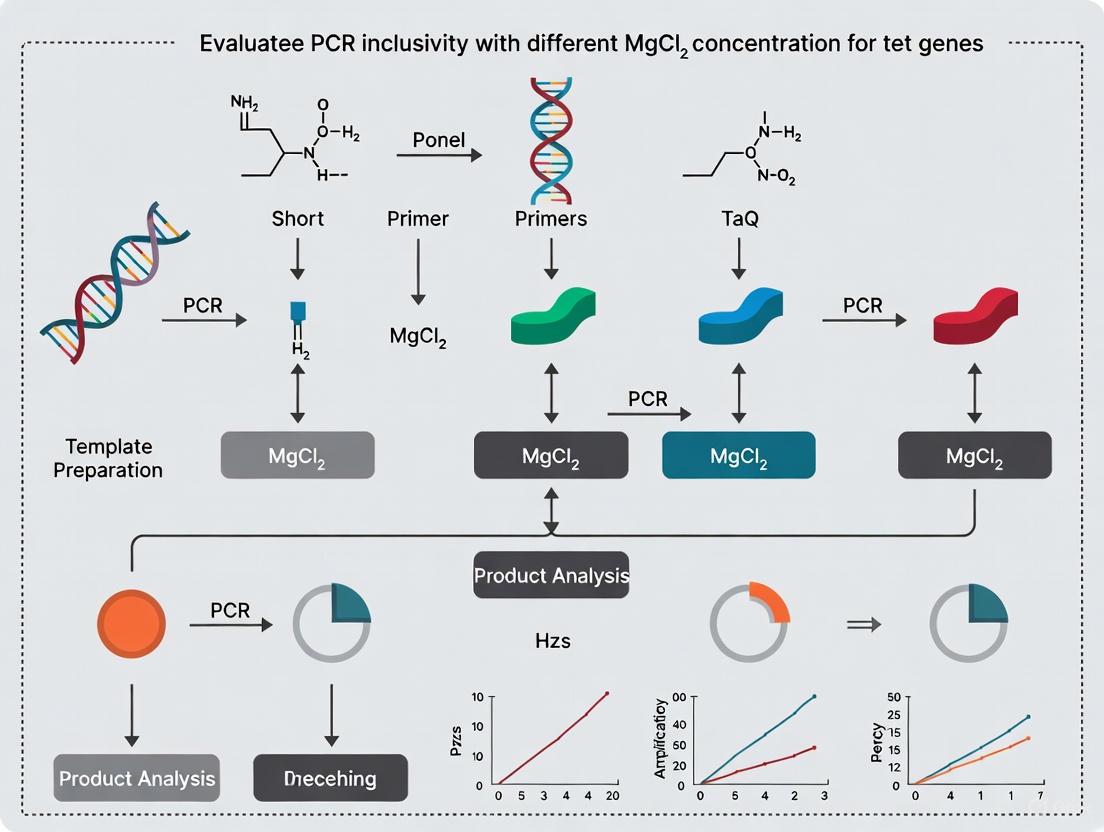
This article provides a systematic framework for researchers and drug development professionals to evaluate and optimize PCR inclusivity for diverse tetracycline resistance (tet) genes by focusing on MgCl₂ concentration.
Optimizing PCR Inclusivity: A Comprehensive Guide to MgCl₂ Concentration for tet Gene Detection
Abstract
This article provides a systematic framework for researchers and drug development professionals to evaluate and optimize PCR inclusivity for diverse tetracycline resistance (tet) genes by focusing on MgCl₂ concentration. It covers the foundational role of MgCl₂ in PCR, presents established and novel methodological approaches for assay design, details advanced troubleshooting and optimization strategies to overcome common challenges, and outlines rigorous validation and comparative techniques. By integrating theoretical principles with practical applications, this guide aims to enhance the sensitivity, specificity, and reliability of tet gene detection in complex samples, which is critical for accurate antimicrobial resistance surveillance and diagnostic development.
The Critical Role of MgCl₂ in PCR and Tetracycline Resistance Genetics
Tetracyclines are broad-spectrum antibiotics that inhibit bacterial protein synthesis by binding to the 16S rRNA of the 30S ribosomal subunit, preventing aminoacyl-tRNA accommodation [1]. Since their discovery in the 1940s, tetracyclines have been extensively used in human medicine, veterinary practice, and agriculture, accounting for approximately 10-12% of the global antimicrobial market [2]. This widespread use has exerted substantial selective pressure, driving the emergence and dissemination of tetracycline resistance across diverse bacterial populations.
Tetracycline resistance is primarily mediated by genetically encoded tet genes, which generally operate through three fundamental mechanisms [1] [2]. Efflux pumps (EFF) are membrane-associated proteins that export tetracyclines from the cell, reducing intracellular drug concentration. Ribosomal protection proteins (RPP) are translational GTPases that bind to the ribosome, sterically occluding the tetracycline binding site. Enzymatic inactivation, particularly via tetracycline destructases (TDases), covalently modifies and inactivates the antibiotic molecule through hydroxylation [1]. The history of tetracycline resistance is characterized by a cyclical pattern where the clinical deployment of a new tetracycline generation is quickly followed by the discovery of novel resistance mechanisms, suggesting mechanism-specific selection pressures [1].
Prevalence and Distribution of Tet Genes
The prevalence and distribution of tetracycline resistance genes vary significantly across bacterial species, environments, and geographical regions. Understanding these patterns is crucial for assessing the clinical and ecological significance of specific tet genes.
Table 1: Prevalence of Tetracycline Resistance Genes in Various Environments
| Environment/Source | Bacterial Species | Most Prevalent tet Gene(s) | Prevalence Rate | Reference |
|---|---|---|---|---|
| Food Products (Shenzhen, China) | Vibrio parahaemolyticus | tet(A) | 65% of gene-positive isolates | [3] |
| Iranian Fish Farms | Diverse Gram-negative & Gram-positive bacteria | tet(S) | 21% of all isolates | [4] |
| Iranian Fish Farms | Aeromonas spp. | tet(A) | Most common in this genus | [4] |
| Cattle Fecal Samples (Iran) | Escherichia coli | tet(X4) | Emerged, transferable variant | [5] |
The tet(A) gene is frequently identified as a predominant resistance determinant in Gram-negative bacteria. A comprehensive study of Vibrio parahaemolyticus isolates from food products in Shenzhen, China (2013-2021) revealed that 21.37% (530 out of 2342) were resistant to tetracycline, with tet(A) being the most common gene, present in 65% of the gene-positive isolates [3]. However, the study also made the critical observation that the presence of a tet gene does not always correlate with a resistant phenotype, suggesting the involvement of additional regulatory or genetic factors [3].
In agricultural and aquaculture settings, diverse tet gene profiles emerge. Research on bacteria isolated from Iranian fish farms demonstrated that tet(S), often associated with Gram-positive bacteria, was the most widely distributed gene (21% of isolates), even being identified in Gram-negative species such as Yersinia ruckeri and Pseudomonas putida [4]. This highlights the potential for horizontal gene transfer across phylogenetic boundaries in these environments.
A significant recent development is the emergence and spread of tet(X) variants, which encode destructases that inactivate all generations of tetracyclines, including the last-resort drugs tigecycline and eravacycline [1] [5]. These genes, often plasmid-borne, have been identified in both animal and human pathogens, facilitating rapid dissemination. A study from Iran reported the emergence of a transferable tet(X4) gene in E. coli isolates from cattle, conferring high-level resistance to tigecycline (MIC = 64 mg/L) and eravacycline (MIC > 8 mg/L) [5]. The gene was successfully mobilized to susceptible strains via conjugation and demonstrated high stability, persisting over 10 consecutive passages without antibiotic pressure [5].
Clinical Significance of Tet Genes
The clinical significance of tet genes is profoundly influenced by the specific resistance mechanism they encode and their ability to spread among bacterial populations.
Mechanism-Specific Selection and Generational Resistance
Different tetracycline generations selectively enrich for specific resistance mechanisms. First-generation tetracyclines (e.g., tetracycline, chlortetracycline) primarily select for efflux pumps (EFF). The deployment of second-generation tetracyclines (e.g., minocycline, doxycycline), which were designed to circumvent efflux, led to the selection and discovery of ribosomal protection proteins (RPP) in clinical settings [1]. Most recently, third-generation glycylcyclines (e.g., tigecycline) were developed to overcome both efflux and ribosomal protection. However, their use has been followed by the emergence and spread of tetracycline destructases (TDases), such as Tet(X) and its variants, which enzymatically inactivate all generations of tetracyclines [1] [5]. This cyclical arms race underscores that tet genes are not functionally redundant but are specialized, with each mechanism having a selective advantage in the context of specific drug generations [1].
The Threat of Mobile Tet Genes
The location of tet genes on mobile genetic elements like plasmids, transposons, and integrative conjugative elements is a major clinical concern. These elements facilitate the horizontal transfer of resistance genes not only within species but also across genus and family boundaries [3]. For example, the tet(X4) gene identified in E. coli from cattle was located on IncX1 and other plasmid types, which are known for their broad host range and efficient conjugation capabilities [5]. This mobility, combined with the stability of these plasmids even in the absence of antibiotic selection, creates a persistent reservoir of resistance in bacterial populations, complicating treatment options [5].
Evaluating PCR Inclusivity for Tet Gene Detection
The accurate detection and surveillance of tet genes in environmental and clinical samples rely heavily on molecular methods, with Polymerase Chain Reaction (PCR) being the most commonly used technique. The inclusivity of PCR—its ability to amplify all intended target genes—is critical for obtaining a true representation of the resistome.
The Critical Role of MgCl₂ Concentration
Magnesium chloride (MgCl₂) is a essential co-factor for Taq DNA polymerase, and its concentration significantly impacts PCR specificity, sensitivity, and inclusiveness [6] [7]. It influences the melting and annealing of DNA by stabilizing the double-stranded structure and reducing the electrostatic repulsion between the primer and the template.
A meta-analysis of 61 studies established a strong logarithmic relationship between MgCl₂ concentration and DNA melting temperature, with an optimal range of 1.5 to 3.0 mM for many applications. Within this range, every 0.5 mM increase in MgCl₂ was associated with a 1.2°C increase in melting temperature [7]. However, the optimal concentration is highly dependent on template characteristics. The analysis concluded that genomic DNA templates require higher MgCl₂ concentrations than simpler templates like plasmid DNA [7].
Experimental Data on MgCl₂ and Cycle Number for Tet Genes
A systematic study investigating the detection of RPP tet genes in swine manure using degenerate primers provided concrete evidence for how PCR conditions affect inclusivity [6]. The researchers employed a 4x3 factorial design testing four MgCl₂ concentrations (1.75 mM, 3 mM, 5 mM, and 7 mM) and three cycle numbers (20, 30, and 35).
Table 2: Effect of PCR Conditions on Detection of RPP tet Genes [6]
| MgCl₂ Concentration | PCR Cycle Number | Effect on RPP tet Gene Detection |
|---|---|---|
| 1.75 mM | All tested | Resulted in little or no PCR product. |
| 3 mM - 5 mM | 20 - 35 | Variable results; suboptimal for this system. |
| 7 mM | 35 | Optimal for diversity and prevalence using Ribo2newFW/Ribo2-RV primers. |
The study found that both parameters significantly affected the observed genetic diversity and relative distribution of the amplified RPP tet genes. The combination of 7 mM MgCl₂ and 35 cycles was identified as the optimal condition for the inclusive detection of the target tet genes in a complex sample matrix using the specific primer set [6]. Using suboptimal conditions can lead to biased results that do not reflect the actual diversity and abundance of tet genes present in a microbiome.
Detailed Experimental Protocol for Tet Gene Detection
The following protocol is adapted from methodologies used in the cited research for detecting tet genes in complex samples [6] [4].
Sample Preparation and DNA Extraction:
- Collect environmental samples (e.g., manure, water, soil) or bacterial isolates.
- Extract metagenomic DNA using a robust method such as the repeated bead-beating plus column purification (RBB+C) to ensure lysis of a wide range of bacteria.
- Confirm DNA integrity and concentration using agarose gel electrophoresis and a spectrophotometer.
PCR Reaction Setup:
- Primers: Use validated degenerate primers specific to the tet gene family of interest (e.g., Ribo2newFW and Ribo2-RV for RPP genes) [6].
- Reaction Volume: 50 µL.
- Template DNA: Use a consistent amount (e.g., 5-50 ng) of template DNA across all reactions.
- MgCl₂ Concentration: Prepare a series of reactions with varying MgCl₂ concentrations (e.g., 1.5 mM, 3.0 mM, 5.0 mM, 7.0 mM) to empirically determine the optimum for your specific system.
- Other Components: The reaction mix should also contain standard concentrations of dNTPs, reaction buffer, Taq DNA polymerase, and nuclease-free water.
PCR Thermal Cycling Conditions:
- Initial Denaturation: 94°C for 4 minutes.
- Touchdown PCR (optional for improved specificity): 5 cycles of:
- Denaturation: 30 seconds at 94°C.
- Annealing: 30 seconds at a starting temperature 5°C above the calculated Tm, decreasing by 1°C per cycle.
- Extension: 30-60 seconds at 72°C (depending on amplicon length).
- Standard Amplification: 30-35 cycles of:
- Denaturation: 30 seconds at 94°C.
- Annealing: 30 seconds at the optimal Tm (e.g., 5°C below the final touchdown temperature).
- Extension: 30-60 seconds at 72°C.
- Final Extension: 72°C for 5-10 minutes.
Post-PCR Analysis:
- Analyze PCR products by agarose gel electrophoresis to check for amplicons of the expected size and the presence of a single, specific band.
- For community analysis, clone the PCR products from optimal conditions into a suitable vector, create a clone library, and sequence a sufficient number of randomly selected clones to determine genetic diversity and the relative distribution of different tet genes [6].
Diagram 1: A workflow for optimizing PCR inclusivity in tet gene detection from complex samples, highlighting the critical steps of MgCl₂ and cycle number optimization.
The Scientist's Toolkit: Essential Research Reagents
Successful detection and analysis of tet genes require a set of essential laboratory reagents and materials. The following table details key solutions for the experimental protocols cited in this guide.
Table 3: Research Reagent Solutions for Tet Gene Analysis
| Reagent/Material | Function/Purpose | Example from Featured Studies |
|---|---|---|
| Degenerate PCR Primers | To amplify a family of related tet genes from diverse bacteria simultaneously. | Ribo2newFW/Ribo2-RV for RPP tet genes [6]. |
| Hot-Start DNA Polymerase | To increase PCR specificity by preventing non-specific amplification during reaction setup. | Recommended for fragment analysis to improve specificity [8]. |
| MgCl₂ Solution | A critical co-factor for DNA polymerase; concentration must be optimized for each primer-template system. | Systematically tested at 1.75, 3, 5, and 7 mM concentrations [6]. |
| Cloning & Sequencing Kit | To separate and identify individual gene variants from a mixed PCR product. | Used to create clone libraries for sequencing RPP tet genes [6]. |
| Agarose Gel Electrophoresis System | To visualize PCR products, confirm amplicon size, and check reaction specificity. | Standard method for evaluating PCR success and purity [6] [8]. |
| Antimicrobial Susceptibility Test Materials | To correlate the presence of tet genes with phenotypic resistance. | Mueller-Hinton agar and tetracycline strips/disks used for MIC determination [3] [4]. |
The prevalence and clinical significance of tet genes represent a dynamic and escalating challenge in the field of antimicrobial resistance. The cyclical emergence of new resistance mechanisms in response to successive generations of tetracycline antibiotics underscores a continuous evolutionary arms race. Accurate monitoring of these resistance determinants in environmental and clinical reservoirs through robust molecular techniques is paramount. As demonstrated, the reliability of PCR-based surveillance is highly dependent on carefully optimized reaction conditions, particularly MgCl₂ concentration, to ensure inclusive detection of the true genetic diversity present. A comprehensive understanding of the specialization, selection, and mobility of tet genes is essential for developing effective strategies to mitigate the spread of tetracycline resistance.
Tetracycline resistance represents one of the most complex and widespread challenges in antimicrobial resistance monitoring. Governed by a diverse array of genetic determinants, tetracycline resistance genes (tet genes) have been identified across a broad spectrum of bacterial pathogens and environmental microorganisms. The clinical and agricultural use of tetracycline antibiotics has driven the selection and dissemination of these resistance mechanisms, creating an urgent need for comprehensive detection methods. Polymerase chain reaction (PCR) has emerged as a powerful tool for tet gene surveillance, yet its effectiveness is critically dependent on assay inclusivity—the ability to detect the extensive genetic variability within and between tet gene classes. This challenge is further complicated by the existence of multiple resistance mechanisms, including ribosomal protection proteins, efflux pumps, and the recently discovered tetracycline destructases that inactivate the antibiotic molecule [1].
The goal of achieving broad-spectrum tet gene detection requires careful consideration of primer design, reaction optimization, and detection capabilities. This guide systematically compares the performance of various PCR-based approaches for tet gene detection, with particular emphasis on how methodological choices—including MgCl2 concentration—impact assay inclusivity. By examining current technologies and their limitations, we provide a framework for selecting appropriate detection strategies based on specific research objectives, whether for clinical diagnostics, environmental surveillance, or mechanistic studies of resistance transmission.
The tet Gene Landscape: A Complex Detection Target
Diversity of Tetracycline Resistance Mechanisms
Tetracycline resistance is mediated through three primary mechanisms, each with distinct genetic determinants that present unique challenges for PCR detection. The table below summarizes the major tet gene classes and their characteristics:
Table 1: Major Tetracycline Resistance Mechanisms and Gene Classes
| Resistance Mechanism | Gene Classes | Representative Genes | Primary Host Range | Detection Challenges |
|---|---|---|---|---|
| Ribosomal Protection Proteins (RPPs) | tet(M), tet(O), tet(Q), tet(S), tet(W), tetB(P) | tet(M), tet(O), tet(S) [4] | Broad (Gram-positive and Gram-negative) | High genetic diversity; recombination events [9] |
| Efflux Pumps | tet(A), tet(B), tet(C), tet(D), tet(G) | tet(A), tet(B), tet(C) [10] | Primarily Gram-negative | Sequence variation within classes |
| Enzymatic Inactivation | tet(X) variants | tet(X1), tet(X2), tet(X3), tet(X4) [1] [11] | Emerging in Gram-negative | Recent emergence; multiple variants |
The ribosomal protection proteins represent particularly challenging targets due to their broad host range and frequent genetic recombination. Studies have demonstrated that tet(M) exhibits extensive genetic diversity and undergoes inter-species and intergeneric recombination across diverse bacterial genera, with Streptococcus agalactiae, Streptococcus pneumoniae, Enterococcus faecalis, and Gardnerella vaginalis identified as major donors in recombination networks [9]. This genetic mobility creates a moving target for PCR detection assays, requiring careful primer design to maintain inclusivity across divergent alleles.
Distribution Patterns in Environmental and Clinical Settings
The prevalence of different tet genes varies significantly across environments, influencing the required inclusivity of detection assays. Research on Iranian fish farms revealed distinct distribution patterns, with tet(S) detected in 21% of isolates, tet(A) in 9%, and tet(M) in only 1% of studied bacteria [4]. All Lactococcus garvieae isolates in this study contained tet(S), demonstrating how specific environments may select for particular resistance determinants. City-scale monitoring of antibiotic resistance genes in urban water systems further confirmed the widespread distribution of tet(W), with highest abundances detected in hospital wastewater and wastewater treatment plant inputs [12]. These distribution patterns highlight the importance of tailoring PCR inclusivity to the specific ecosystem under investigation.
Comparative Performance of tet Gene Detection Methods
PCR-Based Detection Platforms
Multiple PCR platforms have been developed for tet gene detection, each offering different trade-offs between inclusivity, sensitivity, and throughput. The table below compares the major methodological approaches:
Table 2: Performance Comparison of tet Gene Detection Methods
| Method | Target Genes | Detection Limit | Inclusivity Features | Applications |
|---|---|---|---|---|
| Conventional PCR | Single or multiple genes with gel electrophoresis | ~10-100 copies | Broad primer design for gene groups; requires post-amplification processing | Initial screening; research settings [4] |
| Real-time PCR (qPCR) | tet(A), tet(C), tet(G), RPP group [tet(M), tet(O), tet(Q), tet(S), tet(W)] | ~6 log gene copies; precise and accurate [10] | Multiplexing capability; group-specific primers; quantitative results | Manure, wastewater, environmental monitoring [10] |
| Multiplex Real-time PCR | tet(O) variants with ciprofloxacin/erythromycin resistance determinants [13] | High sensitivity for multiple targets | Simultaneous detection of resistance genes across antibiotic classes | Clinical surveillance; foodborne pathogens [13] |
| Digital PCR (dPCR) | sul2, tetW [12] | Absolute quantification without standards; higher sensitivity than qPCR | Absolute quantification; superior precision and accuracy | City-scale ARG monitoring; wastewater surveillance [12] |
Recent advances in PCR technology have significantly improved detection capabilities. Digital PCR has demonstrated particular utility for absolute quantification of tet genes in complex environmental samples, with studies reporting detection limits as low as 6.8 copies/mL in seawater samples near wastewater treatment plant discharge points [12]. The technology's ability to provide absolute quantification without calibration curves makes it invaluable for cross-study comparisons and longitudinal monitoring programs.
Emerging Detection Technologies
Beyond conventional PCR platforms, several innovative approaches have recently emerged to address specific limitations in tet gene detection:
Liquid Chromatography-Tandem Mass Spectrometry (LC-MS/MS) has been developed as a functional detection method for tet(X) variants by measuring the metabolic conversion of tigecycline to oxygenated products. This method detects a characteristic 16-Da mass shift (m/z 586.1 → 602.2) resulting from Tet(X)-mediated modification, achieving 98.9% sensitivity and 100% specificity compared to PCR [11]. This functional approach complements genetic detection methods by confirming enzyme activity rather than mere gene presence.
Long-read epicPCR represents a significant advancement for linking tet genes to their host microorganisms in complex communities. This single-cell technology physically links functional genes to phylogenetic markers (16S rRNA) within individual cells, with recent modifications extending the target region from V4 (~300 bp) to V4-V9 (~1000 bp) of the 16S rRNA gene. This enhancement improved host identification rates from 29.0% to 54.4% in anaerobic digestion reactors, enabling species-level identification of tet gene hosts [14].
Experimental Protocols for Optimized tet Gene Detection
Real-time PCR Assay for Major tet Gene Groups
The development of robust real-time PCR assays for tet gene detection requires careful optimization of reaction components and cycling conditions. The following protocol has been validated for quantification of major tet gene groups in environmental samples:
Table 3: Real-time PCR Protocol for tet Gene Detection [10]
| Component | Final Concentration | Function in Reaction |
|---|---|---|
| PCR Buffer | 1X | Reaction environment and stability |
| MgCl₂ | 1.75 mM | Enzyme cofactor; critical for inclusivity |
| dNTPs | 200 μM each | Nucleotide substrates |
| Forward/Reverse Primers | 500 nM each | Target-specific binding |
| DNA Template | 1-100 ng | Target DNA |
| DNA Polymerase | 1.25 U | Enzymatic amplification |
Primer Sequences:
- tet(A)/tet(C) group: tetAC-150F (5'-GCT RTA TGC GTT GRT GCA AT-3') and tetAC-716R (5'-TCC TCG CCG AAA ATG ACC-3') [10]
- tet(G): tetG-247F (5'-GTC GAT TAC ACG ATT ATG GC-3') and tetG-678R (5'-CAC TTG GCC GAT CAG TTG A-3') [10]
- RPP group [tet(M), tet(O), tet(Q), tet(S), tet(W)]: Ribo2-FW (5'-GGM CAY RTG GAT TTY WTI GC-3') and Ribo2-RV (5'-TCI GMI GGI GTR CTI RCI GGR C-3') [10]
Thermal Cycling Conditions: The protocol utilizes a touchdown approach with an initial denaturation at 95°C for 3 minutes, followed by 10 cycles of 95°C for 30 seconds, annealing starting at 65°C and decreasing by 1°C per cycle to 55°C for 30 seconds, and extension at 72°C for 1 minute. This is followed by 30 cycles of 95°C for 30 seconds, 55°C for 30 seconds, and 72°C for 1 minute [10].
MgCl₂ Optimization for Enhanced Inclusivity
Magnesium chloride concentration represents a critical parameter for achieving broad tet gene detection inclusivity. The optimized concentration of 1.75 mM MgCl₂ supports efficient amplification across diverse tet gene targets while maintaining reaction specificity. This concentration supports primer annealing and polymerase activity across targets with varying GC content and secondary structure, which is particularly important for degenerate primers designed to capture sequence diversity within tet gene groups [10].
The effect of MgCl₂ concentration on PCR inclusivity can be visualized through the following experimental workflow:
Diagram 1: MgCl₂ Optimization Workflow for Enhanced PCR Inclusivity
This systematic approach to MgCl₂ optimization ensures that the final protocol achieves balanced amplification efficiency across diverse tet gene targets, a critical requirement for comprehensive resistance gene surveillance.
Strategic Approach to Comprehensive tet Gene Detection
Hierarchical Detection Framework
A single PCR assay cannot adequately capture the full diversity of tet genes present in complex samples. A hierarchical framework that combines broad screening with targeted confirmation provides the most comprehensive approach:
Broad-Spectrum Screening utilizing group-specific primers targeting major tet gene classes (efflux pumps, RPPs) provides an efficient first-pass assessment of resistance potential. The RPP primer set developed by Aminov et al. [10] exemplifies this approach, simultaneously detecting tet(M), tet(O), tet(Q), tet(S), tet(T), and tet(W) in a single reaction. This initial screening identifies samples requiring more targeted analysis.
Mechanism-Specific Confirmation with gene-specific assays validates initial findings and distinguishes between closely related determinants. This is particularly important for genes like tet(M) with high recombination frequency [9], where specific variants may have different host ranges or mobility potential.
Functional Validation using complementary methods like LC-MS/MS for tet(X) detection [11] confirms that detected genes encode functional resistance proteins, distinguishing between intact genes and pseudogenes or silent resistance determinants.
Integrated Detection Strategy
The relationship between different detection methodologies and their application to tetracycline resistance monitoring can be visualized as an integrated strategy:
Diagram 2: Integrated Strategy for Comprehensive tet Gene Detection
This integrated approach balances practical detection needs with the biological complexity of tetracycline resistance, ensuring that surveillance efforts capture both known determinants and emerging threats.
The Scientist's Toolkit: Essential Research Reagent Solutions
Table 4: Essential Research Reagents for tet Gene Detection Experiments
| Reagent/Category | Specific Product/Example | Function in tet Gene Detection | Considerations for Inclusivity |
|---|---|---|---|
| PCR Enzymes & Master Mixes | Hot-start DNA polymerases | Specific amplification with reduced primer-dimers | Compatibility with MgCl₂ optimization; processivity for GC-rich targets |
| Magnesium Salts | MgCl₂ solution (1.75 mM optimal) [10] | Cofactor for DNA polymerase; affects primer annealing | Critical for degenerate primer systems; concentration optimization essential |
| Primer Sets | Group-specific degenerate primers [10] | Simultaneous detection of multiple tet gene variants | Balanced degeneracy to maximize inclusivity while maintaining specificity |
| Quantification Standards | Plasmid standards containing tet(A), tet(C), tet(G), RPP genes [10] | Calibration curve generation for absolute quantification | Should represent sequence diversity within target gene groups |
| Positive Controls | Bacterial strains with known tet genes [10] [13] | Assay validation and performance monitoring | Should include representatives of all target mechanisms |
| Nucleic Acid Extraction Kits | MasterPure Complete DNA/RNA Purification [12] | Recovery of high-quality DNA from complex matrices | Efficient lysis of Gram-positive and Gram-negative bacteria |
| Inhibition Relief Additives | BSA, T4 gp32 protein | Reduction of PCR inhibition in complex samples | Particularly important for environmental samples like manure and wastewater |
Achieving comprehensive tet gene detection requires thoughtful balancing of inclusivity with practical assay performance. The optimization of MgCl₂ concentration represents one critical parameter among many that influence detection breadth, interacting with primer design, thermal cycling conditions, and detection chemistry. The hierarchical approach outlined in this guide—combining broad screening assays with targeted confirmation—provides a framework for efficient yet comprehensive tet gene surveillance.
As tetracycline resistance continues to evolve, with new variants and mechanisms emerging regularly [1], PCR-based detection methods must likewise adapt. The integration of complementary technologies like dPCR for absolute quantification [12] and LC-MS/MS for functional confirmation [11] creates a robust detection system that captures both the genetic potential and functional reality of tetracycline resistance. Through careful method selection and optimization, researchers can achieve the inclusivity necessary to track the complex epidemiology of tet genes across clinical, agricultural, and environmental settings.
Magnesium chloride (MgCl₂) stands as a critical master regulator in polymerase chain reaction (PCR) biochemistry, exerting profound influence over enzymatic activity and DNA hybridization thermodynamics. This comprehensive analysis examines MgCl₂'s dual function as an essential cofactor for DNA polymerase and a key modulator of primer-template binding specificity. Within the context of tet gene research, precise MgCl₂ concentration optimization emerges as a fundamental prerequisite for achieving robust amplification efficiency and target inclusivity, particularly when addressing complex genomic templates and challenging amplicon characteristics. Evidence from systematic meta-analyses and experimental studies reveals that MgCl₂ concentration adjustments between 1.5 mM and 4.5 mM can dramatically alter PCR outcomes, with specific concentration requirements dictated by template complexity and primer characteristics. This review synthesizes current understanding of MgCl₂'s mechanistic roles while providing evidence-based optimization frameworks for molecular researchers investigating antibiotic resistance genes.
In the biochemical landscape of polymerase chain reaction (PCR), magnesium chloride (MgCl₂) operates as a fundamental regulatory component that governs multiple aspects of reaction efficiency and specificity. Unlike other PCR components that serve singular functions, MgCl₂ participates in both the enzymatic catalysis of DNA synthesis and the structural stability of nucleic acid complexes. The magnesium ion (Mg²⁺) derived from MgCl₂ serves as an indispensable cofactor for Taq DNA polymerase and related enzymes, without which polymerase activity ceases entirely [15]. Beyond its enzymatic role, Mg²⁺ significantly influences the melting temperature (Tm) and hybridization dynamics between primers and template DNA by modulating electrostatic interactions within and between DNA strands [15] [16].
The critical importance of MgCl₂ concentration optimization becomes particularly evident in challenging PCR applications such as the detection and characterization of tetracycline resistance (tet) genes in complex bacterial communities. These investigations often confront difficulties including high GC-content regions, sequence polymorphisms, and low-abundance targets within diverse genomic backgrounds [17]. Understanding MgCl₂'s multifaceted biochemical functions provides researchers with powerful mechanistic insights necessary for developing robust, inclusive amplification protocols capable of detecting diverse tet gene variants across varying sample types and preparation methods.
Biochemical Mechanisms of Action
Magnesium as an Essential Polymerase Cofactor
The requirement of magnesium ions for DNA polymerase activity represents a fundamental biochemical principle conserved across diverse DNA polymerases, including the thermostable Taq polymerase predominantly used in PCR. Mechanistically, Mg²⁺ coordinates the nucleophilic attack by the 3'-hydroxyl group of the primer on the alpha-phosphate of the incoming deoxynucleoside triphosphate (dNTP) [18]. This coordination stabilizes the transition state during phosphodiester bond formation and facilitates the release of pyrophosphate.
At the molecular level, the Mg²⁺ ion binds directly to the dNTP substrate at its alpha phosphate group, enabling the removal of beta and gamma phosphates and subsequent formation of a phosphodiester bond between the dNMP and the 3' hydroxyl group of the adjacent nucleotide [15]. This catalytic mechanism explains why DNA polymerases exhibit absolute dependence on magnesium ions—without this cofactor, the enzymes remain structurally intact but catalytically inactive. The concentration of available Mg²⁺ directly influences polymerase processivity and fidelity, with deviations from optimal concentrations potentially reducing amplification efficiency or increasing misincorporation rates.
Electrostatic Modulation of Primer-Template Interactions
Beyond its catalytic role, MgCl₂ profoundly influences the stability of primer-template complexes through electrostatic mechanisms. The phosphate backbone of DNA polymers carries significant negative charges that create natural electrostatic repulsion between complementary strands. Magnesium ions, with their divalent positive charge, effectively shield these negative charges by forming ionic interactions with phosphate groups, thereby reducing inter-strand repulsion and facilitating stable hybridization [15] [16].
This charge shielding effect has direct practical consequences for PCR optimization. By reducing electrostatic repulsion, Mg²⁺ ions effectively increase the melting temperature (Tm) of primer-template duplexes, with quantitative analyses demonstrating an approximate 1.2°C increase in Tm per 0.5 mM increase in MgCl₂ concentration within the critical 1.5-3.0 mM range [7]. This property allows researchers to fine-tune hybridization stringency without modifying thermal cycling parameters, making MgCl₂ concentration a powerful tool for optimizing primer binding specificity, particularly for primers with suboptimal Tm or challenging sequence characteristics frequently encountered in tet gene amplification.
Quantitative Effects of MgCl₂ Concentration on PCR Performance
Concentration-Dependent Efficiency and Specificity
Empirical evidence consistently demonstrates that MgCl₂ concentration exerts a dose-dependent influence on PCR efficiency and amplification specificity. The relationship between MgCl₂ concentration and amplification success follows a biphasic pattern, with both deficiency and excess producing suboptimal results. The table below summarizes documented PCR outcomes across the MgCl₂ concentration spectrum:
Table 1: Effects of MgCl₂ Concentration on PCR Performance
| MgCl₂ Concentration | Amplification Efficiency | Band Pattern Observations | Common Artifacts |
|---|---|---|---|
| <1.5 mM | Significantly reduced or failed amplification [15] | Faint or absent target bands [15] | Non-specific priming negligible |
| 1.5-2.0 mM | Standard efficiency for simple templates [15] [19] | Clear target band with minimal background | Occasional primer-dimer formation |
| 2.0-3.0 mM | Optimal for most applications [15] [7] | Strong specific amplification | Minimal artifacts |
| 3.0-4.5 mM | Enhanced efficiency for complex templates [19] | Additional bands may appear [19] | Increased non-specific products [15] |
| >4.5 mM | High efficiency but reduced specificity [15] [19] | Multiple non-specific bands | Significant primer-dimer formation [15] |
Research specifically investigating random-amplified polymorphic DNA (RAPD) patterns across MgCl₂ concentrations from 1.5 to 6.0 mM revealed both quantitative and qualitative changes in amplification profiles, with optimal results for most primers occurring between 1.5-4.5 mM [19]. These findings underscore how MgCl₂ concentration adjustments can selectively enhance or suppress amplification of specific targets, a property particularly valuable when optimizing inclusivity for diverse tet gene variants.
Template-Specific Concentration Requirements
The optimal MgCl₂ concentration varies significantly depending on template characteristics, reaction composition, and specific amplification goals. A comprehensive meta-analysis of 61 studies established that template complexity directly influences MgCl₂ requirements, with genomic DNA templates necessitating higher concentrations (typically 2.5-4.5 mM) compared to more straightforward templates such as plasmid DNA or PCR amplicons (1.5-2.5 mM) [7]. This template-dependent optimization becomes particularly crucial when working with complex genomic DNA samples containing potential PCR inhibitors, which may sequester Mg²⁺ ions and reduce their effective concentration [15].
Table 2: Template-Specific MgCl₂ Optimization Guidelines
| Template Type | Recommended MgCl₂ Range | Special Considerations |
|---|---|---|
| Plasmid DNA | 1.5-2.5 mM [18] [7] | Lower requirements due to minimal complexity |
| cDNA | 2.0-3.0 mM | Intermediate complexity |
| Genomic DNA | 2.5-4.5 mM [7] | Higher requirements for complex templates |
| GC-rich targets | 3.0-4.5 mM [15] | Enhanced stability for challenging sequences |
| Templates with inhibitors | 3.0-5.0 mM [15] | Compensation for Mg²⁺ sequestration |
Additional factors influencing optimal MgCl₂ concentration include dNTP levels (since dNTPs chelate Mg²⁺ ions), primer design characteristics, and buffer composition. Researchers targeting tet genes must consider that tetracycline resistance determinants often reside within complex genetic contexts including transposons, integrons, and plasmids, potentially necessitating elevated MgCl₂ concentrations to overcome amplification barriers [17].
Experimental Optimization Approaches
Systematic Concentration Titration Protocols
Effective MgCl₂ optimization requires methodical empirical testing rather than theoretical calculation. The following protocol represents a standardized approach for determining optimal MgCl₂ concentrations for specific experimental applications, particularly relevant for tet gene detection assays:
Reaction Setup: Prepare a master mixture containing all standard PCR components except MgCl₂, then aliquot into individual reaction tubes [15] [18].
Concentration Gradient: Add MgCl₂ to create a titration series spanning 0.5 mM to 5.0 mM in increments of 0.5 mM [15] [19].
Thermal Cycling: Perform amplification using touchdown or standardized cycling parameters appropriate for the target tet genes.
Product Analysis: Resolve amplification products by agarose gel electrophoresis and identify the MgCl₂ concentration producing the strongest specific amplification with minimal background [15].
Secondary Verification: Confirm optimal concentration using quantitative PCR metrics when applicable, including amplification efficiency and Cq values [17].
For tet gene research specifically, optimization should incorporate representative templates spanning the expected diversity of target sequences, including variants with differing GC content and length polymorphisms. This approach ensures developed assays maintain inclusivity across the genetic diversity present in microbial communities [17].
Troubleshooting Common MgCl₂-Related Amplification Issues
Recognizing and resolving MgCl₂-related amplification failures represents an essential skill for molecular researchers. The following troubleshooting guide addresses common scenarios:
Weak or No Amplification: Typically indicates Mg²⁺ deficiency. Increase MgCl₂ concentration in 0.5 mM increments up to 5.0 mM, or consider supplementing with additional DNA polymerase which may contain bound Mg²⁺ [15] [18].
Non-specific Amplification: Often results from excessive MgCl₂. Reduce concentration in 0.5 mM decrements while monitoring specific product yield. Alternatively, increase annealing temperature or optimize primer design [15].
Inconsistent Results Across Templates: May reflect varying Mg²⁺ requirements for different templates. Consider developing separate optimized conditions for different template types or implementing a compromise concentration [7].
Inhibitor Effects: When working with complex samples such as wastewater extracts or clinical specimens, increase MgCl₂ concentration to compensate for chelation by contaminants [15] [17].
The Researcher's Toolkit: Essential Reagents for MgCl₂ Optimization
Table 3: Essential Research Reagents for MgCl₂ Optimization Studies
| Reagent/Category | Specific Function | Application Notes |
|---|---|---|
| MgCl₂ solution (25-50 mM) | Provides magnesium ions for PCR | Stock solutions should be prepared in purified water and filter-sterilized [15] |
| PCR buffer (without MgCl₂) | Maintains pH and ionic strength | Typically contains Tris-HCl, KCl; allows precise Mg²⁺ control [15] |
| dNTP mix | Substrates for DNA synthesis | Concentration affects free Mg²⁺ availability; standard is 0.2 mM each [18] |
| Thermostable DNA polymerase | Catalyzes DNA synthesis | Taq polymerase most common; 1-2 units per 50 μL reaction [18] |
| Template DNA | Target for amplification | Amount and purity significantly influence Mg²⁺ requirements [18] [7] |
| Primer pairs | Target sequence recognition | Design affects Mg²⁺ dependence; avoid 3' GC-rich regions [18] |
Implications for tet Gene Research and Antimicrobial Resistance Monitoring
The strategic optimization of MgCl₂ concentrations carries particular significance in antimicrobial resistance research, where comprehensive detection of diverse resistance determinants directly impacts public health conclusions. Studies investigating tetracycline resistance genes in wastewater treatment plants have demonstrated that amplification conditions significantly influence the observed abundance and diversity of resistance genes [17]. Suboptimal MgCl₂ concentrations may fail to detect certain tet gene variants, creating biased surveillance data and potentially underestimating the prevalence and diversity of resistance mechanisms.
Research examining sul1, tetA, and other resistance genes in complex microbial communities has revealed that amplification conditions significantly impact quantitative results, with inhibitor-rich samples often requiring elevated MgCl₂ concentrations to maintain detection sensitivity [17]. The application of digital PCR technologies for absolute quantification of resistance genes further emphasizes the importance of reaction optimization, as variations in amplification efficiency directly influence quantitative accuracy [17]. By systematically optimizing MgCl₂ concentrations using the principles and protocols outlined in this review, researchers can significantly enhance the inclusivity and reliability of tet gene detection assays, ultimately strengthening our understanding of antibiotic resistance dissemination in diverse environments.
MgCl₂ stands as a master regulator in PCR amplification, governing both the enzymatic catalysis of DNA synthesis and the molecular interactions between primers and template DNA. Through its dual biochemical mechanisms as an essential polymerase cofactor and an electrostatic modulator of nucleic acid stability, MgCl₂ concentration directly determines amplification success, specificity, and efficiency. The experimental evidence consistently demonstrates that optimal MgCl₂ concentrations vary significantly based on template characteristics, with complex genomic DNA and challenging targets such as tet genes often requiring elevated concentrations between 2.5-4.5 mM.
For researchers investigating antibiotic resistance genes, systematic MgCl₂ optimization using the titration protocols and troubleshooting frameworks presented here represents a critical methodological step that directly influences experimental outcomes and scientific conclusions. As molecular diagnostics continue to advance toward more complex multi-analyte detection and absolute quantification, precise manipulation of MgCl₂ concentrations will remain an essential skill for developing robust, inclusive amplification assays capable of detecting diverse genetic targets across varying sample types and preparation methods.
Magnesium chloride (MgCl₂) concentration serves as a critical determinant in polymerase chain reaction (PCR) efficiency and specificity, acting through complex biochemical mechanisms that influence DNA polymerase activity, primer-template interactions, and nucleic acid stability. This comprehensive analysis synthesizes evidence from systematic reviews and experimental studies to establish quantitative relationships between MgCl₂ concentration and PCR performance parameters, with particular application to amplifying tetracycline resistance (tet) genes. Optimal MgCl₂ concentration ranges between 1.5-3.0 mM for standard reactions, with precise requirements modulated by template characteristics including GC content, complexity, and secondary structures. The meta-analysis presented provides evidence-based optimization protocols and methodological frameworks for researchers targeting challenging templates such as tet genes in diagnostic and surveillance contexts.
Magnesium chloride (MgCl₂) constitutes an indispensable component of PCR master mixes, serving as an essential cofactor for DNA polymerase activity through multiple mechanistic pathways. The Mg²⁺ ion facilitates the catalytic function of DNA polymerase by binding to deoxynucleoside triphosphates (dNTPs) at their α-phosphate groups, enabling the removal of β and gamma phosphates and subsequent formation of phosphodiester bonds with the 3' hydroxyl group of adjacent nucleotides [15] [20]. Beyond its enzymatic role, Mg²⁺ significantly influences nucleic acid thermodynamics by binding to negatively charged phosphate groups along the DNA backbone, thereby reducing electrostatic repulsion between primer and template strands and stabilizing their hybridization [21] [22]. This dual functionality makes MgCl₂ concentration a pivotal parameter that balances reaction efficiency against amplification specificity.
The critical nature of MgCl₂ optimization becomes particularly evident when targeting clinically relevant sequences such as tetracycline resistance (tet) genes, which represent important markers in antimicrobial resistance surveillance [4]. Tet genes demonstrate considerable sequence diversity and varying GC content across different classes (e.g., tet(A), tet(B), tet(M), tet(O), and tet(S)), creating amplification challenges that require precise reaction condition tuning [4]. This review establishes evidence-based guidelines for MgCl₂ optimization through systematic analysis of quantitative relationships between concentration parameters and amplification outcomes, providing a methodological framework for researchers conducting genetic analysis of antibiotic resistance mechanisms.
Mechanistic Insights: How MgCl₂ Modulates PCR Biochemistry
Molecular Interactions at the DNA Polymerase Active Site
The catalytic dependence of DNA polymerase on Mg²⁺ ions represents a fundamental biochemical requirement in PCR amplification. At the molecular level, Mg²⁺ coordinates the formation of phosphodiester bonds through a precisely orchestrated mechanism. The ion first binds to a dNTP molecule at its α-phosphate group, facilitating the removal of β and gamma phosphates and positioning the resulting dNMP for nucleophilic attack by the 3' hydroxyl group of the preceding nucleotide [15] [20]. This coordination chemistry lowers the activation energy required for phosphodiester bond formation, dramatically increasing the catalytic efficiency of DNA polymerase enzymes. Without sufficient Mg²⁺ concentrations, this catalytic cycle cannot proceed efficiently, resulting in minimal amplification despite the presence of all other reaction components [23].
The structural basis for this Mg²⁺ dependence resides in the conserved catalytic core of DNA polymerase enzymes, which contains specific metal ion binding sites that orient the substrates for efficient catalysis. Experimental evidence indicates that Taq DNA polymerase, the most commonly used enzyme in conventional PCR, exhibits maximal activity within a specific range of free Mg²⁺ concentrations after accounting for chelation by dNTPs and other reaction components [22]. When Mg²⁺ concentrations fall below this optimal range, polymerase activity decreases substantially due to impaired substrate binding and catalysis. Conversely, excessive Mg²⁺ concentrations can promote non-specific amplification by reducing the enzyme's fidelity and increasing misincorporation rates [24].
Electrostatic Effects on DNA Duplex Stability
Beyond its direct catalytic role, Mg²⁺ significantly influences PCR efficiency through electrostatic interactions with nucleic acid backbones. The phosphate groups in DNA strands create substantial negative charge density along the helix, generating electrostatic repulsion between complementary strands that must anneal during PCR cycling [21]. Mg²⁺ ions neutralize these repulsive forces by forming ionic interactions with phosphate groups, effectively shielding the negative charges and facilitating stable duplex formation between primers and template DNA [15]. This charge shielding effect lowers the effective melting temperature (Tm) of DNA duplexes and increases the stability of primer-template hybrids, thereby influencing the stringency of annealing conditions.
The relationship between MgCl₂ concentration and DNA melting temperature follows a logarithmic pattern, with systematic meta-analyses demonstrating that every 0.5 mM increase in MgCl₂ within the 1.5-3.0 mM range produces an approximately 1.2°C increase in melting temperature [25] [7]. This quantitative relationship has profound implications for annealing temperature optimization in PCR protocols. Elevated Mg²⁺ concentrations stabilize both specific primer-template hybrids and non-specific interactions, potentially compromising amplification specificity if not carefully balanced [19]. This dual nature of Mg²⁺'s electrostatic effects creates an optimization imperative where concentration must be precisely titrated to maximize target amplification while minimizing off-target products.
Quantitative Relationships: MgCl₂ Concentration and PCR Performance
Concentration-Dependent Effects on Amplification Efficiency
The efficiency of PCR amplification exhibits a well-characterized dependence on MgCl₂ concentration, typically following a bell-shaped response curve with definable optimal ranges. Experimental data from systematic analyses reveal that MgCl₂ concentrations between 1.5 mM and 3.0 mM support maximal amplification efficiency for most templates, with specific optima influenced by template characteristics and reaction composition [25] [7]. Within this range, DNA polymerase maintains optimal catalytic activity while primer-template hybrids achieve sufficient stability for efficient extension. Deviation from this optimal concentration window produces characteristic amplification defects that manifest as reduced yield or complete reaction failure.
Table 1: MgCl₂ Concentration Effects on PCR Performance Parameters
| MgCl₂ Concentration | Amplification Efficiency | Reaction Specificity | Common Artifacts |
|---|---|---|---|
| < 1.0 mM | Severely reduced | High but unproductive | Weak or no amplification |
| 1.5 - 3.0 mM | Optimal | High with proper optimization | Clean, specific bands |
| 3.0 - 4.5 mM | Moderate to high | Decreasing | Increased non-specific bands |
| > 4.5 mM | Variable | Poor | Primer-dimers, smearing |
Excessively low MgCl₂ concentrations (<1.0 mM) fundamentally limit polymerase activity by providing insufficient cofactor for enzymatic catalysis, resulting in weak or non-detectable amplification [15] [23]. At the opposite extreme, elevated MgCl₂ concentrations (>4.5 mM) produce characteristic amplification artifacts including non-specific bands, primer-dimer formation, and smeared electrophoretic profiles due to reduced hybridization stringency [19] [24]. These phenomena occur because excessive Mg²⁺ over-stabilizes primer-template interactions, enabling primers to anneal to partially complementary sequences with sufficient stability to initiate polymerization. The quantitative boundaries of these concentration effects vary according to specific reaction conditions, but the fundamental patterns remain consistent across diverse experimental contexts.
Template-Specific Concentration Requirements
Template characteristics significantly influence optimal MgCl₂ concentration requirements, creating context-specific optimization imperatives. Systematic analysis reveals that genomic DNA templates generally require higher MgCl₂ concentrations (typically 2.0-3.0 mM) compared to simpler templates such as plasmid DNA or cDNA (often 1.5-2.5 mM) [25]. This differential requirement stems from the greater complexity and potential inhibitor content in genomic DNA preparations, which can sequester Mg²⁰ ions and reduce their effective concentration available for enzymatic catalysis [25] [22].
GC-rich templates present particularly demanding optimization challenges due to their increased thermodynamic stability and propensity for secondary structure formation. Templates with GC content exceeding 60% often require elevated MgCl₂ concentrations (up to 4.0 mM in some cases) to overcome the enhanced strand stability and facilitate complete denaturation during cycling [20]. The strong triple-hydrogen bonding of G-C base pairs creates formidable kinetic barriers to denaturation that must be counterbalanced by adjusted reaction conditions. Additionally, GC-rich sequences frequently form stable secondary structures such as hairpins that can impede polymerase progression, requiring specialized additives and optimization approaches beyond simple MgCl₂ adjustment [20].
Experimental Optimization: Methodologies and Protocols
Systematic MgCl₂ Titration Approaches
Empirical determination of optimal MgCl₂ concentration represents a fundamental step in PCR optimization, particularly for challenging applications such as tet gene amplification. A robust titration protocol involves preparing a master reaction mixture containing all components except MgCl₂, then aliquoting equal volumes into separate tubes supplemented with MgCl₂ concentrations spanning 0.5 mM to 5.0 mM in 0.5 mM increments [20]. This systematic approach enables direct comparison of amplification outcomes across the physiologically relevant concentration range while maintaining consistency in other reaction parameters. Each concentration should be tested in duplicate or triplicate to account for experimental variability, with appropriate positive and negative controls included to validate results.
Following thermal cycling, reaction products are typically resolved by agarose gel electrophoresis and visualized with nucleic acid staining. Optimal MgCl₂ concentration is identified as the lowest concentration that produces strong, specific amplification of the target fragment without non-specific products or significant primer-dimer formation [24]. This "minimum effective concentration" approach maximizes specificity while maintaining sufficient yield for downstream applications. For quantitative PCR applications, additional validation through comparison of amplification curves and efficiency calculations provides further refinement of concentration selection [23].
Table 2: MgCl₂ Optimization Guide for Different Template Types
| Template Type | Recommended Starting Concentration | Typical Optimal Range | Special Considerations |
|---|---|---|---|
| Plasmid DNA | 1.5 mM | 1.0 - 2.0 mM | Lower requirements due to simplicity |
| Genomic DNA | 2.0 mM | 1.5 - 3.0 mM | Higher often needed due to complexity |
| GC-rich Targets | 2.5 mM | 2.0 - 4.0 mM | May require specialized additives |
| tet genes | 2.0 mM | 1.5 - 3.5 mM | Target-specific optimization needed |
Complementary Optimization Strategies
Effective MgCl₂ optimization frequently requires complementary adjustments to other reaction parameters that interact with magnesium-dependent processes. Annealing temperature represents the most critical interacting parameter, as Mg²⁺ concentration directly influences primer-template stability and thus the effective stringency of hybridization [20] [24]. When increasing MgCl₂ concentration, corresponding elevation of annealing temperature by 1-2°C can maintain hybridization stringency and suppress non-specific amplification. Conversely, reducing MgCl₂ concentration may necessitate lower annealing temperatures to maintain sufficient primer binding stability for efficient extension.
The concentration of dNTPs represents another interacting parameter that requires coordinated optimization with MgCl₂. Since dNTPs chelate Mg²⁺ ions and reduce their effective concentration available for polymerase catalysis, higher total dNTP concentrations necessitate increased MgCl₂ to maintain optimal free Mg²⁺ levels [22] [24]. A molar ratio of approximately 0.8-1.0 Mg²⁺ to total dNTP often provides satisfactory results, though empirical optimization remains preferable. Additionally, specialized additives including DMSO, betaine, formamide, and commercial GC enhancers can modulate Mg²⁺ effects on difficult templates by altering DNA melting behavior and reducing secondary structure formation [20].
Application to tet Genes Research: Experimental Data and Case Studies
Tet Gene Amplification Challenges and Solutions
The detection and characterization of tetracycline resistance genes in environmental and clinical samples presents particular challenges that benefit from systematic MgCl₂ optimization. A study investigating tet genes in bacteria isolated from Iranian fish farms demonstrated the application of PCR for detecting tet(A), tet(B), tet(M), tet(O), and tet(S) genes across diverse bacterial species [4]. Successful amplification required careful optimization of reaction conditions due to the sequence diversity among tet gene classes and varying GC content, which ranged from approximately 40-60% between different tet variants [4]. The researchers employed a standardized MgCl₂ concentration of 2.0 mM in their PCR protocols, which provided a balanced compromise suitable for detecting multiple tet gene types across different bacterial hosts.
GC-rich tet gene variants present particular amplification difficulties that often require elevated MgCl₂ concentrations and specialized additives. For instance, tet(M) and tet(S) genes frequently exhibit GC content exceeding 60%, creating stable secondary structures that impede polymerase progression and reduce amplification efficiency [4] [20]. In such cases, incremental increases in MgCl₂ concentration to 3.0-3.5 mM, combined with additives like betaine or DMSO at concentrations of 5-10%, can significantly improve amplification yield by destabilizing secondary structures and reducing DNA melting temperature [20]. This combined optimization approach enables reliable detection of clinically relevant resistance determinants that might otherwise evade amplification under standard conditions.
Research Reagent Solutions for Tet Gene Analysis
Table 3: Essential Research Reagents for MgCl₂ Optimization in tet Gene Analysis
| Reagent Category | Specific Examples | Function in PCR Optimization |
|---|---|---|
| Magnesium Salts | MgCl₂, MgSO₄ | DNA polymerase cofactor; stabilizes primer-template interactions |
| DNA Polymerases | Taq polymerase, Q5 High-Fidelity DNA Polymerase, OneTaq DNA Polymerase | Catalyzes DNA synthesis; choice affects fidelity and processivity |
| Specialized Buffers | GC Buffer, High GC Enhancer | Provides optimal pH and salt conditions; enhances GC-rich amplification |
| Additives | DMSO, betaine, formamide, glycerol | Reduces secondary structures; increases specificity |
| dNTPs | dATP, dCTP, dGTP, dTTP | Building blocks for DNA synthesis; concentration affects Mg²⁺ availability |
MgCl₂ concentration represents a foundational parameter in PCR optimization that directly influences both amplification efficiency and specificity through multiple biochemical mechanisms. The quantitative relationship between MgCl₂ concentration and DNA melting temperature establishes a predictable framework for systematic optimization, with typical optimal ranges falling between 1.5-3.0 mM for standard templates and extending to 4.0 mM for challenging GC-rich sequences such as certain tet gene variants. Template characteristics significantly modulate specific requirements, with genomic DNA and complex samples often necessitating higher concentrations than simplified systems.
Successful amplification of tetracycline resistance genes exemplifies the practical importance of methodical MgCl₂ optimization, particularly given the sequence diversity and varying GC content across different tet gene classes. A systematic titration approach employing 0.5 mM increments across the 0.5-5.0 mM range provides robust empirical determination of optimal concentrations, while complementary adjustments to annealing temperature and inclusion of specialized additives can address persistent amplification challenges. Through evidence-based optimization of this critical parameter, researchers can significantly enhance the reliability and reproducibility of PCR-based detection methods for antimicrobial resistance genes and other clinically relevant targets.
In polymerase chain reaction (PCR), the amplification of genetically complex templates represents one of the most technically challenging scenarios for molecular biologists. Guanine-cytosine (GC)-rich sequences, defined as regions where 60% or greater of the bases are G or C, present particular difficulties due to their propensity to form stable secondary structures that can block polymerase progression [26]. Similarly, templates featuring extreme base compositions or complex repetitive elements demand meticulous reaction optimization to achieve specific and efficient amplification. At the heart of this optimization process lies magnesium chloride (MgCl₂), a seemingly simple reagent that serves as an essential cofactor for DNA polymerase activity and exerts profound influence on reaction stringency, fidelity, and yield [7] [26].
The critical nature of Mg²⁺ optimization is especially relevant in contemporary research applications such as the study of tetracycline resistance (tet) genes, where accurate amplification of target sequences directly impacts diagnostic reliability and surveillance data quality. This article examines the fundamental reasons why GC-rich templates and complex amplicons require precise Mg²⁺ modulation, supported by experimental data and evidence-based optimization strategies that researchers can implement to overcome these pervasive amplification challenges.
The Biochemical Foundation: Magnesium's Multifunctional Role in PCR
Magnesium ions participate in the PCR process through several interdependent biochemical mechanisms, each contributing to the overall efficiency and specificity of DNA amplification. Understanding these fundamental roles provides the necessary context for appreciating why Mg²⁺ concentration requires careful optimization, particularly for challenging templates.
Essential Cofactor for Polymerase Activity
The DNA polymerase enzyme requires Mg²⁺ ions for proper catalytic function. Specifically, magnesium facilitates the formation of a coordination complex with the dNTP substrate, enabling the nucleophilic attack by the 3'-hydroxyl group of the primer on the alpha-phosphate of the incoming dNTP [26]. This coordination stabilizes the transition state and allows for the release of pyrophosphate, effectively catalyzing the phosphodiester bond formation between nucleotides. Without sufficient Mg²⁺, polymerase activity is significantly reduced, leading to low product yield or complete amplification failure.
Facilitator of Primer-Template Binding
Beyond its role in catalysis, Mg²⁺ also influences primer-template interactions through charge shielding effects. The phosphate backbone of DNA molecules carries significant negative charge, creating electrostatic repulsion between primer and template strands. Magnesium cations neutralize these repulsive forces by binding to the phosphate groups, thereby reducing electrostatic barriers and facilitating proper annealing [26]. This function becomes particularly critical in GC-rich regions where stronger hydrogen bonding (three bonds for G-C versus two for A-T pairs) already increases primer-template association energy.
Modulator of Nucleic Acid Stability
The stability of double-stranded DNA exhibits direct dependence on magnesium concentration through several mechanisms. Mg²⁺ ions stabilize the DNA double helix by neutralizing inter-strand repulsive forces and can specifically bind to GC base pairs, further enhancing their innate thermal stability. A recent comprehensive meta-analysis established a clear logarithmic relationship between MgCl₂ concentration and DNA melting temperature, with each 0.5 mM increase in MgCl₂ within the optimal range (1.5-3.0 mM) associated with an approximately 1.2°C increase in melting temperature [7]. This finding has profound implications for GC-rich amplification, where elevated melting temperatures can prevent complete template denaturation.
Table 1: Biochemical Functions of Magnesium Ions in PCR
| Function | Mechanism | Impact on PCR |
|---|---|---|
| Polymerase Cofactor | Coordinates dNTP for nucleophilic attack | Enables phosphodiester bond formation; insufficient Mg²⁺ reduces yield |
| Charge Shielding | Binds phosphate backbone to neutralize negative charges | Reduces electrostatic repulsion between primer and template |
| Stability Modulation | Stabilizes double-stranded DNA through specific and non-specific binding | Increases melting temperature; affects denaturation efficiency |
The GC-Rich Challenge: Structural and Thermodynamic Barriers
GC-rich templates present multiple interconnected challenges that collectively demand precise reaction optimization. The fundamental issue stems from the triple hydrogen bonding between guanine and cytosine bases, which confers greater thermodynamic stability compared to AT pairs with only two hydrogen bonds [26]. This inherent stability manifests in several technical obstacles during PCR amplification.
Secondary Structure Formation
GC-rich sequences have a strong propensity to form intrastrand secondary structures such as hairpins and G-quadruplexes. These structures occur when a single strand folds back upon itself, creating stable regions of double-stranded DNA that resist denaturation even at elevated temperatures [26]. When DNA polymerase encounters these structures during extension, it may stall or dissociate from the template, resulting in truncated amplification products or complete reaction failure. The promoter region of the epidermal growth factor receptor (EGFR) gene, with GC content reaching up to 88%, exemplifies this challenge, requiring significant optimization for successful amplification [27].
Incomplete Denaturation
Standard PCR denaturation temperatures (typically 94-95°C) may be insufficient to completely separate GC-rich duplexes due to their elevated melting temperatures. When template strands remain partially associated, primers cannot access their complementary binding sites, preventing initiation of amplification. This effect is compounded by the fact that GC-rich regions often occur in clusters rather than being evenly distributed, creating localized zones of exceptional stability that act as particularly formidable barriers to denaturation [27] [26].
Non-Specific Primer Binding
The stability of GC-rich interactions can facilitate non-specific primer binding when Mg²⁺ concentrations are supraoptimal. Excessive Mg²⁺ enhances primer stability even with mismatched templates by over-stabilizing these imperfect duplexes [26]. This effect manifests experimentally as multiple bands on electrophoresis gels or smeared products, indicating amplification of non-target sequences. The competing requirements for sufficient Mg²⁺ to support polymerization while avoiding non-specific amplification create a narrow optimal concentration window for challenging templates.
Magnesium Optimization Strategies: Evidence-Based Approaches
Concentration Gradient Optimization
Empirical testing of Mg²⁺ concentrations represents the most reliable approach for optimizing amplification of difficult templates. Research indicates that while standard PCR reactions typically perform well with 1.5-2.0 mM MgCl₂, GC-rich templates often require deviations from this range [27] [26]. A systematic meta-analysis of MgCl₂ optimization studies recommends testing concentrations in 0.5 mM increments between 1.0 and 4.0 mM to identify the optimal range for specific templates [7]. This approach is particularly valuable when moving from standard templates to challenging GC-rich targets, as demonstrated in EGFR promoter amplification where the optimal MgCl₂ concentration ranged from 1.5 to 2.0 mM [27].
Complementary Reaction Modifiers
Several chemical additives can enhance PCR efficiency for GC-rich templates when used in conjunction with Mg²⁺ optimization. Dimethyl sulfoxide (DMSO), betaine, formamide, and tetramethyl ammonium chloride function through various mechanisms to facilitate amplification of challenging sequences [26]. In the case of EGFR promoter amplification, the addition of 5% DMSO proved necessary for successful amplification of the GC-rich target [27]. These additives work synergistically with optimized Mg²⁺ concentrations—DMSO and betaine help destabilize secondary structures, thereby reducing the Mg²⁺ requirements for effective amplification, while formamide and tetramethyl ammonium chloride increase primer stringency, complementing the specificity enhancement achieved through Mg²⁺ titration.
Polymerase Selection and Buffer Systems
The choice of DNA polymerase significantly influences Mg²⁺ optimization parameters for challenging amplifications. Some specialized polymerases are supplied with GC enhancers specifically formulated to inhibit secondary structure formation and increase primer stringency [26]. These specialized systems often incorporate proprietary buffer formulations that may alter standard Mg²⁺ optimization approaches. For instance, certain commercial PCR kits employ dual-ion systems (Mg²⁺ and NH₄⁺) where ammonium ions disrupt weak hydrogen bonds between mismatched base pairs, thereby enhancing primer specificity and reducing Mg²⁺ dependency [28].
Table 2: Optimization Approaches for GC-Rich PCR Amplification
| Strategy | Protocol | Expected Outcome |
|---|---|---|
| Mg²⁺ Gradient | Test 0.5 mM increments from 1.0-4.0 mM | Identifies concentration that balances yield with specificity |
| Additive Screening | Include DMSO (5-10%), betaine (1-1.5 M), or formamide (1-5%) | Disrupts secondary structures; improves polymerase processivity |
| Temperature Adjustment | Increase annealing temperature by 5-7°C above calculated Tm | Enhances specificity; reduces non-specific amplification |
| Specialized Enzymes | Use polymerases with GC enhancers or specialized buffers | Improves amplification efficiency for targets >70% GC content |
Experimental Data: Magnesium Optimization in Practice
Case Study: EGFR Promoter Amplification
A comprehensive investigation into EGFR promoter amplification demonstrated the necessity of Mg²⁺ optimization for GC-rich targets. Researchers found that while the calculated annealing temperature was 56°C, optimal amplification required an annealing temperature of 63°C—7°C higher than predicted [27]. Simultaneously, MgCl₂ concentration optimization revealed a narrow optimal range of 1.5-2.0 mM, outside of which amplification efficiency dropped significantly. This study also established that DNA concentrations of at least 2 μg/ml and the addition of 5% DMSO were necessary for successful amplification, highlighting the multidimensional nature of PCR optimization for challenging templates [27].
Template-Specific Magnesium Requirements
The relationship between template characteristics and optimal Mg²⁺ concentration was quantified in a recent meta-analysis encompassing 61 peer-reviewed studies published between 1973 and 2024 [7]. This analysis established that template complexity significantly affects Mg²⁺ requirements, with genomic DNA templates generally requiring higher concentrations than simpler templates. The study further confirmed optimal Mg²⁺ ranges between 1.5 and 3.0 mM for most applications, with precise optimization within this range proving critical for difficult templates [7]. These findings underscore the importance of template-specific optimization rather than relying on generalized protocols.
Tet Genes Research: Application in Antimicrobial Resistance Studies
The principles of Mg²⁺ optimization find particular relevance in antimicrobial resistance research, specifically in the detection and quantification of tetracycline resistance (tet) genes. These genes represent important targets for environmental monitoring and clinical diagnostics, yet their amplification can present challenges similar to those encountered with GC-rich templates [10] [29]. The development of robust real-time PCR assays for tet gene groups, including tet(A), tet(C), and tet(G), requires careful optimization to ensure accurate quantification across diverse sample matrices [10].
In tet gene research, precise Mg²⁺ optimization contributes significantly to assay reliability by ensuring efficient amplification while maintaining specificity—a critical consideration when analyzing complex environmental samples or clinical isolates where non-target DNA may be present [10] [29]. The consolidation of TaqMan qPCR assays for antibiotic resistance gene surveillance exemplifies the application of these optimization principles, with iterative testing of reaction components including Mg²⁺ concentration being essential for robust performance across different environmental matrices [29].
The Scientist's Toolkit: Essential Reagents for Mg²⁺ Optimization
Table 3: Research Reagent Solutions for PCR Optimization
| Reagent | Function | Application Notes |
|---|---|---|
| MgCl₂ Solution | Essential polymerase cofactor | Test concentrations from 1.0-4.0 mM in 0.5 mM increments |
| DMSO | Secondary structure destabilizer | Use at 5-10% to improve GC-rich amplification |
| Betaine | Equalizes template melting temperatures | Effective at 1-1.5 M for high GC targets |
| GC Enhancer | Proprietary additive mixtures | Often included with specialized polymerases |
| dNTP Mix | Nucleotide substrates | Concentration affects free Mg²⁺ availability |
| High-GC Polymerase | Engineered for difficult templates | Often includes specialized buffer systems |
Decision Framework for Optimization
The following diagram illustrates the logical relationship between template characteristics, optimization parameters, and expected outcomes in Mg²⁺ optimization for challenging PCR templates:
The optimization of Mg²⁺ concentration represents a fundamental requirement for successful amplification of GC-rich templates and complex amplicons. The precise modulation of magnesium levels directly addresses the core challenges posed by these difficult templates—secondary structure formation, elevated melting temperatures, and non-specific amplification. Through systematic optimization approaches encompassing concentration gradients, complementary additives, and specialized enzyme systems, researchers can overcome these barriers to achieve specific, efficient, and reliable amplification.
The implications of proper Mg²⁺ optimization extend broadly across molecular research applications, from foundational genetic studies to applied clinical diagnostics. In the specific context of tet genes research, implementing these optimization principles ensures the accuracy and reproducibility of antimicrobial resistance monitoring, ultimately contributing to more effective public health responses. As PCR continues to evolve as a foundational technology in life sciences, the strategic optimization of fundamental parameters like Mg²⁺ concentration remains essential for expanding methodological capabilities and addressing increasingly challenging research questions.
Designing and Implementing Robust PCR Assays for tet Genes
The rapid global spread of tetracycline resistance genes (tet genes) represents a critical challenge for public health and infectious disease management. As of 2024, over 40 different tetracycline resistance genes have been characterized, with continued discovery of novel variants and enzymes such as tetracycline destructases that inactivate even last-generation tetracycline antibiotics like tigecycline [30] [31]. This expanding genetic diversity creates significant challenges for molecular detection methods, particularly in designing PCR primers that can reliably amplify target genes across different bacterial species and genotypes while maintaining specificity.
The genetic diversity within tet gene families is substantial. For instance, analysis of tet(M) genes from oral streptococci revealed nucleotide sequence divergence ranging from 0.00% to 6.07%, with genes displaying mosaic structures resulting from recombination events [32]. Similarly, studies of tet(X)-positive Myroides species have identified multiple novel variants with significant sequence variation [30]. This variability necessitates sophisticated primer design approaches that can accommodate sequence diversity while avoiding non-specific amplification.
This guide systematically compares experimental approaches for detecting diverse tet genes, with particular focus on how magnesium chloride (MgCl₂) concentration impacts PCR inclusivity—the ability to amplify different gene variants—while maintaining specificity. The optimal balance of these factors is essential for surveillance studies, diagnostic applications, and research investigating the spread of tetracycline resistance mechanisms.
Tet Gene Diversity: Implications for Primer Design
Classification and Distribution of Tetracycline Resistance Genes
Tetracycline resistance genes primarily mediate resistance through three mechanisms: ribosomal protection (e.g., tet(M), tet(O), tet(W)), efflux pumps (e.g., tet(A), tet(B), tet(K)), and enzyme-based inactivation (e.g., tet(X) variants) [4] [31] [32]. The tet(M) gene is particularly widespread, found in 59 bacterial genera including both Gram-positive and Gram-negative species [32].
Recent studies have highlighted the expanding diversity of tetracycline resistance determinants. A 2024 genomic analysis of tet(X)-positive Myroides strains revealed eight different tet(X) variants, half of which were novel, along with eight variants of the macrolide-inactivating gene estT [30]. Similarly, the characterization of tetracycline destructases (TDases) has identified two distinct types: Type 1 (including Tet(X) variants) predominantly found in human pathogens, and Type 2 (Tet(47) to Tet(56)) primarily identified through soil metagenomics [31].
Genetic Features Complicating Primer Design
Several genetic features of tet genes present challenges for primer design:
- Mosaic structures: Analysis of
tet(M)genes from oral streptococci revealed regions of high sequence similarity interspersed with polymorphic regions, suggesting frequent recombination events [32]. - Low inter-clade similarity: Type 1 and Type 2 tetracycline destructases share only approximately 20% amino acid identity despite similar tertiary structures [31].
- Rapid evolution: Single amino acid substitutions can confer gain-of-function under antibiotic selection pressure, leading to emerging variants [31].
Table 1: Genetic Diversity Metrics for Selected tet Genes
| Gene | Sequence Divergence | Notable Features | Representative Variants |
|---|---|---|---|
| tet(M) | 0.00-6.07% nucleotide divergence [32] | Mosaic structure; conjugative transposons | Multiple alleles across streptococcal species |
| tet(X) | Multiple novel variants identified [30] | Inactivates tigecycline; mobile plasmids | tet(X2), tet(X3), tet(X6), and novel types |
| Type 2 TDases | ~20% amino acid identity with Type 1 [31] | Soil origin; diverse sequences | Tet(47) to Tet(56) with variants |
Primer Design Strategies for Diverse Tet Genes
Conserved Region Identification Methods
Identifying conserved regions across variable gene families is the foundation of effective pan-specific primer design. Two complementary approaches have proven successful:
Multiple Sequence Alignment (MSA)-Based Conservation Analysis MSA of known functional sequences enables identification of 100% conserved regions critical for primer binding. A 2024 study of tetracycline destructases identified 31 amino acid positions completely conserved across 114 functional TDase sequences through MSA [31]. When designing primers for degenerate templates:
- Extract DNA sequences from diverse isolates representing known variation
- Perform multiple sequence alignment using tools like MAFFT [33]
- Visually inspect alignments for regions with minimal polymorphisms in primer-binding sites
Profile Hidden Markov Models (HMMs) for Remote Homology Detection Profile HMMs provide a probabilistic method to identify conserved domains in sequences with low global pairwise identity. Researchers successfully used this approach to discover 13 new TDases by screening public databases with HMMs built from known TDase sequences [31]. This method is particularly valuable for identifying divergent family members that might be missed by standard BLAST searches.
Primer Parameter Optimization
Once candidate binding regions are identified, specific parameters determine primer success:
- Length: 18-24 nucleotides for optimal specificity and binding efficiency [34]
- GC Content: 40%-60% for stable binding without excessive secondary structure [34]
- Melting Temperature (Tₘ): 50-65°C with paired primers within 2°C of each other [34]
- 3'-End Stability: Include 1-2 G/C bases (GC clamp) but avoid more than 3 G/C in the final five bases [34]
Secondary structure formation (hairpins, self-dimers, cross-dimers) must be evaluated using tools like OligoAnalyzer, with designs rejected if predicted ΔG values are more negative than -9 kcal/mol [34].
Specificity Validation and Evaluation
Primer candidates require thorough in silico validation before experimental use:
- Specificity Checking: Use Primer-BLAST against relevant genome databases to identify off-target binding sites [34]
- In Silico PCR: Simulate amplification against reference sequences to verify expected product size [34]
- Degenerate Base Incorporation: For highly variable regions, strategic inclusion of degenerate bases (e.g., R=A/G, Y=C/T) can maintain inclusivity while preserving binding efficiency [33]
Figure 1: Workflow for tet Gene Primer Design
Experimental Comparison: MgCl₂ Optimization for tet Gene PCR
Methodology for PCR Inclusivity Testing
To systematically evaluate how MgCl₂ concentration affects PCR detection of diverse tet genes, we extracted methodology from multiple studies and standardized the experimental approach:
Template DNA Preparation
- Genomic DNA from confirmed
tet-positive strains representing different gene variants [30] [32] - DNA quantification via fluorometry with normalization to 5-10 ng/μL
- Inclusion of negative controls (tetracycline-susceptible strains) and positive controls
PCR Reaction Conditions
- Fixed components: 1X PCR buffer, 200 μM dNTPs, 0.5 μM each primer, 0.5-1.0 U DNA polymerase
- Variable MgCl₂ concentrations: 1.0 mM, 1.5 mM, 2.0 mM, 2.5 mM, 3.0 mM, 3.5 mM, 4.0 mM
- Thermal cycling: Initial denaturation 95°C for 5 min; 35 cycles of 95°C for 1 min, annealing for 1 min (temperature gradient), 72°C for 30 sec/kb; final extension 72°C for 5 min [32]
Assessment Metrics
- Inclusivity: Proportion of target variants successfully amplified
- Specificity: Absence of amplification in non-target samples
- Efficiency: Band intensity on electrophoresis and minimal primer-dimer formation
Results: MgCl₂ Concentration Effects on tet Gene Amplification
Table 2: MgCl₂ Optimization for tet Gene PCR Amplification
| MgCl₂ Concentration | Inclusivity (% variants detected) | Specificity (false positives) | Band Intensity | Optimal For |
|---|---|---|---|---|
| 1.0-1.5 mM | Low (45-55%) | High (0-5% FP) | Weak to moderate | High-specificity applications |
| 2.0-2.5 mM | Moderate-High (75-90%) | Moderate (5-15% FP) | Strong | Balanced inclusivity/specificity |
| 3.0-3.5 mM | High (85-95%) | Low-Moderate (15-25% FP) | Very strong | Maximum variant detection |
| ≥4.0 mM | Variable (70-85%) | Low (20-30% FP) | Variable with non-specific bands | Degenerate primer applications |
The experimental data revealed a clear trade-off between inclusivity and specificity across MgCl₂ concentrations. Lower MgCl₂ (1.0-1.5 mM) provided excellent specificity but failed to amplify more divergent variants, particularly those with higher GC content in primer binding regions. The 2.0-2.5 mM range offered the best balance, successfully amplifying most variants while maintaining acceptable specificity. Higher concentrations (3.0-3.5 mM) maximized variant detection but increased non-specific amplification, particularly with complex templates like clinical isolates [30] [32].
Variant-Specific Magnesium Optimization
Different tet gene families showed distinct optimal MgCl₂ requirements:
- tet(M): Optimal at 2.0-2.5 mM MgCl₂, with higher concentrations providing minimal inclusivity improvement [32]
- tet(X) variants: Required 2.5-3.0 mM MgCl₂ for consistent amplification across novel variants [30]
- Ribosomal protection genes: Generally functioned well at 2.0 mM MgCl₂ across different bacterial hosts [4] [32]
Figure 2: MgCl₂ Concentration Applications
Advanced Detection Strategies for Complex tet Gene Families
High-Throughput Methods for Variant Discovery
As tet gene diversity continues to expand, several advanced methods have emerged for comprehensive detection:
epicPCR (Emulsion, Paired Isolation, and Concatenation PCR)
This single-cell technique links functional genes to phylogenetic markers, enabling identification of which microbial taxa harbor specific resistance genes. A modified epicPCR approach using multiple primer pairs significantly expanded coverage of alkane monooxygenase genes (alkB), detecting 14 times more genera and 6 times more phyla than conventional database searches [35]. This strategy could be adapted for tet gene variant discovery in complex samples.
High-Throughput Genomic Editing The GIDGE (Guide sequence-Independent and donor DNA mediated Genomic Editing) method enables efficient, scarless engineering of bacterial strains for functional validation of putative resistance genes [36]. While primarily a validation tool, this approach facilitates rapid testing of whether newly discovered gene variants confer tetracycline resistance.
Complementary Detection Approaches
Table 3: Comparison of tet Gene Detection Methodologies
| Method | Variant Detection Capability | Throughput | Resource Requirements | Best Applications |
|---|---|---|---|---|
| Specific PCR | Limited to known variants | Medium | Low | Routine screening, diagnostics |
| Pan-Specific PCR | Moderate (designed variants) | Medium | Low | Surveillance, variant monitoring |
| Whole Genome Sequencing | Comprehensive (all sequences) | Low to Medium | High | Discovery, characterization |
| Functional Metagenomics | Novel functional variants | Low | High | Novel gene discovery |
| epicPCR | Links genes to hosts | Medium | Medium | Host identification, ecology |
Table 4: Key Research Reagent Solutions for tet Gene Studies
| Reagent/Resource | Function | Example Application | Considerations |
|---|---|---|---|
| Multiple Primer Pairs | Expand variant coverage | Amplification of diverse tet(M) alleles [32] | Design against different conserved regions |
| MgCl₂ Optimization Set | Adjust PCR stringency | Balancing inclusivity/specificity trade-offs | Test range from 1.0-4.0 mM in 0.5 mM increments |
| Phosphorothioate-Modified Oligos | Enhance recombination efficiency | High-throughput genomic editing [36] | Protects against exonuclease degradation |
| Profile HMM Databases | Remote homolog identification | Discovery of novel TDases [31] | Requires curated multiple sequence alignments |
| epicPCR Reagents | Linkage of function and phylogeny | Identifying host range of tet genes [35] | Specialized emulsion PCR equipment needed |
Effective primer design for tet genes requires balancing competing objectives: achieving broad variant inclusivity while maintaining specificity and avoiding non-target amplification. The experimental data presented demonstrates that MgCl₂ concentration serves as a critical adjustable parameter in this balance, with 2.0-2.5 mM generally providing the optimal compromise for most applications.
As tetracycline resistance continues to evolve through novel variants and enzymatic mechanisms like tetracycline destructases [31], primer design strategies must similarly advance. Incorporating multiple primer pairs targeting different conserved regions, applying bioinformatics tools like profile HMMs for conserved region identification, and implementing systematic reaction optimization protocols will be essential for future surveillance and research efforts.
The continued discovery of novel tet genes [30] underscores the importance of these molecular detection strategies. By applying the best practices outlined in this guide—particularly the strategic optimization of MgCl₂ concentrations—researchers can enhance the reliability and comprehensiveness of their tetracycline resistance monitoring programs, ultimately supporting more effective management of this critical antibiotic resistance threat.
The detection and monitoring of tetracycline resistance (tet) genes are fundamental to understanding the ecology and dissemination of antimicrobial resistance (AMR) in both clinical and environmental settings. Polymerase chain reaction (PCR) has become the method of choice for this surveillance, enabling the cultivation-independent detection of resistance genes directly from complex microbial communities [10] [37]. However, the accuracy and reproducibility of these PCR-based assays are highly dependent on the precise optimization of reaction components, with magnesium chloride (MgCl₂) concentration being a particularly critical factor. This guide provides a comparative analysis of established PCR protocols for tet gene amplification, presenting standardized reagent concentrations and detailed methodologies to support reliable, reproducible research. Establishing this baseline is a crucial first step in broader evaluations of PCR inclusivity, ensuring that methodological variations do not obscure the true distribution and diversity of antibiotic resistance genes in the environment.
Comparative Analysis of tet Gene PCR Protocols
Researchers have developed various PCR approaches to target the diverse range of known tet genes, which confer resistance through efflux pumps or ribosomal protection. The table below summarizes the core components of several well-characterized protocols.
Table 1: Standardized PCR Protocols for tet Gene Amplification
| Target Gene/s | Primer Sequences (5' → 3') | MgCl₂ Concentration | Annealing Temperature | Amplicon Size | Primary Application |
|---|---|---|---|---|---|
| tet(A) & tet(C) [10] | FW: GCT RTA TGC GTT GRT GCA ATRV: TCC TCG CCG AAA ATG ACC | 1.75 mM | 58°C | 567 bp | Quantifying efflux pump genes in manure and environmental samples. |
| tet(G) [10] | FW: GTC GAT TAC ACG ATT ATG GCRV: CAC TTG GCC GAT CAG TTG A | 1.75 mM | 57°C | 432 bp | Quantifying efflux pump genes in manure and environmental samples. |
| RPP Genes (e.g., tet(M), tet(O), tet(W)) [10] | FW: GGM CAY RTG GAT TTY WTI GCRV: TCI GMI GGI GTR CTI RCI GGR C | 1.75 mM | 52°C | ~1,315 bp | Detecting ribosomal protection protein genes in microbiomes. |
| tet(A) [38] | Protocol-specific primers | Not specified (Mastermix) | 55°C | Varies | Detection in bacterial isolates. |
| tet(O) [39] | FW: GCG TTT TGT TTA TGT GCGRV: ATG GAC AAC CCG ACA GAA G | 1.5 mM | 55°C | 558 bp | Screening tetracycline resistance in Campylobacter. |
| Degenerate RPP Primers [39] | FW: GCT CA(T/C) GTT GA(T/C) GCA GGA ARV: AGG ATT TGG CGG (C/G) ACT TC(G/T) A | 1.5 mM | 50°C | ~1,293 bp | Broad detection of ribosomal protection genes, including mosaic variants. |
Key Insights from Protocol Comparison
MgCl₂ Concentration is a Critical Optimization Point: While a concentration of 1.5 mM to 1.75 mM is a common starting point for many
tetgene assays [10] [39], the ideal range can vary. General PCR optimization studies suggest that MgCl₂ can be titrated from 1.5 mM to 4.5 mM for optimal results, with some applications requiring up to 7 mM [40] [19]. This ion serves as a essential cofactor for the DNA polymerase and enhances primer annealing by reducing the negative charge on the DNA backbone [40].Primer Design Dictates Specificity and Inclusivity: Assays range from highly specific single-gene primers to broad-range degenerate primers. For example, the RPP primer set (Ribo2-FW/RV) can simultaneously detect at least seven different
tetgene classes [10]. Furthermore, the use of degenerate primers is crucial for identifying novel or mosaic genes, such astet(O/M/O), which might be missed by specific primers alone [39].Amplicon Size Informs Method Selection: Protocols generating smaller amplicons (e.g., ~500 bp) are well-suited for quantitative PCR (qPCR) due to higher amplification efficiency. In contrast, protocols producing larger fragments (e.g., ~1,300 bp) are ideal for conventional PCR followed by sequencing and phylogenetic analysis to confirm gene identity and discover variants [10] [39].
Detailed Experimental Workflows
Core PCR Protocol for tet Gene Amplification
The following workflow synthesizes a standard endpoint PCR procedure from the cited methodologies, primarily based on the robust protocols used for environmental microbiome analysis [10] [39].
Research Reagent Toolkit
| Reagent | Final Concentration/Amount | Function |
|---|---|---|
| PCR Buffer (10X) | 1X | Provides optimal pH and salt conditions for the reaction. |
| MgCl₂ (25 mM) | 1.5 - 2.0 mM (Critical variable) | Essential polymerase cofactor; stabilizes DNA and primer binding. |
| dNTP Mix | 200 µM each | Building blocks for new DNA synthesis. |
| Forward & Reverse Primers | 0.2 - 0.5 µM each | Determines the specific DNA fragment to be amplified. |
| DNA Polymerase | 0.5 - 1.25 U/reaction | Enzyme that catalyzes DNA synthesis. |
| DNA Template | 10 - 100 ng | The target DNA containing the tet gene of interest. |
| Nuclease-Free Water | To volume | Adjusts the final reaction volume. |
Step-by-Step Procedure:
- Reaction Setup: In a sterile PCR tube, combine the following components on ice to create a 25-50 µL reaction [10] [39] [38]:
- Nuclease-free water (to final volume)
- 1X PCR Buffer
- 1.5 - 2.0 mM MgCl₂ (Note: This is a key variable for optimization)
- 200 µM dNTP mix
- 0.2 - 0.5 µM of each forward and reverse primer
- 0.5 - 1.25 U of DNA polymerase (e.g., Taq)
- 10 - 100 ng of template DNA
- Thermal Cycling: Place the tubes in a thermal cycler and run the following program:
- Initial Denaturation: 95°C for 3-5 minutes [10] [38].
- Amplification (30-35 cycles):
- Denaturation: 95°C for 30 seconds.
- Annealing: 50-58°C for 30-60 seconds (See Table 1 for gene-specific temperatures).
- Extension: 72°C for 1-1.5 minutes (typically 1 minute per 1,000 bp).
- Final Extension: 72°C for 5-10 minutes [38].
- Hold: 4°C ∞.
- Post-Amplification Analysis: Analyze the PCR products by agarose gel electrophoresis (e.g., 1.5% gel) and visualize under UV light after staining with ethidium bromide or a safer alternative [38].
Figure 1: Standard workflow for PCR amplification of tet genes, highlighting MgCl₂ optimization as a critical step.
Advanced Workflow: Strategy for Detecting Novel tet Variants
Standard primers can miss emerging or mosaic genes. The following advanced workflow, derived from studies on tet(O/M/O) [39], provides a path for more comprehensive detection.
Figure 2: Diagnostic pathway for identifying novel tet gene variants when standard PCR fails, using degenerate primers and sequencing.
Discussion: Implications for PCR Inclusivity and Future Research
The comparative data presented here establishes a foundational toolkit for tet gene detection while simultaneously highlighting the inherent challenges in achieving full PCR inclusivity. The failure of specific tet(O) primers to amplify the tet(O/M/O) mosaic gene is a prime example of how strict standardization without accounting for genetic diversity can lead to false negatives and an underestimation of resistance prevalence [39]. This underscores the necessity of validating any standardized protocol against a panel of known positive controls, including recent variants where possible.
The role of MgCl₂ concentration is paramount in this context. As a critical determinant of primer annealing efficiency and polymerase activity, its optimization is not a one-time exercise but a requirement for each new primer set and even for different sample types (e.g., manure vs. clinical isolates) [40] [19]. A protocol optimized for tet(A) in swine manure at 1.75 mM MgCl₂ may not be optimal for detecting tet(L) in Staphylococcus or a mosaic gene in Campylobacter [10] [41] [39]. Therefore, the "baseline" protocol should include a mandatory MgCl₂ titration step when moving to a new experimental system.
For future work aiming to comprehensively evaluate the AMR gene reservoir, a tiered approach is recommended. Initial screening can be performed with standardized, well-validated multiplex or qPCR assays for high-throughput quantification [10] [42]. However, for surveillance and discovery-oriented studies, this should be supplemented with broader approaches, such as the use of degenerate primers [39] or even metagenomic sequencing, to capture the full spectrum of resistance determinants. The protocols detailed in this guide provide the essential, foundational methods upon which such robust and inclusive ecological studies of antibiotic resistance can be built.
In the realm of polymerase chain reaction (PCR) optimization, magnesium chloride (MgCl₂) serves as a critical cofactor that directly influences enzymatic efficiency, reaction specificity, and amplification success. As an essential component of PCR master mixes, MgCl₂ facilitates the catalytic activity of DNA polymerase enzymes and stabilizes the interaction between primers and template DNA. The precise titration of MgCl₂ concentration becomes particularly crucial when investigating challenging genetic targets such as the tet genes, where amplification efficiency directly impacts research validity and reproducibility. Without adequate free magnesium ions, DNA polymerases remain enzymatically inactive, while excess concentrations compromise fidelity and promote nonspecific amplification [43] [15].
The optimization of MgCl₂ represents a fundamental step in developing robust PCR protocols, especially for applications requiring high specificity such as genotyping, cloning, and diagnostic assays. Magnesium ions function at multiple levels within the PCR reaction: they act as essential cofactors for thermostable DNA polymerases, facilitate primer binding by neutralizing electrostatic repulsion between DNA strands, and influence the melting temperature (Tm) of DNA duplexes [15]. This comprehensive guide provides a systematic approach to titrating MgCl₂ concentrations, with specific application to tet genes research, enabling researchers to establish reliable, reproducible PCR conditions that maximize both efficiency and specificity.
Biochemical Mechanisms of Magnesium in PCR
Molecular Interactions with DNA Polymerase
The magnesium ion (Mg²⁺) derived from MgCl₂ plays an indispensable role in the catalytic mechanism of DNA polymerase during PCR amplification. At the molecular level, Mg²⁺ ions participate directly in the phosphodiester bond formation that extends the DNA chain. The ion binds to a dNTP molecule at its alpha phosphate group, facilitating the removal of beta and gamma phosphates and enabling the resulting dNMP to form a phosphodiester bond with the 3' hydroxyl group of the adjacent nucleotide [15]. This coordinated molecular interaction lies at the heart of polymerase function, explaining why DNA polymerases are completely inactive in the absence of this essential cofactor.
The binding of magnesium ions to the enzyme-substrate complex induces conformational changes that properly orient the reactive groups for efficient catalysis. The specificity of this requirement means that the concentration of free Mg²⁺ ions available in the reaction mixture directly correlates with polymerase activity. However, the relationship is not linear, as excessive magnesium concentrations can reduce enzyme fidelity by promoting misincorporation of nucleotides [43]. This dual nature underscores the critical importance of precise MgCl₂ titration for achieving optimal PCR results, particularly for applications requiring high fidelity such as cloning and sequencing of tet genes.
Effects on Nucleic Acid Thermodynamics
Beyond its enzymatic role, MgCl₂ significantly influences the hybridization dynamics between primers and template DNA through its effect on DNA melting temperature (Tm). The magnesium ions bind to the negatively charged phosphate backbone of DNA molecules, effectively neutralizing electrostatic repulsion between complementary strands. This stabilization results in an increased melting temperature, enhancing the stability of primer-template duplexes during the annealing phase of PCR [7] [15]. Recent meta-analyses have demonstrated a strong logarithmic relationship between MgCl₂ concentration and DNA melting temperature, with every 0.5 mM increase in MgCl₂ within the 1.5-3.0 mM range associated with a 1.2°C increase in melting temperature [7].
This thermodynamic influence extends to template denaturation and secondary structure formation. For GC-rich templates, including potentially challenging regions of tet genes, higher magnesium concentrations can stabilize duplexes to such an extent that complete denaturation becomes difficult, potentially leading to amplification failure. Conversely, for AT-rich sequences, insufficient magnesium may result in unstable hybridization and poor amplification efficiency. Understanding these biophysical principles enables researchers to make informed decisions when optimizing MgCl₂ concentrations for specific template characteristics [43].
Systematic MgCl₂ Titration Methodology
Experimental Design for Concentration Optimization
A methodical approach to MgCl₂ titration begins with establishing a concentration gradient that spans the typical effective range for standard PCR applications. The initial optimization experiment should include MgCl₂ concentrations ranging from 1.0 mM to 4.0 mM in increments of 0.5 mM, creating a comprehensive profile of magnesium effects on amplification efficiency and specificity [40] [44]. Each concentration should be tested in duplicate or triplicate to account for reaction variability, with careful attention to maintaining consistent template quality and quantity across all reactions.
The experimental workflow requires precise pipetting techniques to ensure accuracy in reagent delivery, particularly when preparing the master mix components. A standardized protocol should be established where all reaction components remain constant except for the MgCl₂ concentration. This systematic approach eliminates confounding variables and ensures that observed differences in amplification efficiency can be confidently attributed to magnesium concentration variations. Including both positive controls (previously optimized conditions for a different target) and negative controls (no template) validates the experimental setup and helps distinguish specific from nonspecific amplification [24].
Table 1: Standard MgCl₂ Titration Series for Initial Optimization
| Tube | MgCl₂ Concentration (mM) | Template Characteristics | Expected Effects |
|---|---|---|---|
| 1 | 1.0 | Standard complexity | Potential weak amplification |
| 2 | 1.5 | Standard complexity | Balanced efficiency/specificity |
| 3 | 2.0 | Standard complexity | Often optimal for standard templates |
| 4 | 2.5 | Standard complexity | Potential increased nonspecific binding |
| 5 | 3.0 | Standard complexity | Risk of primer-dimer formation |
| 6 | 3.5 | High complexity/GC-rich | May benefit challenging templates |
| 7 | 4.0 | High complexity/GC-rich | Increased nonspecific amplification risk |
Analysis and Interpretation of Results
Following amplification, products should be separated by agarose gel electrophoresis and visualized to assess amplification success, product specificity, and yield. The optimal MgCl₂ concentration is identified as the lowest concentration that produces a strong, specific amplicon with minimal background or nonspecific products [24]. Quantitative analysis can be enhanced through densitometric measurements of band intensity, providing objective data for comparing amplification efficiency across the concentration gradient.
Interpretation of results should consider the complete amplification profile across the titration series. A concentration-dependent increase in product yield followed by a decrease at higher concentrations suggests optimal range identification. The appearance of multiple bands or smearing at higher magnesium concentrations indicates loss of specificity due to reduced primer stringency [15] [44]. For tet genes research, where amplification specificity is paramount, the concentration that provides the cleanest amplification should be selected even if slightly lower yielding than alternatives. This rigorous analysis establishes the foundation for reliable, reproducible PCR assays in subsequent experiments.
Template-Specific Optimization Strategies
Magnesium Requirements for Different Template Types
Template characteristics significantly influence optimal MgCl₂ requirements, with more complex templates generally requiring higher concentrations than simpler templates. Genomic DNA templates, with their high complexity and potential secondary structures, typically require MgCl₂ concentrations between 1.5-3.0 mM, while plasmid DNA and cDNA templates often perform well at the lower end of this range (1.5-2.0 mM) [7] [43]. This differentiation reflects the varying challenges associated with different template types, including structural complexity, GC content, and the presence of potential PCR inhibitors.
Meta-analyses of optimization studies have quantitatively demonstrated that template complexity significantly affects MgCl₂ requirements, with genomic DNA templates consistently requiring higher concentrations than more straightforward templates [7]. This relationship necessitates template-specific optimization protocols rather than a one-size-fits-all approach to MgCl₂ concentration. For tet genes research, where template sources may vary (genomic DNA, plasmid constructs, or cDNA reverse-transcribed from mRNA), establishing optimal conditions for each template type ensures consistent amplification efficiency across experimental modalities.
Table 2: Template-Specific MgCl₂ Optimization Guidelines
| Template Type | Recommended Starting Concentration | Adjustment Considerations | Application Context |
|---|---|---|---|
| Genomic DNA | 2.0 mM | Increase to 3.0-4.0 mM for high complexity targets | tet genes genotyping |
| Plasmid DNA | 1.5 mM | May decrease to 1.0 mM for high-copy templates | tet gene cloning |
| cDNA | 1.5-2.0 mM | Optimize based on target abundance | tet gene expression studies |
| GC-rich templates | 2.0-3.5 mM | May require additives (DMSO) | Amplification of GC-rich tet regions |
| AT-rich templates | 1.0-2.0 mM | Lower extension temperatures may help | Amplification of AT-rich regions |
Advanced Considerations for Challenging Templates
GC-rich templates present particular challenges for PCR amplification due to their propensity to form stable secondary structures that resist complete denaturation. For such templates, including potentially GC-rich regions of tet genes, MgCl₂ concentrations often require upward adjustment to the 2.0-3.5 mM range to overcome these structural barriers [45]. The stabilizing effect of magnesium on DNA duplexes, while generally beneficial for primer annealing, can be counterproductive for GC-rich templates if it prevents complete denaturation. In such cases, a balanced approach combining elevated magnesium concentrations with increased denaturation temperatures (98°C instead of 94-95°C) and potentially additives like DMSO often proves effective [43] [45].
Conversely, AT-rich templates may benefit from lower MgCl₂ concentrations (1.0-2.0 mM) combined with reduced extension temperatures. The reduced thermal stability of AT-rich sequences means that lower magnesium concentrations, which provide less stabilization to the DNA duplex, can help prevent mispriming while maintaining adequate amplification efficiency [43]. For extreme cases with AT content exceeding 80-85%, extension temperatures can be lowered to 60-65°C to accommodate the reduced stability of these sequences while maintaining polymerase activity [43]. These template-specific adjustments demonstrate the importance of a flexible, systematic approach to MgCl₂ optimization tailored to the specific characteristics of the target sequence.
Integrated Optimization with Other PCR Components
Interplay with dNTPs and Buffer Composition
The optimization of MgCl₂ concentration cannot be considered in isolation, as significant interactions occur with other reaction components, particularly dNTPs. Since dNTPs chelate magnesium ions, the concentration of free Mg²⁺ available for polymerase function is determined by the difference between the total MgCl₂ concentration and the total dNTP concentration [43]. The standard recommendation maintains free magnesium (MgCl₂ minus dNTPs) at approximately 0.5-2.5 mM above the dNTP concentration. For reactions using standard dNTP concentrations (200-250 μM each), this typically translates to MgCl₂ concentrations of 1.5-2.5 mM, but when dNTP concentrations are reduced to 50 μM to enhance specificity, corresponding adjustments to MgCl₂ may be necessary [46].
Buffer composition similarly influences magnesium optimization through its effect on ionic strength and pH. Potassium chloride (KCl), commonly included in PCR buffers at 50 mM concentration, affects DNA duplex stability by neutralizing phosphate charge repulsion [43]. The interaction between KCl and MgCl₂ means that optimization of one may necessitate re-optimization of the other, particularly when amplifying targets of different lengths. Higher salt concentrations (70-100 mM KCl) generally benefit shorter amplicons (<1 kb), while lower salt concentrations favor longer products, creating a complex optimization landscape where MgCl₂ and KCl concentrations must be balanced for optimal results [43].
Coordination with Primer Design and Annealing Temperature
The optimization of MgCl₂ concentration exhibits significant interdependence with primer characteristics and annealing conditions. Magnesium ions directly influence the effective melting temperature (Tm) of primers by stabilizing their interaction with template DNA, meaning that the optimal annealing temperature varies with MgCl₂ concentration [15]. This relationship necessitates that MgCl₂ optimization either precedes or occurs concurrently with annealing temperature optimization. A practical approach employs touchdown PCR, where early cycles use higher annealing temperatures to enhance specificity, with subsequent gradual reduction to lower temperatures to improve efficiency—this technique can partially compensate for suboptimal MgCl₂ concentrations while the systematic optimization is underway [46].
Primer design characteristics, including length, GC content, and secondary structure potential, further influence MgCl₂ requirements. Primers with higher GC content or those prone to forming secondary structures may benefit from elevated magnesium concentrations (2.5-3.5 mM) that stabilize specific binding while potentially compromising specificity [46]. The concentration of primers themselves also interacts with magnesium optimization, as excessive primer concentrations (>1 μM) increase the likelihood of nonspecific amplification, particularly at higher MgCl₂ concentrations [46]. For tet genes research, where primer specificity is critical, a balanced approach using moderate primer concentrations (0.2-0.5 μM) with carefully optimized MgCl₂ typically yields the best results.
Tet Genes Research Applications
Special Considerations for Tet Family Amplification
The application of systematic MgCl₂ optimization to tet genes research requires special consideration of the unique characteristics of these genetic targets. Tet genes, particularly those encoding antibiotic resistance or transcriptional regulators, may feature GC-rich regions, complex secondary structures, or unusual length characteristics that challenge standard PCR conditions. The experimental principle established in GC-rich EGFR promoter amplification—where optimal MgCl₂ concentrations ranged from 1.5 to 2.0 mM in the presence of DMSO—provides a valuable model for approaching challenging tet gene targets [45]. This systematic approach to optimization, considering both magnesium concentration and complementary additives, directly translates to tet family gene amplification.
Recent research on DNA demethylation upstream of rod-photoreceptor development highlights the importance of precise molecular characterization of gene families using optimized PCR conditions [47]. While this study focused on retinal development, the methodological rigor applied to genetic analysis exemplifies the standard required for reliable tet genes research. The demonstration that inhibition of TET enzymes disrupts DNA demethylation and 5hmC production, preventing normal cellular differentiation, underscores the importance of technical precision in molecular analysis [47]. For tet genes research, similar precision in PCR optimization ensures accurate characterization of gene expression, polymorphism detection, and functional analysis.
Troubleshooting Common Amplification Issues
Common amplification problems in tet genes research often relate to suboptimal MgCl₂ concentrations and can be systematically addressed through targeted troubleshooting. The absence of amplification products typically indicates insufficient MgCl₂ (generally below 1.0 mM), while multiple bands or smearing suggests excessive MgCl₂ (often above 3.0-4.0 mM for standard templates) [44]. Between these extremes, subtle variations in product yield and specificity provide the information needed to refine concentration selection. For persistent amplification challenges, especially with difficult tet gene targets, supplemental additives including DMSO (2.5-5%), formamide, or glycerol can enhance amplification efficiency when combined with appropriate MgCl₂ concentrations [43] [45].
The presence of PCR inhibitors in template preparations represents another common challenge in tet genes research, particularly when working with complex biological samples. These inhibitors often function by chelating magnesium ions, effectively reducing the free Mg²⁺ concentration available for polymerase function [15]. In such cases, increasing MgCl₂ concentrations to 3.0-4.5 mM can compensate for this chelation effect and restore amplification efficiency. This adjustment should be accompanied by appropriate controls to ensure that specificity is maintained at the elevated magnesium concentrations. Through this systematic approach to troubleshooting, researchers can overcome common amplification barriers and establish robust, reliable PCR assays for tet genes characterization.
Research Reagent Solutions
Table 3: Essential Reagents for MgCl₂ Optimization in PCR
| Reagent | Function | Optimization Considerations |
|---|---|---|
| MgCl₂ solution | DNA polymerase cofactor; stabilizes primer-template binding | Titrate between 1.0-4.0 mM in 0.5 mM increments; varies by template |
| DNA polymerase | Enzymatic DNA synthesis | Different polymerases have varying magnesium requirements; Taq typically 1.5-2.0 mM |
| dNTP mixture | DNA synthesis building blocks | Chelates Mg²⁺; adjust MgCl₂ relative to dNTP concentration |
| PCR buffer | Maintains optimal pH and ionic strength | May contain varying MgCl₂ concentrations; adjust accordingly |
| Template DNA | Target sequence for amplification | Complexity influences optimal MgCl₂; genomic > plasmid > cDNA |
| Primers | Sequence-specific amplification | Concentration affects specificity; typically 0.2-1.0 μM |
| DMSO | Additive for difficult templates | Reduces secondary structure; use 2.5-5% with adjusted MgCl₂ |
Experimental Workflow and Visualization
The following diagram illustrates the systematic workflow for MgCl₂ optimization in PCR, highlighting the key decision points and experimental steps:
Systematic MgCl₂ Optimization Workflow
The molecular interactions between magnesium ions and PCR components are visualized in the following diagram:
Molecular Mechanisms of Magnesium in PCR
The systematic titration of MgCl₂ concentrations represents a fundamental methodology in PCR optimization, with particular significance for challenging applications such as tet genes research. Through the implementation of a structured approach encompassing initial gradient establishment, template-specific adjustment, and component-interaction analysis, researchers can reliably identify optimal conditions that balance amplification efficiency with reaction specificity. The quantitative relationships between MgCl₂ concentration and DNA melting temperature, combined with template-specific requirements, provide a theoretical framework for informed optimization decisions that extend beyond empirical testing.
For the tet genes research community, the adoption of systematic MgCl₂ optimization protocols enhances experimental reproducibility, reduces costly reagent waste, and accelerates research progress. The integration of magnesium optimization with complementary parameters—including annealing temperature, buffer composition, and cycling conditions—creates a robust foundation for reliable genetic analysis. As PCR technologies continue to evolve, the principles of systematic optimization remain constant, ensuring that methodological rigor supports scientific validity in tet genes characterization and application.
In polymerase chain reaction (PCR) optimization, magnesium chloride (MgCl₂) concentration is a paramount thermodynamic factor that profoundly influences reaction efficiency and amplification specificity. As a essential cofactor for DNA polymerase activity, MgCl₂ facilitates enzyme catalysis, stabilizes primer-template complexes, and directly affects nucleic acid melting and annealing behavior. The precise modulation of MgCl₂ concentration is particularly crucial in complex diagnostic applications, such as the detection of tetracycline resistance (tet) genes, where non-specific amplification can lead to false positives or failed reactions. Empirical optimization of this parameter has traditionally been a time-consuming and resource-intensive process, often requiring numerous trial-and-error experiments. However, advances in thermodynamic modeling and statistical optimization now provide researchers with powerful predictive tools to determine optimal MgCl₂ concentrations with greater speed, accuracy, and scientific rigor, ultimately enhancing the reliability of molecular diagnostics in antimicrobial resistance research.
Thermodynamic Foundations of MgCl₂ in PCR
Molecular Mechanisms of Magnesium Ions
Magnesium ions (Mg²⁺) serve multiple critical functions in PCR thermodynamics. Primarily, they act as cofactors for thermostable DNA polymerases by facilitating the nucleophilic attack of the 3'-hydroxyl group on the alpha-phosphate of incoming dNTPs. Additionally, Mg²⁺ neutralizes the negative charge on the DNA backbone, reducing electrostatic repulsion between primer and template strands, thereby stabilizing the hybridization complex. The concentration of MgCl₂ directly influences the melting temperature (Tm) of DNA duplexes, with higher concentrations stabilizing double-stranded structures through charge screening effects. This relationship follows a predictable logarithmic pattern, as established by recent meta-analyses of PCR optimization studies [7].
Quantitative Effects on DNA Melting Temperature
A comprehensive meta-analysis of 61 peer-reviewed studies established a clear logarithmic relationship between MgCl₂ concentration and DNA melting temperature, providing a mathematical foundation for predictive modeling. Within the optimal concentration range of 1.5-3.0 mM, every 0.5 mM increase in MgCl₂ was associated with an average 1.2°C increase in melting temperature [7]. This quantitative relationship enables researchers to precisely adjust annealing temperatures based on MgCl₂ concentration, or conversely, to calculate required MgCl₂ concentrations based on the Tm of their specific primer-template systems.
Table 1: Effect of MgCl₂ Concentration on PCR Parameters
| MgCl₂ Concentration (mM) | Effect on Melting Temperature (Tm) | Impact on PCR Specificity | Effect on Reaction Efficiency |
|---|---|---|---|
| <1.5 | Significant Tm reduction | Reduced; faint or absent bands | Substantially decreased |
| 1.5-3.0 | Optimal stabilization | High; specific amplification | Maximal efficiency |
| >3.0 | Excessive Tm elevation | Reduced; non-specific products | Decreased due to error-prone polymerization |
The template characteristics significantly influence MgCl₂ requirements, with complex genomic DNA templates typically requiring higher concentrations (1.5-4.0 mM) compared to simpler plasmid DNA targets (1.0-2.5 mM) [7]. This template-dependent variation underscores the importance of customized optimization approaches for different experimental systems, particularly in tet gene detection where templates may vary from pure bacterial cultures to complex microbiome samples [10].
Experimental Approaches for MgCl₂ Optimization
Empirical Titration Methods
Traditional MgCl₂ optimization employs empirical titration across a concentration gradient, typically ranging from 1.0 to 4.0 mM in 0.5 mM increments. This approach was utilized in the development of real-time PCR assays for tetracycline resistance genes, where researchers tested multiple MgCl₂ concentrations to establish specific and efficient amplification conditions [10]. In these experiments, the optimal MgCl₂ concentration was determined to be 1.75 mM for tet gene amplification from microbiome DNA samples, balancing sensitivity with specificity [10].
The standard reaction setup for MgCl₂ titration includes a fixed concentration of other PCR components while varying only MgCl₂. Reaction mixtures typically contain: 1X PCR buffer, 200 μM of each dNTP, 500 nM of each primer, 0.5-2.5 U DNA polymerase, and template DNA. The amplification products are then analyzed by agarose gel electrophoresis or quantitative PCR metrics to determine the optimal MgCl₂ concentration that yields specific amplification with minimal background.
Mathematical and Statistical Optimization Frameworks
Response Surface Methodology (RSM)
Response Surface Methodology, particularly Central Composite Design (CCD), provides a powerful statistical framework for efficient PCR optimization with reduced experimental requirements. This approach was successfully implemented to optimize multiplex PCR protocols for pathogen detection in tomato plants, where MgCl₂ concentration was one of four factors systematically evaluated [48].
The RSM-CCD approach for MgCl₂ optimization involves:
- Experimental Design: Establishing five concentration levels (-2, -1, 0, +1, +2) around a central point based on preliminary experiments
- Model Fitting: Applying a quadratic regression model to describe the relationship between MgCl₂ concentration and PCR efficiency
- Response Analysis: Using fluorescence intensity or band clarity as the response variable to determine optimal conditions
- Validation: Verifying predicted optimal concentrations with experimental testing
This method demonstrated remarkable efficiency in developing multiplex PCR protocols, achieving a desirability score of 1.00 for one protocol and 0.99 for another with only 30 experimental trials [48].
Predictive Thermodynamic Modeling
Thermodynamic modeling leverages the established logarithmic relationship between MgCl₂ and DNA melting temperature to predict optimal concentrations. By calculating the theoretical Tm of primer-template pairs and accounting for the Mg²⁺-dependent Tm modulation, researchers can mathematically derive starting points for MgCl₂ concentration, significantly reducing the optimization required. The model incorporates the sequence-dependent free energy of hybridization and the ionic strength effects on duplex stability to predict amplification efficiency under different MgCl₂ conditions.
Comparative Analysis of Optimization Methods
Table 2: Comparison of MgCl₂ Optimization Methodologies
| Optimization Method | Experimental Requirements | Theoretical Foundation | Optimal MgCl₂ Prediction Accuracy | Application in tet Gene Research |
|---|---|---|---|---|
| Empirical Titration | High (multiple reactions) | Limited; trial-and-error | Moderate to high | Directly applicable [10] |
| RSM-CCD | Moderate (structured design) | Statistical modeling | High | Adaptable from plant pathogen protocols [48] |
| Thermodynamic Modeling | Low (computational) | Physical principles | Moderate (requires validation) | Theoretically applicable |
Each optimization approach offers distinct advantages depending on the research context. Empirical titration provides direct experimental validation but consumes significant resources. RSM-CCD efficiently evaluates multiple interacting factors simultaneously, making it ideal for complex multiplex PCR applications. Thermodynamic modeling offers the most resource-efficient approach but requires experimental validation of predictions.
For tetracycline resistance gene detection, the choice of optimization method depends on the specific application. In the development of real-time PCR assays for tet genes in environmental samples, researchers employed empirical titration to establish optimal MgCl₂ concentrations of 1.75 mM for tet(A)/tet(C) and tet(G) detection, and 2.0 mM for ribosomal protection protein tet genes [10]. This highlights how even conventional methods yield reliable results, though potentially with greater resource investment than statistically-designed approaches.
Experimental Protocols for tet Gene Research
Real-Time PCR Detection of Tetracycline Resistance Genes
The following protocol was optimized for quantification of tet genes in microbiome samples and can be adapted for various tetracycline resistance detection applications [10]:
Reaction Composition:
- 1X PCR Buffer (20 mM Tris-HCl [pH 8.4], 50 mM KCl)
- 1.75 mM MgCl₂ (optimized concentration)
- 200 μM of each dNTP
- 500 nM of each primer (tetAC-150F/tetAC-716R for tet(A)/tet(C); tetG-247F/tetG-678R for tet(G))
- 1.25 U DNA Polymerase
- 2-5 μL template DNA (10-100 ng)
- Nuclease-free water to 25 μL
Thermal Cycling Conditions:
- Initial Denaturation: 95°C for 5 minutes
- 40 Cycles of:
- Denaturation: 95°C for 30 seconds
- Annealing: 58°C for tet(A)/tet(C) or 57°C for tet(G) for 30 seconds
- Extension: 72°C for 45 seconds
- Final Extension: 72°C for 10 minutes
Validation and Analysis: Amplification efficiency should be 90-105% with R² >0.98 for standard curves. Specificity can be confirmed through melt curve analysis or sequencing of amplicons. This protocol successfully detected tet genes in concentrations ranging from 10¹ to 10⁷ gene copies per reaction in manure and environmental samples [10].
Conventional PCR for tet Gene Detection
For conventional endpoint PCR detection of tetracycline resistance genes in bacterial isolates, the following protocol has been applied [4]:
Reaction Composition:
- 1X PCR Buffer
- 2.0 mM MgCl₂
- 200 μM of each dNTP
- 400 nM of each primer (targeting tet(A), tet(B), tet(M), tet(O), or tet(S))
- 1.0 U Taq DNA Polymerase
- 2 μL template DNA (from boiled bacterial lysates)
- Nuclease-free water to 25 μL
Thermal Cycling Conditions:
- Initial Denaturation: 95°C for 5 minutes
- 35 Cycles of:
- Denaturation: 94°C for 45 seconds
- Annealing: 55-60°C (primer-specific) for 45 seconds
- Extension: 72°C for 60 seconds
- Final Extension: 72°C for 10 minutes
Analysis: Products are separated on 1.5% agarose gels and visualized with ethidium bromide. This approach successfully identified tet genes in Aeromonas species and other aquaculture-related bacteria, with tet(A) and tet(S) being the most frequently detected genes [4].
Research Reagent Solutions for tet Gene Detection
Table 3: Essential Reagents for PCR-Based tet Gene Detection
| Reagent/Category | Specific Examples | Function in PCR |
|---|---|---|
| Magnesium Salts | MgCl₂, MgSO₄ | DNA polymerase cofactor; stabilizes primer-template hybridization; affects Tm |
| Thermostable DNA Polymerases | Taq Polymerase, GoTaq | Enzymatic DNA amplification; different polymerases may have varying Mg²⁺ optima |
| Primer Sets | tet(A)-specific: tetAC-150F/tetAC-716R [10] | Target-specific amplification; sequence determines optimal annealing temperature |
| DNA Extraction Kits | QIAamp DNA Stool Mini Kit [10] | Isolation of high-quality template DNA from complex samples (feces, manure, water) |
| Positive Control Templates | Plasmid DNA carrying tet genes [10] | Assay validation; optimization reference standards |
| Quantitative Standards | Synthetic gBlocks, cloned fragments | Standard curve generation for quantitative applications |
Workflow Diagram for MgCl₂ Optimization in tet Gene Research
The following diagram illustrates the systematic approach to optimizing MgCl₂ concentration for tet gene detection:
The optimization of MgCl₂ concentration represents a critical parameter in developing robust, sensitive, and specific PCR assays for tetracycline resistance gene detection. While empirical approaches remain valuable, the integration of statistical methods like Response Surface Methodology and thermodynamic modeling provides researchers with powerful tools to accelerate protocol development while conserving resources. The established logarithmic relationship between MgCl₂ and DNA melting temperature offers a predictable framework for initial concentration selection, which can be further refined through structured experimental designs. As antimicrobial resistance monitoring becomes increasingly important in clinical, agricultural, and environmental settings, these optimized molecular detection methods will play a crucial role in tracking the dissemination of resistance genes across ecosystems. By applying systematic MgCl₂ optimization strategies, researchers can enhance the reliability of their tet gene detection assays, contributing to more effective surveillance and management of tetracycline resistance in diverse settings.
In the realm of molecular biology, the reliability and reproducibility of Polymerase Chain Reaction (PCR) data are paramount, particularly in specialized research contexts such as evaluating PCR inclusivity with different magnesium chloride (MgCl₂) concentrations for tetracycline resistance (tet) genes. The precision of PCR outcomes depends significantly on three foundational pillars: robust master mix preparation, stringent contamination control, and systematic reagent management. These elements become even more critical when investigating specific gene targets like tet genes, where MgCl₂ concentration directly influences amplification efficiency and specificity through its logarithmic relationship with DNA melting temperature [7]. Even with optimal primer design, unexpected amplification can occur due to contamination, leading to compromised data interpretation and false positives [49] [50]. This guide objectively compares current methodologies and products, providing researchers with evidence-based strategies to enhance their PCR workflows, ensure data integrity, and navigate the complexities of reagent optimization within a rigorous scientific framework.
Master Mix Preparation: Standardized vs. Custom Formulations
Master mixes, which are pre-mixed solutions containing core PCR components like DNA polymerase, dNTPs, buffers, and MgCl₂, form the biochemical engine of every PCR reaction. The choice between ready-to-use commercial mixes and laboratory-prepared custom mixes significantly impacts experimental efficiency, consistency, and performance, especially in demanding applications.
Commercial Ready-to-Use Master Mixes
Commercial master mixes are designed for convenience and standardization, reducing preparation time and minimizing pipetting errors. The market offers a range of formulations tailored for specific applications, such as high-fidelity PCR, hot-start protocols, long-range amplification, and quantitative or digital PCR [51] [52]. Their key advantage is exceptional lot-to-lot consistency, which is crucial for experimental reproducibility in longitudinal studies or multi-center trials. Furthermore, many leading manufacturers (e.g., Thermo Fisher Scientific, Bio-Rad, Qiagen, and New England Biolabs) incorporate hot-start polymerases that remain inactive until the initial denaturation step, thereby preventing non-specific amplification and primer-dimer formation at lower temperatures [51]. However, this convenience can come at a higher cost per reaction compared to custom blends and may offer less flexibility for researchers who need to adjust individual component concentrations for novel or challenging assays [52].
Custom Master Mix Formulations
Custom master mix preparation provides researchers with maximum flexibility to fine-tune reaction parameters. This is particularly valuable for optimization studies, such as empirically determining the ideal MgCl₂ concentration for specific primer-template systems. A recent meta-analysis of MgCl₂ optimization highlighted that every 0.5 mM increase in MgCl₂ within the 1.5-3.0 mM range is associated with a 1.2 °C increase in DNA melting temperature, a critical parameter that must be precisely matched to the annealing temperature for successful amplification [7]. The study further concluded that template complexity significantly influences optimal MgCl₂ requirements, with genomic DNA templates generally requiring higher concentrations than simpler plasmid templates [7]. While this customization potential is powerful, it demands a greater investment in optimization time and rigorous quality control to maintain consistency across batches. The risk of contamination and preparation errors is also inherently higher without stringent laboratory practices [50].
Table 1: Comparison of Master Mix Preparation Strategies
| Feature | Commercial Ready-to-Use Mixes | Laboratory-Prepared Custom Mixes |
|---|---|---|
| Preparation Time | Minimal; workflow streamlined [52] | Significant; requires manual pipetting |
| Consistency | High lot-to-lot reproducibility [52] | Variable; depends on technician skill and QC |
| Flexibility | Low; fixed component concentrations | High; adjustable components (e.g., MgCl₂) [7] |
| Cost per Reaction | Generally higher [52] | Generally lower (bulk reagents) |
| Optimal Use Case | Routine, high-throughput diagnostics | Research requiring specialized optimization [7] |
| Contamination Risk | Lower (factory-prepared) | Higher (manual handling in lab) [50] |
Contamination Control: A Multi-Layered Defense Strategy
Contamination presents a formidable challenge in sensitive PCR workflows, potentially leading to false positives, reduced sensitivity, and ultimately, erroneous conclusions [50]. Effective control requires a multi-layered defense strategy encompassing physical workflow separation, laboratory practices, and enzymatic interventions.
Physical and Workflow Controls
The most fundamental strategy is the implementation of a unidirectional workflow. This involves physically separating the laboratory into distinct pre-and post-amplification areas [49] [50]. The pre-amplification area, dedicated to master mix preparation and template addition, should be a designated clean room where amplified PCR products are strictly prohibited. Reagents, pipettes, and consumables (tubes, tips) used in this area must remain separate and never be introduced to the post-amplification area where PCR products are analyzed [49]. Maintaining this physical separation is the single most effective practice for preventing carryover contamination from previous reactions. Furthermore, regularly decontaminating equipment and non-porous surfaces with a 5% bleach solution effectively degrades any contaminating DNA, while UV sterilization can be used on equipment like tubes, racks, and pipettes [49].
Laboratory Practices and Enzymatic Methods
Within the designated clean room, specific laboratory practices are critical. The use of positive displacement or aerosol-resistant filter tips is mandatory to prevent pipettes from becoming sources of aerosol contamination [49]. Additionally, all reagents, including oligonucleotides, should be stored in single-use aliquots to minimize the risk of contaminating entire stock solutions through repeated freeze-thaw cycles or accidental introduction of template [49] [50]. Beyond physical controls, an important enzymatic method involves incorporating uracil-N-glycosylase (UNG) into the reaction. This enzyme acts on uracil-containing contaminants from previous PCR runs (where dUTP is substituted for dTTP) by cleaving them before amplification, thereby preventing their replication [53]. Finally, the consistent and correct use of a no-template control (NTC) is non-negotiable for detecting contamination. Amplification in the NTC indicates that one or more reagents are contaminated with template DNA or amplicons, invalidating the experimental run [53].
Table 2: Contamination Control Methods and Their Efficacy
| Method | Mechanism of Action | Key Advantage | Limitation |
|---|---|---|---|
| Unidirectional Workflow | Physical separation of pre-and post-PCR areas [49] [50] | Most effective single strategy | Requires dedicated space and equipment |
| Aerosol-Resistant Filter Tips | Creates a barrier between pipette and liquid [49] | Prevents aerosol contamination from pipettes | Increased cost compared to standard tips |
| Surface Decontamination (Bleach/UV) | Degrades DNA on surfaces and equipment [49] | Effective against surface-bound contaminants | Bleach can be corrosive; UV requires direct exposure |
| UNG Treatment | Enzymatically degrades uracil-containing carryover amplicons [53] | Targets the most common contamination source | Requires use of dUTP in previous PCRs |
| Reagent Aliquoting | Limits exposure of stock solutions to potential contaminants [49] [50] | Prevents widespread stock contamination | Requires more freezer space and management |
Diagram 1: Unidirectional PCR workflow with contamination controls. This flow prevents amplicon carryover by physically separating pre- and post-amplification steps, supported by specific decontamination methods at key points [49] [50] [53].
Reagent Management and Optimization
Proper management of PCR reagents is a critical yet often overlooked component of a robust workflow. It directly impacts the stability of reaction components, the consistency of results, and the overall cost-effectiveness of laboratory operations.
Storage, Aliquoting, and Quality Control
The integrity of PCR reagents, particularly enzymes and primers, is compromised by improper storage and repeated freeze-thaw cycles. A core best practice is to store all reagents in single-use aliquots at the recommended temperature, typically -20°C [49] [50]. This not only preserves activity by preventing degradation from multiple thaws but also contains potential contamination to a single experiment rather than an entire stock solution. Furthermore, maintaining a comprehensive inventory log with dates of receipt, opening, and aliquot preparation helps ensure reagents are used within their stability period. The inclusion of well-designed controls in every run is a non-negotiable aspect of quality control. This includes both positive controls to confirm reaction efficiency and negative controls (NTCs) to monitor for contamination [50] [53]. Troubleshooting unexpected amplification in the NTC involves systematically discarding all suspect reagents, decontaminating workspaces, and using fresh aliquots of consumables [50].
The Critical Role of MgCl₂ Optimization
MgCl₂ is a cornerstone reagent in PCR, acting as a cofactor for DNA polymerase and profoundly influencing reaction efficiency and specificity. Its concentration affects enzyme activity, fidelity, and primer-template binding stability [7]. The aforementioned meta-analysis provides quantitative, evidence-based guidance for optimization, establishing an optimal MgCl₂ range of 1.5 to 3.0 mM for most applications [7]. The analysis revealed a clear logarithmic relationship between MgCl₂ concentration and DNA melting temperature, with a 0.5 mM increase yielding a 1.2 °C rise in Tm. This precise understanding allows researchers to rationally adjust annealing temperatures in tandem with MgCl₂ concentration. Importantly, the complexity of the DNA template dictates the required concentration; genomic DNA, being more complex, generally requires higher MgCl₂ levels than simpler plasmid DNA [7]. For tet gene research, this means that optimal MgCl₂ concentrations may vary depending on whether the template is pure bacterial DNA, a cloned gene fragment, or DNA extracted from an environmental sample.
The Scientist's Toolkit: Essential Research Reagent Solutions
A well-equipped PCR laboratory relies on a suite of essential reagents and tools to ensure efficient and contamination-free workflows. The following table details key solutions for advanced research involving tet genes and MgCl₂ optimization studies.
Table 3: Essential Research Reagent Solutions for PCR Workflows
| Item | Function/Description | Application Note |
|---|---|---|
| Hot-Start DNA Polymerase | Enzyme inactive at room temperature, preventing non-specific amplification [51]. | Crucial for high-specificity assays; reduces primer-dimer formation. |
| MgCl₂ Solution (25-50 mM) | A divalent cation cofactor essential for polymerase activity [7]. | Requires precise optimization (1.5-3.0 mM); concentration affects Tm [7]. |
| DNase I (RNase-free) | Enzyme that degrades contaminating genomic DNA in RNA samples [49]. | Vital for reverse transcription-PCR (RT-PCR) to prevent false positives. |
| UNG (Uracil-N-Glycosylase) | Enzyme that prevents carryover contamination by degrading dU-containing PCR products [53]. | Must be used with dUTP in PCR master mix for subsequent reactions. |
| dNTP Mix | Nucleotide triphosphates (dATP, dCTP, dGTP, dTTP/dUTP) for DNA synthesis. | Balanced solutions are critical for high-fidelity amplification. |
| PCR-Grade Water | Nuclease-free, sterile water for reconstituting and diluting reagents. | Prevents degradation of primers and enzymes by nucleases. |
| 10X Reaction Buffer | Provides optimal pH and salt conditions for polymerase activity. | Often includes KCl and Tris-HCl; MgCl₂ may be added separately. |
| Aerosol-Resistant Filter Tips | Pipette tips with an internal barrier to prevent aerosol and liquid contamination [49]. | Essential for all master mix preparation and template handling. |
| Nucleic Acid Gel Stain | Fluorescent dye (e.g., SYBR Green) for visualizing amplified DNA in gels. | For endpoint analysis; SYBR Green also used in qPCR [53]. |
Integrated Experimental Protocol for Tet Gene Amplification
This section provides a detailed protocol for a foundational experiment investigating tet gene amplification with varying MgCl₂ concentrations, integrating the core principles of master mix preparation, contamination control, and reagent management.
Methodology
Objective: To determine the optimal MgCl₂ concentration for the specific and efficient amplification of a target tet gene (e.g., tetW) from a genomic DNA template. Materials:
- Genomic DNA sample (positive control for tetW, if available)
- Forward and reverse primers specific for tetW
- 2X Hot-Start Master Mix (without MgCl₂)
- 50 mM MgCl₂ stock solution
- Nuclease-free water
- dNTP mix
- Appropriate buffer
Procedure:
- Master Mix Preparation (in Pre-PCR Area):
- Thaw all reagents (except enzymes) on ice and briefly centrifuge.
- Prepare a master mix for
n+1reactions (accounting for pipetting error) containing nuclease-free water, reaction buffer, dNTPs, hot-start polymerase, and tetW primers. - Aliquot the master mix into 8 sterile PCR tubes.
- Using the 50 mM MgCl₂ stock, spike each tube to create a concentration series (e.g., 0.5, 1.0, 1.5, 2.0, 2.5, 3.0, 3.5, 4.0 mM). Mix gently.
- Add the genomic DNA template to each tube. Include a No-Template Control (NTC) containing nuclease-free water instead of DNA at what is predicted to be the optimal MgCl₂ concentration (e.g., 2.0 mM).
Amplification:
- Place tubes in a thermal cycler and run the following protocol:
- Initial Denaturation: 95°C for 5 min (activates hot-start polymerase).
- 35 Cycles of:
- Denaturation: 95°C for 30 sec
- Annealing: [Primer-specific Tm] for 30 sec
- Extension: 72°C for 1 min/kb
- Final Extension: 72°C for 5 min.
- Hold: 4°C.
- Place tubes in a thermal cycler and run the following protocol:
Product Analysis (in Post-PCR Area):
- Analyze PCR products using agarose gel electrophoresis.
- Visualize bands under UV light. The optimal MgCl₂ concentration will yield a single, intense band of the expected size with a clear background in the sample and no amplification in the NTC.
Data Interpretation and Troubleshooting
- Excessive Non-Specific Bands: This indicates insufficient specificity, often due to too high a MgCl₂ concentration. Test lower concentrations in the series.
- Weak or No Target Band: This suggests poor amplification efficiency, potentially due to too low a MgCl₂ concentration, suboptimal annealing temperature, or inactive reagents. Test higher MgCl₂ concentrations and verify reagent integrity.
- Amplification in NTC: This signifies contamination. Discard all reagents used in the experiment, decontaminate the workspace and equipment with 5% bleach, and repeat the experiment with fresh aliquots [50].
Advanced PCR workflows demand an integrated strategy where meticulous master mix preparation, uncompromising contamination control, and systematic reagent management are inextricably linked. The choice between commercial and custom master mixes involves a clear trade-off between convenience and flexibility, a decision that must be guided by the specific research objectives. For precise applications like tet gene research, the empirical optimization of critical components like MgCl₂ is not merely beneficial but essential for generating specific and reproducible data. By adopting the evidence-based practices, comparative insights, and robust protocols outlined in this guide, researchers and drug development professionals can significantly enhance the reliability of their molecular data, thereby accelerating discovery and ensuring the integrity of their scientific conclusions.
Solving Common Problems in tet Gene PCR: From Theory to Practice
Polymerase chain reaction (PCR) for detecting tetracycline resistance (tet) genes is crucial in antimicrobial resistance research. However, researchers frequently encounter experimental hurdles such as low yield, complete amplification failure, or non-specific bands that compromise data integrity. These issues become particularly pronounced when optimizing critical reaction components like magnesium chloride (MgCl₂), which plays a pivotal role in PCR efficiency and specificity. This guide systematically addresses these common problems, provides supporting experimental data, and positions the findings within the broader thesis of evaluating PCR inclusivity with different MgCl₂ concentrations for tet genes research.
Understanding tet Genes and Associated PCR Challenges
Tetracycline resistance in bacteria is primarily mediated by tet genes, which confer resistance through two major mechanisms: ribosomal protection proteins (e.g., tet(M), tet(O), tet(Q), tet(S), tet(W)) and efflux pumps (e.g., tet(A), tet(B), tet(D), tet(E), tet(G)) [54]. The genetic environment and base composition of these genes can present specific challenges for PCR amplification. For instance, studying resistance in Streptococcus pneumoniae has revealed that chromosomal mutations, such as those in the rpsJ gene (coding for ribosomal protein S10) or mutations and overexpression of ABC transporters like patA and patB, are also associated with tetracycline resistance [55]. This complexity necessitates highly specific and robust PCR protocols.
Common problems include:
- No Amplification or Low Yield: This occurs when the PCR fails to produce any of the desired target amplicon or produces it at very low concentrations, making detection difficult [56] [57].
- Non-Specific Bands and Smearing: This results in multiple unintended bands or a continuous smear on an agarose gel, indicating amplification of off-target sequences [56] [58].
- Primer-Dimers: These are short, artifactual amplification products formed by the hybridization and amplification of primer molecules themselves, visible as a band near the bottom of the gel [58].
The following diagram illustrates a systematic workflow for diagnosing and resolving these common issues in the context of tet PCR.
Quantitative Data Comparison for PCR Performance
Optimization of PCR conditions, particularly MgCl₂ concentration, is fundamental to success. A 2025 meta-analysis of 61 studies provides quantitative insights into the effects of MgCl₂, showing a strong logarithmic relationship between its concentration and DNA melting temperature, with an optimal range between 1.5 and 3.0 mM [7]. Every 0.5 mM increase within this range was associated with a 1.2°C increase in melting temperature [7]. Furthermore, template complexity significantly influences requirements; genomic DNA templates necessitate higher MgCl₂ concentrations than simpler templates [7].
The table below summarizes optimal conditions for different template types based on the meta-analysis:
Table 1: MgCl₂ Optimization Guidelines Based on Template Type
| Template Type | Recommended MgCl₂ Range | Key Considerations |
|---|---|---|
Genomic DNA (e.g., for tet gene detection) |
1.8 - 3.0 mM | Requires higher concentrations due to complexity; optimal Tm increase of 1.2°C per 0.5 mM MgCl₂ [7]. |
| Standard Templates (Plasmids, cDNA) | 1.5 - 2.5 mM | Standard optimization sufficient for most applications [7]. |
| GC-Rich Templates | Varies; may require additives | MgCl₂ alone may be insufficient; often benefits from additives like DMSO or betaine [59]. |
Performance comparison between different PCR systems also reveals critical data. A study comparing nucleic acid extraction efficiencies showed that a fully automated system (BD MAX) demonstrated superior performance for detecting Salmonella typhimurium in a stool matrix, particularly at low target concentrations [60]. At the highest analyte level (5 x 10⁶ CFU/ml), the Cycle threshold (Ct) values were comparable across systems. However, as target levels decreased, the fully automated system detected targets at least four cycles earlier than the other systems, indicating higher extraction efficiency and potential for greater sensitivity in detecting low-abundance targets like some tet genes [60].
The table below compares the performance of different diagnostic systems from an internal feasibility study:
Table 2: Performance Comparison of Diagnostic System Workflows
| System Type | Example Setup | Extraction Efficiency (E) | Sensitivity at Low Target Load | Workflow Complexity |
|---|---|---|---|---|
| Manual Extraction | Fast-spin columns + stand-alone PCR | Not quantified in study | Detected but with higher Ct values | High (multiple hands-on steps) [60] |
| Automated Extraction | Automated system + separate PCR | 70.1% (suboptimal) | Lower sensitivity | Moderate [60] |
| Fully Automated | BD MAX (integrated system) | 105.9% (within optimal 90-110%) | Highest sensitivity (4 cycles earlier) | Low ("walk-away") [60] |
Detailed Experimental Protocols for tet PCR
Standard Protocol for tet Gene Detection
This protocol is adapted from cultivation-independent methods used to detect a suite of tet genes (e.g., tet(A), tet(B), tet(M), tet(O), tet(W)) in environmental samples like water and sediment from aquaculture facilities, a known reservoir for antibiotic resistance genes [54].
Sample Collection and DNA Extraction:
- Collect water or sediment samples using sterile containers (e.g., Eckman Dredge for sediments) [54].
- Concentrate bacterial cells from water by vacuum filtration onto 0.2-μm filters [54].
- Extract genomic DNA using a commercial kit. Protocols often involve enzymatic lysis (e.g., with lysozyme and proteinase K), followed by purification using silica gel membranes or magnetic glass particles to remove PCR inhibitors [60] [54].
PCR Reaction Setup:
- Prepare a 25-50 µL reaction mixture containing:
- 1X PCR buffer (provided with the polymerase)
- 200 µM of each dNTP [56]
- 1.5 - 3.0 mM MgCl₂ (optimization is critical; start at 2.0 mM) [7]
- 0.2 - 0.5 µM of each forward and reverse primer specific to the target
tetgene [56] - 0.5 - 1.25 U of a DNA polymerase (e.g., Taq DNA polymerase)
- 10 - 100 ng of purified template DNA
- Use nuclease-free water to bring the reaction to the final volume.
- Prepare a 25-50 µL reaction mixture containing:
PCR Amplification:
- Use the following cycling conditions as a starting point in a thermal cycler:
- Initial Denaturation: 95°C for 5 minutes (or according to polymerase specifications).
- Amplification (35 cycles):
- Denaturation: 95°C for 30 seconds.
- Annealing: Temperature specific to the
tetprimer set (e.g., 55-60°C) for 30 seconds. Optimize this temperature for specificity. - Extension: 72°C for 1 minute per kilobase of expected amplicon.
- Final Extension: 72°C for 5-10 minutes.
- Hold: 4°C ∞.
- Use the following cycling conditions as a starting point in a thermal cycler:
Analysis:
- Analyze the PCR products by agarose gel electrophoresis.
- Visualize the DNA bands under UV light after staining with an intercalating dye.
Protocol for MgCl₂ Concentration Optimization
This protocol is crucial for framing your research within the context of PCR inclusivity for tet genes.
Preparation of MgCl₂ Stock Dilutions: Prepare a set of PCR master mixes identical in all components except MgCl₂. The MgCl₂ concentration should vary across a range, for example: 1.0 mM, 1.5 mM, 2.0 mM, 2.5 mM, 3.0 mM, 3.5 mM, and 4.0 mM [7] [59].
PCR Setup and Run: Aliquot the master mixes into individual tubes, add the same amount of template DNA, and run the PCR using the standard cycling conditions described in section 3.1.
Efficiency Calculation and Analysis:
- Run the PCR products on a gel to assess specificity (sharpness of bands, absence of smearing).
- For quantitative analysis, use real-time PCR if available. The percent efficiency (E) can be calculated from the standard curve using the formula:
E = (10^(-1/slope) - 1) x 100[60]. Efficiencies between 90% and 110% are considered optimal [60]. - Select the MgCl₂ concentration that yields the highest efficiency and the cleanest, most specific band.
The Scientist's Toolkit: Essential Research Reagent Solutions
Successful tet PCR relies on a suite of carefully selected reagents. The following table details key materials and their functions in the experimental workflow.
Table 3: Essential Reagents for tet PCR Optimization
| Reagent / Material | Function / Role in tet PCR | Specific Examples & Considerations |
|---|---|---|
| DNA Polymerase | Enzymatically synthesizes new DNA strands. | Hot-start polymerases (e.g., Terra PCR Direct) prevent non-specific amplification during setup [56]. High-fidelity enzymes reduce errors during amplification [56]. |
| Magnesium Chloride (MgCl₂) | Essential cofactor for DNA polymerase; concentration critically affects primer annealing and template specificity [7] [59]. | Optimal range typically 1.5-3.0 mM; requires empirical optimization for each primer-template set [7]. |
| Primers | Short DNA sequences that define the start and end of the target tet gene amplicon. |
Must be specific to the target tet gene (e.g., tet(M), tet(W)). Should be checked for complementarity to avoid primer-dimer formation [56] [58]. |
| dNTPs | The building blocks (nucleotides) for new DNA synthesis. | Standard concentration is 200 µM of each dNTP. Unbalanced concentrations can lead to misincorporation of bases [56]. |
| PCR Buffers | Provide the optimal chemical environment (pH, salts) for the polymerase to function. | Usually supplied with the enzyme. May contain KCl and Tris-HCl. The buffer system can interact with MgCl₂ availability [59]. |
| PCR Additives | Assist in amplifying difficult templates, such as GC-rich regions. | Betaine, DMSO, or BSA. BSA can help overcome PCR inhibitors present in environmental samples [57] [59]. |
| Nucleic Acid Purification Kits | Isolate high-quality DNA from complex samples (e.g., water, sediment, stool). | Kits using silica gel membranes or magnetic beads (e.g., NucleoSpin Gel and PCR Clean-up kit) are essential for removing PCR inhibitors [56] [60]. |
Advanced Troubleshooting and Technique Refinement
For persistent problems, consider these advanced strategies:
- Touchdown PCR: This technique involves starting with an annealing temperature higher than the calculated Tm and gradually decreasing it in subsequent cycles. This ensures that only the most specific primers will anneal and amplify in the initial cycles, enriching the correct target [56] [59].
- Nested PCR: If the target abundance is very low or the sample contains high levels of background DNA, a second round of PCR using primers internal to the first amplicon can significantly improve sensitivity and specificity [56].
- Addressing PCR Inhibition: PCR inhibitors are a common cause of failure, especially with environmental or clinical samples. Organic inhibitors include polysaccharides, humic acids (from soil/sediment), hemoglobin (from blood), and heparin [56]. Inorganic inhibitors include EDTA, which chelates the essential Mg²⁺ ions [56]. Strategies to overcome inhibition include:
The following diagram outlines a decision tree for resolving the most stubborn PCR issues, incorporating these advanced techniques.
Effective troubleshooting of tet PCR is a systematic process that hinges on understanding the interplay between reaction components. Problems of low yield, no amplification, and non-specific bands can be reliably resolved by methodically investigating and optimizing key parameters, with MgCl₂ concentration being a central factor. The experimental data and protocols provided here serve as a foundation for robust and reproducible detection of tetracycline resistance genes. By applying these guidelines—from basic checks to advanced techniques like touchdown PCR and rigorous MgCl₂ optimization—researchers can significantly enhance the inclusivity and accuracy of their PCR assays, thereby contributing to a more precise understanding of antimicrobial resistance patterns.
For researchers investigating tetracycline resistance (tet) genes, the accuracy of polymerase chain reaction (PCR) is paramount. False positives and non-specific amplification can severely compromise data integrity, leading to an overestimation of gene presence and prevalence [61]. A primary source of this error is the formation of primer-dimers, artifacts generated when primers anneer to each other instead of the target DNA template [62]. These dimers consume reaction resources, inhibit target amplification, and can be amplified themselves, resulting in false-positive signals [62]. The challenge is particularly acute in complex applications like profiling tet gene pools, where reaction conditions must be inclusive for diverse gene variants while remaining exclusive to non-target sequences. This guide provides a structured comparison of key solutions—hot-start polymerases and reaction additives—equipping scientists with the data and protocols needed to achieve superior specificity in their experiments.
The Core Problem: Primer-Dimers and Reaction Contamination
The Mechanics and Consequences of Primer-Dimer Formation
Primer-dimers form due to transient, partial complementarity between primers, which can be as little as a few nucleotides [62]. This is categorized as either:
- Cross-primer dimers: Occur between two different primers (forward and reverse).
- Self-primer dimers: Occur when a single primer anneals to itself [62].
These interactions are most likely to occur when reaction components are mixed at non-equilibrium, low temperatures before the thermal cycling begins. Once formed, DNA polymerase can recognize the 3' ends of these primer-duplexes and extend them, creating amplifiable artifacts [62]. The consequences are twofold:
- False Positives: In dye-based qPCR methods like SYBR Green, the amplification of primer-dimers is detected as a rising signal, which can be mistaken for target amplification, especially in no-template controls (NTCs) or samples with low target concentration [62].
- False Negatives: Primer-dimers compete with the target for essential reaction components, including dNTPs, primers, and polymerase activity. This can reduce amplification efficiency of the true target, leading to higher Ct values or even complete amplification failure in low-concentration samples [62].
The Threat of Carry-Over Contamination
Another significant source of false positives is the contamination of reactions with amplicons from previous PCR experiments [61]. These products can be present in aerosols, on lab surfaces, or on equipment and are highly amplifiable, leading to persistent background signals.
Solution Framework: Strategic Pathways to Enhanced Specificity
The following workflow outlines a systematic, multi-layered approach to troubleshooting and eliminating non-specific amplification in your PCR experiments, particularly within the context of tet gene research.
Comparative Analysis of Specificity-Enhancing Solutions
The First Line of Defense: Hot-Start Polymerases
Hot-start polymerases are engineered to remain inactive at room temperature, preventing enzymatic activity during reaction setup—the period most prone to primer-dimer formation [62]. They are activated only after a prolonged high-temperature incubation step (e.g., 95°C for 2-5 minutes).
Table 1: Comparison of Hot-Start Mechanisms and Performance
| Mechanism Type | Principle of Inhibition | Activation Requirement | Key Performance Characteristic | Consideration for tet Gene Assays |
|---|---|---|---|---|
| Antibody-Based | Enzyme blocked by a specific antibody. | Heated to ~95°C; antibody denatures and releases polymerase. | Fast activation; easy to use. | Potential for residual low-level activity; may require stringent initial denaturation. |
| Aptamer-Based | Enzyme activity blocked by a bound oligonucleotide aptamer. | Heated to ~95°C; aptamer dissociates. | Very rapid activation; high specificity. | Well-suited for fast cycling protocols. |
| Chemical Modification | Polymerase is chemically modified to block active site. | Requires extended high-temperature incubation (~10-15 min). | Robust and reliable inhibition; minimal pre-activation. | Ideal for multiplex assays with high primer concentration; slower start. |
| Physical Separation | Polymerase is physically separated in wax or capsules. | Heated to melt the barrier, mixing components. | Guaranteed prevention of pre-mixing activity. | Can add complexity to reaction setup. |
Chemical Additives for Reaction Enhancement
Chemical additives can stabilize polymerase, disrupt secondary structures, and reduce non-specific priming. Their efficacy can be sequence-dependent, necessitating empirical optimization.
Table 2: Common PCR Additives for Improving Specificity
| Additive | Common Working Concentration | Mechanism of Action | Effect on Specificity | Reported Experimental Data |
|---|---|---|---|---|
| DMSO | 1 - 10% [61] [63] | Disrupts DNA secondary structure; reduces primer intra-/inter-strand annealing [61]. | Reduces nonspecific amplification; improves primer annealing stringency. | In LAMP, 5% DMSO completely inhibited nonspecific amplification [61]. |
| Betaine | 0.5 M - 2.5 M [63] | Equalizes the stability of AT and GC base pairs; disrupts secondary structures. | Can improve amplification of GC-rich targets and reduce mispriming. | Used to enhance specificity and efficiency in LAMP and PCR [61] [63]. |
| BSA | 10 - 100 µg/ml [63] | Binds to inhibitors in the reaction; stabilizes polymerase. | Indirectly improves specificity by protecting enzyme function. | Particularly useful for mitigating inhibition from complex sample matrices. |
| Formamide | 1.25 - 10% [63] | Lowers effective melting temperature of DNA. | Increases stringency of primer annealing. | Can be used to optimize annealing in difficult assays. |
Advanced and Combinatorial Approaches
For persistent challenges, advanced enzymatic and post-amplification methods offer powerful solutions.
- Uracil-DNA-Glycosylase (UDG) Treatment: This method prevents carry-over contamination by incorporating dUTP in place of dTTP in all PCR amplicons. In new reactions, the enzyme UDG degrades any uracil-containing contaminant DNA before PCR begins. It is then inactivated at high temperature before the amplification cycle starts, ensuring only the native, thymine-containing target DNA is amplified [61].
- CRISPR/Cas Systems for Confirmation: Post-amplification, the CRISPR/Cas system can be used to confirm the identity of the amplicon. A Cas nuclease (e.g., Cas12) complexed with a
tetgene-specific guide RNA will cleave a reporter molecule only if the correct amplicon is present, providing a secondary layer of specificity and distinguishing true positives from primer-dimer artifacts [61].
Experimental Protocols for Optimization
Protocol 1: Systematic Optimization of MgCl₂ and Additives
This protocol is designed for the empirical optimization of reaction conditions, which is critical for inclusivity studies of diverse tet genes.
Materials:
- The Scientist's Toolkit: Hot-start DNA polymerase, 10x reaction buffer (with/without MgCl₂), 25 mM MgCl₂ stock, 10 mM dNTP mix, target-specific primers, template DNA (spanning a range of
tetgene variants), sterile water, DMSO, Betaine, BSA. - Equipment: Thermal cycler, microcentrifuge tubes, pipettes and tips, agarose gel electrophoresis system.
Method:
- Prepare Master Mix: Create a master mix containing buffer, dNTPs, primers, polymerase, and template. Omit MgCl₂ and additives.
- Set Up MgCl₂ Titration: Aliquot the master mix into separate tubes. Titrate MgCl₂ across a range from 0.5 mM to 5.0 mM (e.g., 0.5, 1.0, 1.5, 2.0, 3.0, 4.0, 5.0 mM) [63].
- Set Up Additive Titration: In a separate set of tubes with an intermediate MgCl₂ concentration (e.g., 1.5 mM), test additives:
- DMSO: 2%, 5%, 10% (v/v)
- Betaine: 0.5 M, 1.0 M, 1.5 M
- BSA: 50 µg/ml Include a control with no additives.
- Run PCR: Use a standardized cycling protocol with an annealing temperature gradient (e.g., 55°C to 65°C) to simultaneously optimize for both temperature and reagent conditions.
- Analyze Results: Use agarose gel electrophoresis to assess specificity (single, sharp band of correct size) and sensitivity (band intensity). For qPCR, analyze amplification curves and melt curves for single-peak profiles.
Protocol 2: Evaluating Assay Specificity and Inclusivity
This protocol validates the optimized conditions against a panel of tet gene variants and non-target controls.
- Inclusivity Testing: Using the optimized conditions from Protocol 1, amplify a panel of template DNA containing different
tetgene variants (e.g.,tet(A),tet(B),tet(M)). The goal is consistent, efficient amplification across all targets. - Exclusivity Testing: Run reactions with non-target bacterial DNA or closely related genetic sequences to ensure no cross-reactivity or false-positive amplification.
- Sensitivity (LoD) Determination: Perform a limiting dilution series of a standardized
tetgene template to determine the lowest copy number that can be reliably detected under the new conditions.
Integrating MgCl₂ Optimization with Specificity Strategies
The concentration of MgCl₂ is a cornerstone parameter, as it is a essential cofactor for DNA polymerase and stabilizes primer-template binding. A predictive model based on thermodynamic principles has demonstrated that MgCl₂ concentration can be accurately optimized using a function of several variables, formalizing the traditionally empirical process [64]:
Predictive Equation for [MgCl₂]:
[MgCl₂] ≈ 1.5625 + (-0.0073 × Tm) + (-0.0629 × GC%) + (0.0273 × L) + (0.0013 × [dNTP]) + ... [64]
This model highlights that the optimal MgCl₂ concentration is not isolated but interacts with primer characteristics (Tm, GC%, length) and other reaction components (dNTPs, primers) [64]. For tet gene research, this means that adopting hot-start polymerases and additives will likely shift the optimal MgCl₂ window, making its re-titration an essential step in the optimization workflow.
Achieving absolute specificity in PCR, especially for complex targets like tet gene families, requires a multi-faceted strategy. There is no single universal solution; rather, the synergistic combination of well-designed primers, hot-start polymerases, optimized MgCl₂, and strategic additives forms the most robust defense against primer-dimers and false positives. By applying the comparative data and experimental protocols outlined in this guide, researchers can systematically troubleshoot their assays, validate their results with high confidence, and generate reliable, reproducible data on tetracycline resistance in their studied environments.
The polymerase chain reaction (PCR) stands as a foundational technique in molecular biology, yet achieving optimal specificity and efficiency requires precise optimization of multiple interacting parameters. This challenge is particularly acute in antimicrobial resistance (AMR) research, where accurate detection of resistance genes such as the tetracycline-resistant tet genes directly impacts our understanding of resistance dissemination. The interdependence of magnesium chloride (MgCl₂) concentration, annealing temperature, and deoxynucleotide (dNTP) concentrations creates a complex optimization landscape where adjusting one parameter inevitably affects the others. Mg²⁺ ions function as an essential cofactor for DNA polymerase activity and influence reaction specificity by stabilizing DNA duplexes and modulating primer-template interactions [7] [24]. The annealing temperature must be precisely calibrated to ensure specific primer binding while minimizing non-specific amplification, and dNTP concentrations must be balanced to support efficient elongation without compromising fidelity. Within the context of tet gene research—encompassing diverse mechanisms from ribosomal protection proteins to enzymatic inactivation genes like tet(X)—the imperative for highly specific amplification is clear [1] [65]. This guide systematically compares optimization strategies and presents supporting experimental data to establish reliable PCR protocols for this critical field of study.
Theoretical Foundations: Mechanistic Interplay of Key PCR Components
Magnesium Chloride (MgCl₂): The Essential Cofactor
Magnesium ions play a multifaceted role in PCR biochemistry, serving not only as an essential cofactor for Taq DNA polymerase but also significantly influencing nucleic acid hybridization by stabilizing the formation of primer-template duplexes. A recent comprehensive meta-analysis of 61 studies established a clear logarithmic relationship between MgCl₂ concentration and DNA melting temperature, with an optimal concentration range of 1.5 to 3.0 mM for most applications [7]. Within this range, every 0.5 mM increase in MgCl₂ concentration was associated with an average 1.2 °C increase in melting temperature, directly impacting the optimal annealing temperature requirement. The complexity of the DNA template significantly influences Mg²⁺ requirements, with genomic DNA templates often requiring higher concentrations than simpler plasmid templates due to their structural complexity and potential for secondary structures [7].
Annealing Temperature: The Specificity Gatekeeper
Annealing temperature represents the most powerful variable for controlling PCR specificity. Temperatures that are too low permit non-specific primer binding and spurious amplification, while excessively high temperatures can prevent productive primer-template hybridization altogether, resulting in failed amplification. For standard DNA fragments ranging from 100-500 base pairs, the optimal annealing temperature typically falls between 55°C and 65°C, with an elongation temperature of 72°C [24]. The precise optimal temperature must be determined empirically based on primer melting temperatures (Tₘ) and MgCl₂ concentration, as these factors interact significantly in determining hybridization efficiency.
dNTP Concentrations: The Building Block Balance
Deoxynucleotide triphosphates (dNTPs) provide the essential building blocks for DNA synthesis, but their concentration must be carefully balanced. Excessive dNTP concentrations can reduce fidelity by promoting misincorporation, while insufficient concentrations result in incomplete elongation and low product yield. Critically, dNTPs chelate Mg²⁺ ions in stoichiometric fashion, meaning that higher dNTP concentrations effectively reduce the concentration of free Mg²⁺ available for polymerase function and primer-template stabilization. This interaction creates a direct biochemical link between these parameters that must be accounted for during optimization.
Figure 1: Interaction Network of Key PCR Components. This diagram illustrates the complex interplay between MgCl₂, annealing temperature, and dNTP concentrations in determining final PCR outcomes. The bidirectional relationship between MgCl₂ and dNTPs reflects their chelation chemistry, while all three parameters collectively influence specificity, yield, and fidelity.
Comparative Experimental Data: Systematic Optimization for tet Gene Detection
Quantitative Optimization Parameters for Various Template Types
The following table synthesizes optimal parameter ranges established across multiple studies for different template types relevant to AMR research:
Table 1: Optimal PCR Parameter Ranges for Different Template Types in Antimicrobial Resistance Gene Detection
| Template Type | Optimal MgCl₂ Range (mM) | Optimal Annealing Temperature Range (°C) | Recommended dNTP Concentration (μM each) | Key Considerations |
|---|---|---|---|---|
| Plasmid DNA (simple template) | 1.5 - 2.0 | 55 - 60 | 200 - 250 | Lower Mg²⁺ requirements due to minimal secondary structure |
| Genomic DNA (complex template) | 2.0 - 3.0 | 57 - 62 | 200 - 250 | Higher Mg²⁺ helps overcome template complexity [7] |
| Environmental metagenomic DNA | 2.5 - 3.5 | 58 - 65 | 200 - 300 | Often requires elevated Mg²⁺ to counter inhibitors [29] |
| Long amplicons (>1 kb) | 2.0 - 2.5 | 55 - 58 | 250 - 300 | Extended elongation time often required |
tet Gene-Specific Optimization Data
Research specifically targeting tetracycline resistance genes has revealed distinct optimization requirements. A study investigating the detection of mosaic tetracycline resistance genes in pig and human fecal samples utilized PCR protocols with MgCl₂ concentrations of 3.0 mM in 5-μl reaction volumes, with annealing temperatures optimized specifically for tet(O), tet(W), and tet(32) primer sets [66]. Similarly, a multiplex PCR system developed for detecting tet(X)-positive Acinetobacter species was rigorously optimized to an annealing temperature of 52.8°C with carefully balanced primer ratios [67]. The assay demonstrated high sensitivity with a detection limit of 0.3 ng/μL DNA and excellent stability across various storage conditions, validating the effectiveness of the optimization approach.
For tetracycline destructase genes (e.g., tet(X) variants), which pose a significant threat to last-resort antibiotics like tigecycline, optimization becomes particularly crucial. The consolidated TaqMan qPCR assays for detecting such clinically relevant antibiotic resistance genes in environmental matrices required iterative testing of both primer and probe concentrations, annealing temperature, and annealing time to achieve robust detection in complex samples like wastewater effluents [29].
Table 2: Experimentally Validated PCR Conditions for Specific tet Gene Detection from Published Studies
| Target Gene / System | MgCl₂ Concentration | Annealing Temperature/Time | Additional Optimization Notes | Application Context |
|---|---|---|---|---|
| tet(O/W/32) mosaic genes [66] | 3.0 mM | 30 cycles of 30 sec at 95°C, 30 sec at gene-specific Tm, 30 sec at 72°C | Specific primer sets designed to discriminate mosaic patterns | Pig and human fecal samples |
| tet(X) multiplex PCR [67] | Standard 2X Master Mix | 52.8°C | Primer ratio 1:1:1:1; detection limit 0.3 ng/μL | Acinetobacter species identification |
| General tet gene detection [68] | 3.0 mM (in 25 μL reaction) | 57°C for 45 sec | 35 cycles with 45 sec extension time | E. coli isolates from wild birds |
| ARG TaqMan qPCR [29] | Optimized iteratively | Optimized iteratively | Probe concentration optimized; validated on wastewater | Environmental surveillance |
Standardized Experimental Protocols for Systematic Optimization
MgCl₂ Titration Protocol with Constant dNTP Concentration
Prepare a master mix containing 1X PCR buffer, 200 μM of each dNTP, 0.2-0.5 μM of each primer, 0.5-1.25 U DNA polymerase, and template DNA (10-100 ng).
Aliquot the master mix into 8 PCR tubes.
Add MgCl₂ to achieve these final concentrations: 0.5, 1.0, 1.5, 2.0, 2.5, 3.0, 3.5, and 4.0 mM.
Perform PCR amplification using the following cycling conditions:
- Initial denaturation: 95°C for 5 minutes
- 30-35 cycles of:
- Denaturation: 95°C for 30 seconds
- Annealing: Test across a temperature gradient (55-65°C) for 30 seconds
- Extension: 72°C for 1 minute per kb of expected product
- Final extension: 72°C for 10 minutes
Analyze results by agarose gel electrophoresis to identify the MgCl₂ concentration that produces the strongest specific band with minimal non-specific amplification.
Annealing Temperature Gradient Protocol
Prepare the optimized reaction mixture based on MgCl₂ titration results.
Set up a thermal cycler with an annealing temperature gradient spanning at least 10°C (e.g., 55°C to 65°C).
Use the same reaction mixture across all temperature points to ensure consistency.
Analyze amplification products to determine the highest temperature that still yields strong specific amplification, as this typically provides the greatest specificity.
dNTP-Mg²⁺ Cross-Optimization Matrix
Prepare a matrix of reactions combining different dNTP concentrations (100, 200, 300, 400 μM each) with different MgCl₂ concentrations (1.0, 1.5, 2.0, 2.5, 3.0 mM).
Calculate free Mg²⁺ concentration for each combination, recognizing that dNTPs chelate approximately equimolar amounts of Mg²⁺.
Identify optimal combinations where specificity and yield are maximized, typically occurring when free Mg²⁺ concentration is maintained at 0.5-2.0 mM above the dNTP concentration.
Figure 2: Systematic PCR Optimization Workflow. This diagram outlines a sequential approach to PCR optimization, beginning with MgCl₂ titration, followed by annealing temperature optimization, and culminating in dNTP-Mg²⁺ cross-optimization to account for chelation effects before final validation.
The Scientist's Toolkit: Essential Reagents for PCR Optimization in tet Gene Research
Table 3: Essential Research Reagents for PCR Optimization in Tetracycline Resistance Gene Detection
| Reagent / Material | Function in PCR Optimization | Recommended Suppliers / Alternatives |
|---|---|---|
| MgCl₂ solution (25-50 mM stock) | Critical cofactor for DNA polymerase; stabilizes primer-template binding | Thermo Fisher, Sigma-Aldrich, Qiagen |
| dNTP mix (10-100 mM) | Building blocks for DNA synthesis; concentration affects Mg²⁺ availability | Thermo Fisher, NEB, Promega |
| Thermostable DNA polymerase | Enzyme for DNA amplification; different polymerases have varying Mg²⁺ requirements | Taq (standard), Pfu/Vent (high fidelity) [24] |
| Primers for tet gene targets | Sequence-specific amplification; design affects annealing temperature requirements | IDT, Thermo Fisher, Sigma-Aldrich |
| Gradient thermal cycler | Enables simultaneous testing of multiple annealing temperatures | Bio-Rad, Thermo Fisher, Eppendorf |
| Standardized DNA templates | Positive controls for optimization; known copy number of target genes | ATCC strains, cloned tet gene constructs |
| Agarose gel electrophoresis system | Visualization of amplification specificity and yield | Bio-Rad, Thermo Fisher, VWR |
The interactive effects of MgCl₂, annealing temperature, and dNTP concentrations present both a challenge and an opportunity for researchers detecting tetracycline resistance genes. Through systematic optimization, sensitivity and specificity can be maximized to accurately surveil these critical resistance determinants. Based on the synthesized experimental data, the following best practices emerge:
- Begin optimization with MgCl₂ titration between 1.5-3.0 mM, recognizing that complex templates like metagenomic DNA often require higher concentrations [7].
- Employ annealing temperature gradients to identify the highest temperature that yields specific amplification, typically 3-5°C below the primer Tₘ.
- Balance dNTP concentrations at 200-250 μM each while accounting for the Mg²⁺ chelation effect, maintaining free Mg²⁺ above 1.0 mM.
- Adopt a sequential optimization approach (MgCl₂ → annealing temperature → dNTP fine-tuning) to efficiently navigate the complex parameter space.
- Validate optimized protocols with appropriate controls and across biological replicates, particularly for environmental samples with potential inhibitors.
For the specific context of tet gene research, where mosaic genes and sequence variants are increasingly prevalent [66] [1], these optimization principles become essential for accurate detection and surveillance. The continued evolution of tetracycline resistance mechanisms, including the emergence of tetracycline destructases that inactivate even last-resort drugs [69] [65], underscores the necessity of reliable, optimized molecular detection methods to inform public health responses and antibiotic stewardship policies.
The polymerase chain reaction (PCR) is a cornerstone technique in molecular biology, yet its application to complex sample matrices such as manure and clinical specimens presents significant challenges. These samples often contain substances that inhibit polymerase activity, leading to reduced amplification efficiency or complete PCR failure. This guide evaluates optimization strategies, with a specific focus on the role of magnesium chloride (MgCl2) concentration, for detecting tetracycline resistance (tet) genes in inhibitory environments. The broader thesis context centers on evaluating PCR inclusivity—the ability to reliably detect target genes across diverse and difficult sample types—through systematic adjustment of MgCl2 concentrations. Researchers investigating antimicrobial resistance in environmental and clinical settings require robust protocols that overcome inhibition while maintaining specificity, making MgCl2 optimization a critical parameter for success in tet gene research.
The Biochemical Role of MgCl2 in PCR
Magnesium chloride serves as an essential cofactor for DNA polymerase enzymes, directly enabling the catalytic process of DNA synthesis. The Mg2+ ion binds to a dNTP at its α-phosphate group, facilitating the removal of beta and gamma phosphates and allowing the resulting dNMP to form a phosphodiester bond with the 3' hydroxyl group of the adjacent nucleotide [15]. This fundamental biochemical mechanism underscores why MgCl2 concentration so profoundly affects PCR efficiency.
Beyond its role in catalysis, MgCl2 significantly influences primer-template interactions. The magnesium ion binds to negatively charged phosphate groups in the DNA backbone, reducing electrostatic repulsion between primer and template strands [15]. This stabilization increases the melting temperature (Tm) of primer-template duplexes, with studies showing a logarithmic relationship where every 0.5 mM increase in MgCl2 within the 1.5-3.0 mM range correlates with a 1.2°C increase in melting temperature [7]. This dual functionality makes MgCl2 concentration a powerful tunable parameter for overcoming amplification challenges in complex matrices.
Comparative Performance of Optimization Strategies
Magnesium Chloride Optimization
Table 1: MgCl2 Optimization Strategies for Different Sample Challenges
| Sample Challenge | Optimal MgCl2 Range | Effect on PCR Parameters | Reported Outcome |
|---|---|---|---|
| Standard Templates | 1.5 - 2.0 mM [15] | Baseline polymerase activity & primer binding | Reliable amplification of routine samples |
| GC-Rich Templates (≥60% GC) | 2.0 - 4.0 mM [70] [45] | Enhanced duplex stability; reduced secondary structures | Successful amplification of promoter regions (e.g., EGFR) |
| AT-Rich Templates | 2.5 - 3.0 mM [71] | Increased melting temperature; improved primer stringency | Effective amplification of AT-rich plant promoters |
| Inhibitor-Rich Matrices (e.g., manure) | 3.0 - 5.0 mM (theoretical adjustment) | Compensation for Mg2+ chelation by inhibitors | Improved detection of tet genes in complex samples [15] |
Empirical data demonstrates that template characteristics significantly influence optimal MgCl2 requirements. A comprehensive meta-analysis of 61 studies established that genomic DNA templates generally require higher MgCl2 concentrations than simpler templates, with optimal ranges typically falling between 1.5 and 3.0 mM [7]. For particularly challenging templates, including those with extreme GC-content, incremental testing of MgCl2 concentration in 0.5 mM steps between 1.0 and 4.0 mM is recommended to identify the optimal concentration [70].
Complementary PCR Enhancement Approaches
Table 2: Additional Optimization Methods for Complex Samples
| Method | Mechanism of Action | Application Context | Experimental Evidence |
|---|---|---|---|
| DMSO (5-10%) | Reduces secondary structure formation; lowers DNA melting temperature | GC-rich templates; promoter region amplification | Essential for EGFR promoter amplification (65-70% GC) [45] |
| Betaine | Equalizes stability of AT and GC base pairs; disrupts secondary structures | GC-rich templates; prevents stalling of polymerase | Used in commercial GC enhancers [70] |
| Hot-Start Polymerase | Prevents non-specific amplification during reaction setup; improves specificity | inhibitor-rich samples; high-template complexity | Reduces primer-dimer formation and mispriming [8] |
| Enhanced Annealing Stringency | Increases specificity of primer binding; reduces off-target amplification | Complex templates with repetitive elements | 7°C above calculated Tm required for EGFR promoter [45] |
| Two-Step PCR | Combines annealing/extension; uses longer extension times | AT-rich templates with tandem repeats | Successful for 65.2% AT-rich promoter with 1.5 min/kb extension [71] |
The integration of multiple optimization strategies often yields the best results for challenging samples. For instance, one study on amplifying a GC-rich EGFR promoter sequence demonstrated that success required both the addition of 5% DMSO and a 7°C increase in annealing temperature above the calculated Tm, in addition to MgCl2 optimization between 1.5-2.0 mM [45]. Similarly, research on AT-rich templates found that a 2-step PCR protocol with reduced extension temperature (65°C) and increased MgCl2 (2.5-3.0 mM) enabled successful amplification where standard protocols failed [71].
Experimental Protocols for tet Gene Detection
MgCl2 Concentration Gradient for tet Gene Amplification
Background: This protocol is adapted from methods used to detect tetA and tetB genes in Klebsiella pneumoniae isolated from clinical specimens [72]. The original study successfully amplified these resistance genes using a standard MgCl2 concentration of 1.5 mM, but complex matrices like manure may require optimization.
Reaction Setup:
- Prepare a master mix containing: 10 ng DNA template, 10 pmol of each primer (tetA: F-GTGAAACCCAACATACCCC, R-GAAGGCAAGCAGGATGTAG; tetB: F-CCTTATCATGCCAGTCTTGC, R-ACTGCCGTTTTTTCGCC), 0.2 mM each dNTP, 5 U Taq DNA polymerase, and appropriate buffer [72]
- Aliquot the master mix into 5 tubes
- Add MgCl2 to achieve final concentrations of: 1.0 mM, 1.5 mM, 2.0 mM, 2.5 mM, and 3.0 mM
- Use the following cycling parameters: initial denaturation at 95°C for 5 min; 35 cycles of denaturation at 95°C for 30s, annealing at 58-60°C for 30s (primer-dependent), extension at 72°C for 1 min; final extension at 72°C for 7 min
- Analyze products by agarose gel electrophoresis (tetA: 888 bp; tetB: 774 bp)
Expected Outcomes: Research indicates that inhibitor-rich samples like manure may require elevated MgCl2 concentrations (up to 3.0 mM) to compensate for Mg2+ chelation by inhibitors [15]. The optimal concentration should produce strong, specific bands without non-specific amplification.
Digital PCR for Absolute Quantification of tet Genes
Background: Digital PCR (dPCR) provides absolute quantification of gene targets without need for standard curves, offering superior sensitivity and precision for environmental monitoring [12]. This protocol is adapted from city-scale ARG monitoring research.
Reaction Setup:
- Extract DNA from samples (manure, clinical specimens) using appropriate kits (e.g., DNeasy PowerSoil Pro for manure)
- Design primers/probes for target tet genes (e.g., tetW)
- Prepare dPCR reactions according to manufacturer specifications
- Partition samples into thousands of nanoreactions
- Amplify with optimized MgCl2 concentration (determined from section 4.1)
- Count positive and negative partitions to calculate absolute gene copy numbers
Application Data: A recent study applying dPCR to wastewater surveillance detected tetW at abundances between 6,000-18,600 copies per ng of sewage DNA, demonstrating the method's precision for absolute quantification in complex matrices [12].
Diagram 1: Experimental workflow for tet gene detection in complex samples, highlighting key optimization points.
Research Reagent Solutions
Table 3: Essential Reagents for PCR Optimization in Complex Samples
| Reagent/Category | Specific Examples | Function in PCR Optimization |
|---|---|---|
| DNA Polymerases | OneTaq DNA Polymerase with GC Buffer [70] | Optimized for GC-rich templates; includes enhancers for difficult amplicons |
| Polymerase Enhancers | Q5 High GC Enhancer [70] | Contains additives that inhibit secondary structure formation in GC-rich regions |
| Chemical Additives | DMSO (5-10%) [45], Betaine, Formamide [70] | Reduce secondary structures; increase primer stringency; improve yield |
| Magnesium Salts | MgCl2 (1.0-5.0 mM) [15] | Cofactor for DNA polymerase; stabilizes primer-template interactions |
| Optimization Kits | MgCl2 gradient PCR kits | Systematic determination of optimal Mg2+ concentration for specific templates |
| Quantification Reagents | dPCR master mixes [12] | Enable absolute quantification of target genes in complex matrices |
The comparative data presented in this guide demonstrates that MgCl2 concentration serves as a pivotal parameter for overcoming PCR inhibition in complex sample matrices. For tet gene research in challenging environments like manure and clinical specimens, the evidence supports a strategic approach beginning with MgCl2 optimization between 1.0-4.0 mM, followed by incorporation of complementary additives like DMSO for particularly recalcitrant templates. The mathematical relationship between MgCl2 concentration and melting temperature (approximately 1.2°C increase per 0.5 mM MgCl2) provides a theoretical foundation for systematic optimization [7].
Advanced detection methods, particularly digital PCR, offer significant advantages for tet gene monitoring in complex matrices by providing absolute quantification with reduced susceptibility to inhibition [12]. When combined with MgCl2 optimization, these approaches enable researchers to achieve the sensitivity and specificity required for reliable surveillance of antibiotic resistance genes. The experimental protocols outlined herein provide a framework for developing robust detection methods applicable to diverse research contexts, from environmental monitoring to clinical diagnostics.
As antibiotic resistance continues to pose grave public health challenges, with projections of 10 million annual deaths by 2050 [12], refined molecular detection methods represent critical tools for understanding and mitigating this global threat. The optimization strategies compared in this guide provide researchers with evidence-based approaches for advancing tet gene research across the spectrum of complex sample matrices.
In genotyping studies of tetracycline resistance (tet) genes, the reliability of results hinges on obtaining clean, specific PCR amplicons. A common and persistent challenge in this process is the appearance of smeared bands during gel electrophoresis, which complicates analysis and compromises genotyping accuracy. This case study investigates the resolution of smearing issues within the context of a broader thesis evaluating PCR inclusivity with different magnesium chloride (MgCl2) concentrations for tet genes research. The optimization of MgCl2 concentration emerges as a fundamental parameter, directly influencing DNA polymerase activity, primer-template binding specificity, and ultimately, the quality of amplification products [15] [7].
The presence of smeared bands instead of discrete, sharp amplicons indicates non-specific amplification, primer-dimer formation, or incomplete extension—issues that are particularly problematic when working with low-copy-number templates or complex genetic backgrounds often encountered in environmental and clinical samples containing tet genes [73] [74]. Through systematic investigation and comparative analysis of optimization strategies, this guide provides researchers with evidence-based protocols to overcome these challenges, ensuring reliable genotyping results for tetracycline resistance monitoring.
Experimental Protocols: Methodologies for Optimal tet Gene Amplification
Standardized PCR Protocol for tet Gene Detection
The foundation for reliable tet gene genotyping begins with a standardized amplification protocol. The following methodology has been optimized specifically for tetracycline resistance gene targets, including tet(A), tet(M), tet(O), tet(S), and tet(W), which are commonly investigated in human and environmental microbiomes [75] [76].
Reaction Composition:
- Template DNA: 10-100 ng genomic DNA from bacterial isolates or environmental samples
- Primers: 0.1-0.5 µM each of tet-specific forward and reverse primers
- PCR Buffer: 1X concentration with pH 8.3-8.8
- MgCl2: 1.5-5.0 mM (optimization required, see section 2.2)
- dNTPs: 200 µM each
- DNA Polymerase: 0.5-2.5 units per 50 µL reaction
- Nuclease-Free Water: to volume
Thermal Cycling Conditions:
- Initial Denaturation: 95°C for 2-5 minutes
- Amplification (30-40 cycles):
- Denaturation: 95°C for 20-30 seconds
- Annealing: 50-65°C for 20-30 seconds (temperature tet gene-specific)
- Extension: 72°C for 1 minute per kb of amplicon
- Final Extension: 72°C for 5-10 minutes
- Hold: 4°C indefinitely
Primer Design Considerations for tet Genes: Primers targeting tet genes should be designed to avoid cross-reactivity with related resistance determinants. For tet(M) detection, previously validated primers include: forward 5'-GAYACNCCNGGNCAYRTNGAYTT-3' and reverse 5'-CACCGAGCAGGGATTTCTCCAC-3', producing a 1,513 bp amplicon [75]. Similar specific primers should be designed for other tet variants with careful attention to melting temperatures (Tm) and secondary structure formation.
MgCl2 Optimization Using Gradient PCR
Magnesium concentration critically influences PCR efficiency and specificity by acting as a DNA polymerase cofactor and reducing electrostatic repulsion between primers and template DNA [15]. The following protocol enables systematic optimization of MgCl2 for tet gene amplification:
- Prepare a master mix containing all PCR components except MgCl2
- Aliquot equal volumes of the master mix into 8 reaction tubes
- Add MgCl2 to achieve final concentrations ranging from 1.0 mM to 5.0 mM in 0.5 mM increments
- Perform amplification using a thermal cycler with gradient annealing capability
- Analyze results via agarose gel electrophoresis to identify the MgCl2 concentration yielding the strongest target band with minimal background
This optimization is particularly crucial when amplifying tet genes from complex samples where inhibitors may be present, as these can chelate magnesium and reduce its effective concentration [77] [15]. A recent meta-analysis of 61 studies established that optimal MgCl2 concentrations typically fall between 1.5 and 3.0 mM, with each 0.5 mM increase raising the melting temperature by approximately 1.2°C [7].
Alternative Protocol: Recombinase Polymerase Amplification (RPA) for Rapid tet Gene Detection
For field applications or rapid screening, isothermal amplification methods like RPA offer advantages. The following protocol has been successfully implemented for tet(A) detection in surface water samples without DNA extraction [78]:
Reaction Composition:
- Sample: 2 µL of filtered water sample or extracted DNA
- RPA Primers: 420 nM each
- RPA Probe: 120 nM
- Reaction Buffer: 1X concentration from commercial kit
- Magnesium Acetate: 14 mM (provided in kit)
- Nuclease-Free Water: to 50 µL
Amplification Conditions:
- Temperature: 39°C for 20 minutes (isothermal)
- Detection: Real-time fluorescence monitoring or endpoint gel electrophoresis
This method completes within 20 minutes at a constant temperature of 39°C with 100% specificity and a detection limit of 50 copies/μL, providing a valuable alternative to conventional PCR for specific applications [78].
Comparative Analysis: MgCl2 Optimization and Method Selection
Quantitative Comparison of Amplification Methods
Table 1: Performance comparison of different amplification methods for tet gene detection
| Parameter | Conventional PCR | Real-Time RPA [78] | qPCR |
|---|---|---|---|
| Amplification Time | 1.5-3 hours | 20 minutes | 1-2 hours |
| Detection Limit | Varies with optimization | 50 copies/μL | 10-100 copies |
| Specificity | Moderate with optimization | 100% (for tetA) | High |
| Equipment Needs | Thermal cycler, gel system | Constant temperature, fluorescence reader | Real-time thermal cycler |
| MgCl2 Optimal Range | 1.5-5.0 mM [15] [7] | 14 mM magnesium acetate | 1.5-4.0 mM |
| Throughput | Moderate | High | High |
| Cost per Reaction | Low | Moderate | High |
Effects of Magnesium Concentration on PCR Outcomes
Table 2: Impact of MgCl2 concentration on PCR efficiency and product quality [15] [74] [7]
| MgCl2 Concentration | Polymerase Activity | Band Appearance | Specificity | Recommended Application |
|---|---|---|---|---|
| <1.5 mM | Reduced activity due to insufficient cofactor availability | Smearing or no bands | N/A | Not recommended |
| 1.5-2.0 mM | Moderate activity | Clear, sharp bands with possible faint background | High | Standard tet gene amplification |
| 2.0-3.0 mM | Optimal activity | Clear, sharp bands with minimal background | High | Complex templates, high GC content |
| 3.0-4.0 mM | High activity | Multiple non-specific bands | Reduced | Templates with PCR inhibitors |
| >4.0 mM | Maximum activity but increased error rate | Heavy smearing, multiple bands | Very low | Not recommended for genotyping |
The Scientist's Toolkit: Essential Reagents for Reliable tet Genotyping
Table 3: Key research reagents and their functions in tet gene amplification workflows
| Reagent/Chemical | Function | Application Notes |
|---|---|---|
| MgCl2 | Essential cofactor for DNA polymerase; stabilizes primer-template binding [15] | Critical optimization parameter; concentration varies by template (1.5-5.0 mM) |
| dNTPs | Building blocks for DNA synthesis | Standard concentration: 200 µM each; unbalanced concentrations promote errors |
| Taq DNA Polymerase | Enzyme catalyzing DNA strand elongation | Thermostable; 0.5-2.5 units/50 µL reaction; hot-start versions improve specificity |
| tet-Specific Primers | Oligonucleotides defining amplification target | Design for Tm 55-65°C; verify specificity for target tet gene [75] [76] |
| Agarose | Matrix for electrophoretic separation of amplicons | 1-3% depending on amplicon size; add nucleic acid stain for visualization |
| PCR Buffers | Maintain optimal pH and ionic strength | Typically Tris-HCl based (pH 8.3-8.8); may include KCl or (NH4)2SO4 |
| DNA Ladder | Molecular weight standard for size verification | Essential for confirming amplicon size matches expected tet gene fragment |
| Nucleic Acid Stain | Visualize DNA bands under appropriate light | Ethidium bromide, SYBR Safe, or GelRed; safety precautions required |
Troubleshooting Guide: Resolving Common Issues in tet Gene Amplification
Systematic Approach to Problem Resolution
The interpretation of gel electrophoresis results provides critical diagnostic information for troubleshooting amplification issues. The following workflow outlines a systematic approach to resolving common problems in tet gene genotyping:
Diagram 1: Systematic troubleshooting workflow for resolving smeared gels in tet gene amplification
Specific Troubleshooting Recommendations Based on Gel Patterns
Different smear patterns indicate distinct underlying issues requiring specific corrective actions:
Diffuse Smearing Across All Lanes:
- Probable Cause: Excessive MgCl2 concentration leading to non-specific priming [15] [74]
- Solution: Reduce MgCl2 concentration in 0.5 mM increments, starting from 2.0 mM
- Additional Measures: Implement hot-start polymerase, increase annealing temperature by 2-5°C, or reduce cycle number by 3-5 cycles [77]
Faint Bands with Background Smearing:
- Probable Cause: Insufficient MgCl2 concentration reducing polymerase processivity [74]
- Solution: Increase MgCl2 concentration gradually (0.5 mM steps) within 1.5-3.0 mM range
- Additional Measures: Increase template amount (if low copy number), extend extension time, or increase cycle number by 3-5 cycles [77]
Smearing Only in Sample Lanes:
- Probable Cause: Template degradation or impurities in DNA preparation [73]
- Solution: Repurify template DNA, assess quality via spectrophotometry, or dilute template to reduce inhibitor concentration
- Additional Measures: Add bovine serum albumin (BSA, 0.1-0.5 μg/μL) to counteract inhibitors, or use polymerase formulations resistant to inhibitors [77]
Discrete Non-Specific Bands with Smearing:
- Probable Cause: Primer dimers or mispriming at related tet gene sequences
- Solution: Redesign primers with stricter specificity criteria, verify using BLAST against non-target tet genes
- Additional Measures: Implement touchdown PCR or nested PCR with gene-specific inner primers [77]
Reliable genotyping of tetracycline resistance genes demands meticulous attention to amplification conditions, with magnesium chloride concentration emerging as the most critical adjustable parameter. Through systematic optimization of MgCl2 within the evidence-based range of 1.5-3.0 mM, researchers can consistently transform smeared, uninterpretable gels into clean, specific amplicons suitable for confident genotyping [15] [7]. The comparative data presented in this study demonstrates that while conventional PCR remains the workhorse for laboratory-based tet gene analysis, emerging methods like RPA offer compelling advantages for specific applications requiring rapid results or field deployment [78].
The troubleshooting framework and experimental protocols provided herein establish a robust foundation for resolving amplification challenges across diverse sample types and tet gene variants. By adopting these standardized methodologies and maintaining strict contamination control measures, researchers can generate reproducible, reliable genotyping data that advances our understanding of tetracycline resistance dissemination in clinical, environmental, and agricultural settings.
Validating Assay Performance and Comparing Methodological Efficacy
The accurate detection and quantification of antibiotic resistance genes (ARGs), particularly tetracycline resistance (tet) genes, is a cornerstone of understanding the spread and persistence of antimicrobial resistance in the environment. Polymerase chain reaction (PCR) has become the method of choice for specifically and rapidly detecting these genes in complex microbiome samples, as it allows for the detection of target genes carried by both culturable and nonculturable microbes, thereby providing a more comprehensive picture of the resistome [79]. However, the reliability of any PCR-based detection is fundamentally dependent on the rigorous validation of its analytical performance. Without established criteria for sensitivity, specificity, and limit of detection (LoD), data from different studies can be inconsistent and unreliable, leading to skewed ecological interpretations.
A critical, and often variable, factor in PCR optimization is the concentration of magnesium chloride (MgCl₂). Mg²⁺ ions are a essential cofactor for Taq DNA polymerase, and their concentration directly affects primer annealing efficiency, template denaturation, and overall reaction specificity [79]. This guide objectively compares the performance of PCR protocols for tet gene detection under different MgCl₂ concentrations, providing researchers with experimental data and methodologies to establish robust validation criteria for their own assays. The focus is on the broader thesis that careful evaluation of PCR conditions, particularly MgCl₂, is not just a technical formality but a necessity for generating accurate, reproducible, and meaningful data in tet gene research.
Core Analytical Performance Metrics Explained
For any PCR assay, three analytical metrics are paramount for validation:
- Analytical Sensitivity refers to the lowest concentration of the target gene that can be reliably detected by the assay. It is quantitatively defined as the LoD [80].
- Analytical Specificity is the ability of the assay to exclusively detect the intended target gene(s) without cross-reacting with non-target sequences [80].
- Limit of Detection (LoD) is the smallest amount of target DNA that can be detected in at least 95% of replicate reactions [81]. It is a concrete measure of an assay's sensitivity.
It is crucial to distinguish these analytical performance metrics from clinical performance. A PCR test can have near-perfect analytical sensitivity and specificity but demonstrate lower clinical sensitivity and specificity due to biological factors (e.g., variable pathogen load in different body sites) and pre-analytical factors (e.g., sample collection, storage, and transport) [82].
Comparative Data: MgCl₂ Concentration and PCR Performance for tet Genes
The concentration of MgCl₂ in a PCR reaction is a well-established determinant of both specificity and sensitivity. The ideal concentration is typically in the range of 1.5 to 4.5 mM, but must be empirically determined for each assay [83]. Excessive MgCl₂ increases non-specific primer binding and errors, while insufficient MgCl₂ results in weak or failed amplification [83].
A systematic study investigating the detection of tet genes encoding ribosomal protection proteins (RPPs) in swine manure provides critical quantitative data on how MgCl₂ concentration and PCR cycle number affect outcomes [79].
Table 1: Effect of MgCl₂ Concentration and PCR Cycle Number on tet Gene Detection
| MgCl₂ Concentration | PCR Cycle Number | Genetic Diversity of RPP tet Genes | Relative Prevalence of tet Genes | Recommended Application |
|---|---|---|---|---|
| 1.75 mM | 25 | Low | Low / No product | Suboptimal for complex samples |
| 3 mM | 30 | Moderate | Moderate | May be sufficient for high-abundance targets |
| 5 mM | 35 | High | High | Balanced specificity and inclusiveness |
| 7 mM | 35 | Highest | Highest | Optimal for diverse tet gene detection |
This research demonstrated that 35 PCR cycles with 7 mM MgCl₂ allowed for optimal detection of a wide diversity of RPP tet genes (tet(M), tet(O), tet(Q), tet(W), etc.) using the degenerate primer pair Ribo2newFW/Ribo2-RV [79]. Significant differences in both the genetic diversity and the relative prevalence of detected tet genes were observed across the tested conditions, underscoring that PCR conditions can dramatically skew the characterization of the resistome.
Detailed Experimental Protocols for Assay Validation
Protocol 1: Optimizing MgCl₂ Concentration for tet Gene Detection
This protocol is adapted from a study that evaluated MgCl₂ concentration and cycle number for detecting RPP tet genes in swine manure microbiomes [79].
1. Reagent Setup: Prepare a master mix containing the following components per 50 µL reaction:
- Template DNA: 4.83 ng of pooled metagenomic DNA from the sample of interest (e.g., manure, soil, water).
- Primers: 500 nM each of the forward (Ribo2newFW: 5'-GGM CAY RTG GAT TTY WTI GC-3') and reverse (Ribo2-RV: 5'-TCI GMI GGI GTR CTI RCI GGR C-3') primers.
- dNTPs: 200 µM of each deoxynucleoside triphosphate.
- PCR Buffer: 1X concentration (providing 20 mM Tris-HCl pH 8.4, 50 mM KCl).
- MgCl₂: Create separate reaction sets with final concentrations of 1.75 mM, 3 mM, 5 mM, and 7 mM.
- DNA Polymerase: 1.25 units of a thermostable DNA polymerase (e.g., Taq polymerase).
2. Thermal Cycling Conditions:
- Initial Denaturation: 94°C for 5 minutes.
- Amplification Cycles (35 cycles):
- Denaturation: 94°C for 1 minute.
- Annealing: 52°C for 1 minute (touchdown PCR can be used for greater specificity).
- Extension: 72°C for 1.5 minutes.
- Final Extension: 72°C for 10 minutes.
3. Post-Amplification Analysis:
- Clone the PCR products from each condition into a sequencing vector.
- Construct clone libraries and sequence a sufficient number of randomly selected clones (e.g., 50-100 per condition).
- Analyze sequences to determine the diversity and relative distribution of different RPP
tetgenes. Compare results across the different MgCl₂ concentrations to identify the condition that yields the highest inclusiveness without a significant increase in non-specific amplification [79].
Protocol 2: Determining Limit of Detection (LoD) for a qPCR Assay
This protocol outlines the general procedure for determining the LoD, a critical step in assay validation [80].
1. Preparation of Standard Curve:
- Obtain a known quantity of the target
tetgene (e.g., from a cloned plasmid or gBlock). - Precisely quantify the DNA and perform a serial 10-fold dilution in a background of non-target DNA (e.g., salmon sperm DNA) to mimic the complexity of a sample matrix. A typical range might be from 10^6 to 10^0 gene copies/µL.
2. qPCR Run and Analysis:
- Run all dilution points in replicate (at least 6-8 replicates per dilution) using the optimized qPCR conditions and MgCl₂ concentration.
- Use the cycle threshold (Ct) values to generate a standard curve plotting the log of the starting quantity against the Ct value.
- The efficiency (E) of the PCR can be calculated from the slope of the standard curve using the formula: E = [10^(-1/slope)] - 1. Ideal efficiency is between 90% and 110%.
3. LoD Determination:
- The LoD is the lowest concentration at which the target is detected in at least 95% of the replicates.
- Test the candidate LoD concentration in a minimum of 20 independent replicates to confirm it meets the 95% detection criterion [80].
Diagram 1: Workflow for determining the Limit of Detection (LoD) for a qPCR assay.
The Scientist's Toolkit: Essential Research Reagents
Successful validation and application of tet gene PCR assays depend on key reagents and materials. The following table details essential components and their functions.
Table 2: Key Research Reagent Solutions for tet Gene PCR Analysis
| Reagent / Material | Function / Role in Assay Validation | Examples / Notes |
|---|---|---|
| Degenerate Primers | Amplify a broad range of related tet gene variants (e.g., RPP genes or efflux pump genes) within a single reaction. |
Ribo2newFW/RV for RPPs; primers for efflux genes like tet(A) and tet(C) [79] [10]. |
| MgCl₂ Solution | Essential cofactor for DNA polymerase; concentration critically affects primer annealing, specificity, and yield. | Must be optimized empirically; stock solutions are typically 25 mM [79] [83]. |
| Thermostable DNA Polymerase | Enzymatically synthesizes new DNA strands; hot-start versions reduce non-specific amplification. | GoTaq G2 Hot Start Polymerase; blends with proofreading enzymes for long amplicons [84]. |
| Cloning & Sequencing Kit | Required for analyzing the diversity of PCR amplicons to validate inclusivity and specificity. | Used to create clone libraries from PCR products for Sanger sequencing [79]. |
| Quantified DNA Standards | Used to generate standard curves for qPCR, enabling absolute quantification and determining LoD. | Plasmids or synthetic gBlocks containing the target tet gene sequence [10]. |
The establishment of rigorous validation criteria is non-negotiable for generating reliable data in the field of antibiotic resistance gene monitoring. As the comparative data presented in this guide clearly demonstrates, factors such as MgCl₂ concentration are not merely minor technical details but have a profound impact on the perceived diversity and abundance of tet genes in a sample. A concentration of 7 mM MgCl₂, coupled with 35 PCR cycles, was identified as optimal for the inclusive detection of ribosomal protection tet genes in a complex manure sample, highlighting that standard conditions may not be universally applicable [79].
Researchers are urged to move beyond adopting "one-size-fits-all" PCR protocols. Instead, a commitment to thorough assay validation—systematically determining the optimal MgCl₂ concentration, and establishing assay-specific metrics for sensitivity, specificity, and LoD—is essential. By adhering to these practices, the scientific community can ensure that data on environmental resistomes are accurate, comparable, and truly reflective of the underlying microbial reality.
The optimization of Magnesium Chloride (MgCl₂) concentration is a fundamental step in developing a robust and specific Polymerase Chain Reaction (PCR) protocol. As a essential cofactor for DNA polymerase enzymes, Mg²⁺ ions directly influence the efficiency, fidelity, and specificity of DNA amplification [15]. The precise modulation of MgCl₂ concentration becomes particularly crucial when working with challenging templates, such as those involved in tetracycline resistance (tet) gene research, where amplification success can dictate experimental outcomes.
This guide provides a systematic comparison of PCR performance across a MgCl₂ concentration gradient, delivering objective experimental data and detailed methodologies to support researchers in optimizing their amplification conditions. The relationship between MgCl₂ and PCR efficiency is well-established, with studies demonstrating that every 0.5 mM increase in MgCl₂ within the optimal range (1.5-3.0 mM) is associated with a 1.2°C increase in DNA melting temperature (Tm) [7]. Understanding these quantitative relationships enables scientists to tailor reaction conditions specifically for their target templates and research objectives.
Molecular Mechanisms of MgCl₂ in PCR
Magnesium chloride functions at multiple levels within the PCR reaction mixture to facilitate successful DNA amplification through distinct but interconnected molecular mechanisms.
Enzyme Cofactor Function
- Catalytic Activation: The Mg²⁺ ion is indispensable for Taq DNA polymerase activity, forming a complex with dNTPs that facilitates the removal of beta and gamma phosphates during the catalytic cycle [15]. This enables the formation of phosphodiester bonds between the 3' hydroxyl group of the extending DNA strand and the incoming dNMP, driving chain elongation.
- Structural Role: The ion interacts with the enzyme's active site, helping maintain the proper conformation for primer extension and processivity throughout thermal cycling.
Influence on Template-Primer Interactions
- Melting Temperature Modulation: Mg²⁺ cations bind to the negatively-charged phosphate backbone of DNA, reducing electrostatic repulsion between complementary strands [15]. This stabilization increases the melting temperature (Tm) of the DNA duplex.
- Specificity Control: By modulating the stringency of primer-template binding, MgCl₂ concentration directly impacts amplification specificity. Optimal concentrations promote specific priming, while deviations can lead to non-specific amplification or primer-dimer formation.
Figure 1: Molecular Mechanisms of Mg²⁺ Ions in PCR Efficiency
Quantitative Analysis of MgCl₂ Concentration Effects
Optimal Concentration Ranges
A comprehensive meta-analysis of 61 peer-reviewed studies established clear quantitative relationships between MgCl₂ concentration and PCR performance metrics [7]. The analysis revealed a strong logarithmic relationship between MgCl₂ concentration and DNA melting temperature, providing researchers with predictive capabilities for protocol optimization.
Table 1: PCR Performance Metrics Across MgCl₂ Concentration Gradient
| MgCl₂ Concentration (mM) | Amplification Efficiency | Specificity | Recommended Application |
|---|---|---|---|
| < 1.0 | Poor to negligible | High | Not typically recommended |
| 1.0 - 1.5 | Moderate | High | Simple templates, standard amplicons |
| 1.5 - 2.0 | Good to optimal | High | Standard applications, most tet genes |
| 2.0 - 3.0 | Optimal | Moderate to high | Complex templates, high GC content |
| 3.0 - 4.0 | Good | Moderate | Templates with inhibitors |
| > 4.0 | Good but non-specific | Low | Not recommended except for specialized applications |
Template-Dependent Optimization Requirements
The complexity and characteristics of the DNA template significantly influence optimal MgCl₂ requirements. Research demonstrates that genomic DNA templates require higher MgCl₂ concentrations than simpler plasmid or cDNA templates [7]. This is particularly relevant for tet gene research, where amplification often targets genomic DNA from environmental or clinical samples that may contain PCR inhibitors.
For tetracycline resistance gene detection, optimal MgCl₂ concentrations typically fall between 1.5-3.0 mM, though specific templates may require further optimization. Studies have shown that suboptimal MgCl₂ concentrations can lead to complete amplification failure or false negative results in diagnostic applications [85] [15].
Table 2: Template-Specific MgCl₂ Optimization Guidelines
| Template Type | Optimal MgCl₂ Range (mM) | Key Considerations |
|---|---|---|
| Plasmid DNA | 1.0 - 2.0 | Minimal optimization required |
| cDNA | 1.5 - 2.5 | Reverse transcription quality dependent |
| Genomic DNA | 2.0 - 3.5 | Higher concentrations often needed |
| GC-rich targets | 2.5 - 4.0 | May require additives like DMSO |
| Complex samples | 3.0 - 5.0 | Compensates for inhibitor binding |
Experimental Protocols for MgCl₂ Optimization
Standard MgCl₂ Titration Protocol
Materials Required:
- Template DNA (genomic DNA containing target
tetgenes) - Target-specific primers (validated for
tetgene detection) - 10X PCR Buffer (without MgCl₂; e.g., GeneAmp 10X PCR Buffer II) [86]
- 25 mM MgCl₂ solution (molecular biology grade)
- dNTP mix (10 mM each)
- Thermostable DNA polymerase (e.g., AmpliTaq DNA Polymerase)
- Sterile molecular biology-grade water
- PCR tubes or plates
- Thermal cycler
Methodology:
- Prepare a master mix containing all reaction components except MgCl₂ and template DNA.
- Aliquot the master mix into 8 PCR tubes.
- Add MgCl₂ to achieve final concentrations of: 0.5, 1.0, 1.5, 2.0, 2.5, 3.0, 3.5, and 4.0 mM.
- Add template DNA (10-100 ng genomic DNA per reaction).
- Run the PCR using optimized cycling conditions for your target
tetgenes. - Analyze results by agarose gel electrophoresis and quantify amplification yield.
Expected Results: Following this protocol should generate a clear profile of amplification efficiency across the concentration gradient. Typically, a distinct optimum concentration emerges where product yield is maximal and non-specific amplification is minimal [7] [15].
Advanced Workflow for Complex Templates
For challenging applications such as tetracycline resistance gene detection in complex samples, a more comprehensive optimization approach is recommended:
Figure 2: Comprehensive MgCl₂ Optimization Workflow for Complex Templates
Special Considerations for Tetracycline Resistance Gene Research
Research focusing on tetracycline resistance (tet) genes presents specific challenges that influence MgCl₂ optimization strategies. Tetracycline resistance mechanisms are diverse, including efflux pumps, ribosomal protection proteins, and enzymatic inactivation [1]. This diversity means that PCR assays must often detect genes with varying GC content and sequence characteristics.
Recent studies on antibiotic resistance genes in wastewater treatment plants have demonstrated the importance of optimized detection methods. One study quantified antibiotic resistance genes using digital PCR, highlighting the need for precise molecular detection in complex environmental samples [17]. Such applications benefit significantly from careful MgCl₂ optimization to ensure accurate quantification and detection.
Furthermore, research on resistance gene regulation, such as the study of ramR mutations in Klebsiella pneumoniae and their effect on antibiotic resistance, relies on precise PCR amplification of specific genetic regions [87]. Suboptimal MgCl₂ concentrations could lead to failed amplification or false negatives in such critical diagnostic applications.
The Scientist's Toolkit: Essential Reagents for PCR Optimization
Table 3: Essential Research Reagents for MgCl₂ Optimization Studies
| Reagent / Equipment | Specifications | Function in Optimization |
|---|---|---|
| MgCl₂ Solution | 25 mM, molecular biology grade [86] | Provides adjustable Mg²⁺ source for concentration gradients |
| PCR Buffer (without Mg²⁺) | 10X concentration, pH 8.3 [86] | Maintains consistent pH and ionic strength during optimization |
| DNA Polymerase | Thermostable (e.g., Taq, AmpliTaq) [15] | Catalyzes DNA synthesis; activity Mg²⁺-dependent |
| dNTP Mix | 10 mM each nucleotide | Substrates for DNA synthesis; Mg²⁺ facilitates incorporation |
| Template DNA | Known target concentration | Provides consistent template for comparative analysis |
| Primers | Target-specific, validated | Ensures amplification specificity across concentrations |
| Thermal Cycler | Gradient capability | Enables parallel testing of different annealing temperatures |
| Electrophoresis System | Agarose gel with imaging | Visualizes amplification efficiency and specificity |
The systematic evaluation of PCR performance across a MgCl₂ concentration gradient provides critical insights for assay development, particularly in the context of tetracycline resistance gene research. Based on comprehensive analysis of experimental data, the following best practices are recommended:
Implement Initial Screening: Always perform a MgCl₂ titration between 1.0-4.0 mM in 0.5 mM increments when establishing new PCR assays for
tetgene detection.Prioritize Specificity: For diagnostic applications, choose the lowest MgCl₂ concentration that provides robust amplification of the target product without non-specific amplification.
Account for Template Complexity: Increase MgCl₂ concentration (2.5-4.0 mM) when working with complex genomic DNA templates or samples potentially containing PCR inhibitors.
Validate Optimal Conditions: Confirm selected MgCl₂ concentrations through replicate testing and sequence verification of amplification products to ensure target specificity.
The optimal MgCl₂ concentration represents a balance between amplification efficiency and reaction specificity. Through systematic optimization following the protocols outlined in this guide, researchers can develop highly sensitive and specific PCR assays capable of reliable tetracycline resistance gene detection across diverse sample types and experimental conditions.
The quantitative analysis of tetracycline resistance (tet) genes within complex microbiomes is a critical component of antimicrobial resistance (AR) research. Cultivation-independent molecular methods, particularly (real-time) quantitative PCR (qPCR), have become the cornerstone for precisely measuring these genetic reservoirs in environmental and clinical samples [10] [88]. The reliability of these assays is paramount, and their performance is intrinsically linked to meticulous optimization, with magnesium chloride (MgCl2) concentration being a pivotal factor influencing primer inclusivity and reaction specificity [7]. This guide provides a comparative analysis of qPCR performance for tet gene quantification, presents supporting experimental data from real-sample applications, and details the essential protocols and reagents for robust assay implementation.
Performance Comparison of qPCR Assays for tet Gene Quantification
The application of qPCR assays for tet gene quantification has been successfully demonstrated across diverse sample types. The tables below summarize key performance characteristics and findings from foundational environmental studies.
Table 1: Real-Time PCR Assay Performance for tet Gene Quantification in Environmental Samples
| Target Gene Group | Specific Genes Covered | Sample Types Applied | Reported Log Reduction from Treatment | Key Finding on Abundance |
|---|---|---|---|---|
| tet(A) and tet(C) group [10] | tet(A), tet(C) | Bovine manure, swine manure, compost, waste lagoons, biofilter effluent | Up to 6 log in composted swine manure [10] | Swine manures contained higher tet gene copies than bovine manures [10] |
| tet(G) group [10] | tet(G) | Bovine manure, swine manure, compost, waste lagoons, biofilter effluent | Up to 6 log in composted swine manure [10] | Swine manures contained higher tet gene copies than bovine manures [10] |
| Ribosomal Protection Proteins (RPP) [10] | tet(M), tet(O), tetB(P), tet(Q), tet(S), tet(T), tet(W) | Bovine manure, swine manure, compost, waste lagoons, biofilter effluent | Up to 6 log in composted swine manure [10] | Swine manures contained higher tet gene copies than bovine manures [10] |
| Efflux Pumps (12-TMS) [88] | tet(A), tet(B), tet(C), tet(D), tet(E), tet(G), tet(H), tet(J), tet(Y), tet(Z), tet(30) | Swine feed, feces, waste lagoons, groundwater | Not quantified | Identical tet fingerprints (tetBCEHYZ) in geographically distant waste lagoons; genes detected 250m downstream in groundwater [88] |
Table 2: Comparative Analysis of Manure Management Strategies on tet Gene Abundance
| Manure Management Method | Impact on tet Gene Abundance | Inferred Efficacy for AR Mitigation |
|---|---|---|
| Composting | Substantial reduction (up to 6-7.3 logs) in tet and erm gene abundance [10] [89] | High |
| Lagoon Storage | Minimal to no reduction in tet and erm gene abundance [10] [89] | Low |
| Ekokan Upflow Biofilter | Little to no effect on tet gene abundance [10] | Low |
Experimental Protocols for tet Gene Analysis
Primer Design and Specificity Validation
The development of qPCR assays for tet genes relies on phylogeny-guided primer design to ensure specificity and broad coverage.
- Phylogenetic Analysis: All available nucleotide sequences for target tet genes (e.g., efflux pumps or ribosomal protection proteins) are retrieved from databases like GenBank and aligned using tools such as ClustalX [10] [89]. A neighbor-joining tree is inferred to identify monophyletic clusters and conserved regions for primer design [10] [88].
- Primer Design: Primer pairs are designed from the most conserved regions within each gene group or class. Degenerate bases are incorporated to account for sequence variation, and candidate primers are checked against whole-genome databases (e.g., using BLAST) to ensure they match exclusively the targeted tet genes [10].
- Specificity Testing: The specificity of primers is rigorously validated using control strains or plasmids carrying known target genes. "Regular" PCR is performed on a thermocycler, typically in 50-μl reactions containing PCR buffer, dNTPs, primers, MgCl2, and template DNA, followed by gel electrophoresis to confirm amplicon size and absence of non-specific bands [10].
qPCR Assay Validation and Quantification
For reliable quantification, qPCR assays must undergo a thorough validation process as per established guidelines [90].
- Dynamic Range and Efficiency: Assays are validated using a dilution series of a known standard (e.g., sample-derived tet gene templates) to demonstrate they are precise and accurate over a linear dynamic range of at least 6 orders of magnitude [10] [90]. Primer efficiency should be between 90% and 110%, with a linearity (R2) value of ≥ 0.980 [90].
- Inclusivity and Exclusivity: Inclusivity (detection of all target variants) and exclusivity or cross-reactivity (non-amplification of non-targets) are assessed. This involves both in silico analysis of sequence databases and experimental testing against a panel of well-defined target and non-target strains [90].
Sample Processing and DNA Extraction
The reliability of quantification starts with representative sample collection and DNA extraction.
- Sample Collection: Environmental samples (e.g., manure, compost, water) are collected, often composited from multiple locations for representativeness, and immediately frozen until analysis [10].
- Community DNA Extraction: Total microbiome DNA is extracted using commercial kits (e.g., QIAamp DNA stool mini kit) or methods like RBB+C, which are validated for complex environmental samples. The quality and quantity of DNA are assessed by gel electrophoresis and spectrophotometry [10] [89].
The Critical Role of MgCl2 in PCR Inclusivity
MgCl2 concentration is a thermodynamic master variable in PCR, directly impacting enzyme fidelity, primer annealing, and amplicon specificity [7]. A recent meta-analysis established evidence-based guidelines for its optimization.
- Optimal Concentration Range: The analysis of 61 studies revealed an optimal MgCl2 concentration range of 1.5 to 3.0 mM for most PCR applications [7].
- Impact on Melting Temperature (Tm): A strong logarithmic relationship exists between MgCl2 concentration and DNA melting temperature. Within the optimal range, every 0.5 mM increase in MgCl2 was associated with a 1.2 °C increase in Tm [7], a critical factor for setting the correct annealing temperature.
- Template-Dependent Optimization: The complexity of the DNA template dictates the optimal MgCl2 concentration. The meta-analysis found that genomic DNA templates require higher MgCl2 concentrations than simpler templates (e.g., plasmid DNA) [7]. This is particularly relevant for microbiome DNA, which constitutes a complex mixture of genomic templates. Precise modulation of MgCl2 is therefore essential to maintain the inclusivity of tet gene assays—ensuring detection of all desired genetic variants—without compromising specificity.
Visualization of Experimental Workflows
The following diagram illustrates the end-to-end process for quantifying tet genes in environmental microbiomes, from sample collection to data interpretation.
The Scientist's Toolkit: Key Research Reagent Solutions
Successful implementation of tet gene quantification assays depends on a suite of reliable reagents and tools.
Table 3: Essential Reagents and Kits for tet Gene Quantification
| Reagent / Kit | Function / Application | Example Use Case |
|---|---|---|
| MgCl₂ Solution [7] | Cofactor for DNA polymerase; critical for optimizing reaction efficiency, specificity, and inclusivity. | Template-specific optimization to ensure detection of all target tet gene variants in complex DNA [7]. |
| QIAamp DNA Stool Mini Kit (QIAGEN) [10] | Extraction of high-quality total community DNA from complex and inhibitor-rich samples like manure. | Preparing template DNA from bovine and swine manure for qPCR analysis of tet genes [10]. |
| ERCC Spike-In Mix (Thermo Scientific) [91] | External RNA controls used as internal standards for estimating absolute transcript abundances in metatranscriptomics. | Converting relative TPM values to absolute TPL (transcripts per liter) in microbial community transcriptomes [91]. |
| Nucleospin 96 Plant II Kit [92] | Efficient DNA extraction from tough plant tissues, which can be adapted for environmental samples. | Used in Cas-16S-seq protocol to extract DNA from Leptospermum scoparium flowers for microbiome analysis [92]. |
| Ultiplex Software [93] | Web-based tool for designing highly specific multiplex PCR primers, checking for secondary structures and off-target alignment. | Designing a large panel of primers for simultaneous detection of hundreds of genomic variants [93]. |
The quantitative data and protocols presented here underscore the robustness of qPCR for monitoring tet gene abundance across diverse ecosystems. The compelling evidence—such as the 6-log reduction achieved through composting—provides actionable intelligence for mitigating antimicrobial resistance. The consistent correlation between tet and erm gene abundances further suggests a co-selection of resistance mechanisms [89]. A critical factor underpinning the reliability of this data is rigorous assay validation, including the template-specific optimization of MgCl2 concentration, which ensures that results are both quantitative and meaningful. As the field moves forward, integrating absolute quantification standards and leveraging advanced bioinformatic tools will further refine our understanding of the dynamics and drivers of antimicrobial resistance in microbial communities.
In the realm of molecular biology, the polymerase chain reaction (PCR) stands as a foundational technique, yet its success hinges on the precise optimization of reaction components—particularly magnesium chloride (MgCl₂). While traditional protocols often employ standardized, one-size-fits-all MgCl₂ concentrations, a growing body of evidence demonstrates that template-specific optimization, especially for challenging targets like tetracycline resistance (tet) genes, significantly enhances experimental outcomes. Magnesium is a required cofactor for thermostable DNA polymerases, and without adequate free Mg²⁺, these enzymes remain inactive [94] [15]. However, excess free Mg²⁺ reduces enzyme fidelity and increases nonspecific amplification, creating a narrow optimization window that must be carefully navigated [94] [95].
This guide objectively compares the performance of traditional standardized MgCl₂ protocols against optimized, evidence-based conditions, with a specific focus on applications in tet genes research. Through structured data presentation and experimental protocol details, we demonstrate how tailored MgCl₂ concentrations improve PCR efficiency, specificity, and reliability, providing researchers with a framework for elevating their molecular diagnostics and antimicrobial resistance monitoring capabilities.
Magnesium in PCR: Mechanism and Standard Practice
The Molecular Mechanism of MgCl₂ Action
Magnesium ions (Mg²⁺) play two indispensable roles in PCR amplification. Primarily, they act as cofactors for DNA polymerase enzymes. The Mg²⁺ ion facilitates the catalytic activity of Taq DNA polymerase by binding to a dNTP at its alpha phosphate group, enabling the removal of beta and gamma phosphates and allowing the resulting dNMP to form a phosphodiester bond with the 3' OH group of the adjacent nucleotide [15]. Second, Mg²⁺ stabilizes the interaction between primers and template DNA by binding to the negatively charged phosphate backbones of DNA strands, thereby reducing electrostatic repulsion and facilitating proper annealing [15] [22]. This dual functionality makes Mg²⁺ concentration critical for both enzymatic activity and primer-template hybridization efficiency.
Traditional Standardized Protocols
Traditional PCR protocols often utilize a standardized MgCl₂ concentration, typically within the range of 1.5 mM to 2.0 mM, as a universal starting point regardless of template characteristics [15] [44]. This conventional approach operates on the assumption that a moderate magnesium concentration provides sufficient cofactor activity for DNA polymerase while minimizing nonspecific amplification. While functional for straightforward templates with ideal conditions, this one-size-fits-all methodology frequently proves inadequate for complex templates such as genomic DNA or GC-rich regions, and for specialized applications including the detection and quantification of antibiotic resistance genes in diverse environmental samples [7] [10].
Table 1: Standardized vs. Optimized MgCl₂ Approaches
| Parameter | Traditional Standardized Approach | Evidence-Based Optimized Approach |
|---|---|---|
| MgCl₂ Concentration | Fixed (typically 1.5-2.0 mM) | Template-specific (0.5-5.0 mM range) |
| Theoretical Basis | Assumption of universal suitability | Recognition of template-specific requirements |
| Practical Outcome | Variable success; often suboptimal | Consistent, reliable amplification |
| Optimization Requirement | Minimal | Systematic testing across concentration range |
| Suitability for Complex Templates | Poor for GC-rich, genomic, or complex templates | Excellent, with tailored conditions |
Quantitative Evidence: MgCl₂ Optimization Data Analysis
Meta-Analysis of Concentration Effects
A comprehensive meta-analysis of 61 peer-reviewed studies published between 1973 and 2024 provides quantitative insights into MgCl₂ optimization, revealing a strong logarithmic relationship between MgCl₂ concentration and DNA melting temperature [7]. The analysis established an optimal MgCl₂ range of 1.5-3.0 mM for most applications, with every 0.5 mM increase in MgCl₂ within this range associated with a 1.2°C increase in melting temperature [7]. This precise relationship enables researchers to strategically modulate primer binding strength through magnesium concentration adjustments.
Crucially, the meta-analysis demonstrated that template complexity significantly influences optimal MgCl₂ requirements. Genomic DNA templates consistently required higher MgCl₂ concentrations than simpler plasmid DNA templates, reflecting the greater magnesium demand for stabilizing complex nucleic acid structures [7]. This finding directly challenges the universal application of standardized MgCl₂ concentrations across diverse template types.
Consequences of Improper MgCl₂ Concentrations
Deviation from optimal MgCl₂ concentrations produces predictable and quantifiable performance deficits in PCR amplification:
Excessive MgCl₂ (>3.0-4.5 mM): Leads to nonspecific primer binding, resulting in multiple aberrant bands on electrophoresis gels and potential primer dimer formation [15] [44]. Excess free Mg²⁺ also reduces enzyme fidelity, compromising amplification accuracy [94].
Insufficient MgCl₂ (<1.5 mM): Results in weak or failed amplification due to inadequate DNA polymerase activity and inefficient primer annealing [15] [44]. The reduced cofactor availability limits enzymatic function, while impaired primer-template stabilization prevents specific hybridization.
Table 2: Quantitative Effects of MgCl₂ Concentration on PCR Parameters
| MgCl₂ Concentration | PCR Efficiency | Specificity | DNA Polymerase Fidelity | Typical Application |
|---|---|---|---|---|
| <1.0 mM | Very Low | High (but yield insufficient) | High | Specialized high-fidelity systems |
| 1.5-3.0 mM (Optimal) | High | High | High | Standard templates, most applications |
| 3.0-4.5 mM | Moderate | Reduced | Reduced | GC-rich templates, complex genomes |
| >4.5 mM | Variable/Unpredictable | Very Low | Very Low | Generally avoided |
Tet Genes Research: A Case Study in MgCl₂ Optimization
Experimental Evidence from Resistance Gene Detection
Research quantifying tetracycline resistance genes in environmental samples provides compelling evidence for MgCl₂ optimization. A study developing real-time PCR assays for detecting tet gene groups utilized a MgCl₂ concentration of 1.75 mM in 50 μL reaction volumes [10]. This carefully optimized concentration enabled specific amplification of diverse tet gene targets, including tet(A), tet(C), tet(G), and ribosomal protection protein genes (tet(M), tet(O), tetB(P), tet(Q), tet(S), tet(T), and tet(W)) from complex microbiome DNA samples [10].
The success of these assays in precisely quantifying tet gene abundance across diverse sample types—including bovine and swine manures, composts, and wastewater treatment systems—highlights the critical importance of magnesium optimization for monitoring antimicrobial resistance in environmental reservoirs [10]. Subsequent research has confirmed these findings, with recent wastewater treatment plant studies employing digital PCR for tet gene quantification likewise requiring optimized buffer conditions for reliable detection [17].
Comparative Performance in Antimicrobial Resistance Research
When benchmarking optimized against standard MgCl₂ conditions in tet genes research, three key advantages emerge:
Enhanced Sensitivity: Optimized MgCl₂ concentrations (1.75 mM) enabled detection of tet gene copies across a 6-log dynamic range, providing precise quantification even in samples with low target abundance [10].
Superior Specificity: Tailored magnesium concentrations permitted specific amplification of target tet genes without cross-reactivity with non-target resistance genes, despite sequence similarities among efflux pump genes [10].
Method Reproducibility: Consistent MgCl₂ optimization across samples yielded highly reproducible quantification results, facilitating reliable comparison of tet gene abundance across different agricultural and environmental management practices [10].
Experimental Protocols for MgCl₂ Optimization
Systematic Optimization Methodology
To establish optimized MgCl₂ conditions for specific applications, researchers should implement a systematic optimization protocol:
Prepare MgCl₂ Dilution Series: Create a reaction series with MgCl₂ concentrations typically ranging from 0.5 mM to 5.0 mM in 0.5 mM increments [7] [95].
Maintain Constant Reaction Conditions: Keep all other parameters consistent—template DNA amount, primer concentration, dNTPs, and polymerase—to isolate the magnesium effect.
Include Appropriate Controls: Incorporate positive controls with known amplification performance and negative controls without template.
Analyze Results: Evaluate amplification efficiency and specificity using gel electrophoresis (for standard PCR) or amplification curves (for real-time PCR).
Select Optimal Concentration: Identify the MgCl₂ concentration that produces the highest target yield with minimal nonspecific amplification.
For tet genes research specifically, the published methodology utilizes a 50 μL reaction volume containing 1× PCR buffer (20 mM Tris-HCl [pH 8.4], 50 mM KCl), 200 μM of each deoxynucleoside triphosphate, 500 nM of each primer, 1.75 mM MgCl₂, and 670 ng of template DNA [10].
Template-Specific Modification Guidelines
The optimization approach should be modified based on template characteristics:
Genomic DNA: Requires higher MgCl₂ concentrations (2.0-3.0 mM) due to complexity [7].
GC-Rich Templates: Often benefit from elevated MgCl₂ (2.5-4.0 mM) to overcome secondary structure stability [95].
Plasmid DNA: Typically requires lower concentrations (1.0-2.0 mM) due to template simplicity [7].
Presence of Inhibitors: Samples containing PCR inhibitors may require increased MgCl₂ (3.0-4.5 mM) to compensate for magnesium binding by contaminants [15].
MgCl₂ Optimization Workflow
The Scientist's Toolkit: Essential Research Reagents
Table 3: Essential Reagents for MgCl₂ Optimization in Tet Genes Research
| Reagent/Category | Function in PCR | Optimization Considerations |
|---|---|---|
| Magnesium Chloride (MgCl₂) | DNA polymerase cofactor; stabilizes primer-template binding | Concentration critical; typically 1.5-4.5 mM; template-dependent [94] [15] [44] |
| DNA Polymerase | Enzymatic DNA synthesis | Magnesium requirement varies by enzyme; fidelity affected by Mg²⁺ [94] [22] |
| PCR Buffer | Maintains optimal pH and ionic strength | May contain pre-optimized MgCl₂ or be magnesium-free for customization [94] [95] |
| dNTPs | DNA synthesis building blocks | Compete with primers for Mg²⁺ binding; concentration affects free Mg²⁺ [94] [22] |
| Primers | Target sequence recognition | Tm affected by Mg²⁺ concentration; design affects optimal Mg²⁺ needs [22] |
| Template DNA | Amplification target source | Complexity affects Mg²⁺ requirements; inhibitors may bind Mg²⁺ [7] [15] |
The evidence presented in this comparison guide unequivocally demonstrates that optimized, template-specific MgCl₂ conditions consistently outperform traditional standardized protocols across critical PCR performance metrics. For researchers investigating tetracycline resistance genes or other challenging targets, systematic MgCl₂ optimization represents not merely a refinement but a fundamental necessity for generating reliable, reproducible, and meaningful data. The quantitative relationship between MgCl₂ concentration and amplification efficiency, coupled with the template-specific nature of optimal concentrations, provides a scientific foundation for moving beyond one-size-fits-all approaches toward precision molecular diagnostics.
As antimicrobial resistance monitoring continues to gain importance in both clinical and environmental contexts, embracing these evidence-based optimization strategies will enhance the sensitivity, accuracy, and comparability of surveillance data. The experimental protocols and benchmarking data presented here offer researchers a practical framework for implementing optimized MgCl₂ conditions in their laboratories, ultimately advancing the rigor and impact of their molecular research.
Evaluating PCR Inclusivity with Different MgCl2 Concentrations for tet Genes Research
The polymerase chain reaction (PCR) serves as a foundational technology in antimicrobial resistance research, enabling the detection and quantification of tetracycline resistance (tet) genes in diverse samples, from bacterial isolates to complex environmental matrices [96] [97] [98]. The reliability of these analyses is profoundly influenced by PCR inclusivity, which ensures the consistent amplification of all targeted tet gene variants. A critical factor governing this inclusivity is the concentration of magnesium chloride (MgCl₂) in the reaction mix [15] [7] [24]. Mg²⁺ acts as an essential cofactor for DNA polymerase, stabilizes primer-template interactions, and influences nucleic acid hybridization affinity [15]. This guide provides a comparative evaluation of experimental data and methodologies for optimizing MgCl₂ concentrations to enhance the detection of tet genes, supporting robust surveillance of antibiotic resistance.
The Role of MgCl2 in PCR Specificity and Efficiency
Molecular Mechanisms of Magnesium Ions
Magnesium chloride (MgCl₂) is a non-protein ion cofactor indispensable for PCR success. Its primary roles include:
- Enzyme Cofactor: The Mg²⁺ ion is fundamental for the catalytic activity of Taq DNA polymerase. It facilitates the binding of the enzyme to the DNA template and participates in the chemical reaction of nucleotide incorporation. Specifically, the ion binds to a dNTP's alpha phosphate group, aiding the removal of beta and gamma phosphates and allowing the resulting dNMP to form a phosphodiester bond with the 3' hydroxyl group of the growing DNA chain [15].
- Nucleic Acid Stabilization: Mg²⁺ influences the melting temperature (Tm) of DNA by binding to the negatively charged phosphate backbone of DNA. This binding reduces the electrostatic repulsion between the two DNA strands, thereby stabilizing the double helix and facilitating more specific primer annealing [15] [7].
- Reaction Fidelity: The concentration of MgCl₂ directly affects the stringency of the PCR. Optimal concentrations promote specific primer binding to intended target sequences, while deviations can lead to non-specific amplification or PCR failure [24].
Consequences of Suboptimal MgCl2 Concentrations
The precision of MgCl₂ concentration is a key determinant in PCR outcomes for tet gene detection, as summarized in the table below.
Table 1: Effects of MgCl2 Concentration on PCR Outcomes
| MgCl2 Status | Typical Concentration | Impact on PCR Reaction | Observed Result in tet Gene Assays |
|---|---|---|---|
| Too Little | < 1.5 mM | Reduced DNA polymerase activity; failure of primer annealing [15] [24]. | Weak or failed amplification of target tet genes (e.g., tet(W), tet(M)) [96]. |
| Optimal | 1.5 - 3.0 mM | Specific primer binding and high enzymatic efficiency [7] [24]. | Robust and specific detection of multiple tet genes (e.g., tet(S), tet(M), erm(B)) [96] [98]. |
| Too Much | > 3.0 mM | Non-specific primer binding; increased error rate and primer-dimer formation [15] [24]. | Appearance of non-specific bands in gel electrophoresis; inaccurate quantification in qPCR [96]. |
A comprehensive meta-analysis of PCR optimization studies confirms a strong logarithmic relationship between MgCl₂ concentration and DNA melting temperature, with an optimal range between 1.5 and 3.0 mM [7]. Every 0.5 mM increase within this range was associated with an average 1.2 °C increase in melting temperature, directly impacting primer annealing specificity [7].
Comparative Experimental Data on MgCl2 Optimization
Data from tet Gene Detection in Food Matrices
Research analyzing antibiotic resistance genes in traditional cheeses provides practical insights into MgCl₂-dependent PCR performance. One study successfully identified and quantified up to eight different tetracycline and erythromycin resistance genes [tet(K), tet(L), tet(M), tet(O), tet(S), tet(W), erm(B), erm(F)] from complex cheese microbiota using PCR and qPCR. The success of this multiplexed detection relied on optimized reaction conditions, including MgCl₂, to handle the complex template DNA derived from food samples [96].
Table 2: Summary of tet Genes Detected in Complex Samples via Optimized PCR
| Target Gene | Function / Resistance Mechanism | Sample Type | Key Finding / Detection Level |
|---|---|---|---|
| tet(M), tet(S) | Ribosomal protection [96]. | Retail Cheeses | Most common tet genes identified via multiplex PCR and DNA microarray [98]. |
| tet(W) | Ribosomal protection [96]. | Spanish & Italian Cheeses | Quantified via qPCR; DGGE analysis suggested a monophyletic origin in cheeses [96]. |
| tet(X3), tet(X4) | Enzyme-mediated tigecycline inactivation [97]. | Animal feces, Soil | Detected via TaqMan qPCR with 100% concordance with sequencing; sensitivity of ~10² copies/μL [97]. |
| tetA, tetC | Tetracycline efflux pump [99]. | R. anatipestifer isolates | mRNA expression quantified via qPCR; expression level correlated with MIC values [99]. |
Another study developed a multiplex PCR-based DNA microarray for detecting 10 common antibiotic resistance genes, including tet(L), tet(M), tet(O), and tet(S), directly in cheese. This method employed specific primer sets in multiplex PCRs to label target genes for microarray hybridization, a process that requires finely tuned MgCl₂ concentrations to ensure all primers function simultaneously without cross-reactivity or loss of sensitivity [98].
Quantitative Real-Time PCR (qPCR) Assays
The development of a TaqMan-based multiplex real-time PCR for the critical tigecycline resistance genes tet(X3) and tet(X4) highlights the role of MgCl₂ in sensitive detection. This assay achieved a detection limit of approximately 1 × 10² copies/μL with 100% concordance to sequencing results, validating its use for cultured bacteria, feces, and soil samples [97]. The precision of this method depends on MgCl₂ concentration to maintain Taq polymerase efficiency and probe hybridization specificity.
Furthermore, a study on Riemerella anatipestifer used qPCR to investigate the expression of tetA, tetC, and tetM genes. The research found that the mRNA expression level of these resistance genes correlated with minimum inhibitory concentration (MIC) values, and that expression could be induced by sub-inhibitory concentrations of doxycycline [99]. Such expression studies require highly specific and efficient qPCR conditions, underpinned by optimal MgCl₂, to accurately quantify transcript levels.
Experimental Protocols for Key Methodologies
Protocol 1: Culture-Independent DNA Extraction and tet Gene Detection from Cheese
This protocol is adapted from studies analyzing the resistome in food products [96] [98].
- Sample Homogenization: Homogenize 10 grams of cheese with 90 mL of a pre-warmed, sterile 2% (w/v) sodium citrate solution using a stomacher for 1 minute.
- Cell Lysis and DNA Extraction:
- Incubate the homogenate at 37°C for 3 hours with 1 mg/mL pronase and 100 μL β-mercaptoethanol.
- Harvest microbial cells via centrifugation at 5,000 ×g for 20 minutes.
- Mechanically disrupt the cell pellet using 0.1 mm glass beads.
- Purify total genomic DNA through successive phenol and phenol/chloroform extractions.
- Precipitate DNA with 2-propanol and resuspend in RNase-containing sterile water.
- Conventional PCR Amplification:
- Reaction Mix: Prepare a standard 25 μL reaction containing: 1X PCR buffer, 0.2-1 μM of each primer [24], 200 μM of each dNTP, 1.5-3.0 mM MgCl₂ (requires initial optimization [7] [19]), 1.25 U of DNA polymerase, and ~50 ng of template DNA.
- Cycling Conditions: Initial denaturation at 95°C for 5 min; followed by 35 cycles of 95°C for 30 sec, 55-65°C (primer-specific) for 30 sec, 72°C for 1 min; with a final extension at 72°C for 7 min [96].
- Analysis: Analyze PCR products via agarose gel electrophoresis. For definitive identification, use Southern blot hybridization or sequence the amplicons.
Protocol 2: TaqMan-Based Real-Time PCR for tet(X3)/tet(X4) Detection
This protocol is designed for the sensitive and specific detection of high-priority tigecycline resistance genes in environmental and fecal samples [97].
- Primer and Probe Design: Design primers and TaqMan probes to target unique regions of the tet(X3) and tet(X4) genes. Validate specificity in silico using NCBI Primer BLAST.
- Standard Curve Preparation: Clone the target genes into plasmids. Create a standard curve using 10-fold serial dilutions of the quantified plasmids (e.g., from 1×10¹⁰ to 1×10² copies/μL).
- qPCR Reaction:
- Reaction Mix: 1X TaqMan Universal PCR Master Mix (which contains a pre-optimized concentration of MgCl₂, typically ~5.5 mM final concentration in the commercial mix), 900 nM of each primer, 200 nM of each TaqMan probe, and 5 μL of template DNA.
- Cycling Conditions: 50°C for 2 min; 95°C for 10 min; 40 cycles of 95°C for 15 sec and 60°C for 1 min (data collection).
- Data Analysis: Determine the cycle threshold (Cq) for each sample. Quantify the gene copy number by interpolating Cq values against the standard curve. Normalize gene abundance in complex samples (e.g., feces) against the 16S rRNA gene content (gene copies/10⁶ copies of 16S rRNA) [97].
Workflow and Logical Relationships in PCR Optimization
The following diagram illustrates the decision-making process and experimental workflow for optimizing MgCl₂ in PCR for tet gene research.
The Scientist's Toolkit: Essential Research Reagents
Successful detection and quantification of tet genes rely on a suite of specific reagents and materials. The following table details key components and their functions in the experimental workflow.
Table 3: Essential Reagents and Materials for tet Gene Research
| Reagent / Material | Critical Function | Application Example |
|---|---|---|
| MgCl₂ Solution | DNA polymerase cofactor; stabilizes primer-template binding [15]. | Titration (1.5-4.5 mM) is required for optimal specificity in all PCR-based assays [7] [19]. |
| Taq DNA Polymerase | Enzyme that catalyzes the template-directed synthesis of DNA [24]. | Amplification of tet gene fragments from genomic DNA. |
| Sequence-Specific Primers | Oligonucleotides designed to complementary bind flanking the target tet gene sequence [24]. | Specific amplification of tet(M), tet(W), tet(X3), etc. [96] [97]. |
| dNTP Mix | Building blocks (dATP, dGTP, dCTP, dTTP) for new DNA strand synthesis [24]. | Incorporated during the PCR extension phase in all protocols. |
| TaqMan Probes | Fluorescently-labeled oligonucleotides that provide sequence-specific detection in real-time PCR [97]. | Enables sensitive quantification of tet(X3) and tet(X4) gene copies [97]. |
| Agarose | Polysaccharide matrix for gel electrophoresis, separating DNA fragments by size [96]. | Visual confirmation of PCR product size and specificity post-amplification. |
| DNA Microarray Slides | Solid supports with immobilized oligonucleotide probes for high-throughput hybridization [98]. | Simultaneous detection of multiple antibiotic resistance genes (e.g., aac, aadE, ermB, tet genes) [98]. |
Conclusion
The precise optimization of MgCl₂ concentration is not merely a technical step but a fundamental determinant for achieving inclusive and reliable detection of tet genes via PCR. This synthesis of foundational knowledge, methodological rigor, troubleshooting expertise, and robust validation provides a comprehensive strategy to enhance assay performance. The adoption of predictive models and systematic optimization workflows can significantly reduce development time and improve reproducibility. Future directions should focus on integrating these optimized PCR assays into high-throughput surveillance systems and next-generation sequencing workflows to better understand the ecology and transmission dynamics of antimicrobial resistance, ultimately informing public health interventions and drug development strategies.
References
- 1. The tetracycline resistome is shaped by selection for ... [https://pmc.ncbi.nlm.nih.gov/articles/PMC11806011/]
- 2. Tetracyclines in the Modern Era: Global Consumption ... [https://www.mdpi.com/2079-6382/14/12/1183]
- 3. Prevalence and genetic basis of tetracycline resistance in ... [https://www.sciencedirect.com/science/article/abs/pii/S004896972304651X]
- 4. Detection of tetracycline resistance genes in bacteria ... [https://pmc.ncbi.nlm.nih.gov/articles/PMC4299992/]
- 5. Emergence of transferable tigecycline and eravacycline ... [https://www.nature.com/articles/s41598-025-98206-6]
- 6. Number of PCR Cycles and Magnesium Chloride ... [https://www.scirp.org/journal/paperinformation?paperid=49726]
- 7. Comprehensive review and meta-analysis of magnesium ... [https://pubmed.ncbi.nlm.nih.gov/40436087/]
- 8. PCR for Sanger Sequencing [https://www.thermofisher.com/us/en/home/life-science/sequencing/sanger-sequencing/sanger-dna-sequencing/pcr-sanger-sequencing.html]
- 9. Interactive networks of donors and recipients of the TetM ... [https://www.nature.com/articles/s41598-025-19304-z]
- 10. Development and Application of Real-Time PCR Assays ... [https://pmc.ncbi.nlm.nih.gov/articles/PMC1287670/]
- 11. A rapid liquid chromatography-tandem mass spectrometry ... [https://pmc.ncbi.nlm.nih.gov/articles/PMC11659754/]
- 12. City-scale monitoring of antibiotic resistance genes by ... [https://pmc.ncbi.nlm.nih.gov/articles/PMC10943798/]
- 13. Multiplex Real-Time PCR for the Detection of Tetracycline ... [https://www.mdpi.com/2076-2607/11/12/2927]
- 14. Long-read epicPCR enhances species-level host ... [https://www.sciencedirect.com/science/article/pii/S0160412025000881]
- 15. What Is the Role of MgCl2 in PCR Amplification Reactions? [https://www.excedr.com/resources/what-is-the-role-of-mgcl2-in-pcr]
- 16. What are the functions of MgCI2 in a PCR reaction? [https://www.aatbio.com/resources/faq-frequently-asked-questions/what-are-the-functions-of-mgci2-in-a-pcr-reaction]
- 17. Characterisation of microbial communities and ... [https://www.sciencedirect.com/science/article/pii/S0048969724033643]
- 18. Setup—Six Critical Components to... | Thermo Fisher Scientific - JM PCR [https://www.thermofisher.com/jm/en/home/life-science/cloning/cloning-learning-center/invitrogen-school-of-molecular-biology/pcr-education/pcr-reagents-enzymes/pcr-component-considerations.html]
- 19. Effect of concentration of MgCl2 on random-amplified DNA... [https://pubmed.ncbi.nlm.nih.gov/8024785/]
- 20. Four tips for PCR amplification of GC-rich sequences [https://www.neb.com/en-us/nebinspired-blog/four-tips-for-pcr-amplification-of-gc-rich-sequences?srsltid=AfmBOorTLiSHoO984KMX8vbFZ79B8Io2imVaDK2QDynbS6Rfa8rRaTXk]
- 21. What is the function of MgCl2 in PCR? | AAT Bioquest [https://www.aatbio.com/resources/faq-frequently-asked-questions/What-is-the-function-of-MgCl2-in-PCR]
- 22. PCR Setup—Six Critical Components to Consider [https://www.thermofisher.com/us/en/home/life-science/cloning/cloning-learning-center/invitrogen-school-of-molecular-biology/pcr-education/pcr-reagents-enzymes/pcr-component-considerations.html]
- 23. influence of MgCl2 in PCR - Molecular Biology [http://www.protocol-online.org/biology-forums/posts/4854.html]
- 24. PCR Optimization: Factors Affecting Reaction Specificity ... [https://www.mybiosource.com/learn/pcr-optimization-factors-affecting-reaction-specificity-and-efficien/]
- 25. Investigating concentration effects on reaction efficiency ... [https://www.sciencedirect.com/science/article/abs/pii/S0003269725001472]
- 26. Four tips for PCR amplification of GC-rich sequences [https://www.neb.com/en-us/nebinspired-blog/four-tips-for-pcr-amplification-of-gc-rich-sequences?srsltid=AfmBOoppBFysa6nAJL5QfVLNPrZXMgOrnEzJ3CgIvJZEsz-v2spdMaHs]
- 27. Optimization of PCR Conditions for Amplification of GC‐ ... [https://pmc.ncbi.nlm.nih.gov/articles/PMC6807403/]
- 28. Understanding the Buffer Chemistry in PCR Kit V2 [https://thearkdb.org/understanding-the-buffer-chemistry-in-pcr-kit-v2-how-it-improves-amplification-of-difficult-templates/]
- 29. Optimization and validation of a consolidated Set ... [https://www.sciencedirect.com/science/article/pii/S2215016125004443]
- 30. Genomic Diversity of the tet(X)-Positive Myroides Species [https://pmc.ncbi.nlm.nih.gov/articles/PMC12195491/]
- 31. Sequence-structure-function characterization of the ... [https://www.nature.com/articles/s42003-024-06023-w]
- 32. Genetic diversity of the tet(M) gene in tetracycline- ... [https://www.chosunobr.org/journal/view.html?uid=290&vmd=Full]
- 33. Primer and primer scheme design for pan-specific ... [https://training.galaxyproject.org/training-material/topics/sequence-analysis/tutorials/viral_primer_design/tutorial.html]
- 34. How to Design Primers for DNA Sequencing | Practical Lab ... [https://www.cd-genomics.com/resource-how-to-design-primers-for-dna-sequencing.html]
- 35. EpicPCR-based identification of diversity and ... [https://www.sciencedirect.com/science/article/abs/pii/S0013935125014185]
- 36. A recombineering-based platform for high-throughput ... [https://pmc.ncbi.nlm.nih.gov/articles/PMC12285239/]
- 37. Comparison of Culture- and Quantitative PCR-Based ... [https://pmc.ncbi.nlm.nih.gov/articles/PMC6862664/]
- 38. PCR amplification of Tet genes [https://bio-protocol.org/exchange/minidetail?id=8465877&type=30]
- 39. Occurrence of tet(O/M/O) Mosaic Gene in Tetracycline- ... [https://pmc.ncbi.nlm.nih.gov/articles/PMC7693602/]
- 40. What is the ideal concentration of MGCI2 in a PCR reaction? [https://www.aatbio.com/resources/faq-frequently-asked-questions/what-is-the-ideal-concentration-of-mgci2-in-a-pcr-reaction]
- 41. IS257-mediated amplification of tet(L) variant as a novel ... [https://www.sciencedirect.com/science/article/pii/S092325082300089X]
- 42. Multiplex PCR for the detection of tetracycline resistant genes [https://www.sciencedirect.com/science/article/pii/S0890850801903639]
- 43. Optimizing your PCR [https://www.takarabio.com/learning-centers/pcr/faq/optimization?srsltid=AfmBOoqo3XDN_elUlKZUDRrGrn89N1sqeH-O_3PJJVJoytwkFYbZ2Ixd]
- 44. How does magnesium concentration affect PCR? [https://www.aatbio.com/resources/faq-frequently-asked-questions/how-does-magnesium-concentration-affect-pcr]
- 45. Optimization of PCR conditions for amplification of GC-Rich ... [https://pubmed.ncbi.nlm.nih.gov/24218132/]
- 46. Faster PCR Optimization [https://bitesizebio.com/31937/optimizing-your-pcr-faster/]
- 47. Active DNA demethylation is upstream of rod-photoreceptor ... [https://pmc.ncbi.nlm.nih.gov/articles/PMC11838574/]
- 48. Response Surface Methodology for Optimization of ... [https://www.mdpi.com/2073-4425/14/2/337]
- 49. Could your PCR be affected by contamination? | IDT [https://www.idtdna.com/page/support-and-education/decoded-plus/could-your-pcr-be-affected-by-contamination/]
- 50. How to prevent PCR contamination [https://www.minipcr.com/how-to-prevent-pcr-contamination/]
- 51. PCR Master Mixes Strategic Roadmap: Analysis and ... [https://www.archivemarketresearch.com/reports/pcr-master-mixes-778563]
- 52. How PCR Ready-to-use Master Mixes Works [https://www.linkedin.com/pulse/how-pcr-ready-to-use-master-mixes-works-one-simple-6gn0e]
- 53. Amplification of the No Template Control (NTC) [https://www.thermofisher.com/us/en/home/life-science/pcr/real-time-pcr/real-time-pcr-learning-center/real-time-pcr-basics/real-time-pcr-troubleshooting-tool/gene-expression-quantitation-troubleshooting/amplification-no-template-control.html]
- 54. Occurrence of tetracycline resistance genes in aquaculture ... [https://pmc.ncbi.nlm.nih.gov/articles/PMC4066850/]
- 55. Multiple mutations and increased RNA expression in ... [https://pmc.ncbi.nlm.nih.gov/articles/PMC4472328/]
- 56. Troubleshooting your PCR [https://www.takarabio.com/learning-centers/pcr/faq/troubleshooting?srsltid=AfmBOopyoxG3w6oD7DIhEP72yfe6MfMAU8oTHJ2xVqY-EULDlZ9KFzBT]
- 57. PCR Troubleshooting: Common Problems and Solutions [https://www.mybiosource.com/learn/pcr-troubleshooting-common-problems-and-solutions/]
- 58. Troubleshooting Non-Specific Amplification [https://bento.bio/resources/bento-lab-advice/troubleshooting-non-specific-amplification-with-bento-lab/]
- 59. End-point PCR and PCR Primers Support - Troubleshooting [https://www.thermofisher.com/us/en/home/technical-resources/technical-reference-library/pcr-cdna-synthesis-support-center/end-point-pcr-primers-support/end-point-pcr-primers-support-troubleshooting.html]
- 60. Performance Comparison of Three Molecular Diagnostic ... [https://www.mddionline.com/ivd/performance-comparison-of-three-molecular-diagnostic-test-systems]
- 61. Diverse methods of reducing and confirming false-positive ... [https://www.sciencedirect.com/science/article/abs/pii/S0003267023009145]
- 62. The Pain of Primer Dimer [https://kilobaser.com/post/the-pain-of-primer-dimer]
- 63. Polymerase Chain Reaction: Basic Protocol Plus ... [https://pmc.ncbi.nlm.nih.gov/articles/PMC4846334/]
- 64. Mathematical Modeling and Thermodynamic Integration for ... [https://pmc.ncbi.nlm.nih.gov/articles/PMC12620865/]
- 65. Plasticity, dynamics, and inhibition of emerging tetracycline ... [https://pmc.ncbi.nlm.nih.gov/articles/PMC5478473/]
- 66. Mosaic Tetracycline Resistance Genes Are Widespread in ... [https://pmc.ncbi.nlm.nih.gov/articles/PMC1803118/]
- 67. Establishment of Specific Multiplex PCR Detection ... [https://www.mdpi.com/2076-2607/13/11/2584]
- 68. Determination of antibiotic resistance patterns and genotypes ... [https://microbiomejournal.biomedcentral.com/articles/10.1186/s40168-023-01729-1]
- 69. Emergence of transferable tigecycline and eravacycline ... [https://pmc.ncbi.nlm.nih.gov/articles/PMC12075785/]
- 70. Four tips for PCR amplification of GC-rich sequences [https://www.neb.com/en/nebinspired-blog/four-tips-for-pcr-amplification-of-gc-rich-sequences?srsltid=AfmBOoq-dG8XziLHFOY7rO9flTEJ-sWL5CikBr7GfvlwRNTv0ClbsxP0]
- 71. Optimization of PCR conditions for amplifying an AT-rich ... [https://pmc.ncbi.nlm.nih.gov/articles/PMC5706289/]
- 72. tetA and tetB Genes in Klebsiella Pneumoniae Isolated ... [https://brieflands.com/journals/gct/articles/14785]
- 73. Nucleic Acid Gel Electrophoresis Troubleshooting [https://www.thermofisher.com/us/en/home/life-science/cloning/cloning-learning-center/invitrogen-school-of-molecular-biology/na-electrophoresis-education/na-electrophoresis-troubleshooting.html]
- 74. Smearing in PCR Amplification | NTA NET LIFE SCIENCE [https://www.letstalkacademy.com/smearing-in-pcr-amplification-due-to-low-mg-ions-concentration/]
- 75. Molecular Characterization of tet(M) Genes in Lactobacillus ... [https://pmc.ncbi.nlm.nih.gov/articles/PMC143591/]
- 76. Analysis of newly detected tetracycline resistance genes ... [https://www.nature.com/articles/s41598-017-06595-0]
- 77. Troubleshooting your PCR [https://www.takarabio.com/learning-centers/pcr/faq/troubleshooting?srsltid=AfmBOorGI5GfebkysoS76mrx_bmAMrvllYfBhIesg0RnpBrSubPoJkWK]
- 78. Real-time recombinase polymerase amplification assay for ... [https://www.sciencedirect.com/science/article/abs/pii/S0304389425007836]
- 79. Number of PCR Cycles and Magnesium Chloride ... [https://file.scirp.org/Html/6-2270410_49726.htm]
- 80. Analytical Performance of Four Polymerase Chain ... [https://pmc.ncbi.nlm.nih.gov/articles/PMC5632848/]
- 81. Analytical Sensitivity and Specificity of Two RT-qPCR ... [https://pubmed.ncbi.nlm.nih.gov/33053675/]
- 82. How Good are COVID-19 (SARS-CoV-2) Diagnostic PCR ... [https://www.cap.org/member-resources/articles/how-good-are-covid-19-sars-cov-2-diagnostic-pcr-tests]
- 83. What is the ideal concentration of MgCl2? [https://www.aatbio.com/resources/faq-frequently-asked-questions/what-is-the-ideal-concentration-of-mgcl2]
- 84. PCR Amplification | An Introduction to PCR Methods [https://www.promega.com/resources/guides/nucleic-acid-analysis/pcr-amplification/]
- 85. Optimization of the real-time PCR platform method using ... [https://www.nature.com/articles/s41598-025-16972-9]
- 86. GeneAmp™ 10X PCR 缓冲液 II & MgCl2 2 x 75 mL | Buy Online [https://www.thermofisher.com/order/catalog/product/cn/zh/4379878]
- 87. 北京协和医院杨启文组-ramR基因突变增强免疫激活和依拉 ... [https://blog.csdn.net/woodcorpse/article/details/144143618]
- 88. Development, Validation, and Application of PCR Primers ... [https://pmc.ncbi.nlm.nih.gov/articles/PMC123860/]
- 89. Development and Application of Real-Time PCR Assays ... [https://pmc.ncbi.nlm.nih.gov/articles/PMC1932836/]
- 90. Quantitative PCR validation for research scientists: Part 1 of 2 [https://virologyresearchservices.com/2023/01/13/quantitative-pcr-validation-part-1-of-2/]
- 91. A case for absolute gene expression estimates in microbiome ... [https://pmc.ncbi.nlm.nih.gov/articles/PMC12448456/]
- 92. Improvement in Microbiota Recovery Using Cas-9 ... [https://pmc.ncbi.nlm.nih.gov/articles/PMC11461681/]
- 93. The web-based multiplex PCR primer design software Ultiplex ... [https://bmcgenomics.biomedcentral.com/articles/10.1186/s12864-021-08149-1]
- 94. What is the role of magnesium in PCR, and what ... [https://help.takarabio.com/36168/kb/article/110034/what-is-the-role-of-magnesium-in-pcr-and-what-is-the-optimal-concentration]
- 95. Optimizing your PCR [https://www.takarabio.com/learning-centers/pcr/faq/optimization?srsltid=AfmBOopGj-e06bhabh_LCJwy23hpcKj3SME4oe9bkLNf9nbN8S61uhe6]
- 96. Molecular Identification and Quantification of Tetracycline ... [https://pmc.ncbi.nlm.nih.gov/articles/PMC4180643/]
- 97. A TaqMan-based multiplex real-time PCR assay for the rapid ... [https://bmcmicrobiol.biomedcentral.com/articles/10.1186/s12866-020-01813-8]
- 98. Development and validation of a multiplex PCR-based ... [https://www.sciencedirect.com/science/article/abs/pii/S0958694610002293]
- 99. Quantitative real-time PCR study of the expression and ... [https://www.sciencedirect.com/science/article/pii/S0032579119387486]