Optimizing PCR Fidelity: A Strategic Guide to Balancing Magnesium and dNTP Concentrations for Reliable Results
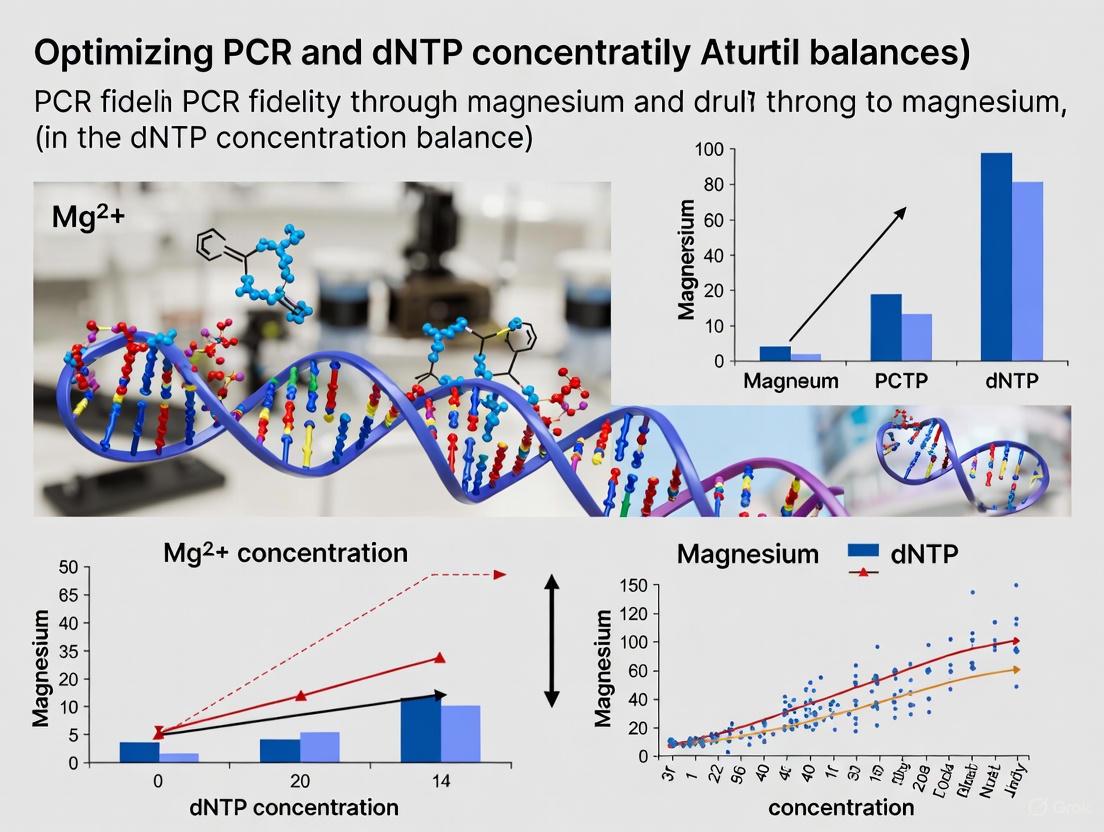
This article provides a comprehensive guide for researchers and drug development professionals on optimizing Polymerase Chain Reaction (PCR) fidelity by critically balancing magnesium chloride (Mg²⁺) and deoxynucleoside triphosphate (dNTP) concentrations.
Optimizing PCR Fidelity: A Strategic Guide to Balancing Magnesium and dNTP Concentrations for Reliable Results
Abstract
This article provides a comprehensive guide for researchers and drug development professionals on optimizing Polymerase Chain Reaction (PCR) fidelity by critically balancing magnesium chloride (Mg²⁺) and deoxynucleoside triphosphate (dNTP) concentrations. It covers the foundational science behind how these components interact to influence DNA polymerase error rates, presents methodological frameworks for establishing and applying optimal reaction conditions, details troubleshooting strategies for common amplification issues, and offers a comparative analysis of high-fidelity enzyme systems. By synthesizing current research and established protocols, this resource aims to empower scientists to enhance the accuracy of their PCR-based applications, from basic cloning to next-generation sequencing and clinical diagnostics, thereby improving the reliability of downstream analyses and experimental outcomes.
The Biochemical Basis of PCR Fidelity: Understanding Magnesium and dNTP Interplay
In the realm of polymerase chain reaction (PCR) optimization, magnesium ions (Mg²⁺) perform a critical dual function. They act as an essential cofactor for DNA polymerase activity and serve as a key modulator of reaction specificity. For researchers and drug development professionals, understanding this balance is paramount for experiments demanding high fidelity, such as cloning, sequencing, and diagnostic assay development. This guide provides targeted troubleshooting and methodologies to optimize Mg²⁺ concentration in the context of your PCR fidelity research.
Troubleshooting Guide: Magnesium-Related PCR Issues
| Problem | Possible Causes | Recommended Solutions |
|---|---|---|
| No/Low Yield [1] [2] | • Inadequate free Mg²⁺• EDTA or other chelators in sample• Excess dNTPs sequestering Mg²⁺ | • Titrate Mg²⁺ concentration upward (e.g., 0.5 mM increments)• Re-purify DNA template to remove chelators [1]• Ensure [Mg²⁺] > total [dNTPs] [3] |
| Non-Specific Amplification (Multiple bands/smear) [1] [4] [5] | • Excess free Mg²⁺• Low annealing temperature• High primer concentration | • Titrate Mg²⁺ concentration downward [4]• Increase annealing temperature [1]• Optimize primer concentration (0.1-1 µM) [3]• Use a hot-start DNA polymerase [1] |
| Low Fidelity (High error rate) [1] [5] | • Excess free Mg²⁺ reduces polymerase fidelity• Unbalanced dNTP concentrations• Too many PCR cycles | • Lower Mg²⁺ concentration to the minimum required for yield [1]• Use equimolar concentrations of all dNTPs [3] [1]• Reduce cycle number; use high-fidelity polymerase [5] |
Quantitative Data and Optimization Guidelines
| Parameter | Effect of Increasing Mg²⁺ Concentration | Quantitative Relationship & Optimal Range |
|---|---|---|
| DNA Melting Temperature (Tm) | Increases | For every 0.5 mM increase within 1.5-3.0 mM range, Tm rises by ~1.2°C [6] [7]. |
| Polymerase Activity | Essential for activity; insufficient Mg²⁺ renders polymerase inactive [4]. | Optimal range typically 1.5 - 5.0 mM [5] [8]. |
| Reaction Specificity | Too high promotes non-specific priming and off-target products [1] [5]. | Must be optimized for each primer-template system; often narrow window within overall range. |
| Reaction Fidelity | Excess Mg²⁺ decreases fidelity, increasing misincorporation rate [1]. | For high-fidelity applications, use lowest effective concentration, sometimes as low as 1 mM [4]. |
Template-Dependent Magnesium Optimization
The optimal Mg²⁺ concentration is significantly influenced by template properties [6] [7]:
- Genomic DNA: Often requires higher concentrations.
- Plasmid DNA: Can often use lower concentrations.
- GC-Rich Templates: May require adjustments and benefit from specialized buffers or additives.
Experimental Protocols for Optimization
Protocol: MgCl₂ Titration for Reaction Optimization
This protocol is fundamental for empirically determining the ideal Mg²⁺ concentration for any new primer-template combination.
Materials & Reagents:
- DNA template (e.g., gDNA, plasmid)
- Forward and Reverse Primers (20 µM each)
- 10X PCR Buffer (without MgCl₂)
- MgCl₂ solution (e.g., 25 mM)
- dNTP Mix (10 mM total)
- DNA Polymerase
- Nuclease-free Water
Methodology:
- Prepare a Master Mix for all common reagents for
N+1reactions (whereNis the number of Mg²⁺ conditions to test). - Aliquot the Master Mix into
Nthin-walled PCR tubes. - Add MgCl₂ to each tube to create a concentration gradient. A typical test range is 1.0 mM to 4.0 mM in 0.5 mM increments.
- Example: To make a 50 µL reaction with 2.0 mM Mg²⁺ from a 25 mM stock: (2.0 mM / 25 mM) * 50 µL = 4.0 µL of MgCl₂ stock.
- Run the PCR using optimized cycling parameters.
- Analyze results by agarose gel electrophoresis. Assess for:
- Maximum yield of the desired product.
- Absence of non-specific bands or primer-dimers.
- Product purity.
Workflow: The Interplay of Magnesium in PCR Fidelity
The following diagram illustrates the logical relationship between Mg²⁺ concentration, key PCR components, and the final reaction outcomes, highlighting its dual role.
The Scientist's Toolkit: Essential Research Reagents
| Item | Function in PCR | Role in Mg²⁺/Fidelity Context |
|---|---|---|
| MgCl₂ / MgSO₄ | Source of essential Mg²⁺ cofactor. | The primary variable for optimization. MgSO₄ is preferred for some proofreading polymerases [1]. |
| dNTP Mix | Building blocks for new DNA strands. | Total concentration affects free Mg²⁺ availability. Must be balanced (equimolar) for high fidelity [3] [1]. |
| PCR Buffer (Mg-free) | Provides optimal salt and pH environment. | Allows for precise, independent optimization of Mg²⁺ concentration without confounding variables [4]. |
| High-Fidelity Polymerase | Enzyme with proofreading (3'→5' exonuclease) activity. | Has defined Mg²⁺ requirements for optimal activity and fidelity; often lower error rate than standard Taq [5]. |
| Hot-Start Polymerase | Engineered to be inactive until initial denaturation step. | Reduces non-specific amplification initiated during reaction setup, complementing Mg²⁺ optimization efforts [1] [5]. |
| Betaine / DMSO | PCR enhancers/additives. | Can help amplify difficult templates (e.g., GC-rich), which may alter the optimal Mg²⁺ window [5] [8]. |
| EDTA | Metal ion chelator. | Can be used to validate that PCR failure is due to Mg²⁺ chelation by contaminants [1]. |
Frequently Asked Questions (FAQs)
Q1: Why is magnesium absolutely essential for PCR? Magnesium is a required cofactor for all DNA polymerases. It is directly involved in the catalytic reaction, facilitating the formation of the phosphodiester bond between the incoming dNTP and the 3' end of the growing DNA strand. Without adequate free Mg²⁺, the polymerase enzyme is inactive [3] [4].
Q2: How do dNTP concentrations interact with magnesium optimization? dNTPs carry negative charges and bind Mg²⁺ ions. Therefore, the concentration of dNTPs directly affects the amount of free Mg²⁺ available for the polymerase. A reaction with high dNTP concentrations will require a correspondingly higher concentration of MgCl₂ to ensure sufficient free Mg²⁺ remains for polymerase activity [3] [5]. For high fidelity, it is critical to balance both.
Q3: My PCR was working and now shows smears. Could magnesium be the issue? While possible, this often points to contamination with "amplifiable DNA contaminants." Before re-optimizing Mg²⁺, implement stringent lab practices: separate pre- and post-PCR areas, use fresh reagents, and consider using a new set of primers with different sequences that do not interact with the accumulated contaminants [2].
Q4: Are there alternatives to MgCl₂ for providing magnesium? Yes, MgSO₄ is sometimes used. The optimal salt can depend on the DNA polymerase. For example, Pfu DNA polymerase often works better with MgSO₄ than with MgCl₂. Always refer to the manufacturer's recommendations for your specific enzyme [1].
Q5: What is the single most important step for optimizing Mg²⁺? Perform a titration experiment. Due to the multiple variables (template, primers, dNTPs, polymerase), the optimal Mg²⁺ concentration is best determined empirically. Test a range from 1.0 mM to 4.0 or 5.0 mM in 0.5 mM increments to find the sweet spot for your specific reaction [8].
Deoxynucleotide triphosphates (dNTPs), comprising dATP, dCTP, dGTP, and dTTP, are the fundamental building blocks for DNA synthesis during Polymerase Chain Reaction (PCR). The fidelity of PCR amplification—the accuracy with which the DNA polymerase incorporates the correct dNTP opposite each template base—is critical for obtaining reliable results in downstream applications such as cloning, sequencing, and genetic analysis. A primary threat to this fidelity is misincorporation, where an incorrect dNTP is inserted into the growing DNA strand. This error can lead to mutations in the amplification product, compromising experimental data [9].
The occurrence of misincorporation is not random; it is influenced by several reaction components and conditions. Key among these are the concentrations and balance of dNTPs and the concentration of magnesium ions (Mg²⁺), which acts as an essential cofactor for DNA polymerase [10]. Optimizing these parameters is therefore central to a thesis focused on maximizing PCR fidelity. This guide provides troubleshooting and methodologies to help researchers identify, understand, and mitigate errors originating from dNTPs.
How dNTP Misincorporation Occurs
DNA polymerase catalyzes the formation of a phosphodiester bond between the 3'-hydroxyl end of a primer and the alpha phosphate of an incoming dNTP. Fidelity depends on the enzyme's ability to select the correct dNTP that forms a Watson-Crick base pair with the template. Misincorporation happens when this selection fails, and an incorrect base is inserted. Errors that do occur during PCR can promote chain termination, which helps restrict the amplification of defective molecules [9].
The balance of dNTP concentrations is a critical factor. Using the four dNTPs at equivalent concentrations is recommended to minimize misincorporation errors [9]. Unbalanced dNTP pools increase the PCR error rate, as a relative scarcity of one nucleotide can force the polymerase to incorporate an incorrect one more frequently [1].
While dNTP misincorporation is a key concern, comprehensive studies using single-molecule sequencing reveal that other sources of error are equally prevalent [11]:
- Polymerase Base Substitution: Traditional focus of fidelity studies, with error rates varying by enzyme.
- PCR-Mediated Recombination: Occurs when a partially extended primer anneals to a different template molecule in a subsequent cycle, generating chimeric products. This can occur as frequently as base substitution errors in multiplex reactions [11].
- Structure-Induced Template-Switching: Caused by inverted repeat sequences that can cause the polymerase to jump between top and bottom strands during replication [11].
- DNA Damage from Thermocycling: For high-fidelity polymerases, DNA damage introduced during temperature cycling can be a major contributor to mutations in the final product, sometimes exceeding the error rate from polymerase base substitutions [11].
The Critical Interplay: dNTP and Mg²⁺ Concentrations
The relationship between dNTP and Mg²⁺ concentration is a cornerstone of PCR optimization. Mg²⁺ is an essential cofactor for DNA polymerase activity; it facilitates the binding of the enzyme to the DNA template and catalyzes the nucleotidyl transfer reaction [10]. Importantly, Mg²⁺ binds to dNTPs in the reaction mix to form the actual substrate (Mg²⁺-dNTP complex) that the polymerase uses [10].
This interaction creates a direct biochemical dependency:
- The Mg²⁺ concentration must always be higher than the total dNTP concentration [1].
- An imbalance, particularly excess Mg²⁺, can reduce specificity and favor misincorporation of nucleotides [1].
- Insufficient Mg²⁺ can lead to weak or failed amplification because the polymerase function is impaired [10].
The following diagram illustrates the logical workflow for optimizing these two parameters to achieve high fidelity:
Troubleshooting Guides & FAQs
Frequently Asked Questions
Q1: What are the primary consequences of unbalanced dNTP concentrations in PCR? Unbalanced dNTP concentrations are a major source of error. They can increase the misincorporation rate of the DNA polymerase, as a relative deficiency of one dNTP may force the enzyme to use an incorrect alternative. This leads to a higher mutation rate in the final amplification product. Furthermore, unbalanced dNTPs can deplete the available Mg²⁺ unevenly, as Mg²⁺ binds to dNTPs, thereby indirectly affecting polymerase activity and reaction specificity [9] [1].
Q2: How does Mg²⁺ concentration specifically influence dNTP incorporation? Mg²⁺ acts as a cofactor for DNA polymerase. The ion is directly involved in the catalytic mechanism by facilitating the formation of the phosphodiester bond. It binds to the dNTP's phosphate groups, and this Mg²⁺-dNTP complex is the true substrate for the enzyme. Therefore, the concentration of free Mg²⁺ (which is the total Mg²⁺ minus that bound to dNTPs and other chelators like EDTA) is crucial. Insufficient free Mg²⁺ reduces polymerase efficiency, while excess Mg²⁺ can reduce fidelity and promote non-specific priming [10].
Q3: I have high-fidelity polymerase, but my sequencing results still show errors. Why? Even with a high-fidelity enzyme, errors can arise from sources other than polymerase misincorporation. A significant contributor can be DNA damage introduced during thermocycling. For very accurate polymerases, this thermocycling-induced damage can be the major contributor to base substitution errors in the final amplification product [11]. Other sources include PCR-mediated recombination and template-switching, especially in complex templates or multiplex reactions [11].
Q4: Can I simply use lower dNTP concentrations to force higher fidelity? Lower dNTP concentrations can, to a point, help minimize mispairing at non-target sites and reduce the likelihood of extending misincorporated nucleotides [9]. However, there is a critical threshold. Excessively low dNTP concentrations will lead to incomplete primer extension, dramatically reduced PCR yield, and potentially PCR failure. The key is to find the optimal concentration that supports robust amplification while minimizing errors, typically within the 20-200 µM range for each dNTP [9].
Troubleshooting Common Scenarios
| Problem & Symptoms | Possible Causes Related to dNTPs/Mg²⁺ | Recommended Solutions |
|---|---|---|
| No/Low Yield | • Excess Mg²⁺ chelation (e.g., by EDTA) [1]• dNTP concentration too low [9]• Insufficient free Mg²⁺ [10] | • Increase dNTP amount within 20-200 µM range [9].• Increase Mg²⁺ concentration, ensuring it exceeds total dNTP concentration [1] [10].• Re-purify template to remove inhibitors that bind Mg²⁺ [1]. |
| Nonspecific Bands/Smearing | • Excess Mg²⁺ reduces specificity [1]• Excess dNTPs [12] | • Titrate Mg²⁺ concentration downward in 0.5-1 mM increments [1].• Ensure dNTPs are used at balanced, recommended concentrations [9].• Use a hot-start DNA polymerase [12]. |
| High Error Rate/Misincorporation | • Unbalanced dNTP concentrations [9] [1]• Excess Mg²⁺ concentration [1]• Too many PCR cycles ("overcycling") [12] | • Use equimolar concentrations of all four dNTPs [9] [1].• Reduce Mg²⁺ concentration to the optimal range for your polymerase [1].• Reduce cycle number; increase template amount if possible [12]. |
Experimental Protocols for Optimization
Protocol 1: Titrating Mg²⁺ and dNTP Concentrations
This protocol is designed to systematically find the optimal balance between Mg²⁺ and dNTPs for a specific primer-template system.
Materials:
- 10X PCR Buffer (without MgCl₂)
- 50 mM MgCl₂ stock solution
- 10 mM dNTP mix (2.5 mM of each dNTP)
- DNA Template (50-100 ng genomic DNA)
- Forward and Reverse Primers (10 µM each)
- High-Fidelity DNA Polymerase
- PCR-grade water
Method:
- Prepare Master Mixes: Create two separate master mixes to decouple the variables.
- Master Mix A (Variable Mg²⁺): Contains all components except MgCl₂. Aliquot equal volumes into 5 tubes, then add MgCl₂ stock to create a gradient (e.g., 0.5 mM, 1.0 mM, 1.5 mM, 2.0 mM, 2.5 mM final concentration).
- Master Mix B (Variable dNTP): Contains all components with a fixed, middle-range Mg²⁺ concentration. Aliquot into 4 tubes, then add dNTP mix to create a gradient (e.g., 50 µM, 100 µM, 150 µM, 200 µM final concentration for each dNTP).
Run PCR: Use a standard thermocycling protocol appropriate for your primer pair and amplicon length.
Analyze Results:
- Run products on an agarose gel to assess yield and specificity.
- For fidelity-critical applications, sequence the PCR products from the conditions that gave the best yield/specificity to directly assess error rates.
Expected Outcomes: You will likely observe a "sweet spot" where yield is high and nonspecific amplification is minimal. The optimal Mg²⁺ concentration is often between 1.5-2.5 mM, and the optimal dNTP concentration is often between 100-200 µM each, but this must be determined empirically.
Protocol 2: Assessing Fidelity via Sequencing
To quantitatively measure the impact of dNTP/Mg²⁺ balance on error rates.
Method:
- Amplify: Perform PCR under two different conditions: 1) Your standard protocol, and 2) The optimized protocol from Protocol 1.
- Clone: Ligate the PCR products into a standard cloning vector and transform into competent E. coli. Pick at least 20-30 individual colonies per condition.
- Sequence: Sanger sequence the cloned insert from each colony.
- Analyze: Align the sequenced clones to the known reference sequence.
Calculation: Calculate the raw error rate for each condition: Error Rate (errors/base) = Total Number of Errors / (Number of Clones × Length of Amplicon in bases)
This allows for a direct comparison of how changes in dNTP and Mg²⁺ concentrations affect the overall fidelity of the amplification.
Advanced Topics & Reagent Solutions
Innovative Reagents: Phosphorothioate-Modified dNTPs
Recent research has highlighted the use of phosphorothioate-modified dNTPs (dNTPαS) as a powerful tool to enhance specificity. These analogs contain a sulfur atom substituting a non-bridging oxygen in the alpha phosphate group. When added in small amounts to the standard dNTP mix, they can significantly suppress nonspecific DNA polymerization and primer-dimer formation [13].
Mechanism: The incorporation of dNTPαS by DNA polymerase is slower than that of natural dNTPs. This attenuation of polymerase kinetics provides more time for the enzyme to dissociate from mismatched primers or templates, thereby increasing discrimination against incorrect substrates. Studies have shown up to 100-fold higher specificity in some applications, including PCR and gene cloning [13].
The Scientist's Toolkit: Essential Reagents
| Reagent | Function in PCR Fidelity | Key Considerations |
|---|---|---|
| High-Fidelity DNA Polymerase | Enzymes with 3'→5' proofreading exonuclease activity can remove misincorporated nucleotides, drastically lowering error rates. | Essential for cloning, sequencing, and mutational analysis. Error rates can be 50-100x lower than Taq [11]. |
| Balanced dNTP Mixes | Pre-mixed solutions ensuring equimolar concentrations of dATP, dCTP, dGTP, and dTTP to prevent misincorporation due to pool imbalance. | Use at recommended concentrations (often 200 µM each). Stock solutions should be neutralized to pH ~7.0 for stability [9] [1]. |
| MgCl₂ or MgSO₄ Solution | Essential cofactor for DNA polymerase. Its concentration is the most critical variable to optimize relative to dNTPs. | Titrate for every new primer set. Excess causes nonspecificity; too little causes failure. Concentration must exceed total dNTP concentration [1] [10]. |
| Hot-Start Polymerases | Engineered to be inactive at room temperature, preventing nonspecific priming and primer-dimer formation before the initial denaturation step. | Improves specificity and yield by preventing pre-PCR mishaps. Available in antibody-mediated or chemical modification formats [12]. |
| PCR Additives (e.g., DMSO, GC Enhancer) | Assist in denaturing complex templates with high GC content or secondary structures, making the template more accessible. | Reduces template-dependent misincorporation. Use at the lowest effective concentration as they can inhibit the polymerase [1]. |
| Phosphorothioate dNTPs (dNTPαS) | When spiked into natural dNTPs, these analogs slow polymerization kinetics, enhancing specificity by reducing mispriming and misincorporation. | A novel tool for challenging amplifications. Requires empirical optimization of the dNTPαS-to-dNTP ratio [13]. |
FAQs
1. What is the fundamental role of magnesium (Mg²⁺) in a PCR reaction? Magnesium is an essential cofactor for thermostable DNA polymerases. The enzyme is inactive without adequate free Mg²⁺. The Mg²⁺ ions facilitate the polymerase activity by coordinating the dNTPs in the active site. However, excess free Mg²⁺ can reduce enzyme fidelity and increase non-specific amplification [4] [14].
2. How do dNTPs affect the availability of free Mg²⁺? dNTPs bind to Mg²⁺, effectively chelating the ions. Each dNTP molecule can bind one Mg²⁺ ion. This binding reduces the concentration of free Mg²⁺ available for the DNA polymerase enzyme. Therefore, the total Mg²⁺ concentration in a reaction must be high enough to satisfy the binding capacity of the dNTPs and still have sufficient free Mg²⁺ to activate the polymerase [14].
3. What are the typical consequences of insufficient free Mg²⁺? Insufficient free Mg²⁺ can lead to complete PCR failure or significantly reduced yield. This is because the DNA polymerase enzyme lacks the cofactor required for its catalytic activity [1] [15] [14].
4. What problems are associated with excessive free Mg²⁺? Excess free Mg²⁺ can reduce the fidelity (accuracy) of the DNA polymerase, increasing the rate of misincorporated nucleotides. It also promotes non-specific amplification, such as primer-dimer formation and amplification of off-target sequences, leading to a complex background on gels [1] [4] [15].
5. How can I optimize Mg²⁺ concentration in my PCR experiments? Optimization should be performed empirically by testing a range of Mg²⁺ concentrations. A good starting point is to test concentrations from 1.0 mM to 4.0 mM in increments of 0.5 mM [14]. Many polymerases are supplied with Mg²⁺-free buffers and a separate vial of MgCl₂ (e.g., 25 mM) for this purpose [4].
Troubleshooting Guide
| Observation | Primary Cause | Recommended Solution |
|---|---|---|
| No PCR Product | Insufficient free Mg²⁺ due to dNTP chelation or miscalculation. | - Optimize Mg²⁺ concentration in 0.2–1.0 mM increments [15].- Ensure Mg²⁺ stock solution is fully vortexed before use to avoid concentration gradients [14]. |
| Multiple or Non-Specific Bands | Excess free Mg²⁺ reduces reaction stringency. | - Decrease Mg²⁺ concentration in 0.2–1.0 mM increments [1] [15].- Use a hot-start DNA polymerase to prevent activity at room temperature [1]. |
| Low PCR Fidelity (High Error Rate) | Excessive free Mg²⁺ concentration reduces enzyme accuracy. | - Optimize and lower the Mg²⁺ concentration [1] [15].- Ensure dNTP concentrations are balanced (equimolar dATP, dCTP, dGTP, dTTP) [15]. |
Quantitative Data on dNTP-Mg²⁺ Interaction
Table 1: Recommended Concentrations for Reaction Optimization
| Component | Typical Concentration Range | Notes and Considerations |
|---|---|---|
| Free Mg²⁺ | 1.5 – 2.0 mM [16] | Must be optimized empirically; the "free" concentration is what remains after chelation. |
| Total Mg²⁺ | 1.0 – 4.0 mM [14] | The starting point for optimization. The difference from "free" Mg²⁺ is the chelated portion. |
| Each dNTP | 200 – 400 µM [16] | Higher concentrations (e.g., 400 µM) may be needed for some enzymes, but will chelate more Mg²⁺. |
| Primers | 0.1 – 1.0 µM [1] [16] | High primer concentrations can exacerbate non-specific binding, especially with high Mg²⁺. |
Table 2: Impact of Mg²⁺ Status on PCR Performance
| Mg²⁺ Status | Effect on DNA Polymerase | Effect on PCR Output |
|---|---|---|
| Insufficient Free Mg²⁺ | Enzyme is inactive or has low activity, preventing catalysis [4] [14]. | No product or very low yield [1] [15]. |
| Optimal Free Mg²⁺ | Enzyme is fully active and maintains high fidelity [4]. | High yield of the specific target product. |
| Excess Free Mg²⁺ | Enzyme fidelity decreases; non-specific priming is tolerated [1] [4] [14]. | Non-specific products, smeared bands, and primer-dimer [1] [15]. |
Experimental Protocols
Protocol 1: Empirical Optimization of Mg²⁺ Concentration
This protocol is essential for any new PCR assay to balance dNTP chelation and polymerase activity.
- Prepare a Master Mix: Create a master mix containing all standard PCR components except Mg²⁺ and the template DNA. Use a polymerase supplied with a Mg²⁺-free buffer [4].
- Aliquot the Mix: Dispense equal volumes of the master mix into 8 PCR tubes.
- Create Mg²⁺ Gradient: Add MgCl₂ stock solution to the tubes to create a final concentration gradient (e.g., 1.0, 1.5, 2.0, 2.5, 3.0, 3.5, 4.0 mM). One tube may be left without addition as a negative control.
- Add Template and Run PCR: Add template DNA to each tube and place them in a thermal cycler.
- Analyze Results: Analyze the PCR products using agarose gel electrophoresis. Identify the Mg²⁺ concentration that produces the highest yield of the desired product with the least background.
Protocol 2: Calculating and Balancing dNTP-Mg²⁺ Stoichiometry
This method provides a calculated starting point for Mg²⁺ concentration.
- Calculate dNTP-Bound Mg²⁺:
- The total concentration of dNTPs in the reaction is the sum of all four dNTPs. For example, if each dNTP is 200 µM, the total dNTP concentration is 800 µM.
- Since each dNTP can bind one Mg²⁺ ion, the Mg²⁺ chelated by dNTPs is approximately equal to the total dNTP concentration (~0.8 mM in this example) [14].
- Estimate Initial Total Mg²⁺:
- A good rule of thumb is that the total Mg²⁺ concentration should be 1.5 - 2.0 mM higher than the total dNTP concentration to ensure sufficient free Mg²⁺ for the polymerase and primers [16].
- Using the example above, a starting total Mg²⁺ concentration would be 0.8 mM + 1.5 mM = 2.3 mM.
- Refine Empirically: Use the calculated value as the center point for an optimization experiment as described in Protocol 1.
Diagram: The dNTP-Mg²⁺ Balancing Act in PCR
The Scientist's Toolkit: Research Reagent Solutions
| Item | Function in Mg²⁺/dNTP Optimization |
|---|---|
| Mg²⁺-Free Reaction Buffers | Supplied with some polymerases (e.g., Takara Ex Taq), these allow for complete manual control over Mg²⁺ concentration by adding a separate MgCl₂ solution [4]. |
| Hot-Start DNA Polymerases | These enzymes are inactive until a high-temperature activation step. This prevents non-specific amplification and primer-dimer formation that can be exacerbated by suboptimal Mg²⁺ levels during reaction setup [1] [15]. |
| High-Fidelity Polymerase Blends | Polymerase mixtures (e.g., non-proofreading + proofreading enzymes) are often more tolerant of slight imbalances in Mg²⁺ and dNTPs, especially when amplifying long targets [17]. |
| Gradient Thermal Cyclers | Instruments that allow different tubes to be held at slightly different temperatures simultaneously. They are indispensable for efficiently optimizing both annealing temperature and Mg²⁺ concentration in a single run [1] [15]. |
| Molecular Biology Grade Water | Used to prepare all solutions, it ensures no contaminants are present that could chelate Mg²⁺ or inhibit the polymerase [1]. |
The error rate of a DNA polymerase is a critical parameter in polymerase chain reaction (PCR) protocols, defining the frequency at which incorrect nucleotides are incorporated into the newly synthesized DNA strand. For researchers, scientists, and drug development professionals, understanding and controlling this error rate is essential for the reliability of downstream applications, including cloning, sequencing, and the detection of low-frequency genetic variants. The fidelity of a PCR reaction is not fixed; it is profoundly influenced by experimental conditions, primarily the delicate balance between magnesium (Mg²⁺) and deoxynucleotide (dNTP) concentrations. This guide provides detailed troubleshooting and FAQs to help you optimize these parameters, minimize errors, and ensure the integrity of your amplified DNA.
Quantitative Comparison of Polymerase Error Rates
Direct comparisons of polymerase fidelity are vital for selecting the right enzyme for your application. The following table summarizes key error rate data from a large-scale study that sequenced 94 unique DNA targets, providing a broad view across different sequence contexts [18].
Table 1: DNA Polymerase Fidelity Comparison
| DNA Polymerase | Proofreading Activity | Published Error Rate (Errors per bp per duplication) | Fidelity Relative to Taq |
|---|---|---|---|
| Taq | No | 1.0 - 20 × 10⁻⁵ | 1x |
| AccuPrime-Taq HF | No | ~1.0 × 10⁻⁵ [18] | ~9x better [18] |
| KOD Hot Start | Yes | Not Available (N/A) | ~4-50x better [18] |
| Pfu | Yes | 1.0 - 2.0 × 10⁻⁶ | 6-10x better |
| Pwo | Yes | >10x lower than Taq [18] | >10x better [18] |
| Phusion Hot Start | Yes | 4.0 × 10⁻⁷ (HF Buffer) / 9.5 × 10⁻⁷ (GC Buffer) | >50x better (HF Buffer) / 24x better (GC Buffer) |
The data shows that proofreading enzymes like Pfu, Pwo, and Phusion offer significantly higher fidelity than non-proofreading enzymes like Taq. This makes them the preferred choice for applications requiring high accuracy, such as cloning and synthetic biology [18] [19].
Diagram: A strategic workflow for minimizing errors in PCR, highlighting the primary factors under experimental control.
Troubleshooting Guide: Resolving PCR Error Issues
Frequently Asked Questions (FAQs)
Q1: My downstream sequencing reveals unexpected mutations in my PCR product. What is the most likely cause and how can I fix it?
A: This is a classic sign of polymerase incorporation errors. The solution involves both enzyme selection and reaction conditioning [20].
- Cause: Using a low-fidelity polymerase, excessive Mg²⁺ concentrations, unbalanced dNTPs, or too many PCR cycles can all increase error rates [1] [21].
- Solutions:
- Switch to a high-fidelity enzyme: Use a proofreading polymerase like Q5, Phusion, or Pfu for a >10-fold reduction in error rate compared to Taq [20] [18].
- Optimize Mg²⁺ concentration: Reduce Mg²⁺ concentration, as excess Mg²⁺ can increase misincorporation [1] [21]. Optimize in 0.2-1.0 mM increments [20].
- Use fresh, balanced dNTPs: Ensure dNTP concentrations are equimolar. Unbalanced dNTP pools significantly increase the error rate [1] [22]. A typical final concentration is 200 µM of each dNTP [22].
- Reduce cycle number: Perform the minimum number of cycles necessary to obtain sufficient product [1].
Q2: I am using a high-fidelity enzyme, but my error rate is still too high for detecting low-frequency variants. What else can I do?
A: Even with high-fidelity enzymes, background errors exist. For detecting variants below 0.1% allele frequency, combine polymerase selection with advanced library preparation methods [19].
- Solution: Implement Unique Molecular Identifiers (UMIs). This method tags each original DNA molecule with a unique barcode before amplification. Bioinformatic consensus building allows for the identification and removal of errors introduced during PCR and sequencing, dramatically lowering the background noise [19].
- Insight: Studies show that while using a high-fidelity polymerase in the UMI barcoding step provides a further reduction in consensus error rates, the barcoding process itself has the largest impact on error correction [19].
Q3: I get no PCR product when I try to amplify a GC-rich template. How can I achieve amplification while maintaining fidelity?
A: GC-rich sequences (>65%) form stable secondary structures that block polymerase progression. Successful amplification requires special conditions [1] [23] [21].
- Solutions:
- Use a specialized polymerase: Choose a high-fidelity enzyme known to robustly amplify GC-rich templates, such as Q5 High-Fidelity polymerase [20].
- Add co-solvents: Include DMSO (e.g., 5%) or other GC-enhancers in the reaction mix to help denature the stable secondary structures [1] [23].
- Optimize annealing temperature: For GC-rich targets, the optimal annealing temperature may be significantly higher (e.g., 7°C higher) than the calculated Tm [23]. Use a gradient thermocycler for optimization.
- Adjust Mg²⁺ concentration: The optimal MgCl₂ concentration for a specific GC-rich amplicon may fall within a narrow range (e.g., 1.5-2.0 mM) [23].
Troubleshooting Table for Common PCR Problems
Table 2: Troubleshooting PCR Errors and Specific Solutions
| Observation | Possible Cause | Recommended Solution |
|---|---|---|
| Sequence errors in clones | Low-fidelity polymerase | Use a proofreading enzyme (e.g., Q5, Pfu, Phusion) [20] [18]. |
| Excess Mg²⁺ concentration | Optimize Mg²⁺; lower concentration can improve fidelity [1] [22]. | |
| Unbalanced dNTP concentrations | Use fresh, equimolar dNTP mix (200 µM each) [1] [22]. | |
| Too many cycles | Reduce the number of PCR cycles [1]. | |
| Template DNA damage | Limit UV exposure when analyzing or excising products from gels [1] [20]. | |
| No amplification | Excessive template purity | Re-purify template to remove inhibitors (e.g., phenol, EDTA); ethanol precipitate [1]. |
| Too few cycles | Increase number of cycles (up to 40) for low-abundance targets [21]. | |
| Overly stringent conditions | Lower annealing temperature in 2°C increments; increase extension time [21]. | |
| Nonspecific bands / smearing | Primer annealing temperature too low | Increase annealing temperature; use a gradient to find optimum [1] [20]. |
| Excess primer or template | Optimize primer concentration (0.1-1 µM); reduce template amount [1] [21]. | |
| Non-hot-start polymerase | Use a hot-start enzyme to prevent activity during reaction setup [1] [20]. |
Experimental Protocols for Fidelity Optimization
Protocol: Systematic Optimization of Mg²⁺ and dNTP Concentrations
This protocol is designed to empirically determine the optimal Mg²⁺ and dNTP concentrations for your specific primer-template system to maximize yield and fidelity [1] [22].
Research Reagent Solutions:
- DNA Template: High-quality, purified genomic DNA (1 ng–1 µg) or plasmid DNA (1 pg–10 ng) per 50 µL reaction [22].
- 10X PCR Buffer: Supplied with the polymerase, usually without Mg²⁺.
- Mg²⁺ Stock Solution: 25-50 mM MgCl₂ or MgSO₄ (check polymerase preference) [1].
- dNTP Mix: 10 mM aqueous stock solution of each dNTP (dATP, dCTP, dGTP, dTTP), pH 7.0.
- Primers: Resuspended in molecular-grade water, typically 10-100 µM stock.
- High-Fidelity DNA Polymerase: e.g., Q5 or Phusion Hot Start.
Methodology:
- Prepare Master Mix: Create a master mix containing 1X PCR buffer, 0.5 µM of each primer, DNA template, and 1.25 units of DNA polymerase. Distribute equal aliquots into thin-walled PCR tubes.
- Vary Mg²⁺ Concentration: Supplement the reactions with Mg²⁺ stock to create a dilution series from 1.0 mM to 4.0 mM in 0.5 mM increments [22].
- Vary dNTP Concentration: For a subset of Mg²⁺ concentrations, test different final dNTP concentrations (e.g., 50 µM, 100 µM, and 200 µM of each dNTP). Remember that dNTPs chelate Mg²⁺, so the free Mg²⁺ concentration is total Mg²⁺ minus that bound to dNTPs [22].
- Thermal Cycling: Run the PCR using your standard cycling conditions, ensuring an initial denaturation at 95-98°C for 2 minutes.
- Analysis: Analyze PCR products on an agarose gel. The condition that yields the strongest, correct band with minimal background is optimal for yield. For maximum fidelity, choose the condition with the lowest Mg²⁺ and dNTP concentrations that still provides adequate yield [22].
Protocol: Amplification of a GC-Rich Promoter Region
This specific protocol, adapted from a published study, details the successful amplification of an EGFR promoter region with a GC content of 88% [23].
Research Reagent Solutions:
- Template DNA: Genomic DNA extracted from formalin-fixed paraffin-embedded (FFPE) tissue, concentration ≥ 2 µg/mL [23].
- Primers: Designed for the target region.
- Taq DNA Polymerase: Standard enzyme used with optimization.
- DMSO: Molecular biology grade.
Methodology [23]:
- Reaction Setup: In a 25 µL reaction, combine:
- 1 µL genomic DNA
- 0.2 µM of each primer
- 0.25 mM of each dNTP
- 0.625 U Taq DNA polymerase
- 1X PCR buffer
- 1.5 mM MgCl₂ (optimized concentration)
- 5% DMSO (critical for GC-rich templates)
- Thermal Cycling:
- Initial Denaturation: 94°C for 3 minutes.
- 45 Cycles:
- Denaturation: 94°C for 30 seconds.
- Annealing: 63°C for 20 seconds (optimized 7°C above calculated Tm).
- Extension: 72°C for 60 seconds.
- Final Extension: 72°C for 7 minutes.
- Analysis: Detect 197 bp PCR products on a 2% agarose gel. Specificity can be confirmed by direct sequencing.
The Impact of Reaction Conditions on Nucleotide Misincorporation Kinetics
Technical Support Center
Core Concepts: Understanding Misincorporation Kinetics
What are nucleotide misincorporation kinetics and why are they critical for my PCR experiments?
Nucleotide misincorporation kinetics refer to the rates at which DNA polymerases incorporate incorrect nucleotides (mismatches) against correct ones during DNA synthesis. This is a critical determinant of PCR fidelity. The specificity constant (kcat/Km) for incorrect nucleotides can be orders of magnitude lower than for correct bases, leading to the extraordinary specificity of high-fidelity DNA polymerases [24].
Research demonstrates that during mismatch incorporation, the rates of the essential conformational change in the enzyme and the chemical reaction step itself are greatly reduced. Furthermore, the nucleotide dissociation rate increases, exceeding the rate of chemistry and providing a key discrimination point against errors [24]. Molecular dynamics simulations reveal that the closed, active form of the enzyme is destabilized with a mismatch, leading to weaker interactions with active site residues, non-ideal base pairing, and an increased distance between the primer's 3ʹ-OH group and the incoming nucleotide's phosphate group [24].
Troubleshooting Guides & FAQs
FAQ: My PCR results show unexpected sequencing errors. Which reaction conditions most directly influence the nucleotide misincorporation rate?
Several key reaction components directly impact the error rate:
- Magnesium Ion (Mg²⁺) Concentration: Excessive Mg²⁺ concentration is a common cause of increased misincorporation, as it can reduce the enzyme's ability to discriminate against incorrect nucleotides [1] [25].
- dNTP Concentration and Balance: Unbalanced dNTP concentrations significantly increase the PCR error rate. All four dNTPs (dATP, dCTP, dGTP, dTTP) should be used at equimolar concentrations for optimal fidelity [1] [25] [26]. High overall dNTP concentrations can also promote errors, especially when Mg²⁺ is limiting, as dNTPs chelate Mg²⁺ [3] [26].
- DNA Polymerase Choice: Different DNA polymerases have inherent fidelity levels. Proofreading polymerases exhibit lower error rates [25] [27].
- Cycle Number: A high number of PCR cycles increases the cumulative chance of misincorporation events [1] [25] [26].
TROUBLESHOOTING GUIDE: I am observing a high rate of sequence errors in my cloned PCR products. How can I address this?
| Observation | Possible Cause | Recommended Solution |
|---|---|---|
| High error rate in sequenced clones | Low-fidelity DNA polymerase | Switch to a high-fidelity polymerase with proofreading activity (e.g., Q5, Phusion) [25] [27]. |
| Excess Mg²⁺ concentration | Optimize the Mg²⁺ concentration. Reduce it in 0.2–1 mM increments to find the lowest concentration that supports robust amplification [25] [26]. | |
| Unbalanced dNTP concentrations | Use a fresh, equimolar dNTP mixture. Verify concentrations by spectrophotometry [25] [26]. | |
| Excessive number of PCR cycles | Reduce the number of amplification cycles without drastically compromising product yield [1] [25]. |
FAQ: How does the balance between Mg²⁺ and dNTPs specifically affect fidelity?
Mg²⁺ is a cofactor that catalyzes phosphodiester bond formation and stabilizes the DNA template [3]. However, Mg²⁺ also forms soluble complexes with dNTPs, creating the actual substrate recognized by the polymerase [26]. Therefore, the ratio and absolute concentrations of both components are critical. An excess of free Mg²⁺ (when dNTPs are too low) can reduce specificity and promote non-specific priming and misincorporation. Conversely, high dNTP concentrations can chelate the available Mg²⁺, effectively reducing the concentration of the active Mg²⁺-dNTP complex and inhibiting the polymerase [3] [26]. This intricate relationship means that optimizing one requires careful adjustment of the other.
TROUBLESHOOTING GUIDE: My PCR has low yield or no product after I optimized for fidelity. What should I do?
| Observation | Possible Cause | Recommended Solution |
|---|---|---|
| No or low product yield | Overly stringent conditions (e.g., Mg²⁺ too low) | Titrate Mg²⁺ upward from a low baseline (e.g., 1 mM) in 0.2–1 mM increments [25] [2]. |
| dNTP concentration is too low for the polymerase | Ensure each dNTP is present at a minimum of 0.2 mM for standard PCR, but do not exceed recommended levels [3] [26]. | |
| Poor primer annealing due to high specificity | Optimize the annealing temperature. Use a gradient thermal cycler to test temperatures in 1–2°C increments [1] [25]. | |
| Inhibitors in the template DNA | Further purify the template DNA using alcohol precipitation or a dedicated clean-up kit [1] [25]. |
Experimental Protocols for Fidelity Optimization
Protocol: Systematic Optimization of Mg²⁺ and dNTP Concentrations for High-Fidelity PCR
This protocol provides a method for empirically determining the optimal Mg²⁺ and dNTP concentrations to minimize misincorporation while maintaining good product yield [25] [26].
- Prepare a Master Mix: Create a master mix containing buffer, primers, template DNA, and DNA polymerase. Omit Mg²⁺ and dNTPs.
- Set Up Mg²⁺ Titration: Aliquot the master mix into multiple tubes. Add a Mg²⁺ stock solution to each tube to create a concentration series (e.g., 0.5 mM, 1.0 mM, 1.5 mM, 2.0 mM, 2.5 mM, 3.0 mM).
- Set Up dNTP Titration: For each Mg²⁺ concentration, set up a sub-series with varying dNTP concentrations (e.g., 0.05 mM, 0.1 mM, 0.2 mM, 0.5 mM of each dNTP).
- Perform PCR Amplification: Run the PCR using your standard cycling parameters.
- Analyze Results:
- Assess yield by running products on an agarose gel.
- For fidelity analysis, clone the PCR products from conditions with good yield and sequence multiple clones to determine the error rate. Alternatively, use a high-throughput sequencing-based method for a more comprehensive error profile [27].
Protocol: High-Throughput Measurement of PCR Error Rates
This method, adapted from a published assay, uses Unique Molecular Identifiers (UMIs) and high-throughput sequencing to quantitatively measure polymerase error rates with high accuracy [27].
- UMI Tagging (Linear Amplification): Tag each input template molecule with a random 14-nucleotide UMI.
- First PCR: Amplify the tagged templates for 20 cycles using the polymerase and conditions to be tested.
- Sampling Bottleneck: Perform a limiting dilution to sample a single molecule per original UMI-tagged template. This isolates errors from the first PCR.
- Second PCR: Re-amplify the diluted products for 22-29 cycles to generate enough material for sequencing.
- Sequencing and Error Calling: Perform high-throughput sequencing. Group reads by UMI and build a consensus sequence for each group. Errors present in the consensus are attributed to the first PCR step, effectively correcting for errors introduced during the second PCR and sequencing itself [27].
- Error Rate Calculation: The error rate is calculated as the number of errors in consensus sequences divided by the total number of bases sequenced across all UMI groups and the number of cycles in the first PCR.
Essential Research Reagent Solutions
The following reagents are critical for experiments focused on nucleotide misincorporation kinetics and PCR fidelity.
| Reagent | Function & Importance in Fidelity Research |
|---|---|
| High-Fidelity DNA Polymerase | Engineered enzymes (e.g., Q5, Phusion) with proofreading (3'→5' exonuclease) activity that can remove misincorporated nucleotides, resulting in significantly lower error rates than non-proofreading enzymes like Taq [25] [27]. |
| Molecular Biology Grade dNTPs | Purified dNTPs supplied at calibrated concentrations are essential for preparing balanced equimolar mixtures to prevent biased incorporation and increased error rates [25] [26]. |
| Magnesium Salt Solutions (MgCl₂/MgSO₄) | The source of Mg²⁺ cofactor. The type (e.g., MgCl₂ vs MgSO₄) and concentration must be optimized for each polymerase and buffer system to achieve the correct balance between activity and fidelity [1] [25]. |
| Optimized Reaction Buffers | Buffers supplied with DNA polymerases are formulated for optimal pH and salt composition. Straying from these can affect fidelity. Some systems offer proprietary additives or "GC Enhancers" to improve amplification of difficult templates without sacrificing accuracy [1] [3]. |
| Unique Molecular Identifiers (UMIs) | Short random nucleotide tags used to uniquely label template molecules prior to amplification. This allows for precise tracking and identification of PCR-derived errors during sequencing, enabling highly accurate error rate quantification [27]. |
Visualizing the Kinetic Pathway and Misincorporation
The following diagram illustrates the kinetic pathway of nucleotide incorporation, highlighting the points where discrimination against mismatches occurs, based on structural and kinetic studies [24].
Practical Protocols: Establishing Optimal Mg²⁺ and dNTP Ratios for High-Fidelity Amplification
Achieving optimal polymerase chain reaction (PCR) performance requires precise optimization of reaction components, particularly the delicate balance between magnesium ions (Mg²⁺) and deoxynucleoside triphosphates (dNTPs). This balance is critical for maximizing specificity, yield, and fidelity—the three pillars of successful amplification. For researchers and drug development professionals, establishing correct starting concentrations provides the foundation for reproducible results across diverse applications, from routine genotyping to high-fidelity cloning and sequencing. This guide provides detailed concentration ranges and methodologies to systematically optimize these key parameters in your experiments.
Typical Concentration Ranges for PCR Components
The table below summarizes the standard starting concentrations for critical reagents in both routine and high-fidelity PCR setups. These values serve as a baseline for initial experiment setup.
Table 1: Standard PCR Component Concentration Ranges
| Component | Routine PCR | High-Fidelity PCR | Notes & Considerations |
|---|---|---|---|
| Mg²⁺ | 1.5 - 2.5 mM [8] [28] | 1.5 - 2.5 mM [5] | Critical cofactor; concentration must exceed total dNTP concentration [3] [29]. |
| dNTPs (each) | 0.2 mM [3] [30] | 0.2 mM [3] | Use equimolar mix of dATP, dCTP, dGTP, dTTP [30]. Higher concentrations can inhibit PCR [3]. |
| Primers | 0.1 - 1.0 µM [3] | 0.2 - 0.3 µM [5] | High concentrations promote mispriming [3]. |
| DNA Polymerase | 1 - 2.5 units/50 µL [8] [3] | Per manufacturer | Enzyme amount varies by type and supplier. |
| Template DNA | 1 - 1000 ng (genomic) [8] | 5 - 50 ng (genomic) [3] | Plasmid DNA requires less (0.1-1 ng) [3]. |
The Critical Balance: Magnesium and dNTPs
The interaction between Mg²⁺ and dNTPs is a cornerstone of PCR optimization. Mg²⁺ acts as an essential cofactor for DNA polymerase, facilitating the enzyme's catalytic activity and stabilizing the primer-template complex [3] [29]. However, Mg²⁺ also binds to dNTPs in the reaction mixture to form a substrate complex that the polymerase actually incorporates [3]. This relationship means that the concentration of free, available Mg²⁺ is directly determined by the concentration of dNTPs.
- The Consequences of Imbalance: If the dNTP concentration is too high, it chelates nearly all available Mg²⁺, leaving insufficient free Mg²⁺ for the polymerase to function, which leads to poor reaction yield [3] [5]. Conversely, if the Mg²⁺ concentration is excessively high, it stabilizes non-specific primer-template interactions, leading to spurious amplification and reduced fidelity [5] [29].
- The Fidelity Consideration: For high-fidelity applications using proofreading enzymes, it is sometimes beneficial to use slightly lower dNTP concentrations (e.g., 0.01-0.05 mM) with proportionally reduced Mg²⁺ to improve the accuracy of base incorporation [3].
The following diagram illustrates the logical workflow for optimizing these interdependent components.
Troubleshooting Guides & FAQs
Troubleshooting Common PCR Problems
Problem: No or low yield of the desired product.
- Potential Cause 1: Insufficient free Mg²⁺ due to high dNTP concentration.
- Potential Cause 2: Low primer concentration or inefficient priming.
Problem: Non-specific amplification (multiple bands or smearing).
- Potential Cause 1: Mg²⁺ concentration is too high.
- Potential Cause 2: Annealing temperature is too low.
- Solution: Increase the annealing temperature in a gradient PCR experiment. The optimal Ta is typically 3-5°C below the primer's Tm [5].
- Potential Cause 3: Primer concentration is too high.
- Solution: Reduce primer concentration to the lower end of the range (e.g., 0.2 µM) to reduce mispriming [3].
Problem: Poor fidelity (unexpected mutations in the amplicon).
- Potential Cause: Imbalanced dNTPs or Mg²⁺ levels leading to misincorporation by the polymerase.
Frequently Asked Questions (FAQs)
Q1: What is the most common reason for non-specific amplification? The most common cause is an annealing temperature that is too low, which reduces the stringency of primer binding [5]. This is often compounded by excessively high Mg²⁺ concentrations, which further stabilize these non-specific interactions [29].
Q2: How does a high-fidelity polymerase differ from standard Taq? High-fidelity polymerases (e.g., Pfu, KOD) possess a 3'→5' exonuclease (proofreading) activity that can remove misincorporated nucleotides during replication. This dramatically reduces the error rate compared to non-proofreading enzymes like standard Taq [5].
Q3: When should I use a buffer additive like DMSO? Additives like DMSO (at 2-10%) are particularly useful for amplifying difficult templates, such as those with high GC content (>65%). DMSO helps by interfering with secondary structure formation, making the DNA template more accessible to the polymerase [5] [29].
Q4: Why is optimizing the Mg²⁺ concentration so critical? Mg²⁺ is an essential cofactor for DNA polymerase. Its concentration has a direct and dramatic impact on enzyme activity, primer-template stability, and reaction fidelity. An incorrect concentration is a primary cause of either failed reactions or non-specific amplification [5] [28].
Experimental Protocols
Detailed Methodology: Titrating Mg²⁺ Concentration
This protocol is designed to systematically determine the optimal Mg²⁺ concentration for a new primer set or template.
- Prepare a Master Mix: Create a master mix containing all standard PCR components except Mg²⁺ and the template. This includes water, buffer, dNTPs (0.2 mM each), primers (0.3 µM each), and DNA polymerase (1-2.5 units/50 µL reaction) [8] [3].
- Aliquot the Master Mix: Dispense equal volumes of the master mix into 8 PCR tubes.
- Spike with MgCl₂: Add MgCl₂ to the tubes to create a final concentration series. A typical range is 0.5, 1.0, 1.5, 2.0, 2.5, 3.0, 4.0, and 5.0 mM [8] [28].
- Add Template: Add a consistent amount of template DNA (e.g., 20 ng genomic DNA) to each tube.
- Run PCR: Place the tubes in a thermal cycler. Use a standardized cycling program with an annealing temperature gradient if the optimal Ta is unknown [5].
- Analyze Results: Separate the PCR products on an agarose gel. Identify the Mg²⁺ concentration that produces the strongest, single band of the expected size with the least background smearing [28].
Workflow for Systematic PCR Optimization
The DOT script below visualizes the comprehensive experimental workflow, from initial setup to analysis, for establishing robust PCR conditions.
The Scientist's Toolkit: Research Reagent Solutions
Table 2: Essential Reagents for PCR Optimization
| Item | Function & Rationale |
|---|---|
| dNTP Mix | Pre-mixed, equimolar solution of all four nucleotides. Ensures balanced incorporation and reduces setup variability [30]. |
| MgCl₂ Solution | A separate, high-purity solution for precise titration. Essential for optimizing the critical Mg²⁺ cofactor concentration [8] [28]. |
| High-Fidelity Polymerase Mix | A blend of DNA polymerases (e.g., Taq and a proofreading enzyme) for amplifying long or complex templates with high accuracy [17] [5]. |
| Hot-Start DNA Polymerase | Engineered to be inactive at room temperature. Prevents non-specific amplification and primer-dimer formation during reaction setup, enhancing specificity [17] [5]. |
| PCR Additives (DMSO, Betaine) | Used to denature complex secondary structures in GC-rich templates, improving amplification efficiency and yield [5] [29]. |
FAQ: Magnesium and dNTP Balancing in PCR
Why is optimizing Mg²⁺ concentration so critical for PCR success? Magnesium ions (Mg²⁺) are an essential cofactor for DNA polymerase activity. They form a soluble complex with dNTPs to facilitate the enzyme's catalytic function and stabilize the double-stranded DNA product [31]. The optimal concentration balances enzyme efficiency with reaction specificity; too little Mg²⁺ results in low or no product yield, while too much promotes non-specific amplification and can increase error rates [32] [1] [33].
How do dNTP concentrations interact with Mg²⁺ in the reaction? dNTPs chelate Mg²⁺ ions. Therefore, the concentration of free Mg²⁺ available for the DNA polymerase is the total Mg²⁺ concentration minus the concentration bound to dNTPs [31]. An imbalance, such as excessively high dNTPs, can effectively reduce free Mg²⁺ levels and inhibit the reaction. Maintaining a proper balance is crucial for fidelity, as unbalanced nucleotide concentrations are a known cause of increased PCR error rates [1] [34].
What is the typical starting range for a Mg²⁺ titration experiment? A systematic meta-analysis of PCR optimization studies identified an optimal MgCl₂ range between 1.5 mM and 3.0 mM for many templates [7]. However, the ideal concentration depends on the specific DNA polymerase, buffer composition, and template. A titration experiment from 0.5 mM to 5.0 mM is a comprehensive strategy to cover sub-optimal, optimal, and supra-optimal conditions, allowing for the precise determination of the best concentration for a given assay [31] [33].
Troubleshooting Guide: Mg²⁺ Titration Experiment
| Observation | Possible Cause | Recommended Solution |
|---|---|---|
| No PCR Product | Mg²⁺ concentration is too low [32] [33] | Increase Mg²⁺ concentration in 0.5 mM increments, ensuring it is at least 0.5-1.0 mM above the total dNTP concentration for some high-fidelity polymerases [32]. |
| Multiple Bands or Smearing | Mg²⁺ concentration is too high, leading to non-specific priming and reduced amplification fidelity [32] [1] [33] | Decrease Mg²⁺ concentration in 0.2-0.5 mM increments. Combine with an increase in annealing temperature for greater specificity [1] [33]. |
| Low Product Yield | Suboptimal Mg²⁺ level, falling outside the polymerase's activity peak [2] | Titrate Mg²⁺ to find the optimum. Also, verify that dNTP concentrations are balanced and not limiting the reaction [1]. |
| High Error Rate (Low Fidelity) | Excess Mg²⁺ concentration can reduce replication fidelity by promoting mis-incorporation [1] [34] | Lower Mg²⁺ concentration to the minimum required for robust amplification. Use a high-fidelity polymerase with proofreading activity [32] [33]. |
Experimental Protocol: Mg²⁺ Titration for PCR Fidelity
Objective
To determine the optimal Mg²⁺ concentration for specific, efficient amplification of a target DNA sequence while minimizing PCR-derived errors.
Materials and Equipment
- Target DNA template
- Forward and Reverse Primers
- High-fidelity DNA Polymerase and its compatible 10x Reaction Buffer (without Mg²⁺)
- 25 mM MgCl₂ stock solution
- 10 mM dNTP Mix
- Nuclease-free Water
- Thermal Cycler
Procedure
A. Master Mix Preparation: Create a master mix for n+1 reactions to minimize pipetting error. Calculate the volumes such that each 50 µL reaction contains:
- 1X Reaction Buffer
- 0.2 µM of each primer
- 200 µM of each dNTP
- 1 unit of DNA Polymerase
- A fixed, optimal amount of template DNA (e.g., 10-100 ng genomic DNA)
- Nuclease-free water to 50 µL
B. Mg²⁺ Titration: Aliquot the master mix into 10 separate PCR tubes. Add the 25 mM MgCl₂ stock solution to each tube to achieve the following final concentrations:
| Tube Number | Final [Mg²⁺] (mM) | Volume of 25 mM MgCl₂ Stock (µL) for a 50 µL Reaction |
|---|---|---|
| 1 | 0.5 | 1.0 |
| 2 | 1.0 | 2.0 |
| 3 | 1.5 | 3.0 |
| 4 | 2.0 | 4.0 |
| 5 | 2.5 | 5.0 |
| 6 | 3.0 | 6.0 |
| 7 | 3.5 | 7.0 |
| 8 | 4.0 | 8.0 |
| 9 | 4.5 | 9.0 |
| 10 | 5.0 | 10.0 |
C. Thermal Cycling: Run the PCR using pre-optimized cycling conditions suitable for your polymerase and amplicon. A generic profile is:
- Initial Denaturation: 98°C for 30 seconds.
- 25-35 cycles of:
- Denaturation: 98°C for 5-10 seconds.
- Annealing: Temperature gradient or calculated Tm for 15-30 seconds.
- Extension: 72°C for 15-30 seconds per kb.
- Final Extension: 72°C for 5 minutes.
- Hold at 4°C [32].
D. Product Analysis:
- Analyze PCR products by agarose gel electrophoresis to assess yield and specificity.
- For fidelity analysis, clone the PCR products from the optimal Mg²⁺ conditions and sequence multiple clones to determine error frequency [35] [34].
Workflow and Relationship Diagrams
Mg²⁺ Titration Experimental Workflow
Mg²⁺ and dNTP Interdependence in PCR
Research Reagent Solutions
| Reagent | Function in Mg²⁺ Titration | Key Considerations |
|---|---|---|
| MgCl₂ Stock Solution (25 mM) | Source of Mg²⁺ ions for titration. | Must be sterile and nuclease-free. Concentration should be verified for accurate titration [31] [33]. |
| 10x Reaction Buffer (Mg²⁺-free) | Provides stable pH and ionic strength. | Using a Mg²⁺-free buffer is essential for a controlled titration experiment [31]. |
| High-Fidelity DNA Polymerase | Catalyzes DNA synthesis with proofreading. | Enzymes like Q5 or Phusion have defined optimal Mg²⁺ ranges, often lower than Taq polymerase [32] [33]. |
| dNTP Mix | Building blocks for new DNA strands. | Use balanced, equimolar concentrations (e.g., 200 µM each). High dNTP levels chelate Mg²⁺, skewing results [32] [34]. |
| Template DNA | The target sequence to be amplified. | Quality and quantity must be consistent across all titration points to isolate the Mg²⁺ effect [32] [1]. |
Core Principles: dNTP Concentration and PCR Fidelity
FAQ: What is the fundamental relationship between dNTP concentration and PCR accuracy?
The concentration of deoxynucleoside triphosphates (dNTPs) is a critical factor influencing both the yield and the fidelity of polymerase chain reaction (PCR). Maintaining equimolar concentrations of dATP, dCTP, dGTP, and dTTP is essential for minimizing errors during DNA synthesis. [3]
- Optimal Concentration Range: For standard PCR applications, a final concentration of 200 µM of each dNTP is generally recommended. [36] This provides sufficient building blocks for robust amplification while maintaining accuracy.
- Mechanism of Error: When dNTP concentrations become unbalanced, the probability of the DNA polymerase misincorporating an incorrect nucleotide increases, leading to mutations in the final PCR product. [1] [37]
- Trade-off with Yield: While lower dNTP concentrations (50–100 µM) can enhance fidelity, they may also reduce the overall yield of the amplification reaction. [36] Conversely, higher concentrations can boost yields but at the cost of increased error rates. [36]
Table 1: Standard dNTP Guidelines for PCR
| Parameter | Standard Recommendation | Effect on Fidelity | Effect on Yield |
|---|---|---|---|
| Working Concentration | 200 µM of each dNTP [36] | Balanced | Balanced |
| High-Fidelity Focus | 50–100 µM of each dNTP [36] | Increases | Reduces |
| High-Yield Focus | >200 µM of each dNTP [36] | Decreases | Increases |
The Critical Interplay with Magnesium Ions
FAQ: Why must I optimize Mg²⁺ concentration when adjusting my dNTPs?
Magnesium ions (Mg²⁺) are an essential cofactor for DNA polymerase activity, and their concentration is intimately linked with dNTPs. Mg²⁺ catalyzes the phosphodiester bond formation between the 3'-OH of a primer and the phosphate group of an incoming dNTP. [3] Furthermore, dNTPs chelate Mg²⁺ in solution. Therefore, the free Mg²⁺ concentration available for the enzyme is the total Mg²⁺ minus the amount bound to dNTPs. [3] [5]
- Consequence of Imbalance: If the dNTP concentration is atypically high, it can sequester Mg²⁺, effectively reducing the cofactor available for the polymerase and leading to poor yields. [1] Conversely, excessive Mg²⁺ can promote non-specific amplification and reduce fidelity by decreasing the enzyme's specificity for correct base pairing. [1] [5]
- Optimization Strategy: The typical optimal Mg²⁺ concentration ranges from 1.5 to 2.0 mM for Taq DNA polymerase. [36] If you change your dNTP concentrations, you must re-optimize Mg²⁺ in 0.5 mM increments. [36] A higher Mg²⁺ concentration may be required to compensate for the chelation effect if high dNTP concentrations are used. [1]
The following diagram illustrates the interdependent relationship between dNTPs and Mg²⁺ and their combined effect on PCR outcomes:
Troubleshooting Common dNTP-Related Issues
FAQ: My PCR results are poor. How can I determine if dNTPs are the problem?
Table 2: Troubleshooting dNTP- and Mg²⁺-Related Issues
| Observation | Possible Cause | Recommended Solution |
|---|---|---|
| No PCR Product | dNTP concentration is too low. [3] | Prepare a fresh dNTP stock and ensure the final concentration is at least 200 µM of each dNTP. |
| Mg²⁺ concentration is too low, potentially exacerbated by high dNTP chelation. [1] [37] | Optimize Mg²⁺ concentration by supplementing in 0.2–1.0 mM increments. [37] [36] | |
| Multiple or Non-Specific Bands | Mg²⁺ concentration is too high. [1] [37] | Titrate Mg²⁺ concentration downward in 0.2–1.0 mM increments to increase stringency. [37] |
| Sequence Errors (Low Fidelity) | Unbalanced dNTP concentrations. [1] [37] | Ensure equimolar concentrations of all four dNTPs; prepare a fresh dNTP mix. [1] [37] |
| Excessively high dNTP concentrations. [36] | Reduce dNTP concentration to 50–100 µM for high-fidelity applications. [36] | |
| High Mg²⁺ concentration. [1] [38] | Decrease Mg²⁺ concentration, as high levels reduce fidelity. [1] [38] | |
| Low Overall Yield | dNTP concentration is suboptimal. | For long PCR or with problematic templates, consider slightly increasing dNTPs, but ensure Mg²⁺ is adjusted proportionally. [36] |
| dNTPs are degraded. | Always aliquot dNTPs and avoid multiple freeze-thaw cycles. Use fresh aliquots for critical experiments. |
Experimental Protocol: Optimizing dNTP and Mg²⁺ for Maximum Fidelity
This protocol provides a systematic method for optimizing dNTP and Mg²⁺ concentrations in a PCR experiment, a crucial step for thesis research focused on fidelity.
Materials:
- Template DNA (e.g., gDNA, plasmid)
- Forward and Reverse Primers
- High-Fidelity DNA Polymerase (e.g., Q5, Pfu) and its recommended buffer [39] [37]
- dNTP Solution Set (100 mM each, pH 7.0)
- Magnesium Chloride (MgCl₂) or Magnesium Sulfate (MgSO₄) solution (e.g., 25 mM or 50 mM)
- Nuclease-free Water
- Thermocycler
Method:
- Prepare dNTP Master Mix: Create a dNTP working solution with equimolar 10 mM concentrations of each dNTP from your individual 100 mM stocks.
- Set Up Mg²⁺ Titration Matrix: In a series of PCR tubes, set up reactions that vary the Mg²⁺ concentration. A standard titration might range from 1.0 mM to 4.0 mM in 0.5 mM increments. [36]
- Set Up dNTP Titration (Optional): For fine-tuning fidelity, you may also titrate dNTPs. Set up a parallel matrix with dNTP concentrations ranging from 50 µM to 300 µM of each dNTP, while adjusting Mg²⁺ accordingly.
- PCR Amplification: Run the PCR using a thermocycler program suitable for your template and primer pair. If available, use a gradient function to simultaneously test a range of annealing temperatures.
- Analysis:
- Yield: Analyze PCR products on an agarose gel. The concentration that gives the brightest, correct-sized band indicates the optimal yield condition.
- Fidelity: For a rigorous assessment of fidelity, clone the PCR products from the optimal yield conditions and sequence multiple clones. Alternatively, use a specialized high-throughput sequencing assay to determine the error rate. [40]
The Scientist's Toolkit: Essential Reagents for Fidelity Research
Table 3: Key Research Reagent Solutions for dNTP and Fidelity Studies
| Reagent / Material | Function in Research | Key Considerations |
|---|---|---|
| High-Fidelity DNA Polymerase | Enzyme with proofreading (3'→5' exonuclease) activity to reduce error rates. [39] | Error rates can be 10-fold lower than Taq. [39] Examples: Q5, Pfu, PfuX7. [37] [41] |
| Proof dNTP Solution Set | Provides high-quality, pure, and equimolar dNTP stocks to prevent intrinsic imbalances. | Use a neutral pH (7.0) stock. Aliquot to avoid freeze-thaw degradation. |
| Magnesium Salt Solutions | To fine-tune the concentration of this essential cofactor independently of the buffer. | Check the polymerase's preference (e.g., MgSO₄ for Pfu). [1] |
| PCR Additives (DMSO, Betaine) | Aid in denaturing complex templates (e.g., GC-rich), which can indirectly improve fidelity by allowing more efficient amplification. [5] | Use at recommended concentrations (e.g., 2-10% DMSO, 1-2 M Betaine) as they can inhibit polymerase at high levels. [5] |
| dUTP instead of dTTP | Used in conjunction with UDG treatment to prevent carryover contamination from previous PCRs, ensuring the fidelity of the result is not a false positive. [3] | Ensure your DNA polymerase can incorporate dUTP efficiently (e.g., Neq2X7, specially engineered Pfu). [3] [41] |
FAQs: Core Concepts and Common Issues
Q1: Why must Mg²⁺ and dNTP concentrations be optimized together in a PCR reaction?
Mg²⁺ and dNTPs have a direct biochemical interplay. Mg²⁺ ions serve as an essential cofactor for DNA polymerase activity, but they also bind to dNTPs to form the actual substrate (Mg²⁺-dNTP complex) used by the enzyme for DNA synthesis [3]. Therefore, the concentration of free Mg²⁺ available for the polymerase is determined by the total Mg²⁺ minus the amount bound to dNTPs. If dNTP concentrations are increased, more Mg²⁺ is chelated, potentially starving the polymerase of its necessary cofactor and reducing yield. Conversely, if dNTPs are too low, the polymerase lacks the building blocks for efficient extension. This interdependence makes their tandem optimization critical for achieving high PCR fidelity and efficiency [42] [43].
Q2: What are the typical signs of suboptimal Mg²⁺ and dNTP concentrations?
Common experimental outcomes indicating suboptimal conditions include [1] [2] [43]:
- No Amplification or Low Yield: Often caused by insufficient free Mg²⁺ for the polymerase or excessively low dNTP concentrations.
- Multiple or Non-Specific Bands: Can result from excessive Mg²⁺, which stabilizes spurious primer-template interactions, or high dNTP concentrations.
- Sequence Errors (Low Fidelity): Caused by unbalanced dNTP concentrations or excessive Mg²⁺, both of which can increase the misincorporation rate of nucleotides.
Q3: How do I correct for PCR inhibitors when adjusting Mg²⁺ and dNTPs?
The presence of PCR inhibitors often necessitates adjusting component concentrations. If inhibitors are suspected, increasing the amount of DNA polymerase can help [1]. Furthermore, using DNA polymerases with high processivity is recommended as they display higher tolerance to common inhibitors and a greater affinity for DNA templates, which can overcome some of the challenges posed by inhibitors [1]. In some cases, a slight increase in Mg²⁺ concentration may be required to compensate for chelators like EDTA that might be present in the sample [42].
Troubleshooting Guide
This guide helps diagnose and resolve common PCR problems related to Mg²⁺ and dNTP balance.
| Observation | Primary Possible Cause | Recommended Solution |
|---|---|---|
| No PCR Product [43] | Insufficient free Mg²⁺ due to high dNTP chelation | Optimize Mg²⁺ concentration in 0.2-1 mM increments. Ensure Mg²⁺ is 0.5-1 mM over the total dNTP concentration [42]. |
| Multiple Bands [43] | Excess Mg²⁺ stabilizing non-specific priming | Decrease Mg²⁺ concentration in 0.2-1 mM increments. Increase annealing temperature. |
| Sequence Errors [43] | Unbalanced dNTP concentrations or excess Mg²⁺ | Use balanced, equimolar dNTP mixes. Decrease Mg²⁺ concentration and/or reduce cycle number. |
| Low Fidelity [1] [43] | High dNTP and/or Mg²⁺ concentrations promoting misincorporation | Use a high-fidelity polymerase. Lower dNTP concentrations (e.g., 0.01-0.05 mM) and proportionally reduce Mg²⁺ [3]. |
| Primer-Dimer Formation [2] | Low free Mg²⁺ leading to non-specific primer extension | Optimize primer design and concentration. Ensure adequate Mg²⁺ levels for specific primer binding. |
Experimental Optimization Protocols
Systematic Titration of Mg²⁺ and dNTPs
This protocol provides a method for empirically determining the optimal Mg²⁺ and dNTP concentrations for a specific primer-template system.
Principle: By testing a matrix of Mg²⁺ and dNTP concentrations, the ideal combination for maximum specificity and yield can be identified, accounting for their synergistic relationship.
Materials:
- Nuclease-free water
- 10X PCR Buffer (without MgCl₂)
- MgCl₂ solution (e.g., 25 mM or 50 mM)
- dNTP Mix (e.g., 10 mM each)
- Forward and Reverse Primers
- DNA Template
- DNA Polymerase
- Thermal Cycler
Method:
- Prepare a Master Mix without Mg²⁺ and dNTPs for the number of reactions plus 10% extra. Each reaction should contain buffer, primers, template, polymerase, and water.
- Aliquot the master mix into 16 individual PCR tubes.
- Create a Titration Matrix: Add dNTP and MgCl₂ to each tube to create the final concentrations outlined in the table below. It is critical to add the MgCl₂ after the dNTPs to ensure accurate final concentrations.
- Run the PCR using standard cycling conditions for your target.
- Analyze Results using agarose gel electrophoresis. Identify the condition that produces a single, sharp band of the correct size with the lowest background.
Optimization Matrix for a 50 μL Reaction: Table: Final concentrations for Mg²⁺ and dNTP titration. A typical starting point for each dNTP is 0.2 mM [3] [42].
| Tube | Each dNTP (mM) | Mg²⁺ (mM) | Observations (Yield, Specificity, Fidelity) |
|---|---|---|---|
| 1 | 0.05 | 1.0 | Record results for each combination... |
| 2 | 0.05 | 1.5 | |
| 3 | 0.05 | 2.0 | |
| 4 | 0.05 | 2.5 | |
| 5 | 0.2 | 1.0 | |
| 6 | 0.2 | 1.5 | |
| 7 | 0.2 | 2.0 | |
| 8 | 0.2 | 2.5 | |
| 9 | 0.4 | 1.0 | |
| 10 | 0.4 | 1.5 | |
| 11 | 0.4 | 2.0 | |
| 12 | 0.4 | 2.5 | |
| 13 | 0.6 | 1.0 | |
| 14 | 0.6 | 1.5 | |
| 15 | 0.6 | 2.0 | |
| 16 | 0.6 | 2.5 |
Workflow for Troubleshooting Fidelity Issues
This workflow diagram outlines a logical sequence of steps to diagnose and correct poor PCR fidelity resulting from unbalanced Mg²⁺ and dNTP levels.
Research Reagent Solutions
This table details key reagents and their critical functions for optimizing Mg²⁺ and dNTP concentrations in PCR.
| Reagent | Function & Importance in Optimization | Key Considerations |
|---|---|---|
| High-Purity dNTPs [44] [45] | Building blocks for DNA synthesis. Unbalanced or impure dNTPs are a major source of sequence errors and reduced yield. | Use HPLC-purified dNTPs (≥99% purity). Ensure equimolar concentrations of dATP, dCTP, dGTP, and dTTP. Store at -20°C to prevent degradation. |
| Magnesium Salts (MgCl₂/MgSO₄) [3] [42] | Essential cofactor for DNA polymerase. Stabilizes primer-template binding and catalyzes phosphodiester bond formation. | The choice of salt (e.g., MgCl₂ vs. MgSO₄) can be polymerase-specific. Free Mg²⁺ concentration is critical and is titrated against dNTPs. |
| PCR Buffer (without Mg²⁺) | Provides the optimal chemical environment (pH, ionic strength). | Using a Mg²⁺-free buffer is essential for performing accurate Mg²⁺ titrations without interference. |
| High-Fidelity DNA Polymerase [43] | Enzymes with proofreading (3'→5' exonuclease) activity to correct misincorporated nucleotides. | Vital for applications requiring low error rates, such as cloning and sequencing. Often have specific buffer and Mg²⁺ requirements. |
| Nuclease-Free Water [46] | Diluent for the reaction. | Must be free of nucleases and contaminants that could degrade reagents or chelate Mg²⁺, leading to failed reactions. |
Troubleshooting Guides
FAQ 1: Why is amplifying GC-rich templates so challenging, and what are the primary solutions?
GC-rich templates (sequences with ≥60% GC content) present two major challenges that hinder standard PCR. First, the strong base stacking interactions between G and C bases create exceptionally stable DNA duplexes with high melting temperatures, often resisting complete denaturation at standard PCR temperatures [47]. Second, these regions readily form stable secondary structures, such as hairpin loops, which can block the progression of the DNA polymerase, leading to truncated products or complete amplification failure [48] [47].
The table below summarizes the core problems and general solution strategies.
| Problem | Underlying Cause | Solution Strategy |
|---|---|---|
| High Thermal Stability | Three hydrogen bonds in G-C base pairs and strong base stacking forces require more energy to separate strands [48] [47]. | Increase denaturation temperature; use specialized polymerases; incorporate additives [48] [47]. |
| Secondary Structure Formation | GC-rich sequences form stable hairpins and loops that polymerases cannot unwind, causing stalling [48]. | Use polymerase-specific enhancers; add co-solvents like DMSO or betaine [49] [48]. |
| Nonspecific Amplification | High primer stability can lead to off-target binding, especially if magnesium concentration is suboptimal [3] [2]. | Optimize Mg2+ concentration; use hot-start polymerases; increase annealing temperature [1] [48]. |
FAQ 2: What specific adjustments can I make to my PCR protocol to improve GC-rich amplification?
Successful amplification of GC-rich templates requires a systematic approach to optimize key reaction components. The following workflow outlines a recommended optimization strategy, from simplest to most advanced adjustments.
Detailed Protocol Adjustments:
Polymerase and Buffer Selection: The most critical step is choosing a DNA polymerase engineered for high processivity and GC-rich templates. Polymerase master mixes often require no optimization. For greater flexibility, a standalone polymerase allows for more adjustments [48]. Specific recommendations include:
- OneTaq DNA Polymerase with GC Buffer & Enhancer: Ideal for routine or GC-rich PCR, capable of amplifying targets with up to 80% GC content [48].
- Q5 High-Fidelity DNA Polymerase with GC Enhancer: Provides exceptional fidelity and is suitable for long or difficult amplicons [48].
- AccuPrime GC-Rich DNA Polymerase: Isolated from Pyrolobus fumarius, it retains activity after extended periods at 95°C [47].
Thermal Cycling Adjustments:
- Denaturation Temperature and Time: Increase the denaturation temperature to 98°C, but avoid extended periods at this temperature to preserve polymerase activity. For the first few cycles, using a higher denaturation temperature can help disrupt stable secondary structures from the outset [47].
- Annealing Temperature: Use a gradient thermal cycler to determine the optimal annealing temperature. If non-specific bands are observed, incrementally increase the temperature by 1–2°C steps [1].
Additives and Co-solvents: Additives function by reducing secondary structure formation or increasing primer annealing stringency [48]. They should be used at the lowest effective concentration.
- GC Enhancer: A proprietary mixture that often includes betaine and other agents; it is the recommended first choice [48].
- DMSO (Dimethyl Sulfoxide): Commonly used at 1–10% to lower the melting temperature of DNA and disrupt secondary structures [50].
- Betaine: Equalizes the melting temperatures of AT-rich and GC-rich regions, often used at a final concentration of 0.5–1.5 M [39].
- Formamide: Can be added (1–5%) to increase stringency and help denature GC-rich templates [50].
Magnesium Ion (Mg2+) Concentration: As a cofactor for DNA polymerase, Mg2+ concentration is crucial [3]. While standard concentrations range from 1.5 to 2.0 mM, GC-rich templates often require optimization. Set up a gradient PCR with Mg2+ concentrations ranging from 1.0 mM to 4.0 mM in 0.5 mM increments to identify the optimal concentration for your specific target [48].
FAQ 3: What are the key considerations when setting up a Long-Range PCR experiment?
Long-range PCR (amplifying targets >5 kb) demands a robust experimental setup, focusing on polymerase choice, template quality, and cycling conditions. The relationship between these components is critical for success.
Experimental Protocol for Long-Range PCR:
Polymerase Selection: Standard Taq polymerase is insufficient for long targets. Use a specialized enzyme or enzyme blend. These polymerases combine high processivity (the ability to incorporate many nucleotides without dissociating) with proofreading (3'→5' exonuclease) activity to correct misincorporated bases during amplification, which is essential for accurately replicating long sequences [39].
- Recommended Enzymes:
- PrimeSTAR GXL DNA Polymerase: A premium option for long and complex targets, capable of amplifying up to 30 kb [49] [39].
- LongAmp Taq DNA Polymerase/Master Mix: A robust blend suitable for amplicons >30 kb [49].
- Platinum SuperFi II DNA Polymerase: A high-fidelity enzyme suitable for long-range PCR [49].
- Recommended Enzymes:
Template DNA Preparation:
- Quality: The template DNA must be high molecular weight and intact. Assess integrity by running the DNA on an agarose gel; a single, high-molecular-weight band should be visible without smearing [1]. Isolate DNA using methods that minimize shearing and nicking.
- Quantity: For a 50 µL reaction, use 50–100 ng of genomic DNA or 0.1–1 ng of plasmid DNA as a starting point [3].
Primer Design:
Thermal Cycler Programming:
- Denaturation: Use a standard denaturation step (e.g., 98°C for 10 seconds).
- Annealing: Optimize temperature based on the primer Tm.
- Extension: The extension time is critical. Allow 1–4 minutes per kilobase, depending on the polymerase's synthesis speed. For very long targets (>10 kb), a slightly lower extension temperature (e.g., 68°C) can help maintain polymerase stability [1].
- Cycle Number: 25–35 cycles are typically sufficient. Using too many cycles can accumulate errors [1].
FAQ 4: How do I troubleshoot a failed Long-Range PCR with no product or smeared bands?
A failed long-range PCR experiment requires a diagnostic approach to identify the root cause. The table below outlines common symptoms, their potential causes, and recommended solutions.
| Symptom | Possible Cause | Troubleshooting Action |
|---|---|---|
| No Product | Insufficient enzyme activity/amount [1] | Increase DNA polymerase amount (e.g., 10–25%); ensure fresh reagents. |
| Inadequate extension time [1] | Increase extension time (e.g., 4–6 min/kb); reduce extension temperature to 68°C for long targets. | |
| Low template quality/quantity [1] | Check DNA integrity on a gel; increase template amount (up to 500 ng gDNA). | |
| Inhibitors in template DNA [1] | Re-purify template; use polymerases with high inhibitor tolerance; add BSA (0.1 μg/μL). | |
| Smeared Bands | Non-specific priming [2] | Increase annealing temperature; use hot-start DNA polymerase; optimize Mg2+ concentration. |
| Primer degradation [1] | Use fresh primer aliquots; check primer quality. | |
| Too many cycles [1] | Reduce cycle number (25–30 cycles). | |
| Excess template [1] | Lower the amount of input template. |
FAQ 5: How do Magnesium and dNTP concentrations interact to affect PCR fidelity?
The concentrations of magnesium ions (Mg2+) and deoxynucleoside triphosphates (dNTPs) are critically linked and have a direct impact on the error rate of a PCR reaction. This interaction is a key focus for optimizing PCR fidelity.
Mg2+ is an essential cofactor for DNA polymerase activity [3]. However, dNTPs bind Mg2+ in the reaction mixture. Therefore, the concentration of free Mg2+ available to the enzyme is the total Mg2+ minus the amount bound by dNTPs [3]. An imbalance can lead to two main problems:
- Excess Mg2+: High free Mg2+ concentrations reduce the enzyme's stringency, promoting misincorporation of nucleotides and leading to higher error rates [1].
- Unbalanced dNTPs: Non-equimolar concentrations of dATP, dCTP, dGTP, and dTTP increase the likelihood of nucleotide misincorporation by the polymerase, further reducing fidelity [1].
Experimental Protocol for Optimizing Fidelity:
- Prepare a Master Mix: Create a master mix containing the buffer, primers, template, and DNA polymerase.
- Set Up dNTP/Mg2+ Titration: Prepare reactions with a fixed, equimolar concentration of dNTPs (a recommended starting point is 0.2 mM each [3]) and titrate Mg2+ in 0.5 mM increments from 1.0 mM to 4.0 mM [48].
- Run PCR and Analyze Products: Perform the PCR amplification.
- Assess Fidelity: For a rigorous assessment, clone the resulting PCR products and sequence multiple clones to calculate the error rate. Alternatively, for a comparative assessment, use a restriction enzyme digest of the PCR product if the amplicon contains a known restriction site.
The Scientist's Toolkit: Research Reagent Solutions
The table below lists key reagents and their specific functions in optimizing PCR for challenging templates.
| Reagent | Function & Application |
|---|---|
| OneTaq DNA Polymerase (NEB) | Ideal for routine and GC-rich PCR; supplied with a standard buffer and a dedicated GC Buffer for difficult amplicons [48]. |
| Q5 High-Fidelity DNA Polymerase (NEB) | Engineered for extremely high fidelity (>280x that of Taq) and performance with long or GC-rich targets; can be used with a Q5 GC Enhancer [48]. |
| PrimeSTAR GXL (Takara) | A polymerase blend designed for long-range PCR (up to 30 kb) and amplification of difficult genomic DNA targets [49] [39]. |
| LongAmp Taq Master Mix (NEB) | A ready-to-use mix for robust long-range PCR, capable of amplifying fragments >30 kb [49]. |
| DMSO (Dimethyl Sulfoxide) | Additive that disrupts DNA secondary structures by reducing melting temperature; helpful for GC-rich templates (use at 1–10%) [50] [47]. |
| Betaine | Additive that equalizes the stability of GC and AT base pairs, reducing secondary structure formation; often used at 0.5–1.5 M [39]. |
| 7-deaza-dGTP | A dGTP analog that can be incorporated into PCR products to improve the amplification yield of GC-rich regions by reducing secondary structure stability [47]. |
| Hot-Start DNA Polymerases | Enzymes inactive at room temperature prevent non-specific priming and primer-dimer formation during reaction setup, improving specificity and yield [1] [2]. |
Troubleshooting Common Fidelity Issues: From Nonspecific Bands to Sequence Errors
For researchers, scientists, and drug development professionals, achieving high-fidelity Polymerase Chain Reaction (PCR) is paramount. The reliability of downstream applications—from cloning to diagnostic assays—depends on the purity and accuracy of the amplified product. A critical, yet often overlooked, factor in this process is the precise balance between magnesium ions (Mg²⁺) and deoxynucleotides (dNTPs). Imbalances in these core components are a common source of PCR failure, manifesting as specific and identifiable artifacts on an agarose gel. This guide links these gel artifacts to their underlying chemical causes and provides a systematic framework for troubleshooting, thereby supporting the broader goal of optimizing PCR fidelity.
Frequently Asked Questions (FAQs)
What are the most common gel artifacts indicating Mg²⁺ or dNTP issues?
Imbalances in Mg²⁺ and dNTPs frequently produce the following gel patterns [51] [1] [52]:
- No Amplification (Faint or No Bands): This can result from insufficient Mg²⁺, which is an essential cofactor for DNA polymerase activity, or the presence of PCR inhibitors that chelate available Mg²⁺ [1].
- Smearing or a High Background: A diffuse smear of DNA across the gel lane often indicates non-specific amplification. This is commonly caused by excessive Mg²⁺ concentration, which reduces the enzyme's specificity and promotes primer binding to off-target sites [51] [1].
- Non-specific Bands (Multiple Extra Bands): The appearance of multiple bands of incorrect sizes points to non-specific priming. A primary cause is an excessively low annealing temperature; however, this effect is exacerbated by high Mg²⁺ concentrations that stabilize non-specific primer-template interactions [1] [5].
- Incorrect Product Size (Bands at Unexpected Molecular Weights): This can sometimes be linked to error-prone amplification. Unbalanced dNTP concentrations increase the misincorporation rate of nucleotides, potentially leading to truncated products or heterogeneous populations of amplicons [8] [1].
How does Mg²⁺ concentration directly affect PCR fidelity and yield?
Mg²⁺ is a critical divalent cation that influences PCR in three fundamental ways [1] [5]:
- Enzyme Cofactor: Mg²⁺ is essential for the catalytic activity of DNA polymerase. Without it, the enzyme cannot incorporate nucleotides, leading to PCR failure and no yield [5].
- Reaction Specificity: It stabilizes the double-stranded structure formed between the primer and the DNA template. While necessary, too much Mg²⁺ over-stabilizes these interactions, allowing primers to bind to non-target sequences with imperfect complementarity, resulting in smearing or multiple bands [1] [5].
- Biochemical Fidelity: The Mg²⁺ concentration directly affects the accuracy of nucleotide incorporation. Suboptimal levels can lead to misincorporation, reducing the fidelity of the amplified product. This is particularly crucial for applications like cloning and sequencing [1].
Why is maintaining a balanced dNTP concentration crucial?
dNTPs are the building blocks of DNA synthesis. Their proper management is key to reaction success [1] [5]:
- Preventing Misincorporation: Unbalanced concentrations of dATP, dCTP, dGTP, and dTTP increase the error rate of DNA polymerases. When one dNTP is limiting, the polymerase is more likely to incorporate an incorrect base, leading to mutations in the final product [1].
- Mg²⁺ Cofactor Competition: dNTPs bind Mg²⁺ ions. Therefore, atypically high concentrations of dNTPs can effectively sequester the available Mg²⁺ in the reaction, rendering it unavailable for the DNA polymerase and causing symptoms of Mg²�⁺ deficiency [1]. This creates a critical interdependency between these two components.
What is the relationship between Mg²⁺ and dNTP concentrations?
The concentrations of Mg²⁺ and dNTPs are biochemically linked. Because dNTPs chelate Mg²⁺ ions, the Mg²⁺ concentration must always exceed the total dNTP concentration in the reaction mix [1]. A general rule is that the optimal Mg²⁺ concentration is typically in the range of 0.5 to 5.0 mM, and it must be adjusted based on the specific dNTP concentration used [8] [5]. Failure to maintain this balance is a direct route to poor PCR results.
Troubleshooting Guide: Linking Artifacts to Causes and Solutions
The table below diagnoses common gel artifacts by linking them to potential imbalances in Mg²⁺ and dNTPs, and provides targeted solutions.
| Gel Artifact | Potential Imbalance | Primary Cause & Effect | Recommended Solutions & Optimization Steps |
|---|---|---|---|
| No / Faint Bands | Low Mg²⁺ / High dNTPs | Insufficient Mg²⁺ for DNA polymerase activity; High dNTPs chelate available Mg²⁺ [1] [5]. | 1. Titrate Mg²⁺ upward from 1.5 mM in 0.5 mM increments [1].2. Verify dNTP concentration is standard (200 µM each) [1].3. Check for PCR inhibitors (e.g., EDTA) that chelate Mg²⁺ [1]. |
| Smearing / High Background | High Mg²⁺ | Excessive Mg²⁺ reduces enzyme specificity, promoting non-specific primer binding and off-target amplification [51] [1]. | 1. Titrate Mg²⁺ downward in 0.5 mM increments [1].2. Increase annealing temperature by 2-5°C to increase stringency [51] [1].3. Use a hot-start DNA polymerase [1]. |
| Non-specific Bands | High Mg²⁺ / Low dNTPs | High Mg²⁺ stabilizes weak, non-specific primer-template hybrids. Low dNTPs can cause polymerase pausing and spurious priming [1] [5]. | 1. Optimize Mg²⁺ concentration via titration [1].2. Ensure equimolar dNTPs at 200 µM each [1].3. Employ a gradient thermal cycler to find the optimal annealing temperature [5]. |
| Incorrect Product Size | Unbalanced dNTPs | Unequal dNTP concentrations increase misincorporation rate, leading to errors, heterogeneous products, and early termination [8] [1]. | 1. Use a high-fidelity polymerase with proofreading (3'→5' exonuclease) activity [1] [5].2. Prepare fresh, equimolar dNTP stocks from a qualified vendor [1].3. Reduce the number of PCR cycles to minimize error accumulation [1]. |
Experimental Protocol: Systematic Optimization of Mg²⁺ and dNTPs
This protocol provides a detailed methodology for empirically determining the optimal Mg²⁺ and dNTP concentrations for a new PCR assay, thereby minimizing gel artifacts and maximizing fidelity.
Objective
To identify the combination of Mg²⁺ and dNTP concentrations that yields the highest specificity and yield for a given primer-template system.
Materials and Reagents
- Thermostable DNA Polymerase and its compatible 10X reaction buffer (often without Mg²⁺) [8].
- MgCl₂ or MgSO₄ stock solution (e.g., 25 mM). The choice of salt depends on polymerase preference [1].
- dNTP Mix: A prepared mix containing all four dNTPs at a concentration of 10 mM each.
- Template DNA: High-quality, purified DNA at a known concentration.
- Primers: Forward and reverse primers, resuspended to a working concentration (e.g., 20 µM).
- Nuclease-free Water.
- Agarose Gel Electrophoresis system and reagents.
Procedure
Prepare a Master Mix: Create a master mix containing all PCR components except Mg²⁺ and dNTPs to ensure reaction consistency. For each variable reaction, calculate the volumes for n+1 reactions to account for pipetting error. The master mix should include [8]:
- Nuclease-free water
- 10X PCR Buffer (without Mg²⁺)
- Forward and Reverse Primers
- DNA Template
- DNA Polymerase
Set Up Mg²⁺ Titration Matrix: Aliquot the master mix into a series of PCR tubes. Prepare a matrix of reactions that varies both Mg²⁺ and dNTP concentrations. A suggested starting point is outlined in the table below.
Run PCR: Place the tubes in a thermal cycler and run the optimized cycling program. If available, use a gradient function to simultaneously test a range of annealing temperatures.
Analyze Results: Separate the PCR products on an agarose gel. Visualize the bands under UV light. The ideal condition is the one that produces a single, sharp band of the expected size with the lowest Mg²⁺ concentration that still gives a robust yield.
Example Mg²⁺/dNTP Optimization Matrix
This matrix helps deconvolute the interaction between Mg²⁺ and dNTPs. The highlighted diagonal represents a standard starting point where Mg²⁺ is in excess of the total dNTPs.
| Mg²⁺ Concentration (mM) | dNTP Concentration (µM each) | Final Volume (µL) |
|---|---|---|
| 1.0 | 50 | 50 |
| 1.5 | 100 | 50 |
| 2.0 | 200 | 50 |
| 2.5 | 300 | 50 |
| 3.0 | 400 | 50 |
| 3.5 | 500 | 50 |
Workflow and Biochemical Pathways
The following diagram illustrates the logical troubleshooting workflow and the underlying biochemical relationships between Mg²⁺, dNTPs, and PCR outcomes.
Diagram 1: Troubleshooting workflow for PCR gel artifacts linked to Mg²⁺ and dNTP imbalances.
Research Reagent Solutions
The following table details key reagents essential for diagnosing and resolving Mg²⁺ and dNTP-related PCR issues.
| Reagent | Function in Optimization | Key Consideration |
|---|---|---|
| MgCl₂ / MgSO₄ Stock | Source of Mg²⁺ ions for titration. | Concentration must exceed total dNTP concentration; choice of chloride or sulfate depends on polymerase preference [1] [5]. |
| Equimolar dNTP Mix | Provides balanced nucleotides for accurate DNA synthesis. | Unbalanced concentrations increase error rate; standard final concentration is 200 µM of each dNTP [1]. |
| High-Fidelity DNA Polymerase | Enzyme with proofreading (3'→5' exonuclease) activity. | Reduces misincorporation errors caused by unbalanced dNTPs or suboptimal Mg²⁺; essential for cloning and sequencing [1] [5]. |
| Hot-Start DNA Polymerase | Enzyme inactive until a high-temperature activation step. | Suppresses non-specific amplification and primer-dimer formation promoted by excessive Mg²⁺ at low temperatures [1]. |
| Gradient Thermal Cycler | Instrument allowing simultaneous testing of multiple annealing temperatures. | Crucial for finding the optimal annealing temperature to counteract the non-specific binding stabilized by high Mg²⁺ [5]. |
| PCR Additives (e.g., DMSO, Betaine) | Co-solvents that aid in denaturing complex templates. | Can improve yield and specificity for GC-rich targets, but may require re-optimization of Mg²⁺ concentration [8] [5]. |
Correcting Nonspecific Amplification and Primer-Dimers by Lowering Mg²⁺
How does Mg²⁺ concentration affect PCR specificity?
Magnesium ion (Mg²⁺) concentration is a critical factor in polymerase chain reaction (PCR) that significantly impacts reaction specificity and efficiency. Mg²⁺ serves as an essential cofactor for DNA polymerase enzyme activity and facilitates the binding of primers to their template DNA [53] [1].
When Mg²⁺ concentration is too high, it reduces the specificity of primer-template interactions by stabilizing mismatched bindings. This results in nonspecific amplification, where primers anneal to incorrect sites, generating multiple unwanted products visible as extra bands on an electrophoresis gel [1] [54]. Excess Mg²⁺ also promotes the formation of primer-dimers, which occur when primers anneal to each other instead of the template DNA, creating short, artifactual products [2].
Conversely, insufficient Mg²⁺ reduces polymerase activity, leading to poor amplification efficiency and low product yield [1] [55]. Finding the optimal balance is therefore essential for successful PCR experiments.
Troubleshooting Guide: Excessive Mg²⁺ Symptoms and Solutions
| Observation | Possible Causes | Recommended Solutions |
|---|---|---|
| Multiple bands or smeared products on gel | Excessive Mg²⁺ stabilizes non-specific primer binding [1] [54] | Lower Mg²⁺ concentration in 0.2-1.0 mM increments; use hot-start DNA polymerase [54] [56] |
| Primer-dimer formation | High Mg²⁺ promotes primer self-annealing [2] | Optimize primer design to avoid 3'-end complementarity; reduce primer concentration (0.1-1 µM range) [53] [57] |
| High background or smearing | Reduced reaction stringency due to excess Mg²⁺ [1] | Increase annealing temperature; use Mg²⁺ chelators (e.g., EDTA) in template prep to remove contaminants [1] |
The table below summarizes the quantitative effects of Mg²⁺ concentration on PCR outcomes based on experimental data:
| MgCl₂ Concentration | Impact on PCR Efficiency | Impact on Specificity | Resulting Product Profile |
|---|---|---|---|
| < 1.5 mM | Significantly reduced [7] | High (but yield may be low) | Faint or no bands; possible smearing [55] |
| 1.5 - 3.0 mM (Optimal) | High [53] [7] | High | Strong, specific single band [53] |
| > 3.0 mM | High | Reduced | Multiple bands; primer-dimers; smeared background [1] [54] |
Experimental Protocol: Mg²⁺ Optimization
Step-by-Step Optimization Procedure
Prepare a Master Mix: Create a standard PCR master mix containing all components except Mg²⁺, ensuring sufficient volume for multiple reactions [53].
Set Up Concentration Gradient: Aliquot the master mix into separate tubes and supplement with MgCl₂ or MgSO₄ to create a series of concentrations, typically ranging from 0.5 mM to 5.0 mM in 0.5 mM increments [54].
Run PCR Amplification: Perform thermal cycling using your standard protocol, ensuring identical conditions across all Mg²⁺ concentrations [53].
Analyze Results: Separate PCR products by agarose gel electrophoresis and visualize under UV light. Identify the Mg²⁺ concentration that produces the strongest specific band with minimal background [53].
Key Considerations for Optimization
- Template Complexity: Genomic DNA templates often require higher Mg²⁺ concentrations (closer to 3.0 mM) compared to plasmid DNA [7].
- dNTP Concentration: Mg²⁺ binds dNTPs, so ensure molar concentration of Mg²⁺ exceeds total dNTP concentration [1].
- Primer Design: Well-designed primers with appropriate Tm (50-65°C) and minimal self-complementarity reduce Mg²⁺ dependency [57].
Frequently Asked Questions
What is the mechanistic relationship between Mg²⁺ and PCR fidelity?
Mg²⁺ ions play a dual role in PCR: they form soluble complexes with dNTPs that are essential substrates for DNA polymerase, and they help stabilize the primer-template duplex. Excessive Mg²⁺ concentrations reduce the energy required for primer-template dissociation, allowing primers to bind to partially complementary sequences and decreasing reaction stringency [1] [58].
How do I determine the optimal Mg²⁺ concentration for a new PCR assay?
Begin with the standard concentration recommended for your DNA polymerase (typically 1.5-2.0 mM), then test a range of ± 2.0 mM in 0.5 mM increments. The optimal concentration produces a single strong band of the expected size with minimal background [53] [54]. Recent predictive modeling suggests optimal MgCl₂ can be calculated based on template characteristics, with most reactions falling between 1.5 and 3.0 mM [7] [58].
Can other reaction components affect Mg²⁺ optimization?
Yes, several components influence Mg²⁺ requirements:
- dNTPs: Compete for Mg²⁺ binding; higher dNTP concentrations require higher Mg²⁺
- EDTA: Chelates Mg²⁺; avoid in template preparation buffers
- Template purity: Contaminants may chelate Mg²⁺ or inhibit polymerase [1]
What if adjusting Mg²⁺ doesn't resolve specificity issues?
If Mg²⁺ optimization alone is insufficient, consider these additional strategies:
- Switch to hot-start DNA polymerase to prevent nonspecific amplification during reaction setup [1] [54]
- Increase annealing temperature by 2-5°C to improve stringency [54] [57]
- Redesign primers to avoid secondary structures and complementarity [57]
- Add PCR enhancers like DMSO or betaine for difficult templates [1]
Research Reagent Solutions
| Reagent | Function in PCR | Optimization Considerations |
|---|---|---|
| Magnesium Chloride/Sulfate | Essential cofactor for DNA polymerase activity; stabilizes primer-template binding [53] | Optimal concentration typically 1.5-3.0 mM; varies with template, primers, and dNTPs [7] |
| Hot-Start DNA Polymerase | Polymerase chemically modified or antibody-bound to remain inactive until high temperatures [1] [54] | Prevents nonspecific amplification and primer-dimer formation during reaction setup [2] |
| dNTP Mix | Building blocks for DNA synthesis [53] | Concentration affects Mg²⁺ availability; unbalanced dNTPs increase error rate [1] [56] |
| PCR Buffer | Provides optimal salt and pH conditions for polymerase activity [53] | May contain supplemental Mg²⁺; compatibility with polymerase type is essential [53] |
| Template DNA | Target DNA sequence to be amplified [53] | Purity critical; contaminants can chelate Mg²⁺ or inhibit polymerase [1] |
FAQs: Core Concepts and Troubleshooting
Q1: Why are Mg²⁺ and dNTP concentrations so critical for PCR success?
Mg²⁺ and dNTPs are fundamental cofactors for DNA polymerase activity. Mg²⁺ ions act as an essential cofactor for DNA polymerase enzyme activity [1] [59]. dNTPs (deoxyribonucleotide triphosphates: dATP, dCTP, dGTP, and dTTP) are the fundamental building blocks from which new DNA strands are synthesized [60]. An imbalance in either component can lead to failed reactions, as Mg²⁺ also forms a complex with dNTPs to make them biologically active substrates for the polymerase [61]. Insufficient levels of either component directly reduce the enzyme's ability to synthesize new DNA strands.
Q2: What are the specific symptoms of insufficient Mg²⁺ in a PCR?
Insufficient Mg²⁺ concentration is a common cause of PCR failure and can manifest in several ways:
- Complete reaction failure: No visible product on a gel due to severely reduced or absent DNA polymerase activity [61].
- Low yield: A faint band of the correct product because of suboptimal polymerization efficiency [1].
- Smearing: A continuous smear of DNA on an agarose gel instead of a sharp, distinct band. This occurs due to incomplete amplification and the generation of non-specific, short products when polymerase activity is limited [55].
Q3: How do incorrect dNTP levels lead to poor PCR fidelity and yield?
Both low and unbalanced dNTP concentrations negatively impact PCR:
- Low dNTP Concentration: Leads to reduced amplification efficiency, low yield, and can even cause complete reaction failure by starving the DNA polymerase of its essential substrates [60] [62].
- Unbalanced dNTP Concentrations: Using non-equimolar ratios of dATP, dCTP, dGTP, and dTTP significantly increases the error rate of DNA polymerases, resulting in a higher number of mutations in the final PCR product [1] [63]. This is detrimental for applications like cloning and sequencing.
Q4: How does the Mg²⁺ concentration need to be adjusted when dNTP concentrations are changed?
There is a critical biochemical relationship between Mg²⁺ and dNTPs: Mg²⁺ ions form a complex with the phosphate groups of dNTPs [55] [61]. Therefore, any major change in the total dNTP concentration will sequester more or fewer Mg²⁺ ions. If you increase the dNTP concentration in a reaction, you must correspondingly increase the Mg²⁺ concentration to ensure that there are enough free Mg²⁺ ions available for the DNA polymerase to function. Conversely, lowering dNTPs may require less Mg²⁺ [61].
Q5: What are the optimal concentration ranges for Mg²⁺ and dNTPs in a standard PCR?
While optimal concentrations can vary depending on the specific DNA polymerase and target sequence, the generally accepted ranges are:
- Mg²⁺: Typically 1.0 mM to 4.0 mM, often optimized in 0.2-1.0 mM increments [61] [63] [62].
- dNTPs: Typically 0.2 mM to 0.4 mM (for each dNTP) of the final reaction concentration [60].
Troubleshooting Guide: Symptoms and Solutions
The following tables summarize the common symptoms, causes, and solutions related to Mg²⁺ and dNTP imbalances.
Table 1: Troubleshooting Low Yield and Failed Reactions
| Symptom | Primary Cause | Recommended Solutions |
|---|---|---|
| No Product | Excessively low Mg²⁺ or dNTP concentration | - Optimize Mg²⁺ concentration (1-4 mM) [61] [63]- Ensure final dNTP concentration is 0.2-0.4 mM [60] |
| Faint Bands (Low Yield) | Suboptimal Mg²⁺ or dNTP levels | - Titrate Mg²⁺ concentration in 0.2-1.0 mM increments [63]- Check dNTP concentration and quality; use fresh, high-purity dNTPs [1] [60] |
| Smearing on Gel | Limiting Mg²⁺ concentration | - Increase Mg²⁺ concentration to restore polymerase activity and reaction specificity [55] |
Table 2: Troubleshooting Specificity and Fidelity Issues
| Symptom | Primary Cause | Recommended Solutions |
|---|---|---|
| Multiple/Non-specific Bands | Excess Mg²⁺ concentration | - Reduce Mg²⁺ concentration in 0.2-1.0 mM increments to increase specificity [1] [63] |
| High Error Rate (Low Fidelity) | Unbalanced dNTP concentrations or excess Mg²⁺ | - Use equimolar concentrations of all four dNTPs [1] [63]- Reduce Mg²⁺ concentration, as excess Mg²⁺ can reduce polymerase fidelity [61] [63] |
Experimental Protocols for Optimization
Protocol 1: Mg²⁺ Concentration Optimization
This protocol is essential when establishing a new PCR assay or after changing any major reaction component.
1. Principle: To empirically determine the Mg²⁺ concentration that provides the highest yield and specificity for a given primer-template system by testing a range of concentrations.
2. Reagents & Equipment:
- 10X PCR Buffer (without MgCl₂)
- 50 mM MgCl₂ stock solution
- Template DNA, primers, dNTP mix, DNA polymerase
- Thermal cycler
3. Procedure:
- Prepare a master mix containing all PCR components except MgCl₂ and template DNA.
- Aliquot the master mix into multiple PCR tubes.
- Add MgCl₂ stock solution to each tube to create a final concentration gradient (e.g., 0.5, 1.0, 1.5, 2.0, 2.5, 3.0, 3.5, 4.0 mM) [63].
- Add template DNA to each tube, run the PCR, and analyze the products by agarose gel electrophoresis.
4. Data Analysis: Identify the Mg²⁺ concentration that produces a single, sharp band of the expected size with the greatest intensity and minimal non-specific amplification or smearing [1].
Protocol 2: dNTP Concentration and Balance Check
1. Principle: To ensure dNTPs are present at an optimal and balanced concentration to support efficient and high-fidelity amplification.
2. Reagents:
- High-purity dNTP set (individual dNTPs or a pre-mixed solution)
- PCR reagents as listed in Protocol 1
3. Procedure:
- For total concentration: Test a range of final dNTP concentrations (e.g., 0.1, 0.2, 0.3, 0.4 mM for each dNTP) while keeping Mg²⁺ at a standard or slightly elevated concentration to account for sequestration [60].
- For balance: Always use a pre-mixed dNTP solution where all four dNTPs are at equimolar concentrations, or carefully prepare your own mix from individual dNTP stocks to ensure a 1:1:1:1 ratio [1] [63].
4. Data Analysis: The optimal dNTP concentration will yield the brightest specific band without background smearing or primer-dimer formation. Unbalanced dNTPs may not affect yield visibly but will increase mutation frequency, which can be verified by sequencing the product [34].
Visualization of Concepts and Workflows
Diagram 1: Effect of Mg²⁺ and dNTP Balance on PCR Outcome
Diagram Title: Effect of Mg²⁺ and dNTP Balance on PCR Outcome
Diagram 2: Mg²⁺ and dNTP Optimization Workflow
Diagram Title: Mg²⁺ and dNTP Optimization Workflow
The Scientist's Toolkit: Essential Reagents
Table 3: Key Research Reagent Solutions for PCR Optimization
| Reagent | Function & Importance | Storage & Handling Notes |
|---|---|---|
| MgCl₂/MgSO₄ Solution | Source of Mg²⁺ ions; a crucial cofactor for DNA polymerase activity and primer-template binding [1] [61]. | Stable at -20°C. Mix thoroughly before use to avoid concentration gradients [1]. |
| High-Purity dNTP Mix | Provides the four nucleotide building blocks (dATP, dCTP, dGTP, dTTP) for DNA synthesis. Purity and balance are critical for yield and fidelity [60]. | Store at -20°C or -70°C; avoid multiple freeze-thaw cycles. Aliquot for frequent use [60]. |
| PCR Buffer (without Mg²⁺) | Provides the core ionic environment (e.g., Tris-HCl, KCl) and pH stability for the reaction. Using a buffer without Mg²⁺ allows for independent optimization of Mg²⁺ concentration [63]. | Store at -20°C. |
| Hot-Start DNA Polymerase | A modified enzyme that remains inactive until a high-temperature activation step. This prevents non-specific amplification and primer-dimer formation during reaction setup, improving specificity and yield [1] [63]. | Store at -20°C. |
| PCR Additives (e.g., GC Enhancer) | Additives that can help denature complex templates with high GC content or secondary structures, which is often necessary when optimizing challenging targets [1]. | Use according to the manufacturer's recommendations. |
Polymerase Chain Reaction (PCR) is a foundational technique in molecular biology, yet the amplification of complex DNA templates, particularly those with high GC content (>65%), often presents significant challenges. These GC-rich regions tend to form stable secondary structures, such as hairpins and stem-loops, that impede polymerase progression and lead to reaction failure, nonspecific amplification, or truncated products. To overcome these obstacles, chemical additives like Dimethyl Sulfoxide (DMSO) and betaine have become essential tools in the molecular biologist's arsenal. When used strategically, these compounds disrupt secondary structures, homogenize DNA melting temperatures, and significantly improve amplification efficiency and specificity. Their use becomes particularly critical within the broader context of PCR optimization, where maintaining the precise balance of magnesium and dNTP concentrations is paramount for achieving high fidelity and yield.
Mechanisms of Action: How Additives Rescue Difficult PCRs
Chemical Mechanisms of Common Additives
Different additives rescue challenging PCRs through distinct biochemical mechanisms, often targeting the stability of DNA secondary structures.
Dimethyl Sulfoxide (DMSO): DMSO functions primarily by reducing the secondary structural stability of DNA. It interacts with water molecules surrounding the DNA strand, disrupting the hydrogen bonding network that stabilizes double-stranded DNA. This interaction effectively lowers the melting temperature (Tm) of the DNA, allowing complex templates to denature more completely at standard denaturation temperatures. However, it is crucial to note that DMSO also reduces Taq polymerase activity, necessitating a balance between its benefits and potential inhibitory effects. [64]
Betaine (Betaine monohydrate): Betaine, an osmoprotectant, acts as an isostabilizing agent. It equilibrates the differential stability between AT and GC base pairs by interacting with the negatively charged groups on the DNA phosphate backbone. This reduces electrostatic repulsion between DNA strands and, more importantly, eliminates the dependence of DNA melting on base pair composition. The result is a more uniform melting profile across the entire template, which is especially beneficial for GC-rich sequences and long amplicons. Betaine hydrochloride is not recommended as it can affect the reaction pH. [65] [64]
7-Deaza-dGTP: This guanosine analog is incorporated into the nascent DNA strand in place of dGTP. The modification (replacement of nitrogen at position 7 with carbon) reduces hydrogen bonding capacity, thereby weakening the stability of GC-rich secondary structures without compromising base-pairing rules during replication. It is particularly effective against "hairpin" structures. [66]
Formamide: Like DMSO, formamide is a polar solvent that destabilizes the DNA double helix by binding to the major and minor grooves, disrupting hydrogen bonds and hydrophobic interactions. This action lowers the Tm and promotes more complete denaturation. [64]
Synergistic Effects of Additive Combinations
Research demonstrates that combining additives can produce synergistic effects that are more powerful than any single agent. A seminal study showed that for a particularly challenging 392-bp RET promoter region with 79% GC content, neither DMSO, betaine, nor 7-deaza-dGTP alone could produce a specific product. However, a combination of 1.3 M betaine, 5% DMSO, and 50 µM 7-deaza-dGTP was essential and sufficient to achieve clean, specific amplification. This combination was also successfully applied to other disease-related genes (LMX1B and PHOX2B) with GC contents of 67.8% and 72.7%, respectively. [66]
Diagram: Mechanism of Action for DMSO and Betaine in GC-Rich PCR
The Scientist's Toolkit: Research Reagent Solutions
The following table details key reagents essential for troubleshooting and optimizing complex PCR amplifications.
| Reagent | Function / Mechanism | Recommended Final Concentration | Key Considerations |
|---|---|---|---|
| DMSO [64] [67] | Disrupts secondary structures, lowers DNA Tm. | 2% - 10% (Typical: 2.5%-5%) | Reduces polymerase activity; requires concentration optimization. |
| Betaine [66] [64] | Homogenizes Tm of GC vs. AT base pairs, reduces secondary structure. | 1.0 M - 2.5 M (Typical: 1.3-1.7 M) | Use betaine monohydrate, not hydrochloride (avoids pH shifts). |
| 7-Deaza-dGTP [66] | Reduces hydrogen bonding in GC-rich regions; incorporated into DNA. | 50 µM (as partial substitute for dGTP) | Use with standard dNTP mix (e.g., 150 µM dGTP + 50 µM 7-deaza-dGTP). |
| Formamide [64] | Denaturant, lowers DNA Tm, promotes specific priming. | 1.25% - 5% | Can be inhibitory at higher concentrations. |
| Mg2+ [68] [64] | Essential polymerase cofactor; stabilizes primer-template binding. | 1.5 mM - 4.0 mM (Start at 1.5-2.0 mM) | Critical to optimize; excess reduces fidelity and increases nonspecific products. |
| High-Fidelity Polymerase Blends [39] [5] | Proofreading (3'→5' exonuclease) activity for high accuracy in cloning/sequencing. | As per manufacturer (e.g., 1.25 units/50 µl) | Often blends of Taq and Pfu; slower extension time than Taq alone. |
Experimental Protocols & Workflows
Core Protocol: Amplification of GC-Rich Templates Using a Additive Cocktail
This protocol is adapted from a study that successfully amplified DNA sequences with GC content ranging from 67% to 79%. [66]
Materials:
- Taq DNA Polymerase (e.g., Eppendorf-5 Prime or Applied Biosystems Gold Taq)
- 10X PCR Buffer (with or without MgCl₂)
- MgCl₂ solution (e.g., 25 mM)
- dNTP Mix (e.g., 10 mM)
- Forward and Reverse Primers (20 µM each)
- Template DNA (e.g., 100 ng genomic DNA)
- Betaine (Sigma-Aldrich, 5 M stock solution)
- DMSO (Sigma-Aldrich, molecular biology grade)
- 7-deaza-dGTP (Roche Diagnostics, 50 mM stock solution)
- Sterile Nuclease-Free Water
Method:
- Prepare Reaction Mixture on ice. For a 25 µl total reaction volume, combine:
- 2.5 µl 10X PCR Buffer
- 2.5 µl 25 mM MgCl₂ (Final: 2.5 mM; adjust if buffer contains Mg²⁺)
- 0.5 µl 10 mM dNTP mix (Final: 200 µM of each dNTP)
- 0.5 µl 50 mM 7-deaza-dGTP (Final: 50 µM)*
- 6.5 µl 5 M Betaine (Final: 1.3 M)
- 1.25 µl DMSO (Final: 5%)
- 0.5 µl 20 µM Forward Primer (Final: 0.4 µM)
- 0.5 µl 20 µM Reverse Primer (Final: 0.4 µM)
- 1.25 units Taq DNA Polymerase
- 100 ng Template DNA
- Nuclease-Free Water to 25 µl *Note: When using 7-deaza-dGTP, the standard dGTP concentration is often reduced. A common approach is to use a mixture of 150 µM dGTP and 50 µM 7-deaza-dGTP.
Thermal Cycling: Use the following cycling conditions, optimized for the RET promoter region [66]:
- Initial Denaturation: 94°C for 3-5 minutes
- 25-40 Cycles:
- Denaturation: 94°C for 30 seconds
- Annealing: 60°C for 30 seconds (Optimize based on primer Tm)
- Extension: 68°C for 45 seconds (1 minute per kb is a general guideline)
- Final Extension: 68°C for 5 minutes
- Hold: 4°C
Analysis: Analyze 5 µl of the PCR product by agarose gel electrophoresis.
Workflow for Systematic Optimization of a Difficult PCR
This workflow provides a logical sequence for diagnosing and resolving amplification issues, integrating additive use with magnesium and dNTP balancing.
Diagram: Systematic PCR Optimization Workflow
Troubleshooting Guides and FAQs
Troubleshooting Common PCR Problems with Additives
| Problem | Possible Causes | Recommended Solutions |
|---|---|---|
| No Product | • Over-stabilized template (GC-rich)• Additive concentration too high (DMSO)• Mg2+ concentration too low | • Include 2.5-5% DMSO or 1-1.7 M betaine. [67]• Titrate DMSO down in 1% increments. [64]• Increase Mg2+ in 0.5 mM increments (up to 4 mM). [68] [1] |
| Non-specific Bands/Smearing | • Annealing temperature too low• Additive reducing reaction stringency• Excess Mg2+ | • Increase Ta stepwise by 1-2°C. Use gradient PCR. [5]• Reduce betaine/DMSO concentration. [1]• Reduce Mg2+ concentration; excess promotes mispriming. [1] [5] |
| Truncated Products (GC-rich templates) | • Polymerase stalling at secondary structures | • Use DMSO/betaine cocktail to disrupt structures. [66]• Use a polymerase blend optimized for GC-rich templates. [39] [67]• Increase denaturation temperature to 98°C. [67] |
| Poor Fidelity (Errors in sequence) | • Unbalanced dNTP concentrations• Excess Mg2+• Standard Taq polymerase (no proofreading) | • Use equimolar dNTP concentrations. [1]• Optimize and reduce Mg2+ concentration. [5]• Switch to a high-fidelity polymerase with proofreading (3'→5' exonuclease) activity. [39] [5] |
Frequently Asked Questions (FAQs)
Q1: When should I consider using PCR additives like DMSO or betaine? A: Additives should be considered when amplifying templates with high GC content (>65%), strong secondary structure, long amplicons (>3 kb), or when standard optimization of annealing temperature and Mg²⁺ concentration has failed. They are a key intervention for rescuing complex amplifications. [1] [67] [5]
Q2: Can I use DMSO and betaine together, and are there any precautions? A: Yes, using DMSO and betaine in combination is highly effective and often necessary for extremely difficult templates. [66] However, because both can reduce the effective annealing temperature and DMSO can inhibit polymerase activity, it is crucial to:
- Systematically optimize their concentrations rather than simply using them at their maximum.
- Consider increasing the amount of DNA polymerase slightly to counteract the inhibitory effect of DMSO. [1]
Q3: How do I optimize magnesium concentration when using additives? A: Magnesium optimization is critical when introducing additives. Start with a standard concentration (e.g., 1.5 mM) and titrate in 0.5 mM increments up to 4 mM. [68] Remember that fidelity is highest at the lowest sufficient Mg²⁺ concentration. [5] Some additives may chelate Mg²⁺ or otherwise alter the optimal window, so re-optimization is recommended.
Q4: Why is balancing dNTP concentration important for fidelity, especially with additives? A: Unbalanced dNTP concentrations significantly increase the error rate of DNA polymerases. [1] For high-fidelity applications, use equimolar concentrations of all four dNTPs. When incorporating analogs like 7-deaza-dGTP, it is typically used as a partial substitute for dGTP (e.g., a 3:1 ratio of dGTP to 7-deaza-dGTP) to maintain a balanced nucleotide pool. [66]
Q5: What is the difference between using a standard Taq and a high-fidelity polymerase for difficult PCRs? A: Standard Taq is fast and robust but has a higher error rate (~1 error per 45,000 bases) and may struggle with complex templates. High-fidelity polymerases (e.g., Pfu, KOD) possess proofreading activity (3'→5' exonuclease) that can reduce error rates by 10-fold or more. [39] [5] Furthermore, specialized polymerase blends are often formulated with processivity factors that enhance their ability to read through GC-rich secondary structures, making them a superior choice for challenging amplifications. [39] [1]
Core Concepts FAQ
Q1: How do hot-start polymerases and touchdown PCR work together to enhance PCR specificity?
Hot-start polymerases and touchdown PCR are complementary techniques that target different stages of the PCR process to collectively suppress non-specific amplification. Hot-start technology functions by inhibiting the DNA polymerase's activity at room temperature and during reaction setup, preventing the extension of misprimed sequences or primer-dimers before thermal cycling begins [69]. This provides a "clean start" for the reaction.
Touchdown PCR (TD-PCR) then takes over during the initial cycling phases by employing an annealing temperature that starts high (typically 5–10°C above the primers' calculated Tm) and is gradually reduced in subsequent cycles to a more permissive temperature [70] [71]. This high-stringency start preferentially favors the accumulation of perfectly matched primer-template hybrids. The stepwise temperature reduction ensures that by the time the lower, more permissive annealing temperature is reached, the desired specific amplicon is the dominant product and can outcompete any non-specific products for reagents [71]. Using a hot-start polymerase in conjunction with TD-PCR is highly recommended to prevent non-specific amplification during the setup and initial denaturation steps [70].
Q2: What are the main types of hot-start polymerases, and how do I choose one?
Hot-start polymerases are classified based on their inhibition mechanism. The table below summarizes the common types, their benefits, and key considerations to guide your selection [69].
Table: Comparison of Common Hot-Start Technologies
| Hot-Start Technology | Key Benefits | Important Considerations |
|---|---|---|
| Antibody-based | Short activation time; enzyme features are unaltered; full activity is restored after activation [69]. | May contain animal-origin components; higher level of exogenous proteins in the reaction [69]. |
| Chemical Modification | Generally very stringent inhibition; free of animal-origin components [69]. | Requires longer activation time (e.g., 10 minutes); full enzyme activation may not always be possible [69]. |
| Affibody-based | Short activation time; less exogenous protein than antibody-based; animal-origin free [69]. | Can be less stringent than antibody-based; assembled reactions may lack long-term bench stability [69]. |
| Aptamer-based | Short activation time; free of animal-origin components [69]. | May be less stringent and could result in nonspecific amplification; bench stability can be an issue [69]. |
Q3: When is it absolutely necessary to use these advanced strategies?
Incorporating these strategies is highly recommended in the following scenarios:
- When amplifying templates with multiple homologous sequences or closely related isoforms, where primer specificity is critical [70].
- When the primer design is suboptimal or the primer sequence has low homology with the template (e.g., primers deduced from amino acid sequences) [70].
- For amplifying complex templates, such as those with high GC content, strong secondary structures, or very long amplicons [1] [72].
- In applications requiring high fidelity, such as cloning, sequencing, or mutagenesis, where even minor non-specific products can compromise results [1] [73].
- When setting up PCRs on automated liquid-handling platforms, where reactions remain at room temperature for extended periods, making hot-start essential [69].
Troubleshooting Guide
Q4: I am still getting non-specific bands even after using a hot-start polymerase and a touchdown protocol. What should I check?
Persistent non-specific amplification indicates that further optimization is required. Please consult the following troubleshooting table.
Table: Troubleshooting Non-Specific Amplification with Hot-Start & Touchdown PCR
| Observation | Possible Cause | Recommended Solution |
|---|---|---|
| Smear or multiple bands on gel | Annealing temperature touchdown range is too permissive. | Increase the starting annealing temperature or reduce the temperature increment per cycle (e.g., 1°C every 2 cycles instead of every cycle) [71]. |
| Excess primers, Mg2+, or DNA polymerase. | Optimize reagent concentrations: Titrate primer concentrations (0.1–1 µM), reduce Mg2+ concentration in 0.2–1 mM increments, and ensure you are not using excess enzyme [1] [73]. | |
| Primer-dimer formation | Primer design allows for 3'-end complementarity. | Redesign primers to avoid self-complementarity and complementarity between the forward and reverse primer at their 3' ends [8] [74]. |
| Activities at room temperature are not fully suppressed. | Ensure all reactions are kept on ice until placed in a pre-heated thermal cycler ("hot start setup") to complement the hot-start enzyme [71]. | |
| No product or low yield of desired product | Final annealing temperature in touchdown is too high. | Set the final annealing temperature 1–2°C below the calculated Tm of the primers to ensure efficient amplification in the later cycles [71]. |
| Touchdown phase is too short for specific product to dominate. | Increase the number of cycles in the high-stringency touchdown phase before switching to the final annealing temperature [71]. | |
| Denaturation of complex template is inefficient. | For GC-rich templates, increase the denaturation temperature (e.g., to 98°C) and/or use PCR additives like DMSO (1-10%) or formamide (1.25-10%) [1] [72] [8]. |
Q5: How does the interaction between magnesium and dNTP concentrations affect PCR fidelity, and how do I balance them?
The concentrations of magnesium (Mg2+) and dNTPs are critically interlinked and have a direct impact on both PCR yield and fidelity. Mg2+ is an essential cofactor for DNA polymerase activity, and it stabilizes the primer-template complex. However, dNTPs chelate Mg2+ in the reaction mixture. Therefore, the concentration of free Mg2+ (not bound to dNTPs) is what the polymerase actually requires for activity [72] [8].
- Excess Mg2+: Reduces enzyme fidelity and promotes non-specific amplification by stabilizing mismatched primer-template hybrids [1] [72] [73].
- Insufficient Mg2+: Leads to low product yield due to poor polymerase activity [1] [73].
- Unbalanced dNTPs: An uneven concentration of dATP, dCTP, dGTP, and dTTP increases the error rate of the polymerase [1] [73].
To optimize for high fidelity:
- Use balanced, equimolar concentrations of all four dNTPs [1] [73].
- Keep the dNTP concentration at the minimum level required for efficient amplification (often 200 µM of each dNTP is a good starting point) to minimize the amount of chelated Mg2+ [8].
- Titrate the Mg2+ concentration (e.g., in 0.5 mM increments from 1.0 mM to 5.0 mM) against a fixed, optimal dNTP concentration to find the level that gives the highest yield of the specific product without non-specific bands [1] [73] [8]. Remember that the Mg2+ concentration must be optimized for each new primer-template set [72].
Experimental Protocols & Workflows
Q6: Can you provide a detailed protocol for setting up a PCR using hot-start polymerase and a touchdown program?
The following is a generalized protocol that can be adapted to your specific reaction setup.
Materials (The Scientist's Toolkit)
- Hot-Start DNA Polymerase: Select based on your needs for fidelity, speed, and template length (e.g., antibody-based for fast activation) [69].
- 10X PCR Buffer: Usually supplied with the enzyme. Note its Mg2+ content.
- MgCl2 or MgSO4 Solution: (e.g., 25 mM). Required if not present in the buffer or if optimization is needed. Check polymerase preference [1] [72].
- dNTP Mix: A prepared mix containing 10 mM of each dATP, dCTP, dGTP, and dTTP.
- Primers: Resuspended to a working stock concentration (e.g., 10 µM).
- Template DNA: Intact and high-quality, at a known concentration.
- Nuclease-Free Water:
- Thin-Walled PCR Tubes & Thermal Cycler with Gradient Function
Procedure
Reaction Setup (on ice):
- Prepare a Master Mix in a 1.5 mL microcentrifuge tube according to the table below for a 50 µL final reaction volume. Gently mix by pipetting up and down. Note: The DNA polymerase should be added last if it is not part of a pre-formulated Master Mix [8].
- Table: Sample Master Mix Setup for a 50 µL Reaction
Component Final Concentration Volume for 1 Reaction Nuclease-Free Water - Q.S. to 50 µL 10X PCR Buffer 1X 5 µL dNTP Mix (10 mM each) 200 µM each 1 µL Forward Primer (10 µM) 0.5 µM 2.5 µL Reverse Primer (10 µM) 0.5 µM 2.5 µL MgCl2 (25 mM) Variable (e.g., 1.5 mM) Variable (e.g., 3 µL) Template DNA Variable (e.g., 10-100 ng genomic) Variable Hot-Start DNA Polymerase As per mfr.'s instructions Variable (e.g., 0.5-1.25 U)
Thermal Cycling:
- Program your thermal cycler using the following touchdown workflow as a guide. This example assumes a primer Tm of ~57°C.
Diagram: Touchdown PCR with Hot-Start Activation Workflow
Q7: What is a specific experimental methodology to systematically optimize Mg2+ and dNTP concentrations?
This experiment is designed to empirically determine the optimal concentrations of Mg2+ and dNTPs for your specific PCR assay.
Objective: To find the combination of Mg2+ and dNTP concentrations that yields the highest amount of specific product with minimal background.
Experimental Design:
- Prepare a Master Mix containing all components except Mg2+ and the DNA template.
- Aliquot the Master Mix into a series of PCR tubes.
- To these tubes, add a fixed volume of Mg2+ stock solution to create a range of final concentrations. A typical range is 1.0 mM to 5.0 mM in increments of 0.5 mM [8].
- In a separate test, you can also vary the dNTP concentration (e.g., from 50 µM to 200 µM of each dNTP) against a fixed Mg2+ concentration to see its effect.
- Add the same amount of template to each tube.
- Run the reactions using your optimized hot-start touchdown PCR protocol.
- Analyze the results by agarose gel electrophoresis. The optimal condition is the one that produces a strong, specific band with the least smearing or non-specific bands.
Table: Example Mg2+ Titration Matrix
| Tube | Final [Mg2+] (mM) | Final [each dNTP] (µM) | Resulting Specific Band Intensity | Non-specific Amplification |
|---|---|---|---|---|
| 1 | 1.0 | 200 | Low/None | None |
| 2 | 1.5 | 200 | Medium | Low |
| 3 | 2.0 | 200 | High | None |
| 4 | 2.5 | 200 | High | Low |
| 5 | 3.0 | 200 | Medium | High |
| 6 | 3.5 | 200 | Low | High |
Validation and Benchmarking: Comparing Polymerase Performance and Error Rates
FAQ: Understanding and Improving PCR Fidelity
What does "Error Rate (Mutations per bp per duplication)" mean in PCR? The error rate in PCR, expressed as mutations per base pair per duplication (e.g., 1.0 x 10⁻⁶), quantifies the average number of mistakes a DNA polymerase makes when copying a single DNA base. A lower value indicates higher fidelity and more accurate DNA replication. This metric is crucial for applications like cloning and sequencing, where sequence accuracy is paramount [18].
How do magnesium chloride (MgCl₂) concentrations affect PCR fidelity? Mg²⁺ is an essential cofactor for DNA polymerase activity, but its concentration must be carefully optimized. Excessive Mg²⁺ concentrations can lead to a higher error rate by promoting non-specific primer binding and reducing the enzyme's ability to discriminate against incorrect nucleotides [1] [75]. The optimal range is typically between 1.5 and 3.0 mM [76] [77] [7].
What is the relationship between dNTP concentrations and PCR error rates? Unbalanced or excessively high dNTP concentrations can increase the PCR error rate [1] [75]. Proofreading DNA polymerases have a binding affinity (Km) for dNTPs in the range of 0.010–0.015 mM [3]. Using dNTP concentrations near this level can improve fidelity, whereas high concentrations may promote misincorporation. For standard PCR, a final concentration of 0.2 mM for each dNTP is generally recommended to maintain accuracy [3].
Quantitative Comparison of DNA Polymerase Fidelity
The table below summarizes error rates for commonly used DNA polymerases, demonstrating the significant fidelity differences between standard and high-fidelity enzymes.
Table 1: Error Rate Comparison of DNA Polymerases
| DNA Polymerase | Published Error Rate (Errors/bp/duplication) | Fidelity Relative to Taq |
|---|---|---|
| Taq | 1–20 × 10⁻⁵ | 1x (Baseline) |
| AccuPrime-Taq, HF | N/A | ~9x better |
| KOD | N/A | ~4x to 50x better |
| Pfu | 1-2 × 10⁻⁶ | 6–10x better |
| Phusion Hot Start | 4.0 × 10⁻⁷ (HF buffer) | >50x better |
| Pwo | Comparable to Pfu and Phusion | >10x better than Taq |
Data from [18] shows that high-fidelity enzymes like Pfu, Phusion, and Pwo produce error rates more than ten times lower than Taq polymerase.
Experimental Protocol: Direct Sequencing to Measure PCR Fidelity
This protocol outlines a method for determining polymerase error rates by directly sequencing cloned PCR products, allowing interrogation across a vast DNA sequence space [18].
1. PCR Amplification
- Template Preparation: Use purified plasmid DNA containing the target insert. For high-throughput projects, templates flanked by common primer sequences (e.g., att recombination sites from the Gateway system) allow the use of universal primers.
- Reaction Setup: Set up PCR reactions using the polymerase to be tested. Use vendor-recommended buffers and small amounts of template DNA (e.g., 25 pg per reaction) to maximize the number of template doublings.
- Thermal Cycling: Perform amplification with a standard protocol (e.g., 30 cycles). Adjust extension time based on amplicon length (e.g., 2 minutes/cycle for targets ≤2 kb, 4 minutes/cycle for targets >2 kb) [18].
2. Cloning and Sequencing
- Product Purification and Cloning: Purify the PCR products and clone them into a suitable plasmid vector.
- Sequence Analysis: Pick multiple clones and sequence them. The number of clones to sequence depends on the expected error rate; for high-fidelity enzymes, a larger number is needed to observe a statistically significant number of mutations.
3. Data Analysis and Error Rate Calculation
Calculate the error rate using the following formula and the data collected:
Error Rate = (Total Number of Mutations Observed) / (Total bp Sequenced × Number of Template Doublings in the PCR Reaction)
Table 2: Data Collection Table for Fidelity Measurement
| Enzyme | Avg. Template Doublings | Number of Clones Sequenced | Total bp Sequenced | Number of Mutations Observed | Calculated Error Rate |
|---|---|---|---|---|---|
| Taq | 20.5 ± 1.2 | 65 | 8.8 × 10⁴ | 54 | 3.0 × 10⁻⁵ |
| Pfu | Fewer than other enzymes | To be determined experimentally | To be determined experimentally | To be determined experimentally | ~1.5 × 10⁻⁶ |
Workflow for PCR Fidelity Optimization
The diagram below illustrates a logical workflow for troubleshooting and optimizing your PCR experiments to achieve high fidelity.
Research Reagent Solutions for High-Fidelity PCR
Table 3: Essential Reagents for Fidelity-Optimized PCR
| Reagent | Function & Key Consideration for Fidelity | Example/Typical Use |
|---|---|---|
| High-Fidelity DNA Polymerase | Enzymes with proofreading (3'→5' exonuclease) activity significantly reduce error rates. | Pfu, Phusion, Q5 High-Fidelity, Pwo [18] [75] |
| Magnesium Salt (MgCl₂/MgSO₄) | Essential cofactor; concentration must be optimized to avoid non-specific binding and misincorporation. | Start with 1.5 mM, optimize in 0.2-1.0 mM increments [76] [75] [3] |
| dNTP Mix | Building blocks for new DNA strands; must be equimolar and high-purity to prevent misincorporation. | Use 0.2 mM of each dNTP in final reaction; ensure purity >99% [78] [3] |
| Optimized Reaction Buffer | Provides optimal pH and salt conditions for polymerase activity and fidelity. | Use the specific buffer recommended by the polymerase manufacturer [18] [8] |
| Template DNA | High-quality, intact DNA template minimizes artifacts. The amount should be optimized. | 1 pg–10 ng for plasmid DNA; 1 ng–1 µg for genomic DNA per 50 µL reaction [1] [75] [3] |
| Primers | Well-designed primers with specific 3' ends and appropriate Tm minimize mispriming. | 0.1–1 µM final concentration; avoid secondary structures and primer-dimer formation [8] [3] |
FAQs on Polymerase Fidelity and Selection
What is the fundamental difference in error rate between standard Taq and high-fidelity proofreading enzymes?
The error rate of standard Taq polymerase is significantly higher than that of proofreading enzymes. Direct sequencing studies have measured its error rate in the range of ~1.0 x 10⁻⁵ to 5.6 x 10⁻⁵ errors per base pair per duplication [18].
In contrast, high-fidelity proofreading enzymes like Pfu, Phusion, and Pwo exhibit error rates more than 10 times lower than Taq, typically in the range of 10⁻⁶ errors per base pair [18] [79]. This difference is crucial for applications like cloning, sequencing, and mutagenesis, where sequence accuracy is paramount.
Which specific enzymes are considered high-fidelity, and how do their error rates compare?
Among the commonly used high-fidelity enzymes, error rates are comparable, though some variations exist. A study that sequenced 94 unique DNA targets found the lowest error rates with Pfu, Phusion, and Pwo polymerases [18].
- Pfu polymerase has a published error rate of around 1.3 x 10⁻⁶ [79].
- Phusion Hot Start has reported error rates of 4.0 x 10⁻⁷ (with HF buffer) and 9.5 x 10⁻⁷ (with GC buffer) [18].
The following table summarizes the quantitative error rate data for easy comparison:
Table 1: DNA Polymerase Error Rate Comparison
| DNA Polymerase | Proofreading Activity (3'→5' Exonuclease) | Published Error Rate (Errors per bp per duplication) | Fidelity Relative to Taq Polymerase |
|---|---|---|---|
| Taq | No | 1.1 x 10⁻⁴ to 8.9 x 10⁻⁵ [79]; 3.0 x 10⁻⁵ to 5.6 x 10⁻⁵ [18] | 1x (Baseline) |
| Pfu | Yes | 1.3 x 10⁻⁶ [79]; 1-2 x 10⁻⁶ [18] | >10x better [18] |
| Phusion | Yes | 4.0 x 10⁻⁷ (HF buffer), 9.5 x 10⁻⁷ (GC buffer) [18] | >50x better (HF buffer) [18] |
| Pwo | Yes | Comparable to Pfu and Phusion [18] | >10x better [18] |
What experimental methodology is used to determine these error rates?
The error rates cited in [18] were obtained through a robust method involving direct sequencing of cloned PCR products. The key steps of this methodology are outlined below and in the accompanying workflow diagram.
Experimental Protocol: Determining Polymerase Error Rate by Direct Sequencing
- PCR Amplification: Amplify a set of many unique DNA target sequences (e.g., 94 different plasmid templates) using the polymerase under test. The protocol in [18] used 30 cycles of amplification with small amounts of plasmid template (25 pg/reaction) to maximize the number of doublings.
- Cloning: Purify the PCR products and clone them into a suitable plasmid vector (e.g., using the Gateway cloning system).
- Sequencing: Isolate individual clones and perform Sanger sequencing of the inserted PCR fragment.
- Sequence Analysis: Align the sequenced PCR fragments against the known, original template sequence.
- Error Rate Calculation: Identify all mutations (mismatches, insertions, deletions) in the aligned sequences. The error rate is calculated based on the total number of mutations observed, the total number of base pairs sequenced, and the number of template doublings that occurred during the PCR reaction [18].
How can I optimize my PCR reaction to minimize errors when using a proofreading enzyme?
Optimizing PCR conditions is essential for achieving the highest fidelity, even with a proofreading enzyme. Key parameters to focus on are Mg²⁺ concentration, dNTP concentration, and cycle number [1] [80] [56].
Troubleshooting Guide for Improving PCR Fidelity
| Issue | Primary Cause | Recommended Solution |
|---|---|---|
| High error rate | Low-fidelity polymerase | Use a proofreading enzyme (e.g., Pfu, Phusion) [56]. |
| Excess Mg²⁺ concentration | Review and optimize Mg²⁺ concentration; high levels favor misincorporation [1] [80]. | |
| Unbalanced dNTP concentrations | Ensure equimolar concentrations of dATP, dCTP, dGTP, and dTTP. Use fresh, high-quality dNTPs [1] [56]. | |
| High number of cycles | Reduce the number of PCR cycles. Overcycling increases misincorporation [1] [80]. | |
| DNA template damage | Use high-quality, intact template DNA. Limit UV exposure during gel extraction [80] [56]. |
How do Mg²⁺ and dNTP concentrations specifically impact PCR fidelity?
The concentrations of Mg²⁺ and dNTPs are critically linked and have a direct mechanistic impact on replication fidelity.
- Mg²⁺ Ions: Mg²⁺ is a essential cofactor for DNA polymerase activity. However, excessive Mg²⁺ concentration can reduce fidelity by stabilizing the misincorporated nucleotides in the DNA strand, effectively decreasing the enzyme's ability to discriminate against incorrect base pairs and potentially impairing the proofreading function [80] [58].
- dNTP Concentration: Unbalanced or excessively high dNTP concentrations can increase the error rate by promoting misincorporation. The concentration of dNTPs must be balanced, and the Mg²⁺ concentration must always be higher than the total dNTP concentration to ensure the polymerase functions correctly [80]. Predictive modeling shows that the interaction between dNTP and primer concentrations is the most important variable (28.5% relative importance) for predicting optimal MgCl₂ levels [58].
The Scientist's Toolkit: Key Research Reagents
Table 2: Essential Reagents for High-Fidelity PCR
| Item | Function in Fidelity Optimization |
|---|---|
| Proofreading DNA Polymerase (e.g., Pfu, Phusion) | Contains 3'→5' exonuclease activity to recognize and remove misincorporated nucleotides during DNA synthesis [79]. |
| High-Purity, Balanced dNTP Set | Provides equimolar foundation for accurate base incorporation; prevents errors caused by nucleotide pool imbalance [1] [56]. |
| Optimized Mg²⁺ Buffer System | Supplies essential cofactor for polymerase activity; concentration must be carefully optimized and exceed dNTP concentration to balance yield and fidelity [1] [58]. |
| Hot-Start Polymerase Formulation | Prevents non-specific amplification and primer-dimer formation at room temperature, improving overall specificity and yield of the correct product [1] [79]. |
| Template DNA Isolation/Purification Kit | Ensures high-quality, intact template DNA free of PCR inhibitors (e.g., salts, phenol, proteins) that can reduce efficiency and fidelity [1]. |
Evaluating Engineered Fusion Polymerases (e.g., PfuX7, Neq2X7) for Specialized Applications
In advanced molecular biology applications, from synthetic biology to diagnostic assay development, the performance of PCR is paramount. Engineered fusion DNA polymerases, such as PfuX7 and the novel Neq2X7, have emerged as powerful tools capable of amplifying long, GC-rich, or complex templates. However, their exceptional processivity and fidelity are critically dependent on precise reaction conditions. A core thesis in modern PCR optimization posits that the careful balancing of magnesium and dNTP concentrations is a fundamental determinant of success. This technical support center provides targeted troubleshooting guides and FAQs to help researchers leverage these advanced enzymes effectively, with a specific focus on maintaining the integrity of this crucial cofactor-substrate relationship to maximize experimental outcomes.
Polymerase Performance Comparison
The selection of an appropriate DNA polymerase is the first critical step in experimental design. The table below summarizes key performance characteristics of engineered fusion polymerases compared to common benchmarks.
Table 1: Comparative Performance of DNA Polymerases in Specialized Applications
| Polymerase | Fusion Domain | Key Characteristics | dUTP Compatibility | Recommended for Template Types |
|---|---|---|---|---|
| Neq2X7 [81] [82] | Sso7d | High processivity; tolerant to PCR inhibitors; lower fidelity than parent enzyme [81]. | Yes (native compatibility) [81] [82] | Long targets; GC-rich; inhibitor-containing samples [81]. |
| PfuX7 [81] | Sso7d | High-fidelity; engineered to tolerate uracil [81]. | Yes (engineered compatibility) [81] | High-fidelity cloning; complex templates [81]. |
| Taq | None | Standard for routine PCR; lacks proofreading activity [3]. | Yes [3] | Routine, short amplicons. |
| Q5 / Phusion | None/Varies | Very high fidelity; proofreading activity [83] [84]. | No (inefficient through uracil) [84] | Applications requiring the highest fidelity, like cloning [83] [84]. |
Troubleshooting Guide: Addressing Common Experimental Issues
Problem: No PCR Amplification Product
Possible Causes and Solutions:
- Cause: Suboptimal Magnesium Concentration. Magnesium ions (Mg²⁺) are an essential cofactor for DNA polymerase activity. If the concentration is too low, the enzyme cannot function [84].
- Solution: Titrate Mg²⁺ concentration. A systematic meta-analysis indicates an optimal starting range of 1.5–3.0 mM, with every 0.5 mM increase raising the DNA melting temperature by approximately 1.2 °C [6] [7]. For proofreading polymerases like Q5, ensure Mg²⁺ concentration is 0.5–1.0 mM above the total dNTP concentration [84].
- Cause: Inhibitors in the DNA Template. Contaminants can co-purify with DNA and inhibit polymerization.
- Cause: Incorrect Annealing Temperature.
- Solution: Recalculate primer Tm and use a gradient thermal cycler to optimize empirically. For polymerases like Q5 and Phusion, the annealing temperature is often 0–3°C higher than the lowest primer Tm [84].
Problem: Nonspecific Amplification (Extra Bands/Smearing)
Possible Causes and Solutions:
- Cause: Excess Magnesium Concentration. High Mg²⁺ concentration can reduce enzyme fidelity and promote mispriming [85].
- Cause: Non-Stringent PCR Conditions.
- Cause: Excessive DNA Polymerase Amount.
- Solution: Review the manufacturer's recommendations. Using more than 1–2 units per 50 µL reaction can increase nonspecific products [3].
Problem: Low Fidelity / Sequence Errors in the Amplicon
Possible Causes and Solutions:
- Cause: Unbalanced dNTP and Mg²⁺ Concentrations. This is a central tenet of the optimization thesis. dNTPs chelate Mg²⁺, and unbalanced concentrations favor misincorporation [83] [85].
- Cause: Low-Fidelity Polymerase.
- Solution: Select a high-fidelity polymerase for cloning applications. Note that engineering for processivity can involve trade-offs; the highly processive Neq2X7 has an error rate of < 2 × 10⁻⁵ bp⁻¹, which is approximately 100-fold lower than its parental Neq2X enzyme [81].
- Cause: Excessive Cycle Number.
Table 2: Optimizing Magnesium and dNTPs for Key Polymerase Types
| Polymerase Type | Typical [Mg²⁺] (mM) | Typical [each dNTP] (µM) | Fidelity Optimization Strategy |
|---|---|---|---|
| Standard (e.g., Taq) | 1.5 - 2.5 [84] | 200 [3] | Lower dNTPs (10-50 µM) and proportional Mg²⁺ [3]. |
| Proofreading (e.g., Q5) | 0.5 - 1.0 above [dNTP] [84] | 200 [84] | Maintain specified [Mg²⁺] above [dNTP]; avoid excess Mg²⁺ [83]. |
| Fusion (e.g., PfuX7/Neq2X7) | Requires titration (Start 1.5-3.0) [81] | 200 [81] | Balance high processivity with potential fidelity trade-offs [81]. |
Frequently Asked Questions (FAQs)
Q1: How can I prevent carryover contamination from previous PCRs in my diagnostic assays? A: Employ the dUTP/UNG decontamination system. This involves replacing dTTP with dUTP in your PCR master mix. Before amplification, treat reactions with Uracil-DNA Glycosylase (UNG), which will degrade any uracil-containing contaminants from prior amplifications. For this, you must use a DNA polymerase that can efficiently incorporate dUTP, such as Neq2X7 (which has native compatibility) or an engineered archaeal polymerase like PfuX7 [81] [3].
Q2: My template has very high GC content (>65%). Which polymerase should I use and how should I optimize the reaction? A: Use a high-processivity polymerase like Neq2X7 or PfuX7 that is capable of amplifying through complex secondary structures [81] [1]. In addition to enzyme selection:
- Optimize Mg²⁺: Titrate MgCl₂ within the 1.5–3.0 mM range, as GC-rich DNA has a higher melting temperature and may require adjusted conditions [6] [7].
- Use Additives: Include PCR co-solvents or enhancers like DMSO, betaine, or GC enhancer solutions to help denature the stable DNA [1].
- Adjust Thermocycling: Increase the denaturation temperature and/or time to ensure complete strand separation [1].
Q3: I need to amplify long targets (>10 kb) with high yield. What is the key to success? A: The key is using a highly processive DNA polymerase. Fusion polymerases like Neq2X7 and PfuX7, which contain the Sso7d DNA-binding domain, are ideal for this application [81] [3]. Neq2X7, for example, can amplify 12 kb fragments with extension times as short as 15 seconds per kb, far outperforming non-fusion counterparts [81]. Ensure your dNTP and Mg²⁺ concentrations are sufficient to support the synthesis of long DNA strands, and follow the polymerase's recommended extension times [84].
Q4: Why is balancing dNTP and magnesium concentration so critical for PCR fidelity? A: This balance is crucial for two main reasons. First, Mg²⁺ is a direct cofactor for the polymerase's catalytic activity [3]. Second, Mg²⁺ ions bind to dNTPs to form the actual substrate (Mg-dNTP) for the enzyme [3]. If dNTP concentrations are too high, they chelate all available Mg²⁺, starving the polymerase. If Mg²⁺ is in significant excess, it can reduce the enzyme's stringency and promote misincorporation of incorrect nucleotides, thereby lowering fidelity [83] [85]. An imbalance in the dNTP mixture itself also drastically increases the error rate [83].
Experimental Protocols & Workflows
Protocol 1: Mg²⁺ and dNTP Titration for Reaction Optimization
Objective: To empirically determine the optimal Mg²⁺ and dNTP concentrations for a specific primer-template system using a new fusion polymerase.
Materials:
- DNA template (e.g., 10-100 ng genomic DNA)
- Forward and Reverse primers (0.1-1 µM final)
- Neq2X7 or PfuX7 DNA polymerase and corresponding buffer [81]
- MgCl₂ stock solution (e.g., 25 mM)
- dNTP mix (e.g., 10 mM each)
- Nuclease-free water
Method:
- Prepare a dNTP Master Mix: Create a dNTP master mix at your standard concentration (e.g., 200 µM of each dNTP).
- Set Up Mg²⁺ Titration: In a series of tubes, set up reactions containing all components and varying concentrations of MgCl₂. A recommended range is 1.0, 1.5, 2.0, 2.5, 3.0, 3.5, and 4.0 mM.
- Perform PCR Amplification: Run the PCR using cycling conditions recommended for your polymerase and amplicon length.
- Analyze Results: Analyze the PCR products on an agarose gel. Identify the Mg²⁺ concentration that yields the strongest, most specific band.
- Titrate dNTPs (Optional): Using the optimal Mg²⁺ concentration, repeat the experiment with a series of dNTP concentrations (e.g., 50, 100, 200, 300 µM each dNTP) to fine-tune for yield and fidelity.
Protocol 2: Assessing Fidelity Using a High-Throughput Sequencing Workflow
Objective: To accurately measure the error rate and error profile of a DNA polymerase like Neq2X7.
Methodology Overview: This protocol leverages Pacific Biosciences (PacBio) Single-Molecule Real-Time (SMRT) sequencing, a long-read, non-PCR-amplification-based platform that uses circular consensus sequencing (CCS) to achieve extremely high accuracy [40].
Workflow:
- Primer Extension: Perform a DNA polymerase primer extension assay under desired conditions (e.g., standard buffer with optimized Mg²⁺ and dNTPs) using a defined template [40].
- Library Preparation: Prepare the extended products for PacBio sequencing according to the manufacturer's instructions, avoiding PCR amplification to prevent introduced errors [40].
- SMRT Sequencing & Analysis: Sequence the library and use CCS to generate highly accurate reads. Analyze the single-molecule reads against the reference sequence to identify misincorporated nucleotides and calculate the error rate (errors per base pair) [40].
The Scientist's Toolkit: Key Research Reagent Solutions
Table 3: Essential Reagents for Advanced PCR Engineering
| Reagent / Material | Function / Application | Example Use-Case |
|---|---|---|
| Neq2X7 Polymerase [81] [82] | High-processivity enzyme for difficult templates (GC-rich, long) and dUTP-incorporation assays. | USER cloning; diagnostic PCR with UNG carryover prevention [81]. |
| PfuX7 Polymerase [81] | High-fidelity, engineered fusion polymerase for demanding cloning applications. | Generating high-quality fragments for Gibson Assembly or other cloning methods [81]. |
| Sso7d Fusion Domain [81] | DNA-binding domain engineered onto polymerases to dramatically increase processivity. | Core component creating fusion enzymes like Neq2X7 and PfuX7 [81]. |
| Magnesium Chloride (MgCl₂) [6] [3] | Essential cofactor for DNA polymerase activity; concentration critically affects efficiency and fidelity. | Titration to optimize specificity and yield for a new primer-template system [1] [84]. |
| Deoxynucleotides (dNTPs) [3] | Building blocks for DNA synthesis; must be equimolar and balanced with Mg²⁺. | Preparing a master mix for high-fidelity PCR with a proofreading enzyme [84]. |
| Modified Nucleotides (e.g., dUTP) [81] [3] | Used to substitute for standard nucleotides (dTTP) for specific applications like contamination control. | Creating amplicons susceptible to degradation by UNG in sensitive diagnostic workflows [3]. |
| Uracil-DNA Glycosylase (UNG) [3] | Enzyme used in decontamination protocols to cleave uracil-containing DNA. | Pre-PCR treatment to destroy carryover contamination from previous dUTP-containing reactions [3]. |
FAQs on Fidelity and Validation
What is DNA polymerase fidelity, and why is it critical for my research? DNA polymerase fidelity refers to the accuracy with which a DNA polymerase copies a template strand, measured by its error rate (the number of misincorporated nucleotides per total nucleotides synthesized) [86]. High fidelity is crucial for applications where the correct DNA sequence is essential, such as cloning, next-generation sequencing (NGS), and single-nucleotide polymorphism (SNP) analysis. Using a low-fidelity enzyme can introduce unintended mutations, compromising experimental results and their interpretation [86] [87].
How can I measure the fidelity of a DNA polymerase in my experiments? The fidelity of a DNA polymerase can be measured using several methods, which have evolved in accuracy and throughput. Common assays include [86] [87]:
- Blue/White Colony Screening: This traditional method involves cloning a PCR-amplified fragment of a reporter gene (e.g., lacZ) and screening bacterial colonies for loss-of-function mutations. While high-throughput, it only detects errors that disrupt the gene's function and cannot resolve all single-base errors [86].
- Sanger Sequencing: This method involves sequencing cloned PCR products to identify mutations directly. It offers a more direct readout of the error rate than colony screening but has lower throughput [86].
- Next-Generation Sequencing (NGS): NGS platforms, such as Illumina or PacBio SMRT sequencing, can sequence PCR amplicons directly and generate vast amounts of data. This allows for a statistically powerful and comprehensive measurement of polymerase error rates, including the identification of different error types (substitutions, indels) [86]. PacBio SMRT sequencing, for instance, has an extremely low background error rate, making it suitable for quantifying the fidelity of ultra-high-fidelity polymerases [86].
Why is validating my sequencing method for low-frequency variants important? Validation is essential to prevent the overinterpretation of low-frequency variants, which could be false positives introduced during sample preparation, reverse transcription, or PCR amplification rather than true biological signals [88]. One study demonstrated that using quantified viral cDNA as a starting material, rather than viral RNA, significantly reduced false positives and improved reproducibility in a multiplex PCR sequencing assay for SIV [88]. The study also found that increasing the number of input templates and performing technical replicates increased the confidence in variant calls [88].
Troubleshooting Common Experimental Issues
| Problem | Possible Cause | Solution |
|---|---|---|
| High error rate in sequenced clones | Low-fidelity DNA polymerase [86] [87] | Switch to a high-fidelity or proofreading polymerase. |
| Suboptimal Mg²⁺ concentration [89] | Optimize MgCl₂ concentration in the PCR reaction. | |
| Too many PCR cycles [87] | Reduce the number of amplification cycles. | |
| High background of non-specific amplification | Non-hot-start DNA polymerase activity during reaction setup [87] | Use a hot-start DNA polymerase to inhibit activity at room temperature. |
| Low primer annealing specificity [90] | Optimize primer design and annealing temperature (Ta). | |
| Excessive primer concentrations [90] | Titrate primer concentrations (typically 50-500 nM). | |
| Low cloning efficiency | PCR-induced mutations in cloning sites [87] | Use a high-fidelity polymerase to minimize errors in critical regions. |
| Poor reproducibility between sequencing replicates | Low input template concentration [88] | Increase the number of input templates (e.g., use quantified cDNA). |
| Primer binding issues in multiplex assays [88] | Redesign primers for regions prone to errors (e.g., near amplicon ends). |
Experimental Protocols for Fidelity Assessment
Protocol 1: LacZ-Based Fidelity Assay Using Blue/White Colony Screening
This protocol is adapted from the Barnes fidelity assay [86] [87].
Key Research Reagent Solutions:
| Reagent | Function in the Experiment |
|---|---|
| LacZ Plasmid Template | Provides the target gene for amplification; mutations are easily detected. |
| Test DNA Polymerase | The enzyme whose fidelity is being evaluated. |
| Cloning Vector & Host Cells | Allows for the propagation of individual PCR products for analysis. |
| X-gal Substrate | Used in agar plates for blue/white colony screening. |
Methodology:
- PCR Amplification: Amplify the entire lacZ gene (or a substantial portion of it) from a plasmid template using the DNA polymerase being tested. The number of PCR cycles should be controlled (e.g., 16 cycles) [86].
- Cloning: Ligate the purified PCR products into a suitable vector and transform into competent E. coli host cells.
- Plating and Screening: Plate the transformed cells on agar plates containing the X-gal substrate and the appropriate antibiotic. Incubate to allow colony formation.
- Data Analysis: Count the number of white colonies (containing a mutated lacZ insert) and blue colonies (containing a functional lacZ insert). The error rate can be calculated based on the ratio of white to total colonies, the size of the amplified gene, and the number of effective amplification cycles [86].
Protocol 2: Assessing Variant Detection Sensitivity by Mixing Clonal Templates
This protocol, based on a study validating a multiplex SIV sequencing assay, tests a method's ability to detect known minor variants [88].
Methodology:
- Template Preparation: Mix two clonal viral strains with known sequence differences (e.g., SIVmac239 and a variant, SIVmac239-24X) in defined ratios (e.g., 90:10, 99:1) [88].
- Nucleic Acid Extraction and Quantification: Extract viral RNA and convert it to cDNA. Crucially, quantify the viral cDNA using a qPCR assay (e.g., for a gag gene) to normalize the input copy number across reactions [88].
- Multiplex PCR and Sequencing: Perform a multiplex PCR targeting the viral genome and prepare the amplicon library for next-generation sequencing (e.g., on an Illumina platform) [88].
- Bioinformatic Analysis: Use a pipeline to map sequences to a reference genome and call variants. Randomly subsample reads to normalize coverage across amplicons [88].
- Validation: Compare the detected variant frequencies to the known input frequencies. A well-validated method will accurately report the minor variant frequencies with high reproducibility across replicates [88].
Quantitative Data on DNA Polymerase Fidelity
The table below summarizes the fidelity of various DNA polymerases as measured by different methods. Error rates are typically presented as substitutions per base per doubling [86].
DNA Polymerase Fidelity Comparison
| DNA Polymerase | Substitution Rate (per base per doubling) | Accuracy (1/Substitution Rate) | Relative Fidelity (vs. Taq) |
|---|---|---|---|
| Taq | 1.5 × 10⁻⁴ | 6,456 | 1 X |
| Q5 | 5.3 × 10⁻⁷ | 1,870,763 | 280 X |
| Phusion | 3.9 × 10⁻⁶ | 255,118 | 39 X |
| Deep Vent | 4.0 × 10⁻⁶ | 251,129 | 44 X |
| Pfu | 5.1 × 10⁻⁶ | 195,275 | 30 X |
| PrimeSTAR GXL | 8.4 × 10⁻⁶ | 118,467 | 18 X |
| KOD | 1.2 × 10⁻⁵ | 82,303 | 12 X |
| Kapa HiFi HotStart | 1.6 × 10⁻⁵ | 63,323 | 9.4 X |
| Deep Vent (exo-) | 5.0 × 10⁻⁴ | 2,020 | 0.3 X |
Data sourced from PacBio SMRT sequencing analysis [86].
Experimental Workflow Diagrams
Workflow for Fidelity Assay
PCR Optimization Parameters
For researchers, scientists, and drug development professionals, selecting the appropriate DNA polymerase is a critical step that directly influences the success and validity of downstream molecular applications. The fidelity of a polymerase—its ability to accurately copy a DNA template—is paramount, particularly for cloning, sequencing, and diagnostic assays. This guide provides a technical framework for enzyme selection and troubleshooting, framed within the essential context of optimizing PCR fidelity by balancing magnesium and dNTP concentrations.
Polymerase Selection Guide
The choice of DNA polymerase should be dictated by the primary goal of your experiment. The table below summarizes the key characteristics of different polymerase types to guide your selection.
Table 1: DNA Polymerase Selection for Key Applications
| Application | Recommended Polymerase Type | Key Features | Typical Error Rate (per base) |
|---|---|---|---|
| Routine PCR / Diagnostic Assays | Standard Taq |
Fast, robust, low cost; lacks proofreading [5] [39] | ~1 in 45,000 [39] |
| Cloning & Sequencing | High-Fidelity (e.g., Pfu, Q5) |
Contains 3'→5' proofreading exonuclease activity [1] [39] | ~1 in 450,000 to >1,000,000 [39] |
| Long-Range PCR (>10 kb) | Polymerase Blends / Specialized Long-Range Mixes | Combination of processivity and proofreading; often includes enhancers [1] [39] | Similar to high-fidelity enzymes [39] |
| High-GC Content Templates | High-Processivity Polymerases with Additives | High affinity for templates; often used with co-solvents like DMSO or betaine [1] [5] | Varies by specific enzyme |
Optimizing for Fidelity: Magnesium and dNTP Concentrations
Achieving high fidelity is not only about enzyme selection but also about meticulous reaction optimization. The concentrations of magnesium (Mg²⁺) and deoxynucleotides (dNTPs) are two of the most critical factors.
Mg²⁺Concentration:Mg²⁺is an essential cofactor for all DNA polymerases. Its concentration must be carefully titrated [1] [5].- dNTP Concentration: Unbalanced dNTP concentrations increase the PCR error rate [1].
The interaction between Mg²⁺ and dNTPs means they must be optimized together. A typical starting concentration is 1.5-2.0 mM for Mg²⁺ and 200 µM for each dNTP, but fine-tuning is often required [8].
Experimental Protocol: Titrating Magnesium and dNTPs for High Fidelity
This protocol provides a systematic method for optimizing Mg²⁺ and dNTP concentrations to maximize fidelity for a specific primer-template system.
Materials:
- High-fidelity DNA polymerase and its recommended buffer (without
Mg²⁺) [5] MgCl₂orMgSO₄stock solution (e.g., 25 mM)- dNTP mix (e.g., 10 mM each)
- Template DNA and primers
- PCR tubes and thermal cycler
Method:
- Prepare Master Mix: Create a master mix containing all reaction components except
Mg²⁺and dNTPs. Include the polymerase buffer, template, primers, and water. - Set Up
Mg²⁺Titration: Aliquot the master mix into multiple tubes. Create a series ofMg²⁺concentrations, for example: 0.5, 1.0, 1.5, 2.0, 2.5, 3.0, 3.5, and 4.0 mM. This is done by adding different volumes of theMg²⁺stock solution. - Set Up dNTP Titration (Optional): For a comprehensive optimization, you can set up a second matrix of reactions where the dNTP concentration is varied (e.g., 50, 100, 200, 400 µM each dNTP) across the different
Mg²⁺levels. - Run PCR: Perform amplification using the thermal cycling parameters recommended for your polymerase and primer set.
- Analyze Results:
- Yield & Specificity: Analyze PCR products by agarose gel electrophoresis. Identify the
Mg²⁺/dNTP conditions that produce the highest yield of a single, specific band of the correct size [1] [8]. - Fidelity: The conditions that provide the best specificity (minimal smearing or multiple bands) are typically those that support the highest fidelity. For critical applications, fidelity can be confirmed by sequencing a statistically significant number of clones [1].
- Yield & Specificity: Analyze PCR products by agarose gel electrophoresis. Identify the
Enzyme Selection and Reaction Optimization Workflow
The following diagram illustrates the logical decision process for selecting an enzyme and optimizing the reaction conditions for high fidelity.
Troubleshooting Guide: FAQs
1. My PCR yield is low or non-existent. What should I check first?
- Check
Mg²⁺concentration: LowMg²⁺is a common cause of failure. Titrate the concentration as described in the protocol above [1] [5]. - Verify polymerase activity: Ensure the enzyme is added correctly and has not been inactivated. Using a hot-start polymerase can prevent non-specific activity at room temperature [1].
- Assess template quality and quantity: Re-purify the template DNA to remove inhibitors like phenol, EDTA, or salts. Evaluate the input amount; for low-copy targets, increasing the number of cycles to 40 may be necessary [1].
2. I get non-specific products (smearing or multiple bands). How can I improve specificity?
- Increase annealing temperature: The most common cause of non-specific binding is an annealing temperature that is too low. Use a gradient thermal cycler to optimize in 1-2°C increments. The optimal temperature is typically 3-5°C below the primer's
Tm[1] [5]. - Use a hot-start polymerase: This prevents enzyme activity before the initial denaturation step, reducing primer-dimer formation and mis-priming [1].
- Reduce
Mg²⁺concentration: HighMg²⁺can reduce specificity and favor non-specific amplification [1] [5].
3. When amplifying a GC-rich template, what strategies can help?
- Use a polymerase with high processivity: These enzymes have a higher affinity for complex templates [1] [39].
- Incorporate additives: Co-solvents like DMSO (2-10%), formamide (1.25-10%), or betaine (0.5-2.5 M) can help denature GC-rich secondary structures and homogenize base stability [1] [5] [39].
- Increase denaturation temperature and/or time: This ensures the template is fully denatured before each annealing step [1].
4. For cloning, why is a high-fidelity polymerase recommended?
High-fidelity polymerases possess 3'→5' exonuclease (proofreading) activity, which allows them to detect and remove misincorporated nucleotides during DNA synthesis. This can reduce error rates by up to 10-fold compared to standard Taq polymerase, ensuring the accuracy of the DNA sequence you are cloning [1] [39].
Research Reagent Solutions
Table 2: Essential Reagents for High-Fidelity PCR and Cloning
| Reagent / Material | Function / Key Consideration | Example in Protocol |
|---|---|---|
| High-Fidelity DNA Polymerase | Catalyzes DNA synthesis with proofreading for low error rates. | Pfu, Q5 [39] |
Magnesium Salt (MgCl₂/MgSO₄) |
Essential cofactor for polymerase activity; concentration is critical for fidelity and yield [1] [5]. | Titrated from 0.5 to 4.0 mM |
| dNTP Mix | Building blocks for new DNA strands; must be equimolar and high-quality [1]. | Used at 200 µM each dNTP |
| PCR Additives (DMSO, Betaine) | Aid in denaturing complex templates (e.g., high GC-content) to improve yield and specificity [1] [5]. | DMSO at 2-10%; Betaine at 0.5-2.5 M |
| Hot-Start Polymerase | Remains inactive until a high-temperature activation step, preventing non-specific amplification at low temperatures [1]. | Used to troubleshoot specificity issues |
| Cloning Vector | DNA molecule (e.g., plasmid) used to replicate the insert in a host organism. | Plasmid with selectable marker [91] |
| Competent E. coli Cells | Host cells for propagating the recombinant DNA plasmid after ligation. | High-efficiency, commercially available cells are recommended [92] |
Conclusion
Optimizing PCR fidelity through the precise balance of magnesium and dNTP concentrations is not a one-time setup but a fundamental principle for achieving reliable molecular biology data. The interdependence of these components means that an excess of one can negate the careful optimization of the other, directly impacting the error rate of the DNA polymerase. As this guide has detailed, a methodical approach—starting with foundational understanding, applying rigorous methodologies, proactively troubleshooting, and validating with comparative benchmarks—is essential. For future directions, the integration of these optimization strategies with novel, engineered high-fidelity polymerases promises to further push the boundaries of PCR accuracy. This is particularly critical in biomedical and clinical research, where the integrity of amplified sequences underpins the validity of genetic tests, the accuracy of diagnostic assays, and the success of therapeutic development pipelines. Mastering these principles ensures that PCR remains a cornerstone of dependable scientific discovery.
References
- 1. PCR Troubleshooting Guide | Thermo Fisher Scientific - US [https://www.thermofisher.com/us/en/home/life-science/cloning/cloning-learning-center/invitrogen-school-of-molecular-biology/pcr-education/pcr-reagents-enzymes/pcr-troubleshooting.html]
- 2. PCR Troubleshooting: Common Problems and Solutions [https://www.mybiosource.com/learn/pcr-troubleshooting-common-problems-and-solutions/]
- 3. PCR Setup—Six Critical Components to Consider [https://www.thermofisher.com/us/en/home/life-science/cloning/cloning-learning-center/invitrogen-school-of-molecular-biology/pcr-education/pcr-reagents-enzymes/pcr-component-considerations.html]
- 4. What is the role of magnesium in PCR, and what ... [https://help.takarabio.com/36168/kb/article/110034/what-is-the-role-of-magnesium-in-pcr-and-what-is-the-optimal-concentration]
- 5. Optimizing PCR Reaction Conditions for High Fidelity and ... [https://www.labx.com/resources/optimizing-pcr-reaction-conditions-for-high-fidelity-and-yield/5579]
- 6. Investigating concentration effects on reaction efficiency ... [https://www.sciencedirect.com/science/article/abs/pii/S0003269725001472]
- 7. Investigating concentration effects on reaction efficiency ... [https://pubmed.ncbi.nlm.nih.gov/40436087/]
- 8. Polymerase Chain Reaction: Basic Protocol Plus ... [https://pmc.ncbi.nlm.nih.gov/articles/PMC4846334/]
- 9. DNA Amplification | Deoxynucleotide Triphosphates (dNTPs) [https://nij.ojp.gov/nij-hosted-online-training-courses/dna-amplification/overview/thermal-cyclers/deoxynucleotide-triphosphates-dntps]
- 10. What Is the Role of MgCl2 in PCR Amplification Reactions? [https://www.excedr.com/resources/what-is-the-role-of-mgcl2-in-pcr]
- 11. Examining Sources of Error in PCR by Single-Molecule ... [https://pmc.ncbi.nlm.nih.gov/articles/PMC5218489/]
- 12. Troubleshooting your PCR [https://www.takarabio.com/learning-centers/pcr/faq/troubleshooting?srsltid=AfmBOorIPXcF2k3GM2WYlL3Jb5uyxuGr778xiastETxrIlz6X9zHxTT_]
- 13. TL Specificity Enhancement of PCR and Other DNA ... [https://www.trilinkbiotech.com/blog/specificity-enhancement-of-pcr-and-other-dna-polymerization-using-phosphorothioate-modified-dntps/]
- 14. Just What Do All These Additives Do? [https://bitesizebio.com/19420/just-what-do-all-these-additives-do/]
- 15. PCR Troubleshooting Guide [https://www.neb.com/en-us/tools-and-resources/troubleshooting-guides/pcr-troubleshooting-guide?srsltid=AfmBOornkF0qtQWy7812eIXsXxVgIEvDM5kb2E4FIJqbsVj_Eld8UcS2]
- 16. General Guidelines for PCR Optimization [https://primerdigital.com/pcr.html]
- 17. PCR Amplification | An Introduction to PCR Methods [https://www.promega.com/resources/guides/nucleic-acid-analysis/pcr-amplification/]
- 18. Error Rate Comparison during Polymerase Chain Reaction ... [https://pmc.ncbi.nlm.nih.gov/articles/PMC4150459/]
- 19. Impact of Polymerase Fidelity on Background Error Rates ... [https://www.nature.com/articles/s41598-019-39762-6]
- 20. PCR Troubleshooting Guide [https://www.neb.com/en-us/tools-and-resources/troubleshooting-guides/pcr-troubleshooting-guide?srsltid=AfmBOopxDG7ZsimF6URDcOQJj7-qTIf9mzqdT1N8D1pN5EfYPO9uUAdP]
- 21. Troubleshooting your PCR [https://www.takarabio.com/learning-centers/pcr/faq/troubleshooting?srsltid=AfmBOoqEGLoQ7IpA9Y8UYknIyfScrU72UeZEqxfliMMz20qmKaaY8bOb]
- 22. Guidelines for PCR Optimization with Taq DNA Polymerase [https://www.neb.com/en-us/tools-and-resources/usage-guidelines/guidelines-for-pcr-optimization-with-taq-dna-polymerase?srsltid=AfmBOooAe_-X7Q9gMysZBanfKoaMnD0HAveR2gEyL4Ko15dgKb_0Bntv]
- 23. Optimization of PCR Conditions for Amplification of GC‐ ... [https://pmc.ncbi.nlm.nih.gov/articles/PMC6807403/]
- 24. Conformational dynamics during misincorporation and ... [https://pmc.ncbi.nlm.nih.gov/articles/PMC8715121/]
- 25. PCR Troubleshooting Guide [https://www.neb.com/en-us/tools-and-resources/troubleshooting-guides/pcr-troubleshooting-guide?srsltid=AfmBOooAbNMn2RW3F3zviMPp9GJIeKEAGy_CmpGwjB5gZTjudRvuCQ_x]
- 26. Working with PCR [https://www.sigmaaldrich.com/US/en/technical-documents/technical-article/genomics/pcr/working-with-pcr?srsltid=AfmBOoqz2X1zbVUcXMeJwjJ7JA7BLH9c5uIomA8G0WuCPBlB0JBkl2Et]
- 27. A high-throughput assay for quantitative measurement of ... [https://www.nature.com/articles/s41598-017-02727-8]
- 28. PCR Optimization: Factors Affecting Reaction Specificity ... [https://www.mybiosource.com/learn/pcr-optimization-factors-affecting-reaction-specificity-and-efficien/]
- 29. PCR conditions | Primer annealing specificity | PCR buffers [https://www.qiagen.com/us/knowledge-and-support/knowledge-hub/bench-guide/pcr/introduction/pcr-conditions]
- 30. dNTP Mixes [https://www.synthego.com/products/pcr-enzymes-reagents/dntp-mixes/]
- 31. Hot Start PCR – With Buffer, With MgCl₂, Without dNTP [https://www.topigen.com/hot-start-pcr-with-buffer-with-mgcl%E2%82%82-without-dntp-advanced-optimization-and-technical-analysis/]
- 32. Guidelines for PCR Optimization with Thermophilic DNA ... [https://www.neb.com/en/tools-and-resources/usage-guidelines/guidelines-for-pcr-optimization-with-thermophilic-dna-polymerases?srsltid=AfmBOooqAiBKJ7QzPsEpaNRhUShV2_uCaNmQdf-M-ikssIQp02BbwA3u]
- 33. PCR Troubleshooting Guide [https://www.neb.com/en-us/tools-and-resources/troubleshooting-guides/pcr-troubleshooting-guide?srsltid=AfmBOopzDAtESGlU_UAYJkm3mMNRy48OT4ryqpYE9fUiGHqNyQYmC98C]
- 34. A Critical Balance: dNTPs and the Maintenance of Genome ... [https://pmc.ncbi.nlm.nih.gov/articles/PMC5333046/]
- 35. High-resolution mapping of DNA polymerase fidelity using ... [https://pmc.ncbi.nlm.nih.gov/articles/PMC6061839/]
- 36. Guidelines for PCR Optimization with Taq DNA Polymerase [https://www.neb.com/en/tools-and-resources/usage-guidelines/guidelines-for-pcr-optimization-with-taq-dna-polymerase?srsltid=AfmBOook7Tg39AMMx-yJMA3-IlsLHdvqxa4WMb0kVNbyCz3RjGcI_2in]
- 37. PCR Troubleshooting Guide [https://www.neb.com/en-us/tools-and-resources/troubleshooting-guides/pcr-troubleshooting-guide?srsltid=AfmBOooIRCUwXx8GEPnamkAJ4jMX2hwlnIOStAmy_GxuXUfZ0oZVbVC4]
- 38. Troubleshooting your PCR [https://www.takarabio.com/learning-centers/pcr/faq/troubleshooting?srsltid=AfmBOor8n2zL8Ia-SDSSPcdHL_JKJ2wpDMyFCiv5gv-ZQVRk9stA-cZz]
- 39. High Fidelity, Long and GC Rich PCR - Molecular Biology [https://www.biotechrabbit.com/applications/molecular-biology-applications/high-fidelity-long-and-gc-rich-pcr.html]
- 40. The A, B, C, D's of replicative DNA polymerase fidelity [https://pmc.ncbi.nlm.nih.gov/articles/PMC12634111/]
- 41. Neq2X7: a multi-purpose and open-source fusion DNA ... [https://bmcbiotechnol.biomedcentral.com/articles/10.1186/s12896-024-00844-7]
- 42. Guidelines for PCR Optimization with Phusion High-Fidelity ... [https://www.neb.com/protocols/2012/06/01/guidelines-for-pcr-optimization-with-phusion-high-fidelity-dna-polymerase?device=pdf&country=en-us&srsltid=AfmBOooR2xLxmMPZdEFJXM-JGsTSBsQg_LW1Q6MPVdHhvW9UYh4UjnzT]
- 43. PCR Troubleshooting Guide [https://www.neb.com/en-us/tools-and-resources/troubleshooting-guides/pcr-troubleshooting-guide?srsltid=AfmBOorF5ViABZ4ed_lM4QR3XqJ14fMULqnntTeyxEXbNt1JnRB4ej9Z]
- 44. Optimizing dNTP Concentration in PCR Reactions for Effi... [https://www.sbsgenetech.com/blog/dntp-concentration-in-pcr-reaction?srsltid=AfmBOoruVV0cqltMGD0Q9UtJY00vaOTLT6mH9wj_qLWjMfuf5DDEWxH8]
- 45. Using dNTP in Polymerase Chain Reaction (PCR) [https://www.biochain.com/blog/using-dntp-in-polymerase-chain-reaction-pcr/]
- 46. A Comprehensive Guide to Polymerase Chain Reaction (PCR) [https://www.clyte.tech/post/unlocking-the-power-of-dna-a-comprehensive-guide-to-polymerase-chain-reaction-pcr?srsltid=AfmBOorAZXlIsaFN6Obh9ssqLEM9kbXFUlimWVEHFheoWWUvo-mclj5g]
- 47. 5 easy tips to address problems amplifying GC-rich regions [https://bitesizebio.com/24002/problems-amplifying-gc-rich-regions-problem-solved/]
- 48. Four tips for PCR amplification of GC-rich sequences [https://www.neb.com/en-us/nebinspired-blog/four-tips-for-pcr-amplification-of-gc-rich-sequences?srsltid=AfmBOopaeZRoWSOwh5hY0XcQ9nrkVndqsMekWYsiPYYgUd3NrB627Mhd]
- 49. A guide to long-range PCR for Nanopore sequencing V.2 [https://www.protocols.io/view/a-guide-to-long-range-pcr-for-nanopore-sequencing-gz6cbx9ax.html]
- 50. How to optimize PCR conditions for GC-rich regions? [https://synapse.patsnap.com/article/how-to-optimize-pcr-conditions-for-gc-rich-regions]
- 51. Troubleshooting your PCR [https://www.takarabio.com/learning-centers/pcr/faq/troubleshooting?srsltid=AfmBOoqctdDbppk3xmD4I1v1lLF4EEmyGaXW9Qnz5r8kFfaBvgg1uqgy]
- 52. Nucleic Acid Gel Electrophoresis Troubleshooting [https://www.thermofisher.com/us/en/home/life-science/cloning/cloning-learning-center/invitrogen-school-of-molecular-biology/na-electrophoresis-education/na-electrophoresis-troubleshooting.html]
- 53. What Are The Key Considerations in A PCR Experiment? [https://www.pekybio.com/news/what-are-the-key-considerations-in-a-pcr-exper-84283194.html]
- 54. PCR Troubleshooting Guide [https://www.neb.com/en-us/tools-and-resources/troubleshooting-guides/pcr-troubleshooting-guide?srsltid=AfmBOooCPOQQdb_dOKgkaf3cYQSeJ1ujWc1Zaj-F4D_2DwHJaLF2nP1b]
- 55. Smearing in PCR Amplification | NTA NET LIFE SCIENCE [https://www.letstalkacademy.com/smearing-in-pcr-amplification-due-to-low-mg-ions-concentration/]
- 56. PCR Basic Troubleshooting Guide [https://www.creative-biogene.com/blog/pcr-basic-troubleshooting-guide]
- 57. How to Design Primers for DNA Sequencing | Practical Lab ... [https://www.cd-genomics.com/resource-how-to-design-primers-for-dna-sequencing.html]
- 58. Mathematical Modeling and Thermodynamic Integration for ... [https://pmc.ncbi.nlm.nih.gov/articles/PMC12620865/]
- 59. Polymerase Chain Reaction (PCR) - StatPearls - NCBI - NIH [https://www.ncbi.nlm.nih.gov/books/NBK589663/]
- 60. Optimizing dNTP Concentration in PCR Reactions for Effi... [https://www.sbsgenetech.com/blog/dntp-concentration-in-pcr-reaction?srsltid=AfmBOor1N2yUXTTH4yrAw6W9HtSkMvZtlrBtDp8KtSAoRk7l70DsdxNs]
- 61. Magnesium Concentration [https://www.caister.com/highveld/pcr/magnesium-concentration.html]
- 62. PCR Troubleshooting Guide [https://www.genscript.com/pcr-troubleshooting-guide.html]
- 63. PCR Troubleshooting Guide [https://www.neb.com/en-us/tools-and-resources/troubleshooting-guides/pcr-troubleshooting-guide?srsltid=AfmBOoo5_ZlRbuOMk0v8M7e3Ul3QdmtZe3oPUqMZSkBLmfUoNa9aJoth]
- 64. Enhancement of DNA amplification efficiency by using ... [https://www.bocsci.com/blog/enhancement-of-dna-amplification-efficiency-by-using-pcr-additives/?srsltid=AfmBOor7KpF-L2OGKu9Yyi6VOzwX-EQazMRBAOCBPt7fx6-FLC6KfKjt]
- 65. DMSO and Betaine Greatly Improve Amplification of GC-Rich ... [https://journals.plos.org/plosone/article?id=10.1371/journal.pone.0011024]
- 66. Betaine, Dimethyl Sulfoxide, and 7-Deaza-dGTP, a Powerful ... [https://pmc.ncbi.nlm.nih.gov/articles/PMC1876170/]
- 67. Optimizing your PCR [https://www.takarabio.com/learning-centers/pcr/faq/optimization?srsltid=AfmBOoqcbtfL2kmrMvgLfz2krIpz1D91m1h_ez0czruMHxSWHhsVmRSa]
- 68. Guidelines for PCR Optimization with Taq DNA Polymerase [https://www.neb.com/en-us/tools-and-resources/usage-guidelines/guidelines-for-pcr-optimization-with-taq-dna-polymerase?srsltid=AfmBOopumEm6aIcLZdVc5ZTiX1g6PyGKE6yAsWyaNOxIeh6lxlO3cU_5]
- 69. How is Hot-Start Technology Beneficial For Your PCR [https://www.thermofisher.com/us/en/home/brands/thermo-scientific/molecular-biology/molecular-biology-learning-center/molecular-biology-resource-library/spotlight-articles/hot-start-technology-benefits-PCR.html]
- 70. Touchdown Polymerase Chain Reaction (PCR) [https://pubmed.ncbi.nlm.nih.gov/29717053/]
- 71. Touchdown PCR: Easy Intro Plus 5 Expert Tips [https://bitesizebio.com/2203/touchdown-pcr-a-primer-and-some-tips/]
- 72. Optimizing your PCR [https://www.takarabio.com/learning-centers/pcr/faq/optimization?srsltid=AfmBOoptBtXbLeHinLgQ-XZU0OQU70gxGk6_lymBXs3QfYozkVKEH7RF]
- 73. PCR Troubleshooting Guide [https://www.neb.com/en-us/tools-and-resources/troubleshooting-guides/pcr-troubleshooting-guide?srsltid=AfmBOornbndP5ZyYlgwZDGEBWiU2KDxYR9jkdmE9L-b3fQH7Mu4MlY4h]
- 74. 5 Steps to a Better PCR: A Troubleshooting and ... [https://blog.abclonal.com/blog/5-steps-to-a-better-pcr]
- 75. PCR Troubleshooting Guide [https://www.neb.com/en-us/tools-and-resources/troubleshooting-guides/pcr-troubleshooting-guide?srsltid=AfmBOoqLWs6cNFNx1XPT2jMXfl1uygxvGM2eQh0mb4fgg9Kjfqw59TNJ]
- 76. Investigating concentration effects on reaction efficiency ... [https://www.sciencedirect.com/science/article/pii/S0003269725001472]
- 77. How does magnesium concentration affect PCR? [https://www.aatbio.com/resources/faq-frequently-asked-questions/how-does-magnesium-concentration-affect-pcr]
- 78. Optimizing dNTP Concentration in PCR Reactions for Effi... [https://www.sbsgenetech.com/blog/dntp-concentration-in-pcr-reaction?srsltid=AfmBOoqpoe9x7ypRuD9rLhleWsSwTcGQhqginCwQVsRFx0LHif7aKHhN]
- 79. Get To Know Your DNA Polymerases [https://bitesizebio.com/24551/get-to-know-your-dna-polymerases/]
- 80. Troubleshooting your PCR [https://www.takarabio.com/learning-centers/pcr/faq/troubleshooting?srsltid=AfmBOoqxNt__TZV9BMsdQ69VHOIcRa5kI5yps2YWtZKDu5d3lr7LHBtc]
- 81. Neq2X7: a multi-purpose and open-source fusion DNA ... [https://pmc.ncbi.nlm.nih.gov/articles/PMC10988834/]
- 82. Neq2X7: a multi-purpose and open-source fusion DNA ... [https://pubmed.ncbi.nlm.nih.gov/38566117/]
- 83. PCR Troubleshooting Guide [https://www.neb.com/en-us/tools-and-resources/troubleshooting-guides/pcr-troubleshooting-guide?srsltid=AfmBOoq4CgrsGckk1DXpIiPYH5EByUvHzijIOLoXutkEyIYzRlTmrLP9]
- 84. Guidelines for PCR Optimization with Thermophilic DNA ... [https://www.neb.com/en-us/tools-and-resources/usage-guidelines/guidelines-for-pcr-optimization-with-thermophilic-dna-polymerases?srsltid=AfmBOoqL683kU_XM6fvnIw98R2Rgxu7EDwnww7QQ5M4YrgdXUlhHBsRg]
- 85. Troubleshooting your PCR [https://www.takarabio.com/learning-centers/pcr/faq/troubleshooting?srsltid=AfmBOooByhRlpR9qmELTg9VbJQ8mVGBmMnaTQ20o_46UsCxH98ZgDihn]
- 86. What does DNA polymerase fidelity mean? [https://www.neb.com/en-us/tools-and-resources/feature-articles/polymerase-fidelity-what-is-it-and-what-does-it-mean-for-your-pcr?srsltid=AfmBOopzLznjpq2kMgWDnfcA13G6HTVeB--j-rE5Y8e7OyaD5mIvp4kB]
- 87. DNA Polymerase—Four Key Characteristics for PCR [https://www.thermofisher.com/us/en/home/life-science/cloning/cloning-learning-center/invitrogen-school-of-molecular-biology/pcr-education/pcr-reagents-enzymes/dna-polymerase-characteristics.html]
- 88. of multiplex Validation assay of SIV | Virology Journal PCR sequencing [https://virologyj.biomedcentral.com/articles/10.1186/s12985-020-01473-0]
- 89. Optimisation of the polymerase chain reaction [https://pubmed.ncbi.nlm.nih.gov/9499593/]
- 90. Assay Optimization and PCR Validation [https://www.sigmaaldrich.com/AG/en/technical-documents/technical-article/genomics/pcr/assay-optimization-and-validation]
- 91. Molecular cloning: Techniques and applications [https://www.abcam.com/en-us/knowledge-center/dna-and-rna/molecular-cloning-techniques-and-applications]
- 92. Simple Tips to Improve your Cloning Efficiency [https://www.neb.com/en-us/tools-and-resources/usage-guidelines/getting-started-with-molecular-cloning-simple-guidelines-to-improve-your-cloning-efficiency?srsltid=AfmBOoqu11B0ljIR1DF1bWKOugMiIirOvuiBFQZEH_yZklxdS7QCsEEF]