Optimizing MgCl2 Concentration for PCR Efficiency: An Evidence-Based Guide for Researchers
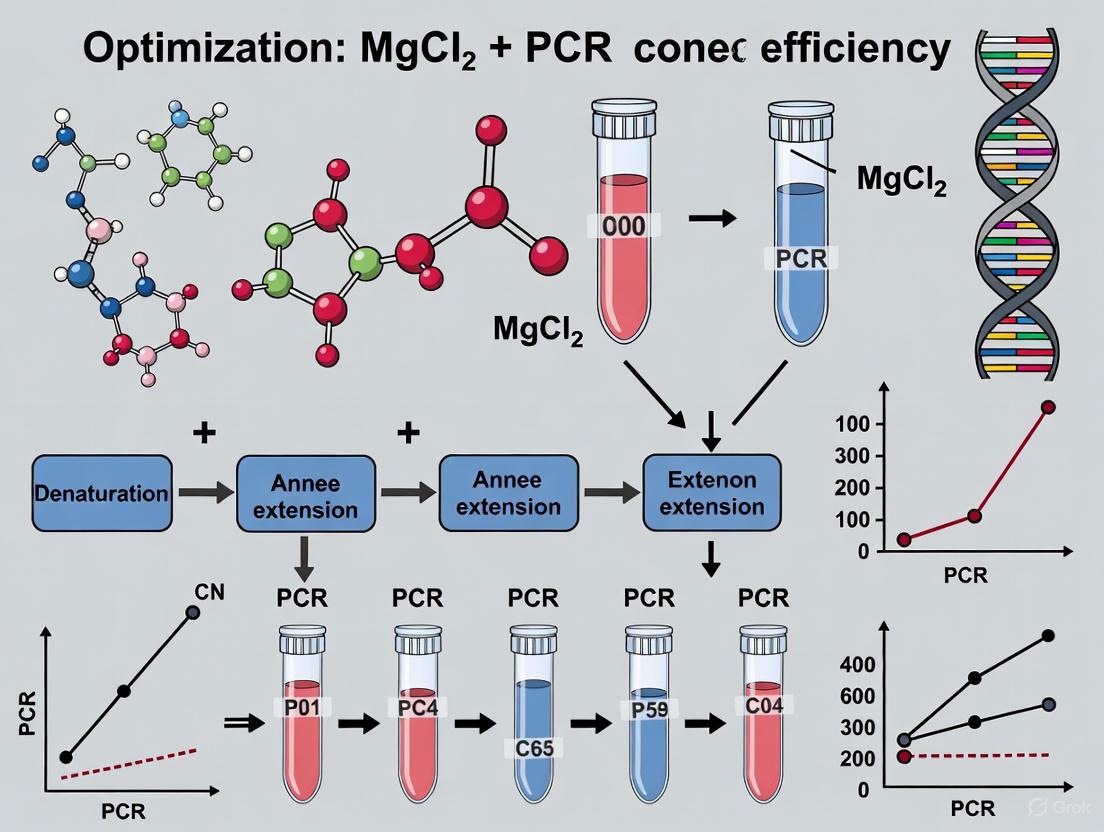
This article provides a comprehensive, evidence-based guide for researchers and drug development professionals on optimizing magnesium chloride (MgCl2) concentration to enhance Polymerase Chain Reaction (PCR) efficiency and specificity.
Optimizing MgCl2 Concentration for PCR Efficiency: An Evidence-Based Guide for Researchers
Abstract
This article provides a comprehensive, evidence-based guide for researchers and drug development professionals on optimizing magnesium chloride (MgCl2) concentration to enhance Polymerase Chain Reaction (PCR) efficiency and specificity. Drawing from a systematic meta-analysis and recent studies, we detail the critical role of Mg2+ as a DNA polymerase cofactor and its logarithmic relationship with DNA melting temperature. The content covers foundational principles, step-by-step optimization methodologies, advanced troubleshooting for challenging templates like GC-rich sequences, and comparative validation of techniques. By synthesizing current best practices, this guide aims to equip scientists with the knowledge to develop robust, reproducible PCR protocols for demanding applications in biomedical research and clinical diagnostics.
The Fundamental Role of MgCl2 in PCR: Beyond a Simple Cofactor
Frequently Asked Questions (FAQs)
What is the fundamental role of Mg²⁺ in DNA polymerase activity? Mg²⁺ is a required cofactor for all thermostable DNA polymerases used in PCR. It is essential for catalytic activity, as it facilitates the nucleophilic attack by the 3'-OH group of the primer on the α-phosphate of the incoming dNTP and helps stabilize the structure of the leaving group (pyrophosphate) during the phosphoryl transfer reaction [1] [2]. Without adequate free Mg²⁺, DNA polymerases are functionally inactive.
Why is optimizing MgCl₂ concentration critical for PCR success? Optimization is crucial because Mg²⁺ concentration affects nearly aspect of PCR performance. Without enough Mg²⁺, the DNA polymerase is not active, leading to low or no yield. Conversely, excess free Mg²⁺ reduces enzyme fidelity and promotes non-specific primer binding, resulting in spurious amplification products [3] [2] [4]. The optimal concentration balances specificity, efficiency, and fidelity.
What factors in my reaction can affect the free Mg²⁺ concentration? The amount of free Mg²⁺ is not solely determined by what you add; it is influenced by other reaction components that can bind or chelate the ion. Key factors include:
- dNTP Concentration: dNTPs bind Mg²⁺, so high dNTP concentrations can significantly reduce the amount of free Mg²⁺.
- Chelating Agents: The presence of EDTA or citrate in your DNA sample will chelate Mg²⁺.
- DNA Template Concentration: The backbone of nucleic acids also binds Mg²⁺ [2] [4].
My PCR has no product. Could Mg²⁺ be the cause? Yes. Insufficient Mg²⁺ concentration is a common cause of PCR failure, as the DNA polymerase enzyme will lack the cofactor required for its activity [3] [5]. This is one of the first parameters to check if there is no amplification.
I see multiple bands or a smeared gel. Is Mg²⁺ involved? Yes. Excess Mg²⁺ concentration can reduce the specificity of the reaction and is a known cause of non-specific amplification and smeared bands [3] [4] [5]. At high concentrations, Mg²⁺ can stabilize mismatched primer-template complexes, allowing primers to bind and extend at incorrect sites.
Troubleshooting Guide: Common Mg²⁺-Related PCR Issues
| Observation | Possible Role of Mg²⁺ | Recommended Solution |
|---|---|---|
| No amplification or low yield [3] [4] [5] | Insufficient free Mg²⁺ for polymerase activity. | Optimize Mg²⁺ concentration upward in 0.5 mM increments. Check for chelators (EDTA) in template prep. Ensure Mg²⁺ is added to the reaction. |
| Multiple or non-specific products [3] [4] [5] | Excess Mg²⁺ stabilizes non-specific primer-template binding. | Optimize Mg²⁺ concentration downward in 0.2–1.0 mM increments. Combine with an increase in annealing temperature. |
| Low fidelity (sequence errors) [3] [4] | Excess Mg²⁺ can reduce the enzyme's fidelity, increasing misincorporation. | Reduce Mg²⁺ concentration to the minimum required for efficient amplification. Use a high-fidelity polymerase. |
| Inconsistent results between assays | Un-optimized or variable Mg²⁺ levels due to differing template/dNTP concentrations. | Determine the optimal Mg²⁺ concentration for each new primer-template system. Keep template quality and dNTP concentrations consistent. |
Quantitative Data and Optimization Guidelines
The following table summarizes key quantitative relationships for MgCl₂ in PCR, synthesized from a recent meta-analysis of 61 studies [6] [7].
| Parameter | Quantitative Relationship / Optimal Range | Notes / Application |
|---|---|---|
| General Optimal Range | 1.5 – 3.0 mM | Serves as a reliable starting point for most standard PCRs [6] [7]. |
| Effect on DNA Melting (Tm) | +1.2 °C per 0.5 mM MgCl₂ | A logarithmic relationship; higher Mg²⁺ stabilizes duplex DNA, raising its melting temperature [6] [7]. |
| Template-Specific Optimization | Genomic DNA > Simple Templates | Complex templates like genomic DNA often require concentrations at the higher end of the optimal range [6] [7]. |
| Fidelity Consideration | Use minimum required concentration | Excess Mg²⁺ reduces fidelity. Some high-fidelity polymerases are supplied with buffers containing only 1 mM Mg²⁺ [2] [4]. |
Experimental Protocol: Optimizing MgCl₂ Concentration
Objective: To empirically determine the optimal MgCl₂ concentration for a specific primer-template pair by testing a range of concentrations and analyzing PCR yield and specificity.
Materials:
- Research Reagent Solutions:
- Template DNA: High-quality DNA (e.g., genomic, plasmid). Minimize EDTA carryover [3].
- Primers: Specifically designed, resuspended in sterile water or TE buffer [3] [4].
- MgCl₂ Stock Solution: Typically 25 mM, provided with many polymerase systems [2].
- 10X Reaction Buffer (Mg²⁺-free): Required if the supplied buffer does not contain Mg²⁺ [2].
- dNTP Mix: Equimolar mixture of all four dNTPs.
- Thermostable DNA Polymerase: e.g., Taq, Pfu, Q5.
- PCR-Grade Water: Nuclease-free.
Methodology:
- Prepare a Master Mix: Create a master mix containing all common reaction components except the MgCl₂ stock solution and template DNA. This includes water, buffer, dNTPs, primers, and polymerase.
- Aliquot the Master Mix: Dispense equal volumes of the master mix into 6-8 PCR tubes.
- Create Mg²⁺ Gradient: Add a varying volume of the MgCl₂ stock solution to each tube to create a concentration gradient covering, for example, 0.5 mM to 5.0 mM.
- Add Template: Add an identical, optimized amount of template DNA to each tube. Include a negative control (no template) for one of the Mg²⁺ concentrations.
- Thermal Cycling: Run the PCR using previously established or standard thermal cycling parameters.
- Analysis: Analyze the PCR products using agarose gel electrophoresis. Identify the Mg²⁺ concentration that produces the highest yield of the desired specific product with minimal to no non-specific bands or primer-dimer.
The workflow for this optimization experiment is outlined in the following diagram:
The Scientist's Toolkit: Essential Reagents for Mg²⁺ Optimization
| Item | Function in Experiment |
|---|---|
| MgCl₂ Stock Solution (e.g., 25 mM) | To titrate the final concentration of Mg²⁺ in the reaction without altering the concentration of other components [2]. |
| Magnesium-Free 10X Reaction Buffer | Provides the optimal salt and pH environment for the polymerase, allowing for the precise addition of Mg²⁺ via the separate stock solution [2]. |
| dNTP Mix (equimolar) | Substrates for DNA synthesis. Must be added at a consistent concentration as dNTPs chelate Mg²⁺ and affect free ion availability [4]. |
| High-Quality Template DNA | The target for amplification. Should be free of contaminants like EDTA, which chelates Mg²⁺ and invalidates optimization [3]. |
| Gradient Thermal Cycler | While not essential for Mg²⁺ titration, it is highly recommended for simultaneous optimization of annealing temperature, which interacts with Mg²⁺ effects [3] [4]. |
Magnesium chloride (MgCl₂) is a critical cofactor in the Polymerase Chain Reaction (PCR), and its concentration directly influences the reaction's thermodynamics, primarily through its effect on the DNA melting temperature (Tm). The Tm is the temperature at which 50% of the DNA duplex dissociates into single strands, a fundamental parameter determining the specificity and efficiency of primer annealing [6] [8]. A clear, quantitative understanding of the relationship between MgCl₂ concentration and Tm is therefore not merely beneficial but essential for developing robust and reliable PCR protocols, especially when dealing with challenging templates or specialized applications [6]. This guide synthesizes current evidence to provide researchers and drug development professionals with a structured framework for troubleshooting and optimizing MgCl₂ levels, thereby enhancing PCR success rates.
Quantitative Relationship: MgCl₂ and DNA Melting Temperature
Meta-analyses of peer-reviewed studies have established a strong, quantifiable relationship between MgCl₂ concentration and DNA melting temperature. The effect is most pronounced within a specific concentration range and follows a predictable pattern.
Core Quantitative Effect
The following table summarizes the key quantitative findings from a comprehensive meta-analysis:
| Parameter | Value | Context / Notes |
|---|---|---|
| Optimal MgCl₂ Range | 1.5 – 3.0 mM | General efficient PCR performance [6] [7]. |
| Tm Increase | +1.2 °C | Per 0.5 mM increase in MgCl₂ concentration, within the 1.5-3.0 mM range [6] [7]. |
| Relationship Type | Logarithmic | The relationship between MgCl₂ concentration and DNA melting temperature is logarithmic [6]. |
Impact of Template Complexity
The optimal MgCl₂ concentration is not universal and is significantly influenced by the complexity of the DNA template. Genomic DNA, with its high complexity and potential for secondary structures, typically requires higher MgCl₂ concentrations (often at the upper end of the optimal range or slightly higher) compared to simpler templates like plasmids or synthetic oligonucleotides [6]. This is because Mg²⁺ ions stabilize DNA duplexes and help neutralize the negative charge on the DNA backbone, which is particularly important for complex templates to facilitate proper primer binding [6].
Troubleshooting Guides and FAQs
Common PCR Problems Linked to MgCl₂ Concentration
| Problem | Possible MgCl₂-Related Cause | Recommended Solution |
|---|---|---|
| No Amplification | MgCl₂ concentration is too low. | Increase MgCl₂ concentration in 0.5 mM increments, testing up to 3.0 mM. |
| Non-specific Amplification (e.g., smeared or multiple bands) | MgCl₂ concentration is too high, reducing stringency. | Decrease MgCl₂ concentration in 0.5 mM increments, testing down to 1.0 mM. |
| Low Product Yield | Suboptimal MgCl₂ concentration leading to inefficient primer annealing or enzyme activity. | Perform a MgCl₂ titration (e.g., 1.0, 1.5, 2.0, 2.5, 3.0, 3.5 mM) to identify the concentration that maximizes yield. |
| Poor Reproducibility | Inconsistent MgCl₂ concentration between reactions. | Ensure accurate pipetting and preparation of a master mix to minimize tube-to-tube variation. |
Frequently Asked Questions (FAQs)
Q1: Why does MgCl₂ concentration affect the DNA melting temperature (Tm)? Mg²⁺ ions are divalent cations that shield the negative charges on the phosphate backbone of DNA. This electrostatic shielding reduces the repulsive forces between the two strands of the duplex, making it more stable and requiring a higher temperature (a higher Tm) to denature [6].
Q2: How do I adjust the annealing temperature (Ta) when I change the MgCl₂ concentration? Since an increase in MgCl₂ raises the Tm of the primer-template duplex, the annealing temperature (Ta) often needs to be increased correspondingly to maintain specificity. The rule of thumb is that a 0.5 mM increase in MgCl₂ raises Tm by approximately 1.2°C. Therefore, if you significantly increase MgCl₂, you may need to empirically determine the new optimal Ta, for example, by running a gradient PCR [6] [9].
Q3: My template has high GC content. How should I adjust MgCl₂? GC-rich sequences have a higher inherent Tm due to the three hydrogen bonds in G-C base pairs versus two in A-T pairs. These templates often benefit from being optimized at the higher end of the recommended MgCl₂ range (e.g., 2.5 - 3.0 mM) to help overcome the increased stability and ensure efficient denaturation and primer annealing [6].
Q4: Should I use a Tm calculation that accounts for MgCl₂?
Yes, for accurate results. Basic formulas like the Wallace Rule (Tm = 2°C(A + T) + 4°C(G + C)) do not account for salt concentration [8]. Always use an online calculator (such as the Thermo Fisher Tm Calculator or IDT OligoAnalyzer) that allows you to input the specific Mg²⁺ ion concentration of your PCR buffer for a more reliable Tm estimation [9] [10].
Q5: What is the interaction between MgCl₂ and DNA polymerase? Mg²⁺ ions are an essential cofactor for the enzymatic activity of DNA polymerase. The polymerase requires Mg²⁺ to form a catalytically active complex with the DNA template and the incoming dNTPs. An incorrect MgCl₂ concentration can thus directly inhibit polymerase function, leading to reduced yield or failed reactions [6].
Experimental Protocol: MgCl₂ Titration for PCR Optimization
This protocol provides a detailed methodology for empirically determining the optimal MgCl₂ concentration for a specific PCR assay.
Objective: To identify the MgCl₂ concentration that yields the highest specificity and amplification efficiency for a given primer-template pair.
Principle: By testing a range of MgCl₂ concentrations in identical PCR reactions, the effect on product yield, specificity, and reproducibility can be directly visualized and assessed, typically via gel electrophoresis.
Workflow Diagram
Reagents and Equipment
| Item | Function in the Experiment |
|---|---|
| MgCl₂ Stock Solution (e.g., 25 mM) | To provide a range of final Mg²⁺ concentrations in the PCR reactions. |
| 10X PCR Buffer (without MgCl₂) | To provide the core reaction environment (pH, salts) without the variable being tested. |
| DNA Polymerase | The enzyme that catalyzes DNA synthesis; its activity is Mg²⁺-dependent. |
| Template DNA | The target DNA to be amplified. |
| Forward and Reverse Primers | Oligonucleotides that define the sequence to be amplified. |
| Deoxynucleotide Triphosphates (dNTPs) | The building blocks for new DNA strands. |
| Gel Electrophoresis System | For visualizing and analyzing the PCR products for yield and specificity. |
Step-by-Step Procedure
Prepare a Master Mix: Calculate the volumes needed for (n+1) reactions, where 'n' is the number of MgCl₂ concentrations you will test. Combine the following components in a nuclease-free tube:
- Nuclease-free water
- 10X PCR Buffer (without MgCl₂)
- dNTP Mix
- Forward Primer
- Reverse Primer
- DNA Polymerase Mix gently by pipetting.
Aliquot the Master Mix: Dispense equal volumes of the master mix into each PCR tube.
Add MgCl₂: Add a different volume of MgCl₂ stock solution to each tube to achieve your desired final concentration range. A typical range is 0.5 mM to 4.0 mM in 0.5 mM increments. Include one tube with no MgCl₂ as a negative control.
- Final Reaction Volume: Adjust the volume in each tube to be identical using nuclease-free water.
Initiate PCR Cycling: Place the tubes in a thermal cycler and run the PCR protocol using an annealing temperature based on the calculated Tm of your primers. If possible, use a gradient function to simultaneously optimize the annealing temperature.
Analyze the Results:
- Prepare an agarose gel (e.g., 1-2%).
- Load the PCR products and a DNA molecular weight ladder onto the gel.
- Run the gel and visualize the DNA bands under UV light.
- Identify the MgCl₂ concentration that produces a single, sharp band of the expected size with the highest intensity and no visible non-specific products or primer-dimers.
The Scientist's Toolkit: Essential Research Reagent Solutions
The following table details key reagents and tools crucial for experiments focused on MgCl₂ and PCR optimization.
| Item | Category | Function / Explanation |
|---|---|---|
| MgCl₂ Stock Solution | Critical Reagent | The direct subject of optimization. Provides Mg²⁺ ions that act as a DNA polymerase cofactor and stabilize nucleic acid duplexes by charge shielding [6]. |
| PCR Buffer (Mg-free) | Reaction Environment | Provides the core ionic strength and pH for the reaction, allowing for the precise, independent manipulation of Mg²⁺ concentration without confounding variables. |
| High-Fidelity DNA Polymerase | Enzyme | Enzymes like Phusion or Platinum SuperFi are often used with specialized buffers and have specific Mg²⁺ requirements. Using a high-fidelity enzyme minimizes incorporation errors during amplification [9]. |
| Tm Calculator | Bioinformatics Tool | Online tools (e.g., from Thermo Fisher, IDT) use thermodynamic models to compute primer Tm based on sequence and reaction conditions, including Mg²⁺ concentration, which is vital for accurate Ta selection [9] [10]. |
| Gradient Thermal Cycler | Equipment | Allows a single PCR run to test a range of annealing temperatures, which is often necessary when adjusting Ta in response to changes in MgCl₂ concentration [9]. |
FAQs on MgCl2 Optimization in PCR
1. What is the established quantitative relationship between MgCl2 concentration and DNA melting temperature (Tm) in PCR?
A systematic meta-analysis of 61 peer-reviewed studies established a clear logarithmic relationship between MgCl2 concentration and DNA melting temperature (Tm). The research found that within the optimal concentration range of 1.5 to 3.0 mM, every 0.5 mM increase in MgCl2 concentration is associated with an approximate 1.2°C increase in DNA melting temperature [11] [7]. This relationship is crucial for predicting and controlling the stability of DNA duplexes during the annealing phase of PCR.
2. Why does MgCl2 concentration need to be optimized for different template types?
Template complexity significantly influences optimal MgCl2 requirements. The meta-analysis demonstrated that genomic DNA templates consistently require higher MgCl2 concentrations compared to more straightforward templates, such as synthetic oligonucleotides or plasmid DNA [11] [12]. This is attributed to the greater structural complexity and potential for secondary structures in genomic DNA, which require more Mg2+ ions for stabilization and efficient polymerase activity.
3. What are the consequences of using a MgCl2 concentration that is too high or too low?
- Too much MgCl2 (e.g., >3.5 mM): Leads to non-specific binding of primers, resulting in erroneous DNA replication and multiple unwanted bands on an agarose gel. It can also promote primer-dimer formation [13] [14].
- Too little MgCl2 (e.g., <1.5 mM): Primers may fail to bind effectively to the DNA template, leading to weak amplification or complete PCR failure due to insufficient DNA polymerase activity [13] [14].
4. How do I adjust MgCl2 concentration for templates with high GC content?
Templates with high GC content (>60%) possess stronger hydrogen bonding, which can hinder DNA denaturation and primer annealing. To compensate, the meta-analysis suggests increasing the MgCl2 concentration by an additional 0.3-0.8 mM beyond the standard optimal range [12]. A specific study on a GC-rich EGFR promoter sequence successfully used a MgCl2 concentration between 1.5 and 2.0 mM in the presence of the additive DMSO [15].
Table 1: The Effect of MgCl2 Concentration on PCR Parameters
| MgCl2 Concentration | Effect on DNA Melting Temperature (Tm) | Impact on PCR Specificity & Efficiency |
|---|---|---|
| < 1.5 mM | Below optimal stabilizing range | Low efficiency: Weak or failed amplification due to poor primer binding and low Taq polymerase activity [13] [14]. |
| 1.5 – 3.0 mM (Optimal Range) | Increase of ~1.2°C per 0.5 mM [11] | High specificity & efficiency: Balanced conditions for specific primer annealing and robust DNA polymerase activity [11]. |
| > 3.0 – 3.5 mM | Continues to increase, potentially beyond optimal primer Tm | Reduced specificity: Increased non-specific binding and primer-dimer formation [13] [11]. |
Table 2: Template-Specific MgCl2 Guidelines
| Template Type | Recommended MgCl2 Concentration | Notes |
|---|---|---|
| Standard Templates (Plasmid, cDNA) | 1.5 - 3.0 mM [11] | A common starting concentration is 2.0 mM [13]. |
| Genomic DNA (gDNA) | Higher end of the optimal range [11] | Increased complexity and potential inhibitors may require more Mg2+ [13] [16]. |
| High GC-Content Templates | Standard range + 0.3 - 0.8 mM [12] | Additives like DMSO are often used in conjunction [15]. |
| Real-time PCR with SYBR Green | 2 - 4 mM [17] | Must be optimized to yield low Cp values and high signal intensity. |
Experimental Protocol for MgCl2 Optimization
This protocol provides a detailed methodology for empirically determining the optimal MgCl2 concentration for a specific PCR assay, based on standardized titration practices [16] [17].
Objective: To identify the MgCl2 concentration that yields the highest specificity and yield for a given primer-template combination.
Required Reagents and Materials Table 3: Research Reagent Solutions for MgCl2 Optimization
| Reagent / Material | Function in the Experiment |
|---|---|
| Template DNA | The target DNA to be amplified (e.g., gDNA, plasmid). Its type and quality directly influence the optimal Mg2+ concentration [16]. |
| Primers (Forward & Reverse) | Synthetic oligonucleotides that define the start and end of the DNA segment to be amplified [16]. |
| Taq DNA Polymerase | The enzyme that synthesizes new DNA strands. Its activity is strictly dependent on Mg2+ as a cofactor [13] [16]. |
| dNTP Mix (dATP, dCTP, dGTP, dTTP) | The building blocks (nucleotides) for the new DNA strands. Mg2+ binds to dNTPs to facilitate their incorporation [13] [16]. |
| 10X PCR Buffer (without MgCl2) | Provides a stable chemical environment (pH, ionic strength) for the reaction. Using a Mg-free buffer is essential for a controlled titration. |
| MgCl2 Stock Solution (e.g., 25 mM) | The variable being optimized. A concentrated stock is used to create a dilution series. |
| Thermal Cycler | Instrument that automates the temperature cycles for DNA denaturation, primer annealing, and strand extension [18]. |
| Agarose Gel Electrophoresis System | Used to separate and visualize the PCR products post-amplification to assess yield and specificity [18]. |
Step-by-Step Methodology:
- Preparation of Master Mix: Create a master mix containing all PCR components except the template and the MgCl2 stock solution. This includes water, PCR buffer (without MgCl2), primers, dNTPs, and DNA polymerase. Preparing a master mix ensures consistency across all reactions [18].
- MgCl2 Titration Series: Aliquot the master mix into multiple PCR tubes. Add the MgCl2 stock solution to each tube to create a final concentration series. A recommended starting range is 1.0 mM to 4.0 mM with 0.5 mM increments (e.g., 1.0, 1.5, 2.0, 2.5, 3.0, 3.5, 4.0 mM) [16] [17].
- Add Template and Run PCR: Add an equal amount of template DNA to each tube. Gently mix and briefly centrifuge the tubes. Place them in a thermal cycler and run the standard PCR protocol optimized for your primers [18].
- Analysis of Results: Analyze the PCR products using agarose gel electrophoresis. The optimal MgCl2 concentration is identified by the tube that produces a single, intense band of the expected size [13]. Higher concentrations may show smearing or multiple bands (non-specific products), while lower concentrations may show a faint or absent target band.
Mechanism and Workflow Visualization
The following diagram illustrates the dual role of Mg2+ ions in PCR and the logical workflow for optimizing its concentration.
In the polymerase chain reaction (PCR), magnesium chloride (MgCl₂) is not merely a buffer component but a fundamental catalytic cofactor essential for DNA synthesis. Its optimization is a critical step in developing robust and reliable PCR protocols. A recent comprehensive meta-analysis of 61 peer-reviewed studies established an evidence-based sweet spot for MgCl₂ concentration, identifying a range of 1.5 to 3.0 mM as optimal for a wide array of standard PCR applications [19]. This range balances the competing demands of reaction efficiency, specificity, and fidelity. Understanding the biochemical role of Mg²⁺ is key to appreciating why its concentration requires precise modulation; it stabilizes the negative charges on the DNA backbone and dNTPs, facilitates the formation of the primer-template complex, and is directly involved in the catalytic function of DNA polymerase [16] [20]. Deviations from the optimal range can lead to reaction failure, manifesting as non-specific amplification, primer-dimer formation, or a complete absence of product. This guide provides a detailed framework for researchers to systematically incorporate this evidence-based range into their experimental design and troubleshooting practices.
Quantitative Analysis of MgCl₂ Effects
The influence of MgCl₂ on PCR parameters can be quantitatively described, providing a scientific basis for optimization. The following tables summarize key quantitative relationships and template-specific requirements derived from experimental data.
Table 1: Quantitative Effects of MgCl₂ Concentration on PCR Parameters
| MgCl₂ Concentration | Impact on DNA Melting Temperature (Tₘ) | Effect on Polymerase Fidelity | Typical Outcome on Amplification |
|---|---|---|---|
| < 1.5 mM | Decreased Tₘ; reduced primer-template stability [19] | N/A (Reaction often inefficient) | Low or no yield due to insufficient enzyme activity and poor primer annealing [3] [5] |
| 1.5 - 3.0 mM | Optimal; logarithmic increase in Tₘ (~1.2°C per 0.5 mM increase) [19] | Balanced fidelity for standard applications [20] | High yield of specific product; efficient amplification [19] |
| > 3.0 mM | Increased Tₘ; stabilizes even mismatched duplexes [19] [20] | Decreased fidelity; increased misincorporation [3] [20] | Increased non-specific bands and primer-dimer formation [16] [3] |
Table 2: Template-Specific MgCl₂ Requirements and Supporting Evidence
| Template Type | Recommended MgCl₂ Range | Evidence from Experimental Data |
|---|---|---|
| Plasmid DNA | Lower end of the range (e.g., 1.5 - 2.0 mM) | Simpler templates require less Mg²⁺ for optimal efficiency [19] [16]. |
| Genomic DNA (gDNA) | Middle to higher end of the range (e.g., 2.0 - 3.0 mM) | Higher complexity templates require more Mg²⁺; a meta-analysis confirmed genomic DNA needs higher concentrations [19]. |
| GC-Rich Templates | Often requires > 2.0 mM, up to 4.0 mM | May require elevated Mg²⁺ and additives (DMSO, betaine) to aid in denaturation and polymerase processivity [3] [20]. |
| Random-Amplified Polymorphic DNA (RAPD) | 1.5 - 4.5 mM | A study of 200 random primers found this broader range was optimal for 77% of primers, with the specific optimum being primer-dependent [21]. |
The Scientist's Toolkit: Essential Reagents for MgCl₂ Optimization
A successful optimization experiment requires high-quality reagents. The table below lists key materials and their functions.
Table 3: Key Research Reagent Solutions for PCR Optimization
| Reagent / Material | Function / Rationale | Optimization Consideration |
|---|---|---|
| Hot-Start DNA Polymerase | Prevents non-specific amplification and primer-dimer formation by inhibiting enzyme activity until the first high-temperature denaturation step [22] [20]. | Essential for high-specificity applications. Antibody-mediated hot-start enzymes activate rapidly (e.g., within 1 minute) [22]. |
| MgCl₂ Stock Solution (e.g., 25 mM) | Provides the divalent cation cofactor for the reaction. Used for fine-tuning concentration [23] [16]. | Must be sterile and nuclease-free. Prepare small aliquots to avoid contamination. |
| dNTP Mix (e.g., 10 mM each) | The building blocks for new DNA synthesis [23]. | dNTPs chelate Mg²⁺. The total Mg²⁺ concentration must exceed the dNTP concentration by at least 0.5 - 1.0 mM [24]. |
| PCR Buffers (with/without Mg²⁺) | Provides the optimal ionic environment and pH for polymerase activity and primer-template binding [20]. | Note if the buffer is supplied with Mg²⁺. If it is, any additional MgCl₂ will contribute to the final concentration. |
| PCR Additives (DMSO, Betaine) | Assist in denaturing complex secondary structures in GC-rich templates, allowing for more efficient amplification [3] [20]. | Their use can influence the optimal Mg²⁺ concentration, often allowing for a lower optimal range [20]. |
| Gradient Thermal Cycler | Allows for the empirical determination of the optimal annealing temperature by running a single experiment with a temperature gradient across the block [3]. | Critical for efficient multi-parameter optimization. |
Biochemical Mechanism and Optimization Workflow
The following diagrams illustrate the core biochemical role of Mg²⁺ in the PCR reaction and a systematic workflow for its optimization.
Frequently Asked Questions (FAQs) & Troubleshooting
Q1: I see no amplification product on my gel. Could MgCl₂ be the issue? Yes. The absence of a product is often linked to insufficient Mg²⁺ concentration. Mg²⁺ is an essential cofactor for DNA polymerase; too little can render the enzyme inactive or inefficient [3] [5]. Begin troubleshooting by performing a MgCl₂ titration, starting from 1.0 mM up to 4.0 mM in 0.5 mM increments. Also, verify that your template DNA is of high quality and purity, as contaminants like EDTA (a potent Mg²⁺ chelator) can effectively reduce the free Mg²⁺ available for the polymerase [3].
Q2: My PCR produces multiple non-specific bands or a smear. How can adjusting MgCl₂ help? Excessive MgCl₂ concentration reduces the stringency of primer annealing. At high concentrations (typically >3.0 mM), Mg²⁺ stabilizes even imperfect matches between the primer and non-target sequences on the template DNA, leading to mis-priming and non-specific amplification [19] [3] [20]. To resolve this, systematically lower the MgCl₂ concentration in 0.2-0.5 mM steps. Simultaneously, consider increasing the annealing temperature by 1-2°C increments to further enhance specificity [3] [5].
Q3: Why does the optimal MgCl₂ concentration vary for different templates and primers? The optimal concentration depends on several factors that affect Mg²⁺ availability and binding:
- Template Complexity: Genomic DNA, with its vast size and complexity, requires more Mg²⁺ than a simple plasmid DNA to stabilize all potential binding sites [19].
- dNTP Concentration: dNTPs chelate Mg²⁺. If you increase the dNTP concentration in your reaction, you may need to correspondingly increase the MgCl₂ concentration to ensure sufficient free Mg²⁺ is available for the polymerase [16] [20].
- Primer Sequence and Concentration: Higher primer concentrations require more Mg²⁺ to stabilize the increased number of primer-template duplexes [20].
Q4: How does MgCl₂ concentration affect PCR fidelity (error rate)? There is a direct trade-off between yield and fidelity. Higher Mg²⁺ concentrations (>3.0 mM) can increase yield but decrease fidelity by promoting misincorporation of nucleotides. This occurs because excess Mg²⁺ stabilizes the DNA polymerase in a conformation that is less discriminating against mismatched base pairs [3] [20]. For applications requiring high-fidelity amplification, such as cloning or sequencing, it is critical to use the lowest effective Mg²⁺ concentration that still provides a robust yield.
Q5: What is the best way to empirically determine the optimal MgCl₂ concentration for my new assay? The most reliable method is to perform a MgCl₂ titration experiment.
- Prepare a master mix containing all reaction components except MgCl₂.
- Aliquot the master mix into several tubes.
- Add MgCl₂ to each tube to create a final concentration gradient (e.g., 1.0, 1.5, 2.0, 2.5, 3.0, 3.5, 4.0 mM).
- Run the PCR under otherwise identical conditions.
- Analyze the products by agarose gel electrophoresis. The condition that produces the strongest specific band with the least background is your optimal concentration [23] [20]. Using a thermal cycler with a gradient function allows you to simultaneously optimize annealing temperature.
Detailed Experimental Protocol: MgCl₂ Titration
This protocol provides a step-by-step methodology for determining the optimal MgCl₂ concentration for any PCR assay.
Materials:
- DNA template (10–100 ng genomic DNA or 0.1–1 ng plasmid DNA)
- Forward and reverse primers (10 µM working stock each)
- 10x PCR Buffer (without MgCl₂)
- 25 mM MgCl₂ stock solution
- dNTP mix (10 mM total)
- Hot-Start DNA Polymerase (e.g., 5 U/µL)
- Nuclease-free water
- Thin-walled PCR tubes and thermal cycler
Procedure:
- Calculate and Prepare Master Mix: Calculate the volumes required for (N+1) reactions, where N is the number of MgCl₂ concentrations you will test. Combine all common components in a 1.5 mL microcentrifuge tube on ice:
- Nuclease-free water: Q.S. to final volume
- 10x PCR Buffer (without MgCl₂): 1x final concentration
- dNTP mix (10 mM): 0.2 mM final concentration
- Forward Primer (10 µM): 0.5 µM final concentration
- Reverse Primer (10 µM): 0.5 µM final concentration
- DNA Polymerase: 1–2.5 units per 50 µL reaction
- DNA Template: Add last, mix gently by pipetting.
Aliquot and Add MgCl₂: Distribute the master mix into N PCR tubes. Add the appropriate volume of 25 mM MgCl₂ stock to each tube to achieve your desired final concentration gradient. A suggested range is 1.0, 1.5, 2.0, 2.5, 3.0, and 3.5 mM.
Run Thermal Cycler Program: Place tubes in the thermal cycler and run the following standard program:
- Initial Denaturation/Activation: 95°C for 2–5 minutes.
- Amplification (25–35 cycles):
- Denature: 95°C for 15–30 seconds.
- Anneal: 55–65°C for 15–30 seconds (optimize using a gradient).
- Extend: 72°C for 1 minute per kb of product.
- Final Extension: 72°C for 5–10 minutes.
- Hold: 4°C.
Analyze Results: Separate PCR products by agarose gel electrophoresis. Visualize bands under UV light. Identify the MgCl₂ concentration that yields the most intense specific product with minimal to no non-specific amplification or primer-dimer [23] [20].
FAQs: Mg2+ Interactions with dNTPs and Primers
Q1: How does Mg2+ facilitate the chemical reaction of DNA polymerization with dNTPs?
A1: Mg2+ is a essential catalytic cofactor for DNA polymerase. It plays a two-metal-ion role in the enzyme's active site [1]:
- Metal A (Catalytic Metal): Coordinates with the 3'-OH group of the primer terminus, facilitating its deprotonation and subsequent nucleophilic attack on the alpha-phosphate of the incoming dNTP [1].
- Metal B (dNTP-Bound Metal): Binds to the beta- and gamma-phosphates of the dNTP, stabilizing the negative charge on the phosphate groups and aiding in pyrophosphate leaving group departure [1] [25]. This coordination is mediated by invariant aspartate residues in the polymerase's active site, creating the geometry necessary for efficient phosphodiester bond formation [1].
Q2: What is the nature of the interaction between Mg2+ and primers, and how does it affect PCR?
A2: Mg2+ interacts with the phosphate backbone of primers and the DNA template. Being a divalent cation, it neutralizes the negative charges on the phosphate groups [13]. This reduces the electrostatic repulsion between the primer and the template strand, thereby:
- Stabilizing the primer-template duplex.
- Increasing the melting temperature (Tm) of the duplex. A meta-analysis showed that within the optimal range of 1.5-3.0 mM, every 0.5 mM increase in MgCl2 raises the DNA melting temperature by approximately 1.2°C [6] [7]. This stabilization is crucial for specific and efficient primer annealing.
Q3: My PCR shows nonspecific products. Could an imbalance between Mg2+ and dNTPs be the cause?
A3: Yes, this is a common cause. The Mg2+ in the reaction has two key partners: the DNA polymerase (as a cofactor) and the dNTPs. Mg2+ binds to dNTPs to form the active substrate (Mg-dNTP) for the polymerase [26] [13]. Therefore, the concentration of free Mg2+ available for the enzyme is the total Mg2+ minus that which is bound to dNTPs.
- High dNTP concentrations can chelate most of the Mg2+, leaving insufficient free cofactor for the polymerase, leading to weak or no amplification [26].
- Excess free Mg2+ (when dNTPs are too low) reduces the fidelity of the polymerase and can stabilize nonspecific primer-template interactions, resulting in mispriming and multiple bands on a gel [3] [27] [13]. Optimizing their ratio is critical. A good starting point is 0.2 mM of each dNTP and 1.5-2.0 mM MgCl2, but this requires empirical testing.
Q4: How do I systematically optimize Mg2+ concentration for a new PCR assay?
A4: Follow this protocol for a standard 50 µL reaction:
- Prepare a Master Mix containing all constant components: buffer, template DNA, primers, dNTPs, and DNA polymerase.
- Aliquot the master mix into 0.2 mL PCR tubes.
- Spike in MgCl2 to create a concentration gradient. A typical range is 0.5 mM to 5.0 mM in 0.5 mM increments.
- Run the PCR using your standardized thermal cycling protocol.
- Analyze the results by agarose gel electrophoresis. The optimal condition will show a single, intense band of the expected size with minimal to no primer-dimers or nonspecific products. Use this concentration for future experiments.
Q5: Why do complex templates like genomic DNA or GC-rich sequences often require higher Mg2+ concentrations?
A5: Higher Mg2+ concentrations are needed for two primary reasons:
- Stabilization of Complex DNA: Genomic DNA is long and complex, while GC-rich sequences form stable secondary structures. Higher Mg2+ concentrations provide greater stabilization of the double-stranded DNA, facilitating the denaturation and annealing steps necessary for specific primer binding [6] [3].
- Counteracting Inhibitors: DNA extracts from complex sources like blood or plant tissues may carry PCR inhibitors that can chelate Mg2+ ions. A higher Mg2+ concentration compensates for this loss, ensuring an adequate amount remains available for the polymerase [13].
Quantitative Effects of MgCl2 Concentration
The table below summarizes key quantitative relationships derived from a meta-analysis of MgCl2 optimization in PCR [6] [7].
| Parameter | Effect of Increasing MgCl2 | Optimal Range | Notes |
|---|---|---|---|
| DNA Melting Temperature (Tm) | Increases | 1.5 - 3.0 mM | Every 0.5 mM increase raises Tm by ~1.2°C within this range. |
| PCR Efficiency | Bell-shaped curve | Template-dependent | Too little: poor yield; Too much: nonspecific products. |
| Reaction Specificity | Decreases at high concentrations | Template-dependent | High [Mg2+] stabilizes nonspecific primer binding. |
| Polymerase Fidelity | Decreases at high concentrations | Balanced with dNTPs | Excess Mg2+ increases misincorporation rate. |
Mg2+ Coordination in DNA Polymerization
The following diagram illustrates the key interactions of Mg2+ ions with both the dNTP and the primer terminus at the DNA polymerase active site, based on structural and mechanistic studies [1] [25].
Experimental Protocol: Optimizing Mg2+ with a dNTP Titration
This protocol provides a detailed methodology for a two-dimensional optimization of Mg2+ and dNTP concentrations, which is critical for challenging PCR applications [26] [27].
Objective: To empirically determine the optimal combination of MgCl2 and dNTP concentrations for maximum specificity and yield of a specific PCR amplicon.
Materials:
- Template DNA: e.g., 50 ng/µL human genomic DNA.
- Primers: Forward and reverse primers (10 µM stock each).
- dNTP Mix: 10 mM stock solution (2.5 mM of each dNTP).
- MgCl2: 50 mM stock solution.
- 10X PCR Buffer: (without MgCl2).
- DNA Polymerase: e.g., Taq DNA Polymerase (5 U/µL).
- Nuclease-free Water.
Procedure:
- Prepare dNTP Master Mixes: Create four master mixes with different final dNTP concentrations (0.2 mM, 0.4 mM, 0.6 mM, 0.8 mM) when combined in the final 25 µL reaction. Keep all other components constant.
- Set Up Mg2+ Gradient: For each dNTP master mix, aliquot 23 µL into five PCR tubes. Spike each row of tubes with MgCl2 to create a gradient of final concentrations (e.g., 1.0, 1.5, 2.0, 2.5, 3.0 mM).
- Initiate Reaction: Add 1 µL of DNA polymerase to each tube (final 25 µL). Gently mix and briefly centrifuge.
- Thermal Cycling: Run the following standard PCR protocol:
- Initial Denaturation: 95°C for 3 minutes.
- 35 Cycles:
- Denaturation: 95°C for 30 seconds.
- Annealing: 55-65°C (primer-specific) for 30 seconds.
- Extension: 72°C for 1 minute per kb.
- Final Extension: 72°C for 5 minutes.
- Analysis: Resolve 5-10 µL of each PCR product on a 1-2% agarose gel. Identify the condition with the strongest desired band intensity and the absence of nonspecific bands or primer-dimers.
The Scientist's Toolkit: Essential Reagents for Studying Mg2+ Interactions
The table below lists key reagents and their specific functions in experiments designed to probe Mg2+ interactions in PCR [1] [26] [27].
| Reagent / Material | Function in Experimentation |
|---|---|
| MgCl2 Solution (MgSO4 for some enzymes) | The source of Mg2+ ions; concentration is the primary variable for optimization. |
| dNTP Mix (individual nucleotides) | Substrates for DNA synthesis; their concentration must be balanced and optimized relative to Mg2+. |
| Proofreading DNA Polymerase (e.g., Q5, Pfu) | High-fidelity enzyme used to assess the impact of Mg2+ on misincorporation rates and replication accuracy. |
| PCR Buffer (without MgCl2) | Provides a consistent pH and ionic environment, allowing for precise manipulation of Mg2+ concentration. |
| Gradient Thermal Cycler | Essential for testing a range of annealing temperatures simultaneously, often performed in conjunction with Mg2+ optimization. |
| Agarose Gel Electrophoresis System | Standard method for visualizing PCR product yield, specificity, and amplicon size to assess reaction success. |
Systematic MgCl2 Optimization: A Step-by-Step Protocol for Reliable Results
Core Concepts and Quantitative Data
Magnesium chloride (MgCl₂) is a critical cofactor for DNA polymerase activity in PCR. Its concentration directly influences reaction efficiency, specificity, and fidelity by affecting the enzyme's processivity and the DNA template's melting temperature (Tm) [6] [7].
| MgCl₂ Concentration (mM) | Impact on DNA Melting Temperature (Tm) | Typical Effect on PCR Efficiency | Recommended Template Type |
|---|---|---|---|
| 1.5 mM | Baseline Tm | Efficient for standard templates | Plasmid DNA, simple amplicons |
| 2.0 mM | Increase of ~1.2°C | High efficiency | Standard genomic DNA |
| 2.5 mM | Increase of ~2.4°C | May reduce specificity | Complex or GC-rich templates |
| 3.0 mM | Increase of ~3.6°C | Risk of nonspecific products | Genomic DNA, challenging targets |
A systematic meta-analysis established that the optimal MgCl₂ concentration for PCR typically falls within a range of 1.5 mM to 3.0 mM [6] [7]. Starting at the lower end of this range, specifically at 1.5 mM, is recommended as a baseline because it minimizes the risk of nonspecific amplification while often providing sufficient enzyme activity for successful amplification of standard templates [6].
The relationship between MgCl₂ and DNA melting temperature is quantifiable: for every 0.5 mM increase in MgCl₂ concentration, the DNA melting temperature increases by approximately 1.2 °C [6]. This thermodynamic effect is crucial for calculating the correct annealing temperature in your protocol.
Troubleshooting Guide
Issue 1: No or Low PCR Product Yield
Q: I started with a 1.5 mM MgCl₂ baseline and see no product or very faint bands on my gel. What should I do?
- Possible Cause: Insufficient Mg²⁺ for polymerase activity. The MgCl₂ concentration may be below the optimal level for your specific template-polymerase system.
- Solution:
- Perform a MgCl₂ titration, testing concentrations between 1.5 mM and 3.0 mM in 0.5 mM increments [6] [28].
- For complex templates (e.g., genomic DNA), higher concentrations within this range are often required [6] [3].
- Verify that the presence of EDTA or other chelators in your template preparation is not sequestering Mg²⁺ ions, which would necessitate a higher concentration in the master mix [3].
Issue 2: Multiple or Nonspecific Bands
Q: My PCR resulted in multiple unexpected bands. Could my MgCl₂ concentration be the problem?
- Possible Cause: Excessive MgCl₂ concentration. High Mg²⁺ levels can reduce stringency, stabilize nonspecific primer-template interactions, and promote mispriming [3] [28].
- Solution:
- Systematically lower the MgCl₂ concentration starting from your baseline, using 0.2-0.5 mM decrements [28].
- Combine this with an increase in annealing temperature by 1-2°C to enhance specificity [3] [29].
- Use a hot-start DNA polymerase to prevent activity at room temperature and reduce primer-dimer formation [3] [28].
Issue 3: Smeared Bands or High Background
Q: The gel shows a smeared background instead of a clean, sharp product. How is MgCl₂ involved?
- Possible Cause: Compromised reaction specificity, potentially from excessive Mg²⁺ or other components.
- Solution:
Issue 4: Poor Fidelity (Sequence Errors)
Q: My sequencing results show mutations in the cloned PCR product. Does MgCl₂ play a role in fidelity?
- Possible Cause: Elevated MgCl₂ concentration can decrease the fidelity of some DNA polymerases by promoting misincorporation of nucleotides [28].
- Solution:
Experimental Optimization Protocol
Detailed MgCl₂ Titration Methodology
This protocol provides a step-by-step guide to empirically determine the optimal MgCl₂ concentration for your specific PCR assay.
1. Reagent Preparation:
- Prepare a master mix containing all standard PCR components except MgCl₂ and template DNA.
- Prepare a stock solution of MgCl₂ at a known concentration (e.g., 25 mM) for accurate dilution.
2. Reaction Setup:
- Aliquot the master mix into 6 separate PCR tubes.
- Add MgCl₂ stock solution to each tube to achieve the final concentrations outlined in Table 2.
- Add template DNA last to initiate the reaction.
Table 2: MgCl₂ Titration Series Setup for a 50 µL Reaction
| Tube No. | Volume of 25 mM MgCl₂ Stock (µL) | Final MgCl₂ Concentration (mM) |
|---|---|---|
| 1 | 3.0 | 1.5 |
| 2 | 4.0 | 2.0 |
| 3 | 4.5 | 2.25 |
| 4 | 5.0 | 2.5 |
| 5 | 5.5 | 2.75 |
| 6 | 6.0 | 3.0 |
3. Thermal Cycling:
- Run the PCR using your standard cycling parameters.
- If nonspecific amplification is suspected, consider using a gradient cycler to simultaneously test a range of annealing temperatures.
4. Product Analysis:
- Analyze the PCR products by agarose gel electrophoresis [30].
- Identify the MgCl₂ concentration that yields the strongest specific product with the least background.
The Scientist's Toolkit
Table 3: Essential Research Reagent Solutions for MgCl₂ Optimization
| Reagent / Material | Function in PCR Optimization | Key Considerations |
|---|---|---|
| MgCl₂ Stock Solution | Source of Mg²⁺ ions; critical cofactor for DNA polymerase. | Always vortex thoroughly before use to resuspend any precipitated salt [29]. Use a high-purity, nuclease-free source. |
| Hot-Start DNA Polymerase | Reduces nonspecific amplification and primer-dimer formation at low temperatures. | Essential for high-specificity applications. Allows focus on Mg²⁺ optimization without interference from premature enzyme activity [3] [28]. |
| dNTP Mix | Building blocks for DNA synthesis. | Use a balanced, equimolar mix. Unbalanced dNTPs can chelate Mg²⁺ and alter effective concentration, affecting both yield and fidelity [28]. |
| PCR Additives (e.g., DMSO, GC Enhancers) | Assist in denaturing complex templates (e.g., high GC content). | Note that additives can affect primer-template binding; annealing temperature may need re-optimization after MgCl₂ is set [3]. |
| Nuclease-Free Water | Solvent for all reaction components. | Ensures no contaminating nucleases or ions interfere with the reaction. |
Frequently Asked Questions (FAQs)
Q: Why is 1.5 mM recommended as a starting point for MgCl₂ optimization? A: Starting at 1.5 mM, the lower end of the empirically determined optimal range (1.5–3.0 mM), prioritizes reaction specificity. It minimizes the risk of nonspecific amplification caused by excess Mg²⁺, providing a clean baseline from which to carefully increase concentration if needed for yield [6] [7].
Q: How does template type influence the optimal MgCl₂ concentration? A: Template complexity is a major factor. Genomic DNA, with its high complexity and potential secondary structures, often requires higher MgCl₂ concentrations (closer to 2.5-3.0 mM). In contrast, simpler templates like plasmid DNA frequently amplify efficiently at the 1.5 mM baseline [6].
Q: Are there other critical parameters to re-optimize if I change the MgCl₂ concentration? A: Yes. The most critical parameter is the annealing temperature. Since Mg²⁺ stabilizes DNA duplexes and raises the melting temperature (Tm), an increase in MgCl₂ may require a corresponding increase in annealing temperature to maintain specificity. A gradient PCR block is highly recommended for concurrent optimization [6] [3].
Q: My supplier's PCR buffer already contains MgCl₂. Can I still optimize? A: Many commercial buffers do contain a set concentration of MgCl₂, often around 1.5 mM. For optimization, you should seek out or request buffers that are Mg²⁺-free or supplement with additional MgCl₂ as needed, following the titration protocol above [30].
FAQs on MgCl2 Titration for PCR Optimization
1. Why is optimizing MgCl2 concentration critical for PCR efficiency? Magnesium chloride (MgCl2) is an essential cofactor for DNA polymerase activity. It directly influences the enzyme's ability to incorporate nucleotides and stabilizes the interaction between primers and the DNA template by neutralizing negative charges on their phosphate backbones [26]. The concentration of MgCl2 significantly affects PCR thermodynamics and kinetics; precise modulation is crucial as both high and low concentrations can lead to reaction failure, non-specific amplification, or primer-dimer formation [6] [14].
2. What is the typical effective range for MgCl2 concentration in PCR? A comprehensive meta-analysis of recent studies identifies 1.5 mM to 3.0 mM as the optimal range for efficient PCR performance in many contexts [6]. Earlier empirical studies and resources suggest testing a broader range, from 1.5 mM to 4.5 mM [21] [14]. Your experimental design to test from 0.5 mM to 5.0 mM effectively covers the full spectrum from sub-optimal to supra-optimal conditions, allowing for complete characterization.
3. How does MgCl2 concentration affect DNA melting temperature (Tm)? There is a strong logarithmic relationship between MgCl2 concentration and DNA melting temperature. Within the 1.5–3.0 mM range, every 0.5 mM increase in MgCl2 concentration raises the DNA melting temperature by approximately 1.2 °C [6]. This quantitative relationship is key to understanding how MgCl2 impacts primer annealing and template denaturation.
4. How should I adjust the MgCl2 concentration for different template types? Template complexity is a major factor. The same meta-analysis found that genomic DNA templates often require higher MgCl2 concentrations than more straightforward templates, such as plasmid DNA or cDNA [6]. This means that an optimal concentration for one template type may not be directly transferable to another.
5. What are common issues caused by incorrect MgCl2 concentrations?
- Low MgCl2 (<1.5 mM): Results in weak or no amplification due to insufficient DNA polymerase cofactor activity and unstable primer-template complexes [14].
- High MgCl2 (>3.0-4.0 mM): Increases non-specific primer binding, leading to spurious amplification products and primer-dimer formation [14] [31].
Quantitative Effects of MgCl2 on PCR Parameters
Table 1: Key Quantitative Relationships for MgCl2 in PCR
| Parameter | Effect of Increasing MgCl2 | Quantitative Relationship | Notes |
|---|---|---|---|
| DNA Melting Temp (Tm) | Increases | +1.2 °C per 0.5 mM increase [6] | Logarithmic relationship; most significant within 1.5-3.0 mM range. |
| General Optimal Range | --- | 1.5 - 3.0 mM [6] | Established via meta-analysis. |
| Broader Tested Range | --- | 1.5 - 4.5 mM [14] [21] | Found suitable for majority of primers in RAPD studies. |
| PCR Efficiency | Bell-shaped curve | Peak efficiency within optimal range [6] | Falls off sharply at both low and high concentrations. |
Table 2: Template-Specific MgCl2 Considerations
| Template Type | Recommended Starting Point | Rationale |
|---|---|---|
| Plasmid DNA | Lower end of range (~1.5 mM) | Less complex structure requires less Mg2+ for stabilization [6] [26]. |
| Genomic DNA (gDNA) | Mid to higher end of range (>2.0 mM) | Higher complexity and longer length require more Mg2+ for efficient denaturation and primer binding [6] [26]. |
| GC-Rich Templates | May require higher concentration | Mg2+ helps stabilize the stronger hydrogen bonding of GC pairs [6]. |
Detailed Experimental Titration Protocol
Title: MgCl2 Titration to Determine Optimal PCR Efficiency
Objective: To empirically determine the optimal MgCl2 concentration for a specific PCR assay by testing a range from 0.5 mM to 5.0 mM.
Principle: By setting up a series of identical PCR reactions that differ only in MgCl2 concentration, you can visualize the direct impact on amplification yield, specificity, and efficiency. The concentration that produces the highest yield of the desired product with the least non-specific background is considered optimal.
Materials & Reagents:
- Template DNA: e.g., genomic DNA (5-50 ng) or plasmid DNA (0.1-1 ng) [26].
- Primers: Forward and reverse, resuspended to a stock concentration (e.g., 100 µM). Use at a final concentration of 0.1-1 µM [26].
- 10X PCR Buffer: (without MgCl2).
- MgCl2 Stock Solution: (e.g., 25 mM or 50 mM).
- dNTP Mix: Final concentration of each dNTP typically 0.2 mM [26].
- DNA Polymerase: (e.g., Taq polymerase), 1-2 units per 50 µL reaction [26].
- Nuclease-Free Water.
Table 3: The Researcher's Toolkit: Essential Reagents for MgCl2 Titration
| Reagent / Material | Function / Rationale |
|---|---|
| MgCl2 Stock Solution | The variable being titrated; essential cofactor for DNA polymerase and stabilizer of nucleic acid interactions [6] [26]. |
| PCR Buffer (Mg-free) | Provides a consistent pH and ionic environment without confounding the Mg2+ variable. |
| DNA Polymerase | Enzyme that synthesizes new DNA strands; its activity is directly dependent on Mg2+ [26]. |
| Template DNA | The target to be amplified; type and quality significantly influence optimal Mg2+ requirements [6]. |
| Oligonucleotide Primers | Define the start and end of the amplicon; their binding stability is influenced by Mg2+ concentration [6]. |
| dNTP Mix | Nucleotide building blocks for new DNA strands; Mg2+ is required for their incorporation and also binds to them, affecting free Mg2+ availability [26]. |
Procedure:
- Prepare Master Mix: Calculate the volumes needed for (n+1) reactions to account for pipetting error. Combine all common components in a single tube: nuclease-free water, 10X PCR buffer (without MgCl2), dNTP mix, primers, DNA polymerase, and template DNA. Mix thoroughly by gentle vortexing and brief centrifugation.
- Aliquot Master Mix: Dispense equal volumes of the master mix into each PCR tube or well of a PCR plate. The number of tubes should correspond to the number of MgCl2 concentrations you are testing.
- Add MgCl2: Add a different, pre-calculated volume of the MgCl2 stock solution to each tube to achieve your desired final concentration series (e.g., 0.5, 1.0, 1.5, 2.0, 2.5, 3.0, 3.5, 4.0, 4.5, 5.0 mM). Include one negative control (no template) with a mid-range Mg2+ concentration.
- Perform PCR Amplification: Place the tubes in a thermal cycler and run the appropriate cycling program for your primers and template.
- Analyze Results: Separate the PCR products using agarose gel electrophoresis. Visualize the DNA bands under UV light.
Expected Results and Analysis:
- Low MgCl2 (e.g., 0.5-1.0 mM): Faint or absent target band due to poor polymerase activity and primer annealing.
- Optimal MgCl2 (e.g., 1.5-3.0 mM): A single, intense band of the expected size.
- High MgCl2 (e.g., >3.5 mM): Multiple non-specific bands or a smeared background as primer-stringency decreases. Primer-dimer formation may also be visible.
Troubleshooting Guide for the Titration Experiment
Table 4: Common Problems and Solutions During MgCl2 Titration
| Problem | Potential Causes | Solutions |
|---|---|---|
| No amplification in any tube | - Incorrectly prepared MgCl2 stock- Non-functional polymerase or dNTPs- Faulty thermal cycler program | - Confirm stock concentration calculations- Check enzyme and reagent viability with a positive control reaction- Verify thermal cycler block temperature calibration |
| Smear of non-specific products across all concentrations | - Primer concentration too high- Annealing temperature too low- Contaminated template | - Titrate primer concentration downward (0.1-0.5 µM) [26]- Increase annealing temperature in 2-5°C increments- Prepare fresh template dilutions |
| Weak target band even at "optimal" Mg2+ | - Insufficient template amount- dNTPs degraded- Suboptimal primers | - Increase template amount within recommended range (e.g., 50 ng gDNA) [26]- Use fresh dNTP aliquot- Re-evaluate primer design for secondary structures and Tm |
| Inconsistent results between replicates | - Pipetting errors, especially of small volumes- Inadequate mixing of master mix- Evaporation from tubes | - Use calibrated pipettes and techniques for high accuracy- Mix master mix thoroughly before aliquoting- Ensure a tight seal on all PCR tubes/plates |
Workflow and Conceptual Diagrams
Diagram Title: Experimental Workflow for MgCl2 Titration
Diagram Title: Effects of MgCl2 Concentration on PCR Outcome
Precision Pipetting and Master Mix Preparation for Reproducible Titration
Troubleshooting Common Pipetting and Master Mix Issues
Q1: My PCR results show high variability between replicates, even with careful pipetting. What could be the cause?
Inconsistent results often stem from pipetting inaccuracies, especially with small volumes. To improve precision:
- Pre-wet pipette tips: Aspirate and dispense the liquid at least three times before taking the final sample. This equilibrates the air cushion inside the tip, leading to more accurate aspiration, particularly for volatile liquids [32] [33].
- Check pipette calibration: Ensure pipettes are regularly calibrated and maintained. Pipette accuracy decreases significantly below 35% of the maximum volume, so select an appropriate pipette size [32] [34].
- Use consistent technique: Hold the pipette vertically for small volumes (<50 µL), use a smooth, controlled plunger action, and consistently use the "touch off" method to ensure the full volume is dispensed [32].
Q2: How can I prevent contamination during master mix preparation?
PCR is highly sensitive to contamination from amplicons, nucleases, or other samples.
- Physical separation: Perform master mix preparation, template addition, and post-PCR analysis in separate, dedicated areas [35] [36].
- Use filter tips: Aerosol-resistant filter tips prevent aerosols from entering the pipette shaft and contaminating future reactions [36].
- Work with aliquots: Prepare single-use aliquots of all master mix components and controls. This prevents repeated freeze-thaw cycles and protects your entire stock from a single contamination event [36].
- Wear gloves and change them frequently, especially when moving between work zones [36].
Q3: I am troubleshooting my MgCl2 titration experiment, but I am not seeing a clear optimal concentration. What should I check?
A lack of a clear result in titration can be due to several factors.
- Verify master mix homogeneity: Ensure the master mix is thoroughly mixed before aliquoting. Non-homogeneous reagents can create concentration gradients, leading to inconsistent reactions [3].
- Confirm component concentrations: When using a master mix that includes MgCl2, your additions will create a final concentration that is a combination of both. Be sure to calculate the total Mg2+ concentration in each tube. For fine-tuning, consider a master mix without MgCl2 [37].
- Check template quality: Impurities in the DNA template can inhibit the polymerase and skew results. Analyze template purity via spectrophotometry (260/280 ratio) and consider additional purification if necessary [35] [3].
Detailed Experimental Protocol for Master Mix Preparation and Titration
This protocol is designed for setting up a reproducible MgCl2 titration experiment to optimize PCR efficiency.
Workflow Overview
Step-by-Step Procedure
Pre-Work Preparation
- Calculate Volumes: Create a table to calculate the required volumes for all components for the total number of reactions (n), including positive and negative controls. Add at least one extra volume to account for pipetting loss [36]. An example for a single 50 µL reaction is shown below.
- Chill Reagents: Place all PCR components (except the polymerase if it is hot-start) on ice to minimize non-specific amplification before thermal cycling [35].
Prepare Master Mix
- Create a Master Mix: In a single tube, combine all common components for all reactions except for MgCl2 and template DNA. This includes PCR-grade water, buffer, dNTPs, primers, and polymerase.
- Pipetting Order: Add components in order of increasing cost. This way, if a mistake is made, less expensive reagents are wasted [36].
- Mix Thoroughly: Gently vortex the master mix and then give it a quick spin in a centrifuge. Avoid introducing bubbles.
Aliquot Master Mix and Titrate MgCl2
- Aliquot: Dispense an equal volume of the master mix into each PCR tube or well. Using an electronic pipette with a "repeat dispense" mode is highly recommended for consistency and speed [36].
- Add MgCl2: Prepare a dilution series of MgCl2. Using a fresh pipette tip for each tube, add the different MgCl2 solutions to the aliquoted master mix to create your titration series. A typical titration range is 0.5-5.0 mM final concentration, adjusted in 0.2-1.0 mM increments [35] [38].
Add Template and Run PCR
- Add Template: Add a fixed volume of template DNA to each tube. For highly viscous DNA, dispense it onto the wall of the tube and then gently spin down to mix [36].
- Add Controls: Include a no-template control (NTC) to check for contamination and a positive control with a known working Mg2+ concentration.
- Amplify: Place tubes in a thermal cycler and start the programmed run.
Master Mix Calculation and Reagent Specifications
Master Mix Calculation Table The following table provides an example for calculating a single 50 µL reaction when using individual components. Multiply these volumes by your total number of reactions (plus one extra) to make a master mix [36].
| Reagent | Stock Concentration | Final Concentration | Volume per 50 µL Reaction |
|---|---|---|---|
| PCR Buffer | 10X | 1X | 5.0 µL |
| MgCl2 | 25 mM | Variable (Titrated) | Variable |
| dNTP Mix | 10 mM | 200 µM | 1.0 µL |
| Forward Primer | 10 µM | 0.25 µM | 1.25 µL |
| Reverse Primer | 10 µM | 0.25 µM | 1.25 µL |
| DNA Polymerase | 5 U/µL | 1.25 U | 0.25 µL |
| Template DNA | - | ~0.5 µg | 0.5 µL |
| PCR-Grade Water | - | - | To 50 µL |
Research Reagent Solutions This table lists key materials and their functions for ensuring reproducible titration experiments.
| Item | Function in Experiment |
|---|---|
| Electronic Pipette | Motor-controlled plunger movement offers superior precision and accuracy for pipetting small, critical volumes compared to manual pipettes. Repeat dispense mode simplifies master mix aliquoting [36]. |
| Low-Retention Filter Tips | Minimize liquid adhesion to the tip wall, ensuring the full volume is dispensed. The filter barrier prevents aerosol contamination of the pipette [36]. |
| Hot-Start DNA Polymerase | Remains inactive until a high-temperature activation step, preventing non-specific amplification and primer-dimer formation that can occur during reaction setup on the bench [35] [39] [38]. |
| MgCl2 Solution (Separate) | Using a master mix without pre-added MgCl2, or having it in a separate vial, is essential for creating a true titration series to accurately optimize the final Mg2+ concentration [37]. |
| PCR-Grade Water | Nuclease-free and devoid of PCR inhibitors, ensuring no enzymatic degradation of components or interference with the polymerase activity [36]. |
Integrating Optimization with Annealing Temperature Adjustments
FAQs: The Interaction Between MgCl₂ and Annealing Temperature
Q1: How does MgCl₂ concentration directly affect the annealing temperature in PCR?
MgCl₂ concentration and annealing temperature are thermodynamically linked. Mg²⁺ ions stabilize the DNA duplex by neutralizing the negative charge on the phosphate backbone of DNA. A higher MgCl₂ concentration increases the stability of the bond between the primer and the template, effectively raising the DNA's melting temperature (Tm). A comprehensive meta-analysis quantified that every 0.5 mM increase in MgCl₂ concentration within the optimal 1.5–3.0 mM range is associated with an approximate 1.2 °C increase in DNA melting temperature [6]. This means that if you adjust your MgCl₂ concentration, you may also need to re-optimize your annealing temperature for maximum efficiency.
Q2: I am getting no amplification. Should I adjust the MgCl₂ or the annealing temperature first?
When facing no amplification, a systematic approach is best. First, verify that your DNA template is of high quality and concentration, and that all reagents were added correctly [5] [3].
If these are confirmed, a logical optimization sequence is recommended:
- First, optimize the annealing temperature. Start by calculating the Tm of your primers and set the annealing temperature to 3–5°C below the lowest Tm [40] [41]. If this fails, test a temperature gradient [42].
- Then, titrate the MgCl₂ concentration. If annealing temperature adjustments do not yield the desired product, systematically optimize the Mg²⁺ concentration. The optimal range for Taq DNA Polymerase is typically 1.5–2.0 mM, but it should be titrated in 0.5 mM increments up to 4 mM if necessary [41]. Insufficient Mg²⁺ can result in no product, while excess Mg²⁺ can lead to non-specific amplification [3] [41].
Q3: My PCR produces multiple non-specific bands. How can I use MgCl₂ and annealing temperature to fix this?
Non-specific amplification is a common issue that can often be resolved by increasing the reaction stringency.
- Increase the Annealing Temperature: This is the most direct method to enhance specificity. Raise the temperature in 1–2°C increments to promote stricter primer binding [40] [3].
- Reduce MgCl₂ Concentration: Excess Mg²⁺ can stabilize mismatched primer-template binding [3] [42]. Titrate the MgCl₂ concentration downward in 0.2–1.0 mM increments to find a concentration that supports specific amplification without non-specific background [42].
- Use a Hot-Start DNA Polymerase: This can prevent primer-dimer formation and non-specific synthesis during reaction setup [5] [3].
Troubleshooting Guide
| Observation | Possible Cause | Solution |
|---|---|---|
| No Product or Low Yield | MgCl₂ too low / Annealing temp too high | - Verify template quality and quantity [3].- Optimize MgCl₂ upward (e.g., 0.5 mM increments) from a starting point of 1.5 mM [6] [41].- Lower the annealing temperature in 2–3°C increments, starting from 3–5°C below primer Tm [40] [42]. |
| Non-Specific Bands / Smearing | MgCl₂ too high / Annealing temp too low | - Optimize MgCl₂ downward (e.g., 0.2-1.0 mM increments) [42].- Increase annealing temperature in 2–3°C increments [40] [3].- Use a hot-start polymerase to prevent activity at room temperature [5] [3]. |
| Primer-Dimer Formation | Primers self-complementary / Annealing temp too low | - Redesign primers to avoid 3' end complementarity [23].- Increase annealing temperature [5].- Optimize primer concentration (typically 0.1–0.5 µM) [41]. |
Quantitative Data for Experimental Planning
Table 1: MgCl₂ Concentration Effects on PCR Parameters
| Parameter | Optimal Range / Effect | Quantitative Relationship | Notes |
|---|---|---|---|
| General Optimal Range | 1.5 – 3.0 mM | Found to be optimal for efficient PCR performance across a wide range of templates [6]. | Varies with template, buffer, and dNTP concentration [41]. |
| Effect on Melting Temp (Tm) | Increases DNA Tm | +1.2 °C per 0.5 mM MgCl₂ (within 1.5-3.0 mM range) [6]. | A logarithmic relationship; crucial for co-optimization with annealing temperature. |
| Taq DNA Polymerase | 1.5 – 2.0 mM | This is the standard optimal range [41]. | Must be titrated as dNTPs and template can chelate Mg²⁺ [41]. |
| Template Dependency | Higher for complex DNA | Genomic DNA templates often require higher concentrations than simple plasmids [6]. | GC-rich or complex templates may need Mg²⁺ at the higher end of the range. |
Table 2: Annealing Temperature Calculation Guidelines
| Calculation Method | Formula / Guideline | Best Used For / Notes |
|---|---|---|
| Basic Rule of Thumb | ( Ta = Tm^{lowest} - (3 - 5°C) ) | Standard, straightforward PCR with well-designed primers. A common starting point [40] [41]. |
| Salt-Adjusted Formula | ( T_m = 81.5 + 16.6(log[Na^+]) + 0.41(\%GC) - 675/\text{primer length} ) | More accurate calculation that accounts for salt concentration in the buffer [40]. |
| Optimization Equation | ( Ta^{Opt} = 0.3 \times Tm^{primer} + 0.7 \times T_m^{product} - 14.9 ) | A more advanced method for fine-tuning, considering the product Tm [43]. |
| Universal Annealing | ~60°C | Using polymerases with isostabilizing buffers to simplify protocol standardization [40]. |
Experimental Protocol: Co-Optimization of MgCl₂ and Annealing Temperature
This protocol provides a methodology for the simultaneous optimization of MgCl₂ concentration and annealing temperature.
Materials (The Scientist's Toolkit)
| Reagent / Material | Function in Optimization |
|---|---|
| Template DNA | High-quality, purified DNA (1 pg–1 µg depending on complexity) [41] [23]. |
| Primers | Specific forward and reverse primers, resuspended to a working concentration (e.g., 20 µM) [23]. |
| MgCl₂ Stock Solution | Typically 25 mM, for titration across a range of concentrations [41] [23]. |
| 10X PCR Buffer | Supplied with the DNA polymerase, may or may not contain Mg²⁺ [44]. |
| dNTP Mix | Equimolar mixture of all four dNTPs (final conc. 200 µM each) [41] [23]. |
| Hot-Start DNA Polymerase | Reduces non-specific amplification during reaction setup [5] [3]. |
| Thermal Cycler with Gradient | Essential for testing multiple annealing temperatures simultaneously in a single run [40]. |
Step-by-Step Procedure:
- Prepare Master Mix: Create a master mix containing all common reagents (water, buffer, dNTPs, polymerase, primers) for the number of reactions plus 10% extra. Omit MgCl₂ and template at this stage [23].
- Aliquot for MgCl₂ Titration: Aliquot the master mix into a series of PCR tubes.
- Add MgCl₂: Supplement each tube with MgCl₂ to create a concentration series (e.g., 1.0 mM, 1.5 mM, 2.0 mM, 2.5 mM, 3.0 mM, 4.0 mM) [41].
- Add Template: Add the DNA template to each tube. Include a negative control (no template) for one of the MgCl₂ concentrations.
- Thermal Cycling with Gradient: Place the tubes in a gradient thermal cycler and use a program that includes a gradient at the annealing step, spanning a range (e.g., 50°C to 68°C) that brackets the calculated Tm of your primers [40] [42].
- Analysis: Analyze the PCR products by agarose gel electrophoresis. The optimal condition will be the combination of MgCl₂ concentration and annealing temperature that produces a single, strong band of the expected size with minimal background.
Optimization Workflow Diagram
FAQs and Troubleshooting Guide
Q1: Why does MgCl2 concentration need to be adjusted based on the DNA template type?
MgCl2 concentration requires template-specific adjustment because different DNA templates vary significantly in complexity and structure. Genomic DNA is large and complex with a high degree of secondary structure and potential contaminants, requiring higher Mg2+ concentrations to stabilize primer-template interactions and overcome interference. In contrast, plasmid DNA is simpler, smaller, and less complex, needing lower Mg2+ concentrations for optimal specificity. The divalent magnesium ions function as a polymerase cofactor and stabilize nucleic acid duplexes by neutralizing the negative charges on phosphate backbones [6] [26]. The optimal range for most PCR reactions is 1.5-4.5 mM, but the precise concentration must be tailored to the template [45].
Q2: What are the specific symptoms of excessive MgCl2 in a PCR reaction?
- Non-specific Amplification: Appearance of multiple unexpected bands or a smear on an agarose gel due to reduced primer annealing stringency [45] [31].
- Primer-Dimer Formation: Enhanced formation of primer-dimers as excess Mg2+ facilitates annealing between the primers themselves rather than to the template [45].
- Error-Prone Synthesis: Although not always visible on a gel, excessively enhanced enzymatic activity can sometimes lead to misincorporation of nucleotides [31].
Q3: What are the consequences of using insufficient MgCl2?
- Low or No Yield: Drastically reduced amplification efficiency due to inadequate DNA polymerase activity and unstable primer-template complexes [46] [31].
- Complete Amplification Failure: The reaction fails to produce any visible product on a gel when Mg2+ levels are below a critical threshold [31].
Q4: What is the recommended starting point for MgCl2 concentration with genomic and plasmid DNA?
Table 1: Recommended MgCl2 Starting Concentrations
| Template Type | Recommended Starting Concentration | Notes |
|---|---|---|
| Genomic DNA (gDNA) | 2.0 - 3.0 mM | Higher complexity and potential contaminants often necessitate a higher concentration [6] [26]. |
| Plasmid DNA | 1.5 - 2.0 mM | Less complex structure allows for lower, more specific concentrations [6] [26]. |
Experimental Optimization Data
Quantitative Effects of MgCl2 Concentration
Table 2: MgCl2 Effects on PCR Parameters
| Parameter | Effect of Increasing MgCl2 | Quantitative Relationship |
|---|---|---|
| DNA Melting Temperature (Tm) | Increases | Every 0.5 mM increase raises Tm by ~1.2°C within the 1.5-3.0 mM range [6] [7]. |
| Reaction Specificity | Decreases (after optimum) | High concentrations reduce stringency, leading to non-specific bands [45] [31]. |
| Polymerase Efficiency | Increases (up to a point) | Essential cofactor; activity is low without it but inhibited at very high concentrations [46] [26]. |
Detailed Optimization Protocols
Protocol 1: MgCl2 Titration Experiment for Template-Specific Optimization
This protocol is essential for empirically determining the ideal MgCl2 concentration for any new primer-template combination.
- Prepare a Master Mix: Create a master mix containing all standard PCR components (1X PCR buffer, 200 µM dNTPs, 0.1-1 µM primers, 0.5-2.5 U DNA polymerase, and template DNA) but omit MgCl2 [46] [23]. The buffer used should not contain Mg2+.
- Aliquot the Master Mix: Dispense equal volumes of the master mix into 5-8 PCR tubes.
- Spike with MgCl2: Add MgCl2 from a concentrated stock to each tube to create a final concentration gradient. A recommended range is 1.0 mM to 4.0 mM in 0.5 mM increments.
- Run PCR: Perform amplification using your standard thermal cycling program.
- Analyze Results: Resolve the PCR products on an agarose gel. Identify the tube with the strongest desired band and the cleanest background (least non-specific products) [31] [23].
Protocol 2: Annealing Temperature Gradient coupled with MgCl2 Optimization
For challenging templates, combining a MgCl2 titration with an annealing temperature gradient can pinpoint optimal conditions.
- Select MgCl2 Levels: Choose 2-3 promising MgCl2 concentrations based on the results from Protocol 1 or the recommended starting points.
- Set Up Reactions: Set up separate reaction sets for each chosen MgCl2 concentration.
- Program Thermal Cycler: Use a thermal cycler with a gradient function to run simultaneous reactions across a range of annealing temperatures (e.g., 50°C to 65°C) for each MgCl2 set [46] [47].
- Gel Analysis: Analyze all reactions on a gel to find the combination of MgCl2 concentration and annealing temperature that yields the best specificity and yield [31].
The Scientist's Toolkit: Essential Research Reagents
Table 3: Key Reagents for PCR and MgCl2 Optimization
| Reagent / Tool | Function / Purpose | Template-Specific Consideration |
|---|---|---|
| MgCl2 Stock Solution | Source of Mg2+ ions; critical cofactor and stabilizer. | Concentration must be optimized for each template type (gDNA vs. plasmid) [46] [6]. |
| Thermostable DNA Polymerase | Enzyme that synthesizes new DNA strands. | Amount may need adjustment with difficult templates; high fidelity enzymes may have different Mg2+ requirements [31] [26]. |
| dNTP Mix | Building blocks for new DNA synthesis. | Final concentration typically 200 µM each; Mg2+ concentration must be slightly higher than total dNTP concentration as Mg2+ binds to dNTPs [46] [26]. |
| PCR Buffers | Maintain pH and provide ionic strength. | Check if the buffer already contains MgCl2; this affects how much additional MgCl2 to add [23]. |
| NCBI Primer-BLAST | Online tool for designing and checking primer specificity. | Crucial for ensuring primers are unique to the target sequence in complex genomic DNA, reducing background [48]. |
| PCR Additives | Enhancers like DMSO or Betaine. | Can be particularly helpful for amplifying GC-rich regions in genomic DNA, and may interact with optimal Mg2+ levels [23]. |
Troubleshooting Guides
FAQ: Magnesium Chloride (MgCl₂) and GC-Rich PCR
How does magnesium chloride (MgCl₂) concentration affect PCR efficiency? MgCl₂ is an essential cofactor for DNA polymerase activity. It stabilizes the DNA double helix and the primer-template complex, and directly influences the enzyme's catalytic efficiency [20] [14]. The concentration is a critical balancing act:
- Too low (<1.5 mM): The polymerase activity is severely reduced, leading to weak or no amplification because the primer cannot stably bind to the template [14].
- Too high (>2.5 mM for many templates): The reaction loses stringency, stabilizing even incorrect primer-template bindings. This results in non-specific amplification, primer-dimer formation, and increased error rates (lower fidelity) [20] [14].
Why are GC-rich sequences like the EGFR promoter particularly difficult to amplify? GC-rich sequences form stable secondary structures and have a high melting temperature (Tm), which can prevent the DNA strands from separating completely during the denaturation step. This can halt polymerase progression and lead to PCR failure [15] [49].
What is the recommended starting range for MgCl₂ concentration? A final concentration between 1.5 mM and 3.0 mM is a typical starting point for most PCRs [50] [51]. For challenging templates, a finer optimization within this range is often necessary.
How does MgCl₂ interact with other PCR components? dNTPs chelate Mg²⁺ ions. Therefore, the concentration of "free" Mg²⁺ available for the polymerase is the total Mg²⁺ minus the amount bound by dNTPs. If you increase dNTP concentration, you may need to correspondingly increase the MgCl₂ concentration to maintain sufficient free Mg²⁺ [20].
Troubleshooting Guide for MgCl₂ Optimization
| Observation | Possible Cause | Recommended Solution |
|---|---|---|
| No PCR Product | MgCl₂ concentration too low | Increase MgCl₂ concentration in 0.2 mM to 0.5 mM increments, testing up to 3.0 mM [51]. |
| Excessive Mg²⁺ chelation | Ensure MgCl₂ concentration is higher than the total dNTP concentration. Increase MgCl₂ if dNTP concentration is high [20]. | |
| Multiple or Non-Specific Bands | MgCl₂ concentration too high | Decrease MgCl₂ concentration in 0.2 mM to 0.5 mM increments [51] [20]. |
| Reduced reaction stringency | Combine MgCl₂ reduction with an increase in annealing temperature [15] [51]. | |
| Smear of Bands on Gel | MgCl₂ concentration too high | Titrate MgCl₂ downward to increase stringency and reduce mispriming [51] [20]. |
| Poor Yield or Faint Band | Suboptimal MgCl₂ | Titrate MgCl₂ concentration to find the optimum for the specific primer-template pair [31]. |
| Complex (GC-rich) template | Combine MgCl₂ optimization with PCR enhancers like DMSO or betaine [15] [51]. |
Experimental Protocol: MgCl₂ Titration for GC-Rich EGFR Promoter Amplification
This protocol is based on the experimental work by Obradovic et al. (2013) to amplify the GC-rich EGFR promoter sequence [15].
Background and Objective
The epidermal growth factor receptor (EGFR) promoter region features an extremely high Guanine-Cytosine (GC) content, making it a challenging target for standard PCR. The objective is to establish an optimal MgCl₂ concentration that ensures specific and efficient amplification of this region for subsequent genotyping analysis [15] [49].
Materials and Reagents
Research Reagent Solutions
| Reagent | Function in the Reaction |
|---|---|
| Template DNA | Genomic DNA extracted from formalin-fixed paraffin-embedded (FFPE) lung tumor tissue. A concentration of at least 2 μg/ml is required [15]. |
| Primers | Specific primers for the EGFR promoter region targeting SNPs -216G>T and -191C>A [15]. |
| Taq DNA Polymerase | Thermostable enzyme that synthesizes new DNA strands. |
| 10X PCR Buffer | Provides the optimal pH and salt conditions (e.g., Tris-HCl, KCl) for the polymerase to function [23]. |
| dNTP Mix | The building blocks (dATP, dCTP, dGTP, dTTP) for new DNA synthesis. |
| MgCl₂ Solution | An essential cofactor for DNA polymerase. The concentration is the critical variable being optimized [20] [14]. |
| Dimethyl Sulfoxide (DMSO) | A PCR enhancer that helps denature GC-rich DNA by disrupting base pairing. A final concentration of 5% was found to be necessary [15]. |
| Sterile Nuclease-Free Water | To bring the reaction to its final volume. |
Step-by-Step Procedure
Prepare the Master Mix: In a sterile 1.8 ml microcentrifuge tube, combine the following components for multiple reactions, including one extra to account for pipetting error [23]:
- Sterile Nuclease-Free Water (Q.S. to 50 μl final volume per reaction)
- 10X PCR Buffer (5 μl per 50 μl reaction)
- dNTP Mix (1 μl of a 10 mM stock per reaction)
- Forward Primer (1 μl of a 20 μM stock)
- Reverse Primer (1 μl of a 20 μM stock)
- DMSO (to a final concentration of 5%)
- Taq DNA Polymerase (0.5 - 2.5 units per reaction)
Aliquot the Master Mix: Dispense equal volumes of the Master Mix into five (5) thin-walled 0.2 ml PCR tubes.
Add MgCl₂: Add MgCl₂ stock solution to each tube to create the following final concentration gradient:
- Tube 1: 1.0 mM
- Tube 2: 1.5 mM
- Tube 3: 2.0 mM
- Tube 4: 2.5 mM
- Tube 5: 3.0 mM
Add Template DNA: Add an equal amount of template DNA to each tube (e.g., 0.5 μl of a 2 ng/μl genomic DNA solution). Mix the components gently by pipetting up and down.
Perform Thermal Cycling: Place the tubes in a thermal cycler and run the following program, which was optimized for the high GC content [15]:
- Initial Denaturation: 95°C for 5 minutes
- 35 Cycles of:
- Denaturation: 95°C for 30 seconds
- Annealing: 64°C for 30 seconds (7°C higher than the calculated Tm for these primers) [15]
- Extension: 72°C for 1 minute
- Final Extension: 72°C for 7 minutes
- Hold: 4°C
Analyze Results: Analyze the PCR products by agarose gel electrophoresis. Compare the specificity and yield of the desired amplicon across the different MgCl₂ concentrations.
Expected Results and Data Analysis
The study by Obradovic et al. found that the adequate MgCl₂ concentration for amplifying the GC-rich EGFR promoter ranged from 1.5 to 2.0 mM [15]. The results of your titration experiment can be summarized as follows:
Summary of Expected PCR Results Across MgCl₂ Concentrations
| MgCl₂ Concentration | Specific Band Intensity | Non-Specific Amplification | Primer Dimer |
|---|---|---|---|
| 1.0 mM | None / Very Faint | None | None |
| 1.5 mM | Strong | Minimal | None |
| 2.0 mM | Strong | Minimal | None |
| 2.5 mM | Strong | Moderate | Possible |
| 3.0 mM | Strong | High | Likely |
The optimal condition for this specific GC-rich target is a MgCl₂ concentration of 1.5 mM, as it provides a strong specific product with minimal background.
Visual Workflow and Mechanism
This diagram illustrates the logical workflow for optimizing MgCl₂ in a challenging PCR, leading to the final specific amplification.
This diagram outlines the core biochemical role of Mg²⁺ ions in the PCR reaction cycle.
Advanced Troubleshooting: Correcting Common MgCl2-Related PCR Failures
Question
Why do I see multiple unexpected bands or a smeared appearance instead of a single, sharp band when analyzing my PCR results on a gel, and how can adjusting magnesium chloride (MgCl₂) concentration resolve this?
Answer
Non-specific bands and smearing in PCR are classic signs of reduced reaction specificity, often caused by excessive magnesium chloride (MgCl₂) concentration. Mg²⁺ ions are essential cofactors for DNA polymerase, but when their concentration is too high, it can lead to improper primer binding and spurious amplification.
The Role of MgCl₂ in PCR Specificity
Magnesium chloride is a critical PCR component with two primary functions: it acts as an essential cofactor for DNA polymerase enzyme activity, and it stabilizes the binding of primers to the DNA template by neutralizing the negative charges on their phosphate backbones [26]. However, the concentration must be precisely controlled.
- Excessive MgCl₂: Promotes non-specific primer binding by reducing the stringency of the primer-template interaction. This allows primers to anneal to partially complementary or incorrect sites on the DNA template, leading to the amplification of multiple, unintended products that appear as extra bands or a smear on a gel [3] [5] [14].
- Insufficient MgCl₂: Can lead to weak or no amplification, as the DNA polymerase functions poorly and primer-template complexes are less stable [3] [14].
Establishing the Optimal MgCl₂ Range
A recent comprehensive meta-analysis of 61 studies established a clear quantitative relationship between MgCl₂ concentration and PCR performance. The following table summarizes the key evidence-based findings on MgCl₂ effects [6] [7].
Table 1: Evidence-Based Effects of MgCl₂ Concentration on PCR Performance
| Parameter | Optimal Range | Quantitative Effect | Impact of High Concentration | Impact of Low Concentration |
|---|---|---|---|---|
| General Efficiency | 1.5 – 3.0 mM | N/A | Increased non-specific amplification; primer-dimer formation [6] [14] | Weak or no amplification [6] [14] |
| DNA Melting Temperature (Tm) | 1.5 – 3.0 mM | Increases by ~1.2°C per 0.5 mM increment [6] | Increased Tm can stabilize mismatched primers [6] | Reduced Tm can prevent proper primer annealing [6] |
| Template Dependency | Varies by template | Genomic DNA often requires higher concentrations than simple templates [6] |
Step-by-Step MgCl₂ Optimization Protocol
To systematically eliminate smearing and non-specific bands by optimizing MgCl₂, follow this detailed protocol.
Materials Needed
- Research Reagent Solutions:
- Template DNA: High-quality, intact genomic, cDNA, or plasmid DNA [3].
- Primers: Well-designed, specific oligonucleotides with minimal self-complementarity [3] [26].
- MgCl₂ Stock Solution: Typically 25 mM, provided with many PCR buffers [52].
- 10X PCR Buffer: Usually supplied with the DNA polymerase.
- dNTP Mix: Equimolar mixture of all four deoxynucleotides [26].
- DNA Polymerase: A hot-start enzyme is recommended to enhance specificity [3] [5].
Experimental Procedure
- Prepare a Master Mix: Create a master mix containing all common PCR components (water, buffer, dNTPs, primers, DNA polymerase) except the template DNA and MgCl₂. This ensures consistency across reactions.
- Aliquot the Master Mix: Dispense equal volumes of the master mix into eight PCR tubes.
- Titrate MgCl₂: Add the calculated volume of 25 mM MgCl₂ stock to each tube to create a final concentration gradient. The table below outlines a standard titration series for a 50 µL reaction.
- Add Template DNA: Add an identical, optimal amount of template DNA to each tube.
- Run PCR: Perform amplification using your standard thermal cycling protocol.
- Analyze Results: Separate the PCR products by agarose gel electrophoresis. Identify the MgCl₂ concentration that yields the strongest, sharpest target band with the least background smearing or non-specific products.
Table 2: MgCl₂ Titration Setup for a 50 µL Reaction
| Tube | Target Final [MgCl₂] (mM) | Volume of 25 mM MgCl₂ Stock (µL) |
|---|---|---|
| 1 | 1.0 | 2.0 |
| 2 | 1.5 | 3.0 |
| 3 | 2.0 | 4.0 |
| 4 | 2.5 | 5.0 |
| 5 | 3.0 | 6.0 |
| 6 | 3.5 | 7.0 |
| 7 | 4.0 | 8.0 |
| 8 | 4.5 | 9.0 |
Complementary Strategies to Resolve Smearing
While MgCl₂ optimization is often the most critical step, smearing can be multifactorial. Consider these complementary approaches if problems persist:
- Verify Primer Design and Concentration: Ensure primers are specific, have appropriate melting temperatures (55–70°C), and do not form primer-dimers. High primer concentrations can also cause non-specific binding; the optimal range is typically 0.1–1.0 µM [3] [26].
- Optimize Thermal Cycling Conditions: Increase the annealing temperature in 1–2°C increments to improve stringency. Use a gradient thermal cycler if available. Also, ensure the denaturation temperature and time are sufficient, especially for GC-rich templates [3] [5].
- Use a Hot-Start DNA Polymerase: These enzymes are inactive until a high-temperature activation step, preventing non-specific amplification and primer-dimer formation during reaction setup [3] [5].
- Check Template Quality and Quantity: Degraded DNA or excessive template can contribute to smearing. Re-purify the template DNA and test a dilution series to find the optimal input amount [3] [52].
- Employ PCR Enhancers: For difficult templates (e.g., GC-rich), additives like DMSO, betaine, or formamide can help by reducing secondary structures and lowering the DNA melting temperature [3] [23].
Decision Workflow for Troubleshooting Smearing
The following diagram outlines a logical pathway to diagnose and resolve non-specific bands and smearing, with MgCl₂ optimization as the central strategy.
Within the broader context of optimizing MgCl₂ for PCR efficiency research, addressing non-specific bands and smearing is a fundamental challenge. The evidence is clear: excessive MgCl₂ is a primary culprit that reduces reaction stringency. A systematic titration of MgCl₂ within the 1.5–4.5 mM range, as detailed in this guide, is a critical and often definitive step. This specific intervention, supported by complementary optimizations of primer design and thermal cycling parameters, provides a robust methodology to achieve high-specificity amplification, which is essential for reliable data in downstream research and diagnostic applications.
FAQ: The Critical Role of MgCl2 in PCR
Why is MgCl2 absolutely essential for a successful PCR? MgCl2 serves two non-negotiable functions in the polymerase chain reaction (PCR). First, the magnesium ion (Mg²⁺) acts as a crucial cofactor for Taq DNA polymerase, the enzyme that builds the new DNA strand. Without Mg²⁺, the polymerase exhibits little to no enzymatic activity [13] [53]. Second, Mg²⁺ facilitates the binding of primers to their target sequences by neutralizing the negative charges on the DNA backbone, which stabilizes the primer-template duplex and increases the melting temperature (Tm) [6] [53].
What are the direct consequences of insufficient MgCl2 in a reaction? Insufficient MgCl2 concentration is a primary cause of PCR failure, typically resulting in:
- Very low or no yield of the desired PCR product.
- A complete absence of any amplified DNA band on an agarose gel. This occurs because the DNA polymerase lacks the necessary cofactor to function, and primers cannot form stable complexes with the template DNA, halting the amplification process [13] [54].
How does MgCl2 concentration relate to other reaction components? The concentration of free Mg²⁺ is critical because it is consumed by several reaction components. Mg²⁺ binds to dNTPs, primers, and the DNA template. It can also be chelated by impurities like EDTA in the DNA sample [54]. Therefore, the optimal concentration must account for these factors. A general rule is to maintain a 1:2 molar ratio of dNTPs to Mg²⁺ [54]. Increasing dNTP concentrations will effectively lower the amount of free Mg²⁺ available for the polymerase.
Troubleshooting Guide: Diagnosing and Correcting Low MgCl2
Step 1: Initial Diagnosis and Systematic Analysis
A methodical approach is required to confirm that low yield is due to insufficient MgCl2. The following workflow outlines the diagnostic process and its relationship to the underlying biochemistry.
Step 2: Experimental Optimization Protocol
Once other error sources are ruled out, perform a MgCl2 titration to determine the optimal concentration for your specific reaction.
Objective: To empirically determine the MgCl2 concentration that maximizes the yield of your specific target amplicon.
Materials:
- PCR reagents: Template DNA, primers, dNTPs, 10X PCR Buffer (without MgCl2), Taq DNA polymerase, sterile water.
- MgCl2 stock solution (e.g., 25 mM or 50 mM).
- PCR tubes and thermal cycler.
Methodology:
- Prepare a master mix containing all standard PCR components except MgCl2 and the template DNA.
- Aliquot the master mix into multiple PCR tubes.
- Add a different volume of the MgCl2 stock solution to each tube to create a concentration gradient. A standard starting range is 1.0 mM to 4.0 mM in 0.5 mM increments [6] [54].
- Add template DNA to each tube.
- Run the PCR using your standard cycling parameters.
- Analyze the results by agarose gel electrophoresis.
Expected Results and Interpretation: The table below summarizes the expected outcomes across a range of MgCl2 concentrations.
Table 1: Interpretation of MgCl2 Titration Results
| MgCl2 Concentration | Expected PCR Result | Biological Explanation |
|---|---|---|
| < 1.5 mM | Low or no yield; faint or absent target band. | Insufficient Mg²⁺ cofactor for polymerase activity; unstable primer-template binding [13] [54]. |
| 1.5 - 3.0 mM | Optimal Range: Strong yield of a single, specific band. | Balanced conditions provide adequate Mg²⁺ for polymerase function and stable primer annealing without promoting mis-priming [6]. |
| > 3.0 - 5.0 mM | Multiple non-specific bands; potential primer-dimer formation. | Excess Mg²⁺ stabilizes any primer-DNA interaction, including incorrect ones, reducing reaction specificity [13] [55]. |
Step 3: Advanced Optimization and Context-Specific Adjustments
The optimal MgCl2 concentration is not universal; it depends on template and primer properties. Recent meta-analysis of 61 studies (1973-2024) provides quantitative guidance [6] [7].
Quantitative Effects: The analysis established a logarithmic relationship between MgCl2 concentration and DNA melting temperature (Tm). Within the 1.5–3.0 mM range, every 0.5 mM increase in MgCl2 raises the Tm by approximately 1.2°C [6]. This directly impacts the optimal annealing temperature.
Adjust your MgCl2 strategy based on your experimental system using the following guidelines.
Table 2: MgCl2 Optimization Guide for Different PCR Templates
| Template Characteristic | Recommended MgCl2 Adjustment | Rationale |
|---|---|---|
| Standard Template (e.g., plasmid) | Start at 1.5 mM and titrate. | Straightforward amplification with minimal interference. |
| Complex Genomic DNA | Often requires higher concentrations (2.0 - 4.0 mM) [6] [54]. | Increased complexity and potential for inhibitors require more Mg²⁺ to stabilize binding and act as a cofactor. |
| GC-Rich Templates | May require increased concentration or specialized additives (e.g., DMSO, betaine) [55]. | Stable secondary structures and GC bonds necessitate stronger stabilization for efficient primer binding and polymerase progression. |
| Presence of Chelators (e.g., EDTA in template prep) | Increase concentration to compensate for bound Mg²⁺ [54]. | Chelators sequester Mg²⁺, reducing the amount available for the PCR reaction. |
The Scientist's Toolkit: Essential Research Reagents
Table 3: Key Reagents for MgCl2 and PCR Optimization
| Reagent | Function in PCR | Optimization Consideration |
|---|---|---|
| MgCl2 Solution | Source of Mg²⁺ ions; polymerase cofactor and reaction stabilizer. | The most critical variable after primer design. Must be titrated for each new primer-template system [6] [31]. |
| dNTP Mix | Building blocks for new DNA strand synthesis. | High purity is critical. Concentration must be balanced with Mg²⁺, as dNTPs chelate Mg²⁺ ions [54]. |
| 10X PCR Buffer | Provides optimal pH and ionic strength (often includes KCl). | Check if the buffer is supplied with or without MgCl2. This determines whether you need to add MgCl2 separately [23] [54]. |
| Hot-Start DNA Polymerase | Reduces non-specific amplification and primer-dimer formation by requiring heat activation. | Highly recommended for complex templates (e.g., genomic DNA) and when optimizing Mg²⁺, as it improves specificity across a wider Mg²⁺ range [55] [54]. |
| PCR Enhancers (e.g., DMSO, BSA, Betaine) | Assist in denaturing complex secondary structures, especially in GC-rich templates. | Their use can alter the effective Tm of the reaction, which may require re-optimization of both annealing temperature and MgCl2 concentration [55]. |
Magnesium chloride (MgCl2) is a critical cofactor for DNA polymerase activity and significantly influences the thermodynamics of DNA denaturation and annealing in PCR. A comprehensive meta-analysis of 61 peer-reviewed studies establishes that the precise modulation of MgCl2 concentration, tailored to specific template characteristics, is fundamental for successful amplification, particularly with complex templates like genomic DNA [6] [7]. This guide provides evidence-based troubleshooting and protocols to optimize MgCl2 for your research.
FAQs on MgCl2 and Complex Templates
Q1: Why does genomic DNA require special consideration for MgCl2 concentration? Genomic DNA is structurally complex and often contains secondary structures and high GC-rich regions. The meta-analysis confirms that template complexity significantly influences optimal MgCl2 requirements, with genomic DNA templates consistently requiring concentrations on the higher end of the optimal spectrum to stabilize polymerase activity and facilitate denaturation [6] [7].
Q2: What is the fundamental relationship between MgCl2 and PCR efficiency? MgCl2 concentration has a direct, logarithmic relationship with DNA melting temperature (Tm). The meta-analysis quantified that every 0.5 mM increase in MgCl2 within the 1.5–3.0 mM range raises the DNA melting temperature by approximately 1.2°C [6] [7]. This directly impacts reaction stringency, specificity, and efficiency.
Q3: What are the consequences of using a suboptimal MgCl2 concentration?
- Too Low: Can lead to no amplification or low yield due to insufficient DNA polymerase cofactor activity [3] [5] [56].
- Too High: Can result in non-specific amplification, primer-dimer formation, and increased error rates due to reduced enzyme fidelity [3] [56].
Troubleshooting Guide: MgCl2 for Genomic DNA
| Observation | Possible Cause | Recommended Solution |
|---|---|---|
| No or weak amplification | MgCl2 concentration is too low for complex genomic template. | Increase MgCl2 concentration in 0.2-1.0 mM increments, starting from 1.5 mM. Verify template quality and quantity. [3] [56] |
| Non-specific bands or high background | MgCl2 concentration is too high, reducing reaction stringency. | Decrease MgCl2 concentration in 0.2-1.0 mM increments. Simultaneously, increase the annealing temperature. [3] [56] |
| Smeared bands on gel | May be due to non-specific products from excessive Mg2+ or contaminating DNA. | Optimize MgCl2 concentration. Ensure lab areas and reagents for pre-PCR and post-PCR are separated to prevent contamination. [5] |
| Poor efficiency with high-GC genomic regions | Standard MgCl2 levels insufficient to denature stable secondary structures. | Increase MgCl2 within the optimal range and use a PCR enhancer or co-solvent like DMSO, betaine, or GC Enhancer. [3] |
Quantitative MgCl2 Guidance
The following table synthesizes key quantitative relationships derived from the meta-analysis, providing a foundation for your optimization strategy [6] [7].
| Parameter | Quantitative Relationship / Optimal Range | Notes / Application |
|---|---|---|
| Overall Optimal MgCl2 Range | 1.5 – 3.0 mM | Serves as a starting point for most PCR reactions. |
| Effect on Melting Temp (Tm) | +1.2°C per 0.5 mM MgCl2 | Critical for calculating precise annealing temperatures. |
| Genomic DNA Recommendation | Higher end of the 1.5-3.0 mM range | Due to increased template complexity and secondary structures. |
Experimental Protocol: MgCl2 Optimization for Genomic DNA
Objective: To empirically determine the optimal MgCl2 concentration for amplifying a specific target from a complex genomic DNA template.
Materials:
- Template: High-quality, purified genomic DNA.
- Primers: Specific to your target.
- PCR Master Mix: A master mix without MgCl2, or with a known, low baseline concentration.
- MgCl2 Stock Solution: Typically 25 mM or 50 mM.
- dNTPs, Nuclease-free Water, Thermal Cycler.
Methodology:
- Prepare a Master Mix containing all PCR components except the MgCl2 and template.
- Aliquot the master mix into multiple PCR tubes.
- Spike each tube with a different volume of the MgCl2 stock solution to create a concentration gradient. A typical range is from 1.0 mM to 4.0 mM in 0.5 mM increments.
- Add the genomic DNA template to each tube. Include a no-template control (NTC) for each MgCl2 concentration to check for contamination.
- Run the PCR using your standard cycling conditions.
- Analyze the results by agarose gel electrophoresis. The optimal condition will be the lowest MgCl2 concentration that yields a strong, specific band with minimal to no non-specific products.
The logical workflow for this optimization process is outlined below.
The Scientist's Toolkit: Essential Research Reagents
| Item | Function in MgCl2 Optimization for Genomic DNA |
|---|---|
| Hot-Start DNA Polymerase | Prevents non-specific amplification and primer-dimer formation during reaction setup, which is crucial when using higher MgCl2 concentrations. [3] |
| MgCl2 Stock Solution (25-50 mM) | Provides the magnesium ion cofactor for DNA polymerase. The stock solution allows for precise molarity adjustments in the reaction. [6] |
| PCR Enhancers (e.g., DMSO, Betaine) | Aid in denaturing GC-rich regions and secondary structures in genomic DNA, working synergistically with optimized MgCl2. [3] |
| dNTP Mix | Deoxynucleotides are essential for amplification. Note that dNTPs chelate Mg2+, so their concentration must be balanced with MgCl2. [56] |
| High-Fidelity Buffer Systems | Specialized buffers are often paired with proofreading polymerases and may contain optimized, proprietary Mg2+ concentrations. [56] |
Core Concepts and Mechanisms of Action
FAQ: Why are GC-rich DNA targets particularly challenging for standard PCR?
GC-rich sequences (typically defined as over 60% GC content) form stable secondary structures and strong hydrogen bonding between strands, which can prevent complete denaturation of the DNA template during the PCR cycling process. This incomplete denaturation leads to inefficient primer binding and ultimately, PCR failure or low yield [57] [3] [58].
FAQ: How do DMSO, betaine, and MgCl2 work together to overcome these challenges?
These reagents act through complementary mechanisms to destabilize the strong DNA structures and enhance enzyme activity. The table below summarizes their individual and synergistic roles.
Table 1: Mechanisms of Action for PCR Additives for GC-Rich Targets
| Reagent | Primary Mechanism | Effect on PCR | Typical Working Concentration |
|---|---|---|---|
| MgCl₂ | Essential cofactor for DNA polymerase; stabilizes primer-template binding by neutralizing phosphate backbone repulsion [13] [26]. | Increases DNA melting temperature (Tm); essential for polymerase activity and reaction specificity [6]. | 1.5 - 5.0 mM (Optimal range often 1.5-3.0 mM) [6] [13] [31]. |
| Betaine | A zwitterionic osmolyte that disrupts base stacking and equalizes the thermal stability of GC and AT base pairs [57] [58]. | Reduces the effective Tm of GC-rich regions, aiding denaturation and preventing secondary structure formation [57]. | 0.5 M - 1.5 M |
| DMSO (Dimethyl Sulfoxide) | A polar solvent that interferes with hydrogen bonding and DNA base pairing [57] [58]. | Destabilizes DNA duplexes, facilitating the denaturation of GC-rich templates and improving primer access [57] [3]. | 3% - 10% (v/v) |
The synergy arises because MgCl₂ provides the fundamental cofactor requirement for the polymerase, while DMSO or betaine directly destabilizes the problematic GC-rich DNA structures. This combination allows for efficient DNA denaturation and primer binding without compromising the core enzymatic reaction. Research shows that while these additives do not benefit the assembly steps of gene synthesis, they greatly improve target product specificity and yield during the subsequent PCR amplification of GC-rich constructs [57].
The following diagram illustrates the logical workflow and synergistic relationship between these components when optimizing PCR for a GC-rich target.
Optimization Strategies and Experimental Protocols
FAQ: What is the recommended step-by-step protocol for testing this synergistic combination?
A systematic approach is required to balance the concentrations of MgCl₂ and your chosen additive (DMSO or betaine). The following protocol provides a robust starting point.
Experimental Protocol: Optimization of DMSO/Betaine and MgCl₂ for GC-Rich PCR
1. Prepare a Master Mix with a Gradient of MgCl₂ Create a standard PCR master mix according to your enzyme's protocol, but omit MgCl₂. Aliquot the master mix into several tubes. Add MgCl₂ from a stock solution to create a concentration series (e.g., 1.0 mM, 1.5 mM, 2.0 mM, 2.5 mM, 3.0 mM, 3.5 mM, 4.0 mM) [6] [59].
2. Add the Selected Additive To each MgCl₂ concentration tube, add your chosen additive. It is recommended to start with mid-range, well-established concentrations:
- For DMSO: A final concentration of 5% (v/v) is an effective starting point [57] [3].
- For Betaine: A final concentration of 1.0 M is commonly used [57].
3. Run the PCR with a Temperature Gradient Use a thermal cycler with a gradient function to test a range of annealing temperatures (e.g., from 3–5°C below to 3–5°C above the calculated Tm of your primers). This controls for the fact that DMSO and betaine can lower the effective annealing temperature of the primers [3].
4. Analyze Results Resolve the PCR products on an agarose gel. Identify the condition that gives the strongest, most specific band for your target with the least non-specific amplification or primer-dimer formation.
FAQ: How do I fine-tune the concentrations based on initial results?
Use the data from the initial experiment to guide further optimization. The table below provides a troubleshooting guide for interpreting results and making adjustments.
Table 2: Troubleshooting Guide for Synergistic Additive Use
| Observed Result | Potential Cause | Recommended Action |
|---|---|---|
| No Product | MgCl₂ concentration is too low [13].Additive concentration is too high, inhibiting the polymerase [3]. | Increase MgCl₂ concentration in 0.5 mM increments [59].Reduce DMSO to 3% or Betaine to 0.5 M. |
| Smeared Bands or Multiple Non-Specific Products | MgCl₂ concentration is too high, reducing specificity [13] [5].Annealing temperature is too low. | Decrease MgCl₂ concentration in 0.2-1.0 mM increments [59].Increase the annealing temperature by 1-2°C increments. |
| Low Yield of Specific Product | Additive concentration may be suboptimal.MgCl₂ concentration may be at the lower end of the optimal range. | Titrate the additive (e.g., test DMSO at 3%, 5%, 8%).Slightly increase MgCl₂ concentration.Consider increasing the number of cycles to 35-40 [3]. |
| Primer-Dimer Formation | High primer concentration combined with low annealing temperature and/or excessive MgCl₂. | Optimize primer concentration (0.1-1 µM) [26].Increase annealing temperature.Use a hot-start DNA polymerase [3] [59]. |
FAQ: Are there any specific considerations for the type of DNA polymerase?
Yes. Always use a high-processivity or GC-enhanced DNA polymerase engineered for robust amplification of difficult templates. These polymerases have a higher affinity for the DNA template and are often supplied with proprietary buffers that may already contain enhancers [3] [59]. When adding DMSO or betaine, be aware that high concentrations can inhibit some polymerases; you may need to increase the amount of enzyme in the reaction slightly to compensate for any mild inhibition [3].
The Scientist's Toolkit: Research Reagent Solutions
The following table details key reagents and their functions for setting up optimized PCR for GC-rich targets.
Table 3: Essential Research Reagents for GC-Rich PCR
| Reagent / Material | Function / Explanation | Optimization Notes |
|---|---|---|
| High-Processivity DNA Polymerase | Engineered enzymes with high affinity for DNA templates; more effective at amplifying through complex secondary structures [3]. | Essential for success. Choose enzymes marketed for GC-rich or difficult targets. |
| MgCl₂ Stock Solution | Source of Mg²⁺ ions, a mandatory cofactor for DNA polymerase that also stabilizes primer-template binding [6] [13]. | The most critical variable. Requires precise titration for each new primer-template system. |
| Molecular Biology Grade DMSO | A polar solvent that disrupts hydrogen bonding, helping to denature stable GC-rich duplexes [57] [58]. | Use high-purity grade. Can inhibit PCR at concentrations >10%. Slightly lowers primer Tm. |
| Betaine (Monohydrate) | A zwitterionic osmolyte that equalizes the stability of GC and AT base pairs, preventing secondary structures [57] [58]. | Often used at 1.0 M. Considered less destabilizing to some polymerases than DMSO. |
| dNTP Mix | The four nucleotide building blocks (dATP, dCTP, dGTP, dTTP) for new DNA strand synthesis. | Use equimolar mixes. High dNTP concentrations can chelate Mg²⁺, making it unavailable for the polymerase [26]. |
| Gradient Thermal Cycler | Instrument that allows testing of different annealing or elongation temperatures across a single block in one run. | Crucial for efficient optimization of annealing temperature when additives are used. |
The Biochemical Mechanism: How MgCl2 Influences PCR Fidelity
Magnesium chloride (MgCl2) is an indispensable cofactor for DNA polymerase activity in the Polymerase Chain Reaction (PCR). It serves two critical biochemical functions: it acts as a cofactor for DNA polymerase, enabling the enzyme to catalyze the formation of phosphodiester bonds between nucleotides, and it facilitates primer binding by stabilizing the interaction between the primer and the template DNA [13] [26].
The concentration of MgCl2 directly creates a fidelity trade-off. At its optimal concentration, MgCl2 allows for high-efficiency amplification of the specific target sequence. However, deviation from this optimum compromises the reaction's integrity. The following diagram illustrates this critical relationship between MgCl2 concentration and PCR outcomes.
The core mechanism behind this trade-off lies at the enzyme's active site. The Mg2+ ion is essential for catalyzing the nucleophilic attack by the 3'-OH group of the primer on the alpha-phosphate of the incoming dNTP, facilitating phosphodiester bond formation [13] [26]. When Mg2+ concentration is too high, this process becomes promiscuous, and the polymerase is more likely to incorporate incorrect nucleotides, even when they do not form optimal base pairs, leading to a higher error rate [13] [45] [60].
Quantitative Guidelines: MgCl2 Concentration and Its Effects
The optimal concentration of MgCl2 is not a single value but a range that must be tailored to the specific reaction conditions. The tables below summarize evidence-based guidelines derived from recent research.
Table 1: Optimal MgCl2 Concentration Ranges for Standard PCR Applications
| Application / Template Type | Recommended MgCl2 Concentration | Key Rationale and Considerations |
|---|---|---|
| Standard PCR [13] [6] | 1.5 mM – 3.0 mM | This range balances high efficiency with high specificity for most templates. |
| Genomic DNA Templates [6] [7] | Higher end of the optimal range (e.g., 2.5 - 3.0 mM) | Increased template complexity requires more Mg2+ to facilitate primer binding and stabilize the polymerase. |
| Error-Prone PCR (epPCR) [61] | ~7 mM (with MnCl2 and unbalanced dNTPs) | High Mg2+ concentration is intentionally used to lower fidelity and promote a diverse spectrum of random mutations. |
A recent meta-analysis of 61 studies provides precise quantitative relationships. It confirmed an optimal MgCl2 range of 1.5 to 3.0 mM for efficient PCR performance and identified a strong logarithmic relationship between MgCl2 concentration and DNA melting temperature (Tm). Specifically, every 0.5 mM increase in MgCl2 within this range raises the DNA melting temperature by approximately 1.2°C [6] [7]. This increase in Tm stabilizes primer-template binding, but beyond the optimal range, it excessively stabilizes even non-specific interactions.
Table 2: Troubleshooting PCR Based on MgCl2 Concentration and Error Symptoms
| Observed Problem | Potential Cause Related to MgCl2 | Recommended Solution |
|---|---|---|
| No PCR Product [13] [60] | Concentration too low (<1.5 mM) | Titrate MgCl2 upward in 0.2 - 0.5 mM increments from a starting point of 1.5 mM. |
| Multiple Bands or Smearing [13] [45] [60] | Concentration too high (>4.5 mM) | Titrate MgCl2 downward in 0.2 - 0.5 mM increments. Use a hot-start polymerase. |
| High Background or Primer-Dimers [45] [3] | Concentration too high | Lower MgCl2 concentration and optimize primer concentrations. |
| Sequence Errors (Low Fidelity) [60] [29] | Concentration too high | Reduce MgCl2 concentration. Use a high-fidelity polymerase and ensure balanced dNTP concentrations. |
FAQs: Addressing Common Researcher Concerns on MgCl2 and Fidelity
Q1: What exactly happens in my PCR reaction if I add too much MgCl2?
Adding too much MgCl2 (typically above 4.5 mM) enhances enzymatic activity indiscriminately, which promotes non-specific binding of primers to partially complementary sequences on the template DNA. This results in the amplification of unwanted products, which will be visible on an agarose gel as multiple bands or a smear [13] [45]. Furthermore, excess Mg2+ directly reduces replication fidelity by increasing the likelihood of nucleotide misincorporation, leading to a higher rate of errors in the final DNA sequence [60] [29].
Q2: How does MgCl2 concentration interact with dNTPs to affect error rates?
Mg2+ ions and dNTPs have a critical interaction. The Mg2+ ion that facilitates the polymerase reaction is chelated by the dNTP's phosphate groups [13]. Therefore, the concentration of free Mg2+ available for the polymerase is the total Mg2+ minus the amount bound to dNTPs. If dNTP concentrations are high, they can sequester Mg2+, effectively reducing its availability. Conversely, using excessively high Mg2+ to compensate for this can lead to errors. For high-fidelity applications, it is crucial to use balanced, equimolar dNTP concentrations and adjust Mg2+ accordingly, as unbalanced dNTPs themselves can increase the error rate [60] [26].
Q3: My PCR works but my sequencing results show mutations. Could MgCl2 be the cause?
Yes. While a successful amplification confirms enzyme activity, it does not guarantee sequence accuracy. Elevated MgCl2 concentrations are a common cause of spurious mutations in sequencing results [60]. To address this:
- Reduce MgCl2 concentration to the minimum required for robust amplification.
- Switch to a high-fidelity DNA polymerase with proofreading (3'→5' exonuclease) activity.
- Ensure dNTP stocks are fresh and balanced (equimolar dATP, dCTP, dGTP, dTTP).
- Avoid an excessive number of PCR cycles, as this can compound errors [60] [29].
Experimental Protocol: Optimizing MgCl2 Concentration for High Fidelity
Objective
To empirically determine the optimal MgCl2 concentration for a specific primer-template pair that maximizes yield while minimizing non-specific amplification and sequencing errors.
Background
This protocol uses a titration approach, which is the gold standard for MgCl2 optimization. The following workflow outlines the experimental and analysis steps.
Materials and Reagents
Table 3: The Scientist's Toolkit: Essential Reagents for MgCl2 Optimization
| Reagent | Function in the Experiment |
|---|---|
| MgCl2 Solution (25 mM) | To create a titration series across the test reactions. |
| 10X PCR Buffer (without MgCl2) | Provides the core reaction environment (e.g., Tris-HCl, KCl). Using a Mg-free buffer is essential for a clean titration. |
| High-Fidelity DNA Polymerase | An enzyme with proofreading activity is preferred for fidelity-critical applications. |
| Template DNA | The DNA of interest (e.g., genomic, plasmid). Use a high-quality, purified preparation. |
| Primers (Forward & Reverse) | Designed to be specific to the target sequence with matched melting temperatures (Tm). |
| dNTP Mix | A balanced, equimolar mixture of all four deoxynucleotides. |
| Agarose Gel Electrophoresis System | For visualizing the size, specificity, and yield of the PCR products. |
Detailed Procedure
Prepare MgCl2 Master Mixes: In separate tubes, prepare a master mix for each MgCl2 concentration to be tested. A standard titration range is 1.0 mM, 1.5 mM, 2.0 mM, 2.5 mM, 3.0 mM, 3.5 mM, and 4.0 mM. Keep all components constant except for the MgCl2.
- Example calculation for a 50 µL reaction: To achieve a final [MgCl2] of 1.5 mM, add 3 µL of a 25 mM stock solution to a total volume of 50 µL.
Set Up Titration Reactions: Aliquot the master mixes into individual PCR tubes. Include a negative control (no template) for each MgCl2 concentration to check for contamination.
Run PCR Amplification: Place the tubes in a thermal cycler and run the standard PCR protocol optimized for your primers and template length.
Analyze PCR Products: Separate the PCR products using agarose gel electrophoresis.
- Identify the MgCl2 concentration that produces a single, sharp band of the expected size with the highest intensity (yield).
- Note concentrations that produce multiple bands, smearing, or primer-dimers as suboptimal.
Confirm High-Fidelity Amplification: For the condition that gives the best yield and specificity, purify the PCR product and submit it for Sanger sequencing. Compare the sequence to the original template to confirm no mutations were introduced.
Advanced Topic: Harnessing the Fidelity Trade-off for Directed Evolution
The same mechanism that is a problem for high-fidelity PCR can be exploited as a feature in specialized applications. In Error-Prone PCR (epPCR), researchers intentionally manipulate reaction conditions to introduce random mutations into a gene for directed evolution experiments [61].
The standard protocol for epPCR involves:
- Elevating MgCl2 concentration to around 7 mM to stabilize non-complementary base pairs [61].
- Adding Manganese Chloride (MnCl2), which is particularly effective at reducing fidelity.
- Using unbalanced dNTP pools (e.g., increasing the concentration of one dNTP relative to the others).
By understanding and controlling the fidelity trade-off of MgCl2, researchers can strategically generate diverse gene libraries to evolve proteins with new or enhanced functions.
Troubleshooting Guides
Why are primer-dimers forming in my PCR reaction?
Primer-dimers are short, unintended DNA fragments that form when PCR primers anneal to each other instead of to the target DNA template. They are typically seen on gels as a smeared band or sharp band between 30-100 bp [62] [63].
The formation occurs in several steps: first, two primers anneal at their 3' ends due to complementary base sequences. If this structure is stable, DNA polymerase extends both primers, creating a short double-stranded product. In subsequent PCR cycles, this product is amplified, competing with the target DNA for reagents [63].
Link to MgCl₂ Levels: Magnesium chloride (MgCl₂) plays a dual role that directly impacts primer-dimer formation. As an essential cofactor for DNA polymerase, Mg²⁺ ions are necessary for enzyme activity. Additionally, Mg²⁺ stabilizes DNA duplexes by binding to the negatively charged phosphate backbone of DNA, reducing electrostatic repulsion between strands [13]. When MgCl₂ concentration is too high, it excessively stabilizes even weak, nonspecific interactions between primers, facilitating primer-dimer formation and extension [13] [64].
How do I optimize MgCl₂ concentration to prevent primer-dimers?
Optimizing MgCl₂ is crucial for suppressing primer-dimers while maintaining efficient target amplification. The optimal concentration must be determined empirically for each primer-template system [13] [7].
MgCl₂ Titration Protocol:
- Prepare Reaction Master Mix: Create a standard master mix containing DNA template, primers, dNTPs, buffer, and DNA polymerase. Omit MgCl₂.
- Prepare Dilutions: Aliquot the master mix into multiple PCR tubes. Add MgCl₂ from a stock solution to create a concentration series.
- Recommended Concentration Range: Test a range from 1.0 mM to 4.0 mM in 0.5 mM increments [13] [7] [64]. A common starting point is 1.5 mM.
- Run PCR: Perform amplification using your standard thermal cycling protocol.
- Analyze Results: Visualize PCR products on an agarose gel. Identify the MgCl₂ concentration that yields the strongest target band with the faintest or no primer-dimer band.
The table below summarizes the effects of MgCl₂ concentration on PCR:
Table 1: Effects of MgCl₂ Concentration on PCR Efficiency and Specificity
| MgCl₂ Status | Concentration Range | Impact on PCR Reaction | Effect on Primer-Dimers |
|---|---|---|---|
| Too Low | < 1.5 mM | Reduced polymerase activity; weak or no target amplification [13] | Primers fail to bind, but reaction fails. |
| Optimal | 1.5 - 3.0 mM | Efficient target amplification with high specificity [7] | Minimized formation. |
| Too High | > 3.0 mM | Non-specific binding; accumulation of non-target products [13] [64] | Significant increase in formation and amplification [13]. |
Additional Considerations:
- Template Type: Complex genomic DNA templates often require higher MgCl₂ concentrations than simple plasmid DNA [7].
- Presence of Inhibitors: If your DNA sample contains PCR inhibitors that chelate Mg²⁺, you may need to increase the concentration to compensate [13].
- dNTP Concentration: Mg²⁺ ions also bind to dNTPs. Ensure the MgCl₂ concentration is in excess of the total dNTP concentration [3].
The following diagram illustrates the logical workflow for troubleshooting primer-dimers, highlighting the central role of MgCl₂ optimization.
Frequently Asked Questions (FAQs)
Besides MgCl₂ optimization, what other strategies can prevent primer-dimers?
MgCl₂ is a key factor, but a holistic approach is best for suppressing primer-dimers [62] [65] [3]:
- Primer Design: Use software to design primers with minimal self-complementarity and especially no more than 2-3 complementary bases at the 3' ends. Ensure a balanced GC content (40-60%) [65] [64].
- Primer Concentration: Lower primer concentration (e.g., from 1 µM to 0.1-0.5 µM) reduces the chance of primers encountering each other instead of the template [62] [3].
- Annealing Temperature: Increase the annealing temperature in stepwise increments. A higher temperature increases stringency, preventing primers from annealing to mismatched sequences [62] [3].
- Hot-Start DNA Polymerase: Use a hot-start enzyme. These polymerases are inactive until a high-temperature activation step, preventing spurious extension during reaction setup at lower temperatures [62] [63] [3].
- Touchdown PCR: This technique starts with a high annealing temperature and gradually lowers it in subsequent cycles, favoring the amplification of the specific target in early cycles before primer-dimers can form.
How do I distinguish primer-dimers from my target amplicon on a gel?
Primer-dimers have distinct characteristics [62]:
- Size: They are short, usually appearing below 100 bp, which is often the smallest band of your DNA ladder.
- Appearance: They frequently look like a fuzzy "smear" rather than a sharp, clean band.
- Control: They will be present in a no-template control (NTC) reaction, as they do not require the target DNA to form.
My MgCl₂ concentration is optimal, but I still get primer-dimers. What should I do?
If MgCl₂ optimization alone doesn't resolve the issue, proceed with this systematic check:
- Redesign Primers: Re-evaluate your primer sequences. This is often the most effective solution. Use specialized software to check for and avoid self-dimers and cross-dimers [63] [64].
- Use a Hot-Start Polymerase: Switch to a high-quality hot-start polymerase to prevent pre-PCR amplification [62] [3].
- Optimize Thermal Cycler Protocol: Ensure your protocol does not leave the reaction at room temperature after mixing. Set up reactions on ice and use a heated lid to prevent condensation and pre-heating delays [65].
- Check Template Quality/Purity: Inhibitors in the template can reduce amplification efficiency, making primer-dimers more apparent. Re-purify your template DNA [3] [5].
The Scientist's Toolkit: Key Research Reagent Solutions
Table 2: Essential Reagents for PCR Optimization and Primer-Dimer Troubleshooting
| Reagent / Material | Function / Purpose | Key Consideration |
|---|---|---|
| MgCl₂ Solution | Essential cofactor for DNA polymerase; stabilizes primer-template binding [13]. | Concentration is critical; requires empirical optimization for each assay [13] [7]. |
| Hot-Start DNA Polymerase | Polymerase inactive at room temperature; prevents nonspecific extension and primer-dimer formation during reaction setup [62] [3]. | Superior to standard Taq for problematic assays. |
| dNTP Mix | Building blocks for new DNA strands. | Unbalanced concentrations can increase error rate; Mg²⁺ binds to dNTPs, affecting free Mg²⁺ availability [3] [64]. |
| PCR Buffers | Provides optimal ionic environment (e.g., Tris-HCl, KCl) and pH for polymerase activity [13]. | Often supplied with MgCl₂ or MgSO₄; check concentration. |
| PCR Additives (e.g., DMSO, Betaine) | Assist in denaturing complex templates (high GC content), which can improve specificity and reduce mispriming [64]. | Can lower the effective annealing temperature; use at recommended concentrations (e.g., DMSO at 2-10%) [64]. |
| Agarose Gel Electrophoresis System | Standard method for visualizing PCR products to assess specificity, yield, and primer-dimer formation [62]. | Primer-dimers appear as a smeared band below 100 bp. |
Validation and Technique Comparison: Ensuring Specificity and Reproducibility
Agarose gel electrophoresis is a fundamental technique for analyzing Polymerase Chain Reaction (PCR) products, enabling researchers to assess the success of amplification, determine DNA concentration, and confirm amplicon specificity. This guide focuses on interpreting electrophoresis results within the context of optimizing magnesium chloride (MgCl₂) concentration for PCR, a critical parameter influencing reaction efficiency and specificity. Proper interpretation of gel images allows researchers to diagnose PCR performance and make informed adjustments to their protocols, particularly MgCl₂ levels, to achieve optimal results [66] [50].
Interpreting Electrophoresis Results to Assess PCR Success
A well-optimized PCR reaction, when analyzed on an agarose gel, should display a single, sharp band corresponding to the expected size of the target amplicon. The DNA ladder serves as a critical reference for estimating the fragment size of PCR products. The intensity of this band, relative to the ladder's bands, provides a semi-quantitative measure of DNA yield. The absence of extraneous bands (such as smears or primer-dimers) indicates high reaction specificity, a direct reflection of optimal MgCl₂ concentration and other PCR conditions [66] [23].
The diagram below illustrates the workflow for analyzing gel results and their direct link to MgCl₂ optimization.
Troubleshooting Guide: Common Gel Artifacts and Solutions
This section addresses frequent challenges encountered when analyzing PCR products via gel electrophoresis, with a specific focus on the role of MgCl₂ optimization.
No Amplification Product (Absence of Bands)
Problem: Neither the sample lanes nor the positive control show any bands, or only the positive control is successful.
| Possible Cause | Diagnostic Steps | Solution |
|---|---|---|
| Insufficient or degraded template DNA | Check DNA integrity on a gel; quantify concentration. | Use 5–50 ng of genomic DNA or 0.1–1 ng of plasmid DNA per 50 µL reaction [67]. |
| MgCl₂ concentration too low | Review reaction setup. | Titrate MgCl₂. The optimal range is typically 1.5–3.0 mM, as it is a crucial cofactor for DNA polymerase [50] [23] [68]. |
| Incorrect annealing temperature | Compare primer Tm to cycling protocol. | Use a temperature 2–5°C below the primer Tm or perform a temperature gradient PCR [23]. |
| PCR inhibitors present | Dilute template or re-purify. | Ensure reagents are molecular biology grade and use a hot-start DNA polymerase [62] [67]. |
Non-Specific Amplification (Multiple Bands)
Problem: The gel shows multiple bands in addition to, or instead of, the desired target band.
| Possible Cause | Diagnostic Steps | Solution |
|---|---|---|
| MgCl₂ concentration too high | Correlate banding pattern with Mg²⁺ levels. | Titrate MgCl₂ in 0.5 mM increments. High Mg²⁺ reduces stringency, promoting mis-priming [50] [67]. |
| Annealing temperature too low | Compare primer Tm to protocol. | Increase annealing temperature in 1–2°C increments [23]. |
| Excessive primer concentration | Review reaction composition. | Use primers in the range of 0.1–1 µM final concentration [67]. |
| Poor primer design | Check for secondary structures and specificity. | Redesign primers with 18-30 bp length, 40-60% GC content, and similar Tm values [23] [47]. |
Smearing or Faint Bands
Problem: Bands appear as a diffuse smear or are too faint to visualize clearly.
| Possible Cause | Diagnostic Steps | Solution |
|---|---|---|
| Template degradation | Run template DNA alone on a gel. | Use fresh, high-quality DNA and nuclease-free techniques [69]. |
| Excessive template or primer | Review reaction setup and loading amount. | For gel loading, use 0.1–0.2 µg of DNA per mm of well width. Avoid overloading [69]. |
| Gel electrophoresis issues | Check voltage and run time. | Run gel at 80-150 V; use appropriate agarose percentage; ensure fresh buffer [66] [69]. |
| Incomplete PCR amplification | - | Optimize cycle number and extension time; for AT-rich templates, use longer extension times (e.g., 1.5 min/kb) [68]. |
Primer-Dimer Formation
Problem: A bright, smeary band appears low in the gel (typically below 100 bp).
Causes and Solutions: Primer-dimers are short, unintended amplification artifacts formed by primer-to-primer annealing. To minimize them:
- Optimize Primer Design: Ensure primers have low complementarity at their 3' ends [23] [62].
- Adjust Concentrations: Lower primer concentrations or increase template concentration [62] [67].
- Increase Annealing Temperature: Use the highest possible temperature that allows for specific priming [62].
- Use Hot-Start DNA Polymerase: This prevents enzyme activity during reaction setup, reducing non-specific amplification [62].
The Role of MgCl₂ in PCR and Electrophoresis Analysis
Magnesium chloride is a critical PCR component, acting as a cofactor for thermostable DNA polymerases. Its concentration directly impacts enzyme activity, fidelity, and primer annealing specificity [50] [67]. The following table summarizes key quantitative findings from recent research on MgCl₂ optimization.
Table: Evidence-Based Guidelines for MgCl₂ Optimization in PCR
| Parameter | Optimal / Recommended Range | Observed Effect | Context / Template Type |
|---|---|---|---|
| General Concentration | 1.5 – 3.0 mM | Standard working range for most applications [50] [23]. | Conventional PCR |
| Effect on Tm | Increase of ~1.2°C per 0.5 mM MgCl₂ | Logarithmic relationship with DNA melting temperature [50]. | Meta-analysis of 61 studies |
| Template-Specific Needs | Higher concentrations for complex templates | Genomic DNA requires higher [Mg²⁺] than simple plasmids [50]. | Genomic DNA vs. Plasmid DNA |
| AT-Rich Templates | 2.5 – 3.0 mM | Successful amplification of a difficult, AT-rich promoter sequence [68]. | Arabidopsis thaliana genome |
| Impact of Deviation | Too Low: Reduced or no yield.Too High: Non-specific bands/smearing. | Directly observable on agarose gel [69] [67]. | Diagnostic gel analysis |
The Scientist's Toolkit: Essential Reagents and Materials
Table: Key Research Reagent Solutions for PCR and Electrophoresis
| Item | Function / Principle | Application Note |
|---|---|---|
| Hot-Start DNA Polymerase | Reduces non-specific amplification by remaining inactive until high temperatures are reached [67]. | Crucial for high-specificity PCR and minimizing primer-dimer formation. |
| dNTP Mix | Provides the nucleoside triphosphate building blocks (dATP, dCTP, dGTP, dTTP) for new DNA strands [23]. | Use at a final concentration of 0.2 mM each; unbalanced concentrations can reduce yield or fidelity. |
| Agarose | Forms a porous matrix that separates DNA fragments based on size under an electric field [66] [70]. | Choose concentration based on target fragment size: 0.7%-1% for 0.5-10 kb, 2% for 0.1-1 kb. |
| DNA Ladder (Molecular Weight Marker) | Contains DNA fragments of known sizes for estimating the length of unknown PCR products [66]. | Essential for every gel run. Choose a ladder with a range that encompasses your expected amplicon size. |
| Nucleic Acid Stain (e.g., GelRed, SYBR Safe) | Intercalates with DNA and fluoresces under UV or blue light, allowing visualization of bands [66] [70]. | Safer alternatives to ethidium bromide (EB). Can be added to the gel or used for post-staining. |
| TAE or TBE Buffer | Provides the ions necessary to conduct current and maintain a stable pH during electrophoresis [66]. | Do not mix buffer types. Use the same buffer for gel preparation and the electrophoresis tank. |
| 6X Gel Loading Dye | Contains a dense agent (e.g., glycerol) to sink samples into wells and tracking dyes to monitor migration [66]. | Mix with PCR sample prior to loading. Typically contains bromophenol blue and/or xylene cyanol. |
Frequently Asked Questions (FAQs)
Q1: My PCR product is the correct size, but the yield is low. Could MgCl₂ be the issue? Yes. Low yield can result from insufficient MgCl₂ concentration, as Mg²⁺ is an essential cofactor for DNA polymerase. Titrate MgCl₂ upward in 0.5 mM increments from a baseline of 1.5 mM to find the optimal concentration for your specific template and primers [50] [67].
Q2: How does MgCl₂ concentration affect the specificity of my PCR reaction? Mg²⁺ stabilizes the DNA double helix and the primer-template complex. Excessively high concentrations reduce reaction stringency, allowing primers to anneal to non-target sequences, which results in multiple bands or smearing on the gel. Conversely, very low concentrations can prevent primer annealing altogether, leading to no product [50] [67].
Q3: Are there special MgCl₂ considerations for challenging templates like AT-rich sequences? Yes. Research indicates that amplifying AT-rich DNA may require adjustments to standard protocols. One study successfully amplified a highly AT-rich promoter by using a 2-step PCR with a lower extension temperature (65°C) and a MgCl₂ concentration of 2.5-3.0 mM [68].
Q4: My gel shows a bright, smeary band at the very bottom. What is it, and how can I fix it? This is likely a primer-dimer, a common artifact. To fix it, optimize your primer design to avoid 3' complementarity, lower primer concentration, increase the annealing temperature, or use a hot-start DNA polymerase. Running a no-template control (NTC) will confirm its identity, as primer-dimer will appear in the NTC lane [62].
Q5: The bands on my gel are fuzzy and poorly resolved. What are the main causes? Poor resolution can be caused by several factors:
- Gel Issues: Overloading the well, using an incorrect agarose percentage, or incomplete melting of agarose.
- Electrophoresis Conditions: Running the gel at too high a voltage, which generates heat and causes band diffusion.
- Sample Issues: DNA degradation or high salt concentration in the sample [69] [70].
Magnesium chloride (MgCl₂) is an indispensable cofactor for all types of Polymerase Chain Reaction (PCR) techniques. Its role extends beyond merely activating DNA polymerase; it fundamentally influences reaction efficiency, specificity, and fidelity. Magnesium ions (Mg²⁺) serve as essential cofactors for thermostable DNA polymerases by facilitating the incorporation of deoxynucleoside triphosphates (dNTPs) during polymerization [13] [38]. At the molecular level, Mg²⁺ binds to dNTPs at the alpha phosphate group, enabling the removal of beta and gamma phosphates and allowing the resulting dNMP to form a phosphodiester bond with the 3' OH group of the adjacent nucleotide [13]. Additionally, Mg²⁺ stabilizes the interaction between primers and template DNA by binding to negatively-charged phosphate backbones, reducing electrostatic repulsion between DNA strands and thereby influencing primer melting temperature (Tm) and annealing efficiency [26] [13].
The optimization of MgCl₂ concentration presents distinct challenges across different PCR formats. While standard PCR, quantitative PCR (qPCR), and multiplex PCR share the same fundamental requirement for magnesium, their specific applications and reaction complexities demand tailored optimization strategies. Standard PCR prioritizes robust amplification of a single target; qPCR requires optimal efficiency for accurate quantification; and multiplex PCR necessitates balanced amplification of multiple targets simultaneously. This technical guide provides a comprehensive framework for optimizing MgCl₂ concentrations across these PCR variants, complete with troubleshooting protocols and experimental design principles to support researchers in molecular biology and drug development.
MgCl₂ Concentration Ranges Across PCR Types
Quantitative Comparison
Table 1: Comparative MgCl₂ Optimization Ranges Across PCR Types
| PCR Type | Typical MgCl₂ Range | Optimal Starting Point | Key Influencing Factors | Primary Optimization Goal |
|---|---|---|---|---|
| Standard PCR | 1.0 - 5.0 mM [13] [38] | 1.5 mM [7] [54] | Template complexity, primer design, dNTP concentration [26] [54] | Maximum specific yield [5] |
| qPCR | 1.5 - 4.0 mM (varies by chemistry) | 2.0 mM (SYBR Green) [71] | Detection chemistry (SYBR Green vs. hydrolysis probes), quantification dynamic range [71] | Optimal amplification efficiency (90-110%) [71] |
| Multiplex PCR | 2.0 - 5.0 mM [72] [73] | 3.0 mM [72] | Number of targets, amplicon sizes, primer compatibility [71] [73] | Balanced amplification of all targets [73] |
Specialized Considerations by PCR Format
Standard PCR optimization follows a relatively straightforward approach, with a meta-analysis of 61 studies establishing 1.5-3.0 mM as the optimal range for most applications [7]. Within this range, every 0.5 mM increase in MgCl₂ concentration increases DNA melting temperature by approximately 1.2°C, directly impacting primer annealing stringency [7]. Template characteristics significantly influence requirements, with genomic DNA templates typically requiring higher MgCl₂ concentrations (2-4 mM) compared to simpler plasmid DNA templates (1.5-2.5 mM) [7] [54].
qPCR optimization must consider the detection chemistry. SYBR Green-based detection often requires slightly higher MgCl₂ concentrations (2-4 mM) as the dye intercalates with any double-stranded DNA, including primer-dimers, potentially affecting quantification accuracy [71]. Hydrolysis probe-based (TaqMan) assays typically perform well at standard concentrations (1.5-3 mM) as the specificity comes from the probe hybridization [71]. The optimal MgCl₂ concentration for qPCR should generate amplification curves with minimal Cq variation between replicates and high amplification efficiency [71].
Multiplex PCR presents the most complex optimization challenge, as a single MgCl₂ concentration must simultaneously support efficient amplification of multiple targets with potentially different characteristics. Recent studies have successfully employed response surface methodology (RSM) to systematically optimize multiplex PCR protocols, with MgCl₂ concentration emerging as one of four critical factors (alongside annealing temperature, DNA amount, and primer concentrations) [73]. The developed protocols achieved excellent analytical performance with dynamic ranges from 5.97 to 161.3 ng DNA [73].
MgCl₂ Optimization Experimental Protocols
Standard PCR MgCl₂ Titration Protocol
Principle: Determine the MgCl₂ concentration that produces the highest yield of specific product with minimal non-specific amplification.
Reagents and Equipment:
- Template DNA (diluted to appropriate concentration)
- Forward and reverse primers (10 μM each)
- 10X PCR buffer (without MgCl₂)
- MgCl₂ solution (25 mM or 50 mM)
- dNTP mix (10 mM each)
- DNA polymerase
- Sterile water
- Thermal cycler
- Agarose gel electrophoresis system
Procedure:
- Prepare a master mix containing all reaction components except MgCl₂ and template DNA.
- Aliquot the master mix into 8 PCR tubes.
- Add MgCl₂ to achieve the following final concentrations: 0.5, 1.0, 1.5, 2.0, 2.5, 3.0, 4.0, and 5.0 mM.
- Add template DNA to each tube.
- Run the following cycling program:
- Initial denaturation: 95°C for 3-5 minutes
- 30-35 cycles of:
- Denaturation: 95°C for 30 seconds
- Annealing: Primer-specific temperature for 30 seconds
- Extension: 72°C for 1 minute per kb
- Final extension: 72°C for 10 minutes
- Analyze results by agarose gel electrophoresis.
Interpretation: Identify the MgCl₂ concentration that produces the most intense specific band with the least background smearing or non-specific products.
qPCR MgCl₂ Optimization Protocol
Principle: Identify the MgCl₂ concentration that provides the lowest Cq value, highest amplification efficiency (90-110%), and minimal primer-dimer formation.
Reagents and Equipment:
- Template DNA (serial dilutions for standard curve)
- Primers (10 μM each)
- qPCR master mix (without MgCl₂) or separate components
- MgCl₂ solution (25 mM or 50 mM)
- SYBR Green dye or hydrolysis probes
- Real-time PCR instrument
Procedure:
- Prepare a master mix containing all components except MgCl₂ and template.
- Aliquot the master mix into multiple tubes.
- Add MgCl₂ to achieve final concentrations of 1.0, 1.5, 2.0, 2.5, 3.0, 3.5, and 4.0 mM.
- Add template DNA dilutions to appropriate tubes for standard curve generation.
- Run the qPCR program according to instrument and chemistry specifications.
- Include melt curve analysis for SYBR Green assays.
Interpretation: Calculate amplification efficiency from the standard curve. Select the MgCl₂ concentration that provides efficiency closest to 100%, lowest Cq values, and (for SYBR Green) a single peak in melt curve analysis.
Multiplex PCR MgCl₂ Optimization Using Response Surface Methodology
Principle: Systematically evaluate interactions between MgCl₂ and other critical factors to identify optimal conditions for balanced amplification of multiple targets.
Reagents and Equipment:
- Template DNA containing all targets
- Multiple primer sets (each at varying concentrations)
- 10X PCR buffer (without MgCl₂)
- MgCl₂ solution (50 mM)
- dNTP mix (10 mM each)
- DNA polymerase
- Thermal cycler
- Capillary electrophoresis system or agarose gel with high resolution
Procedure:
- Identify four critical factors: annealing temperature (Ta), DNA amount, MgCl₂ concentration, and primer concentrations.
- Design a Central Composite Design (CCD) experiment with five levels for each factor.
- Prepare reactions according to the experimental design.
- Run multiplex PCR with the following typical conditions:
- Initial denaturation: 94°C for 4 minutes
- 34 cycles of: 94°C for 30 seconds, optimized Ta for 60 seconds, 72°C for 60 seconds
- Final extension: 72°C for 10 minutes
- Analyze products by electrophoresis, quantifying band intensities for all targets.
- Use statistical software to model the response surface and identify optimal conditions that balance amplification of all targets.
Interpretation: The optimal condition is identified when the desirability function approaches 1.0, indicating balanced amplification of all targets with similar band intensities [73].
Figure 1: MgCl₂ Optimization Workflow Decision Tree
Troubleshooting Guides and FAQs
Common MgCl₂-Related PCR Problems and Solutions
Table 2: Troubleshooting MgCl₂-Related PCR Issues
| Problem | Potential Causes | Solutions |
|---|---|---|
| No/Low Amplification | Insufficient Mg²⁺ for polymerase activity [5] [13] | Increase MgCl₂ in 0.5 mM increments up to 5.0 mM; verify template quality and polymerase activity [54] |
| Non-specific Bands/Primer Dimers | Excessive MgCl₂ reduces annealing stringency [5] [13] [54] | Decrease MgCl₂ in 0.5 mM increments; optimize annealing temperature; use hot-start polymerase [38] [54] |
| Smeared Bands | Too much MgCl₂ causing mispriming [5] | Reduce MgCl₂ concentration; shorten extension time; reduce cycle number [5] [54] |
| Inconsistent Replicates | Suboptimal Mg²⁺ concentration affecting reaction robustness [71] | Optimize MgCl₂ using a finer titration; ensure complete homogenization of reaction mix [71] |
| Multiplex: Uneven Target Amplification | Single Mg²⁺ concentration not optimal for all primer pairs [73] | Use statistical experimental design (e.g., RSM); adjust primer concentrations individually [73] |
Frequently Asked Questions
Q1: Why does MgCl₂ concentration need to be optimized for each new PCR assay? MgCl₂ requirements vary based on template characteristics (complexity, GC content), primer sequences (Tm, specificity), and the specific PCR format. A meta-analysis showed template complexity significantly affects optimal MgCl₂ requirements, with genomic DNA needing higher concentrations than plasmid DNA [7]. Additionally, the chelation of Mg²⁺ by dNTPs, primers, and template DNA means the "free" Mg²⁺ concentration available for polymerase activation varies between reactions [54].
Q2: How does MgCl₂ concentration affect PCR specificity? Mg²⁺ stabilizes all DNA duplex interactions, both specific and non-specific. At low concentrations, only the most stable (specific) primer-template interactions are stabilized. As concentration increases, less stable (non-specific) interactions also become stabilized, leading to spurious amplification [13] [54]. Each 0.5 mM increase in MgCl₂ raises DNA melting temperature by approximately 1.2°C, directly impacting annealing stringency [7].
Q3: What is the relationship between dNTP and MgCl₂ concentrations? Mg²⁺ binds to dNTPs to form the actual substrate for DNA polymerase, and the ratio between them is critical. The general recommendation is to maintain a 1:2 molar ratio of total dNTPs to MgCl₂ [54]. When adjusting dNTP concentrations, MgCl₂ should be adjusted proportionally. Excess dNTPs can chelate all available Mg²⁺, inhibiting polymerase activity, while excess Mg²⁺ reduces reaction stringency [26] [54].
Q4: How do PCR additives affect MgCl₂ optimization? Additives like DMSO, formamide, and betaine can affect DNA duplex stability and therefore change MgCl₂ requirements. For example, DMSO and formamide destabilize DNA duplexes, which may require lower annealing temperatures or adjusted MgCl₂ concentrations [38]. When using additives, it's recommended to re-optimize MgCl₂ concentration as the additives may alter the effective magnesium availability and primer-template interactions.
Q5: Why is multiplex PCR particularly sensitive to MgCl₂ concentration? Multiplex PCR involves multiple primer pairs with different optimal annealing temperatures and magnesium requirements. A single MgCl₂ concentration must represent a compromise that supports efficient amplification of all targets without favoring any specific pair. Recent studies have used response surface methodology to systematically optimize these competing factors, with MgCl₂ identified as one of the most critical variables [73].
Figure 2: Effects of MgCl₂ Concentration on PCR Outcomes
The Scientist's Toolkit: Research Reagent Solutions
Table 3: Essential Reagents for MgCl₂ Optimization Experiments
| Reagent/Equipment | Specification | Function in Optimization |
|---|---|---|
| MgCl₂ Solution | 25 mM or 50 mM stock, nuclease-free | Precise concentration adjustment without dilution effects |
| 10X PCR Buffer (Mg-free) | Without magnesium | Provides baseline reaction conditions without fixed Mg²⁺ |
| dNTP Mix | 10 mM each, high purity (≥99%) | Controlled nucleotide substrate; affects free Mg²⁺ availability |
| Hot-Start DNA Polymerase | Antibody-mediated or chemical modification | Reduces non-specific amplification during optimization |
| Template DNA | Quantified, high purity (A260/280 ≈1.8) | Consistent template quality for reliable optimization |
| Primers | HPLC-purified, quantified | Eliminates primer quality as a variable |
| Agarose Gel System | Standard or high-resolution | Visual assessment of amplification specificity and yield |
| qPCR Instrument | Multi-channel detection | Precise efficiency calculations and melt curve analysis |
| Microcentrifuge Tubes | Low DNA binding, nuclease-free | Prevents reagent loss and contamination |
The optimization of MgCl₂ concentration remains a fundamental requirement for successful PCR across all formats, though the specific strategies and optimal ranges vary significantly between standard PCR, qPCR, and multiplex applications. Standard PCR typically performs well with 1.5-3.0 mM MgCl₂, while qPCR requires careful optimization for optimal amplification efficiency (90-110%), and multiplex PCR demands a balanced approach often in the 2.0-5.0 mM range to support simultaneous amplification of multiple targets. The systematic approaches outlined in this guide—from basic titration to advanced response surface methodology—provide researchers with robust frameworks for establishing reliable, reproducible PCR protocols. As PCR technologies continue to evolve, the precise optimization of fundamental components like MgCl₂ remains essential for generating high-quality molecular data in both basic research and drug development applications.
Validation via Restriction Digestion and Sequencing for High-Fidelity Applications
Within the broader thesis research on optimizing MgCl2 concentration for PCR efficiency, validating the success and specificity of amplification reactions is paramount. This technical support center provides targeted troubleshooting guides and FAQs to address common challenges researchers face during the critical validation steps of restriction digestion and subsequent sequencing. These protocols are essential for applications in cloning, mutagenesis, and functional genetics, where the accuracy of the final DNA product directly impacts downstream experimental success in drug development and basic research. The optimization of MgCl2 concentration, a crucial cofactor for DNA polymerase activity and fidelity, serves as the foundational framework for these validation methodologies [6] [7].
Frequently Asked Questions (FAQs)
Q1: Why is optimizing MgCl2 concentration particularly important for reactions that will undergo restriction digestion and sequencing? MgCl2 concentration directly influences PCR efficiency, specificity, and most critically, the fidelity of the DNA polymerase. Suboptimal MgCl2 can lead to sequence errors that may not be detected until after sequencing, wasting the time and resources invested in digestion and cloning. High-fidelity polymerases require precise Mg2+ levels for their proofreading activity. Excessive Mg2+ concentration can reduce fidelity by promoting misincorporation of nucleotides, leading to errors in your final sequenced construct [3] [74].
Q2: We are using restriction digestion to cleave host DNA prior to PCR amplification of parasite DNA, but the digestion efficiency seems low. What could be the issue? The method of using restriction enzymes to digest host DNA template prior to PCR is a powerful technique to enhance the amplification of target sequences from a complex background [75]. Low digestion efficiency can stem from several factors:
- Incomplete Digestion: Ensure the restriction enzyme is active and used under its optimal buffer conditions. Prolonged digestion times or adding fresh enzyme after the first hour can help.
- Template Purity: Residual contaminants from the DNA extraction process, such as salts or organics, can inhibit restriction enzyme activity. Further purification of the DNA template via alcohol precipitation or column-based clean-up is recommended [3] [74].
- Inaccessible Sites: Ensure the restriction sites in the host DNA are not methylated or otherwise modified, which could block enzyme cleavage.
Q3: After restriction digestion of my PCR product, I see multiple unexpected bands on the gel. What are the potential causes? Multiple unexpected bands often indicate non-specific amplification or partial digestion.
- Non-specific PCR: This is the most common cause. Optimize your PCR conditions by increasing the annealing temperature, adjusting MgCl2 concentration, or using a hot-start DNA polymerase to prevent primer-dimer formation and mis-priming [3] [76].
- Star Activity: Some restriction enzymes can cleave at non-canonical sites under suboptimal conditions (e.g., high glycerol concentration, incorrect buffer, excessive units of enzyme). Use the recommended buffer and avoid over-digesting the DNA.
- Incomplete Digestion: If the digestion is incomplete, you will see a mixture of undigested, partially digested, and fully digested fragments, resulting in a complex banding pattern.
Q4: Our Sanger sequencing results of cloned PCR products show a high error rate. How can we reduce this? A high error rate in sequenced clones typically originates from the PCR step. To minimize this:
- Use a High-Fidelity Polymerase: Employ a proofreading DNA polymerase, such as Platinum SuperFi II DNA Polymerase, which has an error rate >300 times lower than non-proofreading enzymes like Taq [76].
- Optimize Mg2+ Concentration: Lower the Mg2+ concentration if it is excessively high, as this can decrease fidelity [74].
- Use Balanced dNTPs: Ensure that the concentrations of dATP, dCTP, dGTP, and dTTP are equimolar in the reaction. Unbalanced nucleotide concentrations increase the misincorporation rate [3] [74].
- Reduce Cycle Number: Minimize the number of PCR cycles to reduce the accumulation of stochastic errors.
Troubleshooting Guide
The following table outlines common problems encountered during the validation workflow, their possible causes, and evidence-based solutions.
Table 1: Troubleshooting Guide for Validation via Restriction Digestion and Sequencing
| Observation | Possible Cause | Recommended Solution |
|---|---|---|
| No PCR Product | Poor primer design or specificity [3].Insufficient Mg2+ concentration [6] [74].Poor template quality or presence of inhibitors [3]. | Verify primer specificity and re-design if necessary.Optimize MgCl2 concentration in 0.2-1.0 mM increments [74].Re-purify template DNA; use polymerases with high inhibitor tolerance [76]. |
| Multiple or Non-Specific Bands | Low annealing temperature [3].Excess Mg2+ concentration [3].Non-hot-start DNA polymerase activity [76]. | Increase annealing temperature in 1-2°C increments.Decrease MgCl2 concentration.Use a hot-start polymerase to prevent pre-amplification activity. |
| Sequence Errors in Clones | Low-fidelity DNA polymerase [76] [74].Excess Mg2+ concentration [3].Unbalanced dNTP concentrations [3] [74]. | Switch to a high-fidelity, proofreading enzyme.Optimize and potentially lower MgCl2 concentration.Use fresh, equimolar dNTP mix. |
| Inefficient Restriction Digestion of PCR Product | Incomplete removal of PCR reagents.DNA methylation blocking site. | Purify PCR product prior to digestion (e.g., column clean-up).Use a dam-/dcm- competent host for plasmid propagation before digestion. |
| High Background Host DNA in Targeted Amplicon Sequencing | Competitive priming and preferential amplification of host DNA [75]. | Employ pre-PCR restriction enzyme digestion to selectively cleave host DNA template [75]. |
Quantitative Data for Experimental Optimization
Precise optimization of reaction components is critical for success. The following table consolidates key quantitative data from meta-analyses and manufacturer protocols to guide your experimental setup.
Table 2: Key Quantitative Parameters for PCR and Validation Optimization
| Parameter | Optimal Range / Value | Notes and Impact |
|---|---|---|
| MgCl2 Concentration | 1.5 – 3.0 mM [6] | Varies with template complexity. Genomic DNA often requires higher concentrations. Every 0.5 mM increase raises DNA melting temperature by ~1.2°C [6]. |
| Primer Concentration | 0.1 – 1.0 μM [3] | High concentrations can promote primer-dimer formation. For long PCR, start with at least 0.5 μM [3]. |
| Annealing Temperature | 3–5°C below primer Tm [3] | Can be performed at a universal 60°C with specially formulated buffers like that of Platinum SuperFi II DNA Polymerase [76]. |
| PCR Cycles | 25–35 cycles [3] | Use up to 40 cycles for low-copy number templates (<10 copies) [3]. Reduce cycles to minimize misincorporation for high-fidelity applications [74]. |
| Fidelity (Error Rate) | >300x that of Taq [76] | Refers to enzymes like Platinum SuperFi II. Fidelity is reduced by excess Mg2+ and unbalanced dNTPs [3] [74]. |
Detailed Experimental Protocols
Protocol: Restriction Enzyme Digestion to Reduce Host DNA Background
This protocol is adapted from a published method for enhancing parasite DNA detection in human blood samples and is a powerful technique for enriching target DNA from a complex background [75].
Principle: Restriction enzymes are used to selectively cleave the host DNA template at sites not present in the target DNA prior to PCR amplification. This reduces competitive priming and allows for preferential amplification of the target sequence.
Materials:
- DNA template (e.g., from clinical sample).
- Appropriate restriction enzymes (e.g., BamHI, XmaI [75]).
- Restriction enzyme buffer (as specified by the manufacturer).
- PCR & DNA Cleanup Kit (e.g., Monarch Kit [75]).
- Thermal cycler.
Method:
- Digestion Reaction:
- Set up a restriction digest on your extracted DNA sample using enzymes that have cut sites within the host gene sequence (e.g., 18S rRNA) but are absent from the target parasite or pathogen gene.
- Typical reaction: 1 μg DNA, 1X restriction buffer, 10-20 units of each enzyme, nuclease-free water to final volume.
- Incubate at the recommended temperature (e.g., 37°C for BamHI) for 1-2 hours.
- Post-Digestion Clean-up:
- Purify the digested DNA using a PCR clean-up kit. If restriction fragments of the target DNA are of varying sizes, consider size-selective clean-up (e.g., selecting for both >2 kb and <2 kb products) to maximize target recovery [75].
- PCR Amplification:
- Use the purified, digested DNA as a template for a standard PCR protocol with universal primers targeting your region of interest.
- Optimize MgCl2 concentration within the 1.5-3.0 mM range for maximum efficiency and specificity [6].
Protocol: Verification of PCR Products via Restriction Digestion and Sequencing
This is a standard workflow for validating the identity and sequence of a PCR amplicon before proceeding to cloning or other downstream applications.
Workflow Diagram:
Materials:
- Purified PCR product.
- Appropriate restriction enzymes and buffer.
- Agarose gel electrophoresis equipment.
- DNA sequencing service or kit.
- High-fidelity DNA polymerase (e.g., Platinum SuperFi II [76]).
Method:
- PCR and Purification: Perform PCR with optimized MgCl2 conditions. Analyze the PCR product on an agarose gel to confirm a single band of the expected size. Purify the PCR product from the gel or reaction mixture.
- In-silico Analysis: Identify a restriction enzyme that cuts within your amplicon at a known location, producing a predictable fragment pattern. Use sequence analysis software for this.
- Restriction Digest: Set up a digest with the purified PCR product and the selected enzyme. Incubate according to the manufacturer's specifications.
- Fragment Analysis: Run the digested product on an agarose gel alongside an undigested control and a DNA ladder. Confirm that the observed fragment sizes match the predicted pattern. This verifies the identity of the amplicon.
- Sequencing: Submit the purified PCR product for Sanger sequencing using the original PCR primers. For ultimate validation, especially for cloning, sequence the DNA after it has been cloned into a plasmid vector.
The Scientist's Toolkit: Research Reagent Solutions
Table 3: Essential Reagents for High-Fidelity Validation Workflows
| Reagent / Kit | Function | Key Features |
|---|---|---|
| High-Fidelity DNA Polymerase (e.g., Platinum SuperFi II) | Amplifies DNA with extreme accuracy for sequencing and cloning. | >300x fidelity of Taq, unified 60°C annealing temperature, hot-start technology for specificity [76]. |
| MgCl2 Solution | Essential cofactor for DNA polymerase activity. | Concentration must be optimized for each primer-template system; critically affects efficiency, specificity, and fidelity [6] [7]. |
| Restriction Endonucleases | Enzymes that cleave DNA at specific sequences for validation or host DNA depletion. | Used for diagnostic digests (post-PCR) or for pre-PCR digestion of non-target DNA [75]. |
| PCR & DNA Cleanup Kit | Purifies DNA from enzymes, salts, primers, and other impurities. | Essential step after PCR and before digestion or sequencing to prevent inhibition and ensure clean results [74] [75]. |
| dNTP Set | The building blocks (A, T, C, G) for DNA synthesis. | Must be fresh and used in balanced, equimolar concentrations to maintain high fidelity and prevent misincorporation [3] [74]. |
Benchmarking Against Positive Controls and Established Protocols
In molecular biology research, particularly in polymerase chain reaction (PCR) optimization for drug development, benchmarking against positive controls and established protocols is fundamental to experimental validity. Positive controls verify that your experimental system functions correctly under ideal conditions, providing a benchmark against which results can be validated [77]. When optimizing critical parameters like magnesium chloride (MgCl₂) concentration, using appropriate controls distinguishes between true experimental findings and technical artifacts, ensuring that observed effects are due to the variable being tested rather than systemic failures. This practice is especially crucial in pharmaceutical development, where reliable PCR results can impact drug discovery pipelines and diagnostic assay validation.
FAQs: Core Principles of Experimental Controls
What is a positive control and why is it essential in PCR experiments?
A positive control is an experimental condition where an expected response is known to occur. In PCR, this typically involves using template DNA that has been successfully amplified in previous experiments, alongside established primers and reaction conditions. Its primary role is to confirm that your entire experimental system—including reagents, equipment, and protocols—can produce the expected results under optimal conditions [77]. This is instrumental in ruling out technical errors, procedural flaws, or reagent inadequacies. For MgCl₂ optimization studies, a functioning positive control confirms that the absence of amplification in test reactions is truly due to suboptimal MgCl₂ concentration rather than other systemic failures.
How do positive controls differ from negative controls in experimental design?
While positive controls demonstrate that your system can produce a positive result when expected, negative controls aim to confirm the absence of an effect when no signal should be present. In PCR, this typically involves a "no-template control" containing all reaction components except the DNA template. This control detects contamination or nonspecific amplification. Both control types are essential for validating experimental results, but they serve distinct purposes: positive controls confirm assay sensitivity, while negative controls confirm specificity [77].
What are the consequences of omitting positive controls in MgCl₂ optimization studies?
Without proper positive controls, researchers cannot distinguish between PCR failure due to inappropriate MgCl₂ concentrations and failure due to other factors such as degraded reagents, malfunctioning equipment, or improper thermal cycling conditions. This can lead to misinterpretation of results, wasted resources pursuing incorrect optimization paths, and ultimately, unreliable data that undermines research validity [77]. In pharmaceutical development, such oversights could compromise drug discovery efforts or lead to invalid diagnostic assays.
Troubleshooting Guide: MgCl₂ Optimization and Control Validation
No Amplification in Experimental Reactions
| Possible Cause | Recommended Solution |
|---|---|
| Suboptimal MgCl₂ concentration | Titrate MgCl₂ in 0.5 mM increments between 1.5-3.0 mM, which represents the established optimal range for many PCR applications [6]. |
| Insufficient positive control verification | First verify all reaction components using your positive control before troubleshooting MgCl₂. If the positive control fails, the issue lies with core reagents or conditions rather than MgCl₂ concentration [78]. |
| PCR inhibitors in template | Dilute template or purify using specialized kits. Ensure positive control template is free of inhibitors for proper validation [3]. |
| Incorrect annealing temperature | Optimize annealing temperature in 1-2°C increments, typically 3-5°C below the primer Tm [3]. |
Nonspecific Amplification or Multiple Bands
| Possible Cause | Recommended Solution |
|---|---|
| Excessive MgCl₂ concentration | High MgCl₂ (>3.0 mM) reduces specificity [6] [3]. Decrease concentration systematically while monitoring positive control performance. |
| Poor primer design | Verify primer specificity using BLAST analysis [78]. Compare against positive control primers known to work reliably. |
| Low annealing temperature | Increase temperature incrementally. Use gradient PCR if available [3]. |
| Excessive cycle numbers | Reduce number of PCR cycles (25-35 is generally sufficient) [3]. |
Inconsistent Results Across Replicates
| Possible Cause | Recommended Solution |
|---|---|
| Non-homogeneous reagents | Thoroughly mix reagent stocks before use to eliminate density gradients formed during storage [3]. |
| Insufficient positive control replication | Include positive controls in multiple replicates to distinguish true experimental variation from random technical errors [77]. |
| Variable template quality/quantity | Standardize template quantification methods. Use positive control template of known concentration and quality [3]. |
| Marginal MgCl₂ concentrations | Avoid MgCl₂ concentrations at the extremes of the working range where small variations have amplified effects [6]. |
Quantitative Framework: MgCl₂ Effects on PCR Parameters
MgCl₂ Concentration Guidelines for Different Template Types
| Template Type | Recommended MgCl₂ Range | Special Considerations |
|---|---|---|
| Standard amplicons | 1.5 - 2.5 mM | Suitable for most routine applications with amplicons <1 kb [6]. |
| Genomic DNA | 2.0 - 3.0 mM | Higher complexity requires elevated MgCl₂ [6]. |
| GC-rich templates | 2.5 - 3.5 mM | May require additives like DMSO or betaine in addition to MgCl₂ optimization [3]. |
| Long amplicons (>5 kb) | 2.0 - 3.0 mM | Combine with extended extension times and specialized polymerases [79]. |
Quantitative Effects of MgCl₂ on PCR Thermodynamics
| Parameter | Effect Size | Experimental Implication |
|---|---|---|
| DNA melting temperature | Increases by ~1.2°C per 0.5 mM MgCl₂ within 1.5-3.0 mM range [6] | Requires adjustment of denaturation and annealing temperatures during optimization. |
| Primer annealing efficiency | Significant impact on specificity | Higher concentrations favor mismatched priming [6]. |
| Polymerase activity | Cofactor requirement | Directly affects reaction kinetics and yield [6]. |
Experimental Protocols: Systematic Optimization Approaches
MgCl₂ Titration Protocol with Control Validation
This established protocol provides a systematic approach to MgCl₂ optimization while maintaining rigorous control validation:
- Prepare master mix containing all reaction components except MgCl₂ and template
- Aliquot master mix into 8 PCR tubes
- Add MgCl₂ to create a concentration series: 1.0, 1.5, 2.0, 2.5, 3.0, 3.5, 4.0, and 5.0 mM
- Add experimental template to all tubes
- Include positive control reactions with known working MgCl₂ concentration (e.g., 1.5 mM and 2.5 mM) and control template
- Include negative control (no template) at low, medium, and high MgCl₂ concentrations
- Perform PCR amplification using optimized thermal cycling conditions
- Analyze results by gel electrophoresis, comparing experimental results to positive control benchmarks
This systematic approach isolates the effect of MgCl₂ while continuously verifying system functionality through controls [6] [80].
Validation Protocol for Established MgCl₂ Concentrations
When working with established protocols, periodically verify that your optimal MgCl₂ concentration remains valid:
- Run positive controls at the documented optimal MgCl₂ concentration with each experimental series
- Include bracketing concentrations (±0.5 mM) to detect subtle shifts in optimal range
- Compare amplification efficiency against established benchmarks (e.g., yield, specificity)
- Document any deviations from expected control performance
- Troubleshoot systemically if controls fail before proceeding with experiments [77]
This validation protocol is particularly important when using the established optimal range of 1.5-3.0 mM MgCl₂, as identified in comprehensive meta-analyses [6].
Research Reagent Solutions
| Essential Reagent | Function in PCR Optimization |
|---|---|
| MgCl₂ stock solutions | Precise concentration verification critical; source consistently from reputable suppliers [6]. |
| Positive control templates | Well-characterized DNA templates with known amplification characteristics; essential for benchmarking [77]. |
| High-fidelity DNA polymerases | Enzymes with proofreading activity reduce misincorporation errors during amplification [3]. |
| dNTP mixtures | Balanced equimolar concentrations prevent misincorporation; quality affects Mg²⁺ requirement [3]. |
| PCR additives (DMSO, betaine) | Assist with difficult templates (GC-rich, secondary structure); affect Mg²⁺ optimization [3]. |
| Nucleic acid gel stains | Sensitive detection methods essential for visualizing amplification products, especially weak bands [78]. |
Figure 1: Systematic PCR optimization workflow with control validation.
Effective benchmarking against positive controls and established protocols provides the foundation for reliable MgCl₂ optimization in PCR. By implementing the systematic approaches outlined in this guide—including rigorous control strategies, quantitative optimization frameworks, and structured troubleshooting protocols—researchers can significantly enhance the reliability and reproducibility of their PCR experiments. Particularly in pharmaceutical development, where results directly impact therapeutic discovery and diagnostic applications, these practices ensure that MgCl₂ optimization efforts yield biologically relevant results rather than technical artifacts. The established optimal MgCl₂ range of 1.5-3.0 mM provides a validated starting point, but should always be verified against appropriate positive controls within specific experimental contexts [6].
Troubleshooting Guide & FAQs
This guide addresses common challenges in APOE genotyping using Tetra-ARMS PCR, focusing on MgCl2 optimization to achieve high specificity without hazardous additives like DMSO.
FAQ 1: Why did my Tetra-ARMS PCR reaction produce non-specific bands or a smear on the gel? Non-specific amplification is often due to suboptimal magnesium ion concentration or incorrect annealing temperatures [31]. Excessive MgCl2 can reduce specificity by stabilizing non-specific primer-template interactions [13]. Titrate your MgCl2 concentration starting from 1.5 mM [6]. Furthermore, ensure you are using a high-fidelity DNA polymerase and that its concentration is optimized; one study found 1.5 units of HiFidelity DNA polymerase provided superior results [81].
FAQ 2: How can I successfully amplify GC-rich regions of the APOE gene without using DMSO? While DMSO is a common additive for difficult templates, our featured case study achieved success without it by meticulously optimizing other reaction components [81]. The key is to focus on precise MgCl2 concentration and polymerase selection. A comprehensive meta-analysis confirms that template characteristics directly influence the optimal MgCl2 level [6] [7].
FAQ 3: What is the recommended MgCl2 concentration range for APOE genotyping via Tetra-ARMS PCR? A systematic meta-analysis established an optimal MgCl2 range of 1.5–3.0 mM for efficient PCR performance [6] [7]. The required concentration within this range is influenced by template complexity; genomic DNA often requires higher concentrations [6]. You should empirically determine the ideal concentration for your specific assay.
FAQ 4: My PCR yield is low or absent. What should I check first? First, verify the concentration and quality of your template DNA [31]. Then, investigate the MgCl2 concentration. Too little MgCl2 can lead to primer annealing failure and weak or failed amplification because magnesium ions are essential cofactors for DNA polymerase activity [13].
Quantitative Data on MgCl2 Effects
The table below summarizes key quantitative relationships for MgCl2 in PCR, essential for protocol optimization.
| Parameter | Quantitative Effect | Experimental Context |
|---|---|---|
| Optimal MgCl2 Range | 1.5 – 3.0 mM [6] | Established via meta-analysis of 61 studies for efficient PCR performance [6] [7]. |
| Effect on Melting Temp (Tm) | +1.2 °C per 0.5 mM increase [6] | Logarithmic relationship within the 1.5-3.0 mM range [6]. |
| Standard Concentration | 2.0 mM [13] | Commonly used starting point for PCR buffer preparation [13]. |
| Template Dependency | Genomic DNA requires higher concentrations [6] | Template complexity significantly affects optimal MgCl2 requirements [6]. |
Detailed Experimental Protocol: Optimized Tetra-ARMS PCR for APOE
This protocol is adapted from the study that successfully genotyped APOE without DMSO [81].
1. Primer Design
* Design three pairs of codon-specific primers: Common outer primers, and inner primers for rs429358 (Arg112/Cys112) and rs7412 (Arg158/Cys158) [81].
* Primer Sequences Used: [81]
* Common-OF: ACTGACCCCGGTGGCGGAGGA
* Common-OR: CAGGCGTATCTGCTGGGCCTGCTC
* rs429358-IR1: GCGGTACTGCACCAGGCGGCCTCA
* rs429358-IF1: GGCGCGGACATGGAGGACGGGC
* rs7412-IR2: CCCGGCCTGGTACACTGCCAGTCA
* rs7412-IF2: CGATGCCGATGACCTGCAGACGC
2. Reaction Setup and Optimization * Optimization Stages: The authors optimized this assay in three key stages [81]: * Stage 1 - Primer Titration: Tested primer concentrations from 0.1 to 0.5 μM to find the optimal balance that minimizes primer-dimer formation and non-specific binding. * Stage 2 - Enzyme Selection: Compared Taq, Taq Plus, and HiFidelity DNA polymerase. HiFidelity DNA polymerase was selected for its performance. * Stage 3 - Enzyme Concentration: Tested 1, 1.5, and 2 units of the selected HiFidelity DNA polymerase. A concentration of 1.5 units was found to be optimal. * Final Reaction Mixture: * DNA Polymerase: 1.5 units of HiFidelity DNA polymerase [81]. * MgCl2: Optimized concentration within the 1.5-3.0 mM range (exact concentration to be determined empirically based on the above guidelines) [6] [81]. * Primers: Optimal concentration as determined by titration (e.g., 0.3 μM) [81]. * dNTPs: 200 μM (50 μM of each dNTP) [23]. * Template DNA: 10-1000 ng of genomic DNA [82]. * Buffer: As supplied by the polymerase manufacturer. * Note: The optimized protocol explicitly omitted DMSO [81].
3. Thermal Cycling Conditions * The study used a optimized cycle number of 25 [81]. Standard cycling conditions can be initialized with: * Initial Denaturation: 95°C for 5 minutes. * Amplification (25 cycles): Denaturation at 95°C for 30 seconds, Annealing at optimized Tm (e.g., 60-65°C) for 30 seconds, Extension at 72°C for 1 minute. * Final Extension: 72°C for 7 minutes [23].
Workflow Visualization
The following diagram illustrates the logical workflow for optimizing the Tetra-ARMS PCR assay, leading to successful APOE genotyping without DMSO.
Research Reagent Solutions
The table below lists key reagents and their critical functions in the optimized APOE genotyping protocol.
| Reagent | Function in APOE Genotyping |
|---|---|
| HiFidelity DNA Polymerase | Provides high accuracy in DNA synthesis, crucial for reliable SNP detection [81]. |
| Magnesium Chloride (MgCl2) | Essential cofactor for DNA polymerase; stabilizes DNA duplexes and directly influences primer annealing specificity and reaction efficiency [6] [13]. |
| dNTPs (dATP, dCTP, dGTP, dTTP) | The building blocks for the DNA polymerase enzyme to synthesize new DNA strands [23] [13]. |
| Codon-Specific Primers | Primers designed to bind specifically to wild-type or mutant sequences of APOE at codons 112 and 158, enabling allele discrimination [81]. |
| Genomic DNA Template | The source of the APOE gene to be genotyped; quality and quantity are critical for success [31]. |
This technical support center provides detailed guidance for researchers on achieving consistent, reproducible results by optimizing Magnesium Chloride (MgCl₂) concentration in Polymerase Chain Reaction (PCR) protocols.
Troubleshooting Guide: Common PCR Issues Related to MgCl₂
This section addresses specific experimental problems and their solutions.
Observation: No PCR Product
| Possible Cause | Recommended Solution |
|---|---|
| Insufficient Mg²⁺ concentration | Optimize concentration in 0.2-1.0 mM increments. The presence of EDTA or high dNTPs requires more Mg²⁺ [3] [83]. |
| Suboptimal reaction conditions | Test an annealing temperature gradient starting 5°C below the primer's Tm and optimize Mg²⁺ concentration [83]. |
| PCR inhibitors in template | Re-purify template DNA via ethanol precipitation or use a cleanup kit to remove inhibitors like phenol, salts, or heparin [3] [84]. |
Observation: Multiple or Non-Specific Bands
| Possible Cause | Recommended Solution |
|---|---|
| Excess Mg²⁺ concentration | Lower Mg²⁺ concentration in 0.2-1.0 mM increments to increase specificity [3] [83]. |
| Low annealing temperature | Increase the annealing temperature stepwise in 1-2°C increments. The optimal temperature is typically 3-5°C below the lowest primer Tm [3]. |
| Poor primer design | Verify primer specificity to the target sequence and ensure primers are not complementary to each other [83]. |
Observation: Low PCR Fidelity (Sequence Errors)
| Possible Cause | Recommended Solution |
|---|---|
| Excess Mg²⁺ concentration | High Mg²⁺ concentration can reduce the fidelity of DNA polymerases. Review and lower the concentration as needed [83] [84]. |
| Unbalanced dNTP concentrations | Use fresh, equimolar dNTP mixes. Unbalanced nucleotides increase misincorporation rates [83] [84]. |
| High number of cycles | Reduce the number of amplification cycles to prevent the accumulation of misincorporated nucleotides [83]. |
Frequently Asked Questions (FAQs)
Q1: What is the fundamental role of MgCl₂ in a PCR reaction? Mg²⁺ acts as an essential cofactor for the DNA polymerase enzyme. It facilitates the binding of the enzyme to the DNA template and is crucial for the catalytic incorporation of nucleotides into the growing DNA strand [7].
Q2: What is a standard starting range for MgCl₂ concentration, and how is it optimized? A systematic meta-analysis indicates an optimal MgCl₂ range of 1.5 to 3.0 mM for many protocols [7]. For precise optimization, prepare a series of reactions with MgCl₂ concentrations varying in 0.5 mM increments across this range (e.g., 1.0, 1.5, 2.0, 2.5, 3.0 mM) and compare the yield and specificity of the results [83].
Q3: How does template DNA type influence the required MgCl₂ concentration? Template complexity significantly affects optimal concentration. Genomic DNA, being more complex, often requires higher MgCl₂ concentrations than simpler templates like plasmid DNA [7].
Q4: How does MgCl₂ concentration relate to the melting temperature (Tm) of DNA? Evidence shows a strong logarithmic relationship. Within the 1.5-3.0 mM range, every 0.5 mM increase in MgCl₂ is associated with an approximately 1.2°C increase in the DNA melting temperature [7]. This must be considered when calculating annealing temperatures.
Q5: What are common sources of PCR contamination and how can they be prevented? The most common source is "carryover contamination" from previous PCR products. To prevent this, establish physically separated pre-PCR and post-PCR work areas, use dedicated equipment and pipettes with aerosol filters for setup, and always include a no-template control reaction [84].
Quantitative Data for MgCl₂ Optimization
The following table summarizes evidence-based data to guide optimization.
Table 1: MgCl₂ Effects on PCR Parameters from Meta-Analysis
| Parameter | Quantitative Relationship | Practical Implication |
|---|---|---|
| DNA Melting Temperature (Tm) | Increase of ~1.2°C per 0.5 mM MgCl₂ [7] | Annealing temperature may need adjustment when changing Mg²⁺ levels. |
| General Optimal Range | 1.5 - 3.0 mM [7] | A recommended starting point for most standard PCRs. |
| Template Complexity | Genomic DNA requires higher [MgCl₂] than plasmid DNA [7] | Tailor concentration to template; use higher concentrations for complex genomes. |
Detailed Experimental Protocol: MgCl₂ Titration
Objective: To empirically determine the optimal MgCl₂ concentration for a specific primer-template system.
Materials:
- Research Reagent Solutions: See the "Scientist's Toolkit" section below.
- Equipment: Thermal cycler, gel electrophoresis apparatus, microcentrifuge, pipettes and tips.
Methodology:
- Prepare Master Mix: Create a master mix for N+1 reactions (where N is the number of MgCl₂ conditions) containing all common components: nuclease-free water, 10X reaction buffer (without MgCl₂), dNTP mix, forward and reverse primers, DNA template, and DNA polymerase.
- Aliquot and Add MgCl₂: Aliquot equal volumes of the master mix into N reaction tubes. Add MgCl₂ stock solution to each tube to achieve the desired final concentrations (e.g., 0.5, 1.0, 1.5, 2.0, 2.5, 3.0, 3.5, 4.0 mM).
- Thermal Cycling: Place tubes in a thermal cycler and run the standard PCR protocol optimized for your polymerase and amplicon length.
- Analysis: Analyze the PCR products using agarose gel electrophoresis. Assess each lane for:
- Yield: Intensity of the correct band.
- Specificity: Presence/absence of non-specific bands or smearing.
- Fidelity: For advanced analysis, sequence the products.
- Documentation: Record the MgCl₂ concentration that produces the highest yield with the desired specificity. This becomes the standardized condition for future experiments with this specific protocol.
Workflow Diagram for MgCl₂ Optimization
The diagram below outlines the logical decision process for optimizing and troubleshooting MgCl₂ in PCR.
The Scientist's Toolkit: Essential Research Reagent Solutions
Table 2: Key Reagents for PCR and MgCl₂ Optimization
| Reagent | Function & Importance in Optimization |
|---|---|
| MgCl₂ Solution | The target variable. A high-purity stock solution is essential for accurate and reproducible concentration adjustments [7]. |
| DNA Polymerase | Different enzymes have varying Mg²⁺ affinities and optimal concentration ranges. Check manufacturer specifications (e.g., some proofreading enzymes perform better with MgSO₄) [3]. |
| dNTP Mix | dNTPs chelate Mg²⁺. Use fresh, equimolar mixes. Higher dNTP concentrations will require more Mg²⁺ in the reaction [83] [84]. |
| Template DNA | Purity is critical. Residual contaminants like EDTA (a chelator) or salts can inhibit the reaction or sequester Mg²⁺, requiring re-purification [3] [84]. |
| Hot-Start Polymerase | Reduces non-specific amplification and primer-dimer formation at room temperature, which is crucial when higher Mg²⁺ concentrations are used for difficult templates [3] [83]. |
| PCR Additives (e.g., DMSO) | Can help with GC-rich templates but may affect primer annealing and require Mg²⁺ concentration re-optimization [3]. |
Conclusion
The precise optimization of MgCl2 concentration is not a one-size-fits-all task but a critical, template-dependent process that profoundly impacts PCR success. Evidence consolidates an optimal starting range of 1.5-3.0 mM, with a quantifiable effect on DNA melting thermodynamics. Successful amplification, especially for challenging targets like GC-rich or genomic sequences, requires a systematic approach that integrates MgCl2 titration with annealing temperature optimization and the strategic use of additives. Mastery of these principles enables researchers to move beyond empirical troubleshooting to design first-pass successful, highly specific, and reproducible PCR protocols. For biomedical and clinical research, these optimized protocols are foundational for advancing reliable genotyping, sensitive diagnostic assays, and accurate NGS library preparation, ultimately ensuring data integrity in drug development and clinical testing.
References
- 1. Distinct Roles of the Active-site Mg2+ Ligands, Asp882 and ... [https://pmc.ncbi.nlm.nih.gov/articles/PMC3030377/]
- 2. What is the role of magnesium in PCR, and what ... [https://help.takarabio.com/36168/kb/article/110034/what-is-the-role-of-magnesium-in-pcr-and-what-is-the-optimal-concentration]
- 3. PCR Troubleshooting Guide | Thermo Fisher Scientific - US [https://www.thermofisher.com/us/en/home/life-science/cloning/cloning-learning-center/invitrogen-school-of-molecular-biology/pcr-education/pcr-reagents-enzymes/pcr-troubleshooting.html]
- 4. PCR Troubleshooting Guide [https://www.neb.com/en-us/tools-and-resources/troubleshooting-guides/pcr-troubleshooting-guide?srsltid=AfmBOor8Lj5tOpSWPo9AoA-gCLPupcy6ODetoM-eApwD31UBMFhYj5ej]
- 5. PCR Troubleshooting: Common Problems and Solutions [https://www.mybiosource.com/learn/pcr-troubleshooting-common-problems-and-solutions/]
- 6. Investigating concentration effects on reaction efficiency ... [https://www.sciencedirect.com/science/article/abs/pii/S0003269725001472]
- 7. Comprehensive review and meta-analysis of magnesium ... [https://pubmed.ncbi.nlm.nih.gov/40436087/]
- 8. How to Calculate the Melting Temperature (Tm) of a PCR Primer [https://www.letstalkacademy.com/how-to-calculate-the-melting-temperature-tm-of-a-pcr-primer/]
- 9. Tm Calculator for Primers [https://www.thermofisher.com/us/en/home/brands/thermo-scientific/molecular-biology/molecular-biology-learning-center/molecular-biology-resource-library/thermo-scientific-web-tools/tm-calculator.html]
- 10. Rules and Tips for PCR & qPCR Primer Design | IDT [https://www.idtdna.com/page/support-and-education/decoded-plus/how-to-design-primers-and-probes-for-pcr-and-qpcr/]
- 11. Investigating concentration effects on reaction efficiency ... [https://www.sciencedirect.com/science/article/pii/S0003269725001472]
- 12. 综述:氯化镁在PCR中的优化浓度对反应效率和模板特异性 ... [https://www.ebiotrade.com/newsf/2025-5/20250527140318656.htm]
- 13. What Is the Role of MgCl2 in PCR Amplification Reactions? [https://www.excedr.com/resources/what-is-the-role-of-mgcl2-in-pcr]
- 14. How does magnesium concentration affect PCR? [https://www.aatbio.com/resources/faq-frequently-asked-questions/how-does-magnesium-concentration-affect-pcr]
- 15. Optimization of PCR conditions for amplification of GC-Rich ... [https://pubmed.ncbi.nlm.nih.gov/24218132/]
- 16. pcr实验组分详细-pcr反应体系 - 赛默飞 [https://www.thermofisher.cn/cn/zh/home/life-science/cloning/cloning-learning-center/invitrogen-school-of-molecular-biology/pcr-education/pcr-reagents-enzymes/pcr-component-considerations.html]
- 17. 【分享】PCR体系的优化 [https://www.biomart.cn/lab-web/news/article/31m3ge2go5cq7.html]
- 18. 终点PCR:特异性和产量增强的抗体介导的热启动PCR 方案 [https://www.sigmaaldrich.com/TW/zh/technical-documents/protocol/genomics/pcr/enzyme-mediated-hot-start-pcr-protocol?srsltid=AfmBOorLebJkEtPqXOsoMvyqP2jZo7rZuJYvSRW7B8f48j1xHJFwnot_]
- 19. Репозиторий научных публикаций СКФУ: Comprehensive review and... [https://dspace.ncfu.ru/handle/123456789/30526]
- 20. Buffer and MgCl Optimization in Hot Start ₂ : Balancing Fidelity and... PCR [http://www.isvee13.org/buffer-and-mgcl%E2%82%82-optimization-in-hot-start-pcr-balancing-fidelity-and-yield/]
- 21. Effect of concentration of MgCl on random-amplified DNA... 2 [https://pubmed.ncbi.nlm.nih.gov/8024785/]
- 22. 终点PCR:特异性和产量增强的抗体介导的热启动PCR 方案 [https://www.sigmaaldrich.com/TW/zh/technical-documents/protocol/genomics/pcr/enzyme-mediated-hot-start-pcr-protocol?srsltid=AfmBOopqepfBOFvfRJ9g3wPTyvceIvJS7kEkE5yMpmoEFkp8gisGTYsc]
- 23. Polymerase Chain Reaction: Basic Protocol Plus ... [https://pmc.ncbi.nlm.nih.gov/articles/PMC4846334/]
- 24. PCR技术(三):Taq DNA聚合酶 - 每日生物评论 [https://www.bio-review.com/pcrjishusantaq-dnajuhemei/]
- 25. Article Simulations predict preferred Mg 2+ coordination in ... [https://www.sciencedirect.com/science/article/pii/S0006349524003126]
- 26. PCR Setup—Six Critical Components to Consider [https://www.thermofisher.com/us/en/home/life-science/cloning/cloning-learning-center/invitrogen-school-of-molecular-biology/pcr-education/pcr-reagents-enzymes/pcr-component-considerations.html]
- 27. PCR Troubleshooting Guide [https://www.neb.com/en-us/tools-and-resources/troubleshooting-guides/pcr-troubleshooting-guide?srsltid=AfmBOorYXXGkxIK0bD-LnMMASMpHHwtGGzbd0OK4_YHYnRBU5xUvHJt-]
- 28. PCR Troubleshooting Guide [https://www.neb.com/en-us/tools-and-resources/troubleshooting-guides/pcr-troubleshooting-guide?srsltid=AfmBOoqzyFAjxlIDu-CER3x6Eo-a24uupyC-RGxDaIXibq942rDEJ9gK]
- 29. PCR Basic Troubleshooting Guide [https://www.creative-biogene.com/blog/pcr-basic-troubleshooting-guide]
- 30. Standard PCR Protocol [https://www.sigmaaldrich.com/US/en/technical-documents/protocol/genomics/pcr/standard-pcr?srsltid=AfmBOoogHI2VbUyJgnl55lWb-OP5XKpcpcyyqMbXRi4t0y_4Gih-ypXr]
- 31. PCR Optimization: Factors Affecting Reaction Specificity ... [https://www.mybiosource.com/learn/pcr-optimization-factors-affecting-reaction-specificity-and-efficien/]
- 32. Pipetting tips to improve accuracy and precision | INTEGRA [https://www.integra-biosciences.com/united-states/en/pipetting-tips-improve-accuracy-and-precision]
- 33. Pipetting Technique 2025: Accuracy & Contamination Guide [https://niito.kz/pipettes/pipetting-precision-guide/]
- 34. Pipette Calibration Standards: Are You Up to Date? [https://techmaster.us/pipette-calibration/]
- 35. PCR Troubleshooting Guide [https://www.neb.com/en-us/tools-and-resources/troubleshooting-guides/pcr-troubleshooting-guide?srsltid=AfmBOoqcPpDCfsNenAUQlM-vhEYpL2mlO8lW0lOfa0efQ90Og63CCnbW]
- 36. PCR tips and tricks (incl. master mix calculations) | INTEGRA [https://www.integra-biosciences.com/united-states/en/blog/article/pcr-tips]
- 37. PCR Master Mixes [https://www.top-bio.com/pcr-master-mixy-2]
- 38. Optimizing PCR: Proven Tips and Troubleshooting Tricks [https://www.the-scientist.com/optimizing-pcr-proven-tips-and-troubleshooting-tricks-71660]
- 39. AmpliTaq Gold® PCR Master Mix - FAQs [https://www.thermofisher.com/store/v3/products/faqs/4318739]
- 40. PCR Cycling Parameters—Six Key Considerations for ... [https://www.thermofisher.com/us/en/home/life-science/cloning/cloning-learning-center/invitrogen-school-of-molecular-biology/pcr-education/pcr-reagents-enzymes/pcr-cycling-considerations.html]
- 41. Guidelines for PCR Optimization with Taq DNA Polymerase [https://www.neb.com/en-us/tools-and-resources/usage-guidelines/guidelines-for-pcr-optimization-with-taq-dna-polymerase?srsltid=AfmBOooD4osmqj0DYHVCnTgnQOtz0_pHFQE4jD_fxY-Y_Dfct66fOLJP]
- 42. PCR Troubleshooting Guide [https://www.neb.com/en-us/tools-and-resources/troubleshooting-guides/pcr-troubleshooting-guide?srsltid=AfmBOoo09nbIB-PCIudqOdjLyao10BFsWaiDHjiJtKy3NDOmd2b3FAsO]
- 43. Annealing temperature FAQs | IDT [https://www.idtdna.com/page/support-and-education/decoded-plus/annealing-temperature-faqs/]
- 44. Standard PCR Protocol [https://www.sigmaaldrich.com/US/en/technical-documents/protocol/genomics/pcr/standard-pcr?srsltid=AfmBOorHFjGjcIhftW3mL7xG3VsZO9td78WDB61fxXGIn1nRo8TvTRsO]
- 45. What happens if I add too much MgCI2 in my PCR reaction? [https://www.aatbio.com/resources/faq-frequently-asked-questions/what-happens-if-i-add-too-much-mgci2-in-my-pcr-reaction]
- 46. Standard PCR Protocol [https://www.creative-biogene.com/support/standard-pcr-protocol.html]
- 47. Improving qPCR Efficiency: Primer Design and Reaction ... [https://synapse.patsnap.com/article/improving-qpcr-efficiency-primer-design-and-reaction-optimization]
- 48. Primer designing tool - NCBI - NIH [https://www.ncbi.nlm.nih.gov/tools/primer-blast/]
- 49. Optimization of PCR conditions for amplification of GC-Rich ... [https://www.omicsdi.org/dataset/biostudies-literature/S-EPMC6807403]
- 50. Репозиторий научных публикаций СКФУ: Comprehensive review and... [https://dspace.ncfu.ru/handle/123456789/30526?mode=full]
- 51. PCR Troubleshooting Guide [https://www.neb.com/en-us/tools-and-resources/troubleshooting-guides/pcr-troubleshooting-guide?srsltid=AfmBOooBeEZj_6Gn_Gg3KfZTKvelxeJ7MAUuSmh5NyWLbk8FSnwyl867]
- 52. Why do I get smeared PCR products? [https://www.qiagen.com/us/resources/faq/87]
- 53. What is the mechanism of MgCl2 during PCR amplification? [https://www.aatbio.com/resources/faq-frequently-asked-questions/what-is-the-mechanism-of-mgcl2-during-pcr-amplification]
- 54. Endpoint PCR Troubleshooting - Technical Support [https://www.biotechrabbit.com/support/technical-support/endpoint-pcr-troubleshooting.html]
- 55. End-point PCR and PCR Primers Support - Troubleshooting [https://www.thermofisher.com/us/en/home/technical-resources/technical-reference-library/pcr-cdna-synthesis-support-center/end-point-pcr-primers-support/end-point-pcr-primers-support-troubleshooting.html]
- 56. PCR Troubleshooting Guide [https://www.neb.com/en-us/tools-and-resources/troubleshooting-guides/pcr-troubleshooting-guide?srsltid=AfmBOorzoB0LpJGTERQinKvIlInnooKH7nPUvWe90oz2eL6vWszMvwlX]
- 57. DMSO and betaine greatly improve amplification of GC-rich ... [https://pubmed.ncbi.nlm.nih.gov/20552011/]
- 58. Betaine and DMSO : Enhancing Agents for PCR [https://www.semanticscholar.org/paper/Betaine-and-DMSO-%3A-Enhancing-Agents-for-PCR-Frackman-Kobs/0bc6fc3bcc9a6333b098fa1cc374e6388fc67ac1]
- 59. PCR Troubleshooting Guide [https://www.neb.com/en-us/tools-and-resources/troubleshooting-guides/pcr-troubleshooting-guide?srsltid=AfmBOoqNpumap1Ak3tfz1AJBGQ0bSVZCy_9MQDeoLQJbox0O-K0RkTxq]
- 60. PCR Troubleshooting Guide [https://www.neb.com/en-us/tools-and-resources/troubleshooting-guides/pcr-troubleshooting-guide?srsltid=AfmBOop4MBHWNyAvNotl4oPksmWLte5PyUeLC1fKVLvCNwWNJSvUoxGp]
- 61. Error-prone PCR - iDEC Resources Wiki [https://wiki.idec.io/resources/epPCR/]
- 62. Troubleshooting primer dimer in PCR [https://www.minipcr.com/primer-dimer-pcr/]
- 63. Primer dimer [https://en.wikipedia.org/wiki/Primer_dimer]
- 64. Optimizing PCR Reaction Conditions for High Fidelity and ... [https://www.labx.com/resources/optimizing-pcr-reaction-conditions-for-high-fidelity-and-yield/5579]
- 65. PCR Troubleshooting 103: How to Address Primer-Dimers [https://geneticeducation.co.in/pcr-troubleshooting-103-how-to-address-primer-dimers/]
- 66. Protocols Agarose Gel Electrophoresis [https://www.addgene.org/protocols/gel-electrophoresis/]
- 67. Setup—Six Critical Components... | Thermo Fisher Scientific - NO PCR [https://www.thermofisher.com/no/en/home/life-science/cloning/cloning-learning-center/invitrogen-school-of-molecular-biology/pcr-education/pcr-reagents-enzymes/pcr-component-considerations.html]
- 68. of Optimization conditions for amplifying an AT-rich amino acid... PCR [https://bmcresnotes.biomedcentral.com/articles/10.1186/s13104-017-2982-1]
- 69. Nucleic Acid Gel Electrophoresis Troubleshooting [https://www.thermofisher.com/us/en/home/life-science/cloning/cloning-learning-center/invitrogen-school-of-molecular-biology/na-electrophoresis-education/na-electrophoresis-troubleshooting.html]
- 70. Troubleshooting Nucleic Acid Gel Electrophoresis—Solved in ... [https://www.yeasenbio.com/blogs/molecular-biology/troubleshooting-nucleic-acid-gel-electrophoresis-solved-in-one-go]
- 71. PCR Assay Optimization and Validation [https://www.sigmaaldrich.com/US/en/technical-documents/technical-article/genomics/pcr/assay-optimization-and-validation?srsltid=AfmBOor7_v653C8mF9qpmJfu_DURHM9Z_7YJSf5PHLLmXBEj6RuArK3V]
- 72. Design and optimization of a multiplex real-time PCR ... [https://pmc.ncbi.nlm.nih.gov/articles/PMC12535783/]
- 73. Response Surface Methodology for Optimization of ... [https://www.mdpi.com/2073-4425/14/2/337]
- 74. PCR Troubleshooting Guide [https://www.neb.com/en-us/tools-and-resources/troubleshooting-guides/pcr-troubleshooting-guide?srsltid=AfmBOorRk3ofCri_i9V57yvcBpuObIPe4FMW_nFH0S0TBgjY_DG43hAK]
- 75. Restriction enzyme digestion of host DNA enhances universal ... [https://pmc.ncbi.nlm.nih.gov/articles/PMC6142370/]
- 76. Platinum SuperFi II DNA Polymerase-High Fidelity PCR ... [https://www.thermofisher.com/us/en/home/life-science/pcr/pcr-enzymes-master-mixes/platinum-high-fidelity-pcr-enzyme.html]
- 77. Understanding Positive Control in Scientific Experiments [https://dev.housing.arizona.edu/positive-control]
- 78. Troubleshooting your PCR [https://www.takarabio.com/learning-centers/pcr/faq/troubleshooting?srsltid=AfmBOoqVi-TyIG7osj21zroBEBtIVgvgEIngk2ojP9ojnOyWLpzOQNGK]
- 79. FAQ: My results are not as expected. Where can I find ... [https://www.neb.com/en-us/faqs/2023/07/24/my-results-are-not-as-expected-where-can-i-find-troubleshooting-help?srsltid=AfmBOorlAZ8X_expBTnoqaMFn0xg2FUczgRgG8nxmcceASi-UkGCi_d_]
- 80. Number of PCR Cycles and Magnesium Chloride ... [https://file.scirp.org/Html/6-2270410_49726.htm]
- 81. An optimized method for PCR-based genotyping to detect ... [https://pmc.ncbi.nlm.nih.gov/articles/PMC10637921/]
- 82. Apolipoprotein E genotyping using PCR-GoldMag lateral ... [https://www.spandidos-publications.com/10.3892/mmr.2016.5768]
- 83. PCR Troubleshooting Guide [https://www.neb.com/en-us/tools-and-resources/troubleshooting-guides/pcr-troubleshooting-guide?srsltid=AfmBOoreagPTRRwKRwGeysIQT6geE5XvC0F_1uATIJmuKFLQw1I4sQl9]
- 84. Troubleshooting your PCR [https://www.takarabio.com/learning-centers/pcr/faq/troubleshooting?srsltid=AfmBOoqQ4yn_BYRHwZr26SrcP3YkgEhQGMPnS1cYPsqWqjW3JA6y8_1R]