Optimizing MgCl2 Concentration for Long-Range PCR: A Comprehensive Guide for Robust Amplification
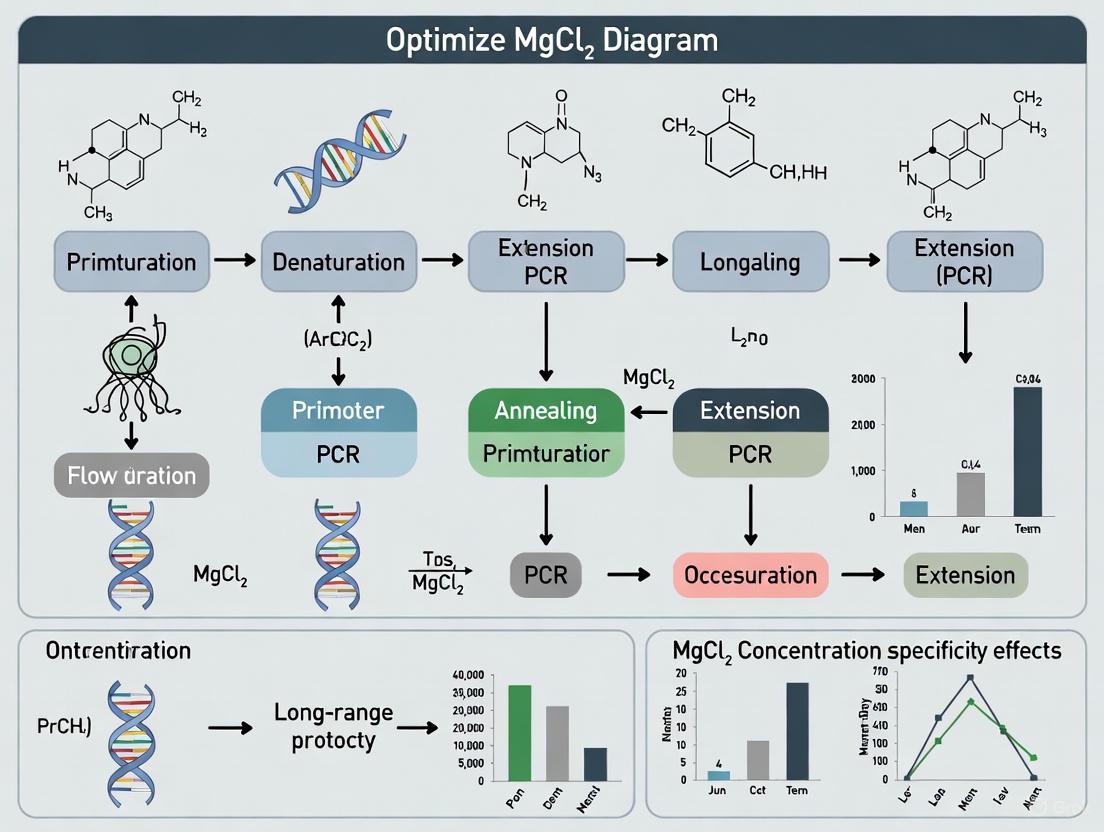
This article provides a systematic framework for researchers and drug development professionals to optimize MgCl2 concentration in long-range PCR protocols.
Optimizing MgCl2 Concentration for Long-Range PCR: A Comprehensive Guide for Robust Amplification
Abstract
This article provides a systematic framework for researchers and drug development professionals to optimize MgCl2 concentration in long-range PCR protocols. It covers the foundational role of magnesium ions as a critical cofactor for DNA polymerase activity, presents methodological approaches for establishing and refining MgCl2 concentrations, details troubleshooting strategies for common amplification failures, and outlines validation techniques to ensure assay specificity and reproducibility. By integrating current molecular biology principles with practical optimization strategies, this guide aims to enhance the success rate of long-range PCR applications in biomedical research and diagnostic development.
The Fundamental Role of MgCl2 in Long-Range PCR Success
Mg2+ as an Essential Cofactor for DNA Polymerase Activity
In polymerase chain reaction (PCR) protocols, particularly in long-range amplification, magnesium chloride (MgCl2) serves a critical biochemical role that extends beyond a simple buffer component. As a divalent cation, Mg2+ acts as an essential cofactor for DNA polymerase enzymes, directly enabling the catalytic activity responsible for DNA synthesis [1]. Its function is fundamental to the success of PCR, yet its optimal concentration must be empirically determined for specific reaction conditions, especially in complex applications such as long-range PCR where reaction fidelity and efficiency are paramount [2] [3]. The precise optimization of MgCl2 concentration represents a cornerstone of robust assay development for researchers, scientists, and drug development professionals working with advanced molecular techniques.
The Biochemical Mechanism of Mg2+ in PCR
The magnesium ion (Mg2+) facilitates PCR amplification through two primary, interdependent mechanisms: direct activation of the DNA polymerase enzyme and stabilization of nucleic acid interactions.
Activation of DNA Polymerase
Mg2+ is an indispensable cofactor for Taq DNA polymerase and other thermostable polymerases. During the catalytic addition of nucleotides to the growing DNA chain, the Mg2+ ion binds directly to the incoming deoxynucleoside triphosphate (dNTP) at its α-phosphate group [1]. This binding facilitates the removal of the β and gamma phosphates, enabling the formation of a phosphodiester bond between the remaining dNMP and the 3' hydroxyl group of the preceding nucleotide in the chain [1] [4]. Without Mg2+ to enable this catalytic core, DNA polymerase exhibits negligible activity, leading to PCR failure [1] [5].
Facilitation of Primer-Template Binding
Mg2+ significantly influences the melting temperature (Tm) and hybridization efficiency of the primer-template duplex. It accomplishes this by binding to the negatively charged phosphate backbone of DNA, thereby shielding the electrostatic repulsion that would otherwise occur between the primer and the single-stranded DNA template [1] [4]. This reduction in electrostatic repulsion allows for more stable and specific binding of the primer to its complementary sequence, which is crucial for both the initial annealing step and the overall specificity of the amplification [1].
Quantitative MgCl2 Optimization for Long-Range PCR
Optimizing MgCl2 concentration is a critical step in developing a reliable long-range PCR protocol. The following data provides a framework for this process.
Table 1: Effects of MgCl2 Concentration on PCR Performance
| MgCl2 Concentration | Observed Effect on PCR | Impact on Long-Range PCR Specificity & Yield |
|---|---|---|
| Too Low (<1.5 mM) | Weak or no amplification; reduced polymerase activity [1] [2] | Catastrophic failure; no product formation due to insufficient enzyme activity [5] |
| Optimal Range (1.5 - 2.0 mM) | Robust amplification of target sequence; high specificity [2] | High yield of specific long amplicons; balance between fidelity and processivity [3] |
| Too High (>2.5 mM) | Non-specific amplification; multiple bands; primer-dimer formation [1] [2] | Increased spurious products; reduced specificity complicating analysis of large targets [5] |
The standard starting concentration for MgCl2 in routine PCR is 1.5 to 2.0 mM [2]. However, long-range PCR often involves more complex templates and reagent mixtures, necessitating optimization. Key factors that influence the optimal Mg2+ concentration include:
- dNTP Concentration: dNTPs chelate Mg2+ ions. The standard recommendation is a 0.5 to 1 mM Mg2+ concentration above the total dNTP concentration to ensure sufficient free magnesium is available for the polymerase [2].
- Template GC-Richness: GC-rich templates, common in promoter regions of genes, may require adjusted Mg2+ and the use of specialized buffers or enhancers. One study on a GC-rich EGFR promoter region found an optimal MgCl2 concentration of 1.5 mM [6].
- Presence of PCR Inhibitors: When working with complex DNA extracts (e.g., from blood or FFPE tissue), which may contain PCR inhibitors, a higher Mg2+ concentration (up to 4.5 mM or more) may be required to compensate for ions that become bound and unavailable [5].
Table 2: MgCl2 Optimization Strategy for Long-Range PCR
| Parameter | Standard PCR Guideline | Long-Range PCR Considerations |
|---|---|---|
| Starting Concentration | 1.5 - 2.0 mM [2] | 2.0 mM; may require incremental increases for amplicons >10 kb [3] |
| Optimization Method | Titration in 0.5 mM increments [7] [2] | Titration in 0.5 mM increments from 1.0 mM up to 4.0 mM [5] |
| Critical Cofactors | Balance with dNTP concentration [2] | Higher dNTP loads for long extensions increase Mg2+ chelation; ensure >0.5 mM free Mg2+ above total [dNTP] [3] |
| Assessment of Success | Single, clear band of expected size on agarose gel [5] | Single, sharp band of high molecular weight; absence of smear or multiple bands [3] |
MgCl2 Optimization Workflow for Long-Range PCR
Detailed Experimental Protocol: MgCl2 Titration for Long-Range PCR Optimization
Reagent Preparation
Prepare a 5 mM MgCl2 working solution by diluting a commercial 25 mM stock solution with PCR-grade water [5]. For a 5x PCR Master Mix containing a standard final MgCl2 concentration of 1.5 mM, set up the following titration series to test concentrations from 1.5 mM to 4.5 mM.
Table 3: Research Reagent Solutions for MgCl2 Optimization
| Reagent / Material | Function / Application in Protocol |
|---|---|
| High-Fidelity or LA DNA Polymerase | Enzyme with proofreading activity for accurate amplification of long DNA fragments [3] |
| 10X PCR Buffer (Mg2+ Free) | Provides optimal pH and salt conditions without fixed Mg2+, allowing for precise customization [3] |
| dNTP Mix (e.g., 10 mM each) | Building blocks for new DNA strand synthesis; concentration must be balanced with Mg2+ [2] |
| Template DNA (High-Quality) | Target genomic DNA for amplification; quality and concentration are critical for long-range PCR [8] |
| Primers (Forward & Reverse) | Sequence-specific oligonucleotides that define the start and end of the amplicon [2] |
| MgCl2 Solution (25 mM) | Source of Mg2+ ions for titrating the optimal concentration in the reaction [5] |
| PCR-Grade Water | Nuclease-free water to make up reaction volume without degrading reagents [5] |
Master Mix and Reaction Setup
- Prepare a 1x Master Mix for 8 reactions (64 µL total volume) as follows [5]:
- 5x Master Mix: 32 µL
- PCR-grade water: 9.6 µL
- Forward Primer (10 µM): 3.2 µL
- Reverse Primer (10 µM): 3.2 µL
- DNA extract: 16 µL
- Aliquot 8 µL of the 1x Master Mix into each of 7 PCR tubes.
- Add the corresponding volumes of 5 mM MgCl2 working solution and PCR-grade water to each tube as per the table below to create the desired final MgCl2 concentrations.
Table 4: MgCl2 Titration Setup for a 20 µL Reaction
| Desired Final [MgCl2] | Volume of 5 mM MgCl2 to Add | Volume of PCR Water to Add | Total Reaction Volume |
|---|---|---|---|
| 1.5 mM | 0 µL | 12 µL | 20 µL |
| 2.0 mM | 2 µL | 10 µL | 20 µL |
| 2.5 mM | 4 µL | 8 µL | 20 µL |
| 3.0 mM | 6 µL | 6 µL | 20 µL |
| 3.5 mM | 8 µL | 4 µL | 20 µL |
| 4.0 mM | 10 µL | 2 µL | 20 µL |
| 4.5 mM | 12 µL | 0 µL | 20 µL |
PCR Cycling and Analysis
- Cycling Conditions: Use the long-range PCR cycling parameters recommended for your polymerase system. For example, with Takara LA Taq, a typical profile includes an initial denaturation at 94°C for 1 minute; 30 cycles of denaturation at 98°C for 20 seconds, annealing at 55–60°C for 30 seconds, and extension at 68°C for 1–20 minutes (depending on amplicon size); followed by a final extension at 72°C for 5–10 minutes [3].
- Post-Amplification Analysis: Subject 5–10 µL of each PCR product to agarose gel electrophoresis. The optimal MgCl2 concentration is identified as the one that produces a single, clear band of the expected size with minimal to no non-specific amplification or background smearing [5].
Integrated Optimization with Other PCR Components
Mg2+ does not function in isolation; its effectiveness is interdependent with other reaction components. Successful long-range PCR requires a holistic optimization strategy.
Interdependence of PCR Components for Long-Range Amplification
- dNTPs: dNTPs act as Mg2+ chelators. The total concentration of dNTPs must be accounted for when determining the free Mg2+ available for the polymerase. A general rule is to maintain the Mg2+ concentration 0.5–1.0 mM above the total dNTP concentration to ensure sufficient enzyme activity [2].
- Polymerase Selection: For long-range PCR, specialized enzyme blends like Takara LA Taq are often used [3]. These polymerases are typically supplied with optimized buffer systems. When using such specialized systems, follow the manufacturer's recommended Mg2+ range, as it has been formulated for the enzyme's specific properties.
- Template and Primers: The complexity and quality of the template DNA significantly impact Mg2+ requirements. Amplification of GC-rich regions or from suboptimal templates (e.g., FFPE tissue) often benefits from a slightly elevated Mg2+ concentration and the inclusion of additives like DMSO, which helps disrupt secondary structures [7] [6]. Furthermore, primer design and annealing temperature must be optimized in concert with Mg2+, as all three factors critically influence the specificity of primer binding [2] [8].
The meticulous optimization of MgCl2 concentration is a decisive factor in the success of long-range PCR, directly impacting the specificity, yield, and fidelity of amplification. By understanding its dual role as an enzymatic cofactor and a stabilizer of DNA duplexes, researchers can systematically troubleshoot and enhance their protocols. The experimental framework provided herein, including a detailed titration protocol and analysis of interrelated reaction components, offers a reliable pathway to achieving robust and reproducible amplification of long DNA targets, thereby supporting advanced applications in genetic research and drug development.
In polymerase chain reaction (PCR) protocols, magnesium chloride (MgCl₂) serves as an essential cofactor that directly influences enzymatic efficiency and reaction specificity. Extensive research has established 1.5-4.5 mM as the recognized optimal concentration range for standard PCR applications [9] [10] [11]. This range represents a critical balance that supports robust DNA amplification while minimizing non-specific products. Mg²⁺ ions function as a fundamental cofactor for thermostable DNA polymerases, facilitating both primer binding and enzymatic activity [1]. Understanding the biochemical basis for this range and mastering its optimization are crucial for researchers developing long-range PCR protocols where reaction conditions profoundly impact success rates. This application note details the role of MgCl₂ in PCR, provides quantitative optimization guidelines, and presents structured protocols for determining the ideal concentration for specific experimental needs, particularly within long-range PCR research.
The Biochemical Role of Mg²⁺ in PCR
The magnesium ion (Mg²⁺) is indispensable to the PCR process, serving two primary biochemical functions that directly determine amplification success.
Cofactor for DNA Polymerase Activity
Mg²⁺ is an essential cofactor for Taq DNA polymerase and other thermostable polymerases. The ion interacts directly with the enzyme's active site and the dNTP substrates. Specifically, the Mg²⁺ ion binds to a dNTP at its alpha phosphate group, facilitating the removal of beta and gamma phosphates and enabling the resulting dNMP to form a phosphodiester bond with the 3' hydroxyl group of the adjacent nucleotide [1]. Without adequate Mg²⁺ concentrations, DNA polymerase exhibits significantly reduced catalytic activity, leading to poor yields or complete reaction failure [9] [11].
Facilitation of Primer-Template Binding
MgCl₂ significantly influences the melting temperature (Tm) of the primer-template duplex. The divalent Mg²⁺ cations neutralize the negative charges on the phosphate backbone of DNA, thereby reducing electrostatic repulsion between the primer and the template strand [1]. This stabilization effect increases the effective melting temperature and promotes proper annealing. Research has demonstrated a clear logarithmic relationship between MgCl₂ concentration and DNA melting temperature, with every 0.5 mM increase within the optimal range associated with an approximately 1.2°C increase in melting temperature [12].
Table 1: Biochemical Functions of Mg²⁺ in PCR
| Function | Molecular Mechanism | Effect on PCR |
|---|---|---|
| Enzyme Cofactor | Binds dNTPs and active site of DNA polymerase | Enables phosphodiester bond formation; essential for polymerase activity |
| Duplex Stabilizer | Neutralizes DNA phosphate backbone charge | Reduces electrostatic repulsion; increases primer Tm by ~1.2°C per 0.5 mM [12] |
| Fidelity Influencer | Affects polymerase binding accuracy | Optimal concentration enhances specificity; deviation causes errors |
Establishing the Optimal MgCl₂ Range: 1.5-4.5 mM
The consensus range of 1.5-4.5 mM for MgCl₂ concentration has been empirically determined through numerous studies and represents the concentration window that supports efficient amplification while maintaining specificity.
Effects of Suboptimal Concentrations
Low MgCl₂ Concentrations (<1.5 mM)
Insufficient Mg²⁺ availability directly impair DNA polymerase activity, resulting in significantly reduced amplification efficiency. Primers cannot effectively bind to the DNA template due to inadequate stabilization of the primer-template duplex [9] [11]. This manifests as weak amplification signals or complete PCR failure, with little to no visible product on agarose gel electrophoresis [9] [1] [13].
High MgCl₂ Concentrations (>4.5 mM)
Excessive Mg²⁺ concentrations promote non-specific binding by overly stabilizing DNA duplexes, even in cases of mismatched primers [9] [11]. This results in spurious amplification products, evident as multiple extraneous bands or smears on agarose gels [1]. Elevated Mg²⁺ levels also increase the risk of primer-dimer formation, where primers self-anneal rather than bind to the template DNA [9].
Table 2: Effects of MgCl₂ Concentration on PCR Outcomes
| Concentration Range | Amplification Efficiency | Reaction Specificity | Observed Result |
|---|---|---|---|
| Too Low (<1.5 mM) | Severely Reduced | N/A | Weak or no amplification; PCR failure [9] [11] |
| Optimal (1.5-4.5 mM) | High | High | Strong, specific amplification of target band [9] [10] [11] |
| Too High (>4.5 mM) | High | Severely Reduced | Non-specific bands, primer dimers, smearing [9] [1] |
Template-Dependent Concentration Optimization
While the 1.5-4.5 mM range serves as a general guideline, optimal MgCl₂ concentration varies significantly based on template characteristics. Complex genomic DNA templates typically require higher MgCl₂ concentrations (closer to 3.0 mM) compared to simpler plasmid DNA templates [12]. Furthermore, templates with high GC content or complex secondary structures may necessitate concentrations at the upper end of, or even beyond, the standard range to achieve efficient amplification [1] [14]. Specific applications, such as detecting tetracycline resistance genes using degenerate primers, have demonstrated optimal detection at concentrations as high as 7 mM [14].
Quantitative Relationships and Template-Specific Optimization
Advanced PCR optimization requires understanding the quantitative relationships between MgCl₂ concentration and reaction parameters, particularly when working with challenging templates relevant to long-range PCR research.
MgCl₂ and Melting Temperature Relationship
A comprehensive meta-analysis of 61 studies established a precise logarithmic relationship between MgCl₂ concentration and DNA melting temperature. Within the optimal 1.5-3.0 mM range, each 0.5 mM increase in MgCl₂ concentration raises the melting temperature by approximately 1.2°C [12]. This quantitative relationship enables researchers to make precise adjustments to annealing temperatures when optimizing MgCl₂ concentrations.
Template-Specific Optimization Guidelines
Template characteristics significantly influence optimal MgCl₂ requirements. Genomic DNA templates generally require higher MgCl₂ concentrations (often 2.5-3.5 mM) compared to plasmid DNA (often 1.5-2.5 mM) due to their complexity and potential PCR inhibitors [12] [1]. For long-range PCR applications targeting products >5 kb, initial optimization should test concentrations across the entire 1.5-4.5 mM range, as the polymerase processivity and fidelity requirements increase with amplicon size.
Table 3: Template-Specific MgCl₂ Optimization Guide
| Template Type | Suggested Starting [MgCl₂] | Adjustment Considerations |
|---|---|---|
| Plasmid DNA | 1.5 - 2.0 mM | Lower end often sufficient for simple templates |
| Genomic DNA | 2.5 - 3.0 mM | Higher complexity requires more Mg²⁺ [12] |
| GC-Rich Targets | 3.0 - 4.0 mM | Higher Mg²⁺ helps destabilize secondary structures [1] |
| Long-Range PCR (>5 kb) | 2.5 - 4.0 mM | Test across wider range; requires balance of efficiency/fidelity |
| Metagenomic/Dirty Samples | 3.5 - 4.5 mM | Compensate for chelators/inhibitors [1] [14] |
Experimental Protocol: MgCl₂ Titration for Long-Range PCR Optimization
This protocol provides a systematic approach for determining the optimal MgCl₂ concentration for long-range PCR applications, incorporating key experimental design considerations for research professionals.
Reagent Preparation and Master Mix Formulation
Begin by assembling high-quality reagents and preparing a master mix to minimize tube-to-tube variation. Essential components include:
- Thermostable DNA Polymerase: Select a polymerase blend with high processivity for long-range amplification.
- 10X Reaction Buffer: Typically supplied with the polymerase, often without MgCl₂ or containing a baseline concentration (e.g., 1.5 mM).
- MgCl₂ Stock Solution: Prepare a 25 mM sterile stock solution for precise concentration adjustments.
- Template DNA: Use high-quality, purified DNA (1 ng–1 µg for genomic DNA).
- Primers: Design primers with optimal characteristics (20-30 nucleotides, 40-60% GC content, Tm within 52-65°C) [15].
- Molecular Grade Water: Nuclease-free to maintain reaction integrity.
- dNTP Mix: Standard 200 µM of each dNTP [13].
MgCl₂ Titration Series Setup
Prepare a master mix containing all common components except MgCl₂ and template DNA. Aliquot the master mix into individual PCR tubes, then supplement with MgCl₂ stock solution to create a concentration gradient from 1.0 mM to 5.0 mM in 0.5 mM increments [13].
Diagram 1: MgCl2 Optimization Workflow
Thermal Cycling and Product Analysis
Execute amplification using cycling conditions optimized for long-range PCR, typically featuring longer extension times (1 minute per kb). Analyze the resulting PCR products using agarose gel electrophoresis. The optimal MgCl₂ concentration produces a strong, specific band of the expected size without non-specific products or primer dimers. Include both negative controls (no template) and positive controls (previously validated primers/template) to ensure results reliability [15] [14].
The Scientist's Toolkit: Essential Reagents for MgCl₂ Optimization
Table 4: Essential Research Reagent Solutions for PCR Optimization
| Reagent / Solution | Function in Optimization | Usage Notes |
|---|---|---|
| MgCl₂ Stock (25 mM) | Concentration fine-tuning | Sterile, nuclease-free; allows 0.5-1.0 mM increments [15] [13] |
| dNTP Mix (10 mM) | Nucleotide substrate provision | [Mg²⁺] requirement depends on [dNTP]; chelates Mg²⁺ [13] |
| PCR Enhancers/Additives | Address specific challenges | DMSO, BSA, Betaine for GC-rich templates [15] [14] |
| High-Fidelity Buffer Systems | Provide optimal reaction environment | Often include compatible salts (KCl) at 35-100 mM [15] |
| Agarose Gel Electrophoresis System | Product visualization and analysis | Critical for assessing specificity and yield across conditions |
The MgCl₂ concentration range of 1.5-4.5 mM represents a well-established starting point for PCR optimization, balancing the biochemical requirements for polymerase activity with the practical need for reaction specificity. For long-range PCR protocols, systematic titration within and slightly beyond this range is often necessary to identify the ideal concentration for specific template-primer systems. The quantitative relationship between MgCl₂ and melting temperature, combined with template-specific adjustments, enables researchers to develop robust, reproducible amplification protocols essential for advanced molecular research and drug development applications.
Within polymerase chain reaction (PCR) protocols, magnesium chloride (MgCl2) is not merely a buffer component but an essential catalytic cofactor for DNA polymerase activity [1]. Its concentration is a critical determinant of reaction success, influencing everything from enzyme kinetics to primer-binding specificity. This article details the consequences of MgCl2 concentration deviation and provides a structured framework for its optimization, with particular emphasis on long-range PCR applications. Proper optimization is especially crucial for challenging templates, such as GC-rich sequences, long amplicons, or material derived from formalin-fixed paraffin-embedded (FFPE) tissues [6] [16] [17].
The Critical Role of MgCl2 in PCR
Magnesium ions (Mg2+) serve two fundamental roles in the PCR process. Primarily, they act as an enzymatic cofactor for DNA polymerase. The Mg2+ ion facilitates the nucleophilic attack by the 3'-hydroxyl group of the growing DNA chain on the alpha-phosphate of the incoming dNTP, enabling the formation of the phosphodiester bond [16] [1]. Second, Mg2+ neutralizes the negative charge on the phosphate backbone of DNA and dNTPs. This charge neutralization reduces the electrostatic repulsion between the primer and the template strand, thereby stabilizing the primer-template duplex and facilitating proper annealing [16] [1]. The concentration of MgCl2 directly influences the melting temperature (Tm) of DNA, with studies indicating a logarithmic relationship where every 0.5 mM increase within the optimal range can raise the Tm by approximately 1.2 °C [12].
The following diagram illustrates the dual role of Mg2+ in a single PCR cycle:
Consequences of Sub-Optimal MgCl2 Concentration
Deviation from the optimal MgCl2 concentration range leads directly to predictable and significant issues in PCR efficiency and product specificity.
Excessive MgCl2 Concentration
High MgCl2 concentrations (typically > 3.0-4.5 mM, depending on the template) promote non-specific binding of primers to partially homologous sequences on the DNA template [9] [1]. This results in the amplification of off-target products, which manifests on an agarose gel as multiple bands or a smeared background [16] [5]. The reduced reaction stringency also increases the risk of primer-dimer formation, a common artifact caused by self-annealing of primers [9]. In targeted metagenomic analyses, such as those detecting tetracycline resistance genes, excessively high MgCl2 can skew results by non-specifically amplifying non-target gene classes, thereby misrepresenting the actual gene diversity and prevalence [14].
Insufficient MgCl2 Concentration
Inadequate MgCl2 concentration (often < 1.0-1.5 mM) severely impairs DNA polymerase activity, leading to a drastic reduction in amplification yield or complete PCR failure, evidenced by absent or very faint bands on a gel [9] [11] [5]. Furthermore, low Mg2+ levels prevent the stable formation of the primer-template duplex because the electrostatic repulsion between the negatively charged DNA strands is not sufficiently neutralized [1]. This is particularly detrimental for long-range PCR, where maximum polymerase processivity is required, and for GC-rich templates that already form stable secondary structures [6] [17].
Table 1: Consequences of Improper MgCl2 Concentration in PCR
| MgCl2 Status | Primary Effects | Observed Gel Result | Impact on Data Fidelity |
|---|---|---|---|
| Too High | Non-specific primer binding; Primer-dimer formation; Reduced stringency | Multiple bands; Smearing | False positives; Skewed representation of target prevalence [9] [14] [1] |
| Too Low | Reduced DNA polymerase activity; Unstable primer-template duplex | Faint or no band; PCR failure | False negatives; Inability to detect target sequence [9] [11] [1] |
Establishing the Optimal MgCl2 Concentration
The ideal MgCl2 concentration is not universal; it must be empirically determined for each specific primer-template system and reaction condition. General guidelines, however, provide a starting point for optimization.
General and Template-Specific Ranges
For standard PCR applications, the optimal MgCl2 concentration typically falls between 1.5 mM and 4.5 mM, with 1.5-2.0 mM being the most commonly used starting point [9] [11] [5]. A comprehensive meta-analysis confirmed that the optimal range for most templates lies between 1.5 and 3.0 mM [12]. However, template complexity significantly influences this requirement. Genomic DNA generally requires higher MgCl2 concentrations than simpler templates like plasmid DNA [12]. For long-range PCR, initial optimization should start at 1.75 mM, with adjustments made in 0.5 mM increments [17]. GC-rich templates, such as the promoter region of the EGFR gene (which has a GC content of up to 88%), have been successfully amplified using MgCl2 concentrations between 1.5 and 2.0 mM [6].
Table 2: Recommended MgCl2 Starting Points and Optimization Ranges for Various PCR Applications
| PCR Application / Template Type | Recommended Starting Point | Suggested Optimization Range | Key Considerations |
|---|---|---|---|
| Standard PCR | 1.5 - 2.0 mM | 1.0 - 4.5 mM | Balance between specificity and yield [9] [11] |
| Long-Range PCR | 1.75 mM | 1.75 - 4.0+ mM (0.5 mM increments) | High template concentrations can chelate Mg2+; higher concentrations often needed [17] |
| GC-Rich Templates | 1.5 mM | 1.5 - 2.5 mM | Often requires combination with additives like DMSO (e.g., 5%) [6] [16] |
| Complex Templates (e.g., Metagenomic DNA) | 2.0 - 3.0 mM | 1.75 - 7.0 mM | Inclusiveness (detection of all target variants) must be balanced with specificity [14] |
Experimental Protocol for MgCl2 Optimization via Gradient PCR
This protocol provides a detailed methodology for empirically determining the optimal MgCl2 concentration for a given PCR assay.
I. Materials and Reagents
The Scientist's Toolkit: Key Reagent Solutions
| Reagent / Material | Function in Optimization | Example / Notes |
|---|---|---|
| MgCl2 Solution (25 mM) | Provides adjustable source of Mg2+ ions for reaction optimization. | Often supplied separately with PCR kits; allows fine-tuning of final concentration [17] [5]. |
| High-Fidelity or GC-Enhanced Polymerase | Engineered for robustness on difficult templates; often supplied with specialized buffers. | Q5 High-Fidelity (NEB #M0491) or OneTaq DNA Polymerase (NEB #M0480) are suitable for long-range/GC-rich targets [16]. |
| dNTP Mix | Substrates for DNA synthesis. Concentration must be balanced with Mg2+, as Mg2+ binds dNTPs [17]. | |
| PCR Additives | Assist in amplifying challenging sequences by reducing secondary structures or increasing primer stringency. | DMSO, Betaine, or commercial GC Enhancers can be critical for success [6] [16]. |
| Thermocycler with Gradient Functionality | Allows simultaneous testing of multiple MgCl2 concentrations (or annealing temperatures) in a single run. | Essential for efficient optimization. |
II. Procedure
- Prepare a Master Mix: Create a master mix containing all reaction components except the MgCl2 solution and template DNA. This includes nuclease-free water, PCR buffer (without MgCl2), dNTPs, primers, and DNA polymerase. If optimizing for a GC-rich target, include 5% DMSO or a commercial GC enhancer at this stage [6] [16].
- Aliquot the Master Mix: Dispense equal volumes of the master mix into a series of PCR tubes or a multi-well plate.
- Spike with MgCl2: Add varying volumes of the 25 mM MgCl2 stock solution to each aliquot to create a concentration gradient. A typical gradient might range from 1.0 mM to 4.5 mM in 0.5 mM increments [16] [5]. Ensure the total reaction volume is equal across all tubes by topping up with nuclease-free water.
- Add Template and Run PCR: Add the template DNA to each tube, mix gently, and place the reactions in a thermocycler. Use the cycling parameters recommended for your polymerase and amplicon length. For long-range PCR, an extension time of 1 minute per kilobase at 68°C is standard [17].
- Analyze Results: Separate the PCR products by agarose gel electrophoresis. The optimal MgCl2 concentration is identified as the one that produces a single, intense band of the expected size with minimal to no non-specific amplification or primer-dimer [5].
The workflow for this optimization procedure is summarized below:
The precise optimization of MgCl2 concentration is a cornerstone of robust PCR assay development, particularly for demanding applications like long-range PCR. Empirical testing through a gradient approach is the most reliable method to identify the optimal concentration that ensures high yield, specificity, and fidelity. Researchers should consider this optimization as an integral step in protocol establishment, especially when working with suboptimal templates such as GC-rich sequences or DNA from FFPE tissues. By systematically adhering to the protocols and guidelines outlined here, scientists can effectively mitigate the risks of PCR failure and non-specific amplification, thereby generating reliable and reproducible data for drug development and advanced genetic research.
Interaction Between MgCl2 and Other Reaction Components
In long-range polymerase chain reaction (LR-PCR) protocols, the precise optimization of magnesium chloride (MgCl₂) concentration is a critical determinant of success. MgCl₂ serves not merely as a passive buffer component but as a central coordinator of multiple reaction parameters, influencing enzymatic fidelity, nucleic acid thermodynamics, and primer-template interactions. Within the context of a broader thesis on optimizing MgCl₂ for LR-PCR, this application note delineates the intricate interplay between MgCl₂ and other PCR components, providing evidence-based protocols and quantitative frameworks essential for researchers, scientists, and drug development professionals. The complex stoichiometry between Mg²⁺ ions, dNTPs, DNA polymerase, and template DNA creates a network of biochemical dependencies that must be carefully balanced to achieve efficient amplification of long DNA fragments while maintaining high specificity and fidelity [12] [1] [18].
The fundamental challenge in LR-PCR stems from the increased probability of polymerase dissociation, misincorporation, and structural impediments within extended DNA templates. Mg²⁺ ions function as a pivotal molecular lubricant in this system, directly activating the DNA polymerase enzyme and stabilizing the nascent DNA duplex [18]. However, its concentration cannot be optimized in isolation; the Mg²⁺ ion forms coordination complexes with dNTPs, neutralizes phosphate backbone repulsion, and modulates primer annealing kinetics in a manner that is exquisitely sensitive to template complexity and buffer composition [12] [1]. This document establishes a comprehensive biochemical foundation for understanding these interactions, followed by practical methodologies for systematic optimization in demanding LR-PCR applications.
Biochemical Foundations of MgCl2 in PCR
Molecular Mechanisms of Magnesium Ions
The magnesium ion (Mg²⁺) derived from MgCl₂ operates through two primary biochemical mechanisms that are fundamental to PCR thermodynamics and kinetics. First, Mg²⁺ acts as an essential cofactor for DNA polymerase enzyme activity. The ion binds directly to the enzyme's active site, creating a coordination complex that facilitates the nucleophilic attack of the 3'-hydroxyl group of the primer on the alpha-phosphate group of the incoming dNTP [1] [18]. This catalytic function lowers the energy barrier for phosphodiester bond formation, enabling the polymerase to elongate the DNA chain at rates up to 60 bases per second at 70°C [18].
Second, Mg²⁺ functions as a nucleic acid stabilizer by neutralizing the negative charges on the phosphate backbone of DNA strands. This electrostatic shielding reduces the natural repulsion between the primer and template DNA, thereby facilitating proper annealing and increasing the effective melting temperature (Tₘ) of the duplex [12] [1]. Research demonstrates a logarithmic relationship between MgCl₂ concentration and DNA melting temperature, with each 0.5 mM increase within the optimal range corresponding to an approximately 1.2°C rise in Tₘ [12]. This dual role—as both an enzymatic cofactor and a nucleic acid stabilizer—positions Mg²⁺ as a master regulator of PCR efficiency, with its concentration directly impacting yield, specificity, and fidelity.
Figure 1: Dual Biochemical Roles of Mg²⁺ Ions in PCR. The diagram illustrates Mg²⁺ functioning both as a catalytic cofactor for DNA polymerase activity and as a stabilizer of nucleic acid interactions through charge neutralization.
Quantitative Interdependencies with Reaction Components
The effective concentration of free Mg²⁺ ions available for biochemical functions is determined by a dynamic equilibrium with several key reaction components, particularly dNTPs and template DNA. dNTPs chelate Mg²⁺ ions, with each dNTP molecule capable of binding one Mg²⁺ ion [18]. This binding creates a critical stoichiometric relationship where the concentration of free Mg²⁺ must exceed the total dNTP concentration to ensure sufficient cofactor availability for DNA polymerase activity. In standard PCR applications with 0.2 mM of each dNTP (0.8 mM total dNTPs), the MgCl₂ concentration typically must be maintained at least 0.5-1.0 mM above this level to account for this chelation and provide adequate free Mg²⁺ for enzymatic function and nucleic acid stabilization [18].
Template complexity introduces another dimension to Mg²⁺ optimization. Genomic DNA templates with high complexity and GC content demonstrate increased Mg²⁺ requirements compared to simpler plasmid DNA templates [12]. Meta-analysis data reveals that optimal MgCl₂ concentrations for genomic DNA templates typically fall at the higher end of the 1.5-5.0 mM range, while less complex templates may amplify efficiently at the lower end of this spectrum [12]. This template-dependent variation stems from the greater stabilizing demands of complex secondary structures and the increased number of phosphate groups requiring charge neutralization in larger, more complex DNA molecules.
Table 1: MgCl₂ Interaction Dynamics with Key PCR Components
| Component | Interaction Mechanism | Effect on Free Mg²⁺ | Optimal Stoichiometry |
|---|---|---|---|
| dNTPs | Chelation (1:1 binding) | Decreases free concentration | [MgCl₂] > [Total dNTPs] by 0.5-1.0 mM [18] |
| Template DNA | Phosphate backbone charge neutralization | Decreases through binding | Genomic DNA: 1.5-3.0 mM; Plasmid DNA: 1.0-2.0 mM [12] |
| DNA Polymerase | Cofactor binding at active site | Decreases through coordination | 1.5-2.0 mM free Mg²⁺ for optimal activity [1] [18] |
| PCR Buffer | pH stabilization | May affect solubility | Tris-HCl (pH 8.3-8.8) prevents Mg(OH)₂ precipitation [19] |
| Primers | Affects annealing stability | Indirect impact via Tₘ modulation | T₄ increases ~1.2°C per 0.5 mM MgCl₂ [12] |
Optimization Strategies for Long-Range PCR
Systematic MgCl2 Titration Framework
For long-range PCR applications, establishing an empirical MgCl₂ titration protocol is essential due to the heightened sensitivity of extended amplifications to Mg²⁺ concentration. The following structured approach provides a methodology for determining the optimal MgCl₂ concentration for specific template-primer systems in LR-PCR:
Prepare Master Mix Solution: Create a master mixture containing 1X PCR buffer, 0.2 mM of each dNTP, 0.3-1.0 μM of each forward and reverse primer, 1-2 units of DNA polymerase blend (containing both high-processivity and proofreading enzymes), and 10-50 ng of intact, high-quality template DNA [15] [19]. The buffer pH should be maintained above 9.0 at 25°C to minimize depurination damage to long DNA templates during thermal cycling [19].
Establish MgCl₂ Gradient: Aliquot the master mix into eight thin-walled 0.2 mL PCR tubes. Add MgCl₂ to each tube to create a concentration gradient from 0.5 mM to 5.0 mM, typically with 0.5 mM increments [15] [20]. This range accommodates the variability in Mg²⁺ requirements across different template types and primer sets.
Execute Thermal Cycling: Implement cycling parameters appropriate for long targets: initial denaturation at 94°C for 2 minutes; followed by 30-35 cycles of denaturation at 94°C for 30 seconds, annealing at 55-70°C (dependent on primer Tₘ) for 30 seconds, and extension at 68°C for 1 minute per kilobase of target length; with a final extension at 68°C for 10 minutes [19]. The extension temperature should not exceed 68°C when using polymerase blends for long amplification [19].
Analyze Results: Separate amplification products by 0.8-1.0% agarose gel electrophoresis. Identify the MgCl₂ concentration that produces the highest yield of the specific target amplicon with minimal non-specific products or primer-dimer formation [15] [20].
This systematic titration accounts for the individual interactions between Mg²⁺ and other reaction components, effectively customizing the Mg²⁺ availability for the specific experimental conditions. The optimal concentration represents the balance point where sufficient Mg²⁺ exists to activate the polymerase and stabilize primer-template hybrids without promoting non-specific amplification [12] [1].
Figure 2: MgCl₂ Optimization Workflow for Long-Range PCR. The systematic protocol for empirical determination of optimal MgCl₂ concentration through gradient titration and product analysis.
Component-Specific Adjustment Protocols
DNA Polymerase Selection and Mg²⁺ Requirements: The choice of DNA polymerase significantly influences optimal MgCl₂ concentrations in LR-PCR. Standard Taq DNA polymerase typically functions optimally at 1.5-2.0 mM MgCl₂, while specialized polymerase blends for long amplification (such as AccuTaq LA and KlenTaq LA DNA Polymerase Mixes) often require slightly higher concentrations ranging from 2.0-3.0 mM [19]. Proofreading enzymes containing 3'→5' exonuclease activity may have altered Mg²⁺ dependencies due to their dual enzymatic functions. When adjusting polymerase concentration to overcome amplification challenges, corresponding MgCl₂ optimization may be necessary, as increased enzyme levels (up to 2.5-3.0 units per 50 μL reaction) can tolerate marginally higher Mg²⁺ concentrations (up to 4.0 mM) without compromising specificity [18].
dNTP-Mg²⁺ Stoichiometry Balancing: The fixed chelation relationship between dNTPs and Mg²⁺ necessitates careful balancing when altering standard dNTP concentrations. The following adjustment protocol ensures maintenance of optimal free Mg²⁺ levels:
- Calculate total dNTP concentration (typically 0.8 mM for standard 0.2 mM each dNTP).
- Set baseline MgCl₂ concentration at 1.5-2.0 mM above total dNTP concentration.
- For high-fidelity applications utilizing reduced dNTP concentrations (0.01-0.05 mM each), proportionally decrease MgCl₂ to maintain the 1.5-2.0 mM excess above total dNTPs [18].
- When employing nucleotide analogs (e.g., dUTP for carryover prevention), verify polymerase compatibility and adjust MgCl₂ empirically, as incorporation efficiency may differ from standard dNTPs [18].
Template-Dependent MgCl₂ Modifications: Template characteristics profoundly influence Mg²⁺ requirements in LR-PCR. The following template-specific adjustments are recommended based on meta-analysis data [12]:
- Genomic DNA: Begin optimization at 2.0-2.5 mM MgCl₂ and titrate upward in 0.5 mM increments if specific amplification is weak.
- Plasmid DNA: Start with 1.5-2.0 mM MgCl₂ due to lower complexity and reduced charge neutralization demands.
- GC-Rich Templates (>60% GC): Initiate optimization at 2.5-3.0 mM MgCl₂ to overcome increased duplex stability, with potential supplementation with PCR enhancers such as DMSO (1-10%), formamide (1.25-10%), or Betaine (0.5-2.5 M) [15].
- Damaged/Impure Templates: Increase MgCl₂ by 0.5-1.0 mM above standard optimal concentrations to compensate for potential Mg²⁺ binding by contaminants [1].
Table 2: Troubleshooting MgCl₂-Related Amplification Issues in Long-Range PCR
| Observation | Potential Cause | MgCl₂ Adjustment | Complementary Adjustments |
|---|---|---|---|
| No Amplification | Insufficient free Mg²⁺ for polymerase activity | Increase by 0.5-1.0 mM increments | Verify primer design, increase template quality, lower annealing temperature [15] [20] |
| Smear or Multiple Bands | Excess Mg²⁺ promoting non-specific priming | Decrease by 0.5 mM increments | Increase annealing temperature (1-5°C), reduce primer concentration (0.1-0.3 μM), implement hot-start technique [1] [20] |
| Primer-Dimer Formation | Excessive Mg²⁺ facilitating 3'-end complementarity | Decrease by 0.5-1.0 mM | Redesign primers with minimized 3' complementarity, increase annealing temperature [15] [18] |
| Low Yield of Long Products | Suboptimal Mg²⁺ for polymerase processivity | Titrate upward (0.5 mM steps) from 1.5-4.0 mM | Increase extension time (1-2 min/kb), supplement with PCR enhancers (DMSO, betaine) [19] [20] |
| High Molecular Weight Background | Mg²⁺-mediated stabilization of misprimed products | Decrease concentration systematically | Switch to high-fidelity polymerase blend, optimize template quantity (10-100 ng) [19] [18] |
The Scientist's Toolkit: Research Reagent Solutions
Table 3: Essential Reagents for MgCl₂ Optimization in Long-Range PCR
| Reagent | Function | Optimization Considerations |
|---|---|---|
| MgCl₂ Solution (1M stock) | Source of Mg²⁺ cofactor | Use high-purity, nuclease-free solutions; concentration significantly affects Tₘ and specificity [12] [1] |
| DNA Polymerase Blends | Enzymatic DNA synthesis | Select blends with proofreading activity for long targets (>5kb); fidelity 6.5× greater than Taq alone [19] |
| dNTP Mix (10 mM each) | Nucleotide substrates | Concentration affects free Mg²⁺ via chelation; reduce to 0.01-0.05 mM for high-fidelity applications [18] |
| High-pH Buffer Systems | Reaction environment maintenance | pH >9.0 prevents depurination of long templates; ensures Mg(OH)₂ doesn't precipitate [19] |
| PCR Enhancers (DMSO, Betaine) | Reduce secondary structure | Particularly useful for GC-rich templates with high Mg²⁺ requirements; enhances specificity [15] [20] |
| Template DNA Preparation | Amplification target | Intact, high-quality DNA essential for long amplification; avoid repeated freezing/thawing [19] [20] |
The optimization of MgCl₂ concentration in long-range PCR represents a critical multiparametric balancing act rather than a simple component adjustment. As detailed in this application note, the Mg²⁺ ion participates in a complex network of biochemical interactions with dNTPs, DNA polymerase, template DNA, and primers, with each relationship influencing the overall reaction efficiency and specificity. The quantitative frameworks and systematic protocols provided herein establish a robust methodology for researchers to determine the optimal MgCl₂ concentration for their specific experimental systems, particularly when amplifying extended genomic regions. Through careful consideration of the interdependencies highlighted in this document—particularly the stoichiometric relationship with dNTPs and the template-specific stabilization requirements—scientists can overcome the fundamental challenges of long-range PCR and achieve reliable, reproducible amplification of targets up to 40 kb. This systematic approach to MgCl₂ optimization provides a foundation for advancing research in genomics, drug development, and molecular diagnostics where accurate long-range amplification is prerequisite to scientific discovery.
In long-range polymerase chain reaction (PCR) protocols, the successful amplification of extensive DNA sequences depends critically on the precise optimization of reaction components, particularly the concentration of magnesium ions (Mg2+). Magnesium chloride (MgCl2) serves not merely as a passive buffer component but as a fundamental catalytic cofactor that directly influences the efficiency and fidelity of DNA polymerization across complex templates [1]. The relationship between template length and magnesium requirement represents a sophisticated biochemical balancing act that remains a central challenge in molecular biology applications ranging from genetic engineering to pharmaceutical development.
The amplification of long DNA fragments places exceptional demands on PCR thermodynamics and kinetics. As template length increases, factors such as polymerase processivity, template secondary structure, and amplicon integrity become increasingly dependent on optimized reaction conditions [21]. Within this context, magnesium concentration emerges as a pivotal variable that affects nearly every aspect of the amplification process, from primer-template binding stability to the catalytic efficiency of DNA polymerase [12] [1]. This application note examines the critical interdependence between template length and magnesium ion requirements, providing evidence-based protocols and quantitative frameworks to guide researchers in developing robust long-range PCR assays.
Theoretical Framework: Magnesium's Role in PCR Biochemistry
Molecular Mechanisms of Magnesium in Polymerase Function
Magnesium ions participate in the PCR process through two primary biochemical mechanisms that are essential for successful DNA amplification. First, at the enzymatic level, Mg2+ acts as an indispensable cofactor for Taq DNA polymerase and other thermostable polymerases [1]. The catalytic site of DNA polymerase requires magnesium ions to facilitate the formation of phosphodiester bonds during DNA strand elongation [1]. Specifically, the Mg2+ ion binds to the phosphate group of an incoming dNTP, enabling nucleophilic attack by the 3'-hydroxyl group of the growing DNA chain and subsequent release of pyrophosphate [1]. Without sufficient magnesium concentrations, this fundamental catalytic process cannot proceed efficiently, leading to reduced amplification yields or complete PCR failure [9] [22].
Second, magnesium influences the stability of nucleic acid interactions through electrostatic effects. The phosphate backbone of DNA carries significant negative charges that create natural repulsion between primer and template strands [1]. Magnesium cations neutralize these repulsive forces by binding to the phosphate groups, thereby stabilizing the primer-template duplex and facilitating proper annealing [1]. This charge neutralization effect also increases the melting temperature (Tm) of DNA duplexes, with quantitative studies demonstrating a logarithmic relationship between MgCl2 concentration and DNA melting temperature [12]. Research has established that within the optimal magnesium concentration range of 1.5-3.0 mM, every 0.5 mM increase in MgCl2 corresponds to an approximately 1.2°C increase in melting temperature [12], a factor that must be carefully considered when designing annealing conditions for specific template types.
Template Length Considerations in PCR Optimization
The amplification of long DNA templates presents unique challenges that directly influence magnesium requirements. As template length increases, several factors compound the difficulty of successful amplification: polymerase processivity limitations, increased likelihood of secondary structure formation, and enhanced susceptibility to strand breakage during thermal cycling [21]. Longer templates require extended extension times during cycling, increasing the duration during which the polymerase must maintain activity and fidelity [23]. Additionally, complex genomic DNA templates with higher-order structures demand higher magnesium concentrations compared to simpler plasmid templates [12], reflecting the increased electrostatic stabilization required for proper primer binding and polymerase progression.
The relationship between template characteristics and magnesium optimization extends beyond mere length to include sequence composition and structural complexity. Templates with high guanine-cytosine (GC) content present particular challenges due to their increased thermal stability and propensity for forming secondary structures [24]. One study focusing on the amplification of a GC-rich EGFR promoter sequence demonstrated that successful amplification required not only optimization of MgCl2 concentration (1.5-2.0 mM) but also the inclusion of additives like dimethyl sulfoxide (DMSO) to mitigate the effects of extreme GC content [24]. These findings underscore the multifactorial nature of PCR optimization, where magnesium concentration must be balanced with other reaction components and cycling parameters to address template-specific challenges.
Quantitative Optimization Data
Magnesium Concentration Ranges for Various Template Types
The optimal magnesium concentration for PCR amplification varies significantly depending on template characteristics, with length and complexity being primary determining factors. Evidence from a systematic meta-analysis of 61 peer-reviewed studies established that while a general optimal range of 1.5-3.0 mM MgCl2 exists for most applications, specific template types demonstrate distinct requirements [12]. The following table summarizes evidence-based magnesium concentration ranges for various template types:
Table 1: Recommended Magnesium Chloride Concentrations for Different Template Types
| Template Type | Recommended [MgCl2] (mM) | Key Considerations | Supporting Evidence |
|---|---|---|---|
| Standard Templates (<5 kb) | 1.5–2.0 | Optimal for Taq polymerase; balances specificity and yield | [23] [22] |
| Genomic DNA | 1.5–3.0 | Higher complexity requires increased Mg2+ for stabilization | [12] [18] |
| GC-Rich Sequences | 1.5–2.0+ | Often requires optimization with DMSO or other additives | [24] |
| Long-Range PCR (>5 kb) | 2.0–4.0+ | Enhanced processivity requirements; may require specialized polymerases | [23] [21] |
| Plasmid DNA | 1.5–2.5 | Less complex structure enables lower Mg2+ requirements | [12] [18] |
The quantitative relationship between magnesium concentration and PCR efficiency follows a biphasic pattern, with both deficiency and excess producing suboptimal results. Insufficient magnesium (below 1.0 mM) typically results in weak or absent amplification due to impaired polymerase activity and unstable primer-template binding [9] [22]. Conversely, excessive magnesium concentrations (above 4.0-4.5 mM for most applications) promote non-specific amplification through reduced primer stringency and can lead to the formation of primer-dimers [9] [10] [22]. A study examining random-amplified polymorphic DNA (RAPD) patterns found that the optimum MgCl2 concentration for 77% of primers tested fell between 1.5 and 4.5 mM, with specific requirements varying by primer sequence [10].
Template Length-Specific Magnesium Optimization
The interplay between template length and magnesium requirements represents a critical consideration in experimental design. Longer templates necessitate not only extended extension times and specialized polymerases but also carefully optimized magnesium concentrations to maintain polymerase processivity throughout the amplification process [21]. The following table provides specific optimization guidelines for templates of varying lengths:
Table 2: Magnesium and Reaction Condition Optimization Based on Template Length
| Template Length | Optimal [MgCl2] (mM) | Extension Time | Polymerase Recommendations | Additional Considerations |
|---|---|---|---|---|
| <1 kb | 1.5–2.0 | 45–60 seconds | Standard Taq | Minimal optimization required |
| 1–3 kb | 1.5–2.5 | 1 min/kb | Standard Taq or high-fidelity blends | May require touchdown PCR for specificity |
| 3–5 kb | 2.0–3.0 | 1–2 min/kb | High-fidelity polymerases | Often benefits from DMSO (1–5%) or other enhancers |
| 5–10 kb | 2.5–4.0 | 2–3 min/kb | Specialized long-range polymerases | Typically requires additive cocktails; gradient optimization essential |
| >10 kb | 3.0–4.5+ | 3+ min/kb | Engineered chimeric polymerases | Often requires betaine (0.5–2.5 M) and meticulous optimization |
Research indicates that the relationship between template length and magnesium requirement is not strictly linear but reflects the cumulative challenges of amplifying increasingly complex targets. For standard templates below 5 kb, most commercial PCR buffers containing 1.5-2.0 mM MgCl2 provide sufficient magnesium for successful amplification [23]. However, as template length increases beyond 5 kb, the magnesium concentration must be systematically optimized to address the heightened processivity demands and increased likelihood of secondary structure formation [21]. The use of engineered chimeric polymerases such as TopoTaq or PfuC2 has shown particular promise for long-range applications, as these enzymes combine high processivity with enhanced resistance to inhibitors and the ability to unwind challenging secondary structures [21].
Experimental Protocols
Systematic Magnesium Titration Protocol
Optimizing magnesium concentration for long-range PCR requires a systematic approach to identify the precise concentration that maximizes specific product yield while minimizing non-specific amplification. The following protocol outlines a standardized method for magnesium titration:
Materials Required:
- Template DNA (≥20 ng/μL for genomic DNA)
- Forward and reverse primers (10 μM each)
- 10X PCR buffer (without MgCl2)
- MgCl2 solution (25 mM stock)
- dNTP mix (10 mM each)
- DNA polymerase (concentration as manufacturer recommends)
- Sterile molecular biology-grade water
- PCR tubes or plates
- Thermal cycler
Procedure:
- Prepare a master mix containing all reaction components except MgCl2 and template DNA according to the following calculations for a single 50 μL reaction:
- 5 μL of 10X PCR buffer (without MgCl2)
- 1 μL of 10 mM dNTP mix (final concentration 200 μM each)
- 1 μL of forward primer (10 μM stock)
- 1 μL of reverse primer (10 μM stock)
- 0.5-2.5 units of DNA polymerase
- Sterile water to a final volume of 45 μL (accounting for subsequent additions)
Aliquot 45 μL of the master mix into each PCR tube.
Prepare a dilution series of MgCl2 ranging from 0.5 mM to 5.0 mM in 0.5 mM increments. Add the appropriate volume of 25 mM MgCl2 stock to each tube:
- For 1.0 mM final concentration: 2 μL of 25 mM MgCl2
- For 1.5 mM final concentration: 3 μL of 25 mM MgCl2
- For 2.0 mM final concentration: 4 μL of 25 mM MgCl2
- Continue this pattern, adjusting volumes accordingly
Add template DNA to each reaction tube (5 μL per tube for a 50 μL final volume).
Mix reactions gently by pipetting and briefly centrifuge to collect contents at the bottom of the tube.
Transfer tubes to a thermal cycler and initiate the following cycling program:
- Initial denaturation: 95°C for 2 minutes
- 30-35 cycles of:
- Denaturation: 95°C for 15-30 seconds
- Annealing: Temperature specific to primer pair (50-65°C) for 15-30 seconds
- Extension: 68°C for 1 minute per 1 kb of expected product length
- Final extension: 68°C for 5-10 minutes
- Hold at 4°C
Analyze PCR products by agarose gel electrophoresis to identify the magnesium concentration that produces the strongest specific band with minimal non-specific amplification.
This systematic approach enables researchers to identify the optimal magnesium concentration for their specific template and primer combination. The meta-analysis by PubMed-indexed research confirms that such empirical optimization, particularly for templates longer than 3 kb, can significantly improve both efficiency and specificity [12]. For challenging templates, extending the titration range to 6.0 mM may be necessary, as some primers (approximately 23% in RAPD studies) demonstrate optimal activity at higher magnesium concentrations [10].
Specialized Protocol for GC-Rich and Complex Templates
GC-rich templates and those with extensive secondary structure require additional optimization strategies beyond standard magnesium titration. The following protocol addresses the unique challenges presented by these difficult templates:
Additional Materials:
- DMSO (molecular biology grade)
- Betaine (5M stock solution)
- Formamide (optional)
- BSA (10 mg/mL stock solution)
Procedure:
- Begin with the magnesium titration protocol outlined in section 4.1, using an extended MgCl2 range of 1.5-4.0 mM.
Prepare duplicate sets of reactions with the following additives:
- Set A: 2.5-5% DMSO (final concentration)
- Set B: 0.5-1.5 M betaine (final concentration)
- Set C: Combination of DMSO and betaine
- Set D: 1-2% formamide (for exceptionally difficult templates)
Increase the initial denaturation time to 3-5 minutes to ensure complete separation of DNA strands.
Utilize a "touchdown" PCR approach in which the annealing temperature starts 5-10°C above the calculated Tm and decreases by 0.5-1°C per cycle for the first 10-15 cycles, then continues at the final temperature for the remaining cycles.
Extend the extension time to 2-3 minutes per kb to account for polymerase pausing at regions of secondary structure.
Include a positive control (if available) with known amplification characteristics to validate reaction conditions.
Analyze results by agarose gel electrophoresis, noting both the intensity of the specific band and the reduction of non-specific products.
Research on the GC-rich EGFR promoter sequence demonstrates that such comprehensive optimization, combining magnesium titration with strategic additives and modified cycling conditions, enables successful amplification of targets that fail under standard conditions [24]. The study specifically found that MgCl2 concentrations between 1.5 and 2.0 mM, combined with 5% DMSO and adequate DNA concentration (≥2 μg/mL), were necessary for efficient amplification of this challenging template [24].
Research Reagent Solutions
The following table outlines essential reagents for magnesium optimization in long-range PCR, their specific functions, and recommended concentrations:
Table 3: Essential Research Reagents for Magnesium Optimization in Long-Range PCR
| Reagent | Primary Function | Recommended Concentration | Optimization Considerations |
|---|---|---|---|
| MgCl2 | DNA polymerase cofactor; stabilizes primer-template binding | 1.5–4.0 mM (template-dependent) | Titrate in 0.5 mM increments; higher for long/complex templates |
| dNTPs | DNA synthesis building blocks | 200 μM each (standard); 50–100 μM (high-fidelity) | Balanced equimolar ratio critical; Mg2+ binds dNTPs, affecting free Mg2+ availability |
| DNA Polymerase | Enzymatic DNA synthesis | 0.5–2.5 units/50 μL reaction | High-processivity enzymes preferred for long targets; proofreading versions enhance fidelity |
| Template DNA | Amplification target | 1 pg–10 ng (plasmid); 1 ng–1 μg (genomic) | Higher quality/purity reduces optimization burden; inhibitors chelate Mg2+ |
| Primers | Target sequence recognition | 0.1–0.5 μM each (standard) | Design with Tm 55–70°C; avoid 3' complementarity; length 20–30 nt |
| DMSO | Secondary structure destabilizer | 1–10% (typically 2.5–5%) | Reduces DNA melting temperature; enhances amplification of GC-rich targets |
| Betaine | GC-rich template facilitator | 0.5–2.5 M (typically 1.0–1.5 M) | Equalizes Tm of AT- and GC-rich regions; reduces secondary structure |
| BSA | Enzyme stabilizer | 10–100 μg/mL | Stabilizes polymerase against inhibitors; enhances resistance to denaturation |
The interdependence of these reaction components necessitates a holistic optimization approach. Particularly important is the relationship between dNTP and magnesium concentrations, as dNTPs chelate magnesium ions and effectively reduce the available free Mg2+ concentration for polymerase function [21]. Research indicates that each dNTP molecule can bind one magnesium ion, meaning that a standard dNTP concentration of 200 μM of each dNTP (800 μM total dNTPs) will sequester an equivalent concentration of Mg2+ [21]. Consequently, the total magnesium concentration must exceed the total dNTP concentration by approximately 0.5-2.5 mM to maintain sufficient free Mg2+ for polymerase activity and primer-template stabilization [23] [21].
Workflow Visualization
The following diagram illustrates the systematic approach to optimizing magnesium concentration for long-range PCR applications:
Systematic Magnesium Optimization Workflow
This optimization pathway provides a logical framework for addressing the most common challenges in long-range PCR. The process begins with thorough template characterization, as length, GC content, and structural complexity directly influence magnesium requirements [12] [24]. The iterative nature of the workflow emphasizes that magnesium optimization is rarely accomplished in a single iteration, particularly for challenging templates requiring concentrations at the upper end of the effective range (3.0-4.5 mM) [10] [21]. The visualization also highlights the relationship between observed amplification issues (no product, non-specific bands, or smeared products) and specific optimization strategies, creating a decision matrix that guides researchers toward optimal conditions.
The critical balance between template length and magnesium ion requirements represents a fundamental principle in the design of robust long-range PCR protocols. As demonstrated through quantitative analysis and systematic experimentation, magnesium concentration directly influences the success of DNA amplification across templates of varying complexity. The optimization strategies outlined in this application note provide researchers with evidence-based methodologies for addressing the unique challenges associated with long template amplification, from systematic magnesium titration to the implementation of specialized additives for GC-rich sequences.
The interdependence of reaction components underscores the necessity of a holistic optimization approach that considers magnesium concentration in the context of overall reaction biochemistry. By adhering to the protocols and guidelines presented herein, researchers can develop standardized, reproducible long-range PCR methods that advance molecular biology applications in drug development, genetic analysis, and biomedical research. The continued refinement of magnesium optimization strategies will undoubtedly support increasingly ambitious amplification projects, enabling scientific discovery through enhanced molecular methodology.
Systematic Approaches for MgCl2 Optimization in Long-Range PCR
Establishing a MgCl2 Concentration Gradient: A Step-by-Step Protocol
In the polymerase chain reaction (PCR), magnesium ion (Mg²⁺) concentration is a critical cofactor that directly influences the activity of DNA polymerase, the enzyme responsible for synthesizing new DNA strands [9] [25]. It facilitates primer binding by neutralizing the negative charge on DNA strands, reducing electrostatic repulsion, and is essential for the formation of the phosphodiester bond between nucleotides [26]. The precise modulation of MgCl₂ concentration is a cornerstone of PCR optimization, particularly for demanding applications such as long-range PCR.
The challenge lies in the narrow optimal range; insufficient Mg²⁺ leads to dramatically reduced polymerase activity, resulting in weak or non-existent amplification, while excess Mg²⁺ promotes non-specific primer binding, primer-dimer formation, and reduces enzyme fidelity [9] [25] [20]. This balance is even more critical for long-range PCR, where the polymerase must process extended templates without stalling. This protocol provides a detailed, step-by-step guide for establishing a MgCl₂ concentration gradient, enabling researchers to empirically determine the optimal conditions for their specific long-range PCR assay.
Background and Principles
The Central Role of Mg²⁺ in PCR Biochemistry
Magnesium chloride (MgCl₂) serves as an essential cofactor in PCR, primarily because the DNA polymerase enzyme requires free Mg²⁺ ions for its catalytic activity [25]. The ion has two key mechanistic roles:
- dNTP Substrate Chelation: Mg²⁺ binds to the α-phosphate group of incoming deoxynucleotide triphosphates (dNTPs), facilitating the removal of the β and γ phosphates and enabling the incorporation of the remaining dNMP into the growing DNA chain [26].
- Nucleic Acid Charge Neutralization: By binding to the negatively charged phosphate backbone of DNA, Mg²⁺ reduces the electrostatic repulsion between the primer and the template strand. This enhances the stability of the primer-template complex and is crucial for efficient primer annealing [26].
The concentration of "free" Mg²⁺ is what ultimately matters, and it is influenced by several components in the reaction mix, including the dNTP concentration (which chelates Mg²⁺), the presence of chelating agents like EDTA from template purification, and the DNA template concentration itself [25]. Therefore, any change in these other components necessitates a re-evaluation of the optimal MgCl₂ concentration.
The Imperative for Optimization in Long-Range PCR
Long-range PCR, which aims to amplify DNA fragments typically larger than 5 kilobases, presents unique challenges. The DNA polymerase is required to process a much longer template without dissociating, and the likelihood of encountering complex secondary structures or stalling sites is increased [27]. A meta-analysis of optimization studies confirmed that template complexity significantly affects MgCl₂ requirements, with genomic DNA templates often requiring higher concentrations than simpler templates [12].
For standard PCR, the optimal MgCl₂ concentration typically falls between 1.5 mM and 2.0 mM [26]. However, evidence suggests that for long-range and GC-rich amplifications, the optimal range may extend higher, often between 1.5 mM and 4.5 mM [9] [12] [10]. Establishing a gradient is the most reliable method to pinpoint the precise concentration that maximizes yield and specificity while minimizing artifacts for a given long-range PCR target.
Materials and Equipment
Research Reagent Solutions
The following table details the essential materials required to execute the MgCl₂ concentration gradient protocol.
Table 1: Essential Reagents and Materials for Gradient Setup
| Item | Function/Description | Notes for Long-Range PCR |
|---|---|---|
| Thermostable DNA Polymerase | Enzyme that catalyzes DNA synthesis. | For long-range PCR (>5 kb), a polymerase mix with proofreading activity (e.g., a blend of Taq and a high-fidelity enzyme like Pfu) is recommended to reduce error accumulation over long extensions [27]. |
| 10X PCR Reaction Buffer | Provides optimal pH and salt conditions for the polymerase. | Must be supplied without MgCl₂ (Mg-free buffer) to allow for precise customization of Mg²⁺ concentration [25]. |
| MgCl₂ Stock Solution | Source of Mg²⁺ cofactor. | Typically a 25 mM stock solution. This is the variable component for creating the gradient [25]. |
| dNTP Mix | Building blocks (nucleotides) for new DNA synthesis. | Concentration must be consistent across reactions, as dNTPs chelate Mg²⁺. A final concentration of 200 µM each is standard [28]. |
| Template DNA | The target DNA to be amplified. | Use high-quality, intact genomic or plasmid DNA. For genomic DNA, 100 ng is a common starting amount [28]. |
| Primers (Forward & Reverse) | Short oligonucleotides that define the start and end of the amplification. | Designed for specificity and length (18-25 bp). For long-range PCR, primers with higher melting temperatures (Tm) may be beneficial [28]. |
| Nuclease-Free Water | Solvent for the reaction. | Ensures the reaction is not degraded by nucleases. |
Required Laboratory Equipment
- Thermal Cycler: Must be capable of running a gradient program, allowing for different annealing temperatures across the block. This is crucial for coupling Mg²⁺ optimization with annealing temperature optimization.
- Microcentrifuge Tubes and Pipettes: For accurate assembly of reaction mixtures.
- Micropipettes and Sterile, Aerosol-Resistant Tips: For precise liquid handling and to prevent contamination.
- Gel Electrophoresis System: For analyzing the results of the PCR amplification.
Experimental Protocol
Step 1: Preliminary Calculations and Master Mix Preparation
Begin by calculating the required volumes for a single, standard PCR reaction. The total reaction volume is typically 25 µL or 50 µL. Once calculated, multiply the volumes of all common components by the number of gradient reactions you plan to run (e.g., 6 reactions for a 6-tube gradient), plus ~10% extra to account for pipetting error.
- Prepare Master Mix: In a single, sterile microcentrifuge tube, combine the following components for all reactions:
- Nuclease-free water
- 10X Mg-Free Reaction Buffer
- dNTP Mix
- Forward Primer
- Reverse Primer
- DNA Polymerase
- Omit: Template DNA and MgCl₂ stock solution at this stage.
- Aliquot Master Mix: Mix the master mix thoroughly by pipetting up and down or by gentle vortexing followed by a brief centrifugation. Dispense equal volumes of the master mix into each PCR tube or well designated for the gradient.
Step 2: Establishing the MgCl₂ Concentration Gradient
This step involves creating a series of reactions with varying MgCl₂ concentrations. A range from 1.0 mM to 4.0 mM in 0.5 mM increments is an excellent starting point for long-range PCR optimization [26].
- Add Template: To each aliquot of master mix, add an equal amount of your template DNA. Mix gently.
- Add MgCl₂ Gradient: To each tube, add a different, pre-calculated volume of the 25 mM MgCl₂ stock solution to achieve the desired final concentration. The table below provides an example for a 50 µL reaction volume.
Table 2: Example MgCl₂ Gradient Setup for a 50 µL Reaction
| Tube # | Desired Final [MgCl₂] (mM) | Volume of 25 mM MgCl₂ Stock (µL) |
|---|---|---|
| 1 | 1.0 | 2.0 |
| 2 | 1.5 | 3.0 |
| 3 | 2.0 | 4.0 |
| 4 | 2.5 | 5.0 |
| 5 | 3.0 | 6.0 |
| 6 | 3.5 | 7.0 |
| 7 | 4.0 | 8.0 |
Step 3: PCR Thermal Cycling
Place the tubes in the thermal cycler and program it with the appropriate cycling conditions for long-range amplification. The following is a generalized protocol that should be adjusted based on your polymerase's specifications and amplicon characteristics.
Table 3: Generic Thermal Cycling Profile for Long-Range PCR
| Step | Temperature | Duration | Cycles | Purpose |
|---|---|---|---|---|
| Initial Denaturation | 94-98°C | 2-3 minutes | 1 | Complete denaturation of complex genomic DNA. |
| Amplification | 94-98°C | 20-30 seconds | 30-35 | Denaturation of double-stranded DNA. |
| 45-68°C* | 20-30 seconds | Primer annealing. *Use a gradient to optimize this simultaneously. | ||
| 68-72°C | 1-5 minutes/kb | Primer extension. Long extensions are critical for long-range PCR. | ||
| Final Extension | 68-72°C | 5-10 minutes | 1 | Ensure all amplicons are fully extended. |
| Hold | 4-10°C | ∞ | 1 | Short-term storage. |
The workflow below summarizes the key experimental steps in this protocol.
Data Analysis and Interpretation
After the PCR cycle is complete, analyze the amplification products using agarose gel electrophoresis.
- Visualization: Load and run the entire volume of each reaction on a gel, alongside an appropriate DNA ladder. Visualize the bands under UV light.
- Interpretation: Compare the results across the MgCl₂ gradient. The optimal condition is typically the lowest MgCl₂ concentration that produces a strong, specific band of the correct size with minimal to no non-specific bands or primer-dimer [9] [26] [20].
Table 4: Troubleshooting PCR Results Based on MgCl₂ Concentration
| Observed Result | Probable Mg²⁺ Issue | Interpretation & Next Steps |
|---|---|---|
| No product across all tubes | Concentration too low | Broaden the gradient to include higher concentrations (e.g., up to 5.0 mM or 6.0 mM) [10]. |
| Strong specific band at high [Mg²⁺], smearing at highest [Mg²⁺] | Concentration too high at upper end | The optimal concentration is likely at the point just before smearing appears. Repeat a finer gradient around this value. |
| Non-specific bands/primer-dimer at high [Mg²⁺]; clean specific band at mid-range [Mg²⁺] | Classic optimal response | Select the concentration in the mid-range that gives the cleanest, strongest signal. |
| Multiple non-specific bands across the entire gradient | Mg²⁺ may not be the primary issue | Re-optimize other parameters, such as annealing temperature (using the thermal cycler's gradient function) or primer design [26] [20]. |
Once an optimal MgCl₂ concentration range is identified, further fine-tuning can be performed using 0.1 mM or 0.2 mM increments within that range. For exceptionally challenging long-range or GC-rich targets, consider incorporating PCR enhancers such as DMSO, betaine, or commercial GC-enhancer solutions, which can help disrupt secondary structures and may interact with Mg²⁺ availability [26]. Note that any change in enhancers or dNTP concentration will affect free Mg²⁺, potentially requiring a final minor re-adjustment of the MgCl₂ concentration.
In conclusion, establishing a MgCl₂ concentration gradient is a fundamental and non-negotiable step in developing robust long-range PCR protocols. This systematic approach allows researchers to overcome the significant biochemical challenges associated with amplifying long DNA fragments. By empirically determining the optimal cofactor concentration, scientists can ensure maximum yield, specificity, and fidelity, thereby generating high-quality data for downstream applications in gene cloning, sequencing, and functional analysis.
Master Mix Formulation for Consistent Long-Range Amplification
The successful amplification of long DNA fragments is a cornerstone of advanced genetic studies, enabling researchers to analyze large genes, haplotype blocks, and complex structural variations. However, long-range PCR presents unique challenges, requiring precise optimization of reaction components to achieve consistent and specific amplification. Among these components, magnesium chloride (MgCl2) concentration is a critical yet often variable factor. This Application Note, framed within broader thesis research on MgCl2 optimization for long-range PCR, provides evidence-based protocols and quantitative data to assist researchers in formulating robust master mixes for reliable amplification of targets exceeding several kilobases in length.
The Critical Role of MgCl2 in Long-Range PCR
Magnesium ions (Mg²⁺) serve as an essential cofactor for DNA polymerase activity [1]. In long-range PCR, their role becomes even more crucial due to the increased structural complexity and stability of lengthier DNA templates. The Mg²⁺ ions directly influence reaction kinetics and thermodynamics by facilitating primer-template binding and stabilizing the double-stranded DNA structure [12] [18].
A recent comprehensive meta-analysis of 61 studies revealed a significant logarithmic relationship between MgCl2 concentration and DNA melting temperature (Tm) [12]. Within the optimal range of 1.5 to 3.0 mM, every 0.5 mM increase in MgCl2 concentration raises the melting temperature by approximately 1.2 °C [12]. This quantitative understanding is vital for long-range PCR, where higher Tm values can improve the stability of primer binding across extended regions.
The template type significantly influences optimal MgCl2 requirements. Genomic DNA, with its higher complexity, generally requires higher MgCl2 concentrations (closer to 3.0 mM) compared to more straightforward templates like plasmid DNA [12]. This is particularly relevant for long-range PCR, where the templates are inherently complex. Deviations from the optimal Mg²⁺ concentration can lead to reaction failure: excessive MgCl2 promotes non-specific primer binding and primer-dimer formation, while insufficient MgCl2 results in weak or non-existent amplification due to poor polymerase activity and primer annealing [9] [1].
Quantitative Data for MgCl2 Optimization
Optimal MgCl2 Concentration Ranges
The table below summarizes evidence-based MgCl2 concentration recommendations for various PCR applications, derived from meta-analysis and experimental studies.
Table 1: Optimal MgCl2 Concentrations for Different PCR Applications
| Application / Template Type | Recommended [MgCl₂] (mM) | Key Considerations | Primary Reference |
|---|---|---|---|
| Standard PCR | 1.5 - 2.0 | A common starting point for shorter amplicons. | [1] |
| Long-Range PCR | 2.0 - 3.0 | Higher concentrations stabilize longer templates and enhance processivity. | [12] |
| High GC-Rich Templates | 2.5 - 3.5+ | Counteracts the inherent stability of GC-rich DNA, facilitating denaturation and primer annealing. | [12] [20] |
| Genomic DNA Templates | 2.5 - 3.0 | Required for the elevated complexity and size of genomic DNA. | [12] |
Effects of MgCl2 Concentration on PCR Performance
The table below outlines the specific effects of suboptimal MgCl2 concentrations on PCR outcomes, which are critical for diagnostic troubleshooting.
Table 2: Troubleshooting PCR Based on MgCl2 Concentration
| [MgCl₂] (mM) | Amplification Efficiency | Specificity | Common Observed Results |
|---|---|---|---|
| < 1.5 | Very Low to None | N/A | Faint or absent target band; PCR failure. |
| 1.5 - 3.0 (Optimal) | High | High | A single, intense band of the expected size. |
| > 3.0 - 4.5 | Moderate to High | Low | Multiple non-specific bands; smearing; primer-dimers. |
| > 4.5 | Low | Very Low | Severe smearing; predominantly non-specific products. |
Experimental Protocol: MgCl2 Titration for Long-Range PCR
This section provides a detailed, step-by-step protocol for empirically determining the optimal MgCl2 concentration for a specific long-range PCR assay.
Reagents and Equipment
The Scientist's Toolkit: Research Reagent Solutions
- DNA Polymerase: A specialized long-range DNA polymerase mix (often a blend of a high-processivity polymerase and a proofreading enzyme) is essential. Avoid standard Taq for fragments >5 kb. Function: Catalyzes the template-dependent extension of primers. [29]
- MgCl₂ Stock Solution: A sterile, nuclease-free 25 mM or 50 mM MgCl2 solution. Function: Serves as a cofactor for DNA polymerase and stabilizes primer-template interactions. [1]
- 10x Reaction Buffer: Supplied with the polymerase, typically without MgCl₂. Function: Provides the optimal pH and ionic strength (e.g., via Tris-HCl and KCl) for enzyme activity. [18]
- dNTP Mix: A solution containing 10 mM of each dATP, dCTP, dGTP, and dTTP. Function: Provides the essential nucleotide building blocks for new DNA synthesis. [18]
- Template DNA: High-quality genomic DNA (50-200 ng) per reaction. Function: The target DNA to be amplified. Purity and integrity are critical for long-range PCR. [18]
- Primers: Forward and reverse primers, resuspended in nuclease-free water to a 10 µM working concentration. Function: Short, single-stranded DNA sequences that define the start and end points of the amplification. [18]
- Nuclease-free Water: Function: To adjust the final volume of the reaction mixture.
MgCl2 Titration Procedure
Prepare Master Mix: In a nuclease-free tube, combine the following components for n+1 reactions (where n is the number of MgCl2 conditions to be tested). Keep the tube on ice.
- Nuclease-free Water: (Variable volume to achieve a final 25 µL per reaction)
- 10x Reaction Buffer (without MgCl₂): 2.5 µL per reaction
- dNTP Mix (10 mM each): 0.5 µL per reaction
- Forward Primer (10 µM): 0.75 µL per reaction
- Reverse Primer (10 µM): 0.75 µL per reaction
- Long-Range DNA Polymerase Mix: 0.5 µL per reaction
Aliquot Master Mix: Dispense 22.5 µL of the master mix into each well of a thin-walled PCR tube or plate.
Add MgCl₂ Stock Solution: Add the variable component, MgCl2 stock solution, to each tube to create the titration series as outlined in the table below.
Table 3: Recommended MgCl2 Titration Series for a 25 µL Reaction
| Tube | Volume of Master Mix (µL) | Volume of 25 mM MgCl₂ Stock (µL) | Final [MgCl₂] (mM) |
|---|---|---|---|
| 1 | 22.5 | 0.0 | 0.0 (No-Mg Control) |
| 2 | 22.5 | 1.0 | 1.0 |
| 3 | 22.5 | 1.5 | 1.5 |
| 4 | 22.5 | 2.0 | 2.0 |
| 5 | 22.5 | 2.5 | 2.5 |
| 6 | 22.5 | 3.0 | 3.0 |
| 7 | 22.5 | 3.5 | 3.5 |
| 8 | 22.5 | 4.0 | 4.0 |
Add Template DNA: Add 2.5 µL of your diluted template DNA to each tube, bringing the final reaction volume to 25 µL. Mix gently by pipetting. Include a negative control (nuclease-free water instead of template) for one of the MgCl2 concentrations to check for contamination.
Thermal Cycling: Place the tubes in a thermal cycler and run the following optimized protocol for long-range amplification:
- Initial Denaturation: 94°C for 2 minutes.
- 35 Cycles of:
- Denaturation: 94°C for 30 seconds.
- Annealing: Temperature calculated based on primer Tm (typically 55-65°C) for 30 seconds.
- Extension: 68°C for 1 minute per kilobase of the expected amplicon size. (e.g., 6 minutes for a 6 kb fragment).
- Final Extension: 68°C for 10 minutes.
- Hold: 4°C, indefinitely.
Product Analysis: Analyze 5-10 µL of each PCR product by agarose gel electrophoresis. A mid-range DNA ladder should be included for size determination. The condition yielding a single, sharp band of the correct size with the least background smearing indicates the optimal MgCl2 concentration.
Workflow Diagram
The following diagram illustrates the logical workflow for optimizing a long-range PCR protocol, from initial setup to final analysis.
Mechanistic Insights and Advanced Considerations
Molecular Mechanism of Mg²⁺ Action
Understanding the molecular role of magnesium ions provides a rational basis for optimization. The diagram below details the dual function of Mg²⁺ at the reaction level.
Interaction with Other Reaction Components
Mg²⁺ concentration does not act in isolation. It forms crucial interactions with other components of the PCR master mix:
- dNTPs: Mg²⁺ binds to dNTPs to form the biologically active substrate for the polymerase. The total dNTP concentration in a reaction must therefore be considered, as high dNTP concentrations can chelate Mg²⁺ ions, effectively reducing the free [Mg²⁺] available for the polymerase and for stabilizing nucleic acids [18]. A general rule is to maintain the Mg²⁺ concentration at least 0.5-1.0 mM higher than the total dNTP concentration [18].
- Template Complexity: As highlighted in the meta-analysis, templates with high GC content or secondary structure require higher MgCl2 concentrations (often 2.5-3.5 mM) to help destabilize these structures and facilitate primer access [12] [20].
The formulation of a consistent and reliable master mix for long-range PCR is highly dependent on the precise optimization of MgCl2 concentration. This Application Note has synthesized current evidence to demonstrate that a target concentration of 2.0 - 3.0 mM MgCl2 is generally optimal, with specific adjustments required based on template complexity, GC content, and the presence of potential PCR inhibitors. The provided titration protocol and quantitative frameworks offer researchers a systematic, evidence-based approach to replace empirical guesswork, thereby enhancing the specificity, yield, and robustness of their long-range amplification assays. This foundational optimization is a critical step towards achieving reproducible results in downstream applications such as genetic testing, cloning, and next-generation sequencing library preparation [30].
Combining MgCl2 Optimization with Thermal Cycling Parameters
In long-range polymerase chain reaction (LR-PCR), the successful amplification of DNA fragments exceeding several kilobases presents unique challenges that standard PCR protocols often fail to address. The efficiency and specificity of these reactions are profoundly influenced by two critical, interdependent factors: the concentration of magnesium chloride (MgCl₂) and the parameters of thermal cycling. This application note details a systematic approach to optimizing these factors in tandem, providing a robust framework for researchers in drug development and molecular biology who require reliable amplification of long genomic targets for cloning, sequencing, and functional genetic studies.
The synergy between MgCl₂ and thermal cycling stems from their combined effect on DNA polymerase activity, nucleic acid duplex stability, and reaction fidelity. Magnesium ions serve as an essential cofactor for thermostable DNA polymerases, and their concentration directly affects the enzyme's catalytic efficiency and the melting temperature (Tm) of primer-template complexes. Concurrently, thermal cycling parameters—particularly annealing temperature, extension time, and temperature—govern the stringency of primer binding and the completeness of strand synthesis. This protocol provides integrated methodologies to balance these parameters for optimal long-range PCR performance.
The Critical Role of MgCl₂ in Long-Range PCR
Biochemical Function of Mg²⁺ Ions
Magnesium chloride (MgCl₂) is an indispensable component of any PCR reaction, serving two primary biochemical functions. First, the Mg²⁺ ion acts as a cofactor for thermostable DNA polymerases by facilitating the formation of phosphodiester bonds between incoming deoxynucleoside triphosphates (dNTPs) and the 3'-hydroxyl end of the growing DNA strand [1] [18]. The ions position the dNTPs within the enzyme's active site for efficient catalysis. Second, Mg²⁺ stabilizes the interaction between primers and template DNA by neutralizing the negative charges on the phosphate backbones of DNA molecules, thereby reducing electrostatic repulsion and facilitating proper annealing [1]. This stabilization effect increases the melting temperature (Tm) of primer-template duplexes, with studies indicating a logarithmic relationship where every 0.5 mM increase in MgCl₂ concentration within the optimal range raises the DNA melting temperature by approximately 1.2°C [12].
Concentration Effects on Reaction Specificity and Efficiency
The concentration of MgCl₂ requires precise optimization as it profoundly impacts both reaction efficiency and specificity. Insufficient Mg²⁺ results in poor polymerase activity, leading to weak or non-detectable amplification [1] [31]. Conversely, excess Mg²⁺ reduces enzyme fidelity and promotes non-specific primer binding, manifested as multiple bands or smearing on agarose gels [32] [1]. For long-range PCR specifically, template complexity necessitates higher MgCl₂ concentrations compared to amplification of shorter fragments, as genomic DNA templates contain more binding sites that can chelate available Mg²⁺ ions [12] [33].
Table 1: Effects of MgCl₂ Concentration on PCR Performance
| MgCl₂ Status | Observed Effects | Impact on Long-Range PCR |
|---|---|---|
| Too Low (<1.5 mM) | - Greatly reduced polymerase activity- Failed or weak amplification | - Complete failure due to enzyme inactivity- Incomplete synthesis of long fragments |
| Optimal (1.5-3.0 mM) | - Efficient polymerase activity- Specific primer annealing- High product yield | - Successful amplification of long targets- Good specificity with minimal background |
| Too High (>3.0 mM) | - Non-specific primer binding- Reduced enzyme fidelity- Multiple bands or smearing | - Accumulation of truncated products- Difficulty in interpreting complex patterns |
Integrated Optimization Strategy
Establishing the MgCl₂ Baseline
The optimization process begins with establishing a MgCl₂ concentration gradient. While standard PCR typically utilizes 1.5-2.0 mM MgCl₂, long-range PCR often requires slightly higher concentrations, typically starting at 1.75 mM [33] [31]. For the initial experiment, prepare a series of reactions with MgCl₂ concentrations ranging from 1.0 mM to 4.0 mM in increments of 0.5 mM.
Table 2: Recommended Starting MgCl₂ Concentrations for Different Templates
| Template Type | Recommended Starting [MgCl₂] | Optimization Range | Notes |
|---|---|---|---|
| Standard Plasmid DNA | 1.5 mM | 1.0 - 2.5 mM | Less complex template requires lower concentrations |
| Genomic DNA (<10 kb) | 1.75 mM | 1.5 - 3.0 mM | Higher complexity requires more Mg²⁺ |
| Genomic DNA (>10 kb) | 2.0 mM | 1.75 - 3.5 mM | High complexity and potential for Mg²⁺ chelation |
| GC-Rich Templates | 2.0 mM | 1.5 - 4.0 mM | May require higher concentrations for denaturation |
Protocol 1: MgCl₂ Gradient Setup
- Prepare a master mix containing all PCR components except MgCl₂ and template DNA.
- Aliquot equal volumes of the master mix into 7 separate PCR tubes.
- Add MgCl₂ to achieve these final concentrations: 1.0, 1.5, 2.0, 2.5, 3.0, 3.5, and 4.0 mM.
- Add template DNA (50-100 ng genomic DNA or 10-100 pg plasmid DNA per 50 μL reaction).
- Run the following preliminary cycling program:
- Initial denaturation: 94°C for 3 minutes
- 30 cycles of:
- Denaturation: 94°C for 30 seconds
- Annealing: 55°C for 30 seconds
- Extension: 68°C for 1 minute/kb
- Final extension: 72°C for 10 minutes
- Analyze results by agarose gel electrophoresis to identify the concentration yielding the strongest specific band with minimal background.
Correlating MgCl₂ with Thermal Cycling Parameters
Once the optimal MgCl₂ concentration range is identified, the next phase involves fine-tuning thermal cycling parameters to complement the magnesium concentration. The annealing temperature is particularly crucial as it directly interacts with how Mg²⁺ stabilizes primer-template duplexes.
Protocol 2: Annealing Temperature Gradient with Optimized MgCl₂
- Using the optimal MgCl₂ concentration identified in Protocol 1, set up a series of identical reactions.
- Program the thermal cycler with an annealing temperature gradient spanning 5°C below to 5°C above the calculated Tm of your primers.
- For long-range PCR, use higher annealing temperatures (60-68°C) to increase stringency and minimize non-specific binding [32].
- Employ a two-step PCR protocol (combining annealing and extension at 68°C) if primer Tms are above 68°C [32].
- For products >5 kb, use longer extension times (1.5-2 minutes/kb) and lower extension temperatures (68°C instead of 72°C) to improve yields of full-length products [33].
Table 3: Thermal Cycling Adjustments for Long Amplicons
| Parameter | Standard PCR | Long-Range PCR (>5 kb) | Rationale |
|---|---|---|---|
| Extension Temperature | 72°C | 68°C | Reduces depurination rate in long templates [32] |
| Extension Time | 30-60 sec/kb | 1-2 min/kb | Allows complete synthesis of long strands |
| Annealing Temperature | Tm - 5°C | Tm or Tm + 2°C | Increases stringency for complex templates |
| Cycle Number | 25-30 | 35-40 | Compensates for lower efficiency with long targets |
| Denaturation Time | 15-30 sec | 15-25 sec | Minimal time needed to prevent enzyme damage |
Comprehensive Workflow for Method Development
The complete optimization process integrates both MgCl₂ concentration and thermal parameters in a systematic workflow. This approach is essential for developing robust long-range PCR protocols for challenging templates.
Research Reagent Solutions for Long-Range PCR
Successful implementation of these optimization strategies requires high-quality reagents specifically designed for long-range amplification. The following table details essential materials and their functions.
Table 4: Essential Reagents for Long-Range PCR Optimization
| Reagent / Kit | Function / Application | Key Features |
|---|---|---|
| Proofreading Polymerase Blends (e.g., KAPA Long Range, Takara LA Taq) | Amplification of long targets (>5 kb) with high fidelity | Mixture of non-proofreading and proofreading enzymes; 3-4X higher fidelity than Taq alone [33] [27] |
| dNTP Mix | Building blocks for DNA synthesis | Use 0.3 mM of each dNTP for long-range PCR; higher concentrations may improve yield but reduce fidelity [33] [18] |
| MgCl₂ Solution (separate) | Cofactor optimization | Supplied separately (typically 25 mM stock) to enable concentration titration [32] [33] |
| PCR Additives (DMSO, BSA, etc.) | Enhance amplification of difficult templates | DMSO at 2.5-5% improves denaturation of GC-rich regions [32] [33] |
| High-Fidelity Buffer Systems | Maintain pH and salt concentration during cycling | Optimized for long-range amplification; may include proprietary elongation factors [32] |
The synergistic optimization of MgCl₂ concentration and thermal cycling parameters is fundamental to successful long-range PCR. By establishing a systematic approach that begins with MgCl₂ titration and progressively incorporates adjustments to annealing temperature, extension time, and temperature, researchers can develop robust protocols for amplifying challenging long templates. This integrated methodology provides a framework for generating reliable, reproducible results in molecular biology research and drug development applications where amplification of long genomic regions is required.
The Role of Additives and Enhancers in Magnesium-Dependent Reactions
Magnesium ions (Mg²⁺) are indispensable cofactors in a vast array of biochemical reactions and molecular biology techniques. As the second most abundant intracellular cation, Mg²⁺ plays a critical role in stabilizing enzyme structures, facilitating ATP utilization, and maintaining nucleic acid integrity [34]. In the specific context of polymerase chain reaction (PCR), magnesium serves as an essential cofactor for thermostable DNA polymerases, directly influencing reaction efficiency, fidelity, and specificity [18]. The optimization of MgCl₂ concentration represents a fundamental parameter in developing robust long-range PCR protocols, where reaction conditions must be meticulously balanced to achieve successful amplification of extended DNA fragments. This application note examines the role of magnesium and complementary enhancers in biochemical reactions, providing detailed protocols and quantitative frameworks for researchers seeking to optimize Mg²⁺-dependent processes in molecular biology and drug development applications.
Biochemical Foundations of Magnesium Dependence
Fundamental Roles of Mg²⁺ in Biological Systems
Magnesium ions participate in numerous cellular processes through multiple mechanistic approaches. The cation functions primarily by stabilizing transition states in enzyme-catalyzed reactions, facilitating phosphate group transfer, and maintaining structural integrity of biological macromolecules. Over 600 enzymes require Mg²⁺ as a cofactor, with an additional 200 utilizing it as an activator [34]. The most prevalent role involves the formation of the MgATP²⁻ complex, which is essential for all ATP-dependent enzymatic reactions including those catalyzed by DNA and RNA polymerases [34]. The interaction between Mg²⁺ and ATP enables proper geometry for nucleophilic attack on the γ-phosphate, significantly enhancing reaction kinetics.
In nucleic acid biochemistry, Mg²⁺ is crucial for stabilizing secondary and tertiary structures through charge neutralization along the phosphate backbone. This shielding effect reduces electrostatic repulsion, facilitating DNA strand separation and reannealing during PCR thermal cycling [35]. Mg²⁺ concentration directly influences DNA melting temperature (Tm), with studies demonstrating a logarithmic relationship where every 0.5 mM increase in MgCl₂ within the 1.5-3.0 mM range increases Tm by approximately 1.2°C [12]. This property is particularly significant in long-range PCR, where optimal Tm matching is critical for successful primer binding and extension.
Magnesium Homeostasis and Availability
Despite its biological abundance, maintaining bioavailable Mg²⁺ presents challenges in experimental systems. The human body contains approximately 20-28 g of magnesium, with less than 1-2% present in blood and extracellular fluids [34]. This distribution highlights the tight regulatory mechanisms controlling Mg²⁺ availability. In vitro, numerous factors affect free Mg²⁺ concentration, including the presence of chelating agents (EDTA, citrate), dNTP concentration, and protein content [36]. Since dNTPs competitively bind Mg²⁺, their concentration must be carefully balanced to maintain adequate free Mg²⁺ for polymerase activation. This equilibrium is described by the following relationship:
Free [Mg²⁺] = Total [Mg²⁺] - [Mg²⁺-dNTP complex] - [Other Mg²⁺ chelators]
Understanding this relationship is fundamental to optimizing Mg²⁺-dependent reactions, as only the free, unbound Mg²⁺ is biologically active as a polymerase cofactor [18].
Magnesium Optimization in Long-Range PCR
Quantitative Effects of MgCl₂ Concentration
A comprehensive meta-analysis of 61 peer-reviewed studies established clear quantitative relationships between MgCl₂ concentration and PCR efficiency. The analysis revealed optimal MgCl₂ concentrations ranging from 1.5 to 3.0 mM for standard PCR applications, with template characteristics significantly influencing ideal concentrations [12]. The following table summarizes key quantitative relationships derived from experimental data:
Table 1: Quantitative Effects of MgCl₂ Concentration on PCR Parameters
| Parameter | Effect Size | Experimental Conditions | Significance |
|---|---|---|---|
| DNA Melting Temperature (Tm) | 1.2°C increase per 0.5 mM MgCl₂ | Within 1.5-3.0 mM range | Logarithmic relationship [12] |
| Template Complexity Impact | Genomic DNA requires higher [MgCl₂] than plasmid DNA | Comparative analysis | ~0.5-1.0 mM higher concentration needed [12] |
| Polymerase Fidelity | Decreased fidelity with excess Mg²⁺ | >3.0 mM in standard PCR | Increased misincorporation rate [18] |
| Long-Range PCR Efficiency | 1.5-4.0 mM, optimal at 2.5-3.5 mM | Amplification of >5 kb fragments | Concentration dependent on GC content and length [27] |
For long-range PCR specifically, the optimal MgCl₂ concentration typically ranges from 2.5-4.0 mM, slightly higher than standard PCR applications. This increased requirement stems from the extended duration of polymerase activity and the need to stabilize longer DNA fragments throughout amplification cycles [27]. The table below provides recommended starting concentrations for various template types in long-range PCR applications:
Table 2: Template-Specific MgCl₂ Optimization Ranges for Long-Range PCR
| Template Type | Recommended [MgCl₂] Range (mM) | Optimal Starting Point (mM) | Additional Considerations |
|---|---|---|---|
| Genomic DNA (2-10 kb) | 2.5-4.0 | 3.0 | Increase if high GC content; monitor specificity [12] |
| Plasmid DNA (5-15 kb) | 2.0-3.5 | 2.5 | Lower requirements due to less complex structure [18] |
| GC-Rich Templates (>60%) | 3.0-4.5 | 3.5 | Often requires enhancers (DMSO, betaine) [15] |
| High-Fidelity Applications | 2.0-3.0 | 2.5 | Lower concentrations improve fidelity [18] |
Interaction with PCR Enhancers and Additives
Various chemical additives modulate Mg²⁺ availability and function in PCR systems. These compounds work through distinct mechanisms to overcome amplification challenges, particularly in long-range applications where secondary structures and template complexity present significant obstacles. The following diagram illustrates the mechanistic relationships between Mg²⁺ and common PCR enhancers:
The synergistic relationship between Mg²⁺ and PCR enhancers necessitates careful optimization. For instance, while DMSO improves template accessibility by reducing secondary structures, it simultaneously reduces Taq polymerase activity, potentially necessitating adjustments to Mg²⁺ concentration [36]. Similarly, betaine eliminates base pair composition dependence of DNA melting, which alters Mg²⁺ requirements for GC-rich templates [37]. The following protocol provides a systematic approach to optimizing these interdependent parameters.
Experimental Protocols
Protocol 1: MgCl₂ Titration for Long-Range PCR Optimization
This protocol describes a standardized approach for empirically determining the optimal MgCl₂ concentration for long-range PCR applications.
Materials Required:
- Template DNA (genomic, cDNA, or plasmid)
- Target-specific primers (15-30 nucleotides, Tm 55-70°C)
- Thermostable DNA polymerase with buffer (Mg²⁺-free)
- 25 mM MgCl₂ stock solution
- 10 mM dNTP mix
- PCR enhancers (optional: DMSO, betaine, BSA)
- Sterile distilled water
- Thermal cycler
Methodology:
- Prepare a master mix containing the following components per reaction:
- 5.0 μL 10X Mg²⁺-free PCR buffer
- 1.0 μL 10 mM dNTP mix
- 1.0 μL each forward and reverse primer (20 μM)
- 1.0 μL DNA template (10-100 ng)
- 0.5-1.0 μL DNA polymerase (1-2.5 units)
- Sterile distilled water to 45 μL
Aliquot 45 μL of master mix into each of 8 PCR tubes.
Add varying volumes of 25 mM MgCl₂ stock to achieve the following final concentrations:
- Tube 1: 1.0 mM (2.0 μL)
- Tube 2: 1.5 mM (3.0 μL)
- Tube 3: 2.0 mM (4.0 μL)
- Tube 4: 2.5 mM (5.0 μL)
- Tube 5: 3.0 mM (6.0 μL)
- Tube 6: 3.5 mM (7.0 μL)
- Tube 7: 4.0 mM (8.0 μL)
- Tube 8: 4.5 mM (9.0 μL)
Include negative control (no template) at mid-range Mg²⁺ concentration.
Perform PCR amplification using the following cycling parameters:
- Initial denaturation: 94°C for 2 min
- 35 cycles of:
- Denaturation: 94°C for 30 sec
- Annealing: 55-65°C (primer-specific) for 45 sec
- Extension: 68°C for 1 min/kb
- Final extension: 68°C for 7 min
- Hold at 4°C
Analyze results by agarose gel electrophoresis, comparing product yield and specificity across Mg²⁺ concentrations.
Interpretation and Optimization:
- Identify the Mg²⁺ concentration producing the strongest specific amplification with minimal nonspecific products.
- If nonspecific amplification persists at all concentrations, consider implementing hot-start PCR or increasing annealing temperature [27].
- If no product is observed, verify template quality and primer specificity, then expand the Mg²⁺ range (0.5-5.0 mM) [15].
Protocol 2: Systematic Evaluation of PCR Enhancers with Optimized Mg²⁺
This protocol builds upon the determined optimal Mg²⁺ concentration to evaluate the effects of various reaction enhancers.
Materials Required:
- Optimized MgCl₂ concentration (from Protocol 1)
- PCR reagents as in Protocol 1
- Enhancer stocks:
- DMSO (100%)
- Betaine (5M)
- Formamide (100%)
- BSA (10 mg/mL)
- TMAC (1M)
Methodology:
- Prepare a master mix containing optimized Mg²⁺ concentration as determined in Protocol 1.
Aliquot equal volumes of master mix into separate reaction tubes.
Add individual enhancers to achieve the following final concentrations:
- DMSO: 2%, 5%, 10%
- Betaine: 0.5 M, 1.0 M, 1.5 M
- Formamide: 1%, 3%, 5%
- BSA: 0.1 mg/mL, 0.4 mg/mL, 0.8 mg/mL
- TMAC: 15 mM, 50 mM, 100 mM
Include a control reaction with no enhancers.
Perform PCR amplification using optimized cycling parameters.
Analyze results by agarose gel electrophoresis, comparing product yield, specificity, and signal intensity relative to the no-enhancer control.
Data Analysis:
- Quantify band intensity using gel analysis software.
- Calculate enhancement factors for each condition relative to control.
- Identify enhancer concentrations that maximize specific product yield while minimizing nonspecific amplification.
- Document any changes in product size distribution or appearance of secondary products.
The Scientist's Toolkit: Essential Reagents for Magnesium-Dependent Reactions
The following table compiles key reagents essential for optimizing magnesium-dependent reactions in molecular biology applications:
Table 3: Essential Research Reagents for Magnesium-Dependent Reaction Optimization
| Reagent | Function | Optimal Concentration Range | Storage Conditions | Considerations |
|---|---|---|---|---|
| MgCl₂ Stock Solution (25-100 mM) | Magnesium ion source for polymerase cofactor | 1.0-4.0 mM (PCR dependent) | -20°C, avoid freeze-thaw cycles | Vortex thoroughly before use; concentration gradients form upon freezing [36] |
| dNTP Mix (10-25 mM) | Nucleotide substrates for polymerase | 0.2-0.5 mM each dNTP | -20°C, aliquots | Competitively binds Mg²⁺; balance with Mg²⁺ concentration [18] |
| DMSO (100%) | Reduces secondary structures in GC-rich templates | 2-10% | Room temperature | Reduces Taq activity; requires Mg²⁺ re-optimization [37] |
| Betaine (5 M) | Equalizes Tm for GC-rich templates; reduces secondary structures | 0.5-2.5 M | -20°C | Particularly effective for long, GC-rich amplicons [36] |
| BSA (10 mg/mL) | Binds inhibitors; prevents surface adhesion | 10-100 μg/mL | -20°C | Helpful with problematic templates or contaminated samples [37] |
| TMAC (1 M) | Increases hybridization specificity | 15-100 mM | Room temperature | Particularly useful with degenerate primers [36] |
| Formamide (100%) | Destabilizes DNA duplex; lowers Tm | 1-5% | 4°C | Can enhance specificity in complex templates [37] |
| Hot-Start Taq Polymerase | Reduces nonspecific amplification | 1-2.5 units/50 μL reaction | -20°C | Minimizes primer-dimer formation; improves yield [27] |
The strategic optimization of MgCl₂ concentration, complemented by appropriate reaction enhancers, represents a critical factor in successful long-range PCR and other magnesium-dependent biochemical applications. The quantitative relationships and systematic protocols provided in this application note offer researchers a framework for empirical optimization tailored to specific experimental requirements. As molecular biology applications continue to evolve toward more challenging targets, including extreme GC-content templates and elongated amplification products, the precise modulation of magnesium-dependent reaction parameters will remain essential for achieving robust, reproducible results in both basic research and drug development contexts.
Adapting Standard Protocols for Challenging Templates
The polymerase chain reaction (PCR) is a foundational technique in molecular biology, yet the amplification of challenging templates—such as long genomic fragments or GC-rich sequences—remains a significant hurdle in many research and diagnostic applications. Successful amplification of these difficult targets is highly dependent on the precise optimization of reaction components, with magnesium chloride (MgCl₂) concentration being one of the most critical factors. Mg²⁺ ions act as an essential cofactor for DNA polymerase, influencing enzyme activity, primer annealing, DNA strand melting kinetics, and product specificity [20] [9] [38]. Within the context of a broader thesis on optimizing long-range PCR protocols, this application note provides detailed methodologies and data-driven recommendations for adapting standard MgCl₂ concentrations to overcome the challenges associated with complex templates, thereby enabling more reliable and efficient amplification for research and drug development.
The Critical Role of MgCl₂ in PCR
Magnesium chloride is more than a simple buffer component; it is a fundamental regulator of PCR thermodynamics and kinetics. Its primary role is to serve as a cofactor for thermostable DNA polymerases, facilitating the nucleophilic attack by the 3'-OH group of the primer on the alpha-phosphate group of the incoming dNTP [39]. However, its influence extends much further. Mg²⁺ ions stabilize the double-stranded DNA structure by neutralizing the negative charges on the phosphate backbone, thereby affecting the melting temperature (Tm) of both the template and the primer-template duplex [38]. A recent comprehensive meta-analysis quantified a significant logarithmic relationship between MgCl₂ concentration and DNA melting temperature, observing that within the critical 1.5–3.0 mM range, every 0.5 mM increment in MgCl₂ consistently raises the Tm by an average of 1.2°C [38]. This seemingly small shift can have a profound impact on the stringency of primer annealing and the overall reaction efficiency.
The concentration of Mg²⁺ must be carefully balanced because it is chelated by several reaction components, including dNTPs and the DNA template itself. This chelation reduces the concentration of free Mg²⁺ available for the polymerase, meaning that the optimal total MgCl₂ concentration is not an absolute value but is dependent on the specific reaction composition [40] [39]. Deviations from the optimal range manifest in distinct failure modes:
- Low MgCl₂ Concentrations (<1.5 mM): Lead to insufficient polymerase activity, resulting in weak or non-detectable amplification as primers fail to form stable complexes with the template [9].
- High MgCl₂ Concentrations (>3.0 mM): Reduce reaction stringency, promoting non-specific primer binding, the formation of spurious amplification products, and an increased risk of primer-dimer formation [20] [9].
For long-range PCR (amplification of targets >5 kb), this balance becomes even more critical. The use of polymerase blends containing a proofreading enzyme introduces an additional component that requires Mg²⁺ for its 3'→5' exonuclease activity [41] [42]. Furthermore, the higher template concentrations often used in long-range PCR can chelate more Mg²⁺, necessitating adjustments to the standard protocol [41].
Table 1: Phased Effects of MgCl₂ Concentration on PCR Performance as Identified by Meta-Analysis
| MgCl₂ Concentration Phase | Average Performance Characteristic | Primary Effect on Reaction |
|---|---|---|
| Sub-Optimal (<1.5 mM) | Drastically reduced yield (0-20% of maximum) | Failure of polymerase activity; unstable primer-template complexes [9] [38] |
| Transitional (1.5 - 2.5 mM) | Rapid increase to peak efficiency | Enhanced enzyme kinetics and optimal primer annealing stringency [38] |
| Supra-Optimal (>3.0 - 4.5 mM) | 15-30% decrease in specific product yield per 0.5 mM increase | Reduced stringency leading to non-specific products and primer-dimers [20] [9] [38] |
Quantitative Data and Optimization Tables
Systematic optimization is key to adapting protocols for challenging templates. The data presented below provides a framework for establishing starting conditions and conducting methodical titrations.
Foundational MgCl₂ Ranges for Different PCR Applications
The baseline MgCl₂ concentration varies depending on the type of PCR being performed. Standard PCR with Taq DNA polymerase typically has a narrow optimal window, whereas long-range PCR and reactions involving difficult templates require a broader optimization range.
Table 2: Recommended MgCl₂ Starting Points and Ranges for Various PCR Types
| PCR Type / Enzyme | Recommended Starting [MgCl₂] | Typical Optimization Range | Key Considerations |
|---|---|---|---|
| Standard PCR (Taq Polymerase) | 1.5 mM [40] | 1.5 - 2.0 mM | dNTPs chelate Mg²⁺; balance is critical [40] [39] |
| Long-Range PCR (Taq/Proofreading Blend) | 1.75 mM [41] | 1.5 - 4.5 mM | High template amounts chelate more Mg²⁺; requires titration [41] |
| GC-Rich or Complex Templates | 2.0 mM | 1.5 - 4.5 mM with additives | Higher Mg²⁺ can help melt secondary structures; often used with DMSO [39] [38] |
Template-Dependent Optimization Parameters
The characteristics of the DNA template itself are the primary determinants of the optimal MgCl₂ concentration. A meta-analysis has elucidated how GC content and amplicon length specifically influence the required Mg²⁺ levels [38].
Table 3: Template-Specific Guidelines for MgCl₂ Optimization
| Template Characteristic | Impact on Optimal [MgCl₂] | Proposed Mechanism | Optimization Recommendation |
|---|---|---|---|
| High GC Content (>65%) | Requires higher [MgCl₂] (up to 4.5 mM) | Mg²⁺ stabilizes duplex DNA; higher concentrations aid in denaturing stable GC-rich regions [38] | Titrate in 0.5 mM steps from 2.0 to 4.5 mM; combine with 5% DMSO [41] [38] |
| Long Amplicons (>5 kb) | Requires slightly higher [MgCl₂] | Increased dNTP and template mass chelate more Mg²⁺; proofreading enzyme in blends has its own Mg²⁺ requirement [41] [38] | Start at 1.75 mM and titrate up to 3.5 mM to enhance processivity and fidelity [41] |
| Low Template Copy Number | Requires precise mid-range [MgCl₂] | Supra-optimal concentrations promote non-specific priming that depletes reagents [20] [40] | Optimize in a narrow range (1.5-2.5 mM) to maximize specificity and sensitivity [41] |
Experimental Protocols
Core Protocol: MgCl₂ Titration for Long-Range PCR
This protocol is designed to empirically determine the optimal MgCl₂ concentration for amplifying challenging long-range targets using a polymerase blend.
I. Materials and Reagents
- KAPA Long Range HotStart ReadyMix (or similar long-range PCR enzyme blend) [41]
- Template DNA: High-quality, intact genomic DNA (100 ng for complex genomes) or plasmid DNA (1 pg-10 ng) [40] [41]
- Primers: Optimally designed pair, 0.5 µM final concentration each [41]
- MgCl₂ Stock Solution: 25 mM, supplied separately with the enzyme kit [41]
- Sterile PCR-Grade Water
- Thermal Cycler with a heated lid
II. Reaction Setup
- Prepare a master mix for all common components to minimize pipetting error. Calculate for ( n+1 ) reactions, where ( n ) is the number of MgCl₂ concentrations to be tested.
Master Mix per 50 µL reaction:
- 25 µL 2X Long Range HotStart ReadyMix
- 2.5 µL Forward Primer (10 µM stock)
- 2.5 µL Reverse Primer (10 µM stock)
- 1.0 µL Template DNA (e.g., 100 ng/µL genomic DNA)
- 14 µL Sterile Water
- Aliquot 44 µL of the master mix into each PCR tube.
- Add MgCl₂ stock solution to each tube to create a concentration gradient. For example:
- Tube 1: 0 µL MgCl₂ → 1.0 mM final (assuming ~1mM in ReadyMix)
- Tube 2: 1.0 µL MgCl₂ → 1.5 mM final
- Tube 3: 1.5 µL MgCl₂ → 1.75 mM final
- Tube 4: 2.0 µL MgCl₂ → 2.0 mM final
- Tube 5: 3.0 µL MgCl₂ → 2.5 mM final
- Tube 6: 5.0 µL MgCl₂ → 3.5 mM final Note: The exact volumes depend on the specific MgCl₂ stock concentration and the baseline [Mg²⁺] in the ReadyMix. Adjust calculations accordingly [41].
III. Thermal Cycling Conditions Use the following profile for targets up to 18 kb:
- Initial Denaturation: 94°C for 3 minutes [41]
- Amplification Cycles (35 cycles):
- Final Extension: 72°C for 1 minute per kb [41]
- Hold: 4-10°C
IV. Analysis
- Analyze 5-10 µL of each PCR product by agarose gel electrophoresis.
- The optimal MgCl₂ concentration is identified by the lane showing the most intense, specific band of the correct size with the least background smearing or non-specific products [20] [41].
Workflow Diagram for Protocol Optimization
The following diagram outlines the logical decision-making process for adapting a standard PCR protocol to a challenging template, with a focus on MgCl₂ optimization.
Diagram 1: A strategic workflow for troubleshooting and optimizing PCR for challenging templates. The process begins with a standard protocol, and based on the failure mode observed, specific optimization steps for MgCl₂, annealing temperature, and additives are implemented.
The Scientist's Toolkit: Research Reagent Solutions
The following table details key reagents and their specific functions in optimizing long-range PCR for challenging templates.
Table 4: Essential Reagents for Long-Range PCR Optimization
| Reagent / Kit | Primary Function in Optimization | Specific Application Note |
|---|---|---|
| KAPA Long Range HotStart PCR Kit | Two-enzyme blend (Taq + proofreading polymerase) for high fidelity and long amplicon yield [41] | Supplied with separate MgCl₂, allowing for flexible optimization. Hot Start prevents non-specific amplification during setup [41]. |
| Magnesium Chloride (MgCl₂) | Essential cofactor for DNA polymerase; stabilizes primer-template duplex and influences DNA melting temperature [20] [38] | Must be titrated for each new primer-template system. Concentration is critical for specificity and efficiency in long-range PCR [9] [41]. |
| dNTP Mix | Provides the nucleoside triphosphate building blocks for DNA synthesis [40] | Higher concentrations (e.g., 200-300 µM each) support long PCR but can chelate Mg²⁺, requiring MgCl₂ adjustment [40] [41]. |
| DMSO (Dimethyl Sulfoxide) | Additive that disrupts base pairing, aiding in the denaturation of GC-rich templates and reducing secondary structure [39] [41] | Use at 1-10% final concentration (often 5%). Can be combined with MgCl₂ optimization for synergistic effect on difficult templates [41]. |
| HotStart Taq DNA Polymerase | Polymerase chemically modified or bound by an antibody to be inactive at room temperature [39] | Prevents primer-dimer formation and non-specific priming during reaction setup, greatly enhancing specificity and yield [39] [41]. |
The adaptation of standard PCR protocols for challenging templates is a systematic process grounded in the precise optimization of reaction components, with magnesium chloride concentration serving as a pivotal variable. This application note has detailed how Mg²⁺ influences the fundamental thermodynamics of PCR and has provided a structured, quantitative framework for its optimization, particularly for long-range amplification. By employing methodical titration of MgCl₂ in conjunction with tailored thermal cycling parameters and specialized polymerase blends, researchers can successfully amplify targets that were previously considered intractable. Adopting these data-driven protocols will enhance the reliability, specificity, and efficiency of PCR in advanced research and drug development workflows, ensuring that the technique continues to meet the demands of modern molecular biology.
Troubleshooting MgCl2-Dependent Amplification Issues in Long-Range PCR
In the context of optimizing MgCl2 concentration for long-range PCR protocols, researchers frequently encounter three common failure patterns: smeared bands, primer dimers, and complete absence of product. These issues directly impact the reliability and efficiency of genetic analyses in complex applications such as the genetic diagnosis of tuberous sclerosis complex, which involves a broad spectrum of mutations including point mutations, large deletions, and deep intronic splicing mutations [30]. Success in long-range PCR depends on a delicate balance of reaction components and conditions, with magnesium chloride concentration playing a central role in both enzymatic activity and reaction specificity [12] [43]. This application note provides a structured framework for diagnosing and resolving these pervasive PCR challenges, with particular emphasis on MgCl2 optimization strategies supported by quantitative data and detailed protocols.
Fundamental PCR Components and Their Roles
A robust PCR optimization strategy requires thorough understanding of core reaction components and their interactions. The following table summarizes the critical factors influencing reaction specificity and efficiency.
Table 1: Critical PCR Components and Optimization Considerations
| Component | Optimal Concentration Range | Primary Function | Impact of Deviation |
|---|---|---|---|
| Template DNA | 5–50 ng genomic DNA (in 50 µL reaction) [18] | Provides target sequence for amplification | High concentrations cause nonspecific amplification; low concentrations reduce yield [18] |
| DNA Polymerase | 1–2 units (in 50 µL reaction) [18] | Catalyzes DNA synthesis | Excess enzyme promotes nonspecific products; insufficient amounts reduce yield [18] |
| Primers | 0.1–1 µM [18] [20] | Define amplification target regions | High concentrations cause primer-dimers and mispriming [18] [44] |
| dNTPs | 0.2 mM each dNTP [18] | Building blocks for DNA synthesis | Excessive concentrations can inhibit PCR; unbalanced dNTPs increase error rate [18] [45] |
| MgCl₂ | 1.5–3.0 mM (standard PCR) [12] | Cofactor for polymerase activity [18] | Affects specificity, efficiency, and fidelity [12] [45] |
Figure 1: Diagnostic Framework for Common PCR Failures. This workflow illustrates the relationship between common PCR problems and their corresponding optimization strategies, with magnesium concentration as a central factor.
Magnesium Chloride Optimization: Quantitative Guidelines
Magnesium chloride concentration significantly influences PCR thermodynamics and kinetics. A recent systematic meta-analysis of 61 peer-reviewed studies revealed a strong logarithmic relationship between MgCl₂ concentration and DNA melting temperature, with optimal ranges between 1.5 and 3.0 mM for standard applications [12]. The analysis demonstrated that every 0.5 mM increase in MgCl₂ within this range was associated with a 1.2°C increase in melting temperature [12]. Template complexity significantly affects optimal MgCl₂ requirements, with genomic DNA templates requiring higher concentrations than simpler templates [12].
Table 2: MgCl₂ Optimization Guidelines Based on Template Type and PCR Application
| Template Type/Application | Recommended MgCl₂ Starting Point | Optimization Range | Key Considerations |
|---|---|---|---|
| Standard genomic DNA | 2.0 mM [20] | 1.5–3.0 mM [12] | Balance specificity and efficiency [12] |
| GC-rich templates | 2.0 mM [46] | 1.0–4.0 mM [46] | Higher concentrations may help resolve secondary structures [46] |
| Long-range PCR (>5 kb) | 2.0 mM [27] | 1.5–3.0 mM | Requires polymerase mixture with proofreading activity [27] |
| High-fidelity applications | 1.5 mM [45] | 1.0–2.5 mM | Lower concentrations reduce misincorporation [45] |
Experimental Protocol: MgCl₂ Titration for Long-Range PCR
Purpose: To determine the optimal MgCl₂ concentration for specific long-range PCR applications, particularly when targeting GC-rich regions or complex genomic loci.
Materials:
- Template DNA (50–100 ng/µL genomic DNA)
- Forward and reverse primers (10 µM each)
- 10× PCR buffer (without MgCl₂)
- MgCl₂ solution (25 mM)
- dNTP mix (10 mM each)
- DNA polymerase mixture (e.g., Taq and proofreading enzyme)
- PCR enhancers (e.g., betaine, DMSO, or proprietary GC enhancers)
- Molecular-grade water
- Thermal cycler with gradient functionality
Procedure:
- Prepare a master mix containing 1× PCR buffer, 0.2 mM dNTPs, 0.5 µM each primer, 1.5 units DNA polymerase mixture, and 1 M betaine (if needed for GC-rich templates).
- Aliquot 45 µL of master mix into each of 8 PCR tubes.
- Add MgCl₂ to achieve the following final concentrations: 0.5, 1.0, 1.5, 2.0, 2.5, 3.0, 3.5, and 4.0 mM.
- Add 5 µL template DNA (50–100 ng) to each tube.
- Perform PCR amplification with the following cycling conditions:
- Initial denaturation: 94°C for 2 minutes
- 35 cycles of:
- Denaturation: 94°C for 30 seconds
- Annealing: 55–65°C (primer-specific) for 30 seconds
- Extension: 68°C for 1 minute per kb of expected product
- Final extension: 68°C for 10 minutes
- Analyze 5 µL of each reaction by agarose gel electrophoresis.
- Identify the MgCl₂ concentration that yields the strongest specific band with minimal background.
Diagnostic and Resolution Strategies for Common Failure Patterns
PCR Smears: Causes and Solutions
Diagnosis: Smears appear as a continuous spread of DNA fragments of varying sizes on an agarose gel, often obscuring the target band [47]. This indicates non-specific amplification where primers are binding to multiple unintended sites.
Primary Causes:
- Excessive template DNA: High DNA concentrations increase probability of non-specific priming [47]
- Suboptimal MgCl₂ concentration: Excessive Mg²⁺ reduces primer stringency [45]
- Low annealing temperature: Promotes non-specific primer binding [20] [47]
- Primer design issues: Primers with low specificity or multiple binding sites [18]
- Template degradation: Fragmented DNA creates multiple potential priming sites [47]
Resolution Protocol:
- Verify template integrity: Run template DNA on agarose gel to ensure high molecular weight and absence of degradation [45].
- Optimize MgCl₂ concentration: Perform titration as described in Section 3.1, typically between 1.0–3.0 mM [12].
- Increase annealing temperature: Use gradient PCR to test temperatures 3–5°C below primer Tm [46] [45].
- Implement hot-start PCR: Use polymerases with antibody-mediated or chemical inhibition to prevent mispriming during reaction setup [27].
- Add specificity enhancers: Include 1–5% DMSO or 1–2 M betaine to improve stringency, particularly for GC-rich templates [46] [43].
- Reduce cycle number: Limit to 25–30 cycles to prevent accumulation of non-specific products in later cycles [45].
Primer Dimers: Causes and Solutions
Diagnosis: Primer dimers appear as bright bands of approximately 20–100 bp on agarose gels, sometimes exhibiting a ladder-like pattern when multimers form [44] [47]. These artifacts result from primers annealing to each other rather than the template DNA.
Primary Causes:
- Excessive primer concentrations: High primer levels increase intermolecular interactions [18] [44]
- Complementary primer sequences: 3'-end complementarity promotes dimer formation [18]
- Low annealing temperatures: Reduces stringency of primer-template binding [44]
- Active polymerase during setup: Enzyme activity at room temperature extends primed dimers [27]
Resolution Protocol:
- Optimize primer concentration: Titrate primers between 0.1–0.5 µM to find the lowest effective concentration [18] [20].
- Redesign problematic primers: Use bioinformatics tools to ensure minimal 3'-end complementarity [18] [44].
- Increase annealing temperature: Raise temperature by 2–5°C to increase stringency [44].
- Implement hot-start activation: Use polymerases that require high-temperature activation [27].
- Set up reactions on ice: Maintain low temperature until PCR cycling begins to prevent non-specific activity [45].
- Add DMSO or formamide: Include 2–5% DMSO or 1–3% formamide to increase primer specificity [46].
No Amplification Product: Causes and Solutions
Diagnosis: Complete absence of PCR product after amplification, potentially with only primer dimers visible or empty lanes on gels.
Primary Causes:
- Insufficient MgCl₂ concentration: Mg²⁺ is essential for polymerase activity and primer binding [18] [12]
- Template quality issues: Degraded DNA or PCR inhibitors present [45]
- Incorrect annealing temperature: Too high for primer binding [20]
- Primer design flaws: Mismatches with template or poor sequence selection [18]
- Enzyme inactivation: Improper storage or handling of polymerase [45]
Resolution Protocol:
- Verify MgCl₂ concentration: Ensure minimum 1.0 mM MgCl₂, with 1.5–2.0 mM as starting point [12].
- Assess template quality: Check concentration by spectrophotometry and integrity by gel electrophoresis [45].
- Include positive controls: Use known template-primer combinations to verify system functionality [47].
- Optimize annealing temperature: Create a temperature gradient centered on primer Tm [46].
- Add PCR enhancers: Include betaine (1–1.5 M) or proprietary enhancers for difficult templates [46] [43].
- Increase template amount: Titrate template between 10–200 ng to find optimal input [18].
- Extend extension times: For long amplicons (>1 kb), increase extension time to 1 minute per kb [27].
The Scientist's Toolkit: Essential Research Reagents
Table 3: Key Reagents for PCR Optimization and Troubleshooting
| Reagent Category | Specific Examples | Primary Function | Application Notes |
|---|---|---|---|
| Specialized Polymerases | OneTaq Hot Start (NEB) [46], Q5 High-Fidelity (NEB) [46], GoTaq G2 Hot Start (Promega) [27] | Balance fidelity and processivity | Polymerase mixtures enable long-range amplification [27] |
| PCR Enhancers | Betaine, DMSO, Formamide, Glycerol [46] [43] | Reduce secondary structures, increase specificity | Betaine and DMSO particularly effective for GC-rich templates [46] |
| Magnesium Salts | MgCl₂, MgSO₄ [45] | Cofactor for polymerase activity | Proofreading enzymes may perform better with MgSO₄ [45] |
| Optimization Kits | MgCl₂ titration kits, PCR enhancer screens | Systematic parameter optimization | Enable high-throughput optimization of multiple variables |
| Template Preparation Kits | High-purity genomic DNA isolation, RNA-to-cDNA kits | Ensure template quality and integrity | Critical for sensitive applications and avoiding inhibitors [45] |
Effective diagnosis and resolution of common PCR failures requires systematic investigation of reaction components, with magnesium chloride concentration serving as a pivotal optimization parameter. The protocols and guidelines presented here provide researchers with a structured approach to address smears, primer dimers, and absent amplification in long-range PCR applications. Through methodical titration of MgCl₂ and implementation of appropriate enhancers and polymerase systems, researchers can significantly improve PCR reliability for demanding applications including genetic diagnosis, complex genome analysis, and amplification of GC-rich regions. The quantitative relationships between MgCl₂ concentration and PCR performance metrics established through recent meta-analyses provide evidence-based starting points for optimization, reducing the empirical effort required to establish robust long-range PCR protocols.
Optimizing MgCl2 to Eliminate Non-Specific Amplification
In the context of long-range PCR protocols, the precise optimization of magnesium chloride (MgCl₂) concentration is a critical determinant of experimental success. MgCl₂ serves as an essential cofactor for DNA polymerase activity, directly influencing enzyme efficiency, primer-template binding stability, and ultimately, amplification specificity [20] [18]. Non-specific amplification presents a significant challenge in molecular biology, resulting in multiple bands, smeared gels, and false-positive results that compromise data integrity. This application note provides detailed methodologies for systematically optimizing MgCl₂ concentration to eliminate non-specific products while maintaining high yield in long-range PCR applications, framed within broader thesis research on reaction condition optimization.
The fundamental role of Mg²⁺ ions extends beyond simple enzyme activation. These ions facilitate the formation of phosphodiester bonds by binding to dNTPs at their α-phosphate group, enabling nucleotide incorporation [48]. Simultaneously, Mg²⁺ neutralizes the negative charges on the phosphate backbones of DNA strands, reducing electrostatic repulsion and stabilizing the primer-template complex [48] [18]. This dual functionality makes magnesium concentration particularly sensitive to adjustment, as both excessive and insufficient levels can derail amplification. A recent comprehensive meta-analysis of 61 peer-reviewed studies established a clear logarithmic relationship between MgCl₂ concentration and DNA melting temperature, highlighting the thermodynamic foundation for precise optimization [12].
The Critical Role of MgCl2 in PCR Specificity
Biochemical Mechanisms
Magnesium ions function at the most fundamental level of the polymerase chain reaction. At the enzyme's active site, Mg²⁺ catalyzes the nucleophilic attack of the 3'-OH group of the primer on the α-phosphate of the incoming dNTP, forming the phosphodiester bond that extends the DNA chain [48] [18]. Without sufficient Mg²⁺, this catalytic process cannot proceed efficiently, leading to reduced or failed amplification [9]. The magnesium-dependent catalysis is therefore non-negotiable for polymerase function.
Beyond catalysis, Mg²⁺ plays a crucial structural role in nucleic acid interactions. The ions stabilize the double-stranded structure formed during primer annealing by shielding the negative charges of the phosphate groups in the DNA backbone [48]. This charge neutralization reduces the electrostatic repulsion between the primer and template strands, facilitating stable hybridization. However, this same mechanism can become detrimental at higher concentrations, where excessive stabilization leads to non-specific primer binding to partially complementary sites [20]. This duality of magnesium function explains why concentration optimization is essential for balancing specificity with efficiency.
Consequences of Improper MgCl2 Concentration
The effects of suboptimal MgCl₂ concentrations manifest in predictable yet problematic ways:
Low MgCl₂ concentrations (typically <1.5 mM) result in weak or non-existent amplification due to insufficient DNA polymerase activity and unstable primer-template complexes [9]. The polymerase exhibits reduced processivity, particularly problematic for long-range PCR where continuous synthesis across thousands of bases is required [49].
High MgCl₂ concentrations (typically >3.0 mM) decrease reaction stringency, allowing primers to anneal to non-target sequences with partial complementarity [20] [9]. This manifests as multiple bands or smeared electrophoresis patterns and promotes primer-dimer formation [20]. The reduced fidelity stems from stabilized mismatched hybrids that escape the polymerase's proofreading mechanisms.
The meta-analysis by [12] quantitatively demonstrated that every 0.5 mM increase in MgCl₂ within the optimal range correlates with a 1.2°C increase in melting temperature, directly impacting hybridization specificity. Template characteristics significantly influence these requirements, with complex genomic DNA templates generally requiring higher Mg²⁺ concentrations than simple plasmid templates [12].
Quantitative Optimization Parameters
Evidence-Based Concentration Ranges
Table 1: Optimal MgCl₂ Concentration Ranges for Various PCR Applications
| Application Type | Recommended MgCl₂ Range | Key Considerations | Supporting Evidence |
|---|---|---|---|
| Standard PCR | 1.5–2.0 mM | Suitable for most amplicons between 100–500 bp | [20] [18] |
| Long-Range PCR | 1.5–3.0 mM | Higher concentrations often needed for genomic DNA; incremental optimization required | [12] [49] |
| GC-Rich Targets | 1.0–4.0 mM | Requires gradient optimization in 0.5 mM increments; often benefits from additives | [48] |
| RAPD Analysis | 1.5–4.5 mM | Primer-dependent optimization; concentration affects banding patterns | [10] |
The quantitative framework for MgCl₂ optimization derives from systematic analysis across multiple studies. The recent meta-analysis by [12] established 1.5–3.0 mM as the optimal range for most applications, with specific positioning within this range dependent on template characteristics. For long-range PCR protocols, the KAPA Long Range PCR system recommends starting at 1.75 mM, with incremental adjustment based on template complexity and concentration [49].
Interrelationship with Other Reaction Components
Table 2: MgCl₂ Interactions with Critical PCR Components
| Component | Interaction with Mg²⁺ | Optimization Consideration |
|---|---|---|
| dNTPs | Mg²⁺ binds dNTPs to create substrate for polymerase; high dNTPs chelate Mg²⁺ | Maintain 0.2–0.3 mM each dNTP; [18] [49] Mg²⁺ should exceed total dNTP concentration |
| Template DNA | Complex templates (genomic DNA) require more Mg²⁺ than simple templates (plasmid) | 5–50 ng gDNA for standard PCR; <100 ng for long-range PCR [18] [49] |
| Primers | Mg²⁺ stabilizes primer-template binding; affects annealing stringency | Optimal range 0.1–1 μM; higher concentrations increase mispriming risk [20] [18] |
| Polymerase | Absolute requirement for enzymatic activity | 1–2 units standard; increase to 2.5–5 units for long/GC-rich targets [18] [49] |
The stoichiometric relationship between Mg²⁺ and dNTPs deserves particular attention. Since Mg²⁺ ions bind to dNTPs to form the actual substrate for DNA polymerase, the concentration of free Mg²⁺ must be sufficient beyond what is complexed with dNTPs [18]. The standard 0.2 mM concentration of each dNTP typically requires a minimum of 1.5 mM MgCl₂ to ensure adequate free Mg²⁺ for polymerase function [18]. This relationship explains why reactions with higher dNTP concentrations often require corresponding increases in MgCl₂.
Experimental Optimization Protocols
Primary MgCl2 Titration Protocol
Objective: To determine the optimal MgCl₂ concentration for a specific long-range PCR target through systematic titration.
Materials:
- KAPA Long Range PCR Kit (contains MgCl₂-free buffer and separate MgCl₂) [49] or equivalent system
- Template DNA (quality-checked genomic DNA)
- Target-specific primers (designed according to best practices)
- Thermal cycler with gradient capability
- Gel electrophoresis equipment
Procedure:
- Prepare Reaction Master Mix (for n reactions + 10% excess):
- X μL Nuclease-free water (to bring to 50 μL final volume)
- 25 μL 2X Long Range PCR Buffer (Mg²⁺-free)
- 8 μL dNTP Mix (0.3 mM each final concentration) [49]
- 2.5 μL Forward Primer (10 μM stock; 0.5 μM final)
- 2.5 μL Reverse Primer (10 μM stock; 0.5 μM final)
- 1.25 μL KAPA Long Range Enzyme (1.25 U/50 μL reaction)
- 1–5 μL Template DNA (50–100 ng genomic DNA)
Aliquot 45 μL of master mix into each PCR tube.
Add MgCl₂ to create a concentration gradient:
Thermal Cycling Conditions for Long-Range PCR:
Analysis:
- Resolve products by agarose gel electrophoresis
- Identify concentration producing single, intense band of correct size
- Note concentrations producing smearing, multiple bands, or reduced yield
Comprehensive Troubleshooting Guide
Problem: No Amplification
- Potential Cause: MgCl₂ concentration too low
- Solution: Increase MgCl₂ in 0.5 mM increments from initial concentration; verify polymerase activity with control template [9]
Problem: Multiple Bands or Smearing
- Potential Cause: MgCl₂ concentration too high
- Solution: Decrease MgCl₂ in 0.5 mM increments; combine with hot-start polymerase to reduce early mispriming [20] [27]
Problem: Inconsistent Results Between Replicates
- Potential Cause: Inaccurate MgCl₂ stock concentration or pipetting errors
- Solution: Prepare fresh MgCl₂ stock, calibrate pipettes, use master mix for consistency [20]
Problem: Poor Yield of Long Targets (>10 kb)
- Potential Cause: Insufficient Mg²⁺ for stable polymerase processivity
- Solution: Increase MgCl₂ to 2.0–3.0 mM; supplement with 5% DMSO for GC-rich regions [48] [49]
Integrated Optimization Strategies
Complementary Factor Optimization
Successful MgCl₂ optimization for long-range PCR requires simultaneous consideration of several interdependent factors:
Polymerase Selection: For challenging long-range amplifications, enzyme blends containing both non-proofreading (e.g., Taq) and proofreading (e.g., archaeal B-family) polymerases significantly improve results [27] [49]. The proofreading component corrects misincorporated bases that would otherwise cause polymerization stall, particularly problematic in long amplifications.
Annealing Temperature Optimization: The Mg²⁺ concentration directly influences the effective annealing temperature through its effect on duplex stability. A dual-parameter optimization approach is recommended:
- First optimize MgCl₂ concentration at a conservative annealing temperature (Tm–5°C)
- Fine-tune annealing temperature using a thermal gradient at the optimal MgCl₂ concentration [48]
- Higher annealing temperatures increase specificity but may reduce yield, requiring potential Mg²⁺ adjustment [20]
Template Quality Considerations: Long-range PCR is particularly sensitive to template integrity. Damaged template DNA increases Mg²⁺ requirements as the polymerase encounters more obstacles to processivity [49]. Always use high-quality, minimally fragmented DNA, with recommended inputs of <100 ng for complex genomes and <1 ng for simple templates in 50 μL reactions [49].
Advanced Applications: GC-Rich Targets
GC-rich sequences (>60% GC content) present unique challenges that require specialized MgCl₂ optimization strategies. These templates form stable secondary structures that impede polymerase progression and resist complete denaturation [48]. The recommended approach includes:
- MgCl₂ titration across a wider range (1.0–4.0 mM) in 0.5 mM increments [48]
- Incorporation of PCR enhancers such as DMSO (5% final concentration), betaine, or commercial GC enhancers that disrupt secondary structures [48] [49]
- Combination of optimized Mg²⁺ with specialized polymerases engineered for GC-rich amplification [48]
Table 3: Research Reagent Solutions for MgCl₂ Optimization Experiments
| Reagent/Category | Specific Example | Function in Optimization |
|---|---|---|
| Long-Range PCR System | KAPA Long Range HotStart ReadyMix [49] | Two-enzyme blend with proofreading; supplied with separate MgCl₂ for optimization |
| GC-Rich Enhancers | OneTaq GC Enhancer, Q5 High GC Enhancer [48] | Proprietary additive mixtures that disrupt secondary structures in challenging templates |
| Hot-Start Polymerase | GoTaq G2 Hot Start Polymerase [27] | Antibody-mediated inhibition prevents mispriming during setup; improves specificity |
| MgCl₂ Stock Solutions | Precision-made MgCl₂ stocks (1–100 mM) | Ensures accurate concentration adjustment during titration experiments |
| Template Quality Assessment | Fluorometric DNA quantification | Verifies template integrity and accurate input for reproducible optimization |
The systematic optimization of MgCl₂ concentration represents a fundamental requirement for eliminating non-specific amplification in long-range PCR protocols. The evidence-based approach outlined in this application note emphasizes:
- The dual biochemical role of Mg²⁺ in both catalytic function and nucleic acid stabilization
- The quantitative relationship between MgCl₂ concentration and amplification specificity, with an optimal range of 1.5–3.0 mM for most applications
- The critical importance of iterative experimental optimization through controlled titration experiments
- The interdependence of reaction components, particularly the stoichiometric relationship between Mg²⁺ and dNTPs
For researchers developing long-range PCR protocols, initial optimization should begin with MgCl₂ titration in 0.5 mM increments around the manufacturer's recommended concentration, followed by fine-tuning in 0.2 mM increments once the approximate optimal range is identified [48] [49]. This systematic approach to magnesium optimization provides a robust foundation for reliable, specific amplification across diverse template types and applications, forming an essential component of broader thesis research on PCR condition optimization.
Addressing Weak Amplification Through Magnesium Titration
In the realm of long-range PCR, achieving efficient and specific amplification of target DNA sequences is a common challenge. Weak or failed amplification is a frequent obstacle that can halt research progress, particularly in critical applications like genetic diagnostics, cloning, and sequencing. A primary factor influencing this reaction efficiency is the concentration of magnesium ions (Mg²⁺), which serve as an essential cofactor for DNA polymerase activity. The optimization of magnesium chloride (MgCl₂) concentration is not a one-size-fits-all process; it requires precise titration tailored to the specific reaction components and template characteristics. This application note provides a detailed framework for researchers and drug development professionals to systematically address weak amplification through controlled magnesium titration, framed within broader research on optimizing long-range PCR protocols.
The Critical Role of Magnesium in PCR
Magnesium ion (Mg²⁺) is a fundamental component of PCR, influencing multiple aspects of the reaction biochemistry. Its primary role is to act as a cofactor for DNA polymerase enzyme activity [18]. The magnesium ions at the enzyme's active site catalyze the nucleophilic attack by the 3'-OH group of the primer on the phosphate group of the incoming dNTP, facilitating phosphodiester bond formation and subsequent DNA strand elongation [18].
Beyond its enzymatic role, Mg²⁺ also stabilizes the double-stranded structure of DNA by neutralizing the negative charges on the phosphate backbones of both the DNA template and the primers [18]. This stabilization effect directly influences the melting temperature (Tm) of the DNA, with higher Mg²⁺ concentrations increasing the temperature required to separate DNA strands. A recent comprehensive meta-analysis established a clear logarithmic relationship between MgCl₂ concentration and DNA melting temperature, finding that every 0.5 mM increase in MgCl₂ within the optimal range is associated with a 1.2°C increase in melting temperature [12].
The diagram below illustrates the dual role of magnesium ions in facilitating PCR amplification:
The availability of free Mg²⁺ is crucial, as it can be chelated by various reaction components, particularly dNTPs [18] [50]. This interaction creates a delicate balance where both dNTP and Mg²⁺ concentrations must be optimized simultaneously. When Mg²⁺ concentration is too low, DNA polymerase activity is severely impaired, leading to weak or non-existent amplification [50]. Conversely, excessively high Mg²⁺ concentrations reduce enzyme fidelity and promote non-specific binding, resulting in spurious amplification products [50] [28].
Quantitative Magnesium Optimization Data
Systematic titration of magnesium chloride concentration is essential for resolving weak amplification. The optimal concentration range depends on multiple factors including template type, buffer composition, and dNTP concentrations. The following table summarizes evidence-based magnesium concentration ranges for different template types, derived from meta-analysis of experimental studies:
Table 1: Optimal Magnesium Chloride Concentration Ranges for Various PCR Applications
| Template Type | Recommended MgCl₂ Concentration | Key Considerations | Effect of 0.5 mM Increase on Tm |
|---|---|---|---|
| Standard Templates | 1.5 - 2.0 mM [50] | Starting point for most applications; requires optimization based on specific reaction conditions | ~1.2°C increase [12] |
| Genomic DNA | 1.5 - 3.0 mM (higher end typical) [12] | Increased complexity requires higher Mg²⁺; 5-50 ng input recommended [18] | ~1.2°C increase [12] |
| Plasmid DNA | 1.5 - 2.0 mM [12] | Less complex template; 0.1-1 ng input sufficient [18] | ~1.2°C increase [12] |
| Long-Range PCR (>5 kb) | 1.0 - 5.0 mM [51] | Varies significantly; requires empirical optimization [51] | Varies based on template length |
| GC-Rich Templates | 2.0 - 4.0 mM [28] | Often enhanced with 5% DMSO or other additives [28] | Enhanced stabilization of high GC content |
For long-range PCR applications specifically, the magnesium requirements can vary significantly, with recommendations spanning 1-5 mM depending on the polymerase system and target length [51]. The table below provides a detailed titration scheme for systematic optimization:
Table 2: Systematic Magnesium Chloride Titration Protocol for Weak Amplification
| Tube | MgCl₂ Stock Concentration | Volume for 50 µL Reaction | Final MgCl₂ Concentration | Expected Outcome |
|---|---|---|---|---|
| 1 | 25 mM | 3.0 µL | 1.5 mM | Potential weak amplification |
| 2 | 25 mM | 4.0 µL | 2.0 mM | Standard starting point |
| 3 | 25 mM | 5.0 µL | 2.5 mM | Often optimal for genomic DNA |
| 4 | 25 mM | 6.0 µL | 3.0 mM | May enhance difficult templates |
| 5 | 25 mM | 7.0 µL | 3.5 mM | Possible for complex templates |
| 6 | 25 mM | 8.0 µL | 4.0 mM | Risk of non-specific products |
| 7 | 25 mM | 9.0 µL | 4.5 mM | High risk of non-specific products |
| 8 | 25 mM | 10.0 µL | 5.0 mM | Maximum typical concentration |
Template characteristics significantly influence magnesium requirements. The meta-analysis revealed that genomic DNA templates generally require higher MgCl₂ concentrations (typically 1.5-3.0 mM) compared to more straightforward templates like plasmid DNA [12]. This is attributed to the increased complexity and potential secondary structures in genomic templates that require additional stabilization.
Comprehensive Experimental Protocol
Reagent Preparation and Master Mix Formulation
The following research reagent solutions are essential for executing the magnesium titration experiments:
Table 3: Essential Research Reagent Solutions for Magnesium Titration Experiments
| Reagent | Recommended Concentration | Function in PCR | Supplier Considerations |
|---|---|---|---|
| MgCl₂ Solution | 25 mM stock | Magnesium cofactor source; critical titration variable | Use molecular biology grade; prepare in nuclease-free water |
| DNA Polymerase | 1-2 units/50 µL reaction [18] | Enzymatic DNA synthesis | Select based on application: Taq for routine, proofreading blends for long PCR [51] |
| dNTP Mix | 200 µM each dNTP (standard) [50] | DNA synthesis building blocks | Use balanced equimolar mixture; quality affects fidelity |
| 10X PCR Buffer | Without MgCl₂ | Provides optimal pH and salt conditions | Select compatible with polymerase; often supplied with enzyme |
| Primers | 0.1-1 µM each [18] [28] | Target sequence recognition | HPLC purified; designed with Tm 55-70°C, 40-60% GC content |
| Template DNA | 1 pg-10 ng plasmid; 1 ng-1 µg genomic [50] | Amplification target | Quality critical; use spectrophotometry and gel assessment |
| Nuclease-Free Water | - | Reaction volume adjustment | Certified nuclease-free to prevent degradation |
Step-by-Step Magnesium Titration Workflow
The experimental workflow for systematic magnesium optimization involves sequential steps from reaction preparation through analysis:
Prepare Master Mix (without Mg²⁺):
- Calculate the required reactions including 10% extra volume to account for pipetting error
- Combine in a sterile 1.5 mL microcentrifuge tube on ice:
- Mix gently by pipetting up and down 20 times to ensure homogeneity
Aliquot and Add Magnesium:
- Label eight thin-walled 0.2 mL PCR tubes (1-8)
- Dispense equal volumes of master mix into each tube
- Add MgCl₂ (25 mM stock) according to Table 2 to create the concentration gradient
- Add template DNA to all tubes except the negative control
- Cap tubes and briefly centrifuge to collect all contents at the bottom
Thermal Cycling Conditions:
- Program thermal cycler with the following parameters:
Product Analysis:
- Prepare a 0.8-1.2% agarose gel with appropriate DNA intercalating dye
- Combine 8-10 µL of each PCR reaction with loading dye
- Include appropriate DNA molecular weight markers
- Electrophorese at 5-8 V/cm until adequate separation
- Image using UV transillumination or compatible imaging system
- Identify the Mg²⁺ concentration that produces the strongest target amplification with minimal non-specific products
Complementary Optimization Strategies
When magnesium titration alone is insufficient, consider these complementary approaches:
Touchdown PCR: Implement a touchdown protocol where the annealing temperature starts 3-5°C above the calculated Tm and decreases by 1°C every cycle for the first 10 cycles, then continues at the lower temperature for remaining cycles [52]. This enhances specificity during early cycles.
Buffer Additives: For difficult templates (high GC content, secondary structure), include PCR enhancers such as 1-5% DMSO, 1-10% formamide, or 0.5-2.5 M betaine [15] [28]. These additives can help destabilize secondary structures and improve amplification efficiency.
Hot Start Technique: Use hot start DNA polymerases or incorporate a 5-10 minute initialization step at 95°C to prevent non-specific amplification during reaction setup [51].
Troubleshooting and Quality Control
Even with systematic magnesium titration, researchers may encounter specific challenges. The following troubleshooting guide addresses common scenarios:
No Amplification at Any Magnesium Concentration:
- Verify template quality and concentration through spectrophotometry and gel electrophoresis
- Check primer design parameters: ensure Tms are within 5°C, length 18-30 bases, and no significant secondary structure [15] [28]
- Confirm polymerase activity using control template and primers
- Ensure thermal cycler is calibrated and achieving proper temperatures
Persistent Non-specific Bands:
- Increase annealing temperature in 2°C increments
- Reduce primer concentration to 0.1-0.3 µM
- Decrease polymerase amount to 0.5-1 unit/50 µL reaction
- Implement hot start technique or switch to hot start polymerase
- Add 1.5-2.5 mM MgCl₂ only if confirmed to help with specificity
Weak Target Amplification with Clear Background:
- Increase magnesium concentration in the optimal range (typically 2.0-3.0 mM)
- Increase template amount within recommended range (up to 100 ng genomic DNA)
- Add PCR enhancers such as DMSO or betaine for GC-rich templates [28]
- Increase cycle number cautiously (up to 35 cycles)
Quality control measures should include both negative controls (without template) to detect contamination and positive controls (with known template and primers) to verify system functionality. For long-range PCR applications specifically, template integrity is paramount, as nicked or damaged DNA can serve as potential priming sites resulting in high background [51].
Magnesium concentration optimization through systematic titration represents a fundamental strategy for addressing weak amplification in long-range PCR protocols. The evidence-based approach outlined in this application note demonstrates that precise modulation of MgCl₂ concentration, tailored to specific template characteristics and reaction components, can significantly improve both the efficiency and specificity of PCR amplification. The quantitative relationships between magnesium concentration and DNA melting temperature, combined with template-specific considerations, provide researchers with a robust theoretical framework for developing optimized protocols. By implementing this controlled titration strategy alongside complementary optimization techniques, scientists can overcome the challenge of weak amplification, advancing the reliability and effectiveness of their molecular biology research and diagnostic applications.
Within molecular biology, the polymerase chain reaction (PCR) is a foundational technique for amplifying specific DNA sequences. However, the amplification of long-range targets or templates with challenging characteristics, such as high GC content, often proves difficult. The success of long-range PCR is highly dependent on the precise optimization of reaction components, with magnesium chloride (MgCl2) concentration being a critical cofactor for DNA polymerase activity [43] [25]. While MgCl2 optimization is a central thesis in developing robust long-range protocols, reaction efficiency and specificity can be dramatically improved through the strategic incorporation of specific additives.
This application note focuses on three key additives—Dimethyl sulfoxide (DMSO), Betaine, and Bovine Serum Albumin (BSA). These compounds enhance PCR through distinct mechanisms, such as disrupting secondary structures, equalizing DNA melting temperatures, and neutralizing inhibitors. When used in conjunction with an optimized MgCl2 concentration, these additives provide a powerful toolkit for overcoming common obstacles in long-range PCR, enabling reliable and efficient amplification of complex genomic targets.
The Critical Role of MgCl2 in Long-Range PCR
Magnesium ion (Mg²⁺) is an essential cofactor for thermostable DNA polymerases, and its concentration must be carefully calibrated in any PCR, particularly for long-range amplification. Mg²⁺ directly influences enzyme activity, fidelity, and the specificity of the entire reaction [25]. A meta-analysis of PCR optimization studies indicates an optimal MgCl2 concentration range between 1.5 mM and 4.5 mM [9] [12]. However, the precise requirement is template-dependent, with complex genomic DNA often needing higher concentrations than simpler templates [12].
The effects of MgCl2 concentration are biphasic. Inadequate Mg²⁺ leads to insufficient polymerase activity, resulting in weak or failed amplification [9] [53]. Conversely, excess Mg²⁺ reduces enzyme fidelity and promotes non-specific primer binding, yielding unwanted amplification artifacts like primer-dimers and spurious bands [9] [25]. Furthermore, high Mg²⁺ concentrations can increase the DNA melting temperature (Tm), potentially preventing complete denaturation of the template and hindering the PCR cycle [54]. It is crucial to note that Mg²⁺ concentration is not isolated; it interacts with other reaction components, particularly dNTPs, which also chelate Mg²⁺ ions [25]. Therefore, optimization of MgCl2 is a foundational step upon which the benefits of other additives are built.
Quantitative Effects of MgCl2
Table 1: Effects of MgCl2 Concentration on PCR Parameters
| MgCl2 Concentration | DNA Melting Temperature (Tm) | Polymerase Activity | Reaction Specificity | Typical Application |
|---|---|---|---|---|
| Low ( < 1.5 mM) | Lowered | Inactive or very low | No amplification | Requires optimization |
| Optimal (1.5 - 3.0 mM) | Increases ~1.2°C per 0.5 mM [12] | High | High | Standard and long-range PCR [12] |
| High ( > 4.5 mM) | Significantly raised | High, but with reduced fidelity | Low (increased non-specific binding) | Not recommended; leads to spurious results [9] |
Additive Mechanisms and Synergies with MgCl2
PCR additives enhance amplification through specific biochemical mechanisms. Understanding these mechanisms allows for their rational deployment, especially in conjunction with optimized MgCl2 levels.
DMSO (Dimethyl Sulfoxide)
DMSO is a widely used additive, particularly for amplifying GC-rich DNA sequences (>55-60% GC content) [54] [53]. Its primary mechanism involves reducing the stability of DNA secondary structures by disrupting hydrogen bonding and base stacking interactions [43] [55]. This action effectively lowers the melting temperature (Tm) of the DNA template, facilitating denaturation and preventing the formation of hairpins and other secondary structures that can block polymerase progression [55] [53]. However, DMSO also stabilizes DNA single strands, which can reduce the efficiency of primer annealing if not compensated for by adjusting the annealing temperature. Importantly, DMSO can inhibit Taq polymerase activity at concentrations above 2% [55] [53]. When using DMSO, it may be necessary to slightly increase the concentration of MgCl2 to counteract its slight inhibitory effect and restore optimal polymerase activity.
Betaine
Betaine (N,N,N-trimethylglycine) is an osmoprotectant that is highly effective in mitigating the challenges of GC-rich templates. It functions by eliminating the base-composition dependence of DNA melting [43] [55]. Betaine accumulates near the DNA strand, where it disrupts the electrostatic interactions and water structure that make GC base pairs (with three hydrogen bonds) more stable than AT pairs (with two hydrogen bonds). This results in a more uniform melting temperature across the entire DNA fragment [43]. This equalization prevents localized regions of high stability from halting the polymerase, thereby promoting complete denaturation and enabling efficient amplification through difficult regions [56]. Betaine is often used in combination with DMSO for particularly stubborn templates, though one study found that while they are both highly effective individually, their combination did not yield further improvement [56].
BSA (Bovine Serum Albumin)
BSA serves a different purpose from DMSO and Betaine. It is primarily used as a stabilizing agent that neutralizes PCR inhibitors commonly found in DNA samples extracted from complex biological sources such as soil, blood, plants, or feces [54] [53]. These inhibitors include humic acid, fulvic acid, tannic acid, and heme [54]. BSA binds to these compounds, preventing them from interfering with the DNA polymerase. Additionally, due to its viscous nature, BSA reduces the adhesion of reagents to the walls of the PCR tube, increasing the effective concentration of components in the reaction mix and improving overall yield [54]. BSA does not directly interact with the MgCl2 cofactor but protects it and the polymerase from being sequestered or inactivated by contaminants.
Additive Selection and MgCl2 Workflow
The following workflow diagram outlines a logical decision process for selecting and integrating these additives with MgCl2 optimization in long-range PCR experiments.
Application Notes and Experimental Protocols
Table 2: Additive Working Concentrations and Mechanisms
| Additive | Common Stock Solution | Final Working Concentration | Primary Mechanism of Action | Main Application in Long-Range PCR |
|---|---|---|---|---|
| DMSO | 100% | 2% - 10% (Common: 5%) [54] [56] | Disrupts base pairing; reduces DNA Tm and secondary structures [55] | GC-rich templates (>55%); prevents hairpin formation [53] |
| Betaine | 5M | 0.5 M - 2.5 M (Common: 1.0-1.7M) [54] [55] [53] | Equalizes Tm of GC and AT base pairs; reduces secondary structure [43] [55] | GC-rich templates; eliminates base-composition bias [56] |
| BSA | 10-20 mg/mL | 0.1 - 0.8 mg/mL [54] [53] [57] | Binds and neutralizes PCR inhibitors; reduces surface adhesion [55] | Complex DNA samples (e.g., soil, blood, plants) [54] |
Protocol 1: Amplification of GC-Rich Templates Using DMSO and Betaine
Objective: To amplify a long, GC-rich DNA target (>60% GC) that has failed under standard PCR conditions.
Reagents and Equipment:
- DNA polymerase with appropriate buffer (often supplied without MgCl₂)
- Separate 25 mM MgCl₂ solution
- 100% DMSO
- 5M Betaine solution (use betaine or betaine monohydrate, not hydrochloride [55])
- Template DNA, primers, dNTPs, sterile water
- Thermal cycler
Methodology:
- Master Mix Preparation: Prepare a master mix on ice containing all standard PCR components except the template and MgCl₂. Include a MgCl₂ concentration of 1.5 mM as a starting point.
- Additive Titration: Aliquot the master mix into five separate PCR tubes.
- Tube 1: No additive (control)
- Tube 2: 5% (v/v) DMSO
- Tube 3: 1 M Betaine
- Tube 4: 5% DMSO + 1 M Betaine [56]
- Tube 5: 2.5% DMSO + 0.5 M Betaine (a conservative combination)
- MgCl₂ Optimization: For the tube(s) showing the best results from step 2, perform a secondary MgCl₂ titration. Prepare a series of reactions with MgCl₂ concentrations from 1.5 mM to 4.0 mM in 0.5 mM increments.
- Thermal Cycling: Place the tubes in a thermal cycler and initiate the long-range PCR protocol. For difficult templates, a "touchdown" PCR protocol or a slight reduction in annealing temperature (1-2°C) may be beneficial when using DMSO, as it lowers the Tm.
- Analysis: Analyze the PCR products by agarose gel electrophoresis. The optimal condition will yield a single, strong band of the expected size.
Protocol 2: Handling Inhibitor-Containing Samples with BSA
Objective: To achieve amplification from a DNA template purified from a inhibitor-rich source (e.g., plant tissue, blood, soil).
Reagents and Equipment:
- Standard PCR components
- 10 mg/mL Bovine Serum Albumin (BSA, molecular biology grade)
Methodology:
- Master Mix Preparation: Prepare a standard master mix, including an optimized concentration of MgCl₂.
- BSA Addition: Add BSA to the master mix to a final concentration of 0.8 mg/mL [53]. Vortex gently to mix.
- Controls: Include a negative control (no template) and a positive control with a known, clean template to distinguish between amplification failure caused by inhibitors and other issues.
- Thermal Cycling and Analysis: Perform PCR using standard thermal cycling parameters. Analyze results via agarose gel electrophoresis. If amplification remains poor, consider further increasing the BSA concentration up to 1.0 mg/mL or combining BSA with other relevant additives like DMSO if the template is also GC-rich.
The Scientist's Toolkit: Research Reagent Solutions
Table 3: Essential Reagents for Additive-Enhanced Long-Range PCR
| Reagent / Solution | Function / Explanation | Key Consideration |
|---|---|---|
| MgCl₂ Solution (25 mM) | Essential cofactor for DNA polymerase; critical optimization parameter [25]. | Supplied separately from enzyme buffer for flexible optimization. Concentration interacts with dNTPs and additives [25]. |
| DMSO (100%) | Disrupts DNA secondary structures to aid amplification of GC-rich targets [55]. | Use molecular biology grade. >2% can inhibit Taq polymerase; may require MgCl₂ re-optimization [55] [53]. |
| Betaine (5M Solution) | Equalizes DNA melting temperatures for uniform amplification of GC-rich regions [43]. | Use betaine monohydrate; hydrochloride salts can alter pH. Often used as an alternative to DMSO [55] [56]. |
| BSA (10 mg/mL) | Neutralizes common PCR inhibitors in complex biological samples [54] [53]. | Acetylated BSA is preferred. Effective against humic acids, tannins, and hematin. |
| dNTP Mix (10 mM each) | Building blocks for DNA synthesis. | Keep concentrations equal ([A]=[T]=[C]=[G]). dNTPs chelate Mg²⁺; consistent concentration is vital for stable Mg²⁺ levels [53]. |
| PCR Buffer (10X, Mg-free) | Provides ionic strength and buffering capacity (e.g., Tris-HCl, KCl) [54]. | Using a Mg-free buffer allows for precise, independent optimization of MgCl₂ concentration. |
Comprehensive Primer Design Considerations to Reduce Magnesium Sensitivity
In long-range polymerase chain reaction (LR-PCR) protocols, the critical interdependence between primer design and magnesium ion (Mg²⁺) concentration is a fundamental determinant of success. Mg²⁺ serves as an essential cofactor for DNA polymerase activity, facilitating both primer-template binding and catalytic function [18] [58]. However, this creates a significant optimization challenge: suboptimal Mg²⁺ concentrations can lead to reduced enzyme activity, while elevated concentrations promote non-specific amplification [58] [59]. Primer characteristics directly influence this delicate balance by altering the thermodynamic stability of the primer-template complex, thereby shifting the optimal Mg²⁺ requirement [12].
This application note establishes how strategic primer design can create robust amplification systems that maintain efficiency across a broader Mg²⁺ concentration range, reducing protocol sensitivity to minor reagent variations and enhancing reproducibility for researchers and drug development professionals. By systematically addressing primer length, sequence composition, and structural characteristics, scientists can develop more resilient LR-PCR assays suitable for demanding applications including genetic variant analysis, cloning, and next-generation sequencing library preparation [43] [60].
Foundational Principles of Magnesium Function in PCR
Biochemical Mechanisms of Magnesium Ions
Magnesium ions play two non-negotiable roles in the PCR process. Primarily, they act as enzymatic cofactors where Mg²⁺ binds to the DNA polymerase at the active site, coordinating the deoxynucleoside triphosphates (dNTPs) and facilitating the nucleophilic attack of the 3'-hydroxyl group on the alpha-phosphate of the incoming dNTP [18] [59]. This catalytic function is irreplaceable—without sufficient Mg²⁺, phosphodiester bond formation ceases entirely.
Second, Mg²⁺ serves a structural role by stabilizing the primer-template hybrid. The positively charged Mg²⁺ ions neutralize the negative charges on the phosphate backbones of both DNA strands, reducing electrostatic repulsion and enabling proper annealing [18] [58]. This dual functionality means that Mg²⁺ requirements are influenced by both the enzymatic reaction kinetics and the physicochemical properties of the nucleic acid components.
Consequences of Magnesium Concentration Variance
The precision of Mg²⁺ concentration directly controls reaction outcomes. A recent meta-analysis of 61 studies established a clear logarithmic relationship between MgCl₂ concentration and DNA melting temperature, with every 0.5 mM increase within the 1.5-3.0 mM range raising the melting temperature by approximately 1.2°C [12]. This thermodynamic influence explains the narrow optimal concentration window observed in practice.
Table 1: Effects of Suboptimal Magnesium Concentrations in LR-PCR
| Mg²⁺ Status | Impact on Enzyme Activity | Impact on Specificity | Observed Result |
|---|---|---|---|
| Insufficient | Dramatically reduced catalytic function due to inadequate dNTP coordination and binding | Increased stringency but insufficient duplex stabilization | Low or no yield [58] [59] |
| Excessive | Saturated enzyme activity with potential alteration of fidelity | Reduced annealing stringency with promotion of off-target binding | Non-specific amplification, multiple bands, smearing [58] [59] |
| Optimal | Efficient nucleotide incorporation with balanced processivity | Specific primer binding with minimal off-target amplification | Strong single-band amplification of desired product [12] |
Template complexity significantly influences Mg²⁺ requirements, with genomic DNA templates typically requiring higher concentrations than simple plasmid templates [12]. This relationship is particularly critical in LR-PCR, where longer templates present increased opportunities for secondary structure formation and non-specific interactions.
Primer Design Strategies to Minimize Magnesium Sensitivity
Thermodynamic Optimization Principles
Strategic primer design focuses on creating oligonucleotides with favorable hybridization thermodynamics that remain stable across a range of Mg²⁺ concentrations. The core objective is to design primers that form perfect matches with the target sequence while minimizing interactions with non-target sites, even under conditions of moderate Mg²⁺ fluctuation. This approach directly counters the Mg²⁺-mediated reduction of annealing stringency that occurs at elevated concentrations [58].
Primer characteristics must be optimized collectively rather than individually. The following diagram illustrates the key relationships between primer design parameters and their combined effect on magnesium sensitivity:
Critical Design Parameters and Quantitative Specifications
Table 2: Primer Design Parameters for Reduced Magnesium Sensitivity
| Design Parameter | Optimal Specification | Mechanism for Reducing Mg²⁺ Sensitivity | Validation Method |
|---|---|---|---|
| Primer Length | 18-24 nucleotides [58] [60] | Provides sufficient binding energy without excessive Mg²⁺ requirements for stabilization | Agarose gel electrophoresis for specificity |
| Melting Temperature (Tₘ) | 55-65°C with forward/reverse primers within 1-2°C [58] | Synchronous annealing eliminates need for compensatory Mg²⁺ adjustment | Gradient PCR to determine optimal annealing temperature |
| GC Content | 40-60% with uniform distribution [18] [58] | Balanced base composition prevents localized regions with extreme Mg²⁺ dependence | Bioinformatics analysis (e.g., OligoAnalyzer) |
| 3'-End Sequence | 1-2 G or C bases in last 5 nucleotides [58] [60] | Ensures strong initial binding without requiring high Mg²⁺ for extension | Specificity testing against complex genomic DNA |
| Secondary Structures | Avoid hairpins (ΔG > -3 kcal/mol) and primer-dimer formations [58] | Eliminates competing reactions that disproportionately consume Mg²⁺ | Software analysis (e.g., mFold, Primer3) |
| Specificity | Unique binding confirmed by NCBI Primer-BLAST [61] | Reduces Mg²⁺-dependent off-target amplification | In silico analysis against relevant genome database |
The 3'-end stability deserves particular emphasis. While including one or two G or C bases at the 3'-terminus promotes efficient initiation of polymerization—the "anchoring" effect—excessive GC content (more than three G/C bases) at the 3'-end dramatically increases magnesium sensitivity by creating a localized region of extreme stability [18] [58]. This often leads to mispriming at elevated Mg²⁺ concentrations.
Advanced Design Considerations for Complex Templates
GC-rich templates (≥60% GC content) present unique challenges due to their increased thermal stability and propensity for secondary structure formation [59]. These structures, including hairpins and quadruplexes, sequester template regions and create physical barriers to polymerase progression, further exacerbating magnesium sensitivity. For such difficult templates, primer design should target less stable regions where possible, and incorporate strategic use of additives rather than relying solely on magnesium adjustment [43] [59].
For LR-PCR applications, additional considerations include designing primers to avoid regions with repetitive elements and ensuring amplicon length compatibility with polymerase processivity. Specificity validation becomes increasingly critical with longer targets, as the probability of non-specific binding rises dramatically with template complexity [43] [60].
Experimental Protocols for Validation and Optimization
Primer Specificity Verification Workflow
Before experimental validation, comprehensive in silico analysis is essential. The NCBI Primer-BLAST tool should be employed with stringent parameters: set the organism to the specific target species, require at least 2 mismatches to unintended targets, and limit amplicon size to the expected range [61]. This bioinformatic screening eliminates primers with obvious specificity issues before committing laboratory resources.
The following protocol provides systematic experimental validation:
Reaction Setup: Prepare a standard 25μL PCR mixture containing:
- 1X PCR buffer (without additional Mg²⁺)
- 1.5 mM MgCl₂ (baseline concentration)
- 0.2 mM each dNTP
- 0.3 μM forward and reverse primers
- 1-2 units DNA polymerase
- 20-50 ng template DNA
Gradient PCR: Utilize a thermal cycler with temperature gradient capability across the annealing step, spanning from 5°C below to 5°C above the calculated Tₘ.
Analysis: Resolve products by agarose gel electrophoresis. Optimal primers will produce a single discrete band across a range of at least 3°C in annealing temperature at the standard Mg²⁺ concentration.
Magnesium Titration Assay for Sensitivity Profiling
Once primer specificity is confirmed, determine magnesium sensitivity profiles using this quantitative approach:
Table 3: Magnesium Titration Protocol for Sensitivity Assessment
| Step | Parameters | Quality Assessment |
|---|---|---|
| Reaction Series | Prepare 8 identical reactions with MgCl₂ concentrations: 0.5, 1.0, 1.5, 2.0, 2.5, 3.0, 3.5, and 4.0 mM | Use master mix for consistency; vary only Mg²⁺ |
| Thermal Cycling | Use optimal annealing temperature determined in Section 4.1 with extension times appropriate for amplicon length (1 min/kb) | Include negative control without template |
| Product Quantification | Analyze by agarose gel electrophoresis with intensity quantification OR use real-time PCR with intercalating dye for amplification efficiency calculation | Calculate yield relative to maximum |
| Sensitivity Scoring | Primers with <50% yield reduction across 1.5-3.0 mM Mg²⁺ range are considered low-sensitivity | High-sensitivity primers show narrow peaks (<1.0 mM range) of optimal amplification |
This protocol generates a quantitative profile of primer performance across physiologically relevant magnesium concentrations. Well-designed primers should maintain at least 70% of maximal yield across the 1.5-3.0 mM range, demonstrating resilience to normal laboratory variation in buffer preparation [12] [59].
Integrated Workflow for Magnesium-Insensitive LR-PCR
Combining primer design principles with experimental validation creates a robust system for reliable long-range amplification. The following workflow diagram illustrates the complete optimization pathway from initial design to validated implementation:
Research Reagent Solutions for Implementation
Table 4: Essential Research Reagents for Magnesium Sensitivity Studies
| Reagent Category | Specific Examples | Function in Magnesium Optimization |
|---|---|---|
| High-Fidelity DNA Polymerases | Q5 High-Fidelity DNA Polymerase (NEB #M0491), Pfu polymerase [60] [59] | Proofreading activity with consistent Mg²⁺ requirements; often supplied with optimized buffers |
| PCR Enhancer Systems | OneTaq GC Enhancer (NEB), Q5 High GC Enhancer [59] | Proprietary mixtures that reduce secondary structures and decrease Mg²⁺ sensitivity |
| Magnesium Salts | Magnesium chloride (MgCl₂), Magnesium sulfate (MgSO₄) | Precise concentration adjustment; MgCl₂ is most common in commercial systems |
| Buffer Additives | DMSO (1-10%), Betaine (1-2 M), Formamide (1.25-10%) [43] [60] [59] | Modify DNA thermal stability and reduce Mg²⁺ dependence in GC-rich regions |
| Template Preparation Kits | Silica column-based purification systems, Magnetic bead technologies [62] | Remove contaminants that chelate or interfere with Mg²⁺ function |
| Specificity Verification Tools | NCBI Primer-BLAST [61], Gradient thermal cyclers | Validate primer specificity before Mg²⁺ optimization experiments |
Strategic primer design represents a powerful approach to reducing magnesium sensitivity in long-range PCR protocols. By systematically addressing primer length, melting temperature consistency, GC content distribution, and 3'-end stability, researchers can develop amplification systems that maintain efficiency across broader magnesium concentration ranges. This robustness translates to enhanced experimental reproducibility, reduced optimization time, and more reliable results for critical applications in gene discovery, diagnostic assay development, and therapeutic target validation. The methodologies outlined in this application note provide a structured framework for achieving magnesium-insensitive amplification without compromising specificity or yield.
Validation and Quality Control for Robust Long-Range PCR Assays
Establishing Analytical Sensitivity and Specificity Standards
The establishment of robust analytical sensitivity and specificity standards is a cornerstone of reliable polymerase chain reaction (PCR methodologies, particularly within the specialized context of long-range PCR. This protocol details the application notes for optimizing magnesium chloride (MgCl₂) concentration, a critical divalent cation that profoundly influences the thermodynamics and fidelity of DNA amplification. The precise modulation of MgCl₂ is fundamental to achieving the core goals of any diagnostic or research PCR: maximizing sensitivity (the efficient amplification of the true target sequence) and specificity (the prevention of non-target amplification). Within the framework of a broader thesis on long-range PCR optimization, this document provides the standardized procedures and quantitative frameworks necessary for researchers to systematically establish these critical performance metrics, thereby ensuring data integrity and reproducibility in scientific and drug development applications.
The Critical Role of MgCl₂ in PCR Efficiency and Specificity
Magnesium chloride serves as an essential cofactor for thermostable DNA polymerases, directly facilitating the enzymatic incorporation of nucleotides into the growing DNA strand. Its concentration creates a delicate balance that governs multiple aspects of the reaction. Mg²⁺ ions stabilize the double-stranded DNA structure, influence the melting and annealing temperatures of primer-template complexes, and are vital for the formation of the functional polymerase-enzyme complex. An imbalance can lead to a spectrum of issues; insufficient Mg²⁺ results in low efficiency or a complete failure of amplification due to impaired polymerase activity, while excessive Mg²⁺ can reduce specificity by promoting non-specific primer annealing and stabilizing mismatched hybrids, leading to spurious bands and primer-dimer artifacts [12] [20].
A systematic meta-analysis provides quantitative insights into these effects, revealing a strong logarithmic relationship between MgCl₂ concentration and DNA melting temperature. This analysis found that within the optimal range of 1.5 to 3.0 mM, every 0.5 mM increase in MgCl₂ is associated with a 1.2 °C increase in melting temperature (Tm) [12]. Furthermore, the complexity of the DNA template significantly influences the optimal MgCl₂ requirement. Genomic DNA templates, with their higher complexity, generally require concentrations at the higher end of this spectrum, whereas simpler plasmid DNA templates can often be efficiently amplified with lower concentrations [12]. This foundational understanding is a prerequisite for the systematic optimization of sensitivity and specificity.
Quantitative Data on MgCl₂ Optimization
The following tables consolidate evidence-based data to guide the initial setup and fine-tuning of MgCl₂ concentrations for long-range PCR protocols.
Table 1: Optimal MgCl₂ Concentration Ranges for Various PCR Components and Conditions
| Parameter | Optimal Range / Value | Effect of Low Concentration | Effect of High Concentration |
|---|---|---|---|
| Standard MgCl₂ Concentration | 1.5 - 3.0 mM [12] | Low PCR efficiency; weak or no product yield [20]. | Non-specific amplification; increased error rate [20]. |
| Tm Increase per 0.5 mM MgCl₂ | +1.2 °C [12] | Lower actual Tm, potentially leading to inefficient primer annealing. | Higher actual Tm, potentially causing overly stringent conditions. |
| Genomic DNA Template | Higher end of range (e.g., 2.5-3.0 mM) [12] | Inefficient amplification of complex templates. | Pronounced non-specific background in complex samples. |
| Plasmid/Simple Template | Lower end of range (e.g., 1.5-2.0 mM) [12] | Generally sufficient for efficient amplification. | Unnecessary increase in non-specific product risk. |
| dNTP Concentration | Molar equivalent to total dNTPs + 0.5-1.0 mM [15] | Free Mg²⁺ unavailable for polymerase. | Free Mg²⁺ drives non-specific binding. |
Table 2: Relationship Between MgCl₂, Template Characteristics, and PCR Outcomes
| Template Type | Recommended Starting [MgCl₂] | Impact on Analytical Sensitivity | Impact on Analytical Specificity |
|---|---|---|---|
| Genomic DNA (Long-Range) | 2.5 - 3.0 mM | Maximizes polymerase processivity for long amplicons. | Requires careful optimization to avoid non-specific bands. |
| Plasmid DNA | 1.5 - 2.0 mM | High sensitivity easily achieved. | High specificity readily maintained. |
| Complex/GC-Rich | 2.0 - 3.5 mM (titration advised) | Aids in denaturing secondary structures. | Can be reduced after adding enhancers like DMSO or Betaine. |
Experimental Protocol for Establishing Sensitivity and Specificity via MgCl₂ Titration
Research Reagent Solutions
Table 3: Essential Materials and Reagents for MgCl₂ Optimization
| Reagent / Solution | Function in the Protocol | Specification / Notes |
|---|---|---|
| MgCl₂ Stock Solution | To titrate the Mg²⁺ ion concentration. | Typically 25 mM; must be nuclease-free. |
| 10X PCR Buffer | Provides the core reaction environment (pH, salts). | Use the buffer supplied with the polymerase. |
| dNTP Mix | Building blocks for DNA synthesis. | 10 mM total; keep molar balance with Mg²⁺ in mind [15]. |
| Forward & Reverse Primers | Specifically hybridize to the target sequence. | 20 μM stock; designed for specificity and similar Tm [15]. |
| DNA Polymerase | Enzymatically synthesizes new DNA strands. | Use a polymerase mix suitable for long-range PCR (e.g., mixture of Taq and a proofreading enzyme). |
| Template DNA | The target nucleic acid to be amplified. | Use a well-quantified, high-quality sample (e.g., 100 ng/μL genomic DNA). |
| Sterile Nuclease-Free Water | Brings the reaction to its final volume. | Essential to prevent nuclease degradation. |
Step-by-Step MgCl₂ Titration Methodology
This protocol outlines a systematic approach to determining the optimal MgCl₂ concentration for a given long-range PCR assay.
Step 1: Reaction Master Mix Preparation Prepare a master mix for all reactions to minimize pipetting error and ensure consistency. Calculate the volumes for a single 50 μL reaction, then multiply by the number of reactions (n) plus one to account for pipetting loss [15].
- Nuclease-Free Water: Q.S. to 50 μL
- 10X PCR Buffer: 5 μL
- dNTP Mix (10 mM): 1 μL
- Forward Primer (20 μM): 1 μL
- Reverse Primer (20 μM): 1 μL
- DNA Polymerase (e.g., 0.5 U/μL): 0.5 μL
- Template DNA: 0.5 μL (e.g., 50 ng total)
Step 2: Aliquoting and MgCl₂ Titration
- Aliquot 44 μL of the master mix into each of ten labeled, thin-walled PCR tubes.
- Add the 25 mM MgCl₂ stock solution to each tube to create a concentration gradient from 0.5 mM to 5.0 mM. For example:
- Tube 1: 1.0 μL MgCl₂ → 0.5 mM final concentration
- Tube 2: 2.0 μL MgCl₂ → 1.0 mM final concentration
- ... Continue this pattern ...
- Tube 10: 10.0 μL MgCl₂ → 5.0 mM final concentration
- Adjust the volume of nuclease-free water in the master mix calculation to accommodate the varying volumes of MgCl₂ added, ensuring the final volume in all tubes is 50 μL.
Step 3: Thermal Cycling Place the tubes in a thermal cycler and run the following standardized program:
- Initial Denaturation: 95°C for 3 minutes.
- Amplification (35 cycles):
- Denature: 95°C for 30 seconds.
- Anneal: Use a temperature 5°C below the calculated average Tm of the primers for the first 10 cycles, then increase by 0.5°C per cycle for the next 25 cycles ("touchdown" PCR to enhance specificity).
- Extend: 68°C for 1 minute per kilobase of the target amplicon.
- Final Extension: 68°C for 10 minutes.
- Hold: 4°C.
Step 4: Post-Amplification Analysis
- Agarose Gel Electrophoresis: Separate the PCR products on a 1% agarose gel stained with a DNA intercalating dye.
- Data Interpretation:
- Analytical Sensitivity: Identify the MgCl₂ concentration range that produces the brightest, most intense band of the correct size, indicating maximal product yield.
- Analytical Specificity: Identify the MgCl₂ concentration range that produces a single, sharp band with the absence of smearing or non-specific bands.
The optimal MgCl₂ concentration is the one that achieves the best balance of high sensitivity (strong signal) and high specificity (clean background) [20].
Workflow and Decision Pathway for Optimization
The following diagram illustrates the logical workflow for establishing sensitivity and specificity standards through MgCl₂ optimization, as described in the protocol.
Concluding Remarks
The establishment of analytical sensitivity and specificity standards is not a one-time exercise but a fundamental component of rigorous assay development. The systematic optimization of MgCl₂ concentration, as detailed in these application notes, provides a clear, evidence-based pathway to achieving this goal for long-range PCR protocols. By adhering to this quantitative and structured approach—involving precise MgCl₂ titration, controlled thermal cycling, and critical analysis of amplification products—researchers and drug development professionals can ensure that their PCR assays are not only powerful and efficient but also exceptionally specific and reliable. This diligence forms the foundation for robust, reproducible, and trustworthy molecular data.
Implementing the MIQE Guidelines for PCR Validation
The Minimum Information for Publication of Quantitative Real-Time PCR Experiments (MIQE) is a set of guidelines that provides a standardized framework for conducting, reporting, and publishing quantitative PCR (qPCR) data. These guidelines were established to combat the significant reproducibility crisis and poor quality of qPCR data that plagued the scientific literature [63]. The primary purpose of MIQE is to ensure that sufficient experimental detail is provided to enable reviewers and readers to critically evaluate the quality of the results and to allow other investigators to reproduce the experiments [64]. Adherence to these guidelines promotes better experimental practice, leading to more reliable and unequivocal interpretation of qPCR results, which is particularly crucial in drug development and clinical diagnostics where accurate data directly impacts decision-making [64] [65].
The MIQE checklist is divided into several sections covering all aspects of the qPCR workflow, including experimental design, sample collection, nucleic acid extraction, reverse transcription, qPCR target information, oligonucleotide details, qPCR protocol, qPCR validation, and data analysis [63]. Within this framework, the precise optimization of reaction components, especially magnesium chloride (MgCl₂) concentration, is a critical parameter that must be systematically validated and reported to ensure assay robustness [12] [1] [65].
The Critical Role of Magnesium Chloride in PCR
Magnesium chloride (MgCl₂) is an indispensable component of the PCR master mix, functioning primarily as a cofactor for DNA polymerase enzymes such as Taq polymerase. The magnesium ion (Mg²⁺) is fundamentally involved in the catalytic mechanism of DNA synthesis [1]. It facilitates the formation of the phosphodiester bond between nucleotides by binding to the dNTP's alpha phosphate group and assisting in the removal of beta and gamma phosphates, enabling the resulting dNMP to form a stable bond with the 3' hydroxyl group of the adjacent nucleotide [1].
Beyond its role in catalysis, MgCl₂ significantly influences the annealing efficiency and specificity of primers to the template DNA. It achieves this by modulating the melting temperature (Tm) of the DNA duplex. The positively charged Mg²⁺ ions bind to the negatively charged phosphate backbone of the DNA, thereby reducing the electrostatic repulsion between the two DNA strands. This stabilization allows for more efficient primer binding at specific complementary sites [1]. The concentration of MgCl₂ thus requires precise optimization, as it affects both enzyme activity and nucleic acid duplex stability.
Figure 1: Molecular Role of Mg²⁺ in PCR. Magnesium ions act as an essential cofactor for Taq DNA polymerase, stabilize dNTPs for incorporation, and enhance primer-template binding by reducing electrostatic repulsion.
MgCl₂ Optimization within the MIQE Framework
The Necessity of Optimization
Under the MIQE guidelines, comprehensive reporting of reaction components and their optimization is not merely suggested but is considered essential for publication [64] [63]. The deceptive simplicity of qPCR—simply mixing primers, DNA, and a master mix—belies the complexity of the underlying reactions, making it "alarmingly simple to produce poor quality data" [65]. Robust and precise qPCR correlates strongly with high PCR efficiency, and the ultimate aim of optimization, including MgCl₂ titration, is to achieve the highest possible efficiency and specificity for a given assay [65].
A recent comprehensive meta-analysis of 61 peer-reviewed studies provides quantitative insights into the effects of MgCl₂ concentration on PCR thermodynamics and kinetics. The analysis established a clear logarithmic relationship between MgCl₂ concentration and DNA melting temperature, with defined optimal concentration ranges that vary based on template characteristics [12].
Evidence-Based Concentration Effects
The effects of MgCl₂ concentration on PCR outcomes are profound and follow a predictable pattern, though the optimal concentration must be determined empirically for each assay system.
- Insufficient MgCl₂ (Typically <1.5 mM): A concentration that is too low fails to support adequate DNA polymerase activity. This results in a weak amplification signal or even complete PCR failure, as primers cannot stably bind to the template DNA and the enzymatic reaction proceeds inefficiently [1].
- Excessive MgCl₂ (Typically >3.0-4.0 mM): High concentrations stabilize DNA duplexes non-specifically. This leads to non-specific primer binding, resulting in erroneous amplification products visible as multiple bands on an agarose gel. It can also promote the formation of primer-dimers, which consume reagents and compete with the desired amplification product [1].
- Optimal MgCl₂ (Generally 1.5-3.0 mM): Within this range, the Mg²⁺ ions are present in sufficient quantities to fully activate the DNA polymerase and promote specific primer-template binding without supporting non-specific interactions. The meta-analysis confirmed this range, noting that every 0.5 mM increase within it is associated with a 1.2 °C increase in melting temperature [12].
Table 1: Effects of MgCl₂ Concentration on PCR Performance
| MgCl₂ Status | Concentration Range | Impact on PCR Efficiency | Impact on Specificity | Observed Outcome |
|---|---|---|---|---|
| Too Low | < 1.5 mM | Severely Reduced | Not Applicable | Weak or no amplification; PCR failure [1]. |
| Suboptimal | ~1.5 mM | Reduced | High | Specific but inefficient reaction; low yield [12]. |
| Optimal | 1.5 - 3.0 mM | High (90-105%) | High | Specific, robust amplification with high yield [12] [65]. |
| Too High | > 3.0 - 4.0 mM | High but inaccurate | Low | Non-specific bands; primer-dimer formation [1]. |
Template-Dependent Optimization Strategies
The MIQE guidelines emphasize the importance of describing sample and template characteristics, as these directly impact optimization requirements. The meta-analysis highlighted that template complexity significantly influences the optimal MgCl₂ concentration [12]. For instance, genomic DNA templates generally require higher MgCl₂ concentrations than simpler templates like plasmid DNA or cDNA [12]. Furthermore, templates with high guanine-cytosine (GC) content present a particular challenge, as they form more stable secondary structures. Optimizing MgCl₂ is critical for these difficult templates. A study on amplifying the GC-rich EGFR promoter sequence found the optimal MgCl₂ concentration to be between 1.5 and 2.0 mM, and this optimization was necessary alongside other additives like DMSO [24].
Experimental Protocol: MgCl₂ Titration for Assay Validation
This protocol provides a detailed, step-by-step methodology for optimizing MgCl₂ concentration, aligned with MIQE requirements for reagent and data reporting.
Materials and Equipment
Table 2: Research Reagent Solutions for MgCl₂ Optimization
| Item | Function/Description | Example & Notes |
|---|---|---|
| Thermostable DNA Polymerase | Enzyme that catalyzes DNA synthesis. | Taq DNA polymerase is commonly used. Manufacturer and concentration must be reported per MIQE [63] [1]. |
| 10x Reaction Buffer | Provides pH and salt conditions for optimal enzyme activity. | Often supplied with the polymerase. MIQE requires reporting buffer composition [63]. |
| MgCl₂ Stock Solution | Source of Mg²⁺ ions. A titration component. | Typically 25-50 mM stock. Concentration and manufacturer must be reported [63] [1]. |
| dNTP Mix | Nucleotide building blocks for new DNA strands. | Must be reported per MIQE [63]. |
| Primers (Forward & Reverse) | Oligonucleotides that define the target sequence. | Sequences, concentrations, and manufacturer must be disclosed per MIQE [63]. |
| Template DNA | The DNA sample containing the target to be amplified. | Per MIQE, description, preparation, and quantification are essential [63]. |
| qPCR Instrument | Equipment for real-time fluorescence monitoring. | Manufacturer and model must be reported per MIQE [63]. |
Step-by-Step Procedure
Prepare Master Mixes: Create a series of master mixes that are identical in all components except for MgCl₂ concentration. A standard titration range is from 1.0 mM to 4.0 mM in 0.5 mM increments. This typically requires 7-8 separate reactions.
- MIQE Compliance Note: Record the exact final concentration of MgCl₂ in each tube and the catalog numbers and manufacturers of all reagents, including the polymerase and buffer [63].
Add Template and Run qPCR: Aliquot the master mixes into individual wells of a qPCR plate. Add a consistent, predefined amount of template DNA to each well. Include a no-template control (NTC) for each MgCl₂ concentration to monitor for contamination or primer-dimer formation. Place the plate in the qPCR instrument and run the thermocycling protocol with the predetermined annealing temperature.
Generate and Analyze Standard Curves (for qPCR): To accurately determine amplification efficiency, include a standard curve in the run. This involves using a serial dilution (e.g., 10-fold) of a known template (e.g., synthetic oligo, PCR product, or genomic DNA) [65]. For each MgCl₂ concentration, the instrument software will generate a standard curve from the dilution series.
Calculate PCR Efficiency: For each MgCl₂ concentration, calculate the amplification efficiency (E) from the slope of the standard curve using the formula:
- ( E = 10^{(-1/slope)} )
- Percentage efficiency is then ( \% Efficiency = (E - 1) \times 100\% )
- An ideal reaction with 100% efficiency, where the product doubles every cycle, has a slope of -3.32. In practice, an efficiency between 90% and 105% (slope between -3.1 and -3.6) is considered acceptable for a robust assay [65].
Assess Specificity: Following the qPCR run, perform a melt curve analysis (if using SYBR Green chemistry). A single, sharp peak in the melt curve indicates specific amplification of a single product. Multiple peaks suggest non-specific amplification or primer-dimer formation [65].
Figure 2: Experimental Workflow for MgCl₂ Optimization. The process involves preparing a titration series, running qPCR with controls, and analyzing both efficiency and specificity to select the optimal concentration.
Data Reporting and Interpretation under MIQE
Following optimization, the MIQE guidelines mandate comprehensive reporting of the validation data. This ensures the transparency and reproducibility of the experimental results.
Essential Data to Report
For the MgCl₂ optimization experiment, the following data must be included in the publication or its supplementary materials:
- Final Optimized Concentration: The precise MgCl₂ concentration chosen for the assay [63].
- Amplification Efficiency: The calculated efficiency percentage, derived from the standard curve slope, for the optimized condition. MIQE requires reporting of "qPCR validation" details, including efficiency and the correlation coefficient [63] [65].
- Standard Curve Data: The slope, y-intercept, and correlation coefficient (R²) of the standard curve at the optimal MgCl₂ concentration. A robust assay should have an R² value > 0.98 [65].
- Specificity Evidence: Data from the melt curve analysis (e.g., a melt peak chart) or gel electrophoresis confirming a single amplification product [65].
- Dynamic Range: The range of template concentrations over which the assay maintains linearity and acceptable efficiency with the optimized MgCl₂ [65].
Table 3: Example MgCl₂ Titration Data for a Hypothetical qPCR Assay
| MgCl₂ (mM) | Slope | Efficiency (%) | R² | Melt Curve Profile | Verdict |
|---|---|---|---|---|---|
| 1.0 | -4.10 | 76% | 0.972 | Single peak (low signal) | Too low |
| 1.5 | -3.58 | 90% | 0.991 | Single sharp peak | Acceptable |
| 2.0 | -3.40 | 97% | 0.998 | Single sharp peak | Optimal |
| 2.5 | -3.32 | 100% | 0.995 | Single sharp peak | Excellent |
| 3.0 | -3.25 | 103% | 0.987 | Minor secondary peak | Good |
| 3.5 | -3.15 | 108% | 0.975 | Multiple peaks | Non-specific |
| 4.0 | -3.02 | 115% | 0.961 | Multiple peaks | Too high |
Integration with Broader PCR Research
The systematic optimization of MgCl₂ is a cornerstone of developing robust long-range PCR protocols. The principles outlined here are directly applicable to more complex amplification targets. For challenging templates, such as those with high GC-content, combining optimized MgCl₂ with specialized additives like DMSO, betaine, or GC-rich buffers is often necessary [24]. The MIQE framework ensures that these protocol modifications are thoroughly documented, thereby enhancing the reliability and credibility of the scientific literature and supporting the rigorous demands of drug development and clinical research [64] [63].
{article title}
Comparative Analysis of Different DNA Polymerases and Their Magnesium Requirements
Within molecular biology, the polymerase chain reaction (PCR) serves as a fundamental technique, with the DNA polymerase enzyme acting as the core engine driving the amplification of specific DNA sequences. A critical factor governing the activity, fidelity, and efficiency of all DNA polymerases is the presence of divalent metal ions, with magnesium (Mg²⁺) being the most prevalent physiologically. Mg²⁺ ions facilitate the nucleotidyl transferase reaction by stabilizing the binding of the incoming deoxynucleoside triphosphate (dNTP) and promoting the departure of the pyrophosphate group. The precise concentration of MgCl₂ is not a one-size-fits-all parameter; it varies significantly between different DNA polymerases due to their distinct structural and mechanistic properties. This application note provides a comparative analysis of various DNA polymerases, detailing their specific magnesium requirements and presenting structured protocols for optimizing MgCl₂ concentration, particularly within the context of developing robust long-range PCR protocols.
The Fundamental Role of Magnesium Ions in DNA Polymerase Catalysis
The catalytic mechanism of DNA polymerases is universally dependent on divalent metal ions. Structural and computational studies have revealed that two metal ions, typically Mg²⁺, are coordinated in the enzyme's active site. These are designated the catalytic metal (Metal A) and the nucleotide binding metal (Metal B) [66] [67].
- Metal A (Catalytic): This ion is primarily responsible for lowering the pKa of the 3′-OH group of the terminal primer nucleotide, facilitating its deprotonation to generate the 3′-O⁻ nucleophile that attacks the α-phosphate of the incoming dNTP [66] [67].
- Metal B (Nucleotide Binding): This ion coordinates the triphosphate moiety of the incoming dNTP, stabilizing the negative charge and assisting in the eventual release of pyrophosphate (PPi) after the nucleotidyl transfer reaction is complete [66] [67].
The presence of both the 3′-OH group and the catalytic Mg²⁺ is essential for achieving the proper geometry for an in-line nucleophilic attack, a configuration that is distorted in their absence [67]. Furthermore, the specific identity of the metal ion can influence catalytic efficiency. For instance, while Mg²⁺ is the physiological cofactor, manganese (Mn²⁺) has been observed to enhance the catalytic rate in some polymerases like Pol γ, leading to higher exoergicity and a lower activation barrier, albeit often at the cost of reduced fidelity [66].
Beyond its direct role in catalysis, Mg²⁺ is a critical component of PCR buffers, where its concentration profoundly affects the reaction by influencing:
- Enzyme Processivity and Fidelity: The Mg²⁺ concentration must be carefully optimized, as excess Mg²⁺ can reduce Taq polymerase fidelity and increase non-specific amplification, while insufficient Mg²⁺ leads to poor yield due to inefficient primer binding and polymerase activity [68] [28].
- Primer-Template Interactions: Mg²⁺ stabilizes the double-stranded DNA structure and affects the melting temperature (Tm) of the DNA. A meta-analysis of PCR optimization demonstrated a logarithmic relationship between MgCl₂ concentration and DNA melting temperature, with an optimal range typically between 1.5 and 3.0 mM [12].
It is also crucial to note that other metal ions can act as potent PCR inhibitors. Forensic studies have shown that ions like Zn²⁺, Sn²⁺, Fe²⁺, and Cu²⁺ have IC₅₀ values below 1 mM, often by competing with Mg²⁺ for binding sites on the polymerase or the DNA template [69]. For example, calcium (Ca²⁺) can competitively inhibit Taq polymerase, but this inhibition can be reversed using chelators like ethylene glycol-bis(2-aminoethylether)-N,N,N′,N′-tetraacetic acid (EGTA) [69].
Table 1: Summary of Metal Ion Effects on DNA Polymerase Activity
| Metal Ion | Primary Role/Effect | Key Implications for PCR |
|---|---|---|
| Mg²⁺ | Essential catalytic cofactor; stabilizes DNA structure. | Concentration must be optimized for each polymerase and template. |
| Mn²⁺ | Can enhance catalytic rate but reduces fidelity. | Can be used to increase efficiency but may promote misincorporation. |
| Ca²⁺ | Competitive inhibitor of Taq polymerase. | Contamination can inhibit PCR; inhibition reversible with EGTA. |
| Zn²⁺, Cu²⁺, Fe²⁺ | Potent inhibitors (IC₅₀ < 1 mM). | Can co-purify with samples from metal surfaces, causing PCR failure. |
Comparative Analysis of DNA Polymerases
DNA polymerases are not created equal; they exhibit a wide spectrum of properties that make them suitable for specific applications. The choice of polymerase is inextricably linked to its Mg²⁺ requirement, which is dictated by the enzyme's structure and biochemical characteristics.
Fidelity and Processivity
Polymerase fidelity, or accuracy, is a measure of its ability to incorporate the correct nucleotide. This property varies dramatically between enzymes. For instance, Taq DNA polymerase has a relatively low fidelity with an error rate of approximately 1 x 10⁻⁴ to 2 x 10⁻⁵ bases per duplication, while high-fidelity enzymes like Pfx50 DNA polymerase exhibit 50-fold higher fidelity [68]. High-fidelity polymerases often possess 3′→5′ exonuclease (proofreading) activity, which removes misincorporated nucleotides. Processivity—the number of nucleotides added per enzyme binding event—is another key differentiator. Polymerases like Platinum Taq HiFi and AccuPrime Taq HiFi are engineered for high processivity, enabling the amplification of long targets up to 20 kb [68].
Magnesium Cofactor Form
The chemical form of the magnesium cofactor can be critical for optimal performance. While many polymerases function well with MgCl₂, some are specifically optimized for MgSO₄. For example, the manufacturer of Platinum Taq high-fidelity polymerase strongly recommends using MgSO₄ for more robust and reproducible results, as the sulfate anion is more suitable for that particular enzyme formulation [68].
Susceptibility to Inhibition
Different polymerases also show varying degrees of resistance to inhibition by contaminants. A comparative study of three commercial polymerases—KOD, Q5, and Taq—revealed that KOD polymerase was the most resistant to inhibition by a range of metal ions, making it a preferable choice for analyzing challenging forensic or environmental samples that may contain PCR inhibitors [69].
Table 2: Characteristics and Magnesium Requirements of Common DNA Polymerases
| DNA Polymerase | Relative Fidelity | Proof-reading Activity | Recommended Mg²⁺ Form | Typical Mg²⁺ Concentration Range | Optimal for Long-Range PCR? |
|---|---|---|---|---|---|
| Taq | 1x | No | MgCl₂ | 1.5 - 2.5 mM [68] [28] | No (<5 kb) |
| Platinum Taq | 1x | No | MgCl₂ | 1.5 - 2.5 mM | Moderate (<10 kb) |
| Platinum Pfx | 26x | Yes | Information Missing | Information Missing | Yes (<12 kb) |
| Pfx50 | 50x | Yes | Information Missing | Information Missing | No (<4 kb) |
| Platinum Taq HiFi | 6x | +/- | MgSO₄ (preferred) | Manufacturer's Recommendation | Yes (<20 kb) |
| KOD | Information Missing | Yes (typical for this type) | Information Missing | Information Missing | Yes (High processivity, metal-resistant) [69] |
The following diagram illustrates the logical workflow for selecting an appropriate DNA polymerase based on the experimental goals, which directly influences the subsequent optimization of magnesium concentration.
Diagram 1: Polymerase and Magnesium Selection Workflow
Experimental Protocols for Magnesium Optimization
A systematic approach to optimizing MgCl₂ concentration is paramount for developing reliable long-range PCR protocols. The following procedure outlines a detailed methodology.
Magnesium Titration Protocol for Long-Range PCR
This protocol is designed to empirically determine the optimal MgCl₂ concentration for a specific polymerase and primer-template system.
Research Reagent Solutions
| Reagent/Material | Function in the Experiment |
|---|---|
| High-Fidelity DNA Polymerase | Catalyzes the DNA synthesis reaction. Essential for long-range PCR. |
| 10X Reaction Buffer (Mg²⁺-free) | Provides the core chemical environment (pH, salts) for the reaction without fixing Mg²⁺ levels. |
| MgCl₂ Stock Solution (25-50 mM) | The variable being optimized; the catalytic cofactor for the polymerase. |
| dNTP Mix | The building blocks (dATP, dCTP, dGTP, dTTP) for synthesizing new DNA strands. |
| Template DNA (Genomic/cDNA) | The target DNA sequence to be amplified. Quality and quantity must be consistent. |
| Target-Specific Primers | Short DNA sequences that define the start and end points of the DNA segment to be amplified. |
| Thermal Cycler | Instrument that precisely controls the temperature cycles required for PCR. |
| Agarose Gel Electrophoresis System | Used to separate and visualize PCR products to assess yield and specificity. |
Procedure
- Reaction Setup: Prepare a master mix containing all PCR components except the MgCl₂ stock solution. The mix should include nuclease-free water, 1X Mg²⁺-free reaction buffer, primers (typically 0.1-1 µM each), dNTPs (typically 40-200 µM each), template DNA (e.g., 100 ng genomic DNA), and the selected high-fidelity DNA polymerase.
- MgCl₂ Titration: Aliquot the master mix into thin-walled PCR tubes. Add the MgCl₂ stock solution to each tube to create a concentration gradient. A recommended starting range is 0.5 mM to 5.0 mM, with increments of 0.25 mM or 0.5 mM [68] [28].
- PCR Amplification: Place the tubes in a thermal cycler and run the long-range PCR protocol. A typical cycling program includes:
- Initial Denaturation: 94-98°C for 2 minutes.
- Amplification Cycles (30-35 cycles):
- Denaturation: 94-98°C for 20-30 seconds.
- Annealing: Temperature gradient (e.g., 55-65°C) for 30 seconds to determine the optimal temperature concurrently.
- Extension: 68-72°C for 1-3 minutes (or longer for very long fragments).
- Final Extension: 72°C for 5-10 minutes.
- Product Analysis: Analyze the PCR products using agarose gel electrophoresis. Include a DNA molecular weight ladder to confirm the amplicon size.
- Data Interpretation: Identify the MgCl₂ concentration that yields the strongest, most specific band of the expected size with the least non-specific amplification or primer-dimer formation. This concentration is the optimal starting point for further validation.
The experimental workflow for this optimization process is summarized in the following diagram:
Diagram 2: Magnesium Optimization Workflow
Advanced Optimization Strategies for Long-Range PCR
Success in long-range PCR requires moving beyond basic magnesium titration to address complex template and reaction dynamics.
- Cofactor Competition and Chelation: Be aware that dNTPs and any EDTA present in the template solution can chelate Mg²⁺ ions. Ensure that the Mg²⁺ concentration is in molar excess over the total dNTP concentration to guarantee the enzyme's catalytic core is fully saturated [68].
- Addressing Template Complexity: For templates with high GC content (>60%), which form stable secondary structures, consider using chemical enhancers such as 5% DMSO, 1 M ethylene glycol, or 0.8 M 1,2-propanediol [28]. These additives can help melt secondary structures but may interact with the polymerase and Mg²⁺, necessitating re-optimization of the MgCl₂ concentration in their presence.
- Interactive Effects with Annealing Temperature: The optimal MgCl₂ concentration and annealing temperature are interdependent. A lower annealing temperature may increase yield but also non-specific binding, an effect that can be modulated by Mg²⁺ concentration. Employing a two-dimensional optimization strategy—testing a matrix of MgCl₂ concentrations against an annealing temperature gradient—is the most robust approach for challenging long-range PCR applications.
The optimization of MgCl₂ concentration is a foundational, non-negotiable step in the development of efficient and specific long-range PCR protocols. This application note has underscored that the "optimal" concentration is not a universal value but is intrinsically tied to the identity of the DNA polymerase, the sequence and quality of the template, and the specific reaction conditions. A thorough understanding of the catalytic role of Mg²⁺, combined with a systematic empirical optimization protocol as detailed herein, provides researchers with a powerful strategy to overcome the challenges of amplifying long DNA fragments. By meticulously tailoring the reaction environment to the polymerase, scientists can significantly enhance the success, reliability, and reproducibility of their long-range PCR experiments, thereby advancing their research in genomics, molecular cloning, and diagnostic assay development.
In the context of optimizing magnesium chloride (MgCl₂) concentration for long-range polymerase chain reaction (PCR) protocols, implementing robust quality control measures is paramount for ensuring reliable, reproducible, and accurate results. Quality control in molecular biology, particularly in PCR, encompasses all procedures that monitor and ensure the excellence of experimental outcomes. Internal controls and proficiency testing form the cornerstone of this framework, serving as critical tools for validating reaction efficiency, detecting contamination, and benchmarking laboratory performance against established standards. For research focused on MgCl₂ optimization—a variable known to significantly influence polymerase fidelity, amplification efficiency, and specificity—these measures provide the necessary safeguards to draw meaningful conclusions from experimental data [25].
The critical role of MgCl₂ as a cofactor for thermostable DNA polymerases makes its precise optimization a central focus for quality control. Without adequate free Mg²⁺, PCR polymerases exhibit reduced activity, while excess concentrations can diminish enzyme fidelity and promote nonspecific amplification [25]. This delicate balance is further complicated in long-range PCR, where the amplification of fragments longer than 5 kilobases demands even more stringent reaction conditions to prevent truncated products and ensure full-length amplification [27]. Within this framework, internal controls serve as built-in indicators of reaction success, while proficiency testing provides external validation of methodological accuracy, together creating a comprehensive system for verifying that optimized MgCl₂ concentrations yield the desired improvements in long-range PCR performance.
The Role of Internal Controls in PCR Optimization
Definition and Purpose
Internal controls in PCR are endogenous or exogenous substances incorporated into amplification reactions to monitor the entire process from nucleic acid extraction through amplification and detection. These controls provide real-time assessment of reaction efficiency and serve as critical diagnostic tools for troubleshooting failed experiments. In the specific context of MgCl₂ optimization for long-range PCR, internal controls help researchers distinguish between true amplification failures and inefficiencies related to magnesium concentration. They are particularly valuable for identifying subtle variations in reaction specificity and yield that might otherwise go unnoticed when adjusting MgCl₂ concentrations within the optimal range of 1.5 to 4.5 mM [11] [25].
Internal controls function as comparative benchmarks, allowing researchers to normalize results and account for inter-reaction variability. When optimizing MgCl₂ concentrations, the inclusion of a validated internal control provides a consistent reference point against which amplification efficiency can be measured across different magnesium concentrations. This is especially important because Mg²⁺ ions influence multiple aspects of PCR, including primer annealing, DNA polymerase activity, and product yield [20] [60]. By maintaining a constant internal control while systematically varying MgCl₂ concentrations, researchers can precisely quantify the effects of magnesium on amplification success and determine the optimal concentration for specific long-range PCR applications.
Types of Internal Controls
Positive Controls are perhaps the most fundamental internal control used in PCR optimization. A positive control consists of a known template that is expected to amplify successfully under the reaction conditions. When optimizing MgCl₂ concentrations, a positive control validates that all reaction components are functioning properly and helps establish the magnesium concentration that yields maximum amplification efficiency. For long-range PCR applications, positive controls often include DNA templates of known length and complexity that approximate the target amplicon size, providing relevant information about how MgCl₂ concentration affects the amplification of longer fragments [15].
Negative Controls are equally critical for quality control, particularly when establishing optimal MgCl₂ concentrations. Negative controls contain all reaction components except the template DNA, which is replaced with nuclease-free water or an appropriate buffer. These controls detect contamination from previous amplifications or environmental sources that could lead to false positive results. When optimizing MgCl₂, negative controls become especially important because high magnesium concentrations (above 4.5 mM) can promote nonspecific amplification and primer-dimer formation [11] [25]. A clean negative control indicates that amplification observed in test reactions originates from the intended template rather than artifacts resulting from excessive magnesium.
Endogenous Controls are naturally occurring housekeeping genes or sequences present in the sample that amplify concurrently with the target sequence. These controls account for variations in sample quality, quantity, and integrity, making them particularly valuable for normalizing results across different experimental conditions. When optimizing MgCl₂ for long-range PCR, endogenous controls help distinguish between magnesium-related effects and sample-specific issues that might affect amplification. Common endogenous controls include genes encoding β-actin, glyceraldehyde-3-phosphate dehydrogenase (GAPDH), or ribosomal RNA genes, which are typically constitutively expressed and exhibit minimal variation under different experimental conditions [60].
Table 1: Comparison of Internal Control Types for MgCl₂ Optimization
| Control Type | Composition | Primary Function in MgCl₂ Optimization | Interpretation of Results |
|---|---|---|---|
| Positive Control | Known template with confirmed amplifiability | Verifies reaction efficiency across MgCl₂ concentrations | Successful amplification indicates proper reaction conditions; failure suggests MgCl₂ optimization needed |
| Negative Control | All components except template DNA | Detects contamination and nonspecific amplification | Clean result indicates specificity; amplification suggests contamination or excessive MgCl₂ |
| Endogenous Control | Housekeeping gene present in sample | Normalizes for sample quality and quantity variations | Consistent amplification across MgCl₂ concentrations validates sample integrity; variable amplification suggests MgCl₂ effects |
Implementing Internal Controls for MgCl₂ Titration
The process of integrating internal controls into MgCl₂ optimization experiments requires systematic planning and execution. For researchers developing long-range PCR protocols, the following structured approach ensures comprehensive quality control:
Establish Baseline Conditions: Begin by implementing both positive and negative controls at the manufacturer's recommended MgCl₂ concentration (typically 1.5 mM) to establish baseline performance [25]. This initial step verifies that all reaction components are functioning as expected before beginning the optimization process.
Systematic MgCl₂ Titration: Prepare a series of reactions with MgCl₂ concentrations ranging from 0.5 mM to 5.0 mM, incrementing by 0.5 mM intervals. Each concentration should include duplicate positive and negative controls to assess reproducibility. This range encompasses the typically optimal 1.5-4.5 mM while extending to both lower and higher extremes to fully characterize magnesium effects [11] [25].
Incorporate Endogenous Controls: For reactions using complex templates such as genomic DNA, include primers for endogenous controls in separate reactions or, if using multiplex approaches, in the same reaction tube. This allows normalization for template quality across the MgCl₂ concentration series.
Quantitative Assessment: For each MgCl₂ concentration, quantify amplification efficiency by comparing the yield of the target product to the internal controls. Gel electrophoresis can provide visual assessment, while more precise quantification methods such as real-time PCR offer numerical data for establishing optimal concentrations.
This systematic approach to implementing internal controls during MgCl₂ titration enables researchers to identify the concentration that maximizes specific amplification while minimizing artifacts—a critical consideration for long-range PCR where reaction conditions significantly impact success rates.
Proficiency Testing in Molecular Diagnostics
Fundamentals of Proficiency Testing
Proficiency testing represents an external quality assessment process wherein laboratories analyze standardized samples provided by an external organization and report their results for evaluation against predefined criteria or peer performance. In the context of PCR optimization, particularly for specialized applications like long-range amplification with precise MgCl₂ requirements, proficiency testing provides objective evidence of a laboratory's capability to produce reliable and accurate results. These programs are especially valuable for validating that locally optimized MgCl₂ concentrations perform consistently across different sample types and experimental conditions [70].
The primary objective of proficiency testing in molecular diagnostics is to ensure that laboratory-developed tests and optimized protocols maintain consistent performance characteristics over time and across different operators. For research focused on MgCl₂ optimization for long-range PCR, participation in proficiency testing programs offers several specific benefits: (1) verification that optimized MgCl₂ concentrations yield reproducible results with different sample matrices; (2) identification of potential systematic errors in MgCl₂ preparation or quantification; and (3) demonstration of methodological robustness to the scientific community through external validation [70].
Designing Proficiency Testing for MgCl₂-Optimized Protocols
Developing effective proficiency testing for long-range PCR protocols with optimized MgCl₂ concentrations requires careful consideration of several key elements:
Sample Design: Proficiency testing samples should challenge the optimized protocol with various template types, including genomic DNA, plasmid constructs, and cDNA for reverse transcription PCR applications. These samples should encompass a range of lengths and GC contents to verify that the optimized MgCl₂ concentration performs robustly across different template characteristics. Since template complexity significantly affects optimal MgCl₂ requirements—with genomic DNA templates typically requiring higher concentrations than simpler plasmids—proficiency samples should reflect this diversity [12].
Blinded Analysis: To eliminate conscious or unconscious bias, proficiency testing should be conducted using blinded samples whose identities are unknown to the researchers. This approach ensures objective assessment of the optimized protocol's performance and provides genuine validation of the MgCl₂ concentration selected for long-range PCR.
Assessment Criteria: Establishing clear, quantifiable success criteria is essential for meaningful proficiency testing. For MgCl₂-optimized long-range PCR protocols, appropriate assessment metrics include amplification specificity (presence of a single band of expected size), sensitivity (minimum detectable template concentration), and efficiency (product yield relative to input template). These criteria should be established prior to testing and should reflect the intended research applications of the optimized protocol.
Interlaboratory Comparison: Where possible, proficiency testing should include comparison of results across multiple laboratories using the same optimized protocol. This collaborative approach identifies laboratory-specific factors that might influence performance despite using identical MgCl₂ concentrations and reaction conditions.
Table 2: Key Components of Proficiency Testing for MgCl₂-Optimized Long-Range PCR
| Component | Description | Considerations for MgCl₂ Optimization |
|---|---|---|
| Sample Types | Standardized templates with known characteristics | Should vary in length, GC content, and complexity to challenge MgCl₂ optimization |
| Assessment Timeline | Regular intervals (quarterly, biannually) | Allows monitoring of protocol consistency despite reagent lot variations |
| Performance Metrics | Quantitative criteria for success | Include specificity, sensitivity, efficiency, and reproducibility metrics |
| Reporting Requirements | Structured result documentation | Facilitates comparative analysis across participating laboratories |
| Corrective Actions | Procedures for addressing suboptimal performance | Guides troubleshooting of MgCl₂-related amplification issues |
Integrated QC Strategy for MgCl₂ Optimization
Comprehensive Experimental Workflow
Implementing a cohesive quality control strategy that integrates both internal controls and proficiency testing provides the most robust framework for validating MgCl₂-optimized long-range PCR protocols. The following workflow diagram illustrates the sequential relationship between internal validation and external assessment in establishing protocol reliability:
Figure 1: Integrated quality control workflow for MgCl₂ optimization in long-range PCR protocols. This sequential process begins with internal validation using controls and progresses to external assessment through proficiency testing.
Troubleshooting with Quality Control Measures
When quality control measures indicate suboptimal performance in MgCl₂-optimized long-range PCR protocols, systematic troubleshooting approaches are necessary:
Internal Control Failures: If positive controls fail to amplify while negative controls remain clean, the issue likely relates to insufficient MgCl₂ concentration or problems with reaction components. In this scenario, re-titration of MgCl₂ across a broader concentration range (extending upward to 5.0 mM or higher) is recommended, particularly for long-range PCR where optimal magnesium concentrations may exceed standard recommendations [27]. Conversely, if negative controls show amplification, excessive MgCl₂ concentration may be promoting nonspecific amplification, necessitating reduction of magnesium levels or implementation of hot-start PCR techniques to increase specificity [71] [27].
Proficiency Testing Deficiencies: When proficiency testing reveals inconsistent performance across different sample types, the optimized MgCl₂ concentration may require adjustment for specific template characteristics. Template complexity significantly affects optimal MgCl₂ requirements, with genomic DNA templates typically needing higher concentrations than simpler plasmid templates [12]. In such cases, developing template-specific MgCl₂ recommendations rather than a universal concentration may be necessary. Additionally, proficiency testing failures may indicate the need for incorporating PCR enhancers such as DMSO, betaine, or formamide, which can modify magnesium requirements, particularly for GC-rich templates [15] [60].
Research Reagent Solutions for QC in PCR
Implementing effective quality control measures for MgCl₂ optimization requires specific reagents and materials with carefully defined characteristics. The following table outlines essential research reagent solutions and their functions in maintaining QC standards:
Table 3: Essential Research Reagent Solutions for Quality Control in MgCl₂ Optimization
| Reagent/Material | Function in Quality Control | Quality Specifications |
|---|---|---|
| MgCl₂ Stock Solutions | Provides magnesium cofactor for DNA polymerase | High-purity, nuclease-free; concentration verified by spectrophotometry; prepared in sterile, chelator-free buffers |
| DNA Polymerase with Proofreading Activity | Essential for long-range PCR accuracy; often used in enzyme blends | High thermostability; appropriate 3'→5' exonuclease activity for proofreading; supplied with magnesium-free buffer for optimization |
| Quantified Control Templates | Serves as positive controls for amplification efficiency | Pre-quantified using fluorometric methods; characterized for length and sequence; stable under storage conditions |
| dNTP Mixtures | Building blocks for DNA synthesis | Equimolar concentrations of all four dNTPs; verified pH and concentration; free of nuclease contamination |
| Nuclease-Free Water | Solvent for reaction mixtures; replaces template in negative controls | Certified nuclease-free; tested for absence of bacterial and fungal contamination |
| PCR Additives (DMSO, Betaine) | Enhancers for difficult templates; affect MgCl₂ requirements | Molecular biology grade; concentration optimized for specific applications; filter-sterilized |
Quality control measures comprising internal controls and proficiency testing provide an essential framework for developing and validating optimized long-range PCR protocols with precise MgCl₂ concentrations. These complementary approaches ensure that magnesium optimization efforts yield genuinely improved protocols rather than method-specific artifacts. Internal controls offer real-time assessment of reaction performance across the MgCl₂ concentration spectrum, while proficiency testing provides external validation of methodological robustness. Together, these quality control measures transform simple MgCl₂ titration experiments into rigorously validated protocols capable of supporting reliable scientific conclusions and advancing molecular research in genetics, diagnostics, and drug development.
The integration of these quality control measures is particularly crucial for long-range PCR applications, where the amplification of fragments exceeding 5 kilobases presents unique challenges that demand precise reaction conditions. By implementing the comprehensive quality control strategy outlined in this document, researchers can confidently optimize MgCl₂ concentrations to achieve the delicate balance between amplification efficiency, specificity, and fidelity required for successful long-range PCR.
Documentation and Reporting for Reproducible Protocol Transfer
Within the broader research on optimizing long-range Polymerase Chain Reaction (PCR) protocols, the critical importance of reproducible methodology transfer cannot be overstated. A precise yet detailed protocol serves as the backbone of a high-performing research laboratory, enabling other researchers to adapt and implement methods successfully, irrespective of their experience level or specific model system [72]. This application note provides a structured framework for documenting and reporting key experimental parameters, with a specific focus on the optimization of magnesium chloride (MgCl₂) concentration—a factor known to be pivotal for PCR efficiency and specificity [12] [20]. The guidelines herein are designed to ensure that protocols are not only effective but also easily reproducible, thereby saving the scientific community considerable time and resources.
Background and Context
The replication of scientific findings is a cornerstone of research progress. A protocol that is concise yet omits critical details can become a significant barrier to progress, leading to frustration and wasted laboratory resources [72]. Optimizing a long-range PCR protocol presents unique challenges, as the amplification of large DNA fragments requires high reaction efficiency and stringent specificity [73]. Among the various parameters requiring optimization, the concentration of MgCl₂ stands out due to its profound effect on DNA polymerase activity, nucleic acid hybridization affinity, and the stability of primer-template duplexes [12] [20]. A recent meta-analysis of 61 peer-reviewed studies underscores the necessity of tailoring MgCl₂ concentration to specific template characteristics to achieve reliable amplification [12]. This document outlines how to systematically document this optimization process to ensure that successful protocols can be reliably transferred between research groups.
Quantitative Data on MgCl₂ Optimization
The following tables summarize evidence-based quantitative relationships and optimal ranges for MgCl₂ in PCR, derived from a comprehensive meta-analysis.
Table 1: The Effect of MgCl₂ Concentration on PCR Thermodynamics
| Parameter | Relationship | Quantitative Effect |
|---|---|---|
| DNA Melting Temperature (T𝑚) | Strong logarithmic relationship with [MgCl₂] | Each 0.5 mM increase within the optimal range raises T𝑚 by 1.2 °C [12] |
Table 2: Evidence-Based Guidelines for MgCl₂ Optimization
| Factor | Recommendation | Notes |
|---|---|---|
| Overall Optimal [MgCl₂] | 1.5 - 3.0 mM | General starting range for optimization [12] |
| Template Complexity | Higher concentrations for complex templates | Genomic DNA requires more MgCl₂ than simple, plasmid DNA [12] |
| Standard Starting Point | 2.0 mM | A common and recommended initial concentration [20] |
Experimental Protocols for MgCl₂ Titration and Long-Range PCR
MgCl₂ Concentration Titration Protocol
This protocol describes a standardized method for determining the optimal MgCl₂ concentration for a specific primer-template system.
I. Materials and Tools
- Template DNA: [Specify type (e.g., genomic, plasmid), source, and quality assessment method].
- Primers: [Specify sequence, manufacturer, and stock concentration].
- MgCl₂ Solution: 25 mM stock solution. Detail manufacturer, catalog number, and lot number if critical [72].
- PCR Master Mix: [Specify polymerase (e.g., Taq, Vent, Pfu), buffer composition, and dNTPs. Include manufacturer details].
- Nuclease-Free Water
- Thermal Cycler: [Specify model and manufacturer].
II. Chronology of Steps
- Prepare a series of PCR tubes labeled for different MgCl₂ concentrations (e.g., 0.5 mM, 1.0 mM, 1.5 mM, 2.0 mM, 2.5 mM, 3.0 mM, 4.0 mM, 5.0 mM).
- Create a master mix for all reactions, excluding MgCl₂ and template DNA. Calculate volumes for (n+1) reactions to account for pipetting error.
- Aliquot the master mix into each PCR tube.
- Add the appropriate volume of 25 mM MgCl₂ stock to each tube to achieve the desired final concentration.
- Add the template DNA to each tube, flicking the tube gently to mix without vortexing if the template is high molecular weight [72].
- Run the PCR using the following cycling conditions, tailored for long-range amplification [73]:
- Initial Denaturation: 94°C for 2 minutes.
- Amplification (35 cycles):
- Denaturation: 94°C for 30 seconds.
- Annealing: [Optimize temperature based on primer T𝑚, typically 55-65°C] for 1 minute [20].
- Extension: 72°C for [Calculate time based on polymerase speed and amplicon size; typically 1 minute per kb].
- Final Extension: 72°C for 10 minutes.
- Hold: 4°C.
- Analyze the PCR products using agarose gel electrophoresis.
Long-Range PCR Amplification Protocol
Once the optimal MgCl₂ concentration is determined, use this protocol for reliable amplification of large fragments.
I. Materials and Tools
- All materials from section 4.1, using the optimized MgCl₂ concentration.
- Proofreading Polymerase: Essential for high fidelity in long-range PCR (e.g., Pfu, Vent) [20].
II. Chronology of Steps
- Assemble the PCR reaction on ice, using the optimized MgCl₂ concentration.
- Use a "hot-start" technique to enhance specificity, either through a specialized enzyme formulation or by initiating the reaction above the annealing temperature.
- Execute the thermal cycling profile with an extended extension time suitable for the target amplicon length.
- Analyze the product by gel electrophoresis.
Workflow and Pathway Visualization
The following diagrams, generated with Graphviz DOT language, illustrate the logical workflow for protocol optimization and the role of MgCl₂ in the PCR reaction mechanism. The color palette adheres to the specified guidelines, ensuring sufficient contrast for readability.
Diagram 1: A workflow for systematic PCR optimization, culminating in documentation.
Diagram 2: The mechanistic role of MgCl₂ in enhancing PCR efficiency and specificity.
The Scientist's Toolkit: Research Reagent Solutions
The following table details essential materials and reagents required for the successful optimization and execution of long-range PCR protocols. Including specific manufacturer details and catalog numbers, where possible, is a best practice for enhancing reproducibility [72].
Table 3: Essential Reagents for Long-Range PCR Optimization
| Item | Function / Role in PCR | Recommendation / Consideration |
|---|---|---|
| DNA Polymerase | Enzyme that synthesizes new DNA strands. | Taq: High yield. Pfu/Vent: High fidelity for long/accurate amplifications [20]. |
| Magnesium Chloride (MgCl₂) | Essential cofactor for polymerase activity; stabilizes dNTPs and primer-template duplexes [12] [20]. | Concentration is critical; titrate between 0.5-5.0 mM. A 2.0 mM starting point is recommended [20]. |
| Primers | Short DNA sequences that define the start and end of the amplified region. | Design is key; optimize concentration (0.2-1.0 µM) to balance specificity and yield [20]. |
| dNTPs | The building blocks (nucleotides) for new DNA synthesis. | Use balanced concentrations; quality and purity affect fidelity and efficiency. |
| Template DNA | The target DNA to be amplified. | Quality and length are critical. Complex templates (genomic DNA) require higher MgCl₂ [12] [20]. |
| PCR Buffer | Provides the optimal chemical environment (pH, salts) for the reaction. | Often supplied with the polymerase. The buffer composition can interact with MgCl₂ concentration. |
Conclusion
Optimizing MgCl2 concentration is a critical determinant of success in long-range PCR protocols, directly impacting amplification efficiency, specificity, and yield. Through systematic exploration of magnesium's foundational role, application of methodological optimization strategies, implementation of troubleshooting protocols, and rigorous validation practices, researchers can develop robust long-range PCR assays capable of amplifying challenging templates. Future directions include adapting these optimization principles for emerging PCR technologies and applications in clinical diagnostics, where reliable long-range amplification enables advanced genomic analyses. The integration of these evidence-based approaches will enhance reproducibility and accelerate discoveries in biomedical research and therapeutic development.
References
- 1. What Is the Role of MgCl2 in PCR Amplification Reactions? [https://www.excedr.com/resources/what-is-the-role-of-mgcl2-in-pcr]
- 2. Guidelines for PCR Optimization with Taq DNA Polymerase [https://www.neb.com/en-us/tools-and-resources/usage-guidelines/guidelines-for-pcr-optimization-with-taq-dna-polymerase?srsltid=AfmBOoqfl_AHllpaPGE47q3bqaKey6szrxpsFpfBDWVFI8HuZ6dOXHoW]
- 3. Long-range PCR with Takara LA Taq DNA polymerase [https://www.takarabio.com/learning-centers/pcr/technical-notes/long-range-pcr-with-la-taq?srsltid=AfmBOoqzADBUUt2FbxVDkF8KliMBwtJOKJ7j-E6nsSx95r_UQMpnTe6F]
- 4. What is the mechanism of MgCl2 during PCR amplification? [https://www.aatbio.com/resources/faq-frequently-asked-questions/what-is-the-mechanism-of-mgcl2-during-pcr-amplification]
- 5. Magnesium Chloride (25 mM MgCl2) [https://bento.bio/resources/datasheets/magnesium-chloride-25-mm-mgcl2/]
- 6. Optimization of PCR Conditions for Amplification of GC‐ ... [https://pmc.ncbi.nlm.nih.gov/articles/PMC6807403/]
- 7. Four tips for PCR amplification of GC-rich sequences [https://www.neb.com/en-us/nebinspired-blog/four-tips-for-pcr-amplification-of-gc-rich-sequences?srsltid=AfmBOoqqYPCQW7XI-TPmFHEmLTDvCjL9f_F4CuxHB7fVb5FNGx1K_vED]
- 8. Optimization of Annealing Temperature and other PCR ... [https://www.genaxxon.com/shop/en/blog/optimization-of-annealing-temperature-and-other-pcr-parameters]
- 9. How does magnesium concentration affect PCR? [https://www.aatbio.com/resources/faq-frequently-asked-questions/how-does-magnesium-concentration-affect-pcr]
- 10. Effect of concentration of MgCl2 on random-amplified DNA ... [https://pubmed.ncbi.nlm.nih.gov/8024785/]
- 11. What is the ideal concentration of MgCl2? [https://www.aatbio.com/resources/faq-frequently-asked-questions/what-is-the-ideal-concentration-of-mgcl2]
- 12. Comprehensive review and meta-analysis of magnesium ... [https://pubmed.ncbi.nlm.nih.gov/40436087/]
- 13. Guidelines for PCR Optimization with Taq DNA Polymerase [https://www.neb.com/en-us/tools-and-resources/usage-guidelines/guidelines-for-pcr-optimization-with-taq-dna-polymerase?srsltid=AfmBOorPLk93HjhoZx6BboH9EM3gnHddWvHlr6ni41O6zY_pi5cyKaK5]
- 14. Number of PCR Cycles and Magnesium Chloride ... [https://file.scirp.org/Html/6-2270410_49726.htm]
- 15. Polymerase Chain Reaction: Basic Protocol Plus ... [https://pmc.ncbi.nlm.nih.gov/articles/PMC4846334/]
- 16. Four tips for PCR amplification of GC-rich sequences [https://www.neb.com/en-us/nebinspired-blog/four-tips-for-pcr-amplification-of-gc-rich-sequences?srsltid=AfmBOopESncoEkRO4mzolaRluYQNztejxa1HzylnHqfZjU_pCo_kfobJ]
- 17. KAPA Long Range PCR Kits FAQs [https://www.sigmaaldrich.com/AR/en/technical-documents/technical-article/genomics/pcr/kapa-long-range-pcr-kits-faq?srsltid=AfmBOopvxuMhgNm_Y6dA3tYlxv16X8HZ6Krgs3NmNA00I0YtdE0UJvdN]
- 18. PCR Setup—Six Critical Components to Consider [https://www.thermofisher.com/us/en/home/life-science/cloning/cloning-learning-center/invitrogen-school-of-molecular-biology/pcr-education/pcr-reagents-enzymes/pcr-component-considerations.html]
- 19. End Point PCR Protocol for Long and Accurate DNA ... [https://www.sigmaaldrich.com/US/en/technical-documents/protocol/genomics/pcr/long-and-accurate-dna-amplification?srsltid=AfmBOoozYFWWyplY4EvW-jl-aowxJnhWKGnERku7eLO1OHp9poKCN0le]
- 20. PCR Optimization: Factors Affecting Reaction Specificity ... [https://www.mybiosource.com/learn/pcr-optimization-factors-affecting-reaction-specificity-and-efficien/]
- 21. Polymerase chain reaction optimization - Wikipedia [https://en.wikipedia.org/wiki/Polymerase_chain_reaction_optimization]
- 22. What is the optimal magnesium concentration for Taq polymerase? | AAT Bioquest [https://www.aatbio.com/resources/faq-frequently-asked-questions/what-is-the-optimal-magnesium-concentration-for-taq-polymerase]
- 23. Guidelines for PCR Optimization with Taq DNA Polymerase [https://www.neb.com/en-us/tools-and-resources/usage-guidelines/guidelines-for-pcr-optimization-with-taq-dna-polymerase?srsltid=AfmBOopiNENQfx6WhBelWSpDqyOOiMed4DhXew7dc2y_r1Gk2IEYyHx_]
- 24. Optimization of PCR conditions for amplification of GC-Rich ... [https://pubmed.ncbi.nlm.nih.gov/24218132/]
- 25. What is the role of magnesium in PCR, and what ... [https://help.takarabio.com/36168/kb/article/110034/what-is-the-role-of-magnesium-in-pcr-and-what-is-the-optimal-concentration]
- 26. Four tips for PCR amplification of GC-rich sequences [https://www.neb.com/en-us/nebinspired-blog/four-tips-for-pcr-amplification-of-gc-rich-sequences?srsltid=AfmBOorfQAq_sXEC2ddxy9L-6NqSYegGLwoIYcysWQeCQ9c2MwQNL92T]
- 27. PCR Amplification | An Introduction to PCR Methods [https://www.promega.com/resources/guides/nucleic-acid-analysis/pcr-amplification/]
- 28. Some Optimizing Strategies for PCR Amplification Success [https://www.creative-biogene.com/blog/some-optimizing-strategies-for-pcr-amplification-success]
- 29. Long Range PCR [https://www.neb.com/en-us/applications/dna-amplification-pcr-and-qpcr/specialty-pcr/long-range-pcr?srsltid=AfmBOor2Zlq0IS2sHjEtcViErQYOWW0i7oXDxfczZtFSlTXMwNctGdX0]
- 30. Optimization and Validation of Multimodular, Long-Range ... [https://www.sciencedirect.com/science/article/pii/S1525157821000040]
- 31. Guidelines for PCR Optimization with Taq DNA Polymerase [https://www.neb.com/en-us/tools-and-resources/usage-guidelines/guidelines-for-pcr-optimization-with-taq-dna-polymerase?srsltid=AfmBOoqLQaYRi1BbRXgIBHT_1fwZsZBNMi4s5GHIpGC5DfAVhssqQ0zI]
- 32. Optimizing your PCR [https://www.takarabio.com/learning-centers/pcr/faq/optimization?srsltid=AfmBOoqg6YCiz5pMVJlpSpLeo-HhOHg3qQwTeCLuC8W8rXtz3ZWDSdIc]
- 33. KAPA Long Range PCR Kits FAQs [https://www.sigmaaldrich.com/US/en/technical-documents/technical-article/genomics/pcr/kapa-long-range-pcr-kits-faq?srsltid=AfmBOopArsS8n6JZXkC8wXM0s7vnhe4Rj1AgeUDXlV3Lj5FmVwa1v-1i]
- 34. Magnesium: Biochemistry, Nutrition, Detection, and Social ... [https://pmc.ncbi.nlm.nih.gov/articles/PMC8065437/]
- 35. Magnesium-dependent folding of self-splicing RNA [https://pmc.ncbi.nlm.nih.gov/articles/PMC26850/]
- 36. Just What Do All These Additives Do? [https://bitesizebio.com/19420/just-what-do-all-these-additives-do/]
- 37. What are the common PCR additives? [https://www.aatbio.com/resources/faq-frequently-asked-questions/what-are-the-common-pcr-additives]
- 38. Investigating concentration effects on reaction efficiency ... [https://www.sciencedirect.com/science/article/abs/pii/S0003269725001472]
- 39. PCR for Sanger Sequencing [https://www.thermofisher.com/us/en/home/life-science/sequencing/sanger-sequencing/sanger-dna-sequencing/pcr-sanger-sequencing.html]
- 40. Guidelines for PCR Optimization with Taq DNA Polymerase [https://www.neb.com/en-us/tools-and-resources/usage-guidelines/guidelines-for-pcr-optimization-with-taq-dna-polymerase?srsltid=AfmBOooCON5FeBc7RcREEOjJU1Z1Z6F-qQpQcotdOxQH6anc7sPLLKTJ]
- 41. KAPA Long Range PCR Kits FAQs [https://www.sigmaaldrich.com/US/en/technical-documents/technical-article/genomics/pcr/kapa-long-range-pcr-kits-faq?srsltid=AfmBOoqPE98u2LYLB2Ek3Fqz7rONT2Skj5R_zudX6XRqQYofuE5UNbVp]
- 42. Long Range PCR [https://pcrbio.com/applications/pcr/long-range-pcr/]
- 43. Types, mechanisms, and applications in long-range PCR [https://www.sciencedirect.com/science/article/abs/pii/S0300908422000499]
- 44. Troubleshooting primer dimer in PCR [https://www.minipcr.com/primer-dimer-pcr/]
- 45. PCR Troubleshooting Guide | Thermo Fisher Scientific - US [https://www.thermofisher.com/us/en/home/life-science/cloning/cloning-learning-center/invitrogen-school-of-molecular-biology/pcr-education/pcr-reagents-enzymes/pcr-troubleshooting.html]
- 46. Four tips for PCR amplification of GC-rich sequences [https://www.neb.com/en-us/nebinspired-blog/four-tips-for-pcr-amplification-of-gc-rich-sequences?srsltid=AfmBOor-pprBi7U7do9scJtRaZQDWCOqON0wIsJDyVpXwJ2lVqUxOybe]
- 47. Troubleshooting Non-Specific Amplification [https://bento.bio/resources/bento-lab-advice/troubleshooting-non-specific-amplification-with-bento-lab/]
- 48. Four tips for PCR amplification of GC-rich sequences [https://www.neb.com/en-us/nebinspired-blog/four-tips-for-pcr-amplification-of-gc-rich-sequences?srsltid=AfmBOopYLuGausoRZa3gvYwz8__Mf_1ScQCkzRIqTkVJqXMt8E4ElDfG]
- 49. KAPA Long Range PCR Kits FAQs [https://www.sigmaaldrich.com/US/en/technical-documents/technical-article/genomics/pcr/kapa-long-range-pcr-kits-faq?srsltid=AfmBOoq0aR390u-V-iy-_vrYbZ0hbzn8racOTvWatKhGBxE79NbePC4G]
- 50. Guidelines for PCR Optimization with Taq DNA Polymerase [https://www.neb.com/en-us/tools-and-resources/usage-guidelines/guidelines-for-pcr-optimization-with-taq-dna-polymerase?srsltid=AfmBOoro4tBksFZ9xEUHyQ6OUxk1lNQS-rmeclLVoyKykOLOM6EURwb3]
- 51. End Point PCR Protocol for Long and Accurate DNA ... [https://www.sigmaaldrich.com/US/en/technical-documents/protocol/genomics/pcr/long-and-accurate-dna-amplification?srsltid=AfmBOortU2PTNPCIlErfE-3w7b32tqVwa4K1mqEGwJXISHeDaWw95vZB]
- 52. Faster PCR Optimization [https://bitesizebio.com/31937/optimizing-your-pcr-faster/]
- 53. Additives & Buffer Selection | AAT Bioquest PCR [https://www.aatbio.com/resources/application-notes/pcr-additives-buffer-selection]
- 54. What are the different components used in the PCR buffer? reaction [https://geneticeducation.co.in/what-are-the-different-components-used-in-the-pcr-reaction-buffer/]
- 55. Enhancement of DNA amplification efficiency by using ... [https://www.bocsci.com/blog/enhancement-of-dna-amplification-efficiency-by-using-pcr-additives/?srsltid=AfmBOorX7vhInhsUtmqeNbt6DCCsJuQOjSSUlu1MnXv5mZddX2eVd-TC]
- 56. and DMSO significantly enhance the betaine amplification of... PCR [https://pubmed.ncbi.nlm.nih.gov/32433893/]
- 57. : Basic Protocol Plus Troubleshooting... Polymerase Chain Reaction [https://www.jove.com/t/3998/polymerase-chain-reaction-basic-protocol-plus-troubleshooting]
- 58. Optimizing PCR Reaction Conditions for High Fidelity and ... [https://www.labx.com/resources/optimizing-pcr-reaction-conditions-for-high-fidelity-and-yield/5579]
- 59. Four tips for PCR amplification of GC-rich sequences [https://www.neb.com/en-us/nebinspired-blog/four-tips-for-pcr-amplification-of-gc-rich-sequences?srsltid=AfmBOopVC7QXURbnfI12KGWXsMVLcQErPccc_ItWNOziUsVQDTp74k2B]
- 60. Optimizing PCR: Proven Tips and Troubleshooting Tricks [https://www.the-scientist.com/optimizing-pcr-proven-tips-and-troubleshooting-tricks-71660]
- 61. Primer designing tool - NCBI - NIH [https://www.ncbi.nlm.nih.gov/tools/primer-blast/]
- 62. Inhibit inhibition: PCR inhibition and how to prevent it [https://www.bioecho.com/blog/inhibit-inhibition-pcr-inhibition-and-how-to-prevent-it]
- 63. - Wikipedia MIQE [https://en.wikipedia.org/wiki/MIQE]
- 64. The MIQE : minimum information for publication of... guidelines [https://pubmed.ncbi.nlm.nih.gov/19246619/]
- 65. Article 4: Optimisation of the PCR step of a qPCR assay [https://www.europeanpharmaceuticalreview.com/article/756/article-4-optimisation-of-the-pcr-step-of-a-qpcr-assay/]
- 66. Comparison of Magnesium and Manganese Ions on the ... [https://pmc.ncbi.nlm.nih.gov/articles/PMC12269790/]
- 67. Magnesium Induced Assembly of a Complete DNA ... [https://pmc.ncbi.nlm.nih.gov/articles/PMC1868394/]
- 68. 终点法PCR以及PCR引物支持——入门 - 赛默飞 [https://www.thermofisher.cn/cn/zh/home/technical-resources/technical-reference-library/pcr-cdna-synthesis-support-center/end-point-pcr-primers-support/end-point-pcr-primers-support-getting-started.html]
- 69. Impact of metal ions on PCR inhibition and RT- ... [https://link.springer.com/article/10.1007/s00414-020-02363-4]
- 70. Polymerase Chain Reaction (PCR) - StatPearls - NCBI - NIH [https://www.ncbi.nlm.nih.gov/books/NBK589663/]
- 71. PCR Methods - Top Ten Strategies [https://www.thermofisher.com/us/en/home/life-science/cloning/cloning-learning-center/invitrogen-school-of-molecular-biology/pcr-education/pcr-reagents-enzymes/pcr-methods.html]
- 72. How to Write an Easily Reproducible Protocol [https://blog.aje.com/en/how-to-write-an-easily-reproducible-protocol]
- 73. Long Range PCR [https://www.neb.com/en-us/applications/dna-amplification-pcr-and-qpcr/specialty-pcr/long-range-pcr?srsltid=AfmBOoqLkviHh2L62uShCvZxaYh_bc4LJBWRNO3ZNLdXBUipY8vex7LP]