Native PAGE vs SDS-PAGE for Protein Oligomerization Analysis: A Strategic Guide for Biomedical Researchers
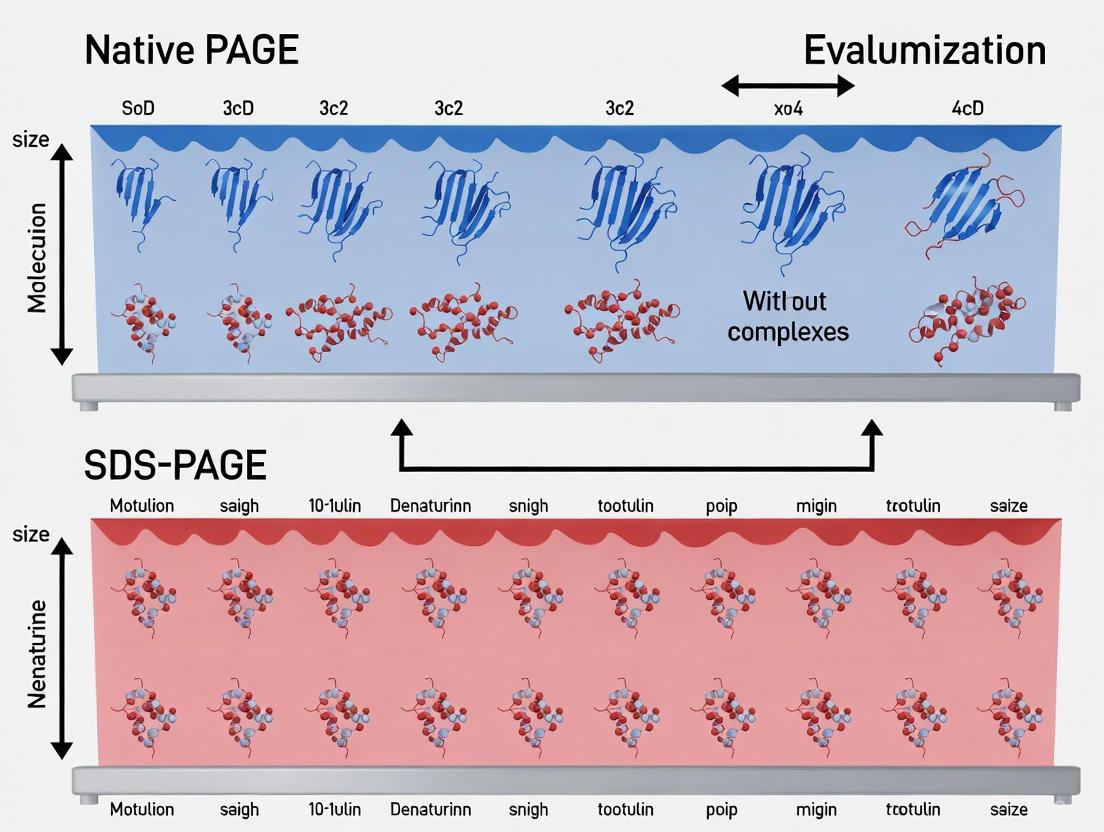
This article provides a comprehensive guide for researchers and drug development professionals on selecting and implementing electrophoresis techniques to accurately evaluate protein oligomerization states.
Native PAGE vs SDS-PAGE for Protein Oligomerization Analysis: A Strategic Guide for Biomedical Researchers
Abstract
This article provides a comprehensive guide for researchers and drug development professionals on selecting and implementing electrophoresis techniques to accurately evaluate protein oligomerization states. It covers the foundational principles distinguishing denaturing SDS-PAGE from native PAGE techniques, detailed methodologies including Blue Native (BN)-PAGE and Clear Native (CN)-PAGE variants, troubleshooting for common artifacts, and validation strategies using orthogonal biophysical methods. By synthesizing current research and practical applications, this resource enables informed methodological choices for studying protein complexes, interactions, and stability in biomedical research.
Core Principles: How Native PAGE and SDS-PAGE Reveal Different Aspects of Protein Structure
For researchers investigating protein oligomerization, selecting the appropriate electrophoretic technique is a critical strategic decision. The choice fundamentally hinges on the separation mechanism: whether to denature proteins for separation purely by molecular weight or to preserve their native state to separate by a combination of intrinsic charge, size, and shape. SDS-PAGE (Sodium Dodecyl Sulfate-Polyacrylamide Gel Electrophoresis) and Native-PAGE represent these two divergent philosophies. This guide provides an objective comparison of their performance in studying oligomeric states, supported by experimental data and detailed protocols, to inform method selection in drug development and basic research.
Core Principles and a Direct Comparison
The underlying mechanism of each technique dictates the type of information it can reveal about a protein complex.
SDS-PAGE: Separation by Molecular Weight Alone. This is a denaturing technique. The anionic detergent SDS unfolds proteins, breaking non-covalent interactions and, when combined with a reducing agent, cleaves disulfide bonds [1] [2]. SDS binds uniformly to the polypeptide backbone, imparting a high negative charge that masks the protein's intrinsic charge [3]. Consequently, all proteins adopt a similar shape and charge-to-mass ratio, migrating through the polyacrylamide gel matrix based almost exclusively on the molecular weight of their polypeptide subunits [3] [2]. It is ideal for determining subunit composition but destroys oligomeric structures.
Native-PAGE: Separation by Native Charge and Size. This is a non-denaturing technique. Proteins are separated in their folded, functional state without the use of denaturants [4] [3]. Their migration is driven by the protein's intrinsic net charge at the gel's pH and is sieved by the gel matrix according to the protein's size and three-dimensional shape [3]. This preserves protein-protein interactions, multi-subunit complexes, enzymatic activity, and non-covalently bound cofactors, making it the preferred method for analyzing native oligomeric states [4] [3].
Table 1: Fundamental Comparison of SDS-PAGE and Native-PAGE
| Feature | SDS-PAGE | Native-PAGE |
|---|---|---|
| Separation Basis | Molecular weight of polypeptide subunits [3] [2] | Native charge, size, and shape of the protein complex [3] |
| Protein State | Denatured and linearized [1] | Native, folded structure retained [4] |
| Oligomeric State | Disrupted; reveals subunits | Preserved; reveals functional oligomers |
| Biological Activity | Lost during separation [5] [6] | Often retained post-separation [3] |
| Information on Protein Complexes | Subunit composition and molecular weight | Stoichiometry, protein-protein interactions, quaternary structure [4] |
| Key Reagent | SDS (denaturant) & DTT (reductant) [2] | No SDS; may use Coomassie G-250 (in BN-PAGE) [7] |
Experimental Data and Performance in Oligomerization Studies
The practical application of these techniques reveals their distinct strengths and limitations, as demonstrated in studies focused on specific protein systems.
Case Study: Resolving HIV-1 Reverse Transcriptase Oligomers with BN-AGE
A critical study on HIV-1 Reverse Transcriptase (HIV-1 RT) highlights a key limitation of standard Native-PAGE methods. While Blue Native-PAGE (BN-PAGE) could separate the p66 homodimer from its monomer, it produced a severe "ladder of bands" artifact for the p51 homodimer under conditions where analytical ultracentrifugation confirmed only monomers were present [7]. This artifact persisted despite troubleshooting efforts, including omitting Coomassie dye, adding detergents, lowering voltage, and altering pH or gel composition.
The researchers developed a modified Blue Native Agarose Gel Electrophoresis (BN-AGE) protocol at pH 8.5 to resolve the issue. This method successfully separated p51 monomers and homodimers as discrete bands, and was used to characterize dimerization-deficient mutants (W401A, L234A) and the effect of the drug Efavirenz, which enhances dimerization [7]. This case underscores that the gel matrix itself (polyacrylamide vs. agarose) can be a source of artifact and requires due diligence.
Table 2: Troubleshooting p51 Artifacts in Native Gels [7]
| Condition Tested | Impact on p51 Multiple Band Artifact |
|---|---|
| BN-PAGE (Standard Protocol) | Severe laddering of monomeric p51 |
| Omission of Coomassie G-250 | Protein did not enter the gel |
| Addition of Detergents (e.g., DDM) | Did not resolve laddering |
| Reduced Voltage / Low Temperature | Did not resolve laddering |
| Increased pH (up to 8.5) in PAGE | Did not resolve laddering |
| BN-AGE at pH 8.5 (Modified Protocol) | Resolved p51 as a single, clean band |
Quantitative Functional Comparison: NSDS-PAGE as an Intermediate Method
A modified technique termed Native SDS-PAGE (NSDS-PAGE) illustrates the spectrum between fully denaturing and fully native conditions. This method removes SDS and EDTA from the sample buffer, omits the heating step, and uses a greatly reduced SDS concentration (0.0375%) in the running buffer [5] [6].
The performance of this hybrid method was quantitatively compared to SDS-PAGE and BN-PAGE:
- Metal Retention: Retention of bound Zn²⁺ in proteomic samples increased from 26% in SDS-PAGE to 98% in NSDS-PAGE [5] [6].
- Enzyme Activity: Seven out of nine model enzymes, including four Zn²⁺ proteins, retained activity after NSDS-PAGE separation. All nine were active after BN-PAGE, while all were denatured and inactive after standard SDS-PAGE [5] [6].
- Resolution: NSDS-PAGE provided a high-resolution separation of the proteome comparable to standard SDS-PAGE, superior to the lower resolution typically achieved by BN-PAGE [5].
Detailed Experimental Protocols
Below are the core methodologies for key techniques discussed, allowing for experimental replication.
Protocol: Blue Native Agarose Gel Electrophoresis (BN-AGE)
This protocol is adapted from the study on HIV-1 RT oligomer separation [7].
- Gel Preparation: Prepare a 3% (w/v) horizontal gel using SeaKem Gold agarose in Native Agarose Gel Buffer (NAGB: 25 mM Tris, 19.2 mM glycine, pH 8.5).
- Sample Preparation: Mix 10 µL of protein sample with 2.5 µL of sample buffer (NAGB containing 30% glycerol) and 0.3 µL of 5% Coomassie Blue G-250.
- Electrophoresis: Submerge the gel in the apparatus containing NAGB (pH 8.5). Perform electrophoresis at room temperature at 40 V for 4.5 hours.
- Detection: Stain and destain the gel using standard protein staining solutions (e.g., Coomassie-based stains).
Protocol: Native SDS-PAGE (NSDS-PAGE)
This protocol is adapted from the method developed for high-resolution separation with native property retention [5].
- Sample Buffer (4X): 100 mM Tris HCl, 150 mM Tris base, 10% glycerol, 0.0185% Coomassie G-250, 0.00625% Phenol Red, pH 8.5. Note: Contains no SDS or EDTA, and the sample is not heated [5].
- Running Buffer: 50 mM MOPS, 50 mM Tris Base, 0.0375% SDS, pH 7.7. Note: The SDS concentration is significantly lower than in standard SDS-PAGE running buffers (typically 0.1%) [5].
- Gel: Standard precast or hand-cast polyacrylamide gels can be used (e.g., Invitrogen NuPAGE Novex 12% Bis-Tris gels) [5].
- Electrophoresis: Run at a constant voltage (e.g., 200V) at room temperature.
The Scientist's Toolkit: Key Reagent Solutions
Successful electrophoresis relies on specific reagents. The table below details essential solutions for the protocols discussed.
Table 3: Essential Research Reagents for Protein Electrophoresis
| Reagent / Kit | Function / Description | Example Use |
|---|---|---|
| SDS (Sodium Dodecyl Sulfate) | Ionic detergent that denatures proteins and confers uniform negative charge [1] [2]. | Core component of SDS-PAGE sample and running buffers. |
| Coomassie Blue G-250 | Anionic dye used in BN-PAGE to impart negative charge to native proteins [7]. | Added to sample prior to BN-PAGE or BN-AGE to facilitate migration. |
| DTT or β-Mercaptoethanol | Reducing agents that break disulfide bonds between cysteine residues [1]. | Added to SDS-PAGE sample buffer for complete denaturation. |
| NativePAGE Novex Bis-Tris Gels | Precast polyacrylamide gels optimized for BN-PAGE separation. | Used for standard BN-PAGE according to manufacturer's protocol [7] [5]. |
| SeaKem Gold Agarose | High-strength, high-resolution agarose for gel electrophoresis. | Used as an alternative gel matrix for BN-AGE to avoid polyacrylamide artifacts [7]. |
| Tris-Glycine Buffer Systems | Common discontinuous buffer system for protein electrophoresis. | Used in both SDS-PAGE and Native-PAGE at varying pH levels [7] [3]. |
Complementary and Advanced Methodologies
While electrophoresis is powerful, alternative and complementary techniques can validate and provide deeper insights.
Dual-Color Colocalization SMLM (DCC-SMLM): This advanced microscopy technique determines oligomeric states in situ without extracting proteins from their native membrane environment, thus avoiding potential disruption of weak interactions [8] [9]. It uses two spectrally distinct fluorescent proteins to tag subunits and counts colocalization events to determine the average oligomeric state, even with low fluorescent protein detection efficiency [9]. It has been used to resolve controversies, such as confirming the dimeric state of SLC26 transporters [8] [9].
Analytical Ultracentrifugation (AUC): Mentioned in the HIV-1 RT study, AUC is a gold-standard solution-based method for determining molecular mass and oligomeric states in a native solution, providing a critical benchmark for validating gel-based methods [7].
The choice between SDS-PAGE and Native-PAGE for studying protein oligomerization is not a matter of which technique is superior, but which is appropriate for the specific research question. SDS-PAGE is the unrivaled method for determining the molecular weight and purity of denatured subunits. In contrast, Native-PAGE (and its variants like BN-PAGE and BN-AGE) is essential for probing functional, native oligomeric complexes. As demonstrated by the development of NSDS-PAGE and BN-AGE, researchers can and should modify standard protocols to overcome challenges, while techniques like DCC-SMLM offer a powerful way to validate findings in a near-native cellular context. A rigorous approach often requires the complementary use of multiple methods to build a definitive model of a protein's quaternary structure.
In the study of proteins, particularly for determining oligomerization states and complex structures, the choice of electrophoretic method dictates the informational outcome. Native PAGE (Polyacrylamide Gel Electrophoresis) and SDS-PAGE (Sodium Dodecyl Sulfate–Polyacrylamide Gel Electrophoresis) represent two fundamentally different approaches: one preserves the native architecture of proteins, while the other systematically dismantles it [4] [10]. This guide provides a objective comparison of these techniques, focusing on their impact on protein function and quaternary structure within the context of oligomerization state research.
The core distinction lies in the treatment of the protein sample. Native-PAGE separates proteins in their folded, active state, allowing for the analysis of functional complexes and oligomers. In contrast, SDS-PAGE relies on a powerful denaturing detergent to unfold proteins and coat them with a uniform negative charge, separating polypeptides primarily by their molecular mass while destroying higher-order structure and function [11] [10]. The following sections will detail the principles, experimental protocols, and resulting data outputs of each method, providing a framework for selecting the appropriate technique for specific research goals in drug development and protein science.
Fundamental Principles and Mechanisms
Native-PAGE: Preserving Native Structure
- Separation Basis: Native-PAGE separates proteins based on a combination of their inherent charge, size, and three-dimensional shape as they migrate through the polyacrylamide gel matrix [11] [10]. The gel acts as a sieve, where smaller and more negatively charged proteins migrate faster.
- Structural Integrity: Crucially, no denaturing agents are used. This preserves the protein's secondary, tertiary, and quaternary structures [10]. Consequently, subunit interactions within a multimeric protein are retained, and many proteins maintain their enzymatic activity following separation [11].
- Charge Considerations: Because proteins retain their native charge, they can migrate toward either the anode or cathode depending on their net charge at the running buffer's pH. This makes molecular weight determination less straightforward than in denaturing methods [10].
SDS-PAGE: Denaturation for Size-Based Separation
- Separation Basis: SDS-PAGE separates proteins primarily, and almost exclusively, by their polypeptide molecular weight [12]. This is achieved by dismantling the native structure.
- Role of SDS: The anionic detergent SDS denatures proteins by binding to the polypeptide backbone, disrupting hydrogen bonds and hydrophobic interactions. This unfolds the protein into a linear chain [13] [14]. SDS binds in a constant weight ratio (about 1.4 g SDS per 1 g of protein), conferring a uniform negative charge that overwhelms the protein's intrinsic charge [15] [11].
- Role of Reducing Agents: Agents like Dithiothreitol (DTT) or β-mercaptoethanol are added to break disulfide bonds, which are covalent bonds not disrupted by SDS alone [13] [15]. This ensures complete dissociation of protein subunits not covalently linked.
- The Result: All proteins become linear, negatively charged rods with very similar charge-to-mass ratios. When pulled through the gel by an electric field, their migration rate depends almost entirely on their size, enabling accurate molecular weight estimation [11] [12].
Table 1: Core Principles and Separation Mechanisms
| Feature | Native-PAGE | SDS-PAGE |
|---|---|---|
| Primary Separation Basis | Net charge, size, and shape | Molecular mass (polypeptide length) |
| Protein State | Native, folded | Denatured, linearized |
| Quaternary Structure | Preserved | Disrupted (except covalent cross-links) |
| Functional Activity | Often retained | Destroyed |
| Key Reagents | Non-denaturing buffer | SDS, Reducing agents (DTT) |
| Molecular Weight Determination | Not reliable due to charge/shape influence | Highly reliable |
Experimental Protocols and Key Reagents
The experimental workflows for Native-PAGE and SDS-PAGE are designed to either maintain or dismantle protein structure, a critical difference reflected in every step of sample preparation and electrophoresis.
Sample Preparation: A Critical Divergence
Native-PAGE Protocol:
- Sample Buffer: A non-denaturing buffer is used, typically containing Tris, glycerol for density, and a tracking dye like Bromophenol Blue. Crucially, it lacks SDS, reducing agents, and EDTA (which can chelate metal cofactors) [5] [16].
- No Heating: The sample is mixed with the buffer but not heated, as heat would denature proteins and defeat the purpose of the technique [16].
- Cell Lysis: Gentle lysis methods like ultrasonication are employed, followed by centrifugation to collect the supernatant [16].
SDS-PAGE Protocol:
- Sample Buffer (Laemmli Buffer): This contains SDS to denature and impart charge, a reducing agent (DTT or β-mercaptoethanol) to break disulfide bonds, glycerol, and a tracking dye [13] [14].
- Heating Step: The protein-sample buffer mixture is heated to 95–100°C for 5-10 minutes to ensure complete denaturation and disruption of all non-covalent interactions [15].
- Goal: The outcome is a solution of fully denatured, reduced, and negatively charged polypeptides.
Gel Composition and Electrophoresis Conditions
Native-PAGE Conditions:
- Gel & Buffer: The polyacrylamide gel and electrophoresis buffer are formulated without SDS or other denaturants [16].
- pH Consideration: The pH of the buffer system must be chosen based on the protein's isoelectric point (pI). For acidic proteins, a basic pH (e.g., 8.8) is used to ensure a net negative charge and migration toward the anode. For basic proteins, an acidic buffer and reversed electrode polarity may be necessary [16].
- Temperature Control: Electrophoresis is often performed at 4°C or with cooling to prevent heat-induced denaturation during the run [16].
SDS-PAGE Conditions:
- Gel & Buffer: Both the gel and the running buffer contain SDS to maintain protein denaturation [15] [14].
- Discontinuous System: Standard SDS-PAGE uses a stacking gel (lower pH, low % acrylamide) to concentrate all protein samples into a sharp band before they enter the resolving gel (higher pH, higher % acrylamide) where separation by size occurs [14].
- Glycine's Role: In the running buffer, glycine's charge state changes with the gel's pH, creating a voltage gradient that stacks proteins sharply at the interface between the two gels [14].
The following workflow summarizes the key decision points and procedural steps for both methods:
The Scientist's Toolkit: Essential Research Reagents
Successful electrophoresis requires specific reagents tailored to each method's goals.
Table 2: Key Reagent Solutions for Native- and SDS-PAGE
| Reagent | Function in Native-PAGE | Function in SDS-PAGE |
|---|---|---|
| Tris-Glycine Buffer | Running buffer at appropriate pH to maintain protein charge and activity [16]. | Running buffer; glycine's shifting charge enables stacking for sharp bands [14]. |
| Non-Denaturing Load Buffer | Provides density for well-loading and a visible dye; lacks SDS/DTT to preserve structure [16]. | Not applicable. |
| Laemmli Sample Buffer | Not applicable. | Denatures proteins (SDS), reduces disulfide bonds (DTT), adds density (glycerol) [14]. |
| Sodium Dodecyl Sulfate (SDS) | Omitted to prevent denaturation. | Primary denaturant; unfolds proteins and confers uniform negative charge [13] [12]. |
| Dithiothreitol (DTT) | Omitted to prevent reduction of disulfide bonds. | Reducing agent; breaks disulfide bonds to fully dissociate subunits [13] [15]. |
| Acrylamide/Bis Solution | Forms the porous gel matrix for size-based separation in a native state. | Forms the porous gel matrix for size-based separation of denatured polypeptides. |
| Coomassie/Silver Stain | Detects separated protein bands after electrophoresis; compatible with native proteins [16]. | Detects separated polypeptide bands after electrophoresis. |
Data Output and Experimental Evidence
The functional and structural impacts of choosing Native-PAGE over SDS-PAGE are demonstrated by specific experimental data, particularly regarding metal cofactor retention and enzymatic activity.
Quantitative Comparison: Metal Retention and Enzyme Activity
A modified electrophoretic method known as NSDS-PAGE (Native SDS-PAGE), which uses minimal SDS and no EDTA or heating, provides a clear point of comparison. This method aims to balance the high resolution of SDS-PAGE with the functional preservation of Native-PAGE [5].
Table 3: Quantitative Data on Metal Retention and Enzyme Activity Post-Electrophoresis
| Analysis Metric | BN-PAGE (Fully Native) | NSDS-PAGE (Minimal Denaturation) | SDS-PAGE (Fully Denaturing) |
|---|---|---|---|
| Zn²⁺ Retention in Proteomic Samples | Not Explicitly Reported | 98% [5] | 26% [5] |
| Activity of Model Zn²⁺ Enzymes | All nine enzymes active [5] | Seven of nine enzymes active [5] | All nine enzymes denatured/inactive [5] |
| Resolution Quality | Lower resolution, broader bands [5] | High resolution, comparable to SDS-PAGE [5] | High resolution, sharp bands [5] |
Key Interpretation: The data shows that standard SDS-PAGE is highly destructive to metal-protein interactions and enzymatic function, while fully native methods (BN-PAGE) preserve them completely. The hybrid NSDS-PAGE method demonstrates that high resolution can be achieved with minimal functional compromise, though not all activity is retained [5]. For research focused on metalloproteins or functional complexes, this trade-off is a critical consideration.
Analysis of Oligomerization State
The preservation of quaternary structure in Native-PAGE allows researchers to directly analyze the native oligomeric state of a protein.
- Native-PAGE Analysis: A single band on a Native-PAGE gel typically represents a protein in its intact oligomeric form (e.g., a dimer, tetramer). Its migration distance is a function of that entire complex's mass, charge, and shape [10]. This is invaluable for studying protein-protein interactions and complex stoichiometry.
- SDS-PAGE Analysis: SDS-PAGE dissociates non-covalent complexes. A multimeric protein will typically yield bands corresponding to the molecular weights of its individual subunits. If a complex is stabilized by disulfide bonds and a non-reducing buffer is used, the band may represent the intact, cross-linked complex, but in a denatured state [15] [10].
Application Scenarios and Selection Guide
The choice between Native-PAGE and SDS-PAGE is not a matter of which is better, but which is appropriate for the specific research question.
Choose Native-PAGE when your goal is to:
- Determine a protein's native oligomeric state or quaternary structure [10].
- Study protein-protein interactions within a complex [4].
- Isolate and subsequently test for enzymatic activity directly from the gel [11] [10].
- Analyze proteins with essential metal ion cofactors that would be stripped away by denaturation [5].
Choose SDS-PAGE when your goal is to:
- Determine the molecular weight of polypeptide subunits with high accuracy [11] [10].
- Assess the purity and integrity of a protein sample [10].
- Analyze the subunit composition of a complex [11].
- Prepare samples for western blotting or mass spectrometry analysis, where denaturation is required or beneficial [4].
In conclusion, the central thesis in evaluating protein oligomerization state is that Native-PAGE and SDS-PAGE are complementary tools. Native-PAGE provides a snapshot of the protein in its functional, assembled state, while SDS-PAGE provides a parts list of its constituent polypeptides. The decision on which method to use must be driven by the specific biological question, whether it pertains to the function of the whole machine or the identity of its components.
In the study of protein oligomerization, selecting the appropriate electrophoretic technique is paramount. The oligomerization state of a protein—whether it exists as a monomer, dimer, or larger complex—directly influences its function and regulatory mechanisms. Native PAGE and SDS-PAGE are foundational methods in this analysis, but they provide starkly different information based on their fundamental technical principles. This guide provides a detailed, objective comparison of the buffer composition, sample preparation, and running conditions of these two techniques, framing them within the context of protein oligomerization research for scientists and drug development professionals.
Technical Comparison at a Glance
The following table summarizes the core procedural differences between Native PAGE and SDS-PAGE, which dictate their applicability in studying oligomeric proteins [17] [3].
| Technical Criterion | Native PAGE | SDS-PAGE |
|---|---|---|
| Gel Nature | Non-denaturing | Denaturing |
| Separation Principle | Size, charge, and 3D shape [17] [18] | Molecular weight (size only) [18] [19] [3] |
| Sample Buffer Additives | Non-denaturing buffer, often Coomassie dye (BN-PAGE) [5] | SDS (anionic detergent) and reducing agents (e.g., DTT, β-mercaptoethanol) [17] [15] |
| Sample Heating | Not heated [17] | Heated (typically 70–100°C) [3] [15] |
| Protein State Post-Prep | Native, folded, functional [17] [4] | Denatured, linearized, non-functional [3] [20] |
| Running Conditions | Run at 4°C [17] | Run at room temperature [17] |
| Impact on Oligomers | Preserves multimeric quaternary structure [3] [21] | Disrupts non-covalent quaternary structures [3] [15] |
Detailed Methodologies and Experimental Protocols
Sample Preparation Protocols
The sample preparation phase is where the most critical differences lie, as it determines whether native structures are preserved or denatured.
Native PAGE Protocol (for Oligomer Preservation):
- Buffer Formulation: Prepare a non-denaturing sample buffer. A common formulation is 50 mM BisTris, 50 mM NaCl, 10% glycerol, and 0.001% Ponceau S, pH 7.2 [5]. For Blue Native PAGE (BN-PAGE), Coomassie G-250 dye is added to the sample buffer [5].
- Sample Mixing: Combine the protein sample with the 4X non-denaturing sample buffer. A typical ratio is 7.5 µL sample to 2.5 µL 4X buffer [5].
- Critical Step - No Heating: The sample mixture is loaded directly onto the gel without heating [17]. This avoids thermal denaturation that would disrupt weak, non-covalent interactions holding protein complexes together.
SDS-PAGE Protocol (for Subunit Analysis):
- Buffer Formulation: Prepare a denaturing sample buffer. The Laemmli buffer system is standard, containing SDS and a reducing agent [15].
- Reduction and Denaturation: Combine the protein sample with the SDS-containing buffer and a reducing agent like dithiothreitol (DTT) or β-mercaptoethanol. These agents break disulfide bonds that stabilize some protein complexes [20] [15].
- Critical Step - Heating: Heat the sample at 95°C for 5 minutes (or 70°C for 10 minutes) [15]. This heat treatment fully denatures the proteins, allowing SDS to bind uniformly and linearize the polypeptides, effectively dismantling oligomeric complexes into their constituent subunits [3].
Buffer and Gel Composition
The composition of the gels and running buffers is engineered to support the goal of each technique.
Native PAGE Systems:
- Gel Buffer: Lacks SDS and denaturing agents. Common systems use BisTris-based buffers at neutral pH [5].
- Running Buffer: A discontinuous system is often used. For BN-PAGE, the cathode and anode buffers are different; the cathode buffer may contain Coomassie dye (e.g., 0.02% Coomassie G-250), which assists in protein charge-shifting and complex stabilization during the run [5]. The entire process is typically performed at 4°C to maintain protein stability and prevent denaturation [17].
SDS-PAGE Systems:
- Gel Buffer: Contains SDS (e.g., 0.1-0.2%) in both stacking and resolving gels [15]. The stacking gel has a lower acrylamide concentration (~4%) and pH (~6.8), while the resolving gel has a higher concentration (e.g., 10-12%) and pH (~8.8) for optimal separation [22] [15].
- Running Buffer: Contains SDS (e.g., 0.1% in traditional systems) and a conducting electrolyte like Tris-glycine [15]. The SDS ensures a constant charge-to-mass ratio for all proteins during electrophoresis.
Workflow Diagram: Native PAGE vs. SDS-PAGE
The diagram below illustrates the key procedural differences and their impact on protein oligomers.
Supporting Experimental Data and Advanced Techniques
Quantitative Data on Native Function Preservation
Research into modified SDS-PAGE conditions provides quantitative evidence for the importance of gentle protocols. A study comparing standard SDS-PAGE to Native SDS-PAGE (NSDS-PAGE)—which uses minimal SDS and no heating or EDTA—yielded compelling data on function preservation [5].
| Experimental Condition | Zinc Retention in Zn-Proteome | Enzymatic Activity Retention\n(Model Enzymes) |
|---|---|---|
| Standard SDS-PAGE | 26% | 0 out of 9 active (All denatured) |
| Native (N)SDS-PAGE | 98% | 7 out of 9 active |
| Blue Native (BN)-PAGE | Not Reported | 9 out of 9 active |
This data underscores that omitting denaturing steps allows most proteins to retain their metal cofactors and enzymatic function, which is crucial for analyzing metalloenzymes and other functional complexes [5].
The Scientist's Toolkit: Essential Research Reagents
The following table details key reagents used in these electrophoretic techniques and their specific roles in protein analysis.
| Reagent Solution | Function in Protocol | Impact on Protein Oligomerization |
|---|---|---|
| Sodium Dodecyl Sulfate (SDS) | Denatures proteins; confers uniform negative charge [3] [20]. | Disrupts non-covalent oligomers by unfolding subunits. Masks intrinsic charge. |
| Dithiothreitol (DTT) / β-Mercaptoethanol | Reducing agents that break disulfide bonds [17] [15]. | Disrupts oligomers held together by covalent disulfide linkages. |
| Coomassie G-250 (in BN-PAGE) | Imparts negative charge without full denaturation; stabilizes complexes [5]. | Preserves oligomeric structure during separation for native mass analysis. |
| TEMED / Ammonium Persulfate (APS) | Catalyzes acrylamide polymerization to form the gel matrix [3] [22]. | No direct impact on oligomers. Creates the sieving medium for separation. |
| Tris-Based Buffers | Maintains stable pH during electrophoresis to ensure consistent protein charge [15]. | Critical in native PAGE to maintain protein stability and native charge. |
Strategic Application in Oligomerization Research
The choice between Native PAGE and SDS-PAGE is not a matter of which is better, but of which is appropriate for the specific research question.
Use Native PAGE (or BN-PAGE) to:
- Determine the native molecular weight and oligomeric state (e.g., dimer, tetramer) of a protein complex [3] [4].
- Study protein-protein interactions and isolate active complexes for downstream functional assays (e.g., enzyme activity tests) [17] [5].
- Investigate proteins with non-covalently bound cofactors, such as metal ions, that are essential for function [5].
Use SDS-PAGE to:
- Determine the molecular weight of the individual polypeptide subunits that make up an oligomeric complex [3] [20].
- Analyze protein purity and subunit composition, confirming the number and size of distinct chains in a complex [4].
- Probe for the presence of disulfide bonds by comparing reducing and non-reducing conditions [20].
For the most comprehensive analysis, researchers often employ a two-dimensional approach: separating proteins by their native state in the first dimension (using BN-PAGE) followed by a second dimension under denaturing conditions (SDS-PAGE). This powerful combination can resolve the subunit composition of each individual complex from a mixture, providing a complete picture of the oligomeric proteome [5].
Protein oligomerization, the process by which multiple protein subunits assemble into a defined quaternary structure, represents a fundamental mechanism regulating biological function across diverse organisms. These homo-oligomers (comprising identical subunits) and hetero-oligomers (comprising different subunits) exhibit properties that often transcend the simple sum of their parts, enabling complex allosteric regulation, enhanced stability, and the formation of novel functional sites [23]. The symmetry and stoichiometry of these assemblies—ranging from cyclic (Cn) and dihedral (Dn) symmetries to complex helical and icosahedral arrangements—are crucial determinants of their physiological roles [23]. For instance, many enzymes become catalytically active only upon forming specific oligomeric states, while membrane transporters and receptors frequently rely on quaternary structures for proper regulation and function [9]. Conversely, aberrant oligomerization underpins numerous pathological conditions, including amyloid formation in neurodegenerative diseases and loss-of-function mutations that disrupt essential protein complexes. Consequently, accurately determining oligomeric states is paramount for understanding both normal physiology and disease mechanisms, driving the development of increasingly sophisticated analytical techniques.
Comparative Analysis of Electrophoretic Methods for Oligomerization State Determination
The accurate determination of a protein's oligomeric state is a fundamental challenge in structural biology. Among the most widely used techniques are Native Polyacrylamide Gel Electrophoresis (Native-PAGE) and Sodium Dodecyl Sulfate-Polyacrylamide Gel Electrophoresis (SDS-PAGE), which provide complementary information through different mechanisms of separation. The following section provides a detailed comparison of these core methodologies.
Table 1: Core Characteristics of Native-PAGE and SDS-PAGE
| Feature | Native-PAGE | SDS-PAGE |
|---|---|---|
| Protein State | Native, folded conformation preserved [4] | Denatured, unfolded linear chains [15] [4] |
| Separation Basis | Combined effect of intrinsic charge, size, and shape [4] | Molecular weight of polypeptide chains [15] [4] |
| Quaternary Structure | Preserves oligomeric complexes and quaternary structure [24] [4] | Disrupts non-covalent quaternary structure [15] |
| Biological Activity | Often retained after separation [4] [5] | Destroyed due to denaturation [4] [5] |
| Disulfide Bonds | Remain intact unless reducing agents are added | Remain intact in non-reducing conditions [24] |
| Key Applications | Studying native complexes, protein-protein interactions, enzymatic activity assays [4] | Determining subunit molecular weight, protein purity, post-translational modifications [4] |
Experimental Data and Interpretation
The power of combining these techniques is illustrated by a classic experimental observation: a protein that migrates as a 60 kDa band on non-reducing SDS-PAGE but as a 120 kDa band on Native-PAGE provides a clear inference. This result strongly indicates that the native protein is a dimer of 60 kDa subunits [24]. Critically, the use of non-reducing conditions confirms that the subunits are not linked by disulfide bonds, as these covalent bonds would remain intact and the SDS-PAGE would still show the 120 kDa complex [24] [15]. The dissociation into monomers on SDS-PAGE demonstrates that the dimer is stabilized by non-covalent interactions (e.g., hydrophobic, electrostatic), which are disrupted by the denaturing action of SDS [24] [4].
Methodological Limitations and Advanced Variants
Both techniques have limitations. SDS-PAGE intentionally destroys native structure and function, making it unsuitable for functional studies [5]. While Native-PAGE preserves function, its resolution can be lower, and migration is influenced by factors beyond size, complicating molecular weight determination [4] [5]. To address the need for high resolution under semi-native conditions, Native SDS-PAGE (NSDS-PAGE) has been developed. This modified technique uses minimal SDS and omits heating and chelating agents like EDTA, which allows for excellent protein separation while retaining enzymatic activity and bound metal cofactors in many proteins [5]. For example, Zn²⁺ retention in proteomic samples increased from 26% in standard SDS-PAGE to 98% in NSDS-PAGE, and most tested enzymes remained active after separation [5].
Experimental Data from Comparative Studies
To effectively illustrate the practical outcomes of these methods, the table below summarizes key experimental findings that highlight the resolving power and specific applications of different electrophoretic techniques.
Table 2: Experimental Data from Electrophoretic Analysis of Protein Oligomerization
| Protein / System | Technique | Key Finding | Biological Significance |
|---|---|---|---|
| Pyruvate Dehydrogenase E2 (PDH E2) Complex | Negative Staining EM with Multiple Stains [25] | Multi-stain approach improved resolution to 21.7 Å, revealing icosahedral symmetry and detailed domain organization. | Enhanced visualization of large complex architecture, bridging initial characterization and high-resolution studies. |
| Generic Protein Complex | Native-PAGE vs. Non-reducing SDS-PAGE [24] | Native-PAGE: 120 kDa; SDS-PAGE: 60 kDa. | Identified a non-covalent homodimer, crucial for understanding functional quaternary structure. |
| Zinc Metalloproteins (e.g., Alcohol Dehydrogenase) | Standard SDS-PAGE vs. NSDS-PAGE [5] | Zn²⁺ retention: 26% (SDS-PAGE) vs. 98% (NSDS-PAGE); enzymatic activity preserved in NSDS-PAGE. | Enabled high-resolution separation of native metalloproteins, vital for studying metal-coupled function. |
| Plasma Membrane Transporters (SLC family) | DCC-SMLM (Microscopy) [9] | Resolved controversy, confirming dimeric state for SLC26A3 and prestin in situ. | Validated oligomeric state in native membrane environment without disruptive isolation. |
Detailed Experimental Protocols
Standard SDS-PAGE Protocol
The standard denaturing SDS-PAGE protocol is a workhorse for determining subunit molecular weight [15].
- Sample Preparation: Mix protein sample with an SDS-containing loading buffer (e.g., LDS buffer). A reducing agent like DTT or β-mercaptoethanol is often included to break disulfide bonds. Heat the sample at 70°C for 10 minutes or 95°C for 5 minutes to denature the proteins [15] [5].
- Gel Setup: Use a discontinuous gel system, typically with a stacking gel (pH ~6.8) and a separating gel (pH ~8.8) of appropriate acrylamide concentration (e.g., 4-20%) to create a pore size gradient for optimal separation [15].
- Electrophoresis: Load samples and a molecular weight marker onto the gel. Run in an SDS-containing running buffer (e.g., MOPS or Tris-Glycine-SDS) at constant voltage (e.g., 100-200 V) until the dye front migrates to the bottom of the gel [15] [5].
Native (Blue) PAGE Protocol
This protocol preserves protein complexes in their native state [5] [9].
- Sample Preparation: Mix protein sample with a non-denaturing, mild sample buffer. Crucially, no SDS or reducing agents are added. Glycerol is often included to facilitate gel loading, and a blue dye like Coomassie G-250 may be present to provide charge and visual tracking [5].
- Gel Setup: Use pre-cast NativePAGE gels or cast gels with a single, neutral pH buffer system (e.g., Bis-Tris, pH 7.2) to maintain native protein charge [5].
- Electrophoresis: Load samples and native molecular weight standards. Run using anode and cathode buffers of different compositions, often under dark conditions at 4°C to maintain protein stability, at constant voltage (e.g., 150 V) [5].
Native SDS-PAGE (NSDS-PAGE) Protocol
This hybrid protocol balances resolution and native state preservation [5].
- Sample Preparation: Mix protein sample with a modified sample buffer that contains no SDS, EDTA, or reducing agents, and omit the heating step [5].
- Gel Setup: Use standard Bis-Tris gels. Pre-run the gel in water to remove storage buffers and unpolymerized acrylamide [5].
- Electrophoresis: Run the gel in a modified running buffer containing a very low concentration of SDS (e.g., 0.0375%) and no EDTA, at constant voltage (e.g., 200 V) [5].
The workflow below illustrates the decision-making process for selecting the appropriate electrophoretic method based on research goals.
Advanced and Emerging Techniques in Oligomerization Analysis
While electrophoretic methods are foundational, technological advances have provided powerful new tools for analyzing oligomeric states, particularly in complex cellular environments.
Single Molecule Localization Microscopy (SMLM)
Traditional biochemical methods require protein extraction, which can disrupt weak but physiologically relevant interactions [9]. Dual-Color Colocalization SMLM (DCC-SMLM) overcomes this by enabling in situ quantification of oligomeric states in plasma membranes. This super-resolution technique labels each subunit of a protein with two spectrally distinct fluorescent proteins—a "marker" (M) and an "indicator" (F). By statistically analyzing the co-localization of signals from both fluorophores, the average oligomeric state of the protein can be determined with high accuracy, even with low fluorescent protein detection efficiency and in the presence of background noise [9]. This method has been used to resolve controversies, such as confirming the dimeric state of SLC26 anion transporters within their native membrane environment [9].
Computational Prediction with Machine Learning
The rise of accurate protein structure prediction has enabled the development of computational tools for oligomer symmetry prediction. Seq2Symm is a machine learning model that leverages the ESM2 protein language model to predict the symmetry of homo-oligomers (e.g., cyclic C2, dihedral D3, helical) from a single protein sequence alone [23]. This approach is highly scalable, capable of predicting oligomeric states for approximately 80,000 proteins per hour, and significantly outperforms older template-based methods [23]. Such tools allow researchers to prioritize experimental characterization and generate hypotheses for proteins lacking experimental structures.
The Scientist's Toolkit: Essential Research Reagents and Materials
Successful determination of protein oligomerization requires a suite of specialized reagents and materials. The following table details key solutions and their specific functions in different electrophoretic protocols.
Table 3: Key Research Reagents for Oligomerization Analysis
| Reagent / Material | Function / Description | Application Notes |
|---|---|---|
| Sodium Dodecyl Sulfate (SDS) | Anionic detergent that denatures proteins and confers uniform negative charge. Binds ~1.4g per gram of protein [15]. | Standard SDS-PAGE: Essential. NSDS-PAGE: Greatly reduced (0.0375%) or omitted. Native-PAGE: Not used [4] [5]. |
| Polyacrylamide Gel Matrix | Porous network that sieves proteins during electrophoresis. | Pore size (determined by %T) dictates separation range. Gradient gels (e.g., 4-12%) offer wider size range resolution [15]. |
| β-Mercaptoethanol / DTT | Reducing agents that break disulfide bonds between cysteine residues. | Used in reducing SDS-PAGE to fully dissociate covalent complexes. Omitted in non-reducing SDS-PAGE and Native-PAGE [24] [15]. |
| Coomassie G-250 | Blue dye used in sample and cathode buffers for Native/BN-PAGE. | Imparts a slight negative charge to proteins, aids in protein migration and visualization during the run [5]. |
| Uranyl Acetate (UA) | Heavy metal salt used for negative staining in Electron Microscopy (EM). | Provides high contrast; binds negatively charged protein regions. One of several stains used in multi-stain EM approaches [25]. |
| Photoactivatable Fluorescent Proteins (e.g., PA-GFP, mEos) | Genetically encoded tags for SMLM. Can be activated or converted with specific light wavelengths. | Essential for DCC-SMLM; allows precise localization of single molecules beyond the diffraction limit [9]. |
The precise determination of protein oligomerization states remains a cornerstone of structural and functional biology, with direct implications for understanding enzyme mechanisms, cellular signaling, and disease pathology. While classical electrophoretic techniques like Native-PAGE and SDS-PAGE provide a foundational and accessible approach, their limitations have spurred the development of advanced hybrid methods like NSDS-PAGE and sophisticated in-situ technologies like DCC-SMLM. The choice of method is critical, as it must align with the specific research question—whether it involves determining subunit stoichiometry, probing functional complexes, or visualizing oligomers in their native membrane environment. The ongoing integration of these experimental findings with powerful computational predictions, such as those generated by Seq2Symm, is creating a more comprehensive and dynamic atlas of protein oligomerization across biology. This multi-faceted toolkit empowers researchers to not only elucidate the fundamental principles of protein assembly but also to identify novel therapeutic targets for diseases driven by aberrant oligomerization.
For researchers investigating protein complexes, oligomerization state is a critical parameter influencing biological function, yet accurately determining this state requires careful methodological selection. When framing experiments within the context of protein oligomerization, the choice between Native PAGE and SDS-PAGE represents a fundamental crossroads, with each technique providing a distinct and often irreconcilable view of your protein's quaternary structure. Native PAGE preserves the delicate, non-covalent interactions that maintain multi-subunit complexes, allowing for analysis of proteins in their functional, native state [4]. In contrast, SDS-PAGE employs a strong ionic detergent to dismantle these complexes, providing information strictly on the molecular weights of denatured polypeptide subunits [4]. This guide provides an objective comparison of these techniques, supported by experimental data, to empower researchers in making informed decisions for their specific experimental objectives.
Core Principle and Impact on Oligomerization State
The most significant distinction between these methods lies in their treatment of the protein's structure, which directly dictates the information you can obtain about oligomerization.
Native PAGE: Preserves Oligomeric Structure This technique separates proteins under non-denaturing conditions. The gel matrix and running buffers lack disruptive detergents, allowing proteins to retain their secondary, tertiary, and quaternary structures [4]. Separation is based on a combination of the protein's intrinsic charge, size, and shape [3]. Consequently, a protein complex will migrate as an intact entity. If a protein exists as a tetramer in its native state, it will appear on the Native PAGE gel at a molecular weight corresponding to that tetramer, providing direct evidence of its oligomeric state [4].
SDS-PAGE: Disrupts Oligomeric Structure SDS-PAGE is a denaturing technique. Proteins are heated in a sample buffer containing sodium dodecyl sulfate (SDS) and a reducing agent [26]. SDS binds uniformly to the polypeptide backbone, masking the protein's intrinsic charge and unfolding it into a linear rod [4]. Crucially, this process dissociates non-covalent protein-protein interactions and reduces disulfide bonds, effectively dismantling protein oligomers into their constituent monomers [4]. Separation, therefore, occurs primarily by the mass of the individual polypeptide chains, not the intact complex [3].
The following workflow illustrates the procedural and outcome differences between these two methods:
Capabilities and Limitations: A Direct Comparison
The core differences in principle translate directly into distinct capabilities and limitations for protein characterization, particularly concerning oligomerization.
Table 1: Capabilities and Limitations of Native PAGE vs. SDS-PAGE in Protein Analysis
| Analysis Parameter | Native PAGE | SDS-PAGE |
|---|---|---|
| Oligomerization State | Preserved and directly analyzable [4] | Disrupted; provides subunit composition only [4] |
| Biological Activity | Retained (enzymatic assays possible post-electrophoresis) [5] | Destroyed by denaturation [4] |
| Molecular Weight Determination | Approximate; based on native size/charge ratio [4] | Accurate for polypeptide chains using standards [3] |
| Protein Complex & Interaction Studies | Ideal for analyzing intact complexes [4] | Unsuitable for native interactions [4] |
| Key Limitation | Lower resolution for complex mixtures; native charge can complicate analysis [4] | Cannot distinguish between different oligomeric states of the same protein [4] |
Experimental Data and Protocol Comparison
To move from theoretical comparison to practical application, the following experimental data and detailed protocols are provided.
Quantitative Comparison: Retention of Native Properties
A critical study directly compared standard SDS-PAGE, Blue-Native (BN)-PAGE, and a modified "Native SDS-PAGE" (NSDS-PAGE) method for its ability to retain zinc ions and enzymatic activity in various proteins. The data clearly demonstrates the functional consequences of the methodological choice.
Table 2: Quantitative Comparison of Functional Property Retention Across PAGE Methods [5]
| Protein / Sample | SDS-PAGE | BN-PAGE | NSDS-PAGE |
|---|---|---|---|
| Retention of Zn²⁺ in Proteome | 26% | Not Reported | 98% |
| Active Enzymes (from 9 tested) | 0 | 9 | 7 |
| Yeast Alcohol Dehydrogenase (Zn-ADH) | Inactive | Active | Active |
| Carbonic Anhydrase (Zn-CA) | Inactive | Active | Active |
Detailed Experimental Protocols
The following protocols are adapted from established methods and are critical for ensuring the validity of the results, particularly for Native PAGE [5].
Protocol for Native PAGE (Based on BN-PAGE)
- Sample Preparation: Mix 7.5 μL of protein sample with 2.5 μL of 4X BN-PAGE sample buffer (e.g., 50 mM BisTris, 50 mM NaCl, 10% Glycerol, 0.001% Ponceau S, pH 7.2). Do not heat.
- Gel Preparation: Use a pre-cast Native-PAGE Novex 4-16% Bis-Tris gradient gel or equivalent.
- Running Buffer: Prepare anode (50 mM BisTris, 50 mM Tricine, pH 6.8) and cathode (50 mM BisTris, 50 mM Tricine, 0.02% Coomassie G-250, pH 6.8) buffers separately.
- Electrophoresis: Load samples and run at a constant voltage of 150V at 4°C for approximately 90 minutes, or until the dye front migrates to the bottom of the gel [5].
Protocol for SDS-PAGE (Standard Denaturing)
- Sample Preparation: Mix 7.5 μL of protein sample with 2.5 μL of 4X LDS sample loading buffer (containing SDS and reducing agents). Heat the sample at 70°C for 10 minutes to ensure complete denaturation.
- Gel Preparation: Use a pre-cast gel, such as a Novex 12% Bis-Tris gel.
- Running Buffer: Use 1X MOPS SDS running buffer (e.g., 50 mM MOPS, 50 mM Tris Base, 0.1% SDS, 1 mM EDTA, pH 7.7).
- Electrophoresis: Load samples alongside molecular weight markers. Run at a constant voltage of 200V at room temperature for about 45 minutes, or until the dye front exits the gel [5].
Research Reagent Solutions
The following table details essential materials and their functions for executing these electrophoretic analyses.
Table 3: Essential Research Reagents and Materials for PAGE
| Item | Function | Key Consideration |
|---|---|---|
| Acrylamide/Bis-Acrylamide | Forms the cross-linked porous gel matrix; concentration determines pore size and resolution range [3]. | A 29:1 or 37.5:1 ratio of acrylamide to bis-acrylamide is common. Stock solutions are light-sensitive and can hydrolyze over time [27]. |
| SDS (Sodium Dodecyl Sulfate) | Ionic detergent that denatures proteins and confers a uniform negative charge [4]. | Use high-purity, electrophoresis-grade SDS. The critical factor for binding is the SDS monomer concentration, which requires low ionic strength in the sample buffer [27]. |
| TEMED & APS | Catalytic system for gel polymerization. TEMED catalyzes APS to produce free radicals that initiate polymerization [3]. | TEMED is volatile and corrosive. APS solution should be freshly prepared or aliquoted and frozen, as it decomposes over time [27]. |
| Reducing Agents (DTT, β-ME) | Cleave disulfide bonds to fully unfold polypeptides and disrupt oligomers stabilized by covalent links [26]. | Essential for reducing SDS-PAGE. Omitted from native PAGE protocols to preserve structure. |
| Coomassie G-250 | A key component in BN-PAGE running buffer; binds proteins, imparting a negative charge for electrophoresis without full denaturation [5]. | Distinct from the Coomassie used for staining (R-250). |
| Tris-based Buffers | Provide the conductive medium and maintain stable pH during electrophoresis [27]. | Different buffer systems (e.g., Tris-Glycine, Bis-Tris, Tris-Acetate) are optimized for different protein size ranges and gel stability [27]. |
Decision Workflow for Method Selection
Selecting the appropriate method depends squarely on the primary research question. The following decision pathway can guide researchers to the correct technique:
In the critical task of evaluating protein oligomerization state, Native PAGE and SDS-PAGE are not interchangeable but rather complementary tools that answer fundamentally different questions. Native PAGE provides a snapshot of the protein in its functional, assembled state, directly revealing oligomeric composition and preserving activity. SDS-PAGE provides a parts list, accurately defining the identity and molecular weight of the individual subunits that comprise the oligomer. The most powerful strategies often employ these techniques in tandem—for example, using Native PAGE in a first dimension to separate complexes, followed by SDS-PAGE in a second dimension to identify the subunits within each complex [28]. By understanding the distinct information each method provides and applying the appropriate experimental design, researchers can confidently interpret their results and advance our understanding of protein structure and function.
Practical Protocols: Implementing BN-PAGE, CN-PAGE, and SDS-PAGE for Oligomer Analysis
The analysis of protein oligomerization states and complex interactions is a cornerstone of modern molecular biology. While denaturing electrophoresis techniques like SDS-PAGE provide information on subunit composition, they fundamentally disrupt the native structures and interactions that define protein function in vivo. Within this context, Blue Native PAGE (BN-PAGE) has emerged as a powerful technique for the separation and analysis of native protein complexes and supercomplexes under non-denaturing conditions. Originally developed by Schägger and von Jagow in 1991, this method enables researchers to characterize the size, abundance, stoichiometry, and functional state of multi-subunit complexes, particularly within the oxidative phosphorylation (OXPHOS) system [29] [30]. This guide provides a detailed comparison of BN-PAGE against alternative methodologies, supported by experimental data and protocols, for researchers evaluating techniques for protein oligomerization state analysis.
Principles and Comparative Advantages of BN-PAGE
BN-PAGE operates on the principle of using the anionic dye Coomassie Blue G-250 to impart a negative charge to protein surfaces. Unlike SDS-PAGE, which uses the ionic detergent sodium dodecyl sulfate to denature proteins and confer a uniform charge-to-mass ratio, BN-PAGE employs mild, non-ionic detergents for solubilization. The binding of Coomassie dye provides the charge shift necessary for electrophoretic migration while preserving native protein-protein interactions [31] [32]. This allows for the separation of protein complexes based on their molecular mass and native structure.
The table below summarizes the core differences between BN-PAGE and other predominant electrophoresis techniques.
Table 1: Core Characteristics of BN-PAGE Versus Alternative Electrophoresis Methods
| Feature | BN-PAGE | SDS-PAGE (Denaturing) | CN-PAGE (Clear Native) | NSDS-PAGE (Native SDS) |
|---|---|---|---|---|
| Core Mechanism | Coomassie dye charge shift [31] | SDS denaturation & charge masking [5] | Mixed detergent charge shift [30] | Greatly reduced SDS, no heating [5] |
| Protein State | Native complexes & supercomplexes [30] | Denatured subunits [5] | Native complexes [30] | Partially native, metal cofactors retained [5] |
| Key Detergent | Dodecyl maltoside / Digitonin [29] [30] | SDS (strong ionic) | Dodecyl maltoside / Digitonin [30] | Low SDS (0.0375%) [5] |
| Resolution Range | 100 kDa - 10 MDa [31] | 5 - 250 kDa | Similar to BN-PAGE [30] | Similar to SDS-PAGE (high) [5] |
| Functional Analysis | Yes (in-gel activity) [33] | No | Yes (improved activity staining) [30] | Yes (limited enzymatic activity) [5] |
The Critical Role of the Coomassie Dye
The Coomassie Blue G-250 dye is not merely a tracking agent but is fundamental to the BN-PAGE technique, serving multiple essential functions [32]:
- Inducing Negative Charge: The dye binds uniformly to the hydrophobic surfaces of proteins, providing the negative charge required for electrophoretic migration toward the anode at the neutral pH (7.0) used in BN-PAGE [30] [31].
- Maintaining Solubility: The bound dye coat prevents the aggregation of hydrophobic membrane proteins during electrophoresis, keeping them soluble even in the absence of detergent in the running gel [30].
- Visualization: The dye allows for the direct visualization of protein complexes as blue bands during and after separation [29].
A key limitation, however, is that the dye can sometimes disrupt weaker protein-protein interactions. In such cases, Clear Native PAGE (CN-PAGE), which replaces Coomassie with mixtures of anionic and neutral detergents in the cathode buffer, is the recommended alternative [30] [31]. CN-PAGE avoids potential dye-induced disruption and eliminates interference from residual dye in downstream in-gel activity assays [30].
Resolving Supercomplexes: BN-PAGE vs. CN-PAGE
The choice between BN-PAGE and CN-PAGE is critical when studying fragile supercomplexes, such as the respiratory chain respirasomes. The decisive factor is the detergent used for membrane protein solubilization prior to electrophoresis [30] [32].
Table 2: Detergent Selection Dictates Resolved Complexes
| Detergent | Solubilization Stringency | Typical Resolved Structures | Recommended Technique | Key Application |
|---|---|---|---|---|
| n-Dodecyl-β-D-maltoside (DDM) | Medium [32] | Individual OXPHOS complexes (I-V) [30] | BN-PAGE | Analysis of individual complex assembly and stability [29] |
| Digitonin | Mild [30] [32] | Supercomplexes (e.g., I+III₂+IV, I+III₂) [30] | CN-PAGE or BN-PAGE | Analysis of native supercomplex interactions and composition [30] |
| Triton X-100 | Medium-High [32] | Individual OXPHOS complexes [32] | BN-PAGE | General purpose complex analysis |
The following workflow diagram illustrates the parallel paths of BN-PAGE and CN-PAGE for resolving individual complexes and supercomplexes.
Experimental Protocol and Data Output
A typical BN-PAGE workflow involves sample preparation, gel electrophoresis, and downstream analysis. The following protocol is adapted from validated sources [29] [30].
Stage 1: Sample Preparation
- Isolate mitochondria from cells or tissue. The use of whole tissue extracts is possible but may yield weaker signals [29].
- Solubilize 0.4 mg of mitochondrial pellet in 40 µL of buffer A (0.75 M 6-aminocaproic acid, 50 mM Bis-Tris/HCl, pH 7.0) containing protease inhibitors (e.g., 1 mM PMSF) [29].
- Add 7.5 µL of 10% n-dodecyl-β-D-maltoside (or digitonin for supercomplexes). Mix and incubate on ice for 30 minutes [29].
- Centrifuge at 72,000 x g for 30 minutes to remove insoluble material. Collect the supernatant [29].
- Add 2.5 µL of 5% Coomassie blue G (for BN-PAGE) to the supernatant prior to loading [29].
Stage 2: Native Gel Electrophoresis
- Use a linear acrylamide gradient gel (e.g., 4-16% or 3-12%) for optimal separation across a wide molecular weight range [29] [30].
- Prepare anode and cathode buffers as specified. The cathode buffer for BN-PAGE contains 0.02% Coomassie blue G [29].
- Load samples and run electrophoresis at 150 V for approximately 2 hours or until the dye front approaches the bottom of the gel [29].
Stage 3: Downstream Analysis
The first-dimension BN-PAGE gel can be used for several analytical techniques:
- In-Gel Activity Staining: To visualize functional complexes. Complexes I, II, IV, and V can be assessed, though Complex IV staining is comparatively insensitive and Complex III lacks a reliable activity stain [30] [33].
- Western Blotting: For immunodetection of specific complexes. PVDF membranes are recommended over nitrocellulose [29].
- Two-Dimensional Electrophoresis (2D-BN/SDS-PAGE): The BN-PAGE lane is excised, soaked in SDS buffer, and placed on a second SDS-PAGE gel to separate the individual subunits of each complex, providing a powerful tool for composition analysis [29] [30].
Table 3: In-Gel Activity Staining Results for OXPHOS Complexes (Adapted from Van Coster et al., 2001 [33])
| OXPHOS Complex | In-Gel Activity Stain Result | Notes on Clinical Application |
|---|---|---|
| Complex I (NADH dehydrogenase) | Strong, detectable band | Successfully identified severe and partial deficiencies in patient samples. |
| Complex II (Succinate dehydrogenase) | Strong, detectable band | Useful for diagnosing isolated complex II defects. |
| Complex III (bc₁ complex) | No reliable stain available | Diagnosis relies on immunoblotting or spectrophotometric assays. |
| Complex IV (Cytochrome c oxidase) | Detectable, but less sensitive | Bands are fainter; useful for severe deficiency diagnosis. |
| Complex V (ATP synthase) | Strong, detectable band | An enhanced staining step can markedly improve sensitivity [30]. |
The Scientist's Toolkit: Essential Research Reagents
Successful execution of BN-PAGE relies on a specific set of reagents and equipment.
Table 4: Essential Reagents and Equipment for BN-PAGE
| Item | Function / Role | Example / Note |
|---|---|---|
| Coomassie Blue G-250 | Imparts negative charge, prevents aggregation [30] | Distinct from G-250; Serva Blue G is a common source. |
| n-Dodecyl-β-D-Maltoside (DDM) | Mild detergent for solubilizing individual complexes [29] | Maintains complex integrity while dissolving membranes. |
| Digitonin | Very mild detergent for preserving supercomplexes [30] | Used at optimized detergent-to-protein ratio. |
| 6-Aminocaproic Acid | Zwitterionic salt; supports solubilization [30] | Provides a low-ionic strength environment, does not interfere with electrophoresis. |
| Bis-Tris | Buffering agent in gels and buffers (pH 7.0) [29] | Standard buffer for maintaining neutral pH. |
| Protease Inhibitors | Prevents protein degradation during preparation [29] | PMSF, leupeptin, and pepstatin are commonly used. |
| Gradient Gel Former | For casting linear acrylamide gradient gels [30] | Essential for achieving high-resolution separation. |
| Precast Gels | Convenient, commercial alternative | Thermo Fisher Scientific's NativePAGE Bis-Tris gel system [30]. |
BN-PAGE remains an indispensable and cost-effective technique for the functional analysis of native protein complexes, particularly within the mitochondrial OXPHOS system. Its unique strength lies in its ability to resolve intact complexes and supercomplexes, providing insights that are completely lost in denaturing analyses. The choice between BN-PAGE and its close relative, CN-PAGE, depends heavily on the biological question and the stability of the interactions being studied. For robust individual complexes, BN-PAGE is highly effective, whereas for delicate supercomplexes and sensitive in-gel activity assays, CN-PAGE is often the superior choice. When integrated with downstream applications like 2D-SDS-PAGE and western blotting, BN-PAGE provides a comprehensive platform for diagnosing metabolic diseases, studying assembly pathways, and advancing our understanding of cellular energy transduction mechanisms.
In the field of protein biochemistry, accurately determining the oligomerization state of proteins is crucial for understanding their biological function and regulatory mechanisms. Within this context, native polyacrylamide gel electrophoresis (Native PAGE) has emerged as an indispensable technique for analyzing proteins in their non-denatured state, preserving their higher-order structures and enzymatic activities. This guide focuses specifically on Clear Native PAGE (CN-PAGE), a specialized variant that offers distinct advantages for functional proteomics analyses. Unlike denaturing techniques such as SDS-PAGE, which dismantles protein complexes into individual subunits, CN-PAGE maintains the native conformation of protein complexes, allowing researchers to study their oligomeric states, protein-protein interactions, and catalytic capabilities directly within the gel matrix. This capability is particularly valuable for drug development professionals investigating the molecular mechanisms of diseases involving multimeric protein assemblies, such as metabolic disorders and mitochondrial pathologies.
The fundamental difference between Native PAGE and SDS-PAGE lies in their treatment of protein structure. While SDS-PAGE employs sodium dodecyl sulfate to denature proteins into uniformly charged linear polypeptides for separation primarily by molecular weight, Native PAGE preserves the intricate quaternary structures that define a protein's biological activity [4]. CN-PAGE represents a refinement of this principle, designed to overcome specific limitations of other native electrophoresis methods while expanding applications for in-gel enzymatic characterization. This technique has proven particularly valuable for studying membrane protein complexes, respiratory chain assemblies, and other multimeric structures where maintaining structural integrity is paramount for functional analysis.
Technical Variations of Clear Native PAGE
Clear Native PAGE has evolved significantly since its initial development, with several methodological variations emerging to address specific research needs. The standard CN-PAGE technique separates acidic water-soluble and membrane proteins (pI < 7) in an acrylamide gradient gel based on their intrinsic charge and size [34]. However, this original method presented challenges for estimating native masses and oligomerization states because migration distance depends on both the protein's intrinsic charge and the gel's pore size, complicating molecular weight determinations compared to techniques with uniform charge-shifting properties.
High-Resolution Clear Native PAGE (hrCN-PAGE)
To address the resolution limitations of conventional CN-PAGE, researchers developed high-resolution Clear Native PAGE (hrCN-PAGE), which substitutes the Coomassie dye used in BN-PAGE with non-colored mixtures of anionic and neutral detergents in the cathode buffer [35]. These mixed micelles impose a charge shift on membrane proteins to enhance their anodic migration while simultaneously improving membrane protein solubility during electrophoresis. The result is a resolution comparable to BN-PAGE but without the interfering Coomassie dye, making it particularly suitable for in-gel fluorescence detection and catalytic activity assays [35]. The detergent mixtures prevent the enhanced protein aggregation and band broadening that often plagued earlier CN-PAGE implementations, establishing hrCN-PAGE as a superior technique for functional proteomics analyses.
Pseudo Clear Native PAGE (pCN-PAGE)
Another significant innovation is pseudo Clear Native PAGE (pCN-PAGE), a modified approach developed specifically for quantifying the number of monomers present in oligomeric proteins [36]. This method has been successfully applied to characterize the previously established pentameric state of the intracellular domain of serotonin type 3A (5-HT3A) receptors, demonstrating its accuracy when combined with orthogonal techniques like size exclusion chromatography with multi-angle light scattering (SEC-MALS) [36]. The pCN-PAGE method provides researchers with a reliable, low-cost, and simple approach to assess the oligomeric state of protein complexes without requiring specialized equipment, making it accessible for routine laboratory use.
Table: Comparison of Clear Native PAGE Variations
| Method | Key Features | Optimal Applications | Limitations |
|---|---|---|---|
| Standard CN-PAGE | Uses no Coomassie dye; separation based on intrinsic protein charge and size [34] | Retaining labile supramolecular assemblies; basic analyses of acidic proteins (pI < 7) | Lower resolution than BN-PAGE; challenging molecular weight estimation [34] |
| High-Resolution CN-PAGE | Non-colored anionic/neutral detergent mixtures in cathode buffer; enhanced protein solubility [35] | In-gel fluorescence detection; catalytic activity assays; high-resolution separation of membrane complexes | Requires optimization of detergent mixtures; may not retain all supercomplexes |
| Pseudo CN-PAGE | Modified approach for accurate oligomeric state determination [36] | Quantifying monomers in oligomeric proteins; combination with SEC-MALS | Limited track record for extremely large complexes; newer method with evolving protocols |
Comparative Analysis: CN-PAGE vs. BN-PAGE and SDS-PAGE
Understanding the relative strengths and limitations of CN-PAGE requires direct comparison with related electrophoretic techniques. The table below provides a comprehensive comparison of the three primary methods for protein separation, highlighting their distinct characteristics and optimal applications.
Table: Technical Comparison of Electrophoresis Methods for Protein Analysis
| Parameter | CN-PAGE | BN-PAGE | SDS-PAGE |
|---|---|---|---|
| Protein State | Native, folded | Native, folded | Denatured, linearized |
| Separation Basis | Intrinsic charge, size, shape [34] | Size (with charge shift from Coomassie dye) [34] [30] | Molecular weight (subunit size) [4] |
| Coomassie Dye | Absent | Present in sample and cathode buffer [30] | May be used for staining after separation |
| Resolution | Moderate (standard) to High (hrCN) [35] | High [34] | High for subunit analysis |
| Molecular Weight Estimation | Challenging (depends on intrinsic charge) [34] | Reliable (consistent charge shift) [34] | Highly reliable |
| In-Gel Activity Assays | Excellent (no dye interference) [35] [37] | Poor (Coomassie dye interferes) [35] | Not possible (proteins denatured) |
| In-Gel Fluorescence | Excellent [35] | Poor [35] | Possible after separation |
| Supercomplex Preservation | Excellent (especially with digitonin) [34] | Good (with digitonin) [30] | Not applicable |
| Typical Applications | Catalytic activity measurements, FRET analyses, labile assemblies [34] [35] | Standard analysis of OXPHOS complexes, assembly studies [30] | Molecular weight determination, purity checks, subunit composition [4] |
Key Functional Distinctions
The comparative data reveals several critical functional distinctions between these techniques. The absence of Coomassie dye in CN-PAGE represents its most significant advantage for functional studies, as the dye used in BN-PAGE interferes with fluorescence detection and catalytic activity measurements [35]. This makes CN-PAGE particularly valuable for in-gel enzyme activity staining and FRET analyses where dye-free conditions are essential. Additionally, CN-PAGE is notably milder than BN-PAGE, especially when combined with the mild detergent digitonin, enabling the retention of labile supramolecular assemblies that dissociate under BN-PAGE conditions [34]. This property has led to the discovery of enzymatically active oligomeric states of mitochondrial ATP synthase that were previously undetectable using BN-PAGE [34].
For oligomerization state analysis, CN-PAGE provides distinct advantages over SDS-PAGE, which completely dissociates protein complexes into subunits. While SDS-PAGE offers excellent resolution for determining subunit composition and molecular weights, it destroys the very quaternary structures that researchers need to study when investigating protein oligomerization [4]. CN-PAGE preserves these structures, allowing direct visualization of different oligomeric states and their associated activities, as demonstrated in studies of medium-chain acyl-CoA dehydrogenase (MCAD) tetramers [37].
Advantages of CN-PAGE for In-Gel Activity Assays
The unique properties of Clear Native PAGE make it particularly suited for in-gel activity assays, providing researchers with the ability to directly correlate enzymatic function with specific protein complexes separated electrophoretically.
Uncompromised Catalytic Activity Measurements
The fundamental advantage of CN-PAGE for activity assays stems from the absence of Coomassie blue G-250 dye, which is known to interfere with enzymatic function. While BN-PAGE uses this dye to impose a charge shift on proteins and prevent aggregation, the bound dye molecules can inhibit or alter catalytic activity [35]. CN-PAGE eliminates this limitation, enabling accurate determination of enzymatic activities directly within the gel matrix. This superiority has been demonstrated for mitochondrial complexes I-V, including the first in-gel histochemical staining protocol for respiratory complex III [35]. The preserved enzymatic activity after CN-PAGE separation allows researchers to obtain functional information that would be inaccessible using BN-PAGE.
Enhanced Detection Sensitivity and Linearity
CN-PAGE-based activity assays demonstrate excellent sensitivity and linear correlation with protein amount, as evidenced by studies on medium-chain acyl-CoA dehydrogenase (MCAD). Research has shown that in-gel activity staining after high-resolution CN-PAGE can detect activity with less than 1 µg of protein and exhibits linear correlation between protein amount, FAD content, and enzymatic activity [37]. This sensitivity enables researchers not only to detect presence or absence of activity but to perform quantitative assessments of how pathogenic variants affect enzyme function and oligomerization state, providing crucial insights for understanding molecular mechanisms of diseases.
Structural-Functional Correlations
Perhaps the most significant advantage of CN-PAGE for activity assays is the ability to directly correlate specific protein complexes with their enzymatic function. This capability was elegantly demonstrated in studies of MCAD variants, where the technique revealed that while the main band of MCAD tetramers remained active in various mutants, the fragmented lower molecular mass species observed in variants K329E and R206C were inactive [37]. This structural-functional correlation provides profound insights into how pathogenic mutations affect protein quaternary structure and function—information that would be lost in standard solution-based assays that only measure total enzymatic activity without distinguishing between different oligomeric forms.
Experimental Protocols and Methodologies
Standard CN-PAGE Protocol for In-Gel Activity Assays
The following protocol outlines the key steps for implementing CN-PAGE to analyze protein complexes and their in-gel activities:
Sample Preparation: Solubilize membrane proteins using mild non-ionic detergents like digitonin or n-dodecyl-β-d-maltoside. Digitonin is preferred for preserving supramolecular structures, while n-dodecyl-β-d-maltoside is suitable for individual complexes [34] [30]. Include protease inhibitors and the zwitterionic salt 6-aminocaproic acid in the extraction buffer to support protein stability without affecting electrophoresis [30].
Gel Preparation: Prepare linear gradient polyacrylamide gels (typically 4-16% or 3-12%) using a gradient maker. The gradient gel system improves resolution across a broad molecular weight range. Bis-Tris-based buffer systems at pH 7.0 are commonly used [30]. Alternatively, commercial precast native gels can be used for convenience.
Electrophoresis Conditions:
- For standard CN-PAGE: Use cathode buffer without Coomassie dye [34].
- For high-resolution CN-PAGE: Use cathode buffer containing non-colored mixtures of anionic and neutral detergents instead of Coomassie dye [35].
- Conduct electrophoresis at 4°C to maintain protein stability, typically starting at 100V and increasing to 200V as the samples enter the separating gel.
- Use appropriate marker proteins for native molecular weight estimation.
In-Gel Activity Staining: After electrophoresis, incubate the gel in specific reaction mixtures containing substrates and colorimetric detection reagents. For example, for MCAD activity detection, incubate gels in solution containing octanoyl-CoA as substrate and nitro blue tetrazolium chloride (NBT) as electron acceptor, which forms an insoluble purple diformazan precipitate upon reduction [37].
MCAD In-Gel Activity Assay Protocol
A specific application of CN-PAGE for analyzing medium-chain acyl-CoA dehydrogenase (MCAD) activity demonstrates the power of this technique:
Protein Separation: Separate recombinant MCAD or mitochondrial extracts using high-resolution CN-PAGE (4-16% gradient gels) [37].
Activity Staining Solution: Prepare a reaction mixture containing:
- 100-200 µM octanoyl-CoA (physiological MCAD substrate)
- 0.2-0.5 mg/mL nitro blue tetrazolium chloride (NBT)
- 100 mM Tris-HCl buffer, pH 8.0
- Optional: 100 µM phenazine methosulfate as electron carrier
Incubation and Detection:
- Incubate the gel in the staining solution in the dark at room temperature with gentle agitation.
- Monitor for development of purple-colored diformazan bands (typically 10-15 minutes).
- Stop the reaction by transferring the gel to fixing solution (e.g., 40% methanol, 10% acetic acid).
- Document results using gel imaging systems and perform densitometric analysis for quantification.
Controls and Validation: Include wild-type and known variant proteins as controls. Validate results by comparing with spectrophotometric activity measurements and FAD content analysis [37].
Essential Research Reagent Solutions
Successful implementation of CN-PAGE and associated in-gel activity assays requires specific reagents and materials. The following table outlines key solutions and their functions:
Table: Essential Research Reagents for CN-PAGE and In-Gel Activity Assays
| Reagent/Category | Specific Examples | Function and Application Notes |
|---|---|---|
| Detergents for Solubilization | Digitonin, n-dodecyl-β-d-maltoside (DDM) | Digitonin preserves supramolecular assemblies; DDM solubilizes individual complexes [34] [30] |
| Buffers and Salts | Bis-Tris, HEPES, 6-aminocaproic acid, imidazole | Bis-Tris common for electrophoresis; 6-aminocaproic acid supports stability without affecting migration [36] [30] |
| Gel Components | Acrylamide/bis-acrylamide, ammonium persulfate (APS), TEMED | Gradient gels (e.g., 4-16%) provide optimal resolution across size ranges |
| Activity Assay Reagents | Octanoyl-CoA (for MCAD), nitro blue tetrazolium (NBT), phenazine methosulfate | Substrate-specific reagents tailored to target enzyme; NBT as colorimetric electron acceptor [37] |
| Electrophoresis Buffers | Anionic and neutral detergent mixtures (for hrCN-PAGE) | Replace Coomassie dye while maintaining charge shift and solubility [35] |
| Protease Inhibitors | PMSF, leupeptin, pepstatin, commercial protease inhibitor cocktails | Preserve protein integrity during extraction and processing [36] |
Clear Native PAGE represents a powerful evolution in native electrophoresis technology, offering researchers unique capabilities for analyzing protein oligomerization states and in-gel enzymatic activities. The technique's variations—particularly high-resolution CN-PAGE and pseudo CN-PAGE—provide tailored solutions for different research needs, from high-resolution separation of membrane protein complexes to accurate determination of oligomeric states. The critical advantage of CN-PAGE lies in its ability to maintain protein function while enabling electrophoretic separation, creating opportunities for direct structure-activity correlations that are impossible with BN-PAGE or SDS-PAGE alone.
For researchers investigating protein oligomerization in the context of drug development and disease mechanisms, CN-PAGE offers a versatile platform for understanding how genetic variations, post-translational modifications, and cellular conditions affect the structural and functional properties of multimeric protein complexes. As the methodology continues to evolve and find new applications across diverse protein systems, it promises to yield further insights into the complex relationship between protein quaternary structure and biological function.
Determining the true oligomeric state of a protein is critical to understanding its physiological function, yet it remains analytically challenging [38]. Studies in dilute solution often underestimate oligomer size because true in vivo oligomers are frequently stabilized by weak interactions that require high protein concentrations or the presence of other cellular components [38]. Conversely, examination of protein-protein contacts in crystalline environments can suggest artificially large oligomers, as many crystal packing interactions are nonspecific and simply reflect facile ways of arranging macromolecules in a regular lattice [38].
Traditional methods for assessing oligomerization states each present significant limitations. Standard sodium dodecyl sulfate-polyacrylamide gel electrophoresis (SDS-PAGE) provides high-resolution separation but completely denatures proteins, destroying functional properties including non-covalently bound metal ions and subunit interactions [5] [6]. In SDS-PAGE, the ionic detergent SDS denatures proteins and binds to polypeptides in a constant weight ratio, imparting a uniform negative charge that facilitates separation primarily by molecular mass [15] [3]. While this enables precise molecular weight determination, it obliterates the very quaternary structures researchers seek to study [21] [3].
In contrast, blue-native PAGE (BN-PAGE) preserves native protein properties, including enzymatic activity and bound cofactors, but achieves significantly lower resolution than denaturing methods [5] [6]. This limitation becomes particularly problematic when analyzing complex protein mixtures where fine resolution is required [5].
This guide evaluates a novel hybrid approach—native SDS-PAGE (NSDS-PAGE)—that balances the competing demands of high resolution and native state retention. By systematically comparing this emerging methodology with established techniques, we provide researchers with a framework for selecting appropriate analytical strategies for oligomerization state analysis.
Methodological Comparison: Experimental Protocols and Buffer Formulations
Fundamental Principles of Electrophoretic Separation
Protein electrophoresis separates charged protein molecules through a solvent under an electrical field [3]. The mobility of a molecule depends on field strength, net charge, size, shape, ionic strength, and matrix properties [3]. Polyacrylamide gels serve as porous sieving matrices, with pore size controlled by acrylamide concentration [3]. Discontinuous gel systems employ both stacking and resolving gels to concentrate samples before separation, enhancing band sharpness [15] [21]. Gradient gels with increasing acrylamide concentrations provide broader separation ranges and produce sharper bands by continuously slowing protein migration [39].
Standard SDS-PAGE Protocol
Traditional SDS-PAGE employs strongly denaturing conditions [21]. The sample buffer contains SDS and EDTA, and samples are typically heated to 70-100°C for 5-10 minutes [5] [15]. This process denatures secondary and tertiary structures, cleaves disulfide bonds (when reducing agents are added), and results in uniform SDS binding to polypeptides [15] [3]. The running buffer contains 0.1% SDS and EDTA, maintaining denaturing conditions throughout electrophoresis [5]. While this method provides excellent resolution based primarily on molecular mass, it eliminates enzymatic activity and strips away non-covalently bound metal ions [5] [6].
Blue-Native PAGE (BN-PAGE) Protocol
BN-PAGE preserves native protein structures by omitting denaturing agents [5] [6]. The sample buffer typically contains 50 mM BisTris, 50 mM NaCl, 16 mM HCl, 10% glycerol, and 0.001% Ponceau S at pH 7.2 [5]. No heating step is applied, maintaining protein folding and complex formation. The running buffer employs specialized cathode and anode buffers, with Coomassie G-250 added to the cathode buffer to provide charge-shift properties that facilitate separation [5]. This method retains enzymatic activity and metal cofactors but provides lower resolution than SDS-based methods [5].
Native SDS-PAGE (NSDS-PAGE) Protocol
NSDS-PAGE represents a hybrid approach that modifies standard SDS-PAGE conditions to preserve certain native properties while maintaining high resolution [5] [6]. Critical modifications include:
- Sample Preparation: SDS and EDTA are removed from the sample buffer, and no heating step is applied [5]. The NSDS sample buffer contains 100 mM Tris HCl, 150 mM Tris base, 10% glycerol, 0.0185% Coomassie G-250, and 0.00625% Phenol Red at pH 8.5 [5].
- Electrophoresis Conditions: SDS concentration in the running buffer is reduced from 0.1% to 0.0375%, and EDTA is eliminated [5].
- Gel Composition: Standard polyacrylamide gels (e.g., 12% Bis-Tris) can be used without modification [5].
This method preserves substantial enzymatic activity while maintaining the high-resolution separation characteristic of SDS-PAGE [5] [6].
Table 1: Comparative Buffer Formulations for Electrophoresis Methods
| Component | SDS-PAGE | BN-PAGE | NSDS-PAGE |
|---|---|---|---|
| Sample Buffer | 106 mM Tris HCl, 141 mM Tris Base, 0.51 mM EDTA, 2% LDS, 10% glycerol, pH 8.5 [5] | 50 mM BisTris, 50 mM NaCl, 16 mM HCl, 10% glycerol, 0.001% Ponceau S, pH 7.2 [5] | 100 mM Tris HCl, 150 mM Tris Base, 10% glycerol, 0.0185% Coomassie G-250, 0.00625% Phenol Red, pH 8.5 [5] |
| Running Buffer | 50 mM MOPS, 50 mM Tris Base, 1 mM EDTA, 0.1% SDS, pH 7.7 [5] | Cathode: 50 mM BisTris, 50 mM Tricine, 0.02% Coomassie G-250, pH 6.8; Anode: 50 mM BisTris, 50 mM Tricine, pH 6.8 [5] | 50 mM MOPS, 50 mM Tris Base, 0.0375% SDS, pH 7.7 [5] |
| Sample Heating | 70-100°C for 5-10 minutes [15] | None [5] | None [5] |
| Reducing Agents | Often added (DTT, β-mercaptoethanol) [15] | Omitted | Typically omitted |
Performance Metrics: Quantitative Comparison of Method Efficacy
Resolution and Metal Retention Capabilities
The efficacy of NSDS-PAGE can be quantified through direct comparison with traditional methods across several performance parameters:
Table 2: Quantitative Performance Comparison of Electrophoresis Methods
| Performance Parameter | SDS-PAGE | BN-PAGE | NSDS-PAGE |
|---|---|---|---|
| Zn²⁺ Retention in Proteomic Samples | 26% [5] | Not reported | 98% [5] |
| Enzymatic Activity Retention | 0/9 model enzymes active [5] | 9/9 model enzymes active [5] | 7/9 model enzymes active [5] |
| Protein Size Resolution Range | 5-250 kDa [15] | Lower resolution, especially for complex mixtures [5] | Comparable to SDS-PAGE [5] |
| Separation Mechanism | Primarily by molecular mass [3] | By charge, size, and shape [3] | Modified mass-based separation |
| Quaternary Structure Preservation | None (subunits dissociated) [15] | Full preservation of multimeric structures [3] | Partial preservation |
Experimental data demonstrates that Zn²⁺ retention increases dramatically from 26% in standard SDS-PAGE to 98% in NSDS-PAGE, approaching the preservation capabilities of BN-PAGE while maintaining superior resolution [5]. Similarly, enzymatic activity retention shows substantial improvement, with seven of nine model enzymes remaining active after NSDS-PAGE separation compared to complete inactivation in standard SDS-PAGE [5].
Applications in Oligomerization State Analysis
The oligomeric state of proteins has profound functional implications. Statistical analyses reveal that dimers are dominant in proteomes, with the frequency of oligomer formation decreasing following a power law as subunit number increases [40]. This distribution pattern reflects evolutionary optimization balancing information precision against the energy costs of protein synthesis [40].
Different electrophoretic methods provide distinct insights into these oligomerization states:
- SDS-PAGE: Generally insufficient for oligomerization studies due to complete dissociation of non-covalently linked subunits [15]. However, SDS-resistant protein complexes that remain stable at room temperature can provide limited information [15].
- BN-PAGE: Excellent for preserving and detecting native oligomeric states but with limited resolution for complex mixtures [5] [6].
- NSDS-PAGE: Offers an intermediate capability, potentially preserving some weaker subunit interactions while providing clearer separation than BN-PAGE [5].
Complementary approaches for oligomerization analysis include evolutionary interface conservation analysis [38] and advanced microscopy techniques like dual-color colocalization single-molecule localization microscopy (DCC-SMLM) [9], which can determine oligomeric states in situ without extracting proteins from their native environment.
Experimental Design: Implementation Guidelines
Research Reagent Solutions
Successful implementation of NSDS-PAGE requires specific reagent configurations:
Table 3: Essential Research Reagents for NSDS-PAGE
| Reagent | Function | NSDS-PAGE Specification |
|---|---|---|
| Sample Buffer | Solubilizes and prepares proteins for electrophoresis | Excludes SDS and EDTA; contains Coomassie G-250 [5] |
| Running Buffer | Conducts current and maintains pH during separation | Reduced SDS (0.0375%); no EDTA [5] |
| Polyacrylamide Gels | Provides sieving matrix for separation | Standard gels (e.g., 12% Bis-Tris) are suitable [5] |
| Molecular Weight Markers | Calibrates protein size estimation | Prestained or unstained standards compatible with native conditions [21] |
| Detection Reagents | Visualizes separated proteins | Compatible with native proteins (e.g., Coomassie, activity stains) [21] |
Method Selection Workflow
The following workflow diagram illustrates the decision process for selecting the appropriate electrophoretic method based on research objectives:
Technical Implementation Workflow
The experimental workflow for implementing NSDS-PAGE involves specific modifications to standard protocols:
Discussion: Applications in Drug Development and Research
The enhanced capabilities of NSDS-PAGE offer significant advantages for pharmaceutical and basic research applications. For drug development professionals, the method's ability to maintain protein function while providing high-resolution separation enables more accurate characterization of therapeutic protein targets in their native states. The retention of bound metal ions is particularly valuable when studying metalloenzymes, which constitute a substantial portion of drug targets [5] [6].
For basic researchers, NSDS-PAGE provides a valuable intermediate tool between the extremes of fully denaturing and fully native electrophoresis. When studying proteins with unknown oligomerization states, a combined approach using NSDS-PAGE alongside evolutionary interface conservation analysis [38] and modern microscopy techniques [9] can provide complementary evidence to resolve ambiguous cases.
The power-law distribution of protein oligomerization states in nature [40] suggests evolutionary constraints on complex formation. NSDS-PAGE can help elucidate the functional implications of this distribution by enabling researchers to correlate separation patterns with functional assays across diverse protein families.
NSDS-PAGE represents a significant methodological advancement that effectively balances the competing demands of high resolution and native state retention in protein analysis. By modifying buffer compositions and eliminating denaturing steps, this hybrid approach preserves metal ions and enzymatic activity in most cases while maintaining the exceptional separation capabilities of traditional SDS-PAGE.
For researchers investigating protein oligomerization states, NSDS-PAGE provides a valuable intermediate option between fully denaturing and fully native methods. When combined with complementary approaches such as evolutionary interface analysis and advanced microscopy techniques, it enables a more comprehensive understanding of protein structure-function relationships in physiological contexts.
As the field of proteomics continues to emphasize the importance of native protein characterization, methodologies like NSDS-PAGE that bridge the gap between convenience and biological relevance will become increasingly essential tools in both basic research and drug development applications.
The journey to successful protein analysis, particularly for assessing oligomerization states, begins at the sample preparation stage. This initial phase—encompassing protein solubilization, detergent selection, and buffer optimization—serves as the foundational determinant for downstream analytical outcomes. Within the specific context of evaluating protein oligomerization, the choice between native polyacrylamide gel electrophoresis (PAGE) and sodium dodecyl sulfate-PAGE (SDS-PAGE) imposes fundamentally different requirements on sample treatment [17] [4]. Sample preparation protocols must therefore be strategically selected to either preserve native protein complexes or fully denature proteins into constituent subunits, directly influencing the accuracy and biological relevance of oligomerization state assessment [7].
This guide provides a comprehensive comparison of sample preparation methodologies tailored for oligomerization studies, presenting structured experimental data, detailed protocols, and strategic frameworks to enable researchers to make informed decisions based on their specific protein systems and research objectives. By objectively evaluating the performance of different solubilization and separation strategies, we aim to establish robust protocols that ensure reproducible and reliable characterization of protein complexes in both academic research and drug development contexts.
Fundamental Principles: Native PAGE versus SDS-PAGE for Oligomerization Analysis
The strategic decision between native PAGE and SDS-PAGE for oligomerization studies necessitates divergent sample preparation approaches, each with distinct implications for protein integrity and information outcomes.
Table 1: Core Methodological Differences Between Native PAGE and SDS-PAGE
| Parameter | Native PAGE | SDS-PAGE |
|---|---|---|
| Separation Basis | Size, charge, and shape of native proteins [17] [18] | Molecular weight of polypeptide chains [17] [18] |
| Protein State | Native, folded conformation [17] [4] | Denatured, linearized state [17] [4] |
| Detergent Usage | Non-denaturing or mild detergents [5] | Denaturing detergent (SDS) present [17] |
| Sample Treatment | No heating; maintained at 4°C [17] | Heating at 70-100°C [5] [17] |
| Functional Recovery | Proteins retain activity [17] [4] | Irreversible denaturation [17] [4] |
| Oligomerization Analysis | Preserves native oligomeric states [7] | Dissociates complexes into subunits [4] |
| Primary Application | Studying functional complexes, protein-protein interactions [4] [7] | Determining subunit molecular weight, purity assessment [17] [4] |
The selection between these techniques dictates subsequent sample preparation strategies. Native PAGE employs non-denaturing buffers without SDS, preserving higher-order structure and biological activity, making it indispensable for studying functionally relevant oligomeric states [7]. Conversely, SDS-PAGE utilizes denaturing conditions with SDS and reducing agents, dismantling non-covalent interactions and providing information strictly about subunit composition [17]. This fundamental distinction establishes the framework for all subsequent solubilization and buffer optimization decisions in oligomerization research.
Performance Comparison and Experimental Data
Quantitative Method Performance in Proteomic Studies
Table 2: Performance Metrics of Sample Preparation Methods for Membrane Proteins
| Method | Membrane Protein Extraction Efficiency | Total Proteins Identified | Quantitative Reproducibility | Post-Translational Modification Preservation | Methionine Oxidation Artifacts |
|---|---|---|---|---|---|
| Tube-Gel Method | High [41] | Moderate [41] | Equivalent across methods [41] | Compromised (higher modifications) [41] | Higher [41] |
| FASP (Filter-Aided Sample Preparation) | High [41] | Moderate [41] | Equivalent across methods [41] | Better preservation [41] | Lower [41] |
| Liquid Digestion (In-Solution) | Low [41] | Highest number [41] | Equivalent across methods [41] | Intermediate preservation [41] | Lower [41] |
The tube-gel method, particularly in its miniaturized format, demonstrates excellent capability for membrane protein extraction while maintaining quantitative stability, positioning it as a valuable approach for large-scale experiments [41]. However, researchers must consider its limitations regarding artifactual methionine oxidation when planning studies where post-translational modification integrity is critical.
Detergent Performance in Membrane Protein Stabilization
Table 3: Detergent Efficacy in Membrane Protein Stability Studies
| Detergent Class | Representative Detergents | Stabilization Performance | Destabilization Tendency | Primary Applications |
|---|---|---|---|---|
| Maltosides | DDM, DM | High stabilization for multiple targets [42] | Low destabilization | General membrane protein solubilization [42] [43] |
| Glucosides | OG | Moderate stabilization [42] | Moderate in some cases | Outer membrane proteins [42] |
| Fos-Cholines | Fos-Choline-12, Fos-Choline-14 | Variable stabilization | High destabilization and unfolding [42] | Specialized applications |
| PEG-based | Various PEG detergents | Variable stabilization | High destabilization and unfolding [42] | Specialized applications |
| Amine Oxides | LDAO | Moderate stabilization [42] | Low to moderate | Transport proteins [42] |
Detergent screening studies reveal that maltoside-based detergents consistently demonstrate superior stabilization effects across diverse membrane protein targets, while fos-choline and PEG-based detergents frequently cause destabilization and unfolding [42]. The "dual-detergent strategy"—using inexpensive detergents like Triton X-100 for initial membrane solubilization followed by transition to specialized detergents like DDM during purification—provides a cost-effective alternative without compromising protein stability or function [43].
Experimental Protocols
Protocol 1: Native PAGE Sample Preparation for Oligomerization Analysis
Objective: To prepare protein samples under non-denaturing conditions that preserve native oligomeric states for electrophoresis.
Reagents Required:
- Non-denaturing lysis buffer (e.g., 50 mM Tris-HCl, 150 mM NaCl, pH 7.4)
- Protease inhibitor cocktail (without EDTA)
- Mild detergents (e.g., Digitonin, DDM) for membrane proteins [7]
- Glycerol (for density)
- Coomassie Blue G-250 (for BN-PAGE) [7]
- Native gel electrophoresis buffer (e.g., 25 mM Tris, 192 mM glycine, pH 8.5) [7]
Procedure:
- Cell Lysis: Resuspend cell pellet in 5-10 volumes of ice-cold non-denaturing lysis buffer containing protease inhibitors. For membrane proteins, include 1% appropriate mild detergent (e.g., DDM) [7] [43].
- Extraction: Incubate on ice for 30 minutes with gentle agitation. Avoid frothing to prevent protein denaturation.
- Clarification: Centrifuge at 20,000 × g for 20 minutes at 4°C to remove insoluble material.
- Sample Buffer Preparation: Mix clarified supernatant with native sample buffer (50 mM Bis-Tris, 50 mM NaCl, 10% glycerol, 0.001% Ponceau S, pH 7.2) [5]. For Blue Native PAGE, add 0.3-0.5% Coomassie Blue G-250 [7].
- Loading: Load prepared samples immediately onto pre-cast native gels without heating.
- Electrophoresis: Run at 4°C with constant voltage (90-150V) using appropriate cathode/anode buffers to maintain native conditions [7].
Critical Considerations:
- Maintain samples at 4°C throughout preparation
- Avoid reducing agents that disrupt quaternary structure
- For agarose-based native gels (BN-AGE), use 3% SeaKem Gold agarose in Tris-glycine buffer, pH 8.5, for superior separation of oligomers [7]
Protocol 2: SDS-PAGE Sample Preparation for Subunit Analysis
Objective: To completely denature protein complexes into individual subunits for molecular weight determination.
Reagents Required:
- Laemmli sample buffer (62.5 mM Tris-HCl, pH 6.8, 2% SDS, 10% glycerol, 0.01% bromophenol blue) [41]
- Reducing agents (DTT or β-mercaptoethanol, 50-100 mM)
- SDS running buffer (25 mM Tris, 192 mM glycine, 0.1% SDS, pH 8.3)
- Protein quantification assay compatible with detergents
Procedure:
- Protein Solubilization: Mix protein sample with 2× Laemmli buffer containing 100 mM DTT [41]. For membrane proteins, use Tris-SDS or urea-SDS buffers for optimal solubilization [41].
- Denaturation: Heat samples at 70-100°C for 5-10 minutes to ensure complete denaturation [5].
- Centrifugation: Briefly spin samples to collect condensation and ensure uniform density.
- Loading: Load clarified supernatants onto SDS-polyacrylamide gels of appropriate percentage.
- Electrophoresis: Run at constant voltage (120-200V) until dye front reaches bottom of gel.
Critical Considerations:
- Ensure complete reduction by using fresh DTT or β-mercaptoethanol
- For membrane proteins, increased SDS concentration (3-5%) may be necessary for complete solubilization [41]
- Avoid overloading wells to maintain clear band separation
Protocol 3: High-Throughput Detergent Screening for Membrane Proteins
Objective: To rapidly identify optimal detergent conditions for membrane protein stabilization using differential scanning fluorimetry (DSF).
Reagents Required:
- Purified membrane protein in starting detergent (e.g., DDM)
- Library of 94+ detergents from various classes [42]
- NanoDSF-capillary tubes
- Real-time PCR machine or dedicated nanoDSF instrument
- Buffer exchange columns (Zeba Spin, 7K MWCO) [44]
Procedure:
- Sample Preparation: Dilute purified membrane protein from initial solubilization condition into 96 different detergents at 1-2× critical micelle concentration (CMC) [42].
- Buffer Exchange: Use spin desalting columns for rapid buffer exchange when necessary, following manufacturer's protocols [44].
- Loading: Transfer detergent-protein mixtures into nanoDSF-capillary tubes.
- Thermal Ramp: Program thermal ramp from 20°C to 95°C at 1°C/minute rate.
- Fluorescence Monitoring: Monitor tryptophan fluorescence at 330 nm and 350 nm throughout thermal denaturation [42].
- Data Analysis: Calculate melting temperature (Tm) from first derivative of fluorescence ratio (350/330) [42].
- Light Scattering: Simultaneously monitor static light scattering at 266 nm to detect aggregation onset [42].
Critical Considerations:
- Include control detergents with known stabilization properties (DDM, DM) for comparison
- Focus on detergents that yield cooperative unfolding transitions, indicating proper folding
- Prioritize detergents with higher Tm and higher aggregation onset temperatures
Research Reagent Solutions
Table 4: Essential Research Reagents for Protein Solubilization and Analysis
| Reagent Category | Specific Products | Function & Application | Performance Notes |
|---|---|---|---|
| Mild Detergents | n-Dodecyl-β-D-maltoside (DDM), Digitonin | Membrane protein solubilization while preserving native state [7] [43] | DDM shows high stabilization for multiple IMPs; considered "gold standard" [42] |
| Denaturing Detergents | SDS, LDS | Complete protein denaturation for subunit analysis [41] [17] | Ensures uniform charge-to-mass ratio for accurate MW determination [18] |
| Detergent Screening | Commercially available detergent libraries (94+ detergents) | High-throughput identification of optimal stabilization conditions [42] | Allows systematic evaluation of stabilization/destabilization effects [42] |
| Buffer Exchange | Zeba Spin Desalting Columns, Dialysis Cassettes | Removal of unwanted salts, detergents, or buffer exchange [44] | High protein recovery with minimal sample dilution [44] |
| Affinity Purification | Ni-NTA Agarose, Anti-His Tag Antibodies | Isolation of recombinant proteins | Critical for purifying tagged membrane proteins after solubilization [43] |
| Protein Concentration | Amicon Ultra Centrifugal Filters | Concentrating dilute protein samples | Enables sample preparation for downstream analyses [44] |
Method Selection Workflow
Strategic sample preparation for protein oligomerization studies requires careful consideration of the fundamental trade-off between structural preservation and analytical resolution. Native PAGE methodologies, employing mild non-ionic detergents and non-denaturing conditions, enable the accurate characterization of functionally relevant oligomeric states but may sacrifice some resolution of complex mixtures [7]. Conversely, SDS-PAGE approaches provide high-resolution separation based strictly on subunit molecular weight but irrevocably disrupt native complexes [17] [4].
The experimental data presented in this guide demonstrates that method selection significantly impacts protein extraction efficiency, post-translational modification integrity, and overall analytical outcomes [41]. For membrane proteins in particular, detergent selection proves critical, with maltoside-based detergents generally providing superior stabilization, while cost-effective strategies like the dual-detergent approach can maintain performance while reducing experimental expenses [42] [43].
Researchers should implement the provided decision framework and optimized protocols to align sample preparation strategies with specific research objectives, ensuring that the choice between native complex preservation and denaturing subunit analysis directly supports the ultimate goals of their oligomerization state studies. Through systematic application of these principles, the scientific community can advance more reproducible and biologically relevant characterization of protein complexes in both basic research and drug development contexts.
The analysis of protein complexes represents a cornerstone of molecular biology, particularly in the study of membrane proteins, autophagy adaptors, and respiratory complexes. The choice of electrophoretic technique profoundly influences research outcomes, as native PAGE preserves protein oligomerization while SDS-PAGE denatures complexes into subunits. This guide objectively compares these methodologies through detailed case studies, experimental data, and protocols to inform researchers and drug development professionals in selecting appropriate techniques for specific research objectives.
Technical Comparison: Native PAGE versus SDS-PAGE
Table 1: Fundamental Differences Between Native PAGE and SDS-PAGE
| Parameter | Native PAGE | SDS-PAGE |
|---|---|---|
| Gel Condition | Non-denatured | Denatured with SDS |
| Protein State | Native, folded structure preserved | Denatured, linearized |
| Separation Basis | Size, charge, and shape | Molecular weight primarily |
| Protein Recovery | Proteins remain active and can be recovered | Proteins denatured and inactive |
| Applications | Studying oligomerization, protein complexes, enzymatic activity | Determining molecular weight, purity analysis, subunit composition |
| Detergent Use | No SDS | SDS required |
Table 2: Performance Metrics in Research Applications
| Application | Native PAGE Advantages | SDS-PAGE Advantages |
|---|---|---|
| Membrane Protein Complexes | Preserves supercomplex organization [45] | Analyzes subunit composition |
| Autophagy Adaptors | Maintains oligomerization state [46] | Determines monomeric molecular weights |
| Respiratory Complexes | Enables in-gel activity assays [45] [47] | Resolves individual subunits for modification studies [47] |
| Protein-Protein Interactions | Identifies interacting partners in intact complexes | Requires crosslinking for interaction studies |
Case Study 1: Oligomerization of Autophagy Adaptor UXT
Experimental Background
UXT functions as an autophagy adaptor that enhances the clearance of protein aggregates through its oligomerization properties. Research demonstrates that UXT forms hexameric structures that further assemble into higher-order oligomers via β-hairpin extensions, facilitating efficient removal of cytotoxic protein aggregates like SOD1(A4V) [46].
Methodology
- Structural Prediction: Computational modeling of UXT oligomerization using AlphaFold to predict hexamer formation [46]
- Cell Culture: HeLa cells (wild-type and p62 knock-out) cultured under standard conditions
- Transfection: Plasmids encoding UXT and mutant p62(F406V) transfected into cells
- Immunoprecipitation: UXT complexes precipitated using specific antibodies
- FRAP Analysis: Fluorescence recovery after photobleaching to measure protein aggregate dynamics [46]
- Fractionation: Cellular proteins separated into soluble and insoluble fractions
Key Findings
- UXT hexamers assemble into higher-order oligomers through β-hairpin interactions [46]
- UXT directly binds misfolded proteins and recruits p62 to aggregates independently of p62's ubiquitin-binding capability [46]
- UXT expression stabilizes protein aggregates, reducing fluorescence recovery in FRAP assays from ~40% to ~20% over 10 minutes [46]
- UXT enhances translocation of ubiquitinated proteins and p62 mutants to detergent-insoluble fractions [46]
UXT Oligomerization in Aggrephagy Pathway
Research Reagent Solutions
Table 3: Essential Reagents for UXT Oligomerization Studies
| Reagent | Function | Application |
|---|---|---|
| AlphaFold Structural Prediction | Computational modeling of protein oligomerization | Predicting UXT hexamer structure [46] |
| p62(F406V) Mutant Plasmid | Disrupts ubiquitin-binding domain of p62 | Testing UXT-p62 interaction mechanisms [46] |
| SOD1(A4V)-GFP Plasmid | Expression of aggregation-prone protein | Monitoring protein aggregate dynamics [46] |
| MG132 and Baf-A1 | Inhibit proteasome and autophagy systems | Measuring aggregate stability without degradation [46] |
Case Study 2: Mitochondrial Respiratory Supercomplexes
Experimental Background
Mitochondrial oxidative phosphorylation complexes form supercomplexes (respirasomes) that enhance electron transport efficiency and reduce reactive oxygen species generation. Blue Native-PAGE (a variant of native PAGE) enables preservation and analysis of these fragile assemblies [45].
Methodology
- Mitochondrial Isolation: Mouse liver tissue homogenized in isolation buffer (70mM sucrose, 230mM mannitol, 15mM MOPS, 1mM EDTA) [45] [47]
- Mitochondrial Solubilization: Membrane proteins solubilized in 1% n-dodecyl-β-D-maltoside (DDM) [47]
- BN-PAGE: Non-gradient gels (4-16% acrylamide) run with Cathode (50mM Tricine, 15mM Bis-Tris) and Anode (50mM Bis-Tris) buffers [45] [47]
- In-Gel Activity Staining: Complex I activity visualized with NADH and nitro blue tetrazolium [47]
- Second Dimension SDS-PAGE: BN-PAGE strips equilibrated in SDS buffer and separated on 10% gels [47]
Key Findings
- BN-PAGE resolves five distinct supercomplexes in Cox7a2l-positive strains (e.g., DBA, CBA mice) versus only three in Cox7a2l-negative strains (e.g., C57BL/6) [45]
- Supercomplexes I+III₂+IV₂ and I+III₂+IV₃ require functional Cox7a2l protein for assembly [45]
- Individual complex activities can be measured directly in BN-PAGE gels using specific substrates [45]
- Two-dimensional BN/SDS-PAGE identifies oxidative modifications (HNE-adducts) on specific complex I subunits in diabetic models [47]
Mitochondrial Supercomplex Analysis Workflow
Research Reagent Solutions
Table 4: Essential Reagents for Respiratory Supercomplex Studies
| Reagent | Function | Application |
|---|---|---|
| n-Dodecyl-β-D-Maltoside (DDM) | Mild detergent for membrane protein solubilization | Isolating intact respiratory supercomplexes [47] |
| Coomassie G-250 | Anionic dye for charge shift in BN-PAGE | Facilitating protein migration while preserving interactions [45] |
| NADH/Nitro Blue Tetrazolium | Complex I activity staining substrates | Visualizing enzymatic activity directly in native gels [47] |
| Anti-HNE Antibodies | Detect lipid peroxidation adducts | Identifying oxidatively modified complex I subunits [47] |
Case Study 3: Autophagy Initiation Complex ULK1/NDP52/FIP200
Experimental Background
Selective autophagy initiation requires recruitment of the ULK1 complex to cargo via adaptors like NDP52. This membrane recruitment event represents the first step in phagophore biogenesis and requires intact protein complexes best studied using native techniques [48].
Methodology
- Protein Complex Purification: Full-length FIP200 expressed with N-terminal GST and C-terminal MBP tags [48]
- Negative Stain Electron Microscopy: Structural characterization of ULK1 complex [48]
- Hydrogen-Deuterium Exchange MS: Mapping membrane and NDP52 binding sites on FIP200 [48]
- Giant Unilamellar Vesicle Assays: Reconstitution system for monitoring membrane recruitment [48]
- Binding Studies: Analysis of NDP52 interaction with FIP200 coiled-coil domain [48]
Key Findings
- FIP200 forms an elongated scaffold with C-shaped N-terminal domain and extended coiled-coil region (mean length 79nm) [48]
- NDP52 binds FIP200 coiled-coil (residues 1351-1441) and allosterically activates membrane binding [48]
- ULK1 complex recruitment to membranes is triggered by NDP52 engagement [48]
- FIP200 coiled-coil domain exhibits conformational flexibility, sampling multiple states [48]
Comparative Experimental Data
Table 5: Quantitative Performance Metrics in Case Studies
| Study | Technique | Key Metric | Result |
|---|---|---|---|
| UXT Oligomerization | Native PAGE + FRAP | Aggregate stability with UXT | FRAP efficiency decreased from ~40% to ~20% [46] |
| Respiratory Supercomplexes | BN-PAGE | Supercomplexes resolved in Cox7a2l+ vs Cox7a2l- strains | 5 vs 3 distinct supercomplexes [45] |
| ULK1 Complex Recruitment | Native GUV Assay | Membrane binding with NDP52 | NDP52 triggers ULK1 complex recruitment [48] |
| Sepsis ARDS Autophagy Markers | SDS-PAGE/Western | LC3II expression in ARDS vs non-ARDS | Significant decrease in ARDS patients [49] |
Technical Guidelines for Method Selection
When to Use Native PAGE
- Studying protein oligomerization or quaternary structure [46]
- Analyzing intact protein complexes and interactomes [45]
- Measuring enzymatic activities directly in gels [45] [47]
- Investigating protein-protein interactions in physiological states [48]
When to Use SDS-PAGE
- Determining subunit molecular weights and purity [5] [19]
- Analyzing protein denaturation and reduction sensitivity [4]
- Western blot applications requiring antibody recognition of linear epitopes [49]
- Mass spectrometry sample preparation for protein identification [47]
Hybrid Approaches
Two-dimensional BN/SDS-PAGE combines advantages of both techniques, first separating native complexes then denaturing for subunit analysis [47]. Native SDS-PAGE (reduced SDS concentration) represents an intermediate approach that preserves some metal-binding capabilities while maintaining reasonable resolution [5].
The selection between Native PAGE and SDS-PAGE represents a critical methodological decision that directly influences research outcomes in membrane protein, autophagy adaptor, and respiratory complex studies. Native PAGE excels in preserving physiological protein interactions and oligomerization states, while SDS-PAGE provides superior resolution of individual subunits and compatibility with downstream immunoassays. Researchers must align technique selection with specific experimental questions, recognizing that hybrid approaches often provide the most comprehensive insights into protein complex structure and function.
Solving Common Problems: Artifacts, Poor Resolution, and Optimization Strategies
In the study of protein quaternary structures, accurately determining oligomeric states—the functional assembly of multiple protein subunits—is paramount for elucidating complex cellular responses [36]. Polyacrylamide gel electrophoresis (PAGE) serves as a cornerstone technique for these investigations, yet researchers must navigate a critical methodological choice: denaturing (SDS-PAGE) versus non-denaturing (Native PAGE) systems. This decision profoundly impacts not only the experimental outcomes but also the interpretation of protein oligomerization, as each technique presents distinct advantages and characteristic artifacts [19] [17]. The challenges of laddering (multiple discrete bands), smearing (continuous protein streaks), and aberrant migration (unexpected band positions) represent significant hurdles in data interpretation, potentially obscuring the true nature of protein complexes and leading to flawed conclusions about molecular weights and oligomeric states.
Understanding these artifacts is particularly crucial within the broader thesis of evaluating protein oligomerization, where maintaining native conformations or properly controlling denaturation conditions determines the biological relevance of findings. This guide provides a comprehensive comparison of SDS-PAGE and Native PAGE performance in oligomerization studies, detailing methodologies for identifying, troubleshooting, and overcoming common electrophoretic artifacts through optimized protocols and data validation strategies.
Fundamental Principles: SDS-PAGE vs. Native PAGE
The separation mechanisms of SDS-PAGE and Native PAGE fundamentally differ, leading to their distinct applications and characteristic artifacts in protein oligomerization research.
SDS-PAGE employs the anionic detergent sodium dodecyl sulfate (SDS) to denature protein samples, masking intrinsic charges and imparting a uniform negative charge-to-mass ratio [19] [17]. Proteins are linearized through heating in the presence of SDS and reducing agents like β-mercaptoethanol or DTT, which break disulfide bonds [19] [50]. Separation occurs primarily based on molecular weight as proteins migrate through the polyacrylamide gel matrix [17]. While this provides excellent resolution for molecular weight determination, it destroys native protein structures, oligomeric assemblies, and biological activity [4] [50].
Native PAGE maintains proteins in their folded, functional state by omitting denaturing agents [19] [17]. Separation depends on both the protein's intrinsic charge and size, preserving protein-protein interactions, oligomeric complexes, enzymatic activity, and cofactor binding [36] [4]. This makes it ideal for studying oligomerization states, protein complexes, and functional characterization, though with potentially reduced resolution for complex protein mixtures [19].
Table 1: Core Principles of SDS-PAGE versus Native PAGE
| Characteristic | SDS-PAGE | Native PAGE |
|---|---|---|
| Separation Basis | Molecular weight | Size, charge, and shape |
| Protein State | Denatured/unfolded | Native/folded |
| Oligomeric State | Dissociated subunits | Preserved complexes |
| Biological Activity | Lost | Retained |
| Detergent | SDS present | No SDS |
| Sample Preparation | Heating with reducing agents | No heating, no denaturants |
| Protein Recovery | Non-functional | Functional post-separation |
Experimental Artifacts: Identification and Origins
Both electrophoretic techniques are susceptible to characteristic artifacts that can compromise data interpretation. Proper identification is the first step toward resolution.
Laddering
Laddering appears as multiple discrete bands at regular intervals, often indicating proteolytic degradation where proteases cleave proteins into discrete fragments [36]. In Native PAGE, laddering may also represent stable oligomeric intermediates in equilibrium, such as monomers, dimers, trimers, and higher-order complexes [36]. In SDS-PAGE, unexpected laddering can suggest incomplete denaturation or alternative splicing isoforms.
Smearing
Smearing manifests as continuous vertical streaks with poor band definition. Common causes include:
- Protein overloading beyond the gel's separation capacity
- Protein aggregation during sample preparation or electrophoresis
- Incomplete focusing in Native PAGE due to heterogeneous charge states
- Protease activity during sample processing creating heterogeneous fragments [36]
- Dissociation of complexes during Native PAGE electrophoresis
Aberrant Migration
Aberrant migration occurs when proteins migrate to positions inconsistent with their expected molecular weights. In SDS-PAGE, this may indicate:
- Incomplete SDS binding due to highly hydrophobic or extreme pI proteins
- Post-translational modifications (e.g., glycosylation, phosphorylation) affecting mobility
- Disulfide bond reformation after incomplete reduction
In Native PAGE, aberrant migration commonly stems from:
- Unanticipated charge characteristics affecting mobility
- Conformational differences influencing gel penetration
- Ligand binding altering charge or shape
Methodological Approaches: Detailed Experimental Protocols
Sample Preparation:
- Combine protein sample with 4X LDS sample buffer (106 mM Tris HCl, 141 mM Tris Base, 0.51 mM EDTA, 2% LDS, 10% glycerol, pH 8.5)
- Heat at 70°C for 10 minutes to denature proteins
- Centrifuge briefly to collect condensate
Gel Electrophoresis:
- Use pre-cast NuPAGE Novex 4-12% Bis-Tris gels (1.0 mm thickness)
- Prepare 1X MOPS SDS running buffer (50 mM MOPS, 50 mM Tris Base, 1 mM EDTA, 0.1% SDS, pH 7.7)
- Load 5-25 μg protein per well alongside pre-stained molecular weight standards
- Run at constant 200V for approximately 45 minutes at room temperature until dye front reaches gel bottom
Sample Preparation:
- Express and purify protein of interest (e.g., MBP-5-HT3A-ICD chimera in E. coli)
- Dialyze into appropriate non-denaturing buffer (20 mM HEPES, 150 mM NaCl, 5 mM maltose, 1 mM TCEP, pH 7.4)
- Concentrate using 100 kDa MWCO centrifugal filters at 3,500 × g
- Prepare sample in native buffer without heating or denaturants
Gel Electrophoresis:
- Prepare anode buffer (50 mM BisTris, 50 mM Tricine, pH 6.8) and cathode buffer (50 mM BisTris, 50 mM Tricine, 0.02% Coomassie G-250, pH 6.8)
- Use Native-PAGE Novex 4-16% Bis-Tris gels
- Load 5-20 μg native protein with NativeMark unstained standards
- Run at constant 150V for 90-95 minutes at 4°C
Sample Preparation:
- Mix protein sample with 4X NSDS sample buffer (100 mM Tris HCl, 150 mM Tris base, 10% glycerol, 0.0185% Coomassie G-250, 0.00625% Phenol Red, pH 8.5)
- Do not heat samples to preserve native characteristics
Gel Electrophoresis:
- Pre-run precast NuPAGE Novex 12% Bis-Tris gels in ddH₂O at 200V for 30 minutes to remove storage buffer
- Prepare NSDS-PAGE running buffer (50 mM MOPS, 50 mM Tris Base, 0.0375% SDS, pH 7.7)
- Load samples and run at 200V for appropriate time based on gel size
- This hybrid approach maintains some native protein features while utilizing SDS for improved resolution
Diagram 1: Experimental workflow for protein separation highlighting artifact identification and troubleshooting pathways.
Research Reagent Solutions: Essential Materials for Oligomerization Studies
Table 2: Key Research Reagents for PAGE-Based Oligomerization Studies
| Reagent/Category | Function/Application | Specific Examples |
|---|---|---|
| Detergents | Protein denaturation (SDS-PAGE) or mild solubilization (Native PAGE) | SDS, LDS, Digitonin (mild detergent for native conditions) |
| Reducing Agents | Break disulfide bonds for complete denaturation | DTT, β-mercaptoethanol, TCEP (more stable) |
| Protease Inhibitors | Prevent proteolytic degradation during sample preparation | PMSF, leupeptin, pepstatin, commercial protease inhibitor cocktails [36] |
| Electrophoresis Buffers | Maintain pH and conductivity during separation | MOPS SDS buffer, Bis-Tris/Tricine native buffers, HEPES-based systems |
| Staining Dyes | Visualize separated proteins | Coomassie Brilliant Blue, SERVA Blue G, fluorescent dyes (SYPRO Ruby) |
| Molecular Weight Standards | Reference for size determination | Prestained SDS-PAGE standards, NativeMark unstained standards |
| Specialized Additives | Enhance complex stability or resolution | Maltose (stabilize specific complexes), TCEP (reduction), glycerol (density) [36] |
Comparative Performance Data: SDS-PAGE vs. Native PAGE in Oligomerization Research
Table 3: Quantitative Comparison of Electrophoretic Techniques for Oligomerization Studies
| Performance Metric | SDS-PAGE | Native PAGE | NSDS-PAGE | BN-PAGE |
|---|---|---|---|---|
| Resolution (band sharpness) | High | Moderate | High | Moderate-Low |
| Molecular Weight Accuracy | High (for subunits) | Low | Moderate | Low |
| Oligomeric State Preservation | 0% | 70-90% | 30-50% | 80-95% |
| Metal Cofactor Retention | 26% [5] | >90% | 98% [5] | >90% |
| Enzyme Activity Recovery | 0% | 80-100% | 70-80% (7 of 9 enzymes) [5] | 90-100% |
| Typical Run Time | 45-60 minutes | 90-120 minutes | 45-60 minutes | 90-120 minutes |
| Complexity of Protocol | Low | Moderate | Low-Moderate | High |
Validation Strategies: Correlative Approaches for Oligomerization State Analysis
Given the inherent limitations and artifact potential of any single electrophoretic method, employing orthogonal techniques is essential for validating protein oligomerization states.
Size Exclusion Chromatography with Multi-Angle Light Scattering (SEC-MALS) provides an absolute determination of molecular weight and oligomeric state in solution without gel-related artifacts [36]. This technique is particularly valuable for validating Native PAGE results and distinguishing true oligomers from artifact-related bands.
Electrophoretic Mobility Shift Assay (EMSA) detects protein complexes with nucleic acids and other binding partners under native conditions [51]. The principle that protein-nucleic acid complexes migrate more slowly than free nucleic acid allows assessment of binding stoichiometries, affinities, and complex stability.
Photo-Induced Cross-Linking of Unmodified Proteins (PICUP) enables detection of transient oligomeric species by capturing pre-existing oligomers through covalent cross-linking before electrophoresis [52]. This helps distinguish stable oligomers from artifacts arising during electrophoresis.
Atomic Force Microscopy (AFM) visualizes oligomeric structures and their morphology directly, providing evidence for oligomerization pathways from monomers to fibers [53]. This technique has revealed dynamic processes such as "PAO budding" from amyloid fibers as a mechanism of proteotoxicity propagation [53].
Diagram 2: Validation strategies for confirming protein oligomerization states using orthogonal techniques.
The accurate determination of protein oligomerization states requires careful method selection, artifact recognition, and data validation. SDS-PAGE provides excellent resolution for molecular weight determination of denatured subunits but completely disrupts native oligomeric structures. Native PAGE preserves functional complexes and biological activity but with potentially reduced resolution and increased vulnerability to charge-related artifacts. Hybrid approaches like NSDS-PAGE offer intermediate solutions, maintaining some native characteristics while improving resolution.
Successful oligomerization studies employ strategic electrophoretic method selection based on research goals, implement rigorous controls to identify artifacts, and utilize orthogonal validation techniques to confirm oligomeric states. By understanding the principles, artifacts, and troubleshooting approaches detailed in this guide, researchers can navigate the complexities of protein separation techniques to generate reliable, biologically relevant data on protein quaternary structure and function.
The accurate determination of protein characteristics, particularly oligomerization states, is a fundamental requirement in biochemical research and drug development. Protein oligomerization—the assembly of individual protein subunits into multi-unit complexes—plays a crucial role in cellular signaling, enzyme activity, and pathological processes. Electrophoresis techniques serve as indispensable tools for investigating these properties, yet their effectiveness hinges on selecting the appropriate gel matrix. This guide provides a comprehensive comparison between polyacrylamide and agarose gels, focusing specifically on their applications for analyzing protein oligomerization states.
The choice between polyacrylamide and agarose represents more than a simple methodological preference; it determines whether protein complexes remain intact or are dissociated into subunits, directly impacting the biological relevance of the results. Within the context of protein oligomerization research, native polyacrylamide gel electrophoresis (Native PAGE) preserves the quaternary structure of proteins, while sodium dodecyl sulfate PAGE (SDS-PAGE) deliberately denatures and separates individual subunits. Understanding the capabilities and limitations of each matrix is therefore essential for designing experiments that yield physiologically meaningful data on protein complex formation and stability.
Fundamental Principles: How Gel Matrices Separate Biomolecules
Matrix Structures and Sieving Properties
The separation efficiency of electrophoresis gels derives from their distinct physical structures, which create molecular sieves with characteristic pore sizes. Polyacrylamide gels are synthetic polymers formed through the co-polymerization of acrylamide and N,N'-methylenebisacrylamide (bis-acrylamide), with the latter acting as a crosslinking agent. This chemical structure creates a tight, highly uniform mesh with precisely tunable pore sizes controlled by adjusting the total monomer concentration (%T) and crosslinker ratio (%C). The result is a matrix ideally suited for separating proteins and small nucleic acids, typically offering resolution for molecules differing in molecular weight by just a few thousand Daltons [54].
In contrast, agarose gels are formed from linear polysaccharide chains extracted from seaweed that associate through non-covalent bonding to create a three-dimensional lattice with relatively large, irregular pores. While the pore size can be somewhat influenced by adjusting the agarose concentration (typically 0.8% to 2%), it cannot be controlled with the same precision as polyacrylamide matrices. This structure makes agarose gels particularly suitable for separating large macromolecules such as DNA fragments ranging from 100 base pairs to 25 kilobase pairs and beyond [54].
Separation Mechanisms for Proteins
The fundamental difference in separation principles between native and denaturing conditions is critical for protein oligomerization studies:
Native PAGE maintains proteins in their folded, biologically active state by avoiding denaturing agents. Separation occurs based on the combined influence of the protein's intrinsic charge, size, and three-dimensional shape. This preservation of quaternary structure allows researchers to study protein complexes, interactions, and enzymatic activity following separation [3] [4].
SDS-PAGE employs the anionic detergent sodium dodecyl sulfate (SDS) to denature proteins and mask their intrinsic charges. Proteins bind SDS in a constant weight ratio (approximately 1.4g SDS per 1g polypeptide), becoming uniformly negatively charged and adopting an extended linear conformation. This ensures separation occurs primarily according to molecular weight rather than charge or shape, making it ideal for determining subunit composition but unsuitable for studying native complexes [3] [4].
Table 1: Fundamental Characteristics of Polyacrylamide and Agarose Gels
| Characteristic | Polyacrylamide Gel | Agarose Gel |
|---|---|---|
| Matrix Material | Synthetic polymer (acrylamide + bis-acrylamide) | Natural polysaccharide (from seaweed) |
| Polymerization | Chemical (requires catalyst: APS/TEMED) | Physical (cooling of heated solution) |
| Pore Size | Small, uniform, precisely tunable | Large, non-uniform, coarsely adjustable |
| Typical Protein Applications | SDS-PAGE, Native PAGE, 2D-PAGE | Large protein complexes, viruses |
| Resolution | High (can distinguish ~2kDa differences) | Low (suitable for large separations) |
| Toxicity Concerns | Neurotoxic monomer (requires precautions) | Non-toxic |
Experimental Approaches for Oligomerization Analysis
Modified Clear-Native Polyacrylamide Gel Electrophoresis
A refined clear-native PAGE technique has been developed specifically for investigating protein oligomerization states. This method, when combined with size exclusion chromatography with multi-angle light scattering (SEC-MALS), provides a robust approach for characterizing oligomeric states without disrupting native protein complexes. The protocol has been successfully validated by characterizing the established pentameric state of the intracellular domain of serotonin type 3A (5-HT3A) receptors [55].
The experimental workflow begins with protein purification under non-denaturing conditions to preserve oligomeric structures. Samples are then prepared in a specialized clear-native sample buffer (typically containing 50 mM BisTris, 50 mM NaCl, 10% glycerol, and 0.001% Ponceau S at pH 7.2) without denaturing agents. Separation occurs through precast Native-PAGE Novex 4-16% Bis-Tris minigels using cathode and anode running buffers (50 mM BisTris, 50 mM Tricine, with 0.02% Coomassie G-250 added to the cathode buffer only). Electrophoresis is performed at constant voltage (150V) at room temperature for approximately 90-95 minutes [5]. Following separation, oligomeric states are confirmed through cross-validation with SEC-MALS data, providing a comprehensive analysis of protein quaternary structure.
Tris-Acetate Polyacrylamide Gradient Gels for Oligomer Analysis
An alternative innovative approach utilizes Tris-acetate polyacrylamide gradient gels (3-15%) combined with crosslinking reagents to analyze protein oligomerization directly in cellular contexts. This method enables simultaneous analysis of proteins spanning a broad molecular mass range (10-500 kDa) in a single gel, making it particularly valuable for studying oligomerization-dependent cellular regulation [56].
The protocol involves treating cell lysates with glutaraldehyde, a crosslinking reagent, at varying concentrations to stabilize protein complexes prior to electrophoresis. Crosslinked samples are then loaded onto 3-15% Tris-acetate polyacrylamide gradient gels, which provide superior resolution across a wide mass range compared to standard fixed-percentage gels. Electrophoresis is performed using Tris-acetate running buffer, with the gradient gel allowing optimal separation of both low and high molecular weight oligomers simultaneously. This methodology has been successfully applied to study endogenous p53 oligomerization, demonstrating dependence on crosslinker concentration and enabling investigation of oligomerization regulation mechanisms [56].
Native SDS-PAGE (NSDS-PAGE): A Hybrid Approach
Recognizing the limitations of both standard SDS-PAGE and traditional native methods, researchers have developed Native SDS-PAGE (NSDS-PAGE), which modifies standard denaturing conditions to preserve certain functional properties while maintaining high resolution. This technique eliminates SDS and EDTA from the sample buffer and omits the heating step, then reduces SDS in the running buffer from 0.1% to 0.0375% while also deleting EDTA [5].
The NSDS-PAGE method represents a significant advancement for metalloprotein analysis, as it increases retention of bound Zn²⁺ from 26% (standard SDS-PAGE) to 98% while maintaining high resolution separation. When tested with nine model enzymes, including four Zn²⁺ proteins, seven retained activity following NSDS-PAGE separation, whereas all were denatured during standard SDS-PAGE. All nine enzymes remained active in BN-PAGE, though with lower resolution compared to NSDS-PAGE [5].
Diagram 1: Decision workflow for gel matrix selection in protein oligomerization analysis
Comparative Experimental Data and Applications
Performance Comparison Across Electrophoresis Methods
Table 2: Quantitative Comparison of PAGE Methods for Protein Analysis
| Parameter | SDS-PAGE | BN-PAGE | NSDS-PAGE | Tris-Acetate PAGE |
|---|---|---|---|---|
| Separation Basis | Molecular mass | Mass/charge ratio (native) | Modified mass-based | Mass (native or denatured) |
| Oligomer Preservation | No (dissociates) | Yes | Partial | Yes (with crosslinking) |
| Metal Cofactor Retention | 26% (Zn²⁺) | >95% | 98% (Zn²⁺) | Not specified |
| Enzyme Activity Retention | 0/9 model enzymes | 9/9 model enzymes | 7/9 model enzymes | Not specified |
| Molecular Range | ~10-300 kDa | Limited resolution | High resolution | 10-500 kDa |
| Resolution | High | Lower | High | High (broad range) |
| Typical Gel Composition | 12% Bis-Tris | 4-16% gradient | 12% Bis-Tris | 3-15% gradient |
| Primary Application | Subunit mass | Protein complexes | Active metalloproteins | Oligomerization analysis |
Practical Applications in Protein Research
The selection between gel matrices and electrophoretic methods should be guided by specific research objectives:
For studying intact oligomeric complexes, Native PAGE using polyacrylamide gels provides the most physiologically relevant conditions. This approach has been successfully employed to investigate the hexameric structure of UXT, a prefoldin-like chaperone protein that forms higher-order oligomers via β-hairpins positioned outside each hexamer. This oligomerization capability was found to be essential for UXT's role as an autophagy adaptor, facilitating the formation and efficient removal of protein aggregates, particularly SOD1(A4V) aggregates associated with amyotrophic lateral sclerosis [46].
When analyzing subunit composition and purity, SDS-PAGE remains the gold standard due to its high resolution and predictable migration based on molecular weight. The denaturing conditions ensure complete dissociation of oligomers into constituent polypeptides, allowing accurate determination of subunit masses when compared with appropriate molecular weight standards [3] [4].
For metalloprotein analysis, where retention of metal cofactors is essential for function, NSDS-PAGE offers an optimal balance between resolution and functional preservation. This method has demonstrated particular utility for zinc-containing proteins such as alcohol dehydrogenase, alkaline phosphatase, and carbonic anhydrase, maintaining both metal binding and enzymatic activity post-separation [5].
When investigating oligomerization regulation in cellular contexts, Tris-acetate gradient gels with crosslinking provide unparalleled capability to analyze endogenous proteins across a broad mass range. This approach has revealed critical insights into p53 oligomerization, demonstrating concentration-dependent complex formation and its regulation by post-translational modifications and interacting proteins [56].
The Scientist's Toolkit: Essential Reagents and Materials
Table 3: Key Research Reagent Solutions for Oligomerization Studies
| Reagent/Material | Function | Application Examples |
|---|---|---|
| Acrylamide/Bis-acrylamide | Forms polyacrylamide gel matrix | All PAGE formats (adjust % for pore size) |
| Tris-acetate buffers | Maintain pH during electrophoresis | Broad-range oligomer separation (3-15% gradient gels) |
| Crosslinkers (glutaraldehyde) | Stabilize protein complexes pre-electrophoresis | Trapping transient oligomers for analysis |
| Coomassie G-250 | Anionic dye for charge shift | BN-PAGE cathode buffer |
| Reduced SDS (0.0375%) | Partial denaturation | NSDS-PAGE for metalloprotein analysis |
| Size exclusion chromatography with multi-angle light scattering (SEC-MALS) | Confirm oligomeric states | Complementary validation for native PAGE |
| NativeMark unstained standards | Molecular size references | Native electrophoresis calibration |
| Protease inhibitors (PMSF) | Prevent protein degradation | Sample preparation for native analyses |
The selection between polyacrylamide and agarose gels for protein oligomerization studies must be guided by specific research questions and the nature of the protein complexes under investigation. Polyacrylamide gels, in their various forms (Native PAGE, SDS-PAGE, and hybrid methods like NSDS-PAGE), offer unparalleled versatility and resolution for most protein applications, particularly when studying oligomerization states. The modified native techniques discussed—clear-native PAGE, Tris-acetate gradient gels, and NSDS-PAGE—provide sophisticated tools for probing quaternary structure while balancing the competing demands of resolution and biological relevance.
Agarose gels remain valuable for specialized applications involving very large protein complexes or macromolecular assemblies that exceed the separation range of polyacrylamide matrices. However, for the majority of oligomerization challenges facing researchers in biochemistry and drug development, polyacrylamide-based systems offer the necessary precision, flexibility, and analytical power to generate meaningful insights into protein structure-function relationships.
As research continues to reveal the critical importance of oligomerization in cellular function and dysfunction, the strategic selection and optimization of electrophoretic matrices will remain essential for advancing our understanding of protein biochemistry and developing targeted therapeutic interventions.
In the study of protein complexes and oligomers, particularly for drug discovery and structural biology, a central challenge lies in the extraction and purification of these fragile assemblies from the cellular environment. The detergents used to solubilize hydrophobic proteins and lipids can simultaneously disrupt the weak, non-covalent interactions that maintain native protein-protein interactions and quaternary structures. This creates a critical trade-off: aggressive solubilization risks destroying the very complexes researchers aim to study, while mild conditions may yield insufficient quantities of protein for analysis. Evidence of this dilemma is clearly demonstrated in studies of the E. coli multidrug transporter AcrB, where the P223G mutant exists as a stable trimer in the cell membrane but dissociates into monomers upon standard detergent extraction and purification, complicating the interpretation of its functional mechanism [57]. This article provides a comparative guide for researchers seeking to navigate this balance, offering objective data and detailed protocols to inform experimental design for preserving protein oligomerization states.
Detergent Properties and Selection Criteria
Detergents are amphiphilic molecules essential for solubilizing membrane proteins and aggregated cytoplasmic complexes. They are classified based on the charge of their hydrophilic head group into ionic (anionic, cationic), non-ionic, and zwitterionic types [58]. The hydrocarbon tail can vary in length and saturation, influencing the detergent's properties [58]. A key parameter is the critical micelle concentration (CMC), defined as the minimal detergent concentration required for micelle formation. Working above the CMC (e.g., at 2.5× CMC) is typically necessary for effective extraction [58].
- Anionic Detergents (e.g., SDS): Powerful denaturants that uniformly coat proteins with negative charge, completely unfolding them and destroying oligomeric complexes. They are primarily used in SDS-PAGE for molecular weight separation [2].
- Non-Ionic Detergents (e.g., Brij-58): Generally milder, they solubilize membranes without imparting a strong charge, making them better candidates for preserving protein-protein interactions [58].
- Zwitterionic Detergents (e.g., Fos-Choline-12): Contain both positive and negative charges, offering a balance of effective solubilization and complex preservation, as demonstrated in the co-purification of human TFIIH subunits [58].
Novel detergents like OGNG, LMNG, and GDN have been developed over the past decade, showing remarkable success in stabilizing membrane proteins for structural studies [59]. The choice of detergent must be empirically determined for each target, as the optimal combination of head group and tail that favorably interacts with charged surface residues and shields hydrophobic patches is often unpredictable [58].
Table 1: Key Detergents in Protein Research
| Detergent Name | Class | Key Characteristics / Rationale for Use | Example Application in Literature |
|---|---|---|---|
| SDS (Sodium Dodecyl Sulfate) | Anionic | Strong denaturant; masks intrinsic charge, unfolds proteins; ideal for molecular weight separation. | Standard denaturing SDS-PAGE [2]. |
| Fos-Choline-12 | Zwitterionic | Balance of effective solubilization and complex preservation. | Co-purification of human TFIIH XPB-p52 complex [58]. |
| Brij-58 | Non-ionic | Milder surfactant; helps preserve protein-protein interactions. | Used in mixture with Fos-Choline-12 for TFIIH complex [58]. |
| DDM (n-Dodecyl-β-D-Maltoside) | Non-ionic | Mild, commonly used for membrane protein stabilization. | Not explicitly listed in results, but a standard in the field. |
| LMNG (Lauryl Maltose Neopentyl Glycol) | Non-ionic | "Novel detergent"; high protein stabilization efficacy. | Successful in advanced membrane protein structural studies [59]. |
| GDN (Glyco-diosgenin) | Non-ionic | "Novel detergent"; known for forming native nanodiscs. | Successful in advanced membrane protein structural studies [59]. |
Comparative Analysis of Electrophoretic Methods
The choice of electrophoretic method is critical for accurately analyzing a protein's oligomeric state. The three primary techniques—SDS-PAGE, Native PAGE, and NSDS-PAGE—differ fundamentally in their preservation of protein structure and complexes, as summarized in Table 2.
- SDS-PAGE provides high-resolution separation based purely on the polypeptide chain's molecular mass but completely denatures the sample, destroying oligomeric information [2].
- Blue Native (BN)-PAGE preserves native protein complexes and oligomeric states but at the cost of lower resolution and potential ambiguity in molecular weight determination [5].
- Native SDS-PAGE (NSDS-PAGE) is a hybrid approach that offers a promising compromise. By drastically reducing the SDS concentration in the running buffer (e.g., to 0.0375%) and eliminating SDS, EDTA, and heating from the sample preparation, it achieves high-resolution separation while retaining enzymatic activity and metal cofactors in many proteins [5].
Table 2: Comparison of Key Electrophoresis Methods for Oligomeric State Analysis
| Method | Principle of Separation | Preserves Oligomeric State? | Key Advantages | Key Limitations |
|---|---|---|---|---|
| SDS-PAGE | Molecular mass of polypeptide chains [2]. | No (fully denaturing) [2]. | High resolution; excellent for determining subunit molecular weight and sample purity [5] [2]. | Destroys native structure, activity, and non-covalent complexes [5]. |
| BN-PAGE | Size, charge, and shape of native complexes [5]. | Yes | Retains native state, enzymatic activity, and protein-protein interactions; useful for analyzing functional complexes [5]. | Lower resolution than SDS-PAGE; molecular weight estimates can be less accurate [5]. |
| NSDS-PAGE | Molecular mass, but under mild, semi-denaturing conditions [5]. | Partial (can preserve some oligomers and metal binding). | High resolution with retention of activity and metal cofactors for many proteins; bridges the gap between the other two methods [5]. | A relatively new method requiring further validation; may not preserve all complexes. |
| Non-Reducing SDS-PAGE | Molecular mass, with disulfide bonds intact. | Yes (for disulfide-linked complexes only). | Allows analysis of disulfide-mediated oligomerization. | Still denatures and masks non-covalent interactions. |
The following decision diagram illustrates the process of selecting the appropriate electrophoretic method based on research goals, incorporating the NSDS-PAGE alternative:
Experimental Data and Protocols
Quantitative Data from Key Studies
Empirical data is crucial for evaluating detergent performance. The following table compiles quantitative findings from key studies, highlighting how specific detergents and methods impact solubility, complex preservation, and activity.
Table 3: Experimental Data on Detergent Efficacy and Method Performance
| Protein / System | Key Experimental Condition | Quantitative Result / Observation | Implication |
|---|---|---|---|
| Human TFIIH subunits | Extraction with Fos-Choline-12 vs. buffer only. | Clear enrichment of XPB-p62-p44-p34 complex with detergent; minimal recovery without [58]. | Fos-Choline-12 was necessary for solubilizing and co-purifying the intact complex. |
| AcrB(P223G) mutant | Oligomeric state in cell membrane (via FRET/FRAP) vs. after detergent extraction. | Exists as a trimer in the membrane but behaves as a monomer after standard purification [57]. | Standard detergent extraction can dissociate delicate oligomers, misleading functional interpretation. |
| Zn²⁺ Proteome (LLC-PK1 cells) | Metal retention: Standard SDS-PAGE vs. NSDS-PAGE. | Zn²⁺ retention increased from 26% (SDS-PAGE) to 98% (NSDS-PAGE) [5]. | NSDS-PAGE is highly effective at preserving labile metal cofactors during electrophoresis. |
| Model Zn²⁺ Enzymes | Enzymatic activity after electrophoresis: SDS-PAGE vs. NSDS-PAGE vs. BN-PAGE. | 0 out of 9 enzymes active after SDS-PAGE;\n7 out of 9 active after NSDS-PAGE;\nAll 9 active after BN-PAGE [5]. | NSDS-PAGE offers a unique balance of high resolution and retained biological function. |
Detailed Experimental Protocols
Protocol 1: Systematic Detergent Screen for Solubilization
This protocol, adapted from a large-scale solubilization study, provides a robust method for empirically identifying the optimal detergent for a given protein or complex [58].
Workflow for Detergent Screening and Evaluation
Materials & Reagents:
- Source Material: 0.5 g of cell pellet (E. coli, Sf9, etc.) expressing the target protein.
- Buffer A: 200 mM NaCl, 50 mM HEPES pH 7.5, 2 mM β-mercaptoethanol.
- Detergent Library: A commercial 96-detergent screen (e.g., Hampton Research HR2-406) [58].
- Affinity Beads: Suitable for the protein's tag (e.g., Nickel beads for His-tag, IgG beads for PA-tag) [58].
Procedure:
- Initial Solubility Check: Resuspend the cell pellet in 9.5 mL of Buffer A. Lyse by sonication and centrifuge at high speed (e.g., 17,000 RCF) for 30 min. Perform immunoblot on supernatant and pellet to determine the insoluble fraction. Proceed with detergent extraction if solubility is <30-50% [58].
- Detergent Extraction: Aliquot the cell lysate into 100 fractions of 100 µL each. Centrifuge to obtain insoluble pellets. Resuspend each pellet in 75 µL of Buffer A plus 25 µL of a different detergent from the screen. Incubate for 20 min at 4°C [58].
- Initial Screening: Centrifuge the detergent-treated samples. Transfer supernatants to a dot blot apparatus and quantify solubilized target protein using a specific antibody. Compare signals to the "buffer-only" control to identify the best candidates [58].
- Small-Scale Validation: Scale up the top 6-12 detergent candidates. Add detergent to aliquots of cell lysate before centrifugation. Incubate the resulting supernatants with appropriate affinity beads (equilibrated with the corresponding detergent). Wash beads with Buffer A containing detergent, elute, and analyze by SDS-PAGE/Western blot to assess purification yield and complex integrity [58].
- Large-Scale Purification: Apply the optimal condition to a large culture. Crucially, add the extracting detergent before cell lysis to protect the target from the diluting effect of the buffer and mimic the crowded cellular environment, thereby enhancing solubility [58].
Protocol 2: Analysis of Oligomerization by Non-Reducing and Blue Native PAGE
This protocol, based on studies of STING oligomerization and the AcrB trimer, is designed to detect and characterize protein complexes in their native or near-native state [57] [60].
Materials & Reagents:
- Cell Line: HEK293T cells or other relevant system.
- Activator: 2'3'-cGAMP for STING activation [60].
- Lysis Buffer: Mild, non-denaturing buffer (e.g., based on Bis-Tris), without reducing agents for non-reducing SDS-PAGE.
- BN-PAGE Sample Buffer: (e.g., 50 mM BisTris, 50 mM NaCl, 10% glycerol, pH 7.2) [5].
- BN-PAGE Gels: Precast NativePAGE Novex 4-16% Bis-Tris gels.
- Running Buffers: BN-PAGE Anode and Cathode Buffers [5].
Procedure:
- Cell Treatment and Lysis: Express the protein of interest (e.g., STING) in HEK293T cells. Activate the pathway if necessary (e.g., with cGAMP). Lyse cells in a mild, non-denaturing buffer. Avoid reducing agents if analyzing disulfide-stabilized oligomers [60].
- Sample Preparation for BN-PAGE: Mix cell lysate with BN-PAGE sample buffer. Do not heat the samples. This preserves the native protein complexes [5] [60].
- Gel Electrophoresis:
- Non-Reducing SDS-PAGE: Load samples without β-mercaptoethanol or DTT and do not heat. This allows separation based on size while preserving disulfide-bonded oligomers [60].
- BN-PAGE: Load samples onto the native gel. Run at a constant voltage (e.g., 150V) at 4°C or room temperature using the appropriate anode and dark blue cathode buffers until the dye front migrates to the gel bottom [5].
- Analysis: Process the gels for Western blotting or in-gel activity assays to detect the oligomeric species. Compare the migration to native protein standards to estimate the molecular weight and oligomeric state [5].
The Scientist's Toolkit: Essential Research Reagents
The following table details key reagents and materials critical for experiments in detergent optimization and oligomeric state analysis.
Table 4: Essential Reagents for Protein Solubilization and Oligomerization Studies
| Reagent / Material | Function / Rationale | Key Considerations |
|---|---|---|
| Detergent Screening Kits | Provides a systematic, high-throughput way to empirically identify the optimal detergent for a specific protein target from a wide library [58]. | Kits like the 96-block from Hampton Research (HR2-406) are a good starting point, as they include ionic, non-ionic, and zwitterionic detergents [58]. |
| Zwitterionic Detergents | Offers a balance between solubilization power and complex preservation, often superior to non-ionic detergents for difficult targets [58]. | Fos-Choline-12 has been successfully used to solubilize and co-purify human multiprotein complexes like TFIIH [58]. |
| Affinity Purification Beads | For capturing and purifying the target protein or complex from the detergent-solubilized lysate after the screening step. | Choice depends on the fusion tag (e.g., Nickel beads for His-tag, IgG beads for Protein A tag). Beads must be equilibrated with the selected detergent [58]. |
| Crosslinkers / Disulfide Trapping | To "freeze" transient or weak oligomeric interactions in the native membrane environment prior to extraction, preventing dissociation by detergents. | Bifunctional crosslinkers or engineered cysteine pairs can be used. This method provided key evidence that AcrB(P223G) is a trimer in vivo [57]. |
| BN-PAGE & NSDS-PAGE Reagents | For analyzing the native oligomeric state of proteins after extraction and purification. | BN-PAGE reagents (specialized buffers, Coomassie G-250) preserve complexes. NSDS-PAGE reagents (low SDS, no EDTA) allow high-resolution separation with retained activity [5]. |
| Enzymatic Activity Assays | A functional readout to confirm that the purified protein or complex is not only structurally intact but also biologically active. | The retention of activity in 7/9 model enzymes after NSDS-PAGE, compared to 0/9 after standard SDS-PAGE, validates the gentle nature of the method [5]. |
Optimizing detergent use for balancing solubilization with complex preservation remains an empirical but manageable challenge. The systematic screening of a broad detergent library is the most reliable path to identifying the ideal surfactant for a given target. Furthermore, the choice of analytical method is paramount: while BN-PAGE is the gold standard for detecting native oligomers, the emerging NSDS-PAGE technique offers a compelling alternative by providing high resolution without fully sacrificing native structure and function. Critical findings, such as the stark contrast between the in vivo and in vitro oligomeric states of the AcrB P223G mutant, serve as a vital reminder that detergent-induced artifacts can lead to incorrect functional conclusions. Therefore, employing complementary techniques—including crosslinking, functional assays, and multiple electrophoretic methods—is essential for researchers in drug development and structural biology to accurately characterize the true nature of their protein targets and complexes.
Buffer and pH Fine-Tuning for Optimal Protein Solubility and Migration
In the study of protein oligomerization, the choice of electrophoretic method and the fine-tuning of buffer conditions are not merely technical details but are foundational to obtaining accurate and biologically relevant data. The core objective of evaluating protein oligomerization states often hinges on maintaining native protein-protein interactions throughout the analysis. Within this context, the electrophoretic buffer system and its pH are decisive factors that control protein solubility, conformational stability, and migration behavior. Proper pH control maintains the net charge of the protein, which in turn governs both its solubility—preventing aggregation—and its electrophoretic mobility. Native PAGE and SDS-PAGE represent two philosophically distinct approaches: one preserves the protein's native structure and oligomeric state, while the other dismantles it to provide information on subunit composition. This guide provides an objective comparison of these techniques, focusing on the critical role of buffer and pH optimization, and is supported by experimental data and detailed protocols to guide researchers and drug development professionals in making informed methodological choices.
Core Principles: Native PAGE vs. SDS-PAGE
The fundamental difference between these electrophoretic methods lies in their treatment of the protein's structure.
- Native PAGE separates proteins in their folded, native state. Separation is based on the protein's intrinsic net charge, size, and shape [61] [10]. Because the buffer system lacks denaturants, the protein's quaternary structure, enzymatic activity, and interactions with cofactors are generally preserved [61]. This makes it the definitive method for analyzing native oligomeric complexes.
- SDS-PAGE, in contrast, employs the anionic detergent sodium dodecyl sulfate (SDS) and often a reducing agent to fully denature the protein. SDS binds uniformly to the polypeptide backbone, masking the protein's intrinsic charge and conferring a uniform negative charge density. This results in separation based almost exclusively on molecular mass [61] [10].
Table 1: Core Methodological Differences Between Native PAGE and SDS-PAGE
| Feature | Native PAGE | SDS-PAGE |
|---|---|---|
| Protein State | Native, folded | Denatured, linearized |
| Basis of Separation | Net charge, size, shape | Molecular mass of subunits |
| Oligomeric State | Preserved | Disrupted |
| Enzymatic Activity | Often retained post-separation | Destroyed |
| Key Buffer Components | Mild, non-ionic detergents (e.g., digitonin), Coomassie G-250 (BN-PAGE) [30] | SDS, reducing agents (e.g., DTT) [61] |
| Primary Application in Oligomer Studies | Analysis of intact complexes and supercomplexes [30] | Determining subunit composition and purity [10] |
Experimental Protocols for Oligomer Analysis
The following protocols are adapted from established methodologies used for analyzing mitochondrial complexes and amyloid-beta oligomers, highlighting the critical importance of solubilization conditions.
Protocol 1: Blue-Native PAGE (BN-PAGE) for Respiratory Supercomplexes
This protocol is designed to resolve intact oxidative phosphorylation (OXPHOS) complexes and their higher-order supercomplexes from mitochondrial membranes [30].
- Sample Preparation: Harvest cells (e.g., HEK293T, fibroblasts) and wash with phosphate-buffered saline (PBS). Pellet by centrifugation and store at -80°C if not used immediately.
- Membrane Solubilization: Solubilize the cell pellet using a mild, non-ionic detergent. For supercomplex analysis, use digitonin (typically 4-8 g/g protein). For analysis of individual complexes, n-dodecyl-β-D-maltoside (DDM) can be used. The extraction is supported by the addition of 750 mM 6-aminocaproic acid and 50 mM Bis-Tris-HCl, pH 7.0, to preserve native interactions [30].
- Clarification: Remove insoluble material by centrifugation at high speed (e.g., 20,000 × g for 30 min at 4°C).
- Sample Loading: Mix the supernatant with a loading buffer containing 50 mM Bis-Tris, 50 mM NaCl, 10% (v/v) glycerol, and 0.001% Ponceau S, pH 7.2 [5]. Crucially, add Coomassie Blue G-250 dye to the sample (to a final concentration of ~0.25%) or include it in the cathode buffer. The dye binds hydrophobic protein surfaces, imposes a negative charge shift, and prevents aggregation during electrophoresis [30].
- Electrophoresis: Load samples onto a manually cast or commercial 3–12% or 4–16% linear gradient polyacrylamide gel. Electrophoresis is performed using anode (50 mM Bis-Tris, pH 7.0) and cathode (50 mM BisTris, 50 mM Tricine, 0.02% Coomassie G-250, pH 6.8) buffers at a constant voltage (e.g., 150V) until the dye front migrates to the bottom of the gel [30] [5].
Protocol 2: SDS-PAGE for Subunit Analysis
This standard denaturing protocol is used to analyze the subunit composition of protein complexes [61].
- Sample Denaturation: Mix the protein sample (e.g., a BN-PAGE gel slice or a purified complex) with an SDS-based sample buffer (e.g., containing 2% LDS, 106 mM Tris HCl, 141 mM Tris Base, 0.51 mM EDTA, 10% glycerol, pH 8.5) [5].
- Reduction and Denaturation: Heat the samples at 70–100°C for 10 minutes to fully denature the proteins and reduce disulfide bonds. A reducing agent like dithiothreitol (DTT) is often included in this step [61] [10].
- Electrophoresis: Load samples onto a polyacrylamide gel (e.g., 12% Bis-Tris). Perform electrophoresis using an SDS-containing running buffer (e.g., 50 mM MOPS, 50 mM Tris Base, 0.1% SDS, 1 mM EDTA, pH 7.7) at a constant voltage (e.g., 200V) [5].
Comparative Experimental Data and Artifacts
The choice of method has profound and sometimes misleading consequences, as demonstrated by studies on well-defined protein oligomers.
Case Study: Amyloid-Beta (Aβ) Oligomers
A critical study compared SDS-PAGE and ion mobility mass spectrometry (ESI-IM-MS) for characterizing cross-linked Aβ40 and Aβ42 oligomers. The results challenge paradigms built on SDS-PAGE data [62].
- SDS-PAGE Artifacts: When pure, cross-linked Aβ42 dimers, trimers, and tetramers were analyzed by SDS-PAGE, they migrated in a pattern falsely indicating the presence of a Gaussian-like distribution of tetramers through octamers, with a maximum at pentamers and hexamers. This demonstrated that SDS itself alters the oligomerization state of Aβ42, providing flawed information on oligomer order and distribution [62].
- Accurate Characterization: In contrast, ESI-IM-MS analysis of the same samples confirmed the true composition was only dimers, trimers, and tetramers, with no higher-order oligomers present. This establishes that the reported "pentamers/hexamers" of Aβ42 are artifacts of the SDS-PAGE method [62].
Table 2: Quantitative Comparison of Method Performance in Oligomer Analysis
| Parameter | BN-PAGE | SDS-PAGE |
|---|---|---|
| Resolution of Oligomers | High for intact complexes [30] | High for denatured subunits, but can induce artifacts [62] |
| Retention of Enzymatic Activity | Yes (Complex I, II, IV, V activities measurable) [30] | No |
| Metal Cofactor Retention | High (e.g., Zn²⁺) [5] | Low (26% Zn²⁺ retention shown) [5] |
| Accuracy in Oligomer Sizing | High for native mass | Accurate for subunit mass only; can be inaccurate for native oligomers [62] |
| Typical Running pH | ~7.0 (Anode buffer) [5] | ~7.7 (Running buffer) [5] |
The Scientist's Toolkit: Essential Reagents for Electrophoresis
The following reagents are critical for successful experiments in protein oligomer analysis.
Table 3: Key Research Reagent Solutions
| Reagent | Function in Native PAGE | Function in SDS-PAGE |
|---|---|---|
| Coomassie G-250 | Imparts negative charge, enhances solubility of membrane proteins, prevents aggregation [30] | Not used |
| Digitonin | Mild detergent for solubilizing membrane proteins while preserving supercomplexes [30] | Not used |
| n-Dodecyl-β-D-maltoside (DDM) | Mild detergent for solubilizing individual membrane protein complexes [30] | Not used |
| SDS (Sodium Dodecyl Sulfate) | Not used | Denatures proteins, confers uniform negative charge, disrupts oligomeric state [61] [62] |
| DTT (Dithiothreitol) | Generally avoided to preserve disulfide bonds | Reduces and breaks disulfide bonds, aiding denaturation [10] |
| 6-Aminocaproic Acid | Zwitterionic salt; supports protein extraction and stability in native buffers [30] | Not used |
| Glycerol | Adds density to sample loading buffer [5] | Adds density to sample loading buffer [5] |
Workflow Visualization
The following diagram illustrates the key decision points and procedural steps involved in selecting and executing the appropriate electrophoretic method for oligomer analysis.
Protein Electrophoresis Method Selection
The fine-tuning of buffer systems and pH is a critical determinant of success in protein oligomerization studies. Native PAGE, particularly BN-PAGE, is the unequivocal method for the analysis of intact complexes, preserving functional interactions and providing a true snapshot of the native state. SDS-PAGE remains a powerful tool for determining subunit molecular weight and purity, but its propensity to induce artifacts, as starkly demonstrated in Aβ oligomer research, means its data must be interpreted with caution when making claims about native oligomeric forms. For researchers in drug development, where target engagement often depends on specific oligomeric states, selecting the method that accurately reflects the native biological context is paramount. A combined approach, using BN-PAGE to identify intact complexes and SDS-PAGE to deconvolute their subunits, often provides the most comprehensive and reliable analysis.
For researchers, scientists, and drug development professionals studying protein complexes, native polyacrylamide gel electrophoresis (Native PAGE) represents an indispensable technique for analyzing proteins in their biologically active states. Unlike denaturing methods that dismantle protein structures, Native PAGE preserves higher-order structures, including essential protein-protein interactions and oligomeric states, providing critical insights into functional biology that would otherwise be lost [4]. This capability makes it particularly valuable for investigating protein oligomerization states, a fundamental aspect of cellular signaling, enzyme regulation, and therapeutic targeting.
However, standard Native PAGE protocols frequently present substantial technical challenges that can compromise experimental outcomes. Issues such as poor band resolution, unexplained smearing, and incomplete separation often plague researchers studying complex protein systems [63]. These problems become particularly pronounced when analyzing membrane proteins, large complexes, or proteins with extreme isoelectric points. Within the context of evaluating protein oligomerization states, such technical failures can lead to misinterpretation of oligomeric status, potentially invalidating key experimental findings. This guide systematically addresses these failure points through advanced troubleshooting methodologies and comparative technique evaluation, providing a structured approach to rescue failed experiments and generate publication-quality data.
Fundamental Technique Comparison: Native PAGE vs. SDS-PAGE
Understanding the fundamental differences between Native PAGE and SDS-PAGE is prerequisite to effective troubleshooting. While both techniques separate proteins using polyacrylamide matrices, their underlying separation principles and applications for oligomerization studies differ dramatically.
SDS-PAGE employs the anionic detergent sodium dodecyl sulfate (SDS) to denature proteins, masking their intrinsic charge and rendering them with a uniform negative charge-to-mass ratio. Combined with sample heating and reducing agents, this technique dismantles quaternary structures, dissociates subunits, and eliminates biological activity, providing separation based almost exclusively on polypeptide chain molecular weight [4]. This makes SDS-PAGE ideal for determining molecular weight, assessing purity, and analyzing subunit composition but wholly unsuitable for oligomerization studies.
In contrast, Native PAGE maintains proteins in their folded, native state by omitting denaturing agents. Separation depends on a complex interplay of the protein's intrinsic net charge, molecular size, and three-dimensional structure under native conditions [4]. This preservation of native structure allows researchers to study functional oligomeric complexes, but introduces significant variability and troubleshooting challenges, as migration depends on multiple factors rather than molecular weight alone.
Table 1: Fundamental Characteristics of Native PAGE vs. SDS-PAGE
| Parameter | Native PAGE | SDS-PAGE |
|---|---|---|
| Protein State | Native, folded | Denatured, linearized |
| Separation Basis | Charge, size, shape | Molecular weight |
| Oligomer Preservation | Yes | No |
| Biological Activity | Maintained | Lost |
| Detergent Use | Non-ionic or mild (optional) | Ionic (SDS) required |
| Sample Preparation | Non-denaturing buffer, no heating | Denaturing buffer, heating |
| Information Obtained | Oligomeric state, complexes, activity | Subunit molecular weight, purity |
Figure 1: Technique Selection Workflow - This decision pathway illustrates how to choose between Native PAGE and SDS-PAGE based on research objectives, particularly when studying protein oligomerization.
Advanced Native PAGE Troubleshooting Guide
When standard Native PAGE protocols fail, systematic investigation of specific failure modes often reveals the underlying issue. The following section addresses common but challenging problems encountered in Native PAGE, with advanced solutions beyond basic protocol instructions.
Problem: Poor or No Band Resolution
Inability to resolve clear, distinct bands represents one of the most frequent failures in Native PAGE, often appearing as blurred smears or poorly separated protein zones [63]. This problem becomes particularly critical when assessing oligomerization states, where discrete bands corresponding to different oligomeric species are essential for accurate interpretation.
Advanced Solutions:
- Optimize Acrylamide Gradient: For complex mixtures containing proteins of diverse molecular weights, implement a gradient gel system (e.g., 4-16%) instead of a single-concentration gel. This extends the separation range and improves resolution across different oligomeric states [64].
- Buffer System Optimization: Replace standard Tris-glycine with specialized native buffer systems such as Bis-Tris-based buffers at pH 7.0, which provide superior stability and separation efficiency for native complexes [5].
- Electrophoresis Parameters: Reduce voltage by 25-50% to minimize heat generation, which can cause band distortion and loss of resolution. Implement active cooling systems or perform electrophoresis in a cold room (4°C) to maintain complex stability [65].
- Charge Modification Agents: Incorporate low concentrations of Coomassie G-250 (0.02-0.05%) in the cathode buffer to impose a consistent negative charge on hydrophobic proteins, improving migration into the gel [64].
Problem Extensive Band Smearing and Streaking
Band smearing presents as vertical streaks rather than sharp bands, significantly complicating interpretation of oligomeric states. This problem often indicates heterogeneous protein populations, aggregation, or proteolytic degradation occurring during electrophoresis.
Advanced Solutions:
- Aggregation Prevention: Include non-ionic detergents in sample buffers (e.g., 0.1-1% n-dodecyl-β-D-maltoside) to maintain solubility without disrupting protein-protein interactions [64]. For membrane proteins, optimize detergent-to-protein ratios empirically.
- Protease Inhibition: Implement comprehensive protease inhibition cocktails specifically tailored to your protein type (e.g., serine proteases, metalloproteases). Include 0.5-1 mM PMSF and alternative inhibitors like EDTA-free complete protease tablets during sample preparation [5].
- Salt Concentration Management: High salt concentrations can cause smearing by disrupting electrical fields. Desalt samples using centrifugal filter devices, gel filtration columns, or dialysis before loading. Maintain salt concentrations below 50 mM for optimal results [66].
- Stability Additives: Include glycerol (5-10%) and divalent cations (e.g., Mg²⁺, Ca²⁺) in buffers when studying metalloproteins or complexes requiring these cations for structural integrity [5].
Problem: Incomplete or Atypical Migration
Proteins failing to enter the gel or migrating counter to expectations based on molecular weight frequently indicate issues with protein charge characteristics or buffer compatibility.
Advanced Solutions:
- Charge Shift Strategies: For basic proteins with positive net charge at neutral pH, implement Blue Native PAGE (BN-PAGE) protocols where Coomassie dye binding provides consistent negative charge, ensuring migration toward the anode [64].
- Alternative Native Approaches: Consider Clear Native PAGE (CN-PAGE) using mixed detergent systems instead of Coomassie dye when dye interference compromises downstream applications like activity assays [64].
- Buffer and pH Optimization: Verify that running buffer pH aligns with protein isoelectric points. Proteins with pI values near the buffer pH may exhibit minimal migration. Adjust buffer pH to ensure proteins carry sufficient net charge for migration.
- Complex-Stabilizing Additions: Include physiological nucleotides (ATP, GTP) or cofactors when studying enzymes whose oligomeric states depend on these ligands [5].
Table 2: Advanced Troubleshooting Solutions for Failed Native PAGE Experiments
| Problem | Root Cause | Advanced Solution | Expected Outcome |
|---|---|---|---|
| Poor Resolution | Inappropriate gel percentage | Use gradient gels (4-16%) | Improved separation of different oligomeric states |
| Band Smearing | Protein aggregation | Add mild detergents (e.g., 0.1% DDM) | Sharper bands, reduced aggregation |
| Atypical Migration | Inadequate net charge | Implement BN-PAGE with Coomassie G-250 | Consistent anodal migration |
| Missing Bands | Protein degradation | Enhance protease inhibition | Preservation of full-length protein |
| Vertical Streaking | High salt concentration | Desalt samples pre-electrophoresis | Cleaner bands, reduced streaking |
| 'Smiling' Bands | Excessive heat generation | Reduce voltage by 25-50% with active cooling | Straight, even bands across gel |
Hybrid Approach: Native SDS-PAGE as an Intermediate Technique
Recent methodological advances have bridged the traditional dichotomy between native and denaturing electrophoresis. The development of Native SDS-PAGE (NSDS-PAGE) offers a hybrid approach that maintains certain functional properties while providing superior resolution compared to conventional Native PAGE.
This technique modifies standard SDS-PAGE conditions by significantly reducing SDS concentration (to 0.0375% in running buffer), eliminating EDTA from buffers, and omitting the heating step during sample preparation [5]. These modifications preserve certain structural features while maintaining the high-resolution separation capability of traditional SDS-PAGE.
Experimental Protocol for NSDS-PAGE:
- Sample Preparation: Mix protein samples with NSDS sample buffer (100 mM Tris HCl, 150 mM Tris base, 10% glycerol, 0.0185% Coomassie G-250, 0.00625% Phenol Red, pH 8.5) without heating [5].
- Gel Preparation: Use standard Bis-Tris precast gels (e.g., 12%) or manually cast gels with equivalent composition.
- Running Buffer: Prepare NSDS running buffer (50 mM MOPS, 50 mM Tris Base, 0.0375% SDS, pH 7.7) without EDTA [5].
- Electrophoresis: Run at standard voltages (e.g., 200V for mini-gels) without active cooling unless excessive heating occurs.
- Analysis: Process gels for downstream applications including western blotting, in-gel activity assays, or metal retention studies.
Performance Comparison: In comparative studies, NSDS-PAGE demonstrated remarkable preservation of functional properties, with 98% zinc retention in metalloproteins compared to only 26% retention in standard SDS-PAGE [5]. Additionally, seven of nine model enzymes tested remained active following NSDS-PAGE separation, while all were denatured during standard SDS-PAGE [5]. This hybrid approach particularly benefits metalloprotein research and functional studies requiring both high resolution and preservation of certain native properties.
Case Study: STING Oligomerization Analysis
The application of complementary electrophoretic techniques is well-illustrated by studies of STING (Stimulator of Interferon Genes) oligomerization, a critical process in innate immune response. Researchers have successfully employed a dual-approach methodology combining non-reducing SDS-PAGE and Blue Native PAGE to comprehensively analyze STING activation [60].
Experimental Workflow:
- STING Expression and Activation: Express STING in HEK293T cells and activate via treatment with 2'3' cyclic GMP-AMP (cGAMP) [60].
- Parallel Electrophoresis:
- Non-reducing SDS-PAGE: Analyze samples under non-reducing conditions (omitting β-mercaptoethanol) to assess oligomerization through disulfide bond formation.
- Blue Native PAGE: Process parallel samples using BN-PAGE protocol with Coomassie G-250 containing cathode buffer to resolve native oligomeric complexes [60].
- Downstream Analysis: Detect oligomerization patterns via western blotting using STING-specific antibodies.
Figure 2: STING Oligomerization Analysis Workflow - This case study demonstrates how complementary electrophoretic techniques provide a comprehensive understanding of protein oligomerization states through different but converging analytical pathways.
This case study demonstrates the power of employing complementary techniques when standard Native PAGE fails to provide comprehensive oligomerization data. The combination approaches overcome limitations inherent in any single method, enabling researchers to distinguish between different types of oligomeric interactions.
The Scientist's Toolkit: Essential Research Reagents
Successful troubleshooting of Native PAGE experiments requires specific reagents and materials optimized for native electrophoresis. The following research toolkit details essential solutions and their functions for reliable Native PAGE performance.
Table 3: Essential Research Reagent Solutions for Native PAGE
| Reagent Solution | Composition | Function in Native PAGE |
|---|---|---|
| BN-PAGE Sample Buffer | 50 mM BisTris, 50 mM NaCl, 10% glycerol, 0.001% Ponceau S, pH 7.2 [5] | Maintains native protein state while providing density for gel loading |
| BN-PAGE Cathode Buffer | 50 mM BisTris, 50 mM Tricine, 0.02% Coomassie G-250, pH 6.8 [5] | Provides charge shift for consistent protein migration toward anode |
| BN-PAGE Anode Buffer | 50 mM BisTris, 50 mM Tricine, pH 6.8 [5] | Completes electrical circuit while maintaining appropriate pH gradient |
| NSDS-PAGE Running Buffer | 50 mM MOPS, 50 mM Tris Base, 0.0375% SDS, pH 7.7 [5] | Enables high-resolution separation while preserving some native properties |
| Mild Detergent Solution | 1% n-dodecyl-β-D-maltoside in appropriate buffer | Solubilizes membrane proteins without disrupting protein complexes |
| Protease Inhibitor Cocktail | PMSF (0.5-1 mM) plus broad-spectrum inhibitors | Prevents protein degradation during sample preparation and electrophoresis |
Advanced troubleshooting of failed Native PAGE experiments requires systematic investigation of multiple parameters, from buffer composition to electrophoresis conditions. When standard protocols prove insufficient, researchers should consider technique diversification through Blue Native PAGE, Clear Native PAGE, or hybrid approaches like Native SDS-PAGE to address specific separation challenges. The optimal strategy for evaluating protein oligomerization states often involves implementing complementary electrophoretic methods rather than relying on a single technique, thereby overcoming the inherent limitations of each individual approach. Through methodical optimization and technique selection based on specific protein characteristics, researchers can overcome even the most challenging Native PAGE failures, generating reliable data on protein oligomerization states essential for understanding cellular function and developing therapeutic interventions.
Beyond the Gel: Validating Oligomeric States with Orthogonal Techniques
Determining the native oligomeric state of proteins is a fundamental challenge in biochemical research, with direct implications for understanding cellular function and developing therapeutic interventions. Techniques like Sodium Dodecyl Sulfate-Polyacrylamide Gel Electrophoresis (SDS-PAGE) have historically been used for this purpose but can produce misleading artifacts, as demonstrated by the case of Lys49-phospholipase A2, which appears to form SDS-stable oligomers due to disulfide bonds despite no such bonds being present in crystal structures [67]. Such discrepancies highlight the limitations of relying on a single method and underscore the necessity for a correlative analytical approach. Integrating data from Size Exclusion Chromatography with Multi-Angle Light Scattering (SEC-MALS), Analytical Ultracentrifugation (AUC), and cross-linking provides a powerful solution, leveraging the complementary strengths of each technique to achieve a more accurate and comprehensive understanding of protein oligomerization states under native conditions [68] [67].
Comparative Technical Analysis of Key Methodologies
The following table summarizes the core principles, key data outputs, and specific advantages of SEC-MALS, AUC, and cross-linking for studying protein oligomerization.
Table 1: Core Characteristics of SEC-MALS, AUC, and Cross-Linking
| Technique | Fundamental Principle | Key Measured Parameters | Primary Strengths |
|---|---|---|---|
| SEC-MALS | Separates molecules by hydrodynamic volume via an SEC column, followed by absolute molar mass determination via light scattering independent of elution time [69]. | Molar mass, oligomeric state, size (radius of gyration), sample homogeneity [69]. | Absolute measurement unaffected by molecular shape/conformation; characterizes polydisperse samples and conjugated molecules like glycoproteins [69]. |
| AUC | Measures sedimentation velocity of molecules under high centrifugal force to determine hydrodynamic properties [68]. | Sedimentation coefficient, molecular weight, shape information, sample polydispersity [68] [67]. | Provides high-resolution information on sample homogeneity and can analyze a wide range of molecular weights in near-native solution conditions [68]. |
| Cross-Linking | Uses chemical reagents to covalently stabilize transient protein-protein interactions, which are then analyzed by gel electrophoresis or mass spectrometry [68]. | Identification of proximal amino acid residues and binary protein-protein interactions [68]. | Can be applied to proteins in native lipid bilayers; captures transient interactions in a cellular context [68]. |
Limitations of Individual Techniques
Each technique has inherent constraints that necessitate a correlative approach:
- SEC-MALS relies on good chromatographic separation and can be complicated by undesirable interactions between the analyte and the column matrix [69] [70].
- AUC has relatively low sensitivity and dynamic range compared to other techniques, requiring significant sample concentrations that might drive non-physiological oligomerization [68].
- Cross-Linking results can be heavily influenced by the specific reaction conditions and the locations of reactive amino acids, with a potential for creating structural distortions or oligomeric artifacts if overused [68].
Experimental Protocols for Integrated Analysis
A robust correlative analysis requires the meticulous execution of each individual methodology. Below are detailed protocols for SEC-MALS, SV-AUC, and cross-linking, formatted for reproducibility.
Protocol for SEC-MALS Analysis
This protocol is adapted from standard methodologies for absolute molar mass determination [69].
- System Setup: Utilize an HPLC or FPLC system equipped with a size-exclusion column, a MALS detector (e.g., DAWN, miniDAWN), and a concentration detector (UV for proteins or differential refractive index (dRI) for polymers). The MALS detector should be plumbed downstream of the UV and upstream of the dRI detector [69].
- Sample Preparation: Prepare the protein sample in a compatible buffer. Centrifuge at high speed (e.g., 14,000 × g for 10 minutes) to remove any particulate matter that could interfere with the analysis. A typical injection volume is 10-100 µL.
- System Equilibration: Equilibrate the SEC column with at least two column volumes of the running buffer until a stable baseline is achieved on all detectors.
- Data Acquisition: Inject the sample. Synchronize data collection between the native HPLC software and the ASTRA software (or equivalent) for the MALS system. The MALS, UV, and dRI data streams will be recorded simultaneously throughout the elution.
- Data Analysis: Using the ASTRA software, the scattered light intensity (from MALS) and concentration (from UV or dRI) are analyzed at each elution volume slice to calculate the absolute molar mass based on first principles, independent of column calibration [69].
Protocol for Sedimentation Velocity AUC (SV-AUC)
This protocol is based on the application of AUC for characterizing protein oligomerization, as demonstrated in the study of Lys49-phospholipase A2 [67].
- Sample and Reference Preparation: Prepare the protein sample at an appropriate optical density (e.g., Abs~280 nm of 0.5-1.0) in the desired buffer. A matching buffer solution serves as the reference. Load samples and references into a double-sector centerpiece and assemble the cell assembly.
- Instrument Setup: Place the assembled rotor into the analytical ultracentrifuge (e.g., ProteomeLab XL-I). Set the temperature (e.g., 20°C) and vacuum. Program the method for sedimentation velocity, setting the rotor speed (e.g., 60,000 rpm) and data acquisition parameters.
- Data Collection: Start the run. The system will collect data via UV absorbance (and/or interference) optics, recording radial scans at regular time intervals until a sufficient sedimentation profile is obtained.
- Data Analysis: Analyze the collected data using software such as SEDFIT. Fit the data to a continuous c(s) distribution model to determine the sedimentation coefficient distribution. This model provides information on the number of sedimenting species, their relative proportions, and their sedimentation coefficients, which can be used to infer oligomeric states [67].
Protocol for Cross-Linking Coupled with Electrophoresis
This protocol outlines the steps for chemical crosslinking followed by gel analysis, a common approach for probing oligomeric states [68].
- Reaction Setup: Incubate the purified protein with a membrane-permeable, amine-reactive crosslinker such as BS3 (bis(sulfosuccinimidyl)suberate). A typical reaction might use a crosslinker concentration range of 0.1-5 mM. It is critical to perform a time-course and dose-response experiment to identify conditions that stabilize complexes without creating non-specific aggregates [68].
- Reaction Quenching: Stop the cross-linking reaction by adding a quenching solution, such as Tris-HCl buffer (pH 8.0), to a final concentration of 20-50 mM, and incubate for 15 minutes. This step consumes unreacted crosslinker.
- Sample Denaturation: Denature the quenched samples in SDS-PAGE sample buffer. To probe for the role of disulfide bonds, prepare parallel samples with and without a reducing agent like 2-mercaptoethanol (2-ME) or dithiothreitol (DTT) [67].
- Electrophoresis and Analysis: Resolve the samples by SDS-PAGE. The appearance of high-molecular-weight bands in the non-reduced sample that disappear under reducing conditions suggests the presence of an oligomer stabilized by intermolecular disulfide bonds [67]. However, as the Lys49-PLA2 study shows, artifacts can occur, and bands must be interpreted with caution without validation from other techniques [67].
Research Reagent Solutions
The following table lists essential reagents and materials required for executing the described experimental protocols.
Table 2: Essential Reagents and Materials for Oligomerization Studies
| Reagent/Material | Function/Application | Example Use Case |
|---|---|---|
| SEC-MALS System | Absolute determination of molar mass and oligomeric state in solution [69]. | Characterizing the native oligomeric state of a purified membrane protein in detergent [68]. |
| Analytical Ultracentrifuge | High-resolution analysis of hydrodynamic properties and sample homogeneity in solution [68] [67]. | Resolving the coexistence of multiple oligomeric states (dimers, trimers) in a purified protein sample [70]. |
| Amine-Reactive Crosslinkers (e.g., BS3) | Covalently stabilizes protein-protein interactions for downstream analysis by SDS-PAGE or MS [68]. | Trapping transient oligomers of a receptor tyrosine kinase in living cells prior to lysis and analysis [68]. |
| Size-Exclusion Chromatography Column | Separates protein complexes by hydrodynamic size for upstream analysis by MALS [69]. | Resolving a monomeric protein from its higher-order oligomers prior to mass determination. |
| Non-Reducing SDS-PAGE Sample Buffer | Denatures proteins while preserving native disulfide bonds for electrophoretic analysis [67]. | Investigating whether an observed oligomer is stabilized by intermolecular disulfide bonds [67]. |
Workflow and Data Integration Visualizations
The following diagrams, generated using Graphviz DOT language, illustrate the experimental workflow for correlative analysis and the logical process for resolving discrepancies between techniques.
Correlative Analysis Workflow
Data Interpretation Logic
The integration of SEC-MALS, AUC, and cross-linking data represents a powerful paradigm for characterizing protein oligomerization. This correlative approach overcomes the inherent limitations of any single technique, enabling researchers to distinguish native oligomers from analytical artifacts, resolve polydisperse mixtures, and build validated models of protein quaternary structure. As the cited research demonstrates, relying solely on a method like SDS-PAGE can lead to misinterpretation [67], whereas a multi-faceted strategy provides a robust, solution-based foundation for understanding protein function in health and disease.
In the study of proteins, particularly enzymes, maintaining native structure is synonymous with preserving function. For researchers and drug development professionals investigating protein oligomerization, the choice of electrophoretic technique is pivotal. Native PAGE (Polyacrylamide Gel Electrophoresis) and SDS-PAGE (Sodium Dodecyl Sulfate-PAGE) serve fundamentally different purposes in protein characterization. While SDS-PAGE denatures proteins, masking intrinsic charge and disrupting higher-order structure to separate polypeptides by molecular weight alone, Native PAGE maintains proteins in their folded, active state, allowing separation based on a combination of size, charge, and shape [4]. This fundamental distinction makes Native PAGE the indispensable method for functional validation of enzymatic activity directly after separation, providing critical insights into oligomeric states that are often disrupted by the harsh denaturing conditions of SDS-PAGE.
The preservation of quaternary structure is particularly crucial for enzymes where catalytic activity depends on specific oligomeric arrangements. As demonstrated in recent research on medium-chain acyl-CoA dehydrogenase (MCAD), a mitochondrial homotetrameric flavoprotein, pathogenic variants that disrupt tetramer formation can lead to severe metabolic disorders [71]. Standard enzymatic assays measure overall activity but cannot differentiate between functional tetramers and inactive fragmented forms, whereas Native PAGE followed by in-gel activity staining enables this critical distinction. This capability to correlate specific oligomeric states with enzymatic function makes Native PAGE an essential tool for understanding the molecular basis of diseases and developing targeted therapeutics.
Fundamental Principles: How Native PAGE Preserves Protein Function
Mechanism of Action and Key Differentiators
The integrity of enzymatic activity post-separation hinges on the non-denaturing conditions maintained throughout the Native PAGE process. Unlike SDS-PAGE, which employs a strong ionic detergent to unfold proteins and confer uniform charge density, Native PAGE utilizes mild conditions that preserve the protein's higher-order structure, subunit interactions, and cofactor binding [4]. This preservation enables researchers to study enzymes in their biologically relevant states, maintaining the precise three-dimensional architecture essential for catalytic function.
Table 1: Core Principles Differentiating Native PAGE and SDS-PAGE
| Feature | Native PAGE | SDS-PAGE |
|---|---|---|
| Protein State | Native, folded structure [4] | Denatured, linearized [4] [15] |
| Structure Preservation | Maintains tertiary and quaternary structures, protein complexes [4] | Disrupts non-covalent interactions; dissociates complexes [4] [72] |
| Biological Activity | Retained after separation [4] [71] | Lost due to denaturation [4] |
| Separation Basis | Size, intrinsic charge, and shape [4] | Primarily molecular weight of polypeptides [4] [15] |
| Detergent Usage | None or mild non-ionic detergents | High concentration of ionic SDS (0.1% or more) [15] [72] |
| Information Provided | Oligomeric state, protein-protein interactions, functional activity [4] [71] | Subunit molecular weight, protein purity [4] |
The separation mechanism in Native PAGE depends on the protein's intrinsic charge and hydrodynamic size under native conditions. Proteins migrate through the polyacrylamide gel matrix toward the electrode of opposite charge, with smaller and more highly charged proteins migrating faster. This migration pattern provides information about the native molecular weight when compared to appropriate standards, though the influence of charge means molecular weight estimation is less accurate than with SDS-PAGE [4]. The true power of Native PAGE, however, lies not in precise molecular weight determination but in its ability to resolve different oligomeric forms and subsequently assess their functionality.
The Disruptive Effects of SDS on Protein Structure
Understanding why SDS-PAGE destroys enzymatic activity requires examining the detergent's mechanism of action. SDS binds to proteins in a stoichiometric ratio of approximately 1.4 g SDS per 1 g of protein, which corresponds to roughly one SDS molecule per two amino acids [15]. This extensive binding unfolds proteins into rod-like structures by disrupting hydrophobic interactions and masking intrinsic charges with negative sulfate groups [15] [72]. The result is complete loss of tertiary and quaternary structure except in rare cases of SDS-resistant complexes stabilized by covalent cross-linking or exceptionally high activation energy barriers to unfolding [15].
The denaturing process is integral to SDS-PAGE's function for molecular weight determination but renders enzymes inactive. As SDS concentrations above 1 mM denature most proteins [15], the standard sample preparation for SDS-PAGE—heating to 95°C in sample buffer containing SDS and often reducing agents—ensures complete disruption of native structure and abolition of catalytic function [15]. This fundamental incompatibility with activity preservation makes SDS-PAGE unsuitable for functional validation of enzymes post-separation.
Experimental Data and Comparative Analysis
Quantitative Comparison of Technical Performance
Table 2: Performance Characteristics for Oligomeric State and Activity Analysis
| Performance Metric | Native PAGE | SDS-PAGE |
|---|---|---|
| Oligomeric State Resolution | Direct analysis of native complexes [71] | Limited to covalent complexes; dissociates non-covalent oligomers [4] [57] |
| Molecular Weight Range | ~10 kDa to several MDa (complexes) | 5-250 kDa (polypeptides) [15] |
| Activity Recovery Post-Separation | High (can be directly assayed in-gel) [71] | None (irreversibly denatured) [4] |
| Detection Method Compatibility | In-gel activity assays, Western blotting, Coomassie staining | Western blotting, Coomassie staining, mass spectrometry |
| Artifact Potential | Moderate (may not disrupt weak interactions) | High (may dissociate native complexes during extraction) [57] |
| Quantitative Accuracy | Moderate for activity, lower for mass estimation | High for polypeptide mass estimation (±10%) [15] |
Case Study: MCAD Tetramer Analysis via In-Gel Activity Assay
Recent research exemplifies the unique capabilities of Native PAGE for functional validation. Scientists developed a high-resolution clear native PAGE (hrCN-PAGE) method coupled with a colorimetric in-gel assay to study medium-chain acyl-CoA dehydrogenase (MCAD), a homotetrameric enzyme [71]. The assay simultaneously provided structural information about oligomeric states and functional data on enzymatic activity—a dual analysis impossible with SDS-PAGE.
The experimental protocol involved:
- Separation: Recombinant MCAD was separated using 4-16% hrCN-PAGE under non-denaturing conditions
- Activity Staining: Gels were incubated with a reaction mixture containing the physiological substrate octanoyl-CoA and nitro blue tetrazolium chloride (NBT) as an electron acceptor
- Visualization: Active MCAD tetramers appeared as purple bands (240-480 kDa range) due to formazan precipitation
- Quantification: Densitometric analysis showed linear correlations between protein amount, FAD content, and in-gel activity, demonstrating the assay's quantitative potential [71]
This approach proved particularly valuable for characterizing pathogenic MCAD variants. While standard spectrophotometric assays only measured total activity, the Native PAGE in-gel method revealed that variants like R206C and K329E generated fragmented oligomers with different migration patterns and complete loss of activity, despite the main tetrameric band retaining function [71]. This resolution of structure-function relationships highlights Native PAGE's unique utility in enzymology and disease mechanism studies.
Methodologies: Experimental Protocols for Functional Analysis
Standard Native PAGE Protocol for Enzyme Analysis
Gel Preparation:
- Stacking Gel: 4-6% acrylamide in Tris-HCl, pH 6.8
- Separating Gel: 4-16% acrylamide gradient (or single percentage based on protein size) in Tris-HCl, pH 8.8 [15] [71]
- Polymerization: Initiate with ammonium persulfate (APS) and TEMED catalyst [15]
- Key Consideration: Omit SDS from all buffers; for membrane proteins, include mild non-ionic detergents like digitonin at concentrations below their critical micelle concentration
Sample Preparation:
- Extraction Buffer: Use physiological pH buffers (e.g., Tris-HCl, HEPES) with mild detergents if needed
- Preservation: Maintain samples at 4°C throughout preparation; avoid heating, denaturing agents, or high salt concentrations
- Loading Buffer: Non-reducing, non-denaturing buffer with glycerol for density and tracking dyes (e.g., bromophenol blue)
Electrophoresis Conditions:
- Buffer System: Tris-glycine, pH 8.3-8.8, without denaturants [15]
- Temperature: Run at 4°C to maintain protein stability
- Voltage: Constant 100-150 V (or 10-20 V/cm gel length) until dye front reaches bottom [15]
In-Gel Activity Assay Protocol for Oxidoreductases
Based on the MCAD study [71], the following protocol enables functional validation post-separation:
Solutions Required:
- Reaction Buffer: 100 mM Tris-HCl, pH 8.0
- Substrate Solution: 0.2-1.0 mM physiological substrate (e.g., octanoyl-CoA for MCAD) in reaction buffer
- Electron Acceptor: 0.5 mM nitro blue tetrazolium (NBT) in reaction buffer
- Electron Mediator: 0.2 mM phenazine methosulfate (PMS) or similar compound
Procedure:
- Post-Electrophoresis Processing: Gently incubate the Native PAGE gel in reaction buffer for 5 minutes to equilibrate pH
- Activity Staining: Transfer gel to substrate solution containing NBT and electron mediator
- Incubation: Protect from light and incubate at 37°C with gentle agitation
- Reaction Monitoring: Monitor continuously for band development (typically 10-30 minutes)
- Termination: Stop reaction by transferring gel to 7% acetic acid or fixing solution
- Documentation: Image gel against a white background; preserve for archival records
Validation and Controls:
- Include positive control (known active enzyme) and negative control (heat-inactivated sample)
- Confirm linearity between protein amount and band intensity for quantitative applications
- Correlate activity bands with protein staining patterns from replicate gels
Research Reagent Solutions
Table 3: Essential Reagents for Native PAGE and Activity Analysis
| Reagent | Function in Protocol | Critical Specifications |
|---|---|---|
| Acrylamide/Bis-acrylamide | Gel matrix formation [15] | 29:1 or 37.5:1 acrylamide:bis ratio; high purity |
| Tris-HCl Buffer | pH maintenance during electrophoresis [15] | Ultrapure; pH 8.8 (separating gel) and 6.8 (stacking gel) |
| Ammonium Persulfate (APS) | Polymerization initiator [15] | Freshly prepared 10% solution in water |
| TEMED | Polymerization catalyst [15] | Stored airtight at 4°C; accelerates reaction |
| Glycine | Leading ion in discontinuous buffer system [15] | Electrophoresis grade; zwitterionic at running pH |
| Physiological Substrate | Enzyme-specific activity detection [71] | High-purity (e.g., octanoyl-CoA for MCAD); stability verified |
| Nitro Blue Tetrazolium (NBT) | Colorimetric electron acceptor [71] | Light-sensitive; forms insoluble purple formazan upon reduction |
| Phenazine Methosulfate (PMS) | Electron mediator between enzyme and NBT [71] | Light-sensitive; facilitates electron transfer |
Workflow Visualization: Native PAGE for Functional Validation
The following diagram illustrates the logical workflow and key decision points for utilizing Native PAGE in enzymatic functional validation, particularly for oligomeric state analysis:
Research Pathway Comparison This workflow contrasts the informational outcomes from Native PAGE versus SDS-PAGE when analyzing protein complexes.
Native PAGE stands as the definitive method for researchers requiring functional validation of enzymatic activity post-separation, particularly when investigating protein oligomerization states. Its capacity to preserve native protein structure and enable direct in-gel activity assays provides insights unattainable through denaturing methods like SDS-PAGE. The experimental data and case studies presented demonstrate Native PAGE's unique ability to correlate specific oligomeric forms with catalytic function—a critical capability for understanding disease mechanisms, characterizing pathogenic variants, and advancing drug development.
For the practicing scientist, the choice between Native PAGE and SDS-PAGE should be guided by the fundamental question: whether structural composition or functional organization is the primary research objective. While SDS-PAGE excels at determining polypeptide molecular weights and assessing purity, Native PAGE provides a window into the biologically relevant state of proteins, preserving the intricate relationships between quaternary structure and enzymatic function that underlie cellular processes. As techniques like high-resolution clear native PAGE continue to evolve, the potential for functional validation of increasingly complex protein systems will further expand, solidifying Native PAGE's role as an indispensable tool in the biochemical and pharmaceutical sciences.
The accurate determination of a protein's oligomeric state—the functional assembly of multiple polypeptide chains—is fundamental to understanding its biological activity and regulation. In the realm of protein analysis, polyacrylamide gel electrophoresis (PAGE) serves as a foundational technique. However, the choice between its two primary forms, Native PAGE and SDS-PAGE, dictates the type and quality of information obtained, especially concerning oligomerization. This guide provides a detailed comparison of these methods, framing them within the specific context of investigating protein oligomerization states. We objectively evaluate their performance, supported by experimental data and protocols, to equip researchers and drug development professionals with the knowledge to select the optimal technique for their specific experimental goals.
The core distinction lies in the preservation of protein structure. SDS-PAGE employs sodium dodecyl sulfate (SDS) to denature proteins, separating them based primarily on the molecular weight of their individual subunits [17] [4]. In contrast, Native PAGE maintains proteins in their native, folded conformation, allowing separation based on a combination of size, charge, and shape, thereby preserving non-covalent protein complexes and oligomeric states [17] [24]. This fundamental difference directly impacts the applicability of each method for oligomerization studies.
Core Principles and Separation Mechanisms
SDS-PAGE: Denaturing Separation by Subunit Weight
SDS-PAGE is a denaturing technique designed to separate proteins based almost exclusively on the molecular weight of their polypeptide chains. The anionic detergent SDS binds uniformly to the protein backbone at a ratio of about 1.4 g SDS per 1.0 g protein, overwhelming the protein's intrinsic charge and imparting a uniform negative charge density [50] [4]. Simultaneously, SDS, along with reducing agents like DTT or β-mercaptoethanol in the sample buffer, disrupts the protein's secondary, tertiary, and quaternary structures, unfolding it into a linear rod [17] [73]. Consequently, when an electric field is applied, the SDS-protein complexes migrate through the polyacrylamide gel matrix at rates inversely proportional to the logarithm of their molecular weights, with smaller chains moving faster [17]. This process provides high-resolution separation based on subunit size but destroys oligomeric information by dissociating non-covalently linked subunits.
Native PAGE: Non-Denaturing Separation by Native Properties
Native PAGE, as a non-denaturing technique, separates proteins based on their intrinsic properties in their folded, functional state. The separation mechanism is more complex than in SDS-PAGE, depending on three key factors: the protein's size (hydrodynamic radius), its overall intrinsic charge, and its three-dimensional shape [17] [4]. Without denaturing agents, the protein's net charge (positive or negative) influences its migration direction and speed in the electric field [17]. Furthermore, the compactness of the native structure affects how easily it migrates through the gel pores. Crucially, this method preserves non-covalent interactions, meaning that a protein complex held together by hydrophobic forces, hydrogen bonding, or electrostatic interactions will migrate as an intact oligomer rather than as dissociated subunits [4] [24]. This allows for the direct analysis of a protein's native quaternary structure.
The following diagram illustrates the core procedural and outcome differences between these two techniques.
Comparative Strengths and Limitations for Oligomerization Studies
Direct Comparison Table
The choice between Native PAGE and SDS-PAGE involves a direct trade-off between structural preservation and resolution or simplicity. The table below summarizes their core performance characteristics.
Table 1: Core Performance Comparison: Native PAGE vs. SDS-PAGE
| Criterion | Native PAGE | SDS-PAGE |
|---|---|---|
| Separation Basis | Size, intrinsic charge, and shape [17] | Molecular weight of polypeptide chains [17] [4] |
| Protein State | Native, folded, functional [17] [4] | Denatured, linearized, non-functional [17] [50] |
| Oligomer Preservation | Yes (non-covalent complexes remain intact) [24] | No (complexes dissociate into subunits) [17] |
| Key Strength | Direct analysis of oligomeric state and function [17] [5] | High-resolution separation by subunit weight; determines purity and subunit composition [17] [50] |
| Primary Limitation | Lower resolution for complex mixtures; migration depends on multiple factors [17] [5] | Destroys native structure and oligomeric information [17] [50] |
| Post-Separation Analysis | Proteins can be recovered for activity assays or interaction studies [17] [4] | Proteins are denatured; suitable for Western blotting or mass spectrometry [4] |
Quantitative Data and Experimental Evidence
The theoretical differences have practical consequences, as demonstrated by experimental data. A key study investigating the limitations of SDS-PAGE for metalloprotein analysis found that standard conditions stripped ~74% of bound Zn²⁺ ions from the proteome, directly disrupting metal-dependent oligomeric structures. By modifying conditions to create "Native SDS-PAGE" (NSDS-PAGE)—removing EDTA, reducing SDS concentration, and omitting the heating step—Zn²⁺ retention dramatically increased to 98% [5]. Furthermore, this mild approach allowed seven out of nine model enzymes tested to retain their activity post-electrophoresis, a feat impossible with standard SDS-PAGE [5]. This data underscores the destructive nature of standard denaturing protocols for functional oligomers.
The power of Native PAGE for oligomer analysis is perfectly illustrated by a classic experimental interpretation: A protein runs at 60 kDa on a non-reducing SDS-PAGE but at 120 kDa on Native PAGE. This result provides strong evidence that the native protein is a dimer of two 60 kDa subunits that are not linked by disulfide bonds. The disulfide qualification is critical; because the SDS-PAGE was run without reducing agents, disulfide-linked subunits would not have dissociated. The fact that they did dissociate under SDS treatment confirms the dimer is maintained solely by non-covalent interactions that are preserved in Native PAGE but broken in SDS-PAGE [24].
Table 2: Analysis of Experimental Data for Oligomer Determination
| Experimental Observation | Inference on Oligomeric State | Supporting Method |
|---|---|---|
| Migration at 60 kDa (SDS-PAGE) vs. 120 kDa (Native PAGE) [24] | Non-covalent homodimer (60 kDa subunits) [24] | Comparative Electrophoresis |
| Zn²⁺ retention of 26% (SDS-PAGE) vs. 98% (NSDS-PAGE) [5] | SDS and heat disrupt metal-binding sites essential for structure/function [5] | Metal retention & activity assays |
| 7/9 enzymes active after NSDS-PAGE vs. 0/9 after SDS-PAGE [5] | Milder conditions preserve folded, functional state [5] | In-gel enzymatic activity staining |
Methodologies and Experimental Protocols
Standard SDS-PAGE Protocol
This is a typical protocol for denaturing SDS-PAGE, based on common commercial systems [5].
- Sample Preparation: Mix protein sample with an SDS-based sample buffer (e.g., containing Tris-HCl, SDS, glycerol, and a tracking dye like Bromophenol Blue). A reducing agent such as Dithiothreitol (DTT) or β-mercaptoethanol (BME) is often included to break disulfide bonds. Heat the mixture at 70-95°C for 5-10 minutes to ensure complete denaturation [17] [5].
- Gel and Running Buffer: Use a polyacrylamide gel with a suitable acrylamide concentration (e.g., 4-20% gradient or 12% Bis-Tris gel). The standard running buffer typically contains Tris, MOPS, SDS (e.g., 0.1%), and often EDTA [5].
- Electrophoresis Conditions: Load the denatured samples into the wells. Run the gel at a constant voltage (e.g., 150-200 V) for approximately 45-60 minutes, or until the dye front reaches the bottom, at room temperature [17] [5].
Standard Native PAGE Protocol
This protocol outlines the key steps for non-denaturing PAGE.
- Sample Preparation: Mix protein sample with a non-denaturing sample buffer (e.g., containing Tris-HCl, glycerol, and a tracking dye). Crucially, do not add SDS, reducing agents, or heat the sample [17].
- Gel and Running Buffer: Use a polyacrylamide gel without SDS. For better separation of complexes, a gradient gel (e.g., 4-16%) is often preferred. The running buffer is free of SDS and denaturing agents. For Blue Native PAGE (BN-PAGE), the cathode buffer contains Coomassie G-250 dye, which confers a negative charge to the proteins [5] [74].
- Electrophoresis Conditions: Load the native samples. Run the gel at a constant voltage (e.g., 150 V) for a longer duration (e.g., 90-95 minutes). To prevent heat denaturation during the run, the process is often performed in a cold room (4°C) [17] [5].
Detailed Buffer Compositions
Table 3: Key Research Reagent Solutions for PAGE Methods
| Reagent | Composition (Example) | Function in Protocol |
|---|---|---|
| SDS-PAGE Sample Buffer | 106 mM Tris-HCl, 141 mM Tris Base, 2% LDS, 10% Glycerol, 0.51 mM EDTA, pH 8.5 [5] | Denatures proteins, imparts negative charge, provides density for loading. |
| SDS-PAGE Running Buffer | 50 mM MOPS, 50 mM Tris Base, 0.1% SDS, 1 mM EDTA, pH 7.7 [5] | Provides conductive medium for electrophoresis; SDS maintains protein denaturation. |
| Native PAGE Sample Buffer | 50 mM BisTris, 50 mM NaCl, 10% Glycerol, 0.001% Ponceau S, pH 7.2 [5] | Maintains native protein state; provides ionic strength and density for loading. |
| BN-PAGE Cathode Buffer | 50 mM BisTris, 50 mM Tricine, 0.02% Coomassie G-250, pH 6.8 [5] | Provides charge shift for protein separation; Coomassie dye binds proteins, adding negative charge. |
| SDS (Sodium Dodecyl Sulfate) | Anionic detergent | Denatures proteins and binds polypeptide backbone, masking intrinsic charge [17] [50]. |
| Coomassie G-250 | Serva Blue G or Coomassie Brilliant Blue G-250 | In BN-PAGE, binds hydrophobic patches on protein surfaces, imparting negative charge for separation [34] [5]. |
Advanced and Hybrid Techniques
Variants of Native PAGE
- Blue Native PAGE (BN-PAGE): This high-resolution version of Native PAGE uses Coomassie G-250 dye to bind proteins, providing a uniform negative charge shift and improving separation based primarily on size. It is the most common standard for analyzing intact protein complexes but the dye can sometimes interfere with downstream activity assays or certain spectroscopic techniques [17] [34].
- Clear Native PAGE (CN-PAGE): This variant does not use Coomassie dye, relying solely on the protein's intrinsic charge for separation. It is a milder technique than BN-PAGE and is particularly advantageous for retaining labile supramolecular assemblies or for analyses where Coomassie dye would be inhibitory, such as in-gel activity assays or FRET analyses [17] [34]. However, its resolution is generally lower than BN-PAGE.
Two-Dimensional (2D) BN/SDS-PAGE
For a comprehensive analysis of a protein complex's subunit composition, researchers often employ 2D BN/SDS-PAGE. In this workflow, protein mixtures are first separated by BN-PAGE in the first dimension, preserving their native oligomeric states. The entire lane is then excised, incubated in SDS-containing buffer to denature the complexes, and placed on a standard SDS-PAGE gel for the second dimension separation. This results in a 2D map where spots below a diagonal line represent the individual subunits that make up each native complex resolved in the first dimension [74]. While this technique is powerful for defining protein-protein interactions and complex composition, it is operationally complex, time-consuming, and requires careful optimization [74].
The following workflow diagram outlines the process for this powerful hybrid technique.
Decision Framework: When to Choose Which Method
Selecting the appropriate method hinges on the primary research question. The following decision framework provides a clear pathway for method selection based on experimental goals.
Choose Native PAGE when: Your primary goal is to investigate the native, functional state of the protein. This includes determining the oligomeric state under non-denaturing conditions, studying protein-protein interactions within complexes, measuring enzymatic or binding activity directly after separation, or purifying functional proteins for downstream assays [17] [4] [24]. If Coomassie dye interferes, CN-PAGE should be selected over BN-PAGE [34].
Choose SDS-PAGE when: Your goal is to analyze the denatured subunits. This is the method of choice for determining the molecular weight of individual polypeptide chains, assessing the purity of a protein sample, verifying protein expression levels, analyzing subunit composition post-purification, or preparing samples for Western blotting or mass spectrometry identification [17] [50] [4].
Employ 2D BN/SDS-PAGE when: A comprehensive analysis is required that demands information on both the intact complex and its constituent subunits. This powerful but complex method is ideal for defining the specific subunit makeup of heterogeneous protein complexes and studying changes in complex assembly under different physiological conditions [74].
In living organisms, proteins frequently perform essential biological functions by interacting to form multi-subunit complexes, a process known as oligomerization [75]. Determining the oligomeric state of a protein—whether it functions as a monomer, dimer, or higher-order assembly—is crucial for understanding its biological activity, regulatory mechanisms, and potential as a therapeutic target [76]. For decades, experimental techniques such as Native-PAGE and SDS-PAGE have served as fundamental tools for characterizing protein oligomerization states in biochemical research [26] [24] [4]. While these methods provide valuable experimental data, they are resource-intensive and low-throughput. The emerging computational approaches now offer the potential to predict oligomerization states directly from sequence data, revolutionizing how researchers approach protein characterization in drug development and basic research.
Traditional Experimental Approaches: Native-PAGE and SDS-PAGE
Methodological Principles and Applications
SDS-PAGE (Sodium Dodecyl Sulfate-Polyacrylamide Gel Electrophoresis) denatures proteins using the detergent SDS, which imparts a uniform negative charge and unfolds proteins into linear chains. This process masks intrinsic charge differences and enables separation primarily based on polypeptide molecular weight [26] [4]. The technique exists in reducing and non-reducing variants. Reducing SDS-PAGE employs agents like 2-mercaptoethanol or dithiothreitol to break disulfide bonds, fully dissociating protein subunits, while non-reducing SDS-PAGE preserves disulfide-linked structures [26].
In contrast, Native-PAGE separates proteins in their native, folded state without denaturing agents. Migration depends on the protein's intrinsic charge, size, and three-dimensional shape, preserving biological activity, quaternary structure, and protein-protein interactions [4]. This makes it ideal for studying functional protein complexes and oligomerization states.
Comparative Analysis Through Experimental Observation
The complementary nature of these techniques is evident when analyzing oligomeric proteins. A classic experimental observation illustrates this well: when a natural protein sample was electrophoresed on non-reducing SDS-PAGE, it migrated as a 60 kDa band. However, the same protein migrated corresponding to a 120 kDa marker on Native-PAGE [24]. This discrepancy strongly suggests the protein exists as a dimer of 60 kDa subunits in its native form, with the dimeric structure maintained by non-covalent interactions (e.g., hydrophobic or electrostatic) rather than disulfide bonds, as these would remain intact under non-reducing conditions [24].
Table 1: Key Differences Between Native-PAGE and SDS-PAGE
| Parameter | Native-PAGE | SDS-PAGE |
|---|---|---|
| Protein State | Native, folded | Denatured, unfolded |
| Separation Basis | Size, shape, intrinsic charge | Molecular weight |
| Quaternary Structure | Preserved | Disrupted |
| Biological Activity | Maintained | Lost |
| Disulfide Bonds | Remain intact | Broken (reducing) or intact (non-reducing) |
| Molecular Weight Interpretation | Complex, requires caution | Straightforward for subunits |
Advanced Electrophoretic Techniques for Complex Analysis
Two-Dimensional Blue Native/SDS-PAGE Analysis
For more sophisticated analysis of multiprotein complexes, researchers employ two-dimensional Blue Native/SDS-PAGE [77]. This technique begins with Blue Native (BN)-PAGE, where protein complexes are separated under native conditions using Coomassie Blue G-250 to confer negative charge. The non-denaturing compound allows complexes to migrate intact toward the anode [77]. In the second dimension, excised bands from the BN-PAGE are placed on an SDS-PAGE gel, separating the individual protein components of each complex by molecular weight. This powerful methodology enables researchers to characterize the composition of endogenous multiprotein complexes and identify changes between different cell states or conditions [77].
Experimental Protocol: Two-Dimensional BN/SDS-PAGE
Sample Preparation: Cells (10⁷) are lysed in 500 μL of BN solution buffer (25 mM BisTris-HCl, 20% glycerol, pH 7.0) supplemented with 2% dodecyl maltoside and protease inhibitors. After incubation on ice for 40 minutes, lysates are centrifuged at 15,000 × g at 4°C for 30 minutes [77].
First Dimension (BN-PAGE): 80 μg of protein supernatant is combined with BN sample buffer (1× BisTrisACA, 30% glycerol, 5% Coomassie Brilliant Blue G-250) and loaded onto a 4-13.5% gradient gel. Electrophoresis is performed overnight at 10°C using cathode buffer (50 mM Tricine, 15 mM BisTris, 0.01% Coomassie Blue) and anode buffer (50 mM BisTris-HCl, pH 7.0) [77].
Second Dimension (SDS-PAGE): Differentiated protein complex bands are excised from the BN-PAGE gel, equilibrated in SDS loading buffer for 30 minutes, and placed on a 12% Laemmli SDS gel with a 5% stacking gel. The second dimension separation follows standard SDS-PAGE protocols [77].
Emerging Computational Prediction Methods
DeepSCFold: Sequence-Based Complex Structure Prediction
DeepSCFold represents a cutting-edge computational pipeline that significantly advances protein complex structure modeling by leveraging sequence-derived structure complementarity [75]. This approach addresses a fundamental challenge in structural biology: accurately predicting how protein chains interact to form functional complexes. Traditional homology modeling struggles when suitable templates are unavailable, and docking methods face limitations in conformational sampling and energy function accuracy [75].
The DeepSCFold methodology employs deep learning models that predict protein-protein structural similarity (pSS-score) and interaction probability (pIA-score) directly from sequence information. These predictions enable the identification of interaction partners and facilitate the construction of deep paired multiple-sequence alignments (MSAs) specifically optimized for protein complex structure prediction [75]. By capturing intrinsic and conserved protein-protein interaction patterns through sequence-derived structural information, DeepSCFold effectively compensates for cases lacking clear inter-chain co-evolutionary signals at the sequence level.
Table 2: Performance Comparison of Computational Methods in Protein Complex Prediction
| Method | TM-score Improvement | Antibody-Antigen Interface Success Rate | Key Innovation |
|---|---|---|---|
| DeepSCFold | 11.6% over AlphaFold-Multimer; 10.3% over AlphaFold3 | 24.7% over AlphaFold-Multimer; 12.4% over AlphaFold3 | Sequence-derived structure complementarity |
| AlphaFold-Multimer | Baseline | Baseline | Extension of AlphaFold2 for multimers |
| AlphaFold3 | Reference | Reference | Generalized complex prediction |
| Traditional Docking | Not quantified | Not quantified | Shape complementarity and energy minimization |
Machine Learning in Protein Function Prediction
The broader field of computational protein function prediction has seen remarkable advances through machine learning and deep learning approaches [78]. These methods leverage large datasets to identify subtle patterns in sequence-structure-function relationships, enabling predictions of various protein properties including oligomerization tendencies. Tools such as DeepPredict and DCMA exemplify this trend, demonstrating enhanced accuracy in predicting secondary structures, solvent accessibility, and backbone dihedral angles while reducing computational demands [78].
These computational strategies are particularly valuable for large-scale analysis of protein oligomerization across diverse biological contexts. By integrating evolutionary data with structural insights, these methods can predict interaction interfaces and oligomeric states from sequence information alone, providing researchers with valuable hypotheses for subsequent experimental validation.
The Scientist's Toolkit: Essential Research Reagents and Materials
Table 3: Key Research Reagent Solutions for Oligomerization Studies
| Reagent/Resource | Function/Application | Example Use |
|---|---|---|
| SDS (Sodium Dodecyl Sulfate) | Denaturing detergent for SDS-PAGE | Uniform negative charge impartation for molecular weight-based separation [26] |
| 2-Mercaptoethanol or DTT | Reducing agents for SDS-PAGE | Disruption of disulfide bonds in reducing conditions [26] |
| Coomassie Blue G-250 | Charge conferral dye for BN-PAGE | Imparts negative charge while maintaining native state [77] |
| Acrylamide/Bis-acrylamide | Gel matrix formation | Creates porous network for electrophoretic separation [26] |
| Anti-His Antibody | Detection of His-tagged proteins | Western blot detection of recombinant proteins [79] |
| Membrane Scaffold Peptides | Nanodisc formation for membrane protein studies | Detergent-free extraction of membrane proteins [80] |
| AlphaFold-Multimer | Computational complex structure prediction | Baseline method for multimer structure prediction [75] |
Integrated Workflow: From Sequence to Validated Structure
The following diagram illustrates the integrated experimental and computational workflow for determining protein oligomerization states:
The emergence of sophisticated computational methods like DeepSCFold represents a paradigm shift in how researchers can approach protein oligomerization analysis. These sequence-based prediction tools complement traditional electrophoretic techniques, offering higher throughput and the ability to formulate testable hypotheses before entering the laboratory. For drug development professionals and researchers, this integrated approach enables more efficient characterization of therapeutic targets, particularly for complex protein assemblies implicated in disease processes. As computational methods continue to evolve, their convergence with experimental structural biology promises to further accelerate our understanding of protein function and oligomerization in health and disease.
For researchers characterizing protein oligomerization, selecting the appropriate electrophoretic method is a critical decision that directly impacts data validity and publication success. Sodium dodecyl sulfate–polyacrylamide gel electrophoresis (SDS-PAGE) and Native PAGE serve fundamentally different purposes: while SDS-PAGE provides high-resolution separation of denatured polypeptide chains by molecular weight, Native PAGE preserves native protein structures and complexes, enabling accurate oligomerization state analysis. This guide provides a detailed comparison of these techniques alongside hybrid approaches, delivering experimental protocols and validation strategies to ensure robust, publication-quality data in protein characterization studies.
Fundamental Principles: SDS-PAGE vs. Native PAGE
Core Mechanism and Applications
Table 1: Core Differences Between SDS-PAGE and Native PAGE
| Parameter | SDS-PAGE | Native PAGE |
|---|---|---|
| Separation Basis | Molecular weight of polypeptide chains [17] [19] | Size, overall charge, and shape of native proteins [17] |
| Gel Nature | Denaturing [17] | Non-denaturing [17] |
| SDS Presence | Present (denatures proteins and imparts negative charge) [17] | Absent [17] [19] |
| Sample Preparation | Heating with SDS and reducing agents (e.g., DTT, BME) [17] | Not heated; no denaturing/reducing agents [17] |
| Protein State | Denatured and linearized [17] | Native, folded conformation [17] [4] |
| Protein Function Post-Separation | Lost [17] | Retained [17] [4] |
| Primary Applications | Molecular weight determination, purity check, expression analysis [17] | Studying oligomerization, protein-protein interactions, enzyme activity [17] [4] |
Implications for Oligomerization Studies
The choice between these methods profoundly affects the interpretation of a protein's oligomeric state:
- SDS-PAGE dissociates non-covalently linked complexes. A multimeric protein will typically migrate at the molecular weight of its constituent subunits, not the intact complex [17].
- Native PAGE maintains the quaternary structure. A protein complex will migrate according to its native size and charge, allowing researchers to distinguish monomers from dimers, trimers, and higher-order oligomers [17] [4].
Advanced and Hybrid Methodologies
Blue Native PAGE (BN-PAGE)
BN-PAGE is a specialized form of Native PAGE where the anionic dye Coomassie Brilliant Blue G-250 is added to the running buffer. The dye binds non-covalently to proteins, providing a negative charge for electrophoresis without significant denaturation. This allows for the separation of very large, membrane-bound protein complexes, such as those in the mitochondrial respiratory chain [17] [5].
Native SDS-PAGE (NSDS-PAGE)
NSDS-PAGE is a hybrid approach designed to balance the high resolution of SDS-PAGE with the functional preservation of Native PAGE. It uses drastically reduced SDS concentrations and omits heating and reducing agents. This method can preserve the metal ions in metalloproteins and the activity of many enzymes while still providing superior resolution compared to BN-PAGE [5]. One study demonstrated that Zn²⁺ retention in proteomic samples increased from 26% with standard SDS-PAGE to 98% with NSDS-PAGE, with seven out of nine model enzymes retaining activity post-separation [5].
Experimental Protocols for Oligomerization Analysis
Standard Native PAGE Protocol
Sample Preparation:
- Buffer: Use a non-denaturing buffer without SDS or reducing agents (e.g., 50 mM BisTris, 50 mM NaCl, 10% glycerol, pH 7.2) [5].
- Handling: Do not heat samples. Keep them on ice to maintain native state.
- Centrifugation: Clarify samples by low-speed centrifugation before loading to prevent aggregate smearing.
Gel Electrophoresis:
- Gel Type: Use pre-cast NativePAGE Novex 4-16% Bis-Tris gradient gels or equivalent.
- Running Conditions: Run at a constant voltage of 150V for 90-95 minutes at 4°C to prevent heat denaturation [17] [5].
- Staining: Use Coomassie-based stains or activity-specific staining for functional analysis.
Native SDS-PAGE (NSDS-PAGE) Protocol
Sample Buffer (4X):
- 100 mM Tris HCl
- 150 mM Tris Base
- 10% (v/v) Glycerol
- 0.0185% (w/v) Coomassie G-250
- 0.00625% (w/v) Phenol Red
- pH 8.5
- Note: No SDS, LDS, or EDTA [5]
Running Buffer:
- 50 mM MOPS
- 50 mM Tris Base
- 0.0375% SDS (significantly reduced from standard 0.1%)
- pH 7.7 [5]
Procedure:
- Mix 7.5 µL protein sample with 2.5 µL of 4X NSDS sample buffer. Do not heat.
- Pre-run the gel at 200V for 30 minutes in ddH₂O to remove storage buffers.
- Load samples and run at 200V for approximately 45 minutes using the NSDS running buffer [5].
Multi-Method Validation Framework
Validation Parameters for Publication
Table 2: Key Validation Parameters for Electrophoretic Methods
| Parameter | Definition | Assessment Method | Acceptance Criteria (Example) |
|---|---|---|---|
| Precision | Closeness of agreement between repeated analyses [81] | Replicate analyses (n≥9) of the same sample; calculate %RSD [82] | Intra-assay RSD < 10% [83] |
| Linearity & Range | Ability to obtain results proportional to analyte concentration [81] | Analyze serial dilutions of a known protein/complex; check linearity of response [82] | r² ≥ 0.98 over expected concentration range [83] |
| Specificity | Ability to measure analyte accurately in presence of other components [81] | Resolution of closely migrating oligomers; spike with potential interferents | Baseline resolution (R≥1.5) between monomer/dimer |
| Limit of Detection (LOD) | Lowest detectable analyte concentration [81] | Signal-to-noise ratio (S/N=3:1) or LOD = mean blank + 3.29*SD [82] [81] | Sufficient to detect lowest abundant oligomer |
| Limit of Quantitation (LOQ) | Lowest quantifiable concentration with acceptable precision/accuracy [81] | S/N=10:1 or LOQ = lowest concentration with %CV <20% [82] [81] | %CV <15% at the LOQ [82] |
| Robustness | Capacity to remain unaffected by small, deliberate parameter variations [81] | Vary running time, buffer concentration, temperature slightly | Migration patterns and resolution remain consistent |
Implementing a Continuous Quality Control Program
To ensure ongoing method reliability, establish a QC program using control materials relevant to your experimental samples [82]. This involves:
- Preparation of QC Materials: Create large batches of representative protein samples (e.g., purified protein complexes, tissue digests), aliquot, and store at -80°C [82].
- Monitoring: Analyze QC samples with each experimental run and track performance using control charts. Investigate any deviations from established performance metrics [82].
The Scientist's Toolkit: Essential Reagents and Materials
Table 3: Key Research Reagent Solutions for Protein Electrophoresis
| Reagent/Material | Function/Purpose | Key Considerations |
|---|---|---|
| SDS (Sodium Dodecyl Sulfate) | Denatures proteins and imparts uniform negative charge for SDS-PAGE [17] [19] | Omit for Native PAGE; reduce concentration for NSDS-PAGE [5] |
| Bis-Tris or Tris-Glycine Gels | Polyacrylamide gel matrix for protein separation [17] | Bis-Tris gels preferred for stability over a wide pH range [5] |
| Coomassie G-250 | Anionic dye for BN-PAGE that provides charge for electrophoresis without denaturation [5] | Different from Coomassie R-250; used in running buffer, not just staining [5] |
| DTT (Dithiothreitol) / BME (Beta-Mercaptoethanol) | Reducing agents that break disulfide bonds [17] | Essential for complete denaturation in SDS-PAGE; omit for Native PAGE [17] |
| Glycerol | Increases sample density for easy gel loading; stabilizes proteins [19] | Included in most sample buffers [5] |
| Glycine/MOPS/Tris | Buffer components for maintaining stable pH during electrophoresis [5] | Composition varies between SDS-PAGE, Native PAGE, and NSDS-PAGE [5] |
Data Interpretation and Cross-Validation
Comparative Analysis Across Methods
Table 4: Expected Results for a Hypothetical Trimeric Protein Across Methods
| Method | Expected Band Pattern | Information Gained | Limitations |
|---|---|---|---|
| SDS-PAGE (with heating/reducers) | Single band at subunit molecular weight [17] | Confirms subunit purity and molecular weight | Obscures native oligomeric state |
| SDS-PAGE (without heating) | Bands at subunit and complex weights | May suggest stable interactions | Poor resolution and reproducibility |
| Native PAGE | Band(s) corresponding to native oligomeric states [17] | Reveals true oligomerization state in solution | Lower resolution; migration depends on charge and size |
| BN-PAGE | Band corresponding to intact trimer [5] | Ideal for membrane protein complexes | Coomassie dye may interfere with downstream analysis |
| NSDS-PAGE | Band corresponding to intact trimer with higher resolution [5] | Balances native state preservation with high resolution | May not preserve all non-covalent interactions |
Orthogonal Validation Techniques
For publication-quality data, electrophoretic results should be confirmed with orthogonal methods:
- Size Exclusion Chromatography with Multi-Angle Light Scattering (SEC-MALS): Provides absolute molecular weight determination of complexes in solution.
- Analytical Ultracentrifugation: Offers detailed hydrodynamic information about protein size, shape, and association constants.
- Mass Spectrometry under Native Conditions: Directly measures mass of intact protein complexes.
Rigorous validation of electrophoretic methods is not merely a procedural formality but a scientific necessity for reliable protein oligomerization studies. By implementing a multi-method approach that leverages the complementary strengths of SDS-PAGE, Native PAGE, and hybrid techniques like NSDS-PAGE, researchers can build an incontrovertible case for their protein characterization data. The validation framework and protocols outlined here provide a pathway to generating publication-quality results that withstand critical peer review and contribute meaningfully to the scientific understanding of protein structure-function relationships.
Conclusion
Selecting between Native PAGE and SDS-PAGE is not merely a technical choice but a strategic decision that directly impacts the biological relevance of protein oligomerization studies. Native PAGE techniques, including BN-PAGE and CN-PAGE, are indispensable for preserving functional protein complexes and studying biologically active states, while SDS-PAGE remains the gold standard for determining subunit molecular weight and purity. The emerging hybrid method NSDS-PAGE offers a promising middle ground with high resolution and partial function retention. For robust conclusions, researchers should employ a multi-technique validation strategy, correlating electrophoretic data with orthogonal biophysical methods. Future directions will likely see increased integration of AI-based oligomerization prediction tools with experimental validation, accelerating drug discovery targeting protein-protein interactions in neurological disorders, cancer, and metabolic diseases.
References
- 1. How SDS-PAGE Works [https://bitesizebio.com/580/how-sds-page-works/]
- 2. SDS-PAGE guide: Sample preparation to analysis [https://www.abcam.com/en-us/knowledge-center/western-blot/sds-page-guide]
- 3. Overview of Protein Electrophoresis [https://www.thermofisher.com/us/en/home/life-science/protein-biology/protein-biology-learning-center/protein-biology-resource-library/pierce-protein-methods/overview-electrophoresis.html]
- 4. How Is Native PAGE Different from SDS-PAGE? [https://synapse.patsnap.com/article/how-is-native-page-different-from-sds-page]
- 5. Native SDS-PAGE: High Resolution Electrophoretic ... [https://pmc.ncbi.nlm.nih.gov/articles/PMC4517606/]
- 6. Native SDS-PAGE: high resolution electrophoretic ... [https://pubs.rsc.org/en/content/articlelanding/2014/mt/c4mt00033a]
- 7. Separation of Protein Oligomers by Blue Native Gel ... [https://pmc.ncbi.nlm.nih.gov/articles/PMC2898288/]
- 8. Determination of oligomeric states of proteins via dual- ... [https://pmc.ncbi.nlm.nih.gov/articles/PMC9584609/]
- 9. Determination of oligomeric states of proteins via dual- ... [https://elifesciences.org/articles/76631]
- 10. Should I Use A Native Or Denaturing Gel? [https://info.gbiosciences.com/blog/should-i-use-a-native-or-denaturing-gel]
- 11. Overview of Protein Electrophoresis [https://www.thermofisher.com/ru/en/home/life-science/protein-biology/protein-biology-learning-center/protein-biology-resource-library/pierce-protein-methods/overview-electrophoresis.html]
- 12. SDS-PAGE - Biology - Davidson College [https://www.bio.davidson.edu/movies/genomics/method/SDSPAGE/SDSPAGE.html]
- 13. Preparing protein samples for sds-page [https://www.ruf.rice.edu/~bioslabs/studies/sds-page/denature.html]
- 14. SDS-PAGE: The science behind all those bubbles [https://www.antibodiesinc.com/pages/sds-page-demystified?srsltid=AfmBOoraQcFETr4tzydfyTF_BatR_8nGzkKuQ2K7QQLVd0C1qZJ4lwTX]
- 15. SDS-PAGE [https://en.wikipedia.org/wiki/SDS-PAGE]
- 16. One article explains Native-PAGE [https://www.absin.net/article-1491.html]
- 17. Differences between SDS PAGE and Native PAGE [https://www.geeksforgeeks.org/biology/differences-between-sds-page-and-native-page/]
- 18. What is the difference between PAGE and SDS-PAGE? [https://www.aatbio.com/resources/faq-frequently-asked-questions/What-is-the-difference-between-PAGE-and-SDS-PAGE]
- 19. SDS PAGE vs Native PAGE [https://byjus.com/biology/difference-between-sds-page-and-native-page/]
- 20. Gel Electrophoresis, PAGE, SDS - Biochemistry [https://www.medschoolcoach.com/gel-electrophoresis-page-sds-page-mcat-biochemistry/]
- 21. Western blotting guide: Part 2, Protein separation by SDS- ... [https://www.jacksonimmuno.com/secondary-antibody-resource/technical-tips/western-blotting-guide-part-2/]
- 22. 13.11: Lab Technique - SDS-PAGE [https://bio.libretexts.org/Courses/West_Los_Angeles_College/Biotechnology/13%3A_Biotechnology_Lab_Protocols/13.11%3A_Lab_Technique_-_SDS-PAGE]
- 23. Rapid and accurate prediction of protein homo-oligomer ... [https://www.nature.com/articles/s41467-025-57148-3]
- 24. Interpret SDS-PAGE vs Native-PAGE Results [https://www.letstalkacademy.com/sds-page-vs-native-page-protein-dimer/]
- 25. Technical approaches of 3D reconstruction from protein ... [https://pmc.ncbi.nlm.nih.gov/articles/PMC12119436/]
- 26. Deciphering food proteins: The applications of SDS-PAGE ... [https://www.sciencedirect.com/science/article/abs/pii/S2212429225003025]
- 27. SDS-PAGE - 蛋白质电泳 - 欣伯玉生物 [https://www.x-biotech.com/SDS-PAGE?article_id=34]
- 28. Comparison of the performance of 1D SDS-PAGE with ... [https://www.sciencedirect.com/science/article/abs/pii/S1570023218312546]
- 29. Blue native electrophoresis protocol [https://www.abcam.com/en-us/technical-resources/protocols/blue-native-electrophoresis]
- 30. Validation of blue- and clear-native polyacrylamide gel ... [https://pmc.ncbi.nlm.nih.gov/articles/PMC12445495/]
- 31. Principles of Blue Native-PAGE [https://blog.benchsci.com/principles-of-blue-native-page]
- 32. Blue-native PAGE in plants: a tool in analysis of protein ... [https://plantmethods.biomedcentral.com/articles/10.1186/1746-4811-1-11]
- 33. Blue Native Polyacrylamide Gel Electrophoresis [https://www.nature.com/articles/pr2001236]
- 34. Advantages and limitations of clear-native PAGE [https://pubmed.ncbi.nlm.nih.gov/16220535/]
- 35. High Resolution Clear Native Electrophoresis for In-gel ... [https://www.sciencedirect.com/science/article/pii/S153594762031690X]
- 36. A modified clear-native polyacrylamide gel electrophoresis ... [https://pmc.ncbi.nlm.nih.gov/articles/PMC6261512/]
- 37. High-resolution native electrophoresis in-gel activity assay ... [https://www.nature.com/articles/s41598-025-24684-3]
- 38. Identification of protein oligomerization states by analysis ... [https://pmc.ncbi.nlm.nih.gov/articles/PMC30594/]
- 39. A Guide to Gradient Gels: The Why's and How's [https://bitesizebio.com/47184/gradient-gels/]
- 40. Quantifying the distribution of protein oligomerization ... [https://www.nature.com/articles/s41598-020-74811-5]
- 41. Evaluation of Optimized Tube-Gel Methods of Sample ... [https://pmc.ncbi.nlm.nih.gov/articles/PMC5874765/]
- 42. High-throughput stability screening for detergent ... [https://www.nature.com/articles/s41598-019-46686-8]
- 43. Cost-effective Purification of Membrane Proteins by 'Dual- ... [https://pmc.ncbi.nlm.nih.gov/articles/PMC7614515/]
- 44. Overview of dialysis, desalting, buffer exchange and ... [https://www.thermofisher.com/us/en/home/life-science/protein-biology/protein-biology-learning-center/protein-biology-resource-library/pierce-protein-methods/overview-buffer-exchange.html]
- 45. Analysis of mitochondrial respiratory chain ... [https://pmc.ncbi.nlm.nih.gov/articles/PMC4823378/]
- 46. UXT oligomerization is essential for its role as an autophagy ... [https://pmc.ncbi.nlm.nih.gov/articles/PMC11910115/]
- 47. Two dimensional blue native/SDS-PAGE to identify ... [https://www.frontiersin.org/journals/physiology/articles/10.3389/fphys.2015.00098/full]
- 48. The autophagy adaptor NDP52 and the FIP200 coiled- ... [https://elifesciences.org/articles/59099]
- 49. Diagnostic Value and Prognostic Evaluation of Autophagy ... [https://pmc.ncbi.nlm.nih.gov/articles/PMC8975700/]
- 50. Advantages and Disadvantages of SDS-PAGE for Protein ... [https://www.mtoz-biolabs.com/advantages-and-disadvantages-of-sds-page-for-protein-separation.html]
- 51. Electrophoretic Mobility Shift Assay (EMSA) for Detecting ... [https://pmc.ncbi.nlm.nih.gov/articles/PMC2757439/]
- 52. Amyloid β-Protein Oligomerization: PRENUCLEATION ... [https://www.sciencedirect.com/science/article/pii/S0021925819771154]
- 53. Pre-amyloid oligomers budding:a metastatic mechanism of ... [https://www.nature.com/articles/srep35865]
- 54. Choosing Between Agarose and Polyacrylamide Gels [https://www.labx.com/resources/choosing-between-agarose-and-polyacrylamide-gels-a-comparative-guide/5537]
- 55. A modified clear-native polyacrylamide ... gel electrophoresis [https://pubmed.ncbi.nlm.nih.gov/30130580/]
- 56. Tris-acetate polyacrylamide gradient gel for the... electrophoresis [https://link.springer.com/article/10.1007/s00216-015-9283-0]
- 57. Comparison of in vitro and in vivo oligomeric states ... [https://pmc.ncbi.nlm.nih.gov/articles/PMC6216019/]
- 58. A general path for large-scale solubilization of cellular ... [https://pmc.ncbi.nlm.nih.gov/articles/PMC4265565/]
- 59. Impact of novel detergents on membrane protein studies [https://www.sciencedirect.com/science/article/pii/S2451929422000924]
- 60. Protocol for detection of cGAMP-induced STING ... [https://www.sciencedirect.com/science/article/pii/S2666166725001157]
- 61. Overview of Protein Electrophoresis [https://www.thermofisher.com/tr/en/home/life-science/protein-biology/protein-biology-learning-center/protein-biology-resource-library/pierce-protein-methods/overview-electrophoresis.html]
- 62. SDS-PAGE analysis of Aβ oligomers is disserving research ... [https://www.nature.com/articles/srep14809]
- 63. Can't resolve protein with native PAGE [https://biology.stackexchange.com/questions/30642/cant-resolve-protein-with-native-page]
- 64. and clear-native polyacrylamide gel electrophoresis protocols ... [https://journals.plos.org/plosone/article?id=10.1371/journal.pone.0332065]
- 65. Troubleshooting SDS-PAGE Gel Running Issues [https://www.goldbio.com/blogs/articles/troubleshooting-sds-page-gel-running-issues?srsltid=AfmBOoppmeRJ6ipBbN44BlmSUunQ8qx2rjCYLLViGKjpHxLCOMmm3_3S]
- 66. Troubleshooting Sodium Dodecyl Sulfate- Polyacrylamide ... [https://www.hycultbiotech.com/sds-page/troubleshooting/]
- 67. SDS-induced oligomerization of Lys49-phospholipase A2 ... [https://www.nature.com/articles/s41598-019-38861-8]
- 68. What's the Defect? Using Mass Defects to Study ... [https://pmc.ncbi.nlm.nih.gov/articles/PMC10529358/]
- 69. SEC-MALS for Absolute Molar Mass and Size Measurements [https://www.wyatt.com/solutions/techniques/sec-mals-molar-mass-size-multi-angle-light-scattering.html]
- 70. LC8 enhances 53BP1 foci through heterogeneous bridging ... [https://elifesciences.org/articles/102179/peer-reviews]
- 71. High-resolution native electrophoresis in-gel activity assay ... [https://pmc.ncbi.nlm.nih.gov/articles/PMC12550018/]
- 72. SDS protein interactions [https://www.sciencedirect.com/science/article/abs/pii/S0301462225001462]
- 73. Advantages and Disadvantages of SDS-PAGE Based ... [https://www.mtoz-biolabs.com/advantages-and-disadvantages-of-sds-page-based-protein-separation.html]
- 74. Advantages and Disadvantages of 2D Blue Native/SDS- ... [https://www.mtoz-biolabs.com/advantages-and-sisadvantages-of-2d-blue-native-sds-page-protein-complex-analysis.html]
- 75. High-accuracy protein complex structure modeling based ... [https://www.nature.com/articles/s41467-025-65090-7]
- 76. An atlas of protein homo-oligomerization across domains ... [https://www.sciencedirect.com/science/article/pii/S009286742400059X]
- 77. Two-dimensional Blue Native/SDS-PAGE Analysis ... [https://pmc.ncbi.nlm.nih.gov/articles/PMC2649812/]
- 78. Editorial: Computational protein function prediction based ... [https://www.frontiersin.org/journals/bioinformatics/articles/10.3389/fbinf.2025.1705252/full]
- 79. Results | iGEM Freiburg 2025 [https://2025.igem.wiki/freiburg/results/]
- 80. DeFrND: detergent-free reconstitution into native ... [https://www.nature.com/articles/s41467-025-63275-8]
- 81. Analytical Method Validation: Back to Basics, Part II [https://www.chromatographyonline.com/view/analytical-method-validation-back-basics-part-ii]
- 82. Analytical Validation and Quality Control ... [https://pmc.ncbi.nlm.nih.gov/articles/PMC10264544/]
- 83. Method Validation - the Real World Applications [https://www.westgard.com/qc-applications/method-validation-qc/qcapp14.html]