Native PAGE vs. SDS-PAGE: A Comprehensive Guide to Sample Preparation for Protein Analysis
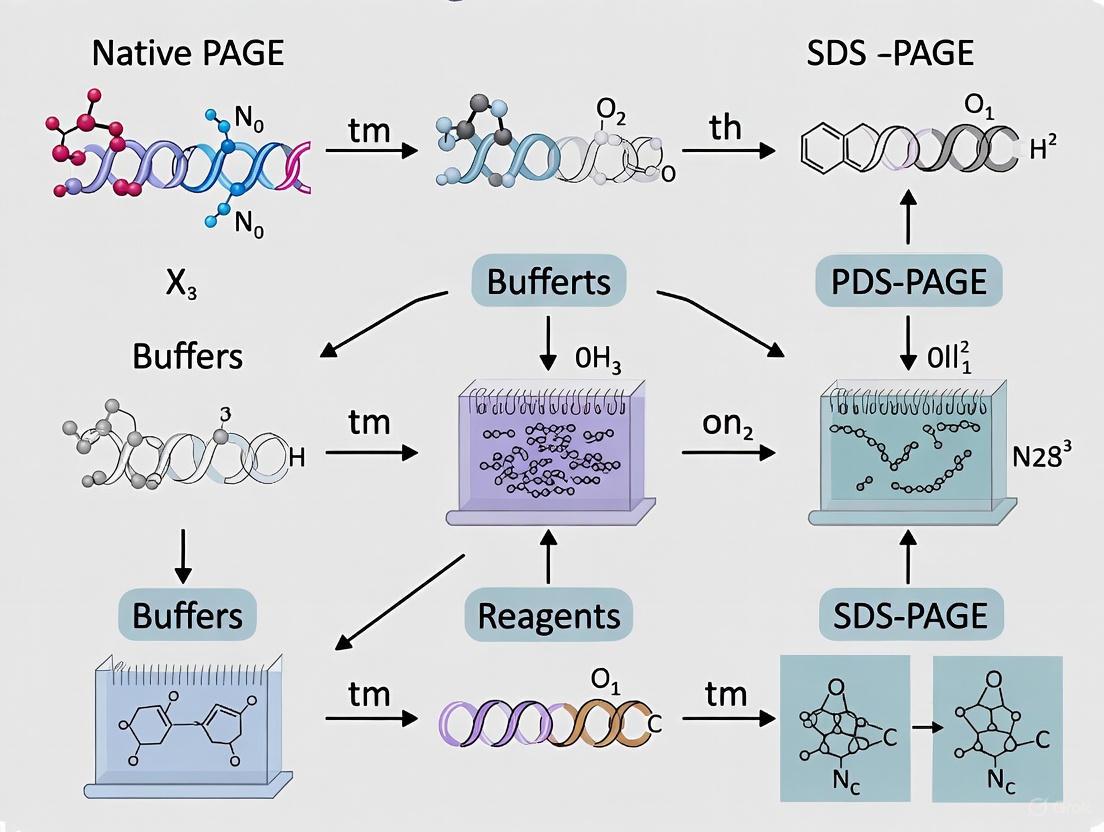
This article provides researchers, scientists, and drug development professionals with a detailed guide to sample preparation for Native PAGE and SDS-PAGE.
Native PAGE vs. SDS-PAGE: A Comprehensive Guide to Sample Preparation for Protein Analysis
Abstract
This article provides researchers, scientists, and drug development professionals with a detailed guide to sample preparation for Native PAGE and SDS-PAGE. It covers the fundamental principles distinguishing these techniques, step-by-step methodological protocols for various sample types, common troubleshooting scenarios, and validation strategies. The content is designed to help practitioners select the appropriate method based on their experimental goals—whether for determining molecular weight under denaturing conditions or studying native protein structure, interactions, and function—ensuring accurate, reproducible, and reliable results in biomedical research.
Core Principles: Choosing Between Native and Denaturing Protein Separation
In the realm of protein biochemistry, polyacrylamide gel electrophoresis (PAGE) serves as a fundamental tool for analyzing protein characteristics. Two primary techniques, SDS-PAGE and Native PAGE, offer distinct pathways for investigation, each with specific goals and applications. SDS-PAGE is the method of choice for determining a protein's molecular weight, while Native PAGE is indispensable for studying protein function and native structure. The decision between these methods hinges on the research objective: molecular weight determination versus functional and structural analysis. This application note details the principles, protocols, and practical applications of both techniques within the critical context of sample preparation, providing a framework for researchers to select and implement the appropriate electrophoretic method.
Principles and Strategic Application
The core difference between these techniques lies in the state of the protein during analysis. SDS-PAGE employs denaturing conditions, while Native PAGE maintains proteins in their native, functional state.
SDS-PAGE for Molecular Weight Determination
Sodium Dodecyl Sulfate Polyacrylamide Gel Electrophoresis (SDS-PAGE) separates proteins based almost exclusively on their molecular weight. The anionic detergent SDS denatures proteins by binding to hydrophobic regions, unfolding them into rod-like chains and conferring a uniform negative charge that masks the protein's intrinsic charge. This allows migration through the gel matrix to be inversely proportional to the logarithm of their molecular mass. The method was established around 1969 and remains widely used due to its simplicity and reliability for molecular weight estimation [1] [2] [3]. Sample preparation involves heating in the presence of SDS and reducing agents like DTT or β-mercaptoethanol to break disulfide bonds, ensuring complete denaturation [1] [4].
Native PAGE for Protein Function and Structure
Native PAGE separates proteins based on a combination of their native charge, size, and three-dimensional shape. Without denaturing agents, proteins retain their folded conformation, quaternary structure, and crucially, their biological activity. This enables the study of protein complexes, oligomerization states, and protein-protein interactions under conditions that mimic the cellular environment [1] [5] [6]. Separation occurs because most proteins carry a net negative charge in alkaline running buffers, with migration influenced by both charge density and the sieving effect of the gel matrix [3] [6]. Sample preparation for Native PAGE avoids heating, SDS, and reducing agents to preserve the native state [1].
Table 1: Core Differences Between SDS-PAGE and Native PAGE
| Criteria | SDS-PAGE | Native PAGE |
|---|---|---|
| Separation Basis | Molecular weight | Size, net charge, and shape |
| Protein State | Denatured | Native, folded |
| SDS Presence | Present (denaturing) | Absent (non-denaturing) |
| Sample Preparation | Heated with SDS and reducing agents | Not heated; no denaturants |
| Protein Function Post-Run | Lost | Retained |
| Primary Application | Molecular weight determination; purity check | Study of structure, complexes, and function |
| Typical Running Temperature | Room Temperature | 4°C |
Decision Framework: Selecting the Appropriate Technique
The choice between SDS-PAGE and Native PAGE is dictated by the research question. SDS-PAGE is ideal for determining the molecular weight of a protein subunit, assessing the purity of a protein sample, checking protein expression levels, or preparing for western blotting. In contrast, Native PAGE should be selected when the goal is to study the native oligomeric state of a protein, investigate protein-protein interactions, analyze functional enzyme complexes, or purify active proteins for downstream activity assays [1] [5] [6].
Materials and Reagent Solutions
Successful electrophoresis relies on specific reagents tailored to each method.
Table 2: Key Research Reagent Solutions for SDS-PAGE and Native PAGE
| Reagent | Function | SDS-PAGE | Native PAGE |
|---|---|---|---|
| SDS (Sodium Dodecyl Sulfate) | Denatures proteins; confers uniform negative charge | Required | Not Used |
| DTT or β-mercaptoethanol | Reducing agent; breaks disulfide bonds | Required | Not Used |
| Coomassie G-250 Dye | Charge-shift molecule for native separation | Not Used | Used in BN-PAGE |
| Acrylamide/Bis-acrylamide | Forms the cross-linked gel matrix | Required | Required |
| APS and TEMED | Catalyzes gel polymerization | Required | Required |
| Tris-based Buffers | Provides conductive ionic environment | Required (e.g., Tris-Glycine) | Required (various pH) |
| Sample Heating | Denatures proteins | Required (70-100°C) | Avoided |
Protocols and Methodologies
Protocol 1: Molecular Weight Determination via SDS-PAGE
This protocol allows for the estimation of an unknown protein's molecular weight with an accuracy of 5-10% [4].
Sample Preparation
- Dilute Protein Sample: Mix the protein sample with an SDS-PAGE sample buffer containing Tris-HCl, SDS, glycerol, and a tracking dye (e.g., bromophenol blue).
- Add Reducing Agent: Include a reducing agent such as Dithiothreitol (DTT) or β-mercaptoethanol to break disulfide bonds.
- Heat Denature: Heat the mixture at 70-100°C for 5-10 minutes to fully denature the proteins and ensure SDS binding [3] [4].
Gel Electrophoresis and Analysis
- Prepare and Load Gel: Cast or obtain a polyacrylamide gel (e.g., 10-12% for most proteins). Load the denatured samples alongside molecular weight standards (protein ladder) on the same gel.
- Run Electrophoresis: Apply a constant voltage (e.g., 100-150V) until the dye front reaches the bottom of the gel.
- Stain and Destain: After separation, stain the gel with Coomassie Blue or a similar stain to visualize protein bands, followed by destaining.
- Calculate Molecular Weight:
- Measure Migration Distance: Determine the distance traveled by each standard protein band and the unknown protein(s) from the top of the resolving gel.
- Calculate Rf Value: Compute the relative front (Rf) for each band:
Rf = Migration distance of protein / Migration distance of dye front. - Generate Standard Curve: Plot the
log(MW)of the standard proteins against theirRfvalues. This typically produces a linear plot. - Determine Unknown MW: Locate the Rf of the unknown protein on the standard curve and interpolate to find the
log(MW), then calculate the molecular weight [4].
Protocol 2: Analyzing Native Protein Complexes via Native PAGE
This protocol is adapted from studies on GPCR-G protein coupling and can be applied to various protein complexes [7].
Sample Preparation (Non-Denaturing)
- Solubilize Complexes: Gently solubilize membrane proteins or protein complexes from cells or tissues using non-ionic detergents (e.g., Lauryl Maltose Neopentyl Glycol/LMNG) to preserve interactions. Avoid ionic detergents like SDS.
- Prepare Native Sample Buffer: Mix the solubilized sample with a native sample buffer containing Tris, glycerol, and a tracking dye. Do not heat the sample.
- Add Cofactors/Ligands: For functional studies, include necessary agonists, cations (e.g., Mg²⁺ for RNA folding studies [8]), or other ligands in the buffer.
Electrophoresis and Detection
- Choose Gel System: Select a native gel chemistry based on the protein's properties. Tris-Glycine (pH 8.3-9.5) is common; Bis-Tris (pH ~7.5) with Coomassie G-250 is ideal for membrane proteins and basic proteins [6].
- Run with Cooling: Perform electrophoresis in a cold room (4°C) or with a cooling apparatus to minimize denaturation and proteolysis during the run [1] [3].
- Detect Functional Complexes:
- In-gel Activity Assays: If studying an enzyme, the gel can be incubated with substrates to detect activity directly.
- Western Blotting (Native): Transfer proteins to a PVDF membrane (nitrocellulose is not compatible with Coomassie G-250 dye used in some systems) for immunodetection [6].
- Recovery of Active Protein: Protein bands can be excised, and active protein can be recovered via passive diffusion or electro-elution for further functional studies [3].
Data Interpretation and Critical Analysis
Interpreting electrophoretic results requires understanding the distinct outputs of each technique.
Case Study: Analyzing a Protein Dimer
Consider a protein that migrates as a 60 kDa band on non-reducing SDS-PAGE but as a 120 kDa band on Native PAGE. This discrepancy is highly informative:
- The SDS-PAGE result indicates that the protein's subunit molecular weight is 60 kDa. The use of non-reducing conditions confirms that the subunits are not linked by disulfide bonds, as they would otherwise migrate at a higher molecular weight.
- The Native PAGE result reveals that in its native state, the protein exists as a dimer (120 kDa), with the two 60 kDa subunits held together by non-covalent interactions (e.g., hydrophobic, electrostatic) that are disrupted by SDS [9].
Troubleshooting and Technical Considerations
- SDS-PAGE Anomalies: Post-translational modifications like glycosylation can cause proteins to migrate anomalously, appearing at a higher molecular weight than calculated from the amino acid sequence [2].
- Native PAGE Resolution: The separation depends on the protein's intrinsic charge at the running buffer's pH. A protein with an isoelectric point (pI) near the buffer pH will have a low net charge and migrate slowly. The Blue Native PAGE (BN-PAGE) variant uses Coomassie dye to impart charge, improving separation and resolution for a wider range of proteins, including those with basic pIs [1] [6].
SDS-PAGE and Native PAGE are complementary pillars of protein analysis. The choice is fundamental and goal-dependent: SDS-PAGE is the definitive tool for determining subunit molecular weight under denaturing conditions, while Native PAGE is the strategic choice for probing the intricate relationships between native protein structure and biological function. Proper sample preparation—denaturing for the former and meticulously non-denaturing for the latter—is the critical first step that dictates the success of the experiment. By applying these techniques as outlined, researchers can effectively address specific questions in protein characterization, functional biochemistry, and drug development.
The Role of SDS, Reducing Agents, and Heat in Denaturing Sample Preparation
Within the framework of sample preparation for polyacrylamide gel electrophoresis (PAGE), the choice between native and denaturing conditions fundamentally dictates the type of biological information obtained. This application note details the specific roles and mechanisms of sodium dodecyl sulfate (SDS), reducing agents, and heat in denaturing sample preparation for SDS-PAGE, contrasting these methods with the principles of Native PAGE. For researchers and drug development professionals, understanding these distinctions is critical for designing experiments aimed at determining molecular weight, analyzing subunit composition, or studying native protein complexes and function [1] [5]. Denaturation is a deliberate process to dismantle a protein's higher-order structure, rendering it a linear polypeptide whose migration in a gel depends primarily on molecular mass rather than inherent charge or shape [10] [11].
The Mechanistic Roles of Denaturing Agents
The denaturation process in SDS-PAGE is a coordinated attack on the non-covalent and covalent forces that maintain a protein's secondary, tertiary, and quaternary structures. The following diagram illustrates the sequential action of each denaturing agent on a hypothetical protein complex.
Sodium Dodecyl Sulfate (SDS)
SDS is an anionic detergent that serves two primary functions in denaturing electrophoresis. First, it binds extensively to the hydrophobic regions of proteins, with approximately 1.4 grams of SDS binding per gram of protein, effectively coating the polypeptide chain [11]. This binding disrupts hydrogen bonds and hydrophobic interactions that stabilize secondary and tertiary structures, unfolding the protein into a linear chain [10] [11]. Second, the bound SDS molecules impart a uniform negative charge to the polypeptide backbone, effectively masking the protein's intrinsic charge. This creates a consistent charge-to-mass ratio across different proteins, ensuring that separation during electrophoresis occurs primarily based on molecular size rather than charge [1] [5] [11].
Reducing Agents
Reducing agents such as Dithiothreitol (DTT), β-mercaptoethanol (BME), or Tris(2-carboxyethyl)phosphine (TCEP) specifically target covalent disulfide bonds (-S-S-) that stabilize tertiary and quaternary structures [10] [12]. These compounds reduce disulfide bridges to sulfhydryl groups (-SH), liberating individual polypeptide subunits that may otherwise remain connected [10]. For optimal results, reducing agents should be added fresh to the sample buffer shortly before use, as reoxidation can occur during storage, leading to inconsistent separation [12]. The choice between agents often depends on effectiveness and practicality; DTT is frequently preferred over β-mercaptoethanol due to its lower odor and more effective denaturation of certain protein fractions [10].
Heat
The application of heat, typically between 85°C and 100°C for 2-10 minutes, provides the kinetic energy necessary to accelerate denaturation [10] [12] [11]. Heating "shakes up" the protein molecules, facilitating the penetration of SDS into hydrophobic cores and ensuring complete unfolding [10]. It is important to note that excessive heat (e.g., boiling at 100°C) can promote protein aggregation in some cases, while insufficient heating may leave certain proteins, particularly membrane proteins, incompletely denatured [10] [12]. A recommended compromise is heating at 85°C for 2-5 minutes, which effectively denatures most proteins while minimizing aggregation artifacts [12].
Quantitative Comparison of Denaturation Components
Table 1: Key Components in SDS-PAGE Sample Buffer and Their Functions
| Component | Typical Working Concentration | Primary Function | Mechanism of Action |
|---|---|---|---|
| SDS | 1-2% | Denaturant & Charge Masking | Binds protein backbone; unfolds structure; imparts uniform negative charge [10] [11] |
| DTT | 50-160 mM | Reducing Agent | Cleaves disulfide bonds by reducing cystine to cysteine [10] [12] |
| β-mercaptoethanol | 2.5% | Reducing Agent | Alternative to DTT for disulfide bond reduction [12] |
| TCEP | 50 mM | Reducing Agent | Phosphine-based reducer; more stable than thiol-based agents [12] |
| Glycerol | 5-10% | Density Agent | Increases sample density for well loading [10] |
| Bromophenol Blue | ~0.05 mg/ml | Tracking Dye | Visualizes migration front during electrophoresis [10] |
| Tris Buffer | 10-20 mM | pH Control | Maintains appropriate pH for electrophoresis [10] |
| EDTA | 1-2 mM | Chelating Agent | Binds divalent cations; inhibits metalloproteases [10] |
Table 2: Contrasting SDS-PAGE versus Native PAGE Sample Preparation
| Parameter | SDS-PAGE (Denaturing) | Native PAGE |
|---|---|---|
| Gel Type | Denaturing | Non-denaturing [1] |
| SDS | Present (1-2%) | Absent [1] |
| Reducing Agent | Present (DTT, BME) | Absent [1] |
| Heat Treatment | Required (85-100°C) | Not performed [1] [12] |
| Protein State | Denatured, linear | Native, folded conformation [1] |
| Separation Basis | Molecular weight primarily | Size, shape, and intrinsic charge [1] [5] |
| Protein Function Post-Electrophoresis | Lost | Retained [1] [5] |
| Protein Recovery | Not functional | Possible in functional form [1] |
| Primary Applications | MW determination, purity check, subunit analysis | Protein oligomerization, native complexes, activity studies [1] [5] |
Detailed Experimental Protocols
Standard SDS-PAGE Sample Preparation Protocol
Materials Needed:
- 2X SDS-PAGE Sample Buffer (see Table 1 for composition)
- Protein sample
- Reducing agent (e.g., 1M DTT stock)
- Heating block or water bath
- Microcentrifuge tubes
Procedure:
- Dilution and Mixing: Dilute your protein sample to a predetermined concentration in a compatible buffer. Mix 1 volume of prepared protein sample with 1 volume of 2X SDS-PAGE sample buffer [10]. For a standard mini-gel, a final protein concentration of 2 mg/ml is often appropriate, with a target load of 10-20 µl per well [10].
Reduction: Add a reducing agent if not already present in the sample buffer. For DTT, use a final concentration of 50-160 mM from a fresh stock solution [10] [12].
Heat Denaturation: Cap tubes tightly and heat samples at 85-100°C for 2-10 minutes [10] [12] [11]. The optimal temperature and time may require empirical determination for specific protein types, with 85°C for 2-5 minutes often providing a good balance between complete denaturation and avoidance of aggregation [12].
Cooling and Clarification: Briefly centrifuge samples (10-30 seconds) to bring down condensation and collect the entire volume. For samples with particulate matter, centrifugation at 10,000-15,000 × g for 5 minutes may be necessary before loading [10].
Loading: Load clarified supernatant directly onto the polyacrylamide gel. Denatured samples can be stored at -20°C for future use, though some reoxidation may occur over time [10] [12].
Troubleshooting Common Issues
- Smearing Bands: Can result from protein overloading, incomplete denaturation, or poor sample solubility. Reduce protein load, ensure proper heating in the presence of SDS and reducing agent, or use sonication to improve solubilization [13].
- Vertical Streaking: Often caused by high salt concentrations in the sample or partially degraded proteins. Desalt samples using dialysis or desalting columns, and add protease inhibitors during preparation [13].
- Unexpected Band Patterns: In non-reducing SDS-PAGE, proteins with disulfide-linked subunits may migrate at higher molecular weights than under reducing conditions, providing information about quaternary structure [9]. For example, a protein migrating at 60 kDa under non-reducing conditions but at 120 kDa in Native PAGE suggests a non-covalent dimer of 60 kDa subunits [9].
The Scientist's Toolkit: Essential Research Reagents
Table 3: Essential Reagents for Denaturing SDS-PAGE Sample Preparation
| Reagent/Category | Specific Examples | Function & Application Notes |
|---|---|---|
| Detergents | Sodium Dodecyl Sulfate (SDS) | Unfolds proteins and confers uniform charge; use high-purity grade [10] [11] |
| Thiol-Based Reducers | Dithiothreitol (DTT), β-mercaptoethanol (BME) | Reduces disulfide bonds; DTT is generally preferred for effectiveness and lower odor [10] |
| Phosphine-Based Reducers | Tris(2-carboxyethyl)phosphine (TCEP) | Reduces disulfide bonds; more stable in aqueous solutions than thiol-based agents [12] |
| Protease Inhibitors | PMSF, Complete Mini tablets | Prevents proteolytic degradation during sample preparation [13] |
| Chelating Agents | EDTA, EGTA | Binds divalent cations; inhibits metal-dependent proteases [10] |
| Tracking Dyes | Bromophenol Blue | Visual marker for electrophoresis progress; migrates ahead of most proteins [10] |
| Density Agents | Glycerol, Sucrose | Increases sample density for easier well loading [10] |
| Buffering Agents | Tris-HCl, Bis-Tris | Maintains stable pH during sample preparation and electrophoresis [10] [11] |
The deliberate denaturation of proteins using SDS, reducing agents, and heat is a foundational process for SDS-PAGE, enabling separation based primarily on molecular weight. This approach stands in direct contrast to Native PAGE, which preserves protein structure and function for studies of native conformation and activity. Mastery of denaturing sample preparation—including understanding the specific roles of each component, optimizing protocols for particular protein types, and troubleshooting common issues—is an essential skill for researchers characterizing proteins, assessing purity, determining molecular weights, and analyzing subunit composition. The protocols and guidelines presented here provide a framework for generating reliable, reproducible results in denaturing electrophoretic analyses.
Article Notes
In the landscape of protein analysis, the choice between Native Polyacrylamide Gel Electrophoresis (Native PAGE) and Sodium Dodecyl Sulfate-PAGE (SDS-PAGE) represents a fundamental divergence in experimental objectives. While SDS-PAGE denatures proteins to separate them purely by molecular weight, Native PAGE preserves the delicate three-dimensional structure, native charge, and biological activity of proteins and protein complexes [1] [5]. This preservation is paramount for studying functional protein characteristics such as enzymatic activity, protein-protein interactions, oligomerization states, and conformational changes [14]. The integrity of these native properties hinges almost entirely on appropriate sample preparation, wherein the use of mild detergents for solubilization and the maintenance of cold temperatures throughout the process emerge as non-negotiable prerequisites. This application note delineates the critical protocols and methodological considerations for preserving the native state during sample preparation, contextualized within the broader framework of electrophoretic research strategies.
Theoretical Foundation: Native PAGE vs. SDS-PAGE
Fundamental Separation Principles
The core distinction between these techniques lies in their treatment of protein structure. SDS-PAGE employs the anionic detergent SDS and reducing agents to denature proteins into linear polypeptides, masking intrinsic charge and enabling separation solely by molecular size [1] [15]. In contrast, Native PAGE foregoes denaturants, enabling separation based on the protein's intrinsic charge, size, and shape in its native conformation [1] [16]. Consequently, proteins resolved by SDS-PAGE are irreversibly denatured and lose function, whereas proteins from Native PAGE can often be recovered in a functional state for downstream assays [1] [9].
Comparative Workflow and Decision Framework
The diagram below illustrates the key decision points and fundamental procedural differences between Native PAGE and SDS-PAGE sample preparation.
Table 1: Core Differences Between SDS-PAGE and Native PAGE Sample Preparation and Outcomes
| Criteria | SDS-PAGE | Native PAGE |
|---|---|---|
| Primary Separation Basis | Molecular weight [1] | Size, intrinsic charge, and shape [1] |
| Detergent Used | Denaturing (SDS) [1] | Mild, non-ionic (e.g., Dodecylmaltoside) [17] [14] |
| Sample Heating | Required (denaturation step) [1] | Avoided [1] |
| Operating Temperature | Room Temperature [1] | 4°C (Cold Temperature) [1] |
| Protein Structure | Denatured, linearized [1] [15] | Native, folded conformation preserved [1] |
| Protein Function Post-Run | Lost [1] | Retained [1] |
| Key Application | Molecular weight determination, purity check [1] | Study of protein complexes, oligomeric state, enzymatic activity [1] [14] |
The Scientist's Toolkit: Essential Reagents for Native PAGE
Successful execution of Native PAGE requires a carefully selected set of reagents, each formulated to maintain the native state of protein complexes.
Table 2: Key Research Reagent Solutions for Native PAGE Sample Preparation
| Reagent / Material | Function & Importance | Specific Examples & Notes |
|---|---|---|
| Mild Non-Ionic Detergents | Solubilizes membrane proteins and lipid bilayers without disrupting protein-protein interactions [17] [14]. | n-Dodecyl-β-D-maltoside (DDM): Common for solubilizing individual complexes [14].Digitonin: Milder; often used to preserve labile supercomplexes [14].Triton X-100: General use [14]. |
| Coomassie Blue G-250 Dye | Imparts a slight negative charge to proteins for electrophoretic mobility without significant denaturation [14]. | Added to the cathode buffer and/or sample buffer [14]. Note: Excessive dye incubation can dissociate some sensitive complexes [14]. |
| Specialized Native Buffers | Provide the ionic environment for protein mobility and complex stability. | NativePAGE Sample & Running Buffers: Optimized for specific NativePAGE Bis-Tris gels; not interchangeable with buffers for denaturing gels [18]. |
| Native Protein Standards | Provide accurate size estimation for native proteins and complexes. | NativeMark Unstained Protein Standard: Recommended for native Tris-Glycine or NativePAGE gels [18]. |
| Cooling System / Cold Room | Maintains the recommended 4°C run temperature to minimize protein degradation and complex dissociation [1]. | Essential for the entire electrophoresis run to stabilize proteins and reduce Joule heating effects [1]. |
Detailed Experimental Protocol for Native PAGE Sample Preparation
Cell Lysis and Protein Extraction
Objective: To release proteins while preserving native complexes and interactions.
- Procedure: Harvest cells and wash with a cold, isotonic buffer (e.g., phosphate-buffered saline). Resuspend the cell pellet in a suitable lysis buffer containing a selected mild detergent (e.g., 1% dodecylmaltoside or digitonin) and protease inhibitors. Perform all steps at 4°C [17] [14].
- Critical Note: The detergent-to-protein ratio must be optimized empirically. Too little detergent results in incomplete solubilization, while too much can disrupt native interactions [14].
- Incubation: Gently agitate the lysate for 30-60 minutes at 4°C to facilitate solubilization.
- Clarification: Centrifuge the lysate at high speed (e.g., 20,000 × g for 30 minutes at 4°C) to remove insoluble debris and collect the supernatant containing the solubilized protein complexes [17].
Sample Buffering and Loading
Objective: To prepare the solubilized extract for electrophoresis without inducing aggregation or dissociation.
- Buffer Exchange: If necessary, perform buffer exchange via dialysis or gel filtration into a low-salt electrophoresis-compatible buffer. Note that some soluble complexes are sensitive to low ionic strength, so conditions must be tested for the complex of interest [14].
- Dye Addition: Mix the protein sample with an appropriate volume of Coomassie Blue G-250 dye solution (e.g., as provided in the NativePAGE Sample Prep Kit) [17] [14]. The final concentration of dye in the sample is typically around 0.25-0.5%.
- Loading: Load the prepared samples onto a pre-cast or hand-cast non-denaturing polyacrylamide gradient gel (e.g., 4-16%) [17]. Keep the gel apparatus on ice or in a cold room during loading.
Electrophoresis and Post-Run Analysis
Objective: To separate protein complexes based on their native properties.
- Electrophoresis Conditions: Fill the cathode and anode chambers with the appropriate running buffers. Run the gel at a constant voltage, typically between 100-150 V, with the entire apparatus placed in a cold room or using a built-in cooling unit to maintain a temperature of 4°C throughout the run [1] [17].
- Staining and Visualization: After electrophoresis, proteins can be visualized using Coomassie Brilliant Blue staining or other compatible methods [17].
- Downstream Applications: Bands of interest can be excised from the gel for further functional studies, such as activity assays, or for identification via mass spectrometry, as the native structure and function are preserved [1] [14].
Advanced Application: Blue Native PAGE (BN-PAGE)
Blue Native PAGE is a powerful variant of Native PAGE specifically designed for the analysis of membrane protein complexes, such as those in the mitochondrial respiratory chain [14].
Workflow and Strategic Considerations
The following diagram outlines the key strategic considerations and steps in a BN-PAGE protocol for analyzing membrane protein complexes.
Key Technical Insights from BN-PAGE
- Detergent Choice is Decisive: The selection of detergent directly influences the experimental results. For instance, using n-dodecylmaltoside or Triton X-100 typically solubilizes individual respiratory complexes (I, II, III, IV, V). In contrast, the milder detergent digitonin can preserve larger supercomplexes (e.g., associations of complexes I, III, and IV), leading to fundamentally different biological models of the respiratory chain [14].
- Gradient Gels for High Resolution: BN-PAGE typically uses polyacrylamide gradient gels (e.g., 4-16%) to maximize the resolution of protein complexes across a wide molecular weight range [14].
- Two-Dimensional Analysis: A powerful application of BN-PAGE is its use as the first dimension in a 2D electrophoresis setup. The second dimension is run under denaturing SDS-PAGE conditions, which separates the individual polypeptide subunits that constitute each native complex isolated in the first dimension [14].
The integrity of data derived from Native PAGE is profoundly dependent on sample preparation. The strategic use of mild detergents and the rigorous maintenance of cold temperatures are not merely procedural details but are foundational to successfully preserving the native state of proteins and their complexes. Adherence to these principles enables researchers to move beyond simple molecular weight analysis and into the functional realm of protein biochemistry, providing critical insights into complexes, interactions, and activity that are essential for both basic research and drug development.
Within the framework of a broader thesis on sample preparation for electrophoretic techniques, understanding the fundamental separation criteria of SDS-PAGE (separation by molecular size) and Native PAGE (separation by size, charge, and shape) is paramount. This choice, made during sample preparation, directly dictates the quantity and quality of information that can be extracted from an experiment. Denaturing SDS-PAGE provides high-resolution separation based primarily on polypeptide chain length, making it ideal for molecular weight determination and analytical applications [1] [3]. In contrast, Native PAGE preserves the protein's higher-order structure, enabling the study of functional properties, enzymatic activity, and protein-protein interactions in their native state [19] [3]. This application note details the experimental outcomes governed by these separation principles, providing structured protocols and data to guide researchers in selecting the appropriate method for their specific objectives in basic research and drug development.
Fundamental Principles and Key Differences
The core difference between these electrophoretic methods lies in the state of the protein during separation, a condition established during the initial sample preparation phase.
SDS-PAGE (Size-Based Separation): The anionic detergent sodium dodecyl sulfate (SDS) denatures proteins by disrupting non-covalent interactions and binding to the polypeptide backbone in a constant weight ratio [3] [20]. This SDS coating confers a uniform negative charge, effectively masking the protein's intrinsic charge [19] [21]. Subsequent separation through the polyacrylamide gel matrix is therefore governed almost exclusively by molecular size, with smaller proteins migrating faster than larger ones [3] [20]. The sample is typically heated in the presence of SDS and a reducing agent (e.g., DTT) to ensure complete denaturation and disruption of disulfide bonds [1] [20].
Native PAGE (Size/Charge/Shape-Based Separation): This method omits denaturing agents like SDS. Proteins remain in their native, folded conformation, and their migration is determined by a combination of their intrinsic net charge at the running pH, their size, and their three-dimensional shape [3] [22]. Since the intrinsic charge is not masked, a protein's isoelectric point (pI) relative to the buffer pH becomes a critical factor in its migration direction and speed [19] [3].
The table below summarizes the critical differences stemming from these core principles.
Table 1: Comparative overview of SDS-PAGE and Native PAGE
| Criteria | SDS-PAGE | Native PAGE |
|---|---|---|
| Separation Basis | Molecular weight/size [1] [3] | Size, net charge, and 3D shape [1] [3] |
| Protein State | Denatured/unfolded [1] [19] | Native/folded [1] [19] |
| Sample Preparation | Heating with SDS and reducing agents [1] [20] | No heating; no denaturing agents [1] |
| Key Reagents | SDS, DTT/β-mercaptoethanol [1] [20] | Non-denaturing detergents (for BN-PAGE), Coomassie dye [23] [24] |
| Net Protein Charge | Uniformly negative [19] [21] | Dependent on protein's pI and buffer pH [3] [22] |
| Functional Retention | Function destroyed [23] [1] | Function often retained [23] [3] |
| Primary Applications | Molecular weight determination, purity assessment, expression analysis [1] [19] | Studying oligomeric state, protein complexes, enzymatic activity [1] [24] |
Impact on Experimental Outcomes: Quantitative and Functional Data
The choice of electrophoresis method directly impacts the experimental data, as illustrated by a study investigating the retention of metal ions and enzymatic activity.
Metal Ion Retention and Enzymatic Activity
A comparative study of standard SDS-PAGE, Blue Native (BN)-PAGE, and a modified "Native SDS-PAGE" (NSDS-PAGE) demonstrated profound differences in functional preservation. The results showed that retention of Zn²⁺ bound in proteomic samples increased from 26% in standard SDS-PAGE to 98% in NSDS-PAGE conditions, which use minimal SDS and no heating [23]. Furthermore, while all nine model enzymes were denatured and inactivated during standard SDS-PAGE, seven of the nine, including four Zn²⁺ proteins, retained activity after NSDS-PAGE, a result comparable to BN-PAGE [23].
Table 2: Impact of electrophoretic method on protein function and metal content
| Experimental Outcome | SDS-PAGE | BN-PAGE | NSDS-PAGE |
|---|---|---|---|
| Zn²⁺ Retention | 26% [23] | Not Specified | 98% [23] |
| Enzymatic Activity (Model Proteins) | 0 out of 9 active [23] | 9 out of 9 active [23] | 7 out of 9 active [23] |
| Protein Resolution | High [23] | Lower [23] | High [23] |
Separation of Protein Complexes
The preservation of non-covalent interactions in Native PAGE allows for the analysis of intricate protein assemblies. For instance, BN-PAGE has been successfully used to separate and analyze large thylakoid membrane complexes from plants, including photosystem I and II (PSI, PSII) and their supercomplexes [24]. This application is crucial for studying functional interactions within the photosynthetic apparatus, which would be impossible with standard SDS-PAGE due to its disruptive nature [22] [24].
Detailed Experimental Protocols
The following protocols are standardized for a mini-gel format.
Protocol 1: Denaturing SDS-PAGE
Principle: Proteins are denatured and linearly separated based on polypeptide molecular weight [3] [20].
Sample Preparation (Critical Step):
- Dilute protein sample with 1X SDS Sample Buffer (e.g., 62.5 mM Tris-HCl pH 6.8, 2% SDS, 10% glycerol, 50 mM DTT, 0.01% bromophenol blue) [20].
- Heat the mixture at 70-100°C for 5-10 minutes to denature proteins and reduce disulfide bonds [3] [20].
- Centrifuge briefly before loading.
Gel Composition:
- Resolving Gel (10% example for 10-200 kDa range): 30% Acrylamide/Bis-acrylamide mix (37.5:1), 1.5 M Tris-HCl (pH 8.8), 0.1% SDS, 0.1% APS, 0.1% TEMED [20].
- Stacking Gel (4%): 30% Acrylamide/Bis-acrylamide mix, 0.5 M Tris-HCl (pH 6.8), 0.1% SDS, 0.1% APS, 0.1% TEMED.
Electrophoresis Conditions:
- Use 1X Running Buffer (e.g., 25 mM Tris, 192 mM glycine, 0.1% SDS, pH 8.3) [20].
- Load samples and molecular weight markers.
- Run at constant voltage (e.g., 200 V for ~45 minutes) until the dye front reaches the bottom [23].
Protocol 2: Blue Native (BN)-PAGE
Principle: Proteins and complexes are separated based on native charge, size, and shape, preserving function and interactions [23] [24].
Sample Preparation (Critical Step):
- Solubilize membranes or protein complexes gently using a non-ionic detergent (e.g., 1% n-dodecyl-β-D-maltoside (β-DM) sometimes with 1% digitonin for large complexes) [24].
- Centrifuge to remove insoluble material.
- Mix the supernatant with BN Sample Buffer (e.g., 50 mM BisTris, 50 mM NaCl, 10% glycerol, pH 7.2) and 0.5-1% Coomassie G-250 dye [23] [24]. DO NOT HEAT.
Gel Composition:
- A gradient gel (e.g., 4-16% acrylamide) is often used for resolving complexes of a wide size range [23] [24].
- The gel is cast in a native buffer such as 1.5 M aminocaproic acid, 50 mM BisTris, pH 7.0 [24].
Electrophoresis Conditions:
- Use Cathode Buffer (e.g., 50 mM Tricine, 15 mM BisTris, 0.02% Coomassie G-250, pH 7.0) and Anode Buffer (e.g., 50 mM BisTris, pH 7.0) [23].
- Load samples.
- Run at constant voltage (e.g., 150 V for ~90 minutes) at 4°C to prevent denaturation [23] [1].
The Scientist's Toolkit: Essential Research Reagents
Successful execution of these electrophoretic methods relies on specific reagents, each with a defined role in achieving the desired separation.
Table 3: Key reagents for SDS-PAGE and Native PAGE
| Reagent | Function/Purpose | Key Characteristic |
|---|---|---|
| SDS (Sodium Dodecyl Sulfate) | Denatures proteins and confers uniform negative charge; enables separation by molecular weight [1] [3]. | Anionic detergent. |
| DTT/β-Mercaptoethanol | Reducing agent; breaks disulfide bonds to ensure complete protein unfolding [1] [20]. | Thiol-based compound. |
| Coomassie G-250 | In BN-PAGE, provides a negative charge to protein complexes without disrupting interactions; minimizes aggregation [23] [24]. | Anionic dye. |
| Non-Ionic Detergents (e.g., β-DM, Digitonin) | Solubilizes membrane proteins and protein complexes gently while preserving native structure [24]. | Does not denature proteins. |
| Acrylamide/Bis-acrylamide | Forms the cross-linked polyacrylamide gel matrix that acts as a molecular sieve [3]. | Monomer and cross-linker. |
| TEMED & Ammonium Persulfate (APS) | Catalyzer (TEMED) and initiator (APS) for the free-radical polymerization of acrylamide [3]. | Gel polymerization system. |
The choice between SDS-PAGE and Native PAGE is fundamental and dictated by the experimental question. SDS-PAGE, with its simple sample preparation involving denaturation, is an unparalleled analytical tool for determining molecular weight and assessing sample purity. However, this power comes at the cost of destroying the protein's native structure and function. Native PAGE, with its gentle sample handling, fills this gap by allowing the study of proteins in their functional, folded state, enabling the analysis of complexes and interactions. The development of hybrid techniques like NSDS-PAGE demonstrates that the boundary between these methods is not rigid and can be optimized to achieve high resolution while retaining a significant degree of protein function. Within the broader context of sample preparation strategies, this comparative analysis underscores that the initial decision of how to prepare the sample—to denature or not to denature—is the primary determinant of the experimental outcomes achievable in downstream analyses.
In the realm of protein biochemistry, polyacrylamide gel electrophoresis (PAGE) serves as a fundamental analytical tool for separating and characterizing proteins. The strategic selection between native PAGE and SDS-PAGE represents a critical methodological crossroads that directly determines the type of information researchers can obtain about their protein samples. These techniques diverge most significantly in their buffer and reagent compositions, which in turn dictate whether proteins maintain their native conformations or become denatured into linear polypeptides [1] [3]. This application note provides a detailed side-by-side comparison of the fundamental buffer and reagent requirements for these two essential techniques, specifically framed within the context of sample preparation for research applications in drug development and basic science.
The core distinction between these methods lies in their treatment of protein structure. SDS-PAGE employs sodium dodecyl sulfate (SDS) and reducing agents to dismantle higher-order protein structures, enabling separation based almost exclusively on molecular weight [25] [26]. In contrast, native PAGE utilizes non-denaturing conditions that preserve protein folding, quaternary structures, and biological activity, separating proteins based on a combination of size, charge, and shape [1] [27]. For research focused on protein-protein interactions, enzymatic function, or native complex purification, native PAGE provides indispensable information that would be destroyed by denaturing conditions [3]. Understanding these fundamental differences in buffer systems and reagent requirements is paramount for designing appropriate experimental protocols and generating reliable, interpretable data.
Core Principles and Separation Mechanisms
SDS-PAGE: Separation by Molecular Weight
SDS-PAGE operates on the principle of complete protein denaturation to achieve separation primarily by molecular weight. The anionic detergent sodium dodecyl sulfate (SDS) plays the central role in this process by binding to hydrophobic regions of proteins in a constant weight ratio (approximately 1.4 g SDS per 1 g of protein) [11]. This SDS coating masks the proteins' intrinsic charges and confers a uniform negative charge density, ensuring that all proteins migrate toward the anode during electrophoresis [25] [26] [3]. The process unfolds proteins into linear polypeptides, with the gel matrix acting as a molecular sieve that retards larger molecules while allowing smaller ones to migrate more rapidly [28] [11]. When combined with reducing agents like dithiothreitol (DTT) or β-mercaptoethanol, which break disulfide bonds, SDS-PAGE effectively dissociates protein complexes into their individual subunits [25] [29]. This denaturing approach makes SDS-PAGE ideal for determining molecular weight, assessing sample purity, analyzing subunit composition, and preparing proteins for western blotting [1] [25].
Native PAGE: Separation by Size, Charge, and Conformation
Native PAGE preserves proteins in their biologically active states by omitting denaturing agents from all buffer systems. Without SDS to normalize charges, proteins in native PAGE migrate based on their intrinsic charge, size, and three-dimensional shape [1] [3]. In the alkaline pH of standard running buffers (typically pH 8.3-8.8), most proteins carry a net negative charge and migrate toward the anode [27]. However, the rate of migration depends on both the protein's charge density (number of charges per mass unit) and the frictional forces it encounters from the gel matrix, which are influenced by the protein's size and shape [3]. This multi-parameter separation mechanism allows native PAGE to resolve protein complexes in their functional oligomeric states, making it invaluable for studying protein-protein interactions, enzyme activity after separation, and charge variants of the same protein [1] [3]. The preservation of native structure comes with increased complexity in result interpretation, as migration distance depends on multiple factors rather than molecular weight alone [27].
Comparative Workflow: SDS-PAGE vs. Native PAGE
The fundamental methodological differences between SDS-PAGE and Native PAGE are visualized in the following experimental workflow:
Comprehensive Reagent and Buffer Composition Tables
Core Buffer Systems and Reagents
The fundamental differences between SDS-PAGE and Native PAGE emerge from their specific buffer compositions, which dictate their distinct separation mechanisms and applications.
Table 1: Core Buffer and Reagent Comparison
| Component | SDS-PAGE | Native PAGE |
|---|---|---|
| Detergent | SDS (0.1-1%) present [1] [11] | No SDS; possible mild non-ionic detergents [1] [30] |
| Reducing Agents | DTT (1-100 mM) or β-mercaptoethanol (5%) typically used [30] [11] | Generally omitted to preserve structure [1] [30] |
| Sample Buffer | Contains SDS and reducing agents [30] | No denaturants; native sample buffer [30] |
| Sample Preparation | Heating at 70-100°C for 5-10 minutes [30] [11] | No heating; samples kept at 4°C [1] [30] |
| Gel Buffer | May contain SDS in both stacking and resolving gels [11] | No denaturing agents in gel [1] |
| Running Buffer | Tris-glycine-SDS or Tris-MOPS/MES systems [11] | Tris-glycine without SDS [27] |
| pH of Resolving Gel | ~8.8 [31] [11] | ~8.8 [31] |
| pH of Stacking Gel | ~6.8 [31] [11] | ~6.8 [31] |
Sample Preparation Specifications
Detailed sample preparation requirements highlight the critical differences in handling proteins for these two techniques.
Table 2: Sample Preparation Protocols
| Parameter | SDS-PAGE | Native PAGE |
|---|---|---|
| Lysis Buffer | Denaturing (e.g., RIPA with SDS) [30] | Non-denaturing (e.g., T-PER, no SDS) [30] |
| Heating Step | Required (70-100°C for 5-10 min) [1] [30] | Avoided [1] [30] |
| Reducing Conditions | Usually reduced with thiol reagents [30] [29] | Non-reduced or minimal reduction [30] |
| Protease Inhibitors | Essential (added to lysis buffer) [30] | Critical (activity preserved in native state) [30] |
| Temperature | Room temperature for running [1] | 4°C for running to maintain stability [1] |
| Protein Stability | Unstable, denatured [1] | Stable, native conformation [1] |
| Post-Separation Function | Function lost [1] | Function retained [1] |
The Scientist's Toolkit: Essential Research Reagent Solutions
Successful electrophoresis requires specific reagent solutions optimized for each technique. The following toolkit outlines essential materials and their functions for both SDS-PAGE and Native PAGE methodologies.
Table 3: Essential Research Reagent Solutions
| Reagent | Function/Purpose | SDS-PAGE | Native PAGE |
|---|---|---|---|
| SDS (Sodium Dodecyl Sulfate) | Denatures proteins, confers negative charge [25] [11] | Required (0.1-1%) | Omitted |
| DTT (Dithiothreitol) | Reduces disulfide bonds [11] | Typically used (10-100 mM) | Generally omitted |
| Tris-Glycine Buffer | Common electrophoretic buffer system [27] | With SDS | Without SDS |
| Acrylamide/Bis-acrylamide | Forms porous gel matrix for separation [28] [3] | Used at various percentages | Used at various percentages |
| Ammonium Persulfate (APS) & TEMED | Catalyzes acrylamide polymerization [28] [3] | Required for both techniques | Required for both techniques |
| Coomassie Brilliant Blue | Protein staining [25] | Compatible | Compatible; also used in BN-PAGE [1] |
| Protease Inhibitor Cocktail | Prevents protein degradation [30] | Essential | Critical |
| Sample Loading Buffer | Provides density for well loading, tracking dye [30] | Denaturing formulation | Non-denaturing formulation |
| Molecular Weight Markers | Size calibration [3] | Pre-stained or unstained | Native markers |
Detailed Experimental Protocols
SDS-PAGE Sample Preparation Protocol
The following step-by-step protocol ensures proper denaturation and preparation of protein samples for SDS-PAGE separation, adapted from established methodologies [30] [11].
Protein Extraction:
- Lyse cells or tissues using a denaturing lysis buffer (e.g., RIPA buffer containing 25 mM Tris-HCl pH 7.6, 150 mM NaCl, 1% NP-40, 1% sodium deoxycholate, 0.1% SDS) [30].
- Add protease and phosphatase inhibitors immediately before use to prevent degradation [30].
- Incubate on ice for 10-30 minutes with occasional vortexing.
Sample Clarification:
- Centrifuge lysates at 14,000 × g for 15 minutes at 4°C to pellet insoluble material [30].
- Transfer supernatant to a fresh microcentrifuge tube.
Protein Quantification:
- Determine protein concentration using a compatible assay (BCA assay recommended for SDS-containing samples) [30].
- Prepare diluted albumin standards for generating a standard curve.
Sample Denaturation:
Gel Loading:
- Load 10-40 μL per well depending on gel thickness and well size.
- Include molecular weight markers in at least one well.
- Run gel at 100-150V constant voltage until dye front reaches bottom [25].
Native PAGE Sample Preparation Protocol
This protocol maintains protein native structure throughout preparation and electrophoresis, preserving biological activity for functional analysis [30] [3].
Native Protein Extraction:
- Use mild, non-denaturing lysis buffers (e.g., T-PER with 25 mM bicine, 150 mM NaCl, pH 7.6) [30].
- Include protease inhibitors but avoid strong denaturants.
- Keep samples at 4°C throughout extraction process.
Sample Preparation:
- Centrifuge at 10,000 × g for 5-10 minutes to remove debris [30].
- Transfer supernatant to fresh tube maintained on ice.
Native Sample Buffer Preparation:
- Combine protein sample with 2X native sample buffer [30].
- Do not heat samples.
- For some applications, a minimal amount of reducing agent may be added if needed to preserve function.
Electrophoresis Conditions:
- Pre-cool running chamber and buffers to 4°C.
- Load samples promptly to minimize degradation.
- Run gel at constant voltage (typically 100-150V) with cooling [1].
- Monitor migration closely as bromophenol blue may migrate differently without SDS.
Technical Considerations and Troubleshooting
Method Selection Guidelines
Choosing between SDS-PAGE and Native PAGE depends entirely on research objectives. SDS-PAGE is ideal for determining molecular weight, assessing purity, analyzing complex protein mixtures, and preparing samples for western blotting or sequencing [1] [25]. Its denaturing conditions provide consistent, predictable migration based primarily on size. Native PAGE should be selected when studying protein-protein interactions, enzyme activity, oligomeric states, or when needing to recover functional protein after separation [1] [3]. The preservation of native structure comes with more complex migration patterns that depend on both size and charge.
Troubleshooting Common Issues
- Smeared Bands in SDS-PAGE: Often caused by insufficient denaturation. Ensure fresh reducing agent is used and heating is adequate. High salt concentrations can also cause smearing [27].
- Protein Aggregation in Native PAGE: May occur if proteins are insufficiently solubilized. Optimize detergent concentration and consider using zwitterionic detergents. Maintain cool temperatures throughout [3].
- "Smiling" or "Frowning" Bands: Typically caused by uneven heating during electrophoresis. Ensure proper buffer circulation and consider reducing voltage [27].
- Poor Resolution: Can result from incorrect acrylamide percentage for target protein size. Use gradient gels for broad molecular weight ranges or optimize gel percentage [25] [3].
- Incomplete Protein Separation: May indicate insufficient run time, incorrect buffer pH, or improper gel polymerization. Check buffer compositions and extend run time if needed [25].
The strategic selection between SDS-PAGE and Native PAGE represents a fundamental decision point in protein research methodology, with buffer and reagent composition serving as the determining factors. SDS-PAGE, with its denaturing buffers containing SDS and reducing agents, provides robust molecular weight-based separation ideal for analytical applications where protein denaturation is acceptable or desirable [1] [25]. Conversely, Native PAGE employs non-denaturing buffer systems that preserve native protein structure, enabling the study of functional protein complexes and charge-based separations [1] [3]. Both techniques utilize polyacrylamide gel matrices and discontinuous buffer systems to achieve high-resolution separation, but their differing approaches to sample treatment yield complementary biological information [31] [28]. Understanding these core differences in buffer composition and reagent requirements empowers researchers to select the most appropriate methodology for their specific research questions, particularly in drug development where both protein size and functional activity represent critical quality attributes.
Step-by-Step Protocols: From Cell Lysis to Loaded Gel
The foundation of successful protein analysis by electrophoresis, whether for denaturing SDS-PAGE or native PAGE, rests upon the initial step of sample preparation. The choice of lysis buffer directly determines the integrity, functionality, and representativeness of the proteins extracted from cells or tissues. This application note provides a detailed framework for selecting and optimizing lysis buffers to target total cellular proteins, cytoplasmic fractions, or membrane-bound proteins, with particular emphasis on preserving native protein complexes for native PAGE while ensuring efficient denaturation for SDS-PAGE. Within the broader context of sample preparation methodologies for electrophoretic research, understanding these principles is fundamental to generating reliable, reproducible, and biologically relevant data.
The critical distinction between denaturing and native electrophoresis techniques necessitates different approaches to sample preparation. SDS-PAGE employs ionic detergents like sodium dodecyl sulfate (SDS) to denature proteins, mask their intrinsic charges, and facilitate separation primarily by molecular weight [25] [3]. In contrast, native PAGE uses non-denaturing conditions to preserve protein-protein interactions, tertiary structure, and enzymatic activity, allowing separation based on the native charge, size, and shape of protein complexes [32] [3]. Consequently, the lysis strategy for each method must be aligned with its fundamental objectives.
Fundamental Principles of Lysis Buffer Composition
Cell lysis buffers work by disrupting the lipid bilayer of cell membranes and, if necessary, organellar membranes, to release proteins into solution. The composition of these buffers can be tailored to achieve different levels of disruption, from gentle extraction of soluble proteins to complete dissolution of all cellular components.
The key components of lysis buffers and their functions are summarized in the table below:
Table 1: Key Components of Lysis Buffers and Their Functions
| Component Type | Example Reagents | Primary Function | Considerations for Electrophoresis |
|---|---|---|---|
| Buffering Agent | Tris-HCl, HEPES | Maintains stable pH during lysis | Must be compatible with gel system; Tris is common for both SDS-PAGE and Native PAGE [32] [30] |
| Detergent | SDS, NP-40, Triton X-100, Dodecyl maltoside | Disrupts lipid membranes, solubilizes proteins | SDS-PAGE: Uses denaturing detergents (SDS) [25]. Native PAGE: Uses mild, non-ionic detergents (NP-40, Dodecyl maltoside) [32] [33] |
| Salts | NaCl, KCl | Controls ionic strength, disrupts protein-protein interactions | High salt can interfere with electrophoresis; concentration must be optimized [32] [30] |
| Reducing Agents | β-mercaptoethanol, DTT | Breaks disulfide bonds | Essential for reduced SDS-PAGE; typically omitted in native PAGE to preserve complexes [32] [30] |
| Enzyme Inhibitors | PMSF, Protease Inhibitor Cocktails | Prevents proteolytic degradation | Critical for both methods, especially native PAGE to preserve labile complexes [32] [30] |
| Stabilizers | Glycerol, Sucrose | Stabilizes protein structure and complexes | Often used in native lysis buffers to maintain complex integrity [32] |
Lysis Buffer Selection for Specific Protein Localizations
The subcellular localization of a target protein dictates the required stringency of the lysis buffer. The following section outlines recommended buffers and protocols for different cellular compartments.
Total Protein Extraction
For comprehensive analysis of the entire cellular proteome, buffers capable of disrupting all cellular membranes are required.
- M-PER Mammalian Protein Extraction Reagent: A mild, non-denaturing detergent-based buffer ideal for total protein extraction when preserving native interactions is desired for subsequent native PAGE [30]. It is suitable for whole-cell lysis with minimal denaturation.
- RIPA (Radioimmunoprecipitation Assay) Buffer: A more stringent buffer containing a combination of detergents (typically NP-40 or Triton X-100, sodium deoxycholate, and SDS) that effectively lyses cells and solubilizes membrane-bound and nuclear proteins [30]. Its composition (e.g., 25 mM Tris-HCl pH 7.6, 150 mM NaCl, 1% NP-40, 1% sodium deoxycholate, 0.1% SDS) makes it highly effective for total protein extraction for SDS-PAGE, though the presence of ionic detergents like SDS denatures proteins and disrupts complexes [30].
Cytoplasmic Protein Extraction
To isolate cytoplasmic proteins while leaving the nucleus intact, gentle, non-ionic detergents are used.
- NP-40-Based Lysis Buffer: A classic cytoplasmic extraction buffer. A typical formulation includes 50 mM Tris (pH 7.4), 250 mM NaCl, 5 mM EDTA, 1% NP-40, and protease inhibitors [30]. The mild NP-40 detergent pokes holes in the plasma membrane, allowing cytoplasmic contents to leak out while leaving nuclei and cytoskeletal structures largely intact. The resulting extract is ideal for native PAGE analysis of cytoplasmic complexes.
Membrane-Bound Protein Extraction
Membrane proteins require detergents to disrupt the lipid bilayer and integrate them into micelles, keeping them soluble in an aqueous environment.
- Gentle Native Lysis Buffer: For native PAGE, buffers containing mild detergents like dodecyl maltoside are effective. Commercial native lysis buffers often contain 1.5% dodecyl maltoside in a HEPES-based saline solution with inhibitors, which efficiently solubilizes protein complexes while retaining enzymatic activity and complex integrity [33].
- RIPA Buffer: As mentioned for total protein extraction, the combination of non-ionic and ionic detergents in RIPA buffer is highly effective at solubilizing membrane proteins for SDS-PAGE analysis, albeit in a denatured state [30].
Table 2: Lysis Buffer Selection Guide for Specific Targets
| Target Protein Location | Recommended Buffer | Key Characteristics | Compatible Electrophoresis Method |
|---|---|---|---|
| Total Protein (Native) | M-PER Reagent [30] or Native Lysis Buffer [32] | Mild, non-denaturing detergents (e.g., NP-40); Tris or HEPES buffer; protease inhibitors | Native PAGE |
| Total Protein (Denatured) | RIPA Buffer [30] or SDT Lysis Buffer [34] | Combination of non-ionic and ionic detergents (NP-40, Deoxycholate, SDS); Tris buffer; often includes reducing agents | SDS-PAGE |
| Cytoplasmic Proteins | NP-40 Cell Lysis Buffer [30] | 1% NP-40 detergent; isotonic salt concentration (e.g., 150-250 mM NaCl) to maintain organelle integrity | Primarily Native PAGE |
| Membrane-Bound Proteins (Native) | Native Lysis Buffer (Dodecyl maltoside) [33] | Mild, non-ionic detergent (e.g., Dodecyl maltoside) to solubilize lipid bilayers without denaturing | Native PAGE |
| Membrane-Bound Proteins (Denatured) | RIPA Buffer [30] | Stringent detergent mix effective at disrupting membranes and solubilizing hydrophobic proteins | SDS-PAGE |
Detailed Experimental Protocols
Protocol 1: Preparation of Native Cell Lysate for Analysis of Protein Complexes
This protocol is adapted from methodologies used in the study of epichaperomes and other high-order assemblies [32].
Research Reagent Solutions:
- Native Lysis Buffer: 20 mM Tris-HCl (pH 7.4), 20 mM KCl, 5 mM MgCl₂, 0.01% NP-40 [32]. Function: Gently disrupts the plasma membrane while maintaining the integrity of protein complexes.
- Protease/Phosphatase Inhibitor Cocktail: Added to lysis buffer immediately before use. Function: Prevents co- and post-translational degradation of proteins.
- BCA Protein Assay Kit: Function: Accurately determines protein concentration for equal loading.
- Tris-Glycine Native Sample Buffer (2X): Function: Provides the correct pH and ionic strength for loading onto native gels without denaturing proteins.
Methodology:
- Preparation: Place culture dish on ice and wash adherent cells with ice-cold PBS. All subsequent steps must be performed on ice or at 4°C.
- Lysis: Aspirate PBS and add ice-cold native lysis buffer containing inhibitors (~200-400 µL for a 6-well plate). Swirl gently for 5 minutes on ice [32] [30].
- Clarification: Scrape adherent cells and transfer the lysate to a microcentrifuge tube. Centrifuge at ~14,000 × g for 15 minutes at 4°C to pellet insoluble debris.
- Collection: Transfer the supernatant (soluble native lysate) to a new pre-chilled tube. Keep on ice.
- Protein Quantification: Determine protein concentration using a BCA assay, which is compatible with mild detergents [32] [30].
- Sample Preparation for Native PAGE: Mix the lysate with an equal volume of 2X Native Sample Buffer. Do not heat the samples. Load directly onto a native gel [30].
Protocol 2: Preparation of Denatured Cell Lysate for SDS-PAGE
This protocol is standardized for reliable denaturation and reduction of proteins for separation by molecular weight.
Research Reagent Solutions:
- RIPA Lysis Buffer: 25 mM Tris-HCl pH 7.6, 150 mM NaCl, 1% NP-40, 1% sodium deoxycholate, 0.1% SDS [30]. Function: A stringent buffer for complete cell lysis and solubilization of proteins, including membrane-bound targets.
- SDS/LDS Sample Buffer (4X): Contains SDS and a buffer. Function: Denatures proteins and provides a uniform negative charge.
- Sample Reducing Agent (10X): e.g., DTT. Function: Breaks disulfide bonds to fully unfold proteins.
Methodology:
- Lysis: Perform steps 1-4 as in Protocol 1, but using RIPA Lysis Buffer instead of native buffer.
- Protein Quantification: Use the BCA assay to determine protein concentration [30].
- Denaturation and Reduction: For a 10 µL final volume, mix X µL of protein sample with 2.5 µL of 4X LDS Sample Buffer and 1 µL of 10X Reducing Agent. Adjust the volume to 10 µL with deionized water [30].
- Heating: Heat the samples at 70°C for 10 minutes. Avoid boiling (100°C) to prevent potential proteolysis and aggregation [30].
- Loading: Centrifuge briefly and load the samples onto an SDS-PAGE gel.
Protocol 3: Sequential Extraction for Subcellular Proteomics
For a more detailed proteomic profile, a sequential extraction using buffers of increasing stringency can be performed.
- Cytoplasmic Extraction: Lyse cells with a gentle NP-40-based buffer (as in Protocol 1). Centrifuge. The supernatant is the cytoplasmic fraction.
- Membrane/Nuclear Extraction: Resuspend the insoluble pellet from step 1 in RIPA buffer. Vortex and incubate on ice for 15-30 minutes with occasional mixing.
- Clarification: Centrifuge at ~14,000 × g for 15 minutes at 4°C. The supernatant now contains membrane and nuclear proteins.
- Analysis: The two fractions can be analyzed separately by either SDS-PAGE or native PAGE (if non-denaturing detergents were used in the second step), providing information on protein localization.
Workflow Visualization and Decision Pathway
The following diagram illustrates the logical decision process for selecting the appropriate lysis and electrophoresis strategy based on research objectives.
The selection and optimization of a lysis buffer are the most critical steps in ensuring the success of any downstream protein electrophoresis application. The fundamental choice between native and denaturing conditions dictates the biological questions that can be addressed. As detailed in this note, researchers must align their lysis strategy with their experimental goals: gentle, non-ionic detergents and stabilizing components for native PAGE to explore protein complexes and functionality, versus stringent, ionic detergents and reducing agents for SDS-PAGE to analyze protein composition and molecular weight. By following the structured protocols and selection guides provided, scientists and drug development professionals can confidently prepare samples that yield reliable, high-quality data, thereby forming a solid foundation for their research and therapeutic development efforts.
The integrity of protein samples is the foundation of reliable data in biochemical research. During the preparation of samples for techniques such as native PAGE and SDS-PAGE, the very process of cell lysis unleashes a cascade of endogenous enzymatic activities that can compromise experimental results. Proteases and phosphatases, once carefully compartmentalized within the cell, are released into the lysate where they begin the uncontrolled degradation of proteins and removal of essential post-translational modifications [35]. The consequences of this unregulated activity are severe: reduced protein yield, altered protein function, and a misrepresentation of protein activity states, particularly phosphorylation, which can lead to biologically meaningless data [35]. The use of protease and phosphatase inhibitors is, therefore, not merely an optional refinement but a critical step in preserving the native state of proteins from the moment of cell disruption through to analysis.
The choice between native electrophoresis, which preserves protein complexes and higher-order structure, and denaturing SDS-PAGE, which linearizes proteins for separation by molecular weight, has profound implications for sample preparation [27]. In native PAGE, the preservation of protein function and interaction is paramount, requiring careful inhibition without disrupting delicate protein structures. In contrast, SDS-PAGE utilizes strong ionic detergents and heat to fully denature proteins, but inhibitors remain essential to protect the protein primary structure until denaturation is complete. This application note details the strategic use of protease and phosphatase inhibitors within the context of these fundamental electrophoretic techniques, providing researchers with the protocols necessary to ensure sample integrity from lysis to gel analysis.
Understanding the Enemy: Proteases, Phosphatases, and Their Cellular Regulation
Proteases and Phosphatases in Cellular Homeostasis
In a living cell, proteases and phosphatases are pivotal enzymes involved in maintaining cellular homeostasis. Proteases, or proteolytic enzymes, are responsible for cellular repair processes and the digestion of damaged or unnecessary proteins [35]. Phosphatases are key regulators of signal transduction pathways, responsible for removing phosphate groups from serine, threonine, or tyrosine residues on proteins, thereby reversing the action of kinases [35]. Under normal physiological conditions, the activities of these enzymes are meticulously regulated through compartmentalization within specific cellular organelles and by natural inhibitor proteins [35]. For instance, lysosomal proteases are sequestered within lysosomes, and cytoplasmic proteases are often bound to inhibitor proteins, preventing indiscriminate enzyme activity.
The Impact of Cell Lysis on Enzyme Activity
Cell lysis for protein extraction disrupts this delicate balance. The process of breaking cellular membranes releases proteases and phosphatases into the lysate, where they can interact with their target proteins indiscriminately [35]. This release leads to unregulated enzymatic activity, which, if left unchecked, can cause extensive protein degradation and dephosphorylation. The primary challenge during cell lysis is to prevent this uncontrolled activity to preserve the integrity, functionality, and post-translational modification states of the proteins of interest for accurate downstream analysis [35] [36].
Table 1: Consequences of Unregulated Enzyme Activity During Protein Preparation
| Enzyme Type | Primary Consequence | Impact on Downstream Analysis |
|---|---|---|
| Serine, Cysteine & Aspartic Proteases | Protein degradation and cleavage | Reduced yield; appearance of truncated bands or multiple bands on Western blots; loss of signal [35] [37]. |
| Metalloproteases | Protein degradation | Reduced yield; non-specific cleavage [37]. |
| Serine/Threonine Phosphatases | Dephosphorylation of Ser/Thr residues | Loss of phosphorylation-dependent antibody recognition in Western blot; misrepresentation of signaling pathway activation [35] [36]. |
| Tyrosine Phosphatases | Dephosphorylation of Tyr residues | Altered phospho-tyrosine profiles; inaccurate data in signaling studies [35] [36]. |
The Inhibitor Arsenal: Types, Mechanisms, and Formulations
Protease Inhibitors
Protease inhibitors are categorized based on their target protease's catalytic mechanism. A comprehensive inhibition strategy requires a cocktail of inhibitors to cover the broad spectrum of protease classes present in a cell lysate.
Table 2: Common Protease Inhibitors and Their Use
| Inhibitor | Target Protease Class | Mechanism | Recommended Working Concentration |
|---|---|---|---|
| AEBSF | Serine | Irreversible | 0.2 - 1.0 mM [35] |
| Aprotinin | Serine | Reversible | 100 - 200 nM (or 2 µg/mL) [35] [37] |
| Leupeptin | Serine & Cysteine | Reversible | 10 - 100 µM (or 1-10 µg/mL) [35] [37] |
| Pepstatin A | Aspartic | Reversible | 1 - 20 µM (or 1 µg/mL) [35] [37] |
| E-64 | Cysteine | Irreversible | 1 - 20 µM [35] |
| PMSF | Serine | Irreversible | 0.1 - 1.0 mM [35] [37] |
| EDTA | Metalloproteases | Chelates metal ions (reversible) | 2 - 10 mM (or 1-5 mM) [35] [37] |
Phosphatase Inhibitors
Phosphatase inhibitors are essential for maintaining the phosphorylation status of proteins, which is critical for studies of signal transduction. These inhibitors are typically classified by their target phosphatases.
Table 3: Common Phosphatase Inhibitors and Their Use
| Inhibitor | Target Phosphatase Class | Mechanism | Recommended Working Concentration |
|---|---|---|---|
| Sodium Fluoride | Serine/Threonine Phosphatases & Acidic Phosphatases | Irreversible | 1 - 20 mM (or 5-10 mM) [35] [37] |
| β-Glycerophosphate | Serine/Threonine Phosphatases | Reversible | 1 - 100 mM (or 1-2 mM) [35] [37] |
| Sodium Orthovanadate | Tyrosine Phosphatases & Alkaline Phosphatases | Irreversible | 1 - 100 mM (or 1 mM) [35] [37] |
| Sodium Pyrophosphate | Serine/Threonine Phosphatases | Irreversible | 1 - 100 mM (or 1-2 mM) [35] [37] |
Commercial Formulations and Considerations
To simplify sample preparation, many suppliers offer broad-spectrum inhibitor cocktails in liquid, tablet, or capsule formats [36]. These cocktails provide a convenient and reliable way to ensure consistent inhibition across experiments. Key considerations when selecting a commercial cocktail include:
- EDTA Content: Formulations with EDTA are effective against metalloproteases but can interfere with downstream techniques like immobilized metal-chelate affinity chromatography (IMAC) and 2D gel electrophoresis. EDTA-free options are available for such applications [36].
- Format: Liquid cocktails (100X concentrates) require no reconstitution and are easy to use, while tablets are convenient for standardizing buffer volumes [36].
- Compatibility: Combined protease and phosphatase inhibitor cocktails offer comprehensive protection in a single product, saving time and reducing the potential for error [36].
Practical Protocols for Effective Sample Preparation
General Protocol for Lysate Preparation from Adherent Cell Culture
This protocol is designed to minimize proteolysis and dephosphorylation during the initial extraction of proteins from cultured cells, applicable for both native and denaturing PAGE analyses [30] [37].
Materials:
- Ice-cold Phosphate-Buffered Saline (PBS)
- Appropriate ice-cold lysis buffer (e.g., RIPA, NP-40, or Tris-HCl)
- Freshly prepared protease and phosphatase inhibitors (commercial cocktail or homemade mix)
- Cell scraper
- Refrigerated microcentrifuge
Procedure:
- Prepare Lysis Buffer: Add protease and phosphatase inhibitors to the ice-cold lysis buffer immediately before use. For example, add 10 µL of a 100X Halt Protease and Phosphatase Inhibitor Cocktail per 1 mL of lysis buffer [30] [36].
- Wash Cells: Place the cell culture dish on ice. Aspirate the culture medium and wash the cells gently with ice-cold PBS to remove residual serum and proteins.
- Lyse Cells: Aspirate the PBS and add ice-cold lysis buffer (~1 mL per 10⁷ cells or a 100 mm plate). For a 6-well plate, 200-400 µL is typically sufficient [30].
- Harvest Lysate: Using a cell scraper, dislodge the cells from the plate and transfer the suspension to a pre-chilled microcentrifuge tube.
- Incubate: Agitate the tube gently for 15-30 minutes on ice to ensure complete lysis.
- Clarify: Centrifuge the lysate at approximately 14,000 x g for 15 minutes at 4°C to pellet insoluble cell debris.
- Collect Supernatant: Transfer the clarified supernatant (the protein lysate) to a new pre-chilled tube. Place it on ice for immediate use or store at -80°C.
Protein Concentration Determination and Sample Preparation for Electrophoresis
Determining Protein Concentration Accurate protein quantification is critical for loading equal amounts of protein across gel lanes. The BCA assay is highly recommended due to its compatibility with samples containing up to 5% detergents and its greater protein-to-protein uniformity compared to Bradford assays [30].
Preparing Samples for Denaturing SDS-PAGE This method is used when separation by molecular weight is desired, and it fully denatures proteins [30] [37].
- Mix Sample with Buffer: Combine the protein lysate with an equal volume of 2X Laemmli sample buffer. A typical final volume is 10-20 µL.
- Components of 2X Laemmli Buffer: 4% SDS, 5% 2-mercaptoethanol (or DTT), 20% glycerol, 0.004% bromophenol blue, 0.125 M Tris HCl, pH 6.8 [37].
- Denature and Reduce: Heat the samples at 70°C for 10 minutes [30]. Avoid boiling at 100°C, as this can lead to protein aggregation and proteolysis [30].
- Load Gel: Centrifuge samples briefly to bring down condensation and load the desired volume (typically 10-50 µg of protein) onto the SDS-PAGE gel.
Preparing Samples for Non-Denaturing (Native) PAGE This method is used to preserve protein-protein interactions, complex formation, and enzymatic activity [27] [30].
- Mix Sample with Buffer: Combine the protein lysate with an equal volume of Tris-Glycine Native Sample Buffer (or similar). Crucially, this buffer contains no SDS or reducing agents [30].
- Do Not Heat: Heating will denature proteins and defeat the purpose of native PAGE. Keep samples on ice.
- Load Gel: Load the samples directly onto the native PAGE gel. The running buffer should also lack SDS and reducing agents [27].
The following diagram illustrates the decision-making workflow for preparing samples for either native or denaturing electrophoresis, highlighting the critical role of inhibitors and the key differential steps.
The Scientist's Toolkit: Essential Research Reagent Solutions
A successful experiment relies on having the right tools. The following table lists key reagents and their specific functions in preparing samples for electrophoretic analysis.
Table 4: Essential Reagents for Protein Sample Preparation
| Reagent / Kit | Primary Function | Specific Application Notes |
|---|---|---|
| Halt or Pierce Protease & Phosphatase Inhibitor Cocktail | Broad-spectrum inhibition of proteases and phosphatases. | Liquid or tablet format. Added fresh to lysis buffer. Essential for phospho-protein studies [36]. |
| RIPA Lysis Buffer | Efficient extraction of proteins, including membrane-bound, nuclear, and mitochondrial. | Contains ionic detergents (e.g., deoxycholate, SDS). Considered a stronger lysis buffer [30] [37]. |
| NP-40 Lysis Buffer | Mild, non-ionic detergent for extracting soluble proteins and preserving protein-protein interactions. | Ideal for co-immunoprecipitation and studies of native complexes [37]. |
| BCA Protein Assay Kit | Colorimetric quantification of protein concentration. | More compatible with detergents than Bradford assays, providing greater accuracy for lysates [30]. |
| Laemmli Sample Buffer (2X) | Denatures and linearizes proteins for SDS-PAGE. Imparts negative charge. | Contains SDS, reducing agent (β-ME/DTT), glycerol, and tracking dye [37]. |
| Tris-Glycine Native Sample Buffer | Prepares samples for native PAGE without denaturation. | Lacks SDS and reducing agents to maintain native protein structure and activity [30]. |
Troubleshooting Common Issues Related to Inadequate Inhibition
Even with careful preparation, issues can arise. Many common problems in Western blotting and protein analysis can be traced back to ineffective inhibition or improper sample handling.
- Multiple or Unexpected Bands: The appearance of multiple bands or bands at unexpected molecular weights can indicate protein degradation or truncation. Solution: Ensure fresh protease inhibitors are used. Consider adding a wider spectrum of inhibitors or using a commercial cocktail. Include EDTA to inhibit metalloproteases [27] [37].
- Weak or Faint Bands: This can be caused by general protein degradation, reducing the amount of intact target protein. Solution: Optimize inhibitor concentrations for your specific cell or tissue type. Ensure samples are kept cold and processed quickly [27].
- Loss of Phosphorylation Signal: A weak or absent signal for phospho-specific antibodies, despite a strong total protein signal, is a classic sign of dephosphorylation. Solution: Confirm that a broad-spectrum phosphatase inhibitor cocktail, including both serine/threonine and tyrosine phosphatase inhibitors, is added fresh to the lysis buffer [36].
- "Smiling" or "Bulging" Bands: While often related to electrophoresis conditions (e.g., uneven heating), bulging can also occur from too high protein concentration or insufficient reduction/denaturation, which can be exacerbated by partial proteolysis. Solution: Check protein concentration, ensure fresh reducing agent is used, and boil samples properly for SDS-PAGE [27].
The consistent and reliable preparation of protein samples is a cornerstone of successful research in proteomics and signal transduction. As detailed in this application note, the deliberate use of protease and phosphatase inhibitors is a non-negotiable step in this process. The choice between native and denaturing electrophoretic techniques dictates specific sample preparation protocols, but the underlying requirement for immediate and potent inhibition of endogenous enzymes remains constant. By understanding the mechanisms of the enzymes that threaten sample integrity, selecting the appropriate inhibitors, and adhering to robust protocols, researchers can confidently preserve the molecular truth of their biological samples, ensuring that their data accurately reflects the in vivo state of the proteome.
In the context of protein sample preparation for electrophoretic analysis, the choice between native PAGE and SDS-PAGE fundamentally dictates the composition of the resulting lysate. SDS-PAGE sample preparation requires the use of ionic detergents like sodium dodecyl sulfate (SDS) to denature proteins and impart a uniform negative charge [27]. These detergents, while essential for separation by size, are notorious for interfering with many colorimetric protein quantification methods. Accurate quantification remains a critical step, as loading inconsistent protein amounts leads to distorted bands, poor separation, and unreliable results in downstream western blotting or analysis [27]. Among available techniques, the Bicinchoninic Acid (BCA) assay demonstrates superior performance for quantifying detergent-containing lysates, providing the precision necessary for robust and reproducible research.
The Interference Problem: Detergents in Protein Lysates
The Role of Detergents in Sample Preparation
The choice of electrophoretic method dictates the necessary lysate composition:
- For SDS-PAGE: The ionic detergent SDS is a mandatory component of the loading buffer. It denatures proteins, breaks secondary and tertiary structures, and binds to the polypeptide backbone in a constant ratio, conferring a net negative charge that allows separation based primarily on molecular weight [27].
- For Native PAGE: Electrophoresis is performed under non-denaturing conditions, typically without SDS, to separate proteins based on their intrinsic charge, size, and shape. Consequently, lysates for native PAGE may not contain interfering ionic detergents.
This fundamental distinction means that lysates destined for SDS-PAGE are almost guaranteed to contain substances that can disrupt many common protein assays.
How Detergents Disrupt Protein Assays
Different quantification methods are susceptible to interference through distinct mechanisms, as summarized in Table 1. The Bradford assay, which relies on a dye-binding mechanism, is particularly vulnerable. The Coomassie Brilliant Blue G-250 dye binds primarily to basic and aromatic amino acid residues [38] [39]. However, detergents like SDS compete with the dye for these binding sites [40]. This competition results in a significant underestimation of protein concentration, compromising the accuracy of subsequent sample loading.
Table 1: Comparative Interference Profiles of Common Protein Assays
| Assay | Principle | Key Interfering Substances in Lysates | Effect on Quantification |
|---|---|---|---|
| BCA Assay | Copper reduction by peptide bonds in alkaline medium; detection of Cu¹⁺ by BCA [41] [42]. | Reducing agents (e.g., DTT, β-mercaptoethanol), EDTA, lipids [42] [39]. | More tolerant of ionic and non-ionic detergents (e.g., SDS, Triton X-100) [41] [38]. |
| Bradford Assay | Shift in absorbance maximum of Coomassie dye upon binding to proteins [42] [39]. | Detergents (especially SDS), basic conditions, alcohols [40] [39]. | Detergents compete with dye for binding sites, leading to significant underestimation [40]. |
| Lowry Assay | Enhanced biuret reaction with Folin-Ciocalteu phenol reagent [41] [39]. | Detergents, potassium ions, reducing agents, EDTA, Tris, carbohydrates [41] [39]. | Forms precipitates with common buffer components, making it unsuitable for complex lysates [41]. |
| UV-Vis (A280) | Absorbance of aromatic amino acids (Tryptophan, Tyrosine) at 280 nm [42] [39]. | Nucleic acids, alcohols, specific buffer ions, oxidized DTT [42] [39]. | Non-specific; any component absorbing at ~280 nm causes overestimation [39]. |
The BCA Assay: Mechanism and Advantages
Principle of the BCA Assay
The BCA assay is a two-step colorimetric method that combines the well-established biuret reaction with highly sensitive and selective colorimetric detection [41].
- Step 1 - Biuret Reaction: Proteins in an alkaline medium reduce cupric ions (Cu²⁺) to cuprous ions (Cu¹⁺). The peptide bonds are the primary reducing agents, with the number of reduced copper ions being proportional to the protein concentration [41]. Specific amino acids, namely cysteine, tyrosine, and tryptophan, enhance this reduction [41].
- Step 2 - BCA Chelation: Two molecules of the bicinchoninic acid (BCA) reagent chelate one cuprous ion (Cu¹⁺), forming a stable, water-soluble purple-colored complex [41] [43]. This complex exhibits a strong linear absorbance at 562 nm, the intensity of which is directly proportional to the protein concentration in the sample [41] [43].
Key Advantages for Detergent-Containing Lysates
The BCA assay's chemistry confers specific advantages for challenging samples like SDS-lyses:
- High Detergent Tolerance: The BCA assay is compatible with samples containing up to 5% surfactants, including ionic detergents like SDS and non-ionic detergents like Triton X-100 and NP-40 [41] [42]. This makes it the preferred colorimetric method for quantifying proteins in lysates prepared with detergents for SDS-PAGE [38].
- Uniform Response: The assay's dependence on the peptide backbone means it is less affected by variations in the amino acid composition of different proteins compared to the Bradford assay [41] [38]. This leads to more consistent results across a heterogeneous protein mixture, such as a whole cell lysate.
- Broad Dynamic Range and Sensitivity: The BCA assay is extremely sensitive, capable of detecting total protein concentrations as low as 5-20 µg/mL, with a broad working range up to 2000 µg/mL or higher with some kit formulations [44] [42] [38].
Experimental Evidence and Comparative Data
Performance in Complex Biological Samples
Recent research underscores the limitations of conventional assays with complex samples. A 2024 study investigating transmembrane protein quantification found that the BCA, Lowry, and Bradford assays significantly overestimated the target protein concentration compared to a specific ELISA. This was attributed to the samples containing a heterogeneous mix of proteins and non-target components, highlighting the lack of specificity of these colorimetric methods in crude mixtures [40].
Furthermore, a 2022 comparative study on milk and ultrafiltration products concluded that the Bradford assay provided better correlation with the standard Kjeldahl method than the BCA assay for those specific dairy matrices. The authors noted that the BCA protein levels were significantly different from Kjeldahl values, which they suggested could be related to interference from reducing substances or phospholipids in the heated milk samples [44]. This indicates that while BCA is superior for detergent-rich lysates, the optimal assay can be matrix-dependent.
Quantitative Method Comparison
Table 2: Operational Comparison of BCA and Bradford Assays
| Parameter | BCA Assay | Bradford Assay |
|---|---|---|
| Detection Principle | Copper reduction & BCA chelation [41] [38] | Coomassie dye binding shift [38] [39] |
| Absorbance Maximum | 562 nm [41] [43] | 595 nm [42] [38] |
| Sensitivity (Typical) | 20 - 2000 µg/mL [38] | 1 - 20 µg/mL [38] |
| Assay Time | 30 min at 37°C or longer (up to 2 hours) [43] [38] | Quick (5-10 minutes) [38] [39] |
| Compatibility with SDS | High tolerance [41] [38] | Low tolerance; causes interference [40] [38] |
| Compatibility with Reducing Agents | Low tolerance; interferes [42] [39] | High tolerance [39] |
| Protein-to-Protein Variation | More uniform response [41] [38] | High variability; dependent on basic residues [38] |
| Cost | Generally higher [38] | Generally lower [38] |
Detailed BCA Assay Protocol for SDS-Containing Lysates
Research Reagent Solutions
Table 3: Essential Materials for the BCA Assay
| Item | Function/Description |
|---|---|
| BCA Reagent A | Contains bicinchoninic acid (BCA) in an alkaline sodium carbonate buffer [43]. |
| BCA Reagent B | 4% solution of cupric sulfate (CuSO₄) [43]. Provides the Cu²⁺ ions for the reduction reaction. |
| BCA Working Reagent | Freshly prepared by mixing 50 parts Reagent A with 1 part Reagent B [43]. The active assay solution. |
| Protein Standard (BSA) | Bovine Serum Albumin at a known concentration (e.g., 1-2 mg/mL). Used to generate the standard curve [43]. |
| Diluent | A buffer that matches the composition of your sample buffer (including detergent concentration) to ensure accurate standard preparation. |
| Microplate Reader | Instrument capable of measuring absorbance at 562 nm [43]. |
Step-by-Step Workflow
The following diagram illustrates the complete experimental workflow for quantifying protein in SDS-containing lysates using the BCA assay:
Procedure:
- Prepare BSA Standard Dilutions: Prepare a series of BSA standard solutions with known concentrations (e.g., 0, 125, 250, 500, 750, 1000, 1500 µg/mL) using a diluent that matches the composition of your sample buffer, including the same concentration of SDS. This is critical for accurate quantification as it ensures the standard and sample experience the same matrix effects [43].
- Prepare BCA Working Reagent: Prepare the BCA working reagent by mixing 50 parts of BCA Reagent A with 1 part of BCA Reagent B. Mix well and let it stabilize at room temperature for 30 minutes before use [43].
- Combine Reagents: Pipette 10 µL of each standard and unknown sample into separate wells of a 96-well microplate. Add 200 µL of the BCA working reagent to each well. Mix the plate thoroughly by gentle shaking or pipetting [43].
- Incubate: Cover the microplate and incubate at 37°C for 30 minutes. The incubation time and temperature can be adjusted; higher temperatures (e.g., 60°C) will accelerate color development but may increase variability. Consistency between the standard and sample incubation is paramount [41] [43].
- Measure Absorbance: After incubation, cool the plate to room temperature. Measure the absorbance of each well at 562 nm using a microplate reader. It is best to read the absorbance within 30 minutes of stopping the reaction [43].
- Data Analysis: Plot a standard curve using the average absorbance values of the BSA standards versus their known concentrations. Use the trendline equation from the standard curve to calculate the protein concentration of the unknown samples.
Troubleshooting and Optimization
- High Background: Ensure the blank contains all components except the protein. Check for contamination of cuvettes or plate wells. Verify that reagents are not expired.
- Poor Standard Curve Linearity: Ensure BSA standards are prepared accurately and the stock solution is not degraded. Check that the microplate reader is functioning correctly.
- Inconsistent Replicates: Mix samples and standards thoroughly before pipetting. Ensure consistent incubation time and temperature for all wells.
- Presence of Interfering Substances: If your lysate contains known interferents like reducing agents at high concentrations, consider using a protein purification method (e.g., precipitation, dialysis) to remove them before quantification, or switch to a compatible assay like Bradford if detergents are absent [42].
The preparation of samples for SDS-PAGE necessitates the use of detergents that are fundamentally incompatible with many protein quantification methods. The BCA assay stands out as the most robust and reliable colorimetric method for this application due to its high tolerance for ionic and non-ionic detergents, uniform response across different proteins, and excellent sensitivity. By following the optimized protocol—which emphasizes the critical step of preparing protein standards in a detergent-matched buffer—researchers can achieve accurate and reproducible protein quantification, ensuring that subsequent electrophoretic separation and analysis are built on a solid foundation of precise protein loading. This is essential for generating high-quality, reliable data in both basic research and drug development contexts.
In the realm of protein biochemistry, the choice of electrophoretic technique and its corresponding sample preparation protocol is dictated by the research objectives. Native PAGE preserves proteins in their functional, folded state, maintaining enzymatic activity, protein-protein interactions, and non-covalently bound cofactors [23] [45]. Conversely, SDS-PAGE aims to completely denature proteins into their constituent polypeptides, separating them primarily by molecular weight and destroying higher-order structure and function [10] [46]. The critical determinant that dictates which path a sample will take is the formulation of the loading buffer. This application note provides a detailed framework for formulating and using denaturing and reducing loading buffers for SDS-PAGE, contextualized within the broader strategy of sample preparation for electrophoresis.
The Role of Loading Buffer Components
The sample loading buffer is a precisely crafted mixture of chemical components, each serving a specific function to ensure effective denaturation and high-resolution separation [10]. The table below summarizes the core components and their functions in a standard SDS-PAGE loading buffer.
Table 1: Key Components of a Denaturing and Reducing SDS-PAGE Loading Buffer
| Component | Typical Concentration | Primary Function | Mechanism of Action |
|---|---|---|---|
| SDS (Sodium Dodecyl Sulfate) | 1-4% [10] [47] | Denaturant & Charge Conferral | Binds to polypeptides (~1.4g SDS/g protein), masking intrinsic charge and imparting a uniform negative charge; disrupts hydrophobic interactions and hydrogen bonding [10] [46]. |
| Reducing Agent (DTT, BME, or TCEP) | 20-200 mM (DTT) [48] [47] | Disulfide Bond Reduction | Breaks covalent disulfide bonds between cysteine residues, linearizing polypeptides and eliminating quaternary structure [10] [46]. |
| Glycerol | 10-20% [10] [47] | Density Agent | Increases sample density, ensuring it sinks to the bottom of the sample well when loaded [10] [48]. |
| Tracking Dye (e.g., Bromophenol Blue) | ~0.01-0.05% [10] [47] | Visualization of Migration | Provides a visible dye front to monitor the progress of electrophoresis through the gel [10] [48]. |
| Tris Buffer | 50-200 mM, pH ~6.8 [10] [47] | pH Control | Maintains a stable pH, which is critical for the discontinuous buffer system to function properly during electrophoresis [10]. |
| EDTA | ~0.5-1 mM [48] | Chelating Agent | Binds divalent cations (e.g., Ca²⁺, Mg²⁺), inhibiting the activity of metal-dependent proteases that could degrade the sample [10]. |
Standard Protocol for Denaturing and Reducing SDS-PAGE Sample Preparation
This protocol is adapted from established methods [10] [49] [47] and is suitable for most protein samples prior to standard SDS-PAGE.
Materials and Reagents
- Protein sample (e.g., cell lysate, purified protein)
- 2X Denaturing/Reducing Loading Buffer (See formulations in Section 4)
- Heating block or water bath
- Microcentrifuge tubes
- Pipettes and tips
Step-by-Step Procedure
Dilution and Mixing: Mix one volume of protein sample with one volume of 2X SDS-PAGE loading buffer [10] [47]. For example, combine 10 µL of protein sample with 10 µL of 2X buffer. Vortex thoroughly to mix. If the sample is particularly viscous or dirty, additional dilution with a 1X loading buffer may be necessary [47].
Denaturation and Reduction: Heat the sample mixture at 70-95°C for 5-10 minutes [49] [48]. This critical step, in combination with SDS and the reducing agent, "shakes up the molecules," facilitating complete detergent binding and denaturation of the proteins [10].
- Optimization Note: Excessive heating (e.g., prolonged boiling) can cause protein aggregation, while insufficient heating may leave some proteins (especially membrane proteins) incompletely denatured. Some protocols recommend 70°C for 10 minutes to balance effectiveness and avoid aggregation [48].
Brief Centrifugation: After heating, centrifuge the samples at high speed in a microcentrifuge for 2-3 minutes. This pellets any insoluble debris or aggregated material, preventing it from clogging the gel wells [49].
Loading and Electrophoresis: The sample is now ready to be loaded onto an SDS-PAGE gel. Load the recommended volume (typically 5-35 µL per mini-gel well) and commence electrophoresis [49].
Diagram: The workflow below illustrates the key steps in preparing a sample for standard denaturing SDS-PAGE.
Sample Denaturation Workflow for SDS-PAGE
Buffer Formulations and System Variations
While the Laemmli buffer system is a classic, different gel systems may require slight variations in loading buffer composition for optimal performance.
Table 2: Comparison of Sample Buffer Formulations for Different Gel Systems
| Gel Buffer System | Recommended Sample Buffer (Final Concentration) | Key Distinguishing Features | Sample Prep Instructions |
|---|---|---|---|
| Tris-Glycine (Laemmli) | 62.5 mM Tris HCl (pH 6.8), 2% SDS, 10% Glycerol, 0.01% Bromophenol Blue, reducing agent [48] [47] | The classical formulation; uses SDS and bromophenol blue [48]. | Heat at 85°C for 2-5 minutes [48]. |
| Bis-Tris (e.g., NuPAGE) | 141 mM Tris Base, 106 mM Tris HCl, 2% LDS, 0.51 mM EDTA, SERVA Blue G-250 & Phenol Red, 10% Glycerol, pH 8.5 [23] [48] | Uses LDS (lithium dodecyl sulfate) and a dual-dye system (Coomassie G-250 & phenol red) for sharper dye fronts, especially with MOPS/MES running buffers [48]. | Heat at 70°C for 10 minutes [23] [48]. |
| Tris-Tricine | 450 mM Tris HCl (pH 8.45), 4% SDS, 12% Glycerol, Coomassie Blue G, 0.0025% Phenol Red [48] | Higher buffer and SDS concentration optimized for separation of low molecular weight proteins (< 30 kDa) [48]. | Heat at 85°C for 2-5 minutes [48]. |
The Researcher's Toolkit: Essential Reagents for SDS-PAGE
Table 3: Key Research Reagent Solutions for SDS-PAGE Sample Preparation
| Reagent / Solution | Function / Application | Notes for Researchers |
|---|---|---|
| 2X SDS Loading Buffer (Reducing) | Ready-to-use solution for denaturing and reducing protein samples. Contains SDS, glycerol, tracking dye, buffer, and a reducing agent (DTT or BME) [47]. | Available from multiple vendors (e.g., Boster, Bio-Rad, Millipore Sigma); convenient and ensures consistency [47]. |
| Dithiothreitol (DTT) | A strong reducing agent used to break disulfide bonds. Often preferred over 2-mercaptoethanol due to its lower odor and effective denaturation at lower temperatures [10]. | Prepare a stock solution (e.g., 1M) and add to loading buffer. Unstable in solution, so aliquot and store at -20°C. |
| Precast Gels | Polyacrylamide gels cast between plastic plates, offering convenience, consistency, and a wide range of percentages and formats [28]. | Ideal for labs requiring high reproducibility and those without the resources or time to cast their own gels. |
| Protein Molecular Weight Standards ("Ladder") | A mixture of proteins of known molecular weights, run alongside samples to estimate the size of unknown proteins [49] [46]. | Available in prestained (for tracking during run and transfer) and unstained (for highest accuracy) formats. |
Troubleshooting Common Sample Preparation Issues
- Smearing or Streaking: Can be caused by protein overloading or insufficient denaturation [10]. Ensure the sample is heated adequately and that the final protein concentration is appropriate (a rule of thumb for mini-gels is to load ~0.5 µg protein per expected band) [10].
- Protein Aggregation: Excessive heating (e.g., boiling) can cause some proteins to aggregate, which will not enter the gel [10]. If aggregation is suspected, try a lower heating temperature (e.g., 70°C) or a shorter duration.
- Inconsistent Migration: Ensure the sample buffer is fresh and properly stored (often at -20°C). Precipitated SDS should be fully redissolved before use [47].
The formulation of the sample loading buffer is a decisive step in electrophoretic analysis. The detailed protocols and formulations provided here for denaturing and reducing SDS-PAGE buffers are designed to give researchers the tools to fully dissect the polypeptide composition of their samples. This approach is indispensable for determining molecular weight, assessing purity and homogeneity, and analyzing subunit composition [46]. By contrasting this with the requirements of native PAGE, where buffers lack detergents and reducing agents and samples are not heated, researchers can make a strategic choice aligned with their experimental goals: to deconstruct a protein into its core components or to probe its native structure and function.
Within the framework of advanced research on electrophoretic techniques, the preparation of the sample represents a critical step that fundamentally dictates the success of subsequent analysis. This application note details the methodology for assembling non-denaturing loading buffers for Native Polyacrylamide Gel Electrophoresis (Native PAGE). Unlike its denaturing counterpart, SDS-PAGE, which dismantles protein complexes into their constituent polypeptides [3], Native PAGE preserves the intricate architecture, native charge, and biological activity of protein complexes during separation [50] [9]. This protocol is designed for researchers and drug development professionals who require reliable techniques for analyzing proteins in their native state, such as for studying multi-subunit enzymes, protein-protein interactions, and protein function.
Core Principles: Native PAGE vs. SDS-PAGE
The strategic decision between Native PAGE and SDS-PAGE hinges on the experimental objective. SDS-PAGE employs the ionic detergent sodium dodecyl sulfate (SDS) and reducing agents to fully denature proteins, masking their intrinsic charge and allowing separation primarily based on polypeptide molecular weight [3]. In contrast, Native PAGE is performed without denaturing agents, enabling separation based on the protein's intrinsic charge, size, and three-dimensional shape in its native conformation [3] [50]. This preservation of structure allows the analysis of functional protein complexes and oligomeric states [9].
The sample preparation phase is where this fundamental distinction is most apparent. The composition of the loading buffer is tailored to either preserve (Native PAGE) or disrupt (SDS-PAGE) the native state of the protein, making its correct assembly non-negotiable for valid results.
Essential Components of a Non-Denaturing Loading Buffer
A 2X non-denaturing loading buffer is formulated to prepare the sample for electrophoresis without compromising the protein's native structure. The table below summarizes the standard components and their critical functions.
Table 1: Key Components of a 2X Non-Denaturing Loading Buffer
| Component | Typical Concentration | Function |
|---|---|---|
| Tris-HCl | 62.5 - 125 mM, pH 6.8 [50] [51] | Provides the ionic strength and buffering capacity to maintain a stable pH, crucial for preserving protein activity and charge. |
| Glycerol | 10 - 25% (v/v) [50] [51] | Increases the density of the sample solution, ensuring it sinks properly to the bottom of the well during loading. |
| Tracking Dye (e.g., Bromophenol Blue) | 0.001 - 0.01% (w/v) [50] [51] | Provides a visible marker to monitor the progress of electrophoresis through the gel. |
It is imperative to note that non-denaturing loading buffers exclude specific reagents that are standard in denaturing SDS-PAGE buffers:
- No SDS: The anionic detergent SDS would denature proteins and impart a uniform negative charge, eliminating the charge-based separation of Native PAGE [3].
- No Reducing Agents: Dithiothreitol (DTT) or β-mercaptoethanol, which break disulfide bonds, are omitted to maintain the protein's quaternary structure [52].
- No Heat Denaturation: Samples prepared in non-denaturing buffer must not be heated prior to loading, as heat would cause irreversible denaturation [52] [50].
Step-by-Step Protocol for Sample Preparation
Research Reagent Solutions
The following materials are required for the preparation and electrophoresis of native protein samples.
Table 2: Essential Research Reagents and Materials
| Item | Specification / Function |
|---|---|
| Tris-HCl Buffer | For pH stabilization in sample and running buffers [50]. |
| Glycerol | For increasing sample density for gel loading [50]. |
| Bromophenol Blue | Tracking dye for visualizing electrophoresis progress [50]. |
| Glycine | Component of the native running buffer [50]. |
| Acrylamide/Bis-acrylamide | For casting the polyacrylamide gel matrix [50]. |
| Ammonium Persulfate (APS) | Initiator for polyacrylamide gel polymerization [50]. |
| TEMED | Catalyst for polyacrylamide gel polymerization [50]. |
| Pre-cast Native Gels | Alternative to hand-casting gels; ensure they are specified for "native" or "non-denaturing" conditions [52]. |
The diagram below outlines the complete workflow from buffer preparation to electrophoresis.
Detailed Experimental Methodology
Part A: Assembling the 2X Non-Denaturing Loading Buffer
- Prepare Stock Solutions: Ensure all reagents, including Tris-HCl (e.g., 0.5 M or 1 M stocks, pH 6.8) and glycerol, are of high purity.
- Formulate the Buffer: In a sterile tube, combine the following components to make 10 mL of a 2X buffer [50]:
- 1.25 mL of 1 M Tris-HCl, pH 6.8 (for a final concentration of 125 mM)
- 2.5 mL of glycerol (for a final concentration of 25% v/v)
- 1 mg of Bromophenol Blue (for a final concentration of ~0.01% w/v)
- Add deionized water to a final volume of 10 mL.
- Aliquot and Store: Mix thoroughly until all components are dissolved. Aliquot the buffer and store at 4°C for short-term use or at -20°C for long-term storage.
Part B: Preparing the Protein Sample
- Thaw and Clarify: Thaw your protein sample on ice. For crude extracts (e.g., cell lysates), clarify by centrifugation at >12,000 × g for 10 minutes at 4°C to remove insoluble debris.
- Mix with Buffer: Combine the protein sample with an equal volume of the 2X non-denaturing loading buffer. For example, mix 10 µL of protein sample with 10 µL of 2X buffer.
- Critical Step - Do Not Heat: Gently mix the solution by pipetting or tapping the tube. Do not heat the sample [52] [50]. Heating will denature the proteins, defeating the purpose of Native PAGE.
- Load and Run: Load the prepared sample directly into the well of a pre-cast or hand-cast native polyacrylamide gel. Proceed with electrophoresis using an appropriate native running buffer (e.g., 25 mM Tris, 192 mM glycine, pH ~8.3) [50].
Troubleshooting and Pro-Quality Tips
- Poor Band Resolution: This can be caused by protein aggregation or degradation. Keep samples on ice throughout preparation and use a cold room or ice bath for electrophoresis if possible to minimize proteolysis and maintain complex integrity [53] [50].
- Carry-Over Denaturation: If running both native and denatured (SDS-PAGE) samples on the same gel apparatus, avoid loading them in adjacent lanes. Reducing agents from denatured samples can diffuse and disrupt native proteins in nearby lanes [52].
- Verification of Native State: A clear sign of successful native preparation is a migration pattern that differs from SDS-PAGE. A protein that runs as a higher molecular weight complex on Native PAGE compared to its monomeric size on SDS-PAGE indicates the preservation of its quaternary structure [9].
Meticulous preparation of non-denaturing loading buffers is a cornerstone technique for research focused on protein complexes, native structure, and functional analysis. By strictly excluding denaturants and heat, this protocol ensures that the valuable structural information preserved throughout sample preparation is accurately reflected in the final electrophoretic results. Mastering this technique provides researchers with a powerful tool to complement denaturing analyses and gain a more holistic understanding of protein biochemistry.
Within the framework of sample preparation for electrophoretic research, the fundamental distinction between native PAGE and SDS-PAGE dictates all subsequent methodological choices. Native PAGE preserves proteins in their native, folded state, maintaining their biological activity, quaternary structure, and function by using non-denaturing conditions [1] [5]. In contrast, SDS-PAGE employs the anionic detergent sodium dodecyl sulfate (SDS) and heat to denature proteins, linearizing them and imparting a uniform negative charge. This allows separation almost exclusively based on polypeptide molecular weight [1] [3]. The choice between these techniques is foundational: SDS-PAGE is ideal for determining molecular weight and subunit composition, while Native PAGE is suited for studying protein complexes, conformational states, and enzymatic activity [1] [5].
The journey from a living cell or complex tissue to data requires a carefully considered sample preparation strategy. This document provides detailed application notes and protocols, complete with quantitative data tables and workflow diagrams, to guide researchers in adapting their sample preparation for cell culture and tissue samples for both SDS-PAGE and Native PAGE analysis.
Fundamental Principles and Key Differences
The core difference between SDS-PAGE and Native PAGE lies in the preservation of the protein's native structure. The following table summarizes the critical distinctions that form the basis for the divergent protocols.
Table 1: Core Differences Between SDS-PAGE and Native PAGE
| Criterion | SDS-PAGE | Native PAGE |
|---|---|---|
| Separation Basis | Molecular weight of polypeptides [1] | Size, overall charge, and shape of native protein [1] |
| Protein State | Denatured and linearized [3] | Native, folded conformation [1] |
| Gel Condition | Denaturing [1] | Non-denaturing [1] |
| Key Reagents | SDS, Reducing Agents (DTT, β-mercaptoethanol) [1] | Non-denaturing detergents (e.g., Triton X-100) [30] |
| Sample Preparation | Sample is heated (typically 70–100°C) [1] | Sample is not heated and kept cold [1] |
| Protein Function Post-Separation | Lost [1] | Retained [1] |
| Primary Applications | Molecular weight determination, purity check, subunit analysis [1] | Study of protein complexes, oligomerization, and enzymatic activity [1] [5] |
Sample Lysis and Protein Extraction
The initial step of cell lysis and protein extraction is critical and must be tailored to both the sample type (cell culture vs. tissue) and the chosen electrophoretic method.
Lysis Buffer Composition
The choice of lysis buffer is paramount for success. A key differentiator is the use of denaturing versus non-denaturing detergents.
Table 2: Lysis Buffer Selection Guide
| Target Analysis | Recommended Buffer Type | Key Components | Compatibility |
|---|---|---|---|
| Total Protein (SDS-PAGE) | RIPA Buffer | 25 mM Tris-HCl, 150 mM NaCl, 1% NP-40, 1% sodium deoxycholate, 0.1% SDS [30] | SDS-PAGE only (contains denaturant) |
| Membrane Proteins (SDS-PAGE) | RIPA Buffer | As above; iconic detergents aid solubilization [30] | SDS-PAGE only (contains denaturant) |
| Functional/Complexed Protein (Native PAGE) | Mild, Non-Ionic Buffer | 50 mM Tris, 150-250 mM NaCl, 1% Triton X-100 or NP-40 [30] [54] | Native PAGE |
| Cytoplasmic Proteins (Native PAGE) | NP-40 Lysis Buffer | 50 mM Tris, 250 mM NaCl, 5 mM EDTA, 50 mM NaF, 1% NP-40 [30] | Native PAGE |
The Scientist's Toolkit: Essential Reagents
- Protease and Phosphatase Inhibitor Cocktails: Added fresh to the lysis buffer to prevent protein degradation and preserve post-translational modifications by inhibiting endogenous enzymes released during cell disruption [30] [55].
- SDS (Sodium Dodecyl Sulfate): An ionic detergent that binds to and denatures proteins, masking their intrinsic charge and conferring a uniform negative charge. It is essential for SDS-PAGE but must be avoided for Native PAGE [1] [3].
- DTT (Dithiothreitol) or β-Mercaptoethanol: Reducing agents that break disulfide bonds, ensuring complete protein denaturation in SDS-PAGE. They are omitted for Native PAGE to preserve quaternary structures [1] [56].
- Non-Ionic Detergents (Triton X-100, NP-40): Used in mild lysis buffers for Native PAGE to solubilize membranes and release proteins while maintaining protein-protein interactions and native conformations [55] [54].
- BCA or Bradford Assay Reagents: Used for colorimetric determination of protein concentration, a critical step to ensure equal loading of samples across gel wells [30] [56].
The following workflow outlines the key decision points and parallel paths for preparing cell culture and tissue samples for SDS-PAGE versus Native PAGE.
Detailed Protocol: Cell Culture Sample Preparation
A. For SDS-PAGE Analysis
- Wash and Scrape: Place culture dish on ice. Wash adherent cells with ice-cold PBS. Aspirate PBS and add an appropriate volume of ice-cold RIPA Lysis Buffer (containing protease inhibitors). Scrape cells off the dish and transfer the suspension to a pre-cooled microcentrifuge tube [30] [56]. For suspension cells, pellet by centrifugation, wash with PBS, and resuspend in RIPA buffer [30].
- Lyse and Clarify: Incubate the cell suspension on ice for 10-30 minutes with constant agitation to ensure complete lysis. Centrifuge at ~14,000 x g for 15 minutes at 4°C to pellet insoluble cell debris [30] [57].
- Determine Protein Concentration: Transfer the supernatant (the protein lysate) to a new tube. Determine protein concentration using a compatible assay (e.g., BCA assay) [30] [56].
- Prepare Sample for Loading: Mix the protein lysate with SDS Sample Buffer (e.g., Laemmli buffer) and a reducing agent (e.g., DTT) [30] [54]. A typical preparation for a reduced sample is:
- x µL Protein Lysate
- 2.5 µL 4X SDS/LDS Sample Buffer
- 1 µL 10X Reducing Agent
- Deionized water to 10 µL total volume [30]
- Denature: Heat the mixture at 70–100°C for 5-10 minutes to fully denature the proteins [30] [56]. Cool briefly, centrifuge, and load onto the gel.
B. For Native PAGE Analysis
- Wash and Scrape: Follow the same initial steps as for SDS-PAGE, but use a mild, non-ionic lysis buffer (e.g., NP-40 Cell Lysis Buffer) [30] [54].
- Lyse and Clarify: Incubate on ice and centrifuge as described above to obtain a clear lysate [56].
- Determine Protein Concentration: Perform a protein assay as before.
- Prepare Sample for Loading: Mix the lysate with a Native Sample Buffer that contains no SDS or denaturants.
- x µL Protein Lysate
- 5 µL 2X Native Sample Buffer
- Deionized water to 10 µL total volume [30]
- Note: Reducing agents are typically omitted unless specifically required.
- DO NOT HEAT. Keep the prepared sample on ice and load directly onto the native gel [30].
Detailed Protocol: Tissue Sample Preparation
A. For SDS-PAGE Analysis
- Dissect and Homogenize: Dissect the tissue of interest on ice and rapidly freeze in liquid nitrogen if not processing immediately. Weigh the tissue sample. For lysis, use a ratio of ~50 mg tissue per 1000 µL of ice-cold RIPA Lysis Buffer (with inhibitors) [30]. Homogenize the tissue on ice using a mechanical homogenizer (e.g., Dounce homogenizer, Polytron) or a bead mill [55] [57]. The use of a mortar and pestle under liquid nitrogen is also effective for brittle tissues [55].
- Clarify Lysate: Centrifuge the homogenate at 10,000–14,000 x g for 5-15 minutes at 4°C to pellet tissue debris [30] [56].
- Determine Protein Concentration: Transfer the supernatant to a new tube. Determine protein concentration. Tissue lysates can be viscous; adding DNase can reduce viscosity [55].
- Prepare and Denature Sample: Mix the lysate with SDS Sample Buffer and reducing agent. Heat at 70–100°C for 5-10 minutes before loading [30].
B. For Native PAGE Analysis
- Dissect and Homogenize: Process tissue rapidly on ice. Use a mild lysis buffer such as T-PER Tissue Protein Extraction Reagent, designed to retain protein-protein interactions [30]. Homogenize on ice as described above.
- Clarify Lysate: Centrifuge to obtain a clear supernatant.
- Determine Protein Concentration.
- Prepare Native Sample: Mix with Native Sample Buffer without SDS or reducing agents. Do not heat the sample. Keep on ice and load onto the native gel [30].
Troubleshooting and Quality Control
- Minimize Proteolysis: Perform all steps on ice or at 4°C and always include a fresh protease inhibitor cocktail in the lysis buffer [30] [55].
- Prevent Protein Modification: Use phosphatase inhibitors if studying phosphoproteins and consider metalloprotease inhibitors like EDTA where relevant [30].
- Optimize Protein Concentration: Accurate concentration measurement is vital for equal loading. The BCA assay is often preferred over Bradford for samples containing detergents [30].
- Avoid Artifacts: For SDS-PAGE, boiling samples in SDS-containing buffer can sometimes lead to aggregation, particularly for membrane proteins. Heating at 70°C for 10 minutes is often a suitable alternative [30] [56]. For Native PAGE, ensure the electrophoresis apparatus is kept cool during the run, often at 4°C, to prevent denaturation [1].
The successful transition from biological sample to interpretable electrophoretic data hinges on a purpose-driven preparation protocol. The core principle is the recognition that the requirements for SDS-PAGE and Native PAGE are fundamentally opposed: one demands complete denaturation, while the other requires the preservation of native structure. By applying the specific lysis strategies, buffer formulations, and handling procedures outlined for cell culture and tissue samples, researchers can ensure that their sample preparation is a robust and reproducible foundation for their scientific inquiry into protein structure and function.
Solving Common Problems in Protein Electrophoresis Sample Prep
The integrity of protein samples is a fundamental prerequisite for successful biochemical analysis, particularly in electrophoresis. Protein degradation, primarily catalyzed by endogenous proteases and nucleases, can compromise experimental results by altering protein structure, function, and molecular weight. Effective strategies to inactivate these enzymes are therefore critical, yet the approach must be tailored to the specific downstream analytical method. The choice between native PAGE and SDS-PAGE dictates distinct sample preparation protocols, as one aims to preserve the native state and biological activity of proteins, while the other deliberately denatures them to separate subunits by molecular weight. This Application Note details targeted strategies to inactivate nucleases and proteases within the context of sample preparation for both native and denaturing polyacrylamide gel electrophoresis, providing structured protocols to ensure sample integrity.
Background: Native PAGE vs. SDS-PAGE
The core difference between these electrophoretic methods lies in the preservation of the protein's native structure. Native PAGE separates proteins based on their intrinsic charge, size, and shape under non-denaturing conditions, thereby preserving their biological activity, quaternary structure, and non-covalently bound cofactors [1] [5]. Consequently, proteins separated via Native PAGE can be recovered in a functional state for subsequent activity assays or interaction studies. In contrast, SDS-PAGE is a denaturing technique that relies on the anionic detergent sodium dodecyl sulfate (SDS) to unfold proteins and impart a uniform negative charge, effectively separating polypeptides based almost exclusively on molecular weight [1] [10]. This process destroys higher-order structure and biological function but offers high-resolution separation and is ideal for determining molecular weight, assessing purity, and analyzing subunit composition.
Table 1: Key Differences Between Native PAGE and SDS-PAGE Sample Preparation
| Criteria | Native PAGE | SDS-PAGE |
|---|---|---|
| Gel Type | Non-denaturing | Denaturing |
| Presence of SDS | Absent | Present |
| Sample Heating | Not heated | Heated (typically 60-100°C) |
| Reducing Agents | Absent | Present (e.g., DTT, β-mercaptoethanol) |
| Protein State | Native, folded | Denatured, linearized |
| Primary Separation Basis | Size, intrinsic charge, and shape | Molecular weight |
| Protein Function Post-Separation | Retained | Lost |
| Typical Run Temperature | 4°C | Room Temperature |
A modified approach known as Native SDS-PAGE (NSDS-PAGE) has been developed to bridge these techniques. It uses minimal SDS and omits heating and reducing agents, allowing for high-resolution separation while retaining the native state and function for many proteins, including metalloenzymes that retain bound zinc ions [23].
Quantitative Data on Protease and Nuclease Inhibition
The effectiveness of sample preparation buffers is quantified by their ability to inhibit degradative enzymes and preserve protein integrity. Research demonstrates that modified protocols can significantly reduce metal ion loss and preserve enzymatic activity.
Table 2: Efficacy of Sample Preparation Methods in Preserving Protein Integrity
| Method | Key Buffer Modifications | Resulting Protein Zn²⁺ Retention | Enzymatic Activity Retention (Model Enzymes) |
|---|---|---|---|
| Standard SDS-PAGE | Sample heated with SDS, EDTA, and reducing agent [23] | 26% | 0 out of 9 [23] |
| Blue Native (BN)-PAGE | Non-denaturing buffer with Coomassie dye [23] | Not Specified | 9 out of 9 [23] |
| Native SDS-PAGE (NSDS-PAGE) | No heating, no EDTA, reduced SDS (0.0375%) [23] | 98% | 7 out of 9 [23] |
Experimental Protocols
The following protocols provide detailed methodologies for preparing samples in a way that inactivates nucleases and proteases for native and denaturing electrophoresis.
Protocol 1: Sample Preparation for SDS-PAGE
This protocol is designed for complete denaturation and is ideal for determining molecular weight [10].
Prepare 2x SDS Sample Buffer:
- 2% (w/v) Sodium Dodecyl Sulfate (SDS)
- 20% (v/v) Glycerol
- 20 mM Tris-Cl, pH 6.8
- 2 mM EDTA
- 160 mM Dithiothreitol (DTT) - or 5% (v/v) β-mercaptoethanol
- 0.1 mg/ml Bromophenol Blue
Mix Sample: Combine one volume of protein sample with one volume of 2x SDS Sample Buffer. Ensure the final protein concentration is approximately 2 mg/ml for optimal loading [10].
Denature: Heat the mixture at 60-70°C for 10 minutes. Higher temperatures (e.g., boiling) may cause protein aggregation and should be avoided unless necessary for difficult samples [10].
Briefly Centrifuge: Spin down condensed sample before loading into the gel well.
Mechanism of Action: SDS denatures secondary and tertiary structures, while the reducing agent (DTT) breaks disulfide bonds. EDTA chelates divalent cations (Mg²⁺, Ca²⁺), which are essential cofactors for many nucleases and metalloproteases, thereby inactivating them. Heating ensures complete denaturation and inactivation of degradative enzymes [10].
Protocol 2: Sample Preparation for Native PAGE
This protocol maintains proteins in their native, functional state [1] [23].
Prepare Native Sample Buffer:
- 50 mM BisTris
- 50 mM NaCl
- 10% (v/v) Glycerol
- 0.001% Ponceau S (or a trace of Bromophenol Blue) [23]
Mix Sample Gently: Combine the protein sample with the Native Sample Buffer on ice. Do not heat.
Maintain Low Temperature: Keep samples on ice at all times until loading. Electrophoresis is typically performed at 4°C to maintain protein stability and minimize protease activity during the run [1].
Mechanism of Action: The lack of SDS and reducing agents preserves native structure. The buffer provides ionic strength and pH control. The low temperature (4°C) slows all enzymatic activity, including that of potential contaminants. While not explicitly denaturing proteases, this method minimizes degradation by keeping the sample cold and avoiding conditions that would destabilize the native fold of all proteins.
Protocol 3: Sample Preparation for Native SDS-PAGE (NSDS-PAGE)
This hybrid protocol balances resolution and function preservation [23].
Prepare NSDS-PAGE Sample Buffer:
- 100 mM Tris HCl
- 150 mM Tris Base
- 10% (v/v) Glycerol
- 0.0185% (w/v) Coomassie G-250
- 0.00625% (w/v) Phenol Red
- pH 8.5
- Note: No EDTA, no reducing agent.
Prepare NSDS-PAGE Running Buffer:
- 50 mM MOPS
- 50 mM Tris Base
- 0.0375% (w/v) SDS - This is a significantly reduced concentration compared to standard SDS-PAGE.
- pH 7.7
Mix Sample: Combine 7.5 μL of protein sample with 2.5 μL of 4X NSDS Sample Buffer. Do not heat the mixture.
Electrophoresis: Load samples and run with the modified NSDS-PAGE running buffer.
Mechanism of Action: The minimal SDS concentration is sufficient for electrophoretic separation but is low enough to not denature many proteins fully. The omission of heat and EDTA allows metal-cofactor complexes to remain intact, preserving the activity of metalloproteins [23].
The Scientist's Toolkit: Research Reagent Solutions
Table 3: Essential Reagents for Inactivating Nucleases and Proteases
| Reagent | Function & Mechanism | Application |
|---|---|---|
| SDS (Sodium Dodecyl Sulfate) | Denatures proteins by binding to polypeptide chains, masking intrinsic charge and unfolding secondary/tertiary structure. Inactivates enzymes by disruption. | SDS-PAGE |
| DTT (Dithiothreitol) | Reducing agent that breaks disulfide bonds within and between proteins, ensuring complete denaturation and inactivation of enzymes reliant on these bonds. | SDS-PAGE |
| EDTA (Ethylenediaminetetraacetic acid) | Chelator that binds divalent metal ions (Mg²⁺, Ca²⁺, Zn²⁺). Inactivates metalloproteases and nucleases (e.g., DNases) that require these ions as essential cofactors. | SDS-PAGE, Lysis Buffers |
| Protease Inhibitor Cocktails | Commercial blends of specific inhibitors targeting various protease classes (e.g., serine, cysteine, aspartic, metalloproteases). Provides broad-spectrum protection. | Native PAGE, Lysis Buffers |
| Glycerol | Density agent that helps samples settle at the bottom of gel wells; can also stabilize some proteins in their native state. | SDS-PAGE, Native PAGE |
| Temperature (Heat/Cold) | Heating denatures and permanently inactivates most enzymes. Cold (4°C) slows kinetic activity, temporarily suppressing degradation. | Heat for SDS-PAGE; Cold for Native PAGE |
Workflow Diagram
The following diagram illustrates the decision-making pathway for selecting the appropriate sample preparation strategy based on research goals.
Selecting the correct strategy to inactivate nucleases and proteases is paramount and directly dictated by the analytical goal. For functional studies where activity, interactions, and native structure must be preserved, Native PAGE with cold, non-denaturing buffers is the appropriate choice. When the objective is high-resolution separation by subunit molecular weight, SDS-PAGE with its comprehensive denaturation and reduction is the established method. The emerging Native SDS-PAGE protocol offers a valuable intermediate, providing high resolution while successfully retaining the native state and function for many proteins, as quantitatively demonstrated by high metal retention and enzymatic activity post-electrophoresis. By applying the detailed protocols and strategic framework outlined in this document, researchers can confidently prepare samples that accurately represent their native state or molecular composition, ensuring reliable and interpretable electrophoretic results.
The reliability of electrophoresis results is directly dependent on the quality of the prepared samples [53]. A poorly prepared sample can lead to smearing and band degradation, rendering data inconclusive and wasting valuable time and resources [53]. This application note details the primary causes of smearing—nuclease contamination and mechanical shearing—within the broader context of sample preparation for Native PAGE and SDS-PAGE research. We provide targeted protocols to eliminate these issues, ensuring the integrity of your electrophoretic analysis.
Fundamental Differences in Sample Preparation: Native PAGE vs. SDS-PAGE
The approach to preventing smearing must be tailored to the specific electrophoresis technique, as the requirements for Native PAGE and SDS-PAGE are fundamentally different.
The table below summarizes the core differences in sample handling that impact smearing and degradation.
Table 1: Sample Preparation Requirements for Native PAGE and SDS-PAGE
| Parameter | Native PAGE | SDS-PAGE |
|---|---|---|
| Goal of Separation | Size, charge, and native conformation [1] [5] | Molecular weight only [1] [3] |
| Sample State | Native, folded, functional [5] [16] | Denatured, linearized, non-functional [1] [3] |
| Denaturing Agents | Absent [1] [16] | SDS and reducing agents (DTT/BME) present [1] [3] |
| Heat Treatment | Samples are not heated [1] | Samples are typically heated (70-100°C) [1] [3] |
| Primary Smearing Risks | Loss of native structure, aggregation, protease activity [5] | Nuclease contamination, mechanical shearing, protease activity post-lysis [53] [58] |
| Protein Recovery | Proteins can be recovered in functional form [1] [5] | Proteins are denatured and cannot be recovered functionally [1] [16] |
These differences dictate distinct strategies for safeguarding sample integrity. For Native PAGE, the focus is on maintaining the delicate native state of the biomolecule, avoiding any conditions that cause aggregation or denaturation. For SDS-PAGE, the priority becomes protecting the sample from fragmentation by nucleases or physical shearing before it is successfully denatured and stabilized by SDS.
Causes and Solutions for Nuclease Contamination
Nuclease contamination is a critical concern when working with nucleic acids (DNA or RNA) and can also interfere with protein analysis if nucleases are part of the system being studied. Nucleases are ubiquitous enzymes that rapidly degrade nucleic acids, leading to a degraded smear instead of sharp, distinct bands on a gel [53]. Contamination can arise from impure reagents, contaminated labware, or improper handling.
Quantitative Impact of Contamination
The following table summarizes the key indicators of nuclease contamination and the corresponding solutions.
Table 2: Troubleshooting Nuclease Contamination
| Observation | Probable Cause | Recommended Solution | Prevention Protocol |
|---|---|---|---|
| DNA appears as a smear rather than a distinct band [53]. | Nuclease contamination from reagents or labware [53]. | Ensure all reagents and labware are nuclease-free; use certified RNase/DNase-free tubes and tips [53]. | Aliquot reagents; use dedicated, nuclease-free labware. |
| Faint or absent RNA bands; smeared appearance. | RNase contamination, often from the environment or user. | Use RNase-free certified reagents and dedicated equipment; use RNase inhibitors [53]. | Establish a dedicated, clean workspace for RNA work. |
| Multiple unexpected lower molecular weight bands in a purified protein sample. | Protease contamination in the sample buffer [58]. | Add protein sample to buffer and heat immediately (e.g., 75°C for 5 min) to inactivate proteases [58]. | Aliquot lysis buffer; avoid introducing contaminants. |
Experimental Protocol: Preventing Nuclease Degradation of DNA
This protocol is designed for the preparation of high-quality genomic DNA for agarose gel electrophoresis.
- Workspace Preparation: Decontaminate the work surface with a 10% bleach solution or a commercial RNase/DNase decontaminant. Use dedicated pipettes and labware certified to be nuclease-free.
- Cell Lysis: Gently resuspend the cell pellet in a nuclease-free lysis buffer containing EDTA (e.g., 10 mM Tris-HCl, 1 mM EDTA, 0.1% Triton X-100, pH 8.0). Invert the tube to mix. Do not vortex. EDTA chelates Mg²⁺ ions, which are essential cofactors for many nucleases.
- Inhibition of Nucleases: Add Proteinase K to a final concentration of 100 µg/mL. Mix by inverting the tube.
- Incubation: Incubate the sample at 55°C for 1-2 hours. For tough tissues or cell clumps, occasional gentle flicking of the tube is sufficient.
- Purification: Purify the DNA using a silica-membrane column kit according to the manufacturer's instructions. The binding and wash steps effectively remove nucleases and other contaminants.
- Elution: Elute the DNA in nuclease-free water or TE buffer (10 mM Tris-HCl, 1 mM EDTA, pH 8.0) by letting the buffer sit on the membrane for 2 minutes before centrifugation. Do not pipette vigorously.
- Storage: Aliquot the DNA to avoid repeated freeze-thaw cycles and store at -20°C or -80°C [53].
Causes and Solutions for Mechanical Shearing
Mechanical shearing applies physical forces that break large, fragile biomolecules into smaller fragments. For DNA, this results in a low molecular weight smear on a gel, obscuring the true high-molecular-weight target [53]. For proteins, especially large complexes or those in a native state, shearing can disrupt structure and function. The risk is highest when handling high-molecular-weight DNA or native protein complexes.
Experimental Protocol: Minimizing Shearing of High-Molecular-Weight DNA
This protocol is optimized for extracting intact genomic DNA.
- Gentle Lysis: Use a mild, non-ionic detergent lysis buffer and incubate the sample with protease overnight at 50°C with minimal agitation. Avoid vortexing or vigorous shaking.
- Organic Extraction (if applicable): If performing phenol:chloroform extraction, mix the aqueous and organic phases by slowly inverting the tube 20-30 times. Do not shake. Centrifuge gently to separate phases.
- Pipetting: When transferring the DNA-containing aqueous phase, use wide-bore or cut-off pipette tips. Slowly draw and expel the liquid to prevent hydrodynamic shearing forces.
- Precipitation: Precipitate DNA by adding the appropriate volumes of salt and ethanol. Gently invert the tube to mix and let it precipitate at -20°C overnight.
- Recovery: Pellet the DNA with a low-speed centrifugation (e.g., 5,000 x g for 10 minutes). High speeds can compact the pellet and make it difficult to redissolve without shearing.
- Washing and Redissolving: Wash the pellet with 70% ethanol and centrifuge again at low speed. Air-dry the pellet briefly and redissolve it in a suitable buffer (e.g., TE) by tapping the tube or incubating at 4°C overnight with gentle shaking. Do not vortex [53].
The Scientist's Toolkit: Essential Reagent Solutions
The following table lists key reagents critical for preventing smearing and ensuring high-quality sample preparation.
Table 3: Essential Reagents for Preventing Electrophoresis Smearing
| Reagent | Function | Application Notes |
|---|---|---|
| EDTA (Ethylenediaminetetraacetic acid) | Chelates Mg²⁺ and other metal ions, inactivating metal-dependent nucleases [58]. | Essential component of nucleic acid lysis and storage buffers (e.g., TE buffer). |
| Protease Inhibitor Cocktails | A mixture of inhibitors that target different classes of proteases (e.g., serine, cysteine, metalloproteases) to prevent protein degradation [53]. | Must be added fresh to lysis buffers immediately before use. Critical for Native PAGE. |
| DTT (Dithiothreitol) or BME (β-Mercaptoethanol) | Reducing agents that break disulfide bonds, preventing protein aggregation and ensuring complete denaturation in SDS-PAGE [59] [3]. | Add to SDS sample buffer. Helps reduce smearing caused by aggregation. |
| Urea | A denaturing agent that helps solubilize proteins and prevent aggregation, particularly for hydrophobic membrane proteins [59] [58]. | Use at 4-8 M concentration in lysis buffer for difficult-to-solubilize proteins. |
| SDS (Sodium Dodecyl Sulfate) | An ionic detergent that denatures proteins and confers a uniform negative charge, separating by molecular weight in SDS-PAGE [1] [3]. | Ensures proteins are linearized and separated by size, not by native charge. |
| Glycerol | Increases the density of the sample, allowing it to sink neatly to the bottom of the gel well during loading [59]. | A standard component of loading buffers; prevents sample leakage and well distortion. |
| Benzonase Nuclease | A recombinant endonuclease that degrades all forms of DNA and RNA without proteolytic activity [58]. | Reduces sample viscosity caused by nucleic acids in protein extracts, preventing smearing. |
Eliminating smearing in electrophoresis requires a disciplined, methodical approach to sample preparation. Researchers must first diagnose whether smearing stems from nuclease contamination or mechanical shearing, and then apply the specific preventive protocols outlined in this document. The choice between Native PAGE and SDS-PAGE fundamentally dictates the sample preparation strategy: preserving native structure and function requires gentle, cold, and non-denaturing conditions, while achieving separation by molecular weight relies on effective denaturation and reduction. By integrating the troubleshooting workflows, optimized protocols, and essential reagents provided here, scientists can significantly enhance the clarity, reproducibility, and reliability of their electrophoretic data.
Sample aggregation presents a significant challenge in protein biochemistry, particularly in the context of polyacrylamide gel electrophoresis (PAGE). The choice between native PAGE, which preserves protein structure and function, and SDS-PAGE, which denatures proteins to separate by molecular weight, dictates the strategies researchers must employ to manage aggregation [5]. Insoluble protein aggregates can lead to distorted bands, poor resolution, and complete loss of protein signal during electrophoresis. Within the broader framework of sample preparation for electrophoretic techniques, this application note provides detailed protocols for utilizing sonication, reducing agents, and urea to effectively resolve protein aggregates, ensuring reliable and reproducible results for researchers and drug development professionals.
The aggregation challenge in protein electrophoresis
Protein aggregation occurs when misfolded or unfolded proteins physically aggregate through a series of sequential and parallel events, often involving changes to the protein's native state, structural perturbations, and enhanced protein-protein interactions [60]. This phenomenon represents a major challenge not only for basic research but also for the development of protein-based biopharmaceuticals, with hundreds of such products currently in preclinical and clinical development stages [60].
In the context of PAGE, aggregation can arise from multiple sources:
- Incomplete denaturation: Some proteins, particularly membrane proteins and those with high hydrophobic content, may not fully denature in standard SDS buffer [61].
- Intermolecular disulfide bonds: Covalent linkages between proteins can persist despite SDS treatment without adequate reducing agents [61].
- Protein oxidation: Exposure to air or chemical oxidants can promote aberrant protein cross-linking [58].
- Residual nucleic acids: High molecular weight DNA can increase sample viscosity and promote entrapment of proteins [58].
The consequences of aggregation manifest experimentally as protein smearing, high molecular weight complexes at the gel top, poor resolution, and inconsistent migration patterns [58]. These artifacts compromise analytical interpretation and hinder accurate molecular weight determination.
Strategic approaches to resolve aggregation
Sonication for mechanical disruption
Sonication employs high-frequency sound waves to physically disrupt aggregates and shear contaminating nucleic acids that contribute to sample viscosity [62]. This mechanical approach is particularly valuable for tough samples like tissues and resistant cell pellets.
Protocol: Sonication for aggregate disruption Table 1: Sonication parameters for different sample types
| Sample Type | Equipment | Duration | Intensity/Amplitude | Temperature Control |
|---|---|---|---|---|
| Cell lysates | Probe sonicator | 5 minutes (with 50% duty cycle: 5 sec on/5 sec off) [63] | Full power [63] | 4°C after each pass [63] |
| Tough tissues | Ultrasonicator (AFA) | Until fully disaggregated [62] | 0.5-3 MHz frequency [62] | Isothermal at 4°C [62] |
| Frozen samples | Cryogenic bead beater | Until powdered [62] | N/A | Liquid nitrogen temperatures [62] |
Experimental Procedure:
- Suspend the aggregated sample in an appropriate buffer (e.g., lysis buffer with 2-5% SDS) [62].
- For probe sonication: Process with 50% duty cycle (5 seconds on, 5 seconds off) for 5 minutes at full power [63]. Keep samples on ice between cycles to prevent heat denaturation.
- For focused ultrasonication (AFA): Process until the sample appears fully disaggregated while maintaining isothermal conditions at 4°C [62].
- Centrifuge briefly (2 minutes at 17,000 × g) to remove insoluble debris before loading the gel [58].
Reducing agents for disulfide bond disruption
Reducing agents target disulfide bonds that covalently link protein subunits, a common source of aggregation resistant to detergents alone.
Protocol: Reduction of disulfide-mediated aggregates Table 2: Common reducing agents for SDS-PAGE
| Reducing Agent | Working Concentration | Incubation Conditions | Mechanism of Action | Compatibility |
|---|---|---|---|---|
| Dithiothreitol (DTT) | 10-100 mM [63] | 5-10 min at 70-95°C [61] | Thiol-based reduction of disulfide bonds | Sensitive to oxidation; prepare fresh |
| β-mercaptoethanol | 0.1-5% (v/v) [58] [61] | 5-10 min at 70-95°C [61] | Thiol-based reduction of disulfide bonds | Strong odor; less efficient than DTT |
| Tris(2-carboxyethyl)phosphine (TCEP) | 5-50 mM [62] | 10-30 min at 37-60°C [62] | Phosphine-based reduction; air-stable | Compatible with mass spectrometry |
Experimental Procedure:
- Prepare sample buffer containing 2-5% SDS and your chosen reducing agent at the appropriate concentration [62].
- Add protein sample to the reduction buffer and mix thoroughly by vortexing.
- Heat the sample at 70-95°C for 5-10 minutes [61]. For heat-sensitive proteins or those susceptible to Asp-Pro bond cleavage, use 75°C for 5 minutes [58].
- Cool to room temperature and centrifuge at 17,000 × g for 2 minutes to remove any insoluble material [58].
- Load supernatant directly onto the gel.
Urea as a chaotropic denaturant
Urea disrupts hydrogen bonding and hydrophobic interactions, effectively solubilizing aggregates that resist SDS and reducing agents alone.
Protocol: Urea-assisted solubilization of aggregates Table 3: Urea concentration guidelines for aggregation management
| Application | Urea Concentration | Combination Agents | Incubation Conditions | Special Considerations |
|---|---|---|---|---|
| Mild solubilization | 1-4 M [63] | 0.5-5% Triton X-100 [63] | 30 min at room temperature | Higher concentrations may solubilize recombinant proteins [63] |
| Strong denaturation | 6-8 M [58] | 2% SDS, reducing agents | 30-60 min at 37°C | Prepare fresh to prevent cyanate formation [58] |
| Membrane proteins | 6-8 M [58] | Nonionic detergents (Triton X-100) | 2 hrs at 55°C or overnight at 37°C [62] | May require sequential extraction [62] |
Experimental Procedure:
- Prepare urea-containing buffer fresh to minimize cyanate formation, which can carbamylate proteins [58]. For critical applications, treat urea solutions with mixed-bed resin before use [58].
- Add 6-8 M urea to sample buffer along with standard SDS and reducing agents [58].
- For resistant aggregates, incubate with agitation for 2 hours at 55°C or overnight at 37°C on an end-over-end rotator [62].
- Centrifuge at 17,000 × g for 10 minutes to remove any remaining insoluble material.
- Load supernatant onto gel immediately or store at -20°C for later use.
Integrated workflow for aggregation management
The following diagram illustrates a systematic approach to addressing sample aggregation, incorporating the techniques detailed in this application note:
Research reagent solutions
Table 4: Essential reagents for managing protein aggregation
| Reagent Category | Specific Examples | Concentration Range | Mechanism of Action | Considerations |
|---|---|---|---|---|
| Detergents | SDS [58] [62] | 2-5% (w/v) | Binds and unfolds proteins, imparting negative charge | Essential for S-Trap protocols; minimum 2% required [62] |
| Triton X-100 [63] | 0.5-5% | Extracts lipids and membrane proteins | Does not solubilize inclusion bodies [63] | |
| Chaotropic agents | Urea [58] | 6-8 M | Disrupts hydrogen bonding and hydrophobic interactions | Freshly prepared to prevent cyanate formation [58] |
| Guanidine·HCl [63] | 6-8 M | Strong denaturant for inclusion bodies | Forms precipitate with SDS; avoid mixing [62] | |
| Reducing agents | Dithiothreitol (DTT) [63] | 10-100 mM | Reduces disulfide bonds | Prepare fresh; sensitive to oxidation |
| Tris(2-carboxyethyl)phosphine (TCEP) [62] | 5-50 mM | Reduces disulfide bonds; air-stable | Compatible with mass spectrometry | |
| Enzymatic aids | Benzonase nuclease [58] [62] | 250 U/μL, 0.5 μL in 25 μL sample | Degrades DNA and RNA to reduce viscosity | Maintains activity in 5% SDS with Mg²⁺ [62] |
| Lysozyme [63] | 200 μg/mL | Aids in breaking bacterial cell walls | Use before French press breakage [63] |
Troubleshooting common issues
Despite systematic approaches, some aggregation problems persist. Here we address common challenges:
Urea-related artifacts: Urea solutions contain ammonium cyanate, which can carbamylate proteins, altering their charge and molecular weight [58]. This manifests as multiple bands or smearing on gels. Prevention includes using fresh urea, treating with mixed-bed resins, or adding scavengers like glycylglycine (5-25 mM) [58].
Persistent aggregation after treatment: For samples resistant to standard protocols, consider:
- Sequential extraction: Initial mild extraction followed by harsher treatments to preserve different protein classes [62].
- Polymer-based inhibitors: Recently developed polymeric compounds show promise in inhibiting aggregation and facilitating refolding [60].
- Alternative detergents: Anionic detergents like sodium deoxycholate or novel commercial surfactants may work where SDS fails [62].
Method selection guidance: The choice between native and denaturing approaches significantly impacts aggregation management. The table below contrasts these fundamental methodologies:
Table 5: Native PAGE vs. SDS-PAGE: methodological considerations for aggregation
| Parameter | Native PAGE | SDS-PAGE |
|---|---|---|
| Protein State | Native, folded structure preserved [5] | Denatured, linearized polypeptides [5] [61] |
| Aggregation Management | Avoid denaturants; use mild detergents | Employ SDS, urea, reducing agents [58] |
| Separation Basis | Charge, size, and shape [5] | Primarily molecular weight [61] |
| Typical Applications | Protein complexes, enzymatic activity, oligomerization state [5] | Molecular weight determination, purity assessment, subunit composition [5] |
| Compatible Additives | Non-denaturing detergents, salts, cofactors | SDS, reducing agents, urea, chaotropes [58] |
Effective management of sample aggregation is essential for successful protein electrophoresis across both native and denaturing methodologies. The integrated use of sonication, reducing agents, and urea provides a powerful toolkit for resolving even challenging aggregated samples. By understanding the mechanisms underlying each approach and implementing the detailed protocols provided herein, researchers can significantly improve electrophoretic resolution and data reliability. As protein science continues to advance, particularly in pharmaceutical development where aggregation poses substantial challenges, these fundamental sample preparation techniques remain cornerstone methodologies for ensuring analytical validity and reproducibility.
In polyacrylamide gel electrophoresis (PAGE), the clarity of protein bands is paramount for accurate analysis. Band resolution directly influences the reliability of molecular weight determination, purity assessment, and functional studies. Sample preparation, specifically the composition of buffers and the management of salt concentrations, is a critical determinant in preventing artifacts. The optimal approach varies significantly between native PAGE, which preserves protein structure and function, and SDS-PAGE, which denatures proteins to separate them by molecular weight alone [1] [5]. This application note details how these factors impact band resolution and provides validated protocols to mitigate common artifacts, framed within the context of preparing samples for these two fundamental techniques.
Fundamental Differences in Sample Preparation: Native PAGE vs. SDS-PAGE
The core objective of sample preparation differs fundamentally between native and SDS-PAGE, dictating specific buffer requirements. The table below summarizes these key distinctions.
Table 1: Core Differences in Sample Preparation for SDS-PAGE vs. Native PAGE
| Criterion | SDS-PAGE | Native PAGE |
|---|---|---|
| Gel Type | Denaturing gel [1] | Non-denaturing gel [1] |
| Key Buffer Components | SDS, reducing agents (DTT, β-mercaptoethanol) [1] | No SDS or reducing agents [1] |
| Sample Treatment | Heated (typically 95°C for 5 minutes) [1] [11] | Not heated [1] |
| Separation Basis | Molecular weight [1] | Size, overall charge, and native shape [1] |
| Protein State | Denatured and linearized [1] [64] | Native, folded conformation [1] |
| Primary Artifact Risks | Incomplete denaturation, aggregation, high salt concentrations [65] [66] | Loss of native interactions, high salt altering migration [45] |
In SDS-PAGE, the anionic detergent Sodium Dodecyl Sulfate (SDS) binds to proteins in a constant weight ratio, masking their intrinsic charge and conferring a uniform negative charge density [11] [64]. Combined with reducing agents that break disulfide bonds and heat that disrupts secondary and tertiary structures, this process linearizes proteins, ensuring separation is based almost exclusively on molecular weight [66] [64].
In contrast, Native PAGE employs buffers without denaturants. This preserves the protein's higher-order structure, quaternary interactions, and enzymatic activity [1] [5]. Separation depends on the protein's intrinsic charge, size, and shape under the chosen buffer conditions [64]. Consequently, any factor that alters the native conformation or charge—such as improper pH or high ionic strength—can introduce artifacts.
The Impact of Salt Concentrations and Buffer Components
Salt Concentrations
High salt concentrations are a major source of artifacts in both techniques, though the manifestations differ.
- In SDS-PAGE, high salt leads to band smearing and skewed or distorted bands [65] [67]. Excessive ions in the sample can create a competing current flow, disrupting the uniform electric field and causing irregular migration. It can also promote protein aggregation during heating [65].
- In Native PAGE, the impact is more profound. Since migration depends on intrinsic charge, a high salt concentration shields the protein's charge, altering its electrophoretic mobility and leading to poor resolution [45]. It can also disrupt weak non-covalent interactions essential for maintaining quaternary structure, potentially causing dissociation of complexes.
Table 2: Troubleshooting Artifacts Related to Salt and Buffers
| Artifact | Possible Cause | Suggested Solution |
|---|---|---|
| Band Smearing | High salt concentration in sample [65] | Dialyze the sample, precipitate protein with TCA, or use a desalting column [65]. |
| Skewed/Distorted Bands | High salt concentration [65] | Dialyze the sample or use a desalting column [65]. |
| Poor Band Resolution | Overused or improperly formulated running buffer [66] | Prepare fresh running buffer before each run [66]. |
| Incorrect buffer ion concentration [67] | Ensure running buffer is prepared with the proper salt concentration [67]. | |
| Vertical Streaking | Sample precipitation [65] | Centrifuge samples before loading [65]. |
| Protein Aggregation | High salt concentration [65] | Precipitate and resuspend in a lower salt buffer [65]. |
Key Buffer Components
- SDS and Reducing Agents (for SDS-PAGE): Insufficient SDS can lead to incomplete denaturation and charge masking, causing proteins to migrate anomalously [66]. Similarly, insufficient reducing agent can leave disulfide bonds intact, preventing full dissociation into subunits and resulting in higher molecular weight bands or smearing [65]. Fresh β-mercaptoethanol or DTT is essential.
- Running Buffer (for both techniques): The running buffer provides the ions necessary to carry current. An overused or improperly formulated buffer with incorrect ionic strength will lead to poor current flow, irregular heating, and poor band resolution [66] [67]. Fresh buffer is recommended for critical experiments.
- Sample Buffer Additives (for Native PAGE): Additives like glycerol or sucrose are used to increase sample density for well loading. The buffer pH and composition are critical to maintain protein stability and native charge.
Protocols for Optimal Sample Preparation
Protocol 1: SDS-PAGE Sample Preparation and Desalting
This protocol ensures complete protein denaturation and linearization while mitigating salt-induced artifacts.
Research Reagent Solutions:
- 5X SDS-PAGE Sample Buffer: 250 mM Tris-HCl (pH 6.8), 10% SDS, 50% Glycerol, 0.05% Bromophenol Blue, 5% β-Mercaptoethanol (add fresh) or 500 mM DTT [11].
- SDS-PAGE Running Buffer: 25 mM Tris, 192 mM Glycine, 0.1% SDS, pH ~8.3 [11].
Procedure:
- Mix Sample: Combine the protein sample with an appropriate volume of 5X SDS-PAGE Sample Buffer to achieve a 1X final concentration [11].
- Denature: Heat the mixture at 95°C for 5 minutes (or 70°C for 10 minutes) to fully denature the proteins [11] [66].
- Cool and Centrifuge: Briefly centrifuge the samples to bring down condensation and collect the entire volume. For complex lysates or samples prone to aggregation, centrifuge at >12,000 × g for 5 minutes to pellet any insoluble material [65].
- Desalting (if required): If the sample is known to be in a high-salt buffer (>150 mM), perform one of the following before step 1:
- Dialysis: Dialyze against a low-salt buffer (e.g., 10-50 mM Tris-HCl, pH 7-8) overnight at 4°C.
- Precipitation: Precipitate proteins using Trichloroacetic Acid (TCA) or acetone, then resuspend the pellet in 1X SDS-PAGE Sample Buffer.
- Desalting Column: Use a size-exclusion spin column designed for buffer exchange, following the manufacturer's instructions [65].
- Load and Run: Load the supernatant onto the polyacrylamide gel. Run the gel at a constant voltage (e.g., 100-150V for mini-gels), considering a lower voltage for improved resolution if issues persist [65] [66].
Protocol 2: Native PAGE Sample Preparation and Desalting
This protocol focuses on maintaining proteins in their native, functional state while ensuring optimal electrophoretic conditions.
Research Reagent Solutions:
- Native Sample Buffer: 50-100 mM Tris or HEPES (pH ~7-8), 10-20% Glycerol, 0.01% Bromophenol Blue [1]. Note: No SDS or reducing agents.
- Native Running Buffer: Tris-Glycine (pH ~8.8) or Bis-Tris (pH ~7.0) are common choices, prepared without SDS [64].
Procedure:
- Prepare Sample: Gently mix the protein sample with 2-3X concentrated Native Sample Buffer. Do not heat the sample [1].
- Maintain Integrity: Keep samples on ice or at 4°C throughout preparation to minimize denaturation and proteolysis [64].
- Desalting (Critical Step): For native PAGE, desalting is often mandatory. Perform before step 1 using:
- Dialysis: Dialyze extensively against the running buffer or a compatible low-ionic-strength buffer (e.g., 20 mM HEPES, pH 7.5).
- Desalting Column: This is the fastest method for exchanging the sample into an optimal low-salt electrophoresis buffer [65].
- Clarify: Centrifuge the prepared sample at high speed (e.g., 12,000 × g for 10 minutes at 4°C) to remove any aggregates or insoluble material that could cause smearing [65].
- Load and Run: Load the supernatant onto the native gel. Run the electrophoresis in a cold room (4°C) or using a cooled apparatus to prevent heat denaturation during the run [1] [67].
The Scientist's Toolkit: Essential Reagents for PAGE
Table 3: Key Research Reagent Solutions for PAGE Experiments
| Reagent / Material | Function / Purpose | Key Considerations |
|---|---|---|
| Sodium Dodecyl Sulfate (SDS) | Denatures proteins and confers uniform negative charge for SDS-PAGE [11] [64]. | Use high-purity grade; ensure final concentration in sample is sufficient (typically ~1-2%) [66]. |
| Dithiothreitol (DTT) / β-Mercaptoethanol | Reducing agents that break disulfide bonds in SDS-PAGE [11]. | Prepare fresh stock solutions as they oxidize over time [65]. |
| Tris-Glycine Buffers | Standard running buffer system for discontinuous SDS-PAGE and some native PAGE systems [11] [64]. | Prepare fresh for optimal results; check pH carefully [66]. |
| Desalting Columns / Dialysis Membranes | Remove high salt and other small contaminants from protein samples [65]. | Essential for samples in high-salt buffers; spin columns offer rapid processing. |
| Ammonium Persulfate (APS) & TEMED | Catalyst and stabilizer for polymerization of polyacrylamide gels [11] [64]. | Use fresh for complete and consistent gel polymerization [65] [66]. |
| High-Purity Acrylamide/Bis-acrylamide | Forms the cross-linked matrix of the separation gel [11] [64]. | Correct ratio and total percentage determine gel pore size and separation range [66]. |
Achieving high-resolution, artifact-free protein separation hinges on a deep understanding of sample preparation. The deliberate choice of buffer components and meticulous management of salt concentrations are not merely procedural steps but are foundational to experimental success. By tailoring the preparation protocol to the specific requirements of either native PAGE or SDS-PAGE—embracing denaturation for the latter and preserving native integrity for the former—researchers can reliably prevent common artifacts. The protocols and troubleshooting guidance provided here offer a clear framework for optimizing electrophoresis results, ensuring data integrity in protein analysis, drug development, and broader life science research.
The reliability and accuracy of electrophoresis results are directly dependent on the quality of the samples being analyzed. Within the context of native PAGE versus SDS-PAGE research, sample preparation emerges as a critical determinant of experimental success, with glycerol concentration and well-loading technique representing particularly pivotal factors. A poorly prepared sample can lead to smearing, band degradation, or an overall lack of clarity, rendering data inconclusive and wasting valuable time and resources [53].
While SDS-PAGE relies on complete protein denaturation and uniform charge distribution for separation by molecular weight, native PAGE separates proteins based on their intrinsic charge, size, and three-dimensional shape under non-denaturing conditions. This fundamental difference dictates distinct approaches to sample preparation, particularly regarding the composition of sample buffers and loading techniques [1] [64]. Proper glycerol concentration ensures adequate sample density to prevent diffusion in the well, while optimized loading technique guarantees reproducible and artifact-free results. This application note provides detailed methodologies for addressing these critical parameters within a comprehensive electrophoretic workflow.
Theoretical Foundation: Key Differences Between Native PAGE and SDS-PAGE
The separation mechanisms of SDS-PAGE and native PAGE dictate their specific applications and sample preparation requirements. Understanding these core principles is essential for diagnosing and correcting loading-related issues.
Table 1: Fundamental Differences Between SDS-PAGE and Native PAGE
| Parameter | SDS-PAGE | Native PAGE |
|---|---|---|
| Separation Basis | Molecular weight [1] [64] | Molecular size, charge, and shape [1] [64] |
| Gel Condition | Denaturing [1] | Non-denaturing [1] |
| Sample State | Denatured and linearized [1] [64] | Native, folded conformation [1] [64] |
| SDS in Buffer | Present [1] | Absent [1] |
| Reducing Agent | Often present (e.g., DTT, BME) [1] | Absent [1] |
| Sample Heating | Required [1] [68] | Not recommended [1] [68] |
| Protein Function Post-Separation | Lost [1] | Often retained [1] |
| Primary Applications | Molecular weight determination, purity checks [1] | Studying native structure, subunit composition, and function [1] [69] |
SDS-PAGE employs the anionic detergent sodium dodecyl sulfate (SDS) to denature proteins and impart a uniform negative charge. This masks the protein's intrinsic charge and eliminates the influence of shape, resulting in separation based almost exclusively on polypeptide chain length [64] [15]. Sample preparation requires heating in the presence of SDS and a reducing agent to ensure complete denaturation and disruption of disulfide bonds [68].
Native PAGE, in contrast, is performed without denaturing agents to preserve the protein's higher-order structure, biological activity, and interactions. Separation depends on the protein's intrinsic charge at the gel's pH and the frictional force it experiences, which is a function of its size and shape [64]. Consequently, sample preparation must maintain the protein's native state, avoiding heat, detergents like SDS, and reducing agents [1] [68]. The buffer composition, including glycerol, is therefore critical for maintaining stability without introducing denaturation.
Material and Reagent Specifications
Research Reagent Solutions
The following table details essential reagents and their specific functions in sample preparation for electrophoresis.
Table 2: Essential Reagents for Electrophoresis Sample Preparation
| Reagent | Function/Description | Application |
|---|---|---|
| Glycerol | Increases sample density for沉降 to the bottom of the well; prevents diffusion into the running buffer. | SDS-PAGE & Native PAGE [23] [68] |
| Tracking Dyes (Bromophenol Blue, Phenol Red) | Visualize sample migration during electrophoresis. | SDS-PAGE & Native PAGE [23] [68] |
| SDS (Sodium Dodecyl Sulfate) | Anionic detergent that denatures proteins and confers uniform negative charge. | SDS-PAGE only [1] [64] |
| DTT (Dithiothreitol) or β-mercaptoethanol | Reducing agents that break disulfide bonds in proteins. | SDS-PAGE (reducing conditions) [68] |
| Coomassie G-250 | Used in specific native methods like Blue Native PAGE and some sample buffers. | Native PAGE (e.g., BN-PAGE, NSDS-PAGE) [23] |
| Protease Inhibitor Cocktail | Prevents proteolytic degradation of samples during preparation. | Critical for Native PAGE to preserve native structure [53] |
| LMNG (Lauryl Maltose Neopentyl Glycol) | Mild detergent for solubilizing membrane proteins while maintaining native state. | Native PAGE (e.g., for GPCR studies) [69] |
Sample and Running Buffer Compositions
Buffer formulations are critical for success. The table below compares specific buffer compositions for different electrophoretic methods, highlighting key differences in components like SDS and glycerol.
Table 3: Comparative Buffer Compositions for Electrophoresis Methods
| Component | SDS-PAGE (Standard) | Native PAGE (Standard) | NSDS-PAGE (Modified Native) |
|---|---|---|---|
| Sample Buffer | Tris HCl, Tris Base, EDTA, SERVA Blue G-250, Phenol Red, 2% LDS, 10% Glycerol, pH 8.5 [23] | 50 mM BisTris, 50 mM NaCl, 16 mM HCl, 10% Glycerol, 0.001% Ponceau S, pH 7.2 [23] | Tris HCl, Tris Base, 10% Glycerol, 0.01875% Coomassie G-250, 0.00625% Phenol Red, pH 8.5 [23] |
| Running Buffer | MOPS, Tris Base, 1 mM EDTA, 0.1% SDS, pH 7.7 [23] | BisTris, Tricine, 0.02% Coomassie G-250 (Cathode), pH 6.8 [23] | MOPS, Tris Base, 0.0375% SDS, pH 7.7 [23] |
| Critical Notes | Contains denaturant (LDS/SDS) and chelator (EDTA). Sample is heated. [23] [68] | Lacks denaturants and reducing agents. Sample is not heated. [23] [68] | A hybrid approach; uses trace SDS for resolution but omits EDTA and heating to preserve some native properties. [23] |
Experimental Protocols for Optimal Sample Preparation and Loading
General Sample Preparation Workflow
The following diagram outlines the core decision-making process for preparing samples for SDS-PAGE versus Native PAGE.
Protocol 1: Sample Preparation for SDS-PAGE
This protocol ensures complete protein denaturation for separation strictly by molecular weight.
- Assemble Sample: In a microfuge tube, combine a measured volume of protein extract (5-25 µg is typical for analytical gels) with an appropriate volume of 2X Tris-Glycine SDS Sample Buffer. A common ratio is a 1:1 dilution to achieve a 1X final concentration [68]. The sample buffer typically contains glycerol to increase density.
- Add Reducing Agent (Optional but common): For reducing conditions, add dithiothreitol (DTT) to a final concentration of 50 mM or β-mercaptoethanol to 2.5% immediately before electrophoresis. This step breaks disulfide bonds [68].
- Denature Proteins: Heat the sample at 85°C for 2-5 minutes [68]. This critical step ensures complete unfolding of proteins and binding of SDS. Avoid heating at 100°C for extended periods to minimize proteolysis [68].
- Brief Centrifugation: Spin the heated samples briefly in a microcentrifuge to collect condensation and bring the entire volume to the bottom of the tube.
- Proceed to Loading: The sample is now ready for gel loading. Do not store reduced samples for long periods, as reoxidation can occur [68].
Protocol 2: Sample Preparation for Native PAGE
This protocol maintains proteins in their native, functional state during separation.
- Pre-cool Equipment: Keep samples, buffers, and centrifuges on ice throughout the procedure to minimize proteolytic activity and preserve labile protein complexes [53].
- Inhibit Proteases: Add a fresh protease inhibitor cocktail to the lysis or sample buffer immediately before use to prevent protein degradation [53].
- Assemble Sample Gently: In a pre-cooled tube, mix the protein extract with an equal volume of 2X Tris-Glycine Native Sample Buffer, which contains glycerol but lacks SDS, reducing agents, and other denaturants [68].
- Do Not Heat: Heating is strictly avoided in native PAGE to prevent protein denaturation [1] [68].
- Clarify Sample: Centrifuge the sample at high speed (e.g., 12,000-16,000 × g) for 10-15 minutes at 4°C to pellet any insoluble debris or aggregates that could cause smearing [53] [70].
- Load Immediately: Carefully transfer the supernatant to a new tube and load onto the gel immediately.
Protocol 3: Optimal Well-Loading Technique
Proper loading is essential for sharp, reproducible bands. The volumes below are general guidelines; always consult the manufacturer's specifications for your specific gel system [71].
Table 4: Recommended Loading Volumes and Sample Loads for Mini Gels
| Well Format (1.0 mm thickness) | Recommended Loading Volume | Maximum Protein Load per Band (for sharp bands) |
|---|---|---|
| 1-well | 700 µL | 12 µg |
| 5-well | 60 µL | 2 µg |
| 10-well | 25 µL | 0.5 µg |
| 15-well | 15 µL | 0.5 µg |
- Prepare the Gel: After assembling the electrophoresis unit, rinse the sample wells thoroughly with running buffer using a pipette or squirt bottle to remove residual acrylamide and salts [68].
- Load Accurately: Using fine gel-loading tips, slowly dispense the sample into the bottom of the well. The high-density glycerol in the sample buffer will help it settle to the bottom.
- Avoid Diffusion: Do not place the tip too high in the well, as this can cause the sample to diffuse into the running buffer. Steady your pipette hand to prevent puncturing the well bottom.
- Include Controls: Always load appropriate molecular weight markers in at least one lane to serve as a reference for separation.
Troubleshooting Common Loading Issues
Even with careful preparation, issues can arise. The table below diagnoses common problems related to sample composition and loading.
Table 5: Troubleshooting Guide for Common Loading and Sample Issues
| Observed Problem | Potential Cause | Corrective Action |
|---|---|---|
| Sample floats or diffuses out of well | Insufficient glycerol in sample buffer. | Verify and increase the concentration of glycerol (typically 5-10%) in the sample buffer to increase density [23] [68]. |
| Smiled or wavy bands | Uneven heating during electrophoresis; salt concentration too high. | Ensure the gel apparatus is properly connected and cooled. Desalt samples if necessary. |
| Vertical streaking in lanes | Incompletely dissolved or aggregated protein; overloaded well. | Centrifuge sample prior to loading (especially for native PAGE) [70]. Load less protein (refer to Table 4) [71]. |
| Poor band resolution | Sample overloading; incorrect gel percentage; low buffer ionic strength. | Reduce the amount of protein loaded [53] [71]. Adjust gel percentage to better suit protein size. Ensure running buffer is fresh and correctly prepared. |
| Protein degradation (faint target band, multiple lower MW bands) | Protease activity (Native PAGE); insufficient or inactive protease inhibitors. | Use a fresh, broad-spectrum protease inhibitor cocktail and keep samples on ice throughout preparation [53]. |
Ensuring Reproducibility and Validating Your Results
In the context of a broader thesis on sample preparation for native PAGE versus SDS-PAGE research, the choice of post-separation analytical technique is fundamentally guided by the initial electrophoretic method and the downstream information requirements. This application note details three critical post-separation analysis pathways—western blotting, in-gel activity staining, and protein recovery—framed within the strategic decision-making process for native and denaturing proteomic research. The selection between these techniques directly impacts the type of data obtained, from purely immunochemical identification to functional enzymatic assessment and structural characterization.
The fundamental distinction lies in the preservation of protein structure: SDS-PAGE denatures proteins into their constituent polypeptides, separating them primarily by molecular weight and making them suitable for immunoblotting and mass spectrometry [5] [3]. In contrast, native PAGE maintains proteins in their folded, functional state, enabling the analysis of protein complexes, oligomeric states, and crucially, the direct assessment of enzymatic function within the gel matrix [5] [45]. This core difference dictates all subsequent analytical choices.
Comparative Analysis of Post-Separation Techniques
Table 1: Strategic Selection of Post-Separation Techniques for Native PAGE vs. SDS-PAGE
| Analysis Criteria | Western Blotting | In-Gel Activity Staining | Protein Recovery for MS |
|---|---|---|---|
| Primary Application | Protein identification and semi-quantitation via antibody-antigen interaction [72] | Direct functional assessment of enzyme activity [45] | Protein identification and characterization by mass spectrometry [73] [74] |
| Compatibility with SDS-PAGE | High - Standard method following denaturing gels [72] | Not applicable - proteins are denatured and inactive [5] | High (GeLC-MS/MS) - bands excised, digested, and analyzed [73] |
| Compatibility with Native PAGE | Possible, but dependent on antibody recognizing native epitope [5] | High - Primary method for assessing native enzyme function [75] [45] | Possible for intact complexes (Top-down), but more challenging [73] |
| Key Outcome | Qualitative/Semi-quantitative data on protein presence and relative abundance [72] | Qualitative and semi-quantitative data on the activity and oligomeric state of enzymes [45] | Identification of proteins, mapping of post-translational modifications, and sequencing [73] [74] |
| Throughput & Sensitivity | High sensitivity (picogram level); medium to high throughput [72] | Medium sensitivity (microgram level); medium throughput [45] | High sensitivity (femtomole level); lower throughput due to processing steps [73] |
| Information on Protein Function | Indirect, inferred from presence/amount | Direct, visual readout of catalytic function [45] | Structural (sequence, modifications), functional inference possible [74] |
Table 2: Quantitative Performance of Gel-Based Fractionation Techniques for Proteomic Profiling (based on [73])
| Fractionation Technique | Number of Protein Identifications | Average Peptides per Protein | Key Advantages | Key Limitations |
|---|---|---|---|---|
| 1-D SDS-PAGE (GeLC-MS/MS) | High | Moderate | Inexpensive, simple, removes contaminants, assesses sample complexity [73] | Poor recovery for extreme MW/pI proteins, significant manual involvement [73] |
| IEF-IPG | High | Highest | Excellent for peptide-centric analysis, high dynamic range [73] | Challenges with very basic or hydrophobic proteins [73] |
| 2-D PAGE | Complementary | Moderate | High resolution, separates proteoforms, visual mapping [73] | Low throughput, poor reproducibility, challenging for membrane proteins [73] |
| Preparative 1-D SDS-PAGE | Moderate | Moderate | Handles larger protein loads for purification [73] | Lower resolution, potential for sample loss [73] |
Experimental Protocols
Protocol 1: Western Blotting After SDS-PAGE
This standard protocol is optimized for protein identification following denaturing gel electrophoresis [76] [72].
Materials & Reagents:
- Transfer Buffer: Tris-glycine buffer with 20% methanol. For proteins >100 kDa, add 0.1% SDS and reduce methanol to 10% [76].
- Membrane: Nitrocellulose (0.45 µm or 0.22 µm) or PVDF [76] [72].
- Blocking Buffer: 5% non-fat dry milk in TBST, or BSA for phospho-protein studies [76] [72].
- Antibodies: Primary antibody specific to target and HRP-conjugated secondary antibody [72].
- Detection Reagent: Chemiluminescent substrate (e.g., Clarity Western ECL) [77] [72].
Procedure:
- Post-Electrophoresis: Following SDS-PAGE, equilibrate the gel in transfer buffer for 5-15 minutes.
- Membrane Preparation: Cut PVDF membrane to gel size, activate in methanol for 1-2 minutes, and equilibrate in ice-cold transfer buffer. Nitrocellulose does not require activation [76].
- Sandwich Assembly: Assemble the transfer stack in this order (cathode to anode): sponge > filter paper > gel > membrane > filter paper > sponge. Roll out air bubbles meticulously with a tube or roller [76].
- Electrotransfer: Use wet or semi-dry transfer systems.
- Post-Transfer Visualization (Optional): Stain the membrane with reversible Ponceau S stain to verify transfer efficiency, then destain with TBST or water [76].
- Blocking: Incubate the membrane in 20-30 mL of blocking buffer for 1 hour at room temperature on a shaker [72].
- Primary Antibody Incubation: Dilute the primary antibody in blocking buffer or TBST. Incubate with the membrane for 1 hour at RT or overnight at 4°C with gentle agitation [72].
- Washing: Wash the membrane 3-5 times for 5 minutes each with TBST [72].
- Secondary Antibody Incubation: Dilute the HRP-conjugated secondary antibody in blocking buffer or TBST. Incubate for 1 hour at RT with gentle agitation [72].
- Washing: Repeat Step 8.
- Detection: Incubate membrane with chemiluminescent substrate according to manufacturer's instructions. Image using a CCD camera or X-ray film [72].
Protocol 2: In-Gel Activity Staining for Native PAGE
This protocol, adapted for medium-chain acyl-CoA dehydrogenase (MCAD), demonstrates the principle for assessing enzyme function directly in native gels [45].
Materials & Reagents:
- hrCN-PAGE Gel: 4-16% gradient mini gel cast in native buffer system without SDS [45] [77].
- Activity Stain Solution: 100 µM Octanoyl-CoA (physiological substrate), 500 µM Nitroblue Tetrazolium (NBT), 100 µM Phenazine Methosulfate (PMS) in 50 mM Tris-Cl, pH 8.0 [45].
- FAD Solution: 1 mM Flavin Adenine Dinucleotide (for flavoprotein control) [45].
Procedure:
- Sample Preparation: Prepare mitochondrial extracts or purified recombinant proteins in a native lysis buffer (e.g., containing 50 mM NaCl, 0.5 mM EDTA, 1 mM PMSF, and 2 mg/mL DDM detergent) [77]. Do not boil or use reducing agents.
- Electrophoresis: Load 5-50 µg of protein per lane. Run the hrCN-PAGE gel at 4°C (to maintain protein stability) with a cathode buffer (without Coomassie dye) at 100V for ~2 hours or until the dye front migrates off the gel [45] [1].
- In-Gel Reaction: Immediately after electrophoresis, gently place the gel in a dish containing the activity stain solution. Protect from light and incubate at 37°C for 10-60 minutes [45].
- Reaction Monitoring: Observe for the development of purple diformazan bands indicating sites of MCAD activity. The reaction exploits the enzyme's ability to transfer electrons from its substrate (octanoyl-CoA) to the artificial electron acceptor NBT via PMS [45].
- Termination and Quantification: Stop the reaction by rinsing the gel with distilled water. Document results immediately. Activity can be quantified by densitometric analysis of the band intensity, which shows a linear correlation with the amount of active enzyme loaded [45].
Protocol 3: Protein Recovery from Gels for Mass Spectrometry
The GeLC-MS/MS approach is a standard for recovering proteins from SDS-PAGE gels for identification [73].
Materials & Reagents:
- Destaining Solution: 50% Acetonitrile (ACN) in 50 mM Ammonium Bicarbonate (ABC).
- Reduction/Alkylation Buffers: 10 mM DTT in 50 mM ABC; 55 mM Iodoacetamide in 50 mM ABC.
- Digestion Reagent: Trypsin (sequencing grade) at 12.5 ng/µL in 50 mM ABC.
- Extraction Solution: 50% ACN / 5% Formic Acid.
Procedure:
- Gel Excision: Following electrophoresis and Coomassie staining, excise protein bands of interest with a clean scalpel. Minimize gel volume [73].
- Destaining: Dice gel pieces and place in a microcentrifuge tube. Cover with destaining solution and incubate at 37°C with shaking for 45 minutes. Repeat until the blue color is gone.
- Dehydration: Remove destain solution, add 100% ACN to cover gel pieces, and incubate until the pieces shrink and turn white. Remove ACN.
- Reduction: Add DTT solution to cover the gel pieces. Incubate at 56°C for 45 minutes. Cool to room temp and remove solution.
- Alkylation: Add iodoacetamide solution to cover the gel pieces. Incubate in the dark at room temp for 30 minutes. Remove solution.
- Wash/Dehydrate: Wash gel pieces with 50 mM ABC for 10 minutes. Dehydrate again with 100% ACN. Remove all liquid and air-dry gel pieces for ~5 minutes.
- Trypsin Digestion: Rehydrate gel pieces in trypsin solution on ice for 45 minutes. Add enough 50 mM ABC to cover the gel pieces if needed. Digest overnight at 37°C.
- Peptide Extraction: Add an equal volume of extraction solution to the supernatant, sonicate for 15 minutes, and collect the supernatant. Repeat extraction once. Pool and dry down the extracts in a vacuum concentrator.
- MS Analysis: Reconstitute peptides in a suitable MS loading buffer (e.g., 0.1% Formic Acid) for LC-MS/MS analysis [73].
The Scientist's Toolkit: Essential Research Reagents
Table 3: Key Reagent Solutions for Post-Electrophoresis Analysis
| Reagent / Kit | Function / Application | Key Considerations |
|---|---|---|
| PVDF or Nitrocellulose Membrane [76] [72] | Solid support for protein immobilization after western transfer. | PVDF requires methanol activation; offers high protein affinity and mechanical strength. Nitrocellulose is more brittle. |
| Ponceau S Stain [76] | Reversible stain for rapid visualization of total protein on a membrane post-transfer. | Less sensitive than fluorescent stains but fast and cost-effective for checking transfer efficiency. |
| HRP- or AP-Conjugated Secondary Antibodies [72] | Enzyme-linked antibodies for signal generation in western blot detection. | HRP with chemiluminescent substrates is the most common and sensitive method. |
| Chemiluminescent Substrate (e.g., Clarity Western ECL) [77] | Enzyme substrate that produces light upon reaction with HRP, captured on film or CCD. | Offers high sensitivity for low-abundance proteins. |
| Nitroblue Tetrazolium (NBT) / Phenazine Methosulfate (PMS) [45] [77] | Electron acceptor system for in-gel activity assays of dehydrogenases and oxidoreductases. | NBT reduction yields an insoluble purple formazan precipitate at the site of activity. |
| Octanoyl-CoA / Succinate / NADH [45] [77] | Enzyme-specific substrates for in-gel activity stains (e.g., for MCAD, Complex II, Complex I). | Use physiological substrates for most relevant functional data. |
| Modified Trypsin (Sequencing Grade) | Proteolytic enzyme for in-gel digestion of proteins into peptides for MS analysis. | High purity is critical to avoid autolysis products that contaminate the analysis. |
Workflow and Pathway Visualizations
Post-PAGE Analysis Decision Workflow
This diagram outlines the strategic selection of a post-separation analytical technique based on the initial electrophoresis method (Native PAGE vs. SDS-PAGE) and the primary research goal.
In-Gel Activity Assay Principle for MCAD
This diagram illustrates the coupled reaction mechanism used to detect Medium-Chain Acyl-CoA Dehydrogenase (MCAD) activity directly in a native polyacrylamide gel [45]. The insoluble purple precipitate forms a band at the location of the active enzyme.
Within the framework of a broader thesis on sample preparation strategies for electrophoretic research, this document establishes detailed application notes and protocols for native polyacrylamide gel electrophoresis (PAGE) techniques. The core distinction in sample preparation lies in the objective: SDS-PAGE aims to denature proteins into their constituent polypeptides for mass-based separation, while native PAGE techniques seek to preserve proteins in their intact, functional states to analyze complexes, interactions, and activity [25]. This fundamental difference dictates every subsequent step, from the choice of detergents and buffers to the omission of reducing agents and heat denaturation.
This protocol focuses on the cross-validation of two principal native techniques—Blue Native PAGE (BN-PAGE) and Clear Native PAGE (CN-PAGE)—and their integration with two-dimensional (2D) electrophoresis. BN-PAGE, which utilizes Coomassie dye to impart charge to protein complexes, is a high-resolution method ideal for determining native mass, abundance, and subunit composition [78] [75]. CN-PAGE, a milder technique performed without Coomassie dye, is crucial for preserving labile supercomplexes and for applications where the dye interferes with downstream enzymatic assays or spectroscopic analyses [79]. By validating results across these complementary techniques and further resolving complexes into their subunits via 2D electrophoresis, researchers can obtain a comprehensive and reliable analysis of the native proteome, which is indispensable for advanced research in biochemistry, molecular biology, and drug development.
Technique Comparison and Selection
The choice between BN-PAGE, CN-PAGE, and their 2D counterparts depends on the specific experimental goals. The following table provides a quantitative comparison to guide researchers in selecting the appropriate method.
Table 1: Comparative Analysis of Native Electrophoresis Techniques
| Feature | BN-PAGE | CN-PAGE | BN/SDS-PAGE (2D) |
|---|---|---|---|
| Primary Application | Determining native mass & abundance; analyzing subunit composition of stable complexes [78] [75] | Resolving labile supercomplexes; in-gel activity assays for enzymes sensitive to Coomassie dye [79] | Identifying protein subunits within complexes resolved in the first dimension [78] |
| Resolution | High (due to charge-shifting dye) [80] | Moderate to Low (depends on intrinsic protein charge) [79] | Very High (denaturing separation in second dimension) |
| Detergent for Solubilization | Lauryl maltoside, Digitonin [78] | Digitonin (preferred for mildness) [79] | Lauryl maltoside or Digitonin (in first dimension) |
| Key Additive | Coomassie Blue G (charge shift) [78] | None (relies on intrinsic charge) [79] | Coomassie Blue G (1D), then SDS & DTT (2D) [78] |
| Metal Ion Retention | Demonstrated high retention (e.g., Zn²⁺) [23] | Expected high retention (milder conditions) | Lost during denaturation in second dimension |
| In-Gel Activity Assay | Compatible with many enzymes [75] | Superior compatibility, especially for sensitive complexes like ATP synthase [75] [79] | Not applicable (proteins are denatured) |
Experimental Protocols
Protocol 1: BN-PAGE for Analysis of Mitochondrial Complexes
This protocol is adapted for the analysis of mitochondrial oxidative phosphorylation (OXPHOS) complexes and is noted for its robust, semi-quantitative, and reproducible results [75].
Workflow Overview:
Detailed Steps:
Sample Preparation
- Resuspend 0.4 mg of sedimented mitochondria in 40 µL of Buffer A (0.75 M 6-aminocaproic acid, 50 mM Bis-Tris/HCl, pH 7.0) containing 1 µg/mL leupeptin, 1 µg/mL pepstatin, and 1 mM PMSF [78].
- Add 7.5 µL of 10% n-dodecyl-β-D-maltopyranoside (lauryl maltoside) and mix thoroughly [78].
- Incubate the suspension on ice for 30 minutes to solubilize protein complexes [78].
- Centrifuge at 72,000 x g for 30 minutes at 4°C to pellet insoluble material. A bench-top microcentrifuge at maximum speed (~16,000 x g) can be used, though it is not ideal [78].
- Carefully collect the supernatant, which contains the solubilized mitochondrial complexes.
Sample Preparation for Electrophoresis
- Add 2.5 µL of a 5% solution/suspension of Coomassie Blue G in 0.5 M aminocaproic acid to the supernatant [78].
Gel Electrophoresis (First Dimension)
- Prepare a native gradient gel (e.g., a linear 6% to 13% acrylamide gradient). A recipe for a 6% and 13% acrylamide solution for a gradient gel is provided below [78].
- Stacking Gel: After the gradient gel has polymerized, pour a stacking gel and insert a well comb [78].
- Load 5–20 µL of the prepared sample into the wells.
- Run the gel using anode (50 mM Bis-Tris, pH 7.0) and cathode (50 mM Tricine, 15 mM Bis-Tris, 0.02% Coomassie Blue G, pH 7.0) buffers [78].
- Conduct electrophoresis at 150 V for approximately 2 hours, or until the Coomassie dye front has almost migrated off the bottom of the gel [78].
Protocol 2: CN-PAGE for Labile Complexes and Activity Assays
CN-PAGE is recommended when studying very labile supercomplexes or when performing in-gel activity assays where Coomassie dye is inhibitory [75] [79].
Key Modifications from BN-PAGE:
- No Coomassie Dye: Omit Coomassie Blue G from the sample buffer and the cathode running buffer [79].
- Milder Detergent: Digitonin is often the detergent of choice for solubilization to preserve fragile supercomplexes like those of ATP synthase [79].
- Buffer System: The cathode buffer for CN-PAGE is typically 50 mM Tricine, 15 mM Bis-Tris (pH 7.0 at 4°C), without any dye [79]. The anode buffer remains the same as for BN-PAGE.
- Resolution Consideration: Note that migration in CN-PAGE depends on both the size and intrinsic charge of the protein complex, which can complicate mass estimation compared to BN-PAGE [79].
Protocol 3: Two-Dimensional BN/SDS-PAGE
This protocol is used to resolve the individual subunits that constitute a protein complex separated in the first dimension by BN-PAGE [78].
Workflow Overview:
Detailed Steps:
- First Dimension: Perform BN-PAGE as described in Protocol 3.1.
- Lane Excision and Denaturation
- After the first-dimension run, carefully excise the entire lane from the BN-PAGE gel.
- Soak the gel lane in SDS denaturing buffer (e.g., 2% SDS, 50 mM DTT, 10% glycerol, 50 mM Tris, pH 6.8) for 30-60 minutes to denature the proteins within the complexes [78].
- Second Dimension (SDS-PAGE)
- Place the soaked BN-PAGE gel lane horizontally on top of an SDS-PAGE gel (e.g., a 10-20% acrylamide gradient gel), ensuring full contact with the stacking gel.
- Run the second dimension using standard SDS-PAGE conditions (e.g., 200 V for ~45 minutes) with an SDS-containing running buffer (e.g., 25 mM Tris, 192 mM glycine, 0.1% SDS) [78] [23].
- Downstream Analysis
- Proteins can be visualized by staining the 2D gel (e.g., with Coomassie or silver stain) or transferred to a PVDF membrane for western blotting [78].
The Scientist's Toolkit: Research Reagent Solutions
Successful execution of native electrophoresis relies on specific, high-purity reagents. The following table details essential materials and their functions.
Table 2: Essential Reagents for Native Electrophoresis
| Reagent/Material | Function/Explanation | Protocol |
|---|---|---|
| Lauryl Maltoside | A mild, non-ionic detergent for solubilizing membrane protein complexes while preserving protein-protein interactions [78]. | BN-PAGE |
| Digitonin | A very mild, non-ionic detergent used to preserve labile supercomplexes that might be disrupted by other detergents [79]. | CN-PAGE |
| Coomassie Blue G-250 | Imparts a uniform negative charge to protein complexes, allowing separation primarily by size in BN-PAGE [78] [23]. | BN-PAGE |
| 6-Aminocaproic Acid | A mild ionic compound used in the sample and gel buffers to improve protein solubility and complex stability [78]. | BN-PAGE, CN-PAGE |
| Bis-Tris | A common buffer with good pH stability in the cold, used extensively in native gel and running buffers (pH 7.0) [78]. | BN-PAGE, CN-PAGE |
| Protease Inhibitors (PMSF, Leupeptin, Pepstatin) | Essential for preventing proteolytic degradation of native protein complexes during the lengthy sample preparation [78]. | BN-PAGE, CN-PAGE |
| PVDF Membrane | Preferred over nitrocellulose for electroblotting native proteins due to its superior binding characteristics for hydrophobic membrane proteins [78]. | Immunodetection |
Data Interpretation and Cross-Validation
Cross-validating results across multiple techniques is crucial for drawing robust conclusions.
- BN-PAGE vs. CN-PAGE: A protein complex visible in CN-PAGE but absent in BN-PAGE may represent a labile supercomplex disrupted by Coomassie dye. Conversely, a complex that appears in BN-PAGE but not CN-PAGE might have a pI that prevents effective migration under CN conditions. Furthermore, successful in-gel activity staining after CN-PAGE that fails after BN-PAGE confirms dye interference with the enzyme [75] [79].
- Validating with 2D Electrophoresis: The power of 2D BN/SDS-PAGE lies in its ability to deconvolute complex mixtures. A single band in the first-dimension BN-PAGE should resolve into multiple subunits in the second-dimension SDS-PAGE, revealing the composition of the complex. Immunoblotting of the 2D gel can confirm the identity of specific subunits within a complex [78]. This is particularly valuable for characterizing assembly intermediates in genetic disorders affecting complex biosynthesis [75].
The integrated use of BN-PAGE, CN-PAGE, and 2D electrophoresis provides a powerful, cross-validated platform for the analysis of native protein complexes. The choice of technique and the specifics of sample preparation are paramount, dictated by the biological question—whether it is the precise determination of native mass, the preservation of catalytic activity, or the dissection of complex subunit architecture. The protocols and guidelines presented here offer researchers a solid methodological foundation to explore the intricate world of protein interactions, contributing significantly to fields ranging from basic mitochondrial research to the development of targeted therapeutics.
Within the broader context of a thesis on sample preparation for electrophoretic research, the critical importance of pre-electrophoretic sample quality assessment cannot be overstated. The choice between native polyacrylamide gel electrophoresis (PAGE) and sodium dodecyl sulfate-PAGE (SDS-PAGE) dictates the specific sample preparation and quality control requirements, as the goal of preserving native protein structure and function fundamentally differs from that of analyzing denatured polypeptides [23] [3]. This application note provides detailed protocols for using ultraviolet (UV) spectroscopy to determine sample purity via A260/A280 ratios and methods for assessing integrity, which are essential first steps to ensure the success and reproducibility of downstream electrophoretic analyses.
Fundamental Principles of Sample Quality Assessment
The Rationale for Pre-Electrophoresis Quality Control
The integrity and purity of protein and nucleic acid samples directly influence the resolution, accuracy, and interpretability of electrophoretic results. Contaminants such as residual salts, solvents, or unrelated biomolecules can cause smearing, band distortion, or artifactual migration in both native and denaturing gels [81] [82]. For native-PAGE, which separates proteins based on their net charge, size, and native conformation, the presence of contaminants can disrupt delicate protein structures and non-covalent interactions, leading to erroneous conclusions about protein complexes and functional states [3] [83]. In SDS-PAGE, while the denaturing conditions reduce the impact of some contaminants, impurities can still affect the accuracy of molecular weight determination and quantitative analysis [3].
Comparative Electrophoretic Methods and Their Sample Requirements
Table 1: Key Characteristics of Electrophoretic Methods and Their Sample Preparation Implications
| Method | Separation Principle | Sample Condition | Critical Quality Parameters | Impact of Poor Quality |
|---|---|---|---|---|
| SDS-PAGE [3] | Molecular mass | Denatured and reduced | Polypeptide integrity; absence of contaminants affecting SDS binding | Altered migration; inaccurate molecular weight |
| Native-PAGE [3] [83] | Net charge, size, and shape of native structure | Native, functional state | Purity; structural integrity; retained cofactors (e.g., metals) | Loss of activity; altered migration; dissociation of complexes |
| Blue Native (BN)-PAGE [23] | Mass and charge of native complexes | Native, functional state | Purity; structural integrity of multi-subunit complexes | Poor resolution; complex dissociation |
| NSDS-PAGE [23] | Primarily molecular mass, with retained activity | Semi-native, retains some functional properties | Purity; retention of non-covalently bound cofactors | Loss of metal ions; reduced enzymatic activity |
Quantitative Assessment of Sample Purity
UV Spectroscopy and the A260/A280 Ratio
UV spectroscopy is the most widely used method for the rapid quantitation and purity assessment of nucleic acids and proteins. The absorbance at 260 nm (A260) corresponds primarily to nucleic acids, while the absorbance at 280 nm (A280) is characteristic of proteins (due to tyrosine and tryptophan residues). The A260/A280 ratio is, therefore, a key indicator of purity for both sample types [82].
- For RNA Purity: An A260/A280 ratio of 1.8–2.1 is indicative of highly purified RNA. Significant deviation from this range suggests contamination [82].
- For Protein Purity: When assessing protein samples, a low A260/A280 ratio is desirable, as it indicates minimal nucleic acid contamination. The specific ideal ratio depends on the protein's aromatic amino acid content.
Optimizing the A260/A280 Measurement
The A260/A280 ratio is highly dependent on pH and ionic strength. As pH increases, the A280 decreases while A260 remains stable, leading to a higher measured ratio. This can cause misinterpretation of sample purity if not controlled [82].
Table 2: Effects of pH and Buffer Conditions on the A260/A280 Ratio
| Blank/Diluent | Approximate pH | Typical A260/A280 Ratio for Pure RNA |
|---|---|---|
| DEPC-treated water | 5.0 - 6.0 | ~1.60 |
| Nuclease-free water | 6.0 - 7.0 | ~1.85 |
| TE Buffer | 8.0 | ~2.14 |
Recommended Protocol for Accurate A260/A280 Measurement:
- Diluent Selection: Use a slightly alkaline, buffered solution such as TE (pH 8.0) as the diluent for the sample and the blank. This ensures accurate and reproducible readings by standardizing the pH [82].
- Background Correction: Perform a background correction by measuring the absorbance of the blank (diluent only) at 320 nm, 260 nm, and 280 nm. Light scatter from dirty cuvettes or particles can interfere with absorbance readings [82].
- Linear Range: Ensure the absorbance values of the diluted sample fall between 0.1 and 1.0, which is the linear range for most spectrophotometers. Excessive concentration can lead to inaccurate measurements [82].
- Contaminant Removal: For protein samples, treat with RNase-free DNase to remove contaminating DNA prior to measurement. Similarly, take care during purification to remove residual proteins, phenol, or other contaminants that absorb in the UV range [82].
The following workflow outlines the critical steps for reliable sample quality assessment prior to electrophoresis:
The Scientist's Toolkit: Essential Reagents and Materials
Table 3: Key Research Reagent Solutions for Sample Quality Assessment and Electrophoresis
| Item | Function/Application | Key Considerations |
|---|---|---|
| UV-Transparent Cuvettes | Holding samples for spectrophotometric analysis. | Ensure they are clean and free of scratches to prevent light scatter [82]. |
| TE Buffer (pH 8.0) | Ideal diluent for A260/A280 measurements. | Alkaline pH ensures consistent and accurate purity ratios [82]. |
| DNase I (RNase-free) | Degrades contaminating DNA in RNA or protein samples. | Essential for obtaining a true A260/A280 reading for RNA samples [82]. |
| SDS (Sodium Dodecyl Sulfate) | Ionic detergent for SDS-PAGE; denatures proteins and confers uniform charge. | Binds polypeptides at a constant ratio (1.4g SDS:1g protein) [3]. |
| Coomassie G-250 | Anionic dye used in BN-PAGE and NSDS-PAGE running buffers. | Imparts charge to proteins without complete denaturation [23]. |
| Acrylamide/Bis-Acrylamide | Forms the cross-linked polymer matrix of polyacrylamide gels. | Pore size is determined by the ratio and total concentration [3] [83]. |
| APS and TEMED | Polymerizing agent (APS) and catalyst (TEMED) for polyacrylamide gels. | Initiate the free-radical polymerization reaction of the gel [3] [83]. |
Experimental Protocols for Quality Assessment and Electrophoresis
Protocol: RNA Integrity Number (RIN) Analysis via Bioanalyzer
For applications requiring high-sensitivity analysis of RNA integrity, such as before reverse transcription or in proteomic studies of RNA-binding proteins, capillary electrophoresis systems like the Agilent 2100 bioanalyzer provide superior information compared to UV spectroscopy alone.
Methodology:
- Preparation: Use the RNA 6000 Ladder and an RNA Lab Chip. Aliquot the ladder to avoid freeze-thaw cycles [82].
- Sample Loading: Load 25–500 ng of RNA sample onto the designated well. For accurate quantitation, suspend RNA in nuclease-free water to minimize ionic strength differences with the ladder [82].
- Analysis: The instrument software generates a gel-like image and an electropherogram. The areas under the 18S and 28S ribosomal RNA peaks are used to assess integrity. A shift in the profile towards lower molecular weights indicates degradation [82].
Protocol: Native SDS-PAGE (NSDS-PAGE) for Functional Analysis
The NSDS-PAGE method represents an advanced technique that bridges the gap between the high resolution of SDS-PAGE and the functional retention of BN-PAGE, making it highly relevant for studies of metalloproteins and functional proteomics [23].
Sample and Buffer Preparation:
- NSDS Sample Buffer (4X): 100 mM Tris HCl, 150 mM Tris base, 10% (v/v) glycerol, 0.0185% (w/v) Coomassie G-250, 0.00625% (w/v) Phenol Red, pH 8.5 [23].
- NSDS Running Buffer: 50 mM MOPS, 50 mM Tris Base, 0.0375% SDS, pH 7.7 [23].
Step-by-Step Procedure:
- Sample Preparation: Mix 7.5 μL of protein sample with 2.5 μL of 4X NSDS sample buffer. Do not heat the sample [23].
- Gel Equilibration: Pre-run a precast NuPAGE Novex 12% Bis-Tris mini-gel in double-distilled H₂O at 200V for 30 minutes to remove storage buffer and unpolymerized acrylamide [23].
- Electrophoresis: Load the samples and run the gel at a constant voltage of 200V for approximately 45 minutes using the NSDS running buffer until the dye front migrates to the bottom of the 60 mm gel [23].
- Post-Run Analysis: Proteins can be assayed for enzymatic activity in-gel or analyzed for metal content using techniques like LA-ICP-MS. This method has been shown to retain 98% of Zn²⁺ in proteomic samples and preserve the activity of most model Zn²⁺ enzymes [23].
Rigorous pre-electrophoretic assessment of sample quality, through the determination of A260/A280 purity ratios and integrity evaluation, is a non-negotiable prerequisite for generating reliable and interpretable data in both native and denaturing electrophoretic research. The specific protocols and acceptability criteria must be tailored to the chosen separation method, whether the goal is to preserve delicate native structures and functions or to achieve precise molecular weight separation of denatured polypeptides. The adoption of optimized protocols, such as the use of TE buffer for purity ratios and specialized methods like NSDS-PAGE for functional studies, empowers researchers to advance the rigor and reproducibility of their work in drug development and basic scientific research.
In the structural and functional analysis of proteins, electrophoresis stands as a fundamental methodology. Two primary techniques—native polyacrylamide gel electrophoresis (Native-PAGE) and sodium dodecyl sulfate-polyacrylamide gel electrophoresis (SDS-PAGE)—offer complementary insights, yet require distinct sample preparation strategies. Native-PAGE preserves protein complexes in their native conformation, enabling the study of protein-protein interactions, oligomeric states, and enzymatic activity. In contrast, SDS-PAGE denatures proteins into uniform charge-mass ratio species, providing precise molecular weight estimation and subunit composition analysis. Within the broader context of sample preparation research, quantifying performance metrics such as reproducibility, band sharpness, and signal-to-noise ratio (SNR) is paramount for methodological rigor and data reliability. This application note delineates standardized protocols and quantitative metrics to optimize and evaluate electrophoresis performance, providing researchers with a framework for robust experimental design in both basic research and drug development applications.
Performance Metrics and Quantitative Data
The evaluation of electrophoretic separation quality relies on three core metrics: reproducibility between experimental replicates, band sharpness reflecting separation resolution, and signal-to-noise ratio determining detection sensitivity. The quantitative benchmarks for these metrics vary significantly between Native-PAGE and SDS-PAGE due to their fundamental methodological differences.
Table 1: Performance Metrics for Native-PAGE and SDS-PAGE
| Performance Metric | Native-PAGE | SDS-PAGE | Measurement Method |
|---|---|---|---|
| Reproducibility (CV) | 5-15% [84] | 2-8% [74] | Coefficient of variation in band migration distance |
| Band Sharpness | Dependent on complex stability [85] | High (sharp bands) [86] | Band width at half-height |
| Signal-to-Noise Ratio | >100:1 for in-gel activity assays [45] | >4 orders of magnitude linear dynamic range [87] | Signal intensity vs. background |
| Linear Dynamic Range | >3 orders of magnitude (e.g., 0.03-500 µg/mL) [87] | >4 orders of magnitude [87] | Linear correlation between load and signal |
| Detection Limit | <1 µg for in-gel activity [45] | 8.3 ng/mL with fluorescence detection [87] | Lowest detectable protein amount |
The reproducibility of Native-PAGE, with a typical coefficient of variation (CV) of 5-15%, is influenced by the preservation of native protein structures and complex stability during sample preparation [84]. In contrast, SDS-PAGE achieves higher reproducibility (CV 2-8%) due to standardized denaturation conditions that minimize structural variability [74]. Band sharpness in Native-PAGE is highly dependent on complex integrity, with poorly optimized conditions leading to smearing or multiple bands [85], while SDS-PAGE typically produces sharp bands due to uniform charge and denatured linear structures [86].
Advanced detection methods significantly enhance SNR; for instance, native fluorescence detection in SDS-capillary gel electrophoresis (SDS-CGE) achieves a linear dynamic range exceeding four orders of magnitude with a detection limit of 8.3 ng/mL [87]. Similarly, in-gel activity assays for Native-PAGE can detect less than 1 µg of active enzyme with SNR greater than 100:1, enabling precise quantification of functional protein complexes [45].
Table 2: Detection Method Performance Comparison
| Detection Method | Electrophoresis Type | Linear Dynamic Range | Limit of Detection | Key Applications |
|---|---|---|---|---|
| Native Fluorescence | SDS-CGE [87] | >4 orders of magnitude [87] | 8.3 ng/mL [87] | Therapeutic protein analysis |
| In-Gel Activity Staining | Native-PAGE [45] | >3 orders of magnitude [45] | <1 µg [45] | Enzyme complex functionality |
| Coomassie Brilliant Blue | Both techniques [86] | 1-2 orders of magnitude [86] | 10-100 ng [86] | General protein detection |
| Silver Staining | Primarily SDS-PAGE [86] | 2-3 orders of magnitude [86] | 0.1-1 ng [86] | High-sensitivity detection |
Experimental Protocols
Protocol 1: Blue Native-PAGE for Protein Complex Analysis
Principle: BN-PAGE separates intact protein complexes under native conditions using Coomassie Blue G-250 to impart negative charge while preserving protein-protein interactions [85] [84]. This technique is particularly valuable for analyzing mitochondrial complexes, viral-host protein interactions, and multienzyme complexes.
Sample Preparation:
- Cell Lysis: Resuspend cell pellet (10⁷ cells) in 500 µL of BN solution buffer (25 mM BisTris-HCl, 20% glycerol, pH 7.0) supplemented with 2% dodecyl maltoside and protease inhibitors [85].
- Solubilization: Incubate on ice for 40 minutes with gentle agitation to ensure complete membrane protein solubilization while preserving complex integrity.
- Clarification: Centrifuge at 15,000 × g for 30 minutes at 4°C to remove insoluble material [85].
- Protein Quantification: Determine protein concentration using RC DC assay (Bio-Rad) or compatible method [85].
- Sample Preparation: Mix 80 µg of protein with BN sample buffer (1× BisTris-ACA, 30% glycerol, 5% Coomassie Brilliant Blue G-250) [85].
Gel Electrophoresis:
- Gel System: Use 4-16% linear gradient polyacrylamide gels, either manually cast or commercial precast gels (e.g., Thermo Fisher NativePAGE Bis-Tris system) [84].
- Electrophoresis Conditions: Run at 4-10°C overnight using anode buffer (50 mM BisTris-HCl, pH 7.0) and cathode buffer (50 mM Tricine, 15 mM BisTris, 0.01% Coomassie Blue G-250) [85].
- Molecular Weight Standards: Include high molecular weight native markers for complex size estimation.
Downstream Applications:
- In-Gel Activity Staining: For oxidative phosphorylation complexes, incubate gels in specific substrate solutions to visualize enzymatic activity [84].
- Western Blotting: Transfer to PVDF membranes for immunodetection with specific antibodies [84].
- Two-Dimensional Analysis: Excise complex bands and separate by second-dimension SDS-PAGE for subunit composition analysis [85].
Protocol 2: High-Resolution Clear Native-PAGE for In-Gel Activity Assays
Principle: CN-PAGE separates protein complexes under native conditions without Coomassie Blue, using mixed detergent micelles to induce charge shift, thereby eliminating dye interference in downstream enzymatic assays [45] [84].
Sample Preparation:
- Mitochondrial Isolation: Prepare mitochondrial-enriched fractions from tissue or cell lines using differential centrifugation.
- Solubilization: Use digitonin (2-4 g/g protein) for mild solubilization that preserves supercomplex formation or n-dodecyl-β-D-maltoside (1.5-2 g/g protein) for individual complexes [84].
- Clarification: Centrifuge at 20,000 × g for 30 minutes at 4°C to remove insoluble material.
Gel Electrophoresis:
- Gel Composition: 4-16% linear gradient polyacrylamide gels prepared in BisTris-HCl buffer system [84].
- Running Conditions: Anode buffer (50 mM BisTris-HCl, pH 7.0) and cathode buffer (50 mM Tricine, 15 mM BisTris, 0.05% sodium deoxycholate, 0.02% dodecyl maltoside) [84].
- Electrophoresis: Run at 100 V for 30 minutes, then increase to 200 V for 2-3 hours at 4°C.
In-Gel Activity Assay for MCAD:
- Incubation: Transfer gel to reaction solution containing 100 µM octanoyl-CoA, 100 µM nitro blue tetrazolium, and 50 µM phenazine methosulfate in 50 mM Tris-HCl, pH 7.4 [45].
- Development: Incubate at 37°C in the dark for 10-30 minutes until purple formazan precipitate forms at sites of MCAD activity [45].
- Quantification: Capture images and perform densitometric analysis using image analysis software, ensuring measurements fall within the linear range of the assay (typically 0.5-10 µg protein) [45].
Protocol 3: SDS-PAGE with Native Fluorescence Detection
Principle: SDS-PAGE separates denatured proteins based on molecular weight, with native fluorescence detection providing exceptional sensitivity without protein derivatization by detecting intrinsic tryptophan and tyrosine fluorescence [87].
Sample Preparation:
- Denaturation: Mix protein samples with SDS sample buffer (1% SDS, 25 mM Tris-HCl, pH 6.8, 10% glycerol) [86].
- Reduction: Add 50 mM dithiothreitol (DTT) or 5% β-mercaptoethanol to reduce disulfide bonds [86].
- Heating: Incubate at 95°C for 5 minutes to ensure complete denaturation [86].
- Alkylation: For some applications, alkylate with iodoacetamide (100 mM) to prevent reformation of disulfide bonds [87].
SDS-Capillary Gel Electrophoresis with Native Fluorescence Detection:
- Instrumentation: Use commercial CE system equipped with 280 nm LED excitation source and appropriate emission filters [87].
- Separation Buffer: Commercial SDS-MW gel separation buffer or equivalent [87].
- Separation Conditions: Apply 15 kV for 30 minutes with capillary temperature maintained at 25°C [87].
- Detection: Native fluorescence detection with 280 nm excitation and 350 nm emission wavelengths [87].
Validation Parameters:
- Linearity: Verify linear dynamic range (>4 orders of magnitude) using serial dilutions of standard proteins [87].
- Detection Limit: Determine limit of detection (LOD) and quantification (LOQ) using signal-to-noise ratios of 3:1 and 10:1, respectively [87].
- Precision: Assess intra- and inter-day reproducibility with CV values <5% for migration time and <10% for peak area [87].
Visualizations
Diagram 1: Electrophoresis Performance Optimization Pathway
Diagram 2: Sample Preparation Workflow for Electrophoresis Techniques
The Scientist's Toolkit: Research Reagent Solutions
Table 3: Essential Reagents for Electrophoresis Applications
| Reagent/Category | Function | Specific Examples | Application Notes |
|---|---|---|---|
| Detergents | Solubilize membrane proteins while preserving complex integrity | n-Dodecyl-β-D-maltoside (DDM), Digitonin [85] [84] | DDM for individual complexes; digitonin for supercomplexes |
| Charge-Shift Agents | Impart negative charge for electrophoretic mobility | Coomassie Blue G-250 [85] [84] | Essential for BN-PAGE; omitted in CN-PAGE |
| Protease Inhibitors | Prevent protein degradation during extraction | Commercial protease inhibitor cocktails [85] | Critical for preserving native structures |
| Stabilizing Compounds | Maintain protein complex stability | Glycerol, 6-Aminocaproic acid [85] [84] | Glycerol in sample buffer; aminocaproic acid in extraction |
| Detection Reagents | Enable visualization of separated proteins | Nitro blue tetrazolium, Octanoyl-CoA [45] | For in-gel activity assays of dehydrogenases |
| Fluorescence Detection | High-sensitivity detection without derivatization | 280 nm LED source, appropriate emission filters [87] | Enables LOD of 8.3 ng/mL for therapeutic proteins |
| Molecular Weight Standards | Reference for size estimation | Native markers for BN-PAGE, Denatured for SDS-PAGE [84] [86] | Essential for accurate molecular weight determination |
The quantitative evaluation of electrophoresis performance through reproducibility, band sharpness, and signal-to-noise ratio metrics provides critical validation for protein separation methodologies. The distinct sample preparation requirements for Native-PAGE and SDS-PAGE directly influence these performance parameters, with Native-PAGE excelling in preserving native protein complexes and enzymatic activity, while SDS-PAGE offers superior reproducibility and resolution for denatured proteins. The implementation of optimized protocols and sensitive detection methods, such as in-gel activity staining and native fluorescence detection, enables researchers to extract maximum biological insight from electrophoretic separations. As drug development increasingly focuses on complex biological therapeutics and protein-protein interactions as targets, these refined electrophoretic techniques and their associated performance metrics will continue to play a vital role in biopharmaceutical characterization and development.
Within the broader context of sample preparation for protein analysis, selecting the appropriate electrophoretic technique is a fundamental decision that directly influences experimental outcomes. Polyacrylamide Gel Electrophoresis (PAGE) serves as a cornerstone method for protein separation, with Native PAGE and SDS-PAGE representing two fundamentally different approaches. While both techniques separate proteins through a polyacrylamide matrix under an electric field, their underlying mechanisms and effects on protein integrity differ dramatically [5]. This analysis provides a comparative workflow assessment of these techniques, focusing on the critical parameters of cost, time, and procedural complexity to inform method selection in research and drug development.
The core distinction lies in protein treatment: Native PAGE maintains proteins in their folded, native state, preserving biological activity, protein complexes, and post-translational modifications. In contrast, SDS-PAGE employs the anionic detergent sodium dodecyl sulfate (SDS) to denature proteins into uniform linear chains, masking intrinsic charge and enabling separation primarily by molecular weight [5]. This fundamental difference dictates not only the type of information obtained but also the requisite sample preparation, buffer systems, hands-on time, and downstream application compatibility.
Key Technical and Practical Differences
The choice between Native and SDS-PAGE is primarily determined by the experimental objective. Functional studies, such as analyzing enzyme activity, protein-protein interactions, or oligomeric state, necessitate Native PAGE to preserve the native conformation [5]. Conversely, analytical applications requiring precise molecular weight determination, subunit composition analysis, or protein purity assessment are better served by SDS-PAGE [5].
Table 1: Core Principle and Application Comparison
| Parameter | Native PAGE | SDS-PAGE |
|---|---|---|
| Protein State | Native, folded | Denatured, linearized |
| Separation Basis | Combined factors: intrinsic charge, size, shape | Primarily molecular mass |
| Biological Activity | Preserved | Destroyed |
| Key Applications | Enzyme activity assays, protein complex analysis, interaction studies | Molecular weight determination, purity assessment, western blotting |
The following workflow diagram summarizes the key procedural divergences between the two methods:
Figure 1: Comparative Workflow for Native PAGE and SDS-PAGE. The workflows diverge at the initial sample preparation stage, with Native PAGE (green) using mild conditions and SDS-PAGE (red) employing denaturing steps, leading to different analytical endpoints.
Workflow Comparison: Cost, Time, and Complexity
A detailed breakdown of the steps, reagents, and resource requirements for each method reveals significant differences that impact project planning and budgeting.
Sample Preparation Protocols
Native PAGE Sample Preparation The goal is to maintain native protein structure. A typical protocol for a bacterial proteome sample, such as from E. coli or Staphylococcus aureus, involves resuspending the cell pellet in a mild, non-denaturing lysis buffer (e.g., 100 mM Tris-HCl, pH 7.6) [88]. Lysis is achieved through gentle methods like ultrasonication on ice (e.g., 70% amplitude, 5 sec on/8 sec off cycles for 5 minutes total) or enzymatic digestion, avoiding detergents like SDS and heating steps that cause denaturation [88]. Cellular debris is removed by centrifugation (e.g., 10,000 × g, 10 min, 4°C), and the supernatant is mixed with a native loading buffer containing no SDS, often including glycerol and a tracking dye [23] [5].
SDS-PAGE Sample Preparation This protocol deliberately denatures proteins. A standard method uses an SDT lysis buffer containing 4% (w/v) SDS and 100 mM dithiothreitol (DTT) [88]. The cell pellet is resuspended in this buffer, vortexed, and incubated in a 98°C water bath for 10 minutes to ensure complete denaturation and reduction of disulfide bonds [88]. After cooling, the sample may be subjected to ultrasonication to shear DNA and reduce viscosity. Insoluble material is pelleted by centrifugation, and the supernatant is ready for loading.
Table 2: Workflow Cost, Time, and Complexity Analysis
| Workflow Component | Native PAGE | SDS-PAGE | Comparative Notes |
|---|---|---|---|
| Sample Buffer Cost | Lower (No SDS/DTT) | Higher (SDS, DTT) | SDS is a major consumable cost. |
| Sample Prep Time | 30-60 minutes | 45-75 minutes | SDS-PAGE includes a 10-min heating step [88]. |
| Hands-on Complexity | Moderate (activity preservation critical) | Straightforward (robust denaturation) | Native PAGE is less forgiving. |
| Gel Running Time | Longer (90-95 min for 60mm gel) [23] | Shorter (~45 min for 60mm gel) [23] | Varies with gel size and voltage. |
| Total Hands-on Time | ~2-2.5 hours | ~1.5-2 hours | SDS-PAGE is often faster. |
| Downstream Analysis Cost | Potentially high (activity assays) | Variable (staining, Western) | Functionality is a unique value of Native PAGE. |
Electrophoresis Conditions and Reagents
The composition of running buffers is a key differentiator. As detailed in Table 3, Native PAGE uses a non-ionic or mild buffer system, while SDS-PAGE requires SDS in the running buffer to maintain protein denaturation [23].
Table 3: Key Research Reagent Solutions
| Reagent / Material | Function in Native PAGE | Function in SDS-PAGE |
|---|---|---|
| Tris-HCl Buffer | Maintains native pH environment; main buffer component. | Maintains pH in sample and running buffers. |
| SDS (Sodium Dodecyl Sulfate) | Absent or minimal. | Denatures proteins; imparts uniform negative charge. |
| DTT (Dithiothreitol) | Typically omitted to preserve disulfide bonds. | Reduces disulfide bonds to linearize proteins. |
| Glycerol | Adds density to sample loading buffer. | Adds density to sample loading buffer. |
| Coomassie Dye | Often used for staining post-electrophoresis. | Often used for staining post-electrophoresis. |
| Polyacrylamide Gel | Separation matrix; pore size determines resolution. | Separation matrix; pore size determines resolution. |
The decision between Native and SDS-PAGE is not one of superiority but of strategic alignment with research goals. The following decision pathway aids in selecting the appropriate method:
Figure 2: Method Selection Decision Pathway. This flowchart guides the choice of electrophoretic method based on the primary objective of the experiment.
For investigations of protein function, oligomerization, and native interactions, Native PAGE is the unequivocal choice. Its ability to preserve the native state, albeit with slightly greater complexity in sample handling, provides data on biological activity that SDS-PAGE inherently cannot [5]. For routine analytical applications where molecular weight, purity, and subunit composition are the parameters of interest, SDS-PAGE offers a robust, standardized, and generally more accessible workflow. Its denaturing nature simplifies separation and interpretation based primarily on size.
In conclusion, this workflow analysis underscores that cost, time, and complexity are secondary to the scientific question when selecting a PAGE method. Researchers and drug development professionals are advised to first define their analytical needs—functional versus compositional—to guide this fundamental choice in sample preparation and protein analysis.
Conclusion
The choice between Native PAGE and SDS-PAGE is fundamental and dictates the entire sample preparation workflow, ultimately determining the biological questions you can answer. SDS-PAGE, with its denaturing conditions, remains the gold standard for determining molecular weight and analyzing protein purity. In contrast, Native PAGE is indispensable for studying proteins in their functional, native state—enabling the analysis of complex assembly, protein-protein interactions, and enzymatic activity. Mastering the distinct protocols for each method, from lysis and inhibition to buffer formulation, is critical for generating reliable and reproducible data. As research progresses towards more complex physiological questions, including the analysis of supercomplexes and therapeutic proteins, the ability to effectively implement and validate both techniques will be crucial for advancements in drug development and clinical diagnostics.
References
- 1. Differences between SDS PAGE and Native PAGE [https://www.geeksforgeeks.org/biology/differences-between-sds-page-and-native-page/]
- 2. Determination of Protein Molecular Weights on SDS-PAGE [https://pubmed.ncbi.nlm.nih.gov/30426411/]
- 3. Overview of Protein Electrophoresis [https://www.thermofisher.com/us/en/home/life-science/protein-biology/protein-biology-learning-center/protein-biology-resource-library/pierce-protein-methods/overview-electrophoresis.html]
- 4. Determining Protein Molecular Weight with SDS-PAGE [https://info.gbiosciences.com/blog/bid/196974/determining-protein-molecular-weight-with-sds-page-an-overview-of-the-process]
- 5. How Is Native PAGE Different from SDS-PAGE? [https://synapse.patsnap.com/article/how-is-native-page-different-from-sds-page]
- 6. Native PAGE Gels | Thermo Fisher Scientific - US [https://www.thermofisher.com/us/en/home/life-science/protein-biology/protein-gel-electrophoresis/protein-gels/specialized-protein-gels/nativepage-bis-tris-gels.html]
- 7. A Native PAGE Assay for the Biochemical Characterization ... [https://en.bio-protocol.org/en/bpdetail?id=4266&type=0]
- 8. Analysis of RNA Folding by Native Polyacrylamide Gel ... [https://pmc.ncbi.nlm.nih.gov/articles/PMC6343852/]
- 9. Interpret SDS-PAGE vs Native-PAGE Results [https://www.letstalkacademy.com/sds-page-vs-native-page-protein-dimer/]
- 10. Preparing protein samples for sds-page [https://www.ruf.rice.edu/~bioslabs/studies/sds-page/denature.html]
- 11. SDS-PAGE [https://en.wikipedia.org/wiki/SDS-PAGE]
- 12. Gel Electrophoresis Sample Preparation [https://www.thermofisher.com/us/en/home/references/protein-analysis-guide/protein-separation/gel-electrophoresis-sample-preparation.html]
- 13. Guide to SDS-PAGE: Tips for Better Results with NuSep ... [https://nusep.us/pages/guide-to-sds-page-tips-for-better-results-with-nusep-precast-gels?srsltid=AfmBOorZshZSgUUpYtRPtBOOkdMawfE65EO_I1ZaIarj62SAL2rAEHMt]
- 14. Blue-native PAGE in plants: a tool in analysis of protein ... [https://plantmethods.biomedcentral.com/articles/10.1186/1746-4811-1-11]
- 15. Advantages and Disadvantages of SDS-PAGE for Protein ... [https://www.mtoz-biolabs.com/advantages-and-disadvantages-of-sds-page-for-protein-separation.html]
- 16. SDS PAGE vs Native PAGE [https://byjus.com/biology/difference-between-sds-page-and-native-page/]
- 17. Blue Native PAGE Protocol [https://www.mtoz-biolabs.com/blue-native-page-protocol.html]
- 18. NativePAGE™ Sample Prep Kit - FAQs [https://www.thermofisher.com/order/catalog/product/BN2008/faqs]
- 19. What's the Difference Between SDS-PAGE and Native ... [https://synapse.patsnap.com/article/whatE28099s-the-difference-between-sds-page-and-native-page]
- 20. Sodium Dodecyl Sulfate Polyacrylamide Gel Electrophoresis [https://www.sciencedirect.com/topics/biochemistry-genetics-and-molecular-biology/sodium-dodecyl-sulfate-polyacrylamide-gel-electrophoresis]
- 21. How SDS-PAGE Separates Proteins [https://azurebiosystems.com/blog/how-sds-page-separates-proteins/]
- 22. Polysaccharide as a Separation Medium for Gel ... [https://www.mdpi.com/2673-4176/5/3/24]
- 23. Native SDS-PAGE: High Resolution Electrophoretic ... [https://pmc.ncbi.nlm.nih.gov/articles/PMC4517606/]
- 24. Qualitative and quantitative evaluation of thylakoid complexes ... [https://plantmethods.biomedcentral.com/articles/10.1186/s13007-022-00858-2]
- 25. SDS-PAGE guide: Sample preparation to analysis [https://www.abcam.com/en-us/knowledge-center/western-blot/sds-page-guide]
- 26. What is the difference between PAGE and SDS-PAGE? [https://www.aatbio.com/resources/faq-frequently-asked-questions/What-is-the-difference-between-PAGE-and-SDS-PAGE]
- 27. Western blotting guide: Part 2, Protein separation by SDS- ... [https://www.jacksonimmuno.com/secondary-antibody-resource/technical-tips/western-blotting-guide-part-2/]
- 28. 13.11: Lab Technique - SDS-PAGE [https://bio.libretexts.org/Courses/West_Los_Angeles_College/Biotechnology/13%3A_Biotechnology_Lab_Protocols/13.11%3A_Lab_Technique_-_SDS-PAGE]
- 29. Deciphering food proteins: The applications of SDS-PAGE ... [https://www.sciencedirect.com/science/article/abs/pii/S2212429225003025]
- 30. Western Blot Sample Preparation Protocol [https://www.thermofisher.com/us/en/home/life-science/protein-biology/protein-biology-learning-center/protein-gel-electrophoresis-information/western-blot-protocols/western-blot-sample-preparation.html]
- 31. Advantage of discontinuous buffer system in SDS and native ... [https://www.letstalkacademy.com/advantage-of-discontinuous-buffer-system-in-sds-and-native-page/]
- 32. Use of Native-PAGE for the Identification of Epichaperomes in ... [https://pmc.ncbi.nlm.nih.gov/articles/PMC10448758/]
- 33. Native lysis Buffer (ab156035) [https://www.abcam.com/en-us/products/buffers/native-lysis-buffer-ab156035]
- 34. Evaluation of protein extraction methodologies on bacterial ... [https://pmc.ncbi.nlm.nih.gov/articles/PMC12312612/]
- 35. Protease and Phosphatase Inhibitors in Protein Preparation [https://www.creative-proteomics.com/resource/protease-phosphatase-inhibitors-protein-preparation.htm]
- 36. Protease and Phosphatase Inhibitors [https://www.thermofisher.com/us/en/home/life-science/protein-biology/protein-purification-isolation/cell-lysis-fractionation/protease-phosphatase-inhibition.html]
- 37. Western Blot Sample Preparation Protocol: Lysis, Inhibitors ... [https://www.bio-techne.com/applications/western-blotting/western-blot-sample-preparation]
- 38. Bradford vs BCA Assay: Which to Choose? [https://opentrons.com/applications/bradford-assay/bradford-vs-bca?srsltid=AfmBOoqisDwN0WkWDGB2zcMX-6y79ryD0XF_Xdpg0uxRS1InZxVAcRT2]
- 39. Top 5 Protein Quantification Assays [https://bitesizebio.com/23824/top-5-protein-quantification-assays/]
- 40. Evaluating the efficacy of protein quantification methods on ... [https://pmc.ncbi.nlm.nih.gov/articles/PMC11614547/]
- 41. Chemistry of Protein Assays [https://www.thermofisher.com/us/en/home/life-science/protein-biology/protein-biology-learning-center/protein-biology-resource-library/pierce-protein-methods/chemistry-protein-assays.html]
- 42. Protein Assays & Analysis [https://www.aatbio.com/catalog/protein-assays-analysis]
- 43. Protocol for Bicinchoninic Acid (BCA) Protein Assay [https://www.creative-proteomics.com/resource/protocol-for-bicinchoninic-acid-bca-protein-assay.htm]
- 44. Comparative study of the most commonly used methods for ... [https://pmc.ncbi.nlm.nih.gov/articles/PMC9513457/]
- 45. High-resolution native electrophoresis in-gel activity assay ... [https://www.nature.com/articles/s41598-025-24684-3]
- 46. SDS-PAGE: A Cornerstone of Protein Analysis in Modern ... [https://www.metwarebio.com/sds-page-protein-analysis/]
- 47. SDS-PAGE Protein Loading Buffer 2X (Reducing) [https://www.bosterbio.com/sds-page-protein-loading-buffer-2x-reducing-ar0131-boster.html?srsltid=AfmBOoq5PfSl0mtlodpGlcPWUK9Xj9R-O3oPcV2G4Ltbbep-gyPmo1Bi]
- 48. Protein Electrophoresis Buffers and Reagents [https://www.thermofisher.com/us/en/home/life-science/protein-biology/protein-gel-electrophoresis/protein-electrophoresis-buffers-reagents.html]
- 49. SDS-PAGE Protocol [https://www.rockland.com/resources/sds-page-protocol/?srsltid=AfmBOoqoy6QWJOpJZGHFgU3Tu_BaIHytdnt-uWf-1nLWVxzsHjTKDv3Y]
- 50. - Native PAGE [http://assay-protocol.com/molecular-biology/electrophoresis/native-page.html]
- 51. Protocol for Polyacrylamide Gel Electrophoresis (PAGE) [https://www.creative-proteomics.com/resource/protocol-for-polyacrylamide-gel-electrophoresis-page.htm]
- 52. One-Dimensional SDS and Non - Denaturing Gel Electrophoresis of... [https://www.thermofisher.com/ru/ru/home/references/protocols/proteins-expression-isolation-and-analysis/sds-page-protocol/one-dimensional-sds-and-non-denaturing-gel-electrophoresis.html]
- 53. High-Quality Preparing for Electrophoresis: Best Practices Samples [https://www.labx.com/resources/preparing-high-quality-samples-for-electrophoresis-best-practices/5550]
- 54. Sample Preparation for Cell Lines [https://www.alomone.com/info/sample-preparation-for-cell-lines?srsltid=AfmBOooXLy8YWZPHlMylOiEK2acgiObYDXfvuiwztC1g22J1QkRj8Rfc]
- 55. Western Blotting Sample Preparation [https://www.sigmaaldrich.com/US/en/technical-documents/protocol/protein-biology/western-blotting/western-blotting-sample-preparation?srsltid=AfmBOoqPqKahO-VR4nlMkmjKPMff_b6bx2DvZXYtJaJNGvikRBH_5LlB]
- 56. Sample preparation for western blot [https://www.abcam.com/en-us/technical-resources/guides/western-blot-guide/sample-preparation-for-western-blot]
- 57. Sodium-Dodecyl-Sulfate-polyacrylamid gel electrophoresis [https://www.hycultbiotech.com/sds-page/]
- 58. Common artifacts and mistakes made in electrophoresis [https://pmc.ncbi.nlm.nih.gov/articles/PMC7295095/]
- 59. Troubleshooting SDS-PAGE Sample Preparation Issues [https://www.goldbio.com/blogs/articles/troubleshooting-sds-page-sample-preparation-issues?srsltid=AfmBOoqcJaNllR-Z1pjLL8VDEtT4_q69MjzAXhM2Q0vZVtGnKdDC25Za]
- 60. Review of the current state of protein aggregation inhibition ... [https://pubs.rsc.org/en/content/articlehtml/2021/ma/d0ma00760a]
- 61. Polyacrylamide gel electrophoresis - Wikipedia [https://en.wikipedia.org/wiki/Polyacrylamide_gel_electrophoresis]
- 62. FAQ – ProtiFi [https://protifi.com/pages/faq]
- 63. Preparation and Extraction of Insoluble (Inclusion-Body) ... [https://pmc.ncbi.nlm.nih.gov/articles/PMC3518028/]
- 64. Overview of Protein Electrophoresis [https://www.thermofisher.com/ru/en/home/life-science/protein-biology/protein-biology-learning-center/protein-biology-resource-library/pierce-protein-methods/overview-electrophoresis.html]
- 65. Troubleshooting Sodium Dodecyl Sulfate- Polyacrylamide ... [https://www.hycultbiotech.com/sds-page/troubleshooting/]
- 66. 6 Best Tips for Troubleshooting Poor Band Separation on ... [https://azurebiosystems.com/blog/6-tips-for-troubleshooting-poor-band-separation-on-sds-page-gels/]
- 67. Troubleshooting SDS-PAGE Gel Running Issues [https://www.goldbio.com/blogs/articles/troubleshooting-sds-page-gel-running-issues?srsltid=AfmBOooYEzG1WKB-Mdyy2RcGo0U0OjoIfFvtunJqzW1di9bVmi8euum-]
- 68. One-Dimensional SDS and Non-Denaturing Gel ... [https://www.thermofisher.com/us/en/home/references/protocols/proteins-expression-isolation-and-analysis/sds-page-protocol/one-dimensional-sds-and-non-denaturing-gel-electrophoresis.html]
- 69. A Native PAGE Assay for the Biochemical Characterization ... [https://bio-protocol.org/en/bpdetail?id=4266&type=0]
- 70. Native-PAGE analysis of protein aggregation upon viral ... [https://pmc.ncbi.nlm.nih.gov/articles/PMC8749298/]
- 71. Recommended Well Loading Volumes & Sample Loads [https://www.thermofisher.com/us/en/home/life-science/protein-biology/protein-gel-electrophoresis/protein-gels/recommended-well-loading-volumes-sample-loads.html]
- 72. Western Blotting: Products, Protocols, & Applications [https://www.thermofisher.com/us/en/home/life-science/protein-biology/protein-biology-learning-center/protein-biology-resource-library/pierce-protein-methods/overview-western-blotting.html]
- 73. Comparison of in-gel protein separation techniques ... [https://pmc.ncbi.nlm.nih.gov/articles/PMC4234072/]
- 74. A Database of Accurate Electrophoretic Migration Patterns ... [https://www.sciencedirect.com/science/article/pii/S0022283622005605]
- 75. Validation of blue- and clear-native polyacrylamide gel ... [https://pubmed.ncbi.nlm.nih.gov/40966204/]
- 76. Protein transfer and visualization in western blot [https://www.abcam.com/en-us/technical-resources/guides/western-blot-guide/protein-transfer-and-visualization-in-western-blot]
- 77. and clear-native polyacrylamide gel electrophoresis and in ... [https://www.protocols.io/view/characterisation-of-mitochondrial-oxidative-phosph-d7qa9mse.html]
- 78. Blue native electrophoresis protocol [https://www.abcam.com/en-us/technical-resources/protocols/blue-native-electrophoresis]
- 79. Diverse native-PAGE [http://www.assay-protocol.com/molecular-biology/electrophoresis/diverse-native-PAGE.html]
- 80. Native electrophoresis in cell proteomic: BN-PAGE and CN ... [https://link.springer.com/article/10.1134/S1990519X11030126]
- 81. DNA analysis using analytical gels [https://www.qiagen.com/us/knowledge-and-support/knowledge-hub/bench-guide/dna/analysing-dna/dna-analysis-using-analytical-gels]
- 82. Quantitating RNA | Thermo Fisher Scientific - US [https://www.thermofisher.com/us/en/home/references/ambion-tech-support/rna-isolation/tech-notes/quantitating-rna.html]
- 83. Native Polyacrylamide Gel Electrophoresis - an overview [https://www.sciencedirect.com/topics/medicine-and-dentistry/native-polyacrylamide-gel-electrophoresis]
- 84. Validation of blue- and clear-native polyacrylamide gel ... [https://pmc.ncbi.nlm.nih.gov/articles/PMC12445495/]
- 85. Two-dimensional Blue Native/SDS-PAGE Analysis ... [https://pmc.ncbi.nlm.nih.gov/articles/PMC2649812/]
- 86. Overview of SDS-PAGE [https://www.creative-proteomics.com/resource/overview-of-sds-page.htm]
- 87. Sodium dodecyl sulfate-capillary gel electrophoresis with ... [https://www.sciencedirect.com/science/article/abs/pii/S0731708522001108]
- 88. Evaluation of protein extraction methodologies on bacterial ... [https://www.frontiersin.org/journals/microbiology/articles/10.3389/fmicb.2025.1586662/full]