Native PAGE for Protein Complexes: A Comprehensive Guide from Principles to Advanced Applications
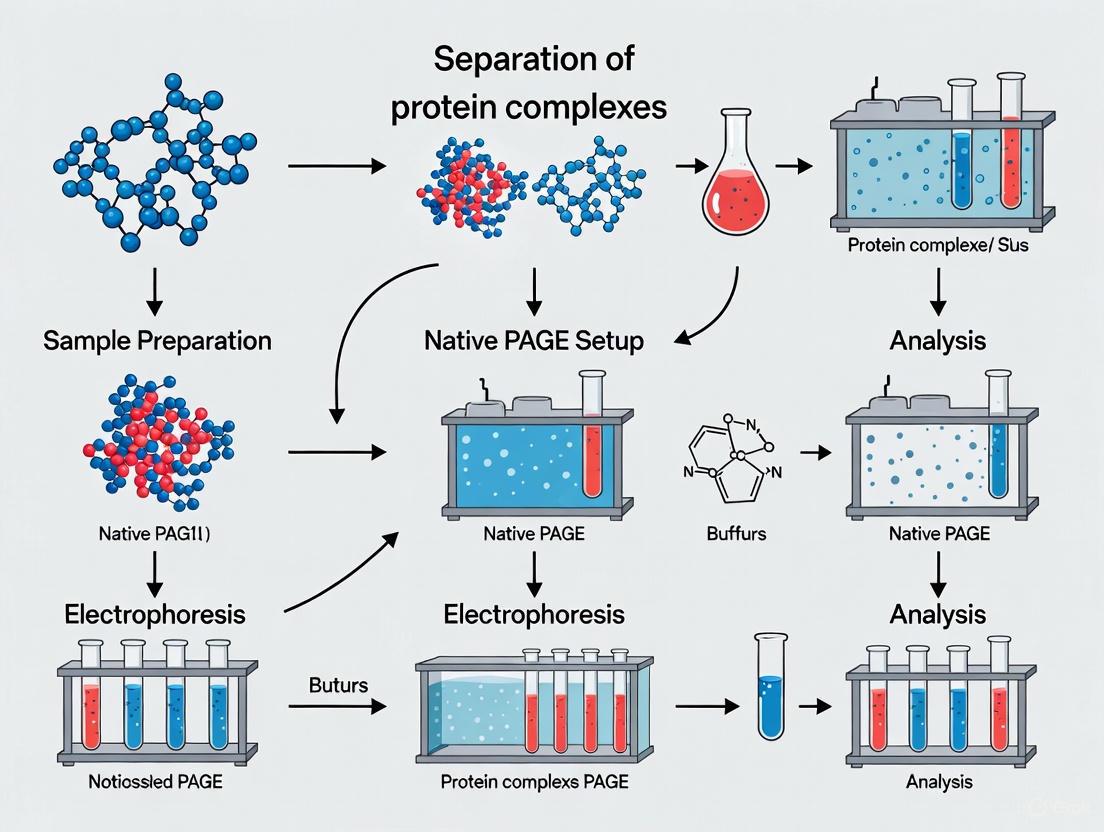
This article provides researchers, scientists, and drug development professionals with a complete guide to separating and analyzing native protein complexes using Blue Native Polyacrylamide Gel Electrophoresis (BN-PAGE) and related techniques.
Native PAGE for Protein Complexes: A Comprehensive Guide from Principles to Advanced Applications
Abstract
This article provides researchers, scientists, and drug development professionals with a complete guide to separating and analyzing native protein complexes using Blue Native Polyacrylamide Gel Electrophoresis (BN-PAGE) and related techniques. It covers foundational principles, detailed step-by-step protocols, advanced troubleshooting for common artifacts, and validation methods essential for studying mitochondrial oxidative phosphorylation complexes, interactomes, and other multisubunit assemblies. The content synthesizes current methodologies with practical optimization strategies to ensure reproducible, high-quality results in proteomics and biomedical research.
Understanding Native PAGE: Preserving Protein Complexes in Their Functional State
In the field of protein analysis, polyacrylamide gel electrophoresis (PAGE) serves as a fundamental tool for separating and characterizing proteins. However, the choice between native PAGE and denaturing SDS-PAGE represents a critical methodological branch point, each leading to dramatically different information about the protein sample. These techniques diverge most significantly in their treatment of the protein's native structure. While SDS-PAGE unravels and denatures proteins to determine molecular weight, native PAGE preserves the protein's three-dimensional structure, enabling the study of functional complexes and biological activity [1] [2].
This distinction makes these techniques complementary rather than interchangeable. SDS-PAGE has become the workhorse for routine protein analysis due to its simplicity and consistency, whereas native PAGE provides a specialized approach for functional studies where maintaining native conformation is paramount [3]. Understanding their fundamental differences allows researchers to select the optimal tool for specific research questions in biochemistry, structural biology, and drug development.
Fundamental Principles and Separation Mechanisms
SDS-PAGE: Separation by Molecular Weight Alone
Sodium dodecyl sulfate polyacrylamide gel electrophoresis (SDS-PAGE) operates on the principle of complete protein denaturation and uniform charge masking to achieve separation based almost exclusively on molecular weight. The key agent in this process is the anionic detergent SDS, which binds extensively to hydrophobic regions of proteins in a constant weight ratio (approximately 1.4 g SDS per 1 g of protein) [2]. This binding process unfolds the proteins into linear chains and confers a uniform negative charge density, effectively masking the proteins' intrinsic electrical charges [1] [3].
Sample preparation for SDS-PAGE typically involves heating at 95-100°C for 5-10 minutes in the presence of SDS and reducing agents like dithiothreitol (DTT) or β-mercaptoethanol (BME) to break disulfide bonds [1] [4]. When an electric field is applied, the resulting SDS-polypeptide complexes migrate through the polyacrylamide gel matrix toward the positive electrode, with smaller polypeptides moving faster due to less resistance from the gel pores [2]. This molecular sieving effect results in a separation where migration distance correlates precisely with logarithm of molecular weight, enabling accurate molecular weight determination when compared with standard protein markers [3].
Native PAGE: Separation by Charge, Size, and Shape
In stark contrast, native PAGE (including variants like Blue Native [BN]-PAGE and Clear Native [CN]-PAGE) separates proteins based on their inherent charge, size, and three-dimensional shape under conditions that preserve their native conformation and biological activity [1] [2]. Without denaturing agents, proteins maintain their complex quaternary structures, subunit interactions, and associated cofactors [3].
In this technique, proteins are prepared in non-denaturing buffers without SDS or reducing agents, and samples are not heated before loading [1]. During electrophoresis, proteins migrate according to their intrinsic charge density (net charge per mass) at the buffer pH, while the gel matrix provides a sieving effect based on the protein's hydrodynamic volume and shape [2]. Basic proteins may be separated using cathode buffer systems that maintain a slightly basic pH, facilitating their migration toward the negative electrode [5].
For membrane proteins, specialized native techniques like BN-PAGE use Coomassie Blue G-250 or mild detergents to impose a charge shift that facilitates migration while maintaining complex integrity [5] [6]. This preservation of native structure allows for subsequent functional assays, as separated proteins often retain enzymatic activity and can be recovered in their functional form [1] [2].
Table 1: Core Fundamental Differences Between SDS-PAGE and Native PAGE
| Parameter | SDS-PAGE | Native PAGE |
|---|---|---|
| Separation Basis | Molecular weight only | Size, charge, and 3D shape |
| Protein State | Denatured and linearized | Native, folded conformation |
| Detergent Usage | SDS present (denaturing) | No SDS (mild, non-ionic detergents may be used) |
| Sample Preparation | Heating with SDS and reducing agents | No heating, no denaturants |
| Protein Function Post-Separation | Lost | Preserved |
| Protein Recovery | Not feasible in functional form | Possible with retained activity |
| Typical Running Temperature | Room temperature | 4°C to maintain stability |
| Information Obtained | Polypeptide size, purity, abundance | Oligomeric state, protein-protein interactions, activity |
Comparative Analysis: Applications and Limitations
Application Scope for SDS-PAGE Versus Native PAGE
The applications of SDS-PAGE and native PAGE diverge according to the research objectives, with SDS-PAGE excelling in analytical tasks requiring molecular weight determination, while native PAGE provides unique capabilities for functional studies.
SDS-PAGE Applications:
- Molecular weight determination of polypeptide chains under denaturing conditions [1] [2]
- Assessment of protein purity and homogeneity in samples [7]
- Analysis of protein expression levels in cellular systems [1]
- Western blotting preparation, where denatured proteins are transferred to membranes for antibody detection [7]
- Protein quantification through band intensity analysis [2]
Native PAGE Applications:
- Study of protein-protein interactions and oligomeric states in multiprotein complexes [3] [7]
- Analysis of enzymatic activity through in-gel functional assays post-separation [5]
- Investigation of protein complexes such as mitochondrial oxidative phosphorylation (OXPHOS) supercomplexes [5] [8]
- Purification of functional proteins for downstream applications [1]
- Characterization of binding properties and conformational changes [3]
Technical Considerations and Limitations
Each method presents distinct limitations that must be considered during experimental design. SDS-PAGE's primary limitation is the complete loss of structural and functional information due to denaturation [1] [3]. While it provides excellent resolution based on size, it cannot reveal native oligomeric states or interactions between subunits in multimeric proteins [2]. The uniform charge masking also means that post-translational modifications affecting charge may not be detectable [3].
Native PAGE, while powerful for functional studies, presents challenges in interpretation and reproducibility. Without charge masking, migration depends on multiple factors including intrinsic charge, size, and shape, making molecular weight estimation unreliable [2]. The technique may also struggle with protein solubility and aggregation in the absence of denaturants, particularly for hydrophobic membrane proteins [6]. Additionally, maintaining native conditions throughout the process requires careful temperature control (often at 4°C) and pH management to prevent denaturation or proteolysis [1] [2].
Table 2: Application-Based Selection Guide
| Research Goal | Recommended Technique | Rationale |
|---|---|---|
| Determine subunit molecular weight | SDS-PAGE | Provides accurate size estimation under denaturing conditions |
| Study protein oligomerization | Native PAGE | Preserves quaternary structure and interactions |
| Detect specific epitopes via western blot | SDS-PAGE | Denaturation exposes linear epitopes for antibody binding |
| Perform in-gel activity assays | Native PAGE | Maintains protein function and enzymatic capability |
| Analyze complex protein mixtures | SDS-PAGE | Offers superior resolution for complex samples |
| Investigate membrane protein complexes | BN-PAGE/CN-PAGE | Specialized variants preserve membrane complex integrity |
| Purify functional proteins | Native PAGE | Enables recovery of active proteins post-separation |
Practical Implementation: Protocols and Reagents
Standard SDS-PAGE Protocol
Materials Required:
- Acrylamide/bis-acrylamide solution (typically 30-40%)
- Tris buffer (pH 8.8 for resolving gel, pH 6.8 for stacking gel)
- SDS (sodium dodecyl sulfate)
- TEMED (N,N,N',N'-tetramethylethylenediamine)
- APS (ammonium persulfate)
- Running buffer (Tris-Glycine with SDS)
- Protein sample
- Loading buffer with SDS and reducing agent
- Electrophoresis apparatus and power supply [4]
Procedure:
- Prepare the separating gel by mixing appropriate volumes of acrylamide/bis-acrylamide, Tris-HCl (pH 8.8), SDS, TEMED, and APS. Pour between glass plates and overlay with water or isopropanol to ensure even polymerization. Allow to polymerize for approximately 30 minutes [4] [2].
Prepare the stacking gel using lower acrylamide concentration (typically 4-5%) and Tris-HCl (pH 6.8). After removing the overlay from the polymerized separating gel, pour the stacking gel and immediately insert a comb to form wells. Allow to polymerize for 30 minutes [4] [2].
Prepare protein samples by mixing with loading buffer containing SDS and reducing agent (e.g., DTT or BME). Heat denature samples at 95-100°C for 5-10 minutes to ensure complete denaturation [4].
Assemble the electrophoresis apparatus and fill with running buffer. Remove the comb and load samples into wells using a micropipette. Include molecular weight markers in one lane [4].
Run the gel at constant voltage (typically 100-150V for mini-gels) until the dye front reaches the bottom of the gel. Running time varies with gel percentage and size [4].
Visualize proteins by staining with Coomassie Blue, silver stain, or other suitable detection methods. For western blotting, transfer proteins to a membrane instead of staining [4] [2].
Blue Native PAGE (BN-PAGE) Protocol for Membrane Complexes
Materials Required:
- Acrylamide/bis-acrylamide for gradient gels
- Bis-Tris or imidazole-based buffers (pH 7.0)
- Mild detergents (n-dodecyl-β-D-maltoside, digitonin)
- Coomassie Blue G-250 dye
- 6-aminocaproic acid
- Gradient gel casting system
- Cathode and anode buffers specific for BN-PAGE [5] [8]
Procedure:
- Prepare mitochondrial or membrane fractions from tissues or cells using appropriate homogenization and differential centrifugation methods [5].
Solubilize membrane proteins using mild non-ionic detergents like n-dodecyl-β-D-maltoside (typically 1-2%) or digitonin for supercomplex preservation. Maintain a detergent-to-protein ratio between 1:1 to 10:1, optimizing for specific complexes [5] [6] [8].
Prepare gradient gels (typically 3-12% or 4-16% acrylamide) using a gradient maker. Linear gradients provide optimal resolution for high molecular weight complexes. Allow gels to polymerize completely [5].
Prepare samples by adding Coomassie Blue G-250 dye (0.5-1% final concentration) to the solubilized protein complexes. The dye imposes a charge shift and enhances solubility [5] [8].
Load samples and run electrophoresis at 4°C to maintain complex stability. Begin at low voltage (e.g., 50V) and increase gradually (up to 200V) as the dye front enters the separating gel [5].
For downstream applications:
Essential Research Reagents and Solutions
Table 3: Key Reagents for Native PAGE and SDS-PAGE
| Reagent | Function | Specific Examples/Types |
|---|---|---|
| Acrylamide/Bis-acrylamide | Forms porous gel matrix for separation | Standard 29:1 or 37.5:1 acrylamide:bis ratio [4] [2] |
| SDS (Sodium Dodecyl Sulfate) | Denatures proteins and confers uniform charge | Used in SDS-PAGE at 0.1-0.2% in gels and buffers [1] [2] |
| TEMED/APS | Catalyzes acrylamide polymerization | TEMED with ammonium persulfate as initiator [4] [2] |
| Mild Detergents | Solubilizes native complexes without denaturation | n-dodecyl-β-D-maltoside, digitonin, Triton X-100 [5] [6] |
| Coomassie Dyes | Impose charge shift in BN-PAGE; protein staining | Coomassie Blue G-250 for BN-PAGE; G-250/R-250 for staining [5] |
| Charge Shift Agents | Facilitate migration in CN-PAGE | Mixed micelles of anionic and neutral detergents [5] |
| Protease Inhibitors | Prevent protein degradation during native procedures | Cocktails included in extraction buffers [5] |
Experimental Design and Workflow Strategies
This decision pathway provides researchers with a systematic approach to selecting the appropriate electrophoretic method based on their specific research objectives. The workflow emphasizes how fundamental questions about protein characterization needs should guide methodological choices.
Advanced Applications and Future Perspectives
Specialized Native PAGE Variants
The basic native PAGE technique has evolved into specialized variants that address specific research challenges. Blue Native PAGE (BN-PAGE) has become indispensable for studying mitochondrial complexes and respiratory supercomplexes [5] [8]. The method uses Coomassie Blue G-250 to impose a negative charge on membrane proteins solubilized with mild detergents like n-dodecyl-β-D-maltoside, enabling the resolution of intact complexes with molecular weights up to several megadaltons [5] [6]. Recent protocol refinements have shortened sample extraction procedures and enhanced in-gel activity detection sensitivity, particularly for Complex V (ATP synthase) [5].
Clear Native PAGE (CN-PAGE) represents a further refinement where mixed micelles of anionic and neutral detergents replace Coomassie dye in the cathode buffer [5]. This approach eliminates potential dye interference with in-gel enzyme activity assays and provides superior resolution for certain applications [5] [8]. The choice between BN-PAGE and CN-PAGE depends on the specific complexes being studied and the intended downstream applications, with BN-PAGE generally providing better resolution for high molecular weight complexes, while CN-PAGE offers advantages for functional assays [5].
Integration with Downstream Analytical Techniques
Both native PAGE and SDS-PAGE serve as foundational separation methods that integrate with various downstream analysis platforms:
Two-Dimensional Electrophoresis combining BN-PAGE with SDS-PAGE provides a powerful comprehensive analysis tool. In this approach, protein complexes are first separated by BN-PAGE, then individual lanes are excised and applied to SDS-PAGE gels to resolve complex subunits in the second dimension [5]. This technique has proven invaluable for analyzing assembly intermediates of mitochondrial complexes and identifying defective assembly pathways in genetic disorders [5].
Mass Spectrometry Integration has expanded the applications of both techniques. Proteins separated by SDS-PAGE can be excised, digested, and identified by LC-MS/MS, while native PAGE enables the characterization of intact complexes by native mass spectrometry [9] [10]. Recent advances in supercharger-assisted native top-down mass spectrometry now allow analysis of membrane protein complexes directly from native membranes, providing new insights into oligomeric states, proteoforms, and endogenous ligand binding [9] [10].
Functional Assays following native PAGE separation include in-gel enzyme activity staining for respiratory complexes, which maintains clinical relevance for diagnosing mitochondrial disorders [5]. The preservation of biological activity after separation enables zymogram techniques for detecting various enzymatic activities directly in the gel matrix.
Native PAGE and SDS-PAGE represent complementary approaches in the protein researcher's toolkit, each with distinct advantages and applications. SDS-PAGE provides unparalleled resolution for molecular weight determination and analytical simplicity, while native PAGE offers unique capabilities for studying protein function, interactions, and native structure. The continued development of specialized variants like BN-PAGE and CN-PAGE, coupled with integration with advanced downstream analysis techniques, ensures that both methods will remain essential for protein characterization in basic research and drug development.
Blue Native Polyacrylamide Gel Electrophoresis (BN-PAGE) is an indispensable technique for analyzing native protein complexes, particularly those from mitochondrial and membrane preparations. The central component enabling this method is Coomassie Brilliant Blue G-250, which serves a dual function: it imparts a uniform negative charge to native protein complexes, facilitating their electrophoretic migration, and enhances the solubility of hydrophobic membrane proteins, preventing aggregation under native conditions. This application note details the underlying mechanisms of Coomassie dye, provides a validated step-by-step protocol for the separation of oxidative phosphorylation (OXPHOS) complexes, and discusses advanced applications and troubleshooting, serving as a comprehensive resource for researchers in proteomics and drug development.
In the analysis of protein complexes, maintaining native structure is paramount for understanding true physiological interactions, stoichiometry, and function. BN-PAGE, first described by Schägger and von Jagow in 1991, fulfills this need by enabling the separation of intact protein complexes under non-denaturing conditions [11] [5]. Unlike SDS-PAGE, which uses the denaturing detergent sodium dodecyl sulfate to impart charge and unfold proteins, BN-PAGE relies on the mild, non-ionic detergent n-dodecyl-β-D-maltoside for initial solubilization and, crucially, the dye Coomassie Brilliant Blue G-250 for charge conferral and solubility enhancement [11] [12] [13].
The core challenge BN-PAGE overcomes is the inherent insolubility of membrane proteins and their complexes in aqueous environments once detached from their lipid bilayers. Coomassie G-250 addresses this by binding to protein surfaces via hydrophobic interactions and heteropolar bonding to basic amino acids, effectively masking their hydrophobic character and conferring a strong negative charge [14] [15]. This allows complexes to remain soluble and migrate through the polyacrylamide gel based on their size and shape, without the need for denaturing agents. The technique has become the gold standard for investigating mitochondrial respiratory chains, revealing the existence and composition of supercomplexes (respirasomes), and diagnosing mitochondrial disorders [13] [5].
Table: Key Properties of Coomassie Brilliant Blue Dyes in Protein Analysis
| Property | Coomassie Blue R-250 | Coomassie Blue G-250 |
|---|---|---|
| Primary Use | Protein staining in SDS-PAGE & IEF gels | BN-PAGE & Bradford protein assay |
| Color Characteristic | Reddish-blue | Greenish-blue |
| Charge Imparting in BN-PAGE | Not typically used | Yes, essential function |
| Typical Form | Solution in methanol/acetic acid | Colloidal suspension |
| Binding Mechanism | Hydrophobic & ionic interactions | Hydrophobic & ionic interactions |
Core Mechanism: How Coomassie Dye Imparts Charge and Solubility
The functionality of Coomassie Brilliant Blue G-250 in BN-PAGE is rooted in its unique chemical behavior and interaction with proteins.
Chemical Properties and Charge States
Coomassie Brilliant Blue is a triphenylmethane dye whose ionic state and color are highly dependent on pH [14] [15]. For Coomassie G-250:
- At pH < 0.3, it exists as a double cation and is red.
- At pH ~1.3, it is neutral and green.
- At pH > 1.3, it forms an anion and is blue [15].
In the neutral pH conditions (pH 7.0) used in BN-PAGE, the dye molecule is a negatively charged anion with an overall charge of -1, which allows it to bind to proteins and impart the negative charge necessary for anodal migration [14].
Mechanism of Action in BN-PAGE
The dye performs two critical, simultaneous functions:
- Imparting Negative Charge: The binding of numerous Coomassie G-250 anions to a protein complex confers a large negative charge shift. This charge is roughly proportional to the surface area of the complex, ensuring that even basic proteins migrate toward the anode. This replaces the function of SDS in denaturing electrophoresis [13] [5].
- Enhancing Solubility: The dye binds to hydrophobic patches on protein surfaces. This binding converts the surface character of membrane proteins from hydrophobic to more hydrophilic, dramatically increasing their solubility in the aqueous electrophoresis buffer and preventing aggregation. This eliminates the need for detergents in the running gel itself, minimizing the risk of denaturation [12] [13] [5].
The diagram below illustrates this core mechanism and the subsequent electrophoresis process.
Experimental Protocol: BN-PAGE for OXPHOS Complexes
The following is a consolidated and validated protocol for analyzing mitochondrial oxidative phosphorylation (OXPHOS) complexes, adapted from key sources [11] [13] [5].
Sample Preparation: Mitochondrial Solubilization
- Mitochondria Isolation: Isolate mitochondria from target tissue (e.g., mouse liver) or cells. Resuspend the mitochondrial pellet (0.5 - 2 mg total protein) in 50-100 µL of Buffer A (0.75 M 6-aminocaproic acid, 50 mM Bis-Tris/HCl, pH 7.0) containing protease inhibitors (e.g., 1 mM PMSF) [11].
- Solubilization: Add a 10% solution of the mild, non-ionic detergent n-dodecyl-β-D-maltoside (DDM) to achieve a detergent-to-protein ratio of 2-4 g/g. Gently mix and incubate on ice for 30 minutes [11] [5].
- Clarification: Centrifuge the solubilized mixture at 72,000 x g for 30 minutes at 4°C to remove insoluble material.
- Dye Addition: Collect the supernatant and add Coomassie Blue G-250 (from a 5% stock solution in 0.5 M aminocaproic acid) to a final concentration of approximately 0.5% (v/v) [11].
Native Gel Electrophoresis (First Dimension)
- Gel Casting: Pour a native polyacrylamide gradient gel (e.g., 3-12% or 4-16%) using a gradient former. The gel matrix should contain 0.5 M 6-aminocaproic acid and 50 mM Bis-Tris, pH 7.0. A stacking gel (without gradient) is often used on top [11] [5].
- Electrophoresis Setup: Use specific anode and cathode buffers.
- Running Conditions: Load the prepared samples (5-20 µL) into the wells. Run the gel at 4°C to maintain complex integrity. Start with a constant voltage of 100 V until the sample has entered the stacking gel, then continue at 150 V for 2-3 hours until the dye front has almost migrated off the gel [11].
Downstream Applications
- In-Gel Activity Staining: The separated OXPHOS complexes remain enzymatically active. Specific assays can be performed to visualize the activity of Complexes I, II, IV, and V directly in the gel [13] [5] [16].
- Second Dimension SDS-PAGE: For subunit analysis, excise a lane from the BN-PAGE gel, soak it in SDS-PAGE denaturing buffer, and place it horizontally on top of an SDS-polyacrylamide gel. This resolves the individual subunits of each native complex [11].
- Western Blotting: Proteins can be transferred to a PVDF membrane for immunodetection with specific antibodies. A fully submerged electroblotting system at 150 mA for 1.5 hours is recommended [11].
Table: Key Buffer Formulations for BN-PAGE
| Buffer | Composition | Function |
|---|---|---|
| Solubilization Buffer | 0.75 M 6-aminocaproic acid, 50 mM Bis-Tris/HCl, pH 7.0 | Stabilizes proteins during solubilization, provides ionic strength |
| Cathode Buffer (Blue) | 50 mM Tricine, 15 mM Bis-Tris, 0.02% Coomassie G-250, pH 7.0 | Provides charge for electrophoresis & replenishes dye |
| Cathode Buffer (Clear) | 50 mM Tricine, 15 mM Bis-Tris, 0.05% Sodium Deoxycholate, 0.02% DDM, pH 7.0 | Used in CN-PAGE for better in-gel activity visualization |
| Anode Buffer | 50 mM Bis-Tris, pH 7.0 | Completes the electrical circuit |
| SDS Denaturing Buffer | 2% SDS, 10% Glycerol, 50 mM Tris, pH 6.8, 50 mM DTT, 0.002% Bromophenol Blue | Denatures complexes for 2nd dimension SDS-PAGE |
The Scientist's Toolkit: Essential Reagents for BN-PAGE
Table: Key Research Reagent Solutions for BN-PAGE
| Reagent | Function/Explanation | Example Product/Composition |
|---|---|---|
| Coomassie G-250 | Imparts charge & solubility; core of BN-PAGE | 5% solution in 0.5 M aminocaproic acid [11] |
| n-Dodecyl-β-D-Maltoside (DDM) | Mild detergent for solubilizing individual complexes | 10% solution in water [11] |
| Digitonin | Very mild detergent for preserving supercomplexes | 2-4% solution from plant source [12] [13] |
| 6-Aminocaproic Acid | Zwitterionic salt; aids solubilization & prevents aggregation | 0.75 M in solubilization buffer [11] [5] |
| Protease Inhibitors | Prevents protein degradation during isolation | PMSF, Leupeptin, Pepstatin [11] |
| Linear Gradient Gels | Separates a wide range of complex sizes | 3-12% or 4-16% acrylamide gradient [11] [5] |
Advanced Applications and Beneficial Effects
The utility of BN-PAGE and Coomassie staining extends beyond basic separation.
- Supercomplex Analysis: Using digitonin for solubilization, BN-PAGE has been instrumental in demonstrating the "solid-state" model of the respiratory chain, where Complexes I, III, and IV associate into stable supercomplexes (e.g., I+III₂+IV) with proposed functional advantages in electron channeling and complex stability [12] [13].
- In-Gel Enzymology: The compatibility of BN-PAGE with in-gel activity assays allows direct functional assignment. This has been successfully applied not only to OXPHOS complexes but also to other multimeric enzymes like medium-chain acyl-CoA dehydrogenase (MCAD), enabling the differentiation of active tetramers from inactive aggregates caused by pathogenic variants [16].
- Enhanced Proteomic Analysis: Contrary to the assumption that skipping staining saves time, Coomassie Brilliant Blue R-250 staining has been shown to significantly improve subsequent LC-MS/MS analysis. It enhances protein retention in the gel matrix, leading to the detection of ~40% more proteins in native PAGE and ~18% more in SDS-PAGE, with particular benefit for lower molecular weight proteins [17] [18].
Troubleshooting and Best Practices
- Weak or No Bands: Can result from insufficient protein loading, over- or under-solubilization, or loss of complexes during preparation. Optimize detergent-to-protein ratio and ensure mitochondrial integrity [11] [5].
- High Background: Caused by incomplete destaining (if using post-electrophoresis staining) or interference from contaminants. Increase washing steps or use high-purity reagents [15].
- Smearing: Often due to protein aggregation from incomplete solubilization or insufficient Coomassie dye. Ensure fresh dye is used in both sample and cathode buffer [12].
- Diffuse Bands in 2D-Gels: Can occur if the first-dimension BN-PAGE strip is not properly equilibrated with SDS denaturing buffer before the second dimension [11].
The workflow below summarizes the key decision points and steps in a comprehensive BN-PAGE experiment.
The oxidative phosphorylation (OXPHOS) system, which plays a pivotal role in cellular energy conversion, is composed of five multi-subunit protein complexes embedded in the mitochondrial inner membrane [5]. Understanding the structure, function, and assembly of these complexes is crucial in fundamental research and for investigating severe metabolic diseases. Blue Native Polyacrylamide Gel Electrophoresis (BN-PAGE), first developed by Hermann Schägger in the 1990s, has become an indispensable technique for resolving these hydrophobic enzyme systems in their native state [5] [11]. This Application Note details the key applications of BN-PAGE and the related Clear Native PAGE (CN-PAGE) for analyzing the size, relative abundance, and composition of mitochondrial complexes, providing researchers with robust protocols for comprehensive complexome analysis.
Table: Key Characteristics of BN-PAGE and CN-PAGE
| Feature | BN-PAGE | CN-PAGE |
|---|---|---|
| Dye/Detergent System | Coomassie Blue G-250 | Mixed anionic and neutral detergents |
| Charge Shift Mechanism | Anionic dye binds hydrophobic protein surfaces | Mixed micelles induce charge shift |
| Resolution of Individual Complexes | Excellent | Excellent |
| Resolution of Supercomplexes | Good (with digitonin) | Good (with digitonin) |
| Interference with Downstream Applications | Possible due to residual Coomassie dye | Minimal |
| Ideal for In-Gel Activity Staining | Moderate | Superior |
Key Applications and Experimental Workflow
Analysis of Individual OXPHOS Complexes and Supercomplexes
BN-PAGE enables the resolution of all five individual OXPHOS complexes when membranes are solubilized with the mild detergent n-dodecyl-β-D-maltoside [5] [11]. When the even milder detergent digitonin is used, the technique preserves and reveals the higher-order organization of the respiratory chain: respirasomes (supercomplexes containing Complexes I, III, and IV) remain intact, allowing for the study of their stoichiometry and interactions [5] [19]. This is vital for understanding the functional plasticity of the respiratory chain. The protocol can be applied to various sample types, including cultured human fibroblasts, tissue biopsies (e.g., skeletal muscle), and model organisms like yeast and zebrafish [5].
Investigation of Assembly Pathways and Defects
BN-PAGE is a powerful tool for delineating the assembly pathways of multi-subunit complexes. It can resolve and identify transient assembly intermediates, providing insights into the stepwise incorporation of subunits and the role of specific assembly factors [5] [11]. This application is particularly valuable in diagnosing mitochondrial disorders, as it allows researchers to pinpoint the pathologic consequences of genetic mutations that disrupt the normal assembly process of OXPHOS complexes, often revealing a characteristic accumulation of specific assembly intermediates [5].
In-Gel Functional Enzymatic Assays
A significant advantage of native PAGE techniques is that the separated protein complexes retain their catalytic activity. This enables direct functional analysis through in-gel activity staining [5] [20]. Established histochemical methods can be used to detect the activities of Complex I, II, IV, and V on the same gel or separate gels. Recent protocol enhancements include a simple step that markedly improves the sensitivity of in-gel Complex V (ATP synthase) activity staining [5]. A limitation to note is the comparative insensitivity for Complex IV and the current lack of an in-gel activity stain for Complex III [5].
Proteomic Characterization and Complexome Profiling
When combined with mass spectrometry, BN-PAGE and CN-PAGE transition from a biochemical tool to a powerful proteomic platform for complexome profiling [21] [22]. After separation, gel lanes are sliced into numerous fractions, and the proteins in each fraction are identified and quantified by MS. This generates an abundance profile for each protein across the molecular weight range, serving as a fingerprint that reveals its distribution across different assemblies, complexes, and supercomplexes [21] [22]. A notable example is the MitCOM project, which used high-resolution complexome profiling to map over 5,200 protein peaks from more than 90% of the yeast mitochondrial proteome, uncovering a remarkable complexity of protein assemblies and novel quality-control pathways [22].
Figure 1: Experimental workflow for mitochondrial complex analysis using native PAGE and downstream applications.
Detailed Protocols
Protocol 1: Sample Preparation and BN-PAGE for OXPHOS Complexes
This protocol is adapted for small patient samples (e.g., cultured fibroblasts, muscle biopsies) and uses a shortened extraction procedure for robustness [5] [23].
Materials and Reagents
- Buffer A: 0.75 M 6-aminocaproic acid, 50 mM Bis-Tris/HCl, pH 7.0 [11] [23]
- Protease Inhibitors: e.g., 1 mM PMSF, 1 µg/mL leupeptin, 1 µg/mL pepstatin [11]
- Detergent: 10% n-dodecyl-β-D-maltoside (DDM) for individual complexes; 5% digitonin for supercomplexes [5] [23]
- Coomassie Dye: 5% Coomassie Blue G-250 in 0.5 M aminocaproic acid [11]
Step-by-Step Procedure
- Mitochondrial Isolation: Isolate mitochondria from cells or tissue using standard differential centrifugation. Using isolated mitochondria, rather than whole-cell extracts, is strongly recommended for a stronger signal and cleaner results [11].
- Solubilization: Resuspend a mitochondrial pellet (0.4 mg protein) in 40 µL of ice-cold Buffer A containing protease inhibitors. Add 7.5 µL of 10% DDM (for a final concentration of ~1.5%), mix, and incubate on ice for 30 minutes [11] [23].
- Clarification: Centrifuge the solubilized mixture at 72,000 x g for 30 minutes at 4°C to remove insoluble material. A bench-top microcentrifuge at maximum speed (≈16,000 x g) can be used, though it is not ideal [11].
- Sample Preparation: Collect the supernatant and add 2.5 µL of 5% Coomassie Blue G-250 solution [11].
- Gel Electrophoresis: Load 5-20 µL of the prepared sample onto a hand-cast linear gradient gel (e.g., 6-13% acrylamide). A stacking gel (e.g., 4%) is used on top of the resolving gel. Run the gel using anode (50 mM Bis-Tris, pH 7.0) and cathode (50 mM Tricine, 15 mM Bis-Tris, 0.02% Coomassie Blue G-250, pH 7.0) buffers. Start electrophoresis at 150 V for approximately 2 hours, or until the blue dye front has nearly run off the gel [11] [23].
Protocol 2: In-Gel Activity Staining for OXPHOS Complexes
After BN-PAGE, the following activity stains can be performed on gel strips at room temperature. Reactions are stopped by fixing gels in 50% methanol / 10% acetic acid [20].
Table: In-Gel Activity Staining Recipes for OXPHOS Complexes
| Complex | Staining Solution Composition | Incubation Time | Principle |
|---|---|---|---|
| Complex I | 50 mM phosphate buffer (pH 7.0), 0.2 mg/mL NBT, 0.1 mg/mL NADH [20] | 30-60 min | NADH oxidation reduces NBT to purple formazan |
| Complex II | 5 mM Tris-HCl (pH 7.4), 0.5 M sodium succinate, 215 µM PMS, 1 mg/mL NBT [20] | 30-60 min | Succinate oxidation reduces NBT via PMS |
| Complex IV | 50 mM phosphate buffer (pH 7.2), 1 mg/mL DAB, 0.1 mg/mL cytochrome c [20] | 1-2 hours | Cytochrome c oxidation by DAB |
| Complex V | 35 mM Tris, 270 mM glycine (pH 8.3), 14 mM MgCl₂, 0.2% Pb(NO₃)₂, 8 mM ATP [20] | 1-2 hours | Lead phosphate precipitate from released Pi |
Protocol 3: Two-Dimensional BN/SDS-PAGE for Subunit Resolution
This protocol is used to resolve the individual subunits that constitute each native complex separated in the first dimension [5] [11].
- First Dimension: Perform BN-PAGE as described in Protocol 1.
- Gel Strip Equilibration: Excise the entire BN-PAGE lane and soak it in SDS denaturing buffer (2% SDS, 50 mM Tris, pH 6.8, 10% glycerol, 50 mM DTT, 0.002% Bromophenol Blue) for 30-60 minutes with gentle agitation [11].
- Second Dimension: Place the equilibrated gel strip horizontally on top of a standard SDS-PAGE gel (e.g., 10-20% gradient). Seal it in place with agarose.
- Electrophoresis and Analysis: Run the second-dimension SDS-PAGE according to standard procedures. The resulting 2D gel can be used for western blotting with specific antibodies or stained for total protein (e.g., with Coomassie or silver stain) to create a map of the subunits for each OXPHOS complex [5].
The Scientist's Toolkit: Essential Research Reagents
Table: Key Research Reagent Solutions for Native PAGE
| Reagent / Kit | Function / Application | Example Supplier / Reference |
|---|---|---|
| n-Dodecyl-β-D-maltoside (DDM) | Mild detergent for solubilizing individual OXPHOS complexes | Thermo Fisher Scientific [23] |
| Digitonin (5% solution) | Mild detergent for preserving supercomplexes | Thermo Fisher Scientific [23] |
| Serva Blue G / Coomassie G-250 | Charge-shift dye for BN-PAGE | Serva, Sigma-Aldrich [11] [23] |
| 6-Aminocaproic Acid | Zwitterionic salt to support solubilization and improve resolution | Sigma-Aldrich/Merck [23] |
| NativePAGE Bis-Tris Gel System | Precast gels and buffers for BN-PAGE | Thermo Fisher Scientific [5] |
| Pierce BCA Protein Assay Kit | For accurate protein quantification before loading | Thermo Fisher Scientific [23] |
| Primary Antibodies (Anti-OXPHOS) | For western blot detection of specific complexes | Various commercial suppliers [23] |
Technology Comparison and Strategic Implementation
Figure 2: A decision tree for selecting the appropriate native PAGE method based on research goals.
The choice between BN-PAGE and CN-PAGE depends on the specific research objectives. BN-PAGE is the established, robust workhorse technique, providing excellent resolution of complexes and supercomplexes. Its main drawback is potential interference from Coomassie dye in downstream in-gel activity assays. CN-PAGE, which replaces the blue dye with mixtures of anionic and neutral detergents in the cathode buffer, eliminates this interference and is therefore superior for sensitive in-gel activity measurements [5] [21]. For the most comprehensive, system-wide studies, the BN-PAGE methodology can be scaled up to a high-resolution complexome profiling pipeline. As demonstrated in the MitCOM project, this involves coupling BN-PAGE with cryo-slicing of gel lanes into hundreds of fine fractions followed by quantitative mass spectrometry, enabling the unbiased identification and quantification of thousands of protein assemblies [22].
Troubleshooting and Best Practices
- Gel Casting: For optimal separation, manually cast linear gradient gels (e.g., 6-13% acrylamide) are highly recommended over single-concentration gels [11] [23]. This provides a superior separation range for high-molecular-weight complexes.
- Sample Quality: Always use freshly prepared or properly stored mitochondrial isolates. Avoid repeated freeze-thaw cycles of samples. Include protease inhibitors in all buffers during mitochondrial preparation and solubilization to prevent degradation [11].
- Detergent Optimization: The detergent-to-protein ratio is critical. For initial experiments, a ratio of 2-4 g DDM per g protein is a good starting point. For supercomplex preservation with digitonin, optimization of the digitonin-to-protein ratio is essential [5].
- Activity Stain Sensitivity: If in-gel activity stains for Complex IV are weak, consider using the CN-PAGE method instead of BN-PAGE to avoid Coomassie dye interference. For Complex V, the reported enhancement step (adding lead nitrate and ATP) significantly improves sensitivity [5] [20].
- Controls: Always include a control sample (e.g., from a wild-type cell line or tissue) on the same gel for comparison when analyzing patient samples or experimental models. The use of mtDNA-depleted (ρ0) cell lines can serve as excellent negative controls for complexes containing mtDNA-encoded subunits [5].
Advantages for Studying Assembly Intermediates and Multisubunit Enzymes
Blue Native Polyacrylamide Gel Electrophoresis (BN-PAGE) and related native gel techniques provide powerful tools for investigating the assembly and function of multisubunit protein complexes. These methods enable the separation of intact protein complexes under non-denaturing conditions, preserving enzymatic activity and protein-protein interactions. This application note details how native PAGE methodologies facilitate the study of assembly intermediates and the functional characterization of complex enzymes, with direct applications in basic research and drug development.
Most cellular processes are executed not by individual proteins but by complex macromolecular assemblies. Understanding the formation, structure, and function of these complexes is essential for elucidating fundamental biological mechanisms and developing targeted therapeutics. Native polyacrylamide gel electrophoresis (PAGE) encompasses several techniques designed to separate protein complexes while maintaining their native conformation and activity [24]. Unlike denaturing SDS-PAGE, which dissociates complexes into individual subunits, native PAGE preserves higher-order structures, making it indispensable for studying assembly intermediates and multisubunit enzymes [25] [12].
The unique capability to analyze enzymatically active complexes directly from cellular extracts provides researchers with a snapshot of the native cellular state, enabling investigations into how protein complex assembly, disassembly, and dysfunction contribute to both normal physiology and disease pathogenesis [26] [27].
Key Advantages of Native PAGE for Complex Analysis
Native PAGE methodologies offer several distinct advantages for the analysis of protein complexes, particularly when studying assembly pathways and enzyme function.
Table 1: Key Advantages of Native PAGE in Protein Complex Studies
| Advantage | Description | Research Application |
|---|---|---|
| Preservation of Native State | Maintains non-covalent protein-protein interactions and complex integrity [12] [11]. | Analysis of endogenous complexes without reconstruction artifacts. |
| Enzymatic Activity Retention | Enzymes remain functional after separation, enabling in-gel activity assays [26] [27]. | Functional characterization and detection of catalytically active complexes. |
| Detection of Assembly Intermediates | High resolution separates low-abundance intermediates from mature complexes [25] [28]. | Elucidation of assembly pathways and identification of assembly bottlenecks. |
| Analysis of Oligomeric States | Resolves different oligomeric forms based on size and charge [29]. | Determination of quaternary structure and stoichiometry. |
| Compatibility with Downstream Analyses | Gel lanes can be excised for second-dimension denaturing electrophoresis or mass spectrometry [25] [11]. | Identification of complex subunit composition (proteomics). |
A unique strength of BN-PAGE is its capacity to resolve early aggregation intermediates and misfolded species that are challenging to detect by other methods [28]. This sensitivity makes it invaluable for studying protein aggregation diseases and optimizing recombinant protein expression. Furthermore, the technique allows direct correlation of oligomeric state with biological function, as demonstrated in studies of the antiviral GTPase MxA, where dimeric forms were shown to be active against influenza virus [29].
Experimental Protocols
This section provides detailed methodologies for key applications of native PAGE in studying protein complexes.
Protocol 1: BN-PAGE for Mitochondrial Complex Analysis
This protocol, adapted from established methods [11], is optimized for analyzing mitochondrial oxidative phosphorylation complexes, which are frequently studied as model multisubunit enzymes.
Sample Preparation from Isolated Mitochondria
- Resuspend 0.4 mg of sedimented mitochondria in 40 µL of Buffer A (0.75 M 6-aminocaproic acid, 50 mM Bis-Tris/HCl, pH 7.0) containing protease inhibitors (e.g., 1 mM PMSF, 1 µg/mL leupeptin, 1 µg/mL pepstatin) [11].
- Solubilize by adding 7.5 µL of 10% n-dodecyl-β-D-maltopyranoside (DDM). Mix and incubate for 30 minutes on ice.
- Clarify the lysate by centrifugation at 72,000 × g for 30 minutes at 4°C. Collect the supernatant.
- Add Coomassie Dye by mixing the supernatant with 2.5 µL of a 5% Coomassie blue G solution in 0.5 M aminocaproic acid [11].
Gel Electrophoresis and Visualization
- Gel Casting: Prepare a linear gradient native gel (e.g., 6-13% acrylamide). A recommended recipe for a 13% gel solution (32 mL total) is: 14 mL 30% acrylamide/Bis solution, 16 mL 1 M aminocaproic acid (pH 7.0), 1.6 mL 1 M Bis-Tris (pH 7.0), 0.2 mL ddH₂O, 200 µL 10% ammonium persulfate (APS), and 20 µL TEMED [11].
- Sample Loading: Load 5-20 µL of prepared sample per well.
- Electrophoresis: Run the gel at 150 V for approximately 2 hours using anode (50 mM Bis-Tris, pH 7.0) and cathode (50 mM Tricine, 15 mM Bis-Tris, 0.02% Coomassie blue G, pH 7.0) buffers until the dye front approaches the bottom of the gel [11].
- In-Gel Activity Assay: For continuous monitoring of enzymatic activity, incubate the gel in an appropriate assay buffer within a custom chamber that allows media recirculation and filtering. Collect time-lapse images to obtain kinetic traces of the reaction [26].
Protocol 2: Non-Denaturing PAGE for Oligomeric State Analysis
This protocol is designed to assess the oligomeric state of proteins, such as the human MxA protein, directly from cell lysates [29].
Cell Lysis under Non-Denaturing Conditions
- Harvest and Wash approximately 1.0 × 10⁶ cells using ice-cold PBS.
- Lyse Cells by resuspending the pellet in 200 µL of ice-cold lysis buffer (e.g., 40 mM HEPES, 100 mM NaCl, 1% Digitonin, 2 mM MgCl₂, 10% Glycerol, pH 7.4) containing 5 mM iodoacetamide to protect free thiol groups and prevent artificial disulfide bond formation [29].
- Incubate the lysate for 30 minutes on ice, protected from light.
- Clarify by centrifugation at 13,000 × g for 20 minutes at 4°C.
- Dialyze the cleared supernatant against ice-cold dialysis buffer (e.g., 40 mM HEPES, 100 mM NaCl, 2 mM MgCl₂, 10% Glycerol, pH 7.4) for at least 4 hours or overnight at 4°C to remove detergents and salts that may interfere with electrophoresis [29].
Non-Denaturing Electrophoresis
- Pre-run a pre-cast 4-15% gradient gel with pre-chilled running buffer (e.g., 25 mM Tris, 192 mM Glycine, pH 8.3) at 25 mA per gel for 15 minutes at 4°C.
- Load Sample mixed with 4x non-denaturing sample buffer (e.g., 40% Glycerol, 100 mM Tris, 0.5% Bromophenol Blue, pH 6.8).
- Run Gel at 25 mA per gel in the cold room until the dye front migrates to the bottom.
- Transfer and Detect proteins using a fully submerged wet transfer system onto a PVDF membrane. Perform immunodetection with target-specific antibodies [29].
Research Reagent Solutions
Successful native PAGE experiments depend on the careful selection and optimization of key reagents.
Table 2: Essential Reagents for Native PAGE Experiments
| Reagent Category | Specific Examples | Function and Selection Criteria |
|---|---|---|
| Detergents | n-Dodecyl-β-D-maltoside (DDM), Digitonin, Triton X-100 [12] [29] | Solubilize membrane proteins and stabilize complexes. Digitonin can preserve weak supercomplex interactions [12]. |
| Charge Conferral | Coomassie Blue G250 [12] [11] | Binds hydrophobic protein surfaces, imparting negative charge for electrophoresis without denaturation. |
| Protease Inhibitors | PMSF, Leupeptin, Pepstatin [11] | Prevent proteolytic degradation during sample preparation, preserving complex integrity. |
| Thiol Protection | Iodoacetamide [29] | Alkylates free cysteine residues to prevent artificial interchain disulfide bonding and aggregation. |
| Buffers | 6-Aminocaproic Acid, Bis-Tris, Tricine [11] | Maintain neutral pH and provide appropriate ionic conditions for complex stability and separation. |
The choice of detergent is particularly critical. While dodecylmaltoside is effective for solubilizing individual respiratory complexes, the use of digitonin has been instrumental in revealing the existence of respiratory supercomplexes (respirasomes), fundamentally changing models of electron transport chain organization [12].
Data Presentation and Analysis
Native PAGE generates rich, quantitative data on protein complex size, abundance, composition, and activity.
Table 3: Quantitative Data from Representative Native PAGE Studies
| Protein Complex / Process | Technique | Key Quantitative Findings |
|---|---|---|
| Proteasome Assembly | 2D Native-SDS-PAGE [25] | Identification and characterization of low-abundance assembly intermediates among 66 subunits. |
| Mitochondrial Complex IV | In-Gel Kinetics [26] | Activity kinetics showed a short initial linear phase for catalytic rate calculation. |
| Mitochondrial Complex V | In-Gel Kinetics [26] | ATPase activity revealed a significant lag phase followed by two distinct linear phases. |
| MxA Antiviral GTPase | Non-denaturing PAGE [29] | Correlation of dimeric oligomeric state with antiviral activity against influenza virus. |
| Respiratory Chain | BN-PAGE with different detergents [12] | DDM/Triton X-100: separated individual complexes. Digitonin: revealed higher-order supercomplexes. |
Native PAGE technologies provide an indispensable toolkit for dissecting the assembly, architecture, and function of multisubunit protein complexes. The ability to separate intact complexes under native conditions, coupled with versatile downstream analytical applications, makes these methods particularly powerful for functional proteomics. As research increasingly focuses on complex molecular machines in health and disease, BN-PAGE and related techniques will continue to be vital for uncovering the mechanisms of complex assembly and for evaluating how perturbations in these processes contribute to human disease, thereby informing targeted therapeutic development.
BN-PAGE in Practice: Step-by-Step Protocols from Sample Prep to Immunodetection
The study of native mitochondrial protein complexes, particularly those involved in oxidative phosphorylation (OXPHOS), provides crucial insights into cellular energy metabolism, the pathogenesis of metabolic diseases, and the identification of novel therapeutic targets [8]. Blue Native Polyacrylamide Gel Electrophoresis (BN-PAGE) has emerged as a foundational technique for resolving intact, enzymatically active protein complexes, enabling the analysis of their assembly, stoichiometry, and interactions within supercomplexes [30] [11]. The success of BN-PAGE and related techniques is critically dependent on the initial steps of mitochondrial isolation and solubilization. Inadequate sample preparation can lead to protein degradation, loss of enzymatic activity, or dissociation of labile protein complexes, thereby compromising all downstream analyses [30]. This application note details a validated and robust protocol for the isolation of functional mitochondria and their subsequent solubilization using the nonionic detergent n-dodecyl-β-D-maltoside (DDM), framing these steps within the context of a broader native PAGE research workflow for the analysis of mitochondrial complexome.
The Role of Sample Preparation in Native PAGE
In native electrophoresis, the goal is to preserve the non-covalent interactions that hold protein complexes together. This stands in stark contrast to denaturing techniques like SDS-PAGE, which deliberately dismantle these structures. The physiological protein-protein interactions within the OXPHOS system are maintained during BN-PAGE, allowing for the separation of individual complexes (I-V) and their higher-order assemblies, known as respirasomes [30] [8]. The binding of Coomassie blue G-250 to solubilized proteins imposes a negative charge shift that facilitates migration toward the anode while simultaneously enhancing protein solubility and preventing aggregation, effectively converting membrane proteins into water-soluble forms [30]. However, this process can only be successful if the native complexes are first gently and efficiently extracted from the mitochondrial membrane, a feat achieved through the critical use of detergents like DDM.
Materials and Reagents
Research Reagent Solutions
The following table catalogues the essential reagents required for mitochondrial isolation and solubilization.
Table 1: Key Research Reagents for Mitochondrial Preparation and Solubilization
| Reagent | Function/Application |
|---|---|
| n-dodecyl-β-D-maltoside (DDM) | Mild, nonionic detergent for solubilizing mitochondrial membranes while preserving protein-protein interactions and complex integrity [11] [8]. |
| 6-Aminocaproic Acid (ACA) | Zwitterionic salt used in solubilization and gel buffers; improves protein solubilization and acts as a protease inhibitor [11] [20] [31]. |
| Bis-Tris | Buffering agent used to maintain a stable pH of 7.0 throughout the solubilization and electrophoresis process, critical for native conditions [11] [20]. |
| Coomassie Blue G-250 | Anionic dye that binds to protein surfaces, imparting a uniform negative charge for electrophoretic migration and preventing protein aggregation [30] [11]. |
| Protease Inhibitor Cocktail (e.g., PMSF, Leupeptin, Pepstatin) | Essential for preventing proteolytic degradation of mitochondrial proteins during the isolation and solubilization procedures [11] [20]. |
| Digitonin | Mild, nonionic detergent alternative to DDM; used specifically when the goal is to preserve respiratory supercomplexes for analysis [30] [8]. |
Detailed Methodologies
Mitochondrial Isolation from Rat Tissues
This protocol, adapted from established methods, is designed for tissues such as heart and brain [32] [20] [31].
- Homogenization: Fresh or frozen tissue (e.g., heart, brain) is homogenized (1 g tissue per 10 ml isolation buffer) in a cold, isotonic buffer containing 70 mM sucrose, 230 mM mannitol, 15 mM MOPS (pH 7.2), and 1 mM potassium EDTA [31]. The inclusion of protease inhibitors (e.g., 1 mM PMSF) at this stage is critical.
- Differential Centrifugation:
- Centrifuge the homogenate at 800 × g for 10 minutes at 4°C to remove nuclei and unbroken cells.
- Transfer the supernatant to a new tube and centrifuge at 8,000 × g for 10 minutes at 4°C to pellet the mitochondrial fraction.
- Washing: Gently resuspend the mitochondrial pellet in fresh isolation buffer and repeat the 8,000 × g centrifugation step. This wash removes contaminating cytosolic proteins.
- Storage: The final mitochondrial pellet can be used immediately or flash-frozen and stored at -80°C until use. Protein concentration should be determined using an assay compatible with detergents, such as the bicinchoninic acid (BCA) assay [20].
Solubilization of Mitochondrial Membranes with n-dodecyl-β-D-maltoside (DDM)
The following procedure, consolidated from multiple sources, is optimized for a starting amount of 0.4 - 1.0 mg of mitochondrial protein [32] [11] [8].
- Resuspension: Resuspend the mitochondrial pellet in a solubilization buffer containing 750 mM 6-aminocaproic acid and 50 mM Bis-Tris, pH 7.0 [11] [20]. The final protein concentration should be approximately 1 mg/mL [20].
- Detergent Addition: Add 10% (w/v) DDM solution to achieve a final detergent-to-protein ratio of 2.25:1 to 4.5:1 (w/w) [32] [11]. For example, for 0.4 mg of mitochondria in 40 µL, add 7.5 µL of 10% DDM [11].
- Incubation: Mix thoroughly and incubate the suspension on ice for 30 - 60 minutes with occasional gentle vortexing [32] [31]. This allows for efficient membrane solubilization.
- Clarification: Centrifuge the solubilized mixture at high speed (20,000 × g to 72,000 × g) for 30 minutes at 4°C to remove insoluble material [32] [11].
- Sample Preparation for BN-PAGE: Collect the supernatant (the solubilized protein extract) and add Coomassie blue G-250 from a 5% solution to a final concentration of ~0.3% [11] [20]. The sample is now ready for loading onto a native gel.
Critical Parameters and Quantitative Data
The efficiency of solubilization is highly dependent on several key variables. The tables below summarize optimized conditions and their impacts.
Table 2: Optimized Solubilization Conditions for BN-PAGE
| Parameter | Optimal Condition | Effect of Deviation |
|---|---|---|
| Detergent/Protein Ratio | 2.25:1 - 4.5:1 (w/w) DDM [32] [11] | Lower: Incomplete solubilization. Higher: Disruption of supercomplexes. |
| Solubilization Buffer pH | 7.0 (Bis-Tris/Imidazole buffer) [11] [20] | Drift from neutrality can denature proteins and disrupt native interactions. |
| Solubilization Time | 30 - 60 minutes on ice [32] [31] | Shorter: Incomplete. Longer: Risk of proteolysis or complex dissociation. |
| ACA Concentration | 750 mM (solubilization), 500 mM (gel) [11] [20] | Lower concentration reduces solubilization efficiency and protease inhibition. |
Table 3: Detergent Selection for Specific Analytical Goals
| Detergent | Typical Use Concentration | Application and Outcome |
|---|---|---|
| n-dodecyl-β-D-maltoside (DDM) | 1-2% (w/v); DDM/Protein ~2.25:1 - 4.5:1 [32] [11] | Standard for individual complexes. Effectively solubilizes membranes while preserving the integrity of individual OXPHOS complexes (I-V) [8]. |
| Digitonin | 2-8 g/g protein [30] | Preservation of supercomplexes. A gentler detergent used to maintain the structural integrity of respirasomes (e.g., CI/CIII₂/CIV) for their analysis [30] [8]. |
Integrated Workflow for Native PAGE Analysis
The following diagram illustrates the complete experimental workflow from tissue to analysis, highlighting the central role of sample preparation.
Diagram 1: From Tissue to BN-PAGE Analysis
Troubleshooting Common Issues
- Poor Resolution or Smearing in BN-PAGE Gel: This is often due to incomplete solubilization or protein aggregation. Remedy: Ensure fresh DDM is used and verify the detergent-to-protein ratio. Increase the concentration of 6-aminocaproic acid in the solubilization buffer [30] [20].
- Loss of Enzyme Activity: Repeated freeze-thaw cycles of mitochondria or extended solubilization times can degrade complexes. Remedy: Use freshly isolated mitochondria whenever possible and strictly adhere to the recommended incubation times on ice [8].
- Incomplete Transfer to Second Dimension SDS-PAGE: The high molecular weight of native complexes can impede electroelution. Remedy: For subsequent 2D-SDS-PAGE, ensure the BN-PAGE gel strip is adequately equilibrated in SDS-containing buffer (e.g., with 2% SDS and 5% 2-mercaptoethanol) for at least 20 minutes before the second run [20] [31].
The meticulous preparation of mitochondrial samples through optimized isolation and DDM-based solubilization is the cornerstone of reliable and interpretable native PAGE analysis. The protocols detailed herein, emphasizing critical parameters such as detergent selection, concentration, and buffer composition, provide a robust framework for researchers to study the intricate world of mitochondrial protein complexes. By mastering these foundational techniques, scientists can effectively probe the assembly, function, and pathology of the OXPHOS system, thereby accelerating discovery in basic biochemistry and applied drug development.
Within the framework of native polyacrylamide gel electrophoresis (PAGE) research for separating protein complexes, the choice between linear gradient and single concentration gels is a critical methodological decision. Blue Native PAGE (BN-PAGE) and related techniques separate native proteins and protein complexes in the mass range of 10 kDa to 10 MDa under non-denaturing conditions, preserving their oligomeric states and biological activities [33]. This application note provides a detailed comparison of linear gradient versus single concentration gels, supported by structured protocols and data to guide researchers and drug development professionals in selecting the optimal system for their experimental needs.
Principles and Comparative Advantages
Fundamental Separation Mechanisms
In native PAGE, the polyacrylamide matrix acts as a molecular sieve. Single concentration gels feature a uniform pore size throughout, which is optimal for resolving a narrow range of protein sizes [34]. In contrast, linear gradient gels are formulated with a continuously changing polyacrylamide concentration, typically from a low percentage to a high percentage, creating a pore size gradient that narrows as proteins migrate through the gel [33] [34].
The key distinction lies in the separation dynamics. In gradient gels, the leading edge of a protein band encounters smaller pore sizes and slows down before the trailing edge, causing the band to stack into a sharper, more focused zone [34]. This phenomenon, often described as a "traffic jam" effect, significantly improves band sharpness and resolution compared to single percentage gels.
Direct Comparison of Gel Properties
Table 1: Comparative Analysis of Single Concentration vs. Linear Gradient Gels
| Property | Single Concentration Gels | Linear Gradient Gels |
|---|---|---|
| Resolving Range | Limited to a narrow size range [34] | Broad; capable of resolving proteins from 4 kDa to >200 kDa on a single gel [34] |
| Band Sharpness | Standard; bands can diffuse over longer migration distances [34] | Enhanced; the "stacking" effect produces sharper, more discrete bands [34] |
| Separation of Similar Sizes | Limited ability to resolve proteins of similar molecular weights [34] | Superior; can better separate similarly-sized proteins, especially with longer run times [34] |
| Experimental Flexibility | Ideal for routine analysis of known complexes | Essential for discovery work and when sample quantity is limited [34] |
| Ease of Preparation | Simpler to cast | Requires gradient mixers or specialized techniques [33] [34] |
Experimental Protocols
Protocol for Casting Linear Gradient Gels
Key Reagents:
- Acrylamide/Bis-acrylamide stock solutions (e.g., 30% Acrylamide/Bis Solution 37.5:1) [11]
- 4x or 3x Gel Buffer (e.g., 1.5 M aminocaproic acid, 150 mM Bis-Tris, pH 7.0) [11] [35]
- Ammonium Persulfate (APS) and TEMED
- Glycerol (for density)
Methodology:
- Gel Casting Setup: Assemble gel cassettes in a casting chamber. Use a gradient mixer connected via tubing to the casting chamber, preferably using a peristaltic pump for even flow [33].
- Solution Preparation: Prepare low-percentage and high-percentage acrylamide solutions on ice. A typical gradient for resolving a broad mass range is 3.5% to 12% or 4% to 16% acrylamide [33] [5]. To the high-percentage solution, add glycerol to increase density and ensure a stable gradient during pouring. For a 6-13% gradient gel for BN-PAGE [11]:
- Light Solution (6%): Mix 7.6 mL of 30% acrylamide/bis, 9 mL ddH₂O, 19 mL of 1 M aminocaproic acid (pH 7.0), and 1.9 mL of 1 M Bis-Tris (pH 7.0).
- Dense Solution (13%): Mix 14 mL of 30% acrylamide/bis, 0.2 mL ddH₂O, 16 mL of 1 M aminocaproic acid (pH 7.0), and 1.6 mL of 1 M Bis-Tris (pH 7.0).
- Initiate Polymerization: Add APS and TEMED to both solutions immediately before pouring. Transfer the light solution to the exit arm of the gradient mixer and the dense solution to the other arm [33].
- Pour the Gradient: Open the connection between the mixer chambers and start the pump or gravity flow. The dense solution will flow first, followed by a linear gradient of decreasing density. Ensure a smooth flow to prevent gradient disruption [33].
- Add Stacking Gel: After polymerization, pour off the isopropanol overlay and add a native stacking gel (e.g., 3-4% acrylamide) [11].
Protocol for Single Concentration Gels
Methodology:
- Solution Preparation: Mix all components for a single acrylamide percentage. For a standard 10% BN-PAGE gel, combine acrylamide/bis, gel buffer, and water in the appropriate ratios [11].
- Polymerization: Add APS and TEMED, mix thoroughly, and pipette the solution into the gel cassette. Overlay with isopropanol or water to ensure a flat gel surface.
- Stacking Gel: Once polymerized, replace the overlay with a stacking gel solution and insert the comb.
Sample Preparation and Electrophoresis for BN-PAGE
Key Reagents:
- Detergents: Dodecylmaltoside, Triton X-100, or Digitonin [33]
- Coomassie Blue G-250 dye [11]
- 6-Aminocaproic Acid [11]
Sample Preparation:
- Solubilization: Suspend sedimented mitochondria (e.g., 0.4 mg) in 40 µL of aminocaproic acid/Bis-Tris buffer [11]. Add detergent (e.g., 7.5 µL of 10% n-dodecyl-β-D-maltopyranoside) and incubate on ice for 30 minutes [11].
- Clarification: Centrifuge at high speed (e.g., 20,000-100,000 × g) for 10-30 minutes to remove insoluble material [33] [11].
- Dye Addition: Collect the supernatant and add Coomassie Blue G-250 dye (e.g., 2.5 µL of a 5% suspension) to achieve a 1:8 dye/detergent ratio [33] [11].
Electrophoresis:
- Anode Buffer: 50 mM Bis-Tris, pH 7.0 [11].
- Cathode Buffer: 50 mM Tricine, 15 mM Bis-Tris, 0.02% Coomassie Blue G-250, pH 7.0 [11].
- Load samples and run at constant voltage (e.g., 150 V) until the dye front approaches the bottom of the gel [11].
Application Guidelines and Data Interpretation
Selecting the Appropriate Gel Type and Gradient
The choice of gel system should be guided by the experimental objective. Single concentration gels are sufficient for analyzing proteins of known size or for routine checks of specific complexes. Linear gradient gels are preferable for discovery-driven proteomics, analyzing samples with a wide mass distribution, or when sample is limited [34].
Table 2: Guideline for Selecting a Native Gel Gradient Based on Protein Size
| Target Protein Size Range | Recommended Gradient | Primary Application |
|---|---|---|
| 4 - 250 kDa | 4% / 20% | Discovery work analyzing a very broad mass range [34] |
| 10 - 100 kDa | 8% / 15% | Targeted analysis of a wide range of sizes on a single gel [34] |
| 15 - 100 kDa | 10% (Single %) | Analysis of a specific, known complex within this range [34] |
| 50 - 75 kDa | 10% / 12.5% | High-resolution separation of similarly sized proteins [34] |
Mass Estimation and Marker Selection
Accurate mass estimation requires appropriate calibration. A significant pitfall is using soluble protein markers to estimate the mass of membrane proteins. The binding of Coomassie dye, lipids, and detergent can alter the migration of membrane proteins, leading to considerable errors [33]. For reliable mass estimation of membrane proteins, it is recommended to use membrane protein markers derived from tissues rich in mitochondrial complexes, such as bovine, chicken, rat, or mouse heart [33].
The Scientist's Toolkit: Essential Reagents and Materials
Table 3: Key Research Reagent Solutions for Native PAGE
| Reagent | Function/Description | Example Use |
|---|---|---|
| Detergents | Solubilize membrane proteins while preserving native interactions. | Dodecylmaltoside: Solubilizes individual complexes. Digitonin: A milder detergent that preserves supercomplexes [33] [35]. |
| Coomassie Blue G-250 | Anionic dye that binds hydrophobic protein surfaces, imparting negative charge and preventing aggregation [33] [5]. | Added to sample and cathode buffer in BN-PAGE to facilitate migration toward the anode [11]. |
| 6-Aminocaproic Acid (ACA) | Zwitterionic salt; used in homogenization and gel buffers to improve protein solubility without disrupting native structure [33] [11]. | A key component of the extraction and gel buffers to support protein stability [11]. |
| Bis-Tris | A buffering agent used to maintain stable pH (~7.0) during native electrophoresis, which is crucial for preserving protein complexes [11] [35]. | Used in gel polymerization, running buffers, and sample preparation buffers [11]. |
| Heart Homogenate (Bovine/Chicken) | A convenient and reliable source of high molecular weight membrane protein standards for mass calibration [33]. | Solubilized with detergent and run alongside unknown samples for accurate mass estimation [33]. |
The decision between linear gradient and single concentration gels for native PAGE is fundamental to the success of protein complex separation. Linear gradient gels offer superior resolution across a wide mass range and are indispensable for exploratory research and the analysis of complex samples. Single percentage gels provide a straightforward and effective solution for more targeted applications. By adhering to the detailed protocols and guidelines outlined herein, researchers can confidently select and implement the appropriate gel system to advance their investigations into the structure and function of native protein complexes.
First-dimension electrophoresis is a critical separation step in techniques such as Blue Native PAGE (BN-PAGE) and other native polyacrylamide gel electrophoresis methods, enabling the analysis of protein complexes in their native, functionally active state. This initial separation dimension preserves protein-protein interactions, allowing researchers to investigate the composition and stoichiometry of multiprotein assemblies. The technique is indispensable for functional proteomics, providing a foundation for understanding protein complex dynamics in various biological contexts, from mitochondrial respiratory chains to G protein-coupled receptor signaling pathways [6] [36]. The success of first-dimension separation hinges on appropriate buffer systems, detergent selection, and running conditions, which collectively maintain protein complexes in their native conformation while ensuring effective electrophoretic separation.
Critical Buffer Components and Chemical Environment
The buffer system forms the foundation of successful first-dimension native electrophoresis, maintaining protein stability and ensuring consistent migration patterns.
Table 1: Core Components of First-Dimension Electrophoresis Buffer Systems
| Component | Representative Concentrations | Primary Function | Considerations |
|---|---|---|---|
| Buffering Agent | 50-200 mM Bis-Tris [37] | Maintains stable pH (~7.0) during separation | Imidazole can be alternative to avoid interference with downstream assays [38] |
| Aminocaproic Acid | 0.5-2 mM [35] [38] | Replaces NaCl to reduce aggregation; improves membrane protein solubility | Enhances resolution of hydrophobic membrane proteins [35] |
| Detergent | 0.5-2% concentration [6] | Solubilizes membrane proteins while preserving native interactions | Critical detergent-to-protein ratio (typically 1:1 to 10:1) [6] |
| Coomassie Dye G-250 | 0.002-0.02% in cathode buffer [37] [38] | Imparts negative charge to protein complexes | Enables migration toward anode; can be removed during run to improve downstream blotting [38] |
The fundamental principle of first-dimension native electrophoresis involves applying an electric field to protein complexes suspended in a gel matrix, causing charged complexes to migrate according to their size and charge [39]. The buffer pH is critical, as it must be maintained below the isoelectric points of most proteins to ensure net negative charge and proper anodal migration. Bis-Tris-based buffers at pH 7.0 are commonly employed, as this mildly acidic environment supports protein stability while facilitating Coomassie dye binding [40] [37]. The inclusion of 6-aminocaproic acid in place of salts helps prevent protein aggregation without introducing disruptive ionic strength, particularly crucial for membrane protein complexes [35].
Detergent Selection for Membrane Protein Complex Solubilization
Detergent choice represents perhaps the most critical parameter for successful native electrophoresis of membrane protein complexes, as it directly determines the integrity of solubilized complexes.
Table 2: Common Detergents for Native Electrophoresis Applications
| Detergent | Typical Concentration | Applications and Properties | Strength & Considerations |
|---|---|---|---|
| Digitonin | 2-4% [37] [35] | Preserves weak protein-protein interactions; ideal for labile supercomplexes [35] | Very mild; maintains supercomplex stability but has selective solubilization [35] |
| n-Dodecyl-β-D-maltoside (DDM) | 1-2% [6] [35] | General-purpose non-ionic detergent; balances solubilization & stability [6] | Intermediate strength; suitable for many holo-complexes [6] |
| Triton X-100 | 1-2% [6] | Effective solubilization with moderate protein preservation [6] | Stronger than digitonin/DDM; may disrupt some weaker interactions [6] |
| Lauryl Maltose Neopentyl Glycol (LMNG) | Concentration varies [36] | Advanced detergent for challenging membrane proteins like GPCRs [36] | High stability; often used with CHS for enhanced complex preservation [36] |
Non-ionic detergents are preferred for native electrophoresis as they effectively solubilize membrane proteins while preserving protein-protein interactions [6]. The "mildness" of a detergent—its ability to solubilize membranes without disrupting protein complexes—is influenced by the size relationship between its hydrophilic head group and hydrophobic alkyl chain [6]. In practice, digitonin is exceptional for preserving weak interactions in supercomplexes and megacomplexes, as demonstrated in studies of thylakoid membrane proteins where it maintains associations between photosystem II, photosystem I, and light-harvesting complexes [35]. For more robust solubilization while still maintaining native complexes, n-dodecyl-β-D-maltoside and Triton X-100 offer effective alternatives [6].
Optimal Electrophoresis Running Conditions
Establishing proper running conditions is essential for maintaining complex stability and achieving high-resolution separation.
Maintaining low temperature (4°C) throughout electrophoresis is crucial for preserving labile protein complexes [38]. The protocol typically employs a two-stage running approach: initial migration at constant voltage (100-150V) with Coomassie-containing cathode buffer until the dye front enters the resolving gel, followed by replacement with colorless cathode buffer and continuation at constant current (12-15mA) [38]. This approach provides the necessary charge shift for protein migration while minimizing dye interference with downstream applications like immunoblotting. For the Invitrogen NativePAGE system, specific buffers are optimized for their corresponding precast gels and should not be interchanged with Tris-Glycine or Tris-Acetate systems [40].
Integrated Protocol for First-Dimension BN-PAGE Electrophoresis
Sample Preparation
- Homogenize tissue or cells in ice-cold BN-PAGE sample buffer (e.g., 50 mM Bis-Tris, 50 mM NaCl, 10% glycerol, pH 7.2) with protease inhibitors [37].
- For membrane proteins, add appropriate detergent (e.g., 2% digitonin) and incubate on ice for 30 minutes [37] [35].
- Centrifuge at 14,000 × g for 30 minutes at 4°C to pellet insoluble material [37].
- Determine supernatant protein concentration using BCA or similar assay [37].
- Add Coomassie Blue G-250 to sample (final 0.25%) to impart negative charge [37].
Gel Preparation and Electrophoresis
- Use NativePAGE Bis-Tris precast gels or prepare discontinuous gradient gels (e.g., 3.5-12.5% acrylamide) [40] [35].
- Prepare anode buffer (50 mM Bis-Tris, pH 7.0) and cathode buffers (50 mM Bis-Tris, 15 mM Tricine, pH 7.0, with and without 0.02% Coomassie G-250) [37] [38].
- Chill all buffers to 4°C before use.
- Load samples (typically 20-50 μg protein) and molecular weight standards in designated wells [37].
- Run with blue cathode buffer at constant 100-150V until samples enter resolving gel [38].
- Replace cathode buffer with colorless buffer and continue at 12-15mA constant current [38].
- Maintain apparatus at 4°C throughout electrophoresis [38].
Research Reagent Solutions
Table 3: Essential Materials for First-Dimension Native Electrophoresis
| Reagent/Category | Specific Examples | Function and Application Notes |
|---|---|---|
| Specialized Detergents | Digitonin, n-Dodecyl-β-D-maltoside, Lauryl Maltose Neopentyl Glycol (LMNG) [6] [36] [35] | Solubilize membrane proteins while preserving native interactions; choice depends on complex stability |
| Coomassie Dye | Coomassie Blue G-250 [37] [35] | Imparts negative charge to protein complexes enabling migration in electric field; critical for BN-PAGE |
| Protease Inhibitors | Pefabloc SC, complete protease inhibitor cocktails [37] [35] | Prevent protein degradation during sample preparation and electrophoresis |
| Native Protein Standards | NativeMark Unstained Protein Standard [40] | Provides molecular weight estimates for native protein complexes |
| Specialized Buffer Components | 6-Aminocaproic acid, Bis-Tris, Tricine [37] [35] | Maintain optimal pH and ionic conditions while preventing protein aggregation |
Troubleshooting and Technical Considerations
Several technical challenges may arise during first-dimension native electrophoresis. Poor complex resolution often stems from suboptimal detergent selection or concentration—systematic titration of detergent-to-protein ratios (from 1:1 to 10:1) is recommended to identify ideal conditions [6]. Incomplete migration may indicate insufficient Coomassie dye binding; ensure the dye-to-detergent ratio is approximately 8:1 (gram/gram) [38]. For temperature-sensitive complexes, pre-chilling buffers and maintaining 4°C throughout the run is essential [38]. When transferring separated complexes to membranes for immunoblotting, limit SDS concentration in transfer buffer to 0.05% to maintain complex integrity while ensuring efficient protein transfer [38].
First-dimension electrophoresis under native conditions provides powerful capabilities for protein complex analysis, with success fundamentally dependent on appropriate buffer systems, detergent selection, and running conditions. The optimal combination of mildly acidic Bis-Tris-based buffers, carefully selected non-ionic detergents, and controlled electrophoretic conditions at 4°C preserves native protein interactions while enabling effective separation. These established methodologies continue to drive advances in our understanding of multiprotein complex composition, dynamics, and function across diverse biological systems.
In the analysis of protein complexes, native polyacrylamide gel electrophoresis (Native-PAGE) and Blue Native PAGE (BN-PAGE) serve as powerful first-dimension separation techniques, preserving protein-protein interactions and maintaining complex integrity [41] [42]. However, these techniques alone cannot reveal the subunit composition that defines the functional units of cellular machinery. Second-dimension SDS-PAGE provides the critical subsequent step that resolves these native complexes into their individual polypeptide components, enabling detailed characterization of complex stoichiometry, composition, and identity [43].
This two-dimensional approach creates a high-resolution array of protein subunits, transforming a single band from a native gel into a detailed profile of constituent proteins [41]. The integration of these orthogonal separation techniques—first by native size and shape, then by molecular weight under denaturing conditions—has become indispensable for studying multiprotein complexes in diverse biological contexts, from signaling adaptor complexes in immunology [44] to membrane-embedded complexes in organelles [41].
Theoretical Foundation: From Native Complexes to Denatured Subunits
Principles of Two-Dimensional Separation
The fundamental principle underlying 2D native/SDS-PAGE involves two orthogonal separation parameters. The first dimension (BN-PAGE or Native-PAGE) separates intact protein complexes based on their size, shape, and native charge under non-denaturing conditions [43]. The second dimension (SDS-PAGE) then dissociates these complexes into subunits and separates them exclusively by molecular weight under denaturing conditions [43] [44].
In BN-PAGE, the Coomassie blue dye imparts a negative charge to protein complexes while helping stabilize their structure during electrophoresis [43]. This creates a separation where migration depends on both the bound dye and the complex's size and shape [44]. When this strip is applied to an SDS-PAGE gel, the SDS and reducing agents disintegrate the complexes, allowing individual subunits to be separated based on their molecular weights [42].
Visualization Patterns in 2D Gels
The resulting 2D separation produces characteristic patterns:
- Monomeric proteins migrate diagonally due to the gradient gel setup [43]
- Protein complex components reside below this diagonal [43]
- Subunits of the same protein complex align vertically in the second dimension [43]
- Multiple spots in a horizontal line indicate a protein present in various distinct complexes [43]
This pattern information allows researchers to distinguish simple proteins from complex subunits and identify proteins that participate in multiple complexes.
Figure 1: Workflow of 2D Native/SDS-PAGE Analysis. Protein complexes are first separated under native conditions, then denatured and separated into individual subunits in the second dimension for downstream identification and characterization.
Research Reagent Solutions: Essential Materials for 2D Native/SDS-PAGE
Table 1: Essential Reagents for 2D Native/SDS-PAGE Experiments
| Reagent Category | Specific Examples | Function & Purpose |
|---|---|---|
| Cell Lysis Reagents | NP-40 (0.01%), Tris-HCl buffer (20 mM, pH 7.4), KCl (20 mM), MgCl₂ (5 mM) [42] | Mild detergent-based lysis that preserves native protein complexes while extracting proteins from cells |
| Protease/Phosphatase Inhibitors | Complete Protease Inhibitor Cocktail, PhosSTOP Phosphatase Inhibitor [42] | Prevent protein degradation and maintain post-translational modifications during extraction |
| BN-PAGE Specific Reagents | Coomassie Blue G-250, Acrylamide/Bis-acrylamide (37.5:1), Tris-Glycine Native Buffer [41] [43] | Provide charge shift for migration and preserve complex structure during first dimension separation |
| SDS-PAGE Components | SDS, DTT or β-mercaptoethanol, Laemmli buffer [42] | Denature complexes, reduce disulfide bonds, and impart uniform charge for second dimension separation |
| Gel Staining & Detection | Coomassie-based stains, Silver stain, Fluorescent dyes compatible with mass spectrometry [41] | Visualize protein patterns while maintaining compatibility with downstream identification methods |
Experimental Protocol: Step-by-Step Methodology
Sample Preparation for Native Complex Analysis
Critical Step: Maintain samples at 4°C throughout preparation to preserve complex integrity [42].
Cell Lysis: Use ice-cold native lysis buffer (20 mM Tris-HCl pH 7.4, 20 mM KCl, 5 mM MgCl₂, 0.01% NP-40) supplemented with fresh protease and phosphatase inhibitors [42]. Gently scrape cells and transfer lysate to microcentrifuge tubes.
Clarification: Centrifuge lysates at 10,000–20,000 × g for 15 minutes at 4°C to remove insoluble material [42]. Transfer supernatant to a fresh tube.
Protein Quantification: Determine protein concentration using BCA assay or similar method compatible with detergents [42]. Adjust concentrations to ensure equal loading across gels.
Sample Storage: For best results, proceed immediately to electrophoresis. If storage is necessary, flash-freeze in liquid nitrogen and store at -80°C. Avoid repeated freeze-thaw cycles [42].
First Dimension: Blue Native PAGE
The first dimension separates intact protein complexes under native conditions:
Gel Preparation: Prepare gradient gels (4–16% acrylamide) or use commercially available BN-PAGE gels [41] [43]. The gradient gel improves resolution across a broad molecular weight range.
Sample Loading: Mix protein extract with BN-PAGE sample buffer containing Coomassie blue G-250 [43]. Load 10–50 μg of protein per lane for analytical gels, or 100–500 μg for preparative gels intended for downstream mass spectrometry.
Electrophoresis Conditions: Run at 4°C to maintain complex stability [41]. Use stepwise voltage: 100 V for 30 minutes (stacking), then 200–500 V for 2–4 hours (separation) until the dye front reaches the bottom [43].
Second Dimension: SDS-PAGE
The second dimension separates complex subunits by molecular weight:
Gel Strip Equilibration: Excise the BN-PAGE lane and incubate in SDS equilibration buffer (2.5% SDS, 62.5 mM Tris-HCl pH 6.8, 1% β-mercaptoethanol) for 30 minutes with gentle agitation [44]. This step denatures complexes and reduces disulfide bonds.
Transfer and Embedding: Place the equilibrated strip horizontally on top of an SDS-PAGE gel (8–16% gradient recommended). Embed with agarose solution (0.5–1% in SDS running buffer) to prevent movement during electrophoresis [44].
Electrophoresis: Run at constant current (15–25 mA per gel) until the dye front reaches the bottom [44]. Standard SDS-PAGE molecular weight markers should be included for reference.
Downstream Applications and Detection
Following second-dimension separation, multiple detection and analysis methods can be employed:
Protein Visualization: Use Coomassie brilliant blue for general protein detection, silver staining for enhanced sensitivity, or fluorescent stains compatible with mass spectrometry [41].
Western Blotting: Transfer proteins to PVDF or nitrocellulose membranes for immunodetection of specific subunits [44]. This is particularly useful for studying adaptor proteins like SLP-76 and SLP-65 in signaling complexes [44].
Mass Spectrometry Analysis: Excise protein spots, digest with trypsin, and analyze by LC-MS/MS for protein identification [43]. This approach can identify both known and novel complex components.
Applications in Signaling Complex Research: Case Study of SLP Adaptor Proteins
The 2D BN-/SDS-PAGE technique has proven particularly valuable for studying adaptor protein complexes in immunology. Research on SH2 domain-containing leukocyte protein (SLP) family adaptor proteins demonstrates the power of this approach:
Table 2: SLP Adaptor Protein Complexes Analyzed by 2D BN-/SDS-PAGE
| Protein Complex | Cell Type | Complex Size | Key Constituents | Functional Significance |
|---|---|---|---|---|
| SLP-76 Complex | T cells | ~400 kDa | SLP-76, Gads adaptor protein [44] | Constitutive complex essential for T cell antigen receptor signaling |
| SLP-65 Complex | B cells | ~180 kDa | SLP-65, unidentified additional components [44] | B cell signaling; only complexed SLP-65 becomes phosphorylated upon activation |
| Reconstituted SLP-76/Gads | Drosophila S2 cells | ~400 kDa | SLP-76, Gads only [44] | Demonstrates the core complex does not require additional subunits for stability |
In non-stimulated T cells, all SLP-76 proteins exist in a constitutive ~400 kDa complex with the adaptor protein Gads, while approximately half of Gads is monomeric [44]. This constitutive complex could be reconstituted in Drosophila S2 cells expressing both components, suggesting it might not contain additional subunits [44]. In B cells, SLP-65 exists in both a 180 kDa complex and monomeric form [44]. Importantly, upon antigen stimulation, only the complexed form of SLP-65 became phosphorylated, highlighting the functional significance of complex formation [44].
Figure 2: Separation Mechanism and Pattern Interpretation in 2D Gels. The orthogonal separation principles create distinctive patterns that reveal protein complex properties, including monomeric proteins, complex subunits, and proteins participating in multiple complexes.
Technical Considerations and Optimization Strategies
Critical Parameters for Success
Several factors significantly impact the quality and reproducibility of 2D native/SDS-PAGE results:
Detergent Optimization: The establishment of a detailed solubilization strategy is essential for high-resolution separation of protein complexes by BN-PAGE [41]. For membrane proteins, careful detergent selection is critical to maintain complex integrity while achieving sufficient solubilization.
Sample Handling: Sample storage and handling significantly impact epichaperome stability and presumably other labile complexes [42]. Work quickly at 4°C and use fresh protease inhibitors to maintain complex integrity.
Gel Gradient Design: The percentage gradient of both first and second dimension gels affects separation efficiency [42]. For BN-PAGE, 4–16% gradients provide good resolution across a broad size range (100 kDa to 10 MDa) [43]. For second-dimension SDS-PAGE, 8–16% gradients effectively separate most protein subunits.
Buffer Compatibility: Ensure compatibility between first and second dimension buffer systems. Thorough equilibration in SDS buffer is essential for effective transfer of proteins from the native to denaturing dimension [44].
Troubleshooting Common Issues
- Smearing in First Dimension: Reduce protein load or optimize detergent concentration to improve resolution [41]
- Incomplete Transfer Between Dimensions: Extend equilibration time or increase SDS concentration in equilibration buffer [44]
- Horizontal Streaking in Second Dimension: Ensure complete reduction of disulfide bonds by including fresh DTT or β-mercaptoethanol in equilibration buffer [44]
- Poor Recovery of Hydrophobic Proteins: Include compatible detergents in sample preparation and consider alternative staining methods [43]
Second-dimension SDS-PAGE provides an essential bridge between native complex separation and detailed subunit analysis. By integrating orthogonal separation principles, this technique enables researchers to determine subunit stoichiometry, identify complex components, and investigate changes in complex composition under different physiological conditions [41] [43]. The continued application of 2D native/SDS-PAGE, particularly in combination with mass spectrometry and other proteomic technologies, promises to advance our understanding of multiprotein complexes in health and disease [44] [45].
When properly optimized and executed, this approach provides powerful insights into the composition and dynamics of protein complexes that underlie essential cellular processes, from immune signaling [44] to mitochondrial function [41] and beyond. The technique's ability to survey complex states directly from cellular lysates without requiring specific antibodies for pull-down experiments makes it particularly valuable for discovering novel interactions and complex rearrangements in response to cellular stimuli [44].
The separation of intact protein complexes via native polyacrylamide gel electrophoresis (PAGE) represents a critical first step in analyzing macromolecular assemblies. Two powerful downstream applications—western blotting and in-gel enzyme activity staining—enable researchers to extract detailed functional and compositional information from these separated complexes. When framed within a broader thesis on protein complex separation, these techniques provide complementary data streams: western blotting offers high specificity for protein identification and quantification through antibody-antigen interactions [46], while in-gel activity staining provides direct functional assessment of enzymatic complexes within the gel matrix itself [47]. The selection between denaturing and native conditions for downstream analysis is paramount, as it determines whether quaternary structure and enzymatic function are preserved or disrupted [2].
For researchers investigating protein complexes, particularly in systems such as mitochondria where oxidative phosphorylation (OXPHOS) complexes form functional superstructures [47], the integration of these techniques provides a more comprehensive understanding of structure-function relationships. This application note details standardized protocols and methodological considerations for implementing these downstream applications, with particular emphasis on their utility in drug development and basic research on native protein assemblies.
Western Blotting for Native Protein Complex Analysis
Principles and Adaptations for Native Electrophoresis
Western blotting (also called immunoblotting) is a technique that uses antibodies to detect specific proteins that have been separated by electrophoresis and transferred to a membrane [46]. When applied to samples from native PAGE separations, western blotting allows researchers to identify specific protein components within larger complexes while preserving information about their molecular interactions. The fundamental principle relies on the specificity of antibody-antigen interaction to identify a target protein within a complex mixture [46]. For native electrophoresis, this technique can confirm the presence of specific subunits within intact complexes separated by methods such as blue native PAGE (BN-PAGE) or clear native PAGE (CN-PAGE) [47].
The critical distinction between western blotting following denaturing SDS-PAGE versus native PAGE lies in the preservation of protein epitopes. In SDS-PAGE, proteins are linearized through denaturation, exposing linear epitopes; in native PAGE, proteins may retain their tertiary and quaternary structure, meaning antibodies must recognize conformational epitopes that may be dependent on the protein's folded state [48]. This has significant implications for antibody selection, as antibodies raised against linear peptide sequences may not recognize the native protein, while those generated against purified native proteins may only recognize conformational epitopes [48].
Table 1: Key Considerations for Western Blotting After Native PAGE
| Parameter | Traditional Western Blotting (after SDS-PAGE) | Adapted Western Blotting (after Native PAGE) |
|---|---|---|
| Protein State | Denatured, linearized polypeptides | Native conformation, potentially intact complexes |
| Epitope Recognition | Linear epitopes | Conformational epitopes |
| Antibody Selection | Antibodies raised against peptides often work well | Antibodies raised against native proteins preferred |
| Transfer Conditions | Fully denaturing conditions | Mild, non-denaturing conditions |
| Information Gained | Protein identity and molecular weight | Protein identity and complex association |
Detailed Protocol for Western Blotting After Native PAGE
Protein Transfer to Membrane
Following native PAGE separation, proteins must be transferred from the gel to a solid support membrane while preserving their native state. Electrophoretic transfer is the most efficient method, employing an electric field to move proteins from the gel to the membrane [46]. For native proteins, wet tank transfer systems are preferred over semi-dry or dry systems, as they generate less heat and allow for better preservation of protein structure [46].
Procedure:
- Membrane Preparation: Cut a nitrocellulose or PVDF membrane to the size of the separated gel. For PVDF, activate in methanol for 1 minute, then equilibrate in transfer buffer [49].
- Gel Equilibration: Following electrophoresis, immerse the native gel in appropriate transfer buffer (e.g., 25 mM Tris, 190 mM glycine; pH 8.3) for 15-30 minutes [49].
- Sandwich Assembly: Assemble the transfer cassette in the following order (from cathode to anode): sponge, filter paper, gel, membrane, filter paper, sponge [49]. Ensure no air bubbles are trapped between layers.
- Electrotransfer: Place the cassette in a tank filled with transfer buffer and apply a constant current (typically 100-400 mA) for 60-90 minutes, maintaining cooling to prevent heat denaturation [46].
- Transfer Verification: Assess transfer efficiency using reversible staining methods such as Ponceau S, which can be easily washed off before immunodetection [46].
Immunodetection of Native Proteins
Blocking: Following transfer, incubate the membrane in an appropriate blocking buffer to prevent nonspecific antibody binding. For native proteins, non-fat dry milk (3-5% in TBST) or specialized commercial blocking buffers provide effective blocking while maintaining protein structure [46]. Block for 1 hour at room temperature with gentle agitation [50].
Primary Antibody Incubation: The selection of primary antibody is crucial for successful detection of native proteins. Polyclonal antibodies often perform better for native detection as they recognize multiple epitopes [48]. Key considerations include:
- Host Species: Select primary antibodies raised in a different species than your sample to avoid cross-reactivity with endogenous immunoglobulins [48].
- Antibody Validation: Use antibodies validated for native applications, preferably with positive controls [48].
- Incubation Conditions: Dilute the primary antibody in appropriate buffer (TBS or PBS with 0.05% Tween 20). Incubate membrane with primary antibody for 1 hour at room temperature or overnight at 4°C with gentle agitation [48]. Optimal antibody concentration should be determined by titration [48].
Innovative Antibody Conservation Method: Recent research demonstrates that minimal antibody volumes (20-150 µL for mini-gels) can be effectively used by employing a sheet protector (SP) strategy, where the antibody solution is distributed as a thin layer between the membrane and a sheet protector leaflet [50]. This method provides comparable sensitivity to conventional methods while significantly reducing antibody consumption [50].
Washing and Secondary Antibody Incubation:
- Wash the membrane three times for 5 minutes each with TBST (Tris-buffered saline with 0.1% Tween 20) at room temperature with agitation [50].
- Incubate with species-appropriate horseradish peroxidase (HRP)-conjugated secondary antibody for 1 hour at room temperature [50].
- Wash again three times for 5 minutes each with TBST [50].
Detection:
- Prepare enhanced chemiluminescent (ECL) substrate according to manufacturer's instructions.
- Incubate membrane with substrate for 1-5 minutes.
- Capture signal using digital imaging systems or X-ray film [46].
Normalization Strategies for Quantitative Western Blotting
Accurate quantification of western blot signals requires appropriate normalization to correct for variations in protein loading and transfer efficiency. While housekeeping proteins (e.g., GAPDH, actin, tubulin) have been traditionally used for normalization, recent evidence demonstrates that total protein (TP) normalization provides superior accuracy, particularly in specialized cell types like adipocytes [51]. TP normalization utilizes stains such as Ponceau S, Coomassie Brilliant Blue, Amido Black, or stain-free technology to detect all proteins on the membrane, effectively eliminating the variability associated with individual housekeeping protein expression [51].
Table 2: Comparison of Normalization Methods for Western Blotting
| Normalization Method | Advantages | Limitations | Recommended Applications |
|---|---|---|---|
| Housekeeping Proteins | Well-established, widely used | Variable expression across tissues and conditions [51] | Qualitative assessments; when validated for specific cell types |
| Total Protein Staining | Accounts for total loaded protein, lower variance [51] | Additional steps; potential interference with detection | Quantitative comparisons; novel cell types with unvalidated housekeeping proteins |
| Stain-Free Technology | Fast, no washes or destaining required [51] | Requires specialized equipment and gels | High-throughput applications; when minimizing processing steps is priority |
In-Gel Enzyme Activity Staining
Principles and Applications
In-gel enzyme activity staining enables the direct visualization of enzymatic function within native PAGE gels, providing a powerful tool for assessing the functional integrity of protein complexes without the need for transfer to membranes. This technique is particularly valuable for characterizing mitochondrial OXPHOS complexes, dehydrogenases, phosphatases, and other native enzymatic assemblies [47]. The general principle involves incubating the native gel with specific substrates that generate insoluble, colored precipitates at the site of enzymatic activity, allowing direct visualization of active complexes.
The major advantage of in-gel activity staining is its ability to directly correlate enzymatic function with specific protein bands or complexes separated by native PAGE. This is especially important for studying metabolic enzymes and respiratory chain complexes, where activity does not always correlate with protein abundance due to post-translational modifications or regulatory mechanisms [47]. Furthermore, this technique can reveal multiple active forms of an enzyme (isozymes) or assess the impact of protein-protein interactions on enzymatic function.
Detailed Protocol for In-Gel Activity Staining
General Procedure for OXPHOS Complexes
Based on validated protocols for mitochondrial complexes [47], the following procedure outlines the key steps for in-gel activity staining:
Complex I (NADH Dehydrogenase) Activity:
- Following BN-PAGE separation, incubate the gel in reaction buffer containing 2.5 mg/mL Nitrotetrazolium Blue (NBT), 0.1 mg/mL NADH in 5 mM Tris-HCl (pH 7.4).
- Incubate in the dark at room temperature until purple formazan precipitates develop at sites of Complex I activity.
- Stop the reaction by transferring to fixing solution (40% methanol, 10% acetic acid).
- Document results promptly, as signals may fade over time [47].
Complex IV (Cytochrome c Oxidase) Activity:
- Incubate the gel in reaction buffer containing 1 mg/mL 3,3'-Diaminobenzidine (DAB), 1 mg/mL Cytochrome c, 4.5% sucrose in 50 mM phosphate buffer (pH 7.4).
- Incubate at room temperature with gentle shaking until brown bands develop.
- Stop reaction with 40% methanol, 10% acetic acid [47].
Complex V (ATP Synthase) Activity:
- Pre-incubate the gel in assay buffer (50 mM Tris, 50 mM glycine, 20 mM MgCl₂, 2 mM ATP, pH 8.4) for 15 minutes.
- Transfer to fresh assay buffer containing 0.2 M Pb(NO₃)₂ and 4.5% sucrose.
- Incubate until white precipitates of lead phosphate form at sites of ATP hydrolysis.
- Enhance sensitivity by adding 1% ammonium sulfide to convert lead phosphate to brown lead sulfide [47].
Table 3: In-Gel Activity Staining Conditions for OXPHOS Complexes
| Complex | Detection Principle | Substrate/Reagents | Incubation Time | Sensitivity Considerations |
|---|---|---|---|---|
| Complex I | NADH-dependent reduction of NBT | NADH, Nitrotetrazolium Blue | 30-60 minutes | Generally sensitive and reliable [47] |
| Complex II | Succinate-dependent reduction of NBT | Succinate, NBT, phenazine methosulfate | 45-90 minutes | Requires addition of electron carrier [47] |
| Complex IV | Oxidation of cytochrome c | DAB, cytochrome c | 60-120 minutes | Comparative insensitivity; may require extended incubation [47] |
| Complex V | ATP hydrolysis | ATP, Pb(NO₃)₂ | 60-90 minutes | Markedly improved sensitivity with enhancement step [47] |
Methodological Considerations and Limitations
While in-gel activity staining provides direct functional data, several limitations must be considered:
- Comparative Insensitivity: Complex IV activity staining has comparative insensitivity, potentially requiring extended incubation times or specialized enhancement techniques [47].
- Lack of Universal Staining: No established in-gel activity stain exists for Complex III, limiting comprehensive analysis of the complete respiratory chain [47].
- Substrate Diffusion: The gel matrix may impede substrate diffusion to the enzyme active site, particularly for larger complexes.
- Linear Range: The signal intensity may have a limited linear range, making quantitative comparisons challenging.
For quantitative assessments, serial dilutions of samples and appropriate controls should be included to ensure results fall within the dynamic range of detection. When possible, in-gel activity data should be complemented with western blot analysis to correlate protein abundance with functional activity.
Integrated Workflow for Comprehensive Analysis
The integration of western blotting and in-gel activity staining within a single research framework provides powerful orthogonal validation for studies of protein complexes. The following workflow diagram illustrates the parallel pathways for comprehensive analysis of native protein complexes:
Diagram 1: Integrated workflow for comprehensive protein complex analysis following native PAGE separation.
Research Reagent Solutions
Successful implementation of downstream applications requires careful selection of reagents and materials. The following table outlines essential solutions for western blotting and in-gel activity staining after native PAGE:
Table 4: Essential Research Reagents for Downstream Applications
| Reagent Category | Specific Examples | Function/Application | Technical Considerations |
|---|---|---|---|
| Transfer Membranes | Nitrocellulose, PVDF | Protein immobilization after transfer | PVDF requires methanol activation; nitrocellulose has higher binding capacity [46] |
| Blocking Reagents | Non-fat dry milk, BSA, commercial blockers | Prevent nonspecific antibody binding | Milk may contain phosphatases; BSA preferred for phosphoprotein detection [46] |
| Antibody Diluents | TBS-Tween, PBS-Tween | Antibody dilution and storage | Avoid PBS when detecting phosphorylated proteins [48] |
| Detection Substrates | Enhanced chemiluminescent (ECL) substrates | Generate light signal for HRP detection | Varying sensitivity levels; select based on target abundance [46] |
| Activity Stain Substrates | NBT, DAB, cytochrome c, ATP | Enzyme-specific detection in native gels | Prepare fresh; optimize concentration for sensitivity [47] |
| Protease Inhibitors | PMSF, aprotinin, leupeptin, EDTA | Prevent protein degradation during extraction | Use cocktails targeting multiple protease classes [52] |
| Phosphatase Inhibitors | β-glycerophosphate, sodium orthovanadate | Preserve phosphorylation status | Essential for detecting phosphoproteins [52] |
Western blotting and in-gel enzyme activity staining provide complementary approaches for characterizing protein complexes separated by native PAGE. Western blotting offers high specificity for identifying protein components within complexes, while in-gel activity staining provides direct functional assessment of enzymatic complexes. The integration of these techniques within a single research framework enables comprehensive structure-function analysis of native protein assemblies, with particular utility for investigating mitochondrial complexes, metabolic enzymes, and drug targets.
Recent methodological advances, including minimized antibody consumption approaches [50] and enhanced sensitivity protocols for in-gel activity detection [47], continue to improve the accessibility and reliability of these techniques. For researchers employing these methods within a thesis on protein complex separation, attention to antibody validation, normalization strategies, and appropriate controls will ensure robust, reproducible results that advance our understanding of macromolecular assemblies in health and disease.
Troubleshooting Native PAGE: Solving Band Distortion, Smearing, and Poor Resolution
Diagnosing and Correcting 'Smiling' or 'Frowning' Band Patterns
In the field of protein complex separation using native polyacrylamide gel electrophoresis (PAGE), the appearance of distorted band patterns—commonly referred to as 'smiling' or 'frowning'—presents a frequent challenge that can compromise data interpretation and experimental validity. These artifacts manifest as non-linear migration of protein bands across the gel, where bands in the middle lanes migrate either faster ('smiling') or slower ('frowning') than those on the edges. Within the broader context of native PAGE research for protein complex analysis, such as the study of mitochondrial oxidative phosphorylation complexes or thylakoid membrane supercomplexes, maintaining the structural integrity and accurate separation of multi-subunit complexes is paramount [47] [53]. These band distortions not only hinder precise molecular weight determination but may also indicate suboptimal conditions that could affect protein complex stability. This protocol provides a systematic approach to diagnose, correct, and prevent these common electrophoretic artifacts, ensuring reliable and reproducible results for researchers and drug development professionals.
Underlying Causes and Mechanisms
Primary Cause: Uneven Heat Distribution
The fundamental cause of distorted band patterns in both DNA and protein electrophoresis is uneven heat distribution across the gel during the separation process. This phenomenon, known as Joule heating, occurs when electrical resistance in the gel matrix generates heat. In a standard horizontal or vertical gel tank, the center of the gel often becomes hotter than the edges, creating a temperature gradient that differentially affects migration rates [54]. Samples in the warmer central region experience reduced viscosity and potentially altered protein conformation, leading to faster migration compared to samples in the cooler edge lanes. This effect is significantly more pronounced at higher voltages where heat generation is substantially increased.
Contributing Factors
Several experimental factors can exacerbate or directly cause uneven heating and subsequent band distortion:
- Incorrect Buffer Concentration: The use of incorrect or depleted running buffer alters the ionic strength and electrical resistance of the system, leading to inconsistent heating patterns and irregular migration [54].
- High Salt Concentration in Samples: Excess salt in protein samples creates localized regions of high conductivity within the wells, generating localized heating and distortion of the electric field, which in turn distorts band morphology [54].
- Overloading Wells: Loading excessive sample volume or protein concentration into individual wells can overwhelm the local buffer capacity, creating similar high-conductivity effects that contribute to band distortion and poor resolution [54].
- Improper Gel Tank Setup: Technical issues including improperly seated gels, crooked electrodes, or uneven buffer levels create a non-uniform electric field, resulting in inconsistent migration patterns across the gel [54].
Table 1: Primary Causes and Mechanisms of Band Distortion
| Cause | Primary Mechanism | Resulting Pattern |
|---|---|---|
| Uneven Heat Dissipation | Joule heating creates temperature gradient across gel | Faster migration in warmer center ('smiling') |
| High Salt in Samples | Localized high conductivity causes field distortion | Distorted bands originating from specific wells |
| Overloaded Wells | Exceeds local buffer capacity, alters conductivity | Generalized smiling or frowning across all lanes |
| Improper Gel Setup | Creates non-uniform electric field | Irregular, non-systematic distortion patterns |
Systematic Diagnosis and Troubleshooting
Diagnostic Workflow
A systematic approach to diagnosing band distortion begins with analyzing the specific pattern observed and correlating it with recent experimental conditions. The following decision tree provides a structured diagnostic pathway:
Quantitative Assessment Parameters
To objectively evaluate band distortion severity and track improvements in protocol optimization, researchers should measure specific parameters from their gel images:
Table 2: Quantitative Parameters for Assessing Band Distortion
| Parameter | Measurement Method | Acceptable Range | Corrective Threshold |
|---|---|---|---|
| Band Curvature Index | Measure deviation from ideal horizontal line | < 5% of lane height | > 10% requires intervention |
| Lane-to-Lane Migration Variance | Compare migration distances of reference bands | < 3% between edge-center lanes | > 5% indicates significant issue |
| Temperature Gradient | Infrared thermometer across gel surface | < 2°C center-to-edge | > 3°C requires protocol adjustment |
| Run Completion Time | Time for dye front to reach gel bottom | Consistent with standard protocol | ±15% deviation suggests problems |
Corrective and Preventive Protocols
Immediate Corrective Actions
When band distortion is observed during or immediately after electrophoresis, implement these corrective measures:
- Reduce Voltage: Lower the applied voltage by 25-50% to minimize Joule heating effects. While this will extend run time, it significantly improves band linearity [54].
- Employ Constant Current Mode: Switch power supply to constant current mode rather than constant voltage, which helps maintain a more uniform temperature by controlling the rate of heat generation [54].
- Optimize Buffer Conditions: Ensure fresh buffer is used at the correct concentration and that buffer levels are consistent across the gel tank to maintain uniform conductivity [54].
- Sample Desalting: Implement desalting procedures such as dialysis, gel filtration, or precipitation/resuspension to reduce salt concentration in problematic samples [54].
Comprehensive Preventive Protocol
To systematically prevent band distortion in native PAGE experiments, follow this optimized step-by-step protocol:
Pre-Electrophoresis Preparation
Sample Preparation (30 minutes)
- Perform protein extraction using appropriate native conditions (e.g., digitonin or lauryl maltoside for membrane proteins) [11] [53].
- Desalt samples using centrifugal desalting columns equilibrated with electrophoresis buffer.
- Determine optimal protein concentration (typically 0.5-2 mg/mL) to avoid overloading while maintaining detection sensitivity.
- Add Coomassie Blue G dye (0.02% final concentration) for BN-PAGE applications to impart charge while maintaining native conditions [11].
Gel Casting (60 minutes)
- Prepare a linear acrylamide gradient gel (e.g., 6-13%) rather than a single concentration gel for optimal resolution of protein complexes [11].
- Use high-quality acrylamide/bis-acrylamide (37.5:1 ratio) for consistent polymerization.
- Ensure complete polymerization by allowing extra time (45-60 minutes) before use.
- Apply a stacking gel (typically 3-4%) to improve band sharpness during initial separation.
Electrophoresis Conditions
Setup and Loading (15 minutes)
- Verify gel is properly seated in the tank with even contact across the entire surface.
- Confirm electrode alignment is straight and parallel to the gel surface.
- Ensure buffer levels are equal across all compartments.
- Load appropriate sample volumes (typically 5-20 μL) to avoid well overflow [11].
Running Parameters (2-3 hours)
- Apply constant current rather than constant voltage (e.g., 15-20 mA for mini-gel systems).
- If using constant voltage, limit to 100-150V for standard systems [55].
- Conduct electrophoresis in a cold room (4°C) or use a recirculating cooling system to maintain temperature uniformity.
- Monitor run until the dye front has almost reached the bottom of the gel [11].
Table 3: Optimized Electrophoresis Conditions for Different System Types
| System Parameter | Mini-Gel Systems | Standard Vertical Systems | Pre-Cast Gels |
|---|---|---|---|
| Recommended Voltage | 100-150 V | 150-200 V | Follow manufacturer guidelines |
| Constant Current Alternative | 15-20 mA | 30-40 mA | As manufacturer guidelines |
| Typical Run Time | 1.5-2.5 hours | 2-4 hours | Varies by product |
| Optimal Temperature | 4-10°C | 4-10°C | 4-25°C (product dependent) |
| Buffer System | Tricine/Bis-Tris with Coomassie G [11] | Tricine/Bis-Tris with Coomassie G | Manufacturer recommended |
Research Reagent Solutions
Successful native PAGE separation of protein complexes requires specific reagents optimized for maintaining native conditions while providing effective separation:
Table 4: Essential Research Reagents for Native PAGE Applications
| Reagent | Function | Application Notes | Example Formulation |
|---|---|---|---|
| Coomassie Blue G-250 | Imparts negative charge to protein complexes without denaturation | Critical for BN-PAGE; use at 0.02% in cathode buffer [11] | 5% solution in 0.5 M aminocaproic acid |
| Mild Detergents | Solubilizes membrane protein complexes while preserving interactions | Choice affects complex stability; digitonin for supercomplexes [53] | 2-4% digitonin or 1-2% lauryl maltoside |
| Aminocaproic Acid | Provides ionic strength and protease inhibition | Stabilizes protein complexes during extraction [11] | 0.75 M in extraction buffer |
| Bis-Tris/Tricine Buffer System | Maintains stable pH during electrophoresis | Preferred over Tris-glycine for native conditions [11] | 50 mM Bis-Tris, 50 mM Tricine, pH 7.0 |
| Protease Inhibitors | Prevents protein degradation during sample preparation | Essential for preserving labile complexes [11] | PMSF, leupeptin, pepstatin cocktails |
Advanced Applications and Method Integration
The principles of band distortion control are particularly critical in advanced native PAGE applications where maintaining complex integrity is essential for meaningful results. Two-dimensional native techniques, such as the separation of thylakoid protein complexes with 2D-native PAGE, require exceptional reproducibility between first and second dimension runs [53]. Similarly, the validation of BN-PAGE protocols for mitochondrial OXPHOS complexes demands precise control over electrophoretic conditions to accurately resolve individual complexes and supercomplexes [47]. In these sophisticated applications, even minor band distortion in the first dimension can compromise the entire two-dimensional separation and subsequent analysis.
For complex experimental workflows involving multiple separation dimensions, the following integrated protocol ensures minimal band distortion:
The diagnostic and corrective strategies outlined in this protocol provide researchers with a systematic approach to address the common challenge of smiling or frowning bands in native PAGE experiments. By understanding the fundamental role of even heat distribution and implementing the preventive measures detailed herein, scientists can significantly improve the quality and reproducibility of their protein complex separations. These optimized protocols are particularly valuable for advanced applications in mitochondrial research [47], photosynthetic complex analysis [53], and drug discovery programs where accurate characterization of native protein complexes is essential. Through careful attention to sample preparation, electrophoresis conditions, and reagent selection, researchers can minimize band distortion artifacts and generate reliable data for their scientific investigations.
In the analysis of protein complexes via Native Polyacrylamide Gel Electrophoresis (PAGE), smearing presents a significant obstacle to obtaining clear, interpretable results. Within the context of native PAGE research, smearing manifests as diffused, fuzzy bands that lack sharpness, complicating the analysis of protein complexes in their native state [56] [54]. This artifact directly hinders the accurate determination of complex size, abundance, and subunit composition, which are central to many biochemical and drug discovery studies [11]. This application note delineates the primary causes of smearing—namely sample degradation and improper voltage settings—and provides detailed, actionable protocols for its elimination, ensuring reliable characterization of native protein complexes.
Root Causes and Diagnostic Guide
Primary Causes of Smearing
Smearing in native PAGE primarily arises from two key areas: the integrity of the sample itself and the conditions under which electrophoresis is performed.
- Sample Degradation: Proteolytic enzymes (proteases) can partially digest protein complexes, creating a heterogeneous mixture of proteins and sub-complexes with varying sizes. This population heterogeneity results in a continuous smear rather than discrete bands [54]. This issue is particularly critical when working with labile complexes, such as those from mitochondrial preparations [11] [8].
- Improper Electrophoresis Conditions: The application of excessive voltage generates excessive Joule heating within the gel. This heat can denature proteins, disrupt weak interactions within larger supercomplexes, and cause bands to diffuse, leading to a smeared appearance [56] [57] [54]. For native techniques like BN-PAGE, which relies on maintaining complex integrity, precise voltage control is paramount [11].
Diagnostic Flowchart
The following diagram outlines a systematic workflow for diagnosing the source of smearing in your native PAGE experiments.
Experimental Protocols for Smear Elimination
Protocol 1: Mitigating Sample Degradation
This protocol is optimized for preparing mitochondrial samples for BN-PAGE to preserve complex integrity [11] [8].
Materials:
- Lysis Buffer (e.g., 50 mM Bis-Tris, 500 mM 6-aminocaproic acid, pH 7.0 [11] [35])
- Protease Inhibitor Cocktail (e.g., 1 mM PMSF, 1 µg/mL leupeptin, 1 µg/mL pepstatin [11])
- Mild Detergent (e.g., 1-2% n-dodecyl-β-D-maltoside or digitonin [11] [8])
- Coomassie Blue G-250 Dye (5% suspension in 0.5 M aminocaproic acid [11])
Procedure:
- Rapid and Cold Handling: Isolate organelles or cells quickly. Perform all subsequent steps at 0-4°C to minimize protease activity [54].
- Add Protease Inhibitors: Resuspend the cell or organelle pellet in an appropriate volume of lysis buffer. Immediately add protease inhibitors to the recommended final concentration [11] [8].
- Solubilize Complexes: Add the chosen mild detergent (e.g., 2% digitonin for supercomplex preservation or 1% dodecyl maltoside for individual complexes) to the sample. Mix by gentle inversion.
- Incubate and Clarify: Incubate the suspension on ice for 30 minutes. Subsequently, centrifuge at ≥20,000 x g for 30 minutes at 4°C to remove insoluble material [11].
- Prepare for Electrophoresis: Carefully collect the supernatant. Add Coomassie dye to the supernatant to a final concentration of 0.25-0.5% to impart charge for electrophoresis [11] [35]. The sample is now ready for loading.
Protocol 2: Optimizing Voltage and Electrophoresis Conditions
This protocol ensures minimal heat-induced denaturation during the gel run.
Materials:
- Native Gel (e.g., 4-13% linear gradient acrylamide [11])
- Anode and Cathode Buffers (e.g., 50 mM Bis-Tris, pH 7.0 / 50 mM Tricine, 15 mM Bis-Tris, 0.02% Coomassie G-250, pH 7.0 [11])
- Power Supply capable of Constant Current/Voltage
- Cooling Apparatus (e.g., Cold room, circulation bath, or gel unit with cooling core)
Procedure:
- Set Up in Cold Environment: Assemble the gel apparatus in a cold room (4°C) or use a pre-cooled running unit. This is the most effective step to dissipate heat [56] [57].
- Load Samples and Add Buffer: Load prepared samples into wells. Fill the cathode and anode chambers with the appropriate pre-cooled buffers.
- Apply Low Voltage: Start the electrophoresis run. For a standard mini-gel, a setting of constant voltage at 100V or constant current at 15-20 mA is a safe starting point [57].
- Monitor and Adjust: As the dye front migrates, you may gradually increase the voltage, but do not exceed 150V for a mini-gel format. If using constant current, do not exceed 50 mA [56] [57].
- Complete the Run: Continue electrophoresis until the dye front has migrated to the bottom of the gel (typically 2-3 hours for a mini-gel under these conditions [11]).
Data Presentation and Analysis
Troubleshooting Guide: Quantitative Parameters
The following table summarizes key parameters to prevent smearing, synthesizing quantitative data from published protocols and troubleshooting guides.
Table 1: Optimized Experimental Parameters to Eliminate Smearing
| Parameter | Sub-Optimal Condition (Causes Smearing) | Optimized Condition (Prevents Smearing) | Primary Effect |
|---|---|---|---|
| Voltage | >150 V (mini-gel) [56] | 100-150 V (mini-gel) [56] [57] | Reduces Joule heating |
| Current | >50 mA [57] | 15-50 mA [57] | Controls heat generation |
| Run Temperature | Room Temperature | 4°C (Cold Room) [56] [57] | Dissipates heat, stabilizes complexes |
| Protease Inhibition | Absence of inhibitors | 1 mM PMSF, 1 µg/mL leupeptin/pepstatin [11] | Prevents sample degradation |
| Detergent Type | Strong ionic detergents (SDS) | Mild non-ionic (Digitonin, Dodecyl maltoside) [11] [8] | Preserves native complex integrity |
| Sample Salt | >500 mM [59] | <150 mM [54] | Prevents localized heating & distortion |
Reagent Solutions for Native PAGE Research
A successful native PAGE experiment, particularly BN-PAGE, requires specific reagents to maintain protein complexes in their native state.
Table 2: Essential Research Reagent Solutions for Native PAGE
| Reagent | Function in Protocol | Example & Typical Working Concentration |
|---|---|---|
| Mild Detergents | Solubilizes membrane proteins without disrupting protein-protein interactions within complexes. | Digitonin (2-4%), n-Dodecyl-β-D-maltoside (1-2%) [11] [8] |
| Coomassie Dye G-250 | Imparts negative charge to protein complexes, enabling electrophoretic migration under native conditions; prevents aggregation. | 0.02% in cathode buffer, 0.25-0.5% in sample [11] [35] |
| Aminocaproic Acid | Zwitterionic salt; provides ionic strength for solubilization and electrophoresis without denaturing complexes, improves resolution. | 50-500 mM in solubilization and gel buffers [11] [35] |
| Protease Inhibitors | Prevents proteolytic degradation of sample by inhibiting serine, cysteine, and aspartic proteases. | PMSF (1 mM), Leupeptin (1 µg/mL), Pepstatin (1 µg/mL) [11] [8] |
| Gradient Gel Matrix | Provides a pore-size gradient for optimal resolution of protein complexes across a wide molecular weight range. | Linear acrylamide gradient (e.g., 4-13% or 6-19%) [11] [8] |
The persistence of smearing in native PAGE gels is a solvable problem. By rigorously applying the protocols outlined here—focusing on the twin pillars of maintaining sample integrity through controlled lysis with protease inhibition and optimizing electrophoresis conditions to minimize heat generation—researchers can achieve clear, reproducible results. The systematic diagnostic approach and validated reagent solutions provided will empower scientists in drug development and basic research to reliably characterize native protein complexes, advancing our understanding of their structure and function.
Optimizing Band Resolution through Gel Concentration and Run Parameters
Within the framework of a broader thesis on separating protein complexes using native polyacrylamide gel electrophoresis (PAGE), the optimization of band resolution is a critical technical cornerstone. Unlike denaturing SDS-PAGE, which separates proteins primarily by mass, native PAGE separates functional protein complexes based on their size, charge, and shape, preserving their native state and biological activity [60]. This technique is indispensable for studying the oligomeric state, stoichiometry, and assembly of macromolecular complexes, such as those involved in oxidative phosphorylation [5] or fatty acid beta-oxidation [16]. The clarity with which these complexes are resolved is not trivial; it is directly influenced by strategic choices in gel composition and electrophoresis parameters. This application note provides a detailed, evidence-based protocol for maximizing band resolution in native PAGE, enabling researchers to obtain publication-quality data on protein complex separation.
Core Principles of Resolution in Native PAGE
The resolution of bands in native PAGE is governed by the differential migration of protein complexes through a porous polyacrylamide matrix. Several key factors interact to define the final separation quality:
- Pore Size Gradient: Using a linear gradient gel creates a pore size that decreases progressively from the top to the bottom of the gel. This allows for the sharpening of protein bands as they migrate into regions with smaller pores, which increasingly retard the larger complexes relative to smaller ones [11]. This is particularly effective for resolving complexes of widely varying molecular weights in a single run.
- Charge and Detergent Effects: In Blue Native PAGE (BN-PAGE), the binding of the anionic Coomassie Blue G-250 dye confers a negative charge on proteins proportional to their surface area, ensuring migration towards the anode and preventing aggregation [5] [11]. In Clear Native PAGE (CN-PAGE), a mixture of anionic and neutral detergents is used instead, which avoids potential dye interference with enzymatic activity or labile protein interactions [16] [5].
- Electrophoretic Conditions: Parameters such as voltage, run time, and temperature must be carefully controlled. Optimal conditions allow for sufficient separation without generating excessive heat, which can denature proteins or cause band distortion. A step-wise voltage approach is often beneficial [61].
The following tables consolidate key quantitative data for optimizing native PAGE experiments, derived from current literature and established protocols.
Table 1: Optimized Gel Concentration Gradients for Protein Complex Separation
| Target Complex Size Range | Recommended Acrylamide Gradient | Key Applications and Rationale | Supporting Protocol |
|---|---|---|---|
| Very Large Complexes & Supercomplexes (≥ 1000 kDa) | 3–12% | Ideal for resolving respiratory chain supercomplexes (e.g., CI(1)CIII(2)CIV(_1)) and large assemblies; provides large pores for efficient entry and migration. | Commercial NativePAGE Novex Bis-Tris Gels (Thermo Fisher) [5] |
| Standard Mitochondrial Complexes (∼100–1000 kDa) | 4–16% | High-resolution separation of individual OXPHOS complexes (I-V) and medium-chain acyl-CoA dehydrogenase homotetramers (∼178 kDa). | High-resolution clear native PAGE (hrCN-PAGE) [16] [5] |
| Smaller Complexes & Lower Assembly Intermediates (∼50–500 kDa) | 6–13% | A standard BN-PAGE gradient for resolving smaller multimeric enzymes and assembly intermediates; offers a balance of resolution and gel strength. | Mini-PROTEAN II system with gradient former [11] |
Table 2: Electrophoresis Run Parameters for Different Native PAGE Formats
| Method | Voltage | Run Duration | Temperature | Key Buffers and Additives |
|---|---|---|---|---|
| BN-PAGE | 150 V | ~2 hours (or until dye front is ∼⅔ down the gel) | 4°C | Anode Buffer: 50 mM Bis-Tris, pH 7.0.Cathode Buffer: 50 mM Tricine, 15 mM Bis-Tris, 0.02% Coomassie G-250, pH 7.0 [11]. |
| CN-PAGE / hrCNE | 150 V | Similar to BN-PAGE, but monitor protein migration directly. | 4°C | Cathode Buffer: Mixed anionic & neutral detergents (e.g., sodium deoxycholate & dodecylmatoside) instead of Coomassie dye [5] [62]. |
| 2D BN/SDS-PAGE | 1D: 150 V2D: Constant current (e.g., 25 mA/gel) | 1D: ~2 hours2D: ~5 hours | 4°C | Second dimension requires gel strip incubation in SDS denaturing buffer before standard SDS-PAGE [11]. |
Detailed Experimental Protocol
Protocol: High-Resolution Clear Native PAGE for In-Gel Activity Assays
This protocol, adapted from a recent study on medium-chain acyl-CoA dehydrogenase (MCAD), is designed to separate active protein complexes for subsequent functional analysis [16].
A. Sample Preparation (Mitochondrial Enrichment)
- Homogenize cells or tissue in an isotonic buffer (e.g., 0.25 M sucrose, 10 mM Tris-HCl, pH 7.4) containing protease inhibitors (e.g., 1 mM PMSF, 1 µg/mL leupeptin, 1 µg/mL pepstatin) [11] [52].
- Centrifuge the homogenate at low speed (e.g., 1,000 × g, 10 min, 4°C) to remove nuclei and unbroken cells.
- Collect the supernatant and centrifuge at high speed (e.g., 12,000 × g, 15 min, 4°C) to pellet the mitochondrial fraction.
- Solubilize the mitochondrial pellet (e.g., 0.4 mg in 40 µL) in a buffer containing 0.75 M 6-aminocaproic acid and 50 mM Bis-Tris, pH 7.0.
- Add a mild, non-ionic detergent. For MCAD analysis, 7.5 µL of 10% n-dodecyl-β-D-maltoside (DDM) was used. Critical: For preserving supercomplexes, digitonin (e.g., 2–4 g/g protein) is recommended [5]. For other membrane proteins, Lauryl Maltose Neopentyl Glycol (LMNG) with Cholesteryl Hemisuccinate (CHS) has proven effective [62].
- Incubate on ice for 30 minutes, then centrifuge at 72,000 × g (or maximum speed in a microcentrifuge) for 30 minutes at 4°C to remove insoluble material.
- Collect the supernatant. For BN-PAGE only: Add Coomassie Blue G-250 to a final concentration of 0.5-1% (e.g., 2.5 µL of a 5% stock) [11]. For CN-PAGE, omit this step.
B. Gel Casting (Manual, Linear Gradient) This procedure is for a 4–16% gradient gel using a two-chamber gradient former and a peristaltic pump [5].
- Prepare Solutions:
- Low-Percentage Acrylamide Stock (4%): Mix 7.6 mL of 30% acrylamide/bis-acrylamide (37.5:1), 19 mL of 1 M 6-aminocaproic acid (pH 7.0), 1.9 mL of 1 M Bis-Tris (pH 7.0), and 9 mL ddH(2)O.
- High-Percentage Acrylamide Stock (16%): Mix 14 mL of 30% acrylamide/bis-acrylamide, 16 mL of 1 M 6-aminocaproic acid (pH 7.0), 1.6 mL of 1 M Bis-Tris (pH 7.0), and 0.2 mL ddH(2)O.
- Initiate Polymerization: Just before casting, add 200 µL of 10% ammonium persulfate (APS) and 20 µL TEMED to each stock. Swirl gently to mix.
- Cast the Gradient: Using the gradient former and pump, pour the gel solution between the glass plates. The 4% solution enters first, forming the top of the gel, followed by the 16% solution.
- Overlay and Polymerize: Carefully overlay the gel with a 50% isopropanol solution to ensure a flat surface. Allow the gel to polymerize completely (∼30-60 min).
- Prepare Stacking Gel: After removing the isopropanol, pour a 4% stacking gel. Insert a well comb and allow it to polymerize. The stacking gel recipe can be: 0.7 mL 30% acrylamide, 2.5 mL 1 M 6-aminocaproic acid, 0.25 mL 1 M Bis-Tris (pH 7.0), 1.6 mL ddH(_2)O, 40 µL 10% APS, and 10 µL TEMED [11].
C. Electrophoresis and Staining
- Load Sample: Load 5–20 µL of prepared sample (10–50 µg protein) into the wells.
- Run Electrophoresis: Fill the anode and cathode chambers with the appropriate buffers (see Table 2). Run the gel at a constant 150 V for approximately 2 hours at 4°C. For CN-PAGE, run until the dye front (if present) has migrated close to the bottom.
- In-Gel Activity Assay (for Oxidoreductases like MCAD): Incubate the gel in a reaction mixture containing physiological substrate (e.g., octanoyl-CoA for MCAD) and an electron acceptor like Nitro Blue Tetrazolium (NBT). Active enzymes will reduce NBT, forming an insoluble purple formazan precipitate at the location of the active complex [16].
- Alternative Downstream Applications:
Troubleshooting Guide
- Poor Resolution or Smearing: This can be caused by overloading the protein sample, insufficient solubilization, or aggregation. Optimize the protein-to-detergent ratio and ensure the sample is centrifuged at high speed to remove aggregates.
- No Bands in Activity Stain but Present in Western Blot: The complex may have dissociated or lost its cofactor during electrophoresis. Ensure the use of mild detergents and consider CN-PAGE to avoid potential Coomassie dye interference with enzyme activity [5].
- Wavy Bands: Often a result of excess salt in the sample buffer. Use a buffer exchange column or desalting step if necessary [52].
The Scientist's Toolkit: Essential Research Reagents
Table 3: Key Reagents for Native PAGE of Protein Complexes
| Reagent | Function and Rationale | Example Usage |
|---|---|---|
| n-Dodecyl-β-D-Maltoside (DDM) | Mild, non-ionic detergent for solubilizing individual membrane protein complexes while maintaining their native state. | Solubilizing OXPHOS complexes from mitochondrial membranes for BN-PAGE analysis [5] [11]. |
| Digitonin | Mild, non-ionic detergent used at specific concentrations to gently solubilize membranes, preserving weak interactions in supercomplexes. | Resolving respiratory chain supercomplexes (e.g., respirasomes) [5]. |
| 6-Aminocaproic Acid | A zwitterionic salt that improves protein solubility and complex stability during extraction and electrophoresis without disrupting native structure. | A key component in sample and gel buffers for BN-PAGE and CN-PAGE [5] [11]. |
| Coomassie Blue G-250 | Anionic dye used in BN-PAGE to impart charge on proteins, facilitating migration and preventing aggregation. Can interfere with some in-gel activities. | Standard BN-PAGE procedure for analyzing complex size and abundance [5] [11]. |
| Lauryl Maltose Neopentyl Glycol (LMNG) | A next-generation detergent with high stability and efficacy for solubilizing challenging membrane proteins while maintaining functionality. | Used for solubilizing GPCRs for native PAGE analysis of coupling to mini-G proteins [62]. |
| Nitroblue Tetrazolium (NBT) | A colorimetric electron acceptor used in in-gel activity stains for oxidoreductases; reduction yields an insoluble purple precipitate. | Visualizing active MCAD tetramers in hrCN-PAGE gels [16]. |
Workflow and Relationship Visualizations
The following diagrams illustrate the core experimental workflow and the strategic relationship between method choice and experimental goal.
Figure 1: Native PAGE Experimental Workflow. This diagram outlines the key decision points in a native PAGE experiment, from sample solubilization to downstream analysis.
Figure 2: Matching Method to Objective. This diagram visualizes how the choice of solubilization detergent and electrophoresis method should be driven by the specific biological question.
Blue Native Polyacrylamide Gel Electrophoresis (BN-PAGE) and related native techniques represent invaluable tools for analyzing protein complexes in their functional states. Unlike denaturing methods, BN-PAGE preserves the composition and conformation of multimeric protein assemblies, enabling researchers to study the intricate organization of supercomplexes and megacomplexes [63]. However, the technical challenge of faint or absent bands frequently compromises data interpretation, potentially obscuring critical biological insights into protein complex dynamics. This application note systematically addresses the primary causes of detection failure in native PAGE workflows, providing evidence-based protocols to optimize sample preparation, electrophoretic separation, and transfer efficiency specifically within the context of protein complex research.
Systematic Diagnosis of Faint or Absent Bands
A methodical approach to troubleshooting is essential. The following workflow diagrams the diagnostic process, from initial verification to targeted solutions.
Figure 1: Diagnostic workflow for faint or absent bands.
Key Diagnostic Controls and Their Interpretation
Table 1: Control Experiments for Problem Localization
| Control Type | Purpose | Interpretation of Results |
|---|---|---|
| Protein Ladder/Marker | Verify electrophoresis and transfer occurred correctly | No bands indicate complete failure of electrophoresis or transfer [54] |
| Positive Control Lysate | Confirm antibody functionality and detection system | Absent bands suggest antibody or detection system failure [64] |
| Loading Control (e.g., Actin) | Normalize for loading and transfer variations | Bands present confirm successful transfer for specific protein sizes [64] |
| Secondary-Only Control | Detect non-specific secondary antibody binding | High background indicates secondary antibody concentration is too high [64] |
| Post-Transfer Gel Staining | Assess transfer efficiency from gel to membrane | Proteins remaining in gel indicate inefficient transfer [64] |
| Ponceau S Membrane Staining | Confirm total protein presence on membrane | No staining indicates failed transfer or membrane handling issues [64] |
Optimizing Sample Preparation for Native Complexes
Lysis and Solubilization for Membrane Protein Complexes
Effective isolation of intact protein complexes requires careful optimization of lysis conditions. For thylakoid membrane complexes, researchers have successfully used digitonin supplemented with aminocaproic acid (ACA) to solubilize labile supercomplexes while maintaining their structural integrity [35]. The protocol involves homogenizing tissue in a native sample buffer (e.g., 200 mM Bis-Tris, 200 mM NaCl, 40% glycerol, pH 7.2) followed by solubilization with 2% digitonin and centrifugation to remove insoluble material [37]. Critical considerations include:
- Detergent Selection: Mild non-ionic detergents like digitonin preserve weak interactions between complexes, while stronger detergents like β-D-maltoside disrupt these associations [35]
- Protease Inhibition: Include comprehensive protease inhibitors (e.g., PMSF, leupeptin, pepstatin) in all buffers to prevent complex degradation [52] [11]
- Phosphatase Inhibition: For phosphorylation studies, include sodium fluoride (5-10 mM) and other phosphatase inhibitors to preserve post-translational modifications [52]
Protein Quantification and Complex Stability
Accurate protein quantification is essential for reproducible results. The bicinchoninic acid (BCA) assay is recommended for its compatibility with detergents commonly used in native lysis buffers [37] [52]. For native PAGE applications, loading 20-50 μg of total protein per lane typically provides optimal signal detection while avoiding overloading [64]. When working with affinity-purified complexes, concentrate eluates using centrifugal filters (10 kDa molecular weight cut-off) to a final volume of 25 μL before adding glycerol (5% final concentration) for density during loading [65].
Electrophoresis and Transfer Optimization for High-Molecular-Weight Complexes
Native Gel Electrophoresis Conditions
BN-PAGE separation relies on Coomassie Blue G-250 binding to provide negative charge to protein complexes. Optimal separation of high-molecular-weight complexes requires gradient gels (e.g., 3-12% or 6-13% acrylamide) to resolve both small complexes and large superstructures [11]. Electrophoresis should be performed at constant voltage (150 V) for approximately 2 hours at 4°C to prevent complex dissociation due to heating [11]. The cathode buffer (50 mM Tricine, 15 mM Bis-Tris, 0.02% Coomassie Blue G, pH 7.0) and anode buffer (50 mM Bis-Tris, pH 7.0) should be prepared fresh and chilled before use [11].
Transfer Method Selection for Protein Complexes
Table 2: Comparison of Protein Transfer Methods for Native PAGE
| Parameter | Wet/Tank Transfer | Semi-Dry Transfer | Dry Transfer |
|---|---|---|---|
| Transfer Time | 30 min to overnight [66] | 10-60 minutes [66] | As few as 3-7 minutes [66] |
| Buffer Requirements | Requires large volume (~1000 mL) with methanol [66] | Moderate volume (~200 mL), typically methanol-free [66] | No buffer required [66] |
| Transfer Efficiency | High efficiency for proteins 14-116 kDa [66] | Good efficiency, but may be lower for proteins >300 kDa [66] | High efficiency, comparable to wet transfer [66] |
| Best Applications | High-MW complexes, overnight transfers | Routine applications, rapid testing | High-throughput, convenience |
| Cooling Requirement | Often required for extended transfers [66] | Not typically required | Not required |
| Methanol in Buffer | 10-20% recommended for protein retention [66] | Often omitted | Not applicable |
For native protein complexes, wet transfer methods generally provide the most reliable results for high-molecular-weight complexes, though they require longer transfer times. To prevent the loss of low-molecular-weight subunits, use membranes with smaller pore sizes (0.2 μm instead of 0.45 μm) and include 0.1% SDS in the transfer buffer to facilitate protein mobility from the gel [64]. For complexes containing both high and low molecular weight components, a two-stage transfer protocol (1 hour at 100 V followed by 30 minutes at 50 V) can optimize detection across size ranges.
Detection Troubleshooting and Signal Enhancement
Antibody and Immunodetection Optimization
When faint bands persist after optimizing sample preparation and transfer, the detection system requires systematic evaluation:
- Antibody Titration: The dilution factors provided on antibody datasheets are starting points only. Titrate both primary and secondary antibodies in a geometric series (e.g., 2X and 5X reductions from recommended concentration) to identify optimal signal-to-noise ratios [64]
- Antibody Validation: Test primary antibody functionality using a dot blot with a known positive control sample to confirm it recognizes the denatured epitope of your target species [64]
- Blocking Agent Selection: Milk contains casein (a phosphoprotein) and should be avoided when detecting phosphoproteins. Instead, use BSA (5%) in PBS with 0.05% Tween 20 for blocking [64] [11]
- HRP System Preservation: Ensure no buffers contain sodium azide, as it quenches HRP activity. Use alternative preservatives like thimerosal if needed [64]
Signal Enhancement Strategies for Low-Abundance Complexes
For inherently low-abundance protein complexes, several enhancement strategies can improve detection:
- Extended Incubation: Incubate primary antibody overnight at 4°C to improve binding efficiency [64]
- Increased Exposure: Deliberately overexpose blots to detect faint bands; this may require exposure times from 30 minutes to overnight for film-based detection [64]
- Sample Enrichment: Prior to BN-PAGE, enrich for target complexes using immunoprecipitation or affinity purification with epitope tags [65]
- Alternative Detection Chemistries: Consider fluorescent detection or more sensitive chemiluminescent substrates for low-abundance targets
Research Reagent Solutions for Native PAGE
Table 3: Essential Reagents for Native Protein Complex Analysis
| Reagent Category | Specific Examples | Function in Native PAGE |
|---|---|---|
| Detergents | Digitonin, n-Dodecyl-β-D-maltoside, Lauryl Maltoside [35] [11] | Solubilize membrane proteins while preserving native complex interactions |
| Protease Inhibitors | PMSF, Leupeptin, Pepstatin, Pefabloc SC [35] [52] | Prevent proteolytic degradation of protein complexes during isolation |
| Electrophoresis Buffers | Bis-Tris, Tricine, 6-Aminocaproic Acid [35] [11] | Maintain stable pH and provide optimal conductivity for native separation |
| Charge-Conferring Agents | Coomassie Blue G-250 [63] [11] | Impart negative charge to protein complexes for electrophoretic mobility |
| Crosslinkers | DSP (Dithiobis[succinimidyl propionate]) [37] | Stabilize transient protein complexes before second-dimension analysis |
| Membranes | PVDF (Immobilon recommended) [11] | Provide high protein binding capacity and mechanical strength for blotting |
Solving the challenge of faint or absent bands in native PAGE requires methodical investigation of each workflow component, from sample preparation through final detection. By implementing the diagnostic strategies and optimization protocols outlined in this application note, researchers can significantly improve detection of native protein complexes, particularly the delicate supercomplexes and megacomplexes that play crucial roles in cellular function. The reproducible separation and identification of these complexes opens new avenues for understanding protein interaction networks and their modulation in both basic research and drug development contexts.
Validating Results and Choosing the Right Native Electrophoresis Approach
In the analysis of protein complexes, particularly those embedded in membranes, Blue Native Polyacrylamide Gel Electrophoresis (BN-PAGE) has become a cornerstone technique for resolving intact multi-subunit complexes under native conditions. However, its closely related variant, Clear Native PAGE (CN-PAGE), serves specific, critical purposes that make it indispensable for certain applications. The fundamental difference between these methods lies in the use of the anionic Coomassie dye: BN-PAGE employs it to impart a uniform negative charge to proteins, whereas CN-PAGE operates without it, relying on the intrinsic charge of the protein complexes. This article provides a detailed comparison of these techniques and outlines protocols for their application in separating functional protein assemblies.
Principles and Comparative Analysis of BN-PAGE and CN-PAGE
Core Mechanism and Historical Context
BN-PAGE, first described by Schägger and von Jagow in 1991, uses the anionic dye Coomassie Blue G-250 to bind protein complexes, providing a uniform negative charge shift that facilitates migration toward the anode and prevents aggregation of hydrophobic proteins [11] [8]. This allows separation based on size and molecular shape in a polyacrylamide gradient gel. In contrast, CN-PAGE is performed without Coomassie dye, meaning protein migration depends on both the gel's pore size and the protein's intrinsic charge at the neutral pH (7.0) of the system [67] [68].
Direct Technique Comparison
The choice between BN-PAGE and CN-PAGE involves trade-offs between resolution and the preservation of native state functionality. The table below summarizes their key characteristics.
Table 1: Key Differences Between BN-PAGE and CN-PAGE
| Feature | BN-PAGE | CN-PAGE |
|---|---|---|
| Resolution | High; superior for standard analyses [67] | Lower; complicates mass/oligomerization state estimation [67] |
| Charge Source | Coomassie dye-imposed charge shift [11] [69] | Protein's intrinsic charge [67] |
| Impact on Complexes | Can disrupt some labile supramolecular assemblies [67] | Milder; retains labile assemblies (e.g., with digitonin) [67] |
| Downstream Activity Assays | Coomassie dye can interfere with catalytic measurements [67] [8] | Preferred for in-gel enzyme activity staining [8] |
| Typical Applications | Standard analysis, mass estimation, abundance studies [11] [20] | Catalytic activity assays, FRET analyses, labile supercomplexes [67] |
Decision Workflow and Experimental Design
Choosing the appropriate native electrophoresis method is critical for experimental success. The following workflow diagram provides a strategic guide for researchers based on primary experimental goals.
Detailed Experimental Protocols
Core Reagent Preparation
The following reagents are essential for both BN-PAGE and CN-PAGE protocols [11] [20].
- Buffer A: 0.75 M 6-aminocaproic acid, 50 mM Bis-Tris/HCl, pH 7.0. Add protease inhibitors (e.g., 1 mM PMSF, 1 µg/mL leupeptin, 1 µg/mL pepstatin) before use.
- Anode Buffer (for both): 50 mM Bis-Tris, pH 7.0.
- Cathode Buffer, BN-PAGE: 50 mM Tricine, 15 mM Bis-Tris, 0.02% Coomassie Blue G-250, pH 7.0.
- Cathode Buffer, CN-PAGE: 50 mM Tricine, 15 mM Bis-Tris, pH 7.0 (lacks Coomassie dye).
- Detergents: 10% n-dodecyl-β-D-maltoside (DDM) for standard complexes; digitonin for labile supercomplexes.
- Gel Buffer: 500 mM 6-aminocaproic acid, 50 mM Bis-Tris, pH 7.0.
- Acrylamide/Bis Solution: 50% (w/v) acrylamide, 0.5% (w/v) Bis (acrylamide:Bis = 100:1).
Sample Preparation Protocol
This protocol is optimized for mitochondrial protein complexes [11] [8].
- Solubilization: Resuspend a mitochondrial pellet (0.4-1 mg protein) in 40-100 µL of Buffer A.
- Detergent Addition: Add a volume of 10% detergent solution (e.g., DDM or digitonin) to achieve the desired final concentration (typically 1-2%). Mix gently and incubate on ice for 30 minutes.
- Clarification: Centrifuge the solubilized mixture at 72,000 x g (or ~16,000 x g in a microcentrifuge) for 30 minutes at 4°C to remove insoluble material.
- Sample Loading Preparation: Collect the supernatant. For BN-PAGE, add Coomassie Blue G-250 from a 5% stock to a final concentration of 0.3-0.5%. For CN-PAGE, omit this step.
Gel Casting and Electrophoresis
Native Gel Casting
While single-concentration gels can be used, linear acrylamide gradients (e.g., 4-13%) provide superior separation [11] [20].
Table 2: Resolving Gel Recipes for a 10-Gel Cast (38 mL total per concentration)
| Component | 6% Acrylamide Gel | 13% Acrylamide Gel |
|---|---|---|
| 30% Acrylamide/Bis Solution | 7.6 mL | 14 mL |
| ddH₂O | 9 mL | 0.2 mL |
| 1 M 6-Aminocaproic acid, pH 7.0 | 19 mL | 16 mL |
| 1 M Bis-Tris, pH 7.0 | 1.9 mL | 1.6 mL |
| 10% Ammonium Persulfate (APS) | 200 µL | 200 µL |
| TEMED | 20 µL | 20 µL |
Procedure:
- Prepare light (e.g., 6%) and heavy (e.g., 13%) acrylamide solutions in separate chambers of a gradient maker.
- Cast the gradient gel, leaving space for the stacking gel. Overlay with 50% isopropanol to ensure a flat surface.
- After polymerization, pour off the isopropanol, rinse with water, and cast the stacking gel (e.g., 4% acrylamide).
Electrophoresis Run
- Load prepared samples (5-20 µL) into the wells.
- Fill the cathode and anode chambers with the appropriate buffers (see Section 3.1).
- Run the gel at a constant voltage of 150 V for approximately 2 hours, or until the dye front has almost migrated off the gel [11]. For CN-PAGE, the run may be slower due to the lack of a uniform dye-imposed charge.
Downstream Applications and Protocols
In-Gel Enzyme Activity Staining
CN-PAGE is particularly suited for this, as the absence of Coomassie dye prevents interference [8]. After electrophoresis, incubate the gel strip in specific assay solutions [20]:
- Complex I (NADH Dehydrogenase): Incubate in 50 mM potassium phosphate buffer (pH 7.0) containing 0.2 mg/mL Nitro Blue Tetrazolium (NBT) and 0.1 mg/mL NADH. A dark purple band indicates activity.
- Complex V (ATP Synthase): Incubate in a solution containing 35 mM Tris, 270 mM glycine (pH 8.3), 14 mM MgCl₂, 0.2% Pb(NO₃)₂, and 8 mM ATP. A white precipitate of lead phosphate indicates ATP hydrolysis.
Second Dimension SDS-PAGE
This is used to resolve the subunits of complexes separated in the first native dimension [11].
- Cut a lane from the BN/CN-PAGE gel and soak it in SDS denaturing buffer for 20 minutes.
- Place the gel strip horizontally on top of an SDS-PAGE gel.
- Perform standard SDS-PAGE to separate proteins by molecular weight.
Western Blotting
After electrophoresis, proteins can be transferred to a PVDF membrane [11]. Use a fully submerged electroblotting system at 150 mA for 1.5 hours. Immunodetection requires antibodies that recognize the protein in its native conformation.
The Scientist's Toolkit: Essential Research Reagents
Table 3: Key Reagents for Native PAGE Experiments
| Reagent | Function/Purpose | Key Considerations |
|---|---|---|
| Coomassie Blue G-250 | Imparts negative charge in BN-PAGE; prevents protein aggregation. | Can disrupt weak interactions; interferes with some downstream assays. Use Serva Blue G for sharper bands [20]. |
| 6-Aminocaproic Acid | Zwitterionic salt; improves solubilization of membrane proteins and acts as a gel buffer. | Provides a near-neutral charge environment, preserving native states [8]. |
| Bis-Tris | Buffering agent for all solutions at pH 7.0. | Maintains a neutral pH critical for preserving native protein structures. |
| n-Dodecyl-β-D-Maltoside (DDM) | Mild, non-ionic detergent for solubilizing standard membrane complexes. | Effective for individual complexes; harsher than digitonin. |
| Digitonin | Very mild, non-ionic detergent. | Ideal for preserving labile supercomplexes and megacomplexes [67] [70]. |
| Protease Inhibitors (PMSF, Leupeptin, Pepstatin) | Prevent protein degradation during extraction. | Essential for obtaining intact complexes, especially from delicate samples. |
BN-PAGE remains the gold standard for high-resolution separation and molecular weight estimation of native protein complexes. However, CN-PAGE is the unequivocal choice when the experimental goal involves direct measurement of catalytic activity within the gel or the preservation of exceptionally labile supramolecular assemblies. The protocols outlined herein provide a robust foundation for researchers to apply these complementary techniques, enabling deeper insights into the structural and functional organization of the cellular complexome.
Validation Through In-Gel Activity Staining for OXPHOS Complexes
The mitochondrial oxidative phosphorylation (OXPHOS) system is fundamental to cellular energy conversion, comprising five multi-subunit protein-lipid complexes [5] The first four complexes (I-IV) form the mitochondrial respiratory chain, while Complex V (F₁Fₒ-ATP synthase) catalyzes ATP synthesis [5] . Understanding the structural and functional integrity of these complexes is crucial in basic research and drug development, particularly for investigating mitochondrial disorders [5] [71] .
Blue-Native Polyacrylamide Gel Electrophoresis (BN-PAGE), developed by Hermann Schägger in the 1990s, has become an indispensable tool for isolating membrane protein complexes in enzymatically active form [5] [71] . This technique preserves native protein-protein interactions, allowing researchers to study not only individual OXPHOS complexes but also higher-order respiratory chain supercomplexes (respirasomes) [5] [13] . When combined with in-gel activity staining, BN-PAGE provides a direct functional assessment of OXPHOS complexes, enabling the detection of catalytic deficiencies in patient samples [71] . This Application Note details validated protocols for BN-PAGE and Clear-Native PAGE (CN-PAGE), focusing on their application for validating OXPHOS complex function through in-gel activity staining, framed within the broader context of native PAGE research for protein complex separation.
Fundamental Principles of Native Electrophoresis for OXPHOS Complexes
Core Methodologies
The separation of intact OXPHOS complexes requires electrophoretic techniques that preserve native protein interactions and catalytic activity [5] .
BN-PAGE Principle: This method utilizes the mild, nonionic detergent n-dodecyl-β-D-maltoside for membrane protein solubilization while maintaining complex integrity [5] . The anionic dye Coomassie Blue G-250 binds to hydrophobic protein surfaces, imposing a negative charge shift that drives electrophoretic migration toward the anode at neutral pH [5] [13] . This binding also prevents protein aggregation by masking hydrophobic surfaces, eliminating the need for detergent during electrophoresis itself [13] .
CN-PAGE Principle: As a variant of BN-PAGE, CN-PAGE replaces Coomassie Blue G-250 in the cathode buffer with mixtures of anionic and neutral detergents [5] . These mixed micelles similarly induce a charge shift to facilitate migration while eliminating potential dye interference with downstream in-gel enzyme activity assays [5] .
Supercomplex Resolution: When the milder detergent digitonin is used for membrane solubilization instead of n-dodecyl-β-D-maltoside, respiratory chain supercomplexes remain intact during BN-PAGE, allowing analysis of their composition and stoichiometry [5] .
Experimental Workflow and Supercomplex Organization
The following diagram illustrates the complete experimental workflow for OXPHOS complex analysis using native electrophoresis, from sample preparation to data interpretation:
The organization of OXPHOS complexes into supercomplexes represents a fundamental principle in mitochondrial biology, with significant implications for their functional analysis:
Research Reagent Solutions
Successful separation and activity validation of OXPHOS complexes depends on specific reagent systems that maintain structural integrity and catalytic function.
Table 1: Essential Reagents for BN-PAGE and In-Gel Activity Staining
| Reagent/Chemical | Function/Application |
|---|---|
| Coomassie Blue G-250 | Imparts negative charge, prevents protein aggregation, enables migration [5] [13] |
| n-Dodecyl-β-D-maltoside | Moderate detergent for solubilizing individual OXPHOS complexes [5] [11] |
| Digitonin | Mild detergent for preserving supercomplex structures [5] |
| 6-Aminocaproic Acid | Zwitterionic salt; supports solubilization and complex stability [5] [11] |
| Bis-Tris | Buffering agent for maintaining neutral pH [5] [11] |
| Protease Inhibitors | e.g., PMSF, leupeptin, pepstatin; prevent protein degradation [11] [71] |
Quantitative Data Presentation
The following tables summarize key quantitative and methodological information for optimizing OXPHOS complex analysis.
Table 2: In-Gel Activity Staining Profiles for OXPHOS Complexes
| OXPHOS Complex | Detected Activity | Staining Outcome | Notes/Limitations |
|---|---|---|---|
| Complex I (NADH dehydrogenase) | NADH dehydrogenase activity; Nitro-blue tetrazolium (NBT) reduction to purple formazan [71] | Purple-blue band [71] | - |
| Complex II (Succinate dehydrogenase) | Succinate dehydrogenase activity; NBT reduction in presence of phenazine methosulfate (PMS) [71] | Purple-blue band [71] | - |
| Complex IV (Cytochrome c oxidase) | Cytochrome c oxidase activity; Diaminobenzidine (DAB) oxidation in presence of cytochrome c [71] | Brown band [71] | Comparative insensitivity [5] |
| Complex V (ATP synthase) | ATP hydrolysis activity; Lead sulfide precipitation from phosphate release [71] | White precipitate on gel [71] | Enhanced sensitivity with protocol improvements [5] |
| Complex III (bc1 complex) | Not reliably detectable [5] | N/A | Lack of in-gel Complex III activity staining [5] |
Table 3: Experimental Configurations for OXPHOS Complex Analysis
| Analysis Type | Recommended Solubilization Detergent | Optimal Gel Type | Key Resolved Structures |
|---|---|---|---|
| Individual OXPHOS Complexes | n-Dodecyl-β-D-maltoside [5] | BN-PAGE or CN-PAGE [5] | CI, CII, CIII₂, CIV, CV [5] |
| Respiratory Chain Supercomplexes | Digitonin [5] | BN-PAGE [5] | I+III₂, I+III₂+IV, III₂+IV [13] |
Experimental Protocols
Mitochondrial Sample Preparation
Isolation of Mitochondria from Mouse Tissues (e.g., Liver)
- Homogenization: Sacrifice mouse and excise approximately 30 mg of liver tissue. Rinse briefly with ice-cold Isolation Buffer (IB: 250 mM sucrose, 1 mM EGTA, 10 mM HEPES, pH 7.4) and transfer to a Wheaton Glass Potter-Elvehjem homogenizer. Add 2 mL of ice-cold IB and homogenize at 1500 rpm with 20 strokes [13] .
- Differential Centrifugation: Transfer homogenate to a 2 mL tube and centrifuge at 600 × g for 10 minutes at 4°C to remove cell debris and nuclei. Transfer the supernatant to a new tube and centrifuge at 7,000 × g for 10 minutes at 4°C to pellet mitochondria [13] .
- Mitochondrial Wash: Resuspend the mitochondrial pellet in 1 mL of IB and centrifuge again at 7,000 × g for 10 minutes. The final mitochondrial pellet can be used immediately or stored at -80°C for short periods [13] .
Protein Complex Solubilization
- Resuspension: Resuspend 0.4 mg of sedimented mitochondria in 40 μL of Buffer A (0.75 M 6-aminocaproic acid, 50 mM Bis-Tris/HCl, pH 7.0) containing protease inhibitors (1 mM PMSF, 1 μg/mL leupeptin, 1 μg/mL pepstatin) [11] .
- Detergent Treatment: Add 7.5 μL of 10% n-dodecyl-β-D-maltoside (for individual complexes) or digitonin (for supercomplexes). Mix and incubate for 30 minutes on ice [5] [11] .
- Clarification: Centrifuge at 72,000 × g for 30 minutes (or at maximum speed in a bench-top microcentrifuge, approximately 16,000 × g, if ultracentrifuge unavailable). Collect the supernatant containing solubilized complexes [11] .
- Dye Addition: Add 2.5 μL of 5% Coomassie Blue G solution (in 0.5 M aminocaproic acid) to the supernatant prior to loading the gel [11] .
BN-PAGE and CN-PAGE Electrophoresis
Manual Gel Casting (Linear Gradient Gel)
- Gel Solution Preparation: Prepare 38 mL each of 6% and 13% acrylamide solutions for a linear gradient gel [11] .
- 6% Acrylamide Solution: 7.6 mL 30% acrylamide/Bis solution (37.5:1), 9 mL ddH₂O, 19 mL 1 M aminocaproic acid (pH 7.0), 1.9 mL 1 M Bis-Tris (pH 7.0), 200 μL 10% APS, 20 μL TEMED.
- 13% Acrylamide Solution: 14 mL 30% acrylamide/Bis solution, 0.2 mL ddH₂O, 16 mL 1 M aminocaproic acid (pH 7.0), 1.6 mL 1 M Bis-Tris (pH 7.0), 200 μL 10% APS, 20 μL TEMED.
- Gel Casting: Use a two-chamber gradient former connected to a peristaltic pump to pour a linear gradient from 6% to 13% acrylamide. Cover the gels with 50% isopropanol and allow to polymerize for approximately 30 minutes [11] .
- Stacking Gel: Pour off isopropanol, rinse with water, and add stacking gel (0.7 mL 30% acrylamide, 1.6 mL ddH₂O, 0.25 mL 1 M Bis-Tris pH 7.0, 2.5 mL 1 M aminocaproic acid pH 7.0, 40 μL 10% APS, 10 μL TEMED). Insert appropriate comb [11] .
Electrophoresis Conditions
- Buffer Preparation:
- BN-PAGE Cathode Buffer: 50 mM Tricine, 15 mM Bis-Tris, 0.02% Coomassie Blue G, pH 7.0.
- BN-PAGE Anode Buffer: 50 mM Bis-Tris, pH 7.0.
- CN-PAGE Cathode Buffer: Replace Coomassie Blue G with mixtures of anionic and neutral detergents [5] .
- Electrophoresis: Load 5-20 μL of prepared samples into wells. Run at constant voltage (150 V) for approximately 2 hours or until the dye front has almost run off the bottom of the gel [11] .
In-Gel Activity Staining Protocols
Complex I (NADH Dehydrogenase) Activity
- Incubation Solution: 2 mM Tris-HCl, pH 7.4, 0.1 mg/mL NADH, 0.25 mg/mL Nitro-blue tetrazolium (NBT) [71] .
- Procedure: Incubate the BN-PAGE gel in the staining solution in the dark at room temperature with gentle agitation. Complex I activity appears as purple-blue formazan bands typically within 10-30 minutes [71] .
- Termination: Stop the reaction by rinsing the gel with distilled water.
Complex IV (Cytochrome c Oxidase) Activity
- Incubation Solution: 50 μM phosphate buffer, pH 7.4, 1 mg/mL Diaminobenzidine (DAB), 1 mg/mL Cytochrome c, 0.2% sucrose [71] .
- Procedure: Incubate the gel in the staining solution at room temperature with gentle agitation. Complex IV activity appears as brown bands, though this method has comparative insensitivity compared to other complexes [5] [71] .
Complex V (ATP Synthase) Activity
- Incubation Solution: 40 mM Tris, 20 mM MgSO₄, 0.2% Pb(NO₃)₂, 4 mM ATP, pH 9.0 with HCl [71] .
- Procedure: Incubate the gel in the staining solution at room temperature. Complex V hydrolyzes ATP, releasing phosphate that precipitates with lead to form a white lead sulfide precipitate. Recent protocol enhancements markedly improve the sensitivity of this staining [5] [71] .
Applications in Disease Research and Drug Development
The combination of BN-PAGE and in-gel activity staining provides powerful applications in clinical diagnostics and therapeutic development. This methodology has been successfully applied to detect OXPHOS deficiencies in patient samples, where severely deficient cases show almost complete absence of the corresponding enzyme band after catalytic staining [71] . In patients with partial deficiencies, a milder decrease in band intensity is observed, enabling semi-quantitative assessment of residual enzymatic function [71] .
The technique has particular utility in investigating the structural basis of mitochondrial diseases, where mutations affecting one complex often induce pleiotropic effects on others due to their organization in supercomplexes [13] . For instance, pathogenic mutations in Complex III subunits or assembly genes can lead to combined deficiencies of Complex I and IV in affected tissues, likely through disruption of supercomplex stability [13] . This approach provides critical functional validation for drug screening programs targeting mitochondrial dysfunction, allowing direct assessment of therapeutic effects on OXPHOS complex assembly and activity.
Technical Limitations and Considerations
While BN-PAGE with in-gel activity staining provides valuable functional insights, researchers should be aware of several limitations. The in-gel activity staining for Complex IV shows comparative insensitivity, and no reliable method exists for Complex III activity staining [5] . Protein amount evaluation in complexes from tissues like liver and cultured fibroblasts proves more difficult due to high background staining, making immunoblotting necessary after BN-PAGE in these cases [71] .
The choice of detergent significantly impacts results: digitonin preserves supercomplexes but may not fully solubilize all complexes, while n-dodecyl-β-D-maltoside provides complete solubilization but disrupts higher-order assemblies [5] . Researchers must also consider genetic background effects, as some commonly used laboratory mouse strains (e.g., C57BL/6) lack certain supercomplex formations due to mutations in assembly factors like Cox7a2l [13] . Despite these limitations, when appropriately validated and applied, BN-PAGE with in-gel activity staining remains a robust method for functional assessment of OXPHOS complexes in both basic research and translational applications.
Integrating Mass Spectrometry for Comprehensive Interactome Mapping
Protein complexes represent the functional units of cellular machinery, and understanding their composition, stoichiometry, and dynamics is fundamental to elucidating biological mechanisms. The foundation of all biological processes is the network of diverse and dynamic protein interactions with other molecules in cells, known as the interactome [72]. While mass spectrometry (MS)-based techniques have revolutionized our ability to study the interactome, their effectiveness is profoundly dependent on the initial separation and preservation of native protein complexes. Techniques such as affinity purification-MS (AP-MS), proximity labeling-MS (PL-MS), cross-linking-MS (XL-MS), and co-fractionation-MS (CF-MS) have significantly enhanced our abilities to study the interactome [72]. Within this framework, native polyacrylamide gel electrophoresis (PAGE) emerges as a critical front-end separation methodology that maintains protein complexes in their intact, functional states prior to MS analysis. This integration provides profound insights into protein organizations and functions, enabling researchers to decipher the molecular architecture of living cells.
The strategic integration of native PAGE with MS addresses a fundamental limitation of denaturing separation methods: the loss of higher-order structural information. Most membrane proteins function through interactions with other proteins in the phospholipid bilayer, the cytosol, or the extracellular milieu [73]. Understanding the molecular basis of these interactions is key to understanding membrane protein function and dysfunction. While denaturing SDS-PAGE converts proteins into their linear forms which subsequently electrophorese as narrow, well-defined bands, all information is lost on multimeric proteins, biological complexes, and three-dimensional structure because denaturation disrupts the association of protein subunits [74]. In contrast, native PAGE preserves the tertiary and quaternary structures of proteins for analysis, making it ideally suited for interactome studies where maintaining complex integrity is crucial [74] [11].
Core Native PAGE Methodologies for Complex Separation
Blue Native PAGE (BN-PAGE)
Blue Native PAGE (BN-PAGE) is a specialized electrophoresis technique that preserves protein complexes in their native form during separation, first described by Schägger and von Jagow in 1991 [11]. Unlike SDS-PAGE, which denatures proteins, BN-PAGE uses non-denaturing conditions and Coomassie blue G dye, which binds to proteins and imparts a negative charge proportional to their mass without disrupting structure [11]. This enables separation in a polyacrylamide gel based on both size and dye binding, allowing for accurate analysis of intact mitochondrial complexes and other multisubunit assemblies.
The BN-PAGE protocol involves critical stages that maintain complex integrity:
Sample Preparation: Isolated mitochondria (0.4 mg) are resuspended in 40 μL of 0.75 M aminocaproic acid, 50 mM Bis-Tris, pH 7.0, followed by addition of 7.5 μL of 10% n-dodecyl-β-D-maltopyranoside for solubilization [11]. The mixture is incubated for 30 minutes on ice, then centrifuged at 72,000 × g for 30 minutes. The supernatant is collected and 2.5 μL of 5% Coomassie blue G in 0.5 M aminocaproic acid is added along with protease inhibitors (e.g., 1 mM PMSF, 1 μg/mL leupeptin, and 1 μg/mL pepstatin) [11].
Gel Electrophoresis: While single-concentration gels (e.g., 10%) can be used, linear gradient gels (e.g., 6-13%) provide superior separation resolution [11]. The cathode buffer contains 50 mM Tricine, 15 mM Bis-Tris, and 0.02% Coomassie blue G (pH 7.0), while the anode buffer consists of 50 mM Bis-Tris (pH 7.0) [11]. Electrophoresis is typically performed at 150 V for approximately 2 hours or until the dye front has almost run off the bottom of the gel.
Second Dimension Analysis: For enhanced resolution, the first-dimension BN-PAGE separation can be followed by denaturing SDS-PAGE. The native gel lane is excised, soaked in SDS denaturing buffer, turned 90 degrees, and loaded onto an SDS-PAGE gel (typically 10-20% acrylamide) [11]. This two-dimensional approach resolves complexes in the first dimension and their individual subunits in the second dimension.
LDS-PAGE and SMA-PAGE Variants
Beyond BN-PAGE, several specialized native electrophoresis methods have been developed for particular applications:
LDS-PAGE utilizes lithium dodecyl sulfate as an anion in a modified Blue Native PAGE format, providing robust protocols for high-resolution separation of photosynthetic complexes [75]. Unlike SDS, LDS allows for maintenance of some non-covalent protein interactions under carefully controlled conditions, with non-covalently bound chlorophyll serving as a sensitive probe to characterize the assembly and biogenesis of pigment-protein complexes essential for photosynthesis [75].
SMA-PAGE represents an innovative approach that combines styrene maleic acid lipid particles (SMALPs) with native gel electrophoresis to separate membrane protein complexes in their native state [73]. SMA copolymer extracts membrane proteins directly from the lipid bilayer while maintaining their native lipid environment, creating nanodiscs that preserve protein structure and function. This method provides an excellent measure of protein quaternary structure and allows subsequent analysis of the lipid environment surrounding the protein using mass spectrometry [73]. The intact membrane protein-SMALPs extracted from gels can be visualized using electron microscopy, creating a powerful pipeline for structural interactomics.
Advanced Native Separation Technologies
Recent technological innovations have addressed limitations of conventional native PAGE systems:
Microfluidic Thermal Gel Transient Isotachophoresis (TG-tITP) enables rapid separation of native proteins with high resolution while requiring 15,000-fold less protein loading and providing five-fold faster analysis times compared to traditional native PAGE [74]. This method employs thermal gels (e.g., Pluronic F-127) whose viscosity can be controlled with temperature, existing as a low-viscosity liquid at low temperature (e.g., 10°C) and a high-viscosity solid at warm temperature (e.g., 25°C) [74]. The ability to vary gel viscosity by >1000-fold and reversibly convert between liquid and solid phases affords a unique opportunity to tune analytical performance using temperature as an adjustable parameter.
Table 1: Comparison of Native Electrophoresis Methods for Interactome Studies
| Method | Separation Principle | Optimal Mass Range | Key Applications | Compatibility with MS |
|---|---|---|---|---|
| BN-PAGE | Size & charge with Coomassie binding | 100 kDa - 10 MDa | Mitochondrial complexes, OXPHOS systems | Excellent after detergent removal |
| SMA-PAGE | Size in SMALP nanodiscs | 50 kDa - 5 MDa | Membrane protein complexes with native lipids | Good, maintains lipid environment |
| LDS-PAGE | Size with mild denaturant | 50 kDa - 2 MDa | Photosynthetic complexes, soluble complexes | Good, may require optimization |
| TG-tITP | Size in thermal gel with temperature control | 6 - 464 kDa | Limited sample amounts, high-throughput screening | Excellent, minimal sample handling |
Integration with Mass Spectrometry Platforms
Strategic Coupling of Separation with MS Analysis
The integration of native PAGE with mass spectrometry creates a powerful pipeline for comprehensive interactome mapping, leveraging the complementary strengths of both technologies. Mass spectrometry (MS) is a technology that separates charged molecules (ions) based on their mass to charge ratio (M/Z) and is often coupled to liquid chromatography (LC) for proteomic analyses [76]. When using mass spectrometry for proteomics, proteins are first digested with a protease such as trypsin, converting them into peptides that are more readily analyzed by the mass spectrometer [76].
The typical workflow involves:
Native Complex Separation: Protein complexes are first resolved using an appropriate native PAGE method (BN-PAGE, SMA-PAGE, etc.) based on the experimental requirements and sample characteristics.
In-Gel Digestion: Gel bands containing protein complexes are excised, subjected to reduction and alkylation, and digested with trypsin or other specific proteases to generate peptides for MS analysis.
Liquid Chromatography-Mass Spectrometry (LC-MS/MS): The resulting peptides are separated by liquid chromatography and introduced into the mass spectrometer via electrospray ionization. In shotgun proteomics, the analytes assayed in the mass spectrometer are peptides [76].
Data Acquisition: Mass spectrometers operate in data-dependent acquisition (DDA) or data-independent acquisition (DIA) modes. In MSMS (or MS2), the settings automatically select a certain number of MS1 peaks, fragment them using collision-induced dissociation (CID) or other methods, and produce MS2 spectra from the fragment ions [76].
Data Analysis: The unique fragment ion patterns are used to infer peptide sequences using search engines that match experimental spectra to theoretical spectra derived from protein databases.
Advanced MS Techniques for Interactome Mapping
Several sophisticated MS-based methodologies have been developed specifically for interactome studies that can be enhanced by native PAGE separation:
Affinity Purification-Mass Spectrometry (AP-MS) provides detailed interactome maps by isolating protein complexes using specific affinity tags, with the bait protein expressed at near-physiological conditions [72]. A critical decision in AP-MS is whether to use antibodies against endogenous proteins or tagged proteins for affinity purification, each with distinct advantages and limitations [72].
Proximity Labeling-MS (PL-MS) methods such as BioID and TurboID allow for the study of protein interactions within their native cellular contexts and capture transient interactions through covalent biotinylation tagging [72]. These approaches are particularly valuable for capturing weak or transient interactions that might be disrupted during native PAGE separation.
Cross-Linking-MS (XL-MS) provides structural insights by stabilizing interactions via chemical cross-linkers, generating distance restraints critical for understanding both spatial relationships and interaction domains [72]. When combined with native PAGE, XL-MS can help stabilize complexes during the separation process.
Co-fractionation-MS (CF-MS) allows for the resolution of protein complexes fractionated according to biophysical properties, followed by MS analysis [72] [77]. Recent advances include integrating multiple chromatographic techniques—size exclusion and ion exchange—to enhance the mapping of protein-metabolite interactions (PMIs) by considering size and charge characteristics [77].
Table 2: Mass Spectrometry Techniques for Interactome Analysis
| MS Technique | Key Principle | Strengths | Limitations | Complementarity with Native PAGE |
|---|---|---|---|---|
| AP-MS | Affinity purification of tagged bait protein | Identifies direct interaction partners; controlled conditions | May miss transient interactions; potential for false positives | Provides validation of complex integrity after purification |
| PL-MS | Enzymatic tagging of proximal proteins | Captures transient interactions; works in native cellular environment | Proximity not always equal to direct interaction | Correlates cellular proximity with stable complex formation |
| XL-MS | Chemical cross-linking of interacting proteins | Provides structural constraints; stabilizes weak interactions | Complex data analysis; limited cross-linking efficiency | Stabilizes complexes during native separation process |
| CF-MS | Co-fractionation based on biophysical properties | Unbiased approach; preserves native interactions | Challenging to distinguish true interactors from co-eluting proteins | Adds orthogonal separation dimension to native PAGE |
Experimental Protocols
Detailed BN-PAGE Protocol for MS Sample Preparation
This protocol describes the complete process from sample preparation to MS-ready peptides, optimized for downstream interactome analysis by mass spectrometry.
Materials and Reagents:
- Buffer A: 0.75 M 6-aminocaproic acid, 50 mM Bis-Tris/HCl, pH 7.0, with protease inhibitors (1 μg/mL leupeptin, 1 μg/mL pepstatin, 1 mM PMSF) [11]
- 10% n-dodecyl-β-D-maltopyranoside (lauryl maltoside) [11]
- 5% Coomassie blue G in 0.5 M aminocaproic acid [11]
- Gradient gel solutions: 6% and 13% acrylamide in 1 M aminocaproic acid, 1 M Bis-Tris, pH 7.0 [11]
- SDS denaturing buffer: 10% glycerol, 2% SDS, 50 mM Tris, pH 6.8, 0.002% Bromophenol blue, 50 mM dithiothreitol [11]
- Tris/glycine electroblotting transfer buffer: 25 mM Tris, 192 mM glycine, 10% methanol, 0.1% SDS [11]
Procedure:
Mitochondrial Isolation and Solubilization:
- Resuspend 0.4 mg of sedimented mitochondria in 40 μL Buffer A [11].
- Add 7.5 μL of 10% n-dodecyl-β-D-maltopyranoside and mix thoroughly.
- Incubate for 30 minutes on ice to solubilize protein complexes.
- Centrifuge at 72,000 × g for 30 minutes at 4°C to remove insoluble material.
- Collect supernatant containing solubilized complexes and discard pellet.
Sample Preparation for BN-PAGE:
BN-PAGE Electrophoresis:
- Prepare a linear gradient gel (6-13% acrylamide) using a gradient former [11].
- Use a stacking gel containing 4.2% acrylamide, 0.5 M aminocaproic acid, and 50 mM Bis-Tris, pH 7.0 [11].
- Fill cathode chamber with cathode buffer (50 mM Tricine, 15 mM Bis-Tris, 0.02% Coomassie blue G, pH 7.0) [11].
- Fill anode chamber with anode buffer (50 mM Bis-Tris, pH 7.0) [11].
- Run electrophoresis at 150 V for approximately 2 hours at 4°C until the dye front approaches the gel bottom.
Post-Electrophoresis Processing for MS:
- For MS analysis, excise protein complex bands of interest from the gel.
- Destain gel pieces with 50% methanol in 50 mM ammonium bicarbonate.
- Reduce with 10 mM DTT (30 minutes, 56°C) and alkylate with 55 mM iodoacetamide (20 minutes, room temperature in the dark).
- Digest with trypsin (12.5 ng/μL in 50 mM ammonium bicarbonate) overnight at 37°C.
- Extract peptides with 50% acetonitrile/5% formic acid, dry in vacuum concentrator, and reconstitute in 0.1% formic acid for LC-MS/MS analysis.
Integrated Native PAGE-MS Workflow Visualization
The following diagram illustrates the complete experimental workflow for integrating native PAGE with mass spectrometry for comprehensive interactome mapping:
The Scientist's Toolkit: Essential Research Reagents and Materials
Successful integration of native PAGE with mass spectrometry requires specific reagents optimized for preserving protein complexes and ensuring compatibility with downstream MS analysis. The following table details essential materials and their functions:
Table 3: Essential Research Reagents for Native PAGE-MS Interactome Mapping
| Reagent/Material | Function | Key Considerations | Protocol Reference |
|---|---|---|---|
| n-Dodecyl-β-D-maltopyranoside | Mild detergent for complex solubilization | Preserves protein-protein interactions; MS-compatible | [11] |
| Coomassie Blue G | Charge conferral dye for native electrophoresis | Binds proteins proportionally to mass; must be removed before MS | [11] |
| 6-Aminocaproic Acid | Ionic buffer component | Improves resolution and preserves complex integrity | [11] |
| Bis-Tris | Buffering agent for native conditions | Maintains stable pH during electrophoresis | [11] |
| Protease Inhibitor Cocktail | Prevents protein degradation | Essential for preserving complex composition during preparation | [11] |
| Trypsin, MS-grade | Proteolytic digestion for MS sample prep | High purity prevents autolysis; specific cleavage at K/R | [76] |
| Tandem Mass Tags (TMT) | Multiplexed quantitation | Enables comparative interactome analysis across conditions | [72] |
| Polyvinylidene fluoride (PVDF) Membrane | Western transfer for validation | Preferred over nitrocellulose for native complexes | [11] |
| Pluronic F-127 Thermal Gel | Matrix for microfluidic TG-tITP | Temperature-responsive viscosity modulation | [74] |
| Styrene Maleic Acid (SMA) Copolymer | Native nanodisc formation for membrane proteins | Preserves lipid environment for membrane protein complexes | [73] |
Data Quality and Analytical Considerations
The quality of interactome data generated through native PAGE-MS integration depends critically on multiple factors throughout the experimental workflow. Quality metrics can target any of several levels of data in such experiments, from single peptide-spectrum matches to comprehensive protein interaction networks [78].
Critical Data Quality Considerations:
Complex Integrity Verification: Implement orthogonal validation techniques such as Western blotting, electron microscopy of excised bands [73], or functional assays to confirm that separated complexes maintain native structure and activity throughout the separation process.
MS Data Quality Metrics: Establish thresholds for peptide-spectrum matching quality, including false discovery rates (typically ≤1%), peptide length distribution, missed cleavage rates, and modification status [78]. These metrics ensure confident identification of complex components.
Contamination Control: Include appropriate controls (empty vector purifications, bead-only controls) to distinguish specific interactors from non-specific background, particularly crucial for AP-MS experiments [72].
Quantitative Reproducibility: When employing quantitative MS approaches, ensure technical and biological replicates demonstrate high correlation (typically R² > 0.8 for label-free approaches) and implement statistical thresholds for significant interaction changes.
Data Annotation and Sharing: Adhere to community standards such as the Minimum Information About a Proteomics Experiment (MIAPE) to ensure experimental metadata is comprehensively documented for reproducibility and data sharing [78].
Advanced computational tools have become indispensable in dealing with the large torrents of data produced by MS, both to elucidate otherwise obscure patterns and relationships and to aid in the reconstruction of interaction networks [72]. These tools facilitate MS data analysis, thereby enhancing the accuracy of protein identification and validation of interactions, while computational modeling allows a structural perspective of protein complexes identified by MS, facilitating predictions about their three-dimensional structures and functional implications [72].
The integration of native PAGE separation methods with mass spectrometry represents a powerful strategy for comprehensive interactome mapping that preserves the native architecture of protein complexes. This synergistic approach leverages the high-resolution separation capabilities of native electrophoresis with the exquisite sensitivity and identification power of modern mass spectrometry, enabling researchers to decipher the complex molecular networks that underlie cellular function. As MS technologies continue to advance with higher sensitivity, resolution, and throughput, and native separation methods evolve with innovations such as SMALP nanodiscs and microfluidic TG-tITP, this integrated pipeline will continue to expand our understanding of the interactome's role in health and disease. The protocols and methodologies detailed herein provide researchers with a robust framework for applying these techniques to diverse biological questions, from fundamental mechanisms of complex assembly to drug discovery applications where understanding protein interactions is essential for therapeutic development.
The functional integrity of membrane proteins and multi-subunit complexes is paramount for biological research and drug development. Traditional biochemical methods, particularly those relying on detergents for membrane protein solubilization, often compromise protein stability, disrupt native lipid environments, and dissociate weak protein-protein interactions. Within the context of native polyacrylamide gel electrophoresis (PAGE) research, these limitations present significant barriers to studying complexes in their physiological states. Emerging techniques that combine detergent-free reconstitution with advanced fluorescence-based detection are revolutionizing this field. These methodologies enable researchers to separate and analyze protein complexes while preserving their native composition, stoichiometry, and activity, thereby providing more physiologically relevant data for therapeutic development.
This application note details two complementary technological advances: the DeFrND platform for detergent-free extraction of membrane proteins into native nanodiscs, and sophisticated fluorescence quantification methods that enhance detection sensitivity and quantitative accuracy in native PAGE analyses. By integrating these approaches, researchers can achieve unprecedented insights into protein complex assembly and function.
Detergent-Free Reconstitution with DeFrND Technology
The DeFrND (Detergent-Free Reconstitution into Native Nanodiscs) platform represents a fundamental shift from traditional membrane protein solubilization approaches. Conventional nanodisc reconstitution requires prior detergent extraction, which often strips away native lipids and can destabilize protein complexes [79]. DeFrND circumvents this limitation by employing engineered membrane-scaffolding peptides (MSPs) derived from Apolipoprotein-A1 that directly extract membrane proteins from native cellular membranes into nanoscale discoidal particles without detergent intervention [79].
This technology leverages systematically engineered and chemically modified amphipathic peptides that insert into lipid bilayers, remodel membranes, and form discrete, water-soluble nanodiscs that encapsulate membrane proteins with their surrounding native lipid environment [79]. The hydrophobic face of these peptides encircles a nanoscale patch of the native lipid bilayer containing the protein of interest, while the hydrophilic exterior ensures solubility, creating a near-physiological environment for biochemical and structural analyses.
Quantitative Performance Metrics
Table 1: Performance Characteristics of DeFrND Reconstitution
| Parameter | Performance Metric | Experimental Validation |
|---|---|---|
| Reconstitution Efficiency | High efficiency transformation of proteoliposomes to nanodiscs | Blue-native PAGE confirmation of complex extraction [79] |
| Lipid Retention | ~100 lipids per nanodisc | Quantitative analysis of lipid content [79] |
| Functional Preservation | Coupled ATPase activity maintained | MalFGK2 transporter retained response to maltose and MBP [79] |
| Structural Compatibility | Suitable for high-resolution structure determination | Compatible with single-particle cryo-EM [79] |
| Size Distribution | Diameters of 10-20 nanometers | Negative-stain EM visualization [79] |
Experimental Protocol: DeFrND Reconstitution
Materials Required:
- Designer membrane scaffold peptides (DeFrMSPs), e.g., 18A or fatty acid-modified variants
- Cell membranes expressing target membrane protein
- Appropriate buffer system (e.g., Tris-based, pH 7.4-8.0)
- Size-exclusion chromatography columns (e.g., Superose 6 Increase)
- Native PAGE equipment
Step-by-Step Procedure:
Peptide Preparation:
- Resuspend lyophilized DeFrMSP peptides in appropriate buffer to 1-2 mM stock concentration.
- Briefly sonicate if necessary to ensure complete solubilization.
Membrane Preparation:
- Isolate cell membranes expressing your target protein using standard ultracentrifugation protocols.
- Resuspend membrane pellet in working buffer to protein concentration of 1-5 mg/mL.
Reconstitution Reaction:
- Combine membranes and DeFrMSP peptides at optimal ratio (typically 1:2 to 1:5 protein:peptide mass ratio).
- Incubate mixture with gentle agitation for 1-2 hours at 4°C.
- Monitor reconstitution progress by turbidity decrease indicating solubilization.
Purification and Analysis:
- Remove insoluble material by centrifugation at 20,000 × g for 10 minutes.
- Apply supernatant to size-exclusion chromatography column pre-equilibrated with appropriate buffer.
- Collect nanodisc fractions based on absorbance profile.
- Verify reconstitution success by native PAGE and negative-stain EM.
- Assess protein function using activity assays specific to your target protein.
Technical Notes: Fatty acid modifications of scaffold peptides (e.g., 18A) significantly enhance monodispersity of reconstituted complexes [79]. Optimization of peptide:protein ratio is critical for obtaining homogeneous preparations. Functional validation should always be compared with native membranes when possible.
Fluorescence-Based Detection and Quantification
Advanced Fluorescence Detection Modalities
Fluorescence-based detection technologies provide powerful approaches for protein quantification and characterization in complex samples, with recent advances focusing on both intrinsic and extrinsic fluorescence methods.
Native Fluorescence Detection capitalizes on the natural fluorescent properties of aromatic amino acids, particularly tryptophan, enabling label-free protein detection. Modern capillary electrophoresis systems like the SCIEX BioPhase 8800 now incorporate native fluorescence detection, achieving up to 10-fold increased sensitivity for CE-SDS and cIEF assays compared to traditional UV detection [80]. This approach eliminates dye labeling steps, simplifies sample preparation, and provides cleaner backgrounds with reduced stray light interference [80].
Aggregation-Induced Emission Luminogens (AIEgens) represent a breakthrough in fluorescence probes for protein imaging. Unlike traditional fluorophores that suffer from aggregation-caused quenching, AIEgens exhibit enhanced emission in the aggregated state, providing high signal-to-noise ratios for protein detection and imaging [81]. These probes can be designed to target specific proteins through physical interactions, ligand binding, or enzymatic cleavage mechanisms, enabling precise imaging of protein localization and conformational changes during phase separation processes [81].
Intrinsic Fluorescence Imaging (IFI) coupled with gel electrophoresis provides a label-free approach for protein quantification in complex samples. Recent improvements to gel electrophoresis tanks enable simultaneous real-time imaging of 10 lanes with uniform UV radiation, achieving a limit of detection of 14 ng and a dynamic range of 50-8000 ng [82]. When combined with Gaussian fitting algorithms for peak area computation, this method delivers accurate quantification even at low resolutions, with recovery rates of 94.96-106.37% in complex samples like whey and urine [82].
Absolute Protein Quantification with FPCountR
For absolute quantification of fluorescent protein expression, the FPCountR method provides a generalizable approach for converting arbitrary fluorescence units from microplate readers into absolute molecular units [83]. This calibration system uses bespoke fluorescent protein calibrants to establish conversion factors that transform relative fluorescence units (RFU) into molecules of protein per cell.
Table 2: Fluorescence Quantification Techniques and Applications
| Technique | Principle | Sensitivity | Key Applications |
|---|---|---|---|
| Native Fluorescence Detection | Detection of intrinsic tryptophan fluorescence | Up to 10x improvement over UV [80] | CE-SDS, cIEF for biotherapeutic analysis [80] |
| AIEgen Conjugated Probes | Enhanced emission upon aggregation and target binding | High signal-to-noise ratio for cellular imaging [81] | Imaging protein phase separation, aggregation, and localization [81] |
| Intrinsic Fluorescence Imaging | Direct UV excitation of aromatic amino acids in gels | LOD: 14 ng, LOQ: 42 ng [82] | Protein quantification in complex biological samples [82] |
| FPCountR Calibration | Conversion of RFU to protein molecules using FP calibrants | Enables molecule/count quantification [83] | Absolute quantification of synthetic genetic circuits [83] |
Experimental Protocol: Absolute Quantification with FPCountR
Materials Required:
- Fluorescent protein calibrants (purified)
- Microplate reader with appropriate filter sets
- FPCountR package (available on GitHub)
- Bicinchoninic acid (BCA) assay reagents or alternative protein quantification assay
- Cell samples expressing fluorescent protein fusions
Step-by-Step Procedure:
Calibrant Preparation:
- Express and purify His-tagged FP calibrants using high-copy SEVA vectors with arabinose-inducible promoters [83].
- Confirm purity and functionality via SDS-PAGE and fluorescence excitation/emission scanning.
- Precisely determine protein concentration using BCA assay with polynomial standard curve fitting [83].
Plate Reader Calibration:
- Prepare serial dilutions of purified FP calibrants of known concentration.
- Measure fluorescence in microplate reader using same settings as experimental samples.
- Generate standard curve relating fluorescence units (RFU) to protein concentration.
Conversion Factor Calculation:
- Use FPCountR package to calculate conversion factor relating RFU to molecules of protein.
- Account for buffer effects, quenching, and other interference factors.
Cellular Protein Quantification:
- Measure fluorescence of cell samples expressing FP-tagged proteins of interest.
- Convert optical density to cell count or cell volume.
- Apply conversion factor to calculate absolute protein molecules per cell.
Data Analysis:
- Utilize FPCountR functions (e.g.,
get_conc_bca()for BCA data analysis) [83]. - Correct for cellular quenching effects if necessary.
- Report data in molecules per cell or molar concentration.
- Utilize FPCountR functions (e.g.,
Technical Notes: The 'ECmax' absorbance-based assay can simplify calibration by potentially eliminating the need for protein purification [83]. For accurate cellular quantification, determine the relationship between optical density and cell count for your specific growth conditions and instrument. Red fluorescent proteins like mCherry only confound OD600 measurements at extremely high expression levels (>100,000 proteins per cell) [83].
The Scientist's Toolkit: Essential Research Reagents and Materials
Table 3: Key Research Reagent Solutions for Detergent-Free Reconstitution and Fluorescence Detection
| Reagent/Material | Function | Application Notes |
|---|---|---|
| Membrane Scaffold Peptides (DeFrMSPs) | Direct extraction of membrane proteins into nanodiscs | Chemically modified ApoA-1 mimetic peptides; fatty acid modifications enhance monodispersity [79] |
| Peptidiscs | Alternative membrane mimetic for complex stabilization | Bi-helical peptide scaffolds that wrap around membrane protein hydrophobic domains [84] |
| AIEgen Conjugated Probes | High contrast imaging of protein localization and aggregation | Exhibit enhanced emission when bound to targets; useful for studying phase separation [81] |
| Amine-Reactive Fluorescent Dyes | Protein labeling for complex identification in crystallization | Succinimidyl ester dyes (e.g., Fluorescein, Texas Red) for 0.1% labeling; no purification needed [85] |
| FPCountR Calibration System | Absolute quantification of fluorescent protein expression | Converts RFU to protein molecules/cell; enables cross-instrument comparisons [83] |
| Native Fluorescence CE Systems | Label-free detection for capillary electrophoresis | BioPhase 8800 system with reduced background interference for CE-SDS and cIEF [80] |
Integrated Workflow for Native PAGE Analysis of Protein Complexes
The power of these emerging techniques is maximized when combined in an integrated workflow for native protein complex analysis. Below is a logical workflow diagram illustrating how detergent-free reconstitution and fluorescence-based detection can be combined for comprehensive analysis of native protein complexes:
Application Examples and Case Studies
Case Study: Functional Analysis of MalFGK2 Transporter
The DeFrND platform was validated using the bacterial ATP-binding cassette transporter MalFGK2, a complex highly sensitive to its lipid environment. When reconstituted using 18A scaffold peptides, MalFGK2 maintained its coupled ATPase activity, responding to maltose and maltose-binding protein (MBP) with functional characteristics mirroring those observed in proteoliposomes [79]. In contrast, the same transporter reconstituted using amphipathic polymers showed no detectable ATPase activity, likely due to polymer sensitivity to bivalent cations in the assay buffer [79]. This case demonstrates how detergent-free reconstitution preserves functional properties that are lost in traditional approaches.
Case Study: Structural Analysis of Membrane Protein Complexes
Peptidiscs, another detergent-free reconstitution approach, have shown promise for stabilizing membrane complexes for structural studies. Recent research has demonstrated successful reconstitution of both the small transmembrane protein AceI and the multi-subunit β-barrel assembly machinery (BAM) complex into peptidiscs [84]. Native mass spectrometry analysis confirmed that AceI-Bril could be ejected from peptidiscs with maintained structural integrity, exhibiting a mass of 30,418 ± 3 Da compared to 30,421 ± 0.5 Da when ejected from detergent micelles [84]. For the larger BAM complex (∼203 kDa), optimization of reconstitution methodology was crucial, with "on-column" reconstitution yielding better results than "on-bead" approaches for minimizing heterogeneity [84].
Case Study: Protein Complex Crystallization Identification
Multi-fluorescence imaging (MFI) has been applied to distinguish crystals of protein-protein complexes from single-protein crystals during crystallization trials. By labeling individual proteins or subunits with different amine-reactive fluorescent dyes (e.g., Fluorescein and Texas Red), researchers can image crystallization drops at corresponding wavelengths [85]. Crystals fluorescing at both wavelengths indicate protein-protein complexes, while those fluorescing at only one wavelength represent single proteins [85]. This approach was demonstrated with the bovine pancreatic trypsin inhibitor (BPTI)-trypsin complex, where crystals exhibited fluorescence at both dye wavelengths, confirming their identity as complex crystals [85].
The integration of detergent-free reconstitution methodologies with advanced fluorescence-based detection represents a transformative approach for studying native protein complexes. The DeFrND platform and related technologies enable researchers to extract membrane proteins directly from native membranes while preserving their lipid environment and functional properties, overcoming a fundamental limitation of traditional detergent-based methods. When combined with sophisticated fluorescence quantification techniques—including native fluorescence detection, AIEgen probes, and absolute quantification calibrations—researchers can achieve unprecedented sensitivity and quantitative accuracy in characterizing protein complexes separated by native PAGE.
These emerging techniques offer particular value for drug development professionals working with membrane protein targets, structural biologists pursuing high-resolution characterization of native complexes, and researchers investigating delicate protein-protein interactions that are disrupted by conventional approaches. By adopting these methodologies, the scientific community can advance our understanding of protein complex structure and function in contexts that more closely resemble their native physiological environments.
These application notes highlight methodologies that preserve native protein complex integrity, enabling more physiologically relevant studies for therapeutic development. Researchers are encouraged to consult the original citations for complete experimental details.
Conclusion
Native PAGE, particularly BN-PAGE, remains an indispensable technique for elucidating the structure, function, and assembly of native protein complexes, providing critical insights that denaturing methods cannot. Its robust application in studying mitochondrial OXPHOS complexes, respiratory supercomplexes, and detergent-sensitive membrane proteins continues to drive discoveries in metabolic diseases and drug development. Future directions point toward integration with cutting-edge mass spectrometry for interactome mapping, detergent-free reconstitution methods for preserving native lipid environments, and enhanced fluorescence-based detection for improved quantification. As these methodologies evolve, they will undoubtedly unlock deeper understanding of cellular machinery and accelerate therapeutic innovations.
References
- 1. Differences between SDS PAGE and Native PAGE [https://www.geeksforgeeks.org/biology/differences-between-sds-page-and-native-page/]
- 2. Overview of Protein Electrophoresis [https://www.thermofisher.com/us/en/home/life-science/protein-biology/protein-biology-learning-center/protein-biology-resource-library/pierce-protein-methods/overview-electrophoresis.html]
- 3. How Is Native PAGE Different from SDS-PAGE? [https://synapse.patsnap.com/article/how-is-native-page-different-from-sds-page]
- 4. Protocol for Polyacrylamide Gel Electrophoresis (PAGE) [https://www.creative-proteomics.com/resource/protocol-for-polyacrylamide-gel-electrophoresis-page.htm]
- 5. Validation of blue- and clear-native polyacrylamide gel ... [https://pmc.ncbi.nlm.nih.gov/articles/PMC12445495/]
- 6. Solubilization of membrane protein complexes for blue ... [https://www.sciencedirect.com/science/article/abs/pii/S1874391908000729]
- 7. Native Versus Denaturing Gels [https://bitesizebio.com/27332/native-versus-denaturing-gels/]
- 8. and clear-native polyacrylamide gel electrophoresis protocols ... [https://journals.plos.org/plosone/article?id=10.1371/journal.pone.0332065]
- 9. Native Top–Down Analysis of Membrane Protein ... [https://www.sciencedirect.com/science/article/pii/S153594762500091X]
- 10. Native Top–Down Analysis of Membrane Protein ... [https://pmc.ncbi.nlm.nih.gov/articles/PMC12305242/]
- 11. Blue native electrophoresis protocol [https://www.abcam.com/en-us/technical-resources/protocols/blue-native-electrophoresis]
- 12. Blue-native PAGE in plants: a tool in analysis of protein ... [https://plantmethods.biomedcentral.com/articles/10.1186/1746-4811-1-11]
- 13. Analysis of mitochondrial respiratory chain ... [https://pmc.ncbi.nlm.nih.gov/articles/PMC4823378/]
- 14. Coomassie brilliant blue [https://en.wikipedia.org/wiki/Coomassie_brilliant_blue]
- 15. Coomassie blue staining - Proteins and protein analysis [https://www.abcam.com/en-us/knowledge-center/proteins-and-protein-analysis/coomassie-blue-staining]
- 16. High-resolution native electrophoresis in-gel activity assay ... [https://www.nature.com/articles/s41598-025-24684-3]
- 17. Beneficial effects of Coomassie staining on proteomic ... [https://pubmed.ncbi.nlm.nih.gov/30776612/]
- 18. Beneficial effects of Coomassie staining on proteomic ... [https://www.sciencedirect.com/science/article/abs/pii/S157002321831780X]
- 19. Protocol for the Analysis of Yeast and Human Mitochondrial ... [https://pubmed.ncbi.nlm.nih.gov/32995753/]
- 20. Resolving mitochondrial protein complexes using non ... - PMC [https://pmc.ncbi.nlm.nih.gov/articles/PMC2795571/]
- 21. Protein Complex Identification and quantitative ... [https://www.nature.com/articles/s41598-019-47829-7]
- 22. Mitochondrial complexome reveals quality-control ... [https://www.nature.com/articles/s41586-022-05641-w]
- 23. and clear-native polyacrylamide gel electrophoresis and in ... [https://www.protocols.io/view/characterisation-of-mitochondrial-oxidative-phosph-d7qa9mse.html]
- 24. Native Polyacrylamide Gel Electrophoresis - an overview | ScienceDirect Topics [https://www.sciencedirect.com/topics/medicine-and-dentistry/native-polyacrylamide-gel-electrophoresis]
- 25. Native Gel Approaches in Studying Proteasome Assembly and Chaperones - PubMed [https://pubmed.ncbi.nlm.nih.gov/30242714/]
- 26. Continuous monitoring of enzymatic activity within native ... [https://pmc.ncbi.nlm.nih.gov/articles/PMC3478437/]
- 27. Deciphering metabolic networks by blue native ... [https://www.sciencedirect.com/science/article/pii/S221296851500015X]
- 28. [22] Detection of early aggregation intermediates by native gel electrophoresis and native Western blotting - ScienceDirect [https://www.sciencedirect.com/science/article/abs/pii/S0076687999090242]
- 29. Characterization of Multi-subunit Protein Complexes ... [https://pmc.ncbi.nlm.nih.gov/articles/PMC5226139/]
- 30. Electrophoretic Methods to Isolate Protein Complexes from ... [https://www.sciencedirect.com/science/article/pii/S0091679X06800336]
- 31. Two dimensional blue native/SDS-PAGE to identify ... [https://www.frontiersin.org/journals/physiology/articles/10.3389/fphys.2015.00098/full]
- 32. Simplified Method for Concentration of Mitochondrial ... [https://pmc.ncbi.nlm.nih.gov/articles/PMC3698224/]
- 33. Mass Estimation of Native Proteins by Blue ... [https://pmc.ncbi.nlm.nih.gov/articles/PMC2953912/]
- 34. A Guide to Gradient Gels: The Why's and How's [https://bitesizebio.com/47184/gradient-gels/]
- 35. Separation of Thylakoid Protein Complexes with Two- ... [https://bio-protocol.org/en/bpdetail?id=2899&type=0]
- 36. A Native PAGE Assay for the Biochemical Characterization ... [https://bio-protocol.org/en/bpdetail?id=4266&type=0]
- 37. Multimer-PAGE for Separating Native Protein Complexes [https://www.jove.com/t/30382/multimer-page-for-separating-native-protein-complexes-hybrid]
- 38. Bench Tips: Blue Native-PAGE [https://blog.benchsci.com/bench-tips-blue-native-page]
- 39. Trends development and applications on electrophoresis ... [https://www.sciencedirect.com/science/article/abs/pii/S0039914025005193]
- 40. NativePAGE™ Running Buffer (20X) - FAQs [https://www.thermofisher.com/store/v3/products/faqs/BN2001]
- 41. How to analyze protein complexes by 2D blue native SDS- ... [https://pubmed.ncbi.nlm.nih.gov/17893852/]
- 42. Use of Native-PAGE for the Identification of Epichaperomes in ... [https://pmc.ncbi.nlm.nih.gov/articles/PMC10448758/]
- 43. 2D Blue Native/SDS-PAGE for Complex Analysis [https://www.creative-proteomics.com/services/2d-blue-native-sds-page-for-complex-analysis.htm]
- 44. Two dimensional Blue Native-/SDS-PAGE analysis of SLP ... [https://www.sciencedirect.com/science/article/abs/pii/S0165247805003500]
- 45. Multidimensional Techniques in Protein Separations for ... [https://www.ncbi.nlm.nih.gov/books/NBK56015/]
- 46. Western Blotting: Products, Protocols, & Applications [https://www.thermofisher.com/us/en/home/life-science/protein-biology/protein-biology-learning-center/protein-biology-resource-library/pierce-protein-methods/overview-western-blotting.html]
- 47. Validation of blue- and clear-native polyacrylamide gel ... [https://pubmed.ncbi.nlm.nih.gov/40966204/]
- 48. Western blotting guide: Part 5, Primary Antibodies [https://www.jacksonimmuno.com/secondary-antibody-resource/immuno-techniques/western-blotting-guide-part-5/]
- 49. Western Blot Protocol: Step-by-Step Guide [https://www.bosterbio.com/protocol-and-troubleshooting/western-blot-protocol?srsltid=AfmBOopATqGiplPF77gEVcMetfXk4vFPxbUm8vifPU1LImGVlWL26TRQ]
- 50. Sheet Protector Strategy for Western Blot to Reduce ... [https://pmc.ncbi.nlm.nih.gov/articles/PMC12462392/]
- 51. Superior normalization using total protein for western blot ... [https://journals.plos.org/plosone/article?id=10.1371/journal.pone.0328136]
- 52. Western Blot: The Complete Guide [https://www.antibodies.com/applications/western-blotting]
- 53. Separation of Thylakoid Protein Complexes with Two- ... [https://en.bio-protocol.org/en/bpdetail?id=2899&type=0]
- 54. Troubleshooting Common Electrophoresis Problems and ... [https://www.labx.com/resources/troubleshooting-common-electrophoresis-problems-and-artifacts/5539]
- 55. SDS-PAGE guide: Sample preparation to analysis [https://www.abcam.com/en-us/knowledge-center/western-blot/sds-page-guide]
- 56. Troubleshooting SDS-PAGE Gel Running Issues [https://www.goldbio.com/blogs/articles/troubleshooting-sds-page-gel-running-issues?srsltid=AfmBOoqOTk-8txHfcYOGQ1Vksg7Qt5CGwfvioxs-Ei5J-YzYMVoEBiOZ]
- 57. Constant Current or Voltage in SDS-PAGE [https://bitesizebio.com/51744/constant-current-or-voltage-in-sds-page/]
- 58. Troubleshooting SDS-PAGE Sample Preparation Issues [https://www.goldbio.com/blogs/articles/troubleshooting-sds-page-sample-preparation-issues?srsltid=AfmBOopcAMuJ6SO4XSshl4oFiHPiyhy2vYW8LQ6heb78ykSvWfJiTQvt]
- 59. Western blotting guide: Part 2, Protein separation by SDS- ... [https://www.jacksonimmuno.com/secondary-antibody-resource/technical-tips/western-blotting-guide-part-2/]
- 60. Native Polyacrylamide Gels [https://link.springer.com/protocol/10.1007/978-1-4939-8793-1_8]
- 61. A Novel Comprehensively Feasible System for Protein ... [https://pmc.ncbi.nlm.nih.gov/articles/PMC3434787/]
- 62. A Native PAGE Assay for the Biochemical Characterization ... [https://en.bio-protocol.org/en/bpdetail?id=4266&type=0]
- 63. gel systems for Optimized of thylakoid native ... separation protein [https://pubmed.ncbi.nlm.nih.gov/21707535/]
- 64. The 8 Western Blot Failures and How to Prevent Them (2025 ... [https://wildtypeone.substack.com/p/the-8-western-blot-failures-and-how?utm_campaign=post&triedRedirect=true]
- 65. Resolving Affinity Purified Protein by Blue Complexes ... Native PAGE [https://app.jove.com/t/55498/resolving-affinity-purified-protein-complexes-blue-native-page]
- 66. Western Blot Transfer Methods [https://www.thermofisher.com/us/en/home/life-science/protein-biology/protein-biology-learning-center/protein-biology-resource-library/pierce-protein-methods/western-blot-transfer-methods.html]
- 67. Advantages and limitations of clear-native PAGE [https://pubmed.ncbi.nlm.nih.gov/16220535/]
- 68. Diverse native-PAGE [http://www.assay-protocol.com/molecular-biology/electrophoresis/diverse-native-PAGE.html]
- 69. Principles of Blue Native-PAGE [https://blog.benchsci.com/principles-of-blue-native-page]
- 70. Qualitative and quantitative evaluation of thylakoid complexes ... [https://plantmethods.biomedcentral.com/articles/10.1186/s13007-022-00858-2]
- 71. Blue Native Polyacrylamide Gel Electrophoresis [https://www.nature.com/articles/pr2001236]
- 72. Recent Advances in Mass Spectrometry-Based Protein ... [https://pmc.ncbi.nlm.nih.gov/articles/PMC11745815/]
- 73. SMA-PAGE: A new method to examine complexes of ... [https://www.sciencedirect.com/science/article/pii/S0005273619301087]
- 74. Controlling the separation of native proteins with ... [https://pmc.ncbi.nlm.nih.gov/articles/PMC10033466/]
- 75. Separation of membrane protein complexes by native LDS ... [https://pubmed.ncbi.nlm.nih.gov/24136555/]
- 76. Chapter 7 Mass spectrometry | Omics Data Analysis [https://uclouvain-cbio.github.io/WSBIM2122/sec-ms.html]
- 77. Mapping protein-metabolite interactions in E. coli by ... [https://www.sciencedirect.com/science/article/pii/S2589004225008727]
- 78. Recommendations for Mass Spectrometry Data Quality ... [https://pmc.ncbi.nlm.nih.gov/articles/PMC3237091/]
- 79. DeFrND: detergent-free reconstitution into native ... [https://www.nature.com/articles/s41467-025-63275-8]
- 80. The SCIEX BioPhase 8800 system harnesses new native ... [https://sciex.com/about-us/press-releases/2025/the-sciex-biophase-8800-system-harnesses-new-native-fluorescence-detection-for-protein-based-ce-assays]
- 81. Comprehensive review of protein imaging with AIEgens ... [https://www.sciencedirect.com/science/article/abs/pii/S0956566324009862]
- 82. Protein quantification in complex samples using gel ... [https://pubs.rsc.org/en/content/articlelanding/2025/ay/d4ay02064b]
- 83. Absolute protein quantification using fluorescence ... [https://www.nature.com/articles/s41467-022-34232-6]
- 84. Native mass spectrometry of membrane proteins reconstituted ... [https://pmc.ncbi.nlm.nih.gov/articles/PMC12560048/]
- 85. Multi-Fluorescence Imaging - for Protein Crystallization [https://formulatrix.com/multi-fluorescence-imaging/]