MOB2 as a Key Inhibitory Regulator of NDR1/2 Kinase Activity: Mechanisms and Therapeutic Implications
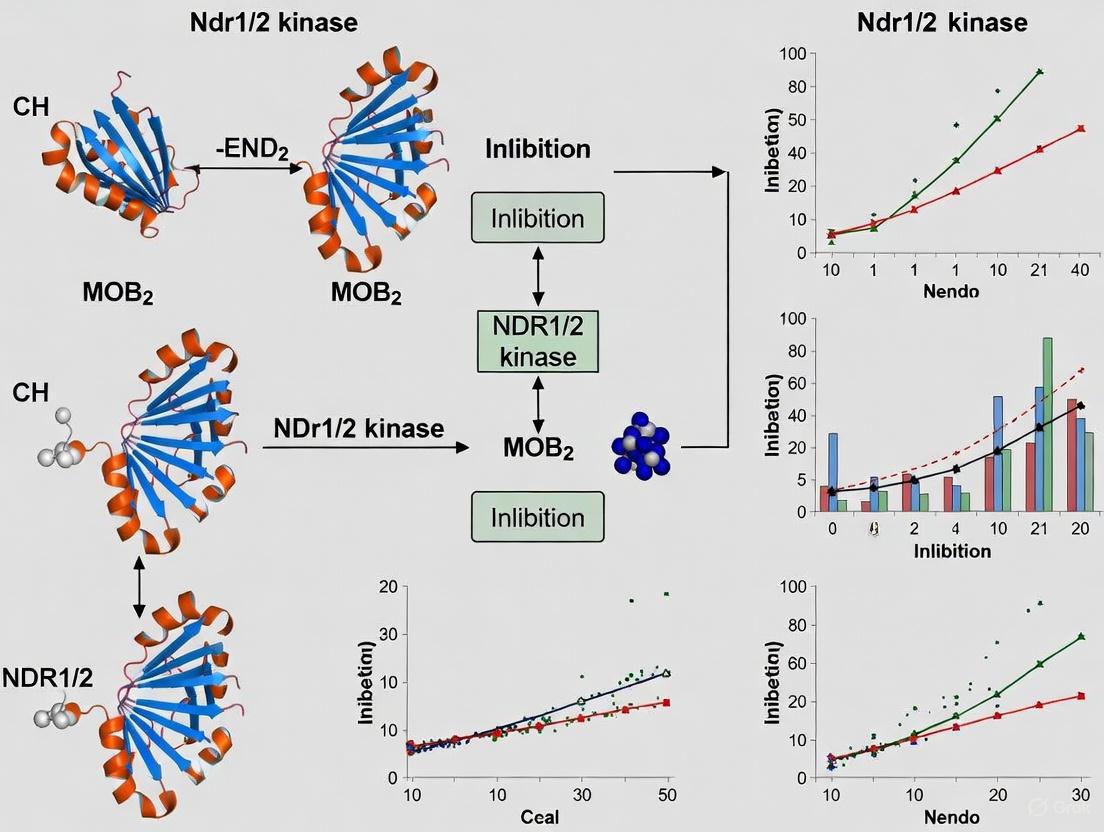
This article provides a comprehensive analysis of the molecular mechanism by which the Mps one binder 2 (MOB2) protein inhibits the NDR1/2 (STK38/STK38L) kinases.
MOB2 as a Key Inhibitory Regulator of NDR1/2 Kinase Activity: Mechanisms and Therapeutic Implications
Abstract
This article provides a comprehensive analysis of the molecular mechanism by which the Mps one binder 2 (MOB2) protein inhibits the NDR1/2 (STK38/STK38L) kinases. Tailored for researchers, scientists, and drug development professionals, we synthesize foundational biochemical studies, competitive binding models, and functional consequences of the MOB2-NDR interaction. The content explores methodological approaches for studying this interaction, addresses controversies in the field, compares MOB2's function with other MOB family members, and validates its biological significance in processes like the DNA damage response and cell cycle regulation. This review aims to clarify MOB2's unique role as an NDR1/2 inhibitor and discusses its potential as a therapeutic target.
The MOB2-NDR Axis: Unraveling the Core Inhibitory Mechanism
The NDR Kinase Family: Core Regulators of Cell Physiology
The Nuclear Dbf2-related (NDR) kinases are a subgroup of evolutionarily conserved AGC serine-threonine protein kinases that function as essential regulators of growth, morphogenesis, and cellular homeostasis [1]. In mammals, this family includes four members: NDR1 (STK38), NDR2 (STK38L), LATS1, and LATS2 [2] [1]. These kinases serve as core components of the Hippo signaling pathway, an ancient signaling system that controls cell proliferation, differentiation, and apoptosis across diverse eukaryotic species [1].
NDR1 and NDR2 share approximately 87% sequence identity but exhibit distinct subcellular localization and may serve non-redundant functions [3]. While NDR1 is widely expressed and predominantly localizes to the nucleus, NDR2 is excluded from the nucleus and displays a punctate cytoplasmic distribution [3] [4]. This differential localization suggests specialized biological roles for each kinase, with NDR2 being highly expressed in tissues such as the thymus [3].
Table 1: Mammalian NDR/LATS Kinases and Their Characteristics
| Kinase | Other Names | Subcellular Localization | Key Functions |
|---|---|---|---|
| NDR1 | STK38 | Predominantly nuclear [3] | Cell cycle progression, centrosome duplication [5] |
| NDR2 | STK38L | Cytoplasmic, excluded from nucleus [3] | Vesicle trafficking, autophagy, ciliogenesis [6] |
| LATS1 | Large tumor suppressor 1 | Cytoplasmic, cortical localization [7] | Phosphorylation of YAP/TAZ, tumor suppression [7] |
| LATS2 | Large tumor suppressor 2 | Cytoplasmic, cortical localization [7] | Phosphorylation of YAP/TAZ, tumor suppression [7] |
NDR kinases regulate diverse cellular processes including cell cycle progression, DNA damage response, apoptosis, transcription, and cell migration [5] [6] [1]. Their dysfunction has been implicated in various pathological conditions, particularly cancer, where NDR2 in particular often exhibits oncogenic properties [6]. The activity of NDR kinases is tightly controlled through phosphorylation and interaction with binding partners, most notably the MOB family cofactors [3] [4].
MOB Protein Cofactors: Key Regulatory Partners
MOB (Mps one binder) proteins represent a family of highly conserved eukaryotic signal transducers that function as essential coactivators for NDR/LATS kinases [3] [5]. The human genome encodes at least six different MOB genes: MOB1A, MOB1B, MOB2, MOB3A, MOB3B, and MOB3C [5] [8]. These proteins share a conserved structure but exhibit distinct binding specificities and functional outcomes.
Table 2: MOB Family Cofactors and Their Kinase Interactions
| MOB Protein | Primary Kinase Partners | Effect on Kinase Activity | Cellular Functions |
|---|---|---|---|
| MOB1A/B | NDR1/2, LATS1/2 [5] [8] | Strong activation [3] [9] | Hippo signaling, mitotic exit, cytokinesis [5] |
| MOB2 | NDR1/2 (specific) [5] [8] | Context-dependent; can inhibit NDR [5] [8] | Cell cycle regulation, DNA damage response, cell motility [5] [8] |
| MOB3A/B/C | MST1 (aka STK4) [5] | Not applicable to NDR/LATS | Apoptosis regulation [5] |
The interaction between MOB proteins and their kinase partners is highly specific and occurs through the N-terminal regulatory (NTR) region of the kinases [10]. Structural studies have revealed that MOB binding organizes this NTR region into a V-shaped helical hairpin that mediates interaction with the C-terminal hydrophobic motif (HM) of the kinase, facilitating proper activation [10]. This kinase-coactivator interface represents a unique regulatory mechanism for the NDR/LATS kinase family.
MOB2 as a Critical Regulator of NDR1/2 Kinase Activity
MOB2 exhibits distinctive regulatory properties compared to other MOB family members. While MOB1 strongly activates NDR kinases, MOB2 has been reported to exert inhibitory effects through multiple molecular mechanisms, making it a focal point for understanding the nuanced regulation of NDR signaling.
Competitive Binding with MOB1
A primary mechanism of MOB2-mediated inhibition involves competitive binding with the activating cofactor MOB1. Both MOB1 and MOB2 interact with the same N-terminal regulatory domain of NDR1/2, creating a competitive dynamic where MOB2 binding can displace MOB1 and prevent kinase activation [8]. This competition establishes a regulatory switch where the relative abundance and activation state of MOB1 versus MOB2 determines NDR kinase activity [5].
Research has demonstrated that the MOB1/NDR complex is associated with increased NDR kinase activity, while the MOB2/NDR complex correlates with diminished NDR activity [5]. This competitive mechanism allows cells to fine-tune NDR signaling in response to various cellular cues and conditions.
Structural Basis of MOB2-NDR Interaction
The structural basis for the specific interaction between MOB2 and NDR kinases has been elucidated through crystallographic studies. The NDR N-terminal regulatory region forms a bihelical conformation that specifically associates with MOB2 [10]. This interface serves as a structural platform that mediates kinase-cofactor binding and contributes to the inhibitory function of MOB2.
Structural analyses comparing Cbk1NTR-Mob2 (NDR-MOB2) and Dbf2NTR-Mob1 (LATS-MOB1) complexes have identified discrete molecular determinants that enforce binding specificity between different MOB and kinase subfamilies [10]. These specificity determinants explain why MOB2 interacts exclusively with NDR kinases and not with LATS kinases [8], and why alterations in these specific residues can permit non-cognate complex formation [10].
Diagram 1: MOB2 competes with MOB1 for NDR binding. MOB1 binding strongly activates NDR kinases, while MOB2 binding is associated with diminished NDR activity, creating a competitive regulatory switch.
Functional Consequences of MOB2-Mediated Regulation
The inhibitory function of MOB2 has significant implications for cellular physiology, particularly in processes such as cell motility, cell cycle progression, and DNA damage response. In hepatocellular carcinoma SMMC-7721 cells, MOB2 knockout promoted migration and invasion, while MOB2 overexpression inhibited these processes [8]. This effect was linked to MOB2's ability to regulate the Hippo pathway through alternative interactions with NDR1/2 and LATS1, leading to increased phosphorylation of LATS1 and subsequent inactivation of YAP [8].
Furthermore, MOB2 plays a role in DNA damage response and cell cycle checkpoints. MOB2 depletion causes accumulation of DNA damage and activation of p53/p21-dependent G1/S cell cycle checkpoints [5]. Interestingly, this function may operate independently of NDR1/2 kinase signaling, as knockdown of NDR1 or NDR2 does not recapitulate the cell cycle arrest phenotype observed in MOB2-depleted cells [5]. MOB2 also interacts with RAD50, a component of the MRE11-RAD50-NBS1 (MRN) DNA damage sensor complex, suggesting additional mechanisms beyond NDR regulation [5].
Experimental Approaches for Studying MOB2-NDR Interactions
Investigating the functional relationship between MOB2 and NDR kinases requires a multidisciplinary approach combining biochemical, cellular, and structural techniques. Below are key methodological frameworks used in this field.
Biochemical and Cellular Assays
Co-immunoprecipitation experiments have been fundamental for identifying and validating MOB2-NDR interactions. Epitope-tagged kinases immunoprecipitated from Jurkat T-cells revealed associations with MOB proteins, confirming their physical interaction in cellular contexts [3]. These approaches can be complemented by kinase activity assays to quantify the functional consequences of MOB2 binding, demonstrating that MOB2 association dramatically stimulates NDR1 and NDR2 catalytic activity despite its overall inhibitory role in cellular contexts [3].
Colocalization studies using fluorescence microscopy in HeLa cells have shown that NDR1 and NDR2 partially colocalize with human MOB2, providing spatial context for their functional interactions [3]. Additionally, membrane targeting experiments have revealed that NDR activation by MOB proteins occurs specifically at the plasma membrane, with phosphorylation and activation occurring within minutes after MOB association with membranous structures [4].
Genetic Manipulation Strategies
Genetic approaches have been instrumental in elucidating MOB2 functions. CRISPR/Cas9-mediated knockout of MOB2 in SMMC-7721 hepatocellular carcinoma cells, using sgRNA targeting the sequence 5'-AGAAGCCCGCTGCGGAGGAG-3', has demonstrated its role in inhibiting cell migration and invasion [8]. Conversely, lentiviral overexpression of MOB2 in the same cell system produced opposite effects, confirming its inhibitory function [8].
RNA interference techniques have also been employed to investigate MOB2 functions. MOB2 knockdown studies revealed its necessity for preventing accumulation of endogenous DNA damage and for proper activation of cell cycle checkpoints in response to DNA damaging agents such as ionizing radiation and doxorubicin [5].
Structural Biology Techniques
X-ray crystallography has provided high-resolution insights into the MOB2-NDR interaction. The structure of Saccharomyces cerevisiae Cbk1NTR-Mob2 complex was determined to 2.8 Å resolution, revealing the molecular details of this specific interaction [10]. Similarly, the structure of the Dbf2NTR-Mob1 complex provided a comparative framework for understanding binding specificity between different MOB-kinase pairs [10].
These structural studies have identified key interfacial residues that determine binding specificity and have illuminated how MOB binding organizes the NDR N-terminal regulatory region to interact with the kinase domain, facilitating activation through a unique mechanism [10] [7].
Diagram 2: Experimental approaches for studying MOB2-NDR interactions. A combination of biochemical, genetic, and structural methods is essential for comprehensively understanding the regulatory relationship between MOB2 and NDR kinases.
The Scientist's Toolkit: Essential Research Reagents
Table 3: Key Research Reagents for Investigating MOB2-NDR Kinase Interactions
| Reagent / Method | Key Function / Target | Experimental Application | Example from Literature |
|---|---|---|---|
| hMOB1A/B cDNA | NDR1/2 kinase activator | Positive control for kinase activation assays [4] | Stimulates NDR kinase activity in vitro and in vivo [4] |
| hMOB2 cDNA | NDR1/2 kinase interactor | Competitive binding and inhibitory function studies [3] [4] | Associates with NDR1/2 and modulates activity [3] |
| Phospho-specific antibodies | Ser281/Thr444 (NDR1) Ser282/Thr442 (NDR2) | Monitor activation loop phosphorylation [4] | Detect NDR phosphorylation and activation status [4] |
| CRISPR/Cas9 sgRNA | MOB2 gene knockout | Loss-of-function studies [8] | Target sequence: 5'-AGAAGCCCGCTGCGGAGGAG-3' [8] |
| Lentiviral expression vectors | MOB2 overexpression | Gain-of-function studies [8] | Enables stable MOB2 expression in cell lines [8] |
| Okadaic acid (OA) | PP2A phosphatase inhibitor | Indirect NDR kinase activation [4] | Demonstrates NDR phosphorylation requirement [4] |
| Membrane-targeting constructs | Recruit proteins to plasma membrane | Study localization-dependent activation [4] | mp-HA or mp-myc tagged constructs [4] |
The regulation of NDR kinases by MOB protein cofactors represents a sophisticated control mechanism for fundamental cellular processes. MOB2 emerges as a critical inhibitory regulator that fine-tunes NDR activity through competitive binding with the activating cofactor MOB1, with additional MOB2-specific functions that may operate independently of NDR kinases.
Future research should focus on elucidating the precise structural determinants of MOB2's inhibitory function and the contextual cellular signals that modulate the MOB1-MOB2 competitive balance. The development of specific inhibitors or stabilizers of these interactions could have significant therapeutic potential, particularly in cancer contexts where NDR2 often functions as an oncogene [6]. Furthermore, understanding the NDR2-specific interactome in different pathological conditions may reveal novel targets for anticancer therapies [6].
The complex relationship between MOB2 and NDR kinases exemplifies how sophisticated regulatory mechanisms enable precise control of fundamental cellular signaling pathways, with important implications for both basic biology and therapeutic development.
The Mps one binder (MOB) proteins are highly conserved eukaryotic signal transducers that primarily function as regulatory subunits for serine/threonine kinases of the NDR/LATS family [5] [8]. In mammals, at least six different MOB genes (MOB1A, MOB1B, MOB2, MOB3A, MOB3B, and MOB3C) have been identified, with MOB1 and MOB2 being the best-characterized members [8]. While MOB1A/B directly interact with both NDR1/2 and LATS1/2 kinases to enhance their activity through the Hippo signaling pathway, MOB2 exhibits distinct binding specificity [8]. Extensive biochemical evidence confirms that MOB2 interacts specifically with NDR1/2 kinases but shows no detectable binding to LATS1/2 kinases in mammalian cells [5] [8]. This specific binding interface between MOB2 and NDR1/2, and its functional consequences, forms a critical regulatory node in cellular signaling networks with implications for cell cycle control, DNA damage response, and neuronal development.
Molecular Basis of MOB2-NDR1/2 Specificity
Structural Determinants of Selective Binding
The specific interaction between MOB2 and NDR1/2 kinases is mediated through structural elements that are conserved across species. Both MOB1 and MOB2 bind to the positively charged N-terminal regulatory domain (NTR) of NDR1/2 via a negatively charged region on their protein surfaces [11]. However, key structural differences prevent MOB2 from productively engaging with LATS kinases. Biochemical experiments have demonstrated that MOB2 competes with MOB1 for binding to the same N-terminal regulatory domain on NDR1/2 [8]. This competitive binding has significant functional implications, as MOB1 binding to NDR1/2 promotes kinase activity, while MOB2 interaction interferes with NDR1/2 activation [8] [11].
Table 1: Key Structural Domains Involved in MOB2-NDR1/2 Interaction
| Protein | Domain | Function | Binding Specificity |
|---|---|---|---|
| NDR1/2 | N-terminal regulatory domain (NTR) | MOB protein binding | Binds both MOB1 and MOB2 |
| MOB1 | Negatively charged surface region | NDR/LATS kinase activation | Binds NDR1/2 and LATS1/2 |
| MOB2 | Negatively charged surface region | NDR kinase regulation | Binds only NDR1/2 |
| LATS1/2 | N-terminal regulatory domain | MOB protein binding | Binds MOB1 but not MOB2 |
Experimental Validation of Binding Specificity
The specific MOB2-NDR1/2 interaction has been consistently demonstrated across multiple experimental systems and techniques. In mammalian cells, co-immunoprecipitation assays have confirmed that MOB2 forms stable complexes with NDR1 and NDR2 but fails to co-precipitate with LATS1 or LATS2 [8]. This binding specificity is evolutionarily conserved, as demonstrated by studies in Drosophila where MOB2 (dMOB2) genetically interacts with the NDR kinase Tricornered but not with the LATS homolog Warts [5]. The molecular basis for this specificity stems from complementary electrostatic surfaces and specific residue interactions that allow MOB2 to engage with NDR1/2 while being sterically or electrostatically incompatible with LATS kinases.
Experimental Evidence and Methodologies
Key Biochemical Assays for Demonstrating Specific Interaction
Researchers have employed multiple biochemical approaches to characterize the MOB2-NDR1/2 interaction. The following experimental protocols represent methodologies commonly used in this field:
Co-immunoprecipitation and Western Blotting:
- Cell Transfection: Transfect mammalian cells (e.g., HEK293T, SMMC-7721) with expression vectors encoding tagged MOB2 and either NDR1/2 or LATS1/2.
- Cell Lysis: Harvest cells 24-48 hours post-transfection and lyse using RIPA buffer (25mM Tris-HCl pH 7.4, 150mM NaCl, 1% NP-40, 1% sodium deoxycholate, 0.1% SDS) supplemented with protease and phosphatase inhibitors.
- Immunoprecipitation: Incubate cell lysates with antibody against the tag on MOB2 (or kinase) for 2-4 hours at 4°C, then add Protein A/G agarose beads for an additional 1-2 hours.
- Washing and Elution: Wash beads 3-5 times with lysis buffer, elute proteins with 2X Laemmli buffer by heating at 95°C for 5 minutes.
- Detection: Separate proteins by SDS-PAGE, transfer to PVDF membrane, and probe with antibodies against NDR1/2 or LATS1/2 to detect specific interactions [8].
Yeast Two-Hybrid Screening:
- Strain Transformation: Co-transform yeast strain (e.g., AH109) with bait (NDR1/2 or LATS1/2 kinase domains) and prey (MOB2) plasmids.
- Selection Culture: Plate transformations on minimal medium lacking leucine and tryptophan to select for double transformants.
- Interaction Assay: Transfer colonies to medium lacking leucine, tryptophan, and histidine to test for protein-protein interaction, with increasing concentrations of 3-AT (0-50mM) to reduce false positives.
- β-galactosidase Assay: Perform quantitative assessment of interaction strength using ONPG substrate and measuring absorbance at 420nm [5].
In Vitro Binding Assay:
- Protein Purification: Express and purify recombinant GST-tagged MOB2 and His-tagged NDR1/2 or LATS1/2 kinase domains from E. coli or insect cells.
- Binding Reaction: Incubate GST-MOB2 immobilized on glutathione-sepharose beads with purified kinase domains in binding buffer (20mM Tris-HCl pH 7.5, 150mM NaCl, 1mM DTT, 0.1% Triton X-100) for 1 hour at 4°C.
- Wash and Elution: Wash beads 3-4 times with binding buffer, elute bound proteins with reduced glutathione (10-20mM) or directly with SDS-PAGE sample buffer.
- Analysis: Analyze eluates by SDS-PAGE and Coomassie staining or Western blotting with anti-His antibody to detect specific binding [8].
Quantitative Binding Data
Table 2: Experimental Evidence for MOB2 Binding Specificity
| Experimental Method | MOB2-NDR1/2 Interaction | MOB2-LATS1/2 Interaction | Reference |
|---|---|---|---|
| Co-immunoprecipitation | Strong positive | Not detected | [8] |
| Yeast two-hybrid | Positive interaction | No interaction | [5] |
| In vitro binding assay | Direct binding confirmed | No binding observed | [8] |
| Competitive binding | Competes with MOB1 for NDR1/2 binding | No competition with MOB1 for LATS1/2 | [8] [11] |
Functional Consequences: MOB2-Mediated Inhibition of NDR1/2
Mechanism of Kinase Inhibition
The specific binding of MOB2 to NDR1/2 kinases has significant functional consequences, primarily through the inhibition of NDR1/2 kinase activity. Biochemical studies have revealed that while MOB1 binding to NDR1/2 promotes kinase activation, MOB2 interaction is associated with diminished NDR activity [5] [8]. This inhibitory effect occurs through multiple mechanisms:
Competitive Binding Mechanism: MOB2 and MOB1 compete for binding to the same N-terminal regulatory domain on NDR1/2 [8] [11]. Since MOB1 functions as a co-activator that enhances NDR1/2 kinase activity, displacement of MOB1 by MOB2 results in reduced phosphorylation of NDR1/2 substrates. This competition creates a regulatory balance where the relative abundance and activation state of MOB1 versus MOB2 determines the net output of NDR1/2 signaling.
Allosteric Inhibition: Structural studies suggest that MOB2 binding may induce conformational changes in NDR1/2 that stabilize an auto-inhibitory state. Research on the related NDR kinase Cbk1 in yeast has revealed that Mob2 binding communicates with the kinase domain through the C-terminal hydrophobic motif, potentially influencing activation segment conformation [12]. Although the precise structural mechanism for MOB2-mediated inhibition of mammalian NDR1/2 requires further elucidation, the conservation of this regulatory mechanism across species supports its fundamental importance.
Biological Context of MOB2-NDR1/2 Regulation
The MOB2-NDR1/2 regulatory axis functions in specific cellular contexts to fine-tune kinase activity. In human hepatocellular carcinoma cells (SMMC-7721), MOB2 knockout promotes cell migration and invasion while decreasing phosphorylation of the Hippo pathway effector YAP, suggesting that MOB2-mediated inhibition of NDR1/2 influences cell motility through Hippo signaling modulation [8]. Additionally, MOB2 has been implicated in DNA damage response pathways, where it interacts with RAD50 independently of NDR1/2, suggesting context-specific functions beyond kinase regulation [5].
Figure 1: MOB2 specifically binds and inhibits NDR1/2 but not LATS kinases, influencing downstream cellular processes like cell motility.
The Scientist's Toolkit: Essential Research Reagents
Table 3: Key Research Reagents for Studying MOB2-NDR1/2 Interactions
| Reagent/Tool | Specific Example | Application | Experimental Function |
|---|---|---|---|
| Expression Vectors | LV-MOB2 lentivirus; lentiCRISPRv2-sgMOB2 | Gain/loss-of-function studies | Modulates MOB2 expression in cells [8] |
| Cell Lines | SMMC-7721; HEK293T; HBEC-3 | Cellular assays | Models for studying MOB2-NDR signaling [8] [6] |
| Antibodies | Anti-NDR1/2; Anti-MOB2; Anti-LATS1/2 | Immunodetection | Detects protein expression and interactions [8] [11] |
| Kinase Assay Kits | Radioactive or luminescent kinase assays | In vitro activity measurement | Quantifies NDR1/2 kinase activity [11] [13] |
Substantial biochemical evidence confirms that MOB2 binds specifically to NDR1/2 kinases but not to LATS1/2 kinases, and this specific interaction functionally inhibits NDR1/2 kinase activity primarily through competition with the activator protein MOB1. This regulatory mechanism represents a sophisticated fine-tuning system within the broader Hippo signaling network, with implications for diverse physiological processes including cell cycle progression, DNA damage response, and cell motility. The consistent demonstration of this specific interaction across multiple experimental systems and species underscores its fundamental importance in cellular signaling homeostasis. Future research should focus on elucidating the precise structural basis for MOB2's binding specificity and developing targeted interventions that can modulate this interaction for therapeutic benefit in cancer and other diseases.
The NDR1/2 (STK38/STK38L) kinases are core components of the conserved Hippo tumor suppressor pathway, playing critical roles in processes such as cell cycle progression, centrosome duplication, and the DNA damage response [12] [5]. Their activity is tightly regulated through interactions with Mps one binder (MOB) coactivator proteins. MOB1 binding to the N-terminal regulatory domain (NTR) of NDR1/2 promotes kinase activation and downstream signaling [14] [15]. In contrast, MOB2 competes with MOB1 for the same binding site on NDR1/2, thereby inhibiting kinase activity and modulating pathway output [5] [8]. This competitive binding represents a crucial regulatory mechanism for fine-tuning cellular signaling. This whitepaper delineates the structural basis, molecular mechanisms, and functional consequences of the MOB2-MOB1 competition, providing a framework for understanding its implications in cell biology and therapeutic development.
Structural Basis of MOB1-NDR Activation
Architecture of the Active Complex
Activation of NDR1/2 kinases requires binding of the coactivator MOB1 to the N-terminal regulatory domain (NTR). Structural analyses reveal that the NTR of NDR kinases forms a V-shaped structure composed of two antiparallel α-helices that dock onto a specific electropositive surface of MOB1 [15].
Table 1: Key Interacting Residues in the MOB1-NDR2 Complex
| NDR2 Residue | MOB1 Residue | Interaction Type |
|---|---|---|
| Lys25 | Leu36, Gly39 | Van der Waals |
| Tyr32 | Gln67, Met70 | Hydrogen bonding |
| Arg42 | Glu51, Glu55 | Electrostatic |
| Arg79 | Phe132, Pro133 | Hydrogen bonding |
| Arg82 | Val138, Lys135 | Electrostatic |
This interaction is characterized by extensive hydrogen bonds and van der Waals interactions that stabilize the complex. The binding of MOB1 induces conformational changes that promote NDR kinase activation through mechanisms that may involve allosteric regulation and stabilization of the kinase domain [7] [15].
Structural Determinants of MOB Specificity
While MOB1 and MOB2 share structural similarities, key residue differences dictate their opposing functional outcomes. A crucial distinction is Asp63 in MOB1, which forms a specific bond with His646 in LATS1 (a related kinase), and contributes to differential binding affinity across kinase family members [15]. This residue, along with other conserved positions within the MOB protein family, creates distinct interaction surfaces that govern binding specificity to NDR/LATS kinases.
Figure 1: MOB1-mediated activation of NDR kinase. MOB1 binding to the N-terminal domain induces conformational changes that promote kinase activation.
Molecular Mechanism of MOB2 Antagonism
Competitive Binding at the NTR Interface
MOB2 antagonizes NDR kinase activation through direct competition with MOB1 for the same binding site on the NDR N-terminal regulatory domain. Biochemical studies demonstrate that MOB2 forms a complex with NDR1/2 that is associated with diminished kinase activity, in contrast to the activating function of MOB1 [5]. This competition arises from the structural similarity between MOB1 and MOB2, which enables both proteins to interact with the NTR of NDR kinases but with different functional outcomes.
The binding affinity and stoichiometry of these interactions have been quantified through biochemical assays, revealing the quantitative dynamics of this competitive system:
Table 2: Functional Consequences of MOB Protein Binding to NDR Kinases
| Parameter | MOB1-NDR Complex | MOB2-NDR Complex |
|---|---|---|
| Kinase Activity | Increased | Decreased |
| Cellular Process | Cell cycle progression, Centrosome duplication | G1/S cell cycle arrest, DNA damage response |
| Downstream Signaling | YAP phosphorylation, Hippo pathway activation | Altered YAP localization, Reduced Hippo output |
| Competitive Dynamics | Activation impaired by MOB2 co-expression | Inhibition reversed by MOB1 overexpression |
Structural Basis of Uncompetitive Behavior
While MOB2 binds to the same NTR site as MOB1, subtle differences in the binding interface prevent the conformational changes required for kinase activation. Structural comparisons suggest that MOB2 may stabilize an auto-inhibitory conformation of NDR1/2, particularly through interactions that maintain the atypically long activation segment in its inhibitory state [12] [16]. This activation segment, when in its auto-inhibitory position, blocks substrate binding and stabilizes a non-productive position of helix αC in the kinase domain [12]. The MOB2-NDR complex may therefore represent a structurally distinct entity that not only lacks activation capacity but actively enforces an inactive kinase state.
Experimental Validation & Functional Evidence
Biochemical and Cellular Assays
The competitive binding model is supported by multiple lines of experimental evidence:
Co-immunoprecipitation Studies: Pull-down assays using purified NDR1/2 N-terminal domains demonstrate that MOB1 and MOB2 binding is mutually exclusive. When MOB2 is pre-bound to NDR, subsequent MOB1 binding is significantly reduced, and vice versa [5] [8].
Kinase Activity Measurements: In vitro kinase assays using purified components show that MOB2 binding correlates with reduced phosphorylation of NDR1/2 substrates. The presence of MOB2 can counteract MOB1-mediated activation in a dose-dependent manner [5].
Cellular Phenotypes: Knockdown of MOB2 in human cell lines leads to increased NDR kinase activity and promotes cell migration and invasion, particularly in hepatocellular carcinoma models [8]. Conversely, MOB2 overexpression suppresses these phenotypes, consistent with its role as a negative regulator of NDR signaling.
Protocol: Co-Immunoprecipitation to Assess Competitive Binding
Purpose: To demonstrate competitive binding between MOB1 and MOB2 to NDR1/2 kinases.
Procedure:
- Transfection: Co-transfect HEK293T cells with constructs expressing tagged NDR1 (or NDR2) along with varying ratios of MOB1 and MOB2 expression vectors.
- Lysis: Harvest cells 48 hours post-transfection and lyse in NP-40 buffer (25 mM Tris-HCl pH 7.4, 150 mM NaCl, 1% NP-40, 10% glycerol) containing protease and phosphatase inhibitors.
- Immunoprecipitation: Incubate lysates with anti-NDR antibody overnight at 4°C, then add Protein A/G beads for 2 hours.
- Washing: Pellet beads and wash 3 times with lysis buffer.
- Elution & Analysis: Elute proteins with 2× Laemmli buffer, separate by SDS-PAGE, and immunoblot for MOB1, MOB2, and NDR.
Interpretation: As MOB2 expression increases while MOB1 remains constant, the amount of MOB1 co-precipitating with NDR should decrease, demonstrating competition [5] [8].
Figure 2: MOB2 competitively inhibits MOB1-NDR activation. MOB2 binding to the NDR N-terminal domain prevents MOB1 binding and kinase activation.
Research Toolkit: Essential Reagents and Methodologies
Table 3: Key Research Reagents for Studying MOB-NDR Interactions
| Reagent / Method | Specific Example | Application & Function |
|---|---|---|
| Expression Constructs | NDR1 (12-418), MOB1A (2-216), MOB2 full-length | Recombinant protein expression; interaction studies [14] |
| Kinase Activity Assays | In vitro kinase assay with NDR substrates | Quantify enzymatic activity of NDR under different MOB conditions [12] |
| Structural Methods | X-ray crystallography (MOB1/NDR2 complex) | Determine atomic-level interaction interfaces [15] |
| Cell-Based Assays | Wound healing, Transwell invasion | Assess functional consequences of MOB competition [8] |
| Gene Manipulation | CRISPR/Cas9 KO, shRNA knockdown | Modulate MOB1/MOB2 expression in cellular models [8] |
| Interaction Mapping | Yeast two-hybrid, Co-IP variants | Identify novel binding partners and competitive interactions [5] |
The competitive binding model between MOB2 and MOB1 for NDR1/2 kinases represents a sophisticated regulatory mechanism for controlling Hippo pathway signaling output. The structural homology yet functional antagonism between MOB1 and MOB2 illustrates how subtle differences in protein-protein interaction interfaces can determine signaling outcomes. Understanding this competitive balance has significant implications for therapeutic development, particularly in cancer contexts where modulating Hippo pathway activity could alter tumor growth and metastasis. Future research should focus on quantifying the dynamics of this competition in different cellular compartments and under various physiological conditions to fully elucidate its role in health and disease.
The interaction between MOB2 and the NDR1/2 kinases represents a critical regulatory node in cellular signaling, influencing pathways that control the cell cycle, DNA damage response, and Hippo signaling. This whitepaper synthesizes current structural and mechanistic insights into the molecular domains governing this interaction, with a specific focus on the inhibitory mechanism exerted by MOB2 on NDR1/2 kinase activity. We examine the competitive binding mechanism, the auto-inhibitory conformation of NDR1, and the functional consequences of this interaction on downstream cellular processes. Furthermore, we provide detailed experimental methodologies for studying this interaction and a curated toolkit of research reagents to facilitate further investigation. This comprehensive analysis aims to inform researchers, scientists, and drug development professionals in their pursuit of targeting this regulatory axis for therapeutic intervention.
The NDR (Nuclear Dbf2-related) kinase family, comprising NDR1 (STK38) and NDR2 (STK38L), serves as a crucial regulator of diverse cellular processes including cell cycle progression, DNA damage response, apoptosis, and stem cell differentiation [5] [1]. These serine-threonine kinases, belonging to the AGC kinase family, are themselves tightly regulated by interacting proteins, most notably the Mps one binder (MOB) family proteins. Among these, MOB2 has emerged as a key regulatory partner that specifically interacts with NDR1/2 but not with the related LATS1/2 kinases [5] [17]. The MOB2-NDR1/2 interaction represents a fascinating biological switch; while MOB1 binding activates NDR kinases, MOB2 competitively binds to the same regulatory domain but is associated with diminished NDR activity [5] [12]. This competitive inhibition positions MOB2 as a critical modulator of NDR-mediated signaling pathways, with implications for understanding cellular homeostasis and disease pathogenesis, particularly in cancer and neurological disorders. This review delves into the structural basis of this interaction and its functional consequences.
Structural Domains and Binding Interfaces
Domain Architecture of NDR1/2 Kinases
NDR1 and NDR2 share approximately 87% sequence identity but exhibit distinct subcellular localization—NDR1 is primarily nuclear while NDR2 displays a punctate cytoplasmic distribution [3]. Despite this differential localization, both kinases share a conserved domain architecture essential for their regulation and function [12]:
- N-terminal Regulatory Domain (MBD): This domain serves as the primary docking site for MOB proteins. It consists of an α-helix (αMOB) followed by an extended strand element (N-linker) that together create the binding interface for MOB proteins [12].
- Central Kinase Domain: This catalytic domain features an atypically long activation segment (63 residues in NDR1/2) that plays a critical auto-inhibitory role in kinase regulation [12].
- C-terminal Hydrophobic Motif (HM): This motif is nestled in a cleft between the MBD and the N-lobe of the kinase domain, and its phosphorylation by upstream kinases (MST1/2/3) contributes to NDR activation [12].
Table 1: Key Structural Domains of NDR1/2 Kinases
| Domain | Location | Structural Features | Functional Role |
|---|---|---|---|
| N-terminal MOB-binding Domain (MBD) | N-terminal | α-helix (αMOB) + extended strand (N-linker) | Primary docking site for MOB1/MOB2 proteins |
| Kinase Domain | Central | Atypically long activation segment (63 residues) | Catalytic activity; auto-inhibition via activation segment |
| Hydrophobic Motif (HM) | C-terminal | Phosphorylatable motif | Activation via phosphorylation by MST1/2/3 kinases |
MOB2 Structural Characteristics
MOB2 belongs to a highly conserved family of eukaryotic signal transducers that function through regulatory interactions with serine/threonine kinases of the NDR/LATS family [5]. While the exact three-dimensional structure of human MOB2 remains to be fully elucidated, insights from orthologous structures (e.g., yeast Cbk1-Mob2 complex) reveal that MOB proteins typically adopt a conserved globular fold that engages with the MBD of their kinase partners [12]. The structural basis for MOB2's specificity for NDR1/2 over LATS kinases likely resides in key surface residues that complement the binding interface of the NDR MBD.
The MOB2-NDR Binding Interface
Biochemical experiments have demonstrated that MOB2 interacts specifically with the N-terminal regulatory domain of NDR1/2 [3] [12]. This interaction is mutually exclusive with MOB1 binding, indicating overlapping binding sites [17] [8]. The binding interface has been mapped to the same N-terminal regulatory domain where MOB1 binds, with both MOB proteins competing for interaction with this region [6]. Structural studies of the related yeast Cbk1-Mob2 complex reveal that the MOB protein binds to the MBD through extensive surface contacts, with the HM of the kinase nestled in a cleft between the MBD and the N-lobe of the kinase domain, suggesting an indirect mechanism of communication between MOB binding and kinase catalytic activity [12].
Mechanism of Kinase Inhibition by MOB2
Competitive Displacement of MOB1
The primary mechanism through which MOB2 inhibits NDR1/2 kinase activity is by competitively displacing the activating partner MOB1. MOB2 and MOB1 compete for binding to the same N-terminal regulatory domain of NDR1/2 [17] [8]. While the MOB1/NDR complex corresponds to increased NDR kinase activity, the MOB2/NDR complex is associated with diminished NDR activity [5] [12]. This competition creates a dynamic regulatory switch where the relative abundance and activation state of MOB1 versus MOB2 can determine the signaling output through NDR1/2 kinases.
Stabilization of Auto-inhibitory Conformation
Recent structural insights into NDR1 regulation reveal an additional layer of inhibition potentially influenced by MOB2 binding. The crystal structure of the human NDR1 kinase domain in its non-phosphorylated state reveals a fully resolved, atypically long activation segment that blocks substrate binding and stabilizes a non-productive position of helix αC [12]. This activation segment acts as an auto-inhibitory module, and mutations within this region dramatically enhance in vitro kinase activity [12]. While MOB1 binding and the auto-inhibitory activation segment appear to act through independent mechanisms [12], the precise effect of MOB2 binding on this auto-inhibitory conformation warrants further investigation. It is plausible that MOB2 binding may stabilize or reinforce this auto-inhibitory state, thereby contributing to kinase suppression.
Impact on Downstream Signaling
The inhibition of NDR1/2 kinase activity by MOB2 has significant consequences for downstream signaling pathways. Research indicates that MOB2 regulates the alternative interaction of MOB1 with NDR1/2 and LATS1, resulting in increased phosphorylation of LATS1 and MOB1, thereby leading to the inactivation of YAP and consequent inhibition of cell motility [17] [8]. This demonstrates how MOB2-mediated inhibition of NDR1/2 can redirect signaling flux through the Hippo pathway, ultimately influencing transcriptional programs controlled by YAP/TAZ.
Figure 1: MOB2 Inhibition Mechanism on NDR1/2 Signaling. MOB2 competes with MOB1 for binding to the N-terminal regulatory (NTR) domain of NDR1/2 kinases, preventing MOB1-mediated activation. This inhibition redirects signaling to promote LATS1 activation and subsequent YAP phosphorylation, leading to transcriptional changes that inhibit cell motility.
Functional Consequences of MOB2-NDR1/2 Interaction
Cell Cycle and DNA Damage Response
MOB2 plays a significant role in cell cycle progression and the DNA damage response (DDR), potentially through its interaction with NDR1/2. MOB2 knockdown triggers a p53/p21-dependent G1/S cell cycle arrest in untransformed human cells [5]. This effect appears to be independent of NDR1/2 signaling, as knockdown of NDR1 or NDR2 does not recapitulate the same cell cycle arrest phenotype [5]. Additionally, MOB2 has been implicated in DDR through its interaction with RAD50, a component of the MRE11-RAD50-NBS1 (MRN) DNA damage sensor complex [5] [18]. MOB2 supports the recruitment of MRN and activated ATM to DNA-damaged chromatin, suggesting a role in DDR that may be both dependent and independent of its interaction with NDR kinases [5].
Cell Motility and Cancer Progression
The MOB2-NDR1/2 interaction significantly influences cell motility and invasion, with important implications for cancer progression. In hepatocellular carcinoma cells, MOB2 knockout promotes migration and invasion, induces phosphorylation of NDR1/2, and decreases phosphorylation of YAP [17] [8]. Conversely, MOB2 overexpression produces the opposite effects, indicating that MOB2 serves a positive role in LATS/YAP activation through the Hippo signaling pathway [8]. Similarly, in glioblastoma (GBM), MOB2 functions as a tumor suppressor by negatively regulating the FAK/Akt pathway [18]. MOB2 expression is significantly downregulated in GBM patient specimens, and its overexpression suppresses malignant phenotypes including migration, invasion, and clonogenic growth [18].
Table 2: Functional Consequences of MOB2-NDR1/2 Interaction in Different Cellular Contexts
| Cellular Process | Effect of MOB2 | NDR1/2-Dependent | Key Findings |
|---|---|---|---|
| Cell Cycle Progression | Knockdown causes G1/S arrest | Partially Independent | Triggers p53/p21-dependent checkpoint; NDR1/2 knockdown does not replicate effect [5] |
| DNA Damage Response | Promotes DDR | Partially Independent | Interacts with RAD50; supports MRN complex recruitment to damage sites [5] |
| Cell Motility (HCC) | Inhibits migration/invasion | Dependent | Regulates MOB1 alternative interaction with LATS1; inactivates YAP [17] [8] |
| Tumor Suppression (GBM) | Suppresses malignancy | Partially Independent | Downregulated in GBM; negatively regulates FAK/Akt pathway [18] |
Experimental Approaches for Structural and Functional Analysis
Mapping Protein-Protein Interactions
Co-immunoprecipitation (Co-IP) Assays:
- Protocol: Express epitope-tagged NDR1 or NDR2 kinases in Jurkat T-cells or HeLa cells. Immunoprecipitate using tag-specific antibodies and analyze co-precipitating proteins by western blotting or mass spectrometry [3]. For endogenous interactions, use specific antibodies against native NDR1/2 and MOB2 proteins.
- Applications: Confirmation of direct binding between MOB2 and NDR1/2; competition studies with MOB1 [3] [12].
Yeast Two-Hybrid Screening:
- Protocol: Clone MOB2 as bait and screen against a human cDNA library. Validate positive clones through retransformation and domain mapping [5].
- Applications: Identification of novel binding partners (e.g., RAD50) [5]; mapping of interaction domains through truncation mutants.
Structural Characterization
X-ray Crystallography:
- Protocol: Express and purify human NDR1 kinase domain (residues 82-418) from E. coli. Perform limited proteolysis to identify stable fragments. Crystallize using vapor diffusion methods and solve structure by molecular replacement [12].
- Applications: Determination of atomic-level structure of NDR1 kinase domain; visualization of auto-inhibitory activation segment [12].
Hydrogen-Deuterium Exchange (HDX) Analysis:
- Protocol: Incubate NDR1 with and without MOB2 in deuterated buffer for various time points. Quench reactions, digest with pepsin, and analyze by mass spectrometry to monitor conformational changes [12].
- Applications: Mapping of protein dynamics and conformational changes induced by MOB2 binding [12].
Functional Validation
Kinase Activity Assays:
- Protocol: Purify NDR1/2 kinases and MOB2 proteins. Perform in vitro kinase reactions with [γ-32P]ATP and appropriate substrates. Measure phosphate incorporation by scintillation counting or western blotting with phospho-specific antibodies [3] [12].
- Applications: Quantitative assessment of MOB2's effect on NDR1/2 kinase activity; comparison with MOB1-mediated activation [3].
CRISPR/Cas9-Mediated Gene Editing:
- Protocol: Design sgRNA targeting MOB2 (e.g., 5'-AGAAGCCCGCTGCGGAGGAG-3'). Clone into lentiCRISPRv2 vector and transduce into target cells (e.g., SMMC-7721 hepatocellular carcinoma cells). Select with puromycin and validate knockout by western blotting [17] [8].
- Applications: Generation of MOB2-deficient cell lines for functional studies of migration, invasion, and signaling pathway analysis [17] [8].
Figure 2: Experimental Workflow for Characterizing MOB2-NDR1/2 Interaction. A comprehensive approach combining protein interaction mapping, structural characterization, in vitro functional validation, and cellular phenotypic analysis provides a complete understanding of the MOB2-NDR1/2 regulatory axis.
The Scientist's Toolkit: Essential Research Reagents
Table 3: Key Research Reagents for Investigating MOB2-NDR1/2 Interaction
| Reagent/Tool | Specifications | Application | Key Function |
|---|---|---|---|
| lentiCRISPRv2 Vector | Addgene #52961; puromycin resistance | MOB2 knockout | CRISPR/Cas9-mediated gene editing [17] |
| NDR1 Kinase Domain Fragment | residues 82-418 | Structural studies | Crystallization and structure determination [12] |
| MOB2 Binding Mutant | MOB2-H157A | Functional rescue experiments | Defective in NDR1/2 binding; determines specificity [18] |
| Hyperactive NDR1 Mutant | NDR1-PIF | Functional studies | Bypasses regulatory mechanisms to assess downstream effects [5] |
| Lentiviral MOB2 Overexpression | LV-MOB2 | Gain-of-function studies | Stable MOB2 expression in various cell lines [17] [18] |
| Phospho-specific Antibodies | anti-pYAP; anti-pNDR1/2 | Signaling pathway analysis | Detection of pathway activity through phosphorylation status [17] [8] |
The structural insights into the molecular domains governing MOB2-NDR1/2 interaction reveal a sophisticated regulatory mechanism centered on competitive binding and potential stabilization of auto-inhibitory states. The MOB2-NDR1/2 axis represents a critical signaling node integrating multiple cellular processes, from cell cycle control and DNA damage response to cell motility and cancer progression. The dual nature of MOB2's functions—both dependent and independent of NDR1/2 inhibition—highlights the complexity of this regulatory system and suggests cell context-dependent variations.
Future research should focus on obtaining high-resolution structures of the full-length MOB2-NDR1/2 complex to precisely elucidate the molecular determinants of binding specificity and inhibition. Additionally, the development of small molecule modulators targeting this interaction would provide valuable chemical tools for dissecting its biological functions and potential therapeutic applications. Given MOB2's role as a tumor suppressor in multiple cancer contexts, strategies to enhance its expression or mimic its inhibitory function on pro-oncogenic signaling pathways represent promising avenues for therapeutic intervention. The integration of structural biology, chemical biology, and disease models will be essential to fully exploit the therapeutic potential of the MOB2-NDR1/2 regulatory axis.
The Mps one binder (MOB) family of proteins represents a class of crucial kinase regulators conserved across eukaryotes. While MOB1 is well-established as a co-activator of Nuclear Dbf2-related (NDR1/2) kinases, its paralog, MOB2, has emerged as a critical inhibitory regulator of the same kinases. This whitepaper synthesizes current research to elaborate on the precise molecular mechanism by which MOB2 inhibits NDR1/2 kinase activity and delineates the direct cellular consequences of this regulation. Framed within a broader thesis on NDR kinase regulation, we explore how the MOB2-NDR axis influences fundamental processes including cell motility, cell cycle progression, and the DNA damage response, with significant implications for diseases such as cancer.
The NDR kinase family (including NDR1/STK38 and NDR2/STK38L in mammals) constitutes a subgroup of AGC serine-threonine kinases with essential roles in governing cell cycle progression, morphological changes, mitotic exit, apoptosis, and DNA damage signaling [19]. The activity of NDR kinases is stringently controlled through a multi-step process requiring phosphorylation at two conserved sites: i) autophosphorylation of a serine residue in the activation loop (Ser281 in NDR1, Ser282 in NDR2), and ii) phosphorylation of a threonine residue in the hydrophobic motif (Thr444 in NDR1, Thr442 in NDR2) by an upstream kinase, such as the Ste20-like kinase MST3 [20]. A third critical step is the binding of regulatory proteins from the MOB family [20] [3].
MOB proteins function as central signal transducers but do not possess catalytic activity themselves. The human genome encodes six MOB genes (MOB1A, MOB1B, MOB2, MOB3A, MOB3B, MOB3C), with MOB1 and MOB2 being the primary regulators of NDR/LATS kinases [5]. MOB1 binding to the N-terminal regulatory domain of NDR1/2 dramatically stimulates kinase activity, forming an active complex crucial for various cellular functions [3]. In stark contrast, MOB2, while binding to the same regulatory domain on NDR1/2, acts as a potent negative regulator, thereby establishing a competitive regulatory paradigm for NDR kinase activity [21] [5].
The Molecular Mechanism of MOB2-Mediated Inhibition
Competitive Binding with MOB1
The primary mechanism of MOB2-mediated inhibition is its direct competition with the activator protein MOB1 for binding to the same N-terminal regulatory domain of NDR1/2 kinases [21] [22] [23]. Biochemical studies have demonstrated that MOB2 competes with MOB1 for interaction with NDR1/2. The formation of a MOB1/NDR complex is associated with increased NDR kinase activity, whereas the formation of a MOB2/NDR complex is associated with diminished NDR activity [5]. This competition creates a molecular switch that finely tunes the output of NDR kinase signaling pathways.
Suppression of Kinase Activation
The formation of the MOB2-NDR complex directly suppresses the catalytic activity of NDR kinases. In vitro and in vivo experiments have consistently shown that the association of MOB2 with NDR1/2 prevents their full activation. This inhibitory relationship was quantified in a study showing that knockout of MOB2 in SMMC-7721 hepatocellular carcinoma cells promoted the phosphorylation (and thus activation) of NDR1/2, whereas overexpression of MOB2 resulted in the opposite effect [21] [22]. By displacing MOB1 and preventing the formation of the active kinase complex, MOB2 effectively functions as a natural antagonist of NDR1/2 signaling.
Table 1: Quantitative Effects of MOB2 Manipulation on NDR Kinase Activity and Downstream Pathways in SMMC-7721 Cells
| Experimental Manipulation | NDR1/2 Phosphorylation | YAP Phosphorylation | Cell Migration/Invasion |
|---|---|---|---|
| MOB2 Knockout (CRISPR/Cas9) | Increased | Decreased | Promoted |
| MOB2 Overexpression | Decreased | Increased | Inhibited |
Cellular Consequences of MOB2-Mediated NDR Inhibition
The inhibition of NDR kinases by MOB2 has profound and diverse effects on cellular behavior, impacting processes central to tissue homeostasis and disease pathogenesis.
Inhibition of Cell Motility and the Hippo Pathway
One of the most characterized consequences is the regulation of the Hippo tumor suppressor pathway and its effect on cell motility. Research in SMMC-7721 hepatocellular carcinoma cells revealed a surprising finding: while MOB2 directly inhibits NDR, its overall effect on the broader Hippo pathway is stimulatory [21] [22]. Mechanistically, by sequestering NDR1/2, MOB2 regulates the alternative interaction of MOB1 with NDR1/2 and LATS1. This re-routing of MOB1 to LATS1 results in increased phosphorylation of both LATS1 and MOB1, thereby activating the LATS kinase. Active LATS, in turn, phosphorylates and inactivates the transcriptional co-activator YAP (Yes-associated protein), leading to the inhibition of genes that promote cell migration and invasion [21] [22]. Consequently, MOB2 overexpression inhibits, while its knockout promotes, the motility and invasive capacity of cancer cells.
Figure 1: MOB2 Regulates Cell Motility via the Hippo Pathway. High MOB2 levels inhibit NDR, freeing MOB1 to activate LATS1, which phosphorylates and inactivates YAP, ultimately inhibiting cell motility. Conversely, low MOB2 allows MOB1-NDR complex formation, reducing LATS1 activity and leading to YAP-mediated gene expression that promotes motility.
Regulation of Cell Cycle and DNA Damage Response
Beyond the Hippo pathway, MOB2 plays a critical role in maintaining genome stability. Depletion of endogenous MOB2 in untransformed human cells triggers a p53/p21-dependent G1/S cell cycle arrest [5] [23]. This arrest is a consequence of the accumulation of endogenous DNA damage and the subsequent activation of the DNA damage response (DDR) kinases ATM and CHK2. MOB2 is required for efficient cell survival and proper G1/S checkpoint activation following exposure to DNA-damaging agents like ionizing radiation or doxorubicin [5]. Mechanistically, MOB2 has been shown to interact with RAD50, a core component of the MRE11-RAD50-NBS1 (MRN) complex, which is the primary sensor for DNA double-strand breaks. This interaction suggests that MOB2 supports the recruitment of the MRN complex and activated ATM to sites of DNA damage, thereby facilitating efficient DDR signaling [5]. Intriguingly, this function of MOB2 in the DDR appears to be independent of its regulation of NDR1/2 kinases, as knockdown of NDR1 or NDR2 does not recapitulate the DNA damage phenotypes observed upon MOB2 loss [5] [23].
Experimental Protocols for Studying MOB2-NDR Interactions
To investigate the functional relationship between MOB2 and NDR kinases, researchers employ a suite of molecular and cellular biology techniques. Below are detailed methodologies for key experiments cited in this field.
CRISPR/Cas9-Mediated Gene Knockout
This protocol was used to generate MOB2-knockout SMMC-7721 cells to study loss-of-function phenotypes [22].
- sgRNA Design: Design a single-guide RNA (sgRNA) targeting an early exon of the human MOB2 gene using an online tool (e.g., CRISPR Design Tool, http://crispr.mit.edu/). The cited study used sequence: 5'-AGAAGCCCGCTGCGGAGGAG-3'.
- Vector Construction: Digest the lentiCRISPRv2 vector (or similar) with BsmBI. Anneal the oligonucleotide pairs encoding the sgRNA and ligate them into the digested vector.
- Lentivirus Production: Co-transfect the constructed vector with lentiviral packaging plasmids (pSPAX2 and pCMV-VSV-G) into 293T cells using a transfection reagent like EndoFectin Lenti.
- Viral Harvest and Infection: Collect the viral supernatant 48 hours post-transfection. Infect the target SMMC-7721 cells in the presence of polybrene (5 µg/ml).
- Selection and Clonal Isolation: Select transduced cells with puromycin (e.g., 1.0 µg/ml) for 1-2 weeks. Isolate single clones and validate MOB2 knockout via western blotting.
Co-Immunoprecipitation (Co-IP) and Kinase Activity Assays
This method is essential for confirming direct protein-protein interactions and assessing functional consequences [20] [3].
- Cell Lysis: Lyse cells (e.g., HEK293F, Jurkat T-cells) in a non-denaturing IP buffer (e.g., 20 mM Tris-HCl pH 8.0, 150 mM NaCl, 1% Nonidet P-40, 10% glycerol, supplemented with protease and phosphatase inhibitors).
- Immunoprecipitation: Incubate the cell lysate with an antibody specific to your protein of interest (e.g., anti-NDR1) or an epitope tag (e.g., anti-HA for HA-tagged NDR2). Capture the antibody-protein complex using Protein A/G beads.
- Washing and Elution: Wash the beads extensively with IP buffer to remove non-specifically bound proteins. Elute the bound proteins by boiling in SDS-PAGE sample buffer.
- Western Blot Analysis: Resolve the eluted proteins by SDS-PAGE, transfer to a membrane, and probe with antibodies against the interacting partner (e.g., anti-MOB2) to confirm interaction.
- Kinase Assay: For activity, perform an in vitro kinase assay using immunoprecipitated NDR kinase. Incubate the beads with a reaction mix containing ATP, Mg²⁺, and a substrate (e.g., myelin basic protein or a specific peptide). Quantify kinase activity by measuring radioactive phosphate incorporation (using [γ-³²P]ATP) or via phospho-specific antibodies.
Figure 2: Experimental Workflow for MOB2-NDR Research. A typical research pipeline begins with genetic manipulation of MOB2, followed by phenotypic and mechanistic analyses to dissect its role in NDR kinase regulation and cellular functions.
The Scientist's Toolkit: Key Research Reagents
Table 2: Essential Reagents for Investigating MOB2 and NDR Kinase Biology
| Reagent / Tool | Function / Application | Key Examples / Specifications |
|---|---|---|
| Lentiviral Vectors (e.g., lentiCRISPRv2) | For stable gene knockout (CRISPR/Cas9) or overexpression in diverse cell lines. | lentiCRISPRv2 for KO; pLent-U6-GFP-Puro for shRNA (e.g., shYAP) [22]. |
| Specific Antibodies | Detection and quantification of proteins and their post-translational modifications. | Anti-MOB2, anti-NDR1/2, anti-phospho-NDR (Ser281/Thr444), anti-phospho-YAP, anti-RAD50 [21] [5] [20]. |
| DNA Damage Inducers | To study the role of MOB2 in the DNA Damage Response (DDR). | Ionizing Radiation (IR), Doxorubicin (Topoisomerase II poison) [5]. |
| Cell Lines | Model systems for in vitro functional studies. | SMMC-7721 (Hepatocellular Carcinoma), HEK293T (Virus Production, Transfection), HeLa (Localization) [21] [22]. |
| Transwell / Boyden Chambers | Quantitative assessment of cell migration and invasion capabilities. | 6.5 mm diameter, 8.0 µm pore size; pre-coat with Matrigel for invasion assays [22]. |
The body of evidence unequivocally establishes MOB2 as a critical inhibitory regulator of NDR1/2 kinases, operating primarily through a competitive binding mechanism with its activator counterpart, MOB1. The cellular consequences of this interaction are multifaceted, directly impacting cell fate decisions through the regulation of the Hippo-YAP pathway, cell cycle checkpoints, and genome integrity maintenance via the DNA damage response. The finding that MOB2's function in DDR is potentially independent of NDR inhibition adds a layer of complexity to its role, suggesting the existence of additional, yet-to-be-discovered binding partners and functions.
From a therapeutic perspective, the MOB2-NDR axis presents an attractive target for drug development, particularly in cancers where YAP activation or defective DDR contributes to pathogenesis. Future research should focus on elucidating the structural basis of MOB2-NDR versus MOB1-NDR complex formation, which could enable the rational design of small molecules that modulate these interactions. Furthermore, comprehensive in vivo studies are needed to validate these mechanisms in physiological and disease contexts, ultimately translating our molecular understanding into novel therapeutic strategies for cancer and other proliferation-related diseases.
Techniques for Probing the MOB2-NDR Functional Relationship
The Mps one binder 2 (MOB2) protein is a highly conserved signal transducer that plays a critical role in cellular homeostasis by specifically interacting with NDR1/2 kinases (also known as STK38/STK38L). MOB2 functions as an important regulatory component that competes with MOB1 for binding to the same N-terminal regulatory domain of NDR1/2 kinases [5] [17]. This competitive interaction has significant functional consequences, as MOB1 binding promotes NDR kinase activity, while MOB2 binding is associated with diminished NDR activity [5]. The MOB2-NDR1/2 axis has been implicated in diverse biological processes including cell cycle progression, DNA damage response, and cell motility, making it a compelling subject for biochemical investigation [5] [18]. This technical guide provides detailed methodologies for studying the MOB2-NDR1/2 interaction and its functional consequences using co-immunoprecipitation and kinase activity assays.
Table 1: Key Functional Relationships Between MOB2 and NDR1/2 Kinases
| Experimental Manipulation | Effect on NDR1/2 Phosphorylation | Functional Outcome | Experimental Context |
|---|---|---|---|
| MOB2 Knockout (CRISPR/Cas9) | Increased phosphorylation | Enhanced cell migration and invasion | Hepatocellular carcinoma cells [17] |
| MOB2 Overexpression | Decreased phosphorylation | Suppressed cell motility | Glioblastoma and HCC cells [17] [18] |
| MOB2 Knockdown | Not directly measured | G1/S cell cycle arrest via p53/p21 | Untransformed human cells [5] |
| MOB2 Binding to NDR1/2 | Blocks activation | Competition with activating MOB1 | In vitro binding assays [5] |
Molecular Mechanism of MOB2-Mediated NDR1/2 Inhibition
MOB2 regulates NDR1/2 kinase activity through a multifaceted molecular mechanism. Biochemically, MOB2 binds specifically to NDR1/2 kinases but not to the related LATS1/2 kinases in mammalian cells [17]. Structural analyses indicate that MOB2 and MOB1 compete for binding to the same N-terminal regulatory domain of NDR1/2 [8]. When MOB1 binds to NDR1/2, it promotes kinase activation, whereas MOB2 binding interferes with this activation [17] [8]. This competition creates a regulatory switch that controls NDR1/2 output in response to cellular signals.
Beyond direct competition, MOB2 influences the broader signaling network by regulating the alternative interaction of MOB1 with NDR1/2 and LATS1 [17]. This regulation results in increased phosphorylation of LATS1 and MOB1, leading to subsequent inactivation of YAP (Yes-associated protein) and ultimately inhibition of cell motility [17]. The interaction between MOB2 and NDR1/2 represents a critical signaling node that integrates multiple cellular pathways to control fundamental processes including cell proliferation, survival, and migration.
Diagram 1: MOB2 competitive inhibition mechanism. MOB2 (yellow) competes with the activating MOB1 (green) for binding to NDR1/2 (blue), resulting in kinase inactivation and downstream effects on YAP-mediated cell migration.
Co-immunoprecipitation Assay for MOB2-NDR1/2 Interaction
Protocol for MOB2-NDR1/2 Co-Immunoprecipitation
Step 1: Cell Lysis Gently lyse cells using a non-detergent or low-detergent lysis buffer to preserve protein-protein interactions while making target proteins accessible to antibodies [24]. A recommended buffer composition includes:
- 10 mM HEPES (pH 7.4)
- 10 mM KCl
- 0.05% Nonidet P-40 (v/v)
- Protease and phosphatase inhibitors (added fresh) [25]
For less soluble protein complexes, non-ionic detergents such as NP-40 or Triton X-100 may be necessary, though conditions should be optimized empirically [24]. Use at least 1 mg of total protein as starting material, adjusting based on protein abundance and interaction strength.
Step 2: Antibody Selection and Incubation Select antibodies specific to your protein-of-interest (MOB2 or NDR1/2). Key considerations include:
- Prefer polyclonal antibodies over monoclonal when possible, as they recognize multiple epitopes
- Ensure antibodies recognize the native protein conformation, not just denatured forms
- Choose antibodies targeting epitopes not masked by protein-protein interactions [24]
- Incubate lysate with antibody under gentle agitation for optimal interaction
Step 3: Bead Preparation and Incubation Select appropriate beads based on antibody species and type:
- Protein A/G beads for general antibody capture
- Magnetic beads (1-4 µM) for gentle handling and minimal sample loss
- Agarose beads (50-150 µM) for superior yield due to larger surface area [24] Incubate bead-antibody-protein complexes with gentle agitation for 30 minutes to overnight, depending on interaction strength.
Step 4: Complex Collection and Washing Collect antibody-protein complexes using either magnets (for magnetic beads) or centrifugation (for agarose beads) [24]. Wash complexes 3-5 times with cold lysis buffer or PBS to remove non-specifically bound cellular components while maintaining specific interactions.
Step 5: Protein Elution and Detection Elute proteins using:
- SDS-PAGE loading buffer for subsequent western blot analysis
- 0.1M glycine (pH 2.5-3) for non-denaturing conditions when maintaining protein activity is essential [24] Detect interaction partners via western blotting, mass spectrometry, or enzymatic assays.
Critical Controls and Optimization
Include these essential controls to validate Co-IP specificity:
- IgG control: Use non-specific antibody from the same species
- Bead-only control: Assess non-specific binding to beads
- Input sample: Verify presence of target proteins in lysate
- Knockdown/knockout validation: Use MOB2-deficient cells to confirm interaction specificity [18]
Table 2: Research Reagent Solutions for MOB2-NDR1/2 Studies
| Reagent Category | Specific Examples | Function/Application | Technical Considerations |
|---|---|---|---|
| Cell Lines | SMMC-7721 (HCC), LN-229 (GBM), HEK293 | Provide cellular context for experiments | Select based on endogenous MOB2/NDR expression levels [17] [18] |
| Lysis Buffers | HEPES-based with NP-40 | Extract proteins while preserving interactions | Optimize detergent concentration for solubility vs. interaction preservation [25] |
| Antibodies | Anti-MOB2, Anti-NDR1/2, Anti-p-NDR1/2 | Detect and capture proteins of interest | Validate for Co-IP applications; prefer polyclonal for multiple epitopes [24] |
| Bead Systems | Protein A/G agarose, Magnetic beads | Immobilize antibodies for pulldown | Magnetic beads allow gentler handling; agarose provides higher capacity [24] |
| Protease Inhibitors | Commercial cocktails (e.g., Sigma P8340) | Prevent protein degradation during processing | Essential for maintaining complex integrity [25] |
Diagram 2: Co-immunoprecipitation workflow. Key optimization points (yellow) highlight critical steps where protocol adjustments significantly impact interaction preservation and specificity.
In Vitro Kinase Activity Measurements
Assessing NDR1/2 Kinase Activity in MOB2 Experiments
Measuring NDR1/2 kinase activity is essential for quantifying the functional consequences of MOB2 binding. The phosphorylation status of NDR1/2 serves as a direct indicator of kinase activation and can be monitored through various techniques.
Phospho-Specific Antibody Detection Utilize phospho-specific antibodies that recognize the activated (phosphorylated) forms of NDR1/2. Western blot analysis of immunoprecipitated NDR1/2 or whole cell lysates can reveal changes in phosphorylation status following MOB2 manipulation [17]. This approach provides semi-quantitative data on kinase activation states under different experimental conditions.
In Vitro Kinase Assays Direct measurement of NDR1/2 kinase activity can be performed using in vitro kinase assays with recombinant proteins:
- Immunoprecipitate NDR1/2 from cell lysates
- Incubate with ATP and appropriate substrates
- Measure substrate phosphorylation via radiometric or fluorescence-based methods
Functional Correlates of Kinase Activity Since NDR1/2 kinases regulate downstream effectors including p21 stability and YAP phosphorylation [26] [17], monitoring these downstream targets provides indirect assessment of NDR1/2 activity in MOB2 experiments.
Protocol for NDR1/2 Kinase Activity Measurement
Step 1: Sample Preparation
- Prepare lysates from MOB2-manipulated cells (overexpression, knockdown, or knockout)
- Use optimized lysis buffer (as in Co-IP protocol) to preserve protein complexes and phosphorylation states
- Consider including phosphatase inhibitors during lysis to maintain phosphorylation status
Step 2: NDR1/2 Immunoprecipitation
- Incubate lysates with NDR1/2-specific antibodies conjugated to beads
- Include control IgG to assess non-specific binding
- Wash beads with kinase-compatible buffer to remove contaminants
Step 3: Kinase Reaction
- Resuspend beads in kinase reaction buffer containing:
- 20 mM HEPES (pH 7.4)
- 10 mM MgCl₂
- 1 mM DTT
- 100 μM ATP
- Appropriate substrate (e.g., myelin basic protein or specific NDR substrates)
- Incubate at 30°C for 30 minutes
- Terminate reaction with SDS-PAGE loading buffer
Step 4: Phosphorylation Detection
- Analyze substrate phosphorylation via:
- Western blot with phospho-specific antibodies
- Radiometric detection when using [γ-³²P]ATP
- Fluorescence-based methods for quantitative assessment
Table 3: Quantitative Effects of MOB2 Manipulation on Signaling Pathways
| Experimental Condition | NDR1/2 Phosphorylation | YAP Phosphorylation | Downstream Phenotype | Reference Model |
|---|---|---|---|---|
| MOB2 Knockout | Increased ~2-3 fold | Decreased ~40-60% | Enhanced migration and invasion | Hepatocellular carcinoma [17] |
| MOB2 Overexpression | Decreased ~50-70% | Increased ~2 fold | Suppressed tumor growth | Glioblastoma xenograft [18] |
| MOB2 Knockdown | Not directly measured | Not reported | G1/S cell cycle arrest | Untransformed human cells [5] |
| MOB2 Depletion + RAD50 disruption | Not measured | Not reported | Defective DNA damage response | Human cell lines [5] |
Integrated Workflow for Comprehensive MOB2-NDR1/2 Analysis
A comprehensive analysis of MOB2-NDR1/2 interactions requires integrating multiple methodological approaches to establish both physical interaction and functional consequences.
Parallel Validation Strategy Implement Co-IP and kinase assays in parallel using the same cellular models to correlate MOB2-NDR1/2 binding with functional outcomes. For example, demonstrate that MOB2 overexpression increases physical association with NDR1/2 while decreasing kinase activity toward substrates.
Reciprocal Co-Immunoprecipitation Perform reciprocal Co-IP experiments using both MOB2 and NDR1/2 as bait proteins to validate the interaction. This approach controls for potential artifacts associated with antibody specificity or epitope masking.
Structure-Function Analysis Utilize MOB2 mutants (e.g., MOB2-H157A, which is defective in NDR1/2 binding) to demonstrate the specificity of observed effects [18]. These mutants serve as critical controls to distinguish NDR-dependent versus NDR-independent functions of MOB2.
Diagram 3: Integrated experimental workflow. A comprehensive approach combining genetic manipulation, interaction studies, functional assays, and data integration provides robust evidence for MOB2-NDR1/2 regulatory relationships.
Troubleshooting and Technical Considerations
Common Co-IP Challenges
- Non-specific binding: Increase wash stringency, optimize antibody concentration, include appropriate controls
- Weak or transient interactions: Consider crosslinking or proximity labeling techniques as alternatives [27]
- Protein complex disruption: Use gentler lysis conditions, avoid excessive mechanical force
Kinase Assay Optimization
- Low signal: Ensure adequate protein input, optimize reaction time and temperature
- High background: Include no-substrate and no-enzyme controls, improve wash stringency
- Variable results: Standardize cell culture conditions, lysis procedures, and reaction timing
Validation Strategies
- Rescue experiments: Express wild-type MOB2 in knockout cells to confirm phenotype reversal
- Multiple cell models: Validate findings across different cellular contexts
- Orthogonal methods: Confirm key findings using alternative approaches (e.g., proximity ligation, FRET)
The methodologies outlined in this guide provide a robust framework for investigating the functional relationship between MOB2 and NDR1/2 kinases. Proper implementation of these Co-IP and kinase activity assays will advance our understanding of how MOB2 serves as a critical regulator of NDR1/2 signaling in both physiological and pathological contexts.
Mps one binder 2 (MOB2) is a highly conserved signal transducer that plays crucial roles in essential cellular processes, including cell cycle progression, DNA damage response (DDR), and cell motility [5]. Biochemically, MOB2 interacts specifically with the NDR1/2 (STK38/STK38L) serine-threonine kinases, which are members of the Nuclear Dbf2-related (NDR/LATS) kinase family [5] [3]. The MOB2-NDR1/2 interaction represents a key regulatory node in cellular signaling networks, particularly within the broader context of Hippo signaling [17] [28]. MOB2 exhibits a unique functional relationship with NDR1/2 kinases—while MOB1 binding activates NDR1/2 kinase activity, MOB2 competes with MOB1 for binding to the same N-terminal regulatory domain of NDR1/2, thereby functioning as an inhibitor of NDR kinase activity [17] [8]. This competitive binding mechanism positions MOB2 as a critical negative regulator of NDR1/2 signaling, with important implications for understanding its roles in tumor biology and cellular homeostasis.
Molecular Mechanism of MOB2-Mediated NDR1/2 Inhibition
Competitive Binding Mechanism
The inhibitory function of MOB2 on NDR1/2 kinases operates through a sophisticated competitive binding mechanism. Structural and biochemical analyses have revealed that both MOB1 and MOB2 share the same binding interface on the N-terminal regulatory domain of NDR1/2 kinases [17] [3]. However, the functional outcomes of these interactions are diametrically opposed. MOB1 binding to NDR1/2 promotes kinase activation and is associated with increased NDR catalytic activity [3]. In contrast, MOB2 binding to the same site fails to activate the kinases and instead prevents MOB1 from accessing its binding site, thereby effectively suppressing NDR1/2 kinase activity [5] [17]. This competition creates a dynamic regulatory switch where the relative abundance and binding affinity of MOB1 versus MOB2 determines the activation status of NDR1/2 signaling pathways.
Structural Basis for Functional Differences
Although MOB1 and MOB2 compete for the same binding domain on NDR1/2 kinases, the structural basis for their opposing functional effects lies in their differing abilities to induce conformational changes required for kinase activation. The MOB1-NDR complex formation induces specific structural rearrangements that facilitate kinase autophosphorylation and full activation [3]. In contrast, the MOB2-NDR complex lacks these activating conformational changes, resulting in a kinase-inactive state [5]. This molecular understanding provides the foundation for employing genetic manipulation approaches to dissect the functional consequences of perturbing the MOB2-NDR1/2 axis in various biological contexts.
Knockdown Approaches for MOB2 Functional Analysis
RNA Interference (RNAi) Methodology
RNAi-mediated knockdown represents a powerful approach for investigating MOB2 function in cellular models. The standard protocol involves using small interfering RNAs (siRNAs) or short hairpin RNAs (shRNAs) specifically targeting MOB2 transcripts:
Transfection Protocol:
- Seed cells (e.g., RPE1-hTert, BJ-hTert fibroblasts) at consistent confluence in appropriate growth media [29]
- Transfect with MOB2-specific siRNAs using Lipofectamine RNAiMax or similar transfection reagents [29]
- Use siRNA concentrations of 20-50 nM for optimal knockdown efficiency
- Include appropriate negative control siRNAs (non-targeting sequences)
- Harvest cells 48-96 hours post-transfection for functional analyses
Validation of Knockdown Efficiency:
- Assess MOB2 mRNA levels using RT-qPCR with primers specific for MOB2 transcripts
- Evaluate protein depletion via western blotting with anti-MOB2 antibodies
- Confirm functional consequences through monitoring NDR1/2 phosphorylation status
Phenotypic Outcomes of MOB2 Knockdown
MOB2 knockdown consistently produces several hallmark phenotypic outcomes across multiple cell types. The most pronounced effect is the accumulation of endogenous DNA damage, which subsequently triggers a p53/p21-dependent G1/S cell cycle arrest [5] [29]. This phenotype manifests as significantly reduced cell proliferation and impaired colony formation capacity. Additionally, MOB2-depleted cells exhibit heightened sensitivity to exogenous DNA damaging agents such as ionizing radiation and doxorubicin, demonstrating compromised DNA damage response signaling [29]. Mechanistically, these phenotypes are linked to impaired recruitment of the MRE11-RAD50-NBS1 (MRN) complex and activated ATM to DNA damage sites, revealing MOB2's crucial role in facilitating early DNA damage sensing and repair machinery [29].
Table 1: Phenotypic Consequences of MOB2 Knockdown in Human Cells
| Phenotypic Readout | Experimental Assessment | Key Observations | Functional Significance |
|---|---|---|---|
| Cell Cycle Progression | Flow cytometry, p21/p53 activation | G1/S arrest, p53/p21 activation | Prevents proliferation with accumulated DNA damage |
| DNA Damage Response | Immunofluorescence for γH2AX, ATM phosphorylation; comet assay | Increased endogenous DNA damage; impaired IR-induced ATM activation | Compromised genome maintenance |
| Cell Survival | Clonogenic assays, apoptosis markers | Reduced survival after DNA damage | Increased sensitivity to genotoxic stress |
| NDR1/2 Kinase Activity | Phospho-specific antibodies, kinase assays | Altered NDR1/2 phosphorylation | Disrupted downstream signaling |
Knockout Approaches for MOB2 Functional Analysis
CRISPR/Cas9-Mediated Gene Editing
CRISPR/Cas9 technology enables complete and permanent ablation of MOB2 function, providing complementary insights to knockdown approaches. The following protocol details MOB2 knockout generation:
sgRNA Design and Vector Construction:
- Design sgRNAs targeting early exons of MOB2 using online tools (e.g., crispr.mit.edu)
- Validated sgRNA sequence: 5'-AGAAGCCCGCTGCGGAGGAG-3' [17]
- Clone sgRNA into lentiCRISPRv2 vector (Addgene) with puromycin resistance
- Verify construct by Sanger sequencing before use
Lentiviral Production and Transduction:
- Transfect 293T cells with lentiCRISPRv2-sgMOB2 and packaging vectors (pSPAX2, pCMV-VSV-G) using EndoFectin Lenti reagent [17]
- Harvest viral supernatant 48 hours post-transfection, concentrate if necessary
- Transduce target cells (e.g., SMMC-7721, HepG2) in presence of polybrene (5 µg/ml)
- Select transduced cells with puromycin (1.0 µg/ml) for 2 weeks [17]
- Establish monoclonal cell lines through limited dilution or single-cell sorting
Validation of Knockout:
- Screen clones by western blotting for complete MOB2 protein loss
- Sequence target locus to confirm indels and frameshift mutations
- Functional validation through migration/invasion assays
Phenotypic Outcomes of MOB2 Knockout
CRISPR/Cas9-mediated MOB2 knockout produces distinct phenotypic consequences that have been particularly well-characterized in cancer models. In hepatocellular carcinoma SMMC-7721 cells, MOB2 knockout significantly promotes cell migration and invasion capacity [17]. This enhanced motile phenotype correlates with increased phosphorylation of NDR1/2 and decreased phosphorylation of YAP, indicating altered Hippo pathway signaling [17]. Mechanistically, MOB2 deficiency appears to regulate the alternative interaction of MOB1 with NDR1/2 and LATS1, resulting in modified LATS1 and MOB1 phosphorylation patterns that ultimately lead to YAP inactivation and consequent effects on cell motility [17]. These findings position MOB2 as a positive regulator of LATS/YAP activation within the Hippo signaling pathway.
Table 2: Comparative Analysis of MOB2 Knockdown vs. Knockout Phenotypes
| Experimental Approach | Genetic Alteration | Primary Cellular Phenotypes | NDR1/2 Kinase Activity | Key Signaling Alterations |
|---|---|---|---|---|
| siRNA/shRNA Knockdown | Partial protein depletion | G1/S cell cycle arrest; DNA damage sensitivity; reduced survival after genotoxic stress | Context-dependent changes | p53/p21 activation; impaired MRN/ATM recruitment |
| CRISPR/Cas9 Knockout | Complete gene ablation | Enhanced migration/invasion; modified cell morphology; altered cytoskeleton | Increased NDR1/2 phosphorylation | YAP inactivation; Hippo pathway dysregulation |
Experimental Design Considerations
Choosing Between Knockdown and Knockout Approaches
The selection between knockdown and knockout approaches should be guided by specific research questions and biological contexts. Knockdown techniques are preferable when studying essential genes where complete ablation would be lethal, or when investigating acute responses to protein depletion. The partial and transient nature of knockdown also allows for studying dose-dependent effects and recovery phenotypes. Conversely, knockout approaches are ideal for establishing complete loss-of-function phenotypes, modeling genetic disorders, and generating stable cell lines for large-scale screens. In the context of MOB2-NDR1/2 research, knockdown approaches have proven particularly informative for revealing DNA damage response roles, while knockout models have excelled at illuminating functions in cell motility and Hippo pathway regulation [5] [17].
Controls and Validation Measures
Robust experimental design requires appropriate controls and validation strategies:
Essential Control Conditions:
- Non-targeting siRNA/sgRNA controls
- Mock-transfected/transduced controls
- Rescue experiments with MOB2 cDNA resistant to RNAi/sgRNA
- Parallel targeting of NDR1/2 to distinguish MOB2-specific effects
Validation Methodologies:
- Multiple independent siRNAs/sgRNAs to rule off off-target effects
- RT-qPCR for mRNA level quantification
- Western blotting for protein level assessment
- Immunofluorescence for subcellular localization
- Functional assays relevant to hypothesized biological roles
Technical Challenges and Troubleshooting
Common Technical Issues
Genetic manipulation of MOB2 presents several technical challenges that require careful consideration. A primary concern is the potential for compensatory upregulation of related MOB family members, particularly MOB1, which may mask phenotypic consequences [5]. Additionally, the cell type-specific nature of MOB2 phenotypes necessitates validation across multiple cellular models [5] [17]. The dual localization of MOB2 in both cytoplasmic and nuclear compartments may also complicate functional analyses, requiring careful subcellular fractionation studies [29]. Furthermore, incomplete knockdown can lead to misinterpretation of results, emphasizing the need for rigorous validation at both transcript and protein levels.
Optimization Strategies
Several strategies can mitigate technical challenges in MOB2 genetic manipulation studies. Using multiple distinct siRNA/sgRNA sequences targeting different regions of the MOB2 transcript helps control for off-target effects. Temporal studies with inducible knockdown/knockout systems can distinguish primary from secondary phenotypes [29]. Combining genetic approaches with chemical inhibitors of related pathways (e.g., ATM/ATR inhibitors in DNA damage studies) provides mechanistic insights. Finally, comprehensive analysis of both NDR1/2-dependent and -independent phenotypes is essential given evidence that certain MOB2 functions, particularly in DNA damage response, may operate through NDR1/2-independent mechanisms [5] [29].
Signaling Pathway Diagrams
Diagram 1: MOB2 Regulation of NDR1/2 and Hippo Signaling. MOB2 (yellow) competes with MOB1 (green) for binding to NDR1/2 kinases (red), inhibiting their activation. This competition influences downstream Hippo pathway signaling through LATS1 (green) and YAP (red) regulation.
Diagram 2: Experimental Workflow for MOB2 Genetic Manipulation. Decision pathway for selecting and implementing appropriate genetic approaches to study MOB2 function, from initial experimental design through mechanistic analysis.
Research Reagent Solutions
Table 3: Essential Research Reagents for MOB2-NDR1/2 Studies
| Reagent Category | Specific Examples | Experimental Application | Key Considerations |
|---|---|---|---|
| Cell Lines | RPE1-hTert, BJ-hTert, SMMC-7721, HepG2, 293T | Functional assays, viral production | Select based on relevant phenotypes; check endogenous MOB2/NDR expression |
| siRNA Sequences | Qiagen FlexiTube siRNAs, custom designs | Transient knockdown | Validate multiple sequences; use pooled siRNAs to reduce off-target effects |
| CRISPR Vectors | lentiCRISPRv2 (Addgene), sgRNA: 5'-AGAAGCCCGCTGCGGAGGAG-3' | Stable knockout | Verify editing efficiency; use monoclonal lines for homogeneous populations |
| Antibodies | Anti-MOB2, anti-NDR1/2, phospho-NDR1/2, γH2AX, p53, p21 | Western blot, immunofluorescence, IP | Validate specificity; check species compatibility |
| Functional Assay Kits | Clonogenic survival, transwell migration, comet assay | Phenotypic characterization | Optimize for cell type; include appropriate controls |
Genetic manipulation approaches, including both knockdown and knockout strategies, have proven indispensable for deciphering the functional relationship between MOB2 and NDR1/2 kinases. These techniques have revealed that MOB2 serves as a critical regulatory node controlling diverse cellular processes, from DNA damage response to cell motility, through both NDR1/2-dependent and independent mechanisms. The consistent observation that MOB2 knockdown induces DNA damage accumulation and cell cycle arrest, while MOB2 knockout promotes migratory and invasive behaviors, highlights the context-dependent nature of MOB2 function. Future research employing tissue-specific and inducible genetic manipulation systems will further refine our understanding of MOB2-NDR1/2 signaling in physiological and pathological contexts, potentially revealing novel therapeutic opportunities for cancer and other diseases.
This technical guide provides an in-depth analysis of cell-based phenotypic readouts, focusing on the roles of Mps one binder 2 (MOB2) in regulating cell cycle progression, proliferation, and the DNA damage response (DDR). Within the broader context of MOB2-NDR1/2 kinase research, we detail how MOB2 serves as a critical regulatory node, inhibiting NDR1/2 kinase activity while simultaneously functioning in NDR-independent pathways to maintain genomic stability. The document presents standardized experimental protocols, quantitative data comparisons, and visualization of signaling pathways to support research and drug discovery efforts targeting these fundamental cellular processes.
The monopolar spindle-one-binder (MOB) protein family represents highly conserved eukaryotic signal transducers that regulate essential intracellular pathways through interactions with serine/threonine kinases [5]. Mammalian genomes encode at least six different MOB proteins (MOB1A, MOB1B, MOB2, MOB3A, MOB3B, and MOB3C), with MOB2 displaying specific binding affinity for Nuclear Dbf2-related (NDR) kinases NDR1 (STK38) and NDR2 (STK38L) [5] [17]. The NDR1/2 kinases belong to the NDR/LATS kinase family, a subgroup of the AGC (protein kinase A/G/C-like) group of serine/threonine kinases, which are highly conserved from yeast to humans and function as critical regulators of morphological changes, centrosome duplication, cell proliferation, and apoptosis [30].
The molecular interaction between MOB2 and NDR1/2 represents a key regulatory mechanism for kinase activity. MOB2 competes with MOB1 for binding to the same N-terminal regulatory domain of NDR1/2 [5] [17] [3]. While MOB1 binding activates NDR kinases, MOB2 interaction inhibits their catalytic activity, creating a competitive balance that fine-tunes NDR signaling outputs [5] [3]. This regulatory dynamic positions MOB2 as a critical node in cellular signaling networks that govern proliferation and genomic integrity, with emerging implications for cancer biology and targeted therapies.
MOB2-Mediated Inhibition of NDR1/2 Kinase Activity
Molecular Mechanisms of Kinase Regulation
MOB2 regulates NDR1/2 kinase activity through several interconnected molecular mechanisms. Biochemically, MOB2 competes with the activating subunit MOB1 for binding to the same N-terminal regulatory domain on NDR1/2 kinases [5] [3]. This competition creates a molecular switch where MOB1/NDR complexes correlate with enhanced kinase activity, while MOB2/NDR complexes are associated with diminished NDR function [5]. Structural analyses indicate that this competitive binding prevents the conformational changes required for full NDR kinase activation.
Beyond direct competition, MOB2 regulates the alternative interaction of MOB1 with NDR1/2 and LATS1 kinases, thereby influencing the Hippo signaling pathway [17] [8]. When MOB2 binds NDR1/2, it liberates MOB1 to interact with and activate LATS1, leading to increased phosphorylation of both LATS1 and MOB1 [17]. This redirected molecular interaction ultimately results in the inactivation of the transcriptional co-activator YAP (Yes-associated protein), a key effector of the Hippo pathway that promotes cell proliferation and survival [17] [8].
Functional Consequences of Kinase Inhibition
The inhibition of NDR1/2 kinase activity by MOB2 produces measurable effects on cellular phenotypes, particularly in the context of cell motility. Studies in hepatocellular carcinoma SMMC-7721 cells demonstrate that MOB2 knockout promotes cell migration and invasion, while MOB2 overexpression produces the opposite effect [17] [8]. These phenotypic changes correlate with molecular signatures of NDR1/2 activity, including increased phosphorylation of NDR1/2 and decreased phosphorylation of YAP in MOB2-knockout cells [17].
Table 1: Phenotypic Effects of MOB2 Manipulation on NDR1/2 Kinase Activity and Cellular Processes
| Experimental Condition | NDR1/2 Phosphorylation | YAP Phosphorylation | Cell Migration/Invasion | DNA Damage Response |
|---|---|---|---|---|
| MOB2 Knockout/Knockdown | Increased | Decreased | Promoted | Impaired |
| MOB2 Overexpression | Decreased | Increased | Inhibited | Enhanced |
| NDR1/2 Knockdown | Not Applicable | Variable | Context-dependent | Impaired |
The functional relationship between MOB2 and NDR1/2, however, demonstrates context dependency. While MOB2 clearly regulates NDR1/2 kinase activity, several cellular functions of MOB2, particularly in DNA damage response and cell cycle control, operate through NDR-independent pathways [5] [29] [31]. This complexity underscores the importance of comprehensive phenotypic readouts to fully characterize MOB2 function in experimental systems.
Phenotypic Readouts for MOB2-NDR1/2 Research
Cell Cycle Progression and Proliferation Assays
Cell cycle progression and proliferation represent fundamental phenotypic readouts for investigating MOB2-NDR1/2 biology. MOB2 depletion triggers a p53/p21-dependent G1/S cell cycle arrest in untransformed human cells, indicating its essential role in cell cycle regulation [5] [29]. This arrest functionally depends on p53 and p21 activation, as co-knockdown of p53 or p21 together with MOB2 restores normal cell proliferation [5] [31].
Key Methodologies:
- siRNA/ShRNA-Mediated Knockdown: Transfect cells with MOB2-specific siRNAs (sequences available upon request from original publications) using Lipofectamine RNAiMax or similar transfection reagents [29] [31]. Confirm knockdown efficiency by immunoblotting after 48-72 hours.
- Cell Cycle Analysis by Flow Cytometry: Harvest cells, fix in 70% ethanol, stain with propidium iodide (50μg/mL) containing RNase A (100μg/mL), and analyze DNA content using flow cytometry [29]. Compare cell cycle distribution (G1, S, G2/M phases) between MOB2-deficient and control cells.
- Clonogenic Survival Assays: Seed cells at low density (200-1000 cells/plate depending on cell type), allow colony formation for 10-14 days, fix with methanol, stain with crystal violet (0.5% w/v), and count colonies containing >50 cells [29] [31]. Normalize to plating efficiency of untreated controls.
Table 2: Quantitative Effects of MOB2 Depletion on Cell Cycle Distribution
| Cell Line | Experimental Condition | G1 Population (%) | S Population (%) | G2/M Population (%) | Reference |
|---|---|---|---|---|---|
| RPE1-hTert | Control siRNA | 58.3 ± 4.2 | 28.5 ± 3.1 | 13.2 ± 2.5 | [29] |
| RPE1-hTert | MOB2 siRNA | 78.6 ± 5.7 | 12.3 ± 2.8 | 9.1 ± 1.9 | [29] |
| U2-OS | Control siRNA | 52.1 ± 3.8 | 31.2 ± 3.5 | 16.7 ± 2.4 | [31] |
| U2-OS | MOB2 siRNA | 74.8 ± 6.2 | 14.6 ± 2.9 | 10.6 ± 2.1 | [31] |
DNA Damage Response Assessment
MOB2 plays a critical role in the DNA damage response through both NDR-dependent and NDR-independent mechanisms. Under normal growth conditions, MOB2 prevents the accumulation of endogenous DNA damage, while upon exogenous DNA damage induction, it promotes cell survival, cell cycle checkpoint activation, and DDR signaling [29] [31]. MOB2 supports the recruitment of the MRE11-RAD50-NBS1 (MRN) complex and activated ATM to DNA damaged chromatin, facilitating efficient DNA repair [29] [31].
Key Methodologies:
- Immunofluorescence for DNA Damage Foci: Seed cells on coverslips, treat with DNA damaging agents (e.g., 1μM doxorubicin or 10Gy ionizing radiation), fix at various timepoints with 4% paraformaldehyde, permeabilize with 0.5% Triton X-100, and immunostain for γH2AX (Ser139), phospho-ATM (Ser1981), or RAD51 [29] [32]. Quantify foci number per nucleus using fluorescence microscopy.
- Comet Assays for DNA Strand Breaks: Embed cells in low-melting-point agarose on microscope slides, lyse overnight in high-salt lysis buffer (2.5M NaCl, 100mM EDTA, 10mM Tris, 1% Triton X-100, pH 10), perform electrophoresis under neutral conditions (for double-strand breaks) or alkaline conditions (for single-strand breaks), stain with SYBR Gold, and analyze tail moment using specialized software [29].
- Chromatin Fractionation: Harvest cells, resuspend in buffer A (10mM Pipes, 100mM NaCl, 300mM sucrose, 3mM MgCl2, 5mM EDTA, 1mM EGTA, 0.1% Triton X-100, protease inhibitors), incubate 10min on ice, centrifuge 5min at 1,300×g to separate cytosolic (supernatant) and chromatin (pellet) fractions [29]. Analyze chromatin-bound proteins by immunoblotting.
Cell Motility and Invasion Analysis
Cell migration and invasion represent key phenotypic readouts connecting MOB2-NDR1/2 signaling to cancer-relevant processes. MOB2 inhibits the migration and invasion of hepatocellular carcinoma cell lines, with mechanistic links to Hippo pathway regulation through NDR/LATS kinases [17] [8].
Key Methodologies:
- Wound Healing Assay: Seed SMMC-7721 cells (5.0×10⁵ cells/well) in 6-well plates, serum-starve overnight, create a wound using a sterile 200μL pipette tip, wash to remove debris, and capture images at 0h and 48h using phase-contrast microscopy [17] [8]. Calculate relative migration as percentage of wound closure.
- Transwell Invasion Assay: Coat Transwell inserts (8.0μm pore size) with Matrigel (100μg/filter), seed serum-starved cells in upper chamber with serum-free medium, place complete medium with 10% FBS in lower chamber as chemoattractant, incubate 24-48h, fix migrated cells on lower membrane surface with methanol, stain with 0.1% crystal violet, and count cells from six random fields per insert [17] [8].
Diagram 1: MOB2 Regulation of NDR1/2 and Hippo Signaling in Cell Motility
Advanced Technical Approaches
Genetic Manipulation Strategies
Advanced genetic techniques enable precise manipulation of MOB2 and NDR1/2 for phenotypic studies. Both knockout and overexpression approaches provide complementary insights into functional relationships.
CRISPR/Cas9-Mediated Knockdown: For MOB2 knockout, design single-guide RNA (e.g., 5'-AGAAGCCCGCTGCGGAGGAG-3') targeting MOB2 exon sequences, clone into lentiCRISPRv2 vector, transfect 293T packaging cells with psPAX2 and pCMV-VSV-G packaging plasmids using EndoFectin Lenti reagent, harvest viral particles after 48h, and infect target cells (e.g., SMMC-7721) in presence of polybrene (5μg/mL) [17] [8]. Select stable knockouts with puromycin (1.0μg/mL) for 2 weeks and validate by immunoblotting.
Inducible Expression Systems: Generate tetracycline-inducible (Tet-on) cell lines by transfecting RPE1-hTert Tet-on cells with pTER constructs expressing MOB2 or NDR1/2 shRNAs, or pT-Rex-HA-NDR1-PIF plasmid for hyperactive NDR1 expression [29] [31]. Select with appropriate antibiotics (blasticidin, zeocin, puromycin, or G418) and induce expression with tetracycline (1μg/mL) for specified timepoints.
Protein Interaction Mapping
Understanding MOB2 protein networks is essential for elucidating its multifaceted functions. Both traditional and novel interaction mapping techniques have revealed key binding partners.
Yeast Two-Hybrid Screening: Screen a normalized universal human tissue cDNA library (complexity 2.8×10⁶) using pLexA-N-hMOB2 (full-length) as bait [29] [31]. Identify bait-dependent hits through nutritional selection and β-galactosidase assays, followed by sequencing validation. This approach identified RAD50 as a novel MOB2 binding partner, connecting MOB2 to the MRN DNA damage sensor complex [29].
Co-immunoprecipitation: Lyse cells in NP-40 buffer (50mM Tris-HCl pH 7.5, 150mM NaCl, 1% NP-40, protease and phosphatase inhibitors), incubate with anti-MOB2 or anti-NDR1/2 antibodies overnight at 4°C, capture with protein A/G beads, wash extensively, and elute bound proteins for immunoblot analysis [29] [31]. This confirms interactions between endogenous MOB2 and both NDR1/2 and RAD50 under physiological conditions.
The Scientist's Toolkit: Essential Research Reagents
Table 3: Key Research Reagent Solutions for MOB2-NDR1/2 Research
| Reagent Category | Specific Examples | Research Application | Technical Notes |
|---|---|---|---|
| Genetic Manipulation | MOB2 siRNAs (Qiagen), lentiCRISPRv2-MOB2, pT-Rex-HA-NDR1-PIF | Loss-of-function and gain-of-function studies | Validate knockdown/knockout efficiency by immunoblotting; use inducible systems for lethal phenotypes |
| Cell Line Models | RPE1-hTert, U2-OS, SMMC-7721, BJ-hTert fibroblasts | Phenotypic assays across transformation states | RPE1-hTert for untransformed phenotypes; U2-OS for clonogenic survival; SMMC-7721 for motility studies |
| Antibodies for Detection | Anti-MOB2, anti-NDR1/2, anti-phospho-NDR1/2 (Thr444/Thr442), anti-γH2AX (Ser139), anti-RAD50 | Protein level and phosphorylation status assessment | Verify antibody specificity using knockout controls; optimize dilution for each application |
| DNA Damage Inducers | Doxorubicin (Sigma), ionizing radiation (X-ray machine) | Exogenous DNA damage induction | Titrate concentration for desired damage level (e.g., 1μM doxorubicin, 10Gy IR); include recovery timepoints |
| Pathway Reporters | YAP phosphorylation, LATS1 phosphorylation, p21 transcriptional activation | Signaling pathway activity readouts | Use multiple reporters for pathway cross-talk assessment; combine with genetic manipulations |
Cell-based phenotypic readouts provide essential insights into the complex functional relationships between MOB2 and NDR1/2 kinases. The experimental approaches detailed in this technical guide enable comprehensive characterization of how MOB2 regulates NDR1/2 activity while also performing NDR-independent functions in genome maintenance. Standardization of these methodologies across research platforms will enhance reproducibility and accelerate the translation of basic discoveries toward therapeutic applications, particularly in cancer research where MOB2-NDR1/2 signaling influences key processes including cell proliferation, DNA damage response, and cell motility.
The Mps one binder 2 (MOB2) protein is a highly conserved signal transducer that plays a critical role in cellular signaling pathways through its interactions with the nuclear Dbf2-related (NDR1/2) serine-threonine kinases. Within the broader context of understanding how MOB2 inhibits NDR1/2 kinase activity, localization studies provide essential insights into the spatial regulation of this interaction. MOB2 exhibits specific binding characteristics, interacting exclusively with NDR1/2 kinases but not with the related LATS kinases in mammalian cells [5] [33]. This selective interaction is fundamental to its regulatory function, as MOB2 competes with the activating subunit MOB1 for binding to the same N-terminal regulatory domain on NDR1/2 [8] [33]. This competition establishes a molecular mechanism for inhibition, where MOB2 binding is associated with diminished NDR kinase activity, in contrast to the MOB1/NDR complex which correlates with enhanced kinase function [5].
The subcellular localization of these interacting partners adds another layer of regulatory complexity. While NDR1 is predominantly nuclear, NDR2 displays a punctate cytoplasmic distribution and is excluded from the nucleus [3]. MOB2 partially colocalizes with both NDR1 and NDR2 in various cellular compartments [3] [4], and this spatial relationship is crucial for understanding the dynamics of kinase regulation. Advanced imaging techniques have been instrumental in mapping these interactions and revealing how compartmentalization influences the inhibitory function of MOB2 within the broader Hippo signaling network [34].
Methodologies for Localization and Interaction Studies
Fluorescence Microscopy and Colocalization Analysis
Cell Culture and Transfection: For localization studies, COS-7, HEK 293, U2-OS, and HeLa cells are maintained in Dulbecco's modified Eagle's medium (DMEM) supplemented with 10% fetal calf serum [33] [4]. Cells are typically plated at consistent confluence (e.g., 3×10⁵ cells/6-cm dish for COS-7) and transfected the following day using Fugene 6 or Lipofectamine 2000 according to manufacturer protocols [4]. Transfection mixtures are generally removed after 4 hours, and cells may be serum-starved overnight before further treatment or imaging [4].
Plasmid Construction for Localization Experiments: Epitope-tagged constructs are essential for visualizing protein localization. Researchers typically subclone NDR1, NDR2, and MOB2 cDNAs into expression vectors containing hemagglutinin (HA) or myc epitope tags [33] [4]. To assess the importance of specific cellular compartments for NDR activation, targeted versions of these proteins can be generated:
- Membrane-targeted constructs: Created by adding the myristoylation/palmitylation motif of the Lck tyrosine kinase (MGCVCSSN) combined with an epitope tag (mp-HA or mp-myc) [4]
- Nuclear-localized constructs: Generated by incorporating the nuclear localization signal (NLS) of simian virus 40 (SV40) (MLYPKKKRKGVEDQYK) with epitope tags [4]
Immunofluorescence and Imaging: After transfection (typically 24-48 hours), cells are fixed and processed for immunofluorescence using epitope-specific primary antibodies (e.g., anti-HA 12CA5, anti-myc 9E10) followed by fluorophore-conjugated secondary antibodies [4]. For imaging subcellular localization, samples are examined using confocal microscopy, with particular attention to:
- Nuclear versus cytoplasmic distribution patterns
- Punctate structures within the cytoplasm
- Plasma membrane association
- Colocalization coefficients for MOB2 with NDR1/2
Biochemical Approaches for Validating Interactions
Co-immunoprecipitation Assays: To complement imaging data with biochemical evidence of interaction, co-immunoprecipitation experiments are performed. Cells are transfected with epitope-tagged NDR and MOB constructs, followed by lysis in appropriate buffer systems [33]. Lysates are incubated with epitope-specific antibodies (e.g., anti-HA, anti-myc) or species-matched control IgG, followed by precipitation with protein A/G beads [3]. After extensive washing, bound proteins are eluted and analyzed by SDS-PAGE and immunoblotting to detect interacting partners [3] [33].
Membrane Translocation Assays: Inducible membrane targeting systems provide dynamic information about activation mechanisms. A chimeric molecule of MOB1A fused to the C1 domain of protein kinase Cα allows inducible membrane translocation upon treatment with phorbol esters (e.g., 100 ng/ml 12-O-tetradecanoylphorbol 13-acetate) [4]. This approach enables researchers to study the rapid recruitment of NDR kinases to membranous structures and subsequent activation events within minutes of MOB association with membranes [4].
Key Findings from Localization Studies
Distinct Subcellular Localization of NDR Kinases and MOB2
Advanced imaging has revealed fundamental differences in the compartmentalization of NDR kinases and their regulator MOB2, providing insights into the spatial regulation of their interactions:
Table 1: Subcellular Localization Patterns of NDR Kinases and MOB2
| Protein | Primary Localization | Secondary Localization | Colocalization with MOB2 | Functional Implications |
|---|---|---|---|---|
| NDR1 | Nucleus [3] | Cytoplasm [4] | Partial colocalization in cytoplasm and at plasma membrane [3] [4] | Suggests context-dependent regulation; nuclear functions distinct from cytoplasmic pools |
| NDR2 | Punctate cytoplasmic structures [3] | Excluded from nucleus [3] | Strong colocalization in cytoplasmic puncta and at plasma membrane [3] [4] | Indicates specialized cytoplasmic functions potentially in vesicular trafficking or signalosomes |
| MOB2 | Cytoplasm, plasma membrane [4] | Partially nuclear under certain conditions | With both NDR1 and NDR2 [3] | Positioned to regulate both kinase isoforms in their respective compartments |
The differential localization of NDR1 and NDR2 is particularly noteworthy given their high sequence identity (approximately 87%) [3]. While NDR1 contains a functional nuclear localization signal (residues 265-276) that directs it to the nucleus, NDR2 is predominantly excluded from the nucleus despite having a similar NLS sequence with only conservative changes [4]. This suggests the presence of additional regulatory mechanisms controlling their compartmentalization.
Molecular Mechanism of MOB2-Mediated NDR Inhibition
Localization studies have been instrumental in elucidating how MOB2 spatially regulates NDR kinase activity through multiple interconnected mechanisms:
Figure 1: Molecular mechanism of MOB2-mediated inhibition of NDR kinases. MOB2 competes with the activator MOB1 for binding to NDR kinases, preventing their activation at cellular membranes.
Competitive Binding Mechanism: MOB2 and MOB1 compete for binding to the same N-terminal regulatory domain on NDR1/2 kinases [8] [33]. While MOB1 binding promotes NDR kinase activity, MOB2 interaction is associated with diminished NDR activity [5]. This competition creates a molecular switch where the relative abundance and localization of MOB1 versus MOB2 determine NDR activation status.
Spatial Regulation of Kinase Activation: Membrane localization is crucial for NDR kinase activation. Studies demonstrate that membrane-targeted versions of both NDR and MOB proteins result in constitutively active kinases due to phosphorylation on critical residues (Ser281 and Thr444 for NDR1) [4]. MOB2 appears to interfere with this membrane-associated activation process, potentially by sequestering NDR kinases away from activation sites or preventing their proper orientation at membranes [4].
Functional Consequences of Altered Localization: The functional significance of MOB2-NDR localization is evident in various cellular processes:
- Cell Motility: In hepatocellular carcinoma cells (SMMC-7721), MOB2 knockout promotes migration and invasion, while MOB2 overexpression has the opposite effect [8] [17]
- Cell Cycle Regulation: MOB2 depletion triggers a p53/p21-dependent G1/S cell cycle arrest, associated with accumulation of DNA damage and activation of DDR kinases [5]
- Neuronal Development: MOB2 insufficiency disrupts neuronal migration during cortical development, highlighting its importance in neurodevelopmental processes [35]
Quantitative Effects of MOB2 Manipulation on NDR Kinase Activity
Table 2: Quantitative Effects of MOB2 Manipulation on Cellular Processes
| Experimental Manipulation | Effect on NDR Phosphorylation | Effect on YAP Phosphorylation | Impact on Cell Motility | Consequences for Cell Cycle |
|---|---|---|---|---|
| MOB2 Knockout/Knockdown | Increased phosphorylation of NDR1/2 [8] [17] | Decreased phosphorylation (increased YAP activity) [8] [17] | Promoted migration and invasion [8] [17] | G1/S cell cycle arrest, p53/p21 activation [5] |
| MOB2 Overexpression | Decreased NDR1/2 phosphorylation [8] [17] | Increased phosphorylation (decreased YAP activity) [8] [17] | Inhibited migration and invasion [8] [17] | Not explicitly documented in search results |
| NDR1/2 Knockdown | N/A | Context-dependent effects | Variable based on cell type | No G1/S arrest (unlike MOB2 knockdown) [5] |
The data summarized in Table 2 demonstrates that MOB2 manipulation produces distinct effects from direct NDR1/2 manipulation, suggesting that MOB2's functions extend beyond simple regulation of NDR kinases. This is particularly evident in cell cycle control, where MOB2 depletion triggers a p53/p21-dependent G1/S arrest, while NDR1/2 knockdown does not produce this effect [5].
The Scientist's Toolkit: Essential Research Reagents
Table 3: Key Research Reagents for MOB2-NDR Localization Studies
| Reagent Category | Specific Examples | Function in Experiments | Key Applications |
|---|---|---|---|
| Expression Plasmids | pcDNA3-NDR1/2-HA/myc, pcDNA3-MOB2-HA/myc [33] [4] | Heterologous expression of epitope-tagged proteins | Localization studies, interaction assays, functional characterization |
| Localization Constructs | mp-myc-NDR (membrane-targeted), NLS-myc-MOB2 (nuclear-targeted) [4] | Forced compartmentalization of proteins | Determining sufficiency of localization for function, activation studies |
| Antibodies for Detection | Anti-HA (12CA5, Y-11, 3F10), anti-myc (9E10), anti-NDR CT/NT [4] | Detection of epitope-tagged and endogenous proteins | Immunofluorescence, immunoblotting, immunoprecipitation |
| Phospho-Specific Antibodies | Anti-NDR1 pSer281, anti-NDR1 pThr444 [4] | Detection of activated kinase species | Assessing kinase activation status, pathway activity readouts |
| Chemical Inhibitors/Activators | Okadaic acid (PP2A inhibitor), 12-O-tetradecanoylphorbol 13-acetate (PKC activator) [4] | Pathway modulation, inducible systems | Studying activation mechanisms, inducible translocation assays |
| Knockdown Systems | pTER-shMOB2 vectors, CRISPR/Cas9 constructs [33] [17] | Targeted reduction of gene expression | Loss-of-function studies, validation of protein functions |
Technical Challenges and Methodological Considerations
Dynamic Nature of Protein Localization: The subcellular distribution of MOB2 and NDR kinases is not static but responds to various cellular signals. For instance, treatment with okadaic acid (a PP2A inhibitor) dramatically activates NDR kinases and may alter their localization [4]. Similarly, serum starvation and subsequent stimulation with phorbol esters can induce redistribution of these components [4]. These dynamics necessitate careful timing of experimental observations and potential use of live-cell imaging approaches to capture transient localization changes.
Cell Type-Specific Variations: Localization patterns may vary significantly across different cell types. While initial characterization often uses standard models like COS-7, HEK 293, U2-OS, and HeLa cells [33] [4], researchers should validate key findings in cell types relevant to their specific biological questions. This is particularly important given the tissue-specific functions of NDR kinases in processes such as neuronal development [35] and liver carcinogenesis [8] [17].
Complementary Method Approaches: A comprehensive understanding of MOB2-NDR localization requires integration of multiple techniques. While fluorescence microscopy reveals spatial distributions, biochemical fractionation provides quantitative assessment of protein partitioning between cellular compartments [4]. Similarly, co-immunoprecipitation experiments conducted on subcellular fractions can determine whether interactions occur preferentially in specific compartments.
Advanced imaging studies have fundamentally advanced our understanding of how MOB2 regulates NDR1/2 kinase activity through spatial control. The distinct subcellular localization of NDR1 (nuclear) and NDR2 (cytoplasmic), coupled with their shared interaction with the inhibitory regulator MOB2, reveals a sophisticated system for compartment-specific kinase regulation. The competitive binding mechanism between MOB1 and MOB2 for NDR interaction, combined with the crucial role of membrane localization for kinase activation, provides a multi-layered regulatory framework.
Future research directions should focus on developing more dynamic imaging approaches to track the real-time movement of MOB2-NDR complexes in living cells, particularly in response to DNA damage [5] or during cell migration [8] [17]. Additionally, structural studies examining how MOB2 binding induces conformational changes in NDR kinases would provide atomic-level insights into the inhibition mechanism. The development of MOB2 mutants that specifically disrupt NDR binding without affecting other potential interactions would help resolve current questions about MOB2 functions that appear independent of NDR regulation [5]. These advances will further illuminate how spatial regulation of the MOB2-NDR axis contributes to broader cellular homeostasis and disease processes.
The MOB2-NDR signaling axis represents a critical regulatory node in cellular homeostasis, with emerging roles in human disease pathogenesis. This technical review synthesizes current evidence establishing MOB2 as a key inhibitor of NDR1/2 kinase activity and delineates its mechanistic involvement in cancer progression and neurodevelopmental disorders. We provide a comprehensive analysis of the molecular underpinnings, quantitative cellular phenotypes, and experimental methodologies essential for investigating this pathway. The synthesized data underscore the therapeutic potential of targeting MOB2-NDR interactions in disease modeling and drug development pipelines.
MOB proteins constitute an evolutionarily conserved family of signal transducers that function as essential regulators of NDR/LATS kinases across eukaryotic species [5]. Mammalian genomes encode six distinct MOB proteins (MOB1A, MOB1B, MOB2, MOB3A, MOB3B, and MOB3C), each with specialized functions and binding specificities [5] [17]. While MOB1A/B directly activate both LATS1/2 and NDR1/2 kinases within the Hippo signaling pathway, MOB2 exhibits distinct specificity, interacting exclusively with NDR1/2 kinases but not with LATS1/2 kinases in mammalian cells [5] [17].
The NDR kinase family, comprising NDR1 (STK38) and NDR2 (STK38L), functions as a crucial effector in multiple signaling cascades regulating cell cycle progression, DNA damage response, apoptosis, and cellular morphogenesis [5] [1]. These kinases display a characteristic domain architecture featuring an N-terminal MOB-binding domain (MBD), a central kinase domain with an atypically long activation segment, and a C-terminal hydrophobic motif (HM) [12]. Structural analyses reveal that NDR kinases adopt autoinhibited conformations in their basal states, with the elongated activation segment obstructing substrate binding and stabilizing the kinase domain in a catalytically inactive conformation [12].
Table 1: Core Components of the MOB2-NDR Signaling Axis
| Component | Gene Symbol | Key Features | Functional Role |
|---|---|---|---|
| MOB2 | MOB2 | Specifically binds NDR1/2; competes with MOB1 | NDR kinase inhibitor |
| NDR1 | STK38 | Atypical activation segment; MBD domain | Cell cycle regulation; centrosome duplication |
| NDR2 | STK38L | Structural similarity to NDR1 with distinct functions | Vesicle trafficking; autophagy; cancer progression |
| MOB1A/B | MOB1A/B | Activates both NDR1/2 and LATS1/2 | Hippo pathway core component |
Molecular Mechanism of MOB2-Mediated NDR Inhibition
Competitive Binding Mechanism
MOB2 functions as a physiological inhibitor of NDR1/2 kinases through a competitive binding mechanism. Biochemical studies demonstrate that MOB2 and MOB1 compete for interaction with the same N-terminal regulatory domain of NDR1/2 [17] [8]. While MOB1 binding promotes NDR kinase activation, MOB2 interaction is associated with diminished NDR activity [5]. This competitive equilibrium creates a molecular switch that fine-tunes NDR signaling output in response to cellular cues.
The structural basis for this competition stems from overlapping binding interfaces on the NDR MBD. Crystallographic studies of MOB1-NDR complexes reveal that the MBD consists of an α-helix (αMOB) followed by an extended strand element (N-linker) that forms the primary docking surface for MOB proteins [12]. MOB2 engages this same interface but fails to induce the conformational changes required for kinase activation.
Structural Basis of Inhibition
Structural analyses provide critical insights into the mechanism of MOB2-mediated NDR inhibition. The crystal structure of the autoinhibited NDR1 kinase domain reveals an atypically long activation segment (63 residues in NDR1/2) that adopts a circuitous path, blocking substrate-binding surfaces and stabilizing a non-productive conformation of helix αC [12]. This autoinhibitory conformation restricts access to the catalytic cleft and maintains NDR1 in a low-activity state.
While MOB1 binding to the MBD can relieve autoinhibition through allosteric mechanisms, MOB2 binding appears incapable of inducing these activating conformational changes [12]. This functional distinction arises despite structural similarities between MOB1 and MOB2, suggesting that specific protein-protein interaction surfaces dictate the opposing functional outcomes.
Table 2: Experimental Evidence Supporting MOB2-Mediated NDR Inhibition
| Experimental Approach | Key Findings | Cellular Context | Reference |
|---|---|---|---|
| Biochemical competition assays | MOB2 competes with MOB1 for NDR binding | Human cell lines | [5] |
| Kinase activity measurements | MOB2-NDR complexes show reduced kinase activity | In vitro kinase assays | [5] |
| Structural studies | MOB2 binds NDR without relieving autoinhibition | X-ray crystallography | [12] |
| Phenotypic rescue | NDR knockdown does not mimic MOB2 knockdown effects | Untransformed human cells | [5] |
MOB2-NDR Signaling in Cancer Biology
Hepatocellular Carcinoma Mechanisms
MOB2 demonstrates significant tumor-suppressive functions in hepatocellular carcinoma (HCC) through its regulation of the Hippo pathway. Experimental evidence from SMMC-7721 HCC cells reveals that MOB2 knockout promotes migration and invasion, while MOB2 overexpression produces opposite effects [17]. Mechanistically, MOB2 regulates the alternative interaction of MOB1 with NDR1/2 and LATS1, resulting in increased phosphorylation of LATS1 and MOB1, ultimately leading to YAP inactivation and consequent inhibition of cell motility [17] [8].
This MOB2-mediated regulation creates a signaling cascade wherein MOB2 binding to NDR1/2 liberates MOB1 to activate LATS1, enhancing LATS1-mediated YAP phosphorylation and suppression of oncogenic transcriptional programs. The functional significance of this pathway is underscored by quantitative measurements showing that MOB2 knockout increases phosphorylation of NDR1/2 while decreasing phosphorylation of YAP, whereas MOB2 overexpression produces the inverse phosphorylation pattern [17].
Quantitative Phenotypes in Cancer Models
Controlled experiments in HCC models provide robust quantitative data establishing MOB2's role in suppressing malignant phenotypes. Wound-healing assays demonstrate that MOB2 knockout enhances cell migration by approximately 2.5-fold compared to control cells, while MOB2 overexpression reduces migration to about 60% of control levels [17]. Similarly, Transwell invasion assays show that MOB2 knockout increases invasive capacity by approximately 3-fold, whereas MOB2 overexpression decreases invasion to roughly 50% of control levels [17].
These phenotypic changes correlate with molecular alterations in Hippo pathway activity. MOB2 knockout cells exhibit significantly reduced phosphorylation of the LATS1 kinase (approximately 40% decrease) and its downstream effector YAP (approximately 60% decrease), consistent with enhanced YAP nuclear localization and transcriptional activity [17]. Complementary gene expression analyses confirm that MOB2 knockout increases expression of YAP target genes CTGF and CYR61 by approximately 2.5-fold and 2-fold, respectively [17].
Diagram 1: MOB2 regulates Hippo signaling in cancer. MOB2 binding to NDR1/2 liberates MOB1, enabling LATS1 activation and subsequent YAP phosphorylation, ultimately suppressing YAP target gene expression.
MOB2-NDR Signaling in Neurodevelopment
Neuronal Migration and Cortical Development
MOB2 plays critical roles in neuronal positioning during cerebral cortex development. Evidence from both human genetics and experimental models demonstrates that MOB2 insufficiency disrupts neuronal migration, leading to periventricular nodular heterotopia (PH) [35]. This neurodevelopmental disorder is characterized by failure of neurons to populate the outer cortex, resulting in heterotopic positioning along the margins of the lateral ventricles [35].
Biallelic loss-of-function variants in MOB2 were identified in a patient with PH, with functional studies confirming that both variants result in enhanced transcript degradation via nonsense-mediated decay or increased protein turnover via the proteasome [35]. Complementary in vivo evidence from mouse models demonstrates that Mob2 knockdown within the developing cortex disrupts normal neuronal positioning, validating its essential role in cortical development.
Molecular Pathogenesis
The mechanistic basis for MOB2's function in neuronal migration involves regulation of cytoskeletal dynamics and cellular polarity. Mob2 insufficiency disrupts cilia positioning and number within migrating neurons, with comparable defects observed following reduction of Dchs1, an upstream modulator of Mob2 function that has been previously associated with PH [35]. Additionally, reduced Mob2 expression increases phosphorylation of Filamin A, an actin cross-linking protein frequently mutated in PH cases [35].
These findings position MOB2 within a regulatory network controlling neuronal migration through integration of Hippo signaling with cytoskeletal organization. The functional connections between MOB2, DCHS1, and FLNA suggest a convergent pathway whose disruption leads to similar neurodevelopmental phenotypes.
Diagram 2: MOB2 insufficiency disrupts neuronal migration. Loss-of-function variants in MOB2 lead to cellular defects including abnormal cilia positioning and increased Filamin A phosphorylation, ultimately causing neuronal mispositioning and periventricular nodular heterotopia.
Experimental Approaches and Methodologies
Key Experimental Protocols
CRISPR/Cas9-Mediated MOB2 Knockout
The CRISPR/Cas9 system provides an efficient method for generating MOB2-deficient cell lines for functional studies. The recommended protocol involves:
sgRNA Design: Design single-guide RNA (sgRNA) targeting MOB2 using the CRISPR Design Tool (http://crispr.mit.edu/). The validated sgRNA sequence for MOB2 is 5'-AGAAGCCCGCTGCGGAGGAG-3' [17].
Vector Construction: Clone annealed oligonucleotides into the lentiCRISPRv2 vector (Addgene) digested with BsmBI. Verify constructs by sequencing before use [17].
Lentiviral Production: Transfect 293T cells (70-80% confluence) with the constructs using EndoFectin Lenti reagent together with lentiviral packaging vectors pSPAX2 and pCMV-VSV-G (Addgene) [17].
Cell Infection and Selection: Harvest viral particles 48 hours post-transfection. Infect target cells (e.g., SMMC-7721) in the presence of polybrene (5 µg/ml) for 14 hours. Select infected cells with puromycin (1.0 µg/ml) beginning 6 days post-transduction [17].
Validation: Confirm MOB2 knockout by western blotting and functional assays. Perform monoclonalization if necessary [17].
MOB2 Overexpression Systems
For gain-of-function studies, lentiviral-mediated MOB2 overexpression provides consistent results:
Vector Preparation: Generate lentiviruses encoding MOB2 (LV-MOB2) and control lentiviruses (LV-C) using standard molecular cloning techniques [17].
Cell Infection: Infect target cells with purified lentiviruses in the presence of polybrene (5 µg/ml).
Selection and Establishment: Select stably transduced cell lines with puromycin (1.0 µg/ml) for two weeks. Validate MOB2 expression by western blotting [17].
Functional Assays for Phenotypic Characterization
Wound-Healing Migration Assay:
- Seed 5.0×10⁵ cells onto 6-well culture plates and serum-starve overnight [17].
- Wound cell monolayers with a sterile 200 µl plastic pipette tip.
- Wash three times with PBS and capture images at 0h and 48h using phase-contrast microscopy (100× magnification) [17].
- Calculate relative migration as percentage of wound closure.
Transwell Migration and Invasion Assays:
- Use Boyden chambers (6.5 mm diameter, 8.0 µm pore size) for migration assays [17].
- For invasion assays, pre-coat membranes with Matrigel.
- Seed cells in serum-free medium in upper chambers with complete medium in lower chambers as chemoattractant.
- After 24-48 hours, fix migrated/invaded cells with methanol, stain with 0.1% crystal violet, and count from six random fields per insert (100× magnification) [17].
The Scientist's Toolkit: Essential Research Reagents
Table 3: Key Research Reagents for MOB2-NDR Signaling Studies
| Reagent/Cell Line | Source/Reference | Application | Key Features |
|---|---|---|---|
| SMMC-7721 cells | Type Culture Collection of Chinese Academy of Sciences [17] | Hepatocellular carcinoma models | Well-characterized HCC cell line for migration/invasion studies |
| lentiCRISPRv2 vector | Addgene [17] | CRISPR/Cas9-mediated knockout | Puromycin resistance; optimized for sgRNA expression |
| MOB2 sgRNA | 5'-AGAAGCCCGCTGCGGAGGAG-3' [17] | MOB2 targeting | Validated sequence for efficient knockout |
| Anti-MOB2 antibodies | Commercial sources [35] | Protein detection | Validation essential for specific detection |
| Anti-phospho-NDR1/2 antibodies | Commercial sources [17] | Kinase activity assessment | Readout for NDR activation status |
| Anti-phospho-YAP antibodies | Commercial sources [17] | Hippo pathway activity | Downstream signaling assessment |
Discussion and Future Perspectives
The expanding roles of MOB2-NDR signaling in human pathologies highlight its significance as a regulatory hub in cellular homeostasis. The mechanistic insights gained from structural studies revealing MOB2's competitive binding with MOB1 provide a foundation for understanding how this interaction influences diverse biological processes from cell cycle control to neuronal migration [5] [12]. The dual roles of this pathway in both cancer and neurodevelopment underscore its fundamental importance in cellular positioning and growth control.
Future research directions should focus on several key areas. First, the development of selective small-molecule modulators of MOB2-NDR interactions would provide powerful tools for dissecting the pathway's functions and potential therapeutic applications. Second, the creation of tissue-specific conditional knockout models would enable more precise determination of MOB2-NDR signaling functions in different physiological contexts. Third, comprehensive proteomic approaches to identify tissue-specific binding partners may reveal additional regulatory mechanisms and functional outputs.
The contrasting roles of NDR kinases in different cancer types present both challenges and opportunities for therapeutic targeting. While NDR2 appears to function as an oncogene in lung cancer and other malignancies [6], the MOB2-NDR axis demonstrates tumor-suppressive activity in hepatocellular carcinoma [17]. This contextual duality necessitates careful evaluation of tissue-specific signaling outcomes when considering therapeutic interventions.
In neurodevelopment, the connection between MOB2 insufficiency and periventricular nodular heterotopia establishes this pathway as a mediator of neuronal migration disorders [35]. The mechanistic links between MOB2, cilia positioning, and Filamin A phosphorylation provide promising avenues for understanding the integrated control of neuronal positioning and cortical development.
In conclusion, the MOB2-NDR signaling axis represents a multifaceted regulatory system whose dysregulation contributes to human disease through distinct mechanisms in different tissue contexts. Continued investigation of this pathway will undoubtedly yield valuable insights into fundamental biological processes and potentially identify novel therapeutic opportunities for cancer and neurodevelopmental disorders.
Resolving Complexities and Context-Dependent Functions of MOB2
The Mps one binder 2 (MOB2) protein presents a fascinating paradox in cell signaling, with conflicting evidence characterizing it as both an inhibitor and an activator of Nuclear Dbf2-related (NDR) kinases. This whitepaper synthesizes current research to resolve this apparent contradiction by examining context-dependent functions, competing protein interactions, and diverse mechanistic pathways. Through systematic analysis of experimental data and regulatory networks, we demonstrate that MOB2's dual functionality arises from its role as a molecular switch in NDR kinase signaling, with outcomes determined by cellular context, binding partners, and post-translational modifications. This comprehensive analysis provides researchers and drug development professionals with a clarified framework for understanding MOB2's complex biology and its implications for therapeutic targeting.
MOB2 represents a crucial regulatory component within the highly conserved NDR/LATS kinase signaling network, which controls fundamental processes including cell cycle progression, DNA damage response, and cellular morphogenesis [5] [36]. The central contradiction in MOB2 biology stems from disparate experimental findings: early biochemical studies characterized MOB2 as a competitive inhibitor that suppresses NDR1/2 kinase activity by displacing the activator MOB1 [5] [37], while more recent cellular and functional studies have demonstrated MOB2's essential role in activating specific signaling pathways that suppress tumor malignancy [8] [18].
This apparent contradiction necessitates a comprehensive reassessment of MOB2 functionality beyond simple binary classifications. The NDR kinase family, comprising NDR1 (STK38), NDR2 (STK38L), LATS1, and LATS2, regulates diverse cellular processes through complex signaling networks [13] [1]. MOB2's interactions within these networks reveal sophisticated regulatory mechanisms that explain its context-dependent functionalities. This technical guide aims to dissect these mechanisms, providing researchers with methodological frameworks and conceptual models to advance the field.
Molecular Foundations: NDR Kinase Regulation and MOB Protein Interactions
Structural Basis of NDR Kinase Regulation
NDR kinases possess a characteristic domain architecture consisting of an N-terminal regulatory domain (NTR/MBD), a central kinase domain with an atypically long activation segment, and a C-terminal hydrophobic motif (HM) [12]. The kinase domain features an autoinhibitory conformation in its inactive state, with the elongated activation segment blocking substrate binding and stabilizing a non-productive position of helix αC [12]. Activation requires multisite phosphorylation and cofactor binding:
- T-loop phosphorylation (Ser281/Ser282 in NDR1/2) enables catalytic activity
- Hydrophobic motif phosphorylation (Thr444/Thr442 in NDR1/2) by upstream kinases (MST1/2/3)
- MOB protein binding to the N-terminal regulatory domain allosterically releases autoinhibition
Table 1: Core Regulatory Components of NDR Kinases
| Component | Function | Activation Mechanism |
|---|---|---|
| Kinase Domain | Catalytic activity | T-loop phosphorylation (Ser281/NDR1, Ser282/NDR2) |
| Activation Segment | Auto-inhibition | Conformational change upon MOB binding |
| Hydrophobic Motif | Regulatory | Phosphorylation by upstream kinases (Thr444/NDR1, Thr442/NDR2) |
| N-terminal Domain | MOB binding | Allosteric regulation upon MOB1 or MOB2 binding |
MOB Family Proteins: Key Regulatory Partners
The MOB protein family represents highly conserved kinase adaptors that have expanded throughout eukaryotic evolution [36]. Mammals express at least six MOB proteins (MOB1A/B, MOB2, MOB3A/B/C) classified into four distinct functional classes [36]. MOB1 and MOB2 share structural similarities but exhibit distinct binding specificities:
- MOB1 interacts with both NDR1/2 and LATS1/2 kinases, strongly activating their catalytic potential
- MOB2 shows preferential binding to NDR1/2 kinases with minimal interaction with LATS1/2 [8]
- MOB3 proteins associate with the pro-apoptotic kinase MST1 rather than NDR/LATS kinases [5]
The structural basis for MOB2's dual functionality lies in its competitive binding with MOB1 for the same N-terminal regulatory domain on NDR1/2 [5] [8]. Biochemical experiments demonstrate that MOB2 can displace MOB1 from NDR1/2 complexes, with MOB1-NDR corresponding to increased kinase activity and MOB2-NDR associated with diminished NDR activity [5]. This competition establishes a molecular switch mechanism where the relative abundance and activation states of MOB1 and MOB2 determine NDR kinase output.
The Contradictory Evidence: Systematic Analysis of MOB2 Function
Evidence Supporting MOB2 as an NDR Kinase Inhibitor
Multiple lines of biochemical evidence establish MOB2's role as a competitive inhibitor of NDR kinase activity:
Biochemical Competition Studies: In vitro binding assays demonstrate that MOB2 competes with MOB1 for interaction with the N-terminal regulatory domain of NDR1/2 [5] [37]. When MOB2 occupies this binding site, it prevents MOB1-mediated activation, resulting in diminished NDR kinase activity [5]. Structural analyses reveal that while MOB2 binding occurs at the same interface as MOB1, it induces distinct conformational changes that fail to fully release the autoinhibitory activation segment [12].
Kinase Activity Measurements: Direct kinase assays using purified components show that MOB2-NDR complexes exhibit significantly reduced phosphorylation of canonical NDR substrates compared to MOB1-NDR complexes [5]. This inhibitory effect follows a dose-dependent relationship with MOB2 concentration, supporting a direct regulatory role.
Cell-Based Studies: MOB2 overexpression experiments consistently demonstrate reduced phosphorylation of NDR1/2 at activation sites (Ser281/282) and diminished downstream signaling [8]. These cellular observations align with the biochemical data supporting an inhibitory function.
Evidence Supporting MOB2 as a Signaling Activator
Contradicting the inhibitory model, substantial evidence demonstrates MOB2's essential role in activating specific signaling pathways:
Hippo Pathway Activation: In hepatocellular carcinoma (SMMC-7721) cells, MOB2 knockout reduces phosphorylation of the Hippo pathway effector YAP (yes-associated protein), thereby promoting oncogenic signaling [8]. Conversely, MOB2 overexpression increases YAP phosphorylation and suppresses tumor-promoting gene expression. Mechanistically, MOB2 regulates the alternative interaction of MOB1 with NDR1/2 and LATS1, leading to increased phosphorylation of LATS1 and consequent YAP inhibition [8].
Tumor Suppression in Glioblastoma: MOB2 expression is significantly downregulated in glioblastoma (GBM) patient samples, and its restoration suppresses malignant phenotypes including migration, invasion, and clonogenic growth [18]. Low MOB2 expression correlates with poor prognosis in glioma patients, supporting its role as a tumor suppressor [18]. These anti-oncogenic effects occur through FAK/Akt pathway inhibition and PKA signaling activation, independently of NDR kinase regulation.
DNA Damage Response: MOB2 is essential for proper DNA damage response signaling, with depletion causing accumulation of endogenous DNA damage and impaired activation of ATM kinase [5]. MOB2 interacts with RAD50, a component of the MRN DNA damage sensor complex, and supports recruitment of MRN and activated ATM to damaged chromatin [5]. This function appears independent of NDR1/2 kinase signaling, as NDR1/2 knockdown does not recapitulate the DNA damage response defects observed in MOB2-depleted cells.
Table 2: Context-Dependent Functions of MOB2
| Cellular Context | Reported Function | Proposed Mechanism | Experimental Evidence |
|---|---|---|---|
| Biochemical Assays | NDR Kinase Inhibitor | Competition with MOB1 for NDR binding | In vitro kinase assays, binding studies [5] [37] |
| Hepatocellular Carcinoma | Hippo Pathway Activator | Promotes MOB1-LATS1 interaction enhancing YAP phosphorylation | CRISPR knockout, overexpression studies [8] |
| Glioblastoma | Tumor Suppressor | Regulates FAK/Akt and cAMP/PKA signaling independently of NDR | shRNA knockdown, xenograft models, patient data analysis [18] |
| DNA Damage Response | DDR Activator | Interaction with RAD50 promotes MRN complex function | Knockdown models, DDR signaling analysis [5] |
Resolution Framework: Mechanisms Underlying Context-Dependent functionality
Molecular Switch Hypothesis
The contradictory findings regarding MOB2 function can be reconciled through a molecular switch hypothesis wherein MOB2 serves as a context-dependent regulator that integrates multiple signaling inputs. This model proposes that MOB2 functions as a dynamic scaffold whose regulatory outcome depends on:
- Cellular localization: Nuclear versus cytoplasmic distribution
- Post-translational modifications: Phosphorylation status that alters binding affinity
- Expression ratios: Relative abundance of MOB1, MOB2, and NDR kinases
- Tissue-specific binding partners: Unique interactors in different cell types
In this model, MOB2 does not simply inhibit or activate NDR kinases but rather functions as a binary switch that redirects signaling flux through different pathways based on cellular context and environmental cues [36].
NDR-Independent Functions
A crucial resolution to the contradiction lies in recognizing that many of MOB2's functions occur independently of NDR kinase regulation. Key NDR-independent mechanisms include:
Direct Chromatin Regulation: MOB2 binds the intergenic region of miR146a, dampening its transcription to promote STAT1 translation and enhance antiviral immune response [30]. This activity occurs independently of NDR kinase activity and represents a completely distinct molecular function.
FAK/Akt Pathway Regulation: In glioblastoma, MOB2 suppresses tumor malignancy by inhibiting FAK/Akt signaling through integrin regulation [18]. This pathway operates parallel to NDR kinase signaling and explains MOB2's tumor suppressor activity despite its putative inhibitory effect on NDR kinases.
cAMP/PKA Signaling Integration: MOB2 interacts with and promotes PKA signaling in a cAMP-dependent manner, contributing to the inhibition of GBM cell migration and invasion [18]. This represents a novel regulatory axis distinct from canonical NDR kinase functions.
Diagram 1: MOB2 Signaling Network - This diagram illustrates the complex regulatory network of MOB2, showing both NDR-dependent and NDR-independent pathways that explain its context-dependent functions.
Tissue-Specific Expression and Binding Partners
The tissue-specific expression patterns and distinct binding partners of MOB2 provide further resolution to the functional contradiction. MOB2 shows variable expression across tissues, with particularly low expression in aggressive cancers like glioblastoma [18]. This pattern suggests that its tumor suppressor functions may dominate in specific cellular contexts, while its NDR regulatory functions operate more broadly.
The expanding repertoire of identified MOB2 binding partners reveals its multifunctional scaffold capabilities:
- RAD50: Direct interaction enables DNA damage response functionality [5]
- Integrin signaling components: Mediates FAK/Akt pathway regulation [18]
- PKA regulatory elements: Facilitates cAMP/PKA signaling integration [18]
- Chromatin regulators: Enables transcriptional regulation independent of kinase activity [30]
Experimental Approaches: Methodologies for Resolving MOB2 Function
Critical Reagents and Research Tools
Table 3: Essential Research Reagents for MOB2-NDR Signaling Studies
| Reagent/Tool | Function/Application | Key Considerations |
|---|---|---|
| CRISPR/Cas9 KO | Complete MOB2 gene knockout | Use validated sgRNAs (e.g., 5'-AGAAGCCCGCTGCGGAGGAG-3') [8] |
| shRNA Knockdown | Transient MOB2 depletion | Multiple constructs recommended to control for off-target effects [18] |
| MOB2 Expression Vectors | Wild-type and mutant overexpression | Include MOB2-H157A mutant defective in NDR1/2 binding [18] |
| NDR Activity Reporters | Phospho-specific antibodies | Monitor Ser281/282 phosphorylation for NDR1/2 activation status [5] [8] |
| Co-IP Reagents | Protein interaction studies | Validate MOB2-NDR and MOB2-RAD50 interactions [5] [18] |
| Kinase Assay Systems | In vitro kinase activity measurement | Test MOB2 effects on NDR phosphorylation of substrates like YAP [8] |
Recommended Experimental Workflows
To resolve context-specific MOB2 functions, researchers should implement parallel experimental approaches:
Comprehensive Interaction Mapping:
- Perform co-immunoprecipitation with endogenous MOB2 in relevant cell lines
- Identify tissue-specific binding partners using mass spectrometry
- Validate interactions through reciprocal IP and proximity ligation assays
- Determine binding affinities using surface plasmon resonance or ITC
Functional Pathway Analysis:
- Establish isogenic cell lines with MOB2 knockout, knockdown, and overexpression
- Monitor downstream pathway activities (Hippo/YAP, FAK/Akt, DNA damage response)
- Assess phenotypic outcomes (proliferation, migration, invasion, genomic stability)
- Utilize pathway-specific inhibitors to establish causal relationships
Diagram 2: Experimental Workflow for MOB2 Functional Analysis - This diagram outlines a comprehensive experimental approach to resolve MOB2's context-dependent functions through integrated methodological strategies.
Data Interpretation Guidelines
When evaluating MOB2 experimental results, consider these critical interpretation guidelines:
- Distinguish direct vs. indirect effects: Use binding-deficient mutants (e.g., MOB2-H157A) to separate NDR-dependent and independent functions
- Account for cellular context: Validate findings across multiple cell types with varying endogenous MOB2 expression levels
- Quantify expression ratios: Determine relative abundance of MOB1, MOB2, and NDR kinases, as outcomes depend on concentration relationships
- Consider temporal dynamics: MOB2 functions may differ in acute vs. chronic manipulation scenarios
The apparent contradiction in MOB2 functionality represents a sophisticated biological regulatory mechanism rather than experimental inconsistency. MOB2 serves as a multimodal signaling scaffold whose outputs depend on cellular context, binding partner availability, and pathway integration. Its dual roles as both inhibitor and activator reflect the complexity of cellular signaling networks where proteins operate as dynamic nodes rather than simple linear pathway components.
For researchers and drug development professionals, these insights provide critical guidance for targeting MOB2-related pathways therapeutically. Specifically:
- MOB2 represents a promising tumor suppressor target in cancers like glioblastoma where its expression is diminished
- MOB2's role in DNA damage response suggests potential applications in combination therapies with DNA-damaging agents
- The tissue-specific nature of MOB2 functions necessitates careful evaluation of on-target and off-target effects in therapeutic development
Future research should focus on elucidating the structural determinants of MOB2's context-dependent functions, identifying post-translational modifications that regulate its activity, and exploring therapeutic strategies to modulate specific MOB2 functions in disease contexts. By moving beyond simplistic binary classifications and embracing the complexity of MOB2 biology, researchers can leverage this multifaceted regulator for innovative therapeutic approaches.
Mps one binder 2 (MOB2) has been extensively characterized as a regulator of Nuclear Dbf2-related (NDR) kinases through competitive binding with MOB1. However, emerging research has unveiled significant NDR-independent functions, particularly in maintaining genomic stability through the DNA damage response (DDR). This technical review synthesizes current evidence establishing MOB2 as a critical DDR protein that interacts directly with RAD50 of the MRE11-RAD50-NBS1 (MRN) complex, facilitating homologous recombination repair and modulating cellular sensitivity to DNA-damaging agents. We provide detailed experimental methodologies, quantitative analyses, and pathway visualizations to support research investigations into MOB2's dual signaling functions, with particular relevance for cancer biology and therapeutic development.
MOB proteins represent an evolutionarily conserved family of signal transducers that regulate essential intracellular pathways, primarily through interactions with serine/threonine kinases of the NDR/LATS family [5]. Mammalian genomes encode six MOB proteins (MOB1A, MOB1B, MOB2, MOB3A, MOB3B, and MOB3C), with MOB2 demonstrating unique functional characteristics [5]. While early research focused almost exclusively on MOB2's role as a regulator of NDR1/2 (STK38/STK38L) kinases, recent investigations have revealed a more complex picture, with MOB2 performing critical NDR-independent functions in genome maintenance.
The NDR-Competitive Regulation Paradigm: Biochemically, MOB2 competes with MOB1 for binding to the same N-terminal regulatory domain of NDR1/2 kinases [5]. The MOB1/NDR complex is associated with increased NDR kinase activity, while MOB2 binding correlates with diminished NDR activation [5]. This competitive regulation initially framed MOB2 primarily as a negative regulator of NDR signaling. However, this model could not explain emerging phenotypes observed in MOB2-deficient cells that were not recapitulated by NDR manipulations [5] [31].
The Emergence of NDR-Independent Functions: Key observations revealed that MOB2 depletion triggers a p53/p21-dependent G1/S cell cycle arrest, whereas NDR1/2 knockdown does not produce this phenotype [5] [31]. Similarly, MOB2-deficient cells exhibit heightened sensitivity to DNA-damaging agents and accumulate endogenous DNA damage, phenotypes not observed with NDR manipulations [31]. These functional discrepancies prompted investigations into MOB2 interactions beyond the NDR kinase network, leading to the discovery of its direct involvement in DDR through RAD50 binding [31].
MOB2-NDR Kinase Interactions: Established Mechanisms
Biochemical Basis of MOB2-NDR Interactions
MOB2 interacts specifically with NDR kinases but not with the related LATS kinases in mammalian cells [5]. Structural analyses indicate that both MOB1 and MOB2 bind to the same N-terminal regulatory domain of NDR1/2, creating a competitive binding scenario [5] [8]. This competition forms the molecular basis for MOB2's function as a natural inhibitor of NDR kinase activity.
Table 1: MOB Protein Binding Specificities to Kinases
| MOB Protein | NDR1/2 Kinases | LATS1/2 Kinases | MST1 Kinase | Functional Consequence |
|---|---|---|---|---|
| MOB1A/B | Yes | Yes | No | Activates NDR and LATS kinases |
| MOB2 | Yes | No | No | Inhibits NDR kinase activity |
| MOB3A/B/C | No | No | Yes | Regulates apoptotic signaling |
Functional Consequences of MOB2-NDR Binding
The MOB2-NDR interaction has been demonstrated to influence cellular processes including cell motility and morphological regulation. In hepatocellular carcinoma SMMC-7721 cells, MOB2 knockout promoted migration and invasion while inducing phosphorylation of NDR1/2 [8]. Conversely, MOB2 overexpression produced the opposite effects, suggesting that MOB2's regulation of NDR activity modulates cytoskeletal dynamics and cell motility [8].
Mechanistically, MOB2 regulates the alternative interaction of MOB1 with NDR1/2 and LATS1, resulting in increased phosphorylation of LATS1 and MOB1, thereby leading to inactivation of YAP and consequent inhibition of cell motility [8]. This places MOB2 at a critical decision point in Hippo pathway signaling, potentially redirecting MOB1 to enhance LATS1 activity rather than NDR signaling.
NDR-Independent Functions: The RAD50 and DNA Damage Connection
Discovery of MOB2-RAD50 Interaction
A critical breakthrough in understanding MOB2's NDR-independent functions came from a yeast two-hybrid screen that identified RAD50 as a novel MOB2 binding partner [5] [31]. RAD50 is a central component of the essential MRN (MRE11-RAD50-NBS1) DNA damage sensor complex, crucial for sequestering and activating the DDR kinase ATM at DNA lesions [5]. Subsequent validation experiments confirmed that MOB2/RAD50 complex formation occurs with both exogenous and endogenous proteins [5] [31].
The interaction domains were mapped to two functionally relevant regions of RAD50 [5], though specific point mutations that completely disrupt MOB2/RAD50 complex formation have been challenging to identify [5]. This suggests the interaction may involve multiple contact points or structural motifs rather than a simple linear binding epitope.
Functional Role in DNA Damage Response
MOB2 plays a multifaceted role in DDR through its interaction with RAD50:
MRN Complex Recruitment: MOB2 supports the recruitment of the MRN complex and activated ATM to DNA-damaged chromatin [5] [31]. MOB2-depleted cells display defective DDR due to impaired MRN functionality [31].
Homologous Recombination Repair: Recent research has identified MOB2 as a regulator of double-strand break (DSB) repair by homologous recombination (HR) [38]. MOB2 supports the phosphorylation and accumulation of the RAD51 recombinase on resected single-strand DNA overhangs, a critical step in HR-mediated repair [38].
Endogenous DNA Damage Prevention: Under normal growth conditions, MOB2 prevents the accumulation of endogenous DNA damage [31]. MOB2 depletion triggers a p53/p21-dependent G1/S cell cycle arrest even without exogenously induced DNA damage [31].
Table 2: Phenotypic Comparisons Between MOB2 and NDR Manipulations
| Cellular Phenotype | MOB2 Depletion | NDR1/2 Depletion | MOB2 Overexpression | Hyperactive NDR1 |
|---|---|---|---|---|
| p53/p21-dependent G1/S arrest | Yes [31] | No [5] | Not observed [5] | Not observed [5] |
| Accumulation of endogenous DNA damage | Yes [31] | Not reported | Not reported | Not reported |
| Sensitivity to DNA-damaging agents | Yes [31] [38] | Not reported | Not reported | Not reported |
| Impaired HR repair | Yes [38] | Not reported | Not reported | Not reported |
| Cell migration/invasion | Increased [8] [18] | Variable | Decreased [8] [18] | Not reported |
Therapeutic Implications in Cancer
The DNA repair functions of MOB2 have significant implications for cancer therapy:
PARP Inhibitor Sensitivity: MOB2 deficiency renders ovarian and other cancer cells more vulnerable to FDA-approved PARP inhibitors [38]. This suggests MOB2 expression may serve as a candidate stratification biomarker for HR-deficiency targeted therapies.
Cancer Prognosis: Reduced MOB2 expression correlates with increased overall survival in patients suffering from ovarian carcinoma [38]. In glioblastoma, MOB2 functions as a tumor suppressor, with low expression correlating with poor prognosis [18].
Therapeutic Stratification: MOB2 expression levels may help identify patients who would benefit most from PARP inhibitor treatments or other DNA-damaging chemotherapeutics [38].
Experimental Approaches and Methodologies
Key Experimental Protocols
MOB2-RAD50 Interaction Studies
Co-Immunoprecipitation Assay:
- Cell Lines: U2-OS, RPE1-hTert, COS-7, PT67, BJ-hTert fibroblasts [31]
- Transfection: Fugene 6 transfection reagent [31]
- Lysis: NP-40 lysis buffer (50 mM Tris-HCl pH 7.5, 150 mM NaCl, 1% NP-40, 5 mM EDTA) supplemented with protease and phosphatase inhibitors [31]
- Immunoprecipitation: Anti-V5 agarose affinity gel for V5-tagged proteins; incubation for 2-4 hours at 4°C [31]
- Detection: Immunoblotting with appropriate antibodies against MOB2, RAD50, NBS1, MRE11 [31]
Endogenous Interaction Validation:
- Cell Lysis: Mild lysis conditions to preserve protein complexes [31]
- Immunoprecipitation: Antibodies against endogenous MOB2 and RAD50 [31]
- Controls: Isotype-matched IgG controls essential to confirm specificity [31]
DNA Damage Recruitment assays
Chromatin Fractionation After Damage Induction:
- DNA Damage Induction: Ionizing radiation (IR: 2-10 Gy) or doxorubicin (0.5-1 μM) [31]
- Fractionation: Sequential extraction with CSK buffer (10 mM PIPES pH 7.0, 100 mM NaCl, 300 mM sucrose, 3 mM MgCl2, 1 mM EGTA, 0.5% Triton X-100) [31]
- Chromatin-Bound Protein Analysis: Immunoblotting for MRN components and phosphorylated ATM [31]
Immunofluorescence for Repair Foci:
- DNA Damage Induction: Localized laser microirradiation or global IR [31] [38]
- Fixation and Staining: Methanol or paraformaldehyde fixation followed by antibody staining for γH2AX, RAD50, RAD51, ATM [38]
- Quantification: High-content microscopy and automated foci counting [38]
Functional DNA Repair assays
Homologous Recombination Efficiency:
- Reporter System: DR-GFP or similar HR-specific reporter constructs [38]
- DSB Induction: I-SceI endonuclease expression [38]
- Flow Cytometry: GFP-positive cells quantified 48-72 hours post-transfection [38]
Clonogenic Survival assays:
- DNA Damage Agents: Ionizing radiation, doxorubicin, mitomycin C, PARP inhibitors [31] [38]
- Cell Plating: Low density (200-1000 cells/plate depending on cell line) [31]
- Colony Formation: 10-14 days incubation followed by crystal violet staining [31]
- Analysis: Survival fractions calculated relative to untreated controls [31]
The Scientist's Toolkit: Essential Research Reagents
Table 3: Key Reagents for MOB2-DNA Damage Studies
| Reagent Category | Specific Examples | Experimental Function | Key Considerations |
|---|---|---|---|
| Cell Lines | U2-OS, RPE1-hTert, BJ-hTert fibroblasts [31] | DDR signaling studies | Use untransformed cells for physiological relevance |
| DNA Damage Agents | Ionizing radiation, doxorubicin, mitomycin C [31] [38] | Induce DSBs for repair studies | Dose optimization critical for specific cell lines |
| MOB2 Manipulation | siRNA oligos, shRNA lentiviruses, CRISPR/Cas9 knockout [8] [31] | Loss-of-function studies | Multiple targeting sequences recommended for validation |
| Expression Constructs | Wild-type MOB2, MOB2-H157A (NDR-binding defective) [18] | Structure-function analysis | MOB2-H157A useful for dissecting NDR-independent functions |
| Detection Antibodies | Anti-MOB2, anti-RAD50, anti-γH2AX, anti-pATM, anti-RAD51 [31] [38] | Protein localization and activation | Phospho-specific antibodies require careful validation |
| PARP Inhibitors | Olaparib, talazoparib [38] | HR-deficient synthetic lethality | Dose-response curves essential |
Signaling Pathway Integration and Visualization
MOB2 in DNA Damage Response Pathway
Diagram 1: MOB2 facilitates MRN complex function and ATM recruitment at DNA double-strand breaks to promote homologous recombination repair and cell cycle checkpoint activation.
MOB2 Signaling Network Integration
Diagram 2: MOB2 integrates multiple signaling pathways, with NDR-independent DNA damage response functions operating parallel to its established NDR regulatory roles.
The established paradigm of MOB2 as primarily an NDR kinase regulator requires significant expansion in light of compelling evidence for its NDR-independent functions in DNA damage response. Through direct interaction with RAD50 of the MRN complex, MOB2 plays a critical role in facilitating homologous recombination repair, preventing accumulation of endogenous DNA damage, and determining cellular sensitivity to DNA-damaging agents.
The therapeutic implications of these findings are substantial, particularly in cancer biology where MOB2 expression may serve as a biomarker for PARP inhibitor sensitivity and patient stratification. Future research should focus on elucidating the structural basis of MOB2-RAD50 interaction, identifying potential post-translational modifications that regulate MOB2's DDR functions, and exploring tissue-specific variations in MOB2's NDR-dependent versus independent activities.
From a methodological perspective, the development of MOB2 mutants that specifically disrupt RAD50 binding without affecting NDR interactions would represent a critical research tool for definitively separating these dual functions. Additionally, animal models with tissue-specific MOB2 deletions will be essential for understanding the physiological relevance of MOB2's DNA damage response functions in development, tissue homeostasis, and tumor suppression.
As research continues to unravel the complexity of MOB2 signaling, it becomes increasingly clear that this protein represents a key node at the intersection of multiple critical cellular pathways, with particular significance for genome stability and cancer therapeutics.
Challenges in Mapping Critical Binding Interfaces and Generating Loss-of-Function Mutants
The Mps One Binder 2 (MOB2) protein serves as a critical regulatory component within the conserved NDR/LATS kinase signaling network. MOB2 functions as a specific inhibitor of Nuclear Dbf2-related kinases 1 and 2 (NDR1/2, also known as STK38/STK38L) through a competitive binding mechanism [5] [8]. This interaction represents a significant regulatory checkpoint in cellular processes, including cell cycle progression, DNA damage response, and neuronal development [5] [35]. The precise molecular mechanism through which MOB2 inhibits NDR1/2 kinase activity involves competition with its paralog, MOB1, for binding to the N-terminal regulatory domain of NDR1/2 kinases [8]. While MOB1 binding activates NDR1/2 kinases, MOB2 binding is associated with diminished NDR kinase activity, effectively positioning MOB2 as a physiological inhibitor of this signaling pathway [5] [3].
Understanding the structural basis of MOB2-NDR1/2 interaction and developing specific loss-of-function mutants represents a fundamental challenge in cell signaling research. This technical guide examines the experimental hurdles in characterizing these critical binding interfaces and proposes methodologies to advance this field of study, with direct implications for understanding Hippo pathway regulation and its connections to cancer and neurodevelopmental disorders [8] [35].
Molecular Mechanisms of MOB2-Mediated NDR1/2 Inhibition
Competitive Binding Dynamics
MOB2 regulates NDR1/2 kinase activity through molecular competition with the activating cofactor MOB1. Both MOB proteins bind to the same N-terminal regulatory domain of NDR1/2 kinases, yet with opposing functional consequences [8]. Biochemical experiments have demonstrated that MOB2 competes with MOB1 for NDR binding, where the MOB1/NDR complex corresponds to increased NDR kinase activity while the MOB2/NDR complex is associated with diminished NDR activity [5]. This competitive inhibition creates a dynamic regulatory switch that controls NDR1/2 signaling output in response to cellular cues.
The functional outcome of MOB2 binding is the suppression of NDR1/2 kinase activity, which subsequently influences downstream cellular processes. Research has shown that MOB2 overexpression decreases phosphorylation of both NDR1/2 and the transcriptional co-activator YAP (Yes-associated protein), thereby affecting Hippo signaling pathway activity [8]. This positions MOB2 as a significant modulator of the broader Hippo tumor suppressor network, with implications for cell proliferation and tumor suppression.
Table 1: Functional Consequences of MOB Protein Binding to NDR1/2 Kinases
| MOB Protein | Binding Partner | Effect on Kinase Activity | Cellular Outcomes |
|---|---|---|---|
| MOB1 | NDR1/2, LATS1/2 | Activation | Increased YAP phosphorylation, inhibited cell migration |
| MOB2 | NDR1/2 specifically | Inhibition | Decreased YAP phosphorylation, promoted cell migration |
| MOB1 | MST1/2 | Scaffolding function | Facilitates kinase activation cascade |
Structural Basis of Inhibition
The structural mechanisms underlying MOB2's inhibitory function remain incompletely characterized due to challenges in obtaining high-resolution structural data of the MOB2-NDR1/2 complex. Current knowledge suggests that MOB2 binds to the NDR1/2 N-terminal regulatory domain through a distinct mode from MOB1, despite competing for the same binding region [14] [8]. This differential binding likely induces conformational changes that stabilize NDR1/2 in an inactive state, preventing the autophosphorylation events required for full kinase activation, particularly at the critical Ser281/Ser282 residues in the T-loop activation segment [13].
The competitive binding relationship between MOB1 and MOB2 creates a molecular switch that regulates NDR1/2 kinase activity, with MOB2 functioning as the "off" state of this switch [5] [8]. Understanding the precise structural determinants of this inhibitory interaction represents a significant challenge in the field, with important implications for therapeutic targeting of this pathway.
Technical Challenges in Interface Mapping and Mutant Generation
Challenges in Mapping MOB2-NDR1/2 Binding Interfaces
A primary technical challenge in characterizing the MOB2-NDR1/2 interaction is the precise mapping of critical binding residues and structural epitopes. Several factors contribute to this complexity:
Structural Similarity and Binding Competition: The competitive binding between MOB1 and MOB2 for the same N-terminal regulatory domain on NDR1/2 suggests overlapping but distinct binding interfaces [8] [8]. Despite binding to the same general region, these interactions produce opposite functional outcomes—activation versus inhibition. Discriminating between these subtly different binding modes requires high-resolution structural techniques that can capture transient or weak interactions.
Conformational Dynamics and Allostery: MOB2 binding may induce allosteric changes in NDR1/2 that stabilize inactive kinase conformations. Mapping these dynamic allosteric networks presents technical hurdles, as these transitions may be transient or dependent on specific cellular contexts [14]. Current structural biology methods struggle to capture such dynamic processes in physiologically relevant conditions.
Technical Limitations of Existing Methods: While yeast two-hybrid screens have successfully identified novel MOB2 binding partners like RAD50 [5], these methods provide limited information about binding affinity, kinetics, or structural details. Biophysical techniques such as surface plasmon resonance (SPR) and isothermal titration calorimetry (ITC) can quantify binding parameters but require purified, stable protein complexes that may not reflect physiological conditions.
Obstacles in Generating Loss-of-Function Mutants
The generation of specific loss-of-function mutants for MOB2 has proven particularly challenging for several reasons:
Functional Redundancy and Compensatory Mechanisms: Genetic studies indicate potential compensation between NDR1 and NDR2 kinases, as NDR2 levels increase in NDR1 knockout mice [39]. This functional redundancy complicates the interpretation of loss-of-function studies, as deleting or mutating one component may be compensated by related family members.
Essential Functional Domains: Research has demonstrated that attempts to identify MOB2 variants carrying single point mutations that specifically disrupt MOB2/RAD50 complex formation have been unsuccessful [5] [39]. This suggests that binding interfaces may involve distributed residues rather than discrete motifs, making targeted disruption challenging without affecting protein stability or overall structure.
Viability and Pleiotropic Effects: Complete knockout of core pathway components often results in severe phenotypes or embryonic lethality, as observed in Ndr1/2 double knockout mice [13] [39]. This limits the ability to study tissue-specific or developmental stage-specific functions of these proteins in mature organisms.
Table 2: Technical Challenges in MOB2-NDR1/2 Interface Characterization
| Challenge Category | Specific Technical Limitations | Impact on Research Progress |
|---|---|---|
| Structural Characterization | Difficulty crystallizing MOB2-NDR1/2 complex | Limited understanding of inhibitory mechanism at atomic level |
| Binding Interface Mapping | Distributed binding epitopes rather than discrete motifs | Challenges in designing targeted mutations |
| Functional Studies | Compensation between NDR1 and NDR2 kinases | Difficult to attribute specific functions to individual isoforms |
| Mutant Generation | Embryonic lethality in complete knockouts | Limits study of tissue-specific functions in mature organisms |
Experimental Approaches and Methodologies
Structural Characterization Techniques
X-ray Crystallography and Cryo-Electron Microscopy: For high-resolution structural analysis, purification of recombinant MOB2 and NDR1/2 proteins is essential. The protocol involves expressing N-terminal dual 6xhistidine (HIS) and glutathione S-transferase (GST) tagged proteins in E. coli BL21 (DE3) CodonPlus RIL cells using a modified pETM-30 vector [14]. Proteins should be purified using glutathione-Sepharose resin with elution via Tobacco Etch Virus (TEV) protease cleavage, followed by size exclusion chromatography (SEC) for final purification. Crystallization trials should employ sparse matrix screening with commercial kits, optimizing conditions for MOB2-NDR1/2 complexes stabilized with non-hydrolyzable ATP analogs.
Hydrogen-Deuterium Exchange Mass Spectrometry (HDX-MS): This technique can map binding interfaces and conformational changes by monitoring deuterium incorporation into protein backbone amides. Protocol: Incubate MOB2 and NDR1/2 alone and in complex in deuterated buffer for various time points (10 seconds to 4 hours), followed by rapid quenching and digestion. Liquid chromatography-mass spectrometry analysis identifies regions with altered deuterium incorporation, revealing binding interfaces and allosteric changes induced by complex formation.
Binding Affinity and Kinetics Assessment
Surface Plasmon Resonance (SPR): This technique quantitatively characterizes MOB2-NDR1/2 binding thermodynamics and kinetics. Methodology: Immobilize NDR1/2 on a CM5 sensor chip via amine coupling. Inject MOB2 and MOB1 at varying concentrations (0.1-100 μM) in HBS-EP buffer at 25°C with a flow rate of 30 μL/min. Monitor association (120 s) and dissociation (300 s) phases. Analyze data using a 1:1 Langmuir binding model to determine association (kₐ) and dissociation (kḍ) rate constants, and calculate equilibrium dissociation constant (K_D).
Isothermal Titration Calorimetry (ITC): For direct measurement of binding thermodynamics. Protocol: Dialyze MOB2 and NDR1/2 into identical PBS buffer (pH 7.4). Load 200 μM MOB2 in the syringe and 20 μM NDR1/2 in the cell. Perform 25 injections of 2 μL each at 25°C. Reference power should be set to 10 μcal/s with 750 rpm stirring speed. Data fitting provides stoichiometry (N), K_D, and enthalpy (ΔH) of binding.
Cellular Functional Assays
CRISPR/Cas9-Mediated Gene Editing: For generating MOB2 knockout cell lines. Methodology: Design single-guide RNA (sgRNA) targeting MOB2 using CRISPR Design Tool (e.g., 5'-AGAAGCCCGCTGCGGAGGAG-3') [8]. Clone into lentiCRISPRv2 vector with puromycin resistance. Transfect 293T cells using EndoFectin Lenti reagent with packaging vectors pSPAX2 and pCMV-VSV-G. Harvest viral particles at 48 hours and infect target cells (e.g., SMMC-7721) with polybrene (5 μg/mL). Select with puromycin (1.0 μg/mL) for 14 days and validate knockout by Western blotting.
Kinase Activity Assays: To measure NDR1/2 activity in response to MOB2 manipulation. Protocol: Immunoprecipitate NDR1/2 from cell lysates using specific antibodies. Perform in vitro kinase reactions with ATP and substrate peptide (e.g., derived from established NDR1/2 substrates like p21/Cip1) [13]. Quantify phosphorylation by gamma-³²P ATP incorporation or phospho-specific antibodies. Compare activity between MOB2 knockout, overexpression, and control cells.
The Scientist's Toolkit: Essential Research Reagents
Table 3: Essential Research Reagents for MOB2-NDR1/2 Interaction Studies
| Reagent Category | Specific Examples | Application and Utility |
|---|---|---|
| Expression Plasmids | pETM-30 (modified) with dual HIS-GST tags [14] | Recombinant protein production in E. coli for structural studies |
| Cell Line Models | SMMC-7721 (HCC), HEK293T, neuronal cultures [8] [39] | Cellular assays for migration, kinase activity, and signaling |
| Gene Editing Tools | lentiCRISPRv2 vector with puromycin resistance [8] | Generation of stable knockout cell lines |
| Antibodies for Detection | Phospho-specific NDR1/2 (Ser281/282), total NDR1/2, MOB2 antibodies [39] | Western blot, immunoprecipitation, and cellular localization |
| Kinase Assay Components | NDR1/2 substrate peptides (e.g., p21-derived), gamma-³²P ATP or phospho-antibodies [13] | In vitro kinase activity measurements |
| Binding Assay Systems | CM5 SPR chips, ITC instrumentation, co-immunoprecipitation reagents | Quantitative binding characterization |
Visualization of Signaling Pathways and Experimental Workflows
Future Directions and Concluding Perspectives
The field of MOB2-NDR1/2 signaling research requires innovative approaches to overcome current technical challenges. Several promising directions may yield significant advances:
Advanced Structural Biology Techniques: Time-resolved cryo-EM and single-molecule FRET could capture dynamic conformational changes during MOB2-NDR1/2 complex formation, revealing transient intermediate states that might be targeted for specific disruption.
Chemical Biology Approaches: The development of specific molecular glues or allosteric modulators that stabilize distinct conformational states could provide alternative strategies to genetic manipulation for probing MOB2 function [39]. Chemical genetic approaches using analog-sensitive kinase alleles have already proven valuable in identifying NDR1/2 substrates.
Multiplexed Genome Engineering: CRISPR-based approaches enabling simultaneous manipulation of multiple pathway components (MOB1, MOB2, NDR1, NDR2) could address challenges posed by compensatory mechanisms and functional redundancy.
The challenges in mapping MOB2-NDR1/2 binding interfaces and generating specific loss-of-function mutants reflect broader themes in protein-protein interaction research. Distributed binding epitopes, conformational dynamics, and cellular context-dependence create complex experimental landscapes. However, continued methodological innovations, particularly in structural biology and genome engineering, provide promising paths forward. Overcoming these technical hurdles will significantly advance our understanding of this critical regulatory node in cell signaling and its implications for human health and disease.
The Mps one binder 2 (MOB2) protein and its interaction with Nuclear Dbf2-related (NDR) kinases represent a conserved signaling module whose functional outcomes exhibit remarkable dependence on cellular context. While biochemical studies consistently demonstrate that MOB2 acts as a negative regulator of NDR1/2 kinase activity by competing with the activator MOB1, biological consequences range from tumor suppression to neuronal development. This review synthesizes evidence from multiple model systems and human pathologies to elucidate how cellular background—including cell type, species, stress conditions, and competing signaling pathways—dictates the functional readouts of MOB2-NDR signaling. We provide a comprehensive analysis of the molecular mechanisms underlying this contextual variability and present methodological frameworks for its investigation.
The MOB2-NDR kinase axis represents an evolutionarily conserved signaling pathway with fundamental roles in cellular homeostasis. NDR1/2 kinases (also known as STK38/STK38L) belong to the AGC family of serine/threonine kinases and function in diverse processes including cell cycle progression, centrosome biology, apoptosis, DNA damage signaling, and neuronal development [40]. MOB2 is part of the highly conserved MOB (Mps one binder) protein family that functions as crucial regulators of NDR/LATS kinases [5].
Biochemically, MOB2 interacts specifically with NDR1/2 kinases but not with the related LATS1/2 kinases in mammalian cells [33]. Structural and functional analyses reveal that MOB2 and MOB1A/B compete for binding to the same N-terminal regulatory domain of NDR1/2 [8]. This competition establishes a fundamental regulatory mechanism: while MOB1 binding promotes NDR kinase activation through stimulating autophosphorylation, MOB2 binding is associated with diminished NDR activity [5] [33]. The MOB2-NDR complex corresponds to decreased NDR kinase activity, effectively positioning MOB2 as a negative regulator of NDR1/2 signaling [33].
Despite this consistent biochemical relationship, the functional consequences of MOB2-NDR signaling display remarkable contextual variability across different biological systems. This review examines the molecular basis and functional implications of this variability, with particular emphasis on its relevance to disease pathogenesis and therapeutic development.
Core Molecular Mechanisms of MOB2-Mediated NDR Regulation
Competitive Binding Dynamics
The primary mechanism through which MOB2 regulates NDR1/2 kinase activity involves direct competition with the activator MOB1. Experimental evidence demonstrates that both MOB2 and MOB1A bind to the N-terminal region of NDR1, but with significantly different functional outcomes [33]. MOB1 binding facilitates NDR activation by promoting autophosphorylation on the activation segment (Ser281/Ser282) and supporting phosphorylation by upstream kinases like MST1 on the hydrophobic motif (Thr444/Thr442) [40]. In contrast, MOB2 binds preferentially to unphosphorylated NDR and interferes with its activation [33].
This competitive relationship has been validated through multiple experimental approaches:
- Co-immunoprecipitation assays show that MOB2 overexpression reduces MOB1-NDR complex formation [8]
- RNA interference studies demonstrate that MOB2 depletion increases NDR kinase activity, confirming its endogenous inhibitory role [33]
- Kinase activity assays establish that MOB2-bound NDR displays reduced phosphorylation of known substrates [33]
Context-Dependent Complex Formation
The composition of MOB2-containing complexes varies significantly across cellular contexts, contributing to functional diversity. In addition to its core interaction with NDR kinases, MOB2 forms context-specific complexes with other proteins:
RAD50 interaction in DNA damage response: MOB2 binds to RAD50, a component of the MRE11-RAD50-NBS1 (MRN) DNA damage sensor complex, and supports recruitment of MRN and activated ATM to damaged chromatin [5]. This interaction occurs independently of NDR kinases in certain contexts [5].
SAX-2/Furry and RABIN8 in neuronal remodeling: In C. elegans, MOB2 (MOB-2) functions with SAX-1/NDR and SAX-2/Furry to promote dendrite pruning, and also interacts with RABI-1/Rabin8 and RAB-11.2 in specific branch elimination [41].
The balance between these competing interactions varies by cell type and physiological state, creating a complex regulatory network that determines MOB2-NDR signaling outcomes.
Table 1: MOB2-Interacting Proteins and Their Functional Consequences
| Interacting Protein | Effect on NDR Signaling | Cellular Context | Functional Outcome |
|---|---|---|---|
| NDR1/2 | Direct binding, kinase inhibition | Universal | Decreased NDR kinase activity |
| MOB1 | Competition for NDR binding | Universal | Modulation of NDR activation |
| RAD50 | NDR-independent complex formation | DNA damage conditions | Enhanced DDR signaling |
| SAX-2/Furry | Cooperative signaling | Neuronal remodeling | Dendrite pruning |
| Integrin/FAK pathway | Indirect regulation | Cancer cells | Altered cell motility |
Contextual Variability in Biological Systems
Cell Type and Tissue Specificity
The functional outcomes of MOB2-NDR signaling display remarkable tissue specificity, particularly evident in comparing neuronal systems with epithelial-derived cancer cells.
Neuronal Systems
In neuronal contexts, MOB2 often functions cooperatively with NDR kinases despite its inhibitory biochemical role. In C. elegans, the MOB2 ortholog (MOB-2) functions with SAX-1/NDR to promote elimination of specific dendritic branches during stress-induced neuronal remodeling [41]. Genetic experiments demonstrate that SAX-1, SAX-2/Furry, and MOB-2 operate in the same pathway for dendrite pruning, with null mutations in any of these genes producing similar phenotypes [41]. This cooperative function extends to mammalian neurons, where NDR1/2 kinases regulate neuronal development and function, though the specific role of MOB2 in these contexts requires further elucidation [1].
Cancer Systems
In contrast to neuronal contexts, MOB2 functions as a tumor suppressor in multiple cancer types, primarily through its inhibitory effect on pro-growth signaling pathways. In glioblastoma (GBM), MOB2 expression is significantly downregulated, and its overexpression suppresses malignant phenotypes including clonogenic growth, migration, and invasion [18]. Similarly, in hepatocellular carcinoma (HCC) cells, MOB2 knockout promotes migration and invasion, while its overexpression produces opposite effects [8]. Mechanistically, these tumor-suppressive functions involve both NDR-dependent and NDR-independent pathways.
Species-Specific Variations
Evolutionary divergence has created species-specific variations in MOB2-NDR signaling architecture. The core biochemical relationship is conserved from yeast to humans, but network complexity has increased in higher organisms.
In the filamentous fungus Neurospora crassa, two distinct MOB2 proteins (MOB2A and MOB2B) interact with the NDR kinase COT1 to control polar tip extension and branching [42]. This represents a relatively simple, linear signaling pathway. In contrast, mammalian systems feature six different MOB proteins and four NDR/LATS kinases, creating potential for complex combinatorial interactions [33]. This expanded network likely underlies the increased contextual variability observed in mammalian systems.
Stress and Signaling Context
The functional relationship between MOB2 and NDR kinases is significantly influenced by cellular stress and the activity of parallel signaling pathways.
DNA Damage Response
Under genotoxic stress, MOB2 functions in DNA damage response through both NDR-dependent and NDR-independent mechanisms. MOB2 knockdown activates p53/p21-dependent G1/S cell cycle checkpoints in untransformed human cells, associated with accumulation of endogenous DNA damage and activation of ATM and CHK2 kinases [5]. This DNA damage response function appears partially independent of NDR kinases, as NDR1/2 knockdown does not recapitulate the same cell cycle arrest phenotype [5]. Additionally, MOB2 interacts with RAD50, suggesting direct roles in DNA damage sensing and repair independent of its NDR regulatory functions [5].
Hippo Pathway Integration
MOB2-NDR signaling intersects with the Hippo tumor suppressor pathway, creating context-dependent regulatory networks. While MOB1 is the canonical Hippo pathway activator, MOB2 can influence Hippo signaling through its regulation of NDR kinases, which themselves can function as YAP kinases in certain contexts [40]. In hepatocellular carcinoma cells, MOB2 regulates the alternative interaction of MOB1 with NDR1/2 and LATS1, leading to increased phosphorylation of LATS1 and MOB1 and consequent YAP inactivation [8]. This demonstrates how MOB2 can influence Hippo signaling indirectly through competitive binding dynamics.
Methodological Approaches for Studying Contextual Variability
Experimental Models and Reagents
Table 2: Essential Research Reagents for MOB2-NDR Signaling Studies
| Reagent/Category | Specific Examples | Function/Application | Contextual Considerations |
|---|---|---|---|
| Expression Constructs | Wild-type MOB2, MOB2-H157A (NDR-binding defective) [18] | Structure-function studies; distinguishing NDR-dependent vs independent effects | MOB2-H157A mutant used to dissect NDR-dependent functions |
| Knockdown/CRISPR Systems | shRNA against MOB2 [18], CRISPR/Cas9 sgRNA targeting [8] | Loss-of-function studies | sgRNA sequence: 5'-AGAAGCCCGCTGCGGAGGAG-3' [8] |
| Cell Models | Glioblastoma lines (LN-229, T98G, SF-539, SF-767) [18], Hepatocellular carcinoma (SMMC-7721) [8] | Cancer-relevant contexts | Varying endogenous MOB2 levels influence experimental design |
| In Vivo Models | C. elegans (dauer formation) [41], Chick CAM model [18], Mouse xenografts [18] | Physiological context studies | Dauer model reveals stress-induced neuronal remodeling |
| Signaling Reporters | Phospho-specific antibodies (NDR, YAP, LATS1) [8], FRET-based biosensors | Pathway activity measurement | Critical for assessing functional consequences of manipulations |
| Pathway Modulators | Forskolin (cAMP activator), H89 (PKA inhibitor) [18] | Manipulating intersecting pathways | Reveals cAMP/PKA pathway integration with MOB2 signaling |
Key Methodological Protocols
Assessing MOB2-NDR Interaction Dynamics
Co-immunoprecipitation and Competitive Binding Assays:
- Transfect cells with expression constructs for MOB1, MOB2, and NDR1/2 (individually or in combination)
- Perform immunoprecipitation using anti-NDR antibodies or tags
- Quantify co-precipitating MOB1 and MOB2 using Western blotting
- Normalize results to input levels and NDR recovery
- Key interpretation: MOB2 overexpression should reduce MOB1-NDR association if competition occurs [33] [8]
Kinase Activity Measurements:
- Immunoprecipitate NDR1/2 from experimental conditions
- Perform in vitro kinase assays using known substrates (e.g., recombinant p21/Cip1 or HP1α)
- Quantify phosphorylation using radioactive labeling or phospho-specific antibodies
- Compare activity across MOB2 manipulation conditions (overexpression vs. knockdown) [33]
Functional Assays Across Biological Contexts
Neuronal Remodeling Assays (C. elegans):
- Use temperature-sensitive daf-7(e1372) mutants to synchronize dauer entry (25°C) and exit (15°C)
- Express fluorescent markers (e.g., TagRFP under tba-6 promoter) to visualize IL2 neuron dendrites
- Quantify branch elimination for secondary, tertiary, and quaternary dendrites
- Compare wild-type with MOB-2/MOB2 mutants to assess cell-type specific requirements [41]
Cancer Cell Motility and Invasion Assays:
- Perform wound healing assays with serum-starved monolayers
- Use Transwell migration and invasion assays (with Matrigel coating for invasion)
- Employ chick chorioallantoic membrane (CAM) model for in vivo invasion
- Combine with MOB2 manipulations (overexpression/knockdown) and pathway inhibitors [8] [18]
Pathological Implications and Therapeutic Opportunities
The contextual variability in MOB2-NDR signaling has significant implications for human disease, particularly in cancer and neurological disorders.
Cancer-Specific Dysregulation
MOB2 functions as a context-dependent tumor suppressor in multiple cancer types. In glioblastoma, MOB2 is significantly downregulated at both mRNA and protein levels, with low expression correlating with poor patient prognosis [18]. Similarly, loss of heterozygosity for MOB2 occurs in more than 50% of bladder, cervical, and ovarian carcinomas [18]. The tumor-suppressive mechanisms involve both NDR-dependent and NDR-independent pathways:
- NDR-dependent mechanisms: MOB2-mediated inhibition of NDR1/2 influences downstream effectors including YAP activity and cell cycle regulators [8]
- NDR-independent mechanisms: MOB2 interacts with and promotes PKA signaling in a cAMP-dependent manner, leading to inactivation of the FAK/Akt pathway [18]
This mechanistic diversity creates opportunities for context-specific therapeutic interventions. For instance, compounds targeting FAK or modulating cAMP signaling may show enhanced efficacy in tumors with MOB2 dysregulation [18].
Neuronal Function and Disease
While less well-characterized in human neurological disorders, MOB2-NDR signaling components are essential for neuronal development and function across model organisms. In C. elegans, the SAX-1/NDR-MOB-2/MOB2 module is essential for stress-induced dendrite remodeling [41]. In mammals, NDR1/2 kinases regulate multiple aspects of neuronal development, and their dysfunction has been implicated in neurodegenerative conditions [43]. The contextual factors influencing whether MOB2 functions cooperatively or antagonistically with NDR in neuronal systems represent an important area for future investigation.
Visualizing Signaling Networks and Experimental Approaches
MOB2-NDR Signaling Network
Diagram 1: Contextual Factors Influencing MOB2-NDR Signaling Network. MOB2 competes with MOB1 for NDR binding, creating a core regulatory module whose functional outputs are shaped by cellular context factors including cell type, species-specific variations, stress signals, and intersecting pathways.
Experimental Workflow for Contextual Analysis
Diagram 2: Experimental Workflow for Analyzing Contextual Variability. A systematic approach for investigating how cellular background influences MOB2-NDR signaling, progressing from mechanistic dissection to functional validation across multiple biological contexts.
The MOB2-NDR signaling axis represents a prime example of how conserved molecular modules can produce diverse functional outputs depending on cellular context. The consistent biochemical function of MOB2 as an NDR inhibitor belies remarkable contextual variability in its biological consequences, ranging from cooperative function in neuronal remodeling to tumor suppression in epithelial-derived cancers.
Key determinants of this variability include:
- Cell type-specific expression of interaction partners and competing pathways
- Species-specific expansion of signaling network complexity
- Stress-induced activation of alternative MOB2 functions
- Integration with major signaling pathways including Hippo and cAMP/PKA
Future research should prioritize systematic analysis of MOB2 interactions across diverse cellular contexts, development of context-specific animal models, and exploration of therapeutic opportunities based on manipulating MOB2-NDR signaling in disease-specific manners. The contextual understanding of this signaling module will be essential for translating basic mechanistic insights into targeted therapeutic strategies.
Integrating Compensatory Mechanisms and Functional Redundancy in Experimental Design
This technical guide examines the critical roles of compensatory mechanisms and functional redundancy in biological research, using the molecular regulation of MOB2 and NDR1/2 kinases as a foundational model. We provide experimental frameworks for identifying and validating compensatory relationships, with detailed protocols for detecting molecular interactions, assessing kinase activity, and evaluating functional outcomes. The resource includes standardized data presentation templates, signaling pathway visualizations, and essential research reagent solutions to support rigorous experimental design in kinase research and drug development.
Functional redundancy and compensatory mechanisms represent fundamental biological principles that present both challenges and opportunities in experimental research. Functional redundancy occurs when multiple components can perform the same function, thereby providing system stability, while compensatory mechanisms involve the activation of alternative pathways when primary components are disrupted. These concepts are particularly relevant in kinase signaling networks where paralogous kinases and regulatory proteins often exhibit overlapping functions.
The MOB2-NDR1/2 kinase system provides an ideal model for studying these phenomena. Mammalian genomes encode two highly similar NDR kinases (NDR1 and NDR2) that share approximately 87% sequence identity yet display both overlapping and distinct biological functions [6]. These kinases are regulated by MOB proteins, with MOB2 functioning as a specific negative regulator of NDR1/2 kinase activity through competitive binding mechanisms [33]. This system exemplifies how apparent redundancy (NDR1/2 similarity) is balanced by specialized regulation (MOB2 inhibition), creating a robust yet finely tunable signaling network.
Understanding these relationships is crucial for drug development professionals, as compensatory mechanisms can lead to therapeutic resistance while offering opportunities for combination therapies. This guide provides the experimental framework needed to dissect these complex relationships in kinase signaling systems.
Molecular Mechanisms of MOB2-Mediated NDR1/2 Inhibition
Competitive Binding Dynamics
MOB2 regulates NDR1/2 kinase activity through a sophisticated competitive binding mechanism. Biochemical studies demonstrate that MOB2 and MOB1A compete for binding to the same N-terminal regulatory domain on NDR1/2 kinases [33] [8]. This competition establishes a balance between activating and inhibitory signals:
- MOB1-NDR Complex: Associated with increased NDR kinase activity through stimulation of autophosphorylation [33]
- MOB2-NDR Complex: Correlates with diminished NDR kinase activity, functioning as a negative regulatory unit [5]
The structural basis for this regulation involves MOB2 binding preferentially to unphosphorylated NDR, thereby preventing activation by upstream kinases [33]. This competitive inhibition represents a fundamental compensatory mechanism where the cellular ratio of MOB1:MOB2 determines NDR1/2 signaling output.
NDR Kinase Autoinhibition and Activation
NDR kinases possess an intrinsic autoinhibitory mechanism mediated by an atypically long activation segment that blocks substrate binding and stabilizes the kinase in an inactive conformation [16]. Structural analyses reveal that this autoinhibitory segment influences interaction with upstream regulators including MST1/2 and the Furry scaffold protein [16].
MOB proteins regulate NDR kinases through distinct mechanisms from this autoinhibition. MOB1 binding to NDR1 acts independently of the autoinhibitory segment to promote kinase activation [16], while MOB2 binding maintains the kinase in an inactive state. This multilayered regulation – comprising intrinsic autoinhibition, competitive MOB binding, and upstream phosphorylation – creates a system with built-in compensatory pathways that maintain signaling homeostasis.
Table 1: Quantitative Effects of MOB2 Manipulation on NDR1/2 Kinase Activity and Cellular Phenotypes
| Experimental Manipulation | Effect on NDR1/2 Phosphorylation | Impact on Cell Motility | Effect on Cell Cycle Progression | Reference |
|---|---|---|---|---|
| MOB2 overexpression | Decreased NDR1/2 phosphorylation | Inhibited migration and invasion in HCC cells | Not reported | [8] |
| MOB2 knockout (CRISPR/Cas9) | Increased NDR1/2 phosphorylation | Promoted migration and invasion in HCC cells | Not reported | [8] |
| MOB2 knockdown (RNAi) | Increased NDR kinase activity | Not reported | G1/S cell cycle arrest via p53/p21 pathway | [5] |
| MOB2 competition with MOB1 | Reduced NDR activation | Impaired Hippo signaling and YAP phosphorylation | Potential modulation via LATS/YAP axis | [33] [8] |
Experimental Framework for Identifying Compensatory Mechanisms
Genetic Perturbation Strategies
Comprehensive genetic perturbation is essential for uncovering functional redundancy between NDR1 and NDR2 kinases. Several experimental approaches have demonstrated efficacy:
Dual Knockdown Studies: Simultaneous siRNA-mediated depletion of both NDR1 and NDR2 is often necessary to observe phenotypic effects, as single knockdowns may not produce noticeable changes due to compensatory mechanisms [5]. For example, while individual NDR1 or NDR2 knockdown did not trigger G1/S cell cycle arrest, combined depletion produced significant cell cycle defects [5].
Chemical Genetics: Engineered NDR1 variants capable of utilizing unique ATP analogs enable specific identification of NDR1 substrates without interference from NDR2 or other endogenous kinases [39]. This approach revealed AAK1 and Rabin8 as bona fide NDR1 substrates in neuronal development.
CRISPR/Cas9 Knockout Systems: Complete gene knockout systems, such as lentiviral CRISPR/Cas9 targeting MOB2, provide more definitive results than knockdown approaches [8]. For example, MOB2 knockout in SMMC-7721 hepatocellular carcinoma cells enhanced cell migration and invasion, confirming MOB2's role in motility regulation.
Molecular Interaction Mapping
Characterizing protein-protein interactions is crucial for understanding compensatory networks:
Yeast Two-Hybrid Screening: This technique identified novel MOB2 binding partners beyond NDR1/2, including RAD50 [5], revealing potential DNA damage response connections.
Co-immunoprecipitation Assays: Quantitative co-IP experiments demonstrate competition between MOB1 and MOB2 for NDR binding [33]. These assays should be performed under varying expression ratios to determine binding preferences.
Structural Mapping: Deletion mutagenesis of NDR1's N-terminal region (amino acids 1-83) confirmed this domain as essential for MOB2 binding [33], providing insight into the competitive inhibition mechanism.
Functional Compensation Assessment
Multiple functional assays are required to evaluate compensatory effects:
Kinase Activity Measurements: In vitro kinase assays using immunoprecipitated NDR kinases with specific substrate peptides (e.g., NDR1 substrate peptide) quantify catalytic activity under different MOB2 expression conditions [39].
Phenotypic Rescue Experiments: Introducing silent mutations in shRNA target sites creates RNAi-resistant constructs for rescue experiments [26], confirming phenotype specificity and evaluating functional compensation.
Cross-Species Complementation: Expressing human homologs in model systems (e.g., human MOB1A rescue of Drosophila mats mutants) tests functional conservation [33].
Detailed Experimental Protocols
MOB2-NDR Binding Competition Assay
Purpose: To quantitatively assess competitive binding between MOB1 and MOB2 for NDR1/2 kinases.
Materials:
- Expression vectors: pcDNA3-NDR1, pcDNA3-MOB1A, pcDNA3-MOB2 [33]
- Cell line: HEK 293 or COS-7 cells
- Lysis buffer: 50 mM Tris-HCl (pH 7.5), 150 mM NaCl, 1 mM EDTA, 1% Triton X-100, protease inhibitors
- Antibodies: Anti-NDR1, anti-MOB1, anti-MOB2 [33]
Procedure:
- Co-transfect HEK 293 cells with constant NDR1 expression vector and increasing ratios of MOB1:MOB2 expression vectors (e.g., 1:0, 3:1, 1:1, 1:3, 0:1)
- At 48 hours post-transfection, lyse cells in ice-cold lysis buffer
- Perform immunoprecipitation with anti-NDR1 antibody conjugated to protein A/G beads
- Wash beads 3× with lysis buffer and elute proteins with SDS sample buffer
- Analyze eluates by Western blotting using anti-MOB1 and anti-MOB2 antibodies
- Quantify band intensities to determine MOB1:MOB2 binding ratios
Interpretation: A negative correlation between MOB1 and MOB2 binding to NDR1 indicates competitive interaction. This competition establishes a molecular basis for functional compensation in NDR kinase regulation.
NDR Kinase Activity Modulation Protocol
Purpose: To measure NDR kinase activity under different MOB2 expression conditions.
Materials:
- Kinase-dead NDR1 (K118A) and constitutively active NDR1 (PIFtide) mutants [39]
- Okadaic acid (OA) to inhibit protein phosphatase 2A [39]
- Kinase assay buffer: 50 mM HEPES (pH 7.4), 10 mM MgCl₂, 1 mM DTT, 100 μM ATP
- NDR1 substrate peptide [39]
- Radioactive [γ-³²P]ATP or ATP detection system
Procedure:
- Transfect HeLa cells with MOB2 expression vector or MOB2-specific shRNA
- At 48 hours post-transfection, treat cells with 1 μM okadaic acid for 2 hours to enhance NDR phosphorylation
- Lyse cells and immunoprecipitate NDR1 using specific antibodies
- Incubate immunoprecipitates in kinase assay buffer containing substrate peptide and [γ-³²P]ATP
- Terminate reactions after 30 minutes at 30°C and measure phosphate incorporation
- Normalize kinase activity to immunoprecipitated NDR1 levels
Interpretation: Compared to controls, MOB2 overexpression should decrease NDR kinase activity, while MOB2 knockdown should increase activity, demonstrating its inhibitory role.
Functional Compensation Assessment in Cell Motility
Purpose: To evaluate functional redundancy in MOB2-mediated regulation of cell motility.
Materials:
- SMMC-7721 hepatocellular carcinoma cells [8]
- Lentiviral vectors: LV-MOB2 (overexpression), LV-sgMOB2 (CRISPR/Cas9 knockout) [8]
- Transwell chambers (8.0 μm pore size) [8]
- Crystal violet staining solution
Procedure:
- Establish stable cell lines: MOB2-overexpressing (LV-MOB2), MOB2-knockout (LV-sgMOB2), and respective controls
- For migration assay: Seed 5×10⁴ cells in serum-free medium into Transwell upper chambers
- Place complete medium (with 10% FBS) in lower chambers as chemoattractant
- Incubate for 24 hours at 37°C with 5% CO₂
- Remove non-migrated cells from upper chamber with cotton swab
- Fix migrated cells on lower membrane with methanol, stain with crystal violet
- Count cells in six random fields per insert under phase-contrast microscope
- Perform parallel experiments with NDR1/2 pharmacological inhibitors to assess dependency
Interpretation: MOB2 knockout should increase migration, while overexpression should decrease it. If NDR inhibition reverses these effects, it confirms MOB2 functions primarily through NDR regulation.
Data Standardization and Presentation
Quantitative Data Tabulation Standards
Table 2: Standardized Kinase Activity Measurements Under MOB2 Manipulation
| Experimental Condition | NDR1 Activity (pmol/min/μg) | NDR2 Activity (pmol/min/μg) | p21 Phosphorylation (Fold Change) | YAP Phosphorylation (% of Control) | Cellular Phenotype Score |
|---|---|---|---|---|---|
| Control (wild-type) | 1.00 ± 0.15 | 1.00 ± 0.12 | 1.00 ± 0.08 | 100 ± 8 | Baseline |
| MOB2 overexpression | 0.45 ± 0.08 | 0.52 ± 0.09 | 0.65 ± 0.10 | 85 ± 7 | Reduced migration |
| MOB2 knockdown | 1.85 ± 0.20 | 1.72 ± 0.18 | 1.45 ± 0.12 | 125 ± 10 | Enhanced invasion |
| NDR1/2 double knockdown | 0.10 ± 0.02 | 0.15 ± 0.03 | 0.30 ± 0.05 | 65 ± 6 | G1/S arrest |
| MOB1 overexpression | 2.20 ± 0.25 | 1.95 ± 0.22 | 1.80 ± 0.15 | 140 ± 12 | Increased proliferation |
Experimental Reagent Solutions
Table 3: Essential Research Reagents for MOB2-NDR1/2 Kinase Studies
| Reagent Category | Specific Examples | Function/Application | Key Considerations |
|---|---|---|---|
| Expression Vectors | pcDNA3-NDR1, pcDNA3-MOB2, pMal-2c-NDR1 [33] | Protein expression and purification | Include epitope tags (HA, myc) for detection |
| Mutant Kinases | NDR1-K118A (kinase dead), NDR1-T444A (activation defective) [39] | Structure-function studies | Confirm kinase activity via in vitro assays |
| RNAi Tools | shRNA against MOB2, NDR1/2 siRNA [33] [26] | Gene knockdown studies | Use tetracycline-inducible systems for lethal targets |
| Chemical Inhibitors | Okadaic acid (PP2A inhibitor) [39] | Enhancing NDR phosphorylation | Optimize concentration and treatment duration |
| Activity Reporters | NDR substrate peptide, phospho-specific antibodies (T444-P) [26] | Kinase activity measurement | Validate antibody specificity with phosphorylation mutants |
Signaling Pathway Visualization
MOB2-NDR Regulatory Network
Diagram 1: MOB2-NDR1/2 Regulatory Network. MOB2 competes with MOB1 for NDR1/2 binding, inhibiting kinase activity and downstream signaling to p21 and YAP, thereby influencing cell cycle progression and motility.
Experimental Workflow for Compensation Analysis
Diagram 2: Experimental Workflow for Identifying Compensatory Mechanisms. This systematic approach progresses from genetic manipulation to functional validation, enabling comprehensive identification of redundant functions and compensatory pathways.
Integrating compensatory mechanisms and functional redundancy into experimental design is not merely a technical consideration but a fundamental aspect of rigorous biological research. The MOB2-NDR1/2 kinase system exemplifies how apparent redundancy creates robust, tunable signaling networks with built-in compensatory pathways. By employing the comprehensive experimental framework outlined in this guide – including genetic perturbation strategies, molecular interaction mapping, functional compensation assessment, and standardized data presentation – researchers can effectively dissect these complex relationships.
For drug development professionals, understanding these compensatory networks is particularly valuable. Compensation mechanisms often underlie therapeutic resistance, while simultaneously revealing potential combination therapy targets. The reagents, protocols, and visualization tools provided here offer a foundation for investigating similar relationships across diverse biological systems, ultimately advancing both basic research and therapeutic development.
Benchmarking MOB2 Against the Broader MOB Protein Family
The Mps one binder (MOB) proteins are evolutionarily conserved co-factors that play pivotal roles in cellular signaling by regulating the NDR/LATS family of kinases. While MOB1A/B are well-established activators of the Hippo pathway kinases, MOB2 exhibits distinct and often opposing functions, primarily through its inhibitory regulation of NDR1/2 kinases. This review provides a comprehensive analysis of the molecular mechanisms, interaction networks, and functional consequences of MOB2 versus MOB1A/B in kinase regulation and cellular processes. We synthesize current biochemical, cellular, and functional evidence to delineate how MOB2 competes with MOB1 for NDR binding, modulates kinase activity, and influences downstream biological outcomes including cell cycle progression, DNA damage response, and cell motility. The emerging understanding of MOB2's unique regulatory role offers new perspectives for targeted therapeutic interventions in cancer and other diseases.
The MOB protein family represents a class of highly conserved eukaryotic signal transducers that function as essential regulators of serine/threonine kinases belonging to the Nuclear Dbf2-related (NDR)/Large tumor suppressor (LATS) family [5]. In humans, six distinct MOB proteins (MOB1A, MOB1B, MOB2, MOB3A, MOB3B, and MOB3C) have been identified, with MOB1 and MOB2 being the best characterized in the context of kinase regulation [33]. These proteins function as critical integrators of cellular signaling pathways that govern fundamental processes including cell cycle progression, centrosome duplication, apoptosis, and cell proliferation [33].
The NDR/LATS kinases constitute a subgroup of AGC protein kinases that serve as central components of multiple signaling networks, most notably the Hippo tumor suppressor pathway [44]. The four mammalian NDR/LATS kinases (NDR1, NDR2, LATS1, LATS2) regulate diverse biological functions through phosphorylation of downstream effectors, including the transcriptional co-activators YAP and TAZ in the Hippo pathway [44]. The activation and functional specificity of these kinases are critically dependent on their interaction with MOB proteins, which serve as essential binding partners and regulators [3].
Molecular Mechanisms of MOB-Kinase Interactions
Comparative Binding Specificities
MOB1 and MOB2 exhibit distinct binding preferences for NDR/LATS kinases, which fundamentally underpin their differential regulatory functions:
Table 1: MOB Protein Binding Specificities for NDR/LATS Kinases
| MOB Protein | NDR1 | NDR2 | LATS1 | LATS2 | Interaction Consequence |
|---|---|---|---|---|---|
| MOB1A/B | Yes [33] | Yes [33] | Yes [33] | Yes [33] | Kinase activation [33] |
| MOB2 | Yes [33] | Yes [33] | No [33] | No [8] | Kinase inhibition [33] |
| MOB3A/B/C | No [33] | No [33] | No [33] | No [33] | No direct kinase binding [33] |
MOB1 proteins demonstrate broad binding capability, interacting with all four NDR/LATS kinases and promoting their activation through stimulation of autophosphorylation on the activation segment [33]. In contrast, MOB2 exhibits selective binding specificity, interacting exclusively with NDR1 and NDR2 kinases but not with LATS1/2 kinases [8]. MOB3 proteins do not form stable complexes with any NDR/LATS kinases, instead associating with the pro-apoptotic kinase MST1 [5].
Structural Basis for Competitive Binding
Biochemical studies have revealed that both MOB2 and MOB1A bind to the N-terminal regulatory region of NDR1, but with significantly different binding modes and functional outcomes [33]. MOB2 competes with MOB1 for NDR binding, creating a molecular switch that determines kinase activity states [33]. Specifically:
- MOB2 binds preferentially to unphosphorylated NDR kinases [33]
- MOB1 binding is associated with increased NDR kinase activity [33]
- MOB2 binding is associated with diminished NDR activity [5]
- RNA interference depletion of MOB2 results in increased NDR kinase activity [33]
This competitive binding establishes a regulatory paradigm where the relative abundance and activation states of MOB1 versus MOB2 determine the signaling output through NDR kinases.
Mechanism of Kinase Regulation
The molecular mechanisms through which MOB proteins regulate NDR kinase activity involve distinct biochemical processes:
MOB1-mediated Activation:
- MOB1 binding stimulates autophosphorylation of NDR kinases on their activation segments [33]
- MOB1 facilitates phosphorylation of the hydrophobic motif (T444/442) of NDR1/2 kinases by upstream kinases such as MST1 [33]
- MOB1 promotes conformational changes that enhance kinase activity [45]
MOB2-mediated Inhibition:
- MOB2 binding interferes with the activation mechanisms promoted by MOB1 [33]
- The MOB2-NDR complex is structurally distinct from the MOB1-NDR complex [33]
- MOB2 overexpression interferes with functional roles of NDR in death receptor signaling and centrosome duplication [33]
Functional Consequences in Cellular Signaling
Regulation of Hippo Signaling Pathway
The Hippo signaling pathway plays crucial roles in organ size control, tissue homeostasis, and tumor suppression [44]. MOB proteins differentially regulate this pathway through their effects on LATS and NDR kinases:
MOB1 in Hippo Signaling:
- Directly binds and activates LATS1/2 kinases [46]
- Facilitates phosphorylation of YAP/TAZ by LATS kinases, leading to their cytoplasmic retention and degradation [46]
- Serves as a scaffold that contributes to the interaction between MST1/2 and LATS1/2 [46]
MOB2 in Hippo Signaling:
- Does not directly bind LATS kinases [8]
- Indirectly influences Hippo signaling through competitive regulation of NDR kinases [8]
- Regulates the alternative interaction of MOB1 with NDR1/2 and LATS1 [8]
- Modulates YAP phosphorylation and activity in cellular contexts [8]
A study in SMMC-7721 hepatocellular carcinoma cells demonstrated that MOB2 knockout promoted cell migration and invasion, decreased phosphorylation of YAP, and induced phosphorylation of NDR1/2 [8]. Conversely, MOB2 overexpression produced opposite effects, suggesting that MOB2 serves a positive role in LATS/YAP activation in certain contexts [8].
Roles in Cell Cycle Progression and DNA Damage Response
MOB proteins play distinct roles in regulating cell cycle progression and DNA damage response (DDR), with MOB2 emerging as a particularly important factor in genome maintenance:
Table 2: Functional Roles of MOB Proteins in Cell Cycle and DDR
| Cellular Process | MOB1 Function | MOB2 Function | Experimental Evidence |
|---|---|---|---|
| G1/S Cell Cycle Progression | Regulation through NDR/LATS [5] | Prevents accumulation of DNA damage and G1/S arrest [5] | MOB2 knockdown causes p53/p21-dependent G1/S arrest [5] |
| DNA Damage Response | Limited direct role | Required for DDR signaling and cell survival after damage [5] | MOB2 depletion impairs ATM activation and MRN recruitment [5] |
| Endogenous DNA Damage | Not established | Prevents accumulation of endogenous DNA damage [5] | MOB2 knockdown activates ATM/CHK2 without exogenous damage [5] |
| Response to Therapy | Context-dependent | Promotes survival after IR/doxorubicin [5] | MOB2 needed for cell survival upon DNA damage [5] |
MOB2 has been identified as a novel DDR factor that plays essential roles in DDR signaling, cell survival, and cell cycle checkpoints upon exposure to DNA damage [5]. MOB2 knockdown causes accumulation of DNA damage and consequent activation of DDR kinases ATM and CHK2 even in the absence of exogenously induced DNA damage [5]. Furthermore, MOB2 is required to support ionizing radiation-induced DDR signaling through the DDR kinase ATM [5].
Mechanistically, MOB2 interacts with RAD50, a central component of the essential MRE11-RAD50-NBS1 (MRN) DNA damage sensor complex, which is crucial for the sequestering/activation of ATM at DNA lesions [5]. MOB2 supports the recruitment of MRN and activated ATM to DNA damaged chromatin, suggesting that MOB2-deficient cells display defective DDR due to impaired functionality of the MRN complex [5].
In contrast to MOB2, knockdown of NDR1 or NDR2 in untransformed human cells does not trigger a p53/p21-dependent G1/S cell cycle arrest as observed in MOB2-depleted cells [5], suggesting that MOB2 functions as a cell cycle/DDR regulator independently of NDR1/2 kinase signaling, or through more complex mechanisms.
Regulation of Cell Motility and Invasion
MOB proteins exert opposing effects on cell motility and invasion, with significant implications for cancer progression:
MOB1 generally functions as a tumor suppressor by activating LATS kinases and promoting YAP/TAZ phosphorylation, thereby inhibiting the expression of pro-migratory and pro-invasive genes [46].
MOB2 demonstrates context-dependent roles in cell motility. In hepatocellular carcinoma cells, MOB2 knockout promoted migration and invasion, while its overexpression inhibited these processes [8]. Mechanistically, MOB2 regulates the alternative interaction of MOB1 with NDR1/2 and LATS1, resulting in increased phosphorylation of LATS1 and MOB1, thereby leading to inactivation of YAP and consequent inhibition of cell motility [8].
Experimental Approaches and Methodologies
Key Experimental Protocols
The investigation of MOB protein functions relies on well-established molecular and cellular biology techniques:
Protein-Protein Interaction Studies:
- Co-immunoprecipitation assays to detect MOB-kinase complexes [33]
- Yeast two-hybrid screens to identify novel binding partners [5]
- GST pull-down assays using recombinant proteins [33]
- Mapping of interaction domains through deletion mutagenesis [33]
Functional Kinase Assays:
- In vitro kinase assays using purified proteins and radioactive ATP [33]
- Assessment of autophosphorylation and trans-phosphorylation [33]
- Monitoring phosphorylation of specific sites (e.g., hydrophobic motif) [33]
Cellular Functional Analyses:
- RNA interference-mediated knockdown of MOB proteins [5] [33]
- CRISPR/Cas9-mediated gene knockout [8]
- Lentiviral overexpression systems [8]
- Wound-healing assays for cell migration [8]
- Transwell assays for migration and invasion [8]
- Cell cycle analysis using flow cytometry [5]
- Immunofluorescence for protein localization and DNA damage foci [5]
The Scientist's Toolkit: Essential Research Reagents
Table 3: Key Research Reagents for MOB-NDR/LATS Studies
| Reagent/Tool | Function/Application | Examples/Specifications |
|---|---|---|
| Expression Vectors | Protein overexpression and localization | pcDNA3, pGEX-4T1, pMal-2c [33] |
| Lentiviral Systems | Stable gene expression/knockdown | LV-MOB2, LV-sgMOB2 [8] |
| CRISPR/Cas9 System | Gene knockout | lentiCRISPRv2 vector with sgRNA targeting MOB2 [8] |
| RNAi Vectors | Gene knockdown | pTER-shMOB2 with specific targeting sequences [33] |
| Epitope Tags | Protein detection and purification | HA, myc, GFP, RFP tags [33] |
| Kinase Mutants | Functional studies | NDR1-PIF (hyperactive), phosphorylation site mutants [5] [33] |
| Chemical Inhibitors | Pathway modulation | Verteporfin (YAP-TEAD inhibitor) [44] |
| DNA Damage Agents | DDR induction | Ionizing radiation, doxorubicin, aphidicolin [5] |
Signaling Pathway Integration and Regulatory Networks
The MOB-NDR/LATS signaling axis integrates multiple cellular inputs and connects to diverse downstream processes. The following diagram illustrates the core regulatory relationships and functional outcomes:
Figure 1: MOB Protein Regulatory Networks in NDR/LATS Signaling and Functional Outcomes. MOB1 (yellow) activates both NDR and LATS kinases, while MOB2 (red) inhibits NDR kinases and does not directly bind LATS kinases. These regulatory interactions converge on YAP/TAZ transcription factors to control diverse cellular processes including cell cycle progression, DNA damage response, and cell motility.
The comparative analysis of MOB2 versus MOB1A/B reveals a sophisticated regulatory network in which competitive binding and functional antagonism determine signaling outcomes through NDR/LATS kinases. MOB1 proteins function as canonical activators of both NDR and LATS kinases, thereby promoting Hippo pathway signaling and tumor suppressor functions. In contrast, MOB2 serves as a selective regulator of NDR kinases, functioning as a competitive inhibitor that fine-tunes NDR activity and creates context-dependent signaling outputs.
The emerging role of MOB2 in DNA damage response and cell cycle regulation independent of NDR kinases suggests additional layers of complexity in MOB protein functions. The identification of RAD50 as a MOB2 binding partner provides a mechanistic basis for its involvement in DNA damage sensing and repair, positioning MOB2 as a potential therapeutic target for cancer therapies involving DNA damaging agents.
Future research should focus on elucidating the structural determinants of MOB2-NDR versus MOB1-NDR interactions, the context-dependent regulation of MOB2 expression and function, and the potential therapeutic applications of modulating MOB2 activity in cancer and other diseases. The development of small molecules that specifically target MOB2-NDR interactions could provide novel approaches for manipulating this important signaling axis in human diseases.
The Mps one binder (MOB) family of scaffold proteins represents a pivotal group of kinase regulators highly conserved across the eukaryotic kingdom. These proteins, which lack enzymatic activity themselves, function as critical signal transducers through their regulatory interactions with serine/threonine kinases of the Nuclear Dbf2-related (NDR/LATS) family. This review comprehensively examines the molecular mechanisms underlying MOB protein specificity, with particular emphasis on MOB2's role as an inhibitor of NDR1/2 kinase activity. We explore the evolutionary conservation of MOB functions from yeast to mammals, detailing how MOB2 competes with MOB1 for NDR binding to modulate kinase activity and cellular outcomes. The analysis incorporates structural insights, functional assays, and emerging evidence of MOB2's context-dependent roles in Hippo signaling, DNA damage response, and cell motility regulation. Understanding these mechanisms provides crucial insights for targeted therapeutic interventions in cancer and other diseases where MOB-mediated signaling is disrupted.
MOB proteins constitute a family of highly conserved eukaryotic proteins that function as essential adaptors and regulators of NDR/LATS kinases [5] [47]. The founding member, Mob1p, was initially identified in Saccharomyces cerevisiae through a two-hybrid screen for Mps1 kinase interactors [47] [36]. Subsequent research has revealed that MOB family members are present in at least 41 of 43 sequenced eukaryotic genomes, confirming their universal distribution and fundamental biological importance [48].
In mammals, the MOB family has expanded to include at least six members (MOB1A, MOB1B, MOB2, MOB3A, MOB3B, and MOB3C) classified into four phylogenetic classes [48] [49]. MOB proteins are characterized as single-domain proteins of 210-240 amino acids that adopt a conserved globular fold known as the Mob/Phocein domain [47] [36]. This structural conservation belies a remarkable functional diversification, particularly evident in the distinct roles of MOB1 and MOB2 in regulating NDR kinase activity.
Table 1: MOB Family Classification and Key Characteristics
| MOB Class | Representative Members | Primary Kinase Partners | Reported Functions |
|---|---|---|---|
| Class I | MOB1A, MOB1B | LATS1/2, NDR1/2 | Hippo pathway signaling, tumor suppression, mitotic exit |
| Class II | MOB2 | NDR1/2 | Cell cycle progression, DNA damage response, cell motility |
| Class III | MOB3A, MOB3B, MOB3C | MST1 | Apoptosis regulation |
| Class IV | MOB4/Phocein | STRIPAK complex | Hippo pathway antagonism, vesicular trafficking |
The functional divergence between MOB1 and MOB2 is particularly relevant to the central question of how MOB2 inhibits NDR1/2 kinase activity. While MOB1 serves as a co-activator of NDR kinases, MOB2 has been demonstrated to function as a competitive inhibitor that dampens NDR kinase signaling [5] [8]. This review systematically examines the molecular mechanisms underlying this functional divergence and its implications for cellular homeostasis and disease.
Molecular Mechanisms of MOB2-Mediated NDR Kinase Inhibition
Competitive Binding to NDR1/2
The primary mechanism through which MOB2 inhibits NDR1/2 kinase activity involves direct competition with MOB1 for binding to the N-terminal regulatory domain of NDR kinases. Biochemical studies have demonstrated that MOB2 and MOB1 compete for interaction with the same N-terminal regulatory domain on NDR1/2 [8] [17]. The MOB1/NDR complex is associated with increased NDR kinase activity, while the MOB2/NDR complex correlates with diminished NDR activity [5]. This competitive binding establishes a regulatory switch where the relative abundance and activation status of MOB1 and MOB2 determine the signaling output from NDR kinases.
Structural analyses reveal that MOB proteins bind to a conserved stretch of primary sequence at the N-terminus of NDR kinases, known as the N-terminal regulatory (NTR) domain [48]. This interaction surface is conserved across MOB1 and MOB2, explaining their competitive binding behavior. The MOB family fold forms a conserved globular structure that interacts with the NTR domain, with specific sequence variations determining binding affinity and functional outcomes [47] [36].
Consequences for Kinase Activation and Signaling
The formation of MOB2-NDR complexes has significant implications for kinase activation and downstream signaling pathways. Research indicates that MOB2 binding to NDR can block the activation of NDR kinases, essentially functioning as a dominant-negative regulator [5]. This inhibitory relationship has been experimentally demonstrated in hepatocellular carcinoma cells, where MOB2 knockout promoted migration and invasion while inducing phosphorylation of NDR1/2 [8] [17].
Interestingly, MOB2's inhibitory function appears to be context-dependent. In some cellular settings, MOB2 indirectly influences the Hippo signaling pathway by regulating the availability of MOB1 for interaction with LATS kinases [8] [17]. This complex interplay suggests that MOB2 functions as a modulator of signaling network dynamics rather than a simple inhibitor.
Table 2: Experimental Evidence of MOB2's Inhibitory Function
| Experimental System | MOB2 Manipulation | Effect on NDR1/2 | Cellular Outcome | Reference |
|---|---|---|---|---|
| SMMC-7721 HCC cells | CRISPR/Cas9 knockout | Increased phosphorylation | Enhanced migration and invasion | [8] [17] |
| SMMC-7721 HCC cells | Overexpression | Decreased phosphorylation | Reduced cell motility | [8] [17] |
| Untransformed human cells | Knockdown | Activated p53/p21 pathway | G1/S cell cycle arrest | [5] |
| Human cells + DNA damage | Knockdown | Impaired ATM signaling | Reduced cell survival | [5] |
Evolutionary Conservation from Yeast to Mammals
Lessons from Yeast Models
The functional specialization of MOB proteins is evident even in unicellular organisms. Yeast expresses two distinct MOB proteins—Mob1p and Mob2p—that associate with different NDR/LATS kinases to regulate fundamentally distinct cellular processes [48] [49]. Mob1p controls mitotic exit through interactions with Dbf2p (in budding yeast) or Sid2p (in fission yeast), while Mob2p regulates cell morphogenesis and polarized growth through partnerships with Cbk1p (budding yeast) or Orb6p (fission yeast) [49].
In Neurospora crassa, this functional specialization is maintained, with MOB1 and DBF2 forming a complex essential for septum formation in vegetative cells and during conidiation, while MOB2 proteins interact with COT1 to control polar tip extension and branching [42]. This clear functional separation in fungal models provides important evolutionary context for understanding the more complex regulatory networks in mammals.
Expansion and Diversification in Metazoans
With increasing organismal complexity, the MOB family expanded, leading to more nuanced regulatory networks. While yeast MOB proteins exhibit dedicated partnerships with specific NDR kinases, mammalian MOBs display more promiscuous binding patterns [5] [49]. This expansion allows for sophisticated cross-regulation between signaling pathways.
The competitive relationship between MOB1 and MOB2 for NDR binding represents a key evolutionary development in metazoans. This regulatory mechanism enables integration of multiple signals through modulation of the relative abundance, localization, and activation status of different MOB proteins [5] [47]. The conservation of this competitive binding mechanism across species highlights its fundamental importance in cellular regulation.
Experimental Approaches and Methodologies
Key Assays for Investigating MOB2-NDR Interactions
The investigation of MOB2's inhibitory function relies on a combination of biochemical, cellular, and genetic approaches. Key methodologies include:
Yeast Two-Hybrid Screening: This approach identified RAD50 as a novel binding partner of MOB2, suggesting potential roles in DNA damage response beyond NDR regulation [5]. The technique involves expressing MOB2 as bait against a library of potential binding partners to identify novel interactions.
Co-Immunoprecipitation and Western Blotting: These fundamental techniques allow researchers to validate protein-protein interactions under physiological conditions and assess changes in protein phosphorylation states. For example, these methods demonstrated that MOB2 knockout increases NDR1/2 phosphorylation while decreasing YAP phosphorylation in SMMC-7721 cells [8] [17].
CRISPR/Cas9-Mediated Gene Knockout: The use of lentiCRISPRv2 vectors containing sgRNA sequences targeting MOB2 (e.g., 5'-AGAAGCCCGCTGCGGAGGAG-3') enables complete elimination of MOB2 expression [8] [17]. This approach provides definitive evidence of MOB2 function by examining phenotypic consequences of its absence.
Lentiviral-Mediated Overexpression: Construction of lentiviral vectors encoding MOB2 allows for tissue-specific overexpression studies. Following lentiviral infection, stable cell lines are selected using puromycin (1.0 µg/ml), enabling comparison of MOB2-overexpressing cells with appropriate controls [8] [17].
Functional Assays for Cellular Phenotypes
Wound Healing Assay: This technique assesses cell migration capability by creating a "wound" in a confluent cell monolayer and monitoring closure over time. MOB2 knockout in SMMC-7721 cells promoted wound closure, while overexpression inhibited it [8] [17].
Transwell Migration and Invasion Assays: Using Boyden chambers with 8.0 µm pores, researchers can quantify cell movement through membrane barriers. Migrated or invaded cells are typically fixed with methanol, stained with 0.1% crystal violet, and counted from multiple random fields [8] [17].
Cell Proliferation and Cell Cycle Analysis: MOB2 knockdown in untransformed human cells causes a G1/S cell cycle arrest associated with activation of p53 and p21/Cip1, demonstrating its role in cell cycle progression [5]. Flow cytometry and marker analysis are essential for these investigations.
Diagram 1: MOB2 Competitive Inhibition Mechanism. MOB2 (yellow) competes with MOB1 (green) for binding to NDR kinases (red), thereby inhibiting NDR activation. This competition regulates the availability of MOB1 for LATS kinase (green) activation, which subsequently phosphorylates YAP (blue) to control gene expression.
MOB2 in Cellular Processes and Disease Contexts
Regulation of Cell Motility and Cancer Progression
MOB2 plays a significant role in regulating cell motility, with important implications for cancer progression. In hepatocellular carcinoma SMMC-7721 cells, MOB2 knockout promotes migration and invasion, while its overexpression produces the opposite effect [8] [17]. Mechanistically, MOB2 regulates the alternative interaction of MOB1 with NDR1/2 and LATS1, resulting in increased phosphorylation of LATS1 and MOB1, thereby leading to YAP inactivation and consequent inhibition of cell motility [17].
This regulatory function positions MOB2 as a potential tumor suppressor in specific cancer contexts. The ability of MOB2 to inhibit cell motility suggests that its loss or downregulation could contribute to metastatic progression, making it a potentially valuable prognostic marker or therapeutic target.
DNA Damage Response and Genome Stability
Beyond its roles in regulating NDR kinase activity and cell motility, MOB2 has been implicated in the DNA damage response (DDR). MOB2 knockdown causes accumulation of endogenous DNA damage and consequent activation of ATM and CHK2 kinases, even in the absence of exogenously induced DNA damage [5]. This suggests that MOB2 plays a role in maintaining genome stability under normal physiological conditions.
The interaction between MOB2 and RAD50, a component of the MRE11-RAD50-NBS1 (MRN) DNA damage sensor complex, provides a potential mechanism for MOB2's involvement in DDR [5]. MOB2 supports the recruitment of MRN and activated ATM to DNA-damaged chromatin, suggesting that MOB2-deficient cells display defective DDR due to impaired MRN functionality [5].
Cell Cycle Progression and Checkpoint Control
MOB2 is essential for normal cell cycle progression, as demonstrated by the G1/S cell cycle arrest observed in MOB2-depleted untransformed human cells [5]. This arrest is associated with significant activation of p53 and p21/Cip1 cell cycle regulators and is functionally relevant—co-knockdown of p53 or p21 together with MOB1 restores normal cell proliferation [5].
These findings position MOB2 as a critical regulator of the G1/S transition, potentially through its connections to both DDR signaling and NDR kinase activity. The cell cycle defects observed in MOB2-deficient cells highlight its importance in maintaining proper cell proliferation control.
Diagram 2: MOB2 Functional Networks in Cellular Contexts. MOB2 (yellow) participates in multiple cellular processes. In DNA damage response (red), it interacts with RAD50 and affects ATM activation. In cell cycle and motility regulation (blue/green), it inhibits NDR kinases, influencing LATS activity and YAP-dependent transcriptional programs that control cell motility and cycle progression.
The Scientist's Toolkit: Essential Research Reagents
Table 3: Key Research Reagents for MOB2-NDR Signaling Studies
| Reagent/Tool | Specifications | Application | Key Function |
|---|---|---|---|
| lentiCRISPRv2 vector | BsmBI digestion site; puromycin resistance | MOB2 knockout | CRISPR/Cas9-mediated gene editing |
| sgRNA-MOB2 | 5'-AGAAGCCCGCTGCGGAGGAG-3' | MOB2 targeting | Specific gene targeting |
| LV-MOB2 | Lentiviral construct | MOB2 overexpression | Gain-of-function studies |
| Anti-NDR1/2 phospho-specific antibodies | Custom or commercial | Western blotting | Detection of NDR phosphorylation status |
| Anti-YAP phospho-specific antibodies | Commercial available | Western blotting | Readout of LATS kinase activity |
| SMMC-7721 cells | Human hepatocellular carcinoma line | Migration/invasion assays | Model for motility studies |
| Puromycin | 1.0 µg/ml working concentration | Selection | Stable cell line generation |
| Boyden chambers | 6.5 mm diameter; 8.0 µm pores | Transwell assays | Migration and invasion quantification |
The functional divergence between MOB family members, particularly the inhibitory role of MOB2 toward NDR1/2 kinases, represents a sophisticated regulatory mechanism conserved from yeast to mammals. The competitive binding between MOB1 and MOB2 for NDR interaction provides a dynamic switch that integrates multiple cellular signals to determine kinase activity outputs and subsequent biological responses.
Future research should focus on several key areas. First, the structural basis for the functional differences between MOB1-NDR and MOB2-NDR complexes requires elucidation through high-resolution crystallography or cryo-EM. Second, the context-dependent nature of MOB2 functions—ranging from DDR to cell motility regulation—suggests the existence of additional binding partners and regulatory mechanisms yet to be discovered. Finally, the therapeutic potential of modulating MOB2-NDR interactions in disease contexts, particularly cancer and conditions involving genomic instability, warrants thorough investigation.
The evolutionary lessons from yeast to mammals demonstrate both the conservation of core principles and the functional expansion of MOB proteins in more complex organisms. This rich biological context provides a solid foundation for future discoveries that will further illuminate the intricate regulation of NDR kinase signaling and its implications for human health and disease.
MOB2, a core component of the Hippo signaling pathway, functions as a critical signal transducer by regulating the activity of NDR1/2 kinases. Research has established that MOB2 insufficiency disrupts neuronal migration, leading to cortical malformations such as periventricular nodular heterotopia (PH) [50] [51]. This whitepaper consolidates the phenotypic evidence and mechanistic insights from key studies, providing a technical guide for researchers and drug development professionals. The content is framed within the broader thesis of how MOB2 inhibits NDR1/2 kinase activity, exploring the consequent effects on cytoskeletal dynamics, cilia function, and neuronal positioning during brain development.
Phenotypic Consequences of MOB2 Insufficiency
Key Experimental Findings on Neuronal Migration Defects
Table 1: Summary of Key Phenotypes from MOB2 Insufficiency Studies
| Phenotypic Feature | Experimental System | Observed Defect | Technical Readout/Method |
|---|---|---|---|
| Neuronal Positioning | In utero electroporation in mouse cortex; MOB2 knockdown [50] [51] | Failure of neurons to reach the cortical plate; accumulation in heterotopic nodules along ventricles | Immunofluorescence; neuronal marker staining (e.g., Tbr1, Ctip2) |
| Cilia Organization | Mouse cortical neurons with Mob2 knockdown [50] | Impaired cilia positioning and reduced cilia number in migrating neurons | Immunostaining for ciliary markers (e.g., Arl13b, acetylated α-tubulin) |
| Filamin A Phosphorylation | Patient fibroblasts; cellular models [50] | Increased phosphorylation of Filamin A (an actin-binding protein) | Western Blotting with phospho-specific Filamin A antibodies |
| Cell Motility (Cancer Context) | SMMC-7721 Hepatocellular Carcinoma Cells [8] | Increased migration and invasion upon MOB2 knockout | Wound-healing assay; Transwell invasion assay |
Clinical and Functional Correlations
The discovery of biallelic loss-of-function variants in MOB2 in a patient with periventricular nodular heterotopia (PH) provides a direct clinical link [50] [51]. PH is a neurodevelopmental disorder characterized by neurons failing to migrate away from the ventricular zone, forming nodular masses. Functional studies confirmed that the patient-derived variants were sensitive to nonsense-mediated decay (NMD) or exhibited increased protein turnover, resulting in MOB2 insufficiency [50]. This genetic evidence firmly positions MOB2 as a candidate locus for human cortical malformations.
Molecular Mechanism: MOB2 and NDR1/2 Kinase Inhibition
The Competitive Binding Model
The core mechanism underlying the phenotypes involves the regulatory interaction between MOB2 and the NDR1/2 kinases. MOB2 and its homolog MOB1 compete for binding to the same N-terminal regulatory domain on NDR1/2 kinases [5] [8]. However, the functional outcomes of these interactions are antagonistic. While MOB1 binding activates NDR1/2 kinase activity, MOB2 binding is associated with diminished NDR kinase activity [5] [3]. This establishes MOB2 as a competitive inhibitor that can modulate the output of this key signaling node.
Integration with the Hippo Signaling Pathway
MOB2 functions upstream within the Hippo signaling cascade. The atypical cadherins DCHS1 and FAT4, which are known PH-associated genes, act as upstream modulators of MOB2 function [50]. The functional connection is demonstrated by the fact that knockdown of Dchs1 produces cilia defects comparable to those seen with Mob2 knockdown [50]. This places MOB2 within a well-defined pathway critical for controlling tissue growth and cell morphology.
Figure 1: MOB2 within the Hippo/NDR Signaling Network. MOB2 inhibits NDR1/2 kinase activity, acting competitively with the activator MOB1. Upstream regulation comes from FAT4/DCHS1, and the pathway converges on YAP/TAZ regulation.
Detailed Experimental Protocols for Key Assays
1In UteroElectroporation and Neuronal Migration Analysis
This protocol is used to validate the cell-autonomous role of MOB2 in neuronal migration within the developing mammalian cortex [50] [51].
Workflow:
- Plasmid Preparation: Generate plasmids encoding short hairpin RNA (shRNA) targeting Mob2 and a fluorescent reporter (e.g., GFP) under a neuronal promoter. A scrambled shRNA plasmid serves as the control.
- Surgical Procedure: At embryonic day 14.5 (E14.5), time-pregnant mice are anesthetized. The uterine horns are exposed, and the lateral ventricles of embryonic brains are injected with the plasmid solution.
- Electroporation: Electrodes are positioned to target the dorsolateral cortex, and electrical pulses are applied to drive plasmid DNA into progenitor cells.
- Tissue Collection: After a 3-4 day migration period, the embryos are harvested. The brains are fixed, sectioned coronally, and stained with fluorescent antibodies against neuronal layer-specific markers (e.g., Tbr1 for deep layers, Ctip2 for intermediate layers).
- Quantitative Analysis: The distribution of GFP-positive, transfected neurons is quantified. In control brains, neurons migrate to the cortical plate. MOB2-knockdown neurons exhibit a migration defect, remaining in heterotopic clusters near the ventricular zone. The results are often presented as a histogram of neuronal distribution across cortical bins.
Figure 2: Workflow for Validating Neuronal Migration Defects via In Utero Electroporation.
Cilia Analysis in Migrating Neurons
This protocol assesses the impact of MOB2 insufficiency on cilia, critical sensory organelles in neurons [50].
Workflow:
- Sample Preparation: Cortical neurons are transfected with Mob2 shRNA via in utero electroporation as described in 4.1.
- Immunostaining: Brain sections are immunostained with antibodies against cilia-specific proteins, such as Arl13b (localizes to the ciliary membrane) or acetylated α-tubulin (labels the ciliary axoneme). A neuronal marker (GFP from electroporation) identifies transfected cells.
- Confocal Microscopy: High-resolution z-stack images of GFP-positive neurons are acquired using a confocal microscope.
- Quantification: For each neuron, the number of cilia and their position relative to the cell body are recorded. MOB2-deficient neurons typically show a reduction in cilia number and mispositioned cilia.
Western Blotting for Filamin A Phosphorylation
This molecular biochemistry protocol investigates a potential downstream effector of MOB2 signaling [50].
Workflow:
- Cell Lysis: Control and MOB2-knockdown cells (e.g., patient fibroblasts or cultured neuronal models) are lysed in RIPA buffer containing protease and phosphatase inhibitors.
- Protein Quantification: The total protein concentration of lysates is determined using a BCA or Bradford assay.
- Gel Electrophoresis: Equal amounts of protein are separated by SDS-PAGE.
- Membrane Transfer: Proteins are transferred from the gel to a PVDF or nitrocellulose membrane.
- Immunoblotting: The membrane is probed with a primary antibody specific for phosphorylated Filamin A (e.g., at Ser2152), followed by a horseradish peroxidase (HRP)-conjugated secondary antibody.
- Detection and Normalization: The signal is developed using chemiluminescence. The membrane is then stripped and re-probed with an antibody against total Filamin A and a loading control (e.g., GAPDH, β-Actin) for normalization. MOB2 insufficiency is associated with increased phosphorylation of Filamin A.
The Scientist's Toolkit: Research Reagent Solutions
Table 2: Essential Reagents for Investigating MOB2 Function
| Reagent / Tool | Function / Application | Example Use Case |
|---|---|---|
| MOB2 shRNA/sgRNA Lentivirus | Knocking down (shRNA) or knocking out (sgRNA/CRISPR-Cas9) MOB2 expression in cellular and animal models. | Creating stable MOB2-deficient cell lines; in utero electroporation for neuronal migration studies [50] [8]. |
| MOB2 Overexpression Lentivirus | Ectopically expressing MOB2 to study gain-of-function phenotypes or rescue experiments. | Investigating the effect of MOB2 on cancer cell motility; rescuing migration defects in knockdown models [8]. |
| Anti-MOB2 Antibody | Detecting MOB2 protein expression and localization via Western Blot (WB) and Immunofluorescence (IF). | Confirming knockdown/overexpression efficiency; determining MOB2 subcellular distribution [50]. |
| Anti-NDR1/2 Antibody | Detecting total NDR1/2 kinase protein levels. | Assessing NDR kinase expression in different experimental conditions. |
| Anti-phospho-NDR1/2 (Thr444/Thr442) | Specifically detecting the activated (phosphorylated) form of NDR1/2 kinases. | Measuring the functional impact of MOB2 binding on NDR kinase activity [8]. |
| Anti-Filamin A & Anti-p-Filamin A | Analyzing the phosphorylation status of Filamin A, a key actin-binding protein. | Probing the link between MOB2 insufficiency and actin cytoskeleton remodeling [50]. |
| Cilia Markers (Arl13b, Acetylated α-Tubulin) | Visualizing and quantifying cilia structure and number via IF. | Assessing ciliary defects in MOB2-deficient neurons [50]. |
| Patient-derived Fibroblasts or iPSCs | Cellular models with biallelic MOB2 mutations for translational studies. | Studying patient-specific pathobiology and testing therapeutic compounds [50]. |
The NDR (Nuclear Dbf2-related) kinase family, comprising NDR1 and NDR2 in humans, serves as a crucial regulator of essential cellular processes including cell cycle progression, morphogenesis, and DNA damage response. The functional outcome of NDR kinase signaling is profoundly determined by its selective association with MOB (Mps one binder) coactivator proteins. This review provides a comprehensive analysis of the MOB1-NDR and MOB2-NDR complexes, highlighting their contrasting effects on kinase activity, structural determinants of binding specificity, and divergent cellular functions. Within the context of ongoing research on MOB2-mediated inhibition of NDR1/2 kinase activity, we synthesize structural, biochemical, and functional evidence to elucidate the molecular mechanisms governing these distinct signaling modules. Special emphasis is placed on the competitive binding relationship between MOB1 and MOB2, their roles in Hippo pathway regulation, and implications for therapeutic targeting in disease contexts, particularly cancer.
The NDR/LATS kinase family represents an evolutionarily conserved subgroup of AGC kinases that function as central signaling nodes in eukaryotic cells. Mammalian genomes encode four members: NDR1 (STK38), NDR2 (STK38L), LATS1, and LATS2 [52]. These kinases share a characteristic structure featuring an N-terminal regulatory (NTR) region, a catalytic kinase domain, and a C-terminal hydrophobic motif (HM) [53] [16]. What distinguishes NDR/LATS kinases from other AGC kinases is their absolute requirement for binding MOB coactivator proteins to achieve full functionality [53] [52].
The MOB protein family is equally conserved, with mammalian genomes encoding at least six members (MOB1A, MOB1B, MOB2, MOB3A, MOB3B, and MOB3C) [5] [52]. MOB proteins function as central adaptors that physically link NDR/LATS kinases to upstream regulators and downstream effectors. Phylogenetic analysis reveals that MOB proteins segregate into distinct clades, with MOB1 and MOB2 representing the best-characterized members [52]. While MOB1 interacts with both NDR and LATS kinases, MOB2 demonstrates remarkable specificity for NDR1/2 kinases only [5] [8].
Table 1: Core Components of NDR Kinase Signaling Complexes
| Component | Synonyms | Key Binding Partners | Subcellular Localization |
|---|---|---|---|
| NDR1 | STK38 | MOB1, MOB2, MST1/2 | Nuclear [3] |
| NDR2 | STK38L | MOB1, MOB2, MST1/2 | Cytoplasmic (punctate) [3] |
| MOB1 | MOB1A/B, MOBKL1A/B | NDR1/2, LATS1/2 | Cytoplasmic, cortical [52] |
| MOB2 | HCCA2, hMOB3 | NDR1/2, RAD50 | Cytoplasmic [5] |
The functional relationship between MOB proteins and their cognate kinases was first elucidated in yeast, where Mob1p/Dbf2p and Mob2p/Cbk1p complexes govern mitotic exit and cellular morphogenesis, respectively [52]. This functional specialization is maintained in higher eukaryotes, though with increased complexity and crossover between pathways. Understanding the molecular basis for the differential outcomes of MOB1 versus MOB2 binding to NDR kinases represents a central question in the field, with significant implications for targeted therapeutic interventions.
Structural Determinants of MOB-NDR Complex Formation
Structural biology approaches have revealed fundamental insights into the molecular organization of MOB-NDR complexes. The crystal structure of the Saccharomyces cerevisiae Cbk1 kinase domain in complex with Mob2 provides a foundational model for understanding NDR-MOB interactions [53] [54]. This structure reveals that Mob2 binds to the N-terminal regulatory (NTR) region of Cbk1, organizing a novel coactivator-organized activation region unique to NDR/LATS kinases [53].
The MOB protein fold consists of a highly conserved core domain comprising nine α-helices and two small β-strands that form a hairpin-like structure [55]. This core domain contains a conserved zinc-binding site coordinated by cysteine and histidine residues that likely contributes to structural stability [55]. The NDR kinase NTR region forms an elongated structure that docks against a complementary surface on the MOB protein, with binding specificity determined by discrete interaction sites rather than broadly distributed contacts [54].
Figure 1: Structural Organization of MOB-NDR Complexes. MOB proteins bind the N-terminal regulatory (NTR) region of NDR kinases, organizing it for interaction with the C-terminal hydrophobic motif (HM), which allosterically activates the kinase domain. MOB1 and MOB2 compete for binding to the same NTR region.
Molecular Basis of MOB1-NDR Activation
MOB1 exists in an autoinhibited state in which an N-terminal extension containing a short β-strand (SN strand) and a Switch helix blocks the LATS1/NDR-binding surface [55]. Phosphorylation of Thr12 and Thr35 by upstream MST kinases structurally accelerates dissociation of the Switch helix through a "pull-the-string" mechanism, enabling high-affinity binding to NDR kinases [55]. The activated MOB1 core domain then engages the NTR region of NDR kinases, promoting a conformational change that facilitates phosphorylation of the activation segment and stabilization of the active kinase conformation [16].
The MOB1-NDR interface represents a highly conserved and modular interaction platform. Structural studies reveal that the NDR NTR region forms a bihelical V-shaped structure that docks against a complementary surface on MOB1 [55]. This interaction organizes the NTR to mediate association of the C-terminal hydrophobic motif with an allosteric site on the N-terminal kinase lobe, facilitating kinase activation [54].
Structural Features of MOB2-NDR Complexes
While MOB2 shares significant structural similarity with MOB1 in its core domain, key differences in the interaction interface dictate its unique functional properties. MOB2 binds to the same NTR region on NDR kinases as MOB1 but engages through distinct molecular contacts that result in different functional outcomes [54]. Biochemical evidence indicates that MOB2 competes with MOB1 for NDR binding, with the MOB1-NDR complex associated with increased kinase activity and the MOB2-NDR complex linked to diminished NDR activity [5] [8].
The structural basis for this functional difference appears to lie in how each MOB protein organizes the NTR region and its subsequent interaction with the hydrophobic motif. While MOB1 binding facilitates productive engagement of the HM with the kinase domain allosteric site, MOB2 may organize the NTR in a manner that prevents this activation step [54]. Additionally, the NDR kinase itself possesses an atypically long activation segment that autoinhibits the kinase domain by blocking substrate binding and stabilizing a non-productive position of helix αC [16]. The different MOB proteins likely differentially influence the conformational equilibrium of this autoinhibitory segment.
Table 2: Structural and Functional Comparison of MOB1 and MOB2 Complexes
| Feature | MOB1-NDR Complex | MOB2-NDR Complex |
|---|---|---|
| Binding Specificity | Binds NDR1/2 and LATS1/2 [52] | Specific for NDR1/2 only [5] |
| Effect on Kinase Activity | Dramatic stimulation [3] | Competition with MOB1; diminished activity [5] |
| Regulatory Phosphorylation | Thr12/Thr35 by MST1/2 [55] | Not fully characterized |
| Complex Structure | Organized NTR facilitates HM engagement [54] | Altered NTR organization may prevent activation [5] |
| Autoinhibition Mechanism | N-terminal Switch helix blocks binding surface [55] | Not clearly defined |
Biochemical Functional Consequences of MOB-NDR Interactions
Activation Versus Inhibition Paradigms
The most fundamental biochemical distinction between MOB1-NDR and MOB2-NDR complexes lies in their opposing effects on kinase activity. MOB1 functions as a genuine coactivator, with its binding dramatically stimulating NDR1 and NDR2 catalytic activity [3]. In vitro binding assays demonstrate that MOB1 association enhances NDR kinase activity toward downstream substrates, establishing MOB1 as an essential activating subunit functionally analogous to cyclins in CDK regulation [3].
In contrast, MOB2 exhibits a more complex relationship with NDR kinases. While early studies suggested MOB2 binding inhibits NDR activity by competing with MOB1 for binding [5] [8], more recent evidence indicates the situation is more nuanced. MOB2 can form stable complexes with NDR1 and NDR2, and this association can stimulate catalytic activity under certain conditions [3]. However, the activation potential of MOB2 appears context-dependent and generally less robust than that of MOB1. The prevailing model suggests that MOB2 binding modulates NDR kinase activity in a manner distinct from MOB1, potentially redirecting substrate specificity or tuning kinase activity in response to specific cellular cues.
Competitive Binding Dynamics
MOB1 and MOB2 compete for binding to the same N-terminal regulatory domain on NDR1/2 kinases [8]. This competitive relationship establishes a molecular switch where the relative abundance, localization, and activation status of MOB1 versus MOB2 determines the functional output of NDR signaling. The equilibrium between MOB1-NDR and MOB2-NDR complexes is likely influenced by multiple factors, including:
- Expression levels of MOB1 and MOB2 in specific cell types
- Post-translational modifications that regulate MOB1 activation (e.g., MST-mediated phosphorylation)
- Subcellular localization patterns of all components
- Interaction with scaffolding proteins that may preferentially recruit one complex over the other
This competitive binding represents a key point of regulation in NDR kinase signaling, allowing cells to integrate diverse inputs and produce context-appropriate responses through the same kinase effectors.
Distinct Cellular Roles of MOB1-NDR and MOB2-NDR Complexes
MOB1-NDR in Cell Cycle Control and Hippo Signaling
The MOB1-NDR complex functions as a critical regulator of cell cycle progression, particularly at the G1/S transition. MOB1-mediated activation of NDR kinases controls protein levels of key cell cycle regulators including c-myc and p21/Cip1 [5]. This regulation is further supported by functional interactions with cyclin D1 and opposition to TGFβ-mediated cell cycle arrest [5]. Additionally, NDR1 has important functions in mitosis, although these are less well-characterized than its G1/S roles [5].
Within the Hippo pathway, MOB1 serves as a crucial link between upstream MST kinases and downstream LATS effectors. MOB1 binding to LATS kinases promotes their activation and subsequent phosphorylation of YAP/TAZ transcriptional coactivators, leading to cytoplasmic sequestration and inhibition of proliferative gene expression programs [52] [55]. This places the MOB1-NDR/LATS axis as a central tumor suppressor pathway that limits organ size and suppresses carcinogenesis.
Figure 2: MOB Proteins in Hippo Signaling and Cell Cycle Regulation. Activated MOB1 promotes NDR and LATS kinase activity, leading to YAP/TAZ phosphorylation and inhibition of proliferative gene expression. MOB2 competes with MOB1 for NDR binding, modulating this pathway.
MOB2-NDR in DNA Damage Response and Cell Motility
MOB2 has emerged as a significant regulator of genome stability and DNA damage response (DDR). MOB2 knockdown triggers accumulation of endogenous DNA damage and consequent activation of DDR kinases ATM and CHK2, even in the absence of exogenously induced DNA damage [5]. This leads to activation of p53/p21-dependent G1/S cell cycle checkpoints, highlighting MOB2's essential role in maintaining genomic integrity.
Mechanistically, MOB2 interacts with RAD50, a central component of the MRE11-RAD50-NBS1 (MRN) DNA damage sensor complex [5]. This interaction supports recruitment of MRN and activated ATM to DNA damaged chromatin, facilitating efficient DDR signaling. MOB2 is required for cell survival and proper G1/S cell cycle arrest upon exposure to DNA damaging agents such as ionizing radiation or doxorubicin [5].
In cancer biology, MOB2 exhibits context-dependent functions. In hepatocellular carcinoma cells, MOB2 knockout promotes migration and invasion, while its overexpression has the opposite effect [8]. Mechanistically, MOB2 regulates the alternative interaction of MOB1 with NDR1/2 and LATS1, leading to increased phosphorylation of LATS1 and MOB1, resulting in YAP inactivation and consequent inhibition of cell motility [8]. This positions MOB2 as a positive regulator of LATS/YAP activation within the Hippo pathway in certain cellular contexts.
Functional Specialization Across Biological Contexts
The functional divergence between MOB1-NDR and MOB2-NDR complexes is maintained across evolution, though with increasing complexity in higher eukaryotes. In fungal systems, these complexes function as distinct modules: MOB1-DBF2 controls septum formation and mitotic exit, while MOB2-COT1 regulates polar tip extension and branching [42]. This clear functional separation becomes more integrated in mammalian cells, where both complexes contribute to overlapping processes but with distinct mechanistic contributions and functional outcomes.
Table 3: Cellular Functions of MOB1-NDR and MOB2-NDR Complexes
| Cellular Process | MOB1-NDR Role | MOB2-NDR Role |
|---|---|---|
| Cell Cycle Progression | Promotes G1/S transition via c-myc, p21 regulation [5] | Prevents G1/S arrest via DNA damage suppression [5] |
| DNA Damage Response | Not well-characterized | Essential for DDR; interacts with RAD50/MRN complex [5] |
| Cell Motility/Invasion | Context-dependent; through Hippo signaling | Inhibits migration/invasion in HCC [8] |
| Hippo Pathway Regulation | Direct LATS activation; YAP phosphorylation [55] | Indirect LATS/YAP regulation [8] |
| Development/ Morphogenesis | Tissue growth control, organ size regulation [52] | Neuronal morphogenesis (based on fungal studies) [42] |
Experimental Approaches and Research Methodologies
Key Experimental Protocols
Research elucidating the distinct functions of MOB1-NDR and MOB2-NDR complexes has employed diverse methodological approaches. Structural biology techniques, particularly X-ray crystallography, have been instrumental in defining the molecular basis of MOB-NDR interactions. The typical workflow involves recombinant protein expression in E. coli, purification via affinity chromatography, complex formation in vitro, and crystallization screening [53] [55] [54]. Structure determination often requires molecular replacement using known MOB or kinase domains as search models.
Functional characterization of MOB-NDR complexes in cellular contexts frequently employs genetic manipulation approaches. CRISPR/Cas9-mediated knockout has been used to generate MOB2-deficient cell lines, revealing essential roles in cell motility and DDR [8]. The standard protocol involves:
- Design of sgRNAs targeting specific MOB2 exons
- Cloning into lentiCRISPRv2 vector
- Lentiviral production in 293T cells
- Infection of target cells (e.g., SMMC-7721 hepatocellular carcinoma cells)
- Puromycin selection of transduced cells
- Monoclonal isolation and validation of knockout by Western blotting [8]
For mechanistic studies, co-immunoprecipitation and Western blotting are widely used to investigate protein-protein interactions and phosphorylation status. Typical protocols involve cell lysis, antibody incubation, protein A/G bead precipitation, and detection with phospho-specific antibodies [8]. These approaches have been essential for demonstrating competitive binding between MOB1 and MOB2 and for characterizing downstream signaling events.
Research Reagent Solutions
Table 4: Essential Research Reagents for Studying MOB-NDR Complexes
| Reagent/Tool | Function/Application | Examples/Specifications |
|---|---|---|
| CRISPR/Cas9 System | Gene knockout | lentiCRISPRv2 vector; sgRNA design tools [8] |
| Lentiviral Expression | Stable gene delivery | VSV-G pseudotyped particles; puromycin selection [8] |
| Co-Immunoprecipitation | Protein interaction studies | Anti-NDR1/2, anti-MOB1, anti-MOB2 antibodies [5] [8] |
| Recombinant Protein Expression | Structural and biochemical studies | E. coli expression systems; affinity tags (His, GST) [53] [54] |
| Phospho-Specific Antibodies | Detection of kinase activity | Anti-pYAP, anti-pMOB1, anti-pLATS1 [8] |
| Cell Migration Assays | Functional characterization | Transwell chambers; wound healing assays [8] |
Research Implications and Future Perspectives
The contrasting functions of MOB1-NDR and MOB2-NDR complexes have significant implications for understanding cellular homeostasis and disease pathogenesis, particularly in cancer. The MOB1-NDR axis generally functions as a tumor suppressor through its roles in Hippo signaling and proliferation control, while MOB2-NDR's context-dependent activities in DDR and cell motility suggest both tumor-suppressive and potential oncogenic functions depending on cellular environment.
From a therapeutic perspective, modulating the balance between MOB1-NDR and MOB2-NDR complexes represents an attractive but challenging opportunity. Small molecules that preferentially disrupt one interaction over the other could potentially steer NDR signaling toward desired outcomes in specific disease contexts. However, the extensive interaction surfaces and structural similarities between complexes present significant challenges for selective pharmacological intervention.
Future research directions should focus on:
- Structural characterization of full-length MOB2-NDR complexes to elucidate precise inhibition mechanisms
- Identification of additional regulatory factors that influence the MOB1-MOB2 competitive binding equilibrium
- Cell-type specific functions of these complexes in normal physiology and disease states
- Development of chemical probes that selectively modulate specific MOB-NDR interactions
The ongoing research into how MOB2 inhibits NDR1/2 kinase activity continues to reveal unexpected complexity in these signaling modules, highlighting the importance of understanding context-dependent protein-protein interactions in cellular regulation. As structural and functional insights accumulate, opportunities for therapeutic intervention in cancer and other diseases will likely emerge from manipulating these fundamental regulatory complexes.
The Nuclear Dbf2-related (NDR1/2) kinases, essential components of the conserved Hippo signaling pathway, play pivotal roles in regulating cell proliferation, apoptosis, DNA damage response, and cell motility [1] [40]. Their activity is tightly controlled by a family of regulatory proteins known as Mps one binder (MOB) proteins. Among these, MOB2 has emerged as a critical endogenous regulator that inhibits NDR1/2 kinase activity through a unique molecular mechanism [5] [8]. Unlike its counterpart MOB1, which activates NDR1/2 kinases, MOB2 competes for binding to the same N-terminal regulatory domain, forming a complex associated with diminished NDR activity [5] [3] [17]. This review comprehensively evaluates the therapeutic potential of targeting MOB2 compared to developing direct NDR1/2 kinase agonists, examining molecular mechanisms, experimental evidence, and implications for drug development.
Molecular Mechanisms of MOB2-Mediated NDR1/2 Inhibition
Competitive Binding and Allosteric Regulation
MOB2 regulates NDR1/2 kinase activity through a sophisticated competitive binding mechanism. Structural and biochemical studies reveal that both MOB1 and MOB2 share the same binding site on the N-terminal regulatory (NTR) domain of NDR1/2 kinases, yet they exert opposite effects on kinase activity [8] [17].
- MOB1-NDR Complex: Association with MOB1 dramatically stimulates NDR1/2 catalytic activity by promoting autophosphorylation of critical residues in the activation loop [3] [4].
- MOB2-NDR Complex: Binding of MOB2 to the same NTR domain prevents MOB1 access and forms a complex associated with diminished NDR kinase activity, effectively functioning as an endogenous inhibitor [5].
This competitive inhibition represents a natural regulatory switch within the cell, where the relative expression and activation states of MOB1 and MOB2 determine the signaling output through NDR1/2 kinases.
Structural Basis of Inhibition
The structural basis for MOB2's inhibitory function involves specific molecular interactions that distinguish it from the activator MOB1. While detailed structural information for MOB2 is less comprehensive than for MOB1, insights can be drawn from the known autoinhibitory mechanism of MOB1 [55]. Full-length MOB1 maintains an autoinhibited state through its N-terminal extension, which forms a short β-strand (SN strand) followed by a conformationally flexible positively-charged linker and a Switch α-helix that blocks the LATS1/NDR binding surface. Phosphorylation of specific threonine residues (Thr12 and Thr35 in MOB1) relieves this autoinhibition [55]. Although the precise structural details of MOB2's inhibitory mechanism require further elucidation, it likely employs a distinct structural strategy to bind NDR1/2 without activating it, potentially stabilizing an inactive kinase conformation.
Table 1: Comparative Analysis of MOB Protein Functions
| Protein | Binding Partners | Effect on NDR1/2 | Cellular Functions |
|---|---|---|---|
| MOB1 | NDR1/2, LATS1/2 | Activation | Hippo signaling, mitotic exit, cell cycle control |
| MOB2 | NDR1/2 (specific) | Inhibition | Cell motility regulation, DNA damage response, cell cycle progression |
| MOB3 | MST1 (pro-apoptotic kinase) | Not applicable | Apoptosis regulation |
Therapeutic Implications of MOB2 vs. Direct NDR1/2 Targeting
MOB2 as a Therapeutic Target
Targeting MOB2 offers a unique approach to modulating NDR1/2 signaling with several potential advantages. Research indicates that MOB2 knockdown triggers a p53/p21-dependent G1/S cell cycle arrest and sensitizes cells to DNA-damaging agents, suggesting that inhibiting MOB2 could enhance the efficacy of genotoxic therapies [5]. Furthermore, MOB2 knockout promotes migration and invasion in hepatocellular carcinoma cells, while its overexpression inhibits these processes, indicating that MOB2 targeting may affect cancer metastasis [8] [17].
The mechanism by which MOB2 regulates cell motility involves the Hippo pathway effector YAP (Yes-associated protein). MOB2 modulates the alternative interaction of MOB1 with NDR1/2 and LATS1, leading to increased phosphorylation of LATS1 and MOB1, resulting in YAP inactivation and consequent inhibition of cell motility [17]. This positions MOB2 as a regulator at the intersection of multiple signaling pathways with broad therapeutic implications.
Direct NDR1/2 Kinase Agonists: Alternative Approach
Directly activating NDR1/2 kinases represents an alternative therapeutic strategy. NDR kinases control diverse cellular processes including cell cycle progression, apoptosis, autophagy, and DNA damage signaling [1] [40]. Agonizing these kinases could potentially enhance tumor suppression, promote neuronal health, or modulate immune responses.
Studies have shown that NDR1/2 kinases are essential for maintaining neuronal health, with dual knockout of Ndr1/2 in neurons causing neurodegeneration in mouse models [43]. These kinases regulate endomembrane trafficking and autophagy, critical processes for neuronal homeostasis. Additionally, NDR2 has been implicated as an oncogene in certain cancer contexts, particularly lung cancer, where it regulates processes such as proliferation, apoptosis, migration, invasion, and autophagy [6]. This complexity suggests that the therapeutic effect of NDR1/2 activation may be highly context-dependent.
Table 2: Comparative Therapeutic Potential of Targeting Strategies
| Parameter | MOB2 Inhibition | Direct NDR1/2 Agonism |
|---|---|---|
| Molecular Target | Endogenous NDR inhibitor | Kinase catalytic activity |
| Specificity | Higher (specific protein-protein interaction) | Lower (potential off-target kinase effects) |
| Therapeutic Window | Potentially wider (modulates natural regulatory mechanism) | Potentially narrower (direct pathway activation) |
| Biological Effects | Cell cycle arrest, enhanced DNA damage response, inhibited cell motility | Enhanced autophagy, improved neuronal health, context-dependent proliferation effects |
| Development Challenges | Targeting protein-protein interactions | Achieving kinase selectivity, context-dependent effects |
Experimental Approaches and Research Methodologies
Key Experimental Models for Investigating MOB2-NDR1/2 Axis
Genetic Manipulation Techniques
CRISPR/Cas9-Mediated Gene Knockout
- Application: Generation of MOB2-knockout cell lines (e.g., SMMC-7721 hepatocellular carcinoma cells) to study migration and invasion phenotypes [8] [17].
- Protocol Details:
- Design sgRNA targeting MOB2 sequence (5′-AGAAGCCCGCTGCGGAGGAG-3′)
- Clone into lentiCRISPRv2 vector with puromycin resistance cassette
- Transfect into 293T packaging cells with lentiviral packaging vectors (pSPAX2, pCMV-VSV-G)
- Harvest viral particles at 48 hours post-transfection
- Infect target cells with polybrene (5 µg/ml) for 14 hours
- Select with puromycin for 6 days followed by monoclonalization
- Validate knockout by Western blotting
Lentiviral-Mediated Overexpression
- Application: Establish stable MOB2-overexpressing cell lines to contrast knockout phenotypes [17].
- Protocol Details:
- Subclone MOB2 cDNA into lentiviral expression vectors
- Generate and purify lentiviral particles
- Infect target cells in the presence of polybrene
- Select stable transductants with puromycin (1.0 µg/ml) for two weeks
- Verify expression levels by Western blotting
Phenotypic Assays
Cell Motility Assessment
- Wound Healing Assay:
- Seed 5.0×10⁵ cells in 6-well plates
- Serum-starve overnight
- Create wound with sterile 200µl pipette tip
- Wash and image immediately (0 hour) and after 48 hours culture in 1% FBS DMEM
- Calculate relative migration from triplicate experiments [17]
- Transwell Migration/Invasion Assay:
- Use Boyden chambers (6.5mm diameter, 8.0µm pore size)
- For invasion assays, coat membranes with Matrigel
- Fix migrated cells with methanol after appropriate incubation
- Stain with 0.1% crystal violet
- Count cells from six random fields per insert [17]
Molecular Interaction Studies
Co-immunoprecipitation and Western Blotting
- Application: Detect protein-protein interactions (e.g., MOB2-RAD50, MOB2-NDR1/2) and phosphorylation status [5] [55].
- Key Phospho-Specific Antibodies: NDR1 pSer281, NDR1 pThr444, YAP phosphorylation status [4]
Yeast Two-Hybrid Screening
- Application: Identify novel MOB2 binding partners (e.g., RAD50) [5]
- Protocol Overview:
- Clone MOB2 as "bait" vector
- Screen against cDNA "prey" library
- Validate positive interactions with co-immunoprecipitation
Visualization of MOB2-NDR1/2 Signaling Pathway and Experimental Workflow
The Scientist's Toolkit: Essential Research Reagents
Table 3: Key Research Reagents for MOB2-NDR1/2 Investigations
| Reagent/Category | Specific Examples | Function/Application | Experimental Use |
|---|---|---|---|
| Cell Lines | SMMC-7721 (HCC), HepG2, 293T, HeLa | Model systems for functional studies | Migration/invasion assays, protein interaction studies |
| Genetic Tools | lentiCRISPRv2 vector, pLent-U6-GFP-Puro, pSPAX2, pCMV-VSV-G | Genetic manipulation | Knockout (CRISPR), knockdown (shRNA), overexpression |
| Antibodies | Anti-NDR CT, Anti-NDR NT, Phospho-specific (Ser281, Thr444) | Detection and quantification | Western blot, immunoprecipitation, immunofluorescence |
| Assay Kits | HiScript cDNA Synthesis, SYBR Green qPCR | Gene expression analysis | RT-qPCR for YAP target genes (CTGF, CYR61) |
| Chemical Reagents | Puromycin, Polybrene, Okadaic acid | Selection, transduction, pathway modulation | Stable cell line selection, viral transduction, PP2A inhibition |
The MOB2-NDR1/2 signaling axis represents a promising therapeutic target with distinct advantages over direct kinase agonism. The competitive inhibition mechanism employed by MOB2 offers a natural, specific, and potentially more tunable approach to modulating NDR1/2 activity. Experimental evidence supports the functional significance of this regulation in critical processes including cell cycle control, DNA damage response, and cell motility.
Future research should focus on elucidating the precise structural basis of MOB2-mediated inhibition, developing specific small molecule inhibitors of the MOB2-NDR interaction, and exploring the therapeutic potential of MOB2 targeting in vivo models. Additionally, understanding the context-dependent functions of both MOB2 and NDR1/2 across different tissue types and disease states will be essential for translating these findings into clinically relevant therapies.
The integrated experimental approaches outlined in this review provide a roadmap for advancing our understanding of this complex regulatory system and harnessing its therapeutic potential for cancer, neurodegenerative diseases, and other conditions linked to dysregulated NDR1/2 signaling.
Conclusion
The body of evidence firmly establishes MOB2 as a critical physiological inhibitor of NDR1/2 kinase activity, primarily through a mechanism of competitive binding that disrupts the activating MOB1-NDR complex. While this core inhibitory function is conserved, the biological consequences are highly context-dependent, influencing crucial processes such as G1/S cell cycle progression, the DNA damage response, and neuronal migration. A significant and unresolved complexity is the existence of NDR-independent roles for MOB2, particularly its interaction with the MRN complex component RAD50, which necessitates a more nuanced understanding of its full functional repertoire. Future research must prioritize the generation of specific MOB2 mutants that disrupt NDR binding to definitively separate NDR-dependent and NDR-independent functions. For biomedical and clinical research, targeting the MOB2-NDR interface presents a promising, albeit challenging, strategy for modulating Hippo pathway signaling and NDR kinase activity in diseases such as cancer and neurological disorders, offering a potential alternative to direct kinase targeting.
References
- 1. The NDR family of kinases: essential regulators of aging [https://www.frontiersin.org/journals/molecular-neuroscience/articles/10.3389/fnmol.2024.1371086/full]
- 2. The NDR/LATS protein kinases in neurobiology [https://www.sciencedirect.com/science/article/pii/S0171933523000481]
- 3. Human Mob Proteins Regulate the NDR1 and NDR2 ... [https://www.sciencedirect.com/science/article/pii/S0021925820665796]
- 4. Human NDR Kinases Are Rapidly Activated by MOB Proteins ... [https://pmc.ncbi.nlm.nih.gov/articles/PMC1234321/]
- 5. The Possible Crosstalk of MOB2 With NDR1/2 Kinases in Cell ... [https://pmc.ncbi.nlm.nih.gov/articles/PMC5321467/]
- 6. NDR2 kinase: A review of its physiological role and ... [https://www.sciencedirect.com/science/article/pii/S0141813025042084]
- 7. The Structure of an NDR/LATS Kinase–Mob Complex Reveals ... [https://journals.plos.org/plosbiology/article?id=10.1371/journal.pbio.1002146]
- 8. Monopolar spindle-one-binder protein 2 regulates ... [https://www.spandidos-publications.com/10.3892/ol.2018.7952]
- 9. Mechanism of activation of NDR (nuclear Dbf2-related) ... [https://pubmed.ncbi.nlm.nih.gov/15197186/]
- 10. Ndr/Lats Kinases Bind Specific Mob-Family Coactivators ... [https://pmc.ncbi.nlm.nih.gov/articles/PMC8341033/]
- 11. A review of nuclear Dbf2-related kinase 1 (NDR1) protein ... [https://www.sciencedirect.com/science/article/abs/pii/S0141813023060877]
- 12. Structural Basis for Auto-Inhibition of the NDR1 Kinase ... [https://pmc.ncbi.nlm.nih.gov/articles/PMC6087429/]
- 13. The Roles of NDR Protein Kinases in Hippo Signalling - PMC [https://pmc.ncbi.nlm.nih.gov/articles/PMC4880841/]
- 14. Regulation of Protein Interactions by Mps One Binder (MOB1 ... [https://pmc.ncbi.nlm.nih.gov/articles/PMC5461541/]
- 15. Stable MOB1 interaction with Hippo/MST is not essential ... [https://www.nature.com/articles/s41467-017-00795-y]
- 16. Structural Basis for Auto-Inhibition of the NDR1 Kinase ... [https://www.sciencedirect.com/science/article/pii/S0969212618301783]
- 17. Monopolar spindle-one-binder protein 2 regulates the ... [https://pmc.ncbi.nlm.nih.gov/articles/PMC5840656/]
- 18. MOB2 suppresses GBM cell migration and invasion via ... [https://www.nature.com/articles/s41419-020-2381-8]
- 19. NDR kinases regulate essential cell processes from yeast ... [https://www.nature.com/articles/nrm1891]
- 20. Regulation of NDR Protein Kinase by Hydrophobic Motif ... [https://pmc.ncbi.nlm.nih.gov/articles/PMC1316964/]
- 21. Monopolar spindle-one-binder protein regulates the activity of large... [https://pubmed.ncbi.nlm.nih.gov/29552181/]
- 22. Monopolar spindle-one-binder protein regulates the activity of large... [https://www.spandidos-publications.com/ol/15/4/5375]
- 23. The Possible Crosstalk of MOB2 With NDR1/2 Kinases in ... [https://pubmed.ncbi.nlm.nih.gov/28239681/]
- 24. Co-immunoprecipitation Protocol: 9 Easy Steps To Co-IPs [https://bitesizebio.com/19773/co-immunoprecipitation-protocol-guide/]
- 25. An optimized co-immunoprecipitation protocol for the ... [https://pmc.ncbi.nlm.nih.gov/articles/PMC8920916/]
- 26. Human NDR Kinases Control G1/S Cell Cycle Transition ... [https://pmc.ncbi.nlm.nih.gov/articles/PMC3135299/]
- 27. Mapping the MOB proteins' proximity network reveals a ... [https://pmc.ncbi.nlm.nih.gov/articles/PMC10480535/]
- 28. Atypical Hippo signaling network: uncovering novel ... [https://www.frontiersin.org/journals/cell-and-developmental-biology/articles/10.3389/fcell.2025.1610471/full]
- 29. Regulation of DNA damage responses and cell cycle ... [https://pmc.ncbi.nlm.nih.gov/articles/PMC4276419/]
- 30. The Emerging Roles of NDR1/2 in Infection and Inflammation [https://pmc.ncbi.nlm.nih.gov/articles/PMC7105721/]
- 31. Regulation of DNA damage responses and cell cycle ... [https://www.sciencedirect.com/science/article/abs/pii/S0898656814003702]
- 32. The regulation of cell cycle progression, DNA damage ... [https://discovery.ucl.ac.uk/id/eprint/10195188/]
- 33. Differential NDR/LATS Interactions with the Human MOB ... [https://pmc.ncbi.nlm.nih.gov/articles/PMC2937529/]
- 34. Protein Kinases of the Hippo Pathway - PubMed Central - NIH [https://pmc.ncbi.nlm.nih.gov/articles/PMC3489012/]
- 35. Mob2 Insufficiency Disrupts Neuronal Migration in the ... [https://www.frontiersin.org/journals/cellular-neuroscience/articles/10.3389/fncel.2018.00057/full]
- 36. Mob Family Proteins: Regulatory Partners in Hippo and ... [https://www.frontiersin.org/journals/cell-and-developmental-biology/articles/10.3389/fcell.2020.00161/full]
- 37. Mechanism of Activation of NDR (Nuclear Dbf2-related) ... [https://www.sciencedirect.com/science/article/pii/S0021925820730991]
- 38. hMOB2 deficiency impairs homologous recombination- ... [https://www.sciencedirect.com/science/article/pii/S0898656821001959]
- 39. Chemical genetic identification of NDR1/2 kinase substrates ... [https://pmc.ncbi.nlm.nih.gov/articles/PMC3333840/]
- 40. The Roles of NDR Protein Kinases in Hippo Signalling [https://www.mdpi.com/2073-4425/7/5/21]
- 41. NDR kinase SAX-1 controls dendrite branch-specific ... [https://pmc.ncbi.nlm.nih.gov/articles/PMC12259037/]
- 42. Two NDR kinase–MOB complexes function as distinct ... [https://pmc.ncbi.nlm.nih.gov/articles/PMC4617822/]
- 43. Loss of NDR1/2 kinases impairs endomembrane trafficking ... [https://www.life-science-alliance.org/content/6/2/e202201712]
- 44. The Hippo signaling network and its biological functions - PMC [https://pmc.ncbi.nlm.nih.gov/articles/PMC6322405/]
- 45. Regulation of Protein Interactions by Mps One Binder ... [https://www.sciencedirect.com/science/article/pii/S1535947620323732]
- 46. The Hippo signalling pathway and its implications in ... [https://www.nature.com/articles/s41392-022-01191-9]
- 47. Mob Family Proteins: Regulatory Partners in Hippo and Hippo ... [https://pmc.ncbi.nlm.nih.gov/articles/PMC7096357/]
- 48. Characterization and Evolution of the Cell Cycle-Associated ... [https://pmc.ncbi.nlm.nih.gov/articles/PMC2684140/]
- 49. MOB (Mps one Binder) Proteins in the Hippo Pathway and ... [https://www.mdpi.com/2073-4409/8/6/569]
- 50. Mob2 Insufficiency Disrupts Neuronal Migration in the ... [https://pmc.ncbi.nlm.nih.gov/articles/PMC5857600/]
- 51. Mob2 Insufficiency Disrupts Neuronal Migration in the ... [https://pubmed.ncbi.nlm.nih.gov/29593499/]
- 52. MOB control: Reviewing a conserved family of kinase regulators [https://pmc.ncbi.nlm.nih.gov/articles/PMC3398134/]
- 53. The Structure of an NDR/LATS Kinase–Mob Complex Reveals ... [https://pmc.ncbi.nlm.nih.gov/articles/PMC4428629/]
- 54. 5NCM: Crystal structure Cbk1(NTR)-Mob2 complex [https://www.rcsb.org/structure/5NCM]
- 55. Structural basis for autoinhibition and its relief of MOB1 in ... [https://www.nature.com/articles/srep28488]