MOB1 Activation vs. MOB2 Inhibition: Decoding the Dual Regulatory Switch for NDR Kinases in Cell Signaling and Disease
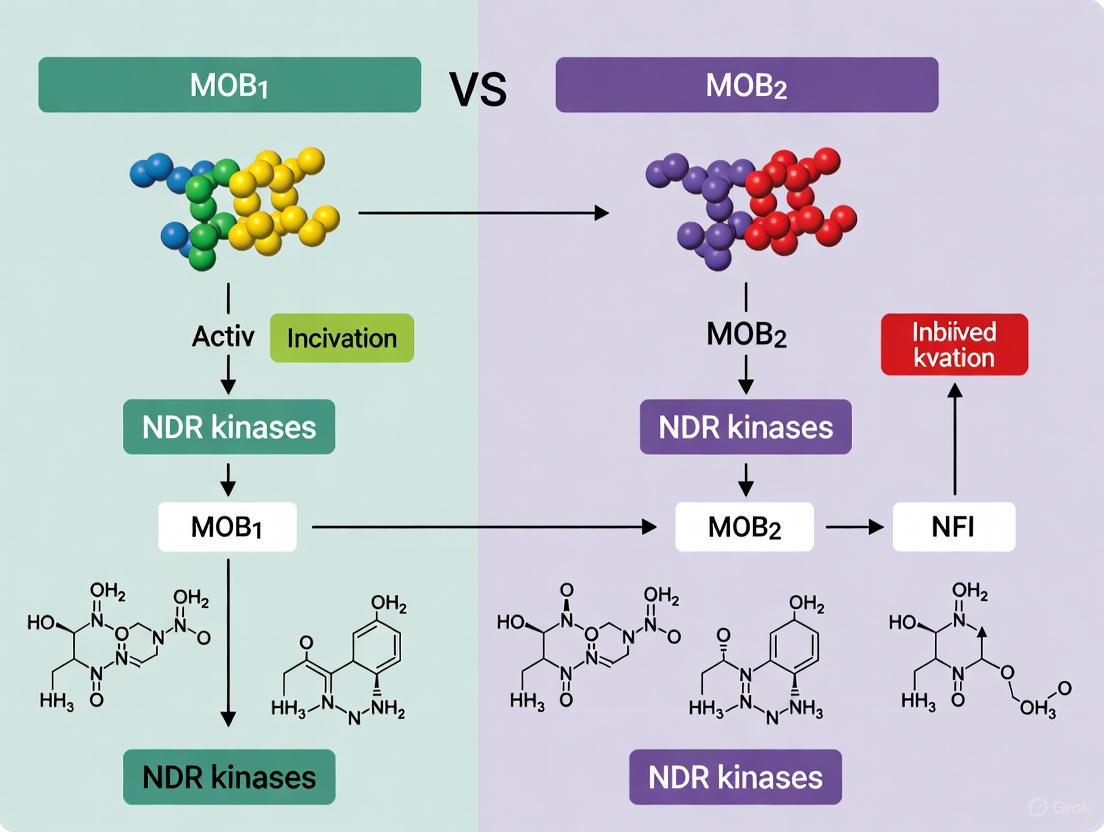
This article provides a comprehensive analysis of the antagonistic roles of MOB1 and MOB2 proteins in regulating NDR kinase activity, a crucial signaling node in pathways controlling cell cycle, DNA...
MOB1 Activation vs. MOB2 Inhibition: Decoding the Dual Regulatory Switch for NDR Kinases in Cell Signaling and Disease
Abstract
This article provides a comprehensive analysis of the antagonistic roles of MOB1 and MOB2 proteins in regulating NDR kinase activity, a crucial signaling node in pathways controlling cell cycle, DNA damage response, and tumor suppression. We explore the foundational structural mechanisms, competitive binding dynamics, and methodological approaches for studying these interactions. Targeting an audience of researchers and drug development professionals, the content synthesizes current evidence to clarify how the MOB1/NDR activation complex and MOB2/NDR inhibitory complex balance cellular processes, with direct implications for understanding cancer biology and developing novel therapeutic strategies for cancer and neurodegenerative diseases.
Structural Mechanisms and Competitive Binding: How MOB1 and MOB2 Oppositely Regulate NDR Kinases
NDR kinases are evolutionarily conserved serine-threonine kinases and crucial components of Hippo signaling pathways, playing key roles in processes such as cell cycle progression, centrosome duplication, and morphogenesis. Their activity is critically regulated by MOB (Mps one binder) coactivator proteins. Research has established a fundamental regulatory paradigm: MOB1 proteins function as activators of NDR kinases, while MOB2 acts as a competitive inhibitor of this activation. The table below summarizes the core functional relationships between human NDR kinases and their MOB regulators.
Table 1: Core Functional Relationships Between Human NDR Kinases and MOB Proteins
| Feature | MOB1 (A/B) | MOB2 |
|---|---|---|
| Primary Binding Partner | NDR1/2, LATS1/2 [1] [2] | NDR1/2 [1] [2] |
| Effect on NDR Kinase Activity | Activation [3] [4] | Inhibition [1] [2] |
| Mechanism of Action | Stimulates autophosphorylation (e.g., on Ser281) and facilitates phosphorylation by upstream kinases [3] [5] | Competes with MOB1 for NDR binding, associated with unphosphorylated NDR [1] [2] |
| Biological Consequence of Overexpression | Increases NDR kinase activity [3] | Impairs NDR activation, affecting centrosome duplication and apoptotic signaling [2] |
| Consequence of Knockdown (RNAi) | Reduces NDR kinase activity | Increases NDR kinase activity [2] |
Experimental Insights: Key Findings and Methodologies
Membrane Targeting Induces Rapid NDR Activation by MOB1
A pivotal study demonstrated that the subcellular localization of MOB proteins is a critical regulatory mechanism for NDR kinase activity.
- Core Finding: Membrane targeting of either NDR kinase or its coactivator hMOB1 results in a constitutively active kinase. This activation is characterized by phosphorylation on the activation segment (Ser281) and the hydrophobic motif (Thr444) and occurs within minutes of hMOB1's association with membranous structures [3].
- Interpretation: This suggests that spatial relocalization is a key step in the NDR activation cascade, potentially bringing the kinase into proximity with upstream activators or specific substrates at the plasma membrane [3] [2].
Table 2: Key Experimental Findings from Membrane-Targeting Studies
| Experimental Manipulation | Observed Effect on NDR Kinase | Significance |
|---|---|---|
| Membrane-targeted NDR | Constitutively active (phosphorylated on Ser281 and Thr444) [3] | Demonstrates that membrane localization is sufficient for activation. |
| Co-expression of membrane-targeted hMOB1 | Robust further activation of membrane-targeted NDR [3] | Confirms MOB1's role as a potent coactivator. |
| Inducible membrane translocation of hMOB1 | Rapid NDR phosphorylation and activation at the membrane within minutes [3] | Establishes the kinetics and specific site of MOB1-mediated activation. |
Diagram 1: MOB1-mediated activation of NDR kinases. MOB1 binding and recruitment to the membrane facilitates NDR phosphorylation and activation.
MOB2 Competes with MOB1 to Inhibit NDR Kinase Function
Biochemical and cellular analyses have revealed that MOB2 exerts an opposing effect to MOB1, establishing a competitive regulatory system.
- Core Finding: hMOB2 competes with hMOB1A for binding to the N-terminal regulatory region of NDR1. Unlike hMOB1, hMOB2 binds predominantly to the unphosphorylated form of NDR. Consequently, RNAi-mediated depletion of hMOB2 increases NDR kinase activity, and its overexpression disrupts NDR-dependent processes like centrosome duplication and death receptor signaling [2].
- Interpretation: MOB2 acts as a physiological negative regulator, forming an inhibitory complex with NDR that prevents its activation by the MOB1 coactivator [1] [2].
Table 3: Experimental Evidence for MOB2 as a Negative Regulator
| Experimental Approach | Key Observation | Functional Implication |
|---|---|---|
| Binding Competition Assays | hMOB2 competes with hMOB1A for NDR binding [2] | MOB2 directly interferes with the formation of the active MOB1-NDR complex. |
| Kinase Activity Measurements | hMOB2 overexpression impairs NDR activation; hMOB2 knockdown enhances it [2] | MOB2 is a bona fide inhibitor of NDR kinase function in cells. |
| Analysis of NDR Phosphorylation Status | hMOB2 is bound to unphosphorylated NDR [2] | The MOB2-NDR complex represents an inactive state of the kinase. |
| Phenotypic Rescue Experiments | Overexpression of hMOB2, but not a binding-deficient mutant, disrupts NDR-mediated centrosome duplication [2] | The inhibitory effect is specifically dependent on MOB2's interaction with NDR. |
Diagram 2: MOB2 competition inhibits NDR kinase activation. MOB2 binds to NDR, preventing MOB1 association and subsequent kinase activation.
Structural Mechanisms Underlying Activation and Inhibition
Structural biology has provided profound insights into the molecular basis of MOB-NDR interactions.
- MOB1 Activation Mechanism: The binding of MOB1 to the N-terminal regulatory (NTR) region of NDR kinases organizes this domain into a V-shaped helical hairpin. This organization is critical for positioning the C-terminal hydrophobic motif (HM) of NDR, which, when phosphorylated by an upstream kinase like MST1, interacts with the N-lobe of the kinase domain to promote an active conformation [6] [7].
- Auto-inhibition and Its Relief: The crystal structure of the inactive NDR1 kinase domain revealed an atypically long activation segment that acts as an auto-inhibitor by blocking the substrate-binding site and stabilizing a non-productive conformation. MOB1 binding and phosphorylation events work through distinct mechanisms to relieve this auto-inhibition [6].
- Basis for MOB Specificity: While the overall interface between the NDR NTR and MOB proteins is structurally similar, specificity for either MOB1 or MOB2 is determined by discrete residues within a short motif in the MOB protein. This ensures the formation of specific kinase-coactivator pairs in vivo [7].
The Scientist's Toolkit: Essential Research Reagents
The following table lists key reagents used in the foundational studies of NDR-MOB interactions, providing a resource for experimental design.
Table 4: Key Research Reagents for Studying NDR-MOB Signaling
| Reagent / Method | Function in Research | Example Use Case |
|---|---|---|
| Membrane-Targeting Constructs (e.g., fused to Lck myristoylation/palmitylation motif) | Forces localization of proteins to the plasma membrane to study the role of subcellular localization in activation. | Used to demonstrate that membrane targeting of hMOB1 or NDR is sufficient for constitutive kinase activation [3]. |
| Phospho-Specific Antibodies (e.g., anti-pSer281, anti-pThr444 of NDR1) | Detect specific phosphorylation events that correlate with kinase activity in immunoblotting or immunofluorescence. | Essential for measuring NDR activation status upon MOB1 expression or MOB2 knockdown [3] [2]. |
| Inducible Translocation Systems | Allows controlled, rapid recruitment of a protein of interest to a specific subcellular compartment to study kinetics. | Used to show that NDR phosphorylation occurs minutes after induced membrane recruitment of hMOB1 [3]. |
| RNAi Knockdown (shRNA) | Reduces endogenous protein levels to study loss-of-function phenotypes. | Used to demonstrate that depletion of hMOB2 leads to increased NDR kinase activity [2]. |
| Kinase-Inactive/ Binding-Deficient Mutants (e.g., hMOB2(H157A)) | Serves as critical negative controls to confirm that observed effects are specific to the protein's function. | Used to show that the disruptive effects of MOB2 on centrosome duplication require its binding to NDR [2]. |
Structural Basis of MOB1-Mediated NDR Kinase Activation and Relief of Auto-inhibition
The NDR (Nuclear Dbf2-related) kinase family, comprising NDR1/2 and LATS1/2, serves as a crucial hub in eukaryotic signaling networks, governing processes from cell proliferation and morphogenesis to tumor suppression [1] [8]. Unlike many other kinases, NDR kinases are functionally dependent on their binding to Mps one binder (MOB) coactivator proteins [7]. This interaction is pivotal for kinase activity and pathway specificity. A central paradigm in this field is the opposing functional roles of different MOB proteins: while MOB1 acts as a potent activator of NDR kinases, MOB2 functions as a competitive inhibitor, binding to the same site on NDR but failing to promote full activation [1] [4]. This review provides a comparative guide to the structural mechanisms underlying MOB1-mediated activation and the relief of NDR kinase auto-inhibition, synthesizing key experimental data to inform future research and therapeutic development.
Structural Anatomy of the NDR Kinase and Its Auto-inhibition
Domain Architecture of NDR Kinases
NDR kinases possess a characteristic domain organization that is tightly linked to their regulatory mechanisms. The core domains include:
- An N-terminal regulatory domain (NTR or MBD), which serves as the primary binding site for MOB coactivators [6] [7].
- A central kinase domain belonging to the AGC family [3].
- A C-terminal hydrophobic motif (HM), containing a critical threonine residue (Thr444 in NDR1, Thr442 in NDR2) whose phosphorylation is essential for full kinase activation [6] [3].
A defining feature of the NDR kinase domain is its atypically long activation segment (63 residues in NDR1/2). Structural studies have revealed that this segment acts as a key auto-inhibitory element [6].
Mechanism of Auto-inhibition
The crystal structure of the human NDR1 kinase domain in its non-phosphorylated state provides a clear snapshot of its auto-inhibited conformation [6]. In this state:
- The elongated activation segment adopts a circuitous path that physically blocks the substrate-binding cleft.
- This conformation also stabilizes the helix αC in a non-productive, inactive position [6].
- Mutational studies confirm the auto-inhibitory role of this segment. Deleting or mutating specific regions within it leads to a dramatic increase in NDR1's in vitro kinase activity, independent of upstream activation signals [6].
The following diagram illustrates the transition from the auto-inhibited to the active state of NDR1.
Diagram 1: The activation pathway of NDR1 kinase. Auto-inhibition is relieved through MOB1 binding and phosphorylation events, leading to major structural rearrangements in the activation segment and helix αC, and enabling allosteric regulation via the hydrophobic motif (HM).
Comparative Analysis of MOB1 Activation vs. MOB2 Inhibition
The functional dichotomy between MOB1 and MOB2 in regulating NDR kinases is rooted in their distinct structural interactions and outcomes. The data below provide a direct comparison of their binding and functional consequences.
Table 1: Functional and Structural Comparison of MOB1 and MOB2 Binding to NDR Kinases
| Feature | MOB1 (Activator) | MOB2 (Inhibitor) |
|---|---|---|
| Binding Site on NDR | N-terminal Regulatory Domain (NTR) [7] | N-terminal Regulatory Domain (NTR) [1] |
| Kinase Activity Outcome | Dramatic stimulation of NDR catalytic activity [3] [4] | Association with diminished NDR kinase activity [1] |
| Competitive Behavior | Competes with MOB2 for NDR binding [1] | Competes with MOB1 for NDR binding, blocking activation [1] |
| Structural Role | Organizes the NTR to position the HM for allosteric activation; promotes active conformation [7] | Binds NTR but does not efficiently promote the active kinase conformation; may stabilize an inactive state [1] |
| Biological Context | Core component of Hippo signaling; tumor suppressor roles [1] [9] | Implicated in cell cycle progression, DNA damage response, and neuronal morphogenesis [1] |
The specificity of this interaction is enforced by discrete molecular recognition sites. Structural and mutational analyses of yeast homologs (Cbk1-Mob2 and Dbf2-Mob1) show that a short, divergent motif in the Mob protein is a critical determinant of specificity. Altering residues in this motif can allow non-cognate binding, demonstrating that specificity is not broadly distributed but controlled by discrete sites [7].
Detailed Experimental Protocols and Data
Understanding the structural basis of NDR kinase regulation has relied on a suite of biochemical and biophysical techniques. The following table summarizes key experimental approaches and the insights they have yielded.
Table 2: Key Experimental Methodologies in NDR/MOB Structural Studies
| Method/Technique | Experimental Detail | Key Finding / Utility |
|---|---|---|
| X-ray Crystallography | Crystal structure of human NDR1 kinase domain (residues 82-418) determined at 2.2 Å resolution [6]. | Revealed the atomic-level detail of the auto-inhibitory activation segment and its blockade of the substrate-binding site [6]. |
| Hydrogen-Deuterium Exchange (HDX) | HDX analysis of NDR1 kinase domain dynamics [6]. | Confirmed that MOB1 binding and activation segment deletion are independent regulatory mechanisms, as they affected different regions of the kinase [6]. |
| Co-immunoprecipitation (Co-IP) & Mutagenesis | Co-IP of NDR with MOB proteins from cell extracts (e.g., Jurkat T-cells); site-directed mutagenesis of binding interfaces [4] [7]. | Established MOB2 as a binding partner that stimulates NDR catalytic activity; identified residues critical for binding specificity and affinity [4] [7]. |
| Limited Proteolysis | Proteolysis of NDR1 fragment (residues 12-418) to identify stable domains for crystallization [6]. | Identified a stable kinase domain and revealed the unusual protease resistance of the atypically long activation segment [6]. |
Protocol: In Vitro Kinase Activity Assay
A foundational protocol for assessing MOB's effect on NDR kinase activity is detailed in several studies [3] [4].
- Protein Purification: Recombinant NDR and MOB proteins (e.g., NDR1 residues 12-418, MOB1A residues 2-216) are expressed in E. coli (e.g., BL21 (DE3) CodonPlus RIL cells) and purified using affinity chromatography (e.g., glutathione-Sepharose for GST-tagged proteins) followed by size-exclusion chromatography [9] [4].
- Kinase Reaction: The purified NDR kinase is incubated with its MOB partner and a substrate (e.g., myelin basic protein or a specific peptide) in kinase buffer containing Mg²⁺ and ATP (often including radiolabeled γ-³²P-ATP for detection).
- Activation Measurement: Kinase activity is quantified by measuring the incorporation of radioactive phosphate into the substrate, typically by filter binding or SDS-PAGE followed by autoradiography/phosphorimaging [4]. A dramatic increase in phosphorylation signal is observed when MOB1 is co-incubated with NDR1/2, whereas MOB2 does not elicit this robust response [4].
The Scientist's Toolkit: Essential Research Reagents
Advancing research in this field requires a well-characterized set of molecular tools. The following table lists key reagents and their applications.
Table 3: Essential Research Reagents for Investigating NDR/MOB Signaling
| Research Reagent | Function and Application | Example / Specification |
|---|---|---|
| Recombinant NDR/MOB Proteins | For in vitro biochemical assays, structural studies, and interaction mapping. | Human NDR1 (residues 12-418) [6] [9]; Human MOB1A (residues 2-216) [9]. |
| Phospho-specific Antibodies | To detect activation-specific phosphorylation events in cellular contexts. | Antibodies against NDR1 pSer281/pSer282 and pThr444 [3]; Antibodies against MOB1 pThr12/pThr35 [10]. |
| Membrane-Targeting Constructs | To probe the role of subcellular localization in kinase activation in vivo. | NDR and MOB constructs fused to the myristoylation/palmitylation motif of Lck kinase (e.g., mp-HA-NDR1) [3]. |
| Kinase-Inactive/Constitutive Active Mutants | To dissect causal relationships in signaling pathways. | Hyperactive NDR1-PIF mutant [1]; MOB1 phosphomimetic (T12D/T35D) and phosphodead mutants [10]. |
| Scaffold Protein Constructs | To study higher-order complex assembly and pathway specificity. | Constructs of the Furry (FRY) and Furry-like (FRYL) scaffold proteins that interact with NDR1/2 [6]. |
Visualization of the Activation Mechanism and Regulatory Network
The coordinated relief of auto-inhibition and subsequent activation of NDR kinases involves a multi-step process that integrates signals from MOB proteins, upstream kinases, and scaffold proteins.
Diagram 2: The integrated regulatory network controlling NDR kinase activity. The pathway depicts MOB1's central role in activation, involving phosphorylation by upstream kinases, competitive binding against MOB2, and the final assembly of the active kinase complex capable of substrate phosphorylation.
The structural basis of MOB1-mediated NDR kinase activation is a paradigm of precise kinase control through coactivator interaction and relief of intrinsic auto-inhibition. The key takeaways from this comparison are:
- Auto-inhibition is Central: NDR kinases are intrinsically suppressed by an atypically long activation segment that blocks substrate binding.
- MOB1 is an Allosteric Activator: MOB1 binding to the NTR organizes the kinase domain, facilitating phosphorylation events and promoting an active conformation.
- MOB2 is a Competitive Decoy: MOB2 binds to the same site as MOB1 but fails to induce the activating conformational changes, thereby functioning as an inhibitor.
- Specificity is Discrete: The choice between MOB1 and MOB2 binding is governed by specific molecular recognition sites, offering potential targets for therapeutic intervention.
The opposing roles of MOB1 and MOB2, and the detailed structural understanding of NDR auto-inhibition, provide a robust foundation for future research. Targeting these specific protein-protein interfaces holds significant promise for developing novel therapeutics, particularly in cancers where the Hippo and NDR signaling pathways are dysregulated.
The monopolar spindle-one-binder (MOB) proteins are highly conserved eukaryotic scaffold proteins that function as crucial signal transducers by forming complexes with members of the Nuclear Dbf2-related (NDR) kinase family [11]. Mammalian cells encode two principal NDR kinases, NDR1 and NDR2, which play essential roles in processes such as cell cycle progression, DNA damage response, and cell motility [12] [1] [13]. The activation state of these kinases is fundamentally regulated by their binding to specific MOB proteins. While MOB1 functions as a potent activator of NDR kinase activity, MOB2 has emerged as a key competitive inhibitor of this activation [1] [14]. This competitive interaction represents a critical regulatory mechanism for controlling NDR-mediated signaling cascades, particularly within the broader context of Hippo pathway regulation and its implications for cancer development and cell fate decisions [12] [11]. This review comprehensively examines the molecular mechanisms underlying MOB2's inhibitory function, directly comparing it with MOB1's activating role, and synthesizes experimental evidence that positions MOB2 as a central regulatory switch in NDR kinase signaling networks.
Molecular Mechanisms of Competitive Inhibition
Structural Basis for Competitive Binding
MOB1 and MOB2 compete for binding to the same N-terminal regulatory domain on NDR1/2 kinases [14] [15]. Structural analyses of NDR/MOB complexes reveal that MOB proteins associate with the N-terminal region (NTR) of NDR kinases, a critical interaction required for their regulation [16] [5] [15]. Although MOB2 shares structural similarities with MOB1, key differences in their binding interfaces and subsequent conformational effects on the kinase domain determine whether NDR activation or suppression occurs [15].
The formation of the MOB1/NDR complex induces a conformational change that releases an autoinhibitory sequence within the NDR catalytic domain, thereby promoting kinase activation [5] [15]. This activating complex is associated with increased phosphorylation at critical residues in the NDR activation loop (Ser281/282 in NDR1/2) and hydrophobic motif (Thr444/442 in NDR1/2) [3]. In contrast, the MOB2/NDR complex fails to induce this activating conformational change, resulting in diminished NDR kinase activity despite occupying the same binding site [1] [14].
Table 1: Functional Consequences of MOB1 vs. MOB2 Binding to NDR Kinases
| Parameter | MOB1/NDR Complex | MOB2/NDR Complex |
|---|---|---|
| NDR Kinase Activity | Increased [5] [3] | Diminished [1] [14] |
| Cellular Process | Promotes Hippo signaling, cell cycle progression [13] [11] | Inhibits NDR-driven processes, potentially antagonizes Hippo signaling [1] [14] |
| Phosphorylation Status | Enhanced phosphorylation at activation segment and hydrophobic motif [3] | Reduced phosphorylation [14] |
| Downstream Effects | LATS1 activation, YAP phosphorylation [14] | Altered LATS/YAP signaling [14] |
| Therapeutic Implications | Potential tumor suppressor enhancement | Potential oncogene inhibition |
Mechanism of Kinase Suppression
MOB2 binding to NDR kinases suppresses their activity through multiple interconnected mechanisms. Biochemical experiments demonstrate that MOB2 competes with MOB1 for NDR binding, with the MOB1/NDR complex corresponding to increased NDR kinase activity, while the MOB2/NDR complex is associated with diminished NDR activity [1]. This competition creates a molecular switch where the relative abundance of MOB1 versus MOB2 determines the activation state of NDR kinases [14].
The inhibitory mechanism extends beyond simple competitive binding. Research indicates that MOB2 expression regulates the alternative interaction of MOB1 with NDR1/2 and LATS1, which influences the phosphorylation status of LATS1 and consequently affects yes-associated protein (YAP) activity [14]. In hepatocellular carcinoma SMMC-7721 cells, MOB2 knockout promoted migration and invasion while inducing phosphorylation of NDR1/2 and decreasing phosphorylation of YAP [14]. Conversely, MOB2 overexpression produced the opposite effects, demonstrating its functional impact on this key signaling pathway.
Experimental Evidence and Validation
Key Experimental Findings
Multiple experimental approaches have validated MOB2's role as a competitive inhibitor of NDR kinases. The table below summarizes critical experimental evidence supporting this regulatory model.
Table 2: Experimental Evidence for MOB2-Mediated NDR Kinase Suppression
| Experimental System | Key Findings | Experimental Methods | Reference Support |
|---|---|---|---|
| Human Cell Lines (SMMC-7721) | MOB2 knockout increased NDR1/2 phosphorylation and cell motility; MOB2 overexpression decreased both | CRISPR/Cas9 knockout, lentiviral overexpression, wound healing, Transwell assays | [14] |
| Biochemical Competition Assays | MOB2 competes with MOB1 for binding to the same N-terminal domain of NDR kinases | Co-immunoprecipitation, in vitro binding assays, kinase activity measurements | [1] [14] |
| Structural Studies | MOB2 binding fails to induce activating conformational changes in NDR kinases | X-ray crystallography (yeast Cbk1-Mob2 complex), molecular dynamics simulations | [15] |
| Yeast Models | Mob2p regulates morphogenesis networks through NDR kinase complex formation | Genetic interaction studies, phenotypic analysis | [11] |
| Drosophila Studies | dMOB2 genetically interacts with Tricornered (NDR kinase) in wing hair and photoreceptor morphogenesis | Genetic screens, phenotypic characterization | [11] |
Detailed Experimental Protocols
CRISPR/Cas9-Mediated MOB2 Knockout and Phenotypic Analysis
The functional validation of MOB2's inhibitory role often employs CRISPR/Cas9-mediated knockout followed by comprehensive phenotypic assessment [14]. The methodology typically involves:
Guide RNA Design: A single-guide RNA (sgRNA) targeting MOB2 is designed using computational tools (e.g., CRISPR Design Tool). The sequence 5'-AGAAGCCCGCTGCGGAGGAG-3' has been successfully utilized for targeting human MOB2 [14].
Vector Construction: The lentiCRISPRv2 vector harboring a puromycin resistance cassette is digested using BsmBI and ligated with annealed oligonucleotides corresponding to the sgRNA sequence.
Lentivirus Production: Constructs are transfected into 293T cells using EndoFectin Lenti reagent together with lentiviral packaging vectors pSPAX2 and pCMV-VSV-G.
Cell Infection and Selection: Target cells (e.g., SMMC-7721) are infected with lentivirus in the presence of polybrene (5 µg/ml), followed by puromycin selection and monoclonalization.
Validation and Phenotyping: MOB2 knockout is confirmed by western blotting, followed by functional assays including wound healing, Transwell migration/invasion, and analysis of NDR phosphorylation status.
MOB2-NDR Binding Competition Assay
The direct competitive binding between MOB1 and MOB2 for NDR kinases can be demonstrated through:
Co-immunoprecipitation: Cells are co-transfected with tagged versions of NDR, MOB1, and MOB2. Increasing amounts of MOB2 plasmid are transfected while keeping MOB1 constant. After 24-48 hours, cells are lysed and NDR is immunoprecipitated using tag-specific antibodies. The co-precipitation of MOB1 and MOB2 is assessed by western blotting, demonstrating decreased MOB1 binding with increasing MOB2 expression [1] [14].
Kinase Activity Measurements: Following immunoprecipitation of NDR kinases, in vitro kinase assays are performed using specific substrates (e.g., histone H1 or synthetic peptides). The kinase activity is quantified by radioactive phosphate incorporation or phospho-specific antibodies, showing decreased NDR activity with MOB2 binding compared to MOB1 binding [1].
Visualization of Molecular Mechanisms
MOB2 Competitive Inhibition Pathway
Diagram 1: MOB2 Competitive Inhibition of NDR Kinases. MOB1 binding (green) activates NDR kinases, promoting Hippo signaling through LATS1 activation and YAP phosphorylation. MOB2 binding (red) competes with MOB1 for the same N-terminal domain on NDR kinases, resulting in inactive NDR complexes that promote cellular processes like migration and invasion.
Experimental Workflow for MOB2 Functional Characterization
Diagram 2: Experimental Workflow for MOB2 Characterization. Comprehensive approach combining genetic manipulation (CRISPR knockout and overexpression), binding competition assays, phenotypic analysis, and molecular analysis to validate MOB2's role as a competitive inhibitor of NDR kinases.
The Scientist's Toolkit: Essential Research Reagents
Table 3: Essential Research Reagents for Studying MOB2-NDR Interactions
| Reagent/Tool | Function/Application | Example Use | Key Findings Enabled |
|---|---|---|---|
| lentiCRISPRv2 vector | CRISPR/Cas9-mediated gene knockout | MOB2 knockout in SMMC-7721 cells | Demonstrated that MOB2 loss promotes migration/invasion [14] |
| Co-immunoprecipitation assays | Protein-protein interaction studies | Competition between MOB1 and MOB2 for NDR binding | Validated competitive binding mechanism [1] [14] |
| Phospho-specific antibodies | Detection of phosphorylated NDR forms | Analysis of NDR1/2 phosphorylation status | Confirmed MOB2 effect on NDR activation state [3] [14] |
| Lentiviral overexpression systems | Ectopic gene expression | MOB2 overexpression studies | Verified inhibitory effects on cell motility [14] |
| Wound healing & Transwell assays | Cell migration and invasion assessment | Functional analysis of MOB2 manipulations | Quantified MOB2's role in cell motility [14] |
| X-ray crystallography | Structural determination of complexes | Yeast Cbk1-Mob2 structure | Revealed molecular basis of NDR/MOB interactions [15] |
Discussion and Research Implications
The characterization of MOB2 as a competitive inhibitor of NDR kinases has fundamentally advanced our understanding of Hippo pathway regulation and its connections to cancer biology. The experimental evidence consistently demonstrates that MOB2 competes with the activator MOB1 for binding to the N-terminal regulatory domain of NDR1/2 kinases, resulting in the formation of a complex with diminished kinase activity [1] [14]. This competitive interaction creates a tunable molecular switch that determines NDR kinase output based on the relative cellular abundance of MOB1 versus MOB2.
The implications of this regulatory mechanism extend to multiple physiological and pathological processes. In cancer biology, MOB2 expression appears to inhibit the motility and invasion of hepatocellular carcinoma cells, at least partially through its effects on NDR kinase activity and downstream YAP signaling [14]. Beyond cancer, the MOB2-NDR axis contributes to neuronal development and function, as evidenced by studies in C. elegans where the SAX-1/NDR-MOB-2 complex promotes dendrite pruning through regulation of membrane dynamics [17]. The conservation of this regulatory mechanism across eukaryotes—from yeast to mammals—underscores its fundamental importance in cellular signaling [16] [11].
Future research should focus on elucidating the upstream signals that control the balance between MOB1 and MOB2 expression and activity, as this likely represents a crucial node for therapeutic intervention. Additionally, more structural studies are needed to precisely characterize the conformational differences between MOB1-NDR and MOB2-NDR complexes at atomic resolution. Such insights could facilitate the development of small molecules that modulate this interaction for therapeutic benefit in cancer and other diseases characterized by dysregulated Hippo signaling.
The subcellular localization of protein kinases is a fundamental mechanism for ensuring signaling specificity and precision. For the Nuclear Dbf2-related (NDR) kinases, recruitment to the plasma membrane (PM) represents a critical, rate-limiting step in their activation cycle. This process, primarily mediated by MOB (Mps one binder) proteins, creates a specialized platform that facilitates essential phosphorylation events, culminating in full kinase activation. This guide examines the central role of the plasma membrane as a signaling hub for NDR regulation, comparing the opposing functions of its key regulators, MOB1 (activator) and MOB2 (inhibitor), and detailing the experimental approaches used to dissect this mechanism.
NDR1 and NDR2 are serine/threonine kinases belonging to the AGC kinase family, with crucial roles in cell cycle progression, morphology, and apoptosis [3] [18]. Their activity is tightly regulated by a multi-step process requiring two phosphorylation events and interaction with co-activators:
- Phosphorylation of a serine residue in the activation loop (Ser281 in NDR1, Ser282 in NDR2).
- Phosphorylation of a threonine residue in the hydrophobic motif (Thr444 in NDR1, Thr442 in NDR2) [19].
- Binding of MOB co-activator proteins [5].
Research has demonstrated that these regulatory steps are not random but are spatially organized, with the plasma membrane serving as a privileged site for efficient NDR activation [3].
The Plasma Membrane as an Organizing Platform
The activation of human NDR kinases is remarkably accelerated by their recruitment to the plasma membrane.
Key Experimental Findings
- Membrane-Targeted NDR is Constitutively Active: Engineering NDR to localize to the PM (e.g., by fusing it to the myristoylation/palmitylation motif of the Lck tyrosine kinase) creates a constitutively active kinase. This membrane-targeted NDR is phosphorylated on both its activation loop (Ser281) and hydrophobic motif (Thr444), even in the absence of other stimuli [3].
- MOB Proteins Drive Membrane Recruitment and Activation: Co-expression of hMOBs with NDR kinases leads to their colocalization at the plasma membrane. Strikingly, membrane-targeted hMOBs alone are sufficient to robustly promote NDR activation by recruiting the kinase to the membrane [3].
- Activation is Rapid and Membrane-Dependent: Using an inducible membrane translocation system for hMOB, researchers showed that NDR phosphorylation and activation at the membrane occur within minutes after hMOB associates with membranous structures. This activation was found to be entirely dependent on the interaction between NDR and MOB and occurred solely at the membrane [3].
The following diagram illustrates the core regulatory circuit of NDR kinase activation at the plasma membrane, highlighting the central role of MOB proteins.
MOB1 Activation vs. MOB2 Inhibition: A Comparative Guide
While both MOB1 and MOB2 can interact with NDR kinases, they exert functionally opposing effects on the NDR activation cycle, with the plasma membrane being a key locus for this competition.
Comparative Mechanisms of Action
| Feature | MOB1 (Activator) | MOB2 (Inhibitor) |
|---|---|---|
| Primary Function | Potent activator of NDR kinase activity [5] | Competes with MOB1 for NDR binding, associated with diminished NDR activity [1] |
| Effect on Hippo Pathway | Activates LATS1/2 and NDR1/2; considered a core Hippo component [20] | Does not interact with LATS kinases; its role in Hippo signaling is less direct [1] [14] |
| Biological Context | Regulates cell cycle exit, mitotic exit, and apoptosis [18] [20] | Linked to cell survival, G1/S progression, and DNA damage response [1] |
| Impact on Cell Motility | Promotes LATS1 activation and YAP phosphorylation, inhibiting cell migration [14] | Its knockout promotes migration and invasion in cancer cells [14] |
The interplay between these regulators and their ultimate effect on the downstream Hippo pathway effector YAP is summarized below.
Experimental Data and Quantitative Evidence
The critical role of plasma membrane colocalization is supported by robust quantitative data from key experiments.
| Experimental Approach | Key Findings | Experimental System | Reference |
|---|---|---|---|
| Inducible MOB Translocation | NDR phosphorylation/activation at membrane occurs within minutes of MOB membrane association. | COS-7, U2-OS, HEK 293, HeLa cells | [3] |
| Membrane-Targeted NDR | Constitutively active due to phosphorylation on Ser281 & Thr444; further activated by hMOBs. | COS-7 cells transfected with mp-HA-NDR constructs | [3] |
| MOB2 Knockout (CRISPR/Cas9) | Promoted migration & invasion; induced NDR1/2 phosphorylation; decreased YAP phosphorylation. | SMMC-7721 hepatocellular carcinoma cells | [14] |
| MOB2 Overexpression | Reduced phosphorylation of NDR1/2; increased phosphorylation of LATS1 and YAP. | SMMC-7721 cells | [14] |
Detailed Experimental Protocols
To ensure reproducibility and provide a clear technical roadmap, this section outlines the core methodologies used in the cited studies to investigate NDR regulation at the plasma membrane.
Protocol 1: Inducible Membrane Recruitment and Activation Assay
This protocol is used to demonstrate the necessity and sufficiency of membrane recruitment for NDR activation [3].
Construct Engineering:
- Create a chimeric hMOB1A protein fused to the C1 domain of Protein Kinase Cα (PKCα). This domain allows for inducible translocation to membranous structures upon stimulation with phorbol esters (e.g., TPA).
- Alternatively, fuse NDR or MOB to the myristoylation/palmitylation motif of the Lck tyrosine kinase (e.g., mp-HA-NDR) for constitutive membrane targeting.
Cell Culture and Transfection:
- Culture appropriate cell lines (e.g., COS-7, HEK 293) in Dulbecco's Modified Eagle's Medium (DMEM) supplemented with 10% fetal calf serum.
- Transfect cells with the engineered constructs using standard transfection reagents (e.g., Fugene 6, Lipofectamine 2000).
Stimulation and Membrane Translocation:
- Serum-starve transfected cells overnight to reduce background signaling.
- Stimulate cells with 100 ng/mL 12-O-tetradecanoylphorbol 13-acetate (TPA) for various time points (e.g., from a few minutes to one hour) to induce translocation of the C1-domain fused proteins.
Analysis:
- Immunofluorescence: Fix cells and stain for NDR and MOB to visualize colocalization at the plasma membrane using confocal microscopy.
- Immunoblotting: Lyse cells and resolve proteins by SDS-PAGE. Probe with phospho-specific antibodies against NDR (e.g., anti-Ser281-P and anti-Thr444-P) to quantify activation.
Protocol 2: Functional Analysis of MOB2 via CRISPR/Cas9 and Phenotypic Assays
This protocol is used to determine the biological consequences of MOB2 manipulation on NDR signaling and cell behavior [14].
Genetic Manipulation:
- Knockout: Design a single-guide RNA (sgRNA) targeting an early exon of the MOB2 gene (e.g., exon 7). Clone it into a lentiviral vector (e.g., lentiCRISPRv2). Produce lentiviral particles in 293T cells and transduce target cells (e.g., SMMC-7721). Select with puromycin and validate knockout by western blotting.
- Overexpression: Clone the MOB2 cDNA into a lentiviral expression vector. Produce virus and transduce cells to generate stable overexpression lines.
Assessment of Signaling Pathway:
- Lyse control and genetically modified cells.
- Perform western blotting to analyze the phosphorylation status of key pathway components: NDR1/2, LATS1, and YAP. Use total protein antibodies to control for loading.
Functional Cell-Based Assays:
- Wound-Healing / Migration Assay: Seed cells in a 6-well plate to form a confluent monolayer. Create a scratch ("wound") with a sterile pipette tip. Monitor and quantify cell migration into the wound over 24-48 hours.
- Transwell Invasion Assay: Seed cells in serum-free medium into the upper chamber of a Transwell insert coated with Matrigel. Place medium with serum in the lower chamber as a chemoattractant. After incubation, fix, stain, and count the cells that have invaded through the Matrigel to the lower side of the membrane.
The Scientist's Toolkit: Key Research Reagents
A curated list of essential reagents and tools, as employed in the foundational studies, is provided below to facilitate experimental design.
| Reagent / Tool | Function in NDR Research | Example & Source |
|---|---|---|
| Membrane-Targeting Constructs | Forces localization of proteins to the PM to test sufficiency for activation. | Lck myristoylation/palmitylation motif (MGCVCSSN) [3] |
| Inducible Translocation System | Allows time-controlled recruitment of proteins to membranes to study kinetics. | C1 domain of PKCα fused to hMOB1A; induced by TPA [3] |
| Phospho-Specific Antibodies | Detects the active, phosphorylated state of NDR kinases. | Anti-NDR1 pSer281, Anti-NDR1 pThr444 [3] [19] |
| CRISPR/Cas9 KO System | Enables complete gene knockout to study loss-of-function phenotypes. | lentiCRISPRv2 vector with MOB2 sgRNA [14] |
| Okadaic Acid (OA) | Potent inhibitor of Protein Phosphatase 2A (PP2A); used to experimentally hyperactivate NDR kinases. | 1 μM treatment for 60 minutes [3] |
Colocalization at the plasma membrane is not a passive consequence but an active driver of NDR kinase activation. This process integrates the opposing regulatory inputs of MOB1 and MOB2, translating their competition into precise spatial and temporal control of NDR signaling. Understanding this membrane-centric regulatory platform provides a mechanistic foundation for deciphering NDR roles in both normal physiology and disease, and offers potential avenues for therapeutic intervention, particularly in cancers where related pathways like Hippo are dysregulated.
The nuclear Dbf2-related (NDR) kinase family is a crucial group of AGC kinases that function as central regulators of processes such as cell cycle progression, cell morphology, and the DNA damage response. Their activity is not controlled in isolation but is embedded within a broader regulatory network, the Hippo pathway, which ensures proper organ size and tissue growth by coordinating cell proliferation and differentiation [10] [21]. Full activation of NDR kinases is a multi-step process that depends on phosphorylation at two key sites and a dynamic partnership with specific co-activator proteins. This process is precisely tuned by competing regulatory interactions, most notably the antagonism between the co-activator MOB1 and its counterpart, MOB2. This guide provides a detailed, evidence-based comparison of the phosphorylation-dependent activation mechanisms of NDR and MOB1, situating them within the critical context of MOB1 activation versus MOB2 inhibition.
Core Mechanism: The NDR Kinase Activation Switch
Activation of NDR1/2 kinase is a precisely ordered process requiring two phosphorylation events and cofactor binding.
- Phosphorylation at Ser281 (NDR1)/Ser282 (NDR2): This activation loop site is achieved through autophosphorylation, a step intrinsic to the kinase itself [22].
- Phosphorylation at Thr444 (NDR1)/Thr442 (NDR2): This hydrophobic motif (HM) is targeted by an upstream kinase, Mammalian Ste20-like kinase MST3 [22].
- MOB1A Binding: The final step involves binding of the co-activator MOB1A, which synergizes with the phosphorylation events to generate a fully active kinase [22].
Table 1: Key Phosphorylation Sites and Their Roles in NDR Kinase Activation
| Kinase / Protein | Phosphorylation Site | Function / Role | Upstream Regulator | Functional Outcome |
|---|---|---|---|---|
| NDR1 | Ser281 | Activation Loop (T-loop) phosphorylation | Autophosphorylation | Partial activation; primes the kinase [22] |
| NDR2 | Ser282 | Activation Loop (T-loop) phosphorylation | Autophosphorylation | Partial activation; primes the kinase [22] |
| NDR1 | Thr444 | Hydrophobic Motif (HM) phosphorylation | MST3 kinase | ~10-fold stimulation of activity [22] |
| NDR2 | Thr442 | Hydrophobic Motif (HM) phosphorylation | MST3 kinase | ~10-fold stimulation of activity [22] |
| MOB1A/B | Thr12 and Thr35 | Relief of autoinhibition; enables LATS/NDR binding | MST1/2 kinase | Switches MOB1 from "OFF" to "ON" state [10] [23] |
The following diagram illustrates this sequential activation process and the critical competitive relationship with MOB2.
Structural Mechanisms of MOB1 Autoinhibition and Activation
MOB1 proteins exist in an autoinhibited state in the cell, and phosphorylation is the key that unlocks their activating potential.
- Autoinhibited State: The structure of full-length MOB1B reveals that a segment of its N-terminal extension, specifically a "Switch helix," physically blocks the surface used for binding to LATS/NDR kinases. This conformation is stabilized by a short β-strand (SN strand) that integrates into the core MOB1 domain [10].
- Phosphorylation-Induced Activation: Phosphorylation of MOB1 at Thr12 and Thr35 by MST1/2 kinases structurally disrupts the autoinhibited conformation. This occurs via a "pull-the-string" mechanism, where the addition of negatively charged phosphate groups electrostatically repels the Switch helix away from the LATS/NDR-binding surface. This dissociation activates MOB1 by making its binding site accessible [10].
- Formation of the Active Complex: The phosphorylated and activated MOB1 binds to the N-terminal regulatory (NTR) domain of LATS/NDR kinases. This binding event allosterically promotes the autophosphorylation of the kinase's activation loop, a final critical step for full catalytic activity [10] [23].
The Critical Regulatory Crosstalk: MOB1 Activation vs. MOB2 Inhibition
A crucial layer of regulation in the NDR signaling network is the competitive antagonism between MOB1 and MOB2.
- MOB1 as an Activator: As detailed above, phosphorylated MOB1 binds to and robustly activates NDR1/2 kinases [4] [14].
- MOB2 as a Competitive Inhibitor: MOB2 interacts specifically with NDR1/2 but not with LATS1/2 kinases. MOB2 and MOB1 compete for binding to the same N-terminal regulatory domain on NDR1/2. However, unlike the MOB1/NDR complex, the MOB2/NDR complex is associated with diminished NDR kinase activity. Thus, MOB2 binding effectively blocks NDR activation [1] [14].
- Biological Implications: This competition creates a balanced regulatory switch. The relative levels and activation states of MOB1 and MOB2 can fine-tune NDR kinase signaling, directing cellular outcomes such as cell cycle progression, the DNA damage response, and cell motility [1] [14]. For instance, in hepatocellular carcinoma cells, MOB2 knockout promotes cell migration and invasion, whereas MOB2 overexpression has the opposite effect, demonstrating its role as a motility inhibitor [14].
Table 2: Functional Comparison of MOB1 and MOB2 in NDR Kinase Regulation
| Feature | MOB1 | MOB2 |
|---|---|---|
| Primary Binding Partners | NDR1/2 and LATS1/2 kinases [21] [14] | NDR1/2 kinases only (not LATS1/2) [1] [14] |
| Effect on Kinase Activity | Dramatic stimulation of NDR1/2 activity [4] | Associated with diminished NDR1/2 activity; blocks activation [1] |
| Molecular Mechanism | Binding to NDR is enhanced by phosphorylation at Thr12/Thr35; promotes kinase autophosphorylation [10] [23] | Competes with MOB1 for binding to the same N-terminal domain on NDR [1] [14] |
| Role in Cell Motility (e.g., HCC) | Acts as a tumor suppressor; positively regulates LATS1 to inhibit YAP and cell motility [14] | Serves as an inhibitor of migration and invasion; knockout promotes motility [14] |
| Role in DNA Damage Response | Well-established role in Hippo pathway signaling and mitotic exit | Required for cell survival and G1/S arrest after DNA damage; supports ATM kinase signaling [1] |
Experimental Data and Methodologies
Key Experimental Findings on Phosphorylation and Activity
The models of NDR and MOB1 activation are supported by robust quantitative biochemical data.
Table 3: Summary of Key Experimental Findings on Phosphorylation and Activity
| Experimental Finding | System | Quantitative / Observed Outcome | Source |
|---|---|---|---|
| MST3 phosphorylates NDR2 | In vitro kinase assay | Selective phosphorylation of NDR2 at Thr442, resulting in a 10-fold stimulation of NDR activity. | [22] |
| MOB1A enhances NDR activity | In vitro kinase assay with MOB1A | MOB1A further increased NDR activity, leading to a fully active kinase. | [22] |
| Kinase-dead MST3 inhibits NDR phosphorylation | In vivo (HEK293F cells) | MST3 knockdown or kinase-dead mutant (MST3KR) abolished Thr442 phosphorylation of NDR. | [22] |
| MOB2 competes with MOB1 for NDR binding | Co-immunoprecipitation & activity assays | MOB2 competes for the same NDR domain as MOB1; MOB2/NDR complex has low activity. | [1] [14] |
| MOB2 knockout promotes cell migration | Wound healing & Transwell assay (SMMC-7721 cells) | CRISPR/Cas9 KO of MOB2 promoted migration/invasion; overexpression inhibited it. | [14] |
Detailed Experimental Protocol: Analyzing NDR Kinase Activation
The following is a consolidated protocol based on methodologies used to characterize NDR kinase activation, as described in the search results [22] [14].
Objective: To assess the activation status of NDR kinase in cells by monitoring its essential phosphorylation events and interaction with MOB1.
Key Reagents and Solutions:
- Cell Line: HEK293F cells or SMMC-7721 hepatocellular carcinoma cells.
- Antibodies: Phospho-specific antibodies against NDR1/pT444 and NDR2/pT442; total NDR antibody; MOB1 antibody.
- Activators/Inhibitors: Okadaic acid (OA, a phosphatase inhibitor that stimulates NDR phosphorylation); reagents for generating kinase-dead MST3 (MST3KR).
- Lentiviral Vectors: For overexpression of wild-type and mutant proteins (e.g., MOB2) or for CRISPR/Cas9-mediated knockout (e.g., for MOB2).
Procedure:
- Cell Manipulation:
- Treat cells with okadaic acid (e.g., 500 nM for 30-60 minutes) to stimulate phosphorylation.
- For loss-of-function studies, perform transient transfection with short hairpin RNA (shRNA) targeting MST3 or establish stable knockout cell lines using lentiviral delivery of CRISPR/Cas9 constructs (e.g., for MOB2).
- Cell Lysis and Immunoprecipitation:
- Lyse cells in a suitable RIPA buffer supplemented with protease and phosphatase inhibitors.
- For co-immunoprecipitation assays, incubate the cell lysate with an antibody against NDR or MOB1, followed by capture with Protein A/G beads.
- Analysis:
- Subject the immunoprecipitates or total cell lysates to SDS-PAGE and Western Blotting.
- Probe the blots with specific antibodies to detect:
- The phosphorylation of NDR at Thr444/Thr442.
- The phosphorylation of MOB1 at Thr12/Thr35.
- The total levels of NDR, MOB1, and MOB2.
- The presence of MOB1 or MOB2 in NDR immunoprecipitates (and vice-versa).
- Functional Assays:
- To assess the cellular outcome of kinase activation, perform wound healing (scratch) assays or Transwell migration/invasion assays following genetic manipulation of MOB1 or MOB2.
The Scientist's Toolkit: Essential Research Reagents
Table 4: Key Research Reagents for Investigating NDR/MOB Signaling
| Reagent / Tool | Function / Specificity | Example Use in Research |
|---|---|---|
| Phospho-specific Antibodies | Detect activated (phosphorylated) NDR and MOB1. | Western blot to monitor NDR-pThr444/2 and MOB1-pThr12/35 in response to stimuli [22] [10]. |
| Kinase-dead Mutants (e.g., MST3KR) | Acts as a dominant-negative to block upstream signaling. | Validating the specific role of MST3 in phosphorylating NDR's hydrophobic motif in cells [22]. |
| shRNA / CRISPR-Cas9 | Knocks down or knocks out gene expression. | Establishing MST3- or MOB2-knockdown cell lines to study pathway dependencies [22] [14]. |
| Okadaic Acid (OA) | Ser/Thr phosphatase inhibitor. | Stimulating pathway activation by preventing dephosphorylation, used to study NDR phosphorylation [22]. |
| Lentiviral Expression Vectors | Enables stable overexpression or knockout in cell lines. | Generating stable MOB2-overexpressing or MOB2-knockout cell lines for functional studies [14]. |
| Recombinant Proteins (NDR, MOB1, MST3) | High-purity proteins for in vitro studies. | Performing in vitro kinase assays to measure direct phosphorylation and activation events [22]. |
The activation of NDR kinases is governed by an elegant and tightly regulated two-step phosphorylation mechanism and a essential partnership with MOB1. The precise phosphorylation of NDR at Ser281/2 and Thr444/2, coupled with the phosphorylation-induced relief of MOB1 autoinhibition, forms a robust molecular switch controlling critical cellular processes. This activating mechanism is critically balanced by the inhibitory influence of MOB2, which competes with MOB1 for NDR binding. A comprehensive understanding of this competitive regulatory axis is fundamental for researchers aiming to dissect Hippo pathway signaling and its profound implications in cancer biology and drug development. The experimental data and methodologies outlined herein provide a solid foundation for such investigations.
The Mps one binder (MOB) family of proteins and their Nuclear Dbf2-related (NDR) kinase partners represent a highly conserved signaling axis that integrates diverse cellular signals to regulate fundamental processes including tissue growth, cell division, and morphogenesis. While traditionally studied within the context of the Hippo tumor suppressor pathway, recent research has revealed complex connections between MOB/NDR signaling and broader cellular networks, including DNA damage response, cell motility control, and metabolic regulation. This comparative analysis examines the central paradox in this field: MOB1 activation versus MOB2 inhibition of NDR kinases, and integrates these contrasting regulatory modes into a coherent understanding of how cells coordinate multiple signaling inputs to determine fate decisions.
The functional relationship between MOB and NDR proteins is ancient, with conserved roles from unicellular eukaryotes to humans. In yeast, Mob1p and Mob2p form specific complexes with different NDR/LATS kinases to regulate mitotic exit and cellular morphogenesis, respectively [11]. This functional specialization appears to have expanded in multicellular organisms, where MOB proteins have evolved to regulate increasingly complex signaling networks. Understanding how MOB1 and MOB2 differentially regulate NDR kinases provides critical insights into how cells translate basic biochemical interactions into sophisticated control of tissue homeostasis—a understanding with profound implications for cancer biology and therapeutic development.
Comparative Analysis of MOB1 and MOB2 Functions and Regulatory Mechanisms
Table 1: Core Functional Characteristics of MOB1 and MOB2
| Feature | MOB1 | MOB2 |
|---|---|---|
| Primary binding partners | NDR1/2 and LATS1/2 kinases [1] [11] | Specifically interacts with NDR1/2, but not with LATS1/2 kinases [1] [24] |
| Effect on NDR kinase activity | Activates NDR kinases [3] [5] | Competes with MOB1 for NDR binding; associated with diminished NDR activity [1] |
| Role in Hippo signaling | Core component; activates LATS1/2 to phosphorylate YAP/TAZ [25] [11] | Indirect regulation; modulates NDR availability for Hippo signaling [14] |
| Cellular functions | Mitotic exit, Hippo pathway regulation, organ size control [1] [11] | Cell cycle progression, DNA damage response, cell migration inhibition [1] [24] [14] |
| Disease associations | Tumor suppressor functions across cancers [11] | Lost in glioblastoma; correlates with poor prognosis [24] |
Table 2: Experimental Readouts of MOB1 vs. MOB2 Manipulation
| Experimental Condition | Effects on Signaling Pathways | Functional Outcomes |
|---|---|---|
| MOB1 overexpression | Increased NDR/LATS kinase activity [3]; Enhanced YAP phosphorylation [25] | Cell cycle regulation; inhibited proliferation [1] |
| MOB1 knockdown | Reduced YAP phosphorylation; increased nuclear YAP [25] | Enhanced cell proliferation; defective mitotic exit [1] |
| MOB2 overexpression | Decreased NDR1/2 phosphorylation [14]; Increased LATS1 and MOB1 phosphorylation [14] | Inhibited migration and invasion [24] [14]; GBM tumor suppression [24] |
| MOB2 knockdown | Accumulation of DNA damage [1]; Activation of ATM and CHK2 [1]; Increased FAK/Akt signaling [24] | G1/S cell cycle arrest [1]; Enhanced migration and invasion [24] [14] |
Mechanistic Insights: Structural and Biochemical Basis of MOB-NDR Interactions
The functional divergence between MOB1 and MOB2 stems from their distinct structural relationships with NDR kinases. Structural analyses reveal that MOB1 binding to NDR1 induces conformational changes that release autoinhibition mediated by an atypically long activation segment [26] [5]. This activation segment normally blocks substrate binding and stabilizes the kinase in an inactive state; MOB1 binding counteracts this autoinhibition through an allosteric mechanism distinct from phosphorylation-mediated activation [26].
In contrast, MOB2 competes with MOB1 for binding to the same N-terminal regulatory domain of NDR1/2 but fails to induce this activating conformational change [1] [14]. Instead, MOB2 binding is associated with diminished NDR kinase activity, effectively creating a competitive inhibition system where the relative abundance and activation status of MOB1 and MOB2 determine NDR signaling output [1]. This competitive interaction forms the biochemical basis for the yin-yang relationship between these two regulatory proteins.
The subcellular localization of MOB-NDR complexes adds another layer of regulation. Both MOB1 and MOB2 can promote the translocation of NDR kinases to membranous structures, particularly the plasma membrane, where activation occurs [3]. Using inducible membrane-targeted hMOB1 constructs, researchers demonstrated that NDR phosphorylation and activation at the membrane occurs within minutes after MOB association with membranous structures [3], revealing a dynamic spatial regulation mechanism that complements the biochemical competition between MOB isoforms.
Diagram 1: MOB/NDR Signaling Network Integration. This diagram illustrates the competitive binding of MOB1 (activating) and MOB2 (inhibitory) to NDR kinases, their regulation by upstream kinases, and integration with broader cellular processes including Hippo signaling, DNA damage response, and cell motility control.
Methodologies: Experimental Approaches for Analyzing MOB-NDR Signaling
Kinase Activation and Interaction Assays
The foundational studies establishing MOB-NDR interactions employed comprehensive kinase assays to quantify activation states. The standard protocol involves:
Co-immunoprecipitation: Transfect cells with epitope-tagged MOB and NDR constructs (typically HA- or myc-tagged), immunoprecipitate using tag-specific antibodies, and detect associated proteins by immunoblotting [3].
In vitro kinase assays: Purify MOB-NDR complexes and measure kinase activity using specific substrates (such as histone H2B for NDR1) in the presence of [γ-32P]ATP. Reaction products are separated by SDS-PAGE and visualized by autoradiography [5].
Phospho-specific antibody detection: Generate antibodies against phosphorylation sites critical for NDR activation (Ser281/Ser282 in T-loop and Thr444/Thr442 in hydrophobic motif) to monitor activation status in different experimental conditions [3].
Membrane-targeting experiments: Create chimeric proteins where MOBs are fused to membrane localization signals to demonstrate that membrane recruitment activates NDR kinases within minutes [3].
Functional Characterization in Disease Models
Glioblastoma models have proven particularly informative for understanding MOB2 function. Key methodologies include:
Lentiviral-mediated gene manipulation: Create stable MOB2-knockdown (using shRNA) and MOB2-overexpression cell lines using lentiviral transduction followed by puromycin selection [24].
Invasion and migration assays:
- Transwell assays: Use Boyden chambers with 8.0 µm pores, with Matrigel coating for invasion assays and without for migration assays. Count cells that migrate through membrane after crystal violet staining [24] [14].
- Wound healing assays: Create scratch wounds in confluent monolayers, monitor closure over 24-48 hours with phase-contrast microscopy [14].
In vivo tumor models:
Table 3: Essential Research Reagents for MOB/NDR Signaling Studies
| Reagent Category | Specific Examples | Experimental Applications | Key Findings Enabled |
|---|---|---|---|
| Expression Constructs | HA-NDR1, myc-MOB1, mp-hMOB1A (membrane-targeted) [3] | Subcellular localization studies; pathway activation assays | Demonstrated membrane localization activates NDR kinases [3] |
| Kinase Inhibitors | H89 (PKA inhibitor), Forskolin (cAMP activator) [24] | Pathway modulation studies; epistasis analysis | Identified MOB2 participation in cAMP/PKA signaling [24] |
| Antibodies | Anti-T444-P (NDR phospho-specific), anti-MOB2, anti-pYAP [3] [14] | Immunoblotting; immunohistochemistry; monitoring pathway activity | Revealed phosphorylation-dependent NDR activation [3] |
| Cell Lines | LN-229, T98G, SF-539 GBM lines [24]; SMMC-7721 HCC cells [14] | Functional assays; translational studies | Established tumor suppressor role of MOB2 [24] [14] |
| Animal Models | Chick CAM model [24]; Mouse xenografts [24] | In vivo validation; therapeutic testing | Confirmed anti-metastatic role of MOB2 in vivo [24] |
Integration with Cellular Networks: Beyond the Hippo Pathway
The MOB/NDR signaling axis intersects with multiple critical cellular processes beyond the canonical Hippo pathway. DNA damage response represents a particularly significant connection, as MOB2 has been identified as a novel DDR factor that prevents accumulation of endogenous DNA damage and supports proper activation of checkpoints [1]. Intriguingly, MOB2 interacts with RAD50, a central component of the MRE11-RAD50-NBS1 (MRN) DNA damage sensor complex, and promotes recruitment of MRN and activated ATM to damaged chromatin [1]. This function appears to be at least partially independent of NDR kinase signaling, suggesting MOB2 has both NDR-dependent and NDR-independent roles.
In cell motility and adhesion control, MOB2 emerges as a critical regulator of integrin-FAK-Akt signaling [24]. MOB2 depletion enhances formation of focal adhesions and confers resistance to anoikis, while MOB2 overexpression produces the opposite effects. This regulation has significant implications for cancer metastasis, particularly in glioblastoma where MOB2 expression is markedly decreased [24]. The molecular mechanism involves MOB2 participation in cAMP/PKA signaling-mediated inhibition of cell migration and invasion, positioning MOB2 as a key node connecting Hippo-like signaling with motility control.
The cross-regulation between MOB proteins creates a sophisticated control system for fine-tuning NDR kinase activity. MOB2 can competitively inhibit MOB1-NDR interactions, thereby modulating the output of both Hippo and Hippo-like signaling pathways [1] [14]. This competition is further regulated by phosphorylation events, as MOB1 phosphorylation by MST1/2 enhances its affinity for both Tricornered-like and Warts/LATS kinases [27]. The resulting regulatory network allows cells to integrate diverse signals and coordinate responses across multiple cellular compartments and processes.
The comparative analysis of MOB1 and MOB2 reveals a sophisticated regulatory system where competitive protein-protein interactions determine signaling output to multiple cellular processes. The yin-yang relationship between MOB1 activation and MOB2 inhibition of NDR kinases provides cells with a dynamic control mechanism to fine-tune responses to diverse stimuli. The integration of MOB/NDR signaling with broader networks including DNA damage response, cell adhesion control, and metabolic regulation underscores the fundamental importance of this pathway in cellular homeostasis.
Future research should focus on structural characterization of MOB2-NDR complexes to elucidate the precise molecular mechanism of inhibition, development of small molecule modulators targeting specific MOB-NDR interactions, and exploration of tissue-specific functions of MOB isoforms in physiological and pathological contexts. The emerging role of MOB2 as a tumor suppressor in multiple cancer types highlights the therapeutic potential of targeting this pathway, particularly in combination with existing modalities like DNA-damaging agents or motility inhibitors. As our understanding of MOB/NDR signaling continues to expand, so too will opportunities to manipulate this pathway for therapeutic benefit in cancer and other diseases.
Research Techniques and Experimental Models: From Structural Biology to Functional Cellular Assays
Crystallography and Structural Analysis of MOB-NDR Complexes
The monopolar spindle-one-binder (MOB) proteins and nuclear Dbf2-related (NDR) kinases form evolutionarily conserved signaling modules that serve as essential components of Hippo signaling pathways in eukaryotes. These complexes play crucial roles in controlling cell proliferation, morphogenesis, and apoptosis. The MOB-NDR/LATS kinase complexes are divided into two main groups: MOB1 associates with LATS kinases, while MOB2 specifically binds to NDR kinases. Despite high structural conservation, these complexes exhibit strict binding specificity and opposing functional outcomes, with MOB1 activating and MOB2 typically inhibiting their respective kinase partners.
This guide provides a comprehensive comparison of MOB-NDR complex structures, drawing on crystallographic data to elucidate the molecular basis of their distinct regulatory mechanisms. We summarize key structural findings, present experimental methodologies for studying these complexes, and visualize the signaling networks they govern, providing researchers with essential tools for investigating this important class of regulatory complexes.
Structural Comparison of MOB-NDR Complexes
The core organization of MOB-NDR complexes centers on the interaction between the N-terminal regulatory (NTR) region of NDR/LATS kinases and the conserved MOB core domain. Crystal structures reveal that the NTR forms a bihelical conformation that docks onto the MOB protein surface, creating a distinctive structural platform for kinase regulation [7].
Table 1: Comparative Structural Features of MOB-NDR Complexes
| Structural Feature | MOB1-NDR/LATS Complexes | MOB2-NDR Complexes |
|---|---|---|
| NTR Conformation | V-shaped helical hairpin [7] | V-shaped helical hairpin [7] |
| MOB Core Domain | 9 α-helices, 2 β-strands, zinc ion [10] | 9 α-helices, 2 β-strands, zinc ion (engineered) [7] |
| Specificity Determinants | Short motif differing from Mob2 [7] | Distinct recognition motif [7] |
| Activation Mechanism | Relief of autoinhibition via phosphorylation [10] | Organizes NTR to position HM [7] |
| Kinase Domain Regulation | Atypically long activation segment blocks substrate binding [26] | Mob-organized NTR mediates HM association [7] |
| Representative Structures | Dbf2NTR–Mob1 (3.5Å), Human NDR1 kinase domain (2.2Å) [7] [26] | Cbk1NTR–Mob2 (2.8Å), Cbk1–Mob2–pepSsd1 (3.15Å) [7] |
The MOB core domain maintains a conserved globular structure composed of nine α-helices (H1-H9) and two small β-strands that form a hairpin-like structure [10]. A notable feature is the coordination of a zinc ion by two cysteine and two histidine residues, which appears to be a conserved structural element across MOB proteins [10]. In the case of MOB2, which lacks native zinc-binding residues in yeast, researchers engineered a zinc-binding motif (V148C Y153C) to stabilize the protein for structural studies [7].
Distinct Activation and Autoinhibition Mechanisms
MOB1 complexes exhibit a unique autoinhibition mechanism mediated by the N-terminal extension of MOB1. The structure of full-length MOB1B reveals that its N-terminal extension forms a short β-strand (SN strand) followed by a conformationally flexible positively-charged linker and a Switch α-helix that physically blocks the LATS1-binding surface [10]. This autoinhibition is stabilized by β-sheet formation between the SN strand and the S2 strand of the MOB1 core domain. Phosphorylation of Thr12 and Thr35 residues by upstream kinases structurally accelerates dissociation of the Switch helix through a "pull-the-string" mechanism, enabling LATS1 binding and kinase activation [10].
For NDR kinases, structural analysis reveals an unusual autoinhibition mechanism mediated by an atypically long activation segment that blocks substrate binding and stabilizes the kinase domain in an inactive conformation [26]. In human NDR1, this activation segment positions the αC helix in a non-productive orientation, preventing catalytic activity. Mutations within this activation segment dramatically enhance in vitro kinase activity, confirming its autoinhibitory function [26].
The association of MOB2 with NDR kinases organizes the kinase NTR region to interact with the C-terminal hydrophobic motif (HM), which contains a critical threonine residue (Thr-743 in Cbk1) phosphorylated by upstream kinases [7]. This Mob-driven orientation positions the phosphorylated HM to interact with a conserved arginine in the NTR, facilitating optimal positioning of the kinase's αC helix for activation [7]. This mechanism represents a distinctive form of kinase regulation not observed in other AGC kinase family members.
Methodological Approaches for Structural Analysis
Crystallization Strategies and Challenges
Structural determination of MOB-NDR complexes presents specific experimental challenges. The N-terminal extensions of MOB proteins are often protease-sensitive and can hinder crystallization [10]. Successful crystallization of full-length MOB1B required low-temperature expression and rapid purification to prevent degradation [10]. For MOB2, which showed instability in Escherichia coli expression systems, researchers engineered a zinc-binding motif to improve protein stability and enable crystallization [7].
For kinase domains, constructing catalytically inactive variants (e.g., Cbk1(D475A)) has been essential for obtaining diffraction-quality crystals [15]. Additionally, both wild-type and phosphomimetic mutants (e.g., T743E in Cbk1) have been employed to capture different functional states of the kinases [15].
Structure Determination and Refinement
X-ray crystallography relies on measuring reflection intensities from protein crystals, which are used to calculate electron density maps [28]. The primary diffraction data quality is assessed by parameters including resolution, Rmerge, and redundancy [28]. The final structural model is refined through iterative cycles of automated optimization and manual adjustment to improve agreement with electron density, monitored by the R-factor and Rfree [28].
Table 2: Key Parameters from MOB-NDR Complex Structures
| Crystal Structure | Resolution (Å) | Space Group | Rwork/Rfree | PDB Reference |
|---|---|---|---|---|
| Cbk1NTR–Mob2 | 2.8 | P41212 | 0.2490/0.2838 | [7] |
| Dbf2NTR–Mob1 | 3.5 | P6122 | 0.2292/0.2631 | [7] |
| Cbk1–Mob2–pepSsd1 | 3.15 | C121 | 0.2310/0.2983 | [7] |
| Human NDR1 kinase domain | 2.2 | - | - | [26] |
| Full-length MOB1B | 2.2 | - | - | [10] |
The interpretation of crystallographic data requires careful attention to model quality. Researchers should assess Ramachandran plot statistics, B-factors (displacement parameters), and geometry validation to evaluate model reliability [28]. For the structures discussed here, validation statistics indicate well-refined models with good stereochemistry, though some complexes show higher rotamer outliers (15-21.5%) [7], suggesting potential areas where model accuracy could be improved with higher-resolution data.
Signaling Pathways and Functional Consequences
Pathway Integration and Regulatory Networks
MOB-NDR complexes function within broader Hippo signaling pathways that control essential cellular processes. The RAM network in budding yeast, comprising Cbk1-Mob2, regulates the final stage of cell separation and polarized growth by controlling the cellular localization of the transcription factor Ace2, which activates genes responsible for septum destruction [15]. In contrast, the mitotic exit network (MEN), containing Dbf2/20-Mob1, controls cytokinesis and the transition from M phase to G1 [15].
Figure 1: MOB-NDR/LATS Kinase Signaling Networks. MOB1 and MOB2 form distinct complexes within Hippo pathways, receiving inputs from upstream MST/Hippo kinases and scaffold proteins, then regulating different downstream effectors to control diverse cellular processes [15].
Functional Consequences in Disease and Therapeutics
The regulatory differences between MOB1 and MOB2 complexes have significant implications for human disease, particularly in cancer. MOB2 functions as a tumor suppressor in glioblastoma (GBM), where its expression is markedly downregulated at both mRNA and protein levels [29]. Mechanistically, MOB2 negatively regulates the FAK/Akt pathway involving integrin and interacts with PKA signaling in a cAMP-dependent manner [29]. Restoring MOB2 expression suppresses malignant phenotypes in GBM cells, including clonogenic growth, migration, and invasion [29].
In hepatocellular carcinoma, MOB2 knockout promotes cancer cell migration and invasion, while MOB2 overexpression produces the opposite effect [14]. Mechanistically, MOB2 regulates the alternative interaction of MOB1 with NDR1/2 and LATS1, leading to increased phosphorylation of LATS1 and MOB1, resulting in YAP inactivation and consequent inhibition of cell motility [14].
Table 3: Functional Outcomes of MOB Protein Regulation
| Cellular Process | MOB1 Role | MOB2 Role |
|---|---|---|
| Kinase Activation | Activates LATS/NDR kinases [4] | Inhibits NDR1/2 activation [14] |
| Cell Proliferation | Suppresses through YAP/TAZ regulation [15] | Tumor suppressor in glioblastoma [29] |
| Cell Migration/Invasion | - | Inhibits in hepatocellular carcinoma [14] |
| Therapeutic Implications | Potential cancer therapeutic target | Loss promotes glioblastoma invasion [29] |
| Pathway Integration | Hippo signaling core component [15] | Competes with MOB1 for NDR binding [14] |
The Scientist's Toolkit: Essential Research Reagents
Table 4: Key Research Reagents for MOB-NDR Complex Studies
| Reagent/Category | Specific Examples | Function/Application |
|---|---|---|
| Expression Constructs | Cbk1(D475A), T743E mutants [15] | Catalytically inactive and phosphomimetic variants |
| Stabilized MOB Variants | MOB2 V148C Y153C [7] | Engineered zinc-binding for improved stability |
| Cell Culture Models | LN-229, T98G, SF-539, SF-767 GBM cells [29] | Malignant phenotype assessment |
| Kinase Activity Assays | Immunoblotting with phospho-specific antibodies [3] | Detection of activation loop phosphorylation |
| Localization Tools | Membrane-targeted constructs [3] | Assessing localization-dependent activation |
| Pathway Modulators | Forskolin (cAMP activator), H89 (PKA inhibitor) [29] | Manipulating cAMP/PKA signaling |
The structural analysis of MOB-NDR complexes reveals a sophisticated regulatory system where closely related components achieve specific functional outcomes through precise molecular recognition. While MOB1 and MOB2 share significant structural similarity, they participate in distinct complexes that regulate different aspects of cell growth and proliferation. The continuing refinement of structural models for these complexes, including higher-resolution data and novel crystallization strategies, provides increasingly detailed insights into their activation mechanisms. These advances offer promising foundations for future therapeutic interventions targeting the Hippo pathway in cancer and other diseases.
The Nuclear Dbf2-related (NDR) kinases, NDR1 and NDR2, are serine-threonine kinases belonging to the AGC family of protein kinases and represent crucial regulators of cell division, morphology, and apoptosis [3]. Their activity is tightly controlled through phosphorylation at critical sites: Ser281/Ser282 in the activation loop and Thr444/Thr442 in the hydrophobic motif [3]. Full kinase activation requires phosphorylation at both sites, with Thr444/Thr442 phosphorylation being mediated by upstream kinases such as MST1 (mammalian STE20-like kinase 1) [3] [2]. Beyond phosphorylation, a key regulatory mechanism involves their interaction with MOB (Mps one binder) proteins, which function as essential co-factors [30] [4]. The human genome encodes six MOB proteins (MOB1A, MOB1B, MOB2, MOB3A, MOB3B, and MOB3C), with MOB1 and MOB2 being the primary regulators of NDR kinases [2]. Strikingly, these highly similar regulators exert opposing effects on NDR kinase activity: MOB1 proteins function as activators that promote NDR's catalytic function, while MOB2 serves as a competitive inhibitor that suppresses kinase activity [2] [1]. This delicate balance between MOB1-mediated activation and MOB2-mediated inhibition forms a critical regulatory switch controlling NDR signaling output, with implications for fundamental cellular processes and disease pathologies, including cancer [29] [12]. Understanding and measuring these opposing regulatory mechanisms is therefore essential for researchers investigating Hippo signaling, cell cycle regulation, and DNA damage response pathways.
Molecular Mechanisms of MOB1 Activation and MOB2 Inhibition
MOB1: An Activator of NDR Kinases
MOB1 proteins (MOB1A and MOB1B) stimulate NDR kinase activity through multiple interconnected mechanisms. Biochemical studies have demonstrated that MOB1 binding to the N-terminal regulatory domain of NDR kinases induces a conformational change that releases an autoinhibitory sequence located within the catalytic domain insert between subdomains VII and VIII [30]. This MOB1-induced conformational change facilitates autophosphorylation at Ser281/Ser282 in the activation segment, a critical step for kinase activation [2]. Furthermore, MOB1 binding enhances phosphorylation at Thr444/Thr442 in the hydrophobic motif by upstream kinases, particularly MST1 [2]. Subcellular localization plays a crucial role in this activation process, as membrane targeting of MOB1 leads to rapid recruitment of NDR to the plasma membrane and its subsequent phosphorylation and activation [3]. This membrane recruitment mechanism provides spatial control over NDR activation, with studies showing that kinase phosphorylation and activation at the membrane occur within minutes after MOB1 association with membranous structures [3].
MOB2: A Competitive Inhibitor of NDR Kinases
In contrast to MOB1, MOB2 functions as a negative regulator of NDR kinases through a distinct binding mode that results in kinase suppression [2]. Although MOB2 binds to the same N-terminal region of NDR1 as MOB1, the interaction characteristics and outcomes differ significantly. MOB2 preferentially associates with the unphosphorylated, inactive state of NDR kinases, thereby competing with MOB1 for binding and preventing the formation of active MOB1-NDR complexes [2]. This competitive inhibition mechanism was demonstrated through RNA interference experiments, where depletion of MOB2 resulted in increased NDR kinase activity, confirming its role as an endogenous brake on NDR signaling [2]. The functional consequences of MOB2 overexpression include impairment of NDR-dependent processes such as centrosome duplication and apoptotic signaling, further supporting its inhibitory function [2]. Importantly, recent evidence suggests that MOB2 may also have NDR-independent functions, particularly in DNA damage response through its interaction with the RAD50 component of the MRN complex [1].
Table 1: Key Functional Differences Between MOB1 and MOB2 in NDR Regulation
| Feature | MOB1 (A/B) | MOB2 |
|---|---|---|
| Effect on NDR Activity | Activation | Inhibition |
| Binding Preference | Phosphorylated/Active NDR | Unphosphorylated/Inactive NDR |
| Effect on Phosphorylation | Promotes Ser281/282 and Thr444/442 phosphorylation | Blocks phosphorylation |
| Localization | Plasma membrane, cytoplasm | Cytoplasm |
| Downstream Effects | Supports apoptosis, proliferation control | Affects centrosome duplication, cell cycle progression |
| Competitive Binding | Binds NDR without MOB2 interference | Competes with MOB1 for NDR binding |
Experimental Approaches for Measuring MOB-NDR Interactions
Kinase Activity Assay Protocols
Several well-established biochemical assays can quantify NDR kinase activity and its modulation by MOB proteins. These assays typically measure the transfer of a phosphate group from ATP to a specific substrate, detecting either the formation of phosphorylated product or the generation of ADP.
Radioactive Kinase Assay
The radioactive kinase assay using [γ-³²P]ATP or [γ-³³P]ATP remains a gold standard for direct measurement of kinase activity due to its high sensitivity and minimal interference with enzyme function [31]. The protocol involves incubating immunoprecipitated NDR kinases or purified recombinant proteins with appropriate substrates in kinase reaction buffer, followed by separation of phosphorylated products and quantification by scintillation counting.
Reaction Setup:
- Kinase Source: Immunoprecipitated NDR from cell lysates or purified recombinant NDR kinase
- MOB Proteins: Recombinant MOB1 or MOB2 (0-2 μM)
- Reaction Buffer: 25 mM HEPES (pH 7.4), 10 mM MgCl₂, 1 mM DTT, 100 μM ATP, 10 μCi [γ-³²P]ATP
- Substrate: 1-2 mg/mL myelin basic protein (MBP) or specific peptide substrates
- Incubation: 30 minutes at 30°C
- Termination: Add EDTA to 25 mM final concentration
Detection Methods:
- Filter Binding: Spot reaction mixture on P81 phosphocellulose paper, wash extensively with 0.75% phosphoric acid, and measure incorporated radioactivity by scintillation counting [31]
- SDS-PAGE Separation: Resolve proteins by SDS-PAGE, transfer to PVDF membrane, visualize phosphorylated substrates by autoradiography, and quantify by phosphorimaging
- Scintillation Proximity Assay (SPA): Use streptavidin-coated SPA beads with biotinylated substrates for homogeneous assay format without separation steps [31]
Non-Radiometric Kinase Assays
For high-throughput screening and laboratories avoiding radioactivity, multiple non-radiometric assay platforms are available:
ADP-Glo Kinase Assay:
- Principle: Measures ADP formation using a luminescent readout
- Procedure: After kinase reaction, add ADP-Glo Reagent to terminate reaction and deplete remaining ATP, then add Kinase Detection Reagent to convert ADP to ATP with luciferase/luciferin reaction
- Advantages: High sensitivity, suitable for HTS, works with variety of substrates [32]
Transcreener ADP Detection Assay:
- Principle: Uses fluorescent immunodetection of ADP with competitive immunoassay format
- Procedure: Incubate sample with anti-ADP antibody and fluorescently-labeled ADP tracer, then measure fluorescence polarization (FP) or time-resolved FRET (TR-FRET) signal
- Advantages: Universal format for any kinase, minimal compound interference [32]
ELISA-Based Phospho-Substrate Detection:
- Principle: Uses phospho-specific antibodies to detect phosphorylated substrates
- Procedure: Capture substrate on microplate, detect phosphorylation with phospho-specific primary antibody and HRP-conjugated secondary antibody, then measure chemiluminescent or colorimetric signal
- Advantages: High specificity, compatible with protein substrates [29]
Interaction Studies: Co-Immunoprecipitation and Binding Assays
Determining the physical interaction between MOB proteins and NDR kinases is essential for understanding their regulatory relationships.
Co-Immunoprecipitation Protocol:
- Transfection: Co-express epitope-tagged NDR (HA-NDR1) and MOB (myc-MOB1A or myc-MOB2) in HEK293 or COS-7 cells
- Lysis: Harvest cells 24-48 hours post-transfection using mild lysis buffer (20 mM Tris pH 7.5, 150 mM NaCl, 1% Triton X-100, plus protease and phosphatase inhibitors)
- Immunoprecipitation: Incubate lysates with anti-HA agarose beads for 2-4 hours at 4°C
- Washing: Wash beads 3-5 times with lysis buffer
- Elution: Boil beads in SDS sample buffer, analyze by SDS-PAGE and immunoblotting with anti-myc and anti-HA antibodies [2]
Competition Binding Assay:
- Principle: Measure MOB2's ability to displace MOB1 from NDR complexes
- Procedure: Incubate constant amount of NDR with increasing concentrations of MOB2 in the presence of fixed concentration of MOB1, then immunoprecipitate NDR and quantify bound MOB1 and MOB2 by immunoblotting [2]
- Analysis: Determine IC₅₀ value for MOB2 competition
Table 2: Key Reagents for MOB-NDR Interaction Studies
| Reagent | Function/Description | Example Sources |
|---|---|---|
| Recombinant NDR1/NDR2 | Kinase component for in vitro assays | Purified from baculovirus system or mammalian cells |
| Recombinant MOB1/MOB2 | Regulatory proteins | Bacterial or mammalian expression |
| Phospho-specific Antibodies | Detect activation-specific phosphorylation | Anti-pSer281/282-NDR, Anti-pThr444/442-NDR [3] |
| * epitope-tagged Constructs* | For expression and IP in cells | HA-NDR1, myc-MOB1A, myc-MOB2 [2] |
| Kinase Assay Substrates | Phosphate acceptors | Myelin Basic Protein (MBP), specific peptide substrates |
| ATP, Mg²⁺ | Essential co-factors | Commercial suppliers |
| Protein A/G Agarose | Immunoprecipitation | Commercial suppliers |
| Protease/Phosphatase Inhibitors | Maintain protein integrity and phosphorylation state | Commercial cocktails |
Signaling Pathways and Experimental Workflows
The regulatory relationships between MOB proteins and NDR kinases can be visualized through the following signaling pathway:
Diagram 1: MOB Regulation of NDR Kinase Activity
The experimental workflow for comprehensive characterization of MOB-NDR interactions typically follows this sequence:
Diagram 2: Experimental Workflow for MOB-NDR Studies
Data Interpretation and Functional Analysis
Quantitative Analysis of MOB Effects on NDR Kinase Activity
When interpreting experimental results, researchers should expect to observe characteristic patterns distinguishing MOB1 activation from MOB2 inhibition. MOB1 typically demonstrates a dose-dependent increase in NDR kinase activity, with reported activation reaching 5- to 10-fold over basal levels in purified systems [4]. This activation correlates with increased phosphorylation at both Ser281/282 and Thr444/442 sites [3] [2]. In contrast, MOB2 exhibits dose-dependent suppression of basal NDR activity and can block MOB1-mediated activation when added in competition experiments [2]. The half-maximal inhibitory concentration (IC₅₀) for MOB2 competition provides a quantitative measure of its inhibitory potency.
Table 3: Expected Experimental Outcomes for MOB1 vs. MOB2 Regulation
| Assay Type | MOB1 Expression/Addition | MOB2 Expression/Addition |
|---|---|---|
| NDR Kinase Activity | Increase (5-10 fold) | Decrease (50-80% of basal) |
| Ser281/282 Phosphorylation | Strong increase | Reduction or no change |
| Thr444/442 Phosphorylation | Increase (MST1-dependent) | Reduction or no change |
| Co-IP with NDR | Increased with active NDR | Increased with inactive NDR |
| Subcellular Localization | Membrane association | Cytoplasmic distribution |
| Competition with MOB1 | Not applicable | Dose-dependent displacement |
Functional Validation in Cellular Contexts
Beyond biochemical assays, functional validation in cellular models is essential to confirm the physiological relevance of MOB-NDR interactions. Key cellular readouts include:
Cell Cycle Progression:
- MOB2 knockdown can trigger p53/p21-dependent G1/S cell cycle arrest, potentially through accumulation of DNA damage [1]
- NDR kinases regulate G1/S progression through control of c-myc and p21/Cip1 protein levels [1]
Centrosome Duplication:
- MOB2 overexpression interferes with NDR-dependent control of centrosome duplication [2]
- MOB1-NDR signaling helps maintain proper centrosome number [2]
DNA Damage Response:
- MOB2 participates in DNA damage response through interaction with RAD50 of the MRN complex [1]
- MOB2 supports recruitment of MRN complex and activated ATM to DNA damage sites [1]
Cancer-Relevant Phenotypes:
- MOB2 acts as a tumor suppressor in glioblastoma, negatively regulating FAK/Akt signaling pathway [29]
- Low MOB2 expression correlates with poor prognosis in glioma patients [29]
- MOB2 overexpression suppresses, while MOB2 depletion enhances, GBM cell migration, invasion, and metastasis [29]
Technical Considerations and Troubleshooting
Several technical considerations are crucial for reliable assessment of MOB-NDR interactions. The choice of kinase assay format should be guided by specific research goals: radioactive assays offer maximum sensitivity for kinetic studies, while HTS-compatible formats like ADP-Glo or Transcreener are preferable for inhibitor screening [32] [31]. Substrate selection significantly impacts measured activity, with generic substrates like myelin basic protein providing robust signals but potentially lacking specificity. The activation state of NDR kinases must be carefully controlled, as the phosphorylation status at Ser281/282 and Thr444/442 dramatically affects both kinase activity and MOB binding [3] [2]. Cellular context introduces additional complexity, as MOB2's biological functions may extend beyond NDR regulation to include DNA damage response through RAD50 interaction [1]. Researchers should employ appropriate controls, including kinase-dead NDR mutants and MOB2 binding-deficient mutants (e.g., MOB2-H157A), to verify specificity of observed effects [2] [29]. Finally, consideration of compensation mechanisms is essential, particularly when interpreting genetic knockdown studies, as the high similarity between NDR1 and NDR2 may allow functional redundancy in certain cellular processes [12].
Co-immunoprecipitation and Protein-Protein Interaction Studies
The study of protein-protein interactions (PPIs) is fundamental to understanding critical cellular signaling pathways. Within this realm, Co-immunoprecipitation (Co-IP) has emerged as a cornerstone technique for validating and characterizing these interactions under physiologically relevant conditions. This guide focuses on the application of Co-IP within the context of a pressing biological question: the paradoxical activation of NDR kinases by MOB1 versus their inhibition by MOB2. Nuclear Dbf2-related (NDR) kinases, including NDR1 and NDR2, are serine/threonine kinases belonging to the AGC family. They are crucial regulators of essential processes such as cell cycle progression, apoptosis, centrosome replication, and the DNA damage response [33]. Their activity is tightly controlled by interactions with MOB (Mps one binder) proteins, which function as central adaptors and signal transducers. A clear understanding of this regulatory mechanism is not only biologically significant but also presents potential therapeutic avenues, particularly in cancer research, where NDR1 expression is frequently dysregulated [33] [1]. This guide will objectively compare Co-IP with alternative methods and provide a detailed experimental framework for studying the MOB-NDR interaction, serving as a resource for researchers and drug development professionals.
Methodological Comparison: Co-IP Versus Alternative Techniques
Choosing the right method is critical for successful PPI studies. The table below compares Co-IP with other common techniques, highlighting the optimal use-case for each.
Table 1: Comparison of Key Protein-Protein Interaction Techniques
| Method | Principle | Applications | Key Advantages | Key Limitations |
|---|---|---|---|---|
| Co-IP [34] [35] | Antibody-mediated precipitation of a protein complex from a native lysate. | Confirm hypothesized interactions; study protein complexes in a near-native state. | Studies interactions under physiological conditions; can identify indirect/complex associations. | Cannot distinguish direct from indirect interactions; antibody may disrupt binding; transient interactions may be missed. |
| Yeast Two-Hybrid (Y2H) [34] | Reconstitution of a transcription factor via bait-prey interaction in yeast nuclei. | Discover new interactions; screen large libraries for binding partners. | High-throughput; excellent for mapping direct, binary interactions. | Interactions occur in a non-native environment (nucleus); misses post-translational modifications. |
| Pull-down Assay [34] | Affinity purification using a tagged bait protein (not an antibody) immobilized on beads. | Confirm direct interactions; map binding domains. | No antibody required; good for confirming direct interactions. | Requires purified, tagged bait protein; lacks the specificity of a high-quality antibody. |
| Mass Spectrometry (MS) [34] | Identification of proteins based on mass/charge ratio of peptide fragments. | Discover unknown binding partners; analyze complex composition. | Unbiased identification of all co-purifying proteins; no prior hypothesis needed. | High cost; complex data analysis; high false-positive rate requires validation. |
Co-IP is particularly powerful for validating interactions discovered by high-throughput methods like Y2H, as it confirms that the interaction can occur in a more complex, cellular environment [34]. While deep learning approaches are emerging for PPI prediction, they ultimately require experimental validation by methods like Co-IP [36].
The following workflow diagram outlines the key steps of a standard Co-IP experiment, from sample preparation to downstream analysis.
The MOB-NDR Interaction: A Paradigm for Co-IP Studies
Biological Context and Significance
The NDR kinase family, including NDR1/STK38 and NDR2/STK38L, are evolutionarily conserved regulators of cell polarity, proliferation, and centrosome biology [33] [3]. Their activity is stringently controlled by phosphorylation and by binding to proteins of the MOB family. MOB1 binding to the N-terminal regulatory domain of NDR kinases stimulates their kinase activity, forming a complex that is a key component of the Hippo tumor suppressor pathway [5] [3]. In contrast, MOB2 also binds to the same region but forms a complex associated with diminished NDR kinase activity, effectively acting as a competitive inhibitor of MOB1 [1]. This MOB1 activation versus MOB2 inhibition is a critical regulatory switch, the dysregulation of which can impact cell cycle checkpoints and the DNA damage response (DDR) [1]. Furthermore, NDR2 has been implicated in metabolic adaptation in microglia under diabetic conditions, underscoring its role in disease-relevant cellular stress responses [37].
Quantitative Data on MOB1 Activation and MOB2 Inhibition
Co-IP and related kinase assays have been instrumental in quantifying the distinct effects of MOB1 and MOB2 on NDR kinase activity. The following table summarizes key experimental findings from the literature.
Table 2: Experimental Data on MOB1 Activation vs. MOB2 Inhibition of NDR Kinases
| Interacting Proteins | Experimental System | Key Findings | Biological Outcome | Citation |
|---|---|---|---|---|
| MOB1 / NDR | In vitro kinase assay | MOB1 binding induces a conformational change, releasing autoinhibition and stimulating NDR kinase activity. | Kinase activation; promotion of Hippo signaling pathways. | [5] |
| MOB2 / NDR | Biochemical analysis & cell-based assays | MOB2 competes with MOB1 for NDR binding. The MOB2-NDR complex is associated with diminished NDR kinase activity. | Inhibition of NDR-mediated signaling; potential role in cell cycle checkpoints. | [1] |
| MOB2 / RAD50 | Yeast two-hybrid & endogenous Co-IP | MOB2 interacts with RAD50, a component of the MRN DNA damage sensor complex. | Implicates MOB2 in DNA Damage Response (DDR) and cell survival upon damage. | [1] |
| MOB1, MOB2 / NDR | In vivo localization & activation | Membrane-targeted MOBs robustly promote activation and phosphorylation of NDR kinases at the plasma membrane. | MOB proteins are critical for spatial regulation of NDR kinase activity. | [3] |
The diagram below illustrates the central signaling paradigm and the competitive relationship between MOB1 and MOB2, highlighting key downstream processes.
Experimental Protocols for Co-IP of MOB-NDR Complexes
Standard Co-Immunoprecipitation Protocol
This protocol is adapted from general Co-IP guides and can be applied to study MOB-NDR interactions [34] [38].
- Cell Lysis: Lyse cells or tissue in a non-denaturing lysis buffer (e.g., RIPA or NP-40 based) supplemented with protease and phosphatase inhibitors. Agitate on ice for 30 minutes. Centrifuge at high speed (e.g., 12,000-14,000 g) for 10 minutes at 4°C to pellet insoluble material. Collect the supernatant.
- Pre-clearing (Optional): Incubate the lysate with control beads (e.g., Protein A/G) for 30-60 minutes at 4°C to reduce non-specific binding. Pellet beads and transfer supernatant to a new tube.
- Input Sample: Reserve 1-10% of the pre-cleared lysate as the "Input" control for later comparison.
- Antibody Immobilization:
- Direct Method: Incubate the specific antibody against your bait protein (e.g., anti-NDR1) with Protein A/G beads for 1-2 hours at 4°C. Wash beads to remove unbound antibody.
- Indirect Method: Add the antibody directly to the pre-cleared lysate and incubate for 1-2 hours at 4°C to form antigen-antibody complexes. Then add Protein A/G beads.
- Immunoprecipitation: Add the antibody-bead complex (direct) or the lysate-antibody mixture plus beads (indirect) and incubate for 2 hours to overnight at 4°C with constant rotation.
- Washing: Pellet beads and carefully aspirate the supernatant. Wash the bead pellet 3-5 times with 1 mL of ice-cold lysis buffer to remove non-specifically bound proteins.
- Elution: Elute the bound proteins by boiling the beads in 2X Laemmli SDS-PAGE sample buffer for 5-10 minutes, or by using a low-pH elution buffer (e.g., 0.1 M glycine, pH 2.8).
- Downstream Analysis: Analyze the eluted proteins, along with the saved Input sample, by Western Blotting (to confirm a specific hypothesized interaction) or by Mass Spectrometry (to identify novel binding partners).
Cross-linking Co-IP Protocol
A common issue in traditional Co-IP is the co-elution of antibody heavy and light chains, which can obscure proteins of similar molecular weight on a gel. The cross-linking method mitigates this [38].
- Follow steps 1-4 of the standard protocol to immobilize the antibody on Protein A/G beads.
- Cross-linking: Resuspend the antibody-bound beads in a chemical cross-linker solution (e.g., Disuccinimidyl suberate - DSS, prepared in DMSO). Incubate at room temperature for 1 hour with rotation.
- Quenching and Washing: Remove excess cross-linker by washing the resin. Elute any uncross-linked antibody by washing with a low-pH buffer (e.g., 0.1 M glycine, pH 2.8). Re-equilibrate the beads in a neutral buffer like TBS.
- Sample Incubation and Elution: Proceed with steps 5-8 of the standard protocol. The antibody is now covalently attached to the beads and will not elute during the final boiling step, resulting in a cleaner sample for downstream analysis.
The Scientist's Toolkit: Essential Reagents for MOB-NDR Co-IP
Table 3: Key Research Reagent Solutions for Co-IP Studies
| Reagent / Resource | Function / Description | Example Application in MOB-NDR Research |
|---|---|---|
| Lysis Buffer | Non-denaturing buffer to solubilize proteins while preserving native interactions. | NP-40 or Triton X-100 based buffers are commonly used to extract NDR kinases and their MOB partners from cell lysates [34]. |
| Protein A/G Beads | Immobilized bacterial proteins with high affinity for the Fc region of antibodies; the solid support for precipitation. | Used to capture the immune complexes formed by antibodies against NDR1, NDR2, MOB1, or MOB2 [38] [3]. |
| Specific Antibodies | High-affinity, validated antibodies for the "bait" protein. | Anti-NDR1 [3], Anti-NDR2 [37], Anti-MOB1, Anti-MOB2, and antibodies against common tags (HA, Myc, FLAG) for tagged proteins [34]. |
| Protease/Phosphatase Inhibitors | Added to lysis and wash buffers to prevent protein degradation and maintain phosphorylation states. | Essential for preserving the native state and activity of NDR kinases, which are regulated by phosphorylation [3]. |
| Cross-linking Reagents | Chemicals like DSS that covalently link antibodies to beads. | Eliminates antibody chain contamination in Co-IP eluates, crucial for clean MS analysis of MOB-NDR complexes [38]. |
| Tagged Constructs | Expression plasmids for bait/prey proteins with tags (e.g., HA, FLAG, Myc). | Overexpression of FLAG-NDR1 and Myc-MOB2 to study their interaction in a controlled system, simplifying pull-down and detection [34] [33]. |
| Public Databases | Repositories of known and predicted PPIs. | STRING and BioGRID can be consulted for known interactions between MOB and NDR orthologs across species [36]. |
In the functional analysis of signaling pathways, the precise manipulation of gene expression is indispensable. Research into the MOB1 activation versus MOB2 inhibition of NDR kinases exemplifies this need, requiring robust methods to both disrupt and enhance gene function. CRISPR/Cas9-mediated knockout and lentiviral vector-mediated overexpression have emerged as two foundational technologies for such genetic investigations. CRISPR/Cas9 enables the permanent disruption of target genes, allowing researchers to dissect the loss-of-function phenotypes of key pathway components. In parallel, lentiviral overexpression systems facilitate the controlled, high-level expression of genes to observe gain-of-function effects. This guide provides a detailed, objective comparison of these two methods, framing them within the context of Hippo pathway signaling research. It presents core performance data, detailed experimental protocols, and essential reagent solutions to inform the experimental design of researchers and drug development professionals.
Core Technology Principles
- CRISPR/Cas9 Knockout: This system functions as a targeted genomic scissors. It utilizes a single-guide RNA (sgRNA) to direct the Cas9 nuclease to a specific DNA sequence. Cas9 then creates a double-strand break, which the cell's error-prone non-homologous end joining (NHEJ) repair pathway fixes, often resulting in insertion/deletion mutations (indels) that disrupt the gene's reading frame and create a knockout [39] [40].
- Lentiviral Overexpression: This system acts as a genomic delivery truck. Lentiviral vectors are engineered viruses capable of stably integrating a transgene—such as a cDNA for MOB1 or MOB2—into the host cell's genome. This leads to long-term, high-level expression of the protein of interest, allowing for functional overexpression studies [41] [42].
Quantitative Performance Comparison
The following table summarizes the key performance characteristics of each system, crucial for selecting the appropriate method for a given experimental aim in NDR kinase research.
Table 1: Performance Comparison of CRISPR/Cas9 Knockout and Lentiviral Overexpression Systems
| Feature | CRISPR/Cas9 Knockout | Lentiviral Overexpression |
|---|---|---|
| Primary Application | Gene disruption/loss-of-function studies [40] | Gene delivery/gain-of-function studies [41] |
| Mechanism of Action | NHEJ-mediated indel mutations [43] | Genomic integration & expression of transgene [42] |
| Typical Efficiency | High knockout rates in pooled screens with optimized systems [44] | High transduction efficiency in dividing & non-dividing cells [41] |
| Key Advantage | Precise targeting; multiplexed gene editing [39] | Broad tropism; stable, long-term expression [41] [42] |
| Key Limitation | Off-target effects & delivery challenges [39] | Limited cargo capacity (~8kb) & insertional mutagenesis risk [44] [45] |
| Experimental Timeline | Longer (requires cloning, virus production, transduction, and screening) [43] | Shorter (virus production and transduction) [42] |
| Titer/Production | Lower titer in all-in-one systems; higher in two-vector systems [44] | High titer (10^8 TU/mL or higher achievable) [41] |
For CRISPR/Cas9 knockout screens, a two-vector system (with Cas9 and sgRNA on separate vectors) is often superior to an "all-in-one" vector. It produces higher viral titers and reduces screening noise by ensuring a consistent, pre-selected level of Cas9 expression across the cell population before sgRNA delivery [44].
Experimental Protocols for NDR Kinase Research
Protocol for CRISPR/Cas9-Mediated Knockout of MOB2
This protocol outlines the generation of a stable MOB2 knockout cell line, which can be used to study the consequent dysregulation of NDR kinases and its effects on processes like the DNA Damage Response (DDR), given the established role of MOB2 in DDR signaling [1].
Workflow Description: The process begins with sgRNA design targeting the MOB2 gene, followed by cloning into a Cas9-expression vector. The plasmid is then packaged into lentiviral particles, which are used to transduce target cells. After selection, a pooled knockout cell population is obtained for functional analysis.
Materials & Reagents:
- sgRNA Oligos: Designed to target early exons of the human MOB2 gene using a tool like CRISPOR [43].
- Backbone Vector: LentiCRISPRv2 (Addgene #52961), which contains genes for Cas9, the sgRNA scaffold, and a puromycin resistance marker [43].
- Restriction Enzyme: Esp3I for Golden Gate assembly of the sgRNA insert into the vector [43].
- Packaging Cells: HEK 293T cells for producing lentiviral particles.
- Selection Antibiotic: Puromycin to select for successfully transduced cells [43].
Detailed Steps:
- sgRNA Design & Cloning:
- Identify target sequences in the 5' exons of the MOB2 gene using CRISPOR. Select 4 sgRNAs with high specificity scores (>90) and high "Doench 2016" efficacy scores to maximize knockout efficiency [43].
- Synthesize sgRNA oligos with the appropriate overhangs (e.g., forward:
caccg..., reverse:aaac...). - Use Golden Gate cloning with Esp3I and T4 DNA ligase to insert the annealed oligos into the BsmBI site of the LentiCRISPRv2 vector [43].
- Transform the ligation product into competent E. coli, then culture and purify the plasmid using a standard miniprep kit.
- Lentivirus Production:
- Co-transfect HEK 293T cells with the constructed LentiCRISPRv2 transfer plasmid and second-generation packaging plasmids (e.g., psPAX2 and pMD2.G) using a transfection reagent like PEI or calcium chloride [42].
- Replace the culture medium 6-8 hours post-transfection.
- Collect the virus-containing supernatant 48-72 hours later, concentrate it by ultracentrifugation, and aliquot and store it at -80°C [43] [42].
- Cell Transduction & Selection:
- Transduce the target cells (e.g., HEK 293, BV-2 microglial cells) with the packaged lentivirus in the presence of a transduction enhancer like Polybrene.
- 48 hours post-transduction, begin selecting with puromycin (e.g., 1-5 µg/mL, concentration must be determined by a kill curve) for 3-7 days to eliminate untransduced cells [43] [37].
- The resulting polyclonal pool of MOB2 knockout cells can be used for downstream functional assays, such as monitoring DDR signaling or NDR kinase activity [1] [37].
Protocol for Lentiviral Overexpression of MOB1
This protocol describes how to create a cell line that stably overexpresses MOB1, allowing researchers to study the effects of its hyperactivation on NDR1/2 kinases and downstream pathways.
Workflow Description: The MOB1 coding sequence is cloned into a lentiviral transfer vector. This plasmid is then packaged into lentiviral particles. Target cells are transduced, and successfully transduced cells are selected to establish a stable overexpression line.
Materials & Reagents:
- cDNA: Human MOB1A or MOB1B coding sequence.
- Backbone Vector: A third-generation lentiviral transfer plasmid (e.g., pLX301, pLVX) containing a strong promoter (EF1α or CMV) and a selection marker like blasticidin resistance [42].
- Packaging Plasmids: Second-generation (psPAX2, pMD2.G) or third-generation systems for improved safety [42].
- Selection Antibiotic: Blasticidin or another appropriate selective agent.
Detailed Steps:
- Vector Construction:
- Clone the MOB1 cDNA into the multiple cloning site of the lentiviral transfer vector using standard molecular biology techniques (e.g., restriction enzyme digestion and ligation, or Gibson assembly).
- Virus Packaging & Transduction:
- The steps for virus production are identical to those in the CRISPR knockout protocol. Co-transfect the transfer plasmid and packaging plasmids into HEK 293T cells, collect the supernatant, and concentrate the virus [42].
- Transduce the target cells and apply the appropriate antibiotic for selection 48 hours later.
- Validation:
- Validate MOB1 overexpression by Western blotting (using antibodies against MOB1 and the protein tag, if present) and by assessing downstream pathway activity, such as increased phosphorylation of NDR1/2 kinases, which are established binding partners and targets of MOB1 [1].
Signaling Pathway and Experimental Logic
The interplay between MOB1, MOB2, and NDR kinases forms a critical regulatory node. MOB1 activates NDR1/2 kinases, promoting their roles in processes like mitotic exit and the Hippo pathway. In contrast, MOB2 acts as a competitive inhibitor, binding to NDR1/2 and suppressing their kinase activity [1]. Furthermore, MOB2 has a MOB1/NDR-independent role in genome stability, as its knockdown leads to endogenous DNA damage and activation of the ATM-CHK2-p53/p21 DDR pathway, causing a G1/S cell cycle arrest [1]. The following diagram illustrates these functional relationships and the logical flow for their experimental investigation.
The Scientist's Toolkit: Essential Research Reagents
Successful execution of these genetic manipulations requires a suite of reliable reagents. The following table catalogs key solutions for experiments focusing on the MOB/NDR kinase pathway.
Table 2: Essential Research Reagents for MOB/NDR Kinase Studies
| Reagent Type | Specific Example | Function in Experiment |
|---|---|---|
| CRISPR Vector | LentiCRISPRv2 (Addgene #52961) | All-in-one vector expressing Cas9, sgRNA, and puromycin resistance [43]. |
| Lentiviral Transfer Vector | pLVX-EF1α (with selection marker) | Drives strong, constitutive expression of MOB1 cDNA in transduced cells [42]. |
| Packaging Plasmids | psPAX2, pMD2.G (2nd Gen) | Provide viral structural and envelope proteins (VSV-G) in trans for virus production [42]. |
| Cell Lines | HEK 293T, BV-2 microglial cells | HEK 293T for high-titer virus production; BV-2 for functional studies in a relevant cellular context [43] [37]. |
| Selection Antibiotics | Puromycin, Blasticidin | Select for cells that have successfully integrated the lentiviral construct [43]. |
| Validated Antibodies | Anti-NDR1/2, Anti-MOB2, Anti-phospho-NDR | Validate protein knockout/overexpression and assess pathway activity [1] [37]. |
Cell-based functional assays are indispensable tools in fundamental cancer research and pre-clinical drug discovery, providing critical insights into the molecular mechanisms governing cell motility, invasion, and metastatic potential. These assays provide crucial functional, real-time insights into cellular responses that are invaluable for screening drug candidates, understanding toxicity, and studying mechanisms of action [46]. The global cell-based assays market, indicative of their importance, is projected to grow significantly, driven by escalating demand in drug discovery and the need for sophisticated therapies, particularly in oncology [47]. Assays such as wound healing (scratch assay), Transwell migration, and Transwell invasion are pivotal for investigating specific phenotypes like collective and individual cell migration, and the capacity of cells to degrade and invade through extracellular matrix (ECM). Their utility is amplified when applied to dissect complex signaling pathways, such as those regulated by the Mps one binder (MOB) proteins and their interactions with Nuclear Dbf2-related (NDR) kinases, offering a window into the cellular processes that drive cancer progression [1] [14] [29].
MOB Proteins and NDR Kinase Signaling
The MOB Protein Family and NDR/LATS Kinases
The MOB protein family is highly conserved from yeast to mammals and functions as critical signal transducers by regulating serine/threonine kinases of the NDR/LATS family [1]. In humans, at least six different MOB genes (MOB1A, MOB1B, MOB2, MOB3A, MOB3B, and MOB3C) have been identified [14]. MOB1A/B are well-established regulators of the Hippo tumor suppressor pathway, where they interact with and activate both LATS1/2 and NDR1/2 kinases, leading to the phosphorylation and inhibition of the oncogenic co-activator YAP (Yes-associated protein), thereby suppressing cell proliferation and tumorigenesis [1] [14].
In contrast, MOB2 interacts specifically with NDR1/2 kinases but not with LATS1/2 [1] [14]. A key functional difference is that while MOB1 binding to NDR1/2 promotes kinase activity, MOB2 competes with MOB1 for binding to the same N-terminal regulatory domain on NDR1/2, an interaction associated with diminished NDR activity [1] [5]. This competition creates a regulatory balance within the cell, where the relative levels and activation states of MOB1 and MOB2 can fine-tune NDR kinase signaling, with significant downstream consequences on cellular processes like cell cycle progression, the DNA damage response (DDR), and cell motility [1] [14] [29].
Signaling Pathway: MOB1 Activation vs. MOB2 Inhibition
The diagram below illustrates the central signaling pathway involving MOB1 and MOB2 and their opposing roles in regulating NDR/LATS kinases and downstream effectors like YAP. This pathway provides the mechanistic context for the cell-based assays discussed in subsequent sections.
Core Functional Assays: Principles and Applications
The investigation of cell migration and invasion is fundamental to understanding cancer metastasis. The following workflow outlines the sequential application of three core functional assays—wound healing, Transwell migration, and Transwell invasion—within a research project, from initial setup to final data analysis.
Wound Healing Assay (Scratch Assay)
The wound healing assay is a classic, straightforward method to study the collective migration of a monolayer of cells. It involves creating a scratch in a confluent cell layer and monitoring the movement of cells to close the gap over time [48]. This assay is particularly useful for studying the effects of genes or compounds on cell migration in a two-dimensional (2D) context.
Detailed Experimental Protocol [48]:
- Cell Seeding: Seed 5.0 x 10⁵ cells onto a 6-well culture plate and culture until they form a confluent monolayer.
- Serum Starvation: Serum-starve the cells overnight to minimize the effects of cell proliferation on wound closure.
- Creating the Wound: Scrape the cell monolayer in a straight line using a sterile 200 µL plastic pipette tip.
- Washing: Gently wash the dish three times with phosphate-buffered saline (PBS) to remove detached cells and debris.
- Imaging and Incubation: Capture the initial image (0-hour time point) under a phase-contrast microscope. Add fresh medium (often with low serum, e.g., 1% FBS) and return the plate to the incubator.
- Time-Lapse Imaging: Capture images at regular intervals (e.g., every 12 or 24 hours) from the same location until the wound closes in the control group.
- Quantification: Measure the change in the wound area over time using image analysis software like ImageJ/Fiji. Key parameters include wound area closure, cell front velocity, and healing speed [48].
Transwell Migration Assay
The Transwell migration assay, also known as the Boyden chamber assay, is used to study the directed migration (chemotaxis) of individual cells toward a chemical attractant. Cells are placed in an upper chamber separated from a lower chamber by a porous membrane. The chemoattractant in the lower chamber encourages cells to migrate through the pores to the other side [48] [14].
Detailed Experimental Protocol [48] [14]:
- Preparation: Place Transwell inserts (with 8.0 µm pores) into the wells of a 24-well plate.
- Cheamoattractant: Add medium containing a chemoattractant (e.g., 10% FBS) to the lower chamber.
- Cell Seeding: Trypsinize, count, and resuspend cells in serum-free medium. Seed a specific number of cells (e.g., 1-5 x 10⁴ cells) into the upper chamber.
- Incubation: Incubate the plate for a predetermined time (e.g., 24-48 hours) to allow cells to migrate.
- Fixation and Staining: Remove the non-migrated cells from the upper side of the membrane by swabbing with a cotton swab. Fix the migrated cells on the lower side of the membrane with methanol for 15 minutes and stain with 0.1% crystal violet for 20 minutes.
- Counting and Analysis: Capture images of the membrane from six random fields using a phase-contrast microscope (e.g., at 100x magnification) and count the number of migrated cells. Perform the experiment in triplicate [14].
Transwell Invasion Assay
The Transwell invasion assay builds upon the migration assay by adding a layer of extracellular matrix (ECM) mimic, such as Matrigel, to the top of the membrane. This barrier requires cells to secrete proteases to degrade the matrix to invade through it, thereby measuring their invasive potential [48] [14].
Detailed Experimental Protocol [48] [14]:
- Coating the Membrane: Thaw Matrigel on ice and dilute in cold serum-free medium. Coat the membrane of the Transwell insert with a thin, uniform layer of Matrigel and allow it to gel by incubating at 37°C for 1-2 hours.
- Hydration: Hydrate the Matrigel layer by adding serum-free medium to the upper chamber and incubating for 30 minutes before removing the medium.
- Cell Seeding and Incubation: Follow the same steps as the Transwell migration assay: add chemoattractant to the lower chamber, seed cells in serum-free medium into the upper chamber, and incubate. The incubation time is often longer than for the migration assay to allow for matrix degradation and invasion.
- Fixation, Staining, and Counting: The steps for fixing, staining (with crystal violet), and counting the invaded cells are identical to the migration protocol.
Comparative Data: MOB2 in Functional Assays
The following tables consolidate key quantitative findings from peer-reviewed studies that utilized these functional assays to investigate the role of MOB2 in cancer cell motility and invasion.
Table 1: Summary of MOB2 Manipulation Effects on Cell Motility and Invasion
| Cancer Cell Line | Genetic Manipulation | Assay Type | Key Quantitative Finding (vs. Control) | Proposed Mechanism / Pathway Involved | Citation |
|---|---|---|---|---|---|
| SMMC-7721 (HCC) | MOB2 Knockout (CRISPR/Cas9) | Wound Healing | Promoted migration | Regulation of MOB1-NDR/LATS interaction, leading to YAP inactivation [14]. | [14] |
| SMMC-7721 (HCC) | MOB2 Knockout (CRISPR/Cas9) | Transwell (Invasion) | Increased number of invaded cells | Regulation of MOB1-NDR/LATS interaction, leading to YAP inactivation [14]. | [14] |
| SMMC-7721 (HCC) | MOB2 Overexpression | Wound Healing | Inhibited migration | Regulation of MOB1-NDR/LATS interaction, leading to YAP inactivation [14]. | [14] |
| SMMC-7721 (HCC) | MOB2 Overexpression | Transwell (Invasion) | Decreased number of invaded cells | Regulation of MOB1-NDR/LATS interaction, leading to YAP inactivation [14]. | [14] |
| LN-229 (GBM) | MOB2 Knockdown (shRNA) | Transwell (Migration) | Significantly potentiated migration | Negative regulation of the FAK/Akt pathway [29]. | [29] |
| LN-229 (GBM) | MOB2 Knockdown (shRNA) | Transwell (Invasion) | Significantly potentiated invasion | Negative regulation of the FAK/Akt pathway [29]. | [29] |
| T98G (GBM) | MOB2 Knockdown (shRNA) | Transwell (Migration) | Significantly potentiated migration | Negative regulation of the FAK/Akt pathway [29]. | [29] |
| T98G (GBM) | MOB2 Knockdown (shRNA) | Transwell (Invasion) | Significantly potentiated invasion | Negative regulation of the FAK/Akt pathway [29]. | [29] |
| SF-539 (GBM) | MOB2 Overexpression | Transwell (Migration) | Resulted in opposing effects (i.e., inhibition) | Negative regulation of the FAK/Akt pathway [29]. | [29] |
| SF-767 (GBM) | MOB2 Overexpression | Transwell (Invasion) | Resulted in opposing effects (i.e., inhibition) | Negative regulation of the FAK/Akt pathway [29]. | [29] |
Table 2: Key Parameters and Comparative Analysis of the Three Motility Assays
| Assay Parameter | Wound Healing Assay | Transwell Migration Assay | Transwell Invasion Assay |
|---|---|---|---|
| Primary Readout | Collective cell migration into a denuded area [48]. | Directed migration of individual cells through pores [48]. | Directed invasion of individual cells through an ECM matrix [14]. |
| Key Metrics | Wound area closure, Cell front velocity, Healing speed [48]. | Number of migrated cells per field [14]. | Number of invaded cells per field [14]. |
| Complexity | Low (2D) | Medium (2.5D) | High (3D) |
| Throughput | Medium | Medium to High | Medium |
| Pros | Simple, cost-effective; studies collective migration; suitable for time-lapse imaging [48]. | Measures chemotaxis; can be quantitative; medium throughput [48]. | More physiologically relevant; measures true invasive potential [14]. |
| Cons | Proliferation can confound results; not suitable for non-adherent cells [48]. | Does not distinguish between migration and invasion; pore size can be a barrier [48]. | More variable; Matrigel composition can be inconsistent; longer duration [14]. |
| Best For | Initial screening of collective migration; studies involving cell-cell contacts. | Studying chemotaxis in non-invasive cells; high-throughput drug screening. | Evaluating metastatic potential; studying ECM degradation. |
Successful execution of these functional assays requires specific reagents and tools. The following table details key solutions used in the featured studies and the broader field.
Table 3: Essential Research Reagent Solutions for Cell Motility and Invasion Assays
| Reagent / Resource | Function in Assay | Example from Literature / Supplier |
|---|---|---|
| Matrigel Basement Membrane Matrix | Acts as a reconstituted basement membrane to create a barrier for invasion assays, simulating the ECM [14]. | Used to coat Transwell inserts for invasion assays in SMMC-7721 and GBM cell studies [14]. Supplier: Cultek (Cat. no. 354234) [48]. |
| Transwell Inserts | Permeable supports with a microporous membrane that separates cell suspension from chemoattractant, enabling quantification of migration and invasion [14]. | Used with 8.0 µm pores for migration and invasion assays in SMMC-7721 and GBM cells [14]. Supplier: Corning (Cat. no. 353097) [48]. |
| Cell Culture Inserts (for Wound Healing) | Creates a defined, uniform cell-free gap upon removal, providing more reproducible and standardized wounds compared to the traditional scratch method [48]. | Ibidi culture inserts (Cat. no. 81176) were cited as an example for creating standardized wounds [48]. |
| Fetal Bovine Serum (FBS) | Serves as a common, potent chemoattractant in the lower chamber of Transwell assays to induce directed cell migration and invasion [14]. | Used as a chemoattractant in migration and invasion assays [14]. Supplier: Fisher Scientific (Cat. no. W3381E) [48]. |
| Crystal Violet | A histological stain used to color cells that have migrated or invaded to the lower side of the Transwell membrane, allowing for visual counting [14]. | Used for staining and quantifying migrated/invaded GBM and HCC cells [14] [29]. Concentration: 0.1% for 20 minutes [14]. |
| FuGENE 6 / Lipofectamine | Transfection reagents used for the introduction of plasmids (e.g., for MOB2 overexpression or knockdown) into cells prior to functional assays [3]. | FuGENE 6 (Roche) was used for transfecting COS-7 cells in NDR/MOB studies [3]. Lipofectamine 3000 was used for transfecting SMMC-7721 cells [14]. |
Wound healing, Transwell migration, and Transwell invasion assays are powerful, complementary tools that provide distinct yet interconnected insights into cell motility. When applied within a defined molecular context—such as the MOB1/MOB2-NDR kinase signaling axis—they yield quantifiable data that directly links molecular function to cellular phenotype. The consistent findings across different cancer types, such as hepatocellular carcinoma and glioblastoma, underscore the role of MOB2 as a signficant regulator of cell motility and invasion, primarily through its inhibitory effect on NDR kinases and its cross-talk with pathways like Hippo/YAP and FAK/Akt [14] [29]. The robust protocols and comparative data presented here provide a framework for researchers to objectively assess the functional impact of genes, proteins, and chemical compounds in the context of cancer metastasis and beyond.
Analyzing Subcellular Localization and Membrane Translocation Dynamics
The precise subcellular localization and dynamic translocation of proteins are fundamental to their function, particularly in cell signaling pathways. This guide provides a comparative analysis of the nuclear Dbf2-related (NDR) kinases, focusing on how their activity is regulated by differential localization and interaction with MOB (Mps one binder) proteins [3] [49]. As serine/threonine kinases belonging to the AGC family, NDR kinases (NDR1/STK38 and NDR2/STK38L in mammals) are crucial regulators of diverse processes including cell cycle progression, apoptosis, centrosome duplication, and cell polarization [50] [13]. Their dysregulation is observed in various cancers, making them potential therapeutic targets [3] [50].
A core thesis in current research posits that MOB proteins act as critical coactivators for NDR kinases, with different MOB isoforms exhibiting distinct regulatory profiles. While MOB1 strongly activates NDR kinases, evidence suggests MOB2 may play a more complex, sometimes inhibitory role [3] [17]. This comparison guide examines the experimental evidence underlying these differential effects, focusing on how subcellular localization and membrane recruitment dictate NDR kinase activity.
Comparative Analysis of MOB Protein Functions in NDR Kinase Regulation
Table 1: Comparative Functions of MOB Proteins in NDR Kinase Regulation
| MOB Isoform | Effect on NDR Kinase | Subcellular Localization | Key Functional Interactions | Biological Contexts |
|---|---|---|---|---|
| MOB1 | Strong activation [3] [49] | Colocalizes with NDR at plasma membrane [3] | Binds NDR N-terminus; promotes phosphorylation at Ser281/Thr444 (NDR1) [3] | Hippo signaling; cell cycle control; centrosome duplication [13] [51] |
| MOB2 | Complex regulation (potential inhibition) [17] | Cytoplasmic; influences NDR distribution [3] | Binds NDR kinases; may compete with MOB1 [17] | Neuronal remodeling; dendrite pruning [17] |
Table 2: NDR Kinase Phosphorylation Sites and Functional Consequences
| NDR Kinase | Activation Loop Site | Hydrophobic Motif Site | Required Co-factors | Functional Outcome of Phosphorylation |
|---|---|---|---|---|
| NDR1/STK38 | Ser281 [3] | Thr444 [3] | MOB1, MST kinases [3] [51] | Full kinase activation; cytoplasmic retention [3] |
| NDR2/STK38L | Ser282 [3] | Thr442 [3] | MOB1, MST kinases [3] [51] | Full kinase activation; regulation of cell migration [52] |
Experimental Analysis of Membrane Recruitment and Activation Dynamics
Key Experimental Findings on Localization and Activation
Critical research has demonstrated that both active (phosphorylated on Thr444) and inactive human NDR kinases are predominantly cytoplasmic, contrary to their historical naming as "nuclear" Dbf2-related kinases [3]. However, upon co-expression with MOB proteins, NDR kinases translocate to the plasma membrane where they colocalize with human MOBs (hMOBs) [3] [49].
Strikingly, artificial membrane targeting of NDR alone results in a constitutively active kinase due to auto-phosphorylation on Ser281 and trans-phosphorylation on Thr444 [3]. This membrane-targeted NDR can be further activated by co-expression of hMOBs, with membrane-targeted hMOBs robustly promoting NDR activation [3]. Using a chimeric hMOB molecule that allows inducible membrane translocation, researchers demonstrated that NDR phosphorylation and activation at the membrane occur within minutes after hMOB associates with membranous structures [3] [49].
The functional significance of NDR kinase activation extends to multiple physiological contexts. In cell migration and polarization, NDR1/2 kinases regulate the spatial and temporal dynamics of Cdc42 GTPase and phosphorylate Pard3 at Serine144, which is critical for proper wound healing and cell polarization [52]. In neuronal remodeling, the C. elegans NDR homolog SAX-1 functions with its conserved interactors including MOB-2 to promote branch-specific dendrite elimination, potentially through regulating membrane dynamics and endocytosis [17].
Detailed Experimental Protocols
Subcellular Fractionation and Localization Analysis
Purpose: To determine the subcellular distribution of NDR kinases and their phosphorylation status in different compartments [3] [50].
Procedure:
- Culture relevant cell lines (COS-7, U2-OS, HEK 293, HeLa, or NIH-3T3 cells) under appropriate conditions [3] [50].
- Transfect cells with plasmids encoding NDR kinases, MOB proteins, or targeted constructs (membrane-targeted using Lck tyrosine kinase motif, nuclear-targeted using SV40 NLS) [3].
- For fractionation, harvest cells and lyse using hypotonic buffer followed by mechanical disruption.
- Separate fractions by differential centrifugation: nuclear (1,000 × g), membrane (10,000 × g), and cytosolic (100,000 × g) fractions [50].
- Analyze fractions by SDS-PAGE and immunoblotting using antibodies against NDR kinases, phospho-specific antibodies (anti-Ser281-P, anti-Thr444-P), and compartment markers (lamin A/C for nucleus, tubulin for cytoplasm) [3].
Key Reagents:
- Phospho-specific antibodies recognizing phosphorylated Ser281 and Thr444 of NDR1 [3]
- Anti-NDR CT antibody and anti-NDR NT peptide antibody [3]
- Membrane-targeting constructs: mp-HA or mp-myc containing myristoylation/palmitylation motif of Lck tyrosine kinase (MGCVCSSN) [3]
Inducible Membrane Translocation and Kinase Activation
Purpose: To temporally resolve the kinetics of NDR activation following membrane recruitment [3] [49].
Procedure:
- Generate chimeric hMOB constructs that allow inducible membrane translocation, typically by fusion with domains that respond to specific chemical inducers or heterodimerization systems.
- Co-transfect cells with inducible hMOB constructs and NDR kinase expression plasmids.
- Induce membrane translocation of hMOB using specific chemical inducers or dimerizers.
- Fix cells at various time points (from minutes to hours) post-induction.
- Process for immunofluorescence using antibodies against NDR, phospho-NDR, and MOB proteins [3].
- Quantify co-localization at membrane structures and phosphorylation status over time.
Key Reagents:
- Inducible membrane-targeting hMOB chimeric constructs [3]
- Okadaic acid (OA) to inhibit protein phosphatase 2A (PP2A) and enhance phosphorylation [3]
Functional Assays for NDR Kinase Activity
Purpose: To assess the functional consequences of NDR activation in physiological processes [52] [50].
Procedure: Cell Migration Assay:
- Knock down NDR1/STK38 or MOB proteins using shRNA in NIH-3T3 cells expressing oncogenic H-Ras (G12V) [50].
- Perform transwell migration assays or wound healing assays.
- Quantify migration persistence and directionality [52] [50].
- Assess downstream effectors including Rac1 and Cdc42 activation using GTPase pulldown assays [50].
Neuronal Remodeling Assay:
- Use C. elegans models expressing fluorescent markers in IL2 neurons [17].
- Induce dauer arrest and monitor dendrite branching and pruning.
- Analyze mutants in sax-1/NDR, mob-2, and related pathway components [17].
- Quantify branch-specific elimination of secondary, tertiary, and quaternary dendrites.
Signaling Pathways and Molecular Interactions
The following diagram illustrates the core signaling pathway of NDR kinase activation through MOB-mediated membrane recruitment and its functional consequences:
Diagram 1: NDR Kinase Activation Pathway and Functional Consequences. This diagram illustrates the core signaling pathway where MOB1 promotes NDR kinase activation through membrane recruitment and phosphorylation, while MOB2 may exert inhibitory effects. The functional outcomes include regulation of cell migration, neuronal remodeling, and cell cycle control.
The Scientist's Toolkit: Essential Research Reagents
Table 3: Key Research Reagents for Studying NDR Kinase Localization and Activation
| Reagent Category | Specific Examples | Function/Application | Key References |
|---|---|---|---|
| Expression Constructs | Membrane-targeted NDR (mp-NDR), Inducible membrane-hMOB, Nuclear-targeted NDR (NLS-NDR) | Manipulate subcellular localization; study effects of compartment-specific activation [3] | Hergovich et al. 2005 [3] |
| Phospho-Specific Antibodies | Anti-NDR1 pSer281, Anti-NDR1 pThr444 | Detect activation-specific phosphorylation; monitor kinase activity status [3] | Hergovich et al. 2005 [3] |
| Chemical Inhibitors/Activators | Okadaic acid (PP2A inhibitor), Leptomycin B (nuclear export inhibitor) | Modulate phosphorylation status; study trafficking dynamics [3] | Hergovich et al. 2005 [3] |
| Cell Line Models | COS-7, HEK 293, NIH-3T3, HeLa, U2-OS | Protein localization studies, functional assays, transformation models [3] [50] | Hergovich et al. 2005; STK38 Study 2025 [3] [50] |
| In Vivo Models | C. elegans (sax-1, mob-2 mutants), Mouse models, Human skin ex vivo assays | Study physiological functions in development, neuronal remodeling, wound healing [52] [17] | NDR1/2 Preprint 2025; SAX-1 Preprint 2025 [52] [17] |
The comparative analysis of NDR kinase regulation reveals that subcellular localization and membrane translocation dynamics are central to their activation mechanism. The differential effects of MOB proteins—with MOB1 serving as a strong activator and MOB2 potentially playing a more complex, context-dependent role—highlight the sophistication of this regulatory system. The experimental data consistently demonstrate that membrane recruitment, often mediated by MOB proteins, leads to rapid NDR phosphorylation and activation within minutes, ultimately influencing critical cellular processes including cell polarization, migration, and neuronal remodeling. These insights not only advance our fundamental understanding of kinase regulation but also identify potential therapeutic targets for conditions involving dysregulated cell growth and migration, including cancer and neurological disorders.
Challenges and Complexities: Resolving Contradictions and Technical Limitations in MOB-NDR Research
Addressing Functional Redundancy and Compensation Between NDR1 and NDR2
The Nuclear Dbf2-related (NDR) kinases, NDR1 (STK38) and NDR2 (STK38L), constitute a closely related serine/threonine kinase subfamily within the AGC group, with significant yet complex roles in cellular processes ranging from neuronal development to tumor suppression [53] [25]. Despite their high sequence identity (~86%), emerging evidence suggests that these kinases are not perfectly redundant [12]. Their functional relationship is fundamentally governed by their interactions with Mps one binder (MOB) proteins: whereas MOB1 binding activates NDR1/2 kinases, MOB2 competes for the same binding site and functions as an inhibitor [1] [14]. This review objectively compares the performance of NDR1 and NDR2 by synthesizing current experimental data, focusing on their redundant functions, unique physiological roles, and the molecular mechanisms underlying compensatory effects. Understanding this balance is crucial for researchers and drug development professionals aiming to target this pathway in disease contexts such as cancer and neurological disorders.
Structural and Regulatory Context of NDR Kinases
Shared Activation Mechanism and MOB Protein Regulation
NDR1 and NDR2 kinases share a conserved activation mechanism requiring phosphorylation at two key sites: a serine residue in the T-loop (Ser281 in NDR1, Ser282 in NDR2) and a threonine residue in the hydrophobic motif (Thr444 in NDR1, Thr442 in NDR2) [3] [25]. Phosphorylation at the hydrophobic motif is mediated by upstream MST kinases (MST1-3), while T-loop phosphorylation occurs via autophosphorylation [3] [25]. Full kinase activation is strictly dependent on binding to MOB co-factors, which release the kinase from an autoinhibited state [10].
A critical regulatory layer is the competition between MOB1 and MOB2 for binding to the N-terminal regulatory domain of NDR kinases. MOB1 binding activates NDR1/2, while MOB2 binding inhibits their activity by preventing MOB1 association [1] [14]. Structural studies reveal that MOB1 undergoes a phosphorylation-dependent conformational change, displacing its autoinhibitory Switch helix to expose the binding surface for NDR/LATS kinases [10].
Structural Determinants of Functional Specificity
Although highly similar, NDR1 and NDR2 possess distinct amino acid sequences that contribute to specific post-translational regulation, interaction networks, and functions [12]. Proteomic analyses of the NDR1 versus NDR2 interactome in human bronchial epithelial cells and lung adenocarcinoma cells reveal distinct partner proteins, suggesting that subtle structural differences translate to significant functional divergence in physiological and tumor contexts [12].
Table 1: Key Structural and Regulatory Features of NDR1 and NDR2
| Feature | NDR1 (STK38) | NDR2 (STK38L) | Functional Significance |
|---|---|---|---|
| Sequence Identity | ~86% identical to NDR2 | ~86% identical to NDR1 | High similarity enables functional compensation [53] |
| Key Phosphorylation Sites | T-loop: Ser281; HM: Thr444 | T-loop: Ser282; HM: Thr442 | Phosphorylation at both sites required for full activation [3] [25] |
| Upstream Activators | MST1/2/3 kinases | MST1/2/3 kinases | Phosphorylate the hydrophobic motif [25] |
| MOB1 Binding | Yes (Activating) | Yes (Activating) | MOB1 binding is essential for kinase activation [3] [10] |
| MOB2 Binding | Yes (Inhibitory) | Yes (Inhibitory) | MOB2 competes with MOB1 to block NDR activation [1] [14] |
| Subcellular Localization | Cytoplasmic, Nuclear [53] | Predominantly Cytoplasmic [3] | Differential localization may influence substrate access |
Figure 1: Core Regulation of NDR1/2 Kinases. MST kinases phosphorylate the hydrophobic motif of NDR1/2. Binding of MOB1 activates NDR kinases, enabling phosphorylation of downstream substrates. MOB2 competes with MOB1 for binding, thereby inhibiting NDR kinase activity.
Direct Functional Comparison: Experimental Data
Quantitative Analysis of Redundant and Unique Functions
Table 2: Comparative Functions of NDR1 and NDR2 in Cellular Processes
| Cellular Process / Phenotype | NDR1 Role & Evidence | NDR2 Role & Evidence | Interpretation (Redundancy/Specificity) |
|---|---|---|---|
| Dendrite Morphogenesis | KD/KD: Increased proximal branching & length [53] | KD/KD: Increased proximal branching & length [53] | Functional Redundancy: Both limit dendrite growth in neurons. |
| Spine/Synapse Development | Contributes to spine development and synaptic function [53] | Contributes to spine development and synaptic function [53] | Functional Redundancy: Both are required for excitatory synapses. |
| Ciliogenesis | Not strongly implicated | Phosphorylates Rabin8; regulates primary cilia formation [25] | NDR2 Specificity: NDR2 has a specific role in ciliogenesis. |
| Centrosome Duplication | Localizes to centrosomes; supports duplication [25] | Localizes to centrosomes; supports duplication [25] | Functional Redundancy: Both regulate centrosome number. |
| Tumor Suppression / Oncogenesis | Knockout mice show increased tumor susceptibility [53] | Behaves as an oncogene in most cancers (e.g., lung) [12] | Context-Specific Antagonism: Can have opposing roles in cancer. |
| Cell Motility & Polarization | Knockdown impairs polarization and wound healing [52] | Regulates vesicle trafficking, autophagy, and cell motility [12] | Overlapping but Distinct: Both regulate motility via different effectors. |
Evidence for Compensatory Mechanisms
Perturbation studies provide the most compelling evidence for functional compensation between NDR1 and NDR2. In NDR1 knockout mice, the protein levels of NDR2 are elevated, which may compensate for the absence of NDR1 and explain the viability of these mice despite the embryonic lethality of NDR1/2 double knockouts [53]. Furthermore, in neuronal morphogenesis studies, the knock-down of both NDR1 and NDR2 was required to observe a significant phenotype in dendrite arborization, whereas individual knock-down had minimal effects, indicating that one kinase can compensate for the loss of the other [53].
Experimental Protocols for Assessing Redundancy
Genetic Perturbation and Phenotypic Analysis in Neurons
Objective: To determine the individual and combined contributions of NDR1 and NDR2 to dendrite and synapse development.
Methodology Details:
- Cell Culture: Utilize dissociated rat hippocampal neurons cultured in vitro.
- Genetic Manipulation: Transfect neurons at DIV6-8 with low efficiency to ensure cell-autonomous analysis.
- Experimental Conditions:
- Dominant-Negative (DN) Mutants: Express kinase-dead NDR1 (K118A or S281A/T444A) or NDR2 mutants.
- Constitutively Active (CA) Mutants: Express NDR1/2 with a replaced C-terminal hydrophobic domain (e.g., with PRK2's PIFtide).
- siRNA Knockdown: Use specific siRNAs targeting NDR1, NDR2, or both.
- Chemical Genetics: Use analog-sensitive kinase mutants to identify direct substrates.
- Phenotypic Analysis (at DIV16):
- Dendrite Morphology: Quantify total dendrite length, branch points, and proximal branching via Sholl analysis.
- Spine/Synapse Analysis: Classify spine morphology (mushroom, stubby, thin) and record miniature excitatory postsynaptic currents (mEPSCs).
- Key Validation: Confirm kinase activity via in vitro kinase assays using immunoprecipitated NDR and a substrate peptide [53].
Biochemical Substrate Identification
Objective: To identify direct phosphorylation targets of NDR1 and NDR2 and assess substrate specificity or overlap.
Methodology Details:
- Chemical Genetic Approach: Engineer an "analog-sensitive" NDR1 mutant (NDR1-as) with a enlarged ATP-binding pocket to accept bulky ATP analogs not utilized by other cellular kinases.
- Kinase Reaction: Incubate NDR1-as with brain lysates and the synthetic ATP analog N6(benzyl)-ATPγS.
- Substrate Tagging: Thiophosphorylated substrates are alkylated and purified for identification via mass spectrometry.
- Functional Validation: Validate identified substrates (e.g., AAK1, Rabin8) by assessing their phosphorylation in vivo and their role in NDR-mediated phenotypes (e.g., AAK1 in dendrite growth, Rabin8 in spine development) [53] [25].
The Scientist's Toolkit: Key Research Reagents
Table 3: Essential Reagents for NDR1/2 Research
| Reagent / Tool | Function & Application | Key Experimental Use |
|---|---|---|
| Kinase-Dead (KD) NDR1/2 Mutants (e.g., K118A, S281A/T444A) | Acts as a dominant-negative to block endogenous kinase activity. | Studying loss-of-function phenotypes in dendrite morphogenesis [53]. |
| Constitutively Active (CA) NDR1/2 Mutants (e.g., PIFtide-chimera) | Mimics activated NDR kinase independently of upstream signals. | Investigating gain-of-function effects on cell growth and morphology [53]. |
| MOB1 & MOB2 Expression Constructs | MOB1 activates, while MOB2 inhibits, NDR1/2 kinase activity. | Dissecting the regulatory input of MOB proteins on NDR signaling outputs [1] [14]. |
| Phospho-Specific Antibodies (e.g., anti-T444-P) Detect active, phosphorylated NDR1/2. | Assessing kinase activation status in different cellular contexts via Western blot [3]. | |
| CRISPR-Cas9 KO/Knockdown Systems | Enables stable gene knockout or knockdown in cell lines. | Generating single and double knockout cells to study compensation [29] [37]. |
| Analog-Sensitive (as) Kinase Mutants | Allows specific labeling and identification of direct kinase substrates. | Uncovering the NDR1/2 substrate repertoire via chemical genetics [53]. |
NDR1 and NDR2 kinases exhibit a complex relationship characterized by significant functional redundancy alongside emerging specificity. Core cellular functions, including the regulation of dendrite morphology, spine development, and centrosome biology, demonstrate robust redundancy, likely due to their conserved structures and shared activation by MOB1. However, specific roles for NDR2 in ciliogenesis and context-dependent opposing functions in cancer highlight the critical importance of their unique identities. The well-documented compensatory mechanism, wherein NDR2 expression increases in NDR1's absence, presents a major challenge for therapeutic targeting, suggesting that inhibiting one kinase may be insufficient to block the pathway. Future research and drug development efforts must employ dual-knockout strategies and tissue-specific models to fully unravel the NDR kinome and develop effective strategies for modulating this pathway in disease.
Distinguishing Direct vs. Indirect Effects in Phenotypic Assays
In the study of cellular signaling pathways, phenotypic assays are crucial for uncovering new drug targets and understanding compound mechanisms, yet distinguishing direct from indirect effects presents a significant challenge [54]. This challenge is particularly relevant in the context of the Mps one binder (MOB) proteins and their regulation of Nuclear Dbf2-related (NDR) kinases. Mammalian cells express multiple MOB proteins, with MOB1 and MOB2 exhibiting strikingly opposing functions despite their structural similarities [1] [3]. MOB1 acts as a direct activator of NDR kinases, while MOB2 functions as a competitive inhibitor, creating a delicate regulatory balance critical for processes including cell cycle progression, the DNA damage response (DDR), and cell morphology [1] [3]. This guide provides a structured framework for designing experiments that can dissect these direct molecular interactions from downstream phenotypic consequences, with a specific focus on the MOB-NDR signaling axis.
Key Mechanistic Differences Between MOB1 and MOB2
The functional divergence between MOB1 and MOB2 stems from their distinct interactions with and effects on NDR1/2 kinases.
MOB1: Direct Activation of NDR Kinases: MOB1A and MOB1B directly bind to and activate NDR1 and NDR2 kinases. This activation is a multi-step process that involves phosphorylation of NDR kinases on critical serine and threonine residues (Ser281/Ser282 and Thr444/Thr442 for NDR1/NDR2) [3]. Research by Stegert et al. demonstrated that membrane-targeted hMOB1 can robustly promote NDR activation, with kinetics showing phosphorylation and activation occurring within minutes of induced membrane recruitment [3]. This rapid timescale is a hallmark of a direct molecular effect.
MOB2: Competitive Inhibition and Complex Formation: In contrast, MOB2 interacts specifically with NDR kinases but fails to activate them. Biochemical experiments show that MOB2 competes with MOB1 for binding to the N-terminus of NDR kinases [1]. The formation of a MOB2/NDR complex is associated with diminished NDR kinase activity, effectively positioning MOB2 as a direct physiological inhibitor that blocks MOB1-mediated activation [1]. This competitive binding is a primary mechanism for the indirect regulation of NDR signaling outputs.
The diagrams below illustrate these core interactions and the experimental workflow for their study.
Diagram 1: MOB-NDR Signaling Pathway. MOB1 (green) directly binds and activates NDR kinases, promoting proliferative phenotypes. MOB2 (red) competes with MOB1 for NDR binding, directly inhibiting its activation. This inhibition indirectly leads to cell cycle arrest and DNA damage phenotypes (dashed line).
Experimental Approaches for Dissecting Direct and Indirect Effects
A combination of well-designed assays is required to distinguish the direct molecular action of MOB proteins from the indirect phenotypic consequences.
Direct Interaction and Effect Assays
These experiments are designed to prove a direct physical and functional relationship between MOB proteins and NDR kinases.
- Co-Immunoprecipitation (Co-IP) and Pull-Down Assays: These are fundamental affinity-based methods to confirm direct protein-protein interactions [54]. Using cell lysates, antibodies against MOB1 or MOB2 can be used to immunoprecipitate these proteins, followed by immunoblotting for NDR1/2 to determine which complexes form. Recombinantly expressed and purified MOB and NDR proteins can be used in vitro to confirm interactions without confounding cellular factors.
- In Vitro Kinase Activity Assays: This is the definitive assay for establishing direct functional effects. Purified, active NDR kinase is incubated with purified MOB1 or MOB2 protein in the presence of ATP and a substrate (e.g., myelin basic protein or a specific peptide). Kinase activity is measured by quantifying the incorporation of radioactive phosphate or using phospho-specific antibodies. A direct increase in activity with MOB1, and a direct suppression with MOB2, provides unambiguous evidence of their opposing roles [3].
- Membrane Translocation Assays: As demonstrated by Stegert et al., inducible membrane targeting of MOB1 leads to rapid recruitment and activation of NDR at the plasma membrane within minutes [3]. This rapid, localized response is a strong indicator of a direct signaling event. Similar experiments with MOB2 can test if it disrupts this process.
Indirect Phenotypic and Cellular Readout Assays
These assays measure the downstream cellular consequences of modulating MOB protein function, which may be direct or indirect.
- Cell Cycle and Proliferation Analysis: Knockdown of MOB2, but not NDR1/2, triggers a p53/p21-dependent G1/S cell cycle arrest [1]. This phenotype is not a direct effect of MOB2 on the cell cycle machinery but an indirect consequence of accumulated DNA damage and activation of checkpoints.
- DNA Damage Response (DDR) Monitoring: MOB2 depletion causes accumulation of endogenous DNA damage and sensitizes cells to agents like ionizing radiation [1]. This role in DDR is partly mediated through MOB2's interaction with the RAD50 component of the MRN complex, a key DNA damage sensor. This represents an indirect effect on genomic stability, separate from its direct regulation of NDR kinases.
- Localization Studies via Immunofluorescence: Imaging the subcellular localization of MOB proteins, NDR kinases, and DDR components (like γH2AX or RAD50) can provide spatial evidence for their functional relationships, such as MOB2's role in recruiting MRN/ATM to DNA damage sites [1].
The following diagram outlines a logical workflow integrating these methods.
Diagram 2: Experimental Workflow for Distinguishing Direct and Indirect Effects. A comprehensive approach begins with genetic manipulation of MOB1/2, followed by parallel tracks of direct interaction assays, direct functional assays, and indirect cellular phenotyping, culminating in integrated data analysis.
Comparative Data and Experimental Outcomes
The table below summarizes key quantitative findings from studies on MOB1 and MOB2, highlighting the contrast between direct biochemical effects and indirect phenotypic outcomes.
Table 1: Summary of Direct vs. Indirect Effects in MOB-NDR Signaling
| Experimental Parameter | MOB1 (Activation) | MOB2 (Inhibition) | Assay Type & Key Experimental Data |
|---|---|---|---|
| NDR Kinase Binding | Direct physical interaction [3] | Direct physical interaction; competes with MOB1 [1] | Co-IP; Communoprecipitation of NDR with MOB1 or MOB2. |
| NDR Kinase Activation | Direct activation; ~3-5 fold increase in vitro [3] | No activation; associated with diminished NDR activity [1] | In Vitro Kinase Assay; Measured phosphorylation of NDR substrates using purified proteins. |
| Cellular Localization | Colocalizes with NDR at plasma membrane; promotes NDR membrane translocation [3] | Colocalizes with NDR; can influence complex formation [1] [3] | Immunofluorescence; Imaging of tagged MOB and NDR proteins. |
| Cell Cycle Progression | Promotes progression (indirect effect) | Knockdown causes G1/S arrest via p53/p21 (indirect effect) [1] | Flow Cytometry; DNA content analysis. Western Blot; p53 and p21 protein levels. |
| DNA Damage Response | Limited direct role reported | Required for DDR signaling & repair; binds RAD50 [1] | Immunofluorescence; γH2AX foci quantification. Clonogenic Survival Assay; post-irradiation. |
| Phenotype upon Knockdown | Mitotic defects, impaired Hippo signaling [1] | Accumulation of DNA damage, G1/S arrest, increased radiosensitivity [1] | Phenotypic Screening; Observation of multiple cellular endpoints. |
The Scientist's Toolkit: Key Research Reagents and Methods
Successfully dissecting direct and indirect effects requires a specific set of reagents and methodological expertise.
Table 2: Essential Research Reagents and Solutions for MOB-NDR Studies
| Reagent / Method | Function in Research | Application Example |
|---|---|---|
| Recombinant Purified MOB/NDR Proteins | Provides pure components for direct biochemical studies without cellular complexities. | In vitro kinase assays to test direct activation/inhibition [3]. |
| Phospho-Specific Antibodies | Detect activated, phosphorylated forms of kinases; crucial for tracking signaling output. | Immunoblotting with anti-phospho-Thr444-NDR1 to monitor activation status [3]. |
| Inducible Expression/ Knockdown Systems | Allows temporal control over gene expression to study acute effects and minimize adaptation. | Using inducible shRNA to knock down MOB2 and observe immediate DNA damage response [1]. |
| Affinity Chromatography & Co-IP Kits | Tools for identifying and validating direct protein-protein interactions. | Identifying novel MOB2 binding partners like RAD50 using yeast two-hybrid screens and Co-IP [1]. |
| Phenotypic Assay Platforms | A suite of methods (genomics, proteomics, metabolomics) to detect changes in cell phenotype [54]. | Using metabolomics to profile changes in MOB2-deficient cells, revealing indirect metabolic consequences. |
The distinction between MOB1's direct activating role and MOB2's direct inhibitory role on NDR kinases, coupled with their indirect but critical roles in cell cycle and genome stability, underscores the complexity of phenotypic regulation. A rigorous experimental strategy that combines direct, biochemical assays (like in vitro kinase and binding studies) with indirect, cellular phenotyping (like DDR monitoring and cell cycle analysis) is not just beneficial but essential. This multi-pronged approach, as applied in the MOB-NDR field, provides a powerful blueprint for accurately deconvoluting drug modes of action and signaling pathways in biological research, ensuring that correlations are not mistaken for causations.
Overcoming Technical Hurdles in Detecting Transient Protein Interactions
The interaction between Mps one binder (MOB) proteins and Nuclear Dbf2-related (NDR) kinases represents a classic model system for studying transient protein-protein interactions that govern crucial cellular processes. Within this family, MOB1 and MOB2 exhibit fundamentally different functional relationships with their NDR kinase partners despite sharing structural similarities. MOB1 functions as a direct activator of NDR1/2 kinases, forming a stable complex that enhances kinase activity and downstream signaling [1] [5]. In contrast, MOB2 competes with MOB1 for binding to the same N-terminal regulatory domain of NDR kinases but fails to activate them, instead forming a complex associated with diminished NDR activity [1] [14]. This competitive binding mechanism creates a delicate regulatory balance that controls critical cellular functions including cell cycle progression, DNA damage response, and cell motility [1] [14].
Studying these interactions presents significant technical challenges due to their transient nature, context-dependent regulation, and rapid dissociation kinetics. This guide objectively compares current methodological approaches for detecting and characterizing these elusive interactions, providing researchers with experimental frameworks to advance MOB-NDR research and drug discovery efforts.
Comparative Analysis of Key Methodological Approaches
Table 1: Technical Comparison of Methods for Detecting MOB-NDR Interactions
| Method | Key Detectable Interaction | Temporal Resolution | Throughput | Key Advantage | Primary Limitation |
|---|---|---|---|---|---|
| Co-immunoprecipitation | MOB1/MOB2 competition for NDR binding [1] [14] | Minutes to hours | Low to medium | Preserves native cellular context | May miss transient interactions |
| Kinase Activity Assays | MOB1 activation vs. MOB2 inhibition of NDR [1] [5] | Minutes | Medium | Direct functional readout | Does not measure binding directly |
| Fluorescence/Luminescence | Inducible membrane recruitment kinetics [3] | Seconds to minutes | Medium to high | Real-time monitoring in live cells | Requires specialized reagents |
| Yeast Two-Hybrid | Novel binding partners (e.g., MOB2-RAD50) [1] | Days | High | Unbiased screening capability | Lacks cellular context |
| CRISPR/Cas9 Gene Editing | Phenotypic consequences of endogenous manipulation [14] | Hours to days | Low | Endogenous protein studies | Complex to implement |
Table 2: Performance Metrics for MOB-NDR Interaction Detection Methods
| Method | Interaction Detection Sensitivity | Quantification Capability | Technical Variability | Specialized Equipment Needs | Typical Experimental Duration |
|---|---|---|---|---|---|
| Co-immunoprecipitation | Moderate (nanomolar range) | Semi-quantitative | Moderate | Standard molecular biology tools | 1-2 days |
| Kinase Activity Assays | High (functional amplification) | Fully quantitative | Low to moderate | Radioactivity or fluorescence detector | 4-6 hours |
| FRET/BRET | High (single-molecule possible) | Fully quantitative | Moderate to high | Fluorescence/luminescence plate reader | 1-2 hours (after setup) |
| Yeast Two-Hybrid | High (with amplification) | Qualitative to semi-quantitative | High | Standard microbiology equipment | 3-7 days |
| Cellular Localization | Moderate | Semi-quantitative | Moderate | High-resolution microscope | 1-2 days |
Detailed Experimental Protocols
Co-immunoprecipitation for Competitive Binding Analysis
Background Principle: This method captures the competitive binding dynamics between MOB1 and MOB2 for NDR kinases in a cellular context, revealing how these interactions influence functional outcomes [1] [14].
Protocol Details:
- Cell Lysis: Harvest transfected cells expressing MOB1, MOB2, and NDR constructs using non-denaturing lysis buffer (20 mM Tris-HCl pH 7.5, 150 mM NaCl, 1% Triton X-100, 10% glycerol) supplemented with protease and phosphatase inhibitors. Incubate on ice for 30 minutes with occasional vortexing.
- Antibody Coupling: Covalently cross-link 2-4 μg of anti-MOB or anti-NDR antibody to 20 μL of Protein A/G beads using DSS crosslinker (2 mM final concentration) in PBS for 30 minutes at room temperature.
- Immunoprecipitation: Incubate pre-cleared cell lysates (500-1000 μg total protein) with antibody-coupled beads for 4 hours at 4°C with gentle rotation.
- Washing: Wash beads 4 times with ice-cold lysis buffer, followed by one wash with PBS.
- Elution: Elute bound proteins using 2× Laemmli buffer at 95°C for 5 minutes.
- Analysis: Separate proteins by SDS-PAGE, transfer to PVDF membrane, and probe with specific antibodies against MOB1, MOB2, and NDR1/2.
Technical Notes: Include controls with individual protein expressions to assess nonspecific binding. For competition assays, transfect constant NDR with increasing MOB2 and decreasing MOB1 amounts while maintaining total MOB concentration [14].
In Vitro Kinase Activity Assay
Background Principle: This functional assay directly measures the opposing effects of MOB1 (activation) versus MOB2 (inhibition) on NDR kinase activity using purified components [1] [5].
Protocol Details:
- Kinase Purification: Express and purify recombinant NDR1/2, MOB1, and MOB2 proteins from mammalian expression systems to preserve post-translational modifications.
- Reaction Setup: Assemble 25 μL reactions containing 20 mM Tris-HCl (pH 7.5), 10 mM MgCl₂, 1 mM DTT, 100 μM ATP, 5 μCi [γ-³²P]ATP, 100 ng NDR kinase, and varying concentrations of MOB1 or MOB2 (0-500 nM).
- Substrate Addition: Include 1 μg of a validated NDR substrate (e.g., histone H1 or specific peptide substrate).
- Incubation: Conduct reactions at 30°C for 30 minutes.
- Termination and Detection: Stop reactions by adding 5 μL of 500 mM EDTA. Spot reaction mixtures on P81 phosphocellulose papers, wash extensively in 0.75% phosphoric acid, and measure incorporated radioactivity by scintillation counting.
Technical Notes: Include controls without substrate to assess autophosphorylation. Perform time-course experiments to establish linear reaction conditions. The differential effects of MOB1 (activation) versus MOB2 (inhibition) should be clearly demonstrable with proper concentration ranges [1] [5].
Inducible Membrane Recruitment System
Background Principle: This live-cell imaging approach tracks real-time NDR activation kinetics following controlled MOB recruitment to membranes, bypassing the need for exogenous stimulation [3].
Protocol Details:
- Construct Design: Create chimeric molecules by fusing hMOB1A to the C1 domain of protein kinase Cα, allowing inducible membrane translocation with phorbol esters (e.g., TPA).
- Cell Preparation: Co-transfect COS-7 or U2-OS cells with membrane-targeted hMOB constructs and GFP-NDR fusion proteins. Serum-starve cells overnight before experimentation.
- Image Acquisition: Capture time-lapse images using confocal microscopy before and after stimulation with 100 ng/mL TPA. Monitor NDR translocation and phosphorylation.
- Membrane Fraction Analysis: At designated time points, separate membrane and cytosolic fractions by differential centrifugation for immunoblotting with phospho-specific NDR antibodies.
Technical Notes: Include controls with catalytically inactive NDR mutants to distinguish between localization and activation. This system demonstrated that NDR phosphorylation and activation at the membrane occurs within minutes after MOB association with membranous structures [3].
Signaling Pathways and Experimental Workflows
Diagram 1: MOB1/2 Competitive Regulation of NDR Kinases
Diagram 2: Experimental Workflow for Detecting MOB-NDR Interactions
The Scientist's Toolkit: Essential Research Reagents
Table 3: Key Research Reagents for MOB-NDR Interaction Studies
| Reagent Category | Specific Examples | Key Function | Application Notes |
|---|---|---|---|
| Expression Plasmids | pcDNA3-NDR1/2, pEGFP-MOB constructs [3] | Heterologous protein expression | Include N-terminal tags for detection; membrane-targeting variants available |
| Cell Lines | COS-7, U2-OS, HEK 293, SMMC-7721 [3] [14] | Provide cellular context | Selected based on transfection efficiency and low endogenous NDR/MOB expression |
| Antibodies | Anti-NDR1/2, anti-MOB1/2, phospho-specific anti-T444/S281 [3] | Detection and immunoprecipitation | Phospho-specific antibodies critical for assessing activation status |
| Kinase Assay Components | [γ-³²P]ATP, histone H1, P81 phosphocellulose paper [5] | Measuring kinase activity | Radioactive detection provides high sensitivity for initial rate measurements |
| Chemical Inducers | Okadaic acid, TPA, LMB [3] | Pathway modulation | Okadaic acid inhibits PP2A to enhance phosphorylation; TPA induces membrane translocation |
| CRISPR/Cas9 Tools | lentiCRISPRv2 with MOB2 sgRNA [14] | Endogenous gene manipulation | Sequence: 5'-AGAAGCCCGCTGCGGAGGAG-3' for efficient MOB2 knockout |
The methodological landscape for detecting transient protein interactions continues to evolve, with each approach offering complementary insights into the dynamic MOB-NDR regulatory system. While traditional co-immunoprecipitation provides evidence of physical interactions in cellular contexts, functional kinase assays reveal the consequential activity changes resulting from these interactions. Advanced live-cell imaging techniques bridge this gap by offering real-time visualization of these dynamics.
Future methodological developments will likely focus on enhancing temporal resolution to capture even briefer interaction events, improving sensitivity to detect endogenous expression levels, and enabling multiplexed analysis of competing interactions within the same cellular context. The continuing refinement of these techniques will be essential for developing targeted therapeutic strategies that modulate the MOB-NDR interaction network in cancer and other diseases where this pathway is disrupted.
The Hippo signaling pathway is an evolutionarily conserved system crucial for regulating cell proliferation, morphogenesis, and apoptosis. Central to this pathway are the NDR/LATS kinases, AGC family serine/threonine kinases whose activity is fundamentally regulated by binding with Mob coactivator proteins [7] [8]. Within this family, a fascinating specificity exists: LATS kinases preferentially associate with Mob1 proteins, while NDR kinases form specific complexes with Mob2 proteins [7]. This review focuses on the complex role of MOB2, which presents a seeming paradox in its signaling functions. While MOB2 is well-established as a direct activator of NDR kinases, emerging evidence suggests it may also participate in suppressing pathways that lead to YAP/TAZ activation, potentially through mechanisms that extend beyond simple NDR kinase activation [25] [55]. This apparent contradiction frames our examination of MOB2's dual nature, situating it within the broader context of MOB1 activation versus MOB2 regulation of NDR kinases.
Structural Foundations of MOB-Kinase Specificity and Activation
Molecular Determinants of MOB-Kinase Binding
The specific binding between Mob coactivators and NDR/LATS kinases is mediated by the N-terminal regulatory (NTR) region of the kinases, which forms a V-shaped helical hairpin that interfaces with the Mob protein [7] [8]. Structural analyses of Saccharomyces cerevisiae Cbk1NTR–Mob2 and Dbf2NTR–Mob1 complexes reveal that despite high conservation among Mob proteins, discrete sites rather than broadly distributed interfaces enforce binding specificity [7]. The association is essential for kinase function, as Mob binding organizes the NTR to interact with the AGC kinase C-terminal hydrophobic motif (HM), facilitating allosteric regulation [7]. This Mob-organized NTR appears to mediate association of the HM with an allosteric site on the N-terminal kinase lobe, representing a distinctive kinase regulation mechanism unique to NDR/LATS kinases [7] [8].
Table 1: Structural and Functional Characteristics of MOB Proteins
| Feature | MOB1 | MOB2 |
|---|---|---|
| Primary Kinase Partner | LATS1/LATS2 (Dbf2/Dbf20 in yeast) | NDR1/NDR2 (Cbk1 in yeast) |
| Specificity Mechanism | Discrete molecular recognition sites in short motif | Discrete molecular recognition sites in short motif |
| Cellular Localization | Plasma membrane, cytosol | Cytosol, promotes membrane trafficking regulation |
| Biological Functions | Mitotic exit, cytokinesis, YAP/TAZ regulation | Cell morphogenesis, dendrite pruning, tumor suppression |
| Conserved Binding Interface | NTR domain of kinase | NTR domain of kinase |
Activation Mechanisms of NDR Kinases by MOB Proteins
The activation of NDR kinases by MOB proteins involves a sophisticated multi-step process. Biochemical studies demonstrate that human MOB1 (hMOB1) stimulates NDR kinase activity through direct interaction [5]. This interaction is mediated through the N-terminal domain of NDR, with point mutations of highly conserved residues within this region reducing both kinase activity and MOB1 binding [5]. A key regulatory element is an insert within the catalytic domain between subdomains VII and VIII that exhibits autoinhibitory function [5]. Evidence indicates that MOB1 binding to the N-terminal domain induces release of this autoinhibition, thereby activating the kinase [5]. Similarly, MOB2 binding to NDR kinases facilitates their activation by organizing the kinase structure to allow proper positioning of regulatory motifs. This activation mechanism is further enhanced by membrane recruitment, as demonstrated by experiments showing that membrane-targeted hMOBs robustly promote NDR activation, with the in vivo activation occurring solely at the membrane [3].
The MOB2 Paradox: Experimental Evidence and Methodologies
MOB2 as an NDR Kinase Activator: Key Findings
Substantial evidence establishes MOB2 as a direct activator of NDR kinases. In C. elegans, the conserved serine/threonine kinase SAX-1/NDR functions with its interactors SAX-2/Furry and MOB-2 to promote dendrite branch-specific elimination during neuronal remodeling [17]. Genetic analysis revealed that SAX-1/NDR is required for pruning secondary and tertiary, but not quaternary, dendrites, with MOB-2 functioning in the same pathway [17]. This functional genetic interaction strongly suggests that MOB-2 acts as a coactivator for SAX-1/NDR in this context. Similarly, in biochemical studies, human MOB2 has been shown to stimulate NDR kinase activity in vitro, analogous to the activation by MOB1 [3]. The structural basis for this activation involves MOB2 binding to the NTR domain of NDR kinases, facilitating their phosphorylation and full enzymatic activity [7] [5].
Table 2: Experimental Evidence for MOB2 Functions
| Experimental System | Key Finding | Methodology | Reference |
|---|---|---|---|
| C. elegans dendrite remodeling | SAX-1/NDR with MOB-2 eliminates secondary/tertiary dendrites | Genetic screens, whole-genome sequencing, dendrite quantification | [17] |
| Glioblastoma (GBM) cells | MOB2 suppresses migration/invasion via FAK/Akt and cAMP/PKA | Ectopic expression/knockdown, chick CAM model, mouse xenografts | [55] |
| Yeast two-hybrid and co-immunoprecipitation | MOB2 specifically binds NDR kinases, not LATS kinases | Protein interaction assays, crystallography | [7] |
| In vitro kinase assays | MOB2 binding stimulates NDR kinase activity | Kinase activity measurements with purified proteins | [3] [5] |
MOB2-Mediated Tumor Suppression: Evidence for YAP Pathway Inhibition
Paradoxically, despite its role as an NDR activator, MOB2 exhibits tumor-suppressive functions that potentially involve inhibition of YAP signaling. In glioblastoma (GBM), MOB2 expression is downregulated at both mRNA and protein levels, and functional studies demonstrate that ectopic MOB2 expression suppresses malignant phenotypes including clonogenic growth, anoikis resistance, migration, and invasion [55]. Mechanistically, MOB2 negatively regulates the FAK/Akt pathway involving integrin and interacts with and promotes PKA signaling in a cAMP-dependent manner [55]. These findings position MOB2 as a tumor suppressor in GBM via regulation of FAK/Akt signaling, suggesting a potential indirect mechanism for YAP inhibition, as FAK/Akt signaling can cross-talk with the Hippo pathway. While direct evidence of MOB2 inhibiting LATS kinases is limited, its tumor-suppressive functions and downstream signaling effects create a paradoxical relationship with its NDR-activating role.
Experimental Protocols for Resolving the Paradox
To address the MOB2 paradox, several key experimental approaches have been employed:
Kinase Activation Assays: In vitro kinase assays using purified NDR1/NDR2 kinases with MOB2 protein measure phosphorylation of substrates like YAP. Reactions typically contain kinase, MOB2, ATP, and substrate in kinase buffer, incubated at 30°C before termination with SDS sample buffer [3] [5]. This directly tests MOB2's activating effect on NDR kinases.
Cellular Transformation Assays: Tumor suppressor function of MOB2 is assessed through ectopic expression and knockdown studies in GBM cells, measuring clonogenic growth, anoikis resistance, migration, invasion, and in vivo metastasis using chick chorioallantoic membrane and mouse xenograft models [55].
Protein Interaction Mapping: Co-immunoprecipitation and yeast two-hybrid assays determine MOB2 binding specificity with NDR versus LATS kinases [7] [3]. Structural insights come from crystal structures of complexes like Cbk1NTR–Mob2 [7] [8].
Comparative Analysis: MOB1 Activation vs. MOB2 Regulation
Distinct Biological Functions and Pathways
Despite structural similarities, MOB1 and MOB2 participate in distinct biological pathways with different functional outcomes. MOB1, in complex with LATS kinases, forms a core component of the canonical Hippo pathway that phosphorylates and inactivates YAP/TAZ transcriptional coactivators, thereby inhibiting cell proliferation [25] [56]. In budding yeast, this is exemplified by the Dbf2/20–Mob1 complex in the mitotic exit network (MEN) controlling cytokinesis and the transition from M phase to G1 [7] [8]. In contrast, MOB2, complexed with NDR kinases, functions in the RAM network in yeast, controlling the final stage of cell separation and polarized cell growth [7] [8]. In neuronal systems, MOB2 with SAX-1/NDR promotes dendrite pruning [17], while in cancer contexts, MOB2 exhibits tumor-suppressive properties [55]. These functional distinctions highlight the paradoxical nature of MOB2, which activates NDR kinases yet potentially contributes to YAP pathway suppression through indirect mechanisms.
Therapeutic Implications and Research Reagents
The differential functions of MOB1 and MOB2 in Hippo signaling present distinct therapeutic implications. While direct MOB2-targeted therapies remain exploratory, understanding its paradoxical functions offers potential avenues for intervention, particularly in cancers where MOB2 is downregulated.
Table 3: Research Reagent Solutions for MOB/NDR/LATS Research
| Reagent/Category | Specific Examples | Function/Application | Research Context |
|---|---|---|---|
| Kinase Inhibitors | TRULI ("The Rockefeller University Lats Inhibitor") | ATP-competitive LATS kinase inhibitor; promotes Yap-dependent proliferation | Inner ear supporting cell proliferation studies [56] |
| Mob Expression Constructs | Ectopic MOB2, MOB2 knockdown constructs | Assess tumor suppressor function in GBM models | Migration, invasion, and metastasis assays [55] |
| Genetic Models | C. elegans shy87/sax-1 mutants, conditional knockout mice | Study dendrite remodeling and neuronal development | In vivo genetic requirement analysis [17] |
| Pathway Inhibitors | Verteporfin (Yap-Tead interaction inhibitor), Forskolin (cAMP activator), H89 (PKA inhibitor) | Dissect specific pathway contributions | Mechanism of action studies [55] [56] |
| Phospho-Specific Antibodies | Anti-pYAP (S127), anti-pLats1 (S909), anti-pNDR1 (T444, S281) | Monitor pathway activation status | Western blot, immunohistochemistry [3] [56] |
The MOB2 paradox—its dual role as an NDR kinase activator yet potential contributor to YAP pathway suppression—reflects the complexity of Hippo signaling regulation. Structural biology confirms MOB2's specific binding to and activation of NDR kinases [7] [8] [5], while genetic and cellular studies demonstrate its tumor-suppressive functions that may indirectly influence YAP activity [55]. Rather than a direct inhibition of LATS kinases, evidence suggests MOB2 may suppress YAP signaling through alternative pathways, including regulation of FAK/Akt and cAMP/PKA signaling [55]. This apparent contradiction highlights the context-dependent nature of Hippo pathway regulation and the need for more sophisticated models of MOB protein function. Future research should focus on delineating the precise mechanisms by which MOB2 influences cross-talk between signaling pathways and how its tumor-suppressive functions relate to its role as an NDR coactivator. Such investigations may reveal novel therapeutic opportunities for targeting the Hippo pathway in cancer and other diseases.
Challenges in Linking Biochemical Interactions to Specific Disease Pathologies
A fundamental challenge in modern biomedical research is bridging the gap between well-characterized biochemical interactions observed in controlled experimental settings and their precise roles in complex disease pathologies. This challenge is perfectly exemplified by the intricate relationship between MOB proteins and NDR kinases, core components of evolutionarily conserved signaling pathways that regulate cell proliferation, morphology, and death [27]. While biochemical studies have clearly established that MOB1 activates while MOB2 inhibits NDR kinases [2] [1], translating these opposing interactions into clear mechanistic explanations for disease states remains difficult. The Hippo pathway and related signaling networks involving these proteins are implicated in a spectrum of human diseases, including cancer, neurodevelopmental disorders, and metabolic conditions [12] [37] [57]. This article examines the experimental data and methodological approaches used to study these interactions, highlighting the technical and biological complexities that obstruct a straightforward path from molecular understanding to therapeutic application.
Quantitative Comparison of MOB1 and MOB2 Interactions with NDR Kinases
The table below summarizes key functional and biochemical differences between MOB1 and MOB2 in their regulation of NDR kinases, as established by experimental evidence.
Table 1: Comparative Analysis of MOB1 and MOB2 Functions in NDR Kinase Regulation
| Feature | MOB1 | MOB2 |
|---|---|---|
| Primary Effect on NDR Kinases | Activation [3] [2] | Inhibition/Competitive Binding [2] [1] |
| Binding Partners | NDR1/2 and LATS1/2 kinases [2] [27] | NDR1/2 kinases (not LATS) [2] [1] |
| Cellular Localization Influence | Membrane targeting robustly promotes NDR activation [3] | Information not available in search results |
| Knockdown Phenotype (Proliferation) | Information not available in search results | p53/p21-dependent G1/S cell cycle arrest [1] |
| Associated Disease Processes | Putative tumor-suppressive functions [2] | DNA Damage Response (DDR); Neuronal migration defects [57] [1] |
| Key Regulatory Mechanism | Stimulates NDR autophosphorylation and hydrophobic motif phosphorylation [3] [2] | Competes with MOB1 for NDR binding, favoring inactive state [2] |
Detailed Experimental Protocols for Key Findings
Protocol 1: Differentiating MOB-NDR Binding and Functional Outcomes
This methodology, adapted from Hergovich and colleagues, is designed to characterize the competitive binding and opposing functional effects of MOB1 and MOB2 on NDR kinases [2].
- Objective: To demonstrate that MOB2 competes with MOB1 for binding to NDR1 and that this competition results in decreased NDR kinase activity.
- Materials:
- Plasmids: cDNA constructs for human NDR1, MOB1A, and MOB2, subcloned into mammalian expression vectors (e.g., pcDNA3) with epitope tags (e.g., HA, myc) [2].
- Cell Lines: COS-7, HEK 293, or U2-OS cells [2].
- Transfection Reagent: Fugene 6 (Roche) or Lipofectamine 2000 (Invitrogen) [2].
- Lysis Buffer: Standard immunoprecipitation (IP) lysis buffer.
- Antibodies: Anti-HA (e.g., 12CA5, Roche 3F10), Anti-myc (9E10) for immunoprecipitation and immunoblotting [2].
- Kinase Assay Components: Purified kinase substrate (e.g., myelin basic protein), [γ-32P]ATP, and kinase reaction buffer [2].
- Procedure:
- Transfection: Co-transfect cells with constant amounts of NDR1 plasmid together with increasing amounts of MOB2 plasmid and a constant amount of MOB1A plasmid.
- Immunoprecipitation: At 24-48 hours post-transfection, lyse cells and perform immunoprecipitation using an antibody against the tag on NDR1.
- Binding Analysis: Analyze the immunoprecipitates by SDS-PAGE and immunoblotting to detect co-precipitated MOB1A and MOB2. The results should show a decrease in MOB1A bound to NDR1 as MOB2 expression increases [2].
- Kinase Activity Assay: Split the immunoprecipitated NDR1 complexes. Use one part for a subsequent in vitro kinase assay by incubating with substrate and [γ-32P]ATP. Measure kinase activity by quantifying the incorporation of radioactivity into the substrate via scintillation counting or phosphorimaging.
- Validation: Correlate the reduction in MOB1A binding with a decrease in NDR1 kinase activity.
- Key Technical Consideration: The use of epitope-tagged proteins and transient overexpression may not fully reflect endogenous protein stoichiometry or regulation. Validating key findings with endogenous proteins or RNAi-mediated knockdown is crucial.
Protocol 2: Assessing the Role of NDR2 in a Specific Disease Pathology (Diabetic Retinopathy)
This protocol, based on a 2025 study, investigates the role of NDR2 in microglial cells under high-glucose conditions to model diabetic retinopathy [37].
- Objective: To determine how NDR2 kinase regulates microglial metabolic adaptation and inflammatory behavior under diabetic conditions.
- Materials:
- Cell Lines: BV-2 immortalized mouse microglial cells or human iPSC-derived microglial cultures [37].
- CRISPR-Cas9 System: All-in-one plasmid containing sgRNA targeting exon 7 of the Ndr2/Stk38l gene [37].
- Glucose Media: Control (5.5 mM glucose) and High-Glucose (30.5 mM glucose) media [37].
- Metabolic Analyzer: Seahorse XF Analyzer to measure mitochondrial respiration (OCR) and glycolytic function (ECAR) [37].
- Phagocytosis/Migration Assay: pHrodo-labeled E. coli Bioparticles for phagocytosis; Transwell chambers for migration assays [37].
- Cytokine Array: ELISA or multiplex bead-based assays (e.g., IL-6, TNF, IL-17) [37].
- Procedure:
- Model Generation: Transfect BV-2 cells with the Ndr2-targeting CRISPR-Cas9 plasmid to create a stable partial knockout cell line. Use a non-targeting sgRNA as control.
- High-Glucose Stimulation: Expose control and Ndr2-downregulated cells to high-glucose (30.5 mM) or normal glucose (5.5 mM) conditions for defined periods (e.g., 7 hours or a 12-hour intermittent assay) [37].
- Functional Phenotyping:
- Metabolism: Perform Seahorse analysis on live cells to assess metabolic flexibility.
- Phagocytosis: Incubate cells with pHrodo Bioparticles; quantify fluorescence as a measure of phagocytic capacity.
- Migration: Seed cells in Transwell inserts and quantify migration towards a chemoattractant over 4-24 hours.
- Inflammation: Collect cell culture supernatants and measure cytokine levels using a multiplex assay.
- Biochemical Validation: Confirm NDR2 protein downregulation and activity via Western blotting, potentially using phospho-specific antibodies [3].
- Key Technical Consideration: The use of an immortalized microglial cell line (BV-2) may not capture all aspects of primary microglial biology. The high-glucose in vitro model simplifies the complex metabolic environment of diabetic retinopathy.
Visualizing Signaling Pathways and Experimental Workflows
The Core MOB-NDR Signaling Network and Its Disease Links
This diagram illustrates the opposing roles of MOB1 and MOB2 in regulating NDR kinases, and how disruptions in this pathway are linked to specific disease pathologies.
Experimental Workflow for Functional Analysis in Disease Contexts
This flowchart outlines a generalized experimental strategy for linking MOB/NDR biochemistry to a specific disease pathology, such as diabetic retinopathy [37] or neuronal migration defects [57].
The Scientist's Toolkit: Essential Research Reagents
The following table catalogs key reagents and their applications for studying MOB-NDR interactions and their role in disease.
Table 2: Essential Research Reagents for MOB-NDR Kinase Studies
| Reagent / Tool | Function / Application | Specific Example / Note |
|---|---|---|
| Epitope-Tagged cDNA Constructs | Overexpression and co-immunoprecipitation assays to study protein-protein interactions and kinase activity. | NDR1, MOB1A, MOB2 in pcDNA3 vectors with HA or myc tags [3] [2]. |
| Phospho-Specific Antibodies | Detecting activation-specific phosphorylation events of NDR kinases. | Antibodies against phosphorylated Ser281 and Thr444 of NDR1 [3]. |
| Membrane-Targeting Constructs | Investigating the role of subcellular localization in kinase activation. | Fusion of NDR/MOB with the myristoylation/palmitylation motif of Lck kinase [3] [2]. |
| CRISPR-Cas9 / RNAi Systems | Loss-of-function studies to determine essential roles of MOB or NDR genes in cellular processes. | sgRNA against exon 7 of Ndr2/Stk38l for partial knockout in BV-2 cells [37]. |
| Metabolic Phenotyping Platforms | Profiling cellular metabolic adaptations in response to genetic or environmental perturbations. | Seahorse XF Analyzer to measure mitochondrial respiration and glycolysis [37]. |
| Phenotypic Assay Kits | Quantifying specific cellular behaviors like phagocytosis, migration, and cytokine secretion. | pHrodo-labeled E. coli Bioparticles for phagocytosis; ELISA kits for cytokines [37]. |
The journey from establishing a clear biochemical interaction like MOB2-mediated inhibition of NDR kinases to concretely linking it to a disease phenotype is fraught with challenges. These include cellular context-dependency, functional redundancy between NDR1 and NDR2, and the integration of this axis into larger, more complex signaling networks like the Hippo pathway [12] [27]. The experimental data and methodologies outlined here provide a framework for tackling these challenges. Future research must leverage more sophisticated disease models, including patient-derived organoids and conditional animal models, to better capture the physiological and pathological context. Furthermore, the development of highly specific small-molecule inhibitors or activators of these interactions will be critical not only as therapeutic leads but also as chemical tools to precisely dissect the contribution of this specific interaction node to overall disease pathogenesis.
Optimizing Strategies for Specific Pathway Inhibition or Activation
Within the intricate network of intracellular signaling, the Mps one binder (MOB) proteins and their interactions with the Nuclear Dbf2-related (NDR) kinases represent a critical control point regulating essential cellular processes. This guide provides a comparative analysis of two strategic approaches within this axis: MOB1-mediated activation versus MOB2-mediated inhibition of NDR kinases. Framed within broader thesis research on this regulatory system, we objectively compare the performance, mechanisms, and functional outcomes of these opposing strategies using current experimental data. Understanding these distinct interaction profiles is fundamental for developing targeted therapeutic interventions in conditions such as cancer, neurological disorders, and aging-related diseases where NDR kinase signaling is implicated [1] [58].
The NDR kinase family, including NDR1 and NDR2 in mammals, functions as core components of the Hippo signaling pathway and regulates diverse processes including cell cycle progression, DNA damage response, and neuronal development [58]. Their activity is tightly controlled by binding partners, most notably the MOB proteins. While MOB1 is well-established as an activator of NDR kinases, MOB2 has emerged as a potential competitive inhibitor, creating a complex regulatory landscape [1] [3]. This guide systematically compares these mechanisms through integrated experimental data, structured tables, and pathway visualizations to inform research and drug development strategies.
Biological Mechanisms and Functional Consequences
Comparative Molecular Interactions
The functional dichotomy between MOB1 and MOB2 stems from their distinct binding interactions with NDR kinases. MOB1 forms a complex with NDR that is associated with increased kinase activity, while MOB2 competes with MOB1 for NDR binding, forming a complex associated with diminished NDR activity [1]. This competitive inhibition creates a regulatory switch at the molecular level, where the relative abundance and activation state of MOB proteins can dictate NDR signaling output.
Structural and biochemical studies reveal that both MOB1 and MOB2 can stimulate NDR activity in vitro, suggesting nuanced regulatory mechanisms [3]. However, in cellular contexts, membrane-targeted MOB proteins robustly promote NDR activation, with in vivo activation occurring solely at the membrane and dependent on their interaction [3]. This membrane recruitment represents a potential mechanism for spatiotemporal control of NDR signaling by MOB proteins.
Pathway-Specific Functional Outcomes
Table 1: Functional Comparison of MOB1 Activation vs. MOB2 Inhibition of NDR Kinases
| Cellular Process | MOB1-NDR Effects | MOB2-NDR Effects | Experimental Evidence |
|---|---|---|---|
| Cell Cycle Control | Promotes cell cycle progression; Prevents G1/S arrest [1] | Knockdown causes p53/p21-dependent G1/S arrest [1] | Endogenous MOB2 depletion triggers checkpoint activation [1] |
| DNA Damage Response (DDR) | Supports DDR signaling; Promotes cell survival post-damage [1] | Required for ATM activation & MRN complex recruitment to damage sites [1] | MOB2 binds RAD50; essential for DDR upon irradiation [1] |
| Neuronal Remodeling | Not specifically detailed in results | SAX-1/NDR with MOB-2 promotes dendrite elimination [17] | Genetic studies in C. elegans show branch-specific pruning defects [17] |
| Kinase Activation | Directly activates NDR kinases [3] | Competes with MOB1; may form less active complexes [1] | In vitro kinase assays; co-immunoprecipitation studies [1] [3] |
| Therapeutic Potential | Potential oncogenic role through sustained proliferation | Tumor suppressor potential via DDR and checkpoint activation | Context-dependent roles in cancer models [1] [12] |
The functional specialization extends to tissue-specific contexts. In neuronal systems, the C. elegans NDR ortholog SAX-1 functions with MOB-2 to promote specific dendrite elimination during stress-induced remodeling, demonstrating a conserved role for this partnership in morphological decisions [17]. This highlights how the MOB2-NDR axis can direct structural plasticity, with potential implications for neurological disorders.
Visualizing the Regulatory Network
The following diagram illustrates the core regulatory relationships and functional outcomes of the MOB-NDR signaling axis:
MOB-NDR Regulatory Network and Functional Outcomes
Experimental Approaches and Validation
Key Methodologies for Pathway Manipulation
Table 2: Experimental Protocols for MOB-NDR Pathway Analysis
| Method Category | Specific Technique | Application in MOB-NDR Research | Key Findings Enabled |
|---|---|---|---|
| Genetic Manipulation | Knockdown (siRNA/shRNA) [1] | Deplete endogenous MOB2 to study loss-of-function | Revealed G1/S arrest & DNA damage accumulation [1] |
| Mutant analysis [17] | Study SAX-1/NDR and MOB-2 mutants in C. elegans | Identified branch-specific dendrite elimination role [17] | |
| Biochemical Assays | Co-immunoprecipitation [1] [3] | Detect MOB2-RAD50 & MOB-NDR complex formation | Confirmed direct binding partnerships [1] [3] |
| Kinase activity assays [3] | Measure NDR phosphorylation (Ser281, Thr444) | Quantified MOB-mediated activation [3] | |
| Localization Studies | Inducible membrane targeting [3] | Recruit MOB/NDR to specific compartments | Established membrane localization activates NDR [3] |
| Computational Modeling | Pathway activation modeling [59] | Correlate pathway activity with functional outcomes | Linked pathway output to motor improvement in DBS [59] |
| Phenotypic Analysis | Dendrite branching quantification [17] | Measure neuronal remodeling in C. elegans | Revealed genetic requirements for branch elimination [17] |
Genetic manipulation approaches have been particularly revealing. Knockdown studies in human cells demonstrated that MOB2 depletion causes a p53/p21-dependent G1/S cell cycle arrest, whereas NDR1/2 knockdown did not trigger this arrest, suggesting MOB2 functions independently of NDR kinases in this context [1]. This highlights the importance of complementary approaches to dissect complex genetic relationships.
The Scientist's Toolkit: Essential Research Reagents
Table 3: Key Research Reagent Solutions for MOB-NDR Investigations
| Reagent/Cell Line | Specific Example | Function/Application | Research Context |
|---|---|---|---|
| Antibodies | Anti-NDR CT antibody [3] | Detect total NDR protein | Immunoblotting, immunofluorescence [3] |
| Phospho-specific anti-T444-P [3] | Detect activated NDR | Readout of kinase activation status [3] | |
| Cell Lines | COS-7, U2-OS, HEK 293 [3] | Protein expression & localization | Transfection, colocalization studies [3] |
| Expression Constructs | Membrane-targeted NDR (mp-NDR) [3] | Constitutively active NDR | Bypass regulatory mechanisms [3] |
| Inducible membrane-hMOB1A [3] | Controlled MOB recruitment | Kinetics of NDR activation [3] | |
| Animal Models | C. elegans (daf-7 strain) [17] | Neuronal remodeling studies | Dendrite pruning genetics [17] |
| Screening Platform | Yeast two-hybrid system [1] | Identify novel binding partners | Discovered MOB2-RAD50 interaction [1] |
Phospho-specific antibodies have been instrumental in elucidating activation mechanisms. Antibodies targeting phosphorylated Ser281 and Thr444 of NDR1 enable researchers to monitor the activation status of these kinases under different experimental conditions, including after MOB protein co-expression or cellular stress [3]. These reagents provide direct readouts of pathway activity beyond mere protein localization.
Specialized cell lines and expression constructs allow precise manipulation of the system. The creation of membrane-targeted versions of NDR and inducible membrane-hMOB1A constructs demonstrated that membrane recruitment alone is sufficient for NDR activation, occurring within minutes of MOB association with membranous structures [3]. These tools enable researchers to dissect the spatial and temporal aspects of pathway regulation.
Therapeutic Implications and Future Directions
The MOB-NDR regulatory axis presents compelling therapeutic opportunities. In cancer, where NDR kinases are up-regulated in certain malignancies, strategies to inhibit NDR activity might be beneficial [12] [3]. The MOB2 competitive inhibition mechanism could be harnessed to develop allosteric inhibitors that specifically dampen NDR signaling. Conversely, in neurodegenerative contexts where NDR-promoted neuronal survival is desirable, MOB1-mimetic compounds might provide therapeutic benefit.
Emerging computational approaches offer promise for targeting this pathway. Structure-based frameworks like CMD-GEN facilitate selective inhibitor design by generating molecules tailored to specific binding pockets [60]. Additionally, pathway activation models are being developed to predict how targeted interventions might affect network-level signaling outputs, which is crucial for understanding both efficacy and potential side effects [59] [61].
Future research should prioritize the development of more specific chemical modulators of the MOB-NDR interaction, improved in vivo models to validate therapeutic hypotheses, and comprehensive profiling of these pathways across different tissue types and disease states. The contrasting strategies of MOB1 activation versus MOB2 inhibition of NDR kinases offer complementary approaches for manipulating this biologically and therapeutally important signaling node.
Physiological Relevance and Therapeutic Potential: From Cellular Phenotypes to Disease Applications
The Mps one binder (MOB) proteins are highly conserved eukaryotic signal transducers that function as pivotal regulators of the Nuclear Dbf2-related (NDR) kinase family. Within this family, MOB1 and MOB2 exhibit contrasting functional relationships with NDR1/2 kinases despite structural similarities. MOB1 functions as a direct activator of NDR kinases, forming complexes that enhance kinase activity and downstream signaling. In contrast, MOB2 competes with MOB1 for binding to the same N-terminal regulatory domain of NDR1/2, thereby functioning as an endogenous inhibitor of NDR activation [62]. This review comprehensively compares the activation mechanisms of MOB1 versus the inhibitory function of MOB2, examining their distinct roles in cell cycle control and mitotic exit across multiple physiological contexts, with supporting experimental data from key studies in the field.
Structural Basis for MOB-NDR Interactions
Comparative Architecture of MOB-NDR Complexes
The structural basis for MOB-NDR interactions reveals conserved binding interfaces with functional implications. Both MOB1 and MOB2 interact with the N-terminal regulatory (NTR) domain of NDR kinases, yet with dramatically different outcomes. The crystal structure of the MOB1/NDR2 complex demonstrates that the NDR2 NTR domain forms a V-shaped structure composed of two antiparallel α-helices that bind to a conserved, negatively charged surface on MOB1 [63]. Key residues mediating this interaction include NDR2's Lys25, Leu28, Tyr32, Leu35, and Ile36 in the α1 helix bonding with MOB1's Leu36, Gly39, Leu41, Ala44, Gln67, Met70, Leu71, Leu173, Gln174, and His185, while NDR2's Arg42, Leu78, Arg79, and Arg82 in the α2 helix interact with MOB1's Glu51, Glu55, Trp56, Val59, Phe132, Pro133, Lys135, and Val138 [63].
MOB1 itself exists in an autoinhibited state in its unphosphorylated form. The structure of full-length MOB1B reveals that its N-terminal extension forms a short β-strand (SN strand) followed by a conformationally flexible positively-charged linker and a Switch α-helix that blocks the LATS1/NDR binding surface [10]. Phosphorylation of MOB1 at Thr12 and Thr35 by MST1/2 kinases structurally accelerates dissociation of the Switch helix from the LATS1-binding surface, thereby enabling NDR/LATS binding and activation [10].
Key Determinants of Specificity
While the overall binding mode is similar between MOB1-NDR and MOB1-LATS complexes, key specificity determinants exist. Most notably, Asp63 of MOB1 specifically bonds with His646 of LATS1, while Phe31 of NDR2 does not interact with Asp63 of MOB1 [63]. This differential interaction contributes to the specificity of MOB proteins for their kinase partners and helps explain why MOB2 interacts specifically with NDR1/2 but not with LATS1/2 kinases in mammalian cells [62].
Functional Consequences in Cell Cycle Regulation
MOB1-NDR Signaling in G1/S Phase Transition
The MOB1-NDR axis plays critical roles in regulating G1/S phase transition through multiple mechanisms. During G1 phase, NDR kinases are activated by MST3 (rather than MST1/2), establishing an MST3-NDR signaling pathway that controls G1/S progression [64]. Interfering with NDR and MST3 kinase expression results in G1 arrest and subsequent proliferation defects [64]. A key downstream mechanism involves NDR kinases directly phosphorylating the cyclin-Cdk inhibitor protein p21 at Ser146, thereby controlling p21 protein stability [64]. This phosphorylation event regulates p21 degradation, effectively controlling the G1/S transition checkpoint.
Table 1: Comparative Functions of MOB1 and MOB2 in Cell Cycle Regulation
| Function | MOB1-NDR Pathway | MOB2-NDR Pathway |
|---|---|---|
| G1/S Transition | Promotes via p21 phosphorylation and stability control [64] | Knockdown causes G1 arrest via p53/p21 activation [65] |
| Mitotic Exit | Essential through NDR activation [66] | Not directly established |
| DNA Damage Response | Not primary role | Required for proper DDR signaling and checkpoint activation [65] |
| Proliferation Outcome | Promotes controlled proliferation | Knockdown inhibits proliferation; overexpression effects context-dependent |
| Downstream Effectors | p21, YAP [67] [64] | RAD50/MRN complex, ATM/CHK2 [65] |
MOB2 in DNA Damage Response and Cell Cycle Checkpoints
In contrast to MOB1, MOB2 plays a distinctive role in DNA damage response (DDR) and cell cycle checkpoint activation. MOB2 knockdown triggers a p53/p21-dependent G1/S cell cycle arrest in untransformed human cells, indicating its necessity for normal cell cycle progression [65]. This arrest is associated with accumulation of endogenous DNA damage and consequent activation of DDR kinases ATM and CHK2 even without exogenously induced DNA damage [65]. MOB2 is required to promote cell survival and proper G1/S cell cycle arrest upon exposure to DNA damaging agents such as ionizing radiation or doxorubicin [65]. Mechanistically, MOB2 interacts with RAD50, a core component of the MRE11-RAD50-NBS1 (MRN) DNA damage sensor complex, and supports the recruitment of MRN and activated ATM to DNA damaged chromatin [65].
Physiological Validation in Disease Models
Cancer Models: Hepatocellular Carcinoma
The functional antagonism between MOB1 and MOB2 has been experimentally validated in hepatocellular carcinoma (HCC) models. MOB2 knockout by CRISPR/Cas9 in SMMC-7721 HCC cells promoted migration and invasion, induced phosphorylation of NDR1/2, and decreased phosphorylation of YAP [62]. Conversely, MOB2 overexpression produced the opposite effects, suppressing motility and invasion [62]. Mechanistically, MOB2 regulates the alternative interaction of MOB1 with NDR1/2 and LATS1, resulting in increased phosphorylation of LATS1 and MOB1, thereby leading to YAP inactivation and consequent inhibition of cell motility [62]. These findings position MOB2 as a positive regulator of LATS/YAP activation through the Hippo signaling pathway in specific cellular contexts.
Intestinal Epithelium and Colon Carcinogenesis
The physiological relevance of NDR kinase function, regulated by MOB proteins, is particularly evident in intestinal epithelium homeostasis. NDR1/2 kinases phosphorylate YAP on S127 in vitro and in vivo, with ablation of both NDR1 and NDR2 from the intestinal epithelium rendering mice exquisitely sensitive to chemically induced colon carcinogenesis [67]. Analysis of human colon cancer samples revealed that NDR2 and YAP1 protein expression are inversely correlated in the majority of samples with high YAP1 expression [67]. Mice lacking both NDR1 and NDR2 in intestinal epithelium displayed hyperplastic areas and extended proliferative zones, indicating that mammalian NDR kinases restrict proliferation of intestinal epithelial cells in vivo [67].
Table 2: Phenotypic Consequences of NDR/MOB Manipulations in Physiological Contexts
| Experimental Model | Genetic Manipulation | Observed Phenotype | Molecular Consequences |
|---|---|---|---|
| SMMC-7721 HCC Cells [62] | MOB2 knockout | Increased migration and invasion | ↑NDR1/2 phosphorylation, ↓YAP phosphorylation |
| SMMC-7721 HCC Cells [62] | MOB2 overexpression | Decreased migration and invasion | ↓NDR1/2 phosphorylation, ↑YAP phosphorylation |
| Intestinal Epithelium [67] | NDR1/2 double knockout | Hyperplastic growth, increased susceptibility to colon cancer | ↓YAP S127 phosphorylation, ↑YAP activity |
| Untransformed Human Cells [65] | MOB2 knockdown | G1/S cell cycle arrest, proliferation defect | ↑p53/p21 activation, ↑DNA damage accumulation |
| Human Cancer Cells [64] | NDR/MST3 knockdown | G1 arrest | Stabilization of p21, cell cycle arrest |
Experimental Approaches and Methodologies
Key Experimental Protocols
The fundamental findings regarding MOB-NDR relationships in cell cycle control derive from several critical experimental approaches:
Gene Manipulation Techniques: Lentiviral transduction for stable MOB2 overexpression (LV-MOB2) and CRISPR/Cas9-mediated knockout using lentiCRISPRv2 vector with sgRNA (5′-AGAAGCCCGCTGCGGAGGAG-3′) targeting MOB2 in SMMC-7721 cells [62]. Selection with puromycin (1.0 µg/ml) for two weeks followed by monoclonal expansion and validation by western blotting [62].
Functional Assays for Cell Motility:
- Wound Healing Assay: 5.0×10⁵ cells seeded onto 6-well plates, serum-starved overnight, wounded with sterile 200µl pipette tip, washed with PBS, and imaged at 0h and 48h with phase-contrast microscopy (×100 magnification) [62].
- Transwell Invasion Assay: Boyden chambers (6.5mm diameter, 8.0µm pore size) used with migrated/invaded cells fixed with methanol, stained with 0.1% crystal violet, and counted from six random fields (×100 magnification) [62].
Kinase Activity Assessment: Phosphorylation status of NDR1/2 and YAP determined by western blotting with phospho-specific antibodies [62] [3]. For NDR1, phosphorylation at Ser281 and Thr444 is essential for full activation [3].
Cell Cycle Analysis: Proliferation indices determined by immunostaining for markers like Ki67, with colony formation assays used to assess proliferative capacity of primary intestinal epithelial cells [67].
The Scientist's Toolkit: Essential Research Reagents
Table 3: Key Research Reagents for MOB-NDR Cell Cycle Studies
| Reagent/Category | Specific Examples | Function/Application |
|---|---|---|
| Cell Lines | SMMC-7721 (HCC), HepG2, 293T, HeLa, U2OS, primary intestinal epithelial cells | Model systems for functional studies [62] [67] [64] |
| Expression Vectors | Lentiviral (LV-MOB2), lentiCRISPRv2, pcDNA3 derivatives with HA/myc tags | Gene overexpression and knockout [62] [3] |
| Antibodies | Anti-T444-P (NDR phosphorylation), anti-NDR1/2, anti-p21, anti-YAP, anti-phospho-YAP (S127) | Detection of protein expression and phosphorylation status [62] [3] [67] |
| Kinase Assay Reagents | Okadaic acid (PP2A inhibitor), MG132 (proteasome inhibitor), cycloheximide (protein synthesis inhibitor) | Manipulation of kinase activity and protein stability [3] [64] |
| Cell Cycle Reagents | Bromodeoxyuridine (BrdU), propidium iodide, nocodazole, thymidine | Cell cycle synchronization and progression analysis [64] |
Integrated Signaling Pathways
The diagram below illustrates the opposing roles of MOB1 and MOB2 in regulating NDR kinase activity and downstream functions in cell cycle control and mitotic exit:
The comparative analysis of MOB1 and MOB2 in NDR kinase regulation reveals a sophisticated balancing mechanism controlling cell cycle progression and mitotic exit. MOB1 serves as an activator of NDR kinases, promoting phosphorylation of downstream effectors like YAP and p21 to control G1/S transition and mitotic exit. In contrast, MOB2 functions as a competitive inhibitor of MOB1-NDR interaction, with distinct roles in DNA damage response and cell cycle checkpoint activation. The physiological relevance of these relationships is demonstrated in disease models ranging from hepatocellular carcinoma to intestinal hyperplasia, highlighting the importance of maintaining proper MOB1-MOB2 balance for cellular homeostasis. These insights provide potential avenues for therapeutic intervention in cancer and other proliferative disorders by targeting the MOB-NDR regulatory axis.
MOB2's Role in DNA Damage Response and Genome Stability Maintenance
Monopolar spindle-one-binder protein 2 (MOB2) is an evolutionarily conserved signal transducer that has emerged as a critical regulator of genome stability. As part of the highly conserved MOB protein family, MOB2 functions in essential intracellular signaling pathways through regulatory interactions with serine/threonine protein kinases, particularly the Nuclear Dbf2-related (NDR) kinase family [1]. While earlier research primarily focused on MOB2's role as a regulator of NDR1/2 kinases, recent evidence has revealed its crucial functions in the DNA damage response (DDR) and the maintenance of genome integrity, positioning it as a potential tumor suppressor and therapeutic target [68] [24] [69].
The broader context of MOB1 activation versus MOB2 inhibition of NDR kinases represents a fascinating regulatory paradigm in cellular signaling. MOB1 activates NDR kinases, thereby promoting their roles in Hippo signaling and tissue homeostasis, whereas MOB2 competes with MOB1 for NDR binding and inhibits NDR kinase activity [1] [14]. However, emerging research indicates that MOB2's functions in genome stability maintenance extend beyond its interactions with NDR kinases, involving direct participation in DDR pathways through novel protein interactions [68] [69]. This comparison guide will objectively analyze MOB2's multifaceted roles in DDR, providing experimental data and methodologies to illuminate its functions for researchers and drug development professionals.
Molecular Mechanisms: MOB2 in DNA Damage Response Pathways
MOB2-NDR Kinase Interactions: An Inhibitory Regulatory Relationship
MOB2 exhibits a well-characterized biochemical relationship with NDR1/2 kinases that stands in contrast to MOB1's activating function. MOB2 specifically interacts with NDR kinases but not with LATS kinases in mammalian cells, and biochemical experiments have demonstrated that MOB2 competes with MOB1 for NDR binding [1]. This competition creates a regulatory balance where MOB1/NDR complexes correspond to increased NDR kinase activity, while MOB2/NDR complexes are associated with diminished NDR activity [1]. The structural basis for this regulation involves MOB proteins binding to the N-terminal regulatory domain of NDR kinases, with MOB2 binding effectively blocking NDR activation [14].
Despite this established biochemical relationship, functional studies have revealed that many of MOB2's roles in DNA damage response and cell cycle regulation occur independently of NDR signaling. Research by Gomez et al. demonstrated that MOB2 knockdown triggers a p53/p21-dependent G1/S cell cycle arrest, whereas NDR1/2 knockdown does not produce this phenotype [1]. Similarly, overexpression of hyperactive NDR1 did not cause obvious cell cycle or proliferation defects comparable to those observed with MOB2 manipulations [1]. These findings suggest that MOB2 possesses NDR-independent functions in genome stability maintenance, which have become an important focus of recent research.
MOB2's Role in DNA Damage Sensor Complex Recruitment
A significant advancement in understanding MOB2's DDR functions came from the discovery of its interaction with the MRE11-RAD50-NBS1 (MRN) complex, a critical DNA damage sensor. Through yeast two-hybrid screening, researchers identified RAD50 as a novel binding partner of MOB2 [68] [1]. This interaction facilitates the recruitment of the complete MRN complex and activated ATM (ataxia-telangiectasia mutated) kinase to damaged chromatin sites [68].
Table 1: MOB2 Protein Interactions and Functional Consequences
| Interacting Partner | Interaction Consequence | Functional Outcome |
|---|---|---|
| NDR1/2 kinases | Competes with MOB1 binding, inhibits NDR kinase activity | Regulation of cell cycle progression, cell morphology |
| RAD50 (MRN complex) | Facilitates MRN complex recruitment to DNA damage sites | Enhanced ATM activation, DSB repair initiation |
| MOB1 | Competes for NDR binding | Modulation of Hippo signaling pathway activity |
The mechanistic relationship between MOB2 and the MRN complex can be visualized through the following pathway:
Diagram 1: MOB2-MRN Complex in DNA Damage Response. MOB2 interacts with RAD50 to facilitate MRN complex recruitment to DNA damage sites, promoting ATM activation and subsequent DNA repair through homologous recombination.
This MOB2-RAD50 interaction is functionally significant, as MOB2 supports the recruitment of both the MRN complex and activated ATM to DNA damaged chromatin. Cells depleted of MOB2 display defective DDR due to impaired MRN functionality, highlighting the importance of this interaction for proper DNA damage signaling [1]. The binding sites of MOB2 on RAD50 have been mapped to two functionally relevant domains, though specific point mutations that disrupt this interaction have been challenging to generate, limiting some mechanistic studies [1].
MOB2 in Homologous Recombination Repair
MOB2's Essential Role in RAD51 Stabilization
Beyond its function in initial DNA damage sensing, MOB2 plays a critical role in homologous recombination (HR), a high-fidelity DNA double-strand break (DSB) repair pathway. Research has demonstrated that MOB2 promotes HR-mediated DSB repair by supporting the phosphorylation and accumulation of the RAD51 recombinase on resected single-strand DNA (ssDNA) overhangs [69]. RAD51 is essential for the strand invasion step of HR, and its proper stabilization is crucial for efficient DNA repair.
MOB2 deficiency impairs HR repair and sensitizes cancer cells to PARP inhibitors, suggesting synthetic lethal relationships that could be exploited therapeutically [69]. Reduced MOB2 expression correlates with increased overall survival in ovarian carcinoma patients, particularly in the context of PARP inhibitor treatments, positioning MOB2 as a potential predictive biomarker for HR-targeted therapies [69].
Endogenous DNA Damage Prevention
Under normal growth conditions without exogenously induced DNA damage, MOB2 plays a crucial role in preventing the accumulation of endogenous DNA damage. MOB2 depletion causes accumulation of DNA damage and consequent activation of DDR kinases ATM and CHK2, even in the absence of external DNA-damaging agents [1]. This finding suggests that MOB2 functions proactively in genome maintenance, preventing endogenous DNA lesions from triggering unnecessary cell cycle checkpoints or potentially harmful DDR activation.
Table 2: Comparative DNA Damage Response in MOB2-Modified Cells
| Experimental Condition | Endogenous DNA Damage | DDR Signaling | Cell Cycle Progression | Cell Survival Post-IR |
|---|---|---|---|---|
| MOB2 Knockdown | Increased | Constitutively activated | G1/S arrest | Decreased |
| MOB2 Overexpression | No significant change | Appropriate activation | Normal | Increased |
| NDR1/2 Knockdown | No significant change | Normal | Normal | Minimal change |
The cumulative DNA damage response functions of MOB2 can be summarized through the following integrated pathway:
Diagram 2: Integrated MOB2 Functions in DNA Damage Repair. MOB2 participates in both early DNA damage sensing (via MRN complex recruitment) and later homologous recombination steps (via RAD51 stabilization), creating a comprehensive role in genome stability maintenance.
Experimental Approaches for Studying MOB2 Functions
Key Methodologies in MOB2-DNA Damage Research
The investigation of MOB2's roles in DDR and genome stability maintenance employs a range of molecular and cellular techniques. Key experimental approaches include:
Gene Manipulation Strategies: Loss-of-function studies typically utilize lentiviral-delivered shRNAs for MOB2 knockdown or CRISPR/Cas9 systems for MOB2 knockout. For example, researchers have designed sgRNAs targeting specific MOB2 sequences (e.g., 5'-AGAAGCCCGCTGCGGAGGAG-3') to generate knockout cell lines [14]. Gain-of-function approaches employ lentiviral vectors encoding MOB2 for stable overexpression, followed by selection with puromycin (typically 1.0 μg/ml for 2 weeks) to establish stably transduced cell lines [14].
DNA Damage Induction and Assessment: Studies routinely induce DNA damage using ionizing radiation (IR), topoisomerase II poisons like doxorubicin, or other DNA-damaging agents. DNA damage levels are quantified through immunofluorescence staining for γH2AX foci (marker of DSBs) and 53BP1 foci. HR repair efficiency is often measured using DR-GFP reporter assays or through direct visualization of RAD51 foci formation [69].
Functional Assays: Cell survival post-DNA damage is measured via clonogenic survival assays. Cell cycle progression is analyzed by flow cytometry after propidium iodide staining, with specific attention to G1/S arrest [1]. DDR signaling is assessed through western blotting for phosphorylated forms of ATM (Ser1981), CHK2 (Thr68), and other DDR markers [68] [1].
The Scientist's Toolkit: Essential Research Reagents
Table 3: Key Research Reagents for MOB2-DNA Damage Studies
| Reagent/Cell Line | Application | Experimental Function |
|---|---|---|
| MOB2-specific shRNAs | Gene knockdown | Deplete endogenous MOB2 to study loss-of-function phenotypes |
| Lentiviral MOB2 constructs | Overexpression | Introduce MOB2 for gain-of-function studies |
| SMMC-7721, LN-229, T98G, SF-539, SF-767 | Cellular models | Cancer cell lines with varying MOB2 expression for functional studies |
| Ionizing radiation, Doxorubicin | DNA damage induction | Induce DSBs to assess DDR functionality |
| PARP inhibitors (Olaparib, etc.) | Therapeutic assessment | Test synthetic lethality in MOB2-deficient cells |
| Anti-RAD50, anti-γH2AX, anti-phospho-ATM antibodies | Immunodetection | Visualize and quantify DNA damage and repair protein localization |
| DR-GFP reporter | HR efficiency measurement | Quantify homologous recombination repair capacity |
MOB2 as a Therapeutic Target and Biomarker
MOB2 Deficiency and PARP Inhibitor Sensitivity
The role of MOB2 in HR repair has significant therapeutic implications, particularly for PARP inhibitor therapies. Research has demonstrated that MOB2 deficiency renders ovarian and other cancer cells more vulnerable to FDA-approved PARP inhibitors [69]. This synthetic lethal relationship resembles the BRCA-PARP inhibitor paradigm, where deficiencies in two different DNA repair pathways create a lethal combination while deficiency in either alone is viable.
From a clinical perspective, reduced MOB2 expression correlates with increased overall survival in ovarian carcinoma patients, particularly in the context of PARP inhibitor treatments [69]. These findings suggest that MOB2 expression may serve as a candidate stratification biomarker for patient selection in HR-deficiency targeted cancer therapies.
MOB2 as a Tumor Suppressor in Glioblastoma
Beyond its DDR functions, MOB2 exhibits tumor suppressor activities in specific cancer contexts. In glioblastoma (GBM), MOB2 is significantly downregulated at both mRNA and protein levels in patient specimens compared to normal brain tissues or low-grade gliomas [24]. Bioinformatic analyses of The Cancer Genome Atlas (TCGA) data reveal that low MOB2 expression correlates with poor prognosis in glioma patients [24].
Functionally, MOB2 overexpression suppresses, while MOB2 depletion enhances, malignant phenotypes of GBM cells including clonogenic growth, migration, invasion, and in vivo tumor formation [24]. Mechanistically, MOB2 negatively regulates the FAK/Akt pathway involving integrin and participates in cAMP/PKA signaling-mediated inhibition of GBM cell migration and invasion [24]. These tumor suppressor functions further highlight MOB2's importance in cellular homeostasis and its potential therapeutic relevance.
MOB2 emerges as a multifunctional protein with critical roles in DNA damage response and genome stability maintenance. While its historical characterization as an NDR kinase inhibitor remains valid, recent research has revealed additional, NDR-independent functions in DNA repair pathway regulation. Through its interactions with the MRN complex and its role in RAD51 stabilization during homologous recombination, MOB2 contributes significantly to cellular defense against DNA damage.
The comparative analysis between MOB1 activation and MOB2 inhibition of NDR kinases reveals a sophisticated regulatory system for cellular signaling, while MOB2's distinct functions in DDR highlight its unique positioning as a potential therapeutic target and biomarker. Future research directions should include the development of specific MOB2-targeting agents, further validation of MOB2 as a predictive biomarker for DNA damage-directed therapies, and deeper mechanistic investigations into its NDR-independent functions. For researchers and drug development professionals, understanding MOB2's dual roles in kinase regulation and DNA repair provides valuable insights for therapeutic development in cancer and other genome instability-related diseases.
The Mps one binder (MOB) family proteins are evolutionarily conserved regulators of the Nuclear Dbf2-related (NDR) kinase family, with MOB1 and MOB2 exhibiting opposing functions in kinase activation and subsequent effects on cancer cell behavior [1]. While MOB1 activates NDR/LATS kinases within the Hippo tumor suppressor pathway, MOB2 specifically binds to NDR1/2 kinases and inhibits their activation, creating a competitive regulatory balance [1]. This review comprehensively compares how MOB1 activation versus MOB2 inhibition of NDR kinases differentially regulates cancer cell motility, invasion, and metastatic progression, providing experimental data and methodologies to guide therapeutic development.
Emerging evidence reveals that beyond their roles in NDR kinase regulation, both MOB proteins function in distinct signaling pathways that critically influence metastatic behavior. MOB2, in particular, has recently been identified as a novel tumor suppressor in glioblastoma (GBM) through its inhibition of focal adhesion kinase (FAK)/Akt signaling, independently of its NDR regulatory functions [29]. Understanding these complex interactions provides crucial insights for developing targeted therapies against metastatic cancer.
Comparative Molecular Functions: MOB1 and MOB2 in NDR Kinase Regulation
Structural and Functional Dichotomy
MOB1 and MOB2 share structural homology but exhibit distinct binding specificities and functional outcomes in NDR kinase regulation:
- MOB1 forms complexes with both LATS and NDR kinases, enhancing their kinase activity and promoting Hippo pathway signaling, which ultimately phosphorylates and inactivates the oncogenic co-activators YAP/TAZ [1] [70].
- MOB2 demonstrates specific binding affinity exclusively for NDR1/2 kinases, competing with MOB1 for NDR binding and resulting in suppressed NDR kinase activity [1]. This competition establishes a regulatory balance where the MOB1/NDR complex corresponds to increased NDR kinase activity while the MOB2/NDR complex associates with diminished NDR activity [1].
Table 1: Comparative Analysis of MOB1 and MOB2 Properties
| Property | MOB1 | MOB2 |
|---|---|---|
| Binding Partners | NDR1/2, LATS1/2 [1] | NDR1/2 exclusively [1] |
| Effect on Kinase Activity | Activation [1] | Inhibition/Suppression [1] |
| Role in Hippo Pathway | Core component [70] | Not involved [1] |
| Cellular Localization | Cytoplasmic/Nuclear [70] | Cytoplasmic/Nuclear [29] |
| Expression in Cancer | Variable, context-dependent | Frequently downregulated (e.g., GBM) [29] |
| Tumor Suppressor/Oncogene | Tumor suppressor | Tumor suppressor [29] |
Key Signaling Pathways and Regulatory Networks
The opposing functions of MOB1 and MOB2 translate into distinct downstream signaling consequences that critically impact cancer cell behavior:
Diagram 1: MOB1 and MOB2 regulatory networks in cancer cell motility. MOB1 activates Hippo signaling through NDR/LATS kinases, leading to YAP/TAZ phosphorylation and inhibition. MOB2 inhibits NDR kinases and independently suppresses FAK/Akt signaling, both pathways converging on migration and invasion control.
Experimental Data: Functional Outcomes in Cancer Models
MOB2 as a Tumor Suppressor in Glioblastoma
Comprehensive investigation of MOB2 in glioblastoma models reveals potent tumor-suppressive functions through multiple mechanisms:
Expression Analysis: Immunohistochemical analysis of clinical samples shows MOB2 expression is significantly downregulated in GBM samples compared to low-grade gliomas and normal brain tissues [29]. Bioinformatic analysis of TCGA datasets confirms MOB2 mRNA levels are significantly reduced in GBM samples (p = 3.94e-05) [29].
Functional Assays: Stable knockdown of MOB2 in LN-229 and T98G GBM cells enhances cell proliferation (Brdu assay), migration (Transwell migration assay), invasion (Transwell invasion assay), and clonogenic growth (colony formation assay) [29]. Conversely, MOB2 overexpression in SF-539 and SF-767 GBM cells suppresses these malignant phenotypes [29].
In Vivo Validation: Chick chorioallantoic membrane (CAM) models implanted with MOB2-depleted GBM cells display enhanced invasion with tumor strands invading chicken host tissue, while MOB2-overexpressing tumors show reduced invasion [29]. Mouse xenograft models confirm that MOB2 overexpression significantly decreases tumor growth [29].
Table 2: Quantitative Experimental Data on MOB2 Manipulation in GBM Models
| Experimental Model | MOB2 Manipulation | Proliferation | Migration | Invasion | Clonogenic Growth |
|---|---|---|---|---|---|
| LN-229 GBM cells | shRNA knockdown | ↑ 1.8-fold [29] | ↑ 2.2-fold [29] | ↑ 2.5-fold [29] | ↑ 2.1-fold [29] |
| T98G GBM cells | shRNA knockdown | ↑ 1.6-fold [29] | ↑ 1.9-fold [29] | ↑ 2.3-fold [29] | ↑ 1.8-fold [29] |
| SF-539 GBM cells | Overexpression | ↓ 45% [29] | ↓ 60% [29] | ↓ 65% [29] | ↓ 55% [29] |
| SF-767 GBM cells | Overexpression | ↓ 50% [29] | ↓ 55% [29] | ↓ 58% [29] | ↓ 52% [29] |
MOB2 in DNA Damage Response and Cell Cycle Regulation
Beyond its role in motility regulation, MOB2 participates in maintaining genomic stability:
DNA Damage Response: MOB2 knockdown triggers accumulation of endogenous DNA damage, activating ATM and CHK2 kinases and resulting in p53/p21-dependent G1/S cell cycle arrest [1]. MOB2 interacts with RAD50, a component of the MRE11-RAD50-NBS1 (MRN) DNA damage sensor complex, and supports recruitment of MRN and activated ATM to DNA damaged chromatin [1].
Cell Cycle Regulation: MOB2-deficient cells exhibit impaired G1/S cell cycle progression upon DNA damage exposure, demonstrating its role in DNA damage checkpoint control [1]. This function appears independent of NDR kinase signaling, as NDR1/2 knockdown does not recapitulate the G1/S arrest observed in MOB2-depleted cells [1].
Methodologies: Key Experimental Protocols
Standardized Assays for Functional Analysis
Researchers employ well-established methodologies to investigate MOB protein functions in cancer models:
Cell Migration and Invasion Assays: Transwell migration (for motility) and Matrigel-coated Transwell invasion (for degradative invasion) assays are performed with 5-10×10⁴ cells seeded in serum-free medium in upper chambers, with 10% FBS as chemoattractant [29]. Cells are fixed after 16-48 hours, stained with crystal violet, and quantified in 5 random microscopic fields [29].
Chick Chorioallantoic Membrane (CAM) Assay: GBM cells (1×10⁶) are implanted on the CAM of 10-day-old fertilized chicken eggs [29]. After 7 days, tumors are examined for invasion into the mesoderm, with representative areas processed for hematoxylin-eosin staining and immunohistochemistry [29].
Protein Interaction Mapping: Co-immunoprecipitation assays using MOB2-specific antibodies with RAD50 or NDR1/2 antibodies validate direct interactions [1]. Binding site mapping employs truncated RAD50 constructs, identifying two functionally relevant domains of RAD50 that interact with MOB2 [1].
Kinase Activity Profiling: NDR kinase activity is measured using in vitro kinase assays with recombinant substrates (e.g., histone H3 or p21) in the presence of MOB1 versus MOB2, demonstrating opposing regulatory effects [1] [64].
The Scientist's Toolkit: Essential Research Reagents
Table 3: Key Research Reagents for Investigating MOB-NDR Signaling
| Reagent/Cell Line | Specific Application | Experimental Function |
|---|---|---|
| LN-229, T98G GBM cells | MOB2 loss-of-function studies | Endogenously high MOB2 expression suitable for knockdown models [29] |
| SF-539, SF-767 GBM cells | MOB2 gain-of-function studies | Low endogenous MOB2 expression suitable for overexpression models [29] |
| shMOB2 lentiviral constructs | MOB2 knockdown | Target MOB2 expression with two distinct shRNA sequences for validation [29] |
| pCDH-MOB2 vector | MOB2 overexpression | Enables stable MOB2 expression with V5-tag for detection [29] |
| MOB2-H157A mutant | NDR-binding defective control | Distinguishes NDR-dependent vs independent MOB2 functions [29] |
| Anti-phospho-YAP (Ser127) | Hippo pathway activity readout | Detects active LATS-mediated YAP phosphorylation [71] |
| Anti-phospho-FAK (Tyr397) | FAK pathway activation marker | Measures FAK autophosphorylation and activation status [29] |
| Forskolin (cAMP activator) | cAMP/PKA pathway modulation | Investigates MOB2-cAMP-PKA signaling axis [29] |
| H89 (PKA inhibitor) | PKA signaling inhibition | Tests PKA-dependence of MOB2-mediated effects [29] |
Therapeutic Implications and Future Directions
Targeting MOB2-Related Signaling in Cancer
The identification of MOB2 as a tumor suppressor and regulator of cancer cell motility presents compelling therapeutic opportunities:
FAK/Akt Pathway Inhibition: MOB2 negatively regulates the FAK/Akt pathway involving integrin signaling [29]. Small molecule FAK inhibitors (PF562271, VS-4718) currently in clinical trials may represent effective strategies for tumors with MOB2 deficiency [29].
cAMP/PKA Pathway Activation: MOB2 interacts with and promotes PKA signaling in a cAMP-dependent manner [29]. The cAMP activator Forskolin increases MOB2 expression and inhibits GBM cell migration/invasion, suggesting cAMP-elevating agents may have therapeutic value [29].
YAP/TAZ Inhibition: As MOB1 activates the Hippo pathway that inhibits YAP/TAZ, strategies to enhance MOB1 activity or mimic its function could suppress YAP/TAZ-driven tumor progression [70]. Natural products including flavonoids (luteolin, naringenin) and alkaloids (matrine) show promise in modulating Hippo/YAP signaling [70].
Compensatory Pathways and Resistance Mechanisms
Several adaptive mechanisms may influence therapeutic targeting of MOB-related pathways:
Cross-talk with EGFR Signaling: EGFR activation promotes tyrosine phosphorylation of MOB1, inhibiting LATS1/2 and activating YAP/TAZ independently of PI3K signaling [71]. This may create bypass mechanisms in tumors with intact EGFR signaling.
Metabolic Adaptation: Cancer cells exhibit metabolic flexibility during metastasis, employing both glycolysis and mitochondrial metabolism to meet energy demands during migration [72]. Targeting metabolic pathways may complement MOB-focused therapies.
Mechanical Memory: Cancer cells develop mechanical memory through transcriptional and epigenetic changes after matrix exposure, enabling more efficient migration through similar environments [72]. This adaptation potential necessitates combination therapeutic approaches.
Diagram 2: Therapeutic strategies targeting MOB-related motility pathways. MOB2 loss can be targeted with FAK inhibitors and cAMP activators, while MOB1 inactivation responds to YAP inhibitors. All approaches converge on reducing cancer cell motility and invasion.
The comparative analysis of MOB1 activation versus MOB2 inhibition of NDR kinases reveals a complex regulatory network controlling cancer cell motility, invasion, and metastasis. While MOB1 primarily functions through Hippo pathway activation to suppress YAP/TAZ-mediated oncogenic transcription, MOB2 exhibits tumor-suppressive properties through both NDR-dependent and independent mechanisms, including regulation of FAK/Akt signaling and DNA damage response pathways.
The frequent downregulation of MOB2 in aggressive cancers like glioblastoma, coupled with its potent inhibition of migration and invasion, positions MOB2 as both a promising prognostic biomarker and therapeutic target. Future research should focus on developing strategies to restore MOB2 function or target its downstream effectors, particularly in combination with existing targeted therapies to overcome compensatory resistance mechanisms. The opposing functions of MOB1 and MOB2 in NDR kinase regulation represent a crucial balancing mechanism in cellular homeostasis, whose disruption significantly contributes to metastatic progression.
Protein kinases represent pivotal regulators of cellular homeostasis, and their dysregulation is increasingly implicated in the pathogenesis of neurodegenerative diseases. Among these regulators, the Mps one binder (MOB) protein family has emerged as critical modulators of Nuclear Dbf2-related (NDR) kinase activity, governing essential processes in cellular signaling networks. The MOB family encompasses highly conserved adaptor proteins that function as integral components of Hippo and Hippo-like signaling pathways, which regulate tissue growth, morphogenesis, and cell division [73] [74]. In mammalian systems, the MOB family has expanded to include seven members categorized into four classes (MOB1, MOB2, MOB3, and MOB4), with MOB1 and MOB2 demonstrating particularly significant yet opposing effects on NDR kinase function [14] [9].
This comparison guide objectively analyzes the dichotomous regulatory relationships between MOB1 activation versus MOB2 inhibition of NDR kinases, framing these interactions within the context of neuronal health and degenerative processes. While direct connections between MOB proteins and neurodegeneration require further elucidation, the central role of kinase dysregulation in conditions like Alzheimer's disease, Parkinson's disease, and Amyotrophic Lateral Sclerosis is well-established [75] [76]. Understanding the precise mechanisms by which MOB proteins orchestrate NDR kinase activity may therefore reveal novel therapeutic opportunities for combating neurodegenerative pathologies.
MOB Protein Family: Key Regulators of NDR Kinases
Structural and Functional Classification
MOB proteins are single-domain proteins averaging 210-240 amino acids in length, characterized by a conserved globular fold known as the Mob family fold [74]. This structural conservation belies a functional divergence among MOB classes, particularly regarding their interactions with NDR family kinases. Class I MOBs (MOB1A/B) function as activators of both LATS1/2 (Warts in flies) and NDR1/2 kinases within the Hippo pathway, whereas Class II MOBs (MOB2) specifically interact with NDR1/2 kinases but not LATS1/2, acting as negative regulators [14]. The more divergent Class III and IV MOBs lack stable binding capacity for NDR kinases but contribute to pathway regulation through associations with phosphatase complexes [74].
Table 1: MOB Protein Family Classification and Characteristics
| MOB Class | Representative Members | NDR Kinase Interaction | Functional Role | Key Characteristics |
|---|---|---|---|---|
| Class I | MOB1A, MOB1B | Binds and activates NDR1/2 and LATS1/2 | Kinase activator, tumor suppressor | Phosphoregulated; contains autoinhibitory N-terminal domain |
| Class II | MOB2 | Binds and inhibits NDR1/2 | Negative regulator of NDR | Competes with MOB1 for NDR binding |
| Class III | MOB3A, MOB3B, MOB3C | No stable binding | Unknown functions | Poorly characterized |
| Class IV | MOB4 | No stable binding | STRIPAK complex component | Antagonizes Hippo signaling |
MOB1 Activation Mechanism
MOB1 functions as a multifunctional adaptor protein that integrates signaling within both Hippo and NDR pathways. The activation mechanism involves a sophisticated phosphoregulatory system wherein MOB1 phosphorylation at Thr12 and Thr35 by upstream MST1/2 kinases induces a conformational change that releases autoinhibition and enhances binding to downstream LATS and NDR kinases [9]. Structural analyses reveal that MOB1 possesses a phosphopeptide-binding infrastructure that facilitates interactions with MST kinases while employing a distinct surface for engaging LATS and NDR kinases [9]. This dual interaction capacity enables MOB1 to bridge upstream and downstream kinase components, facilitating trans-phosphorylation and pathway activation.
MOB2 Inhibition Mechanism
In contrast to MOB1's activating function, MOB2 acts as a competitive inhibitor of NDR kinase activation by binding to the same N-terminal regulatory domain on NDR1/2 as MOB1, thereby preventing MOB1-mediated activation [14]. This competitive binding effectively modulates NDR kinase output, with studies demonstrating that MOB2 knockout enhances NDR1/2 phosphorylation while MOB2 overexpression reduces it [14]. The functional consequence of this regulation appears to be tissue and context-dependent, with MOB2 implicated in processes ranging from cell cycle progression to DNA damage response and cell motility.
Comparative Analysis: MOB1 vs. MOB2 in NDR Kinase Regulation
Functional Consequences in Cellular Models
The opposing functions of MOB1 and MOB2 in NDR kinase regulation produce measurable phenotypic effects in experimental systems. In hepatocellular carcinoma SMMC-7721 cells, MOB2 knockout promoted cell migration and invasion while increasing NDR1/2 phosphorylation and decreasing phosphorylation of yes-associated protein (YAP), a Hippo pathway effector [14]. Conversely, MOB2 overexpression produced opposite effects, suppressing motility and increasing YAP phosphorylation. These findings position MOB2 as a positive regulator of LATS/YAP activation within the Hippo signaling cascade, despite its inhibitory effect on NDR kinases specifically [14].
Table 2: Experimental Outcomes of MOB1 and MOB2 Manipulation in Cellular Models
| Experimental Manipulation | Effect on NDR Phosphorylation | Effect on LATS/YAP Activity | Cellular Phenotype | Key Experimental Evidence |
|---|---|---|---|---|
| MOB1 activation | Increased | Increased | Inhibition of cell growth and motility | Membrane-targeted MOB1 constitutively activates NDR [3] |
| MOB1 depletion | Decreased | Decreased | Enhanced proliferation and migration | Reduced YAP phosphorylation and increased target gene expression |
| MOB2 overexpression | Decreased | Increased | Inhibited migration and invasion | Competitive binding to NDR prevents MOB1 activation [14] |
| MOB2 knockout | Increased | Decreased | Promoted migration and invasion | Enhanced NDR phosphorylation with reduced YAP signaling [14] |
Quantitative Binding Affinities and Kinase Activation
Biochemical studies provide quantitative insights into the differential interactions between MOB proteins and their kinase partners. Research demonstrates that MOB1 binding to NDR kinases enhances kinase activity by facilitating phosphorylation at critical residues, including Thr444 in NDR1 and Thr442 in NDR2 [3]. This activation is rapidly induced upon MOB1 recruitment to the plasma membrane, occurring within minutes of association with membranous structures [3]. MOB2 exhibits specific binding affinity for NDR1/2 but fails to interact with LATS1/2 kinases, highlighting its distinct target specificity compared to the broader kinase recognition profile of MOB1 [14].
Experimental Approaches for Investigating MOB-NDR Interactions
Key Methodologies and Protocols
Investigation of MOB-NDR kinase interactions employs a multidisciplinary approach combining molecular, cellular, and biochemical techniques. Essential experimental protocols include:
1. Co-immunoprecipitation and Western Blotting
- Purpose: To detect protein-protein interactions and phosphorylation status in cellular contexts
- Protocol Details: Cells are transfected with epitope-tagged MOB and kinase constructs, followed by lysis and immunoprecipitation using tag-specific antibodies. Precipitates are resolved by SDS-PAGE and transferred to membranes for immunoblotting with phospho-specific antibodies targeting key residues (e.g., Ser281/Ser282 or Thr444/Thr442 of NDR kinases) [3]
- Critical Reagents: Phospho-specific antibodies against NDR phosphorylation sites; epitope tags (HA, myc); protein A/G beads
2. Lentiviral-Mediated Gene Manipulation
- Purpose: To achieve stable overexpression or knockout of MOB proteins in cell lines
- Protocol Details: For overexpression, MOB coding sequences are cloned into lentiviral vectors and packaged in 293T cells using psPAX2 and pMD2.G plasmids. For knockout, CRISPR/Cas9 systems with sgRNAs targeting MOB genes are employed. Target cells are infected and selected with puromycin [14]
- Critical Parameters: Viral titer optimization; puromycin concentration; monoclonal selection for knockout cells
3. Kinase Activity Assays
- Purpose: To quantitatively measure NDR kinase activity following MOB protein manipulation
- Protocol Details: Kinases are immunoprecipitated from cell lysates and incubated with reaction buffer containing ATP and substrate peptides. Phosphorylation is detected using phospho-specific antibodies or radioactive ATP incorporation [3] [30]
- Key Controls: Kinase-dead mutants; specificity inhibitors; substrate-only blanks
4. Cellular Migration and Invasion Assays
- Purpose: To assess functional consequences of MOB-mediated kinase regulation
- Protocol Details: Wound-healing assays involve creating scratches in confluent cell monolayers and measuring closure over time. Transwell assays quantify cell migration through porous membranes, with Matrigel coating used to assess invasive capacity [14]
- Analysis Methods: Image analysis of wound closure; cell counting in migrated/invaded fractions
The Scientist's Toolkit: Essential Research Reagents
Table 3: Key Research Reagents for Investigating MOB-NDR Kinase Interactions
| Reagent Category | Specific Examples | Function/Application | Notes |
|---|---|---|---|
| Expression Plasmids | pcDNA3-HA-NDR1, pcDNA3-myc-MOB1 | Heterologous protein expression | Commercial sources available; multiple epitope tags recommended |
| Lentiviral Vectors | lentiCRISPRv2, pLent-U6-GFP-Puro | Stable gene expression/knockdown | Enable difficult transfections; inducible systems available |
| Cell Lines | COS-7, HEK293, SMMC-7721 | Model systems for manipulation | Cell-type specific effects should be considered |
| Phospho-specific Antibodies | Anti-T444-P, Anti-S281-P | Detection of kinase activation | Validation with phospho/dephospho-peptides critical [3] |
| Kinase Inhibitors | Okadaic acid (PP2A inhibitor) | Manipulating phosphorylation status | Useful for probing regulatory mechanisms [3] |
| CRISPR Components | sgRNAs targeting MOB2 | Gene knockout | Multiple sgRNAs recommended to control for off-target effects |
Signaling Pathways and Molecular Interactions
The regulatory relationships between MOB proteins and NDR kinases can be visualized through the following signaling pathway:
Diagram 1: MOB Protein Regulation of NDR Kinases and Downstream Signaling. MOB1 (green) is phosphorylated by upstream MST kinases, enabling activation of NDR and LATS kinases. MOB2 (red) competes with MOB1 for NDR binding, inhibiting activation. These regulatory interactions ultimately influence cellular processes including gene expression and motility.
Implications for Neurodegenerative Disease Mechanisms
While direct evidence linking MOB proteins to neurodegenerative processes remains limited, several compelling connections emerge through the established roles of kinase regulation in neuronal health and disease:
Protein Aggregation Pathways
Neurodegenerative diseases including Alzheimer's disease, Parkinson's disease, and Amyotrophic Lateral Sclerosis share a common hallmark of protein misfolding and aggregation [77]. Kinases regulated by MOB proteins may influence these processes through phosphorylation of aggregation-prone proteins such as tau and α-synuclein. In Alzheimer's disease, hyperphosphorylation of tau protein decreases its affinity for microtubules and promotes self-aggregation into neurofibrillary tangles [75] [77]. Similarly, in Parkinson's disease, phosphorylation of α-synuclein at Ser129 facilitates its misfolding and aggregation into Lewy bodies [77]. The potential modulation of these phosphorylation events by MOB-regulated kinase pathways represents a promising area for future investigation.
Neuronal Morphogenesis and Maintenance
The MOB-regulated NDR kinases play essential roles in neuronal morphogenesis, particularly in the development of dendritic trees and axonal projections [73] [74]. In Drosophila, the MOB1 ortholog Mats and NDR ortholog Tricornered regulate the morphogenesis of polarized cellular extensions [9]. Disruption of these developmental pathways in mature neurons may contribute to the progressive neurite retraction and synaptic loss observed in neurodegenerative conditions. The balance between MOB1-mediated activation and MOB2-mediated inhibition of NDR kinases could therefore influence the maintenance of neuronal architecture in aging and disease.
Kinase Network Dysregulation
Neurodegenerative diseases involve complex dysregulation of kinase networks rather than isolated kinase abnormalities [75]. The opposing regulatory functions of MOB1 and MOB2 on NDR kinases position these adaptor proteins as potential modulators of kinase signaling homeostasis in neuronal tissues. Interestingly, MOB proteins also participate in the STRIPAK phosphatase complex, which antagonizes Hippo signaling [73] [74], further highlighting their role as integrative nodes within kinase-phosphatase networks that may become dysbalanced in neurodegeneration.
The comparative analysis of MOB1 activation versus MOB2 inhibition of NDR kinases reveals a sophisticated regulatory system with profound implications for cellular homeostasis. While current research has primarily explored these relationships in the context of cancer and developmental biology, the fundamental importance of kinase regulation in neuronal function suggests significant potential relevance to neurodegenerative disease mechanisms.
Future research directions should prioritize:
- Direct investigation of MOB protein expression and function in neuronal models and neurodegenerative contexts
- Elucidation of crosstalk between MOB-NDR pathways and known neurodegenerative kinase networks involving LRRK2, GSK-3β, and Cdk5
- Development of selective modulators of MOB1 and MOB2 interactions as potential therapeutic tools
The balanced regulation of NDR kinases by competing MOB1 and MOB2 interactions represents a finely-tuned mechanism for controlling downstream signaling events that may influence key neurodegenerative processes, including protein aggregation, neurite maintenance, and neuronal survival. As our understanding of these relationships deepens, targeting MOB-NDR interactions may emerge as a viable strategy for therapeutic intervention in currently intractable neurodegenerative conditions.
Comparative Analysis of MOB1 vs. MOB2 Expression and Function in Cancer Models
The Mps one binder (MOB) proteins are a highly conserved family of scaffold proteins that have emerged as pivotal regulators of intracellular signaling pathways governing cell proliferation, survival, and morphogenesis. In humans, this family includes MOB1A, MOB1B, MOB2, and MOB3A-C, which function as crucial adaptors despite lacking enzymatic activity themselves [21] [27]. MOB proteins primarily exert their biological functions through regulatory interactions with members of the Nuclear Dbf2-related (NDR)/Large Tumor Suppressor (LATS) kinase family, core components of the evolutionarily conserved Hippo signaling pathway and related Hippo-like pathways [27] [8].
This guide provides a comprehensive comparative analysis of MOB1 and MOB2, two MOB family members with distinct and often opposing roles in cancer biology. The central thesis underpinning this analysis is that while MOB1 primarily functions as an activator of NDR/LATS kinases within the Hippo tumor suppressor pathway, MOB2 exhibits a more complex regulatory profile, capable of inhibiting NDR kinases while paradoxically promoting LATS activation in specific cellular contexts. Understanding this functional dichotomy is essential for unraveling their contrasting expression patterns and tumor-suppressive versus tumor-promotive activities across different cancer models.
Molecular Characteristics and Expression Patterns
MOB1 and MOB2 belong to distinct structural classes within the MOB protein family, which dictates their specific binding affinities for NDR/LATS kinases:
- MOB1 (Class I): MOB1A and MOB1B share 95% sequence identity and are considered functionally redundant in many contexts [63]. They interact with both LATS1/2 and NDR1/2 kinases, serving as direct activators of these kinases within the Hippo pathway [27] [14].
- MOB2 (Class II): MOB2 shows significant sequence divergence from MOB1 and displays more restricted binding specificity, interacting exclusively with NDR1/2 kinases but not with LATS1/2 kinases [24] [14].
Structural analyses reveal key differences in how these proteins engage their kinase partners. The crystal structure of MOB1 bound to NDR2 shows that MOB1's Asp63 residue is critical for specific interaction with LATS1 through bonding with His646, while this specific interaction does not occur in the MOB1-NDR2 complex [63]. This structural variation underpins the differential kinase binding specificities observed between MOB1 and MOB2.
Expression Patterns in Human Cancers
MOB1 and MOB2 demonstrate markedly different expression patterns and clinical correlations across cancer types, as summarized in Table 1.
Table 1: Comparative Expression Patterns of MOB1 and MOB2 in Human Cancers
| Cancer Type | MOB1 Expression & Clinical Correlation | MOB2 Expression & Clinical Correlation |
|---|---|---|
| Glioblastoma (GBM) | Not specifically reported in search results | Significantly downregulated in GBM specimens versus low-grade gliomas and normal brain; low expression correlates with poor patient prognosis [24] |
| Lung Adenocarcinoma | High expression associated with poor disease-free survival, intratumoral vascular invasion, and promoted NSCLC cell invasiveness in vitro [78] | Not specifically reported in search results |
| Hepatocellular Carcinoma (HCC) | Not specifically reported in search results | Knockout promoted migration/invasion; overexpression inhibited motility in SMMC-7721 cells [14] |
| General Cancer Association | Recognized as tumor suppressor in colorectal cancer, glioblastoma, intrahepatic cholangiocarcinoma [78] | Loss of heterozygosity observed in >50% of bladder, cervical, and ovarian carcinomas [24] |
The contrasting expression patterns highlight the complex, context-dependent roles of these proteins in oncogenesis. MOB2 consistently demonstrates tumor-suppressive characteristics with frequent downregulation in aggressive cancers, whereas MOB1 exhibits paradoxical oncogenic properties in specific contexts such as lung adenocarcinoma.
Functional Mechanisms in Cancer Models
Signaling Pathways and Molecular Interactions
MOB1 and MOB2 regulate cancer phenotypes through distinct yet interconnected molecular mechanisms, as illustrated in Figure 1.
Figure 1: MOB1 and MOB2 in Cancer Signaling Pathways. MOB1 (blue) is phosphorylated by MST1/2 and activates both LATS1/2 and NDR1/2 kinases. MOB2 (red) inhibits NDR1/2 directly but may promote MOB1-LATS1/2 interaction (dashed line). Active LATS1/2 phosphorylates and inactivates YAP/TAZ, while MOB2 also inhibits the FAK/Akt pathway. These regulations ultimately impact proliferation and migration transcriptional programs.
The molecular interactions depicted in Figure 1 translate into distinct functional outcomes in cancer models:
MOB1 as a Hippo Pathway Activator: MOB1 serves as a critical adaptor in the canonical Hippo pathway. Phosphorylation by MST1/2 promotes MOB1 binding to and activation of LATS1/2 kinases, which subsequently phosphorylate the transcriptional coactivators YAP/TAZ, leading to their cytoplasmic retention and degradation [78]. This sequence constitutes a well-established tumor-suppressive mechanism.
MOB2's Dual Regulatory Role: MOB2 exhibits a more complex regulatory profile. It directly binds NDR1/2 but fails to activate them, instead competing with MOB1 for NDR binding and thereby functioning as an NDR inhibitor [14]. Paradoxically, recent evidence suggests MOB2 may enhance LATS1 activation by promoting MOB1-LATS1 interaction, thereby stimulating YAP phosphorylation and inhibiting oncogenic transcriptional programs [14].
Alternative Signaling Mechanisms: Additional pathway interactions contribute to the functional repertoire of both proteins. MOB2 negatively regulates the FAK/Akt pathway in glioblastoma models, impacting integrin-mediated migration and invasion [24]. Furthermore, MOB2 interacts with and promotes PKA signaling in a cAMP-dependent manner, suggesting integration of additional signaling inputs [24].
Functional Outcomes in Experimental Models
Experimental manipulation of MOB1 and MOB2 expression yields distinct phenotypic outcomes across cancer models, as detailed in Table 2.
Table 2: Functional Outcomes of MOB1 and MOB2 Manipulation in Experimental Cancer Models
| Experimental Model | MOB1 Manipulation & Outcomes | MOB2 Manipulation & Outcomes |
|---|---|---|
| Glioblastoma (GBM) Models | Not specifically reported | Overexpression suppressed clonogenic growth, migration, invasion, anoikis resistance, and metastasis in CAM model; depletion enhanced malignant phenotypes [24] |
| Lung Adenocarcinoma Models | Overexpression promoted H1299 cell invasiveness; knockdown attenuated invasion [78] | Not specifically reported |
| Hepatocellular Carcinoma Models | Not specifically reported | Knockout promoted migration/invasion in SMMC-7721 cells; overexpression inhibited motility [14] |
| Xenograft Models | Not specifically reported | MOB2-overexpressing SF-767 GBM cells showed significant decrease in tumor growth in nude mice [24] |
The consistent tumor-suppressive activity of MOB2 across diverse cancer models contrasts with the context-dependent functionality of MOB1, which exhibits oncogenic characteristics in lung adenocarcinoma despite its well-established role in Hippo-mediated tumor suppression.
Experimental Approaches and Methodologies
Key Experimental Protocols
Investigation of MOB protein function in cancer models employs standardized molecular and cellular techniques:
Gene Manipulation and Expression Analysis
- Lentiviral Transduction: Stable MOB2-overexpressing GBM cell lines (SF-539-pCDH-MOB2, SF-767-pCDH-MOB2) were generated using lentiviral constructs with empty vector controls (SF-539-pCDH-VEC, SF-767-pCDH-VEC) [24].
- RNA Interference: MOB2 depletion achieved using lentiviral shRNAs in LN-229 and T98G GBM cells (LN-229-shMOB2, T98G-shMOB2) with scramble shRNA controls (LN-229-shCON, T98G-shCON) [24].
- CRISPR/Cas9 Knockout: MOB2 knockout in SMMC-7721 hepatocellular carcinoma cells using lentiCRISPRv2 vector with sgRNA targeting sequence 5'-AGAAGCCCGCTGCGGAGGAG-3' [14].
- Immunoblotting Validation: Efficiency of manipulation confirmed using specific antibodies (MOB1: #3863, Cell Signaling Technology; MOB2 not specified) with β-actin as loading control [24] [78] [14].
Functional Assays in Cancer Models
- Transwell Migration/Invasion Assays: Cells (5 × 10⁴) in serum-free medium placed in BioCoat Matrigel invasion chambers; migrated/invaded cells fixed, stained with crystal violet, and counted from six random fields [24] [78] [14].
- Wound Healing Assays: Cell monolayers wounded with pipette tip; wound closure monitored and quantified at 48 hours post-scratching [14].
- Chick Chorioallantoic Membrane (CAM) Assay: Used to assess metastatic potential; MOB2-depleted GBM cells showed enhanced invasion into chicken host tissue compared to controls [24].
- Mouse Xenograft Models: MOB2-overexpressing SF-767 GBM cells inoculated subcutaneously into nude mice; tumor growth measured over time [24].
- Colony Formation Assay: Assessed clonogenic growth capacity following MOB2 manipulation [24].
The Scientist's Toolkit: Essential Research Reagents
Table 3: Key Research Reagents for Investigating MOB Protein Function
| Reagent/Cell Line | Specific Example/Model | Experimental Application |
|---|---|---|
| GBM Cell Lines | LN-229, T98G (high endogenous MOB2); SF-539, SF-767 (low MOB2) | Loss/gain-of-function studies using isogenic models [24] |
| HCC Cell Line | SMMC-7721 | Hepatocellular carcinoma migration/invasion studies [14] |
| Lung Cancer Cell Line | H1299 | NSCLC invasiveness studies [78] |
| MOB1 Antibodies | Rabbit polyclonal (PA5-14268, Thermo Fisher); #3863 (Cell Signaling) | Immunohistochemistry; immunoblotting [78] |
| Pathway Activators/Inhibitors | Forskolin (cAMP activator); H89 (PKA inhibitor) | Modulation of cAMP/PKA signaling to study MOB2 regulation [24] |
| Lentiviral Vectors | plentiCRISPRv2 (for knockout); pCDH (for overexpression) | Stable genetic manipulation [24] [14] |
Discussion and Therapeutic Implications
The comparative analysis of MOB1 and MOB2 reveals a complex regulatory network within cancer signaling pathways. While both proteins interact with NDR/LATS kinases, their functional outcomes diverge significantly based on cellular context, expression levels, and interacting partners.
The paradoxical observation that MOB1 can exhibit oncogenic properties in lung adenocarcinoma despite its established role as a Hippo pathway tumor suppressor highlights the context-dependent nature of cancer signaling. This may reflect tissue-specific differences in pathway composition or alternative protein interactions that rewire MOB1 function in particular malignancies.
MOB2 emerges as a consistent tumor suppressor across multiple cancer models, operating through both NDR-dependent and NDR-independent mechanisms. Its frequent downregulation in aggressive cancers positions MOB2 as a potential biomarker for disease progression and therapeutic response. The mechanistic link between MOB2 and cAMP/PKA signaling further expands the regulatory scope of MOB proteins beyond the canonical Hippo pathway.
From a therapeutic perspective, the opposing functions of MOB1 and MOB2 in specific cancer contexts present both challenges and opportunities. Strategies to enhance MOB2 expression or activity could provide therapeutic benefit in cancers where it acts as a tumor suppressor. Conversely, inhibition of MOB1 might be warranted in specific contexts like lung adenocarcinoma where it promotes invasiveness. The finding that MOB2 contributes to cAMP/PKA-mediated inhibition of the FAK/Akt pathway suggests potential synergy between MOB2-based approaches and existing pathway-targeted therapies.
Future research should prioritize elucidating the structural determinants of MOB protein specificity, identifying context-dependent binding partners, and developing small molecule modulators of MOB function. Such advances will clarify the therapeutic potential of targeting these adaptor proteins in precision oncology approaches.
The Nuclear Dbf2-related (NDR) kinases, comprising NDR1 (STK38) and NDR2 (STK38L), represent a subfamily of AGC serine-threonine protein kinases that function as crucial signaling nodes in eukaryotic cells [3] [13]. These evolutionarily conserved kinases serve as core components of the Hippo signaling pathway, playing pivotal roles in regulating diverse cellular processes including cell cycle progression, apoptosis, DNA damage response, cellular morphogenesis, and migration [1] [13]. The significance of NDR kinases in human pathophysiology is increasingly appreciated, with emerging evidence implicating their dysregulation in cancer progression, neurodegenerative diseases, metabolic disorders, and retinal pathologies [37] [12] [13]. The druggability assessment of NDR kinases represents a critical frontier in targeted therapeutic development, particularly given their position at the intersection of multiple signaling cascades with profound implications for human health and disease.
A defining feature of NDR kinase regulation involves their complex interactions with MOB (Mps one binder) proteins. The MOB1/NDR complex formation corresponds to increased NDR kinase activity, whereas MOB2 binding to NDR is associated with diminished NDR activity, effectively creating a regulatory balance within the signaling network [1]. This MOB1 activation versus MOB2 inhibition paradigm establishes a sophisticated regulatory mechanism that fine-tunes NDR kinase activity in response to cellular cues, presenting both challenges and opportunities for therapeutic intervention. The intricate balance between these regulatory complexes underscores the complexity of targeting NDR kinases for therapeutic purposes while highlighting potential strategies for selective modulation.
Structural and Functional Characteristics of NDR Kinases
Comparative Analysis of NDR1 and NDR2
Despite their high degree of sequence similarity, NDR1 and NDR2 exhibit distinct functional profiles and subcellular distributions that inform their therapeutic targeting. Both kinases require phosphorylation at specific sites for full activation: Ser281/Ser282 and Thr444/Thr442 in NDR1/NDR2 respectively [3]. Structural analyses reveal that while these kinases share considerable homology, key differences in their amino acid sequences dictate specific post-translational modifications, protein-protein interactions, and ultimately, non-overlapping cellular functions [12].
Table 1: Comparative Characteristics of NDR Kinases
| Feature | NDR1 (STK38) | NDR2 (STK38L) |
|---|---|---|
| Key Phosphorylation Sites | Ser281, Thr444 | Ser282, Thr442 |
| Subcellular Localization | Predominantly cytoplasmic, nuclear pools reported | Mostly cytoplasmic, excluded from nucleus |
| Activation Mechanism | MOB1-dependent activation, MOB2-mediated inhibition | MOB1-dependent activation, MOB2-mediated inhibition |
| Reported Physiological Functions | Cell cycle regulation (G1/S, G2/M), mitosis, DNA damage response | Vesicle trafficking, ciliogenesis, autophagy, metabolic adaptation |
| Disease Associations | Cancer progression, neurodegenerative processes | Lung cancer metastasis, diabetic retinopathy, microglial dysfunction |
| Unique Binding Partners | Cyclin D1/CDK4 complex, RAD50 (via MOB2) | Specific interactors in lung metastasis (unpublished proteomics) |
NDR kinases function as essential regulators of cellular homeostasis through their involvement in cell cycle progression, particularly at the G1/S and G2/M transitions [1] [13]. NDR1 interacts directly with the Cyclin D1/CDK4 complex, which drives cell cycle progression by enhancing NDR1/2 kinase activity [13]. This cell cycle regulatory function connects NDR kinases to cellular senescence, a fundamental aging hallmark, positioning them as potential targets for age-related diseases. Beyond cell cycle control, NDR kinases regulate critical processes including actin cytoskeletal dynamics, cell polarization, and directional migration through spatial control of Cdc42 GTPase and phosphorylation of polarity proteins like Pard3 at Serine144 [52].
NDR Kinase Activation Pathways
The activation of NDR kinases involves a sophisticated regulatory mechanism centered on MOB proteins and phosphorylation events. The canonical activation pathway begins with MOB1 binding to NDR kinases, promoting their phosphorylation and activation. In contrast, MOB2 competes with MOB1 for NDR binding, forming a complex associated with diminished NDR activity [1]. This regulatory competition establishes a balancing mechanism for fine-tuning NDR signaling output in response to cellular conditions.
Figure 1: NDR Kinase Regulatory Pathways. MOB1 activates NDR kinases while MOB2 competes for binding and inhibits activation. Activated NDR phosphorylates downstream effectors like YAP/TAZ, preventing their nuclear translocation and TEAD-mediated transcription.
The phosphorylation status of NDR kinases serves as a critical regulatory mechanism, with phosphorylation at conserved threonine residues (Thr444 in NDR1, Thr442 in NDR2) within the activation loop being essential for catalytic activity [3]. Additional phosphorylation at serine residues (Ser281 in NDR1, Ser282 in NDR2) further enhances kinase activity. These post-translational modifications create molecular switches that can be exploited for targeted drug development, particularly through allosteric modulation or competitive inhibition strategies.
Therapeutic Potential of NDR Kinases in Human Diseases
Oncological Implications
NDR kinases demonstrate complex, context-dependent roles in cancer biology, functioning as both promoters and suppressors of tumorigenesis across different cancer types. NDR2 in particular has been identified as playing a key role in the natural history of several human cancers, especially lung cancer, where it regulates critical processes including proliferation, apoptosis, migration, invasion, vesicular trafficking, autophagy, ciliogenesis, and immune response [12]. The NDR2-interactome analysis highlights processes supporting lung cancer progression, revealing potential therapeutic vulnerabilities. In most cancers, NDR2 behaves as an oncogene, with its overexpression promoting tumor growth and metastasis through multiple mechanisms [12].
The role of NDR kinases in DNA damage response (DDR) pathways further underscores their therapeutic significance in oncology. Recent findings indicate that endogenous MOB2, a regulator of NDR1/2 kinases, is required to prevent accumulation of endogenous DNA damage and prevent undesired activation of cell cycle checkpoints [1]. MOB2 depletion causes accumulation of DNA damage and consequent activation of DDR kinases ATM and CHK2, leading to p53/p21-dependent G1/S cell cycle arrest [1]. This functional connection to genomic stability mechanisms suggests that NDR kinase inhibition could sensitize cancer cells to DNA-damaging chemotherapeutic agents and radiation therapy.
Non-Oncological Applications
Beyond oncology, NDR kinases present promising therapeutic targets for diverse pathological conditions. In the context of diabetic retinopathy, NDR2 regulates microglial metabolic adaptation under high-glucose conditions, with NDR2 downregulation impairing mitochondrial respiration and reducing metabolic flexibility [37]. Microglia with partial Ndr2 downregulation display reduced phagocytic and migratory capacity and exhibit an altered secretory profile with elevated pro-inflammatory cytokines (IL-6, TNF, IL-17, IL-12p70) even under normal glucose conditions [37]. These findings identify NDR2 as a key regulator of microglial metabolism and inflammatory behavior under diabetic conditions, suggesting its potential as a target for mitigating retinal inflammation and progression of diabetic retinopathy.
Emerging evidence also links NDR kinases to neurodegenerative processes and aging-related pathways. As essential regulators of diverse cellular processes disrupted during aging—including cell cycle progression, transcription, intercellular communication, nutrient homeostasis, autophagy, apoptosis, and stem cell differentiation—NDR kinases represent compelling targets for age-related diseases [13]. The participation of NDR kinases in multiple aging hallmarks, particularly cellular senescence and chronic inflammation, positions them as potential modulators of organismal lifespan and healthspan.
Experimental Assessment of NDR Kinase Druggability
Kinase Inhibition Strategies and Selectivity Considerations
The development of NDR kinase inhibitors aligns with broader trends in kinase-directed therapeutics, which primarily employ two strategic approaches: ATP-competitive inhibitors and allosteric inhibitors. Systematic comparisons of these inhibitor classes reveal that while allosteric inhibitors generally demonstrate higher kinase selectivity, competitive and allosteric kinase inhibitors often share similar substructures and represent more of a structural continuum than discrete states [79]. Surprisingly, small chemical modifications of common cores can yield either allosteric or competitive inhibitors, highlighting the subtle structural determinants governing mechanism of action [79].
Table 2: Experimental Assessment of NDR Kinase Functions and Druggability
| Experimental Approach | Key Findings | Therapeutic Implications |
|---|---|---|
| MOB2 knockdown | Accumulation of DNA damage, G1/S cell cycle arrest via p53/p21 [1] | Potential for combination with DNA-damaging agents |
| NDR1/2 knockdown | Altered cell size/shape, reduced migration persistence, impaired polarization [52] | Anti-metastatic applications |
| NDR2 partial knockout (microglia) | Impaired mitochondrial respiration, reduced phagocytosis, elevated pro-inflammatory cytokines [37] | Diabetic retinopathy, neuroinflammatory conditions |
| NDR2 overexpression | Association with cancer progression, particularly lung cancer metastasis [12] | Oncological indicator and target |
| Membrane-targeted NDR | Constitutively active kinase due to phosphorylation [3] | Allosteric regulation opportunities |
| NDR2 inhibition in microglia | Reduced metabolic flexibility under high glucose [37] | Metabolic disease applications |
The therapeutic window for NDR kinase inhibitors will likely depend on achieving sufficient selectivity for specific NDR isoforms or disrupting particular protein-protein interactions within the NDR signaling network. The structural similarities between NDR1 and NDR2 pose significant challenges for developing isoform-specific inhibitors, yet emerging evidence of their non-redundant functions [12] suggests that isoform-selective modulation could yield distinct therapeutic outcomes with improved safety profiles.
Research Reagent Solutions for NDR Kinase Studies
The investigation of NDR kinase biology and therapeutic potential relies on a specialized toolkit of research reagents and methodologies. These tools enable the dissection of NDR functions across cellular and organismal contexts.
Table 3: Essential Research Reagents for NDR Kinase Investigation
| Research Tool | Specification/Application | Experimental Utility |
|---|---|---|
| CRISPR-Cas9 plasmids | sgRNA against exon 7 of Ndr2/Stk38l gene [37] | Partial knockout models for functional studies |
| Phospho-specific antibodies | Anti-NDR pThr444/pThr442, pSer281/pSer282 [3] | Detection of activated NDR kinases |
| MOB expression constructs | hMOB1A, hMOB1B, hMOB2 cDNA clones [3] | Regulation of NDR activation states |
| Membrane-targeting constructs | Lck myristoylation/palmitylation motif fusions [3] | Subcellular localization studies |
| Kinase assays | In vitro phosphorylation with radioactive ATP | Direct measurement of kinase activity |
| NDR2 antibody | Targeting C-terminus (aa 380-460) [37] | Immunodetection in mouse models |
Experimental Protocols for Evaluating NDR Kinase Function
Protocol 1: Assessment of NDR Kinase Activation Status
Purpose: To evaluate the phosphorylation/activation status of NDR kinases in cellular models.
- Cell Lysis: Harvest cells using RIPA buffer supplemented with phosphatase and protease inhibitors.
- Immunoprecipitation: Incubate cell lysates with anti-NDR1 or anti-NDR2 antibodies conjugated to protein A/G beads for 4 hours at 4°C.
- Western Blotting: Resolve immunoprecipitates by 8% SDS-PAGE and transfer to PVDF membranes.
- Immunodetection: Probe membranes with phospho-specific antibodies (anti-T444-P for NDR1, anti-T442-P for NDR2) following manufacturer's protocols [3].
- Specificity Controls: Include peptide competition assays using dephospho-peptide (KDWVFINYTYKRFEG) and phospho-peptide for antibody validation.
- Quantification: Normalize phospho-NDR signals to total NDR levels using appropriate software.
Protocol 2: Functional Assessment of NDR Kinase in DNA Damage Response
Purpose: To determine the role of NDR kinases in cellular responses to DNA damage.
- Gene Modulation: Implement NDR1/2 knockdown using RNAi or partial knockout via CRISPR-Cas9 with sgRNAs targeting exon regions [1] [37].
- DNA Damage Induction: Treat cells with DNA damaging agents (e.g., ionizing radiation: 2-10 Gy; doxorubicin: 0.1-1 μM) for appropriate durations [1].
- Cell Cycle Analysis: Fix cells in 70% ethanol, stain with propidium iodide (50 μg/mL), and analyze DNA content by flow cytometry to assess G1/S arrest.
- DDR Marker Assessment: Process samples for Western blotting to evaluate phosphorylation of DDR kinases (ATM, CHK2) and expression of p53/p21 [1].
- Immunofluorescence: Fix cells, permeabilize with 0.1% Triton X-100, and immunostain for γH2AX and RAD51 foci to quantify DNA damage repair kinetics.
- Viability Assays: Measure cell survival using clonogenic assays or MTT tests at 24-72 hours post-treatment.
Figure 2: NDR Kinases in DNA Damage Response. MOB2 facilitates MRN complex recruitment to DNA damage sites, promoting ATM activation and subsequent cell cycle arrest or apoptosis. NDR kinases modulate this pathway, though potentially independently of their kinase activity.
The pursuit of NDR kinases as therapeutic targets presents both significant opportunities and substantial challenges. The functional redundancy between NDR1 and NDR2, coupled with their widespread expression and involvement in fundamental cellular processes, raises legitimate concerns about potential therapeutic toxicity. However, the nuanced regulation of NDR kinases by MOB proteins, with MOB1 activating and MOB2 inhibiting their function, suggests that targeted disruption of specific protein-protein interactions might yield more selective effects than conventional catalytic inhibition [1]. This approach could potentially widen the therapeutic window by preserving essential NDR functions while blocking pathological signaling.
Future directions in NDR kinase drug development should prioritize the structural characterization of NDR-MOB complexes to identify cryptic binding pockets amenable to small molecule interference. Additionally, the development of isoform-specific inhibitors would facilitate the dissection of NDR1 versus NDR2 functions and potentially minimize off-target effects [12]. The emerging evidence of NDR kinase involvement in diverse disease contexts—from cancer metastasis to diabetic retinopathy and aging-related processes—underscores the broad therapeutic potential of successfully targeting these kinases. As our understanding of NDR kinase biology continues to evolve, so too will opportunities to manipulate these signaling nodes for therapeutic benefit across the disease spectrum.
Conclusion
The antagonistic relationship between MOB1 activation and MOB2 inhibition represents a critical regulatory switch fine-tuning NDR kinase activity in fundamental cellular processes. The balance between these competing interactions influences cell fate decisions, genomic integrity, and pathological progression in cancer and potentially neurodegenerative diseases. Future research should prioritize the development of specific small-molecule modulators targeting these interactions, explore the therapeutic potential of manipulating the MOB1/MOB2 balance in disease contexts, and further investigate the crosstalk between NDR signaling and other key pathways like Hippo and DNA damage response. The expanding understanding of this regulatory system opens promising avenues for novel therapeutic strategies, particularly in oncology, where NDR kinases are upregulated in certain cancers and represent underexplored targets in the human kinome.
References
- 1. The Possible Crosstalk of MOB2 With NDR1/2 Kinases in Cell ... [https://pmc.ncbi.nlm.nih.gov/articles/PMC5321467/]
- 2. Differential NDR/LATS Interactions with the Human MOB ... [https://pmc.ncbi.nlm.nih.gov/articles/PMC2937529/]
- 3. Human NDR Kinases Are Rapidly Activated by MOB Proteins ... [https://pmc.ncbi.nlm.nih.gov/articles/PMC1234321/]
- 4. Human Mob Proteins Regulate the NDR1 and NDR2 ... [https://www.sciencedirect.com/science/article/pii/S0021925820665796]
- 5. Mechanism of Activation of NDR (Nuclear Dbf2-related) ... [https://www.sciencedirect.com/science/article/pii/S0021925820730991]
- 6. Structural Basis for Auto-Inhibition of the NDR1 Kinase ... [https://pmc.ncbi.nlm.nih.gov/articles/PMC6087429/]
- 7. Ndr/Lats Kinases Bind Specific Mob-Family Coactivators ... [https://pmc.ncbi.nlm.nih.gov/articles/PMC8341033/]
- 8. The Structure of an NDR/LATS Kinase–Mob Complex Reveals ... [https://journals.plos.org/plosbiology/article?id=10.1371/journal.pbio.1002146]
- 9. Regulation of Protein Interactions by Mps One Binder (MOB1 ... [https://pmc.ncbi.nlm.nih.gov/articles/PMC5461541/]
- 10. Structural basis for autoinhibition and its relief of MOB1 in ... [https://www.nature.com/articles/srep28488]
- 11. MOB (Mps one Binder) Proteins in the Hippo Pathway and ... [https://www.mdpi.com/2073-4409/8/6/569]
- 12. NDR2 kinase: A review of its physiological role and ... [https://www.sciencedirect.com/science/article/pii/S0141813025042084]
- 13. The NDR family of kinases: essential regulators of aging [https://www.frontiersin.org/journals/molecular-neuroscience/articles/10.3389/fnmol.2024.1371086/full]
- 14. Monopolar spindle-one-binder protein 2 regulates ... [https://www.spandidos-publications.com/10.3892/ol.2018.7952]
- 15. The Structure of an NDR/LATS Kinase–Mob Complex Reveals ... [https://pmc.ncbi.nlm.nih.gov/articles/PMC4428629/]
- 16. The N-terminal region of the Neurospora NDR kinase ... [https://pmc.ncbi.nlm.nih.gov/articles/PMC4603829/]
- 17. NDR kinase SAX-1 controls dendrite branch-specific ... [https://pmc.ncbi.nlm.nih.gov/articles/PMC12259037/]
- 18. NDR kinases regulate essential cell processes from yeast to humans | Nature Reviews Molecular Cell Biology [https://www.nature.com/articles/nrm1891]
- 19. Regulation of NDR Protein Kinase by Hydrophobic Motif Phosphorylation Mediated by the Mammalian Ste20-Like Kinase MST3 - PMC [https://pmc.ncbi.nlm.nih.gov/articles/PMC1316964/]
- 20. The Roles of NDR Protein Kinases in Hippo Signalling [https://www.mdpi.com/2073-4425/7/5/21]
- 21. MOB (Mps one Binder) Proteins in the Hippo Pathway and ... [https://pmc.ncbi.nlm.nih.gov/articles/PMC6627106/]
- 22. Regulation of NDR protein kinase by hydrophobic motif... [https://pubmed.ncbi.nlm.nih.gov/16314523/]
- 23. Mechanisms of Hippo pathway regulation [https://genesdev.cshlp.org/content/30/1/1/F3.expansion.html]
- 24. MOB2 suppresses GBM cell migration and invasion via ... [https://pmc.ncbi.nlm.nih.gov/articles/PMC7156523/]
- 25. The Roles of NDR Protein Kinases in Hippo Signalling - PMC [https://pmc.ncbi.nlm.nih.gov/articles/PMC4880841/]
- 26. Structural Basis for Auto-Inhibition of the NDR1 Kinase ... [https://www.sciencedirect.com/science/article/pii/S0969212618301783]
- 27. Mob Family Proteins: Regulatory Partners in Hippo and ... [https://www.frontiersin.org/journals/cell-and-developmental-biology/articles/10.3389/fcell.2020.00161/full]
- 28. Protein crystallography for non-crystallographers, or how to ... [https://pmc.ncbi.nlm.nih.gov/articles/PMC4465431/]
- 29. MOB2 suppresses GBM cell migration and invasion via ... [https://www.nature.com/articles/s41419-020-2381-8]
- 30. Mechanism of activation of NDR (nuclear Dbf2-related) ... [https://pubmed.ncbi.nlm.nih.gov/15197186/]
- 31. Assay Development for Protein Kinase Enzymes - NCBI - NIH [https://www.ncbi.nlm.nih.gov/books/NBK91991/]
- 32. How Does a Biochemical Kinase Assay Work? [https://bellbrooklabs.com/how-does-a-biochemical-kinase-assay-work/?srsltid=AfmBOooIYhcmD7Xl5glKnKCve4UWxP3mKTRvM4Lox6X4kH2WK9qZ7V8S]
- 33. A review of nuclear Dbf2-related kinase 1 (NDR1) protein ... [https://www.sciencedirect.com/science/article/abs/pii/S0141813023060877]
- 34. Co-immunoprecipitation (Co-IP): The Complete Guide [https://www.antibodies.com/applications/co-immunoprecipitation]
- 35. Difference between Immunoprecipitation and Co- ... [https://www.creative-proteomics.com/resource/difference-between-immunoprecipitation-and-co-immunoprecipitation.htm]
- 36. Recent advances in deep learning for protein-protein interaction [https://pmc.ncbi.nlm.nih.gov/articles/PMC12168265/]
- 37. NDR2 Kinase Regulates Microglial Metabolic Adaptation and ... [https://pmc.ncbi.nlm.nih.gov/articles/PMC12609617/]
- 38. Use of Immunomatrix Methods to Improve Protein-Protein ... [https://pmc.ncbi.nlm.nih.gov/articles/PMC521725/]
- 39. CRISPR-Cas9: What are the pros and cons? [https://eu.idtdna.com/page/support-and-education/decoded-plus/crispr-cas9-what-are-the-pros-and-cons/]
- 40. CRISPR Gene Therapy: Applications, Limitations, and ... [https://pmc.ncbi.nlm.nih.gov/articles/PMC7427626/]
- 41. Advantages and Drawbacks of Lentivirus Vector-mediated ... [https://www.genemedi.net/i/advantage-drawbacks-lentivirus-vector]
- 42. Quick Guide to All Things Lentivirus [https://blog.addgene.org/quick-guide-to-all-things-lentivirus]
- 43. CRISPR/Cas9-mediated gene knockout in cells and ... [https://pmc.ncbi.nlm.nih.gov/articles/PMC10234494/]
- 44. Two-Vector CRISPR System Is Better Approach for Knockout ... [https://cellecta.com/blogs/news/two-vector-crispr-system-is-better-approach-for-knockout-screens]
- 45. Risks Associated With Lentiviral Vector Exposures and ... [https://pmc.ncbi.nlm.nih.gov/articles/PMC5152689/]
- 46. Cell-based Assays Market Size & Outlook, 2025-2033 [https://straitsresearch.com/report/cell-based-assays-market]
- 47. Cell‑Based Assays Report 2025: Key Market Drivers, Tech ... [https://finance.yahoo.com/news/cell-based-assays-report-2025-080300907.html]
- 48. In vitro Cell Migration, Invasion, and Adhesion Assays [https://pmc.ncbi.nlm.nih.gov/articles/PMC6587234/]
- 49. Human NDR kinases are rapidly activated by MOB proteins ... [https://pubmed.ncbi.nlm.nih.gov/16135814/]
- 50. STK38 Kinase Promotes Cell Migration Induced by ... [https://www.mdpi.com/1422-0067/26/21/10388]
- 51. The Hippo signalling pathway and its implications in ... [https://www.nature.com/articles/s41392-022-01191-9]
- 52. NDR1/2 kinases regulate cell polarization and cell motility ... [https://pmc.ncbi.nlm.nih.gov/articles/PMC12636402/]
- 53. Chemical genetic identification of NDR1/2 kinase substrates ... [https://pmc.ncbi.nlm.nih.gov/articles/PMC3333840/]
- 54. and Direct approaches to identify drug modes of action indirect [https://pubmed.ncbi.nlm.nih.gov/29210173/]
- 55. MOB2 suppresses GBM cell migration and invasion via ... [https://m.btrt.org/search.php?where=aview&id=10.14791/btrt.2022.10.F-2482&code=0212BTRT&vmode=FULL]
- 56. Small-molecule inhibition of Lats kinases may promote Yap ... [https://www.nature.com/articles/s41467-021-23395-3]
- 57. Mob2 Insufficiency Disrupts Neuronal Migration in the ... [https://www.frontiersin.org/journals/cellular-neuroscience/articles/10.3389/fncel.2018.00057/full]
- 58. The NDR family of kinases: essential regulators of aging - PMC [https://pmc.ncbi.nlm.nih.gov/articles/PMC11129689/]
- 59. Linking profiles of pathway activation with clinical motor ... [https://pmc.ncbi.nlm.nih.gov/articles/PMC9474565/]
- 60. A structure-based framework for selective inhibitor design ... [https://www.nature.com/articles/s42003-025-07840-3]
- 61. Pathway activation model for personalized prediction of ... [https://elifesciences.org/reviewed-preprints/100071v2/reviews]
- 62. Monopolar spindle-one-binder protein 2 regulates the activity of large tumor suppressor/yes-associated protein to inhibit the motility of SMMC-7721 hepatocellular carcinoma cells - PMC [https://pmc.ncbi.nlm.nih.gov/articles/PMC5840656/]
- 63. Stable MOB1 interaction with Hippo/MST is not essential ... [https://www.nature.com/articles/s41467-017-00795-y]
- 64. Human NDR Kinases Control G1/S Cell Cycle Transition ... [https://pmc.ncbi.nlm.nih.gov/articles/PMC3135299/]
- 65. The Possible Crosstalk of MOB2 With NDR1/2 Kinases in Cell Cycle and DNA Damage Signaling - PMC [https://www.ncbi.nlm.nih.gov/pmc/articles/PMC5321467/]
- 66. NMR Solution Structure of Mob1, a Mitotic Exit Network ... [https://www.sciencedirect.com/science/article/abs/pii/S0022283604000592]
- 67. NDR Functions as a Physiological YAP1 Kinase in the ... [https://pmc.ncbi.nlm.nih.gov/articles/PMC4426889/]
- 68. Regulation of DNA damage responses and cell cycle ... [https://pubmed.ncbi.nlm.nih.gov/25460043/]
- 69. hMOB2 deficiency impairs homologous recombination- ... [https://www.sciencedirect.com/science/article/pii/S0898656821001959]
- 70. Targeting the Hippo/YAP Pathway: A Promising Approach for ... [https://pmc.ncbi.nlm.nih.gov/articles/PMC12394893/]
- 71. EGFR Regulates the Hippo pathway by promoting ... [https://www.nature.com/articles/s42003-021-02744-4]
- 72. The motility-driven journey of cancer cells [https://www.sciencedirect.com/science/article/abs/pii/S2468451125000492]
- 73. Frontiers | Mob Family Proteins: Regulatory Partners in Hippo and ... [https://www.frontiersin.org/articles/10.3389/fcell.2020.00161/full]
- 74. Mob Family Proteins: Regulatory Partners in Hippo and Hippo-Like Intracellular Signaling Pathways - PMC [https://pmc.ncbi.nlm.nih.gov/articles/PMC7096357/]
- 75. Protein kinases in neurodegenerative diseases [https://www.nature.com/articles/s41392-025-02179-x]
- 76. Protein kinases in neurodegenerative diseases [https://pubmed.ncbi.nlm.nih.gov/40328798/]
- 77. Protein phosphorylation in neurodegeneration: friend or foe? [https://pmc.ncbi.nlm.nih.gov/articles/PMC4026737/]
- 78. Association of Mps one binder kinase activator 1 (MOB1) ... [https://pmc.ncbi.nlm.nih.gov/articles/PMC7529568/]
- 79. Systematic comparison of competitive and allosteric kinase ... [https://pubmed.ncbi.nlm.nih.gov/33540355/]