Mastering PCR Master Mix: A Comprehensive Protocol Guide for Reliable Amplification
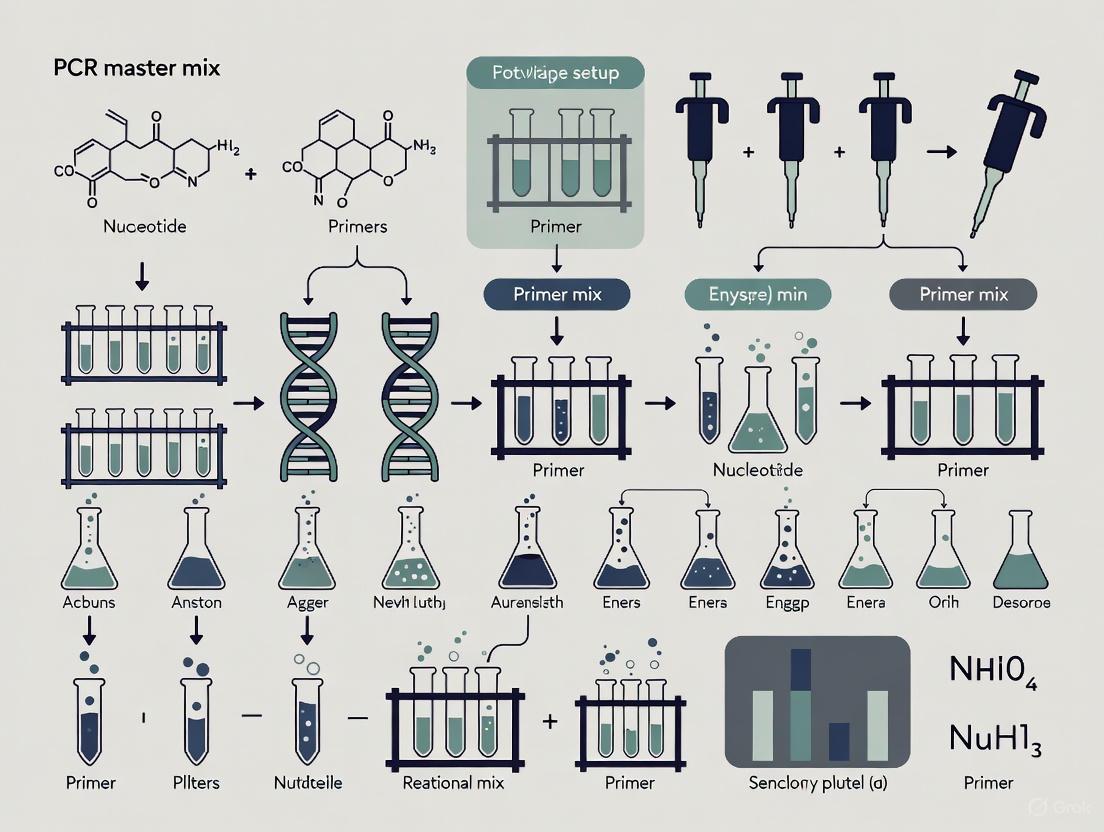
This guide provides researchers, scientists, and drug development professionals with a complete framework for establishing a robust and efficient PCR master mix protocol.
Mastering PCR Master Mix: A Comprehensive Protocol Guide for Reliable Amplification
Abstract
This guide provides researchers, scientists, and drug development professionals with a complete framework for establishing a robust and efficient PCR master mix protocol. It covers foundational principles, from defining core components and their functions to advanced methodological setup for diverse applications like high-throughput screening and diagnostics. The article delivers a systematic troubleshooting methodology to resolve common amplification issues and offers a strategic approach for protocol validation and selection of commercial systems. By integrating foundational knowledge with practical application and optimization strategies, this resource aims to enhance experimental reproducibility, save valuable time, and ensure data integrity in both research and clinical settings.
PCR Master Mix Fundamentals: Core Components and Principles for Efficient Amplification
What is a PCR Master Mix? Defining the Premixed Solution and Its Core Advantages
A PCR master mix is a pre-made, ready-to-use solution that contains all the essential reagents and components required to run a polymerase chain reaction (PCR) assay, except for the template DNA and gene-specific primers [1] [2]. This premixed solution is a cornerstone of modern molecular biology, designed to streamline the PCR setup process and enhance the reliability of amplification results. By providing a standardized blend of critical components, master mixes ensure that reactions are consistent, reproducible, and optimized for performance, thereby reducing procedural errors and saving valuable laboratory time [3].
Master mixes are foundational to a vast array of molecular biology and biotech experiments. Their applications extend to cloning, sequencing, genotyping, nucleic acid synthesis, gene expression analysis, generation of next-generation sequencing (NGS) libraries, and mutagenesis [1]. They are particularly vital in high-throughput settings and routine diagnostics where consistency and speed are paramount.
Core Advantages of Using a Master Mix
Incorporating a PCR master mix into a laboratory workflow offers a spectrum of benefits that significantly improve the efficiency and outcome of PCR assays.
Enhanced Efficiency and Time-Saving: The premixed nature of the master mix eliminates the need to thaw, measure, and mix multiple individual reagents for each reaction [4] [5]. Researchers can prepare a single, large-volume master mix for an entire experiment, which is then aliquoted into individual reaction tubes. This process drastically reduces preparation time and pipetting steps [1] [6].
Improved Reproducibility and Consistency: Commercial PCR master mixes are manufactured under stringent quality control and analysis procedures, ensuring lot-to-lot consistency and reliability [1] [5]. This guarantees that the concentrations of all components are optimally balanced and consistent across different batches, leading to highly reproducible results [3].
Reduced Contamination and Pipetting Errors: Minimizing the number of pipetting steps directly reduces the risk of cross-contamination between samples, a critical concern in sensitive PCR applications [4]. It also lowers the probability of human error, such as forgetting a component or making incorrect volume calculations, which can lead to failed experiments [1] [6].
Optimized Assay Performance: Master mixes are formulated to provide superior speed, sensitivity, and specificity, even under stringent conditions or with challenging templates like high-GC content sequences [1]. Many commercial mixes include specialized enzymes, stabilizers, and enhancers that are optimized for robust amplification [7].
Simplified Logistics and Storage: Master mixes simplify reagent inventory management by consolidating multiple components into a single tube. Furthermore, some master mixes are designed for convenient storage. While liquid forms are typically stored at -20°C, lyophilized (freeze-dried) mixes can be stable at ambient temperatures for extended periods, simplifying transportation and storage, particularly in field or point-of-care settings [1] [8].
Composition of a Standard PCR Master Mix
A standard PCR master mix contains a carefully balanced combination of the following core components, each playing a critical role in the DNA amplification process.
Table 1: Core Components of a Standard PCR Master Mix
| Component | Standard Final Concentration | Function in the Reaction |
|---|---|---|
| Thermostable DNA Polymerase (e.g., Taq DNA Polymerase) | Varies (e.g., 1.25 Units/50 µL reaction) | Enzyme that synthesizes new DNA strands. |
| Reaction Buffer | 1X | Provides optimal ionic environment and pH for polymerase activity. |
| Deoxynucleotides (dNTPs) | 0.2 mM each | Building blocks (dATP, dGTP, dTTP, dCTP) for new DNA synthesis. |
| Magnesium Chloride (MgCl₂) | 1.5 mM | Essential cofactor for DNA polymerase activity; concentration can critically affect specificity and yield [9]. |
| Stabilizers and Enhancers | Varies | Improves efficiency, specificity, and amplification of difficult templates (e.g., GC-rich regions). |
To this premixed solution, the user must add only three elements: the template DNA, the forward and reverse primers, and nuclease-free water to achieve the final desired reaction volume [1] [2]. A typical 50 µL reaction using a 2X concentrated master mix would consist of 25 µL of the master mix, plus primers, template, and water.
Types of PCR Master Mixes
To cater to diverse experimental needs, several specialized types of PCR master mixes have been developed. The table below summarizes the key features of common master mix types.
Table 2: Types of PCR Master Mixes and Their Applications
| Master Mix Type | Key Features | Primary Applications |
|---|---|---|
| Routine PCR Master Mix | Often based on standard Taq polymerase; suitable for amplifying DNA fragments up to 3-5 kb [4]. | General purpose amplification, colony PCR, DNA fingerprinting. |
| Hot Start PCR Master Mix | Polymerase is inactivated at room temperature (via antibodies, chemicals, or aptamers), preventing non-specific amplification before the initial denaturation step [8]. | Multiplex PCR, assays requiring high specificity, reducing primer-dimer formation [1]. |
| High-Fidelity PCR Master Mix | Contains a blend of polymerases with proofreading (3'→5' exonuclease) activity, resulting in a very low error rate [1] [4]. | Cloning, sequencing, mutagenesis, and any application where sequence accuracy is critical. |
| Real-time qPCR Master Mix | Optimized for real-time detection; often includes a reference dye (e.g., ROX) and may be pre-mixed with SYBR Green dye or be compatible with fluorogenic probes [1] [8]. | Gene expression analysis (qPCR), viral load quantification, genotyping. |
| Specialized Formulations | Designed with specific additives (e.g., trehalose) to amplify challenging templates like GC-rich regions, long fragments (>5 kb), or directly from crude samples [7] [9] [10]. | Amplification of complex templates, direct PCR from blood or cells. |
Experimental Protocol: Setting Up a PCR Reaction
The following workflow and detailed protocol outline the standard procedure for setting up a PCR reaction using a master mix.
Step-by-Step Procedure
Calculation and Preparation:
- Determine the total number of PCR reactions, including positive and negative controls.
- Calculate the total volume of master mix needed. It is critical to prepare a surplus (e.g., one additional reaction's volume) to account for pipetting losses and ensure all reactions have sufficient volume [6].
- Thaw the 2X PCR master mix, primers, and template DNA on ice or in a refrigerator. Gently vortex each component after thawing and briefly centrifuge to collect the contents at the bottom of the tube [6].
Master Mix Assembly:
- In a single, sterile microcentrifuge tube, combine the components in the following order for a single 50 µL reaction to minimize contamination and ensure proper mixing [7]:
- Nuclease-free water (to a final vol. of 50 µL)
- 2X PCR Master Mix (25 µL)
- Forward Primer (10 µM stock, e.g., 1-2 µL for a 0.4-0.5 µM final concentration) [7]
- Reverse Primer (10 µM stock, e.g., 1-2 µL for a 0.4-0.5 µM final concentration)
- Mix the combined master mix thoroughly by pipetting up and down several times or by gentle vortexing, followed by a brief centrifugation.
- In a single, sterile microcentrifuge tube, combine the components in the following order for a single 50 µL reaction to minimize contamination and ensure proper mixing [7]:
Aliquoting and Template Addition:
- Dispense the appropriate volume of the master mix into each PCR tube or well.
- Add the required amount of template DNA to each reaction. To prevent contamination, use dedicated pipettes and filter tips. It is good practice to add the template directly to the liquid master mix or onto the wall of the tube [6].
- Securely cap the PCR tubes or seal the plate. Centrifuge the reactions briefly to collect all liquid at the bottom and eliminate air bubbles.
Amplification:
- Place the tubes or plate in the thermal cycler and initiate the appropriate PCR program. Standard cycling conditions often include:
- Initial Denaturation: 94-98°C for 1-2 minutes.
- Cycling (25-40 cycles):
- Final Extension: 68-72°C for 5-10 minutes.
- Hold: 4-10°C.
- Place the tubes or plate in the thermal cycler and initiate the appropriate PCR program. Standard cycling conditions often include:
The Scientist's Toolkit: Essential Reagent Solutions
The following table details key reagents and materials essential for successfully executing PCR experiments with a master mix.
Table 3: Essential Reagents and Materials for PCR Setup
| Item | Function/Description |
|---|---|
| 2X PCR Master Mix | Premixed solution containing DNA polymerase, dNTPs, Mg²⁺, and reaction buffer; the core of the reaction [1] [3]. |
| Template DNA | The DNA sample containing the target sequence to be amplified; quality and quantity are critical for success [7] [9]. |
| Oligonucleotide Primers | Short, single-stranded DNA sequences that are complementary to the 3' ends of the target DNA; they define the region to be amplified. |
| Nuclease-Free Water | Sterile, purified water free of nucleases; used to bring the reaction to its final volume without degrading the components. |
| Positive Control Template | A DNA sample known to amplify with the chosen primers; used to verify that the PCR reaction worked correctly. |
| Negative Control (No-Template Control, NTC) | A reaction where template DNA is replaced with nuclease-free water; used to detect contamination in reagents [1] [3]. |
| PCR Tubes/Plates | Thin-walled labware optimized for efficient heat transfer in thermal cyclers. |
| Pipettes and Filter Tips | Accurate pipettes and aerosol-resistant filter tips are essential for precise liquid handling and preventing contamination [6]. |
The Polymerase Chain Reaction (PCR) is a cornerstone technique in molecular biology, enabling the exponential amplification of specific DNA sequences from minimal starting material [11]. A PCR master mix is a pre-formulated, batch mixture of all the essential reagents required for the DNA amplification process, optimized to achieve reliable and consistent results [12] [13]. The use of a master mix simplifies workflow, reduces pipetting steps, minimizes human error and contamination risk, and is ideal for high-throughput applications [13]. At its core, a standard master mix contains four critical components: a thermostable DNA polymerase (typically Taq polymerase), deoxynucleotide triphosphates (dNTPs), magnesium chloride (MgCl₂), and a buffer system [12] [13]. Understanding the role and optimal conditions for each of these components is fundamental to setting up a robust PCR master mix protocol, which forms the thesis of this application note.
Essential Components and Their Functions
Taq Polymerase: The Engine of Amplification
Taq DNA Polymerase is a thermostable enzyme isolated from the thermophilic bacterium Thermus aquaticus [14]. Its ability to withstand the high temperatures required during PCR, particularly the 95°C denaturation step, is what makes it indispensable for the reaction [14] [15].
- Function: Taq polymerase is the enzyme that synthesizes new DNA strands. It catalyzes the addition of nucleotides to the 3' end of a primer that is annealed to a DNA template, thereby extending the new strand in the 5' to 3' direction [12] [16].
- Key Properties: Its optimum temperature for activity is 70-75°C, and it has a high amplification capacity, adding approximately 150 nucleotides per second at its optimal temperature [14] [15]. A critical drawback of Taq polymerase is its lack of 3' to 5' exonuclease proofreading activity, resulting in a relatively low replication fidelity with an error rate of approximately 1 in 9,000 nucleotides [14].
Deoxynucleotide Triphosphates (dNTPs): The Building Blocks
dNTPs are the foundational monomers required for the de novo synthesis of DNA strands [17]. The term dNTPs collectively refers to four nucleotides: dATP, dCTP, dGTP, and dTTP [17].
- Function: During the extension phase of PCR, Taq polymerase incorporates these nucleotides into the growing DNA chain, complementary to the template strand [15] [17]. This process doubles the amount of target DNA with each successful PCR cycle.
- Key Properties: The four dNTPs are typically added to the PCR reaction in equimolar amounts to ensure balanced and efficient base incorporation [16]. The recommended final concentration for each dNTP is generally 0.2 mM, though this can be adjusted for specific applications [16]. Lower concentrations can increase specificity, while higher concentrations may inhibit the reaction [18].
Magnesium Chloride (MgCl₂): The Essential Cofactor
Magnesium Chloride (MgCl₂) is a critical cofactor for Taq polymerase activity and is one of the most important parameters requiring optimization in a PCR [19] [20].
- Function: The Mg²⁺ ion serves two primary roles:
- Polymerase Cofactor: It is essential for the catalytic activity of Taq polymerase. The ion binds to the dNTP, facilitating the formation of a phosphodiester bond with the 3' OH group of the preceding nucleotide [20].
- Primer-Template Stability: It stabilizes the interaction between the primer and the template DNA by neutralizing the negative charges on the phosphate backbones of the DNA strands, reducing electrostatic repulsion and facilitating proper annealing [20].
- Key Properties: The optimal concentration range for MgCl₂ in PCR is typically between 1.5 mM and 3.0 mM [19]. This concentration directly influences the reaction's melting temperature (Tm); every 0.5 mM increase in MgCl₂ raises the Tm by approximately 1.2°C [19]. Template complexity also affects the optimal requirement, with genomic DNA often needing higher concentrations than simpler templates like plasmids [19].
Buffer: Maintaining the Optimal Environment
The PCR buffer provides the stable chemical environment necessary for the reaction to proceed efficiently and for Taq polymerase to function correctly [18].
- Function: The buffer's main role is to maintain a stable pH, usually around 8.3, throughout the PCR process [18]. A stable pH is crucial for enzyme activity, primer annealing, and DNA denaturation.
- Key Components:
- Tris-HCl: Provides the buffering capacity to resist pH changes.
- Potassium Chloride (KCl): Promotes the annealing of primers to the template DNA by stabilizing the primer-template duplex. The final reaction concentration is generally between 35-100 mM [18].
Table 1: Quantitative Overview of Core PCR Master Mix Components
| Component | Final Concentration Range | Optimal Concentration | Primary Function |
|---|---|---|---|
| Taq Polymerase | 1–2 units/50 µL reaction [16] | Protocol-dependent | DNA strand elongation [12] |
| dNTPs (each) | 20–200 µM [18] | 200 µM [16] | DNA synthesis building blocks [12] |
| MgCl₂ | 1.0–5.0 mM [18] | 1.5–3.0 mM [19] | DNA polymerase cofactor & primer annealing [20] |
| KCl | 35–100 mM [18] | ~50 mM | Stabilizes primer-template binding [18] |
Advanced Optimization and Troubleshooting
Component Interdependence and Optimization
The components of a PCR master mix do not function in isolation; their activities are highly interdependent. The most critical relationship is between MgCl₂ and dNTPs. Since dNTPs can chelate Mg²⁺ ions, high dNTP concentrations can effectively reduce the amount of free Mg²⁺ available for Taq polymerase, thereby inhibiting the reaction [16]. Consequently, the MgCl₂ concentration must be optimized relative to the total dNTP concentration in the reaction. Furthermore, the primer annealing temperature is directly influenced by the Mg²⁺ concentration, as it affects the melting temperature (Tm) of the primer-template duplex [19]. For challenging templates, such as those with high GC content, specific additives can be incorporated into the master mix to improve yield and specificity.
Table 2: Common PCR Additives and Enhancers
| Additive | Common Concentration | Mechanism of Action | Typical Application |
|---|---|---|---|
| DMSO | 1–10% (often <2%) [18] | Disrupts base pairing, reduces DNA secondary structures, lowers Tm [18] | GC-rich templates (>60% GC) [18] |
| Betaine | 0.5–2.5 M [18] | Reduces DNA Tm dependence on GC content, eliminates secondary structures [18] | GC-rich templates, often used with DMSO [18] |
| BSA | Up to 0.8 mg/mL [18] | Binds to inhibitors present in the DNA sample (e.g., from feces, humic acids) [18] | Crude DNA extracts, presence of PCR inhibitors [18] |
| Formamide | 1–10% (often <5%) [18] | Destabilizes DNA double helix, increases stringency of primer annealing [18] | Improves amplification efficiency and specificity [18] |
Protocol for MgCl₂ Concentration Optimization
Objective: To empirically determine the optimal MgCl₂ concentration for a specific PCR assay. Background: The optimal MgCl₂ concentration can vary based on the template DNA, primer sequence, and specific Taq polymerase used. This protocol outlines a method for testing a range of MgCl₂ concentrations [19] [20].
Materials:
- Nuclease-free water
- 2x PCR Master Mix (without MgCl₂ or with a known, adjustable concentration)
- 25 mM MgCl₂ stock solution
- Template DNA
- Forward and Reverse Primers
- PCR tubes or plates
- Thermal cycler
Method:
- Prepare a Master Mix containing all standard components except MgCl₂ and template DNA. Calculate volumes for n+1 reactions to account for pipetting error.
- Aliquot the master mix into 6 different PCR tubes.
- Add the 25 mM MgCl₂ stock to each tube to achieve the following final concentrations in the 50 µL reaction: 1.0 mM, 1.5 mM, 2.0 mM, 2.5 mM, 3.0 mM, and 3.5 mM.
- Add template DNA and nuclease-free water to each tube to the final volume.
- Run the PCR using the standard thermal cycling conditions for your assay.
- Analyze the results using agarose gel electrophoresis. The optimal condition will show a strong, specific amplicon band with the absence of non-specific bands or primer-dimer.
Troubleshooting:
- No amplification or weak band across all concentrations: Check primer and template quality. Consider increasing the number of PCR cycles or reviewing the annealing temperature.
- Non-specific amplification (multiple bands) at higher MgCl₂ concentrations: The optimal MgCl₂ is likely at a lower concentration within the tested range. The presence of non-specific bands indicates reduced primer annealing stringency [20].
- Smearing on the gel: This may indicate too much MgCl₂, leading to error-prone synthesis and non-specific binding [20].
Workflow and Reagent Solutions
The following diagram illustrates the logical workflow for preparing and utilizing a PCR master mix, from component assembly to data analysis.
PCR Master Mix Setup Workflow
The Scientist's Toolkit: Research Reagent Solutions
Table 3: Essential Reagents for PCR Master Mix Preparation
| Reagent / Solution | Function / Application Note |
|---|---|
| Hot Start Taq Polymerase | Engineered to reduce non-specific amplification and primer-dimer formation by remaining inactive until a high-temperature activation step is applied [13]. Ideal for multiplex PCR. |
| Proofreading DNA Polymerase | Enzymes like Pfu, which possess 3'→5' exonuclease activity, are used in combination with or as an alternative to Taq for high-fidelity amplification, crucial for cloning and sequencing [14]. |
| PCR-Grade dNTP Mix | A pre-mixed, HPLC-purified solution of all four dNTPs at neutral pH, ensuring equimolar concentration, high purity, and stability, which is vital for consistent amplification efficiency [17]. |
| MgCl₂ Stock Solution (25 mM) | A standardized, nuclease-free stock solution used for the precise optimization of magnesium concentration in the final PCR buffer [20]. |
| 10X PCR Buffer (without MgCl₂) | A concentrated buffer (typically Tris-HCl, KCl) at pH ~8.3, provided without MgCl₂ to allow for flexible and user-defined optimization of magnesium ion concentration [18]. |
| PCR Additives (DMSO, Betaine) | Pre-tested reagents used to modify nucleic acid melting behavior and are essential for amplifying difficult templates, such as those with high GC content [18]. |
| Nuclease-Free Water | A critical reagent certified to be free of nucleases and contaminants that could degrade the reaction components or inhibit the PCR [13]. |
In the realm of molecular biology, the polymerase chain reaction (PCR) is a foundational technique, but its reliability hinges on the precise assembly of multiple reaction components. Traditional PCR setup, requiring the individual thawing and pipetting of reagents such as DNA polymerase, dNTPs, and buffers, is a process fraught with opportunities for error [4]. Even minor pipetting inaccuracies can lead to significant experimental variability, false negatives, or contaminated reactions [4] [21]. The strategic adoption of PCR master mixes—pre-mixed, ready-to-use solutions of core PCR reagents—addresses these challenges directly. This application note, framed within broader thesis research on optimizing PCR protocols, delineates how master mixes serve as a critical tool for enhancing data integrity and operational efficiency in scientific and drug development workflows. By reducing manual handling steps, master mixes systematically minimize pipetting errors, conserve valuable researcher time, and ensure the high reproducibility demanded for rigorous research and diagnostic applications [4] [21] [22].
The Core Components and Mechanism of a Master Mix
A PCR master mix is a pre-formulated solution that consolidates the essential components for DNA amplification into a single, optimized mixture. This typically includes a thermostable DNA Polymerase, deoxynucleotides (dNTPs), magnesium chloride (MgCl2), and optimized reaction buffers [21] [22]. The fundamental strategy involves preparing a single, large-volume "master" mixture of these common components, which is then aliquoted into individual PCR tubes or plates. Researchers need only add the variable elements unique to each reaction—the template DNA and primers—along with any required PCR-grade water [21].
This streamlined workflow stands in stark contrast to the traditional method of individually adding each reagent to dozens or even thousands of reaction vessels. The mechanism by which a master mix improves reproducibility is simple yet profound: it eliminates tube-to-tube concentration variations that inevitably occur during manual pipetting. Since all reactions in an experiment derive from a single, homogeneous source of enzymes and reagents, the initial reaction conditions are standardized, leading to more consistent and reliable amplification outcomes [22]. Commercial master mixes are also subject to rigorous quality control, ensuring high performance and lot-to-lot consistency that is difficult to achieve with lab-prepared reagent stocks [22].
Quantitative Benefits: Error Reduction and Time Savings
The transition from a traditional reagent setup to a master mix protocol yields significant, quantifiable benefits in error reduction and time efficiency. The primary advantage is a drastic reduction in pipetting steps, which directly correlates to a lower probability of human error and cross-contamination [4] [21].
Table 1: Pipetting Step Comparison for a 96-Reaction PCR Plate
| Component | Traditional Method | Master Mix Method |
|---|---|---|
| Water | 96 additions | 0 (pre-mixed) |
| Buffer | 96 additions | 0 (pre-mixed) |
| dNTPs | 96 additions | 0 (pre-mixed) |
| Enzyme | 96 additions | 0 (pre-mixed) |
| Master Mix | N/A | 96 additions |
| Primers | 96 additions | 96 additions |
| Template | 96 additions | 96 additions |
| Total Pipetting Steps | 576 | 288 |
As illustrated in Table 1, using a master mix cuts the total number of pipetting operations by 50%, from 576 to 288 for a single 96-well plate [4] [21]. This reduction is a powerful risk mitigation strategy. Fewer pipetting events mean fewer opportunities for pipetting mistakes, which can cause experimental error, and a lower risk of contaminating the amplification reaction with foreign DNA or nucleases [4]. For larger-scale experiments involving thousands of reactions, the risk reduction is even more substantial [21].
The impact on laboratory efficiency is equally impressive. The consolidation of reagents saves considerable time during setup [22]. This efficiency gain is not merely about moving faster; it reduces hands-on time, freeing highly skilled researchers to focus on more complex analytical tasks. Furthermore, many commercial master mixes are designed for convenient storage (e.g., at +2 to +8°C), allowing for immediate use without time-consuming freezing and thawing cycles that can compromise enzyme activity [4].
Table 2: Strategic Benefits of Implementing a Master Mix Protocol
| Strategic Goal | Traditional Method | Master Mix Method | Impact |
|---|---|---|---|
| Data Integrity | High risk of tube-to-tube variation | Highly reproducible initial conditions | Improved reliability of results |
| Operational Efficiency | Time-consuming setup | Rapid, streamlined workflow | Saved personnel time and cost |
| Risk Mitigation | High contamination risk; manual errors | Minimal handling; reduced error risk | Fewer failed experiments |
| Process Scalability | Cumbersome for high-throughput | Ideal for automation & high-throughput | Supports scalable R&D operations |
Detailed Experimental Protocols
Protocol: Standard PCR Setup Using a Commercial Master Mix
This protocol is designed for amplifying a specific DNA target using a 2X concentrated ready-to-use master mix, suitable for routine applications like genotyping or clone verification [4] [21].
Research Reagent Solutions:
- Master Mix: A 2X concentrated solution containing Taq DNA Polymerase, dNTPs, MgCl₂, and reaction buffers [4] [21].
- Template DNA: Purified genomic DNA or plasmid DNA.
- Primers: Forward and reverse primers, resuspended in nuclease-free water.
- Nuclease-free Water: PCR-grade water to bring the reaction to its final volume.
Methodology:
- Thaw and Mix: Thaw the master mix, primers, and template on ice or a cooling block. Gently vortex the master mix and primers, then briefly centrifuge to collect the contents at the bottom of the tube.
- Calculate and Prepare Master Mix: Calculate the total volume required for all reactions, including an extra 10% to account for pipetting loss. For a single 50 µL reaction, combine the following in a sterile microcentrifuge tube:
- 25 µL of 2X Master Mix
- 1-2 µL of Forward Primer (10 µM stock)
- 1-2 µL of Reverse Primer (10 µM stock)
- X µL of Template DNA (e.g., 100-500 ng genomic DNA)
- Nuclease-free water to a final volume of 50 µL
- Mix and Aliquot: Gently mix the master solution by pipetting up and down. Aliquot the appropriate volume into each PCR tube or well.
- Run PCR: Place the reactions in a thermal cycler and initiate the pre-optimized cycling program.
- Controls: Always include a no-template control (NTC, with water replacing template DNA) to check for contamination and a positive control to confirm reaction efficiency.
Protocol: Direct PCR from Crude Samples Using a Specialized Master Mix
This protocol is optimized for applications like rapid mouse genotyping or bacterial detection, where DNA purification is bypassed, saving significant time and resources [23].
Research Reagent Solutions:
- Direct PCR Master Mix: Formulated with a robust, inhibitor-tolerant DNA polymerase (e.g., Platinum II Taq Hot-Start) and a buffer system designed for crude samples [23].
- Lysis Buffer & Proteinase K: Supplied with the master mix for optional sample pre-processing.
- Sample: Mouse tail or ear clip, single bacterial colony, etc.
Methodology: Direct Protocol (for simple samples):
- Prepare the master mix as in section 4.1, but use the inhibitor-tolerant direct PCR master mix.
- Add a small piece of tissue (e.g., a 1-2 mm mouse ear punch) directly into the PCR mix.
- Run the PCR with a protocol that includes an extended initial denaturation step (e.g., 5-10 minutes at 95°C) to lyse the cells and inactivate nucleases.
Lysis Protocol (for complex samples or for archiving):
- Incubate the sample in a provided lysis buffer with Proteinase K at 55-65°C for 15-60 minutes.
- Heat-inactivate the Proteinase K at 95°C for 5-10 minutes.
- Use 1-5 µL of this crude lysate as the "template" in a standard PCR reaction set up with the direct PCR master mix [23].
Application Scope in Research and Development
The utility of master mixes extends across the entire spectrum of molecular biology and diagnostics. Their consistency and reliability make them indispensable in the following applications:
- Pathogen Detection and Infectious Disease Diagnostics: Master mixes enabled high-volume, accurate testing during the COVID-19 pandemic. Their use is critical for the rapid identification of bacteria and viruses in clinical and public health labs, with metrics focused on high sensitivity and specificity [24] [25].
- Genetic and Genomic Research: In gene expression studies, mutation analysis, and cloning, the consistency of master mixes ensures reproducible results. High-fidelity master mixes are particularly valued in sequencing and gene therapy development for their low error rates [24] [26].
- Personalized Medicine and Pharmacogenomics: Precision medicine relies on genetic profiling to tailor treatments. Master mixes are essential for amplifying DNA segments linked to drug response (e.g., companion diagnostics for cancer therapies), where accuracy and compliance with regulatory standards are paramount [24].
- Agricultural Biotechnology: PCR is used for trait identification and validation in genetically modified crops. Master mixes streamline these processes, enabling high-throughput, cost-effective screening for specific genetic markers [24].
- Forensic Analysis: Law enforcement agencies depend on the sensitivity of master mixes for DNA fingerprinting from minute samples. The robustness of these mixes reduces contamination risk, which is crucial in a legal context [24].
Genotyping Workflow
Figure 1: Streamlined genotyping workflow using a direct PCR master mix, eliminating DNA purification.
Strategic Market Outlook and Product Selection
The PCR master mixes market is dynamic and innovative, reflecting the technique's central role in life sciences. The global market is projected to reach approximately $1.8 billion by 2025, growing at a robust compound annual growth rate [26]. This growth is fueled by rising demand in molecular diagnostics, genetic research, and personalized medicine [26] [27].
Key trends shaping the market include the development of multiplex master mixes for simultaneous detection of multiple targets, the push for room-temperature stable (including lyophilized) formulations for easier transport and storage, and the integration of master mixes with automated laboratory workflows [26] [27]. The demand for hot-start master mixes, which prevent non-specific amplification at low temperatures, has become standard for many sensitive applications [21] [26].
When selecting a master mix, researchers must consider their specific application needs:
- For Routine Amplification: A standard master mix like Roche's PCR Master or Sigma's ReadyMix Taq is sufficient [4] [21].
- For Cloning or Sequencing: A high-fidelity master mix containing a proofreading enzyme blend (e.g., Roche's High Fidelity PCR Master) is essential to ensure accurate DNA replication [4] [21].
- For Crude Samples: A specialized direct PCR master mix with high inhibitor tolerance, such as Thermo Fisher's Platinum Direct PCR Universal Master Mix, is required [23].
- For Quantitative PCR (qPCR): Choose a master mix optimized for real-time instruments, either SYBR Green- or probe-based, and ensure compatibility with your cycler (e.g., with or without ROX dye) [21] [25].
Decision Logic
Figure 2: A logical framework for selecting the appropriate type of PCR master mix based on experimental requirements.
In the realm of molecular biology, the polymerase chain reaction (PCR) stands as a fundamental technique for amplifying nucleic acid sequences. The core of any PCR experiment lies in its reaction setup, where the master mix serves as the biochemical engine driving amplification. For researchers, scientists, and drug development professionals, selecting the appropriate master mix formulation is a critical decision that directly impacts experimental success, reproducibility, and data integrity. This application note provides a comprehensive technical overview of the primary master mix types—Standard, Hot-Start, High-Fidelity, and RT-PCR formulations—framed within the broader context of establishing a robust PCR master mix protocol research framework. We detail their distinct mechanisms, optimal applications, and provide validated experimental protocols to guide your selection process, empowering your research with precise and reliable nucleic acid amplification.
PCR Master Mix Fundamentals and Market Context
A PCR master mix is a pre-mixed, ready-to-use solution containing the core components necessary for the polymerase chain reaction, typically including a thermostable DNA polymerase, deoxynucleotide triphosphates (dNTPs), magnesium ions in an optimized reaction buffer, and sometimes stabilizers or enhancers [28] [29]. The use of a master mix ensures reaction consistency, reduces setup time and pipetting errors, and enhances reproducibility across multiple samples [29].
The PCR master mix market reflects the technique's indispensable role in modern life sciences, with an estimated market size of $2.5 billion in 2025 and a projected compound annual growth rate (CAGR) of 8% from 2025 to 2033 [27]. This robust growth is driven by increasing demand for rapid and accurate diagnostic testing, expanding applications in genetic research, and the rising prevalence of infectious diseases [27]. The market is characterized by a diverse range of products from major players like Roche, Thermo Fisher Scientific, and Qiagen, who continuously drive innovation through novel formulations and strategic partnerships [27].
Table 1: Global PCR Master Mix Market Overview
| Feature | Detail |
|---|---|
| Estimated Market Size (2025) | $2.5 Billion [27] |
| Projected Market Value (2033) | ~$4.5 Billion [27] |
| CAGR (2025-2033) | 8% [27] |
| Primary Growth Drivers | Demand for rapid diagnostics, infectious disease prevalence, advancements in personalized medicine [27] |
| Leading Market Players | Roche, Thermo Fisher Scientific, Bio-Rad, Promega, Qiagen, New England Biolabs, Takara Bio [27] |
Master Mix Types: Mechanisms and Applications
Standard PCR Master Mixes
Standard master mixes form the foundation of endpoint PCR applications. They typically contain a Taq DNA polymerase, which is efficient and robust for routine amplification of DNA templates. The mechanism follows the basic PCR principle: denaturation of double-stranded DNA at high temperatures (~95°C), primer annealing at a lower target-specific temperature (~50-65°C), and primer extension at ~72°C [28] [29]. These mixes are ideal for applications where the sole requirement is to generate a sufficient amount of a specific DNA fragment for downstream analysis like gel electrophoresis, cloning, or sequencing.
A key challenge in standard PCR is the amplification of guanine/cytosine-rich (GC-rich) templates. GC-rich sequences form stable secondary structures and are difficult to denature completely. To overcome this, additives like DMSO, glycerol, or betaine can be incorporated into the reaction. These reagents help disrupt secondary structures, facilitating smoother polymerase progression [28] [29] [30].
Hot-Start PCR Master Mixes
Hot-start master mixes are engineered to prevent non-specific amplification and primer-dimer formation that can occur during reaction setup at room temperature [30]. This is achieved by incorporating an inhibitor—such as an antibody, affibody, or aptamer—that binds to and inactivates the DNA polymerase until a high-temperature activation step (typically >90°C) is applied at the beginning of the thermal cycling [28] [29] [30]. The following diagram illustrates the mechanism of antibody-based hot-start PCR.
This technology is crucial for applications requiring high specificity, such as multiplex PCR (amplifying multiple targets in a single reaction), cloning, and diagnostic assays [31] [30]. The global hot-start PCR master mix market is expanding rapidly, with innovations focusing on lyophilized formats for point-of-care testing and formulations compatible with fast-cycling protocols [31].
High-Fidelity PCR Master Mixes
For applications where sequence accuracy is paramount, high-fidelity master mixes are essential. These mixes utilize proofreading DNA polymerases (e.g., Pfu), which possess 3' to 5' exonuclease activity [28] [29]. As the DNA is synthesized, the proofreading enzyme detects and removes misincorporated nucleotides from the 3' end of the growing strand before continuing with DNA synthesis. This results in significantly lower error rates compared to standard Taq polymerase.
High-fidelity PCR is indispensable for cloning and expression studies, site-directed mutagenesis, next-generation sequencing library preparation, and any downstream application where even a single base pair error can lead to non-functional proteins or erroneous data [28]. These mixes are often blends of polymerases optimized to combine high processivity (speed and ability to amplify long fragments) with superior accuracy.
RT-PCR Master Mixes
Reverse Transcription PCR (RT-PCR) master mixes are designed for amplifying RNA targets. They contain reverse transcriptase, an enzyme that converts RNA into complementary DNA (cDNA) in a first-step reaction [28] [29]. This cDNA then serves as the template for standard PCR amplification. The quality and purity of the input RNA are critical for the success of RT-PCR [28].
It is vital to distinguish between RT-PCR (Reverse Transcription PCR) and qPCR (Quantitative PCR, also known as real-time PCR). RT-PCR is an endpoint method that qualifies the presence of RNA, while qPCR quantifies the amount of DNA (or cDNA) in real-time during the amplification [29]. The term RT-qPCR refers to the combined process of reverse transcribing RNA to cDNA and then quantifying a specific target via qPCR [28] [29]. RT-PCR is primarily used for gene expression analysis, viral RNA detection, and RNA virus research.
Table 2: Comparative Analysis of PCR Master Mix Formulations
| Master Mix Type | Key Component | Primary Mechanism | Optimal Applications | Key Advantage |
|---|---|---|---|---|
| Standard | Taq DNA Polymerase | Basic thermal cycling: Denaturation, Annealing, Extension [28] | Routine amplification, colony PCR, genotyping | Cost-effective, robust for simple templates |
| Hot-Start | Antibody/Aptamer inhibited Polymerase | Polymerase activated only at high temperatures [30] | Multiplex PCR, diagnostics, cloning | Enhanced specificity, reduced primer-dimer |
| High-Fidelity | Proofreading Polymerase (e.g., Pfu) | 3'→5' exonuclease activity corrects errors [28] | Cloning, mutagenesis, NGS library prep | Very low error rate, high accuracy |
| RT-PCR | Reverse Transcriptase + DNA Polymerase | RNA is first transcribed to cDNA, then amplified [29] | Gene expression, viral RNA detection | Enables amplification from RNA templates |
Experimental Protocols and Workflow Design
Protocol 1: Hot-Start PCR for High-Specificity Amplification
This protocol is optimized for the amplification of a specific target from a complex template, such as genomic DNA, using a hot-start master mix.
Materials:
- Commercial Hot-Start PCR Master Mix (e.g., from Thermo Fisher Scientific, New England Biolabs, Qiagen)
- Template DNA (e.g., 10-100 ng genomic DNA)
- Forward and Reverse Primers (10 μM each)
- Nuclease-free water
- Thermal Cycler
Procedure:
- Reaction Setup (on ice): Thaw and gently vortex all reagents. Prepare a master mix for n+1 reactions to account for pipetting error.
- 12.5 μL: 2X Hot-Start Master Mix
- 1.0 μL: Forward Primer (10 μM)
- 1.0 μL: Reverse Primer (10 μM)
- 1.0 μL: Template DNA
- 9.5 μL: Nuclease-free Water
- Total Volume: 25.0 μL
Thermal Cycling: Load the reactions into a thermal cycler and run the following program:
- Initial Denaturation / Enzyme Activation: 95°C for 2-5 minutes (varies by master mix).
- Amplification (35-40 cycles):
- Denature: 95°C for 15-30 seconds.
- Anneal: Primer-specific temperature (e.g., 60°C) for 15-30 seconds.
- Extend: 72°C for 1 minute per kb of amplicon length.
- Final Extension: 72°C for 5-10 minutes.
- Hold: 4°C ∞.
Analysis: Analyze 5-10 μL of the PCR product by agarose gel electrophoresis.
Protocol 2: One-Step RT-qPCR for Gene Expression Analysis
This protocol uses a specialized master mix that combines reverse transcriptase and hot-start DNA polymerase for a single-tube, single-enzyme reaction, ideal for quantifying RNA expression levels.
Materials:
- One-Step RT-qPCR Master Mix (e.g., Luna Universal Probe One-Step Reaction Mix, AMPIGENE 1-Step Kits)
- RNA template (e.g., 1 pg - 1 μg total RNA)
- Gene-specific Primers and Probe (e.g., TaqMan)
- Nuclease-free water
- Real-time PCR Instrument
Procedure:
- Reaction Setup (on ice): Protect the master mix and RNA from light. Prepare reactions in a clear, optical 96-well plate.
- 10.0 μL: 2X One-Step RT-qPCR Master Mix
- 0.8 μL: Forward Primer (10 μM)
- 0.8 μL: Reverse Primer (10 μM)
- 0.4 μL: Probe (10 μM)
- 2.0 μL: RNA Template
- 6.0 μL: Nuclease-free Water
- Total Volume: 20.0 μL
Thermal Cycling and Fluorescence Detection: Seal the plate and run on a real-time PCR instrument.
- Reverse Transcription: 50°C for 10-15 minutes (if required by the kit).
- Initial Denaturation / Enzyme Activation: 95°C for 2 minutes.
- Amplification (40 cycles):
- Denature: 95°C for 5-15 seconds.
- Anneal/Extend & Acquire Fluorescence: 60°C for 30-60 seconds.
Data Analysis: Use the instrument's software to determine Cq values and generate standard curves for absolute quantification, or use the comparative ΔΔCq method for relative quantification.
The logical workflow for selecting and optimizing a PCR master mix protocol is summarized below.
Performance Optimization and Troubleshooting
Key Considerations for Master Mix Selection
Performance in PCR is highly dependent on matching the right master mix to the experimental question. A 2021 study systematically comparing seven commercial TaqMan master mixes for detecting porcine DNA highlighted that the limit of detection (LOD) and PCR efficiency can vary significantly depending on the master mix and real-time PCR platform used [32]. The LODs for the different mixes ranged from 0.5 to 5 pg per reaction, and non-specific amplification from related species was observed with some mixes [32]. This underscores the importance of empirical validation for critical applications.
Table 3: Master Mix Performance Comparison in a Specific Assay [32]
| Master Mix Manufacturer | Approximate LOD (pg/rxn) | PCR Efficiency (%) | Notes |
|---|---|---|---|
| Kogene Biotech | 0.5 | Not Specified | Reliable performance in this assay |
| Invitrogen | 0.5 | Not Specified | Reliable performance in this assay |
| Qiagen | 0.5 | Not Specified | Reliable performance in this assay |
| New England Biolabs | 0.5 | Not Specified | Reliable performance in this assay |
| Applied Biosystems | 0.5 - 5 | Not Specified | LOD varied by instrument platform |
| CancerROP | 0.5 - 5 | Not Specified | LOD varied by instrument platform |
| Takara | 5 | Not Specified | Less sensitive in this specific assay |
Advanced Techniques and Additives
Beyond selecting the base master mix, several advanced strategies can be employed to overcome specific challenges:
- Touchdown PCR: This method involves starting with an annealing temperature higher than the primer's Tm and gradually decreasing it in subsequent cycles. This promotes high specificity in the early cycles by preventing non-specific primer binding, which is then amplified in later cycles [30].
- GC-Rich Amplification: For difficult GC-rich templates, using master mixes specifically formulated with co-solvents like DMSO, betaine, or glycerol is recommended. These additives help denature stable secondary structures. Using a polymerase with high processivity is also beneficial [28] [30].
- Multiplex PCR: Successful amplification of multiple targets in a single reaction requires careful primer design and the use of a hot-start master mix to prevent primer-dimer artifacts. A buffer specifically formulated for multiplexing is often necessary to ensure balanced amplification of all targets [30].
The Scientist's Toolkit: Essential Research Reagent Solutions
Table 4: Key Reagents and Materials for PCR Master Mix Protocols
| Item | Function / Description | Example Products / Suppliers |
|---|---|---|
| Hot-Start DNA Polymerase | Core enzyme inhibited at room temperature to enhance specificity. | Platinum Taq (Thermo Fisher), Hot Start Taq (NEB) [30] |
| Proofreading Polymerase | High-fidelity enzyme with 3'→5' exonuclease activity for accurate amplification. | Pfu (Various suppliers) [28] |
| One-Step RT-qPCR Kit | Integrated mix for reverse transcription and quantitative PCR in a single tube. | Luna Probe One-Step (NEB), AMPIGENE 1-Step (Enzo) [28] |
| dNTP Mix | Building blocks (dATP, dCTP, dGTP, dTTP) for DNA synthesis. | Available from most molecular biology suppliers [28] |
| Optimized Buffer Systems | Provides optimal pH, ionic strength, and co-factors (like Mg²⁺) for polymerization. | Often proprietary and included in master mixes [27] [31] |
| PCR Additives (DMSO, Betaine) | Disrupt secondary structures in GC-rich templates to improve amplification efficiency. | Molecular biology grade [28] [30] |
| Nuclease-Free Water | Solvent free of RNases and DNases to prevent degradation of templates and reagents. | Various suppliers |
| Optical Tubes/Plates | Consumables for real-time PCR instruments that allow fluorescence detection. | Compatible with platforms from Bio-Rad, Applied Biosystems [32] |
Protocol Implementation: Step-by-Step Guide for Manual and Automated Master Mix Setup
In polymerase chain reaction (PCR) research, the precise preparation of the master mix is a fundamental step that significantly influences the success and reproducibility of experiments. A PCR master mix is a batch mixture of PCR reagents at optimal concentrations that can be prepared and divided among many PCR tubes or plates [33]. This approach minimizes pipetting errors, reduces the risk of contamination, saves time, and ensures unparalleled consistency across multiple reactions—a critical consideration for high-throughput applications and robust drug development research [6] [33]. This guide provides detailed methodologies and structured data to enable researchers to accurately calculate and prepare PCR master mixes, thereby enhancing experimental reliability.
Mastering the Calculations
The cornerstone of a successful PCR setup is the accurate calculation of each component's volume. Creating a calculation table ensures precision and prevents the wastage of valuable reagents.
Constructing a Calculation Table
The following table exemplifies a standard approach for calculating a single 50 µL reaction. The "Volume for Master Mix" column is determined by multiplying the single reaction volume by the total number of reactions (including any extra aliquots to account for pipetting loss) [6] [34].
Table 1: Example Calculation for a Single 50 µL PCR Reaction
| Reagent | Stock Concentration | Final Concentration (CF) | Dilution Factor (Stock Conc. / CF) | Volume for Single Reaction (µL) |
|---|---|---|---|---|
| Buffer | 10X | 1X | 10 | 5 µL |
| MgCl₂ | 25 mM | 1.5 mM | 16.67 | 3 µL |
| dNTPs | 10 mM | 0.2 mM | 50 | 1 µL |
| Forward Primer | 10 µM | 250 nM | 40 | 1.25 µL |
| Reverse Primer | 10 µM | 250 nM | 40 | 1.25 µL |
| Polymerase | 5 Units/µL | 1.25 Units | - | 0.25 µL |
| Template DNA | 1 µg/µL | - | - | 0.5 µL |
| PCR-grade water | - | - | - | 37.75 µL |
| Total Volume | 50 µL |
The dilution factor is calculated by dividing the stock concentration by the desired final concentration. The volume for a single reaction is then found by dividing the total reaction volume by this dilution factor [6]. For the polymerase, the volume is calculated based on the unit activity: (Desired Units) / (Stock Unit Concentration) = Volume (e.g., 1.25 Units / 5 Units/µL = 0.25 µL) [6]. The water volume is the value that brings the final reaction to the desired total volume.
Determining Reaction Scale and Template Volume
A critical step is scaling the master mix for multiple reactions. The total number of reactions should include:
- The number of experimental samples.
- Any positive or negative controls.
- An extra aliquot (e.g., one additional reaction) to compensate for volume loss due to evaporation, adherence to tube walls, and pipetting inaccuracies [6] [34].
The amount of template DNA required varies significantly based on the source and complexity, as detailed in the table below.
Table 2: Guidelines for DNA Template Input [35]
| Template Type | Recommended Amount | Rationale |
|---|---|---|
| Human Genomic DNA | 10 ng - 500 ng | ~30-100 ng is typically sufficient for most targets; 10 ng for high-copy genes. 1 µg contains ~3.04 x 10⁵ molecules. |
| E. coli Genomic DNA | 100 pg - 1 ng | 1 µg contains ~2 x 10⁸ molecules. |
| Lambda DNA | ~100 pg | 1 µg contains ~1.9 x 10¹⁰ molecules. |
| Plasmid or Viral DNA | 1 pg - 10 ng | Dependent on copy number. |
| cDNA | As little as 10 pg (RNA equivalent) | Dependent on the abundance of the target transcript. |
Detailed Experimental Protocol
Materials Required
Research Reagent Solutions:
- Thermostable DNA Polymerase (e.g., Taq polymerase): Enzyme that synthesizes new DNA strands.
- 10X PCR Buffer: Provides optimal pH and salt conditions for polymerase activity.
- MgCl₂ Solution: Essential cofactor for DNA polymerase; concentration often requires optimization [35].
- dNTP Mix: A solution of deoxyribonucleotide triphosphates (dATP, dCTP, dGTP, dTTP), the building blocks for DNA synthesis.
- Primers: Forward and reverse primers, specific to the target DNA sequence.
- Nuclease-free Water: To bring the reaction to the final volume without degrading components.
- Template DNA: The DNA sample containing the target sequence to be amplified.
Workflow Diagram
The following diagram outlines the complete workflow for preparing a PCR master mix, from calculations to loading the thermocycler.
Step-by-Step Procedure
Calculation and Labeling: Calculate the volumes for all components for the total number of reactions (including the extra aliquot) as detailed in the calculation section. Use a fine-tip marker to label all PCR tubes with sample identifiers [34].
Master Mix Assembly: In a 1.5 mL microcentrifuge tube, combine all components except for the template DNA. To minimize cost in case of an error, add reagents in order of increasing expense, typically starting with water, buffer, dNTPs, primers, and finally, the polymerase [6].
Mixing and Aliquoting: Vortex the master mix lightly and tap the tube to ensure all components are thoroughly mixed. Avoid introducing bubbles. Pipette the appropriate volume of master mix into each pre-labeled PCR tube [34]. Using an electronic pipette with a repeat dispense mode can greatly improve speed and accuracy for this step [6].
Adding Template DNA: Add the appropriate volume of each template DNA to its respective tube. For highly viscous samples, dispense the DNA onto the wall of the tube. Change pipette tips between every sample to prevent cross-contamination [6].
Final Preparation: Close the PCR tube lids tightly. Collect all tubes in a mini centrifuge adapter and spin them briefly (∼5 seconds) to ensure all liquid is at the bottom of the tube and no droplets remain on the walls [34]. Keep the reactions on ice until ready to load into the thermocycler.
Optimization and Troubleshooting
Critical Optimization Parameters
- Annealing Temperature: This is often the most critical parameter. The temperature should be optimized based on the primer Tm. Too low a temperature causes mispriming and nonspecific amplification, while too high a temperature reduces yield [35].
- Mg²⁺ Concentration: Magnesium is an essential cofactor. Insufficient Mg²⁺ results in low yield, while excess can reduce fidelity and increase nonspecific binding. The optimal concentration (typically 1-4 mM) depends on the polymerase and should be optimized, especially for novel assays [35].
- Cycle Conditions: Follow enzyme-specific guidelines for denaturation, annealing, and extension times. For standard enzymes, an extension time of 1 min/kb is common, but high-speed polymerases may require only 5-20 sec/kb [35].
Advanced Scenarios
- GC-Rich Templates: For templates with >65% GC content, use a higher denaturation temperature (e.g., 98°C), shorter annealing times, and primers with a higher Tm. The addition of 2.5-5% DMSO or using a polymerase optimized for GC-rich templates can dramatically improve results [35].
- Long-Range PCR: Amplification of long genomic targets (>4 kb) requires high-quality, intact DNA template, minimized denaturation time to reduce depurination, and specialized polymerases (e.g., PrimeSTAR GXL DNA Polymerase) [35].
- Two-Step vs. Three-Step PCR: A two-step protocol (combining annealing and extension) is suitable when the primer Tm is close to 72°C. A three-step protocol (separate annealing and extension) is recommended for shorter products or when primer Tm is lower [35].
Meticulous calculation and preparation of the PCR master mix are non-negotiable for obtaining reliable and reproducible amplification results. By adhering to the detailed calculations, structured protocols, and optimization strategies outlined in this guide, researchers and drug development professionals can standardize their workflows, enhance efficiency, and preempt common pitfalls. The consistent application of these practices ensures that PCR remains a robust and dependable cornerstone of molecular biology and diagnostic research.
In molecular biology, the reliability of experimental data, particularly in sensitive applications like polymerase chain reaction (PCR), is fundamentally dependent on the quality and consistency of the starting reagents. Proper handling of reagents—encompassing thawing, mixing, and aliquoting—is not merely a preliminary step but a critical determinant of experimental success. Inconsistent practices can introduce variability, degradation, and contamination, leading to failed reactions, irreproducible results, and costly delays in research and drug development pipelines. This protocol provides a detailed, stepwise guide to these essential pre-analytical procedures, framed within the context of preparing for PCR master mix experiments. Adherence to these practices ensures the integrity of enzymes, nucleotides, and buffers, thereby supporting the generation of robust and reliable amplification data.
The Scientist's Toolkit: Essential Materials & Reagents
The following table catalogues the essential materials required for the execution of this protocol. Ensuring the availability and quality of these items is a prerequisite for maintaining reagent stability and function.
Table 1: Essential Research Reagent Solutions and Materials
| Item | Function & Application |
|---|---|
| Fetal Bovine Serum (FBS) | A common component in cell culture media used to propagate cells for genomic DNA extraction; requires careful aliquoting to maintain growth factor integrity [36]. |
| PCR Master Mix, 2X | A premixed, ready-to-use solution containing Taq DNA Polymerase, dNTPs, MgCl₂, and reaction buffers for efficient PCR amplification [37]. |
| Cryoprotective Agent (e.g., DMSO) | Used in cryopreservation media to protect cells from ice crystal formation and damage during freezing and thawing cycles [38]. |
| DNase I Solution | An enzyme solution used to digest DNA and resolve cell clumping in thawed primary cell suspensions, preventing inaccurate cell counts or blockages [39]. |
| Trypan Blue | A vital dye used in cell counting procedures to distinguish viable cells (which exclude the dye) from non-viable cells (which take up the dye) [39]. |
| Sterile Cryogenic Vials | Sealed vials designed for the safe long-term storage of reagents and cell stocks at ultra-low temperatures (e.g., in liquid nitrogen) [38]. |
| Controlled-Rate Freezing Apparatus | A device to ensure a consistent, optimal freezing rate (approximately -1°C per minute) to maximize cell viability upon future thawing [38]. |
Thawing Protocol: Reactivating Frozen Reagents
The thawing process is a critical juncture where reagents are particularly vulnerable to degradation and shock. A rapid and controlled method is essential to restore functionality.
Materials
- Water bath, set to 37°C (or appropriate temperature as specified by the manufacturer)
- 70% ethanol or isopropanol for decontamination
- Personal Protective Equipment (PPE): lab coat, gloves, and safety glasses
- Sterile pipettes and tips
- Appropriate transport container (e.g., a 50 mL conical tube filled with warm medium for cell suspensions) [39]
- Dry ice or liquid nitrogen container for temporary holding [39]
Stepwise Thawing Procedure
- Preparation: Warm the appropriate medium or diluent in a 37°C water bath. Pre-label all necessary tubes and plates for the subsequent steps [39].
- Safe Retrieval: Remove the frozen vial from long-term storage. If not proceeding to thaw immediately, place it on dry ice or in a liquid nitrogen vapor phase to prevent partial thawing [39].
- Decontamination: Thoroughly wipe the outside of the vial with 70% ethanol or isopropanol to reduce the risk of introducing contamination into the water bath and culture hood [39].
- Rapid Thawing: Quickly thaw the vial by gently swirling it in a 37°C water bath. Do not vortex. Remove the vial when only a small ice crystal remains (typically 1-2 minutes). For sensitive reagents like primary cells, using an automated thawing system can ensure consistency and sterility [39].
- Final Decontamination: Wipe the vial again with 70% ethanol before placing it inside a biosafety cabinet or laminatic flow hood for all subsequent steps [39].
- Immediate Transfer: For cell suspensions, gently transfer the contents to a larger sterile tube (e.g., a 50 mL conical tube) using a pipette. Rinse the original vial with 1 mL of pre-warmed medium and add it dropwise to the cell suspension to recover all material [39].
Mixing Protocol: Achieving Homogeneity
Thawed reagents, especially complex mixtures like serum or cell suspensions, must be mixed thoroughly to ensure an even distribution of all components. Inadequate mixing is a common source of experimental variability.
Principles and Best Practices
- Complete Thawing: Ensure the reagent is fully thawed before mixing. The presence of ice crystals can create localized concentration gradients [36].
- Gentle Mixing: For cell suspensions, flick the tube or use a pipette to gently resuspend the pellet. Avoid vortexing, which can shear DNA, damage cells, or denature proteins [39].
- Verification of Homogeneity: For critical reagents like FBS, invert the bottle several times upon initial thawing to redissolve any precipitated components and ensure a homogenous solution before aliquoting [36].
Table 2: Troubleshooting Common Mixing and Thawing Issues
| Problem | Potential Cause | Recommended Solution |
|---|---|---|
| Low Cell Viability After Thawing | Slow or improper thawing technique; excessive DMSO exposure at room temperature. | Thaw rapidly as per protocol; work quickly to dilute or wash cells after thawing [39] [38]. |
| Reagent Clumping (e.g., cells) | Presence of DNA from lysed cells; proteins precipitating out of solution. | Add DNase I to cell suspensions (if not extracting nucleic acids); ensure complete and gentle mixing upon thawing [39]. |
| Inconsistent Experimental Results | Uneven distribution of key components in reagents like FBS due to inadequate mixing. | Fully thaw and mix the entire bottle thoroughly before aliquoting to eliminate nutrient gradients [36]. |
| Microbial Contamination | Non-sterile technique during thawing or mixing. | Strictly adhere to aseptic techniques; work in a biosafety cabinet; wipe vials with ethanol [39] [36]. |
Aliquotting Protocol: Preserving Reagent Quality
Aliquoting is a fundamental practice for preserving the long-term stability and functionality of reagents by minimizing repeated freeze-thaw cycles and exposure to variable conditions.
Materials
- Laminar flow hood (sterile working environment)
- Sterile, sealable containers (e.g., 0.5 mL, 1.5 mL microcentrifuge tubes, or 50 mL conical tubes)
- Permanent, ethanol-resistant marker or printed labels
- Sterile serological pipettes and pipette aid
- Pre-chilled freezer boxes or racks for temporary holding
Stepwise Aliquotting Procedure
- Workspace Preparation: Run the laminar flow hood for at least 15-30 minutes. Wipe down all surfaces, pipettes, and the outside of reagent bottles with 70% ethanol. Gather all necessary materials [36].
- Labeling: Pre-label all aliquot tubes with critical information: reagent name, concentration, batch number, date of aliquoting, and preparer's initials [36].
- Aseptic Transfer: Working quickly and using proper aseptic technique, dispense the appropriate volume of the well-mixed reagent into each pre-labeled tube.
- Rapid Freezing: Transfer the aliquots to a pre-chilled freezing apparatus (e.g., a controlled-rate freezer or an isopropanol chamber) or directly to a -80°C freezer to ensure a consistent freezing rate [38].
- Inventory Management: Implement a strict "first-in, first-out" (FIFO) system. Store aliquots in an organized manner, and maintain a log to track usage and inventory [36].
Risks and Mitigation Strategies in Aliquotting
Contamination: The process of aliquoting inherently increases the risk of microbial introduction. This risk is mitigated by rigorous aseptic technique, working in a certified laminar flow hood, and using sterile equipment [36].
Freeze-Thaw Degradation: Repeatedly freezing and thawing a reagent degrades sensitive components like proteins and growth factors. Aliquoting into single-use volumes is the primary strategy to avoid this [36] [38].
Inventory Mismanagement: Aliquots can be lost or used past their expiration date. A disciplined FIFO system and clear, smudge-proof labeling are essential to manage inventory effectively [36].
Meticulous technique in thawing, mixing, and aliquoting reagents is a foundational, non-negotiable aspect of high-quality scientific research. By standardizing these pre-analytical procedures as outlined in this protocol, researchers can significantly enhance the reproducibility and reliability of their data. This is especially critical in downstream applications like PCR, where the integrity of enzymes and nucleotides directly impacts amplification efficiency and specificity. Integrating these best practices into routine laboratory workflows minimizes experimental variables, conserves valuable resources, and ultimately accelerates the pace of discovery and drug development.
Within the framework of establishing a robust PCR master mix protocol for research, the assembly of the reaction is a critical step that profoundly impacts the success of subsequent experiments. This document details optimized methodologies for reagent addition and comprehensive strategies to prevent amplicon contamination, which is a significant impediment to the routine use of amplification techniques in diagnostic laboratories [40]. The exquisite sensitivity of Polymerase Chain Reaction (PCR) makes it exceptionally vulnerable to contamination, which can lead to false-positive results, compromised data, and erroneous conclusions [40]. Adherence to the protocols outlined herein is essential for ensuring the specificity, efficiency, and reproducibility of PCR assays in research and drug development.
The Critical Importance of Order of Addition in PCR Assembly
Rationale and Underlying Principles
The order in which reagents are added to a PCR reaction is not merely a procedural formality but a fundamental aspect of assay optimization. A specific, recommended order of addition is crucial for preventing two major pitfalls: premature reaction initiation and template or amplicon contamination [7].
Prior to the initial denaturation step in a thermal cycler, the reaction mixture is susceptible to non-specific enzymatic activity. If the DNA polymerase becomes active at room temperature, it can extend primers that are bound non-specifically to the template or to each other (forming primer-dimers). This consumes reagents and can generate spurious amplification products that compete with the target sequence [41]. Furthermore, adding primers or template DNA to a master mix containing all other components increases the risk of cross-contamination between samples via aerosolized particles or pipette tips. A contaminated primer stock can render all subsequent experiments invalid.
Recommended Protocol for Reagent Addition
The following step-wise protocol is designed to minimize these risks. It is recommended to prepare a Master Mix first, which contains all common reagents for multiple reactions, thereby reducing pipetting steps and variability.
Optimal Order of Addition:
- Nuclease-free Water: This is the first component added, bringing the reaction to the desired final volume.
- PCR Buffer: Provides the optimal chemical environment (pH, salts) for the DNA polymerase.
- dNTPs: Deoxynucleoside triphosphates (dATP, dCTP, dGTP, dTTP) are the building blocks for new DNA strands.
- Primers (Forward and Reverse): Adding primers at this stage, before the template, helps confine potential contamination to the primer stocks, which are easier to manage and replace than template samples.
- DNA Template: The sample containing the target sequence to be amplified. This should be added last among the core reagents, ideally in a physically separated area to prevent contamination of other reagents [40].
- DNA Polymerase: This enzyme should be added last to the Master Mix. This practice, often termed a "hot start," ensures the polymerase is not active until the reaction tube is securely closed and placed in the pre-heated thermal cycler, thereby preventing pre-amplification activity [7].
Table 1: Recommended Component Addition Sequence
| Order | Component | Rationale |
|---|---|---|
| 1 | Nuclease-free Water | Adjusts final reaction volume. |
| 2 | PCR Buffer | Establishes optimal reaction conditions. |
| 3 | dNTPs | Provides nucleotides for DNA synthesis. |
| 4 | Primers | Limits potential cross-contamination between samples. |
| 5 | DNA Template | Isolates the most variable/sensitive component. |
| 6 | DNA Polymerase | Prevents non-specific "cold-start" amplification. |
This workflow can be visualized as a sequential process where components are added to a single tube in a specific, logical order to ensure purity and reaction integrity.
Comprehensive Strategies to Minimize Contamination
Contamination in PCR primarily arises from two sources: environmental contaminants (e.g., microbial plasmids, previously extracted DNA) and, most significantly, amplification products (amplicons) from previous PCR reactions [40]. A typical PCR can generate up to 10^9 copies of the target sequence, and if aerosolized, these can contaminate laboratory reagents, equipment, and ventilation systems [40]. A multi-faceted approach incorporating physical, chemical, and enzymatic barriers is required for effective control.
Physical and Workflow Barriers
Spatial Separation: The most effective single measure is the strict physical separation of laboratory areas [40]. The workflow must be unidirectional, moving from a clean pre-amplification area to a post-amplification area without backtracking.
- Area 1: Reagent Preparation. A dedicated, clean room or cabinet (e.g., a UV-equipped PCR workstation) for preparing master mixes and aliquoting reagents. This area must never contain amplified DNA or template samples.
- Area 2: Sample Preparation. A separate area for extracting and handling template DNA.
- Area 3: Amplification. The room housing the thermal cyclers.
- Area 4: Product Analysis. The area for analyzing PCR products (e.g., gel electrophoresis, sequencers). This is the most contaminated area.
Each area must have dedicated equipment, including micropipettes, laboratory coats, gloves, and disposable supplies. Reagents and disposables should be delivered directly to their respective areas [40].
Chemical Decontamination
Work surfaces and equipment should be routinely decontaminated. A 10% sodium hypochlorite (bleach) solution is highly effective, as it causes oxidative damage to nucleic acids, rendering them unamplifiable [40]. This should be followed by ethanol to remove the bleach residue. Any item that must be moved from a contaminated area to a clean one (e.g., a tube rack) should be soaked in 2-10% bleach overnight and thoroughly washed before transfer [40].
Enzymatic and Pre-Amplification Sterilization
Uracil-N-Glycosylase (UNG) System: This is the most widely used contamination control technique and is incorporated into many commercial PCR kits [40]. The method involves substituting dUTP for dTTP in the PCR reaction. Consequently, all newly synthesized amplicons contain uracil instead of thymine. In subsequent PCR setups, the UNG enzyme is included in the master mix. It hydrolyzes any contaminating uracil-containing amplicons present in the reaction tube during an initial incubation step at room temperature. Before the PCR cycling begins, a high-temperature step (95°C) inactivates the UNG enzyme, allowing the new amplification to proceed with natural dTTP (if included) or dUTP, generating new uracil-containing products. This system selectively destroys carryover contamination while leaving the native thymine-containing template DNA intact [40].
UV Irradiation: Exposing the reaction tube containing all reagents (except template DNA and polymerase) to UV light (254-300 nm) for 5-20 minutes can sterilize potential nucleic acid contaminants by inducing thymidine dimers and other covalent modifications [40]. While simple and inexpensive, its efficacy can be suboptimal for short or GC-rich templates and may have deleterious effects on enzymes and primers if not carefully controlled [40].
Table 2: Contamination Control Techniques Comparison
| Technique | Mechanism | Advantages | Limitations |
|---|---|---|---|
| Spatial Separation [40] | Physical isolation of pre- and post-PCR processes. | Most effective single measure; prevents introduction of contaminants. | Requires dedicated space and equipment; can be logistically challenging. |
| Chemical (Bleach) [40] | Oxidative damage to nucleic acids. | Highly effective, inexpensive, and simple. | Corrosive; cannot be used on reagents or samples directly. |
| UNG System [40] | Enzymatic hydrolysis of uracil-containing DNA from previous reactions. | Highly effective against amplicon carryover; integrated into workflow. | Requires dUTP incorporation; may not work optimally for GC-rich targets; residual activity can degrade new products if not fully inactivated. |
| UV Irradiation [40] | Induction of thymidine dimers in contaminating DNA. | Simple, inexpensive, does not require protocol modification. | Variable efficacy; less effective on short fragments; can damage primers and polymerase. |
The logical relationships and workflow for implementing these contamination control strategies are summarized in the following diagram.
The Scientist's Toolkit: Essential Reagents and Materials
A successful and contamination-free PCR protocol relies on high-quality, purpose-selected reagents. The following table details key research reagent solutions.
Table 3: Essential Reagents for Optimized PCR Assembly
| Reagent / Material | Function / Rationale |
|---|---|
| Hot-Start DNA Polymerase | A modified enzyme (e.g., antibody-bound or chemically modified) that is inactive at room temperature. It prevents non-specific amplification and primer-dimer formation before the initial denaturation step, greatly enhancing specificity and yield [7]. |
| PCR Master Mix | A pre-mixed, optimized solution containing buffer, dNTPs, MgCl₂, and a stable hot-start polymerase. It simplifies workflow, reduces pipetting errors, and improves inter-assay reproducibility [42]. |
| Ultra-Pure dNTPs | The essential building blocks (dATP, dCTP, dGTP, dTTP or dUTP) for DNA synthesis. High-purity dNTPs are critical for high fidelity and efficient amplification. |
| UNG Enzyme | A key component for preventing amplicon carryover contamination, as detailed in Section 3.3 [40]. |
| Optimized Primers | Sequence-specific oligonucleotides designed with appropriate length, GC content, and without self-complementarity. The 3' end is critical and should be rich in G or C bases to increase binding stability [7]. |
| Nuclease-Free Water | The solvent for the reaction. Must be free of nucleases to prevent degradation of primers, template, and PCR products. |
| Aerosol-Barrier Pipette Tips | Used for all liquid handling to prevent cross-contamination between samples via pipette shafts. |
| MgCl₂ Solution | A critical cofactor for DNA polymerase activity. Its concentration significantly influences reaction specificity and yield and often requires optimization [41]. |
The integrity of PCR-based research and diagnostic assays is fundamentally dependent on the meticulousness of reaction assembly and the stringency of contamination control. The consistent application of the optimized order of addition—culminating with the DNA polymerase—alongside a rigorous, multi-pronged strategy against contamination involving physical separation, chemical decontamination, and enzymatic sterilization with UNG, forms the cornerstone of reliable molecular biology practice. By integrating these detailed protocols into a standard operating procedure, researchers and drug development professionals can ensure the generation of specific, efficient, and reproducible amplification data, thereby solidifying the foundation for any subsequent thesis research or analytical outcomes.
The Polymerase Chain Reaction (PCR) stands as a cornerstone technique in molecular biology, enabling the amplification of specific DNA sequences from minimal starting material. At the heart of every successful PCR experiment lies the master mix—a pre-formulated solution containing all essential components required for DNA amplification. Tailoring your master mix to specific application requirements is not merely a matter of convenience but a critical determinant of experimental success, impacting everything from amplification efficiency to result reproducibility. For researchers, scientists, and drug development professionals, understanding how to optimize these components for high-throughput, diagnostic, and research applications provides a significant strategic advantage in experimental design [12] [43].
The fundamental composition of a standard PCR master mix includes a thermostable DNA polymerase, deoxynucleoside triphosphates (dNTPs), magnesium ions (Mg²⁺), and optimized buffer systems. These components work in concert to enable the specific amplification of target DNA sequences through repeated thermal cycling. Master mix formulations have evolved significantly from early laboratory-prepared recipes to commercial ready-to-use solutions that offer enhanced consistency, reduced contamination risk, and improved reproducibility across experiments [43]. Contemporary master mixes are available as concentrated solutions (typically 2X) that users simply combine with template DNA and primers, streamlining setup and reducing pipetting errors—particularly valuable in high-throughput environments where hundreds or thousands of reactions are processed daily [12].
The strategic importance of master mix selection extends beyond basic amplification success to encompass critical performance metrics including sensitivity, specificity, efficiency, and reproducibility. Each application domain—whether high-throughput screening, clinical diagnostics, or basic research—imposes unique demands on PCR performance that require tailored formulations. Optimization parameters such as buffer composition, magnesium concentration, enzyme properties, and specialized additives must be carefully balanced to address specific challenges presented by different template types, experimental scales, and detection requirements [44] [16]. The following sections provide detailed guidance on selecting and optimizing master mix components for three primary application domains, supported by experimental data, standardized protocols, and practical implementation workflows.
Master Mix Composition: Core Components and Functions
A comprehensive understanding of master mix constituents provides the essential foundation for effective customization across different PCR applications. Each component plays a specific role in the amplification process, and optimal concentrations vary based on template characteristics and experimental goals. The table below summarizes the core components, their functions, and optimization considerations for standard PCR applications.
Table 1: Core Components of a PCR Master Mix and Optimization Guidelines
| Component | Function | Standard Concentration | Optimization Considerations |
|---|---|---|---|
| DNA Polymerase | Enzyme that synthesizes new DNA strands; critical for efficiency and fidelity | 1–2 units/50 µL reaction | Increase to 2–4 units for difficult templates or inhibitor presence; proofreading enzymes for cloning applications [16] |
| dNTPs | Building blocks for new DNA strands; equimolar mixture of dATP, dCTP, dGTP, dTTP | 0.2 mM each dNTP | Lower concentrations (0.01–0.05 mM) improve fidelity; balanced with Mg²⁺ concentration [16] |
| MgCl₂ | Essential cofactor for polymerase activity; stabilizes primer-template binding | 1.5–2.5 mM (varies by polymerase) | Critical optimization parameter; excess increases nonspecific amplification; insufficient reduces yield [44] [16] |
| Buffer System | Maintains optimal pH and ionic strength; may include KCl, (NH₄)₂SO₄, or other salts | 1X concentration | KCl (50 mM) preferred for short amplicons; lower salt improves long amplification [44] |
| Stabilizers/Enhancers | Improve enzyme stability, inhibit degradation, enhance specificity | Varies by formulation | DMSO (2.5–5%) for GC-rich templates; BSA for inhibitor resistance; betaine for difficult templates [44] |
Beyond these core components, specialized master mixes may include additional elements tailored to specific applications. Hot-start enzymes, which remain inactive until initial denaturation, significantly improve specificity by preventing primer-dimer formation and mispriming during reaction setup [12]. For quantitative applications, master mixes may incorporate fluorescence-compatible buffers optimized for either intercalating dyes (e.g., SYBR Green) or hydrolysis probes (e.g., TaqMan), with particular attention to minimizing background fluorescence while maintaining robust amplification [45]. Reverse transcriptase enzymes are included in one-step RT-PCR master mixes for direct amplification from RNA templates, requiring careful balancing of both reverse transcription and PCR components in a single reaction environment [12].
The concentration of each master mix component must be optimized as an integrated system rather than in isolation, as interactions between components significantly impact overall performance. For instance, magnesium ions bind dNTPs, reducing their availability for incorporation, which means that optimal Mg²⁺ concentration must be determined in the context of the specific dNTP concentration used in the reaction [44] [16]. Similarly, buffer salt concentration affects primer-template binding efficiency, with higher potassium chloride (KCl) concentrations (70–100 mM) preferentially improving amplification of shorter fragments (100–1,000 bp), while lower salt concentrations prove more effective for longer amplification products [44]. These interdependencies underscore the importance of systematic optimization when tailoring master mixes for specific applications.
High-Throughput Applications
High-throughput PCR screening represents a paradigm shift in experimental scale, requiring simultaneous processing of hundreds to thousands of reactions with minimal variability and maximal efficiency. The primary challenges in this domain include maintaining consistency across large reaction batches, minimizing liquid handling steps, ensuring compatibility with automation platforms, and controlling costs without sacrificing data quality. Specialized master mixes for high-throughput applications address these challenges through optimized viscosity for liquid handling robots, reduced evaporation through specialized formulation, and compatibility with miniaturized reaction volumes [46].
Workflow Optimization and Protocol
A robust high-throughput workflow incorporates strategic planning at each process stage, from sample preparation through data analysis. The following diagram illustrates a generalized high-throughput screening workflow that can be adapted for various applications:
Diagram 1: High-throughput qPCR screening workflow
Protocol: High-Throughput qPCR Screening for Gene Expression Analysis
Materials and Equipment:
- 384-well sterile cell culture-treated plates
- High-throughput master mix (e.g., Luna Universal qPCR Master Mix)
- Bulk reagent dispenser (e.g., Thermo Multidrop)
- 384-tip pipetting station (e.g., Beckman Multimek or CyBio Vario)
- Real-time qPCR instrument (384-well format, e.g., Roche LightCycler 480, Bio-Rad CFX384)
- Optical sealing film
- Small molecule compounds for screening
- Primer-probe sets for target and housekeeping genes
Procedure:
- Cell Plating and Treatment: Plate cells in 384-well tissue culture-treated plates at optimal density (e.g., 5,000–10,000 cells in 50 µL per well for 96-well format; scale accordingly for 384-well). Incubate overnight at 37°C, 5% CO₂ [46].
- Compound Addition: Transfer small molecule compounds using an acoustic dispenser (e.g., Labcyte Echo) or 384-tip liquid handler. Include appropriate controls (vehicle-only, positive/negative controls).
- Incubation: Incubate plates for predetermined treatment duration (typically 6–24 hours based on biological response kinetics).
- Cell Lysis and cDNA Synthesis: Lyse cells and reverse transcribe mRNA using a commercial kit (e.g., Applied Biosystems Cells-to-Ct, Qiagen FastLane). For 384-well format, use a bulk dispenser to add lysis/RT mix.
- qPCR Setup: Prepare master mix containing:
- 1X qPCR master mix
- 0.2–0.5 µM each primer
- 0.1–0.2 µM probe (if using hydrolysis chemistry)
- Nuclease-free water to volume
- Plate Assembly: Use a bulk dispenser to add master mix to 384-well qPCR plates (5–10 µL/well). Transfer cDNA samples (1–2 µL) using a 384-tip pipetting station. Seal plates with optical film.
- qPCR Amplification: Run amplification using the following cycling conditions:
- Initial denaturation: 95°C for 2–5 minutes
- 40–45 cycles of:
- Denaturation: 95°C for 10–15 seconds
- Annealing/Extension: 60°C for 30–60 seconds (optimize based on primers)
- Data Analysis: Apply high-throughput analysis methods such as the "dots in boxes" approach to visualize PCR efficiency and ΔCq values across the entire plate [45].
Data Analysis and Quality Control
The massive data volume generated in high-throughput qPCR experiments necessitates specialized analysis approaches that can rapidly evaluate key reaction quality metrics across thousands of data points. The "dots in boxes" method provides an effective visualization framework, plotting PCR efficiency against ΔCq (the difference in quantification cycles between no-template controls and the lowest sample concentration) for each assay [45]. This approach creates a graphical "box" where high-quality experiments should fall (90–110% efficiency with ΔCq ≥3), with additional quality scores (1–5 scale) represented by dot size and opacity. Quality assessment incorporates multiple parameters including linearity (R² ≥ 0.98), reproducibility (replicate Cq variation ≤1 cycle), fluorescence signal consistency, curve steepness, and appropriate sigmoidal shape [45].
Table 2: Performance Comparison of PCR Methodologies for High-Throughput Applications
| Method | Throughput | Sensitivity | Precision | Quantification Range | Best Application Fit |
|---|---|---|---|---|---|
| qPCR with Intercalating Dye | High (384/1536-well) | Moderate | Moderate | 5–6 logs | Gene expression screening, mutation detection [46] [45] |
| qPCR with Hydrolysis Probes | High (384/1536-well) | High | High | 5–6 logs | Multiplexed target detection, viral quantification [46] |
| Digital PCR | Moderate (96-well) | Very High | Very High | 4–5 logs | Absolute quantification, rare allele detection, copy number variation [47] |
| Multiplex PCR (PACE Technology) | High (384-well) | High | High | 4–5 logs | SNP genotyping, pathogen detection [12] |
For high-throughput genotyping applications, PACE (PCR Allele Competitive Extension) technology provides a highly efficient alternative to probe-based methods. This approach utilizes a universal fluorescent reporting cassette within the master mix that generates machine-readable signals corresponding to specific genotypes, requiring only unlabeled primer oligos instead of expensive fluorescent probes [12]. The PACE system supports multiplexing of up to four targets in a single reaction through specialized master mixes (PACE Multiplex Master Mix), significantly increasing throughput while reducing reagent costs and setup complexity—particularly advantageous for large-scale genetic association studies or agricultural biotechnology applications [12] [24].
Diagnostic Applications
Diagnostic PCR applications demand exceptional reliability, sensitivity, and specificity, as results directly impact clinical decision-making and patient outcomes. The primary challenges in this domain include consistent detection of low-abundance targets, resistance to sample inhibitors, and compatibility with diverse sample matrices. Diagnostic master mixes typically incorporate robust hot-start enzymes, inhibitor-resistant formulations, and often include dUTP/UDG carryover prevention systems to minimize false positives from amplicon contamination [16].
Pathogen Detection and Quantification
Molecular diagnostics for infectious diseases represent one of the most significant applications of PCR technology in clinical settings. The COVID-19 pandemic highlighted the critical importance of robust, scalable PCR testing methodologies that can deliver accurate results across diverse patient samples. Diagnostic master mixes for pathogen detection must demonstrate consistent performance despite variations in sample quality, storage conditions, and extraction efficiency [24]. The selection between qPCR and digital PCR (dPCR) platforms depends on the specific diagnostic requirements, with each offering distinct advantages for particular scenarios.
Table 3: Comparison of qPCR and dPCR Performance for Viral Detection in Diagnostic Applications
| Performance Characteristic | qPCR Assay | dPCR Assay | Implications for Diagnostic Use |
|---|---|---|---|
| Quantification Range | Wider dynamic range | Narrower dynamic range | qPCR preferred for broad target concentrations; dPCR suitable for precise narrow ranges [47] |
| Sensitivity | Lower sensitivity | Higher sensitivity | dPCR advantageous for low viral load detection and monitoring treatment response [47] |
| Precision | Lower precision (relative quantification) | Higher precision (absolute quantification) | dPCR provides better reproducibility for monitoring viral load changes over time [47] |
| Standard Curve Requirement | Requires external calibration curve | No standard curve needed | dPCR reduces inter-assay variability and simplifies workflow [47] |
| Inhibitor Tolerance | Moderate | Lower tolerance | qPCR may perform better with complex clinical samples; dPCR may require cleaner samples [47] |
Protocol: Diagnostic qPCR for Viral Pathogen Detection
Materials and Reagents:
- Diagnostic qPCR master mix with UDG carryover prevention (contains dUTP instead of dTTP)
- Uracil DNA Glycosylase (UDG)
- Primers and probes specific to target pathogen
- Positive and negative extraction controls
- Internal control primers/probe (e.g., human housekeeping gene)
- Clinical samples (e.g., nasal swabs, tissue samples)
Procedure:
- Sample Preparation: Extract nucleic acids from clinical samples using approved extraction methods. Include positive and negative extraction controls.
- Reaction Setup (20 µL volume):
- 1X diagnostic qPCR master mix (with dUTP)
- 0.4 µM each primer
- 0.2 µM probe
- 1 U UDG enzyme
- 5 µL template RNA/DNA
- UDG Treatment: Incubate reaction at 25°C for 10 minutes to cleave any contaminating amplicons from previous reactions [16].
- Reverse Transcription (if detecting RNA viruses): Incubate at 50°C for 10–30 minutes (if using one-step RT-qPCR master mix).
- qPCR Amplification:
- Initial denaturation/UDG inactivation: 95°C for 2–5 minutes
- 45 cycles of:
- Denaturation: 95°C for 10–15 seconds
- Annealing/Extension: 60°C for 30–45 seconds (optimize based on primers)
- Result Interpretation: Calculate viral load based on standard curve (qPCR) or use absolute quantification (dPCR). Apply predetermined cutoffs for clinical decision-making.
Special Considerations for Diagnostic Assays
The implementation of PCR in diagnostic settings requires careful attention to regulatory requirements, quality control measures, and validation protocols. Master mix selection must consider compatibility with approved diagnostic platforms and adherence to relevant standards such as ISO 13485 or CLIA regulations [24]. Diagnostic laboratories should implement rigorous validation procedures including limit of detection studies, analytical sensitivity and specificity assessments, and inter-laboratory reproducibility testing before deploying any master mix in clinical practice.
For specialized diagnostic applications such as blood screening or environmental monitoring, inhibitor-resistant master mixes formulated with specialized additives (such as BSA or specific detergents) can improve performance with complex sample matrices that may contain PCR inhibitors [44]. Additionally, the growing field of multiplex diagnostic PCR requires master mixes specifically optimized for simultaneous amplification of multiple targets without cross-reactivity or competition effects, such as the PACE Multiplex Master Mix which enables detection of up to four targets in a single reaction [12]. These advanced formulations expand the diagnostic utility of PCR while maintaining the reliability required for clinical applications.
Research Applications
Research applications of PCR span a diverse range of techniques and template types, each presenting unique challenges for master mix formulation. While high-throughput and diagnostic applications prioritize consistency and reliability, research applications often demand flexibility to accommodate unconventional templates or specialized amplification requirements. This section addresses master mix optimization strategies for three common research scenarios: GC-rich templates, long-range PCR, and advanced whole-genome sequencing approaches.
Specialized Research Protocols
GC-Rich Amplification Protocol GC-rich templates (>65% GC content) present significant challenges due to their tendency to form stable secondary structures that impede polymerase progression. The following optimization strategy addresses these challenges:
Reaction Formulation:
- Polymerase: Select enzymes specifically engineered for GC-rich amplification (e.g., PrimeSTAR GXL DNA Polymerase) [44]
- Additives: Include DMSO at 2.5–5% final concentration or betaine (1–1.5 M) to reduce secondary structure formation [44]
- Magnesium: Optimize concentration between 2–4 mM; higher concentrations may improve efficiency
- Cycling Parameters:
Long-Range PCR Protocol Amplification of long genomic targets (>4 kb) requires specialized master mixes that address template damage and polymerase processivity:
Reaction Formulation:
- Polymerase: Use enzyme blends with proofreading activity (e.g., Takara LA Taq, PrimeSTAR GXL) [44]
- Template: High-quality, intact DNA (30–100 ng human gDNA); avoid repeated freeze-thaw cycles
- Magnesium: Optimize concentration; lower extension temperature (68°C) reduces depurination [44]
- Additives: Include betaine or DMSO for difficult templates
- Cycling Parameters:
- Denaturation: Shorter times (10–30 seconds) to minimize DNA damage [44]
- Annealing: Touchdown PCR (start 2–3°C above Tm, decrease 0.5°C/cycle for 6–10 cycles)
- Extension: Longer times (1–2 minutes/kb) with final elongation of 5–10 minutes
Whole-Genome Amplification for Sequencing The following optimized protocol for influenza A virus whole-genome amplification demonstrates principles applicable to other sequencing applications:
Reaction Formulation (Multisegment RT-PCR):
- Reverse Transcription: LunaScript RT Master Mix with MBTuni-12 and MBTuni-12.4 primers (1:4 ratio, 0.5 μM final) [48]
- PCR: Q5 Hot Start High-Fidelity DNA Polymerase (0.02 U/μL) with 200 μM dNTPs and barcoded primers (0.5 μM each) [48]
- Cycling Parameters:
- RT: 2 min at 25°C, 30 min at 55°C, 1 min at 95°C
- PCR: 30 s at 98°C; 35 cycles: 10 s at 98°C, 20 s at 64°C, 105 s at 72°C; final elongation: 5 min at 72°C [48]
Research Reagent Solutions
The table below summarizes specialized reagent solutions for challenging research applications:
Table 4: Research Reagent Solutions for Specialized PCR Applications
| Reagent Type | Specific Product Examples | Application Features | Optimal Use Cases |
|---|---|---|---|
| High-Fidelity Polymerase Blends | PrimeSTAR GXL DNA Polymerase, Q5 Hot Start High-Fidelity DNA Polymerase | Proofreading activity, high processivity | Long-range PCR, cloning, sequencing applications [44] [48] |
| GC-Rich Amplification Kits | PrimeSTAR MAX DNA Polymerase, CloneAmp HiFi PCR Premix | Enhanced DMSO tolerance, optimized for high GC content | Amplification of promoter regions, extreme GC content templates [44] |
| Multiplex PCR Master Mixes | PACE Multiplex Master Mix, EmeraldAmp Max PCR Master Mix | Balanced primer utilization, inhibitor resistance | SNP genotyping, pathogen detection panels [12] |
| One-Step RT-PCR Master Mixes | PACE OneStep RT-PCR Master Mix | Combined reverse transcription and PCR | Direct RNA detection, high-throughput gene expression [12] |
| Hot-Start Enzymes | SpeedSTAR HS DNA Polymerase, SapphireAmp Fast PCR Master Mix | Antibody-or chemical-mediated inhibition | High-specificity applications, multiplex PCR [44] |
The selection of appropriate research reagents should be guided by template characteristics and experimental goals. For next-generation sequencing applications, master mixes containing high-fidelity polymerases with proofreading capabilities are essential to minimize incorporation errors that could be misinterpreted as genetic variants [48]. For gene expression studies involving reverse transcription, master mixes should be selected based on their efficiency in cDNA synthesis and compatibility with the planned detection methodology (intercalating dyes vs. hydrolysis probes) [45]. The expanding range of specialized research reagents enables researchers to address increasingly challenging experimental questions while maintaining the reliability and reproducibility required for scientific advancement.
The Scientist's Toolkit: Essential Materials and Reagents
Successful implementation of tailored PCR protocols requires access to specialized reagents, equipment, and computational resources. This section provides a comprehensive overview of essential tools organized by application domain, serving as a practical reference for laboratory planning and protocol development.
Table 5: Essential Research Reagent Solutions for PCR Applications
| Category | Specific Products/Systems | Key Features | Primary Applications |
|---|---|---|---|
| High-Throughput Master Mixes | Luna Universal qPCR Master Mix, Roche LightCycler 480 SYBR Green I Master | Automation-compatible viscosity, 384/1536-well format | Large-scale screening, compound libraries [46] [45] |
| Digital PCR Systems | Bio-Rad QX200 Droplet Digital PCR, Thermo Fisher QuantStudio 3D | Absolute quantification without standard curves, high precision | Low-abundance targets, copy number variation, rare mutation detection [47] |
| Genotyping Master Mixes | PACE Genotyping Master Mix, PACE 2.0 Genotyping Master Mix | Universal fluorescent reporting, compatibility with unlabeled primers | SNP analysis, agricultural biotechnology, pharmacogenomics [12] |
| Inhibitor-Resistant Formulations | PACE 2.0 Genotyping Master Mix, Titanium Taq DNA Polymerase | Tolerant to common sample inhibitors (hemoglobin, heparin) | Direct amplification from crude samples, forensic analysis [44] [12] |
| Rapid Cycling Enzymes | SpeedSTAR HS DNA Polymerase, SapphireAmp Fast PCR Master Mix | Fast extension rates (10 sec/kb), rapid cycle transitions | High-throughput screening, diagnostic turnaround time [44] |
| Long-Range PCR Systems | Takara LA Taq Polymerase, PrimeSTAR GXL DNA Polymerase | Enhanced processivity, reduced depurination | Whole-gene amplification, genome walking [44] |
| Multiplex PCR Platforms | PACE Multiplex Master Mix, Qiagen Multiplex PCR Plus | Balanced amplification of multiple targets | Pathogen detection panels, genetic screening [12] |
| One-Step RT-PCR Kits | PACE OneStep RT-PCR Master Mix, Applied Biosystems TaqMan Fast Virus 1-Step | Combined reverse transcription and amplification | Viral load quantification, gene expression from RNA [12] |
Instrumentation and Analysis Tools: The effective implementation of tailored PCR protocols requires complementary instrumentation and analytical resources. High-throughput thermal cyclers with 384-well or 1536-well capabilities (e.g., Roche LightCycler 480, Applied Biosystems Viia 7) enable large-scale screening applications with minimal reagent consumption [46]. Automated liquid handling systems (e.g., Thermo Multidrop dispensers, Beckman Multimek, CyBio Vario) improve pipetting precision and reduce manual labor in large-scale experiments [46]. For data analysis, specialized qPCR analysis software that implements MIQE-compliant quality metrics and high-throughput visualization methods (such as the "dots in boxes" approach) enables efficient processing of large datasets [45].
Emerging Technologies: The PCR reagent landscape continues to evolve with several emerging technologies offering enhanced capabilities. CRISPR-integrated detection systems combine amplification with sequence-specific detection for improved specificity in diagnostic applications. Microfluidic dPCR platforms provide unprecedented partitioning efficiency and sensitivity for rare variant detection. Room-temperature-stable master mixes eliminate cold chain requirements, expanding field-based applications. Direct PCR technologies enable amplification without prior nucleic acid purification, significantly reducing processing time for high-throughput applications [12]. These advancements continue to expand the potential applications of PCR across research, diagnostic, and industrial settings.
The strategic tailoring of PCR master mixes to specific application requirements represents a critical factor in experimental success across diverse domains. As demonstrated throughout these application notes, master mix optimization encompasses careful consideration of enzyme properties, buffer composition, specialized additives, and reaction conditions aligned with specific experimental goals. The protocols, performance data, and reagent solutions provided offer a practical framework for researchers to enhance PCR outcomes in high-throughput, diagnostic, and research contexts.
The continuing evolution of PCR technologies promises further enhancements in sensitivity, specificity, and throughput. Emerging trends include the development of even more specialized master mixes with improved resistance to complex sample inhibitors, enhanced multiplexing capabilities for parallel analysis of multiple targets, and formulations compatible with emerging detection methodologies [24]. The integration of artificial intelligence for assay optimization and the development of sample-to-answer systems that minimize manual intervention represent additional frontiers in PCR technology advancement. By understanding and applying the principles of master mix tailoring detailed in these application notes, researchers can maximize the potential of their PCR experiments while maintaining the rigor and reproducibility required for scientific advancement and diagnostic accuracy.
Advanced Troubleshooting and Optimization Strategies for Flawless PCR Results
Within the framework of establishing a robust PCR master mix protocol, the ability to systematically diagnose and rectify common amplification failures is a cornerstone of molecular research. The Polymerase Chain Reaction (PCR) is a powerful technique capable of amplifying a specific DNA segment from minimal starting material [49]. However, even experienced researchers can encounter issues such as absent products, non-specific bands, or smeared gels, which hinder downstream applications and compromise experimental timelines. This application note provides a detailed, systematic guide to troubleshooting these prevalent PCR problems, ensuring that your master mix protocol delivers consistent, reliable results for drug development and other critical research applications.
Core Principles of PCR Master Mix Assembly
A foundational understanding of reaction assembly is critical for both preventing and diagnosing PCR failures. Consistency in master mix preparation eliminates variables and is the first step in any troubleshooting workflow.
Standardized Reaction Setup
A typical 50 µL reaction mixture should contain the components listed in Table 1. Always assemble reactions on ice to preserve reagent activity and minimize non-specific priming [50] [49]. For multiple reactions, a master mix containing all common components ensures uniformity and reduces pipetting error. Gently mix the reagents by pipetting up and down at least 20 times to ensure complete dispersal of the polymerase, which is often stored in a viscous glycerol solution [49].
Table 1: Standard Components of a 50 µL PCR Master Mix
| Component | Final Concentration/Amount | Purpose & Rationale |
|---|---|---|
| 10X Reaction Buffer | 1X (e.g., 5 µL) | Provides optimal pH and salt conditions for the polymerase [49]. |
| dNTPs (each) | 200 µM | Building blocks for DNA synthesis; unbalanced concentrations can reduce fidelity [50] [51]. |
| Forward & Reverse Primers | 0.1–1.0 µM each | Typically 20-30 nucleotides with 40-60% GC content; specificity is paramount [50] [49]. |
| Magnesium Ion (Mg²⁺) | 1.5–2.0 mM (for Taq) | Essential cofactor for DNA polymerase; concentration must be optimized [50] [52]. |
| DNA Polymerase | 0.5–2.5 units | Enzyme choice (e.g., standard, high-fidelity, hot-start) dictates performance [53] [50]. |
| Template DNA | 1 pg–1 µg | Quantity depends on template complexity; excess DNA can cause smearing [50] [52]. |
| Nuclease-Free Water | To 50 µL | Maintains reaction volume and ionic strength. |
The Scientist's Toolkit: Essential Research Reagents
The choice of reagents fundamentally impacts the success of a PCR experiment. Table 2 outlines key solutions and their specific functions in optimizing amplification.
Table 2: Research Reagent Solutions for PCR Optimization
| Reagent | Function in PCR | Application Notes |
|---|---|---|
| Hot-Start DNA Polymerase | Remains inactive at room temperature, preventing non-specific priming and primer-dimer formation before the initial denaturation [53] [51]. | Critical for improving specificity and yield; use is considered a best practice. |
| MgCl₂ or MgSO₄ Solution | Serves as an essential cofactor for DNA polymerase activity [53] [52]. | Concentration requires optimization; chelating agents (e.g., EDTA) or high dNTPs can reduce free Mg²⁺ [53] [50]. |
| PCR Enhancers/Additives | Aids in denaturing complex templates by disrupting DNA secondary structures and lowering melting temperature [53] [52]. | DMSO (1-10%), formamide (1.25-10%), or betaine (0.5-2.5 M) are commonly used [52] [49]. |
| GC Enhancer | Specifically formulated to facilitate the amplification of GC-rich regions (>65% GC) [53] [52]. | Often supplied with specific polymerase systems (e.g., Invitrogen Platinum DNA polymerases). |
| BSA (Bovine Serum Albumin) | Binds to inhibitors that may be co-purified with the DNA template, stabilizing the polymerase [49]. | Used at 10-100 µg/mL, particularly useful for problematic samples like plant tissues or blood [49]. |
Systematic Troubleshooting of Common PCR Failures
No Amplification Product
The complete absence of a product on a gel can stem from issues with any core component of the reaction. The logical workflow for diagnosis is outlined in Figure 1 below.
The most frequent causes and their solutions are quantified in Table 3, which serves as a quick-reference guide for researchers.
Table 3: Troubleshooting Guide for "No Product" Results
| Observation | Possible Cause | Recommended Solution |
|---|---|---|
| No Product | Incorrect Annealing Temperature | Recalculate primer Tm; test a gradient 5°C below the lowest Tm [51]. |
| Poor Template Quality/Degraded DNA | Assess DNA integrity by gel electrophoresis; re-purify template to remove inhibitors [53] [51]. | |
| Insufficient Mg²⁺ Concentration | Titrate Mg²⁺ concentration upward in 0.5 mM increments (range: 1.5-4.0 mM) [50] [51]. | |
| Missing Critical Component | Methodically check reagent addition; include a positive control [51] [49]. | |
| Insufficient Number of Cycles | Increase cycle number to 35-40 for targets with very low copy number [53] [50]. | |
| Complex Template (GC-rich/Long) | Use a specialized polymerase (e.g., high processivity); add enhancers like DMSO or betaine [53] [52]. |
Non-Specific Amplification
The appearance of multiple, unwanted bands often indicates a lack of reaction specificity. The primary strategies to address this involve increasing the stringency of primer binding and preventing premature enzymatic activity, as detailed in Figure 2.
Smeared Gels
Diffuse, fuzzy bands or a continuous smear on an agarose gel can originate from problems in the PCR itself or during the subsequent gel electrophoresis step. A comprehensive diagnostic approach is required, as summarized in Table 4.
Table 4: Troubleshooting Guide for Smeared Gels
| Problem Origin | Possible Cause | Recommended Solution |
|---|---|---|
| PCR-Related Issues | Too Much Template/Taq Polymerase | Lower template input to 10-100 ng genomic DNA; review and decrease enzyme units [53] [50]. |
| Too Many Cycles | Reduce the number of amplification cycles (e.g., to 25-30) to prevent accumulation of nonspecific products [53]. | |
| Contamination | Use dedicated equipment and areas; employ aerosol-resistant pipette tips [51]. | |
| Gel Electrophoresis Issues | Sample Overloading | Load 0.1–0.2 μg of DNA per mm of gel well width to prevent overloading [54]. |
| Poor Gel/Well Integrity | Cast gels 3-4 mm thick; ensure combs are clean and not pushed to the bottom of the tray [54]. | |
| Suboptimal Electrophoresis Conditions | Apply voltage as recommended for the nucleic acid size; avoid very long runs that cause band diffusion [54]. | |
| Sample Degradation | Use nuclease-free reagents and labware; follow good laboratory practices (e.g., wearing gloves) [54]. |
Advanced Optimization for Challenging Templates
Certain DNA templates require specialized protocols beyond standard optimization. These scenarios are common in genomic studies and require deliberate modification of the master mix and cycling parameters.
Protocol for GC-Rich Templates
Templates with >65% GC content are prone to forming stable secondary structures that impede polymerase progression [52].
Master Mix Modifications:
- Polymerase: Select a polymerase specifically engineered for high GC content, such as PrimeSTAR GXL or Advantage GC2 [52].
- Additives: Supplement the master mix with 2.5–5% DMSO or 0.5 M to 2.5 M betaine to help denature the stable duplexes [52] [49].
- dNTPs/Buffer: Ensure standard concentrations are used.
Thermal Cycling Modifications:
- Denaturation: Use a higher denaturation temperature (e.g., 98°C) and a shorter duration (5-10 sec) [52].
- Annealing: Use primers with a Tm >68°C and employ a combined annealing/extension step in a two-step PCR protocol if possible [52].
- Cycling: Initiate amplification with a "touchdown" protocol, starting 5-10°C above the expected Tm and decreasing 1-2°C per cycle for the first 10-15 cycles.
Protocol for Long-Range PCR
Amplification of targets >5 kb demands meticulous attention to template integrity and enzyme choice.
Master Mix Modifications:
- Polymerase: Use a polymerase blend with proofreading activity designed for long amplicons, such as Takara LA Taq or PrimeSTAR GXL DNA Polymerase [52].
- dNTPs: Consider slightly higher dNTP concentrations (e.g., 200-250 µM each) to support synthesis of long products [50].
- Template: DNA integrity is critical. Assess quality by gel electrophoresis to confirm high molecular weight and lack of degradation [52]. Resuspend DNA in TE buffer (pH 8.0) or nuclease-free water to prevent acid-catalyzed depurination [53] [52].
Thermal Cycling Modifications:
- Denaturation: Keep the denaturation time short to minimize depurination events [52].
- Annealing/Extension: Use a two-step protocol with a combined annealing/extension step at 68°C. The extension time should be prolonged according to the amplicon length (e.g., 1 min/kb for most enzymes, but follow manufacturer guidelines) [50] [52].
Successful PCR amplification is the product of a carefully optimized and consistently executed master mix protocol. This guide provides a structured diagnostic framework for resolving the most common amplification failures—from absent products to non-specific and smeared bands. By systematically addressing reaction components, thermal cycling conditions, and template-specific challenges, researchers can achieve the specificity, yield, and fidelity required for demanding downstream applications. The integration of these troubleshooting strategies into routine practice ensures the reliability and reproducibility of PCR-based data, a non-negotiable standard in scientific research and drug development.
Within the context of establishing a robust PCR master mix protocol, researchers often encounter reaction failures that necessitate systematic investigation. This guide provides a structured framework for troubleshooting the most critical variables in polymerase chain reaction (PCR) setup: template DNA, primer design, Mg2+ concentration, and thermal cycling conditions. By following this application note, researchers and drug development professionals can quickly identify and resolve common PCR issues, thereby enhancing the reliability and reproducibility of their molecular assays. A methodical approach to troubleshooting not only saves valuable time and resources but is also essential for maintaining pipeline efficiency in diagnostic and therapeutic development.
Problem Identification and Initial Analysis
The first step in effective troubleshooting is correctly identifying the symptom observed after the initial PCR run. The table below categorizes common PCR problems, their potential causes, and recommended solutions.
Table 1: Systematic Troubleshooting Guide for Common PCR Problems
| Observation | Possible Causes | Recommended Solutions |
|---|---|---|
| No Product | Incorrect annealing temperature [55]Poor primer design or specificity [55] [56]Insufficient template quantity or quality [53] [55]Suboptimal Mg2+ concentration [55]Missing reaction component [55] | Recalculate primer Tm and test a temperature gradient [55] [49].Verify primer specificity and redesign if necessary; check for secondary structures [53] [49].Check template integrity via gel electrophoresis and quantify; 1 pg–10 ng for plasmid, 1 ng–1 µg for genomic DNA [53] [55].Optimize Mg2+ concentration in 0.2–1 mM increments [55].Repeat reaction setup meticulously [55]. |
| Multiple or Non-Specific Bands | Low annealing temperature [53] [55]Excess Mg2+ concentration [53] [55]Excess primer or template [53] [55]Non-hot-start DNA polymerase [53] [55] | Increase annealing temperature in 1–2°C increments [53].Lower Mg2+ concentration to reduce non-specific binding [53] [57].Optimize primer concentration (typically 0.1–1 µM) and template amount [53] [55].Use a hot-start polymerase to prevent activity at room temperature [53] [55]. |
| Smear or High Background | Excess template input [53]Too many cycles [53]Poor template integrity [53] | Lower the quantity of input DNA [53].Reduce the number of cycles (generally 25-35 is sufficient) [53].Minimize shearing during isolation and store DNA properly to prevent degradation [53]. |
| Low Yield | Insufficient number of cycles [53] [55]Insufficient primer or DNA polymerase [53]Complex template (e.g., GC-rich) [53] [55] | Increase cycles to 40 for low copy numbers (<10 copies) [53].Optimize primer concentration and increase amount of DNA polymerase if inhibitors are present [53].Use a PCR additive like DMSO or a polymerase with high processivity [53] [55]. |
| Sequence Errors (Low Fidelity) | Low fidelity DNA polymerase [53] [55]Unbalanced dNTP concentrations [53] [55]Excess Mg2+ [53] [55] | Choose a higher fidelity polymerase [55].Ensure equimolar concentrations of all four dNTPs [53].Review and reduce Mg2+ concentration as necessary [53]. |
The following workflow provides a logical pathway for diagnosing these common PCR issues, starting from the observed result and leading to the likely culprits.
Detailed Troubleshooting Protocols
Template DNA Analysis and Optimization
The quality, quantity, and nature of the template DNA are fundamental to PCR success. Degraded template, contaminants, or suboptimal concentration are frequent causes of reaction failure.
Protocol: Assessing and Optimizing Template DNA
- Evaluate Template Integrity: Analyze template DNA by agarose gel electrophoresis. High-molecular-weight DNA should appear as a tight, high-mass band. A smear indicates degradation, and a new template sample should be prepared, minimizing shearing and nicking during isolation [53].
- Assess Template Purity: Check the A260/A280 ratio; a value of ~1.8 is ideal. Residual contaminants like phenol, EDTA, or proteinase K can inhibit DNA polymerases. Re-purify the template by alcohol precipitation, drop dialysis, or using a commercial cleanup kit [53] [55].
- Optimize Template Quantity:
- For low-complexity templates (e.g., plasmid, lambda DNA): Use 1 pg–10 ng per 50 µL reaction [55].
- For high-complexity templates (e.g., genomic DNA): Use 1 ng–1 µg per 50 µL reaction [55].
- If the template quantity is limiting, choose a DNA polymerase with high sensitivity and increase the number of PCR cycles to 40 [53].
- Address Challenging Templates:
- GC-Rich Templates (>60%): Use a PCR additive or co-solvent such as DMSO, formamide, or a commercial GC enhancer (1-10% final concentration) to help denature secondary structures [53] [57] [49]. Increase denaturation temperature and/or time [53].
- Long Targets (>5 kb): Use DNA polymerases specifically designed for long-range PCR. Prolong the extension time according to the amplicon length (e.g., 1 min per kb) and consider reducing the extension temperature (e.g., to 68°C) for better enzyme stability [53].
Primer Design and Annealing Specificity
Primers are the determinants of amplification specificity. Problematic primer design is a leading cause of non-specific amplification, primer-dimer formation, and failed reactions.
Protocol: Primer Design and Annealing Temperature Optimization
- Primer Design Guidelines [49]:
- Length: 15–30 nucleotides.
- GC Content: 40–60%.
- 3' End Clamping: The 3' end should terminate in a G or C residue to increase priming efficiency.
- Melting Temperature (Tm): 52–58°C is optimal; the Tm for both primers should not differ by more than 5°C.
- Specificity: Avoid repetitive sequences, long runs of a single base, and self-complementarity (especially at the 3' ends) to prevent hairpins and primer-dimers.
- Recommendation: Use software tools like NCBI Primer-BLAST or Primer3 to validate specificity and design [49].
- Optimizing Annealing Conditions:
- Theoretical Starting Point: Calculate the Tm of both primers. The optimal annealing temperature is typically 3–5°C below the lowest primer Tm [53].
- Empirical Optimization: Use a thermal cycler with a gradient function to test a range of annealing temperatures (e.g., from 5°C below to 5°C above the calculated Tm) in 1–2°C increments [53] [55]. Analyze products on a gel to select the temperature that gives the strongest specific product with the least background.
- Alternative Strategy: Consider "touchdown" PCR, which starts with a high annealing temperature and gradually decreases it in subsequent cycles, to enhance specificity [53].
Mg2+ Concentration and Reaction Buffer Optimization
Magnesium ions (Mg2+) are a critical cofactor for DNA polymerase activity. Its concentration profoundly affects enzyme efficiency, fidelity, and primer annealing specificity.
Protocol: Titrating Mg2+ Concentration
- Understand the Role of Mg2+: Mg2+ is essential for polymerase activity and stabilizes the interaction between DNA, primers, and dNTPs. The concentration must be higher than the total dNTP concentration [57].
- Identify the Starting Point: If using a commercial master mix, the Mg2+ concentration is already optimized. For custom mixes, a typical starting concentration is 1.5 mM [49].
- Perform a Titration Experiment:
- Set up a series of reactions where the Mg2+ concentration is varied, for example, at 0.5, 1.0, 1.5, 2.0, 2.5, 3.0, 3.5, and 4.0 mM [55] [49].
- Use MgCl2 or MgSO4 according to the DNA polymerase's preference (e.g., Pfu DNA polymerase works better with MgSO4) [53].
- Keep all other reaction components constant.
- Analyze Results: Run the products on an agarose gel. The optimal Mg2+ concentration is the one that yields the highest amount of the specific product with the least background or non-specific amplification. Excess Mg2+ stabilizes non-specific binding, while insufficient Mg2+ reduces polymerase activity [57].
Thermal Cycling Condition Optimization
Suboptimal cycling conditions can lead to inefficient denaturation, poor primer annealing, or incomplete extension, even with perfect reagents.
Protocol: Fine-Tuning Thermal Cycling Parameters
- Denaturation:
- Standard Condition: 94–98°C for 15–30 seconds.
- Troubleshooting: For GC-rich templates or long amplicons, increase the denaturation temperature or time (e.g., 98°C for 1-2 minutes for initial denaturation, or 5-10 seconds longer per cycle) to ensure complete strand separation [53].
- Annealing:
- Standard Condition: As determined by the optimization protocol in Section 3.2 for 15-60 seconds.
- Troubleshooting: If nonspecific products persist, increase the annealing temperature by 1-2°C or shorten the annealing time to minimize binding to non-complementary sequences [53].
- Extension:
- Standard Condition: 68–72°C. A common rule is 30–60 seconds per 1 kb of amplicon.
- Troubleshooting: For long targets (>10 kb), prolong the extension time and consider reducing the extension temperature (e.g., to 68°C) to maintain polymerase stability [53]. DNA polymerases with high processivity are recommended for long amplicons [53].
- Cycle Number:
- Standard Range: 25–35 cycles.
- Troubleshooting: For low-copy-number templates (<10 copies), increase to 40 cycles. To reduce nonspecific products that accumulate in later cycles, decrease the cycle number without drastically compromising yield [53].
The Scientist's Toolkit: Research Reagent Solutions
A successful PCR experiment relies on high-quality reagents. The table below lists essential materials and their functions for setting up and troubleshooting PCR.
Table 2: Essential Reagents for PCR Setup and Troubleshooting
| Reagent / Solution | Function / Purpose | Considerations for Use |
|---|---|---|
| DNA Polymerase | Enzyme that synthesizes new DNA strands. | Select based on application: High-fidelity for cloning/sequencing, standard Taq for genotyping, hot-start to reduce nonspecific amplification, and long-range for large amplicons [53] [55]. |
| PCR Buffer | Provides optimal chemical environment (pH, salts) for polymerase activity. | Often supplied with the enzyme. May contain MgCl2. Use the buffer recommended by the manufacturer [53] [49]. |
| MgCl2 / MgSO4 | Essential cofactor for DNA polymerase. Stabilizes DNA duplex and dNTPs. | Concentration requires optimization. Excess can cause nonspecific products; insufficient amounts result in low yield [53] [57] [55]. |
| dNTP Mix | Building blocks (dATP, dCTP, dGTP, dTTP) for DNA synthesis. | Use balanced, equimolar concentrations of all four dNTPs. Unbalanced mixes increase error rate [53] [55]. |
| Primers | Short, single-stranded DNA sequences that define the start and end of the amplified region. | Must be specific, well-designed, and used at an optimal concentration (typically 0.1–1 µM) [53] [55] [49]. |
| Template DNA | The DNA sample containing the target sequence to be amplified. | Must be of high quality, purity, and appropriate concentration. Can be genomic DNA, plasmid, or cDNA [53] [55] [56]. |
| PCR Additives | Enhancers that modify DNA melting behavior or stabilize enzymes. | DMSO, formamide, or Betaine help denature GC-rich templates. BSA can neutralize inhibitors [53] [57] [49]. |
Master Mix Preparation and Workflow Integration
Incorporating troubleshooting checks into the master mix preparation workflow proactively minimizes experimental failure. Using a master mix—a pre-mixed solution of all common PCR components—is a best practice that reduces pipetting error, contamination, and tube-to-tube variability [58].
Protocol: Preparing a PCR Master Mix
- Calculate Reactions: Determine the number of experimental reactions, including positive and negative controls. Prepare a master mix for one extra reaction (e.g., for 10 reactions, prepare for 11) to account for pipetting error and volume loss [59].
- Thaw and Mix Reagents: Thaw all reagents (except polymerase) completely on ice. Mix them thoroughly by vortexing and briefly centrifuging before use [53] [49].
- Combine in Order: In a sterile 1.5 mL microcentrifuge tube, combine the following components on ice [49]:
- Sterile Nuclease-free Water
- 10X or 5X PCR Buffer
- dNTP Mix
- MgCl2 (if not in the buffer)
- Forward Primer
- Reverse Primer
- DNA Polymerase (add last, and mix gently by pipetting)
- Aliquot and Add Template: Aliquot the master mix into individual PCR tubes. Then, add the template DNA to each tube. For the negative control, add an equivalent volume of sterile water [59].
- Run PCR: Place tubes in a preheated thermal cycler and start the programmed protocol.
The following diagram illustrates this integrated workflow, highlighting key troubleshooting checkpoints.
Within the framework of establishing a robust PCR master mix protocol, the design of oligonucleotide primers and the optimization of their concentration are foundational steps that dictate the success of subsequent experiments. These parameters are the primary determinants of amplification specificity, yield, and reliability [60]. Poor primer design or suboptimal concentrations can lead to nonspecific amplification, primer-dimer formation, and reduced sensitivity, ultimately compromising data integrity in research and drug development [7]. This application note provides a detailed, actionable protocol for designing high-quality primers and systematically optimizing their concentration to achieve maximum performance in PCR assays.
Critical Parameters for Primer Design
The design process is a critical pre-experimental step that requires careful attention to several interdependent physicochemical properties. Adherence to the following guidelines ensures primers are specific, efficient, and robust.
Table 1: Key Parameters for Optimal Primer Design
| Parameter | Optimal Range | Rationale & Considerations |
|---|---|---|
| Primer Length | 18–30 nucleotides [61], ideally 18–24 [62] | Balances specificity (longer) with hybridization efficiency and yield (shorter) [62]. |
| Melting Temperature (Tm) | 60–64°C [61]; primers in a pair should be within 2°C [61] | Ensures both primers bind to the target simultaneously and efficiently. |
| GC Content | 40–60% [62] [61] | Provides sufficient sequence complexity and binding strength while avoiding overly stable secondary structures [62]. |
| Amplicon Length | 70–200 bp for qPCR [63]; up to 500 bp for standard PCR [61] | Shorter amplicons are amplified with higher efficiency, which is critical for quantitative assays. |
| 3'-End Sequence | Avoid runs of 3 or more G/C residues; end with a G or C (GC clamp) [63] [7] | The 3' end is critical for elongation. A G or C residue strengthens binding and reduces mispriming, but too many can cause nonspecific binding [62]. |
| Secondary Structures | Minimize self-complementarity, hairpins, and cross-dimers (ΔG > -9.0 kcal/mol) [61] | Self-complementary sequences lead to primer-dimer artifacts and hairpins, which hinder template binding [62]. |
Additional Design Considerations
- Exon-Exon Junctions: When working with cDNA, design primers to span an exon-exon junction. This prevents amplification from contaminating genomic DNA, as the intron-containing genomic template will not be efficiently amplified [63] [61].
- Specificity Checking: Always perform an in silico specificity check using tools like NCBI BLAST to ensure the primers are unique to your intended target sequence [61]. Furthermore, analyze oligonucleotides for secondary structures using tools like the OligoAnalyzer Tool [61].
- Software Tools: Utilize reliable primer design tools such as NCBI Primer-BLAST, which integrates primer design and specificity checking, or other reputable programs offered by commercial suppliers [63] [62].
Primer Concentration Optimization Protocol
Even well-designed primers require empirical optimization of concentration to minimize off-target effects and maximize yield. The following protocol provides a method for this process.
Background
The concentration of primers in a PCR reaction directly influences efficiency and specificity. Excessively high primer concentrations promote mispriming and the formation of primer-dimers, while concentrations that are too low result in inefficient amplification and low yield [7]. A typical final concentration for each primer is between 0.1 μM and 0.5 μM [7]. This protocol outlines a primer matrix titration to identify the optimal concentration.
Materials and Equipment
Table 2: Research Reagent Solutions
| Item | Function |
|---|---|
| High-Fidelity or Hot-Start DNA Polymerase/Master Mix | Catalyzes DNA synthesis. Hot-Start enzymes reduce nonspecific amplification at low temperatures [42] [7]. |
| Template DNA | The target DNA to be amplified. Use a high-quality, well-quantified sample [64]. |
| dNTP Mix | Building blocks (dATP, dCTP, dGTP, dTTP) for new DNA strands. |
| Nuclease-Free Water | Solvent for reactions, free of nucleases that could degrade components. |
| Optimized Reaction Buffer | Provides optimal pH, salt conditions (e.g., K+, Mg2+), and stabilizers for the polymerase [64]. |
| Forward and Reverse Primers | Synthesized oligonucleotides targeting the sequence of interest. Resuspend to a stock concentration (e.g., 100 μM). |
Experimental Procedure
- Prepare Primer Dilutions: Dilute the forward and reverse primer stocks to a working concentration of 10 μM in nuclease-free water.
Set Up the Titration Matrix: For a 25 μL reaction, set up a series of PCR tubes as described in the table below. A standard 2X Master Mix is assumed.
Table 3: Primer Concentration Titration Matrix
Tube # 2X Master Mix (μL) Template DNA (μL) 10 μM Forward Primer (μL) 10 μM Reverse Primer (μL) Nuclease-Free Water (μL) Final [Primer] (μM) 1 12.5 X 0.25 0.25 to 25 0.1 2 12.5 X 0.5 0.5 to 25 0.2 3 12.5 X 0.75 0.75 to 25 0.3 4 12.5 X 1.0 1.0 to 25 0.4 5 12.5 X 1.25 1.25 to 25 0.5 6* 12.5 X 1.0 0.5 to 25 0.4 / 0.2 7* 12.5 X 0.5 1.0 to 25 0.2 / 0.4 *Optional asymmetric tubes for troubleshooting if one primer is problematic.
- Perform PCR Amplification: Run the reactions under the following standard cycling conditions, adjusting the annealing temperature (Ta) based on the primer Tm.
- Initial Denaturation: 95°C for 2 min
- 35 Cycles of:
- Denaturation: 95°C for 15-30 sec
- Annealing: Ta (Tm -5°C) for 30 sec
- Extension: 72°C for 1 min/kb
- Final Extension: 72°C for 5 min
- Hold: 4°C
- Analyze Results: Analyze the PCR products by agarose gel electrophoresis (e.g., 1.5% gel). Identify the reaction that produces a single, intense band of the expected size with the least background or primer-dimer.
Experimental Validation and Workflow
A comprehensive primer validation workflow extends beyond concentration optimization to confirm specificity and amplification efficiency, which is especially critical for quantitative PCR (qPCR).
Specificity and Efficiency Validation
- Specificity Confirmation: A single, sharp peak in the melt curve analysis indicates specific amplification of a single product [65]. This should be confirmed by agarose gel electrophoresis, which should show a single band of the expected size [65].
- Efficiency Calculation: For qPCR assays, amplification efficiency should be determined using a standard curve of serial template dilutions (e.g., 1:10). Efficiency (E) is calculated from the slope of the curve using the formula: E = 10^(-1/slope) - 1. An efficiency between 90% and 110% (slope of -3.1 to -3.6) is generally acceptable [65]. Efficiency can be calculated using specialized software like LinRegPCR [65].
Advanced Considerations
- Universal Annealing Temperature: To streamline workflows, especially when using multiple primer sets, consider master mixes with innovative buffers that permit a universal annealing temperature of 60°C, reducing or eliminating the need for individual Ta optimization [66].
- Challenging Templates: For GC-rich templates, use higher denaturation temperatures (98°C), shorter annealing times, and polymerases optimized for such targets. Additives like DMSO (2.5-5%) can also improve amplification [64]. For long-range PCR (>4 kb), lower extension temperatures (68°C) and specialized polymerases are recommended to reduce depurination [64].
The polymerase chain reaction (PCR) is a foundational technique in molecular biology, yet the efficient amplification of challenging templates—such as those with high GC content, long fragments, or derived from low-quality samples—often requires moving beyond standardized protocols [11]. Success in these scenarios is critical for advancing research and drug development, particularly when working with difficult genomic targets like promoter regions of housekeeping and tumor suppressor genes, or long amplicons for cloning and sequencing [67] [68]. This application note provides a detailed, optimized framework for setting up PCR master mixes and reaction conditions to overcome these common amplification hurdles, ensuring high yield and fidelity for demanding downstream applications.
Mastering GC-Rich Template Amplification
GC-rich templates (defined as sequences with >60% GC content) present a unique challenge due to the formation of stable secondary structures and a higher melting temperature (Tm) required for denaturation. The strong hydrogen bonding in GC-rich regions leads to structures like hairpins that can cause polymerase stalling, resulting in truncated amplicons or complete amplification failure [67] [69]. A multi-pronged strategy involving specialized reagents, optimized master mix composition, and adjusted thermal cycling is required for success.
Reagent Optimization for GC-Rich Templates
The choice of polymerase and master mix is the most critical factor. Standard Taq polymerase often fails, making polymerases specifically optimized for GC-rich templates the preferred choice [67]. Many such enzymes are supplied with a proprietary GC Enhancer, a buffer additive cocktail designed to disrupt secondary structures and increase primer stringency [67]. Furthermore, the inclusion of a "hot-start" mechanism is highly recommended to prevent non-specific amplification initiated during reaction setup [7] [70].
Table 1: Reagent Additives for Improving GC-Rich Amplification
| Additive | Final Concentration | Mechanism of Action | Considerations |
|---|---|---|---|
| DMSO | 2% - 10% [70] | Disrupts DNA secondary structures by reducing the Tm [67] [68]. | A common starting point is 5% [68]. |
| Betaine | 1 M - 2 M [70] | Homogenizes the thermodynamic stability of GC and AT base pairs, preventing secondary structure formation [69] [70]. | Often used in combination with DMSO [69]. |
| Formamide | Not Specified | Increases primer annealing stringency, thereby enhancing specificity [67]. | Concentration requires optimization. |
| 7-deaza-dGTP | Not Specified | A dGTP analog that incorporates into DNA and reduces hydrogen bonding, easing strand separation [67]. | Does not stain well with ethidium bromide [67]. |
Magnesium ion (Mg²⁺) concentration is another crucial parameter. As a polymerase co-factor, its concentration must be carefully titrated. While a standard concentration is 1.5-2.0 mM, GC-rich templates may require optimization between 1.0 and 4.0 mM [67]. Excess Mg²⁺ can reduce fidelity and promote non-specific binding, while too little can lead to weak or no amplification [67] [70].
Thermal Cycling Protocol for GC-Rich Templates
Adjusting the thermal profile is essential for denaturing stable structures and promoting specific primer binding.
- Initial Denaturation: Use a higher denaturation temperature of 98°C for complete template separation [68].
- Cycling Denaturation: Utilize a short, high-temperature denaturation step (e.g., 98°C for 5-10 seconds) to maintain enzyme activity while ensuring denaturation [68].
- Annealing: Employ a higher annealing temperature to increase specificity. The use of a temperature gradient is highly recommended to determine the optimal Ta [67] [68]. Primer design with a Tm above 68°C is beneficial for this approach [68].
- Extension: Maintain a standard extension temperature of 72°C [68].
Strategies for Long-Range PCR Amplification
Amplifying long DNA fragments (typically >4 kb) demands meticulous attention to template quality, polymerase choice, and cycling conditions to prevent the accumulation of truncated products.
Critical Factors for Long Amplicon Success
Template Quality: DNA integrity is paramount. Damage during isolation or depurination at high temperatures and low pH will result in a greater proportion of partial products and decreased overall yield [68]. DNA should be resuspended in a buffered solution at pH 7-8 to ensure stability, as damage can also occur in acidic conditions [68].
Polymerase Selection: Standard Taq polymerase is unsuitable for long-range PCR. High-fidelity polymerases with proofreading activity (3'→5' exonuclease) are essential, as they correct misincorporated nucleotides during amplification, which is critical for maintaining sequence integrity over long stretches [70]. Polymerase blends, often containing a thermostable proofreading enzyme like Pfu or KOD alongside Taq, are frequently used for their ability to combine high processivity with high fidelity [68].
Table 2: Key Parameters for Long-Range PCR Optimization
| Parameter | Recommended Condition | Rationale |
|---|---|---|
| Polymerase Type | High-Fidelity/Proofreading (e.g., Pfu, KOD, specialty blends) [70] | Reduces error rate over long amplification sequences. |
| Extension Temperature | 68°C [68] | Lower temperature dramatically reduces the depurination rate, improving yields of long products. |
| Extension Time | Polymerase-dependent; 1 min/kb for some, 10-20 sec/kb for "fast" enzymes [68] | Must be optimized for the specific polymerase's speed. |
| Denaturation Time | Keep to a minimum [68] | Reduces DNA depurination events that fragment the template. |
| Primer Tm | >68°C [68] | Enables two-step PCR with a combined annealing/extension step. |
| Strategy | Touchdown PCR [68] | Starts with high specificity and reduces Ta over cycles for improved efficiency. |
Protocol for Long-Range Amplification
- Template Preparation: Use high-integrity genomic DNA. Verify quality by agarose gel electrophoresis to ensure the DNA is high-molecular-weight and not degraded.
- Master Mix Assembly:
- Use a dedicated long-range PCR master mix or a high-fidelity polymerase with its supplied buffer.
- Ensure dNTP concentration is sufficient (e.g., 200-250 µM each) for the synthesis of long products.
- Thermal Cycling:
- Initial Denaturation: 94°C for 1-2 minutes.
- Cycling:
- Denaturation: 98°C for 10 seconds.
- Annealing/Extension: A two-step protocol is often preferred if primer Tm allows. Use a combined step at 68°C. The extension time must be scaled according to the polymerase's speed and the product length (see Table 2).
- Final Extension: 68°C for 5-10 minutes to ensure all products are fully extended.
Overcoming Limitations of Low-Quality and Inhibitor-Contaminated DNA
PCR amplification from suboptimal DNA sources, such as forensic samples, formalin-fixed paraffin-embedded (FFPE) tissues, or direct lysates (e.g., blood or tissue), requires protocols that mitigate the effects of inhibitors and DNA degradation.
Understanding Inhibitors and Template Issues
Common inhibitors include humic acid (from soil), heparin (from blood), phenol (from extraction), and hemoglobin [70] [11]. These substances can chelate essential co-factors like Mg²⁺ or directly inhibit the DNA polymerase [70]. Furthermore, degraded DNA provides a limited number of intact template molecules, reducing amplification efficiency.
Practical Approaches and Direct PCR Protocols
- Template Dilution: A simple and effective strategy is to dilute the template DNA. This reduces the concentration of inhibitors while often retaining a sufficient number of target molecules for amplification [70].
- Use of Tolerant Polymerases: Specific polymerases and master mixes are engineered for resistance to common inhibitors. These are ideal for direct PCR from complex samples [67] [71].
- Additives: Bovine Serum Albumin (BSA) can bind to and neutralize certain inhibitors, while betaine can also help stabilize polymerase activity in suboptimal conditions.
- Protocol Modifications: Increasing polymerase concentration or the number of PCR cycles can help compensate for low template quality or quantity.
Direct PCR from Blood Protocol:
- Sample Prep: Use a master mix designed for direct amplification from blood, such as Q5 Blood Direct 2X Master Mix [67].
- Setup: Add up to 30% volume of whole human blood or a punch from a dried blood spot directly into the master mix containing primers.
- Thermal Cycling: Follow the manufacturer's recommended cycling conditions, which often include a robust initial denaturation to lyse cells and inactivate nucleases.
The Scientist's Toolkit: Essential Research Reagent Solutions
Table 3: Key Reagents for Challenging PCR Amplifications
| Reagent / Solution | Function / Application | Example Products |
|---|---|---|
| High-Fidelity Polymerase | Amplification of long fragments and applications requiring high accuracy (e.g., cloning). | Q5 High-Fidelity DNA Polymerase (NEB) [67], PrimeSTAR GXL DNA Polymerase (Takara) [68] |
| GC-Rich Optimized Polymerase | Amplification of templates with >60% GC content; often includes GC buffer. | OneTaq DNA Polymerase with GC Buffer (NEB) [67], Advantage GC2 Polymerase (Takara) [68] |
| Direct PCR Master Mix | Amplification directly from crude samples (blood, tissue) without DNA purification. | Terra PCR Direct Polymerase Mix (Takara) [68], Q5 Blood Direct Master Mix (NEB) [67] |
| Hot-Start PCR Master Mix | Prevents non-specific amplification and primer-dimer formation during reaction setup. | Hieff Ultra-Rapid II HotStart PCR Master Mix (Yeasen) [7] |
| GC Enhancer | Proprietary additive cocktail that disrupts secondary structures in GC-rich DNA. | Supplied with OneTaq and Q5 polymerases (NEB) [67] |
| DMSO | Additive that reduces DNA Tm and disrupts secondary structures. | Standard laboratory reagent [67] [68] [70] |
| Betaine | Additive that equalizes Tm and stabilizes polymerase; used for GC-rich and inhibitor-rich PCR. | Standard laboratory reagent [69] [70] |
Successfully amplifying challenging PCR templates is a systematic process that hinges on understanding the underlying obstacles and implementing a targeted optimization strategy. This involves selecting the appropriate high-performance polymerase and master mix, strategically using additives like DMSO and betaine, and meticulously fine-tuning both the chemical (Mg²⁺) and physical (thermal cycling) parameters of the reaction. By adhering to the detailed protocols and frameworks outlined in this application note, researchers can establish robust and reproducible PCR master mix protocols that advance their critical work in research and drug development, even with the most difficult targets.
Ensuring Reliability: Validation, Quality Control, and Comparative Analysis of Master Mix Systems
In polymerase chain reaction (PCR) research, the reliability of experimental results is paramount. A robust validation framework, built upon the systematic use of controls, is the foundation for credible data interpretation and scientific discovery. Positive controls, negative controls, and internal controls each serve distinct and critical functions in verifying reaction success, detecting contamination, and enabling absolute quantification. The integration of these controls into the PCR master mix protocol is not optional but essential, transforming raw amplification data into trustworthy, publication-ready results. This framework is particularly vital in diagnostic and drug development settings, where false positives or negatives can have significant downstream consequences.
Recent advancements in molecular techniques further underscore this necessity. For instance, the accuracy of full-length 16S rRNA gene sequencing for microbial load estimation is critically dependent on the incorporation of spike-in internal controls to correct for variations in DNA input and amplification efficiency [72]. Similarly, digital PCR (dPCR), recognized for its superior sensitivity and precision in quantifying periodontal pathobionts, relies on controlled experimental conditions to outperform traditional quantitative real-time PCR (qPCR), especially at low bacterial concentrations [73]. This application note details the implementation of a comprehensive control framework within PCR protocols to ensure data integrity.
Experimental Design and Workflow
A meticulously designed experiment incorporates controls at multiple stages to monitor different aspects of the PCR process. The following workflow diagrams the logical sequence for integrating these controls, from sample preparation to data analysis.
Control Integration Logic
PCR Setup Procedure
Results and Data Interpretation
The implementation of a complete control strategy generates actionable data for assessing PCR performance. The following quantitative results from recent studies demonstrate the critical importance of these controls.
Performance Comparison of PCR Methods
Table 1: Analytical performance of digital PCR (dPCR) versus quantitative real-time PCR (qPCR) for bacterial detection.
| Parameter | dPCR Performance | qPCR Performance | Significance |
|---|---|---|---|
| Linearity (R²) | > 0.99 [73] | Variable | High linearity in dPCR across dynamic range |
| Intra-assay Precision (Median CV%) | 4.5% [73] | Higher than dPCR (p=0.020) [73] | dPCR shows significantly lower variability |
| Sensitivity for Low Abundant Targets | Superior, detects < 3 log₁₀Geq/mL [73] | False negatives at low concentrations [73] | dPCR prevents underestimation of prevalence |
| Quantification Type | Absolute without standard curve [73] | Relative requiring calibration curve [73] | dPCR more robust to inhibitors |
| Multiplexing Efficiency | High, minimizes target competition [73] | Moderate, with potential target competition | dPCR better for complex samples |
Impact of Internal Controls on Quantification
Table 2: Effect of spike-in internal controls on quantitative microbial profiling using full-length 16S rRNA gene sequencing.
| Experimental Condition | With Spike-in Control | Without Spike-in Control | Application Note |
|---|---|---|---|
| Varying DNA Input | Robust quantification [72] | Inconsistent quantification | Spike-ins correct for differential yields |
| Different Sample Origins (stool, saliva, skin) | Consistent results across matrices [72] | Matrix-dependent variation | Enables cross-sample comparison |
| Bacterial Load Estimation | High concordance with culture methods [72] | Discrepancy from absolute counts | Bridges sequencing and traditional microbiology |
| Low-Abundance Taxa Detection | Challenges remain [72] | Underrepresented | Spike-ins do not fully compensate for detection limits |
Detailed Experimental Protocols
Standard PCR Protocol with Controls
The following protocol is adapted from established methods [37] [74] [75] and includes essential steps for incorporating controls.
Reagents and Equipment:
- Taq DNA Polymerase (e.g., 5 units/µL)
- 10X Reaction Buffer (often supplied with enzyme)
- dNTP Mix (200 µM each)
- MgCl₂ (0.1-0.5 mM, concentration requires optimization)
- Forward and Reverse Primers (0.1-0.5 µM each)
- Template DNA (~200 pg/µL for genomic DNA)
- Nuclease-Free Water
- Thin-walled 0.2 mL PCR tubes
- Thermal cycler
Reaction Setup:
- Thaw all reagents on ice and prepare an ice bucket for the reaction assembly.
- For multiple reactions, prepare a master mix in a sterile, nuclease-free tube to minimize pipetting error and ensure consistency. Scale volumes according to Table 3.
- Mix the master mix by gently pipetting up and down. Avoid introducing bubbles.
- Aliquot the appropriate volume of master mix into individual PCR tubes.
- Add template DNA to each sample tube. For the negative control, add nuclease-free water. For the positive control, add a template of known size and concentration.
- Gently tap the tubes to mix. Briefly centrifuge (5-10 seconds) to collect all liquid at the bottom of the tube.
- Load the tubes into the pre-heated thermal cycler and start the amplification program.
Table 3: Standard PCR reaction mixture components for a 50 µL final volume.
| Component | Final Concentration/Amount | Volume for 1 Reaction (µL) | Function |
|---|---|---|---|
| Nuclease-Free Water | To volume | Variable | Solvent |
| 10X Reaction Buffer | 1X | 5.0 | Provides optimal pH and salt conditions |
| dNTP Mix | 200 µM | 1.0 | Building blocks for new DNA strands |
| MgCl₂ | 0.1-0.5 mM | Variable (0.5-2.5) | Cofactor for Taq polymerase |
| Forward Primer | 0.1-0.5 µM | 0.5-2.5 | Target-specific forward binding |
| Reverse Primer | 0.1-0.5 µM | 0.5-2.5 | Target-specific reverse binding |
| Template DNA | ~200 pg/µL (genomic) | Variable | Target for amplification |
| Taq Polymerase | 0.05 units/µL | 0.5 | Enzyme for DNA synthesis |
Thermocycling Conditions:
- Initial Denaturation: 94°C for 5 minutes [75]
- Amplification (30-35 cycles):
- Denaturation: 94°C for 30 seconds
- Annealing: 45 seconds at 5°C below the primer's melting temperature (Tm) [75]
- Extension: 72°C for 1 minute per kilobase of target amplicon
- Final Extension: 72°C for 5-10 minutes [75]
- Hold: 4°C ∞
Post-Amplification Analysis:
- Analyze PCR products by agarose gel electrophoresis.
- Use an appropriate DNA ladder to confirm the size of the amplicon.
- The positive control should show a band of the expected size. The negative control should show no bands; the presence of a band indicates contamination.
Protocol for Internal Spike-in Controls
For absolute quantification in complex samples like microbial communities, the following protocol incorporates spike-in controls, based on methodologies from recent studies [72].
Spike-in Selection:
- Use commercially available, pre-quantified spike-in controls (e.g., ZymoBIOMICS Spike-in Control).
- Ensure the spike-in organisms are phylogenetically distinct from the sample microbiota and present at a fixed 16S copy number ratio (e.g., 7:3) [72].
Experimental Procedure:
- Spike-in Addition: Add the spike-in control to the sample lysate prior to DNA extraction. The spike-in should comprise a known percentage (e.g., 10%) of the total DNA input [72]. Adding before extraction controls for variations in DNA extraction efficiency.
- DNA Extraction: Proceed with standard DNA extraction protocols (e.g., using QIAamp PowerFecal Pro DNA Kit) [72].
- Library Preparation and Sequencing: Perform full-length 16S rRNA gene amplification (e.g., using nanopore technology with 25-35 PCR cycles) [72].
- Data Analysis:
- Use a taxonomy classification tool like Emu for species-level resolution [72].
- The known starting quantity of the spike-in allows for the calculation of a scaling factor to convert relative sequence abundances into absolute cell counts.
The Scientist's Toolkit: Research Reagent Solutions
Table 4: Essential reagents and materials for establishing a validated PCR framework.
| Reagent/Material | Function | Example Product/Catalog |
|---|---|---|
| Taq DNA Polymerase | Thermostable enzyme that synthesizes new DNA strands. | Standard Taq DNA Polymerase [74] |
| PCR Master Mix, 2X | Premixed, ready-to-use solution containing Taq, dNTPs, MgCl₂, and buffers for efficiency and consistency. | PCR Master Mix [37] |
| dNTP Mix | Deoxynucleotide triphosphates (dATP, dCTP, dGTP, dTTP) that serve as the building blocks for DNA synthesis. | dNTP Mix [75] |
| Internal Spike-in Control | Known quantities of non-target DNA added to samples to enable absolute quantification and control for technical variability. | ZymoBIOMICS Spike-in Control [72] |
| Mock Community Standards | Defined mixtures of microbial cells or DNA used as positive controls and for method validation. | ZymoBIOMICS Microbial Community Standards [72] |
| Primers | Short, single-stranded DNA sequences that are complementary to the target DNA and define the region to be amplified. | Target-specific oligonucleotides [73] |
| Probes | Hydrolysis probes (e.g., TaqMan) used in qPCR/dPCR for specific detection and quantification of amplified products. | Double-quenched hydrolysis probes [73] |
| DNA Extraction Kit | For purifying high-quality, inhibitor-free DNA from various sample matrices. | QIAamp DNA Mini kit [73] |
In the realm of molecular biology, particularly in polymerase chain reaction (PCR) and quantitative PCR (qPCR) assays, rigorous evaluation of performance metrics is fundamental to generating reliable, reproducible data. For researchers and drug development professionals establishing a PCR master mix protocol, understanding and optimizing these parameters—sensitivity, specificity, and efficiency—is not optional but a prerequisite for scientific validity. These metrics collectively determine an assay's ability to accurately detect a target sequence, distinguish it from non-targets, and amplify it reproducibly within the dynamic range of interest.
The MIQE (Minimum Information for Publication of Quantitative Real-Time PCR Experiments) guidelines were established to standardize reporting and ensure methodological rigor [76]. Despite their publication, compliance remains patchy, and failures in assay validation represent fundamental methodological flaws that can undermine research conclusions and diagnostic applications. This application note provides detailed protocols and frameworks for evaluating these critical performance metrics within the context of PCR master mix optimization, ensuring your assays meet the highest standards of quality and reliability.
Core Concepts and Definitions
The Triad of Assay Performance
A robust PCR assay is characterized by three interdependent pillars:
- Efficiency describes the rate of amplicon production per PCR cycle during the exponential phase. An ideal reaction with 100% efficiency results in a perfect doubling of the target sequence every cycle [77] [78].
- Sensitivity is the lowest concentration of the target nucleic acid that an assay can reliably detect. In qPCR, ultimate sensitivity is achieved when the system can effectively amplify and detect a single copy of the starting template [78].
- Specificity refers to the assay's ability to amplify only the intended target sequence without generating non-specific products such as primer-dimers or amplifying homologous genes [49].
The Quantitative Cycle (Cq) and its Determinants
The Threshold Cycle (Ct) or Quantification Cycle (Cq) is a fundamental output of qPCR, representing the cycle number at which the amplification curve intersects a fluorescence threshold. It is a relative measure of the initial target concentration [79] [78]. The absolute value of Cq is influenced by several template-independent factors, including the composition of the master mix, the presence of passive reference dyes, and the setting of the baseline and threshold, making it crucial to control these variables when comparing results [78]. Proper baseline correction is essential to account for background fluorescence, which can arise from plastics, unquenched probe fluorescence, or light leakage [79]. The threshold must be set sufficiently above the baseline in the linear phase of amplification where all curves are parallel to ensure accurate Cq determination [79] [80].
Experimental Protocols for Metric Evaluation
Protocol 1: Determining PCR Amplification Efficiency
The following protocol outlines the procedure for calculating PCR efficiency using a serial dilution series, a cornerstone of assay validation.
Materials and Reagents:
- Purified DNA template (e.g., gDNA, plasmid, PCR product)
- Validated primer pair specific to the target
- Optimized 2X qPCR Master Mix (includes DNA polymerase, dNTPs, MgCl₂ in appropriate buffer)
- Nuclease-free water
- qPCR instrument and compatible multi-well plates
Procedure:
- Prepare a Serial Dilution Series: Create a 5 to 10-fold serial dilution of your DNA template, spanning at least 5 orders of magnitude (e.g., 1:10, 1:100, 1:1,000, 1:10,000, 1:100,000) [78] [80].
- Perform qPCR: In triplicate, run each dilution in your qPCR reaction using your optimized master mix and cycling conditions.
- Data Analysis:
- Calculate the average Cq value for each dilution.
- Plot the average Cq (Y-axis) against the logarithm (base 10) of the initial template concentration or dilution factor (X-axis).
- Perform linear regression analysis to obtain the slope of the trendline.
- Calculate PCR efficiency (E) using the formula: E = (10^(-1/slope) - 1) x 100% [77] [80].
Interpretation: An ideal efficiency of 100% corresponds to a slope of -3.32. Typically, an efficiency between 90% and 110% (slope between -3.58 and -3.10) is considered acceptable [78] [80]. Efficiencies outside this range suggest issues with primer design, reaction conditions, or the presence of inhibitors.
Figure 1: Workflow for determining PCR efficiency via serial dilution.
Protocol 2: Assessing Sensitivity and Specificity
This protocol describes a method to determine the Limit of Detection (LOD) and evaluate assay specificity.
Materials and Reagents:
- DNA/cRNA template at known low copy numbers
- Assay-specific primers and probe (if using probe-based detection)
- SYBR Green or TaqMan Master Mix
- Samples for cross-reactivity testing (e.g., genomic DNA from related species, samples with non-target sequences)
Procedure for Sensitivity (LOD) Determination:
- Prepare Low Copy Number Dilutions: Dilute the target template to levels predicted to be near the detection limit (e.g., 10, 5, 1 copies/μL).
- Run Replicate Reactions: Perform a large number of replicate reactions (e.g., 20-30) for each low-concentration level to account for stochastic effects governed by Poisson distribution [78].
- Calculate LOD: The LOD is the lowest concentration at which ≥95% of the replicates test positive.
Procedure for Specificity Assessment:
- Test for Cross-Reactivity: Run the assay against a panel of nucleic acid samples that are closely related but non-target sequences.
- Analyze Amplification Products: For SYBR Green assays, perform melt curve analysis post-amplification. A single, sharp peak indicates a single, specific amplicon. Broader or multiple peaks suggest primer-dimer or non-specific amplification [49].
- Confirm Amplicon Identity: Verify the sequence of the PCR product through gel electrophoresis (for size confirmation) or sequencing.
Table 1: Interpretation of Key qPCR Performance Parameters
| Parameter | Ideal Value | Acceptable Range | Clinical/Research Implication |
|---|---|---|---|
| Amplification Efficiency | 100% (Slope = -3.32) | 90–110% [80] [78] | Essential for accurate relative quantification; values outside range skew fold-change calculations. |
| Standard Curve R² | 1.0 | >0.99 [78] | Indicates high linearity and precision of the dilution series; values <0.99 suggest poor reproducibility or pipetting errors. |
| Precision (Std Dev of Cq) | <0.167 | <0.250 [78] | A standard deviation ≤0.167 allows distinction of a 2-fold change in >99.7% of cases. |
| Sensitivity (LOD) | 1 copy | Varies by assay | Defined as the lowest concentration detected in ≥95% of replicates; critical for low viral load or rare transcript detection. |
Table 2: Troubleshooting Common PCR Performance Issues
| Observed Problem | Potential Causes | Recommended Optimization |
|---|---|---|
| Low Efficiency (<90%) | Poor primer design, non-optimal Mg²⁺ concentration, inhibitor presence [49] [77]. | Redesign primers, titrate Mg²⁺, purify template, use additives like BSA or DMSO [49]. |
| High Efficiency (>110%) | Presence of polymerase inhibitors in concentrated samples, pipetting errors, primer-dimer formation [77]. | Dilute sample template, check pipetting technique, use a master mix tolerant to inhibitors. |
| Poor Sensitivity | Inefficient amplification, low template quality, suboptimal probe/primer concentration. | Improve RNA/DNA extraction method, check primer Tm, optimize reagent concentrations. |
| Poor Specificity | Non-specific primer binding, mispriming, contaminating DNA. | Increase annealing temperature, use hot-start Taq polymerase, redesign primers [49]. |
Advanced Topics and Application in Diagnostic Assays
The Impact of Sample Pooling on Efficiency and Sensitivity
In large-scale screening scenarios, such as during the SARS-CoV-2 pandemic, sample pooling is a strategy to maximize testing capacity. However, this approach directly impacts sensitivity and reagent efficiency. A 2025 study demonstrated that while 4-sample pooling offered the most significant gain in reagent efficiency without a drastic drop in sensitivity, larger pools (e.g., 12-sample) saw sensitivity drop to 77.09–80.87% [81]. This highlights that pooling strategies must be guided by analytical quality, not just economic parameters, especially when detecting low viral loads.
Correlation Between Antigen Tests and qPCR Cq Values
Rapid diagnostic tests, like the Colloidal Gold Immunochromatographic Assay (GICA), provide a complementary tool to qPCR. A 2025 study showed a strong correlation between GICA signal intensity and RT-PCR Cq values, where lower Cq values (indicating higher viral load) corresponded to stronger positive signals on the rapid test [82]. This relationship is critical for public health decisions, as it helps define the appropriate use-cases for each test: qPCR for maximum sensitivity and GICA for rapid, high-throughput screening when viral loads are likely higher.
The Scientist's Toolkit: Essential Research Reagent Solutions
Table 3: Key Reagents for PCR Master Mix Optimization and Their Functions
| Reagent Solution | Critical Function | Considerations for Performance |
|---|---|---|
| Thermostable DNA Polymerase (e.g., Taq) | Enzymatically synthesizes new DNA strands. | "Hot-start" versions enhance specificity by reducing mispriming [49]. |
| dNTP Mix | Provides the nucleotide building blocks (dATP, dCTP, dGTP, dTTP) for DNA synthesis. | Quality and balance of all four dNTPs are crucial for fidelity and efficiency [49]. |
| Magnesium Chloride (MgCl₂) | Cofactor for DNA polymerase; influences primer annealing and strand dissociation. | Concentration must be optimized (typically 1.5-5.0 mM); dramatically affects specificity and yield [49]. |
| Reaction Buffer | Provides optimal pH and salt conditions for enzyme activity. | May contain (NH₄)₂SO₄, KCl, and stabilizers. Composition can affect baseline fluorescence [78]. |
| Passive Reference Dye (e.g., ROX) | Normalizes fluorescence signals for well-to-well volume variations. | Concentration affects baseline Rn and Cq standard deviation [78]. |
| PCR Additives (DMSO, BSA, Betaine) | Reduces secondary structures in GC-rich templates; stabilizes enzymes. | DMSO (1-10%) can improve efficiency and specificity in difficult assays [49]. |
| Sequence-Specific Primers | Defines the target sequence for amplification. | Design is paramount: length (18-22 bp), Tm (~60°C), and absence of self-complementarity are critical [49]. |
Data Normalization and Relative Quantification
Once assay performance is validated, accurate data interpretation is crucial. Relative quantification is the most common method, comparing the expression of a target gene to a reference gene (e.g., Actin, GAPDH) across different samples [80]. The widely used Livak method (2^(-ΔΔCq)) assumes the efficiency of both target and reference gene assays is approximately 100% [79] [80]. When efficiencies are not ideal but are similar between assays, the Pfaffl method is more appropriate, as it incorporates actual calculated efficiency values into the fold-change calculation [79] [80].
Figure 2: Decision workflow for relative quantification methods.
A PCR master mix is a pre-formulated, ready-to-use solution that contains all the essential components required to perform the polymerase chain reaction (PCR), a cornerstone technique in molecular biology. The use of a master mix simplifies laboratory workflow by eliminating the need to prepare and optimize individual reagents for each reaction, thereby minimizing human error, improving reproducibility, and increasing throughput. A standard master mix typically includes DNA polymerase, deoxynucleotide triphosphates (dNTPs), magnesium chloride (MgCl₂), and a proprietary buffer system designed to maintain optimal pH and ionic conditions [12]. Many advanced formulations also contain stabilizers and enhancers to boost performance with challenging samples.
Master mixes are available in various concentrations, with 2X PCR master mix being one of the most common formats. This concentrated version contains double the standard concentration of components, allowing users to mix equal volumes of the master mix and a combined template/primer solution. This streamlined setup is particularly advantageous for high-throughput applications, enabling rapid and consistent plate setup [12]. The evolution of master mixes has also led to specialized formulations, such as hot-start master mixes, which have become indispensable for modern molecular biology. These advanced mixes employ specialized antibodies, aptamers, or chemical modifications to inhibit polymerase activity at ambient temperatures, preventing non-specific amplification and primer-dimer formation. The enzyme becomes fully active only after an initial high-temperature activation step, thereby increasing assay sensitivity and specificity for demanding applications like pathogen identification and gene expression quantification [31].
Key Market Vendors and Product Segmentation
The global PCR master mix market features a highly competitive landscape with several established life science giants and specialized reagent manufacturers. The market is anticipated to experience consistent growth, driven by technological advancements and rising demand from research and diagnostic sectors [83].
Leading Commercial Vendors
Key players have strengthened their market positions through continuous product innovation, strategic mergers and acquisitions, and by forging partnerships with instrument manufacturers to provide integrated workflow solutions [83] [31]. The following table summarizes the prominent vendors in the PCR master mix market.
Table 1: Key Vendors in the PCR Master Mix Market
| Vendor Name | Notable Product Examples/Technologies |
|---|---|
| Thermo Fisher Scientific Inc. | Offers a wide selection of real-time PCR master mixes compatible with different assay chemistries and instruments [84]. |
| F. Hoffmann-La Roche Ltd. | A major player with a comprehensive portfolio for research and diagnostics [83]. |
| QIAGEN N.V. | Recognized for its robust reagent kits and automation compatibility [83]. |
| Bio-Rad Laboratories, Inc. | Provides a range of master mixes for standard and advanced applications [83]. |
| Promega Corporation | Supplies reliable reagents for molecular biology, including PCR master mixes [83]. |
| New England Biolabs (NEB) | Known for high-fidelity enzymes; products include Luna Universal qPCR & RT-qPCR Kit [71]. |
| Takara Bio Inc. | A leading provider of PCR enzymes and kits for research [83]. |
| Agilent Technologies, Inc. | Supplies a variety of master mixes for life science research [83]. |
| Solis Biodyne | Developer of SolisFAST qPCR Mix, engineered for rapid cycling conditions [71]. |
| 3CR Bioscience | Offers specialized PACE Genotyping Master Mixes for allele-specific PCR [12]. |
Market Segmentation by Product and Application
The PCR master mix market can be segmented in multiple ways, reflecting the diverse needs of the scientific community. Segmentation by product type is primarily based on the specific functionality and application of the mix. The main types include Standard PCR Master Mixes, High-Fidelity PCR Master Mixes (which incorporate proofreading enzymes for lower error rates), Long Range PCR Master Mixes (for amplifying longer DNA fragments), and Hot Start PCR Master Mixes (for improved specificity) [83] [31]. Furthermore, hot-start mixes can be sub-categorized by their detection chemistry, such as fluorescent dye-based, probe-based (e.g., TaqMan), and dUTP-incorporated mixes (which help prevent carryover contamination) [31].
In terms of application, the market is split primarily between Scientific Research and Clinical Testing [83]. Research applications are vast, encompassing academic gene function studies, biotechnology research, and agricultural genomics. Clinical testing applications include critical areas such as infectious disease screening, cancer biomarker detection, genetic disorder diagnostics, and forensic analysis [31]. The end users for these products are equally diverse, ranging from academic and research institutes to biotechnology companies, diagnostic laboratories, and hospitals [31]. Each user group prioritizes different attributes, such as protocol flexibility, lot-to-lot consistency, and the level of technical support, which in turn drives the development of targeted products and distribution channels.
Comprehensive Selection Criteria
Choosing the appropriate PCR master mix is critical for the success of any experiment. The optimal choice is not universal but depends on a combination of factors related to the experimental goals, sample properties, and practical workflow requirements.
Core Selection Factors
Application and Experimental Goal: The primary purpose of the PCR assay is the foremost consideration. For instance, standard cloning may only require a basic master mix, whereas quantitative PCR (qPCR) necessitates a mix compatible with real-time detection, either with intercalating dyes (e.g., SYBR Green) or fluorescent probes (e.g., TaqMan) [84] [12]. Genotyping applications, especially for SNPs and Indels, can benefit from specialized chemistries like PACE or KASP, which offer high accuracy and can be more cost-effective than probe-based methods [12]. Multiplex PCR, which involves amplifying multiple targets in a single reaction, requires a master mix specifically optimized for such conditions to ensure uniform amplification of all targets [12].
Template DNA Characteristics: The type, quality, and complexity of the template DNA can influence master mix performance. Considerations include whether the template is genomic DNA, cDNA, or plasmid DNA, its concentration, and its purity. Some master mixes are specially formulated with enhancers to handle challenging samples such as crude DNA lysates or templates with high GC-content [12]. For example, 3CR Bioscience's PACE 2.0 Genotyping Master Mix is explicitly developed for genotyping directly from crude DNA samples [12].
Required Speed and Throughput: The need for speed in obtaining results or for processing large numbers of samples is a key practical driver. Fast-cycling master mixes, which contain engineered enzymes and optimized buffers, can significantly reduce thermocycling time without compromising yield or specificity [71]. For high-throughput workflows, consistency at low volumes and compatibility with automated liquid handling systems are essential features to consider [12].
Specificity and Sensitivity Requirements: In applications where non-specific amplification is a major concern, such as in the detection of low-abundance targets or in multiplex assays, a hot-start master mix is the gold standard. By inhibiting polymerase activity until the first denaturation step, it dramatically reduces primer-dimer formation and mispriming, leading to cleaner results and higher sensitivity [31].
Table 2: Master Mix Selection Guide by Application
| Application | Recommended Master Mix Type | Critical Performance Parameters |
|---|---|---|
| Routine Cloning & Amplification | Standard PCR Master Mix | Yield, cost-effectiveness |
| Quantitative Gene Expression | Real-Time PCR Master Mix (SYBR Green or Probe) | Amplification efficiency, linear dynamic range, signal-to-noise ratio |
| SNP/Indel Genotyping | Allele-Specific Master Mix (e.g., PACE, KASP) | Allelic discrimination, cluster separation, accuracy |
| High-Fidelity Cloning | High-Fidelity PCR Master Mix (with proofreading) | Low error rate, processivity |
| Sensitive & Demanding Assays | Hot-Start PCR Master Mix | Specificity, sensitivity, reduced background |
| Ultra-Fast Diagnostics | Fast-Cycling Master Mix | Speed, robustness under rapid cycling conditions |
| Multiplex Target Detection | Multiplex PCR Master Mix | Multi-target efficiency, uniformity of amplification |
Workflow for Master Mix Selection
The following diagram outlines a logical decision-making process for selecting the most appropriate PCR master mix based on key experimental parameters.
Experimental Protocol: Performance Benchmarking Under Ultrarapid Cycling
To illustrate the critical importance of master mix selection, we detail a performance benchmarking protocol based on a recent study that evaluated different commercial mixes under ultrarapid plasmonic PCR conditions [71]. This protocol can be adapted to evaluate master mixes for any specific application.
Materials and Reagents
- PCR Master Mixes for Testing: e.g., SolisFAST SolisGreen qPCR Mix (Solis Biodyne) and Luna Universal One-Step RT-qPCR Kit (NEB) [71].
- Template DNA: A serial dilution of a known positive control (e.g., COVID-19 N gene plasmid DNA from IDT DNA), spanning a 4-log range (e.g., 10 to 10,000 copies per reaction) [71].
- Primers: Sequence-validated primers (e.g., for COVID-19 N gene: Forward 5′-ACCCAATAATACTGCGTCTTGG-3′, Reverse 5′-GGTAGCTCTTCGGTAGTAGCC-3′, used at 250 nM each) [71].
- Fluorescent Dye: SYTO-16 intercalating dye (Thermo Fisher Scientific) [71].
- Plasmonic PCR Instrument: Kimera P-IV instrument (Nexless Healthcare) or any other fast-cycling thermal cycler [71].
- Consumables: PCR tubes or plates, seals.
Methodology
Reaction Setup:
- Prepare reactions for each master mix to be tested. A typical 20 µL reaction contains:
- 10 µL of 2X PCR Master Mix.
- Forward and Reverse Primers (to final concentration as specified, e.g., 250 nM each).
- SYTO-16 dye (as per manufacturer's recommendation).
- Template DNA (from the serial dilution series).
- Nuclease-free water to volume.
- Mix components gently and centrifuge to collect contents at the bottom of the tube.
- Prepare reactions for each master mix to be tested. A typical 20 µL reaction contains:
Thermal Cycling:
- Program the plasmonic or fast-cycling thermal cycler with the following protocol [71]:
- Initial Denaturation: 95°C for 30 s.
- Amplification (30 cycles):
- Denaturation: 92°C for 1 s.
- Annealing/Extension: 60°C for variable hold times (e.g., 15 s, 5 s, and 1 s in separate runs).
- Initiate the run and monitor fluorescence in real-time if using a qPCR instrument.
- Program the plasmonic or fast-cycling thermal cycler with the following protocol [71]:
Post-Amplification Analysis:
- Cycle Threshold (Ct) Analysis: Record the Ct values for each reaction from the qPCR software. Plot the log of the starting template copy number against the Ct value to generate a standard curve for each master mix and cycling condition. Calculate amplification efficiency.
- Melting Curve Analysis: After the final cycle, run a melting curve analysis (e.g., from 60°C to 95°C) to assess amplicon specificity. Record the melting temperature (Tm) of the primary product.
Expected Results and Interpretation
As demonstrated in the referenced study, significant performance differences can emerge under stringent conditions [71]. In their evaluation, both Luna and SolisFAST mixes performed comparably at a 15-second annealing/extension time, with similar Ct values and distinct Tm peaks for the intended amplicon (~79.9°C for SolisFAST and ~78.1°C for Luna). However, as the annealing/extension time was drastically shortened to 5 seconds and then 1 second, the Luna assay showed a linearity deterioration in Ct values and the emergence of primer-dimer artifacts (evident as lower Tm peaks ~71.9°C). In contrast, the SolisFAST mix maintained a strong, specific ~80°C Tm peak even at the 1-second hold time, demonstrating superior performance for ultrarapid cycling applications [71].
This protocol highlights that the choice of master mix biochemistry is not trivial and should be empirically validated for non-standard or highly demanding PCR conditions. Melting curve analysis proves to be a more robust indicator of amplification accuracy than Ct values alone when assessing performance limits.
The Scientist's Toolkit: Essential Research Reagents and Materials
Table 3: Essential Reagents and Materials for PCR Setup
| Item | Function/Description |
|---|---|
| PCR Master Mix | Pre-mixed solution containing DNA polymerase, dNTPs, Mg²⁺, and reaction buffers; the core component for amplification [12]. |
| Template DNA | The target nucleic acid to be amplified (e.g., genomic DNA, cDNA, plasmid DNA). |
| Primers | Short, single-stranded DNA sequences that are complementary to the ends of the target DNA segment; they define the region to be amplified. |
| Nuclease-Free Water | Sterile, purified water free of nucleases; used to bring the reaction to the desired volume without degrading the reaction components. |
| Positive Control Template | A known sample containing the target sequence; used to validate that the PCR reaction is working correctly. |
| Negative Control Template | A sample known to lack the target sequence (e.g., nuclease-free water); used to detect contamination or non-specific amplification. |
| Optically Clear Tubes/Plates | Reaction vessels compatible with thermal cyclers and, for qPCR, transparent to the required light wavelengths for fluorescence detection. |
| Microcentrifuge | Used to collect all reaction components at the bottom of the tube before cycling, ensuring complete mixing and reaction volume accuracy. |
| Pipettes and Tips | For accurate and precise liquid handling; sterile, aerosol-resistant tips are recommended to prevent cross-contamination. |
The landscape of commercial PCR master mixes is diverse and continuously evolving, offering researchers a powerful array of tools tailored for specific applications. A methodical approach to selection, based on a clear understanding of experimental requirements and backed by empirical validation where necessary, is fundamental to achieving robust and reproducible results. As PCR technology pushes toward faster cycling, higher multiplexing, and point-of-care applications, the collaboration between innovative biochemistry—exemplified by hot-start, fast-cycling, and allele-specific mixes—and advanced instrumentation will continue to drive the field of molecular diagnostics and life science research forward.
Polymersase Chain Reaction (PCR) has revolutionized biological research and diagnostics. The core process of PCR is divided into two essential steps: liquid handling and thermal cycling [85]. The liquid handling step involves transferring samples and precisely dispensing key reaction components, including buffers, enzymes, primers, probes, and dNTPs into individual wells of the PCR plate [85]. Manually pipetting low-volume ingredients can introduce inconsistencies due to user variability, especially with the high precision required for PCR protocol setups [85]. Processing large sample batches manually is time-consuming, reduces workflow efficiency, and raises the risk of cross-contamination [85].
Automated Liquid Handling (ALH) systems offer a more reliable approach for reproducible results by combining precision, reaction miniaturization, and high throughput [85]. This application note details the implementation of automated liquid handlers for establishing traceable, high-throughput PCR master mix preparation protocols, focusing on practical implementation strategies, experimental protocols, and validation methodologies suitable for research and drug development environments.
The Automated Liquid Handling Landscape for PCR
Automated liquid handlers are designed to address the critical challenges of manual pipetting. They offer precision in volume transfers as low as 100 nL with a coefficient of variation (CV) of less than 2%, which is crucial for consistent and reliable results [85]. This precision enables significant reaction miniaturization, minimizing reagent waste with dead volumes as low as 6 µL, which is perfect for conserving valuable samples and costly reagents [86] [85]. Furthermore, these systems are compatible with standard and custom plate formats, including 384- and 1536-well plates, to meet diverse application needs and increase throughput [85].
Different automated liquid handlers offer varying features suitable for PCR workflows. The selection of an appropriate system depends on the specific needs of the laboratory, including throughput requirements, volume ranges, and the need for ancillary functions like serial dilution or plate reformatting [86] [85] [87].
Table 1: Comparison of Automated Liquid Handler Features for PCR Workflows
| Liquid Handling Feature | F.A.S.T. Liquid Handler | GeneArrayer Platform | Mantis/Tempest Dispensers |
|---|---|---|---|
| PCR Components Transfer | Yes | Yes | Yes |
| Sample Transfer | Yes | Yes | Yes |
| Buffer Transfer | Yes | Yes | Yes |
| Concentration Normalization | Yes | Yes | Yes |
| Serial Dilution | Yes | Yes | No |
| Sample Pooling | Yes | Information Missing | No |
| Plate Stamping | Yes | Information Missing | No |
| Plate Reformatting | Yes | Information Missing | No |
| Beads Transfer | Yes | Information Missing | Yes |
Table 2: Technical Specifications of Selected Liquid Handling Systems
| System | Volume Range | Precision (CV) | Tip Technology | Throughput |
|---|---|---|---|---|
| F.A.S.T. Liquid Handler | 0.1 µL - 50 µL | <5% @ 0.1 µL | Positive Displacement | 96-channel head |
| GeneArrayer | 0.5 µL - 10 µL (96 Head) | <5% (96 Head) | Dispense Jet & 96-tip Head | ~4,600 datapoints/hour |
| GeneArrayer Pro | 0.8 µL - 20 µL (Dispense Jet) | <3% (Dispense Jet) | Dispense Jet & 96-tip Head | Enhanced with robotic arm |
Implementation Protocol: Automated PCR Master Mix Preparation
Pre-Automation Planning and Master Mix Selection
The foundation of a successful automated PCR workflow begins with careful pre-automation planning. The initial critical step is selecting an appropriate PCR master mix that is compatible with automation systems. For clinical labs, choosing a vendor who provides cGMP manufacturing standards and has the experience and quality system in place to provide lot-to-lot consistency are key considerations [5]. These requirements help to ensure that your assay performs well over the long term.
The master mix should give robust performance that works at the extremes of the assay [5]. A critical way to address these considerations is by performing guardbanding experiments, which labs should plan on as part of their testing and validation [5]. Another consideration that might be overlooked is the final dispensed format of the master mix, which should minimize reagent waste. If the lab relies on automation, a formulation and format that is automation-compatible is also necessary [5].
Commercial PCR master mixes are available in various formulations tailored to specific applications. Standard PCR master mixes, such as ReadyMix Taq PCR Reaction Mix, contain everything needed for a PCR reaction except the specific primers and template [88]. High-fidelity PCR master mixes, like the convenient High-fidelity PCR Master, combine high-fidelity PCR systems with PCR-grade dNTPs, MgCl2, and optimized reaction buffers [88]. For real-time PCR applications, specialized master mixes are required, such as FastStart TaqMan Probe Master for probe-based detection or SYBR Green master mixes for dye-based detection [88] [89].
Automated Setup Protocol for High-Throughput PCR
Equipment and Reagents:
- F.A.S.T. Liquid Handler (Formulatrix) or GeneArrayer System (3CR Bio)
- 2X PCR Master Mix (e.g., GoTaq MDx Hot Start Polymerase, Promega)
- Nuclease-free water
- Primer pairs (forward and reverse, resuspended in nuclease-free water)
- DNA template (extracted and quantified)
- 96-well or 384-well PCR plates
- Sealing films or caps
Procedure:
- System Calibration and Setup:
- Power on the liquid handler and allow it to initialize.
- Perform tip alignment and priming procedures according to manufacturer specifications.
- For the F.A.S.T. system, utilize the computer vision feature to scan the tip caddy to determine the number and location of tips, allowing automatic tip rearrangement [86].
- Ensure separate source plates are prepared for: master mix, primers, nuclease-free water, and DNA templates.
Reaction Plate Configuration:
- Load appropriate PCR plates (96-well or 384-well) onto the deck according to the software map.
- For the GeneArrayer system, utilize the integrated barcode scanner for sample tracking and traceability [87].
Master Mix and Reagent Dispensing:
- Program the liquid handler to create the working master mix by combining the 2X master mix, nuclease-free water, and primers in a source trough or plate.
- The Maxprep PCR method automates the preparation of amplification reactions from different user-prepared reaction master mixes and includes master mix dispense, serial dilution of standard curves, dilution of samples, and placement of controls [90] [91].
- Dispense the complete master mix containing all reaction components except template into each well of the PCR plate. The F.A.S.T. system can achieve this with a CV of <5% at 0.1 µL [86].
- For the GeneArrayer, the dispense jet can handle volumes of 0.8-20 µL with a CV of <3% [87].
Template Addition:
- Using a fresh set of tips, program the system to add the appropriate volume of DNA template to each reaction well.
- Implement sample tracking through barcode scanning or plate mapping to maintain sample traceability [87].
Plate Sealing and Centrifugation:
- Transfer the completed PCR plate to an integrated plate sealer if available (e.g., GeneArrayer includes this function) [87].
- Alternatively, manually seal the plate with optical sealing film.
- Briefly centrifuge the plate to collect all liquid at the bottom of the wells and eliminate air bubbles.
Post-Processing:
Figure 1: Automated PCR Setup Workflow. This diagram illustrates the sequential steps for implementing automated PCR master mix preparation using liquid handling systems.
Quality Control and Traceability Systems
Implementing robust quality control and traceability systems is essential for automated PCR workflows, particularly in regulated environments and for long-term studies. Barcode tracking integrated into liquid handling systems, such as with the GeneArrayer, ensures accurate sample tracking and traceability throughout the process [87]. This capability is crucial for maintaining sample integrity and data integrity across large sample batches.
The consistency offered by automated systems like the F.A.S.T. liquid handler ensures reliable results across multi-year studies and among multiple researchers, eliminating concerns about user-to-user variation [86]. This feature is particularly valuable for maintaining standardization in multi-center trials or long-term research projects. Automated liquid handling systems provide precision in volume transfers as low as 100 nL with a CV of <2%, ensuring consistent and reliable results [85]. This level of precision is virtually impossible to achieve consistently with manual pipetting, especially across different operators and over extended time periods.
Figure 2: Quality Control and Traceability Framework. This diagram shows the integrated systems for maintaining quality control and sample traceability in automated PCR workflows.
The Scientist's Toolkit: Essential Research Reagent Solutions
Table 3: Essential Research Reagent Solutions for Automated PCR Setup
| Reagent/Material | Function | Automation Compatibility Considerations |
|---|---|---|
| PCR Master Mix | Batch mixture of PCR reagents at optimal concentrations including DNA polymerase, dNTPs, MgCl2 and buffer [88]. | Select formulations designed for automation with low viscosity and minimal bubble formation; cGMP manufacturing ensures lot-to-lot consistency [5]. |
| Hot Start DNA Polymerase | Enzyme engineered to remain inactive at room temperature, preventing non-specific amplification prior to thermal cycling [88]. | Essential for ambient-temperature automated setups; reduces primer-dimer formation in automated workflows where reagents may remain at room temperature longer [88]. |
| dNTPs | Deoxynucleoside triphosphates (dATP, dCTP, dGTP, dTTP) that serve as the building blocks for DNA synthesis [88]. | High purity (99%) dNTPs ensure consistent reaction kinetics; premixed solutions reduce pipetting steps in automation [88]. |
| Primers | Short, single-stranded DNA sequences that define the specific target regions to be amplified [88]. | Resuspend in nuclease-free water at standardized concentrations compatible with automated liquid class assignments. |
| Nuclease-Free Water | Solvent for reactions without enzymatic degradation of components [88]. | Essential for maintaining reaction integrity; used for diluting master mixes and primers to working concentrations. |
| Positive Displacement Tips | Disposable tips that eliminate air displacement inaccuracies, providing consistent performance regardless of liquid viscosity [86]. | Liquid class agnostic; mitigate effects of viscosity on accuracy; prevent cross-contamination between samples [86]. |
| Optical Plate Seals | Transparent, adhesive seals that prevent evaporation and contamination during thermal cycling [87]. | Compatible with integrated plate sealers on systems like GeneArrayer; essential for preventing evaporation during long runs. |
The implementation of automated liquid handlers for PCR master mix preparation represents a significant advancement over manual methods, offering enhanced precision, traceability, and throughput. Systems such as the F.A.S.T. Liquid Handler and GeneArrayer Platform provide the technical capabilities to minimize human error, reduce cross-contamination risks, and conserve valuable reagents through reaction miniaturization. The integration of barcode tracking and automated documentation further supports compliance with regulatory requirements essential in drug development and clinical research settings. As PCR continues to be a cornerstone technology in biological research and molecular diagnostics, leveraging automation for mix preparation ensures the reliability, reproducibility, and scalability necessary for modern high-throughput scientific endeavors.
Conclusion
A meticulously planned and executed PCR master mix protocol is the cornerstone of reliable and reproducible molecular biology. By mastering the foundational components, adhering to a rigorous methodological setup, applying systematic troubleshooting, and committing to thorough validation, researchers can significantly enhance their PCR success rates. The future of PCR master mixes points toward greater integration with automation for impeccable traceability, the development of specialized formulations for emerging applications like single-cell analysis and point-of-care diagnostics, and a continuous drive for faster, more sensitive, and sustainable reagents. Embracing these structured protocols and future trends will empower scientists in drug development and clinical research to generate high-quality, trustworthy data that accelerates discovery and innovation.
References
- 1. PCR Master Mix: Definition, Types, & More [https://www.excedr.com/resources/pcr-master-mix-definition-types-and-more]
- 2. FAQs for PCR Master mixes [https://traxlabsystems.com/blogs/blog/faqs-for-pcr-master-mixes]
- 3. How Master Mixes Improve Your PCR [https://www.goldbio.com/blogs/articles/how-pcr-master-mixes-improve-your-pcr?srsltid=AfmBOoronPaUWkmIMIvYlQvVHu8Uoq0VHaYPSo-Mv27Gq24NrCYF7dAq]
- 4. Reduce Errors and Save Time When Setting Up PCRs [https://lifescience.roche.com/global/en/article-listing/article/reduce-errors-and-save-time-when-setting-up-pcrs.html]
- 5. What to Consider When Choosing a PCR Master Mix [https://www.clinicallab.com/what-to-consider-when-choosing-a-pcr-master-mix-25787]
- 6. PCR tips and tricks (incl. master mix calculations) | INTEGRA [https://www.integra-biosciences.com/united-states/en/blog/article/pcr-tips]
- 7. Free Guide: Top 5 PCR Optimization Tips - Yeasen [https://www.yeasenbio.com/blogs/molecular-biology/free-guide-top-5-pcr-optimization-tips]
- 8. PCR and qPCR Master Mixes [https://www.meridianbioscience.com/lifescience/products/molecular/pcr-and-qpcr-master-mixes/]
- 9. Optimizing your PCR [https://www.takarabio.com/learning-centers/pcr/faq/optimization?srsltid=AfmBOooBFtBVPVzLS1Yrt1sFbFX64W4A5R9ymY4aYnB-B8aarBNANHX3]
- 10. PCR Master Mixes [https://www.top-bio.com/pcr-master-mixy-2]
- 11. Polymerase Chain Reaction (PCR) - StatPearls - NCBI - NIH [https://www.ncbi.nlm.nih.gov/books/NBK589663/]
- 12. What is a PCR Master Mix? Components and Functions. [https://3crbio.com/blog/what-is-a-pcr-master-mix/]
- 13. PCR Master Mix [https://www.sigmaaldrich.com/US/en/technical-documents/technical-article/genomics/pcr/pcr-master-mix?srsltid=AfmBOooyA9ZEjc39k5gK3uH-NmwQhQEs--apMOHsGSgbNCWt-1eRKpfs]
- 14. Taq polymerase [https://en.wikipedia.org/wiki/Taq_polymerase]
- 15. TAQ Polymerase: What Is It & What Does It Do? [https://www.excedr.com/resources/taq-polymerase-what-is-it-and-what-does-it-do]
- 16. PCR Setup—Six Critical Components to Consider [https://www.thermofisher.com/us/en/home/life-science/cloning/cloning-learning-center/invitrogen-school-of-molecular-biology/pcr-education/pcr-reagents-enzymes/pcr-component-considerations.html]
- 17. Using dNTP in Polymerase Chain Reaction (PCR) [https://www.biochain.com/blog/using-dntp-in-polymerase-chain-reaction-pcr/]
- 18. PCR Additives & Buffer Selection [https://www.aatbio.com/resources/application-notes/pcr-additives-buffer-selection]
- 19. Investigating concentration effects on reaction efficiency ... [https://www.sciencedirect.com/science/article/pii/S0003269725001472]
- 20. What Is the Role of MgCl2 in PCR Amplification Reactions? [https://www.excedr.com/resources/what-is-the-role-of-mgcl2-in-pcr]
- 21. PCR Master Mix [https://www.sigmaaldrich.com/US/en/technical-documents/technical-article/genomics/pcr/pcr-master-mix?srsltid=AfmBOoprz7XNAzLLyNCW9E1GXh0gJTCx-UWOpC3qT7VAE-GUGDHeL4Jf]
- 22. How Master Mixes Improve Your PCR [https://www.goldbio.com/blogs/articles/how-pcr-master-mixes-improve-your-pcr?srsltid=AfmBOooFJmkFKM5ACzGRLIftkD5YW3iZ19PSYHHc5mvjXdoXdKMctW87]
- 23. Platinum Direct PCR Universal Master Mix [https://www.thermofisher.com/bi/en/home/life-science/pcr/pcr-enzymes-master-mixes/platinum-direct-pcr-universal-master-mix.html.html]
- 24. Pcr Master Mixes in the Real World: 5 Uses You'll Actually ... [https://www.linkedin.com/pulse/pcr-master-mixes-real-world-5-uses-youll-9nruf]
- 25. Quantitative or digital PCR? A comparative analysis for ... [https://www.sciencedirect.com/science/article/abs/pii/S0165993624001584]
- 26. PCR Master Mixes Market Analysis and Forecasts [https://www.datainsightsmarket.com/reports/pcr-master-mixes-981219]
- 27. PCR Master Mixes Strategic Roadmap: Analysis and ... [https://www.archivemarketresearch.com/reports/pcr-master-mixes-778563]
- 28. An overview of the different PCR methods [https://www.lubio.ch/blog/what-are-the-differences-between-pcr-rt-pcr-qpcr-and-rt-qpcr]
- 29. What are the differences between PCR, RT-PCR, qPCR ... [https://www.enzo.com/note/what-are-the-differences-between-pcr-rt-pcr-qpcr-and-rt-qpcr/]
- 30. PCR Methods - Top Ten Strategies [https://www.thermofisher.com/us/en/home/life-science/cloning/cloning-learning-center/invitrogen-school-of-molecular-biology/pcr-education/pcr-reagents-enzymes/pcr-methods.html]
- 31. Hot-start PCR Master Mix Market Size & Share 2025-2032 [https://www.360iresearch.com/library/intelligence/hot-start-pcr-master-mix]
- 32. Comparison of Seven Commercial TaqMan Master Mixes ... [https://pmc.ncbi.nlm.nih.gov/articles/PMC7810389/]
- 33. PCR Master Mix [https://www.sigmaaldrich.com/US/en/technical-documents/technical-article/genomics/pcr/pcr-master-mix?srsltid=AfmBOortq0WKL-2RVoPITWA_AXrDKzcveuy5GsAHPl7XbyZ4HDqvsVp6]
- 34. Polymerase Chain Reaction (PCR) Protocol [https://prl.natsci.msu.edu/research-and-tech/mpg-cure/lab-protocols/polymerase-chain-reaction-pcr-protocol.aspx]
- 35. Optimizing your PCR [https://www.takarabio.com/learning-centers/pcr/faq/optimization?srsltid=AfmBOooD4mwCMHrVPHTuPmvnz-Cj4nl9CIFvHih5f5HZohw1fjBOMlP1]
- 36. Aliquoting FBS: Best Practices, Common Risks & Alternatives [https://www.capricorn-scientific.com/knowledge-center/aliquot-fbs]
- 37. PCR Master Mix Protocol [https://www.promega.com/resources/protocols/product-information-sheets/g/pcr-master-mix-protocol/]
- 38. Cell Freezing Protocols | Thermo Fisher Scientific - US [https://www.thermofisher.com/us/en/home/references/gibco-cell-culture-basics/cell-culture-protocols/freezing-cells.html]
- 39. How to Thaw Frozen Primary Cells [https://www.stemcell.com/how-to-thaw-frozen-primary-cells.html]
- 40. Preventing PCR Amplification Carryover Contamination in ... [https://www.annclinlabsci.org/content/34/4/389.long]
- 41. PCR Optimization: Factors Affecting Reaction Specificity ... [https://www.mybiosource.com/learn/pcr-optimization-factors-affecting-reaction-specificity-and-efficien/]
- 42. How PCR Ready-to-use Master Mixes Works [https://www.linkedin.com/pulse/how-pcr-ready-to-use-master-mixes-works-one-simple-6gn0e]
- 43. How Master Mixes Improve Your PCR [https://www.goldbio.com/blogs/articles/how-pcr-master-mixes-improve-your-pcr?srsltid=AfmBOoocc8RDT4nyLvjg_1_-uHze8bH-l6e1OQ8GwEuQri1TnjSOLg1m]
- 44. Optimizing your PCR [https://www.takarabio.com/learning-centers/pcr/faq/optimization?srsltid=AfmBOooU2kCxWw4jqeGZ87FmNuaYx_s9Vp0rkKWd5ryYyngfELDkbOOM]
- 45. High-Throughput Data Analysis for qPCR [https://www.neb.com/en-us/tools-and-resources/feature-articles/development-of-a-high-throughput-data-analysis-method-for-quantitative-real-time-pcr?srsltid=AfmBOoqV469b1XHwUHNWtMm0_SSnb0G_rZ2V1ai7QYOE_u-uEJreDup2]
- 46. High-Throughput RT-PCR for small-molecule screening ... [https://pmc.ncbi.nlm.nih.gov/articles/PMC3593604/]
- 47. Comparison of quantitative PCR and digital PCR assays ... [https://www.sciencedirect.com/science/article/pii/S0166093423001842]
- 48. Optimized high-throughput whole-genome sequencing ... [https://pmc.ncbi.nlm.nih.gov/articles/PMC12465963/]
- 49. Polymerase Chain Reaction: Basic Protocol Plus ... [https://pmc.ncbi.nlm.nih.gov/articles/PMC4846334/]
- 50. Guidelines for PCR Optimization with Taq DNA Polymerase [https://www.neb.com/en-us/tools-and-resources/usage-guidelines/guidelines-for-pcr-optimization-with-taq-dna-polymerase?srsltid=AfmBOoq_TsCQedh1iUuYNshbK1BGWcX8Q-9rX_UiFANyhafFRC5dKKv6]
- 51. PCR Troubleshooting Guide [https://www.neb.com/en-us/tools-and-resources/troubleshooting-guides/pcr-troubleshooting-guide?srsltid=AfmBOoqcqZ3ByoqwNSMh-qDST8zMmrCN9vjJMMOAeiacWSPOkcLadwBc]
- 52. Optimizing your PCR [https://www.takarabio.com/learning-centers/pcr/faq/optimization?srsltid=AfmBOoqsnXnZ5U7pjXX59QpwhKnQp7ypiVYJ57UrhP_7C9Qn4P2mZz0-]
- 53. PCR Troubleshooting Guide | Thermo Fisher Scientific - US [https://www.thermofisher.com/us/en/home/life-science/cloning/cloning-learning-center/invitrogen-school-of-molecular-biology/pcr-education/pcr-reagents-enzymes/pcr-troubleshooting.html]
- 54. Nucleic Acid Gel Electrophoresis Troubleshooting [https://www.thermofisher.com/us/en/home/life-science/cloning/cloning-learning-center/invitrogen-school-of-molecular-biology/na-electrophoresis-education/na-electrophoresis-troubleshooting.html]
- 55. PCR Troubleshooting Guide [https://www.neb.com/en-us/tools-and-resources/troubleshooting-guides/pcr-troubleshooting-guide?srsltid=AfmBOoprM2saDHTSoxn5U-RMPQWCoeO_XPPglll98MVql_hgZbYYwnDW]
- 56. How Do I Ensure I Have the Right Template for PCR? [https://en.vectorbuilder.com/resources/vector-academy/troubleshooting/pcr-template.html]
- 57. PCR conditions | Primer annealing specificity | PCR buffers [https://www.qiagen.com/us/knowledge-and-support/knowledge-hub/bench-guide/pcr/introduction/pcr-conditions]
- 58. How Master Mixes Improve Your PCR | GoldBio [https://goldbio.com/articles/article/How-PCR-Master-Mixes-Improve-Your-PCR]
- 59. PCR Mastermix Preparation - Biology Stack Exchange [https://biology.stackexchange.com/questions/81071/pcr-mastermix-preparation]
- 60. qPCR primer design revisited [https://www.sciencedirect.com/science/article/pii/S221475351730181X]
- 61. Rules and Tips for PCR & qPCR Primer Design | IDT [https://www.idtdna.com/page/support-and-education/decoded-plus/how-to-design-primers-and-probes-for-pcr-and-qpcr/]
- 62. Primer design guide - 5 tips for best PCR results [https://the-dna-universe.com/2022/09/05/primer-design-guide-the-top-5-factors-to-consider-for-optimum-performance/]
- 63. qPCR Primer Design: A Handy Step-by-Step Guide [https://bitesizebio.com/10041/designing-qpcr-primers/]
- 64. Optimizing your PCR [https://www.takarabio.com/learning-centers/pcr/faq/optimization?srsltid=AfmBOooWLwDoe9cqWU0DqLDt_uBCMxPDJ9zCT6-B9Mh0yVYrMyu16Mwt]
- 65. Real-Time Quantitative PCR: Primer Design, Reference ... [https://pmc.ncbi.nlm.nih.gov/articles/PMC10384377/]
- 66. How to Simplify PCR Optimization Steps for Primer Annealing [https://www.thermofisher.com/us/en/home/brands/thermo-scientific/molecular-biology/molecular-biology-learning-center/molecular-biology-resource-library/spotlight-articles/pcr-annealing-optimization-universal-annealing.html]
- 67. Four tips for PCR amplification of GC-rich sequences [https://www.neb.com/en-us/nebinspired-blog/four-tips-for-pcr-amplification-of-gc-rich-sequences?srsltid=AfmBOoq2_IgFha5U4ijUidk8sxt6FXhNyJQNZlieZhqQj8Zv76CU609N]
- 68. Optimizing your PCR [https://www.takarabio.com/learning-centers/pcr/faq/optimization?srsltid=AfmBOoqXrvD-KcEGyQWnUsbNgVnhrK96tGBtRFxQNTld1QWWrb2h7XF9]
- 69. Optimizing PCR amplification of GC-rich nicotinic ... [https://pmc.ncbi.nlm.nih.gov/articles/PMC12145843/]
- 70. Optimizing PCR Reaction Conditions for High Fidelity and ... [https://www.labx.com/resources/optimizing-pcr-reaction-conditions-for-high-fidelity-and-yield/5579]
- 71. Assessing Different PCR Master Mixes for Ultrarapid DNA ... [https://www.mdpi.com/2075-4418/14/5/477]
- 72. Quantitative profiling of bacterial communities via full ... [https://pmc.ncbi.nlm.nih.gov/articles/PMC12581304/]
- 73. Digital PCR outperforms quantitative real-time PCR for the ... [https://pmc.ncbi.nlm.nih.gov/articles/PMC12288185/]
- 74. Standard PCR Protocol [https://www.sigmaaldrich.com/US/en/technical-documents/protocol/genomics/pcr/standard-pcr?srsltid=AfmBOopN5tokCt2vDOIb9tzwnkgwzZClgdJzHu38Fgj20E9-kRCz1HaH]
- 75. PCR Protocol - PCR Steps - PCR Design Tool [https://www.genscript.com/pcr-protocol-pcr-steps.html]
- 76. MIQE 2.0 and the Urgent Need to Rethink qPCR Standards [https://www.mdpi.com/1422-0067/26/11/4975]
- 77. Understanding qPCR Efficiency and Why It Exceeds 100% [https://biosistemika.com/blog/qpcr-efficiency-over-100/]
- 78. Real-Time PCR: Understanding Ct [https://www.thermofisher.com/us/en/home/life-science/pcr/real-time-pcr/real-time-pcr-learning-center/real-time-pcr-basics/real-time-pcr-understanding-ct.html]
- 79. PCR/qPCR Data Analysis [https://www.sigmaaldrich.com/US/en/technical-documents/technical-article/genomics/qpcr/data-analysis?srsltid=AfmBOormjpfiVFOMpmOEqD0U3bOnm18AJEU9vCkTDpMe9W2tnAIbROGc]
- 80. How To Interpret RT-qPCR Results [https://www.goldbio.com/blogs/articles/how-to-interpret-rt-qpcr-results?srsltid=AfmBOoq5MI_ZYsf_0MbSW3VcVPM7LzZaplULFquHHJJBnP2WNOHfy0Yy]
- 81. Reagent efficiency and analytical sensitivity optimization ... [https://www.sciencedirect.com/science/article/pii/S2405844025000027]
- 82. Comparative Analysis of RT-PCR and a Colloidal Gold ... [https://pmc.ncbi.nlm.nih.gov/articles/PMC12154499/]
- 83. PCR Master Mixes Market Report 2025 (Global Edition) [https://www.cognitivemarketresearch.com/pcr-master-mixes-market-report]
- 84. Real-Time PCR Master Mix Selection Guide [https://www.thermofisher.com/cm/en/home/life-science/pcr/real-time-pcr/reagents-kits/selection-guide.html]
- 85. Automated Liquid Handling for Polymerase Chain Reaction [https://formulatrix.com/automated-liquid-handling-for-polymerase-chain-reaction/]
- 86. FAST TM Liquid Handler [https://formulatrix.com/liquid-handling-systems/fast-liquid-handler/]
- 87. Automated Liquid Handling Workstation [https://3crbio.com/automated-pcr-setup-genotyping-instruments/automated-liquid-handling-systems/]
- 88. PCR Master Mix [https://www.sigmaaldrich.com/US/en/technical-documents/technical-article/genomics/pcr/pcr-master-mix?srsltid=AfmBOoqkpiTJ2ZgZojN56o7qOU3lSTxBl6vmnOSmfLyjQ9PYI46oREBb]
- 89. Sensitive and Efficient PCR | Thermo Fisher Scientific - US [https://www.thermofisher.com/us/en/home/references/ambion-tech-support/rtpcr-analysis/tech-notes/sensitive-and-efficient-pcr.html]
- 90. PCR–Multiple Manually Prepared Master Mix Method ... [https://www.promega.com/resources/protocols/technical-manuals/500/pcr-multiple-manually-prepared-master-mix-method-for-maxprep-liquid-handler-protocol/]
- 91. PCR Method for the Maxprep™ Liquid Handler Technical ... [https://www.promega.com/resources/protocols/technical-manuals/500/pcr-method-for-the-maxprep-liquid-handler-protocol/]