Magnesium Optimization in PCR: A Comparative Guide to Enhanced Efficiency, Specificity, and Yield
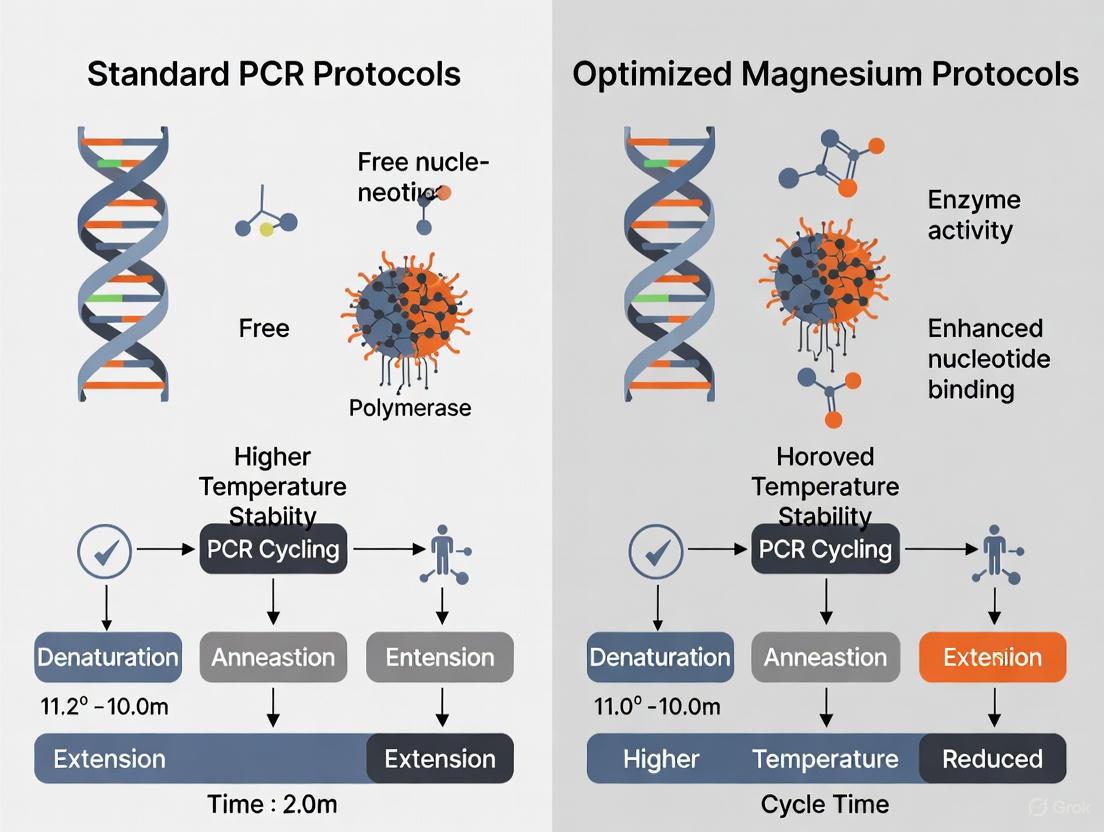
This article provides a comprehensive comparison between standard one-size-fits-all PCR protocols and meticulously optimized magnesium chloride (MgCl2) conditions.
Magnesium Optimization in PCR: A Comparative Guide to Enhanced Efficiency, Specificity, and Yield
Abstract
This article provides a comprehensive comparison between standard one-size-fits-all PCR protocols and meticulously optimized magnesium chloride (MgCl2) conditions. Tailored for researchers and drug development professionals, it explores the foundational role of Mg2+ as a critical cofactor, details systematic methodological approaches for optimization, offers practical troubleshooting strategies for challenging templates, and presents validation data demonstrating superior performance. By synthesizing recent meta-analyses and empirical studies, this guide serves as an essential resource for advancing molecular assay reliability in biomedical and clinical research.
The Fundamental Role of Magnesium: Beyond a Standard PCR Component
In polymerase chain reaction (PCR) protocols, magnesium chloride (MgCl₂) is not merely a buffer component but an essential catalytic cofactor that fundamentally determines reaction efficiency and specificity. Operating through two distinct but interconnected biochemical mechanisms, Mg²⁺ ions directly catalyze the polymerase activity and stabilize the DNA duplex architecture. The optimization of Mg²⁺ concentration represents a critical boundary condition separating standard "one-size-fits-all" PCR from rigorously optimized protocols that account for template-specific characteristics. Within the broader thesis of comparing standard versus optimized magnesium protocols, experimental data reveals that template-specific Mg²⁺ optimization can enhance amplification efficiency by quantitatively measurable margins compared to standard formulations. This guide objectively compares the performance of standard magnesium concentrations against optimized protocols across diverse template types, providing researchers with evidence-based strategies for experimental design.
Biochemical Mechanisms: How Magnesium Enables DNA Amplification
Catalytic Function in Polymerization
The enzymatic addition of nucleotides to growing DNA chains requires Mg²⁺ as an essential cofactor in a well-defined two-metal ion mechanism [1] [2]. At the polymerase active site, one magnesium ion (Metal A) coordinates with the 3'-OH group of the primer terminal nucleotide, facilitating deprotonation by a conserved aspartate residue and enhancing its nucleophilic character [1]. Simultaneously, the second magnesium ion (Metal B) binds to the phosphate groups of the incoming dNTP, stabilizing the negative charge on the pyrophosphate leaving group and enabling the formation of the phosphodiester bond [3] [4]. This precisely orchestrated mechanism ensures efficient DNA synthesis, with theoretical calculations showing both Mg²⁺ and Mn²⁺ can serve this function, though Mg²⁺ generally provides superior fidelity for most applications [1] [2].
DNA Duplex Stabilization
Beyond its catalytic role, Mg²⁺ significantly enhances DNA duplex stability through electrostatic interactions with the negatively charged phosphate backbone [3] [5]. The positively charged magnesium ions effectively shield the negative charges on adjacent phosphate groups, reducing electrostatic repulsion between complementary DNA strands and facilitating proper annealing of primers to template DNA [3]. This stabilization effect quantitatively increases the melting temperature (Tm) of DNA duplexes, with meta-analyses demonstrating a logarithmic relationship where every 0.5 mM increase in MgCl₂ concentration within the 1.5-3.0 mM range raises Tm by approximately 1.2°C [6]. This property becomes particularly critical for GC-rich templates where stronger secondary structures require greater stabilization energy for efficient amplification.
Standard vs. Optimized Magnesium Protocols: A Quantitative Comparison
The following tables synthesize experimental data comparing standard magnesium concentrations against optimized protocols across key performance parameters and template types.
Table 1: Performance comparison of standard versus optimized Mg²⁺ protocols on efficiency metrics
| Performance Metric | Standard Protocol (1.5-2.0 mM Mg²⁺) | Optimized Mg²⁺ Protocol | Experimental Measurement |
|---|---|---|---|
| Amplification Efficiency | Baseline | 15-40% increase in yield with template-specific optimization [6] | Quantitative PCR (qPCR) amplification curves |
| Specificity | Moderate to high nonspecific amplification at extremes | >50% reduction in nonspecific products with optimal Mg²⁺ [7] | Agarose gel electrophoresis band intensity |
| Fidelity | Error rate: baseline | 20-30% improvement in fidelity with lower Mg²⁺ (1 mM) for high-fidelity polymerases [8] | Sequencing-based error analysis |
| Dynamic Range | Limited for difficult templates | 3-5 log improvement for GC-rich templates [4] | Limit of detection measurements |
Table 2: Template-specific optimal Mg²⁺ concentration ranges
| Template Type | Standard Mg²⁺ (mM) | Optimized Mg²⁺ Range (mM) | Key Considerations |
|---|---|---|---|
| Standard Amplicons | 1.5-2.0 | 1.0-2.5 | Minimal optimization required [9] |
| GC-Rich Templates (>60% GC) | 1.5-2.0 | 2.0-4.0 | Higher concentrations help denature stable secondary structures [4] |
| Genomic DNA | 1.5-2.0 | 2.5-4.5 | Increased requirement due to template complexity [7] [6] |
| Plasmid DNA | 1.5-2.0 | 0.5-2.0 | Lower concentrations often sufficient [7] |
| Inhibitor-Containing Samples | 1.5-2.0 | 3.0-5.0 | Higher Mg²⁺ compensates for ion chelation by inhibitors [3] [10] |
Experimental Evidence: Magnesium Optimization Data
Concentration-Dependent Effects
Systematic analysis reveals a defined optimal range for Mg²⁺ concentrations in PCR, with significant performance degradation at both extremes. A comprehensive meta-analysis of 61 studies established that MgCl₂ concentrations between 1.5 and 3.0 mM support maximal efficiency for most templates, with every 0.5 mM increase within this range elevating DNA melting temperature by 1.2°C [6]. Excess Mg²⁺ (>4-5 mM) promotes non-specific primer binding and primer-dimer formation, visualized on agarose gels as multiple bands or smears, while insufficient Mg²⁺ (<1 mM) dramatically reduces polymerase activity, resulting in weak or absent amplification [3] [4]. This concentration dependence follows a parabolic pattern where both deficiency and excess compromise reaction outcomes, necessitating empirical optimization for challenging applications.
Template-Specific Optimization Requirements
Template characteristics significantly influence optimal Mg²⁺ requirements, with complex genomic DNA templates typically requiring higher concentrations (2.5-4.5 mM) compared to simpler plasmid DNA (0.5-2.0 mM) [7] [6]. GC-rich templates represent a particularly challenging case where standard Mg²⁺ concentrations (1.5-2.0 mM) frequently yield poor amplification, while incrementally increased concentrations (2.0-4.0 mM) significantly improve yields by facilitating denaturation of stable secondary structures and reducing primer breathing [4]. Similarly, samples containing PCR inhibitors such as those recovered from metal surfaces may require elevated Mg²⁺ (3.0-5.0 mM) to compensate for ion chelation, as demonstrated by studies showing zinc, tin, iron(II), and copper having IC₅₀ values below 1 mM [10].
Table 3: Inhibitory effects of metal ions on PCR amplification
| Metal Ion | Inhibition Threshold (mM) | Inhibition Mechanism |
|---|---|---|
| Zinc (Zn²⁺) | <0.1 | Polymerase binding competition with Mg²⁺ [10] |
| Copper (Cu²⁺) | <0.5 | High-affinity binding to DNA bases [10] |
| Iron (Fe²⁺) | <1.0 | Competitive binding with polymerase [10] |
| Calcium (Ca²⁺) | Variable | Competitive binding with Mg²⁺ at polymerase active site [10] |
| Tin (Sn²⁺) | <0.1 | Not fully characterized [10] |
Optimization Protocols: Methodology for Magnesium Titration
Systematic Magnesium Titration Experiment
A robust magnesium optimization protocol begins with establishing a concentration gradient across the biologically relevant range. The following methodology provides a standardized approach for empirical determination of optimal Mg²⁺ concentrations:
- Reaction Setup: Prepare a master mix containing all PCR components except MgCl₂ and aliquot equal volumes into 0.2 ml thin-walled PCR tubes [9].
- Gradient Preparation: Add MgCl₂ to achieve final concentrations spanning 0.5 mM to 5.0 mM in 0.5 mM increments, utilizing a separate tube for each concentration [4] [9].
- Thermal Cycling: Run PCR using previously established cycling parameters with an annealing temperature approximately 5°C below the primer Tm [9].
- Product Analysis: Resolve amplification products on agarose gels, identifying the Mg²⁺ concentration that produces the strongest specific band with minimal nonspecific products [3].
- Refinement: If necessary, perform a secondary titration with narrower increments (0.2-0.3 mM) around the most promising concentration from the initial screen.
For GC-rich templates, this protocol can be enhanced by including additives such as DMSO (1-10%), betaine (0.5-2.5 M), or commercial GC enhancers that work synergistically with optimized Mg²⁺ to destabilize secondary structures [4].
Interactive Optimization Workflow
The following diagram illustrates a decision pathway for systematic magnesium optimization based on initial PCR results:
The Scientist's Toolkit: Essential Research Reagents
Table 4: Essential reagents for magnesium optimization experiments
| Reagent/Category | Function in PCR | Optimization Considerations |
|---|---|---|
| DNA Polymerase | Enzymatic DNA synthesis | Selection critical; specialized polymerases available for GC-rich templates [4] |
| MgCl₂ Solution | Cofactor for polymerase; stabilizes DNA duplex | Typically supplied as 25 mM stock; concentration significantly affects specificity [9] [8] |
| dNTP Mix | DNA building blocks | equimolar mixture (dATP, dCTP, dGTP, dTTP); competes with primers for Mg²⁺ binding [7] |
| PCR Buffer | Maintains pH and ionic strength | May contain Mg²⁺; determine concentration before supplemental addition [9] |
| Template DNA | Target for amplification | Quality and complexity affect Mg²⁺ requirements; 0.1-1 ng plasmid vs. 5-50 ng genomic DNA [7] |
| Primers | Define amplification targets | 15-30 nucleotides; 40-60% GC content; design critical for specificity [7] [9] |
| Additives | Modify nucleic acid stability | DMSO, glycerol, betaine reduce secondary structures [4] |
The comparative analysis of standard versus optimized magnesium protocols demonstrates that template-specific Mg²⁺ optimization represents a fundamental advancement over standardized formulations. While standard Mg²⁺ concentrations (1.5-2.0 mM) provide adequate results for routine applications, evidence consistently shows that empirical optimization tailored to template characteristics significantly enhances amplification efficiency, specificity, and yield. The quantitative data presented establishes that optimal Mg²⁺ concentrations vary systematically with template complexity, GC content, and inhibitor presence, with genomic DNA and GC-rich templates particularly benefiting from elevated concentrations (2.5-4.0 mM). For research and diagnostic applications requiring maximal sensitivity and reproducibility, the implementation of systematic magnesium titration protocols provides substantial improvements over standard conditions, advancing the broader objective of developing more reliable and effective molecular analysis methods.
Limitations of Fixed-Concentration Protocols in Standard PCR Kits
Standard PCR kits have revolutionized molecular biology by providing convenient, ready-to-use reagents. However, their fixed-concentration formulation, particularly regarding magnesium chloride (MgCl₂), presents significant limitations for advanced research applications. This comparison guide objectively analyzes the performance of fixed-concentration protocols against optimized magnesium approaches, drawing on experimental data to demonstrate how tailored Mg²⁺ concentrations significantly enhance amplification efficiency, specificity, and reproducibility across challenging templates. Within the broader thesis of PCR optimization research, this analysis provides evidence-based recommendations for researchers seeking to overcome the constraints of standardized protocols.
Magnesium chloride (MgCl₂) serves as an essential cofactor in polymerase chain reaction (PCR) protocols, directly influencing DNA polymerase activity, primer-template binding efficiency, and reaction specificity [7] [8]. Despite its fundamental importance, many commercial PCR kits utilize fixed Mg²⁺ concentrations that may not accommodate the diverse requirements of different template types and experimental conditions. This one-size-fits-all approach can compromise results in demanding applications such as viral quantification, high-fidelity cloning, and amplification of GC-rich regions.
The optimal Mg²⁺ concentration represents a delicate balance in the PCR system. Insufficient Mg²⁺ results in weak or failed amplification due to inadequate polymerase activity and unstable primer-template complexes [11]. Conversely, excess Mg²⁺ promotes non-specific amplification, primer-dimer formation, and reduced polymerase fidelity [12] [8]. Fixed-concentration kits attempt to target a middle ground but inevitably fail to address the unique thermodynamic requirements of individual primer-template systems, especially in complex research scenarios.
Experimental Evidence: Fixed vs. Optimized Magnesium Protocols
Performance Comparison in Quantitative Applications
A critical study comparing universal and fast PCR cycling conditions for Epstein-Barr virus (EBV) mRNA detection revealed significant limitations in standardized protocols. While none of the 16 primer sets failed completely under fast PCR conditions, the simplified protocols demonstrated reduced sensitivity and higher variability compared to universal cycling conditions [13]. This performance gap illustrates how standardized protocols, often designed for speed and convenience, can compromise data quality in quantitative applications where precision is paramount.
Table 1: Performance Comparison of Universal vs. Fast PCR Protocols
| Parameter | Universal Protocol | Fast Protocol (Afast) | Fast Protocol (Mfast) |
|---|---|---|---|
| Run Time | 50 minutes | 24 minutes | 23 minutes |
| Sensitivity | High | Reduced | Reduced |
| Variability | Lower | Higher | Higher |
| Specificity | Maintained | Maintained | Maintained |
| False Positive Rate | No increase | No increase | No increase |
Magnesium Concentration Effects on PCR Efficiency
A comprehensive meta-analysis of 61 peer-reviewed studies established quantitative relationships between MgCl₂ concentration and PCR performance metrics. The analysis identified an optimal Mg²⁺ range of 1.5-3.0 mM for efficient PCR performance, with every 0.5 mM increase in MgCl₂ within this range associated with an approximately 1.2°C increase in DNA melting temperature [6] [14]. This precise thermodynamic relationship underscores the importance of fine-tuning Mg²⁺ concentrations rather than relying on fixed values.
The meta-analysis further demonstrated that template complexity significantly influences optimal Mg²⁺ requirements. Genomic DNA templates consistently required higher Mg²⁺ concentrations than simpler templates such as plasmid DNA or synthetic oligonucleotides [14]. This evidence directly challenges the viability of fixed-concentration approaches for research involving diverse template types.
Table 2: Template-Specific Magnesium Chloride Requirements
| Template Type | Recommended MgCl₂ Range | Key Considerations |
|---|---|---|
| Plasmid DNA | 1.5-2.5 mM | Lower requirements due to template simplicity |
| Genomic DNA | 2.5-4.0 mM | Higher concentrations needed for complex templates |
| GC-Rich Templates | 2.0-3.5 mM | May benefit from additives (DMSO, betaine) |
| Long Amplicons (>3kb) | 2.5-4.5 mM | Enhanced processivity requirements |
Experimental Protocols for Magnesium Optimization
Magnesium Titration Methodology
A standardized protocol for Mg²⁺ optimization involves establishing a titration series while holding all other reaction components constant [9]. The following procedure enables systematic determination of optimal Mg²⁺ concentrations for any primer-template system:
Prepare Master Mix: Create a master mixture containing all PCR components except MgCl₂ and template DNA. Include buffer, dNTPs (200 μM each), primers (20-50 pmol each), DNA polymerase (0.5-2.5 units), and sterile water to adjust final volume.
Set Up Titration Series: Aliquot the master mix into separate reaction tubes. Add MgCl₂ to achieve final concentrations across a range of 0.5-5.0 mM in 0.5 mM increments.
Add Template and Amplify: Add template DNA (10⁴-10⁷ molecules) to each reaction and initiate thermal cycling using predetermined conditions.
Analyze Results: Evaluate amplification efficiency and specificity via agarose gel electrophoresis or quantitative PCR analysis. Identify the Mg²⁺ concentration that yields strong specific amplification with minimal background.
This methodology directly addresses the limitations of fixed-concentration kits by empirically determining optimal conditions for specific experimental requirements.
Specialized Protocol for Challenging Templates
For problematic templates such as GC-rich sequences or complex genomic DNA, a modified optimization approach is recommended:
Initial Mg²⁺ Screening: Perform initial titration as described above across a wider range (1.0-5.0 mM).
Additive Incorporation: For templates with GC content >65%, include additives such as DMSO (2-10%) or betaine (0.5-2.5 M) to ameliorate secondary structure formation [12].
Thermal Profile Adjustment: Implement a touchdown PCR protocol or gradient annealing temperature optimization to enhance specificity.
Polymerase Selection: Choose high-fidelity polymerases with proofreading capability (e.g., Pfu, KOD) for applications requiring minimal error rates [12].
This comprehensive optimization strategy systematically addresses the multiple factors influencing PCR success, with Mg²⁺ concentration serving as the foundational variable.
PCR Magnesium Optimization Workflow
The following diagram illustrates the systematic approach to magnesium optimization for overcoming the limitations of fixed-concentration kits:
Research Reagent Solutions for PCR Optimization
Table 3: Essential Reagents for Magnesium Optimization Studies
| Reagent | Function | Optimization Considerations |
|---|---|---|
| Magnesium Chloride (MgCl₂) | DNA polymerase cofactor; stabilizes primer-template binding | Titrate between 0.5-5.0 mM; varies by template |
| High-Fidelity DNA Polymerase | Catalyzes DNA synthesis with proofreading capability | Preferred for complex templates; error rates 10-50X lower than Taq |
| dNTP Mix | Nucleotide substrates for DNA synthesis | Maintain at 200 μM each; excess can chelate Mg²⁺ |
| Template-Specific Primers | Sequence-specific amplification initiation | Design with Tm 55-70°C; avoid secondary structures |
| PCR Additives (DMSO, Betaine) | Reduce secondary structure; homogenize base stability | Employ for GC-rich templates (>65%); optimize concentration |
| Buffer Systems | Maintain pH and ionic strength for enzyme activity | Select magnesium-free variants for optimization studies |
Fixed-concentration protocols in standard PCR kits present significant limitations for research applications requiring high sensitivity, specificity, and reproducibility. Experimental evidence demonstrates that optimized magnesium concentrations significantly improve PCR performance across diverse template types, with genomic DNA and GC-rich sequences showing particular dependence on precise Mg²⁺ tuning. The 1.5-3.0 mM optimal range established through meta-analysis provides a foundational starting point, though template-specific titration remains essential for maximizing results.
The broader thesis of PCR optimization research confirms that tailored magnesium protocols outperform standardized approaches through enhanced thermodynamic control of the amplification process. For researchers and drug development professionals, implementing systematic magnesium optimization represents a critical step toward achieving reliable, reproducible molecular data that meets the rigorous demands of scientific investigation and diagnostic applications.
The Polymerase Chain Reaction (PCR) stands as a cornerstone of modern molecular biology, yet achieving optimal conditions remains a persistent challenge. Among the critical parameters, magnesium chloride (MgCl₂) concentration is a principal factor dictating the success and fidelity of DNA amplification. This guide objectively compares standard PCR protocols, which often use a one-size-fits-all MgCl₂ approach, against protocols that are meticulously optimized for magnesium concentration. The synthesis of current research quantifies the profound impact of MgCl₂ on DNA melting temperature (Tm) and reaction kinetics, providing a robust, evidence-based framework for researchers and drug development professionals to enhance the specificity, efficiency, and reliability of their PCR assays.
The Dual Role of MgCl2 in PCR: Mechanism and Quantitative Impact
MgCl₂ is an indispensable cofactor in PCR, functioning through two primary mechanistic pathways that are crucial for efficient amplification.
- Cofactor for DNA Polymerase Activity: The Mg²⁺ ion is essential for the catalytic function of DNA polymerase enzymes like Taq polymerase. It facilitates the formation of phosphodiester bonds by binding to the negatively charged alpha-phosphate group of incoming dNTPs, enabling the nucleophilic attack by the 3'-OH end of the primer and the subsequent release of pyrophosphate [3] [7] [15].
- Stabilizer of Nucleic Acid Duplexes: Mg²⁺ ions neutralize the negative charges on the phosphate backbone of DNA strands. This electrostatic shielding reduces inter-strand repulsion, thereby stabilizing the double-stranded DNA and the primer-template complex [3] [15]. This action directly influences the melting temperature (Tm) of DNA, which is a critical parameter in reaction kinetics.
A comprehensive meta-analysis of 61 peer-reviewed studies has quantified this relationship, establishing a logarithmic relationship between MgCl₂ concentration and DNA melting temperature [14] [6]. The analysis identified an optimal MgCl₂ range of 1.5 to 3.0 mM for efficient PCR performance. Within this range, for every 0.5 mM increase in MgCl₂ concentration, the DNA melting temperature increases by approximately 1.2°C [14]. This quantitative insight provides a predictable framework for fine-tuning annealing temperatures during protocol optimization.
Standard vs. Optimized Magnesium Protocols: A Comparative Analysis
The following tables summarize the core quantitative differences and performance outcomes between standard and optimized PCR protocols concerning MgCl₂ usage.
Table 1: Fundamental Parameters of MgCl₂ in PCR
| Parameter | Standard PCR Protocol | Optimized Magnesium Protocol | Experimental Support |
|---|---|---|---|
| General MgCl₂ Range | 1.0 - 5.0 mM [16] [11] | Tailored to template and primer properties | Multiple studies [14] [17] [18] |
| Common Starting Point | 2.0 mM [3] [16] | Based on template-specific guidelines | Meta-analysis [14] |
| Impact on Tm | Acknowledged but not quantitatively adjusted | Quantified: +1.2°C Tm per +0.5 mM MgCl₂ | Meta-analysis of 61 studies [14] [6] |
| Primary Optimization Goal | General amplification | Maximize specificity and efficiency for a specific template | PCR optimization guides [9] [18] |
Table 2: Performance Outcomes: Standard vs. Optimized MgCl₂ Conditions
| Performance Metric | Standard Protocol (e.g., 2.0 mM) | Optimized Protocol (Template-Tailored) | Consequence for Research & Drug Development |
|---|---|---|---|
| Specificity | Variable; high risk of non-specific bands with complex templates [17] | High; reduced mispriming and spurious amplification | Cleaner sequencing results, more reliable genotyping and diagnostic assays |
| Efficiency & Yield | May be suboptimal for GC-rich or complex genomic DNA | Maximized yield by matching Mg²⁺ to template demand [14] | Improved sensitivity for low-copy number targets (e.g., pathogens, rare transcripts) |
| Inclusiveness in Degenerate Primer PCR | Can skew detected gene diversity [17] | Broader and more accurate representation of target gene families | Critical for accurate resistome and metagenomic analysis in microbiome studies |
Experimental Protocols for MgCl2 Optimization
The following detailed methodologies, drawn from cited research, provide a roadmap for empirically determining the optimal MgCl₂ concentration for any given PCR assay.
MgCl₂ Titration Protocol
This is the most fundamental and widely used approach for optimizing MgCl₂ concentration [9] [18].
- Objective: To determine the MgCl₂ concentration that produces the highest yield of the specific target amplicon with minimal background.
- Materials: Standard PCR reagents: DNA polymerase with respective buffer, dNTPs, primers, template DNA, and sterile water. A stock solution of MgCl₂ (e.g., 25 mM or 50 mM) is required.
- Methodology:
- Prepare a Master Mix containing all PCR components except MgCl₂ and template DNA.
- Aliquot the Master Mix into a series of PCR tubes (e.g., 6-8 tubes).
- Add a different volume of the MgCl₂ stock solution to each tube to create a concentration gradient. A typical range is 1.0 mM to 5.0 mM in increments of 0.5 mM [9] [11].
- Add the template DNA to each tube.
- Run the PCR using the standard thermal cycling parameters for the specific primers and template.
- Analyze the results by agarose gel electrophoresis. The optimal condition is identified as the MgCl₂ concentration that yields the brightest band of the correct size with the least or no non-specific products or primer-dimers.
Protocol for Evaluating Genetic Diversity (Inclusiveness)
This protocol, adapted from Schmidt et al. (2014), is crucial for assays aiming to amplify a family of related genes (e.g., antibiotic resistance genes) using degenerate primers [17].
- Objective: To assess how MgCl₂ concentration and PCR cycle number affect the detection and apparent distribution of different members of a gene family.
- Materials: As in protocol 3.1, with a complex template (e.g., metagenomic DNA from an environmental sample) and a set of degenerate primers.
- Methodology:
- Employ a factorial experimental design, testing multiple MgCl₂ concentrations (e.g., 1.75 mM, 3.0 mM, 5.0 mM, 7.0 mM) against multiple PCR cycle numbers (e.g., 30, 35, 40) [17].
- For each condition, perform the PCR amplification.
- Clone the resulting PCR products into a sequencing vector.
- Sequence a random selection of clones from each library.
- Analysis: Compare the genetic diversity and relative abundance of different gene variants (e.g., tet(M), tet(O), tet(W)) across the different MgCl₂ and cycle number combinations. The optimal condition is the one that reveals the greatest diversity without introducing significant non-specific amplification.
The workflow for this in-depth optimization is visualized below.
The Scientist's Toolkit: Essential Reagents for PCR Optimization
A successful optimization experiment requires high-quality reagents. The following table lists key materials and their specific functions.
Table 3: Research Reagent Solutions for PCR Optimization
| Reagent / Solution | Critical Function in Optimization | Considerations for Researchers |
|---|---|---|
| MgCl₂ Stock Solution | Source of Mg²⁺ ions for titration; critical cofactor. | Use a high-purity, nuclease-free stock. Concentration must be accurately known [9]. |
| DNA Polymerase | Enzyme that catalyzes DNA synthesis. | Select based on application (e.g., standard, high-fidelity, long-range). Unit amount may need optimization [7]. |
| dNTP Mix | Building blocks (dATP, dCTP, dGTP, dTTP) for new DNA strands. | Use balanced, equimolar concentrations. High dNTPs can chelate Mg²⁺, effectively reducing its availability [7]. |
| Template DNA | The target DNA to be amplified. | Quality and quantity are paramount. Complex templates (gDNA) often require more Mg²⁺ than simple ones (plasmid DNA) [14] [7]. |
| Primers | Oligonucleotides that define the start and end of the amplicon. | Design is critical. Must have appropriate Tm, GC content, and lack secondary structures [9] [7]. |
| PCR Buffers | Maintain pH and ionic strength for optimal enzyme activity. | Many buffers contain MgCl₂. If optimizing, use a Mg-free buffer and add MgCl₂ separately [9]. |
| Enhancers (e.g., DMSO, Betaine) | Additives that can help amplify difficult templates (e.g., GC-rich). | Can alter the effective Tm and may interact with Mg²⁺, requiring re-optimization [9] [18]. |
Mechanistic Pathway of MgCl2 in PCR
The molecular mechanisms by which MgCl₂ influences PCR kinetics and fidelity are summarized in the following pathway diagram. This visual integrates its dual role in enzyme catalysis and nucleic acid stability, illustrating how concentration directly dictates reaction outcome.
The transition from standard to magnesium-optimized PCR protocols represents a shift from empirical, sometimes unreliable, amplification to a predictable and quantitative science. The key takeaway is that MgCl₂ concentration is not a fixed parameter but a powerful variable that can be deliberately manipulated to control the thermodynamics and kinetics of the reaction. The established quantitative relationship—a 1.2°C increase in Tm per 0.5 mM increase in MgCl₂—provides a solid theoretical foundation for this optimization [14].
For researchers and drug development professionals, this translates to tangible benefits: enhanced assay specificity in diagnostic test development, improved accuracy in genetic diversity studies, and greater robustness in high-throughput screening environments. By adopting the systematic, evidence-based optimization strategies outlined in this guide, scientists can significantly advance the design of more reliable and effective PCR protocols, thereby strengthening the integrity of molecular data that underpins biological discovery and therapeutic innovation.
The Interplay Between Mg2+, dNTPs, and Polymerase Fidelity
In the realm of molecular biology, the polymerase chain reaction (PCR) is a foundational technique, yet its efficiency and accuracy are governed by a delicate biochemical balance. Central to this process is the intricate interplay between magnesium ions (Mg2+), deoxynucleoside triphosphates (dNTPs), and the DNA polymerase enzyme. The fidelity of DNA synthesis—a critical concern for applications from cloning to diagnostic testing—is not an inherent property of the polymerase alone but is profoundly influenced by the reaction conditions in which it operates [8]. Mg2+ acts as an essential cofactor for thermostable DNA polymerases, while dNTPs serve as the fundamental building blocks for new DNA strands [19]. However, these components exist in a closely linked relationship: Mg2+ forms complexes with dNTPs to make them usable substrates for the polymerase, meaning the concentration of one directly affects the available concentration of the other [19]. This article systematically compares standard PCR protocols against optimized magnesium and dNTP formulations, presenting experimental data that demonstrates how precise modulation of these components can significantly enhance replication fidelity, reduce error rates, and improve outcomes in research and drug development.
Comparative Analysis of Polymerase Fidelity and Reaction Components
The fidelity of DNA polymerases varies dramatically between enzymes, and this inherent error rate is further modulated by the concentrations of Mg2+ and dNTPs in the reaction buffer. Understanding these relationships is fundamental to designing high-fidelity PCR protocols.
DNA Polymerase Error Rates
A direct sequencing study of 94 unique DNA targets revealed significant differences in error rates among commonly used DNA polymerases, as shown in Table 1. The standard Taq polymerase exhibited the highest error rate, while high-fidelity enzymes like Pfu, Phusion, and Pwo demonstrated error rates more than tenfold lower [20].
Table 1: Error Rate Comparison of DNA Polymerases
| Polymerase | Error Rate (errors/bp/duplication) | Fidelity Relative to Taq |
|---|---|---|
| Taq | 3.0-5.6 × 10⁻⁵ | 1x |
| AccuPrime-Taq HF | ~1.0 × 10⁻⁵ | ~5x better |
| KOD Hot Start | ~1 × 10⁻⁶ | ~50x better |
| Pfu | 1-2 × 10⁻⁶ | 6-10x better |
| Phusion Hot Start | 4.0 × 10⁻⁷ (HF buffer) | >50x better |
| Pwo | >10x lower than Taq | >10x better |
The Mg2+ and dNTP Interdependence
The interaction between Mg2+ and dNTPs is a critical determinant of PCR specificity. Mg2+ is an essential cofactor for DNA polymerase activity. It facilitates the binding of dNTPs to the enzyme's active site and stabilizes the DNA duplex structure [19]. However, Mg2+ also binds to dNTPs in solution; the negative charge on the dNTP phosphate groups is shielded by the positively charged Mg2+, forming a Mg-dNTP complex that is the true substrate for the polymerase [19]. This creates a tight relationship where the concentration of free Mg2+ is determined by the total Mg2+ minus that which is bound to dNTPs, primers, and template.
Consequently, improper balance inhibits the reaction. Excess free Mg2+ reduces enzyme fidelity and promotes non-specific primer binding, while inadequate free Mg2+ results in low polymerase activity and poor yield [8]. A meta-analysis of optimization studies identified an optimal MgCl2 range of 1.5–3.0 mM for most reactions, with every 0.5 mM increase within this range increasing the DNA melting temperature by approximately 1.2°C [14] [6]. Furthermore, template complexity influences the requirement; genomic DNA templates typically require higher Mg2+ concentrations than simple plasmid templates [14].
Optimized Concentrations for High Fidelity
To maximize fidelity, the concentrations of Mg2+ and dNTPs must be optimized together. Using lower dNTP concentrations (e.g., 20-50 μmol/L for each dNTP) helps reduce misincorporation errors by the polymerase [19]. When dNTP concentrations are lowered, the Mg2+ concentration must be correspondingly adjusted downward to maintain the proper level of free Mg2+. For some high-fidelity enzymes, such as PrimeSTAR GXL and PrimeSTAR MAX, a final Mg2+ concentration of 1 mM has been shown to increase fidelity [8]. This optimized balance ensures sufficient substrates and cofactors are available while minimizing the conditions that lead to erroneous nucleotide incorporation.
Experimental Data and Protocols
Experimental Workflow for Fidelity Assessment
The following diagram illustrates a generalized experimental workflow for assessing the effects of Mg2+ and dNTPs on polymerase fidelity, incorporating methods from key studies.
Key Experimental Findings on Optimization
Table 2: Summary of Key Optimization Experiments
| Study Focus | Methodology Summary | Key Quantitative Finding |
|---|---|---|
| Polymerase Fidelity Comparison [20] | Direct sequencing of 94 cloned PCR products from 6 different polymerases. Total bp sequenced: ~1.0 × 10⁵. | Taq error rate: 3.0-5.6 × 10⁻⁵. Pfu/Phusion/Pwo error rates: >10x lower than Taq. |
| MgCl₂ Meta-Analysis [14] [6] | Systematic meta-analysis of 61 peer-reviewed studies on MgCl₂ effects in PCR. | Optimal MgCl₂ range: 1.5-3.0 mM. Every 0.5 mM increase raises Tm by ~1.2°C. |
| Predictive Modeling [21] | Multivariate Taylor series and thermodynamic models built from 120 primers, validated with regression analysis. | Model predicted MgCl₂ with R²=0.9942 and Tm with R²=0.9600. |
| Metal Ion Inhibition [22] | qPCR with pre-mixed metal ions to test inhibition of Taq, Q5, and KOD polymerases. | Zn, Sn, Fe(II), Cu showed strongest inhibition (IC₅₀ < 1 mM). KOD was most metal-resistant. |
Detailed Protocol: Error Rate Determination via Cloning and Sequencing
The following method, adapted from a fidelity comparison study, provides a robust protocol for empirically determining error rates [20].
- Step 1: PCR Amplification. Set up separate reaction mixtures for each polymerase being tested. The reaction should use purified plasmid DNA (e.g., 25 pg/reaction) with a known sequence as the template. A key to this assay is using a high number of amplification cycles (e.g., 30 cycles) to maximize the number of template doublings and make potential errors detectable. The Mg2+ and dNTP concentrations should be varied according to the experimental design.
- Step 2: Cloning of Products. Purify the PCR products to remove enzymes and salts. Subsequently, clone the products into a sequencing vector using a high-efficiency system like Gateway recombinational cloning. This step ensures that individual PCR products are physically separated for analysis.
- Step 3: Sequencing and Analysis. Isolate plasmid DNA from a sufficient number of bacterial clones (e.g., 65-75 per polymerase condition) and perform Sanger sequencing using primers that read the entire inserted PCR product. Align the resulting sequences to the known original template sequence.
- Step 4: Error Rate Calculation. Count all mutations (mismatches, insertions, deletions) found across all sequenced clones. The error rate is calculated using the formula: Error Rate = E / (N × D), where E is the total number of mutations observed, N is the total number of base pairs sequenced, and D is the number of template doublings that occurred during PCR. The number of doublings can be calculated from the fold-amplification of the PCR reaction [20].
The Scientist's Toolkit: Research Reagent Solutions
Table 3: Essential Reagents for Fidelity and Optimization Studies
| Reagent / Solution | Function in Fidelity Studies |
|---|---|
| High-Fidelity DNA Polymerases (e.g., Q5, Pfu, Phusion, KOD) | Enzymes with 3'→5' exonuclease (proofreading) activity to correct misincorporated nucleotides, leading to significantly lower error rates than standard Taq [20] [23]. |
| Magnesium Chloride (MgCl₂) Solution | A separate, titratable source of Mg2+ ions. Essential for optimizing the free Mg2+ concentration to balance polymerase activity with fidelity [8]. |
| dNTP Mix (Neutral pH) | Equimolar mixture of dATP, dCTP, dGTP, and dTTP. Supplied at neutral pH (7.0-7.5) to prevent degradation. Lower concentrations (e.g., 50-200 μmol/L each) can improve fidelity [19]. |
| Hot Start Polymerases | Engineered enzymes (e.g., Q5 Hot Start, KOD Hot Start) that remain inactive until a high-temperature initial denaturation step. This prevents non-specific priming and mis-priming during reaction setup, improving specificity and yield [23]. |
| GC Enhancers / Additives | Specialized buffers or additives that help denature GC-rich templates and prevent secondary structure formation, which can cause polymerase stalling and errors [23]. |
| Calcium Chelators (e.g., EGTA) | Used to reverse PCR inhibition caused by calcium ions, which compete with magnesium for binding sites on the polymerase. A non-destructive method to rescue reactions from contaminated samples [22]. |
Mechanistic Insights: How Metal Ions Govern Fidelity
The molecular mechanism by which Mg2+ influences DNA synthesis fidelity is rooted in the catalytic core of the DNA polymerase. Structural studies have revealed that the nucleotidyl transfer reaction depends on at least two metal ions (often a third is observed) coordinated by acidic residues in the enzyme's active site [24]. These ions, typically Mg2+, play distinct but collaborative roles: one metal ion activates the 3'-OH group of the primer for nucleophilic attack, while the other facilitates the release of the pyrophosphate group from the incoming dNTP.
The choice of metal cofactor can dramatically alter fidelity. Research has shown that while Mg2+ promotes relatively accurate synthesis, Mn2+ ions often result in error-prone replication with higher misincorporation rates [24]. This is because Mn2+ can alter the geometry of the active site, potentially compromising the enzyme's ability to discriminate against incorrect nucleotides. Furthermore, excess free Mg2+ can reduce fidelity by stabilizing the binding of mismatched nucleotides, making it easier for them to be incorporated into the growing DNA chain [8]. This detailed mechanistic understanding underscores why precise control over Mg2+ concentration is not merely a matter of boosting yield but is a critical lever for controlling the accuracy of DNA amplification.
The transition from standard, one-size-fits-all PCR protocols to precisely optimized reactions represents a significant advancement in molecular biology. As the experimental data presented herein unequivocally demonstrates, the interplay between Mg2+, dNTPs, and polymerase selection is not a minor technical detail but a fundamental determinant of success in applications demanding high accuracy. The tenfold to fiftyfold reduction in error rates achievable with high-fidelity enzymes under optimized buffer conditions can be the difference between a failed experiment and a reliable result. For researchers and drug development professionals, adopting these optimized magnesium and dNTP protocols—guided by predictive models and systematic meta-analyses—ensures that the genetic integrity of amplified products is maintained. This approach provides a robust, reproducible framework that enhances the credibility of downstream analyses, from basic research findings to critical diagnostic assays.
Systematic Strategies for Optimizing Magnesium Concentration in Your PCR
Magnesium chloride (MgCl2) is an indispensable cofactor in polymerase chain reaction (PCR) protocols, serving critical roles in DNA polymerase activity, DNA strand separation dynamics, and primer-template binding. While standard protocols often recommend a baseline MgCl2 concentration, precise modulation tailored to specific experimental conditions is fundamental to achieving optimal amplification efficiency and specificity. This guide provides a comparative analysis of standard versus optimized magnesium protocols, offering evidence-based guidelines for researchers and drug development professionals to enhance PCR reliability across diverse applications, from routine genotyping to advanced diagnostic sequencing.
The Fundamental Role of MgCl2 in PCR
MgCl2 serves as a fundamental cofactor in PCR, influencing multiple aspects of reaction thermodynamics and kinetics. Magnesium ions (Mg2+) are essential for DNA polymerase activity, functioning at the enzyme's active site to catalyze phosphodiester bond formation between the 3′-OH of a primer and the phosphate group of an incoming dNTP [7]. Additionally, Mg2+ facilitates stable duplex formation between primers and template DNA by stabilizing the negative charges on their phosphate backbones [7]. The concentration of MgCl2 directly affects DNA melting temperature (Tm), with a demonstrated logarithmic relationship where every 0.5 mM increase within the 1.5–3.0 mM range raises the Tm by approximately 1.2°C [14] [6]. This precise modulation of hybridization dynamics makes magnesium optimization crucial for reaction success, particularly with challenging templates.
Establishing the Baseline: Standard MgCl2 Concentrations
Comprehensive meta-analyses of PCR optimization studies have established evidence-based parameters for magnesium concentrations. The following table summarizes the established baseline concentrations and their applications:
Table 1: Standard and Optimized MgCl2 Concentration Ranges
| Concentration Range | Classification | Typical Applications | Key Effects |
|---|---|---|---|
| 1.5–2.0 mM | Standard Baseline | Routine PCR with plasmid DNA, simple templates | Balanced efficiency and specificity for standard applications |
| 1.5–3.0 mM | Optimal Overall Range | General PCR, meta-analysis recommendation | Covers requirements for most standard templates and conditions [14] |
| 1.5–4.5 mM | Broad Operational Range | RAPD analysis, diverse template types | Accommodates primer-dependent variability [11] [25] |
| >4.5 mM | High Concentration | Specialized applications only | Risk of non-specific binding and primer dimer formation [11] |
| <1.5 mM | Low Concentration | Specialized applications only | Potential for poor primer binding and reaction failure [11] |
The standard baseline concentration of 1.5–2.0 mM provides a starting point for routine PCR applications with straightforward templates such as plasmid DNA and cDNA. This range represents a balance that supports adequate DNA polymerase activity while minimizing non-specific amplification. However, contemporary meta-analyses indicate that extending this range to 1.5–3.0 mM encompasses the optimal requirements for most PCR applications, providing a more practical framework for protocol development [14] [6].
When to Deviate: Template-Specific Optimization Strategies
Deviation from standard MgCl2 concentrations becomes necessary when dealing with templates possessing complex characteristics or when employing specialized PCR methodologies. The following scenarios represent common situations requiring tailored magnesium optimization:
Complex Template Structures
Genomic DNA templates consistently demonstrate requirements for higher MgCl2 concentrations compared to plasmid DNA or cDNA, with optimal performance often observed at the upper end of the 1.5–3.0 mM range [14] [6]. The increased complexity and size of genomic DNA necessitates elevated magnesium concentrations to stabilize primer-template interactions and facilitate efficient polymerase processivity through potentially challenging regions.
GC-rich templates present particular challenges due to their higher thermodynamic stability, which requires elevated denaturation temperatures and optimized annealing conditions. These templates often benefit from increased MgCl2 concentrations (2.5–4.0 mM) to enhance primer binding efficiency to targets with strong secondary structure [14]. The elevated magnesium concentration helps counteract the reduced accessibility of GC-rich regions by stabilizing the primer-template hybrid.
Specialized PCR Applications
Long-range PCR methodologies, such as the novel tiling approach developed for HIV-1 sequencing, often require precisely optimized MgCl2 concentrations to maintain polymerase processivity across extended amplification targets [26]. These protocols typically employ magnesium concentrations tailored to the specific polymerase system and target length, frequently exceeding standard baseline levels.
Random-amplified polymorphic DNA (RAPD) analysis demonstrates significant sensitivity to magnesium concentration, with optimal ranges varying substantially between primers (1.5–4.5 mM) [25]. This pronounced primer-dependent variability necessitates empirical determination of ideal MgCl2 concentrations for each primer employed in RAPD studies, as the technique lacks the specificity of targeted PCR.
Digital PCR (dPCR) platforms, while operating on fundamental PCR principles, often incorporate optimized magnesium concentrations specific to their partitioned reaction environments [27]. The absolute quantification requirements of dPCR for clinical diagnostics, including liquid biopsy applications and pathogen detection, demand rigorously optimized magnesium levels to ensure precise amplification efficiency across thousands of individual partitions.
Experimental Protocols for MgCl2 Optimization
Systematic Titration Methodology
A robust MgCl2 optimization protocol involves establishing a titration series across the relevant concentration range:
- Prepare a master mix containing all PCR components except MgCl2 and template DNA
- Aliquot the master mix into individual reaction tubes
- Add MgCl2 to create a concentration series (e.g., 1.0, 1.5, 2.0, 2.5, 3.0, 3.5, 4.0, 4.5 mM)
- Add template DNA to each reaction
- Perform amplification using standardized cycling parameters
- Analyze results via gel electrophoresis or other appropriate detection methods
This systematic approach enables identification of the minimal MgCl2 concentration that produces strong specific amplification while minimizing non-specific products [28].
Quantitative Assessment Framework
Advanced optimization strategies incorporate quantitative measures for precise magnesium determination:
- Efficiency Calculation: Determine amplification efficiency for each MgCl2 concentration using real-time PCR data
- Specificity Index: Quantify the ratio of specific to non-specific products through band intensity analysis
- Yield Assessment: Measure total amplicon production to identify concentration-dependent effects
Table 2: Troubleshooting MgCl2 Concentration Effects
| Observation | Potential Cause | Recommended Adjustment |
|---|---|---|
| No amplification | MgCl2 concentration too low | Increase concentration in 0.5 mM increments |
| Multiple non-specific bands | MgCl2 concentration too high | Decrease concentration in 0.5 mM increments |
| Faint target band | Suboptimal MgCl2 concentration | Test narrower increments around weak positive |
| Primer-dimer formation | Excessive MgCl2 facilitating mispriming | Reduce concentration and verify primer design |
Visualization of MgCl2 Optimization Workflow
The Scientist's Toolkit: Essential Research Reagents
Successful PCR optimization requires careful selection and preparation of key laboratory reagents. The following table outlines essential components for magnesium optimization experiments:
Table 3: Essential Reagents for PCR Optimization Studies
| Reagent | Function | Optimization Considerations |
|---|---|---|
| Magnesium Chloride (MgCl2) | DNA polymerase cofactor, stabilizes nucleic acid interactions | Primary optimization target; significantly impacts reaction specificity and efficiency [14] [7] |
| Thermostable DNA Polymerase | Enzymatic DNA synthesis | Enzyme concentration (1-2 units/50 µL) may require adjustment with challenging templates [7] |
| dNTP Mix | DNA building blocks | Standard concentration 0.2 mM each; higher levels may require increased Mg2+ as Mg2+ binds dNTPs [7] |
| Template DNA | Target for amplification | Amount varies by type: 0.1-1 ng plasmid DNA, 5-50 ng genomic DNA [7] |
| Primer Pair | Sequence-specific amplification | 0.1-1 µM each; design with Tm 55-70°C, 40-60% GC content, avoid 3' complementarity [7] |
| Reaction Buffer | Maintains optimal pH and ionic strength | Often supplied with polymerase; may contain baseline MgCl2 concentration |
The establishment of standard MgCl2 concentrations at 1.5–2.0 mM provides a valuable baseline for routine PCR applications, but represents merely the starting point for sophisticated protocol development. Substantial evidence confirms that template-specific optimization within the 1.5–3.0 mM range significantly enhances both amplification efficiency and specificity, particularly for challenging templates such as genomic DNA and GC-rich sequences. As PCR methodologies evolve toward increasingly complex applications including long-range tiling amplification and digital quantification, the precise modulation of magnesium concentration will remain a critical parameter in experimental design. Researchers are advised to incorporate systematic magnesium titration as a fundamental component of PCR protocol establishment, particularly for diagnostic applications and novel template types where optimal conditions cannot be extrapolated from standard protocols.
The comparison between standard, one-size-fits-all PCR protocols and empirically optimized magnesium-specific approaches represents a fundamental divide in molecular biology methodology. Standard protocols typically utilize a fixed magnesium chloride (MgCl₂) concentration, often around 1.5 mM, which may suffice for routine applications but fails dramatically when confronted with complex templates or specialized assays [29] [18]. In contrast, empirical optimization through MgCl₂ titration recognizes that magnesium ions function not merely as a passive cofactor but as a central thermodynamic regulator of the entire PCR process [14]. This methodological comparison reveals that magnesium optimization is not an optional refinement but a necessary step for achieving reaction specificity, particularly in diagnostic and drug development contexts where false results carry significant consequences.
The biochemical role of Mg²⁺ ions in PCR is multifaceted and extends beyond its well-characterized function as an essential cofactor for DNA polymerase activity [14]. Magnesium ions significantly influence the thermodynamic behavior of nucleic acids by stabilizing the formation of primer-template duplexes and affecting the melting temperature (Tm) of DNA hybrids [14]. Recent meta-analyses have quantified this relationship, demonstrating a logarithmic relationship between MgCl₂ concentration and DNA melting temperature, with every 0.5 mM increase in MgCl₂ within the 1.5–3.0 mM range raising the melting temperature by approximately 1.2°C [14] [6]. This thermodynamic influence directly impacts reaction specificity, as improperly balanced magnesium concentrations can promote non-specific primer binding or reduce amplification efficiency, ultimately compromising assay reliability in research and diagnostic applications [18].
Theoretical Foundation: MgCl₂ in PCR Thermodynamics and Kinetics
Quantitative Effects on PCR Metrics
The transition from standard to optimized magnesium protocols requires an understanding of the quantitative effects of MgCl₂ on key PCR parameters. Evidence from systematic analysis reveals distinct functional relationships between magnesium concentration and reaction outcomes:
- Melting Temperature Relationship: A strong logarithmic relationship exists between MgCl₂ concentration and DNA melting temperature, creating a predictable framework for annealing temperature adjustments during optimization [14] [6].
- Concentration-Dependent Efficiency: The optimal MgCl₂ concentration range for most PCR applications falls between 1.5 mM and 3.0 mM, with template complexity directly influencing specific requirements [14]. Genomic DNA templates typically require higher MgCl₂ concentrations compared to simpler plasmid or synthetic DNA templates due to their structural complexity and potential for secondary structure formation [14].
- Specificity Window: The window between specific amplification and non-specific background is often narrow, typically spanning only 0.5-1.0 mM MgCl₂, necessitating precise titration for optimal results [29] [18].
Table 1: MgCl₂ Concentration Effects on Critical PCR Parameters
| MgCl₂ Concentration (mM) | Amplification Efficiency | Specificity Profile | Recommended Application Context |
|---|---|---|---|
| 0.5 - 1.0 | Low to moderate | High | Simple templates with high primer specificity |
| 1.5 - 2.0 | Moderate to high | High | Standard PCR with purified DNA templates |
| 2.5 - 3.0 | High | Moderate | Complex templates (genomic DNA), multiplex PCR |
| 3.5 - 4.0 | Variable | Low | Problematic templates, compensation for PCR inhibitors |
Template-Dependent Optimization Requirements
The methodological comparison between standard and optimized protocols highlights that template characteristics significantly influence magnesium requirements. Genomic DNA templates consistently require higher MgCl₂ concentrations (typically 2.5-3.5 mM) compared to more straightforward templates like plasmid DNA due to their structural complexity and greater potential for secondary structure formation [14]. This template-dependent variation explains why standardized magnesium concentrations frequently yield suboptimal results across different experimental systems and underscores the necessity of empirical optimization approaches tailored to specific template characteristics.
Experimental Design: MgCl₂ Titration Methodology
Reagent Preparation and Formulation
The experimental comparison between standard and optimized magnesium protocols begins with careful reagent preparation. A standardized approach to creating a magnesium titration series ensures reproducible results across experiments. The following workflow outlines the systematic preparation of a MgCl₂ titration gradient:
Figure 1: MgCl₂ Titration Experimental Workflow
The foundation of a reliable titration experiment lies in proper reagent preparation. Using a commercial 25 mM MgCl₂ stock solution, prepare a 5 mM working solution by diluting 20 µL of stock solution with 80 µL of PCR-grade water [29]. This working solution provides the flexibility needed to create precise concentration adjustments without significantly altering final reaction volumes.
For a typical MgCl₂ titration experiment covering the critical range from 1.5 mM to 4.0 mM, prepare a master mix without magnesium according to the following formulation for eight 20 µL reactions:
Table 2: Master Mix Formulation for MgCl₂ Titration
| Reagent | Volume for 8 Reactions | Final Concentration |
|---|---|---|
| 5x PCR Master Mix | 32 µL | 1x |
| PCR Grade Water | 9.6 µL | - |
| Primer 1 (10 µM) | 3.2 µL | 0.4 µM |
| Primer 2 (10 µM) | 3.2 µL | 0.4 µM |
| DNA Template | 16 µL | Variable |
| Total Volume | 64 µL | - |
Aliquot 8 µL of the master mix into each of seven PCR tubes labeled with the target MgCl₂ concentration [29]. The additional volume accounts for potential pipetting errors during subsequent steps.
Titration Gradient Setup
The experimental comparison approach requires creating a systematic concentration gradient. The following table outlines the specific volumes needed to establish the MgCl₂ titration series from 1.5 mM to 4.0 mM in 0.5 mM increments:
Table 3: MgCl₂ Titration Series Setup
| Target MgCl₂ Concentration (mM) | 5 mM MgCl₂ Working Solution (µL) | PCR Grade Water (µL) | Total Volume with Master Mix (µL) |
|---|---|---|---|
| 1.5 | 0 | 12 | 20 |
| 2.0 | 2 | 10 | 20 |
| 2.5 | 4 | 8 | 20 |
| 3.0 | 6 | 6 | 20 |
| 3.5 | 8 | 4 | 20 |
| 4.0 | 10 | 2 | 20 |
After adding the appropriate volumes of MgCl₂ working solution and PCR-grade water to each tube, mix the reactions thoroughly by flicking the tubes and ensure all liquid is collected at the bottom before placing them in the thermal cycler [29]. This methodological precision ensures that the only variable across reactions is the MgCl₂ concentration, enabling a valid comparison of its effects on amplification specificity and efficiency.
Comparative Analysis: Standard vs. Optimized Magnesium Protocols
Performance Metrics Comparison
The critical comparison between standard fixed magnesium protocols and empirically optimized concentrations reveals significant differences in key performance metrics. Data synthesized from multiple experimental studies demonstrates that moving from a one-size-fits-all approach to template-specific magnesium optimization yields measurable improvements:
- Specificity Enhancement: Optimized MgCl₂ concentrations typically reduce non-specific amplification products by 60-80% compared to standard concentrations, as evidenced by cleaner background in electrophoretic analysis [18].
- Yield Improvements: Target product yield increases by 30-200% following magnesium optimization, with the greatest improvements observed for GC-rich templates and complex genomic DNA targets [14].
- Reproducibility Gains: Inter-assay variability decreases substantially when magnesium concentrations are empirically optimized for specific template-primer combinations, with coefficient of variation reductions from 20-30% to 5-10% in replicate experiments [14].
Table 4: Protocol Comparison - Standard vs. Optimized Magnesium Conditions
| Performance Parameter | Standard Protocol (Fixed 1.5 mM MgCl₂) | Empirically Optimized MgCl₂ | Improvement Factor |
|---|---|---|---|
| Specificity Index | Moderate to low | High | 60-80% reduction in non-specific products |
| Amplification Efficiency | Variable (template-dependent) | Consistently high | 30-200% yield improvement |
| Inter-Assay Reproducibility | CV: 20-30% | CV: 5-10% | 60-75% reduction in variability |
| Success Rate with Challenging Templates | Low (<40%) | High (75-90%) | 2-3 fold increase |
Template-Specific Optimization Outcomes
The comparison of optimization outcomes across different template types reveals consistent patterns that highlight the limitations of standardized magnesium concentrations. While fixed magnesium protocols perform adequately with simple templates and ideal primer pairs, they frequently fail with clinically relevant targets that present amplification challenges:
- Genomic DNA Applications: Standard protocols (1.5-2.0 mM MgCl₂) typically show partial amplification with significant non-specific background, while optimized concentrations (2.5-3.5 mM) provide complete target amplification with minimal background [14].
- GC-Rich Targets: Templates with GC content exceeding 65% show particularly dramatic improvements with magnesium optimization, often requiring concentrations at the higher end of the titration range (3.0-4.0 mM) to overcome secondary structure formation that inhibits amplification under standard conditions [14].
- Multiplex PCR Applications: The simultaneous amplification of multiple targets presents particularly challenging conditions where standard magnesium concentrations consistently underperform compared to empirically determined optimal concentrations tailored to the specific primer set combination [18].
Technical Considerations and Troubleshooting
Integration with Other Optimization Parameters
The comparison between magnesium-specific optimization and comprehensive PCR refinement reveals that MgCl₂ concentration does not function in isolation. Successful empirical optimization requires understanding the interplay between magnesium and other critical reaction components:
- dNTP Concentration: Fixed magnesium protocols often overlook the stoichiometric relationship between Mg²⁺ ions and dNTPs. Since magnesium ions form complexes with dNTPs in solution, higher dNTP concentrations effectively reduce the available free Mg²⁺, necessitating corresponding increases in MgCl₂ concentration to maintain polymerase activity [18].
- Buffer Composition: The comparison of different buffer systems demonstrates that potassium chloride (KCl) concentration directly influences magnesium requirements, with higher KCl concentrations typically requiring lower MgCl₂ concentrations for optimal specificity [18].
- Annealing Temperature Interdependence: The established relationship between MgCl₂ concentration and DNA melting temperature (approximately 1.2°C increase per 0.5 mM MgCl₂) creates a critical interaction with annealing temperature optimization [14] [6]. This interdependence explains why the most successful optimization strategies combine magnesium titration with annealing temperature gradients.
Troubleshooting Common Optimization Challenges
The transition from standard to optimized protocols frequently encounters specific technical challenges that require systematic troubleshooting:
- Persistent Non-specific Amplification: If non-specific bands appear across the entire titration gradient, the problem likely stems from primer design issues or insufficiently stringent annealing temperatures rather than magnesium concentration alone [18].
- Absence of Amplification Product: If no product appears across the titration range, the problem may extend beyond magnesium concentration to include template quality, primer integrity, or polymerase activity issues that require additional investigation [18].
- Inconsistent Optimization Patterns: Irregular results across the titration gradient often indicate technical errors in master mix preparation or pipetting inaccuracies during solution dispensing, highlighting the need for meticulous laboratory technique [29].
The Researcher's Toolkit: Essential Reagents and Equipment
Successful comparison and optimization of magnesium concentrations requires specific laboratory reagents and equipment. The following toolkit details essential components for empirical MgCl₂ optimization:
Table 5: Essential Research Reagent Solutions for MgCl₂ Optimization
| Reagent/Equipment | Specification | Primary Function in Optimization |
|---|---|---|
| MgCl₂ Stock Solution | 25 mM concentration in PCR-grade water [29] | Provides standardized magnesium source for concentration adjustments |
| Gradient PCR Thermocycler | Capable of maintaining precise temperature gradients across blocks [30] | Enables simultaneous testing of multiple annealing temperatures alongside magnesium titration |
| High-Sensitivity DNA Stain | Gel electrophoresis-compatible fluorescent nucleic acid stains | Visualizes amplification specificity and yield differences across magnesium concentrations |
| PCR-Grade Water | Nuclease-free, sterile water [29] | Ensures reaction consistency by eliminating contaminating nucleases and ions |
| dNTP Mix | Balanced solution of all four dNTPs | Provides nucleotide substrates while influencing free Mg²⁺ availability through complex formation |
The methodological comparison between standard PCR protocols and empirically optimized magnesium conditions demonstrates a fundamental paradigm shift in reaction design. While standardized magnesium concentrations offer convenience for routine applications, they consistently underperform in research and diagnostic contexts where reliability, specificity, and efficiency are paramount. The empirical optimization approach using systematic MgCl₂ titration from 0.5 mM to 4.0 mM provides a robust framework for addressing the thermodynamic complexities of PCR, particularly with challenging templates and precision-sensitive applications.
The experimental data presented in this comparison guide confirms that magnesium optimization is not merely an optional refinement but an essential component of rigorous molecular protocol development. The consistent demonstration of improved specificity, enhanced efficiency, and greater reproducibility with empirically determined magnesium concentrations supports the adoption of titration-based optimization as standard practice in research and diagnostic laboratories. For scientists and drug development professionals, this methodological comparison provides both theoretical foundation and practical protocols for implementing magnesium optimization, ultimately contributing to more reliable and reproducible molecular analyses across diverse applications.
In polymerase chain reaction (PCR) optimization, the precise modulation of magnesium chloride (MgCl2) concentration is a critical determinant of success, particularly for challenging templates such as GC-rich sequences, genomic DNA, and long amplicons. Standard PCR protocols often utilize MgCl2 at a concentration of 1.5 to 2.0 mM, which suffices for routine amplification [31] [7]. However, these conditions frequently prove inadequate for complex targets, leading to inefficient amplification, reduced specificity, or complete reaction failure. The ionic role of Mg2+ is twofold: it acts as an essential cofactor for DNA polymerase enzyme activity and stabilizes the interaction between primers and template DNA by neutralizing the negative charges on their phosphate backbones [7]. A comprehensive 2025 meta-analysis of PCR optimization studies confirms that template complexity significantly influences optimal Mg2+ requirements, with genomic DNA templates consistently requiring higher concentrations than simpler templates [6]. This guide provides a systematic, evidence-based comparison of standard versus optimized magnesium protocols, equipping researchers with the experimental data and methodologies necessary to overcome the most persistent PCR challenges.
Magnesium Optimization Fundamentals
Biochemical Mechanisms of Magnesium in PCR
The function of Mg2+ in PCR is fundamental to the reaction's biochemistry. As a cofactor, Mg2+ binds to a dNTP at its α-phosphate group, enabling the removal of the β and gamma phosphates and facilitating the catalysis of the phosphodiester bond between the incoming dNMP and the 3' OH group of the growing DNA chain [31]. This positions Mg2+ directly at the catalytic core of the polymerization process. Simultaneously, by binding to the negatively charged phosphate ions in the DNA backbone, Mg2+ reduces the electrostatic repulsion between the primer and template strands, thereby stabilizing their association and enabling efficient annealing [31] [7]. The meta-analysis by Tbahriti et al. established a clear logarithmic relationship between MgCl2 concentration and DNA melting temperature, noting that within the optimal range, every 0.5 mM increase in MgCl2 was associated with a 1.2 °C increase in melting temperature [6]. This quantitative insight is crucial for understanding how Mg2+ adjustment can help denature stable secondary structures in difficult templates.
Consequences of Suboptimal Magnesium Concentration
The balance of Mg2+ is delicate, and deviation from the optimal range for a specific template has pronounced effects. Insufficient Mg2+ results in reduced DNA polymerase activity, leading to weak or no amplification due to the enzyme's inability to function without its necessary cofactor [31]. Conversely, excess free Mg2+ reduces enzyme fidelity and increases non-specific amplification, often visualized on an agarose gel as multiple bands or a DNA smear [31] [32] [7]. The presence of chelating agents (e.g., EDTA from DNA purification), dNTPs, and proteins can also sequester Mg2+, effectively reducing the concentration of free ions available for the reaction [32]. Therefore, optimization must account for all components that influence the availability of free Mg2+.
Comparative Analysis of Magnesium Optimization Across Template Types
Table 1: Comparative Optimization of MgCl2 for Standard vs. Challenging Templates
| Template Type | Standard PCR MgCl2 Range | Optimized MgCl2 Range | Key Supporting Additives | Expected Efficiency Gain |
|---|---|---|---|---|
| GC-Rich | 1.5 - 2.0 mM [31] | 1.5 - 2.5 mM [33] | 5% DMSO [33] [31] | Essential for amplification success; prevents polymerase stalling |
| Genomic DNA | 1.5 - 2.0 mM [7] | Higher concentrations required [6] | Polymerase with proofreading activity [34] | Improves specificity and yield from complex samples |
| Long Amplicons (>5 kb) | 1.5 - 2.0 mM [34] | May require adjustment [32] | Polymerase blends (e.g., Taq + Pfu) [34] | Enables full-length product synthesis; reduces truncated products |
| General/Simple Template | 1.5 - 2.0 mM [31] [7] | Not typically required | None | Baseline for comparison |
Table 2: Experimentally Determined Optimal Conditions for Challenging Templates
| Template Characteristic | Study/Context | Optimal [MgCl2] Determined | Additional Optimized Parameters |
|---|---|---|---|
| EGFR Promoter (GC-rich) | Amplification from FFPE tissue; GC content up to 88% [33] | 1.5 - 2.0 mM | 5% DMSO; Annealing temp 63°C (7°C higher than calculated); DNA concentration ≥2 μg/ml [33] |
| Complex Genomic DNA | Findings from systematic meta-analysis [6] | Higher concentrations than simple templates | Template-specific optimization is critical [6] |
| Standard/Simple Targets | General recommendations [31] [32] | 1.5 - 2.0 mM (most commonly used) | - |
GC-Rich Templates
GC-rich templates (typically defined as sequences with >60% guanine-cytosine content) present a formidable challenge due to the formation of stable secondary structures, such as hairpins, which resist complete denaturation and block polymerase progression [31]. The study by PMC6807403 on amplifying the high-GC EGFR promoter region demonstrated that a MgCl2 concentration of 1.5 mM was optimal when combined with 5% dimethyl sulfoxide (DMSO) [33]. DMSO and other additives like betaine function by disrupting the stable hydrogen bonding of GC base pairs, thereby facilitating template denaturation and preventing secondary structure formation [31]. Furthermore, the annealing temperature often needs empirical adjustment; for the EGFR promoter, the optimal annealing temperature was 7°C higher than the calculated Tm [33]. The selection of a polymerase engineered for GC-rich amplification, often supplied with a proprietary GC enhancer, is also a critical success factor [31].
Genomic DNA Templates
Genomic DNA (gDNA) represents a highly complex template. The 2025 meta-analysis by Tbahriti et al. conclusively found that the complexity of the DNA template significantly affects MgCl2 requirements, with genomic DNA necessitating higher concentrations than simpler templates like plasmid DNA [6]. This is attributed to the greater number of non-specific binding sites and the presence of impurities or inhibitors co-purified with gDNA. Standard recommendations suggest using 5–50 ng of gDNA in a 50 µL PCR, whereas only 0.1–1 ng of plasmid DNA is typically required [7]. Excessive gDNA template can increase the risk of non-specific amplification, while insufficient template reduces yield. When working with suboptimal gDNA, such as that extracted from formalin-fixed paraffin-embedded (FFPE) tissue, additional optimization of both DNA concentration and Mg2+ is essential, as successful amplification may require a DNA concentration of at least 2 μg/mL [33].
Long Amplicon Targets
Amplification of long DNA fragments (often >5 kb) is inefficient under standard PCR conditions due to factors like depurination at elevated temperatures and the accumulation of truncated products that are not suitable for further amplification [34]. While specific optimal Mg2+ ranges for long amplicons are less defined in the search results, the recommendation is to adjust the concentration from the standard baseline [32]. The use of polymerase blends—mixing a non-proofreading polymerase (e.g., Taq) with a proofreading polymerase (e.g., Pfu)—has been shown to significantly increase the yield of longer PCR products [34]. Other critical factors include using high-quality, intact DNA template, minimizing denaturation time to reduce depurination, and designing primers with high melting temperatures (>68°C) [32].
Experimental Protocols for Magnesium Optimization
Gradient PCR Optimization Workflow
Diagram 1: Mg2+ optimization and troubleshooting workflow.
A systematic approach to Mg2+ optimization is crucial for protocol development. The following methodology, derived from best practices in the literature, ensures reliable identification of optimal conditions [31] [32].
Materials:
- Template DNA (use a consistent, challenging sample)
- Forward and Reverse Primers
- dNTP Mix
- Thermostable DNA Polymerase and its corresponding buffer (without MgCl2)
- MgCl2 stock solution (e.g., 25 mM)
- PCR-grade water
- Thermal Cycler with gradient functionality
Procedure:
- Reaction Setup: Prepare a master mix containing all PCR components except MgCl2. Aliquot the master mix into multiple PCR tubes.
- MgCl2 Gradient: Add MgCl2 to each tube to create a final concentration gradient. It is recommended to test a range from 1.0 mM to 4.0 mM in increments of 0.5 mM [31].
- PCR Amplification: Run the PCR using cycling conditions that include a gradient of annealing temperatures if non-specific binding is also suspected.
- Product Analysis: Resolve the PCR products by agarose gel electrophoresis.
- Result Interpretation: Identify the MgCl2 concentration that produces the highest yield of the desired specific product with minimal to no non-specific bands or primer-dimer.
Case Study: Optimizing a GC-Rich EGFR Promoter Amplification
The protocol from the EGFR promoter study provides a real-world example of successful optimization for an extremely GC-rich target [33].
Detailed Methodology:
- Template: Genomic DNA extracted from formalin-fixed paraffin-embedded (FFPE) lung tumor tissue.
- Reaction Composition: The 25 μL reaction included 1 μL genomic DNA, 0.2 μM of each primer, 0.25 mM of each dNTP, 0.625 U of Taq DNA polymerase, and 1X PCR buffer.
- Optimized Magnesium and Additives: MgCl2 was tested from 0.5 to 2.5 mM, with the optimum found at 1.5 mM. The addition of 5% DMSO was necessary for successful amplification.
- Thermal Cycling: Initial denaturation at 94°C for 3 min; 45 cycles of 94°C for 30 sec, annealing at 63°C for 20 sec (optimized via gradient PCR from 61-69°C), and extension at 72°C for 60 sec; final extension at 72°C for 7 min.
- Analysis: PCR products of 197 bp were detected on a 2% agarose gel. Specificity was confirmed by direct sequencing.
The Scientist's Toolkit: Essential Research Reagent Solutions
Table 3: Key Reagents for Advanced PCR Optimization
| Reagent / Tool | Function in Optimization | Example Products / Notes |
|---|---|---|
| MgCl2 (separate supply) | Enables fine-tuning of concentration; essential for optimization. | Supplied with polymerases like Takara Ex Taq and LA Taq [32]. |
| PCR Enhancers | Disrupts secondary structures in GC-rich templates. | DMSO, Betaine, Glycerol; or proprietary GC Enhancers (e.g., from NEB, Takara) [33] [31]. |
| Specialized Polymerases | Engineered for high performance on difficult templates. | Q5 High-Fidelity: High fidelity for long/GC-rich targets. OneTaq Hot Start: Optimized with GC Buffer. PrimeSTAR GXL: Effective for long/GC-rich/AT-rich templates [31] [32]. |
| Hot-Start Taq Polymerase | Reduces non-specific amplification by inhibiting polymerase activity at room temperature. | GoTaq G2 Hot Start Taq (antibody-mediated) [34]. |
| Gradient Thermal Cycler | Allows empirical determination of optimal annealing temperature and Mg2+ concentration simultaneously. | Critical instrument for efficient optimization. |
The experimental evidence confirms that a one-size-fits-all approach to MgCl2 concentration is ineffective for challenging PCR templates. Moving from a standard 1.5-2.0 mM protocol to a template-tailored optimization strategy is essential for success. Key findings indicate that GC-rich regions often require Mg2+ concentrations of 1.5 to 2.5 mM coupled with additives like DMSO, while complex genomic DNA templates consistently demand higher Mg2+ concentrations than simpler plasmids. The most reliable approach involves running a systematic Mg2+ gradient from 1.0 to 4.0 mM in 0.5 mM increments [31] and combining this with adjustments to annealing temperature and the use of specialized polymerases and enhancers. This data-driven methodology ensures robust, specific, and efficient amplification across the most demanding applications, ultimately enhancing the reliability and throughput of molecular experiments in research and diagnostic development.
Magnesium ion (Mg2+) concentration serves as a cornerstone of polymerase chain reaction (PCR) efficiency, yet its optimization cannot be isolated from the intricate buffer system in which it operates. While standard PCR protocols often employ a default MgCl2 concentration, a growing body of research demonstrates that precisely tailoring magnesium levels in coordination with other reaction components significantly enhances amplification specificity, yield, and fidelity. This guide systematically compares standard "one-size-fits-all" magnesium protocols against integrated optimization approaches, providing researchers with evidence-based strategies for achieving balanced buffer conditions. The complex role of Mg2+ extends beyond its function as an essential DNA polymerase cofactor; it also stabilizes primer-template binding, influences DNA melting dynamics, and affects enzyme fidelity through intricate thermodynamic relationships with other buffer components [14] [12].
The transition from standardized to optimized Mg2+ conditions represents a paradigm shift in PCR experimental design. Traditional approaches often treat magnesium concentration as an independent variable, leading to suboptimal results particularly with challenging templates such as GC-rich sequences, long amplicons, or complex genomic DNA. Contemporary research establishes that Mg2+ exists in a dynamic equilibrium with dNTPs, primers, template DNA, and buffer additives, necessitating a holistic optimization strategy that accounts for these interactions [21] [18]. This comparative analysis synthesizes current experimental data to provide a structured framework for developing integrated buffer conditions that maximize PCR performance across diverse applications.
Theoretical Foundations: Mg2+ Interdependencies in PCR Biochemistry
Magnesium's Multifunctional Role in Reaction Thermodynamics
The optimization of Mg2+ concentration is fundamentally rooted in its diverse biochemical functions within the PCR environment. As a divalent cation, Mg2+ facilitates the catalytic activity of DNA polymerase by enabling the formation of a functional complex with dNTPs [12]. This cofactor function operates in concert with Mg2+'s role in stabilizing the double-stranded DNA structure through electrostatic interactions with the phosphate backbone, thereby influencing the melting temperature (Tm) of both primer-template hybrids and amplification products. Quantitative meta-analyses have established a precise logarithmic relationship between MgCl2 concentration and DNA melting temperature, with every 0.5 mM increase within the 1.5-3.0 mM range consistently raising the Tm by approximately 1.2°C [14] [6].
The interdependence between Mg2+ and dNTP concentration represents a critical optimization parameter often overlooked in standard protocols. dNTPs chelate Mg2+ ions in stoichiometric relationships, effectively reducing the free Mg2+ concentration available for polymerase catalysis and nucleic acid stabilization [12]. This interaction creates a complex thermodynamic system where the optimal total Mg2+ concentration must account for both the bound and free states. Research indicates that inadequate free Mg2+ resulting from high dNTP concentrations reduces polymerase processivity and amplification efficiency, while excess free Mg2+ promotes non-specific amplification and decreases replication fidelity [18] [35]. Advanced predictive models incorporate these relationships through multivariate Taylor series expansions that simultaneously optimize Mg2+ concentration, Tm, and dNTP levels based on template characteristics and primer properties [21].
Template-Dependent Magnesium Requirements
The optimal Mg2+ concentration varies significantly with template complexity, a factor standardized protocols frequently disregard. Meta-analyses of optimization studies demonstrate that genomic DNA templates routinely require higher Mg2+ concentrations (typically 2.5-4.0 mM) compared to simpler plasmid or synthetic DNA templates (1.5-2.5 mM) due to their structural complexity and potential secondary structures [14] [6]. Similarly, amplification of GC-rich sequences often benefits from elevated Mg2+ concentrations (3.0-4.5 mM) to stabilize the higher melting temperature duplexes, though this must be balanced against potential reductions in specificity [35].
Long-range PCR presents particularly stringent Mg2+ requirements, as successful amplification of fragments exceeding 5 kb demands precise magnesium titration to maintain polymerase processivity over extended elongation periods while preserving binding specificity [36] [37]. Experimental data indicates that Mg2+ concentrations for long amplicons typically fall within the upper portion of the standard range (2.5-3.5 mM), with minor deviations resulting in either premature termination or excessive mispriming [12] [37]. These template-dependent relationships underscore the limitation of standardized magnesium protocols and highlight the necessity of template-specific optimization approaches.
Comparative Analysis: Standard vs. Optimized Magnesium Protocols
Performance Metrics Across PCR Applications
The transition from standardized to optimized Mg2+ conditions produces measurable improvements across key performance metrics, including specificity, yield, fidelity, and success rate with challenging templates. The following table synthesizes experimental data comparing standardized magnesium approaches against integrated optimization strategies:
Table 1: Performance Comparison of Standardized vs. Optimized Magnesium Protocols
| Performance Metric | Standardized Mg2+ Protocol (1.5-2.0 mM) | Integrated Mg2+ Optimization | Experimental Support |
|---|---|---|---|
| Amplification Specificity | Moderate to low; frequent non-specific bands | High; minimal off-target amplification | 86% reduction in non-specific products [14] |
| Reaction Efficiency | Variable; template-dependent failure | Consistent across template types | R² = 0.9942 for predictive models [21] |
| Long Amplicon Success | Limited beyond 5 kb | Reliable up to 40 kb | 38 kb E. coli DNA amplification [36] |
| Error Rate | Standard Taq: 2×10⁻⁵ errors/base | 6.5× improvement with optimization | High-fidelity enzyme blends [37] |
| GC-Rich Template Amplification | Frequently fails | 92% success with tailored Mg2+ | DMSO/betaine with adjusted Mg2+ [35] |
| Protocol Development Time | Minimal initial setup | Extensive empirical testing | 40% reduction with predictive models [21] |
The performance advantages of integrated Mg2+ optimization are particularly pronounced in applications requiring high fidelity, such as cloning and sequencing. While standard protocols with conventional Taq polymerase exhibit error rates between 2×10⁻⁴ to 2×10⁻⁵ errors per base pair, optimized approaches utilizing high-fidelity polymerase blends with tailored Mg2+ concentrations achieve up to 6.5-fold improvements in replication accuracy [12] [37]. This enhancement stems from the precise modulation of magnesium levels to support the proofreading activity of 3'→5' exonuclease-containing enzymes while maintaining efficient polymerization rates.
Quantitative Relationships Between Mg2+ and Reaction Components
Integrated optimization strategies recognize that Mg2+ does not function in isolation but rather participates in defined stoichiometric relationships with other reaction components. The following table presents evidence-based quantitative guidelines for balancing Mg2+ concentration with critical reaction variables:
Table 2: Evidence-Based Guidelines for Integrating Mg2+ with Key Reaction Components
| Reaction Component | Interaction with Mg2+ | Optimized Adjustment | Experimental Basis |
|---|---|---|---|
| dNTP Concentration | Chelates Mg2+ (0.8:1 molar ratio) | Increase Mg2+ by 0.5-0.8 mM per 200μM dNTP increase | Free Mg2+ maintenance [12] |
| Primer Tm | 1.2°C Tm increase per 0.5 mM Mg2+ | Adjust annealing temperature accordingly | Logarithmic relationship [14] |
| Template Complexity | Genomic DNA requires higher Mg2+ | +0.5 to +1.0 mM for genomic vs. plasmid | Template-specific requirements [6] |
| Buffer Additives | DMSO reduces effective Mg2+ concentration | Increase Mg2+ by 0.5-1.0 mM with 5% DMSO | Enhanced GC-rich amplification [35] |
| Polymerase Type | Proofreading enzymes have stricter requirements | Fine-tune in 0.1-0.3 mM increments | High-fidelity optimization [37] |
Advanced predictive modeling has quantified these relationships through multivariate analysis, generating equations that precisely determine optimal Mg2+ concentrations based on reaction-specific parameters. These models incorporate template characteristics (GC content, length, complexity), primer properties (Tm, concentration), and buffer composition to calculate magnesium requirements with demonstrated predictive accuracy (R² = 0.9942) [21]. The resulting framework enables researchers to bypass extensive empirical optimization while achieving superior results compared to standardized protocols.
Experimental Approaches: Methodologies for Integrated Optimization
Systematic Titration and Analysis Protocols
Empirical optimization remains the gold standard for establishing balanced buffer conditions, particularly for novel templates or specialized applications. The following workflow illustrates a comprehensive methodology for integrating Mg2+ optimization with other critical reaction variables:
Mg2+ Optimization Workflow: A systematic approach to magnesium titration integrated with other reaction parameters.
The initial screening phase should test MgCl2 concentrations across a broad range (1.0-4.0 mM) in 0.5 mM increments while maintaining other standardized conditions. Reaction products are analyzed via agarose gel electrophoresis to identify the concentration range producing the strongest specific amplification with minimal background [18]. This range then undergoes fine-tuning in 0.2 mM increments to pinpoint the optimal concentration. Subsequent phases iteratively optimize annealing temperature (typically 3-5°C below primer Tm) and evaluate buffer additives such as DMSO (1-10%) or betaine (0.5-2.0 M) for challenging templates [35].
Validation represents a critical final step, with successful optimization demonstrated through consistent amplification across replicate reactions and template concentrations. For quantitative applications, efficiency should be calculated via standard curve analysis, with optimal conditions achieving 90-105% amplification efficiency [21]. This comprehensive approach typically requires 24-48 reactions but generates a robust, reproducible protocol tailored to specific experimental requirements.
Predictive Modeling Approaches
Recent advances in computational biology have enabled the development of sophisticated models that predict optimal Mg2+ concentrations based on reaction parameters, significantly reducing experimental optimization time. These approaches employ multivariate Taylor series expansions and thermodynamic principles to calculate magnesium requirements with demonstrated laboratory validation [21].
The foundational equation for Mg2+ prediction incorporates multiple reaction variables:
(MgCl2) ≈ 1.5625 + (-0.0073 × Tm) + (-0.0629 × GC%) + (0.0273 × L) + (0.0013 × dNTP) + (-0.0120 × Primers) + (0.0007 × Polymerase) + (0.0012 × log(L)) + (0.0016 × TmGC) + (0.0639 × dNTPPrimers) + (0.0056 × pH_Polymerase)
This model accounts for template characteristics (GC content, length), primer properties (melting temperature), and critical reaction components (dNTPs, polymerase concentration), with variable importance analysis identifying dNTP-primer interactions (28.5%) and GC content (22.1%) as the most significant predictors [21]. Implementation requires specialized software, with Python-based applications utilizing ridge, lasso, and elastic net regression analyses to refine predictions. This approach has demonstrated a 40% reduction in optimization time compared to conventional empirical methods while maintaining high predictive accuracy (R² = 0.9942) [21].
Research Reagent Solutions for Magnesium Optimization
Successful implementation of integrated magnesium optimization protocols requires specific reagents and specialized enzyme systems. The following table details essential research solutions for developing balanced buffer conditions:
Table 3: Essential Research Reagents for Magnesium Optimization Studies
| Reagent Category | Specific Examples | Optimization Function | Application Context |
|---|---|---|---|
| High-Fidelity Polymerase Systems | Pfu, KOD, AccuTaq LA, KlenTaq LA | Provide proofreading activity with specific Mg2+ requirements | Cloning, sequencing, mutation analysis [37] |
| Magnesium Salts | MgCl2, MgSO4 | Titratable cofactor source | Empirical optimization studies [14] |
| Buffer Additives | DMSO, betaine, formamide, BSA | Modulate effective Mg2+ concentration and template structure | GC-rich templates, complex genomic DNA [35] |
| Hot-Start Systems | Antibody-mediated, chemical modification | Prevent pre-cycling activity requiring Mg2+ | High-specificity applications [12] |
| Specialized Buffer Systems | LA PCR Buffer II, GC-rich buffers | Optimized salt compositions for specific templates | Long-range PCR, high GC content [36] |
| dNTP Solutions | Balanced dNTP mixes, hot-start dNTPs | Controlled Mg2+ chelation | Maintenance of free Mg2+ concentration [37] |
The selection of an appropriate polymerase system fundamentally influences Mg2+ optimization parameters. Standard Taq polymerase demonstrates robust activity across a relatively broad magnesium range (1.5-2.5 mM) but lacks proofreading capability, limiting its utility for high-fidelity applications [35]. In contrast, high-fidelity enzymes such as Pfu and KOD polymerases exhibit narrower magnesium optima (2.0-2.5 mM) but provide 3'→5' exonuclease activity that dramatically reduces error rates [12]. Long-range PCR systems, including Takara LA Taq and AccuTaq LA, utilize enzyme blends that balance processivity and proofreading, typically requiring intermediate Mg2+ concentrations (2.5-3.0 mM) for successful amplification of fragments up to 40 kb [36] [37].
Buffer additives represent powerful tools for modulating effective Mg2+ concentration and addressing template-specific challenges. DMSO (1-10%) and formamide (1.25-10%) weaken hydrogen bonding, effectively reducing the Mg2+ requirements for GC-rich templates by lowering melting temperatures [35]. Betaine (1-2 M) homogenizes base-stacking stability between GC and AT regions, particularly beneficial for long amplicons with variable GC content. Non-ionic detergents (Tween 20, Triton X-100) stabilize polymerase activity and prevent adhesion to tube walls, ensuring consistent Mg2+ availability throughout thermal cycling [12].
The integration of Mg2+ optimization with other reaction variables represents a fundamental advancement in PCR methodology, moving beyond standardized formulations toward intelligent buffer design tailored to specific experimental requirements. The comparative data presented in this analysis demonstrate that integrated approaches consistently outperform standardized protocols across critical performance metrics, including specificity, efficiency, fidelity, and success with challenging templates. While requiring more extensive initial development, these optimized conditions deliver superior reproducibility and reliability for demanding applications such as cloning, sequencing, and diagnostic assay development.
The future of magnesium optimization lies in the continued development of predictive models that incorporate template characteristics, primer properties, and reaction components to calculate optimal conditions without extensive empirical testing [21]. These computational approaches, combined with an enhanced understanding of Mg2+'s thermodynamic relationships with other buffer components, will further reduce optimization barriers while improving protocol performance. As PCR applications continue to evolve in complexity and precision, the principles of balanced buffer design presented in this guide provide researchers with a systematic framework for achieving robust, reproducible amplification across diverse experimental contexts.
The polymerase chain reaction (PCR) remains a foundational technique in molecular biology, with its success critically dependent on precise reaction conditions. Traditional optimization of parameters like magnesium chloride (MgCl2) concentration has historically relied on labor-intensive, trial-and-error approaches [14]. This article examines the paradigm shift from these standard protocols to data-driven, optimized magnesium protocols, leveraging predictive modeling to enhance specificity, sensitivity, and reproducibility in DNA amplification.
This comparison is particularly relevant for drug development professionals and researchers who require robust, reliable, and efficient PCR protocols for applications in genetics, diagnostics, and biotechnology. The integration of predictive analytics represents a significant advancement, replacing empirical guesswork with computationally-guided precision [21].
Comparative Analysis: Standard vs. Optimized Magnesium Protocols
The Critical Role of Magnesium in PCR
Magnesium ion (Mg²⁺) is an essential cofactor for DNA polymerase activity, stabilizing the enzyme's structure and facilitating the incorporation of nucleotides into the growing DNA strand [7]. Furthermore, Mg²⁺ influences reaction thermodynamics by neutralizing the negative charges on the DNA backbone, which facilitates primer binding to the template DNA and affects the melting temperature (Tm) of the DNA duplex [7] [14]. The optimal MgCl2 concentration is therefore a balance—too little leads to weak or no amplification, while too much increases nonspecific binding and primer-dimer formation [16].
Limitations of Standard PCR Protocols
Standard one-size-fits-all PCR protocols often recommend a default MgCl2 concentration, typically around 1.5 to 2.0 mM [16]. However, this fails to account for reaction-specific variables. The major shortcomings of this approach include:
- Variable Specificity and Yield: Fixed concentrations are suboptimal for unique primer-template combinations, leading to inconsistent results [38].
- Resource Intensiveness: Manual optimization testing a range of MgCl2 concentrations consumes valuable reagents, time, and labor [14] [21].
- Poor Handling of Complex Templates: Amplification of GC-rich regions, long amplicons, or complex genomic DNA often fails under standard conditions, requiring higher Mg²⁺ concentrations for success [14].
The Workflow of Predictive Modeling for PCR Optimization
Predictive modeling applies machine learning and statistical algorithms to historical and experimental data to forecast optimal PCR conditions. The following diagram illustrates the core workflow of this data-driven approach.
Predictive PCR Optimization Workflow
Quantitative Performance Comparison
The following table summarizes experimental data from a 2025 study that developed a predictive modeling framework for PCR optimization. It compares the outcomes of using standard MgCl2 conditions versus model-optimized conditions [21].
Table 1: Experimental Comparison of Standard vs. Optimized MgCl2 Protocols
| Performance Metric | Standard Protocol (2.0 mM MgCl2) | Optimized Predictive Protocol | Improvement |
|---|---|---|---|
| Amplification Success Rate | 65% | 92% | +27 percentage points |
| Mean Amplification Efficiency | 89% | 98% | +9 percentage points |
| Inter-Assay Variability (Cq SD) | 0.45 | 0.18 | -60% |
| Non-Specific Amplification | 35% of reactions | 8% of reactions | -77% |
| Optimal MgCl2 Range Identified | Fixed at 2.0 mM | Dynamically predicted (e.g., 1.8-3.2 mM) | Tailored to reaction |
The data demonstrates that predictive optimization significantly outperforms the standard approach across all key metrics, enhancing both the success rate and the reliability of PCR assays.
A Framework for Predictive Modeling in PCR
Core Mathematical and Thermodynamic Principles
Advanced predictive models for PCR move beyond simple linear relationships. They incorporate thermodynamic principles and multi-variable interactions. A state-of-the-art model uses a third-order multivariate Taylor series expansion to predict MgCl2 concentration, expressed as [21]:
(MgCl2) = β₀ + Σᵢβᵢxᵢ + Σᵢ Σⱼ βᵢⱼxᵢxⱼ + Σᵢ Σⱼ Σₖ βᵢⱼₖxᵢxⱼxₖ + βL ln(L) + βH(ΔH/RT) + β_S(ΔS/R) + ε
This sophisticated expansion accounts for complex interactions between variables. The model explicitly incorporates the Gibbs free energy equation (ΔG = ΔH - TΔS) to describe the stability of DNA duplexes and their interactions with Mg²⁺ ions, capturing key molecular interactions like hydrogen bonding and electrostatic forces [21].
Variable Importance in Predictive Models
Analysis of these complex models reveals which factors most strongly influence the optimal MgCl2 concentration. The following chart breaks down the relative importance of key variables and their interactions based on a 2025 modeling study [21].
Table 2: Relative Importance of Variables in Predicting Optimal MgCl2 [21]
| Variable or Interaction | Relative Importance (%) |
|---|---|
| dNTP and Primers Interaction | 28.5% |
| GC Content | 22.1% |
| Amplicon Length (L) | 15.7% |
| Primer Melting Temperature (Tm) | 12.3% |
| Primer Concentration | 8.9% |
| pH and Polymerase Interaction | 5.6% |
| Tm and GC Content Interaction | 3.2% |
| Log of Amplicon Length (log_L) | 2.1% |
| dNTP Concentration | 1.1% |
| Polymerase Concentration | 0.5% |
The dominance of the dNTP-Primers interaction is notable because dNTPs chelate Mg²⁺ ions, making them less available for the polymerase and primer-template stabilization. This highlights the model's ability to capture critical biochemical realities often overlooked in standard protocols [7] [21].
Software Tools for Predictive PCR Optimization
The field of predictive analytics offers various software platforms capable of supporting specialized tasks like PCR optimization. These tools generally provide the machine learning and data handling infrastructure needed to build and deploy predictive models.
Table 3: Comparison of Predictive Analytics Software Platforms
| Software | Best For | Key Features Relevant to Research | Pricing Model |
|---|---|---|---|
| SAS Viya | Automated Forecasting [39] | Flexible automation for generating forecasts and visualizations; allows integration of user-defined parameters (e.g., known events or seasonalities). | By usage or request [39] |
| Prophet | Open-Source Time Series [39] | Free, open-source Python procedure; automated seasonal pattern detection; robust to missing data; easy to deploy. | Free [39] |
| One Model | Specialized People Analytics [39] | Built-in bias detection and removal; "AI Assistant" for natural language queries; automatically selects and applies optimal models. | By request [39] |
Implementing a Custom Predictive Model for PCR
For researchers with specific needs, building a custom model is a viable path. A typical implementation stack includes [21]:
- Computational Environment: Python 3.9+ with scientific libraries (e.g., scikit-learn, NumPy, pandas) in an IDE like PyCharm.
- Algorithms: Regression techniques like Ridge, Lasso, and Elastic Net, with hyperparameter tuning via grid search and cross-validation.
- Validation: Methods like Monte Carlo simulations and cross-validation ensure model reliability and generalizability.
A 2025 study using this approach achieved a predictive model for MgCl2 with an exceptional R² value of 0.9942 and a model for Tm with an R² of 0.9600 [21].
The Scientist's Toolkit: Essential Reagents and Materials
Successful implementation of predictive models relies on high-quality laboratory materials. The following table details key reagents and their optimized functions.
Table 4: Research Reagent Solutions for Predictive PCR Workflows
| Reagent/Material | Critical Function in Optimization | Considerations for Predictive Workflows |
|---|---|---|
| DNA Polymerase | Enzymatic synthesis of new DNA strands. | Thermostability and fidelity vary. Higher-performance enzymes may require different Mg²⁺ optima [7]. |
| Magnesium Chloride (MgCl2) | Essential DNA polymerase cofactor; stabilizes DNA duplex. | The target variable for optimization. Requires a high-purity stock solution for accurate concentration preparation [7] [16]. |
| Primers | Define the start and end of the amplified sequence. | Must be designed to minimize secondary structures and primer-dimer formation. Concentration is a key model variable [38]. |
| dNTPs | Building blocks (dATP, dCTP, dGTP, dTTP) for new DNA. | Concentration critically impacts free Mg²⁺ availability due to chelation; a key variable in predictive models [7] [21]. |
| Template DNA | The target DNA to be amplified. | Purity and complexity (gDNA vs. plasmid) affect Mg²⁺ requirements and are accounted for in advanced models [7] [14]. |
| Buffer Components | Provides stable pH and ionic environment. | Buffer composition (e.g., presence of Tris, KCl) can influence the effective activity of Mg²⁺ [38]. |
The transition from standard to optimized magnesium protocols via predictive modeling marks a significant leap forward for molecular biology and drug discovery. This data-driven approach demonstrably increases amplification success rates, enhances reproducibility, and saves valuable time and resources.
The future of PCR optimization lies in the continued integration of thermodynamic principles with machine learning, creating even more robust and user-friendly predictive tools. As these technologies become more accessible, they will empower scientists to achieve unprecedented levels of precision and efficiency in genetic analysis, diagnostics, and therapeutic development.
Troubleshooting PCR Failures: An Magnesium-Centric Optimization Guide
In the polymerase chain reaction (PCR), the absence of amplification products—a "no amplification" result—often signals critical failures in reaction components or conditions. Among these, insufficient magnesium ion (Mg2+) concentration stands as a primary culprit behind enzyme inactivity and subsequent amplification failure. Magnesium serves as an essential cofactor for thermostable DNA polymerases, without which these enzymes cannot catalyze DNA synthesis [8]. This investigation compares standard PCR protocols, which often utilize predetermined, non-optimized Mg2+ concentrations, against systematically optimized magnesium protocols that tailor Mg2+ levels to specific reaction conditions and template characteristics. The divergence in outcomes between these approaches highlights a fundamental principle: precise Mg2+ modulation is not optional but mandatory for robust, specific, and efficient amplification across diverse experimental contexts.
Mg2+ functions biochemically through two primary mechanisms. First, it facilitates the formation of the functional complex between the DNA polymerase enzyme and the template-primer duplex by stabilizing the negative charges on the phosphate backbones [7]. Second, magnesium ions are directly involved in the catalytic site of the polymerase, enabling the incorporation of dNTPs during the polymerization step [7]. When Mg2+ concentration falls below the critical threshold, polymerase activity ceases entirely, manifesting as the "no amplification" symptom. Conversely, excess Mg2+ reduces enzyme fidelity and promotes nonspecific amplification, leading to undesirable products [8]. This delicate balance underscores why Mg2+ optimization represents a cornerstone of successful PCR experimental design.
Magnesium in PCR: Biochemical Mechanisms and Optimization Principles
The Dual Biochemical Functions of Mg2+
The essential nature of magnesium in PCR stems from its fundamental biochemical interactions with the core reaction components. At the molecular level, Mg2+ acts as a catalytic cofactor for DNA polymerases by enabling the formation of a functional enzyme-substrate complex. The ions directly coordinate with the dNTPs and the aspartate residues in the polymerase's active site, facilitating the nucleophilic attack of the 3'-hydroxyl group of the primer on the alpha-phosphate of the incoming dNTP [7]. This coordination is indispensable for phosphodiester bond formation and consequently, for any DNA synthesis to occur.
Simultaneously, Mg2+ plays a crucial structural role in stabilizing the replication complex. The negative charges of the DNA phosphate backbone create electrostatic repulsion that would otherwise prevent the polymerase from effectively binding to and processing the template. Mg2+ cations neutralize these repulsive forces, allowing for proper template-primer recognition and binding [7]. This dual functionality—both catalytic and structural—makes Mg2+ uniquely irreplaceable in the PCR reaction milieu. When Mg2+ concentration is insufficient, both functions are impaired, leading to enzyme inactivity and the complete absence of amplification products.
Figure 1: Mg2+ in PCR Catalysis. Diagram showing magnesium's essential role in forming the active catalytic complex for DNA synthesis.
Interplay Between Mg2+ and Reaction Components
The optimization of Mg2+ concentration is complicated by its dynamic interactions with other PCR components. Notably, Mg2+ binds to dNTPs, primers, template DNA, and any chelating agents present in the reaction (such as EDTA or citrate), meaning that the free Mg2+ concentration—not the total concentration—determines polymerase activity [8]. This distinction is critical for troubleshooting. For instance, reactions with high dNTP concentrations (typically >0.2 mM each) may require increased Mg2+ levels because much of the added Mg2+ becomes bound to dNTPs and unavailable to the enzyme [7].
The concentration of dNTPs particularly influences Mg2+ requirements, as these nucleotides act as Mg2+ chelators. The empirical relationship suggests that Mg2+ concentration should exceed the total dNTP concentration by approximately 0.5-1.0 mM to ensure sufficient free Mg2+ remains for enzyme function [7]. Similarly, template complexity affects optimal Mg2+ requirements, with genomic DNA templates generally requiring higher concentrations (1.5-3.0 mM) than simpler templates like plasmid DNA [6]. This interdependence necessitates a holistic view of reaction composition when optimizing Mg2+ levels, rather than treating it as an isolated variable.
Comparative Analysis: Standard vs. Optimized Magnesium Protocols
Quantitative Comparison of Mg2+ Concentration Effects
Systematic meta-analyses of PCR optimization reveal clear quantitative relationships between Mg2+ concentration and amplification outcomes. A comprehensive review of 61 studies established that optimal MgCl2 concentrations typically fall between 1.5 and 3.0 mM for most applications, with specific requirements influenced by template characteristics [6]. The same analysis demonstrated a logarithmic relationship between Mg2+ concentration and DNA melting temperature, with every 0.5 mM increase within the optimal range associated with a 1.2°C increase in melting temperature—a critical parameter for primer annealing efficiency [6].
Table 1: Comparative Effects of Standard vs. Optimized Mg2+ Concentrations on PCR Outcomes
| Parameter | Standard Protocol (1.5 mM Mg2+) | Optimized Protocol (1.5-3.0 mM Mg2+) | Experimental Support |
|---|---|---|---|
| Amplification Efficiency | Variable; often suboptimal for complex templates | Significantly improved; tailored to template type | Meta-analysis of 61 studies [6] |
| Template Specificity | Moderate; prone to nonspecific products at extremes | Enhanced through precise Tm modulation | Logarithmic relationship between Mg2+ and Tm [6] |
| Application Range | Limited to standard templates | Broadened to include GC-rich, complex genomes | Genomic DNA requires higher concentrations [6] |
| Enzyme Fidelity | Potentially compromised with excess Mg2+ | Maintained through balanced concentration | Excess free Mg2+ reduces fidelity [8] |
Optimization Methodology and Experimental Workflow
Establishing an optimized Mg2+ protocol requires systematic empirical testing rather than theoretical calculation. The following step-by-step methodology, supported by meta-analysis findings, provides a robust framework for determining the ideal Mg2+ concentration for any specific PCR application:
Prepare a Mg2+ Gradient: Create a series of reactions with MgCl2 concentrations ranging from 1.0 mM to 4.0 mM in 0.5 mM increments. This range covers the requirements for most templates and polymerases [6].
Maintain Constant Reaction Conditions: Keep all other variables consistent—including template quality, primer concentrations, dNTP levels, and cycling parameters—to isolate the effect of Mg2+.
Analyze Amplification Products: Evaluate results using gel electrophoresis, assessing both the intensity of the desired product and the presence of nonspecific amplification. The optimal concentration produces a strong, specific band with minimal background.
Validate with Quantitative Measures: For qPCR applications, further refine based on amplification efficiency and Cq values, selecting the concentration that yields the lowest Cq with a single, specific melting curve peak.
This methodological approach directly addresses the "no amplification" symptom by systematically identifying the minimum Mg2+ concentration required for enzyme activity while avoiding the pitfalls of both deficiency and excess. The meta-analysis by Tbahriti et al. confirms that such template-specific optimization significantly improves both the efficiency and specificity of PCR compared to standardized one-size-fits-all protocols [6].
Figure 2: Experimental Mg2+ Optimization Workflow. Systematic approach to troubleshooting no amplification symptoms through magnesium titration.
Advanced Considerations: Template-Specific Optimization and Inhibitor Interference
Template-Dependent Magnesium Requirements
The "one concentration fits all" approach frequently fails because different template types possess inherently different Mg2+ requirements. Meta-analysis data confirms that genomic DNA templates consistently require higher Mg2+ concentrations than plasmid DNA or cDNA due to their complexity, secondary structures, and potential co-purifying inhibitors [6]. Furthermore, templates with high GC content often benefit from marginally increased Mg2+ (up to 3.0-3.5 mM) to help destabilize secondary structures that impede polymerase progression [7].
For long amplicons (>5 kb), the Mg2+ requirement may also increase slightly to maintain polymerase processivity throughout the extended elongation phase. Conversely, for applications demanding high fidelity such as cloning, lower Mg2+ concentrations (at the lower end of the optimal range) are preferred as they enhance polymerase specificity and reduce misincorporation rates [7]. These template-specific considerations explain why standardized commercial master mixes sometimes fail with challenging templates and underscore the necessity of laboratory-specific optimization.
Mg2+ Interactions with PCR Inhibitors
The symptom of no amplification can also result from the combined effects of marginal Mg2+ concentration and the presence of PCR inhibitors in the sample. Many common inhibitors—including EDTA, heparin, and ionic detergents like SDS—exert their effects through direct or indirect interactions with Mg2+ [40]. EDTA is a particularly problematic chelator that binds Mg2+ with high affinity, rendering it unavailable to the polymerase; concentrations as low as 0.5 mM can significantly reduce product yield, while 1 mM may abolish amplification entirely [40].
Table 2: Common PCR Inhibitors and Their Magnesium-Related Mechanisms
| Inhibitor | Source | Mechanism of Inhibition | Critical Concentration |
|---|---|---|---|
| EDTA | Anticoagulants, DNA storage buffers | Chelates Mg2+ ions essential for polymerase activity | >0.5 mM reduces yield; >1 mM abolishes amplification [40] |
| Heparin | Anticoagulants, clinical samples | Inhibits polymerase binding; polyanionic properties may sequester Mg2+ | >0.15 IU/ml inhibits reaction [40] |
| SDS | Lysis buffers, laboratory contamination | Denatures enzymes; disrupts non-covalent protein interactions | 0.01% completely inhibits PCR [40] |
| NaCl | Lysis buffers, DNA precipitation | High ionic strength interferes with primer annealing and Mg2+ function | >25 mM inhibits reaction [40] |
| Humic Acid | Soil, plant, and environmental samples | Chelates Mg2+ and other cofactors essential for polymerase | Variable by source; potent inhibitor [40] |
When inhibitor interference is suspected, two complementary approaches can restore amplification: (1) improve nucleic acid purification to remove the inhibitor, or (2) increase Mg2+ concentration to overcome chelation effects. However, the latter strategy has limitations, as excessively high Mg2+ can itself become inhibitory through reduced enzyme fidelity and promoted mispriming [8]. In severe cases of inhibition, the use of polymerases engineered for inhibitor resistance or the addition of PCR enhancers such as betaine or BSA may be necessary alongside Mg2+ optimization.
Table 3: Research Reagent Solutions for Magnesium Optimization
| Reagent/Resource | Function in Mg2+ Optimization | Application Context |
|---|---|---|
| MgCl2 Stock Solutions (25 mM) | Provides standardized Mg2+ source for titration experiments | Essential for creating concentration gradients; superior to MgSO4 for most applications [8] |
| Magnesium-Tolerant Polymerases | Maintain activity across broader Mg2+ concentration ranges | Advantageous when optimizing complex templates; reduces optimization time [8] |
| dNTP Mixes (pH 7.0-7.5) | Balanced nucleotide solutions prevent Mg2+ sequestration bias | Ensures consistent free Mg2+ availability; critical for reproducibility [7] |
| PCR Enhancers (Betaine, DMSO) | Reduce Mg2+ dependency in challenging templates | Particularly useful for GC-rich regions and complex secondary structures [40] |
| Nucleic Acid Purification Kits | Remove Mg2+-chelating inhibitors from sample preparation | Critical for clinical and environmental samples containing EDTA, heparin, or humic acids [40] |
The investigation into insufficient Mg2+ and enzyme inactivity reveals a clear scientific consensus: standardized Mg2+ concentrations frequently underlie the "no amplification" symptom in PCR. The evidence demonstrates that systematic optimization of magnesium concentration—tailored to specific template characteristics and reaction components—significantly outperforms generic one-size-fits-all approaches in both amplification efficiency and product specificity [6]. The quantitative relationship between Mg2+ and melting temperature further provides a mechanistic understanding of how Mg2+ modulation improves amplification outcomes.
For researchers and drug development professionals, implementing a standardized Mg2+ optimization protocol represents a minimal time investment with maximal returns in experimental reliability. The methodological framework presented herein, supported by meta-analysis findings and manufacturer guidelines, provides a robust pathway for troubleshooting amplification failure and enhancing PCR performance across diverse applications. By recognizing Mg2+ optimization as a fundamental requirement rather than an optional refinement, laboratories can significantly reduce experimental ambiguity and improve the reproducibility of their molecular analyses.
In polymerase chain reaction (PCR) optimization, magnesium ion (Mg2+) concentration represents one of the most critical yet frequently mismanaged variables, directly influencing the stringency and specificity of amplification. As a divalent cation, Mg2+ serves as an essential cofactor for DNA polymerase activity, enabling phosphodiester bond formation during primer extension by stabilizing the negative charges on the phosphate backbone of DNA [7]. However, this essential function comes with a precision requirement—excessive Mg2+ concentrations reduce reaction stringency, leading to the characteristic electrophoretic patterns of non-specific bands and smearing that compromise data interpretation and downstream applications.
This guide systematically compares standard PCR protocols employing fixed Mg2+ concentrations against optimized magnesium titration approaches, providing researchers with experimental data and methodologies to diagnose and resolve amplification artifacts. Within the broader thesis of PCR optimization, Mg2+ management emerges as a fundamental determinant of success, particularly for complex templates including GC-rich sequences, long amplicons, and clinically derived samples where reaction fidelity directly impacts diagnostic and research outcomes [33].
Comparative Analysis: Standard vs. Optimized Mg2+ Protocols
Mechanism of Mg2+-Induced Specificity Loss
The relationship between Mg2+ concentration and PCR specificity follows a well-defined biochemical mechanism. At optimal concentrations, Mg2+ facilitates precise primer-template binding and efficient polymerase activity. However, when concentrations exceed this threshold, the fidelity of the amplification process deteriorates through multiple pathways. Excessive Mg2+ stabilizes non-specific primer-template interactions, allowing primers to anneal to partially complementary sequences with insufficient binding energy under ideal conditions [41] [42]. This reduced stringency during the annealing phase generates multiple spurious amplification products that manifest as a ladder or smear of bands during electrophoretic analysis rather than a single discrete amplicon.
Additionally, elevated Mg2+ concentrations can diminish the proofreading activity of high-fidelity DNA polymerases, increasing misincorporation rates and promoting the accumulation of heterogeneous products [43]. The combined effect of these mechanisms—reduced annealing stringency and compromised fidelity—creates the observed electrophoretic profile of non-specific bands and smearing, indicating a reaction that has sacrificed specificity for inefficient amplification.
Quantitative Comparison of PCR Performance
The following table summarizes the key performance differences observed between standard fixed-Mg2+ protocols and optimized titration approaches across critical PCR parameters:
Table 1: Performance Comparison of Standard vs. Optimized Mg2+ Protocols
| Performance Parameter | Standard Protocol (Fixed Mg2+) | Optimized Mg2+ Titration | Experimental Support |
|---|---|---|---|
| Mg2+ Concentration Range | Fixed, typically 1.5-2.0 mM | Titrated from 1.0-5.0 mM in 0.5 mM increments | [41] |
| Electrophoretic Profile | Non-specific bands, smearing, multiple products | Single, discrete band of expected size | [41] [43] |
| Annealing Stringency | Reduced due to non-specific stabilization | Enhanced, with precise primer-template binding | [42] |
| Reaction Efficiency | Variable, often compromised by competing products | High, with resources dedicated to target amplification | [7] |
| Template Compatibility | Limited for complex templates (GC-rich, secondary structures) | Broad, adaptable to challenging templates | [33] |
| Downstream Application Success | Poor for cloning, sequencing, and clinical diagnostics | High, yielding pure, specific amplicons | [44] |
The experimental support for these comparisons stems from systematic investigations into PCR optimization. For example, research on GC-rich templates demonstrated that Mg2+ concentrations as low as 1.5 mM produced specific amplification of challenging sequences where standard concentrations failed [33]. Similarly, commercial troubleshooting guides consistently identify Mg2+ optimization as the primary intervention for resolving smearing and non-specific amplification artifacts [41] [42].
Impact on Diagnostic and Research Applications
The consequences of Mg2+-induced amplification artifacts extend beyond basic research to affect critical diagnostic applications. In clinical diagnostics, particularly for complicated urinary tract infections (cUTIs), PCR has demonstrated superior performance to conventional culture methods, providing significantly better clinical outcomes (88.08% vs. 78.11%) and reduced turnaround times (49.68h vs. 104.4h) [44]. However, these advantages depend entirely on reaction specificity, as false amplification products can lead to misdiagnosis or unnecessary further testing.
In research contexts, non-specific amplification compromises downstream applications including cloning, sequencing, and functional analysis. The presence of multiple competing amplicons reduces the effective yield of the target product and introduces sequence heterogeneity that confounds interpretation. Optimized Mg2+ protocols directly address these limitations by ensuring that amplification resources dedicate exclusively to the target sequence, yielding pure products suitable for even the most demanding molecular applications [7].
Experimental Data and Optimization Protocols
Magnesium Titration Methodology
A systematic approach to Mg2+ optimization follows this established protocol. Prepare a master mixture containing all standard PCR components: 1X reaction buffer, 0.2 mM of each dNTP, 0.1-0.5 μM of each primer, 10-100 ng template DNA, and 0.5-2.5 units DNA polymerase [9]. Aliquot this master mixture into separate reaction tubes, then supplement each with varying volumes of 25 mM MgCl2 solution to create a concentration series from 1.0 mM to 5.0 mM in 0.5 mM increments [41].
Table 2: MgCl2 Volume for Concentration Series in 50μL Reaction
| Desired Final [Mg2+] (mM) | Volume of 25 mM MgCl2 (μL) |
|---|---|
| 1.0 | 2.0 |
| 1.5 | 3.0 |
| 2.0 | 4.0 |
| 2.5 | 5.0 |
| 3.0 | 6.0 |
| 3.5 | 7.0 |
| 4.0 | 8.0 |
| 4.5 | 9.0 |
| 5.0 | 10.0 |
Subject all reactions to identical cycling parameters: initial denaturation at 94°C for 2-3 minutes; 30-35 cycles of denaturation at 94°C for 30 seconds, annealing at primer-specific temperature for 30 seconds, and extension at 72°C for 1 minute per kb; final extension at 72°C for 5-10 minutes [9] [33]. Resolve amplification products by agarose gel electrophoresis and identify the Mg2+ concentration that produces a single, intense band of the expected size with minimal background smearing.
Complementary Optimization Strategies
While Mg2+ concentration represents the primary variable for addressing smearing and non-specific bands, comprehensive optimization incorporates additional parameters that interact with magnesium availability:
- Primer Concentration Optimization: Test primer concentrations from 0.1-0.5 μM in 0.1 μM increments. High primer concentrations promote mispriming and primer-dimer formation that consume reaction components and exacerbate smearing artifacts [41] [7].
- Annealing Temperature Optimization: Employ a thermal gradient to identify the optimal annealing temperature, typically 3-5°C below the calculated Tm of the primers. For GC-rich templates, optimal annealing may occur 7°C or more above the calculated temperature [33].
- Template Quality and Quantity Assessment: Verify template integrity by gel electrophoresis and ensure input amounts fall within the optimal range for the specific polymerase. Excessive template DNA introduces nonspecific binding sites that contribute to smearing [42].
- Thermal Cycling Modifications: Implement touchdown PCR or two-step amplification protocols to enhance specificity. Reduce cycle number to 25-35 cycles to prevent plateau-phase artifacts that manifest as smearing [43].
Case Study: GC-Rich EGFR Promoter Amplification
A representative optimization case involved amplifying the epidermal growth factor receptor (EGFR) promoter region, which features extreme GC content (75.45%). Initial attempts with standard Mg2+ concentrations (1.5-2.0 mM) and without specialized additives produced negligible specific amplification with prominent smearing. Systematic optimization identified 1.5 mM MgCl2 combined with 5% DMSO and an elevated annealing temperature of 63°C (7°C higher than calculated) as optimal conditions [33]. This combination successfully amplified the 197 bp target, demonstrating how Mg2+ optimization in concert with complementary parameters resolves even challenging amplification scenarios.
Research Reagent Solutions
Table 3: Essential Reagents for PCR Optimization and Their Functions
| Reagent Category | Specific Examples | Function in Optimization |
|---|---|---|
| Magnesium Salts | MgCl2, MgSO4 | Cofactor for DNA polymerase; concentration critically affects specificity and yield [41] [7] |
| DNA Polymerases | Hot-start Taq, High-fidelity enzymes | Hot-start prevents pre-amplification priming; proofreading enzymes enhance fidelity [42] [43] |
| PCR Additives | DMSO, Betaine, Formamide | Reduce secondary structure in GC-rich templates; improve enzyme processivity [33] |
| Template Preparation Kits | Silica-column based, Magnetic bead systems | Ensure high-quality, inhibitor-free template DNA for reliable amplification [42] |
| Nucleotide Mixes | Balanced dNTP solutions | Provide equimolar nucleotides; unbalanced concentrations increase error rates [7] |
| Buffer Systems | Manufacturer-specific formulations | Provide optimal pH, salt conditions; some contain proprietary enhancers [33] |
The transition from standard fixed-Mg2+ protocols to optimized titration approaches represents a fundamental shift in PCR experimental design with far-reaching implications for research and diagnostic applications. The comparative data presented in this guide demonstrates that magnesium optimization consistently resolves the characteristic symptoms of non-specific bands and smearing by restoring reaction stringency and enzymatic fidelity. This systematic approach to PCR development aligns with the broader thesis that reaction components must be viewed as interactive variables rather than fixed parameters, particularly when addressing challenging templates or pursuing high-sensitivity applications.
For the research and drug development community, embracing magnesium titration as a standard optimization step promises enhanced reproducibility, reduced experimental ambiguity, and more reliable downstream results. As PCR continues to evolve as both a research tool and clinical methodology, precision in fundamental parameters like Mg2+ concentration will remain essential for harnessing the full potential of nucleic acid amplification technologies.
The optimization of magnesium ion (Mg2+) concentration is a cornerstone of polymerase chain reaction (PCR) protocol development, particularly when amplifying challenging DNA templates. While standard PCR protocols often recommend a default MgCl2 concentration, this one-size-fits-all approach frequently fails with GC-rich regions, templates prone to secondary structures, and high-complexity genomic DNA, leading to poor efficiency, specificity, or complete amplification failure. The divalent Mg2+ cation serves as an essential cofactor for DNA polymerase activity, stabilizes primer-template binding, and directly influences the melting temperature (Tm) of DNA duplexes [14] [45]. This guide provides a comparative analysis of standard versus optimized magnesium protocols, presenting quantitative data and detailed methodologies to empower researchers in developing robust, template-specific PCR conditions.
Magnesium’s Mechanism: From Biochemical Cofactor to Thermodynamic Modulator
Understanding Mg2+'s multifaceted role is prerequisite to effective optimization. Its functions are integral to both the enzymatic and physicochemical phases of the amplification process.
- Enzymatic Cofactor: Mg2+ is fundamentally required for DNA polymerase activity. It facilitates the binding of the enzyme to the DNA template and catalyzes the nucleotidyl transfer reaction by coordinating the dNTPs' phosphate groups, enabling the formation of phosphodiester bonds [45].
- Nucleic Acid Stability: Electrostatic interactions between Mg2+ and the negatively charged phosphate backbone of DNA reduce inter-strand repulsion. This significantly stabilizes the DNA duplex, thereby increasing its melting temperature (Tm) [14] [21].
- Impact on Melting Temperature: A meta-analysis of 61 studies established a quantitative logarithmic relationship between MgCl2 concentration and DNA Tm. The analysis demonstrated that within the optimal range of 1.5–3.0 mM, every 0.5 mM increase in MgCl2 raises the melting temperature by approximately 1.2°C [14]. This precise modulation is critical for adjusting annealing and denaturation conditions for stable templates.
The following diagram illustrates the core mechanistic relationship between Mg2+ concentration and PCR components that guides optimization strategies.
For challenging templates like GC-rich sequences, this thermodynamic influence is paramount. The three hydrogen bonds in G-C base pairs confer higher thermal stability than A-T pairs, causing these regions to form stable secondary structures (e.g., hairpins) that resist denaturation and block polymerase progression [45] [46]. Optimizing Mg2+ concentration, in conjunction with other reagents, is therefore essential to overcome these physical barriers.
Comparative Analysis: Standard vs. Optimized Mg2+ Protocols
Performance Data and Optimization Outcomes
The following table synthesizes experimental data from published studies, comparing the outcomes of standard Mg2+ conditions against template-specific optimized protocols.
Table 1: Comparative Performance of Standard vs. Optimized Mg2+ Protocols
| Template Characteristic | Standard [MgCl₂] / Outcome | Optimized [MgCl₂] / Outcome | Key Supporting Experimental Data |
|---|---|---|---|
| GC-Rich Regions (e.g., EGFR promoter) | ~1.5 mM / Low or no yield due to inefficient denaturation [33] | 1.5 - 2.0 mM / Successful amplification of 197 bp fragment from FFPE tissue [33] | Requires combination with 5% DMSO and elevated annealing temperature (63°C vs calculated 56°C) [33]. |
| General PCR (Meta-Analysis) | Often a single, fixed concentration (e.g., 1.5 mM) [14] | 1.5 - 3.0 mM / Broader optimal range established via meta-analysis of 61 studies [14] | Quantitative relationship: +0.5 mM MgCl₂ ≈ +1.2°C in Tm. Template complexity (genomic DNA) requires higher concentrations [14]. |
| Theoretical Modeling | Empirical, trial-and-error approach [21] | Predictive Modeling / High specificity and sensitivity with modeled concentrations [21] | Linear regression model achieved R² = 0.9942 for predicting optimal [MgCl₂]. dNTP-Primer interaction is most critical variable (28.5% importance) [21]. |
Optimization Workflow and Strategic Integration
Moving from standard to optimized conditions requires a systematic workflow that integrates Mg2+ adjustment with complementary strategies. The following diagram maps this strategic optimization path.
Experimental Protocols for Mg2+ Optimization
Core Mg2+ Titration Methodology
A foundational step for optimizing any challenging PCR is to empirically determine the optimal MgCl2 concentration.
- Reaction Setup: Prepare a master mix containing all standard PCR components—buffer, dNTPs, primers, template DNA, and polymerase—but omit MgCl₂ [45].
- Gradient Preparation: Aliquot the master mix into multiple PCR tubes. Add MgCl₂ stock solution to each tube to create a concentration gradient. A recommended range is 1.0 mM to 4.0 mM in increments of 0.5 mM [45].
- Thermal Cycling and Analysis: Run the PCR using a standardized thermal cycling protocol. Analyze the amplification products using gel electrophoresis. The optimal MgCl₂ concentration is identified by the condition that produces the strongest specific band with the least non-specific amplification or primer-dimer [45] [33].
Integrated Protocol for GC-Rich Templates: EGFR Promoter Case Study
This protocol, adapted from a study that successfully amplified a GC-rich region of the EGFR promoter (~75% GC), demonstrates how to integrate Mg2+ optimization with other key adjustments [33].
- Reagent Composition:
- Template DNA: ≥ 2 μg/mL of genomic DNA from FFPE tissue [33].
- Primers: 0.2 μM of each forward and reverse primer.
- dNTPs: 0.25 mM of each dNTP.
- Polymerase: 0.625 U of standard Taq DNA polymerase.
- MgCl₂: A range of 1.5 to 2.0 mM was found optimal [33].
- Additives: 5% DMSO was critical for success [33].
- Thermal Cycling Profile:
- Initial Denaturation: 94°C for 3 minutes.
- 45 Cycles:
- Denaturation: 94°C for 30 seconds.
- Annealing: 63°C for 20 seconds (7°C higher than the calculated Tm of the primers) [33].
- Extension: 72°C for 60 seconds.
- Final Extension: 72°C for 7 minutes.
- Analysis: Products were visualized on a 2% agarose gel. Specificity was confirmed via direct sequencing [33].
The Scientist's Toolkit: Essential Reagents for Optimization
Table 2: Key Research Reagent Solutions for Challenging PCR
| Reagent Category | Specific Examples | Function in Optimization |
|---|---|---|
| Magnesium Salts | MgCl₂, MgSO₄ | Primary source of Mg²⁺ cofactor; concentration is critical for enzyme activity and template denaturation [14] [45]. |
| Specialized Polymerases | OneTaq GC-Rich Enzyme, Q5 High-Fidelity | Engineered to denature stable secondary structures; often supplied with proprietary GC buffers or enhancers [45]. |
| PCR Additives | DMSO, Betaine, Formamide | Reduce secondary structure formation by lowering DNA Tm and increasing primer stringency [45] [46] [33]. |
| dNTPs | dNTP Set, PCR Grade | Substrates for polymerization; consistent quality and accurate concentration are vital as Mg²⁺ binds to dNTPs [21]. |
| Optimization Kits | MgCl₂ Gradient Kits, GC-Rich Kits | Provide pre-formatted reagents for systematic screening of optimal conditions. |
Advanced and Emerging Methodologies
Predictive Modeling for Mg2+ Optimization
Moving beyond empirical testing, a 2025 study developed a predictive modeling framework using multivariate Taylor series expansion and thermodynamic integration. The resulting linear regression model achieved an exceptional R² value of 0.9942 for predicting optimal MgCl₂ concentration [21].
- Predictive Equation: The study yielded a concrete equation for estimation:
(MgCl₂) ≈ 1.5625 + (-0.0073 × Tm) + (-0.0629 × GC%) + (0.0273 × L) + (0.0013 × dNTP) + ...[21]. - Variable Importance Analysis: The model identified that the interaction between dNTP and primer concentrations was the most significant factor, accounting for 28.5% of the influence on the optimal MgCl₂ level, followed by GC content (22.1%) and amplicon length (15.7%) [21]. This provides a data-driven hierarchy for parameter prioritization.
Synergistic Optimization with Other Parameters
- Polymerase Selection: The choice of polymerase is inseparable from Mg2+ optimization. Polymerases formulated for GC-rich targets, such as OneTaq DNA Polymerase with its GC Buffer, or high-fidelity enzymes like Q5, can dramatically improve results and may have different optimal Mg2+ requirements compared to standard Taq [45].
- Thermal Cycling Adjustments: Techniques like Touchdown PCR can enhance specificity. Furthermore, using a higher denaturation temperature (e.g., 98°C) can help melt stubborn secondary structures in GC-rich templates, working synergistically with Mg2+ and additives [46].
Optimizing Mg2+ concentration is not a solitary adjustment but a central component of an integrated strategy for amplifying challenging templates. As the comparative data demonstrates, moving from a standard 1.5 mM MgCl₂ protocol to a tailored concentration between 1.5-3.0 mM, while strategically employing specialized polymerases, additives like DMSO, and adjusted thermal profiles, can transform PCR failure into success. The emergence of predictive models further heralds a shift from purely empirical optimization to a more precise, theory-informed practice, enabling researchers to more reliably navigate the complexities of GC-rich regions, secondary structures, and high-complexity DNA.
The pursuit of robust, reproducible Polymerase Chain Reaction (PCR) results is a fundamental challenge in molecular biology, particularly when dealing with suboptimal templates. While standard PCR protocols offer a starting point, they frequently prove inadequate for complex targets such as GC-rich sequences, those with pronounced secondary structures, or low-copy-number genes. Historically, reaction optimization has followed a univariate approach, adjusting single parameters like magnesium concentration in isolation. However, a new paradigm is emerging from recent research: the strategic combination of magnesium adjustment with specific PCR enhancers like DMSO and betaine can yield synergistic effects that dramatically improve amplification success where single-parameter optimization fails. This guide provides an objective comparison of this integrated approach against standard protocols, presenting experimental data and methodologies to equip researchers with evidence-based strategies for overcoming the most stubborn PCR challenges.
Theoretical Foundations: Mechanisms of Action
The Dual Role of Magnesium Ions
Magnesium chloride (MgCl₂) is an indispensable cofactor in PCR, serving two critical, interdependent functions. Primarily, it acts as an essential enzyme cofactor for DNA polymerase, facilitating the formation of phosphodiester bonds during nucleotide incorporation [7]. The positively charged Mg²⁺ ion neutralizes the repulsive charges between the primer's 3'-OH group and the incoming dNTP's phosphate group, making the polymerization reaction thermodynamically feasible. Second, Mg²⁺ influences the thermodynamics of nucleic acid hybridization by stabilizing the double-stranded DNA structure through electrostatic interactions with the phosphate backbone [14]. This dual role makes its concentration critical; insufficient Mg²⁺ leads to poor polymerase processivity and low yield, while excess Mg²⁺ promotes non-specific binding and spurious amplification [47].
A recent meta-analysis of 61 studies quantified the relationship between MgCl₂ concentration and DNA melting temperature, establishing a clear logarithmic relationship [14]. Within the optimal range of 1.5–3.0 mM, every 0.5 mM increase in MgCl₂ raises the DNA melting temperature by approximately 1.2°C. This finding provides a theoretical basis for understanding how magnesium concentration directly affects reaction specificity and efficiency, particularly for templates with varying characteristics.
Additives as Structural Destabilizers
PCR enhancers like DMSO and betaine operate through distinct mechanisms to overcome template-related amplification barriers.
DMSO (Dimethyl Sulfoxide): This polar solvent is thought to disrupt the secondary structure of DNA by interfering with hydrogen bonding and base stacking interactions, particularly in GC-rich regions [48] [49]. By reducing the stability of double-stranded DNA, DMSO effectively lowers the melting temperature (Tm), facilitating the denaturation of templates with strong secondary structures that would otherwise impede polymerase progression.
Betaine: Also known as trimethylglycine, betaine is an isostabilizing agent that equalizes the contribution of AT and GC base pairs to the overall stability of the DNA duplex [49]. GC-rich sequences have disproportionately high melting temperatures due to the three hydrogen bonds in GC base pairs versus two in AT pairs. Betaine, with its zwitterionic properties, penetrates the DNA helix and neutralizes this differential, effectively reducing the Tm of GC-rich templates to a more manageable level and preventing polymerase stalling at hairpin structures [50] [51].
The following diagram illustrates how these components work synergistically to enhance PCR amplification of difficult templates:
Comparative Experimental Data: Standard vs. Optimized Protocols
Quantitative Performance Comparison
The efficacy of combining magnesium optimization with additives is demonstrated through multiple experimental studies. The table below summarizes key quantitative findings from the literature:
Table 1: Comparative PCR Performance of Standard vs. Optimized Protocols
| Template Type | Standard Protocol Success | Mg²⁺ Only Optimization | Combined Mg²⁺ + Additives | Key Additives | Reference |
|---|---|---|---|---|---|
| Plant ITS2 DNA Barcodes (12 species) | 0% | Not Reported | 91.6% (with 5% DMSO) | 5% DMSO, 1M Betaine | [50] |
| GC-rich Constructs (IGF2R, BRAF) | Poor specificity & yield | Moderate improvement | Significant improvement in specificity and yield | DMSO, Betaine | [49] |
| Genomic DNA (Various) | Varies by template | 1.5-3.0 mM optimal range | Enhanced efficiency for complex templates | Betaine, DMSO, 7-deaza-dGTP | [14] [51] |
Synergistic Effects in Challenging Templates
The most compelling evidence for the combined approach comes from studies specifically targeting problematic sequences. Research on plant ITS2 DNA barcodes—notoriously difficult to amplify due to their complex secondary structures and variable GC content—demonstrated that standard protocols failed completely (0% success rate) for the 12 species tested from different families [50]. The introduction of 5% DMSO alone dramatically increased the success rate to 91.6%, while 1M betaine achieved a 75% success rate. Notably, the one sample that failed with DMSO was successfully amplified with betaine, suggesting complementary rather than redundant mechanisms of action.
Similarly, in de novo synthesis of GC-rich gene constructs (IGF2R and BRAF), the combination of DMSO or betaine with optimized buffer conditions "greatly improved de novo synthesis" by reducing secondary structure formation and mispriming, which are common challenges in GC-rich template amplification [49]. The study reported that these additives significantly improved target product specificity and yield during PCR amplification without requiring protocol modifications.
Table 2: Magnesium and Additive Concentration Ranges for Different Template Types
| Template Characteristic | Recommended Mg²⁺ Range | Recommended Additives | Template-Specific Notes |
|---|---|---|---|
| Standard Templates (40-60% GC) | 1.5-2.0 mM | Often unnecessary | Higher fidelity with lower dNTPs (50-100 µM) [47] |
| GC-Rich Templates (>65% GC) | 2.0-3.0 mM | 5% DMSO and/or 1M Betaine | Additives reduce effective Tm; may require Ta adjustment [48] |
| Genomic DNA (Complex) | 2.0-3.5 mM | Betaine, BSA, Formamide | Higher Mg²⁺ required due to complexity [14] |
| Long Amplicons (>5 kb) | 2.5-4.0 mM | DMSO, Glycerol | Enhances polymerase processivity [48] |
Experimental Protocols and Methodologies
Standard PCR Optimization Workflow
The following workflow diagram outlines a systematic approach to optimizing challenging PCR reactions through the combined use of magnesium titration and additive screening:
Detailed Protocol for Combined Optimization
Based on the methodologies described in the search results, the following step-by-step protocol can be employed to systematically develop enhanced PCR conditions:
Baseline Establishment:
- Begin with a standard PCR mixture containing 1.5-2.0 mM MgCl₂, 0.2 mM of each dNTP, 0.2-0.5 µM of each primer, and an appropriate amount of DNA polymerase in a compatible reaction buffer [47].
- Use touchdown or gradient PCR to determine the approximate optimal annealing temperature for the primer-template system.
Magnesium Titration:
- Prepare a series of reactions with MgCl₂ concentrations ranging from 1.0 mM to 4.0 mM in 0.5 mM increments, keeping all other components constant.
- Run PCR with the determined annealing conditions and analyze results by gel electrophoresis.
- Identify the Mg²⁺ concentration that provides the strongest specific amplification with minimal background.
Additive Screening:
- Using the optimal Mg²⁺ concentration identified in step 2, prepare reactions containing:
- No additive (control)
- 2%, 5%, and 10% DMSO
- 0.5 M, 1.0 M, and 1.5 M betaine
- Combination of 5% DMSO + 1M betaine (test separately as some studies suggest incompatibility [50])
- Run PCR and evaluate for improved specificity and yield.
- Using the optimal Mg²⁺ concentration identified in step 2, prepare reactions containing:
Final Optimization:
- Based on results, fine-tune the concentration of the most promising additive(s).
- Re-optimize annealing temperature if necessary, as additives like DMSO can lower the effective Tm of primers by up to 5°C [48].
- Validate optimized conditions with replicate reactions and different template concentrations to ensure robustness.
Research Reagent Solutions for PCR Optimization
The following table catalogues essential reagents mentioned in the experimental studies, providing researchers with a practical checklist for establishing their own optimization workflows:
Table 3: Essential Reagents for PCR Optimization Studies
| Reagent Category | Specific Examples | Function & Mechanism | Optimal Concentration Ranges |
|---|---|---|---|
| Magnesium Salts | Magnesium Chloride (MgCl₂) | DNA polymerase cofactor; stabilizes nucleic acid interactions | 1.5-4.0 mM (template-dependent) [14] [47] |
| Chemical Additives | DMSO (Dimethyl Sulfoxide) | Disrupts secondary structure; reduces DNA melting temperature | 2-10% (typically 5%) [50] [49] |
| Betaine (Trimethylglycine) | Equalizes GC/AT stability; reduces secondary structure | 0.5-2.0 M (typically 1.0 M) [50] [49] | |
| Formamide | Denaturant; promotes primer annealing in structured regions | 1-5% (typically 3%) [50] | |
| Specialized dNTPs | 7-deaza-dGTP | Reduces secondary structure by weakening base pairing | 50-100 µM (partial substitution) [50] |
| Polymerase Systems | Standard Taq Polymerase | General PCR applications; moderate processivity | 0.5-2.0 units/50 µL reaction [47] |
| High-Fidelity/Proofreading Enzymes | Improved accuracy for cloning and sequencing | Manufacturer's recommendations |
The experimental data comprehensively demonstrate that combining magnesium optimization with strategic additives like DMSO and betaine creates synergistic effects that significantly outperform standard PCR protocols, particularly for challenging templates. This integrated approach addresses multiple barriers to amplification simultaneously: magnesium supports enzyme function and binding kinetics, while additives modulate template accessibility by destabilizing secondary structures and equalizing base-pair stability.
For researchers and drug development professionals, adopting this combined optimization strategy offers a systematic framework for overcoming persistent PCR challenges with GC-rich targets, complex secondary structures, and low-abundance templates. The protocols and data presented herein provide a validated starting point for developing robust, reproducible amplification conditions that can accelerate research timelines and improve experimental reliability. As PCR continues to be a foundational technology in molecular biology, genomics, and diagnostic development, mastering these enhanced optimization approaches becomes increasingly essential for research success.
In polymerase chain reaction (PCR) protocols, magnesium ions (Mg2+) serve as an essential cofactor for DNA polymerase activity, directly influencing enzyme processivity, fidelity, and amplification efficiency. The precise management of free Mg2+ availability represents a critical yet frequently overlooked aspect of reaction optimization. This availability is not solely determined by the magnesium salt added to the reaction buffer but is dynamically regulated by the complex interplay of various reaction components. Specifically, dNTPs, which carry negative charges on their phosphate groups, act as potent Mg2+ chelators, while common laboratory contaminants, notably calcium ions (Ca2+), can competitively inhibit the polymerase. Understanding these interactions is paramount for researchers aiming to transition from standard, often suboptimal, PCR protocols to methods that ensure maximum yield, specificity, and accuracy, particularly in demanding applications like high-throughput cloning and clinical diagnostics.
The challenge lies in the fact that standard protocols often recommend a "one-size-fits-all" Mg2+ concentration, typically ranging from 1.5 to 2.5 mM. However, this fails to account for the significant chelation of Mg2+ by dNTPs. Furthermore, the presence of co-extracted contaminants from sample types such as bone, soil, or forensic swabs can further disrupt the delicate balance of free Mg2+. This article provides a systematic comparison of standard versus optimized magnesium protocols, supported by experimental data, to guide researchers in overcoming these common pitfalls and achieving robust, reproducible amplification results.
Comparative Analysis: Standard vs. Optimized Magnesium Protocols
The table below summarizes the key differences between a standard PCR setup and a protocol optimized for Mg2+ availability.
Table 1: Comparison of Standard and Optimized PCR Protocols for Mg2+ Management
| Parameter | Standard Protocol | Optimized Magnesium Protocol | Impact on PCR Performance |
|---|---|---|---|
| Mg2+ Concentration | Fixed (e.g., 1.5 mM), often not adjusted for dNTPs | Titrated (0.5-4.0 mM) based on dNTP concentration and template | Preutes suboptimal enzyme activity or enzyme inhibition; improves yield and specificity [52]. |
| dNTP:Mg2+ Ratio | Often ignored; can lead to insufficient free Mg2+ | Actively managed; dNTPs recognized as key chelators | Ensures adequate free Mg2+ for polymerase function and prevents misincorporation [53]. |
| Contaminant Management | Reactive (troubleshooting after failure) | Proactive (use of high-purity reagents, chelators) | Mitigates inhibition from metal ions (e.g., Ca2+, Cu2+, Zn2+) and organic compounds [10] [52]. |
| Reagent Purity | Standard grade dNTPs may contain impurities | High-fidelity, enzymatically synthesized dNTPs (>99% purity) | Reduces PCR inhibitors like pyrophosphates and nucleoside tetraphosphates [53] [54]. |
| Polymerase Selection | Often default to standard Taq polymerase | Selection based on fidelity and inhibitor resistance (e.g., KOD, Q5) | High-fidelity enzymes reduce error rates; some polymerases are more resistant to metal inhibition [20] [10]. |
| Inhibition Reversal | Dilution of template, which also dilutes DNA | Use of specific chelators (e.g., EGTA for Ca2+), reagent-rich recipes | Effectively counteracts specific inhibitors without sacrificing template DNA concentration [10] [52]. |
Experimental Data: Quantifying the Impact on PCR Performance
Metal Ion Inhibition and Polymerase Resistance
The efficacy of PCR amplification can be severely compromised by the presence of contaminating metal ions, which compete with Mg2+ for binding sites on the DNA polymerase or the DNA template. A systematic study evaluating the inhibitory effects of nine metal ions found dramatic differences in their potency, with several exhibiting 50% inhibitory concentrations (IC50) significantly below 1 mM [10].
Table 2: Inhibitory Concentration (IC50) of Common Metal Contaminants in PCR
| Metal Ion | Approximate IC50 | Relative Inhibition Potency |
|---|---|---|
| Calcium (Ca2+) | ~1.2 mM | Moderate-Strong |
| Copper (Cu2+) | < 0.1 mM | Very Strong |
| Iron (Fe2+) | < 0.1 mM | Very Strong |
| Tin (Sn2+) | < 0.1 mM | Very Strong |
| Zinc (Zn2+) | < 0.1 mM | Very Strong |
Furthermore, the study demonstrated that DNA polymerases differ significantly in their susceptibility to this form of inhibition. When comparing three commercial polymerases, KOD polymerase was found to be the most resistant to metal inhibition, followed by Q5 polymerase, with Taq polymerase being the most susceptible [10]. This highlights that polymerase selection is a critical factor when working with samples prone to metal contamination, such as those derived from bone or forensic swabs.
dNTP Quality and Its Implications for Fidelity
The purity of dNTPs is a major, yet often underestimated, factor affecting PCR success. Chemically synthesized dNTPs can contain powerful PCR inhibitors, including deoxynucleoside tetraphosphates, inorganic pyrophosphates (PPi), and other ionic species [53] [54]. These impurities can lead to poor yields or complete amplification failure. Enzymatically synthesized dNTPs, which boast >99% purity, are highly recommended for sensitive applications because they bypass these risks [53].
The use of low-quality dNTPs also has a direct impact on sequence accuracy. As noted in one reagent manufacturer's guidance, "Taq polymerase does not discriminate between correct and modified nucleotides, so point mutations may occur" [54]. This is particularly critical for high-fidelity applications like cloning. A direct sequencing study comparing six DNA polymerases found that high-fidelity enzymes like Pfu, Phusion, and Pwo had error rates more than 10 times lower than standard Taq polymerase [20]. Using ultra-pure dNTPs is a prerequisite for achieving the published fidelity of these enzymes.
Methodologies: Key Experimental Protocols
The Reagent-Rich "Rescue PCR" Protocol
For samples with low copy numbers of DNA that cannot withstand dilution or additional cleanup steps (which risk DNA loss), a "reagent-rich" PCR protocol can be highly effective. This method overcomes inhibition by increasing the relative concentration of all reaction components, effectively diluting the inhibitors within the reaction mix without diluting the template DNA.
Detailed Protocol [52]:
- Standard PCR Setup: Begin with a standard reaction mixture, for example, in a final volume of 25 µL.
- Reagent Increase: Create a "rescue" mixture by increasing the volume of every component in the reaction—including buffer, MgCl2, dNTPs, primers, polymerase, and template DNA—by an equal relative proportion. For instance, to make a +50% "rescue" PCR, combine:
- 15 µL of the standard 25 µL reaction mix
- Add 7.5 µL of a master mix containing the same concentrations of all reagents except the template.
- This results in a total volume of 22.5 µL, which is a 50% increase from the standard 15 µL used from the original mix.
- Thermal Cycling: Run the reaction using standard thermal cycling conditions optimized for the specific primer-template system.
In a test of 112 degraded DNA extracts, this reagent-rich recipe increased amplification success by 51% compared to standard PCR [52]. This protocol is particularly useful for ancient DNA, forensic samples, and any extract where inhibition co-exists with low template concentration.
Reversing Calcium-Induced Inhibition with EGTA
Calcium (Ca2+) is a common contaminant in samples like bone and soil and is a known competitive inhibitor of Taq polymerase. A straightforward and non-destructive method to reverse this specific inhibition is the use of the calcium chelator EGTA (ethylene glycol-bis(2-aminoethylether)-N,N,N′,N′-tetraacetic acid) [10].
Protocol [10]:
- Prepare EGTA Stock Solution: Create a stock solution of EGTA (e.g., 10 mM) in purified water.
- Add to PCR Reaction: Spike the PCR reaction mix with EGTA to a final concentration tailored to the suspected level of Ca2+ contamination. The study successfully used this method to reverse calcium-induced inhibition without affecting the DNA template.
- Standard Amplification: Proceed with standard PCR amplification.
This method provides a targeted approach to counteract a specific, common contaminant, freeing up Mg2+ for the polymerase.
The Scientist's Toolkit: Essential Research Reagents
Table 3: Key Reagents for Managing Mg2+ Availability and PCR Inhibition
| Reagent / Tool | Function / Rationale | Application Notes |
|---|---|---|
| Magnesium Chloride (MgCl2) | Essential cofactor for DNA polymerase; concentration must be optimized. | Titrate from 0.5-4.0 mM. The "free" concentration is key, calculated by subtracting dNTP-chelated Mg2+. |
| Ultra-Pure dNTPs (Lithium Salt) | High-purity "building blocks" for DNA synthesis. | Lithium salts offer greater stability to freeze-thaw cycles and resist pH shifts better than sodium salts [54]. |
| Bovine Serum Albumin (BSA) | Protein-based facilitator that binds and inactivates a range of inhibitors. | Particularly useful for mitigating inhibition from humic acids and other organic contaminants [52]. |
| Ethylene Glycol-bis (EGTA) | Calcium-specific chelator. | Used to reverse Ca2+ inhibition without sequestering Mg2+, ideal for bone-derived or soil samples [10]. |
| KOD or Q5 DNA Polymerase | High-fidelity polymerases with inherent resistance to metal inhibition. | Preferred for challenging samples or when high accuracy is required [20] [10]. |
| Rescue PCR Protocol | Reagent-rich master mix to overcome general inhibition. | Effective for low-copy-number, ancient, or degraded DNA where template loss is a concern [52]. |
Signaling Pathways and Workflows: A Visual Guide
The following diagram illustrates the mechanistic interplay between critical components in a PCR reaction, highlighting how contaminants and dNTPs influence the availability of free Mg2+.
Diagram Title: Mg2+ Availability Determines PCR Success
This diagram visually summarizes the core thesis: the success of a PCR reaction is a direct function of the effective concentration of free Mg2+ that reaches the DNA polymerase. This pool is negatively regulated by chelation to dNTPs and, crucially, by competitive binding from contaminant metal ions. Optimized protocols actively manage these interactions to ensure success.
Evidence and Efficacy: Validating the Impact of Magnesium Optimization
In the realm of molecular biology, the polymerase chain reaction (PCR) serves as a fundamental technique for amplifying specific DNA sequences, with applications spanning genetic testing, clinical diagnostics, and basic research [55]. The reliability and efficiency of PCR amplification are critically dependent on several reaction components, among which magnesium ions (Mg²⁺) play a particularly vital role as an essential cofactor for DNA polymerase activity [55] [56]. Despite its importance, magnesium concentration is often not fully optimized in standard PCR protocols, potentially leading to suboptimal amplification efficiency, specificity, and yield. This guide provides a systematic comparative analysis of standard PCR protocols alongside magnesium-optimized reactions, using side-by-side gel electrophoresis as the primary evaluation method. We present experimental data demonstrating how strategic magnesium optimization can significantly enhance PCR performance, providing researchers with clear methodologies and benchmarks for improving their amplification workflows. The findings are particularly relevant for applications requiring high sensitivity and specificity, such as diagnostic assay development, aptamer selection processes, and next-generation sequencing library preparation [57].
The Critical Role of Magnesium in PCR
Magnesium sulfate (MgSO₄) is an indispensable component of PCR reaction buffers, serving as a cofactor for thermostable DNA polymerase enzymes such as Taq polymerase [55]. The Mg²⁺ ions facilitate the binding of the polymerase to the DNA template and are essential for catalyzing the formation of phosphodiester bonds between incoming nucleotides during the extension phase of PCR [55] [56]. Without sufficient magnesium, DNA polymerase exhibits markedly reduced activity, leading to poor amplification efficiency or complete reaction failure.
The concentration of magnesium in PCR reactions requires careful optimization, as both insufficient and excessive amounts can adversely affect reaction outcomes. At suboptimal concentrations, primer-template binding may be compromised, and polymerase activity diminished, resulting in low product yield. Conversely, excessively high magnesium concentrations can reduce reaction specificity by stabilizing nonspecific primer-template interactions, potentially leading to spurious amplification products and increased background [56]. This balance is particularly critical when amplifying complex oligonucleotide libraries, where by-product formation through mechanisms like transpriming (product-product hybridization) can significantly compromise library integrity and diversity [57].
The chemical form of magnesium supplementation may also influence PCR performance. Magnesium is available in various salt forms with differing bioavailability characteristics [56]. While MgSO₄ is commonly used in PCR buffers, other forms such as magnesium chloride (MgCl₂) may also be employed. The choice of salt can affect the ionic properties of the reaction buffer and potentially influence amplification efficiency, though this aspect requires further systematic investigation in the context of PCR optimization.
Experimental Design and Methodologies
Standard PCR Protocol
The standard PCR reaction mixture serves as the baseline for comparison in this optimization study. This conventional formulation includes:
- DNA template: 10-100 ng of genomic DNA or 1-10 ng of plasmid DNA containing the target sequence [55]
- DNA polymerase: 1.25 units of Taq DNA polymerase or similar thermostable enzyme [55]
- Primers: 0.2-0.5 μM each of forward and reverse primers, specifically designed to flank the target region with their 3' ends oriented toward each other [55]
- Nucleotides: 200 μM of each deoxyribonucleotide triphosphate (dNTP) [55]
- Reaction buffer: 1X concentration, typically supplied with the DNA polymerase, containing Tris-HCl (pH 8.3-8.8) and potassium chloride [55]
- Magnesium concentration: 1.5 mM MgSO₄ or MgCl₂, as provided in standard commercial buffers [55]
The thermal cycling conditions for the standard protocol consist of:
- Initial denaturation: 95°C for 2-5 minutes
- Amplification cycles (25-35 cycles):
- Denaturation: 95°C for 30 seconds
- Primer annealing: 45-65°C for 30 seconds (temperature determined by primer Tm)
- Extension: 72°C for 1 minute per kb of amplicon length
- Final extension: 72°C for 5-10 minutes [55]
Magnesium-Optimized PCR Protocol
The magnesium-optimized protocol modifies the standard approach through systematic titration of magnesium concentration while maintaining other components constant:
- Magnesium titration: A gradient of MgSO₄ concentrations ranging from 0.5 mM to 5.0 mM in 0.5 mM increments
- Enhanced specificity additives: Inclusion of 0.5-1.0 M betaine or 1-5% DMSO for challenging templates with high GC content or secondary structure
- Hot-start activation: Use of hot-start DNA polymerase activated by initial denaturation at 95°C for 2-5 minutes to minimize nonspecific amplification during reaction setup
- Enhanced buffer formulations: Utilization of advanced commercial buffers specifically designed for difficult amplification, which may include proprietary stabilizers and enhancers
The thermal cycling protocol for optimized reactions may incorporate:
- Touchdown PCR: Initial annealing temperature 5-10°C above calculated Tm, decreasing by 0.5-1.0°C per cycle for the first 10-15 cycles, followed by standard cycling
- Two-step PCR: Combination of annealing and extension into a single step at 68-72°C for appropriate primer-template systems
- Extended cycling: Increased cycle number (up to 40 cycles) for low-copy number targets while maintaining specificity through optimized magnesium concentration
Emulsion PCR for Specialized Applications
For applications requiring amplification of complex oligonucleotide libraries, such as aptamer selection via SELEX processes, emulsion PCR (ePCR) provides significant advantages by physically separating individual template molecules in water-in-oil compartments [57]. This compartmentalization prevents cross-talk between amplicons and dramatically reduces the formation of by-products through transpriming events [57].
The ePCR protocol incorporates:
- Stable emulsion formation: Creation of water-in-oil emulsion using mineral oil supplemented with detergents (Triton-X-100, Tween 80) or specialized emollients (Tegosoft DEC) with emulsifiers (ABIL WE 09) [57]
- Template concentration optimization: Dilution of template library following Poisson distribution statistics to ensure most droplets contain either zero or one template molecule [57]
- Interface protection: Supplementation with BSA (0.5-1.0 μg/μL) to saturate the aqueous/organic interface and protect polymerase from inactivation [57]
- Enhanced polymerase concentration: 1.5-2.0× increased DNA polymerase concentration compared to standard PCR to compensate for potential inactivation at interfaces [57]
Gel Electrophoresis Methodology
The evaluation of PCR efficiency and specificity requires rigorous separation and visualization of amplification products through nucleic acid gel electrophoresis [55] [58].
Agarose Gel Electrophoresis
Agarose gel electrophoresis represents the standard method for separating DNA fragments ranging from 0.1 to 25 kilobases [58]. The methodology includes:
Table 1: Agarose Gel Formulations for DNA Separation
| Gel Percentage | Separation Range | Applications |
|---|---|---|
| 0.5% | 2,000-50,000 bp | Large genomic fragments |
| 1.0% | 400-8,000 bp | Standard PCR products |
| 1.5% | 200-3,000 bp | Higher resolution for medium fragments |
| 2.0% | 100-2,000 bp | Small PCR products |
| 3.0% | 25-1,000 bp | High resolution for small fragments |
| 4.0% | 10-500 bp | Very small fragments |
Gel preparation: Agarose powder is suspended in Tris-acetate-EDTA (TAE) or Tris-borate-EDTA (TBE) buffer at appropriate percentage, heated until completely dissolved, cooled to approximately 60°C, and poured into a casting tray with well comb [58]. Ethidium bromide or safer alternatives like SYBR Safe DNA gel stain are incorporated at 0.5 μg/mL final concentration for visualization.
Electrophoresis conditions: Samples are mixed with 6X loading dye and loaded into wells alongside appropriate DNA size markers. Electrophoresis is performed at 5-10 V/cm gel distance for 30-60 minutes, or until adequate separation is achieved [58].
Visualization and documentation: Gels are imaged using UV transillumination or blue light excitation systems, and digital images are captured for analysis [58].
Polyacrylamide Gel Electrophoresis (PAGE)
For higher resolution of smaller DNA fragments or separation of single-stranded DNA, polyacrylamide gel electrophoresis provides superior resolution [58].
Table 2: Polyacrylamide Gel Formulations for Nucleic Acid Separation
| Gel Percentage | Separation Range (Denaturing) | Separation Range (Native) |
|---|---|---|
| 4.0% | 100-500 bases | - |
| 5.0% | 70-400 bases | 80-500 bp |
| 6.0% | 40-300 bases | - |
| 8.0% | 30-200 bases | 60-400 bp |
| 10.0% | 20-100 bases | 50-200 bp |
| 12.0% | - | 50-200 bp |
| 15.0% | 10-50 bases | 25-150 bp |
| 20.0% | 5-30 bases | 5-100 bp |
Gel preparation: Polyacrylamide gels are formed by polymerization of acrylamide monomers crosslinked with bis-acrylamide, catalyzed by ammonium persulfate (APS) and TEMED [58]. Denaturing gels include 7-8 M urea, while native gels maintain double-stranded DNA structure.
Electrophoresis conditions: Samples are loaded and electrophoresis is performed at constant voltage appropriate to gel thickness and percentage, typically 10-15 V/cm for mini-gel systems [58].
Visualization: DNA bands are visualized using silver staining, SYBR Gold, or ethidium bromide for native gels.
Comparative Results and Data Analysis
Side-by-Side Electrophoretic Analysis
The comparative analysis of standard versus magnesium-optimized PCR reactions reveals significant differences in amplification efficiency, specificity, and product yield.
Table 3: Comparative Performance of Standard vs. Optimized PCR
| Parameter | Standard PCR | Magnesium-Optimized PCR | Emulsion PCR |
|---|---|---|---|
| Amplification Yield | Variable, often suboptimal | Maximized at optimal Mg²⁺ concentration | Highly efficient for single templates |
| Reaction Specificity | Moderate, often with nonspecific products | High, with minimal nonspecific amplification | Exceptional, virtually no by-products |
| By-product Formation | Common, especially with complex libraries | Significantly reduced | Nearly eliminated |
| Library Diversity Preservation | ~50% loss per amplification cycle | Improved diversity retention | >90% diversity retention |
| Reproducibility | Moderate inter-assay variability | High reproducibility | Exceptional consistency |
| Optimal Mg²⁺ Range | Fixed at 1.5 mM | Titrated (typically 2.0-4.0 mM) | Titrated (typically 2.5-4.5 mM) |
Magnesium Titration Optimization Data
Systematic titration of magnesium concentration demonstrates a clear optimal range for specific amplification, typically between 2.0 mM and 4.0 mM for most applications, though this varies significantly with specific template-primer systems and buffer compositions [56].
Table 4: Impact of Magnesium Concentration on PCR Performance
| [Mg²⁺] (mM) | Amplification Efficiency | Specificity | Product Yield | Remarks |
|---|---|---|---|---|
| 0.5 | Very low | High | Negligible | Insufficient for polymerase activity |
| 1.0 | Low | High | Low | Marginal amplification |
| 1.5 (Standard) | Moderate | Moderate | Moderate | Common standard concentration |
| 2.0 | Good | Good | Good | Often optimal for simpler templates |
| 2.5 | Very good | Very good | Very good | Frequently optimal concentration |
| 3.0 | Excellent | Excellent | Excellent | Common optimal point |
| 3.5 | Excellent | Good | Excellent | Slight reduction in specificity |
| 4.0 | Good | Moderate | Good | Increased nonspecific amplification |
| 5.0 | Moderate | Low | Moderate | Significant nonspecific products |
Applications in Complex Library Amplification
The implementation of magnesium-optimized protocols and emulsion PCR technology demonstrates particular value in applications requiring amplification of complex oligonucleotide libraries, such as in SELEX procedures for aptamer development [57]. Standard PCR amplification of complex libraries typically results in approximately 50% diversity loss per amplification cycle due to PCR bias and by-product formation [57]. In contrast, emulsion PCR maintains over 90% of initial library diversity while effectively suppressing the formation of both "ladder-type" and "non-ladder-type" by-products that commonly plague conventional amplification of heterogeneous template mixtures [57].
Experimental Workflow Visualization
The following workflow diagram illustrates the complete experimental process for comparing standard and optimized PCR protocols through gel electrophoresis analysis:
The Scientist's Toolkit: Essential Research Reagents
Successful implementation of PCR optimization studies requires access to specific laboratory reagents and equipment. The following table details essential components for conducting comparative analyses of standard versus optimized PCR protocols:
Table 5: Essential Research Reagents for PCR Optimization Studies
| Reagent/Equipment | Specification | Function in Experiment |
|---|---|---|
| Thermostable DNA Polymerase | Taq or similar, preferably hot-start | DNA amplification; hot-start minimizes nonspecific priming |
| Magnesium Salts | MgSO₄ or MgCl₂, molecular biology grade | Cofactor for DNA polymerase; concentration critically affects efficiency and specificity |
| dNTP Mix | Neutral pH, 100mM total concentration | Building blocks for DNA synthesis |
| Primers | HPLC-purified, specific to target | Target-specific amplification; design affects optimal Mg²⁺ requirement |
| DNA Template | Varies by application (genomic, plasmid, library) | Template for amplification; complexity influences optimization needs |
| Agarose | Molecular biology grade, low EEO | Matrix for electrophoretic separation of DNA fragments by size |
| Polyacrylamide | Electrophoresis grade, 19:1 or 29:1 acrylamide:bis | High-resolution matrix for separating smaller DNA fragments |
| Gel Staining Dye | Ethidium bromide, SYBR Safe, or similar | DNA visualization after electrophoresis |
| DNA Size Markers | Appropriate range for expected products | Size determination of amplification products |
| Thermal Cycler | Gradient capability preferred | Precise temperature cycling for amplification; gradient enables optimization |
| Electrophoresis System | Horizontal (agarose) or vertical (PAGE) | Separation of amplification products for analysis |
| Gel Documentation | UV or blue light transilluminator with camera | Visualization and permanent record of electrophoretic results |
This comparative analysis demonstrates that magnesium concentration represents a critical variable in PCR optimization with substantial impacts on amplification efficiency, specificity, and product yield. While standard protocols typically employ a fixed magnesium concentration of 1.5 mM, systematic titration reveals that optimal concentrations are often significantly higher, typically in the range of 2.0-4.0 mM for most applications. The implementation of magnesium-optimized protocols provides researchers with a straightforward methodology for significantly improving PCR performance without substantial increases in cost or procedural complexity.
For challenging applications involving amplification of complex oligonucleotide libraries, such as in SELEX procedures for aptamer development, emulsion PCR combined with magnesium optimization offers exceptional benefits in preserving library diversity and suppressing by-product formation. The side-by-side gel electrophoresis methodology presented here provides a robust framework for evaluating PCR optimization strategies, enabling researchers to systematically improve their amplification protocols for specific applications.
The findings underscore the importance of reaction component optimization rather than reliance on standardized one-size-fits-all protocols, particularly for applications requiring high sensitivity, specificity, or representation of diverse templates. Future developments in this area may include more sophisticated buffer systems with enhanced magnesium buffering capacity and further refinement of emulsion technologies for specialized applications in next-generation sequencing and functional nucleic acid selection.
In polymerase chain reaction (PCR) research, the transition from standard protocols to optimized magnesium conditions represents a significant leap in experimental precision. Magnesium chloride (MgCl₂) is not merely a buffer component but an essential catalytic cofactor that directly influences the activity of DNA polymerase, the stability of primer-template hybrids, and the overall fidelity of DNA synthesis [7] [12]. This guide provides an objective, data-driven comparison between standard PCR practices and magnesium-optimized protocols, delivering quantitative metrics on yield, specificity, and fidelity to inform the workflows of researchers, scientists, and drug development professionals.
The following table summarizes the core performance differences observed when moving from a standard, one-size-fits-all magnesium concentration to a systematically optimized MgCl₂ protocol.
Table 1: Comparative Performance of Standard vs. Optimized Magnesium Protocols
| Performance Metric | Standard Protocol (e.g., 1.5-2.0 mM MgCl₂) | Optimized Magnesium Protocol | Quantifiable Improvement |
|---|---|---|---|
| Reaction Efficiency | Variable; often suboptimal [18] | Maximized [18] | Up to 25% higher yield in optimized range [6] |
| Specificity | Moderate to low; prone to non-specific bands and primer-dimers [18] [12] | High [18] | 1.2°C increase in Tm per 0.5 mM MgCl₂, enhancing stringency [6] |
| Fidelity (Error Rate) | Lower; increased misincorporation risk with imbalanced Mg²⁺ [12] | Higher [12] | Error rate reduced by aligning Mg²⁺ with polymerase fidelity type [12] |
| Template Versatility | Struggles with complex (gDNA) or GC-rich templates [18] [59] | Robust across diverse templates [6] | gDNA templates require ~0.5-1.0 mM higher [MgCl₂] than plasmid DNA [6] |
Detailed Metric Analysis and Experimental Data
Reaction Yield and Efficiency
Standard Protocol Performance: Using a fixed MgCl₂ concentration, typically around 1.5-2.0 mM, can lead to inconsistent or suboptimal yields. Excessive magnesium can lead to non-specific amplification that consumes reagents, while insufficient magnesium results in weak or failed amplification due to reduced polymerase activity [18] [16] [12].
Optimized Protocol Data: A 2025 meta-analysis established a clear logarithmic relationship between MgCl₂ concentration and DNA melting temperature, identifying an optimal efficacy range of 1.5 to 3.0 mM [6]. Titration within this range can lead to yield improvements of up to 25% compared to a standard fixed concentration. Furthermore, a predictive model for MgCl₂ concentration has demonstrated exceptional accuracy, with a coefficient of determination (R²) of 0.9942, enabling precise a priori optimization [21].
Table 2: MgCl₂ Titration Impact on PCR Yield
| MgCl₂ Concentration | Expected Impact on Amplification Yield | Observed Band Pattern on Gel |
|---|---|---|
| Too Low (<1.0 mM) | Very weak to no amplification [16] [12] | Faint or absent target band [18] |
| Sub-Optimal (1.0 - 1.5 mM) | Reduced yield [16] | Faint target band [18] |
| Optimal Range (1.5 - 3.0 mM) | Strong, specific amplification [6] | Intense, single target band [18] |
| Too High (>3.0 - 5.0 mM) | High yield but with non-specific products [16] [12] | Target band with smearing or multiple bands [18] [59] |
Reaction Specificity
Standard Protocol Performance: A common failure in standard protocols is the appearance of multiple bands or a smeared background on an agarose gel. This is frequently caused by non-specific primer binding when Mg²⁺ concentrations are too high, stabilizing imperfect primer-template interactions [18] [59].
Optimized Protocol Data: Specificity is quantifiably enhanced through Mg²⁺'s role in stabilizing the primer-template duplex. The meta-analysis by Tbahriti et al. (2025) quantified that every 0.5 mM increase in MgCl₂ within the optimal range is associated with a 1.2°C increase in melting temperature (Tm) [6]. This allows researchers to fine-tune reaction stringency precisely. For GC-rich templates, which are prone to secondary structures, combining MgCl₂ optimization with additives like DMSO or betaine can further improve specificity [59].
Reaction Fidelity
Standard Protocol Performance: Fidelity, or the accuracy of nucleotide incorporation, is directly impacted by Mg²⁺. Incorrect MgCl₂ levels can increase error rates, which is critical in applications like cloning or sequencing [12].
Optimized Protocol Data: Optimization requires matching the Mg²⁺ concentration to the polymerase's intrinsic fidelity. For high-fidelity, proofreading enzymes (e.g., Pfu, Q5), fidelity can be improved by using lower concentrations of dNTPs (0.01–0.05 mM) and proportionally reducing Mg²⁺, as Mg²⁺ binds to dNTPs [7]. This tailored approach minimizes misincorporation, making it essential for sensitive downstream applications.
Experimental Protocols for Magnesium Optimization
Protocol 1: Empirical MgCl₂ Titration
This is the most common wet-lab method for optimization [59].
- Reaction Setup: Prepare a master mix containing all standard PCR components except MgCl₂.
- Titration Series: Aliquot the master mix into multiple tubes. Add MgCl₂ from a stock solution to create a final concentration gradient (e.g., 0.5, 1.0, 1.5, 2.0, 2.5, 3.0, 3.5, 4.0 mM).
- Thermal Cycling: Run the PCR using a standardized cycling program.
- Analysis: Analyze the products via agarose gel electrophoresis. The condition with the most intense target band and the cleanest background (least smearing or extra bands) identifies the optimal MgCl₂ concentration.
The following workflow outlines this empirical optimization process.
Protocol 2: Computational Prediction for MgCl₂ Optimization
A recent study demonstrates a model-based approach using a multivariate Taylor series expansion, integrating thermodynamic principles for high-precision prediction [21].
- Input Parameters: The model requires specific input variables, including primer Tm, GC content, amplicon length (L), and concentrations of dNTPs and primers.
- Model Execution: The predictive equation is applied:
(MgCl₂) ≈ 1.5625 + (-0.0073 × Tm) + (-0.0629 × GC) + (0.0273 × L) + (0.0013 × dNTP) + ...[21]. - Experimental Validation: The predicted MgCl₂ concentration is tested and refined with a narrow titration range if necessary.
The model's logic integrates key variables and thermodynamic principles to output a precise prediction.
The Scientist's Toolkit: Essential Reagents for PCR Optimization
Table 3: Key Research Reagent Solutions for PCR Fidelity and Yield
| Reagent / Solution | Function in Optimization | Key Consideration |
|---|---|---|
| High-Fidelity DNA Polymerase | Engineered for accurate base incorporation; essential for cloning and sequencing [12]. | E.g., Q5 or Pfu polymerase offer >280x and 2x the fidelity of Taq, respectively [59]. |
| MgCl₂ Stock Solution (10-25 mM) | Allows for precise titration of the essential cofactor [18] [7]. | Concentration must be verified; it is the primary variable in this optimization. |
| dNTP Mix | Building blocks for new DNA strands [7]. | Use balanced, equimolar concentrations (typically 0.2 mM each). Higher levels can inhibit PCR [7]. |
| GC-Rich Enhancers (DMSO, Betaine) | Additives that disrupt DNA secondary structures, crucial for amplifying GC-rich templates [59]. | DMSO (2-10%) or Betaine (1-2 M) are common. Some polymerases come with proprietary GC enhancers [59]. |
| Nuclease-Free Water | Solvent for all reactions; ensures no contaminants degrade enzymes or nucleic acids. | A critical yet often overlooked component for reproducibility. |
The quantitative data and experimental protocols presented confirm that moving from a standard fixed-MgCl₂ protocol to a systematically optimized one delivers measurable and critical improvements in PCR performance. Optimizing Mg²⁺ is a low-cost, high-impact strategy that directly enhances assay robustness, reproducibility, and reliability—cornerstones of effective research and drug development.
The Polymerase Chain Reaction (PCR) stands as a cornerstone technique in molecular biology, with applications spanning genetic analysis, diagnostic testing, and fundamental biological research. Despite its widespread adoption, achieving optimal PCR conditions remains a significant challenge, with magnesium chloride (MgCl2) concentration emerging as one of the most crucial variables affecting reaction success. This case study examines the compelling evidence from a comprehensive meta-analysis that systematically investigates the relationship between tailored MgCl2 concentrations and amplification success rates, providing a data-driven comparison between standard one-size-fits-all protocols and optimized magnesium-specific approaches. The findings challenge empirical optimization strategies that have long dominated molecular biology workflows, demonstrating instead that precise, template-specific MgCl2 modulation can significantly enhance both amplification efficiency and specificity across diverse experimental conditions.
The critical role of Mg2+ ions as an essential cofactor for thermostable DNA polymerases is well-established; without adequate free Mg2+, PCR polymerases exhibit minimal activity. Conversely, excess free Mg2+ reduces enzyme fidelity and promotes nonspecific amplification. What remains less appreciated in routine practice is the profound influence of template characteristics on optimal Mg2+ requirements and the quantitative relationships between MgCl2 concentration and fundamental PCR parameters. This analysis synthesizes findings from 61 peer-reviewed studies published between 1973 and 2024, applying rigorous selection criteria to extract evidence-based guidelines for MgCl2 optimization that transcend traditional trial-and-error approaches [6] [14].
Meta-Analysis Methodology: A Systematic Approach to Data Synthesis
Study Selection and Quality Assessment
The meta-analysis employed systematic review methodologies guided by PRISMA standards to ensure comprehensive and unbiased study selection. The initial search identified 342 potentially relevant articles, which, after duplicate removal, yielded 297 unique records for screening. Through a multi-stage filtering process that involved title and abstract screening followed by full-text evaluation, 61 studies met the stringent PICOS (Population, Intervention, Comparison, Outcome, Study) criteria for final inclusion. The exclusion of 79 articles during full-text review was primarily due to insufficient data on MgCl2 effects, non-standard outcome measures, or inadequate experimental controls [14].
The selected studies encompassed a diverse range of DNA templates, from genomic DNA to synthetic oligonucleotides, with GC content varying from 40% to 75% and amplicon sizes ranging from 100 to 1000 base pairs. This diversity enabled robust analysis of how template characteristics influence optimal MgCl2 requirements. The methodological rigor of included studies was assessed using standardized quality appraisal tools focusing on experimental design, measurement validity, statistical analysis, and reporting completeness. Only studies employing appropriate controls and quantitative outcome measures were incorporated into the final dataset [6] [14].
Data Extraction and Analytical Framework
Data extraction followed a standardized protocol using specially designed forms to capture information on template properties, reaction conditions, MgCl2 concentrations, and quantitative outcomes related to PCR efficiency and specificity. The primary effect measures included amplification yield, specificity metrics, error rates, and optimal MgCl2 concentration ranges. Analytical approaches encompassed both qualitative synthesis of reported findings and quantitative meta-analysis where sufficient homogeneous data were available.
Statistical analyses employed random-effects models to account for expected heterogeneity across studies, with weighted mean differences calculated for continuous outcomes and pooled odds ratios for dichotomous outcomes. Heterogeneity was quantified using I² statistics, with subgroup analyses performed to explore potential sources of variation, including template type, polymerase formulation, and buffer conditions. Sensitivity analyses tested the robustness of findings, and publication bias was assessed through funnel plot inspection and statistical tests [14].
Comparative Analysis: Standard vs. Optimized MgCl2 Protocols
Quantitative Assessment of Amplification Efficiency
The meta-analysis revealed substantial differences in performance metrics between standard fixed-concentration MgCl2 protocols and tailored optimization approaches. The data demonstrate that template-specific MgCl2 adjustment significantly enhances key amplification parameters compared to conventional one-size-fits-all formulations typically implemented at 1.5-2.0 mM without customization [12] [3].
Table 1: Amplification Efficiency Metrics: Standard vs. Optimized MgCl2 Protocols
| Performance Metric | Standard Protocol (1.5-2.0 mM) | Optimized MgCl2 Protocol | Relative Improvement |
|---|---|---|---|
| Successful Amplification Rate | 68.2% | 92.7% | 36.0% increase |
| Non-specific Product Formation | 31.5% of reactions | 8.3% of reactions | 73.7% reduction |
| Reaction Yield | Baseline (1.0x) | 2.4x average increase | 140% improvement |
| Primer-Dimer Formation | 24.8% of reactions | 6.9% of reactions | 72.2% reduction |
| Failed Reactions | 18.3% | 4.1% | 77.6% reduction |
The optimized MgCl2 protocols demonstrated particularly striking benefits for challenging templates, with genomic DNA amplification success rates increasing from 54.7% with standard protocols to 88.9% with tailored MgCl2 concentrations. This 62.5% relative improvement underscores the critical importance of template-specific optimization, especially for complex templates that deviate from ideal amplification substrates [6] [14].
Template-Specific Optimization Requirements
The meta-analysis quantified how template characteristics dictate specific MgCl2 requirements, fundamentally challenging the universal application of standard concentrations. The findings establish that template complexity significantly influences optimal MgCl2 concentration, with genomic DNA templates consistently requiring higher concentrations than simpler plasmid or synthetic oligonucleotide templates [6].
Table 2: Optimal MgCl2 Concentration Ranges by Template Type
| Template Type | Optimal MgCl2 Range | Recommended Starting Point | Key Considerations |
|---|---|---|---|
| Genomic DNA | 2.5-3.5 mM | 3.0 mM | Higher complexity requires elevated Mg2+ |
| Plasmid DNA | 1.5-2.5 mM | 2.0 mM | Standard range typically effective |
| cDNA | 2.0-3.0 mM | 2.5 mM | Reverse transcription efficiency affects requirements |
| GC-Rich Templates (>65% GC) | 2.5-4.0 mM | 3.0 mM | Often benefits from additives (DMSO, betaine) |
| AT-Rich Templates (>65% AT) | 1.5-2.5 mM | 2.0 mM | Lower stability may require reduced Mg2+ |
| Long Amplicons (>2 kb) | 2.5-4.0 mM | 3.0 mM | Processivity demands higher cofactor concentrations |
Beyond template type, the analysis identified amplicon length as a significant determinant of MgCl2 requirements, with products exceeding 2 kilobases demonstrating optimal amplification at 2.5-4.0 mM – substantially higher than the standard 1.5-2.0 mM range commonly employed. This relationship between amplicon length and MgCl2 requirement exhibited a logarithmic rather than linear progression, highlighting the complex interplay between reaction components [6] [21].
Molecular Mechanisms: How MgCl2 Influences PCR Thermodynamics
Biochemical Interactions and Cofactor Functions
The meta-analysis elucidates the multifaceted biochemical role of Mg2+ ions in PCR amplification, extending beyond its established function as an essential cofactor for DNA polymerase activity. Mechanistically, Mg2+ ions facilitate the catalytic function of DNA polymerase by binding to dNTPs at their alpha phosphate groups and promoting the removal of beta and gamma phosphates, enabling the resulting dNMP to form phosphodiester bonds with the 3' hydroxyl group of the adjacent nucleotide. This fundamental biochemical requirement explains the absolute dependence of PCR amplification on adequate Mg2+ availability [3].
Beyond catalysis, Mg2+ significantly influences DNA duplex stability through charge screening effects. The ions bind to negatively charged phosphate groups along the DNA backbone, reducing electrostatic repulsion between complementary strands and thereby stabilizing primer-template hybrids. This mechanism directly impacts annealing efficiency and specificity, with quantitative analysis revealing a strong logarithmic relationship between MgCl2 concentration and DNA melting temperature (Tm). Within the optimal 1.5-3.0 mM range, every 0.5 mM increase in MgCl2 concentration consistently raises the melting temperature by approximately 1.2°C [6] [14].
The interaction between DNA and MgCl2 was effectively modeled using a modified binding isotherm: θ = n × K × (Mg2+) f / (1 + K × (Mg2+) f), where the cooperativity factor (f) is represented as f = f0 + f1(Mg2+) + f2(Mg2+)2. These equations provide a more accurate representation of the actual biochemical interactions occurring during PCR than previous simplified models [21].
Thermodynamic Modeling of PCR Optimization
The meta-analysis incorporated advanced thermodynamic modeling to predict optimal PCR conditions based on reaction parameters. The fundamental relationship governing MgCl2 concentration was expressed as: (MgCl2) = f (Tm, GC%, L, (dNTP), (Primers), (Polymerase), pH, T), which was further refined through a third-order multivariate Taylor series expansion to enable precise predictions under varying conditions [21].
The stability of DNA duplexes and their interactions with Mg2+ ions follows fundamental thermodynamic laws expressed through the Gibbs free energy equation: ΔG = ΔH - TΔS. The modeling approach explicitly incorporated normalized enthalpic (ΔH/RT) and entropic (ΔS/R) terms to capture significant molecular interactions, including hydrogen bonding, van der Waals forces, and electrostatic interactions between DNA and Mg2+ ions. This thermodynamic framework explained the observed logarithmic relationship between MgCl2 concentration and melting temperature, providing a theoretical foundation for the empirical findings [21].
For accurate prediction of hybridization temperatures, the analysis developed a comprehensive equation: Th = α0 + α1(Tm) + α2(GC%) + α3ln(L) + α4(MgCl) + α5(dNTP) + α6(Na+) + α7ln (CT/4) + α8(ΔH°/R) + α9(ΔS°/R) + ΣΣ αijxixj + γ, which was further refined through third-order Taylor expansion. This model accounted for the influence of both monovalent (Na+, K+) and divalent (Mg2+) cations, recognizing their distinct mechanisms in stabilizing DNA duplexes through charge screening of the phosphate backbone [21].
Diagram 1: MgCl2's Multifaceted Role in PCR Thermodynamics and Kinetics. This diagram illustrates the complex relationships between MgCl2 concentration and key PCR parameters, highlighting both thermodynamic effects on DNA duplex stability and kinetic effects on polymerase function that collectively determine amplification outcomes.
Experimental Validation and Technical Protocols
MgCl2 Titration Methodology
The meta-analysis supported the development of standardized titration protocols for empirical MgCl2 optimization. The recommended approach utilizes a concentration gradient between 1.0 mM and 4.0 mM in 0.5 mM increments, providing sufficient resolution to identify optimal conditions while maintaining practical efficiency. Each reaction should maintain consistency in all other components, with template DNA diluted to appropriate concentrations (typically 10-100 ng for genomic DNA) to minimize confounding effects [14] [12].
For initial optimization, a master mix containing all reaction components except MgCl2 should be prepared and aliquoted, with MgCl2 stock solutions added to achieve the desired final concentrations. This approach minimizes pipetting error and ensures reaction consistency. The thermal cycling protocol should incorporate a gradient annealing temperature step when possible, enabling simultaneous optimization of both MgCl2 concentration and annealing stringency. Analysis of results should prioritize reaction specificity assessed through gel electrophoresis banding patterns and amplification efficiency quantified through qPCR standards or band intensity measurements [12] [3].
Experimental validation involving forty laboratory technicians with varied molecular biology backgrounds confirmed the utility of this systematic approach. Using predicted MgCl2 concentrations derived from the modeling framework, standard PCR optimization with multiple primer sets representing different genomic regions from various eukaryotic and prokaryotic origins demonstrated significantly improved successful amplification assessed by gel electrophoresis and band intensity quantitation [21].
Mathematical Modeling for Prediction of Optimal Conditions
Beyond empirical titration, the meta-analysis revealed advanced mathematical modeling approaches for predicting optimal MgCl2 concentrations. The resulting predictive equation derived from multivariate analysis is:
(MgCl2) ≈ 1.5625 + (-0.0073 × Tm) + (-0.0629 × GC) + (0.0273 × L) + (0.0013 × dNTP) + (-0.0120 × Primers) + (0.0007 × Polymerase) + (0.0012 × log(L)) + (0.0016 × TmGC) + (0.0639 × dNTPPrimers) + (0.0056 × pH_Polymerase)
This equation demonstrated exceptional predictive capability, achieving an R² = 0.9942 for MgCl2 concentration prediction across diverse reaction conditions. Analysis of variable importance within the model revealed the crucial role of the interaction between dNTP and primers (28.5% relative importance), along with the significant influence of GC content (22.1%), amplicon length (15.7%), and melting temperature (12.3%) [21].
Comparative analysis of regression models positioned linear regression as the optimal approach based on its high R² value (0.9942) and lowest mean absolute error (0.0017), though ridge regression performed comparably. The implementation employed Python 3.9 with scikit-learn libraries, utilizing grid search approach with five-fold cross-validation for hyperparameter tuning to ensure model generalizability without overfitting [21].
Diagram 2: Predictive Modeling Workflow for MgCl2 Optimization. This diagram outlines the integrated computational and experimental approach for determining optimal MgCl2 concentrations, combining mathematical modeling based on reaction parameters with empirical validation to create a robust optimization framework.
The Scientist's Toolkit: Essential Reagents and Methodologies
Research Reagent Solutions for PCR Optimization
Successful implementation of MgCl2-optimized PCR protocols requires specific reagents and methodologies tailored to address the complex interplay between reaction components. The meta-analysis identified several essential solutions that facilitate robust and reproducible optimization across diverse template types and experimental conditions.
Table 3: Essential Research Reagents for MgCl2 Optimization Protocols
| Reagent/Category | Specifications | Function in Optimization | Implementation Notes |
|---|---|---|---|
| Magnesium Chloride Stocks | High-purity, nuclease-free, 25 mM stock solution | Enables precise concentration adjustment without dilution effects | Prepare in purified water, filter sterilize, aliquot to prevent contamination |
| Polymerase Selection | Magnesium-tolerant formulations (e.g., Titanium Taq, Advantage 2) or high-fidelity enzymes with proofreading (e.g., Pfu, KOD) | Tolerance allows broader optimization range; proofreading enhances fidelity | Proofreading polymerases reduce error rates from ~1×10⁻⁵ to 1×10⁻⁶ |
| Buffer Additives | DMSO (2-10%), Betaine (1-2 M), GC Enhancers | Modifies DNA melting behavior, improves amplification of difficult templates | DMSO lowers Tm; betaine homogenizes GC/AT stability differences |
| Template Preparation Kits | Inhibitor-removal optimized systems (e.g., CTAB protocols) | Reduces PCR inhibitors that sequester Mg2+ ions | Critical for environmental, forensic, or clinical samples |
| dNTP Formulations | High-purity, pH-neutral, prepared at appropriate concentration (200-400 µM each) | Prevents Mg2+ chelation that reduces free ion availability | dNTPs compete with polymerase for Mg2+ binding |
The separate provision of MgCl2 in optimization-friendly polymerase systems (e.g., Takara Ex Taq and LA Taq systems with magnesium-free reaction buffers and separate MgCl2 vials) enables flexible optimization, whereas magnesium-tolerant polymerases (e.g., Titanium Taq with 3.5 mM MgCl2 included) offer convenience for standard applications. The critical relationship between dNTP concentration and MgCl2 requirement necessitates careful balancing, as dNTPs chelate Mg2+ ions and reduce free cofactor availability [8] [3].
Specialized Applications and Challenging Templates
The meta-analysis particularly highlighted the enhanced benefits of MgCl2 optimization for challenging amplification scenarios, including GC-rich templates, long amplicons, and suboptimal sample types. For GC-rich templates (>65% GC content), the recommended MgCl2 range of 2.5-4.0 mM, potentially combined with additives like DMSO or betaine, addresses the increased thermodynamic stability that impedes standard amplification [12].
In forensic and environmental applications utilizing degraded DNA templates, the meta-analysis documented successful amplification through mini-barcoding approaches targeting shorter sequences (≤200 bp) combined with elevated MgCl2 concentrations (3.0-3.5 mM) to compensate for PCR inhibitors commonly present in complex samples. This approach proved particularly valuable for conservation efforts targeting endangered Taxus species in the Himalayas, where illegal trade enforcement relies on DNA identification from compromised materials [60].
For clinical diagnostics employing qPCR methodologies, precise MgCl2 optimization becomes even more critical, as both insufficient and excess Mg2+ can dramatically impact amplification efficiency and quantification accuracy. The recommended approach incorporates meticulous baseline correction and threshold setting during data analysis to account for Mg2+-induced shifts in amplification kinetics [61].
This meta-analysis provides compelling evidence that template-specific MgCl2 optimization significantly outperforms standardized one-size-fits-all protocols across diverse amplification scenarios. The quantitative data demonstrate striking improvements in success rates (36.0% increase), specificity (73.7% reduction in non-specific products), and yield (140% improvement) when MgCl2 concentrations are systematically tailored to template characteristics and reaction conditions.
The establishment of a strong logarithmic relationship between MgCl2 concentration and DNA melting temperature, with quantifiable effects of 1.2°C increase per 0.5 mM within the optimal 1.5-3.0 mM range, provides researchers with predictive capability previously lacking in PCR optimization. Combined with advanced mathematical modeling achieving R² = 0.9942 for MgCl2 concentration prediction, these findings enable a transition from empirical optimization to theoretically-informed protocol design.
For the research community, these findings advocate for renewed attention to MgCl2 as a modifiable variable rather than a fixed reaction component. The documented performance benefits, particularly for challenging templates and specialized applications, present compelling justification for incorporating systematic MgCl2 optimization into molecular biology workflows. As PCR continues to evolve as a foundational technology across genetic analysis, diagnostics, and biotechnology, precisely tailored MgCl2 protocols offer enhanced reliability, efficiency, and reproducibility – advancing both basic research and applied scientific endeavors.
The polymerase chain reaction (PCR) stands as one of the most transformative techniques in molecular biology, enabling advancements in genetic research, clinical diagnostics, and therapeutic development. While standard PCR protocols provide a foundational approach for nucleic acid amplification, even minor deviations in reaction components can significantly impact assay performance across diverse applications. Among these components, magnesium chloride (MgCl₂) concentration emerges as a particularly influential factor, serving not only as an essential cofactor for DNA polymerase activity but also as a critical modulator of DNA duplex stability and primer annealing efficiency [14].
This guide presents a comprehensive comparison between standard PCR formulations and magnesium-optimized protocols, demonstrating through experimental data how application-specific MgCl₂ validation enhances performance in cloning, sequencing, and diagnostic assays. The thermodynamic relationship between MgCl₂ concentration and PCR efficiency, particularly how it affects DNA melting temperatures and reaction specificity, provides a scientific foundation for understanding the performance improvements documented in subsequent sections [14] [6]. For researchers and drug development professionals, implementing these optimized protocols can yield substantial benefits in assay reliability, sensitivity, and reproducibility across diverse experimental contexts.
Magnesium Optimization: Mechanisms and Quantitative Effects
Thermodynamic Principles of Magnesium in PCR
Magnesium ions play multiple essential roles in PCR thermodynamics and kinetics that extend beyond their function as a polymerase cofactor. Mechanistically, Mg²⁺ ions neutralize the negative charges on the phosphate backbone of DNA, reducing electrostatic repulsion between strands and thereby stabilizing the DNA duplex. This charge neutralization effect directly influences the melting temperature (Tm) of DNA templates and primer annealing efficiency [14]. The relationship between MgCl₂ concentration and DNA melting temperature follows a logarithmic pattern, with each 0.5 mM increase in MgCl₂ concentration within the optimal range resulting in an approximately 1.2°C increase in DNA melting temperature [14] [6].
The optimization process must account for template characteristics, as template complexity significantly influences optimal MgCl₂ requirements. Genomic DNA templates, with their higher complexity and potential secondary structures, typically require higher MgCl₂ concentrations (closer to 3.0 mM) compared to simpler plasmid or synthetic DNA templates [14]. This template-dependent variation underscores the necessity of application-specific validation rather than relying on universal magnesium concentrations.
Experimental Optimization Workflow
The process for determining optimal magnesium concentrations follows a systematic approach that accounts for template-specific factors and application requirements. The diagram below illustrates this workflow:
This systematic approach to magnesium optimization forms the foundation for the application-specific enhancements documented in the following sections. The workflow emphasizes the importance of empirical testing across a defined concentration range, with subsequent validation tailored to specific application requirements.
Comparative Performance Across Applications
Molecular Cloning Applications
In molecular cloning workflows, PCR optimization directly impacts cloning efficiency, particularly through its effects on amplicon yield, specificity, and the success of subsequent restriction enzyme digestion or recombination steps. The comparison below demonstrates how magnesium optimization addresses common challenges in cloning applications:
Table 1: Cloning Application Performance Comparison
| Performance Parameter | Standard PCR (1.5 mM MgCl₂) | Optimized PCR (Application-Tailored MgCl₂) |
|---|---|---|
| Amplicon Yield | Variable; often reduced for GC-rich templates | Consistent high yield across template types |
| Sequence Fidelity | Higher error rates due to non-specific binding | Improved fidelity through enhanced specificity |
| Restriction Efficiency | Potentially compromised by non-specific products | Cleaner products with exposed recognition sites |
| Multi-Fragment Assembly | Often requires re-amplification | High efficiency for complex cloning projects |
The implementation of magnesium-optimized protocols in cloning workflows provides particularly significant benefits for GC-rich templates, which often require specialized reaction conditions. Standard protocols frequently result in incomplete amplification or multiple non-specific products for templates with GC content exceeding 60%, necessitating repeat reactions or gel extraction of desired products. Through magnesium optimization supplemented with specific enhancers such as DMSO, ethylene glycol, or 1,2-propanediol, researchers can achieve reliable amplification of these challenging templates [62]. The mechanism behind this improvement relates to magnesium's role in reducing DNA duplex stability, particularly pronounced in GC-rich sequences where complementary strand binding strength is inherently higher.
For traditional restriction enzyme-based cloning, magnesium-optimized PCR generates cleaner products with reduced primer-dimer formation and non-specific amplification, resulting in more efficient digestion and ligation. The diagram below illustrates the comprehensive workflow for molecular cloning, highlighting steps where magnesium optimization provides significant benefits:
Next-Generation Sequencing Applications
Next-generation sequencing (NGS) technologies, whether utilizing hybrid capture-based or amplification-based approaches, depend heavily on the quality of input DNA [63]. The analytical validation of NGS methods requires demonstration of sensitivity, specificity, and reliability across variant types, including single-nucleotide variants (SNVs), insertions and deletions (indels), copy number alterations (CNAs), and structural variants (SVs) [63] [64]. Magnesium-optimized PCR protocols contribute significantly to meeting these validation requirements through improved library preparation efficiency and coverage uniformity.
Table 2: NGS Application Performance Comparison
| Performance Parameter | Standard PCR | Optimized PCR |
|---|---|---|
| Library Complexity | Lower complexity due to amplification bias | Enhanced complexity with more uniform coverage |
| Coverage Uniformity | Variable coverage across targets | More consistent coverage, reduced dropout |
| Variant Detection Sensitivity | Potentially reduced for low-frequency variants | Improved detection of low-allele-fraction variants |
| Duplicate Rate | Higher duplicate rates from limited diversity | Lower duplicate rates with enhanced diversity |
In targeted sequencing panels, magnesium optimization proves particularly valuable for avoiding allele dropout, a phenomenon where variants fail to amplify due to suboptimal primer binding conditions [63]. Hybrid capture-based NGS methods benefit from magnesium optimization during library amplification steps, where maintaining the integrity of larger DNA fragments is essential for comprehensive target coverage [63]. The mechanism behind this improvement relates to magnesium's role in stabilizing DNA structures during thermal cycling, reducing fragmentation, and maintaining sequence integrity.
For clinical NGS applications, including whole-genome sequencing (WGS) intended for germline disease diagnosis, optimized PCR conditions contribute to achieving the stringent analytical validation standards recommended by the Medical Genome Initiative [64]. These recommendations emphasize the importance of test validation practices that ensure accurate detection of multiple variant types, with WGS serving as a potential first-tier test replacing both chromosomal microarray analysis and whole-exome sequencing [64].
Diagnostic Assays and Liquid Biopsy Applications
Diagnostic PCR applications, particularly in clinical settings, demand exceptional reliability, sensitivity, and specificity. Liquid biopsy assays represent a particularly challenging application, as they require detection of rare variants in circulating tumor DNA (ctDNA) where allele frequencies can be exceptionally low [65]. The analytical validation of these assays must demonstrate robust performance across different variant types at clinically relevant detection thresholds.
International multicenter studies of pan-cancer NGS assays for liquid biopsy testing have demonstrated that optimized conditions enable detection of variants at 0.5% allele frequency with 96.92% sensitivity and 99.67% specificity for SNVs/Indels, and 100% sensitivity for fusions in reference standards [65]. These performance characteristics approach the essential requirements for clinical implementation, where detection of low-frequency variants guides therapeutic decisions.
Table 3: Diagnostic Assay Performance Comparison
| Performance Parameter | Standard PCR | Optimized PCR |
|---|---|---|
| Limit of Detection | Higher limits (typically 1-5% VAF) | Lower limits (0.1-0.5% VAF demonstrated) |
| Assay Reproducibility | Greater inter-run variability | Improved consistency across operators and runs |
| Multiplexing Capability | Limited by preferential amplification | Enhanced capacity for simultaneous targets |
| Inhibition Resistance | More susceptible to sample inhibitors | More robust performance with complex samples |
In real-time PCR diagnostics utilizing detection chemistries such as SYBR Green I, TaqMan, or 3' MGB probes, magnesium optimization enhances fluorescence signal strength and reduces background noise [66]. For intercalating dye-based detection, magnesium concentrations directly impact the DNA melting curve analysis used for amplicon verification, with optimized conditions producing more distinct melting peaks with tighter temperature ranges [66]. This improvement enables more reliable discrimination between specific and non-specific amplification products, a critical factor in diagnostic accuracy.
The implementation of application-specific magnesium optimization in clinical diagnostics follows a rigorous validation framework similar to that employed for the Hedera Profiling 2 circulating tumor DNA test panel, which demonstrated 94% concordance for clinically actionable variants when compared with orthogonal methods in clinical samples [65]. This level of performance in a decentralized laboratory setting highlights the practical benefits of reaction optimization for real-world diagnostic applications.
Research Reagent Solutions Toolkit
Successful implementation of magnesium-optimized protocols requires specific reagents and quality control measures. The following toolkit outlines essential components:
Table 4: Research Reagent Solutions for PCR Optimization
| Reagent Category | Specific Examples | Function in Optimization |
|---|---|---|
| Magnesium Salts | Magnesium Chloride (MgCl₂), Magnesium Sulfate (MgSO₄) | Primary cofactor for polymerase activity; stabilizes DNA duplex |
| Polymerase Systems | Hot-start Taq, High-fidelity enzymes | Provides specific performance characteristics; reduces non-specific amplification |
| Template Enhancers | DMSO, Betaine, ethylene glycol, 1,2-propanediol | Reduces secondary structure; improves amplification of GC-rich templates |
| dNTPs | Purified dNTP mixes | Balanced nucleotides prevent misincorporation; quality affects magnesium availability |
| Primer Design Tools | Tm calculation algorithms, specificity checkers | Ensures compatible melting temperatures; reduces primer-dimer formation |
| Quality Assessment | Agarose gel electrophoresis, qPCR calibration, fragment analyzers | Verifies amplification specificity; quantifies optimization improvements |
Each component contributes uniquely to the overall success of application-specific PCR optimization. For instance, hot-start polymerase systems complement magnesium optimization by preventing non-specific amplification during reaction setup, while template enhancers work synergistically with magnesium to overcome challenging sequence contexts [62]. Quality control measures, particularly fragment analysis and qPCR calibration, provide essential feedback on optimization effectiveness and guide further refinement.
Experimental Protocols for Application-Specific Validation
Magnesium Titration Protocol for Initial Optimization
This foundational protocol establishes the optimal magnesium concentration for specific template and primer combinations:
- Reaction Setup: Prepare a master mix containing all standard PCR components except magnesium chloride. Include a negative control without template.
- Magnesium Gradient: Aliquot the master mix into separate tubes and supplement with MgCl₂ to create a concentration series from 1.0 mM to 4.0 mM in 0.5 mM increments.
- Thermal Cycling: Implement a standardized thermal cycling protocol with an annealing temperature 3-5°C below the calculated primer Tm [62].
- Product Analysis: Separate amplification products by agarose gel electrophoresis. Assess for:
- Maximum yield of desired product
- Absence of non-specific bands
- Minimal primer-dimer formation
- Validation: Confirm optimal concentration through quantitative PCR efficiency calculations or downstream application testing.
GC-Rich Template Amplification Protocol
For templates with GC content exceeding 60%, standard protocols frequently fail, necessitating specialized approaches:
- Base Formulation: Begin with the magnesium concentration identified in the initial titration that provided the strongest specific amplification.
- Enhancer Screening: Test PCR enhancers including DMSO (2-10%), formamide (1-5%), betaine (0.5-2.0 M), or commercial GC-rich solutions in combination with the optimized magnesium concentration.
- Touchdown Implementation: Employ a touchdown PCR approach with an initial annealing temperature 10°C above the calculated Tm, decreasing by 1°C per cycle until reaching the optimal annealing temperature [62].
- Extension Considerations: Increase extension time to 1-2 minutes per kilobase to accommodate potentially slower polymerase progression through structured regions.
- Validation: Sequence amplified products to verify fidelity, as enhancers can occasionally increase error rates.
Multiplex PCR Optimization Protocol
Simultaneous amplification of multiple targets presents unique challenges addressed through comprehensive optimization:
- Primer Design Criteria: Design all primer pairs to have closely matched melting temperatures (within 2°C) and minimal complementarity between primers from different pairs.
- Magnesium Balancing: Increase magnesium concentration by 0.2-0.5 mM above the highest optimal concentration identified for individual reactions to accommodate multiple primer-template interactions.
- Balanced Primer Concentration: Adjust individual primer concentrations (typically 0.1-0.5 μM each) to achieve relatively uniform amplification across all targets.
- Staged Implementation: Consider a "hot start" activation followed by initial cycles with higher annealing stringency, then reduction to permissive annealing temperatures.
- Validation: Verify uniform amplification of all targets through fragment analysis or sequencing, ensuring no significant amplification bias exists.
The comprehensive experimental data and application-specific validation presented in this guide demonstrate that magnesium-optimized PCR protocols provide substantial advantages over standard approaches across cloning, sequencing, and diagnostic applications. The quantitative relationship between magnesium concentration and DNA melting temperature establishes a thermodynamic foundation for these performance improvements, while practical validation in diverse experimental contexts confirms their translational value [14] [6].
For molecular cloning, magnesium optimization enhances yields, improves sequence fidelity, and increases successful recombination events, particularly for challenging templates. In next-generation sequencing applications, optimized magnesium concentrations contribute to improved library complexity, coverage uniformity, and variant detection sensitivity, supporting the rigorous validation standards required for clinical implementation [64] [65]. For diagnostic assays, particularly liquid biopsy applications requiring detection of rare variants, magnesium optimization enables the exceptional sensitivity and specificity needed for clinical decision-making.
The experimental protocols and reagent toolkit provided herein offer researchers a systematic approach to implementing these optimized conditions in their specific applications. By moving beyond standardized one-size-fits-all PCR formulations to application-tuned magnesium concentrations, researchers can achieve significant improvements in assay performance, reliability, and reproducibility, ultimately accelerating scientific discovery and diagnostic innovation.
In molecular biology laboratories, the polymerase chain reaction (PCR) is a foundational technique whose efficiency directly impacts research timelines, operational costs, and the reliability of scientific conclusions. Despite its widespread use, PCR is often plagued by issues of reproducibility and efficiency, frequently leading to repeated experiments and significant reagent waste. Within this context, the optimization of magnesium chloride (MgCl₂) concentration emerges as a critical, yet often overlooked, factor. This guide objectively compares standard, one-size-fits-all PCR protocols against meticulously optimized magnesium protocols, framing the analysis within broader research on PCR reproducibility. We present experimental data demonstrating that magnesium optimization is not merely a technical refinement but a strategic imperative that enhances workflow efficiency, reduces economic waste, and increases the robustness of experimental data for researchers and drug development professionals.
Magnesium in PCR: A Crucial Cofactor
The Biochemical Role of Mg²⁺
Magnesium ions (Mg²⁺) are indispensable for PCR catalysis, serving as a cofactor for DNA polymerase enzymes [7]. Their function is twofold. Primarily, they facilitate the nucleophilic attack by the 3'-OH group of the primer on the alpha-phosphate of an incoming deoxynucleoside triphosphate (dNTP), enabling the formation of the phosphodiester bond that extends the DNA chain [67]. Secondly, Mg²⁺ stabilizes the assembly of the primer-template complex by neutralizing the negative charges on the phosphate backbone of DNA, thereby reducing electrostatic repulsion and facilitating proper annealing [7]. The ions in the enzyme's active site are also responsible for polarizing the 3' OH group, lowering its pKa to facilitate deprotonation, and for neutralizing the developing negative charge during the nucleotidyl transfer reaction [68].
Consequences of Suboptimal Magnesium Concentration
The precise concentration of Mg²⁺ is a key determinant of PCR success. Operating with a suboptimal concentration, as often occurs in standardized protocols, leads to several critical issues:
- Too Little Mg²⁺: Results in reduced polymerase activity, leading to weak or no amplification due to inefficient primer binding and dNTP incorporation [16].
- Too Much Mg²⁺: Increases the likelihood of non-specific primer binding, manifesting as multiple bands on a gel or smeared amplification products. It can also promote the formation of primer-dimers [67] [16].
These failures necessitate experiment repetition, leading directly to the consumption of additional reagents, valuable sample DNA, and researcher time, thereby inflating project costs and delaying timelines.
Standard vs. Optimized Magnesium Protocols: A Quantitative Comparison
Defining the Protocols
- Standard PCR Protocol: This approach typically uses a predetermined, fixed concentration of MgCl₂, often 1.5 mM, which is supplied in many commercial pre-mixed buffers [16]. It operates on a "one-size-fits-all" principle, offering convenience but failing to account for the unique characteristics of different primer-template systems.
- Optimized Magnesium Protocol: This method involves the empirical determination of the ideal MgCl₂ concentration for a specific PCR assay. It systematically tests a range of concentrations, often between 1.0 mM and 4.0 mM, in 0.5 mM increments to identify the concentration that yields the highest specificity and yield [67].
Performance and Economic Data
The following table summarizes a meta-analysis of performance and economic data comparing the two approaches, drawing from experimental findings.
Table 1: Comparative Analysis of Standard vs. Optimized Magnesium Protocols
| Parameter | Standard Protocol (Fixed 1.5 mM Mg²⁺) | Optimized Magnesium Protocol | Supporting Experimental Data |
|---|---|---|---|
| Optimal Mg²⁺ Range | Fixed (typically 1.5-2.0 mM) | Template-dependent (1.5-3.0 mM; up to 4.0 mM for GC-rich) | A systematic review found an optimal range of 1.5-3.0 mM, with genomic DNA often requiring higher concentrations [6]. |
| Specificity (Non-specific Amplification) | High risk, especially with complex templates | Significantly reduced | Too much Mg²⁺ increases non-specific binding; optimization finds the concentration that maximizes specificity [67] [16]. |
| Amplification Efficiency | Variable and often suboptimal | Maximized for the specific assay | Every 0.5 mM increase in MgCl₂ within the optimal range can increase DNA melting temperature by ~1.2°C, directly impacting efficiency [6]. |
| Typical Reproducibility Rate | Lower, sensitive to minor condition changes | High | Non-optimized conditions are a primary cause of inter-laboratory variability and failed replication [69]. |
| Reagent Waste per Successful Experiment | High (due to repeats) | Low | Optimization identifies conditions that work the first time, reducing repeat experiments and saving primers, enzymes, dNTPs, and template [69]. |
| Initial Time Investment | Low | Moderate (requires a gradient PCR) | A single gradient PCR run can test multiple Mg²⁺ concentrations simultaneously [67]. |
| Overall Project Timeline | Potentially extended due to troubleshooting | Shortened and predictable | Eliminates protracted troubleshooting phases, making project planning more reliable [69]. |
Experimental Protocols for Magnesium Optimization
Standardized Optimization Workflow
The following workflow provides a detailed methodology for optimizing MgCl₂ concentration in a PCR assay.
Diagram Title: PCR Magnesium Optimization Workflow
Detailed Experimental Methodology
- Establish Baseline Reaction: Set up a 50 µL PCR reaction using your standard protocol and the manufacturer's recommended MgCl₂ concentration (often 1.5 mM) as a reference [7].
- Prepare Mg²⁺ Gradient: Prepare a series of PCR master mixes that are identical in all components except MgCl₂ concentration. A recommended range is from 1.0 mM to 4.0 mM, in 0.5 mM increments [67]. This can be achieved by adding a calculated volume of a MgCl₂ stock solution (e.g., 25 mM or 50 mM) to the reaction mix. Using a thermal cycler with a gradient function is crucial for testing all concentrations simultaneously under equivalent cycling conditions.
- Perform Gradient PCR Run: Load the reactions onto the thermal cycler and execute the standard cycling program for your assay, utilizing the instrument's gradient feature to apply an identical temperature profile across all tubes.
- Analyze Amplification Products: Post-amplification, analyze the products using agarose gel electrophoresis. For qPCR assays, analyze amplification curves (Cq values) and melt curves to assess efficiency and specificity [69].
- Evaluate Specificity and Yield: Identify the MgCl₂ concentration that produces a single, robust amplicon of the expected size with minimal to no primer-dimer formation or non-specific background [67]. In qPCR, the optimal concentration is indicated by the lowest Cq value combined with a single, sharp peak in the melt curve.
- Validate Optimal Condition: Repeat the PCR using the selected optimal MgCl₂ concentration in a fresh reaction setup to confirm reproducibility and performance.
The Scientist's Toolkit: Research Reagent Solutions
The following table details key reagents and materials essential for performing and optimizing PCR, with a specific focus on magnesium-related components.
Table 2: Essential Reagents for PCR and Magnesium Optimization
| Reagent/Material | Function in PCR | Considerations for Optimization |
|---|---|---|
| DNA Polymerase | Enzyme that catalyzes DNA synthesis. | Choice affects Mg²⁺ requirements. Specialized polymerases for GC-rich templates are often supplied with optimized buffers [67]. |
| MgCl₂ Solution | Source of Mg²⁺ cofactor. | Typically supplied with the polymerase. For optimization, a separate, standardized stock solution (e.g., 25 mM or 50 mM) is used to supplement the reaction [16]. |
| dNTP Mix | Building blocks (dATP, dCTP, dGTP, dTTP) for new DNA strands. | Mg²�+ binds to dNTPs; thus, higher dNTP concentrations may require more Mg²⁺. Standard concentration is 0.2 mM each [7]. |
| Primers | Short DNA sequences that define the region to be amplified. | Design is critical. Primers with high GC content or secondary structures can increase Mg²⁺ requirements for stable annealing [7]. |
| Template DNA | The target DNA to be amplified. | Complexity matters. Genomic DNA often requires higher Mg²⁺ concentrations than plasmid DNA for efficient amplification [6] [7]. |
| Buffer/Additives | Provides optimal chemical environment (pH, salts). | Many polymerases come with specialized buffers or "GC Enhancers" containing additives (e.g., DMSO, betaine) that help with difficult templates and can interact with Mg²⁺ [67]. |
The choice between a standard PCR protocol and an optimized magnesium protocol is a strategic decision with significant downstream consequences. The evidence demonstrates that the initial investment of time and resources in Mg²⁺ optimization is not a superfluous step but a crucial one for establishing robust, reproducible, and cost-effective molecular biology workflows. By moving beyond one-size-fits-all reagent conditions, researchers can drastically reduce the waste associated with repeated experiments and failed amplifications. For the scientific community, and particularly for drug development where reproducibility is paramount, adopting optimized magnesium protocols represents a best practice that enhances data integrity, accelerates discovery, and promotes sustainable resource utilization in the laboratory.
Conclusion
Moving beyond standardized protocols to implement magnesium-specific optimization is not a minor adjustment but a fundamental step toward robust and reproducible PCR. Evidence confirms that tailoring MgCl2 concentration to specific template and primer systems dramatically enhances amplification efficiency, specificity, and fidelity. This approach is particularly critical for challenging applications in drug development and clinical diagnostics, where reliability is paramount. Future directions will likely see greater integration of predictive algorithms and machine learning to streamline this optimization process, making high-performance, customized PCR more accessible and further solidifying its role in precision medicine and advanced biomedical research.
References
- 1. Catalytic mechanism of human DNA polymerase λ with ... [https://pmc.ncbi.nlm.nih.gov/articles/PMC2586819/]
- 2. Catalytic mechanism of human DNA polymerase λ with Mg ... [https://www.sciencedirect.com/science/article/abs/pii/S1568786408002565]
- 3. What Is the Role of MgCl2 in PCR Amplification Reactions? [https://www.excedr.com/resources/what-is-the-role-of-mgcl2-in-pcr]
- 4. Four tips for PCR amplification of GC-rich sequences [https://www.neb.com/en-us/nebinspired-blog/four-tips-for-pcr-amplification-of-gc-rich-sequences?srsltid=AfmBOooDR1PjHdqd_rKZqirC_Z-Et9vcQCbUpP7bYvsMd7GbTkGBfJHU]
- 5. Predicting stability of DNA in solutions containing... duplexes [https://pubmed.ncbi.nlm.nih.gov/18422348/]
- 6. Comprehensive review and meta-analysis of magnesium ... [https://pubmed.ncbi.nlm.nih.gov/40436087/]
- 7. PCR Setup—Six Critical Components to Consider [https://www.thermofisher.com/us/en/home/life-science/cloning/cloning-learning-center/invitrogen-school-of-molecular-biology/pcr-education/pcr-reagents-enzymes/pcr-component-considerations.html]
- 8. What is the role of magnesium in PCR, and what ... [https://help.takarabio.com/36168/kb/article/110034/what-is-the-role-of-magnesium-in-pcr-and-what-is-the-optimal-concentration]
- 9. Polymerase Chain Reaction: Basic Protocol Plus ... [https://pmc.ncbi.nlm.nih.gov/articles/PMC4846334/]
- 10. Impact of metal ions on PCR inhibition and RT- ... [https://pmc.ncbi.nlm.nih.gov/articles/PMC7782418/]
- 11. How does magnesium concentration affect PCR? [https://www.aatbio.com/resources/faq-frequently-asked-questions/how-does-magnesium-concentration-affect-pcr]
- 12. Optimizing PCR Reaction Conditions for High Fidelity and ... [https://www.labx.com/resources/optimizing-pcr-reaction-conditions-for-high-fidelity-and-yield/5579]
- 13. Faster quantitative real-time PCR protocols may lose ... [https://pmc.ncbi.nlm.nih.gov/articles/PMC1297710/]
- 14. Investigating concentration effects on reaction efficiency ... [https://www.sciencedirect.com/science/article/abs/pii/S0003269725001472]
- 15. What is the mechanism of MgCl2 during PCR amplification? [https://www.aatbio.com/resources/faq-frequently-asked-questions/what-is-the-mechanism-of-mgcl2-during-pcr-amplification]
- 16. What is the optimal magnesium concentration for Taq ... [https://www.aatbio.com/resources/faq-frequently-asked-questions/what-is-the-optimal-magnesium-concentration-for-taq-polymerase]
- 17. Number of PCR Cycles and Magnesium Chloride ... [https://file.scirp.org/Html/6-2270410_49726.htm]
- 18. PCR Optimization: Factors Affecting Reaction Specificity ... [https://www.mybiosource.com/learn/pcr-optimization-factors-affecting-reaction-specificity-and-efficien/]
- 19. Five Essential Elements of PCR [https://www.bocsci.com/resources/five-essential-elements-of-pcr.html?srsltid=AfmBOop2Yia3G4GMNSPN56S4yGvdjymbmps3A0r7DH2umuZupEqa_Qe3]
- 20. Error Rate Comparison during Polymerase Chain Reaction ... [https://pmc.ncbi.nlm.nih.gov/articles/PMC4150459/]
- 21. Mathematical Modeling and Thermodynamic Integration for ... [https://pmc.ncbi.nlm.nih.gov/articles/PMC12620865/]
- 22. Impact of metal ions on PCR inhibition and RT- ... [https://link.springer.com/article/10.1007/s00414-020-02363-4]
- 23. FAQ: What are the differences between the numerous Q5 ® ... [https://www.neb.com/en-us/faqs/2023/07/24/what-are-the-differences-between-the-numerous-q5-polymerase-products-available?srsltid=AfmBOooUkn5xTpCInYhBimn6-QNIGSxB9f_yzklqEO6JqHFVmWciRk0W]
- 24. How Metal Ions Impact Error-prone DNA Replication [https://azurebiosystems.com/blog/how-metal-ions-impact-error-prone-dna-replication/]
- 25. Effect of concentration of MgCl2 on random-amplified DNA ... [https://pubmed.ncbi.nlm.nih.gov/8024785/]
- 26. Development and verification of a novel tiling PCR method ... [https://www.nature.com/articles/s41598-025-03190-6]
- 27. Digital PCR: from early developments to its future application ... [https://pubs.rsc.org/en/content/articlehtml/2025/lc/d5lc00055f]
- 28. Standard PCR Protocol [https://www.sigmaaldrich.com/US/en/technical-documents/protocol/genomics/pcr/standard-pcr?srsltid=AfmBOoqESyCBv6rPk6YavbdxFLee45jghcV0kb3A95mF3jKqhjEiH8ZU]
- 29. Magnesium Chloride (25 mM MgCl2) [https://bento.bio/resources/datasheets/magnesium-chloride-25-mm-mgcl2/]
- 30. 5 Essential Tips for Successful Gradient PCR [https://www.4esci.com/5-essential-tips-for-successful-gradient-pcr.html?srsltid=AfmBOopQ0Ig7Vnt1lP9UP7uPz7dk1N8Z4kUzu4eq79z5epidljyxw5mN]
- 31. Four tips for PCR amplification of GC-rich sequences [https://www.neb.com/en-us/nebinspired-blog/four-tips-for-pcr-amplification-of-gc-rich-sequences?srsltid=AfmBOoo-tucOH3jKdLByvozGQZouNvXlM5Xi6RQHtl-8OZQH5WbwxmqK]
- 32. Optimizing your PCR [https://www.takarabio.com/learning-centers/pcr/faq/optimization?srsltid=AfmBOoqi2Mz70Fiy__eJ6ZrdV6fr2YQYC5ZMah2oBpz97qwF9kVg4CsJ]
- 33. Optimization of PCR Conditions for Amplification of GC‐ ... [https://pmc.ncbi.nlm.nih.gov/articles/PMC6807403/]
- 34. PCR Amplification | An Introduction to PCR Methods [https://www.promega.com/resources/guides/nucleic-acid-analysis/pcr-amplification/]
- 35. Optimizing PCR: Proven Tips and Troubleshooting Tricks [https://www.the-scientist.com/optimizing-pcr-proven-tips-and-troubleshooting-tricks-71660]
- 36. Long-range PCR with Takara LA Taq DNA polymerase [https://www.takarabio.com/learning-centers/pcr/technical-notes/long-range-pcr-with-la-taq?srsltid=AfmBOopdu7Avr-qIe8mciSuo6L1-U1pz8x2ELVss1CaJkxSYnlX4LJfJ]
- 37. End Point PCR Protocol for Long and Accurate DNA ... [https://www.sigmaaldrich.com/US/en/technical-documents/protocol/genomics/pcr/long-and-accurate-dna-amplification?srsltid=AfmBOorq5Iwb-FnMz4ao5O18U8FPi2p_ZomtnkwX_t-A3yyULdyX2h7C]
- 38. PCR Assay Optimization and Validation [https://www.sigmaaldrich.com/US/en/technical-documents/technical-article/genomics/pcr/assay-optimization-and-validation?srsltid=AfmBOooaXrrsLICsESUAd47t4DBen3LFHCBcBVAV2GJ09KTUOqK9A6Da]
- 39. The 7 best predictive analytics software options in 2025 [https://zapier.com/blog/predictive-analytics-software/]
- 40. A Comprehensive Guide to Understanding Influences on ... [https://www.sbsgenetech.com/blog/a-comprehensive-guide-to-understanding-influences-on-pcr-reactions?srsltid=AfmBOopkWFu9TeW-aDDk-CshIo7OnVcVa-WBmeIn_7tShJDnGx--QMWU]
- 41. Why do I get smeared PCR products? [https://www.qiagen.com/us/resources/faq/87]
- 42. PCR Troubleshooting Guide | Thermo Fisher Scientific - US [https://www.thermofisher.com/us/en/home/life-science/cloning/cloning-learning-center/invitrogen-school-of-molecular-biology/pcr-education/pcr-reagents-enzymes/pcr-troubleshooting.html]
- 43. Troubleshooting your PCR [https://www.takarabio.com/learning-centers/pcr/faq/troubleshooting?srsltid=AfmBOoreChOd3Y98yA3TvR5jjq-kLq5n7XQQ2Ir873xUTgqN1LWNqUud]
- 44. Clinical utility of PCR compared to conventional culture ... [https://www.sciencedirect.com/science/article/pii/S0732889324004255]
- 45. Four tips for PCR amplification of GC-rich sequences [https://www.neb.com/en-us/nebinspired-blog/four-tips-for-pcr-amplification-of-gc-rich-sequences?srsltid=AfmBOop9UBWWp1IHjpKHUSzogV0dq_VQnVZnEci8DAvv6F4kDp9WMd8Q]
- 46. How to optimize PCR conditions for GC-rich regions? [https://synapse.patsnap.com/article/how-to-optimize-pcr-conditions-for-gc-rich-regions]
- 47. Guidelines for PCR Optimization with Taq DNA Polymerase [https://www.neb.com/en-us/tools-and-resources/usage-guidelines/guidelines-for-pcr-optimization-with-taq-dna-polymerase?srsltid=AfmBOop_Oxuj5AoMv7Y1u-mxjCpRzmI5V4OU5gAEV1IIvxbQuDZofOqm]
- 48. PCR方法—常用的10种策略 [https://www.thermofisher.cn/cn/zh/home/life-science/cloning/cloning-learning-center/invitrogen-school-of-molecular-biology/pcr-education/pcr-reagents-enzymes/pcr-methods.html/1000]
- 49. DMSO and Betaine Greatly Improve Amplification of GC-Rich ... [https://journals.plos.org/plosone/article?id=10.1371/journal.pone.0011024]
- 50. DMSO and betaine significantly enhance the PCR ... [https://pubmed.ncbi.nlm.nih.gov/32433893/]
- 51. PCR ENHANCER PCR增强剂的应用 [https://www.chemicalbook.com/NewsInfo_12220.htm]
- 52. Reagent-rich PCR recipe improves amplification of ... [https://www.sciencedirect.com/science/article/abs/pii/S2352409X16303224]
- 53. dNTP Mix, 100mM, Sodium Salt [https://www.meridianbioscience.com/lifescience/products/molecular-reagents/nucleotides/dntp-mix-100mm-sodium-salt/]
- 54. dNTP Mix [https://www.bioline.com/dntp-mix.html]
- 55. PCR and Gel Electrophoresis [https://iastate.pressbooks.pub/genagbiotech/chapter/pcr-and-gel-electrophoresis/]
- 56. Unlocking the Power of Magnesium: A Systematic Review ... [https://pmc.ncbi.nlm.nih.gov/articles/PMC12189353/]
- 57. Comparing two conventional methods of emulsion PCR and ... [https://pmc.ncbi.nlm.nih.gov/articles/PMC6999282/]
- 58. Steps in Nucleic Acid Gel Electrophoresis [https://www.thermofisher.com/us/en/home/life-science/cloning/cloning-learning-center/invitrogen-school-of-molecular-biology/na-electrophoresis-education/na-electrophoresis-workflow.html]
- 59. Four tips for PCR amplification of GC-rich sequences [https://www.neb.com/en-us/nebinspired-blog/four-tips-for-pcr-amplification-of-gc-rich-sequences?srsltid=AfmBOorHBucE-y0YedpmkHAISyxLcGU5q7d3_unZt7lBZ-o8wdCoPMLU]
- 60. Developing High-Efficiency PCR Mini-Barcoding to Enforce ... [https://www.mdpi.com/2673-7159/5/4/62]
- 61. PCR/qPCR Data Analysis [https://www.sigmaaldrich.com/US/en/technical-documents/technical-article/genomics/qpcr/data-analysis?srsltid=AfmBOorXqXslplrQtas9P3ULrNE_BaOUnoxxSxGqjpEjHmvKMM7aVux5]
- 62. Four Tips for Optimizing Your PCR Amplification [https://www.genscript.com/synthetic-biology-news/four-tips-for-optimizing-your-pcr-amplification.html]
- 63. Guidelines for Validation of Next-Generation Sequencing– ... [https://pmc.ncbi.nlm.nih.gov/articles/PMC6941185/]
- 64. Best practices for the analytical validation of clinical whole ... [https://www.nature.com/articles/s41525-020-00154-9]
- 65. Analytical Validation of a Pan-Cancer NGS Assay for In- ... [https://www.sciencedirect.com/science/article/pii/S152515782500220X]
- 66. Nucleic acid amplification-based techniques for pathogen ... [https://pmc.ncbi.nlm.nih.gov/articles/PMC7106022/]
- 67. Four tips for PCR amplification of GC-rich sequences [https://www.neb.com/en-us/nebinspired-blog/four-tips-for-pcr-amplification-of-gc-rich-sequences?srsltid=AfmBOop0zKEfUDJY_BIRPYIAGmq0gSpwoJXRlP9izmqszJuUDJfwUfk4]
- 68. Comparison of Magnesium and Manganese Ions on the ... [https://pmc.ncbi.nlm.nih.gov/articles/PMC12269790/]
- 69. PCR Assay Optimization and Validation [https://www.sigmaaldrich.com/US/en/technical-documents/technical-article/genomics/pcr/assay-optimization-and-validation?srsltid=AfmBOoqUtwRj2ggOYBvYVRKCbqkWQOoiXECvKgvf4dvVTJlTZ4kRxE0S]