How Betaine Stabilizes DNA Denaturation in PCR: A Complete Guide for Researchers
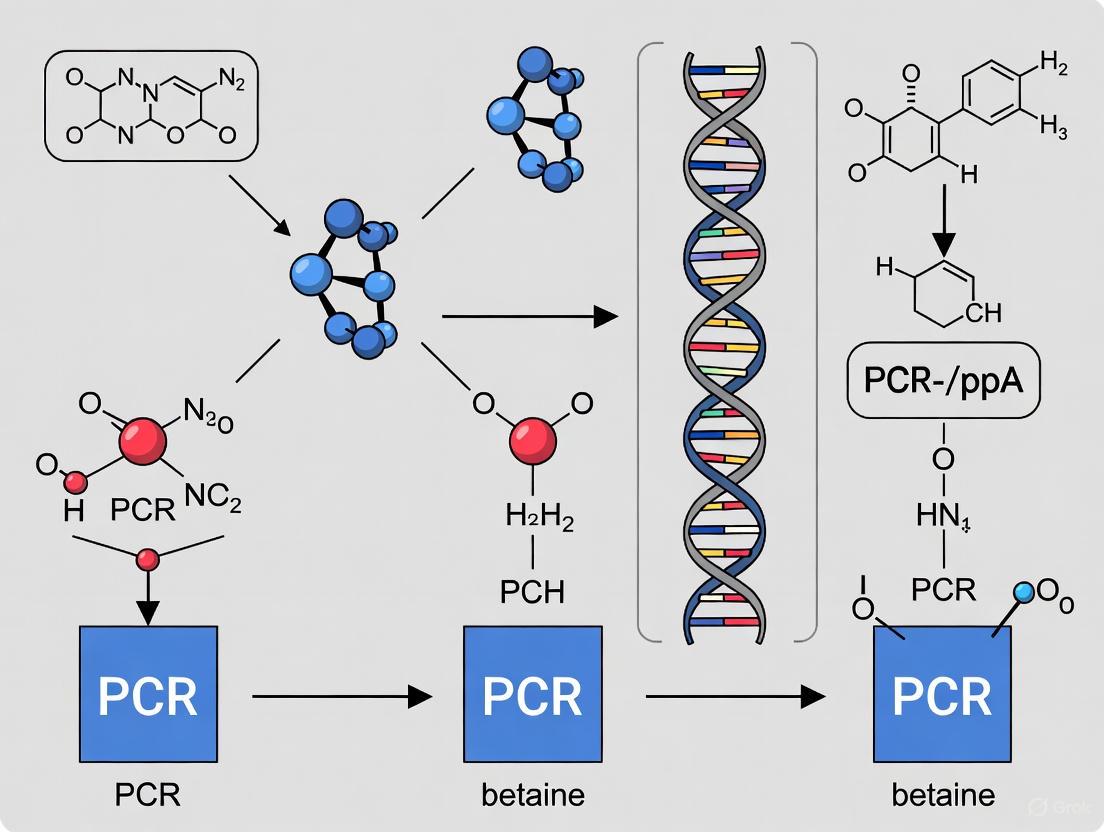
This article provides a comprehensive examination of betaine's role as a PCR enhancer, particularly for amplifying challenging GC-rich templates.
How Betaine Stabilizes DNA Denaturation in PCR: A Complete Guide for Researchers
Abstract
This article provides a comprehensive examination of betaine's role as a PCR enhancer, particularly for amplifying challenging GC-rich templates. It covers the foundational science behind betaine's ability to neutralize base-pair composition dependence and eliminate DNA secondary structures. For the practicing scientist, the content delivers practical methodological guidance on implementing betaine in PCR protocols, including optimal concentration ranges and compatibility with other reagents. A significant focus is placed on troubleshooting common amplification failures and optimizing reactions for maximum yield and specificity. Finally, the article offers a critical validation of betaine's performance against other common additives like DMSO, formamide, and emerging alternatives, empowering researchers to make informed reagent selections for their specific applications in drug development and biomedical research.
The Science Behind Betaine: How It Revolutionizes PCR for GC-Rich DNA
Chemical Identity and Fundamental Properties
Betaine, systematically named trimethylglycine, is an amino acid derivative with the molecular formula (CH₃)₃N⁺CH₂CO⁻₂ [1]. It is a zwitterion, meaning it contains both a positively charged quaternary ammonium group and a negatively charged carboxylate group within the same molecule [1] [2]. This structure is key to its function, as the molecule remains neutral overall despite bearing positive and negative charges.
The compound was first discovered in sugar beets (Beta vulgaris subsp. vulgaris), from which its common name is derived [1]. It appears as a white, water-soluble solid with a melting point of 180°C (decomposes) [1]. The name "betaine" is specifically reserved for this compound, though a broader class of chemically similar substances exists [2].
Table 1: Fundamental Chemical and Physical Properties of Betaine (Trimethylglycine)
| Property | Description/Value |
|---|---|
| IUPAC Name | (Trimethylammonio)acetate [1] |
| Other Names | Glycine betaine, TMG, Cystadane [1] |
| Molecular Formula | C₅H₁₁NO₂ [1] |
| Molar Mass | 117.146 g/mol [1] |
| Appearance | White solid [1] |
| Solubility | Soluble in water and methanol [1] |
| Acidity (pKa) | 1.84 [1] |
The Role of Betaine in DNA Denaturation and PCR Stabilization
In molecular biology, betaine is widely used as a PCR additive to significantly improve the amplification of DNA, particularly sequences that are GC-rich [3]. GC-rich DNA templates pose a challenge for PCR because the three hydrogen bonds between guanine (G) and cytosine (C) confer high stability to the DNA double helix, leading to pronounced secondary structure formation and inconsistent melting temperatures [4] [3].
Mechanism of Action
Betaine operates through a well-defined mechanism to overcome these challenges:
- Elimination of Base Pair Composition Dependence: Betaine interacts with the negatively charged groups on the DNA strand, reducing the electrostatic repulsion between the strands [4]. This interaction equalizes the stability of GC and AT base pairs, effectively eliminating the dependence of DNA melting temperature on its GC content [3]. This allows the entire DNA template to denature (melt) at a more uniform temperature [4].
- Reduction of DNA Secondary Structure: By reducing electrostatic repulsion and hydrogen bonding, betaine decreases the stability of the DNA double helix and hinders the formation of secondary structures, such as hairpins and loops, which are common in GC-rich regions [4]. This facilitates primer binding to the template DNA and subsequent elongation by DNA polymerase [4].
The following diagram illustrates how betaine modifies the DNA melting environment to improve PCR efficiency:
Quantitative Analysis of Betaine's Impact on PCR
The effectiveness of betaine in PCR is not merely qualitative; it has been quantitatively demonstrated in key studies. The following table summarizes experimental data from foundational research:
Table 2: Quantitative Experimental Data on Betaine Efficacy in PCR
| Experiment Focus | Betaine Concentration | Key Quantitative Outcome | Experimental Context |
|---|---|---|---|
| Co-amplification of alternatively spliced variants [3] | Not specified in abstract | Improved co-amplification efficiency | Prostate-specific membrane antigen mRNA variants |
| Amplification of GC-rich coding region [3] | Not specified in abstract | Successful amplification of c-jun cDNA | c-jun gene, a known GC-rich sequence |
Detailed Experimental Protocol
The seminal study by researchers demonstrating betaine's utility provides a clear methodological framework [3]:
- PCR Reaction Setup: Standard PCR reagents are used, including template DNA, forward and reverse primers, dNTPs, reaction buffer, and DNA polymerase (e.g., Taq polymerase).
- Betaine Addition: Betaine (or betaine monohydrate) is added to the reaction mixture. It is critical to use the non-hydrochloride form to avoid altering the pH of the reaction, which can inhibit the polymerase enzyme [4].
- Recommended Concentration: While the foundational paper does not specify an exact concentration, subsequent technical guides recommend a final concentration range of 1.0 M to 1.7 M for optimizing reactions with GC-rich templates [4]. The optimal concentration should be determined empirically for each specific assay.
- Thermal Cycling: The PCR is run using standard thermal cycling parameters. However, due to betaine's effect on reducing DNA melting temperature, optimization of the denaturation and annealing temperatures may be possible, often allowing for slightly lower denaturation temperatures.
The Scientist's Toolkit: Research Reagent Solutions
For researchers aiming to utilize betaine in their PCR experiments, the following table details key reagents and their functions:
Table 3: Essential Reagents for PCR with Betaine
| Reagent / Material | Function / Explanation |
|---|---|
| Betaine (Trimethylglycine) | Primary additive; equalizes DNA melting temps, reduces secondary structure, enhances specificity [4] [3]. |
| Betaine Monohydrate | Preferred chemical form; avoids pH shifts associated with betaine hydrochloride [4]. |
| DNA Polymerase | Enzyme for DNA synthesis; its activity must be compatible with betaine (Taq polymerase is commonly used) [4]. |
| dNTPs | Deoxyribonucleotide triphosphates; building blocks for new DNA strands [4]. |
| GC-Rich DNA Template | The target DNA sequence with high guanine-cytosine content (>60%) that is difficult to amplify without additives [3]. |
| Sequence-Specific Primers | Short oligonucleotides designed to flank the target GC-rich region for amplification [4]. |
| Magnesium Ions (Mg²⁺) | Essential cofactor for DNA polymerase activity; concentration often requires re-optimization when adding betaine [4]. |
Betaine in Context: Comparison with Other PCR Enhancers
Betaine is one of several additives used to overcome challenges in PCR. The workflow below compares its mechanism to other common enhancers and illustrates a decision pathway for reagent selection:
Genomic regions with high guanine-cytosine (GC) content present significant challenges in molecular biology applications, particularly in polymerase chain reaction (PCR) and DNA hybridization techniques. GC-rich sequences are conventionally defined as DNA regions where 60% or more of the bases are either guanine (G) or cytosine (C) [5]. These sequences are biologically significant as they are frequently found in promoter regions of housekeeping and tumor suppressor genes, playing crucial regulatory roles in gene expression [5]. The fundamental challenge stems from the triple hydrogen bonding between G-C base pairs compared to the double hydrogen bonding of adenine-thymine (A-T) pairs, resulting in markedly increased thermodynamic stability [5] [6]. This enhanced stability leads to two primary technical obstacles: elevated melting temperatures (Tm) that exceed standard PCR denaturation conditions, and a high propensity for forming stable secondary structures such as hairpin loops, cruciforms, and G-quadruplexes that impede polymerase progression [5] [6].
The problem extends beyond mere thermal stability. The same thermodynamic properties that strengthen GC bonds also facilitate intramolecular folding, where GC-rich templates form stable secondary structures that persist even at standard PCR denaturation temperatures (92-95°C) [6]. These structures effectively sequester template regions from primer binding and create physical barriers that cause polymerase stalling, resulting in truncated amplification products, complete PCR failure, or non-specific amplification [5]. Furthermore, primers designed for GC-rich regions themselves tend to form self-dimers, cross-dimers, and hairpin structures, particularly problematic when the 3' end is GC-rich, leading to mispriming events and reduced amplification efficiency [6] [7]. Understanding these fundamental principles is essential for developing effective strategies to overcome the GC-rich challenge in molecular applications.
The Molecular Mechanism of Betaine in Stabilizing DNA Denaturation
Betaine (N,N,N-trimethylglycine) has emerged as a particularly effective chemical additive for mitigating challenges associated with GC-rich DNA amplification. This naturally occurring osmoprotectant compound functions through a unique homogenizing effect on DNA thermal stability, effectively eliminating the differential melting behavior between GC-rich and AT-rich regions [8]. The primary mechanism involves betaine's interaction with the DNA molecule, where it interacts with negatively charged groups on the DNA phosphate backbone, reducing electrostatic repulsion between complementary strands and thereby destabilizing the double helix in a sequence-nonspecific manner [8]. This action effectively equalizes the thermal energy required to denature different genomic regions regardless of their base composition.
At the molecular level, betaine exerts its effect through preferential exclusion from DNA surfaces, which alters the hydration shell surrounding the DNA molecule. Studies utilizing UV melting analysis of DNA duplexes have demonstrated that betaine concentrations between 100 mM and 2.7 M significantly reduce the base composition dependence of DNA melting [9]. This phenomenon creates a more uniform energetic landscape for DNA denaturation and renaturation during thermal cycling. Research has shown that predictive models incorporating betaine's effects can accurately forecast DNA thermodynamic parameters, with Visual OMP software predicting ΔG°37 and Tm to within 0.34 kcal/mol and 0.8°C, respectively, in betaine-containing buffers [9].
The practical consequence of this mechanism is that betaine lowers the melting temperature specifically of GC-rich regions while having minimal effect on AT-rich sequences, effectively compressing the Tm range across different genomic regions [8]. This homogenization prevents the localized premature renaturation of GC-rich secondary structures during the annealing and extension phases of PCR, allowing polymerase access to templates that would otherwise remain inaccessible. Additionally, by reducing the formation of stable secondary structures, betaine minimizes polymerase stalling and increases the processivity of DNA synthesis through challenging regions [5]. The concentration-dependent efficacy of betaine, typically optimized between 1.0 M and 1.7 M for PCR applications, provides a tunable parameter for optimizing specific amplification reactions without significantly inhibiting polymerase activity [8] [7].
Table 1: Comparison of Common PCR Additives for GC-Rich Amplification
| Additive | Mechanism of Action | Recommended Concentration | Primary Benefit |
|---|---|---|---|
| Betaine | Homogenizes DNA thermal stability; reduces secondary structure formation | 1.0 M - 1.7 M | Eliminates base composition dependence of DNA melting |
| DMSO | Reduces DNA secondary structure stability; interferes with base pairing | 2% - 10% | Lowers melting temperature of GC-rich regions |
| Formamide | Disrupts hydrogen bonding and hydrophobic interactions between DNA strands | 1% - 5% | Reduces DNA melting temperature; increases specificity |
| TMAC | Forms charge shields to reduce electrostatic repulsion between strands | 15 mM - 100 mM | Increases hybridization specificity; reduces non-specific amplification |
| 7-deaza-dGTP | dGTP analog that incorporates into DNA, reducing stability of GC interactions | Variable, replaces dGTP | Disrupts Hoogsteen base pairing in G-quadruplex structures |
Experimental Optimization: Protocols for GC-Rich Amplification
Standardized Betaine-Enhanced PCR Protocol
Successful amplification of GC-rich templates requires systematic optimization of both reaction components and thermal cycling parameters. The following protocol provides a robust starting point for betaine-enhanced PCR of challenging templates. Begin by preparing a master mix containing: 1X PCR buffer (supplied with polymerase), 1.5-2.0 mM MgCl₂ (optimization required), 0.2 mM each dNTP, 0.2-0.5 µM each forward and reverse primer, 1.0-1.7 M betaine (use betaine monohydrate, not hydrochloride), 1.25-2.5 U of DNA polymerase (see section 3.2 for selection criteria), and 10-100 ng template DNA in a total reaction volume of 25-50 µL [5] [8] [7]. It is critical to use betaine monohydrate rather than betaine hydrochloride, as the latter can adversely affect reaction pH and consequently impair polymerase activity [8].
The thermal cycling parameters should be optimized as follows: initial denaturation at 95°C for 2-5 minutes; followed by 30-40 cycles of denaturation at 95°C for 20-30 seconds, annealing at a temperature 3-5°C above the calculated Tm for 20-30 seconds (implement a temperature gradient for optimization), and extension at 68-72°C for 1 minute per kb; with a final extension at 68-72°C for 5-10 minutes [5] [6] [7]. For exceptionally stable secondary structures, consider implementing a two-step annealing approach with higher stringency annealing (5°C above calculated Tm) for the first 5-10 cycles, followed by reduced stringency (calculated Tm) for remaining cycles to balance specificity and yield [5]. Additionally, extending the denaturation time to 45-60 seconds in later cycles (after cycle 20) can help overcome accumulating secondary structures as template concentration increases.
Magnesium and Betaine Concentration Optimization
The concentration of magnesium ions (Mg²⁺) requires careful titration when using betaine, as these components interact to affect polymerase fidelity and reaction specificity. Mg²⁺ serves as an essential cofactor for DNA polymerase activity, facilitating dNTP binding and phosphodiester bond formation [5] [7]. In standard PCR, MgCl₂ concentrations typically range from 1.5 to 2.0 mM, but GC-rich amplifications often benefit from finer optimization. Implement a Mg²⁺ titration series across the range of 1.0 to 4.0 mM in 0.5 mM increments to identify the optimal concentration for your specific template [5] [7]. High Mg²⁺ concentrations promote non-specific amplification and decrease fidelity, while insufficient Mg²⁺ reduces polymerase activity and yield [7].
Simultaneously, optimize betaine concentration through a parallel titration series from 0.8 M to 2.0 M in 0.2 M increments [10] [7]. The combination of Mg²⁺ and betaine titration may reveal synergistic effects, requiring matrix optimization for challenging templates. When evaluating optimization results, prioritize reaction specificity (single band on agarose gel) over absolute yield, as non-specific products indicate suboptimal conditions that compromise downstream applications. Include both positive and negative controls in optimization experiments to distinguish between specific amplification and artifacts.
Diagram 1: Workflow for optimizing GC-rich PCR with betaine. Critical optimization steps include parallel titration of betaine and Mg²⁺ concentrations and thermal cycling adjustments for high secondary structure templates.
Advanced Technical Solutions and Research Applications
Polymerase Engineering for GC-Rich Amplification
Recent advances in polymerase engineering have yielded enzyme variants specifically optimized for challenging PCR applications, including GC-rich amplification. Traditional Taq polymerase demonstrates limited efficiency on templates with extensive secondary structure, but newer proprietary blends and engineered variants exhibit enhanced processivity and strand displacement activity [5] [11]. These advanced polymerases are frequently supplied with specialized GC buffers and enhancers that contain optimized mixtures of betaine and other additives in empirically determined ratios [5]. For example, OneTaq DNA Polymerase with GC Buffer and Q5 High-Fidelity DNA Polymerase with GC Enhancer have demonstrated robust amplification of templates with up to 80% GC content [5].
The development of novel Taq polymerase variants with enhanced reverse transcription activity further expands capabilities for GC-rich RNA templates. Recent research describes engineered Taq variants containing combinations of mutations (L459M, S515R, I638F, M747K, N483K, E507K, V586G, I614K) that improve thermostability and processivity on structured nucleic acids [11]. These enzymes maintain activity at temperatures up to 95°C, allowing denaturation of highly stable secondary structures during amplification [11]. When working with exceptionally challenging templates, combining betaine supplementation with these specialized polymerases provides a synergistic benefit, as the additive reduces secondary structure stability while the engineered enzymes maintain processivity through remaining structures.
Complementary Approaches and Additive Synergy
While betaine represents a powerful tool for GC-rich amplification, its efficacy can be enhanced through strategic combination with complementary additives. Dimethyl sulfoxide at 2-10% concentration can further destabilize DNA secondary structures through distinct mechanisms, primarily by reducing DNA melting temperature through interference with hydrogen bonding [8] [7]. However, DMSO simultaneously reduces Taq polymerase activity, requiring careful concentration optimization when used in combination with betaine [8]. For templates prone to non-specific amplification, particularly in multiplex reactions, tetramethylammonium chloride increases primer annealing stringency by neutralizing sequence-dependent differences in duplex stability [5] [8].
For the most recalcitrant templates containing extreme GC content (>80%) or extensive secondary structure, incorporating 7-deaza-2'-deoxyguanosine can be effective. This dGTP analog incorporates into nascent DNA strands but does not form Hoogsteen bonds in G-quadruplex structures, preventing the formation of these particularly stable secondary elements [5] [6]. However, this analog demonstrates reduced staining with ethidium bromide, requiring alternative detection methods [5]. Recent high-throughput DNA melt measurement studies using Array Melt technology have enabled more accurate prediction of DNA folding thermodynamics, facilitating better primer and probe design for GC-rich targets [12]. This approach, combining computational prediction with empirical optimization of betaine-containing reactions, represents the current state-of-the-art for challenging amplification applications.
Table 2: Research Reagent Solutions for GC-Rich DNA Amplification
| Reagent Category | Specific Examples | Function in GC-Rich PCR | Usage Notes |
|---|---|---|---|
| Specialized Polymerases | OneTaq DNA Polymerase (NEB #M0480), Q5 High-Fidelity DNA Polymerase (NEB #M0491), AccuPrime GC-Rich DNA Polymerase | Enhanced processivity on structured templates; some include proprietary GC buffers | Select based on fidelity requirements and template difficulty; often include GC enhancers |
| Betaine Formulations | Betaine monohydrate | Homogenizes DNA melting temperatures; reduces secondary structure | Use 1.0-1.7 M final concentration; avoid betaine hydrochloride |
| Secondary Additives | DMSO, formamide, glycerol | Further reduce DNA secondary structure; increase primer stringency | Optimize concentration carefully as they can inhibit polymerase |
| Cation Optimization | MgCl₂ titration solutions | Essential polymerase cofactor; concentration affects fidelity and specificity | Titrate from 1.0-4.0 mM in 0.5 mM increments |
| dNTP Analogs | 7-deaza-2'-deoxyguanosine | Disrupts G-quadruplex formation in extreme GC regions | Compatible with most polymerases; reduces ethidium bromide staining |
The challenges posed by GC-rich DNA sequences in molecular applications stem from fundamental thermodynamic principles that favor stable base pairing and secondary structure formation. Betaine addresses these challenges through its unique ability to homogenize the thermal stability of DNA regions with differing GC content, effectively eliminating the composition-dependent melting behavior that impedes conventional amplification. When incorporated into systematic optimization protocols that include magnesium titration, polymerase selection, and thermal profile adjustments, betaine enables robust and specific amplification of previously intractable templates. Continued advancements in polymerase engineering, thermodynamic modeling, and buffer formulation further enhance our capability to work with biologically significant GC-rich genomic regions, expanding the scope of molecular research and diagnostic applications.
Diagram 2: Mechanistic relationship between GC-rich DNA challenges, betaine's molecular actions, and experimental outcomes. Betaine counters each fundamental challenge through specific biophysical interactions that enable successful amplification.
Betaine, a zwitterionic amino acid analogue, fundamentally alters the thermodynamics of DNA melting by functioning as an isostabilizing agent. Its core mechanism lies in differentially destabilizing guanine-cytosine (GC) rich regions over adenine-thymine (AT) rich regions, thereby eliminating the strong dependence of DNA melting temperature on base pair composition. This whitepaper details the biophysical principles underpinning this phenomenon, drawing upon vapor pressure osmometry, thermal denaturation studies, and solute partitioning models. The analysis is framed within its critical application in polymerase chain reaction (PCR) research, where betaine serves as a powerful reagent for amplifying GC-rich templates that are otherwise recalcitrant to amplification. By reconciling quantitative data on interaction potentials, m-values, and preferential interactions, this guide provides a comprehensive technical resource for life scientists leveraging betaine in nucleic acid methodologies.
The stability of double-stranded DNA (dsDNA) is predominantly governed by its base pair composition. GC base pairs, stabilized by three hydrogen bonds, confer significantly higher thermal stability than AT base pairs, which are stabilized by only two. Consequently, the melting temperature ((T_m)) of a DNA duplex—the temperature at which half of the duplexes dissociate into single strands—increases linearly with its GC content. This dependence poses a substantial challenge in molecular techniques like PCR, where heterogeneous DNA populations or targets with exceptionally high GC content can lead to inefficient or failed amplification due to incomplete denaturation or stable secondary structures [13].
The discovery that certain solutes can modulate this intrinsic property of DNA provided a pathway to overcome these technical hurdles. Early work identified small tetraalkylammonium ions as isostabilizing agents. Betaine (N,N,N-trimethylglycine) was subsequently found to share this ability, offering a unique tool to experimentally separate the compositional effects from polyelectrolyte effects on DNA melting [14] [15]. This whitepaper delves into the core mechanism behind betaine's action and its pivotal role in stabilizing DNA denaturation in PCR research.
The Fundamental Mechanism of Betaine Action
Betaine exerts its isostabilizing effect through a combination of exclusion from the native duplex and preferential accumulation at the surface area exposed during the melting process. The net result is a favorable interaction with the single-stranded state, which destabilizes the double helix. The specificity of this destabilization for GC-rich sequences arises from the differential nature of the surface area exposed when AT versus GC base pairs dissociate.
Preferential Interaction and Exclusion from the Duplex State
Vapor pressure osmometry studies demonstrate that betaine is strongly excluded from the surface of native, double-stranded DNA [16]. This exclusion is primarily attributed to betaine's zwitterionic nature and its preference for interacting with bulk water rather than the highly ordered, anionic phosphate backbone of dsDNA. The hydration shell around the DNA phosphate oxygens is extensive, involving at least two layers of water molecules, and betaine cannot effectively compete with this structured hydration [16]. This exclusion increases the chemical potential ((\mu_2)) of the DNA, meaning the duplex state is slightly less stable in betaine solutions than in pure aqueous buffer.
Favorable Interactions with the Unfolded State
During thermal denaturation, the DNA duplex dissociates into single strands, exposing two primary types of surface area:
- The hydrophobic surfaces of the bases, which are stacked and hidden in the duplex.
- Polar and anionic surfaces of the phosphate backbone and base functional groups.
Betaine interacts favorably with the exposed surface area of the single-stranded DNA, particularly with the aromatic and amine groups of the bases [17] [16]. This favorable interaction lowers the free energy of the single-stranded state relative to the duplex state, thereby destabilizing the duplex. The magnitude of this destabilization is quantified by the m-value and the interaction potential, (\Delta\mu_{23,4}), which represent the change in the Gibbs free energy of unfolding per unit increase in betaine molality and the difference in betaine interaction between single-stranded and duplex states, respectively [17].
The GC-Specific Destabilization Mechanism
The key to betaine's isostabilizing effect is that its favorable interaction with the unfolded state is significantly greater for GC base pairs than for AT base pairs. This is because the surface area exposed upon melting a GC base pair, specifically the guanine and cytosine functional groups, provides a more thermodynamically favorable binding site for betaine [16]. Experimental data shows that the m-value (a measure of destabilization) becomes more negative with increasing GC content, indicating a stronger destabilizing effect [17].
Furthermore, this interaction is highly temperature-dependent. The entropic component of the m-value is more sensitive to temperature than the enthalpic component, leading to a characteristic entropy-enthalpy compensation. Since GC-rich duplexes have higher intrinsic melting temperatures, betaine's destabilizing effect is amplified at these higher temperatures, thereby proportionally reducing the (T_m) of GC-rich sequences more than that of AT-rich sequences [17]. At a specific "isostabilizing" concentration (approximately 5.2 M for DNA), the differential destabilization equalizes the net stability of AT and GC base pairs, effectively eliminating the base pair composition dependence of DNA melting [14].
Diagram 1: Mechanism of Betaine Action on DNA Melting. In aqueous buffer, DNA melting shows a strong dependence on GC content. In betaine solution, betaine is excluded from the double-stranded state (increasing its chemical potential, μ₂) but accumulates favorably on the single-stranded state, particularly on exposed GC-rich regions, lowering the free energy change (ΔG) of unfolding and reducing the melting temperature difference.
Quantitative Experimental Evidence
The proposed mechanism is supported by robust quantitative data from thermal denaturation and thermodynamic studies.
Isostabilizing Concentration and Melting Temperature Modulation
Rees et al. (1993) established that a betaine concentration of approximately 5.2 M is isostabilizing for DNA, effectively eliminating the (T_m) difference between AT and GC base pairs [14]. At this concentration, the melting temperature becomes independent of base composition.
Table 1: Effect of Betaine Analogs on DNA Melting Temperature (Tm) [18]
| Betaine Analog Type | Charge Separation | Effect on DNA Tm | Specificity |
|---|---|---|---|
| Sulfonate analogs (no OH) | 2-3 methylene groups | Strong decrease | Reduces GC dependence |
| Carboxylate analogs (with OH) | 2-3 methylene groups | Increase | Greater stabilization for low GC DNA |
| Sulfonate analogs (with OH) | 2-3 methylene groups | Destabilization | Reduces GC dependence |
| Natural Betaine | 2 methylene groups | Decrease (isostabilizing) | Eliminates GC dependence |
RNA Duplex Destabilization and Temperature Dependence
Subsequent work on RNA duplexes quantified the interaction potential ((\Delta\mu_{23,4}/RT)) and m-values, confirming the stronger destabilization of GC-rich sequences and its temperature dependence.
Table 2: Glycine Betaine (GB) Interaction Parameters for RNA Dodecamer Duplexes [17]
| Sequence GC % | Reference Tm (°C) | Interaction Potential, (\Delta\mu_{23,4}/RT) (m⁻¹) | m-value (kcal mol⁻¹ m⁻¹) |
|---|---|---|---|
| 17 | 27.3 | -0.315 ± 0.029 | -0.188 ± 0.017 |
| 33 | 45.5 | -0.598 ± 0.027 | -0.378 ± 0.017 |
| 50 | 52.0 | -0.811 ± 0.032 | -0.524 ± 0.020 |
| 67 | 59.6 | -0.948 ± 0.037 | -0.627 ± 0.024 |
| 100 | 80.9 | -1.44 ± 0.03 | -1.010 ± 0.023 |
The data in Table 2 shows a clear trend: as GC content and the reference (T_m) increase, the interaction potential and m-value become more negative. This signifies that betaine's favorable interaction with the unfolded state—and thus its destabilizing effect—intensifies with increasing GC content. The study also found that the derivative of the m-value with respect to temperature ((d(m\text{-}value)/dT)) becomes more negative with higher GC content, confirming the strong temperature dependence of the interaction [17].
Research Reagent Solutions and Experimental Protocols
The following toolkit summarizes key reagents and provides a foundational protocol for studying betaine's effects on DNA melting, as derived from the cited literature.
The Scientist's Toolkit: Key Research Reagents
| Reagent / Material | Function / Explanation in Experimentation |
|---|---|
| Betaine (Glycine Betaine) | The primary isostabilizing agent. A zwitterionic osmolyte used to eliminate base composition dependence in DNA melting and PCR. |
| Mononucleosomal Calf Thymus DNA | A common, heterogeneous DNA substrate used in vapor pressure osmometry and initial melting studies to characterize solute interactions [16]. |
| Defined RNA/DNA Dodecamers | Short, synthetic oligonucleotides with precisely controlled GC content (e.g., 17%-100%) for quantifying betaine interaction parameters and m-values [17]. |
| Sodium Phosphate Buffer | Provides a stable pH environment (e.g., pH 6.9) crucial for consistent melting experiments and betaine zwitterion stability. |
| Vapor Pressure Osmometry (VPO) | Key technique for measuring solute preferential interaction parameters by analyzing osmolality as a function of solute and DNA concentration [16]. |
| UV-Vis Spectrophotometer with Peltier | Standard instrument for monitoring hyperchromicity at 260 nm during controlled temperature ramps to determine DNA/RNA melting curves. |
Detailed Experimental Protocol: DNA Melting Analysis in Betaine
This protocol is adapted from methodologies used to generate the quantitative data discussed in this paper [14] [17].
Objective: To determine the melting temperature ((T_m)) of a DNA duplex in the presence and absence of betaine and observe the attenuation of GC dependence.
Materials:
- DNA Samples: Complementary single-stranded DNA oligonucleotides, purified. Include sequences with varying GC content (e.g., 30%, 50%, 70%).
- Betaine Solution: Prepare a concentrated, sterile stock solution of betaine (e.g., 5 M) in the desired buffer. Do not use betaine hydrochloride, as it may alter pH [19].
- Buffer: 10 mM Sodium Phosphate, 133 mM NaCl, pH 6.9.
- Equipment: UV-Vis spectrophotometer equipped with a programmable thermal cuvette holder.
Method:
- DNA Duplex Annealing:
- Mix complementary single strands at a 1:1 mole ratio in the annealing buffer.
- Heat the mixture to 60–80°C (above the anticipated (T_m)) for 5–10 minutes.
- Slowly cool the solution to room temperature over 1–2 hours. Store annealed duplexes at 4°C.
Sample Preparation:
- Prepare DNA solutions (e.g., 1–3 µM duplex concentration) in buffer containing a series of betaine concentrations (e.g., 0 M, 1 M, 2 M, 3 M, 5 M).
- Ensure identical DNA concentrations across all samples for direct comparison of hyperchromicity.
Thermal Denaturation:
- Load DNA samples into quartz cuvettes.
- Set the spectrophotometer to monitor absorbance at 260 nm.
- Program a thermal ramp (e.g., from 20°C to 95°C at a rate of 0.5–1.0°C per minute).
- Run the melting program for each sample, collecting absorbance and temperature data.
Data Analysis:
- Plot absorbance (or fraction unfolded) versus temperature to generate melting curves.
- Determine the (T_m) for each sample from the midpoint of the melting transition or from the derivative peak.
- Plot (T_m) versus GC content for different betaine concentrations. The slope of this relationship will approach zero as the betaine concentration reaches the isostabilizing point (~5.2 M).
Application in PCR Research
The fundamental understanding of betaine's mechanism directly informs its application as a powerful PCR enhancer, particularly for difficult targets.
Overcoming GC-Rich Challenges in Amplification
GC-rich DNA templates form stable secondary structures and exhibit high melting temperatures, which can cause polymerase pausing, premature termination, and non-specific priming. By equalizing the stability of AT and GC base pairs, betaine offers three key benefits in PCR [13] [19]:
- Lowers Effective Melting Temperature: It reduces the (T_m) of GC-rich regions, facilitating complete strand separation during the denaturation step.
- Reduces Secondary Structure: It destabilizes intramolecular structures in single-stranded DNA, preventing them from impeding primer binding or polymerase progression.
- Increases Specificity: By promoting uniform melting, it can enhance the specificity of primer annealing.
Practical Guidelines for PCR Optimization
- Concentration: The recommended final concentration of betaine typically ranges from 1.0 M to 1.7 M, which is below the full isostabilizing concentration but sufficient to exert a significant stabilizing effect on denaturation [19]. Optimization is required.
- Form: Use betaine or betaine monohydrate, not betaine hydrochloride, to avoid pH shifts that can inhibit polymerase activity [19].
- Context: Betaine is often used in conjunction with other additives like DMSO, though their effects are not always additive and should be empirically tested [20].
Betaine functions as a molecular equalizer for DNA stability through a well-defined biophysical mechanism: it is excluded from the hydrated surface of double-stranded DNA but accumulates preferentially on the base surfaces exposed in single-stranded DNA, with a marked preference for the functional groups of guanine and cytosine. This differential interaction destabilizes GC-rich DNA more than AT-rich DNA, thereby eliminating the base pair composition dependence of melting at specific concentrations. This principle has been quantitatively validated through thermodynamic parameters like m-values and interaction potentials. Within PCR research, this mechanism is harnessed to resolve one of the most persistent technical challenges—the amplification of GC-rich DNA—showcasing a direct and critical application of fundamental biophysical insights in advancing molecular biology and drug development.
Betaine (N,N,N-trimethylglycine), a zwitterionic osmolyte, plays a crucial role in molecular biology by destabilizing nucleic acid secondary structures, thereby facilitating the amplification of GC-rich DNA sequences in polymerase chain reaction (PCR) applications. This whitepaper elucidates the molecular mechanisms through which betaine exerts its isostabilizing effect, presents quantitative data on its sequence-dependent efficacy, and provides detailed experimental methodologies for leveraging betaine in research. By examining betaine's preferential interactions with the solvent-accessible surface area exposed during DNA denaturation, we frame its function within the broader context of stabilizing DNA denaturation in PCR research, offering investigators a comprehensive technical guide for optimizing experimental outcomes.
The amplification of DNA sequences with high guanine-cytosine (GC) content presents a significant challenge in molecular biology. GC-rich regions exhibit elevated melting temperatures due to the triple hydrogen-bonding between guanine and cytosine, compared to the double hydrogen-bonding in adenine-thymine (AT) pairs. This inherent stability promotes the rapid re-formation of secondary structures—such as hairpins and stable duplexes—during the PCR annealing and extension steps, leading to premature termination, non-specific amplification, and PCR failure [21]. The scientific community has addressed this challenge through the use of PCR enhancers, among which betaine has emerged as a particularly effective agent for ameliorating the amplification of GC-rich templates by reducing the formation of secondary structure [3].
Molecular Mechanism of Betaine Action
Betaine destabilizes nucleic acid secondary structures through well-defined thermodynamic interactions with the DNA molecule and its hydration shell.
Isostabilization of Base Pair Stability
The fundamental action of betaine is its ability to function as an isostabilizing agent. Research has demonstrated that at a concentration of approximately 5.2 M, betaine eliminates the base pair composition dependence of DNA melting, making AT and GC base pairs equally stable [14]. This effect occurs without significantly altering the B-form conformation of double-stranded DNA or substantially changing DNA's polyelectrolyte behavior, as betaine exists as a zwitterion near neutral pH [14]. This property is crucial for PCR applications, as it effectively normalizes the melting temperatures across different regions of a GC-rich template, ensuring more uniform denaturation and primer annealing.
Thermodynamic Interactions with Accessible Surface Area
The transition from duplex to single-stranded DNA exposes additional solvent-accessible surface area (ΔASA). Betaine exhibits favorable thermodynamic interactions with this exposed surface area, particularly with aromatic and amine functional groups, thereby shifting the equilibrium toward the unfolded state [17]. The interaction potential, Δμ₂₃,₄, quantifies this favorable interaction, with negative values indicating betaine's preferential accumulation at the denaturation ΔASA and concomitant destabilization of the native duplex [17]. This mechanism differs fundamentally from protein stabilization, where betaine is typically excluded from the protein surface, highlighting the molecule's context-dependent bio-physical interactions [17] [22].
Table 1: Betaine Interaction Parameters with RNA Dodecamer Duplexes of Varying GC Content
| GC Content (%) | Reference Temperature (°C) | Interaction Potential, Δμ₂₃,₄/RT (m⁻¹) | m-value (kcal mol⁻¹ m⁻¹) |
|---|---|---|---|
| 17 | 27.3 | -0.315 ± 0.029 | -0.188 ± 0.017 |
| 25 | 34.8 | -0.398 ± 0.044 | -0.244 ± 0.027 |
| 33 | 45.5 | -0.598 ± 0.027 | -0.378 ± 0.017 |
| 42 | 44.6 | -0.670 ± 0.069 | -0.423 ± 0.044 |
| 50 | 49.0 | -1.02 ± 0.07 | -0.655 ± 0.045 |
| 67 | 59.6 | -0.948 ± 0.037 | -0.627 ± 0.024 |
| 100 | 80.9 | -1.44 ± 0.03 | -1.010 ± 0.023 |
Data adapted from [17], determined at the reference temperature for each duplex.
Structural and Hydration Effects
The molecular structure of betaine is critical to its function. Studies with synthetic betaine analogs have revealed that the distance between the zwitterionic charges—optimally two or three methylene groups—significantly influences DNA destabilization efficacy [18]. Furthermore, hydroxyl-substituted sulfonate analogs of betaine typically destabilize DNA, while their carboxylate analogs can sometimes stabilize it, indicating that both the charge separation and specific functional groups dictate the net effect on nucleic acid stability [18]. Betaine is thought to achieve its effects partly by structuring the hydration water around DNA, thereby altering the solvation shell and reducing the energy penalty for exposing hydrophobic surfaces during denaturation [18].
Diagram Title: Molecular Mechanism of Betaine-DNA Interactions
Quantitative Effects on DNA Melting and PCR Efficiency
The impact of betaine on DNA denaturation is quantifiable through its effects on melting temperature (Tm) and PCR amplification efficiency, with its efficacy being particularly pronounced for GC-rich templates.
GC-Content Dependent Destabilization
The destabilizing effect of betaine on nucleic acid duplexes is strongly dependent on GC content. As shown in Table 1, both the interaction potential (Δμ₂₃,₄) and the m-value (representing the change in unfolding free energy per unit betaine concentration) become increasingly negative with higher GC content [17]. This indicates that betaine destabilizes GC-rich duplexes to a greater extent than AT-rich ones. This phenomenon occurs because GC-rich duplexes expose more non-polar surface area upon denaturation and unfold at higher temperatures, where betaine's destabilizing effect is thermodynamically enhanced [17].
Enhancement of PCR Amplification
In PCR applications, betaine significantly improves the amplification of GC-rich targets. Systematic comparisons of PCR enhancers have demonstrated that betaine outperforms other additives like DMSO, formamide, and glycerol in amplifying GC-rich DNA fragments [21]. Real-time PCR data reveal that betaine at 0.5 M concentration reduces the cycle threshold (Ct) for a super high GC content (78.4%) fragment from 32.17 to 16.97, indicating a substantial improvement in amplification efficiency [21]. This effect is attributed to betaine's ability to lower the melting temperature of DNA and decrease its dependence on base composition, thus ensuring thorough denaturation of templates and preventing stable secondary structure formation [21] [3].
Table 2: Performance of PCR Enhancers on DNA Fragments with Different GC Content
| Enhancer | Concentration | Moderate GC (53.8%) Ct±SEM | High GC (68.0%) Ct±SEM | Super High GC (78.4%) Ct±SEM |
|---|---|---|---|---|
| Control | - | 15.84±0.05 | 15.48±0.22 | 32.17±0.25 |
| DMSO | 5% | 16.68±0.01 | 15.72±0.03 | 17.90±0.05 |
| Formamide | 5% | 18.08±0.07 | 15.44±0.03 | 16.32±0.05 |
| Betaine | 0.5 M | 16.03±0.03 | 15.08±0.10 | 16.97±0.08 |
| Sucrose | 0.4 M | 16.39±0.09 | 15.03±0.04 | 16.67±0.08 |
| Trehalose | 0.4 M | 16.43±0.16 | 15.15±0.08 | 16.91±0.14 |
Data adapted from [21]. Lower Ct values indicate better amplification efficiency.
Experimental Protocols and Methodologies
Protocol for Evaluating Betaine in PCR Amplification
This protocol outlines a systematic approach to optimize betaine concentration for amplifying GC-rich DNA targets [21].
Reagent Preparation:
- Prepare a 5 M stock solution of betaine in sterile deionized water.
- Use betaine or betaine monohydrate rather than betaine hydrochloride, as the hydrochloride form may affect reaction pH and enzyme activity.
PCR Reaction Setup:
- Prepare a master mix containing standard PCR components: buffer, dNTPs, primers, template DNA, and DNA polymerase.
- Aliquot the master mix into separate tubes for betaine concentration testing.
- Add betaine stock solution to achieve final concentrations typically ranging from 0.5 M to 1.7 M.
- Include a negative control without betaine.
Thermal Cycling:
- Use standard cycling parameters appropriate for your target sequence.
- For initial optimization, consider using a thermal gradient to identify the optimal annealing temperature in the presence of betaine.
Analysis:
- Analyze PCR products by agarose gel electrophoresis to assess specificity and yield.
- For quantitative assessment, perform real-time PCR to determine cycle threshold (Ct) values.
- Select the betaine concentration that provides the lowest Ct value and highest specific product yield without promoting non-specific amplification.
Protocol for Measuring DNA Melting Temperature in Betaine Solutions
This protocol describes how to quantify the effect of betaine on DNA duplex stability using ultraviolet (UV) melting experiments [17].
Sample Preparation:
- Design and obtain complementary DNA or RNA oligonucleotides of interest.
- Anneal duplexes by mixing complementary strands at a 1:1 mole ratio, heating to 60°C, and slowly cooling to room temperature.
- Prepare samples in appropriate buffer (e.g., 10 mM sodium phosphate, pH 6.9, with 149 mM Na+) containing varying concentrations of betaine (0 M to 3 M).
- Use oligonucleotide concentrations suitable for UV absorbance detection (typically A₂₆₀ ≈ 0.2 to 1.0).
Data Collection:
- Use a UV-visible spectrophotometer equipped with a temperature controller and multi-cell holder.
- Monitor absorbance at 260 nm while increasing temperature at a constant rate (e.g., 1°C per minute).
- Record full UV spectra at various temperatures to assess hyperchromicity changes.
Data Analysis:
- Plot absorbance versus temperature to generate melting curves.
- Determine the melting temperature (Tm) as the midpoint of the transition curve.
- Plot Tm values versus betaine concentration to quantify the isostabilizing effect.
- For RNA duplexes, analyze hyperchromicity values to assess betaine's effect on base stacking.
The Scientist's Toolkit: Essential Research Reagents
Table 3: Key Reagents for Investigating Betaine-DNA Interactions
| Reagent/Solution | Typical Concentration | Function/Application |
|---|---|---|
| Betaine (Anhydrous) | 0.5 - 1.7 M (PCR); up to 5 M (Tm studies) | Primary isostabilizing agent; reduces DNA secondary structure formation [21] [14]. |
| Betaine Monohydrate | 0.5 - 1.7 M | Preferred over hydrochloride forms to avoid pH alterations in enzymatic reactions [23]. |
| Sodium Phosphate Buffer | 10 mM, pH 6.9 | Maintains pH stability during thermal denaturation studies [17]. |
| Sodium Chloride | 133-149 mM | Provides monovalent ions for ionic strength control in nucleic acid stability studies [17]. |
| DMSO | 2-10% (v/v) | Alternative PCR enhancer; compare efficacy with betaine [21] [23]. |
| Formamide | 1-5% (v/v) | Organic solvent additive that destabilizes DNA duplex; compare with betaine [21]. |
| Trehalose/Sucrose | 0.1-0.4 M | Osmoprotectants that can stabilize DNA polymerase and mildly enhance GC-rich amplification [21]. |
Betaine serves as a powerful tool for manipulating nucleic acid stability through well-defined molecular interactions that reduce DNA secondary structure formation. Its capacity to function as an isostabilizing agent—weakening GC base pair stability more than AT pairs—makes it particularly valuable for amplifying recalcitrant GC-rich sequences in PCR. The thermodynamic basis for this action involves favorable interactions with the surface area exposed during DNA denaturation, with efficacy that increases both with GC content and temperature. By incorporating the quantitative data and experimental protocols outlined in this technical guide, researchers can systematically leverage betaine to overcome key challenges in molecular biology, drug development, and genetic analysis, thereby advancing diagnostic and therapeutic applications dependent on reliable nucleic acid amplification.
The Polymerase Chain Reaction (PCR) is a foundational technique in molecular biology, but its efficiency can be severely compromised by difficult DNA templates, particularly those with high GC-content. These challenging templates form stable secondary structures that prevent proper denaturation and primer annealing [21] [24]. The scientific journey to overcome these limitations led to the systematic investigation of PCR enhancers, with betaine emerging as a particularly effective solution for GC-rich targets.
This review examines the key research that established betaine's role in PCR enhancement, focusing on its unique mechanism of action in stabilizing DNA denaturation. We explore the historical experimental evidence that transformed betaine from a simple organic osmolyte to an indispensable laboratory reagent for amplifying difficult DNA sequences.
The GC-Rich Challenge and Betaine's Mechanism
The Problem of GC-Rich Templates
GC-rich DNA sequences pose a significant challenge for conventional PCR because the three hydrogen bonds between guanine and cytosine create exceptionally stable duplex structures. This results in:
- Incomplete denaturation at standard temperatures
- Formation of stable secondary structures
- Poor primer annealing and extension efficiency
- Significantly reduced amplification yield or complete amplification failure [21] [25]
Betaine's Biochemical Mechanism
Betaine (N,N,N-trimethylglycine) functions through a unique molecular mechanism that addresses the fundamental challenges of GC-rich amplification:
- Reduction of DNA Melting Temperature: Betaine equilizes the thermal stability of AT and GC base pairs, effectively lowering the melting temperature (Tm) of GC-rich regions without significantly affecting AT-rich regions [21] [24]
- Elimination of Base Pair Composition Dependence: By reducing the differential stability between GC and AT pairs, betaine eliminates the base pair composition dependence of DNA melting, allowing more uniform denaturation across the template [25]
- Destabilization of Secondary Structures: Betaine disrupts the formation of stable secondary structures, particularly hairpin loops and G-quadruplexes, that commonly form in GC-rich sequences and impede polymerase progression [21] [24]
- Thermostabilization of DNA Polymerase: Unlike some PCR enhancers that destabilize enzymes, betaine exhibits thermoprotective properties for DNA polymerases, maintaining enzyme activity through extended thermal cycling [21]
Table 1: Comparative Effects of Common PCR Enhancers on DNA Amplification
| Enhancer | Optimal Concentration | Effect on GC-Rich Templates | Effect on Enzyme Stability | Key Limitations |
|---|---|---|---|---|
| Betaine | 0.5-1.5 M | Strong improvement | Thermoprotective | Mild inhibition at high concentration |
| DMSO | 2-10% | Moderate improvement | Destabilizing | Significant Taq inhibition at >5% |
| Formamide | 1-5% | Moderate improvement | Destabilizing | Toxic, strong inhibition at >5% |
| Glycerol | 2.5-10% | Mild improvement | Mild thermoprotective | Can increase nonspecific amplification |
| Trehalose | 0.2-0.4 M | Moderate improvement | Thermoprotective | Less effective than betaine for super GC-rich |
| Sucrose | 0.2-0.4 M | Moderate improvement | Thermoprotective | Less effective than betaine for super GC-rich |
Key Experimental Evidence
Systematic Performance Comparison
A comprehensive 2024 study systematically compared nine PCR enhancers across multiple parameters, providing crucial quantitative evidence for betaine's superiority [21] [24]. The research employed real-time PCR to measure amplification efficiency through cycle threshold (Ct) values and melting temperature (Tm) analysis across templates with varying GC content (53.8%, 68.0%, and 78.4%).
The findings demonstrated that while most enhancers moderately improved GC-rich amplification, betaine consistently outperformed other additives:
- For super high GC-content (78.4%) fragments, betaine at 0.5-1.0 M reduced Ct values from 32.17 (control) to approximately 16.97, representing a dramatic improvement in amplification efficiency [21]
- Betaine showed the most significant improvement for the most challenging templates while having minimal negative impact on moderate GC-content fragments
- Combination approaches using betaine with sucrose (0.5 M betaine + 0.2 M sucrose or 1 M betaine + 0.1 M sucrose) provided synergistic benefits for long GC-rich fragment amplification [24]
Enzyme Thermostabilization Studies
The 2024 research further investigated the protective effect of betaine on Taq DNA polymerase under stressful conditions [21] [24]. Experimental protocols exposed the enzyme to preheating at 95°C for 15-30 minutes with and without enhancers:
- Methodology: Taq DNA polymerase was pre-incubated at 95°C for extended durations (15-30 minutes) in the presence of various enhancers, then used in standard PCR amplification of a moderate GC-content fragment [24]
- Results: Betaine demonstrated significant thermoprotective effects, maintaining enzyme activity after heat stress far better than controls or other enhancers like DMSO and formamide, which actually destabilized the polymerase [21]
- Implication: This thermostabilization contributes to betaine's effectiveness in long or difficult amplifications where polymerase integrity throughout extended cycling is crucial
Inhibitor Resistance Enhancement
The study also evaluated how betaine and other enhancers affected PCR success in the presence of common inhibitors like heparin [24]:
- Experimental Design: Researchers added 0.0023 U or 0.0047 U heparin to PCR reactions with various enhancers and amplified fragments across a range of GC contents [24]
- Key Finding: Betaine, along with trehalose, formamide, and 1,2-PG, enhanced PCR efficiency in inhibitor-containing reactions, suggesting a protective mechanism beyond mere DNA destabilization [21] [24]
- Application Significance: This property makes betaine particularly valuable for diagnostic and forensic applications where sample purity cannot be guaranteed
Experimental Protocols and Methodologies
Standard Betaine-Enhanced PCR Protocol
Based on the optimal concentrations identified in key studies, the following protocol represents the established methodology for implementing betaine in PCR [21] [24] [26]:
Diagram 1: Betaine-Enhanced PCR Setup Workflow
Reaction Setup:
- Master Mix Components:
- 5 μL 10X PCR buffer (commercial formulation)
- 1 μL dNTPs (10 mM total, 2.5 mM each)
- 1 μL each forward and reverse primer (20 μM stocks)
- 0.5-2.5 U DNA polymerase
- 5-10 μL betaine stock solution (5M for 0.5-1.0 M final concentration)
- DNA template (1-1000 ng, target-dependent)
- Sterile distilled water to 50 μL final volume [24] [26]
- Thermal Cycling Parameters:
Optimization Strategies
Successful implementation of betaine-enhanced PCR requires systematic optimization:
- Concentration Titration: Test betaine across 0.5-2.0 M in 0.25 M increments to identify optimal concentration for specific templates [21] [25]
- Combination Approaches: Evaluate synergistic effects with sucrose (0.1-0.4 M) or trehalose for particularly challenging amplifications [21] [24]
- Magnesium Adjustment: Re-optimize Mg²⁺ concentration (1.0-4.0 mM) when adding betaine, as enhancers can affect free magnesium availability [25] [26]
- Annealing Temperature Optimization: Implement temperature gradient PCR to identify optimal annealing conditions in the presence of betaine [26]
The Scientist's Toolkit: Essential Reagents
Table 2: Key Research Reagents for Betaine-Enhanced PCR
| Reagent | Specification | Function/Rationale |
|---|---|---|
| Betaine | Molecular biology grade, ≥99% purity, 5M stock solution | Primary PCR enhancer that equalizes DNA melting temperatures and disrupts secondary structures [21] [24] |
| Taq DNA Polymerase | Thermostable, 5 U/μL concentration | Standard DNA polymerase for conventional PCR; shown to be stabilized by betaine [21] [26] |
| dNTP Mix | PCR-grade, 10 mM total (2.5 mM each) | Building blocks for DNA synthesis; concentration critical for maintaining magnesium balance [25] [26] |
| MgCl₂ Solution | Molecular biology grade, 25 mM stock | Essential cofactor for DNA polymerase; requires re-optimization when adding enhancers [25] [26] |
| PCR Buffer | Manufacturer-supplied 10X concentration | Provides optimal salt and pH conditions; may contain initial magnesium [26] |
| Sucrose/Trehalose | Molecular biology grade, 1M stocks | Compatible enhancers that can be used synergistically with betaine [21] [24] |
Molecular Mechanism Visualization
Diagram 2: Betaine's Multi-Faceted Mechanism Against GC-Rich Amplification Challenges
The establishment of betaine as a PCR enhancer represents a significant advancement in molecular biology methodology, particularly for addressing the persistent challenge of GC-rich template amplification. Key research systematically comparing enhancement strategies has demonstrated betaine's superior performance through multiple mechanisms: reduction of DNA melting temperature, elimination of base composition dependence, disruption of secondary structures, and thermostabilization of DNA polymerase.
The quantitative evidence from controlled studies provides a clear rationale for betaine's inclusion in PCR protocols for difficult templates. Its ability to be used alone or in combination with other enhancers like sucrose offers flexible optimization pathways for challenging applications. As molecular techniques continue to evolve, the historical context of betaine's establishment as a PCR enhancer provides fundamental principles that continue to inform contemporary protocol development and optimization strategies.
Practical Protocol: Implementing Betaine in Your PCR Workflow
Betaine, a naturally occurring osmolyte, has emerged as a critical reagent in molecular biology for its unique ability to stabilize DNA denaturation and enhance the efficiency of polymerase chain reaction (PCR) assays. This technical guide delves into the molecular mechanisms by which betaine exerts its effects, with a focused analysis on optimizing its working concentration between 0.5 M and 2.5 M for various research applications. We provide a systematic review of experimental data, summarize optimal concentrations in structured tables, and detail standardized protocols for empirical optimization. Designed for researchers, scientists, and drug development professionals, this whitepaper serves as a comprehensive resource for incorporating betaine into molecular protocols to overcome challenges associated with amplifying complex DNA templates, thereby improving assay robustness and reproducibility.
In PCR research, the stability of DNA denaturation is paramount for specific primer binding and efficient amplification. Betaine (N,N,N-trimethylglycine) is a zwitterionic osmolyte known to interact with nucleic acids in a way that homogenizes the thermodynamic stability of DNA [14]. Its primary function in PCR is to eliminate the base pair composition dependence of DNA melting, effectively equalizing the denaturation temperatures of AT- and GC-rich regions [14]. This isosteric effect is achieved at high concentrations, with studies identifying approximately 5.2 M as the "isostabilizing" concentration where AT and GC base pairs become equally stable [14]. However, for practical application in PCR, a lower range of 0.5 M to 2.5 M is commonly employed to enhance amplification specificity and yield without introducing significant inhibition [7] [27] [25].
The value of betaine is particularly evident when working with GC-rich templates and complex secondary structures that are inherently resistant to denaturation. By reducing the formation of these secondary structures and lowering DNA melting temperature, betaine facilitates more uniform primer binding and polymerase progression [27]. This whitepaper navigates the practical considerations for employing betaine within the 0.5 M to 2.5 M range, providing a scientific foundation for its use and detailed protocols for laboratory implementation.
Molecular Mechanism: How Betaine Stabilizes DNA Denaturation
Betaine's efficacy in PCR stems from its direct interaction with DNA molecules and its influence on the solvation environment. At the molecular level, betaine exists as a zwitterion near neutral pH, possessing both a positively charged quaternary ammonium group and a negatively charged carboxyl group [14]. This structure allows it to exert its effects without dramatically altering the electrostatic behavior of the solution.
The core mechanism involves the preferential exclusion of betaine from the DNA surface. This exclusion creates a thermodynamically unfavorable scenario for the folded, double-stranded DNA state, thereby lowering the energy required for denaturation and effectively reducing the melting temperature (Tm) [27] [28]. Consequently, DNA strands separate more readily at lower temperatures. Furthermore, betaine homogenizes DNA stability by interacting with negatively charged groups on the DNA strand, which reduces electrostatic repulsion and diminishes the stark difference in stability between GC-rich and AT-rich regions [14] [27]. This is crucial for amplifying GC-rich sequences, where high thermodynamic stability often leads to incomplete denaturation and PCR failure.
The following diagram illustrates the molecular-level interplay between betaine and DNA during the denaturation process:
Quantitative Analysis of Betaine Concentration
Navigating the optimal concentration of betaine is critical for balancing its benefits against potential inhibition. The table below summarizes the recommended concentration ranges for different applications, primarily derived from PCR optimization studies.
Table 1: Recommended Betaine Concentrations for Molecular Biology Applications
| Application Scope | Recommended Concentration | Key Effects and Rationale | Supporting Context |
|---|---|---|---|
| Standard PCR Enhancement | 1.0 M – 1.7 M | Improves specificity and yield; reduces secondary structure formation and base composition bias. Most common range for general use. [27] [25] | |
| GC-Rich Template Amplification | 1.0 M – 2.5 M (Up to 2.0 M often used) | Homogenizes DNA melting temperature, making GC-rich regions more accessible for denaturation and primer binding. [7] | |
| Long-Range PCR | 1.0 M – 2.0 M | Enhances polymerase processivity over long templates by stabilizing the denatured state and preventing premature reannealing. [7] | |
| Biomolecule Stabilization | ~ 0.5 M | Increases thermal stability of enzymes like Laccase; acts as a protective osmolyte. [28] |
The relationship between betaine concentration and its functional effect is not linear. While higher concentrations within the 1.0 M to 2.5 M range are more effective at resolving complex secondary structures, excessively high concentrations can become inhibitory, though standard PCR protocols show tolerance up to at least 1.7 M [27] [25]. For most routine PCR applications, a final concentration of 1.0 M to 1.7 M is considered the optimal starting point [27] [25]. It is critical to use betaine or betaine monohydrate rather than betaine hydrochloride, as the latter can alter the pH of the reaction and negatively impact enzyme activity [27].
Experimental Protocols for Concentration Optimization
Determining the optimal betaine concentration for a specific assay requires empirical testing. The following section provides a detailed protocol for a betaine concentration gradient experiment.
Betaine Titration Experiment for PCR
This protocol is designed to identify the ideal betaine concentration for a specific primer-template system.
Research Reagent Solutions Table 2: Essential Reagents for Betaine Optimization Experiments
| Reagent / Material | Function / Description | Example / Note |
|---|---|---|
| Betaine (Anhydrous or Monohydrate) | Primary additive to homogenize DNA melting temperature. | Do not use Betaine-HCl. Prepare a sterile 5M stock solution in nuclease-free water. [27] |
| High-Fidelity DNA Polymerase | Enzyme for DNA amplification with proofreading activity for complex targets. | Enzymes like Pfu or KOD are often preferred for difficult amplifications. [7] |
| 10X PCR Buffer (Mg-Free) | Provides the core reaction environment (pH, salts). | Using a Mg-free buffer allows for independent optimization of Mg²⁺. |
| 25 mM MgCl₂ Solution | Essential co-factor for DNA polymerase activity. | Concentration must be optimized synergistically with betaine. [7] |
| Template DNA & Primers | The specific nucleic acids targeted for amplification. | GC-rich or long templates benefit most from betaine. |
| Agarose Gel Electrophoresis System | Standard method for analyzing PCR product yield and specificity. | Alternative: Use capillary electrophoresis for precise quantification. |
Step-by-Step Methodology:
- Prepare Stock Solution: Create a 5 M stock solution of betaine in nuclease-free water. Sterilize by filtration (0.22 µm) and store in aliquots at -20°C.
- Set Up Reaction Master Mix: Create a master mix containing all standard PCR components (polymerase, dNTPs, primers, buffer, and template), excluding betaine and MgCl₂.
- Dispense and Spike: Aliquot the master mix into multiple PCR tubes. To each tube, add MgCl₂ to a constant, preliminary concentration (e.g., 1.5 mM). Then, spike in the 5 M betaine stock to create a final concentration gradient (e.g., 0 M, 0.5 M, 1.0 M, 1.5 M, 2.0 M, 2.5 M). Adjust the volume in all tubes to be equal with nuclease-free water.
- Perform Amplification: Run the PCR using a standardized thermal cycling protocol. If possible, use a gradient function for the annealing temperature to simultaneously optimize for both Ta and betaine concentration.
- Analyze Results: Resolve the PCR products on an agarose gel. Identify the condition that produces the strongest specific band with the least non-specific amplification or primer-dimer. Use densitometry software for quantitative comparison of band intensity.
The workflow for this optimization process is summarized below:
Synergistic Optimization with Mg²⁺
The activity of betaine is closely intertwined with the concentration of magnesium ions (Mg²⁺), an essential cofactor for DNA polymerases [7] [25]. A suboptimal Mg²⁺ concentration can negate the benefits of betaine. Therefore, a two-dimensional titration is recommended for challenging assays. This involves testing a matrix of different betaine concentrations (e.g., 0 M, 1.0 M, 1.7 M) against a range of Mg²⁺ concentrations (e.g., 1.0 mM, 1.5 mM, 2.0 mM, 3.0 mM) [7]. The condition producing the highest specific yield without non-specific bands should be selected for the final protocol.
Technical Implementation and Formulation
Successfully integrating betaine into a PCR workflow requires attention to formulation details and potential interactions with other buffer components.
- Form and Purity: Always use molecular biology-grade betaine or betaine monohydrate. Betaine hydrochloride is unsuitable as the chloride ions can chelate Mg²⁺ and lower the pH of the reaction buffer, potentially inhibiting the DNA polymerase [27].
- Synergy with Other Additives: Betaine is often used in combination with other enhancers like DMSO (1-10%) for exceptionally difficult templates, such as those with extreme GC content (>65%) [7] [27]. The combination can be more effective than either additive alone, but requires careful empirical optimization as both can reduce Taq polymerase activity at higher concentrations.
- Commercial Kits: Many commercial PCR kits designed for amplifying GC-rich regions or long amplicons already contain optimized concentrations of betaine and other enhancers in their proprietary buffers [25]. When using such kits, it is generally not necessary to add extra betaine.
Betaine is a powerful and versatile tool for advancing PCR research and diagnostic assay development. Its capacity to stabilize DNA denaturation by homogenizing the thermal stability of DNA across different base compositions makes it indispensable for tackling challenging amplification targets. Navigating the 0.5 M to 2.5 M concentration range effectively requires a systematic, empirical approach, centered on a starting point of 1.0 M to 1.7 M, with synergistic optimization of Mg²⁺ concentration. By adhering to the detailed protocols and mechanistic insights outlined in this whitepaper, researchers can robustly enhance the specificity, yield, and reliability of their molecular assays, thereby accelerating progress in fields ranging from fundamental genomics to applied drug development.
In polymerase chain reaction (PCR) research, amplifying DNA sequences with high guanine-cytosine (GC) content presents a significant challenge due to the formation of stable secondary structures that hinder polymerase activity. Within this context, betaine has emerged as a crucial additive to stabilize DNA denaturation and facilitate the amplification of recalcitrant templates [29] [30]. Betaine, or trimethylglycine, is available in different chemical forms, primarily betaine monohydrate and betaine hydrochloride (Betaine HCl), which are not interchangeable in molecular biology applications [31] [32]. This whitepaper provides an in-depth technical guide on the recommended form of betaine for PCR, detailing its mechanism of action, optimized protocols, and practical recommendations for researchers, scientists, and drug development professionals. The core thesis is that while both forms deliver the core betaine molecule, betaine monohydrate is the superior and recommended choice for PCR due to its neutral pH and compatibility with enzymatic reactions, whereas betaine HCl is unsuitable for direct use in PCR mixtures.
Chemical and Functional Distinctions
The fundamental difference between betaine monohydrate and betaine HCl lies in their chemical structure and resultant properties, which dictate their suitability for PCR.
Betaine Monohydrate: This form consists of pure betaine combined with a single water molecule. It is characterized by a zwitterionic structure, meaning it possesses both a positive and a negative charge, resulting in a neutral compound [31]. In PCR, its primary function is to act as an isostabilizing agent, promoting DNA denaturation without adversely affecting the reaction pH or the activity of the DNA polymerase [32].
Betaine Hydrochloride (Betaine HCl): This is a salt form of betaine. When dissolved in an aqueous solution like a PCR buffer, it dissociates into betaine and hydrochloric acid [31]. The introduction of free protons (H⁺) can significantly lower the pH of the reaction mixture. This acidic shift can inhibit or even inactivate thermostable DNA polymerases, which are optimized for a specific pH range, thereby compromising amplification efficiency [32].
The following table summarizes the key differences:
| Feature | Betaine Monohydrate | Betaine Hydrochloride (HCl) |
|---|---|---|
| Chemical Structure | Zwitterionic; neutral molecule [31] | Salt form; dissociates into betaine and HCl [31] |
| Effect on PCR pH | Neutral; no significant impact | Acidic; can lower pH and inhibit polymerase [32] |
| Primary PCR Function | Isostabilizing agent for DNA denaturation | Not recommended for direct use in PCR |
| Recommended for PCR | Yes | No [32] |
Mechanism of Action: How Betaine Stabilizes DNA Denaturation
Betaine monohydrate enhances the amplification of GC-rich DNA through a well-established mechanism that involves altering the DNA's melting properties.
GC-rich DNA sequences have a higher melting temperature (Tm) due to three hydrogen bonds between G and C base pairs, compared to two between A and T. This leads to incomplete denaturation during standard PCR cycling, allowing the single-stranded DNA to form stable intramolecular secondary structures (e.g., hairpins) that block primer annealing and polymerase progression [29] [30].
Betaine monohydrate acts as a protein-stabilizing osmolyte that accumulates in the vicinity of DNA. Its key action is to eliminate the base pair composition dependence of DNA melting [32]. It does so by preferentially hydrating the DNA double helix, effectively reducing the differential in stability between GC and AT base pairs. This results in a more uniform melting profile across the entire DNA sequence [20]. Consequently, the effective melting temperature (Tm) of GC-rich regions is reduced, facilitating complete strand separation at standard denaturation temperatures (e.g., 94-98°C) [33]. This prevents the formation of secondary structures, ensuring the template is accessible for primers and DNA polymerase.
The following diagram illustrates this core mechanism and its positive effects on the PCR process.
Experimental Protocols and Workflows
Optimized Workflow for GC-Rich PCR with Betaine Monohydrate
The following Dot script outlines a generalized experimental workflow for optimizing PCR of GC-rich targets using betaine monohydrate, synthesizing methodologies from key studies [29] [30].
Detailed Master Mix Protocol for Critical Applications
For particularly challenging templates (e.g., GC content >70%), a combination of additives is often necessary [30]. The following protocol is adapted from a study that successfully amplified a 392 bp fragment with 79% GC content.
Reaction Setup:
- Template DNA: 100 ng genomic DNA
- Primers: 10 nmol each (forward and reverse)
- PCR Buffer (10X): 1X final concentration, supplemented with 2.5 mM MgCl₂ (concentration may require optimization)
- dNTPs: 200 µM of each dATP, dTTP, dCTP, dGTP
- Hot-Start DNA Polymerase: 1.25 units
- Additives:
Thermal Cycler Conditions:
- Initial Denaturation: 94 °C for 5 minutes [30].
- Amplification Cycles (30-40 cycles): [30]
- Denaturation: 94 °C for 30 seconds.
- Annealing: 60 °C for 30 seconds (temperature must be optimized for specific primer-template pairs).
- Extension: 72 °C for 45 seconds (adjust time based on amplicon length and polymerase speed).
- Final Extension: 72 °C for 5 minutes [30].
- Hold: 4 °C.
Validation:
- Analyze 5 µL of the PCR product by agarose gel electrophoresis to confirm the presence and size of the amplicon.
- For definitive confirmation, purify the PCR product and perform Sanger sequencing [30].
Quantitative Data and Performance Comparison
The efficacy of betaine, particularly in combination with other additives, is well-documented in quantitative studies. The data in the table below summarizes key experimental findings from published research.
Table 1: Quantitative Performance of Betaine in GC-Rich PCR Amplification
| GC-Rich Target / Study | Additives Used | Final Concentrations | Key Quantitative Outcome |
|---|---|---|---|
| 104 GC-rich human amplicons (60-80% GC) [20] | Betaine alone | 2.2 M | 72% (75/104) success rate [20] |
| 1,2-propanediol alone | 0.816 M | 90% (94/104) success rate [20] | |
| Ethylene glycol alone | 1.075 M | 87% (91/104) success rate [20] | |
| RET promoter (79% GC) [30] | Betaine + DMSO + 7-deaza-dGTP | 1.3 M + 5% + 50 µM | Specific 392 bp product achieved; no amplification with Betaine or DMSO alone [30] |
| LMX1B gene region (67.8% GC) [30] | Betaine + DMSO + 7-deaza-dGTP | 1.3 M + 5% + 50 µM | Specific amplification; combination was essential to eliminate nonspecific bands [30] |
| nAChR subunits (58-65% GC) [29] | Tailored protocol with additives* | Not specified | Successful amplification of 1743 bp and 1884 bp ORFs required optimized protocol with additives [29] |
| Note: ORF = Open Reading Frame. *The study [29] used a multipronged approach involving organic molecules (like DMSO and betaine), polymerase choice, and condition adjustment. |
The Scientist's Toolkit: Essential Research Reagent Solutions
A successful PCR strategy for GC-rich targets relies on a toolkit of specialized reagents and equipment. The following table details essential items and their functions.
Table 2: Essential Research Reagent Solutions for GC-Rich PCR
| Tool Category | Specific Examples | Function & Rationale |
|---|---|---|
| Recommended Betaine Form | Betaine Monohydrate [32] | The standard, neutral-pH form of betaine for PCR; acts as an isostabilizing agent to promote denaturation of GC-rich templates. |
| Synergistic Additives | Dimethyl Sulfoxide (DMSO) [33] [30] [32] | Disrupts secondary DNA structures by reducing DNA melting temperature (Tm); often used in combination with betaine. |
| 7-deaza-dGTP [30] | An analog of dGTP that reduces the stability of GC base pairs by altering hydrogen bonding, facilitating polymerase progression through rigid structures. | |
| Ethylene Glycol, 1,2-Propanediol [20] | Alternative additives shown in some studies to outperform betaine alone by decreasing DNA melting temperature via a different mechanism. | |
| Specialized Polymerases | Highly thermostable polymerases (e.g., from Archaea) [33] | Withstand prolonged high denaturation temperatures (e.g., 98°C) often needed for complex templates, remaining active throughout PCR. |
| "Fast" polymerases [33] | Reduce extension times, improving efficiency and yield for long or difficult amplicons. | |
| Optimization Equipment | Gradient Thermal Cycler [33] | Allows empirical determination of the optimal annealing temperature for a primer set across a range of temperatures in a single run. |
| "Better-than-gradient" blocks [33] | Provide precise temperature control for individual wells, enabling more reliable optimization than standard gradient blocks. |
Based on the synthesized research, betaine monohydrate is the unequivocally recommended form for PCR applications aimed at stabilizing DNA denaturation. Its neutral zwitterionic nature preserves reaction pH and polymerase activity, while its mechanism of action—preferential hydration that equalizes the stability of base pairs—directly addresses the challenge of amplifying GC-rich sequences. The use of betaine hydrochloride is discouraged for direct use in PCR due to its potential to acidify the reaction mixture and inhibit the DNA polymerase [32].
For researchers, a multi-pronged optimization strategy is key:
- Start with a core master mix containing 1–1.7 M betaine monohydrate.
- For highly challenging templates, employ a combination strategy of 1.3 M betaine monohydrate, 5% DMSO, and partial substitution with 50 µM 7-deaza-dGTP, which has proven essential for specific amplification of sequences with GC content exceeding 70% [30].
- Systematically optimize annealing temperatures and extension times, utilizing gradient thermal cyclers.
- Consider alternative additives like ethylene glycol or 1,2-propanediol if betaine alone proves insufficient [20].
Adhering to these guidelines and using the correct form of betaine will provide researchers with a robust, reliable method to overcome one of the most persistent technical obstacles in molecular biology, thereby accelerating research in genomics, diagnostics, and drug development.
Betaine, a water-soluble nitrogenous compound, is a powerful PCR enhancer that significantly improves the amplification of difficult DNA templates. Its primary mechanism of action lies in its ability to stabilize DNA denaturation and reduce the formation of secondary structures, particularly in GC-rich regions that pose significant challenges in polymerase chain reaction protocols. By equalizing the contribution of base pairs to DNA stability, betaine lowers the melting temperature of GC-rich regions to more closely match that of AT-rich regions, resulting in more efficient and specific amplification of targets that would otherwise fail with conventional PCR protocols [3] [34].
The value of betaine is particularly evident when working with templates having GC-content exceeding 60%, where secondary structure formation and incomplete denaturation commonly lead to amplification failure. Research demonstrates that betaine outperforms other common PCR enhancers in amplifying GC-rich DNA fragments, stabilizing DNA polymerase against thermal denaturation, and providing tolerance to common PCR inhibitors [24]. This technical guide provides researchers with comprehensive methodologies for incorporating betaine into standard PCR master mixes, with detailed protocols optimized for challenging amplification scenarios.
Mechanistic Insights: How Betaine Stabilizes DNA Denaturation
Biophysical Mechanism
Betaine (N,N,N-trimethylglycine) functions as a protein stabilizer and isostabilizing agent that exerts its effects through direct interaction with DNA structure. The compound's mechanism involves reducing the base pair composition dependence of DNA melting, effectively making the melting temperatures of GC-rich and AT-rich regions more uniform [3]. This equalization prevents the formation of stable secondary structures and hairpins that typically form in GC-rich sequences during the annealing and extension phases of PCR.
At the molecular level, betaine is classified as a compatible solute that affects hydrogen bonding between DNA strands without inhibiting enzyme activity. Research indicates that betaine improves amplification of GC-rich genes by reducing secondary structure formation in problematic regions, thereby limiting DNA polymerase pausing and increasing overall amplification yields [3] [34]. This property makes it particularly valuable for amplifying templates with GC-content exceeding 65%, where conventional PCR often fails due to incomplete denaturation and polymerase stalling.
Comparative Advantage Over Other Enhancers
Recent systematic comparisons of PCR enhancers have demonstrated that betaine provides superior performance for challenging amplifications. A 2024 study evaluating nine different PCR enhancers found that betaine outperformed other additives including DMSO, formamide, glycerol, and various glycols in amplification of GC-rich DNA fragments [24]. The same study confirmed betaine's significant ability to thermostabilize Taq DNA polymerase and enhance its resistance to common PCR inhibitors such as heparin.
The diagram below illustrates the mechanistic workflow of how betaine facilitates amplification of GC-rich DNA templates:
Technical Protocols: Incorporating Betaine into PCR Workflows
Standard Betaine-Enhanced Master Mix Formulation
The following table summarizes the components and concentrations for a standard 50 μL PCR reaction enhanced with betaine:
Table 1: Standard 50 μL PCR Reaction with Betaine Enhancement
| Component | Final Concentration | Volume for 50 μL Reaction | Notes |
|---|---|---|---|
| 10X PCR Buffer | 1X | 5 μL | Standard concentration |
| dNTPs | 200 μM | 1 μL of 10 mM stock | 50 μM of each nucleotide |
| MgCl₂ | 1.5-4.0 mM | Variable | Optimize based on template |
| Forward Primer | 0.2-1.0 μM | 1 μL of 10 μM stock | 20-50 pmol per reaction |
| Reverse Primer | 0.2-1.0 μM | 1 μL of 10 μM stock | 20-50 pmol per reaction |
| Template DNA | 10^4-10^7 copies | Variable | 1-1000 ng genomic DNA |
| DNA Polymerase | 0.5-2.5 units | 0.5-2.5 μL | Follow manufacturer recommendations |
| Betaine | 0.5-2.5 M | Variable | 5 M stock recommended |
| Sterile Water | Q.S. to 50 μL | Variable | Adjust based on other components |
Optimized Betaine Concentrations for Specific Applications
Different template types require varying betaine concentrations for optimal amplification. The following table provides evidence-based concentration ranges for specific applications:
Table 2: Betaine Concentration Guidelines for Various PCR Applications
| Application | Recommended Betaine Concentration | Evidence Basis | Additional Considerations |
|---|---|---|---|
| Standard GC-rich amplification | 1.0-1.3 M | Significant improvement in GC-rich fragment amplification [24] | Compatible with most DNA polymerases |
| Multiplex PCR | 0.8-1.6 M | Improved specificity and yield in multiplex reactions [10] | Reduces primer-dimer formation |
| Long amplicon PCR (>5 kb) | 1.0-2.0 M | Enhanced processivity in long and accurate PCR [10] | Combine with polymerase blends |
| Problematic secondary structures | 1.5-2.5 M | Destabilizes persistent secondary structures [3] | May require increased polymerase concentration |
| Commercial enhancer formulations | As directed | MasterAmp 10X PCR Enhancer provides optimized concentrations [34] | Follow manufacturer guidelines |
Step-by-Step Protocol
Preparation and Precautions
- Wear gloves throughout the procedure to prevent contamination and nuclease introduction.
- Thaw all reagents completely and maintain them on ice throughout the experiment.
- Prepare a betaine stock solution (typically 5M) in sterile distilled water and filter sterilize if necessary.
Master Mix Assembly
- For multiple reactions, prepare a Master Mix to ensure consistency.
- Add components in the following order to a sterile 1.5 mL microcentrifuge tube:
- Sterile distilled water (quantity sufficient for final volume)
- 10X PCR buffer (1X final concentration)
- dNTP mix (200 μM final concentration)
- Magnesium chloride (optimized concentration, typically 1.5-4.0 mM)
- Forward and reverse primers (0.2-1.0 μM each final concentration)
- Betaine (0.5-2.5 M final concentration, optimized for application)
- DNA polymerase (0.5-2.5 units per reaction)
- Mix gently by pipetting up and down 15-20 times. Do not vortex.
Aliquoting and Template Addition
- Dispense the appropriate volume of Master Mix into individual PCR tubes or a 96-well plate.
- Add template DNA to each reaction, using the recommended amount based on template type.
- Include a negative control (without template DNA) and, if available, a positive control.
- Cap tubes securely and briefly centrifuge to collect contents at the bottom.
Thermal Cycling Parameters
- Standard cycling conditions with betaine enhancement:
- Initial denaturation: 95°C for 2-5 minutes
- 30-40 cycles of:
- Denaturation: 95°C for 20-30 seconds
- Annealing: 50-65°C for 20-40 seconds (optimize based on primer Tm)
- Extension: 72°C for 1 minute per kb of amplicon
- Final extension: 72°C for 5-10 minutes
- Hold: 4°C indefinitely
- Note: Betaine may allow for reduced denaturation temperatures (90-93°C) for some templates, which can improve polymerase longevity.
- Standard cycling conditions with betaine enhancement:
Post-Amplification Analysis
- Analyze PCR products using standard agarose gel electrophoresis.
- Compare results with controls to assess amplification specificity and yield.
- For problematic templates, consider gradient PCR to optimize annealing temperatures in the presence of betaine.
Optimization Strategies and Troubleshooting
Combination with Other Enhancers
While betaine is effective alone, systematic studies indicate that combination approaches can further enhance amplification, particularly for extremely challenging templates. A 2024 study demonstrated that combining 0.5 M betaine with 0.2 M sucrose, or 1 M betaine with 0.1 M sucrose, effectively promotes amplification of GC-rich regions while minimizing negative effects on normal fragments [24]. These combinations leverage betaine's DNA-destabilizing properties with sucrose's enzyme-stabilizing characteristics for synergistic effects.
When using multiple enhancers, it is essential to systemically optimize concentrations as excessive additive levels can inhibit PCR. A stepwise optimization approach, varying one parameter at a time, is recommended for establishing optimal conditions for specific template-enzyme systems.
Troubleshooting Common Issues
The following workflow diagram outlines a systematic approach to troubleshooting betaine-enhanced PCR experiments:
- No Amplification Product: Increase betaine concentration incrementally (up to 2.5 M), ensure magnesium concentration is optimized (typically 1.5-4.0 mM), and verify template quality.
- Non-specific Bands: Reduce betaine concentration (as low as 0.5 M), increase annealing temperature (2-5°C increments), or reduce cycle number.
- Reduced Yield: Optimize magnesium concentration, increase DNA polymerase amount (up to 2.5 U/50 μL), or extend extension time.
- Inconsistent Results: Prepare fresh betaine stock solutions, ensure complete mixing of Master Mix, and verify thermal cycler calibration.
Research Reagent Solutions
Table 3: Essential Reagents for Betaine-Enhanced PCR
| Reagent | Function | Application Notes |
|---|---|---|
| Betaine (Molecular Biology Grade) | Equalizes DNA melting temperatures | Use 5M stock solution; filter sterilize for long-term storage |
| High-Quality DNA Polymerase | Catalyzes DNA synthesis | Betaine compatible with most thermostable polymerases |
| dNTP Mix | Building blocks for DNA synthesis | Maintain 200 μM final concentration; avoid excessive concentrations |
| Magnesium Chloride | Cofactor for DNA polymerase | Concentration requires optimization with betaine (1.5-4.0 mM) |
| PCR-Grade Water | Reaction medium | Nuclease-free, sterile filtered |
| Sucrose (Optional Additive) | Enzyme stabilizer | Use with betaine for synergistic effect (0.1-0.2 M) [24] |
| Commercial Betaine Formulations | Optimized enhancer solutions | MasterAmp 10X PCR Enhancer provides standardized concentration [34] |
Betaine represents a powerful tool for enhancing PCR amplification, particularly for GC-rich templates and other challenging targets. Its ability to stabilize DNA denaturation and reduce secondary structure formation makes it indispensable for modern molecular biology applications. The protocols outlined in this guide provide researchers with evidence-based methodologies for incorporating betaine into standard PCR workflows, with optimization strategies drawn from current scientific literature. By following these detailed procedures and troubleshooting approaches, scientists can significantly improve the success rate of difficult amplifications, advancing research in genomics, diagnostics, and therapeutic development.
The efficacy of the polymerase chain reaction (PCR) is profoundly influenced by the intricate balance of its core components. While the protective osmolyte betaine is widely recognized for its ability to facilitate the amplification of GC-rich templates by stabilizing DNA denaturation, its effects are not isolated. This technical guide delves into the critical synergies and antagonisms between betaine and essential PCR reagents—Mg2+ ions, dNTPs, and DNA polymerase. We provide a detailed examination of the underlying molecular mechanisms, present optimized experimental protocols for co-optimization, and offer structured quantitative data to guide researchers in achieving robust and specific amplification, even for the most challenging targets.
Betaine (N,N,N-trimethylglycine) is a compatible solute that accumulates in organisms surviving under extreme environmental stress. Its application in PCR was pioneered by the discovery that it can eliminate the base-pair composition dependence of DNA melting [35]. In a standard PCR, the double-stranded DNA template must be completely denatured into single strands during the high-temperature denaturation step to allow primer annealing. GC-rich sequences, however, form exceptionally stable secondary structures due to the three hydrogen bonds between guanine and cytosine, often leading to incomplete denaturation and PCR failure.
Betaine interacts with water molecules on the DNA strand, reducing the hydrogen bonding of water to DNA and thereby reducing the melting temperature (Tm) [36]. By distributing water molecules, betaine effectively destabilizes the DNA double helix, promoting uniform denaturation of GC-rich regions at standard cycling temperatures [3]. This action, crucial for the core thesis of how betaine stabilizes the DNA denaturation process, does not occur in a vacuum. The presence of betaine in the reaction mix alters the electrostatic environment and the solvation sphere of other components, making the careful balancing of Mg2+ concentration, dNTP levels, and polymerase selection and activity not just beneficial, but essential for successful amplification [35] [21].
Molecular Mechanisms of Interaction
Betaine and Mg2+ Ions: A Delicate Electrostatic Balance
The relationship between betaine and magnesium ions (Mg2+) is arguably the most critical interaction to optimize. Mg2+ is an indispensable cofactor for DNA polymerase, catalyzing the phosphodiester bond formation between the 3′-OH of the primer and the phosphate group of the incoming dNTP [37]. Furthermore, Mg2+ stabilizes the negative charges on the phosphate backbones of both the DNA template and the primers, facilitating their proper interaction.
Betaine, a zwitterion, influences the electrostatic environment of the PCR. It interacts with the negatively charged groups on the DNA strand, reducing electrostatic repulsion and thereby reducing the formation of secondary structures [36]. This very action can alter the availability and effective concentration of Mg2+. The ions bind to dNTPs, and this binding can reduce the pool of free Mg2+ available for the polymerase [37]. The introduction of betaine can shift this equilibrium. Some experimental evidence suggests that betaine and Mg2+ can counteract each other's effects on nucleic acid stability [35]. Therefore, an imbalance—either too much betaine or incorrect Mg2+ concentration—can lead to a deficit of free Mg2+ at the enzyme's active site, resulting in reduced polymerase processivity or even complete reaction failure. This interplay is a cornerstone of the synergistic balance required for efficient DNA denaturation and amplification.
Betaine and dNTPs: Mediated by Mg2+ Availability
The interaction between betaine and dNTPs is primarily indirect, mediated through their shared relationship with Mg2+. Deoxynucleoside triphosphates (dNTPs) are the building blocks for new DNA strands. In the reaction, dNTPs bind to Mg2+ to form the actual substrate for the DNA polymerase. The recommended final concentration for each dNTP is typically 0.2 mM, but higher concentrations can increase the demand for Mg2+, as they effectively sequester this essential cofactor [37].
When betaine is added to a PCR, it is crucial to consider the Mg2+-dNTP balance. If the dNTP concentration is too high, it can complex with a significant portion of the available Mg2+. In a betaine-containing buffer, which may already subtly affect Mg2+ solvation and availability, this can exacerbate a cofactor deficiency. Conversely, dNTP concentrations below the estimated Km of the polymerase (0.010–0.015 mM) can lead to incomplete primer extension and reduced yield [37]. Therefore, optimizing dNTP concentrations is a key step when introducing betaine, as it ensures an adequate supply of both nucleotides and free Mg2+ for the polymerase.
Betaine and DNA Polymerase: Stability and Fidelity
Betaine exerts a direct stabilizing effect on DNA polymerase. Recent systematic studies have confirmed that betaine, along with sugars like trehalose and sucrose, enhances the thermostability of Taq DNA polymerase, helping the enzyme retain activity through multiple thermal cycles [21]. This is consistent with the native role of compatible solutes in protecting proteins from denaturation under stress conditions.
However, the overall enzymatic activity is also a function of the local electrostatic environment and cofactor availability, which are modified by betaine. While betaine itself is not a direct inhibitor, an imbalance it creates with Mg2+ can indirectly suppress polymerase activity. Furthermore, the choice of polymerase can influence the effectiveness of a betaine-enhanced PCR. For long-range PCR or the amplification of complex templates, a mixture of a non-proofreading polymerase (e.g., Taq) and a proofreading polymerase (e.g., Pfu) is often used to increase yield and fidelity [38]. Betaine's helix-destabilizing effect can be particularly beneficial in these scenarios by preventing the formation of stable secondary structures that would otherwise cause polymerase stalling.
Table 1: Summary of Molecular Interactions Between Betaine and Core PCR Components
| Component | Primary Function | Nature of Interaction with Betaine | Consequence of Imbalance |
|---|---|---|---|
| Mg2+ Ions | DNA polymerase cofactor; stabilizes nucleic acids. | Altered electrostatic environment and Mg2+ solvation/availability. | Reduced polymerase activity; decreased product yield or specificity. |
| dNTPs | DNA synthesis building blocks. | Indirect interaction via competition for Mg2+. | Depletion of free Mg2+; premature termination of DNA synthesis. |
| DNA Polymerase | Enzymatic DNA synthesis. | Direct thermostabilization of the enzyme. | Potential indirect inhibition from Mg2+ deficiency; overall enhanced enzyme longevity. |
Quantitative Optimization Data
Empirical data is crucial for moving from theoretical understanding to practical application. The following tables consolidate quantitative recommendations for optimizing PCR reactions containing betaine.
Table 2: Recommended Concentration Ranges for Betaine and Co-components in PCR [36] [37] [21]
| Reagent | Standard Range (without Betaine) | Optimized Range (with Betaine) | Notes for Optimization |
|---|---|---|---|
| Betaine | N/A | 0.5 M - 1.7 M | 1 M is most common for GC-rich targets; >1.5 M can be inhibitory. |
| Mg2+ | 1.0 - 4.0 mM | May require 0.5 - 1.0 mM increase from baseline | Must be titrated in conjunction with dNTP concentration. |
| dNTPs (each) | 0.2 mM | 0.2 mM (standard) | Ensure total dNTP concentration does not disproportionately consume free Mg2+. |
| DNA Polymerase | 1 - 2 units/50 µL | 1 - 2 units/50 µL | Betaine may stabilize the enzyme, allowing for potential minor reduction in some cases. |
Table 3: Effect of 1 M Betaine on Amplification Efficiency Across Varying GC-Content [21]
| Target GC Content | Ct Value (Control) | Ct Value (with 1 M Betaine) | Amplification Outcome |
|---|---|---|---|
| Moderate (53.8%) | 15.84 ± 0.05 | 16.03 ± 0.03 | Mild inhibitory effect, but successful amplification. |
| High (68.0%) | 15.48 ± 0.22 | 15.08 ± 0.10 | Moderate improvement in efficiency. |
| Very High (78.4%) | 32.17 ± 0.25 | 16.97 ± 0.10 | Dramatic improvement; enables otherwise failed amplification. |
Experimental Protocols for Co-Optimization
Systematic Titration of Mg2+ in the Presence of Betaine
This protocol is designed to empirically determine the optimal Mg2+ concentration when using a fixed, standard concentration of betaine (e.g., 1 M).
- Prepare a Master Mix: Create a master mix containing 1X PCR buffer, 0.2 mM of each dNTP, 0.3-1 µM of each primer, 1 M betaine, 1.25 units of DNA polymerase, and a standardized amount of template DNA per reaction. Do not add Mg2+ at this stage.
- Set Up the Titration Series: Aliquot the master mix into 8 PCR tubes. Add MgCl₂ stock solution to each tube to create a final concentration series (e.g., 0.5, 1.0, 1.5, 2.0, 2.5, 3.0, 3.5, 4.0 mM).
- Perform PCR Amplification: Run the PCR using cycling conditions appropriate for the primer pair and template.
- Analyze Results: Analyze the PCR products using agarose gel electrophoresis. The optimal Mg2+ concentration is identified by the tube showing the strongest, most specific band of the expected size with the least non-specific amplification or primer-dimer.
Assessing the Synergy of Betaine with Proofreading Polymerases for Long-Range PCR
This protocol is useful for amplifying long (>5 kb) or complex DNA fragments.
- Prepare Two Master Mixes:
- Mix A (Standard): 1X PCR buffer, 0.2 mM each dNTP, optimized Mg2+ (from Protocol 4.1), 0.3-1 µM primers, template DNA, and a blend of non-proofreading (e.g., Taq) and proofreading (e.g., Pfu) polymerases.
- Mix B (Betaine-Enhanced): Identical to Mix A, but supplemented with 1 M betaine.
- Amplification: Use a long-range PCR cycling protocol, which typically features longer extension times. A two-step PCR (combining annealing and extension) can also be tested.
- Comparison: Compare the yield and specificity of the amplification products from both mixes via gel electrophoresis. The betaine-enhanced reaction should, in theory, produce a higher yield of the correct product by facilitating the denaturation of stable secondary structures that would otherwise hinder polymerase progression [39] [38].
The following workflow diagram illustrates the logical process for developing and troubleshooting a betaine-enhanced PCR assay.
The Scientist's Toolkit: Essential Research Reagent Solutions
The following table catalogues key reagents and their specific functions for investigating and applying betaine in PCR.
Table 4: Essential Reagents for Betaine-Related PCR Research
| Reagent / Kit | Function / Application | Technical Notes |
|---|---|---|
| Betaine (Molecular Biology Grade) | Primary additive for destabilizing DNA secondary structures. | Use betaine or betaine monohydrate; avoid betaine hydrochloride as it affects pH [36]. |
| MgCl₂ Solution (PCR Grade) | Titratable source of Mg2+ cofactor. | Essential for co-optimization with betaine. A sterile, nuclease-free stock is required. |
| dNTP Mix (PCR Grade) | Provides equimolar dNTPs for DNA synthesis. | Quality is critical; prepare aliquots to avoid freeze-thaw cycles. |
| Thermostable DNA Polymerase | Enzymatic driver of DNA synthesis. | Select based on application (e.g., standard Taq for speed, proofreading blends for fidelity and long PCR). |
| PCR Purification Kit | For cleaning up PCR products prior to downstream applications. | Removes excess betaine, salts, and enzymes that can inhibit subsequent steps like sequencing. |
The integration of betaine into a PCR protocol is a powerful strategy for overcoming the challenges posed by GC-rich templates and complex secondary structures. However, its benefits are fully realized only through a systematic and holistic approach to reaction optimization. The data and protocols presented herein underscore that betaine's function is deeply intertwined with the concentrations of Mg2+ and dNTPs, and the characteristics of the DNA polymerase. By treating the PCR as an integrated biochemical system rather than a simple mixture of components, researchers can harness the full potential of betaine to stabilize DNA denaturation, thereby enhancing the robustness, specificity, and success rate of their amplifications across diverse and demanding applications.
Amplifying genes with a high GC content (>60%) presents a significant challenge in molecular biology due to the formation of stable secondary structures that hinder polymerase activity. This case study details the successful optimization of Polymerase Chain Reaction (PCR) protocols for the amplification of two GC-rich nicotinic acetylcholine receptor (nAChR) subunits: the beta1 subunit from Ixodes ricinus (Ir-nAChRb1, 65% GC) and the alpha1 subunit from Apis mellifera (Ame-nAChRa1, 58% GC). The optimized strategy employed a multipronged approach involving organic additives—notably betaine, for its ability to stabilize DNA denaturation—specialized DNA polymerases, and adjusted thermal cycling conditions. This research provides a validated framework for overcoming amplification barriers of GC-rich targets, with direct implications for research in neuroscience and drug development [40] [41].
The Polymerase Chain Reaction (PCR) is a cornerstone technique in molecular biology. However, its efficiency plummets when applied to DNA sequences with a high guanine-cytosine (GC) content. The three hydrogen bonds in a GC base pair, compared to two in an AT pair, confer greater thermodynamic stability. This results in a higher melting temperature (Tm) and promotes the formation of intramolecular secondary structures such as hairpins, knots, and tetraplexes [40] [41]. These structures physically block the progression of DNA polymerase, leading to PCR failure, low yield, or the production of non-specific and truncated amplicons [42].
Nicotinic acetylcholine receptors are ligand-gated ion channels that are crucial for signal transduction in the nervous system and are important drug targets [40]. The study of these receptors often requires the cloning and expression of their subunit genes, a process that can be stalled at the initial amplification step if the sequence is GC-rich. This case study focuses on two such challenging subunits from invertebrates, Ir-nAChRb1 and Ame-nAChRa1, which have overall GC contents of 65% and 58%, respectively, with certain regions likely being even richer in GC bases [41]. The successful amplification of these subunits serves as a model for tackling similar problematic sequences.
Experimental Protocol and Optimization Strategy
Biological Material and Primer Design
Total RNA was extracted from adult Ixodes ricinus ticks and Apis mellifera (honeybee) heads using TRIzol reagent and RNeasy kits. The RNA was treated with DNase to remove genomic DNA contamination. Complementary DNA (cDNA) was synthesized using reverse transcriptase with a combination of Oligo(dT) and random hexamer primers to ensure full-length transcript coverage [41].
Gene-specific primers were designed to amplify the full-length open reading frames of Ir-nAChRb1 (1743 bp) and Ame-nAChRa1 (1884 bp). Primers were designed using Primer-BLAST or Primer3 software, and included restriction enzyme sites (e.g., NheI, XhoI) at their 5' ends to facilitate subsequent cloning steps. The annealing temperatures for the primers were calculated using standard Tm calculators [41].
Core Optimization Parameters
A systematic approach was taken to optimize the PCR, testing variables both individually and in combination.
1. DNA Polymerases: Several high-fidelity DNA polymerases were evaluated for their ability to amplify the GC-rich targets, including:
- Platinum SuperFi DNA Polymerase
- Phusion High-Fidelity DNA Polymerase These enzymes are known for their high processivity and proofreading activity, and are often supplied with proprietary GC enhancer solutions [41].
2. Organic Additives: The following additives were tested across a range of concentrations, both alone and in combination [40] [42] [41]:
- Betaine: Final concentration of 1.0 - 1.7 M.
- Dimethyl Sulfoxide (DMSO): Final concentration of 2% - 10%.
- Formamide: Final concentration of 1% - 5%.
- Other additives: Non-ionic detergents (e.g., Tween 20) and Bovine Serum Albumin (BSA) were also considered.
3. Thermal Cycling Conditions: The thermal cycling profile was meticulously adjusted [40] [41]:
- Denaturation Temperature: Increased to 98°C for more effective melting of GC-rich duplexes.
- Annealing Temperature: A temperature gradient was used to determine the optimal annealing temperature for each primer-template set.
- Extension Time: Increased to accommodate the amplification of long, structured templates.
Table 1: Summary of Key Optimization Parameters and Their Roles
| Parameter | Tested Options | Mechanism of Action | Optimal Finding |
|---|---|---|---|
| DNA Polymerase | Platinum SuperFi, Phusion High-Fidelity | High processivity and fidelity; often includes GC enhancer | Polymerase with proofreading and GC enhancer [41] |
| Betaine | 1.0 M, 1.3 M, 1.7 M | Reduces secondary structure formation; equalizes Tm | Essential, at 1.0-1.7 M [40] [41] |
| DMSO | 2%, 5%, 10% | Disrupts base pairing; reduces DNA Tm | 5% in combination with betaine [41] |
| Denaturation Temp | 95°C, 98°C | Melts stable DNA duplexes | 98°C [40] |
| Annealing Temp | Gradient from 55°C to 68°C | Balances specificity and primer binding | Determined empirically for each target [40] |
Final Optimized Workflow
The following diagram illustrates the logical workflow of the optimization process that led to successful amplification.
The Critical Role of Betaine in Stabilizing DNA Denaturation
Within the multipronged optimization strategy, the inclusion of betaine was a critical factor for success. Its mechanism of action provides a foundational concept for understanding how to overcome the thermodynamic barriers posed by GC-rich DNA.
Mechanism of Action
Betaine (N,N,N-trimethylglycine) is an osmoprotective agent that functions in PCR as a universal base analog. Its primary action is to reduce the formation of DNA secondary structures and eliminate the dependence of DNA melting temperature on base pair composition [42].
Molecular Interactions: In solution, betaine interacts with the negatively charged phosphate groups on the DNA backbone. This interaction forms a charge shield that reduces the electrostatic repulsion between the two DNA strands. Consequently, the stability difference between GC-rich and AT-rich regions is diminished, effectively lowering the melting temperature (Tm) of GC-rich duplexes without significantly affecting that of AT-rich regions. This promotes more uniform strand separation during the denaturation step and facilitates primer annealing [42].
Stabilizing Denatured State: By penetrating the DNA helix and disrupting the tight packing of GC base pairs, betaine accumulates in the minor groove and destabilizes the double-stranded form. This helps maintain the DNA in a single-stranded state during the temperature transitions of the PCR cycle, making it more accessible to primers and DNA polymerase [42].
Experimental Application
In this case study, betaine was incorporated into the PCR mixture at a concentration range of 1.0 to 1.7 M. It was tested both individually and in combination with DMSO. The use of betaine monohydrate is recommended over betaine hydrochloride, as the latter may affect the pH of the reaction and inhibit polymerase activity [42]. The addition of betaine was instrumental in overcoming the strong secondary structures that prevented the amplification of the Ir-nAChRb1 and Ame-nAChRa1 subunits under standard conditions [40] [41].
Table 2: Quantitative Data on Amplification Targets and Outcomes
| Target Subunit | Source Organism | ORF Length (bp) | Overall GC Content | Key Challenge | Primary Optimization Solution |
|---|---|---|---|---|---|
| Ir-nAChRb1 | Ixodes ricinus (Tick) | 1,743 | 65% | Extreme secondary structure | Betaine (1-1.7 M) + DMSO (5%) + specialized polymerase [41] |
| Ame-nAChRa1 | Apis mellifera (Honeybee) | 1,884 | 58% | Long amplicon, GC-rich regions | Tailored annealing temperature + additive mixture [41] |
Results and Discussion: A Multipronged Approach is Key
The study demonstrated that no single parameter was sufficient to guarantee successful amplification of these challenging GC-rich nAChR subunits. Instead, a synergistic combination of strategies was required.
The most effective protocol incorporated a combination of organic additives, specifically betaine and DMSO, which work through complementary mechanisms. Betaine destabilizes secondary structures and homogenizes the melting temperature of the template, while DMSO interferes with hydrogen bonding and further lowers the Tm [42] [41]. The addition of a high-fidelity DNA polymerase with enhanced processivity was also crucial, as these enzymes are better equipped to navigate through complex DNA structures that would cause standard polymerases to stall [41].
Furthermore, fine-tuning the thermal cycling profile was essential. The use of a higher denaturation temperature (98°C) ensured complete strand separation, while empirically determining the optimal annealing temperature balanced specificity with efficient primer binding [40].
This multipronged protocol successfully generated specific and full-length PCR products for both the Ir-nAChRb1 and Ame-nAChRa1 subunits, enabling subsequent molecular cloning and functional studies. This outcome underscores the importance of a systematic and integrated optimization strategy for GC-rich targets.
The Scientist's Toolkit: Essential Reagents for GC-Rich PCR
The following table catalogs key reagents and their functions for researchers attempting to amplify GC-rich sequences, based on the strategies validated in this case study.
Table 3: Research Reagent Solutions for GC-Rich PCR Amplification
| Reagent / Solution | Function / Mechanism | Example Products / Notes |
|---|---|---|
| Betaine | Reduces DNA secondary structure; equalizes melting temp of GC vs. AT regions. | Betaine monohydrate; use at 1.0-1.7 M final concentration [42] [41]. |
| DMSO | Disrupts hydrogen bonding; reduces DNA melting temperature. | Use at 2-10%; note that it can inhibit Taq polymerase at high concentrations [42] [41]. |
| High-Fidelity Polymerase | Engineered for high processivity and proofreading activity; often sold with GC enhancer. | Platinum SuperFi, Phusion High-Fidelity [41]. |
| Formamide | Denaturant that reduces DNA stability; can improve specificity in high-GC PCR. | Use at 1-5% concentration [42]. |
| GC Enhancer | Proprietary solutions that often contain a mix of additives to improve yield and specificity. | Often supplied with commercial polymerases [41]. |
| dNTPs | Balanced solutions of deoxynucleoside triphosphates. | Use high-quality dNTPs to prevent misincorporation. |
| BSA | Binds inhibitors and impurities; stabilizes enzymes. | Use at ~0.8 mg/ml to counteract contaminants [42]. |
This case study provides a validated, systematic blueprint for amplifying GC-rich DNA sequences, using challenging nAChR subunits as a model. The findings emphatically show that reliance on a single optimization method is insufficient. Success is achieved through an integrated strategy that combines critical additives like betaine—which plays a fundamental role in stabilizing DNA denaturation—with the selection of specialized DNA polymerases and the careful adjustment of thermal cycling parameters. This protocol offers researchers in neuroscience and drug development a reliable pathway to overcome a common but significant technical hurdle, thereby accelerating the study of important GC-rich gene families like the nicotinic acetylcholine receptors.
Polymerase chain reaction (PCR) is a foundational technique in molecular biology, yet researchers frequently encounter significant challenges when amplifying complex DNA targets. Multiplex PCR (simultaneous amplification of multiple targets) and long-amplicon PCR (amplification of large DNA fragments >5 kb) are particularly susceptible to failure due to inefficient primer annealing, nonspecific amplification, and formation of stable secondary structures within GC-rich templates [26] [43]. These technical hurdles can compromise experimental outcomes in applications ranging from genetic diagnosis to synthetic biology.
Within this context, the chemical additive betaine (N,N,N-trimethylglycine) has emerged as a powerful tool for stabilizing DNA denaturation and overcoming amplification barriers. This technical guide examines the advanced applications of betaine in multiplex and long-amplicon PCR, detailing its mechanism of action, optimal implementation strategies, and practical protocols for research and diagnostic development.
Molecular Mechanisms: How Betaine Stabilizes DNA Denaturation
Betaine functions as a protein-stabilizing osmolyte and PCR enhancer through distinct but complementary molecular mechanisms that facilitate the amplification of complex DNA templates.
Elimination of Base Composition Dependence
The primary mechanism through which betaine enhances PCR is by eliminating the dependence of DNA melting temperature (Tm) on base composition. Natural DNA duplexes exhibit differential stability between AT and GC base pairs, with GC-rich regions having significantly higher melting temperatures due to three hydrogen bonds compared to two in AT pairs. This variation creates challenges for uniform amplification, particularly in multiplex reactions targeting regions with divergent GC content [3] [21].
Betaine addresses this limitation by equilibrating the Tm difference between AT and GC base pairings. As a zwitterionic molecule with both positive and negative charges near neutral pH, betaine interacts with the DNA backbone and bases, effectively reducing the energy required to separate GC-rich duplexes while having minimal effect on AT-rich regions [44] [24]. This results in more uniform melting characteristics across diverse genomic targets, enabling simultaneous amplification in multiplex assays.
Disruption of Secondary Structures
GC-rich DNA sequences readily form stable secondary structures such as hairpins, stem-loops, and G-quadruplexes through intrastrand base pairing. These structures act as physical barriers to polymerase progression, leading to truncated amplification products and reaction failure [45] [44].
Betaine destabilizes these secondary configurations by reducing the electrostatic repulsion between DNA strands and disrupting the hydrogen bonding networks that stabilize these structures [46]. This ensures more complete template denaturation during PCR cycling and prevents reassociation into problematic configurations, thereby increasing the yield of full-length products, especially in long-amplicon PCR [45].
Enzyme Stabilization Under Thermal Stress
Beyond its effects on DNA thermodynamics, betaine functions as a chemical chaperone that enhances the thermal stability of DNA polymerases during prolonged high-temperature incubation [21] [24]. This protective effect is particularly valuable in long-amplicon PCR, where extended extension times increase total thermal exposure. By mitigating heat-induced enzyme denaturation, betaine maintains polymerase activity throughout amplification cycles, ensuring complete synthesis of large DNA fragments.
Table 1: Molecular Mechanisms of Betaine in PCR Enhancement
| Mechanism | Effect on PCR | Primary Application Benefit |
|---|---|---|
| Tm equilibration | Reduces melting temperature differential between AT and GC base pairs | Enables simultaneous amplification of targets with divergent GC content in multiplex PCR |
| Secondary structure disruption | Prevents formation of hairpins and stem-loops in GC-rich templates | Improves yield of full-length products in long-amplicon and GC-rich PCR |
| Enzyme stabilization | Protects DNA polymerase from thermal denaturation during extended cycling | Enhances amplification efficiency of long targets requiring prolonged extension times |
Quantitative Performance Data
Recent systematic comparisons of PCR enhancers have quantified the performance benefits of betaine across various template types and reaction conditions.
Enhancement Across GC-Content Gradients
A comprehensive 2024 study evaluated nine PCR enhancers across DNA fragments with moderate (53.8%), high (68.0%), and super-high (78.4%) GC content [24]. The research demonstrated that while most enhancers, including betaine, slightly reduced amplification efficiency for moderate GC-content templates (increasing Ct values by 0.19-1.94 cycles), they provided substantial benefits for challenging GC-rich targets.
For the super-high GC content fragment (78.4%), betaine at 1.0 M concentration dramatically improved amplification, reducing the Ct value from 32.17 (control) to 16.97 while maintaining excellent reaction specificity [24]. This represents a 15-cycle improvement in detection threshold, making otherwise impossible amplifications feasible.
Comparative Enhancer Performance
The same systematic study revealed that betaine outperformed other enhancers in amplifying GC-rich DNA fragments, thermostabilizing Taq DNA polymerase, and providing tolerance to PCR inhibitors such as heparin [24]. When compared to DMSO, formamide, glycerol, and various glycol compounds, betaine consistently demonstrated superior performance in challenging amplification scenarios.
Table 2: Performance of Betaine Compared to Other Common PCR Enhancers
| Enhancer | Optimal Concentration | Effect on GC-Rich Amplification | Effect on Enzyme Stability | Drawbacks |
|---|---|---|---|---|
| Betaine | 0.5-2.0 M | Excellent improvement | Enhances thermostability | Mild inhibition at high concentrations |
| DMSO | 2.5-10% | Good improvement | Reduces enzyme activity | Concentration-dependent inhibition |
| Formamide | 1-5% | Moderate improvement | Reduces enzyme activity | Toxic, requires careful handling |
| Glycerol | 5-10% | Moderate improvement | Mild enhancement | Can reduce specificity |
| Sucrose | 0.1-0.4 M | Good improvement in combination with betaine | Enhances thermostability | Limited effect alone on extreme GC-rich targets |
Synergistic Combinations
Research indicates that betaine can be effectively combined with other enhancers for improved performance. Specifically, combinations of 1 M betaine with 0.1-0.2 M sucrose provided exceptional amplification of GC-rich regions while minimizing the negative effects on moderate GC-content templates [24]. Another study successfully utilized a mixture of 5% DMSO with 1 M betaine to overcome challenging secondary structures in de novo gene synthesis [44].
Experimental Protocols
Betaine-Enhanced Multiplex PCR for Genetic Diagnosis
A validated protocol for multiplex long-range PCR targeting nine autoinflammatory disease (AID) genes demonstrates the effective implementation of betaine in complex diagnostic applications [43].
Research Reagent Solutions
Table 3: Essential Reagents for Betaine-Enhanced Multiplex Long-Range PCR
| Reagent | Function | Final Concentration |
|---|---|---|
| LA Taq Hot-Start & PrimeSTAR GXL DNA Polymerase | Enzyme blend for accurate long-range amplification | 1.25 units each |
| 10X LA PCR Buffer II (Mg²⁺ plus) | Provides optimal reaction conditions and magnesium | 1X |
| dNTP mixture | Building blocks for DNA synthesis | 2.5 mM each |
| Betaine | Stabilizes DNA denaturation, prevents secondary structures | 5 μL (specific concentration not provided) |
| Primer mixture | Target-specific amplification | 0.2 μM each |
| Template genomic DNA | Amplification target | 1-25 ng |
Reaction Setup and Thermal Cycling
The 25 μL multiplex PCR reaction contains the components listed in Table 3. The thermal cycling parameters are as follows [43]:
- Initial denaturation: 95°C for 3 minutes
- Amplification cycles (34 repeats):
- Denaturation: 95°C for 30 seconds
- Annealing: 58°C for 40 seconds
- Extension: 68°C for 12 minutes
- Final extension: 72°C for 12 minutes
This protocol successfully generated amplicons up to 11.78 kb, covering coding sequences, UTRs, and intronic regions of genes with GC-rich composition [43].
Betaine Optimization Protocol for GC-Rich Targets
For researchers developing new betaine-enhanced PCR assays, the following optimization strategy is recommended based on systematic studies [24] [47]:
- Initial betaine concentration: Begin with 1.0 M betaine in standard PCR reactions
- Concentration refinement: Test concentrations from 0.5 M to 2.0 M in 0.25 M increments
- Combination enhancers: For exceptionally challenging templates (>75% GC content), evaluate combinations of 1 M betaine with either 0.1 M sucrose or 5% DMSO
- Magnesium adjustment: Re-optimize Mg²⁺ concentration (typically 1.0-4.0 mM) when adding betaine, as enhancers can affect polymerase fidelity and primer annealing [46]
- Thermal cycling modification: Consider increasing denaturation temperature by 1-2°C or extending denaturation time by 15-30 seconds to improve melting of GC-rich structures
Technical Applications and Case Studies
Next-Generation Sequencing Library Preparation
Betaine-enhanced long-amplicon PCR has enabled the development of targeted sequencing approaches for diagnostic applications. The method described in Section 4.1 demonstrates how betaine facilitates the amplification of GC-rich genomic regions for comprehensive genetic screening [43]. This approach provides advantages over whole-exome sequencing or hybridization-based capture in terms of cost, coverage uniformity, and sensitivity for detecting copy number variations in difficult genomic regions.
De Novo Gene Synthesis
In synthetic biology, betaine has proven critical for assembling GC-rich constructs. Research demonstrates that while betaine provided minimal benefit during the initial assembly steps of polymerase chain assembly (PCA) or ligase chain reaction (LCR), it dramatically improved both specificity and yield during subsequent PCR amplification of synthesized fragments [44]. This application is particularly valuable for synthesizing non-coding regulatory elements where nucleotide conservation is essential for maintaining biological function.
SNP Genotyping in GC-Rich Promoter Regions
Betaine has enabled reliable amplification of the extremely GC-rich epidermal growth factor receptor (EGFR) gene promoter for SNP genotyping in non-small-cell lung cancer patients [47]. Studies found that betaine at concentrations of 1 M, 1.5 M, and 2 M significantly enhanced yield and specificity compared to unenhanced reactions, facilitating the detection of clinically relevant polymorphisms at positions -216G>T and -191C>A.
Troubleshooting and Limitations
Concentration-Dependent Inhibition
While betaine enhances amplification of difficult targets, it can inhibit PCR efficiency when used at excessively high concentrations. Studies note that betaine, like other enhancers, follows a U-shaped response curve, with optimal performance at intermediate concentrations and diminished returns at both low and high extremes [24]. This underscores the importance of concentration optimization for each specific application.
Template-Specific Considerations
Betaine provides the most dramatic benefits for GC-rich templates (>60% GC content) but offers minimal improvement or slight inhibition for moderate GC-content fragments [24]. Researchers working with diverse template mixtures should consider panel-specific optimization or implement betaine only in reactions targeting known difficult sequences.
Commercial Compatibility
Most modern commercial PCR kits are compatible with betaine supplementation, though manufacturers' guidelines should be consulted regarding potential interactions with proprietary enzyme blends and buffer systems. When developing custom formulations, betaine should be prepared as a molecular biology-grade 5 M stock solution in sterile deionized water [21].
Betaine stands as a powerful, cost-effective, and versatile tool for enhancing PCR applications involving multiplex target amplification or long amplicon generation. Through its unique ability to stabilize DNA denaturation, disrupt secondary structures, and protect enzymatic function, betaine enables researchers to overcome fundamental limitations in molecular biology. As diagnostic panels expand and synthetic biology applications grow more ambitious, strategic implementation of betaine-enhanced PCR will continue to facilitate scientific advances across research and clinical domains.
Solving PCR Failures: A Betaine-Focused Troubleshooting Guide
Diagnosing Amplification Failure in GC-Rich Templates
The polymerase chain reaction (PCR) stands as one of the most transformative techniques in molecular biology, yet amplification of GC-rich DNA templates remains a persistent challenge for researchers. GC-rich sequences, typically defined as regions exceeding 60% guanine-cytosine content, exhibit elevated melting temperatures and pronounced formation of stable secondary structures that hinder efficient polymerase progression [3]. These intrinsic properties often result in PCR failure, manifesting as complete amplification absence, non-specific products, or dramatically reduced yield [26]. Within the context of advancing PCR research, chemical additives that modulate DNA denaturation have emerged as critical solutions, with betaine demonstrating particular efficacy for resolving amplification bottlenecks associated with high GC content [3] [24].
This technical guide examines the mechanistic basis of GC-rich amplification failure and presents systematically validated strategies for diagnosis and resolution. Focusing on betaine's capacity to stabilize DNA denaturation, we provide quantitative comparisons of enhancement agents, detailed experimental protocols, and structured troubleshooting workflows to equip researchers with reliable methods for challenging amplification targets in drug development and basic research applications.
Mechanisms of Amplification Failure and Betaine's Role
Structural Challenges in GC-Rich Templates
GC-rich DNA sequences present multiple structural impediments to conventional PCR amplification. The primary challenge stems from the triple hydrogen bonding between guanine and cytosine bases, which confers significantly greater thermodynamic stability compared to AT pairs with only double hydrogen bonds [25]. This enhanced stability elevates the denaturation temperature required to separate DNA strands, often exceeding the optimal temperature range for standard polymerase enzymes. Consequently, incomplete denaturation during thermal cycling leads to polymerase blocking, premature termination, and ultimately amplification failure [3].
Beyond elevated melting temperatures, GC-rich regions facilitate formation of stable secondary structures—including hairpins, cruciforms, and G-quadruplexes—through intramolecular base pairing [7]. These structures persist at standard annealing and extension temperatures, physically obstructing polymerase procession and resulting in truncated products. Furthermore, the energy barrier separating these alternative conformations creates kinetic traps that favor non-productive folding over primer hybridization and extension [25]. The cumulative effect manifests as poor amplification efficiency, even when primer design follows established conventions for length, GC content, and melting temperature compatibility.
Betaine's Mechanism in Stabilizing Denaturation
Betaine (N,N,N-trimethylglycine) functions as a chemical chaperone that homogenizes the thermal stability of DNA duplex regions regardless of base composition [3] [24]. This osmolyte accumulates in organisms experiencing thermal stress and demonstrates remarkable efficacy in PCR applications. Mechanistically, betaine preferentially hydrates DNA bases through electrostatic interactions, thereby disrupting the cooperative nature of base stacking and hydrogen bonding that maintains duplex stability [3]. This action effectively reduces the melting temperature of GC-rich regions while minimally affecting AT-rich regions, resulting in more uniform denaturation across heterogeneous templates.
The practical consequence is twofold: first, complete strand separation occurs at lower temperatures compatible with polymerase stability; second, secondary structure formation is suppressed during annealing and extension phases, permitting unimpeded polymerase procession [25] [24]. Research indicates betaine achieves this denaturation stabilization without significantly inhibiting polymerase activity at recommended concentrations (0.5-2.5 M), distinguishing it from other additives like DMSO that can substantially reduce enzyme efficiency [24]. This combination of DNA structure modulation and polymerase compatibility underpins betaine's particular utility for GC-rich template amplification.
Quantitative Comparison of PCR Enhancers
Systematic Evaluation of Enhancement Agents
Multiple chemical additives have been investigated for their capacity to improve PCR amplification of challenging templates. Table 1 summarizes the efficacy profiles of common enhancers across key performance parameters, based on comparative studies using standardized amplification systems with varying GC content [24].
Table 1: Performance Comparison of Common PCR Enhancers for GC-Rich Templates
| Enhancer | Optimal Concentration | GC-Rich Improvement | Enzyme Stabilization | Inhibitor Tolerance | Drawbacks |
|---|---|---|---|---|---|
| Betaine | 1.0-1.7 M [25] [24] | Excellent [3] [24] | Excellent [24] | Excellent [24] | Mild inhibition at high concentration [24] |
| DMSO | 2-10% [25] [7] | Good [25] | Reduces activity [25] [24] | Moderate [24] | Significant Taq inhibition at >5% [25] |
| Formamide | 1.25-10% [26] [25] | Moderate [25] | Destabilizing [24] | Good [24] | Polymerase inhibition [24] |
| Trehalose | 0.2-0.4 M [24] | Moderate [24] | Excellent [24] | Good [24] | Reduced efficiency for normal GC [24] |
| Sucrose | 0.2-0.4 M [24] | Moderate [24] | Excellent [24] | Good [24] | Mildest effect on normal PCR [24] |
Synergistic Enhancement Combinations
Research demonstrates that combining enhancers with complementary mechanisms can yield synergistic improvements while minimizing individual drawbacks. Specifically, betaine-sucrose combinations (0.5 M betaine + 0.2 M sucrose) provide effective GC-rich amplification while maintaining minimal impact on normal templates [24]. This combination leverages betaine's direct effect on DNA melting behavior with sucrose's polymerase stabilization capacity, creating a more robust amplification environment than either component alone. Such combinations are particularly valuable for multiplex applications where simultaneous amplification of sequences with varying GC content is required [10].
Experimental Protocols for Betaine Optimization
Standardized PCR Protocol with Betaine Enhancement
The following protocol provides a systematic approach for incorporating betaine into PCR reactions to address GC-rich amplification challenges. This methodology is adapted from established molecular biology techniques with specific optimization for high-GC templates [26] [48].
Table 2: Reaction Setup for GC-Rich PCR with Betaine
| Component | Final Concentration | Volume for 50μL Reaction | Notes |
|---|---|---|---|
| 10X PCR Buffer | 1X | 5 μL | Supplied with polymerase |
| dNTPs | 200 μM each | 1 μL of 10 mM stock | Equal concentrations of dATP, dCTP, dGTP, dTTP |
| MgCl₂ | 1.5-4.0 mM | Variable (0-8 μL of 25 mM stock) | Concentration requires optimization [26] |
| Forward Primer | 0.2-1.0 μM | 1 μL of 20 μM stock | High purity, HPLC purified |
| Reverse Primer | 0.2-1.0 μM | 1 μL of 20 μM stock | High purity, HPLC purified |
| Betaine (5M stock) | 1.0-1.7 M | 10-17 μL | Use molecular biology grade [25] |
| DNA Template | 1-1000 ng | Variable | Intact, high quality preparation critical |
| Taq Polymerase | 0.5-2.5 units | 0.5-1.0 μL | Hot-start variants recommended |
| Sterile Water | - | To 50 μL | Nuclease-free |
Procedure:
- Prepare reaction mix on ice, adding components in the order listed to minimize nonspecific activation [26].
- Include both positive (known amplifiable template) and negative (no template) controls with each experiment.
- Utilize the following thermal cycling parameters as a starting point for optimization:
- Initial Denaturation: 95°C for 3-5 minutes
- 35-40 Cycles:
- Denaturation: 95°C for 30 seconds
- Annealing: 3-5°C above calculated Tm for 30 seconds
- Extension: 72°C for 1 minute per kb of expected product
- Final Extension: 72°C for 5-10 minutes
- For templates >3kb or GC content >70%, implement a two-step protocol with combined annealing/extension at 68°C [48].
- Analyze products by agarose gel electrophoresis (1-2%) with appropriate molecular weight standards [26].
Betaine Concentration Optimization Protocol
Determining the optimal betaine concentration for specific template-primer combinations requires empirical testing. The following protocol enables systematic evaluation of betaine efficacy across a concentration gradient:
- Prepare a betaine stock solution (5M) in nuclease-free water and filter sterilize (0.2μm).
- Set up a series of identical reactions varying only in betaine concentration (0, 0.5, 1.0, 1.5, 2.0, 2.5 M) using the master mix composition in Table 2.
- Maintain consistent template quality and concentration across all reactions.
- Execute amplification using the thermal cycling parameters above.
- Quantify results through gel electrophoresis densitometry or real-time PCR amplification efficiency calculations.
- Select the concentration yielding highest specific product intensity with minimal nonspecific amplification.
Recent research indicates that 1.0 M betaine typically provides optimal enhancement for most GC-rich templates while maintaining polymerase compatibility [24]. However, templates with extreme GC content (>80%) may benefit from increased concentrations up to 1.7 M, particularly when combined with moderate DMSO (2-4%) or sucrose (0.2 M) [24].
Diagnostic Framework and Troubleshooting
Systematic Diagnostic Workflow
A structured approach to diagnosing amplification failure in GC-rich templates ensures efficient problem resolution. The following diagram illustrates a logical decision pathway for identifying failure mechanisms and implementing appropriate corrective actions:
Diagram 1: Diagnostic workflow for troubleshooting GC-rich PCR amplification
Comprehensive Troubleshooting Guide
Table 3 outlines common amplification failure patterns, their underlying causes, and specific corrective actions including betaine implementation.
Table 3: Troubleshooting Guide for GC-Rich Amplification Failures
| Problem | Potential Causes | Corrective Actions |
|---|---|---|
| No amplification | Incomplete denaturation of template | Increase denaturation temperature to 98°C; Add 1.0 M betaine [3] [25]; Extend denaturation time to 60 seconds |
| Smear/multiple bands | Non-specific priming; Low annealing stringency | Increase annealing temperature (gradient 3-5°C above calculated Tm); Implement touchdown PCR; Add 1.0 M betaine to improve specificity [25] [7] |
| Weak specific product | Secondary structure formation; Polymerase pausing | Add 1.5 M betaine + 0.2 M sucrose [24]; Increase extension time; Switch to high-processivity polymerase; Implement two-step PCR |
| High molecular weight artifacts | Mispriming at secondary structures | Increase betaine to 1.7 M; Add 1-3% DMSO [25] [24]; Reduce primer concentration; Use hot-start polymerase |
| Product size discrepancy | Slippage in repetitive regions; Secondary structures | Optimize Mg²⁺ concentration (1.0-4.0 mM) [26] [7]; Add 1.0 M betaine; Increase annealing temperature |
The Scientist's Toolkit: Essential Research Reagents
Successful amplification of GC-rich templates requires both specialized reagents and understanding of their applications. The following table catalogs essential solutions for overcoming amplification challenges in GC-rich regions.
Table 4: Research Reagent Solutions for GC-Rich Template Amplification
| Reagent | Function | Application Notes |
|---|---|---|
| Betaine (Molecular Biology Grade) | Homogenizes DNA melting temperatures; reduces secondary structure [3] [24] | Use at 1.0-1.7 M final concentration; compatible with most polymerases; not inhibitory at recommended concentrations |
| DMSO (Ultra-Pure) | Destabilizes DNA duplex; reduces secondary structure [25] [7] | Use at 2-10%; can inhibit polymerase at >5%; often synergistic with betaine |
| High-Fidelity Polymerase Mixes | Proofreading activity increases accuracy; enhanced processivity [7] [48] | Essential for long (>3kb) GC-rich targets; provides 3'→5' exonuclease activity |
| dNTP Solution (pH 7.0) | Balanced nucleotides for incorporation | Use at 200-250 μM each; imbalance promotes misincorporation in difficult templates |
| MgCl₂ (Molecular Grade) | Essential polymerase cofactor [26] [7] | Optimize between 1.0-4.0 mM; excess reduces fidelity; titrate in 0.5 mM increments |
| 7-deaza-dGTP | Reduces secondary structure stability | Partial (1:3) replacement for dGTP; helps resolve G-quadruplex structures |
Amplification of GC-rich DNA templates presents significant technical challenges rooted in the fundamental biophysics of nucleic acid structure. Betaine emerges as a particularly effective solution due to its unique capacity to homogenize DNA melting temperatures while maintaining polymerase compatibility. Through systematic implementation of the diagnostic frameworks, optimized protocols, and reagent strategies presented herein, researchers can reliably overcome amplification failures associated with GC-rich sequences. The continuing investigation of chemical enhancers and their synergistic combinations promises further refinement of these methods, ultimately expanding the accessibility of challenging genomic targets across basic research and drug development applications.
Optimizing Betaine Concentration for Specific Template Challenges
Betaine, a natural zwitterionic osmolyte, has emerged as a critical reagent in molecular biology for overcoming challenges in polymerase chain reaction (PCR). This technical guide explores the mechanistic basis of how betaine stabilizes DNA denaturation and facilitates amplification of problematic templates. We provide evidence-based optimization strategies, detailed protocols, and practical considerations for researchers seeking to implement betaine in PCR applications, particularly for GC-rich targets, complex secondary structures, and long amplicons. The content is framed within a broader thesis of betaine's action as a destabilizer of nucleic acid secondary structure through its preferential exclusion from base-paired regions and modulation of DNA melting kinetics.
Betaine (N,N,N-trimethylglycine) is a zwitterionic compound that exerts significant effects on nucleic acid thermodynamics. Unlike its role in protein stabilization where it typically promotes folded states, betaine demonstrates a distinct capacity to destabilize nucleic acid secondary structures. This property stems from betaine's unfavorable thermodynamic interactions with the surface area exposed during nucleic acid unfolding [17].
The destabilization effect exhibits strong sequence dependence, with betaine preferentially destabilizing GC-rich duplexes due to their higher transition temperatures and greater solvent-accessible surface area exposure upon denaturation [17]. Research demonstrates that betaine's interaction with nucleic acids is strongly temperature-dependent, characterized by significant entropy-enthalpy compensation [17]. This fundamental understanding provides the theoretical foundation for betaine's application in PCR, where it helps equalize melting temperatures across heterogeneous sequences and disrupts secondary structures that impede polymerase progression.
Quantitative Analysis of Betaine Effects
Impact on DNA Melting Temperature
Experimental data reveals that betaine and its structural analogs significantly alter DNA melting temperatures (Tm). The magnitude and direction of this effect depend on both the chemical structure of the betaine variant and the GC content of the DNA template.
Table 1: Effect of Betaine Analogs on DNA Melting Temperature
| Betaine Variant | Chemical Characteristics | Effect on Tm | GC Content Dependence |
|---|---|---|---|
| Standard Betaine | Zwitterionic, carboxylate | Decreases Tm | Greater decrease for high GC content |
| Hydroxyl-Substituted Carboxylate | Hydroxyl groups, carboxylate | Increases Tm | Greater increase for low GC content |
| Sulfonate Analogs | Zwitterionic, sulfonate | 2x greater Tm decrease than standard betaine | Reduces base pair dependence |
| Hydroxyl-Substituted Sulfonate | Hydroxyl groups, sulfonate | Decreases Tm | Moderate GC dependence |
Data from [18] indicates that the distance between charged groups in zwitterionic solutes significantly influences their effect on DNA stability, with optimal separation occurring at two or three methylene groups. The presence and positioning of hydroxyl groups further modulate these effects, demonstrating the importance of molecular structure in determining functional outcomes.
GC-Dependent Destabilization of RNA Duplexes
Comprehensive analysis of RNA dodecamer duplexes with varying GC content reveals the sequence-specific nature of betaine-induced destabilization. The following data quantifies betaine interactions with nine RNA duplexes spanning 17-100% GC content.
Table 2: Betaine-Induced Destabilization of RNA Dodecamers by GC Content
| GC Content (%) | Reference Tm (°C)* | m-value (kcal mol⁻¹ m⁻¹) | Δμ₂₃,₄/RT (m⁻¹) | Destabilization Relative to 25°C |
|---|---|---|---|---|
| 17 | 27.3 | -0.188 ± 0.017 | -0.315 ± 0.029 | Nearly equal across sequences |
| 25 | 34.8 | -0.244 ± 0.027 | -0.398 ± 0.044 | Nearly equal across sequences |
| 33 | 45.5 | -0.378 ± 0.017 | -0.598 ± 0.027 | Greater for high GC |
| 42 | 44.6 | -0.423 ± 0.044 | -0.670 ± 0.069 | Greater for high GC |
| 50 | 52.0 | -0.524 ± 0.020 | -0.811 ± 0.032 | Greater for high GC |
| 67 | 59.6 | -0.627 ± 0.024 | -0.948 ± 0.037 | Greater for high GC |
| 100 | 80.9 | -1.010 ± 0.023 | -1.44 ± 0.03 | Greater for high GC |
*Reference temperature determined at the point where fraction of unfolded duplex = 0.2 in 0m betaine [17]
The data demonstrates that betaine more strongly destabilizes higher GC content duplexes at their transition temperatures, with m-values becoming increasingly negative as GC content rises. This occurs because the entropic contribution to the m-value is more temperature-dependent than the enthalpic contribution, resulting in greater destabilization of high-GC duplexes that have higher intrinsic melting temperatures [17].
Experimental Protocols for Betaine Optimization
Standard PCR Protocol with Betaine
The following protocol provides a optimized methodology for incorporating betaine into PCR reactions:
Reagents and Setup:
- Arrange all reagents on ice: 10X PCR buffer, dNTPs, MgCl₂, primers, template DNA, betaine solution, DNA polymerase, and sterile water [26]
- For multiple reactions, prepare a master mix to ensure consistency
- Include negative controls (without template) and positive controls when available
Reaction Mixture Composition: Table 3: Standard 50μL PCR Reaction with Betaine
| Component | Final Concentration | Volume for 50μL Reaction | Notes |
|---|---|---|---|
| 10X PCR Buffer | 1X | 5 μL | Supplier-provided |
| dNTP Mix | 200 μM each | 1 μL of 10 mM mix | |
| MgCl₂ | 1.5-4.0 mM | Variable | Optimize based on template |
| Forward Primer | 0.2-1.0 μM | 1 μL of 20 μM stock | |
| Reverse Primer | 0.2-1.0 μM | 1 μL of 20 μM stock | |
| Template DNA | 1-1000 ng | Variable | |
| Betaine | 0.5-2.5 M | Variable | Typically prepared as 5M stock |
| DNA Polymerase | 0.5-2.5 units | 0.5-1 μL | Follow manufacturer guidelines |
| Sterile Water | To volume | To 50 μL |
Thermal Cycling Conditions:
- Initial Denaturation: 94-95°C for 2-5 minutes
- Denaturation: 94-95°C for 30-60 seconds
- Annealing: Temperature optimized based on primer Tm for 30-60 seconds
- Extension: 72°C for 1 minute per kb of expected product
- Final Extension: 72°C for 5-10 minutes
- Hold: 4°C indefinitely
Betaine is typically included in the initial master mix preparation. For challenging templates, a touchdown PCR approach or gradual increase in extension times may be beneficial [26].
Concentration Optimization Strategy
A systematic approach to betaine concentration optimization:
- Initial Screening: Test a broad range of betaine concentrations (0.5 M, 1.0 M, 1.5 M, 2.0 M, 2.5 M) using suboptimal cycling conditions
- Fine-Tuning: Based on initial results, narrow the range in 0.2 M increments
- Mg²⁺ Coadjustment: Re-optimize Mg²⁺ concentration (0.5-5.0 mM) after establishing optimal betaine level
- Thermal Profile Adjustment: Consider increasing denaturation temperature or time for extremely GC-rich targets
- Additive Combinations: For particularly challenging templates, evaluate betaine in combination with DMSO (1-5%), formamide (1.25-5%), or other enhancers
The optimal betaine concentration represents a balance between sufficient secondary structure destabilization and maintenance of polymerase activity and primer specificity.
Visualization of Betaine Mechanisms and Workflows
Mechanism of Betaine-Induced DNA Destabilization
Experimental Workflow for Betaine Optimization
The Scientist's Toolkit: Essential Research Reagents
Table 4: Key Reagents for Betaine-Enhanced PCR
| Reagent | Function | Optimization Considerations |
|---|---|---|
| Betaine (5M Stock) | Destabilizes secondary structure, equalizes Tm | Concentration critical: 0.5-2.5 M typical range |
| MgCl₂ | DNA polymerase cofactor | Requires re-optimization with betaine (0.5-5.0 mM) |
| dNTPs | DNA synthesis building blocks | Standard 200 μM each; balance with Mg²⁺ availability |
| DNA Polymerase | Catalyzes DNA synthesis | 0.5-2.5 units/50 μL; thermostable variants preferred |
| PCR Buffer | Maintains optimal pH and ionic strength | May contain Mg²⁺; account for in calculations |
| DMSO | Secondary structure destabilizer | Can be used with betaine (1-5%) for difficult templates |
| Formamide | Denaturant | Alternative to DMSO (1.25-5%) for complex structures |
| BSA | Binds inhibitors, stabilizes enzymes | 10-100 μg/mL for inhibitor-rich templates |
Applications for Specific Template Challenges
GC-Rich Templates
Betaine's preferential destabilization of GC-rich sequences makes it particularly valuable for amplifying high GC-content targets (>65% GC). The reduction in melting temperature disparity between GC-rich and AT-rich regions enables more uniform amplification across the template. For extreme GC content (>80%), combine betaine (1.5-2.0 M) with DMSO (3-5%) and implement a slow thermal ramping protocol between annealing and extension phases.
Long Amplicon Amplification
For amplicons >5 kb, betaine (1.0-1.5 M) helps maintain polymerase processivity by preventing replication-blocking secondary structures. Combine with specialized long-range polymerases and extend elongation times (1-2 minutes per kb). The reduction in DNA breathing and secondary structure formation improves polymerase fidelity and processivity over extended regions.
Complex Secondary Structures
Templates with extensive hairpins, loops, or repetitive elements benefit from betaine's capacity to destabilize these structures. Implement betaine at 1.5-2.5 M with increased denaturation temperature (95-98°C) and incorporate a hot start protocol to prevent mispriming. Betaine's effect on hydration water structuring alters the thermodynamic landscape, making problematic structures more accessible to denaturation.
Betaine represents a powerful tool for overcoming challenging PCR templates through its unique capacity to destabilize nucleic acid secondary structures in a sequence-dependent manner. The optimal concentration must be determined empirically for each template challenge, balancing sufficient destabilization with maintenance of enzymatic activity. The quantitative relationships between betaine concentration, GC content, and melting temperature modulation provide a rational foundation for experimental design. When systematically optimized and integrated with complementary additives and protocol modifications, betaine can transform previously unamplifiable targets into robust, reproducible amplicons, advancing research across molecular biology, diagnostics, and drug development.
Addressing Persistent Non-Specific Banding or Smearing
Non-specific banding and smearing represent one of the most persistent challenges in polymerase chain reaction (PCR) optimization, particularly when working with complex templates rich in secondary structures. These artifacts manifest as multiple unexpected bands or a continuous smear on electrophoretic gels, compromising assay specificity, reducing target yield, and impeding downstream applications. The underlying causes frequently stem from imperfect primer annealing, enzyme slippage, or structural complexities within the template DNA itself [7] [49]. Within this context, the organic osmolyte betaine emerges as a powerful chemical adjuvant. Its unique ability to stabilize DNA denaturation and homogenize the melting behavior of GC-rich regions has established it as an indispensable tool in modern PCR research, especially in demanding fields such as genetic diagnostics and drug development where amplification fidelity is paramount [3] [29].
The Fundamental Role of Betaine in PCR Stabilization
Biochemical Mechanism of Action
Betaine (N,N,N-trimethylglycine) exerts its beneficial effects in PCR through two primary, complementary mechanisms:
Equalization of DNA Melting Temperatures: Betaine interacts directly with DNA backbone, effectively shielding the negative charges on phosphate groups. This interaction reduces the stability differences between GC-rich and AT-rich regions, leading to a more uniform melting profile across the entire template. This is critically important because pronounced disparities in local melting temperatures can cause incomplete denaturation and facilitate non-specific priming [3] [7].
Destabilization of Secondary Structures: GC-rich sequences are prone to forming stable, intramolecular secondary structures such as hairpins and G-quadruplexes. These structures can physically block polymerase progression and provide unintended, stable annealing sites for primers. By reducing the thermal stability of these structures without significantly affecting the stability of correct primer-template duplexes, betaine promotes more specific and efficient amplification [3] [29].
The following diagram illustrates how betaine integrates into the PCR workflow to combat the primary causes of smearing.
Synergy with Other PCR Enhancers
Betaine is often used in concert with other additives to create a synergistic enhancement of PCR specificity and yield. Dimethyl sulfoxide (DMSO) is a common partner, with research indicating that a combination of 1.0 M betaine with 5–8% DMSO can be highly effective for amplifying notoriously difficult GC-rich templates [49]. The mechanism of synergy involves DMSO's ability to further destabilize DNA secondary structures by interfering with hydrogen bonding, while betaine works to equalize base-pair stability across the template. Other potential enhancers include formamide and glycerol, but the betaine-DMSO combination remains one of the most validated and widely adopted solutions in molecular biology protocols for resolving non-specific amplification [3] [7].
Systematic Optimization Protocols
Formulating a Betaine-Enhanced PCR Master Mix
A standardized starting formulation for a betaine-enhanced PCR is detailed below. This protocol is adapted from methodologies successfully applied to amplify GC-rich nicotinic acetylcholine receptor subunits and in fungal pathogen detection assays [50] [29].
| Reaction Component | Final Concentration | Notes & Rationale |
|---|---|---|
| Template DNA | 10–100 ng | High-quality, minimally degraded DNA is crucial. |
| Forward/Reverse Primers | 0.2–0.5 µM each | Optimize concentration to minimize primer-dimer formation. |
| dNTP Mix | 200 µM each | Excess dNTPs can chelate Mg²⁺ and reduce fidelity. |
| MgCl₂ or MgSO₄ | 1.5–2.5 mM | Critical: Requires titration; betaine can alter Mg²⁺ optimum. |
| Betaine (Sigma-Aldrich) | 1.0–1.5 M | Start with 1.0 M from a 5M stock solution. |
| High-Fidelity DNA Polymerase | 1.0–2.5 U | Use enzymes with proofreading (3'→5' exonuclease) activity. |
| PCR Buffer (10X) | 1X | Use the specific buffer provided with the polymerase. |
| DMSO (optional) | 2–8% | Include if betaine alone is insufficient for extreme GC content. |
| Nuclease-free Water | To volume | - |
Protocol Steps:
- Setup: Prepare the master mix on ice, adding betaine and polymerase last. For a hot-start protocol, add polymerase after an initial denaturation step.
- Thermal Cycling:
- Initial Denaturation: 98°C for 30–60 seconds.
- Amplification (35 cycles):
- Denaturation: 98°C for 10–15 seconds.
- Annealing: Optimize temperature (see section 3.2). Use 65–68°C for a 2-step protocol.
- Extension: 72°C at 1 minute per kb for standard polymerases.
- Final Extension: 72°C for 5–10 minutes.
- Validation: Always include a no-template control (NTC) and a positive control to monitor for contamination and reagent efficacy.
Calibration of Critical Reaction Parameters
The introduction of betaine necessitates the re-optimization of several key PCR parameters to achieve maximal specificity.
- Annealing Temperature (Tₐ): Betaine lowers the effective melting temperature (Tₘ) of primer-template duplexes. It is recommended to empirically determine the optimal Tₐ using a gradient thermal cycler. Start by testing a range from 2–5°C below to 2°C above the calculated Tₘ of your primers [7].
- Magnesium Concentration (Mg²⁺): As a critical cofactor for DNA polymerase, the optimum Mg²⁺ concentration can shift in the presence of betaine. Perform a titration series across a range of 1.0 to 3.0 mM in 0.25 mM increments to identify the concentration that provides the highest yield without smearing [7] [49].
- Concentration Titration of Betaine: While 1.0 M is a standard final concentration, fine-tuning can yield further improvements. Test a range from 0.5 M to 2.0 M betaine to establish the ideal concentration for a specific template-primer system [50].
Quantitative Data and Experimental Evidence
Performance Comparison of PCR Additives
The efficacy of betaine is best demonstrated through direct comparison with other common PCR enhancers. The following table synthesizes data from multiple studies that evaluated the success of amplifying difficult GC-rich targets [3] [29] [49].
| Additive | Recommended Concentration | Reported Effect on Specificity | Best-Suited Templates |
|---|---|---|---|
| Betaine | 1.0 – 1.5 M | Dramatically reduces smearing; improves yield of correct product. | GC-rich (>60%), long amplicons, complex secondary structures. |
| DMSO | 2 – 10% | Reduces secondary structure; can inhibit polymerase at >10%. | Moderately GC-rich, short templates with hairpins. |
| Betaine + DMSO | 1.0 M + 5–8% | Synergistic effect; superior to either additive alone. | Extremely GC-rich, problematic templates that fail with single additives. |
| Formamide | 1 – 5% | Can improve specificity but may reduce overall yield. | AT-rich templates or to increase stringency. |
| Glycerol | 5 – 10% | Stabilizes polymerase; can lower effective Tₐ. | General purpose, not specifically for GC-rich issues. |
Case Study: Amplification of GC-Rich Nicotinic Acetylcholine Receptors
A recent 2025 study by Khan et al. provides a compelling case for a multi-pronged optimization strategy [29]. The research aimed to amplify the Ir-nAChRb1 (65% GC content) and Ame-nAChRa1 (58% GC content) genes. The initial, unoptimized PCR results showed significant smearing and multiple non-specific bands. The authors achieved a clean, specific amplification by implementing a tailored protocol that incorporated:
- 1.5 M Betaine
- 5% DMSO
- A high-fidelity DNA polymerase blend
- An increased annealing temperature of 68°C
This combined approach underscores that while betaine is a powerful tool, it often delivers the best results when integrated into a holistic optimization strategy that addresses enzyme selection, buffer chemistry, and thermal cycling parameters [29].
The Scientist's Toolkit: Essential Reagents for PCR Optimization
| Research Reagent Solution | Supplier Examples | Critical Function | Application Notes |
|---|---|---|---|
| Betaine (Anhydrous) | Sigma-Aldrich, Galenova | Homogenizes DNA melting temps; disrupts secondary structures. | Prepare as 5M stock in nuclease-free water; filter sterilize. Stable at room temperature [51]. |
| High-Fidelity DNA Polymerase | NEB (Q5), Thermo Scientific (Phusion) | Proofreading activity reduces misincorporation errors. | Essential for cloning and sequencing; often supplied with optimized buffers. |
| DMSO (Molecular Biology Grade) | Thermo Fisher, MilliporeSigma | Disrupts hydrogen bonding in DNA secondary structures. | Use at ≤10% final concentration to avoid polymerase inhibition. |
| MgCl₂ / MgSO₄ Solution | Included with enzyme | Essential cofactor for DNA polymerase activity. | Concentration is critical; must be re-titrated when adding betaine. |
| dNTP Set (100mM) | Thermo Fisher, Takara Bio | Building blocks for DNA synthesis. | Use balanced, high-quality dNTPs to prevent misincorporation. |
Integrated Workflow for Diagnostic Assay Development
For researchers in drug development and diagnostics, integrating betaine into a robust assay development pipeline is crucial. The following diagram outlines a systematic workflow to troubleshoot and resolve persistent smearing, positioning betaine as a key intervention.
This workflow emphasizes that betaine is not a standalone fix but a powerful component within a logical sequence of optimization steps. Validation through sequencing is a critical final step to confirm that the increased specificity is not accompanied by an increase in mutation frequency, a consideration of utmost importance in diagnostic and therapeutic development [29] [11].
Persistent non-specific banding and smearing in PCR present a significant hurdle in molecular biology research and development. The integration of betaine as a stabilizing agent addresses the core of this problem by fundamentally altering the thermodynamic landscape of DNA denaturation and primer annealing. Its demonstrated ability to homogenize melting temperatures and disrupt inhibitory secondary structures, particularly in GC-rich templates, makes it an invaluable asset. When systematically applied within a holistic optimization framework—including primer design, Mg²⁺ titration, and polymerase selection—betaine enables researchers and drug development professionals to achieve the high levels of specificity and yield required for advanced applications such as structural variant analysis, transgene characterization, and clinical diagnostics [52]. The empirical protocols and quantitative data outlined in this guide provide a clear pathway to harnessing the power of betaine for overcoming the challenge of non-specific amplification.
The amplification of guanine-cytosine (GC)-rich DNA sequences represents a significant challenge in molecular biology due to their propensity to form stable secondary structures that impede polymerase progression. Betaine, an osmoprotectant, has emerged as a critical reagent for overcoming these challenges by acting as a DNA denaturation stabilizer. This technical guide examines the sophisticated interplay between betaine concentration and thermal cycler parameters, specifically annealing temperature and denaturation time, to optimize polymerase chain reaction (PCR) efficiency. We present quantitative data from systematic studies, detailed experimental protocols for implementation, and visual workflows to guide researchers in achieving highly specific and intense amplification of even the most recalcitrant GC-rich targets for applications in genetic research and drug development.
GC-rich DNA sequences, typically defined as regions exceeding 60% GC content, present formidable obstacles in PCR amplification due to their thermodynamic stability and tendency to form intramolecular secondary structures and hairpins. These stable structures prevent complete denaturation at standard temperatures and reduce primer annealing efficiency, leading to poor amplification yield, nonspecific products, or complete reaction failure. Betaine (N,N,N-trimethylglycine), a zwitterionic osmolyte, addresses this challenge by destabilizing GC-rich DNA duplexes through a preferential interaction mechanism with the DNA surface area exposed during denaturation. Research demonstrates that betaine's destabilizing effect is temperature-dependent and more pronounced for GC-rich sequences, with higher GC content duplexes experiencing greater destabilization at their melting temperatures [17]. This property makes betaine an indispensable additive, but its efficacy is profoundly influenced by precisely calibrated thermal cycling parameters. Proper balancing of betaine concentration with annealing temperature and denaturation time is therefore not merely beneficial but essential for successful amplification of difficult targets such as promoter regions of oncogenes and other pharmacogenetically significant loci.
Mechanistic Insights: How Betaine Stabilizes DNA Denaturation
Thermodynamic Principles of Betaine-Nucleic Acid Interactions
Betaine functions as a PCR enhancer through fundamentally different mechanisms for proteins versus nucleic acids. While it stabilizes protein structures, betaine destabilizes nucleic acid secondary structures by favorably interacting with the surface area exposed during DNA denaturation. The magnitude of this destabilization is quantified by the m-value, which represents the change in solvent chemical potential with cosolute concentration and is directly proportional to the strength of betaine interactions with the accessible surface area [17].
Experimental studies quantifying glycine betaine interactions with nine RNA dodecamer duplexes varying in GC content from 17% to 100% reveal crucial insights:
- GC-Content Dependence: Betaine preferentially destabilizes higher GC-content duplexes to a greater extent than low GC-content duplexes due to greater accumulation at the surface area exposed during unfolding [17].
- Temperature Sensitivity: The accumulation is highly sensitive to temperature and displays characteristic entropy-enthalpy compensation. The entropic contribution to the m-value is more temperature-dependent than the enthalpic contribution, causing higher GC-content duplexes with larger transition temperatures to be destabilized more significantly [17].
- Structural Effect: Betaine attenuates nucleic acid secondary structure stability by reducing base stacking interactions and lowering the melting temperature (Tₘ) of DNA duplexes, thus facilitating denaturation at lower temperatures [17] [21].
Molecular Consequences for PCR
In practical PCR applications, these thermodynamic properties translate to several critical benefits:
- Secondary Structure Prevention: By reducing DNA duplex stability, betaine prevents the formation of stable hairpins and other secondary structures in GC-rich regions that would otherwise block polymerase progression.
- Lower Denaturation Requirements: The reduced melting temperature enables more complete DNA denaturation at standard temperatures (94-98°C) or allows for lower denaturation temperatures when preserving enzyme activity is concern.
- Improved Primer Access: The destabilization of template secondary structures increases primer accessibility to complementary sequences, enhancing annealing specificity and efficiency.
The following diagram illustrates the synergistic relationship between betaine and thermal parameters in overcoming GC-rich amplification challenges:
Quantitative Optimization: Betaine Concentration and Thermal Parameters
Betaine Concentration Effects Across GC Content
Systematic comparison of PCR enhancers reveals that betaine outperforms other common additives like DMSO, formamide, and glycerol in amplifying GC-rich fragments while maintaining efficiency with moderate GC-content templates [21]. The table below summarizes quantitative performance data across different betaine concentrations:
Table 1: Betaine Concentration Optimization Across Varying GC Content
| GC Content | Betaine Concentration | Cycle Threshold (Ct) | Melting Temperature (Tₘ) | Amplification Efficiency |
|---|---|---|---|---|
| 53.8% (Moderate) | 0 M (Control) | 15.84 ± 0.05 | 85.6°C | Baseline |
| 53.8% (Moderate) | 0.5 M | 16.03 ± 0.03 | 84.6°C | Slight reduction |
| 68.0% (High) | 0 M (Control) | 15.48 ± 0.22 | 89.6°C | Baseline |
| 68.0% (High) | 0.5 M | 15.08 ± 0.10 | 87.9°C | Improved |
| 78.4% (Very High) | 0 M (Control) | 32.17 ± 0.25 | 94.6°C | Very poor |
| 78.4% (Very High) | 0.5 M | 16.97 ± 0.47 | 93.6°C | Dramatically improved |
Data adapted from systematic comparison of PCR enhancers [21]. Ct values represent mean ± SEM from real-time PCR experiments.
Synergistic Enhancement with Combined Additives
For exceptionally challenging templates, betaine combinations with other enhancers can provide superior results:
Table 2: Combined Additive Strategies for Challenging Amplicons
| Enhancer Combination | Concentration | Application Context | Key Benefit |
|---|---|---|---|
| Betaine alone | 0.5-1.0 M | Standard GC-rich targets (70-80% GC) | Simplified optimization, cost-effective |
| Betaine + DMSO | 0.5 M + 1-5% | Extremely high GC content (>85%) | Addresses multiple structural challenges |
| Betaine + Sucrose | 0.5 M + 0.2 M | Long amplicons with GC-rich regions | Enhanced polymerase stabilization |
| Betaine + Sucrose | 1 M + 0.1 M | Most challenging GC-rich templates | Maximal specificity and yield |
Based on optimization studies demonstrating synergistic effects [21].
Experimental Protocols: Integrated Methodologies
Betaine-Modified Touchdown PCR for GC-Rich Targets
This protocol, optimized for amplifying the GC-rich IRS2 gene (74.5% GC content), successfully addresses challenging amplification by integrating betaine with specialized thermal cycling [53]:
Reaction Composition:
- Template DNA: 100 ng genomic DNA
- Primers: 0.4 μM each forward and reverse
- dNTPs: 150 μmol/L each
- Buffer: 2× tris buffer (50 mM KCl, 10 mM Tris base pH 8, 0.01% w/v gelatin)
- Betaine: 1.0 M final concentration
- DNA Polymerase: 2.5 U (optimized from standard 1.25 U)
- Final Volume: 25 μL with sterile distilled water
Thermal Cycling Parameters:
- Initial Denaturation: 95°C for 5 minutes
- Touchdown Phase (20 cycles):
- Denaturation: 94°C for 30 seconds
- Annealing: Initial temperature 1.5°C below primer Tₘ, decreasing 0.2°C per cycle
- Extension: 72°C for 1 minute
- Standard Phase (15 cycles):
- Denaturation: 94°C for 30 seconds
- Annealing: Fixed temperature at the final touchdown temperature
- Extension: 72°C for 1 minute
- Final Extension: 72°C for 10 minutes
This protocol yielded specific intense amplification without spurious products, sufficient for downstream applications including RFLP, blotting, and DNA sequencing [53].
Betaine-Enhanced Protocol for Extremely GC-Rich Promoter Regions
For amplifying the EGFR promoter region (88% GC content), the following optimized protocol demonstrates critical parameter adjustments [54]:
Reaction Composition:
- Template DNA: ≥2 μg/mL (elevated concentration)
- Primers: 0.2 μM each
- dNTPs: 0.25 mM each
- MgCl₂: 1.5 mM (optimized from gradient testing)
- DMSO: 5% (v/v)
- Betaine: 1.0 M final concentration
- Taq DNA Polymerase: 0.625 U
- Final Volume: 25 μL
Thermal Cycling Parameters:
- Initial Denaturation: 94°C for 3 minutes
- Amplification (45 cycles):
- Denaturation: 94°C for 30 seconds
- Annealing: 63°C for 20 seconds (7°C higher than calculated Tₘ)
- Extension: 72°C for 60 seconds
- Final Extension: 72°C for 7 minutes
This protocol highlights the frequent necessity to empirically determine annealing temperature rather than relying solely on calculated Tₘ, with optimal annealing potentially several degrees higher than theoretical values when betaine is present [54].
Parameter Interdependence: Systematic Optimization Framework
Annealing Temperature Adjustments with Betaine
Betaine's reduction of DNA duplex Tₘ necessitates careful annealing temperature optimization:
- Initial Calculation: Begin with standard Tₘ calculation methods (Nearest Neighbor method preferred)
- Betaine Adjustment: Reduce calculated annealing temperature by 2-5°C to account for Tₘ reduction
- Empirical Optimization: Implement gradient PCR across a range of ±5°C from the adjusted temperature
- Specificity-Yield Balance: Increase temperature if nonspecific amplification occurs; decrease if yield is inadequate [33]
Research demonstrates that optimal annealing temperature with betaine may be 7°C higher than calculated Tₘ without betaine, as observed in EGFR promoter amplification [54]. This counterintuitive result highlights the complex interplay between betaine's template destabilization and primer binding efficiency.
Denaturation Time and Temperature Optimization
GC-rich templates require complete denaturation to prevent rapid reformation of secondary structures:
- Initial Denaturation: Extend to 3-5 minutes at 95-98°C for complex genomic DNA [33]
- Cycle Denaturation: Maintain standard 30-second denaturation for most applications
- High GC Content: For >80% GC, consider increasing denaturation time to 45-60 seconds [53]
- Enzyme Compatibility: Balance denaturation stringency with polymerase stability—highly thermostable enzymes tolerate longer denaturation
Experimental data shows that increasing initial denaturation time from 0 to 5 minutes progressively improves yield of a GC-rich 0.7 kb fragment from human genomic DNA [33].
Complementary Reaction Modifications
Successful betaine integration often requires complementary adjustments to standard PCR conditions:
- Magnesium Concentration: Titrate MgCl₂ between 1.5-4.0 mM; betaine may alter optimal magnesium requirements [54]
- Polymerase Selection: Use highly processive, thermostable polymerases; increase units 1.5-2× standard when amplifying difficult templates [53]
- Cycle Number: Increase to 35-45 cycles for low-copy number GC-rich targets [54]
- Extension Time: Maintain or slightly increase standard extension times (1-2 min/kb) to accommodate polymerase pausing at residual secondary structures
The Scientist's Toolkit: Essential Research Reagents
Table 3: Key Reagents for Betaine-Optimized PCR
| Reagent | Function | Optimization Considerations |
|---|---|---|
| Betaine (GC enhancer) | Destabilizes DNA secondary structures, reduces Tₘ | Test 0.5-1.5 M; typically 1.0 M optimal for GC-rich targets |
| DMSO | Additional secondary structure destabilizer | Use 2-10% in combination with betaine for extreme GC content |
| MgCl₂ | Cofactor for DNA polymerase | Titrate 1.5-4.0 mM; betaine may shift optimum |
| dNTPs | DNA synthesis building blocks | Standard 200μM each; ensure quality for high-fidelity amplification |
| Thermostable DNA Polymerase | Catalyzes DNA synthesis | Select high-processivity enzymes; may require increased units |
| Molecular Grade BSA | Binds contaminants, stabilizes enzymes | 10-100μg/mL for difficult templates or impure DNA |
| Trehalose/Sucrose | Polymerase stabilizers, reduce inhibitor effects | 0.1-0.4 M; enhances betaine effect in some applications |
The strategic integration of betaine with carefully optimized thermal cycler parameters enables reliable amplification of previously intractable GC-rich DNA sequences. Betaine's capacity to destabilize nucleic acid secondary structures and reduce melting temperature must be counterbalanced by precise adjustments to annealing temperature and denaturation conditions. The protocols and data presented herein provide a systematic framework for researchers to overcome one of PCR's most persistent challenges, facilitating investigation of genetically and pharmacologically significant GC-rich regions. As molecular applications continue to target complex genomic regions, mastery of these parameter interdependencies will remain essential for advancing research and diagnostic capabilities.
Polymersse chain reaction (PCR) inhibition remains a significant challenge in molecular diagnostics and research, particularly when dealing with complex biological samples. This technical guide explores the synergistic relationship between betaine, a potent PCR enhancer that stabilizes DNA denaturation, and polymerase concentration in overcoming amplification inhibition. Through systematic analysis of experimental data and mechanistic studies, we provide evidence-based protocols for optimizing these parameters to rescue failed amplifications. Our findings demonstrate that strategic combination of 0.5-1 M betaine with judicious polymerase increases of 25-100% can effectively overcome inhibition while maintaining amplification specificity across various challenging templates, including GC-rich regions and inhibitor-containing samples.
Betaine (N,N,N-trimethylglycine) has emerged as a crucial tool in PCR optimization, particularly for its ability to modify nucleic acid melting behavior and enhance amplification efficiency. As an osmoprotectant, betaine functions through multiple mechanisms that stabilize DNA denaturation and promote successful amplification of challenging templates [55]. The compound's effectiveness stems primarily from its capacity to eliminate the base composition dependence of DNA melting temperatures, thereby ensuring more uniform denaturation of GC-rich regions that typically form stable secondary structures [17].
The molecular mechanism underlying betaine's PCR-enhancing properties involves its direct interaction with DNA structure. Betaine accumulates at the solvent-accessible surface area exposed during nucleic acid denaturation, with particularly strong effects on GC-rich sequences due to their higher transition temperatures [17]. This interaction destabilizes double-stranded DNA by reducing the energy required for strand separation, effectively lowering the melting temperature (Tm) of GC-rich regions without significantly affecting AT-rich regions [21]. Furthermore, betaine exhibits thermostabilizing properties for DNA polymerases, enhancing enzyme stability under elevated temperature conditions and in the presence of PCR inhibitors [21].
Within the context of a broader thesis on PCR optimization, betaine represents a strategic tool for managing the denaturation equilibrium critical for successful amplification. Its ability to stabilize the denatured state of DNA while simultaneously protecting enzymatic function creates a unique dual mechanism that justifies its prominent role in overcoming amplification challenges.
Mechanistic Insights: How Betaine Modifies PCR Dynamics
Structural Effects on Nucleic Acid Thermodynamics
Betaine exerts its effects on PCR amplification through well-defined biophysical mechanisms that directly influence nucleic acid stability and polymerase function. As a water-structure modifier, betaine interacts with the hydration shell surrounding DNA molecules, effectively reducing the stability of double-stranded DNA while promoting strand separation [17]. This property is particularly valuable for GC-rich templates where strong hydrogen bonding and base stacking interactions create formidable energetic barriers to denaturation.
The thermodynamic basis for betaine's action involves its unfavorable interactions with the surface area exposed during nucleic acid denaturation. Research has demonstrated that betaine displays greater accumulation at the solvent-accessible surface area of GC-base pairs compared to AT-base pairs, with this accumulation being strongly temperature-dependent [17]. This preferential interaction explains why betaine more effectively destabilizes GC-rich sequences, as quantified by the relationship between betaine m-values (which measure destabilization magnitude) and GC content (Table 1).
Table 1: Effect of Betaine on RNA Duplex Stability Across Varying GC Content
| GC Content (%) | Reference Temperature (°C) | Betaine Δμ23,4/RT/m⁻¹ | m-value (kcal mol⁻¹ m⁻¹) |
|---|---|---|---|
| 17 | 27.3 | -0.315 ± 0.029 | -0.188 ± 0.017 |
| 25 | 34.8 | -0.398 ± 0.044 | -0.244 ± 0.027 |
| 33 | 45.5 | -0.598 ± 0.027 | -0.378 ± 0.017 |
| 42 | 44.6 | -0.670 ± 0.069 | -0.423 ± 0.044 |
| 50 | 49.0 | -1.02 ± 0.07 | -0.655 ± 0.045 |
| 67 | 59.6 | -0.948 ± 0.037 | -0.627 ± 0.024 |
| 100 | 80.9 | -1.44 ± 0.03 | -1.010 ± 0.023 |
Data adapted from quantitative studies on glycine betaine interactions with RNA dodecamer duplexes [17]. Negative values indicate destabilization of the duplex structure.
Enzyme Stabilization and Inhibitor Protection
Beyond its effects on nucleic acid thermodynamics, betaine provides significant stabilization to DNA polymerases under challenging reaction conditions. Comparative studies have identified betaine as superior to other common PCR enhancers in thermostabilizing Taq DNA polymerase and enhancing its tolerance to inhibitors [21]. This dual functionality makes betaine particularly valuable when processing complex samples containing polymerase inhibitors such as heparin, hematin, or denatured proteins.
The molecular basis for betaine's enzyme-protective effects likely involves its osmoprotectant properties, which help maintain proper protein hydration and folding under thermal stress. This stabilization becomes increasingly important when polymerase concentration must be elevated to overcome inhibition, as the higher enzyme loads may potentially introduce non-specific amplification without the modulating influence of betaine.
Figure 1: Multifaceted mechanism of betaine in PCR enhancement. Betaine simultaneously targets nucleic acid structure, polymerase stability, and inhibitor resistance to improve amplification outcomes.
Quantitative Analysis of Betaine Concentrations and Effects
Systematic evaluation of betaine across concentration gradients reveals clear optimal ranges for different amplification challenges. Research demonstrates that effective betaine concentrations typically fall between 0.5-2.5 M, with specific optimal ranges depending on template characteristics and reaction conditions [26] [56].
Table 2: Performance of Betaine Compared to Other Common PCR Enhancers
| Enhancer | Optimal Concentration | Effect on Moderate GC Templates | Effect on GC-rich Templates | Polymerase Stabilization | Inhibitor Tolerance |
|---|---|---|---|---|---|
| Betaine | 0.5-1 M | Mild inhibition | Strong enhancement | Excellent | Excellent |
| DMSO | 2.5-10% | Moderate inhibition | Good enhancement | Reduces activity | Moderate |
| Formamide | 2.5-5% | Strong inhibition | Good enhancement | Destabilizing | Moderate |
| Ethylene Glycol | 5-10% | Mild inhibition | Good enhancement | Good | Good |
| Glycerol | 5-10% | Mild inhibition | Moderate enhancement | Good | Good |
| Sucrose | 0.2-0.4 M | Minimal inhibition | Good enhancement | Good | Good |
| Trehalose | 0.2-0.4 M | Minimal inhibition | Good enhancement | Good | Good |
Data synthesized from comparative studies of PCR enhancers [21]. Effects are relative to non-enhanced controls.
For standard PCR applications targeting GC-rich regions, 0.5-1 M betaine typically provides optimal enhancement, while higher concentrations up to 1.7 M may be necessary for extremely challenging templates [57]. However, excessive betaine concentrations (>2 M) can inhibit amplification, highlighting the importance of concentration optimization [21] [20]. In multiplex PCR systems, betaine concentrations of 0.8-1.6 M have demonstrated particular effectiveness in promoting balanced amplification of multiple targets [10].
The enhancement effect of betaine is quantifiable through cycle threshold (Ct) values in real-time PCR. In one systematic comparison, betaine at 0.5 M reduced Ct values for super high GC content (78.4%) templates from 32.17 to 16.97, representing a significant improvement in amplification efficiency [21]. This enhancement was achieved with only minimal impact on moderate GC content templates (Ct increase from 15.84 to 16.03), demonstrating the selective advantage of betaine for challenging amplifications.
Strategic Polymerase Increase: When and How Much
Indicators for Polymerase Concentration Adjustment
The decision to increase polymerase concentration alongside betaine should follow a systematic diagnostic approach. Several specific scenarios warrant consideration of elevated polymerase levels:
- Persistent amplification failure despite betaine optimization and primer redesign
- Known inhibitor presence in sample material (e.g., hematin in blood, humic acids in soil, heparin in clinical samples)
- Complex template mixtures with varying amplification efficiencies
- Extremely long amplicons (>5 kb) requiring enhanced processivity
- Multiplex reactions with competitive amplification dynamics
Before increasing polymerase concentration, researchers should exhaust primary optimization strategies including betaine concentration titration, magnesium adjustment, and thermal cycling parameter modification. The decision pathway for polymerase adjustment can be visualized as a structured workflow (Figure 2).
Figure 2: Decision workflow for polymerase concentration increase alongside betaine. Systematic evaluation of inhibition severity guides appropriate polymerase adjustment.
Quantitative Guidelines for Polymerase Enhancement
When polymerase increase is warranted, moderate adjustments typically yield better results than extreme concentration elevations. Evidence-based recommendations include:
- Mild inhibition: Increase polymerase concentration by 25-50% above standard protocols
- Moderate inhibition: Increase by 50-100% with parallel betaine optimization
- Severe inhibition: Increase by 100-200% with complementary inhibitor-neutralizing strategies
Standard Taq polymerase concentrations typically range from 0.5 to 2.5 units per 50 μL reaction [26]. When combating inhibition, concentrations can be elevated to 5 units per 50 μL reaction, though excessive polymerase (>5 units/50 μL) can promote non-specific amplification and increase costs without meaningful benefit.
Research demonstrates that betaine enhances the effectiveness of elevated polymerase concentrations by reducing non-specific amplification that might otherwise occur with enzyme overload [56]. This synergistic relationship allows researchers to use higher polymerase levels when necessary while maintaining amplification specificity.
Experimental Protocols and Validation Methods
Standardized Protocol for Co-Optimization
Reaction Setup for Betaine and Polymerase Titration
Master Mix Formulation (50 μL total volume):
- 5 μL 10X PCR buffer (with or without Mg²⁺)
- 1 μL dNTP mix (10 mM each)
- 1-2 μL MgCl₂ (25 mM; concentration requires optimization)
- 1 μL each forward and reverse primer (20 μM)
- 0.5-5 units DNA polymerase (titrate based on inhibition severity)
- Betaine stock to achieve desired final concentration (0.5-1 M typically)
- Template DNA (10⁴-10⁷ copies optimal)
- Nuclease-free water to 50 μL final volume
Thermal Cycling Parameters:
- Initial denaturation: 95°C for 2-5 minutes
- 35-40 cycles of:
- Denaturation: 95°C for 20-30 seconds
- Annealing: Temperature gradient based on primer Tₘ
- Extension: 72°C for 1 minute per kb
- Final extension: 72°C for 5-10 minutes
Betaine-Polymerase Optimization Matrix:
- Prepare reactions with betaine concentrations: 0 M, 0.25 M, 0.5 M, 0.75 M, 1.0 M
- Cross with polymerase concentrations: 0.5x, 1x, 1.5x, 2x standard
- Include appropriate positive and negative controls
- Evaluate using gel electrophoresis and/or real-time PCR analysis
Validation and Quality Control Measures
Specificity Verification:
- Melt curve analysis for real-time PCR applications
- Gel electrophoresis with expected band size confirmation
- Restriction digest pattern validation when appropriate
Efficiency Calculations:
- Standard curve analysis for real-time PCR (90-110% ideal efficiency)
- Endpoint quantification relative to positive controls
- Multiplex balance assessment for multi-target applications
Inhibition Challenge Tests:
- Spike-in experiments with known inhibitor concentrations
- Parallel reactions with and without betaine-polymerase enhancement
- Comparative Ct analysis with internal controls
The Scientist's Toolkit: Essential Research Reagents
Table 3: Key Reagents for Betaine and Polymerase Optimization Experiments
| Reagent | Function | Optimization Range | Special Considerations |
|---|---|---|---|
| Betaine (monohydrate) | Reduces secondary structure, stabilizes polymerase | 0.5-1 M for GC-rich templates | Use betaine monohydrate rather than hydrochloride to avoid pH effects |
| Taq DNA Polymerase | DNA amplification | 0.5-5 units/50 μL reaction | Higher concentrations increase cost and potential non-specific products |
| MgCl₂ | Cofactor for polymerase activity | 1.0-4.0 mM | Required for polymerase function; interacts with betaine |
| dNTPs | Nucleotide substrates | 50-200 μM each | Balanced concentrations critical for fidelity |
| BSA | Binds inhibitors | 0.1-0.8 mg/mL | Particularly valuable for inhibited samples |
| DMSO | Secondary structure reduction | 2-10% | Alternative to betaine with different mechanism |
| Proofreading Polymerases | High-fidelity amplification | As manufacturer recommends | Useful for long amplicons but may require optimization |
Advanced Applications and Case Studies
Multiplex PCR Optimization
The combination of betaine and adjusted polymerase concentrations has proven particularly valuable in multiplex PCR applications where multiple primer sets compete for reaction components. Research demonstrates that 1 M betaine combined with a 25-50% polymerase increase significantly improves amplification balance in multiplex systems [21]. This approach reduces the preferential amplification of less challenging targets while maintaining efficient amplification of GC-rich sequences within the same reaction.
A representative case study involving quadruplex RT-PCR demonstrated successful simultaneous detection of four RNA targets with a detection limit of 20 copies through strategic application of engineered polymerase variants and reaction enhancers [11]. The optimization process emphasized the importance of co-optimizing enhancer concentrations with enzyme levels to achieve balanced amplification across all targets.
Isothermal Amplification Enhancement
Beyond conventional PCR, the betaine-polymerase synergy extends to isothermal amplification methods. Recombinase Polymerase Amplification (RPA) benefits significantly from betaine addition, with 0.8 M betaine effectively suppressing non-specific amplification while enhancing yield [56]. This enhancement proved particularly valuable in clinical detection of Hepatitis B virus DNA in plasma samples, where the method demonstrated 95% agreement with clinically approved qPCR assays [56].
The mechanism of betaine enhancement in isothermal amplification differs somewhat from conventional PCR, primarily through improved recombinase-primer complex stability and target specificity. This application highlights the broad utility of betaine across amplification methodologies and its value in diagnostic applications where inhibitor tolerance is crucial.
Strategic combination of betaine and polymerase concentration adjustment represents a powerful approach for overcoming PCR inhibition across diverse applications. The evidence-based guidelines presented in this technical review provide researchers with a systematic framework for optimizing these parameters to rescue challenging amplifications.
Future developments in this field will likely include engineered polymerase variants with enhanced compatibility with betaine and other PCR enhancers. Recent research has already demonstrated novel Taq polymerase variants with improved reverse transcriptase activity that function efficiently in betaine-enhanced systems [11]. Additionally, the growing adoption of isothermal amplification methods will drive further investigation into betaine-polymerase synergies in non-thermal cycling applications.
As molecular diagnostics continue to expand into point-of-care testing and field-deployable formats, the inhibitor-resistant properties of betaine-polymerase combinations will become increasingly valuable. Through continued optimization and mechanistic understanding, these enhancement strategies will support the development of more robust, reliable, and accessible amplification technologies across research, clinical, and applied settings.
In PCR research, maintaining enzyme activity and reaction specificity is paramount. A significant challenge in achieving this is managing the stability of DNA denaturation and preventing unintended pH shifts that can inhibit enzymatic function. Betaine (trimethylglycine), a naturally occurring osmolyte, has emerged as a critical reagent for stabilizing biochemical reactions. Its unique properties allow it to influence nucleic acid melting behavior and protect enzyme integrity, making it particularly valuable for amplifying GC-rich templates and enhancing reaction specificity.
This technical guide examines the mechanisms through which betaine stabilizes DNA denaturation and protects enzyme activity, with specific attention to avoiding common experimental pitfalls. We provide quantitative data on its effects, detailed methodologies for its application, and visualization of its action mechanisms to equip researchers with practical solutions for optimizing molecular assays.
Molecular Mechanisms of Betaine Action
Modulation of Nucleic Acid Stability
Betaine exerts significant effects on nucleic acid secondary structures through distinct thermodynamic mechanisms:
Reduction of DNA Secondary Structures: Betaine improves amplification efficiency by reducing the formation of DNA secondary structures in PCR reactions. It interacts with negatively charged groups on the DNA strand, reducing electrostatic repulsion between DNA strands, thereby facilitating primer binding and polymerase extension [58]. This property makes it particularly effective in amplifying GC-rich DNA sequences [58].
Differential Destabilization of Duplexes: Research on RNA dodecamer duplexes with GC contents ranging from 17-100% demonstrates that betaine destabilizes higher GC content RNA duplexes to a greater extent than low GC content duplexes. This occurs due to greater accumulation of betaine at the surface area exposed during unfolding [17]. The interaction potential (Δμ23,4) quantifying betaine interaction with solvent accessible surface area exposed during denaturation ranges from -0.315 ± 0.029 RT/m⁻¹ for 17% GC duplexes to -1.44 ± 0.03 RT/m⁻¹ for 100% GC duplexes at their respective transition temperatures [17].
Elimination of Base Pair Composition Dependence: Betaine eliminates the base pair composition dependence of duplex DNA and RNA by destabilizing GC base pairs more so than AT or AU base pairs [17]. This selective destabilization helps equalize melting temperatures across heterogeneous sequences.
Table 1: Betaine Interaction Parameters with RNA Dodecamer Duplexes of Varying GC Content
| GC Content | Transition Temperature (°C) | Interaction Potential (Δμ23,4/RT/m⁻¹) | m-value (kcal mol⁻¹ m⁻¹) |
|---|---|---|---|
| 17% | 27.3 | -0.315 ± 0.029 | -0.188 ± 0.017 |
| 25% | 34.8 | -0.398 ± 0.044 | -0.244 ± 0.027 |
| 33% | 45.5 | -0.598 ± 0.027 | -0.378 ± 0.017 |
| 50% | 49.0 | -1.02 ± 0.07 | -0.655 ± 0.045 |
| 67% | 59.6 | -0.948 ± 0.037 | -0.627 ± 0.024 |
| 100% | 80.9 | -1.44 ± 0.03 | -1.010 ± 0.023 |
Enzyme Stabilization Mechanisms
Beyond its effects on nucleic acids, betaine provides significant stabilization to enzymes:
Osmoprotectant Function: As an osmolyte, betaine accumulates in cells without interfering with cell function and plays a critical role in protecting cells, proteins, and enzymes against osmotic stress [59]. The discovery that osmolytes are excluded from the protein surface causes the protein to be preferentially hydrated, which is the major reason for native protein stability [59].
Interaction with Enzyme Structures: Studies on lactoperoxidase (LPO) demonstrate that betaine bonds to the enzyme via hydrogen bonds and van der Waals interactions [59]. The negative values of Gibbs free energy indicate that the binding of betaine to LPO is spontaneous [59]. These interactions alter the enzyme's secondary and tertiary structures, increasing its thermal stability as evidenced by increased enzyme Tm [59].
Protection Against Denaturation: Research on ribulose-1,5-bisphosphate (RuBP) carboxylase shows that betaine (0.5-1M) relieves KCl-induced inhibition and restores original uninhibited activity [60]. Betaine also provides protection against heat and cold inactivation of enzymes, with optimal protection occurring when both betaine and KCl are present together [60].
Diagram 1: Molecular mechanisms of betaine action in PCR
Quantitative Effects of Betaine on Reaction Parameters
Concentration-Dependent Effects on PCR and Isothermal Amplification
The efficacy of betaine in molecular biology applications demonstrates clear concentration dependence:
PCR Amplification: For standard PCR applications, the recommended concentration range of betaine is 1-1.7M [58]. Betaine monohydrate is preferred over betaine hydrochloride, which may affect the pH of the PCR reaction and thus enzyme activity [58].
Isothermal Amplification: In recombinase polymerase amplification (RPA), the addition of 0.8 M betaine significantly increases both specificity and efficiency simultaneously [56]. This betaine-assisted RPA (B-RPA) effectively avoids nonspecific amplification, particularly in samples with large amounts of background DNA [56].
Enzyme Stabilization: In lactoperoxidase stabilization studies, betaine enhanced optimal pH, enzyme native activity, and enzyme residual activity through static quenching mechanism [59]. The circular dichroism studies confirmed that secondary and tertiary structures of the enzyme were altered in the presence of betaine, increasing thermal stability [59].
Table 2: Optimal Betaine Concentrations for Different Applications
| Application | Recommended Concentration | Primary Effect | Considerations |
|---|---|---|---|
| Standard PCR | 1-1.7 M | Reduces secondary structure in GC-rich templates | Use betaine monohydrate, not HCl salt |
| Tetra-primer ARMS-PCR | Not specified (significantly improves multiplexing) | Enhances robustness and specificity | Especially beneficial for multiplex methods |
| Recombinase Polymerase Amplification (RPA) | 0.8 M | Reduces nonspecific amplification | Critical for samples with high background DNA |
| Enzyme Stabilization (Lactoperoxidase) | Concentration-dependent | Increases thermal stability and residual activity | Acts via hydrogen bonding and van der Waals forces |
Effects on Melting Behavior and Specificity
The impact of betaine on nucleic acid melting translates directly to practical experimental outcomes:
Multiplex PCR Enhancement: Betaine significantly improves multiplex tetra-primer ARMS-PCR methods by overcoming robustness and optimization issues commonly found in these techniques [61]. Experimental data demonstrate important effects of betaine on facilitating method development and optimization [61].
Specificity Enhancement in RPA: Without betaine, RPA reactions show substantial nonspecific amplification, particularly with challenging templates. The addition of 0.8 M betaine to RPA reactions results in a single, specific amplicon without nonspecific products [56]. This B-RPA method demonstrated 95% agreement with clinically approved qPCR assays when detecting hepatitis B virus DNA in clinical plasma samples [56].
Temperature-Dependent Effects: The m-values quantifying betaine interaction with RNA surface area exposed during denaturation show strong temperature dependence with characteristic entropy-enthalpy compensation [17]. The temperature derivative of m-values (d(m-value)/dT) ranges from -0.0044 ± 0.0003 to -0.0405 ± 0.0031 kcal mol⁻¹ m⁻¹ K⁻¹ across different GC contents [17].
Experimental Protocols and Methodologies
Betaine-Stabilized Lactoperoxidase Protocol
Objective: To isolate and stabilize lactoperoxidase (LPO) using betaine to enhance enzymatic activity and antibacterial properties [59].
Reagents and Equipment:
- Fresh unpasteurized bovine milk
- SPEC 70 SLS ion-exchange resin
- Betaine (Sigma-Aldrich)
- ABTS (2,2'-azino-bis (3-ethylbenzothiazoline-6-sulphonic acid))
- H₂O₂
- Potassium phosphate buffer (pH 5.3, 6.8, and 9)
- Fluorometer and UV-Vis spectrophotometer
Methodology:
- LPO Purification: Isolate LPO from bovine whey using SPEC 70 SLS cation exchange chromatography. Confirm purification via SDS-PAGE, showing a single band at approximately 85.3 kDa [59].
- Betaine Interaction Analysis:
- Fluorescence Spectroscopy: Measure LPO fluorescence quenching with increasing betaine concentrations using static quenching mechanism.
- UV-Vis Spectroscopy: Monitor structural changes in LPO presence of betaine.
- FT-IR Spectroscopy: Characterize hydrogen bonding interactions.
- Molecular Docking and Dynamics: Simulate betaine-LPO interactions to confirm hydrogen bonding and van der Waals forces.
- Activity Assays: Measure LPO activity with ABTS substrate in presence and absence of betaine across different pH ranges (5.3, 6.8, and 9).
- Thermal Stability Studies: Determine melting temperature (Tm) of LPO with and without betaine using circular dichroism.
- Antibacterial Assessment: Evaluate enhanced antibacterial activity of LPO-betaine system against various microorganisms.
Expected Results: Betaine increases LPO optimal pH range, native activity, and residual activity. It reduces LPO fluorescence through static quenching and increases enzyme Tm. Computational analyses demonstrate spontaneous binding of betaine to LPO through hydrogen bonding and van der Waals interactions [59].
Betaine-Optimized PCR Protocol
Objective: To enhance amplification specificity and efficiency, particularly for GC-rich templates or multiplex applications [26] [61] [58].
Reagents and Equipment:
- Template DNA (104 to 107 molecules)
- Appropriate primer pairs (20-50 pmol each)
- Taq DNA polymerase (0.5-2.5 units per 50 μl reaction)
- 10X PCR buffer (may contain 15 mM MgCl₂)
- dNTPs (200 μM of each)
- Betaine monohydrate (1-1.7 M final concentration)
- Magnesium salt Mg²⁺ (1.5 mM, if not in buffer)
- Thermal cycler
Methodology:
- Reaction Setup:
- Prepare master mix on ice containing sterile water, 10X PCR buffer, dNTPs, MgCl₂ (if needed), primers, and template DNA.
- Add betaine monohydrate to achieve final concentration of 1-1.7 M.
- Add Taq DNA polymerase last and mix gently by pipetting 20 times.
- Thermal Cycling Conditions:
- Initial Denaturation: 95°C for 2-5 minutes
- 30-40 cycles of:
- Denaturation: 95°C for 30 seconds
- Annealing: Temperature optimized for primers (45-65°C) for 30 seconds
- Extension: 72°C for 1 minute per kb
- Final Extension: 72°C for 5-10 minutes
- Analysis: Evaluate amplification success by agarose gel electrophoresis.
Troubleshooting:
- For GC-rich templates (>65% GC): Use 1.3-1.7 M betaine
- For multiplex PCR: Optimize betaine concentration to improve robustness
- If nonspecific amplification persists: Increase annealing temperature or titrate betaine concentration
Diagram 2: Betaine optimization workflow for PCR
The Scientist's Toolkit: Research Reagent Solutions
Table 3: Essential Reagents for Betaine-Stabilized Reactions
| Reagent | Function | Optimal Concentration | Technical Notes |
|---|---|---|---|
| Betaine Monohydrate | Reduces DNA secondary structure; stabilizes enzymes | 0.5-2.5 M (typically 1-1.7 M for PCR) | Avoid betaine hydrochloride as it affects pH; use molecular biology grade |
| DMSO | Reduces DNA secondary structure; lowers Tm | 2-10% | Can reduce Taq polymerase activity; often used alternatively to betaine |
| Magnesium Ions (Mg²⁺) | Cofactor for DNA polymerases | 1.0-4.0 mM | Concentration affects specificity; betaine may modify Mg²⁺ requirement |
| dNTPs | Building blocks for DNA synthesis | 200 μM each | Balance with Mg²⁺ concentration; betaine may improve incorporation efficiency |
| BSA | Binds inhibitors; stabilizes enzymes | 0.8 mg/ml | Reduces adsorption to tube walls; complements betaine stabilization |
| Formamide | Denaturant; reduces DNA Tm | 1.25-10% | Can enhance betaine effect in difficult amplifications |
| TMAC | Increases hybridization specificity | 15-100 mM | Particularly useful with degenerate primers |
Common Pitfalls and Optimization Strategies
Avoiding pH-Related Issues
Betaine Form Selection: Always use betaine monohydrate rather than betaine hydrochloride for molecular biology applications. Betaine hydrochloride may affect the pH of the PCR reaction and thus enzyme activity [58]. The hydrochloride form can introduce chloride ions that may inhibit polymerases or shift pH outside optimal ranges.
Buffer Compatibility: When adding betaine to reactions, ensure that the buffer system has adequate capacity to maintain pH at the desired set point. The protective effect of betaine against KCl inhibition of RuBP carboxylase activity demonstrates that betaine can interact with salt components in the buffer [60].
Concentration Considerations: While higher betaine concentrations (up to 2.5 M) can be beneficial for extreme GC-rich templates, excessive concentrations may negatively impact PCR reaction efficiency. Systematic titration (0.5, 1.0, 1.7, 2.5 M) is recommended for challenging applications [26].
Enhancing Specificity in Amplification Methods
Primer Design Considerations: Even with betaine, follow standard primer design rules: length of 15-30 bases, Tm of 55-70°C, 40-60% GC content, and avoidance of secondary structures or primer-dimer formation [26] [37]. Betaine complements good primer design but cannot compensate for fundamentally flawed primers.
Multiplex Application Optimization: For multiplex tetra-primer ARMS-PCR methods, betaine significantly improves robustness but requires careful optimization of all component concentrations. The beneficial effects of betaine increase exponentially upon multiplexing [61].
Isothermal Amplification Challenges: In RPA applications, nonspecific amplification is prone to occur, especially in samples with large amounts of background DNA. The addition of 0.8 M betaine addresses this problem effectively without compromising sensitivity [56].
Betaine serves as a versatile and powerful tool for stabilizing DNA denaturation and protecting enzyme activity in molecular biology applications. Its ability to reduce secondary structure formation in GC-rich templates, enhance reaction specificity, and stabilize enzymes against thermal and chemical denaturation makes it invaluable for overcoming common experimental pitfalls. By understanding its mechanisms of action, optimizing concentration for specific applications, and following detailed experimental protocols, researchers can significantly improve the reliability and efficiency of their molecular assays. The continued investigation of betaine's effects on nucleic acid thermodynamics and enzyme stability will undoubtedly yield further enhancements to biochemical methodologies across diverse research domains.
Betaine vs. Alternatives: A Scientific Comparison of PCR Additives
The polymerase chain reaction (PCR) stands as a fundamental technique in molecular biology, yet the amplification of deoxyribonucleic acid (DNA) sequences with high guanine-cytosine (GC) content presents a persistent challenge for researchers. GC-rich regions, typically defined as those exceeding 60% GC content, exhibit elevated melting temperatures and a pronounced tendency to form stable secondary structures, such as hairpins and tetraplexes. These structures impede polymerase progression during amplification, resulting in poor yield, non-specific amplification, or complete PCR failure. Overcoming these obstacles is crucial for advancing research in gene expression regulation, promoter analysis, and the study of disease-related genes, many of which are characterized by GC-rich regions. Within this context, chemical additives that modify nucleic acid melting behavior have become essential tools. This technical guide provides a comprehensive comparison of two of the most effective additives—betaine and dimethyl sulfoxide (DMSO)—examining their mechanisms, efficacy, and optimal application in GC-rich DNA amplification protocols.
Mechanisms of Action: How Betaine and DMSO Facilitate Amplification
Betaine: The DNA Denaturation Stabilizer
Betaine (N,N,N-trimethylglycine) operates as a protein-stabilizing osmolyte that also profoundly influences nucleic acid thermodynamics. Its primary mechanism in PCR is the elimination of the base pair composition dependence of DNA melting. Betaine distributes preferentially to the major and minor grooves of DNA, where its methyl groups disrupt the base-stacking forces that stabilize GC base pairs. By equalizing the thermal stability of GC-rich and AT-rich regions, betaine effectively reduces the overall melting temperature of the DNA template, thereby preventing the formation of secondary structures that would otherwise block polymerase extension [3]. This action is particularly critical during the annealing and extension phases of PCR, where localized melting is required. Furthermore, research indicates that betaine enhances the specificity of primer binding by reducing mispriming at non-target sites, which is a common problem in amplifications involving complex genomic DNA [62].
Dimethyl Sulfoxide (DMSO): The Secondary Structure Disruptor
DMSO functions primarily as a polar aprotic solvent that interferes with the hydrogen bonding networks essential for DNA secondary structure formation. By competing for hydrogen bond donors and acceptors, DMSO destabilizes hairpin loops, cruciforms, and other intramolecular structures that are prevalent in GC-rich sequences. This disruption facilitates polymerase access to the template strand by preventing the re-annealing of complementary strands into non-productive conformations. Studies have demonstrated that DMSO is particularly effective in improving the amplification of templates with GC contents exceeding 75%, where secondary structures are exceptionally stable [63]. However, it is important to note that DMSO can also reduce the specificity of Taq DNA polymerase, and at high concentrations (typically above 10%), it can become inhibitory to the enzyme itself. Therefore, concentration optimization is critical when employing DMSO in PCR protocols.
Comparative Mechanism Analysis
The following table summarizes the distinct and complementary mechanisms of betaine and DMSO:
Table 1: Mechanism Comparison of Betaine and DMSO
| Feature | Betaine | DMSO |
|---|---|---|
| Primary Mechanism | Equalizes GC and AT base pair stability; reduces DNA melting temperature [3] | Disrupts hydrogen bonding; prevents secondary structure formation [63] |
| Effect on Tm | Significantly reduces overall Tm | Moderately reduces Tm |
| Impact on Specificity | Improves specificity by reducing mispriming | Can reduce specificity at higher concentrations |
| Enzyme Inhibition | Generally non-inhibitory at standard concentrations (0.5–1.5 M) | Can inhibit Taq polymerase at concentrations >10% |
| Typical Working Concentration | 0.5 – 1.5 M | 5 – 10% (v/v) |
Experimental Protocols & Performance Data
Standardized PCR Protocol with Additives
The following protocol is adapted from multiple studies that successfully amplified extremely GC-rich constructs (67%–79% GC) [63] [64] [62]. This serves as a robust starting point for head-to-head comparison of betaine and DMSO.
Reaction Setup:
- Template DNA: 10–100 ng genomic DNA or 1–10 ng plasmid DNA
- Primers: 0.2–0.5 µM each (forward and reverse)
- PCR Buffer: Standard 1X buffer (e.g., Tris-HCl, (NH₄)₂SO₄)
- MgCl₂: 2–4 mM (optimization is critical; higher Mg²⁺ may be needed with betaine)
- dNTPs: 200 µM each
- DNA Polymerase: 1–2.5 units of a high-fidelity enzyme (e.g., Pfu, Phusion)
- Additives:
- Betaine condition: 1 M final concentration
- DMSO condition: 5–10% (v/v) final concentration
- Combination condition: 1 M Betaine + 5% DMSO
Thermocycling Profile (Touchdown):
- Initial Denaturation: 95°C for 3–5 minutes
- Amplification Cycles (20 cycles):
- Denaturation: 95°C for 20–30 seconds
- Annealing: Start 5–10°C above estimated Tm, decrease by 0.5°C per cycle
- Extension: 72°C (15–30 seconds/kb)
- Amplification Cycles (15–20 cycles):
- Denaturation: 95°C for 20–30 seconds
- Annealing: Use the final touchdown temperature for all remaining cycles
- Extension: 72°C (15–30 seconds/kb)
- Final Extension: 72°C for 5–10 minutes
Quantitative Performance Comparison
The efficacy of betaine and DMSO has been quantitatively assessed in multiple studies. The table below synthesizes key experimental outcomes from the literature, providing a direct performance comparison.
Table 2: Experimental Performance Data from GC-Rich Amplification Studies
| Study & Target | GC Content | Additive(s) Tested | Key Experimental Findings |
|---|---|---|---|
| Jensen et al., 2010 [63]IGF2R and BRAF gene synthesis | High GC | Betaine, DMSO | Both additives greatly improved target product specificity and yield during PCR amplification. No benefit was observed during the assembly steps of gene synthesis. Ligation-based assembly (LCR) generated a more stable template for amplification than polymerase assembly (PCA). |
| Musso et al., 2006 [64] Three disease genes | 67% - 79% | Betaine, DMSO, 7-deaza-dGTP | A combination of all three additives was essential to achieve amplification. Single additives were insufficient for these highly refractory targets. |
| Seifi et al., 2012 [62] Mouse PeP Promoter | 71.01% | Betaine, DMSO, MgCl₂ | A cocktail of 1 M Betaine + 10% DMSO + 4 mM MgCl₂ in ammonium sulfate-based PCR buffer significantly improved amplification. This optimized condition was also successfully applied to other GC-rich human genomic loci. |
Advanced Multi-Additive Formulation
For the most challenging targets, a powerful mixture of betaine, DMSO, and the nucleotide analog 7-deaza-dGTP has been proven effective [65] [64]. 7-deaza-dGTP incorporates into the newly synthesized DNA strand in place of dGTP, but it lacks the nitrogen atom at the 7-position that is critical for Hoogsteen base pairing. This substitution further impedes the formation of secondary structures without compromising Watson-Crick base pairing. The recommended formulation is:
- Betaine: 1 M
- DMSO: 5–10%
- 7-deaza-dGTP: A partial or complete substitute for dGTP (e.g., a 3:1 ratio of 7-deaza-dGTP to dGTP)
The Scientist's Toolkit: Essential Reagents for GC-Rich PCR
Table 3: Key Research Reagent Solutions for GC-Rich DNA Amplification
| Reagent | Function/Description | Example Application |
|---|---|---|
| Betaine | A zwitterionic osmolyte that equalizes the melting temperature of GC-rich and AT-rich DNA regions, preventing secondary structure formation. | Used at 0.5–1.5 M final concentration in PCR to facilitate the denaturation of templates with >70% GC content [3] [62]. |
| Dimethyl Sulfoxide (DMSO) | A polar solvent that disrupts hydrogen bonding within DNA secondary structures like hairpins and G-quadruplexes. | Typically used at 5–10% (v/v) in PCR reactions to improve the amplification yield of refractory GC-rich targets [63] [64]. |
| 7-deaza-dGTP | A guanosine analog that, when incorporated into DNA, inhibits the formation of secondary structures by preventing Hoogsteen base pairing. | Often used in combination with betaine and DMSO as a partial or complete replacement for dGTP in PCR mixes for extremely GC-rich sequences [65] [64]. |
| Ammonium Sulfate (NH₄)₂SO₄ PCR Buffer | A buffer system that provides superior stabilization for DNA polymerase during high-temperature cycling, often enhancing the effect of additives. | Preferred over standard KCl-based buffers for GC-rich PCR, as it may allow the polymerase to better denature stable secondary structures [62]. |
| High-Fidelity DNA Polymerase | Thermostable enzymes with proofreading activity (3'→5' exonuclease) that provide high processivity and improved accuracy over Taq polymerase. | Essential for cloning and synthetic biology applications; often shows better performance with betaine and DMSO in complex amplifications [63] [62]. |
Visualizing the Experimental Workflow and Mechanisms
The following diagram illustrates the logical workflow for developing an optimized PCR protocol for a GC-rich target, incorporating the decision points for additive selection.
Diagram 1: GC-rich PCR optimization workflow.
The subsequent diagram provides a conceptual illustration of the molecular mechanisms by which betaine and DMSO exert their effects on GC-rich DNA during the denaturation and annealing steps of PCR.
Diagram 2: Molecular mechanism of betaine and DMSO action.
The head-to-head comparison reveals that both betaine and DMSO are powerful tools for amplifying GC-rich DNA, yet they operate through distinct biochemical mechanisms. Betaine acts as a universal stabilizer of DNA denaturation, while DMSO serves as a potent secondary structure disruptor. For moderately challenging templates (GC content ~70%), a single additive may suffice. However, for the most recalcitrant targets (GC content >75%), the synergistic combination of 1 M betaine and 5–10% DMSO, potentially augmented with 7-deaza-dGTP and optimized Mg²⁺ concentration in an ammonium sulfate-based buffer, provides the most robust solution [64] [62]. The choice between a single additive and a combination approach should be guided by the specific characteristics of the target sequence and empirical validation. The provided protocols, data, and workflow offer researchers a systematic path to overcoming one of PCR's most persistent technical challenges.
{start of main content}
Comparative Analysis: Betaine, Formamide, and TMAC for Reducing Non-Specific Priming
Non-specific priming remains a significant challenge in polymerase chain reaction (PCR), leading to reduced yield of the desired amplicon, confounding results, and complicating downstream applications. Among the various strategies to enhance PCR specificity, the use of chemical additives is a widespread and effective approach. This technical guide provides a comparative analysis of three prominent additives—betaine, formamide, and tetramethylammonium chloride (TMAC)—focusing on their mechanisms and efficacy in suppressing non-specific amplification. The content is framed within the context of a broader thesis that betaine, by stabilizing DNA denaturation and equalizing the thermodynamic stability of base pairs, provides a unique and powerful mechanism for optimizing PCR, particularly for complex templates. We summarize quantitative data in structured tables, detail experimental protocols, and provide visual workflows to serve researchers, scientists, and drug development professionals in their assay development.
The precision of the polymerase chain reaction hinges on the specific annealing of primers to their target DNA sequences. Non-specific priming occurs when primers anneal to partially complementary, off-target sites, leading to the amplification of spurious products [25]. This compromises assay sensitivity, specificity, and reliability, posing a substantial problem in applications from clinical diagnostics to fundamental research. The stability of the DNA double helix and the propensity for single-stranded DNA to form secondary structures are key factors that influence this process.
While optimizing physical parameters like annealing temperature is a first step, it is often insufficient for challenging PCR applications. The incorporation of chemical additives that modulate the nucleic acid hybridization environment offers a powerful solution. Betaine, formamide, and TMAC are three such additives, each with distinct mechanisms of action. This review posits that betaine's ability to stabilize the denatured state of DNA and eliminate the base-pair composition dependence of DNA melting provides a particularly robust foundation for improving PCR specificity and efficiency, especially within the broader framework of managing DNA secondary structure and hybridization fidelity.
Mechanisms of Action
The three additives combat non-specific priming through distinct biochemical mechanisms, which are summarized in Table 1 and detailed below.
Table 1: Mechanisms of Action of PCR Additives
| Additive | Primary Mechanism for Reducing Non-Specific Priming | Effect on DNA Melting Temperature (Tm) | Impact on DNA Polymerase |
|---|---|---|---|
| Betaine | Reduces secondary structure formation; equalizes stability of GC and AT base pairs [3] [66] [25]. | Lowers Tm [66] | Can thermally stabilize the enzyme [24]. |
| Formamide | Destabilizes the DNA double helix by binding in the major and minor grooves, promoting DNA denaturation [66] [25]. | Lowers Tm [66] [25] | Can inhibit polymerase activity at high concentrations [24]. |
| TMAC | Increases hybridization specificity by shielding electrostatic repulsion; stabilizes correct primer-template duplexes [66] [67]. | Increases Tm [67] | Can inhibit enzyme amplification at high concentrations [67]. |
Betaine
Betaine (N,N,N-trimethylglycine) is an osmoprotectant that functions as a potent PCR enhancer by two interrelated mechanisms. First, it interacts with the DNA backbone to reduce the formation of stable secondary structures, which are common in GC-rich regions and can serve as sites for non-specific primer binding [66] [25]. Second, and central to its role in reducing non-specificity, betaine eliminates the base-pair composition dependence of DNA melting. Normally, GC-rich sequences, with their three hydrogen bonds, have a much higher melting temperature than AT-rich sequences. Betaine dampens this disparity, effectively equalizing the thermodynamic stability of GC and AT base pairs [3] [25]. This promotes more uniform and specific primer annealing across the entire template, preventing the preferential amplification of off-target, AT-rich sequences that can occur under suboptimal annealing conditions.
Formamide
Formamide is a denaturant that acts by binding to the major and minor grooves of the DNA double helix. This interaction disrupts the hydrogen bonding and hydrophobic interactions between DNA strands, leading to destabilization of the double helix [66] [25]. By lowering the melting temperature of the DNA template, formamide facilitates the denaturation of complex secondary structures and helps keep the DNA in a single-stranded state, making it more accessible for specific primer binding. This forced denaturation reduces the opportunity for primers to bind to regions that are only partially accessible under standard conditions, thereby curtailing non-specific amplification [66].
Tetramethylammonium Chloride (TMAC)
TMAC operates on a different principle. It increases the specificity of hybridization by interacting with the negatively charged phosphate groups on the DNA backbone. This interaction forms a charge shield that reduces the electrostatic repulsion between the primer and the template strands [66] [67]. The net effect is an increase in the melting temperature of the DNA duplex. However, this stabilization is more pronounced for perfectly matched primer-template duplexes than for mismatched ones. Therefore, at an appropriate annealing temperature, TMAC preferentially stabilizes the correct hybrids, while mismatched, non-specific hybrids are less stable and fail to form, leading to a cleaner PCR product [67]. This property makes TMAC particularly useful in reactions employing degenerate primers [66].
The following diagram illustrates the mechanistic pathways through which these additives reduce non-specific priming.
Diagram 1: Mechanisms of betaine, formamide, and TMAC in reducing non-specific priming. Each additive follows a distinct pathway to achieve the common goal of enhancing PCR specificity.
Experimental Protocols and Evidence
The efficacy of betaine, formamide, and TMAC is demonstrated through controlled experimental data. The following sections detail protocols and key findings from studies that quantitatively compared their performance.
Key Experimental Findings
A systematic comparison of PCR enhancers evaluated their effects on the amplification of DNA fragments with varying GC-content, as well as on the thermostability of Taq DNA polymerase and its resistance to inhibitors like heparin [24]. In this study, betaine consistently outperformed other additives. It was highly effective in amplifying GC-rich fragments and provided significant stabilization to Taq DNA polymerase during pre-heating at 95°C. Furthermore, betaine demonstrated a superior ability to relieve PCR inhibition caused by heparin, allowing for robust amplification in the presence of the inhibitor that would otherwise halt the reaction [24].
Earlier research specifically highlighted betaine's utility in amplifying GC-rich DNA sequences, such as the coding region of c-jun, by reducing the formation of secondary structures caused by these regions [3]. Another study investigated the effects of 16 amplification facilitators, including betaine and formamide, in the presence of complex biological inhibitors found in blood, feces, and meat [68]. This study found that the relieving effects of betaine were more sample-specific compared to bovine serum albumin (BSA), but it allowed Taq DNA polymerase to amplify DNA in the presence of 2% (vol/vol) blood [68].
Detailed Methodology for Additive Comparison
The following protocol is adapted from methodologies used in the cited comparative studies [68] [24].
1. Reaction Setup:
- PCR Mix: Prepare a master mix containing the following components per reaction:
- 1X Reaction Buffer (as specified by the DNA polymerase manufacturer)
- Taq DNA Polymerase: 1.25 U (e.g., from Roche Molecular Biochemicals)
- dNTPs: 0.2 mM each
- Forward and Reverse Primers: 0.5 µM each
- Template DNA: Listeria monocytogenes DNA or a plasmid target (e.g., 0.1 ng/µl)
- MgCl₂: 1.5 mM (or as optimized)
- Additives: Supplement the reaction with one of the following:
- Nuclease-free water to a final volume of 25 µL.
- Controls: Include a positive control (no additives) and a negative control (no template) for each condition.
2. Thermal Cycling Conditions:
- Initial Denaturation: 95°C for 3 minutes.
- Amplification (35 cycles):
- Denaturation: 95°C for 30 seconds.
- Annealing: Temperature gradient from 50°C to 65°C for 30 seconds to determine optimal specificity.
- Extension: 72°C for 30 seconds (or 1 minute per kb for longer fragments).
- Final Extension: 72°C for 5-10 minutes.
3. Analysis:
- Analyze 5-10 µL of the PCR product by agarose gel electrophoresis (e.g., 1.3% agarose) stained with ethidium bromide.
- Visualize and document the gel under UV light. Score results as high yield (+), low yield (±), or no product (-) for the specific amplicon, while also noting the presence or absence of non-specific bands [68].
- For quantitative analysis, use SYBR Green I-based real-time PCR on a system like a LightCycler to monitor DNA synthesis in real-time and determine amplification efficiency and Cq values [68] [24].
The experimental workflow for such a comparative study is outlined below.
Diagram 2: Experimental workflow for comparing PCR additives. The process involves preparing a standardized master mix, aliquoting it into different additive conditions, running PCR with an annealing temperature gradient, and analyzing the results through both qualitative (gel) and quantitative (real-time PCR) methods.
Quantitative Data and Comparison
To aid researchers in selecting the appropriate additive, Table 2 consolidates key operational parameters and the specific use-cases for betaine, formamide, and TMAC based on experimental data.
Table 2: Operational Parameters and Application Scope
| Parameter | Betaine | Formamide | TMAC |
|---|---|---|---|
| Effective Concentration | 1.0 - 1.7 M [24] [66] [25] | 1 - 5% (v/v) [66] [25] | 15 - 100 mM [66] [67] |
| Impact on Tm | Lowers [66] | Lowers [66] [25] | Raises [67] |
| Best For | GC-rich templates [3] [24] [67], improving enzyme thermostability [24], inhibitor tolerance [24] | Reducing non-specific binding, denaturing stable secondary structures [66] [25] | Reactions with degenerate primers, increasing hybridization specificity [66] [67] |
| Potential Drawbacks | High concentrations can reduce PCR efficiency [24]. | Can inhibit DNA polymerase activity [24] [66]; requires concentration optimization. | Can inhibit enzyme amplification at high concentrations [67]. |
| Reported Performance | Superior for GC-rich amplicons and polymerase thermostabilization; effective in presence of inhibitors like heparin [24]. | Effective for improving specificity; effect can be template-dependent [68]. | Highly effective for enhancing primer specificity, especially in degenerate primer pools [66]. |
The Scientist's Toolkit: Essential Research Reagent Solutions
Successful implementation of the aforementioned protocols requires a set of key reagents. The following table details these essential materials and their functions.
Table 3: Essential Research Reagents for PCR Additive Studies
| Reagent / Solution | Function / Explanation |
|---|---|
| Betaine (or Betaine Monohydrate) | The preferred form of betaine as an additive; betaine hydrochloride is not recommended as it may affect the pH of the PCR reaction [66] [25]. |
| High-Purity Formamide | A denaturing agent used to destabilize DNA secondary structure. High purity is critical to avoid introducing contaminants that inhibit PCR. |
| Tetramethylammonium Chloride (TMAC) | A salt used to increase the specificity of primer annealing, particularly useful in reactions with degenerate primers [66]. |
| Thermostable DNA Polymerase (e.g., Taq) | The enzyme that catalyzes DNA synthesis. Its activity can be differentially affected by additives (e.g., inhibited by formamide, stabilized by betaine) [68] [24]. |
| dNTP Mix | The building blocks (dATP, dCTP, dGTP, dTTP) for DNA synthesis. The concentration can interact with Mg²⁺ levels and polymerase activity. |
| MgCl₂ Solution | A critical cofactor for DNA polymerase. Its free concentration is a key variable that must be optimized, especially when adding compounds that can chelate ions [66] [25]. |
| PCR Inhibitors (e.g., Heparin) | Used in controlled experiments to test the ability of additives to confer resistance to common contaminants found in biological samples [68] [24]. |
| SYBR Green I Dye | A fluorescent intercalating dye used for real-time PCR monitoring, allowing for quantitative assessment of amplification efficiency and kinetics [68] [24]. |
The comparative analysis reveals that the choice of an optimal additive for reducing non-specific priming is highly dependent on the specific challenge at hand. Formamide acts as a powerful denaturant, forcibly unraveling stubborn secondary structures. TMAC excels as a "specificity-enhancer," ideal for applications like degenerate primer PCR where stabilizing perfect matches is paramount. However, betaine emerges as a uniquely versatile facilitator. Its mechanism of action, which stabilizes DNA in a denatured state without being a harsh denaturant and equalizes the melting behavior of different base pairs, aligns with a powerful thesis for managing PCR fidelity.
This mechanistic profile makes betaine particularly effective for a wide range of difficult PCR scenarios, from amplifying GC-rich templates—a common hurdle in amplifying promoter regions of genes—to stabilizing the DNA polymerase itself against thermal stress and chemical inhibitors [3] [24]. While all three additives are valuable tools, betaine offers a broad-spectrum solution that often outperforms the others in systematic comparisons, especially when both specificity and yield for difficult templates are the primary concerns [24]. For researchers and drug development professionals, empirical testing of these additives, starting with the concentrations and guidelines provided here, remains the definitive strategy for optimizing any given PCR assay. The evidence supports integrating betaine into standard PCR optimization protocols, particularly within a framework that seeks to fundamentally control DNA denaturation and annealing thermodynamics.
{end of main content}
The polymerase chain reaction (PCR) stands as one of the most pivotal techniques in modern molecular biology, yet the amplification of GC-rich DNA templates remains a significant technical challenge for researchers. These templates tend to form stable secondary structures that hinder polymerase progression, resulting in inefficient amplification or complete reaction failure. For decades, betaine has served as the cornerstone additive for mitigating these issues through its ability to dissolve secondary structures that block polymerase action [20]. As an osmoprotectant, betaine functions by reducing the formation of DNA secondary structures through interactions with negatively charged groups on the DNA strand, thereby reducing electrostatic repulsion between DNA strands and eliminating base pair composition dependence during DNA denaturation [69].
However, betaine does not solve every PCR issue related to GC overload, and in some cases exhibits a PCR inhibitive effect [20]. This limitation has spurred the investigation of alternative additives, with ethylene glycol and 1,2-propanediol emerging as promising challengers to betaine's dominance. These compounds demonstrate superior performance in specific applications, offering new avenues for optimizing difficult amplification reactions. Their emergence reflects the ongoing evolution of PCR enhancement strategies, providing researchers with an expanded toolkit for addressing one of molecular biology's most persistent technical challenges.
Experimental Comparison: Performance Metrics and Methodologies
Systematic Evaluation of PCR Additives
A comprehensive study conducted by researchers at the Harbin Institute of Technology and Tianjin University of Science and Technology in China provided direct comparative data on the performance of betaine, ethylene glycol, and 1,2-propanediol [20]. The experimental design involved screening 104 GC-rich human genomic amplicons with lengths between 700-800 bp and GC content ranging from 60-80%. Additives were tested at specific final concentrations: 1.075M for ethylene glycol, 0.816M for 1,2-propanediol, and 2.2M for betaine. All amplification reactions were performed in at least triplicate to ensure statistical accuracy and reliability [20].
The results revealed striking differences in efficacy among the additives. Only 13% (14) of the amplicons amplified without any PCR additives. While betaine alone enabled amplification of 72% (75) of the challenging templates, both 1,2-propanediol (90%, 94 amplicons) and ethylene glycol (87%, 91 amplicons) demonstrated significantly superior performance [20]. Interestingly, the study noted several cases where betaine exhibited an inhibitive effect, with certain reactions working only with ethylene glycol or 1,2-propanediol but failing when betaine was added alongside the new additives [20].
Quantitative Analysis of Amplification Efficiency
A more recent systematic comparison published in 2024 provided detailed quantitative data on PCR efficiency using various additives across DNA templates with different GC content [21]. This study employed real-time PCR to measure cycle threshold (Ct) values and melting temperatures (Tm) for amplicons with moderate (53.8%), high (68.0%), and super-high (78.4%) GC content.
Table 1: Performance of PCR Additives Across Different GC Content Templates [21]
| Additive | Concentration | 53.8% GC (Ct±SEM) | 68.0% GC (Ct±SEM) | 78.4% GC (Ct±SEM) |
|---|---|---|---|---|
| Control | - | 15.84±0.05 | 15.48±0.22 | 32.17±0.25 |
| DMSO | 5% | 16.68±0.01 | 15.72±0.03 | 17.90±0.05 |
| Formamide | 5% | 18.08±0.07 | 15.44±0.03 | 16.32±0.05 |
| Ethylene Glycol | 5% | 16.28±0.06 | 15.27±0.08 | 17.24±0.04 |
| Glycerol | 5% | 16.13±0.01 | 15.16±0.04 | 16.89±0.12 |
| 1,2-Propanediol | 5% | 16.44±0.12 | 15.45±0.03 | 17.37±0.08 |
| Betaine | 0.5 M | 16.03±0.03 | 15.08±0.10 | 16.97±0.07 |
The data demonstrates that for the super-high GC content template (78.4%), all additives significantly improved amplification efficiency compared to the control (Ct value of 32.17). Betaine at 0.5M achieved a Ct of 16.97, while ethylene glycol and 1,2-propanediol at 5% concentration produced Ct values of 17.24 and 17.37, respectively [21]. This positions betaine as slightly more efficient for the most challenging templates, though all three additives dramatically improved amplification compared to the additive-free control.
Enhanced Performance Through Additive Combinations
The 2024 study further investigated synergistic effects between additives, discovering that combinations could maximize benefits while minimizing negative impacts on routine amplifications. Specifically, the combination of 1M betaine with 0.2M sucrose, or 1M betaine with 0.1M sucrose, effectively promoted amplification of GC-rich regions in long DNA fragments while maintaining minimal negative effect on amplification of normal fragments [21]. This combination approach represents an advanced strategy for addressing particularly challenging amplification scenarios where single additives prove insufficient.
Mechanism of Action: Comparative Biophysical Properties
Betaine: The Established Standard
Betaine (N,N,N-trimethylglycine) functions as a PCR enhancer primarily through its ability to reduce the formation of DNA secondary structures. As a zwitterionic osmoprotectant, betaine interacts with negatively charged groups on the DNA strand, reducing electrostatic repulsion between DNA strands [69]. This property enables more uniform DNA melting behavior by eliminating the dependence on base pair composition during denaturation. Additionally, betaine exhibits thermostabilizing properties for DNA polymerases, further enhancing its utility in PCR applications [21]. The recommended concentration range for betaine is 1-1.7M, with careful attention to using betaine or betaine monohydrate rather than betaine hydrochloride, which may affect reaction pH and enzyme activity [69].
Ethylene Glycol and 1,2-Propanediol: Novel Mechanisms
While the precise mechanisms of ethylene glycol and 1,2-propanediol in PCR enhancement are not fully understood, research indicates they function differently than betaine [20]. These compounds appear to decrease the melting temperature of DNA more effectively than betaine in certain contexts, facilitating thorough denaturation of templates and preventing stable secondary structure formation. The molecular basis for this activity may relate to differential affinities to single-stranded versus double-stranded DNA, though further studies are needed to fully elucidate these mechanisms [20].
Both compounds share structural characteristics as diols (organic compounds containing two hydroxyl groups), though 1,2-propanediol contains an additional methyl group that increases molecular weight and viscosity compared to ethylene glycol [70]. This structural difference may contribute to their distinct interactions with DNA and polymerase enzymes, potentially explaining their variable performance across different template types.
Research Reagent Solutions: Essential Materials
Table 2: Key Reagents for PCR Enhancement Studies
| Reagent | Function | Recommended Concentration | Key Considerations |
|---|---|---|---|
| Betaine | Reduces DNA secondary structure formation, stabilizes polymerase | 1-1.7 M [69] | Use betaine or betaine monohydrate; hydrochloride form affects pH [69] |
| Ethylene Glycol | Lowers DNA melting temperature, facilitates denaturation | 1.075 M (≈5% v/v) [20] [21] | Mechanism differs from betaine; may show template-specific efficacy [20] |
| 1,2-Propanediol | Alternative Tm-reducing agent | 0.816 M (≈5% v/v) [20] [21] | Superior to ethylene glycol in some applications [20] |
| DNA Polymerase | Enzymatic DNA amplification | Manufacturer's specification | Betaine provides thermostabilization; enzyme tolerance varies by additive [21] |
| GC-Rich Template | Challenge substrate for optimization | Variable | 60-80% GC content recommended for additive evaluation [20] |
| dNTPs | Nucleotide substrates | Standard concentration | Magnesium interaction may require re-optimization with additives [69] |
| Magnesium Ions | Cofactor for DNA polymerase | 1.0-4.0 mM [69] | Concentration requires optimization with additives; affects specificity [69] |
Experimental Protocol: Evaluating PCR Additives
Template Selection and Preparation
For systematic evaluation of PCR additives, select a panel of GC-rich human genomic amplicons ranging from 700-800 bp with GC content between 60-80% [20]. These parameters provide sufficiently challenging templates to differentiate additive efficacy. Prepare template DNA at consistent concentrations across experimental conditions, using spectrophotometric or fluorometric methods for accurate quantification. Include control templates with moderate GC content (approximately 50-55%) to assess potential negative impacts of additives on routine amplifications.
Reaction Setup and Additive Preparation
Prepare stock solutions of additives at the following concentrations: 5M betaine, 40% (v/v) ethylene glycol, and 40% (v/v) 1,2-propanediol in sterile deionized water [21]. For betaine, use the monohydrate form to avoid pH perturbations. When setting up PCR reactions, include a negative control (no additive) and experimental conditions with the following final concentrations: 1-1.7M betaine, 1.075M ethylene glycol (≈5% v/v), and 0.816M 1,2-propanediol (≈5% v/v) [20]. Include combination conditions such as 0.5M betaine with 0.2M sucrose for enhanced performance on particularly challenging templates [21].
Thermal Cycling Parameters and Analysis
Utilize a standardized thermal cycling protocol with an extended denaturation step (up to 98°C for 30-60 seconds) to ensure complete melting of GC-rich templates. Implement a gradient annealing temperature optimization when evaluating new templates or additive combinations. Perform all amplification reactions in at least triplicate to ensure statistical significance [20]. Analyze results using both gel electrophoresis (for amplification success assessment) and real-time PCR methodology (for quantitative efficiency measurements through Ct values) [21]. Compare melting temperatures (Tm) of amplification products to assess impacts on product stability and specificity.
The comparative evaluation of ethylene glycol and 1,2-propanediol against the established standard of betaine reveals a nuanced landscape for PCR enhancement of GC-rich templates. While betaine remains a effective option for many applications, the superior performance of ethylene glycol and 1,2-propanediol for specific template types expands the researcher's toolkit for addressing challenging amplifications. The findings that these additives can rescue reactions that fail with betaine, and that betaine sometimes exhibits inhibitory effects when combined with these newcomers, highlights the importance of empirical testing for optimal protocol development [20].
Future research directions should focus on elucidating the precise molecular mechanisms through which ethylene glycol and 1,2-propanediol enhance PCR amplification, potentially uncovering new principles for DNA stabilization and polymerase interaction. Additionally, investigation of additive combinations represents a promising avenue for further optimization, particularly for clinical diagnostics where robust amplification of difficult templates is often critical. As PCR continues to evolve as a foundational technology across life sciences and medicine, these emerging challengers to conventional betaine use offer new pathways for overcoming one of molecular biology's most persistent technical challenges.
PCR Additive Evaluation Workflow
Mechanism of DNA Amplification Enhancement
{title}
Synergistic Strategies: Combining Betaine with Other Additives for Difficult Templates
The amplification of difficult DNA templates, particularly those with high GC-content, remains a significant challenge in molecular biology. This technical guide explores the synergistic use of betaine with other PCR additives to overcome these obstacles. Betaine, a natural osmolyte, functions by stabilizing DNA denaturation and homogenizing the melting temperatures of GC- and AT-rich regions. When combined with additives such as dimethyl sulfoxide (DMSO), 7-deaza-dGTP, ethylene glycol, and 1,2-propanediol, betaine can dramatically improve the specificity, yield, and success rate of amplifying refractory sequences. This whitepaper provides an in-depth review of the mechanisms, presents consolidated quantitative data, and offers detailed protocols for researchers and drug development professionals aiming to optimize PCR-based assays.
The Polymerase Chain Reaction (PCR) is a cornerstone technique in molecular biology, diagnostics, and therapeutic development. However, its efficiency plummets when faced with GC-rich DNA sequences (GC content >65%). These sequences foster the formation of stable secondary structures, such as hairpins and quadruplexes, which impede polymerase progression and lead to reaction failure, non-specific amplification, and truncated products [13] [30] [44]. The fundamental issue is the higher melting temperature (T~m~) of GC-rich regions caused by three hydrogen bonds in G-C base pairs, compared to two in A-T pairs. This creates a thermodynamic barrier to complete DNA denaturation during PCR cycling.
Betaine (N,N,N-trimethylglycine) has emerged as a powerful tool to mitigate these challenges. Its primary mechanism of action involves destabilizing DNA base stacking and reducing the differential in T~m~ between GC-rich and AT-rich domains. This homogenization effect prevents the localized re-annealing of GC-clusters that form secondary structures [13] [21]. Nevertheless, for extremely challenging templates—those with GC content exceeding 75% or those containing long mononucleotide repeats—betaine alone may be insufficient. This has led to the development of sophisticated, synergistic additive cocktails that leverage the unique properties of multiple compounds to rescue amplification where single additives fail.
Mechanistic Basis of Betaine Action and Synergy
How Betaine Stabilizes DNA Denaturation
Betaine operates as a protein-stabilizing osmolyte and a DNA duplex destabilizer. Its chemical structure, featuring both a positively charged trimethylammonium group and a negatively charged carboxyl group, allows it to interact favorably with water and DNA bases.
- Reduction of DNA Mel Temperature Differential: In aqueous solution, betaine weakens the hydrophobic interactions between DNA base pairs. It preferentially hydrates the DNA surface, effectively lowering the melting temperature of the entire duplex. Crucially, it reduces the free energy penalty for melting GC-rich regions more than it does for AT-rich regions, thereby equalizing the T~m~ across the template [13] [21]. This prevents the persistent secondary structures that cause polymerase stalling.
- Counteraction of Osmotic Stress: As a biological osmolyte, betaine helps to maintain the solvation and functional integrity of the DNA polymerase enzyme itself, particularly under the demanding conditions of high-temperature cycling [21].
Synergistic Pathways with Co-Additives
The combination of betaine with other additives targets the problem of difficult templates from multiple angles simultaneously, creating a synergistic effect that is greater than the sum of its parts. The following diagram illustrates the conceptual workflow and logical relationship between the challenge and the synergistic solution.
Diagram: Synergistic Pathways for Amplifying Difficult Templates
- Betaine and DMSO: While both lower DNA T~m~, their mechanisms differ. DMSO disrupts base stacking through its effect on solvent structure, particularly effective against hairpins. Their combination ensures thorough denaturation of both global (betaine) and local (DMSO) secondary structures [30] [44].
- Betaine and 7-deaza-dGTP: 7-deaza-dGTP is an analog of dGTP where a nitrogen atom in the guanine ring is replaced with carbon. This modification reduces hydrogen bonding capacity without affecting base pairing rules. When incorporated into nascent DNA, it effectively "poisons" the formation of stable G-C rich hairpins. Betaine's role is to ensure the initial denaturation of the template, allowing the polymerase to incorporate 7-deaza-dGTP in the first place [30].
- Betaine and Glycols (e.g., Ethylene Glycol, 1,2-Propanediol): Glycols function similarly to DMSO but can offer superior performance in some contexts. A study found that 1,2-propanediol and ethylene glycol alone rescued 90% and 87% of 104 difficult amplicons, respectively, outperforming betaine (72%) [20]. The combination of betaine with these glycols can further enhance robustness, especially in the presence of PCR inhibitors found in complex samples like blood [71].
Quantitative Comparison of Additive Performance
Systematic comparisons of PCR enhancers are critical for rational experimental design. The following tables consolidate quantitative data on the performance of various additives, both alone and in combination.
Table 1: Efficacy of Single Additives in Amplifying GC-Rich Human Genomic Amplicons (n=104, 60-80% GC, 700-800 bp) [20]
| Additive | Final Concentration | Successful Amplicons | Success Rate |
|---|---|---|---|
| No Additive | - | 14 | 13% |
| Betaine | 2.2 M | 75 | 72% |
| 1,2-Propanediol | 0.816 M | 94 | 90% |
| Ethylene Glycol | 1.075 M | 91 | 87% |
Table 2: Real-Time PCR (Ct values) for DNA Fragments of Varying GC Content with Different Additives [21]
| Additive | Concentration | 53.8% GC (Ct) | 68.0% GC (Ct) | 78.4% GC (Ct) |
|---|---|---|---|---|
| Control (No Additive) | - | 15.84 | 15.48 | 32.17 |
| DMSO | 5% | 16.68 | 15.72 | 17.90 |
| Formamide | 5% | 18.08 | 15.44 | 16.32 |
| Betaine | 0.5 M | 16.03 | 15.08 | 16.97 |
| Sucrose | 0.4 M | 16.39 | 15.03 | 16.67 |
| Trehalose | 0.4 M | 16.43 | 15.15 | 16.91 |
Table 3: Synergistic Cocktails for Extreme Cases
| Additive Cocktail | Final Concentration | Application and Outcome | Source |
|---|---|---|---|
| Betaine + DMSO + 7-deaza-dGTP | 1.3 M + 5% + 50 µM | Amplified 79% GC RET promoter and 72.7% GC PHOX2B exon 3, where single/dual additives failed. | [30] |
| 1,2-Propanediol + Trehalose (PT Enhancer) | 1 M + 0.2 M | Efficient amplification of GC-rich templates in whole blood; outperformed betaine. | [71] |
| Betaine + Sucrose | 0.5 M + 0.2 M | Effective for long, GC-rich fragments with minimal negative effect on normal PCR. | [21] |
Detailed Experimental Protocols
Protocol 1: Triple Cocktail for Very High GC Content (79%)
This protocol is adapted from a study that successfully amplified a 392 bp region of the RET promoter with 79% GC content, which was refractory to all other conditions [30].
Research Reagent Solutions
| Reagent | Function/Justification |
|---|---|
| High-Quality Genomic DNA | Template (100 ng per reaction). |
| Taq DNA Polymerase (e.g., Eppendorf) | Standard thermostable polymerase. |
| 10X PCR Buffer (with MgCl₂) | Provides optimal ionic environment. |
| dNTP Mix | Standard nucleotide mix. |
| Custom Primers | Designed for the target sequence. |
| Betaine (Sigma-Aldrich) | Core additive: homogenizes Tm. |
| Molecular Biology Grade DMSO | Co-additive: disrupts secondary structures. |
| 7-deaza-dGTP (Roche) | Co-additive: reduces H-bonding in GC-regions. |
Methodology
- Prepare Reaction Mix (25 µL total volume):
- 10X PCR Buffer: 1X final concentration
- MgCl₂: 2.5 mM final concentration (supplement if needed)
- dNTP Mix: 200 µM of each dNTP
- Forward and Reverse Primers: 10 nmol each
- 7-deaza-dGTP: 50 µM final concentration (partially substitutes for dGTP)
- Betaine: 1.3 M final concentration
- DMSO: 5% (v/v) final concentration
- Taq DNA Polymerase: 1.25 units
- Template DNA: 100 ng
- Nuclease-free water to 25 µL
- Thermal Cycling Conditions:
- Initial Denaturation: 94°C for 5 minutes.
- 35-40 Cycles of:
- Denaturation: 94°C for 30 seconds.
- Annealing: 60°C for 30 seconds (optimize based on primer T~m~).
- Extension: 72°C for 45 seconds.
- Final Extension: 72°C for 5 minutes.
- Analysis: Analyze 5 µL of the product by agarose gel electrophoresis. For confirmation, purify the product and perform Sanger sequencing.
Protocol 2: Betaine-Assisted Recombinase Polymerase Amplification (B-RPA)
RPA is an isothermal amplification technique that also suffers from nonspecificity. This protocol enhances its specificity using betaine [56].
Methodology
- Prepare Reaction Mix (50 µL total volume):
- Commercial TwistAmp Basic RPA lyophilized pellet.
- Resuspend the pellet in the provided rehydration buffer.
- Add Forward and Reverse Primers (as per kit instructions).
- Add Template DNA (e.g., 2 µL of plasma for HBV detection).
- Add Betaine to a final concentration of 0.8 M.
- Add Nuclease-free water to a final volume of 50 µL.
- Initiate the reaction by adding 14 mM Magnesium Acetate (provided in the kit).
- Incubation: Incubate the reaction tube at 38-42°C for 40 minutes.
- Analysis: Analyze 5 µL of the product using gel electrophoresis. The addition of betaine should significantly reduce nonspecific bands compared to a standard RPA reaction.
Advanced Applications in Molecular Research and Diagnostics
The strategic use of betaine-containing cocktails extends beyond basic PCR, enabling advanced applications in genomics and diagnostics.
- De Novo Gene Synthesis: The synthesis of GC-rich constructs is a major hurdle in synthetic biology. Research demonstrates that while betaine and DMSO may not aid the initial assembly step (e.g., in Polymerase Chain Assembly or Ligase Chain Reaction), they dramatically improve the PCR amplification of the assembled full-length product, which is often a GC-rich template in its own right [44]. This enables the production of genes without the need for codon optimization that might disrupt functionally important native sequences.
- Multiplex Genotyping Assays: Tetra-primer ARMS-PCR is a cost-effective method for genotyping single nucleotide polymorphisms (SNPs). However, multiplexing these assays is notoriously difficult due to robustness issues. Incorporating betaine significantly improves the efficiency and reliability of triplex and quadruplex TP-ARMS-PCR methods, facilitating the simultaneous detection of multiple SNPs in a single reaction [61].
- Molecular Diagnostics with Isothermal Methods: As demonstrated in the B-RPA protocol, betaine enhances the specificity of isothermal amplification, which is crucial for point-of-care diagnostic devices where nonspecific amplification can lead to false positives. This is particularly important when detecting pathogens directly in complex clinical samples like blood or sputum, which contain high levels of background DNA and PCR inhibitors [56] [71].
The synergistic combination of betaine with other PCR additives represents a powerful and versatile strategy for overcoming the persistent challenge of amplifying difficult DNA templates. The mechanistic basis—wherein betaine homogenizes DNA melting temperatures while co-additives like DMSO, 7-deaza-dGTP, and glycols target specific structural hurdles—provides a rational framework for assay optimization. Quantitative data confirms that these cocktails can rescue reactions that fail with individual additives. The provided protocols for high-GC PCR and isothermal B-RPA offer researchers actionable methods to enhance the yield, specificity, and fidelity of their amplifications. As molecular techniques continue to evolve and confront increasingly complex genomic targets, the strategic formulation of synergistic enhancer cocktails will remain an essential component of the molecular biologist's toolkit.
The amplification of challenging DNA templates via the polymerase chain reaction (PCR) is a cornerstone of modern molecular biology and diagnostic development. Among the most significant challenges is the robust amplification of GC-rich sequences, which form stable secondary structures that impede polymerase progression. This technical guide frames the use of PCR additives within a broader thesis on how betaine stabilizes DNA denaturation in PCR research. Evidence indicates that betaine, by acting as a chemical chaperone, eliminates the base-pair composition dependence of DNA melting, thereby serving as a powerful and specific corrective agent for GC-rich templates. This whitepaper provides an evidence-based framework for selecting the optimal additive, complete with quantitative data and detailed protocols to empower researchers in overcoming specific PCR obstacles.
The Molecular Challenge: GC-Rich Sequences and Secondary Structures
GC-rich DNA sequences (typically defined as >60% GC content) present a formidable barrier to efficient PCR amplification. The inherent stability of a GC base pair, secured by three hydrogen bonds compared to two in an AT pair, results in a significantly higher melting temperature (Tm). This promotes the rapid reformation of stable, intra-strand secondary structures—such as hairpins and G-quadruplexes—during the critical annealing and extension steps of the PCR cycle. These structures physically block the binding of primers and the procession of DNA polymerase, leading to reaction failure characterized by low yield, non-specific amplification, or complete absence of a product.
The core thesis of this guide is that the zwitterionic molecule betaine directly counters this physical-chemical challenge. Research has demonstrated that betaine improves the amplification of GC-rich genes by reducing the formation of secondary structure caused by these regions [3]. Its mechanism is rooted in its ability to eliminate the base pair composition dependence of DNA melting [3]. By uniformly stabilizing the DNA strands, betaine effectively lowers the melting temperature of GC-rich regions without disproportionately affecting AT-rich regions, facilitating a more uniform denaturation and enabling primer access and polymerase extension.
Additive Mechanisms and Evidence-Based Applications
Various PCR additives function through distinct mechanisms to enhance amplification. The choice of additive must be matched to the specific challenge presented by the template and primer set. The following table summarizes the primary additives, their mechanisms, and their recommended applications based on published evidence.
Table 1: Evidence-Based Selection of Common PCR Additives
| Additive | Final Concentration | Primary Mechanism of Action | Best For | Key Considerations |
|---|---|---|---|---|
| Betaine | 0.8 M – 1.7 M [3] [72] | Reduces DNA secondary structure; equalizes Tm of GC vs. AT pairs; acts as a chemical chaperone [3]. | GC-rich templates (>60%), multiplex PCR, long amplicons [3]. | Use betaine or betaine monohydrate; hydrochloride salt can affect pH [72]. |
| Dimethyl Sulfoxide (DMSO) | 2% – 10% [72] | Binds water, reduces DNA Tm, disrupts secondary structure [72]. | GC-rich templates, reducing non-specific background. | Can inhibit Taq polymerase activity; requires concentration optimization [72]. |
| Formamide | 1% – 5% [72] | Destabilizes DNA double helix by binding grooves, reducing Tm [72]. | Improving specificity, reducing non-specific priming. | Can compete with dNTPs; requires optimization [72]. |
| Tetramethylammonium Chloride (TMAC) | 15 mM – 100 mM [72] | Shields electrostatic repulsion, increases hybridization specificity [72]. | Reactions with degenerate primers, increasing specificity. | Interacts with dNTPs and primers; optimal concentration is critical [72]. |
| Bovine Serum Albumin (BSA) | 0.8 mg/mL [26] | Binds and neutralizes inhibitors (e.g., phenols, salts) in the reaction [72]. | Inhibitor-rich samples (e.g., from direct lysis, blood). | Inert for most polymerases; reduces adsorption to tube walls [72]. |
Experimental Protocols for Additive Optimization
Core PCR Protocol with Additives
The following methodology provides a robust starting point for integrating additives into a PCR setup [26].
Materials and Reagents:
- Template DNA (e.g., 1–1000 ng genomic DNA)
- Forward and Reverse Primers (20 μM each)
- 10X PCR Buffer (with or without Mg²⁺)
- MgCl₂ (25 mM stock)
- dNTP Mix (10 mM total)
- DNA Polymerase (e.g., Taq DNA polymerase)
- Selected Additive (e.g., 5M Betaine stock)
- Sterile Nuclease-Free Water
Procedure:
- Reaction Setup: Assemble reagents on ice in a 0.2 mL thin-walled PCR tube in the following order:
- Sterile Water (Q.S. to 50 μL total volume)
- 10X PCR Buffer: 5 μL
- dNTP Mix (10 mM): 1 μL
- MgCl₂ (25 mM): Variable (e.g., 0–8 μL; see optimization below)
- Forward Primer (20 μM): 1 μL
- Reverse Primer (20 μM): 1 μL
- Additive Stock Solution: Variable (e.g., for 1 M final betaine, add 10 μL of 5M stock)
- Template DNA: Variable (e.g., 0.5 μL of 2 ng/μL genomic DNA)
- DNA Polymerase: 0.5–1.0 Unit (e.g., 0.5 μL)
Thermal Cycling: Use the following standard cycling conditions as a baseline, adjusting the annealing temperature (Ta) as needed.
- Initial Denaturation: 95°C for 2–5 minutes.
- Amplification (25–35 cycles):
- Denature: 95°C for 30 seconds.
- Anneal: Ta (55–65°C) for 30 seconds.
- Extend: 72°C for 1 minute per kb.
- Final Extension: 72°C for 5–10 minutes.
Post-Amplification Analysis: Analyze PCR products by agarose gel electrophoresis.
Optimization Strategy for Betaine and Magnesium
Given the interaction between betaine and reaction components, a combinatorial optimization of Mg²⁺ and betaine concentration is often necessary for challenging targets.
- Prepare a Master Mix containing all core components except MgCl₂, template, and betaine.
- Set up a matrix reaction with final Mg²⁺ concentrations ranging from 1.0 to 4.0 mM in 0.5 mM increments, and final betaine concentrations of 0.0 M, 0.8 M, 1.2 M, and 1.6 M [3] [26].
- Analyze the results by gel electrophoresis to identify the condition with the strongest specific product and least non-specific amplification.
Table 2: Example Matrix for Optimizing Betaine and Mg²⁺
| Well | Final [Mg²⁺] | Final [Betaine] | Result (Yield/Specificity) |
|---|---|---|---|
| A1 | 1.0 mM | 0.0 M | No product |
| A2 | 1.0 mM | 0.8 M | Low yield |
| B1 | 2.0 mM | 0.0 M | Non-specific smear |
| B2 | 2.0 mM | 0.8 M | High yield, specific band |
| C1 | 3.0 mM | 0.0 M | High non-specific background |
| C2 | 3.0 mM | 0.8 M | Good yield, specific band |
Visualizing the Workflow and Mechanism
The following diagrams, created using Graphviz DOT language, illustrate the logical workflow for additive selection and the proposed molecular mechanism of betaine.
Diagram 1: Decision workflow for selecting PCR additives based on the nature of the amplification challenge.
Diagram 2: Molecular mechanism of betaine in stabilizing DNA denaturation and facilitating amplification of GC-rich templates.
The Scientist's Toolkit: Essential Research Reagent Solutions
Successful implementation of the strategies outlined above requires high-quality, specific reagents. The following table details key materials for setting up optimized PCRs with additives.
Table 3: Research Reagent Solutions for PCR with Additives
| Reagent / Tool | Function / Rationale | Example & Notes |
|---|---|---|
| DNA Polymerase System | Catalyzes DNA synthesis; choice affects fidelity, processivity, and resistance to inhibitors. | Taq DNA Polymerase for standard PCR; high-fidelity blends for cloning. Thermostability is key [37]. |
| Betaine (Molecular Grade) | The primary additive for denaturing GC-rich templates. Eliminates base-pair composition bias [3]. | Use betaine monohydrate for a neutral pH. Prepare a 5M stock solution in nuclease-free water [72]. |
| dNTP Mix | Building blocks for new DNA strands. Quality and concentration are critical for fidelity and yield. | Use balanced, high-purity dNTPs. Standard final concentration is 200 μM of each dNTP [37] [26]. |
| Magnesium Chloride (MgCl₂) | Essential cofactor for DNA polymerase. Concentration dramatically influences specificity and yield [37] [72]. | Supplied with 10X buffer. A separate, 25 mM stock is essential for optimization (e.g., 1.5–4.0 mM final) [26]. |
| Nuclease-Free Water | The solvent for the reaction; must be free of nucleases and contaminants to prevent reaction degradation. | Use certified nuclease-free water for all reagent preparation and reaction setup. |
| Primer Design Software | To create specific primers with optimal Tm and minimal secondary structure. | NCBI Primer-BLAST or Primer3 ensure target specificity and proper design parameters [26]. |
The Polymerase Chain Reaction (PCR) is a foundational technique in molecular biology, yet the efficient and accurate amplification of complex DNA templates remains a significant challenge. Achieving high amplification yield while maintaining high fidelity—low error rates in the final product—is critical for applications ranging from clinical diagnostics to gene cloning and sequencing. This technical guide examines how PCR additives, with a specific focus on betaine, modulate the core trade-offs between efficiency and fidelity in PCR amplification.
The amplification of difficult templates, particularly those with high GC content (>60%), often results in poor yield due to the formation of stable secondary structures that hinder polymerase progression and complete DNA denaturation [41]. While various chemical additives can help overcome these barriers, their effects on the error rate of DNA polymerases are less frequently characterized. This guide frames the discussion within the context of a broader thesis: that betaine operates as a stabilizing agent for DNA denaturation, creating a more uniform reaction environment that enhances amplification efficiency of difficult templates while generally preserving, and in some cases enhancing, fidelity compared to alternative additives.
The Scientific Basis: How Additives Modulate PCR
PCR additives influence amplification efficiency and specificity through distinct biochemical mechanisms. These primarily involve altering DNA melting characteristics, stabilizing reaction components, or directly affecting polymerase activity.
The Challenge of GC-Rich Templates and Secondary Structures
GC-rich DNA sequences (GC content >60%) possess stronger hydrogen bonding between guanine and cytosine bases (three bonds versus two for A-T pairs), leading to higher melting temperatures ((T_m)) and increased propensity for forming intramolecular secondary structures such as hairpins, knots, and tetraplexes [41]. These structures can block primer annealing or impede the procession of DNA polymerase, resulting in failed amplification, low yield, or the generation of truncated products.
Mechanistic Actions of Common PCR Additives
Different additives function through unique mechanisms to overcome these challenges:
- Betaine (N,N,N-trimethylglycine): Also known as betaine monohydrate, this zwitterionic metabolite is thought to function as a stabilizing osmolyte. Its primary mode of action in PCR is to reduce the base-pair composition dependence of DNA melting, effectively equalizing the melting temperatures of GC-rich and AT-rich regions [25]. This promotes more thorough denaturation of secondary structures and minimizes the re-annealing of template DNA before primer binding [21].
- Dimethyl Sulfoxide (DMSO): This polar solvent is believed to reduce secondary structure formation by interfering with hydrogen bonding and base stacking interactions, thereby lowering the overall (T_m) of the DNA template [41] [25]. However, DMSO can also significantly reduce Taq polymerase activity, requiring careful concentration optimization [25].
- Formamide: This denaturant binds in the major and minor grooves of DNA, destabilizing the double helix and lowering its melting temperature. It is also effective at reducing non-specific priming [25].
- Glycerol and Ethylene Glycol: These polyols can stabilize proteins and reduce DNA melting temperatures, but they often function as cryoprotectants and may enhance yield at the cost of reduced specificity [21].
Table 1: Biochemical Mechanisms and Typical Working Concentrations of Common PCR Additives
| Additive | Primary Mechanism | Typical Working Concentration | Key Considerations |
|---|---|---|---|
| Betaine | Equalizes DNA melting temps; stabilizes polymerase | 0.5 M - 1.7 M [21] [25] | Often the "mystery additive" in commercial kits; use betaine or betaine monohydrate, not HCl [25] |
| DMSO | Disrupts H-bonding; lowers DNA (T_m) | 2% - 10% (v/v) [41] [25] | Can inhibit Taq polymerase; balance accessibility with enzyme activity [25] |
| Formamide | Binds DNA grooves; lowers (T_m) | 1% - 5% (v/v) [25] | Reduces non-specific priming; can be inhibitory at high concentrations [21] |
| Glycerol | Stabilizes proteins; lowers DNA (T_m) | 2.5% - 10% (v/v) [21] | May increase yield but can reduce specificity [21] |
| Trehalose | Thermal stabilizes enzymes | 0.1 M - 0.4 M [21] | Mild inhibitory effect on normal PCR; good for inhibitor tolerance [21] |
Quantitative Analysis of Additive Performance
Systematic comparisons of PCR enhancers reveal significant differences in their ability to improve amplification efficiency across various template types, while their effects on fidelity must be inferred from their biochemical interactions with the polymerase enzyme.
Amplification Efficiency Across GC Content Gradients
A comprehensive 2024 study compared nine different PCR enhancers for amplifying DNA fragments with moderate (53.8%), high (68.0%), and very high (78.4%) GC content, using Cycle threshold (Ct) values from real-time PCR as the efficiency metric [21]. Lower Ct values indicate more efficient amplification.
Table 2: Quantitative Comparison of Additive Effects on Amplification Efficiency (Ct values) by Template GC Content [21]
| Additive | Concentration | 53.8% GC (Ct) | 68.0% GC (Ct) | 78.4% GC (Ct) |
|---|---|---|---|---|
| Control (No Additive) | - | 15.84 | 15.48 | 32.17 |
| Betaine | 0.5 M | 16.03 | 15.08 | 16.97 |
| Betaine | 1.0 M | 15.98 | 14.91 | 16.45 |
| DMSO | 5% | 16.68 | 15.72 | 17.90 |
| Formamide | 5% | 18.08 | 15.44 | 16.32 |
| Ethylene Glycol | 5% | 16.28 | 15.27 | 17.24 |
| Glycerol | 5% | 16.13 | 15.16 | 16.89 |
| Sucrose | 0.4 M | 16.39 | 15.03 | 16.67 |
| Trehalose | 0.4 M | 16.43 | 15.15 | 16.91 |
The data demonstrates that betaine at 1.0 M consistently delivered the best performance for the most challenging template (78.4% GC), reducing the Ct value from 32.17 to 16.45—a dramatic improvement in amplification efficiency. While other additives like formamide and glycerol also showed substantial benefits for GC-rich templates, they often had more pronounced inhibitory effects on moderate-GC templates, as indicated by higher Ct values. Betaine's relatively minimal impact on moderate-GC templates suggests a selective enhancement principle where its benefits are most apparent with difficult templates.
Impact on Fidelity and Error Rates
While comprehensive quantitative error rate data for all additives is limited in the search results, the fundamental principles affecting fidelity can be established:
- Magnesium Concentration: As a essential cofactor for DNA polymerase, Mg²⁺ concentration directly affects fidelity. Excess Mg²⁺ promotes non-specific amplification and increases misincorporation rates, while insufficient Mg²⁺ reduces polymerase activity [73] [7]. The typical optimal range is 1.5-2.0 mM for Taq polymerase [74].
- Polymerase Selection: High-fidelity polymerases with proofreading activity (3'→5' exonuclease domain), such as Pfu or KOD, can reduce error rates from approximately 1 x 10⁻⁵ (Taq) to as low as 1 x 10⁻⁷ [7].
- Additive-Polymerase Interactions: Additives like DMSO and betaine can influence fidelity indirectly by altering polymerase processivity or substrate binding. DMSO is known to reduce Taq polymerase activity, which might affect its fidelity, though specific error rate data was not provided in the search results [25].
- Balanced dNTP Concentrations: Ensuring equimolar concentrations of dATP, dCTP, dGTP, and dTTP is essential for maintaining low error rates, as unbalanced nucleotide concentrations increase misincorporation [73].
Betaine is not reported to directly inhibit polymerase activity at recommended concentrations (0.5-1.7 M), suggesting it may offer a fidelity advantage over additives like DMSO, which requires careful titration to avoid inhibition [25]. Furthermore, by promoting complete denaturation and reducing secondary structures, betaine may help polymerases proceed more efficiently without stalling, potentially reducing error-prone scenarios.
Experimental Protocols for Additive Evaluation
Systematic Workflow for Additive Optimization
The following workflow provides a methodology for empirically testing additives to maximize efficiency and fidelity for specific experimental needs.
Protocol: Optimizing PCR for GC-Rich Nicotinic Acetylcholine Receptor Subunits
This protocol is adapted from a 2025 study that successfully amplified challenging GC-rich nAChR subunits from Ixodes ricinus (Ir-nAChRb1, 65% GC) and Apis mellifera (Ame-nAChRa1, 58% GC) [41].
Materials and Reagents:
- DNA polymerases: Platinum SuperFi II DNA Polymerase or Phusion High-Fidelity DNA Polymerase
- Additives: Betaine (5M stock), DMSO (Molecular Biology Grade)
- Primers: Designed using Primer-BLAST with Tm ~60°C
- Template: cDNA reverse-transcribed from tick or bee RNA
- PCR tubes and thermal cycler with gradient functionality
Procedure:
- Prepare Master Mix Variations:
- Set up separate master mixes containing:
- Mix A: 1X Buffer, 1.5 mM Mg²⁺, 0.2 mM dNTPs, 0.3 µM each primer, 1 U/µL polymerase, template DNA (10-40 ng cDNA)
- Mix B: Mix A + 1 M betaine
- Mix C: Mix A + 5% DMSO
- Mix D: Mix A + 1 M betaine + 5% DMSO
- Set up separate master mixes containing:
Thermal Cycling Conditions:
- Initial Denaturation: 98°C for 30 seconds
- 35 cycles of:
- Denaturation: 98°C for 10 seconds
- Annealing: Test a gradient from 55-68°C for 15 seconds
- Extension: 72°C for 60 seconds/kb
- Final Extension: 72°C for 5-10 minutes
Product Analysis:
- Analyze 5 µL of PCR product by agarose gel electrophoresis
- Quantify yield using image analysis software
- For fidelity assessment, clone products and sequence multiple colonies (≥5) to calculate error rates
Expected Outcomes: The study found that combining 1 M betaine with 5% DMSO in the reaction mix provided the most robust amplification of the GC-rich regions, with high yields and specific products [41]. Betaine was particularly effective when incorporated during both cDNA synthesis and PCR amplification.
Protocol: Fidelity Assessment Through Sequencing
To quantitatively evaluate the impact of additives on error rates:
- Amplification: Perform PCR with and without selected additives using a control plasmid with a known sequence.
- Cloning: Ligate PCR products into a sequencing vector and transform competent cells. Pick at least 20-30 colonies per condition.
- Sequencing: Sequence the inserted DNA from multiple clones.
- Analysis: Align sequences to the reference and identify mismatches. Calculate error rate as: [ \text{Error Rate} = \frac{\text{Total Errors}}{\text{Total Bases Sequenced}} ]
- Comparison: Statistically compare error rates between additive conditions and the no-additive control.
The Scientist's Toolkit: Essential Research Reagents
Table 3: Key Reagents for PCR Additive Research and Their Applications
| Reagent/Category | Specific Examples | Function/Application | Key Considerations |
|---|---|---|---|
| DNA Polymerases | Standard Taq Polymerase | Routine amplification; cost-effective for screening | Lacks proofreading; higher error rate (~1×10⁻⁵) [7] |
| High-Fidelity Enzymes (Pfu, KOD) | Cloning, sequencing; applications requiring low error rates | Proofreading activity; lower error rate (~1×10⁻⁷) [7] | |
| Novel Engineered Variants | Specialized applications (e.g., single-enzyme RT-PCR) | e.g., Taq pol variants with reverse transcriptase activity [11] | |
| PCR Additives | Betaine (1.0 M) | Gold standard for GC-rich templates; stabilizes denaturation | Minimal impact on moderate-GC templates [21] [41] |
| DMSO (2-10%) | Reduces secondary structures; lowers DNA (T_m) | Titrate carefully; inhibits polymerase at high concentrations [25] | |
| Formamide (1-5%) | Reduces non-specific priming; denaturant | Can be inhibitory; use lower concentrations initially [25] | |
| Sucrose/Trehalose (0.1-0.4 M) | Enzyme thermostabilizers; inhibitor tolerance | Milder effect on normal PCR [21] | |
| Buffer Components | Magnesium Chloride (MgCl₂) | Essential polymerase cofactor | Optimize between 1.0-4.0 mM; significantly affects fidelity [73] [74] |
| BSA (0.1-0.8 mg/mL) | Binds inhibitors; prevents adhesion to tubes | Combats contaminants from complex samples [25] | |
| Template/Primers | GC-Rich Control Templates | Positive control for additive testing | e.g., nAChR subunits [41] or synthetic constructs |
| Gradient Thermal Cycler | Empirical determination of optimal annealing temperature | Essential for rigorous optimization [74] |
The strategic use of PCR additives represents a powerful approach to overcoming the fundamental challenge of balancing amplification efficiency with fidelity. The experimental data demonstrates that betaine emerges as a particularly versatile additive, offering robust enhancement of GC-rich template amplification with minimal negative impact on standard templates and without the polymerase inhibition associated with alternatives like DMSO.
For researchers implementing these principles, a systematic approach is recommended:
- Begin with betaine (1.0 M) as a first-line additive for challenging templates, particularly those with GC content exceeding 60%.
- Empirically test additive combinations such as betaine with DMSO or glycerol when single additives prove insufficient.
- Validate fidelity-critical applications through sequencing-based methods when using new additive conditions, particularly with non-proofreading polymerases.
- Consider polymerase-additive compatibility, as novel engineered enzymes with enhanced capabilities continue to emerge [11] [75].
The mechanistic understanding of betaine as a DNA denaturation stabilizer provides a conceptual framework for its preferential use in fidelity-sensitive applications involving complex templates. As PCR methodologies continue to evolve toward more demanding applications, the principled use of chemical enhancers will remain essential for achieving both high yield and high accuracy in nucleic acid amplification.
Conclusion
Betaine stands as a powerful and versatile tool for overcoming one of PCR's most persistent challenges: the amplification of GC-rich DNA templates. Its well-characterized mechanism of action, which involves reducing secondary structure formation and eliminating the base-pair composition dependence of DNA melting, provides a solid scientific foundation for its use. For researchers and drug development professionals, mastering the practical application of betaine—including optimal concentration ranges, compatibility with other reaction components, and integration into troubleshooting workflows—is essential for successful genetic analysis. While betaine remains a primary solution, the evolving landscape of PCR additives, including DMSO, formamide, and newer compounds like ethylene glycol, offers a toolkit for tackling even the most recalcitrant templates. Future directions will likely focus on developing more sophisticated, specialized polymerase-buffer-additive systems and refining synergistic combinations to push the boundaries of PCR efficiency and specificity, ultimately accelerating discoveries in genomics, diagnostics, and therapeutic development.
References
- 1. Trimethylglycine [https://en.wikipedia.org/wiki/Trimethylglycine]
- 2. Betaine [https://en.wikipedia.org/wiki/Betaine]
- 3. Betaine improves the PCR amplification of GC-rich DNA ... [https://pmc.ncbi.nlm.nih.gov/articles/PMC146979/]
- 4. Enhancement of DNA amplification efficiency by using ... [https://www.bocsci.com/blog/enhancement-of-dna-amplification-efficiency-by-using-pcr-additives/?srsltid=AfmBOopegrA0fiWmICtC3pcer64viXs-4MKpnTSp-W9S61dvo_WtYQtd]
- 5. Four tips for PCR amplification of GC-rich sequences [https://www.neb.com/en/nebinspired-blog/four-tips-for-pcr-amplification-of-gc-rich-sequences?srsltid=AfmBOoo4r0Rq-UqQOE5EaiD0cyNPSL_LHldMAH-Eg7fXwcbrmQPuF7uB]
- 6. 5 easy tips to address problems amplifying GC-rich regions [https://bitesizebio.com/24002/problems-amplifying-gc-rich-regions-problem-solved/]
- 7. Optimizing PCR Reaction Conditions for High Fidelity and ... [https://www.labx.com/resources/optimizing-pcr-reaction-conditions-for-high-fidelity-and-yield/5579]
- 8. Enhancement of DNA amplification efficiency by using ... [https://www.bocsci.com/blog/enhancement-of-dna-amplification-efficiency-by-using-pcr-additives/?srsltid=AfmBOopyUSRk4fYcjn0rB7OzgHWSW2l8TjcHFOEapnuRRRcNvO9a6LPq]
- 9. DNAS Solves Betaine Thermodynamics for Improved ... [https://www.dnasoftware.com/resources/news/dnas-solves-betaine-thermodynamics-for-improved-assay-design/]
- 10. Optimizing multiplex and LA-PCR with betaine [https://www.sciencedirect.com/science/article/abs/pii/S0968000497010694]
- 11. Engineering of novel DNA polymerase variants for single ... [https://www.nature.com/articles/s41598-025-10211-x]
- 12. High-throughput DNA melt measurements enable improved ... [https://pmc.ncbi.nlm.nih.gov/articles/PMC12216960/]
- 13. Betaine improves the PCR amplification of GC-rich DNA ... [https://pubmed.ncbi.nlm.nih.gov/9380524/]
- 14. Betaine can eliminate the base pair composition dependence of DNA melting - PubMed [https://pubmed.ncbi.nlm.nih.gov/8418834/]
- 15. Betaine can eliminate the base pair composition ... [https://www.semanticscholar.org/paper/Betaine-can-eliminate-the-base-pair-composition-of-Rees-Yager/ddecebda5115b85247e90f831cd7338a6ff3bc10]
- 16. Preferential interactions of glycine betaine and of urea with DNA: implications for DNA hydration and for effects of these solutes on DNA stability - PubMed [https://pubmed.ncbi.nlm.nih.gov/15544345/]
- 17. Quantifying the Temperature Dependence of Glycine ... [https://pmc.ncbi.nlm.nih.gov/articles/PMC3886373/]
- 18. Betaine structure and the presence of hydroxyl groups ... [https://pubmed.ncbi.nlm.nih.gov/18781629/]
- 19. Enhancement of DNA amplification efficiency by using ... [https://www.bocsci.com/blog/enhancement-of-dna-amplification-efficiency-by-using-pcr-additives/?srsltid=AfmBOorAx4umuslL3rDbg55wHeD88_dNcdqEhuH4wlcHyPCMOC6i50HH]
- 20. Better Than Betaine: PCR Additives That Actually Work [https://bitesizebio.com/2592/better-than-betaine-pcr-additives-that-actually-work/]
- 21. Sweet enhancers of polymerase chain reaction - PMC [https://pmc.ncbi.nlm.nih.gov/articles/PMC11521273/]
- 22. Factor defining the effects of glycine betaine on ... [https://pubmed.ncbi.nlm.nih.gov/25077371/]
- 23. Enhancement of DNA amplification efficiency by using ... [https://www.bocsci.com/blog/enhancement-of-dna-amplification-efficiency-by-using-pcr-additives/?srsltid=AfmBOop3LD3MKGk4sT6OJu3_vYUbf4aR21SaBu81cfQYGAEDPF6pABy3]
- 24. Sweet enhancers of polymerase chain reaction | PLOS One [https://journals.plos.org/plosone/article?id=10.1371/journal.pone.0311939]
- 25. Just What Do All These Additives Do? [https://bitesizebio.com/19420/just-what-do-all-these-additives-do/]
- 26. Polymerase Chain Reaction: Basic Protocol Plus ... [https://pmc.ncbi.nlm.nih.gov/articles/PMC4846334/]
- 27. Enhancement of DNA amplification efficiency by using ... [https://www.bocsci.com/blog/enhancement-of-dna-amplification-efficiency-by-using-pcr-additives/?srsltid=AfmBOooQFoUYRlRC2JdojY8FpjG066Od-OGsHfqs2K-V2pUvKJHvHqpj]
- 28. Insights into the Molecular-Level details of betaine ... [https://www.sciencedirect.com/science/article/abs/pii/S0167732221015567]
- 29. Optimizing PCR amplification of GC-rich nicotinic ... [https://pubmed.ncbi.nlm.nih.gov/40486497/]
- 30. Betaine, Dimethyl Sulfoxide, and 7-Deaza-dGTP, a Powerful ... [https://pmc.ncbi.nlm.nih.gov/articles/PMC1876170/]
- 31. Betaine Monohydrate vs. Betaine HCl: Understanding the ... [https://www.nbinno.com/article/amino-acids/betaine-monohydrate-vs-betaine-hcl-understanding-differences-la]
- 32. Enhancement of DNA amplification efficiency by using ... [https://www.bocsci.com/blog/enhancement-of-dna-amplification-efficiency-by-using-pcr-additives/?srsltid=AfmBOoo0mrGaVnl0V9cm6YFJkLw1xAMai3GSwUdO8Oq3DRNiApODU7t5]
- 33. PCR Cycling Parameters—Six Key Considerations for ... [https://www.thermofisher.com/us/en/home/life-science/cloning/cloning-learning-center/invitrogen-school-of-molecular-biology/pcr-education/pcr-reagents-enzymes/pcr-cycling-considerations.html]
- 34. MasterAmp 10X PCR Enhancer with Betaine [https://www.biosearchtech.com/pcr-instruments%2C-reagents-and-consumables/pcr-and-qpcr-reagents/pcr-and-qpcr-enzymes-and-reagents/masteramp-10x-pcr-enhancer-with-betaine/p/ME81210]
- 35. Compatible solute influence on nucleic acids - PubMed Central [https://pmc.ncbi.nlm.nih.gov/articles/PMC2430576/]
- 36. Enhancement of DNA amplification efficiency by using ... [https://www.bocsci.com/blog/enhancement-of-dna-amplification-efficiency-by-using-pcr-additives/?srsltid=AfmBOopbVVu0xU57AvQAMqY5-d1fzRWYirAvwJOr6aCf-AYQ-QITOXJd]
- 37. PCR Setup—Six Critical Components to Consider [https://www.thermofisher.com/us/en/home/life-science/cloning/cloning-learning-center/invitrogen-school-of-molecular-biology/pcr-education/pcr-reagents-enzymes/pcr-component-considerations.html]
- 38. PCR Amplification | An Introduction to PCR Methods [https://www.promega.com/resources/guides/nucleic-acid-analysis/pcr-amplification/]
- 39. Types, mechanisms, and applications in long-range PCR [https://www.sciencedirect.com/science/article/abs/pii/S0300908422000499]
- 40. Optimizing PCR amplification of GC-rich nicotinic ... [https://www.sciencedirect.com/science/article/pii/S2405580825001396]
- 41. Optimizing PCR amplification of GC-rich nicotinic ... [https://pmc.ncbi.nlm.nih.gov/articles/PMC12145843/]
- 42. Enhancement of DNA amplification efficiency by using ... [https://www.bocsci.com/blog/enhancement-of-dna-amplification-efficiency-by-using-pcr-additives/?srsltid=AfmBOooOK0Z4omXObE61zXcJ9PNCFN0kpEAW1FrBLeMpCr_BFCi9rjt9]
- 43. Next Generation Sequencing Based Multiplex Long-Range ... [https://pmc.ncbi.nlm.nih.gov/articles/PMC8219981/]
- 44. DMSO and Betaine Greatly Improve Amplification of GC-Rich ... [https://journals.plos.org/plosone/article?id=10.1371/journal.pone.0011024]
- 45. The enhancement of PCR amplification of a random ... - PubMed [https://pubmed.ncbi.nlm.nih.gov/16009429/]
- 46. Enhancement of DNA amplification efficiency by using ... [https://www.bocsci.com/blog/enhancement-of-dna-amplification-efficiency-by-using-pcr-additives/?srsltid=AfmBOopSEvFIHrI9ejmI1Pk2lqsXaC_Tt-uqgT93EONqZ0JL6g5QJqSZ]
- 47. Effects of DMSO, glycerol, betaine and their combinations ... [https://www.sciencedirect.com/science/article/abs/pii/S0731708516302473]
- 48. End Point PCR Protocol for Long and Accurate DNA ... [https://www.sigmaaldrich.com/US/en/technical-documents/protocol/genomics/pcr/long-and-accurate-dna-amplification?srsltid=AfmBOoph6V8H03u_Juc2g7DzEomchFkjLKY8Zu4DS4w2ki3FV7_w-4_Q]
- 49. End-point PCR and PCR Primers Support - Troubleshooting [https://www.thermofisher.com/us/en/home/technical-resources/technical-reference-library/pcr-cdna-synthesis-support-center/end-point-pcr-primers-support/end-point-pcr-primers-support-troubleshooting.html]
- 50. Development and comparative evaluation of LAMP, nested ... [https://bmcmicrobiol.biomedcentral.com/articles/10.1186/s12866-025-04295-8]
- 51. Stability of Betaine Capsules - PMC [https://pmc.ncbi.nlm.nih.gov/articles/PMC3686111/]
- 52. Optimizing Long-Range Amplification with High-Fidelity PCR ... [https://www.iscaconsortium.org/optimizing-long-range-amplification-with-high-fidelity-pcr-kits-applications-in-structural-variant-and-transgene-analysis/]
- 53. A new approach to touch down method using betaine as co ... [https://www.sciencedirect.com/science/article/abs/pii/S0378111912000741]
- 54. Optimization of PCR Conditions for Amplification of GC‐ ... [https://pmc.ncbi.nlm.nih.gov/articles/PMC6807403/]
- 55. Recent Advances in Betaine: Extraction, Identification, and ... [https://pmc.ncbi.nlm.nih.gov/articles/PMC12006033/]
- 56. Betaine-assisted recombinase polymerase assay with ... [https://www.sciencedirect.com/science/article/abs/pii/S0003269719301812]
- 57. Enhancement of DNA amplification efficiency by using ... [https://www.bocsci.com/blog/enhancement-of-dna-amplification-efficiency-by-using-pcr-additives/?srsltid=AfmBOop59O25Kdmuqo5XpyL6yDP86CY1MFvTaKCI1GGHkHMROv1bvKiW]
- 58. Enhancement of DNA amplification efficiency by using ... [https://www.bocsci.com/blog/enhancement-of-dna-amplification-efficiency-by-using-pcr-additives/?srsltid=AfmBOopG68UCg6S5BBlkdDP_P4hdpcL0r_toRFYfy9EF49qFPp9YER8C]
- 59. Stabilization of whey lactoperoxidase using betaine [https://www.sciencedirect.com/science/article/abs/pii/S0022286023024171]
- 60. Effect of Betaine on Enzyme Activity and Subunit ... [https://pmc.ncbi.nlm.nih.gov/articles/PMC1075483/]
- 61. Betaine significantly improves multiplex tetra-primer ARMS ... [https://pubmed.ncbi.nlm.nih.gov/23412968/]
- 62. Amplification of GC-rich Putative Mouse PeP Promoter ... [https://www.ajmb.org/Article?id=101]
- 63. DMSO and betaine greatly improve amplification of GC-rich ... [https://pubmed.ncbi.nlm.nih.gov/20552011/]
- 64. Betaine, dimethyl sulfoxide, and 7-deaza-dGTP, a powerful ... [https://pubmed.ncbi.nlm.nih.gov/17065422/]
- 65. Betaine, Dimethyl Sulfoxide, and 7-Deaza-dGTP, a ... [https://www.sciencedirect.com/science/article/abs/pii/S1525157810603431]
- 66. Enhancement of DNA amplification efficiency by using ... [https://www.bocsci.com/blog/enhancement-of-dna-amplification-efficiency-by-using-pcr-additives/?srsltid=AfmBOoq34_EMy-oAYY8bEa6rkBqZ1CDJHsUdl91XGQrAi0oI842Bwzqo]
- 67. Polymerase Chain Reaction (PCR) – Introduction | abm Inc. [https://info.abmgood.com/polymerase-chain-reaction-pcr-introduction]
- 68. Effects of Amplification Facilitators on Diagnostic PCR in ... [https://pmc.ncbi.nlm.nih.gov/articles/PMC87622/]
- 69. Enhancement of DNA amplification efficiency by using ... [https://www.bocsci.com/blog/enhancement-of-dna-amplification-efficiency-by-using-pcr-additives/?srsltid=AfmBOooreEx0hYRt58oZpwiZ9bjdIzyBjKPvW4QxQ8AQ9wrCvCwDhhAv]
- 70. Ethylene Glycol vs Propylene Glycol: Which Is More ... [https://elchemy.com/blogs/chemical-market/ethylene-glycol-vs-propylene-glycol-which-is-more-sustainable-for-industrial-cooling]
- 71. 1,2-propanediol-trehalose mixture as a potent quantitative real-time... [https://bmcbiotechnol.biomedcentral.com/articles/10.1186/1472-6750-11-41]
- 72. Enhancement of DNA amplification efficiency by using ... [https://www.bocsci.com/blog/enhancement-of-dna-amplification-efficiency-by-using-pcr-additives/?srsltid=AfmBOopW9jTztPhfIsmIypG17_pOxK8m_JkRphwHNfEs78p0fUFm92Gs]
- 73. PCR Troubleshooting Guide | Thermo Fisher Scientific - US [https://www.thermofisher.com/us/en/home/life-science/cloning/cloning-learning-center/invitrogen-school-of-molecular-biology/pcr-education/pcr-reagents-enzymes/pcr-troubleshooting.html]
- 74. Faster PCR Optimization [https://bitesizebio.com/31937/optimizing-your-pcr-faster/]
- 75. Engineering thermostable friend mouse leukemia virus ... [https://www.sciencedirect.com/science/article/abs/pii/S0006291X25004309]