Gel-Based vs. Gel-Free Protein Fractionation: A Comprehensive Guide for Modern Biomedical Research
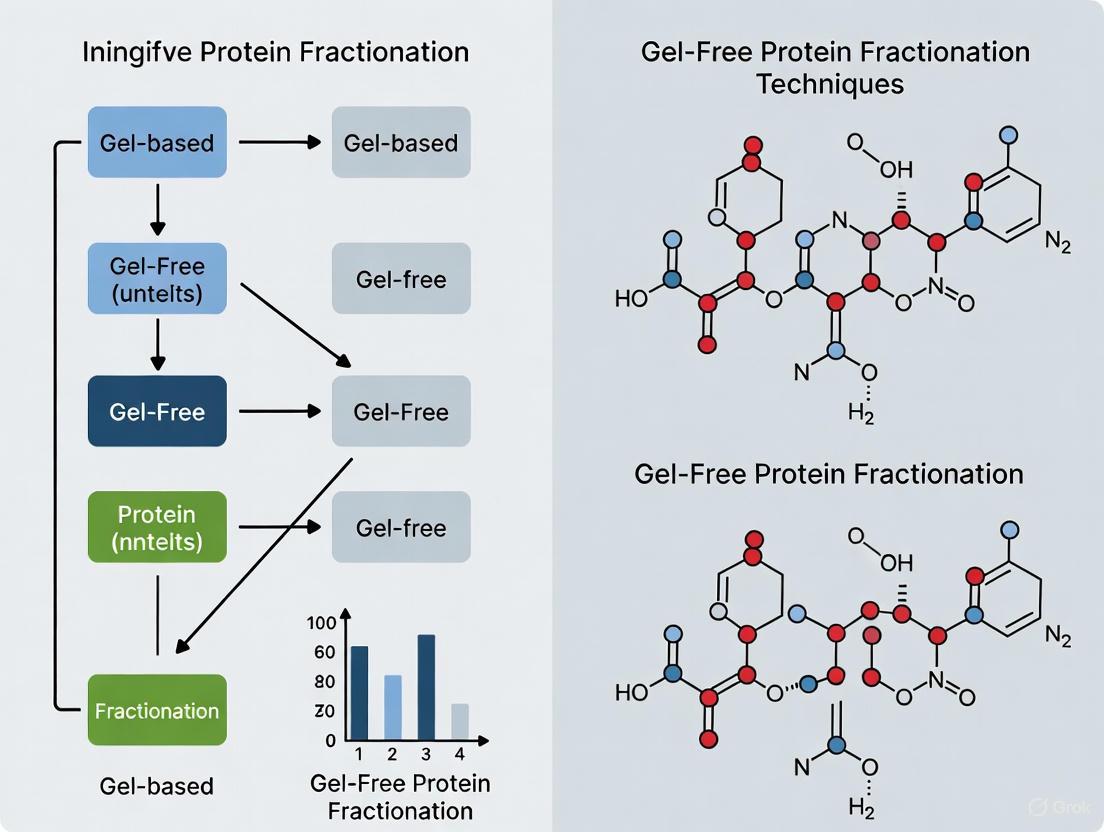
This article provides a systematic comparison of gel-based and gel-free protein fractionation techniques, tailored for researchers, scientists, and drug development professionals.
Gel-Based vs. Gel-Free Protein Fractionation: A Comprehensive Guide for Modern Biomedical Research
Abstract
This article provides a systematic comparison of gel-based and gel-free protein fractionation techniques, tailored for researchers, scientists, and drug development professionals. It covers foundational principles, from the historical role of 2D gel electrophoresis to the rise of shotgun proteomics. The content details specific methodologies, including 2D-DIGE, GELFrEE, MudPIT, and chromatographic techniques, highlighting their applications in biomarker discovery, PTM analysis, and therapeutic protein characterization. It further offers troubleshooting guidance and optimization strategies for common challenges like low yield and contamination. Finally, a direct, evidence-based comparison evaluates the techniques on critical metrics such as technical variability, proteoform resolution, throughput, and suitability for different sample types, empowering readers to select the optimal strategy for their research goals.
Protein Separation Fundamentals: From Gel Electrophoresis to Shotgun Proteomics
Proteomics, the large-scale study of proteins, is fundamental to understanding biological processes and disease mechanisms. Its success rests heavily on two major pillars: fractionation techniques and mass spectrometry (MS) analysis [1] [2]. Due to the immense complexity of biological samples, where thousands of proteins exist across a wide dynamic range of abundance, effective fractionation is not merely beneficial but essential for sensitive and comprehensive profiling [1] [3].
The central philosophical and practical divide in proteomic fractionation lies between gel-based and gel-free methodologies. Gel-based proteomics, often referred to as a top-down approach, involves the separation of intact proteins based on their physicochemical properties, such as molecular weight (MW) and isoelectric point (pI) [4] [5]. In contrast, gel-free or bottom-up proteomics (commonly called shotgun proteomics) begins with the enzymatic digestion of proteins into peptides, which are then separated using liquid chromatography (LC) techniques prior to MS analysis [4] [2]. This guide provides an objective comparison of these two philosophies, detailing their experimental protocols, performance data, and respective applications to inform methodological choices in research and drug development.
Core Principles and Methodologies
The foundational difference between the two philosophies dictates their entire workflow, from sample preparation to data interpretation.
The Gel-Based (Top-Down) Philosophy
Gel-based methods separate intact proteins before identification. The most common techniques are one- and two-dimensional polyacrylamide gel electrophoresis (1-DE and 2-DE).
Two-Dimensional Gel Electrophoresis (2-DE) Workflow: This is the quintessential top-down method [5].
- Protein Solubilization: Proteins are extracted and solubilized using a buffer containing chaotropes (e.g., urea, thiourea), detergents (e.g., CHAPS), and reducing agents (e.g., DTT) to disrupt molecular interactions [5].
- First Dimension - Isoelectric Focusing (IEF): Proteins are separated based on their pI using immobilized pH gradient (IPG) strips. Proteins migrate until they reach a pH where their net charge is zero [5].
- Strip Equilibration: The IPG strip is saturated with sodium dodecyl sulfate (SDS), which denatures proteins and confers a negative charge proportional to their mass [5].
- Second Dimension - SDS-PAGE: The equilibrated strip is placed on an acrylamide gel, and proteins are separated orthogonally based on their molecular mass [5].
- Visualization and Analysis: Proteins are stained (e.g., with Coomassie Blue, Sypro Ruby) forming a map of spots. Each spot potentially represents a unique proteoform (a specific molecular form of a protein, including post-translational modifications) [4] [5]. Spots of interest are excised, digested with trypsin within the gel matrix, and the resulting peptides are identified by MS.
Advanced Gel-Based Variants: Techniques like 2D-Difference Gel Electrophoresis (2D-DIGE) improve quantitative precision by labeling multiple protein samples with different fluorescent cyanine dyes (Cy2, Cy3, Cy5) and running them on the same gel, with one dye often reserved for an internal standard [4] [6].
The Gel-Free (Bottom-Up) Philosophy
Gel-free or shotgun proteomics bypasses intact protein separation, focusing instead on peptides.
Standard Shotgun Proteomics Workflow:
- Protein Digestion: The complex protein mixture is digested in-solution into peptides, typically using trypsin [4].
- Peptide Fractionation (Optional but Common): The highly complex peptide mixture is often fractionated to reduce complexity. This can be done offline using methods like:
- Strong Cation Exchange (SCX) Chromatography: Separates peptides based on charge [1] [7].
- Basic Reversed-Phase (bRP) Chromatography: Separates peptides based on hydrophobicity at high pH [8].
- High-field Asymmetric Waveform Ion Mobility Spectrometry (FAIMS): A gas-phase separation technique that reduces interference [8].
- LC-MS/MS Analysis: Fractions are sequentially analyzed by online reversed-phase LC coupled to tandem MS. Peptides are sequenced, and proteins are identified by reassembling the peptide data in silico [4].
Novel Liquid-Phase Protein Recovery Strategies: Hybrid techniques have emerged that combine principles of both philosophies.
- OFFGEL Electrophoresis: Uses an immobilized pH gradient (IPG) strip to fractionate proteins or peptides according to their pI, but the separated components are recovered in solution, not from a gel matrix [2].
- GELFrEE (Gel-eluted Liquid Fraction Entrapment Electrophoresis): Fractionates complex protein samples by MW using a miniature-gel column but elutes the separated proteins directly into liquid fractions [2].
The following workflow diagram illustrates the core procedural differences between these two philosophies.
Experimental Performance and Comparative Data
Objective comparison requires evaluating both methodologies based on key performance metrics derived from experimental studies.
Qualitative and Quantitative Performance
A recent 2023 study directly compared the qualitative and quantitative performance of 2D-DIGE (top-down) and label-free shotgun (bottom-up) proteomics using replicates of a human prostate carcinoma cell line [4] [6]. The results highlight a fundamental trade-off.
Table 1: Comparative Performance of Gel-Based vs. Gel-Free Proteomics [4] [6]
| Performance Metric | 2D-DIGE (Gel-Based/Top-Down) | Label-Free Shotgun (Gel-Free/Bottom-Up) |
|---|---|---|
| Proteoform Detection | Excellent. Directly separates and detects intact proteoforms, enabling discovery of unexpected PTMs and cleavage products. | Poor. Loses intact proteoform information due to digestion. Relies on inferred "canonical" proteins. |
| Technical Variation (Robustness) | Superior. ~3 times lower technical variation (coefficient of variation). | Higher. Instrument instability and LC variability contribute to greater technical noise. |
| Protein Identification Throughput | Lower. Time-consuming; ~20x more time required per protein/proteoform characterization. | Excellent. Faster, more amenable to automation and high-throughput analysis. |
| Hands-on Time & Automation | High manual workload; difficult to automate. | Lower manual workload; can be automated to a significant extent. |
Protein and Peptide Identification
An earlier, foundational study compared specific gel-based fractionation techniques (1-D SDS-PAGE, preparative 1-D SDS-PAGE, IEF-IPG, and 2-D PAGE) when coupled with nanoLC-ESI-MS/MS [1]. The findings demonstrate that the choice of fractionation technique itself has a major impact on the results.
Table 2: Comparison of Gel-Based Fractionation Techniques in Protein Profiling [1]
| Fractionation Technique | Key Performance Findings |
|---|---|
| 1-D SDS-PAGE (GeLC-MS/MS) | High number of protein identifications. Inexpensive, simple, and versatile. |
| Isoelectric Focusing (IEF-IPG) | High number of protein identifications. Highest average number of detected peptides per protein, beneficial for quantitative and structural characterization. |
| 2-D PAGE | Evaluated as a fractionation approach. Protein recovery highly dependent on the total volume of the gel matrix. |
| Overall Comparison | All techniques provided complementary identification results. A combination of orthogonal 1-D SDS-PAGE and IEF-IPG was suggested for improved sensitivity without a major loss of throughput. |
The Scientist's Toolkit: Essential Research Reagents and Materials
Successful execution of either proteomic philosophy requires a specific set of reagents and tools. The table below details key solutions used in the featured experiments.
Table 3: Key Research Reagent Solutions for Proteomic Fractionation
| Reagent / Solution | Function / Purpose | Typical Application |
|---|---|---|
| Lysis/Solubilization Buffer [1] [5] | Contains chaotropes (Urea, Thiourea) and detergents (CHAPS) to denature, solubilize, and disrupt protein interactions. | Essential first step for both gel-based and gel-free methods to extract proteins. |
| Immobilized pH Gradient (IPG) Strips [1] [5] | A dry gel strip with a covalently linked pH gradient for the first dimension (IEF) of 2-DE. | Core component of 2-DE and OFFGEL fractionation. |
| Reducing & Alkylating Agents [1] | Dithiothreitol (DTT) reduces disulfide bonds; Iodoacetamide alkylates thiols to prevent re-oxidation. | Standard step in sample preparation to fully denature proteins. |
| Cyanine Fluorescent Dyes (CyDyes) [4] [6] | Used to label lysine groups in different protein samples for multiplexed analysis. | Critical for 2D-DIGE for accurate quantitative comparison across samples. |
| Trypsin [4] [3] | A proteolytic enzyme that cleaves proteins at the carboxyl side of arginine and lysine residues. | Used for in-gel or in-solution digestion to generate peptides for MS analysis. |
| Fractionation Kits (e.g., iST-Fractionation) [3] | All-in-one solutions using dipole-moment and mixed-phase interactions to separate peptides into distinct fractions. | Used in bottom-up proteomics to reduce sample complexity and increase proteomic depth. |
Orthogonality and Strategic Combination
The comparison between gel-based and gel-free methods is not simply a question of which is "better." Rather, they are largely orthogonal, meaning they provide different but complementary views of the proteome [4]. Gel-based top-down proteomics excels in resolving and quantifying proteoforms, while gel-free bottom-up proteomics offers superior throughput and automation for cataloging protein groups [4] [6].
Consequently, the most powerful strategy for in-depth proteomic investigation is often a combination of both philosophies. For instance, a study might use 2D-DIGE to discover specific proteoforms that change in abundance under a disease condition and then use targeted shotgun proteomics to validate these findings across a larger sample set. Another strategy is to use liquid-phase recovery tools like OFFGEL or GELFrEE to pre-fractionate intact proteins, harnessing the advantages of protein-level separation with the improved recovery and compatibility of solution-based methods [2]. The following diagram illustrates how these techniques can be integrated based on research goals.
The proteomics landscape is defined by the complementary philosophies of gel-based and gel-free fractionation. The gel-based, top-down approach is unparalleled for the direct detection and quantification of proteoforms, offering high quantitative precision and visual insight into protein heterogeneity, albeit with lower throughput and higher manual input [4] [5]. The gel-free, bottom-up philosophy provides superior speed, automation, and depth in identifying proteins from complex mixtures, but at the cost of losing direct information about the intact proteoforms [4] [3].
The choice between them is not mutually exclusive and should be dictated by the specific biological question. For research focused on post-translational modifications, protein splicing, or biomarker discovery where specific proteoforms are critical, gel-based methods remain indispensable. For large-scale profiling studies aiming to identify thousands of proteins quickly, gel-free shotgun proteomics is the current standard. Ultimately, leveraging the orthogonality of both approaches through strategic combination represents the most powerful path forward for defining the true complexity of the proteome.
Two-dimensional gel electrophoresis (2DE) stands as a foundational technique in protein biochemistry, first pioneered by Patrick O'Farrell in 1975 [9] [10] [11]. This method revolutionized protein separation by resolving complex mixtures based on two independent physicochemical properties: isoelectric point (pI) and molecular weight (Mw) [9] [12]. Despite the emergence of gel-free shotgun proteomics approaches, 2DE remains an indispensable tool for the separation and analysis of intact proteins and their proteoforms [4]. Its ability to provide a direct visual representation of the proteome, where individual spots on a gel often correspond to distinct protein species or modified forms, offers unique advantages for studying post-translational modifications (PTMs) and protein isoforms [9] [4]. This guide objectively compares 2DE's performance against alternative protein separation techniques, examining its technical capabilities, limitations, and appropriate applications within the context of gel-based versus gel-free proteomics strategies.
Technical Principles and Methodologies
Core Separation Mechanism
The fundamental power of 2DE lies in its two-dimensional separation approach. The first dimension employs isoelectric focusing (IEF), where proteins are separated along a pH gradient according to their isoelectric point (pI) - the specific pH at which a protein carries no net electrical charge [9] [12]. When a protein reaches the pH position matching its pI, it becomes electrically neutral and stops migrating [12]. This technique can achieve exceptionally high resolution, with the ability to distinguish proteins differing by as little as 0.001 pH units in their pI values [9].
The second dimension utilizes sodium dodecyl sulfate-polyacrylamide gel electrophoresis (SDS-PAGE), which separates proteins based on their molecular mass [9] [12]. Prior to this step, proteins are treated with SDS, a denaturing detergent that confers a uniform negative charge and linearizes the proteins, effectively negating the influence of their original charge or shape [9] [10]. As proteins migrate through the polyacrylamide gel matrix under an electric field, smaller proteins move faster than larger ones, resulting in separation by molecular weight [12].
The combination of these two orthogonal separation parameters - pI and molecular weight - enables 2DE to resolve thousands of protein spots from a complex mixture on a single gel, making it one of the highest-resolution protein separation techniques available [10] [11] [13].
Key Experimental Variations and Enhancements
Several methodological advancements have refined the original 2DE technique to address specific limitations:
- Immobilized pH Gradients (IPG) replaced carrier ampholyte-based pH gradients in tube gels, significantly improving reproducibility and ease of use [9].
- Two-Dimensional Difference Gel Electrophoresis (2D-DIGE) incorporates fluorescent cyanine dyes (Cy2, Cy3, Cy5) to label different protein samples prior to separation, allowing multiple samples to be run on the same gel with an internal standard [14] [15] [11]. This innovation dramatically improves quantitative accuracy and reduces gel-to-gel variability by enabling direct spot intensity comparisons within the same gel [11] [4].
- Comparative Fluorescence 2DE (CoFGE) introduces a protein reference net for gel matching, creating reproducible protein spot coordinates that support searchable 2DE databases [14]. This approach is particularly valuable for comparing singular samples where replicate analysis isn't feasible [14].
- Zoom Gels utilizing multiple overlapping narrow-range IPG strips can significantly enhance resolution in the first dimension, enabling detection of thousands more protein spots from complex samples [9].
2DE Experimental Workflow: The core process involves sequential separation by charge then size.
Performance Comparison with Alternative Techniques
Quantitative Comparison of Key Performance Metrics
Table 1: Performance comparison between 2DE variants and alternative proteomic techniques
| Parameter | Traditional 2DE | 2D-DIGE | Gel-Free Shotgun Proteomics | Simple Western |
|---|---|---|---|---|
| Resolution Capacity | ~1,000-10,000 protein spots [9] [11] | Similar to traditional 2DE | Thousands of proteins [4] | Single target protein analysis [16] |
| Technical Variation | High (gel-to-gel variability) [11] | Greatly improved via internal standard [11] | ~3x higher than 2D-DIGE [4] | Highly reproducible due to automation [17] [16] |
| Dynamic Range | Limited for low-abundance proteins [11] [13] | Improved sensitivity for low-abundance proteins [11] | Superior for low-abundance proteins [11] | Excellent sensitivity (LOD <1 pg) [16] |
| Sample Throughput | Low (manual, time-consuming) [13] | Moderate (multiplexing capability) [15] [11] | High (automation possible) [4] | High (fully automated) [17] [16] |
| Proteoform Resolution | Excellent (direct visualization) [9] [4] | Excellent (direct visualization) [4] | Poor (inference from peptides) [4] | Limited to specific targets |
| Quantitative Accuracy | Moderate (stain-dependent) [13] | High (internal standard normalization) [11] [4] | Variable (label-free) to high (isobaric labeling) | High (built-in normalization) [16] |
| Sample Requirement | Microgram amounts [15] | Similar to traditional 2DE | Nanogram amounts [4] | Minimal (3 μL volume) [16] |
Staining Method Performance in 2DE Applications
Table 2: Comparison of detection methods for 2DE-based analysis
| Staining Method | Detection Sensitivity | Quantitative Linear Range | Compatibility with MS | Key Advantages | Key Limitations |
|---|---|---|---|---|---|
| Coomassie Brilliant Blue | Moderate (ng level) [9] | Good [9] | Excellent [9] | Low cost, good reproducibility [9] [13] | Lower sensitivity [9] |
| Silver Staining | High (pg level) [9] | Limited [9] | Poor (with formaldehyde) [9] | High sensitivity [9] | Narrow linear range, potential protein modification [9] [15] |
| SYPRO Ruby | High (ng-pg level) [9] [15] | Good [9] [15] | Excellent [9] | Sensitive, wide linear range, consistent across pI [15] | Higher cost than visible stains [15] |
| CyDye Fluorescence (2D-DIGE) | High (sub-picomolar) [11] | Excellent [11] | Good (minimal labeling) [11] | Multiplexing capability, internal standardization [11] | Specialized equipment required, higher cost [11] |
Experimental Protocols for Key 2DE Applications
Standard 2DE Protocol for Host Cell Protein (HCP) Characterization
Host cell protein (HCP) characterization during biopharmaceutical development represents a key application where 2DE's ability to separate intact proteins provides critical information about process-related impurities [15]. The following protocol is adapted from King et al. (2024) for HCP analysis [15]:
Sample Preparation: Prepare protein extracts from host cells (e.g., CHO cell lysates) using appropriate lysis buffers containing chaotropes (8 M urea, 2 M thiourea) and zwitterionic detergents (CHAPS) to maximize protein solubility [15] [11]. Include protease inhibitors to prevent degradation.
Protein Quantification: Determine protein concentration using compatible assays (e.g., Bradford, BCA), adjusting for potential interference from detergents or chaotropes in the buffer [15].
First Dimension - IEF:
- Dilute protein samples (50-100 μg for analytical gels, 500-1000 μg for preparative gels) in rehydration buffer containing urea, CHAPS, carrier ampholytes, and bromophenol blue [15].
- Activate immobilized pH gradient (IPG) strips (e.g., pH 3-10, 11 cm or 24 cm) by passive or active rehydration with sample-containing solution [9] [15].
- Perform isoelectric focusing using a stepwise voltage protocol (e.g., 500 V for 1 hr, 1000 V for 1 hr, 8000 V for 2.5-4 hr) until 20,000-40,000 Vhr is reached [15].
Strip Equilibration: Incubate focused IPG strips for 15-20 minutes in equilibration buffer (6 M urea, 75 mM Tris-HCl pH 8.8, 30% glycerol, 2% SDS) first with 1% DTT, then with 2.5% iodoacetamide for reduction and alkylation respectively [15].
Second Dimension - SDS-PAGE:
- Place equilibrated IPG strips onto pre-cast polyacrylamide gradient gels (e.g., 4-20% Tris-Glycine) [15].
- Embed strips with 0.5-1% agarose in electrophoresis buffer to prevent movement and ensure proper contact.
- Run electrophoresis at constant current or power (e.g., 5 mA/gel for 1 hr, then 15-20 mA/gel) until the dye front reaches the bottom of the gel [15].
Protein Detection:
- For SYPRO Ruby staining: Fix gels in 10% methanol/7% acetic acid for 30-60 minutes, stain with SYPRO Ruby overnight, then destain with 10% methanol/7% acetic acid for 1-2 hours before imaging with a fluorescent scanner [15].
- For silver staining: Fix gels in 50% methanol/5% acetic acid, sensitize with 0.02% sodium thiosulfate, stain with 0.2% silver nitrate, then develop with 2% sodium carbonate/0.04% formaldehyde until desired intensity is reached [15].
Image Analysis: Acquire digital images using appropriate scanners, then analyze with specialized software (PDQuest, Progenesis SameSpots, DeCyder) for spot detection, matching, and quantification [15] [11].
2D-DIGE Protocol for Comparative Proteomics
The 2D-DIGE protocol builds upon standard 2DE with these key modifications for optimal comparative analysis [11] [4]:
Sample Labeling:
- Prepare protein extracts minimizing primary amines in buffers.
- Label 50 μg of each test sample with 400 pmol of either Cy3 or Cy5 NHS-ester dyes.
- Label a pooled internal standard (containing equal amounts of all samples) with Cy2 dye.
- Perform labeling on ice for 30 minutes in the dark, then quench with 10-fold molar excess of lysine [11].
Pooling and Separation:
- Combine Cy2-, Cy3-, and Cy5-labeled samples (150 μg total protein).
- Perform IEF and SDS-PAGE as described in the standard protocol.
Image Acquisition:
- Scan gels at wavelengths specific for each dye (Cy2: 480/530 nm, Cy3: 540/590 nm, Cy5: 620/680 nm) using a fluorescence scanner.
- Ensure non-saturating exposure conditions for accurate quantification [11].
2D-DIGE Workflow: Multiplexed analysis with internal standard for precise quantification.
Research Reagent Solutions for 2DE Experiments
Table 3: Essential reagents and materials for 2DE experiments
| Reagent Category | Specific Examples | Function & Importance | Performance Considerations |
|---|---|---|---|
| Chaotropes | Urea, Thiourea [11] | Disrupt hydrogen bonds to solubilize proteins [11] | High purity essential to prevent carbamylation; typically used at 7-9 M urea, 2 M thiourea concentrations [11] |
| Detergents | CHAPS, Triton X-100, SDS [11] | Solubilize hydrophobic proteins, disrupt lipid-lipid & lipid-protein interactions [11] | Non-ionic/zwitterionic detergents preferred for IEF; SDS used in second dimension [11] |
| Reducing Agents | DTT, DTE, TCEP [15] | Break disulfide bonds to ensure complete denaturation | Fresh DTT (1% w/v) commonly used; TCEP offers better stability [15] |
| Alkylating Agents | Iodoacetamide [15] | Prevent reformation of disulfide bonds by cysteine modification | Typically used at 2.5% w/v after reduction; must be fresh [15] |
| IPG Strips | Immobilized pH Gradient strips [9] | First dimension separation medium | Various pH ranges (broad 3-10, narrow 4-7, 5-8) available; narrow ranges increase resolution [9] |
| Fluorescent Dyes | Cy2, Cy3, Cy5 (2D-DIGE) [11] | Pre-electrophoretic sample labeling for multiplexing | Minimal labeling (1-2% of lysines) maintains protein solubility; requires specialized scanners [11] |
| Staining Reagents | SYPRO Ruby, Coomassie G-250, Silver Nitrate [9] [15] | Post-separation protein detection | SYPRO Ruby offers best balance of sensitivity, linearity and MS compatibility [15] |
Two-dimensional gel electrophoresis maintains its status as a vital tool for intact protein separation despite the rising popularity of gel-free approaches. The technique's unparalleled ability to resolve and visualize protein proteoforms - including different isoforms and post-translationally modified species - makes it particularly valuable for studies where these modifications are biologically significant [9] [4]. While shotgun proteomics excels at high-throughput identification of thousands of proteins and offers superior dynamic range for detecting low-abundance species, it largely loses information about intact proteoforms by inferring protein identity from peptide sequences [4].
The choice between 2DE and gel-free alternatives should be guided by specific research objectives. 2DE remains the method of choice when direct visualization of protein species, detection of PTMs, or comparative analysis of intact proteoforms is required [10] [4]. Recent advancements like 2D-DIGE have significantly addressed traditional limitations in quantitative reproducibility, while improved staining methods and narrow-range IPG strips have enhanced sensitivity and resolution [15] [11]. For comprehensive proteome analysis, many researchers now employ a synergistic approach, using 2DE for targeted analysis of proteoforms and gel-free methods for broad proteome coverage, thereby leveraging the complementary strengths of both technologies [4].
The field of proteomics has undergone a revolutionary transformation with the emergence of shotgun proteomics as a powerful alternative to traditional gel-based methods. This technological shift has fundamentally changed how researchers identify and quantify proteins in complex biological systems. While two-dimensional gel electrophoresis (2-DE) long served as the workhorse of protein separation, its limitations in reproducibility, sensitivity, and throughput created an pressing need for innovative approaches [11]. The development of shotgun proteomics, leveraging liquid chromatography-tandem mass spectrometry (LC-MS/MS), has addressed these limitations and opened new frontiers in proteome analysis [18] [19].
This analytical revolution has been particularly impactful for pharmaceutical development and basic research, where comprehensive protein profiling is essential for understanding disease mechanisms, identifying therapeutic targets, and discovering biomarkers [20]. The transition from gel-based to gel-free proteomics represents more than just a methodological improvement—it constitutes a fundamental reshaping of the proteomics landscape with far-reaching implications for biological research and drug development.
Gel-Based Proteomics: The Established Workhorse
Fundamental Principles and Methodologies
Gel-based proteomics, particularly two-dimensional gel electrophoresis (2-DE), separates proteins based on two independent physicochemical properties: isoelectric point (pI) and molecular weight [5]. In the first dimension, isoelectric focusing (IEF) separates proteins according to their pI using immobilized pH gradients (IPGs). Proteins migrate through a pH gradient until they reach the position where their net charge is zero [11] [5]. The second dimension, SDS-PAGE, further separates proteins based on their molecular mass under denaturing conditions [5].
For quantitative analysis, two-dimensional difference gel electrophoresis (2D-DIGE) significantly improves reproducibility by labeling multiple protein samples with different fluorescent CyDyes (Cy2, Cy3, and Cy5) and running them on the same gel [11]. An internal standard labeled with one dye (typically Cy2) enables accurate normalization across multiple gels, reducing technical variability and enhancing statistical power [11].
Technical Limitations and Challenges
Despite its maturity and visual intuitive appeal, gel-based proteomics faces several significant limitations:
- Poor representation of extreme proteins: Membrane proteins, very acidic/basic proteins (pI < 3 or > 10), and very large (>200 kDa) or small (<10 kDa) proteins are notoriously difficult to separate [11] [1].
- Limited dynamic range: The technique struggles to detect low-abundance proteins, including signaling molecules and transcription factors, which are often biologically critical [11] [19].
- Throughput and reproducibility issues: Gel-to-gel variability necessitates multiple replicates, and the process is difficult to automate [11].
- Limited proteome coverage: Even under optimal conditions, a single 2-DE gel typically resolves only 1,000-1,500 protein spots, which may represent multiple protein forms [11].
Table 1: Key Characteristics of Gel-Based Proteomics Techniques
| Parameter | 2-DE | 2D-DIGE |
|---|---|---|
| Separation Principle | pI and molecular weight | pI and molecular weight |
| Quantitation Method | Spot intensity after staining | Fluorescent dye intensity |
| Detection Limit | ~0.5-50 ng/spot (silver to Coomassie) | ~1 ng/spot (Sypro Ruby) |
| Dynamic Range | 1.5-2 orders of magnitude | 3-4 orders of magnitude |
| Reproducibility | Moderate, gel-to-gel variation | High, internal standard normalization |
| Proteoform Resolution | Excellent for intact proteins and modifications | Excellent for intact proteins and modifications |
| Throughput | Low, manual processing | Moderate, multiple samples per gel |
The LC-MS/MS Revolution: Shotgun Proteomics
Fundamental Workflow and Principles
Shotgun proteomics represents a paradigm shift from separating intact proteins to analyzing peptide mixtures [21] [19]. The core workflow begins with enzymatic digestion of protein extracts into peptides, typically using trypsin [19]. These complex peptide mixtures are then separated by multidimensional liquid chromatography before being introduced into a tandem mass spectrometer [19].
The mass spectrometer operates in data-dependent acquisition (DDA) mode, continuously switching between MS1 (survey) scans and MS2 (fragmentation) scans [19]. Ions detected in the MS1 scan are selected for collision-induced dissociation (CID) or other fragmentation methods, generating MS2 spectra that reveal sequence information [19]. These fragmentation patterns serve as "fingerprints" that are matched against theoretical spectra from protein sequence databases using search engines like Sequest or Mascot [19].
Technical Advantages and Innovations
The shotgun proteomics approach provides several transformative advantages:
- Enhanced sensitivity and dynamic range: LC-MS/MS can detect low-abundance proteins that are invisible to gel-based methods, dramatically expanding proteome coverage [18] [19].
- Comprehensive membrane protein analysis: Hydrophobic membrane proteins, which are notoriously difficult to solubilize for gels, can be efficiently digested and analyzed as peptides [19].
- High-throughput capabilities: Automation of LC-MS/MS systems enables continuous operation and analysis of hundreds of samples [21].
- Superior quantitation accuracy: Label-free and isobaric tagging methods (e.g., TMT, iTRAQ) provide precise quantification across multiple samples [21].
Recent technological innovations have further enhanced shotgun proteomics. Ion mobility spectrometry (IMS) adds a fourth separation dimension by separating ions based on their size and shape in the gas phase [20]. When combined with data-independent acquisition (DIA), this approach provides unparalleled depth of coverage, with some studies identifying over 10,000 proteins from a single cell type [20].
Comparative Performance Analysis
Systematic Comparison of Technical Capabilities
Direct comparisons between gel-based and shotgun proteomics reveal complementary strengths and limitations. A practical comparative study demonstrated that label-free shotgun proteomics identified proteins with approximately three times higher technical variation compared to 2D-DIGE, but required almost 20 times less time per protein characterization [4].
Table 2: Comprehensive Comparison of Gel-Based vs. Shotgun Proteomics
| Performance Metric | Gel-Based Proteomics | Shotgun Proteomics |
|---|---|---|
| Protein Identification Depth | Hundreds to ~1,500 spots per gel [11] | Thousands to >10,000 proteins per run [20] |
| Dynamic Range | Limited, struggles with low-abundance proteins [11] | Extensive, capable of detecting low-abundance proteins [19] |
| Reproducibility | Moderate (2-DE) to High (2D-DIGE) [11] | High with proper normalization [21] |
| Proteoform Analysis | Excellent, directly visualizes modifications [4] | Limited, inferential from peptide data [4] |
| Membrane Protein Coverage | Poor due to solubility issues [11] | Excellent after enzymatic digestion [19] |
| Throughput | Low to moderate | High to very high |
| Quantitative Accuracy | Good with fluorescent staining | Excellent with isobaric labels [21] |
| PTM Analysis | Direct visualization but limited identification | Comprehensive with enrichment strategies [18] |
In a study on Bacillus subtilis, shotgun proteomics increased protein identifications by 473 additional proteins beyond the 745 identified by 2-DE, demonstrating its superior depth of coverage [22]. Similarly, analyses of human cell lines have consistently shown that shotgun methods identify 2-3 times more proteins than gel-based approaches [4] [20].
Practical Experimental Protocols
- Protein Extraction and Labeling: Extract proteins using chaotropic buffers (urea/thiourea) with detergents (CHAPS) and reducing agents. Label experimental samples with Cy3 or Cy5 and internal standard with Cy2 NHS-ester dyes at a ratio of 1-2% of available lysines.
- Isoelectric Focusing: Combine labeled samples and focus on immobilized pH gradient strips (e.g., pH 3-11) with progressive voltage increase to 80 kVh total.
- SDS-PAGE: Equilibrate strips in SDS-containing buffer with DTT (reduction) followed by iodoacetamide (alkylation), then separate on 8-16% polyacrylamide gels.
- Image Acquisition and Analysis: Scan gels at dye-specific wavelengths, detect spots using differential analysis software (e.g., DeCyder, PDQuest), and perform statistical analysis of spot volumes.
- Protein Digestion: Extract proteins and digest using trypsin after reduction and alkylation. Modern preparation methods include FASP (filter-aided sample preparation), S-Trap (suspension trapping), or SP3 (single-pot solid-phase-enhanced sample preparation).
- Liquid Chromatography: Separate peptides using reversed-phase C18 columns with acetonitrile gradients at nanoflow rates (200-300 nL/min).
- Mass Spectrometry Analysis: Operate mass spectrometer in data-dependent acquisition mode with continuous cycles of MS1 (full scan) and MS2 (fragmentation scans).
- Data Processing: Search MS2 spectra against protein databases, validate peptide-spectrum matches, and quantify using label-free or isobaric tagging approaches.
Advanced Applications in Drug Development and Research
Biomarker Discovery and Validation
The comprehensive profiling capabilities of shotgun proteomics have made it indispensable for biomarker discovery in both preclinical and clinical research [20]. The ability to quantify thousands of proteins across multiple sample states enables identification of protein signatures associated with disease progression, treatment response, and toxicity [20]. LC-MS/MS-based proteomics provides the sensitivity and specificity required to detect potential biomarkers in complex biological fluids, even at low concentrations [23].
Post-Translational Modification Analysis
Shotgun proteomics excels at system-wide analysis of post-translational modifications (PTMs), which are crucial regulatory mechanisms in cellular signaling and disease pathogenesis [18]. Enrichment strategies for specific PTMs (e.g., phosphopeptides for phosphorylation, acetylated peptides for acetylation) coupled with sophisticated mass spectrometry enable comprehensive mapping of modification sites and their dynamics in response to cellular stimuli [18] [21].
Structural Proteomics and Protein Complexes
The integration of ion mobility spectrometry (IMS) with shotgun proteomics provides information on protein structure and conformation through collision cross section (CCS) measurements [20]. This emerging capability allows researchers to connect protein identification with structural insights, offering new opportunities for understanding protein function and interactions in drug mechanism studies [20].
Essential Research Reagent Solutions
Table 3: Key Research Reagents and Materials for Proteomics Workflows
| Reagent/Material | Function | Application Examples |
|---|---|---|
| Isobaric Tags (TMT, iTRAQ) | Multiplexed quantification of peptides across samples | Relative protein quantification in biomarker studies [21] |
| Trypsin | Proteolytic enzyme for protein digestion | Standard protein-to-peptide conversion in shotgun workflows [19] |
| C18 Reverse Phase Columns | Peptide separation by hydrophobicity | NanoLC separation prior to MS analysis [21] |
| Chaotropic Agents (Urea, Thiourea) | Protein denaturation and solubilization | Sample preparation for both gel-based and gel-free methods [11] [5] |
| Fluorescent CyDyes (Cy2, Cy3, Cy5) | Differential labeling of protein samples | 2D-DIGE for quantitative gel-based analysis [11] |
| Antibody-based Enrichment Materials | Selective isolation of modified peptides | PTM analysis (phosphorylation, acetylation) [18] |
| Ion Mobility Spectrometers | Gas-phase separation by size and shape | Additional separation dimension for complex samples [20] |
The rise of shotgun proteomics represents a genuine revolution in protein analysis, with LC-MS/MS enabling unprecedented depth, throughput, and accuracy in proteome characterization. The technique's capacity to analyze previously "invisible" proteome components—particularly low-abundance proteins, membrane proteins, and specific PTMs—has transformed experimental approaches in basic research and drug development [18] [19].
Despite the clear advantages of shotgun proteomics, gel-based methods retain unique value for proteoform resolution and direct visualization of intact proteins and their modifications [4]. The future of proteomics lies not in the complete replacement of one technology by another, but in their strategic integration. As one comparative study concluded, "2D-DIGE top-down analysis provided valuable, direct stoichiometric qualitative and quantitative information from proteins to their proteoforms," while shotgun analysis provided greater depth and throughput [4].
For researchers and drug development professionals, this synergy offers the most powerful approach—using shotgun proteomics for comprehensive discovery phases and gel-based methods for targeted analysis of specific protein forms and modifications. As mass spectrometry technology continues to advance with ion mobility, data-independent acquisition, and improved computational tools, the proteomics landscape will continue to evolve, further expanding our ability to decipher the complex language of proteins in health and disease.
In the field of proteomics, the ability to separate complex protein mixtures is fundamental to understanding cellular machinery, discovering biomarkers, and developing new therapeutics. The core physicochemical properties of proteins—molecular weight, isoelectric point, and hydrophobicity—form the bedrock of virtually all separation techniques. These properties are exploited through two primary methodological philosophies: gel-based and gel-free proteomics. Gel-based methods, such as two-dimensional gel electrophoresis (2-DE), separate intact proteins visually across a gel matrix. In contrast, gel-free or "shotgun" methods typically digest proteins into peptides first and use liquid chromatography coupled to mass spectrometry for separation and identification. This guide provides an objective comparison of these platforms, detailing their operating principles, performance characteristics, and practical applications to inform method selection in research and drug development.
Core Separation Principles in Proteomics
The three fundamental properties used to separate proteins are derived from their intrinsic amino acid composition and structure.
- Isoelectric Point (pI): The pI is the specific pH at which a protein carries no net electrical charge. Separation by pI is achieved through isoelectric focusing (IEF), where proteins migrate through a stable pH gradient under an electric field until they reach their pI and stop [24] [25]. This technique offers high resolution and can separate protein isoforms that differ by a single charged post-translational modification, such as phosphorylation or deamidation [24].
- Molecular Weight (MW): Separation by molecular weight is most commonly performed using sodium dodecyl sulfate-polyacrylamide gel electrophoresis (SDS-PAGE). The detergent SDS denatures proteins and confers a uniform negative charge, meaning their migration through a polyacrylamide gel is determined almost exclusively by their molecular weight, with smaller proteins migrating faster [11].
- Hydrophobicity: This property refers to the tendency of non-polar regions of a protein (or peptide) to avoid an aqueous environment. In proteomics, reversed-phase liquid chromatography (RPLC) is the standard method for separating peptides based on hydrophobicity. Peptides in a polar mobile phase are passed over a non-polar stationary phase; more hydrophobic peptides have a stronger affinity for the stationary phase and are thus retained longer [2].
Table 1: Core Physicochemical Properties and Their Exploitation in Proteomics
| Separation Principle | Definition | Primary Separation Method(s) | Key Technical Points |
|---|---|---|---|
| Isoelectric Point (pI) | The pH at which a protein has a net charge of zero. | Isoelectric Focusing (IEF) | Utilizes immobilized pH gradient (IPG) strips for high reproducibility; resolution is determined by gradient slope and voltage [24] [25]. |
| Molecular Weight (MW) | The mass of a protein molecule, typically measured in Daltons (Da). | SDS-PAGE (denaturing) | Size-based separation; migration rate is inversely proportional to the logarithm of the molecular weight [11]. |
| Hydrophobicity | The tendency of a molecule to be non-polar and repel water. | Reversed-Phase Liquid Chromatography (RPLC) | The backbone of most LC-MS/MS workflows; retention time is correlated with hydrophobicity [2]. |
Gel-Based Fractionation Techniques
Gel-based methods constitute a top-down approach, separating intact proteins before their identification by mass spectrometry.
Two-Dimensional Gel Electrophoresis (2-DE)
2-DE is the classic gel-based method that orthogonally combines separation by pI and MW. Proteins are first separated based on their charge via IEF on an IPG strip. This strip is then applied to a polyacrylamide gel and subjected to SDS-PAGE, which separates the proteins by size [11] [24]. The result is a 2D map where each spot ideally corresponds to a single protein or proteoform. A major advancement is two-dimensional difference gel electrophoresis (2D-DIGE), which allows for multiplexing by pre-labeling different protein samples with spectrally resolvable fluorescent CyDyes (e.g., Cy2, Cy3, Cy5). These samples are co-separated on the same gel, drastically improving quantitative accuracy and reproducibility by eliminating gel-to-gel variation [4] [11].
Key Experimental Protocol: 2D-DIGE
A standard 2D-DIGE workflow, as used in comparative studies of cell lines, involves several key stages [4]:
- Sample Preparation: Proteins are extracted from biological samples (e.g., cell lysates) using lysis buffers containing chaotropes (urea, thiourea), zwitterionic detergents, reducing agents, and carrier ampholytes to ensure solubility and denaturation.
- Fluorescent Labeling: Individual protein samples are minimally labeled with NHS-ester cyanine dyes (Cy3 or Cy5), which covalently bind to the ε-amino group of lysine residues. An internal standard, typically a pool of all samples in the experiment, is labeled with Cy2.
- Isoelectric Focusing: Labeled samples are mixed and loaded onto an IPG strip with a defined pH range (e.g., 4-7). IEF is performed under high voltage until proteins are focused at their pI.
- SDS-PAGE: The focused IPG strip is equilibrated in SDS buffer and placed on a polyacrylamide gel for separation by molecular weight.
- Image Analysis: The gel is scanned at the specific wavelengths for each CyDye. Software (e.g., DeCyder) aligns the images, detects spots, and calculates normalized spot volumes based on the internal standard, allowing for precise quantification of protein abundance changes between samples.
Diagram 1: 2D-DIGE experimental workflow.
Gel-Free Fractionation Techniques
Gel-free, or bottom-up shotgun proteomics, prioritizes high-throughput analysis by first digesting proteins into peptides.
Liquid Chromatography-Tandem Mass Spectrometry (LC-MS/MS)
In a standard shotgun workflow, a complex protein mixture is digested with an enzyme like trypsin. The resulting peptides are separated by one or more dimensions of liquid chromatography—most commonly reversed-phase LC (exploiting hydrophobicity) for direct coupling to the mass spectrometer. Often, a first dimension of separation, such as strong cation exchange (SCX) chromatography, is added to reduce sample complexity [26]. The eluting peptides are ionized and analyzed by the mass spectrometer, which fragments them to generate sequence data [4].
Liquid-Phase Protein Recovery Methods
Novel liquid-phase fractionation tools bridge the gap between gel and gel-free methods by separating intact proteins in solution.
- OFFGEL Electrophoresis: This technique uses an immobilized pH gradient (IPG) strip to separate proteins or peptides in solution chambers according to their pI. The separated components are recovered in a liquid phase compatible with downstream MS analysis, making it amenable for both top-down and bottom-up strategies [2] [25].
- GELFrEE (Gel-eluted Liquid Fraction Entrapment Electrophoresis): GELFrEE separates complex protein samples by molecular weight using a miniature gel column, after which the fractions are eluted into solution. This allows for intact protein pre-fractionation, which improves the depth of analysis in subsequent bottom-up workflows [2].
Comparative Performance Analysis
Direct comparisons of these methodologies reveal a trade-off between proteoform resolution and analytical throughput.
Qualitative and Quantitative Performance
A recent comparative study of the human DU145 cell line using both label-free shotgun proteomics and 2D-DIGE provides robust experimental data [4].
- Proteoform Detection: The 2D-DIGE top-down approach provided direct, stoichiometric information on intact proteins and their proteoforms, successfully identifying proteoforms with unexpected post-translational modifications like phosphorylation and proteolytic cleavage (e.g., a prostate cancer-related cleavage product of pyruvate kinase M2). In contrast, bottom-up shotgun analysis assembles proteins in silico from peptides, losing critical information about the specific proteoforms present [4].
- Technical Robustness: The technical variation for 2D-DIGE was determined to be three times lower than that of label-free shotgun proteomics, indicating superior quantitative robustness for the gel-based method [4].
- Throughput and Coverage: Shotgun proteomics significantly outperforms 2D-DIGE in speed and depth of proteome coverage. The study noted that 2D-DIGE required almost 20 times more hands-on time per protein/proteoform characterization. While 2D-DIGE is limited to resolving more abundant proteins, shotgun methods can identify thousands of proteins in a single run [4].
Table 2: Objective Comparison of Gel-Based vs. Gel-Free Performance [4]
| Performance Metric | Gel-Based (2D-DIGE) | Gel-Free (Shotgun LC-MS/MS) |
|---|---|---|
| Proteoform Resolution | Direct visualization and quantification of intact proteoforms [4]. | Lost during protein inference; reports "canonical" proteins [4]. |
| Technical Variability | 3x lower variation than shotgun (more robust) [4]. | Higher technical variation due to LC-MS instability [4]. |
| Analysis Throughput | Low (~20x more time per characterization) [4]. | High (rapid, automated analysis) [4]. |
| Proteome Coverage | Limited to abundant, soluble proteins [11]. | High, capable of identifying thousands of proteins [4]. |
| PTM Analysis | Excellent for charge-altering PTMs (e.g., phosphorylation) [24]. | Requires enrichment strategies; can study most PTMs but loses connectivity [4]. |
| Hands-on Time | High (extensive manual work) [4]. | Low (amenable to automation) [4]. |
Orthogonality in Membrane Protein Enrichment
The performance of each platform is also affected by sample preparation. A study on synaptic junctions demonstrated that the SIMPLEX method, a liquid-liquid extraction (LLE), superiorly enriched hydrophobic and transmembrane proteins compared to standard acetone precipitation. SIMPLEX increased membrane protein identification by 42% and better preserved post-translational modifications like phosphorylation and S-palmitoylation [27]. This highlights how the choice of extraction protocol can bias the observed proteome, particularly for challenging membrane proteins, and that gel-free workflows can be optimized for specific protein classes.
The Scientist's Toolkit: Essential Research Reagents and Materials
Successful proteomics experiments rely on a suite of specialized reagents and tools.
Table 3: Key Reagent Solutions for Protein Fractionation
| Reagent / Solution / Kit | Function / Principle | Typical Application |
|---|---|---|
| IPG Strips (Immobilized pH Gradient) | Provides a stable, reproducible pH gradient for the first-dimension IEF separation [24]. | 2-DE, 2D-DIGE, OFFGEL Electrophoresis |
| CyDyes (Cy2, Cy3, Cy5) | Fluorescent dyes for minimal labeling of lysine residues in proteins for multiplexed quantification [4] [11]. | 2D-DIGE |
| Chaotropic Agent (Urea, Thiourea) | Disrupts hydrogen bonds and non-polar interactions to denature proteins and maintain solubility during IEF [11] [24]. | Sample lysis and buffer preparation for IEF |
| Zwitterionic Detergent (CHAPS) | Solubilizes proteins without interfering with the electric field required for IEF [11]. | Sample lysis and buffer preparation for IEF |
| Trypsin (Proteomics Grade) | Proteolytic enzyme that cleaves proteins at the C-terminal side of arginine and lysine residues to generate peptides for MS analysis [28]. | In-gel or in-solution digestion for bottom-up proteomics |
| SIMPLEX Kit | Liquid-liquid extraction method for simultaneous metabolite, protein, and lipid extraction; enriches membrane proteins [27]. | Protein extraction, particularly for membrane-enriched samples |
| OFFGEL Fractionator | Device for fractionating proteins or peptides by pI in solution for subsequent MS analysis [2] [25]. | Intact protein or peptide fractionation |
The choice between gel-based and gel-free fractionation techniques is not a matter of one being universally superior to the other. Instead, it is a strategic decision based on the biological question, as summarized in the following diagram.
Diagram 2: Strategic method selection guide.
As the field advances, the distinction is blurring with the advent of liquid-phase recovery systems like OFFGEL and GELFrEE, which combine the advantages of solution-based handling with intact protein separation [2]. The most powerful insights will likely continue to come from studies that leverage the orthogonality of both gel-based and gel-free methods to achieve a comprehensive and unbiased view of the proteome [4].
In the post-genomic era, scientists have made the critical discovery that the biological complexity of an organism is not a direct function of its gene count. The human genome, for instance, contains approximately 20,300 genes, yet the functional proteome is estimated to consist of several million distinct molecular entities. This immense diversity arises from the fact that a single gene can give rise to multiple different protein molecules, known as proteoforms. A proteoform is defined as "all the different molecular forms in which the protein product of a single gene can be found," including variations arising from genetic mutations, alternative splicing of RNA transcripts, and post-translational modifications (PTMs) [4].
To date, approximately 400 different PTMs have been documented in biology, with common modifications including lysine acetylation, proteolytic cleavage, phosphorylation, methylation, lipidation, and ubiquitination [4]. These modifications dynamically regulate protein function, switching proteins between active and inactive states, regulating half-lives, and defining functional properties in a cell- and tissue-specific context [4]. The need to characterize this complex landscape is what drives the development of advanced fractionation techniques, which form the critical front end of any comprehensive proteoform analysis pipeline.
Gel-Based vs. Gel-Free Fractionation: A Core Analytical Comparison
The two principal philosophies in proteome separation are gel-based (top-down) and gel-free (bottom-up) approaches. These methodologies differ fundamentally in when proteins are digested and how they are separated, leading to complementary strengths and weaknesses for proteoform analysis.
Gel-Based Top-Down Proteomics
Gel-based methods, primarily two-dimensional gel electrophoresis (2-DE) and its quantitative variant two-dimensional differential gel electrophoresis (2D-DIGE), separate intact proteins based on their isoelectric point (pI) in the first dimension and molecular weight (MW) in the second [5]. This top-down approach allows for the direct visualization and quantification of proteoforms, as each spot on a 2D gel potentially represents a unique proteoform of a protein [4]. The technology excels at providing direct, stoichiometric qualitative and quantitative information about proteins and their proteoforms, including those with unexpected PTMs [4]. A key advantage is that quantification of biological differences can be performed at the protein spot level before protein identification is required [4].
Table 1: Key Gel-Based Techniques for Proteoform Analysis
| Technique | Principle of Separation | Key Strengths | Primary Limitations |
|---|---|---|---|
| 2-DE | Separation by pI (IEF) and MW (SDS-PAGE) | Direct visualization of proteoforms; Mature, inexpensive technology [5] | Poor representation of extreme pI/MW proteins; Low throughput [11] |
| 2D-DIGE | Multiplexed analysis using fluorescent CyDyes with an internal standard [11] | Excellent quantitative precision (low technical variation); Reduced gel-to-gel variability [4] [11] | High manual workload; Time-consuming [4] |
Gel-Free Bottom-Up Proteomics
In contrast, gel-free or shotgun proteomics is a bottom-up approach where intact proteins are enzymatically digested into peptides before separation. These peptides are then separated by liquid chromatography (LC) and analyzed directly by mass spectrometry (MS) [4]. The measured peptides are subsequently reassembled in silico into putative proteins. This peptide-centric approach has become popular because it requires less manual work, can be automated, and needs only minute amounts of sample, making it suitable for quantitative high-throughput analysis [4] [11]. However, a significant disadvantage is the loss of essential qualitative and quantitative information about the original, intact proteoforms, a well-known challenge referred to as the "protein inference problem" [4].
Table 2: Key Gel-Free/Liquid-Phase Techniques for Proteoform Analysis
| Technique | Principle of Separation | Key Strengths | Primary Limitations |
|---|---|---|---|
| Shotgun Proteomics | LC-MS/MS analysis of digested peptides | Amenable to automation; High-throughput; High sensitivity [4] [11] | Loss of proteoform information; Higher technical variation [4] |
| GELFrEE | MW-based fractionation in liquid phase [29] | High protein recovery; Liquid-phase recovery; Suitable for intact protein analysis [2] [30] | Limited to MW-based separation |
| OFFGEL Electrophoresis | pI-based fractionation in liquid phase [2] | High-resolution separation; Liquid-phase recovery; Can separate proteins/peptides [2] | Lower throughput than LC-MS |
Comparative Experimental Data: Performance and Trade-Offs
A direct comparative study of 2D-DIGE and label-free shotgun proteomics, analyzing replicates of a human prostate carcinoma cell line, provides robust experimental data on the performance of these techniques [4]. The results highlight a clear trade-off between analytical depth and throughput.
Table 3: Experimental Comparison of 2D-DIGE and Shotgun Proteomics [4]
| Performance Metric | 2D-DIGE (Gel-Based) | Label-Free Shotgun (Gel-Free) |
|---|---|---|
| Technical Variation | Lower (approx. 3x lower than shotgun) | Higher (approx. 3x higher than 2D-DIGE) |
| Quantitative Robustness | Higher robustness and reproducibility | Reduced robustness |
| Proteoform Information | Direct detection and quantification of intact proteoforms | Information on proteoforms is lost; Reports "theoretical/canonical" proteins |
| Analysis Speed | ~20x more time per protein/proteoform characterization | Quickly yields an annotated proteome |
| Manual Workload | Higher degree of manual work | More automated |
| Key Finding Example | Discovery of a prostate cancer-related cleavage product of pyruvate kinase M2 | N/A (Proteoform detection is unbiased) |
The data shows that while shotgun proteomics is faster and less labor-intensive, 2D-DIGE offers superior quantitative robustness and direct, unbiased access to proteoform-level data. The discovery of a specific proteoform related to cancer in the 2D-DIGE analysis underscores its unique value in biological research [4].
Advanced Liquid-Phase Fractionation and Workflow Integration
Novel liquid-phase protein recovery strategies have emerged that combine the advantages of gel-based resolution with the convenience of solution-phase recovery. Two prominent techniques are GELFrEE and OFFGEL electrophoresis [2].
GELFrEE fractionates complex protein samples based on molecular weight using a miniature gel column, but the proteins are eluted and recovered in a liquid phase [29] [30]. This system allows for the separation of proteins over a broad mass range (e.g., 3.5 kDa to 150 kDa) with high recovery rates, making the fractions immediately suitable for downstream analysis like LC-MS or immunoassays [29] [2]. OFFGEL electrophoresis utilizes an immobilized pH gradient (IPG) to separate proteins or peptides according to their isoelectric point directly in solution [2]. This method is highly flexible and offers high-resolution separation without the need for spot excision.
These fractionation techniques are often integrated into sophisticated workflows for top-down MS, which aims to characterize intact proteins. A systematic study evaluating sample preparation for top-down proteomics found that all steps—from cell lysis to enrichment and fractionation—influence the subset of proteoforms identified [31]. The study demonstrated that various strategies are highly complementary. For instance, lysis with guanidinium hydrochloride (GndHCl) and ACN–TEAB yielded the highest number of identified proteoforms, but also introduced a bias, with GndHCl leading to apparent chemical hydrolysis artifacts [31]. Combining different strategies substantially increased proteome coverage, leading to the identification of 13,975 proteoforms from 2,720 proteins in human Caco-2 cells [31].
Workflow for Proteoform Analysis: Integrating Gel, Gel-Free, and Liquid-Phase Methods
Essential Research Reagent Solutions
Successful proteoform analysis relies on a suite of specialized reagents and materials. The following table details key solutions used in the featured experiments and the broader field.
Table 4: Essential Research Reagent Solutions for Proteoform Fractionation
| Reagent / Material | Function in Workflow | Specific Examples / Notes |
|---|---|---|
| CyDyes (Cy2, Cy3, Cy5) | Fluorescent dyes for multiplexed sample labeling in 2D-DIGE [11] | Covalently attach to lysine ε-amino group; Enable co-detection of multiple samples in one gel [11] |
| Carrier Ampholytes | Create a stable pH gradient for isoelectric focusing (IEF) [32] [5] | Critical for both gel-based IEF and OFFGEL electrophoresis; AESlyte is a commercial example [32] |
| Chaotropic Agents | Denature proteins and disrupt molecular interactions to ensure solubility [11] [5] | Urea and thiourea used in IEF; Guanidinium HCl (GndHCl) for lysis (may cause hydrolysis) [11] [31] |
| Detergents | Aid protein solubilization, particularly of hydrophobic/membrane proteins [11] [5] | Ionic (SDS) and zwitterionic (CHAPS) detergents; SDS is essential for SDS-PAGE [11] |
| Reducing & Alkylating Agents | Break and permanently block disulfide bonds [29] [5] | DTT (reduction); Iodoacetamide (alkylation) [29] |
| pI Markers | Calibrate and monitor the pH gradient during IEF [32] | Used in icIEF-MS for accurate pI determination; e.g., pI 8.40 and 9.99 markers [32] |
The intricate world of proteoforms demands a sophisticated analytical toolkit. As the data shows, no single fractionation technique can fully capture the entire complexity of the proteome. Gel-based top-down methods like 2D-DIGE provide unparalleled direct insight into intact proteoforms with high quantitative robustness but at the cost of throughput and manual effort. Gel-free bottom-up methods offer high sensitivity and automation for proteome profiling but inherently lose critical information about proteoforms by inferring protein identity from peptides. The emergence of advanced liquid-phase fractionation technologies like GELFrEE and OFFGEL provides powerful, complementary strategies that bridge the gap between these approaches, enabling high-resolution separation with the practical benefits of solution recovery. For researchers and drug developers, the strategic combination of these orthogonal techniques, tailored to the specific biological question, is the most powerful path forward for comprehensive proteoform characterization, which is essential for understanding disease mechanisms and developing next-generation biopharmaceuticals.
Methodologies in Action: Protocols and Real-World Applications in Drug Development
In the field of proteomics, the debate between gel-based and gel-free fractionation techniques is ongoing. While gel-free, shotgun proteomics has gained popularity for high-throughput protein identification, gel-based methods offer unparalleled capabilities for analyzing intact proteins and their proteoforms. This guide objectively compares three central gel-based techniques—2D-DIGE, GELFrEE, and Native PAGE—by detailing their workflows, presenting performance data, and contextualizing their unique applications within modern protein analysis.
The table below summarizes the core characteristics and quantitative performance of the three gel-based techniques discussed in this guide.
| Technique | Principal Separation Mechanism | Key Applications | Technical Variation (CV) | Sample Throughput | Mass Range |
|---|---|---|---|---|---|
| 2D-DIGE | Charge (pI) & Molecular Weight [11] | Quantitative proteoform analysis, PTM detection [6] [14] | ~10% [6] | Medium | Typically 10 - 250 kDa [11] |
| GELFrEE | Molecular Weight (SDS-PAGE) [31] | Pre-fractionation for top-down/bottom-up MS; intact proteoform separation [31] | Data Not Provided | Low to Medium | Up to ~200 kDa (PEPPI-MS) [31] |
| Native PAGE | Size, Charge & Shape (Native state) [33] [34] | Protein complex analysis, in-gel activity assays, oligomeric state determination [33] [34] | Data Not Provided | Medium | ~50 kDa to >1 MDa (complexes) [34] |
Detailed Methodologies and Experimental Protocols
Two-Dimensional Differential Gel Electrophoresis (2D-DIGE)
2D-DIGE is a high-precision, gel-based top-down method for quantifying intact proteoforms—different molecular forms of a protein arising from genetic variation, alternative splicing, or post-translational modifications (PTMs) [6] [31].
- Sample Preparation and Labeling: Protein extracts are minimally labeled using amine-reactive cyanine dyes (e.g., Cy3, Cy5). The dye-to-protein ratio is kept low (1-2%) to ensure only a single lysine residue per protein is tagged, minimizing effects on protein migration [11] [14]. An internal standard, typically a pool of all experimental samples, is labeled with a third dye (e.g., Cy2) and run on every gel.
- 2D Electrophoresis: Labeled samples are mixed and co-separated on the same gel.
- Image Analysis and Quantification: Gels are scanned at the specific wavelengths of each fluorescent dye. Dedicated software (e.g., DeCyder, Progenesis) aligns the images and normalizes spot intensities against the internal standard, which corrects for gel-to-gel variation and allows for highly accurate relative quantification across multiple samples [11] [6] [14].
Gel-Eluted Liquid Fraction Entrapment Electrophoresis (GELFrEE)
GELFrEE is a gel-based system that separates intact proteins by molecular weight for subsequent mass spectrometric analysis, commonly used in top-down proteomics [31].
- Instrument Setup: The GELFrEE apparatus uses a traditional Laemmli SDS-PAGE gel cartridge connected to an elution chamber, which allows for continuous buffer flow and collection of fractions [31].
- Protein Separation and Elution: A complex protein mixture is loaded onto the gel and electrophoresed. As protein bands migrate to the bottom of the gel, they are eluted by a continuous flow of buffer and collected into multi-well plates as distinct fractions based on their molecular weight [31].
- Downstream MS Analysis: The collected fractions, containing intact proteins, can be analyzed directly by LC-MS for top-down proteomics or digested into peptides for bottom-up analysis. This pre-fractionation significantly reduces sample complexity, leading to deeper proteome coverage [31].
Native PAGE
Native PAGE separates proteins under non-denaturing conditions, preserving their native structure, interactions, and biological activity [33] [34].
- Sample Preparation: Cells or tissues are lysed with mild, non-denaturing detergents (e.g., digitonin) to preserve protein-protein interactions and the integrity of multi-subunit complexes [33].
- Electrophoresis Variants:
- Blue-Native PAGE (BN-PAGE): The anionic dye Coomassie G-250 binds to proteins, imparting a negative charge shift and allowing separation primarily by size. It offers high resolution but can interfere with some enzymatic activities [33] [34].
- Clear-Native PAGE (CN-PAGE): This variant avoids Coomassie dye, relying on the protein's intrinsic charge and the gel's pore size for separation. It is milder than BN-PAGE and is ideal for retaining labile supramolecular assemblies and performing in-gel activity assays [33] [34].
- In-Gel Activity Assay: After CN-PAGE, the gel is incubated in a reaction mixture containing the enzyme's substrate and a colorimetric electron acceptor like Nitro Blue Tetrazolium (NBT). Active enzymes reduce NBT, producing an insoluble purple precipitate at their location in the gel, allowing direct visualization of activity [34].
Research Reagent Solutions
The following table lists key reagents essential for implementing these gel-based techniques.
| Reagent/Kit | Function/Application | Technique |
|---|---|---|
| CyDyes (Cy2, Cy3, Cy5) | Fluorescent minimal dyes for pre-electrophoretic protein labeling for multiplexing [11] [14]. | 2D-DIGE |
| IPG Strips (Immobilized pH Gradient) | For first-dimension isoelectric focusing, separating proteins by pI [11]. | 2D-DIGE |
| GELFrEE Apparatus | Specialized cartridge and elution chamber for continuous fractionation of intact proteins [31]. | GELFrEE |
| Coomassie G-250 | Charge-shifting dye for protein complex separation [33] [34]. | BN-PAGE |
| Digitonin | Mild, non-ionic detergent for lysis that preserves supramolecular protein assemblies [33]. | Native PAGE |
| Nitro Blue Tetrazolium (NBT) | Colorimetric electron acceptor used in in-gel activity assays for oxidoreductases [34]. | CN-PAGE |
The choice between 2D-DIGE, GELFrEE, and Native PAGE is not a matter of which technique is superior, but which is best suited to the specific biological question. 2D-DIGE remains the gold standard for quantitative analysis of intact proteoforms. GELFrEE provides a powerful link between gel-based separation and mass spectrometry for characterizing intact proteins. Native PAGE, particularly CN-PAGE, is indispensable for probing the functional state of proteins within their native complexes. Together, these gel-based techniques form a critical toolkit for researchers demanding a level of protein analysis that gel-free methods alone cannot yet provide.
Proteomics, the large-scale analysis of proteins expressed by a cell, tissue, or organism, has traditionally relied heavily on gel-based separation techniques, particularly two-dimensional gel electrophoresis (2-DE). However, 2-DE has several inherent drawbacks, including poor representation of low-abundance proteins, limitations in resolving proteins with extreme molecular weights or isoelectric points, and difficulties in automation [35] [11] [26]. These limitations have spurred the development of gel-free proteomics techniques that utilize liquid-phase separation methods coupled directly with mass spectrometry. This guide objectively compares three prominent gel-free techniques—Multidimensional Protein Identification Technology (MudPIT), OFFGEL electrophoresis, and chromatographic strategies—focusing on their performance characteristics, experimental protocols, and practical applications in modern proteomic research.
MudPIT (Multidimensional Protein Identification Technology)
MudPIT combines two or more orthogonal chromatographic separation dimensions coupled directly to mass spectrometry. The most common implementation involves strong cation exchange (SCX) chromatography followed by reversed-phase (RP) chromatography in a single column or directly coupled columns [36] [37]. This technique operates on the principle of fractionating complex peptide mixtures based on two different physicochemical properties: charge (via SCX) and hydrophobicity (via RP). The seamless coupling to tandem mass spectrometry enables high-throughput identification of thousands of proteins in a single analysis, making it particularly valuable for profiling complex samples and membrane proteomes [36].
OFFGEL Electrophoresis
OFFGEL electrophoresis represents a hybrid approach that combines the high resolution of traditional isoelectric focusing with the convenience of liquid-phase recovery. The technique utilizes an immobilized pH gradient (IPG) gel strip to establish a pH gradient, while samples are focused in liquid chambers above the strip [36] [38]. Peptides or proteins migrate through the IPG gel until they reach the compartment where the pH equals their isoelectric point (pI), at which point they lose their charge and can be recovered in solution [36]. This method provides high-resolution fractionation while maintaining sample solubility, making it compatible with downstream mass spectrometry analysis.
Chromatographic Strategies (High-pH Reverse-Phase Chromatography)
High-pH reverse-phase chromatography (hpRP-HPLC) has emerged as a powerful fractionation technique that separates peptides based on hydrophobicity under alkaline conditions (typically pH 8-10) [39]. Although it utilizes the same separation principle as the low-pH reversed-phase chromatography commonly used in LC-MS, the different pH conditions alter peptide retention behavior, providing an orthogonal separation mechanism. This technique can be implemented as an offline fractionation step prior to low-pH LC-MS/MS analysis, significantly enhancing proteome coverage by reducing sample complexity [39].
Performance Comparison: Experimental Data
Multiple studies have systematically compared the performance of these gel-free techniques across various sample types. The table below summarizes key performance metrics from comparative studies:
Table 1: Performance Comparison of Gel-Free Fractionation Techniques
| Technique | Separation Principle | Sample Type | Proteins Identified | Peptides Identified | Key Advantages |
|---|---|---|---|---|---|
| MudPIT [36] [37] | SCX + RP-LC | Membrane-enriched fraction (C2C12 cells) | 1,428 | 11,078 | High throughput, automated, excellent for membrane proteins |
| OFFGEL Electrophoresis [36] [37] | Isoelectric focusing (pI-based) | Membrane-enriched fraction (C2C12 cells) | 1,398 | 10,269 | High resolution (88% peptides in single fraction), precise pI information |
| High-pH RP-HPLC [39] | Hydrophobicity at high pH | Immunodepleted human plasma | ~30% more than SDS-PAGE | Highest peptide resolution | Best for low-abundance plasma biomarkers, compatible with MRM |
| 1-D SDS-PAGE (GeLC-MS/MS) [1] [39] | Molecular weight | Immunodepleted human plasma | Baseline for comparison | Baseline for comparison | Molecular weight information, familiar protocol |
A separate study focusing on human plasma proteome analysis demonstrated that high-pH reverse-phase HPLC exhibited superior peptide resolution and enabled detection of the largest number of known low-abundant proteins compared to both OFFGEL electrophoresis and 1-D SDS-PAGE [39]. This makes hpRP-HPLC particularly valuable for biomarker discovery applications where sensitivity to low-abundance proteins is critical.
Table 2: Application-Based Recommendations for Technique Selection
| Research Application | Recommended Technique | Rationale | Considerations |
|---|---|---|---|
| Membrane Proteomics | MudPIT or OFFGEL | Both show comparable performance for membrane proteins [36] | MudPIT offers higher throughput; OFFGEL provides pI information |
| Biomarker Discovery (Plasma) | High-pH RP-HPLC | Superior for detecting low-abundance proteins [39] | Best compatibility with stable isotope dilution MRM |
| PTM Studies | OFFGEL Electrophoresis | High resolution helps separate modified peptide forms | pI shifts from modifications can be precisely mapped |
| High-Throughput Profiling | MudPIT | Fully automated, online fractionation | Limited peptide separation in SCX dimension [36] |
| Targeted Quantitation | High-pH RP-HPLC | Excellent compatibility with MRM assays [39] | Better than SDS-PAGE which spreads targets across multiple fractions |
Experimental Protocols and Workflows
MudPIT Protocol for Membrane Proteins
The following protocol was used for analysis of membrane-enriched fractions from murine C2C12 myoblasts [36] [37]:
- Sample Preparation: Isolate plasma membrane-enriched fractions using cationic silica-bead coating. Solubilize membrane proteins in NET buffer (1% Triton-X-100, 400 mM NaCl, 25 mM HEPES).
- Protein Digestion: Reduce disulfide bonds with DTT, alkylate with iodoacetamide, and digest with sequencing-grade trypsin.
- Multidimensional Separation:
- Load peptide mixture onto a biphasic column (strong cation exchange + reversed-phase).
- Perform sequential elution using increasing salt steps (e.g., 0, 25, 50, 100, 150, 200, 300, 500 mM NaCl) followed by organic gradients.
- Mass Spectrometry Analysis: Elute peptides directly into mass spectrometer via nanospray source. Acquire MS/MS spectra in data-dependent mode.
- Data Analysis: Search MS/MS spectra against protein database using SEQUEST or similar algorithms.
Figure 1: MudPIT Experimental Workflow
OFFGEL Electrophoresis Protocol
The OFFGEL fractionation protocol for peptide separation typically follows these steps [36] [38]:
- Sample Preparation: Digest proteins to peptides and desalt. For protein-level separation, use appropriate buffers (7M urea, 2M thiourea, 4% CHAPS).
- OFFGEL Setup: Hydrate IPG strip (e.g., pH 3-10) with appropriate buffer. Assemble the OFFGEL device with 12 or 24 wells.
- Sample Loading: Dilute peptide/protein sample in OFFGEL buffer and load into wells.
- Isoelectric Focusing: Apply voltage gradually up to 8,000 V over 24-48 hours with current limited to 50-100 μA.
- Fraction Collection: After focusing, collect fractions from each well. Acidify with trifluoroacetic acid for MS compatibility.
- LC-MS/MS Analysis: Analyze each fraction separately by reversed-phase LC-MS/MS.
Figure 2: OFFGEL Electrophoresis Workflow
High-pH Reverse-Phase Chromatography Protocol
The protocol for high-pH reverse-phase fractionation of plasma proteome samples includes [39]:
- Sample Preparation: Immunodeplete top 20 abundant plasma proteins. Reduce with DTT, alkylate with N,N-dimethylacrylamide, and digest with trypsin.
- High-pH Fractionation:
- Reconstitute peptides in 10 mM ammonium bicarbonate, pH 10.
- Load onto C18 column equilibrated at pH 10.
- Elute with increasing acetonitrile gradient (e.g., 5-35% over 60 minutes) at high pH.
- Collect 48 fractions and combine into 12-24 super-fractions using concatenation strategy.
- LC-MS/MS Analysis: Acidify each fraction and analyze by low-pH nanoLC-MS/MS.
The Scientist's Toolkit: Essential Research Reagents
Table 3: Essential Reagents and Materials for Gel-Free Proteomics
| Reagent/Material | Function | Example Products/Brands |
|---|---|---|
| Sequencing Grade Trypsin | Protein digestion | Promega Trypsin |
| iTRAQ/TMT Reagents | Multiplexed quantification | AB Sciex iTRAQ, Thermo TMT |
| OFFGEL Fractionator | Peptide/protein IEF in solution | Agilent 3100 OFFGEL |
| IPG Strips | Immobilized pH gradient | Agilent IPG Strips |
| SCX Material | Strong cation exchange resin | PolySULFOETHYL A |
| C18 Reverse-Phase Material | Peptide separation by hydrophobicity | Waters BEH C18, Agilent Zorbax |
| Immunodepletion Columns | Remove abundant proteins | Sigma ProteoPrep20, Thermo Top 14 |
| Ultrafiltration Devices | Buffer exchange & sample cleanup | Millipore Amicon Ultra |
The comparative data presented in this guide demonstrates that MudPIT, OFFGEL electrophoresis, and high-pH reverse-phase chromatography each offer distinct advantages for different proteomic applications. MudPIT provides an automated, high-throughput platform suitable for comprehensive membrane proteome analysis. OFFGEL electrophoresis delivers high-resolution fractionation with precise pI information, valuable for post-translational modification studies. High-pH reverse-phase chromatography emerges as the superior choice for plasma biomarker discovery due to its exceptional resolution and compatibility with targeted quantification methods. The optimal technique selection depends on the specific research objectives, sample type, and analytical requirements, with the potential for combining orthogonal approaches to achieve maximum proteome coverage.
The pursuit of protein biomarkers for early disease detection, accurate diagnosis, and prognosis represents a central goal of clinical proteomics. Human plasma and other clinical samples are treasure troves of potential candidate biomarkers, as they contain proteins shed by most cells in the body, reflecting most physical conditions [39]. However, mass spectrometry (MS)-based proteomic analysis of clinical samples for biomarker discovery is exceptionally challenging due to the tremendous complexity and wide dynamic range of protein concentrations, which can span more than 10 orders of magnitude in plasma [39] [40]. The detection of low-abundance disease biomarkers, such as cancer biomarkers that are often present in the low ng/mL to pg/mL range, requires sophisticated fractionation strategies that reduce sample complexity and enrich for these scarce analytes [39]. Two principal philosophies have emerged for addressing these challenges: gel-based and gel-free proteomic workflows, each with distinct advantages and limitations for biomarker discovery applications.
Gel-Based Proteomic Approaches
Core Principles and Techniques
Gel-based proteomics, particularly two-dimensional gel electrophoresis (2-DE), has served as the workhorse of protein separation for decades. This technique separates intact proteins based on two independent physicochemical properties: isoelectric point (pI) in the first dimension through isoelectric focusing (IEF), and molecular weight (MW) in the second dimension via SDS-PAGE [11]. The resulting protein maps enable direct visualization of thousands of protein spots, corresponding to different protein forms and their proteoforms [4]. Two-dimensional fluorescence difference gel electrophoresis (2D-DIGE) represents a refined version of this technology, employing spectrally resolvable fluorescent cyanine dyes (e.g., Cy2, Cy3, Cy5) to label different proteomic samples prior to co-separation on the same 2D gel [4] [11]. This approach includes an internal standard (typically a pool of all samples) labeled with a dedicated dye channel, enabling precise quantitative comparisons across multiple gels with reduced technical variability [4].
Application in Biomarker Discovery
Gel-based approaches provide unique advantages for biomarker discovery by enabling direct detection of proteoforms—different molecular forms of a protein arising from genetic variation, alternative splicing, or post-translational modifications (PTMs) [4]. In a comparative study of human prostate carcinoma cell lines, 2D-DIGE top-down analysis provided direct stoichiometric qualitative and quantitative information on proteins and their proteoforms, enabling discovery of a prostate cancer-related cleavage product of pyruvate kinase M2 that would have been missed by conventional bottom-up approaches [4]. This capability to detect unexpected PTMs, such as proteolytic cleavage and phosphorylation, makes gel-based methods particularly valuable for discovering biologically relevant biomarkers that may exist in multiple modified forms.
Table 1: Performance Characteristics of Gel-Based Proteomic Techniques for Biomarker Discovery
| Parameter | 2D-GE | 2D-DIGE | 1D SDS-PAGE (GeLC-MS/MS) |
|---|---|---|---|
| Detection Sensitivity | Limited for low-abundance proteins [11] | Subpicomolar levels [11] | Improved through fractionation [1] |
| Technical Variation | High gel-to-gel variability [11] | 3x lower than shotgun proteomics [4] | Moderate [1] |
| Proteoform Resolution | Excellent - direct visualization of proteoforms [4] | Excellent - direct visualization of proteoforms [4] | Limited - separation by MW only [1] |
| Sample Throughput | Low - manual process [4] | Low - requires ~20x more time per protein [4] | Moderate [1] |
| Key Advantage in Biomarker Discovery | Detects unknown PTMs and proteoforms [4] | Best quantitative precision for gel-based methods [4] | Compatible with biomarker verification by MRM [39] |
Gel-Free Proteomic Approaches
Core Principles and Techniques
Gel-free or shotgun proteomics has gained substantial popularity in recent years, leveraging liquid chromatography coupled to tandem mass spectrometry (LC-MS/MS) to analyze complex peptide mixtures derived from enzymatic digestion of protein samples [41] [11]. This bottom-up approach typically involves tryptic digestion of proteins followed by separation of peptides using reversed-phase liquid chromatography directly coupled to MS analysis [4]. Gel-free methods encompass both label-based quantification strategies (e.g., isobaric tagging for relative and absolute quantitation - iTRAQ) and label-free approaches that rely on direct comparison of peptide signal intensities or spectral counts [11] [22]. These workflows can be enhanced with various pre-fractionation techniques at the protein or peptide level, including high-pH reverse-phase HPLC (hpRP-HPLC), strong cation exchange chromatography (SCX), and isoelectrofocusing in solution (OFFGEL electrophoresis) [39] [2] [1].
Application in Biomarker Discovery
Gel-free approaches excel in large-scale biomarker discovery studies due to their higher throughput, sensitivity for low-abundance proteins, and better compatibility with automation [41]. A key advantage is their capacity for deep proteome coverage; in systematic comparisons of plasma fractionation methods, high-pH reverse-phase HPLC demonstrated superior peptide resolution and enabled detection of the largest number of known low-abundance proteins compared to gel-based methods [39]. This enhanced sensitivity is particularly valuable for detecting potential biomarkers present at low concentrations. Furthermore, gel-free workflows integrate more seamlessly with targeted validation methods like stable isotope dilution multiple reaction monitoring (MRM), which serves as a gold standard for biomarker verification [39] [40]. The high-throughput nature of gel-free methods also makes them suitable for analyzing large clinical cohorts, a necessary step for biomarker development.
Table 2: Performance Characteristics of Gel-Free Proteomic Techniques for Biomarker Discovery
| Parameter | Label-Free Quantification | Isobaric Labeling (e.g., iTRAQ) | Targeted MS (e.g., MRM) |
|---|---|---|---|
| Detection Sensitivity | Good for high-abundance biomarkers [11] | Enhanced through sample multiplexing [22] | Excellent for predefined targets [40] |
| Technical Variation | Higher (limited LC-MS stability) [4] | Reduced through multiplexing [22] | Lowest (gold standard) [40] |
| Proteoform Resolution | Limited - inference from peptides [4] | Limited - inference from peptides [4] | Targeted to specific proteoforms |
| Sample Throughput | High - amenable to automation [4] [41] | Moderate - limited by plexity [22] | Highest for validated targets [40] |
| Key Advantage in Biomarker Discovery | Unlimited sample comparison [11] | Multiplexing capacity [22] | High reproducibility and precision [40] |
Comparative Experimental Data
Technical Performance Metrics
Direct comparisons between gel-based and gel-free approaches reveal complementary strengths and limitations. A systematic study comparing 2D-DIGE and label-free shotgun proteomics for analyzing human prostate carcinoma cell lines found that shotgun proteomics quickly yielded an annotated proteome but with reduced robustness, exhibiting three times higher technical variation compared to 2D-DIGE [4]. However, the 2D-DIGE technology required almost 20 times as much time per protein/proteoform characterization with more manual intervention [4]. In plasma proteomics, a comprehensive comparison of eight proteomic platforms demonstrated that while affinity-based platforms (SomaScan, Olink) provided the most extensive proteome coverage (>6,000 proteins), MS-based platforms utilizing nanoparticle enrichment or high-abundance protein depletion identified 3,500-6,000 proteins with different specificity profiles [40].
Biological Relevance in Disease Studies
The choice of proteomic methodology significantly impacts the biological insights gained from biomarker studies. Gel-based top-down proteomics preserves information about proteoforms, which is often critical for understanding disease mechanisms. For example, the blood proteoform atlas has found approximately 17.5 proteoforms per human gene, with lysine acetylation (32.9%) and C- and N-terminal cleavage (30.6%) being the most common modifications [4]. In contrast, bottom-up shotgun proteomics must infer proteins from peptides, necessarily collapsing proteoform diversity and potentially missing biologically critical information [4]. This limitation is particularly significant for biomarker discovery, as different proteoforms of the same protein may have distinct biological activities and disease associations.
Table 3: Direct Comparison of Gel-Based vs. Gel-Free Proteomics for Biomarker Discovery
| Performance Metric | Gel-Based Proteomics | Gel-Free Proteomics |
|---|---|---|
| Proteoform Detection | Direct visualization and quantification [4] | Inferred from peptides; information often lost [4] |
| Technical Reproducibility | Higher (3x lower variation in 2D-DIGE) [4] | Lower due to LC-MS instability [4] |
| Analysis Time | ~20x more time per protein [4] | Faster analysis [4] |
| Coverage of Low-Abundance Proteins | Limited by dynamic range [11] | Superior with advanced fractionation [39] |
| Compatibility with Biomarker Verification | Limited for MRM assays [39] | Excellent for MRM and targeted MS [39] [40] |
| PTM Discovery | Unbiased detection of unexpected modifications [4] | Typically requires enrichment strategies |
Detailed Experimental Protocols
2D-DIGE Protocol for Biomarker Discovery
The 2D-DIGE protocol begins with protein extraction from clinical samples using appropriate lysis buffers (e.g., 7M urea, 2M thiourea, 4% CHAPS) [1]. Proteins are labeled with CyDyes (Cy2, Cy3, Cy5) at a ratio that ensures only 1-2% of available lysine residues are modified, minimizing structural impacts [11]. An internal standard, created by pooling aliquots of all samples, is labeled with Cy2 and included on every gel to enable cross-gel normalization [4] [11]. Labeled samples are then focused according to pI using immobilized pH gradient (IPG) strips, followed by separation based on molecular weight via SDS-PAGE [11]. Gels are imaged using a fluorescence scanner, and protein spots are detected, matched, and quantified using specialized software (e.g., DeCyder, PDQuest) [11]. Statistical analysis identifies differentially abundant protein spots, which are excised for identification by in-gel digestion and MS analysis [4].
Gel-Free Plasma Proteomics Protocol with Peptide Fractionation
For gel-free plasma biomarker discovery, high-abundance proteins are first depleted using immunoaffinity columns (e.g., ProteoPrep20) [39]. The remaining proteins are denatured, reduced, alkylated, and digested with trypsin [39]. Resulting peptides are fractionated using high-pH reverse-phase HPLC, which has demonstrated superior performance for plasma proteomics compared to other fractionation methods [39]. Fractions are collected and analyzed by nanoLC-MS/MS using data-dependent or data-independent acquisition methods [39] [40]. Protein identification and quantification are performed using database search algorithms, with statistical analysis to identify differentially expressed proteins between case and control samples [40]. Candidate biomarkers can subsequently be validated using targeted MS approaches such as stable isotope dilution MRM [39].
Workflow Visualization
Gel-Based versus Gel-Free Proteomic Workflows for Biomarker Discovery
Research Reagent Solutions
Table 4: Essential Research Reagents for Proteomic Biomarker Discovery
| Reagent/Category | Function in Workflow | Examples & Applications |
|---|---|---|
| Protein Depletion Kits | Remove high-abundance proteins to enhance detection of low-abundance biomarkers | Immunoaffinity columns (e.g., ProteoPrep20) for plasma proteomics [39] |
| Fluorescent Labeling Dyes | Enable multiplexing and quantitative comparisons in 2D-DIGE | CyDyes (Cy2, Cy3, Cy5) for minimal labeling [4] [11] |
| Isoelectric Focusing Supplies | First-dimension separation by isoelectric point | Immobilized pH gradient (IPG) strips [11] |
| Chromatographic Media | Peptide/protein fractionation for complexity reduction | High-pH reverse-phase HPLC columns; SCX cartridges [39] [1] |
| Mass Spectrometry Standards | Enable absolute quantification and quality control | Stable isotope-labeled reference peptides for MRM [39] [40] |
| Proteomic Software | Data analysis, quantification, and statistical validation | DeCyder, PDQuest for 2D-DIGE; search algorithms for shotgun [11] |
Gel-based and gel-free proteomic approaches offer complementary strengths for biomarker discovery in clinical samples. Gel-based top-down methods, particularly 2D-DIGE, provide superior detection of proteoforms with lower technical variation, making them invaluable for discovering modified protein forms that may have significant biological relevance in disease processes [4]. In contrast, gel-free bottom-up approaches offer higher sensitivity for low-abundance proteins, greater throughput, and better compatibility with downstream validation methods like MRM, making them suitable for large-scale biomarker screening studies [39] [40]. The optimal approach depends on the specific goals of the biomarker discovery project: gel-based methods are preferable when proteoform diversity is of primary interest, while gel-free methods excel in comprehensive proteome coverage and high-throughput applications. An integrated strategy that leverages the orthogonal strengths of both approaches may provide the most comprehensive path forward for identifying robust, clinically relevant biomarkers.
Characterizing Post-Translational Modifications (PTMs) and Protein Complexes
The functional diversity of the proteome extends far beyond what is encoded in the genome, largely due to post-translational modifications (PTMs) and the formation of protein complexes [4]. These proteoforms—different molecular versions of a protein stemming from genetic variation, alternative splicing, or PTMs—can exhibit dramatically different biological activities [31]. Accurate characterization of these entities is therefore crucial for understanding cellular mechanisms and developing targeted therapeutics. The central analytical challenge lies in selecting the optimal separation strategy: gel-based techniques, which separate intact proteins, or gel-free methods, which typically involve proteolytic digestion prior to analysis [4] [11]. This guide provides an objective, data-driven comparison of these foundational approaches to inform method selection for proteomics research.
Analytical Comparison: Gel-Based vs. Gel-Free Techniques
The two methodologies differ fundamentally in their point of protein digestion, leading to distinct strengths and weaknesses in application.
- Gel-Based (Top-Down) Proteomics: This approach involves the separation and analysis of intact proteins and their proteoforms, typically using techniques like two-dimensional differential gel electrophoresis (2D-DIGE). Identification occurs after separation, preserving direct information about the intact protein [4].
- Gel-Free (Bottom-Up) Proteomics: Often called shotgun proteomics, this method digests proteins into peptides first. These peptides are separated by liquid chromatography and analyzed by mass spectrometry. Proteins are subsequently inferred computationally from the detected peptides [4] [11].
A direct comparative study of 2D-DIGE and label-free shotgun proteomics using human cell lines yielded the following quantitative performance data [4]:
Table 1: Quantitative Performance Comparison between 2D-DIGE and Shotgun Proteomics
| Performance Metric | 2D-DIGE (Gel-Based) | Label-Free Shotgun (Gel-Free) |
|---|---|---|
| Technical Variation | Lower (approx. 3x lower than shotgun) | Higher (approx. 3x higher than 2D-DIGE) |
| Robustness | High | Reduced due to LC-MS instability |
| Time Investment | High (almost 20x more time per characterization) | Lower |
| Proteoform Resolution | Direct qualitative/quantitative info on proteoforms | Indirect, lost during digestion |
| Throughput & Automation | More manual work | Amenable to higher automation |
| Ideal Application | Unbiased proteoform discovery, PTM analysis | Rapid, high-throughput proteome profiling |
Experimental Protocols in Practice
Gel-Based Top-Down Protocol: 2D-DIGE
The 2D-DIGE workflow is designed for high quantitative precision and direct visualization of proteoforms [4] [11].
- Protein Labelling: Proteins from different proteomic samples are covalently labeled with spectrally resolvable, minimal fluorescent CyDye dyes (e.g., Cy3, Cy5). An internal standard (a pool of all samples) is labeled with a third dye (e.g., Cy2).
- Sample Multiplexing: The labeled samples and the internal standard are combined and co-separated on the same 2D gel.
- Two-Dimensional Separation:
- First Dimension (Isoelectric Focusing): Proteins are separated based on their isoelectric point (pI) using immobilized pH gradient (IPG) strips.
- Second Dimension (SDS-PAGE): Proteins are further separated orthogonally based on their molecular weight.
- Image Acquisition & Analysis: The gel is scanned at the specific wavelengths for each dye. Software aligns the images and calculates abundance changes for each protein spot by comparing the signal of each sample dye to the internal standard dye, normalizing across all gels.
- Spot Excision & Identification: Protein spots of interest are excised from the gel, digested with trypsin, and identified by mass spectrometry.
Gel-Free Bottom-Up Protocol: Shotgun Proteomics
The shotgun protocol prioritizes speed and high-throughput protein identification, though it loses intact proteoform information [4].
- Protein Digestion: The complex protein mixture is digested in-solution into peptides, typically using trypsin.
- Peptide Fractionation (Optional): To reduce complexity, peptides may be pre-fractionated based on properties like isoelectric point (e.g., using OFFGEL electrophoresis) or molecular weight (e.g., using GELFrEE) [2].
- LC-MS/MS Analysis:
- Chromatographic Separation: Peptides are separated by reversed-phase liquid chromatography (LC) directly coupled to a mass spectrometer.
- Mass Spectrometry Detection: The MS instrument cycles between full-scan MS (to record peptide masses) and MS/MS (to fragment selected peptides and generate sequence information).
- Database Search & Protein Inference: The acquired MS/MS spectra are matched against theoretical spectra from protein sequence databases. Peptide sequences are reassembled in silico to infer the proteins present in the original sample.
Emerging and Specialized Protocols
Recent advancements focus on improving the recovery and analysis of intact proteoforms.
- PEPPI-SP3: This workflow combines PEPPI-MS—a gel-based method that passively elutes intact proteins from polyacrylamide gels after SDS-PAGE—with the SP3 magnetic bead-based purification method. This union allows for high-resolution fractionation based on molecular weight and efficient removal of contaminants, improving recovery for top-down MS analysis [42].
- Liquid-Phase Fractionation Tools: Techniques like OFFGEL electrophoresis (separates by pI) and GELFrEE (separates by molecular weight) recover separated proteins or peptides in solution. This is advantageous for subsequent MS analysis and is amenable to both top-down and bottom-up strategies [2].
- Modification-Specific Enrichment: For comprehensive PTM analysis, enrichment steps are critical. Antibody-based affinity enrichment is widely used to isolate peptides bearing specific PTMs (e.g., phosphorylation, acetylation) from complex tryptic digests before LC-MS/MS analysis, greatly improving detection sensitivity [43].
Workflow Visualization
The following diagram illustrates the key decision points and procedural steps in selecting and executing gel-based versus gel-free proteomic workflows.
Research Reagent Solutions
Successful execution of these protocols relies on a suite of specialized reagents and kits.
Table 2: Essential Research Reagents for PTM and Complex Characterization
| Reagent / Kit Name | Function / Application | Key Characteristic |
|---|---|---|
| CyDye DIGE Fluors (Cy2, Cy3, Cy5) | Fluorescent labeling of protein lysines for multiplexed 2D-DIGE analysis. | Minimal labeling (1-2% of lysines) to maintain protein solubility [11]. |
| OFFGEL Fractionator | In-solution fractionation of proteins or peptides by isoelectric point (pI). | Recovers target molecules in liquid phase for downstream MS analysis [2]. |
| GELFrEE System | Size-based fractionation of intact proteins in liquid phase. | Elutes proteins from a miniature gel column into solution [2]. |
| SP3 Beads | Magnetic bead-based purification and cleanup of proteins or peptides. | Efficient removal of contaminants (SDS, salts); useful for complex samples [42]. |
| Pan-Specific PTM Antibodies | Immunoaffinity enrichment of PTM-bearing peptides (e.g., phospho-tyrosine). | Isolates low-abundance PTM peptides from complex digests for MS detection [43]. |
| PUREfrex CFE System | Cell-free gene expression for high-throughput protein/peptide production. | Enables rapid testing of PTM installing enzymes and their substrates in vitro [44]. |
| AlphaLISA Beads | Bead-based proximity assay for detecting biomolecular interactions. | Used with CFE systems to screen protein-protein or enzyme-substrate interactions [44]. |
The choice between gel-based and gel-free fractionation is not a matter of one being superior to the other, but rather which is most fit-for-purpose. Gel-based top-down methods like 2D-DIGE offer unparalleled, direct insight into proteoforms and their PTMs with high quantitative robustness, making them ideal for focused, mechanistic studies. In contrast, gel-free bottom-up methods provide superior speed and throughput for large-scale protein identification and cataloging, albeit at the cost of direct proteoform information and slightly higher technical variability [4].
The future of proteomics lies in leveraging the complementary strengths of both approaches. As evidenced by a recent plasma proteome study, combining different platforms substantially increases overall proteome coverage and provides more reliable data [45]. Furthermore, emerging technologies like high-throughput cell-free expression coupled with sensitive detection assays [44] and improved intact-protein fractionation methods like PEPPI-SP3 [42] are pushing the boundaries of what is possible in PTM and protein complex analysis. Researchers are thus encouraged to adopt integrated or sequential workflows that harness the unique advantages of both gel-based and gel-free paradigms to fully unravel the complexity of the proteome.
The development of effective protein-based therapeutics presents a unique set of challenges, with protein stability and biological activity being paramount. Instabilities such as aggregation, degradation, and denaturation can significantly overshadow the promising attributes of these therapies, reducing their efficacy and potentially increasing immunogenicity [46]. Fractionation—the process of separating complex protein mixtures into simpler fractions—serves as a critical upstream tool in the biopharmaceutical workflow. By enabling the detailed analysis and purification of therapeutic proteins and their various proteoforms (different molecular forms of a protein product), fractionation provides a pathway to optimize both the stability and function of these vital drugs [4] [46]. This guide objectively compares the two principal fractionation philosophies—gel-based and gel-free techniques—within the context of therapeutic protein research and development.
The choice between gel-based and gel-free fractionation is fundamental, influencing the type of data obtained, the depth of analysis, and the applicability to specific stages of drug development. The table below summarizes the key characteristics of these approaches and some of their prominent techniques.
Table 1: Comparison of Major Protein Fractionation Techniques
| Technique Category | Specific Examples | Principle of Separation | Key Advantages | Key Limitations |
|---|---|---|---|---|
| Gel-Based (Top-Down) | 2D-DIGE (Two-Dimensional Differential Gel Electrophoresis) [4] | Isoelectric point (pI) & Molecular Weight (MW) | Direct visualization of proteoforms; superior quantitative precision (3x lower technical variation) [4] | High manual input; low throughput; poor recovery of hydrophobic proteins [4] [1] |
| IEF-IPG (Isoelectric Focusing) [1] | Isoelectric point (pI) | High resolution by pI; complementary identifications to SDS-PAGE [1] | Manual; limited to proteins within a specific pI range | |
| Gel-Free (Bottom-Up) | Liquid Chromatography (e.g., RP, IEX, SEC) [1] [47] | Hydrophobicity, Charge, Size | High reproducibility; easy automation; excellent for complex mixtures [1] | Equipment-intensive; can lose proteoform information [4] |
| MudPIT (Multidimensional Protein Identification Technology) [1] | Multiple orthogonal principles (e.g., SCX + RP) | Reduces sample complexity; high profiling sensitivity [1] | Can be deleterious for samples of limited availability due to sample loss [1] | |
| Hybrid (Liquid-Phase) | OFFGEL Electrophoresis [2] | Isoelectric point (pI) | High-resolution pI-based separation; recovery in solution [2] | Throughput can be a limiting factor |
| GELFrEE (Gel-eluted Liquid Fraction Entrapment Electrophoresis) [2] | Molecular Weight (MW) | SDS-PAGE-based separation with liquid recovery; high protein loading capacity [2] | Limited by the resolution of the gel column |
Quantitative Performance Data
The theoretical advantages and limitations of each technique are borne out in practical, quantitative performance. The following table consolidates experimental data from comparative studies, providing a basis for objective evaluation.
Table 2: Experimental Performance Metrics of Fractionation Techniques
| Performance Metric | 2D-DIGE (Gel-Based) | Label-Free Shotgun (Gel-Free) | IEF-IPG (Gel-Based) | 1D SDS-PAGE (Gel-Based) |
|---|---|---|---|---|
| Technical Variation | ~3x lower than shotgun [4] | ~3x higher than 2D-DIGE [4] | Information Missing | Information Missing |
| Profiling Sensitivity | Provides direct, stoichiometric data on proteoforms [4] | Quickly yields an annotated proteome [4] | Highest number of peptide identifications per protein [1] | Highest number of protein identifications [1] |
| Time Efficiency | ~20x more time per characterization [4] | Faster and cheaper for high-throughput [4] | Information Missing | Information Missing |
| Key Analytical Strength | Unbiased detection of proteoforms (e.g., cleaved, phosphorylated) [4] | High-throughput protein group identification [4] | Beneficial for quantitative and structural characterization [1] | Effective as a fractionation approach for LC-MS/MS (GeLC-MS/MS) [1] |
Detailed Experimental Protocols
To ensure reproducibility and provide a clear understanding of the methodologies behind the data, here are detailed protocols for two core techniques.
Protocol 1: 2D-DIGE for Proteoform Analysis
This gel-based top-down protocol is designed for comparative quantification and detection of proteoforms, such as those with post-translational modifications [4].
- Sample Labeling: Label 50 µg of each protein sample (e.g., from control and treated cell lines) with amine-reactive cyanine dyes (Cy3, Cy5). A pooled internal standard comprising all samples is labeled with Cy2.
- Isoelectric Focusing (First Dimension): Combine labeled samples and load onto immobilized pH gradient (IPG) strips (e.g., pH 3-10). Perform isoelectric focusing using a stepwise voltage protocol (e.g., 300 V for 1 hr, gradient to 1000 V for 1 hr, gradient to 5000 V for 3 hr, hold at 5000 V for 6 hr).
- SDS-PAGE (Second Dimension): Equilibrate the focused IPG strip in SDS-equilibration buffer. Mount the strip onto a vertical SDS-polyacrylamide gel (e.g., 8-16% gradient gel). Separate proteins by molecular weight at a constant current (e.g., 10 mA/gel for 1 hr, then 20 mA/gel until dye front reaches the bottom).
- Image Acquisition and Analysis: Scan the gel using a fluorescence imager at wavelengths specific to each CyDye. Use specialized software to detect protein spots, normalize signals to the internal standard, and identify statistically significant abundance changes between samples.
- Spot Picking and Identification: Manually or robotically excise spots of interest. Subject gel plugs to in-gel digestion with trypsin. Analyze the resulting peptides by LC-MS/MS for protein identification.
Protocol 2: OFFGEL Electrophoresis for Intact Protein Fractionation
This liquid-phase recovery strategy is ideal for fractionating intact proteins based on pI prior to top-down or bottom-up MS analysis [2].
- Sample Preparation: Dilute a protein extract (e.g., from a recombinant expression system) in a solution containing glycerol and OFFGEL buffer. The total protein amount can be up to 1-2 mg depending on the setup.
- Device Setup: Hydrate an IPG gel strip of desired pH range and place it on the OFFGEL fractionator tray. Assemble the frame to create wells over the strip.
- Loading and Focusing: Pipette the protein sample into all wells. Place the lid on the tray and run the fractionation using a pre-defined method (e.g., 150 V for 1 hr, then 300 V until 50 kVh is reached, with a current limit of 50 µA).
- Fraction Recovery: After focusing, recover the liquid fractions (typically 12 or 24) from each well. The proteins are now separated in solution according to their isoelectric points.
- Downstream Analysis: Fractions can be desalted, concentrated, and analyzed directly by intact protein MS (top-down) or digested and analyzed by LC-MS/MS (bottom-up).
Workflow Visualization
The following diagram illustrates the logical relationship and primary outputs of the key fractionation techniques discussed, highlighting their role in analyzing therapeutic proteins.
Research Reagent Solutions
A successful fractionation experiment relies on a suite of specialized reagents and equipment. The following table details essential materials and their functions in the workflow.
Table 3: Essential Research Reagents and Materials for Protein Fractionation
| Item Name | Function / Application | Specific Example |
|---|---|---|
| CyDye DIGE Fluorophores | Fluorescent dyes for minimal labeling of protein lysines; enable multiplexed analysis and accurate quantitation in 2D-DIGE [4]. | Cy2, Cy3, Cy5 |
| Immobilized pH Gradient (IPG) Strips | Provide a stable pH gradient for the first dimension of 2D-GE or OFFGEL electrophoresis, separating proteins by their isoelectric point [4] [2]. | Commercially available strips (e.g., pH 3-10, pH 4-7) |
| OFFGEL Fractionator & Kit | Integrated system for liquid-phase fractionation of proteins or peptides by pI, enabling high recovery of intact molecules for downstream MS [2]. | Agilent 3100 OFFGEL Fractionator with consumables kit |
| GELFrEE Apparatus | A device that performs SDS-PAGE and continuously elutes separated proteins in liquid fractions based on molecular weight [2]. | Commercial GELFrEE system modules |
| Tangential Flow Filtration (TFF) System | A cross-flow filtration technique used for protein concentration, buffer exchange, and purification, preventing membrane fouling [47]. | Lab-scale TFF systems with appropriate MWCO membranes |
| Chromatography Resins | Stationary phases for gel-free purification based on properties like size (SEC), charge (IEX), or hydrophobicity (RPLC) [47]. | Size-exclusion, ion-exchange, or reverse-phase media |
The choice between gel-based and gel-free fractionation is not a matter of selecting a universally superior technology, but rather of aligning the technique with the specific goals of the therapeutic protein project. Gel-based top-down methods like 2D-DIGE are unparalleled for directly characterizing proteoforms—a critical capability when stability and activity are modulated by post-translational modifications [4]. Conversely, gel-free bottom-up approaches offer the high-throughput and automation necessary for rapidly profiling complex mixtures and identifying canonical protein constituents [4] [1]. Emerging hybrid liquid-phase techniques like OFFGEL and GELFrEE bridge this divide, offering intact protein separation with the superior recovery of solution-based methods [2]. By understanding the complementary strengths and quantitative performance of this toolkit, researchers can strategically apply fractionation to deconvolute complexity, mitigate instability, and ultimately advance more efficacious and reliable protein-based therapeutics.
Solving Common Challenges: Strategies for Maximizing Yield, Purity, and Activity
Addressing Low Protein Yield and Recovery in Gel-Based Systems
In proteomics research, the choice of sample preparation methodology is pivotal, influencing the depth and accuracy of downstream analysis. Gel-based protein fractionation systems, primarily those utilizing sodium dodecyl sulfate-polyacrylamide gel electrophoresis (SDS-PAGE), have long been a cornerstone for separating complex protein mixtures. However, these traditional methods are frequently plagued by significant challenges, including low protein recovery, poor reproducibility, and difficulty in extracting intact proteins from the gel matrix [2]. These limitations can introduce substantial bias, particularly against proteins with extreme molecular weights or isoelectric points, and compromise the quantitative accuracy of mass spectrometry (MS)-based analyses [2]. This guide provides an objective comparison of classical gel-based techniques with emerging innovative platforms, presenting experimental data to inform researchers and drug development professionals on selecting optimal strategies for maximizing protein yield and recovery.
Comparative Analysis of Gel-Based and Gel-Free Fractionation Techniques
The following table summarizes the core characteristics, advantages, and limitations of various fractionation techniques, providing a foundation for objective comparison.
Table 1: Comparison of Protein Fractionation Techniques for Yield and Recovery
| Technique | Principle | Reported Protein Recovery | Key Advantages | Major Limitations |
|---|---|---|---|---|
| Traditional In-Gel Digestion | Protein separation by MW in SDS-PAGE, in-gel proteolysis [28] | Variable and often low; prone to substantial loss [28] | Effective contaminant removal, simplifies complex samples [28] | Lengthy, labor-intensive, low throughput, high manual error [28] |
| PEPPI-MS (Passively Eluting Proteins from Polyacrylamide gels as Intact species for MS) | SDS-PAGE separation followed by passive elution of intact proteins [48] | Median of 68% for proteins < 100 kDa [48] | Rapid (10 min elution), high-resolution, no special equipment [48] | Not specified for very high MW proteins (>100 kDa) |
| PEPPI-SP3 | PEPPI-MS combined with SP3 magnetic bead-based cleanup [42] | Significantly improved LMW recovery vs. precipitation/ultrafiltration [42] | Robust, simple, low coefficient of variation, effective contaminant removal [42] | Requires additional purification step (e.g., StageTip) [42] |
| OFFGEL Electrophoresis | Liquid-phase isoelectric focusing (pI-based) [2] | High recovery due to liquid-phase operation [2] | High-resolution, liquid fractions, automatable, ideal for top-down/bottom-up [2] | Potential for protein precipitation at pI [2] |
| GELFrEE (Gel-eluted Liquid Fraction Entrapment Electrophoresis) | MW-based separation in a tubular gel; liquid fraction elution [2] [49] | High recovery; compatible with MS (no Coomassie adducts) [49] | High-resolution, liquid fractions, wide MW range (∼30-500 kDa), high-throughput capable [2] [49] | Requires specialized equipment |
Detailed Experimental Protocols and Workflows
The PEPPI-MS Workflow for High-Yield Intact Protein Extraction
The PEPPI-MS protocol was developed specifically to overcome the low recovery of intact proteins from polyacrylamide gels [48].
Protocol Summary:
- SDS-PAGE Separation: Complex protein samples are separated using conventional SDS-PAGE. The gel can be stained with Coomassie SimplyBlue for band visualization.
- Gel Excision: The entire gel lane is systematically sliced into multiple fractions based on molecular weight.
- Passive Protein Elution: Each gel slice is destained, cut into small pieces, and incubated with 100-200 µL of an elution buffer (e.g., 100 mM ammonium bicarbonate containing 0.05% SDS) for 10 minutes with vortexing. This short, single-step incubation is key to the high efficiency.
- Post-Elution Cleanup: The eluted proteins in solution are then purified to remove SDS, salts, and stain. This can be achieved via:
- Organic Solvent Precipitation: A traditional method that can lead to protein loss.
- Ultrafiltration: Can be inefficient for low-molecular-weight (LMW) proteins.
- SP3 Bead Purification (Recommended): Proteins are bound to magnetic beads, washed with organic solvent to remove contaminants, and eluted in a MS-compatible buffer [42].
Key Experimental Data: A performance validation using human cell lysates demonstrated that the PEPPI-SP3 workflow yielded a significant improvement in the recovery of LMW proteins with a lower coefficient of variation compared to workflows using organic solvent precipitation or ultrafiltration [42].
Liquid-Phase Fractionation: OFFGEL and GELFrEE
For researchers seeking gel-free alternatives, liquid-phase fractionation techniques offer compelling advantages.
OFFGEL Electrophoresis Protocol:
- Sample Preparation: The protein or peptide mixture is diluted in a solution containing glycerol and carrier ampholytes.
- Fractionation: The sample is loaded into a multi-well device over a pre-hydrated immobilized pH gradient (IPG) strip. Upon applying a voltage, proteins migrate according to their pI and are trapped in liquid fractions when they reach the pH region matching their pI.
- Recovery: After separation, the protein-containing liquid in each well is simply pipetted out for downstream analysis [2]. This method is highly effective for pre-fractionation prior to bottom-up or top-down MS.
GELFrEE Protocol:
- Apparatus Setup: The system consists of a tubular gel cast with a specific polyacrylamide gradient, an upper buffer chamber, and a fraction collection chamber.
- Sample Loading and Separation: The protein sample, mixed with SDS and a mild reducing agent, is loaded onto the tube gel. An electric field is applied, and proteins are separated by molecular weight as they migrate through the gel.
- Continuous Elution: As proteins exit the bottom of the gel, they are continuously eluted and trapped in sequential liquid fractions by a flow of elution buffer [2] [49]. This method is renowned for its high resolution and recovery of intact proteins and complexes (e.g., CN-GELFrEE for native separations) [49].
Visualizing Workflow Strategies for Enhanced Recovery
The following diagram illustrates the core strategies for overcoming low yield, contrasting traditional and improved workflows.
The Scientist's Toolkit: Essential Research Reagents and Materials
Successful implementation of high-recovery fractionation protocols depends on the use of specific, high-quality reagents and equipment.
Table 2: Key Research Reagent Solutions for Protein Fractionation
| Item | Function/Application | Key Consideration |
|---|---|---|
| SP3 Magnetic Beads | Paramagnetic beads used for clean-up of protein eluates; bind proteins in presence of organic solvent for detergent and contaminant removal [42] | Critical for PEPPI-SP3 workflow; enhances recovery and reduces variability compared to precipitation. |
| Ammonium Bicarbonate Buffer | Common MS-compatible buffer used for passive protein elution in PEPPI-MS and final protein resuspension. | Volatile buffer, ideal for downstream mass spectrometry. |
| Coomassie SimplyBlue | Rapid and sensitive stain for visualizing protein bands in SDS-PAGE gels prior to excision. | Compatible with subsequent intact protein elution for MS analysis. |
| Carrier Ampholytes | Used in OFFGEL electrophoresis to generate a stable pH gradient for isoelectric focusing. | Essential for achieving high-resolution pI-based separations. |
| Clear Native GELFrEE Kit | Specialized reagents for native protein separations, maintaining non-covalent interactions in protein complexes. | Includes soft detergents to replace Coomassie, avoiding adduct formation in MS [49]. |
| Agilent 3100 OFFGEL Fractionator | Dedicated instrument for automated, high-resolution OFFGEL electrophoresis. | Enables high-throughput and reproducible liquid-phase fractionation. |
The data and protocols presented herein demonstrate a clear paradigm shift in protein fractionation, moving from traditional, low-yield in-gel methods toward sophisticated gel-based elution and fully liquid-phase systems. Techniques like PEPPI-MS and GELFrEE directly address the historical problem of low recovery by eluting proteins in solution, with reported median efficiencies as high as 68% [48]. Furthermore, hybrid approaches such as PEPPI-SP3 show that coupling high-resolution gel separation with advanced cleanup technologies can further improve recovery, particularly for challenging LMW proteoforms, while reducing experimental variability [42].
For researchers, the optimal choice depends on the specific application. For in-depth top-down proteomics where intact protein analysis is paramount, PEPPI-MS offers an excellent balance of resolution, speed, and recovery. For high-throughput applications or the study of native protein complexes, liquid-phase systems like OFFGEL and GELFrEE are unparalleled. As the field progresses, the establishment of standardized, high-yield workflows will be essential for unlocking the full potential of proteomics in clinical and drug development settings [50].
Mitigating Contamination and Improving Reproducibility in Gel-Free LC-MS
Liquid chromatography-mass spectrometry (LC-MS) based proteomics has become the cornerstone of modern protein analysis, enabling high-throughput profiling of complex biological samples. The transition from traditional gel-based methods to gel-free, shotgun proteomics has been driven by the pursuit of higher throughput, better automation, and deeper proteome coverage [11] [4]. However, this transition has introduced significant challenges in maintaining reproducibility and minimizing contamination across experimental workflows. The absence of a gel matrix, which traditionally served as a effective cleanup step, means that gel-free approaches are particularly vulnerable to variability introduced by sample preparation techniques, requiring meticulous optimization of every step from cell lysis to chromatographic separation [51] [31].
The reproducibility crisis in proteomics extends beyond technical variation to impact the very biological conclusions drawn from experiments. Contamination from polymers, keratins, and other interferents can obscure low-abundance proteins, while inconsistent sample preparation can dramatically alter the subset of proteoforms identified [31]. This guide systematically compares gel-free and gel-based approaches, providing experimental data and methodologies to help researchers navigate the trade-offs between these techniques while implementing robust practices to enhance the reliability of their LC-MS results.
Gel-Based vs. Gel-Free Proteomics: A Technical Comparison
Fundamental Differences in Approach
Proteomic methodologies are broadly categorized into two paradigms: gel-based (top-down) and gel-free (bottom-up) approaches. Gel-based proteomics, exemplified by techniques like 1D/2D-PAGE and 2D-DIGE, separates intact proteins according to their physicochemical properties (molecular weight and isoelectric point) before enzymatic digestion and identification [11] [4]. In contrast, gel-free proteomics digests proteins first into peptides, which are then separated using liquid chromatography techniques prior to MS analysis [41]. This fundamental difference in workflow dictates their respective advantages, limitations, and applications in modern proteomics.
Table 1: Core Characteristics of Gel-Based and Gel-Free Proteomic Approaches
| Parameter | Gel-Based Proteomics | Gel-Free Proteomics |
|---|---|---|
| Separation Principle | Intact proteins separated by MW/pI | Peptides separated by chromatography |
| Analysis Level | Top-down (intact proteins) | Bottom-up (peptides) |
| Proteoform Resolution | Direct visualization of proteoforms | Inferred from peptides |
| Throughput | Lower (manual processing) | Higher (potential for automation) |
| Dynamic Range | Limited by gel staining sensitivity | Wider with modern MS instruments |
| Sample Loss | Higher (gel matrix entrapment) | Lower (direct solution processing) |
| Hands-on Time | Significant | Reduced after protocol establishment |
Performance Comparison: Identification Rates and Reproducibility
Direct comparisons between these methodologies reveal complementary strengths. A comparative study examining six technical and three biological replicates of human prostate carcinoma cell lines found that label-free shotgun (gel-free) proteomics rapidly generated annotated proteomes but with three times higher technical variation compared to 2D-DIGE [4]. Specifically, gel-free approaches showed coefficient of variation (CV) values typically exceeding 20%, while gel-based techniques like 2D-DIGE demonstrated superior quantitative precision with CVs often below 20% [4] [52].
In protein identification performance, a systematic evaluation found that 1D SDS-PAGE and isoelectric focusing in immobilized pH gradients (IEF-IPG) techniques yielded the highest number of identifications, with IEF-IPG providing the highest average number of detected peptides per protein [1]. This suggests that certain gel-based fractionation techniques can enhance sensitivity when used as a front-end separation prior to LC-MS analysis. The same study demonstrated that all major fractionation techniques provide complementary protein identification results, with only partial overlap between methods, highlighting the value of orthogonal approaches for comprehensive proteome coverage [1].
Table 2: Quantitative Performance Comparison Between Gel-Based and Gel-Free Approaches
| Performance Metric | Gel-Based (2D-DIGE) | Gel-Free (Shotgun) | Experimental Context |
|---|---|---|---|
| Technical Variation | ~3x lower (CV <20%) [4] | ~3x higher (CV >20%) [4] | Comparison of 6 technical replicates |
| Protein Identification | 5081-5125 proteins per sample [52] | Highly variable between preparations [31] | HCT116 cell lysate with 88.2% ID overlap |
| Proteoform Characterization | Direct detection of intact proteoforms [4] | Inference from peptide data [4] | Human prostate carcinoma cell line |
| Hands-on Time | ~20x more time per characterization [4] | Reduced manual processing [41] | Protein/proteoform analysis |
| Injection Reproducibility | N/A | High when controlling preparation variables [31] | Triplicate LC-MS injections |
Sample Preparation-Dependent Variability
The initial steps of sample preparation profoundly influence downstream results in gel-free proteomics. A systematic investigation of different lysis conditions found that each protocol biases the subset of proteoforms identified, their confidence scores, and artificially generated modifications [31]. For instance, lysis with guanidinium hydrochloride (GndHCl) showed a clear bias toward hydrolysis of peptide bonds C-terminal to aspartate residues, potentially generating artificial truncation products. Similarly, lysis with acetonitrile-triethylammonium bicarbonate (ACN-TEAB) preferentially extracted acidic proteoforms, while ACN-NaCl lysis favored basic proteoforms like histones [31].
The choice of detergent also significantly impacts protein recovery and subsequent MS compatibility. While SDS provides excellent protein solubilization, particularly for membrane proteins, its incompatibility with MS requires complete removal before analysis [11]. Chaotropes like urea and thiourea unfold proteins by weakening noncovalent bonds but can introduce carbamylation artifacts if quality or temperature control is inadequate [11]. These method-induced variabilities underscore why consistent, optimized sample preparation is paramount for reproducible gel-free proteomics.
Contamination Hotspots and Interfering Substances
Gel-free workflows are particularly susceptible to several contamination sources that can compromise data quality:
- Polymer contamination from plasticware and laboratory equipment introduces chemical noise that interferes with peptide detection, particularly for low-abundance species.
- Keratin contamination from skin, hair, and dust constitutes a major source of interference, requiring dedicated cleanroom environments or laminar flow hoods for sample preparation to minimize introduction.
- Carryover contamination from previous LC-MS runs necessitates rigorous washing protocols between samples, particularly when analyzing samples with large dynamic concentration ranges.
- Detergent residues from incomplete removal during sample preparation can suppress ionization and contaminate MS instrumentation.
- Chemical modifications introduced during sample processing, including oxidation, deamidation, and carbamylation, can create artificial spectral complexity and confound biological interpretation.
Experimental Protocols for Enhanced Reproducibility
Optimized Gel-Free Sample Preparation Protocol
Based on systematic evaluations [31], the following protocol maximizes reproducibility while minimizing contamination in gel-free proteomics:
Cell Lysis and Protein Extraction:
- Use UA buffer (8 M urea in 50 mM ammonium bicarbonate, pH 8.0) for most applications, balancing protein extraction efficiency with MS compatibility.
- Include protease and phosphatase inhibitors appropriate for the biological question.
- For membrane protein enrichment, incorporate SDS-containing buffers followed by cleanup using filter-aided sample preparation (FASP) or precipitation.
- Perform lysis on ice with brief sonication (3 × 10-second pulses at 30% amplitude) to ensure complete disruption while minimizing heating.
Protein Quantification and Normalization:
- Use colorimetric assays (e.g., BCA assay) compatible with detergents and chaotropes.
- Normalize all samples to the same concentration before digestion to minimize technical variation.
- Include quality control steps such as SDS-PAGE analysis of a representative aliquot to assess sample integrity.
Reduction, Alkylation, and Digestion:
- Reduce proteins with 5 mM dithiothreitol (DTT) or tris(2-carboxyethyl)phosphine (TCEP) at 37°C for 45 minutes.
- Alkylate with 10 mM iodoacetamide at room temperature for 30 minutes in the dark.
- Dilute urea concentration to <2 M before trypsin addition to ensure optimal enzyme activity.
- Digest with sequencing-grade modified trypsin (1:50 enzyme-to-protein ratio) at 37°C overnight.
- Quench digestion with 0.5% trifluoroacetic acid (TFA) and desalt using C18 solid-phase extraction.
Whole Gel Processing (GeLC-MS/MS) Hybrid Protocol
For applications requiring higher reproducibility, the Whole Gel (WG) procedure streamlines the traditional GeLC-MS/MS workflow [52]:
- Separate complex protein mixture by 1D SDS-PAGE (entire lane).
- Fix and stain with Coomassie for visualization and quality assessment.
- Process entire gel lane (washing, reduction, alkylation) before slicing.
- Slice gel lane into 5-20 fractions based on molecular weight.
- Digest proteins in-gel with trypsin overnight.
- Extract peptides and analyze by LC-MS/MS.
This WG procedure demonstrated 88.2% identification reproducibility with CV <20% on protein quantitation in triplicate analysis of HCT116 cell lysate and formalin-fixed paraffin embedded (FFPE) tumor tissue [52]. The approach reduces manual processing time by approximately 60% compared to conventional in-gel digestion while maintaining similar performance in both protein identification and label-free quantification.
Advanced Fractionation Techniques for Enhanced Sensitivity
Liquid-Phase Fractionation Methods
Novel liquid-phase fractionation tools offer compelling alternatives to traditional methods by combining the resolution of gel-based separation with the recovery advantages of solution-based techniques:
OFFGEL Electrophoresis utilizes immobilized pH gradient (IPG) strips to fractionate proteins or peptides according to their isoelectric point while maintaining them in solution [2]. This technique enables high-resolution separation compatible with downstream MS analysis, particularly beneficial for detecting low-abundance proteins. The system fractionates samples into discrete liquid fractions based on pI, allowing direct recovery without the need for extraction from gel matrices [2].
GELFrEE (Gel Eluted Liquid Fraction Entrapment Electrophoresis) separates proteins by molecular weight using a miniature gel column, eluting fractions directly into solution [29] [2]. The system can process up to 8 samples simultaneously, fractionating 150-200 μg of complex samples like tissue homogenate into 12 distinct molecular weight fractions within 90 minutes [29]. This technology provides high recovery rates while eliminating the need for band cutting, making it particularly useful for the analysis of low-abundance proteins.
Chromatographic Fractionation Approaches
For comprehensive proteome coverage, multidimensional chromatographic separations provide orthogonal separation mechanisms:
- Strong Cation Exchange (SCX) Chromatography: Separates peptides based on charge, often coupled with reversed-phase chromatography in MudPIT (Multidimensional Protein Identification Technology) approaches.
- High-pH Reversed-Phase Chromatography: Provides orthogonality to standard low-pH reversed-phase separations, increasing peptide identification rates by 30-50% compared to single-dimension separations.
- Hydrophilic Interaction Liquid Chromatography (HILIC): Separates peptides based on polarity, complementing reversed-phase mechanisms.
Table 3: Comparison of Advanced Fractionation Techniques for Gel-Free Proteomics
| Technique | Separation Principle | Sample Recovery | Compatibility with MS | Throughput | Best Applications |
|---|---|---|---|---|---|
| OFFGEL Electrophoresis | Isoelectric point (pI) | High (liquid phase) | Excellent | Medium | Peptide fractionation, PTM analysis |
| GELFrEE | Molecular weight (MW) | High (liquid phase) | Excellent | Medium-high | Intact protein analysis, top-down proteomics |
| SCX Chromatography | Peptide charge | High | Good (desalting required) | High | Complex mixture fractionation, MudPIT |
| High-pH Reversed-Phase | Hydrophobicity | High | Excellent | High | Peptide fractionation prior to LC-MS |
| HILIC | Polarity | High | Good | Medium | Phosphopeptide enrichment, polar analytes |
The Scientist's Toolkit: Essential Reagents and Solutions
Table 4: Key Research Reagent Solutions for Gel-Free Proteomics
| Reagent/Category | Function | Optimization Considerations | Contamination Risks |
|---|---|---|---|
| Lysis Buffers | Protein extraction and solubilization | UA buffer (8M urea/50mM ABC) balances extraction and MS compatibility [31] | Carbamylation (urea), polymer leaching |
| Detergents | Membrane protein solubilization | SDS for efficient extraction followed by FASP cleanup [11] | Ion suppression in MS, difficult removal |
| Reducing Agents | Disulfide bond reduction | TCEP more stable than DTT, especially at alkaline pH | Alkylation interference if not quenched |
| Alkylating Agents | Cysteine modification | Iodoacetamide concentration and time critical for complete alkylation | Artifact formation with over-alkylation |
| Proteases | Protein digestion to peptides | Sequencing-grade trypsin with minimal autolysis | Keratin introduction from enzyme preps |
| SPE Cartridges | Peptide desalting and cleanup | C18 phase with appropriate conditioning | Polymer leaching, carryover between samples |
| LC Columns | Peptide separation | Nanoflow columns (50-75μm) for optimal sensitivity | Column bleed, contamination buildup |
The choice between gel-based and gel-free proteomic approaches involves careful consideration of experimental goals, sample characteristics, and analytical requirements. Gel-free LC-MS methodologies offer compelling advantages in throughput, sensitivity, and potential for automation, but these benefits come with increased vulnerability to contamination and reproducibility challenges. The implementation of robust, optimized protocols—such as the Whole Gel procedure for GeLC-MS/MS or standardized lysis conditions for shotgun proteomics—can significantly enhance reproducibility while minimizing contamination-induced artifacts.
For researchers requiring comprehensive proteoform characterization, a hybrid approach leveraging the strengths of both gel-based and gel-free techniques may provide the most complete picture of proteome complexity. As systematic evaluations have demonstrated [31], various sample preparation strategies result in complementary identifications, substantially increasing overall proteome coverage. By understanding the specific contamination sources and reproducibility challenges inherent in each methodology, researchers can implement appropriate mitigation strategies, ultimately generating more reliable and biologically meaningful proteomic data.
Optimizing Buffer Conditions and Additives to Maintain Protein Stability
In modern proteomics, the integrity of protein samples is a foundational requirement for generating reliable data, whether for basic research or drug development. The choice between gel-based and gel-free protein fractionation techniques often dictates specific sample preparation and handling protocols. Gel-based methods, such as 1-D SDS-PAGE and two-dimensional differential gel electrophoresis (2D-DIGE), separate intact proteins, allowing for the direct visualization of proteoforms. In contrast, gel-free, bottom-up shotgun proteomics digests proteins into peptides prior to liquid chromatography and mass spectrometry (LC-MS/MS) analysis [4] [1]. A critical challenge shared by both approaches is maintaining protein stability throughout the analytical process. Proteins are inherently prone to degradation, aggregation, and denaturation, which can skew quantitative results and lead to the loss of critical information about post-translational modifications (PTMs) [53]. This guide objectively compares the performance of different buffer conditions and additives in stabilizing proteins within the framework of these two principal fractionation philosophies, providing supporting experimental data and standardized protocols.
Analytical Techniques: Gel-Based vs. Gel-Free Proteomics
The core difference between the two main proteomic strategies lies in the state of the protein during separation and analysis.
Gel-Based Top-Down Proteomics: Techniques like 2D-DIGE separate intact proteins based on their isoelectric point (pI) and molecular weight (MW). This approach directly provides valuable, direct stoichiometric qualitative and quantitative information from proteins to their proteoforms, including those with unexpected PTMs. However, it is labor-intensive, requires more manual work, and is lower in throughput, taking nearly 20 times longer per protein/proteoform characterization than shotgun methods [4]. The gel matrix itself can pose a challenge for protein recovery, a factor highly dependent on the total volume of the gel [1].
Gel-Free Bottom-Up Proteomics: Also known as shotgun proteomics, this method enzymatically digests proteins into peptides before LC-MS/MS analysis. It is faster, allows for greater sample throughput, and is more easily automated. A comparative study on organ perfusion solutions found that in-solution digestion—a gel-free method—allowed for the identification of the highest number of peptides and proteins with greater sequence coverage than in-gel digestion. It is also quicker, easier, and minimizes opportunities for experimental error or peptide loss [28]. However, a significant drawback is its reduced robustness, with technical variation measured to be three times higher than that of 2D-DIGE. Furthermore, it loses essential information about intact proteoforms, reducing proteins to "theoretical" or "canonical" sequences [4].
Table 1: Comparative Analysis of Gel-Based and Gel-Free Proteomic Techniques
| Feature | Gel-Based Top-Down Proteomics (e.g., 2D-DIGE) | Gel-Free Bottom-Up Proteomics (Shotgun LC-MS/MS) |
|---|---|---|
| Analytical Target | Intact proteins and their proteoforms | Peptides from digested proteins |
| Key Strength | Direct detection and quantification of proteoforms; higher technical robustness | Speed and high throughput; higher depth of identification for complex samples |
| Primary Limitation | Low throughput; high manual workload; poor recovery of extreme MW/pI proteins | Loss of intact proteoform information; higher technical variation |
| Quantitative Precision | Higher reproducibility; lower technical variation [4] | Lower robustness; three times higher technical variation [4] |
| Proteoform Detection | Unbiased detection of PTMs and cleavage products [4] | Information on proteoforms is lost during protein inference [4] |
| Typical Digestion Protocol | In-gel digestion [28] | In-solution digestion [28] |
Fundamental Principles of Protein Stabilization
Protein stability is a function of maintaining a protein's native conformation and preventing processes that lead to its loss of function or integrity. The primary mechanisms of protein degradation include:
- Aggregation: The clumping of proteins, often due to hydrophobic interactions, which is a particular challenge in highly concentrated formulations like those used for subcutaneous monoclonal antibodies [53] [54].
- Degradation: Breakdown caused by proteolytic enzymes (proteases) present in the sample or by chemical reactions like oxidation, which particularly affects cysteine-rich proteins [53].
- Denaturation: The loss of a protein's functional three-dimensional structure due to environmental stressors like temperature fluctuations or incorrect pH [53].
The foundation of stabilization lies in optimizing buffer conditions and incorporating specialized additives. The pH of a buffer is critical, as it should be matched to the protein's isoelectric point for maximum stability. Even small changes in pH can lead to unfolding, aggregation, and functional inactivity [55]. Furthermore, the buffer's capacity must be effective at the desired experimental temperature, as pH is temperature-dependent [55].
Key Additives and Their Stabilizing Mechanisms
A wide range of excipients is used to combat specific degradation pathways. Their efficacy can be understood through a novel colloidal theory, which posits that additives like amino acids stabilize protein dispersions by adsorbing onto protein surfaces through weak interactions. This adsorption effectively blocks patches on the protein that would otherwise lead to attractive interactions and aggregation, thereby increasing the second osmotic virial coefficient (B22)—a key indicator of solution stability [56].
Table 2: Key Additives for Protein Stabilization and Their Functions
| Additive Category | Specific Examples | Stabilizing Function & Mechanism | Experimental Evidence |
|---|---|---|---|
| Amino Acids | Proline, Glutamic Acid, Arginine | Colloidal stabilizer; adsorbs weakly to protein surfaces, increasing repulsive forces and B22; reduces viscosity in high-concentration mAb formulations [54] [56]. | 1 M Proline doubled insulin bioavailability in vivo; 200 mM Proline reduced mAb formulation viscosity by >30% [54] [56]. |
| Sugars & Polyols | Trehalose, Sucrose, Glycerol | Cryoprotectant; protects against denaturation during freezing by forming a stabilizing glassy matrix; prevents ice crystal formation [53]. | Standard component in lyophilization protocols to maintain protein activity and structural integrity during freeze-thaw cycles [53]. |
| Reducing Agents | Dithiothreitol (DTT), β-mercaptoethanol | Prevents oxidation of thiol groups in cysteine residues, preserving protein function and preventing incorrect disulfide bond formation [53]. | Commonly included in storage and electrophoresis buffers to keep proteins in a reduced state [53]. |
| Surfactants & Polymers | Polysorbates, PEG | Competes with proteins at interfaces, reducing surface-induced aggregation and adsorption to container walls [57]. | Widely used in commercial therapeutic protein formulations to prevent aggregation during storage and shipping [57]. |
| Protease Inhibitors | EDTA, PMSF, Commercial Cocktails | Chelates metal ions or directly inhibits serine/cysteine proteases, reducing proteolytic degradation [53]. | Added to cell lysis and storage buffers to prevent protein cleavage during sample preparation [53]. |
Experimental Data on Additive Performance
Viscosity Reduction in High-Concentration Formulations
The development of subcutaneous biologics requires highly concentrated protein formulations, which often face challenges with high viscosity. A systematic study on monoclonal antibody (mAb) formulations evaluated new test compounds as viscosity-reducing agents. The results demonstrated that all individual test compounds reduced the viscosity of the mAb formulation by more than 30%. Six of these compounds outperformed the commonly used excipient proline. A reduction in viscosity below the clinically relevant threshold of 20 mPa·s was achieved either by using a single compound at a concentration above 25 mM or by combining two test compounds. Critically, these viscosity-reducing agents did not compromise stability, as accelerated stability studies showed aggregate levels remained below 5% in most formulations [54].
Amino Acids as Broad-Spectrum Stabilizers
Groundbreaking research has elucidated a generic colloidal property of amino acids. Experimental data shows that the addition of amino acids like proline to dispersions of various proteins (lysozyme, BSA, apoferritin), plasmid DNA, and even non-biological gold nanoparticles consistently results in a positive change in the second osmotic virial coefficient (ΔB22 > 0). This indicates a universal stabilizing effect by making net interactions between colloids more repulsive. The effect was observed at concentrations as low as 10 mM with no apparent threshold. This phenomenon is explained by a theoretical framework where AAs weakly adsorb onto colloidal surfaces, blocking the "patches" that mediate attractive interactions. This theory successfully predicted that charged AAs would be most effective for oppositely charged proteins, a finding corroborated by experimental data [56].
Detailed Experimental Protocols
Protocol 1: Evaluating Additive Effects on Protein Stability via Thermal Shifting
This protocol is used to screen buffer conditions and additives for their impact on a protein's thermal stability.
Methodology:
- Sample Preparation: Prepare a series of protein solutions (e.g., 0.2 mg/mL) in candidate buffers containing different additives or additive concentrations.
- Instrument Setup: Load samples into a capillary cell in a instrument such as a Prometheus or Tycho. Use low-binding tubes throughout to minimize adsorption losses [53].
- Thermal Ramp: Subject the samples to a controlled temperature ramp (e.g., from 20°C to 95°C at a rate of 1°C/min).
- Data Collection: Monitor changes in intrinsic protein fluorescence (e.g., tryptophan emission at 330 nm and 350 nm) as a function of temperature.
- Data Analysis: Plot the fluorescence ratio (350 nm/330 nm) versus temperature. The inflection point of the resulting sigmoidal curve is the protein's melting temperature (Tm). A higher Tm indicates a more stable protein conformation in that specific buffer-additive condition [55].
Protocol 2: Assessing Viscosity in High-Concentration mAb Formulations
This protocol measures the viscosity-reducing efficacy of excipients in concentrated protein solutions.
Methodology:
- Formulate mAb Solutions: Dialyze or dilute a model monoclonal antibody into the desired formulation buffer (e.g., histidine buffer, pH 6.0) to a high concentration (e.g., >100 mg/mL). Add the test compounds individually or in combination at concentrations ranging from 25 mM to 200 mM [54].
- Viscosity Measurement: Using a rheometer with a cone-plate geometry, apply a steady shear rate (e.g., 1000 s⁻¹) at a constant temperature (e.g., 25°C) and record the dynamic viscosity in mPa·s.
- Stability Assessment: Subject the formulated samples to accelerated stability conditions (e.g., 40°C for 4 weeks). Periodically sample and analyze for soluble aggregates using Size-Exclusion Chromatography (SEC-HPLC) or for sub-visible particles via Dynamic Light Scattering (DLS) [53] [54].
Diagram 1: A workflow for systematically evaluating buffer conditions and additives to find the optimal formulation for protein stability.
The Scientist's Toolkit: Essential Research Reagents
Table 3: Key Research Reagent Solutions for Protein Stability Work
| Reagent / Solution | Function in Protein Stabilization |
|---|---|
| Amino Acids (Proline, Arginine) | Versatile stabilizers that reduce viscosity in high-concentration mAb formulations and act as broad colloidal stabilizers by increasing the B22 coefficient [54] [56]. |
| Sugars (Trehalose, Sucrose) | Effective cryoprotectants and stabilizers for lyophilization, protecting proteins from denaturation caused by ice formation and dehydration [53]. |
| Reducing Agents (DTT, TCEP) | Maintain cysteine residues in a reduced state, preventing oxidation and scrambling of disulfide bonds that can lead to aggregation and loss of function [53]. |
| Protease Inhibitor Cocktails | Essential for preventing proteolytic degradation during sample preparation and storage, especially in complex biological lysates [53]. |
| Low-Binding Microtubes | Minimize surface adsorption of proteins, which is critical for working with dilute samples and ensuring high sample recovery [53]. |
| Dynamic Light Scattering (DLS) Instrument | Used to monitor protein aggregation and size distribution in solution, a key metric for formulation stability [53] [56]. |
The optimization of buffer conditions and additives is not a one-size-fits-all endeavor but a critical, sample-dependent process that directly impacts the success of downstream proteomic analyses. The choice between gel-based and gel-free fractionation introduces specific requirements and constraints for protein handling. While gel-free shotgun methods offer speed and throughput, they suffer from higher technical variability and the loss of crucial proteoform data. Gel-based top-down methods provide superior robustness and direct insight into proteoforms but at the cost of time and labor. In both contexts, a mechanistic understanding of protein degradation, informed by modern colloidal science, allows researchers to rationally select stabilizers. As demonstrated, amino acids like proline function as powerful, broad-spectrum stabilizers by modulating colloidal interactions, while other excipients target specific pathways like oxidation and proteolysis. By employing the systematic evaluation workflows and protocols outlined in this guide, researchers and drug development professionals can make informed, data-driven decisions to ensure protein stability, thereby maximizing the quality and reliability of their proteomic data.
Strategies for Scaling Up Protein Purification from Lab to Industrial Workflows
The transition from laboratory-scale protein purification to industrial workflows presents significant challenges in scalability, reproducibility, and throughput. At the heart of this transition lies a critical methodological choice: gel-based or gel-free protein fractionation. Gel-based techniques, primarily centered on various forms of electrophoresis, separate intact proteins according to their physicochemical properties. In contrast, gel-free (or shotgun) approaches typically involve proteolytic digestion of protein mixtures followed by liquid chromatography and mass spectrometry analysis [4] [11]. This comprehensive guide objectively compares the performance of these fundamentally different methodologies, providing experimental data and protocols to inform scaling strategies for researchers, scientists, and drug development professionals working toward industrial implementation.
Fundamental Principles: Technical Foundations of Each Approach
Gel-Based Fractionation Techniques
Gel-based methods separate intact proteins using electrophoretic principles. Two-dimensional gel electrophoresis (2-DE) separates proteins based on two independent properties: isoelectric point (pI) in the first dimension and molecular weight in the second dimension [11]. This technique provides direct visualization of proteoforms—different molecular forms of a protein product arising from post-translational modifications, proteolytic cleavage, or genetic variation [4]. Two-dimensional fluorescence difference gel electrophoresis (2D-DIGE), a refined variant, uses spectrally resolvable fluorescent cyanine dyes to label proteins prior to separation, enabling multiple samples to be run on the same gel with an internal standard for improved quantitative accuracy [4] [11].
Advanced liquid-phase gel techniques combine separation principles with solution recovery. Gel-eluted liquid fraction entrapment electrophoresis (GELFrEE) fractionates complex protein samples by molecular weight in a miniature-gel column and elutes fractions into solution [29] [2]. Similarly, OFFGEL electrophoresis fractionates proteins or peptides according to their isoelectric point using immobilized pH gradient strips with direct liquid-phase recovery [2]. A native separation variant, Clear Native GELFrEE (CN-GELFrEE), maintains non-covalent protein interactions for studying biomolecular assemblies [58].
Gel-Free Fractionation Techniques
Gel-free or shotgun proteomics approaches bypass intact protein separation. Instead, complex protein mixtures are digested into peptides (typically with trypsin), which are then separated by liquid chromatography and analyzed by tandem mass spectrometry (LC-MS/MS) [4] [11]. The identified peptides are computationally reassembled into protein profiles. This bottom-up approach differs fundamentally from gel-based top-down methods that analyze intact proteins [4]. Common gel-free fractionation methods applied at the peptide level include strong cation exchange (SCX), peptide isoelectrofocusing, and high pH reverse-phase chromatography (hpRP-HPLC) [39].
Table 1: Core Principles of Gel-Based and Gel-Free Fractionation Techniques
| Feature | Gel-Based Approaches | Gel-Free Approaches |
|---|---|---|
| Separation Level | Intact proteins | Peptides (after proteolytic digestion) |
| Primary Separation Mechanism | Electrophoresis (pI, MW) | Liquid chromatography (hydrophobicity, charge) |
| Quantitation Basis | Spot/band intensity | Spectral counts, peak areas |
| Proteoform Resolution | Direct visualization of different protein forms | Inferred from peptide data |
| Throughput | Lower (manual processing) | Higher (potential for automation) |
| Key Variants | 2D-DIGE, GELFrEE, OFFGEL | SCX, hpRP-HPLC, peptide IEF |
Figure 1: Comparative workflows of gel-based (top-down) and gel-free (bottom-up) proteomic approaches. Gel-based methods separate intact proteins before analysis, while gel-free approaches digest proteins first and computationally reassemble peptide data [4] [11].
Performance Comparison: Experimental Data and Analytical Metrics
Quantitative Performance and Technical Variation
Comparative studies reveal fundamental performance differences between approaches. In a systematic comparison of human cell line proteomes using 2D-DIGE and label-free shotgun proteomics, 2D-DIGE demonstrated approximately 3-fold lower technical variation than shotgun methods, indicating superior analytical robustness [4]. However, shotgun proteomics identified a larger number of proteins overall, though primarily at the "canonical protein" level without proteoform differentiation [4].
The trade-offs in throughput are substantial. The same study reported that 2D-DIGE required nearly 20 times more hands-on time per protein/proteoform characterization compared to shotgun approaches, creating a significant scalability constraint [4]. For large-scale studies, a modified "whole gel" processing method has been developed that performs washing, reduction, and alkylation steps on intact gels prior to slicing, significantly reducing manual processing time while maintaining identification and quantification performance comparable to conventional in-gel digestion [52].
Detection of Proteoforms and Post-Translational Modifications
A critical advantage of gel-based top-down approaches is their capacity for direct proteoform resolution. In the comparative study of DU145 prostate carcinoma cells, only 2D-DIGE top-down analysis provided direct stoichiometric qualitative and quantitative information about proteoforms, enabling discovery of a prostate cancer-related cleavage product of pyruvate kinase M2 that would be obscured in bottom-up approaches [4]. This capability stems from the direct visualization of protein species with different post-translational modifications or processing that alter molecular weight or isoelectric point.
Table 2: Performance Comparison Between 2D-DIGE and Shotgun Proteomics
| Performance Metric | 2D-DIGE (Gel-Based) | Shotgun Proteomics (Gel-Free) |
|---|---|---|
| Technical Variation | 3x lower [4] | Higher |
| Proteoform Detection | Direct visualization and quantification [4] | Limited, inferred from peptides |
| Hands-on Time | ~20x higher per protein ID [4] | Lower |
| Protein Identification Count | Lower | Higher |
| Post-Translational Modification Analysis | Direct detection of PTMs that alter pI/MW | Specialized enrichment required |
| Reproducibility | High with internal standard [11] | Instrument-dependent |
| Dynamic Range | Limited by staining sensitivity | Higher with fractionation |
Fractionation Efficiency in Complex Samples
In plasma proteomics—notable for extreme dynamic range—hpRP-HPLC demonstrated superior performance for deep analysis, outperforming both SDS-PAGE and peptide IEF in detecting low-abundance proteins [39]. This highlights how gel-free peptide-level fractionation can excel in detecting low-abundance components in complex mixtures. However, SDS-PAGE maintained an advantage in detecting molecular weight changes potentially relevant as clinical biomarkers [39].
For membrane proteins and complexes, clear native GELFrEE (CN-GELFrEE) enables separation of non-covalent assemblies under native conditions, providing a unique tool for studying protein interactions during purification process development [58]. This capacity to maintain native protein structure during fractionation represents a distinctive advantage for certain industrial applications where protein function depends on complex integrity.
Experimental Protocols: Key Methodologies for Implementation
2D-DIGE Protocol for Comparative Proteomics
The 2D-DIGE protocol enables accurate quantitative comparisons between multiple samples [4] [11]:
- Protein Extraction and Labeling: Extract proteins using appropriate lysis buffer (e.g., 7M urea, 2M thiourea, 4% CHAPS). Label minimal amounts of protein (50μg) with CyDye DIGE fluors (Cy2, Cy3, Cy5) at 1-2% of total lysine residues. Cy2 is typically used for an internal standard pool containing equal aliquots of all samples.
- Isoelectric Focusing: Combine labeled samples and focus on immobilized pH gradient (IPG) strips (e.g., 24cm, pH 3-11 NL) using progressive voltage ramping to 8000-10000 Vhr.
- Second Dimension Separation: Equilibrate focused strips in SDS-equilibrium buffer, then separate on SDS-PAGE gels (8-12% acrylamide).
- Image Acquisition and Analysis: Scan gels at wavelengths specific for each CyDye. Analyze images using software such as DeCyder, PDQuest, or Progenesis SameSpots for spot detection, matching, and statistical analysis of differential expression.
GELFrEE Fractionation Protocol
GELFrEE provides liquid-phase molecular weight-based fractionation of intact proteins [29]:
- Sample Preparation: Denature protein samples (up to 1mg) in 1× sample buffer with DTT at 95°C for 5 minutes.
- Cartridge Loading: Load prepared samples into GELFREE 8100 cartridge chambers prefilled with running buffer.
- Electrophoretic Separation: Run pre-programmed methods with voltage and time parameters optimized for target molecular weight ranges. The system automatically pauses at specified intervals for fraction collection.
- Fraction Collection: At each pause interval, collect 150μL fractions from collection chambers. Wash chambers with running buffer between collections to maximize recovery.
- Downstream Processing: Pool or analyze fractions directly by LC-MS, SDS-PAGE, or other analytical methods.
High-pH Reverse-Phase Peptide Fractionation
For gel-free plasma proteome profiling, hpRP-HPLC has demonstrated superior performance [39]:
- Protein Digestion: Digest immunodepleted plasma proteins (equivalent to 10-100μL plasma) with trypsin after reduction and alkylation.
- High-pH Fractionation: Reconstitute peptides in 10mM ammonium bicarbonate (pH 10) and separate on C18 column with acetonitrile gradient (5-90%) at high pH.
- Fraction Pooling: Collect 24-96 fractions across elution gradient, then pool into 8-12 fractions based on chromatographic profile for subsequent LC-MS/MS analysis.
- LC-MS/MS Analysis: Analyze pooled fractions by low-pH nanoLC-MS/MS using data-dependent acquisition.
Scaling Up Considerations: Industrial Workflow Implementation
Throughput and Automation Potential
For industrial-scale operations, gel-free approaches generally offer superior scalability due to higher potential for automation and reduced manual processing [4] [52]. The whole-gel processing method bridges this gap by performing processing steps on intact gels before slicing, significantly reducing hands-on time while maintaining the proteoform resolution advantages of gel-based approaches [52]. In one implementation, processing 90 gel slices required approximately 5 hours with the whole-gel method compared to 8 hours with conventional in-gel processing [52].
Liquid-phase fractionation systems like OFFGEL and GELFrEE offer intermediate scalability, maintaining solution-phase recovery while providing higher resolution than chromatographic methods alone [2]. These systems enable parallel processing of multiple samples (typically 8-12) with standardized protocols, reducing variability in larger-scale operations.
Analytical Robustness and Quality Control
Gel-based methods provide intrinsic quality control through direct visualization of separation quality, protein integrity, and proteoform patterns [4] [52]. This visual confirmation is particularly valuable during process scaling and technology transfer. The implementation of internal standards in 2D-DIGE (Cy2-labeled pooled samples) enables robust normalization across multiple gels and operators [11].
Gel-free methods depend more heavily on instrument calibration and standardized protocols to maintain reproducibility across runs and sites. The implementation of quality control samples, retention time standards, and system suitability tests becomes essential for industrial implementation of gel-free workflows.
Purification Strategy Selection for Downstream Applications
The optimal fractionation approach depends significantly on the downstream application [59]:
- Biomarker Discovery: Gel-based approaches enable direct detection of disease-associated proteoforms with potential clinical significance [4].
- Protein Interaction Studies: Native separation techniques like CN-GELFrEE preserve non-covalent interactions for studying protein complexes [58].
- Low-Abundance Protein Detection: Gel-free approaches with multi-dimensional fractionation (e.g., hpRP-HPLC) provide superior depth for detecting low-abundance targets [39].
- Structural Biology: Gel-based methods can maintain protein folding and co-factor binding when optimized with appropriate buffers [59].
Table 3: Research Reagent Solutions for Protein Fractionation Workflows
| Reagent/Category | Specific Examples | Function in Workflow |
|---|---|---|
| Separation Systems | GELFREE 8100 Fractionation System, OFFGEL 3100 Fractionator | Liquid-phase protein fractionation by MW or pI |
| Chromatography Media | High-pH RP-HPLC columns, SCX cartridges | Peptide-level fractionation in gel-free workflows |
| Detection Dyes | CyDye DIGE fluors (Cy2, Cy3, Cy5), Sypro Ruby | Fluorescent protein detection and quantification |
| Digestion Enzymes | Sequencing-grade modified trypsin | Protein digestion for bottom-up proteomics |
| Analysis Software | DeCyder, Proteomweaver, PDQuest | Image analysis and quantitative comparison |
| Specialized Buffers | IPG strips, CHAPS detergent, thiourea/urea | Protein solubilization and IEF separation |
The choice between gel-based and gel-free protein purification strategies for industrial-scale workflows requires careful consideration of analytical goals, throughput requirements, and downstream applications. Gel-based top-down approaches provide superior robustness, direct proteoform resolution, and intrinsic quality control, making them ideal for applications where protein isoforms and modifications are biologically significant. Gel-free bottom-up approaches offer higher throughput, greater depth of protein identification, and superior scalability for large sample numbers. Advanced liquid-phase fractionation technologies like GELFrEE and OFFGEL electrophoresis bridge these approaches, maintaining solution-phase recovery while providing high-resolution separation.
Successful industrial implementation will increasingly leverage orthogonal approaches that combine the proteoform resolution of gel-based methods with the throughput and sensitivity of gel-free platforms. The strategic integration of these complementary technologies, guided by the experimental data and protocols presented here, provides a robust foundation for scaling protein purification from laboratory research to industrial drug development workflows.
In the field of proteomics, the extensive dynamic range of protein concentrations within biological samples presents a formidable analytical challenge. High-abundance proteins (HAPs) can constitute the vast majority of the proteome—exceeding 95% in some cases, such as hemoglobin in red blood cell lysates—effectively masking the detection of low-abundance proteins (LAPs) that are often crucial for understanding biological processes and disease mechanisms [60]. This concentration disparity can span an estimated 12-15 orders of magnitude in complex biofluids like blood serum, far exceeding the 4-5 order of magnitude dynamic range of most standard analytical methods [60]. Without effective strategies to reduce this complexity, critically important signaling molecules, receptors, and regulatory proteins present at low concentrations remain undetectable, limiting the depth and clinical utility of proteomic studies.
Fractionation techniques serve as essential preprocessing tools to address this challenge by partitioning complex protein mixtures into simpler subsets based on their physicochemical properties. These methods fundamentally operate on two strategic levels: separation of intact proteins (top-down approach) or separation of enzymatically digested peptides (bottom-up approach) [2] [3]. The core principle involves reducing sample complexity prior to mass spectrometry (MS) analysis, thereby enhancing the detection capabilities for low-abundance species. By diminishing the dynamic range of concentrations in any single analysis, fractionation allows mass spectrometers to focus on less abundant components that would otherwise be obscured by high-abundance proteins, ultimately leading to more comprehensive proteome coverage and more reliable protein identification [3] [60].
This guide provides an objective comparison of the primary fractionation strategies available to researchers, with particular emphasis on their performance characteristics, technical requirements, and applicability for detecting low-abundance proteins in various experimental contexts.
Gel-Based vs. Gel-Free Fractionation: A Technical Comparison
The fundamental division in protein fractionation methodologies lies between gel-based and gel-free approaches, each with distinct mechanisms, advantages, and limitations. Understanding these core technologies is essential for selecting the appropriate strategy for specific research objectives.
Gel-based techniques, primarily centered on various forms of gel electrophoresis, separate intact proteins based on their physicochemical properties. In the classic two-dimensional gel electrophoresis (2-DE), proteins are first separated according to their isoelectric point (pI) through isoelectric focusing, followed by orthogonal separation based on molecular weight using SDS-PAGE [11] [5]. This technique provides direct visualization of thousands of protein spots, including different proteoforms resulting from post-translational modifications, on a single gel [4] [5]. The advanced 2D-DIGE (Two-Dimensional Differential Gel Electrophoresis) variant incorporates a multiplexing capability by pre-labeling samples with spectrally resolvable fluorescent cyanine dyes (Cy2, Cy3, Cy5), enabling multiple samples to be run simultaneously on the same gel with an internal standard for improved quantitative accuracy [4] [11]. This approach significantly reduces technical variability and enhances the statistical power of comparative analyses.
In contrast, gel-free methods typically involve liquid chromatography (LC)-based separation of either intact proteins or, more commonly, their tryptic peptides. These techniques include reverse-phase chromatography (separating by hydrophobicity), ion exchange chromatography (separating by charge), and size exclusion chromatography (separating by molecular size) [3] [61]. The emerging gel-eluted liquid fraction entrapment electrophoresis (GELFrEE) system represents a hybrid approach, performing size-based separation of intact proteins in a liquid phase using a miniature gel column, with fractions subsequently eluted into solution for downstream analysis [2] [62]. Similarly, OFFGEL electrophoresis utilizes immobilized pH gradient strips to separate proteins or peptides according to their isoelectric point while maintaining them in solution throughout the process [2].
Table 1: Fundamental Characteristics of Major Fractionation Approaches
| Feature | Gel-Based Methods | Gel-Free Methods |
|---|---|---|
| Separation Basis | pI & Molecular Weight | Hydrophobicity, Charge, Size |
| Analysis Level | Intact Proteins (Top-Down) | Peptides (Bottom-Up) |
| Proteoform Resolution | Excellent | Limited |
| Throughput | Lower | Higher |
| Automation Potential | Limited | Extensive |
| Hands-on Time | Significant | Reduced |
Comparative Performance Analysis of Fractionation Techniques
When selecting a fractionation strategy for low-abundance protein detection, researchers must consider multiple performance criteria, including identification depth, quantitative accuracy, proteoform resolution, and practical implementation factors. Direct comparative studies provide valuable insights into the relative strengths of each approach.
A comprehensive comparative study examining both gel-based and gel-free methodologies revealed distinct performance characteristics for each platform. Label-free shotgun (gel-free) proteomics demonstrated the capability to quickly yield an annotated proteome but exhibited reduced robustness with approximately three times higher technical variation compared to 2D-DIGE [4]. Conversely, the 2D-DIGE top-down approach provided valuable, direct stoichiometric qualitative and quantitative information from proteins to their proteoforms, including those with unexpected post-translational modifications, but required almost 20 times as much time per protein/proteoform characterization with considerably more manual work [4].
In a systematic comparison of three specific fractionation approaches applied to yeast proteomes, researchers observed significant differences in protein identification capabilities. The FASP-high pH reversed phase fractionation (HpH) method identified 2,134 proteins, substantially outperforming SDS-PAGE (1,357 proteins) and FASP-gas phase fractionation (GPF) (1,035 proteins) when using similar instrument time on an Orbitrap mass spectrometer [61]. Importantly, when results from all methods were combined, the FASP-HpH method alone accounted for 94% of the total 2,269 proteins identified, establishing it as the optimal choice for this particular sample type [61].
Table 2: Performance Comparison of Different Fractionation Methods
| Method | Proteins Identified | Technical Variation | Proteoform Detection | Main Advantage |
|---|---|---|---|---|
| 2D-DIGE | Moderate | 3x lower than shotgun | Excellent | Direct proteoform visualization |
| Shotgun LFQ | High | Higher | Limited | Speed and annotation depth |
| FASP-HpH | 2,134 (in yeast) | Moderate | Limited | Maximum protein identifications |
| SDS-PAGE | 1,357 (in yeast) | Moderate | Moderate | Balance of depth and effort |
| FASP-GPF | 1,035 (in yeast) | Moderate | Limited | Reduced sample preparation |
The technological orthogonality between gel-based and gel-free methods suggests their potential complementary use in comprehensive proteomic studies. While gel-free bottom-up approaches generally provide greater proteomic depth in terms of protein group identifications, gel-based top-down methods offer unparalleled capability for detecting and characterizing proteoforms—a critical consideration when studying post-translational modifications that generate multiple protein species from a single gene [4]. This distinction was highlighted in research that identified a prostate cancer-related cleavage product of pyruvate kinase M2 through 2D-DIGE analysis, a finding that might have been obscured in standard bottom-up workflows [4].
Experimental Protocols for Key Fractionation Methods
2D-DIGE (Two-Dimensional Differential Gel Electrophoresis)
The 2D-DIGE protocol begins with protein extraction and purification using appropriate lysis buffers containing chaotropes (urea, thiourea), detergents (CHAPS), reducing agents (DTT), and protease inhibitors [5]. Samples are then labeled with spectrally resolvable cyanine dyes (Cy3, Cy5), while an internal standard pool comprising equal amounts of all samples is labeled with Cy2 [4] [11]. Labeling is performed at a dye-to-protein ratio that ensures only 1-2% of available lysine residues are modified, minimizing structural impact [11]. Labeled samples are combined and subjected to isoelectric focusing using immobilized pH gradient (IPG) strips, typically with active rehydration (50V for 5 hours) followed by focusing until reaching 30-80 kVh [5]. After IEF, strips are equilibrated in two steps: first with reduction buffer (containing DTT), then with alkylation buffer (containing iodoacetamide) [5]. The second dimension separation is performed using SDS-PAGE with temperature regulation (10-18°C), typically running at 1-2W initially followed by 15mA/gel overnight until the tracking dye reaches the gel bottom [5]. Gels are imaged using a fluorescent scanner with appropriate wavelengths for each dye, and images are analyzed with specialized software (DeCyder, PDQuest) for spot detection, matching, and quantitative comparison [11].
FASP-HpH (Filter-Aided Sample Preparation with High pH Reversed Phase Fractionation)
For FASP-HpH, proteins are first digested using the filter-aided sample preparation method. Protein samples (typically 100μg) are loaded onto ultrafiltration devices with 10-30kDa molecular weight cut-off membranes, and detergents are removed through repeated washing with urea-containing buffers [61]. Proteins are then digested with trypsin (usually overnight at 37°C), and resulting peptides are collected by centrifugation [61]. The peptide mixture is subsequently fractionated using high pH reversed-phase chromatography with a basic solvent system (typically ammonium formate or bicarbonate pH 10). Peptides are bound to a hydrophobic resin, washed with aqueous buffer, and eluted using a step gradient of increasing acetonitrile concentrations (e.g., 5%, 10%, 15%, 20%, 25%, 30%, 35%, 50% ACN) in high-pH elution solution [61]. The collected fractions are then pooled or analyzed separately by LC-MS/MS using low-pH reversed-phase chromatography coupled directly to the mass spectrometer [61].
OFFGEL Electrophoresis
OFFGEL electrophoresis begins with sample preparation in a solution compatible with isoelectric focusing. The OFFGEL fractionator device, featuring a multi-compartment tray overlaying an immobilized pH gradient (IPG) strip, is assembled according to manufacturer specifications [2]. Protein or peptide samples are loaded into all compartments, and an electric field is applied perpendicular to the fractionation axis. During separation, molecules migrate according to their pI until they reach the compartment where the pH matches their isoelectric point, at which point they stop migrating and are recovered in solution [2]. Fractions are collected from each compartment and can be directly analyzed by MS or further processed. For whole protein separation, subsequent digestion is required before MS analysis, while peptide fractions can be analyzed directly after desalting [2].
Workflow Visualization: Fractionation Strategies for Low-Abundance Proteins
The following diagram illustrates the decision pathway for selecting appropriate fractionation strategies based on research objectives and sample characteristics:
Research Reagent Solutions for Fractionation Experiments
Successful implementation of protein fractionation strategies requires specific reagents and tools optimized for each methodology. The following table details essential research reagents and their applications in fractionation workflows:
Table 3: Essential Research Reagents for Protein Fractionation
| Reagent/Tool | Application | Function | Example Use |
|---|---|---|---|
| CyDyes (Cy2, Cy3, Cy5) | 2D-DIGE | Fluorescent sample labeling | Multiplexing samples in 2D-DIGE [11] |
| Immobilized pH Gradient (IPG) Strips | IEF | First dimension separation | Creating pH gradient for protein separation [5] |
| SYPRO Ruby Stain | Gel staining | Fluorescent protein detection | Visualizing proteins after 2D electrophoresis [5] |
| ULTRA Centrifugal Filters | FASP | Detergent removal and digestion | Purifying proteins before tryptic digestion [61] |
| High pH RP Columns | Peptide fractionation | Orthogonal peptide separation | Fractionating peptides by hydrophobicity at high pH [61] |
| Combinatorial Peptide Ligand Libraries (CPLL) | Low-abundance enrichment | Dynamic range compression | Enriching rare proteins from complex mixtures [60] |
| PreOmics iST Fractionation Kit | Peptide fractionation | Rapid peptide separation | Simplifying fractionation into 3 fractions in 10min [3] |
The optimal selection of fractionation strategies for low-abundance protein detection depends critically on the specific research objectives, sample characteristics, and available resources. For researchers prioritizing comprehensive proteoform characterization, gel-based top-down approaches like 2D-DIGE offer unparalleled capability to resolve and quantify modified protein species, despite their higher time investment and technical demands [4]. When maximizing proteome coverage and identification depth is the primary goal, gel-free bottom-up methods—particularly FASP coupled with high-pH reversed-phase fractionation—provide superior protein identification numbers with less hands-on time [61]. For specialized applications requiring liquid-phase recovery of intact proteins, emerging technologies like OFFGEL and GELFrEE electrophoresis present compelling alternatives that bridge the gap between traditional gel-based and gel-free methodologies [2].
The complementary strengths of these fractionation platforms suggest that their integrated application in tiered experimental designs may provide the most comprehensive approach for challenging low-abundance protein detection. As proteomic technologies continue to evolve, the ongoing development of more efficient, automated, and sensitive fractionation methods will further enhance our ability to explore the previously inaccessible regions of the proteome, ultimately advancing biomarker discovery, drug development, and fundamental biological understanding.
Head-to-Head Comparison: Technical Validation and Selecting the Right Tool
In quantitative proteomics, the choice of fractionation technique fundamentally shapes the experimental outcome, influencing everything from data robustness to proteome coverage. The central dichotomy lies between traditional gel-based methods, primarily two-dimensional differential gel electrophoresis (2D-DIGE), and modern gel-free approaches, often called shotgun or bottom-up proteomics. Gel-based techniques separate intact proteins prior to mass spectrometry analysis, a strategy known as top-down proteomics. In contrast, gel-free methods enzymatically digest proteins into peptides before liquid chromatography and mass spectrometry analysis, reconstructing protein identities computationally [4]. This guide provides an objective, data-driven comparison of these platforms, focusing specifically on their technical variation and analytical throughput to inform researchers and drug development professionals selecting the optimal strategy for their specific applications. Understanding the inherent trade-offs between the robustness of gel-based systems and the high-throughput capabilities of gel-free workflows is essential for designing rigorous and reproducible proteomic studies, particularly in preclinical drug development where reliability and comprehensiveness are paramount.
Analytical Performance: A Quantitative Comparison
The technical performance of gel-based and gel-free methods differs significantly in terms of reproducibility, proteome coverage, and the type of biological information obtained. The table below summarizes a direct experimental comparison of these two methodologies.
Table 1: Direct Analytical Comparison of Gel-Based and Gel-Free Proteomics
| Performance Metric | Gel-Based (2D-DIGE) Top-Down | Gel-Free (Shotgun) Bottom-Up |
|---|---|---|
| Primary Separation Unit | Intact Proteins & Proteoforms | Peptides |
| Technical Variation (CV) | Lower (Approx. 3x lower than shotgun) [4] | Higher (Approx. 3x higher than 2D-DIGE) [4] |
| Proteoform Resolution | Direct visualization of proteoforms (e.g., PTMs, cleavage products) [4] | Lost; infers proteins from peptides ("protein inference problem") [4] |
| Typical Analysis Time | ~20x longer per protein/proteoform [4] | Faster; more amenable to automation [4] |
| Key Technological Advantage | Unbiased detection of proteoforms and stoichiometric information [4] | Speed, higher proteome coverage, and lower sample amount requirements [63] |
The data reveals a clear trade-off. Gel-based 2D-DIGE offers superior analytical robustness, with technical variation demonstrated to be approximately three times lower than that of label-free shotgun proteomics in a parallel study of human cell line replicates [4]. Its principal strength is the unbiased, direct detection of proteoforms—different molecular forms of a protein arising from post-translational modifications (PTMs) like phosphorylation or proteolytic cleavage [4]. Conversely, gel-free shotgun proteomics provides significantly higher throughput, despite being less robust, and is better suited for rapidly profiling the core proteome, though it loses critical information about specific proteoforms due to the "protein inference problem" [4].
Detailed Experimental Protocols
To ensure reproducibility, this section outlines the standard protocols for the key experiments cited in the comparison.
Protocol 1: 2D-DIGE Top-Down Proteomics
The 2D-DIGE workflow is designed for high-fidelity quantitative comparison of proteoforms across multiple samples [4] [11].
- Protein Labeling: Extract proteins and label with spectrally resolvable, minimal cyanine dyes (Cy3, Cy5). A pooled internal standard of all samples is labeled with Cy2.
- Isoelectric Focusing (1st Dimension): Combine labeled samples and focus them based on isoelectric point (pI) using immobilized pH gradient (IPG) strips under denaturing conditions [11].
- SDS-PAGE (2nd Dimension): Separate proteins orthogonally by molecular weight in the second dimension.
- Image Acquisition: Scan the gel at wavelengths specific to each dye to generate multiplexed images.
- Image & Data Analysis: Use software (e.g., DeCyder, PDQuest) to align images, detect spots, and calculate normalized spot volumes relative to the internal standard (Cy2) for statistical analysis of abundance changes [11].
Protocol 2: Label-Free Shotgun Bottom-Up Proteomics
The gel-free, bottom-up workflow prioritizes the identification of a large number of proteins from complex mixtures [4] [64].
- Protein Digestion: Digest the entire protein mixture into peptides, typically using trypsin.
- Liquid Chromatography (LC): Separate the complex peptide mixture via reversed-phase liquid chromatography coupled directly to a mass spectrometer.
- Mass Spectrometry (MS) Analysis: Ionize eluting peptides and perform data-dependent MS/MS acquisition to fragment peptides and generate sequence data.
- Database Search & Protein Inference: Search MS/MS spectra against a protein database to identify peptide sequences. Use software to infer protein identities by assembling the identified peptides back into putative proteins or protein groups [4].
- Label-Free Quantification (LFQ): Quantify proteins by measuring the chromatographic peak areas of their constituent peptides or by spectral counting across samples [64].
Workflow Visualization
The diagram below illustrates the core procedural and logical differences between the two compared methodologies.
The Scientist's Toolkit: Key Research Reagents & Solutions
Successful execution of these proteomic workflows relies on a suite of specialized reagents and kits. The following table details essential solutions for implementing the described protocols.
Table 2: Essential Research Reagents for Proteomic Fractionation
| Reagent / Kit Name | Function / Application | Key Feature |
|---|---|---|
| CyDye DIGE Fluors (Cy2, Cy3, Cy5) [11] | Fluorescent labeling of protein lysines for multiplexed 2D-DIGE. | Minimal labeling (1-2% of lysines) ensures accurate quantification without altering protein migration. |
| OFFGEL Fractionator [2] | Liquid-phase isoelectric focusing of proteins or peptides into solution fractions. | High-resolution separation based on pI with recovery in solution for downstream MS analysis. |
| GELFrEE System [2] | Liquid-phase fractionation of intact proteins by molecular weight using a miniature gel column. | Recovers intact proteins in solution, ideal for top-down or targeted bottom-up proteomics. |
| PEPPI-SP3 Workflow [42] | Combines gel-based fractionation (PEPPI) with magnetic bead-based protein purification (SP3). | Efficient removal of contaminants (SDS, CBB) after gel extraction, improving recovery of low-MW proteins. |
| Ultrafiltration Filters (Various MWCO) [63] | Size-based separation of protein complexes from monomeric subunits under native conditions. | Enables study of protein complex dynamics (e.g., in FLiP-MS workflow) by serial filtration. |
The choice between gel-based and gel-free proteomics is not a matter of one platform being universally superior, but rather of aligning the technology's strengths with the project's goals. For studies where analytical robustness and the direct characterization of specific proteoforms (e.g., PTMs, isoforms) are the primary objectives, gel-based 2D-DIGE is the more rigorous choice. Its lower technical variation provides greater confidence in quantifying differential expression. Conversely, for discovery-phase projects aiming to rapidly profile thousands of proteins across many samples, gel-free shotgun proteomics offers unmatched throughput and depth of proteome coverage, albeit with the caveat of higher technical variability and the loss of direct proteoform information.
The future of proteomics lies in leveraging the orthogonality of these methods. An integrated approach, using shotgun proteomics for broad discovery followed by targeted 2D-DIGE for deep validation of specific proteoforms of interest, can provide a more comprehensive biological understanding than either method alone. Furthermore, emerging liquid-phase fractionation technologies like OFFGEL and GELFrEE are bridging the gap by offering liquid recovery of intact proteins with high resolution, promising to combine the robustness of protein-level separation with the convenience of solution-based handling for next-generation top-down proteomics [2].
The central dogma of biology has been upended by proteomic complexity. While the human genome contains approximately 20,300 genes, the functional proteome encompasses millions of distinct protein molecules, known as proteoforms, that drive biological processes and disease mechanisms [4] [6]. This massive diversity arises from genetic variations, alternative RNA splicing, and post-translational modifications (PTMs)—dynamic chemical changes that regulate protein activity, localization, interactions, and turnover [4]. To date, approximately 400 different PTMs are known in biology, with phosphorylation, acetylation, glycosylation, and proteolytic cleavage among the most common [4] [6].
The term "proteoform," coined in 2013, provides a unified descriptor for all molecular forms of a protein, capturing this complexity beyond the limitations of the "one-gene-one-protein" dogma [4]. Understanding biological systems therefore requires analytical techniques that can resolve and characterize specific proteoforms, not just infer average protein abundance. This comparison guide examines the orthogonal strengths and limitations of top-down and bottom-up proteomic approaches for proteoform resolution, with particular emphasis on their capabilities for detecting PTMs.
Fundamental Methodological Differences: Analytical Philosophies
The core distinction between top-down and bottom-up proteomics lies in the initial handling of the protein sample, which fundamentally dictates the type of information that can be recovered.
Top-Down Proteomics: An Intact Protein Approach
Top-down proteomics involves the direct analysis of intact proteins without enzymatic digestion [65]. Proteins are introduced into the mass spectrometer as whole molecules, where they are subjected to gas-phase separation and fragmentation [66]. This approach preserves the intact protein structure, allowing direct observation of combinations of PTMs on the same molecule [65]. Key separation techniques in top-down workflows include gel-based methods like two-dimensional differential gel electrophoresis (2D-DIGE), which separates intact proteoforms based on their isoelectric point (pI) and molecular weight (MW) [4], and liquid chromatography (LC) methods coupled directly to mass spectrometry [31].
Bottom-Up Proteomics: A Peptide-Centric Approach
Bottom-up proteomics (often called shotgun proteomics) begins with enzymatic digestion of proteins into peptides, typically using trypsin [4] [65]. These peptides are then separated by liquid chromatography and analyzed by tandem mass spectrometry [4]. The identified peptides are subsequently computationally reassembled to infer the presence and abundance of proteins [4]. While this approach enables high-throughput analysis of complex mixtures, it loses the connectivity between modifications located on different peptides, creating an inference problem known as the "protein isoform problem" [4].
Table 1: Core Methodological Differences Between Top-Down and Bottom-Up Proteomics
| Analytical Aspect | Top-Down Proteomics | Bottom-Up Proteomics |
|---|---|---|
| Analyzed Species | Intact proteins and their proteoforms [65] | Peptides derived from enzymatically digested proteins [65] |
| Primary Separation | Intact protein level (e.g., 2D-GE, LC) [4] | Peptide level (LC) [4] |
| PTM Information | Preserves combinatorial PTM patterns and localization within the full sequence [65] [67] | Loses linkage information between modifications on different peptides [67] |
| Data Interpretation | Direct analysis of proteoforms [65] | Inference of proteins from peptide data [4] |
Comparative Analytical Performance: Quantitative Evidence
Direct comparative studies reveal fundamental trade-offs in the performance of top-down and bottom-up methodologies. A 2023 practical comparative study analyzed technical and biological replicates of a human prostate carcinoma cell line using both label-free shotgun (bottom-up) and 2D-DIGE (top-down) proteomics, providing robust experimental data on their relative strengths and weaknesses [4] [6].
Table 2: Experimental Performance Comparison Between 2D-DIGE and Shotgun Proteomics
| Performance Metric | 2D-DIGE (Top-Down) | Label-Free Shotgun (Bottom-Up) |
|---|---|---|
| Technical Variation (CV) | Lower (Approx. 3x lower than shotgun) [4] | Higher (Approx. 3x higher than 2D-DIGE) [4] |
| Time Investment | ~20x more time per protein/proteoform [4] | Faster annotation of the proteome [4] |
| Manual Labor | Higher degree of manual work [4] | Amenable to automation [4] |
| Proteoform Detection | Direct detection and quantification of proteoforms, including unexpected PTMs [4] | Inference of "canonical" proteins; loss of proteoform-specific data [4] |
| Key Strengths | Unbiased proteoform resolution; superior quantitative precision; detection of novel proteoforms [4] | Speed; high-throughput capability; sensitivity for low-abundance proteins [4] |
The study demonstrated that only the top-down 2D-DIGE analysis provided direct stoichiometric qualitative and quantitative information about proteoforms, enabling the discovery of a prostate cancer-related cleavage product of pyruvate kinase M2 that would have been missed by bottom-up analysis [4]. Conversely, label-free shotgun proteomics more quickly yielded an annotated proteome but with significantly reduced technical robustness [4].
Workflow and Protocol Details: From Sample to Data
Standardized Top-Down Proteomics Workflow
A comprehensive 2024 Nature Methods study systematically investigated the influence of different sample preparation steps on proteoform identifications [31]. The optimal workflow involves:
- Cell Lysis: Using appropriate buffers (e.g., GndHCl or ACN-TEAB) to extract proteins while maintaining their biological state and preventing degradation or artificial modifications [31].
- Reduction and Alkylation: Treating with dithiothreitol (DTT) to reduce disulfide bonds, followed by iodoacetamide (IAA) to alkylate free thiols [68].
- Proteoform Enrichment and Cleanup: Employing methods like solid-phase extraction (SPE), molecular weight cutoff (MWCO) filters, or gel-based approaches to isolate proteoforms within a suitable mass range and remove contaminants [31].
- Multidimensional Separation: Using techniques such as reversed-phase liquid chromatography (RPLC) often coupled with high-field asymmetric waveform ion mobility spectrometry (FAIMS) to fractionate complex protein mixtures [31].
- Mass Spectrometry Analysis: Intact protein ions are introduced via electrospray ionization (ESI) and analyzed in a high-resolution mass spectrometer (e.g., Orbitrap) [65].
- Fragmentation: Applying dissociation techniques like electron-transfer dissociation (ETD) or higher-energy C-trap dissociation (HCD) to break intact protein ions while preserving labile PTMs [65] [68].
- Data Analysis: Deconvoluting complex spectra and matching data to protein sequences using specialized software (e.g., ProSightPD, TopPIC, MSPathFinderT) [69].
Top-Down Proteomics Workflow
Standardized Bottom-Up Proteomics Workflow
- Sample Collection and Protein Extraction: Similar initial steps to top-down protocols [65].
- Protein Quantification: Determining protein concentration using assays like BCA or Bradford [65].
- Enzymatic Digestion: Digesting proteins into peptides using a protease, most commonly trypsin, at 37°C for several hours or overnight [65].
- Peptide Purification: Cleaning up peptides using solid-phase extraction (SPE) to remove salts, detergents, and other impurities [65].
- Peptide Separation: Separating peptides by reversed-phase liquid chromatography (RPLC) [65].
- Mass Spectrometry Analysis: Ionizing separated peptides (typically via ESI) and analyzing them by tandem MS (MS/MS) [65].
- Data Analysis: Matching peptide spectra to sequence databases (e.g., using MaxQuant, Proteome Discoverer) and inferring protein identities [4].
The Scientist's Toolkit: Essential Research Reagents and Technologies
Successful proteoform analysis requires specialized reagents and tools. The following table details key solutions for top-down proteomics based on cited experimental protocols.
Table 3: Essential Research Reagent Solutions for Top-Down Proteomics
| Reagent/Technology | Function in Workflow | Specific Examples & Notes |
|---|---|---|
| Lysis Buffers | Protein extraction while maintaining native state and preventing artifacts [31] | GndHCl, ACN-TEAB, SDS-Tris; choice influences proteoform subset identified [31] |
| Protease Inhibitors | Prevent proteolytic degradation during sample preparation [68] | EDTA-free protease inhibitor cocktails [68] |
| Reduction/Alkylation Reagents | Break and cap disulfide bonds to denature proteins for analysis [68] | Dithiothreitol (DTT) and iodoacetamide (IAA) [68] |
| Protein Enrichment Tools | Isolate proteoforms within optimal MS range and reduce sample complexity [31] | Solid-Phase Extraction (SPE), MWCO filters, Size-Exclusion Chromatography (SEC) [31] |
| Separation Technologies | Fractionate complex protein mixtures prior to MS [31] | Reversed-Phase LC, Gel-eluted Liquid Fraction Entrapment Electrophoresis (GELFrEE), FAIMS [31] |
| Mass Spectrometers | High-resolution mass analysis and fragmentation of intact proteins [65] [66] | Orbitrap, FT-ICR instruments with ETD/ECD capabilities [66] |
| Data Analysis Software | Deconvolution and identification of proteoforms from complex spectra [69] | ProSightPD, TopPIC, MSPathFinderT, pTop; yield complementary results [69] |
Orthogonal Strengths and Complementary Applications
Rather than a strict superiority of one approach, the research reveals that top-down and bottom-up methods offer orthogonal strengths, making them complementary for comprehensive proteome characterization [4] [67].
Bottom-up proteomics excels in profiling breadth and sensitivity, enabling the identification and quantification of thousands of proteins in complex mixtures, making it ideal for large-scale discovery studies [65]. Its high-throughput capabilities are well-suited for biomarker discovery and systems biology approaches [65].
Top-down proteomics provides functional depth and specificity by preserving the intact proteoform, making it indispensable for studies where specific PTM combinations or protein isoforms determine biological function or dysfunction [4] [67]. It is particularly powerful for characterizing endogenous protein complexes, detecting unknown proteolytic processing, and elucidating combinatorial PTM codes, such as the complex modification patterns on histones [67].
Strategic Fit of Proteomics Approaches
The resolution of proteoforms is not merely an analytical technicality but a fundamental requirement for understanding biology at the molecular level. Top-down proteomics demonstrates clear and decisive superiority for the unambiguous detection, identification, and quantification of PTMs and specific proteoforms, providing a direct window into the true complexity of the proteome [4]. Its ability to preserve the intact protein molecule and directly observe combinatorial PTM patterns offers insights that are simply unrecoverable using bottom-up methodologies [67].
However, the choice between top-down and bottom-up approaches must be guided by the specific research question. For comprehensive, proteome-wide studies requiring high throughput and sensitivity, bottom-up remains a powerful tool [65]. For investigations demanding precise characterization of specific proteoforms, their modifications, and functional states, top-down is unparalleled [4] [67]. The most powerful strategy emerging in contemporary proteomics is the integration of both approaches, leveraging their complementary strengths to achieve both breadth and depth in unraveling the complexities of biological systems [65] [67]. As technological advances continue to improve the throughput and accessibility of top-down proteomics, its role in basic research, biomarker discovery, and drug development is poised for significant growth [67] [70].
Analysis of Dynamic Range and Sensitivity for Different Protein Classes
The comprehensive analysis of proteins within a biological sample remains a formidable challenge in biomedical research. The core of this challenge lies in the immense complexity and vast dynamic range of protein concentrations, which can span over 10 orders of magnitude in clinical samples like plasma or serum [39]. This means that a handful of highly abundant proteins can constitute up to 99% of the total protein mass, effectively masking the detection of low-abundance proteins that often include the most biologically significant actors, such as signaling molecules, potential drug targets, and disease biomarkers [39]. To address this analytical problem, two principal methodological philosophies have been developed: gel-based and gel-free proteomic fractionation techniques. Gel-based methods, primarily centered on various forms of electrophoresis, separate intact proteins based on their inherent physico-chemical properties. In contrast, gel-free methods, often coupled with liquid chromatography and mass spectrometry, typically separate peptides after enzymatic digestion of the protein mixture. This guide provides an objective, data-driven comparison of these platforms, focusing on their performance in dynamic range compression and sensitivity for analyzing different protein classes, to inform decision-making for researchers and drug development professionals.
Gel-Based Fractionation Techniques
Gel-based proteomics is a mature approach for global protein separation and quantification. The most powerful method in this category is two-dimensional polyacrylamide gel electrophoresis (2D-PAGE), which separates intact proteins based on two independent biochemical characteristics: isoelectric point (pI) in the first dimension and molecular weight (MW) in the second [5]. This orthogonal separation allows for the simultaneous detection and quantification of thousands of protein spots, including different proteoforms—variants of a protein derived from post-translational modifications (PTMs), alternative splicing, or proteolytic cleavage—in the same gel [4] [5]. A significant advancement in this field is two-dimensional differential gel electrophoresis (2D-DIGE), which uses spectrally resolvable fluorescent cyanine dyes (e.g., Cy2, Cy3, Cy5) to label different protein samples before electrophoresis. These samples are then co-separated on the same 2D gel, drastically improving quantitative precision by eliminating gel-to-gel variability [11] [5]. The method provides direct, stoichiometric qualitative and quantitative information on intact proteins and their proteoforms [4].
Gel-Free Fractionation Techniques
Gel-free or "shotgun" proteomics has become increasingly popular for large-scale studies. In the standard bottom-up proteomics workflow, intact proteins from a complex mixture are enzymatically digested into peptides, which are then separated by multidimensional liquid chromatography (e.g., strong cation exchange followed by reversed-phase) prior to analysis by tandem mass spectrometry (LC-MS/MS) [4] [71]. This approach benefits from the easier separation of peptides compared to intact proteins and the high sensitivity and mass accuracy of modern MS instruments. To manage sample complexity and dynamic range, gel-free workflows often incorporate pre-fractionation steps at the protein or peptide level. These include techniques like high pH Reversed-Phase HPLC (hpRP-HPLC) and peptide isoelectrofocusing (e.g., OFFGEL electrophoresis) [39]. Recently, innovative liquid-phase protein recovery strategies such as GELFrEE (Gel Eluted Liquid Fraction Entrapment Electrophoresis) have been developed, which separate intact proteins by SDS-PAGE but then recover them in solution for subsequent analysis, blending concepts from both traditional categories [2].
Performance Comparison: Dynamic Range and Sensitivity
The following tables summarize key performance metrics for gel-based and gel-free platforms, based on experimental data from comparative studies.
Table 1: Overall Platform Characteristics and Performance
| Performance Metric | Gel-Based (2D-DIGE) | Gel-Free (Shotgun LC-MS/MS) |
|---|---|---|
| Principal Separation | Intact proteins by pI & MW | Peptides by hydrophobicity/charge |
| Quantitative Robustness | High (Technical variation ~3x lower than shotgun) [4] | Lower (Higher technical variability) [4] |
| Proteoform Resolution | Excellent; directly visualizes PTMs and cleavage products [4] | Poor; loses information on intact proteoforms [4] |
| Analysis Throughput | Low (~20x more time per characterization) [4] | High; more amenable to automation [4] |
| Detection Sensitivity | ~1 ng/spot (fluorescent dyes) [5] | High (capable of detecting low ng/mL range) [39] |
| Dynamic Range | ~1000-fold (fluorescent dyes) [5] | Very broad; enhanced by fractionation & DRC [72] |
Table 2: Performance Across Different Protein Classes
| Protein Class | Gel-Based Performance | Gel-Free Performance |
|---|---|---|
| High Abundance Proteins | Good separation and quantification; may require pre-fractionation for very abundant species [5] | Excellent; though abundant protein depletion is often a prerequisite to detect low-abundance species [39] |
| Low Abundance Proteins | Limited by loading capacity and spot overlap; enrichment possible via specific staining [11] | Excellent, especially when combined with immunodepletion and peptide fractionation [39] |
| Membrane Proteins | Challenging due to low solubility in IEF buffers [11] [5] | Good, particularly with optimized detergent-based lysis buffers [2] |
| Proteoforms (PTMs) | Superior; direct visualization of charge/mass shifts from phosphorylation, cleavage, etc. [4] | Indirect inference from peptide data; may miss combinatorial PTMs and fail to link them to a single molecule [4] |
| Extreme pI/MW Proteins | Poor for very acidic/basic or very large/small proteins [11] | Good; no inherent pI/MW limitations [1] |
Key Comparative Experimental Data
A direct comparative study of the human prostate carcinoma cell line DU145 using 2D-DIGE and label-free shotgun proteomics provides critical quantitative insights. The study found that label-free shotgun proteomics had a technical variation three times higher than 2D-DIGE, indicating superior quantitative robustness for the gel-based method in this context [4]. However, this robustness comes at the cost of time; the 2D-DIGE technology required almost 20 times as much time per protein/proteoform characterization with more manual work [4]. In terms of proteoform detection, the 2D-DIGE analysis uniquely enabled the discovery of a prostate cancer-related cleavage product of pyruvate kinase M2, showcasing its unique strength in unbiased proteoform characterization [4].
For gel-free approaches, a study on human plasma demonstrated that the combination of immunodepletion of 20 abundant proteins followed by high pH Reversed-Phase HPLC (hpRP-HPLC) fractionation of peptides outperformed both 1D-SDS-PAGE and peptide OFFGEL electrophoresis in the number of identified peptides and proteins, particularly enhancing the detection of low-abundance proteins [39]. Furthermore, a study on organ perfusion solutions found that in-solution digestion (a gel-free method) allowed for the identification of a higher number of peptides and proteins with greater sequence coverage compared to in-gel digestion, and was also quicker and easier, allowing for greater sample throughput [28].
Experimental Protocols for Key Comparisons
Detailed Protocol: 2D-DIGE for Top-Down Proteoform Analysis
This protocol is adapted from methods used to compare the proteome of DU145 cells and highlight the detection of proteoforms [4] [5].
- Protein Extraction and Labeling: Solubilize cell pellets in a lysis buffer (e.g., 7 M urea, 2 M thiourea, 4% CHAPS, 30 mM Tris). Determine protein concentration. Label 50 µg of each sample with 400 pmol of different cyanine dyes (Cy3 or Cy5). A pooled internal standard comprising equal amounts of all samples is labeled with Cy2.
- Isoelectric Focusing (First Dimension): Combine labeled samples and mix with rehydration buffer. Load onto immobilized pH gradient (IPG) strips (e.g., pH 3-11 NL). Active rehydrate at 50 V for 5-6 hours. Perform isoelectric focusing using a stepwise voltage protocol (e.g., 500 V for 1 hr, 1000 V for 1 hr, 8000 V gradient to a total of 30,000-80,000 Vhrs).
- SDS-PAGE (Second Dimension): Equilibrate focused IPG strips in a reduction buffer (e.g., with DTT) followed by an alkylation buffer (e.g., with iodoacetamide). Place the strip on top of a homogeneous or gradient SDS-polyacrylamide gel. Seal with agarose. Run electrophoresis under constant current (e.g., 1-2 W/gel initially, then 15-20 mA/gel) until the dye front reaches the bottom.
- Image Acquisition and Analysis: Scan the gel using a fluorescence imager at wavelengths specific for each CyDye. Use software (e.g., DeCyder, PDQuest) to detect spots, match across gels, and perform differential analysis. Spots with statistically significant abundance changes are selected for identification.
- Protein Identification by MS: Excise protein spots of interest from the gel. Destain, reduce, alkylate, and digest in-gel with trypsin. Extract peptides and analyze by LC-MS/MS. Search fragmentation data against a protein sequence database for identification.
Detailed Protocol: Shotgun LC-MS/MS with Dynamic Range Compression
This protocol, incorporating dynamic range compression (DRC) for deep plasma profiling, is synthesized from multiple sources [72] [39].
- Immunodepletion of Abundant Proteins: Dilute plasma or serum with PBS and filter. Load onto an immunodepletion column (e.g., ProteoPrep20 for top 20 abundant proteins) using an FPLC system. Collect the flow-through fraction containing the low-abundance proteome.
- Dynamic Range Compression (Optional): As an alternative or complement to immunodepletion, incubate the protein sample with combinatorial hexapeptide libraries (e.g., ProteoMiner). Abundant proteins saturate their binding partners and are depleted, while low-abundance proteins are concentrated.
- In-Solution Digestion: Precipitate proteins from the depleted or DRC-treated sample. Redissolve and denature the pellet. Reduce disulfide bonds with DTT and alkylate with iodoacetamide. Digest the proteins with trypsin overnight at 37°C.
- Peptide-Level Fractionation (hpRP-HPLC): Fractionate the resulting peptide mixture using high pH reversed-phase HPLC. Collect multiple fractions across the acetonitrile gradient. Pool fractions if necessary to reduce the number of analyses.
- LC-MS/MS Analysis and Data Processing: Re-concentrate each fraction and analyze by low pH nano-scale reversed-phase LC coupled to a high-resolution tandem mass spectrometer. Operate the MS in data-dependent acquisition mode. Process the raw data using database search engines (e.g., MaxQuant, Sequest) to identify and quantify proteins.
Visualizing the Core Workflows
The following diagrams illustrate the fundamental procedural and logical differences between the two main approaches, highlighting their orthogonal strengths.
Gel-Based Top-Down Proteomics Workflow
Gel-Free Bottom-Up Proteomics Workflow
The Scientist's Toolkit: Essential Research Reagents and Solutions
Table 3: Key Reagent Solutions for Protein Fractionation Workflows
| Reagent / Kit | Function / Purpose | Applicable Platform |
|---|---|---|
| CyDye DIGE Fluor dyes | Fluorescent labeling of protein lysines for multiplexed, quantitative 2D-GE. | 2D-DIGE (Gel-Based) [4] |
| Immobilized pH Gradient (IPG) Strips | Supports isoelectric focusing of proteins based on pI in the first dimension of 2D-GE. | 2D-PAGE, 2D-DIGE (Gel-Based) [5] |
| SYPRO Ruby / Deep Purple | Sensitive fluorescent stains for detecting proteins in gels after electrophoresis. | 1D/2D Gels (Gel-Based) [5] |
| ProteoMiner (Hexapeptide Library) | Combinatorial peptide library for dynamic range compression by equalizing protein abundances. | Gel-Free (Pre-Fractionation) [72] |
| Immunodepletion Columns (e.g., ProteoPrep20) | Affinity columns for removing highly abundant proteins (e.g., Albumin, IgG) from plasma/serum. | Gel-Free (Pre-Fractionation) [39] |
| OFFGEL Fractionator / GELFrEE | Instruments for liquid-phase fractionation of peptides (by pI) or intact proteins (by MW). | Gel-Free / Hybrid [2] |
| Strong Cation Exchange (SCX) Resin | Chromatographic resin for fractionating peptides based on their net positive charge. | Gel-Free (Peptide Fractionation) [72] [39] |
The choice between gel-based and gel-free proteomic platforms is not a matter of selecting a universally superior technology, but rather of aligning the methodology with the specific biological question. The experimental data clearly shows a trade-off: 2D-DIGE offers superior robustness and direct visualization of proteoforms but suffers from low throughput and limitations with extreme proteins. Shotgun proteomics provides high throughput, excellent sensitivity for low-abundance proteins, and broader proteome coverage but loses critical information about intact proteoforms and suffers from higher technical variation [4].
For research focused on post-translational modifications, protein cleavage, and the functional characterization of specific proteoforms, gel-based top-down methods retain a decisive advantage. Conversely, for large-scale biomarker discovery projects aimed at identifying low-abundance diagnostic targets from complex fluids like plasma, gel-free bottom-up platforms, especially when enhanced by dynamic range compression and multi-dimensional peptide fractionation, are the more powerful tool. The future of deep proteome analysis lies not in the dominance of one platform over the other, but in their synergistic integration. Using 2D-DIGE to characterize key proteoforms of interest and shotgun LC-MS/MS to achieve broad, deep proteome coverage can provide a more comprehensive biological picture than either method could achieve alone. Emerging hybrid techniques like GELFrEE and OFFGEL, which facilitate the analysis of intact proteins in a liquid format, promise to further blur the lines between these traditional categories and offer new paths to overcoming the enduring challenge of proteomic dynamic range [2].
The choice between gel-based and gel-free protein fractionation techniques is a fundamental decision in proteomic workflows, with significant implications for project timelines, budgets, and scalability. Gel-based methods, particularly two-dimensional gel electrophoresis (2-DE), separate intact proteins based on their isoelectric points and molecular weights, enabling direct visualization of proteoforms [4] [11]. In contrast, gel-free (or "shotgun") proteomics digests proteins into peptides prior to liquid chromatography and mass spectrometry analysis, offering higher throughput but losing direct information about intact protein species [4] [11]. This guide provides an objective comparison of these competing methodologies, focusing on their practical implementation in modern research and drug development environments, to help researchers select the most appropriate technique for their specific needs.
The fundamental distinction between these methodologies lies at the stage where fractionation occurs—either at the protein level (gel-based) or peptide level (gel-free)—which creates divergent pathways with unique advantages and limitations.
Figure 1: Comparative workflows for gel-based and gel-free proteomic approaches.
Quantitative Comparison: Time, Cost, and Performance Metrics
Direct comparative studies reveal significant differences in technical performance, time investment, and operational characteristics between these methodologies.
Table 1: Direct Workflow Comparison Between 2D-DIGE and Label-Free Shotgun Proteomics
| Parameter | 2D-DIGE (Gel-Based) | Label-Free Shotgun (Gel-Free) |
|---|---|---|
| Technical Variation | ~3x lower technical variability [4] | ~3x higher technical variation [4] |
| Time per Analysis | ~20x more time per protein characterization [4] | Faster analysis workflow [4] |
| Manual Labor | High (manual spot excision) [4] | Lower (amenable to automation) [4] |
| Proteoform Resolution | Direct visualization of proteoforms and PTMs [4] | Lost due to protein inference problem [4] |
| Throughput | Lower throughput, limited multiplexing [11] | High-throughput capability [11] |
| Protein Loading | Limited loading capacity [2] | Higher loading capacity possible [2] |
| Dynamic Range | Limited for low-abundance proteins [11] | Enhanced detection of low-abundance proteins [3] |
Table 2: Cost and Resource Considerations
| Factor | Gel-Based Methods | Gel-Free Methods |
|---|---|---|
| Equipment Costs | Lower initial equipment investment | High-cost MS instrumentation |
| Consumable Costs | Moderate (gels, stains, dyes) | Higher (columns, solvents, kits) |
| Labor Costs | Higher due to manual processes [4] | Lower due to automation potential [4] |
| Specialized Expertise | Gel electrophoresis, image analysis | LC-MS operation, bioinformatics |
| Sample Throughput | 10-20 samples per week (typical) [4] | Dozens to hundreds per week [11] |
Experimental Protocols in Practice
Detailed 2D-DIGE Gel-Based Protocol
The 2D-DIGE protocol represents the most advanced quantitative gel-based approach, featuring an internal standard design for superior quantitative accuracy [11].
Sample Preparation:
- Protein Extraction and Cleanup: Extract proteins using appropriate lysis buffers (e.g., 7M urea, 2M thiourea, 4% CHAPS). Remove interfering substances through precipitation methods.
- Protein Quantification: Determine concentration using compatible assays (e.g., Bradford, modified Lowry).
- Minimal Dye Labeling: Label 50μg of each sample with 400pmol of Cy3 or Cy5 fluorescent dyes. Include an internal standard (pool of all samples) labeled with Cy2 [11].
- Reaction Quenching: Stop the labeling reaction with 10mM lysine after 30 minutes on ice.
Gel Electrophoresis:
- Isoelectric Focusing: Combine labeled samples and load onto immobilized pH gradient (IPG) strips (e.g., 24cm, pH 3-11 NL). Perform IEF with progressive voltage increase to 10,000Vhrs.
- Strip Equilibration: Reduce and alkylate proteins in two steps (DTT and iodoacetamide) in equilibration buffer.
- SDS-PAGE: Mount strips onto large-format SDS-polyacrylamide gels (e.g., 12.5%) for separation by molecular weight.
Image Analysis and Processing:
- Gel Scanning: Use a multi-wavelength fluorescence scanner to acquire images for each dye channel.
- Differential Analysis: Employ specialized software (e.g., DeCyder, PDQuest) to detect spots, match across gels, and calculate abundance changes relative to the internal standard [11].
- Spot Picking: Excise statistically significant protein spots using robotic pickers for identification.
Detailed Label-Free Shotgun Proteomics Protocol
This gel-free protocol emphasizes throughput and sensitivity, making it suitable for large-scale quantitative studies [28].
Sample Preparation:
- Protein Extraction and Solubilization: Lyse cells or tissues in strong denaturing buffers (e.g., 8M urea, 100mM TEAB). Sonicate to disrupt nucleic acids and improve solubility.
- Protein Quantification: Use BCA or similar assays compatible with MS sample preparation.
- Reduction and Alkylation: Reduce disulfide bonds with 5mM DTT (30 minutes, 60°C) and alkylate with 15mM iodoacetamide (30 minutes, room temperature, in darkness).
- * Enzymatic Digestion:* Dilute urea concentration to <2M, then add trypsin (1:50 enzyme-to-protein ratio) for overnight digestion at 37°C. Stop reaction with acidification.
Peptide Fractionation (Optional):
- Basic pH Reversed-Phase LC: Separate peptides using a C18 column with increasing acetonitrile gradient in pH 10 ammonium formate buffer. Collect 8-96 fractions concatenated to reduce LC-MS/MS time [3].
- Alternative Methods: Utilize OFFGEL electrophoresis for peptide separation by isoelectric point or GELFrEE for molecular weight-based separation [2].
LC-MS/MS Analysis:
- Chromatographic Separation: Desalt and concentrate peptides on a trapping column, then separate on an analytical nanoLC column (e.g., C18, 75μm ID) with a 60-180 minute acetonitrile gradient.
- Mass Spectrometry Acquisition: Use data-dependent acquisition on high-resolution instruments (Q-Exactive, Orbitrap series). Survey scans at 60,000 resolution followed by MS/MS of top N ions.
Data Processing:
- Database Searching: Process raw files with search engines (MaxQuant, Proteome Discoverer) against appropriate protein databases.
- Label-Free Quantification: Use peak area or spectral counting algorithms for relative quantification across samples. Normalize using total peptide amount or stable proteins.
Automation Potential and Technological Advancements
The automation landscape differs significantly between these methodologies, with gel-free approaches generally offering superior automation capabilities.
Automation in Gel-Based Workflows
While traditionally manual, gel-based workflows have seen important automation developments:
- Automated Gel Casting: Systems utilizing multi-channel syringe pumps and precision stepper motors can now produce gel electrophoresis cartridges with ±0.3% accuracy, increasing production capacity by 350% and processing over 1,000 cartridges daily [73].
- Robotic Spot Handling: Automated spot pickers can excise protein spots from 2D gels after imaging, reducing manual labor and improving reproducibility.
- Image Analysis Software: Advanced software solutions (Progenesis, PDQuest) automate spot detection, matching, and quantification, though manual verification is often still required [11].
Automation in Gel-Free Workflows
Gel-free proteomics offers more extensive automation opportunities:
- High-Throughput Sample Preparation: Automated liquid handling systems can process 96-well plates for digestion, purification, and labeling, significantly reducing hands-on time [28].
- Integrated LC-MS Systems: Modern instruments feature automated sample loading, column switching, and continuous operation with minimal user intervention.
- Artificial Intelligence Integration: AI is increasingly being applied to automate image analysis, quantitative data processing, and quality control, reducing manual intervention and improving reproducibility [74].
Figure 2: Decision framework for selecting between gel-based and gel-free proteomic approaches.
Essential Research Reagent Solutions
Successful implementation of either workflow requires specific reagents and materials with distinct functions.
Table 3: Essential Research Reagents and Materials
| Category | Specific Products/Technologies | Function in Workflow |
|---|---|---|
| Gel-Based Separation | CyDyes (Cy2, Cy3, Cy5) [11] | Fluorescent labeling for multiplexed 2D-DIGE analysis |
| IPG Strips (various pH ranges) [11] | First-dimension isoelectric focusing | |
| Sypro Ruby, Deep Purple [11] | Fluorescent protein staining for visualization | |
| Gel-Free Separation | iST-Fractionation Add-on Kit [3] | Rapid peptide fractionation using dipole-moment interactions |
| OFFGEL Fractionator [2] | Liquid-phase isoelectric focusing of peptides/proteins | |
| GELFrEE System [2] | Molecular weight-based fractionation with liquid recovery | |
| Digestion & Processing | Sequence-grade modified trypsin | Specific proteolytic cleavage for peptide generation |
| Urea, thiourea, CHAPS [11] | Protein denaturation and solubilization | |
| DTT, iodoacetamide [28] | Reduction and alkylation of cysteine residues | |
| Chromatography | C18 reversed-phase columns | Peptide separation by hydrophobicity prior to MS |
| Strong cation/anion exchange resins | Peptide fractionation based on charge characteristics |
Gel-based and gel-free fractionation methods represent complementary rather than strictly competing approaches in modern proteomics. Gel-based techniques, particularly 2D-DIGE, provide superior resolution of proteoforms with lower technical variation, making them invaluable for studies focused on post-translational modifications, protein processing, and detection of unexpected protein species [4]. However, this comes at the cost of substantially higher time investment per protein characterization and limited scalability. Gel-free shotgun approaches excel in throughput, sensitivity for low-abundance proteins, and automation potential, making them ideal for large-scale quantitative studies, though they suffer from the protein inference problem and lose direct information about intact proteoforms [4] [11]. The choice between these methodologies should be guided by specific research questions, available resources, and throughput requirements, with hybrid approaches increasingly offering the best of both worlds for comprehensive proteome characterization.
In proteomic research, the analysis of complex biological samples requires effective protein separation and fractionation. The two predominant methodologies are gel-based and gel-free techniques, each with distinct principles, capabilities, and limitations. Gel-based proteomics, primarily utilizing two-dimensional gel electrophoresis (2-DE) and its advanced form two-dimensional difference gel electrophoresis (2D-DIGE), separates intact proteins based on their isoelectric point (pI) and molecular weight (MW) [11] [5]. This top-down approach allows direct visualization of protein isoforms and post-translational modifications (PTMs) [4]. In contrast, gel-free or shotgun proteomics employs liquid chromatography coupled with tandem mass spectrometry (LC-MS/MS) to analyze peptides derived from enzymatically digested proteins [4] [11]. This bottom-up strategy enables high-throughput profiling of complex protein mixtures but loses direct information on intact proteins and their proteoforms [4].
Choosing between these orthogonal methodologies significantly impacts experimental outcomes, including proteome coverage, quantitative accuracy, and the ability to detect proteoforms. This guide provides a structured decision framework supported by comparative experimental data to help researchers select the optimal approach for their specific project goals.
Core Principles and Technical Foundations
Gel-Based Proteomics: Top-Down Analysis
Two-Dimensional Gel Electrophoresis (2-DE) separates proteins in two steps. The first dimension, isoelectric focusing (IEF), uses immobilized pH gradient (IPG) strips to separate proteins according to their isoelectric point (pI) [5]. Proteins are amphoteric molecules; they carry positive, negative, or zero net charge depending on pH. The pI is the specific pH where a protein's net charge is zero [5]. When an electric field is applied, proteins migrate until they reach the position in the gradient corresponding to their pI and become focused [5]. The second dimension, SDS-PAGE, further separates proteins based on their molecular weight under denaturing conditions [5]. Proteins are complexed with SDS, an anionic detergent that confers a uniform negative charge, making migration dependent primarily on molecular size [5].
Two-Dimensional Difference Gel Electrophoresis (2D-DIGE) represents a significant advancement, improving quantitative accuracy through multiplexing [11] [75]. In 2D-DIGE, different protein samples are labeled with spectrally resolvable, charge-matched fluorescent cyanine dyes (e.g., Cy3, Cy5) before being mixed and co-separated on the same 2D gel [11] [75]. An internal standard, typically a pool of all samples labeled with a third dye (e.g., Cy2), is included to normalize spot volumes across multiple gels, dramatically reducing gel-to-gel variation and improving statistical confidence in quantitative comparisons [11] [75].
Gel-Free Proteomics: Bottom-Up Analysis
Shotgun proteomics follows a fundamentally different workflow. Intact proteins are first digested in solution into peptides, typically using trypsin [4]. The resulting complex peptide mixture is then fractionated by multidimensional liquid chromatography (e.g., strong cation exchange followed by reversed-phase chromatography) [11] [1]. Eluted peptides are directly introduced into a mass spectrometer for analysis. In the widely used data-dependent acquisition (DDA) mode, the mass spectrometer first performs an MS1 survey scan to detect peptide ions, then automatically selects the most abundant ions for fragmentation and MS2 analysis to generate sequence information [75].
More recent data-independent acquisition (DIA) methods, such as SWATH-MS, represent a major innovation for gel-free quantification [75]. Instead of selectively fragmenting precursor ions, DIA systematically fragments all ions within sequential, predefined m/z windows across the entire chromatographic run, comprehensively recording fragment ion spectra for all detectable analytes [75]. This provides a permanent digital record of the sample that can be mined retrospectively for virtually any protein of interest, improving quantitative reproducibility and accuracy [75].
Comparative Performance Analysis
Quantitative Data from Parallel Comparisons
A 2023 study directly compared these methodologies by analyzing six technical and three biological replicates of the human prostate carcinoma cell line DU145 using both label-free shotgun proteomics and 2D-DIGE [4]. The results provide objective performance metrics for informed decision-making.
Table 1: Direct Performance Comparison of 2D-DIGE and Shotgun Proteomics [4]
| Performance Metric | 2D-DIGE (Gel-Based) | Label-Free Shotgun (Gel-Free) |
|---|---|---|
| Technical Variation (CV) | Lower (approx. 3x lower) | Higher |
| Quantitative Robustness | High | Moderate |
| Proteoform Resolution | Direct visualization | Lost (inferred) |
| Analysis Time per Protein/Proteoform | ~20x longer | Faster |
| Manual Labor Requirement | High | Lower (more automatable) |
| Post-Translational Modification (PTM) Detection | Direct from gel position | Requires specialized enrichment |
| Proteome Coverage (Theoretical Proteins) | Limited | Comprehensive |
Table 2: Orthogonal Strengths and Limitations for Experimental Design
| Characteristic | Gel-Based Proteomics | Gel-Free Proteomics |
|---|---|---|
| Principle | Top-down, intact proteins | Bottom-up, digested peptides |
| Separation Basis | pI and MW (orthogonal) | Chromatographic properties |
| Proteoform Sensitivity | High (direct detection) | Limited |
| Throughput | Lower | High |
| Dynamic Range | Limited (~4 orders of magnitude) | Wider |
| Protein Solubility Requirements | Stringent (must enter gel) | Less stringent |
| Extreme pI/MW Proteins | Poor representation | Better representation |
| Isoelectric Point (pI) Data | Experimental | Predicted from sequence |
| Molecular Weight (MW) Data | Experimental | Predicted from sequence |
| Ideal Application | Proteoform discovery, PTM analysis, targeted quantification | High-throughput profiling, membrane proteomics, low-abundance protein detection |
Key Experimental Findings
- Technical Variation: Label-free shotgun proteomics demonstrated approximately three times higher technical variation compared to 2D-DIGE, highlighting the superior quantitative robustness of the gel-based approach when using an internal standard [4].
- Proteoform Detection: The 2D-DIGE top-down analysis provided direct stoichiometric information on proteins and their proteoforms, enabling discovery of unexpected PTMs and cleavage products, such as a prostate cancer-related cleavage product of pyruvate kinase M2, which would be difficult to detect via shotgun analysis [4].
- Analytical Throughput: While shotgun proteomics rapidly yields an annotated proteome, 2D-DIGE required almost 20 times as much time per protein/proteoform characterization with more manual work [4].
- Complementary Nature: The techniques show orthogonal coverage. One study on Histomonas meleagridis strains identified 49 differentially expressed protein spots via 2D-DIGE (37 in virulent, 12 in attenuated), while SWATH-MS gel-free analysis identified and quantified 42 significantly differentially regulated proteins, with different functional categories emphasized by each method [75].
Detailed Experimental Protocols
Sample Preparation:
- Protein Extraction and Solubilization: Lyse cells/tissues in solubilization buffer (7 M urea, 2 M thiourea, 4% CHAPS, 30 mM Tris, pH 8.5). Include protease and phosphatase inhibitors. Centrifuge to remove insoluble debris.
- Protein Quantification: Determine protein concentration using a compatible assay (e.g., 2D-Quant).
- Fluorescent Labeling: Label 50 µg of each protein sample with 400 pmol of NHS-ester cyanine dyes (Cy3 or Cy5) on ice in the dark for 30 minutes. The reaction is quenched with 10 mM lysine for 10 minutes.
- Internal Standard Preparation: Create a pool of all experimental samples and label with Cy2 for use as an internal standard on every gel.
2D Electrophoresis:
- Isoelectric Focusing: Combine labeled samples (e.g., 50 µg each of Cy3- and Cy5-labeled samples plus 50 µg of Cy2-labeled internal standard). Apply to IPG strip (e.g., pH 3-11 NL, 24 cm) and actively rehydrate for 6-12 hours. Perform IEF using a stepwise voltage protocol (e.g., 300 V for 1 h, gradient to 1000 V for 1 h, gradient to 8000 V for 3 h, 8000 V for 4 h).
- Strip Equilibration: Reduce proteins in equilibration buffer (6 M urea, 75 mM Tris-HCl pH 8.8, 29.3% glycerol, 2% SDS, 0.002% bromophenol blue) containing 1% DTT for 15 minutes. Alkylate with the same buffer containing 2.5% iodoacetamide instead of DTT for 15 minutes.
- SDS-PAGE: Place equilibrated IPG strip on top of a homogeneous or gradient polyacrylamide gel (e.g., 12.5%). Embed with 0.5% agarose in running buffer. Run electrophoresis at 1-2 W/gel until dye front reaches the bottom.
Image Analysis and Protein Identification:
- Image Acquisition: Scan gels using a laser scanner at wavelengths specific for each dye (e.g., Cy2: 480/530 nm, Cy3: 540/590 nm, Cy5: 635/680 nm).
- Differential Analysis: Use specialized software (DeCyder, Delta2D, or SameSpots) for spot detection, background subtraction, and volume ratio calculation. Normalize spot volumes to the internal standard.
- Spot Picking and Digestion: Excise differentially expressed protein spots robotically. Destain, reduce, alkylate, and digest with trypsin (e.g., 12.5 ng/µl, 37°C, 5 hours).
- Mass Spectrometry: Analyze extracted peptides by MALDI-TOF/TOF or LC-MS/MS for protein identification.
Sample Preparation and Digestion:
- Protein Extraction and Solubilization: Denature proteins in 8 M urea, 100 mM Tris-HCl pH 8.5. Reduce with 5 mM Tris(2-carboxyethyl)phosphine (TCEP) at 37°C for 30 minutes. Alkylate with 10 mM iodoacetamide at room temperature for 30 minutes in the dark.
- Protein Digestion: Dilute urea concentration to 1-2 M with 100 mM Tris-HCl pH 8.5. Digest with trypsin (1:50 enzyme-to-protein ratio) overnight at 37°C. Acidify with formic acid (1% final concentration) to stop digestion.
- Peptide Cleanup: Desalt peptides using C18 solid-phase extraction cartridges or StageTips. Dry peptides in a vacuum concentrator and reconstitute in 0.1% formic acid for LC-MS analysis.
LC-MS/MS Analysis:
- Chromatographic Separation: Load peptides onto a trap column and separate on an analytical C18 column (75 µm ID, 25 cm length) using a nanoflow LC system with a gradient from 5% to 35% acetonitrile in 0.1% formic acid over 60-120 minutes.
- Mass Spectrometry Analysis: For data-dependent acquisition (DDA), use a high-resolution mass spectrometer (Q-Exactive, Orbitrap Fusion, etc.) with the following typical settings: MS1 resolution: 70,000; scan range: 375-1500 m/z; AGC target: 3e6; MS2 resolution: 17,500; HCD collision energy: 28-30%; dynamic exclusion: 30 seconds.
Data Processing and Protein Quantification:
- Database Searching: Search MS/MS data against a protein sequence database using search engines (MaxQuant, Proteome Discoverer, Spectronaut) with parameters: precursor mass tolerance: 10 ppm; fragment mass tolerance: 0.02-0.05 Da; fixed modification: carbamidomethylation (C); variable modifications: oxidation (M), acetylation (protein N-term); enzyme: trypsin; max missed cleavages: 2.
- Label-Free Quantification (LFQ): Use algorithms that perform peak picking, chromatographic alignment, and peak area integration for MS1 features. Normalize using total peptide amount or median protein intensity. Perform statistical analysis (t-tests, ANOVA) to identify significantly regulated proteins.
The Scientist's Toolkit: Essential Research Reagents and Materials
Table 3: Key Reagent Solutions for Gel-Based and Gel-Free Proteomics
| Category | Reagent/Material | Function | Application |
|---|---|---|---|
| Sample Preparation | Urea/Thiourea | Chaotropes for protein denaturation and solubilization | Both |
| CHAPS | Zwitterionic detergent for protein solubilization | Gel-Based | |
| Protease Inhibitors | Prevent protein degradation during extraction | Both | |
| TCEP/DTT | Reducing agents for disulfide bond cleavage | Both | |
| Iodoacetamide | Alkylating agent for cysteine residues | Both | |
| Separation | IPG Strips | Immobilized pH gradients for IEF | Gel-Based |
| CyDyes (Cy2, Cy3, Cy5) | Fluorescent dyes for multiplexed labeling | 2D-DIGE | |
| SDS | Denaturing detergent for MW-based separation | Gel-Based | |
| C18 Columns | Reversed-phase chromatography for peptide separation | Gel-Free | |
| Detection & Analysis | Sypro Ruby | Fluorescent gel stain for protein detection | Gel-Based |
| Trypsin | Protease for protein digestion to peptides | Gel-Free | |
| Formic Acid | Mobile phase modifier for LC-MS | Gel-Free | |
| Software | DeCyder/Delta2D | 2D gel image analysis and quantitation | Gel-Based |
| MaxQuant/Proteome Discoverer | MS data processing and protein identification | Gel-Free |
Integrated Decision Framework
Project-Specific Selection Guidelines
Choose Gel-Based Proteomics (2D-DIGE) when:
- Proteoform Characterization is Primary: Your research focuses on post-translational modifications, protein isoforms, or proteolytic processing [4].
- High Quantitative Accuracy is Critical: You require the lowest possible technical variation for confident quantification of differential expression, especially with small sample sizes [4].
- Visual Confirmation is Valuable: Direct visualization of protein separation provides quality control and reveals unexpected protein modifications [4] [5].
- Studying Known Protein Systems: You are investigating specific proteins of interest rather than conducting discovery-phase profiling.
Choose Gel-Free Proteomics (Shotgun) when:
- Comprehensive Proteome Coverage is Needed: Your goal is maximal protein identification from complex mixtures, especially for low-abundance proteins [4] [1].
- High-Throughput Analysis is Required: You need to process large sample numbers in a streamlined, automatable workflow [4].
- Membrane or Extreme Proteins are Targets: Your proteins of interest have extreme pI/MW or high hydrophobicity that makes them difficult to separate by 2-DE [11] [1].
- Limited Sample Amount is Available: Gel-free methods typically require less total protein than gel-based approaches [1].
Synergistic Applications
For the most comprehensive proteomic analysis, consider an alliance of both techniques [75]. The orthogonal strengths of gel-based and gel-free methods can provide substantial insight when used complementarily:
- Initial Screening and Validation: Use shotgun proteomics for broad discovery, followed by 2D-DIGE for targeted validation of specific proteoforms of interest.
- Stratified Analysis: Apply 2D-DIGE to abundant proteoforms and shotgun to lower abundance proteins.
- Functional Pathway Analysis: Combine datasets to gain both proteoform-specific and global expression information for pathway analysis.
This integrated approach was successfully demonstrated in a study of virulent and attenuated Histomonas meleagridis strains, where 2D-DIGE revealed proteoform-specific regulation of cytoskeletal and metabolic proteins, while SWATH-MS gel-free analysis provided broader coverage of peptidase activity and hydrogenosomal metabolism [75].
Conclusion
The comparison between gel-based and gel-free fractionation reveals not a superior method, but a set of complementary tools for the modern proteomics toolkit. Gel-based top-down methods, such as 2D-DIGE, offer unparalleled resolution of intact proteoforms and lower technical variation, making them ideal for characterizing post-translational modifications and protein complexes. In contrast, gel-free bottom-up shotgun proteomics provides superior high-throughput capabilities, automation, and depth of proteome coverage for large-scale profiling studies. The choice of technique must be guided by the specific research question, considering the need for proteoform resolution, sample throughput, and available resources. Future directions point toward technical fusion—hybrid approaches that leverage the strengths of both methods—and the continued development of integrated, automated platforms to deepen our understanding of complex proteomes and accelerate discoveries in drug development and clinical diagnostics.
References
- 1. Comparison of in-gel protein separation techniques ... [https://pmc.ncbi.nlm.nih.gov/articles/PMC4234072/]
- 2. OFFGEL and GELFrEE fractionation: Novel liquid-phase ... [https://www.sciencedirect.com/science/article/abs/pii/S0165993621001059]
- 3. How Peptide Fractionation Increases Protein Identifications ... [https://www.preomics.com/blog/peptide-fractionation-protein-identifications-proteomics-depth]
- 4. A Practical and Analytical Comparative Study of Gel-Based ... [https://www.mdpi.com/2073-4409/12/5/747]
- 5. Highlights on the capacities of "Gel-based" proteomics [https://proteomesci.biomedcentral.com/articles/10.1186/1477-5956-8-23]
- 6. A Practical and Analytical Comparative Study of Gel-Based ... [https://pmc.ncbi.nlm.nih.gov/articles/PMC10000902/]
- 7. Comparison of peptide and protein fractionation methods ... [https://www.sciencedirect.com/science/article/pii/S2212968513000068]
- 8. Employing complementary fractionation-based N- ... [https://pubmed.ncbi.nlm.nih.gov/40970443/]
- 9. Towards the Full Realization of 2DE Power - PMC [https://pmc.ncbi.nlm.nih.gov/articles/PMC5260966/]
- 10. Comparative Skeletal Muscle Proteomics Using Two ... - PMC [https://pmc.ncbi.nlm.nih.gov/articles/PMC5217355/]
- 11. Gel-Based and Gel-Free Quantitative Proteomics ... [https://pmc.ncbi.nlm.nih.gov/articles/PMC3508552/]
- 12. The Essential Guide to 2D Electrophoresis - TotalLab [https://totallab.com/resources/guide-to-2d-electrophoresis/]
- 13. Advantages and Disadvantages of 2D-Electrophoresis [https://www.mtoz-biolabs.com/advantages-and-disadvantages-of-2d-electrophoresis.html]
- 14. Differential vs. comparative gel electrophoresis [https://www.sciencedirect.com/science/article/abs/pii/S0165993619303322]
- 15. Methods comparison of two-dimensional gel ... [https://pubmed.ncbi.nlm.nih.gov/38494896/]
- 16. Simple Western Automated Western Blot Systems [https://www.bio-techne.com/instruments/simple-western]
- 17. Comparison of Automated and Traditional Western Blotting ... [https://pmc.ncbi.nlm.nih.gov/articles/PMC10142486/]
- 18. Shotgun Proteomics as a Powerful Tool for the Study of the ... [https://pmc.ncbi.nlm.nih.gov/articles/PMC8883913/]
- 19. Shotgun proteomics [https://en.wikipedia.org/wiki/Shotgun_proteomics]
- 20. The Power of Ion Mobility Mass Spectrometry with Data- ... [https://blog.crownbio.com/next-generation-discovery-proteomics]
- 21. Shotgun Proteomics - an overview [https://www.sciencedirect.com/topics/medicine-and-dentistry/shotgun-proteomics]
- 22. Gel-free and Gel-based Proteomics in Bacillus subtilis [https://www.sciencedirect.com/science/article/pii/S1535947620307866]
- 23. Shotgun proteomics – Knowledge and References [https://taylorandfrancis.com/knowledge/Medicine_and_healthcare/Medical_technology_%26_engineering/Shotgun_proteomics/]
- 24. Chapter 30 Isoelectric Focusing and Two-Dimensional Gel ... [https://www.sciencedirect.com/science/article/abs/pii/S0076687909630305]
- 25. Isoelectric Point Separations of Peptides and Proteins [https://www.mdpi.com/2227-7382/5/1/4]
- 26. (PDF) Gel-Based Versus Gel-Free Proteomics: A Review [https://www.academia.edu/13401871/Gel_Based_Versus_Gel_Free_Proteomics_A_Review]
- 27. SIMPLEX Enriches Hydrophobic and Lipidated Proteins in ... [https://pmc.ncbi.nlm.nih.gov/articles/PMC12381908/]
- 28. Comparison of in-gel and in-solution proteolysis in the ... [https://clinicalproteomicsjournal.biomedcentral.com/articles/10.1186/s12014-023-09440-x]
- 29. Using the GELFREE 8100 Fractionation System for ... [https://pmc.ncbi.nlm.nih.gov/articles/PMC3152241/]
- 30. Video: Using the GELFREE 8100 Fractionation System for ... [https://www.jove.com/v/1842/using-gelfree-8100-fractionation-system-for-molecular-weight-based]
- 31. Influence of different sample preparation approaches on ... [https://www.nature.com/articles/s41592-024-02481-6]
- 32. Refining proteoform characterization in biopharmaceuticals [https://www.sciencedirect.com/science/article/abs/pii/S1570023225002594]
- 33. Advantages and limitations of clear-native PAGE [https://pubmed.ncbi.nlm.nih.gov/16220535/]
- 34. High-resolution native electrophoresis in-gel activity assay ... [https://www.nature.com/articles/s41598-025-24684-3]
- 35. Gel-based versus gel-free proteomics: a review [https://pubmed.ncbi.nlm.nih.gov/16464155/]
- 36. Peptide separations by on-line MudPIT compared ... [https://pmc.ncbi.nlm.nih.gov/articles/PMC3712977/]
- 37. Peptide separations by on-line MudPIT compared to ... [https://pubmed.ncbi.nlm.nih.gov/19670906/]
- 38. Optimization of iTRAQ labelling coupled to OFFGEL ... [https://proteomesci.biomedcentral.com/articles/10.1186/1477-5956-10-37]
- 39. Systematic Comparison of Fractionation Methods for In- ... [https://pmc.ncbi.nlm.nih.gov/articles/PMC3430803/]
- 40. Current landscape of plasma proteomics from technical ... [https://www.nature.com/articles/s42004-025-01665-1]
- 41. Advantages and Applications of Gel-Free Proteomic ... [https://www.sciencedirect.com/science/article/abs/pii/B9780444626509000075]
- 42. Gel-Based Sample Fractionation with SP3-Purification for Top ... [https://pubmed.ncbi.nlm.nih.gov/39841590/]
- 43. Modification-specific proteomics: Strategies for ... [https://pmc.ncbi.nlm.nih.gov/articles/PMC2892724/]
- 44. Characterizing and engineering post-translational ... [https://www.nature.com/articles/s41467-025-60526-6]
- 45. Comparative evaluation of Olink Explore 3072 and mass ... [https://www.nature.com/articles/s42004-025-01753-2]
- 46. Stabilization challenges and aggregation in protein-based ... [https://pmc.ncbi.nlm.nih.gov/articles/PMC10711991/]
- 47. Fractionation, purification and downstream processing [https://www.europeanpharmaceuticalreview.com/article/217866/fractionation-purification-and-downstream-processing-the-path-to-commercialisation/]
- 48. PEPPI-MS: gel-based sample pre-fractionation for deep top ... [https://pubmed.ncbi.nlm.nih.gov/39820051/]
- 49. CN-GELFrEE - Clear Native Gel-eluted Liquid Fraction ... [https://pmc.ncbi.nlm.nih.gov/articles/PMC4828206/]
- 50. Sample preparation and cleanup methods for clinical top- ... [https://pmc.ncbi.nlm.nih.gov/articles/PMC12433189/]
- 51. - Gel and Based - Gel Sample Preparation for Free - LC /MS Analysis MS [https://link.springer.com/chapter/10.1007/978-94-007-0828-0_1]
- 52. Whole gel processing procedure for GeLC- MS / MS proteomics based [https://proteomesci.biomedcentral.com/articles/10.1186/1477-5956-11-17]
- 53. Best Practices for Recombinant Protein Storage & Stability [https://www.genextgenomics.com/best-practices-for-recombinant-protein-storage-and-stability/]
- 54. Additive effects of the new viscosity-reducing and ... [https://www.sciencedirect.com/science/article/pii/S037851732500287X]
- 55. how-to-choose-the-right-buffer-for-your-protein [https://resources.nanotempertech.com/how-to-choose-the-right-buffer-for-your-protein]
- 56. Stabilizing effect of amino acids on protein and colloidal ... [https://www.nature.com/articles/s41586-025-09506-w]
- 57. Formulation of Recombinant Therapeutic Proteins [https://pmc.ncbi.nlm.nih.gov/articles/PMC12473750/]
- 58. CN-GELFrEE - Clear Native Gel-eluted Liquid Fraction ... [https://www.jove.com/t/53597/cn-gelfree-clear-native-gel-eluted-liquid-fraction-entrapment]
- 59. Protein purification strategies must consider downstream ... [https://microbialcellfactories.biomedcentral.com/articles/10.1186/s12934-022-01778-5]
- 60. Low-Abundance Protein Enrichment for Medical Applications [https://www.mdpi.com/1422-0067/24/12/10329]
- 61. Comparison of protein and peptide fractionation ... [https://www.sciencedirect.com/science/article/abs/pii/S1570023220313295]
- 62. Online Matrix Removal Platform for Coupling Gel-Based ... [https://pmc.ncbi.nlm.nih.gov/articles/PMC4419745/]
- 63. Global profiling of protein complex dynamics with an ... [https://www.nature.com/articles/s41587-024-02432-8]
- 64. A cell fractionation and quantitative proteomics pipeline to ... [https://pmc.ncbi.nlm.nih.gov/articles/PMC11838819/]
- 65. Top-Down vs. Bottom-Up Proteomics [https://www.metwarebio.com/top-down-vs-bottom-up-proteomics-protein-analysis/]
- 66. Top-Down versus Bottom-Up Approaches in Proteomics [https://www.chromatographyonline.com/view/top-down-versus-bottom-approaches-proteomics-0]
- 67. Revealing the Full Proteoform Landscape with ... [https://www.chromatographyonline.com/view/revealing-the-full-proteoform-landscape-with-the-enhanced-power-of-top-down-mass-spectrometry]
- 68. Proteoform identification using multiplexed top-down mass ... [https://pmc.ncbi.nlm.nih.gov/articles/PMC11839095/]
- 69. Comparing Top-Down Proteoform Identification [https://pmc.ncbi.nlm.nih.gov/articles/PMC10337255/]
- 70. 2025 Proteomics Breakthroughs [https://www.genengnews.com/topics/drug-discovery/2025-proteomics-breakthroughs/]
- 71. High-throughput proteomics: a methodological mini-review [https://www.nature.com/articles/s41374-022-00830-7]
- 72. A dynamic range compression and three-dimensional ... [https://pmc.ncbi.nlm.nih.gov/articles/PMC2789208/]
- 73. Production Capacity up 350% with Automated Dispensing [https://www.cyth.com/post/syringe-pumps-and-motor-controllers-used-to-cast-gel-electrophoresis-cartridges?srsltid=AfmBOorNhOR_xOJ4VZuuL4yL4NqZ67kupWcUu722ASV6R6HLI-hxlfNE]
- 74. Gel Documentation Systems Market to Grow at 6.21% ... [https://www.towardshealthcare.com/insights/gel-documentation-systems-market-sizing]
- 75. An Alliance of Gel-Based and Gel-Free Proteomic ... [https://www.frontiersin.org/journals/cellular-and-infection-microbiology/articles/10.3389/fcimb.2018.00407/full]