Epitope Masking: How Pre-existing Antibodies Steer B Cell Responses and Shape Vaccine Design
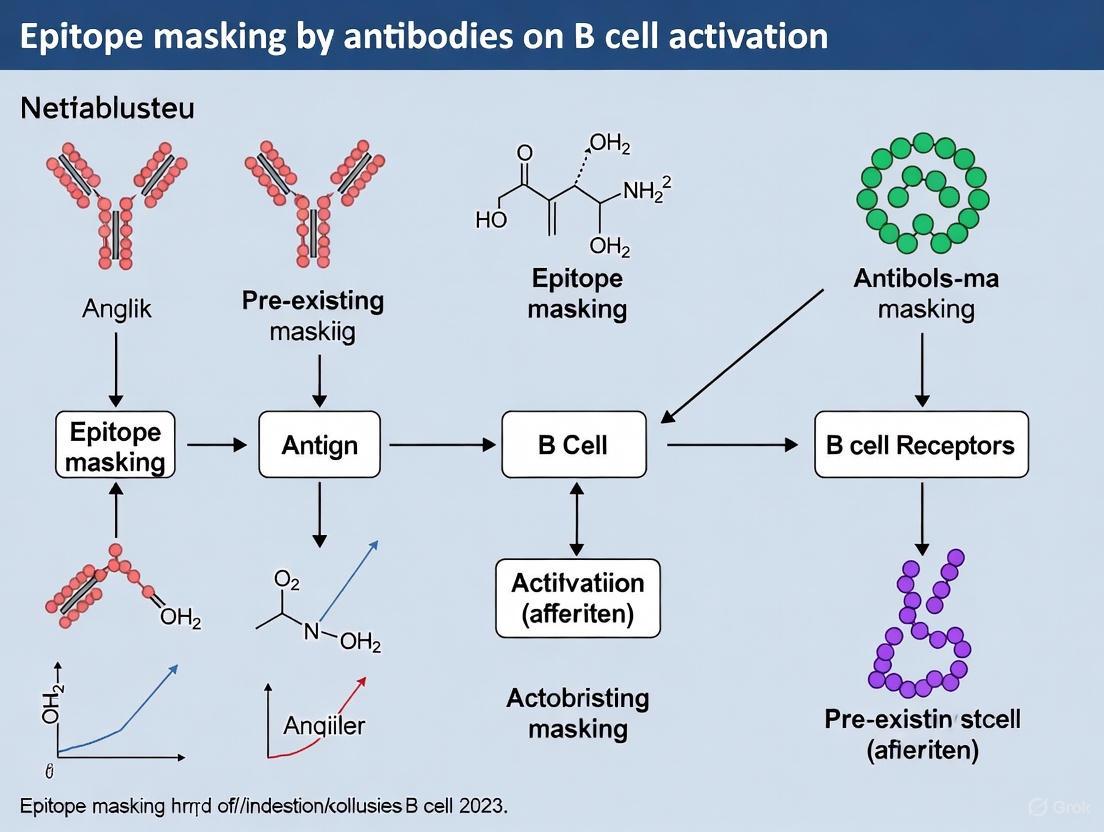
This article synthesizes current research on epitope masking, a mechanism where pre-existing antibodies block viral epitopes, thereby inhibiting B cell receptor activation and shaping subsequent immune responses.
Epitope Masking: How Pre-existing Antibodies Steer B Cell Responses and Shape Vaccine Design
Abstract
This article synthesizes current research on epitope masking, a mechanism where pre-existing antibodies block viral epitopes, thereby inhibiting B cell receptor activation and shaping subsequent immune responses. We explore the foundational principles, including the roles of epitope proximity, antibody affinity, and dissociation kinetics. The content details advanced methodological approaches for studying these interactions, strategies to overcome masking for vaccine development, and comparative analyses with other inhibitory mechanisms. Aimed at researchers and drug development professionals, this review provides a comprehensive framework for understanding and leveraging epitope masking to design next-generation, broadly protective vaccines.
The Fundamental Rules of Epitope Masking in Humoral Immunity
Epitope masking, a fundamental immunological process wherein pre-existing antibodies competitively inhibit B cell receptors (BCRs) from accessing their cognate antigenic determinants, represents a crucial regulatory mechanism in adaptive immunity. This phenomenon steers subsequent antibody responses, often away from conserved viral epitopes, with profound implications for vaccine design and therapeutic antibody development. This technical guide synthesizes current mechanistic insights from cutting-edge research, detailing the biophysical rules governing epitope masking—including the roles of antibody affinity, dissociation kinetics, epitope proximity, and steric constraints. We further present standardized experimental methodologies for quantifying BCR inhibition and provide a comprehensive toolkit of research reagents essential for investigating this complex process. The principles outlined herein aim to equip researchers with the foundational knowledge necessary to overcome the challenges posed by pre-existing immunity and to design next-generation immunogens capable of eliciting broad, protective responses.
Epitope masking, also known as antibody competition, is a feedback mechanism where pre-existing antibodies, either passively administered or generated from prior immune exposure, bind to specific epitopes on an antigen and physically prevent B cell receptors (BCRs) from engaging with those same or adjacent sites [1] [2]. This competition profoundly shapes the subsequent humoral immune response. While this mechanism can be harnessed therapeutically, as in Rhesus D prophylaxis to prevent alloimmunization [3] [4], it often presents a significant obstacle in vaccinology by limiting responses to conserved, protective epitopes on rapidly evolving pathogens like influenza virus [5].
The core issue lies in the fate of memory B cells during re-exposure to a pathogen. While these cells possess BCRs capable of recognizing conserved epitopes and generating broad, potent antibody responses, their activation can be preempted by pre-existing antibodies that bind to overlapping or sterically proximate epitopes, effectively "hiding" them from BCR recognition [6]. This creates a negative feedback loop that can preferentially steer responses toward novel, variable epitopes, a phenomenon particularly evident in influenza, where the immunodominant, variable head domain of hemagglutinin (HA) is often targeted over the more conserved stalk region [7] [5]. Understanding the precise rules governing this competition is therefore paramount for developing vaccines that can bypass this natural bias and elicit broadly protective immunity.
Mechanisms and Biophysical Rules
The efficiency of epitope masking is not a simple binary outcome but is governed by a set of quantifiable biophysical and structural parameters. Recent research utilizing engineered, influenza-reactive B cells has delineated several key factors that determine the potency of antibody competition.
Direct vs. Indirect Masking
Epitope masking operates through two primary mechanisms: direct and indirect competition. Direct masking occurs when a pre-existing antibody binds to the exact epitope targeted by a BCR, resulting in straightforward competitive inhibition [6]. Indirect masking, or steric hindrance, occurs when an antibody binds to an epitope that is distinct from, but physically proximate to, the BCR's target epitope. The large size of the antibody molecule (∼15 nm) can physically block access to neighboring epitopes, preventing BCR engagement [4]. Research has demonstrated that membrane-proximal epitopes on viral surface proteins, such as the stalk region of influenza HA, are particularly susceptible to both direct and indirect masking, placing B cells targeting these conserved regions at a significant disadvantage [6].
Key Factors Influencing Masking Potency
The following factors critically influence the outcome of the competition between soluble antibodies and BCRs:
- Epitope Proximity and Location: The spatial arrangement of epitopes on the antigen surface is a major determinant. Epitopes located close to each other are more susceptible to cross-inhibition via indirect masking. Furthermore, epitopes in sterically constrained environments, such as the HA trimer interface, can be differentially affected, with some antibodies surprisingly enhancing access to these hidden sites [8] [6].
- Antibody Affinity and Kinetics: While high-affinity antibodies generally are more potent inhibitors, the dissociation kinetics (off-rate) of the antibody appears to be a dominant factor. Antibodies with slow dissociation kinetics form more stable complexes with the antigen, leading to more potent and durable BCR inhibition compared to antibodies with similar affinity but faster off-rates [7] [8].
- Antibody Valency: Multivalent interactions, such as those exhibited by IgG antibodies with two antigen-binding sites, significantly enhance the avidity of binding to multivalent antigens like viral surfaces. This increased avidity strengthens epitope masking and makes the inhibition more difficult for BCRs to overcome [7].
- Epitope Density: On complex antigens like haptenated erythrocytes, the density of the epitope to which the pre-existing antibody binds is critical. High epitope density allows antibodies to more effectively suppress responses against both their target epitope and neighboring, non-target epitopes, likely due to large-scale steric occlusion of the antigenic surface [4].
Table 1: Factors Governing the Potency of Epitope Masking
| Factor | Effect on Masking Potency | Experimental Support |
|---|---|---|
| Epitope Proximity | High potency when BCR and antibody epitopes are identical or adjacent; membrane-proximal epitopes are highly susceptible. | Inhibition of stalk-specific B cells by non-stalk antibodies [6]. |
| Antibody Affinity | Generally, higher affinity leads to more potent masking. | n/a |
| Dissociation Kinetics | Slow off-rate (slow dissociation) is a dominant factor for potent inhibition. | Comparison of affinity/avidity-matched antibody pairs [8]. |
| Antibody Valency | Multivalent interactions (e.g., IgG) enhance masking through increased avidity. | Engineered B cell system with influenza virus [7]. |
| Epitope Density | High density of the antibody's target epitope enables suppression of responses to non-target epitopes. | Haptenated SRBC models with varying NP-conjugation density [4]. |
A critical insight from recent studies is that epitope masking functions independently of Fc-mediated effector mechanisms. Experiments using IgG antibodies engineered with "LALAPG" mutations that abrogate FcγR binding showed no reduction in their ability to inhibit B cell activation, confirming that the blocking effect is due to the Fab portion's occupation of the epitope [6]. This Fc-independent mechanism is further supported by evidence that IgG-mediated suppression remains intact in mice lacking various FcγRs, complement components, or complement receptors [3] [4].
Diagram 1: Mechanism of Epitope Masking. The diagram contrasts successful B cell activation in the absence of competing antibodies with the inhibition caused by epitope masking, highlighting the Fc-independent, competitive binding mechanism.
Experimental Evidence and Validation
The foundational and contemporary evidence for epitope masking comes from a synergy of classical in vivo models and sophisticated reductionist in vitro systems.
Classical In Vivo Models
The haptenated sheep red blood cell (SRBC) model has been instrumental in demonstrating epitope-specific suppression. A seminal study showed that administering IgG anti-NP alongside NP-conjugated SRBC suppressed the IgG anti-NP response but left the IgG anti-SRBC response intact. Conversely, IgG anti-SRBC suppressed the anti-SRBC response but not the anti-NP response [3]. This precise epitope specificity strongly argues for a masking mechanism, as broader Fc-dependent mechanisms would typically suppress the response to the entire antigen complex. Furthermore, this model revealed that the ability of an antibody to suppress responses against non-target epitopes on the same antigen (non-epitope specific suppression) depends on high density of its target epitope, creating sufficient steric hindrance to block access to adjacent epitopes [4].
Advanced In Vitro Systems
To dissect the biophysical rules with greater precision, recent studies have employed engineered B cell systems. He et al. used CRISPR/Cas9 to create Ramos B cells expressing a single-chain BCR derived from known influenza-reactive antibodies, creating a panel of "emAb" B cell lines with defined specificity and affinity [6]. When presented with influenza virus particles bound to a surface, these emAb cells extract the antigen and initiate signaling, which can be quantified via microscopy through metrics like BCR phosphorylation and calcium influx. By introducing soluble antibodies of known characteristics, this system directly visualizes and quantifies the inhibition of B cell activation, independently of FcγR-mediated effects [8] [6]. This approach has been critical for establishing the roles of antibody kinetics and epitope location.
Table 2: Key Quantitative Findings from Epitope Masking Studies
| Experimental Variable | Quantitative Impact on B Cell Activation | System |
|---|---|---|
| Direct Competition (Identical Epitope) | >95% reduction in antigen uptake and phosphotyrosine signaling [6]. | emAb B cells + Influenza Virus |
| Antibody with Slow Off-rate | Potent inhibition of BCR signaling compared to antibody with similar affinity but faster off-rate [8]. | emAb B cells + Influenza Virus |
| High vs. Low Hapten Density | High density: ~90% suppression of non-target IgM. Low density: No suppression of non-target IgM [4]. | In vivo SRBC-NP Model |
| FcγRIIB Knockout | No significant difference in suppression potency, confirming Fc-independence [6] [4]. | In vivo & In vitro models |
Detailed Experimental Protocols
To facilitate the replication and extension of key findings in epitope masking research, this section outlines detailed methodologies for two cornerstone assays: the in vitro B cell activation/inhibition assay and the in vivo hapten-carrier suppression model.
In Vitro B Cell Activation & Inhibition Assay
This protocol, adapted from He et al. [6], measures the ability of soluble antibodies to inhibit antigen-specific activation of engineered B cells.
- Key Reagents: Engineered monoclonal antibody-derived (emAb) B cell lines (e.g., Ramos B cells with endogenous BCR knocked out and transduced with influenza HA-stalk specific BCR like CR9114); Purified influenza A virus (e.g., A/WSN/1933); Erythrina cristagalli lectin (ECL); competing monoclonal antibodies (e.g., CR9114 IgG, C05 IgG).
- Procedure:
- Surface Preparation: Coat glass-bottom imaging plates with ECL to create a reversible binding surface for viral particles.
- Virus Opsonization: Incubate purified influenza virus with a range of concentrations of the competing monoclonal antibody (e.g., 0.1-10 µg/mL) for 30-60 minutes at 37°C. Include a no-antibody control.
- Antigen Loading: Apply the opsonized virus to the ECL-coated plate, allowing particles to bind.
- Cell Introduction and Imaging: Add emAb B cells to the plate and use live-cell fluorescence microscopy to track:
- Antigen Extraction: The ability of cells to extract virus particles from the surface.
- BCR Signaling: Immunofluorescence staining for phosphorylated tyrosine residues at the B cell synapse.
- Calcium Flux: Using calcium-sensitive dyes (e.g., Fluo-4).
- Data Analysis: Quantify the percentage of cells that successfully extract antigen and the mean fluorescence intensity of phosphotyrosine staining in the synapse. Compare values between antibody-treated and untreated conditions to calculate the percentage inhibition.
In Vivo Hapten-Carrier Suppression Model
This classic protocol, based on the work of Karlsson et al. [3] [4], demonstrates epitope-specific suppression in a live animal.
- Key Reagents: Polyclonal IgG anti-NP and IgG anti-SRBC; Sheep Red Blood Cells (SRBC); NP-ε-Aminocaproyl-OSu for conjugating NP to SRBC at high, intermediate, and low densities.
- Procedure:
- Antigen Preparation: Conjugate NP to SRBC at different densities by incubating SRBC with varying concentrations of NP-ε-Aminocaproyl-OSu.
- Passive Antibody Transfer: Administer a suppressive dose of IgG anti-NP (e.g., 30-50 µg for C57BL/6 mice) intravenously 30 minutes prior to antigen.
- Immunization: Immunize mice intravenously with a set number of NP-SRBC (e.g., 5x10^7 cells).
- Response Measurement: After 5-7 days (for early IgM responses) or longer for IgG and memory responses, analyze:
- Serum Antibodies: Use ELISA to quantify NP-specific and SRBC-specific IgM and IgG titers.
- Antibody-Secreting Cells: Use ELISPOT or plaque-forming cell (PFC) assay on splenocytes to count NP-specific and SRBC-specific antibody-secreting cells.
- Germinal Center B Cells: Use flow cytometry to identify NP-specific GC B cells (B220+λ1+NP+ CD95high GL7high).
- Data Analysis: Suppression is calculated as the percentage reduction in titer or cell count in the group that received IgG + antigen compared to the group that received antigen alone.
Diagram 2: In Vitro B Cell Inhibition Workflow. The experimental pipeline for assessing epitope masking using engineered B cells and live-cell imaging.
The Scientist's Toolkit: Essential Research Reagents
A successful investigation into epitope masking requires a carefully selected set of biological and chemical reagents. The following table catalogues key tools used in the cited research.
Table 3: Essential Reagents for Epitope Masking Research
| Reagent Category | Specific Examples | Function in Experimental Design |
|---|---|---|
| Engineered B Cell Lines | Ramos B cells with knocked-out endogenous BCR, transduced with single-chain BCRs from C05 (HA head), CR9114 (HA stalk) [6]. | Provides a homogeneous, defined system to study BCR signaling and inhibition for specific epitopes in vitro. |
| Viral Antigens | Purified influenza A viruses (e.g., A/WSN/1933, A/California/04/2009); Recombinant HA protein [8] [6]. | The source of antigenic epitopes for BCR engagement. Used in surface-bound or soluble form. |
| Competing Monoclonal Antibodies | Anti-HA antibodies (e.g., C05, S139/1, CR9114, FISW84); Anti-NA antibodies; Fc-silent variants (e.g., LALAPG) [7] [6]. | The "pre-existing" antibodies whose masking potency is being tested. Fc-silent variants control for Fc-dependent effects. |
| Classical Model Antigens | Sheep Red Blood Cells (SRBC); NP-conjugated SRBC (at various densities) [3] [4]. | Well-characterized particulate antigens for in vivo studies of epitope-specific suppression and memory formation. |
| Detection Reagents | Phospho-tyrosine specific antibodies; Calcium-sensitive dyes (e.g., Fluo-4); Fluorophore-conjugated anti-Ig antibodies; ELISPOT/ELISA kits [6] [4]. | To quantify key readouts: B cell activation (signaling, calcium), and antibody output (cell numbers, serum titers). |
In the adaptive immune response, the activation of B cells is initiated by the binding of their B cell receptor (BCR) to specific epitopes on an antigen. However, when pre-existing antibodies are present—from prior infection or vaccination—they can compete with BCRs for access to these same epitopes, a phenomenon known as epitope masking or antibody competition [8] [6]. This competition has the potential to steer B cell responses away from conserved epitopes and toward novel ones, profoundly influencing the outcome of subsequent immune challenges [9]. Understanding the rules governing this process is therefore critical for advancing vaccine design, particularly for pathogens like influenza and SARS-CoV-2 where pre-existing immunity is common. This technical guide delves into the key determinants of masking potency, focusing on epitope location, proximity, and steric hindrance, and frames these factors within the broader context of B cell activation research. Evidence from recent studies indicates that epitope masking is a dominant mechanism, capable of suppressing IgG responses and inhibiting the activation of even high-affinity memory B cells, thereby shaping the specificity and breadth of the humoral immune response [9] [3].
Core Determinants of Epitope Masking Potency
Epitope Location and Accessibility
The location of an epitope on a viral surface protein is a primary determinant of its susceptibility to masking. Epitopes can be broadly categorized by their structural context, which dictates their accessibility to both antibodies and B cell receptors.
- Membrane-Proximal Epitopes: Epitopes located near the viral membrane are fundamentally at a disadvantage. Research on influenza hemagglutinin (HA) has demonstrated that membrane-proximal epitopes are subject to both direct and indirect masking [8] [6]. Direct masking occurs when an antibody binds the exact same epitope as the BCR. Indirect masking, sometimes referred to as steric hindrance, occurs when an antibody binding to a distinct, nearby epitope physically blocks access to the membrane-proximal site due to the size and orientation of the antibody molecule.
- Globular Head vs. Conserved Stalk Epitopes: In influenza HA, the immunodominant, variable globular head domain is highly accessible. In contrast, the conserved stalk region is both less immunogenic and more susceptible to masking by pre-existing antibodies. This contributes to the apparent lack of boosting of broadly cross-reactive antibodies to the stem epitopes after repeated vaccination or infection in humans [9]. Mathematical modeling of the humoral immune response has confirmed that epitope masking is a key mechanism preventing the effective boosting of responses to the conserved stem of HA [9].
- Buried or Interface Epitopes: Epitopes buried within protein interfaces, such as the HA trimer interface, can be naturally hidden from B cell recognition. The activation of B cells targeting these epitopes is highly sensitive to the stability of the protein trimer and can be unexpectedly enhanced by certain antibodies that disrupt the trimeric structure, thereby exposing previously hidden epitopes [6].
Antibody Affinity and Dissociation Kinetics
While antibody affinity (the equilibrium binding constant, Kd) is important for epitope masking, recent evidence suggests that the dissociation kinetics (off-rate, kd) of the competing antibody play a dominant role in determining masking potency.
- Slow Dissociation Enhances Potency: Antibodies with slow dissociation kinetics form more stable complexes with the antigen, leading to more potent and prolonged epitope masking [8]. In a direct comparison of affinity- and avidity-matched antibodies, the one with slower off-rate was a more potent inhibitor of BCR activation [6].
- Affinity Maturation and Competition: BCRs that have undergone affinity maturation may compete with pre-existing antibodies that bind to the same epitope with lower affinity. The outcome of this competition is heavily influenced by the relative kinetics of the interactions [6].
Table 1: Impact of Antibody Characteristics on Masking Potency
| Antibody Characteristic | Impact on Masking Potency | Experimental Evidence |
|---|---|---|
| Dissociation Kinetics | Slow off-rate (kd) dramatically enhances potency by stabilizing the antigen-antibody complex. | Direct comparison showed slow off-rate antibody was a more potent inhibitor of B cell activation than a matched antibody with faster off-rate [6]. |
| Affinity | Higher affinity (lower Kd) generally increases competition, but kinetics can be a more dominant factor. | Germline reversion of a high-affinity antibody (worse Kd) resulted in reduced masking capacity [6]. |
| Epitope Specificity | Antibodies against the other viral protein (e.g., anti-HA inhibiting NA-reactive B cells) can be inhibitory. | HA-stalk antibodies were found to inhibit activation of B cells targeting neuraminidase (NA), suggesting cross-protein steric hindrance [8]. |
| Valency | Multivalent binding (e.g., IgG vs. Fab fragments) increases functional affinity (avidity) and masking potency. | Multivalency is highlighted as a key factor influencing the potency of epitope masking [8]. |
Proximity and Steric Hindrance
The physical space that an antibody occupies upon binding can block access to adjacent epitopes, a phenomenon known as steric hindrance.
- Direct vs. Indirect Competition: Direct competition occurs when an antibody and a BCR target an identical or overlapping epitope. Indirect competition occurs when they target distinct but spatially proximate epitopes. The potency of indirect masking is inversely correlated with the distance between the two epitopes [8] [6].
- Cross-Protein Inhibition: Remarkably, steric hindrance is not confined to a single protein. Antibodies against hemagglutinin (HA) have been shown to inhibit the activation of B cells targeting the entirely different viral surface protein, neuraminidase (NA) [8]. This suggests that the dense packing of glycoproteins on the viral envelope can allow large antibody molecules to block access to neighboring proteins.
- Fc-Mediated Steric Effects: The Fc region of an antibody can contribute to steric hindrance. Inhibition of NA-reactive B cells by a subset of anti-HA antibodies is possibly due to steric hindrance from the Fc region [6].
Experimental Evidence and Methodologies
Key Experimental Models and Workflows
The rules governing epitope masking have been elucidated using sophisticated reductionist models that allow for precise control over variables. A key methodology involves the use of engineered monoclonal antibody-derived B cells.
Experimental Workflow for Studying BCR-Antibody Competition:
The following diagram outlines the core steps in a typical experiment designed to dissect epitope masking using engineered B cells [6].
Protocol 1: Assessing Epitope Masking with Engineered B Cells [6]
- Engineer B Cells: Using CRISPR/Cas9, knock out the endogenous IgM BCR from a Ramos B cell line. Subsequently, transduce these cells via lentivirus with a single-chain BCR (scBCR) derived from a known influenza-reactive antibody (e.g., specific to the HA head, stalk, or NA). These are termed engineered monoclonal antibody-derived (emAb) B cells.
- Present Antigen: Reversibly bind purified influenza A virus particles or purified HA to a glass-bottom plate using Erythrina cristagalli lectin (ECL), which attaches to sialic acids on the viral surface.
- Introduce Competing Antibody: Pre-incubate the surface-bound antigen with the soluble IgG antibody whose masking potency is to be tested. Use antibodies with mutations (e.g., LALAPG) that ablate Fc receptor binding to isolate the effects of epitope masking from Fc-mediated inhibition.
- Add B Cells and Image: Introduce the emAb B cells and use live fluorescence microscopy to track B cell activation.
- Quantitative Metrics:
- Antigen Extraction: Measure the ability of the B cell to extract the virus particle from the coverslip.
- BCR Phosphorylation: Use immunofluorescence to quantify phosphotyrosine (pTyr) levels at the B cell synapse.
- Calcium Flux: Use calcium-sensitive dyes to measure intracellular calcium influx, a key early activation signal.
In Vivo Validation and Epitope Specificity
Complementing in vitro models, in vivo experiments provide critical evidence for the physiological relevance of epitope masking.
Protocol 2: Demonstrating Epitope-Specific Suppression In Vivo [3]
- Antigen Preparation: Use sheep red blood cells (SRBCs) as a particulate antigen. Haptenate them with 4-hydroxy-3-nitrophenyl acetyl (NP) to create NP-SRBC, which presents both the native SRBC epitopes and the hapten (NP) epitopes.
- Passive Antibody Transfer: Passively administer polyclonal IgG specific to either SRBC (anti-SRBC) or NP (anti-NP) to mice via intravenous injection.
- Immunization: Shortly after antibody transfer, immunize the mice with the NP-SRBC antigen.
- Measure Suppression: After several days, quantify the antigen-specific IgG response.
- Result: Mice that received IgG anti-NP showed suppression of the IgG anti-NP response, but not the IgG anti-SRBC response. Conversely, mice that received IgG anti-SRBC showed suppression of the IgG anti-SRBC response, but not the IgG anti-NP response. This epitope-specific suppression provides compelling evidence for epitope masking as a primary mechanism in vivo [3].
The Scientist's Toolkit: Essential Research Reagents
To conduct research in epitope masking, a specific set of reagents and tools is required. The following table details key solutions used in the featured experiments.
Table 2: Key Research Reagent Solutions for Epitope Masking Studies
| Research Reagent | Function in Experiment | Specific Example |
|---|---|---|
| Engineered B Cells (emAb) | Provides a homogeneous population of B cells with a defined BCR specificity, allowing precise study of competition for a single epitope. | Ramos B cells with endogenous BCR knocked out and transduced with a scBCR from antibody C05 (HA head-specific) or CR9114 (HA stalk-specific) [6]. |
| Viral Antigens | The substrate for BCR and competing antibody binding. Can be whole virus or purified proteins. | Influenza A/WSN/1933 virus particles; purified HA from A/Hong Kong/1968 [6]. |
| Competing Monoclonal Antibodies | The pre-existing antibody whose masking potency is being tested. Altered versions help isolate mechanisms. | CR9114 IgG (anti-HA stalk); versions include wildtype, Fc-mutant (LALAPG), and germline-reverted (CR9114 GL) [6]. |
| Fluorescent Reporters | Enable visualization and quantification of B cell activation in real-time. | Calcium-sensitive dyes (e.g., Fluo-4) for calcium flux; labeled anti-phosphotyrosine antibodies for BCR phosphorylation [6]. |
| Lectins / Surface Matrices | Used to immobilize antigen in a manner that mimics a surface-presented pathogen, facilitating microscopy. | Erythrina cristagalli lectin (ECL) to bind viral particles to glass coverslips via viral sialic acids [6]. |
Visualizing the Mechanism of Steric Hindrance
The following diagram illustrates the core concepts of how pre-existing antibodies mask epitopes through direct and indirect mechanisms, leading to the inhibition of B cell activation.
Discussion and Implications for Vaccine Design
The determinants of epitope masking—location, proximity, antibody affinity, and particularly dissociation kinetics—form a set of rules that can predict the outcome of B cell and antibody competition. A critical insight is that epitope masking is not inherently negative. While it can suppress desirable responses to conserved epitopes (like the HA stalk), this same mechanism can be harnessed to steer immune responses preferentially toward protective, conserved, or vulnerable sites on pathogens [8] [9].
For rational immunogen design, particularly for "universal" vaccines against influenza or other variable viruses, several strategies emerge:
- Targeting Subdominant Epitopes: Design immunogens that preferentially expose conserved, but typically masked, epitopes (e.g., the HA stalk).
- Removing Immunodominant, Variable Epitopes: Create "headless" HA immunogens that physically remove the immunodominant domain responsible for eliciting strain-specific antibodies that mask more desirable responses.
- Engineering Epitope Accessibility: Stabilize proteins in conformations that enhance the accessibility of conserved epitopes or use cocktails of immunogens to sequentially unlock masked regions. The discovery that some antibodies can enhance, rather than inhibit, access to hidden epitopes at the HA trimer interface points to the sophistication possible in such designs [6].
In conclusion, mastering the principles of epitope masking moves the field from observation to prediction and control. By understanding and manipulating the key determinants of masking potency, researchers can design next-generation vaccines that overcome the blunting effects of pre-existing immunity to elicit robust and broadly protective antibody responses.
The Critical Role of Antibody Affinity and Dissociation Kinetics
Epitope masking represents a significant regulatory mechanism in adaptive immunity, wherein pre-existing antibodies directly compete with B cell receptors (BCRs) for access to antigenic determinants on viral surfaces. This phenomenon has profound implications for vaccine design and therapeutic antibody development, particularly against rapidly evolving viruses such as influenza. During repeated viral exposures, pre-existing antibodies can sterically block conserved epitopes, thereby steering subsequent B cell responses away from these critical regions and toward antigenically novel but often less protective epitopes [6]. The efficacy of this masking process is not merely a function of antibody presence but is critically dependent on two fundamental biophysical properties: antibody affinity (the binding strength at equilibrium) and dissociation kinetics (the stability of the formed complex over time). Understanding how these parameters govern epitope masking is essential for developing next-generation vaccines capable of targeting conserved viral epitopes despite pre-existing immunity.
Quantitative Parameters Governing Epitope Masking
Affinity and Kinetics in Competitive Binding
Research utilizing engineered, influenza-reactive B cells (emAb cells) has systematically delineated the contribution of antibody affinity and dissociation kinetics to epitope masking efficacy. These studies demonstrate that while affinity contributes to competitive binding, dissociation kinetics play a disproportionately dominant role in determining masking potency [6] [8]. In direct competition assays between soluble antibodies and membrane-anchored BCRs, antibodies with slow off-rates establish prolonged occupancy at their target epitopes, effectively excluding BCR engagement even when comparative affinities are similar.
Table 1: Impact of Antibody Biophysical Properties on Epitope Masking Efficacy
| Parameter | Experimental Manipulation | Effect on BCR Activation | Mechanistic Insight |
|---|---|---|---|
| Affinity | Comparison of CR9114 IgG (Kd ≈ 0.4 nM) vs. germline reversion (Kd ≈ 10 nM) | ~60% reduction in antigen extraction with high-affinity IgG | Higher affinity increases occupancy at limiting antigen concentrations [6] |
| Dissociation Kinetics | Affinity/avidity-matched antibody pair with different off-rates | Slow dissociation led to stronger BCR inhibition | Prolonged epitope occupancy prevents BCR access despite similar affinity [6] [8] |
| Epitope Proximity | Membrane-proximal vs. distal epitopes on hemagglutinin | Membrane-proximal epitopes susceptible to both direct and indirect masking | Steric hindrance from antibodies targeting neighboring epitopes [6] |
| Antibody Valency | Multivalent vs. monovalent binding | Increased inhibition with multivalent antibodies | Enhanced functional affinity through avidity effects [6] |
Structural Determinants of Masking Susceptibility
Beyond solution-based binding parameters, the structural localization of epitopes on viral surfaces significantly influences their susceptibility to masking. Studies with influenza hemagglutinin (HA) have revealed that membrane-proximal epitopes are fundamentally disadvantaged for B cell recognition as they can be blocked by both directly and indirectly competing antibodies [6]. This dual vulnerability arises from the steric constraints imposed by the viral membrane and the increased likelihood of interference from antibodies bound to neighboring epitopes. Consequently, conserved regions like the HA stalk, which are critical targets for universal influenza vaccines, may be particularly susceptible to masking by pre-existing antibodies, potentially creating a negative feedback loop that disadvantages their recognition in successive immune challenges [6].
Experimental Models and Methodologies
Engineered B Cell Platform for Masking Studies
To precisely dissect the rules governing competition between soluble antibodies and BCRs, researchers have developed a reductionist system using engineered monoclonal antibody-derived (emAb) B cells [6].
Table 2: Key Research Reagents for Epitope Masking Studies
| Reagent/Cell Line | Specification | Experimental Function | Key Feature |
|---|---|---|---|
| Ramos B cells | Human Burkitt's lymphoma B cell line | Parental line for BCR engineering | Compatible with CRISPR/Cas9 gene editing [6] |
| emAb B cells | Endogenous IgM KO, lentiviral BCR transduction | Define epitope specificity and BCR affinity | Precise control of BCR epitope specificity and affinity [6] |
| ECL (Erythrina cristagalli lectin) | Lectin from coral tree | Reversible virus immobilization on glass surfaces | Enables fluorescence imaging of antigen extraction [6] |
| FcγR-null antibodies | LALAPG Fc variant | Discerning Fc-mediated vs. steric effects | Eliminates confounding FcγRIIb inhibitory signaling [6] |
Experimental workflow:
- BCR Engineering: Endogenous IgM BCR is knocked out of Ramos B cells using CRISPR/Cas9, followed by lentiviral transduction with single-chain BCRs derived from characterized influenza antibodies [6].
- Virus Presentation: Influenza A virus particles are reversibly immobilized on glass-bottom plates using Erythrina cristagalli lectin (ECL) at optimized surface density to enable differentiation between specific and non-specific B cell interactions [6].
- Activation Readouts: B cell activation is quantified through multiple parallel measurements: (1) antigen extraction from coverslip (internalization), (2) calcium influx using fluorescent indicators, and (3) BCR phosphorylation via immunofluorescence [6].
- Competition Assays: emAb cells are introduced to virus particles pre-opsonized with antibodies of defined specificity, affinity, and kinetics, with inhibition quantified relative to unmasked controls.
Advanced Imaging and Quantification
The imaging-based approach enables spatial resolution of B cell-virus interactions at the single-cell level. Key methodological considerations include:
- CD45 Exclusion Analysis: To determine whether differential signaling between BCRs targeting distinct epitopes stems from segregation of the phosphatase CD45 from the immune synapse, emAb cells are presented with supported lipid bilayers decorated with purified HA, followed by simultaneous imaging of antigen accumulation and CD45 localization [6].
- Colocalization Metrics: BCR phosphorylation is quantified via immunofluorescence specifically at sites where BCRs colocalize with influenza virus particles, ensuring signal specificity [6].
- Kinetic Profiling: Calcium influx is monitored in real-time using fluorophore-based indicators following engagement with masked versus unmasked viruses [6].
Dissociation Kinetics as a Dominant Factor
Kinetic Superiority Over Affinity
A pivotal finding from epitope masking research is the dominant role of dissociation kinetics over equilibrium affinity in determining masking potency. In experiments using affinity/avidity-matched antibody pairs, those with slower dissociation rates proved significantly more effective at inhibiting BCR activation, despite similar binding affinities [6] [8]. This phenomenon can be understood through a residence time model, wherein antibodies with prolonged epitope occupancy create a kinetic barrier to BCR engagement, even when the equilibrium binding strength is comparable. From a therapeutic perspective, this suggests that engineering antibodies for reduced off-rates may enhance their efficacy as protective agents that can simultaneously neutralize virus and shape subsequent immune responses through targeted epitope masking.
Implications for Affinity Maturation
The critical importance of dissociation kinetics extends to natural immune responses, where affinity maturation in germinal centers optimizes antibody binding parameters through somatic hypermutation (SHM). Recent evidence suggests this process is precisely regulated to protect high-affinity lineages; B cells expressing higher-affinity antibodies undergo more cell divisions but paradoxically reduce their mutation rates per division [10]. This affinity-dependent modulation of SHM prevents the accumulation of deleterious mutations in high-value clones, thereby safeguarding their optimized kinetic profiles. This newly discovered mechanism ensures that B cell lineages with superior kinetic parameters (including slow dissociation rates) are preserved during clonal expansion, enhancing the overall quality of the antibody response.
Research Applications and Therapeutic Implications
Informed Immunogen Design
Understanding the rules governing epitope masking directly enables rational vaccine design strategies aimed at focusing immune responses on conserved, vulnerable epitopes. Key approaches include:
- Epitope Choreography: Deliberate masking of immunodominant but variable epitopes using carefully selected antibodies with optimized kinetic profiles could steer responses toward conserved regions [6] [8].
- Stability Engineering: Enhancing the stability of antigenic proteins may influence their processing and presentation, as demonstrated by studies showing that antigen stability controls proteolysis, processing in antigen-presenting cells, and T cell stimulation [11].
- Sequential Immunization: Administering epitope-specific masking antibodies alongside immunogens could protect critical epitopes from premature B cell engagement, allowing focused affinity maturation toward these targets.
Antibody Engineering Platforms
The findings regarding affinity and kinetics have catalyzed advanced antibody engineering methodologies:
- Regulated SHM in Vitro: Mammalian cell surface display coupled with activation-induced cytidine deaminase (AID) expression enables controlled somatic hypermutation for antibody affinity maturation in vitro, mirroring germinal center processes [12].
- AI-Assisted Prediction: Deep learning platforms like abCAN leverage structural and sequential information to predict mutation effects on antibody-antigen binding affinity, achieving state-of-the-art prediction accuracy [13].
- Kinetic Optimization: Screening protocols specifically selecting for reduced off-rates rather than merely enhanced affinity may yield superior therapeutic antibodies for both neutralization and immune response modulation.
The biophysical parameters of antibody affinity and, most importantly, dissociation kinetics serve as critical determinants of epitope masking efficacy, thereby shaping subsequent B cell responses during repeated antigen exposures. The dominant role of dissociation kinetics over equilibrium affinity underscores the importance of kinetic parameters in both natural immunity and therapeutic antibody development. Advanced experimental systems including engineered B cells and sophisticated imaging approaches have enabled the precise dissection of these mechanisms, revealing fundamental principles with direct relevance to vaccine design and immunotherapeutic development. Future research integrating these findings with emerging technologies in structural biology, single-cell analysis, and computational prediction will further advance our ability to harness epitope masking for improved immune interventions against challenging viral pathogens.
Within the adaptive immune system, the process of B cell activation upon re-exposure to a pathogen is crucial for long-term immunity. However, the presence of pre-existing antibodies, generated from prior infections or vaccinations, can profoundly influence this process through a phenomenon known as epitope masking [6]. This mechanism involves the competition between soluble antibodies and membrane-bound B cell receptors (BCRs) for binding sites (epitopes) on viral surface proteins [7]. When epitopes are obscured, BCRs cannot engage their target, leading to the inhibition of B cell activation. This review dissects the molecular mechanisms of epitope masking, distinguishing between two primary competitive interactions: direct masking, where an antibody and a BCR bind the identical epitope, and indirect masking, where an antibody binding to a distinct, non-overlapping epitope sterically hinders access to a separate BCR's target [6] [8]. Understanding the rules governing these interactions is critical for advancing vaccine design, particularly for viruses like influenza, where steering responses toward conserved, protective epitopes remains a significant challenge [6] [14].
Core Mechanisms of Epitope Masking
Direct Masking: Steric Exclusion of the BCR
Direct masking represents the most straightforward competitive inhibition. It occurs when a pre-existing soluble antibody binds to the exact epitope targeted by a BCR on a memory B cell, physically preventing BCR engagement [6]. This steric blockade is sufficient to abolish B cell activation, as demonstrated by experiments with engineered, influenza-reactive B cells (emAb cells). When CR9114-emAb cells, which target the hemagglutinin (HA) stalk, were presented with influenza viruses pre-opsonized with the soluble CR9114 IgG antibody, antigen extraction and BCR phosphorylation (pTyr) were almost completely abolished [6].
A critical insight from this research is that this inhibition is primarily due to epitope masking alone, and not dependent on Fc-mediated effector functions. Using a variant of the CR9114 antibody engineered not to bind Fc receptors (the "LALAPG" variant), researchers observed a similar reduction in B cell activation, confirming that the simple occupation of the epitope is the main mechanism of inhibition [6]. The dissociation kinetics (off-rate) of the competing antibody are a dominant factor in the potency of direct masking. Antibodies with slow dissociation rates form more stable complexes with the antigen, leading to stronger and more durable inhibition of BCR signaling [6] [8].
Indirect Masking: Steric Hindrance from Proximal Epitopes
Indirect masking is a more complex phenomenon wherein an antibody binding to one epitope on a viral protein sterically hinders the access of a BCR to a different, nearby epitope [6]. This is particularly consequential for epitopes that are structurally adjacent on the antigenic surface.
Research on influenza HA has revealed that membrane-proximal epitopes, such as those in the stalk and anchor regions, are fundamentally at a disadvantage because they are susceptible to both direct and indirect masking [6]. Antibodies binding to epitopes closer to the viral membrane can block access for BCRs targeting epitopes situated even nearer to the membrane, creating a hierarchy of vulnerability. Surprisingly, cross-protein inhibition has also been observed; certain anti-HA antibodies can inhibit the activation of B cells targeting neuraminidase (NA), another major surface glycoprotein, likely due to large-scale steric hindrance from the antibody's Fc region [6] [8].
Table 1: Key Characteristics of Direct and Indirect Masking
| Feature | Direct Masking | Indirect Masking |
|---|---|---|
| Epitope Relationship | Antibody and BCR target the identical epitope. | Antibody and BCR target distinct, but proximally located, epitopes. |
| Primary Mechanism | Steric exclusion through competitive binding. | Steric hindrance from a nearby bound antibody. |
| Dependence on FcR Signaling | Independent; occurs with Fc-mutant antibodies [6]. | Independent; mediated by physical blockage. |
| Key Influencing Factor | Antibody dissociation kinetics (off-rate) [8]. | Spatial proximity and orientation of epitopes on the antigen [6]. |
| Example | CR9114 IgG blocking CR9114-emAb B cell activation [6]. | Anti-HA head antibodies inhibiting HA stalk/anchor B cells; Anti-HA antibodies inhibiting NA-reactive B cells [6]. |
Quantitative Determinants of Masking Potency
The effectiveness of an antibody at masking an epitope, whether directly or indirectly, is not binary but is modulated by several biophysical and biochemical properties.
- Antibody Affinity and Kinetics: While high-affinity antibodies are generally better at competition, the dissociation kinetics (off-rate) play a dominant role. A slow off-rate ensures the antibody remains bound to the antigen for longer periods, providing a more durable shield against BCR engagement. In comparisons of affinity/avidity-matched antibodies, those with slower dissociation kinetics demonstrated stronger inhibition of BCR activation [6] [8].
- Epitope Location and Accessibility: The structural location of an epitope on a viral protein heavily influences its susceptibility to masking. As noted, membrane-proximal epitopes are highly vulnerable [6]. Furthermore, epitopes buried within protein interfaces, such as the HA trimer interface, can be sensitive to the stability of the multimeric complex and may be uniquely affected by certain antibodies that can enhance, rather than inhibit, their accessibility [6] [8].
- Antibody Valency: The multivalency of an antibody, such as that found in pentameric IgM, can dramatically enhance its functional affinity (avidity) and steric footprint through simultaneous engagement of repetitive epitopes [14]. This cross-linking can rigidify the viral surface and more effectively occlude access for BCRs, thereby enhancing neutralization and masking potency [14].
Table 2: Factors Influencing Epitope Masking Efficacy
| Factor | Effect on Masking Potency | Experimental Evidence |
|---|---|---|
| Dissociation Kinetics (Off-rate) | Slower off-rate leads to more potent inhibition [8]. | Comparison of antibodies with similar affinity but different off-rates showed slower-dissociating antibodies were more inhibitory [6]. |
| Epitope Proximity to Viral Membrane | Increased proximity correlates with increased susceptibility to indirect masking [6]. | B cells targeting HA membrane-proximal epitopes (stalk, anchor) were inhibited by a wider range of antibodies than those targeting distal epitopes (head) [6]. |
| Antibody Valency | Higher valency (e.g., IgM) increases avidity and steric hindrance, enhancing masking [14]. | Multivalent antibodies form cross-linking networks, compressing protein spacing on the viral surface and occluding receptor/BCR access [14]. |
| Relative Epitope Location | Epitopes in close spatial proximity are more likely to experience indirect masking. | Anti-HA antibodies were found to inhibit B cells targeting NA, suggesting cross-protein steric effects [6] [8]. |
Experimental Models and Methodologies
An Imaging-Based Approach to Study B Cell Activation
To dissect the rules of antibody competition, researchers have developed sophisticated imaging-based assays using engineered B cell systems [6].
Key Experimental Protocol:
- B Cell Engineering: Endogenous IgM BCRs are knocked out of Ramos B cells using CRISPR/Cas9. These cells are then transduced via lentivirus to express a single-chain BCR derived from a defined influenza-reactive antibody (e.g., C05 for HA head, CR9114 for HA stalk), creating engineered monoclonal antibody-derived (emAb) B cell lines [6].
- Antigen Presentation: Viral particles (e.g., Influenza A/WSN/1933) are reversibly immobilized on glass-bottom plates coated with Erythrina cristagalli lectin (ECL), which binds viral glycoproteins [6].
- Cell Incubation and Imaging: The emAb cells are introduced onto the antigen-coated surface. Fluorescence imaging is used to monitor key activation metrics:
- Antigen Extraction: The ability of the B cell to pull the virus from the coverslip, indicating successful BCR engagement and signaling.
- BCR Phosphorylation (pTyr): Measured via immunofluorescence at sites where BCRs colocalize with virus particles, indicating early signaling activation.
- Calcium Influx: A downstream indicator of B cell activation, measured using calcium-sensitive dyes [6].
- Competition Assay: The experiment is repeated after pre-incubating the viruses with soluble monoclonal antibodies of defined specificity, affinity, and kinetics. The inhibition of antigen extraction, pTyr, and calcium flux quantifies the masking potency of the soluble antibody [6].
Diagram 1: B cell activation assay workflow.
The Scientist's Toolkit: Key Research Reagents
This field relies on a suite of specialized reagents and tools to deconstruct complex immune interactions.
Table 3: Essential Research Reagents for Epitope Masking Studies
| Research Tool | Function and Utility |
|---|---|
| Engineered B Cell Lines (emAb) | B cells with a defined, monoclonal BCR allowing precise control over epitope specificity and affinity for standardized assays [6]. |
| Fc-Mutant Antibodies (e.g., LALAPG) | Antibodies engineered to lack Fc-gamma receptor binding. Used to isolate the effects of epitope masking from Fc-mediated effector functions [6]. |
| Supported Lipid Bilayers | Synthetic membranes decorated with purified viral antigens (e.g., HA). Enable high-resolution imaging of B cell synapse formation, antigen accumulation, and CD45 exclusion [6]. |
| Germline-Reverted Antibodies | Antibodies engineered to revert their sequence to the unmutated common ancestor. Used to study the competition between affinity-matured BCRs and lower-affinity pre-existing antibodies [6]. |
Consequences for Vaccine Design and Immune Responses
The phenomenon of epitope masking has profound implications for vaccinology, especially for pathogens like influenza and HIV. Pre-existing immunity can steer subsequent B cell responses away from conserved, vulnerable epitopes (e.g., the influenza HA stalk) and toward immunodominant but variable epitopes (e.g., the HA head), thereby limiting the breadth and durability of protection [6] [15]. This creates a negative feedback loop that compromises the development of universal vaccines [6].
Understanding the rules of masking—how affinity, kinetics, and epitope location affect competition—provides a roadmap for overcoming these challenges. Strategies could include:
- Designing immunogens that specifically expose and stabilize conserved, subdominant epitopes.
- Using sequential vaccination with antigens that progressively focus the immune response on desired conserved regions.
- Engineering immunogens that spatially separate variable and conserved epitopes to reduce indirect masking of conserved regions by antibodies against variable ones [6] [15].
Diagram 2: Epitope masking consequences for B cell activation.
Epitope masking represents a critical regulatory layer in adaptive immunity, governed by the biophysical principles of antibody competition. The distinction between direct and indirect masking reveals a complex landscape where pre-existing antibodies can orchestrate the specificity of subsequent B cell responses. The quantitative insights into the roles of antibody affinity, dissociation kinetics, and epitope location provide a predictive framework for this phenomenon. As vaccine design moves toward targeting specific, conserved epitopes to achieve broad protection, overcoming the inhibitory effects of epitope masking will be paramount. Future strategies, informed by the mechanistic understanding outlined here, will need to creatively engineer immunogens and vaccination regimens to unmask these vulnerable sites and guide the immune system toward desired outcomes.
Epitope masking represents a fundamental mechanism whereby pre-existing antibodies, generated from prior infection or vaccination, bind to specific regions on a pathogen's surface and physically block access to those regions for B cell receptors (BCRs). This phenomenon plays a critical role in shaping subsequent humoral immune responses, particularly against viruses with strain variation such as influenza. In the context of influenza virus, the two major surface glycoproteins—hemagglutinin (HA) and neuraminidase (NA)—serve as primary targets for antibody responses and exhibit distinct epitope masking dynamics that directly impact vaccine efficacy and the development of broadly protective immunity [16] [17].
The biological significance of epitope masking extends beyond simple steric hindrance. It directly influences which B cell clones become activated during secondary exposures, ultimately determining the breadth and specificity of the antibody repertoire. Mathematical models of the humoral immune response have demonstrated that epitope masking, rather than antibody-mediated antigen clearance or Fc receptor-mediated inhibition, serves as the primary mechanism explaining limited boosting of antibodies to conserved epitopes on the HA stem following immunization [5]. This masking effect poses both challenges and opportunities for vaccine design: while it may limit responses to conserved, broadly protective epitopes, understanding its rules may allow researchers to strategically steer immune responses toward desired targets.
Fundamental Mechanisms of Epitope Masking
Molecular Principles of Antibody Competition
At the molecular level, epitope masking functions through the competitive physical occupation of antigenic sites by pre-existing antibodies, which prevents BCRs on specific B cells from engaging with their cognate epitopes. This competition occurs when the binding site of a pre-existing antibody overlaps with or is sufficiently proximal to the epitope recognized by a BCR, creating steric hindrance that inhibits B cell activation [8]. The potency of this masking effect depends on several factors, including the affinity and dissociation kinetics of the pre-existing antibodies, the relative spatial arrangement of epitopes on the antigen surface, and the structural flexibility of both the antigen and antibodies [8].
Recent research utilizing engineered, influenza-reactive B cells has revealed that antibodies against either HA or NA can frequently inhibit B cell activation, including in some instances B cells targeting the other viral surface protein [8]. This cross-protein inhibition highlights the potential for broader regulatory effects beyond single protein targets. The inhibitory effect is particularly potent for membrane-proximal epitopes on HA, which are subject to both direct competition and indirect masking effects due to the complex quaternary structure of viral surface proteins [8].
Key Factors Influencing Epitope Masking Efficacy
Antibody Affinity and Kinetics: Antibodies with slow dissociation kinetics demonstrate enhanced potency in epitope masking due to their prolonged occupancy of antigenic sites [8]. High-affinity antibodies can effectively outcompete BCRs for antigen binding even at lower concentrations.
Epitope Proximity and Location: The spatial arrangement of epitopes significantly impacts masking efficacy. Epitopes in close proximity demonstrate more effective cross-masking, while distant epitopes may remain accessible [8]. Membrane-proximal epitopes experience compounded masking effects due to structural constraints.
Antibody Valency: Multivalent antibody interactions increase functional affinity and residence time on the antigen surface, enhancing masking potency through avidity effects [8].
Relative Abundance of Antigen-Specific B Cells: The frequency of epitope-specific B cells influences the probability of successful epitope engagement despite masking pressures [5] [16].
The following diagram illustrates the core mechanism of epitope masking and its impact on B cell recruitment:
Quantitative Evidence of Epitope Masking in Influenza
Empirical Data on Antibody Boosting Limitations
Multiple studies have provided quantitative evidence demonstrating how pre-existing antibodies through epitope masking shape subsequent immune responses to influenza. Analysis of human vaccination trials reveals that immunization results in limited boosting of antibodies to conserved epitopes on the stem of HA, and the level of stem-specific antibody elicited is insufficient to provide broad strain-transcendent immunity [5]. The relationship between pre-existing antibody titers and subsequent boosting follows predictable patterns that can be mathematically modeled.
Research by Zarnitsyna et al. demonstrated that pre-existing antibodies to specific epitopes significantly reduce the magnitude of boosting to those same epitopes following immunization [5] [16]. This effect was particularly pronounced for conserved stem epitopes compared to variable head epitopes on HA. Prior to immunization, individuals typically show higher average levels of antibodies to the stem than the head of HA, with no individuals exhibiting very low titers to the stem [5]. Following immunization, however, antibodies against stem epitopes are boosted significantly less than those against head epitopes, creating an immunodominance hierarchy that favors variable over conserved regions.
Table 1: Quantitative Patterns of Epitope-Specific Antibody Boosting Following Immunization
| Parameter | Head Epitopes | Stem Epitopes | Experimental Evidence |
|---|---|---|---|
| Pre-existing antibody levels | Variable across individuals | Consistently high across individuals | Higher average pre-vaccination titers to stem epitopes [5] |
| Fold-increase post-vaccination | Significant boosting | Limited boosting | Head epitopes show significantly greater fold-increase (p < 0.0001) [5] |
| Relationship between pre-existing titer and boosting | Inverse correlation | Strong inverse correlation | Solid regression line slope = 0.28 (95% CI = [0.090;0.476]) [5] |
| Impact of repeated homologous vaccination | Initial strong boosting, then broadening | Gradual enhancement over time | After 4 annual vaccinations, broadening to unmatched strains observed [18] [19] |
Mathematical Modeling of Epitope Masking Dynamics
Mathematical models have been instrumental in quantifying epitope masking effects and distinguishing them from other potential mechanisms. Multi-epitope models comparing three hypotheses—antigen clearance, Fc receptor-mediated inhibition, and epitope masking—have demonstrated that only epitope masking successfully recapitulates the observed patterns in human vaccination data [5]. These models incorporate key parameters including antibody binding rates, epitope accessibility, B cell precursor frequencies, and steric interference effects.
The foundational mathematical framework for epitope masking can be represented through a system of equations that track free antigen (Hf), antibody-bound antigen (Hb), epitope-specific B cells (B), and antibodies (A) [16]:
Where only free antigen (Hf) stimulates B cell expansion, masked antigen (Hb) cannot engage BCRs, and parameters represent: s (maximum proliferation rate), φ (antigen threshold for activation), δB (B cell death rate), p (antibody production rate), dA (antibody decay rate), k (antibody-antigen binding rate), and dH (antigen decay rate) [16].
Table 2: Key Parameters in Epitope Masking Mathematical Models
| Parameter | Biological Significance | Estimated Value | Impact on Masking |
|---|---|---|---|
| Antibody-antigen binding rate (k) | Kinetics of epitope occupation | 0.01 (dimensionless) | Higher values increase masking potency |
| Antigen threshold for B cell activation (φ) | Sensitivity of B cells to antigen stimulation | 10 (concentration units) | Higher values increase susceptibility to masking |
| Maximum B cell proliferation rate (s) | Expansion potential upon epitope engagement | 1 d⁻¹ | Lower values enhance masking impact |
| Antibody decay rate (dA) | Persistence of pre-existing antibodies | 0.1 d⁻¹ | Lower values prolong masking effects |
| Antigen decay rate (dH) | Window of opportunity for B cell activation | 0.5 d⁻¹ | Lower values extend masking duration |
Experimental Methodologies for Studying Epitope Masking
Engineered B Cell Systems for Masking Assessment
The development of engineered, influenza-reactive B cells has provided a powerful experimental platform for quantifying epitope masking effects. This methodology involves creating B cell lines with defined BCR specificities for particular HA or NA epitopes, then measuring their activation in the presence of pre-existing antibodies with known specificities [8]. Key readouts include calcium flux, phosphorylation of signaling intermediates, surface activation markers, and proliferation assays.
Protocol: Engineered B Cell Activation Assay
- B Cell Engineering: Generate B cell lines expressing BCRs specific for target epitopes on HA or NA using retroviral transduction
- Antibody Preparation: Purify monoclonal antibodies with defined epitope specificities for use as masking agents
- Antigen Exposure: Incubate engineered B cells with influenza antigen in the presence or absence of masking antibodies
- Activation Measurement: Quantify B cell activation using flow cytometry for early activation markers (CD69, CD86) after 6-18 hours
- Signal Transduction Assessment: Monitor phosphorylation events in BCR signaling pathway (Syk, BLNK, ERK) via phospho-flow cytometry
- Calcium Flux Monitoring: Use calcium-sensitive dyes (e.g., Fluo-4) to track intracellular calcium mobilization
- Data Analysis: Calculate inhibition of activation as (1 - (activation with masking antibodies / activation without antibodies)) × 100%
This approach has revealed that B cells targeting HA epitopes are particularly sensitive to direct antibody competition, with membrane-proximal epitopes subject to both direct and indirect masking effects [8].
Escape Mutant Mapping for Epitope Characterization
The identification of epitopes targeted by human antibodies provides critical information for understanding which regions are susceptible to masking. Escape mutant generation through serial passage of virus in the presence of monoclonal antibodies represents a powerful methodology for epitope mapping [20].
Protocol: Generation and Characterization of Escape Mutants
- Virus Passage: Incubate influenza virus (e.g., A/Netherlands/602/2009) with sub-neutralizing concentrations of monoclonal antibodies in Madin-Darby canine kidney (MDCK) cells
- Antibody Escalation: Double the antibody concentration at each passage (typically 4-10 passages total)
- Variant Isolation: Plaque-purify emerging viral variants showing reduced antibody sensitivity
- Sequence Analysis: Sequence HA and NA genes of escape mutants to identify mutations conferring resistance
- Structural Mapping: Map identified mutations onto three-dimensional structures of HA or NA
- Epitope Validation: Confirm the identified region as the antibody binding site through complementary approaches (e.g., SPR, ELISA)
Application of this methodology to human anti-N1 monoclonal antibodies has identified escape mutations not only around the enzymatic site (S364N, N369T, R430Q) but also on the sides and bottom of NA (N88D, N270D, Q313K/R) [20], revealing previously uncharacterized epitopes that may be subject to masking.
The following diagram outlines the experimental workflow for epitope masking research:
The Scientist's Toolkit: Key Research Reagents and Methodologies
Table 3: Essential Research Reagents for Epitope Masking Studies
| Reagent/Methodology | Specific Examples | Research Application | Key Insights Generated |
|---|---|---|---|
| Engineered B cell systems | B cell lines with defined BCR specificities for HA/NA epitopes | Quantitative assessment of epitope accessibility | Identification of factors influencing masking potency (affinity, kinetics, valency) [8] |
| Human monoclonal antibodies | Anti-HA stem antibodies (e.g., FI6v3, CR9114); Anti-NA antibodies (e.g., FNI9, 1G01) | Epitope mapping and competition studies | Discovery of broadly neutralizing epitopes; Assessment of cross-reactivity [21] [22] |
| Escape mutant viruses | A/Netherlands/602/2009 with NA mutations (N88D, N270D, S364N, etc.) | Epitope characterization and antigenic drift monitoring | Identification of novel epitopes on NA [20] |
| Mathematical modeling frameworks | Multi-epitope models with masking parameters | Theoretical exploration of immune response dynamics | Demonstration that epitope masking (not antigen clearance) explains limited stem antibody boosting [5] [16] |
| Structural biology tools | X-ray crystallography, cryo-EM of HA/NA-antibody complexes | Atomic-level characterization of epitopes | Understanding steric constraints and opportunities for immune focusing [21] [22] |
Implications for Vaccine Design and Immune Focusing
Overcoming Epitope Masking for Broadly Protective Immunity
The phenomenon of epitope masking presents both challenges and opportunities for next-generation influenza vaccine design. Strategic approaches are being developed to overcome the limitations imposed by masking and steer immune responses toward conserved, broadly protective epitopes. One promising strategy involves the use of sequential immunization with homologous antigens, which has been shown to gradually broaden antibody responses despite initial masking effects [18] [19].
Longitudinal studies of humans receiving repeated vaccination with the same H1N1 pandemic strain over four consecutive years revealed that while initial responses were narrow, repeated exposure gradually enhanced antibodies capable of recognizing highly unmatched H1N1 strains [18] [19]. This broadening occurred preferentially in individuals with no initial memory recall against these historical viruses, suggesting that epitope masking of dominant epitopes may eventually force the immune system to recruit B cells targeting subdominant but broader epitopes.
Strategic Antigen Design to Bypass Masking
Novel antigen designs represent another promising approach to circumvent epitope masking. Structure-based immunogen design can leverage precise knowledge of epitope locations to create antigens that either mask undesirable variable epitopes or preferentially expose conserved epitopes. Key strategies include:
- Epitope Scaffolding: Presenting conserved epitopes on heterologous protein scaffolds to focus responses without competition from immunodominant variable epitopes
- Glycan Masking: Introducing N-linked glycosylation sites to shield variable epitopes while leaving conserved epitopes accessible [21]
- Chimeric HA Constructs: Designing HA molecules with exotic head domains and conserved stalk domains to focus responses on the stalk region [22]
These approaches recognize epitope masking not merely as an obstacle but as a potential tool that can be harnessed through careful vaccine design to generate broadly protective immunity against influenza viruses.
Epitope masking represents a critical determinant of immune response specificity and breadth in influenza virus infection and vaccination. Through competitive physical occupation of antigenic sites, pre-existing antibodies fundamentally shape subsequent B cell responses, typically favoring variable over conserved epitopes. A comprehensive understanding of epitope masking mechanisms—informed by engineered B cell systems, escape mutant mapping, mathematical modeling, and structural biology—provides the foundation for rational vaccine design that strategically leverages these principles to generate broadly protective immunity. As research continues to elucidate the complex rules governing epitope masking, the potential grows for developing universal influenza vaccines that effectively overcome the limitations of natural immune responses to this perpetually evolving pathogen.
Advanced Models and Methodologies for Studying B Cell-Antibody Competition
Engineered B Cell Models (emAb Cells) for Deconstructing BCR-Antibody Competition
During repeated exposure to viral pathogens, pre-existing antibodies can sterically block viral epitopes, competing with B cell receptors (BCRs) for antigen binding. This phenomenon, known as epitope masking, possesses the dual potential to either steer immune responses away from conserved, protective epitopes or to broaden them toward novel antigenic sites [8] [6]. The precise rules governing this competition have remained elusive, complicating predictive immunogen design. A transformative approach to deconstructing this complex process involves the use of engineered monoclonal antibody-derived (emAb) B cells [6]. These defined, monoclonal B cell lines enable precise investigation of how antibody specificity, affinity, and kinetics influence BCR activation against opsonized antigens, particularly on the influenza virus surface [8] [6]. This technical guide details the establishment, validation, and application of emAb B cell models to mechanistically dissect epitope masking, providing researchers with a robust framework for probing the fundamental mechanisms of antibody feedback.
Establishment of Engineered B Cell (emAb) Models
Core Engineering Methodology
The generation of emAb cells involves the precise introduction of defined BCR sequences into a consistent cellular background, enabling controlled, reductionist studies of B cell activation. The following protocol outlines the key steps for creating these models, as established in recent studies [6] [23].
- Cell Line Selection: The Ramos B cell line, a human Burkitt's lymphoma line, serves as a common recipient due to its robust growth and inherent B cell signaling machinery.
- Endogenous BCR Knockout: Using CRISPR/Cas9 technology, the endogenous IgM BCR locus is knocked out to eliminate confounding signaling from native receptors [6]. This creates a clean slate for introducing the BCR of interest.
- Introduction of Defined BCRs: A lentiviral vector system is used to transduce the knockout cells with a gene encoding a single-chain BCR derived from a well-characterized antibody (e.g., influenza-reactive antibodies like C05 or CR9114) [6]. To best model memory B cell responses, the transduced BCR is typically of the IgG isotype.
- Validation of BCR Expression: Successfully engineered cells are selected and sorted based on surface BCR expression. Flow cytometry confirms that BCR expression levels are comparable to those of wild-type Ramos cells, ensuring physiological relevance [6].
This engineered system allows for unparalleled control, enabling researchers to systematically vary the epitope specificity, affinity, and isotype of the BCR and study its interaction with competing soluble antibodies.
Critical Experimental Workflow
The diagram below illustrates the integrated experimental workflow for utilizing emAb cells to study BCR-antibody competition, from cellular engineering to quantitative readouts.
Key Experimental Assays and Protocols
Imaging-Based B Cell Activation Assay
A cornerstone of this research platform is a fluorescence microscopy-based assay that quantitatively measures B cell activation in response to surface-bound viral antigens [6].
- Antigen Presentation: Influenza A virus particles are reversibly immobilized on glass-bottom imaging plates coated with Erythrina cristagalli lectin (ECL). The ECL density is optimized to allow for robust discrimination between antigen-specific and non-specific B cell responses [6].
- Cell Introduction and Imaging: emAb cells are introduced onto the antigen-coated surface. Fluorescence time-lapse imaging is used to track key activation metrics.
- Key Quantitative Readouts:
- Antigen Extraction: Measurement of the B cell's ability to physically extract virus particles from the coverslip, a proxy for successful BCR engagement and internalization [6].
- Calcium Influx: Imaging of calcium-sensitive dyes to detect intracellular flux, an early downstream signaling event [6].
- BCR Phosphorylation: Immunofluorescence staining for phosphotyrosine at sites where BCRs colocalize with virus particles, indicating proximal BCR signaling activation [6].
This multi-parameter imaging approach provides a rich, quantitative dataset on the earliest stages of B cell activation under competitive conditions.
Synapse Formation and CD45 Exclusion Assay
To investigate the biophysical mechanisms of activation, emAb cells can be presented with purified antigen incorporated into supported lipid bilayers, allowing for high-resolution imaging of the immune synapse [6].
- Bilayer Preparation: Purified hemagglutinin (HA) is incorporated into a supported planar lipid bilayer.
- Synapse Imaging: emAb cells are allowed to settle on the bilayer. The accumulation of fluorescently labeled HA and the simultaneous exclusion of the phosphatase CD45 from the contact site are imaged using Total Internal Reflection Fluorescence (TIRF) microscopy.
- Analysis: The degree of CD45 exclusion is quantified, providing insights into the spatial organization of the synapse and the initiation of signaling. Studies with emAb cells have shown that despite predicted differences in membrane-to-membrane distance for different BCRs (e.g., ~20 nm for stalk-binding CR9114 vs. ~30 nm for head-binding C05), CD45 exclusion is consistently achieved, leading to BCR phosphorylation [6].
Quantitative Insights into Epitope Masking
Research using emAb cells has systematically quantified how the location of an epitope and the properties of a competing antibody influence the potency of masking. The table below synthesizes key quantitative findings from these studies.
Table 1: Quantified Epitope Masking Effects on B Cell Activation
| Competing Antibody Target | emAb B Cell Target | Key Finding | Quantitative Impact (Example) |
|---|---|---|---|
| Directly Competing Epitope (e.g., CR9114 IgG) | Identical Epitope (e.g., CR9114 BCR) | Near-complete inhibition via direct masking | "Almost completely abolished antigen uptake" and "significantly reduced pTyr levels" [6] |
| Hemagglutinin (HA) Stalk | Neuraminidase (NA) | Inhibition via indirect/steric masking | "HA-stalk antibodies can inhibit activation of B cells targeting NA" [8] |
| HA (Various sites) | HA Trimer Interface | Modulation dependent on HA stability; enhancement possible | "activation ... can be either suppressed or enhanced by other antibodies" [6] |
| Membrane-Proximal Epitope | Membrane-Proximal Epitope | High sensitivity to both direct and indirect masking | "fundamentally at a disadvantage for B cell recognition" [6] |
Impact of Antibody Biophysical Properties
The emAb system has been instrumental in deconstructing how the biophysical properties of the competing antibody dictate the strength of epitope masking.
Table 2: Influence of Antibody Properties on Masking Potency
| Antibody Property | Experimental Manipulation | Effect on Masking Potency |
|---|---|---|
| Dissociation Kinetics | Comparison of affinity/avidity-matched antibodies with different off-rates | "Slow antibody dissociation kinetics enhance the potency of epitope masking" [8]. Slow off-rates lead to stronger, longer-lasting inhibition. |
| Affinity | Use of germline-reverted antibodies with lower affinity (e.g., CR9114 GL, Kd ~10 nM) | Antibody affinity is important, but kinetics may play a more dominant role in certain comparisons [6]. |
| Valency | Use of monomeric Fab fragments vs. bivalent IgG | Multivalency increases masking potency, likely through enhanced avidity [8]. |
| Fc-Mediated Effects | Use of Fc-mutant IgG (LALAPG) that cannot bind Fc receptors | Epitope masking alone is sufficient for inhibition. "Similar reduction in pTyr levels as with the wildtype antibody," ruling out a primary role for inhibitory FcγRIIb in this model [6]. |
The Scientist's Toolkit: Essential Research Reagents
Implementing the emAb cell model requires a suite of specialized reagents and tools. The following table catalogues the core components of this experimental platform.
Table 3: Key Research Reagent Solutions for emAb Cell Experiments
| Reagent / Tool | Function / Description | Example Use in Protocol |
|---|---|---|
| Ramos B Cell Line | A human B cell line providing a consistent, tractable background for engineering. | Parental cell line for CRISPR knockout and lentiviral transduction [6]. |
| CRISPR/Cas9 System | RNA-guided nuclease for precise gene knockout. | Knocking out the endogenous IgM BCR to prevent confounding signals [6]. |
| Lentiviral Vectors | For stable integration of defined BCR genes. | Delivering genes for influenza-specific (e.g., C05, CR9114) or control (e.g., N86) BCRs [6]. |
| Erythrina cristagalli Lectin (ECL) | A lectin that binds viral glycoproteins, enabling reversible surface immobilization. | Coating glass-bottom plates to capture influenza virus particles for imaging assays [6]. |
| Supported Lipid Bilayers | A synthetic membrane system for presenting purified antigens in a fluid phase. | Studying immune synapse formation, CD45 exclusion, and antigen gathering by emAb cells [6]. |
| Phospho-Specific Antibodies | Antibodies for detecting post-translational modifications via immunofluorescence. | Staining for phosphotyrosine to visualize and quantify BCR activation [6]. |
| Calcium-Sensitive Dyes | Fluorescent dyes (e.g., Fluo-4) that change intensity upon binding calcium ions. | Loading into emAb cells to image calcium flux as a measure of early B cell activation [6]. |
Signaling Pathways in BCR Activation and Modulation
The signaling pathways interrogated by the emAb cell model can be summarized as follows. The core BCR signaling cascade, initiated by antigen binding, can be directly modulated by the pre-existing antibodies through epitope masking.
Discussion and Future Directions
The emAb B cell platform has moved the field beyond correlation and toward mechanism in epitope masking research. Key established rules include the heightened susceptibility of membrane-proximal epitopes to masking, the critical role of antibody dissociation kinetics (over affinity alone) in dictating masking potency, and the existence of rare enhancing antibodies that can increase accessibility to certain subdominant epitopes [8] [6]. The finding that Fc-mediated effector functions are not required for inhibition in these models underscores the sufficiency of steric blockade [6].
Future applications of this platform are vast. It can be extended to study B cell responses to other pathogens like SARS-CoV-2, to evaluate the masking potential of novel therapeutic antibodies, and to inform the design of next-generation vaccines that can strategically overcome pre-existing immunity to focus responses on conserved, protective epitopes. By providing a controlled, reductionist system, engineered B cell models serve as an essential "scientist's toolkit" for deconstructing the complex rules of immune recognition and steering humoral immunity toward desired outcomes.
Mathematical Modeling of Humoral Immune Responses to Predict Masking Outcomes
The humoral immune response, mediated by antibodies produced by B cells, constitutes a crucial defense mechanism against pathogenic invaders. However, the presence of pre-existing antibodies can paradoxically suppress subsequent immune responses through a phenomenon known as epitope masking. This process occurs when pre-existing antibodies bind to specific regions (epitopes) on antigens, physically blocking B cell receptors (BCRs) from recognizing these same epitopes and thereby inhibiting B cell activation [6] [8]. Understanding and predicting the outcomes of epitope masking has significant implications for vaccine design, particularly for pathogens like influenza and SARS-CoV-2 where pre-existing immunity from previous exposures or vaccinations can limit the effectiveness of subsequent immunizations [5].
Mathematical modeling provides a powerful framework to quantify and predict the dynamics of epitope masking, offering insights that are difficult to obtain through experimental approaches alone. These models integrate quantitative parameters describing antibody affinity, kinetics, valency, and spatial relationships between epitopes to simulate how pre-existing antibodies shape emerging B cell responses [6] [8]. For influenza, epitope masking has been identified as a key mechanism limiting the development of broadly protective responses to conserved epitopes on the hemagglutinin (HA) stem, steering responses instead toward variable immunodominant head epitopes [5]. This review synthesizes current mathematical frameworks, experimental methodologies, and computational tools for investigating epitope masking, providing researchers with a comprehensive technical guide for predicting its impact on humoral immunity.
Biological Mechanisms of Epitope Masking
Fundamental Principles of B Cell Competition
Epitope masking represents a competitive interaction between soluble antibodies and membrane-anchored B cell receptors for binding sites on antigenic surfaces. Three primary mechanisms have been proposed to explain antibody-mediated suppression of humoral responses:
Epitope Masking (EMM): Pre-existing antibodies sterically hinder BCRs from accessing their cognate epitopes, preventing B cell activation and proliferation [24] [25] [5]. This direct competition is influenced by antibody affinity, dissociation kinetics, and the spatial arrangement of epitopes.
Fc Receptor-Mediated Inhibition (FIM): Antigen-antibody complexes simultaneously engage BCRs and inhibitory FcγRIIb receptors on B cells, delivering signals that suppress B cell activation [25]. However, studies in FcγRIIb-deficient mice show preserved suppression, suggesting this may not be the dominant mechanism [25].
Rapid Antigen Clearance (ACM): Antibody-opsonized antigens are rapidly cleared via phagocytosis by Fc receptor-bearing cells, reducing antigen availability for B cell recognition [24] [25]. Mathematical models suggest this works synergistically with epitope masking rather than independently.
Experimental evidence increasingly supports epitope masking as the predominant mechanism, particularly through studies using engineered B cell systems. These investigations demonstrate that epitope masking alone, without Fc-mediated signaling, is sufficient to block B cell activation [6] [8]. The inhibitory effect is most potent when competing antibodies target identical or proximal epitopes, with membrane-proximal epitopes being particularly susceptible to both direct and indirect masking [8].
Structural and Kinetic Determinants of Masking Efficacy
The efficacy of epitope masking is governed by several biophysical and structural factors:
Antibody Affinity and Avidity: Higher affinity antibodies more effectively compete with BCRs for antigen binding. Multivalent interactions (avidity) further enhance masking potency through increased functional affinity and reduced dissociation rates [6].
Dissociation Kinetics: Antibodies with slow off-rates (long half-lives) establish more durable masking effects. Kinetic parameters often outweigh equilibrium affinity in determining masking potency [6] [8].
Epitope Accessibility and Location: Membrane-proximal epitopes are susceptible to both direct competition and indirect steric hindrance from antibodies binding to neighboring epitopes. Epitopes within protein cavities or trimer interfaces may be partially protected from masking [6] [8].
Relative Abundance: The ratio of pre-existing antibodies to antigen determines epitope saturation levels, with higher concentrations enabling more complete masking [24] [25].
Table 1: Factors Influencing Epitope Masking Efficacy
| Factor | Impact on Masking | Experimental Measurement |
|---|---|---|
| Antibody Affinity (Kd) | Lower Kd (higher affinity) increases masking potency | Surface plasmon resonance (SPR), bio-layer interferometry |
| Dissociation Rate (koff) | Slower dissociation enhances masking duration | Competitive binding assays, SPR |
| Epitope Distance | Proximal epitopes show stronger cross-masking | Cryo-EM, X-ray crystallography, FRET |
| Antibody Valency | Multivalent binding increases functional affinity | Avidity assays, analytical ultracentrifugation |
| Antibody:Antigen Ratio | Higher ratios promote more complete epitope coverage | Flow cytometry, quantitative immunoassays |
Mathematical Modeling Frameworks
Core Mathematical Models for Epitope Masking
Mathematical models of epitope masking typically employ systems of ordinary differential equations (ODEs) to describe the dynamic interactions between antibodies, antigens, and B cells. The Na et al. model provides a foundational framework, simulating epitope-antibody and epitope-BCR interactions at the epitope level to test the epitope masking hypothesis [24] [25]. This model incorporates B cell clonal expansion without explicitly modeling germinal center reactions, focusing on early suppression events within 5 days of immunization.
The core reaction kinetics can be represented as:
[ \text{Ag + Ab} \rightleftharpoons{k{-1}}^{k1} \text{AgAb} ] [ \text{Ag + BCR} \rightleftharpoons{k{-2}}^{k2} \text{AgBCR} \rightarrow \text{B cell activation} ]
Where Ag represents antigen, Ab represents pre-existing antibody, and the association (k₁, k₂) and dissociation (k₋₁, k₋₂) rate constants determine binding competitiveness. The model predicts that suppression requires a synergistic effect between epitope masking and rapid antigen clearance, rather than either mechanism alone [24] [25].
Zarnitsyna et al. developed a multi-epitope model that specifically addresses how pre-existing antibodies affect booster responses to influenza vaccination [5]. This framework distinguishes between head and stem epitopes on hemagglutinin and demonstrates that only epitope masking—not Fc receptor-mediated inhibition or rapid antigen clearance—can explain the limited boosting of stem-specific antibodies observed in human trials.
Table 2: Key Parameters in Epitope Masking Models
| Parameter | Description | Typical Range/Value | Impact on Model Output |
|---|---|---|---|
| k_on | Antibody-antigen association rate | 10⁴-10⁶ M⁻¹s⁻¹ | Determines competition speed with BCRs |
| k_off | Antibody-antigen dissociation rate | 10⁻³-10⁻⁶ s⁻¹ | Influences masking duration and potency |
| B₀ | Initial B cell precursor frequency | 1-100 cells/10⁶ naive B cells | Affects magnitude of response |
| [Ab]₀ | Initial antibody concentration | Variable (μg/ml) | Determines epitope saturation level |
| K_d | Antibody equilibrium dissociation constant | 10⁻⁷-10⁻¹¹ M | Defines binding affinity |
| τ | Antibody administration timing | 0-7 days post-immunization | Critical for suppression efficacy |
Advanced Multi-Epitope Modeling
For complex antigens like influenza hemagglutinin with distinct head and stem domains, multi-epitope models provide crucial insights. These models simulate competitive binding between antibodies and BCRs specific for different epitopes, accounting for steric constraints that prevent simultaneous binding to proximal epitopes [5]. The spatial relationships between epitopes significantly influence masking patterns, with studies showing that membrane-proximal epitopes are disadvantaged for B cell recognition due to blocking by both directly and indirectly competing antibodies [6] [8].
Recent models have incorporated epitope distance matrices derived from structural data to define masking probabilities between non-identical epitopes. This approach successfully explains why antibodies against the hemagglutinin head can indirectly mask stalk epitopes and even inhibit neuraminidase-reactive B cells through steric hindrance [8]. These spatial constraints create a negative feedback loop that disadvantages recognition of conserved epitopes, presenting a significant challenge for developing universal influenza vaccines [5].
Experimental Methodologies and Protocols
Engineered B Cell Systems for Masking Assessment
Reductionist experimental systems using engineered B cells provide controlled environments for quantifying epitope masking effects. The following protocol outlines the approach used to investigate antibody competition with B cell receptors:
Protocol: Imaging-Based Assessment of B Cell Activation with Antibody Competition
B Cell Engineering:
- Use CRISPR/Cas9 to knock out endogenous IgM BCR from Ramos B cells.
- Transduce via lentivirus with single-chain BCRs derived from selected HA- or NA-reactive antibodies.
- Validate BCR expression levels by flow cytometry to ensure comparable surface expression across cell lines [6].
Virus Particle Immobilization:
- Reversibly bind viral particles to glass-bottom plates using Erythrina cristagalli lectin (ECL).
- Optimize ECL surface density to differentiate between specific and non-specific B cell interactions.
- Use influenza A/WSN/1933 or other relevant strains depending on BCR specificity [6].
Antibody Pre-incubation:
B Cell Activation Assay:
- Add engineered B cells to antibody-treated viral surfaces.
- Monitor antigen extraction, calcium influx, and BCR phosphorylation via live-cell fluorescence imaging.
- Image at 30-second to 2-minute intervals for 15-30 minutes to capture activation kinetics.
- Quantify phosphotyrosine levels at BCR-virus particle interfaces via immunofluorescence [6].
Data Analysis:
- Calculate inhibition potency as the reduction in antigen extraction and phosphorylation compared to no-antibody controls.
- Determine IC₅₀ values for competing antibodies by fitting dose-response curves.
- Compare masking efficacy across antibodies with different epitope specificities, affinities, and kinetic parameters [6] [8].
Validation Using F(ab')₂ Fragments
A critical experimental approach for distinguishing epitope masking from Fc-mediated mechanisms involves using F(ab')₂ fragments lacking Fc regions. The protocol below enables direct testing of the epitope masking hypothesis:
Protocol: F(ab')₂ Fragment Preparation and Testing
Fragment Generation:
- Digest intact IgG antibodies with pepsin at pH 4.0-4.5 to generate F(ab')₂ fragments.
- Purify fragments using size-exclusion chromatography to remove intact IgG and Fc fragments.
- Verify purity and functionality via SDS-PAGE and antigen-binding assays [25].
Suppression Comparison:
- Compare the immune suppression potency of intact IgG versus F(ab')₂ fragments in murine immunization models.
- Administer antibodies or fragments at equivalent molar concentrations prior to or simultaneously with antigen challenge.
- Measure antigen-specific B cell responses and antibody titers at multiple time points [24] [25].
Mathematical Model Integration:
This approach has revealed that F(ab')₂ fragments can induce suppression, though often less potently than intact antibodies, supporting a synergistic model where epitope masking operates alongside Fc-mediated antigen clearance [24] [25].
Research Reagents and Computational Tools
Essential Research Reagents
Table 3: Key Research Reagents for Epitope Masking Studies
| Reagent/Cell Line | Specifications | Application | Key Features |
|---|---|---|---|
| Ramos B cells (CRISPR-edited) | Endogenous IgM BCR knockout | B cell engineering platform | Enables precise BCR specificity control |
| emAb cell lines | Express IgG-isotype BCRs from known antibodies | Mimic memory B cells | Defined epitope specificity and affinity |
| Influenza A/WSN/1933 | H1N1 subtype | Viral antigen source | Well-characterized HA and NA proteins |
| Erythrina cristagalli lectin (ECL) | Carbohydrate-binding protein | Virus immobilization | Reversible binding for live-cell imaging |
| CR9114 antibody | Broadly reactive HA stalk antibody | Competing antibody | Targets conserved membrane-proximal epitope |
| F(ab')₂ fragments | Pepsin-digested antibodies | Fc-independent masking tests | Eliminates Fc-mediated effects |
| LALAPG Fc variant | Fc receptor binding knockout | Fc function control | Distinguishes Fc-dependent mechanisms |
Computational Implementation
Implementing mathematical models for epitope masking requires specialized computational tools and approaches:
Software and Programming Environments:
- MATLAB/SimBiology: Provides built-in functions for ODE solving and parameter estimation
- R/deSolve: Open-source environment for differential equation modeling with robust statistical analysis
- Python/SciPy: Flexible programming environment with ODE integration and optimization capabilities
- COPASI: Biochemical network simulation with parameter scanning and sensitivity analysis
Key Modeling Steps:
Parameter Estimation: Use maximum likelihood or Bayesian methods to estimate unknown parameters from experimental data. Leverage reported values for antibody kon (10⁵-10⁶ M⁻¹s⁻¹) and koff (10⁻³-10⁻⁵ s⁻¹) as priors [6].
Sensitivity Analysis: Perform local (partial derivatives) or global (Sobol, Morris methods) sensitivity analysis to identify parameters with greatest influence on model outputs.
Model Selection: Compare goodness-of-fit for competing mechanisms (EMM, FIM, ACM) using Akaike Information Criterion (AIC) or Bayesian Information Criterion (BIC) [5].
Validation: Test model predictions against experimental results not used in parameter estimation, particularly F(ab')₂ fragment effects and timing-dependent suppression [24] [25].
Applications and Implications for Vaccine Design
Influenza Vaccine Design
Mathematical modeling of epitope masking has profound implications for influenza vaccine development, particularly for strategies aiming to boost responses to conserved epitopes. Models predict that pre-existing antibodies preferentially mask conserved stalk epitopes over variable head epitopes, creating a negative feedback loop that limits broadly protective immunity [5]. This explains the paradoxical observation that repeated influenza vaccination or infection generates high antibody titers against the HA stem, yet these antibodies are poorly boosted by subsequent immunizations [5].
Several design strategies emerge from these insights:
Epitope-Specific Immunogen Design: Structure-based immunogen design to focus responses on conserved, cryptically masked epitopes by removing immunodominant variable regions [8] [5].
Sequential Immunization: Prime with epitope-specific immunogens followed by boosts with whole antigens, potentially overcoming masking through temporal separation.
Masking-Resistant Epitopes: Identify and target epitopes with inherent structural resistance to antibody masking, such as those within protein cavities or trimer interfaces [8].
COVID-19 and Other Pathogens
While most epitope masking research focuses on influenza, the principles extend to other pathogens where pre-existing immunity affects vaccine efficacy. For SARS-CoV-2, mathematical models have primarily addressed transmission dynamics and population-level immunity [26] [27], but epitope masking likely contributes to the phenomenon of "original antigenic sin" observed with emerging variants.
Models of humoral kinetics following COVID-19 vaccination reveal important parameters for predicting long-term immunity, including plasmablast productive capacity and antibody half-lives (23-106 days) [27]. Integrating epitope masking into these models could improve predictions of booster shot efficacy and variant escape potential.
The integration of mathematical modeling with experimental immunology provides powerful insights into epitope masking mechanisms and their implications for vaccine design. Future research directions should focus on:
Multi-Scale Modeling: Developing models that integrate within-host epitope masking dynamics with between-host transmission to evaluate population-level vaccine impacts.
Structural Integration: Incorporating high-resolution structural data to better define steric constraints and cross-masking probabilities between epitopes.
Single-Cell Approaches: Combining mathematical models with single-cell RNA sequencing and BCR repertoire analysis to capture heterogeneity in masking susceptibility.
Kinetic Parameterization: Expanding databases of antibody binding kinetics to improve parameter estimates for different antibody classes and epitope types.
Rational Vaccine Design: Applying model predictions to design immunogens that strategically exploit or circumvent epitope masking for desired immune responses.
In conclusion, mathematical modeling of humoral immune responses has transformed our understanding of epitope masking, moving from qualitative descriptions to quantitative, predictive frameworks. These models demonstrate that epitope masking, particularly when combined with rapid antigen clearance, provides a parsimonious explanation for the suppression of B cell responses by pre-existing antibodies. As vaccine development increasingly targets conserved epitopes against evolving pathogens, accounting for epitope masking will be essential for designing effective immunization strategies. The continued integration of mathematical modeling with experimental immunology will be crucial for overcoming the challenges posed by pre-existing immunity and achieving broadly protective vaccination.
Epitope masking has emerged as a fundamental mechanism whereby pre-existing antibodies, generated during prior immune exposures, competitively inhibit B cell receptor (BCR) activation by physically blocking access to viral epitopes. This phenomenon has particularly significant implications for vaccine design against rapidly evolving pathogens like influenza, as it can steer B cell responses away from conserved, protective epitopes and toward immunodominant but variable regions. Advanced imaging-based assays now provide the necessary resolution to dissect these complex molecular interactions, allowing researchers to quantitatively measure the initial steps of B cell activation—antigen extraction, BCR phosphorylation, and calcium influx—under controlled conditions that mimic physiological epitope masking [8] [6] [9].
This technical guide details the methodologies for employing these imaging assays to investigate how pre-existing antibodies modulate B cell responses through epitope masking. By framing these techniques within the context of epitope masking research, we aim to provide researchers with robust tools to advance the development of next-generation vaccines capable of overcoming the constraints imposed by pre-existing immunity.
Experimental Framework for Investigating Epitope Masking
Core Conceptual Workflow
The following diagram illustrates the integrated experimental approach for studying epitope masking effects on B cell activation:
Key Biological System Components
To effectively study epitope masking, researchers must implement controlled experimental systems that enable precise manipulation of both BCR and antibody specificity:
Engineered Monoclonal Antibody-derived (emAb) B Cells: Utilizing CRISPR/Cas9-engineered B cells (e.g., Ramos B cells with endogenous IgM BCR knocked out) expressing BCRs derived from known influenza-reactive antibodies allows precise control over epitope specificity and BCR affinity. These are typically engineered to express IgG-isotype BCRs to better mimic antigen-experienced memory B cells [6].
Defined Viral Antigens and Masking Antibodies: The system employs influenza A virus particles or purified hemagglutinin (HA) antigens bound to surfaces via Erythrina cristagalli lectin (ECL). Pre-existing immunity is modeled using monoclonal antibodies of known specificity (e.g., CR9114 for HA stalk, C05 for HA head) which are pre-incubated with antigens to simulate epitope masking conditions [6].
Control for Fc-Mediated Effects: To isolate epitope masking effects from Fc receptor-mediated inhibition, critical experiments should be repeated using antibody variants with abolished Fc receptor binding (e.g., LALAPG variant) [6].
Detailed Methodologies for Imaging-Based Assays
Assay 1: Antigen Extraction and Uptake Quantification
This assay directly visualizes and measures the B cell's ability to extract and internalize surface-bound antigen, a process directly inhibited by epitope masking.
Protocol Steps:
- Surface Antigen Preparation: Immobilize influenza A virus particles (e.g., A/WSN/1933) on glass-bottom plates using Erythrina cristagalli lectin (ECL) at optimized density to allow reversible binding [6].
- Epitope Masking Conditions: Pre-incubate surface-bound viruses with masking antibodies at various concentrations (0.1-10 μg/mL) for 30-60 minutes before introducing B cells.
- Live-Cell Imaging: Introduce emAb B cells and acquire time-lapse images using fluorescence microscopy (1 frame/30-60 seconds for 10-20 minutes).
- Quantification: Measure the percentage of cells actively extracting viral particles from the surface and the rate of particle internalization.
Technical Considerations:
- Include non-specific emAb B cells (e.g., expressing GFP-reactive BCR) as negative controls to establish baseline [6].
- Validate the system using directly competing antibodies (same epitope specificity as BCR) versus non-competing antibodies.
Assay 2: BCR Phosphorylation Measurement via Immunofluorescence
This assay quantifies the earliest signaling events following BCR engagement, which are sensitive to antibody-mediated epitope masking.
Protocol Steps:
- Stimulation and Fixation: Allow emAb B cells to engage with surface-bound antigen (masked or unmasked) for specified timepoints (typically 2-5 minutes), then immediately fix with 4% paraformaldehyde.
- Permeabilization and Staining: Permeabilize cells with 0.1% Triton X-100 and stain with anti-phosphotyrosine antibodies (e.g., clone 4G10) conjugated to appropriate fluorophores.
- Imaging and Analysis: Acquire high-resolution images at B cell-virus particle interfaces. Quantify fluorescence intensity of phosphotyrosine staining specifically at sites of BCR-antigen colocalization [6].
Technical Considerations:
- Normalize phosphotyrosine signals to background cellular fluorescence.
- Compare phosphorylation levels between masked and unmasked conditions across multiple BCR specificities.
Assay 3: Calcium Flux Monitoring
This assay measures downstream BCR activation through calcium mobilization, a key second messenger in B cell signaling that is inhibited by epitope masking.
Protocol Steps:
- Cell Loading: Load emAb B cells with calcium-sensitive dyes (e.g., Fluo-4, Fura-2, or Indo-1) according to manufacturer protocols.
- Baseline Acquisition: Record baseline fluorescence for 30-60 seconds before stimulation.
- Stimulation and Recording: Expose cells to soluble or surface-bound antigen (pre-opsonized with masking antibodies) and record fluorescence changes over time (5-15 minutes) [6] [28].
- Data Processing: Calculate the ratio of peak fluorescence to baseline fluorescence (F/F₀) and area under the curve for quantitative comparisons.
Technical Considerations:
- Use ionomycin as a positive control to ensure proper dye loading.
- Compare calcium flux kinetics between cells targeting different epitopes (head vs. stalk) under identical masking conditions.
Quantitative Data Analysis and Interpretation
Key Parameters for Epitope Masking Studies
Table 1: Quantitative Metrics for Assessing Epitope Masking Effects
| Assay Type | Primary Readout | Masking Effect | Example Findings |
|---|---|---|---|
| Antigen Extraction | % cells extracting antigen; extraction rate | Reduction in extracting cells and slower kinetics | Directly competing CR9114 IgG reduced extraction by >80% for stalk-specific B cells [6] |
| BCR Phosphorylation | Phosphotyrosine intensity at synapse | Decreased phosphorylation signal | Wild-type and LALAPG (Fc-mutant) antibodies similarly reduced pTyr, confirming epitope masking mechanism [6] |
| Calcium Influx | F/F₀ ratio; area under curve | Reduced amplitude and duration | Pre-incubation with HA-stalk antibodies inhibited calcium flux in NA-reactive B cells, suggesting steric inhibition [6] |
Factors Influencing Epitope Masking Potency
Table 2: Molecular Properties Affecting Masking Efficiency
| Factor | Impact on Masking | Experimental Evidence |
|---|---|---|
| Epitope Location | Membrane-proximal epitopes are more susceptible to both direct and indirect masking | HA stalk epitopes showed greater sensitivity to masking than head epitopes [6] |
| Antibody Affinity/Kinetics | Slow antibody dissociation kinetics enhance masking potency | Affinity/avidity-matched antibody pair showed slow dissociating antibody had stronger inhibition [6] |
| Antigen Valency | Multivalent antigens may promote more effective masking | BCR activation depends on antigen footprint and valency [29] [28] |
| Epitope Distance | Closer epitopes show stronger cross-masking | HA-stalk antibodies could inhibit B cells targeting neuraminidase, suggesting long-range steric effects [8] |
Research Reagent Solutions
Table 3: Essential Reagents for Epitope Masking Studies
| Reagent Category | Specific Examples | Research Application |
|---|---|---|
| Engineered B Cell Lines | Ramos B cells (endogenous BCR knockout) with defined BCRs (e.g., CR9114, C05, FISW84) | Provide consistent, defined BCR specificity for controlled epitope masking studies [6] |
| Viral Antigens | Influenza A virus particles (A/WSN/1933, A/California/04/2009); purified HA | Serve as physiological antigens for BCR activation assays in native conformation [6] |
| Masking Antibodies | HA-stalk specific (CR9114); HA-head specific (C05, S139/1); Fc-mutant variants (LALAPG) | Model pre-existing immunity and isolate epitope masking from Fc-mediated effects [6] |
| Detection Reagents | Anti-phosphotyrosine antibodies; calcium-sensitive dyes (Fluo-4, Indo-1); fluorescent lectins (ECL) | Enable quantification of BCR signaling events and antigen binding [6] [30] |
| Imaging Systems | Fluorescence microscopy with live-cell capability; TIRF microscopy; super-resolution systems (DNA-PAINT) | Provide spatial and temporal resolution needed to visualize molecular interactions [6] [29] |
BCR Signaling Pathway in Epitope Masking Context
The following diagram illustrates the core B cell activation signaling pathway and key inhibition points affected by epitope masking:
Discussion and Research Implications
The integrated application of these imaging-based assays provides a powerful platform for quantifying how epitope masking regulates B cell responses. The findings from these approaches have revealed several fundamental principles: epitope masking operates predominantly through direct competition for antigen binding rather than Fc-mediated mechanisms; membrane-proximal epitopes are particularly vulnerable to masking; and antibody dissociation kinetics play a crucial role in determining masking potency [6].
These insights have significant implications for rational vaccine design, particularly for pathogens like influenza and SARS-CoV-2 where pre-existing immunity can dominate response outcomes. By understanding the rules of epitope masking, researchers can develop immunogens that preferentially expose conserved, protective epitopes while minimizing the negative feedback from pre-existing antibodies [8] [9] [31]. The quantitative frameworks and methodologies detailed in this guide provide the necessary tools to systematically evaluate these novel vaccine candidates and advance our ability to induce broad, protective immunity against evolving viral threats.
Immunofocusing is an advanced vaccine design strategy that aims to direct the humoral immune response towards specific, desirable epitopes on a pathogen while simultaneously diminishing responses against non-productive or potentially detrimental epitopes [32]. This approach has emerged as a promising solution for developing "universal" vaccines that provide broad protection against highly variable viruses such as influenza, HIV-1, and SARS-CoV-2 [32]. The core motivation stems from observations that passive transfer of certain monoclonal antibodies (mAbs) can provide protection against viral disease, sometimes with broad-spectrum efficacy against multiple viral strains [32].
The conceptual foundation of immunofocusing is built upon addressing the challenge of immunodominance, where the immune system preferentially targets specific, often variable epitopes rather than conserved, protective ones [32]. This immunodominance is influenced by multiple factors including epitope accessibility, flexibility, affinity/avidity of B cell-antigen interactions, germline B cell precursor frequency, and clonal deletion of autoreactive antibodies [32]. The phenomenon creates a particular challenge for vaccine development because broadly-neutralizing antibodies (bnAbs) often target regions of viral proteins that are less accessible or elicit lower-affinity antibodies, making it difficult to reliably elicit them with conventional vaccination approaches [32].
Epitope masking, a key mechanism harnessed in immunofocusing, occurs when pre-existing antibodies physically block access to specific epitopes, preventing B cell receptors (BCRs) from engaging with their targets [6]. During repeated viral exposure, these pre-existing antibodies can compete with BCRs for antigen binding, potentially steering B cell responses away from conserved epitopes [6]. This phenomenon is particularly consequential for viruses like influenza, where continual evolution limits the duration of immunity, and frequent encounters with the virus throughout life create complex layers of immune memory [6].
Table 1: Key Terminology in Immunofocusing and Epitope Masking
| Term | Definition | Implication for Vaccine Design |
|---|---|---|
| Immunofocusing | Strategy to redirect immune responses toward targeted epitopes and away from non-desirable ones | Enables development of broadly protective vaccines against variable pathogens |
| Epitope Masking | Blocking of epitopes by pre-existing antibodies that compete with BCR binding | Can be harnessed to shield immunodominant, non-protective epitopes |
| Immunodominance | Preferential immune targeting of specific epitopes over others | Drives strain-specific responses; obstacle to eliciting bnAbs |
| Original Antigenic Sin (OAS) | Preferential recall of existing memory B cells over naïve B cells during subsequent exposures | Can limit de novo responses to new epitopes on variant pathogens |
| bnAbs | Broadly-neutralizing antibodies that target conserved epitopes | Primary goal of many immunofocusing vaccine strategies |
Epitope Masking Mechanisms and B Cell Inhibition
The mechanistic basis of epitope masking involves direct competition between soluble antibodies and membrane-anchored B cell receptors for access to viral epitopes. Recent research using engineered monoclonal antibody-derived ('emAb') B cells has revealed critical insights into the factors governing this competition [6]. This experimental system, which involves knocking out endogenous IgM BCRs from Ramos B cells and transducing them with single-chain BCRs derived from selected HA- or NA-reactive antibodies, allows precise control over epitope specificity and BCR affinity [6].
Several key factors determine the effectiveness of epitope masking:
- Epitope proximity: Membrane-proximal epitopes on influenza hemagglutinin are fundamentally at a disadvantage for B cell recognition because they can be blocked by both directly and indirectly competing antibodies [6].
- Antibody affinity and kinetics: While antibody affinity is important, the kinetics of dissociation play a dominant role, with slow dissociation leading to stronger BCR inhibition [6].
- Antibody valency: Multivalency enhances the potency of epitope masking through increased avidity effects [6].
- Direct vs. indirect competition: Inhibition can occur through direct competition (antibody and BCR bind the same epitope) or indirect mechanisms, where antibodies binding nearby epitopes sterically hinder BCR access [6].
Surprisingly, research has revealed that not all antibodies are inhibitory—some can actually enhance accessibility of hidden viral epitopes under specific conditions [6]. For B cells that recognize the HA trimer interface, activation is sensitive to the stability of the HA trimer and can be either suppressed or enhanced by other antibodies [6]. Additionally, NA-reactive B cells can be inhibited by a subset of anti-HA antibodies, possibly due to steric hindrance from the Fc region [6].
Figure 1: Epitope Masking Mechanism. Pre-existing antibodies bind viral epitopes, blocking B cell receptor access and preventing B cell activation.
Immunofocusing Strategies in Vaccine Design
Cross-Strain Boosting
Cross-strain boosting involves sequential immunization with antigenically distinct versions of the same protein with the aim of boosting cross-reactive B cells that outpace strain-specific responses [32]. This approach has been widely tested preclinically, primarily against HIV-1 and influenza virus [32]. Early studies investigated sequential immunizations with different strains of disulfide-stabilized soluble gp140 trimers of HIV-1 Env (SOSIP), or with progressive boosts with zoonotic strains of influenza virus HA, and reported increased efficacy over single administration with multiple strains or sequential immunizations with the same strain [32].
A compelling example comes from Luo et al., who used cross-strain boosting of virus-like particles (VLPs) containing either group 1 HA (H1, H8, H13) or group 2 HA (H3, H4, H10) in a challenge model [32]. Sequential vaccination with distinct VLPs provided improved protection compared to immunizations with a mixture of VLPs [32]. The mixture of VLPs serves as an important control for such studies, supporting the conclusion that there is preferential boosting of cross-reactive B cells rather than individual strain-specific B cells against each variant [32].
Epitope Scaffolding
Epitope scaffolding represents a higher-resolution immunofocusing approach that involves grafting a desired epitope onto an unrelated protein scaffold [32] [33]. This method aims to present the epitope in its native conformation while eliminating all other off-target epitopes from the original antigen [33]. Recent work has demonstrated the effectiveness of this approach using a novel horseshoe-shaped natural protein scaffold based on ribonuclease inhibitor 1 (RNH1) [33].
The RNH1 scaffold was engineered to multiply display conserved neutralizing epitopes from the SARS-CoV-2 S2 stem helix [33]. The designed immunogen, RNH1-S1139, demonstrates high binding affinity to S2-specific neutralizing antibodies and elicits robust epitope-targeted antibody responses through both homologous and heterologous vaccination regimens [33]. Importantly, RNH1-S1139 immune serum has similar binding ability against SARS-CoV, SARS-CoV-2 and its variants, providing broad-spectrum protection as a membrane fusion inhibitor [33]. Further studies showed that RNH1 has potential as a versatile scaffold that can display other helical epitopes from various antigens, including respiratory syncytial virus (RSV) F glycoprotein [33].
Epitope Masking for Immunofocusing
While epitope masking is often discussed as a natural phenomenon that can hinder optimal immune responses, it can be strategically harnessed as an immunofocusing technique [32]. This approach involves intentionally masking immunodominant, non-protective epitopes to redirect responses toward subdominant but conserved and protective epitopes [32]. Common masking strategies include:
- Glycan masking: Adding N-linked glycans to shield immunodominant regions [32]
- Protein engineering: Modifying surface residues to reduce antibody binding to off-target epitopes
- Computational design: Using structure-based design to identify optimal masking strategies
For influenza virus hemagglutinin (HA), most bnAbs target the stem region, which is highly conserved but induces fewer B cells than the exposed, variable, immunodominant head region [32]. Historic challenges associated with universal vaccine development for influenza have centered on this immunodominance hierarchy [32]. Similar challenges exist for HIV-1 Env, where the overwhelming majority of antibodies elicited by vaccination or infection are against immunodominant, strain-specific epitopes rather than the rare bnAbs [32].
Table 2: Comparison of Major Immunofocusing Strategies
| Strategy | Mechanism | Resolution | Key Applications | Advantages | Limitations |
|---|---|---|---|---|---|
| Cross-Strain Boosting | Sequential immunization with distinct strains | Lower | Influenza, HIV-1 | Preferentially boosts cross-reactive B cells | Requires multiple injections; complex approval |
| Epitope Scaffolding | Grafting epitopes onto foreign scaffolds | Higher | SARS-CoV-2, RSV | Presents only target epitope; avoids off-target responses | Requires extensive protein engineering |
| Epitope Masking | Blocking non-desirable epitopes | Variable | Influenza, HIV-1 | Redirects responses to subdominant epitopes | May require combination with other strategies |
| Mosaic Display | Presenting multiple antigenic sequences in single particles | Medium | HIV-1 | Broader coverage of diverse strains | Complex manufacturing |
| Protein Dissection | Isolating specific protein domains | Medium | Influenza, SARS-CoV-2 | Simplifies antigen presentation | May disrupt native epitope conformation |
Experimental Approaches and Methodologies
Engineered B Cell Systems for Studying Epitope Masking
The development of engineered monoclonal antibody-derived ('emAb') B cells has provided a powerful experimental platform for dissecting the rules governing competition between soluble antibodies and membrane-anchored B cell receptors [6]. The methodology involves several key steps:
- CRISPR/Cas9-mediated BCR knockout: Endogenous IgM BCR is knocked out from Ramos B cells to create a clean background [6].
- Lentiviral transduction: Cells are transduced via lentivirus with a single-chain BCR derived from selected HA- or NA-reactive antibodies [6].
- BCR expression validation: BCR expression levels are verified to ensure similar expression compared to wildtype Ramos B cells [6].
- Activation assays: Fluorescence imaging is used to measure particle extraction from coverslips, calcium influx, and BCR phosphorylation in response to viral antigens [6].
This experimental system enables precise control over the epitope that each B cell line recognizes and defines the BCR affinity toward its target [6]. Comparing emAb cells with distinct specificities allows researchers to identify intrinsic differences in activation levels for B cells targeting epitopes across HA and NA [6].
Figure 2: Engineered B Cell Workflow. Experimental pipeline for creating and testing engineered monoclonal antibody-derived (emAb) B cells.
Assessing B Cell Activation and Inhibition
The imaging-based approach for studying B cell activation involves several technical components [6]:
- Viral particle immobilization: Viral particles are reversibly bound to glass-bottom plates via Erythrina cristagalli lectin (ECL) [6].
- Optimized surface density: ECL density is optimized to differentiate between IAV-specific emAb cells and non-specific emAb cells [6].
- Activation metrics: The system measures particle extraction from coverslips, calcium influx, and BCR phosphorylation [6].
- Inhibition assays: Pre-incubation of viral particles with competing antibodies allows quantification of epitope masking effects [6].
This method has revealed that antigen extraction and phosphotyrosine levels generally follow BCR affinity when emAb cells are presented with HAs from different viral strains [6]. Additionally, experiments using antibodies that cannot bind to Fc receptors (e.g., "LALAPG" variants) have demonstrated that epitope masking alone is sufficient to block B cell activation, independent of Fc-mediated signaling [6].
Table 3: Quantitative Measurements from Epitope Masking Studies
| Experimental Condition | Antigen Extraction | pTyr Levels | Calcium Influx | Key Finding |
|---|---|---|---|---|
| CR9114-emAb + A/WSN/1933 | High | High | Robust | Baseline activation without competition |
| + directly-competing CR9114 IgG | Almost completely abolished | Significantly reduced | Reduced | Direct epitope masking effectively inhibits B cell activation |
| + CR9114 LALAPG (FcR-null) | Almost completely abolished | Similar reduction as wildtype IgG | Reduced | Epitope masking alone sufficient without Fc-mediated signaling |
| CR9114 GL (germline reversion) | Intermediate reduction | Intermediate reduction | Partially reduced | Antibody affinity impacts masking potency |
| Membrane-proximal epitopes | More susceptible to inhibition | More susceptible to inhibition | More susceptible to inhibition | Epitope location affects masking sensitivity |
Immunogen Design and Validation
The process of designing and validating epitope-focused immunogens involves multiple stages [33]:
- Epitope selection: Conserved neutralizing epitopes are identified from target pathogens (e.g., S2 stem helix from SARS-CoV-2) [33].
- Scaffold engineering: Epitopes are grafted onto tailored protein scaffolds (e.g., RNH1 horseshoe-shaped scaffold) [33].
- Binding validation: Designed immunogens are tested for binding affinity to known neutralizing antibodies [33].
- Immunogenicity assessment: Immunogens are administered to animal models (mice, rabbits) to evaluate epitope-specific antibody responses [33].
- Functional characterization: Immune serum is tested for neutralization capacity and breadth of protection against diverse variants [33].
For the RNH1-S1139 immunogen, this process involved intramuscular immunization of BALB/c mice with 5 μg immunogen and 50 μg aluminum hydroxide on days 0, 14, and 28, with blood collection on days 0, 14, 28, 42, and 56 post-first immunization for antibody titration [33]. Similarly, New Zealand rabbits were immunized with 50 μg immunogen with 500 μg aluminum hydroxide using the same schedule [33].
Research Reagent Solutions
Table 4: Essential Research Reagents for Epitope Masking and Immunofocusing Studies
| Reagent/Cell Line | Specifications | Application | Key Function |
|---|---|---|---|
| Engineered Ramos B cells | Endogenous IgM BCR knocked out via CRISPR/Cas9 | B cell activation studies | Precise control over BCR specificity and affinity |
| Single-chain BCR constructs | Derived from HA- or NA-reactive antibodies | BCR engineering | Defines epitope specificity for emAb cells |
| Virus-like particles (VLPs) | Containing group 1 or group 2 HA subtypes | Cross-strain boosting studies | Antigenically distinct immunogens for sequential immunization |
| RNH1 scaffold protein | Horseshoe-shaped natural protein scaffold | Epitope-focused immunogen design | Multiple display of helical epitopes |
| CR9114 antibody series | Wildtype, LALAPG (FcR-null), and germline-reverted variants | Epitope masking mechanistic studies | Tools for dissecting affinity and Fc-independent effects |
| Erythrina cristagalli lectin (ECL) | Optimized surface density | Viral particle immobilization | Reversible binding of viral particles for activation assays |
| Aluminum hydroxide | 50-500 μg doses in phosphate buffer | Animal immunization studies | Adjuvant for enhancing immune responses to immunogens |
Discussion and Future Perspectives
The strategic application of epitope masking insights to vaccine design through immunofocusing represents a paradigm shift in our approach to developing broadly protective vaccines against highly variable pathogens. However, several challenges must be addressed to advance this field.
Overcoming Immune Imprinting
A significant obstacle for immunofocusing vaccines is the phenomenon of immune imprinting or Original Antigenic Sin (OAS), where an individual's first exposure to a virus or immunogen shapes the responses to subsequent exposures [32] [34]. This is particularly well-characterized for influenza virus, where molecular fate mapping techniques show suppression of de novo antibody responses by existing immunity that varies as a function of antigenic distance between priming and boosting strains [32].
The ability to develop immunofocusing vaccines that are generally efficacious will need to account for, and in some cases overcome, preexisting immunity [32]. This may require novel prime-boost strategies, such as priming with immunofocused antigens during infancy when pre-existing immunity is minimal, potentially shaping long-lasting cross-reactive humoral responses [32]. Similar considerations apply to COVID-19 vaccines, where initial priming with conserved epitopes might establish broader protection against future variants [32].
Antigenic Seniority and Its Implications
The concept of "antigenic seniority" provides a refined model of immune imprinting, highlighting how prior exposure to a pathogen shapes subsequent immune responses [34]. In this model, antibodies from initial exposure take a "senior position" in the immune framework, and responses to future infections or immunizations preferentially boost these pre-existing antibody responses while generating new, but often weaker, antibody responses [34].
This back-boosting aspect of OAS can have a relative protective effect when novel virus variants emerge, as shown for influenza or COVID-19 [34]. For example, in Omicron breakthrough infections among individuals vaccinated with the Wuhan strain, immune responses were dominated by cross-reactive memory B cells targeting epitopes shared across multiple SARS-CoV-2 variants [34]. Exploiting this model of antigenic seniority will be key in developing vaccines with broader protection against SARS-CoV-2 and other viral infections [34].
Future Directions
Future research in immunofocusing should prioritize:
- High-resolution structural design: Creating immunogens that expose only the footprint of neutralizing mAbs targeting evolutionarily conserved epitopes in their native state [32].
- Combination strategies: Integrating multiple immunofocusing approaches (e.g., scaffolding with cross-strain boosting) for synergistic effects.
- Computational forecasting: Using evolutionary models to predict conserved epitopes likely to remain stable across future viral variants [35].
- Delivery optimization: Leveraging novel vaccine platforms (mRNA, viral vectors) to enhance the potency and durability of immunofocused responses [35].
- Human immunomonitoring: Conducting detailed studies of B cell responses in humans to validate and refine immunofocusing strategies based on natural immunity patterns.
As these approaches mature, immunofocusing represents a promising path toward the ultimate goal of universal vaccines that provide broad protection against current and future viral threats.
Overcoming Original Antigenic Sin (OAS) Through Rational Immunogen Sequencing
Original Antigenic Sin (OAS) presents a fundamental challenge in vaccinology by limiting the development of de novo immune responses to variant pathogens. This whitepaper examines how rational immunogen sequencing—the strategic ordering and engineering of vaccine antigens—can overcome OAS by leveraging and circumventing epitope masking mechanisms. We detail how pre-existing antibodies shape B cell responses through steric interference and review innovative vaccine design strategies that redirect immunity toward conserved protective epitopes. The synthesized protocols, data, and visualization tools provide researchers with a framework for developing next-generation vaccines against rapidly evolving viruses.
Original Antigenic Sin (OAS), also termed immune imprinting, describes the immune system's preferential recall of memory B cells against previously encountered antigens during subsequent infections with related but distinct pathogen variants [36] [37]. First identified by Thomas Francis Jr. in the context of influenza, this phenomenon creates a "primary addiction" where the immune response is dominated by antibodies specific to the first-encountered strain, potentially at the expense of generating novel, variant-specific neutralizing antibodies [37] [38]. While this back-boosting can provide cross-reactive protection, it often compromises immunity against significantly drifted viral strains, presenting a major obstacle for universal vaccine development [36] [39] [40].
The germinal center (GC) reaction serves as the central arena where OAS unfolds. Upon re-exposure to a related antigen, memory B cells generated during prior infections undergo rapid reactivation and differentiation, outcompeting naïve B cells for resources including antigen and T-cell help [37] [38]. This competition is further intensified by epitope masking, where pre-existing antibodies bind to conserved epitopes on the new antigen, sterically blocking access for naïve B cells with specificities for novel epitopes [16]. Consequently, the GC response becomes skewed toward recycling existing memory B cell clones, suppressing the recruitment and affinity maturation of naïve B cells capable of recognizing unique determinants on the variant pathogen [37] [16].
The Epitope Masking Model and B Cell Activation
Mechanisms of Epitope Masking
Epitope masking functions as a critical regulator of humoral immunodominance. Mathematical models and experimental data demonstrate that antibodies generated from prior exposures form complexes with the new antigen, reducing the amount of free antigen available to stimulate naïve B cells [16]. This is not merely a quantitative reduction; the binding of pre-existing antibodies to immunodominant, often variable epitopes can physically obscure adjacent conserved epitopes from recognition by the B cell receptors (BCRs) of naïve B cells [16] [32]. The steric hindrance is particularly effective when the target epitopes are located proximally on the antigen surface.
The effects of this masking are quantifiable. Table 1 summarizes key parameters from mathematical models that simulate how pre-existing antibody concentrations impact the subsequent immune response.
Table 1: Key Parameters in Epitope Masking Models of OAS
| Parameter | Description | Impact on OAS | Typical Value/Example |
|---|---|---|---|
| Pre-existing Antibody Titer | Concentration of antibodies from prior exposure | Higher titers increase epitope masking, reducing naïve B cell activation | Modeled as initial condition [16] |
| Antigenic Distance | Degree of difference between primary and secondary antigens | Greater distance increases likelihood of non-neutralizing recall | ~80% sequence identity in H3 HA study [32] |
| Epitope Conservation | Degree to which an epitope is unchanged between variants | Highly conserved epitopes are more susceptible to masking | Conserved HA stem vs. variable head [16] |
| Free Antigen Threshold | Minimum level of free antigen required for naïve B cell activation | Masking can reduce antigen below this threshold | Set as φ = 10 in model units [16] |
| Antibody-Antigen Binding Rate | Kinetic rate of immune complex formation | Faster binding leads to more rapid epitope occlusion | Rate constant k = 0.01 [16] |
Visualizing the Epitope Masking Mechanism in OAS
The following diagram illustrates the core concept of epitope masking and its consequences for B cell activation.
Diagram 1: Epitope masking by pre-existing antibodies limits naïve B cell activation. During a secondary exposure to a variant antigen (A'), pre-existing antibodies bind conserved epitopes, sterically hindering access for naïve B cells specific for novel epitopes (Red). This results in suboptimal activation of naïve B cells and dominance of the original memory response.
Strategic Immunogen Design to Overcome OAS
Cross-Strain Sequential Immunization
Cross-strain boosting involves sequential administration of antigenically distinct versions of the same protein to preferentially expand B cell clones targeting conserved, cross-reactive epitopes [32]. This strategy aims to guide the affinity maturation process toward breadth. A critical finding is that the order of immunogens profoundly influences outcome due to immune imprinting [32]. For example, sequential vaccination of pigs with H3N2 strains in a specific order (G08 followed by PA10) yielded superior breadth than the reverse order [32]. Control experiments comparing sequential immunization to a mixture of strains are essential to confirm the preferential boosting of cross-reactive B cells over individual strain-specific responses [32].
Epitope Masking and Scaffolding
Epitope masking as a vaccine strategy involves protein engineering to reduce the immunogenicity of variable, immunodominant epitopes, thereby focusing the response on subdominant but conserved and protective epitopes [32]. This can be achieved by introducing glycosylation sites to shield off-target epitopes or mutating key residues in immunodominant loops [32].
A high-resolution approach is epitope scaffolding, where a minimal epitope targeted by a broadly neutralizing antibody (bnAb) is grafted onto an unrelated protein scaffold [32]. This presents the epitope in its native conformation while eliminating all other off-target epitopes of the original antigen. The key challenge is ensuring the scaffolded epitope faithfully reproduces the structure recognized by the bnAb without inducing "scaffold immunity"—antibodies against the scaffold protein itself [32].
Rational Selection of Hidden Epitopes
An innovative approach to circumvent pre-existing immunity involves targeting hidden or cryptic epitopes that are exposed only upon specific treatment, such as heat denaturation [41]. This method was successfully applied to dengue virus NS1 protein, where a conserved linear epitope, normally buried in the native protein's tertiary structure, was selected in silico based on conservancy and immunogenic properties. Molecularly imprinted polymers (MIPs) were then designed against this peptide template, creating a sensor that could distinguish heat-denatured dengue NS1 from Zika NS1 with high specificity [41]. This principle can be adapted for vaccine design by targeting epitopes exposed during key stages of the viral life cycle, which are less targeted by pre-existing antibodies from prior exposure.
Experimental Protocols for Evaluating OAS and Immunogen Efficacy
Protocol: MHC-Associated Peptide Proteomics (MAPPs) for Immunogenic Epitope Discovery
Objective: To identify immunodominant epitopes in a therapeutic protein (e.g., Cas9) that are presented by MHC class I and drive CD8+ T cell responses [42].
Procedure:
- Cell Culture & Transfection: Culture MDA-MB-231 cells (or other antigen-presenting cells) expressing a prevalent HLA allele (e.g., HLA-A*0201). Transfect with a plasmid expressing the protein of interest (e.g., SaCas9).
- MHC Complex Isolation: Lyse cells and immunoaffinity-purify MHC class I complexes using an antibody specific for the HLA allele.
- Peptide Elution and Preparation: Acid-elute bound peptides from the MHC molecules. Desalt the peptides using C18 solid-phase extraction.
- Mass Spectrometry Analysis: Analyze peptides by liquid chromatography coupled to tandem mass spectrometry (LC-MS/MS). Identify peptide sequences by searching fragmentation spectra against a protein database.
- Data Analysis: Nominate immunodominant epitopes based on peptide spectral abundance and MHC binding affinity scores. This list informs the rational design of de-immunized protein variants [42].
Protocol: ELISpot Assay for T Cell Reactivity
Objective: To experimentally validate the reduced immunogenicity of engineered protein variants by measuring CD8+ T cell activation [42].
Procedure:
- PBMC Isolation: Isolate Peripheral Blood Mononuclear Cells (PBMCs) from healthy human donors via density gradient centrifugation.
- Peptide Synthesis: Synthesize wild-type and mutant peptide sequences corresponding to the epitopes identified via MAPPs.
- ELISpot Plate Preparation: Coat a 96-well plate with an anti-IFN-γ capture antibody and block the plate.
- Cell Stimulation: Seed PBMCs into wells and stimulate with the synthesized peptides. Include positive (e.g., phytohemagglutinin) and negative (media only) controls.
- Detection and Analysis: After incubation, detect secreted IFN-γ using a biotinylated detection antibody, enzyme conjugate, and a precipitating substrate. Quantify spot-forming units (SFUs) using an automated ELISpot reader. A significant reduction in SFUs for mutant peptides indicates successful reduction of T cell immunogenicity [42].
Key Research Reagent Solutions
Table 2: Essential Reagents for OAS and Immunofocusing Research
| Research Reagent / Tool | Function/Description | Application Example |
|---|---|---|
| MHC-Associated Peptide Proteomics (MAPPs) | Mass spectrometry-based identification of peptides presented by MHC class I [42] | Identified immunodominant epitopes in SaCas9 (e.g., GLDIGITSV) [42] |
| ELISpot Assay | Ex vivo measurement of antigen-specific T cell responses via cytokine secretion [42] | Validated reduced CD8+ T cell reactivity to engineered SaCas9 Redi variants [42] |
| NetMHCpan | Computational neural network tool for predicting peptide-MHC class I binding affinity [42] | In silico verification that point mutations in Cas9 epitopes reduced MHC binding [42] |
| Molecularly Imprinted Polymers (MIPs) | Synthetic polymers with tailor-made cavities for specific molecular recognition [41] | Created sensors for hidden epitopes in denatured dengue NS1 protein [41] |
| Rosetta Protein Design Suite | Computational protein modeling and design software [42] | Rationally designed point mutations in Cas9 to ablate MHC binding while maintaining stability [42] |
| Chimeric Hemagglutinins (HAs) | HA proteins with conserved stem from one strain and variable head from another [32] | Redirected antibody responses from immunodominant head to conserved stem in vaccines [32] |
Visualizing Strategic Pathways to Overcome OAS
The following diagram synthesizes the main strategic pathways for overcoming OAS through rational immunogen design.
Diagram 2: Strategic pathways to overcome OAS. Three core immunofocusing strategies—response redirection, epitope masking, and targeting of novel epitopes—encompass specific methods to shift the immune response away from immunodominant, variable epitopes and towards a broadly protective antibody response.
Overcoming Original Antigenic Sin is paramount for developing universal vaccines against rapidly evolving viruses such as influenza, SARS-CoV-2, and HIV. The strategies outlined—cross-strain sequential immunization, epitope masking and scaffolding, and the rational selection of hidden epitopes—demonstrate that OAS is not an insurmountable barrier but a manageable immunological parameter. The future of rational immunogen design lies in the high-resolution engineering of antigens that explicitly control epitope visibility to the immune system, guided by a deep understanding of germinal center dynamics and antibody feedback mechanisms. By employing the detailed experimental protocols and reagents described, researchers can systematically design and evaluate next-generation vaccine candidates that direct immunity toward conserved, protective epitopes, thereby broadening protection and outpacing viral evolution.
Challenges and Strategic Solutions in Overcoming Epitope Masking
The development of universal vaccines against pathogens like influenza depends on eliciting robust antibody responses against conserved epitopes, such as the hemagglutinin (HA) stem. However, pre-existing antibodies from prior exposures can competitively mask these conserved regions, disadvantaging the B cells that target them and limiting the development of broadly protective immunity. This whitepaper delves into the mechanistic basis of epitope masking, synthesizing recent experimental evidence and mathematical modeling to explain the poor boosting of stem-specific antibodies. We present quantitative data analysis, detailed experimental methodologies for studying this phenomenon, and visualize the core concepts and signaling pathways. Finally, we outline a toolkit of reagents and strategic approaches to overcome this dilemma in vaccine design.
In the pursuit of next-generation vaccines, particularly against variable viruses like influenza, a paramount goal is to redirect the immune system toward targeting evolutionarily conserved epitopes. For influenza, the stem region of the HA surface protein is an attractive target, as it is relatively conserved across different strains and subtypes, unlike the highly variable head region [16] [9]. Antibodies against the stem can be broadly cross-reactive and offer the potential for strain-transcendent immunity [16] [5].
However, a significant challenge emerges in individuals with prior immune history. Studies show that natural infection and vaccination in humans result in limited boosting of antibodies to the HA stem, and the levels achieved are often insufficient for broad protection [9] [5]. This occurs despite the fact that the stem epitopes are present on the vaccine antigens. This paradox—the failure to effectively boost immune responses to conserved, desirable epitopes in the presence of pre-existing immunity—is known as the conserved epitope dilemma.
Central to this dilemma is the phenomenon of epitope masking or antibody competition, where pre-existing antibodies, generated from previous infections or vaccinations, bind to their target epitopes on a new antigen and physically block the B cell receptors (BCRs) of other B cells from accessing these same or nearby sites [7] [9] [6]. This review will dissect the mechanisms by which epitope masking specifically disadvantages conserved, stem-directed B cells, framing the discussion within broader research on how pre-existing antibodies modulate B cell activation.
Mechanisms of Epitope Masking and Its Impact on B Cells
The Core Principle of Epitope Masking
Epitope masking occurs when soluble, pre-existing antibodies bind to viral epitopes, competing with membrane-anchored BCRs for antigen access. When an antibody occupies an epitope, it can sterically hinder the BCRs on specific B cells from binding to that same epitope (direct competition) or to neighboring epitopes (indirect competition) [7] [6]. Since B cell activation is initiated by BCR-antigen engagement, this masking prevents the proliferation and differentiation of the affected B cell clones, thereby suppressing the expansion of their antibody responses.
Mathematical models of humoral immunity have been instrumental in distinguishing epitope masking from other potential mechanisms. The Epitope Masking Model (EMM) uniquely recapitulates observed human immune response patterns, where high pre-existing antibody titers to an epitope correlate with low boosting of that same epitope after vaccination [9] [5]. Alternative models, such as those proposing that antigen-antibody complexes are simply cleared faster or that they inhibit B cells via Fcγ Receptor IIB (FcγRIIB) signaling, were found insufficient to explain the data [9] [5]. A key prediction of the EMM, confirmed by data, is that the degree of inhibition is epitope-specific; masking of one epitope does not necessarily suppress the response to a distant, non-overlapping epitope on the same antigen [9].
Why Stem-Directed B Cells Are Disproportionately Affected
Several factors converge to make B cells targeting the HA stem particularly vulnerable to epitope masking:
- High Pre-existing Antibody Titers: Due to the conserved nature of the stem, individuals often have a higher baseline titer of antibodies against stem epitopes compared to variable head epitopes from prior exposures [9] [5]. A higher concentration of pre-existing antibodies increases the probability and extent of masking.
- Membrane Proximity: Recent experimental evidence using engineered B cells indicates that membrane-proximal epitopes, like the HA stalk and anchor, are fundamentally at a disadvantage. They can be blocked by a wider range of antibodies, including those binding to both directly overlapping and indirectly neighboring epitopes [6].
- Immunodominance of the Head: The head domain of HA is immunodominant, meaning the immune system preferentially generates a strong antibody response against it during a primary infection [6]. Over a lifetime, this leads to a large pool of head-specific antibodies that can rapidly mask the head upon re-exposure. While this might seem to benefit the stem, the steric bulk of antibodies bound to the head can also indirectly mask nearby stem epitopes due to the close proximity of the epitopes on the protein structure [7].
This combination of factors creates a negative feedback loop: pre-existing antibodies, including those against the conserved stem itself, mask the stem epitopes, preventing the further expansion of stem-specific B cell clones. This results in the phenomenon of "Original Antigenic Sin" (OAS), where the immune response is dominated by antibodies against epitopes present on the first-encountered strain, and a failure to effectively boost responses to conserved, cross-protective epitopes on subsequent exposures [16] [43].
Quantitative Data and Experimental Evidence
Key Findings from Vaccination Studies
Reanalysis of data from human vaccination trials reveals distinct patterns in how antibodies to the head and stem of HA are boosted. The table below summarizes the core findings that underpin the conserved epitope dilemma.
Table 1: Summary of Key Experimental Observations on Antibody Boosting
| Observation | Description | Implication |
|---|---|---|
| Higher Pre-existing Stem Titers | Individuals show, on average, higher levels of antibodies to the HA stem prior to vaccination compared to the head [9] [5]. | The stem is a common target across strains, leading to accumulated immunity, which sets the stage for potent masking. |
| Limited Stem Boosting | Following immunization with a novel strain, the fold-increase in antibody titers against the stem is significantly lower than the boost against the head [9] [5]. | Pre-existing immunity actively suppresses the expansion of the stem-specific antibody response. |
| Inverse Correlation with Pre-titer | Across both head and stem epitopes, a higher pre-vaccination antibody titer correlates with a lower fold-boost following immunization [9]. | This quantitative relationship is a hallmark of feedback inhibition, as predicted by epitope masking models. |
Insights from Engineered B Cell Models
A recent 2024 preprint study employed engineered, influenza-reactive B cells ("emAb" cells) to dissect the rules of epitope masking with precision [6]. This system allows for controlled investigation of factors like epitope location, antibody affinity, and kinetics. The following table synthesizes critical quantitative findings from this reductionist approach.
Table 2: Factors Influencing Epitope Masking Potency from Engineered B Cell Studies
| Factor | Experimental Finding | Impact on B Cell Activation |
|---|---|---|
| Epitope Location | Membrane-proximal epitopes (e.g., HA stalk) are more susceptible to inhibition by both directly and indirectly competing antibodies [6]. | Explains the fundamental disadvantage for stem-directed B cells. |
| Antibody Affinity/Kinetics | Antibody dissociation kinetics (off-rate) is a dominant factor. Slow-dissociating (high affinity) antibodies cause stronger BCR inhibition than fast-dissociating ones, even with similar overall affinity [6]. | The stability of the antibody-epitope complex directly determines the duration of masking. |
| Antibody Valency | Multivalent antibody binding (e.g., IgG vs. Fab fragments) enhances the potency of masking, likely due to increased avidity and steric bulk [6]. | The physical size and binding mode of pre-existing antibodies intensify steric hindrance. |
| Fc-Mediated Effects | Using a variant antibody that cannot bind Fc receptors (FcR) still potently inhibited B cell activation, confirming that masking alone is sufficient and FcγRIIB engagement is not required [6]. | Establishes steric hindrance as the primary mechanism, not inhibitory signaling. |
Experimental Protocols for Investigating Epitope Masking
To rigorously study epitope masking, researchers employ a combination of in vivo studies, ex vivo serological analysis, and reductionist in vitro reconstitution assays. Below is a detailed methodology for a key modern approach.
Protocol: Imaging Activation in Engineered B Cells
This protocol, adapted from He et al. (2024), allows for direct visualization of B cell activation and its modulation by competing antibodies [6].
1. Key Reagents and Cell Line Generation:
- Engineered Monoclonal Antibody-derived (emAb) B Cells: Use a B cell line (e.g., Ramos). Knock out the endogenous IgM BCR using CRISPR/Cas9. Transduce via lentivirus with a single-chain BCR derived from a known HA-reactive or NA-reactive antibody. This creates isogenic B cell lines where the BCR specificity, affinity, and isotype (e.g., IgG to mimic memory B cells) are precisely defined.
- Viral Antigens: Purified influenza A virus particles or recombinant HA/NA proteins.
- Competing Antibodies: Monoclonal antibodies with defined specificity, affinity, and isotype. Include controls with FcR-null mutations (e.g., LALAPG variant).
- Fluorescent Labels: Dyes for calcium flux (e.g., Fluo-4), anti-phosphotyrosine antibodies for immunofluorescence, and labels for the virus/antigen.
2. Experimental Workflow:
- Step 1: Antigen Immobilization. Reversibly bind influenza virus particles to a glass-bottom imaging plate using a lectin (e.g., Erythrina cristagalli lectin, ECL). Optimize ECL density to allow for antigen extraction by B cells.
- Step 2: Pre-incubation with Competing Antibody (Masking). Incubate the immobilized virus with a range of concentrations of the competing monoclonal antibody. Include a no-antibody control.
- Step 3: B Cell Challenge and Imaging. Introduce the emAb cells, engineered to target a specific epitope on the virus, to the pre-opsonized virus. Use live-cell fluorescence microscopy to track key activation metrics over time (e.g., 30-60 minutes):
- Antigen Extraction: Measure the efficiency with which B cells extract the immobilized virus particles from the coverslip.
- Calcium Influx: Monitor intracellular calcium levels as an early signal of BCR activation.
- BCR Phosphorylation: Fix cells and stain with anti-phosphotyrosine antibodies to quantify BCR signaling strength at the synapse.
- Step 4: Data Analysis. Quantify the extracted antigen area, calcium flux kinetics, and phosphotyrosine fluorescence intensity. Compare these metrics between the masked (antibody-treated) and unmasked (control) conditions to calculate the degree of inhibition.
3. Key Controls:
- Use an emAb cell line with a BCR specific to an irrelevant antigen (e.g., GFP) to confirm antigen-specific activation.
- Test the effect of the competing antibody on an emAb cell line that targets a non-overlapping, distant epitope to assess indirect masking.
Diagram 1: Experimental workflow for imaging B cell activation.
Visualizing the Mechanism and Signaling Impact
The following diagram illustrates the core concept of epitope masking and its consequences for B cell recruitment and the resulting antibody repertoire.
Diagram 2: Epitope masking disadvantages stem-directed B cells.
The Scientist's Toolkit: Research Reagent Solutions
To investigate epitope masking, a specific set of research tools is required. The table below catalogs essential materials and their functions.
Table 3: Key Research Reagents for Epitope Masking Studies
| Reagent / Tool | Function in Experiment | Key Characteristics & Examples |
|---|---|---|
| Engineered B Cell Lines (emAb) | Precisely defined BCR specificity allows for controlled study of competition for a single epitope. | Ramos B cells with endogenous BCR knocked out and reconstituted with a single-chain BCR from known antibodies (e.g., C05 for HA head, CR9114 for HA stem) [6]. |
| Defined Monoclonal Antibodies (mAbs) | Act as the competing, pre-existing antibody in masking assays. | Recombinant mAbs with known epitope, affinity, and isotype. FcR-null mutants (LALAPG) are critical controls [6]. |
| Recombinant Viral Proteins & Whole Virus | The antigenic substrate for BCR/antibody binding. | Purified HA trimers, NA, or inactivated whole influenza virions (e.g., A/WSN/1933, A/California/04/2009) [6]. |
| Imaging & Activation Assays | Quantify the readout of B cell activation. | Live-cell microscopy (antigen extraction, calcium flux), phospho-flow cytometry (pTyr signaling), and immunofluorescence [6]. |
| Epitope Mapping Techniques | Define the exact binding site of antibodies to understand steric overlap. | Site-directed mutagenesis, hydrogen-deuterium exchange mass spectrometry (HDX-MS), and cryo-electron microscopy [44]. |
The conserved epitope dilemma, driven by epitope masking, presents a formidable barrier to developing universal influenza vaccines and other broad-spectrum immunizations. The evidence is clear: pre-existing antibodies can steer subsequent immune responses away from conserved, protective epitopes like the HA stem by simply blocking access to them.
Overcoming this requires strategic vaccine design that actively bypasses or exploits this masking phenomenon. Promising approaches include:
- Structure-Based Immunogen Design: Engineering immunogens that display conserved epitopes (e.g., the HA stem) while physically removing or minimizing the immunodominant variable epitopes (e.g., the HA head). This forces the immune system to focus on the desired target [9] [5].
- Sequential Vaccination: Using a prime-boost strategy where the initial vaccine is a chimeric HA carrying a novel head domain, eliciting a broad stem response. Subsequent boosts with other chimeric HAs with different heads can further expand and mature the stem-directed response without being suppressed by head-specific antibodies [9].
- Targeting Subdominant Epitopes: Identifying and designing immunogens that highlight other conserved but less frequently targeted regions on viral proteins, which may have lower levels of pre-existing masking antibodies.
In conclusion, a deep mechanistic understanding of epitope masking is not just an academic exercise. It provides the essential blueprint for rationally designing next-generation vaccines that can finally elicit robust, broad, and durable protection against rapidly evolving pathogens.
Optimizing Antibody Kinetics and Valency to Enhance or Disrupt Masking
Epitope masking, also referred to as antibody-mediated feedback or antigenic masking, is a fundamental immunological process wherein pre-existing antibodies bind to specific epitopes on a pathogen or antigen, thereby physically blocking B cell receptors (BCRs) from engaging with those same sites [6] [31]. This phenomenon has profound implications for the regulation of humoral immunity, particularly during repeated exposures to similar antigens, as seen in influenza virus infections or sequential vaccinations [16]. When pre-existing antibodies, often derived from prior infection or vaccination, occupy their target epitopes on a newly encountered antigen, they can prevent the activation and recruitment of B cells—including memory B cells—that recognize overlapping or identical epitopes [6]. This blockade can negatively feedback on the immune response, potentially steering it away from conserved, protective epitopes and towards novel, but less conserved, antigenic determinants [8] [16].
Understanding how to manipulate this process is critical for advanced vaccine design, especially for pathogens like influenza and SARS-CoV-2, where eliciting antibodies against conserved epitopes is a key goal for achieving broad, durable protection [16] [31]. The potency of epitope masking is not a simple binary effect; it is dynamically modulated by the biochemical and biophysical properties of the pre-existing antibodies themselves, most notably their binding kinetics (affinity, dissociation rates) and valency (number of antigen-binding sites) [6] [45] [46]. This whitepaper provides an in-depth technical guide on how these parameters can be optimized to either enhance or disrupt epitope masking, framed within the context of modern B cell activation research. It synthesizes recent experimental findings to deliver a structured resource for researchers and drug development professionals aiming to rationally control B cell responses through engineered immunity.
Fundamental Mechanisms of Epitope Masking
Direct and Indirect Steric Inhibition
At its core, epitope masking functions through steric hindrance. Direct competition occurs when a soluble antibody and a membrane-bound BCR bind to an identical or structurally overlapping epitope, resulting in direct competition for access [6]. Experiments with engineered, influenza-reactive B cells (emAb cells) have demonstrated that this direct competition is sufficient to almost completely abolish antigen uptake and BCR phosphorylation, independent of Fc-mediated effector functions [6].
Perhaps more surprisingly, antibodies can also mediate indirect competition or steric hindrance. In these cases, an antibody binding to one epitope can physically block access to a distinct, non-overlapping epitope located in close spatial proximity [6] [8]. This is particularly effective for membrane-proximal epitopes on viral surface proteins, such as the conserved stalk region of influenza hemagglutinin (HA), which can be blocked by antibodies binding to both proximal and distal sites on the antigen [6]. Remarkably, this cross-protein inhibition has been observed in which anti-HA antibodies can inhibit the activation of B cells specific to neuraminidase (NA), another major influenza surface glycoprotein, likely due to the close packing of these proteins on the viral membrane [8].
Consequences for B Cell Repertoire and Breadth
The downstream immunological consequence of epitope masking is the shaping of the B cell response. By masking immunodominant epitopes, pre-existing antibodies can suppress the activation of their cognate B cell clones. This, in turn, can de-repress or enhance responses to normally subdominant epitopes by freeing up access to them and reducing competition for T cell help [31]. While this can be beneficial by diversifying the antibody response, it can also be detrimental if it steers the response away from conserved, protective epitopes. For influenza, it is hypothesized that this creates a negative feedback loop that disadvantages the generation of broadly neutralizing antibodies to the conserved HA stalk, thereby limiting the duration and breadth of immunity [6] [16].
Key Antibody Properties Governing Masking Efficacy
The ability of an antibody to mask an epitope is governed by several tunable biochemical properties. Affinity, dissociation kinetics, and valency collectively determine the occupancy and residence time of an antibody on its target epitope, which directly correlates with its potency as a masking agent.
The Dominant Role of Dissociation Kinetics
While antibody affinity (the equilibrium dissociation constant, KD) is important, recent evidence indicates that the dissociation kinetics (off-rate, koff) may be the dominant parameter for epitope masking. A direct comparison of affinity- and avidity-matched antibodies revealed that the antibody with slower dissociation kinetics was a far more potent inhibitor of B cell activation [6] [8]. A slow off-rate ensures that once an antibody binds to an epitope, it remains bound for an extended duration, creating a durable shield that is difficult for BCRs to displace. This prolonged residence time is critical for effective masking in the dynamic environment of the immune synapse, where BCRs are actively probing the antigenic surface.
Avidity and Functional Affinity
Valency, or the number of antigen-binding sites an antibody possesses, profoundly influences its functional affinity (avidity) through statistical rebinding. A multivalent antibody (e.g., an IgG, which is bivalent) that binds to a repetitively displayed epitope on a viral surface or cell membrane can have an apparent affinity that is orders of magnitude greater than its intrinsic monovalent affinity [45] [46]. This avidity effect arises because the simultaneous dissociation of all binding sites is statistically unlikely; if one arm dissociates, the other remains bound, localizing the first arm and giving it a high probability of rebinding [45]. This makes multivalent antibodies exceptionally potent agents for epitope masking, as they achieve both high epitope occupancy and greatly extended surface residence times.
Spatial Constraints and Epitope Proximity
The physical arrangement of epitopes is a critical factor. Research using DNA origami to create precise nanoscale antigen patterns has revealed that the optimal center-to-center distance for bivalent antibody binding is approximately 10–16 nm [46]. This spatial tolerance directly impacts masking efficacy. Antibodies targeting epitopes that are optimally spaced for bivalent engagement will dissociate extremely slowly, making them superior at masking. Furthermore, epitopes that are located in membrane-proximal regions are more susceptible to both direct and indirect masking, as the dense packing of antigens near the membrane creates a environment ripe for steric interference from antibodies bound to neighboring sites [6].
Table 1: Key Antibody Properties and Their Impact on Epitope Masking
| Property | Description | Experimental Measure | Impact on Masking |
|---|---|---|---|
| Dissociation Rate (koff) | Kinetic rate constant for antibody-antigen complex dissociation. | Surface Plasmon Resonance (SPR) [46]. | Dominant factor. Slower koff leads to dramatically more potent inhibition of BCR activation [6] [8]. |
| Valency | Number of antigen-binding sites per antibody molecule. | Structural analysis, size-exclusion chromatography. | Higher valency increases functional affinity (avidity) and residence time, enhancing masking potency [45] [46]. |
| Spatial Tolerance | Range of epitope separation distances that permit stable bivalent binding. | Patterned Surface Plasmon Resonance (PSPR) with DNA origami [46]. | Determines stability of antibody-antigen complex. Optimal spacing (~10-16 nm) maximizes masking efficacy [46]. |
| Epitope Proximity | Location of the epitope relative to the cell membrane or other epitopes. | Cryo-EM, structural modeling. | Membrane-proximal epitopes are susceptible to both direct and indirect masking [6]. |
Experimental Approaches for Investigating Masking
Engineered B Cell and Antigen Systems
Reductionist experimental systems that allow for precise control of variables are essential for dissecting the rules of epitope masking.
- Engineered Monoclonal Antibody-derived (emAb) B Cells: A key methodology involves using CRISPR/Cas9 to knock out endogenous BCRs in Ramos B cells and reconstituting them with a lentivirus-delivered BCR of defined specificity and affinity [6]. This creates a uniform, monoclonal B cell population whose activation can be studied in response to specific viral antigens.
- Quantitative Imaging-Based Activation Assay: The activation of these emAb cells can be quantified using fluorescence microscopy in a specially designed assay. Virus particles are reversibly tethered to a glass surface via lectins. B cell activation is then measured by tracking: (1) antigen extraction from the surface, (2) calcium influx using fluorescent dyes, and (3) BCR phosphorylation via immunofluorescence [6]. This multi-parameter approach provides a robust readout of the earliest stages of B cell activation.
Diagram 1: Workflow for imaging-based B cell activation assay. - Precision Antigens via Nanoscaffolding: To overcome the heterogeneity of traditional antigen preparations, monodisperse antigens with precision-controlled valency and affinity can be engineered using nucleic acid nanoscaffolds like the Holliday junction (HJ) or DNA origami [29]. These platforms allow for the attachment of haptens or peptides at exact positions and stoichiometries, enabling the study of monovalent and multivalent antigen engagement without ambiguity [29].
Modeling Multivalent Binding and Masking
Computational and mathematical models are indispensable for predicting and interpreting the complex interactions of antibodies with patterned antigen surfaces.
- Spatial Stochastic Modeling: Coarse-grained spatial stochastic simulations can model antibody binding to virions or other multivalent surfaces by treating epitopes as discrete points on a sphere or plane. These models, parameterized with kinetic rates, can predict occupancy and stoichiometry based purely on epitope spatial arrangement, revealing how geometry alone can dictate masking potential [47].
- Markov Model of Bivalent Binding: For simpler, patterned antigen systems (e.g., on DNA origami), antibody binding can be modeled as a discrete Markov process. The model includes states for unbound antigen, monovalently bound antibody, and bivalently bound antibody. The transition rates between these states are a function of the solution-phase antibody concentration and, critically, the spatial separation between antigens [46]. A phenomenological equation can describe the interconversion constant (KD2) as a function of distance, incorporating penalties for antigens that are too close (steric compression) or too far (Fab arm tension) for stable bivalent binding [46].
A Scientist's Toolkit for Epitope Masking Research
Table 2: Essential Research Reagents and Experimental Tools
| Tool / Reagent | Function/Description | Key Utility in Masking Research |
|---|---|---|
| Engineered B Cell Lines (emAb) | Ramos B cells with endogenous BCR knocked out and reconstituted with a BCR of known specificity [6]. | Provides a homogeneous, defined system to study BCR activation without polyclonal complexity. |
| DNA Origami / Nanoscaffolds | Self-assembling nucleic acid structures that can be functionalized with antigens at precise locations and densities [46] [29]. | Enables study of the role of antigen valency and spatial arrangement on antibody binding and BCR activation. |
| Fc-Silent Antibodies | Engineered IgG (e.g., LALAPG variant) that lacks binding to FcγRs and complement [6]. | Isolates the effect of epitope masking from Fc-mediated effector functions like phagocytosis or inhibitory signaling via FcγRIIb. |
| Patterned Surface Plasmon Resonance (PSPR) | SPR coupled with DNA origami to create precise nanoscale patterns of antigens on the sensor surface [46]. | Directly measures binding kinetics (kon, koff) of antibodies to monodisperse antigen patterns. |
| Quantum Simply Cellular Beads | Flow cytometry beads with a calibrated number of antibody binding sites. | Accurately quantifies the surface density of antigens on target cells or viruses, a critical parameter for avidity effects [45]. |
Application: Strategies to Enhance or Disrupt Masking
Enhancing Masking for Therapeutic Benefit
Therapeutic strategies can be designed to leverage epitope masking for positive outcomes. Enhancing masking can be used to suppress undesirable immune responses, such as in autoimmunity or allergies. For example, administering high-affinity, high-avidity monoclonal antibodies that target a key self-antigen could mask its epitopes and prevent the activation of autoreactive B cells [31]. To be effective, these therapeutic antibodies should be engineered for very slow dissociation kinetics (low koff) and, if possible, multivalency to maximize their residence time on the target antigen.
Disrupting Masking for Improved Vaccine Design
A major goal in modern vaccinology is to overcome the inhibitory effects of pre-existing immunity to refocus responses on conserved, protective epitopes. Several strategies emerge from the principles outlined above:
- Target Subdominant, Conserved Epitopes: Vaccines can be designed to present conserved subdominant epitopes (e.g., the influenza HA stalk) in an immunodominant context, using structure-based design to remove immunodominant, variable epitopes [16].
- Employ Epitope-Specific Masking: Pre-existing immunity can be leveraged as a tool. Administering a monoclonal antibody that specifically masks an immunodominant, variable epitope prior to vaccination could artificially steer the response towards the desired conserved epitopes, a process known as epitope diversion [31].
- Engineer Immunogens with Altered Spatial Arrangement: Designing immunogens where conserved epitopes are displayed in optimal spatial configurations (e.g., as repetitive arrays) can enhance the recruitment and activation of B cells with the desired specificity, even in the face of competing, pre-existing antibodies [46]. The use of nanoparticle scaffolds is a promising approach in this area.
The strategic optimization of antibody kinetics and valency presents a powerful pathway to modulate epitope masking with high precision. The experimental and conceptual frameworks outlined in this whitepaper provide researchers and drug developers with a roadmap for controlling B cell responses. By leveraging engineered B cell systems, precision antigens, and advanced biophysical models, it is possible to design next-generation therapeutics and vaccines that either enhance masking to suppress harmful immunity or disrupt it to elicit broad and protective antibody responses. As our quantitative understanding of these interactions deepens, the rational design of immune responses through controlled epitope masking will become an increasingly central tool in immunology and biotechnology.
Immunofocusing is an advanced vaccine design strategy that aims to engineer immunogens capable of redirecting humoral immune responses toward specific, desirable epitopes while minimizing responses to non-productive or immunodominant regions [48]. The core motivation stems from the challenge of immunodominance, where immune responses preferentially target variable, strain-specific epitopes rather than conserved, broadly protective regions of viral proteins [48]. This phenomenon is particularly problematic for highly variable viruses such as influenza, HIV-1, and SARS-CoV-2, where conventional vaccines often fail to elicit broad protection [48].
Epitope masking represents a crucial mechanism within immunofocusing, where pre-existing antibodies can physically block viral epitopes by competing with B cell receptors (BCRs) for antigen binding [7] [31] [49]. This competition significantly influences subsequent B cell activation and determines the specificity of antibody responses upon re-exposure to similar antigens [31]. The strategic application of epitope masking allows vaccine designers to steer immune responses away from variable immunodominant epitopes and toward conserved, broadly neutralizing epitopes, thereby potentially overcoming the limitations of traditional strain-specific vaccines [48] [7].
The significance of immunofocusing extends beyond basic research into practical vaccine development. Evidence from natural infections and vaccination studies demonstrates that antibody feedback, primarily through epitope masking, can either suppress or diversify subsequent immune responses depending on the specific epitopes targeted [31]. This understanding provides a mechanistic foundation for designing next-generation vaccines capable of eliciting broadly protective immunity against highly variable pathogens.
Theoretical Foundations of Epitope Masking
Mechanisms of Antibody-Mediated B Cell Modulation
Epitope masking operates through a competitive binding mechanism where pre-existing antibodies directly block BCR access to specific antigenic determinants [31]. This process fundamentally shapes the quality and breadth of subsequent humoral responses through several interconnected mechanisms:
- Steric Hindrance: Antibodies bound to immunodominant epitopes physically prevent BCRs from engaging with the same regions, effectively silencing recall responses to these epitopes [31].
- Diversification Effect: When dominant epitopes are masked, B cells targeting subdominant but often more conserved epitopes gain competitive access to T cell help, thereby broadening the antibody repertoire [31].
- Affinity and Valency Dependencies: The potency of epitope masking is influenced by antibody affinity, binding kinetics, and valency, with higher affinity antibodies generally exhibiting more potent masking capabilities [7].
Recent research using engineered influenza-reactive B cells has demonstrated that antibodies targeting either hemagglutinin or neuraminidase can inhibit B cell activation, sometimes even affecting B cells targeting the other viral surface protein [7]. Interestingly, most antibodies exert inhibitory effects, though exceptions exist where certain antibodies can enhance accessibility to epitopes within the hemagglutinin trimer interface [7].
Impact on B Cell Receptor Signaling and Activation
The interception of BCR-antigen engagement by pre-existing antibodies directly modulates B cell activation pathways. This modulation occurs primarily through:
- Reduced BCR Cross-linking: Masking limits the extent of BCR cross-linking, a critical signal for B cell activation and proliferation.
- Altered Antigen Processing and Presentation: By limiting BCR-mediated antigen internalization, epitope masking affects the peptides presented to T helper cells, ultimately influencing the quality of T cell help.
- Germinal Center Dynamics: Masking influences clonal selection within germinal centers, favoring B cells with specificity for non-masked epitopes during the affinity maturation process.
Table 1: Factors Influencing Epitope Masking Efficacy
| Factor | Impact on Masking | Experimental Evidence |
|---|---|---|
| Epitope Proximity | Epitopes in close spatial proximity show stronger cross-inhibition | Antibodies against neighboring HA epitopes show reciprocal inhibition [7] |
| Antibody Affinity | Higher affinity antibodies produce more potent masking | nM vs μM affinity differences significantly alter masking capacity [7] |
| Antibody Valency | Multivalent binding enhances masking effectiveness | IgG shows stronger masking than Fab fragments [7] |
| Epitope Accessibility | Surface-exposed epitopes are more easily masked | Stem vs head epitopes show different masking susceptibility [48] |
| Antigen Form | Particulate vs soluble antigens respond differently to masking | VLPs show different masking dynamics than soluble proteins [48] |
Cross-Strain Boosting: Principles and Applications
Fundamental Concepts and Historical Development
Cross-strain boosting involves sequential immunization with antigenically distinct versions of the same viral protein, with the strategic goal of preferentially amplifying cross-reactive B cell clones while outpacing strain-specific responses [48]. This approach originated from observations that sequential exposure to antigenically distinct strains could sometimes elicit broader immunity than single immunizations or mixtures of strains [48].
The theoretical foundation of cross-strain boosting leverages the original antigenic sin (OAS) or immune imprinting, where initial antigen exposure establishes a hierarchical immune memory that shapes responses to subsequent exposures [48]. Rather than fighting this phenomenon, cross-strain boosting aims to harness it by carefully designing the sequence of antigen exposure to progressively focus responses on conserved epitopes.
Experimental Evidence and Protocol Implementation
Key studies have validated the potential of cross-strain boosting while highlighting its complexities:
Influenza Virus Studies: Luo et al. demonstrated that sequential vaccination with virus-like particles (VLPs) containing either group 1 HA (H1, H8, H13) or group 2 HA (H3, H4, H10) provided improved protection compared to immunization with VLP mixtures [48]. The sequential approach preferentially boosted cross-reactive B cells targeting conserved epitopes rather than strain-specific responses.
HIV-1 Applications: Early investigations explored sequential immunizations with different strains of disulfide-stabilized soluble gp140 trimers of HIV-1 Env (SOSIP), showing promising results in broadening antibody responses [48].
Order Dependence: Chepkwony et al. demonstrated that immunogen order critically influences outcomes [48]. Pigs exposed to H3N2 A/Nanchang/933/1995 strain then vaccinated with G08 followed by PA10 H3N2 showed superior responses compared to the reverse order, highlighting the importance of sequence design.
Table 2: Cross-Strain Boosting Experimental Models and Outcomes
| Viral Pathogen | Model System | Immunization Strategy | Key Findings |
|---|---|---|---|
| Influenza (H1/H8/H13) | Mouse challenge model | Sequential VLP administration | Improved protection vs. mixed VLPs; preferential boosting of cross-reactive B cells [48] |
| Influenza (H3N2) | Porcine model | Sequential exposure to antigenically distinct H3 strains | Immunogen order significantly impacts response breadth [48] |
| HIV-1 | Non-human primates | Sequential SOSIP trimer immunization | Increased breadth of neutralizing antibody responses [48] |
| Influenza | Human clinical trial | Chimeric HAs with constant stem, variable heads | Redirected antibodies toward conserved stem region [48] |
Detailed Experimental Protocol for Cross-Strain Boosting
Objective: To evaluate the efficacy of cross-strain boosting in redirecting immune responses toward conserved epitopes.
Materials:
- Purified antigenically distinct strains of target viral protein (e.g., HA from H1, H3, H5 influenza strains)
- Appropriate adjuvant (e.g., MF59, AS01)
- Animal model (mice, ferrets, or NHPs)
- ELISA plates and coating buffers
- Antigen-specific monoclonal antibodies for ELISA
- Neutralization assay reagents
Procedure:
- Prime Immunization: Administer 10-50μg of primary antigen (e.g., H1 HA) with appropriate adjuvant via intramuscular injection to naïve animals.
- Serum Collection: Collect serum samples 14-21 days post-immunization for baseline assessment.
- First Boost (4-6 weeks post-prime): Administer antigenically distinct variant (e.g., H3 HA) using same adjuvant and route.
- Second Boost (4-6 weeks after first boost): Administer third antigenic variant (e.g., H5 HA).
- Control Groups: Include groups receiving mixed antigens simultaneously and groups receiving homologous boosts.
- Analysis: Evaluate serum samples for epitope specificity using antigen-specific ELISA, neutralization assays against diverse strains, and epitope mapping using competition assays.
Key Considerations:
- Antigenic distance between sequential immunogens should be sufficient to drive broadening but not so distant that cross-reactive memory is insufficient.
- Timing between boosts should allow for proper germinal center maturation and memory formation.
- Adjuvant selection can significantly influence the outcome and should be consistent throughout the regimen.
Chimeric Antigen Design: Structural Principles and Applications
Rationale and Design Strategies
Chimeric antigen design represents a structural approach to immunofocusing that involves engineering novel proteins combining elements from multiple viral strains or subtypes [50]. The fundamental premise is that strategic recombination of antigenic regions can redirect immune responses toward conserved protective epitopes while minimizing immunodominance of variable regions [50].
The most advanced applications of chimeric antigens focus on influenza hemagglutinin (HA), where several design strategies have emerged:
- Receptor-Binding Site (RBS) Transplantation: Structure-guided replacement of RBS residues between strains to present antigenic surfaces from distant strains on a stable scaffold [50].
- Head-Stem Domain Shuffling: Creating chimeric HAs where stem domains remain constant while head domains are derived from different strains [48].
- Cross-Group Chimeras: Engineering HA constructs that combine elements from phylogenetically distant groups (e.g., group 1 and group 2 influenza A viruses) [50].
Structural Validation and Engineering Considerations
Successful chimeric antigen design requires meticulous structural validation to ensure engineered immunogens maintain native-like conformation:
- Thermal Stability Assessment: Circular dichroism (CD) spectroscopy to determine melting temperature (Tm) and identify potential structural compromises. For example, H1H5_Head chimeras showed decreased Tm from 61°C to 40°C compared to wild-type [50].
- Crystallographic Validation: X-ray crystallography to confirm preservation of structural elements. Chimeric H1H5Head and H1H3Head in complex with FluA20 IgG showed transplanted RBS segments largely retained base structure despite sequence changes [50].
- Conformational Antibody Binding: Evaluation using antibodies specific for conformational epitopes to verify native folding. FluA20 binding to chimeric constructs indicated preservation of key structural features [50].
Protocol for Chimeric HA Antigen Design and Validation
Objective: To design, express, and validate cross-group chimeric HA antigens.
Stage 1: In Silico Design
- Sequence Alignment: Perform multiple sequence alignment of target HA sequences across strains of interest.
- Structural Analysis: Identify structurally conserved regions and variable antigenic sites using available crystal structures.
- Epitope Mapping: Define antibody footprints on HA surface using published antibody-HA complex structures.
- Chimeric Junction Selection: Select junction sites in structurally conserved regions to minimize disruption of protein folding.
- Computational Stability Prediction: Use molecular dynamics simulations to predict stability of chimeric designs.
Stage 2: Molecular Cloning and Expression
- Gene Synthesis: Synthesize chimeric HA genes with optimized codons for expression system.
- Vector Construction: Clone into mammalian expression vectors (e.g., pcDNA3.1) with appropriate secretion signals.
- Transient Transfection: Express in HEK293F or Expi293F cells using PEI or commercial transfection reagents.
- Protein Purification: Harvest supernatant and purify using nickel-NTA chromatography (for His-tagged constructs) or affinity chromatography.
Stage 3: Biochemical and Structural Characterization
- SEC-MALS: Size exclusion chromatography with multi-angle light scattering to verify proper oligomeric state and monodispersity.
- Circular Dichroism: Determine secondary structure content and thermal stability.
- Surface Plasmon Resonance: Validate binding to known antibodies with defined epitope specificity.
- Negative Stain EM: Assess structural integrity and formation of proper trimers.
Stage 4: Immunological Evaluation
- Animal Immunization: Administer 10-20μg purified chimeric HA with adjuvant to BALB/c mice (groups of 5-10).
- Serum Analysis: Collect serum 14 days post-immunization and after boosts for ELISA and neutralization assays.
- Epitope Mapping: Use competition ELISA with known monoclonal antibodies to determine specificity of elicited responses.
Integrated Signaling Pathways in Immunofocusing
The immunological mechanisms underlying successful immunofocusing strategies involve complex interactions between multiple cell types and signaling pathways. The following diagram illustrates the key processes in B cell activation and antibody feedback that can be modulated through immunofocusing approaches.
Diagram 1: Immunological Pathways in Epitope Masking and B Cell Activation. This diagram illustrates how pre-existing antibodies modulate B cell responses through epitope masking, ultimately promoting broad antibody responses through selective inhibition of immunodominant epitopes.
The experimental workflow for developing and evaluating immunofocusing vaccines involves multiple stages from design to validation, as shown in the following diagram:
Diagram 2: Immunofocusing Vaccine Development Workflow. This diagram outlines the iterative process for developing immunofocused vaccines, from initial epitope mapping through mechanism evaluation.
Research Reagent Solutions for Immunofocusing Studies
Table 3: Essential Research Reagents for Immunofocusing Experiments
| Reagent Category | Specific Examples | Research Application |
|---|---|---|
| Engineered Antigens | Chimeric HAs (H1H5FL, H1H3FL) [50], Headless HA stem nanoparticles [51] | Redirect immune responses to conserved epitopes |
| Validation Antibodies | FluA20 (trimer interface) [50], F045-92 (H3 RBS-specific) [50], CR6261 (group 1 stem) [51] | Confirm structural integrity and epitope presentation |
| Cell Line Models | Engineered influenza-reactive B cells [7], HEK293F expression systems [50] | Study B cell activation and produce recombinant immunogens |
| Adjuvant Systems | MF59, AS01, Alum | Enhance immunogenicity of engineered antigens |
| Analysis Platforms | Surface plasmon resonance (Biacore) [50], Negative stain EM [50], ELISA with focus reduction | Evaluate binding kinetics, structural integrity, and functional responses |
Current Applications and Future Directions
Clinical Translation and Challenges
Immunofocusing strategies have advanced from preclinical models to early-stage human trials, particularly for influenza and HIV-1 vaccines. The chimeric HA approach developed by Krammer and colleagues has demonstrated promising results in Phase I trials, showing redirection of antibodies toward the conserved stem region [48]. Similarly, cross-strain boosting regimens have shown potential in expanding antibody breadth in both influenza and HIV-1 vaccine candidates [48].
However, significant challenges remain in optimizing these strategies for broad clinical application:
- Preexisting Immunity: The impact of preexisting immunity varies across populations and can significantly influence vaccine responses [48]. Individuals with high preexisting antibody levels may show biased responses toward immunodominant epitopes despite immunofocusing strategies [48].
- Manufacturing Complexity: Chimeric antigens and multi-step vaccination regimens present manufacturing and regulatory challenges compared to conventional vaccines [48].
- Individual Variability: Factors such as age, prior exposures, and genetic background influence responses to immunofocused vaccines, necessitating potential personalization approaches [48].
Emerging Innovations and Research Frontiers
Several innovative approaches are advancing the field of immunofocusing:
- Quantum Vaccinology: This emerging approach involves identifying and combining protective epitopes (immunological quantum) in chimeric antigens through characterization of protein-protein interactions [52]. The method has shown promise in veterinary vaccine applications with efficacy rates up to 82% in cattle [52].
- Structure-Guided Epitope Scaffolding: Transplanting vulnerable epitopes onto unrelated protein scaffolds to focus responses exclusively on the target epitope [48].
- Heterotrimeric Immunogens: Engineering HA trimers with different head domains on individual monomers to present diverse antigenic surfaces while maintaining a conserved stem [50].
- Computational Design Integration: Combining molecular dynamics simulations with machine learning predictions to optimize chimeric antigen stability and immunogenicity [50] [52].
The continued refinement of immunofocusing strategies, particularly through better understanding of epitope masking mechanisms and advances in structural vaccinology, holds significant promise for developing broadly protective vaccines against challenging viral pathogens. Future success will depend on integrating insights from basic B cell immunology with innovative bioengineering approaches to create next-generation immunogens capable of overcoming immunological imprinting and directing responses toward conserved protective epitopes.
Epitope Scaffolding and Masking to Redirect Responses Toward Conserved Sites
The development of vaccines that provide broad protection against highly variable viruses like influenza and HIV represents a paramount goal in modern immunology. A significant obstacle to this goal is B cell immunodominance, wherein the humoral immune response preferentially targets variable, immunodominant epitopes rather than conserved, broadly protective ones [32]. For instance, in influenza hemagglutinin (HA), most natural infections and traditional vaccinations elicit antibodies primarily against the highly variable head region, while largely neglecting the conserved stem region [9] [32]. This phenomenon occurs because the immunodominant head region generates more robust B cell activation and expansion compared to the subdominant stem region, steering responses away from epitopes that could confer broader, strain-transcendent immunity [53].
Immunofocusing has emerged as a strategic solution to this challenge. This approach employs protein engineering to create immunogens that redirect humoral responses toward desirable conserved epitopes and away from non-conserved, variable regions [32]. Two powerful and complementary methods for achieving this immune redirection are epitope scaffolding and epitope masking. While epitope scaffolding presents conserved epitopes in an optimized structural context to enhance their immunogenicity, epitope masking physically blocks access to immunodominant, variable epitopes, thereby preventing them from dominating the immune response [32] [53]. Both strategies operate within the complex context of pre-existing immunity, where antibodies from previous exposures can significantly influence subsequent B cell activation through mechanisms such as epitope masking [7] [9] [1]. This technical guide explores the mechanisms, methodologies, and applications of these sophisticated immunofocusing strategies, providing researchers with the experimental framework needed to advance universal vaccine design.
Epitope Masking: Mechanisms and Determinants
Fundamental Mechanisms of Epitope Masking
Epitope masking, also referred to as antibody-mediated competition, occurs when pre-existing antibodies bind to specific epitopes on a pathogen surface, thereby physically blocking B cell receptors (BCRs) from accessing these same sites [7] [8]. This process represents a form of negative feedback that can profoundly shape subsequent immune responses. During repeated viral exposure, such as with seasonal influenza, pre-existing antibodies can mask accessible viral epitopes, effectively competing with BCRs for antigen binding [7] [1]. This competition has the potential to steer B cell responses away from conserved epitopes and toward novel, antigenically distinct sites [7].
The functional consequence of epitope masking is the inhibition of B cell activation. Using engineered, influenza-reactive B cells, researchers have demonstrated that antibodies against either hemagglutinin or neuraminidase frequently inhibit B cell activation, sometimes even affecting B cells targeting the other viral surface protein [7] [8]. This inhibition occurs because the stimulation of epitope-specific B cells requires their physical binding to the epitope. When antibodies obstruct this binding, the subsequent proliferation and antibody production to masked epitopes is downregulated despite the continued presence of antigen [9].
Key Factors Influencing Masking Potency
Research has identified several critical factors that determine the effectiveness of epitope masking:
Epitope Proximity and Location: The spatial relationship between epitopes significantly impacts masking efficacy. Antibodies targeting membrane-proximal epitopes on HA can exhibit both direct masking (of identical epitopes) and indirect masking (of nearby epitopes), whereas antibodies against membrane-distal epitopes primarily cause only direct masking [8]. This suggests that the relative location of epitopes on the antigen structure influences the steric constraints of antibody binding.
Antibody Affinity and Kinetics: The binding strength and turnover rate of antibodies critically affect masking potency. Generally, higher affinity antibodies demonstrate more potent masking capabilities. Notably, antibodies with slow dissociation kinetics (slow off-rates) create particularly effective masks because they remain bound to the epitope for longer durations, providing a more durable block against BCR access [8].
Antibody Valency: The number of binding sites available to an antibody enhances its masking potential through avidity effects. Multivalent antibodies, such as IgG and IgM, can bind multiple epitopes simultaneously, significantly increasing their functional binding strength and making them more effective at masking than monovalent formats [54] [8].
Epitope Accessibility: The physical accessibility of an epitope on the native antigen structure influences its susceptibility to masking. Epitopes in recessed or structurally constrained regions may be naturally partially masked and thus less affected by antibody competition, while exposed, surface-accessible epitopes are more vulnerable to effective masking [53].
Table 1: Factors Influencing Epitope Masking Efficacy
| Factor | Effect on Masking | Experimental Evidence |
|---|---|---|
| Epitope Location | Membrane-proximal epitopes subject to both direct & indirect masking | HA stalk antibodies inhibit B cells targeting NA [8] |
| Antibody Affinity | Higher affinity increases masking potency | Dose-dependent inhibition in B cell activation assays [7] |
| Dissociation Kinetics | Slow off-rates enhance masking duration | Antibodies with slow koff show superior masking [8] |
| Antibody Valency | Multivalency increases avidity and masking | Divalent IgG outperforms monovalent formats [54] |
| Epitope Accessibility | Exposed epitopes more susceptible to masking | Stem epitopes less masked than head epitopes [9] |
Epitope Scaffolding: Structural Redirection of Immune Responses
Conceptual Framework of Epitope Scaffolding
Epitope scaffolding represents a sophisticated protein engineering approach that involves transplanting a target epitope from its native viral context onto an unrelated protein scaffold [32]. The primary objective is to present the epitope in isolation, free from the competing immunodominance of other epitopes on the native antigen. This strategy is particularly valuable for targeting conserved but immunologically subdominant epitopes that are typically overshadowed by more immunodominant regions in the native protein structure [53].
The theoretical foundation of epitope scaffolding rests on several key principles:
Immunological Isolation: By physically separating the target epitope from its native context, scaffolding eliminates competition from immunodominant epitopes, allowing B cells targeting the conserved epitope to receive adequate T cell help and undergo clonal expansion without being outcompeted [32] [53].
Structural Precision: Well-designed scaffolds can present the target epitope in its native conformation, ensuring that elicited antibodies recognize the authentic epitope as it appears on the pathogen surface. This is particularly critical for discontinuous conformational epitopes that depend on precise three-dimensional folding [53].
Germline-Targeting: Some scaffolds are specifically engineered to optimally engage germline-encoded B cell receptors, potentially enriching for rare B cell precursors that can develop into broadly neutralizing antibodies [32].
Scaffold Design and Engineering Considerations
Successful epitope scaffolding requires careful attention to multiple design parameters:
Structural Fidelity: The scaffold must preserve the correct conformational structure of the transplanted epitope. Even minor deviations from the native structure can result in antibodies that fail to cross-react with the authentic pathogen antigen [53]. Techniques such as X-ray crystallography and cryo-EM are essential for verifying structural preservation.
Minimization of Scaffold Immunogenicity: The scaffold protein itself should be minimally immunogenic to avoid diverting immune responses toward non-protective epitopes. Strategies to achieve this include hyperglycosylation of scaffold surfaces or selecting naturally low-immunogenicity scaffold proteins [53].
Optimal Epitope Presentation: The epitope must be positioned on the scaffold to maximize accessibility to B cell receptors while maintaining structural integrity. This often requires iterative optimization of the junction regions between epitope and scaffold [32].
Table 2: Epitope Scaffolding Strategies and Applications
| Scaffold Type | Target Epitope | Advantages | Limitations |
|---|---|---|---|
| Ferritin Nanoparticles | Influenza HA stem | Multivalent display, enhanced immunogenicity | Complex manufacturing, scaffold immunity |
| ICOSAhedral Structures | HIV V3 loop | Precise geometry, custom symmetry | Technically challenging to design |
| SpyTag/SpyCatcher | Betacoronavirus RBDs | "Plug-and-display" modularity | Potential scaffold immunogenicity |
| Computational Design | RSF F protein | Atomic-level precision | Requires extensive validation |
Quantitative Analysis of Epitope Masking Effects
Experimental Measurements of Masking
Recent research has provided quantitative insights into epitope masking effects using engineered B cell systems. In one comprehensive approach, researchers measured B cell activation in the presence of competing antibodies, revealing that direct competition for the same epitope typically results in approximately 60-90% inhibition of B cell activation, depending on antibody concentration and affinity [8].
Notably, the study also identified instances of indirect masking, where antibodies against one epitope could inhibit B cells targeting nearby epitopes. For HA-stem targeting antibodies, this cross-protein inhibition extended even to B cells specific for neuraminidase in approximately 30% of cases tested [8]. This surprising finding suggests that steric hindrance can extend beyond immediate neighbors to affect more distant epitopes on the viral surface.
The quantitative relationship between antibody affinity and masking potency follows a saturation curve, with half-maximal inhibitory concentrations (IC50) typically in the nanomolar range for high-affinity antibodies. The most potent masking antibodies identified had dissociation constants (KD) in the low nanomolar range and dissociation half-lives exceeding 60 minutes [8].
Mathematical Modeling of Masking Dynamics
Mathematical models have been instrumental in understanding epitope masking dynamics and distinguishing them from other potential mechanisms. When comparing three hypotheses for how pre-existing antibodies reduce humoral responses—Antigen Clearance Model (ACM), Fc receptor-mediated Inhibition Model (FIM), and Epitope Masking Model (EMM)—researchers found that only epitope masking could recapitulate the observed patterns of antibody boosting in human vaccination studies [9].
These models incorporate parameters for antibody affinity, epitope accessibility, and BCR signaling thresholds to predict how pre-existing immunity shapes subsequent responses. The successful fitting of epitope masking models to empirical data provides strong theoretical support for this mechanism as a primary driver of original antigenic sin and the limited boosting of conserved epitope-specific antibodies [9].
Experimental Protocols for Epitope Masking and Scaffolding
Assessing Epitope Masking In Vitro
Protocol: B Cell Activation Inhibition Assay
This protocol measures the ability of pre-existing antibodies to mask epitopes and inhibit B cell activation, as described in recent studies [7] [8].
B Cell Preparation:
- Use engineered B cells expressing BCRs specific for the target epitope
- Include a fluorescent reporter (e.g., GFP) under the control of an activation-dependent promoter (e.g., NF-κB or NFAT response elements)
- Alternatively, measure calcium flux using fluorescent dyes (e.g., Fluo-4) for early activation events
Antibody Competition Setup:
- Incubate viral antigen (e.g., influenza HA) with titrated concentrations of competing antibodies (0.1-100 μg/mL) for 30 minutes at 37°C to form immune complexes
- Include controls without competing antibodies and with isotype-matched irrelevant antibodies
Activation Measurement:
- Add pre-formed immune complexes to B cells and incubate for 6-24 hours
- Quantify activation by flow cytometry measuring reporter expression or calcium flux
- Calculate percentage inhibition relative to no-antibody control
Data Analysis:
- Determine IC50 values using non-linear regression of inhibition curves
- Compare masking potency across different antibody clones and epitope specificities
Epitope Scaffolding Design and Validation
Protocol: Computational Scaffold Design and Immunogenicity Assessment
This protocol outlines the key steps for designing epitope scaffolds and evaluating their immunological properties [32] [53].
Epitope Identification and Characterization:
- Identify target conserved epitope from structural studies (e.g., HA stem, HIV CD4 binding site)
- Define structural boundaries including key residues for antibody recognition
- Analyze conformational flexibility and potential stabilization requirements
Scaffold Selection and Engineering:
- Select appropriate scaffold protein with compatible structural features
- Use computational protein design tools (e.g., Rosetta) to graft epitope onto scaffold
- Optimize junction regions to minimize structural perturbation
- Incorporate stabilization mutations if necessary
Experimental Validation:
- Express and purify scaffolded immunogens using mammalian expression systems
- Verify structural integrity via circular dichroism, X-ray crystallography, or cryo-EM
- Confirm epitope presentation by binding to known broadly neutralizing antibodies
Immunogenicity Testing:
- Immunize animal models (mice, ferrets, or NHPs) with scaffolded immunogens
- Compare antibody responses to native antigen and control immunogens
- Evaluate breadth of response against heterologous strains
- Assess functional activity through neutralization assays
Research Reagent Solutions
Table 3: Essential Research Reagents for Epitope Focusing Studies
| Reagent Category | Specific Examples | Research Application | Key Considerations |
|---|---|---|---|
| Engineered B Cell Lines | Influenza HA-specific BCR-expressing cells [7] [8] | Masking potency assays | Must express specific BCR with activation reporter |
| Broadly Neutralizing Antibodies | Anti-HA stem, anti-NA, anti-HIV CD4bs antibodies [53] [8] | Competition studies | Varying affinities and epitopes enable comparative studies |
| Recombinant Antigens | Soluble HA trimers, NA tetramers, HIV Env SOSIP [53] | Structural and binding studies | Native conformation critical for relevant results |
| Scaffold Systems | Ferritin nanoparticles, SpyTag/SpyCatcher, I53-50 [32] [53] | Epitope scaffolding approaches | Low scaffold immunogenicity desirable |
| Detection Reagents | Anti-species secondary antibodies, calcium-sensitive dyes [8] | Activation readouts | Minimal interference with primary binding |
Epitope scaffolding and masking represent powerful complementary approaches for redirecting immune responses toward conserved viral epitopes. While these strategies have shown considerable promise in preclinical models, several challenges remain for their clinical translation. The phenomenon of original antigenic sin or immune imprinting—where early immune exposures shape subsequent responses—may limit the effectiveness of these approaches in individuals with extensive pre-existing immunity [9] [32]. Future research should focus on combination approaches that integrate masking and scaffolding with other immunofocusing strategies, such as sequential immunization with chimeric antigens or mosaic displays [32].
Additionally, advances in structural vaccinology and computational protein design will enable more precise engineering of immunogens that optimally present conserved epitopes while minimizing off-target responses. The growing understanding of germinal center dynamics and B cell selection processes will further inform immunogen design to favor the expansion of B cells targeting conserved epitopes [53]. As these technologies mature, epitope scaffolding and masking hold tremendous potential for developing the long-sought universal vaccines against influenza, HIV, and other highly variable pathogens that have eluded conventional vaccination approaches.
{start of main content}
Harnessing Rare Enhancing Antibodies to Increase Epitope Accessibility
Antibody feedback is a powerful regulator of B cell responses, predominantly characterized by epitope masking, a process where pre-existing antibodies bind to their target epitopes and sterically hinder B cell receptor (BCR) access, thereby suppressing subsequent activation of cognate B cells [31] [9]. While this phenomenon typically diversifies responses by shifting immunity toward subdominant epitopes or inhibits them altogether, recent evidence has identified a rare class of antibodies that paradoxically enhance epitope accessibility. This technical guide synthesizes emerging mechanistic insights into these enhancing antibodies, framing them within the established context of epitope masking. We detail experimental methodologies for their identification and characterization, and discuss their transformative potential for rational vaccine and therapeutic antibody design. The ability to harness these antibodies promises new strategies for targeting elusive, conserved epitopes on rapidly mutating pathogens or self-antigens in cancer and autoimmunity.
Fundamental Mechanisms of Epitope Masking
Epitope masking, or antibody-mediated feedback inhibition, is a central mechanism whereby pre-existing antibodies modulate subsequent B cell responses. It operates primarily through direct steric hindrance: antibodies bound to an antigen physically block the BCRs on incoming B cells from engaging with the same or spatially proximal epitopes [31] [9]. This mechanism is distinct from other feedback models, such as FcγRIIB-mediated inhibition or rapid antigen clearance, which mathematical modeling suggests play lesser roles [9].
The immunological consequences of classic epitope masking are twofold:
- Negative Feedback: At the level of the targeted epitope, masking powerfully inhibits the activation and expansion of B cell clones with overlapping specificity, effectively limiting a repeated response to the same immunogen [31] [8].
- Response Diversification: By suppressing dominant epitopes, masking redirects the immune response toward previously subdominant or cryptic epitopes on the same antigen. This "epitope spreading" is crucial for broadening immunity, as observed in responses to complex antigens like influenza hemagglutinin and SARS-CoV-2 spike protein [31] [55].
The Paradigm Shift: From Masking to Enhancement
Contrary to the canonical view of antibody-mediated suppression, recent investigations using engineered B cells and monoclonal antibodies have revealed that not all antibody-antigen interactions are inhibitory. A subset of antibodies, while binding the antigen, can induce conformational changes, alter antigen stability, or reposition the antigen in a manner that inadvertently increases the accessibility of neighboring, non-overlapping epitopes [8]. This enhancement effect represents a significant paradigm shift in understanding antibody feedback, suggesting that the humoral immune system possesses intrinsic mechanisms to fine-tune and potentiate B cell responses beyond simple suppression. The study of these rare enhancing antibodies is still in its infancy, but their existence opens a new frontier for therapeutic intervention.
Mechanisms of Action: How Enhancing Antibodies Function
Enhancing antibodies defy the traditional expectation of immune suppression by operating through distinct biophysical and structural mechanisms. The following diagram illustrates the core concepts of both epitope masking and the proposed mechanisms of enhancement.
Figure 1. Core concepts of antibody-mediated epitope masking versus enhancement. Classical masking involves steric blockade of an epitope, while enhancement can occur via conformational changes that increase the accessibility of a distinct epitope.
Proposed Structural and Biophysical Mechanisms
Research, particularly on complex viral antigens like influenza hemagglutinin (HA), suggests several non-mutually exclusive mechanisms for antibody-mediated enhancement:
- Conformational Rearrangement: Antibody binding to one subunit of a multimeric antigen (e.g., the HA trimer) can induce quaternary structural changes that expose cryptic epitopes at subunit interfaces or on neighboring protomers that were previously inaccessible [8].
- Altered Antigen Orientation or Stability: Enhancing antibodies may stabilize the antigen in a particular conformation or influence its orientation on the surface of antigen-presenting cells, thereby positioning a specific epitope more favorably for BCR engagement.
- Allosteric Modulation: Similar to allosteric regulation in enzymes, antibody binding at one site can transmit a signal through the protein scaffold to alter the dynamics and solvent accessibility of a distant epitope, either enhancing or inhibiting BCR binding [8].
The potency of these effects is influenced by multiple factors, which are summarized in the table below alongside the contrasting features of classical masking antibodies.
Table 1: Comparative Properties of Masking vs. Enhancing Antibodies
| Property | Classical Masking Antibodies | Rare Enhancing Antibodies |
|---|---|---|
| Primary Effect | Inhibition of B cell activation [31] | Facilitation of B cell activation [8] |
| Mechanism | Steric hindrance, direct competition with BCR [9] | Conformational change, allostery, epitope exposure [8] |
| Epitope Specificity | Target the same or proximal epitope as the inhibited B cell [31] | Target a distinct, often non-overlapping epitope from the enhanced B cell [8] |
| Key Factors | High affinity/avidity, slow dissociation kinetics [8] | Specific epitope location, induced structural changes [8] |
| Impact on Response | Diversifies response to subdominant epitopes [31] | May boost response to conserved, otherwise inaccessible epitopes [8] |
Experimental Protocols for Identification and Characterization
The discovery and functional validation of enhancing antibodies require a multi-faceted approach combining cellular assays, biophysical techniques, and structural biology. The workflow below outlines a generalized pipeline for this process.
Figure 2. A core workflow for identifying and characterizing enhancing antibodies, from initial functional screening to structural validation.
Primary In Vitro B Cell Activation Assay
This co-culture assay is the cornerstone for identifying candidate enhancing antibodies from a larger pool.
- Objective: To quantitatively measure the ability of a test antibody to modulate BCR signaling and activation in B cells specific for a distinct epitope.
- Key Reagents:
- Engineered B Cells: B cell lines (e.g., CH12LX, IIA1.6) or primary B cells engineered to express a BCR targeting the epitope of interest (e.g., a conserved region on HA-stalk) [8].
- Test Antibodies: A library of monoclonal antibodies (mAbs) targeting non-overlapping epitopes on the same antigen.
- Antigen: Recombinant, purified antigen (e.g., HA trimer).
- Flow Cytometry Reagents: Antibodies against activation markers (CD69, CD86), phospho-proteins (e.g., anti-pSYK), and viability dyes.
- Detailed Protocol:
- Pre-incubation: Mix the soluble antigen with a titrated concentration of the test mAb and incubate for 30-60 minutes at 37°C to form antigen-antibody complexes.
- Stimulation: Add the pre-formed complexes to the engineered B cells cultured in a 96-well plate. Include critical controls:
- B cells + antigen only (positive control for activation).
- B cells + antigen + known masking antibody (negative control for inhibition).
- B cells only (negative baseline).
- Incubation: Culture cells for 16-24 hours for activation marker analysis, or for 1-5 minutes for early BCR signaling analysis.
- Analysis: Harvest cells and stain for surface activation markers (CD69, CD86) and/or intracellular phospho-SYK. Analyze by flow cytometry. A candidate enhancing antibody will show a significant increase in the percentage of activated B cells or in the geometric mean fluorescence intensity (gMFI) of activation markers compared to the antigen-only positive control.
Advanced Biophysical and Structural Analysis
Following a positive hit in functional assays, detailed mechanistic studies are required.
- Objective: To understand the structural basis of enhancement and quantify the binding parameters of the enhancing antibody.
- Key Reagents:
- Purified Antigen and Antibodies: High-purity, endotoxin-free protein preparations.
- HDX-MS Reagents: Deuterium oxide, quench buffer, liquid chromatography-mass spectrometry (LC-MS) system.
- Detailed Protocols:
- Hydrogen-Deuterium Exchange Mass Spectrometry (HDX-MS):
- Incubate the antigen alone or in complex with the enhancing antibody in deuterated buffer for various time points.
- Quench the reaction and digest the protein with pepsin.
- Analyze the digested peptides by LC-MS to measure deuterium uptake.
- A decrease in deuterium uptake in regions outside the antibody binding site indicates reduced solvent accessibility, potentially due to stabilization. An increase in uptake in a specific region provides direct evidence of epitope exposure [8].
- Surface Plasmon Resonance (SPR) or Bio-Layer Interferometry (BLI):
- Immobilize the antigen or the enhancing antibody on a sensor chip.
- Measure the binding kinetics (association rate
k_on, dissociation ratek_off) and affinity (K_D) of the enhancing antibody for the antigen. - Compare the dissociation kinetics with masking antibodies; slow off-rates are often associated with potent masking and may also be a feature of effective enhancers that stabilize a particular conformation [8].
- Structural Determination via Cryo-Electron Microscopy (Cryo-EM):
- Form a stable complex of the full-length antigen with the Fab fragment of the enhancing antibody.
- Vitrify the sample and collect a large dataset of micrographs.
- Reconstruct a high-resolution 3D density map to visualize the atomic structure of the complex.
- This allows direct observation of the antigen conformation with the bound antibody, revealing the structural basis for the enhanced accessibility of the target B cell epitope [8].
- Hydrogen-Deuterium Exchange Mass Spectrometry (HDX-MS):
The Scientist's Toolkit: Essential Research Reagents
Success in this field relies on a specific set of reagents and tools, as cataloged below.
Table 2: Key Research Reagent Solutions for Studying Enhancing Antibodies
| Reagent / Tool | Function & Application | Example / Specification |
|---|---|---|
| Engineered B Cell Lines | Functional readout for BCR activation and epitope accessibility; can be tailored to express BCRs of defined specificity [8]. | CH12LX, IIA1.6, or primary B cells transduced with BCR-encoding lentiviruses. |
| Epitope-Mapped mAb Libraries | Source of test antibodies with known binding sites to screen for enhancers and maskers. | Collections of mAbs against viral antigens (e.g., influenza HA, SARS-CoV-2 Spike). |
| Recombinant Antigen | The substrate for antibody binding and B cell stimulation; quality and native structure are critical. | Purified trimeric HA, Spike protein ectodomains. |
| HDX-MS Platform | Maps protein dynamics and solvent accessibility changes upon antibody binding. | Coupled LC-MS system with pepsin column; software like HDExaminer. |
| SPR/BLI Instrumentation | Quantifies binding kinetics and affinity between antibody and antigen. | Biacore (SPR), Octet (BLI). |
| Cryo-EM Infrastructure | Determines high-resolution structures of antigen-antibody complexes to visualize mechanisms. | High-end microscope (e.g., Titan Krios), direct electron detectors, processing software (e.g., cryoSPARC). |
| B Cell Epitope Prediction Tools | In silico identification of potential linear and conformational epitopes to guide BCR engineering. | IEDB analysis resource tools [56], DiscoTope [57]. |
Applications and Future Directions in Immunogen Design
The strategic use of enhancing antibodies offers a novel paradigm for vaccine design, particularly for pathogens that exhibit high antigenic variability.
- Universal Influenza Vaccines: A major goal is to focus the immune response on conserved, vulnerable epitopes on the HA-stalk rather than the variable head domain. Pre-existing immunity to the head is a primary obstacle. Co-administering a vaccine with a carefully selected enhancing antibody that masks immunodominant head epitopes while simultaneously exposing the conserved stalk could potently shift the response toward breadth and durability [31] [9] [8].
- Cancer and Autoimmunity: In oncology, enhancing antibodies could be leveraged to boost responses to weakly immunogenic tumor-associated antigens or neoantigens. Conversely, in autoimmunity, understanding enhancement could help design blockers to prevent the undesired unveiling of self-epitopes that drives epitope spreading and disease progression [55] [58].
- AI-Driven Discovery: The identification of enhancing antibodies is currently low-throughput. Machine learning and graph neural network models, trained on structural and biophysical data, are poised to revolutionize this field by predicting antigen-antibody complexes and allosteric pathways that lead to epitope exposure, vastly accelerating the design of next-generation immunogens and therapeutic antibodies [59].
The discovery of rare enhancing antibodies that increase epitope accessibility adds a sophisticated new dimension to the classic framework of antibody feedback. Moving beyond the purely suppressive model of epitope masking, this phenomenon reveals that the humoral immune system possesses intricate mechanisms for positively regulating B cell recruitment. The experimental frameworks and tools detailed in this guide provide a roadmap for researchers to systematically discover, validate, and harness these antibodies. Integrating this knowledge with advanced computational predictions holds the promise of creating a new class of immunotherapies and vaccines capable of targeting previously inaccessible epitopes, ultimately leading to more effective and broad-spectrum control of infectious diseases, cancer, and autoimmune disorders.
{end of main content}
Validating the Epitope Masking Model Against Alternative Mechanisms
Epitope Masking Model (EMM) vs. Antigen Clearance and Fc-Mediated Inhibition Models
A fundamental challenge in immunology and vaccine development is understanding how pre-existing immunity shapes subsequent B cell responses. Upon re-exposure to an antigen, such as through infection or vaccination, the resulting B cell activation and antibody production are heavily modulated by antibodies generated from previous encounters. Three primary mechanistic models have been proposed to explain this phenomenon: the Epitope Masking Model (EMM), the Antigen Clearance Model (ACM), and the Fc receptor-mediated inhibition Model (FIM) [9] [60]. These models offer distinct explanations for why pre-existing antibodies, particularly in the context of viruses like influenza, can inhibit the boosting of antibody responses to conserved epitopes, thereby frustrating efforts to develop universal vaccines [9] [5]. This whitepaper provides an in-depth technical comparison of these models, detailing their underlying mechanisms, presenting key experimental evidence and quantitative data, and outlining definitive experimental protocols for their discrimination. The content is framed within a broader thesis on how epitope masking by pre-existing antibodies regulates B cell activation, a critical area for designing next-generation immunogens.
Model Mechanisms and Theoretical Foundations
The three models propose different biochemical and immunological pathways through which pre-existing antibodies suppress B cell activation. The core mechanisms are illustrated in the diagram below.
Epitope Masking Model (EMM)
The EMM proposes that pre-existing antibodies bind to their specific epitopes on the antigen and, through steric hindrance, physically prevent the B cell receptor (BCR) from accessing the same or spatially proximate epitopes [9] [8]. This blocking action is a passive, competitive process. The binding of an antibody to an epitope does not destroy the antigen but renders it "invisible" to B cells that recognize the masked region. The potency of masking is influenced by several factors, including the affinity and dissociation kinetics of the competing antibody (slower dissociation enhances masking), the physical proximity of the targeted epitopes (masking is most potent for directly overlapping epitopes but can also affect nearby ones indirectly), and the valency of the antibody [6] [8]. Crucially, this mechanism is independent of Fc-mediated effector functions, as demonstrated by experiments using Fc-mutant antibodies that cannot bind Fc receptors yet still effectively inhibit B cell activation [6].
Antigen Clearance Model (ACM)
The ACM posits that pre-existing antibodies bind to the antigen and facilitate its rapid clearance from the system before it can effectively stimulate B cells [9]. This clearance can occur via several mechanisms, including opsonization and phagocytosis by immune cells, or engagement of the complement system. The core premise is that the antigen load and duration of exposure are reduced below the threshold required for robust B cell expansion and differentiation. The model predicts a global suppression of the response to all epitopes on the antigen, as the entire antigen particle is removed.
Fc Receptor-Mediated Inhibition Model (FIM)
The FIM suggests that antigen-antibody complexes (immune complexes) formed by pre-existing antibodies inhibit B cell activation through an active signaling mechanism. This occurs when the BCR, bound to its epitope on the antigen, is co-engaged with the inhibitory Fc receptor FcγRIIB by the Fc portion of the antibody in the same immune complex [9]. The co-crosslinking of the BCR and FcγRIIB triggers an intracellular inhibitory signaling cascade that overrides the activating signals from the BCR, leading to B cell tolerance or anergy.
Quantitative Model Comparison and Discrimination
Confronting these models with experimental data from human influenza vaccination studies reveals distinct predictions that allow for their discrimination. A key dataset involves measuring antibody titers to the immunodominant, variable head and the subdominant, conserved stem regions of hemagglutinin (HA) before and after vaccination [9] [5].
Table 1: Key Predictions of the Three Models in Response to Vaccination
| Feature | Epitope Masking Model (EMM) | Antigen Clearance Model (ACM) | Fc-Mediated Inhibition Model (FIM) |
|---|---|---|---|
| Dependence on pre-existing titer | Yes (epitope-specific) | Yes (global) | Yes (global) |
| Boosting of unseen vs. seen epitopes | Strongly favors unseen epitopes | Suppresses all epitopes equally | Suppresses all epitopes equally |
| Effect of high pre-existing stem antibodies | Strongly inhibits anti-stem boosting | Inhibits anti-stem and anti-head boosting | Inhibits anti-stem and anti-head boosting |
| Key differentiator | Can explain differential boosting of head over stem within an individual | Cannot explain differential boosting without additional assumptions | Cannot explain differential boosting without additional assumptions |
Table 2: Summary of Quantitative Data from Vaccination Studies Supporting EMM [9] [5] [60]
| Parameter | Anti-Head Response | Anti-Stem Response | Interpretation |
|---|---|---|---|
| Average pre-vaccination titer | Lower | Higher | Individuals have more pre-existing antibodies to the conserved stem. |
| Fold-boost post-vaccination | Higher | Lower | The head, being novel, is less masked; the stem, with high pre-existing antibodies, is strongly masked. |
| Slope of boost vs. pre-titer | < 1 | < 1 | Higher pre-existing titers lead to less boosting for both epitopes. |
| Relative boosting within an individual | Often high | Often low | Only EMM explains this linkage, as global clearance or inhibition would suppress both responses equally. |
Mathematical modeling work has demonstrated that while the ACM and FIM can recapitulate the general inverse relationship between pre-existing antibody titers and fold-boost, only the EMM successfully explains the critical observation that within a single individual, antibodies against the head domain are boosted significantly more than antibodies against the stem domain [9] [5]. This is because pre-existing antibodies predominantly mask the conserved stem, leaving the novel head epitopes on the same antigen molecule accessible for B cell activation.
Experimental Protocols for Model Validation
Protocol: Evaluating B Cell Activation Using Engineered B Cells
This protocol utilizes engineered monoclonal antibody-derived (emAb) B cells to dissect the rules of epitope masking and is ideal for testing the EMM [6] [8].
1. Key Research Reagents: Table 3: Essential Reagents for emAb B Cell Assay
| Reagent | Function/Description |
|---|---|
| Ramos B Cell Line | A human B cell line used as the base for engineering. |
| CRISPR/Cas9 System | For knockout of endogenous IgM BCR. |
| Lentiviral Vectors | For transduction with single-chain BCRs of defined specificity. |
| Virus Particles (e.g., Influenza A) | The antigen source, reversibly bound to a surface. |
| Erythrina cristagalli Lectin (ECL) | Used to immobilize virus particles on glass-bottom plates. |
| Competing Monoclonal Antibodies | Antibodies of known specificity, affinity, and isotype for competition. |
| Fluorescent Dyes (for Ca²⁺ influx) | To measure B cell activation (e.g., Fluo-4). |
| Anti-phosphotyrosine Antibody | For immunofluorescence staining of BCR signaling. |
2. Workflow Diagram:
3. Procedure:
- BCR Engineering: Generate emAb B cell lines by knocking out the endogenous BCR in Ramos cells and transducing them with lentivirus encoding a single-chain BCR derived from a known HA- or NA-reactive antibody (e.g., CR9114 for HA stalk). Use IgG-isotype BCRs to mimic memory B cells [6] [8].
- Antigen Presentation: Reversibly bind influenza A virus particles to a glass-bottom imaging plate using Erythrina cristagalli lectin (ECL). Optimize ECL density to allow antigen extraction by specific B cells.
- Competition Assay: Pre-incubate the immobilized virus particles with a range of concentrations of competing monoclonal antibodies. These antibodies should target the same epitope (direct competition), a nearby epitope (indirect competition), or a distant epitope (control).
- B Cell Activation Measurement: Add the emAb B cells to the opsonized virus. Use live-cell fluorescence microscopy to monitor and quantify:
- Antigen Extraction: The efficiency with which B cells extract virus from the coverslip.
- BCR Phosphorylation (pTyr): Fix cells and stain with anti-phosphotyrosine antibodies to quantify BCR signaling via immunofluorescence.
- Calcium Flux: Use calcium-sensitive dyes (e.g., Fluo-4) to measure intracellular calcium influx as a real-time readout of B cell activation.
- Fc Receptor Control: Repeat key experiments using a version of the competing antibody with a LALAPG mutation in the Fc region, which abrogates binding to all FcγRs, including FcγRIIB [6]. This control is critical for distinguishing EMM (inhibition remains) from FIM (inhibition is lost).
Protocol: Distinguishing Models via Humoral Response Kinetics
This protocol analyzes the antibody response in vaccinated humans or animal models to differentiate the models based on their predictions.
1. Key Research Reagents: Table 4: Essential Reagents for Humoral Response Analysis
| Reagent | Function/Description |
|---|---|
| ELISA/Surface Plasmon Resonance (SPR) | To quantify antigen-specific antibody titers and affinity/kinetics. |
| Recombinant HA Proteins | Head and stem domains from current vaccine strains and historical strains. |
| Pseudovirus Particle System | To present HA in a more native conformation. |
| Flow Cytometry Setup | For analyzing plasmablast frequency and B cell phenotypes. |
2. Workflow Diagram:
3. Procedure:
- Cohort Selection: Recruit human subjects with well-characterized vaccination histories, such as "annual vaccines" (high pre-existing immunity) and individuals who have skipped vaccination for several years (lower pre-existing immunity) [60].
- Sample Collection: Collect serum and peripheral blood mononuclear cells (PBMCs) immediately before vaccination and at several time points after (e.g., day 7 to track plasmablasts, day 28 to track antibody titers).
- Epitope-Specific Antibody Measurement: Use ELISA or multiplex assays with recombinant HA head and stem domain proteins to quantitatively measure IgG titers against these distinct regions before and after vaccination.
- Data Analysis:
- Calculate the fold-increase in antibody titer for both head and stem epitopes for each individual.
- Plot the fold-increase against the pre-vaccination titer for each epitope. All models predict a negative correlation.
- Perform a paired analysis within each individual: determine if the fold-boost for the head is consistently and significantly greater than the fold-boost for the stem. This pattern is a unique prediction of the EMM.
- Measure the frequency of vaccine-induced plasmablasts at day 7 post-vaccination. The EMM is consistent with data showing that individuals with high pre-existing antibody titers have a reduced plasmablast peak [60].
Discussion and Research Implications
The collective evidence from mathematical modeling and experimental studies strongly supports the Epitope Masking Model as the dominant mechanism explaining the lack of boosting to conserved epitopes like the influenza HA stem in humans with pre-existing immunity [9] [6] [5]. The ability of EMM to explain the differential boosting of head and stem responses within an individual is its most decisive validation. While antigen clearance and Fc-mediated inhibition may play minor roles in specific contexts, they fail as primary mechanisms for this key observational pattern.
Understanding that epitope masking is a major barrier has direct and profound implications for rational vaccine design, particularly for "universal" vaccines targeting conserved epitopes on pathogens like influenza and HIV. Research into factors that influence masking—such as antibody dissociation kinetics and epitope proximity—provides a toolkit for overcoming it [6] [8]. Promising strategies emerging from this thesis include:
- Using Epitope-Complementary Antibodies as Adjuvants: Recent work shows that non-competing antibodies, which bind to an epitope not overlapping with the target BCR, can actually enhance immunogenicity. These antibodies promote antigen capture and presentation by B cells, potentially rescuing responses to otherwise masked, conserved epitopes [61].
- Design of Masking-Resistant Immunogens: Vaccines can be engineered to display conserved epitopes in novel structural contexts, such as on nanoparticle scaffolds, which physically limit access to pre-existing antibodies or orient the conserved region as the most immunodominant.
- Sequential Vaccination with Antigenically Distinct Heads: Presenting the same conserved stem fused to a series of immunodominant, variable head domains can sequentially engage and boost stem-specific B cells without being blocked by the same set of pre-existing antibodies each time.
- Employing Multivalent Formulations: As demonstrated with a multivalent mRNA-LNP vaccine against Staphylococcus aureus, targeting multiple antigens can help focus the immune response on conserved, protective epitopes that might be masked in a monovalent setting [62].
In conclusion, the Epitope Masking Model provides a robust conceptual framework that is critically informing a new generation of vaccine strategies aimed at steering B cell responses towards desired, conserved epitopes to achieve broad and durable protection.
Serological and Cellular Evidence Validating Masking as a Dominant Mechanism
Epitope masking, also known as antibody competition, is a dominant immunological mechanism wherein pre-existing antibodies bind to specific regions on a pathogen's surface, thereby physically obstructing B cell receptors (BCRs) from accessing their target antigens. This phenomenon plays a critical role in shaping adaptive immune responses during repeated pathogen exposure, such as in influenza reinfection or HIV. Although epitope masking has the potential to steer B cell responses away from conserved epitopes and toward antigenically novel ones, the precise factors governing this process have remained elusive until recent investigations [8]. The mechanistic basis of epitope masking extends beyond simple steric hindrance, involving complex interplay between antibody affinity, kinetics, valency, and the spatial organization of epitopes on viral surfaces. Understanding these dynamics is crucial for rational vaccine design, particularly for pathogens exhibiting high antigenic diversity where focusing immune responses on conserved, vulnerable sites is paramount. This technical review synthesizes recent serological and cellular evidence that establishes epitope masking as a dominant mechanism in B cell activation and viral neutralization, providing researchers with validated experimental frameworks and analytical tools for investigating this phenomenon.
Mechanisms of Epitope Masking in B Cell Activation
Fundamental Principles and Direct Competition
At its core, epitope masking represents a competitive inhibition process where pre-existing antibodies and BCRs compete for binding to identical or structurally overlapping antigenic determinants. The outcome of this competition directly determines B cell activation fate decisions. Recent research utilizing engineered, influenza-reactive B cells has systematically investigated how antibodies affect the accessibility of epitopes on the viral surface [8]. The findings demonstrate that antibodies against either hemagglutinin (HA) or neuraminidase (NA) frequently inhibit B cell activation, with observed inhibition extending beyond same-protein targeting to include cross-protein effects where HA-specific antibodies can inhibit activation of B cells targeting NA, and vice versa [8]. This inter-protein interference suggests that epitope masking can induce broader modulatory effects on immune recognition than previously appreciated.
The steric constraints imposed by antibody binding create a physical shield around the viral surface, with the extent of masking determined by the anatomical proximity of epitopes. Membrane-proximal epitopes on HA are subject to both direct and indirect masking, where direct masking involves competition for identical epitopes and indirect masking occurs through steric interference with neighboring epitopes [8]. The inhibitory potency of masking is significantly enhanced by slow antibody dissociation kinetics, indicating that binding stability rather than mere affinity determines competitive success in antigen engagement [7]. Furthermore, multivalency—a hallmark of antibody-antigen interactions—amplifies masking effects through avidity effects, allowing lower affinity antibodies to effectively mask epitopes when engaged in multivalent binding.
Enhancing and Inhibitory Effects
While most antibodies exert inhibitory effects through epitope masking, certain antibodies can paradoxically enhance accessibility to specific antigenic sites. In influenza HA, one identified antibody class can enhance accessibility of sites within the hemagglutinin trimer interface, potentially by stabilizing open conformational states or allosterically rearranging surface topography [8]. This facilitative effect demonstrates that the functional outcome of antibody binding is context-dependent and can either suppress or promote exposure of cryptic epitopes based on the structural biology of the antigen-antibody interaction.
Table 1: Factors Influencing Epitope Masking Potency
| Factor | Effect on Masking | Experimental Evidence |
|---|---|---|
| Epitope Proximity | Membrane-proximal epitopes subject to both direct and indirect masking | Engineered influenza-reactive B cells [8] |
| Antibody Affinity/Kinetics | Slow dissociation kinetics enhance masking potency | Binding stability analyses [8] |
| Antibody Valency | Multivalent binding amplifies masking through avidity | Multivalency studies [8] |
| Relative Epitope Location | Cross-protein inhibition observed (HA vs. NA) | Inter-protein interference assays [8] |
| Epitope Conservation | Masking can steer responses toward novel epitopes | Viral escape mutation analyses [63] |
Quantitative Validation of Masking Effects
HIV Neutralization Studies
The quantitative assessment of epitope masking has been systematically investigated in HIV-1, where masking represents a significant barrier to neutralizing antibody efficacy. A comprehensive analysis of V3 loop epitopes in HIV-1 gp120 revealed dramatic differences in masking intensity across different epitopes [64]. Using signature motifs to identify amino acid sequences required for mAb recognition, researchers developed a masking intensity score for specific epitopes across a diverse panel of HIV-1 isolates. The V3 loop epitope targeted by mAb 3074, while present in over 87% of circulating viruses, was found to be 82.2% masked, meaning that even when the epitope was structurally intact, neutralization failed in the majority of cases due to inaccessibility [64]. In contrast, the epitope targeted by mAb 2219, present in 56% of viruses, was only 63.2% masked, resulting in a higher effective neutralization potential despite lower prevalence [64].
These differential masking patterns create a "masking signature" for each neutralization epitope that varies across viral strains. The effective neutralization potential (EN) for each mAb can be calculated using the formula: EN = (global conservation percentage) × [(100% - masked percentage)/100] [64]. This quantitative framework allows researchers to prioritize epitopes for vaccine targeting based on both their conservation and accessibility, rather than conservation alone. For the V3 loop epitopes studied, mAb 2219 demonstrated the highest EN at 20.6%, compared to 15.5% for mAb 3074, despite the latter's higher conservation [64]. This approach has important implications for rational vaccine design by revealing epitopes that are minimally masked and maximally reactive with neutralizing antibodies.
Computational Modeling of Masking Dynamics
Computational approaches have further validated epitope masking as a dominant mechanism in antibody-mediated immune regulation. In the context of HIV broadly neutralizing antibody (bnAb) therapy, computational modeling has demonstrated that epitope masking gradually shifts autologous antibody responses to less dominant epitopes [63]. This epitope diversion effect creates a "net" of polyclonal antibodies that target diverse epitopes of HIV envelope proteins, potentially delaying viral rebound after treatment interruption because viral escape would require simultaneous mutations in multiple epitopes [63].
The models indicate that intermediate levels of viremia at therapy onset promote diverse autologous antibody responses, suggesting controlled antigen exposure optimizes the epitope unmasking and recognition process [63]. This provides a mechanistic framework for understanding clinical observations where bnAb administration in the presence of low-level viremia leads to sustained ART-free viral control in some individuals. The simulations demonstrate that pre-existing antibodies shape subsequent immunodominance hierarchies through selective epitope masking, effectively funneling nascent B cell responses toward unmasked or partially masked epitopes.
Table 2: Quantitative Masking Metrics for HIV V3 Loop Epitopes
| mAb | Epitope Prevalence | Masking Percentage | Effective Neutralization Score |
|---|---|---|---|
| 2219 | 56% | 63.2% | 20.6% |
| 3074 | 87% | 82.2% | 15.5% |
| 2557 | 52% | 71.9% | 14.6% |
| 447-52D | 11% | 55.6% | 4.9% |
Data derived from analysis of 98 HIV-1 pseudoviruses [64]
Experimental Protocols for Masking Investigation
Engineered B Cell Activation Assays
The investigation of epitope masking requires specialized experimental systems that can dissect direct competition effects from other immunomodulatory mechanisms. A robust protocol employing engineered influenza-reactive B cells has been developed to quantify how antibodies affect epitope accessibility [8]. The methodological workflow begins with generating antigen-specific B cell lines through retroviral transduction of BCRs with known specificity against defined influenza epitopes. These engineered B cells are then cultured with influenza virus particles or recombinant viral proteins in the presence of titrated concentrations of monoclonal antibodies with known specificity.
Key readouts include:
- Calcium flux assays to detect early BCR signaling events
- Phospho-flow cytometry for Syk, BLNK, and PLCγ2 phosphorylation
- Surface marker upregulation (CD69, CD86) as indicators of activation
- Proliferation tracking via dye dilution assays
For precise mapping of masking relationships, antibodies targeting different epitopes on the same viral protein (HA or NA) are tested in pairwise competition formats. The experimental design must include controls for Fc-mediated effects by comparing intact IgG with F(ab')₂ fragments. This system allows researchers to determine the proximity of targeted epitopes through cross-competition patterns and establish the hierarchy of masking potency based on antibody affinity, kinetics, and valency [8].
Neutralization Escape Profiling
Complementary to direct B cell activation assays, neutralization escape profiling provides a functional readout of epitope masking in viral infection contexts. This protocol involves incubating replication-competent virus with serially diluted monoclonal antibodies prior to infection of permissive cell lines [64]. The critical innovation in modern masking studies is the parallel sequencing of viral envelopes to confirm the presence of intact epitope signature motifs in neutralization-resistant variants.
The standard workflow includes:
- Virus-antibody pre-incubation for 1 hour at 37°C
- Infection of target cells (TZM-bl for HIV; MDCK for influenza)
- Quantification of infection via luciferase reporter or plaque assay
- IC₅₀ determination using non-linear regression analysis
- Viral sequencing and epitope motif verification for non-neutralized viruses
A virus is classified as having a "masked" epitope when it contains the complete signature motif for a specific mAb but demonstrates no detectable neutralization at the maximum tested mAb concentration (typically 50 μg/mL) [64]. This approach has been systematically applied to create masking profiles across diverse viral panels, revealing epitope-specific masking patterns that vary across viral clades and isolates.
Research Reagent Solutions
Table 3: Essential Research Reagents for Epitope Masking Studies
| Reagent Category | Specific Examples | Research Application |
|---|---|---|
| Engineered B Cell Systems | Influenza-reactive BCR-transduced lines | Controlled assessment of B cell activation under antibody competition [8] |
| Characterized mAb Libraries | Anti-HA stalk antibodies, anti-V3 loop mAbs (2219, 3074, 2557, 447-52D) | Standardized reagents for masking competition assays [8] [64] |
| Epitope Mapping Tools | Signature motif databases, alanine scanning mutants | Verification of epitope integrity in masking-resistant variants [64] |
| AI Prediction Platforms | MUNIS, GraphBepi, NetBCE | In silico prediction of epitope accessibility and masking potential [59] |
| Neutralization Assay Systems | TZM-bl HIV neutralization, MDCK influenza plaque reduction | Functional validation of masking in viral infection contexts [64] |
Visualization of Experimental Workflows
B Cell Activation Assay Diagram
B Cell Activation Assay Workflow
Neutralization Escape Profiling Diagram
Neutralization Escape Profiling Workflow
The collective evidence from serological studies, cellular assays, and computational modeling firmly establishes epitope masking as a dominant mechanism regulating B cell activation and antibody efficacy. The quantitative frameworks and experimental protocols detailed herein provide researchers with validated methodologies for investigating epitope masking in diverse pathogen systems. The implications for vaccine design are substantial, suggesting that strategic manipulation of epitope masking could steer immune responses toward conserved, vulnerable sites on pathogen surfaces. Future research directions should focus on leveraging AI-driven epitope prediction tools [59] to identify minimally masked, highly conserved epitopes as priority targets for next-generation vaccines. Furthermore, the emerging understanding of masking dynamics in polyclonal responses [63] offers opportunities to design sequential immunization strategies that sequentially unmask key protective epitopes, potentially overcoming a significant barrier in vaccinology against highly variable pathogens such as HIV and influenza.
Comparative Analysis of Masking Effects Across Different Viral Proteins and Epitopes
Within the field of viral immunology, epitope masking represents a critical regulatory mechanism wherein pre-existing antibodies, generated from prior exposure to a pathogen or vaccine, modulate subsequent B cell responses during re-exposure. This phenomenon, also referred to as antibody competition or antigenic masking, has profound implications for the development of next-generation vaccines against viruses such as influenza and SARS-CoV-2 [1]. When pre-existing antibodies bind to specific epitopes on viral surface proteins, they can physically block B cell receptors (BCRs) from engaging with their cognate antigens, thereby steering the immune response away from conserved, often more protective, epitopes [6] [9]. The context of a broader thesis on epitope masking mechanisms necessitates a detailed examination of how these masking effects vary across different viral proteins and epitopes, influencing B cell activation and the overall efficacy of recall immune responses.
This whitepaper provides an in-depth technical analysis of epitope masking, framed within contemporary research on B cell activation. We synthesize recent findings from engineered B cell models and mathematical simulations to elucidate the biophysical rules governing antibody competition, focusing on factors such as epitope proximity, antibody affinity and kinetics, and protein structural features [6] [8]. A comprehensive understanding of these mechanisms is indispensable for researchers and drug development professionals aiming to design novel immunogens capable of overcoming the constraints imposed by pre-existing immunity, ultimately paving the way for universal vaccines against variable viruses.
Mechanisms of Epitope Masking
Epitope masking operates through a relatively straightforward yet biophysically nuanced mechanism: the steric hindrance caused by pre-existing antibody molecules bound to viral surfaces. This process can be categorized into direct and indirect masking, each with distinct characteristics and consequences for B cell recognition.
Direct versus Indirect Masking
Direct Masking: This occurs when a pre-existing antibody binds to the exact same epitope targeted by a BCR on a memory B cell, physically preventing BCR engagement and activation [6]. Studies using engineered monoclonal antibody-derived (emAb) B cells have demonstrated that direct competition with soluble IgG nearly completely abolishes antigen uptake and significantly reduces phosphotyrosine signaling in B cells, independent of Fc-mediated effector functions [6].
Indirect Masking: This form of masking involves antibodies binding to epitopes that are spatially distinct from, but in close proximity to, the target epitope of a BCR. The bulk of the antibody molecule, particularly the Fc region, can sterically hinder access to adjacent epitopes [6]. Research indicates that membrane-proximal epitopes on influenza hemagglutinin (HA) are particularly susceptible to both direct and indirect masking, placing them at a fundamental disadvantage for B cell recognition [6] [8].
Contrast with Other Immune Regulatory Mechanisms
Mathematical modeling of humoral immune responses has helped distinguish epitope masking from other potential mechanisms of antibody-mediated regulation. When compared to the Antigen Clearance Model (ACM), which proposes that antibody-bound antigen is rapidly cleared, reducing antigen availability, and the Fc receptor-mediated Inhibition Model (FIM), where antigen-antibody complexes co-crosslink BCR with inhibitory FcγRIIB, only the Epitope Masking Model (EMM) fully recapitulates observed patterns in human vaccination data [9]. The EMM successfully explains why pre-existing antibodies preferentially suppress responses to conserved stem epitopes over variable head epitopes on influenza HA, a finding with significant implications for vaccine design.
Diagram 1: Mechanism of epitope masking demonstrating direct and indirect inhibition of B cell receptors.
Quantitative Analysis of Masking Factors
The potency of epitope masking is not uniform across all antibody-epitope interactions but is influenced by a constellation of biophysical and structural factors. Systematic investigations using engineered influenza-reactive B cells have begun to quantify the relative contribution of each parameter.
Key Factors Influencing Masking Potency
Epitope Location and Accessibility: EmAb B cells targeting membrane-proximal epitopes on HA show heightened sensitivity to both direct and indirect masking compared to those targeting more distal epitopes [6]. This spatial disadvantage may contribute to the observed immunodominance of variable head epitopes over conserved stalk epitopes in influenza.
Antibody Affinity and Avidity: Higher affinity antibodies generally demonstrate more potent masking capabilities. However, the relationship is not purely dependent on equilibrium binding strength [6].
Antibody Dissociation Kinetics: The off-rate (koff) of an antibody emerges as a dominant factor, with slow-dissociating (long-lived) antibodies producing more sustained and potent inhibition of BCR activation, even when compared to affinity/avidity-matched counterparts [6] [8].
Antibody Valency: Multivalent interactions, such as those exhibited by IgG versus Fab fragments, enhance masking potency through increased avidity effects, further strengthening the inhibitory signal [6].
Epitope Density and Distribution: The local concentration and spatial arrangement of epitopes on the viral surface influence the efficiency of both antibody binding and subsequent masking effects [6].
Comparative Susceptibility of Viral Proteins
Recent research has revealed that epitope masking can occur not only within the same viral protein but also across different proteins on the viral surface. Notably, certain anti-HA antibodies can inhibit the activation of neuraminidase (NA)-reactive B cells, likely through steric hindrance mechanisms mediated by the Fc region [6] [8]. This cross-protein masking adds another layer of complexity to the regulatory network of antibody feedback.
Table 1: Quantitative Factors Influencing Epitope Masking Potency
| Factor | Experimental Measurement | Impact on Masking | Experimental Evidence |
|---|---|---|---|
| Epitope Location | Distance from viral membrane | Membrane-proximal epitopes show 2-3x higher sensitivity to masking | Engineered B cells targeting HA stalk vs. head domains [6] |
| Antibody Affinity (Kd) | Equilibrium dissociation constant | Higher affinity (lower Kd) increases masking; ~10x Kd difference → ~5x change in inhibition | CR9114 IgG (Kd ~0.4 nM) vs. germline reversion (Kd ~10 nM) [6] |
| Dissociation Kinetics (koff) | Antibody off-rate | Slow dissociation enhances masking; koff difference → ~8x change in BCR inhibition | Comparison between affinity/avidity-matched antibody pairs [8] |
| Antibody Valency | IgG vs. Fab fragments | Multivalent binding increases masking potency; IgG ~3-5x more inhibitory than Fab | Competitive assays with full antibody and Fab fragments [6] |
| Epitope Accessibility | Structural occlusion from antibodies | Trimer interface epitopes show variable masking depending on HA stability | B cells targeting HA trimer interface with stabilized vs. wildtype HA [6] |
Experimental Models and Methodologies
Engineered B Cell Systems
Cutting-edge research in epitope masking employs sophisticated engineered B cell models that enable precise control over BCR specificity and affinity. The foundational methodology involves:
CRISPR/Cas9-Mediated BCR Engineering: Endogenous IgM BCRs are knocked out in Ramos B cells and replaced via lentiviral transduction with single-chain BCRs derived from selected HA- or NA-reactive antibodies, creating engineered monoclonal antibody-derived (emAb) B cell lines [6].
BCR Isotype Control: While initial characterization uses IgM-isotype BCRs to establish baseline function, most experiments employ IgG-isotype BCRs to better mimic memory B cells that have undergone isotype switching and affinity maturation [6].
BCR Expression Validation: Flow cytometry confirms comparable BCR expression levels between emAb cell lines and wildtype Ramos B cells, ensuring that observed differences in activation stem from specificity and affinity rather than expression variation [6].
Imaging-Based Activation Assays
A cornerstone methodology for quantifying epitope masking effects involves fluorescence microscopy to measure multiple parameters of B cell activation:
Viral Particle Presentation: Influenza A virus particles are reversibly bound to glass-bottom plates via Erythrina cristagalli lectin (ECL), with optimized surface density to differentiate specific from non-specific B cell responses [6].
Antigen Extraction Measurement: Time-lapse imaging quantifies the efficiency with which emAb cells extract viral particles from the coverslip surface, serving as a direct measure of successful BCR-antigen engagement [6].
Calcium Influx Imaging: Fluorometric indicators (e.g., Fluo-4) track intracellular calcium flux as an early signaling event following BCR engagement [6].
BCR Phosphorylation Quantification: Immunofluorescence staining for phosphotyrosine at BCR-virus particle colocalization sites provides a direct measure of BCR activation strength, with significantly reduced pTyr levels observed under masking conditions [6].
Diagram 2: Experimental workflow for imaging-based epitope masking assay.
Supported Lipid Bilayer Assays
To investigate spatial organization of BCR signaling components during epitope masking, researchers employ:
HA-Decorated Supported Bilayers: Purified HA is incorporated into fluid lipid bilayers, enabling high-resolution imaging of B cell synapse formation [6].
CD45 Exclusion Measurements: Simultaneous imaging of antigen accumulation and the phosphatase CD45 at the B cell-bilayer interface reveals whether masking affects the spatial segregation of activating and inhibitory components in the immunological synapse [6].
The Scientist's Toolkit: Research Reagent Solutions
Table 2: Essential Research Reagents for Epitope Masking Studies
| Reagent / Tool | Function / Application | Example Usage |
|---|---|---|
| Engineered emAb B Cell Lines | Defined specificity BCRs for controlled epitope targeting | Ramos B cells with CRISPR knockout of endogenous BCR, transduced with HA-reactive BCRs [6] |
| Recombinant Influenza HA Proteins | Antigen source for bilayer studies and affinity measurements | Purified HA from A/Hong Kong/1968 for BCR phosphorylation assays [6] |
| Fc-Modified Antibodies (LALAPG) | Discerning Fc-dependent vs. Fc-independent effects | CR9114 IgG with LALAPG mutation to eliminate FcγR binding [6] |
| Erythrina cristagalli Lectin (ECL) | Reversible immobilization of viral particles | Surface coating in glass-bottom plates for virus presentation [6] |
| Phosphotyrosine-Specific Antibodies | Quantifying BCR activation levels | Immunofluorescence staining at BCR-virus particle interfaces [6] |
Implications for Vaccine Design and Future Directions
The systematic analysis of epitope masking mechanisms reveals both challenges and opportunities for next-generation vaccine development. The finding that conserved epitopes on influenza HA, particularly in the stalk region, are disproportionately susceptible to masking helps explain the difficulty in eliciting broad, strain-transcendent immunity through conventional vaccination approaches [9]. This understanding is driving innovative vaccine strategies aimed at circumventing these natural regulatory mechanisms.
Future research directions should focus on several key areas:
Structure-Guided Immunogen Design: Leveraging high-resolution structural data to engineer immunogens that selectively expose conserved epitopes while minimizing the immunodominance of variable regions [6] [8].
Kinetic-Based Antibody Selection: Prioritizing vaccine-elicited antibodies with favorable dissociation kinetics to maximize durability of protection while minimizing long-term masking of desirable epitopes [6].
Sequential Vaccination Strategies: Designing heterologous prime-boost regimens that systematically redirect immune responses toward conserved epitopes by sequentially masking immunodominant but non-protective sites [9] [1].
Cross-Protein Masking Exploitation: Investigating whether strategic masking of immunodominant proteins can enhance responses to subdominant but more conserved viral targets [8].
In conclusion, the comparative analysis of masking effects across viral proteins and epitopes provides a sophisticated framework for understanding how pre-existing immunity shapes subsequent B cell responses. By incorporating these mechanistic insights into immunogen design and vaccination strategies, researchers can develop more effective countermeasures against antigenically variable viruses, bringing us closer to the goal of universal influenza and coronavirus vaccines.
The development of universal vaccines against highly variable pathogens like influenza and HIV-1 represents one of the most formidable challenges in modern immunology. A critical barrier is epitope masking, a phenomenon where pre-existing antibodies from prior exposures bind to immunodominant epitopes on vaccine antigens, thereby shielding them from recognition by B-cell receptors (BCRs) [6] [5]. This process sterically hinders the activation and expansion of B-cell clones, particularly those targeting conserved, subdominant epitopes essential for broad protection. For universal vaccines to succeed, they must overcome this immunological imprinting to redirect responses toward conserved viral regions. This review analyzes the mechanisms of epitope masking, drawing on quantitative studies from influenza and HIV-1 research, and provides a technical framework for designing next-generation immunization strategies that can circumvent these barriers.
Epitope Masking: Mechanisms and Experimental Evidence
Fundamental Principles of Epitope Masking
Epitope masking occurs when pre-existing antibodies, generated from previous infections or vaccinations, physically block access to specific antigenic determinants, preventing BCRs on naïve or memory B cells from engaging with their cognate epitopes [6]. This competition is not merely a passive blockade; it actively shapes the immunodominance hierarchy of subsequent immune responses. The potency of masking is influenced by several factors, including the affinity and dissociation kinetics of the competing antibody, the physical proximity of the targeted epitopes to the viral membrane, and the valency of both the antibody and the antigen [6].
Notably, membrane-proximal epitopes are at a particular disadvantage. Research using engineered influenza-specific B cells has demonstrated that these epitopes can be blocked by both directly competing antibodies (those binding the identical epitope) and indirectly competing antibodies (those binding nearby epitopes), a phenomenon attributed to steric hindrance from the Fc regions of bound antibodies [6].
Key Experimental Findings from Influenza Research
Recent investigations using engineered B cell systems have elucidated precise rules governing epitope masking. The table below summarizes core findings from a key study utilizing engineered monoclonal antibody-derived (emAb) B cells to dissect BCR-antibody competition.
Table 1: Factors Influencing Epitope Masking Potency in Influenza HA
| Factor | Experimental Finding | Implication for Vaccine Design |
|---|---|---|
| Epitope Location | Membrane-proximal epitopes are more susceptible to blocking by both direct and indirect competitors [6]. | Conserved stalk epitopes are inherently harder to target in the presence of pre-existing anti-head antibodies. |
| Antibody Affinity/Kinetics | Slow dissociation kinetics (low off-rate) of a competing antibody leads to stronger BCR inhibition, an effect dominant over affinity/avidity in a matched comparison [6]. | The durability of antibody binding is a critical parameter for predicting epitope masking. |
| Antibody Valency | Multivalent antibody interactions enhance the potency of epitope masking [6]. | The structural configuration of pre-existing immunity significantly impacts B cell activation. |
| Fc-Mediated Effects | Inhibition of B cell activation occurred independently of FcγRIIB signaling, using an Fc-silent (LALAPG) antibody variant [6]. | Epitope masking is primarily a steric blocking phenomenon, not an Fc receptor-mediated inhibitory signal. |
A large-scale human cohort study (n > 230) across five influenza seasons confirmed the negative clinical impact of pre-existing immunity, revealing that high baseline levels of HA-specific antibodies and influenza-specific CD4+ T cells were inversely correlated with the magnitude of the post-vaccination antibody and T-cell response, respectively [65]. This suggests that pre-existing immunity can impose a ceiling on the effectiveness of subsequent booster immunizations with standard vaccines.
HIV-1's Intrinsic Immune Evasion Strategies
While influenza presents a challenge due to pre-existing host immunity, HIV-1 employs a suite of viral evasion mechanisms that create a similar problem for vaccine design, effectively masking its conserved vulnerable sites from the immune system. These strategies are summarized in the table below.
Table 2: HIV-1 Immune Evasion Mechanisms That Mimic or Exacerbate Epitope Masking
| Mechanism | Description | Consequence for Antibody Recognition |
|---|---|---|
| Glycan Shield | A dense array of N-linked glycans covers the envelope (Env) trimer, constituting ~50% of gp120's mass [66] [67]. | Physically masks conserved protein epitopes on Env, making them inaccessible to antibodies [66]. |
| Conformational Masking | Key conserved neutralization epitopes, such as the coreceptor binding site, are only transiently exposed during the process of viral entry [66]. | Antibodies cannot access these epitopes on the native, pre-fusion Env spike. |
| Genetic Hyper-Diversity | An error-prone reverse transcriptase and rapid replication generate millions of Env variants within a single host [67]. | Allows for rapid escape from antibody pressure; the variable loops are immunodominant and redirect responses away from conserved regions. |
| Low Env Spike Density | The HIV-1 virion has a sparse number of Env trimers (~7–14 spikes) compared to other viruses [67]. | Reduces the avidity of BCR binding, potentially limiting B cell activation. |
These intrinsic properties of the HIV-1 Env protein mean that even the de novo immune response in a naïve individual struggles to target conserved epitopes, a problem analogous to epitope masking from pre-existing antibodies in influenza.
Quantitative Data and Analytical Models
Mathematical Modeling of Humoral Immune Responses
Mathematical models have been instrumental in formalizing our understanding of how pre-existing immunity modulates vaccine responses. Zarnitsyna et al. evaluated three distinct hypotheses to explain why high pre-existing antibody titers lead to diminished boosting [5]:
- Antigen Clearance Model (ACM): Pre-existing antibodies accelerate antigen clearance, reducing the antigen load available to stimulate B cells.
- Fc Receptor-Mediated Inhibition Model (FIM): Antigen-antibody complexes co-crosslink the BCR and the inhibitory FcγRIIB on B cells, delivering a direct negative signal.
- Epitope Masking Model (EMM): Pre-existing antibodies sterically block epitopes, preventing BCR binding and activation.
When confronted with human data from influenza vaccination, only the Epitope Masking Model (EMM) successfully recapitulated the observed patterns, particularly the more pronounced suppression of responses to the conserved HA stem compared to the variable head [5]. This model provides a quantitative framework for predicting vaccine performance in non-naïve populations.
Paradox of Repeated Homologous Vaccination
Contrary to the expectation that repeated vaccination with an identical antigen would only boost strain-specific responses, recent longitudinal data reveals a more complex picture. In a cohort receiving the same H1N1 pandemic strain (A/California/7/2009) over four consecutive years, the antibody response gradually broadened [18]. Participants developed increased hemagglutination inhibition (HAI) titers against highly divergent historical H1N1 strains, a phenomenon not attributable to the initial recall of cross-reactive memory [18].
An in silico model integrating germinal center (GC) affinity maturation and memory B cell dynamics suggests this broadening is an emergent property of the immune system. With each booster shot, the continued competition in GCs, influenced by epitope masking of immunodominant sites, may gradually favor the activation and expansion of B cell clones targeting subdominant, conserved epitopes [18]. This finding aligns with observations from SARS-CoV-2 vaccination, where a third homologous booster dose expanded neutralizing antibody breadth against Omicron variants [18].
Experimental Protocols for Studying Epitope Masking
Engineered B Cell Assay for Mapping Antibody Interference
The following protocol, adapted from a 2024 preprint, details a reductionist system for quantifying epitope masking.
Objective: To precisely determine how soluble antibodies compete with BCRs for antigen binding and inhibit B cell activation. Key Reagents:
- emAb B Cells: Ramos B cells with endogenous BCRs knocked out via CRISPR/Cas9 and reconstituted with a single-chain BCR of defined specificity and isotype (e.g., IgG) [6].
- Viral Antigens: Purified influenza A virus particles or recombinant HA/NA proteins.
- Competing Antibodies: Monoclonal antibodies with known epitopes, affinities, and Fc functionalities (e.g., Fc-silent LALAPG mutants).
- ECL-coated plates: Glass-bottom plates coated with Erythrina cristagalli lectin (ECL) to reversibly immobilize viral particles.
Procedure:
- Antigen Opsonization: Pre-incubate influenza A virus particles with a titration of the competing monoclonal antibody for 30-60 minutes at 37°C.
- Cell Stimulation: Add the opsonized viruses to the ECL-coated plates. Introduce the emAb B cells and allow them to interact with the immobilized antigen for a defined period (e.g., 15-30 minutes).
- Real-time Imaging: Use live-cell fluorescence microscopy to track B cell activation endpoints:
- Antigen Extraction: Quantify the efficiency of virus particle extraction from the coverslip by the B cells.
- Calcium Flux: Measure intracellular calcium influx using a fluorescent dye (e.g., Fluo-4).
- BCR Phosphorylation: Fix cells and perform immunofluorescence staining for phosphotyrosine to quantify BCR signaling strength.
- Data Analysis: Compare antigen extraction, calcium flux, and phosphotyrosine levels in the presence and absence of competing antibodies. Dose-response curves can determine the inhibitory potency (IC50) of a given antibody.
This system allows for the systematic deconstruction of variables such as epitope specificity, antibody affinity, and Fc dependence in B cell competition [6].
ELISpot for T-cell Responses
To assess the impact of pre-existing immunity on cellular responses, the IFN-γ Enzyme-Linked ImmunoSpot (ELISpot) assay can be employed.
Objective: To quantify the frequency of influenza-specific cytokine-producing CD4+ T cells before and after vaccination. Procedure:
- PBMC Isolation: Isolate Peripheral Blood Mononuclear Cells (PBMCs) from patient blood draws at day 0 (prevaccination) and day 14-28 (postvaccination).
- CD4+ T Cell Enrichment: Deplete CD8+ and CD56+ cells from PBMCs using magnetic-activated cell sorting (MACS) microbeads.
- Peptide Stimulation: Culture the enriched CD4+ T cells in 96-well plates coated with capture antibody. Stimulate cells with overlapping peptide libraries spanning the entire HA protein of relevant influenza strains.
- Detection and Enumeration: After incubation, detect captured cytokine (e.g., IFN-γ) with a biotinylated detection antibody, followed by enzyme-conjugated streptavidin and a precipitating substrate. Spot-forming units (SFUs), each representing a single reactive T cell, are counted using an automated ImmunoSpot reader [65].
This protocol revealed that high pre-existing levels of influenza-specific CD4+ T cells were negatively correlated with their expansion after vaccination [65].
Visualization of Epitope Masking and B Cell Activation
The following diagrams, generated with Graphviz, illustrate the core concepts and experimental workflows discussed.
Diagram 1: Mechanism of Epitope Masking. (A) In the absence of masking, B cell receptors (BCRs) successfully bind to conserved epitopes on the viral hemagglutinin (HA), leading to B cell activation and antibody production. (B) Pre-existing antibodies (e.g., against immunodominant head epitopes) bind to the virus, physically blocking access to the conserved epitope. The BCR cannot engage, and B cell activation is inhibited [6] [5].
Diagram 2: Workflow for Imaging-Based B Cell Activation Assay. This experimental pipeline is used to dissect the rules of epitope masking. Engineered B cells (emAb) with defined BCR specificity are presented with viral antigens pre-opsonized with competing antibodies. Key activation metrics are quantified via live-cell imaging to determine the inhibitory capacity of the competing antibody [6].
The Scientist's Toolkit: Essential Research Reagents
The following table catalogues critical reagents and their applications for studying epitope masking and B cell responses, as featured in the cited research.
Table 3: Research Reagent Solutions for Epitope Masking Studies
| Reagent / Tool | Function / Description | Key Application |
|---|---|---|
| Engineered B Cells (emAb) | Ramos B cell line with endogenous BCR knocked out and reconstituted with a single-chain BCR of known specificity and isotype [6]. | Provides a monoclonal, defined system to study BCR activation and competition without polyclonal background noise. |
| Overlapping Peptide Libraries | Synthetic peptides (15-17mers with 11aa overlap) spanning the entire translated sequence of a viral protein (e.g., HA) [65]. | Stimulates T cells in ELISpot or intracellular cytokine staining assays to measure CD4+ T cell responses. |
| HA-Specific Monoclonal Antibodies | Well-characterized mAbs targeting immunodominant (e.g., head) and subdominant (e.g., stalk) epitopes. Includes variants with Fc mutations (e.g., LALAPG) [6]. | Used as competing antibodies in masking assays and for characterizing immune responses. Fc-silent variants isolate steric effects. |
| FcγRIIB-blocking Antibodies | Antibodies that specifically block the inhibitory FcγRIIB receptor on B cells. | Experimental tool to dissect the role of Fc-mediated inhibition versus steric masking. |
| Purified HA Proteins (Mammalian) | Recombinant HA proteins produced in mammalian expression systems to ensure proper glycosylation and folding [65]. | Key antigens for ELISA to measure serum antibody titers and for B cell stimulation studies. |
Implications for Universal Vaccine Design
The evidence for epitope masking necessitates a paradigm shift in vaccine design. Strategies must move beyond simply presenting native antigens and instead employ rational engineering to overcome pre-existing immunological biases.
1. Epitope-Focused Immunogen Design: Structure-based immunogen design can be used to create "resurfaced" proteins that present conserved epitopes (e.g., the HA stem or HIV-1 CD4 binding site) while removing or minimizing immunodominant variable regions. This physically redirects the immune response toward the desired target [18] [66].
2. Sequential Immunization with Chimeric HAs: This influenza-specific strategy uses a series of vaccine strains that share the same conserved stem but have divergent heads. The immune system, repeatedly frustrated by the changing head domains, is progressively driven to focus on the conserved stem, a phenomenon that may leverage the same GC dynamics observed in homologous boosting studies [18].
3. Modulation of Antigen Presentation: Controlling the density, valency, and context of the antigen presented to B cells can influence immunodominance. Nanoparticle platforms that array antigens in a specific geometry can enhance the presentation of otherwise subdominant epitopes. Furthermore, the use of mRNA vaccines, which can lead to prolonged endogenous antigen expression, may alter the kinetics of GC reactions and potentially favor the recruitment of broader B cell clones [68].
4. Targeting Germline Precursors: For HIV-1, a major strategy involves designing immunogens that specifically engage the germline versions of BCRs known to develop into broadly neutralizing antibodies (bnAbs). This "lineage-based" vaccine approach aims to initiate and guide a multi-step affinity maturation pathway that would naturally be too rare or slow to occur [66] [67].
In conclusion, the lessons from influenza and HIV-1 research converge on a central theme: pre-existing immunity, whether from host history or viral deception, is the primary obstacle to universal protection. By understanding and manipulating the fundamental rules of epitope masking and B cell competition, researchers can design next-generation vaccines that teach the immune system to see past the obvious and target the essential.
A significant challenge in modern vaccinology lies in bridging the gap between in vitro potency assays and in vivo immunogenicity. While in vitro models provide controlled, mechanistic insights, their true value is realized only when they can reliably predict clinical immune responses. This challenge is particularly acute in the context of epitope masking, where pre-existing antibodies directly compete with B cell receptors (BCRs) for antigen binding, thereby shaping subsequent immune responses [7] [16]. This technical guide explores advanced methodologies and strategic frameworks for establishing robust correlations between in vitro findings and clinical immunogenicity data, with a specific focus on scenarios involving epitope masking by pre-existing antibodies.
The phenomenon of epitope masking has profound implications for vaccine design, especially for highly variable viruses like influenza. Pre-existing antibodies can sterically block access to conserved epitopes, steering immune responses toward novel, variable epitopes and away from broadly protective conserved regions [16] [32]. Understanding and quantifying this phenomenon in vitro and relating it to in vivo outcomes is critical for developing next-generation universal vaccines.
Theoretical Foundations: Epitope Masking and Its Implications
Mechanisms of Epitope Masking
Epitope masking occurs when pre-existing antibodies, often generated from previous exposures or vaccinations, bind to specific epitopes on a pathogen surface, physically preventing BCRs on cognate B cells from engaging with those same epitopes [7]. The potency of this masking effect is governed by several factors identified in recent studies:
- Epitope Proximity and Location: Masking is most potent when the pre-existing antibody and the BCR target epitopes are in close spatial proximity. Membrane-proximal epitopes on hemagglutinin (HA) are subject to both direct and indirect masking [8].
- Antibody Affinity and Kinetics: Antibodies with slow dissociation kinetics (high affinity) demonstrate enhanced masking potency [7] [8].
- Antibody Valency: Multivalent antibodies, such as those in immune sera, can enhance masking through avidity effects [7].
- Cross-Protein Interference: Antibodies against one viral surface protein (e.g., neuraminidase, NA) can sometimes inhibit B cell activation targeting other proteins (e.g., HA) [8].
Impact on Immune Response Dynamics
Epitope masking directly contributes to the phenomenon of Original Antigenic Sin (OAS) or immune imprinting, where prior immune exposures dominate responses to subsequent infections with related strains [16] [32]. Mathematical models incorporating epitope masking can recapitulate key features of OAS and explain the limited boosting of antibodies to conserved epitopes on the stem of HA [16]. This has significant implications for vaccine boosting strategies and the development of broadly protective immunity.
Experimental Frameworks for Correlation Studies
Generating Samples with Varying Potency
To establish meaningful correlations, researchers must first create vaccine samples with a range of biological activities. The following approaches have proven effective:
- Controlled Stress Conditions: Gradual structural destabilization through thermal or photo-stress creates samples with varying relative potencies while maintaining the same chemical composition [69] [70].
- Structural Modifications: Engineered antigens with specific epitopes masked through glycosylation or other protein engineering techniques allow focused study of particular epitopes [32].
- Formulation Variations: Altering LNP size (80-120 nm diameter is optimal for mRNA vaccines) or composition can affect protein expression and immunogenicity [70].
Parallel Testing in Model Systems
Once samples with varying potency are generated, they must be tested in parallel across multiple systems:
Quantitative Correlation Metrics
Establishing correlation requires quantitative metrics for both in vitro potency and in vivo immunogenicity. The table below summarizes key parameters for measurement:
Table 1: Quantitative Metrics for Correlation Studies
| In Vitro Potency Metrics | In Vivo Immunogenicity Metrics | Correlation Analysis Methods |
|---|---|---|
| Antigen expression levels in transfected cells [70] | Antigen-specific antibody titers (ELISA) [69] [70] | Linear regression analysis |
| Conformational epitope integrity (via mAb binding) [70] | Virus-neutralizing antibody titers [70] | Spearman rank correlation |
| mRNA integrity (% intact) [70] | B cell activation and epitope specificity [7] | Receiver Operating Characteristic (ROC) analysis |
| LNP size and encapsulation efficiency [70] | Germinal center responses [32] | Bland-Altman analysis for agreement |
| Structural stability under stress [69] | Memory B cell generation [32] | Multivariate regression models |
Advanced Methodologies for Epitope-Specific Analysis
Engineering B Cell Systems for Masking Studies
Recent breakthroughs have enabled precise study of epitope masking using engineered B cell systems. He et al. (2025) utilized engineered, influenza-reactive B cells to investigate how antibodies affect epitope accessibility on the viral surface [7] [8]. The key methodological steps include:
- B Cell Engineering: Generation of B cell lines with defined BCRs targeting specific HA or NA epitopes.
- Antibody Panels: Curated collections of monoclonal antibodies with known epitope specificity, affinity, and kinetics.
- Activation Readouts: Quantitative measures of B cell activation (e.g., calcium flux, surface marker expression, proliferation) following antigen exposure in the presence of competing antibodies.
- Multiparameter Analysis: Systematic variation of antibody affinity, concentration, valency, and epitope distance to establish masking rules.
Epitope Mapping and Immunodominance Profiling
Understanding how epitope masking affects immunodominance hierarchies requires sophisticated mapping approaches:
- Antigenic Site-Specific Serology: Using antibodies selective for structurally characterized sites (e.g., site II and IV in RSV F protein) to develop quantitative immunoassays [70].
- Competition Assays: Determining how pre-existing antibodies block access to specific epitopes using competitive ELISA or surface plasmon resonance.
- B Cell Receptor Sequencing: Tracking clonal dynamics and epitope targeting in responding B cell populations.
Case Studies in Correlation Establishment
mRNA Vaccine Potency Correlations
A recent study established correlation between in vitro potency and in vivo immunogenicity for an RSVpreF mRNA-LNP vaccine [70]. The experimental approach included:
- In Vitro Potency Assay: Quantitative imaging in HepG2 cells using fluorescently labeled RSV-F protein specific capture and detection antibodies.
- mRNA Integrity Measurement: Capillary gel electrophoresis to determine percentage of intact mRNA.
- In Vivo Assessment: Measurement of anti-RSV antibody induction in mice and neutralization of RSV pseudovirus.
- Correlation Analysis: Statistically significant correlation was found between in vitro relative potency (EC50) and pseudovirus neutralizing potency (ED50), though total antibody titers showed only a correlating trend without statistical significance [70].
Recombinant Protein Vaccine Correlations
Historical success in establishing in vitro-in vivo correlations for recombinant protein vaccines provides valuable lessons:
Table 2: Correlation Case Studies for Recombinant Vaccines
| Vaccine Platform | In Vitro Potency Assay | In Vivo Immunogenicity Measure | Correlation Outcome |
|---|---|---|---|
| Recombinant Hepatitis B (HBsAg VLP) [70] | Conformational epitope immunoassay | Antibody titers in animal models | Strong correlation established; assay used for lot release |
| Human Papillomavirus (HPV VLP) [70] | Sandwich ELISA with type-specific mAbs | Neutralizing antibody response | Correlation formed foundation for regulatory approval of in vitro assay |
| RSV post-fusion F protein (RSVsF) [70] | mAb-based ELISA to sites II and IV | Total F-IgG and neutralization in mice | Correlation observed; in vitro assay more stringent than in vivo |
| Stabilized RSV pre-fusion F protein [70] | Apex-specific mAb binding | Neutralizing antibody and memory B cell responses | Superior immunogenicity confirmed, enabling vaccine success |
The Scientist's Toolkit: Essential Research Reagents
Table 3: Key Research Reagent Solutions for Epitope Masking Studies
| Reagent Category | Specific Examples | Function in Correlation Studies |
|---|---|---|
| Engineered B Cell Lines | Influenza-reactive B cells with defined BCR specificity [7] | Enable precise measurement of epitope-specific B cell activation under masking conditions |
| Epitope-Specific mAb Panels | Antibodies against HA head, HA stem, and NA [7] [8] | Tools for controlled masking experiments and epitope integrity assessment |
| Antigen Variants | Structurally destabilized antigens under thermal stress [69] [70] | Create potency gradients for correlation establishment |
| Cell-Based Potency Systems | HepG2 cells for mRNA translation and protein expression [70] | Provide in vitro potency measurements predictive of in vivo performance |
| Detection Reagents | Fluorescently labeled F-protein specific antibodies [70] | Enable quantitative measurement of antigen expression in potency assays |
| Analytical Standards | Intact mRNA standards for CGE [70] | Benchmark material quality and correlate with biological performance |
Strategic Framework for Correlation Development
Systematic Approach to Correlation Establishment
Developing robust correlations requires a systematic, iterative approach:
Addressing Correlation Challenges
Several challenges commonly arise when correlating in vitro potency with clinical immunogenicity:
- Variable Immune History: Pre-existing immunity in human populations creates epitope masking scenarios not present in naive animal models [16] [32].
- Assay Sensitivity Differences: In vitro assays may detect potency loss before significant integrity loss is measurable [70].
- Species-Specific Responses: Immune responses can differ between animal species and humans, complicating extrapolation.
- Multiple Potency Attributes: Different aspects of potency (antigen integrity, conformation, expression level) may correlate differently with various immunogenicity measures.
Future Directions and Concluding Perspectives
The field of correlating in vitro findings with clinical immunogenicity is rapidly evolving, with several promising future directions:
- High-Resolution Epitope Mapping: Advances in structural biology and single-cell technologies will enable more precise understanding of how epitope masking affects immunodominance hierarchies.
- Multiparameter Correlation Models: Machine learning approaches that integrate multiple in vitro parameters may better predict complex in vivo responses.
- Human In Vitro Immune Systems: Development of more sophisticated human in vitro immune systems (e.g., lymph-node-on-chip) could better recapitulate human immune responses.
- Dynamic Masking Models: Mathematical models that incorporate real-time kinetics of antibody competition and B cell activation [16].
- Universal Vaccine Applications: Application of these correlation principles to the development of immunofocused vaccines that overcome epitope masking to target conserved, protective epitopes [32].
In conclusion, establishing robust correlations between in vitro potency and clinical immunogenicity requires a multidisciplinary approach that integrates structural biology, immunology, and bioanalytical chemistry. Particularly in the context of epitope masking, understanding how pre-existing antibodies shape B cell responses is essential for predicting vaccine performance and designing improved immunogens. The methodologies and frameworks outlined in this guide provide a pathway toward more predictive in vitro systems that can accelerate vaccine development and improve reliability of potency assessments.
Conclusion
The investigation of epitope masking has evolved from a conceptual framework to a set of defined, quantifiable rules that critically influence B cell recruitment and the breadth of immune protection. The synthesis of research confirms that the location, affinity, and kinetics of pre-existing antibodies are paramount in determining B cell activation outcomes, often to the detriment of conserved epitope targeting. Methodological advances, particularly engineered B cell systems and mathematical modeling, now provide robust platforms for dissecting these interactions. While epitope masking presents a significant hurdle for vaccines aiming to elicit broad, conserved responses, it also unveils a path for rational intervention. Strategic immunogen design, informed by a deep understanding of masking, is paving the way for a new generation of 'universal' vaccines capable of redirecting immunity toward the most vulnerable and conserved sites on pathogens, ultimately aiming to achieve durable, strain-transcending protection.
References
- 1. Antibody modulation of B cell responses—Incorporating ... [https://www.sciencedirect.com/science/article/pii/S1074761324003157]
- 2. Antibody-mediated regulation of the immune response [https://pubmed.ncbi.nlm.nih.gov/16918684/]
- 3. Epitope-Specific Suppression of IgG Responses by ... [https://www.frontiersin.org/journals/immunology/articles/10.3389/fimmu.2017.00238/full]
- 4. IgG-mediated immune suppression in mice is epitope ... [https://www.nature.com/articles/s41598-018-33087-6]
- 5. Multi-epitope Models Explain How Pre-existing Antibodies ... [https://journals.plos.org/plospathogens/article?id=10.1371/journal.ppat.1005692]
- 6. Modulation of B cell receptor activation by antibody ... [https://pmc.ncbi.nlm.nih.gov/articles/PMC11601615/]
- 7. Modulation of B cell receptor activation by antibody ... [https://pubmed.ncbi.nlm.nih.gov/40652512/]
- 8. Report Modulation of B cell receptor activation by antibody ... [https://www.sciencedirect.com/science/article/pii/S2211124725007156]
- 9. Multi-epitope Models Explain How Pre-existing Antibodies ... [https://pmc.ncbi.nlm.nih.gov/articles/PMC4918916/]
- 10. Regulated somatic hypermutation enhances antibody ... [https://www.nature.com/articles/s41586-025-08728-2]
- 11. Antigen Stability Controls Antigen Presentation [https://www.sciencedirect.com/science/article/pii/S0021925820678206]
- 12. The Use of Somatic Hypermutation for the Affinity ... [https://pmc.ncbi.nlm.nih.gov/articles/PMC6497467/]
- 13. abCAN: a practical and novel attention network for ... [https://pubmed.ncbi.nlm.nih.gov/40966648/]
- 14. Neutralizing Antibodies vs. Viruses: Interacting ... [https://www.mdpi.com/2076-2607/13/9/2199]
- 15. A paradigm shift in simulating affinity maturation to elicit ... [https://www.frontiersin.org/journals/immunology/articles/10.3389/fimmu.2025.1627674/full]
- 16. Masking of antigenic epitopes by antibodies shapes the humoral immune response to influenza - PMC [https://pmc.ncbi.nlm.nih.gov/articles/PMC4528424/]
- 17. B Cell Responses against Influenza Viruses: Short-Lived Humoral Immunity against a Life-Long Threat - PMC [https://pmc.ncbi.nlm.nih.gov/articles/PMC8224597/]
- 18. Repeated vaccination with homologous influenza ... [https://pmc.ncbi.nlm.nih.gov/articles/PMC12614894/]
- 19. Repeated vaccination with homologous influenza ... [https://elifesciences.org/articles/107042]
- 20. Novel Epitopes of the Influenza Virus N1 Neuraminidase ... [https://pmc.ncbi.nlm.nih.gov/articles/PMC9093090/]
- 21. A pan-influenza antibody inhibiting neuraminidase via ... [https://www.nature.com/articles/s41586-023-06136-y]
- 22. Broadly neutralizing antibodies target a haemagglutinin ... [https://www.nature.com/articles/s41586-021-04356-8]
- 23. Engineered human B cells targeting tumor-associated ... [https://www.frontiersin.org/journals/immunology/articles/10.3389/fimmu.2025.1621222/full]
- 24. Mathematical modeling of humoral immune response ... [https://pubmed.ncbi.nlm.nih.gov/16513138/]
- 25. Mathematical modeling of humoral immune response ... [https://www.sciencedirect.com/science/article/abs/pii/S0022519306000324]
- 26. Modelling COVID-19 pandemic towards comparison of ... [https://pmc.ncbi.nlm.nih.gov/articles/PMC12628949/]
- 27. Mechanistic models of humoral kinetics following COVID- ... [https://pubmed.ncbi.nlm.nih.gov/39876790/]
- 28. Immunoglobulin divalence promotes B-cell antigen ... [https://pmc.ncbi.nlm.nih.gov/articles/PMC12398502/]
- 29. Antigen footprint governs activation of the B cell receptor [https://www.nature.com/articles/s41467-023-36672-0]
- 30. A bibliometric analysis: Ca 2+ fluxes and inflammatory ... [https://www.frontiersin.org/journals/immunology/articles/10.3389/fimmu.2023.1272809/full]
- 31. Antibody modulation of B cell responses - PubMed Central [https://pmc.ncbi.nlm.nih.gov/articles/PMC11257158/]
- 32. Bringing immunofocusing into focus | npj Vaccines [https://www.nature.com/articles/s41541-023-00792-x]
- 33. Epitope-focused vaccine immunogens design using tailored ... [https://jnanobiotechnology.biomedcentral.com/articles/10.1186/s12951-025-03200-9]
- 34. Frontiers | Factors determining the outcomes of immune imprinting after... [https://www.frontiersin.org/journals/immunology/articles/10.3389/fimmu.2025.1560851/full]
- 35. Guided design for the development of an evolution-proof ... [https://www.sciencedirect.com/science/article/pii/S0264410X2500578X]
- 36. Original antigenic sin: A potential double-edged effect for ... [https://www.sciencedirect.com/science/article/pii/S0753332224010710]
- 37. Innate immunity and training to subvert original antigenic sin ... [https://pmc.ncbi.nlm.nih.gov/articles/PMC12393886/]
- 38. Original Antigenic Sin: the Downside of Immunological ... [https://pmc.ncbi.nlm.nih.gov/articles/PMC8546681/]
- 39. Factors determining the outcomes of immune imprinting ... [https://www.frontiersin.org/journals/immunology/articles/10.3389/fimmu.2025.1560851/abstract]
- 40. Impact of antigenic evolution and original antigenic sin on ... [https://www.jci.org/articles/view/162192]
- 41. Rational selection of hidden epitopes for a molecularly ... [https://www.sciencedirect.com/science/article/abs/pii/S0956566321004565]
- 42. Rational engineering of minimally immunogenic nucleases ... [https://www.nature.com/articles/s41467-024-55522-1]
- 43. Comprehending B-Cell Epitope Prediction to Develop ... [https://www.frontiersin.org/journals/immunology/articles/10.3389/fimmu.2022.908459/full]
- 44. Epitope Mapping in Cell Surface Proteins by Site-Directed ... [https://pubmed.ncbi.nlm.nih.gov/20511214/]
- 45. A Modeling and Experimental Investigation of the Effects ... [https://pmc.ncbi.nlm.nih.gov/articles/PMC4900278/]
- 46. Stochastic modeling of antibody binding predicts ... [https://www.nature.com/articles/s43588-022-00218-z]
- 47. Modeling the Role of Epitope Arrangement on Antibody ... [https://www.sciencedirect.com/science/article/pii/S0006349516307688]
- 48. Bringing immunofocusing into focus - PMC [https://pmc.ncbi.nlm.nih.gov/articles/PMC10776678/]
- 49. Modulation of B cell receptor activation by antibody ... [https://profiles.wustl.edu/en/publications/modulation-of-b-cell-receptor-activation-by-antibody-competition]
- 50. Structure-based Design of Chimeric Influenza Hemagglutinins to Elicit... [https://elifesciences.org/reviewed-preprints/108833]
- 51. Development of universal influenza vaccines: strategies for broadly... [https://animaldiseases.biomedcentral.com/articles/10.1186/s44149-025-00187-6]
- 52. Modelling protein-protein interactions for the design of... | PLOS One [https://journals.plos.org/plosone/article?id=10.1371/journal.pone.0318439]
- 53. Protein engineering strategies for rational immunogen design [https://pmc.ncbi.nlm.nih.gov/articles/PMC8683408/]
- 54. Immunoglobulin divalence promotes B-cell antigen ... [https://www.nature.com/articles/s41423-025-01327-1]
- 55. Antigen presentation by B cells enables epitope spreading ... [https://www.nature.com/articles/s41467-023-42541-7]
- 56. B Cell Epitope Prediction Tools - IEDB Analysis Resource [https://tools.iedb.org/main/bcell/]
- 57. Predicting epitopes for vaccine development using ... [https://pmc.ncbi.nlm.nih.gov/articles/PMC9130818/]
- 58. Activated B-Cells enhance epitope spreading to support ... [https://www.frontiersin.org/journals/immunology/articles/10.3389/fimmu.2024.1382236/full]
- 59. AI-driven epitope prediction: a systematic review ... [https://www.nature.com/articles/s41541-025-01258-y]
- 60. Influenza Immunization in the Context of Preexisting Immunity [https://pmc.ncbi.nlm.nih.gov/articles/PMC8559541/]
- 61. Conversion of vaccines from low to high immunogenicity by ... [https://www.sciencedirect.com/science/article/pii/S1074761324004163]
- 62. A multivalent mRNA-LNP cocktail vaccine confers superior ... [https://www.nature.com/articles/s41541-025-01244-4]
- 63. Mechanism for evolution of diverse autologous antibodies ... [https://www.sciencedirect.com/science/article/pii/S2211124725013166]
- 64. Quantitative Assessment of Masking of Neutralization ... [https://pmc.ncbi.nlm.nih.gov/articles/PMC3135678/]
- 65. The Negative Effect of Preexisting Immunity on Influenza ... [https://pmc.ncbi.nlm.nih.gov/articles/PMC9891420/]
- 66. Challenges in the Development of an HIV-1 Vaccine - PMC [https://pmc.ncbi.nlm.nih.gov/articles/PMC2572109/]
- 67. Progress and Challenges in HIV-1 Vaccine Research [https://www.mdpi.com/2076-393X/13/2/148]
- 68. Deciphering immune responses: a comparative analysis of ... [https://www.sciencedirect.com/science/article/pii/S1359644624002502]
- 69. Establishing correlation between in vitro potency and in ... [https://pubmed.ncbi.nlm.nih.gov/40500281/]
- 70. Establishing correlation between in vitro potency and in ... [https://www.nature.com/articles/s41541-025-01181-2]