Conquering GC-Rich PCR: A Comprehensive Guide to Amplification Strategies and Troubleshooting
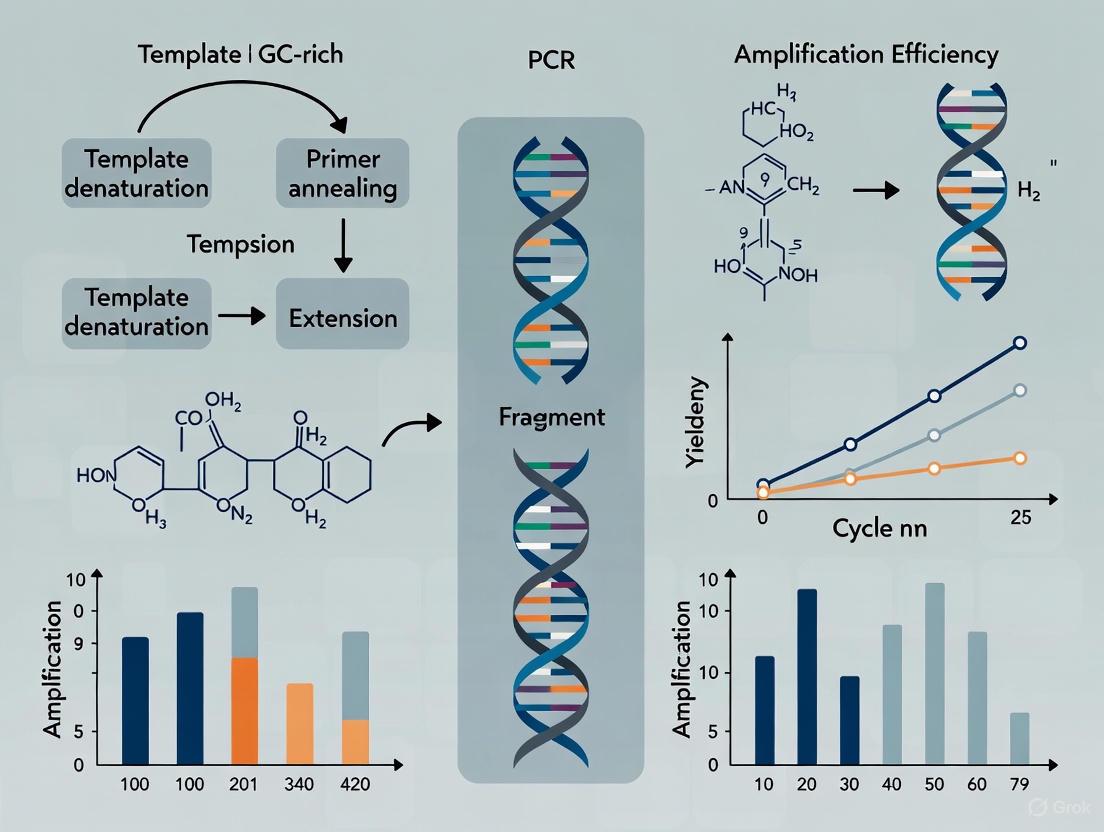
Amplifying GC-rich DNA templates (>60% GC content) remains a significant challenge in molecular biology, often resulting in failed reactions, low yields, or non-specific products.
Conquering GC-Rich PCR: A Comprehensive Guide to Amplification Strategies and Troubleshooting
Abstract
Amplifying GC-rich DNA templates (>60% GC content) remains a significant challenge in molecular biology, often resulting in failed reactions, low yields, or non-specific products. This article provides researchers, scientists, and drug development professionals with a complete framework for understanding and overcoming these obstacles. We explore the fundamental reasons behind PCR failure with GC-rich sequences, detail proven methodological and reagent-based solutions, offer a systematic troubleshooting protocol, and examine advanced validation techniques like digital PCR. By integrating foundational knowledge with practical optimization strategies, this guide empowers professionals to reliably amplify even the most difficult targets, accelerating research in areas like gene promoter analysis and the study of critical drug targets such as nicotinic acetylcholine receptors.
Why GC-Rich Templates Challenge Conventional PCR: Understanding the Science Behind the Struggle
GC-rich sequences are regions of DNA characterized by an elevated frequency of guanine (G) and cytosine (C) nucleotides relative to adenine (A) and thymine (T). While no universal threshold exists, sequences exceeding 60% GC content are generally considered GC-rich, with particularly challenging regions exceeding 70% [1]. In vertebrate genomes, CpG islands (CGIs) represent a major class of GC-rich sequences, defined as regions >200 bp with a GC content >50% and an observed-to-expected CpG ratio >0.6 [2]. These elements are not uniformly distributed but are concentrated in specific genomic regions, most notably gene promoters, where they play decisive roles in chromatin organization and gene regulation.
Understanding GC-rich sequences is particularly critical for polymerase chain reaction (PCR) applications, as their strong triple hydrogen bonding leads to high thermal stability and secondary structures that impede polymerase processivity. This application note details the prevalence of GC-rich sequences in promoters and other genomic regions, their functional consequences, and specialized methodologies to overcome the challenges they present in molecular research and drug development.
Prevalence and Distribution of GC-Rich Sequences
GC-Rich Sequences in Gene Promoters
In mammalian genomes, GC-rich sequences are a hallmark of gene promoters. Research indicates that more than two-thirds of mammalian gene promoters are associated with CpG islands, whereas TATA boxes are found only in a minority [2]. This prevalence is not static but has evolved over time; studies of phylogenetic patterns from bacteria to multicellular eukaryotes reveal that GC-rich monotone gradients in promoters are a feature that has become more pronounced in more recently evolved vertebrates [3].
The organization of promoters based on GC content reveals distinct functional classes. Genome-wide studies in mouse T-cells have identified three principal classes of active promoters based on Pol II accumulation patterns, each with distinct GC characteristics and transcriptional properties (Table 1) [2].
Table 1: Classes of Mammalian Promoters Based on GC Content and Associated Features
| Promoter Class | Primary Pol II Position | GC/CpG Content | CGI Length | Transcription Characteristics |
|---|---|---|---|---|
| Class I | Upstream of TSS | High and broadly distributed | Most prominent | Paused, bidirectional |
| Class II | At the TSS | Lower (increased AT content) | Less prominent | Paused, monodirectional |
| Class III | Downstream of TSS | High but more diffuse | Intermediate | Less paused, diffuse bidirectional |
The physical properties of GC-rich promoter sequences directly influence nucleosome positioning. Nucleosomes are fundamental units of chromatin packing, and their positioning regulates DNA accessibility. GC content and CGI width show a direct correlation with nucleosome depletion both in vivo and in vitro. Promoters with high GC content exhibit pronounced nucleosome-depleted regions (aNDRs), and the length of the CGI directly correlates with the width of the aNDR [2]. This relationship is fundamental to maintaining an open chromatin conformation conducive to transcription factor binding and transcription initiation.
Patterns Beyond the Promoter: The 5' GC-Peak
The GC-rich signature extends beyond the core promoter region. In human protein-coding genes, GC-content peaks just downstream of the transcription start site (TSS) and slopes down symmetrically into both the upstream intergenic region and downstream into the gene body [4]. This "GC-peak" forms a nearly normal curve that is interrupted at the TSS and exon-intron boundary by slight dips in GC content, likely due to sequence motif requirements like the purine-rich transcription start and the GC-poor 5' splice site [4].
Evolutionary analyses suggest this 5' GC-peak was present in the last common ancestor of amniotes and likely vertebrates. Its current dynamics, however, are shaped by non-adaptive forces like GC-biased gene conversion (gBGC), which is influenced by recombination patterns. In apes and rodents, where recombination is directed away from TSSs, the GC-content at the 5' end of genes is undergoing mutational decay, while in canids (which lack PRDM9), recombination occurs at TSSs and GC-content is increasing [4].
GC-Rich Regions in Avian Genomes and Assembly Challenges
Avian genomes present a compelling case study of the challenges posed by GC-rich sequences. Many "missing" genes in avian genome assemblies, such as the leptin, TNFα, MRPL52, PCP2, and PET100 genes, are characterized by extremely high GC content (>60%) [1]. However, research indicates that high GC content alone is not the primary cause of their absence from assemblies. Instead, the presence of tandem repeats containing motifs that form stable secondary structures (e.g., G-quadruplexes) is likely the principal culprit [1]. These structures are exceptionally stable and resistant to DNA polymerase, causing sequencing technologies, especially Illumina, to fail in these regions. While PacBio technology is more capable, it still sequences these regions with dramatically lower efficiency than typical regions [1].
Table 2: Genomic Regions with Critical GC-Rich Sequences and Their Features
| Genomic Region | GC-Rich Element | Key Features | Functional/Technical Impact |
|---|---|---|---|
| Mammalian Promoters | CpG Islands (CGIs) | >200bp, GC>50%, observed/expected CpG >0.6; Nucleosome Depleted Regions (NDRs) | Governs open chromatin, supports paused transcription; difficult for PCR amplification |
| 5' End of Genes | GC-Peak | Peak ~+1 TSS, slopes upstream and downstream; shaped by gBGC | Promotes mRNA nuclear export and translation efficiency |
| Avian "Missing" Genes | Tandem Repeats & G-Quadruplexes | GC >60%, often >70%; stable secondary structures | Cause sequencing and assembly failures; major hurdle for genome completion |
| Mycobacterial Genomes | Polymorphic GC-Rich Sequences (PGRS) | Short, highly repetitive sequences | Used for strain typing in low-copy IS6110 M. tuberculosis |
Functional Consequences of GC-Rich Sequences
The prevalence of GC-rich sequences in promoters and 5' gene ends is linked to several critical biological functions:
- Chromatin Accessibility and Nucleosome Depletion: GC content is a major determinant of nucleosome positioning. High GC content at promoters correlates with nucleosome depletion, creating an open chromatin configuration that facilitates transcription factor binding and pre-initiation complex assembly [2]. This intrinsic sequence-dependent nucleosome exclusion occurs even in the absence of transcription.
- Transcriptional Pausing and Bidirectionality: As shown in Table 1, the highest GC-rich promoters (Class I) are associated with RNA polymerase II pausing upstream of the TSS and robust bidirectional transcription of short transcripts (TSS RNAs) [2]. This pausing is a key regulatory step in the control of gene expression.
- mRNA Nuclear Export and Translation: High GC-content at the 5' end of mRNAs promotes efficient nuclear export, particularly for intron-poor genes. These GC-rich regions are thought to recruit protein factors that directly recruit nuclear transport receptors [4]. Furthermore, 5' GC content also impacts the selection of synonymous codons, influencing translation efficiency [4].
Methodological Challenges and Protocols for GC-Rich Sequences
The GC-Bias in Next-Generation Sequencing
A significant technical challenge associated with GC-rich sequences is GC bias in next-generation sequencing (NGS). This bias results in uneven genomic coverage, where GC-rich and, to an even greater extent, GC-poor regions are significantly underrepresented in sequencing data [5]. The bias is not uniform across platforms; it is particularly severe in Illumina workflows (e.g., MiSeq, NextSeq) outside the 45-65% GC range, while the Oxford Nanopore workflow demonstrates minimal GC bias [5]. GC bias arises primarily during the PCR amplification step of library preparation, though other sample-handling steps also contribute [5] [6].
This bias has a direct and negative impact on de novo genome assembly. Regions with extreme GC content receive low or no read coverage, leading to assembly fragmentation and gaps. The effect is threshold-dependent, becoming severe only beyond a certain degree of bias, but it is observed across all commonly used assemblers [6]. Increasing the total sequencing depth can rescue this fragmentation, though the amount required depends on the specific GC distribution of the genome.
Protocol: Illumina Library Preparation for GC-Rich Genomic DNA
To address the under-representation of GC-rich fractions, a cost-effective protocol was developed involving a pre-library heating step [7].
Workflow Overview:
Detailed Methodology:
- DNA Fragmentation and Quality Control: Begin with mechanically sheared genomic DNA. Assess fragment size and integrity using an appropriate method (e.g., Bioanalyzer).
- Heat Denaturation Step: Prior to any other library preparation steps, heat the DNA sample to 90°C in a thermal cycler. This step is critical for denaturing AT-rich DNA more efficiently than GC-rich DNA due to its lower melting temperature.
- Library Preparation: Immediately proceed with a standard Illumina library preparation protocol on the heat-treated DNA. This includes end-repair, A-tailing, and adapter ligation.
- PCR Amplification (Optional but typical): Amplify the library using a PCR polymerase mixture. While the protocol indicates that using a polymerase marketed for GC-rich templates has a much weaker effect than the heating step, selecting a polymerase with high processivity on structured templates is still recommended.
- Validation: Validate the final library using Bioanalyzer and qPCR. When sequenced, the library will show a marked increase in average coverage in the GC-richest chromosomal regions—by a factor of up to six in tested chicken DNA [7].
Key Considerations: This protocol exploits the differential melting temperatures of AT-rich and GC-rich DNA. The heating step preferentially denatures AT-rich fragments, which are then more susceptible to degradation or are less efficiently ligated, thereby enriching the final library for the GC-rich fraction.
The Scientist's Toolkit: Research Reagent Solutions
Table 3: Essential Reagents for Working with GC-Rich Sequences
| Reagent / Material | Function / Application | Considerations for GC-Rich Templates |
|---|---|---|
| Betaine | PCR Additive | Reduces secondary structure formation by equalizing the stability of AT- and GC-base pairs; crucial for amplifying high-GC targets [5]. |
| GC-Rich Polymerase Blends | PCR Amplification | Specialized polymerases (often a mix with processive enzymes and stabilizers) are designed to overcome the strong secondary structures and high melting temperatures of GC-rich DNA. |
| PCR-Free Library Prep Kits | NGS Library Preparation | Eliminates the primary source of GC bias (PCR amplification) but requires more input DNA [5]. |
| Optimized PCR Protocols | NGS Library Prep or Target Amplification | Includes modified thermocycling conditions (e.g., slower ramp rates) and additive cocktails to improve coverage uniformity [5]. |
| PacBio SMRT Sequencing | Long-Read Sequencing | More effective than Illumina at sequencing through GC-rich regions and associated secondary structures, though efficiency is still lower than in balanced regions [1]. |
| Chemical Nuclease Mapping | Nucleosome Positioning | Use of agents like phenanthroline for DNA digestion, as an alternative to MNase-seq, to validate nucleosome positioning in GC-rich regions without sequence bias [2]. |
GC-rich sequences are non-random, functionally significant components of the genome, with a pronounced prevalence in the promoters and 5' ends of genes, particularly in vertebrates. Their influence on chromatin architecture, transcription, and RNA biology makes them a critical area of study. For researchers aiming to amplify GC-rich templates by PCR or to sequence them comprehensively, understanding their genomic context is the first step. The protocols and reagents detailed herein provide a pathway to overcome the inherent technical challenges, enabling more accurate genetic analysis, complete genome assemblies, and accelerated drug development pipelines that depend on reliable manipulation of all genomic regions, regardless of their base composition.
The amplification of GC-rich DNA templates (defined as sequences with ≥60% guanine and cytosine content) presents a significant challenge in molecular techniques such as the polymerase chain reaction (PCR). These difficulties arise from the fundamental biochemical properties that confer exceptional stability to GC-rich regions—properties rooted in the dual stabilizing forces of hydrogen bonding and base stacking interactions [8]. While only approximately 3% of the human genome consists of GC-rich sequences, these regions are critically important as they are often found in promoter regions of housekeeping and tumor suppressor genes [9].
Understanding the distinct contributions of these two stabilizing forces is essential for developing effective strategies to amplify GC-rich targets. Contrary to long-held belief, recent research demonstrates that base stacking interactions, rather than hydrogen bonding, serve as the dominant factor in DNA duplex stability [10] [8]. This paradigm shift in understanding directly informs the optimization approaches required for successful amplification of resistant GC-rich templates, which are relevant to diverse fields including genomics, diagnostics, and drug development.
Molecular Mechanisms of DNA Stability
Hydrogen Bonding Contributions
Hydrogen bonding represents the most frequently cited stabilization mechanism in DNA duplexes. These specific interactions occur between complementary base pairs: guanine (G) forms three hydrogen bonds with cytosine (C), while adenine (A) forms two hydrogen bonds with thymine (T) [9]. This differential bonding capacity explains why GC base pairs exhibit greater thermal stability than AT pairs, requiring more energy to separate the strands due to the additional hydrogen bond.
Quantitative measurements using atomic force microscopy (AFM) under unzipping mode have precisely determined the binding strength of individual base pairs. The mechanical force required to rupture a single dG/dC base pair is approximately 20.0 ± 0.2 pN, while a single dA/dT base pair requires approximately 14.0 ± 0.3 pN [11]. This nearly 43% increase in binding strength for GC pairs contributes significantly to the higher melting temperatures observed in GC-rich sequences.
Base Stacking Interactions
Base stacking interactions, also known as π-stacking, provide the dominant stabilization force in DNA duplexes [10] [8]. These interactions result from the overlap of π-electron clouds between adjacent aromatic bases along the DNA helix, creating a thermodynamic stabilization that is largely independent of hydrogen bonding.
AFM studies measuring the rupture forces of DNA duplexes in stretching mode (which assesses both hydrogen bonding and stacking interactions) versus unzipping mode (which primarily measures hydrogen bonding) have allowed researchers to quantify the base stacking contribution separately. These experiments reveal that base stacking contributes approximately 2.0 ± 0.1 pN per stacking interaction [11]. This stacking force applies consistently to both GC and AT base pairs, though the specific sequence context (nearest neighbors) influences the exact stabilization energy.
Research has demonstrated that base stacking not only provides the majority of the duplex's overall stability but also significantly contributes to the sequence-dependent variation in stability [10]. The stacking interaction creates a substantial energy barrier that maintains the double helical structure, and this effect is particularly pronounced in GC-rich regions where the planar geometry of guanine and cytosine bases facilitates optimal π-orbital overlap.
Comparative Stabilization Mechanisms
Table 1: Quantitative Comparison of DNA Stabilization Forces
| Stabilization Mechanism | Energy Contribution | Sequence Dependence | Primary Role |
|---|---|---|---|
| G-C Hydrogen Bonding | 20.0 ± 0.2 pN per base pair | Specific to G-C pairs | Contributes to increased Tm in GC-rich DNA |
| A-T Hydrogen Bonding | 14.0 ± 0.3 pN per base pair | Specific to A-T pairs | Lower thermal stability compared to G-C pairs |
| Base Stacking | 2.0 ± 0.1 pN per stacking interaction | Sequence context dependent | Main stabilizing factor for all DNA sequences |
The combined effect of these stabilization mechanisms explains the practical challenges encountered when working with GC-rich templates. The increased hydrogen bonding in GC-rich sequences raises the melting temperature (Tm) requirement for denaturation, while the robust stacking interactions promote formation of stable secondary structures such as hairpins and self-dimers that can block polymerase progression [9] [8]. These molecular obstacles manifest experimentally as failed amplification, non-specific products, or truncated amplicons.
Research Reagent Solutions for GC-Rich Amplification
Overcoming the biochemical stability of GC-rich DNA requires specialized reagents formulated to address both hydrogen bonding and base stacking barriers. The following table summarizes key solutions developed specifically for challenging templates:
Table 2: Essential Research Reagents for GC-Rich PCR Amplification
| Reagent Category | Specific Examples | Mechanism of Action | Application Context |
|---|---|---|---|
| Specialized Polymerases | OneTaq Hot Start DNA Polymerase (NEB), Q5 High-Fidelity DNA Polymerase (NEB), AccuPrime GC-Rich DNA Polymerase (ThermoFisher) | Enhanced processivity through thermal stability; ability to penetrate secondary structures | Routine to high-fidelity amplification of GC-rich targets up to 80% GC content |
| GC Enhancers | OneTaq High GC Enhancer (NEB), Q5 High GC Enhancer (NEB) | Proprietary additive mixtures that disrupt secondary structures and increase primer stringency | Suppression of stable hairpin formation; typically used at 10-20% concentration |
| Chemical Additives | DMSO (2-10%), glycerol (5-25%), betaine (0.5-2 M) | Destabilization of hydrogen bonding; reduction of secondary structure stability | First-line optimization for difficult templates; concentration-dependent effects |
| Modified Nucleotides | 7-deaza-2'-deoxyguanosine | dGTP analog that disrupts regular base stacking without affecting coding potential | Slow-down PCR protocols for extremely GC-rich targets |
| Specialized Buffer Systems | GC-RICH Resolution Solution (Sigma-Aldrich), GC Buffer (NEB) | Optimized salt formulations with detergents and DMSO to facilitate denaturation | Commercial systems designed specifically for GC-rich amplification |
The strategic selection and combination of these reagent solutions enables researchers to overcome the specific biochemical challenges presented by their target sequences. Commercial systems such as the GC-RICH PCR System (Sigma-Aldrich) incorporate multiple optimized components—including specialized enzyme mixes, reaction buffers with detergents and DMSO, and GC-RICH Resolution Solution—to provide a comprehensive solution for amplifying targets up to 5 kb in length with high GC content [12].
Experimental Protocols for GC-Rich Template Amplification
Standard Optimization Protocol for GC-Rich PCR
The following step-by-step protocol provides a systematic approach to amplify GC-rich DNA sequences, incorporating specific strategies to counter both hydrogen bonding and base stacking stabilization:
Template Preparation
Reagent Setup
- Select a polymerase system with demonstrated GC-rich amplification capability (e.g., OneTaq or Q5 High-Fidelity DNA Polymerase) [9]
- Prepare master mix according to manufacturer specifications, incorporating GC enhancer at 10% final concentration
- Add DMSO to 3-5% final concentration and/or betaine to 1 M final concentration [12]
- Include MgCl₂ at 1.5-2.0 mM as starting concentration, with optimization anticipated
Thermal Cycling Parameters
- Initial denaturation: 98°C for 2 minutes (complete denaturation of secondary structures)
- Cycling protocol (30-35 cycles):
- Denaturation: 98°C for 20 seconds (higher temperature improves separation)
- Annealing: Temperature gradient from 65-72°C for 30 seconds (evaluate optimal stringency)
- Extension: 72°C for 1 minute per kb (standard rate)
- Final extension: 72°C for 5-7 minutes
Post-Amplification Analysis
- Analyze 5-10 μL of product by agarose gel electrophoresis
- Expect a single discrete band of expected size; secondary bands indicate need for increased annealing temperature
This protocol serves as a foundational starting point, with target-specific optimization typically required for maximum yield and specificity.
Advanced Two-Step Protocol for Long GC-Rich Amplicons
For particularly challenging templates (>1 kb with >70% GC content), such as those found in Mycobacterium bovis genes, an advanced two-step approach has demonstrated superior performance [14]:
Reaction Assembly
- Use high-fidelity DNA polymerase with proofreading activity
- Incorporate GC enhancer at recommended concentration (typically 10-20%)
- Add betaine to 1.5 M final concentration combined with 3% DMSO
- Adjust MgCl₂ concentration to 2.0-2.5 mM based on preliminary titration
Thermal Cycling Conditions
- Initial denaturation: 98°C for 3 minutes
- Two-step cycling (30 cycles):
- Denaturation: 98°C for 20 seconds
- Combined annealing/extension: 68-72°C for 2 minutes per kb
- Slow ramp rate: 1.5°C per second between denaturation and annealing/extension steps
- Final extension: 72°C for 10 minutes
This protocol's effectiveness derives from the combined annealing/extension at elevated temperatures, which helps prevent secondary structure formation during the critical primer binding and extension phases, while the slowed ramp rate ensures proper primer hybridization before extension commences.
Specialized Slow-Down PCR Protocol
For extremely problematic GC-rich targets that resist standard optimization, the "slow-down PCR" method incorporates a dGTP analog to disrupt base stacking interactions:
Reaction Modifications
- Substitute 50-70% of dGTP with 7-deaza-2'-deoxyguanosine in the dNTP mixture [8]
- Use standard polymerase with proofreading capability may be inhibited by the analog
- Include betaine at 1 M concentration without DMSO to avoid polymerase inhibition
Cycling Conditions
- Extended cycling parameters (40-45 cycles) with reduced ramp rates between steps
- Denaturation at 95°C for 30 seconds
- Annealing at 65-68°C for 45 seconds
- Extension at 72°C for 2 minutes per kb
- Final extension at 72°C for 15 minutes
The incorporation of 7-deaza-2'-deoxyguanosine disrupts the regular base stacking interactions by introducing a non-planar base analog, thereby reducing the stability of GC-rich duplexes and facilitating polymerase progression through otherwise impassable secondary structures.
Optimization Workflow and Troubleshooting
The following workflow diagram outlines a systematic approach to troubleshooting GC-rich PCR amplification, addressing both hydrogen bonding and base stacking challenges:
Troubleshooting Guide Based on Gel Analysis
No Amplification Product: This result typically indicates incomplete denaturation of the template or severe polymerase stalling at secondary structures. Solutions include increasing denaturation temperature to 95°C (while considering polymerase thermostability), incorporating GC enhancers at higher concentrations (up to 20%), or switching to a specialized polymerase with enhanced capacity to penetrate secondary structures [9] [8].
Smear of Non-Specific Products: This pattern suggests non-specific primer binding or insufficient primer stringency. Effective remedies include increasing annealing temperature using a gradient (65-72°C), optimizing Mg²⁺ concentration in 0.5 mM increments from 1.0-4.0 mM, or adding specificity-enhancing additives such as tetramethyl ammonium chloride or formamide [9] [13].
Multiple Discrete Bands: The presence of specific non-target bands indicates primer dimerization or mispriming events. Troubleshooting approaches should include bioinformatic reevaluation of primer design (avoiding 3' end GC-rich stretches), reducing primer concentration to 0.1-0.3 μM, or incorporating touchdown PCR protocols with progressively decreasing annealing temperatures [13].
Magnesium and Additive Optimization
Magnesium ion concentration requires careful optimization for GC-rich templates, as Mg²⁺ serves dual roles as a essential polymerase cofactor and a neutralizer of phosphate backbone repulsion [9] [13]. Implement a titration series from 1.0-4.0 mM in 0.5 mM increments to identify the optimal concentration that balances enzyme processivity with primer specificity.
Chemical additives function through distinct mechanisms to facilitate GC-rich amplification:
- DMSO (2-10%): Disrupts base pairing by reducing hydrogen bond strength and destabilizing secondary structures [12]
- Betaine (0.5-2 M) : Equalizes the thermal stability of GC and AT base pairs by acting as a kosmotropic agent
- Glycerol (5-25%): Lowers overall melting temperature and stabilizes polymerase enzymes
- 7-deaza-2'-deoxyguanosine: Incorporates as a dGTP analog, disrupting base stacking interactions through its non-planar structure [8]
The successful amplification of GC-rich DNA templates requires a comprehensive understanding of the underlying biochemical stability mechanisms—specifically the complementary roles of hydrogen bonding and base stacking interactions. While hydrogen bonding contributes significantly to the increased thermal stability of GC-rich sequences, base stacking represents the dominant stabilization force that must be overcome for efficient amplification.
The strategies and protocols outlined herein provide researchers with a systematic approach to address these challenges through specialized reagent systems, optimized thermal cycling parameters, and targeted troubleshooting methodologies. By applying these principles, researchers can successfully amplify even the most challenging GC-rich targets, enabling advanced research in gene regulation, diagnostic assay development, and therapeutic target identification. As PCR technologies continue to evolve, the fundamental understanding of DNA biochemistry will remain essential for developing increasingly effective molecular methods.
Within the context of amplifying GC-rich templates by polymerase chain reaction (PCR), the formation of stable secondary structures and hairpin loops represents a significant technical barrier. DNA templates with high guanine (G) and cytosine (C) content—typically defined as exceeding 60%—are pervasive in genomes, particularly in promoter regions of housekeeping and tumor suppressor genes [15] [16]. The strong hydrogen bonding between G and C bases, comprising three bonds per pair compared to two for adenine-thymine (A-T) pairs, confers greater thermostability and resistance to denaturation [15]. This inherent stability, combined with the propensity of single-stranded GC-rich sequences to fold into complex secondary structures, creates formidable obstacles for efficient PCR amplification, often resulting in failed reactions, smeared gels, or substantially reduced yield [17] [8]. This application note details the specific challenges posed by these structural hurdles and provides optimized, practical protocols to overcome them.
The Core Challenge: Structural Stability and its Consequences
The primary impediment to amplifying GC-rich regions stems from their biophysical properties. The stability of GC-rich DNA is not solely due to hydrogen bonding but is significantly enhanced by base stacking interactions, which make the double helix particularly resistant to strand separation under standard PCR conditions [8]. When single-stranded, these sequences readily form intra-strand secondary structures, such as hairpin loops (also known as stem-loops), through self-complementarity [18] [19]. These structures are exceptionally stable and persist at standard PCR denaturation temperatures (e.g., 95°C) [8].
For the PCR process, this structural stability manifests in two critical failure points:
- Inefficient Denaturation: The double-stranded template fails to separate completely, preventing primer access.
- Polymerase Stalling: The DNA polymerase enzyme stalls or is blocked when it encounters persistent secondary structures in the single-stranded template during the extension phase, leading to truncated, incomplete products [15] [20].
The following diagram illustrates the molecular hurdles and the strategic countermeasures required for successful amplification.
Key Parameters for Optimization: A Quantitative Guide
Success in amplifying GC-rich targets requires a multi-pronged optimization strategy. The table below summarizes the key parameters, their mechanistic role, and recommended optimizations.
Table 1: Comprehensive Optimization Parameters for GC-Rich PCR
| Parameter | Challenge Mechanism | Optimization Strategy | Recommended Range / Examples |
|---|---|---|---|
| DNA Polymerase | Standard polymerases (e.g., Taq) stall at stable secondary structures [15]. | Use specialized, highly processive and thermostable enzymes [15] [20]. | OneTaq (NEB), Q5 (NEB), AccuPrime GC-Rich (ThermoFisher) [15] [8]. |
| PCR Additives | Hairpins and other structures block polymerase progression and resist denaturation [17] [18]. | Include additives that destabilize secondary structures and reduce intermolecular bonding [17] [15]. | DMSO (1-10%), Betaine (0.5-1.5 M), 7-deaza-dGTP [17] [15] [16]. |
| Annealing Time | Prolonged annealing promotes mispriming and non-specific binding on complex templates [16]. | Use shorter annealing times to favor specific primer binding and reduce off-target amplification [16]. | 3-6 seconds for highly GC-rich targets (>75% GC) [16]. |
| Denaturation Temperature | Standard temperatures (95°C) are insufficient to fully melt GC-rich duplexes and hairpins [8]. | Increase denaturation temperature to improve strand separation [20]. | 98°C [20]. Use a highly thermostable polymerase. |
| Mg²⁺ Concentration | Mg²⁺ is a essential cofactor, but excess can promote non-specific priming [15]. | Titrate Mg²⁺ concentration to find the optimal balance for specificity and yield [15] [8]. | Test a gradient from 1.0 mM to 4.0 mM in 0.5 mM increments [15]. |
| Primer Design | Primers with GC-rich 3' ends are prone to mispriming and dimer formation [8]. | Design primers with balanced GC content and avoid stable secondary structures within the primer itself. | N/A |
Detailed Experimental Protocols
Protocol 1: Standardized Workflow for GC-Rich PCR Amplification
This protocol provides a robust starting point for amplifying challenging GC-rich targets (70-85% GC), incorporating the key optimization strategies discussed.
Research Reagent Solutions:
- Polymerase: Q5 High-Fidelity DNA Polymerase (NEB #M0491) or equivalent high-processivity enzyme.
- GC Enhancer: Q5 High GC Enhancer (supplied with polymerase) or 1M Betaine solution.
- Additive: DMSO (Molecular Biology Grade).
- Buffer: The compatible 5X buffer supplied with the polymerase.
- dNTPs: 10 mM dNTP solution. If using 7-deaza-dGTP, prepare a 10 mM dNTP mix where dGTP is partially or fully replaced by 7-deaza-dGTP.
- Primers: Forward and Reverse primers, resuspended in nuclease-free water.
- Template: High-quality DNA (10-100 ng for genomic DNA).
Methodology:
- Reaction Setup: Prepare a 50 µL reaction mixture on ice as follows. Gently mix by pipetting and briefly centrifuge.
- Nuclease-free water: to 50 µL
- 5X GC Buffer: 10 µL
- 10 mM dNTPs: 1 µL
- 10 µM Forward Primer: 2.5 µL
- 10 µM Reverse Primer: 2.5 µL
- Template DNA: X µL
- Q5 High GC Enhancer: 5 µL (10% final volume)
- DMSO: 2.5 µL (5% final concentration)
- Q5 High-Fidelity DNA Polymerase: 0.5 µL (1 unit)
Thermal Cycling: Run the following program in a thermal cycler.
- Initial Denaturation: 98°C for 30 seconds.
- 35-40 Cycles:
- Denaturation: 98°C for 5-10 seconds.
- Annealing: 68-72°C for 5-10 seconds. Note: Use a temperature 5°C below the primer Tm, optimized via gradient PCR.
- Extension: 72°C for 30 seconds per kb.
- Final Extension: 72°C for 2 minutes.
- Hold: 4°C.
Analysis: Analyze 5-10 µL of the PCR product by agarose gel electrophoresis.
Protocol 2: Additive and Mg²⁺ Titration for Intractable Targets
For targets that fail the standard protocol, systematic titration of additives and Mg²⁺ is required.
Research Reagent Solutions:
- All reagents from Protocol 1.
- Additional: 1 M MgCl₂ solution (if not included in the buffer at a sufficient concentration for titration).
Methodology:
- Additive Titration Matrix: Set up a 4x3 matrix of reactions to test DMSO and Betaine (or GC Enhancer) concentrations. A master mix without these additives should be prepared and aliquoted.
- DMSO: Test final concentrations of 0%, 3%, 5%, and 8%.
- Betaine/GC Enhancer: Test final concentrations of 0 M, 0.8 M, and 1.2 M.
Mg²⁺ Concentration Gradient: If the buffer requires supplemental MgCl₂, perform a separate gradient PCR.
- Prepare a master mix and aliquot it into 7 tubes.
- Add MgCl₂ to achieve final concentrations of 1.0, 1.5, 2.0, 2.5, 3.0, 3.5, and 4.0 mM.
Thermal Cycling: Use the cycling conditions from Protocol 1.
Analysis: Compare gel results to identify the combination that gives the strongest specific band with the least background.
The Scientist's Toolkit: Essential Research Reagents
Table 2: Key Reagent Solutions for GC-Rich PCR
| Reagent / Solution | Function / Mechanism | Example Products |
|---|---|---|
| High-Processivity DNA Polymerase | Binds more tightly to the template, allowing it to "power through" stable secondary structures that would cause other polymerases to stall [15] [20]. | OneTaq DNA Polymerase with GC Buffer, Q5 High-Fidelity DNA Polymerase, AccuPrime GC-Rich DNA Polymerase [15] [20] [8]. |
| GC Enhancer / Betaine | A chemical chaperone that destabilizes GC base pairs by altering the solvation shell of DNA. It equalizes the thermal stability of GC and AT-rich regions, facilitating denaturation [17] [15] [16]. | Q5 High GC Enhancer, OneTaq High GC Enhancer, molecular biology-grade Betaine [15]. |
| DMSO | Disrupts secondary structure formation (e.g., hairpins) by interfering with hydrogen bonding and base stacking, making the DNA more accessible [17] [15] [20]. | Molecular biology-grade DMSO. |
| 7-deaza-2'-deoxyguanosine | A dGTP analog that is incorporated into DNA but cannot form Hoogsteen bonds, which are critical for certain secondary structures like G-quadruplexes. This "slows down" structure formation, aiding amplification [15] [8]. | 7-deaza-dGTP solution. |
| Specialized GC Buffers | Pre-formulated buffers that often contain a proprietary mix of additives and optimized salt concentrations to address multiple challenges of GC-rich amplification simultaneously [15]. | OneTaq GC Buffer, Q5 GC Buffer. |
The formation of stable secondary structures and hairpin loops in GC-rich DNA templates is a fundamental structural hurdle that can cripple PCR efficacy. Overcoming this challenge requires a strategic approach that moves beyond empirical troubleshooting. As detailed in this application note, success is achieved by understanding the underlying biophysics and implementing a synergistic combination of specialized reagents—notably high-processivity polymerases and structure-disrupting additives like betaine and DMSO—with finely tuned thermal cycling parameters. The protocols and data presented herein provide a validated roadmap for researchers and drug development professionals to reliably amplify these critical but challenging genomic regions, thereby advancing research in gene regulation, biomarker discovery, and therapeutic development.
Amplifying GC-rich DNA sequences (typically defined as those with a guanine-cytosine content exceeding 60%) presents significant challenges that can compromise the efficiency, specificity, and fidelity of polymerase chain reaction (PCR) [21] [8]. These regions are overrepresented in functionally critical parts of the genome, including the promoter regions of housekeeping genes, tumor suppressor genes, and various regulatory domains [21] [22]. The inherent molecular stability of GC-rich sequences, primarily due to three hydrogen bonds in G-C base pairs compared to two in A-T pairs, underlies these difficulties [21]. This application note details the primary consequences—polymerase stalling, primer-dimer formation, and generation of truncated products—and provides optimized protocols to overcome them, framed within the broader context of a thesis on GC-rich template amplification.
Core Challenges: Mechanisms and Consequences
Polymerase Stalling and Secondary Structure Formation
The primary consequence of attempting to amplify GC-rich templates is polymerase stalling, which occurs when the DNA polymerase enzyme is obstructed during elongation. GC-rich regions are highly prone to forming stable secondary structures, such as hairpin loops and stem-loops, because of their propensity for intra-strand base pairing [21] [8]. These structures are exceptionally thermostable and often do not fully denature at standard PCR denaturation temperatures (e.g., 94–95°C) [8]. When the polymerase encounters these structures, it may pause or fall off the template entirely, leading to incomplete amplification and a failure to generate the full-length target product [21]. This stability is largely attributed to strong base-stacking interactions, not just hydrogen bonding [8].
Primer-Dimer and Non-Specific Amplification
The challenges extend to the primers themselves. Primers designed for GC-rich targets often have high melting temperatures (Tm) and can form stable secondary structures, including self-dimers, cross-dimers, and hairpins [8] [22]. This is particularly problematic when the annealing temperature (Ta) of the PCR reaction is too low, allowing primers to anneal to non-specific sites on the template or to each other [21] [23]. This non-specific binding results in the amplification of incorrect, off-target products and the formation of primer-dimers [24] [23]. Primer-dimers consume reaction reagents, thereby competing with and reducing the yield of the desired amplicon [24].
Truncated and Incomplete Products
The culmination of polymerase stalling and mis-annealing is the accumulation of short, truncated products [21]. As the polymerase is blocked by secondary structures, it produces shorter, incomplete molecules that cannot serve as proper templates in subsequent PCR cycles [21]. On an agarose gel, this often manifests as a smear of DNA rather than a discrete, sharp band of the expected size [21]. In some cases, no product is visible at all. Furthermore, a specific phenomenon known as the PCR-suppression (PS) effect can occur, where shorter DNA fragments form panhandle-like structures that prevent primer binding, further biasing the reaction against the desired amplification [25].
The logical relationship between the properties of GC-rich DNA and the consequent amplification failures is summarized in the diagram below.
Quantitative Analysis of Polymerase Errors at Repetitive Sequences
Beyond stalling and truncation, PCR amplification can introduce errors at the sequence level, particularly within mononucleotide and dinucleotide repeats, which are common in genomes. A study subcloning and sequencing individual PCR products revealed that the fidelity of amplification drops significantly as the length of a mononucleotide repeat increases [26].
Table 1: Error Rates in Mononucleotide and Dinucleotide Repeat Amplification
| Locus | Repeat Sequence | Polymerase | % of Clones with Correct Repeat Length | Observed Error Pattern |
|---|---|---|---|---|
| RAC1 | (T)9 | Taq | 100% | Faithful amplification |
| RAC1 | (T)11 | Taq | 90% | Beginning of errors |
| Bat-13 | (T)13 | Taq | 33% | High rate of contraction |
| Bat-13 | (T)13 | Pfu | 84% | Fewer errors than Taq |
| Bat-26 | (A)26 | Taq | 35% | High rate of contraction (19-28 bp) |
| Bat-26 | (A)26 | Pfu | 23% | High rate of contraction |
| D15S128 | (CA)18 | Taq | 64% | Contraction and expansion |
| D15S128 | (CA)18 | Pfu | 33% | Contraction and expansion |
This data demonstrates that even high-fidelity polymerases like Pfu struggle to faithfully amplify long mononucleotide and dinucleotide repeats, with a predominant tendency for repeat contraction [26]. These amplification errors can be mistaken for genuine genetic polymorphisms or mutations in diagnostic and research applications.
Experimental Protocols for Mitigation
Protocol 1: Optimizing PCR Components and Cycling Conditions
This protocol provides a systematic approach to optimize the reagent and thermal cycling parameters for amplifying a GC-rich target.
Research Reagent Solutions & Materials
- DNA Polymerase: OneTaq Hot Start DNA Polymerase (NEB #M0480) with GC Buffer or Q5 High-Fidelity DNA Polymerase (NEB #M0491) [21].
- GC Enhancer: OneTaq or Q5 High GC Enhancer [21].
- Additives: Betaine, DMSO, Glycerol [21].
- MgCl₂ Solution: Provided with the polymerase for titration.
- Primers: Designed with a high Tm (>68°C) and minimal secondary structure [22] [27].
Methodology
- Initial Setup: Assemble a 50 µL reaction using a specialized polymerase master mix (e.g., OneTaq Hot Start 2X Master Mix with GC Buffer) according to the manufacturer's instructions. For more flexibility, use a standalone polymerase [21].
- Additive Enhancement: Add potential enhancing agents to parallel reactions. Common concentrations are:
- Mg²⁺ Titration: Set up a reaction series with a MgCl₂ gradient from 1.0 mM to 4.0 mM in 0.5 mM increments [21].
- Thermal Cycling:
Troubleshooting Notes: A blank gel indicates insufficient denaturation or extension; try a higher denaturation temperature or longer extension time. A DNA smear suggests non-specific binding; optimize the Mg²⁺ concentration and annealing temperature [21].
Protocol 2: A Primer Design Strategy for GC-Rich Targets
Ineffective primer design is a major cause of PCR failure. This protocol outlines a strategy focused on high Tm and low ΔTm.
Research Reagent Solutions & Materials
- Primer Design Software: Use tools that calculate Tm using nearest-neighbor methods.
- DNA Template: High-quality, intact genomic DNA or plasmid.
- Standard Taq Polymerase: Can be sufficient with optimal primers [22].
Methodology
- Design Parameters:
- Analysis: Use software (e.g., NEB Tm Calculator) to analyze and avoid primers with strong secondary structures (self-dimers, hairpins) or cross-dimers [21] [22].
- PCR Validation: Perform PCR with a high annealing temperature (>65°C) to prevent formation of secondary structures and ensure stringent binding [22]. A two-step PCR protocol (combining annealing and extension at 68°C) is often beneficial for primers with high Tm [27].
Troubleshooting Notes: If amplification fails, verify the template quality and consider using a hot-start polymerase to prevent non-specific amplification during reaction setup [24].
Protocol 3: Slow-Down PCR for Problematic Templates
Slow-down PCR is a specialized technique that uses a modified nucleotide analog and altered cycling conditions to overcome extreme stability and secondary structures [8].
Research Reagent Solutions & Materials
- dGTP Analog: 7-deaza-2′-deoxyguanosine [21] [8].
- Standard dNTPs: dATP, dCTP, dTTP.
- Thermostable Polymerase: A standard Taq or a specialized blend.
Methodology
- Reaction Assembly: Prepare a standard PCR master mix, but replace dGTP entirely with 7-deaza-2′-deoxyguanosine [8]. This analog base-pairs with cytosine but disrupts Hoogsteen bonding, thereby destabilizing DNA secondary structures without compromising base-pairing fidelity [21].
- Thermal Cycling:
Troubleshooting Notes: Be aware that 7-deaza-2′-deoxyguanosine-containing DNA does not stain well with ethidium bromide; use alternative dyes like SYBR Green for visualization [21].
The following workflow diagram integrates these three primary methodological approaches to troubleshoot failed amplification of a GC-rich template.
The Scientist's Toolkit: Essential Reagents for GC-Rich PCR
Table 2: Key Research Reagent Solutions for GC-Rich Amplification
| Reagent Category | Specific Product Examples | Function & Mechanism |
|---|---|---|
| Specialized Polymerases | OneTaq DNA Polymerase with GC Buffer [21]; Q5 High-Fidelity DNA Polymerase [21]; AccuPrime GC-Rich DNA Polymerase [8] | Engineered for high processivity on complex templates; often supplied with tailored buffers and enhancers. |
| Chemical Additives | Betaine [21] [17]; DMSO [21] [27]; GC Enhancer (proprietary mixes) [21] | Destabilize DNA secondary structures, lower the melting temperature of GC-rich DNA, and increase primer stringency. |
| Hot-Start Enzymes | GoTaq G2 Hot Start Taq [24]; Antibody-mediated or aptamer-based inhibited polymerases | Prevent non-specific priming and primer-dimer formation during reaction setup by requiring thermal activation. |
| dNTP Analogs | 7-deaza-2′-deoxyguanosine [21] [8] | Replaces dGTP to disrupt stable secondary structures (e.g., hairpins) by inhibiting Hoogsteen bond formation. |
| Magnesium Solution | MgCl₂, supplied separately with many polymerase systems [27] | A crucial cofactor for polymerase activity; optimal concentration is template-specific and requires titration. |
Successfully amplifying GC-rich templates requires a systematic understanding of the consequences of their high stability—namely polymerase stalling, primer-dimer formation, and truncated products. There is no single universal solution; a multipronged optimization strategy is essential [21]. This involves the selection of appropriate research reagent solutions (specialized polymerases and additives), careful experimental protocol design (optimizing Mg²⁺ concentration and thermal profiles), and strategic primer design with high Tm and low ΔTm [21] [22] [27]. By applying the detailed protocols and troubleshooting guides provided in this application note, researchers can overcome these significant challenges, thereby enabling the robust and reliable amplification of critical GC-rich genomic targets in both basic research and drug development.
Amplifying specific DNA sequences via polymerase chain reaction (PCR) is a foundational technique in molecular biology. However, this process encounters significant impediments when the target DNA is guanine-cytosine (GC)-rich, defined as having a composition where 60% or more of the bases are G or C [29]. The challenge is particularly acute in the study of nicotinic acetylcholine receptors (nAChRs), as many of their subunit genes fall into this category. nAChRs are ligand-gated ion channels critical for synaptic transmission in the central and peripheral nervous systems and are important drug targets [17] [30]. Research into their structure, function, and expression is often hampered by the difficulty of amplifying their GC-rich coding sequences. For instance, the beta1 and alpha1 subunits of nAChRs from Ixodes ricinus (Ir-nAChRb1) and Apis mellifera (Ame-nAChRa1) have overall GC contents of 65% and 58%, respectively, with open reading frames of 1743 and 1884 bp, making their PCR amplification particularly challenging [17]. This application note details a optimized protocol for the reliable amplification of such difficult GC-rich nAChR subunits, framed within the broader context of PCR research on GC-rich templates.
The fundamental issue with GC-rich templates lies in the inherent stability of the DNA duplex. A G-C base pair is stabilized by three hydrogen bonds, compared to the two that stabilize an A-T base pair [29]. This makes GC-rich duplexes more thermostable and resistant to denaturation. Furthermore, these sequences are highly prone to forming stable, intra-strand secondary structures, such as hairpin loops, which can form within the template or the primers themselves [29] [8]. These secondary structures can physically block the progression of the DNA polymerase, leading to truncated, incomplete products or a complete failure of the amplification [29]. The strong hydrogen bonding also promotes non-specific primer annealing, resulting in smeared gels or multiple bands [31]. Overcoming these challenges requires a multi-faceted strategy addressing all components of the PCR reaction.
Optimization Strategy: A Multi-Pronged Approach
Successfully amplifying GC-rich nAChR subunits necessitates a systematic optimization of reagents and cycling conditions. A single adjustment is rarely sufficient; a combination of specialized polymerases, chemical additives, and refined thermal cycling parameters is typically required.
Polymerase and Buffer Selection
The choice of DNA polymerase is a critical first step. While standard Taq polymerase is sufficient for many applications, it often stalls at the complex secondary structures formed by GC-rich regions [29]. For these difficult targets, it is advisable to use polymerases specifically engineered or optimized for high GC content. These include enzymes like OneTaq DNA Polymerase and Q5 High-Fidelity DNA Polymerase, which are often supplied with a proprietary GC Enhancer as part of a specialized GC Buffer system [29]. These enhancer cocktails contain a mixture of additives designed to inhibit secondary structure formation and increase primer stringency, saving researchers the effort of empirically testing individual chemicals [29]. The use of such tailored systems provides a robust starting point for amplifying GC-rich nAChR targets.
Chemical Additives
Organic additives are powerful tools for facilitating the amplification of GC-rich DNA. They function primarily by two mechanisms: reducing the formation of secondary structures or increasing the specificity of primer annealing.
- Structure-Destabilizing Additives: Dimethyl sulfoxide (DMSO), glycerol, and betaine are among the most common additives in this category. They work by reducing the stability of DNA secondary structures, thereby making the template more accessible to the polymerase [29]. Betaine is particularly noted for its ability to equalize the stability of GC and AT base pairs by increasing the hydration of GC pairs, effectively lowering the melting temperature of the GC-rich duplex [31].
- Stringency-Enhancing Additives: Chemicals like formamide and tetramethyl ammonium chloride increase the specificity of primer binding, helping to prevent non-specific amplification and primer-dimer formation [29].
For the specific case of Ir-nAChRb1 and Ame-nAChRa1, a tailored protocol incorporating a combination of DMSO and betaine proved successful [17]. As the effects of these additives can be target-specific, testing a range of concentrations (e.g., 1-10% for DMSO) may be necessary for optimal results.
Primer Design and Annealing Parameters
Primer design is another crucial lever for optimization. For GC-rich targets, primers with a high melting temperature (Tm) and a very low difference in Tm between the forward and reverse primers (ΔTm) are essential. One study demonstrated that designing primers with a Tm > 79.7°C and a ΔTm < 1°C enabled the successful amplification of sequences with GC content up to 84% using standard Taq polymerase, even without enhancers [22]. This strategy prevents the formation of secondary structures by utilizing a high annealing temperature (> 65°C) [22]. Furthermore, primers should be long enough (minimum 20 bp, often longer) to ensure stable binding, and their sequence should be analyzed to avoid self-complementarity or strong secondary structures [32].
The annealing step itself also requires careful optimization. A fundamental study demonstrated that for GC-rich templates, shorter annealing times are not only sufficient but necessary [31]. Excessive annealing times (e.g., greater than 10 seconds) can lead to smeared amplification products due to increased non-specific binding, whereas optimal efficiency for a 78.7% GC target was found in a narrow window of 3-6 seconds [31]. Using a temperature gradient PCR is highly recommended to empirically determine the ideal annealing temperature for a specific primer-template set [29] [32].
Magnesium Concentration
Magnesium ion (Mg2+) is an essential cofactor for DNA polymerase activity. While standard PCR buffers typically contain 1.5-2.0 mM MgCl2, GC-rich amplifications may require adjustment of this concentration. Too little Mg2+ can reduce polymerase activity, leading to weak or no yield, while too much can decrease specificity and promote non-specific amplification [29] [8]. If non-specific bands are observed, performing a titration of MgCl2 in 0.5 mM increments from 1.0 mM to 4.0 mM can help identify the "sweet spot" for a specific reaction [29].
The following table summarizes the key challenges and corresponding solutions for amplifying GC-rich nAChR subunits.
Table 1: Summary of Challenges and Optimization Strategies for GC-Rich nAChR PCR
| Challenge | Underlying Cause | Optimization Strategy |
|---|---|---|
| Incomplete Denaturation | Strong hydrogen bonding (3 H-bonds for G-C) increases duplex stability [29]. | Use of destabilizing additives (DMSO, betaine); initial denaturation at higher temperatures (98°C) [17] [8]. |
| Polymerase Stalling | Stable secondary structures (hairpins) in template or primers block enzyme progression [29] [8]. | Specialized polymerases (OneTaq, Q5); additives like betaine and DMSO [17] [29]. |
| Non-Specific Amplification | High primer Tm and GC-content promote mis-priming at alternative sites [31]. | High-stringency additives (TMAC); optimized Mg2+ concentration; shorter annealing times; higher annealing temperature [29] [31]. |
| Primer Dimer/Secondary Structures | GC-rich primers form stable self-dimers and hairpins [8]. | Careful primer design with high Tm and low ΔTm; software analysis for self-complementarity [22]. |
Detailed Experimental Protocol
This protocol provides a step-by-step methodology for amplifying GC-rich nicotinic acetylcholine receptor subunits, based on optimized parameters from the literature.
Materials and Reagents
Table 2: Research Reagent Solutions for GC-Rich nAChR PCR
| Reagent | Function/Explanation | Example (Supplier) |
|---|---|---|
| High-GC DNA Polymerase | Engineered for processivity through stable secondary structures; often has higher fidelity. | OneTaq Hot Start 2X Master Mix with GC Buffer (NEB) [29] |
| GC Enhancer | Proprietary mixture of additives that destabilize secondary structures and increase specificity. | OneTaq GC Enhancer (NEB) [29] |
| Betaine (5M Solution) | Equalizes DNA duplex stability by hydrating GC pairs, reducing Tm and preventing secondary structure formation [31]. | Mol Bio Grade Betaine (Sigma-Aldrich) |
| Dimethyl Sulfoxide (DMSO) | Polar solvent that disrupts base pairing, aiding in the denaturation of stable DNA duplexes [17]. | Molecular Biology Grade DMSO (Sigma-Aldrich) |
| dNTP Mix | Nucleotide building blocks for DNA synthesis. | PCR Grade dNTP Mix |
| Primers (High Purity) | Custom-designed oligonucleotides with high Tm and minimal ΔTm for specific nAChR subunit targets [22]. | HPLC-purified Primers |
Step-by-Step Procedure
- Reaction Setup: Prepare a 50 µL PCR reaction mixture on ice as follows:
- 25 µL OneTaq Hot Start 2X Master Mix with GC Buffer
- 5 µL OneTaq GC Enhancer
- 2.5 µL DMSO (5% final concentration)
- 2.5 µL Betaine (1 M final concentration)
- 1 µL each of forward and reverse primer (10 µM stock)
- 1 µL template DNA (100-200 ng)
- Nuclease-free water to 50 µL
- Thermal Cycling: Run the following program in a thermal cycler:
- Initial Denaturation: 98°C for 2 minutes
- 35 Cycles:
- Denaturation: 98°C for 20 seconds
- Annealing: 68°C for 5 seconds [31]
- Extension: 72°C for 60 seconds per kb of amplicon
- Final Extension: 72°C for 5 minutes
- Hold: 4°C
- Analysis: Analyze 5-10 µL of the PCR product by agarose gel electrophoresis.
Critical Steps and Troubleshooting
- Annealing Time: The short 5-second annealing time is critical to minimize non-specific binding and is a key finding from fundamental studies on GC-rich PCR [31]. If amplification is weak, test a gradient from 3-10 seconds.
- Annealing Temperature: The recommended 68°C is a starting point. If the protocol fails, perform a gradient PCR (e.g., 65°C to 72°C) to determine the optimal temperature for your specific primers [29].
- Additive Titration: If background is high or yield is low, titrate the concentrations of DMSO (2-10%) and betaine (0.5-1.5 M) to find the optimal balance for your target [17].
- Magnesium Concentration: If troubleshooting persists, prepare a master mix without Mg2+ and supplement with MgCl2 in a concentration gradient from 1.0 to 4.0 mM to fine-tune specificity and yield [29].
Workflow and Data Analysis
The following diagram illustrates the logical workflow and decision-making process for developing an optimized PCR protocol for GC-rich nAChR subunits.
Diagram 1: GC-rich nAChR PCR optimization workflow.
Expected Results and Data Interpretation
When successful, this optimized protocol should yield a single, discrete band of the expected size on an agarose gel, corresponding to the target nAChR subunit. The following table contrasts the typical outcomes of suboptimal versus optimized conditions, based on experimental findings.
Table 3: Expected Outcomes from GC-Rich nAChR PCR Amplification
| Condition | Gel Electrophoresis Result | Interpretation & Action |
|---|---|---|
| Suboptimal (e.g., standard polymerase, long annealing time) | Faint or no band; prominent smearing [31]. | Non-specific amplification and polymerase stalling. Proceed with full optimization protocol. |
| Partially Optimized (e.g., with additives but incorrect annealing) | Multiple non-specific bands; some product of correct size. | Primers annealing at incorrect sites. Optimize annealing temperature/time and Mg2+ concentration [29] [31]. |
| Fully Optimized (this protocol) | Single, bright band at expected amplicon size. | Successful specific amplification of the target nAChR subunit. Proceed with downstream applications. |
The amplification of GC-rich nicotinic acetylcholine receptor subunits is a formidable but surmountable challenge in molecular biology. As this application note demonstrates, a successful outcome relies on a comprehensive strategy that moves beyond single-parameter adjustments. The synergistic combination of specialized polymerases, chemical enhancers like DMSO and betaine, meticulously designed primers with high Tm and low ΔTm, and finely tuned cycling conditions—especially short annealing times—is essential for reliable amplification [17] [31] [22]. The protocol detailed herein, developed within the broader context of GC-rich PCR research, provides a robust framework that can be adapted and fine-tuned for specific nAChR targets. By systematically applying this multi-pronged approach, researchers can overcome a significant technical bottleneck, thereby accelerating the study of these critical neuropharmacological targets.
Proven Protocols for Success: Reagent Selection and Cycling Condition Optimization
Within the broader scope of research on amplifying GC-rich templates by PCR, the strategic selection of a DNA polymerase is arguably the most critical determinant of success. A GC-rich template is formally defined as a DNA sequence where 60% or more of the nucleotide bases are guanine (G) or cytosine (C) [33]. Although these regions constitute only about 3% of the human genome, they are disproportionately found in the promoter regions of crucial genes, including housekeeping and tumor suppressor genes, making their amplification essential for many research and diagnostic applications [33].
The difficulties inherent in amplifying these sequences stem from fundamental molecular properties. Firstly, the three hydrogen bonds in a G-C base pair confer greater thermostability compared to the two bonds in an A-T pair, requiring more energy to denature the DNA [33]. Secondly, GC-rich sequences are highly prone to forming stable, complex secondary structures, such as hairpin loops, which can cause DNA polymerases to stall during elongation and result in truncated or incomplete amplicons [33] [8]. These challenges manifest in the laboratory as failed PCRs, evidenced by blank gels, uninterpretable DNA smears, or complete absence of the desired product [33].
Strategic Polymerase Selection
Overcoming the challenges of GC-rich PCR requires moving beyond standard Taq polymerase to enzymes specifically engineered or formulated for high GC content. These specialized polymerases are often blended or engineered to combine high processivity (the ability to synthesize long stretches of DNA) with high fidelity (accurate nucleotide incorporation), and are frequently supplemented with proprietary enhancers that disrupt secondary structures.
Commercially Available Specialized Enzymes
The following table summarizes key specialized polymerases recommended for GC-rich amplification, as identified in recent literature and manufacturer guidelines.
Table 1: Specialized Polymerases for Amplifying GC-Rich Templates
| Polymerase / Master Mix | Supplier | Key Features / Enzyme Type | Reported Performance on GC-Rich Templates | Supporting Additives |
|---|---|---|---|---|
| OneTaq DNA Polymerase | New England Biolabs (NEB) | Blended enzyme; ~2x fidelity of Taq [33] | Ideal for routine & GC-rich PCR; effective on templates up to 80% GC with enhancer [33] | Supplied with standard & GC Buffer; OneTaq High GC Enhancer available [33] |
| Q5 High-Fidelity DNA Polymerase | New England Biolabs (NEB) | High-fidelity enzyme; >280x fidelity of Taq [33] | Ideal for long or difficult amplicons, including GC-rich DNA; robust up to 80% GC [33] | Q5 High GC Enhancer available [33] |
| AccuPrime GC-Rich DNA Polymerase | Invitrogen (Thermo Fisher) | Derived from Pyrococcus furiosus [8] | High processivity; remains active after 4 hours at 95°C, aiding denaturation of stable structures [8] | Proprietary buffer system. |
| PrimeSTAR GXL Polymerase | TaKaRa | Blended enzyme for long-range PCR [34] | In a comparative study, successfully amplified a broad range of amplicon sizes and Tm values under identical conditions [34] | Often used with DMSO for problematic amplicons [34] |
| KAPA Long Range HotStart | KAPA Biosystems | Optimized for long-range PCR [34] | Performance can be variable; required optimization for larger (>9.7 kb) GC-rich targets in one study [34] | Proprietary buffer system. |
| RepliQa Hifi Toughmix | Quantabio | High-fidelity master mix [35] | Identified in a 2024 study as a top performer for unbiased amplification of fragments with varying GC content in NGS [35] | Proprietary buffer system. |
Evaluating Polymerase Performance in Research
Independent, comparative studies provide critical insights beyond manufacturer claims. A 2024 evaluation of over 20 enzymes for next-generation sequencing (NGS) library amplification highlighted the dramatic variability in performance across different polymerases [35]. This study found that enzymes like Quantabio RepliQa Hifi Toughmix, Watchmaker Library Amplification Hot Start Master Mix ‘Equinox’, and Takara Ex Premier provided consistent, unbiased amplification across genomes with diverse GC contents, outperforming other enzymes that introduced significant bias toward GC-neutral fragments [35].
For long-range PCR of GC-rich regions, a separate study compared six long-range enzymes and found that TaKaRa PrimeSTAR GXL demonstrated the most robust performance, successfully amplifying multiple amplicons of different sizes and melting temperatures under a single set of PCR conditions [34]. This consistency is highly valuable when processing multiple samples.
Table 2: Polymerase Performance in Independent Studies
| Study Focus | Top-Performing Enzymes | Key Finding |
|---|---|---|
| NGS Library Amplification (2024) [35] | Quantabio RepliQa Hifi Toughmix, Watchmaker 'Equinox', Takara Ex Premier | These enzymes produced coverage uniformity that closely mirrored PCR-free datasets, minimizing GC bias. |
| Long-Range PCR (2014) [34] | TaKaRa PrimeSTAR GXL, Invitrogen SequalPrep | These enzymes successfully amplified all test amplicons (5.8 kb, 9.7 kb, 12.9 kb), while others failed on the larger fragments. |
Complementary Optimization Strategies
Polymerase choice is the cornerstone, but a multi-pronged optimization strategy is often necessary for challenging templates. The following workflow outlines the key decision points in optimizing a GC-rich PCR protocol, from polymerase selection to cycling conditions.
Figure 1: A sequential workflow for troubleshooting and optimizing PCR amplification of GC-rich templates.
The Role of Additives
Additives are crucial for disrupting the stable secondary structures formed by GC-rich sequences. They function through two primary mechanisms: reducing secondary structures to improve polymerase processivity, and increasing primer annealing stringency to minimize off-target binding [33].
- Betaine (also known as trimethylglycine): Used at a final concentration of 0.5 M to 2.5 M, it equalizes the contribution of GC and AT base pairs to DNA strand stability, promoting more uniform denaturation [36] [17].
- Dimethyl Sulfoxide (DMSO): Typically used at 1-10% (v/v), it interferes with DNA hydrogen bonding, helping to denature hairpins and other stable structures [33] [37] [34]. A specific study on amplifying GC-rich nicotinic acetylcholine receptor subunits found DMSO to be a key component of their optimized protocol [37] [17].
- GC Enhancers: Many manufacturers, such as NEB, offer proprietary GC Enhancers for their polymerases. These are often optimized mixtures of additives designed to provide the maximum benefit for a specific enzyme system and are an excellent first choice [33].
Magnesium Ion (Mg²⁺) Concentration Optimization
Magnesium is an essential cofactor for all DNA polymerases, and its concentration must be carefully tuned. It facilitates primer binding by neutralizing the negative charge on the DNA backbone and is directly involved in the catalytic step of phosphodiester bond formation [33] [13]. Standard PCRs often use 1.5 to 2.0 mM MgCl₂, but GC-rich templates may require deviation from this norm [33].
If Mg²⁺ concentration is suspected to be a limiting factor, a titration experiment is recommended. Testing a range from 1.0 mM to 4.0 mM in increments of 0.5 mM can help identify the "sweet spot" that maximizes yield while minimizing non-specific amplification [33].
Thermal Cycling Modifications
Adjusting the thermal cycling profile can further enhance specificity and yield.
- Annealing Temperature (Tₐ): Non-specific amplification, visible as multiple bands on a gel, can often be resolved by increasing the annealing temperature to promote more specific primer binding [33]. The NEB Tm Calculator is a useful tool for determining an optimal Tₐ based on the specific primers, enzyme, and buffer being used [33].
- Denaturation Temperature and Time: Slightly increasing the denaturation temperature (e.g., to 98°C) or extending the denaturation time (e.g., to 20-30 seconds) can help ensure complete separation of the stubborn GC-rich DNA strands in each cycle [8]. Note that this must be balanced against the thermostability limits of the polymerase.
Detailed Experimental Protocol: Amplifying a GC-Rich Target
This protocol is adapted from recent literature and manufacturer guidelines for using specialized polymerases [33] [37] [34].
Materials and Reagents
Table 3: Research Reagent Solutions for GC-Rich PCR
| Item | Function / Description |
|---|---|
| High-Fidelity DNA Polymerase | e.g., Q5 High-Fidelity or OneTaq DNA Polymerase. Engineered for high processivity and accuracy on difficult templates. |
| GC Buffer / Enhancer | Proprietary buffer supplied with the polymerase (e.g., OneTaq GC Buffer) or a separate additive (e.g., Q5 GC Enhancer). Formulated to destabilize secondary structures. |
| dNTP Mix | Deoxynucleoside triphosphates (dATP, dCTP, dGTP, dTTP), the building blocks for new DNA strands. Use a final concentration of 200 µM of each dNTP. |
| Template DNA | High-quality genomic DNA, cDNA, or plasmid. Input amount should be optimized; for genomic DNA, start with 5-50 ng per 50 µL reaction [13]. |
| Oligonucleotide Primers | Designed with optimal Tm (55-70°C) and minimal self-complementarity. For GC-rich targets, ensure primers have a uniform base distribution and avoid long G/C runs at the 3' end [36]. |
| Nuclease-Free Water | Solvent for the reaction, free of nucleases that could degrade the reaction components. |
| Optional: DMSO | Additive to further disrupt DNA secondary structures. A typical starting concentration is 3-5% (v/v). |
Step-by-Step Procedure
Reaction Setup (on ice):
- Assemble the following components in a sterile, thin-walled 0.2 mL PCR tube in the order listed:
- Nuclease-free water: Q.S. to 50 µL
- 10X GC Buffer: 5 µL
- GC Enhancer: 5 µL (if using a separate enhancer)
- dNTP Mix (10 mM): 1 µL
- Forward Primer (10 µM): 2.5 µL
- Reverse Primer (10 µM): 2.5 µL
- Template DNA: variable (e.g., 1-5 µL of 10 ng/µL gDNA)
- DNA Polymerase: 0.5-1.0 µL (0.5-2.5 units)
- Gently mix the reaction by pipetting up and down. Briefly centrifuge to collect all liquid at the bottom of the tube.
- Assemble the following components in a sterile, thin-walled 0.2 mL PCR tube in the order listed:
Thermal Cycling:
- Place the tubes in a pre-heated thermal cycler and run the following program:
- Initial Denaturation: 98°C for 30 seconds (for hot-start enzymes) or as recommended by the manufacturer.
- Amplification (30-35 cycles):
- Denaturation: 98°C for 10-15 seconds
- Annealing: Temperature 5°C below the primer Tm or as calculated by the NEB Tm Calculator, for 20-30 seconds.
- Extension: 68-72°C, with a time calculated based on the polymerase's speed (e.g., 30 seconds per kb for fragments < 10 kb).
- Final Extension: 72°C for 2 minutes.
- Hold: 4°C forever.
- Place the tubes in a pre-heated thermal cycler and run the following program:
Post-Amplification Analysis:
- Analyze 5-10 µL of the PCR product by agarose gel electrophoresis alongside an appropriate DNA molecular weight ladder.
- The successful reaction should show a single, sharp band of the expected size. Primer-dimers or a smear indicate a need for further optimization of annealing temperature or Mg²⁺ concentration.
The reliable amplification of GC-rich DNA templates is a common hurdle in molecular biology, particularly in research focused on gene regulation and drug development. This application note has framed the strategic selection of specialized DNA polymerases—such as OneTaq, Q5, and AccuPrime—within the broader context of a multi-parameter optimization strategy. As demonstrated by recent studies, the choice of polymerase is the foundational decision that most significantly impacts success, but it is often most effective when combined with tailored buffer systems, additives like DMSO or betaine, and refined thermal cycling conditions [33] [35] [37]. By systematically applying this integrated approach, researchers can overcome the historical challenges of GC-rich PCR and ensure robust and accurate amplification of these critical genomic regions.
The polymerase chain reaction (PCR) is a foundational technique in molecular biology, enabling the specific amplification of target DNA sequences. However, the amplification of DNA templates with high guanine-cytosine (GC) content (typically defined as >60%) presents significant technical challenges that can drastically reduce amplification efficiency and specificity. These challenges primarily stem from the increased thermostability of GC-rich DNA, which requires more energy to separate due to the three hydrogen bonds between G-C base pairs compared to the two bonds in A-T pairs [38]. This robust bonding leads to two major complications: incomplete denaturation of the DNA template at standard temperatures (typically 94-95°C) and the formation of stable secondary structures, such as hairpins and stem-loops, during the annealing and extension phases [38] [14]. These secondary structures can block polymerase progression, resulting in truncated amplification products, primer-dimer formation, or complete amplification failure [39] [14].
Within the context of broader research on amplifying GC-rich templates, chemical additives and specialized buffers have emerged as powerful tools to overcome these biochemical hurdles. These reagents work through distinct mechanisms to destabilize the strong secondary structures and lower the melting temperature of GC-rich regions, thereby restoring polymerase access and enabling successful amplification [40] [38] [41]. This application note provides a detailed examination of the most effective additives—DMSO, betaine, formamide, and commercial GC enhancer buffers—including their mechanisms of action, optimal usage conditions, and integration into robust experimental protocols.
Mechanisms of Action and Additive Selection
Understanding how each additive modifies DNA chemistry is crucial for their effective application. The following workflow diagram outlines a strategic approach to troubleshooting and optimizing GC-rich PCR experiments.
Biochemical Mechanisms of Common Additives
Dimethyl Sulfoxide (DMSO) functions primarily by disrupting the hydrophobic forces that stabilize DNA secondary structures. It penetrates the base stacking regions of the DNA helix, effectively lowering the melting temperature (T~m~) and facilitating the denaturation of stable hairpins and G-quadruplexes that are prevalent in GC-rich sequences [38] [41]. Research indicates that DMSO at 5% concentration can achieve a PCR success rate of up to 91.6% for challenging templates like the plant ITS2 DNA barcode, significantly higher than standard conditions [40]. However, DMSO can inhibit Taq polymerase activity at concentrations exceeding 2%, necess careful optimization [41].
Betaine (N,N,N-trimethylglycine) operates through a different mechanism known as osmoprotection. It equalizes the contribution of GC and AT base pairs to the overall DNA melting temperature by preferentially hydrating AT base pairs [42]. This action reduces the thermal stability bias of GC-rich regions, preventing the formation of secondary structures without significantly altering enzyme function [40] [41]. Betaine is typically used at concentrations between 0.5 M and 2.5 M, with studies showing particular efficacy at 1 M for amplifying putative promoter regions with GC content exceeding 70% [39].
Formamide increases the stringency of primer annealing by destabilizing hydrogen bonds between DNA strands. When added at 1-10% concentration, it effectively lowers the T~m~ of the DNA template, reducing non-specific priming and improving amplification specificity [38] [41]. While one study reported a lower success rate (16.6%) with 3% formamide compared to DMSO and betaine, it remains valuable in specific contexts, particularly when combined with other additives like BSA for particularly stubborn templates [40] [42].
Commercial GC Enhancer Buffers offered by manufacturers like New England Biolabs (NEB) typically contain proprietary mixtures of structure-disrupting agents (DMSO, glycerol) and stringency enhancers (tetramethylammonium salts) [38] [42]. These pre-optimized formulations provide a convenient solution for challenging amplifications, with products like the Q5 High GC Enhancer enabling robust amplification of templates with up to 80% GC content [38].
Quantitative Comparison of PCR Additives
Table 1: Key Characteristics and Optimal Usage of Common GC-Rich PCR Additives
| Additive | Common Working Concentration | Primary Mechanism | Key Advantages | Potential Limitations |
|---|---|---|---|---|
| DMSO | 3-10% (often 5% optimal) [40] [42] | Disrupts base stacking, reduces secondary structure formation [41] | High efficacy (91.6% success in one study) [40] | Can inhibit Taq polymerase at >2% concentration [41] |
| Betaine | 0.5-2.5 M (often 1 M optimal) [40] [41] | Equalizes Tm of GC and AT base pairs, reduces secondary structures [41] [42] | Compatible with various polymerases, not inhibitory [40] | May require combination with other additives for some templates [40] |
| Formamide | 1-10% (typically <5%) [38] [41] | Increases primer annealing stringency, disrupts hydrogen bonding [41] | Reduces non-specific amplification [41] | Lower success rate as single additive (16.6% in one study) [40] |
| 7-deaza-dGTP | 50 μM (in 3:1 ratio with dGTP) [40] [41] | dGTP analog that prevents Hoogsteen base pairing [41] | Effective for particularly stable secondary structures [40] | Weakens ethidium bromide staining, more expensive [41] |
| Commercial GC Enhancer | 1× final concentration (varies by manufacturer) [38] | Proprietary mixture of multiple enhancers [42] | Pre-optimized, convenient, compatible with specific polymerase systems [38] | System-specific, may be more costly than individual additives [38] |
Experimental Protocols and Methodologies
Standardized PCR Protocol with Additive Optimization
The following protocol provides a systematic approach for amplifying GC-rich regions, incorporating additive optimization based on methodologies successfully employed in recent research [40] [39] [14].
Research Reagent Solutions and Essential Materials
Table 2: Essential Reagents for GC-Rich PCR Optimization
| Reagent / Material | Function / Purpose | Example Products / Specifications |
|---|---|---|
| High-Fidelity DNA Polymerase | Catalyzes DNA synthesis with high accuracy [38] | Q5 High-Fidelity DNA Polymerase (NEB #M0491), OneTaq DNA Polymerase (NEB #M0480) [38] |
| 10× Reaction Buffer | Provides optimal pH and salt conditions [42] | 5× Q5 Reaction Buffer (contains 2.0 mM MgCl₂ at 1×) [42] |
| dNTP Mix | Building blocks for DNA synthesis [43] | 10 mM each dNTP, equimolar mixture [42] |
| Template DNA | Source of target sequence for amplification [43] | High-quality, purified genomic (1 ng-1 µg/50 µL) or plasmid (1 pg-1 ng/50 µL) DNA [42] |
| Oligonucleotide Primers | Specific binding sites for amplification initiation [43] | 17-40 nucleotides, 40-60% GC content, 0.5 µM final concentration [42] |
| PCR Additives (Stock Solutions) | Overcome GC-rich amplification challenges [41] | DMSO (100%), Betaine (5M stock), Formamide (100%), Commercial GC Enhancer (5×) [41] [42] |
| Nuclease-Free Water | Reaction volume adjustment | Molecular biology grade, nuclease-free |
| Thermal Cycler | Temperature regulation for PCR cycles | Verified calibration, heated lid capability |
Procedure:
Reaction Mixture Assembly
- Assemble all reaction components on ice in thin-walled PCR tubes, adding the DNA polymerase last. For a 50 µL reaction volume:
- 5× Reaction Buffer: 10 µL
- 10 mM dNTPs: 1 µL
- 10 µM Forward Primer: 2.5 µL
- 10 µM Reverse Primer: 2.5 µL
- Template DNA: variable (see Table 2 for guidelines)
- Selected Additive(s): see optimization strategy below
- DNA Polymerase: 0.5-1 U
- Nuclease-Free Water: to 50 µL total volume
- Mix gently by pipetting and collect liquid by brief centrifugation [42].
- Assemble all reaction components on ice in thin-walled PCR tubes, adding the DNA polymerase last. For a 50 µL reaction volume:
Additive Optimization Strategy
- Initial Attempt: Begin with 5% DMSO (2.5 µL of 100% stock in 50 µL reaction) as it provides the highest success rate for many templates [40].
- If amplification fails: Substitute DMSO with 1 M betaine (10 µL of 5M stock in 50 µL reaction) [40].
- For extreme challenges (>75% GC): Use a combination approach with 5% DMSO and 1 M betaine, though note that some studies found no improvement when combining these additives [40] [39].
- Commercial alternatives: Consider using manufacturer-supplied GC enhancers (e.g., Q5 High GC Enhancer at 1× final concentration) which provide pre-optimized additive mixtures [38].
Thermal Cycling Conditions
- Initial Denaturation: 98°C for 30 seconds (for Q5 polymerase) or 95°C for 2-5 minutes (for Taq polymerase) [38] [42].
- Amplification Cycles (30-35 cycles):
- Denaturation: 98°C (Q5) or 95°C (Taq) for 5-10 seconds
- Annealing: Temperature 3-5°C below primer T~m~ when using DMSO or betaine (these additives lower effective T~m~) [42]. For templates >70% GC content, consider a 2-step PCR with combined annealing/extension at 68-72°C [14].
- Extension: 72°C for 15-30 seconds per kb (standard polymerases) or 2 minutes per kb (high-fidelity polymerases)
- Final Extension: 72°C for 2-5 minutes [38] [14] [42].
- Hold: 4°C indefinitely.
Product Analysis
Case Study: Amplification of Mouse PeP Promoter Region
A research study successfully amplified an extremely GC-rich (71.01%) putative promoter region of the mouse peroxisomal protein (PeP) gene using an optimized protocol that exemplifies the principles discussed above [39].
Specific Experimental Methodology:
- Reaction Buffer: 10× PCR buffer AMS (750 mM Tris-HCl [pH 8.8], 200 mM (NH~4~)~2~SO~4~, 0.1% Tween 20)
- Magnesium Concentration: 4 mM MgCl~2~ (elevated from standard 1.5-2 mM)
- Additive Cocktail: 10% DMSO (v/v) and 1 M betaine
- Thermal Cycling: Touchdown PCR with initial annealing at 66°C, decreasing by 0.5°C per cycle for 20 cycles to 56°C, followed by 20 cycles at constant 56°C annealing temperature
- Result: Successful amplification of the 875 bp target fragment that had failed to amplify under standard PCR conditions [39]
This case study highlights that for particularly challenging templates, combining multiple optimization strategies—specialized buffers, elevated Mg~2+~ concentrations, additive cocktails, and modified thermal profiles—may be necessary for successful amplification.
Advanced Optimization Strategies
Complementary Approaches for Challenging Templates
Beyond additive incorporation, several complementary strategies can enhance GC-rich PCR success:
Polymerase Selection: High-fidelity polymerases like Q5 (NEB) or Phusion are often more effective for GC-rich amplification than standard Taq polymerase due to their enhanced processivity and resistance to inhibitors [38]. Some polymerases are specifically supplied with optimized GC enhancers that contain proprietary additive mixtures [38].
Magnesium Concentration Optimization: Magnesium ion (Mg~2+~) concentration significantly impacts PCR efficiency. While standard concentrations range from 1.5-2.0 mM, GC-rich templates often benefit from elevated Mg~2+~ concentrations (3-4 mM) as demonstrated in the mouse PeP promoter study [39]. A titration experiment using 0.5 mM increments between 1.0-4.0 mM is recommended to identify the optimal concentration for specific templates [38].
Thermal Cycling Modifications: For templates with extreme GC content (>75%), implementing a 2-step PCR protocol (combining annealing and extension at 68-72°C) with slower temperature ramp rates can significantly improve results by allowing more complete denaturation and better polymerase binding [14]. Additionally, employing a "hot start" technique through either manual tube transfer or specialized polymerase formulations can reduce non-specific amplification [39] [42].
The following diagram illustrates the interconnected optimization parameters for successful GC-rich PCR amplification.
Troubleshooting Common Issues
No Amplification Product: Increase Mg~2+~ concentration (3-4 mM), switch to 5% DMSO or 1 M betaine, use a polymerase specifically designed for GC-rich templates, lower annealing temperature, or implement a 2-step PCR protocol [38] [39] [14].
Non-specific Bands/Background Smear: Increase annealing temperature, reduce Mg~2+~ concentration, use additives that increase stringency (formamide, TMAC), decrease cycle number, or employ hot-start polymerase [38] [41] [42].
Weak Target Band: Increase template concentration, add 0.8 mg/mL BSA to counteract inhibitors, increase cycle number, or extend extension time [41] [42].
The strategic application of PCR additives such as DMSO, betaine, and formamide, along with commercial GC enhancer buffers, provides powerful solutions to the formidable challenge of amplifying GC-rich DNA templates. Through their distinct mechanisms of action—disrupting secondary structures, equalizing base-pair melting temperatures, and increasing primer annealing stringency—these reagents enable researchers to successfully target genomic regions that were previously considered unamplifiable. The optimized protocols presented herein, validated by recent research demonstrating up to 100% success rates for challenging templates, offer a systematic framework for incorporating these additives into experimental workflows. As research continues to explore complex genomic regions with high GC content, particularly in gene promoters and specific pathogen genomes, these molecular tools will remain essential components of the molecular biologist's toolkit for advancing genetic analysis, diagnostic assay development, and therapeutic target identification.
Within the broader context of research on amplifying GC-rich templates by PCR, the critical role of magnesium ion (Mg²⁺) concentration cannot be overstated. Achieving the optimal Mg²⁺ concentration is a fundamental step in PCR optimization, directly influencing both the specificity and yield of the reaction. This is particularly crucial for GC-rich templates (>60% GC content), where strong secondary structures and high thermodynamic stability pose significant challenges to efficient amplification [37] [46]. Magnesium acts as an essential cofactor for all thermostable DNA polymerases, and its precise concentration in the reaction mix is a key determinant of success [47]. This application note provides detailed methodologies and data for identifying the ideal Mg²⁺ concentration to overcome these challenges and ensure robust, reproducible results.
The Role of Magnesium in PCR
Magnesium is a divalent cation that serves multiple essential functions in the PCR reaction. Understanding these functions is key to appreciating why its concentration requires careful optimization.
Biochemical Functions
- Enzyme Cofactor: Mg²⁺ is absolutely required for the catalytic activity of DNA polymerases. It binds to a dNTP at its α-phosphate group, enabling the removal of the β and gamma phosphates and facilitating the formation of the phosphodiester bond between the incoming dNMP and the 3' OH of the growing DNA chain [46].
- Nucleic Acid Stability: Mg²⁺ stabilizes the double-stranded primer-template hybrid by binding to the negatively charged phosphate backbone of the DNA, thereby reducing electrostatic repulsion between the two strands and facilitating stable annealing [46].
Consequences of Improper Concentration
The following table summarizes the effects of suboptimal magnesium concentrations:
| Magnesium Status | Impact on Enzyme Activity | Impact on Specificity & Yield |
|---|---|---|
| Too Low (<1.5 mM) | Reduced polymerase processivity and activity [46] | Little to no PCR product; weak or failed amplification [48] [47] |
| Too High (>2.5 mM) | Reduced fidelity; increased misincorporation of nucleotides [47] | Non-specific amplification; multiple bands or smearing on gels [48] [46] [47] |
For GC-rich templates, the requirement for Mg²⁺ is often more stringent. The complex secondary structures formed by these sequences can block polymerase progression, and the optimal Mg²⁺ concentration helps to mitigate these issues, sometimes requiring higher than standard concentrations [46].
Experimental Protocol for Magnesium Optimization
This section provides a detailed step-by-step protocol for determining the optimal magnesium concentration for a given PCR assay, with special considerations for GC-rich templates.
Reagent Setup
- PCR Components: Prepare a master mix containing all standard PCR components except for MgCl₂ and the DNA polymerase. This typically includes:
- Magnesium Titration Series: Prepare a 50 mM MgCl₂ stock solution. Create a dilution series to be spiked into the individual PCR reactions, targeting final concentrations as outlined in Section 3.2.
Optimization Procedure
- Define Concentration Range: Set up a series of PCR reactions where the final MgCl₂ concentration varies across a range. A standard starting range is 1.0 mM to 4.0 mM [46] [47].
- Incremental Increase: Adjust the concentration in increments of 0.5 mM (e.g., 1.0, 1.5, 2.0, 2.5, 3.0, 3.5, 4.0 mM) to systematically identify the "sweet spot" [48] [46].
- PCR Cycling Conditions:
- Product Analysis: Analyze the PCR products by agarose gel electrophoresis. The optimal condition will produce a single, intense band of the expected size with minimal to no non-specific products or primer-dimer [46] [49].
Workflow for Magnesium Optimization
The following diagram illustrates the logical workflow and decision-making process for optimizing magnesium concentration in PCR:
Quantitative Data and Results Analysis
Systematic titration of magnesium chloride provides quantitative and qualitative data critical for identifying optimal conditions. The table below presents expected outcomes based on a standard titration experiment.
Table 1: Expected Results from Magnesium Concentration Titration
| Final MgCl₂ Concentration (mM) | Expected PCR Result | Interpretation and Recommended Action |
|---|---|---|
| 1.0 - 1.5 | Very weak or no amplification band | Mg²⁺ concentration is too low for sufficient polymerase activity. Increase concentration. |
| 2.0 | Strong, specific single band (in standard cases) | Potential 'Sweet Spot' – ideal balance of yield and specificity for some templates. |
| 2.5 - 3.0 | Strong, specific single band (common for GC-rich templates) | Likely 'Sweet Spot' for more challenging templates, like GC-rich sequences [37]. |
| 3.5 - 4.0+ | Multiple bands, smearing, or high background | Mg²⁺ concentration is too high, reducing primer annealing stringency. Decrease concentration. [46] [47] |
Troubleshooting Common Scenarios
- Persistent Low Yield: If no single condition gives a strong, specific band, consider the synergistic use of PCR enhancers. For GC-rich templates, additives like DMSO (2-10%) or Betaine (1-2 M) can help disrupt secondary structures and may shift the optimal Mg²⁺ requirement [37] [46] [47].
- Persistent Non-Specific Bands: If reducing Mg²⁺ does not resolve non-specific amplification, consider increasing the annealing temperature or using a Hot-Start polymerase to improve stringency [46] [47] [49].
Integrated Optimization for GC-Rich Templates
Amplifying GC-rich templates requires a multi-pronged approach where magnesium optimization is one critical component.
The Scientist's Toolkit: Research Reagent Solutions
The following table lists key reagents and their specific roles in optimizing PCR for GC-rich templates.
Table 2: Essential Reagents for GC-Rich PCR Amplification
| Reagent / Material | Function / Rationale | Usage Notes |
|---|---|---|
| High-Fidelity or Specialty Polymerases (e.g., Q5, OneTaq, PrimeSTAR GXL) | Engineered for high processivity on difficult templates; often includes proofreading for higher accuracy [46] [50] [51]. | Often supplied with proprietary buffers and enhancers. PrimeSTAR GXL can amplify >75% GC content without additives [51]. |
| MgCl₂ Solution | Essential polymerase cofactor; concentration directly affects enzyme activity, fidelity, and primer annealing [48] [46]. | Titrate between 1.0-4.0 mM. GC-rich PCR often performs best at the higher end (~2.5-3.5 mM) [37]. |
| DMSO (Dimethyl Sulfoxide) | Additive that reduces DNA secondary structure stability by interfering with hydrogen bonding. Facilitates denaturation of GC-rich regions [37] [46] [47]. | Typical final concentration: 2-10%. Can lower the effective Tm of the reaction. |
| Betaine | Additive that homogenizes the thermal stability of DNA. Equalizes the melting temperature of GC-rich and AT-rich regions, preventing polymerase stalling [37] [46]. | Typical final concentration: 0.5-1.5 M. Often used in combination with DMSO. |
| GC Enhancer | Proprietary buffer additives (commercial) specifically formulated to improve amplification of GC-rich targets. | Supplied with enzymes like OneTaq and Q5. More convenient and optimized than testing individual additives [46]. |
| dNTP Mix | Building blocks for DNA synthesis. Consistent quality and accurate concentration are vital. | Standard concentration is 200 µM each. Higher concentrations can reduce fidelity [48] [47]. |
Synergistic Optimization Strategy
The most successful amplification of GC-rich templates is achieved by combining magnesium optimization with other parameters. A proven strategy involves:
- Polymerase and Buffer Selection: Begin with a polymerase system known to perform well on GC-rich templates, such as OneTaq with GC Buffer or PrimeSTAR GXL [46] [51].
- Additive Incorporation: If using a standard polymerase, include a combination of DMSO (5%) and Betaine (1 M) in the initial magnesium titration experiment [37] [51].
- Thermal Cycling Adjustments: Use a higher denaturation temperature (e.g., 98°C) and/or a longer denaturation time to ensure complete separation of the stubborn GC-rich strands [50]. Techniques like Touchdown PCR can also enhance specificity during the initial cycles [49].
Optimizing magnesium concentration is a non-negotiable, empirical process for achieving high-specificity and high-yield PCR, especially within the challenging context of GC-rich template amplification. The "sweet spot" is template-specific and must be determined experimentally via a systematic titration approach. By integrating this optimization with the selection of advanced polymerase systems, strategic use of chemical enhancers, and adjusted thermal cycling protocols, researchers can reliably overcome the formidable barriers presented by GC-rich DNA, ensuring success in downstream applications ranging from gene cloning to diagnostic assay development.
Amplifying GC-rich DNA templates (typically defined as >65% GC content) presents a significant challenge in molecular biology due to the strong hydrogen bonding between guanine and cytosine bases, which leads to high melting temperatures and stable secondary structures [17] [52]. These properties impede DNA polymerase progression during PCR, resulting in inefficient amplification, low yield, or complete reaction failure [17]. Successful amplification of these difficult targets requires a multi-pronged strategy involving specialized primer design, optimized reaction components, and tailored thermal cycling conditions [17]. This application note provides detailed protocols and data-driven recommendations for researchers and drug development professionals working within the broader context of GC-rich template PCR research, enabling reliable amplification for downstream applications such as cloning, sequencing, and functional genomic analyses.
Primer Design Specifications for GC-Rich Targets
Optimal primer design is the most critical factor for successful GC-rich PCR. The following parameters must be carefully balanced to ensure specific and efficient amplification while minimizing artifacts.
Table 1: Optimal Primer Design Parameters for GC-Rich Targets
| Parameter | Standard Recommendation | GC-Rich Specific Adjustment | Rationale |
|---|---|---|---|
| Primer Length | 18-24 bases [53] [54] | 20-30 bases; can be optimized for specificity [55] | Longer primers enhance binding specificity in complex templates [55]. |
| GC Content | 40-60% [56] [55] | 40-60%; aim for the higher end within this range [56] | Balances primer stability and minimizes secondary structures [55]. |
| Melting Temp (Tm) | 50-65°C [54] | 65-75°C [56] | Higher Tm facilitates binding to high-Tm templates. |
| Tm Difference | Within 5°C [56] | Within 2-5°C [56] [54] | Ensures synchronous primer binding. |
| 3'-End Composition | End in G or C (GC clamp) [56] | Avoid >3 G/C in last 5 bases; no G/C repeats [55] [54] | Prevents non-specific binding and primer-dimer formation [55]. |
Critical Design Considerations
- Sequence Distribution: GC residues should be spaced evenly throughout the primer sequence. Avoid clustering many G/C bases at one end or forming long homopolymeric runs (e.g., "GGGG"), which can promote mispriming [54]. Consecutive GC residues are better placed towards the middle of the primer [57].
- Avoiding Secondary Structures: Meticulously screen primers for self-complementarity and hairpin formation, which are more prevalent in GC-rich sequences and can prevent binding to the target template [55]. Use thermodynamic analysis tools (e.g., OligoAnalyzer) to screen for dimer formation, and eliminate primers with strong predicted ΔG values [54].
- 3'-End Specificity: The 3' terminus is critical for amplification initiation. While a single G or C base ("GC clamp") promotes stable binding [56], excessive GC content at the 3' end should be avoided, as it can lead to non-specific binding and false-positive results [57]. Avoid more than three G or C bases in the final five nucleotides at the 3' end [54].
Experimental Protocol: A Multi-Faceted Optimization Workflow
Overcoming the challenges of GC-rich amplification requires an integrated approach combining optimized primer design with tailored reaction conditions and specialized reagents.
Primer Design and In Silico Validation
- Target Sequence Analysis: Obtain the target DNA sequence from a curated database (e.g., NCBI RefSeq). Calculate the overall GC content and scan for regions of exceptionally high GC content (>80%) that may form stable secondary structures [52].
- Primer Design:
- Using specialized software (e.g., Primer-BLAST, Geneious Prime), design primers according to the specifications in Table 1 [54] [58].
- Set the product size range appropriate for your application (e.g., 200-500 bp for standard PCR) [54].
- Select an organism-specific database in Primer-BLAST to check for primer specificity and minimize off-target hybridization [54].
- In Silico Validation:
- Screen final candidate primer sequences for secondary structures (hairpins, self-dimers, cross-dimers) using tools like OligoAnalyzer [54]. Ideally, the ΔG values for potential dimers should be less stable than about -9 kcal/mol [54].
- Perform an in silico PCR simulation (e.g., using UCSC in silico PCR tools) to confirm the expected product size and absence of spurious products [54].
PCR Reaction Setup and Optimization
This protocol is adapted from optimized methods for nicotinic acetylcholine receptor subunits and other GC-rich targets [17] [52].
Table 2: PCR Setup for GC-Rich Targets
| Component | Final Concentration | Notes |
|---|---|---|
| Template DNA | 10–100 ng (genomic) | Use high-quality, intact DNA [52]. |
| High-Fidelity Polymerase | As per manufacturer | e.g., PrimeSTAR GXL, Q5, Phusion [52]. |
| dNTPs | 200 µM each | Standard concentration. |
| Forward/Reverse Primer | 0.05–1.0 µM each [55] | Optimize concentration to reduce spurious products. |
| Betaine | 1–1.3 M | Final concentration; stabilizes polymerase and reduces secondary structures [17]. |
| DMSO | 2.5–5% (v/v) | Final concentration; helps denature GC-rich structures [52]. |
| MgCl₂ (if required) | 1–3 mM (varies) | Titrate for optimal results; excess can reduce fidelity [52]. |
- Prepare Master Mix: Combine all components in the order listed, adding additives like DMSO and betaine last. Include a control reaction without template.
- Thermal Cycling Conditions: Use the following optimized cycling protocol for GC-rich targets [17] [52]:
- Initial Denaturation: 98°C for 2 minutes (or as recommended for the polymerase).
- Amplification (35–40 cycles):
- Denaturation: 98°C for 10–30 seconds (use shorter times for robust polymerases).
- Annealing: Use a temperature 3–5°C below the primer Tm or employ a Touchdown PCR protocol: start 5–10°C above the estimated Tm and decrease by 1–2°C per cycle until the suggested annealing temperature is reached, then continue with the remaining cycles [55] [52].
- Extension: 68–72°C for 15–60 seconds/kb (use polymerases with high processivity for long targets).
- Final Extension: 72°C for 5–10 minutes.
- Product Analysis: Analyze PCR products by agarose gel electrophoresis. A clean, sharp band of the expected size indicates successful amplification. For qPCR, a single, sharp melt peak suggests high specificity [59].
The Scientist's Toolkit: Essential Reagents for GC-Rich PCR
Table 3: Essential Research Reagents for GC-Rich PCR
| Reagent / Material | Function / Role in GC-Rich PCR | Example Products |
|---|---|---|
| High-Fidelity DNA Polymerase | Engineered for efficient amplification through complex secondary structures and GC-rich regions with high specificity. | PrimeSTAR GXL, Q5 High-Fidelity, Phusion [52] |
| Betaine (PCR Additive) | Equalizes the contribution of GC and AT base pairs, destabilizing DNA secondary structures and improving amplification efficiency [17]. | Molecular Biology Grade Betaine |
| DMSO (PCR Additive) | A duplex-destabilizing agent that reduces DNA melting temperature, aiding in the denaturation of stable GC-rich templates [28] [52]. | Molecular Biology Grade DMSO |
| GC-Rich Enhancers | Commercial buffers specifically formulated to overcome amplification inhibition from high GC content and secondary structures. | GC Buffer (Takara), GC-Rich Solution (Roche) |
| MgCl₂ Solution | A required cofactor for DNA polymerases; its concentration can be titrated to optimize enzyme activity and reaction specificity [52]. | 25 mM MgCl₂ (supplied with some polymerases) |
Troubleshooting Common Amplification Issues
- No Product or Low Yield: First, verify primer design parameters and specificity. Increase denaturation temperature to 98°C to ensure complete strand separation [52]. Increase enzyme concentration and cycle number [17]. Titrate Mg²⁺ concentration, as too little can reduce enzyme activity [52].
- Non-Specific Bands or Primer-Dimers: Increase annealing temperature in increments of 2°C [54]. Reduce primer concentration within the 0.05–1.0 µM range [55]. Switch to a hot-start polymerase to prevent primer-dimer formation during reaction setup [53]. Utilize a Touchdown PCR protocol to increase early-cycle specificity [55].
- Smearing or High Molecular Weight Artifacts: This can indicate excess template DNA. Reduce the template amount to the recommended 10–100 ng for genomic DNA [52]. Shorten extension times to prevent partially extended products from annealing to homologous sequences [55]. Ensure template DNA is of high quality and integrity [52].
By systematically applying these primer design principles, optimized protocols, and troubleshooting strategies, researchers can reliably amplify even the most challenging GC-rich targets, advancing their research in gene characterization, biomarker discovery, and therapeutic development.
Amplifying GC-rich DNA templates (typically defined as >65% GC content) using the polymerase chain reaction (PCR) presents significant challenges for researchers in molecular biology and drug development. These templates are characterized by strong hydrogen bonding between guanine and cytosine bases, leading to high melting temperatures and the formation of stable secondary structures such as hairpins and G-quadruplexes [60] [28]. These structures impede DNA polymerase progression during extension steps, resulting in truncated amplicons, nonspecific amplification, and frequently, complete PCR failure [17] [31]. Such obstacles are particularly prevalent in research involving regulatory genomic elements, including promoters and enhancers, as well as specific drug targets like the nicotinic acetylcholine receptor subunits [17] [31]. This application note provides a detailed, protocol-driven framework for refining three critical thermal cycler parameters—denaturation temperature, touchdown PCR profiles, and extension times—to enable robust and reliable amplification of GC-rich templates.
Optimizing Denaturation Temperature
The Role of Denaturation in GC-Rich PCR
The denaturation step is critical for separating stable, double-stranded GC-rich DNA into single strands, allowing primer access. Standard denaturation temperatures of 94–95°C may be insufficient to melt these robust structures, necessitating higher temperatures [60] [20]. However, excessive temperature or duration can lead to polymerase inactivation and DNA depurination, especially for long targets [60]. Optimization is therefore essential to balance complete template denaturation with enzyme and template integrity.
Quantitative Guidelines for Denaturation
Table 1: Denaturation Temperature and Time Guidelines for GC-Rich Templates
| Template Type | Recommended Temperature | Recommended Time | Supporting Enzyme Examples |
|---|---|---|---|
| Standard GC-rich | 98°C | 5–10 seconds | PrimeSTAR series, KOD Hot-Start [60] [31] |
| Extremely GC-rich/Complex | 98°C | 20–30 seconds | Phusion HF, KAPA HotStart [61] |
| Long-range (>4 kb) GC-rich | 98°C | 20 seconds | PrimeSTAR GXL, LA Taq [60] |
Experimental Protocol: Denaturation Optimization
Title: Determining Optimal Denaturation for GC-Rich Targets
Objective: To identify the minimal denaturation temperature and time required for efficient amplification of a specific GC-rich target.
Materials:
- DNA Polymerase: A highly thermostable enzyme (e.g., PrimeSTAR GXL, KOD Hot-Start) [60] [31].
- Template: Target GC-rich DNA (e.g., Ir-nAChRb1 with 65% GC) [17].
- Primers: Validated primers for the GC-rich target.
- Thermal Cycler: Capable of precise temperature control and fast ramping.
Method:
- Reaction Setup: Prepare a master mix containing the polymerase, buffer, dNTPs, primers, and template. Aliquot equal volumes into multiple PCR tubes.
- Temperature Gradient: Program the thermal cycler with an initial denaturation of 2 min at 98°C, followed by 35 cycles of:
- Denaturation: Test a gradient from 95°C to 100°C with constant time (e.g., 10 sec).
- Annealing: Use the predetermined or calculated optimal temperature.
- Extension: Use standard conditions for the product size.
- Time Gradient: At the optimal denaturation temperature from step 2, test times from 5 sec to 30 sec.
- Analysis: Analyze PCR products using agarose gel electrophoresis for yield and specificity.
Implementing Touchdown PCR
Principles of Touchdown PCR for Specificity
Touchdown PCR is a highly effective strategy for enhancing amplification specificity, which is often compromised in GC-rich reactions due to mispriming [20]. This technique involves starting with an annealing temperature 5–10°C above the calculated primer Tm, then progressively decreasing the temperature by 1°C per cycle over a series of cycles until the "touchdown" temperature is reached. This stringent initial annealing favors the specific binding of primers to their intended target sequences. As cycling continues at the lower, more permissive temperature, these specific products are amplified exponentially, while nonspecific products generated from mispriming are minimized [20].
Quantitative Parameters for Touchdown PCR
Table 2: Touchdown PCR Protocol Parameters for GC-Rich Templates
| Parameter | Recommended Range for GC-Rich Templates | Purpose |
|---|---|---|
| Initial Annealing Temperature | 5–10°C above primer Tm | Maximizes specificity by preventing mispriming [20] |
| Temperature Increment | -1°C per cycle | Gradually lowers stringency to allow efficient amplification |
| Number of Touchdown Cycles | 10–20 cycles | Sufficient cycles to select for specific product |
| Final Annealing Temperature | 3–5°C below primer Tm | Standard permissive annealing for remaining cycles |
Experimental Protocol: Touchdown PCR
Title: Touchdown PCR for GC-Rich Amplification
Objective: To employ a touchdown PCR protocol to selectively amplify a specific GC-rich target while suppressing nonspecific amplification.
Materials:
- DNA Polymerase: A hot-start polymerase (e.g., Platinum II Taq, KOD Hot-Start) is critical to prevent activity during setup [20].
- Primers: Designed with a Tm above 68°C for GC-rich targets [60].
- Additives: Include 2.5–5% DMSO or 1M Betaine in the master mix to assist with secondary structures [60] [17].
Method:
- Reaction Setup: Prepare master mix on ice, including hot-start polymerase, buffer, additives, dNTPs, primers, and template.
- Thermal Cycling:
- Initial Denaturation: 98°C for 2 min (activates hot-start polymerase).
- Touchdown Phase (15 cycles):
- Denaturation: 98°C for 5–10 sec.
- Annealing: Start at Tm+10°C (e.g., 75°C), decrease by 0.5°C per cycle.
- Extension: 68°C for 15–30 sec/kb.
- Standard Phase (20 cycles):
- Denaturation: 98°C for 5–10 sec.
- Annealing: Use Tm (e.g., 65°C) for all remaining cycles.
- Extension: 68°C for 15–30 sec/kb.
- Final Extension: 72°C for 2–5 min.
- Analysis: Evaluate amplification success by gel electrophoresis and, if possible, Sanger sequencing to confirm product identity.
Fine-Tuning Extension Times and Temperatures
The Critical Role of the Extension Step
The extension step is where the DNA polymerase synthesizes the new DNA strand. For GC-rich templates, polymerases are prone to stuttering or stalling due to the complex secondary structures that re-form rapidly after denaturation [20]. The key is to provide sufficient time for the polymerase to navigate through these obstructions without unnecessarily prolonging the cycle, which can promote depurination. Furthermore, the extension temperature itself can be a variable; a lower temperature (68°C) is often beneficial for long templates and in two-step PCR protocols [60].
Quantitative Guidelines for Extension
Table 3: Extension Time and Temperature Optimization
| Polymerase / Template Type | Extension Temperature | Extension Rate (Time/kb) | Notes |
|---|---|---|---|
| Standard Taq | 72°C | 60 sec/kb | Suitable for short, low-complexity targets [60] |
| SpeedSTAR HS, SapphireAmp | 72°C | 10–15 sec/kb | For fast cycling; may need increase for GC-rich [60] |
| PrimeSTAR GXL, MAX | 68–72°C | 5–20 sec/kb | Use longer times (up to 60 sec/kb) for excess template [60] |
| KOD Hot-Start | 72°C | ~5 sec/kb | Highly processive; confirmed sufficient for 536 bp in 4s [31] |
| Long Amplicons (>4 kb) | 68°C | 60 sec/kb | Lower temperature reduces depurination rate [60] |
Experimental Protocol: Determining Minimum Extension Time
Title: Empirical Determination of Optimal Extension Time
Objective: To find the shortest possible extension time that yields a strong, specific product for a given GC-rich target and polymerase.
Materials:
- DNA Polymerase: A highly processive polymerase (e.g., PrimeSTAR GXL, KOD) is recommended [60] [20].
- Template & Primers: As previously described.
Method:
- Reaction Setup: Prepare a master mix as in previous protocols.
- Thermal Cycling: Use the previously optimized denaturation and annealing parameters. Program the thermal cycler for 35 cycles, varying only the extension time in separate reactions.
- Time Course: Test a range of extension times. For example, if the theoretical time is 30 sec, test 15, 20, 25, 30, 35, and 40 seconds.
- Analysis: Run products on an agarose gel. The optimal time is the shortest duration that produces a strong, specific band without smearing or lower molecular weight artifacts.
The Scientist's Toolkit: Research Reagent Solutions
Table 4: Essential Reagents for Amplifying GC-Rich Templates
| Reagent | Function | Recommended Concentration |
|---|---|---|
| DMSO (Dimethyl Sulfoxide) | Disrupts secondary structures, lowers DNA Tm, facilitates strand separation [60] [17] [28] | 2.5–5% (v/v) [60] |
| Betaine | Equalizes Tm of AT and GC base pairs, destabilizes secondary structures [17] [61] | 1–2 M [61] |
| 7-deaza-dGTP | Analog of dGTP that prevents Hoogsteen base pairing, disrupting G-quadruplex formation [61] | 40:60 to 60:40 ratio with dGTP [61] |
| MgCl₂ | Cofactor for DNA polymerase; concentration impacts enzyme activity and fidelity [60] | Titrate from 1–4 mM (enzyme-dependent) [60] |
| dNTPs | Building blocks for DNA synthesis; balanced solutions are critical for fidelity | Standard 200 µM each [31] |
| Hot-Start DNA Polymerase | Prevents nonspecific amplification and primer-dimer formation during reaction setup by requiring heat activation [20] | As per manufacturer's instructions |
The reliable amplification of GC-rich templates necessitates a deliberate and optimized approach to thermal cycling parameters. As detailed in these application notes, success is achieved by implementing a higher denaturation temperature (98°C) to melt stable structures, utilizing a touchdown PCR profile to ensure primer specificity, and carefully calibrating extension times with a highly processive polymerase. By integrating these refined protocols with strategic reagent solutions such as DMSO, betaine, and hot-start enzymes, researchers can consistently overcome the formidable challenges posed by GC-rich genomic regions, thereby accelerating progress in gene characterization and pharmaceutical target validation.
Systematic Troubleshooting for Failed Amplification: A Step-by-Step Optimization Guide
The polymerase chain reaction (PCR) is a foundational technique in molecular biology, yet the amplification of GC-rich templates (sequences comprising >60% guanine and cytosine) presents unique challenges that often manifest as specific failure patterns on agarose gels [62] [8]. These GC-rich regions are notoriously difficult to amplify due to their high thermal stability, which arises from the three hydrogen bonds in G-C base pairs compared to the two in A-T pairs, and their propensity to form stable secondary structures such as hairpin loops [62] [20]. These structures can cause polymerases to stall during amplification, leading to common experimental outcomes such as blank gels (no product), smeared bands, or multiple non-specific bands [63] [8]. This application note details the systematic diagnosis and resolution of these failure patterns within the broader context of GC-rich PCR research, providing structured protocols and reagent solutions to ensure experimental success.
Diagnosing Blank Gels: Absence of Amplification Product
A blank or empty gel, indicating a complete absence of amplification product, is a frequent hurdle when initiating amplification of GC-rich targets.
Primary Causes and Systematic Solutions
Table 1: Troubleshooting Guide for Blank Gels
| Possible Cause | Recommended Solution | Experimental Consideration |
|---|---|---|
| Low DNA template quantity/quality | Check template concentration; re-isolate if degraded [64] [63]. | For human genomic DNA, use ~100 ng in a 50 µl reaction [63]. |
| Overly Stringent PCR Conditions | Lower the annealing temperature in 2°C increments; increase extension time [63]. | The annealing temperature (Ta) should be ~5°C lower than the primer Tm [62]. |
| PCR Inhibitors Present | Dilute template 100-fold; purify via ethanol precipitation; or use inhibitor-tolerant polymerases [63]. | Inhibitors include polysaccharides, heparin, phenol, or detergents like SDS [63]. |
| Suboptimal Reagents for GC-Rich Targets | Use a polymerase and buffer system specifically formulated for GC-rich content [62] [20] [8]. | Master mixes like OneTaq Hot Start 2X Master Mix with GC Buffer are tailored for this purpose [62]. |
| Insufficient Number of Cycles | Increase cycle number by 3–5 cycles at a time, up to 40 cycles [63]. | This is particularly helpful for low-abundance templates [63]. |
Recommended Experimental Protocol
- Verify Template Quality: Assess DNA concentration and purity spectrophotometrically. Re-isolate template if degradation is suspected [64] [63].
- Check Reaction Setup: Confirm all PCR components were added. Always include a positive control with known, functional primers and template [63].
- Optimize Thermocycling Parameters:
- Begin by reducing the annealing temperature by 2°C from the calculated Tm.
- Increase the extension time, especially for longer amplicons [63].
- Incorporate Additives: Add GC-enhancing agents such as DMSO, glycerol, or betaine to final concentrations of 1-10%, 5-10%, and 0.5 M to 2.5 M, respectively, to help denature stable secondary structures [20] [8] [36].
- Switch Polymerase: If optimization fails, use a polymerase optimized for GC-rich amplification, such as Q5 High-Fidelity or OneTaq DNA Polymerase, often supplied with a proprietary GC Enhancer [62] [8].
Figure 1: A systematic diagnostic workflow for resolving blank gel results in PCR.
Resolving Smeared Bands and Multiple Non-Specific Bands
Smeared bands or a ladder of multiple non-specific bands indicate non-specific amplification, primer-dimer formation, or polymerase errors, which are exacerbated in GC-rich templates.
Primary Causes and Systematic Solutions
Table 2: Troubleshooting Guide for Smeared and Multiple Bands
| Failure Pattern | Possible Cause | Recommended Solution |
|---|---|---|
| Smeared Bands | Too much template [64] [63] [65] | Reduce template amount; make serial dilutions of stock template. |
| Too many PCR cycles [65] | Reduce number of cycles (e.g., by 3-cycle increments); keep within 20-35 cycles [64]. | |
| Enzyme concentration too high [65] | Use manufacturer's recommended units (e.g., 2.5 U/100 µl for HotStarTaq) [65]. | |
| Suboptimal Mg²⁺ concentration [62] [65] | Perform a Mg²⁺ gradient from 1.5–5.0 mM (in 0.5 mM steps) to find the optimal concentration [65]. | |
| Multiple Bands | Non-specific primer annealing [66] | Increase annealing temperature; use touchdown PCR; employ hot-start polymerase [20] [63]. |
| Primer design issues [63] [65] | Redesign primers to avoid secondary structures, self-dimers, and 3'-end complementarity [36]. | |
| Contamination [63] | Use aerosol-filter pipette tips; replace all reagents; run a negative control (no template) [63]. |
Recommended Experimental Protocol
- Optimize Template and Cycle Number:
- Increase Reaction Stringency:
- Increase the annealing temperature in 2°C increments [63].
- Implement Touchdown PCR: Start with an annealing temperature 5-10°C above the calculated Tm and decrease by 1°C per cycle for the first 10-15 cycles until the optimal Tm is reached. This enriches the desired specific product early in the amplification process [20].
- Use a hot-start DNA polymerase to prevent non-specific amplification and primer-dimer formation during reaction setup [20].
- Fine-tune Reaction Components:
- Re-amplify with Nested Primers: If smearing persists, re-amplify a diluted sample (1:100 to 1:10,000) of the primary PCR product using a second set of primers that bind within the initial target. This greatly enhances specificity [63].
Figure 2: A diagnostic workflow for resolving smeared bands and multiple non-specific bands in PCR.
The Scientist's Toolkit: Essential Reagents for GC-rich PCR
Success in amplifying difficult GC-rich targets often depends on selecting the right reagents. The following table details key solutions.
Table 3: Research Reagent Solutions for GC-rich PCR
| Reagent / Solution | Function / Rationale | Example Products / Formulations |
|---|---|---|
| Specialized DNA Polymerase | Polymerases with high processivity can better read through stable secondary structures. Proofreading enzymes can correct misincorporations. | OneTaq DNA Polymerase (NEB #M0480), Q5 High-Fidelity DNA Polymerase (NEB #M0491), AccuPrime GC-Rich DNA Polymerase (ThermoFisher) [62] [20] [8]. |
| GC Enhancer / Buffer | Proprietary buffer mixes containing additives that destabilize secondary structures and increase primer stringency, pre-optimized for performance. | OneTaq GC Buffer, Q5 High GC Enhancer [62] [8]. |
| PCR Additives | Chemical co-solvents that help denature GC-rich templates by reducing their melting temperature and inhibiting secondary structure formation. | DMSO (1-10%), Betaine (0.5 M - 2.5 M), Glycerol (5-10%), Formamide (1.25-10%) [62] [20] [8]. |
| Hot-Start Enzyme Formulation | Inhibits polymerase activity at room temperature, preventing non-specific priming and primer-dimer formation during reaction setup, thereby enhancing specificity [20]. | Antibody-mediated, aptamer-based, or chemically modified hot-start enzymes (e.g., Invitrogen Platinum II Taq Hot-Start) [20]. |
| Magnesium Salt (MgCl₂) | A critical cofactor for polymerase activity; its concentration must be carefully optimized to balance yield and specificity for each GC-rich target [62] [65]. | Typically supplied with polymerase at 25 mM stock; test final concentrations from 1.0 to 4.0 mM [62] [65]. |
Advanced Considerations: Polymerase Fidelity and Repeat Sequences
A critical, often overlooked issue in GC-rich PCR is the inherent error rate of DNA polymerases at mononucleotide and dinucleotide repeats, which can manifest as "shadow bands" or smearing on gels [26]. Research has demonstrated that even high-fidelity proofreading enzymes like Pfu struggle to faithfully amplify monothymidine repeats longer than 11-13 base pairs, with errors predominantly resulting in repeat contraction [26]. This is particularly relevant when amplifying promoter regions or microsatellite markers, which are often GC-rich and contain such repetitive elements. When analyzing these specific sequences, researchers should be aware that shadow bands may represent polymerase slippage artifacts rather than true genetic polymorphisms. Cloning and sequencing individual PCR products is the definitive method to distinguish amplification errors from biological variation [26].
Successfully diagnosing and resolving common PCR failures like blank gels, smears, and multiple bands—especially within the challenging context of GC-rich templates—requires a systematic approach that integrates template quality assessment, precise optimization of reaction components and cycling conditions, and the strategic use of specialized reagents. By adhering to the detailed protocols and leveraging the reagent toolkit outlined in this document, researchers and drug development professionals can significantly improve the robustness and reliability of their PCR assays, thereby accelerating their research workflows.
Amplifying GC-rich DNA templates (those with >60% GC content) is a common challenge in molecular biology, often leading to PCR failure due to inefficient denaturation, stable secondary structure formation, and polymerase stalling [37] [67]. These regions are biologically significant, frequently found in gene promoters, including those of housekeeping and tumor suppressor genes [67]. This application note details a robust, multi-factorial optimization strategy for the reliable amplification of GC-rich sequences, a capability critical for advancing research in genetics and drug development.
Key Challenges in GC-Rich PCR Amplification
The primary obstacles stem from the inherent physicochemical properties of GC-rich DNA. The three hydrogen bonds in G-C base pairs confer higher thermostability compared to A-T pairs, requiring more energy for denaturation [67]. This strong bonding promotes the formation of intricate secondary structures, such as hairpins and stable duplexes, which physically block polymerase progression and prevent primer annealing [37] [67]. Consequently, researchers often observe complete amplification failure, non-specific products, or smears on agarose gels.
A Multi-Pronged Optimization Strategy
Success in amplifying GC-rich templates relies on addressing the challenges through a combination of specialized reagents and tailored cycling conditions.
Research Reagent Solutions
The following toolkit is essential for optimizing GC-rich PCR.
Table 1: Key Research Reagents for GC-Rich PCR
| Reagent Category | Specific Examples | Function & Mechanism | Optimization Notes |
|---|---|---|---|
| Specialized Polymerases | OneTaq DNA Polymerase, Q5 High-Fidelity DNA Polymerase [67] | Highly processive enzymes that strongly bind templates and read through secondary structures; some are hyperthermostable for higher denaturation temps. | Often supplied with proprietary GC Enhancer solutions. Q5 offers high fidelity (>280x Taq) [67]. |
| PCR Additives | DMSO (1-10%), Betaine (0.5-2.5 M), Formamide (1-5%) [36] [67] [68] | Destabilize DNA secondary structures, lower DNA melting temperature (Tm), reduce electrostatic repulsion between strands, and facilitate primer binding [68]. | Betaine is particularly effective for GC-rich sequences [68]. DMSO can inhibit Taq; concentration must be optimized [68]. |
| Magnesium Ions (Mg²⁺) | Magnesium Chloride (MgCl₂) | Essential cofactor for DNA polymerase activity; stabilizes primer-template binding and dNTP incorporation [68]. | Critical to optimize concentration (e.g., 1.0-4.0 mM in 0.5 mM increments) as it profoundly affects specificity [67] [68]. |
Optimized Thermal Cycling Conditions
Standard PCR cycles are often insufficient. The following adjustments are critical.
Table 2: Optimized Thermal Cycling Parameters for GC-Rich Templates
| Cycling Parameter | Standard Condition | Optimized for GC-Rich DNA | Rationale |
|---|---|---|---|
| Initial Denaturation | 94-98°C for 1-3 min [69] | 98°C for 1-5 min [69] | Ensures complete separation of stable, GC-rich duplexes at the start of the reaction. |
| Denaturation | 94-98°C for 15-60 sec [69] | 98°C for 2-5 min [69] [20] | Longer and/or hotter cycles maintain single-stranded template, countering reannealing. |
| Annealing | 3-5°C below primer Tm [69] | Gradient test ±5°C from calculated Tm; Touchdown PCR [67] [20] | Additives lower effective Tm; higher Ta enhances specificity. Touchdown promotes specific yield [20]. |
| Extension | 1 min/kb (for Taq) [69] | 2 min/kb or use of highly processive "fast" enzymes [69] | Allows polymerase time to resolve secondary structures that cause stalling. |
| Cycle Number | 25-35 | Up to 40 [69] | Increased cycles can compensate for reduced efficiency in early cycles. |
| Final Extension | 5-15 min [69] | 15-30 min [69] | Ensures complete synthesis of all amplicons and proper A-tailing for cloning. |
The interplay of these optimized components and conditions creates a synergistic system for successful amplification, as illustrated in the following workflow.
GC-Rich PCR Optimization Workflow
Detailed Experimental Protocols
Core Optimization Protocol: A Multi-Factorial Approach
This protocol outlines the simultaneous evaluation of several key variables.
Materials:
- Template DNA (GC-rich target)
- Primer pair (designed with Tms within 5°C of each other; avoid runs and repeats) [36]
- Candidate polymerases (e.g., OneTaq, Q5) with their respective standard and GC buffers [67]
- PCR additives: 100% DMSO, 5M Betaine, 100% Glycerol
- MgCl₂ solution (e.g., 25 mM)
- dNTP mix, sterile water
- Thermal cycler with gradient functionality
Method:
- Master Mix Setup: Prepare a master mix on ice containing all standard components except template and the variables to be tested.
- Variable Addition: Aliquot the master mix into separate tubes. Into these aliquots, titrate the following:
- Additives: Add DMSO at final concentrations of 0%, 2%, 5%, and 10% (v/v). In parallel, test betaine at 0.5 M, 1.0 M, and 1.7 M.
- Mg²⁺: If not already supplied, add MgCl₂ to final concentrations of 1.0, 1.5, 2.0, 3.0, and 4.0 mM.
- Polymerase & Buffer: For each polymerase to be tested (e.g., Taq vs. a high-processivity enzyme), set up separate reactions using both the standard buffer and the proprietary GC buffer if available.
- Thermal Cycling: Use the following adapted cycling conditions, employing a thermal gradient across the block to test a range of annealing temperatures (e.g., 55°C to 70°C) simultaneously [67] [69].
- Initial Denaturation: 98°C for 3 minutes
- 35 Cycles:
- Denaturation: 98°C for 30 seconds
- Annealing: Gradient from 55°C to 70°C for 30 seconds
- Extension: 72°C for 1 minute per kb (adjust for polymerase speed)
- Final Extension: 72°C for 10 minutes
- Analysis: Analyze PCR products by agarose gel electrophoresis. The optimal condition will show a single, sharp band of the expected size.
Specialized Method: Touchdown PCR for Enhanced Specificity
This method is highly effective for minimizing non-specific amplification in complex optimizations [20].
Method:
- Prepare the reaction mixture as determined from the core protocol.
- Program the thermal cycler as follows:
- Initial Denaturation: 98°C for 3 minutes.
- 10x Cycles:
- Denaturation: 98°C for 30 seconds.
- Annealing: Start at 70°C for 30 seconds (or 3-5°C above the estimated Tm). Decrease the annealing temperature by 1°C per cycle.
- Extension: 72°C for 1 min/kb.
- 25x Cycles:
- Denaturation: 98°C for 30 seconds.
- Annealing: Use the final "touchdown" temperature (e.g., 60°C) for 30 seconds.
- Extension: 72°C for 1 min/kb.
- Final Extension: 72°C for 10 minutes.
The logic of this method, which progressively enriches the specific target, is visualized below.
Touchdown PCR Logic Flow
Amplifying GC-rich templates demands a systematic and integrated strategy that moves beyond single-parameter optimization. By concurrently selecting high-processivity polymerases, incorporating structure-disrupting additives like betaine or DMSO, meticulously titrating Mg²⁺ concentration, and implementing adjusted thermal cycling profiles with higher denaturation temperatures and touchdown steps, researchers can overcome the significant challenges posed by these sequences. The protocols provided herein offer a proven, multi-pronged roadmap to achieve robust, specific, and high-yield amplification of GC-rich DNA targets, thereby facilitating downstream genetic analysis and drug discovery efforts.
The success of polymerase chain reaction (PCR), particularly when amplifying challenging GC-rich templates, is fundamentally dependent on the quality, integrity, and concentration of the input DNA. GC-rich sequences (defined as >60% GC content) present unique challenges, including strong hydrogen bonding and the formation of stable secondary structures that can hinder DNA polymerase progression and primer annealing [37] [70]. These obstacles make the initial template condition more critical than in standard PCR applications. The robust amplification of these regions, which are often found in gene promoters and are pivotal in various research and diagnostic contexts, requires not only specialized reaction conditions but also optimal template DNA [70] [71]. This application note details standardized protocols for assessing and ensuring DNA template quality and quantity, providing a foundational step for successful amplification of GC-rich targets within a broader PCR research strategy.
Assessing DNA Integrity and Quality
Accurate assessment of DNA integrity is a crucial first step before attempting to amplify difficult templates. Degraded DNA can lead to partial amplification, complete failure, or inaccurate quantitative results, issues that are exacerbated with long or complex amplicons.
Digital PCR for Quantitative DNA Integrity Assessment
Traditional methods like gel electrophoresis provide only a semi-quantitative view of DNA degradation. Digital PCR (dPCR) offers a highly sensitive and quantitative alternative for assessing DNA integrity [72] [73]. The principle involves partitioning a single PCR reaction into thousands of nanoreactions, allowing for absolute quantification and the detection of intact versus sheared DNA molecules based on the co-amplification of multiple target sequences.
One advanced method uses a probability-based calculation to determine DNA intactness, which remains accurate across a wide dynamic range of DNA concentrations. This approach is superior to simpler ratio-based methods, especially at higher DNA concentrations where the chance of multiple sheared fragments co-localizing in a single partition increases [73].
Table 1: dPCR Assay Configurations for DNA Quality Assessment
| Assay Goal | Target Regions | Amplicon Lengths | Interpretation |
|---|---|---|---|
| General DNA Integrity [73] | Two or more loci spaced >1000 bp apart on the same DNA strand. | Varies (e.g., 75 bp, 145 bp, 235 bp [72]) | A high proportion of double-positive partitions indicates the two loci are on the same intact molecule. |
| Mitochondrial DNA Integrity [74] | D-Loop region vs. ND1 or ND4 genes. | Varies | D-Loop/ND1 ratio indicates mtDNA integrity and replication status. ND4/ND1 ratio indicates deletion load. |
The following diagram illustrates the core logical relationship and workflow for assessing DNA quality using dPCR.
Diagram: The workflow of DNA integrity assessment using digital PCR. Intact DNA molecules produce double-positive partitions, while sheared fragments produce single-positive partitions, allowing for precise quantification of sample quality.
A Detailed Protocol: DNA Integrity Assessment via Triplex dPCR
This protocol is adapted from a method developed for assessing the quantity and quality of degraded forensic samples but is widely applicable to any research context requiring high-quality DNA [72].
Objective: To simultaneously quantify total DNA and assess its degradation level by amplifying three target sequences of different lengths.
Materials:
- Triplex ddPCR System: Primers and probes for 75 bp, 145 bp, and 235 bp amplicons.
- Droplet Digital PCR System (e.g., Bio-Rad QX200).
- DNA Template: The sample to be tested.
- ddPCR Supermix.
- Nuclease-Free Water.
Method:
- Reaction Setup: Prepare a 20 µL reaction mix containing:
- 1X ddPCR Supermix.
- Primers and probes for all three targets at optimized concentrations.
- DNA template (diluted to a concentration within the dynamic range of the assay, e.g., 2-100 ng total DNA).
- Droplet Generation: Transfer the reaction mix to a DG8 cartridge for droplet generation. Following the manufacturer's instructions, generate approximately 20,000 droplets per sample.
- PCR Amplification: Transfer the droplets to a 96-well plate and run the PCR with the following cycling conditions:
- Initial Denaturation: 95°C for 10 minutes.
- 40 Cycles of:
- Denaturation: 95°C for 30 seconds.
- Annealing/Extension: 60°C for 60 seconds.
- Enzyme Deactivation: 98°C for 10 minutes.
- Hold: 4°C.
- Data Analysis: Read the plate on a droplet reader. The software will quantify the number of copies/µL for each of the three amplicons.
- Calculating Degradation: Calculate the Degradation Ratio (DR) by comparing the concentration of the longest amplicon to the shortest: DR = [Long Amplicon (235 bp)] / [Short Amplicon (75 bp)]. A lower DR indicates a higher degree of DNA degradation.
Optimizing Template Concentration and Purity
Once DNA integrity is confirmed, optimal concentration and purity are essential for efficient amplification, especially for GC-rich targets where polymerase can stall.
Guidelines for Template Concentration
The optimal amount of DNA template in a PCR reaction depends on the template source and the number of target copies. Insufficient template leads to no product, while excess template can increase the carryover of impurities and reduce specificity [75].
Table 2: Recommended DNA Template Quantities for PCR
| Template Type | Optimal Quantity per 50 µL Reaction | Notes |
|---|---|---|
| Plasmid or Viral DNA [75] | 1 pg – 10 ng | High copy number; lower end of range is often sufficient. |
| Genomic DNA [75] | 1 ng – 1 µg | Higher DNA concentrations may be needed for complex genomes or high GC targets. Higher concentrations can decrease specificity. |
| Circulating Tumor DNA (ctDNA) from Plasma [76] | Varies; often requires highly sensitive methods (dPCR). | Concentration is often very low; analysis must account for the low fraction of tumor-derived DNA. |
Managing Template Purity and Inhibitors
Co-purified contaminants are a common cause of PCR failure. Inhibitors such as phenols, heparin, or EDTA can chelate essential Mg²⁺ ions or directly inhibit polymerase activity [47]. A simple and effective troubleshooting step is to dilute the template DNA (e.g., 1:5 or 1:10) to reduce the concentration of inhibitors while still providing an adequate number of target molecules for amplification [47].
An Integrated Protocol for GC-Rich Template Amplification
Building upon a foundation of high-quality, optimally concentrated DNA, the following protocol integrates specific conditions to overcome the challenges of GC-rich sequences. This protocol is derived from successful amplification of nicotinic acetylcholine receptor subunits and Mycobacterium bovis genes, both of which have high GC content [37] [71].
Objective: To amplify long (>1 kb), GC-rich DNA templates for downstream applications such as cloning.
Materials:
- DNA Polymerase: A high-fidelity polymerase with proofreading activity, such as PrimeSTAR GXL or Q5 High-Fidelity DNA Polymerase [71] [70].
- GC Enhancer: Provided with the polymerase or prepared separately (e.g., 5X Q5 High GC Enhancer).
- 10 mM dNTPs.
- Primers: Designed with a Tm of 55-65°C and a GC content of 40-60%.
- High-Quality DNA Template: Confirmed to be intact and quantified.
Method:
- Reaction Assembly: Assemble a 50 µL reaction on ice.
- Thermal Cycling: Use a "2-step" or "slowdown" PCR cycling protocol to facilitate the amplification of long, structured targets [71].
- Initial Denaturation: 98°C for 2-5 minutes.
- 35 Cycles of:
- Denaturation: 98°C for 10-15 seconds.
- Combined Annealing/Extension: 68-72°C for 1 minute per kb.
- Final Extension: 72°C for 5-10 minutes.
- Note: A slower temperature ramp rate (e.g., 1-2°C/second) can improve yields for some targets [71].
- Analysis: Analyze 5 µL of the PCR product by agarose gel electrophoresis.
The following workflow summarizes the comprehensive strategy, from template QC to final amplification, for successfully working with GC-rich DNA.
Diagram: An integrated workflow for amplifying GC-rich DNA templates, highlighting the critical steps of quality assessment and the specific components required for a specialized PCR master mix.
The Scientist's Toolkit: Essential Reagents for GC-Rich PCR
Table 3: Key Research Reagent Solutions for GC-Rich PCR
| Reagent / Solution | Function | Example Use Case |
|---|---|---|
| High-Fidelity DNA Polymerase (e.g., Q5, PrimeSTAR GXL) | Provides high processivity to navigate through complex secondary structures and proofreading activity for high yield and accuracy [70] [71]. | Amplifying long (>1 kb) GC-rich open reading frames for cloning [71]. |
| GC Enhancer | A proprietary solution containing additives that help destabilize DNA secondary structures and increase primer stringency [70]. | Used with OneTaq or Q5 polymerases to amplify templates with up to 80% GC content [70]. |
| Betaine | Homogenizes the thermodynamic stability of GC- and AT-rich regions, preventing polymerase stalling [37] [47]. | Added at a final concentration of 1 M to PCR mixes for GC-rich nicotinic acetylcholine receptor subunits [37]. |
| Dimethyl Sulfoxide (DMSO) | Interferes with hydrogen bond formation, lowering the melting temperature of DNA and helping to denature stable secondary structures [70] [71]. | Used at 2-10% concentration to improve amplification of high GC-content targets [47]. |
| Digital PCR System | Enables absolute quantification of DNA and precise assessment of its integrity at the single-molecule level [72] [73]. | Determining the degradation ratio of a DNA sample prior to attempting long-range PCR [72]. |
Implementing Gradient PCR for Empirical Optimization of Annealing Temperature and Mg2+
Within the broader context of research on amplifying GC-rich templates, the empirical optimization of polymerase chain reaction (PCR) conditions is a critical step for success. GC-rich sequences (typically >60% GC content) pose significant challenges due to their high thermal stability and propensity to form stable secondary structures, which hinder DNA polymerase progression and primer annealing [37] [77] [8]. This application note provides detailed protocols for using gradient PCR to simultaneously optimize two crucial parameters: annealing temperature (T_a) and magnesium ion (Mg^(2+)) concentration. This dual optimization is essential for achieving specific and efficient amplification of difficult targets, such as promoter regions and genes for key drug targets like the nicotinic acetylcholine receptor subunits [37].
Background and Principles
The Critical Role ofT_aandMg^(2+)in PCR
The annealing temperature (T_a) is the temperature at which primers bind to the denatured DNA template. Its optimization is paramount for reaction specificity:
- If the
T_ais too low, primers may bind non-specifically to partially homologous sequences, leading to spurious amplification products and primer-dimer formation [78] [79]. - If the
T_ais too high, primer annealing may be inefficient or not occur at all, resulting in low or no product yield [78].
Magnesium ions (Mg^(2+)) act as an essential cofactor for thermostable DNA polymerases. The free Mg^(2+) concentration influences:
- Enzyme Activity: Without adequate free
Mg^(2+), DNA polymerases are inactive [77]. - Reaction Fidelity: Excess
Mg^(2+)can reduce enzyme fidelity and increase non-specific amplification [80] [77]. - Nucleic Acid Stability:
Mg^(2+)stabilizes the DNA duplex by neutralizing the negative charges on the phosphate backbone of DNA [78] [77].
The optimal concentration of Mg^(2+) is not fixed; it is dependent on the specific template, primer sequences, and the components of the PCR buffer, as dNTPs and primers can chelate the ion, reducing its free concentration [80] [79]. Therefore, empirical determination is often necessary.
The Challenge of GC-Rich Templates
Amplifying GC-rich templates requires overcoming several obstacles:
- High Thermal Stability: The three hydrogen bonds in G-C base pairs, compared to two in A-T pairs, confer greater stability to the DNA duplex, requiring higher denaturation temperatures [37] [8].
- Secondary Structure Formation: GC-rich regions readily form stable intramolecular secondary structures (e.g., hairpins) that do not melt efficiently at standard denaturation temperatures, physically blocking polymerase extension [77] [8].
- Imperfect Melting: Incomplete denaturation leads to truncated amplicons, reduced yield, or complete PCR failure [77].
Table 1: Key Challenges and Solutions for GC-Rich PCR Amplification
| Challenge | Underlying Cause | Optimization Strategy |
|---|---|---|
| High Thermal & Structural Stability [8] | Strong base-stacking interactions in GC-rich DNA | Increase denaturation temperature; use specialized polymerases [77] [8] |
| Formation of Stable Secondary Structures [37] [77] | Intramolecular hydrogen bonding creates hairpins | Incorporate additives (DMSO, betaine); use high T_a primers [37] [77] |
| Non-Specific Amplification [80] [81] | Low T_a or excess Mg^(2+) |
Optimize T_a and Mg^(2+) via gradient PCR [80] [82] |
| Premature Termination [77] | Polymerase stalling at secondary structures | Use polymerases with high processivity; adjust Mg^(2+) [77] [8] |
Experimental Protocol: Two-Dimensional Optimization
This protocol outlines a systematic approach for optimizing T_a and Mg^(2+) using a thermal cycler with a gradient function.
Research Reagent Solutions
Table 2: Essential Reagents and Materials for Optimization
| Item | Function/Description | Example Recommendations |
|---|---|---|
| DNA Polymerase | Catalyzes DNA synthesis. Choice depends on template. | Standard (Taq), High-Fidelity (Q5), or GC-Rich specialized (e.g., PrimeSTAR GXL) [79] [77] |
| dNTP Mix | Building blocks for new DNA strands. | Typical final concentration: 200 µM of each dNTP [80] [79] |
| Primers | Sequence-specific oligonucleotides that define the amplicon. | 18-30 bases; 40-60% GC content; T_m within 5°C of each other; final conc. 0.1-0.5 µM [80] [83] |
| Template DNA | The target DNA to be amplified. | High-quality, purified DNA; 10-100 ng genomic DNA or 1 pg-1 ng plasmid DNA [80] [79] |
| MgCl₂ Solution | Source of Mg^(2+) cofactor. Supplied separately for optimization. |
Varying concentrations (e.g., 0.5 mM to 4 mM final conc.) [80] [77] |
| PCR Additives | Assist in denaturing stable templates. | DMSO (2.5-5%), Betaine (1-1.3 M), Glycerol, or BSA [37] [77] [8] |
| Thermal Cycler with 2D-Gradient | Allows testing of multiple T_a and T_d in a single run. |
Instruments capable of generating independent temperature gradients along two axes [82] |
Workflow for Empirical Optimization
The following diagram illustrates the sequential workflow for optimizing a PCR reaction, from primer design to final condition selection.
Diagram 1: PCR optimization workflow.
Step-by-Step Procedure
Step 1: Primer Design and Preparation
- Design primers according to the criteria in Table 2. Calculate the theoretical melting temperature (
T_m) using a calculator that accounts for buffer composition (e.g., NEB Tm Calculator) [78] [83]. - Reconstitute primers to a stock concentration (e.g., 100 µM) and prepare a working dilution.
Step 2: PrepareMg^(2+)Gradient Master Mix
- Prepare a master mix containing all PCR components except
Mg^(2+)and the DNA polymerase. Include any potential additives at this stage if testing their effect. - Aliquot the master mix into a series of PCR tubes or a multi-well plate.
- Supplement each aliquot with a different volume of
MgCl₂stock solution to create a concentration gradient. A typical range is 0.5 mM to 4.0 mM in increments of 0.5 mM [80]. - Add the DNA polymerase last, mix gently, and briefly centrifuge.
Step 3: Configure and Run Gradient PCR
- Load the prepared reactions onto the thermal cycler.
- Program the cycler using a gradient function:
- Initial Denaturation: 95°C for 2 minutes [80].
- Cycling (25-35 cycles):
- Denaturation: 95°C for 15-30 seconds. For GC-rich templates, consider a higher temperature (e.g., 98°C) [77].
- Annealing: Set a gradient range. A good starting point is 5-10°C below the calculated lowest
T_mof the primer pair to 5°C above the highestT_m[82] [79]. Use a duration of 15-30 seconds. - Extension: 68-72°C for 1 minute per 1 kb of product.
- Final Extension: 68-72°C for 5 minutes.
- If available, use a 2D-gradient function to simultaneously test a denaturation temperature (
T_d) gradient alongside theT_agradient, which can be particularly beneficial for GC-rich templates [82].
Step 4: Analyze PCR Products
- Analyze the results using agarose gel electrophoresis or, for qPCR, dissociation curve analysis.
- Identify the reaction condition (
T_aandMg^(2+)combination) that produces the strongest, single band of the expected size with the absence of primer-dimers or non-specific products.
Step 5: Validation and Further Refinement
- Repeat the amplification using the identified optimal conditions to confirm reproducibility.
- If amplification remains inefficient, consider incorporating additives like DMSO (2.5-5%) or betaine (1-1.3 M) into the optimized
T_a/Mg^(2+)buffer system [37] [77].
Anticipated Results and Interpretation
Successful optimization will yield a clear "sweet spot" where specific product is abundant. The table below guides the interpretation of common results.
Table 3: Troubleshooting PCR Results from Gradient Optimization
| Observed Result | Potential Cause | Recommended Action |
|---|---|---|
| No product in any well | T_a too high; Mg^(2+) too low; inefficient denaturation; primer/template issue |
Widen T_a gradient to lower temperatures; increase Mg^(2+) range; verify primer design and template quality [80] [77] |
Product across all T_as/Mg^(2+) |
T_a too low; Mg^(2+) too high |
Increase the T_a gradient range to higher temperatures; test lower Mg^(2+) concentrations [80] [81] |
| Smear of non-specific products | Low T_a and/or high Mg^(2+) |
Select the highest T_a that still gives good yield; reduce Mg^(2+) concentration [80] [79] |
Product only at high Mg^(2+) |
Possible secondary structure | Maintain higher Mg^(2+) and incorporate additives like DMSO or betaine [37] [8] |
Optimal band at specific T_a/Mg^(2+) |
Conditions are optimized | Proceed with these parameters for all subsequent experiments |
The empirical optimization of annealing temperature and magnesium concentration via gradient PCR is a fundamental and powerful strategy for successful PCR amplification, especially within research focused on recalcitrant GC-rich templates. The implementation of the detailed protocols provided in this application note will enable researchers and drug development professionals to systematically overcome the challenges of high GC content, thereby ensuring the specificity and efficiency of their PCR assays. This reliability is crucial for downstream applications in genomics, diagnostics, and therapeutic development.
Amplifying DNA templates with a high GC content (typically >60%) presents a significant challenge in molecular biology due to the formation of stable secondary structures and the increased thermal stability of the DNA duplex [17] [84]. The strong hydrogen bonding in GC-rich regions (three bonds per GC base pair versus two for AT pairs) impedes complete denaturation, leading to inefficient primer annealing and polymerase stalling [8] [85]. These difficulties are frequently encountered when working with promoter regions of housekeeping and tumor suppressor genes, which are often GC-rich [16]. To address these challenges, specialized methods such as Slow-down PCR and the incorporation of dGTP analogs have been developed to enable efficient and reliable amplification of these problematic sequences.
Slow-down PCR
Principle and Rationale
Slow-down PCR is a specialized technique designed to enhance the amplification of GC-rich templates by employing a standardized cycling protocol with reduced temperature ramp rates and an increased number of cycles [8]. This method incorporates the dGTP analog 7-deaza-2′-deoxyguanosine into the PCR mixture. The core principle relies on the analog's ability to destabilize GC-rich DNA secondary structures without compromising the DNA polymerase's ability to incorporate nucleotides [85]. By substituting natural dGTP with 7-deaza-dGTP, the base stacking interactions that contribute to the stability of GC-rich DNA are reduced. This substitution facilitates the denaturation of stubborn secondary structures like hairpins, thereby providing the polymerase with better access to the template and improving overall amplification efficiency [8] [85].
Detailed Experimental Protocol
Reagents and Equipment:
- Thermostable DNA polymerase and its corresponding buffer (e.g., standard Taq polymerase)
- Primers (forward and reverse) designed for the target GC-rich sequence
- dNTP mix (dATP, dCTP, dTTP)
- 7-deaza-2′-deoxyguanosine 5′-triphosphate (7-deaza-dGTP)
- Template DNA (GC-rich target)
- PCR enhancers (optional, e.g., betaine or DMSO)
- Thermal cycler with programmable ramp rates
Procedure:
- Reaction Mixture Setup: Prepare a standard PCR reaction on ice, with the following modifications per 50 µL reaction [8] [85]:
Thermal Cycling Conditions: Program the thermal cycler with the following "slow-down" parameters [8]:
- Initial Denaturation: 95°C for 2-5 minutes.
- Amplification Cycles (35-45 cycles):
- Denaturation: 95°C for 20-30 seconds.
- Annealing: Use a temperature gradient to determine the optimal temperature for your primer set (e.g., 60-72°C) for 30-60 seconds.
- Extension: 72°C for 1 minute per kilobase of amplicon.
- Final Extension: 72°C for 5-10 minutes.
- Critical "Slow-down" Parameter: Set the thermal cycler to a reduced temperature ramp rate between the annealing and extension steps (e.g., 1-2°C per second instead of the maximum rate) to allow for more controlled hybridization and extension [8].
Post-Amplification Analysis:
- Analyze the PCR products using standard agarose gel electrophoresis.
- Important Note: Be aware that PCR products generated with 7-deaza-dGTP do not stain well with ethidium bromide due to altered fluorescence properties. Consider using alternative DNA stains like SYBR Green or GelRed for visualization [84].
Workflow Diagram
The following diagram illustrates the logical workflow and core principle of the Slow-down PCR protocol:
Incorporating dGTP Analogs
The use of dGTP analogs is a cornerstone strategy for facilitating the amplification of GC-rich DNA. These analogs are structurally modified versions of deoxyguanosine triphosphate that integrate into the nascent DNA strand during polymerization. Their primary function is to disrupt the strong base-stacking interactions and reduce the thermal stability of the GC-rich duplex, making it easier to denature in subsequent PCR cycles [85]. While 7-deaza-dGTP is the most prevalent and well-documented analog for this purpose, other modified nucleotides, such as N4-methyl-2'-deoxycytidine 5'-triphosphate (for dCTP replacement), have also been explored to destabilize GC pairs further [85].
Protocol for Using dGTP Analogs
This protocol can be applied as a standalone method or integrated into other GC-rich amplification strategies like Slow-down PCR.
Reagents:
- DNA polymerase and compatible buffer.
- dATP, dTTP, dCTP.
- 7-deaza-2′-deoxyguanosine 5′-triphosphate (7-deaza-dGTP).
- Target-specific primers and template DNA.
Procedure:
- dNTP Mixture Formulation: Completely replace dGTP in the standard dNTP mix with 7-deaza-dGTP. A typical final concentration for each dNTP (dATP, dCTP, dTTP, and 7-deaza-dGTP) is 200 µM [85].
PCR Reaction Assembly: Set up the PCR reaction as usual, employing the modified dNTP mixture. The choice of DNA polymerase can impact success; many standard and high-fidelity polymerases are compatible with 7-deaza-dGTP.
Complementary Additives: For enhanced effect, combine 7-deaza-dGTP with other proven PCR enhancers. A highly effective combination reported is 1-2 M betaine and 2-10% DMSO [85] [16]. This mixture synergistically destabilizes secondary structures and improves amplification yield.
Thermal Cycling: Standard thermal cycling conditions can often be used successfully with 7-deaza-dGTP. However, because the analog lowers the overall melting temperature ((T_m)) of the DNA duplex, it may be beneficial to empirically lower the annealing temperature by a few degrees (e.g., 2-5°C) compared to a standard PCR protocol [85]. A touchdown PCR strategy can also be highly effective.
Research Reagent Solutions
The table below catalogues the key reagents essential for implementing the alternative amplification methods described in this note.
Table 1: Essential Reagents for Amplifying GC-Rich Templates
| Reagent | Function/Description | Example Use Cases |
|---|---|---|
| 7-deaza-2′-deoxyguanosine (7-deaza-dGTP) | dGTP analog that disrupts base stacking, reducing DNA duplex stability and preventing secondary structure formation [8] [85]. | Core component of Slow-down PCR; standalone replacement for dGTP in standard PCR protocols [85]. |
| Betaine (e.g., 1-2 M) | Homogenizes the thermodynamic stability of GC and AT base pairs, preventing polymerase stalling at secondary structures [17] [84] [16]. | Used synergistically with 7-deaza-dGTP and DMSO in a powerful enhancer mixture [85] [16]. |
| DMSO (e.g., 2-10%) | Polar solvent that reduces DNA melting temperature ((T_m)), aiding in the denaturation of stable GC-rich secondary structures [17] [84] [86]. | Common additive for GC-rich PCR; often combined with betaine [17] [84]. |
| GC-Rich Optimized Polymerases | Specialized enzymes (e.g., OneTaq with GC Buffer, Q5 High-Fidelity with GC Enhancer) with buffers/additives designed for difficult templates [84]. | Can be used with or without dGTP analogs for a multi-pronged optimization approach [17] [84]. |
To guide method selection and expectation setting, the following tables consolidate key experimental data and performance comparisons from the literature.
Table 2: Summary of Protocols and Additives for GC-Rich Amplification
| Method / Additive | Typical Concentration / Conditions | Key Quantitative Findings |
|---|---|---|
| Slow-down PCR | 7-deaza-dGTP replaces dGTP; reduced ramp rate; 35-45 cycles [8]. | Enables amplification of extremely GC-rich promoter regions that failed with standard PCR [8]. |
| Combination of Additives | Betaine (1-2 M), DMSO (2-10%), and 7-deaza-dGTP (replaces dGTP) [85] [16]. | A "powerful mixture" that provides a synergistic enhancement for amplifying long GC-rich products [85] [16]. |
| DMSO Alone | 2% to 10% (v/v) [84] [86]. | Lowers the (T_m) of DNA, helping to resolve strong secondary structures [84]. |
| Betaine Alone | 1 M to 2 M [84]. | Homogenizes base pair stability, improving yield and specificity for GC-rich targets [84] [16]. |
Table 3: Impact of Thermal Cycling Parameters on GC-Rich PCR
| Parameter | Standard PCR Recommendation | GC-Rich Optimization | Experimental Evidence |
|---|---|---|---|
| Annealing Time | 30-60 seconds [86]. | Shorter times (3-10 seconds) can minimize mispriming and improve efficiency [16] [86]. | Optimal annealing for a 78.7% GC human ARX gene fragment was 3-6 seconds; longer times yielded smeared products [16]. |
| Denaturation Temperature | 94-95°C [86]. | Higher temperatures (98°C) ensure complete denaturation of stable structures [84] [86]. | Critical for templates with local GC content >80% to fully melt hairpin loops [8] [84]. |
| Annealing Temperature | ( T_m ) of primer - 5°C. | May require empirical optimization via gradient PCR; can be higher for specificity or lower when using analogs [85] [84]. | Dependent on primer design and the use of (T_m)-reducing additives like DMSO [84]. |
The amplification of GC-rich DNA templates requires a departure from standard PCR protocols. The methods detailed here—Slow-down PCR and the strategic incorporation of dGTP analogs like 7-deaza-dGTP—provide robust, proven solutions to this common laboratory challenge. By understanding the principles behind these methods and utilizing the detailed protocols and reagent tables provided, researchers and drug development professionals can systematically overcome the obstacles posed by high-GC sequences. Success often hinges on a multi-pronged approach, combining specialized nucleotides, chemical enhancers, optimized polymerase systems, and refined thermal cycling parameters to achieve specific and efficient amplification of these difficult targets.
Beyond Standard PCR: Validation with Digital PCR and Comparative Performance Analysis
Digital PCR (dPCR) represents a transformative approach in molecular biology, enabling absolute quantification of nucleic acids without requiring standard curves. This application note details the core principles, methodologies, and practical protocols of dPCR, with a specific focus on its utility in amplifying and quantifying challenging GC-rich templates. Designed for researchers and drug development professionals, this guide provides a foundational understanding and actionable workflows for implementing dPCR in advanced genetic analysis.
Principles of Digital PCR
Digital PCR (dPCR) is a method for the absolute quantification of nucleic acid concentrations through a combination of limiting dilution, end-point PCR, and Poisson statistics [87]. Unlike conventional quantitative PCR (qPCR), dPCR does not rely on external standards or reference curves, instead deriving absolute counts directly from the binary results of thousands of parallel miniaturized reactions [88].
The fundamental process involves partitioning a single PCR reaction mixture—containing template nucleic acids, primers, probes, nucleotides, enzymes, and buffers—into thousands to millions of discrete microreactions or partitions [87]. Each partition effectively contains zero, one, or a few target nucleic acid molecules. Following end-point PCR amplification, each partition is analyzed for the presence (positive, "on") or absence (negative, "off") of fluorescent signal, yielding a digital readout [87]. The term "digital assay" is derived from digital computing, where information is encoded in binary ones and zeroes, simplifying instrumentation as it only needs to distinguish between two states rather than a full range of analog signals [87].
The Principle of Absolute Quantification
Poisson Statistics in Quantification
After amplification, the ratio of positive to negative partitions is counted. The "absolute" number of target molecules present in the original sample is calculated using Poisson statistics, which accounts for the random distribution of molecules across partitions [87]. The Poisson model determines the probability of a partition containing a certain number of target molecules.
The key formula for Poisson distribution in dPCR is: P(k) = (λ^k e^(-λ)) / k! Where:
- P(k) is the probability of a partition containing k target molecules
- λ (lambda) is the average number of target molecules per partition [87]
For reliable quantification, the partition count must be sufficiently high to ensure statistical accuracy, with optimal results achieved when a significant proportion of partitions are negative, indicating an appropriate dilution factor has been applied.
Calculation Example
Consider a dPCR reaction with a total volume of 12 µL. The system generates 8,000 valid partitions, of which 4,000 test positive [87].
- Fraction of positive partitions (p): 4,000 / 8,000 = 0.5
- λ (copies per partition): -ln(1 - p) = -ln(1 - 0.5) = -ln(0.5) ≈ 0.693
- Total target molecules in reaction: λ × total partitions = 0.693 × 8,000 = 5,544 copies
- Concentration in reaction: 5,544 copies / 12 µL ≈ 462 copies/µL
This calculation demonstrates how dPCR translates a simple binary readout into an absolute concentration, independent of any external calibration.
dPCR Advantages and Comparison with Other PCR Technologies
Digital PCR offers distinct advantages for specific applications, particularly those requiring high sensitivity and precision. The table below compares dPCR with other PCR generations:
Table 1: Comparison of PCR Technologies
| Feature | Digital PCR (dPCR) | Quantitative PCR (qPCR) | Endpoint PCR |
|---|---|---|---|
| Quantification Method | Absolute, via Poisson statistics | Relative, via standard curves | Qualitative/Semi-quantitative |
| Sensitivity | Very High (can detect rare mutations at 0.1%-0.001%) [88] | Moderate (typically 1-5%) [88] | Low |
| Dynamic Range | Narrower [87] | Wide [88] | Not applicable |
| Tolerance to Inhibitors | High (due to partitioning) [87] [88] | Moderate to Low [88] | Low |
| Dependence on Amplification Efficiency | Low (end-point detection) [88] | High (Cq value dependent) [88] | Moderate |
| Data Output | Absolute copy number | Relative quantity (Cq value) | Presence/Absence |
| Best Applications | Rare variant detection, absolute quantification, copy number variation, liquid biopsy [87] [88] | Gene expression analysis, pathogen quantification | Cloning, sequencing, genotyping |
Key Advantages for Challenging Applications
- Absolute Quantification: Eliminates need for standard curves or reference genes [89] [88]
- High Sensitivity and Precision: Partitioning increases effective target concentration and enables detection of rare mutations [87]
- Superior Tolerance to Inhibitors: Partitioning dilutes PCR inhibitors across reactions, maintaining amplification efficiency [87] [88]
- High Reproducibility: Reduced inter-laboratory variability due to calibration-free nature [87]
Digital PCR Workflow
The dPCR process follows a standardized workflow that can be divided into three main phases, as visualized in the following diagram and detailed in the subsequent sections:
dPCR Workflow Overview
Step 1: Sample and Reaction Mix Preparation
Prepare the PCR reaction mix containing template nucleic acids, primers, probes, nucleotides, enzymes, and buffers [87]. For GC-rich templates, consider incorporating specialized components (detailed in Section 6).
Protocol:
- Measure DNA amount and purity using spectrophotometric methods.
- Assemble reaction mix in a pre-plate:
- 5 µL DNA sample
- 3 µL mastermix
- 4 µL primers/probes
- Total volume: 12 µL [87]
- Pipette prepared reaction mix into dPCR plate or cartridge.
- Seal with foil using manual rolling to ensure proper closure.
Step 2: Partitioning and Amplification
Load the prepared plate into the dPCR instrument where two critical processes occur:
Partitioning: The reaction mix is divided into thousands of individual nanoliter-scale partitions through:
- Chip-based systems (cdPCR): Microfluidic chips with predefined wells [88]
- Droplet-based systems (ddPCR): Water-in-oil emulsion technology generating uniform droplets [88]
Thermocycling: Standard PCR amplification is performed with temperature cycling optimized for the specific assay. Each partition functions as an individual PCR reactor.
Step 3: Imaging and Data Analysis
Following amplification:
- Fluorescence detection in each partition determines positive (target present) or negative (target absent) signals.
- Software analysis generates heatmaps, scatterplots, or histograms for visualization.
- Poisson statistical analysis calculates absolute target concentration based on the fraction of positive partitions.
Experimental Protocols for Absolute Quantification
Basic dPCR Protocol for Nucleic Acid Quantification
Materials:
- QIAcuity dPCR system (or equivalent)
- dPCR nanoplate or droplet generator
- Target-specific primers and probes
- dPCR master mix
- Template DNA/cDNA
Procedure:
- Prepare serial dilutions of nucleic acid template in nuclease-free water.
- Assemble 25 µL reactions containing:
- 12.5 µL 2X dPCR master mix
- 1.1 µL 20X primer-probe mix
- 5 µL template DNA
- 6.4 µL nuclease-free water
- Load reactions into dPCR plate following manufacturer's instructions.
- Seal plate with appropriate foil seal.
- Run dPCR program:
- Initial activation: 95°C for 2 minutes
- 40 cycles of: 95°C for 15 seconds, 60°C for 60 seconds
- Signal stabilization: 98°C for 10 minutes
- Analyze data using instrument software to determine copies/µL.
Data Analysis and Interpretation
The following diagram illustrates the conceptual foundation of dPCR quantification, showing how target distribution relates to final concentration calculations:
dPCR Quantification Principle
Application to GC-Rich Template Amplification
GC-rich sequences (≥60% GC content) present particular challenges for PCR amplification due to their stable secondary structures and high melting temperatures [90]. dPCR offers specific advantages for these difficult templates.
Challenges with GC-Rich Templates
- Formation of stable secondary structures (e.g., hairpins) that block polymerase progression [90]
- Reduced denaturation efficiency at standard temperatures
- Increased primer-dimer formation
- Non-specific amplification due to incomplete denaturation
Enhanced Amplification of GC-Rich Templates in dPCR
The partitioning nature of dPCR provides unique benefits for GC-rich template amplification:
- Artificial enrichment of low-abundance targets through compartmentalization [91]
- Reduced competition from more abundant, easier-to-amplify sequences
- Improved tolerance to additives like DMSO, betaine, and GC enhancers that can be incorporated into the reaction mix
- Mitigation of amplification bias through endpoint detection independent of amplification efficiency [88]
Optimized Protocol for GC-Rich Templates
Reagent Modifications:
- Use polymerases specifically optimized for GC-rich amplification (e.g., OneTaq Hot Start DNA Polymerase with GC Buffer or Q5 High-Fidelity DNA Polymerase) [90]
- Incorporate GC enhancers (typically 5-10% of reaction volume) containing additives such as:
- Optimize MgCl₂ concentration (test 1.0-4.0 mM in 0.5 mM increments) [90]
Thermal Cycling Modifications:
- Implement two-step PCR protocols with combined annealing/extension at higher temperatures (e.g., 68-72°C) [14]
- Use slower ramp rates (1-2°C/second) to ensure complete denaturation [14]
- Extend denaturation time at higher temperatures (98°C for 5-10 seconds)
- Consider temperature gradient optimization for annealing/extension steps
Essential Reagents and Materials
Table 2: Research Reagent Solutions for Digital PCR
| Reagent/Material | Function | Examples/Notes |
|---|---|---|
| dPCR Master Mix | Provides core components for amplification | Contains DNA polymerase, dNTPs, buffer; choose GC-enhanced formulations for difficult templates |
| Partitioning Oil/Seal | Creates physical separation of reactions | Specific to platform (droplet generation oil or plate seals) |
| Fluorescent Probes | Target-specific detection | Hydrolysis probes (TaqMan), EVAGreen, molecular beacons; optimize for multiplexing |
| GC-Rich Enhancers | Improves amplification of high-GC targets | DMSO, betaine, glycerol, 7-deaza-dGTP; use manufacturer-recommended concentrations [90] |
| Nuclease-Free Water | Reaction preparation | Ensures no enzymatic degradation of components |
| dPCR Plates/Cartridges | Platform-specific consumables | Nanoplates, microfluidic chips, or droplet generation cartridges |
Applications in Research and Diagnostics
dPCR has demonstrated particular utility in applications requiring high sensitivity and precision:
- Liquid Biopsy and Cancer Diagnostics: Detection of rare mutations in circulating tumor DNA [87] [88]
- Infectious Disease Monitoring: Absolute quantification of viral load (e.g., HIV, SARS-CoV-2) [87] [88]
- Non-Invasive Prenatal Testing: Detection of fetal aneuploidies from maternal blood [88]
- Copy Number Variation (CNV) Analysis: Precise determination of gene copy differences [87] [91]
- Gene Expression Analysis: Absolute quantification of rare transcripts without reference genes [87]
- Next-Generation Sequencing Library QC: Accurate quantification prior to sequencing [87] [88]
Digital PCR represents a significant advancement in nucleic acid quantification technology, offering absolute quantification with exceptional sensitivity and precision. Its partitioning-based approach eliminates dependence on external standards and provides enhanced tolerance to amplification inhibitors. For challenging GC-rich templates, dPCR offers unique advantages through compartmentalization and compatibility with specialized enhancers. As the technology continues to evolve, dPCR is poised to play an increasingly critical role in both basic research and clinical diagnostics, particularly for applications requiring detection of rare variants and absolute quantification of low-abundance targets.
Digital PCR (dPCR) demonstrates superior accuracy and sensitivity compared to Real-Time quantitative PCR (qPCR) for challenging molecular targets, including GC-rich sequences and low-abundance variants in complex backgrounds. This application note provides a quantitative comparison of these technologies and detailed protocols for optimizing PCR amplification of difficult templates, supporting applications in viral and bacterial load quantification, liquid biopsy, and NGS library preparation. The data and methods presented are framed within the broader research objective of reliably amplifying GC-rich templates, a common hurdle in genetic research and diagnostic assay development.
The quantification of nucleic acids is a cornerstone of modern molecular biology, with Real-Time quantitative PCR (qPCR) serving as the long-standing gold standard [92]. However, the accurate detection and quantification of complex targets—such as GC-rich sequences, rare mutations, or low-abundance pathogens—remain technically challenging for qPCR. These challenges arise from its reliance on standard curves and its susceptibility to PCR inhibitors and amplification inefficiencies [92] [93].
Digital PCR (dPCR) addresses these limitations through a fundamentally different approach. By partitioning a PCR reaction into thousands of individual nanoreactors, dPCR allows for the absolute quantification of target nucleic acids without the need for a standard curve [92] [94]. This partitioning minimizes the impact of PCR inhibitors and reduces competition between targets, resulting in enhanced precision and sensitivity, particularly for targets that are difficult to amplify [93] [94].
This document provides a structured comparison of dPCR and qPCR, with a specific focus on their performance in quantifying GC-rich and complex targets. It includes detailed protocols and a toolkit of reagent solutions to aid researchers in overcoming common amplification challenges.
Performance Comparison: dPCR vs. Real-Time PCR
A growing body of evidence from recent studies demonstrates the superior performance of dPCR in direct comparisons with qPCR across various applications.
Table 1: Comparative Analytical Performance of dPCR vs. qPCR
| Performance Metric | Digital PCR (dPCR) | Real-Time PCR (qPCR) | Experimental Context |
|---|---|---|---|
| Quantification Principle | Absolute quantification via Poisson statistics [93] | Relative quantification, requires standard curve [92] | Fundamental methodological difference |
| Precision (Intra-assay Variability) | Median CV: 4.5% [93] | Higher variability than dPCR (p=0.020) [93] | Analysis of periodontal pathobionts |
| Sensitivity at Low Concentrations | Superior detection; identified qPCR false negatives [93] | 5-fold underestimation of pathogen prevalence [93] | Analysis of periodontal pathobionts |
| Performance with Viral Loads | Superior accuracy for high loads (Influenza A/B, SARS-CoV-2) and medium loads (RSV) [92] | Reduced accuracy compared to dPCR at different load levels [92] | Respiratory virus detection during 2023-2024 tripledemic |
| Detection in Complex Samples | 26.7% of sequencing-negative/depth-limited mutations were positive by RT-ddPCR [95] | Lower sensitivity for mutation detection in wastewater [95] | Wastewater surveillance for SARS-CoV-2 variants |
| Tolerance to Inhibitors | Less sensitive to inhibitors present in complex matrices [95] [94] | More susceptible to inhibition, affecting amplification efficiency [92] | Wastewater and clinical sample analysis |
Experimental Protocols
Protocol: Multiplex dPCR for Pathogen Detection
This protocol is adapted from a study quantifying periodontal pathobionts using the QIAcuity dPCR platform [93].
1. Reagent Setup:
- Primers/Probes: Use target-specific primers (0.4 µM each) and double-quenched hydrolysis probes (0.2 µM each) [93].
- Master Mix: 10 µL of 4X Probe PCR Master Mix.
- Enzyme: 0.025 U/µL of a restriction enzyme (e.g., Anza 52 PvuII) to reduce nonspecific background [93].
- Template: 10 µL of sample DNA.
- Total Reaction Volume: Adjust to 40 µL with nuclease-free water.
2. Partitioning and Thermocycling:
- Load the reaction mixture into a nanoplated dPCR plate (e.g., QIAcuity Nanoplate 26k).
- The instrument performs partitioning into ~26,000 nanowells [93].
- Cycling Conditions:
- Enzyme activation: 2 min at 95 °C
- 45 cycles of:
- Denaturation: 15 s at 95 °C
- Annealing/Extension: 1 min at 58 °C
3. Data Analysis:
- After amplification, the plate is imaged on channels corresponding to the fluorescent probes.
- The software counts positive and negative partitions and automatically calculates the absolute DNA concentration using Poisson statistics [93].
- A reaction is typically considered positive if at least three partitions are positive [93].
Protocol: Optimizing PCR for GC-Rich Templates
GC-rich sequences (>60% GC content) pose challenges due to strong hydrogen bonding and stable secondary structures [37] [96]. This optimization protocol uses a multi-pronged strategy [37].
1. Polymerase and Buffer Selection:
- Polymerase: Choose a polymerase specifically optimized for GC-rich templates, such as Q5 High-Fidelity or OneTaq DNA Polymerase [96].
- GC Enhancer: Use the manufacturer's proprietary GC enhancer. These solutions often contain a mix of additives like DMSO, betaine, or glycerol that help disrupt secondary structures [96].
2. Mg²⁺ Concentration Optimization:
- MgCl₂ is a critical cofactor. The standard concentration is 1.5-2.0 mM.
- For GC-rich templates, test a gradient from 1.0 mM to 4.0 mM in 0.5 mM increments to find the optimal concentration that maximizes yield without increasing non-specific amplification [96].
3. Thermocycling Conditions:
- Initial Denaturation: Ensure complete denaturation by using a higher temperature (e.g., 98°C) if the enzyme is thermostable enough [20] [96].
- Annealing Temperature: Implement a Touchdown PCR approach. Start with an annealing temperature 5-10°C above the calculated Tm of the primers, and decrease by 1°C per cycle for the first 10-15 cycles until the "touchdown" temperature is reached. This promotes specific primer binding in early cycles [20] [96].
- Extension Temperature and Time: Use a standard extension temperature (e.g., 72°C). For very long or complex GC-rich targets, increasing the extension time may be necessary.
4. Additive Titration:
- If problems persist, empirically test the concentration of additives like DMSO (1-10%), betaine (0.5-2.0 M), or formamide (1-5%). Note that these can lower the primer Tm, and the annealing temperature may need to be adjusted accordingly [37] [96].
The Scientist's Toolkit: Research Reagent Solutions
Table 2: Essential Reagents for dPCR and GC-Rich PCR
| Reagent / Tool | Function / Application | Examples & Notes |
|---|---|---|
| dPCR Platform | Partitions reactions for absolute quantification | QIAcuity (nanowell-based) [92]; QX200 Droplet Digital (droplet-based) [95] |
| dPCR Master Mix | Optimized chemistry for partition-based PCR | QIAcuity Probe PCR Kit [93]; ddPCR Supermix [95] |
| High-Fidelity Polymerase for GC-Rich Targets | Amplifies difficult templates with high accuracy | Q5 High-Fidelity [96]; OneTaq DNA Polymerase [96] |
| GC Enhancer / Additives | Disrupts secondary structures, improves yield of GC-rich amplicons | Proprietary GC Enhancers (e.g., from NEB) [96]; DMSO; Betaine [37] [96] |
| LNA-Modified Primers/Probes | Increases hybridization stringency and specificity for SNP detection | Critical for distinguishing single-nucleotide variants [97] |
| Restriction Enzyme (for dPCR) | Reduces nonspecific background signal in dPCR assays | e.g., Anza 52 PvuII [93] |
Workflow and Technology Comparison
The fundamental difference between dPCR and qPCR lies in the workflow and method of quantification, as illustrated below.
The data and protocols presented confirm that dPCR offers significant advantages for applications requiring high precision, sensitivity, and robust quantification of difficult targets. Its partitioning technology inherently mitigates many issues that plague qPCR, such as the effects of PCR inhibitors and suboptimal amplification efficiency [92] [93] [94]. This makes dPCR particularly suitable for liquid biopsy, pathogen detection at low loads, and validation of NGS libraries [98] [94].
However, the choice between dPCR and qPCR is application-dependent. qPCR remains a powerful and cost-effective tool for high-throughput applications where extreme sensitivity is not the primary concern, and its wide dynamic range is beneficial [94]. Furthermore, as shown in the protocols, optimizing qPCR conditions through polymerase selection, buffer additives, and cycling parameters can successfully overcome challenges like amplifying GC-rich templates [37] [96].
In conclusion, dPCR establishes a new benchmark for accuracy in molecular quantification, especially for complex and GC-rich targets. Integrating the detailed protocols and reagent solutions provided here will empower researchers to advance their PCR research, making informed decisions on technology selection and optimization to achieve reliable and reproducible results.
Bloodstream infections (BSIs) remain a major global health threat, with mortality rates reaching up to 50% and an estimated 48.9 million cases of sepsis occurring annually worldwide [99] [100]. Rapid and accurate pathogen identification is crucial for improving patient outcomes, as every hour of delay in appropriate antimicrobial treatment increases mortality by 7.6% [101]. While blood culture represents the current gold standard for BSIs diagnosis, it has significant limitations including lengthy turnaround times (24-72 hours) and relatively low sensitivity, with failure to detect pathogens occurring in approximately 50% of patients with sepsis [99] [101].
Digital PCR (dPCR) has emerged as a third-generation nucleic acid amplification technology that offers superior sensitivity and absolute quantification without requiring standard curves [99] [102]. This case study explores the application of dPCR in pathogen detection from blood samples, with particular emphasis on overcoming the technical challenges associated with amplifying GC-rich templates frequently encountered in clinical diagnostics. The content is framed within broader thesis research on optimizing PCR amplification of GC-rich sequences, which present unique challenges due to their strong hydrogen bonding and tendency to form complex secondary structures that hinder polymerase activity [103] [37].
Theoretical Foundation: dPCR vs. qPCR
Technology Comparison
Digital PCR represents a significant advancement over quantitative PCR (qPCR) by enabling absolute quantification of nucleic acids through sample partitioning. While qPCR measures amplification in real-time and relies on standard curves for quantification, dPCR partitions a sample into thousands of individual reactions, with each partition containing either zero or one target molecule [104]. After amplification, the proportion of positive partitions is counted using Poisson statistics to determine the absolute quantity of the target sequence [102].
Table 1: Comparative Analysis of qPCR and dPCR Technologies
| Parameter | Quantitative PCR (qPCR) | Digital PCR (dPCR) |
|---|---|---|
| Quantification Method | Relative (requires standard curve) | Absolute (no standard curve needed) |
| Sensitivity | Moderate | High (detects rare mutations and low-abundance targets) |
| Precision | Good | Excellent |
| Throughput | High | Moderate to High |
| Cost per Sample | Lower | Higher |
| Effect of PCR Inhibitors | Susceptible | More tolerant |
| Ideal Applications | Gene expression analysis, high-throughput pathogen detection | Rare mutation detection, liquid biopsy, viral load quantification, copy number variation |
Advantages for Pathogen Detection
dPCR offers several distinct advantages for pathogen detection in complex samples like blood. Its partitioning nature enhances resistance to PCR inhibitors present in blood samples, and its ability to provide absolute quantification without standard curves simplifies assay validation and implementation [102] [104]. Furthermore, dPCR demonstrates exceptional sensitivity for detecting low-abundance pathogens, with studies showing detection limits of approximately 1-2 bacterial cells per reaction, significantly outperforming qPCR in this regard [101].
Clinical Application: dPCR for Bloodstream Infection Detection
Performance Validation
A recent retrospective study involving 149 patients with suspected infections demonstrated the superior performance of dPCR compared to conventional blood culture [99]. The study revealed striking differences in detection capability between the two methods, as summarized in Table 2.
Table 2: Comparison of Pathogen Detection Between dPCR and Blood Culture
| Parameter | Blood Culture | dPCR Assay |
|---|---|---|
| Positive Specimens | 6 out of 149 | 42 out of 149 |
| Total Pathogenic Strains Detected | 6 | 63 |
| Detection Time | 94.7 ± 23.5 hours | 4.8 ± 1.3 hours |
| Pathogen Concentration Range | N/A | 25.5 to 439,900 copies/mL |
| Polymicrobial Infections Detected | Not reported | 14 cases |
The dPCR assay detected 63 pathogenic strains across 42 positive specimens, compared to only 6 strains detected by blood culture [99]. The pathogens identified by dPCR included eight bacterial species, two fungi, and three viruses, with the most frequently detected bacteria being Acinetobacter baumannii (n=11) and Streptococcus spp. (n=10) [99]. Importantly, dPCR identified 14 cases of polymicrobial infections that were missed by blood culture, including 10 double infections, two triple infections, one quadruple infection, and one quintuple infection [99].
Workflow Integration
The experimental workflow for dPCR-based pathogen detection from blood samples involves several critical steps that can be completed within approximately 4.8 hours, significantly faster than the 94.7 hours required for conventional blood culture [99]. The following diagram illustrates this workflow:
Special Considerations for GC-Rich Template Amplification
Challenges with GC-Rich Sequences
Amplification of GC-rich templates presents significant challenges in PCR-based diagnostics, including dPCR. GC-rich sequences (defined as >60% GC content) form more stable secondary structures due to the three hydrogen bonds between G-C base pairs compared to only two in A-T pairs [103]. This increased stability results in higher melting temperatures and can cause polymerase stalling at complex secondary structures such as hairpins [103] [37]. These challenges are particularly relevant in pathogen detection, as GC-rich regions are often found in promoter regions of genes, including housekeeping and tumor suppressor genes [103].
Optimization Strategies for GC-Rich Amplification
Successful amplification of GC-rich templates requires a multipronged optimization approach. Research on amplifying GC-rich nicotinic acetylcholine receptor subunits from invertebrates has demonstrated the effectiveness of combining specialized reagents with optimized thermal cycling conditions [37]. The key optimization parameters include:
- Polymerase Selection: Use of polymerases specifically optimized for GC-rich amplification, such as OneTaq DNA Polymerase or Q5 High-Fidelity DNA Polymerase, which are often supplied with GC enhancers [103].
- Additive Incorporation: Addition of DMSO, betaine, or glycerol to reduce secondary structure formation and increase primer stringency [103] [37].
- Magnesium Concentration Optimization: Testing MgCl2 concentrations in 0.5 mM increments between 1.0 and 4.0 mM to find the optimal concentration for specific GC-rich targets [103].
- Thermal Cycling Modifications: Employing temperature gradients for annealing temperature optimization and using higher annealing temperatures for the initial PCR cycles to improve specificity [103].
Table 3: Optimization Reagents for GC-Rich Template Amplification
| Reagent/Parameter | Function | Optimal Concentration |
|---|---|---|
| DMSO | Disrupts secondary structures, reduces DNA melting temperature | 3-10% |
| Betaine | Equalizes GC and AT base pairing stability, reduces secondary structure | 1-1.3 M |
| GC Enhancer Solutions | Proprietary mixtures containing multiple amplification-enhancing additives | As recommended by manufacturer |
| MgCl2 | Cofactor for polymerase activity, affects primer binding and specificity | 1.0-4.0 mM (target-specific) |
| 7-deaza-2'-deoxyguanosine | dGTP analog that improves PCR yield of GC-rich regions | Variable |
| Q5 High-Fidelity DNA Polymerase | High-fidelity polymerase with GC enhancer for difficult amplicons | As recommended by manufacturer |
Sample Preparation Protocol for Blood Samples
Dual Filter Workflow for Bacterial Isolation
A novel dual filter workflow has been developed to facilitate blood culture-free detection of pathogenic bacteria from blood [100]. This protocol enables isolation of low concentrations of bacteria from blood in approximately 30 minutes without specialized equipment, making it particularly valuable for resource-limited settings. The method is especially effective for small sample volumes (0.5 mL), comparable to those obtained from fingerstick collections or pediatric patients [100].
The sample preparation workflow can be visualized as follows:
Detailed Protocol Steps
Blood Dilution and Osmolysis: Dilute 0.5 mL blood sample with 4.5 mL DI water to induce osmotic lysis of red blood cells and peripheral blood mononuclear cells. Incubate for 5 minutes at room temperature [100].
Blood Cell Filtration: Filter the diluted and osmotically lysed blood through a gradient filter with pores that decrease from 35 μm at the top side to 2.5 μm at the bottom to remove blood cells, large debris, and aggregates [100].
Chemical and Enzymatic Lysis: Incubate the filtrate with CHAPS detergent for 4 minutes followed by trypsin for 1 minute at room temperature to chemically and enzymatically lyse residual red blood cells and solubilize proteins [100].
Bacteria Capture: Filter the treated sample through a 0.4 μm filter to capture bacteria while allowing remaining cellular debris to pass through [100].
Wash and Elution: Wash the capture filter with DI water to further clean the sample. Elute captured bacteria by reversing the filter and performing elution with 1 mL of water containing 0.1% Tween 20, achieving recovery rates of 22-42% [100].
dPCR Analysis: Use the eluted bacteria for downstream dPCR analysis following standard protocols.
Multiplex dPCR Assay Development
Primer and Probe Design
The development of a multiplex dPCR assay for common sepsis-causing pathogens requires careful design of primer-probe pairs for species-specific genes [101]. An effective panel should target:
- coa (staphylocoagulase) in Staphylococcus aureus
- cpsA (capsular polysaccharide) in Streptococcus pneumoniae
- uidA (beta-D-glucuronidase) in Escherichia coli
- oprL (peptidoglycan-associated lipoprotein) in Pseudomonas aeruginosa
- Highly conserved regions of the 16S rRNA gene for Gram-positive and Gram-negative bacteria [101]
Optimization and Validation
The multiplex assay requires determination of optimal thermocycling conditions through gradient temperature experiments and establishment of the limit of detection (LOD) using serial dilutions of quantitative genomic DNA [101]. For sepsis diagnosis, the target LOD should be 1-10 CFU/mL, corresponding to the typical bacterial load in bloodstream infections [101]. The QX200 Droplet Digital PCR System (Bio-Rad) enables partitioning into up to 20,000 droplets, providing the sensitivity required for this application [101].
Research Reagent Solutions
Table 4: Essential Research Reagents for dPCR-Based Pathogen Detection
| Reagent/Material | Function | Application Notes |
|---|---|---|
| OneTaq DNA Polymerase with GC Buffer | Amplification of GC-rich templates | Ideal for routine or GC-rich PCR; can be supplemented with OneTaq High GC Enhancer for content up to 80% [103] |
| Q5 High-Fidelity DNA Polymerase | High-fidelity amplification of difficult amplicons | >280x fidelity of Taq polymerase; Q5 High GC Enhancer improves amplification of GC-rich sequences up to 80% GC content [103] |
| DMSO (Dimethyl Sulfoxide) | Additive for reducing secondary structure | Disrupts stable secondary structures in GC-rich regions; typically used at 3-10% concentration [103] [37] |
| Betaine | Additive for equalizing base pairing stability | Enhances amplification of GC-rich templates by reducing secondary structure formation; used at 1-1.3 M concentration [37] |
| Digital PCR System (QX200) | Partitioning and amplification system | Generates up to 20,000 droplets per sample; enables absolute quantification without standard curves [101] |
| Nucleic Acid Extraction Kits | DNA purification from blood samples | Automated systems (Auto-Pure10B) can process 100 μL samples for consistent DNA yield [99] |
| Species-Specific Primers/Probes | Target detection in multiplex assays | Designed for conserved, species-specific genes; validated for cross-reactivity and sensitivity [101] |
| Dual Filter System | Bacteria isolation from blood | Gradient filter (35μm→2.5μm) for blood cell removal; 0.4μm filter for bacterial capture [100] |
This case study demonstrates that dPCR technology offers significant advantages for pathogen detection in blood samples, particularly through its enhanced sensitivity, absolute quantification capabilities, and faster turnaround time compared to conventional blood culture. The integration of optimized sample preparation methods, such as the dual filter workflow, with dPCR detection enables sensitive identification of pathogens at concentrations as low as 10 CFU per 0.5 mL of blood [100].
The critical importance of addressing GC-rich template amplification challenges is evident throughout the methodology, requiring specialized polymerases, additives, and cycling conditions to ensure accurate and comprehensive pathogen detection [103] [37]. As molecular diagnostics continue to evolve, dPCR represents a powerful tool for advancing bloodstream infection diagnosis, with the potential to significantly impact patient outcomes through earlier targeted antimicrobial therapy and improved antimicrobial stewardship.
Evaluating Sensitivity, Specificity, and Resistance to Inhibitors
The amplification of GC-rich DNA templates (≥60% GC content) presents a significant challenge in molecular biology, impacting the sensitivity, specificity, and inhibitor resistance of polymerase chain reaction (PCR) assays. These regions, prevalent in gene promoters including those of housekeeping and tumor suppressor genes, exhibit strong hydrogen bonding and stable secondary structures that hinder efficient polymerase activity [105]. Successfully amplifying these sequences requires a systematic approach to optimization, balancing enhanced sensitivity with maintained specificity while mitigating the effects of common PCR inhibitors. This application note provides detailed protocols and data-driven strategies to achieve robust, reliable amplification of GC-rich targets for research and diagnostic applications.
The Core Challenges in GC-Rich PCR Amplification
Amplifying GC-rich templates is difficult due to several interconnected biochemical and physical properties of nucleic acids. GC base pairs form three hydrogen bonds compared to the two in AT base pairs, creating regions with exceptionally high thermal stability and melting temperatures (Tm) [105]. This inherent stability promotes the formation of persistent secondary structures—such as hairpins and loops—that can block polymerase progression and result in truncated amplification products or complete reaction failure [8]. Furthermore, the primers themselves are prone to form stable dimers or secondary structures, particularly when they contain GC-rich 3' ends, leading to mispriming and reduced assay specificity [8]. These challenges are often compounded in complex sample matrices, where co-purified inhibitors can further suppress amplification.
Optimization Strategies and Experimental Protocols
A multifaceted optimization strategy is required to overcome the challenges of GC-rich PCR. The table below summarizes the key parameters to investigate and their intended effects.
Table 1: Key Optimization Parameters for GC-Rich PCR
| Parameter | Optimization Strategy | Intended Effect |
|---|---|---|
| Polymerase Choice | Use specialized, inhibitor-tolerant polymerases (e.g., OneTaq, Q5) or blends; consider high-fidelity enzymes [105]. | Improves processivity through stable secondary structures; enhances fidelity and resistance to inhibitors. |
| Mg²⁺ Concentration | Titrate MgCl₂ in 0.5 mM increments, typically between 1.0 and 4.0 mM [105]. | Optimizes polymerase activity and primer annealing; too little reduces yield, too much increases nonspecific binding. |
| Chemical Additives | Incorporate DMSO (1-10%), betaine (1-1.5 M), or formamide [105] [28]. | Lowers effective Tm, denatures secondary structures, and increases primer stringency. |
| Thermal Cycling | Increase denaturation temperature (up to 95°C); use a temperature gradient to optimize annealing (Ta) [105] [8]. | Improves separation of DNA strands and disrupts stable secondary structures. |
| Primer Design | Design longer primers; avoid GC clamps at the 3' end; consider degenerate bases [28]. | Enhances binding specificity and mitigates issues caused by primer secondary structures. |
Detailed Protocol: Optimizing a GC-Rich PCR Assay
This protocol is designed for optimizing the amplification of a GC-rich target using a systematic, multi-parameter approach.
Materials and Reagents
- Template DNA: Prepare a dilution series to test sensitivity.
- Primers: Resuspend to a stock concentration (e.g., 100 µM); working concentration is typically 166 nM each [106].
- PCR Master Mix: Choose a system with flexibility, such as OneTaq Hot Start 2X Master Mix with GC Buffer or Q5 High-Fidelity DNA Polymerase with GC Enhancer [105].
- Additives: DMSO, betaine, and/or the manufacturer's proprietary GC enhancer.
- Equipment: Thermocycler with gradient functionality.
Procedure
- Initial Setup: Prepare a master mix containing all standard components except the template and additives.
- Additive Titration: Aliquot the master mix and supplement with different additives or concentrations (e.g., 0%, 2%, 5%, and 10% DMSO; or 1 M betaine).
- Mg²⁺ Titration: If using a standalone polymerase, set up a parallel reaction series with MgCl₂ concentrations from 1.0 mM to 4.0 mM in 0.5 mM increments.
- Thermal Cycling:
- Use an initial denaturation at 98°C for 30 seconds.
- Cycle 35-40 times with a denaturation step at 98°C for 5-10 seconds.
- Use a gradient thermocycler to test a range of annealing temperatures (e.g., 60°C to 72°C).
- Use an extension at 72°C for 30 seconds per kb.
- For highly problematic templates, use a "slow-down PCR" approach or a touchdown protocol [8].
- Analysis: Analyze PCR products on an agarose gel. The optimal condition will show a single, intense band of the expected size.
Detailed Protocol: Evaluating PCR Inhibitor Resistance
This protocol tests the resilience of an optimized GC-rich assay against common inhibitors and outlines strategies to overcome inhibition.
Materials and Reagents
- Inhibitor Stocks: Prepare solutions of humic acid (simulating soil/environmental samples), haemoglobin (simulating blood), or EDTA (from sample collection tubes) [107] [108].
- Inhibitor-Tolerant Polymerase: e.g., Phusion Flash or Q5 Blood Direct Master Mix [108] [105].
- Inhibitor Removal Kit: Zymo Research OneStep PCR Inhibitor Removal Kit [107].
Procedure
- Spike-In Experiment: To a constant amount of template DNA, add serially diluted amounts of the inhibitor stock.
- PCR Amplification: Perform the PCR using both a standard polymerase and an inhibitor-tolerant polymerase under the optimized conditions.
- Quantitative Analysis: Use qPCR or ddPCR to measure the Cycle threshold (Cq) or copy number, respectively. Compare the results to a no-inhibitor control.
- Inhibitor Removal Parallel Workflow: Purify a separate aliquot of the inhibitor-spiked sample using the inhibitor removal kit, then perform PCR with the standard polymerase.
- Data Interpretation: A significant increase in Cq (qPCR) or a drop in copy number (ddPCR) indicates inhibition. The most effective solution is the one that restores the quantification metric to near the no-inhibitor control level.
Diagram: A workflow for troubleshooting and overcoming PCR inhibition.
Data Analysis and Interpretation
Assessing Sensitivity and Specificity
Evaluating the success of optimization requires quantitative measures of sensitivity and specificity. In qPCR, sensitivity is reflected by the Cq value, with lower Cq values indicating higher sensitivity and more efficient amplification [106] [107]. Specificity is assessed by examining amplification curves and post-amplification melt curves or gel electrophoresis for a single, specific product. A study on Epstein-Barr virus mRNA quantification found that while faster PCR protocols did not increase false positives (specificity), they were associated with a significant loss of sensitivity and higher variability compared to universal cycling conditions [106]. For ddPCR, which provides absolute quantification, sensitivity is measured by the number of positive droplets, and the technique is generally less affected by inhibitors that impact amplification kinetics [108].
Table 2: Impact of Fast vs. Universal PCR Protocols on Assay Performance [106]
| Cycling Condition | Run Time (min) | Relative Sensitivity | Variability | False Positive Rate |
|---|---|---|---|---|
| Universal | 50 | High | Lower | Unchanged |
| Afast | 24 | Lower | Higher | Unchanged |
| Mfast | 23 | Lower | Higher | Unchanged |
| Sfast | 26 | Lower | Higher | Unchanged |
The Scientist's Toolkit: Key Research Reagent Solutions
Table 3: Essential Reagents for GC-Rich and Inhibitor-Resistant PCR
| Reagent / Kit | Function / Application | Example Use Case |
|---|---|---|
| OneTaq DNA Polymerase with GC Buffer | A blend polymerases for amplifying difficult and GC-rich targets. | Routine amplification of templates with up to 80% GC content when used with the GC Enhancer [105]. |
| Q5 High-Fidelity DNA Polymerase | High-fidelity amplification of long, difficult, or GC-rich amplicons. | Cloning and sequencing applications requiring high accuracy and success with complex templates [105]. |
| Q5 Blood Direct 2X Master Mix | PCR directly from inhibitory samples like whole blood. | Fast-tracking workflows by skipping DNA purification from blood spots [105]. |
| DMSO (Dimethyl Sulfoxide) | Additive that reduces DNA secondary structure and lowers Tm. | Standard additive (1-10%) to improve yield in GC-rich PCR [105] [28]. |
| Betaine | Additive that equalizes the contribution of bases to DNA stability, dampening the Tm. | Used to ameliorate the effects of stable secondary structures (e.g., at 1-1.5 M) [17] [28]. |
| OneStep PCR Inhibitor Removal Kit | Rapidly removes polyphenolics, humic acids, and melanin from DNA. | Preparing clean DNA from challenging samples like soil, plants, or feces in under 5 minutes [107]. |
Successfully amplifying GC-rich templates requires a holistic strategy that integrates reagent selection, reaction condition optimization, and inhibitor management. The protocols detailed herein provide a systematic framework for developing robust PCR assays that achieve high sensitivity and specificity, even for the most challenging targets. As demonstrated, careful optimization is critical, as modifications intended to improve performance, such as faster cycling protocols, can inadvertently compromise sensitivity [106]. By applying these data-driven methods, researchers can reliably advance their molecular studies and diagnostic assays involving GC-rich genomic regions.
The polymerase chain reaction (PCR) is a foundational technique in molecular biology, yet the efficient amplification of guanine-cytosine (GC)-rich DNA templates remains a significant technical challenge. GC-rich regions (typically defined as sequences with >60% GC content) are prevalent in regulatory genome regions, including promoters and enhancers, and are critical targets in drug development research, such as for nicotinic acetylcholine receptor subunits [37] [109]. These sequences exhibit strong thermal and structural stability due to three hydrogen bonds between G:C base pairs and pronounced base-stacking interactions. This stability promotes the formation of robust secondary structures, such as hairpin loops, which hinder complete DNA denaturation and primer annealing during standard PCR cycles, leading to inefficient amplification or complete reaction failure [8]. Overcoming these obstacles often necessitates moving beyond standard PCR protocols to employ advanced, and frequently more costly, quantification and amplification methods. This application note provides a structured cost-benefit analysis framework, supported by detailed protocols and economic data, to guide researchers in selecting the optimal pipeline for their specific GC-rich amplification projects.
Technical Challenges and Economic Considerations
The Root Causes of Amplification Inefficiency
The difficulties associated with GC-rich templates are mechanistic. The primary challenge is the high melting temperature (Tm) required to separate the DNA strands. If the denaturation temperature during PCR is insufficient, the DNA duplex does not fully separate, preventing primers from accessing their binding sites [8]. Furthermore, these regions are prone to forming stable secondary structures that persist even at standard denaturation temperatures. These structures cause DNA polymerases to stall, resulting in truncated amplification products and significantly reduced yield [37] [8]. Non-homogeneous amplification, where different templates in a reaction amplify at varying efficiencies, is another critical source of bias, particularly in complex, multi-template PCRs used in quantitative applications. This can severely skew abundance data, compromising the accuracy and sensitivity of downstream results [110].
Evaluating the Cost of Failure vs. the Price of Success
A pivotal consideration in pipeline design is balancing the direct costs of advanced reagents against the hidden costs of project delays and erroneous data. A failed experiment consumes researcher time, valuable samples, and other reagents, and can derail project timelines. The economic principle of "cost of failure" must be weighed against the "price of success"—the investment in higher-fidelity reagents and more precise technologies.
Evidence from clinical diagnostics, where accurate quantification is paramount, demonstrates this balance. A 2025 health economic analysis revealed that using point-of-care (POC) syndromic PCR testing for respiratory illnesses, despite a higher per-test cost, resulted in net savings of $196–$269 per patient compared to antigen or send-out PCR strategies. The savings were attributed to lower downstream resource utilization, including reduced hospitalizations, ICU admissions, and the need for repeat testing [111]. Similarly, a propensity-matched study found that patients receiving syndromic RT-PCR tests for respiratory infections had significantly lower subsequent healthcare costs over six months compared to those receiving traditional culture-based tests or no testing [112]. These principles translate directly to research: investing in a robust, right-first-time amplification protocol prevents the greater expenses associated with data ambiguity and project repetition.
Table 1: Cost-Benefit Analysis of PCR Methodologies for GC-Rich Templates
| Methodology | Typical Upfront Cost | Key Technical Benefits | Hidden Costs & Risks | Ideal Use Case |
|---|---|---|---|---|
| Standard PCR with Optimization | Low | Demonstrable protocol control; flexible for routine templates. | High optimization time; risk of non-specific amplification and data skew. | Early-stage, qualitative analysis of moderately GC-rich targets. |
| Specialized PCR Kits & Reagents | Medium | High specificity and yield for complex templates; reduced optimization time. | Reagent cost is higher than standard kits. | Critical qualitative or semi-quantitative work on difficult (>65% GC) targets. |
| Syndromic/Multiplex PCR Panels | High | Comprehensive, multi-target data from a single reaction; superior pathogen identification. | Highest per-test cost; potential for over-generation of data. | Complex samples with multiple unknown targets (e.g., microbiome, pathogen discovery). |
| Quantitative PCR (qPCR) | Medium-High | Absolute quantification; high sensitivity; monitors reaction in real-time. | Requires specialized equipment and probe design; susceptible to amplification efficiency bias. | Gene expression analysis, viral load testing, GMO detection [113]. |
| Digital PCR (dPCR) | High | Absolute quantification without standards; high precision; resistant to PCR efficiency bias. | Very high cost per sample; lower throughput. | Detection of rare alleles, copy number variation analysis, precise validation. |
Application Notes: Optimized Protocols for GC-Rich Amplification
Protocol 1: Standard PCR Optimization for GC-Rich Templates
This protocol is adapted from established molecular biology best practices and is designed as a first-line approach for amplifying GC-rich targets like the Ir-nAChRb1 and Ame-nAChRa1 genes [37] [109].
Research Reagent Solutions:
- DNA Polymerase: Select a polymerase known for high processivity on complex templates (e.g., ThermoFisher's AccuPrime GC-Rich DNA Polymerase or NEB's OneTaq with GC Buffer) [8] [109].
- PCR Additives: Betaine (1-1.3 M) and DMSO (2-5%) are crucial for destabilizing secondary structures. Note that DMSO concentration must be optimized, as it can also inhibit the polymerase [37] [109].
- MgCl₂: A separate MgCl₂ solution is required for titration. The optimal concentration is typically between 1.5 and 3.0 mM and must be determined empirically [109].
- dNTPs: Use high-quality dNTPs at standard concentrations (200 µM each).
Detailed Methodology:
- Reaction Setup: Prepare a master mix on ice. A sample 25 µL reaction is outlined below. Gently vortex and briefly centrifuge the mix.
- Nuclease-free water: to 25 µL
- 2X Specialized GC Buffer: 12.5 µL
- Forward Primer (10 µM): 1 µL
- Reverse Primer (10 µM): 1 µL
- Template DNA (10-100 ng): 2.5 µL
- Betaine (5 M): 5 µL (Final: 1 M)
- DMSO: 0.625 µL (Final: 2.5%)
- DNA Polymerase: 0.25 µL
Thermal Cycling: Program the thermal cycler with the following parameters, which are critical for GC-rich templates:
- Initial Denaturation: 98°C for 2-5 minutes. A higher temperature ensures complete denaturation of stable duplexes [109].
- Amplification (30-35 cycles):
- Denaturation: 98°C for 10-20 seconds. Short, high-temperature denaturation minimizes polymerase inactivation and DNA depurination.
- Annealing: Use a temperature 2-5°C above the calculated Tm of the primers. Perform a gradient PCR to determine the optimal temperature empirically. Keep annealing times short (5-15 seconds) to maximize specificity [109].
- Extension: 72°C for 15-60 seconds/kb.
- Final Extension: 72°C for 5-10 minutes.
- Hold: 4°C or 10°C.
Analysis: Analyze 5-10 µL of the PCR product by agarose gel electrophoresis.
Protocol 2: Advanced Quantification via qPCR/dPCR
For absolute quantification of GC-rich targets, digital PCR (dPCR) offers superior resistance to amplification efficiency biases. This protocol outlines the workflow for transitioning from an optimized qPCR to a more robust dPCR assay.
Research Reagent Solutions:
- dPCR System: A digital PCR system (e.g., Bio-Rad QX200, Thermo Fisher QuantStudio).
- dPCR Master Mix: A supermix specifically formulated for dPCR, often containing a high-stability polymerase.
- Hydrolysis Probes (TaqMan): Designed to span the GC-rich target region. Meticulous design is essential to avoid secondary structures.
- Evaporation Preventative: A sealant or sealing foil designed for the specific dPCR chip or plate.
Detailed Methodology:
- Assay Validation: First, run the assay using a standard qPCR protocol with a standard curve to confirm primer-probe functionality and approximate amplification efficiency. Expect lower efficiency with GC-rich targets, but it should be consistent.
dPCR Reaction Assembly: The reaction mix is similar to qPCR but without a standard curve.
- dPCR Supermix: 11 µL
- Forward/Reverse Primer (18 µM each): 0.5 µL each (Final: 900 nM)
- Probe (5 µM): 0.5 µL (Final: 250 nM)
- Template DNA: Variable (typically 1-10 ng)
- Nuclease-free water: to 22 µL
Partitioning and Amplification:
- Load the reaction mix into the dPCR cartridge or plate according to the manufacturer's instructions to create thousands of individual partitions.
- Seal the cartridge/plate to prevent evaporation.
- Run the PCR amplification on a standard thermal cycler. A typical cycling condition is:
- Enzyme activation: 95°C for 10 minutes.
- 40 cycles of: Denaturation at 95°C for 30 seconds, Annealing/Extension at 60°C for 1 minute.
- Enzyme deactivation: 98°C for 10 minutes (optional).
- Note: dPCR is less sensitive to minor fluctuations in amplification efficiency, so precise optimization of annealing temperature is often less critical than in standard PCR.
Data Analysis: Use the manufacturer's software to read the plate and analyze the data. The software will automatically count the positive and negative partitions and use Poisson statistics to provide an absolute concentration of the target sequence in the original sample (copies/µL).
The following workflow diagram illustrates the decision-making process for selecting the appropriate amplification and quantification strategy based on project requirements and the nature of the GC-rich target.
Diagram 1: A workflow for selecting an amplification and quantification strategy for GC-rich templates. The path to the most robust methods (dPCR, Syndromic Panels) is highlighted, aligning with a low risk-tolerant, data-critical mindset.
The Scientist's Toolkit: Essential Reagents for GC-Rich PCR
Table 2: Key Research Reagent Solutions for GC-Rich Amplification
| Item | Function | Example Products & Notes |
|---|---|---|
| GC-Rich Optimized Polymerase | High-processivity enzymes from thermophilic archaea remain stable at high denaturation temperatures and can unwind complex structures. | AccuPrime GC-Rich DNA Polymerase, OneTaq GC Buffer, PrimeSTAR GXL DNA Polymerase [8] [109]. |
| PCR Additives | Destabilize secondary structures by interfering with base stacking and hydrogen bonding, effectively lowering the Tm of GC-rich duplexes. | Betaine (1-1.3 M), DMSO (2.5-5%), Glycerol (5-10%). Must be titrated for optimal performance [37] [8]. |
| Universal Annealing Buffer | Specially formulated buffers contain isostabilizing agents that allow primers with different Tms to bind efficiently at a single, universal annealing temperature (e.g., 60°C), simplifying multiplexing. | Invitrogen Platinum DNA Polymerase buffers [114]. |
| dPCR/qPCR Master Mix | Optimized reagent formulations for quantitative applications, often including additives to enhance specificity and signal from hydrolysis or intercalating dyes. | Bio-Rad ddPCR Supermix, Thermo Fisher TaqMan Genotyping Master Mix. |
| Hydrolysis Probes (TaqMan) | Sequence-specific probes provide unparalleled quantification specificity by generating a fluorescent signal only upon cleavage during amplification, essential for distinguishing targets in complex backgrounds. | Designed using software like Primer3; must be validated with a standard curve in qPCR before dPCR use [113]. |
The decision to employ advanced quantification methods in your research pipeline is not merely a technical choice but a strategic one, heavily influenced by the balance between data quality requirements and project economics. For the amplification and analysis of GC-rich templates, where failure is common with standard protocols, this analysis yields clear recommendations:
- For Qualitative or Early-Stage Work: Begin with the optimized standard PCR protocol (Protocol 1). The upfront investment in specialized polymerases and the time required for additive and temperature optimization are highly likely to yield positive returns by preventing repeated failures and conserving valuable template DNA.
- For High-Fidelity Quantification: When project outcomes depend on precise, absolute quantification—such as in validating gene expression changes of a GC-rich oncogene or quantifying viral load—digital PCR (dPCR) is the recommended gold standard. While the per-sample cost is higher, its resilience to amplification efficiency biases and its ability to provide absolute quantification without a standard curve mitigate the significant risks of skewed data and erroneous conclusions. The cost is justified by the superior reliability of the generated data.
- For Complex, Multi-Target Samples: In applications like pathogen discovery or microbiome studies involving GC-rich organisms, syndromic PCR panels represent the most economically sound choice. The higher per-test cost is offset by a comprehensive diagnostic output, a drastic reduction in repeat testing, and faster time-to-result, as demonstrated in clinical settings [111] [112].
In summary, the "cost of being wrong" must be the guiding principle. In drug development and critical research, the expense of a delayed project or a misguided hypothesis based on inaccurate quantification far exceeds the incremental cost of implementing a right-first-time, advanced quantification method like dPCR from the outset. Therefore, investing in a robust, economically justified pipeline for GC-rich template analysis is not an extravagance but a necessity for rigorous and successful scientific outcomes.
Conclusion
Successfully amplifying GC-rich templates requires a holistic strategy that addresses their unique biochemical and structural challenges. A multi-pronged approach—combining specialized reagents like GC-enhanced polymerases and additives such as DMSO or betaine with optimized cycling conditions and robust primer design—is paramount. As demonstrated, systematic troubleshooting is essential, and emerging technologies like digital PCR offer powerful validation and quantification capabilities, especially for clinical and diagnostic applications. Moving forward, the continued development of even more processive polymerases and refined chemical enhancers will further democratize access to these difficult genomic regions. Mastering these techniques is not merely a technical exercise; it is a critical enabler for advanced research in genetics, drug discovery, and molecular diagnostics, ultimately contributing to a deeper understanding of complex biological systems and the development of novel therapeutics.
References
- 1. properties of certain Sequence avian genes, their origins and... GC rich [https://bmcgenomics.biomedcentral.com/articles/10.1186/s12864-019-6131-1]
- 2. CpG islands and GC content dictate nucleosome depletion in ... [https://pmc.ncbi.nlm.nih.gov/articles/PMC3514669/]
- 3. Evolutionary trends of GC/AT distribution patterns in ... [https://www.sciencedirect.com/science/article/abs/pii/S1055790311001990]
- 4. The GC-content at the 5′ ends of human protein-coding ... [https://genomebiology.biomedcentral.com/articles/10.1186/s13059-024-03364-x]
- 5. GC bias affects genomic and metagenomic reconstructions ... [https://pmc.ncbi.nlm.nih.gov/articles/PMC7016772/]
- 6. Effects of GC Bias in Next-Generation-Sequencing Data on De ... [https://journals.plos.org/plosone/article?id=10.1371/journal.pone.0062856]
- 7. Illumina Library Preparation for Sequencing the GC - Rich Fraction of... [https://pubmed.ncbi.nlm.nih.gov/29385572/]
- 8. 5 easy tips to address problems amplifying GC-rich regions [https://bitesizebio.com/24002/problems-amplifying-gc-rich-regions-problem-solved/]
- 9. Four tips for PCR amplification of GC-rich sequences [https://www.neb.com/en-us/nebinspired-blog/four-tips-for-pcr-amplification-of-gc-rich-sequences?srsltid=AfmBOoqKAbep8-qdE-WLbmfQkNWywWWW8JGy-sRDMAvdEgWddc_GupZD]
- 10. Base-stacking and base-pairing contributions into thermal ... [https://pmc.ncbi.nlm.nih.gov/articles/PMC1360284/]
- 11. Determination of Base Binding Strength and Base Stacking ... [https://www.nature.com/articles/srep09143]
- 12. GC-RICH PCR System Troubleshooting [https://www.sigmaaldrich.com/US/en/technical-documents/technical-article/genomics/pcr/gc-rich-pcr-system?srsltid=AfmBOoq9QAls3ngJP8kjYmu8lmIe6EizB1z8KLQjIPjKSNiHjPiS4arF]
- 13. PCR Setup—Six Critical Components to Consider [https://www.thermofisher.com/us/en/home/life-science/cloning/cloning-learning-center/invitrogen-school-of-molecular-biology/pcr-education/pcr-reagents-enzymes/pcr-component-considerations.html]
- 14. PCR procedures to amplify GC-rich DNA sequences of ... [https://pubmed.ncbi.nlm.nih.gov/33316290/]
- 15. Four tips for PCR amplification of GC-rich sequences [https://www.neb.com/en-us/nebinspired-blog/four-tips-for-pcr-amplification-of-gc-rich-sequences?srsltid=AfmBOopw6FpKo-09moP_ooBqM8-oQkr5kmGEGHsearMgv4k6t1Nj2t-k]
- 16. A fundamental study of the PCR amplification of GC-rich ... [https://www.sciencedirect.com/science/article/abs/pii/S1476927108000881]
- 17. Optimizing PCR amplification of GC-rich nicotinic ... [https://www.sciencedirect.com/science/article/pii/S2405580825001396]
- 18. Unraveling unbreakable hairpins: characterizing RNA ... [https://pmc.ncbi.nlm.nih.gov/articles/PMC12170181/]
- 19. Decoding the Structural Dynamics and Conformational ... [https://www.frontiersin.org/journals/molecular-biosciences/articles/10.3389/fmolb.2021.725541/full]
- 20. PCR Methods - Top Ten Strategies [https://www.thermofisher.com/us/en/home/life-science/cloning/cloning-learning-center/invitrogen-school-of-molecular-biology/pcr-education/pcr-reagents-enzymes/pcr-methods.html]
- 21. Four tips for PCR amplification of GC-rich sequences [https://www.neb.com/en-us/nebinspired-blog/four-tips-for-pcr-amplification-of-gc-rich-sequences?srsltid=AfmBOopgPOXNEbgP-TgWA14SwLCReXuKGX1CnXDyW1ZG6u8HlEQB7Tx0]
- 22. A primer design strategy for PCR amplification of GC-rich ... [https://www.sciencedirect.com/science/article/abs/pii/S0009912011000634]
- 23. Polymerase Chain Reaction (PCR) – Introduction | abm Inc. [https://info.abmgood.com/polymerase-chain-reaction-pcr-introduction]
- 24. PCR Amplification | An Introduction to PCR Methods [https://www.promega.com/resources/guides/nucleic-acid-analysis/pcr-amplification/]
- 25. PCR-suppression effect: Kinetic analysis and application to ... [https://www.sciencedirect.com/science/article/abs/pii/S0168165606009655]
- 26. PCR amplification introduces errors into mononucleotide ... [https://pmc.ncbi.nlm.nih.gov/articles/PMC1187094/]
- 27. Optimizing your PCR [https://www.takarabio.com/learning-centers/pcr/faq/optimization?srsltid=AfmBOooA4mddSbxkJdgxJ0Ifo9aTUGNJ8kvfi0q2BNPKlYq7MCEiyuj7]
- 28. How to optimize PCR conditions for GC-rich regions? [https://synapse.patsnap.com/article/how-to-optimize-pcr-conditions-for-gc-rich-regions]
- 29. Four tips for PCR amplification of GC-rich sequences [https://www.neb.com/en-us/nebinspired-blog/four-tips-for-pcr-amplification-of-gc-rich-sequences?srsltid=AfmBOop0S3n_2fnFxE-wDnj5oJjgTrWePLHbDjNVX4bG2f361ZjKzU7c]
- 30. Nicotinic acetylcholine receptor [https://en.wikipedia.org/wiki/Nicotinic_acetylcholine_receptor]
- 31. A Fundamental Study of the PCR Amplification of GC-Rich ... [https://pmc.ncbi.nlm.nih.gov/articles/PMC2727727/]
- 32. How to Amplify Difficult PCR Substrates [https://bitesizebio.com/9331/tips-for-amplifying-difficult-pcr-substrates/]
- 33. Four tips for PCR amplification of GC-rich sequences [https://www.neb.com/en-us/nebinspired-blog/four-tips-for-pcr-amplification-of-gc-rich-sequences?srsltid=AfmBOorOi5Oh1tOJW_c8N0Mwmn1bHaTbnYcXICZuywyCTs1gNzpPxXyc]
- 34. Long-range PCR in next-generation sequencing [https://www.nature.com/articles/srep05737]
- 35. Identifying the best PCR enzyme for library amplification in NGS [https://pmc.ncbi.nlm.nih.gov/articles/PMC11092157/]
- 36. Polymerase Chain Reaction: Basic Protocol Plus ... [https://pmc.ncbi.nlm.nih.gov/articles/PMC4846334/]
- 37. Optimizing PCR amplification of GC-rich nicotinic ... [https://pubmed.ncbi.nlm.nih.gov/40486497/]
- 38. Four tips for PCR amplification of GC-rich sequences [https://www.neb.com/en-us/nebinspired-blog/four-tips-for-pcr-amplification-of-gc-rich-sequences?srsltid=AfmBOopUsHr-weRqDMOI_0U3NTwzz_TOfT5CS7OLnwREFWSYZDz4YZD1]
- 39. Amplification of GC -rich Putative Mouse PeP Promoter using Betaine ... [https://www.ajmb.org/Article?id=101]
- 40. and DMSO significantly enhance the betaine amplification of... PCR [https://pubmed.ncbi.nlm.nih.gov/32433893/]
- 41. Additives & PCR Selection | AAT Bioquest Buffer [https://www.aatbio.com/resources/application-notes/pcr-additives-buffer-selection]
- 42. Q5/Phusion PCR - Bennett Lab Wiki - Rice University Campus Wiki [https://wiki.rice.edu/confluence/pages/viewpage.action?pageId=25370815]
- 43. Polymerase Chain Reaction (PCR): Principle, Enzymes ... [https://microbenotes.com/pcr-principle-enzymes-steps-types-uses/]
- 44. Polymerase Chain Reaction (PCR) - StatPearls - NCBI - NIH [https://www.ncbi.nlm.nih.gov/books/NBK589663/]
- 45. Standard PCR Protocol [https://www.sigmaaldrich.com/US/en/technical-documents/protocol/genomics/pcr/standard-pcr?srsltid=AfmBOorqkPKmrh1t5JyuaFcExYA8q6WNMhKX4ZYBiyeN_BRBfhw77e9j]
- 46. Four tips for PCR amplification of GC-rich sequences [https://www.neb.com/en-us/nebinspired-blog/four-tips-for-pcr-amplification-of-gc-rich-sequences?srsltid=AfmBOoorqT6cf4nJxNyE_8GzNlQ-x4yJ-bt2hRB7Sfi9tMV92DeS-xK-]
- 47. Optimizing PCR Reaction Conditions for High Fidelity and ... [https://www.labx.com/resources/optimizing-pcr-reaction-conditions-for-high-fidelity-and-yield/5579]
- 48. Guidelines for PCR Optimization with Taq DNA Polymerase [https://www.neb.com/en-us/tools-and-resources/usage-guidelines/guidelines-for-pcr-optimization-with-taq-dna-polymerase?srsltid=AfmBOoqQO6EPoONj_wogPYlzV1Oh_WkUXM3HKQld1skRzTCTsozH2n_w]
- 49. Faster PCR Optimization [https://bitesizebio.com/31937/optimizing-your-pcr-faster/]
- 50. Polymerases for GC-Rich PCR [https://pcrbio.com/applications/pcr/gc-rich-pcr/]
- 51. Superior amplification of GC-rich templates ... [https://www.takarabio.com/learning-centers/pcr/technical-notes/amplifying-gc-rich-templates?srsltid=AfmBOorMCuyGLbTHOCBVN0b70wZrw42i-97YW_6wZ5OoPbztUj9Jb1iY]
- 52. Optimizing your PCR [https://www.takarabio.com/learning-centers/pcr/faq/optimization?srsltid=AfmBOoqJuiDuO5XmcUwGuQDIMJIxIDzabdUkGOfgQ2yM0jU9B-gn3mUv]
- 53. How to Design Primers for PCR Experiments [https://www.zymoresearch.com/blogs/blog/how-to-design-primers-for-pcr-experiments?srsltid=AfmBOor4yHRQcRU0F6NZdsveLZ8OWe2vnuOSR4TLewoPX_b1GFbI-C8z]
- 54. How to Design Primers for DNA Sequencing | Practical Lab ... [https://www.cd-genomics.com/resource-how-to-design-primers-for-dna-sequencing.html]
- 55. Proven tips for PCR primer design [https://www.neb.com/en-ca/nebinspired-blog/proven-tips-for-pcr-primer-design?srsltid=AfmBOoq_lfuOndwwXih6yivvP0HmDGXaYoIT2ZuclyOrTt2Z5CyLAcbw]
- 56. PCR Primer Design Tips - Behind the Bench [https://www.thermofisher.com/blog/behindthebench/pcr-primer-design-tips/]
- 57. Primer design guide - 5 tips for best PCR results [https://the-dna-universe.com/2022/09/05/primer-design-guide-the-top-5-factors-to-consider-for-optimum-performance/]
- 58. How to Design PCR Primers in Geneious Prime [https://www.geneious.com/tutorials/primer-design]
- 59. How Amplicon Sequencing Works: From Primer Design ... [https://www.cd-genomics.com/resource-how-amplicon-sequencing-works.html]
- 60. Optimizing your PCR [https://www.takarabio.com/learning-centers/pcr/faq/optimization?srsltid=AfmBOopRhLlxk_ugzoM4YMl5_BN70aRwZigTEQg7iumLiWeZTw8srsAn]
- 61. Improved PCR Amplification of Broad Spectrum GC DNA ... [https://journals.plos.org/plosone/article?id=10.1371/journal.pone.0156478]
- 62. Four tips for PCR amplification of GC-rich sequences [https://www.neb.com/en-us/nebinspired-blog/four-tips-for-pcr-amplification-of-gc-rich-sequences?srsltid=AfmBOopBO5nw03x-QVApa3G0TGMYc1wzR9NR_pL8JBsMZLybmOj4us0f]
- 63. Troubleshooting your PCR [https://www.takarabio.com/learning-centers/pcr/faq/troubleshooting?srsltid=AfmBOopaQ_R2yqtSLgHl1R655ELZokIOnKhuyTQA1ZE2sbJaOvdMqjiZ]
- 64. Weak PCR Band Results or Smearing - What To Do [https://www.goldbio.com/blogs/articles/troubleshooting-pcr-part-three-solutions-for-weak-bands-and-smearing?srsltid=AfmBOooLZta29ZHMOGi0Rd9PjxbwrQl8zVZLbpJGYYAYGcL8r24iptRY]
- 65. Why do I get smeared PCR products? [https://www.qiagen.com/us/resources/faq/87]
- 66. Why am I getting multiple bands for my PCR results? [https://www.aatbio.com/resources/faq-frequently-asked-questions/Why-am-I-getting-multiple-bands-for-my-PCR-results]
- 67. Four tips for PCR amplification of GC-rich sequences [https://www.neb.com/en-us/nebinspired-blog/four-tips-for-pcr-amplification-of-gc-rich-sequences?srsltid=AfmBOornkJfYJ-zuEQzW5USxJvS3PqmoyMLT9ggZglI-8yjGMG_wWIOk]
- 68. Enhancement of DNA amplification efficiency by using ... [https://www.bocsci.com/blog/enhancement-of-dna-amplification-efficiency-by-using-pcr-additives/?srsltid=AfmBOopqN-zjgRRHTFyYzozivjP4C-_Rt8HHMJuOAfxZCOIG0La7YK6U]
- 69. PCR Cycling Parameters—Six Key Considerations for ... [https://www.thermofisher.com/us/en/home/life-science/cloning/cloning-learning-center/invitrogen-school-of-molecular-biology/pcr-education/pcr-reagents-enzymes/pcr-cycling-considerations.html]
- 70. Four tips for PCR amplification of GC-rich sequences [https://www.neb.com/en-us/nebinspired-blog/four-tips-for-pcr-amplification-of-gc-rich-sequences?srsltid=AfmBOorD75YtOPZNihdGwEg8WRrnX4SMx6SWWOnMhlhm8LnTBDmn9SwR]
- 71. PCR procedures to amplify GC-rich DNA sequences of ... [https://www.sciencedirect.com/science/article/abs/pii/S016770122030837X]
- 72. A novel droplet digital PCR method for assessing ... [https://pubmed.ncbi.nlm.nih.gov/41237531/]
- 73. Measuring DNA quality by digital PCR using probability ... [https://www.sciencedirect.com/science/article/abs/pii/S0003267023010437]
- 74. Digital PCR Analysis for Mitochondrial DNA Integrity and ... [https://www.protocols.io/view/digital-pcr-analysis-for-mitochondrial-dna-integri-hdvvb2667.html]
- 75. Guidelines for PCR Optimization with Taq DNA Polymerase [https://www.neb.com/en-us/tools-and-resources/usage-guidelines/guidelines-for-pcr-optimization-with-taq-dna-polymerase?srsltid=AfmBOoqS0VVsCce3tXPAccnv0CnCw8VsgyAuEWLczaO4AdukwZw_hklh]
- 76. a roadmap for DNA methylation biomarkers in liquid biopsies [https://www.nature.com/articles/s41388-025-03624-5]
- 77. Optimizing your PCR [https://www.takarabio.com/learning-centers/pcr/faq/optimization?srsltid=AfmBOoqojCP0gxkYLsY42QqMn4rm9coJeijmPPs1n9LdgpKdsrHRjiLf]
- 78. FAQ: How should I determine the appropriate annealing ... [https://www.neb.com/en-us/faqs/2023/07/27/how-should-i-determine-the-appropriate-annealing-temperature-for-my-reaction?srsltid=AfmBOopEqrsADCns5llh86XUtSPY95G31tRtolZ2_QXfXyPAUhLyFfCD]
- 79. Optimization of Annealing Temperature and other PCR ... [https://www.genaxxon.com/shop/en/blog/optimization-of-annealing-temperature-and-other-pcr-parameters]
- 80. Guidelines for PCR Optimization with Taq DNA Polymerase [https://www.neb.com/en-us/tools-and-resources/usage-guidelines/guidelines-for-pcr-optimization-with-taq-dna-polymerase?srsltid=AfmBOoovdJDnDouKqmuaoyEUy8QjKCfjQ_ZwZKAT_KT0Q6fZeTI23rW4]
- 81. PCR Assay Optimization and Validation [https://www.sigmaaldrich.com/US/en/technical-documents/technical-article/genomics/pcr/assay-optimization-and-validation?srsltid=AfmBOoov8XISmmpMI61V_RQf9gEe3IHAzunHvdJvx1jasu7gYL3LUE9-]
- 82. Improve Yield and Specificity of Your PCR Using the 2D- ... [https://www.eppendorf.com/it-en/lab-academy/life-science/molecular-biology/improve-yield-and-specificity-of-your-pcr-using-the-2d-gradient-function/]
- 83. Rules and Tips for PCR & qPCR Primer Design | IDT [https://www.idtdna.com/page/support-and-education/decoded-plus/how-to-design-primers-and-probes-for-pcr-and-qpcr/]
- 84. Four tips for PCR amplification of GC-rich sequences [https://www.neb.com/en-us/nebinspired-blog/four-tips-for-pcr-amplification-of-gc-rich-sequences?srsltid=AfmBOoo7GeKfE_DA8BVCOv8BOt8PLxwLQG-boZnYyy8cRlCFdpEcJw5g]
- 85. PCR enhancers. IV. Amplification of GC-rich templates - Biomics [https://biomicsj.ru/en/archive-of-issues/2025/volume-17,-no-2/articles/932.html]
- 86. Optimizing your PCR [https://www.takarabio.com/learning-centers/pcr/faq/optimization?srsltid=AfmBOor6MwzrQIg_MBPzMEdCDI4LzUjcZ2VynICZgKUv0BpJFsyu__8f]
- 87. Fundamentals of digital PCR [https://www.qiagen.com/us/knowledge-and-support/knowledge-hub/bench-guide/pcr/digital-pcr/what-is-digital-pcr]
- 88. Principles of digital PCR and its applications in current ... [https://pmc.ncbi.nlm.nih.gov/articles/PMC6943456/]
- 89. Absolute vs. Relative Quantification for qPCR [https://www.thermofisher.com/us/en/home/life-science/pcr/real-time-pcr/real-time-pcr-learning-center/real-time-pcr-basics/absolute-vs-relative-quantification-real-time-pcr.html]
- 90. Four tips for PCR amplification of GC-rich sequences [https://www.neb.com/en-us/nebinspired-blog/four-tips-for-pcr-amplification-of-gc-rich-sequences?srsltid=AfmBOoq4DaehJDeOCZuP06-SpGD4veVFpVXSS4JsPcUlPVUEtaRTaw6K]
- 91. Digital PCR Principle, techniques and applications [https://www.stillatechnologies.com/digital-pcr/principle/]
- 92. Comparative Performance of Digital PCR and Real-Time RT ... [https://pmc.ncbi.nlm.nih.gov/articles/PMC12474457/]
- 93. Digital PCR outperforms quantitative real-time PCR for the ... [https://pmc.ncbi.nlm.nih.gov/articles/PMC12288185/]
- 94. Digital PCR Partitions and Conquers [https://www.genengnews.com/insights/digital-pcr-partitions-and-conquers/]
- 95. Direct comparison of RT-ddPCR and targeted amplicon ... [https://pmc.ncbi.nlm.nih.gov/articles/PMC8983075/]
- 96. Four tips for PCR amplification of GC-rich sequences [https://www.neb.com/en-us/nebinspired-blog/four-tips-for-pcr-amplification-of-gc-rich-sequences?srsltid=AfmBOoq5nPXNOD11IhRXfFpoMCiZmE4uU5IidoRbQ4KYu1UOoKcogQeq]
- 97. Suitability of Real-Time PCR Methods for New Genomic ... [https://www.mdpi.com/1422-0067/26/7/3308]
- 98. Comparison of DNA Quantification Methods for Next ... [https://www.nature.com/articles/srep24067]
- 99. Comparative analysis between digital PCR and blood ... [https://www.frontiersin.org/journals/medicine/articles/10.3389/fmed.2025.1615409/full]
- 100. Simple dual filter workflow for facilitating blood culture-free ... [https://www.nature.com/articles/s41598-025-08987-z]
- 101. Multiplex Droplet Digital Polymerase Chain Reaction ... [https://pmc.ncbi.nlm.nih.gov/articles/PMC8713102/]
- 102. Quantitative or digital PCR? A comparative analysis for ... [https://www.sciencedirect.com/science/article/abs/pii/S0165993624001584]
- 103. Four tips for PCR amplification of GC-rich sequences [https://www.neb.com/en-us/nebinspired-blog/four-tips-for-pcr-amplification-of-gc-rich-sequences?srsltid=AfmBOortaG-CQQySKk_kvOlEYVFz5jLeApzeGUWcuNPcrxz-EquRQMpV]
- 104. Digital PCR (dPCR) vs Real-Time PCR (qPCR) [https://firalismolecularprecision.com/2025/04/09/dpcr-qpcr-differences/]
- 105. Four tips for PCR amplification of GC-rich sequences [https://www.neb.com/en-us/nebinspired-blog/four-tips-for-pcr-amplification-of-gc-rich-sequences?srsltid=AfmBOooOpCvsqZTeCkSWduqwtT_mRwBFOyCvYJC9-Qpga66E-4WsfUmN]
- 106. Faster quantitative real-time PCR protocols may lose ... [https://pmc.ncbi.nlm.nih.gov/articles/PMC1297710/]
- 107. What Are PCR Inhibitors? [https://www.lubio.ch/blog/what-are-pcr-inhibitors]
- 108. PCR inhibition in qPCR, dPCR and MPS—mechanisms and ... [https://pmc.ncbi.nlm.nih.gov/articles/PMC7072044/]
- 109. Optimizing your PCR [https://www.takarabio.com/learning-centers/pcr/faq/optimization?srsltid=AfmBOoqPBIBC9-lPWAV-EM1ZoDNlf7wd1Cs7AaWiSCYy32-g9GffrRkx]
- 110. Predicting sequence-specific amplification efficiency in ... [https://www.nature.com/articles/s41467-025-64221-4]
- 111. Point-of-care PCR testing yields cost savings for influenza- ... [https://www.cepheid.com/de-CH/insights/insight-hub/respiratory-health/2025/01/point-of-care-pcr-testing-yields-cost-savings-for-influenza-like-ilnesses.html]
- 112. Health Care Utilization and Cost of Diagnostic Testing for ... [https://www.ajmc.com/view/health-care-utilization-and-cost-of-diagnostic-testing-for-respiratory-infections]
- 113. Quantitative PCR in the Real World: 5 Uses You'll Actually ... [https://www.linkedin.com/pulse/quantitative-pcr-real-world-5-uses-youll-actually-see-fotqe/]
- 114. How to Simplify PCR Optimization Steps for Primer Annealing [https://www.thermofisher.com/us/en/home/brands/thermo-scientific/molecular-biology/molecular-biology-learning-center/molecular-biology-resource-library/spotlight-articles/pcr-annealing-optimization-universal-annealing.html]