Breaking the Barrier: Understanding and Overcoming Challenges in GC-Rich PCR Amplification
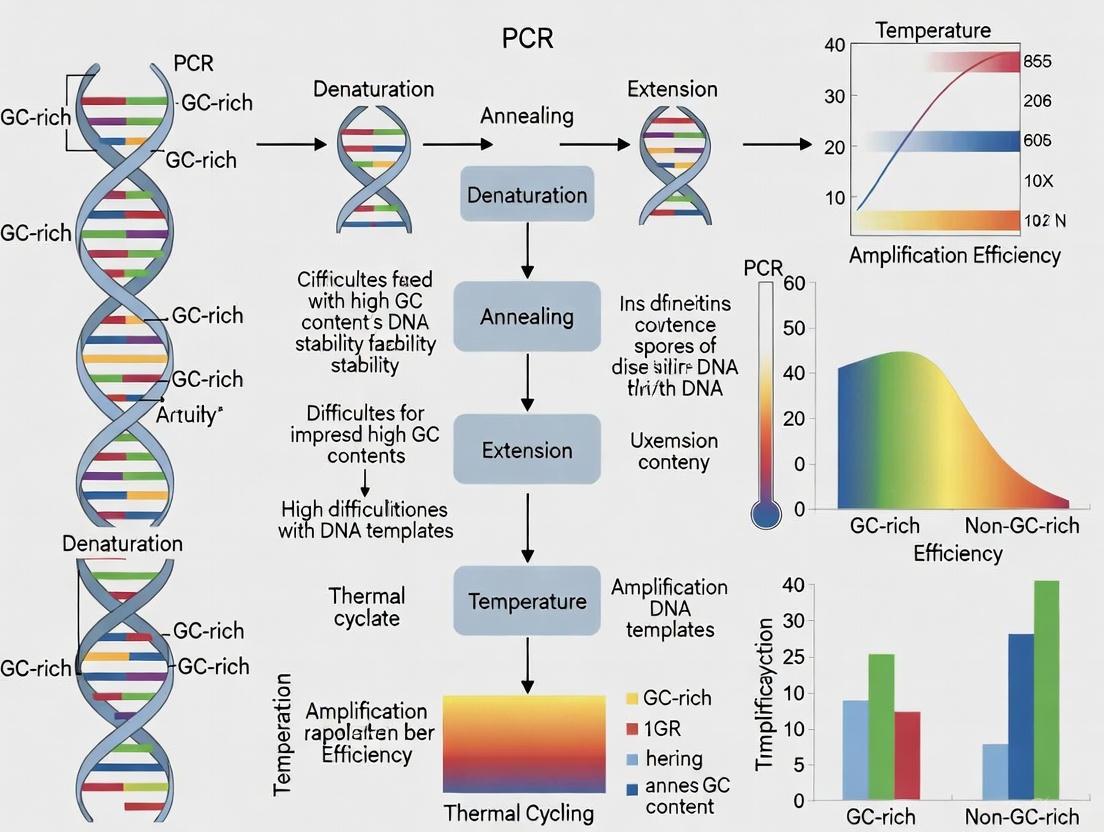
This article provides a comprehensive analysis of the molecular mechanisms that make GC-rich DNA templates challenging to amplify via standard Polymerase Chain Reaction (PCR).
Breaking the Barrier: Understanding and Overcoming Challenges in GC-Rich PCR Amplification
Abstract
This article provides a comprehensive analysis of the molecular mechanisms that make GC-rich DNA templates challenging to amplify via standard Polymerase Chain Reaction (PCR). It explores the foundational science behind template stability and secondary structure formation, details specialized methodologies and reagent choices, and offers a systematic troubleshooting guide for optimization. Further, it examines advanced validation techniques and comparative analyses of modern platforms, delivering an essential resource for researchers, scientists, and drug development professionals working with complex genomic targets like promoter regions of housekeeping and tumor suppressor genes.
The GC-Rich Challenge: Unraveling the Molecular Mechanisms of PCR Failure
GC-rich templates are DNA sequences characterized by a high percentage of guanine (G) and cytosine (C) bases, typically defined as regions where 60% or more of the bases are G or C [1]. While these regions constitute approximately only 3% of the human genome, they are disproportionately found in functionally significant areas, particularly gene promoter regions and other regulatory elements [1] [2]. This concentration in regulatory domains is biologically crucial, as most housekeeping genes, tumor-suppressor genes, and approximately 40% of tissue-specific genes contain high GC sequences in their promoter regions [2]. The epidermal growth factor receptor (EGFR) promoter, for instance, features an extremely high GC content of up to 88%, creating significant challenges for molecular amplification techniques [3]. Understanding the prevalence and characteristics of these regions is essential for researchers investigating gene regulation, cancer biology, and pharmaceutical development, particularly when employing polymerase chain reaction (PCR) based methodologies.
The Fundamental Challenges in Amplifying GC-Rich Templates
The amplification of GC-rich DNA sequences using standard PCR protocols presents unique difficulties that often lead to reaction failure, low yield, or non-specific products. These challenges stem from the intrinsic physicochemical properties of DNA and its behavior under standard amplification conditions.
Stable Hydrogen Bonding and High Melting Temperature
The primary challenge in amplifying GC-rich regions arises from the three hydrogen bonds between G-C base pairs, compared to only two hydrogen bonds between A-T base pairs [1]. This increased bond stability results in a significantly higher melting temperature (Tm) required to separate DNA strands [1]. Under standard denaturation conditions (typically 94-95°C), GC-rich templates may not fully denature, preventing primers from accessing their binding sites and ultimately leading to inefficient amplification or complete PCR failure [1] [2].
Formation of Complex Secondary Structures
GC-rich regions are structurally 'bendable' and readily form stable secondary structures such as hairpins, knots, and tetraplexes [1] [4]. These structures occur when GC-rich stretches fold onto themselves, creating physical barriers that block DNA polymerase progression during the extension phase of PCR [1]. The resulting effect is often truncated PCR products or complete stalling of the amplification process, as the polymerase cannot navigate through these complex configurations.
Competitive Annealing and Mispriming
The theoretical model based on competitive primer binding demonstrates that GC-rich templates exhibit a narrow optimal annealing efficiency window compared to normal GC content templates [2]. This phenomenon occurs because primers have increased opportunities to anneal at incorrect sites on GC-rich templates, leading to non-specific amplification and smeared products on electrophoresis gels [2]. Experimental confirmation has shown that annealing times greater than 10 seconds often yield smeared PCR products for GC-rich genes, whereas non-GC-rich templates do not display this sensitivity [2].
Table 1: Key Challenges in GC-Rich Template Amplification
| Challenge | Underlying Cause | Consequence |
|---|---|---|
| High Thermal Stability | Three hydrogen bonds in G-C pairs | Incomplete denaturation at standard temperatures |
| Secondary Structure Formation | Self-complementarity of GC-rich sequences | Polymerase stalling and truncated products |
| Competitive Annealing | Multiple potential primer binding sites | Non-specific amplification and primer dimers |
| Increased Error Frequency | Thermal damage at high denaturation temperatures | Sequence mutations and decreased product fidelity |
Thermal Damage and Error Accumulation
When amplifying GC-rich templates that require higher denaturation temperatures or longer exposure to heat, the risk of thermal damage to DNA increases significantly [5]. This damage primarily occurs through three mechanisms: A+G depurination, oxidative damage of guanine to 8-oxoG, and cytosine deamination to uracil [5]. These modifications can lead to incorrect nucleotide incorporation during amplification or cause polymerase stalling at abasic sites, ultimately reducing product yield and fidelity.
Figure 1: Mechanism-Consequence Relationships in GC-Rich PCR Amplification
Experimental Optimization Strategies and Protocols
Successfully amplifying GC-rich templates requires a systematic, multi-pronged optimization approach targeting reaction components, thermal cycling parameters, and enzymatic selection. The following strategies have demonstrated efficacy across various challenging templates, including the EGFR promoter and nicotinic acetylcholine receptor subunits.
Polymerase Selection and Buffer Composition
Choosing an appropriate DNA polymerase is critical for successful GC-rich amplification. Standard Taq polymerase often fails with difficult templates, while specialized polymerases with proofreading capabilities and GC-enhanced buffer systems significantly improve results [1] [4]. For example, Q5 High-Fidelity DNA Polymerase provides >280 times the fidelity of Taq and can be supplemented with a GC enhancer for targets up to 80% GC content [1]. Similarly, OneTaq DNA Polymerase is supplied with both standard and GC buffers specifically designed for difficult amplicons [1].
Experimental Protocol: Polymerase Comparison
- Set up identical PCR reactions with varying DNA polymerases: Standard Taq, OneTaq with GC Buffer, and Q5 with GC Enhancer
- Use a GC-rich control template (e.g., EGFR promoter fragment)
- Maintain consistent cycling conditions: 98°C initial denaturation for 30s, 35 cycles of 98°C for 10s, 63°C for 20s, 72°C for 30s/kb
- Analyze products on 2% agarose gel for yield and specificity [3] [1]
Magnesium Ion Concentration and PCR Additives
Magnesium chloride (MgCl₂) concentration significantly influences PCR efficiency, particularly for GC-rich templates. As a essential cofactor for DNA polymerase activity, Mg²⁺ concentration must be carefully optimized, typically requiring 1.5 to 2.0 mM for GC-rich targets [3]. Additionally, incorporating PCR additives that disrupt secondary structures is often necessary. Dimethyl sulfoxide (DMSO) at 5% concentration has proven effective for EGFR promoter amplification, while betaine (also known as trimethylglycine) can be used alone or in combination with DMSO [3] [4].
Experimental Protocol: Mg²⁺ and Additive Titration
- Prepare master mix with all components except MgCl₂
- Aliquot reactions and add MgCl₂ to final concentrations of 0.5, 1.0, 1.5, 2.0, 2.5, and 3.0 mM
- Test separate reaction sets with: no additives, 5% DMSO, 1M betaine, and DMSO/betaine combination
- Use gradient PCR to simultaneously test annealing temperatures from 60-70°C
- Identify optimal conditions based on product yield and specificity [3] [1]
Thermal Cycling Parameter Optimization
GC-rich templates require precise thermal cycling conditions that balance complete denaturation with polymerase stability. Research indicates that shorter annealing times (3-6 seconds) are often more effective for GC-rich amplification than standard 30-second annealing steps [2]. Additionally, implementing a two-step PCR protocol (combining annealing and extension) at slightly reduced extension temperatures (65°C instead of 72°C) can improve results for particularly challenging templates [6].
Experimental Protocol: Thermal Cycling Optimization
- Program thermocycler with shortened denaturation (5-10 seconds) and extension (15-30 seconds/kb) times
- Test annealing times from 3-20 seconds at the optimal annealing temperature
- Implement a touchdown protocol starting 5°C above calculated Tm and decreasing 1°C every cycle for 5 cycles
- For extremely resistant templates, consider using a 2-step PCR with extension at 65°C for 1.5 min/kb [2] [6]
Table 2: Optimized PCR Components for GC-Rich Amplification
| Component | Standard PCR | GC-Rich Optimized | Rationale |
|---|---|---|---|
| DNA Polymerase | Standard Taq | Specialized (Q5, OneTaq) with GC Enhancer | Better processivity through secondary structures |
| MgCl₂ Concentration | 1.5 mM | 1.5-2.0 mM (target-specific) | Balancing enzyme activity and primer specificity |
| Additives | None | 5% DMSO, 1M Betaine, or combination | Disrupts secondary structures, reduces Tm |
| Denaturation Temperature | 94-95°C | 98°C | More complete strand separation |
| Annealing Time | 30 seconds | 3-10 seconds | Reduces mispriming and competitive binding |
| Template Concentration | Varies | ≥2 μg/ml | Ensures sufficient target molecules [3] |
Primer Design Considerations for GC-Rich Targets
Careful primer design is paramount for successful GC-rich amplification. Primers with high self-dimer free energy values (ΔG) tend to promote non-specific amplification. Introducing null mutations to bring ΔG levels below -5.0 kcal/mol can significantly improve specificity [7]. Additionally, increasing primer length to 25-30 nucleotides helps enhance binding specificity despite the challenging template composition [4].
Figure 2: Systematic Optimization Workflow for GC-Rich PCR
The Scientist's Toolkit: Essential Reagents and Materials
Successfully navigating GC-rich amplification challenges requires access to specialized reagents and materials specifically formulated for difficult templates. The following toolkit compiles essential solutions referenced in the cited experimental protocols.
Table 3: Research Reagent Solutions for GC-Rich Amplification
| Reagent/Material | Specific Examples | Function in GC-Rich PCR |
|---|---|---|
| Specialized Polymerases | OneTaq DNA Polymerase (NEB #M0480), Q5 High-Fidelity DNA Polymerase (NEB #M0491) | Enhanced processivity through secondary structures; higher fidelity [1] |
| GC Enhancers | OneTaq High GC Enhancer, Q5 High GC Enhancer | Proprietary additive mixtures that inhibit secondary structure formation [1] |
| PCR Additives | DMSO (5%), Betaine (1M), 7-deaza-dGTP | Reduce secondary structures, decrease melting temperature, improve yield [3] [4] [2] |
| Buffer Systems | GC Buffer (NEB), Phusion GC Buffer | Specially formulated with optimal salt and pH conditions for GC-rich targets |
| Thermostable Polymerases | KOD Hot Start Polymerase, Phusion High-Fidelity | Withstand higher denaturation temperatures needed for GC-rich templates [2] |
| Rapid Cycler Systems | PCRJet thermocycler | Minimize thermal damage through fast temperature transitions [2] [5] |
Amplifying GC-rich templates from gene promoters and regulatory regions remains technically challenging but achievable through systematic optimization. The difficulty stems from fundamental molecular properties including stable hydrogen bonding, propensity for secondary structure formation, and competitive primer annealing. A successful amplification strategy requires a multipronged approach involving specialized polymerases with GC enhancers, optimized Mg²⁺ concentrations, structure-disrupting additives like DMSO and betaine, and carefully calibrated thermal cycling parameters with shortened annealing times [4] [7]. The implementation of a combination strategy addressing all these factors simultaneously—rather than sequential single-parameter optimization—has proven most effective for challenging targets such as the EGFR promoter with 88% GC content and nicotinic acetylcholine receptor subunits with 65% GC content [3] [4]. This comprehensive approach enables researchers to consistently amplify these biologically critical regions, facilitating advanced studies in gene regulation, biomarker discovery, and targeted drug development.
In molecular biology and genetics, GC-content refers to the percentage of nitrogenous bases in a DNA or RNA molecule that are either guanine (G) or cytosine (C). This fundamental property significantly influences DNA thermostability and presents substantial challenges for techniques like polymerase chain reaction (PCR), particularly when amplifying GC-rich templates (those exceeding 60% GC content) [8]. The core of this challenge lies in the stronger bonding nature of G-C base pairs compared to A-T pairs, creating a fundamental dilemma for researchers: while GC-rich regions provide biological stability, they also create technical barriers that must be overcome through optimized experimental approaches.
This whitepaper examines the biophysical principles underlying the thermostability of GC-rich DNA, details the specific challenges encountered in PCR amplification, and provides evidence-based solutions for researchers working in genomics, diagnostic development, and therapeutic discovery. Understanding these principles is particularly crucial when studying promoter regions of housekeeping and tumor suppressor genes, which are often GC-rich, as well as genomes of organisms like Mycobacterium bovis (with GC content >60%) where standard PCR protocols frequently fail [9] [10].
The Biophysical Basis of G-C Pair Stability
Hydrogen Bonding and Base Stacking Interactions
The stability of DNA double helices with high GC-content stems from two primary molecular interactions, with the contribution of hydrogen bonds often being misunderstood in conventional wisdom.
Hydrogen Bonding: Guanine and cytosine undergo specific hydrogen bonding with each other through three hydrogen bonds, denoted as G≡C. In contrast, adenine-thymine pairs in DNA (and adenine-uracil in RNA) are connected by only two hydrogen bonds, represented as A=T or A=U [8]. This additional hydrogen bond in GC pairs contributes to their stability, though its role is sometimes overemphasized.
Base Stacking Interactions: Contrary to popular belief, research indicates that hydrogen bonds themselves do not have a particularly significant impact on molecular stability, which is instead caused mainly by molecular interactions of base stacking [8]. More favorable stacking energy exists for GC pairs than for AT or AU pairs because of the relative positions of exocyclic groups, creating a correlation between base stacking order and the thermal stability of the molecule as a whole [8].
Table 1: Comparative Analysis of DNA Base Pair Interactions
| Feature | G-C Base Pair | A-T Base Pair |
|---|---|---|
| Hydrogen Bonds | 3 | 2 |
| Bond Notation | G≡C | A=T |
| Base Stacking Energy | More favorable | Less favorable |
| Relative Contribution to Stability | Major (stacking) | Minor (stacking) |
| Thermal Resistance | Higher | Lower |
Temperature Dependence of Hydrogen Bonds
The relationship between hydrogen bond strength and temperature follows a quantifiable pattern that directly impacts DNA thermostability. Recent single-molecule studies have demonstrated a significant decline in H-bond intrinsic strength as temperature increases [11]. This relationship can be expressed through a nonlinear correlation with the empirical equation: ΔG* = 7.88 - 1.34ln(T - 251.64), where ΔG* represents H-bond intrinsic strength and T is temperature in Kelvin [11].
High-resolution NMR studies of protein hydrogen bonds provide additional insights into this temperature dependence, showing that hydrogen bonds undergo thermal expansion with an average linear thermal expansion coefficient of 1.7×10⁻⁴/K for NH→O hydrogen bonds [12]. This expansion leads to a global weakening of hydrogen bond scalar couplings as temperature increases, directly affecting the thermal stability of molecular structures.
Experimental Evidence and Quantitative Relationships
Measuring DNA Thermostability
The thermostability conferred by GC content is quantitatively expressed through DNA melting temperature (Tm), the temperature at which half of the DNA duplexes separate into single strands [13]. For short DNA sequences, the Wallace rule provides a practical formula for approximating Tm: Tm ≈ 2 × (number of A-T pairs) + 4 × (number of G-C pairs) [13]. This rule highlights why GC content—rather than AT content—is the primary determinant of DNA melting temperature, as G-C pairs contribute approximately twice as much to the melting temperature compared to A-T pairs.
The absorbance of DNA at 260 nm increases sharply when double-stranded DNA separates into single strands upon sufficient heating, providing a spectrophotometric method for determining melting temperature and consequently GC-ratio [8]. For large numbers of samples, flow cytometry provides an efficient protocol for determining GC-ratios [8].
Table 2: Melting Temperature Characteristics of DNA with Varying GC Content
| GC Content Range | Melting Temperature | Stability Classification | PCR Difficulty |
|---|---|---|---|
| <40% | Lower | Less stable | Minimal |
| 40-60% | Moderate | Moderate stability | Standard protocols usually sufficient |
| >60% | Higher | Highly stable | Challenging, requires optimization |
| >70% | Significantly higher | Extremely stable | Very difficult, specialized methods needed |
Biological Significance of GC-Rich Regions
The distribution of GC-rich regions in genomes is non-random and functionally significant. In complex organisms, variations in GC-ratio result in a mosaic-like formation with islet regions called isochores [8]. These GC-rich isochores typically include many protein-coding genes, making determination of GC-ratios valuable for mapping gene-rich genomic regions [8].
The length of a gene's coding region is directly proportional to higher G+C content, partly because stop codons have a bias towards A and T nucleotides—thus shorter sequences exhibit higher AT bias [8]. This relationship has important implications for gene prediction and annotation in genomic studies.
The PCR Amplification Challenge
Mechanistic Obstacles in GC-Rich Amplification
Amplifying GC-rich templates by PCR presents multiple technical hurdles that often lead to failed reactions or poor yields:
Strong Hydrogen Bonding: The triple-bond nature of G≡C pairs creates enhanced thermostability, requiring more energy to separate DNA strands during the denaturation step of PCR [9]. This often necessitates higher denaturation temperatures that can compromise polymerase activity over multiple cycles.
Secondary Structure Formation: GC-rich regions are 'bendable' and readily form stable secondary structures like hairpin loops [9]. These structures block polymerase progression and result in shorter, incomplete amplification products. The stability of these secondary structures persists at standard PCR denaturation temperatures, creating persistent obstacles to amplification.
Primer-Related Issues: Primers designed for GC-rich templates tend to form self- and cross-dimers as well as stem-loop structures that impede the DNA polymerase [14]. GC-rich sequences at the 3' end of primers can also lead to mispriming, reducing amplification specificity and efficiency.
Compounding Factors in PCR Failure
The challenges of GC-rich amplification are compounded by several additional factors:
Polymerase Stalling: Many conventional DNA polymerases stall at the complex secondary structures formed by GC-rich sequences [9]. This stalling results in truncated amplification products and reduced yields.
Non-specific Amplification: The strong binding affinity in GC-rich regions can lead to non-specific primer binding, particularly when magnesium concentrations are suboptimal [9]. This manifests as multiple bands on agarose gels rather than a single clean product.
Resistance to Denaturation: GC-rich templates resist complete denaturation at standard temperatures (92-95°C), making it difficult for primers to access their binding sites [14]. While increasing denaturation temperature seems logical, temperatures exceeding 95°C can accelerate polymerase denaturation throughout PCR cycling.
Methodological Approaches and Solutions
Optimized Experimental Protocols
Successful amplification of GC-rich regions requires systematic optimization of PCR components and conditions:
Polymerase Selection: Standard Taq polymerase often underperforms with GC-rich templates. Switching to specially engineered polymerases such as Q5 High-Fidelity DNA Polymerase or OneTaq DNA Polymerase can dramatically improve results [9]. These enzymes are specifically optimized for challenging amplicons, with some capable of amplifying templates with up to 80% GC content when used with specialized enhancers.
Magnesium Concentration Optimization: Magnesium is a critical cofactor for polymerase activity and primer binding [9]. Testing MgCl₂ concentrations in 0.5 mM increments between 1.0 and 4.0 mM can identify the optimal concentration that balances specificity with yield. Excessive magnesium promotes non-specific binding, while insufficient concentrations reduce polymerase activity.
PCR Additives: Incorporating certain additives can significantly improve GC-rich amplification:
- Structure-disrupting agents: DMSO, glycerol, and betaine reduce secondary structure formation [9] [14].
- Specificity enhancers: Formamide and tetramethyl ammonium chloride increase primer annealing stringency [9].
- Nucleotide analogs: 7-deaza-2'-deoxyguanosine, a dGTP analog, can improve PCR yield of GC-rich regions, though it doesn't stain well with ethidium bromide [9].
Temperature Modifications: Adjusting thermal cycling parameters can overcome several GC-related challenges:
- Higher denaturation temperatures (up to 95°C) help separate stubborn secondary structures, particularly when used for the first few cycles [14].
- Slower ramp rates between temperatures improve amplification efficiency for difficult templates [10].
- Two-step PCR protocols that combine annealing and extension at higher temperatures can enhance performance for long GC-rich targets [10].
Diagram 1: Experimental workflow for optimizing GC-rich PCR amplification. This decision pathway illustrates the multidimensional approach required for successful amplification of difficult templates.
Advanced and Alternative Methods
When standard optimization fails, several advanced approaches can overcome extreme GC challenges:
Slow-down PCR: This method uses a dGTP analog (7-deaza-2'-deoxyguanosine) in the PCR mixture combined with a standardized cycling protocol featuring lowered ramp rates and additional cycles [14]. The modified nucleotides disrupt the standard bonding patterns, facilitating amplification.
Base-Modified PCR: A sophisticated approach involves substituting dATP with dDTP (diaminopurine) and dGTP with dITP (inosine) to inverse the natural hydrogen bonding rule [15]. This conversion allows selective amplification of GC-rich alleles that would otherwise be impossible to target specifically.
Controlled Heat Denaturation: Incorporating a 5-minute heat denaturation step at 98°C in low-salt buffer before cycling can significantly improve sequencing and amplification through difficult regions [16]. This extended denaturation helps overcome the resistance of GC-rich templates to strand separation.
The Scientist's Toolkit: Essential Reagents and Materials
Table 3: Research Reagent Solutions for GC-Rich Amplification
| Reagent/Material | Function | Application Notes | Commercial Examples |
|---|---|---|---|
| High-Fidelity DNA Polymerases | Engineered for processivity through difficult structures | Ideal for long or GC-rich amplicons; >280x fidelity of Taq | Q5 High-Fidelity DNA Polymerase [9] |
| GC Enhancers/Buffers | Specialized formulations with multiple additives | Inhibit secondary structure; increase primer stringency | OneTaq GC Buffer, Q5 High GC Enhancer [9] |
| Structure-Disrupting Additives | Reduce secondary structure formation | DMSO typically used at 2-10%; betaine concentrations vary | DMSO, glycerol, betaine [9] [17] |
| Modified Nucleotides | Alter hydrogen bonding properties | Enable alternative PCR methods; inverse bonding rules | dITP, dDTP, 7-deaza-2'-deoxyguanosine [15] |
| Magnesium Chloride | Cofactor for polymerase activity | Concentration critical; requires optimization | Standard component of PCR buffers [9] |
| Blood DNA Extraction Kits | Resistance to inhibitors in complex samples | Direct amplification from blood possible | Q5 Blood Direct Master Mix [9] |
The hydrogen bond dilemma presented by G-C pairs represents both a fundamental biophysical phenomenon and a practical laboratory challenge. While the triple hydrogen bonds of G≡C pairs contribute to DNA thermostability, the enhanced stability primarily stems from more favorable base stacking interactions in GC-rich sequences. This understanding informs the development of effective strategies for amplifying difficult GC-rich templates, which are particularly relevant in studying gene promoters, microbial genomes, and other biologically significant regions.
Successful navigation of the GC-rich amplification challenge requires a multifaceted approach incorporating specialized enzymes, optimized reaction conditions, and sometimes innovative methodological adaptations. The solutions outlined in this technical guide provide researchers with an evidence-based framework for overcoming one of molecular biology's persistent technical obstacles, enabling more reliable genetic analysis across diverse applications from basic research to diagnostic development.
As genomic technologies continue to advance and researchers encounter increasingly complex genetic targets, the principles governing GC-content thermostability and the methodological workarounds for challenging templates will remain essential knowledge for the scientific community working at the forefront of genetic research and biotechnology innovation.
The formidable challenge of amplifying GC-rich DNA templates by PCR is a universally recognized hurdle in molecular biology. Conventional wisdom often attributes the heightened stability of these sequences primarily to the triple hydrogen bonds of G-C base pairs, in contrast to the double bonds of A-T pairs. While this contribution is valid, it is an incomplete picture. A more profound, dominant force governing DNA duplex stability is base stacking interactions [14]. These interactions, arising from the overlap of π-orbitals in adjacent nitrogenous bases, are the major contributors to the thermodynamic stability of DNA. The dense, rigid arrangement of guanine and cytosine bases in GC-rich regions results in exceptionally strong stacking forces, creating a highly stable structure that is inherently resistant to denaturation. This fundamental biophysical principle explains why extremophiles, such as Thermus thermophilus, possess GC-rich genomes to withstand high-temperature environments and why promoter regions of highly expressed genes in humans are often AT-rich for easier access [14]. This whitepaper delves into the critical role of base stacking, moving beyond the simplistic hydrogen bond model, to frame the intrinsic difficulties of GC-rich PCR within a broader, more accurate thermodynamic context.
The Molecular Mechanisms Underpinning PCR Challenges
The strong base stacking energies in GC-rich sequences manifest in several specific technical challenges that can lead to PCR failure, characterized by blank gels, nonspecific smearing, or truncated products.
Elevated Thermal Stability and Secondary Structure Formation
The primary consequence of enhanced base stacking is a significant increase in the DNA's melting temperature ((T_m)). This necessitates higher denaturation temperatures during PCR, which can approach the functional limits of standard DNA polymerases, potentially leading to enzyme denaturation over multiple cycles [14]. Furthermore, the same stacking forces that stabilize the double helix also promote the formation of persistent, stable secondary structures. Single-stranded, GC-rich regions can fold back onto themselves, forming hairpin loops, knots, and tetraplexes that are exceptionally stable and do not melt efficiently at standard denaturation temperatures (e.g., 92-95°C) [18] [4]. These structures physically block the procession of the DNA polymerase, resulting in incomplete or truncated synthesis products.
Impeded Primer Annealing and Enzyme Processivity
The resistance of GC-rich templates to denaturation means that the target sites for primers may not be fully accessible during the annealing step of the PCR cycle. This forces primers to compete with the template's own intra-strand secondary structures, drastically reducing annealing efficiency. Moreover, the primers themselves, if also GC-rich, are prone to forming self-dimers or cross-dimers through their own strong stacking interactions, further reducing the pool of available primers for specific amplification [18] [19]. The cumulative effect is a significant reduction in the specificity and yield of the amplification reaction.
Table 1: Summary of PCR Challenges from Strong Base Stacking
| Molecular Mechanism | Direct Consequence | Observed PCR Outcome |
|---|---|---|
| Enhanced Thermal Stability | Elevated melting temperature ((T_m)) | Incomplete template denaturation |
| Secondary Structure Formation | Stable hairpins & intra-strand structures | Polymerase stalling; truncated products |
| Impaired Primer Accessibility | Reduced primer-template annealing | Low or no amplification yield |
| Primer Self-Complementarity | Primer-dimer formation & mispriming | Nonspecific amplification; reduced efficiency |
Quantitative Analysis of DNA Folding Thermodynamics
Accurately predicting the stability of DNA secondary structures is crucial for designing successful PCR experiments, particularly for difficult targets. For decades, nearest-neighbor models have been the gold standard for this task. These models operate on the principle that the total free energy of a DNA duplex can be calculated by summing the free energy contributions of all adjacent base-pair stacks, rather than considering individual base pairs in isolation [20]. This approach inherently captures the profound effect of base stacking on overall stability.
However, traditional nearest-neighbor models have been limited by a relative scarcity of high-quality experimental thermodynamic data, especially for non-canonical structures like mismatches, bulges, and various hairpin loops. This data bottleneck has historically resulted in prediction inaccuracies. Recent technological advancements are overcoming this hurdle. The development of high-throughput methods like Array Melt has enabled the simultaneous measurement of equilibrium stability for millions of DNA hairpins [20]. This massive-scale data generation allows for the derivation of refined, more accurate thermodynamic parameters.
Table 2: Key Parameters from High-Throughput DNA Folding Studies
| Parameter | Traditional Model (SantaLucia 2004) | High-Throughput Informed Models (e.g., dna24) |
|---|---|---|
| Sequences for WC Parameters | 108 sequences for 12 parameters | Data from 27,732 two-state variants [20] |
| Data for Mismatches/Bulges | 174 sequences for 44 parameters | Massively expanded dataset across multiple scaffolds |
| Model Scope | Struggles with complex motifs | Improved accuracy for hairpin loops, mismatches, bulges |
| Application | Standard primer design | Enhanced prediction for qPCR, DNA origami, hybridization probes |
These improved models, including a NUPACK-compatible model (dna24) and graph neural network (GNN) models, demonstrate significantly higher accuracy in predicting DNA folding thermodynamics. They are better equipped to handle the diverse sequence dependence of structural motifs beyond simple Watson-Crick pairs, leading to more effective in silico design of PCR primers and other oligonucleotide-based tools [20].
Diagram 1: Workflow for deriving improved DNA folding models from high-throughput data.
Experimental Strategies to Overcome Base Stacking Effects
Overcoming the challenges posed by strong base stacking requires a multipronged experimental approach that targets the underlying thermodynamic barriers.
Strategic Use of PCR Additives
Organic additives are a primary tool for disrupting the stable structures formed by GC-rich sequences. They function through distinct mechanisms to homogenize the reaction environment and lower melting temperatures.
- Betaine (1-2 M): Also known as trimethylglycine, betaine is a zwitterion that acts as a stabilizing osmolyte. It penetrates the DNA duplex and homogenizes the base pair stability by reducing the disparity in melting temperature between GC-rich and AT-rich regions. This helps to prevent the formation of secondary structures and promotes more uniform amplification [4] [21].
- DMSO (2-10%): Dimethyl sulfoxide is a polar aprotic solvent that disrupts the hydrogen bonding network and reduces the dielectric constant of the solution. This effectively lowers the overall melting temperature of the DNA, facilitating the denaturation of stable secondary structures that would otherwise impede the polymerase [21].
- Alternative Additives: Recent studies have identified ethylene glycol (1.075 M) and 1,2-propanediol (0.816 M) as highly effective additives. In a systematic evaluation of 104 GC-rich human genomic amplicons, 1,2-propanediol successfully rescued 90% of the targets, outperforming betaine (72%) [22]. The exact mechanism differs from betaine, potentially involving differential affinity to single-stranded versus double-stranded DNA.
Table 3: Comparative Analysis of PCR Additives for GC-Rich Amplification
| Additive | Typical Working Concentration | Primary Proposed Mechanism | Reported Efficacy |
|---|---|---|---|
| Betaine | 1 M - 2 M | Homogenizes base pair stability; reduces (T_m) disparity | 72% of 104 GC-rich amplicons [22] |
| DMSO | 2% - 10% | Disrupts H-bonding; lowers DNA (T_m) | Often used in combination [4] |
| Ethylene Glycol | 1.075 M | Reduces DNA (T_m); mechanism distinct from betaine | 87% of 104 GC-rich amplicons [22] |
| 1,2-Propanediol | 0.816 M | Reduces DNA (T_m); mechanism distinct from betaine | 90% of 104 GC-rich amplicons [22] |
| 7-deaza-dGTP | Partial substitution for dGTP | Analog that disrupts Hoogsteen base pairing | Improves yield of GC-rich regions [18] |
Polymerase Selection and Buffer Optimization
The choice of DNA polymerase is critical. Standard Taq polymerase often stalls at the complex secondary structures stabilized by base stacking. High-fidelity polymerases with proofreading activity, such as Q5 (NEB) or Phusion, are engineered for enhanced processivity and are more capable of navigating through these obstructions [18] [4]. Furthermore, many manufacturers offer specialized polymerases and companion buffers specifically formulated for GC-rich templates. These systems often include proprietary GC Enhancers, which are optimized mixtures of additives that inhibit secondary structure formation and increase primer stringency, enabling robust amplification of sequences with up to 80% GC content [18] [23].
Cycling Parameter and Reaction Condition Adjustments
Fine-tuning the physical parameters of the PCR cycle is essential. A strategic increase in denaturation temperature (e.g., to 98°C) for the first few cycles can help melt persistent secondary structures, though care must be taken to avoid rapid enzyme inactivation [14]. Employing a temperature gradient to optimize the annealing temperature ((T_a)) is crucial to balance specificity and yield. Additionally, the concentration of magnesium ions (Mg²⁺), a essential cofactor for polymerase activity, must be carefully titrated. A gradient from 1.0 mM to 4.0 mM in 0.5 mM increments is recommended to find the optimal concentration that supports enzyme activity without promoting non-specific amplification [18] [21].
The Scientist's Toolkit: Essential Reagents for GC-Rich PCR
Success in amplifying GC-rich templates relies on a suite of specialized reagents and tools designed to counteract the effects of strong base stacking.
Table 4: Key Research Reagent Solutions for GC-Rich Amplification
| Reagent / Tool | Function / Purpose | Example Products |
|---|---|---|
| High-Fidelity DNA Polymerase | Proofreading activity; enhanced processivity through secondary structures. | Q5 High-Fidelity (NEB), Phusion (Invitrogen) [18] [4] |
| Specialized GC Buffer | Optimized buffer containing salts and additives to destabilize secondary structures. | OneTaq GC Buffer (NEB), GC-Rich Enhancer (ThermoFisher) [18] [14] |
| Betaine | Zwitterionic additive; homogenizes base pair stability, reduces (T_m) differential. | Sigma-Aldrich, Thermo Scientific [4] [21] |
| DMSO | Polar aprotic solvent; disrupts hydrogen bonding, lowers DNA (T_m). | Common laboratory reagent [21] |
| Ethylene Glycol / 1,2-Propanediol | Alternative additives; effectively reduce DNA (T_m) via distinct mechanisms. | Common laboratory reagents [22] |
| 7-deaza-dGTP | dGTP analog; incorporated into DNA to disrupt stable secondary structures. | Roche, Sigma-Aldrich [18] |
| Tm Calculator | Web tool for accurate primer (Tm) and (Ta) calculation, accounting for enzyme/buffer. | NEB Tm Calculator, ThermoFisher Tm Calculator [18] |
Integrated Experimental Protocol: A Case Study
A practical application of these principles is demonstrated in a study optimizing the PCR amplification of GC-rich nicotinic acetylcholine receptor subunits from invertebrates [17] [4]. The target genes, Ir-nAChRb1 (65% GC) and Ame-nAChRa1 (58% GC), with open reading frames of 1743 bp and 1884 bp respectively, failed to amplify under standard PCR conditions.
Methodology:
- Polymerase Screening: Multiple high-fidelity DNA polymerases were evaluated, including Platinum SuperFi and Phusion, which are known for their robustness with complex templates [4].
- Additive Optimization: Additives including DMSO (5%) and Betaine (1 M) were tested both individually and in combination to assess their synergistic effects on disrupting secondary structures.
- Thermal Cycling Adjustments: A combination of touchdown PCR and adjusted denaturation temperatures was employed. The annealing temperature was optimized using a gradient PCR protocol.
- Primer Design: Primers were designed with careful attention to length (18-24 bp), melting temperature (55-70°C), and avoidance of self-complementarity to minimize secondary structure formation in the primers themselves [4] [19].
Outcome: The tailored protocol, which incorporated a combination of organic additives (DMSO and betaine), an increased concentration of a high-fidelity DNA polymerase, and optimized annealing temperatures, successfully amplified the challenging GC-rich targets. This underscores the importance of a multipronged optimization strategy when dealing with sequences dominated by strong base stacking interactions [17] [4].
Diagram 2: Logical relationship between the problem of base stacking and the strategic solutions for successful PCR.
The difficulty of amplifying GC-rich templates by PCR cannot be fully understood through the lens of hydrogen bonding alone. The critical role of base stacking interactions provides a more complete and mechanistically accurate explanation for the exceptional thermodynamic stability of these sequences. This understanding, in turn, directly informs rational experimental design. Overcoming these challenges requires a integrated strategy that targets the fundamental biophysics: employing specialized polymerases and buffers, utilizing strategic additives like betaine, DMSO, or next-generation alternatives such as 1,2-propanediol, and meticulously optimizing reaction conditions. As high-throughput methods continue to refine our predictive models of DNA folding, the scientific community is better equipped than ever to design effective protocols, ensuring that GC-rich sequences are no longer an insurmountable barrier in molecular biology and drug development research.
The polymerase chain reaction (PCR) is a foundational technique in molecular biology, yet the amplification of guanine-cytosine (GC)-rich templates (typically defined as sequences with >60% GC content) presents persistent challenges for researchers [24] [23]. These difficulties arise from the fundamental biophysical properties of DNA that favor the formation of stable secondary structures—primarily hairpins and loops—which can physically impede polymerase progression and lead to amplification failure [25] [26]. Understanding these structures is crucial not only for improving molecular techniques but also for appreciating their biological significance, as GC-rich regions are often found in gene promoters, including those of housekeeping and tumor suppressor genes [24] [23].
The core issue lies in the base-pairing stability of GC-rich sequences. Unlike adenine-thymine (A-T) pairs, which form two hydrogen bonds, G-C pairs form three hydrogen bonds, creating a more thermostable duplex [24]. This increased stability, combined with base-stacking interactions, results in DNA that requires more energy to denature [14]. More critically, single-stranded GC-rich regions readily fold into complex, intramolecular secondary structures that are highly resistant to denaturation at standard PCR temperatures, causing DNA polymerases to stall and resulting in incomplete or failed amplification [25] [14] [26]. This technical guide explores the mechanisms behind secondary structure formation, their impact on polymerase function, and provides evidence-based strategies for successful amplification of these challenging templates.
Molecular Mechanisms: How Secondary Structures Impede Amplification
Types of Problematic DNA Structures
GC-rich DNA sequences are prone to forming several types of stable secondary structures that interfere with PCR. The most common is the hairpin (or stem-loop) structure, which occurs when a single-stranded DNA molecule folds back on itself to form a complementary double-helical stem capped by an unpaired loop [27] [26]. These structures are exceptionally stable in GC-rich regions because their stems are reinforced by the triple hydrogen bonds of G-C base pairs.
In addition to canonical hairpins, GC-rich repeats can form more complex structures. G-quadruplexes (G4) are higher-order structures formed in nucleic acid sequences that are rich in guanine, where four guanine bases assemble in a planar arrangement through Hoogsteen hydrogen bonding [25]. Similarly, i-motifs are structures formed by cytosine-rich sequences under slightly acidic conditions [25]. The formation of these structures is not merely a theoretical concern; empirical studies have documented precise sequencing stops at the boundaries of predicted hairpin clusters, providing direct evidence of their disruptive effects [26].
The Biophysical Basis of Structural Stability
The pronounced stability of GC-rich secondary structures stems from both hydrogen bonding and base-stacking interactions. While the triple hydrogen bonds of G-C pairs contribute significantly to thermal stability, the primary stabilization force actually comes from base-stacking interactions between adjacent nucleotide pairs [14]. These stacking interactions create a thermodynamic environment where structured DNA remains folded even at elevated temperatures used in standard PCR denaturation steps (typically 92-95°C).
The stability of these structures can be quantitatively predicted by calculating their minimum free energy (MFE), with more negative values indicating greater stability [26]. Software tools such as RNAfold and UNAfold can model these structures and predict the specific hairpins most likely to cause polymerase stalling [26]. Experimental data has confirmed that polymerase-resistant regions correspond precisely to sequences predicted to form tight clusters of hairpins with high base-pairing probabilities [26].
Direct Evidence of Polymerase Stalling at Structured DNA
High-throughput studies have systematically quantified how secondary structures impede DNA synthesis. One comprehensive analysis employed a primer extension assay with a library of 20,000 structured sequences to monitor the kinetics of DNA synthesis through various STR permutations [25]. The researchers computed a stall score (σ)—the ratio of sequences in stalled versus fully extended products—which revealed that structured DNA sequences consistently caused polymerase arrest.
The biological significance of these findings is substantial. Polymerase stalling at DNA structures induces error-prone DNA synthesis, which constrains STR expansion in genomes and contributes to their evolutionary behavior [25]. This mechanistic insight explains why structured STRs exhibit lower relative abundance and shorter length in eukaryotic genomes, suggesting they are generally deleterious [25].
Table 1: Quantitative Impact of DNA Secondary Structures on Polymerase Function
| Structural Feature | Experimental Measure | Impact on Amplification | Reference |
|---|---|---|---|
| Hairpin clusters | Precise sequencing stops at boundaries | Complete PCR failure across hairpin region | [26] |
| G-quadruplex (G4) motifs | ~70% of signal in stalled products | Severe inhibition of polymerase progression | [25] |
| High GC content (>60%) | Increased stall score (σ) | Reduced amplification efficiency and yield | [25] [28] |
| Structured STRs | Lower relative genomic abundance | Shorter length constraints in genomes | [25] |
Experimental Evidence and Case Studies
Documented Cases of Amplification Failure
Research has provided compelling case studies of how secondary structures disrupt molecular biology techniques. One investigation of the mouse Foxd3 locus identified a 370-nucleotide segment that was resistant to polymerase read-through during both PCR and sequencing reactions [26]. This region, located just upstream of the 5' untranslated region, was also impossible to manipulate using BAC recombineering strategies. The segment was found to be GC-rich (61% GC content) and was predicted by minimum free energy algorithms to form a tight cluster of hairpin structures [26].
Sequencing reads from primers flanking this segment consistently stopped at the same positions, defining the precise boundaries of the polymerase-resistant region [26]. However, when primers annealing within this segment were used, sequencing could easily extend through the borders, confirming that the phenomenon was due to secondary structure rather than abnormal sequence composition [26]. Similarly, PCR amplification across this region universally failed unless one primer annealed within the structured region, allowing polymerase to synthesize outward through the hairpin cluster [26].
High-Throughput Analysis of Polymerase Stalling
To comprehensively understand DNA synthesis through structured regions, researchers developed a high-throughput primer extension assay that monitored the kinetics of DNA synthesis through 20,000 sequences comprising all short tandem repeat (STR) permutations in different lengths [25]. This approach combined experimental measurements with population-scale genomic data to demonstrate that the response of a model replicative DNA polymerase (T7 DNA polymerase) to variously structured DNA is sufficient to predict the complex genomic behavior of STRs, including their abundance and mutational constraints [25].
The study revealed that DNA polymerase stalling at DNA structures induces error-prone DNA synthesis, which in turn constrains STR expansion [25]. This supports a model where STR length in eukaryotic genomes results from a balance between expansion due to polymerase slippage at repeated DNA sequences and point mutations caused by error-prone DNA synthesis at DNA structures [25]. The data further explained why structured STRs are generally more stable over evolutionary time, as their expansion is limited by increased point mutation rates at structural boundaries.
Conservation and Functional Significance
The polymerase-resistant region upstream of Foxd3 demonstrates another remarkable feature—significant evolutionary conservation across vertebrate species [26]. Nucleotide BLAST analysis revealed conservation with human, monkey, zebrafish, chicken, and frog genomes [26]. This high degree of conservation suggests possible functional significance, potentially in gene regulation, and indicates that these problematic structural elements are maintained by natural selection despite their technical challenges for amplification.
Overcoming Structural Barriers: Optimized Methodologies
Polymerase Selection and Engineering
The choice of DNA polymerase is critical for amplifying structured templates. Standard Taq polymerase often struggles with GC-rich secondary structures, but several specialized enzymes show superior performance:
- OneTaq DNA Polymerase: Developed with both standard and GC buffers, this enzyme provides high yield and specificity for difficult amplicons and can amplify templates with up to 80% GC content when supplemented with the OneTaq High GC Enhancer [24] [23].
- Q5 High-Fidelity DNA Polymerase: With more than 280 times the fidelity of Taq, Q5 is ideal for long or difficult amplicons, including GC-rich DNA. Its GC enhancer enables robust performance up to 80% GC content [24] [23].
- Engineered polymerases with enhanced processivity: Some modern polymerases are engineered with a strong DNA-binding domain from another protein, enhancing their ability to unwind structured templates without compromising polymerase activity [29].
- Hyperthermostable polymerases: Enzymes from hyperthermophilic organisms like Pyrococcus furiosus (Pfu) exhibit greater thermostability, with Pfu having approximately 20 times the stability of Taq at 95°C, enabling them to better withstand the elevated denaturation temperatures needed for GC-rich templates [29].
Table 2: Optimization Strategies for Amplifying Structured DNA Templates
| Parameter | Standard Conditions | Optimized for GC-Rich Templates | Mechanism of Action |
|---|---|---|---|
| Polymerase Type | Standard Taq | Specialized polymerases (OneTaq, Q5) with GC enhancers | Improved processivity through secondary structures |
| Denaturation Temperature | 92-95°C | Up to 98°C (first few cycles) | Enhanced separation of stable duplexes |
| Mg²⁺ Concentration | 1.5-2.0 mM | Gradient optimization (1.0-4.0 mM) | Cofactor optimization for enzyme activity |
| Additives | None | DMSO, betaine, glycerol, formamide | Destabilization of secondary structures |
| Cycle Modifications | Standard ramp rates | Slow-down PCR with modified nucleotides | Reduced structure formation with analogs |
| Template Modification | Direct amplification | Restriction digestion and subcloning | Reduction of GC content in amplified fragments |
PCR Additives and Buffer Optimization
Chemical additives can significantly improve amplification of structured templates by destabilizing secondary structures:
- Structure-destabilizing agents: DMSO, glycerol, and betaine work by reducing the formation of secondary structures that inhibit polymerase progression [24] [14]. Betaine is particularly effective as it reduces the base-stacking energy penalty for DNA melting, effectively lowering the melting temperature of GC-rich regions [30].
- Stringency enhancers: Formamide and tetramethyl ammonium chloride increase primer annealing stringency, which increases specificity and reduces non-specific priming [24].
- Nucleotide analogs: 7-deaza-2'-deoxyguanosine is a dGTP analog that improves PCR yield of GC-rich regions by preventing alternative (Hoogsteen) base pairing while maintaining standard Watson-Crick base pairing [27] [14]. This destabilizes secondary structures without compromising accurate replication.
Commercial GC enhancers often contain proprietary mixtures of these additives in optimized ratios, providing a convenient solution without the need for laborious individual testing [24] [23].
Thermal Cycling and Reaction Condition Modifications
Adjusting thermal cycling parameters can significantly improve amplification of structured templates:
- Elevated denaturation temperature: Increasing the denaturation temperature to 98°C for the first few cycles helps melt stable secondary structures, though this should be used cautiously as it can accelerate polymerase denaturation [14].
- Temperature gradients: Empirical testing of annealing temperatures using temperature gradients helps identify optimal conditions that balance specificity and yield [24].
- Slow-down PCR: This method uses a standardized cycling protocol with varying temperatures, lowered ramp rates, additional cycles, and the inclusion of 7-deaza-2'-deoxyguanosine [14].
- Modified magnesium concentration: Magnesium is a crucial cofactor for polymerase activity and primer binding. Testing MgCl₂ concentrations in 0.5 mM increments between 1.0 and 4.0 mM can identify the optimal concentration that maximizes yield while minimizing non-specific amplification [24] [23].
Template and Primer Design Strategies
When standard optimization fails, alternative approaches focus on modifying the template itself:
- Restriction digestion and subcloning: Cutting the problematic region with restriction enzymes and subcloning smaller fragments (ideally up to 200 bp) reduces the local GC content and minimizes structure formation [27] [26].
- Internal priming: Using one primer that anneals within the structured region can allow polymerase to synthesize outward through the hairpin, as polymerases seem better able to extend through structures than to initiate replication through them [26].
- Bidirectional sequencing: When sequencing through structured regions, using both forward and reverse primers that anneal within the structured region can help assemble a complete sequence [27].
Table 3: Research Reagent Solutions for Secondary Structure Challenges
| Reagent/Resource | Function/Application | Example Products |
|---|---|---|
| Specialized Polymerases | Amplification through stable structures | OneTaq DNA Polymerase, Q5 High-Fidelity DNA Polymerase |
| GC Enhancers | Proprietary additive mixtures | OneTaq High GC Enhancer, Q5 High GC Enhancer |
| Structure-Destabilizing Additives | Reduce secondary structure formation | DMSO, betaine, glycerol |
| Stringency Enhancers | Improve primer specificity | Formamide, tetramethyl ammonium chloride |
| Nucleotide Analogs | Destabilize non-B-form DNA | 7-deaza-2'-deoxyguanosine |
| Hot-Start Enzymes | Prevent non-specific amplification | Antibody-mediated hot-start polymerases |
| Prediction Software | Identify potential structured regions | RNAfold, UNAfold, NEB Tm Calculator |
| Direct PCR Kits | Amplification from inhibitor-rich samples | Q5 Blood Direct 2X Master Mix |
Visualizing Experimental Approaches and Outcomes
The following workflow diagram illustrates a high-throughput methodology for analyzing polymerase stalling at structured DNA sequences, synthesizing the experimental approach from the research cited herein:
High-Throughput Analysis of Polymerase Stalling
The amplification of GC-rich templates remains challenging due to the fundamental biophysical properties of DNA that favor stable secondary structure formation. However, through understanding the mechanisms of polymerase stalling and implementing systematic optimization strategies, researchers can successfully overcome these barriers. The evidence indicates that DNA secondary structures—particularly hairpins, G-quadruplexes, and i-motifs—physically impede polymerase progression, leading to incomplete amplification and sequencing failures.
Future directions in this field include the development of increasingly processive polymerases through protein engineering, the refinement of predictive algorithms to identify problematic sequences during primer design, and the application of deep learning approaches to forecast sequence-specific amplification efficiency [28]. The demonstrated conservation of structured regions in genomes suggests they may play important regulatory roles worthy of further investigation [26]. As these technical challenges are addressed, our ability to study GC-rich genomic regions will continue to improve, advancing both basic research and applied diagnostic applications.
The polymerase chain reaction (PCR) is a foundational technique in molecular biology, yet the amplification of deoxyribonucleic acid (DNA) templates with high guanine-cytosine (GC) content remains a significant technical challenge. GC-rich sequences, typically defined as those where 60% or more of the bases are guanine or cytosine, present formidable obstacles to efficient amplification due to their inherent biochemical properties [31] [14]. These difficulties manifest primarily during two critical stages of the PCR cycle: the complete denaturation of double-stranded DNA into single strands, and the specific annealing of primers to their target sequences. When either process fails, the consequences include complete amplification failure, reduced product yield, or the generation of non-specific products [32] [2].
The significance of overcoming these challenges extends beyond technical troubleshooting. Approximately 3% of the human genome consists of GC-rich regions, and these areas are disproportionately represented in the promoter regions of housekeeping genes, tumor suppressor genes, and other critical regulatory elements [31] [2]. Consequently, researchers investigating gene regulation, developing diagnostic assays, or working with organisms such as Mycobacterium bovis (with a genome >60% GC content) frequently encounter these amplification hurdles [10]. This technical guide examines the molecular basis of incomplete denaturation and primer annealing failure in GC-rich templates, provides experimental strategies for overcoming these challenges, and presents quantitative data to inform protocol optimization.
The Biochemical Basis of GC-Rich Amplification Difficulties
Enhanced Thermal Stability and Secondary Structure Formation
The primary challenge in amplifying GC-rich templates stems from the superior thermodynamic stability of GC base pairs compared to adenine-thymine (AT) pairs. Each GC base pair forms three hydrogen bonds, while AT pairs form only two, resulting in a significantly higher melting temperature ((T_m)) for GC-rich DNA [31]. This increased stability means that standard denaturation temperatures (typically 94-95°C) may be insufficient to completely separate double-stranded GC-rich regions, leaving portions of the template in a partially duplexed state [14]. This incomplete denaturation has immediate consequences: it prevents primers from accessing their complete binding sites and provides a physical barrier to polymerase procession.
Beyond simple duplex stability, GC-rich sequences readily form stable secondary structures that impede amplification. These include hairpin loops and intramolecular structures that occur when single-stranded DNA regions fold back upon themselves through self-complementarity [31] [14]. These structures are exceptionally stable due to their high GC content and can accumulate during PCR cycling. When primers attempt to bind to regions involved in these secondary structures, or when DNA polymerase encounters them during extension, the process stalls, leading to truncated amplification products or complete reaction failure [31]. The stability of these secondary structures is maintained by base stacking interactions, which provide even greater stabilization than hydrogen bonding alone [14].
Primer-Related Challenges in GC-Rich Environments
The challenges of GC-rich amplification extend to primer behavior and specificity. Primers designed for GC-rich targets often exhibit problematic characteristics that complicate annealing. These primers can form self-structures (hairpins) or interact with each other to create primer-dimers, both of which reduce the concentration of available primers for target binding [32] [14]. Additionally, the primers themselves may have high GC content, particularly at their 3' ends, which can promote mispriming at non-target sites that feature partial complementarity [14].
The annealing step becomes particularly problematic because the optimal conditions for GC-rich templates exist within a narrow window. Theoretical models and experimental confirmation have demonstrated that annealing efficiency (η) for GC-rich templates is highly dependent on both temperature ((TA)) and annealing time ((tA)), with optimal conditions confined to a much narrower range compared to templates with normal GC content [2] [33]. When annealing times exceed this optimal window (typically >10 seconds for highly GC-rich templates), the result is often smeared amplification products with multiple non-specific bands, indicating competitive binding at alternative sites [2]. This phenomenon occurs because longer annealing times increase the probability of primers binding to incorrect, partially complementary sites on the template DNA.
Quantitative Analysis of GC-Rich Amplification Parameters
Optimal Annealing Conditions for GC-Rich Templates
Research has quantitatively established that GC-rich templates require significantly different cycling parameters compared to standard templates. A fundamental study examining the amplification of the human ARX gene (78.72% GC content) demonstrated that annealing times between 3-6 seconds at appropriate temperatures yielded specific amplification, while longer annealing times produced increasing smear and non-specific products [2]. The table below summarizes the optimal versus suboptimal conditions based on experimental data:
Table 1: Optimal Annealing Conditions for GC-Rich vs. Normal GC Templates
| Parameter | GC-Rich Template (78.72% GC) | Normal GC Template (52.99% GC) | Experimental Outcome |
|---|---|---|---|
| Annealing Time | 3-6 seconds | 10-30 seconds | Longer times (>10s) cause smearing in GC-rich templates [2] |
| Annealing Temperature Range | Narrow (2-4°C optimal range) | Broad (5-10°C workable range) | GC-rich templates show specific amplification only in narrow temperature windows [2] |
| Annealing Time Sensitivity | High | Low | GC-rich templates exhibit rapid degradation of specificity with extended times [2] [33] |
| Effect of Over-long Annealing | Smearing, multiple bands, reduced yield | Minimal impact on specificity | Competitive binding at alternative sites occurs in GC-rich templates [2] |
Effects of Reaction Components on Amplification Success
The concentration of various reaction components requires careful optimization for GC-rich templates. Magnesium ion (Mg²⁺) concentration, in particular, plays a critical role as it serves as a essential cofactor for DNA polymerase activity and facilitates primer binding by reducing electrostatic repulsion between negatively charged DNA strands [31]. The table below outlines key reaction components and their optimization ranges for GC-rich amplification:
Table 2: Optimization of Reaction Components for GC-Rich Templates
| Component | Standard Concentration | GC-Rich Optimization | Function and Consideration |
|---|---|---|---|
| Mg²⁺ | 1.5-2.0 mM | 1.0-4.0 mM (test in 0.5 mM increments) | Critical for polymerase activity; excess causes non-specific binding [31] |
| Polymerase | Standard Taq | Specialized enzymes (OneTaq, Q5, KOD) | GC-rich templates require polymerases that can handle secondary structures [31] [2] |
| dNTPs | 200 μM each | 200 μM each | Balanced dNTP pools are essential; avoid excess [32] |
| Additives | None | DMSO (1-10%), Betaine (0.5-2.5 M), Formamide (1.25-10%) | Reduce secondary structure formation; increase primer stringency [32] [31] [2] |
| Template Amount | 10⁴-10⁷ molecules | 10⁴-10⁷ molecules | Excess template can increase non-specific amplification [32] |
Experimental Strategies and Protocols for GC-Rich Templates
Comprehensive Protocol for GC-Rich Amplification
Based on experimental data from multiple sources, the following protocol provides a robust starting point for amplifying GC-rich templates:
Reaction Setup:
- Template Preparation: Use 1-1000 ng of genomic DNA or 1-10 μL of cDNA in a 50 μL reaction [32]. For particularly challenging templates, consider NaOH denaturation prior to PCR setup [2].
- Master Mix Composition:
- 5 μL of 10X PCR buffer (preferably GC-enhanced formulation)
- 1 μL of 10 mM dNTPs (200 μM final concentration)
- 1-8 μL of 25 mM MgCl₂ (1.0-4.0 mM final concentration; optimize for each template)
- 1 μL each of forward and reverse primer (20 μM stock, 20-50 pmol final)
- 0.5-2.5 units of DNA polymerase (select specialized enzyme for GC-rich templates)
- 1-10% DMSO or 0.5-2.5 M betaine (test additives systematically)
- Sterile distilled water to 50 μL final volume [32] [31]
Thermal Cycling Conditions:
- Initial Denaturation: 94-98°C for 2-5 minutes (longer for complex genomic DNA)
- Amplification Cycles (35-40 cycles):
- Final Extension: 72°C for 5-10 minutes [32] [2] [10]
Critical Notes: For the human ARX gene (78.72% GC), optimal results were achieved with a 3-second annealing time at 60°C [2]. Always include positive and negative controls. When testing new conditions, employ gradient PCR for annealing temperature optimization and magnesium titration.
Specialized Methodologies for Challenging Templates
For exceptionally long GC-rich targets (>1 kb), modified approaches may be necessary:
- Two-Step PCR Protocol: Combine annealing and extension into a single step at 68-72°C, which can improve amplification efficiency for complex templates [10].
- Slow-Down PCR: This method incorporates 7-deaza-2'-deoxyguanosine (a dGTP analog) and uses standardized cycling with lowered ramp rates and additional cycles [14].
- Touchdown PCR: Begin with higher annealing temperatures in initial cycles, gradually decreasing in subsequent cycles to increase specificity while maintaining yield.
- Additive Combinations: Systematic testing of betaine (1.0 M) with DMSO (6-8%) or DMSO (5%) with betaine (1.2-1.8 M) has proven effective for particularly challenging GC-rich regions [34].
Successful amplification of GC-rich templates often requires specialized reagents and additives. The following table catalogues key solutions mentioned in the research literature:
Table 3: Research Reagent Solutions for GC-Rich PCR Amplification
| Reagent Category | Specific Examples | Function and Application |
|---|---|---|
| Specialized Polymerases | OneTaq DNA Polymerase (NEB #M0480), Q5 High-Fidelity DNA Polymerase (NEB #M0491), KOD Hot-Start Polymerase, AccuPrime GC-Rich DNA Polymerase | Engineered to withstand higher denaturation temperatures and overcome secondary structures [31] [2] [14] |
| GC Enhancers | OneTaq High GC Enhancer, Q5 High GC Enhancer | Proprietary formulations containing additives that inhibit secondary structure formation and increase primer stringency [31] |
| Chemical Additives | DMSO (1-10%), Betaine (0.5-2.5 M), Formamide (1.25-10%), 7-deaza-2'-deoxyguanosine | Reduce secondary structures (DMSO, glycerol, betaine) or increase primer annealing stringency (formamide) [31] [2] |
| Optimization Kits | PCR Optimizer Kit (Cat. No. K122001) | Systematic approach to testing different buffer conditions and additives [34] |
| Universal Annealing Systems | Platinum DNA Polymerases with universal annealing buffer | Allows consistent 60°C annealing temperature for primers with different Tms through isostabilizing components [35] |
The amplification of GC-rich templates presents distinct challenges that stem from the fundamental biochemistry of DNA stability and hybridization. Incomplete denaturation and primer annealing failure represent two interconnected obstacles that collectively undermine amplification efficiency and specificity. Through a comprehensive understanding of the thermodynamic principles involved and systematic application of optimized protocols, researchers can overcome these barriers.
The experimental evidence confirms that successful amplification of GC-rich regions requires precisely controlled annealing times, specialized reaction components, and sometimes modified thermal cycling parameters. The quantitative data presented herein provides a foundation for evidence-based protocol optimization, moving beyond trial-and-error approaches to a more principled methodology. As research continues to focus on regulatory genomic regions and GC-rich pathogens, these optimization strategies will remain essential tools in the molecular biologist's arsenal.
Advanced Strategies and Reagent Selection for GC-Rich Amplification
Polymerase Chain Reaction (PCR) amplification of GC-rich DNA sequences (typically >60% GC content) presents a significant challenge in molecular biology, often leading to failed or inefficient reactions. The primary difficulty stems from the robust secondary structures formed by GC-rich regions. The triple hydrogen bonding between guanine (G) and cytosine (C) results in a higher melting temperature (Tm) for these sequences compared to adenosine (A) and thymine (T) rich regions. This inherent stability promotes the formation of rigid secondary structures, such as hairpins and G-quadruplexes, which impede the progression of the DNA polymerase enzyme [36]. Consequently, these structures cause premature dissociation of the polymerase from the template, resulting in short, incomplete products, or a complete failure of amplification. This technical hurdle is a critical consideration in a broad range of applications, from cloning gene promoters to analyzing methylation patterns via bisulfite-treated DNA, making the selection of an appropriate DNA polymerase a cornerstone of successful experimental design.
Critical DNA Polymerase Characteristics for PCR
The performance of a DNA polymerase in challenging amplifications is governed by four key properties: thermostability, processivity, fidelity, and specificity. Understanding these traits is essential for informed enzyme selection [29].
- Thermostability: This refers to the enzyme's ability to retain its structure and function at the high temperatures required for PCR, particularly during the denaturation step (often >90°C). While standard Taq polymerase is sufficiently stable for basic protocols, its half-life decreases significantly above 90°C. For GC-rich templates that require prolonged or higher-temperature denaturation, hyperthermostable enzymes derived from archaea like Pyrococcus furiosus (e.g., Pfu) are preferable due to their enhanced stability [29].
- Processivity: Defined as the number of nucleotides incorporated per enzyme-binding event, processivity is a crucial factor for amplifying long templates or those with complex secondary structures. A highly processive polymerase remains bound to the template for longer, effectively "plowing through" stable GC-rich hairpins. Early proofreading enzymes often had low processivity, but modern engineered versions frequently include DNA-binding domains to enhance this characteristic, enabling successful amplification of targets from suboptimal samples [29].
- Fidelity: Fidelity is the accuracy of DNA replication. It is critically important in applications like cloning, sequencing, and mutagenesis, where sequence errors can compromise downstream results. Fidelity is quantitatively expressed as the error rate (e.g., errors per base per duplication), and high-fidelity polymerases possess 3'→5' exonuclease (proofreading) activity that corrects misincorporated nucleotides. The fidelity of different enzymes is often reported relative to Taq polymerase [29] [37].
- Specificity: This ensures that only the intended target is amplified. Nonspecific amplification, such as primer-dimers or off-target products, is a common issue. A primary method to enhance specificity is the use of "hot-start" polymerases, which are inactive at room temperature. These enzymes are inhibited by antibodies, chemical modifications, or aptamers during reaction setup and are only activated by a high-temperature initial denaturation step, preventing spurious amplification before thermal cycling begins [29].
Quantitative Comparison of DNA Polymerases
Selecting the right polymerase requires a comparative understanding of their technical specifications. The tables below summarize key performance metrics for a range of commercially available enzymes.
Table 1: DNA Polymerase Fidelity and Error Rates
| Polymerase | 3'→5' Exonuclease (Proofreading) | Fidelity (Relative to Taq) | Reported Error Rate | Primary Applications |
|---|---|---|---|---|
| Taq | No | 1x | 1.1x10⁻⁴ to 2.0x10⁻⁵ [37] [38] | Routine PCR, genotyping |
| OneTaq | Yes | ~2x [38] | N/A | Routine PCR, colony PCR |
| Pfu | Yes | ~6-10x [29] [37] | ~1.3x10⁻⁶ [39] [37] | Cloning, high-fidelity PCR |
| KOD | Yes | ~10-50x [29] | N/A | High-fidelity PCR, GC-rich targets |
| Phusion | Yes | >50x [29] | 4.0x10⁻⁷ [37] [38] | High-fidelity PCR, cloning, complex templates |
| Q5 | Yes | 280x [38] | N/A | High-fidelity PCR, cloning, NGS library prep |
Table 2: Polymerase Solutions for Challenging Templates
| Polymerase | Key Feature | Recommended for GC-Rich Templates? | Recommended for Long-Range PCR? |
|---|---|---|---|
| PrimeSTAR GXL | High processivity, blended enzyme | Yes (Up to 90% GC) [36] | Yes (Up to 30 kb) [36] |
| LA Taq | Blended enzyme system | Yes (With GC Buffer) [36] | Yes |
| Phusion (GC Buffer) | Engineered for stability | Yes [38] | Yes |
| Pfu Ultra II | Engineered high-fidelity | Yes [39] | No |
| Tth | Reverse transcriptase activity | No | No |
A Decision Workflow for Polymerase Selection
The following diagram outlines a systematic approach for selecting the most appropriate DNA polymerase based on template characteristics and experimental goals. This workflow synthesizes the key criteria of fidelity, template GC-content, and target length into a logical decision path.
Experimental Protocols for GC-Rich and High-Fidelity PCR
Optimized Protocol for Amplifying GC-Rich Templates
The following step-by-step protocol is designed to overcome the challenges of secondary structure in GC-rich sequences through the use of specialized enzymes and buffer additives.
- Polymerase and Buffer Selection: Use a polymerase blend or high-processivity enzyme specifically designed for GC-rich templates, such as PrimeSTAR GXL or LA Taq with a proprietary GC Buffer [36].
- Reaction Setup:
- Template: 1-100 ng genomic DNA or 0.1-10 ng plasmid DNA.
- Primers: 0.2-0.5 µM each, designed with a Tm close to 65°C. Ensure the 3' end is GC-stabilized [21].
- dNTPs: 200 µM each.
- Polymerase: 1.25 units of a high-performance enzyme.
- Additives: If not using a specialized GC buffer, include 1 M betaine or 3-5% DMSO to homogenize base-pair stability and lower the template's Tm [21].
- Thermal Cycling Conditions:
- Initial Denaturation: 98°C for 2-5 minutes to fully denature complex secondary structures.
- Cycling (30-35 cycles):
- Denaturation: 98°C for 10-30 seconds (use a higher temperature for more rapid denaturation).
- Annealing: 60-72°C for 15-30 seconds. Optimize this temperature using a gradient PCR cycler [21].
- Extension: 68°C for 30-60 seconds per kb.
- Final Extension: 68°C for 5-10 minutes.
Fidelity Measurement via Colony Screening Assay
To empirically determine the error rate of a DNA polymerase, a lacZ-based colony screening assay can be employed. This method relies on the loss of β-galactosidase function due to mutations introduced during PCR amplification of the lacZ gene [29] [37].
- PCR Amplification: Amplify a ~1.9 kb fragment of the lacZ gene using the test polymerase and a high-fidelity control polymerase (e.g., Pfu) under vendor-recommended conditions. Use a minimum of 30 cycles to accumulate detectable errors.
- Cloning: Purify the PCR products and clone them into a suitable plasmid vector using restriction enzyme digestion and ligation or a recombination-based cloning system (e.g., Gateway) [37].
- Transformation and Plating: Transform the ligated plasmids into an appropriate E. coli host strain and plate onto LB agar containing IPTG and X-gal.
- Screening and Analysis:
- Incubate plates at 37°C until blue and white colonies are visible.
- Blue Colonies: Contain a functional lacZ gene (no inactivating mutations).
- White Colonies: Contain a mutated, non-functional lacZ gene.
- Error Rate Calculation:
- Count the total number of colonies and the number of white colonies.
- The mutation frequency is calculated as (Number of white colonies) / (Total number of colonies).
- The error rate (E) can be estimated using the formula: ( E = \text{Mutation Frequency} / \text{Number of doublings} ), where the number of doublings is derived from the fold-amplification during PCR [37]. For greater accuracy, a subset of white colonies should be sequenced to confirm the presence and type of mutations.
The Scientist's Toolkit: Essential Reagents
Table 3: Key Reagents for High-Fidelity and GC-Rich PCR
| Reagent | Function | Example Use Case |
|---|---|---|
| High-Fidelity Polymerase (e.g., Q5, Phusion) | Accurate DNA synthesis with proofreading | Cloning, site-directed mutagenesis, NGS library prep [38] |
| GC-Rich Optimized Polymerase (e.g., PrimeSTAR GXL) | High processivity for structured DNA | Amplifying gene promoters, CpG islands, high-GC cDNA ends [36] |
| Hot-Start Polymerase | Inhibits activity at low temperatures | Increases specificity, reduces primer-dimer formation [29] |
| DMSO | Disrupts DNA secondary structures | Additive for amplifying templates with >65% GC content [21] |
| Betaine | Homogenizes DNA melting temperatures | Additive for long-range or GC-rich PCR; reduces template stiffness [21] |
| MgCl₂ | Essential cofactor for polymerase activity | Concentration must be optimized (typically 1.5-4.0 mM) for fidelity and yield [21] |
| dNTPs | Building blocks for DNA synthesis | Unbalanced concentrations can increase error rates [21] |
The strategic selection of a DNA polymerase is paramount for the successful amplification of demanding templates, particularly those with high GC content. This choice involves a careful balance between the enzyme's inherent characteristics—thermostability, processivity, fidelity, and specificity—and the specific challenges posed by the template. As outlined in this guide, researchers can leverage specialized enzymes, optimized buffer systems, and tailored thermal cycling protocols to overcome these hurdles. By applying the systematic selection workflow and experimental protocols detailed herein, scientists and drug development professionals can ensure robust, specific, and accurate PCR outcomes, thereby advancing their research in genomics, diagnostics, and therapeutic development.
In polymerase chain reaction (PCR) amplification, GC-rich templates, typically defined as sequences where 60% or more of the bases are guanine (G) or cytosine (C), present significant technical challenges [40]. Although only approximately 3% of the human genome consists of such GC-rich regions, they are critically important as they are frequently found in the promoters of housekeeping genes, tumor suppressor genes, and other regulatory domains [40] [2]. The fundamental difficulty in amplifying these sequences stems from the intrinsic biochemical properties of GC base pairs. Unlike AT base pairs, which form two hydrogen bonds, GC base pairs form three hydrogen bonds, resulting in greater thermostability and requiring more energy to separate [40]. This increased stability leads to two primary complications: first, GC-rich regions resist complete denaturation, hindering primer access and annealing; and second, these sequences are highly "bendable" and readily form stable secondary structures, such as hairpins and stem-loops, which can cause DNA polymerase to stall during extension [40] [41]. These challenges often manifest experimentally as poor amplification yield, complete amplification failure, or the production of nonspecific products and smeared bands on agarose gels [40] [2]. Overcoming these obstacles is essential for advancing research in genetics, molecular diagnostics, and drug development, particularly when studying gene regulation and expression.
Fundamental Mechanisms of PCR Additives
PCR additives function through distinct biochemical mechanisms to facilitate the amplification of difficult templates. They primarily act by destabilizing secondary structures, increasing primer annealing stringency, or directly supporting enzyme activity.
Additives that Destabilize Secondary Structures
Dimethyl sulfoxide (DMSO) acts by reducing the secondary structural stability of DNA. It achieves this by interacting with water molecules surrounding the DNA strand, thereby disrupting the hydrogen-bonding network and effectively lowering the melting temperature (Tm) of the DNA [42]. This action allows DNA strands to separate at lower temperatures, facilitating primer binding and polymerase elongation. However, a critical trade-off exists, as DMSO also reduces Taq polymerase activity, necessitating careful concentration optimization to balance template accessibility with enzymatic function [42].
Betaine (also known as trimethylglycine) functions as an isostabilizing agent. It equilibrates the differential melting temperature between AT and GC base pairs by eliminating the dependence of DNA melting on base pair composition [43] [42]. Betaine interacts with negatively charged groups on the DNA strand, reducing electrostatic repulsion and thereby inhibiting the formation of secondary structures [42]. Its mode of action is also linked to increasing the hydration of GC pairs by binding within the minor groove, which further destabilizes GC-rich DNA [2]. Unlike DMSO, betaine does not significantly inhibit polymerase activity at standard concentrations.
Commercial GC Enhancers often comprise proprietary mixtures of various additives. For instance, the Q5 High GC Enhancer and OneTaq High GC Enhancer are formulated to contain multiple components that work synergistically to inhibit secondary structure formation and increase primer stringency [40]. These enhancers are specifically optimized for use with their respective polymerases, providing a pre-optimized solution that eliminates the need for researchers to laboriously test individual additive concentrations [40].
Additives that Enhance Specificity and Provide Cofactors
Formamide and Tetramethyl ammonium chloride (TMAC) operate primarily by increasing primer annealing stringency. Formamide reduces DNA duplex stability by binding to the major and minor grooves, disrupting hydrogen bonds and hydrophobic interactions [42]. TMAC forms a charge shield around DNA, reducing electrostatic repulsion between strands and stabilizing specific primer-template binding, which is particularly beneficial when using degenerate primers [42].
Magnesium Ions (Mg²⁺) serve as an essential cofactor for DNA polymerase activity. They bind to the enzyme's active center, maintain its catalytic function, and facilitate the binding of dNTPs during DNA synthesis [42]. The concentration of Mg²⁺ profoundly affects reaction specificity, with optimal concentrations promoting specific primer binding while minimizing non-specific amplification and primer-dimer formation [40] [44].
Bovine Serum Albumin (BSA) functions as a protective agent by binding and removing inhibitors and impurities from the reaction system, such as phenolic compounds, thereby safeguarding polymerase activity and stability [42]. It also reduces the adhesion of reactants to tube walls, thereby increasing overall PCR efficiency and yield [2].
Table 1: Summary of Common PCR Additives and Their Mechanisms
| Additive | Primary Mechanism | Typical Concentration | Key Considerations |
|---|---|---|---|
| DMSO | Reduces DNA secondary structure, lowers Tm [42] | 2-10% [42] | Reduces Taq polymerase activity; balance required [42] |
| Betaine | Equilibrates AT/GC Tm difference, disrupts secondary structures [43] [42] | 1-1.7 M [42] | Use betaine or betaine monohydrate instead of hydrochloride salt [42] |
| Formamide | Reduces DNA duplex stability, increases stringency [42] | 1-5% [42] | Can compete with dNTPs; requires optimization [42] |
| TMAC | Increases hybridization specificity, stabilizes binding [42] | 15-100 mM [42] | Particularly useful with degenerate primers [42] |
| MgCl₂ | Essential polymerase cofactor, facilitates dNTP binding [42] | 1.5-3.0 mM (optimal range) [44] | Every 0.5 mM increase raises DNA Tm by ~1.2°C [44] |
| BSA | Binds inhibitors, reduces surface adhesion [42] | ~0.8 mg/mL [42] | Protects polymerase activity in complex samples [42] |
Experimental Protocols and Workflows
Standardized Optimization Protocol for GC-Rich PCR
The following workflow provides a systematic approach for optimizing PCR amplification of GC-rich templates. This protocol synthesizes recommendations from multiple experimental studies cited in this review [40] [43] [2].
Polymerase Selection: Begin with a polymerase specifically engineered for GC-rich amplification, such as Q5 High-Fidelity DNA Polymerase or OneTaq DNA Polymerase, which are supplied with specialized GC buffers and enhancers [40].
Initial Reaction Setup: Prepare the master mix according to the manufacturer's instructions. If using a standalone polymerase, include the provided GC buffer as a starting point. For extremely challenging templates (>80% GC), immediately incorporate the corresponding GC enhancer at the recommended starting concentration [40].
Additive Screening: Systematically test DMSO and betaine alone and in combination. Set up reactions with DMSO concentrations ranging from 2% to 10% (v/v) and betaine concentrations from 1.0 M to 1.7 M. A combination of both additives has proven highly effective for many GC-rich targets [43] [17].
Magnesium Optimization: Perform a MgCl₂ concentration gradient from 1.0 mM to 4.0 mM in 0.5 mM increments, as the optimal magnesium concentration is template-specific and critically influences specificity [40] [44].
Thermal Cycling Parameters: Employ a thermal cycler capable of precise temperature control and rapid transitions. Implement an annealing temperature gradient initially (e.g., 5°C above and below the calculated Tm). For secondary optimization, reduce annealing times to 3-10 seconds, as shorter annealing times can significantly improve specificity for GC-rich templates by minimizing mispriming [2].
Cycle Adjustment: Slightly increase extension times to account for potential polymerase stalling at secondary structures. Consider increasing cycle number by 5-10 cycles to compensate for reduced efficiency [40].
Example Experimental Application
In a study focusing on the amplification of GC-rich nicotinic acetylcholine receptor subunits from invertebrates, researchers successfully amplified targets with GC contents of 58% and 65% using a tailored approach that incorporated both DMSO and betaine as additives, adjusted annealing temperatures, and used specialized polymerases [17]. Similarly, another investigation demonstrated significantly improved amplification of the GC-rich ARX gene (78.72% GC) by optimizing annealing time and temperature while incorporating 11% DMSO [2]. The protocol emphasized that shorter annealing times (3-6 seconds) were not only sufficient but necessary for efficient amplification of this target, with longer times resulting in smeared amplification products [2].
The Scientist's Toolkit: Essential Research Reagents
Table 2: Key Research Reagent Solutions for GC-Rich PCR
| Reagent Category | Specific Examples | Function & Application Notes |
|---|---|---|
| Specialized Polymerases | Q5 High-Fidelity DNA Polymerase (NEB #M0491), OneTaq DNA Polymerase (NEB #M0480) [40] | High-fidelity enzymes supplied with optimized GC buffers; capable of amplifying up to 80% GC content with enhancers [40] |
| Commercial GC Enhancers | Q5 High GC Enhancer, OneTaq High GC Enhancer [40] | Proprietary additive mixtures that inhibit secondary structure formation and increase primer stringency; pre-optimized for specific polymerase systems [40] |
| Individual Additives | DMSO, Betaine (use betaine monohydrate), 7-deaza-dGTP [40] [42] | DMSO and betaine disrupt secondary structures; 7-deaza-dGTP is a dGTP analog that improves yield but stains poorly with ethidium bromide [40] |
| Magnesium Solutions | MgCl₂ (1.0-4.0 mM optimal range) [44] | Critical polymerase cofactor; concentration significantly affects specificity; every 0.5 mM increase raises DNA Tm by ~1.2°C [44] |
| Template Preparation Aids | BSA (0.8 mg/mL), Non-ionic detergents (Tween 20, Triton X-100 at 0.1-1%) [42] | BSA binds inhibitors; non-ionic detergents reduce secondary structure stability but require careful concentration control to avoid non-specific amplification [42] |
Quantitative Data and Optimization Guidelines
The meta-analysis of magnesium optimization reveals clear quantitative relationships between MgCl₂ concentration and PCR performance. The optimal MgCl₂ concentration range for efficient PCR performance lies between 1.5 and 3.0 mM, with template complexity significantly influencing specific requirements [44]. Genomic DNA templates typically require higher concentrations than simpler plasmid templates. A key finding indicates that for every 0.5 mM increase in MgCl₂ concentration within this range, the DNA melting temperature increases by approximately 1.2°C [44]. This quantitative relationship provides a theoretical foundation for precise optimization rather than relying solely on empirical testing.
Table 3: Quantitative Effects of PCR Additives on Reaction Parameters
| Parameter | Effect | Optimal Range | Experimental Evidence |
|---|---|---|---|
| MgCl₂ Concentration | Increases DNA melting temperature (+1.2°C per 0.5 mM) [44] | 1.5-3.0 mM (general) [44] | Meta-analysis of 61 studies [44] |
| DMSO | Reduces DNA melting temperature, disrupts secondary structures [42] | 2-10% (v/v) [42] | Improved amplification of GC-rich nAChR subunits [17] |
| Betaine | Equilibrates melting temps, final concentration 1-1.7 M [42] | 1-1.7 M [42] | Effective for de novo synthesis of IGF2R and BRAF gene fragments [43] |
| Annealing Time | Reduces mispriming in GC-rich templates [2] | 3-10 seconds [2] | ARX gene amplification showed smearing with >10s annealing [2] |
| GC Enhancer | Enables amplification of extreme GC content [40] | Supplier recommended (e.g., 10-20% for OneTaq) [40] | OneTaq with GC Enhancer amplified up to 80% GC content [40] |
The effectiveness of combinatorial approaches is demonstrated by research showing that a mixture of betaine, dithiothreitol (DTT), and DMSO broadly enhanced both quantitative and qualitative PCR outputs across different DNA polymerases [45]. This synergistic effect is particularly valuable for high-throughput applications where standardized conditions are essential. When optimizing individual parameters, it's crucial to recognize that their effects are often interdependent. For instance, adjusting Mg²⁺ concentration may necessitate slight refinements in annealing temperature due to its effect on melting temperature [44]. Similarly, the inclusion of DMSO or betaine may allow for a reduction in denaturation temperature, which can help preserve polymerase activity over many cycles [42].
The amplification of GC-rich templates remains a significant challenge in molecular biology, but a mechanistic understanding of PCR additives provides powerful strategies for overcoming these difficulties. DMSO, betaine, and commercial GC enhancers function primarily by disrupting the stable secondary structures that characterize GC-rich sequences, while additives like TMAC and formamide increase specificity, and magnesium ions serve as essential enzymatic cofactors. The experimental data consistently demonstrates that a combinatorial approach—utilizing specialized polymerases, optimized additive concentrations, and refined thermal cycling parameters—is most effective for challenging targets. As research continues to elucidate the complex relationships between sequence characteristics, reaction components, and amplification efficiency, these evidence-based optimization protocols will remain essential tools for researchers and drug development professionals working with genetically complex targets. The quantitative guidelines presented here provide a solid foundation for systematic optimization, moving beyond empirical approaches to a more principled methodology for GC-rich PCR amplification.
Polymerase Chain Reaction (PCR) is a foundational technique in molecular biology, yet the amplification of DNA templates with high GC content (typically defined as >60%) presents a persistent challenge for researchers [4] [46] [14]. The difficulty stems from two primary factors: the increased thermostability of GC-rich sequences due to three hydrogen bonds between guanine and cytosine bases, and their propensity to form stable secondary structures such as hairpins and tetraplexes [4] [14]. These structures resist complete denaturation at standard PCR temperatures, hinder primer annealing, and can cause DNA polymerases to stall, ultimately leading to PCR failure, low yield, or truncated products [4] [46] [23].
Overcoming these obstacles requires careful optimization of reaction components and conditions. This places a critical emphasis on the choice between using a pre-formulated PCR master mix or individual, standalone polymerase and reagents. This guide examines the flexibility offered by these two setups, providing a detailed framework for researchers to optimize PCR amplification of difficult GC-rich templates within the broader context of understanding their inherent amplification challenges.
Core Difficulties in Amplifying GC-Rich Templates
Hydrogen Bonding and Thermal Stability
GC base pairs form three hydrogen bonds, compared to the two bonds in AT base pairs. This results in a significantly higher melting temperature (Tm) for GC-rich DNA, requiring more energy to separate the strands during the denaturation step of PCR [46] [23]. Under standard denaturation conditions (typically 94-95°C), GC-rich regions may not fully denature, preventing primers and polymerases from accessing the template.
Formation of Stable Secondary Structures
The molecular stability of GC-rich sequences extends beyond double-stranded separation. These regions are highly "bendable" and readily form complex intramolecular secondary structures, including hairpin loops, knots, and G-quadruplexes [4] [46]. These stable structures can form during the annealing and extension steps of PCR, physically blocking the progression of the DNA polymerase along the template strand and resulting in incomplete or shorter PCR products [4] [14].
Primer-Related Challenges
Primers designed to amplify GC-rich regions are themselves prone to forming self-dimers, cross-dimers, and stem-loop structures due to their sequence composition [4] [23]. Furthermore, GC-rich sequences at the 3' end of primers can promote mispriming to off-target sites, drastically reducing amplification specificity and yield [4] [14].
Master Mixes vs. Standalone Polymerases: A Strategic Comparison
The choice between a master mix and standalone components fundamentally influences the flexibility and success of optimizing reactions for GC-rich targets. The following diagram outlines the decision-making workflow based on project goals and template difficulty.
Master Mixes: Convenience and Reproducibility
PCR master mixes are pre-mixed, optimized solutions containing a thermostable DNA polymerase, dNTPs, MgCl₂, and reaction buffers [47]. Their primary advantage is convenience and consistency, reducing pipetting steps and minimizing potential setup errors [47] [23]. This makes them ideal for high-throughput applications and routine amplification.
However, this convenience comes at the cost of limited flexibility. The concentrations of key components like Mg²⁺ are fixed, and adding supplemental enhancers is constrained by the pre-formulated buffer [46] [23]. To address GC-rich challenges, manufacturers now offer specialized master mixes that include proprietary GC enhancers. For example, the OneTaq Hot Start 2X Master Mix with GC Buffer and Q5 High-Fidelity 2X Master Mix are specifically formulated for robust amplification of GC-rich templates [46] [48] [23].
Standalone Polymerases: Maximum Optimization Flexibility
Using standalone polymerase enzymes and separate buffer components offers researchers maximum control over every aspect of the PCR reaction. This setup is paramount when troubleshooting stubborn GC-rich targets that do not amplify under standard conditions [46] [23].
The key advantage is the ability to precisely tune critical reaction parameters. Researchers can perform Mg²⁺ concentration gradients, titrate various additives (like DMSO, betaine, or formamide), and adjust buffer composition without being limited by a pre-mixed formulation [4] [46] [14]. Many standalone polymerases, such as OneTaq DNA Polymerase and Q5 High-Fidelity DNA Polymerase, are sold with optional, separate GC Enhancer solutions, allowing for customizable addition [46] [48].
Table 1: Comparison of Master Mix and Standalone Polymerase Approaches
| Feature | Master Mix | Standalone Polymerase |
|---|---|---|
| Setup Speed | Fast and convenient; minimal pipetting [47] [23] | Slower; requires individual reagent pipetting |
| Experimental Reproducibility | High; reduced operator error [47] | Variable; depends on precise pipetting |
| Flexibility for Optimization | Low to Moderate; fixed component concentrations [46] | High; full control over each component [46] [23] |
| Mg²⁺ Concentration Adjustment | Not possible (pre-formulated) | Possible; essential for GC-rich optimization [46] [14] |
| Additive Compatibility | Limited; additives may disrupt optimized buffer | High; easy to include DMSO, betaine, etc. [4] [46] |
| Cost-Effectiveness for Optimization | Lower (pre-mixed cost) | Higher (individual reagent cost) |
| Ideal Use Case | Routine PCR, high-throughput workflows, standardized assays [47] | Troubleshooting difficult templates (e.g., GC-rich), method development, research requiring fine-tuning [4] [46] |
Detailed Optimization Strategies for GC-Rich Templates
Reagent and Additive Optimization
A multi-pronged approach involving polymerases, additives, and cofactors is often necessary for successful GC-rich PCR [4].
- Polymerase Selection: Standard Taq polymerase often fails with complex GC-rich structures. Switching to specialized enzymes like Q5 High-Fidelity DNA Polymerase or OneTaq DNA Polymerase, which are engineered for high processivity and come with dedicated GC buffers and enhancers, can dramatically improve results [46] [48] [23]. These polymerases are less prone to stalling at secondary structures.
- Organic Additives: Incorporating additives is a proven strategy to disrupt secondary structures and improve amplification efficiency [4] [46].
- Betaine: Reders the base pairing statistics of the DNA molecule, effectively lowering the melting temperature and helping to denature stable GC-rich structures [4].
- Dimethyl Sulfoxide (DMSO): Interferes with hydrogen bonding, helping to unwind DNA secondary structures like hairpins [4] [46] [49]. Concentrations between 5-10% are commonly used.
- Other Additives: Glycerol, formamide, and 7-deaza-dGTP (a dGTP analog) can also be effective. Combining two or more additives, such as DMSO and betaine, can have a synergistic effect [4] [14].
- Magnesium Concentration (Mg²⁺): As a critical polymerase cofactor, Mg²⁺ concentration directly influences enzyme activity, primer annealing, and product specificity [46] [14]. For GC-rich templates, the standard concentration (1.5-2.0 mM) may be suboptimal. Testing a gradient from 1.0 mM to 4.0 mM in 0.5 mM increments can help identify the optimal concentration that maximizes yield while minimizing non-specific amplification [46] [23].
Protocol and Primer Design Adjustments
- Thermal Cycling Modifications:
- Higher Denaturation Temperature: Increasing the denaturation temperature to 98°C can help melt stubborn secondary structures. However, prolonged exposure to high temperatures can inactivate the polymerase, so this should be used judiciously [14].
- Temperature Gradients: Empirical determination of the optimal annealing temperature (Ta) using a thermal gradient cycler is highly recommended. A higher Ta can increase primer specificity, which is crucial for GC-rich primers prone to mispriming [46] [23].
- Slowed Cycling Protocols: "Slow-down" PCR employs slower temperature ramp rates and additional cycles, giving the polymerase more time to navigate through complex templates and improving the amplification of difficult regions [4] [14].
- Primer Design Considerations: Primers for GC-rich targets should be designed with careful attention to their length (typically longer, e.g., 25-30 nucleotides) and should avoid GC-rich stretches, particularly at the 3' end, to minimize secondary structure formation and mispriming [4].
Essential Research Reagent Solutions
The following table catalogs key reagents and their specific functions in optimizing GC-rich PCR, as derived from experimental protocols and product specifications [4] [46] [47].
Table 2: Key Reagents for GC-Rich PCR Optimization
| Reagent / Product | Function / Application in GC-Rich PCR | Example Products |
|---|---|---|
| Specialized DNA Polymerases | High-processivity enzymes engineered to read through stable secondary structures; often supplied with proprietary enhancers. | Q5 High-Fidelity DNA Polymerase [46] [48], OneTaq DNA Polymerase [46] [23], Platinum SuperFi DNA Polymerase [4] [47] |
| GC Enhancer / Betaine | Additive that homogenizes DNA melting temperatures and disrupts secondary structures, improving amplification yield and specificity [4] [46]. | OneTaq High GC Enhancer [46], Q5 High GC Enhancer [48] |
| DMSO (Dimethyl Sulfoxide) | Organic solvent that interferes with hydrogen bonding, aiding in the denaturation of high-Tm DNA templates and hairpin structures [4] [46] [49]. | Common molecular biology grade DMSO |
| 7-deaza-dGTP | dGTP analog that weakens hydrogen bonding, facilitating the denaturation of GC-rich regions; can be used to partially replace dGTP in the reaction [4] [14]. | 7-deaza-2'-deoxyguanosine 5'-triphosphate |
| MgCl₂ Solution | Essential polymerase cofactor; its concentration must be optimized for each GC-rich target to balance enzyme activity and primer stringency [46] [14]. | Supplied with standalone polymerase enzymes |
The successful amplification of GC-rich templates hinges on a deep understanding of their unique biochemical challenges and the strategic selection of PCR reagents. While master mixes offer an excellent solution for routine and standardized applications, their fixed formulation can be a limitation. For the most challenging GC-rich targets, the granular control provided by standalone polymerases is indispensable. By systematically optimizing reaction components—including polymerase choice, Mg²⁺ concentration, and additive inclusion—researchers can overcome the hurdles posed by GC-rich sequences, ensuring efficient and specific amplification for even the most difficult targets.
Primer Design Principles for High GC-Content Targets
The polymerase chain reaction (PCR) stands as a cornerstone technique in molecular biology, yet the amplification of deoxyribonucleic acid (DNA) sequences with high guanine-cytosine (GC) content remains a significant technical challenge. These difficulties are particularly relevant in research and drug development contexts, as GC-rich regions are frequently found in the promoter regions of housekeeping genes, tumor suppressor genes, and approximately 40% of tissue-specific genes [2]. A template is generally considered GC-rich when 60% or more of its bases are either guanine (G) or cytosine (C) [50]. The genome of Mycobacterium tuberculosis, for instance, exhibits a very high GC content of approximately 66%, which notably complicates the amplification of many of its genes [41]. This technical guide examines the fundamental principles underlying these amplification challenges and presents a structured, evidence-based approach to primer design and reaction optimization to overcome them.
The core problem stems from the inherent biochemical properties of GC base pairs. Unlike adenine-thymine (AT) pairs, which form two hydrogen bonds, GC pairs form three hydrogen bonds, creating a more thermostable and stable duplex [50] [14]. This increased stability is primarily due to enhanced base-stacking interactions [14]. Consequently, GC-rich DNA sequences have a higher melting temperature (Tm), requiring more energy to separate. This inherent stability promotes the formation of persistent and complex secondary structures, such as hairpin loops and stem-loop structures, which can halt the progression of DNA polymerase during amplification [41] [50]. Furthermore, primers designed for GC-rich targets often have a high GC content themselves, leading to self-dimers, cross-dimers, and mispriming, which collectively reduce amplification efficiency and specificity [14].
Core Principles for Designing Primers for GC-Rich Targets
Successful amplification of GC-rich targets necessitates a deliberate and calculated approach to primer design. Moving beyond standard primer design rules is critical, as the assumptions that work for average-GC content templates often fail under these demanding conditions.
Thermodynamic Stability and Primer Melting Temperature (Tm)
A key strategy involves designing primers with a higher-than-normal melting temperature to compete effectively with the stable secondary structures of the template. While standard primers often have Tms between 60–64°C [51], one successful research effort designed primers with Tms greater than 79.7°C for targets with GC content between 66.0% and 84.0% [52]. This approach allows the use of higher annealing temperatures (>65°C), which prevents the formation of template secondary structures and increases primer binding stringency, thereby minimizing non-specific amplification [52].
Crucially, the forward and reverse primers in a pair should have very similar melting temperatures. The difference in Tm (ΔTm) between the two primers should ideally be less than 1°C [52]. A larger difference can lead to inefficient binding of one primer, resulting in asymmetric amplification and significantly reduced yield. Primer pairs should generally have Tms within 2°C of each other for synchronized binding [51].
Strategic Sequence Design and Codon Optimization
The sequence of the primer itself requires careful scrutiny to avoid introducing new problems while solving the old ones. The optimal GC content for a primer is typically between 40% and 60% [53] [54]. While maintaining this range, it is critical to avoid stretches of four or more consecutive G residues, as this can lead to non-specific binding [51]. GC residues should be spaced evenly along the primer sequence.
When the template sequence makes it difficult to avoid high GC content, a technique called codon optimization can be employed. This strategy involves introducing silent mutations at the wobble position of a codon without changing the encoded amino acid sequence. For example, a study successfully amplified a refractory GC-rich Mycobacterium gene by changing a guanine (G) to an adenine (A) in the third codon (CGG) and a thymine (T) to an adenine (A) in another codon (CGT) within the primer sequence [41]. This small disruption was sufficient to break a complicated hairpin structure in the primer, enabling successful amplification.
Avoiding Secondary Structures and Primer-Dimers
Primers must be screened for self-complementarity and cross-complementarity. Self-dimers (hybridization of two identical primers) and cross-dimers (hybridization of forward and reverse primers) can prevent primers from binding to the template [54]. Similarly, hairpin loops form due to intramolecular complementarity within a single primer [53]. The free energy (ΔG) of any predicted self-dimer, heterodimer, or hairpin should be weaker (more positive) than -9.0 kcal/mol [51]. Using reliable online tools for primer analysis is essential for this screening process [41] [51].
Table 1: Summary of Key Primer Design Parameters for GC-Rich Targets
| Parameter | Standard Guideline | GC-Rich Specific Consideration | Rationale |
|---|---|---|---|
| Primer Length | 18–30 nucleotides [51] | Can be optimized for specificity; longer primers may be needed for complex templates [53]. | Balances specificity with adequate hybridisation rate. |
| GC Content | 40–60% [53] [54] | Maintain within range, but avoid consecutive Gs; use codon optimization if needed [41] [51]. | Prevents overly stable primers that cause mispriming and dimer formation. |
| Melting Temp (Tm) | 60–64°C [51] | Can be designed >79°C for use with high annealing T° [52]. | Allows annealing temperature high enough to disrupt template secondary structures. |
| Tm Difference (ΔTm) | < 2°C [51] | Ideally < 1°C for challenging targets [52]. | Ensures both primers bind with equal efficiency per cycle. |
| 3' End (GC Clamp) | 1-2 G/Cs recommended | Avoid more than 3 G/Cs at the 3' end [54]. | Prevents non-specific binding while promoting specific initiation. |
Experimental Optimization and Reagent Selection
Even with perfectly designed primers, experimental optimization is often the final, critical step for success. The choice of reagents and cycling parameters must be tailored to overcome the stability of GC-rich duplexes.
Polymerase and Buffer System Selection
The choice of DNA polymerase is critical. Standard Taq polymerase may stall at the stable secondary structures formed by GC-rich templates [50]. Many manufacturers now offer polymerases specifically optimized for amplifying difficult templates, including GC-rich sequences. These enzymes often have enhanced processivity and may be supplied with a specialized GC buffer or a separate GC enhancer. For example, OneTaq DNA Polymerase with GC Buffer and Q5 High-Fidelity DNA Polymerase with its GC Enhancer are formulated to inhibit secondary structure formation and increase primer stringency, enabling robust amplification of templates with up to 80% GC content [50].
The Role of Additives and Co-Solvents
Additives are small molecules that can be added to the PCR mix to destabilize GC-rich duplexes and facilitate amplification. They work by either reducing secondary structures or increasing primer annealing stringency.
- Destabilizing Agents: Dimethyl sulfoxide (DMSO), glycerol, and betaine (also known as trimethylglycine) work by reducing the formation of secondary structures that inhibit the polymerase [50] [2]. Betaine is thought to act by increasing the hydration of GC pairs, thereby destabilizing the DNA duplex [2].
- Stringency Enhancers: Formamide and tetramethyl ammonium chloride increase the specificity of primer annealing, reducing off-target amplification [50].
- Nucleotide Analogs: 7-deaza-2′-deoxyguanosine can be used as a dGTP analog. Its incorporation into the amplicon improves the PCR yield of GC-rich regions by disrupting normal base pairing, though it may not stain well with ethidium bromide [50].
For researchers troubleshooting, using a pre-formulated GC enhancer provided with a polymerase is often more straightforward than laboriously testing individual additive concentrations [50].
Cycling Parameter Optimization
PCR cycling conditions must be precisely controlled. A fundamental study demonstrated that shorter annealing times are not only sufficient but often necessary for the efficient amplification of GC-rich templates [2]. While standard protocols might use annealing times of 20-30 seconds, optimal annealing times for GC-rich genes can lie in a narrow range of 3 to 6 seconds [2]. Longer annealing times (>10 seconds) can lead to smeared amplification products due to increased mispriming at alternative binding sites.
Similarly, denaturation temperatures may need to be increased. A higher denaturation temperature (e.g., 98°C) and/or a longer initial denaturation time (up to 3-5 minutes) can help ensure complete separation of the stubborn double-stranded DNA at the beginning of the reaction [55].
Table 2: Research Reagent Solutions for GC-Rich PCR
| Reagent Category | Specific Examples | Function / Mechanism of Action |
|---|---|---|
| Specialized Polymerases | OneTaq DNA Polymerase (NEB), Q5 High-Fidelity DNA Polymerase (NEB), AccuPrime GC-Rich DNA Polymerase (ThermoFisher) | Engineered for enhanced processivity on difficult templates; often supplied with optimized buffers. |
| PCR Additives | DMSO, Glycerol, Betaine, Formamide | Reduce DNA secondary structure (DMSO, Glycerol, Betaine) or increase primer stringency (Formamide). |
| GC Enhancer Buffers | OneTaq GC Buffer (NEB), Q5 GC Enhancer (NEB) | Proprietary mixtures containing various additives to improve yield and specificity for GC-rich targets. |
| Nucleotide Analogs | 7-deaza-2′-deoxyguanosine | dGTP analog that incorporates into DNA and disrupts secondary structure formation. |
Integrated Workflow and Visualization
Success in amplifying high GC-content targets relies on a systematic approach that integrates strategic primer design with careful experimental setup. The following workflow visualizes the logical relationship between the core challenges and the corresponding solutions detailed in this guide.
Amplifying GC-rich DNA sequences demands a shift from standard PCR protocols to a more rigorous, principle-based methodology. The difficulties posed by stable secondary structures, high melting temperatures, and polymerase stalling can be systematically overcome. The cornerstone of this approach is the strategic design of primers with high, closely matched melting temperatures and sequences free of destabilizing secondary structures. This must be coupled with wet-lab optimization, including the selection of specialized polymerases, the judicious use of additives like betaine or DMSO, and the implementation of refined thermal cycling profiles with higher denaturation temperatures and shorter annealing times. By integrating these primer design principles with tailored experimental protocols, researchers and drug development professionals can reliably unlock the study of genetically complex, GC-rich genomic regions that are critical in many biological processes and disease states.
The polymerase chain reaction (PCR) is a foundational technique in molecular biology, yet the amplification of DNA templates with high guanine-cytosine (GC) content remains a significant technical challenge. GC-rich sequences, typically defined as those exceeding 60% GC content, constitute only about 3% of the human genome but are critically important as they are often found in the promoter regions of housekeeping and tumor suppressor genes [56] [23]. The difficulty in amplifying these regions stems from fundamental biochemical properties: GC base pairs form three hydrogen bonds compared to the two in AT base pairs, resulting in greater thermostability and higher melting temperatures [56]. This increased stability leads to incomplete denaturation under standard PCR conditions and promotes the formation of stable secondary structures such as hairpins, loops, and tetraplexes that hinder polymerase progression and primer annealing [4] [14]. These challenges manifest in failed amplifications, nonspecific products, smeared bands on gels, or truncated amplicons, necessitating specialized methodological approaches for successful amplification.
Understanding the Mechanistic Basis of GC-Rich Amplification Challenges
The core problem with GC-rich amplification is thermodynamic stability. The strong hydrogen bonding in GC-rich regions requires more energy to disrupt, meaning standard denaturation temperatures (e.g., 95°C) may be insufficient for complete strand separation [56] [14]. Furthermore, these regions are structurally "bendable," readily forming complex secondary structures that act as physical barriers to DNA polymerase procession [56]. When a polymerase encounters these structures, it may stall or dissociate, resulting in shorter, incomplete amplification products [56]. The primers themselves can also contribute to the problem; primers with high GC content, particularly at the 3' end, are prone to form dimers and engage in mispriming due to their stable, non-specific interactions with partially complementary sequences [32] [14]. Consequently, conventional PCR protocols with fixed annealing temperatures and standard reagent formulations often prove inadequate, creating the need for refined techniques like Touchdown and Slow-down PCR that address these specific biochemical hurdles.
Touchdown PCR: A Strategy for Enhanced Specificity
Principles and Mechanism
Touchdown PCR is a robust method designed to enhance amplification specificity by systematically varying the annealing temperature during the initial cycles of the reaction. The core principle involves initiating the PCR with an annealing temperature set 5–10°C above the calculated melting temperature of the primers [57] [58]. This high stringency ensures that only primer-template pairs with perfect complementarity form stable duplexes, while those with mismatches are thermodynamically disfavored and fail to anneal [58]. The annealing temperature is then gradually decreased—typically by 0.5–1°C per cycle—over a series of cycles until it reaches, or "touches down," at the optimal, calculated annealing temperature, which is then maintained for the remaining cycles [59] [57].
This stepwise reduction creates a powerful kinetic advantage for the desired specific product. The perfectly matched primers gain a "head start" in amplification during the high-temperature phase. As the temperature decreases and non-specific binding becomes more feasible, the specifically amplified product already dominates the reaction mixture and effectively outcompetes non-target sequences for polymerase and reagents [58]. It is estimated that a difference of just 1°C in melting temperature can confer a 4-fold amplification advantage per cycle, meaning a 5°C difference can result in a 1024-fold bias toward the specific product [58].
Standardized Touchdown PCR Protocol
The following table outlines a typical Touchdown PCR protocol based on a primer Tm of 57°C, which can be adapted to specific experimental needs [57].
Table 1: Example Touchdown PCR Protocol (Based on a Primer Tm of 57°C)
| Step | Temperature (°C) | Time | Stage and Cycle Details |
|---|---|---|---|
| 1. Initial Denaturation | 95 | 3:00 | |
| 2. Denaturation | 95 | 0:30 | Stage 1 (Touchdown Phase): 10 cycles |
| 3. Annealing | 67 (Tm +10°C) | 0:45 | Temperature decreases by 1°C per cycle |
| 4. Extension | 72 | 0:45 | |
| 5. Denaturation | 95 | 0:30 | Stage 2: 15-20 cycles |
| 6. Annealing | 57 (Final Tm) | 0:45 | Temperature is now held constant |
| 7. Extension | 72 | 0:45 | |
| 8. Final Extension | 72 | 5:00 |
Workflow Visualization
The following diagram illustrates the logical workflow and cycling parameters of the Touchdown PCR strategy.
Practical Tips for Optimization
- Keep Reactions Cool: Prepare reactions on ice to prevent non-specific priming before thermal cycling begins [57].
- Employ Hot-Start Polymerases: Using a hot-start enzyme, which is inactive until a high-temperature activation step, further reduces non-specific amplification during reaction setup and the initial cycles [57].
- Limit Total Cycle Number: To minimize the appearance of non-specific products, keep the total number of amplification cycles (including the touchdown phase) below 35 [57].
- Combine with Additives: For extremely difficult templates, combining touchdown PCR with additives like DMSO or betaine can improve results [57].
Slow-down PCR: A Protocol for Extreme GC Content
Principles and Mechanism
Slow-down PCR is a specialized protocol developed specifically for amplifying extremely GC-rich templates (>83%) that resist conventional methods [60] [61]. This technique employs a multi-pronged strategy targeting both the biochemical and thermal cycling constraints of GC-rich amplification. A key component is the incorporation of 7-deaza-2'-deoxyguanosine, a dGTP analog that lacks the nitrogen atom at position 7 of the purine ring [60] [14]. This modification disrupts the Hoogsteen base pairing that stabilizes secondary structures like quadruplexes, without compromising the coding fidelity during polymerase extension [61]. This leads to a reduction in the melting temperature of the DNA and helps to unwind stubborn secondary structures that would otherwise block the polymerase [60].
The "slow-down" aspect refers to the modified thermal cycling profile, which uses a lowered ramp rate (the speed at which the thermal cycler changes temperature) of 2.5°C per second and a particularly slow cooling rate of 1.5°C per second when approaching the annealing temperature [60]. This gradual cooling is thought to favor the formation of perfect primer-template hybrids over mismatched ones by providing a longer time window for the kinetically controlled annealing process to find the most stable configuration. The protocol typically runs for a higher number of cycles (e.g., 48 cycles) to compensate for potentially lower efficiency per cycle [60].
Standardized Slow-down PCR Protocol
Table 2: Key Modifications in a Standard Slow-down PCR Protocol [60] [61]
| Parameter | Standard PCR | Slow-down PCR Modification | Purpose |
|---|---|---|---|
| dNTP Composition | 100% dGTP | Partial replacement with 7-deaza-dGTP | Disrupts secondary DNA structures (e.g., quadruplexes) |
| Ramp Rate | Typically high (e.g., max speed) | Lowered to 2.5°C per second | Provides more controlled temperature transitions |
| Annealing Cooling Rate | Typically fast | Slowed to 1.5°C per second | Favors specific primer annealing |
| Total Cycle Number | Usually 30-35 | Increased to ~48 cycles | Compensates for potentially lower amplification efficiency |
| Total Duration | ~2 hours | ~5 hours | Accommodates slower temperature ramping and more cycles |
Workflow Visualization
The following diagram illustrates the key procedural steps and reagent modifications involved in the Slow-down PCR protocol.
The Scientist's Toolkit: Essential Reagents and Materials
Successful amplification of GC-rich templates often requires a combination of specialized enzymes, reagents, and additives. The following table catalogs key solutions for these challenging PCR applications.
Table 3: Research Reagent Solutions for GC-Rich PCR
| Reagent Category | Specific Examples | Function and Rationale |
|---|---|---|
| Specialized Polymerases | OneTaq DNA Polymerase with GC Buffer [56], Q5 High-Fidelity DNA Polymerase [56], Platinum SuperFi DNA Polymerase [4] | These enzymes are often blended or engineered for high processivity and fidelity. They are frequently supplied with proprietary GC buffers or enhancers designed to denature stable secondary structures. |
| GC Enhancers | OneTaq High GC Enhancer [56], Q5 High GC Enhancer [56] | Proprietary formulations that typically contain a mix of additives (e.g., betaine, DMSO) that work synergistically to lower the melting temperature of GC-rich DNA and inhibit secondary structure formation. |
| Structure-Disrupting Additives | Betaine (0.5 M - 2.5 M) [4] [32], DMSO (1-10%) [4] [32], Glycerol (1-10%) [56] | Act as chemical chaperones that destabilize DNA duplexes by reducing the energy required for strand separation, thereby facilitating the denaturation of GC-rich templates. |
| Specificity-Enhancing Additives | Formamide (1.25-10%) [56] [32], Tetramethyl ammonium chloride [56] | Increase primer annealing stringency, reducing non-specific binding and mispriming, which is particularly useful in complex reactions like Touchdown PCR. |
| dGTP Analogs | 7-deaza-2'-deoxyguanosine [60] [14] | Partially replaces dGTP in the nucleotide mix, interfering with Hoogsteen bonding and destabilizing secondary structures like G-quadruplexes without affecting Watson-Crick base pairing. |
Troubleshooting and Strategic Selection of Protocols
Despite using specialized protocols, amplification may still fail. A systematic troubleshooting approach is essential. If nonspecific bands persist in Touchdown PCR, consider increasing the starting annealing temperature, incorporating hot-start polymerase, or adding specificity-enhancing additives like formamide [56] [57]. For Slow-down PCR yielding no product, verify the concentration of 7-deaza-dGTP, ensure the ramp rates are correctly programmed, and test the addition of betaine (0.5-2.5 M) for further destabilization of secondary structures [60] [4].
The choice between Touchdown and Slow-down PCR depends on the nature of the template and the primary challenge.
- Touchdown PCR is the preferred initial strategy for improving specificity, especially when dealing with multiplex PCR, complex genomic DNA, or when primer design is suboptimal [59] [57] [58].
- Slow-down PCR is reserved for the most challenging templates, specifically those with extremely high GC content (>80%) that have failed other amplification attempts, as it directly addresses the problem of recalcitrant secondary structures [60] [61].
For the most stubborn targets, a hybrid approach can be considered. This might involve using the structural-disrupting power of 7-deaza-dGTP from the Slow-down protocol with the temperature-cycling profile of a Touchdown PCR, potentially offering the benefits of both techniques [14].
The amplification of GC-rich templates requires a deep understanding of the biochemical obstacles and a strategic application of specialized techniques. Touchdown PCR enhances specificity through a clever temperature gradient that gives perfectly matched primers a kinetic advantage. In contrast, Slow-down PCR combats the extreme stability of GC-rich secondary structures through nucleotide analogs and controlled cycling conditions. As research increasingly focuses on genomic regions rich in GC content, such as gene promoters, mastering these specialized protocols becomes indispensable for advancing discoveries in genetics, diagnostics, and drug development. The successful researcher will be equipped not only with these protocols but also with the troubleshooting acumen to adapt them to their most challenging targets.
A Step-by-Step Troubleshooting Guide for Reliable GC-Rich PCR
Within the broader thesis on why GC-rich templates are difficult to amplify by PCR, diagnosing common failure signs becomes a critical exercise in understanding molecular biochemistry. Templates with a high guanine-cytosine (GC) content (typically >60%) present formidable challenges due to the fundamental nature of the DNA molecule [30] [17] [62]. The difficulty stems from three hydrogen bonds between G-C base pairs compared to only two in A-T pairs, creating stronger hydrogen bonding and increased thermostability that prevents complete denaturation during standard PCR cycles [62]. This inherent stability leads to formation of persistent secondary structures—such as hairpins and stem-loops—that physically block polymerase progression and hinder primer annealing [30] [62]. For researchers investigating gene promoters, tumor suppressor genes, or specific receptor subunits like the nicotinic acetylcholine receptor, these challenges are frequently encountered and must be systematically addressed through optimized protocols and precise troubleshooting [30] [17].
The following diagram illustrates the molecular challenges of GC-rich amplification and the corresponding strategic solutions:
Systematic Diagnosis of PCR Failure Modes
Blank Gels: Complete Amplification Failure
A blank gel indicates no detectable amplification product and typically results from reaction conditions that prevent any productive amplification. The causes and solutions are interconnected, often relating to template integrity, reagent effectiveness, and cycling parameters [63] [64] [65].
Primary causes and solutions:
- Template DNA issues: Degraded DNA or insufficient template concentration directly prevents amplification [63] [64]. Re-isolate template DNA to ensure purity and integrity, and verify concentration using spectrophotometry. For low-copy number templates, increase input amount or extend cycle number up to 40 cycles [65].
- Inhibitor presence: PCR inhibitors carried over from sample preparation (phenol, EDTA, heparin, or hematin) can completely block polymerase activity [64] [65]. Dilute template 10-100 fold to reduce inhibitor concentration, or repurify using silica-column based kits. Alternatively, use polymerases with higher inhibitor tolerance such as Terra PCR Direct Polymerase [65].
- Enzyme and reagent failure: Inactive polymerase or improperly prepared master mixes cause complete reaction failure [64]. Use fresh aliquots of reagents, include positive control templates, and verify that all reaction components were added. For GC-rich templates, standard polymerases often fail—switch to specialized enzymes like Q5 High-Fidelity or OneTaq DNA Polymerase with GC enhancers [62].
- Stringent cycling conditions: Excessive annealing temperatures or insufficient denaturation times prevent amplification, particularly for GC-rich templates [64] [65]. Reduce annealing temperature in 2°C increments, extend denaturation time to 30-45 seconds, or increase extension times to 1 minute/kb [65].
Smeared Bands: Non-Specific Amplification and Background
Smearing appears as a continuous DNA streak on gels rather than discrete bands, indicating non-specific amplification where primers anneal to multiple sites or where incomplete products accumulate [63] [65].
Primary causes and solutions:
- Excessive template: Too much template DNA promotes non-specific priming and primer-dimer formation [63] [65]. Reduce template amount by 2-5 fold in a series of test reactions to determine optimal concentration.
- Non-optimal cycling parameters: Overly long extension times, low annealing temperatures, or excessive cycle numbers cause smearing [63] [65]. Increase annealing temperature incrementally, reduce cycle number to 25-35 cycles, and shorten extension times to the minimum required for product synthesis.
- Magnesium concentration: Excess Mg²⁺ reduces specificity by stabilizing non-specific primer-template interactions [62] [64]. Test Mg²⁺ concentrations in 0.5 mM increments between 1.0-4.0 mM to find the optimal balance between yield and specificity.
- Enzyme choice: Standard Taq polymerase lacks proofreading activity and can generate heterogeneous products [62] [65]. Switch to hot-start polymerases that remain inactive until the initial denaturation step, preventing mispriming during reaction setup.
Multiple Bands: Off-Target Amplification
Discrete but unexpected bands indicate specific non-target amplification where primers bind to homologous sequences or where alternative products form due to secondary structure [64] [65].
Primary causes and solutions:
- Primer specificity issues: Primers with complementary regions or homologies to multiple genomic sites generate multiple products [64] [65]. Verify primer specificity using BLAST analysis, and redesign primers if necessary to ensure unique binding sites. Avoid primers with complementary 3' ends that promote primer-dimer formation.
- Suboptimal annealing temperature: Temperatures too low permit binding to partially homologous sequences [64]. Increase annealing temperature stepwise in 1-2°C increments, or use touchdown PCR where the annealing temperature is gradually decreased over cycles.
- Complex template interference: GC-rich regions form stable secondary structures that promote mispriming [30] [62]. Add betaine (1-1.5 M) or DMSO (2-10%) to reduce secondary structure formation, or use polymerase systems specifically formulated with GC enhancers [30] [62].
- Excessive enzyme or cycles: Too much polymerase or too many cycles promotes accumulation of minor side products [64] [65]. Reduce polymerase amount by 25-50%, and limit cycles to 25-35 unless amplifying very rare targets.
Table 1: Troubleshooting Guide for Common PCR Failure Types
| Failure Type | Primary Causes | Immediate Solutions | GC-Rich Specific Solutions |
|---|---|---|---|
| Blank Gels | Template degradation [63] [64] | Re-isolate DNA, increase cycles to 40 [65] | Use GC-enhanced polymerases [62] |
| PCR inhibitors present [64] [65] | Dilute template 10-100 fold, repurify | Add 1-1.5M betaine [30] [17] | |
| Overly stringent conditions [64] | Lower annealing temperature by 2°C increments | Increase denaturation time [64] | |
| Smeared Bands | Excess template [63] | Reduce template amount 2-5 fold | Use hot-start polymerase [64] |
| High Mg²⁺ concentration [62] [64] | Optimize Mg²⁺ (0.5mM steps, 1.0-4.0mM) | Betaine or DMSO additives [30] [62] | |
| Excessive cycling [63] [65] | Reduce to 25-35 cycles | Specialized GC buffers [62] | |
| Multiple Bands | Primer specificity issues [64] [65] | BLAST analysis, redesign primers | Increase annealing temperature [62] [64] |
| Low annealing temperature [64] | Increase temperature 1-2°C increments | Touchdown PCR [65] | |
| Secondary structures [30] [62] | Add DMSO (2-10%) | Use polymerase with high processivity [64] |
Advanced Experimental Protocols for GC-Rich Templates
Optimized PCR Protocol for GC-Rich Amplification
Building on the foundational troubleshooting approaches, specific methodological modifications are required for successful amplification of GC-rich targets. The following protocol has been demonstrated to efficiently amplify challenging templates such as the nicotinic acetylcholine receptor subunits from invertebrates with GC contents up to 65% [30] [17].
Reaction Setup:
- Polymerase selection: Choose high-fidelity polymerases with proofreading capability and specific GC enhancements such as Q5 High-Fidelity DNA Polymerase or OneTaq DNA Polymerase [62]. These enzymes maintain activity despite complex secondary structures.
- Additive incorporation: Include DMSO at 5-10% (v/v) or betaine at 1-1.5 M final concentration to reduce secondary structure formation and lower DNA melting temperature [30] [17] [62]. For particularly stubborn templates, combine both additives at moderate concentrations.
- Magnesium optimization: Prepare separate reactions with Mg²⁺ concentrations from 1.0-4.0 mM in 0.5 mM increments, as GC-rich templates may require deviations from standard 1.5 mM concentrations [62].
- Enhanced primer design: Design longer primers (25-30 nucleotides) with higher melting temperatures to compete effectively against secondary structures. Maintain GC content of 40-60% in primer sequences without creating 3' GC clamps that promote mispriming [30].
Thermal Cycling Parameters:
- Initial denaturation: 98°C for 30-60 seconds to ensure complete separation of GC-rich strands [64]
- Amplification cycles (35-40 cycles):
- Denaturation: 98°C for 10-15 seconds (extended for templates >65% GC)
- Annealing: Temperature gradient from 65-75°C to determine optimal specificity [62]
- Extension: 72°C for 20-30 seconds per kilobase (extended for complex templates)
- Final extension: 72°C for 5-10 minutes to ensure complete product synthesis [64]
This protocol employs a multipronged approach addressing both biochemical and physical barriers to GC-rich amplification, incorporating specialized reagents, optimized thermal profiles, and template-specific modifications [30].
Quantitative Error Measurement and Fidelity Optimization
For applications requiring high sequence accuracy such as cloning or diagnostic assay development, understanding and minimizing PCR errors is essential. Error rates vary significantly between polymerases, with high-fidelity enzymes exhibiting error rates approximately 280-fold lower than standard Taq polymerase [62] [66].
Error Assessment Protocol:
- High-throughput error measurement: Implement unique molecular identifier (UMI) tagging combined with next-generation sequencing to quantify polymerase error frequencies with exceptional resolution [66]. This approach involves tagging individual template molecules with random 14-mer nucleotide tags before amplification, enabling discrimination between errors originating in early PCR cycles versus those introduced in later amplification or sequencing steps.
- Linear amplification control: Compare error rates between standard PCR and linear amplification to determine the contribution of template damage versus polymerase inaccuracy [66]. Error frequencies during linear amplification are typically 5±1 times higher than during exponential amplification due to different dNTP concentration profiles and polymerase efficiency [66].
- Error profile analysis: Characterize substitution preferences across different polymerase types, as enzymes display distinctive error signatures with preferences for specific transitions (C>T/G>A or A>G/T>C) depending on polymerase family and proofreading capability [66].
Fidelity Enhancement Strategies:
- Polymerase selection: Choose high-fidelity enzymes such as Pyrococcus kodakaraensis (KOD) polymerase with reported error rates of ~1.1 errors/10⁶ base pairs [5] or Q5 High-Fidelity DNA Polymerase with >280× higher fidelity than Taq [62].
- dNTP balancing: Maintain equimolar concentrations of all four dNTPs (typically 200-250 μM each) to prevent misincorporation due to nucleotide pool imbalances [64] [65].
- Cycle limitation: Restrict cycle numbers to the minimum necessary for sufficient product yield, as error accumulation increases exponentially with cycle number [64] [65].
- Thermal damage minimization: Reduce exposure to high temperatures by utilizing fast thermocyclers and minimizing hold times at denaturing temperatures to prevent cytosine deamination and purine depurination [5].
Table 2: Research Reagent Solutions for GC-Rich PCR
| Reagent Category | Specific Products | Mechanism of Action | Application Context |
|---|---|---|---|
| Specialized Polymerases | Q5 High-Fidelity DNA Polymerase (NEB #M0491) [62] | High processivity with 3'→5' proofreading | GC-rich targets up to 80% GC content |
| OneTaq DNA Polymerase with GC Buffer (NEB #M0480) [62] | Optimized enzyme-buffer system | Routine and GC-rich PCR | |
| PCR Additives | Betaine (1-1.5 M) [30] [17] | Reduces secondary structure formation | Equalizes Tm of AT and BP regions |
| DMSO (2-10%) [30] [62] | Disrupts hydrogen bonding | Prevents secondary structures | |
| GC Enhancer (commercial formulations) [62] | Proprietary additive mixtures | Enhances specificity and yield | |
| Enhancement Kits | OneTaq Hot Start 2X Master Mix with GC Buffer [62] | Complete optimized system | Convenience for screening |
| Q5 High GC Enhancer [62] | Target-specific formulation | Challenging amplicons >80% GC |
The Scientist's Toolkit: Research Reagent Solutions
Successful amplification of challenging templates requires both strategic troubleshooting and specialized reagents. The following essential materials represent rigorously tested solutions for GC-rich PCR optimization, drawn from both commercial sources and established laboratory practice [30] [17] [62].
Specialized Polymerase Systems:
- Q5 High-Fidelity DNA Polymerase: Exhibits exceptional fidelity (>280× that of Taq) and robust performance on GC-rich templates up to 80% GC content when supplemented with Q5 High GC Enhancer [62]. The proofreading (3'→5' exonuclease) activity reduces error rates approximately 100-fold compared to non-proofreading enzymes [66].
- OneTaq DNA Polymerase with GC Buffer: Specifically formulated with a specialized buffer system that enhances amplification of difficult templates, providing twice the fidelity of standard Taq polymerase while maintaining robust activity across diverse template types [62].
- PrimeSTAR GXL DNA Polymerase: Designed for amplification of complex genomic templates with superior efficiency on GC-rich regions, particularly when primers are designed with Tm values >55°C and annealing temperatures of 60°C [65].
Additive and Buffer Systems:
- Betaine (N,N,N-trimethylglycine): Used at 1-1.5 M final concentration, betaine reduces secondary structure formation by equalizing the contribution of base composition to DNA melting temperature, effectively eliminating the Tm differences between AT and BP regions [30] [17].
- Dimethyl sulfoxide (DMSO): Employed at 2-10% (v/v), DMSO disrupts hydrogen bonding and reduces DNA melting temperature, particularly effective for preventing secondary structures in GC-rich regions during annealing and extension steps [30] [62].
- Commercial GC Enhancers: Proprietary formulations such as the OneTaq GC Enhancer and Q5 High GC Enhancer contain optimized mixtures of additives that collectively inhibit secondary structure formation while increasing primer stringency, typically used at 5-20% of reaction volume depending on template difficulty [62].
Optimized Master Mixes:
- Pre-formulated GC-rich mixes: Commercial master mixes specifically tailored for GC-rich amplification (e.g., OneTaq Hot Start 2X Master Mix with GC Buffer) provide convenience and reproducibility while minimizing pipetting errors, particularly valuable when screening multiple template conditions [62].
- Inhibitor-resistant formulations: Polymerase systems such as Terra PCR Direct Polymerase provide enhanced tolerance to common PCR inhibitors carried over from blood, soil, or plant tissues, enabling amplification without extensive template purification [65].
Diagnosing PCR failure modes requires systematic investigation of both general amplification principles and template-specific challenges. For GC-rich templates, successful amplification demands specialized approaches that address the fundamental biophysical constraints of high thermostability and secondary structure formation. Through strategic application of optimized polymerases, chemical additives, and thermal cycling parameters, researchers can overcome these challenges and achieve robust, specific amplification—enabling advanced research on biologically significant but technically demanding genetic targets.
Within the context of broader thesis research on why GC-rich templates are difficult to amplify by PCR, understanding thermal cycling parameters becomes paramount. GC-rich DNA sequences, typically defined as having 60% or greater guanine-cytosine content, present significant challenges for polymerase chain reaction (PCR) amplification due to their intrinsic molecular properties [67] [14]. The difficulty primarily stems from the strong hydrogen bonding between G and C bases, with three hydrogen bonds per GC base pair compared to only two for AT base pairs, creating exceptionally stable duplexes that resist denaturation [67]. This fundamental characteristic directly impacts the efficiency of the crucial denaturation step in thermal cycling.
Beyond simple duplex stability, GC-rich regions readily form stable secondary structures such as hairpin loops and stem-loop configurations that persist at standard denaturation temperatures [67] [14]. These structures physically impede polymerase progression and prevent complete primer annealing. Additionally, the primers themselves can form self-dimers and cross-dimers or develop secondary structures that further reduce amplification efficiency [14]. For researchers investigating promoter regions of genes, including housekeeping and tumor suppressor genes which are often GC-rich, or for drug development professionals targeting specific genomic regions, overcoming these challenges is essential for successful molecular analysis [67].
Thermal Cycling Fundamentals
The polymerase chain reaction relies on precise temperature cycling to achieve exponential amplification of target DNA sequences. Each cycle consists of three fundamental steps: denaturation, annealing, and extension. Optimal implementation of these steps requires understanding their specific roles and how they interact, particularly when dealing with challenging templates.
Denaturation Temperature Optimization
The denaturation step separates double-stranded DNA into single strands, making target sequences accessible for primer binding. While 95°C has become a default temperature for many protocols, this may be insufficient for GC-rich templates [68]. The stability of GC-rich DNA often necessitates higher denaturation temperatures (up to 98°C) or longer denaturation times to achieve complete separation of strands [55].
However, denaturation optimization requires balancing efficacy with enzyme preservation. Excessively high temperatures can drastically reduce polymerase half-life; for example, enzyme half-life can decrease by a factor of 3–9 between 95°C and 100°C, potentially compromising later amplification cycles [68]. Furthermore, recent evidence suggests that denaturation temperature can influence not only yield but also specificity, with some assays showing improved specificity at slightly lower denaturation temperatures [68].
Table 1: Denaturation Temperature Optimization Guidelines
| Template Type | Recommended Temperature | Recommended Duration | Special Considerations |
|---|---|---|---|
| Standard DNA | 94–95°C | 15–30 seconds | Sufficient for most routine applications |
| GC-rich DNA | 95–98°C | 30 seconds–2 minutes | May require specialized polymerases |
| Complex genomic DNA | 95–97°C | 1–3 minutes (initial) | Longer initial denaturation recommended |
| High-salt buffers | Up to 98°C | 15–30 seconds | Higher temperatures needed for separation |
Experimental data from hepatitis B testing demonstrates the practical impact of denaturation optimization. Research measuring Cycle Threshold (CT) values found that 96°C with 15 seconds denaturation yielded optimal results (lowest CT values) compared to lower temperatures or shorter durations [69]. This highlights the importance of empirically testing both temperature and time parameters for specific applications.
Annealing Temperature Gradients
The annealing step represents perhaps the most variable aspect of PCR optimization, where primers bind to their complementary sequences on the single-stranded template. The annealing temperature (Ta) must be precisely optimized to balance specificity with efficiency. If the Ta is too low, primers may bind non-specifically to partially homologous sequences, generating spurious amplification products. Conversely, if the Ta is too high, primer binding may be insufficient, resulting in low yield or failed amplification [55].
The foundation for annealing optimization begins with calculating primer melting temperatures (Tm). Multiple calculation methods exist, from the simple "4(G+C) + 2(A+T)" rule to more sophisticated approaches that account for salt concentrations and nearest-neighbor thermodynamics [55]. A general starting point is to set the annealing temperature 3–5°C below the calculated Tm of the primers [55].
Table 2: Annealing Temperature Optimization Approaches
| Method | Description | Application Context |
|---|---|---|
| Standard Optimization | Set Ta 3–5°C below lowest primer Tm | Routine PCR with well-matched primers |
| Gradient PCR | Simultaneously test a temperature range across different wells | Initial optimization of new primer sets |
| Universal Annealing | Use specially formulated buffers with 60°C annealing | Standardizing protocols across multiple targets |
| Touchdown PCR | Start with higher Ta, decrease incrementally in early cycles | Enhancing specificity, especially for multiplex PCR |
The development of specially formulated buffers with isostabilizing components has enabled the use of universal annealing temperatures (typically 60°C), significantly simplifying optimization for multiple primer sets [35]. These specialized buffers help maintain primer-template duplex stability even when primer melting temperatures vary, allowing researchers to circumvent individual Ta optimization for each primer pair without compromising yield or specificity [35].
Experimental Protocols for Optimization
Denaturation Temperature Optimization Protocol
To systematically optimize denaturation temperature for challenging templates such as GC-rich sequences, follow this detailed protocol:
Reaction Setup: Prepare a master mix containing all standard PCR components—buffer, dNTPs, primers, template DNA, and polymerase. Aliquot equal volumes into multiple PCR tubes or wells.
Temperature Gradient Programming:
- Program the thermal cycler to test a denaturation temperature range of 90°C to 98°C across different wells [55].
- Set all other parameters constant: annealing temperature (determined separately), extension temperature and time appropriate for your amplicon length, and cycle number (30-35 cycles).
- Include an initial denaturation step of 2-3 minutes at the respective test temperatures [70].
Cycle Conditions:
- Denaturation: Test temperatures across 90-98°C for 15-30 seconds
- Annealing: Use optimized temperature for your primers for 15-30 seconds
- Extension: 72°C for 1 minute per kb of amplicon [70]
Analysis: Resolve PCR products by agarose gel electrophoresis. The optimal denaturation temperature produces the strongest specific band with minimal non-specific products [68] [55].
For GC-rich templates, supplement reactions with betaine (1-1.3M) or DMSO (3-10%) to facilitate denaturation and reduce secondary structure formation [67] [14].
Annealing Temperature Gradient Protocol
Implementing an annealing temperature gradient is essential for establishing highly specific and efficient PCR assays:
Primer Design Considerations:
Gradient Setup:
- Program the thermal cycler to test a temperature range of 5-7°C below to 5°C above the calculated Tm of your primers.
- Maintain constant denaturation and extension parameters throughout.
- Use a thermal cycler with precise temperature control across different blocks to ensure accurate gradient establishment [55].
Cycle Parameters:
- Initial denaturation: 95°C for 2 minutes
- 30-35 cycles of:
- Denaturation: 95°C for 15-30 seconds
- Annealing: Gradient range for 15-30 seconds
- Extension: 72°C for appropriate time based on amplicon length
- Final extension: 72°C for 5-10 minutes [70]
Analysis and Interpretation:
- Identify the highest annealing temperature that still produces robust specific amplification.
- Select conditions that minimize non-specific bands while maintaining good yield.
- For difficult templates, consider implementing a two-step PCR protocol where annealing and extension are combined if the Ta is within 3°C of the extension temperature [55].
Diagram 1: PCR thermal cycling optimization workflow
The Scientist's Toolkit: Research Reagent Solutions
Success in amplifying challenging templates often requires specialized reagents formulated to address specific obstacles in PCR. The following table outlines key solutions for GC-rich amplification:
Table 3: Essential Research Reagents for GC-Rich PCR
| Reagent Category | Specific Examples | Function & Mechanism | Application Notes |
|---|---|---|---|
| Specialized Polymerases | OneTaq DNA Polymerase with GC Buffer, Q5 High-Fidelity DNA Polymerase | Optimized for difficult amplicons; some include GC enhancers | OneTaq handles up to 80% GC with enhancer; Q5 offers high fidelity [67] |
| PCR Additives | Betaine (1-1.3M), DMSO (3-10%), Glycerol (5-10%) | Reduce secondary structure formation, decrease DNA melting temperature | Betaine is particularly effective for GC-rich templates [67] [17] |
| GC Enhancers | OneTaq High GC Enhancer, Q5 High GC Enhancer | Proprietary formulations that inhibit secondary structure formation | Concentration may need optimization (e.g., 10-20%) for different targets [67] |
| Universal Annealing Buffers | Platinum DNA Polymerase buffers with isostabilizing components | Enable primer annealing at standardized 60°C regardless of Tm | Allows co-cycling of different targets; reduces optimization time [35] |
| Magnesium Solutions | MgCl₂ supplementation (1.0-4.0 mM) | Cofactor for polymerase; concentration affects specificity and yield | Optimize in 0.5 mM increments; excess causes non-specific binding [67] [70] |
Diagram 2: Strategic approaches to GC-rich template amplification
Optimizing thermal cycling parameters, particularly denaturation temperature and annealing conditions, represents a critical methodological foundation for successful amplification of GC-rich templates in molecular research. The strategic implementation of temperature gradients, combined with specialized reagent systems, enables researchers to overcome the inherent challenges posed by stable secondary structures and high melting temperatures. As drug development professionals increasingly target GC-rich promoter regions of therapeutically relevant genes, these optimization strategies become essential components of the molecular biology toolkit. The systematic approach outlined in this guide—incorporating both reagent selection and protocol refinement—provides a roadmap for researchers grappling with difficult amplification challenges in their investigative work.
GC-rich DNA templates (with guanine-cytosine content exceeding 60%) present significant challenges in polymerase chain reaction (PCR) amplification due to their unique biochemical properties. The primary difficulties stem from the increased thermodynamic stability of GC-rich regions, where three hydrogen bonds between G-C bases create stronger intermolecular forces compared to the two hydrogen bonds in A-T pairs [71]. This enhanced stability leads to several technical issues: incomplete DNA denaturation at standard temperatures, formation of stable secondary structures like hairpins and loops, and polymerase stalling during extension [72] [71]. The cumulative effect is differential amplification, where GC-rich regions become significantly underrepresented in final amplification products, compromising accuracy in applications ranging from basic research to diagnostic assay development [73] [74].
Within this context, magnesium ion (Mg²⁺) concentration emerges as a critical parameter requiring precise optimization. Mg²⁺ serves as an essential cofactor for DNA polymerase activity and influences reaction efficiency through multiple mechanisms: stabilizing enzyme structure, facilitating primer-template binding, and affecting polymerase fidelity [71]. For GC-rich templates, which exhibit stronger secondary structure and higher melting temperatures, Mg²⁺ concentration titration becomes particularly crucial as it can help counteract the inherent amplification bias against these difficult sequences.
The Critical Role of Mg²⁺ in PCR Amplification
Biochemical Mechanisms
Magnesium ions play fundamental roles in PCR biochemistry beyond merely serving as a polymerase cofactor. Mg²⁺ facilitates the formation of primer-template complexes by neutralizing phosphate group repulsion on DNA backbones, thereby promoting stable hybridization. This function becomes especially critical for GC-rich templates where strong intra-strand interactions compete with primer annealing. Additionally, Mg²⁺ influences polymerase processivity and thermostability, directly impacting the enzyme's ability to traverse through challenging secondary structures prevalent in GC-rich sequences [71].
The optimal Mg²⁺ concentration represents a delicate balance—insufficient Mg²⁺ results in poor polymerase activity and inefficient primer annealing, while excess Mg²⁺ can reduce specificity through promotion of non-specific binding and potentially stabilize misprimed products [71]. For GC-rich templates, this balance shifts toward slightly higher concentrations as the additional Mg²⁺ can help destabilize secondary structures that impede polymerase progression.
Interrelationship with GC-Rich Templates
GC-rich templates exhibit particular sensitivity to Mg²⁺ concentration due to several interconnected factors. The high melting temperatures of GC-rich sequences often necessitate elevated denaturation and annealing temperatures, which can affect polymerase activity and require adjusted Mg²⁺ concentrations for optimal enzyme function. Furthermore, the propensity for secondary structure formation in GC-rich regions during cooler annealing and extension steps creates physical barriers to polymerase progression that can be partially mitigated through Mg²⁺ concentration optimization [72] [71].
Research indicates that Mg²⁺ interacts differentially with GC-rich versus AT-rich sequences due to variations in charge distribution and structural dynamics along the DNA helix. This differential interaction forms the theoretical basis for fine-tuning Mg²⁺ concentrations to compensate for the inherent amplification bias against GC-rich templates in complex mixtures [74].
Experimental Titration Methodology
Reagent Preparation
The following reagents are required for systematic Mg²⁺ concentration titration:
Table 1: Essential Reagents for Mg²⁺ Titration Experiments
| Reagent | Specifications | Function |
|---|---|---|
| Mg²⁺ Stock Solution | 25-100 mM MgCl₂ or MgSO₄ in nuclease-free water | Titration component providing free Mg²⁺ ions |
| 10× PCR Buffer | Mg²⁺-free formulation provided with polymerase | Reaction environment without confounding Mg²⁺ |
| DNA Polymerase | High-fidelity, GC-rich optimized blends | Catalyzes DNA synthesis; selection critical for GC-rich targets |
| dNTP Mix | 10 mM each dNTP in nuclease-free water | Nucleotide substrates; concentration affects free Mg²⁺ |
| Template DNA | GC-rich target (>60% GC content) with known concentration | Amplification substrate for optimization |
| Primers | Target-specific, optimally designed for Tm matching | Amplification specificity; critical for GC-rich targets |
| PCR Additives | DMSO, betaine, BSA, or commercial enhancers | Secondary structure destabilization for GC-rich templates |
Titration Protocol
A systematic approach to Mg²⁺ concentration titration ensures comprehensive optimization:
Establish Baseline Conditions: Begin with a standard 25-50 μL reaction volume using the manufacturer's recommended Mg²⁺ concentration as a midpoint reference. Ensure all other reaction components (dNTPs, primers, template, polymerase) remain constant across titration points.
Prepare Mg²⁺ Concentration Series: Create a dilution series spanning 0.5 mM to 5.0 mM Mg²⁺ in 0.5 mM increments (Table 2). For GC-rich templates, extend the range upward to 6-7 mM if initial results indicate potential benefit.
Reaction Assembly: For each Mg²⁺ concentration point, prepare master mix containing all constant components, then aliquot equal volumes to individual tubes. Add appropriate Mg²⁺ stock solution to achieve target concentrations, maintaining consistent volume across all reactions with nuclease-free water.
Thermal Cycling Parameters: Implement a thermal profile incorporating:
- Extended initial denaturation: 3-5 minutes at 95-98°C
- Denaturation cycles: 10-30 seconds at 98°C with extended times (up to 80 seconds) for high GC targets
- Annealing: Temperature gradient if simultaneously optimizing primer binding
- Extension: Time appropriate for amplicon length, with potential 10-30% increases for GC-rich templates
Post-Amplification Analysis: Evaluate results through multiple methods:
- Gel electrophoresis for yield assessment
- qPCR efficiency calculations if using fluorescent detection
- Capillary electrophoresis for fragment analysis specificity assessment
- Sequencing verification for complex or diagnostic applications
Data Interpretation and Optimization
Quantitative Analysis
Systematic Mg²⁺ titration generates data across multiple performance metrics:
Table 2: Example Mg²⁺ Titration Results for GC-Rich Target (78% GC Content)
| [Mg²⁺] (mM) | Amplification Yield (ng/μL) | Specificity (Target:Non-specific) | qPCR Efficiency (%) | Comment |
|---|---|---|---|---|
| 0.5 | 5.2 | 1.5:1 | 68 | Insufficient yield |
| 1.0 | 12.8 | 3.2:1 | 75 | Low specificity |
| 1.5 | 28.5 | 8.7:1 | 88 | Moderate performance |
| 2.0 | 45.2 | 15.3:1 | 95 | Optimal range |
| 2.5 | 42.7 | 12.6:1 | 92 | Good performance |
| 3.0 | 38.9 | 9.8:1 | 90 | Slight reduction |
| 3.5 | 22.4 | 5.2:1 | 82 | Emerging inhibition |
| 4.0 | 15.1 | 2.7:1 | 73 | Significant non-specific amplification |
Integration with Complementary Strategies
Successful amplification of GC-rich templates typically requires Mg²⁺ optimization in combination with other specialized approaches:
PCR Additives: Incorporate structure-destabilizing agents like betaine (1-1.3M) or DMSO (2-10%) which interact synergistically with optimized Mg²⁺ concentrations to improve GC-rich amplification [72] [75]. Recent research demonstrates that bovine serum albumin (BSA) at 1-10 μg/μl further enhances the effects of organic solvents when amplifying GC-rich DNA, particularly when added in the initial PCR cycles [72].
Polymerase Selection: Employ polymerases specifically engineered for GC-rich templates, possessing increased processivity and secondary structure resolution capabilities [71]. These specialized enzymes often have different Mg²⁺ optima compared to standard polymerases.
Thermal Profile Adjustments: Implement shorter annealing times (3-6 seconds) which have been shown critical for efficient PCR of GC-rich templates by reducing mispriming at alternative binding sites [75]. Combine with extended denaturation times at each cycle to ensure complete separation of GC-rich strands.
Advanced Applications and Troubleshooting
Complex PCR Applications
Mg²⁺ concentration optimization becomes particularly critical in advanced PCR applications involving GC-rich templates:
Site-Directed Mutagenesis: Commercial mutagenesis kits benefit from Mg²⁺ concentration fine-tuning when working with GC-rich templates, with studies demonstrating significantly increased yields when combining optimized Mg²⁺ with additives like BSA and DMSO [72].
Overlap Extension PCR: Multi-fragment assembly reactions involving GC-rich sequences require precise Mg²⁺ control to ensure efficient hybridization and extension of overlapping regions with strong secondary structure.
Multi-template PCR: In applications where simultaneous amplification of multiple targets with varying GC content is required, Mg²⁺ concentration significantly impacts sequence-specific amplification efficiencies. Recent deep learning models have demonstrated that sequence context beyond mere GC content influences amplification bias, suggesting Mg²⁺ optimization should be context-specific [73].
Troubleshooting Guide
Common issues and resolutions in Mg²⁺ optimization for GC-rich templates:
- Low Yield Despite Optimization: Increase Mg²⁺ concentration in 0.5 mM increments up to 7 mM, incorporate betaine (1-1.3M) or DMSO (5-10%), and extend denaturation times
- Non-specific Amplification: Reduce Mg²⁺ concentration, implement touchdown PCR protocols, increase annealing temperature, or reduce cycle number
- Inconsistent Results Between Replicates: Ensure consistent thermal cycler ramp rates (slower rates often benefit GC-rich templates), prepare fresh Mg²⁺ stock solutions, and use master mixes to minimize pipetting variability [74]
Research Reagent Solutions
Table 3: Essential Reagents for GC-Rich PCR Optimization
| Reagent Category | Specific Examples | Function in GC-Rich PCR |
|---|---|---|
| Magnesium Salts | MgCl₂, MgSO₄ (25-100 mM stocks) | Essential polymerase cofactor; concentration critically affects yield and specificity |
| Specialized Polymerases | GC-rich optimized blends, high-processivity enzymes | Improved secondary structure resolution and GC-rich template amplification |
| Structure Destabilizers | Betaine (1-1.3M), DMSO (2-10%), Formamide (1-5%) | Reduce secondary structure formation; lower effective melting temperature |
| Stabilizing Proteins | BSA (1-10 μg/μl) | Binds inhibitors; enhances polymerase stability in presence of organic solvents |
| Enhanced Buffers | Commercial GC buffers, ammonium sulfate-based systems | Provide optimized chemical environment for challenging templates |
| dNTP Formulations | High-quality dNTP mixes (10 mM each) | Substrate provision; concentration affects free Mg²⁺ availability |
Mg²⁺ concentration titration represents a fundamental, yet powerful approach for overcoming the persistent challenge of GC-rich template amplification in PCR. Through systematic optimization of this critical reaction parameter, researchers can significantly improve amplification yield, specificity, and efficiency for these difficult targets. The most successful strategies integrate Mg²⁺ optimization with complementary approaches including specialized polymerase selection, appropriate additive incorporation, and thermal profile modifications. As PCR applications continue to expand into increasingly complex genomic regions and diagnostic contexts, precise reaction chemistry fine-tuning remains an essential competency for research scientists and drug development professionals working with challenging template sequences.
The polymerase chain reaction (PCR) is a foundational technique in molecular biology, yet the amplification of guanine-cytosine (GC)-rich DNA sequences presents persistent challenges for researchers. GC-rich templates, typically defined as sequences with greater than 60% GC content, pose difficulties due to the thermodynamic properties of G-C base pairs, which form three hydrogen bonds compared to the two bonds in A-T pairs [76]. This increased bond strength creates higher thermostability, requiring more energy to separate strands during the denaturation step of PCR [30]. Furthermore, these regions readily form complex secondary structures—such as hairpins and stable folds—that can block polymerase progression and prevent primer annealing, ultimately leading to PCR failure characterized by absent, weak, or non-specific amplification products [30] [76] [3].
These challenges are not merely theoretical but have practical implications across research fields. For instance, amplifying GC-rich promoter regions of genes—such as the epidermal growth factor receptor (EGFR) promoter with GC content up to 88%—is crucial for genotyping polymorphisms relevant to cancer treatment [3]. Similarly, researching nicotinic acetylcholine receptor subunits from invertebrates requires dealing with GC contents exceeding 60% [30]. This technical guide provides a systematic framework for overcoming these obstacles through methodical additive testing, optimized reagent concentrations, and strategic combination approaches, enabling successful amplification of even the most challenging GC-rich targets.
The Science Behind the Difficulty: Structural and Thermodynamic Barriers
The fundamental challenge of amplifying GC-rich regions stems from both structural complexity and thermodynamic stability. The strong hydrogen bonding in GC-rich regions resists complete DNA denaturation at standard PCR temperatures (94-95°C). This incomplete separation leads to rapid reannealing of complementary strands during thermal cycling, effectively reducing the availability of single-stranded template for primer binding [76]. Additionally, the "bendable" nature of GC-rich sequences facilitates the formation of intramolecular secondary structures that persist even at elevated temperatures, creating physical barriers that stall DNA polymerase enzymes [76].
These challenges manifest experimentally in several ways: complete amplification failure (no visible product), smeared bands on gels indicating non-specific amplification, or the formation of primer-dimers due to inefficient template priming. The biological significance of overcoming these challenges is substantial, as GC-rich regions are frequently found in promoter regions of housekeeping and tumor suppressor genes, making their amplification essential for gene expression studies, mutation detection, and pharmacogenetic research [76] [3].
Systematic Approach to Additive Testing
Categories of PCR Enhancers
Structure-Disrupting Additives Dimethyl sulfoxide (DMSO) operates by disrupting hydrogen bonding between DNA strands, thereby preventing the formation of secondary structures. Research indicates that 5% DMSO is often necessary for successful amplification of extremely GC-rich targets, with lower concentrations (1-3%) proving insufficient for challenging templates [3]. Betaine (also known as trimethylglycine) functions by equalizing the contribution of GC and AT base pairs to DNA stability through its osmolyte properties. It distributes uniformly throughout the DNA molecule, reducing the thermodynamic stability of GC-rich regions without compromising polymerase activity [30].
Stringency-Enhancing Additives Formamide and tetramethyl ammonium chloride operate through different mechanisms to increase primer annealing specificity. These additives are particularly valuable when non-specific amplification accompanies GC-rich challenges, as they enhance the discrimination of correct versus incorrect primer-template interactions [76].
dGTP Analogs 7-deaza-2′-deoxyguanosine represents a specialized approach where a dGTP analog is incorporated into the growing DNA chain. This modification interferes with Hoogsteen base pairing that contributes to secondary structure formation. A notable consideration when using this analog is its poor staining with ethidium bromide, requiring alternative detection methods [76].
Optimal Concentrations and Combinations
Table 1: Additive Concentrations and Functions for GC-Rich PCR
| Additive | Common Working Concentration | Mechanism of Action | Considerations |
|---|---|---|---|
| DMSO | 3-10% (often 5% optimal) [3] | Disrupts hydrogen bonding, prevents secondary structures [76] | Higher concentrations may inhibit polymerase activity |
| Betaine | 0.5-1.5 M [30] | Equalizes base-pair stability, reduces secondary structure formation [30] | Compatible with most polymerases |
| Formamide | 1-5% [76] | Increases primer annealing stringency | Concentration-dependent effects on polymerase stability |
| 7-deaza-dGTP | Partial or complete replacement of dGTP [76] | Reduces secondary structure by inhibiting Hoogsteen bonding | Does not stain well with ethidium bromide |
| GC Enhancer | 5-20% (commercial formulations) [76] | Proprietary mixtures of multiple additives | Concentration may need target-specific optimization |
The combination of additives often yields superior results compared to single-additive approaches. A multipronged strategy incorporating both DMSO and betaine has demonstrated success in amplifying nicotinic acetylcholine receptor subunits with GC contents of 65% and 58% [30]. Commercial GC enhancer solutions, which typically contain proprietary mixtures of multiple additives, provide a convenient alternative to individual additive optimization and have shown efficacy in amplifying templates with up to 80% GC content [76].
Complementary Optimization Parameters
Polymerase Selection and Buffer Composition
Polymerase choice critically influences GC-rich amplification success. Standard Taq polymerase often struggles with complex secondary structures, while specialized polymerases like OneTaq or Q5 High-Fidelity DNA Polymerase have been specifically optimized for challenging amplicons [76]. These enhanced enzymes demonstrate superior capability to navigate through structural impediments that stall conventional polymerases.
Magnesium ion concentration serves as a crucial cofactor that requires careful optimization. While standard PCR typically employs 1.5-2.0 mM MgCl₂, GC-rich templates may benefit from concentration adjustments. A systematic investigation using 0.5 mM increments between 1.0 and 4.0 mM is recommended to identify the optimal concentration that balances polymerase activity with primer specificity [76] [3]. Empirical results from EGFR promoter amplification identified 1.5 mM MgCl₂ as optimal from a tested range of 0.5-2.5 mM [3].
Thermal Cycling Conditions
Annealing temperature optimization represents one of the most critical parameters for successful GC-rich amplification. While primer melting temperature (Tm) calculations provide a starting point, the optimal annealing temperature for GC-rich templates often deviates significantly from calculated values. Research on the EGFR promoter found the optimal annealing temperature to be 7°C higher than the calculated Tm [3]. Implementing a temperature gradient test spanning at least 5°C above and below the calculated Tm is essential for identifying the ideal annealing conditions.
Additional thermal cycling modifications include using a higher denaturation temperature (98°C instead of 94-95°C), implementing a touchdown PCR protocol, or incorporating a gradual temperature ramp between steps to facilitate complete strand separation. Increasing cycle numbers to 45 or more may also be necessary to compensate for reduced amplification efficiency in early cycles [3].
Experimental Protocol: A Case Study in Systematic Optimization
Amplification of GC-Rich EGFR Promoter Region
This protocol details the optimized approach for amplifying a 197 bp fragment of the EGFR promoter region (75.45% GC content) containing the -216G>T and -191C>A polymorphisms [3].
Reaction Setup:
- Template DNA: 2 μg/ml minimum from formalin-fixed paraffin-embedded tissue [3]
- Primers: 0.2 μM each [3]
- dNTPs: 0.25 mM each [3]
- Taq DNA Polymerase: 0.625 units [3]
- MgCl₂: 1.5 mM (optimized from 0.5-2.5 mM range) [3]
- DMSO: 5% (essential for amplification) [3]
- Reaction Volume: 25 μL [3]
Thermal Cycling Conditions:
- Initial Denaturation: 94°C for 3 minutes
- 45 Cycles:
- Denaturation: 94°C for 30 seconds
- Annealing: 63°C for 20 seconds (optimized via gradient testing)
- Extension: 72°C for 60 seconds
- Final Extension: 72°C for 7 minutes [3]
Validation: PCR products were detected via 2% agarose gel electrophoresis and confirmed by direct sequencing using both forward and reverse primers to verify amplification specificity [3].
Amplification of Nicotinic Acetylcholine Receptor Subunits
This protocol summarizes the multipronged optimization approach for amplifying Ir-nAChRb1 (65% GC, 1743 bp) and Ame-nAChRa1 (58% GC, 1884 bp) subunits [30].
Optimization Strategy:
- Additive Approach: Combined DMSO and betaine
- Enzyme Optimization: Evaluated multiple DNA polymerases
- Temperature Optimization: Adjusted annealing temperatures specifically for each target
- Primer Design: Modified primers to accommodate GC-rich challenges [30]
Key Finding: A tailored protocol incorporating organic additives, increased enzyme concentration, and adjusted annealing temperatures successfully amplified these challenging targets, demonstrating the necessity of a comprehensive optimization strategy [30].
Research Reagent Solutions
Table 2: Essential Reagents for GC-Rich PCR Optimization
| Reagent Category | Specific Examples | Function in GC-Rich PCR |
|---|---|---|
| Specialized Polymerases | OneTaq DNA Polymerase with GC Buffer, Q5 High-Fidelity DNA Polymerase with GC Enhancer [76] | Enhanced capability to amplify through secondary structures; improved fidelity |
| PCR Additives | DMSO, Betaine, Commercial GC Enhancer formulations [30] [76] [3] | Disrupt secondary structures, reduce template stability, increase specificity |
| Buffer Components | Magnesium chloride (MgCl₂), Potassium salts, dNTPs [76] [3] | Cofactor for polymerase activity; adjusted concentrations critical for optimization |
| Template Quality Management | High-quality genomic DNA isolation kits, DNA quantification tools [3] | Ensure sufficient template quantity and purity; minimum 2 μg/ml recommended |
Decision Framework and Troubleshooting Guide
Diagram 1: GC-Rich PCR Troubleshooting Workflow
This decision framework provides a systematic approach to diagnosing and resolving GC-rich amplification failures. Begin by verifying that you're using a polymerase specifically formulated for GC-rich templates, as this single change often resolves many challenges [76]. If problems persist, implement additive testing starting with DMSO at 5% or betaine at 0.5-1.5 M, as these structure-disrupting agents directly address the fundamental challenge of secondary structure formation [30] [3]. Subsequently, optimize MgCl₂ concentration using 0.5 mM increments across a 1.0-4.0 mM range to identify the ideal polymerase cofactor concentration [76]. Simultaneously, test annealing temperatures using a gradient approach, as the optimal temperature for GC-rich templates frequently deviates from calculated values [3]. Finally, ensure template DNA quality and quantity, with a minimum concentration of 2 μg/ml recommended for challenging targets [3].
Systematic additive testing represents a powerful methodology for overcoming the formidable challenges associated with GC-rich PCR amplification. The combination of structure-disrupting additives like DMSO and betaine, specialized polymerases, optimized magnesium concentrations, and precisely calibrated thermal cycling parameters enables successful amplification of even extremely GC-rich targets. A methodical, multipronged optimization approach that addresses both the thermodynamic and structural barriers of GC-rich templates is essential for researchers working with promoter regions, specific gene families, and other challenging sequences. Through the implementation of these systematic concentration and combination strategies, researchers can transform previously problematic GC-rich amplification from a technical obstacle into a reliable, reproducible experimental outcome.
The nicotinic acetylcholine receptor (nAChR) is a prototypical ligand-gated ion channel critical for chemical signaling in the nervous system and neuromuscular junctions [77] [78]. Its subunits are encoded by a family of genes, and specific combinations of these subunits give rise to diverse receptor subtypes with distinct pharmacological properties and functions [79] [80]. Research into nAChRs is vital for understanding and treating a range of conditions, including nicotine dependence, Alzheimer's disease, Parkinson's disease, and schizophrenia [77] [78] [80].
A significant technical challenge in this field is the amplification of nAChR subunit genes that possess a high GC content (exceeding 60%) [4]. Such GC-rich templates are notoriously difficult to amplify using standard polymerase chain reaction (PCR) protocols. The stability of GC-rich DNA stems from three hydrogen bonds in G-C base pairs compared to two in A-T pairs, and strong base-stacking interactions, leading to a higher melting temperature [81] [14]. These sequences readily form stable secondary structures, such as hairpins, which can block polymerase progression and result in failed amplification, nonspecific products, or truncated amplicons [81] [4] [14]. This case study details a successful, optimized protocol for amplifying two such challenging GC-rich nAChR subunits, providing a framework for similar molecular biology challenges.
The Challenge: GC-rich nAChR Subunits
This case study focuses on the amplification of the beta1 subunit of the nicotinic acetylcholine receptor from Ixodes ricinus (Ir-nAChRb1) and the alpha1 subunit from Apis mellifera (Ame-nAChRa1) [4]. These subunits are pivotal for understanding signal transduction and are potential important drug targets [4].
Table 1: Challenge Overview of Target nAChR Subunits
| Subunit Name | Source Organism | Open Reading Frame Length | Overall GC Content |
|---|---|---|---|
| Ir-nAChRb1 | Ixodes ricinus (castor bean tick) | 1743 bp | 65% |
| Ame-nAChRa1 | Apis mellifera (European honeybee) | 1884 bp | 58% |
The primary obstacles in amplifying these sequences are directly linked to their high GC content:
- Resistance to Denaturation: The strong hydrogen bonding and base stacking require higher denaturation temperatures, which can degrade polymerase activity over many cycles [14].
- Stable Secondary Structures: GC-rich regions tend to form intramolecular structures like hairpin loops. These structures physically block the DNA polymerase, leading to incomplete or failed synthesis [81] [4].
- Non-specific Primer Binding: Primers with high GC content can form dimers or bind to off-target sites with high stability, resulting in smeared or multiple bands on a gel [4] [23].
Optimized Methodology
A multipronged optimization strategy was employed, addressing polymerase choice, reaction additives, and cycling conditions [4].
RNA Extraction and cDNA Synthesis
- Biological Material: RNA was extracted from adult female I. ricinus ticks and individual A. mellifera bees [4].
- RNA Extraction: Ticks were homogenized in TRIzol reagent, followed by phenol-chloroform extraction and purification using a RNeasy Micro Kit. Bee heads were homogenized, and total RNA was extracted with a RNeasy Mini Kit [4].
- cDNA Synthesis: For tick RNA, 1 μg of RNA was reverse-transcribed using the AffinityScript qPCR cDNA Synthesis Kit with a blend of OligodT and random hexamer primers. The resulting cDNA was diluted 1:2 for use. For bee RNA, 1 μg of DNase-treated RNA was reverse-transcribed using SuperScript III Reverse Transcriptase and a (dT)30 primer [4]. In some cases, additives like betaine (1 M) and DMSO (5%) were incorporated during the cDNA synthesis step to mitigate secondary structures from the outset [4].
Primer Design
Primers for Ir-nAChRb1 and Ame-nAChRa1 were designed using Primer-BLAST and Primer3 software, based on their full-length mRNA sequences from NCBI [4]. Restriction enzyme sites (e.g., NheI, XhoI) were incorporated into some primers to facilitate subsequent cloning steps.
PCR Amplification Protocol
The core optimization involved systematically testing the following parameters:
1. DNA Polymerase Selection: Several high-fidelity DNA polymerases were evaluated, including:
- Platinum SuperFi DNA Polymerase: Used in the SuperScript IV One-Step RT-PCR System for direct amplification from RNA [4].
- Phusion High-Fidelity DNA Polymerase: Known for its high accuracy and robust performance on difficult templates [4]. These enzymes are often supplied with proprietary GC enhancers specifically formulated to help disrupt secondary structures and increase primer stringency [81] [23].
2. PCR Additives: The following additives were evaluated individually and in combination:
- Betaine: Reduces secondary structure formation by equalizing the stability of GC and AT base pairs [4] [82].
- Dimethyl Sulfoxide (DMSO): A polar solvent that helps denature DNA by interfering with base pairing [4] [14].
- Other additives noted in literature include glycerol, formamide, and 7-deaza-2'-deoxyguanosine (a dGTP analog) [81] [82].
3. Magnesium Ion Concentration: The concentration of MgCl₂ was tested in a gradient from 1.0 mM to 4.0 mM in 0.5 mM increments to find the optimal balance between polymerase activity and specificity [81] [23].
4. Annealing Temperature: A temperature gradient PCR was performed to determine the ideal annealing temperature (Ta) for maximizing specific product yield and minimizing off-target binding [81] [4].
Key Results and Data
The tailored optimization protocol successfully overcame the challenges, enabling the amplification of the full-length GC-rich nAChR subunits.
Table 2: Summary of Optimized Conditions for Successful Amplification
| Optimization Parameter | Specific Conditions/Reagents Tested | Impact on Amplification |
|---|---|---|
| DNA Polymerase | SuperScript IV System/Platinum SuperFi, Phusion High-Fidelity | High-fidelity polymerases with proofreading activity and compatibility with GC enhancers were critical for processivity and accuracy. |
| PCR Additives | Betaine, DMSO, GC Enhancer | Additives, particularly in combination, effectively reduced secondary structures, enabling polymerase progression. |
| Mg²⁺ Concentration | Gradient: 1.0 - 4.0 mM | Fine-tuning Mg²⁺ was essential for primer binding and polymerase activity without promoting non-specific amplification. |
| Annealing Temperature | Temperature Gradient | A higher, optimized annealing temperature increased primer specificity, reducing mispriming and dimer formation. |
The figure below illustrates the logical workflow of the troubleshooting process that led to successful amplification.
The Scientist's Toolkit
The following table details key reagents and materials essential for successfully amplifying GC-rich sequences like nAChR subunits.
Table 3: Research Reagent Solutions for GC-Rich PCR
| Reagent/Material | Function/Role in GC-Rich PCR |
|---|---|
| High-Fidelity DNA Polymerases (e.g., Platinum SuperFi, Phusion, Q5) | These enzymes are more processive and can better handle complex secondary structures that cause stalling. Many are supplied with optimized buffers. |
| Commercial GC Enhancer | Proprietary buffers (e.g., from NEB, ThermoFisher) contain a cocktail of additives designed to destabilize secondary structures and increase yield. |
| Betaine | Reduces the formation of stable secondary structures by acting as a stabilizing osmolyte, effectively lowering the melting temperature of GC-rich DNA. |
| Dimethyl Sulfoxide (DMSO) | A polar solvent that disrupts base pairing, helping to denature GC-rich DNA and prevent the reformation of secondary structures like hairpins. |
| 7-deaza-2'-deoxyguanosine | A dGTP analog that is incorporated into the nascent DNA strand, which reduces hydrogen bonding and thus the stability of secondary structures. |
This case study demonstrates that a multipronged optimization approach is paramount for the successful PCR amplification of GC-rich nAChR subunits [4]. Relying on a single parameter adjustment is seldom sufficient. The synergy between a specialized high-fidelity polymerase, destabilizing additives like betaine and DMSO, and finely tuned Mg²⁺ concentration and annealing temperature was the key to overcoming the thermodynamic and structural barriers posed by the 65% GC content of the Ir-nAChRb1 subunit.
The broader implication for research on nAChRs and other GC-rich gene families is clear: standard PCR protocols are often inadequate. The optimized workflow presented here provides a reliable blueprint for other researchers facing similar challenges. Successfully cloning these subunits opens the door to functional and pharmacological characterization of nAChR subtypes, which is fundamental for understanding their role in physiology and disease, and for the development of targeted therapeutics [4] [79] [80]. This technical achievement directly supports the broader thesis that the difficulty of amplifying GC-rich templates arises from their unique biophysical properties, which demand equally specific and multifaceted counter-strategies in the laboratory.
Validation, Quantification, and Platform Comparison for Robust Results
Digital PCR for Sensitive Detection and Absolute Quantification
Digital PCR (dPCR) is a powerful method for the absolute quantification of nucleic acids, eliminating the need for standard curves used in quantitative PCR (qPCR). This technique provides a sensitive and precise approach for detecting rare mutations and target sequences, making it invaluable for applications in clinical research and drug development [83]. The core principle involves partitioning a PCR reaction into thousands of individual micro-reactions. Each partition is then amplified and analyzed as a simple "positive" or "negative" (on/off) signal. The absolute number of target molecules in the original sample is calculated using Poisson statistics [84].
A significant advantage of dPCR is its high tolerance to PCR inhibitors. By partitioning the sample, inhibitors are diluted, which helps maintain amplification efficiency. This makes dPCR particularly suitable for analyzing complex samples, such as those derived from blood or wound infections, where traditional PCR might fail [85] [86]. Furthermore, its exceptional precision and reproducibility across laboratories are driven by the thousands of data points generated from the partitions, drastically reducing amplification efficiency bias [84].
The Fundamental Challenge of GC-Rich Templates in PCR
Within the broader research on PCR optimization, a well-recognized challenge is the amplification of GC-rich templates, typically defined as sequences where 60% or more of the bases are guanine (G) or cytosine (C) [85] [14]. These regions are biologically significant, often found in the promoter regions of genes, including housekeeping and tumor suppressor genes [85]. However, their amplification is notoriously difficult for two primary reasons.
First, GC-rich sequences exhibit high thermal and structural stability. The strong interaction between G and C bases, characterized by three hydrogen bonds compared to the two in A-T pairs, results in a higher melting temperature (Tm) [85]. This increased stability is primarily due to base stacking interactions, making the DNA duplex harder to denature under standard PCR conditions [14]. Consequently, incomplete denaturation can prevent primers from accessing their binding sites.
Second, GC-rich regions readily form stable secondary structures, such as hairpin loops, knots, and tetraplexes [4]. These structures can block the progression of the DNA polymerase enzyme during the extension phase, leading to truncated or incomplete PCR products [85] [14]. The primers themselves, if also GC-rich, can form self-dimers or cross-dimers, further reducing amplification efficiency and specificity [4]. These challenges often manifest in failed experiments, resulting in blank gels, non-specific smears, or significantly lower yields [85] [14].
Why Digital PCR Excels with Challenging Samples
Digital PCR's partitioning technology offers distinct advantages for overcoming the specific challenges of GC-rich templates and other difficult samples.
Enhanced Tolerance to Inhibitors and Complex Backgrounds
The partitioning step in dPCR effectively dilutes PCR inhibitors present in the sample across thousands of individual reactions. This dilution reduces their local concentration, minimizing their impact on the DNA polymerase and helping to maintain amplification efficiency. This is particularly beneficial for complex sample types like blood, wound swabs, or environmental samples [87] [84] [86]. Furthermore, by separating the target molecules, dPCR enriches rare sequences against a background of wild-type or high-copy templates, improving the signal-to-noise ratio for detecting rare mutations or low-abundance targets [83].
Absolute Quantification without Standard Curves
Unlike qPCR, which relies on a standard curve for quantification, dPCR provides absolute quantification by counting the number of positive partitions. This eliminates variability introduced by constructing standard curves and makes the quantification more robust and reproducible [84] [83]. This feature is crucial for applications requiring high precision, such as copy number variation analysis, viral load monitoring, and quality control of next-generation sequencing libraries [84].
Superior Sensitivity and Precision
The partitioning process in dPCR results in thousands of individual data points, leading to superior statistical power and precision. This high level of accuracy is essential for detecting small fold-change differences, making dPCR a preferred method for applications like rare mutation detection, where it can be up to 100-times more sensitive than conventional methods [83].
Table 1: Key Differences Between Digital PCR and Real-Time PCR (qPCR)
| Feature | Digital PCR (dPCR) | Real-Time PCR (qPCR) |
|---|---|---|
| Quantification Method | Absolute, by direct counting | Relative, based on a standard curve |
| Sensitivity | Higher; excellent for rare targets | Lower compared to dPCR |
| Tolerance to Inhibitors | High due to sample partitioning | More susceptible to inhibition |
| Precision & Reproducibility | Superior, with thousands of data points | High, but can vary between runs |
| Dynamic Range | Limited by the number of partitions | Broader dynamic range |
| Primary Output | Copies per microliter (absolute) | Cycle threshold (Ct) value (relative) |
Practical Workflow and Optimization for GC-Rich Targets
Successfully implementing a dPCR assay, especially for difficult templates like GC-rich sequences, requires careful optimization at each step.
The Digital PCR Workflow
The standard dPCR workflow, as implemented in systems like the QIAcuity, consists of three core steps [84]:
- Preparation and Partitioning: The PCR reaction mix, containing template DNA, primers, probes, nucleotides, and enzymes, is loaded into a system that divides it into thousands of nanoscale partitions (e.g., using microfluidic array plates or water-oil emulsion droplets) [84] [83].
- Endpoint Amplification: The partitioned plate undergoes standard PCR cycling. Partitions containing at least one copy of the target molecule will amplify, while those without will not.
- Imaging and Analysis: After cycling, each partition is analyzed for fluorescence. A binary result (positive/negative) is recorded for each, and the absolute concentration of the target is calculated using Poisson statistics to account for partitions that may have contained more than one molecule [84].
Optimizing the Assay for GC-Rich Templates
To overcome the challenges of GC-rich regions within a dPCR assay, researchers can leverage several proven strategies:
- Polymerase and Buffer Selection: Using DNA polymerases specifically engineered for high GC content is critical. Enzymes like Q5 High-Fidelity DNA Polymerase or OneTaq DNA Polymerase are supplied with specialized GC buffers and GC Enhancers that contain additives to help disrupt secondary structures [85]. These polymerases often originate from thermophilic organisms and exhibit higher processivity and thermostability, allowing them to withstand the higher denaturation temperatures sometimes needed [14].
- PCR Additives: Incorporating additives like DMSO, glycerol, or betaine can significantly improve the amplification of GC-rich targets. These compounds work by reducing the formation of secondary structures and lowering the effective melting temperature of the DNA, facilitating primer annealing and polymerase progression [85] [14] [4]. Betaine, in particular, is known to equalize the contribution of GC and AT base pairs to duplex stability [4].
- Cycling Conditions: Adjusting thermal cycling parameters is often necessary. This can include:
- Higher Denaturation Temperature/Time: Increasing the denaturation temperature (e.g., to 98°C) or extending the denaturation time can help fully separate the stable GC-rich duplexes [55]. However, the thermostability of the polymerase must be considered.
- Annealing Temperature Optimization: Using a temperature gradient to determine the optimal annealing temperature is crucial for maximizing specificity and yield [85] [55]. A universal annealing temperature of 60°C, enabled by specialized buffers, can also be effective [55].
- Slower Ramp Rates: Some protocols, such as "slow-down PCR," use slower temperature transition rates between steps to improve amplification efficiency of complex templates [14].
Diagram 1: dPCR workflow for GC-rich targets.
Essential Reagents and Experimental Protocols
A successful dPCR experiment for GC-rich templates relies on a carefully selected toolkit of reagents and a meticulously optimized protocol.
Research Reagent Solutions
Table 2: Essential Reagents for Digital PCR of GC-Rich Templates
| Reagent Category | Specific Examples | Function/Benefit |
|---|---|---|
| Specialized Polymerases | Q5 High-Fidelity DNA Polymerase, OneTaq DNA Polymerase, AccuPrime GC-Rich DNA Polymerase | High thermostability and processivity; often supplied with optimized buffers for GC-rich targets. |
| GC Enhancer Buffers | Q5 High GC Enhancer, OneTaq GC Buffer | Contains a proprietary mix of additives (e.g., betaine) to disrupt secondary structures and improve yield. |
| Chemical Additives | DMSO, Betaine, Glycerol, Formamide | Reduces secondary structure formation and lowers melting temperature of GC-rich duplexes. |
| dNTP Analogs | 7-deaza-2'-deoxyguanosine (7-deaza-dGTP) | Incorporates into DNA instead of dGTP, reducing hydrogen bonding and secondary structure stability. |
| Probe Systems | Hydrolysis probes (e.g., TaqMan) | Enable specific detection of the amplified target within each partition during endpoint analysis. |
Detailed Experimental Protocol for GC-Rich dPCR
The following protocol synthesizes recommendations from multiple sources for optimizing dPCR with GC-rich templates [85] [14] [55].
Step 1: Template and Primer Preparation
- Template Quality Control: Assess DNA purity using spectrophotometry (e.g., A260/230 and A260/280 ratios) to ensure the absence of contaminants that could inhibit PCR [87].
- Primer Design: Design primers with careful attention to Tm. If the target region is uniformly GC-rich, aim for primers with a balanced GC content. The use of Tm calculation tools that employ the Nearest Neighbor method is recommended [55].
Step 2: Reaction Setup and Optimization
- Master Mix Formulation:
- Use a dPCR master mix compatible with your instrument. If using a standalone polymerase, consider systems like the QuantStudio Absolute Q or QIAcuity which offer flexibility [84] [83].
- Incorporate a GC Enhancer at the recommended concentration (e.g., 5-10% for OneTaq GC Enhancer). Alternatively, test additives like betaine (1-1.5 M) or DMSO (3-10%) individually or in combination [85] [4]. Note: Additives can lower the primer Tm, which may require adjustment of annealing temperatures [55].
- Use a higher concentration of DNA polymerase (e.g., 1.5-2x) to help the enzyme overcome stalls at persistent secondary structures [4].
- Magnesium Concentration: While standard concentrations (1.5-2.0 mM) often work, a Mg²⁺ gradient from 1.0 mM to 4.0 mM in 0.5 mM increments can be tested to find the optimal concentration for specificity and yield [85] [14].
Step 3: Partitioning and Thermal Cycling
- Partitioning: Load the reaction mix into the dPCR instrument according to the manufacturer's instructions to generate thousands of partitions [84] [83].
- Thermal Cycling Profile:
- Initial Denaturation: 98°C for 2-3 minutes to ensure complete denaturation of the GC-rich template and activate hot-start polymerases [55].
- PCR Cycles (35-45 cycles):
- Denaturation: 98°C for 10-30 seconds. A higher temperature and longer time can be used for extremely stable templates.
- Annealing: Use a gradient to determine the optimal temperature. Start with a temperature 3-5°C below the calculated Tm of the primers. For probes requiring higher specificity, a higher Ta can be used [85] [55].
- Extension: 72°C for 1-2 minutes per kb, depending on the polymerase's synthesis rate [55].
- Final Extension: 72°C for 5-10 minutes to ensure complete extension of all amplicons [55].
Step 4: Data Analysis
- The dPCR instrument will automatically count positive and negative partitions and apply Poisson correction to calculate the absolute concentration of the target in copies per microliter [84].
- The formula used is: λ = -ln(1 - p), where λ is the average number of copies per partition and p is the fraction of positive partitions [84].
Diagram 2: GC-rich PCR challenges and solutions.
Digital PCR represents a significant advancement in nucleic acid quantification, offering unparalleled precision, sensitivity, and robustness for a wide range of applications. Its ability to perform absolute quantification without standard curves and to tolerate inhibitors makes it a superior choice for many challenging research and diagnostic scenarios. The technique is particularly powerful when applied to difficult templates like GC-rich sequences, a common challenge in molecular biology. By leveraging a combination of specialized reagents—including GC-optimized polymerases, enhancer buffers, and chemical additives—and carefully refined thermal cycling protocols, researchers can successfully overcome the stability and structural issues posed by these targets. As molecular diagnostics and research continue to demand higher levels of accuracy and the ability to analyze complex samples from various sources, digital PCR is poised to play an increasingly critical role in scientific discovery and clinical application.
The amplification of GC-rich DNA sequences presents a significant challenge in molecular biology, forming a critical context for evaluating advanced PCR technologies. GC-rich templates are defined as sequences where 60% or more of the bases are guanine (G) or cytosine (C) [88]. These regions are notoriously difficult to amplify due to their inherent molecular stability. The primary challenge stems from the fact that G-C base pairs form three hydrogen bonds, compared to the two bonds in A-T pairs, creating more thermostable DNA duplexes that require higher denaturation temperatures [88]. This increased stability facilitates the formation of complex secondary structures such as hairpin loops, which can block polymerase progression and lead to truncated PCR products or complete amplification failure [14].
These technical challenges are not merely academic concerns, as GC-rich regions are biologically significant. Although they constitute only approximately 3% of the human genome, they are frequently found in the promoter regions of genes, particularly housekeeping and tumor suppressor genes [88]. Similar challenges occur in microbiological contexts, such as with Mycobacterium bovis, which has a genome with >60% GC content [10]. Overcoming these amplification hurdles is thus essential for various research and diagnostic applications, setting the stage for the need for robust PCR technologies like digital PCR (dPCR) with enhanced capabilities.
Digital PCR: Core Principles and Partitioning Strategies
Digital PCR (dPCR) represents a fundamental advancement in nucleic acid quantification, operating on the principle of limiting dilution and Poisson statistics. Unlike quantitative real-time PCR (qPCR), which relies on standard curves for relative quantification, dPCR provides absolute quantification by partitioning a sample into thousands of individual reactions [89] [90]. Each partition acts as a miniature PCR reactor containing either zero, one, or a few target DNA molecules. Following end-point PCR amplification, the system counts the positive (fluorescent) and negative (non-fluorescent) partitions [91] [92]. The absolute concentration of the target nucleic acid in the original sample is then calculated based on the proportion of negative partitions using Poisson statistics [89] [90].
This partitioning approach provides dPCR with several inherent advantages over traditional qPCR, including greater tolerance to PCR inhibitors, no requirement for standard curves, and enhanced sensitivity for detecting rare targets [90]. These characteristics make dPCR particularly valuable for applications requiring precise quantification, such as copy number variation analysis, detection of low-abundance pathogens, and validation of NGS libraries [89].
Partitioning Methodologies: Droplet vs. Nanoplate Systems
The core differentiation between dPCR platforms lies in their partitioning mechanisms, primarily categorized into droplet-based and nanoplate-based systems.
Droplet Digital PCR (ddPCR) systems, such as the Bio-Rad QX200, generate tens of thousands of nanoliter-sized water-in-oil droplets to compartmentalize the reaction mixture [89] [91] [92]. The process involves manual preparation of the reaction mix, transfer to a droplet generation cartridge, and creating an emulsion of monodisperse droplets. These droplets are then transferred to a PCR plate for thermocycling, followed by individual reading in a flow-based droplet reader [93].
Nanoplate Digital PCR (ndPCR) systems, such as the QIAcuity from QIAGEN, utilize microfluidic chips containing predefined networks of microscopic chambers [91] [92] [93]. The process is more integrated: the reaction mix is pipetted into the nanoplate's wells, which is then sealed and placed into the instrument. The QIAcuity automatically partitions the sample into the nanoscale chambers, performs thermocycling, and conducts fluorescence imaging without manual intervention between steps [94] [93].
The following diagram illustrates the fundamental workflow differences between these two partitioning strategies:
Comparative Performance Analysis: Key Metrics
Sensitivity, Dynamic Range, and Precision
Recent comparative studies provide quantitative insights into the performance characteristics of nanoplate and droplet-based dPCR systems. A 2025 study compared the QIAcuity One (ndPCR) and QX200 (ddPCR) platforms using synthetic oligonucleotides and DNA from Paramecium tetraurelia, evaluating limits of detection, quantification, and precision [91] [92].
Table 1: Sensitivity and Dynamic Range Comparison
| Parameter | QIAcuity ndPCR | QX200 ddPCR |
|---|---|---|
| Limit of Detection (LOD) | 0.39 copies/µL input (15.60 copies/reaction) | 0.17 copies/µL input (3.31 copies/reaction) |
| Limit of Quantification (LOQ) | 1.35 copies/µL input (54 copies/reaction) | 4.26 copies/µL input (85.2 copies/reaction) |
| Dynamic Range | ~5 log values | ~5 log values |
| Optimal Target Range | 0.5-3 copies/partition | 0.5-3 copies/partition |
| Precision (CV) with synthetic targets | 7-11% | 6-13% |
Both platforms demonstrated similar dynamic ranges of approximately 5 log values, consistent with manufacturer specifications [94]. While the ddPCR system showed a slightly lower LOD, the ndPCR platform achieved a lower LOQ, indicating potentially better performance for reliable quantification at very low concentrations [91] [92].
Practical Performance in Experimental Settings
Precision measurements using biological samples revealed important practical considerations, particularly regarding the impact of restriction enzyme selection. When analyzing DNA from P. tetraurelia, precision varied significantly with the choice of restriction enzyme [91] [92].
Table 2: Precision with Biological Samples (Coefficient of Variation %)
| Cell Numbers | ndPCR with EcoRI | ndPCR with HaeIII | ddPCR with EcoRI | ddPCR with HaeIII |
|---|---|---|---|---|
| 10 cells | 13.5% | 14.6% | 62.1% | 4.8% |
| 50 cells | 27.7% | 4.3% | 34.5% | 3.1% |
| 100 cells | 0.6% | 1.6% | 2.5% | 2.9% |
The data demonstrates that restriction enzyme selection significantly impacts measurement precision, particularly for droplet-based systems. The HaeIII enzyme generally provided higher precision compared to EcoRI, especially for the QX200 system where CV values improved from as high as 62.1% to below 5% [91] [92]. This finding highlights the importance of template accessibility in dPCR applications, especially for targets with potential secondary structures or complex genomic organization.
A separate 2025 study comparing these platforms for GMO quantification found that both systems met validation parameters according to JRC guidance documents, demonstrating their suitability for regulatory applications [93]. Both platforms showed high linearity (R² > 0.99) for quantifying GM soybean events MON-04032-6 and MON89788, with accuracy profiles within acceptance limits (±25%) across the measured range (0.05% to 10% GMO) [93].
Methodological Protocols for Platform Comparison
Experimental Design for Cross-Platform Evaluation
To conduct a rigorous comparison of nanoplate and droplet-based dPCR systems, researchers should implement the following experimental protocol, adapted from published methodologies [91] [92] [93]:
Sample Preparation:
- Utilize both synthetic oligonucleotides (with known concentrations) and biological DNA samples
- Prepare serial dilutions covering the expected dynamic range (from <0.5 copies/µL to >3000 copies/µL)
- For biological samples, use DNA extracted from quantified cell numbers (e.g., 10, 50, 100 cells of a model organism)
- Treat samples with different restriction enzymes (e.g., EcoRI and HaeIII) to evaluate template accessibility effects
- Quantify DNA concentration using fluorometry and verify by dPCR copy number analysis
Reaction Setup:
- Use identical primer-probe sets for both platforms
- Maintain consistent reaction composition where possible (polymerase, buffer, Mg²⁺ concentration)
- Follow manufacturer recommendations for platform-specific optimal setup
- For ndPCR: Use 40µL reactions in 26K nanoplates
- For ddPCR: Use 20µL reactions for droplet generation
Instrument Operation:
- For ndPCR: Load samples, run partitioning, thermocycling, and imaging in the integrated instrument
- For ddPCR: Manually generate droplets, transfer to PCR plate, perform thermocycling, and read droplets
- Apply consistent thermocycling conditions across platforms when possible
- Run sufficient replicates (at least n=5) for robust statistical analysis
Data Analysis and Statistical Evaluation
Primary Evaluation Parameters:
- Calculate limits of detection (LOD) and quantification (LOQ) using probit analysis and polynomial models
- Determine precision using coefficient of variation (CV%) across replicates
- Assess accuracy by comparing expected versus measured copy numbers
- Evaluate linearity through regression analysis (R² values) across dilution series
- Analyze agreement between platforms using Bland-Altman or correlation analysis
Quality Control Measures:
- Monitor partition quality (uniformity, merging, debris)
- Assess signal separation between positive and negative partitions
- Verify Poisson distribution assumptions
- Evaluate the impact of restriction enzyme choice on precision and accuracy
Technical Considerations for GC-Rich Template Amplification in dPCR
The amplification of GC-rich templates in dPCR presents unique challenges that require specific optimization strategies. The following diagram illustrates the molecular challenges and corresponding solutions for GC-rich template amplification:
Optimization Strategies for Challenging Templates
Polymerase Selection: GC-rich templates benefit from specialized polymerases with enhanced processivity. Polymerases such as Q5 High-Fidelity DNA Polymerase (NEB) or OneTaq DNA Polymerase with GC Buffer have been specifically optimized for challenging amplicons [88]. These enzymes are often supplied with GC enhancers that contain additives to inhibit secondary structure formation and increase primer stringency [88].
Reagent Optimization:
- Additives: Include DMSO, glycerol, betaine, or formamide to reduce secondary structures and increase primer annealing stringency [88] [14]. Commercial GC enhancer solutions provide pre-optimized additive mixtures.
- Magnesium Concentration: Optimize Mg²⁺ concentration using gradient PCR (typically testing 0.5 mM increments between 1.0 and 4.0 mM) [88]. Excessive Mg²⁺ can promote non-specific amplification, while insufficient Mg²⁺ reduces polymerase activity.
- Restriction Enzyme Digestion: Digest long DNA molecules (>20,000 bp) to improve homogenization and partitioning efficiency [94]. Enzyme selection (e.g., HaeIII vs. EcoRI) significantly impacts precision, especially for droplet-based systems [91] [92].
Thermal Cycling Modifications:
- Implement higher denaturation temperatures (up to 95°C) for the first few cycles to improve separation of GC-rich structures [14]
- Use slower ramp rates to facilitate complete denaturation and primer annealing [10]
- Consider touchdown protocols or modified annealing temperatures to improve specificity
Research Reagent Solutions for dPCR Applications
Table 3: Essential Reagents for dPCR Optimization
| Reagent Category | Specific Examples | Function | Application Notes |
|---|---|---|---|
| Specialized Polymerases | Q5 High-Fidelity DNA Polymerase (NEB), OneTaq DNA Polymerase (NEB) | High processivity for GC-rich templates; enhanced fidelity | Supplied with GC buffers and enhancers; suitable for amplicons up to 80% GC content [88] |
| PCR Additives | DMSO, Betaine, Glycerol, Formamide | Reduce secondary structures; increase primer stringency | Concentration-dependent effects; commercial GC enhancers provide pre-optimized mixtures [88] [14] |
| Restriction Enzymes | HaeIII, EcoRI | Improve template accessibility; enhance partitioning efficiency | Enzyme selection significantly impacts precision; HaeIII showed superior performance in comparative studies [91] [92] |
| dPCR Master Mixes | QIAcuity dPCR Master Mix, ddPCR Supermix | Optimized for partition stability and PCR efficiency | Platform-specific formulations; some include inhibitor-resistant chemistry [94] [93] |
| Quantification Standards | Synthetic oligonucleotides, Certified Reference Materials (CRMs) | System calibration and validation | Essential for cross-platform comparisons; verify manufacturer concentrations independently [91] [92] |
The comparative analysis of nanoplate and droplet-based dPCR systems reveals a complex performance landscape where the optimal choice depends on specific application requirements. Both technologies provide excellent sensitivity, precision, and dynamic range for most applications, with slight advantages in specific contexts.
The QIAcuity nanoplate system offers workflow advantages through integration, reducing manual handling steps and potential contamination risks [93]. This system demonstrated superior precision with challenging biological samples, particularly when using suboptimal restriction enzymes [91] [92]. The predefined partition geometry provides consistent volumes, potentially contributing to more reproducible quantification [94].
The QX200 droplet system showed a marginally better limit of detection and maintained strong performance across its dynamic range [91] [92]. The established nature of the technology and extensive validation history support its use in regulated environments [93] [90].
For GC-rich template applications specifically, both platforms benefit from template preprocessing (restriction digestion), specialized polymerases, and chemical enhancers. The partitioning process itself helps overcome amplification challenges by diluting inhibitors and reducing competition between targets [94]. The selection between platforms should consider throughput requirements, sample types, available infrastructure, and the need for workflow integration versus ultimate sensitivity.
As dPCR technology continues to evolve, future developments will likely focus on increased multiplexing capabilities, improved throughput, reduced costs, and enhanced integration with upstream sample preparation. These advances will further solidify dPCR's role as a critical tool for precise nucleic acid quantification, particularly for challenging applications like GC-rich template amplification.
Analyzing Amplification Efficiency and Bias in Multi-Template PCR
Multi-template polymerase chain reaction (PCR), the simultaneous amplification of numerous different DNA sequences in a single reaction, is a foundational technique for modern molecular biology, enabling applications from microbial community analysis in metagenomics to the preparation of libraries for next-generation sequencing [95]. A principal challenge in these applications is that amplification does not proceed uniformly across all templates. Small, sequence-dependent variations in amplification efficiency are exponentially amplified over numerous cycles, leading to a final product pool that can severely misrepresent the initial template abundances [28]. This phenomenon, known as PCR bias, undermines the quantitative accuracy of subsequent analyses.
Within this broader challenge, templates with high guanine-cytosine (GC) content present a particularly difficult problem. GC-rich sequences, typically defined as those comprising 60% or more GC bases, are notoriously recalcitrant to amplification [96] [23]. This difficulty stems from the fundamental biochemistry of DNA: the three hydrogen bonds of a G-C base pair confer greater thermostability than the two bonds of an A-T pair. Consequently, GC-rich regions require more energy to denature and are prone to forming stable, intra-molecular secondary structures (e.g., hairpins) that can physically block polymerase progression [96] [14]. Understanding and mitigating the biases introduced by these templates is therefore critical for any researcher relying on the fidelity of multi-template PCR.
Fundamental Mechanisms of PCR Bias and Inefficiency
The bias observed in multi-template PCR arises from a complex interplay of factors that can be broadly categorized into PCR selection and PCR drift [97] [98].
PCR Selection: Systematic Biases
PCR selection encompasses all systematic, reproducible biases inherent to the amplification process that favor certain templates over others.
- Sequence-Dependent Amplification Efficiency: A template's sequence directly influences its amplification efficiency. Recent deep-learning models trained on synthetic DNA pools have demonstrated that specific sequence motifs, particularly those adjacent to primer-binding sites, can lead to drastically reduced amplification efficiency, independent of overall GC content [28]. These sequence-specific effects can cause a template with just 80% of the average efficiency to be halved in relative abundance every three cycles [28].
- Primer-Template Interactions: The presence of mismatches between the primer and template, especially near the 3' end of the primer, can significantly reduce amplification efficiency [98]. In reactions using degenerate primers, different permutations of the primer sequence have varying binding energies. Templates complementary to GC-rich primer permutations are often over-amplified due to more stable binding [97].
- Template Competition: As PCR progresses, the total concentration of templates (both original and amplified) increases dramatically. When this concentration begins to approach the concentration of the active DNA polymerase, the primer-template complexes must compete for the limited enzyme molecules. This competition can cause the reaction kinetics to shift from exponential to a much slower arithmetic growth, disproportionately affecting rare templates that may be outcompeted and fail to amplify above the detection limit [99].
PCR Drift: Stochastic Effects
In contrast to systematic selection, PCR drift refers to the random, stochastic fluctuations in amplification that occur during the early cycles of the reaction. When the starting copy number of a particular template is very low, random chance can significantly influence whether it is amplified in the initial cycles. This effect is not reproducible between technical replicates and is a major contributor to the loss of rare sequence variants from a population [97] [99].
Artifacts in Multi-Template PCR
The co-amplification of homologous sequences creates opportunities for artifacts that are absent in single-template PCR. The two most prominent are:
- Heteroduplex Formation: During the annealing stage of later PCR cycles, single-stranded amplicons derived from different but related templates can cross-hybridize, forming heteroduplex molecules with mismatched base pairs. These heteroduplexes can migrate separately from the parental homoduplexes during analysis (e.g., gel electrophoresis), creating false signals and leading to an overestimation of diversity [95].
- Chimeric Amplicons: Chimeras are recombinant DNA molecules formed when a prematurely terminated amplicon from one template acts as a primer and anneals to a different template sequence during a subsequent cycle. This template switching generates sequences that do not exist in the original sample, further complicating data interpretation and diversity assessments [95].
Experimental Protocols for Assessing and Minimizing Bias
Robust experimental design is key to generating meaningful data from multi-template PCR. The following protocols and workflow adjustments are critical for minimizing bias.
Optimized Workflow for GC-Rich Multi-Template PCR
The following workflow integrates key optimization strategies to reduce bias in challenging amplifications.
Detailed Methodologies for Key Experiments
Protocol 1: Quantifying GC-Bias in Library Preparation [74] This qPCR-based method traces sequences of varying GC content through the library prep process to identify the most discriminatory steps.
- Prepare Template Mixture: Create an equimolar mixture of genomic DNA from organisms with low, medium, and high GC content (e.g., Plasmodium falciparum (19% GC), E. coli (51% GC), and Rhodobacter sphaeroides (69% GC)).
- Design qPCR Assays: Develop a panel of short (50-69 bp) qPCR amplicons that span a wide GC range (e.g., 6% to 90% GC).
- Sample Aliquots: Withdraw aliquots after key steps in the Illumina library preparation protocol: shearing, end-repair/ligation, and post-PCR amplification.
- Quantify and Normalize: Perform qPCR on each aliquot. Normalize the calculated quantity of each amplicon relative to mid-GC reference amplicons (e.g., 48% and 52% GC) to generate a GC-bias plot.
Protocol 2: Deconstructed PCR (DePCR) for Analyzing Primer-Template Interactions [98] This protocol separates linear copying of source DNA from exponential amplification to reduce bias and preserve information about initial primer binding.
- Linear Copying Phase (Cycles 1-2):
- Cycle 1: Denature genomic DNA and anneal a single, non-degenerate forward primer. Perform extension.
- Cycle 2: Denature and anneal a single, non-degenerate reverse primer. Perform extension. This generates a double-stranded copy of the original template with defined primer sequences at each end.
- Exponential Amplification Phase (Cycle 3 onward): Introduce a second set of primers with adapter sequences for sequencing. Perform standard PCR to exponentially amplify the products from the linear copying phase. This preserves the record of which primers initially annealed to the source DNA.
Quantitative Data and Optimization Parameters
Successful amplification of GC-rich templates in a multi-template setting requires careful optimization of reaction components. The following parameters, supported by quantitative data, are most critical.
Critical Optimization Parameters for GC-Rich Multi-Template PCR
Table 1: Key reaction parameters and their optimization for reducing bias in GC-rich multi-template PCR.
| Parameter | Standard Condition | Optimized Condition for GC-Rich Templates | Effect of Optimization |
|---|---|---|---|
| Polymerase Choice | Standard Taq | Specialized polymerases (e.g., Q5, OneTaq) with GC Enhancer [96] [23] | Reduces stalling at secondary structures; enables amplification of up to 80% GC content [96]. |
| Denaturation Time/Temp | 10-30 s at 95°C | 60-80 s at 98°C [74] | Improves separation of stable GC-rich duplexes, increasing yield of high-GC targets. |
| Annealing Temperature | Fixed, calculated ( T_m ) | Touchdown PCR: start 5-10°C above ( T_m ), decrease 1°C/cycle [100] | Promotes specific primer binding in early cycles, reducing nonspecific amplification and primer dimers. |
| MgCl₂ Concentration | 1.5 - 2.0 mM | Gradient testing from 1.0 - 4.0 mM in 0.5 mM steps [96] [23] | Finds balance between polymerase activity (low Mg²⁺ reduces yield) and specificity (high Mg²⁺ increases misf priming). |
| Cycle Number | Often maximized | Use minimal number required for detection [97] [95] | Limits the exponential skewing of template ratios and reduces formation of chimeras/heteroduplexes. |
| Additives | None | Betaine (0.5-2 M), DMSO (1-10%), Formamide [96] [14] [74] | Betaine and DMSO destabilize secondary structures; Formamide increases primer stringency. |
Impact of Thermocycler and Ramp Rate
The instrumentation itself can be a significant source of bias. A study analyzing Illumina sequencing libraries found that the thermocycler's ramp rate profoundly affected the representation of GC-rich templates [74].
- A fast-ramping thermocycler (6°C/s) led to severe depletion of loci with >65% GC content.
- A slow-ramping thermocycler (2.2°C/s) produced a much more uniform amplification profile, with robust amplification up to 84% GC.
- On a fast-ramping machine, simply extending the denaturation time from 10 s to 80 s per cycle largely compensated for the rapid temperature change, rescuing the amplification of high-GC loci [74].
Table 2: Key research reagents and materials for optimizing multi-template PCR with a focus on GC-rich targets.
| Tool / Reagent | Function / Purpose | Example Products |
|---|---|---|
| High-Processivity Polymerases | Polymerases that remain bound to the template for more nucleotides, improving amplification through difficult secondary structures and inhibitor-rich samples [100] [99]. | Platinum II Taq, AccuPrime GC-Rich DNA Polymerase |
| Specialized GC Buffers & Enhancers | Master mixes or additives specifically formulated to destabilize GC-rich secondary structures and increase primer stringency. | OneTaq GC Buffer, Q5 High GC Enhancer [96] [23] |
| PCR Additives | Chemical co-solvents that lower the melting temperature of DNA duplexes, helping to denature stable, GC-rich templates. | DMSO, Glycerol, Betaine [96] [14] |
| Hot-Start Polymerases | Polymerases that are inactive until a high-temperature activation step, preventing non-specific amplification and primer-dimer formation during reaction setup [100]. | Antibody- or aptamer-based hot-start enzymes |
| Tm Prediction Tools | Web tools that calculate primer melting temperatures while accounting for the specific polymerase and buffer in use, critical for accurate annealing temperature selection. | NEB Tm Calculator [96] |
The accurate amplification of GC-rich templates within a complex mixture remains a significant but manageable challenge in molecular biology. PCR bias is not a single failure but a cascade of effects stemming from the fundamental physicochemical properties of DNA and the enzymatic nature of the amplification process. As detailed in this guide, bias arises from sequence-specific efficiency, primer mismatches, template competition, and stochastic drift, and is further compounded by artifacts like heteroduplexes and chimeras.
A modern, effective strategy to mitigate these issues is not reliant on a single silver bullet but on a holistic approach that integrates multiple optimized parameters: the use of specialized, high-processivity polymerases with GC-enhancing buffers; careful thermal cycling with extended denaturation and minimized cycles; and empirical optimization of critical components like Mg²⁺ concentration. Furthermore, novel methods like Deconstructed PCR and deep-learning-based efficiency prediction [28] [98] are providing researchers with unprecedented insight into the molecular events of PCR, enabling more rational experimental design. By understanding and applying these principles, researchers can significantly improve the fidelity of their multi-template PCR assays, ensuring that the final results more truthfully represent the complex template populations from which they were derived.
Amplifying GC-rich DNA templates by polymerase chain reaction (PCR) presents a persistent challenge in molecular biology, often leading to failed experiments, skewed results, and considerable frustration for researchers. A GC-rich template is formally defined as a sequence where 60% or more of the bases are guanine (G) or cytosine (C) [101] [23]. Although these regions constitute only about 3% of the human genome, they are critically important as they are frequently found in the promoter regions of genes, particularly housekeeping and tumor suppressor genes [101].
The fundamental challenge in amplifying these sequences stems from their biochemical properties. The G-C base pair forms three hydrogen bonds, in contrast to the two bonds in A-T pairs, resulting in significantly greater thermostability that requires more energy to break [101] [23]. This inherent stability leads to two major complications: first, GC-rich regions resist complete denaturation at standard PCR temperatures, preventing primer access; and second, they are highly 'bendable' and readily form stable secondary structures like hairpins that can block polymerase progression [101] [14]. These technical hurdles often manifest experimentally as blank gels, DNA smears, or non-specific amplification products [101].
Traditional optimization strategies have focused on reagent adjustments and protocol modifications, including:
- Using specialized polymerases with enhanced capacity to navigate secondary structures [101] [23]
- Optimizing Mg2+ concentrations through gradient testing (typically 1.0-4.0 mM) [101]
- Incorporating additives like DMSO, glycerol, or betaine to reduce secondary structure formation [101] [17]
- Adjusting annealing temperatures and employing temperature gradients [101] [14]
However, these approaches remain largely empirical, requiring trial-and-error optimization that is both time-consuming and resource-intensive. Moreover, in multi-template PCR applications—essential for sequencing library preparation, metabarcoding, and DNA data storage—sequence-specific amplification efficiencies cause additional complications, resulting in skewed abundance data that compromises quantitative accuracy [28]. This non-homogeneous amplification occurs because templates with even slightly reduced amplification efficiencies become drastically underrepresented due to PCR's exponential nature; a template with just 5% lower than average efficiency will be underrepresented by approximately twofold after only 12 cycles [28].
Until recently, the molecular mechanisms underlying these sequence-specific efficiency differences remained poorly understood, limiting predictive capabilities. The emergence of deep learning approaches now offers a transformative solution to this long-standing problem, enabling researchers to predict amplification efficiency directly from sequence information and design more robust experiments.
Deep Learning Approach to Efficiency Prediction
The Conceptual Framework
Traditional PCR optimization has operated largely in the dark, with researchers adjusting biochemical parameters without understanding the fundamental sequence characteristics that dictate amplification success. Deep learning models now illuminate these relationships by identifying complex patterns in DNA sequences that correlate with amplification efficiency. These models can predict which sequences will amplify poorly, allowing for preemptive sequence redesign or targeted optimization strategies before laboratory work begins.
The power of this approach is particularly evident in multi-template PCR environments, where conventional optimization is practically impossible due to the diversity of templates sharing the same reaction conditions [28]. Here, deep learning models can identify sequences prone to poor amplification efficiency, enabling the design of more balanced amplicon libraries and reducing quantitative bias in downstream applications.
Model Architecture and Implementation
A groundbreaking study published in Nature Communications in 2025 employed one-dimensional convolutional neural networks (1D-CNNs) to predict sequence-specific amplification efficiencies based on sequence information alone [28] [102]. This approach demonstrated remarkable predictive performance, achieving an AUROC (Area Under the Receiver Operating Characteristic curve) of 0.88 and an AUPRC (Area Under the Precision-Recall Curve) of 0.44 [28].
The experimental foundation for model training involved creating large, reliably annotated datasets using synthetic oligonucleotide pools comprising thousands of random sequences with common terminal primer binding sites [28]. Researchers tracked changes in amplicon coverage for 12,000 random sequences over 90 PCR cycles using a serial amplification protocol, with sequencing performed at multiple time points to quantify precise amplicon composition throughout the amplification trajectory [28].
Table 1: Deep Learning Model Performance Metrics
| Metric | Performance | Interpretation |
|---|---|---|
| AUROC | 0.88 | Excellent discriminatory power to distinguish between efficient and poor amplifiers |
| AUPRC | 0.44 | Moderate performance in identifying positive cases (poor amplifiers) from a large pool |
| Training Data | 12,000 synthetic sequences | Large-scale, reliably annotated dataset |
| Key Finding | Specific motifs adjacent to adapter sites drive poor efficiency | Challenges conventional PCR design assumptions |
A critical innovation accompanying the predictive model was CluMo (Motif Discovery via Attribution and Clustering), a deep learning interpretation framework that identifies specific sequence motifs associated with poor amplification [28] [102]. This interpretability component revealed that particular motifs adjacent to adapter priming sites were strongly correlated with low amplification efficiency, leading to the elucidation of adapter-mediated self-priming as a major mechanism causing amplification failure [28].
The following diagram illustrates the comprehensive workflow from data generation through model interpretation:
Figure 1: Deep Learning Workflow for Predicting PCR Efficiency
Key Experimental Insights
The research yielded several crucial insights that challenge conventional PCR understanding. Contrary to long-standing assumptions, the poor amplification of certain sequences was found to be reproducible and independent of pool diversity [28]. When researchers synthesized a new oligo pool containing 1,000 sequences from original experiments and tracked their coverage during serial amplification, they observed that "virtually all sequences with a low attributed amplification efficiency were drastically under-represented even after just 30 PCR cycles, and effectively drowned out completely by cycle number 60" [28].
Moreover, the phenomenon was not primarily driven by GC content, as previously assumed. When the experiment was repeated with a pool constrained to 50% GC content (GCfix), the "progressive skew of the coverage distribution with increased PCR cycles and the increased fraction of sequences with low coverages was comparable between the GCall and GCfix pools" [28]. This finding suggests that the observed low amplification efficiency of some sequences is not caused by GC content alone, but rather by specific sequence motifs that influence amplification independent of overall GC percentage.
Experimental Protocols and Validation
Data Generation and Efficiency Calculation
The foundational protocol for generating training data involves a systematic approach to quantify amplification efficiencies across diverse sequences:
Pool Design and Synthesis: Design a diverse pool of DNA sequences (approximately 12,000 sequences) with common terminal adapter sequences. Include both random GC content sequences and a GC-controlled subset (e.g., fixed at 50% GC content) to control for GC-specific effects [28].
Serial Amplification Protocol:
- Perform six consecutive PCR reactions with 15 cycles each
- After each 15-cycle block, remove an aliquot for sequencing
- Use consistent PCR conditions throughout: 1X buffer, 1.5-2.0 mM MgCl₂, 200 µM dNTPs, 0.5 µM primers, and 0.05 U/µL polymerase [28]
- Maintain the same thermal cycler and temperature profiles across all amplifications
Sequencing and Coverage Analysis:
- Prepare sequencing libraries from each timepoint aliquot
- Sequence using high-throughput platforms (Illumina recommended)
- Map reads back to the reference sequences
- Calculate coverage for each sequence at each timepoint
Efficiency Calculation:
- For each sequence, fit the coverage data to an exponential PCR amplification model
- Use the equation: ( Cn = C0 \times (1 + \epsilon)^n )
- Where ( Cn ) is coverage after n cycles, ( C0 ) is initial coverage, and ( \epsilon ) is amplification efficiency
- Extract efficiency parameters for each sequence relative to the population mean [28]
Model Training Protocol
The deep learning model implementation involves the following methodological steps:
Data Preprocessing:
- Convert DNA sequences to one-hot encoded representations (A=[1,0,0,0], C=[0,1,0,0], G=[0,0,1,0], T=[0,0,0,1])
- Normalize efficiency values to a consistent scale (0-1 or z-scores)
- Split data into training (70%), validation (15%), and test (15%) sets
1D-CNN Architecture:
- Input layer: sequence length × 4 (for one-hot encoding)
- Multiple 1D convolutional layers with increasing filters (32, 64, 128)
- Kernel sizes varying between 3-15 nucleotides to capture different motif lengths
- Activation functions: ReLU for hidden layers, sigmoid for output
- Pooling layers to reduce dimensionality
- Fully connected layers for final prediction
- Output: single node with efficiency prediction
Training Parameters:
- Loss function: mean squared error for regression
- Optimizer: Adam with learning rate 0.001
- Batch size: 32-128 depending on available memory
- Early stopping based on validation loss
Validation and Interpretation:
- Assess model performance using AUROC and AUPRC metrics
- Apply CluMo framework for motif discovery
- Validate identified motifs through orthogonal experiments (e.g., qPCR with selected sequences)
Table 2: Key Research Reagent Solutions for Efficiency Prediction Experiments
| Reagent/Tool | Function | Example Products/Details |
|---|---|---|
| Synthetic DNA Pools | Provide controlled, diverse sequences for training data | Custom oligo pools (12,000+ sequences with adapter sites) |
| High-Fidelity Polymerase | Ensure accurate amplification with minimal bias | Q5 High-Fidelity DNA Polymerase (NEB #M0491) [101] |
| GC Enhancer Additives | Reduce secondary structure in challenging templates | OneTaq High GC Enhancer, betaine, DMSO [101] [17] |
| High-Throughput Sequencing Platform | Quantify sequence abundance across amplification cycles | Illumina platforms for library sequencing |
| 1D-CNN Modeling Framework | Predict efficiency from sequence features | Custom Python/TensorFlow/PyTorch implementation |
Orthogonal Validation Methods
The study employed rigorous validation to confirm its findings:
Single-Template qPCR Validation:
Cross-Pool Validation:
- Synthesized a new pool containing sequences from original experiments
- Tracked coverage evolution during serial amplification
- Verified that sequences previously identified as poor amplifiers consistently underperformed regardless of pool context [28]
Results and Practical Implications
Quantitative Performance and Benefits
The deep learning approach demonstrated significant practical advantages for PCR experimental design. Most notably, the method enabled a fourfold reduction in the required sequencing depth to recover 99% of amplicon sequences [28] [102]. This substantial improvement in efficiency directly addresses the critical problem of sequence dropout in multi-template PCR applications.
The predictive model successfully identified that approximately 2% of sequences in a random pool exhibit very poor amplification efficiency (as low as 80% relative to the population mean), which causes them to be effectively "drowned out" after 60 amplification cycles [28]. This specific identification allows for targeted intervention before experimental failure occurs.
Table 3: Impact of Deep Learning-Guided Design on PCR Outcomes
| Parameter | Traditional Approach | Deep Learning-Guided | Improvement |
|---|---|---|---|
| Sequence Recovery | Gradual dropout of poor amplifiers | Maintained diversity through optimized design | 4x reduction in sequencing depth for 99% recovery |
| Experimental Optimization | Empirical, trial-and-error | Predictive, computational pre-screening | Significant reduction in wet-lab optimization time |
| Quantitative Accuracy | Skewed abundance due to efficiency differences | More homogeneous amplification | Reduced bias in quantitative applications |
| Mechanistic Understanding | Focus on GC content and secondary structures | Identification of specific inhibitory motifs | More targeted troubleshooting approaches |
Mechanistic Insights: Challenging PCR Dogma
The CluMo interpretation framework revealed a surprising mechanistic insight: the primary cause of poor amplification efficiency in multi-template PCR is adapter-mediated self-priming, where specific motifs adjacent to priming sites facilitate aberrant priming events [28]. This finding challenges long-standing PCR design assumptions that have predominantly focused on GC content and amplicon secondary structures as the primary sources of amplification bias.
The positional significance of these motifs—specifically their adjacency to adapter sites—explains why traditional approaches focusing solely on overall sequence characteristics often failed to predict amplification efficiency accurately. This new understanding enables more targeted sequence design that avoids these critical inhibitory motifs while maintaining desired sequence properties.
Implementation and Future Directions
Practical Implementation Strategies
Researchers can implement these findings in several ways:
Pre-Experimental Sequence Screening:
- Utilize available deep learning models to screen proposed sequences before synthesis
- Redesign sequences containing motifs associated with poor amplification
- Optimize adapter-flanking regions to minimize self-priming potential
Multi-Template PCR Experimental Design:
- Select template sequences with predicted homogeneous amplification efficiencies
- Balance pool composition to minimize quantitative bias
- Incorporate efficiency predictions into abundance correction algorithms
Troubleshooting Failed Amplifications:
- Analyze problematic sequences for inhibitory motifs
- Consider primer repositioning or sequence modification to eliminate problematic regions
- Use predictive models to guide additive selection or cycling condition adjustments
The following diagram illustrates how deep learning predictions can be integrated into standard PCR workflow:
Figure 2: Integration of Efficiency Prediction into Experimental Workflow
Future Research Directions
While current models demonstrate impressive predictive capability, several frontiers remain for exploration:
Expanded Model Training: Incorporating broader sequence diversity, including extremely high GC content (>80%) and long amplicons, would enhance model robustness across diverse applications.
Polymerase-Specific Predictions: Developing models tailored to specific polymerase enzymes (e.g., Taq, Q5, specialized GC-rich polymerases) could provide more precise efficiency predictions for specific experimental setups.
Integration with Traditional Parameters: Combining deep learning approaches with established biochemical parameters (Mg2+ concentration, additive effects, temperature optimization) could yield comprehensive optimization systems.
Real-Time Experimental Guidance: Implementing model predictions in real-time PCR instrumentation could enable dynamic adjustment of cycling conditions based on predicted sequence characteristics.
The integration of deep learning with molecular biology represents a paradigm shift in PCR experimental design, moving from reactive troubleshooting to predictive optimization. As these models become more accessible and refined, they promise to significantly reduce experimental failure rates and improve quantitative accuracy across diverse PCR applications, from basic research to diagnostic development.
Evaluating Specificity and Sensitivity in Clinical FFPE Samples
The analysis of Formalin-Fixed Paraffin-Embedded (FFPE) samples represents a cornerstone of clinical molecular diagnostics, enabling retrospective studies and biomarker validation from vast archival tissue collections. However, the very process that preserves tissue morphology for pathological examination introduces significant challenges for molecular analyses, particularly for polymerase chain reaction (PCR)-based assays. These challenges are profoundly exacerbated when the target regions exhibit high guanine-cytosine (GC) content, creating a perfect storm of technical obstacles that directly impact the key performance parameters of any diagnostic assay: specificity and sensitivity.
The fundamental issue stems from the molecular stability of GC-rich sequences. Regions where 60% or more of the bases are guanine (G) or cytosine (C) possess enhanced thermodynamic stability compared to AT-rich regions [103] [14]. This stability arises primarily from base stacking interactions, which make the DNA duplex more resistant to denaturation [14]. While this property is biologically advantageous, it becomes a significant technical hurdle in PCR, where efficient strand separation during the denaturation step is crucial. The strong hydrogen bonding in GC-rich regions (three bonds per GC base pair versus two for AT) further increases the energy required for melting [17] [103]. Consequently, standard PCR denaturation conditions (typically 94-95°C) often prove insufficient to fully separate these resilient duplexes, leading to incomplete denaturation and reduced amplification efficiency.
In FFPE samples, these inherent difficulties are compounded by formalin-induced damage. Formaldehyde fixation causes DNA fragmentation and introduces protein-DNA crosslinks, with a particular propensity for sequences rich in GC bases [104]. This crosslinking not only physically blocks polymerase progression but also further stabilizes secondary structures such as hairpins and stem-loops [104] [14]. The result is a substantial reduction in the yield of amplifiable DNA, directly compromising assay sensitivity. Furthermore, the combination of stable secondary structures and suboptimal denaturation promotes non-specific primer binding and mispriming events, thereby reducing amplification specificity [103] [14]. For clinical applications where false negatives and false positives carry significant consequences, understanding and mitigating these effects is not merely an academic exercise but a practical necessity for reliable molecular diagnosis.
Fundamental Obstacles in GC-Rich Template Amplification
Thermal and Structural Stability
The amplification of GC-rich templates is primarily hindered by their intrinsic molecular stability. A common misconception is that the increased number of hydrogen bonds in GC base pairs (three versus two in AT pairs) solely accounts for this stability. While hydrogen bonding contributes, the dominant factor is base stacking interactions—the attractive non-covalent forces between adjacent nucleotide pairs in the DNA helix [14]. This stacking creates a highly stable structure that requires considerable energy to disrupt. In practical terms, this means GC-rich DNA has a significantly higher melting temperature (Tm), often exceeding the standard denaturation temperatures used in conventional PCR protocols. When denaturation is incomplete, the remaining double-stranded regions prevent primer binding and polymerase progression, leading to amplification failure or dramatically reduced yield.
Formation of Secondary Structures
The stability of GC-rich sequences also facilitates the formation of intramolecular secondary structures. These regions can fold back on themselves to form highly stable hairpin loops or stem-loop structures [17] [103]. The stability of these secondary structures is such that they persist even at typical PCR denaturation temperatures (92-95°C). When a DNA polymerase encounters these structures during elongation, it often stalls or dissociates, resulting in truncated, non-specific, or absent PCR products [103]. The problem is self-reinforcing: the more GC-rich the template, the more stable these secondary structures become, and the more likely they are to cause polymerase stalling. This effect is particularly pronounced in FFPE-derived DNA, which is already fragmented, as the secondary structures can form more readily on shorter DNA fragments.
Complications in FFPE Samples
FFPE sample processing introduces additional, compounding challenges:
- DNA Fragmentation: The standard histological process of formalin fixation and paraffin embedding causes extensive DNA breakage, producing short, damaged DNA fragments [104]. This fragmentation reduces the available template length for successful amplification of longer amplicons.
- Formalin-Induced Crosslinking: Formaldehyde creates covalent crosslinks between DNA and proteins, and particularly at GC-rich sequences, it can form DNA interstrand crosslinks [104]. These crosslinks physically block the polymerase and further stabilize the DNA against denaturation. Inadequate reversal of these crosslinks during DNA extraction is a major source of assay failure.
- Co-localization of Challenges: Promoter regions of many important genes, including housekeeping and tumor suppressor genes, are often GC-rich [103]. Unfortunately, these are frequently the very targets of clinical assays, and their inherent difficulty in amplification is worsened by the FFPE artifact of crosslinking, which has a noted affinity for GC bases [104]. This co-localization of challenges makes the development of robust clinical assays for these critical targets particularly demanding.
The relationship between these inherent and FFPE-induced challenges is summarized in the following diagram, which outlines the cascade of events leading to reduced assay performance.
Strategic Optimization for Enhanced Specificity and Sensitivity
Overcoming the challenges of GC-rich amplification from FFPE samples requires a multi-pronged, strategic approach. The following methodologies have been demonstrated to significantly improve both the specificity and sensitivity of PCR-based assays under these demanding conditions.
Reagent and Additive Optimization
The careful selection and optimization of PCR components forms the foundation of a successful GC-rich amplification protocol.
Specialized Polymerases: Standard Taq polymerase is often inadequate for GC-rich templates. Superior results are obtained with engineered or specialized polymerases such as Q5 High-Fidelity DNA Polymerase or OneTaq DNA Polymerase, which are specifically optimized for difficult amplicons including GC-rich sequences [103]. These enzymes often exhibit enhanced processivity and are less prone to stalling at secondary structures. Furthermore, polymerases derived from thermophilic archaea, such as AccuPrime GC-Rich DNA Polymerase (from Pyrococcus furiosus), retain activity even after extended incubation at high temperatures (e.g., 95°C for 4 hours), enabling the use of higher denaturation temperatures to melt through stable structures [14].
PCR Additives: The use of additives is a critical strategy to disrupt secondary structures and increase primer stringency. Common effective additives include:
- Betaine: Also known as trimethylglycine, betaine is a primary additive used to reduce the formation of secondary structures. It acts by equalizing the contribution of GC and AT base pairs to DNA stability, effectively lowering the overall melting temperature of the DNA and facilitating denaturation [17].
- Dimethyl Sulfoxide (DMSO): DMSO helps to prevent the reformation of secondary structures by interfering with hydrogen bonding and base stacking interactions, thereby keeping the DNA in a single-stranded state accessible to primers and polymerase [17] [103].
- GC Enhancers: Commercial suppliers often provide proprietary GC Enhancer solutions that contain optimized mixtures of additives. For example, adding the OneTaq or Q5 High GC Enhancer to their respective buffers can enable robust amplification of templates with up to 80% GC content [103].
Magnesium Concentration Titration: Magnesium (Mg²⁺) is an essential cofactor for polymerase activity and primer binding. However, excessive Mg²⁺ can promote non-specific amplification. For GC-rich targets, it is crucial to empirically determine the optimal MgCl₂ concentration using a gradient PCR, testing a range typically from 1.0 mM to 4.0 mM in 0.5 mM increments [103]. This identifies the lowest concentration that supports efficient amplification while maximizing specificity.
Protocol and Cycling Condition Modifications
Strategic adjustments to the PCR thermal cycling protocol are equally important as reagent optimization.
Modified Thermal Cycling Parameters:
- Higher Denaturation Temperature: Increasing the denaturation temperature to 98°C from the standard 94-95°C can improve the melting of GC-rich duplexes and secondary structures [14]. To preserve enzyme activity, this higher temperature can be applied for the first few cycles only, or a more thermostable polymerase must be used.
- Gradual Ramp Rates: Employing slower temperature transition rates (ramp rates) between the denaturation and annealing steps can improve the specificity of primer annealing for complex templates [14].
- Touchdown PCR: This technique starts with an annealing temperature higher than the calculated Tm and gradually decreases it in subsequent cycles. This ensures that only the most specific primer-template hybrids form in the initial cycles, preferentially amplifying the correct target.
Alternative PCR Methods: In some cases, a fundamental change in the PCR method is warranted. Slow-down PCR is a specialized technique that involves the addition of 7-deaza-2'-deoxyguanosine, a dGTP analog that incorporates into the nascent DNA strand and disrupts secondary structure formation without compromising polymerase activity [103] [14]. This method also uses a standardized protocol with lowered ramp rates and an increased number of cycles.
FFPE DNA Extraction and QC Considerations
The quality of the final PCR result is fundamentally limited by the quality of the input DNA. The extraction protocol for FFPE samples must be designed to maximize the reversal of crosslinks and recovery of amplifiable DNA.
- Extended Proteolysis and Heat Treatment: A critical step in FFPE DNA extraction is an extended digestion with Proteinase K (e.g., 72 hours) to break down proteins crosslinked to DNA [104]. This should be followed by a post-digestion heat treatment, which helps reverse formalin-induced crosslinks. Studies have shown that a longer, slightly lower temperature heat treatment (e.g., 80°C for 4 hours) can be more effective than a shorter, hotter one (90°C for 1 hour) in recovering amplifiable DNA, particularly for GC-rich targets [104].
- Deparaffinization and Staining: Deparaffinization with xylene has been shown to increase DNA yield [104]. However, staining tissues with dyes like methyl green prior to microdissection can cause additional DNA fragmentation and should be avoided if possible [104].
- DNA Quality Assessment: Quantifying DNA from FFPE samples using fluorescence-based methods (e.g., Qubit) is superior to UV-spectrophotometry (NanoDrop) as it is less influenced by contaminants. More importantly, a ddPCR-based quality assay should be employed. This involves designing assays for the same gene that generate amplicons of different sizes and with varying GC content. By comparing the absolute quantification values, one can assess the degree of DNA fragmentation and the success of crosslink reversal, providing a measure of amplifiable DNA quality that is far more predictive of downstream PCR success [104].
The following workflow integrates these strategic optimizations into a coherent, step-by-step protocol for evaluating and improving PCR assays for GC-rich targets from FFPE samples.
Quantitative Data and Experimental Evidence
Data-driven optimization is critical. The following tables consolidate quantitative findings from research on optimizing GC-rich PCR and FFPE DNA extraction.
Table 1: Impact of PCR Additives on GC-Rich Amplification Efficiency This table synthesizes data on common additives used to improve the amplification of GC-rich templates, summarizing their mechanisms and effective concentrations.
| Additive | Proposed Mechanism of Action | Effective Concentration Range | Impact on Specificity/Sensitivity |
|---|---|---|---|
| Betaine | Equalizes base-pair stability, reduces secondary structure formation [17]. | 1.0 - 1.3 M | Increases both by promoting specific primer binding and full-length product synthesis. |
| DMSO | Disrupts hydrogen bonding and base stacking, preventing secondary structure reformation [17] [103]. | 3 - 10% (v/v) | Can increase specificity but may inhibit polymerase activity at higher concentrations. |
| Commercial GC Enhancer | Proprietary mixture of components designed to disrupt secondary structures and increase primer stringency [103]. | As per mfr. (e.g., 5-20%) | Optimized to maximize both; often the most effective solution for proprietary polymerases. |
| 7-deaza-dGTP | dGTP analog that incorporates into DNA, disrupting Hoogsteen base pairing and secondary structures [103]. | 50-150 µM (replacing dGTP) | Can significantly improve yield (sensitivity) of highly structured templates but requires protocol adjustments. |
Table 2: Optimized FFPE DNA Extraction Protocol Variables and Outcomes This table outlines key variables in the FFPE DNA extraction process and their demonstrated impact on the yield and quality of amplifiable DNA, particularly for GC-rich targets.
| Protocol Variable | Comparison | Impact on DNA Yield & Quality (for GC-rich targets) |
|---|---|---|
| Deparaffinization | Xylene vs. Heat-only methods | Xylene deparaffinization resulted in increased DNA yield compared to heat-only methods [104]. |
| Tissue Staining | Methyl Green staining vs. No stain | Staining with methyl green caused additional DNA fragmentation, reducing amplifiable yield [104]. |
| Post-Digestion Heat Treatment | 80°C for 4 hours vs. 90°C for 1 hour | The longer, lower temperature treatment was more effective at reversing crosslinks, improving the yield of amplifiable DNA from GC-rich regions [104]. |
| Extraction Method | Phenol-Chloroform-Ethanol vs. Column-based | Column-based methods (e.g., QIAamp DNA FFPE Kit) resulted in less fragmented DNA and higher yields of amplifiable DNA compared to phenol-chloroform extraction [104]. |
The Scientist's Toolkit: Essential Reagents and Materials
Successful analysis of GC-rich targets from FFPE samples requires a carefully selected set of reagents and tools. The following toolkit details essential items and their specific functions in the workflow.
Table 3: Research Reagent Solutions for GC-Rich FFPE PCR
| Item | Specific Function | Example Products / Notes |
|---|---|---|
| Specialized DNA Polymerase | Engineered for high processivity on difficult templates; often includes optimized buffers. | Q5 High-Fidelity DNA Polymerase (NEB #M0491), OneTaq DNA Polymerase (NEB #M0480), AccuPrime GC-Rich DNA Polymerase (ThermoFisher) [103] [14]. |
| GC Enhancer / Additives | Disrupts secondary structures, equalizes base-pair stability, and improves primer stringency. | OneTaq GC Enhancer, Q5 High GC Enhancer, molecular-grade DMSO, Betaine solution [17] [103]. |
| Optimized FFPE DNA Kit | Provides reagents for effective deparaffinization, crosslink reversal, and purification of amplifiable DNA. | QIAamp DNA FFPE Tissue Kit (QIAGEN); prefer kits with dedicated crosslink reversal steps [104]. |
| Droplet Digital PCR (ddPCR) System | Enables absolute quantification of DNA and assessment of quality (fragmentation/crosslinking) independent of amplification efficiency. | Bio-Rad QX200 system; used for ddPCR-based fragmentation and quantitation assays [104]. |
| Fluorometric DNA Quantitation | Accurately measures double-stranded DNA concentration without interference from common contaminants. | Qubit Fluorometer with dsDNA HS Assay Kit (Thermo Fisher) [104]. |
The accurate evaluation of specificity and sensitivity in PCR-based assays using clinical FFPE samples is inextricably linked to the successful overcoming of challenges posed by GC-rich template amplification. The molecular stability and propensity for secondary structure formation in these sequences, compounded by the DNA damage and crosslinking inherent to FFPE processing, create a complex technical landscape. As detailed in this guide, a systematic approach—combining optimized DNA extraction with post-digestion heat treatment, the use of specialized polymerases and additives like betaine and DMSO, and meticulous thermal cycling optimization—is not merely beneficial but essential. Furthermore, employing advanced QC methods like ddPCR to quantify amplifiable DNA provides a realistic foundation for assay validation. By integrating these strategies, researchers and clinical developers can significantly enhance the performance and reliability of their molecular assays, ensuring that the valuable biological information locked within archival FFPE samples can be accessed with the high degree of precision required for modern diagnostics and drug development.
Conclusion
Successfully amplifying GC-rich templates requires a holistic understanding of their unique biophysical properties and a multi-pronged optimization strategy. There is no universal solution; effective amplification depends on the specific combination of polymerase selection, tailored reaction buffers and additives, precise thermal cycling conditions, and rigorous validation. The emergence of deep learning models for predicting amplification efficiency and advanced digital PCR platforms for quantification represents a significant leap forward. These innovations promise to reduce experimental bottlenecks, enhance the accuracy of molecular diagnostics, and accelerate drug discovery, particularly in targeting GC-rich promoter regions of critical genes involved in diseases like cancer.
References
- 1. Four tips for PCR amplification of GC-rich sequences [https://www.neb.com/en-us/nebinspired-blog/four-tips-for-pcr-amplification-of-gc-rich-sequences?srsltid=AfmBOopCZBlo9zkUR8aklY7nTzLjt1rVrH5y7bR-FNulrEKsEhp-gGDR]
- 2. A Fundamental Study of the PCR Amplification of GC-Rich ... [https://pmc.ncbi.nlm.nih.gov/articles/PMC2727727/]
- 3. Optimization of PCR Conditions for Amplification of GC‐ ... [https://pmc.ncbi.nlm.nih.gov/articles/PMC6807403/]
- 4. Optimizing PCR amplification of GC-rich nicotinic ... [https://pmc.ncbi.nlm.nih.gov/articles/PMC12145843/]
- 5. A QUANTITATIVE MODEL OF ERROR ACCUMULATION ... [https://pmc.ncbi.nlm.nih.gov/articles/PMC1544370/]
- 6. Optimization of PCR conditions for amplifying an AT-rich ... [https://bmcresnotes.biomedcentral.com/articles/10.1186/s13104-017-2982-1]
- 7. of Amplification - GC genes by following a combination strategy of... rich [https://pubmed.ncbi.nlm.nih.gov/17490855/]
- 8. GC-content [https://en.wikipedia.org/wiki/GC-content]
- 9. Four tips for PCR amplification of GC-rich sequences [https://www.neb.com/en-us/nebinspired-blog/four-tips-for-pcr-amplification-of-gc-rich-sequences?srsltid=AfmBOop_9aCyJXrdqRjb-5Jp6j7fTiaybwHQPBgdwbxLqAzY4v6cRv3Q]
- 10. PCR procedures to amplify GC-rich DNA sequences of ... [https://pubmed.ncbi.nlm.nih.gov/33316290/]
- 11. Correlation between Hydrogen Bond Strength and ... [https://pubmed.ncbi.nlm.nih.gov/40293970/]
- 12. Temperature-dependence of protein hydrogen bond ... [https://www.sciencedirect.com/science/article/abs/pii/S002228360295446X]
- 13. Why is GC content used to determine DNA melting ... [https://www.thetech.org/ask-a-geneticist/articles/2025/dna-gc-content/]
- 14. 5 easy tips to address problems amplifying GC-rich regions [https://bitesizebio.com/24002/problems-amplifying-gc-rich-regions-problem-solved/]
- 15. Inversing the natural hydrogen bonding rule to selectively ... [https://pmc.ncbi.nlm.nih.gov/articles/PMC2475633/]
- 16. Fundamentals of Sequencing of Difficult Templates—An ... [https://pmc.ncbi.nlm.nih.gov/articles/PMC2291785/]
- 17. Optimizing PCR amplification of GC-rich nicotinic ... [https://www.sciencedirect.com/science/article/pii/S2405580825001396]
- 18. Four tips for PCR amplification of GC-rich sequences [https://www.neb.com/en-us/nebinspired-blog/four-tips-for-pcr-amplification-of-gc-rich-sequences?srsltid=AfmBOopySCcAD-1Grm45fFP028EZ5SDYS5UVA0JJqliIxW3Q2-PqUh-1]
- 19. PCR Setup—Six Critical Components to Consider [https://www.thermofisher.com/us/en/home/life-science/cloning/cloning-learning-center/invitrogen-school-of-molecular-biology/pcr-education/pcr-reagents-enzymes/pcr-component-considerations.html]
- 20. High-throughput DNA melt measurements enable ... [https://www.nature.com/articles/s41467-025-60455-4]
- 21. Optimizing PCR Reaction Conditions for High Fidelity and ... [https://www.labx.com/resources/optimizing-pcr-reaction-conditions-for-high-fidelity-and-yield/5579]
- 22. Better Than Betaine: PCR Additives That Actually Work [https://bitesizebio.com/2592/better-than-betaine-pcr-additives-that-actually-work/]
- 23. Having trouble when amplifying GC-rich sequences? [https://bionordika.no/science-hub/blog-articles/having-trouble-when-amplifying-gc-rich-sequences-here-are-four-tips-on-how-to-troubleshoot]
- 24. Four tips for PCR amplification of GC-rich sequences [https://www.neb.com/en-us/nebinspired-blog/four-tips-for-pcr-amplification-of-gc-rich-sequences?srsltid=AfmBOoqT6nctGHcu09nO_cWn5ft_bik-QHCBiAahU3q8btH6w9z41nIw]
- 25. DNA polymerase stalling at structured DNA constrains ... - PMC [https://pmc.ncbi.nlm.nih.gov/articles/PMC7441554/]
- 26. A predicted hairpin cluster correlates with barriers to PCR ... [https://pmc.ncbi.nlm.nih.gov/articles/PMC3255507/]
- 27. HairpinSeq – a sequencing protocol for difficult templates [https://www.seqme.eu/en/blog/article/HairpinSeq]
- 28. Predicting sequence-specific amplification efficiency in ... [https://www.nature.com/articles/s41467-025-64221-4]
- 29. DNA Polymerase—Four Key Characteristics for PCR [https://www.thermofisher.com/us/en/home/life-science/cloning/cloning-learning-center/invitrogen-school-of-molecular-biology/pcr-education/pcr-reagents-enzymes/dna-polymerase-characteristics.html]
- 30. Optimizing PCR amplification of GC-rich nicotinic ... [https://pubmed.ncbi.nlm.nih.gov/40486497/]
- 31. Four tips for PCR amplification of GC-rich sequences [https://www.neb.com/en-us/nebinspired-blog/four-tips-for-pcr-amplification-of-gc-rich-sequences?srsltid=AfmBOorokHGFBAj7f8Ty5d8CODQiSNJMwYhlrlRmR6pc0NHY-6Hdx1S6]
- 32. Polymerase Chain Reaction: Basic Protocol Plus ... [https://pmc.ncbi.nlm.nih.gov/articles/PMC4846334/]
- 33. "A Fundamental Study of the PCR Amplification of GC-rich ... [https://digitalcommons.unl.edu/cbmeviljoen/13/]
- 34. End-point PCR and PCR Primers... | Thermo Fisher Scientific - US [https://www.thermofisher.com/us/en/home/technical-resources/technical-reference-library/pcr-cdna-synthesis-support-center/end-point-pcr-primers-support/end-point-pcr-primers-support-troubleshooting.html]
- 35. How to Simplify PCR Optimization Steps for Primer Annealing [https://www.thermofisher.com/us/en/home/brands/thermo-scientific/molecular-biology/molecular-biology-learning-center/molecular-biology-resource-library/spotlight-articles/pcr-annealing-optimization-universal-annealing.html]
- 36. PCR kits for GC-rich targets [https://www.takarabio.com/products/pcr/gc-rich-pcr?srsltid=AfmBOoqI7owb4ZWXHRvQYmvOVQv2o1vUXAUgl1ByMVJLapBQj84PnuZ5]
- 37. Error Rate Comparison during Polymerase Chain Reaction ... [https://pmc.ncbi.nlm.nih.gov/articles/PMC4150459/]
- 38. DNA Polymerase Selection Chart [https://www.neb.com/en-us/tools-and-resources/selection-charts/dna-polymerase-selection-chart?srsltid=AfmBOopMB_gcbMhR_k6dCSHWGO2qO8x-mQQE_Of7DCntUUcgoxTNxVlF]
- 39. Get To Know Your DNA Polymerases [https://bitesizebio.com/24551/get-to-know-your-dna-polymerases/]
- 40. Four tips for PCR amplification of GC-rich sequences [https://www.neb.com/en-us/nebinspired-blog/four-tips-for-pcr-amplification-of-gc-rich-sequences?srsltid=AfmBOor_x-eLHUBFjobsaspPt8LKuTUiLo5HYlmlKEdTKZ39nlvByo29]
- 41. Primer Based Approach for PCR Amplification of High GC ... [https://pmc.ncbi.nlm.nih.gov/articles/PMC3982478/]
- 42. Enhancement of DNA amplification efficiency by using ... [https://www.bocsci.com/blog/enhancement-of-dna-amplification-efficiency-by-using-pcr-additives/?srsltid=AfmBOoqWLyq1niJ_VodATY4f5CmeI4pv9vg6DamW3hBfZra-K93dkvO7]
- 43. DMSO and Betaine Greatly Improve Amplification of GC- ... [https://pmc.ncbi.nlm.nih.gov/articles/PMC2883997/]
- 44. Investigating concentration effects on reaction efficiency ... [https://www.sciencedirect.com/science/article/abs/pii/S0003269725001472]
- 45. An efficient and economic enhancer mix for PCR [https://www.sciencedirect.com/science/article/abs/pii/S0006291X06014707]
- 46. Four tips for PCR amplification of GC-rich sequences [https://www.neb.com/en-us/nebinspired-blog/four-tips-for-pcr-amplification-of-gc-rich-sequences?srsltid=AfmBOooqX4Kzhm6kgNhLfdtRvTY6XLtqdmHqg7FafrkHtzKZzwerpSga]
- 47. PCR Enzymes and Master Mixes [https://www.thermofisher.com/us/en/home/life-science/pcr/pcr-enzymes-master-mixes.html]
- 48. FAQ: What are the differences between the numerous Q5 ® ... [https://www.neb.com/en-us/faqs/2023/07/24/what-are-the-differences-between-the-numerous-q5-polymerase-products-available?srsltid=AfmBOooMm16ekUVeYbNuUat4VxvnapfgZ-WVSBq6h4BZT4KIpHs7Ns7M]
- 49. Long-range PCR in next-generation sequencing [https://www.nature.com/articles/srep05737]
- 50. Four tips for PCR amplification of GC-rich sequences [https://www.neb.com/en-us/nebinspired-blog/four-tips-for-pcr-amplification-of-gc-rich-sequences?srsltid=AfmBOoqXq81ChDDS2xrK3wpQjN_FpR6sBPZpe2CbB2Sp4kf7UXcr3W2J]
- 51. Rules and Tips for PCR & qPCR Primer Design | IDT [https://www.idtdna.com/page/support-and-education/decoded-plus/how-to-design-primers-and-probes-for-pcr-and-qpcr/]
- 52. A primer design strategy for PCR amplification of GC-rich DNA sequences - PubMed [https://pubmed.ncbi.nlm.nih.gov/21315705/]
- 53. Proven tips for PCR primer design [https://www.neb.com/en-ca/nebinspired-blog/proven-tips-for-pcr-primer-design?srsltid=AfmBOooLQABIYjICvQYyKpN37JC35SdUwMjlvvi8cAWryHU4d8bmWoGu]
- 54. Primer design guide - 5 tips for best PCR results [https://the-dna-universe.com/2022/09/05/primer-design-guide-the-top-5-factors-to-consider-for-optimum-performance/]
- 55. PCR Cycling Parameters—Six Key Considerations for ... [https://www.thermofisher.com/us/en/home/life-science/cloning/cloning-learning-center/invitrogen-school-of-molecular-biology/pcr-education/pcr-reagents-enzymes/pcr-cycling-considerations.html]
- 56. Four tips for PCR amplification of GC-rich sequences [https://www.neb.com/en-us/nebinspired-blog/four-tips-for-pcr-amplification-of-gc-rich-sequences?srsltid=AfmBOopd4lgjPtmw70DEi_Tq2oeY2_CSp466pv0uIh5xA4NxlqD5ydjN]
- 57. Touchdown PCR: Easy Intro Plus 5 Expert Tips [https://bitesizebio.com/2203/touchdown-pcr-a-primer-and-some-tips/]
- 58. Touchdown polymerase chain reaction [https://grokipedia.com/page/Touchdown_polymerase_chain_reaction]
- 59. PCR Methods - Top Ten Strategies [https://www.thermofisher.com/us/en/home/life-science/cloning/cloning-learning-center/invitrogen-school-of-molecular-biology/pcr-education/pcr-reagents-enzymes/pcr-methods.html]
- 60. PCR-amplification of GC-rich regions: 'slowdown PCR' [https://pubmed.ncbi.nlm.nih.gov/18714299/]
- 61. PCR-amplification of GC-rich regions: 'slowdown PCR' [https://www.semanticscholar.org/paper/PCR-amplification-of-GC-rich-regions%3A-%27slowdown-Frey-Bachmann/d28510f64ffb7bf7040c27bf4016c76fdbc5077a]
- 62. Four tips for PCR amplification of GC-rich sequences [https://www.neb.com/en-us/nebinspired-blog/four-tips-for-pcr-amplification-of-gc-rich-sequences?srsltid=AfmBOoqLpDJ_4f4CKTAhuvDFQerEB2OCOhBZl9gA9yQCw0a-9rswIBai]
- 63. Weak PCR Band Results or Smearing - What To Do [https://www.goldbio.com/blogs/articles/troubleshooting-pcr-part-three-solutions-for-weak-bands-and-smearing?srsltid=AfmBOoqzkQGci5UEZOqoBddWqBSuPhrcjaHi4KZkuM_1xvw54COL1sxW]
- 64. PCR Troubleshooting Guide | Thermo Fisher Scientific - US [https://www.thermofisher.com/us/en/home/life-science/cloning/cloning-learning-center/invitrogen-school-of-molecular-biology/pcr-education/pcr-reagents-enzymes/pcr-troubleshooting.html]
- 65. Troubleshooting your PCR [https://www.takarabio.com/learning-centers/pcr/faq/troubleshooting?srsltid=AfmBOopfogOfbT7kHVcjfpLXp19jEJrcz3LbiByropXjkAOqLPbDmeYw]
- 66. A high-throughput assay for quantitative measurement of ... [https://www.nature.com/articles/s41598-017-02727-8]
- 67. Four tips for PCR amplification of GC-rich sequences [https://www.neb.com/en-us/nebinspired-blog/four-tips-for-pcr-amplification-of-gc-rich-sequences?srsltid=AfmBOooeXAoIw1SZUV_itkZreqIE1ywwOx6PbvelBT_ZvTrrVWS4KbW_]
- 68. 2.0—The PCR Optimization Denaturation Temperature [https://www.genengnews.com/insights/pcr-optimization-2-0/]
- 69. of Optimization and time... denaturation temperature [https://e-journal.unair.ac.id/JVHS/article/view/47868]
- 70. Guidelines for PCR Optimization with Taq DNA Polymerase [https://www.neb.com/en-us/tools-and-resources/usage-guidelines/guidelines-for-pcr-optimization-with-taq-dna-polymerase?srsltid=AfmBOorhLD3IZRAyp8S1OFglsRQ8J4URRwgFJF2rP2a4tAgITK_SkOmk]
- 71. Breaking the Bias: Amplifying - GC Sequences with Precision. Rich [https://www.linkedin.com/pulse/breaking-bias-amplifying-gc-rich-sequences-precision-d-harrington--bspzc]
- 72. Bovine serum albumin further enhances the effects of organic solvents... [https://pmc.ncbi.nlm.nih.gov/articles/PMC3466135/]
- 73. Predicting sequence-specific amplification efficiency in ... [https://pmc.ncbi.nlm.nih.gov/articles/PMC12533003/]
- 74. Analyzing and minimizing PCR amplification bias in Illumina ... [https://genomebiology.biomedcentral.com/articles/10.1186/gb-2011-12-2-r18]
- 75. (PDF) A fundamental study of the PCR of amplification - GC DNA... rich [https://www.academia.edu/86090808/A_fundamental_study_of_the_PCR_amplification_of_GC_rich_DNA_templates]
- 76. Four tips for PCR amplification of GC-rich sequences [https://www.neb.com/en-us/nebinspired-blog/four-tips-for-pcr-amplification-of-gc-rich-sequences?srsltid=AfmBOopinUK9WE1eJ2hdrbfiOPJJ8wJLxaVer0GeU9SwwCfnn6otE8Ov]
- 77. Nicotinic acetylcholine receptors: upregulation, age-related ... [https://pmc.ncbi.nlm.nih.gov/articles/PMC4780670/]
- 78. Translational Impact of Basic Research Studies of Nicotinic ... [https://www.barrowneuro.org/for-physicians-researchers/education/grand-rounds-publications-media/barrow-quarterly/translational-impact-of-basic-research-studies-of-nicotinic-acetylcholine-receptors/]
- 79. Nicotinic acetylcholine receptor subtype expression ... [https://www.sciencedirect.com/science/article/pii/S1043661823001032]
- 80. α7 and β2 Nicotinic Acetylcholine Receptor Subunits Form ... [https://journals.plos.org/plosone/article?id=10.1371/journal.pone.0130572]
- 81. Four tips for PCR amplification of GC-rich sequences [https://www.neb.com/en-us/nebinspired-blog/four-tips-for-pcr-amplification-of-gc-rich-sequences?srsltid=AfmBOopZTKFPBPBr4HzLI0SFWE-zICJgV18wvwt8CW-neqIB25INYF7j]
- 82. Types, mechanisms, and applications in long-range PCR [https://www.sciencedirect.com/science/article/abs/pii/S0300908422000499]
- 83. Digital PCR | Thermo Fisher Scientific - US [https://www.thermofisher.com/us/en/home/life-science/pcr/digital-pcr.html]
- 84. Fundamentals of digital PCR [https://www.qiagen.com/us/knowledge-and-support/knowledge-hub/bench-guide/pcr/digital-pcr/what-is-digital-pcr]
- 85. Four tips for PCR amplification of GC-rich sequences [https://www.neb.com/en-us/nebinspired-blog/four-tips-for-pcr-amplification-of-gc-rich-sequences?srsltid=AfmBOopRiKuowWlBNhYR0qYRb1ZqSN3_Cgmsw4pC5dh_UO3XEysTAFmP]
- 86. Comparative Diagnostic Evaluation of Real-Time PCR and ... [https://www.medrxiv.org/content/10.1101/2025.08.26.25334225v1]
- 87. How Proper Digital PCR Techniques Helps DNA Preparation [https://www.stillatechnologies.com/digital-pcr/primer-design/digital-pcr-technique/]
- 88. Four tips for PCR amplification of GC-rich sequences [https://www.neb.com/en-us/nebinspired-blog/four-tips-for-pcr-amplification-of-gc-rich-sequences?srsltid=AfmBOoppiJyBsTptIytrPFiCiO4TwnF4U6J1FXwdw6ifeDWQ0fQGmYc3]
- 89. The Role of Digital PCR in Enhancing Diagnostic Power ... [https://pmc.ncbi.nlm.nih.gov/articles/PMC11311727/]
- 90. Droplet digital PCR of viral DNA/RNA, current progress ... [https://pmc.ncbi.nlm.nih.gov/articles/PMC8013307/]
- 91. Comparing the precision of two digital PCR applications for ... [https://www.nature.com/articles/s41598-025-13143-8]
- 92. Comparing the precision of two digital PCR applications for ... [https://pmc.ncbi.nlm.nih.gov/articles/PMC12297429/]
- 93. Comparison of two digital PCR platforms for quantification ... [https://pmc.ncbi.nlm.nih.gov/articles/PMC12622311/]
- 94. More less-frequently asked questions on dPCR [https://www.qiagen.com/us/knowledge-and-support/knowledge-hub/science-matters/pcr-solutions/more-less-frequently-asked-questions-on-dpcr]
- 95. Multi-template polymerase chain reaction - PMC [https://pmc.ncbi.nlm.nih.gov/articles/PMC5121205/]
- 96. Four tips for PCR amplification of GC-rich sequences [https://www.neb.com/en-us/nebinspired-blog/four-tips-for-pcr-amplification-of-gc-rich-sequences?srsltid=AfmBOoqnPP0gjucvUdcDyonT-1A8R6r5qb9JnufEdXa82ASEMxwvLqXf]
- 97. Bias in Template-to-Product Ratios in Multitemplate PCR [https://pmc.ncbi.nlm.nih.gov/articles/PMC106531/]
- 98. Quantitating primer-template interactions using ... [https://pmc.ncbi.nlm.nih.gov/articles/PMC11317036/]
- 99. Enzymological description of multitemplate PCR ... [https://www.sciencedirect.com/science/article/abs/pii/S0022519315003276]
- 100. PCR Methods - Top Ten Strategies [https://www.thermofisher.com/tr/en/home/life-science/cloning/cloning-learning-center/invitrogen-school-of-molecular-biology/pcr-education/pcr-reagents-enzymes/pcr-methods.html]
- 101. Four tips for PCR amplification of GC-rich sequences [https://www.neb.com/en/nebinspired-blog/four-tips-for-pcr-amplification-of-gc-rich-sequences?srsltid=AfmBOoqxNb8cxzg6kXnN1WXW4skZwc2JKpngOoD0nSodg6FfhysFxr0h]
- 102. Predicting sequence-specific amplification efficiency in ... [https://ui.adsabs.harvard.edu/abs/2025NatCo..16.9187G/abstract]
- 103. Four tips for PCR amplification of GC-rich sequences [https://www.neb.com/en-us/nebinspired-blog/four-tips-for-pcr-amplification-of-gc-rich-sequences?srsltid=AfmBOop-t3M4BSxG85_E1le5IRffsCZW5x7CxVdYi8bx_zDquBMwglzf]
- 104. Using ddPCR to assess the DNA yield of FFPE samples [https://pmc.ncbi.nlm.nih.gov/articles/PMC6287546/]