Beyond Dimerization: Exploring Non-Canonical STAT Functions Independent of the SH2 Domain
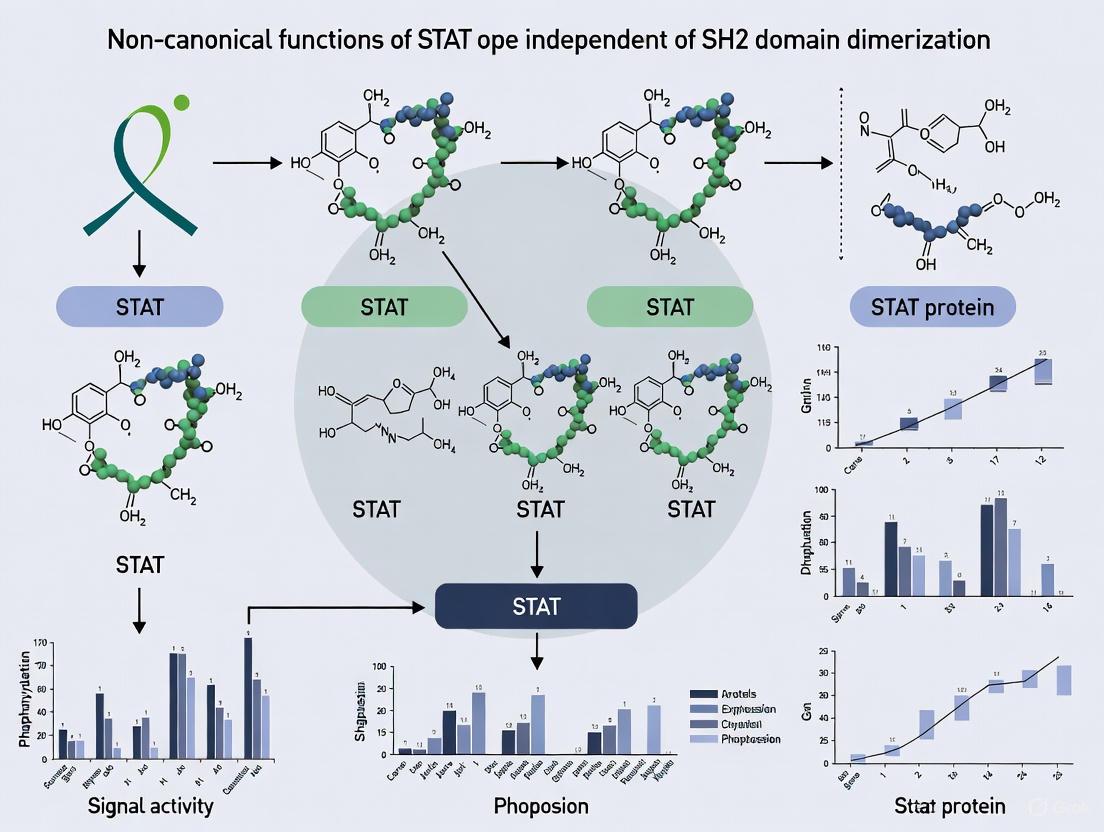
This article synthesizes current research on non-canonical STAT signaling, which operates independently of the canonical SH2 domain-mediated phosphotyrosine dimerization.
Beyond Dimerization: Exploring Non-Canonical STAT Functions Independent of the SH2 Domain
Abstract
This article synthesizes current research on non-canonical STAT signaling, which operates independently of the canonical SH2 domain-mediated phosphotyrosine dimerization. We explore the mechanisms of unphosphorylated STATs (U-STATs) as transcription factors and chromatin organizers, their activation by alternative kinases like EGFR, and their roles in apoptosis, heterochromatin regulation, and mitochondrial function. Tailored for researchers and drug development professionals, this review covers foundational concepts, cutting-edge methodologies for real-time detection, challenges in pathway dissection, and comparative analyses with canonical signaling. The content highlights emerging therapeutic opportunities for targeting non-canonical STAT pathways in cancer, autoimmune diseases, and renal pathologies.
Unlocking the Latent Potential: Mechanisms of Non-Canonical STAT Activation and Function
Unphosphorylated STATs (U-STATs) as Key Transcriptional and Genomic Regulators
Signal Transducer and Activator of Transcription (STAT) proteins are traditionally viewed through the lens of their canonical, phosphorylation-dependent activation pathway. However, emerging research has revealed that unphosphorylated STATs (U-STATs) perform equally vital functions as transcriptional and genomic regulators through mechanisms distinct from SH2 domain-mediated dimerization. This whitepaper synthesizes current understanding of U-STAT biology, detailing their non-canonical functions in gene regulation, heterochromatin stabilization, and metabolic programming. We provide a comprehensive framework for investigating U-STAT-specific phenomena, including experimental protocols, reagent solutions, and visualization tools to accelerate research and drug discovery targeting this under-explored aspect of STAT signaling.
The canonical JAK-STAT signaling pathway has been extensively characterized since its discovery in the 1990s [1]. In this established paradigm, STAT proteins reside latently in the cytoplasm until extracellular stimuli trigger their tyrosine phosphorylation, typically via Janus kinases (JAKs). This phosphorylation induces STAT dimerization through reciprocal SH2 domain-phosphotyrosine interactions, leading to nuclear translocation and DNA binding to specific promoter elements [1] [2]. While this pathway accurately describes rapid, inducible gene regulation, it represents only one facet of STAT biology.
Growing evidence challenges this phosphorylation-centric view, demonstrating that unphosphorylated STATs (U-STATs) possess distinct functional capabilities independent of tyrosine phosphorylation [1] [3]. These non-canonical functions include both transcriptional activation and repression, heterochromatin stabilization, and roles as chromatin organizers [4] [5]. The significance of U-STATs extends to disease contexts, particularly cancer, where U-STAT3 drives specific gene expression programs supporting tumor progression [6] [5]. This whitepaper frames U-STAT functions within the broader thesis of non-canonical STAT activities that operate independently of traditional SH2 domain dimerization mechanisms, providing researchers with methodological and conceptual tools to investigate this expanding field.
Molecular Mechanisms of U-STAT Function
Nuclear Translocation and DNA Binding Mechanisms
Unlike their phosphorylated counterparts, U-STATs employ distinct pathways for nuclear entry and DNA binding. While phosphorylated STATs (pSTATs) dimerize via SH2 domain interactions before nuclear translocation, U-STATs can enter the nucleus as monomers or dimers through alternative mechanisms:
- STAT1: Direct interaction with nucleoporins facilitates nuclear import [1]
- STAT3: Importin-mediated translocation [1] [5]
- Constant nucleocytoplasmic shuttling: U-STATs continuously traffic between compartments regardless of activation status [2]
Once in the nucleus, U-STATs recognize diverse DNA targets through mechanisms that differ from canonical pSTAT binding:
Table 1: DNA Binding Properties of U-STATs
| STAT Isoform | Binding Sequence | Binding Form | Functional Outcome |
|---|---|---|---|
| U-STAT1 | GAS elements | Antiparallel dimers [7] | Sustained expression of IFN-stimulated genes (OAS, IFI27, BST2) [7] |
| U-STAT3 | GAS elements [5], AT-rich sequences [1], DNA nodes and 4-way junctions [5] | Dimers and monomers [5] | Gene silencing via heterochromatin formation [1] |
| U-STAT5 | Not well characterized | Not characterized | Transcriptional repression during embryonic erythropoiesis [1] |
| U-STAT6 | Non-consensus sites | Not characterized | Constitutive COX-2 expression in NSCLC [3] |
Notably, U-STAT3 DNA binding requires a disulfide bridge between Cys367 and Cys542, which induces structural changes enabling DNA interaction even without tyrosine phosphorylation [5]. This mechanism exemplifies how U-STATs employ fundamentally different biochemical strategies than canonical STAT signaling.
Transcriptional Regulation by U-STATs
U-STATs regulate transcription through diverse mechanisms that extend beyond traditional activation:
- Gene activation: U-STAT1 and U-STAT3 can activate transcription by binding to GAS elements and recruiting co-activators [3] [5]
- Gene repression: U-STAT3 preferentially binds AT-rich sequences and specific DNA structures, facilitating heterochromatin formation and gene silencing [1]
- Chromatin organization: U-STAT3 recognition of DNA nodes and 4-way junctions suggests a role in higher-order chromatin architecture [5]
The functional consequences of U-STAT-mediated transcription are distinct from canonical STAT signaling. While pSTATs typically drive rapid, transient gene expression, U-STATs often maintain sustained transcriptional programs, as demonstrated by U-STAT1 sustaining expression of interferon-stimulated genes like BST2 [7].
Heterochromatin Stabilization and Epigenetic Regulation
A pivotal non-canonical function of U-STATs involves heterochromatin stabilization, initially characterized in Drosophila models and conserved in mammals [4]. This mechanism involves:
- HP1a recruitment: U-STATs facilitate heterochromatin protein 1a binding to specific genomic loci
- H3K9me3 enrichment: U-STAT-mediated recruitment of Su(var)3-9 methyltransferase promotes H3K9 trimethylation [4]
- Gene silencing: Heterochromatin formation leads to stable repression of target genes
- Genome stability: Heterochromatin maintenance protects against genomic instability [4]
This function has particular significance in cancer biology, where U-STAT-mediated heterochromatin stabilization suppresses tumor growth, while loss of this function promotes malignant transformation [4].
Experimental Approaches for Studying U-STATs
Methodological Framework
Investigating U-STAT-specific functions requires careful experimental design to distinguish non-canonical from canonical STAT activities:
Table 2: Key Experimental Approaches for U-STAT Research
| Methodology | Application | Key Considerations |
|---|---|---|
| Tyrosine phosphorylation site mutants (e.g., STAT1-Y701F, STAT3-Y705F) | Disrupt canonical activation while preserving U-STAT functions [5] | Confirm phosphorylation deficiency via phospho-specific antibodies |
| Nuclear-cytoplasmic fractionation | Determine subcellular localization of U-STATs | Assess both phosphorylated and unphosphorylated pools |
| Chromatin immunoprecipitation (ChIP) | Identify direct U-STAT binding sites | Use crosslinking conditions suitable for non-canonical DNA interactions |
| Atomic force microscopy | Visualize U-STAT-DNA complexes | Reveals dimeric and monomeric binding modes [5] |
| Molecular dynamics simulations | Model U-STAT dimer interfaces and DNA interactions | Identifies critical residues for targeting [8] |
Detailed Protocol: Assessing U-STAT DNA Binding
Objective: Characterize U-STAT binding to non-canonical DNA sequences using electrophoretic mobility shift assay (EMSA)
Procedure:
- Protein purification: Express and purify STAT proteins (wild-type and phosphorylation site mutants) from mammalian cells or using bacterial expression systems
- Probe preparation:
- Label double-stranded DNA probes containing GAS elements, AT-rich sequences, or cruciform structures with ³²P or fluorescent tags
- Include mutant probes as specificity controls
- Binding reaction:
- Incubate 0.1-1 μg purified STAT protein with labeled DNA probe (10,000 cpm) in binding buffer (10 mM HEPES pH 7.9, 50 mM KCl, 1 mM DTT, 2.5 mM MgCl₂, 0.05% NP-40, 10% glycerol, 0.1 mg/mL BSA, 0.1 mg/mL poly(dI-dC))
- For supershift assays, include 1-2 μg STAT-specific antibody
- Include reactions with 100-fold excess unlabeled probe for competition controls
- Electrophoresis:
- Resolve protein-DNA complexes on 4-6% non-denaturing polyacrylamide gels in 0.5× TBE buffer at 100V for 2-3 hours
- Analysis:
- Visualize complexes by autoradiography (radioactive) or fluorescence scanning
- Compare binding patterns between phosphorylated and unphosphorylated STATs
Troubleshooting notes:
- For U-STAT3, include DTT in binding reactions to test disulfide bridge dependence [5]
- Low ionic strength buffers (25-50 mM NaCl) may better preserve non-canonical STAT-DNA interactions
- Include serine phosphorylation mutants (e.g., STAT1-S727A) when investigating serine phosphorylation-independent functions
Research Reagent Solutions
Table 3: Essential Reagents for U-STAT Research
| Reagent Category | Specific Examples | Research Application | Functional Role |
|---|---|---|---|
| Phosphorylation-deficient mutants | STAT1-Y701F, STAT3-Y705F, STAT5-Y694F | Discerning phosphorylation-dependent vs. independent functions [5] | Disrupts canonical activation while preserving U-STAT functions |
| STAT-specific antibodies | Phospho-specific STAT antibodies, pan-STAT antibodies, isoform-specific antibodies | Western blot, immunofluorescence, ChIP experiments | Distinguishes phosphorylation status and subcellular localization |
| Chemical inhibitors | JAK inhibitors (ruxolitinib), STAT SH2 domain inhibitors | Dissecting canonical vs. non-canonical pathways | Inhibits tyrosine phosphorylation and canonical dimerization |
| Recombinant proteins | Purified U-STAT proteins, truncated isoforms (e.g., 67.5 kDa U-STAT3) | In vitro DNA binding, structural studies [5] | Direct assessment of DNA-binding capabilities |
| Cell line models | STAT-knockout cells, CRISPR-edited lines, Drosophila STAT mutant models [4] | Functional studies of specific STAT isoforms | Provides null background for reconstitution studies |
Biological Significance and Pathological Relevance
Distinct Genomic Targets and Cellular Processes
Genome-wide studies reveal that U-STATs regulate distinct transcriptional programs compared to their phosphorylated counterparts. Research in Drosophila demonstrates that canonical and non-canonical STAT signaling pathways regulate overlapping but distinct sets of target genes [4]:
- Canonical targets: Enriched for development and immunity genes
- Non-canonical targets: Associated with heterochromatin-related factors and enriched for metabolic and stress response genes [4]
This divergence suggests that U-STATs have evolved specialized functions in maintaining cellular homeostasis through regulation of basal metabolic and stress adaptation pathways.
U-STATs in Disease Pathogenesis
The pathological significance of U-STATs is particularly evident in cancer and inflammatory diseases:
- STAT3: U-STAT3 accumulates in response to strong STAT3 gene activation by pSTAT3, creating a positive feedback loop that drives cancer progression [5]
- STAT1: U-STAT1 sustains expression of antiviral genes like BST2, contributing to prolonged immune responses [7]
- STAT5: Unphosphorylated STAT5 mediates transcriptional repression during embryonic erythropoiesis, with dysregulation contributing to blood disorders [1]
Therapeutic targeting of U-STAT-specific functions presents novel opportunities for intervention in these diseases, particularly for malignancies driven by sustained STAT signaling.
Visualization of U-STAT Signaling and Experimental Framework
U-STAT Signaling Pathways and Functional Relationships
Experimental Workflow for U-STAT Functional Analysis
Unphosphorylated STATs represent a functionally diverse class of transcriptional regulators that operate through mechanisms distinct from canonical phosphorylation-dependent signaling. Their roles in sustaining transcriptional programs, stabilizing heterochromatin, and regulating metabolic pathways highlight the expanding complexity of STAT biology beyond traditional JAK-STAT paradigms. Future research should focus on delineating the structural basis of U-STAT DNA binding, identifying disease-specific U-STAT gene signatures, and developing therapeutic agents that selectively target non-canonical STAT functions. The experimental frameworks and reagent solutions provided herein offer a foundation for advancing these investigations, potentially unlocking new therapeutic strategies for cancer, inflammatory diseases, and other conditions driven by aberrant STAT signaling.
Non-Canonical Activation by EGFR and Other Alternative Kinases
Epidermal Growth Factor Receptor (EGFR) and other kinase signaling pathways have traditionally been characterized by canonical activation mechanisms involving tyrosine phosphorylation and SH2 domain-mediated dimerization. However, emerging research has revealed extensive non-canonical signaling modalities that operate independently of these classical mechanisms. This technical review comprehensively examines non-canonical EGFR activation pathways and their intersection with STAT signaling, focusing specifically on mechanisms that bypass traditional SH2 domain dimerization. We detail experimental approaches for investigating these pathways, present quantitative comparisons of canonical versus non-canonical signaling features, and provide visualization tools and research resources to facilitate continued exploration of this biologically and therapeutically significant area.
The traditional understanding of EGFR and related kinase signaling has centered on canonical activation mechanisms wherein ligand binding induces receptor dimerization, tyrosine transphosphorylation, and recruitment of downstream effectors including STAT transcription factors via SH2 domain-phosphotyrosine interactions [2] [9]. However, accumulating evidence reveals that these canonical pathways represent only a portion of the signaling landscape.
Non-canonical signaling encompasses diverse mechanisms that operate independently of traditional tyrosine phosphorylation-dependent dimerization, enabling nuanced cellular responses and contributing to pathological processes including drug resistance [2] [10] [11]. These alternative activation routes include:
- Kinase-independent scaffolding functions
- Unphosphorylated transcription factor activity
- Nuclear receptor trafficking
- Alternative kinase utilization
- Phosphorylation-independent protein interactions
Understanding these non-canonical pathways is particularly crucial for addressing therapeutic resistance in oncology and developing next-generation targeted therapies that overcome bypass signaling mechanisms [12] [13].
Non-Canonical EGFR Signaling Pathways
Nuclear EGFR Functions
EGFR transcends its traditional membrane receptor role through non-canonical nuclear localization, where it functions as a transcriptional regulator, protein kinase, and interaction partner independent of classical phosphorylation events [10].
Transcriptional Regulation: Nuclear EGFR acts as a co-activator for genes including cyclin D1, iNOS, Aurora-A, COX-2, c-Myc, B-Myb, thymidylate synthase, breast cancer-resistant protein (BCRP), and STAT1 [10]. Unlike canonical signaling, this occurs through interaction with DNA-binding partners like RNA helicase A (RHA) rather than SH2 domain-mediated dimerization [10] [9].
Protein Kinase Activity: Nuclear EGFR phosphorylates non-traditional substrates including chromatin-bound proliferating cell nuclear antigen (PCNA), enhancing stability for DNA replication and repair [10]. It also phosphorylates histone H4 at tyrosine 72, recruiting histone methyltransferases that enhance H4K20 methylation, critically regulating DNA synthesis and repair [10].
Protein-Protein Interactions: Nuclear EGFR interacts with DNA-dependent protein kinase (DNA-PK) following DNA damage, promoting non-homologous end joining repair and conferring resistance to radiotherapy [10]. These interactions occur independently of traditional EGFR signaling complexes.
Table 1: Nuclear EGFR Functions and Mechanisms
| Function | Mechanism | Biological Outcome | Experimental Evidence |
|---|---|---|---|
| Transcriptional Co-activation | Binds DNA with partners (RHA, STAT3); possesses intrinsic transactivation domain | Regulates cyclin D1, COX-2, c-Myc expression; promotes tumorigenesis | Chromatin immunoprecipitation; promoter reporter assays [10] |
| Chromatin Modification | Phosphorylates histone H4 at Y72; recruits methyltransferases | Enhances H4K20 methylation; regulates DNA repair | Mass spectrometry; histone modification-specific antibodies [10] |
| DNA Repair Mediation | Interacts with DNA-PK at double-strand breaks | Promotes non-homologous end joining; radio-resistance | Co-immunoprecipitation; DNA repair assays [10] |
Non-Canonical Endocytic Trafficking
Beyond nuclear translocation, EGFR undergoes non-canonical endocytosis distinct from traditional ligand-induced internalization. Cellular stressors including TNF-α, cisplatin, and anisomycin induce p38-mediated phosphorylation of EGFR at serine/threonine residues (particularly Ser-1015), triggering clathrin-mediated endocytosis independently of receptor tyrosine kinase activity [14].
This pathway enables:
- Antibody-Drug Conjugate Internalization: Cetuximab-EGFR complexes internalize efficiently via this pathway, enabling enhanced ADC delivery [14]
- Ligand-Independent Activation: Internalization occurs without EGF stimulation, bypassing canonical activation requirements
- Therapeutic Applications: Synchronous non-canonical endocytosis enhances efficacy of EGFR-targeting antibody-drug conjugates [14]
Experimental Analysis of Non-Canonical EGFR Endocytosis
Objective: To characterize cellular stress-induced non-canonical internalization of EGFR-antibody complexes and establish its mechanism.
Methodology:
- Cell Preparation and Treatment: Use human cancer cell lines (HeLa, A549, DLD1, U87MG). Pre-treat with cetuximab (10 μg/mL, 30 min) followed by TNF-α (50 ng/mL, 15 min) or other stressors (anisomycin: 100 nM; H₂O₂: 1 mM) [14]
- Inhibitor Application: Apply specific inhibitors: SB203580 (p38 inhibitor, 10 μM) or gefitinib (EGFR-TKI, 1 μM) 1 hour prior to stress induction [14]
- Immunofluorescence Staining:
- Non-permeabilized (0% Triton X-100) conditions detect surface EGFR/cetuximab
- Permeabilized (0.5% Triton X-100) conditions detect internalized pools [14]
- Co-stain for pS-EGFR (Ser-1015) to confirm phosphorylation
- Quantitative Analysis: Calculate internalization efficiency as ratio of intracellular to total signal; statistical analysis via Student's t-test (n≥3) [14]
Key Findings:
- TNF-α induces rapid (15 min) internalization of cetuximab-EGFR complex
- Internalization requires p38-mediated EGFR phosphorylation at Ser-1015
- Process is gefitinib-insensitive, confirming kinase-independence
- Internalized complexes traffic to perinuclear endosomes, not lysosomes [14]
Non-Canonical STAT Activation Beyond SH2 Domain Dimerization
Unphosphorylated STAT Signaling
Unphosphorylated STATs (U-STATs) perform diverse functions independently of tyrosine phosphorylation and traditional SH2 domain dimerization, constituting a major non-canonical signaling mechanism [2] [9].
Nuclear Shuttling: U-STATs constantly shuttle between cytoplasm and nucleus via distinct mechanisms: uSTAT3 utilizes importins, while uSTAT1 directly interacts with nucleoporins [9]. This occurs without tyrosine phosphorylation requirements.
Transcriptional Regulation: Nuclear U-STATs regulate gene expression through binding sites that overlap with or differ from phosphorylated STATs. uSTAT3 preferentially binds AT-rich sequences and specific DNA structures, promoting heterochromatin formation and gene silencing [9].
Mitochondrial Localization: STAT3 localizes to mitochondria (mitoSTAT3) where it supports Ras-dependent oncogenic transformation by optimizing electron transport chain function and cellular metabolism, independent of transcription [2].
Non-Canonical STAT Activation by EGFR
EGFR activates STAT through alternative mechanisms that bypass JAK kinases and traditional phosphorylation pathways [11].
Direct EGFR:STAT Interaction: In Drosophila models, EGFR directly activates STAT, promoting apoptosis independently of JAK kinases [11]. This pathway competes with HP1:STAT binding for heterochromatin formation.
E-cadherin Regulation: E-cadherin endocytosis promotes EGFR:STAT signaling, with elevated intracellular E-cadherin shifting balance toward apoptotic EGFR:STAT pathway activation [11].
Therapeutic Implications: This represents a tumor-suppressive mechanism where junctional disassembly during epithelial-to-mesenchymal transition promotes apoptosis through EGFR:STAT signaling [11].
Experimental Analysis of Unphosphorylated STAT Functions
Objective: To characterize nuclear functions of unphosphorylated STAT3 in gene regulation.
Methodology:
- Cell Models: Use STAT3-deficient cell lines reconstituted with phosphorylation-deficient STAT3 mutants (Y705F) [9]
- Nuclear-Cytoplasmic Fractionation: Separate cellular compartments using differential centrifugation with detergent-based buffers; validate purity with compartment-specific markers [9]
- Chromatin Immunoprecipitation (ChIP):
- Crosslink proteins to DNA with formaldehyde
- Immunoprecipitate with uSTAT3-specific antibodies (avoiding phospho-specific antibodies)
- Sequence bound DNA (ChIP-Seq) to identify uSTAT3-specific binding sites [9]
- Gene Expression Analysis: Perform RNA-Seq or RT-qPCR to identify uSTAT3-regulated genes; compare with pSTAT3-regulated transcriptomes [9]
Key Findings:
- uSTAT3 binds distinct genomic sites compared to pSTAT3, with preference for AT-rich sequences
- uSTAT3 promotes heterochromatin formation and gene silencing
- uSTAT3 and pSTAT3 regulate overlapping but distinct gene sets [9]
Table 2: Non-Canonical STAT Functions and Identification Methods
| STAT Isoform | Non-Canonical Function | Identification Method | Key Regulatory Features |
|---|---|---|---|
| U-STAT1 | Transcriptional regulation; constant nucleocytoplasmic shuttling | Immunofluorescence with phosphorylation-deficient mutants; nucleoporin binding assays | Direct interaction with nucleoporins; independent of tyrosine phosphorylation [9] |
| U-STAT3 | Mitochondrial modulation; heterochromatin regulation | Cellular fractionation + Western blotting; ChIP-seq with AT-rich sequence analysis | Binds AT-rich DNA sequences; promotes heterochromatin formation [2] [9] |
| EGFR-activated STAT | Apoptosis induction; competition with HP1 binding | Drosophila genetic models; co-immunoprecipitation with EGFR | Direct activation by EGFR independent of JAK kinases; competes with HP1:STAT pathway [11] |
Alternative Kinase Networks in Therapeutic Resistance
Bypass Signaling Pathways
Oncogenic kinase inhibitor resistance frequently develops through activation of alternative kinase networks that bypass targeted inhibition, representing a clinically significant non-canonical signaling adaptation [12] [13].
MET Amplification: MET amplification activates ERBB3 and downstream PI3K/Akt signaling, compensating for EGFR inhibition in lung cancer cells. Approximately 22% of gefitinib/erlotinib-resistant lung cancer patients exhibit MET amplification [12].
HGF Overexpression: Hepatocyte growth factor overexpression induces MET activation and downstream PI3K/Akt signaling in an ERBB3-independent manner, conferring both acquired and intrinsic resistance to EGFR-TKIs [12].
Alternative Pathway Activation: mTOR and Wnt signaling pathways show 2-8 fold upregulation in EGFR-TKI resistant cells, providing compensatory survival signals [13].
Experimental Analysis of Bypass Signaling Networks
Objective: To identify alternative kinase networks activated in response to targeted kinase inhibition.
Methodology:
- Resistance Model Development: Establish TKI-resistant cell lines through step-wise increases in SU11274 (c-Met inhibitor) and erlotinib (EGFR inhibitor) exposure over 6-9 months [13]
- Phosphoproteomic Profiling:
- Network Analysis: Identify significantly altered signaling networks using bioinformatics tools (GeneGO MetaCore, Ingenuity Pathway Analysis)
- Functional Validation: Test combination therapies targeting primary and bypass kinases (e.g., everolimus + erlotinib + SU11274) [13]
Key Findings:
- Resistant cells exhibit 4-22 fold increased IC50 values for TKIs
- Extensive RTK signaling networks are established in resistant cells
- mTOR and Wnt pathway inhibition restores TKI sensitivity in resistant models [13]
Visualization of Non-Canonical Signaling Pathways
The Scientist's Toolkit: Essential Research Reagents
Table 3: Key Research Reagents for Studying Non-Canonical Signaling
| Reagent/Category | Specific Examples | Function/Application | Key Considerations |
|---|---|---|---|
| Cell Models | EGFR-KO HeLa (reconstituted); STAT-deficient lines; TKI-resistant NSCLC lines (HCC827, H2170) | Study specific pathway components; model therapeutic resistance | Verify genetic background; authenticate regularly [15] [14] |
| Inhibitors | SB203580 (p38 inhibitor); Gefitinib/Erlotinib (EGFR-TKIs); SU11274 (c-Met inhibitor) | Dissect pathway dependencies; validate mechanisms | Test multiple concentrations; assess off-target effects [14] [13] |
| Antibodies | Phospho-EGFR (Ser1015); Total STAT (non-phospho specific); Cetuximab/Panitumumab (EGFR mAbs) | Detect non-canonical phosphorylation; track receptor internalization | Validate specificity; optimize for applications (IF, WB, IP) [10] [14] |
| Methodologies | Cellular fractionation; Phosphoproteomics (SILAC); ChIP-seq; Immunofluorescence (non-permeabilized) | Localize signaling components; identify novel modifications | Include proper controls; optimize fixation/permeabilization [15] [9] [14] |
Non-canonical activation of EGFR and alternative kinases represents a fundamental shift in our understanding of cellular signaling, revealing complex networks that operate beyond traditional SH2 domain dimerization paradigms. These pathways enable nuanced cellular responses, contribute to pathological processes including therapeutic resistance, and offer promising targets for next-generation interventions. The experimental frameworks, visualization tools, and research resources provided herein offer comprehensive guidance for continued investigation of this biologically and therapeutically significant signaling landscape. Future research should focus on elucidating the structural basis of non-canonical interactions, developing specific inhibitors targeting these alternative pathways, and translating these findings into improved therapeutic strategies that overcome resistance mechanisms in cancer and other diseases.
The Signal Transducer and Activator of Transcription (STAT) protein family represents evolutionarily conserved transcription factors initially identified for their canonical role as inducible transcriptional activators in cytokine signaling pathways [1]. In this established paradigm, latent cytoplasmic STAT proteins become activated through tyrosine phosphorylation, typically via Janus kinases (JAKs), facilitating their dimerization via reciprocal SH2 domain-phosphotyrosine interactions and subsequent nuclear translocation to regulate target gene expression [1]. However, emerging evidence has fundamentally challenged this conventional understanding, revealing a diverse functional repertoire that extends beyond this canonical signaling modality. This whitepaper examines the novel cellular roles of STAT proteins in mitochondrial dynamics and heterochromatin stabilization, framing these functions within the broader context of non-canonical STAT activities that operate independently of traditional SH2 domain-mediated dimerization. These alternative functional modalities represent a significant expansion of STAT biology with profound implications for cellular physiology, disease pathogenesis, and therapeutic development [1].
Table 1: STAT Protein Family Members and Primary Functions
| STAT Protein | Major Canonical Functions | Emerging Non-Canonical Roles |
|---|---|---|
| STAT1 | Immunity against viral and bacterial infection | Transcriptional repression, non-nuclear functions |
| STAT2 | Immunity against viral and bacterial infection | Type I interferon response complex formation |
| STAT3 | Regulation of innate immunity and inflammation, stem cell maintenance, cell metabolism | Mitochondrial function, heterochromatin stabilization, unphosphorylated transcriptional regulation |
| STAT4 | Development and function of adaptive and innate immune cells | Unphosphorylated nuclear functions |
| STAT5A/B | Development of multiple blood and immune cell lineages | Embryonic erythropoiesis regulation, transcriptional repression |
| STAT6 | Regulation of innate and humoral immunity | Alternative activation pathways |
Non-Canonical STAT Functions: A Conceptual Framework
The traditional model of STAT activation has been progressively supplemented by the identification of diverse "non-canonical" functions that operate through mechanisms distinct from tyrosine phosphorylation-dependent SH2 domain dimerization [1]. These alternative modalities encompass both transcriptional activation and repression activities mediated by unphosphorylated STATs (uSTATs), along with functions executed outside the nucleus. The non-canonical STAT functions can be categorized into several distinct mechanistic classes:
Unphosphorylated STAT (uSTAT) Functions
Unphosphorylated STAT molecules, once considered inactive, are now recognized as functionally significant regulators that can translocate to the nucleus and influence gene expression through mechanisms distinct from their phosphorylated counterparts [1]. Unlike canonical pSTAT dimers that typically bind gamma-activated sequence (GAS) elements, uSTATs can recognize alternative DNA sequences and chromatin contexts. For instance, uSTAT3 has been demonstrated to preferentially bind AT-rich DNA sequences and specific DNA structures, facilitating heterochromatin formation and gene silencing [1]. The nuclear import mechanisms for uSTATs also differ from canonical STATs, with uSTAT3 utilizing importins while uSTAT1 can directly interact with nucleoporins [1].
Transcriptional Repression Capabilities
Beyond their established role as transcriptional activators, STAT proteins can also function as repressors of gene expression. This repressive function has been documented for STAT5 during embryonic erythropoiesis, where it contributes to appropriate developmental gene regulation [1]. The molecular mechanisms underlying STAT-mediated repression involve recruitment of co-repressor complexes and chromatin-modifying enzymes that establish transcriptionally silent chromatin states.
Non-Nuclear and Metabolic Functions
Recent studies have identified STAT functions executed outside the nuclear compartment, including roles in mitochondrial regulation and cellular metabolism. These non-nuclear activities represent a significant departure from the traditional view of STATs as dedicated transcription factors and expand their potential impact on cellular physiology.
Figure 1: Canonical versus Non-Canonical STAT Signaling Pathways
STAT Proteins in Mitochondrial Dynamics
Mitochondrial Structure and Function Fundamentals
Mitochondria are essential organelles that function as cellular powerhouses, regulating energy production, metabolic intermediates, and various signaling pathways [16]. Their structural organization features an outer mitochondrial membrane (OMM) and inner mitochondrial membrane (IMM), which delineates the intermembrane space (IMS) and matrix compartments [16]. The electron transport chain (ETC), comprising complexes I-IV, is embedded in the IMM and facilitates ATP production through oxidative phosphorylation. Mitochondria also contain their own circular DNA (mtDNA) encoding essential ETC components, organized into nucleoids and regulated by specific transcription machinery including TFAM, POLRMT, and TEFM [16].
STAT-Mediated Mitochondrial Regulation
STAT proteins, particularly STAT3, have been implicated in direct regulation of mitochondrial function through mechanisms independent of their canonical transcriptional activities. STAT3 can localize to mitochondria and influence ETC activity, ATP production, and reactive oxygen species (ROS) homeostasis [16]. These non-canonical mitochondrial functions involve specific serine phosphorylation events rather than tyrosine phosphorylation, and occur independently of SH2 domain-mediated dimerization. The integration of STAT signaling with mitochondrial regulation represents a crucial mechanism for coordinating cellular metabolic states with transcriptional responses, particularly in contexts of stress, immune activation, and malignant transformation.
Table 2: Mitochondrial Functions Regulated by STAT Proteins
| Mitochondrial Component | STAT-Dependent Regulation | Functional Consequences |
|---|---|---|
| Electron Transport Chain (ETC) | STAT3 enhances complex I and II activity | Increased ATP production, modulation of ROS generation |
| Mitochondrial DNA (mtDNA) | STAT3 associates with mitochondrial nucleoids | Regulation of mtDNA transcription and replication |
| Mitochondrial Membranes | STAT3 integration into IMM affects membrane potential | Impact on proton gradient and energy transduction |
| Metabolic Enzymes | STAT3 influences TCA cycle flux | Altered metabolite production (acetyl-CoA, α-KG) |
| ROS Signaling | STAT3 modulates antioxidant defense systems | Redox homeostasis and signaling pathway regulation |
STAT Proteins in Heterochromatin Stabilization
Chromatin Organization Fundamentals
Chromatin exists in dynamically regulated states ranging from transcriptionally permissive euchromatin to transcriptionally repressive heterochromatin. Heterochromatin stabilization represents a crucial mechanism for maintaining genomic integrity, regulating gene expression, and controlling cellular identity. The structural organization of chromatin involves nucleosome positioning, histone modifications, and higher-order folding patterns that influence accessibility of DNA to transcriptional machinery [17].
STAT-Mediated Heterochromatin Regulation
Unphosphorylated STAT3 (uSTAT3) has been demonstrated to play a significant role in heterochromatin stabilization through its ability to bind AT-rich DNA sequences and specific DNA structures [1]. This uSTAT3-mediated heterochromatin formation represents a non-canonical function that operates independently of tyrosine phosphorylation and SH2 domain dimerization. The mechanistic basis involves uSTAT3 recruitment to specific genomic loci where it facilitates the establishment of repressive chromatin modifications and promotes chromatin condensation. This function is particularly important for maintaining appropriate gene silencing during cellular differentiation and in response to environmental stimuli.
Figure 2: uSTAT3-Mediated Heterochromatin Stabilization Pathway
Experimental Methodologies for Studying Non-Canonical STAT Functions
Approaches for Analyzing Mitochondrial STAT Functions
Investigating STAT roles in mitochondrial dynamics requires specialized methodologies that distinguish mitochondrial-specific functions from canonical nuclear activities. Key experimental approaches include:
Mitochondrial Isolation and Subcellular Fractionation: Differential centrifugation techniques enable separation of mitochondrial fractions from other cellular compartments. Mitochondria are typically isolated through low-speed centrifugation to remove nuclei and debris, followed by high-speed centrifugation to pellet mitochondria. Purity is assessed through immunoblotting for compartment-specific markers (e.g., TOM20 for mitochondria, Lamin A/C for nuclei, GAPDH for cytoplasm) [16].
Mitochondrial STAT Localization Studies: Immunoelectron microscopy and proximity ligation assays can visualize STAT proteins within mitochondrial compartments. Additionally, mitochondrial import assays using purified components assess STAT integration into mitochondrial membranes [16].
Functional Mitochondrial Assays: High-resolution respirometry (e.g., Oroboros O2k) measures oxygen consumption rates in response to specific substrates and inhibitors. ATP production assays using luciferase-based systems quantify functional output. Mitochondrial membrane potential is assessed using potentiometric dyes like JC-1 or TMRM [16].
Approaches for Analyzing STAT Roles in Chromatin Regulation
Studying STAT-mediated heterochromatin stabilization requires techniques that assess chromatin structure and accessibility:
Chromatin Immunoprecipitation (ChIP) Sequencing: Crosslinked ChIP protocols using antibodies specific to uSTATs or phosphorylation-deficient STAT mutants can identify genomic binding sites independent of canonical activation. This approach has revealed uSTAT3 preference for AT-rich sequences distinct from GAS elements [1].
Assay for Transposase-Accessible Chromatin (ATAC-seq): This method maps chromatin accessibility changes following STAT manipulation, identifying regions where STATs influence chromatin compaction.
Hi-C and Chromatin Conformation Capture: These techniques assess higher-order chromatin structure and can detect changes in chromatin compartmentalization and looping interactions mediated by STAT proteins [17].
Table 3: Key Experimental Protocols for Non-Canonical STAT Analysis
| Methodology | Key Steps | Applications in STAT Research |
|---|---|---|
| Subcellular Fractionation | 1. Cell homogenization2. Differential centrifugation3. Marker validation | Mitochondrial STAT localization, compartment-specific STAT functions |
| Proximity Ligation Assay (PLA) | 1. Antibody incubation2. Connector oligo hybridization3. Ligation and amplification4. Detection | Visualizing STAT-mitochondrial protein interactions, validating subcellular localization |
| Chromatin Immunoprecipitation (ChIP) | 1. Crosslinking2. Chromatin shearing3. Immunoprecipitation4. Library preparation and sequencing | Identifying uSTAT genomic binding sites, mapping non-canonical DNA recognition elements |
| ATAC-seq | 1. Transposase treatment2. Fragment amplification3. Sequencing library preparation4. Bioinformatic analysis | Assessing chromatin accessibility changes mediated by uSTATs |
| Cellular Respiration Assays | 1. Permeabilized cell preparation2. Substrate-uncoupler-inhibitor titration3. Oxygen consumption measurement | Evaluating STAT impacts on mitochondrial ETC function |
The Scientist's Toolkit: Research Reagent Solutions
Table 4: Essential Research Reagents for Studying Non-Canonical STAT Functions
| Reagent/Category | Specific Examples | Function and Application |
|---|---|---|
| Phosphorylation-Specific Antibodies | Anti-pY705-STAT3, Anti-pS727-STAT3, Anti-pY701-STAT1 | Distinguishing canonical vs non-canonical STAT activation; pY705 indicates canonical activation while pS727 linked to mitochondrial functions |
| Phosphorylation-Deficient Mutants | STAT3 Y705F, STAT1 Y701F | Studying functions independent of tyrosine phosphorylation and SH2 domain dimerization |
| Mitochondrial Markers | Anti-TOM20, Anti-COX IV, Anti-HSP60, MitoTracker dyes | Validating mitochondrial localization and isolation procedures |
| Chromatin Analysis Reagents | Micrococcal Nuclease, Proteinase K, TRIzol for RNA/DNA/protein simultaneous isolation | Preparing samples for chromatin studies, analyzing chromatin accessibility |
| Metabolic Assay Kits | ATP determination kits, Glucose uptake assays, Lactate production kits, Mitochondrial membrane potential dyes | Quantifying functional outcomes of STAT mitochondrial localization |
| Gene Editing Tools | CRISPR/Cas9 systems for STAT knockout, shRNA for STAT knockdown, Dominant-negative STAT constructs | Validating specificity of STAT functions through loss-of-function approaches |
| Cell Line Models | STAT-deficient cell lines, Inducible expression systems, Primary cells from conditional knockout mice | Providing relevant biological contexts for studying non-canonical STAT functions |
Implications for Drug Development and Therapeutic Targeting
The expanding understanding of non-canonical STAT functions presents new opportunities for therapeutic intervention in cancer, inflammatory diseases, and metabolic disorders. Traditional STAT-targeting strategies have primarily focused on inhibiting tyrosine phosphorylation or SH2 domain-mediated dimerization. However, the recognition of mitochondrial and chromatin regulatory functions suggests additional targeting approaches:
Metabolic Pathway Modulation: Therapeutic strategies that influence STAT mitochondrial localization or function may provide alternative approaches for targeting STAT-driven pathologies, particularly in cancers with metabolic dependencies.
Epigenetic Therapeutic Combinations: Understanding STAT roles in chromatin regulation suggests potential synergies between STAT inhibitors and epigenetic therapies targeting chromatin-modifying enzymes.
Context-Specific Therapeutic Design: The differential expression and function of STAT isoforms in various tissues and disease states enables development of context-specific therapeutic strategies with potentially reduced off-target effects.
The continued elucidation of non-canonical STAT functions will undoubtedly reveal additional therapeutic opportunities and refine existing targeting approaches in the coming years.
The Critical Role of Cellular Compartmentalization and Endocytosis
The traditional view of signal transduction as a linear cascade of molecular events from the cell surface to the nucleus has been fundamentally revised by contemporary research. We now understand that cellular compartmentalization and endocytic trafficking serve as critical regulatory mechanisms that spatially and temporally control signaling specificity, intensity, and duration. This paradigm is particularly relevant for the JAK-STAT pathway, where emerging evidence reveals that non-canonical STAT functions operate independently of classical SH2 domain-mediated dimerization and nuclear translocation. The spatial organization of signaling components through endocytosis and the formation of specialized membrane microdomains enables sophisticated signal processing that determines cellular fate. This whitepaper examines how compartmentalization mechanisms regulate STAT signaling, with particular emphasis on non-canonical pathway functions that extend beyond traditional transcriptional roles. Understanding these spatial regulations provides novel insights for therapeutic interventions in autoimmune diseases, cancer, and inflammatory disorders where STAT signaling is dysregulated.
Canonical JAK-STAT Signaling and Compartmentalization
Fundamental Pathway Architecture
The canonical JAK-STAT pathway represents a relatively direct signaling route from cytokine receptors to gene transcription. When type I or type II cytokines bind to their cognate receptors, receptor dimerization brings associated Janus kinases (JAKs) into proximity, leading to their trans-phosphorylation and activation [18] [19]. Activated JAKs then phosphorylate tyrosine residues on cytokine receptors, creating docking sites for STAT proteins via their SH2 domains. Once recruited, STATs undergo JAK-mediated phosphorylation on conserved tyrosine residues, prompting their dissociation from receptors, dimerization, and nuclear translocation to regulate target gene expression [19].
The JAK family comprises four members (JAK1, JAK2, JAK3, TYK2) with varying expression patterns, while seven STAT proteins (STAT1, STAT2, STAT3, STAT4, STAT5A, STAT5B, STAT6) mediate downstream signaling with varying specificity [18] [19]. This pathway is tightly regulated by multiple negative regulators, including protein tyrosine phosphatases, suppressors of cytokine signaling (SOCS), and protein inhibitors of activated STATs (PIAS) [19].
Endocytic Control of Signaling Specificity
Despite signaling through common JAK-STAT components, different cytokines elicit distinct biological responses. This specificity is maintained through sophisticated compartmentalization mechanisms that begin at the plasma membrane. Research reveals that clathrin-dependent endocytosis is required for IFN-α-induced Stat1 and Stat2 signaling but dispensable for IFN-γ signaling [20]. This differential requirement stems from distinct receptor localization: activated IFN-γ receptors rapidly enrich in plasma membrane lipid microdomains, whereas IFN-α receptors do not [20].
Table 1: Endocytic Requirements for Different Cytokine Receptors
| Cytokine Receptor | Endocytic Mechanism | Membrane Microdomain | Signaling Dependence on Endocytosis |
|---|---|---|---|
| IFN-α Receptor | Clathrin-dependent | Non-lipid raft | Required for Stat1/Stat2 signaling |
| IFN-γ Receptor | Clathrin-dependent | Lipid raft | Not required for Stat1 signaling |
| IL-6 Family (Dome) | Clathrin-dependent | Not specified | Required for JAK-STAT activity |
This compartmentalization extends throughout the endocytic pathway, as demonstrated in Drosophila models where the Domeless receptor requires trafficking through rab5-positive early endosomes and subsequent progression toward lysosomes for full JAK-STAT activation [21]. Disruption at any point in this endocytic progression inhibits signaling output, revealing that the "on" state of JAK-STAT signaling depends not only on ligand binding but also on the coordinated trafficking of receptor complexes through specific intracellular compartments [21].
Figure 1: Differential Endocytic Routing of Cytokine Receptors. IFN-α and IFN-γ receptors utilize distinct membrane microdomains but converge on clathrin-dependent endocytosis, though with differential signaling requirements.
Non-Canonical STAT Functions Beyond SH2 Domain Dimerization
Mitochondrial STAT and Metabolic Regulation
Emerging research has revealed that STAT proteins perform critical functions independent of their canonical role as tyrosine-phosphorylated transcription factors. Particularly striking is the non-canonical STAT3 pathway activated by phosphorylation at serine 727 (S727) rather than the canonical tyrosine 705 [22]. This alternative phosphorylation redirects STAT3 from nuclear translocation to mitochondria-endoplasmic reticulum contacts (MERCs), where it influences mitochondrial function.
In an LPS-induced neuroinflammation model, systemic inflammation activates this non-canonical STAT3 pathway in the hippocampus, leading to specific alterations in MERC proteins [22]. Specifically, non-canonical STAT3 signaling increases levels of BAP31, an endoplasmic reticulum protein involved in mitochondrial dynamics, and its interacting partner TOM40, a key component of the mitochondrial protein import machinery [22]. These effects are reversible with STAT3 inhibition, demonstrating the potential for therapeutic targeting.
Unphosphorylated STAT and Gene Regulation
Beyond mitochondrial localization, non-canonical STAT functions include the ability of unphosphorylated STAT to regulate gene expression. Unphosphorylated STAT3 can bind to DNA and function as a transcriptional activator, expanding the regulatory potential of STAT proteins beyond the traditional phosphorylation-dependent paradigm [19]. This mechanism adds another layer of complexity to how STAT proteins integrate cellular signals and fine-tune transcriptional outputs in response to varying environmental cues.
Phase Separation and Membrane Microdomains in Signal Compartmentalization
Liquid-Liquid Phase Separation
A groundbreaking development in understanding cellular compartmentalization is the role of liquid-liquid phase separation (LLPS) in organizing signaling components. SH2 domain-containing proteins participate in the formation of intracellular condensates through multivalent interactions driven by their modular domains [23]. These biomolecular condensates concentrate specific signaling components while excluding others, creating specialized reaction environments that enhance signaling efficiency and specificity.
In T-cell receptor signaling, interactions among GRB2, Gads, and the LAT receptor contribute to LLPS formation, enhancing signaling output by concentrating essential components [23]. Similarly, in kidney podocytes, phase separation increases the membrane dwell time of N-WASP and Arp2/3 complexes, promoting actin polymerization [23]. This mechanism represents a fundamental principle of cellular organization that extends beyond traditional membrane-bound compartmentalization.
Lipid Microdomains and SH2 Domain Interactions
Membrane compartmentalization begins at the plasma membrane, where lipid microdomains serve as organizing platforms for signaling complexes. Approximately 75% of SH2 domains interact with membrane lipids, particularly phosphoinositides such as PIP2 and PIP3 [23]. These interactions localize SH2 domain-containing proteins to specific membrane compartments, regulating their accessibility to upstream activators and downstream substrates.
Table 2: Lipid Interactions of SH2 Domain-Containing Proteins
| Protein | Lipid Specificity | Functional Consequence |
|---|---|---|
| SYK | PIP3 | Required for non-catalytic activation of STAT3/5 |
| ZAP70 | PIP3 | Facilitates and sustains interactions with TCR-ζ |
| LCK | PIP2, PIP3 | Modulates interaction with TCR signaling complex |
| ABL | PIP2 | Membrane recruitment and activity modulation |
| VAV2 | PIP2, PIP3 | Modulates interaction with membrane receptors |
The functional significance of these lipid interactions is underscored by disease-associated mutations that frequently localize within lipid-binding pockets of SH2 domains [23]. This suggests that disrupting the membrane compartmentalization of signaling components represents an important pathogenic mechanism across various disorders.
Experimental Approaches and Methodologies
Key Experimental Models and Protocols
Research into compartmentalization and endocytosis of STAT signaling employs diverse experimental models ranging from cell culture to in vivo systems. Key methodologies include:
Endocytosis Inhibition Studies: Experiments using dominant-negative dynamin (K44A mutant) or clathrin heavy chain RNA interference to specifically block clathrin-dependent endocytosis have been instrumental in establishing the role of internalization in IFN-α signaling [20]. These approaches typically involve transfection of inhibitory constructs followed by cytokine stimulation and assessment of STAT phosphorylation and transcriptional activity.
Receptor Trafficking Assays: The use of biotinylated receptor antibodies with avidin inaccessibility measurements allows quantitative tracking of receptor internalization rates [20]. Similarly, immunofluorescence-based tracking of antibody-labeled receptors through confocal microscopy provides spatial resolution of receptor trafficking through endosomal compartments [20].
Lipid Microdomain Disruption: Membrane cholesterol depletion using methyl-β-cyclodextrin or other cholesterol-sequestering agents demonstrates the functional importance of lipid rafts in IFN-γ receptor signaling [20]. Subsequent assessment of STAT activation reveals differential dependence on membrane microdomains.
In Vivo Neuroinflammation Model: The LPS-induced murine neuroinflammation model involves systemic lipopolysaccharide administration, resulting in hippocampal activation of non-canonical STAT3 pathways [22]. Tissue analysis includes assessment of STAT3 serine phosphorylation, mitochondrial-ER contact site proteins, and pharmacological inhibition using STAT3 inhibitors such as Stattic.
The Scientist's Toolkit: Essential Research Reagents
Table 3: Key Research Reagents for Studying Compartmentalization in STAT Signaling
| Reagent/Tool | Function/Application | Experimental Use |
|---|---|---|
| Dominant-negative Dynamin (K44A) | Inhibits clathrin-mediated endocytosis | Assessing endocytosis-dependence of signaling |
| Methyl-β-cyclodextrin | Cholesterol depletion disrupting lipid rafts | Studying membrane microdomain involvement |
| Stattic | STAT3 phosphorylation inhibitor | Probing non-canonical STAT3 functions |
| Clathrin HC RNAi | Knockdown of clathrin heavy chain | Specific inhibition of clathrin-dependent endocytosis |
| Biotinylated receptor antibodies | Receptor labeling and tracking | Quantitative receptor internalization assays |
| LPS (Lipopolysaccharide) | Toll-like receptor agonist | Inducing systemic inflammation in vivo models |
Figure 2: Experimental Workflow for Studying Compartmentalization in STAT Signaling. A representative methodology for investigating how endocytosis and spatial organization regulate JAK-STAT pathway activity, incorporating multiple complementary approaches.
Therapeutic Implications and Future Perspectives
The compartmentalization of STAT signaling through endocytosis and spatial restriction offers promising therapeutic avenues for various diseases. For autoimmune bullous diseases such as pemphigus vulgaris and bullous pemphigoid, JAK inhibitors represent a promising approach that modulates pathogenic cytokine signaling [19]. The differential endocytic requirements for various cytokine receptors may enable more selective targeting of pathological signaling while preserving physiological functions.
In cancer, where constitutive STAT activation is frequently observed, targeting the non-canonical mitochondrial functions of STAT3 offers potential for disrupting tumor cell metabolism and survival [22] [18]. The emerging understanding of phase separation in organizing signaling complexes may enable novel intervention strategies that disrupt pathogenic condensates without affecting normal signaling.
Future research directions should focus on:
- Developing compartment-specific modulators that target STAT functions in specific subcellular locations
- Elucidating the crosstalk between canonical and non-canonical STAT pathways in disease contexts
- Exploring tissue-specific differences in STAT compartmentalization for selective therapeutic targeting
- Investigating how phase separation inhibitors might modulate pathological signaling amplification
The intricate spatial regulation of STAT signaling through endocytosis and cellular compartmentalization represents a fundamental biological mechanism for maintaining signaling specificity. As we continue to unravel the complexities of these regulatory networks, new opportunities will emerge for precisely modulating pathological signaling in cancer, autoimmune disorders, and inflammatory diseases.
Tools and Techniques: Tracking and Targeting Non-Canonical STAT Signaling in Live Cells and Disease Models
Genetically Encoded Biosensors for Real-Time STAT Activity Monitoring
The study of Signal Transducer and Activator of Transcription (STAT) proteins has entered a transformative phase with the development of genetically encoded biosensors that enable real-time monitoring of STAT activation dynamics. These tools are particularly valuable for investigating non-canonical STAT functions that operate independently of traditional SH2 domain-mediated dimerization. STAT proteins are crucial transcriptional regulators in immune, epithelial, and mesenchymal cells, with aberrant activity linked to malignancy, autoimmunity, and immunodeficiency [24]. While the canonical JAK-STAT pathway involves cytokine-induced tyrosine phosphorylation, SH2 domain-mediated dimerization, and nuclear translocation, emerging research reveals complex non-canonical signaling paradigms including mitochondrial STAT localization, epigenetic regulation, and functions of unphosphorylated STATs (U-STATs) [25].
Traditional methods for measuring STAT activation, such as intracellular staining with phospho-specific antibodies, provide only static snapshots and require cell fixation [24]. Similarly, reporter gene assays lack the temporal resolution to capture rapid signaling dynamics. Genetically encoded biosensors overcome these limitations by enabling continuous, real-time detection of STAT activation in live cells with high spatiotemporal resolution, opening new possibilities for studying STAT biology and druggability [24].
STATeLight Biosensors: Engineering and Mechanism
Molecular Design Rationale
The STATeLight biosensors represent a breakthrough in live-cell STAT monitoring, particularly STATeLight5A for STAT5A detection. These biosensors employ Förster resonance energy transfer (FRET) detected via fluorescence lifetime imaging microscopy (FLIM) to monitor conformational changes during STAT activation [24]. The fundamental engineering challenge involved identifying optimal fusion sites for fluorescent proteins to distinguish between the antiparallel (inactive) and parallel (active) dimer conformations of STAT proteins.
Using AlphaFold-multimer simulations to model full-length STAT5A dimers, researchers identified that tagging STAT5A monomers with a FRET pair at specific positions could detect cytokine-mediated conformational changes from antiparallel to parallel dimers [24]. The biosensor employs mNeonGreen (mNG) as the donor fluorophore and mScarlet-I (mSC-I) as the acceptor, a pair with highly favorable FRET properties for FLIM detection [24]. Through systematic screening of eight different fusion configurations, the optimal design was identified as variant 4, featuring C-terminal fusion of mNG and mSC-I to truncated STAT5A containing the core fragment plus the C-terminus [24]. This configuration exhibited FRET efficiency up to 12% upon interleukin-2 (IL-2) stimulation, consistent with predicted close proximity between SH2 domains in the parallel active conformation.
Detection Principle and Signaling Dynamics
STATeLight biosensors directly monitor conformational rearrangement of STAT dimers rather than phosphorylation status, making them insensitive to potentially confounding signals from inactive phosphorylated monomers or truncated STAT variants [24]. In the inactive state, STAT proteins exist as antiparallel dimers or monomers. Upon cytokine stimulation and phosphorylation, they undergo a dramatic conformational shift to form parallel dimers, which the biosensor detects as a change in FRET efficiency.
Table 1: Key Characteristics of STATeLight Biosensors
| Feature | Description | Advantage |
|---|---|---|
| Detection Method | FLIM-FRET | Minimal dependency on fluorophore concentration or photobleaching |
| Target Readout | Conformational change from antiparallel to parallel dimers | Direct measurement of activation state, not just phosphorylation |
| Temporal Resolution | Continuous real-time monitoring | Captures signaling dynamics and kinetics |
| Spatial Resolution | Live-cell imaging with subcellular resolution | Tracks nucleocytoplasmic shuttling |
| Specificity | Based on structural conformation | Insensitive to inactive phosphorylated species |
Experimental Protocols for STATeLight Implementation
Biosensor Expression and Cell Preparation
The following protocol outlines the methodology for implementing STATeLight5A biosensors in mammalian cells, based on the original development and validation experiments [24]:
Day 1: Cell Seeding
- Seed HEK-Blue IL-2 cells (or other STAT5-responsive cells) in appropriate culture vessels at 50-60% confluence. This cell line harbors a functional IL-2 receptor-JAK1/3-STAT5 signaling pathway, enabling evaluation of STAT5 activation [24].
- Culture cells in complete growth medium under standard conditions (37°C, 5% CO₂).
Day 2: Transfection
- Transfect cells with STATeLight5A biosensor DNA (variant 4 configuration with C-terminal fusions to truncated STAT5A) using preferred transfection method (lipofection recommended).
- Use a 1:1 ratio of donor (mNG-tagged) and acceptor (mSC-I-tagged) STAT5A constructs.
- Include untransfected controls for background fluorescence assessment.
- Incubate transfected cells for 24-48 hours to allow adequate biosensor expression.
Day 3-4: FLIM-FRET Imaging
- Transfer transfected cells to imaging-compatible chambers (e.g., glass-bottom dishes).
- Replace medium with imaging-appropriate buffer (e.g., FluoroBrite DMEM supplemented with 10% FBS).
- Mount samples on FLIM-capable confocal microscope equipped with:
- 488 nm laser excitation for mNeonGreen
- Appropriate filters for mNeonGreen emission (515-530 nm)
- Time-correlated single photon counting (TCSPC) module
- Acquire pre-stimulation FLIM images as baseline (5-10 fields of view).
- Stimulate cells with IL-2 (recommended starting concentration: 20 ng/mL) directly during imaging.
- Continuously acquire FLIM images for 30-60 minutes post-stimulation at 1-minute intervals.
Data Analysis and FRET Efficiency Calculation
Fluorescence Lifetime Calculation:
- Fit fluorescence decay curves for each pixel using specialized FLIM software (e.g., SPCImage, FLIMfit).
- Use multi-exponential fitting models as appropriate for the cellular environment.
- Generate lifetime maps for visual representation of STAT activation dynamics.
FRET Efficiency Determination:
- Calculate FRET efficiency (E) from fluorescence lifetime values using the formula: E = 1 - (τDA/τD) Where τDA is the donor lifetime in the presence of acceptor, and τD is the donor lifetime alone.
- Generate time-course plots of average FRET efficiency across cell populations.
- Perform statistical analysis to determine significance of activation responses.
Validation Controls:
- Include cells expressing donor-only constructs to establish baseline lifetime values.
- Test biosensor response with JAK/STAT pathway inhibitors to confirm specificity.
- Compare with traditional phospho-STAT staining in parallel experiments.
STAT Signaling Pathways: Canonical and Non-Canonical Mechanisms
The development and application of genetically encoded STAT biosensors must be contextualized within both canonical and non-canonical STAT signaling paradigms. These complementary pathways illustrate the complex regulation of STAT proteins and justify the need for real-time monitoring tools that can capture full signaling complexity.
Diagram 1: Canonical and non-canonical STAT signaling pathways. Non-canonical mechanisms (right) operate independently of SH2 domain dimerization and represent emerging research areas where genetically encoded biosensors provide critical insights.
The Scientist's Toolkit: Essential Research Reagents
Implementation of STATeLight biosensors and related research requires specific reagents and tools optimized for live-cell imaging and STAT signaling studies. The following table details essential research solutions:
Table 2: Research Reagent Solutions for STAT Biosensor Applications
| Reagent Category | Specific Examples | Function/Application |
|---|---|---|
| Cell Lines | HEK-Blue IL-2 cells, Primary CD4+ T cells | Provide cellular context with functional STAT signaling pathways for biosensor validation and application [24] |
| Biosensor Constructs | STATeLight5A (variant 4), STAT3-FRET biosensors | Enable specific detection of STAT conformational changes via FLIM-FRET; available through academic collaborations or Addgene |
| Activation Stimuli | Recombinant IL-2, IL-3, GM-CSF, Growth factors | Induce STAT activation; cytokine selection depends on STAT isoform and cellular context [24] |
| Pathway Inhibitors | JAK inhibitors (Ruxolitinib), STAT5-specific inhibitors | Validate biosensor specificity and investigate signaling mechanisms [24] |
| Imaging Equipment | FLIM-capable confocal microscope with TCSPC module, 488nm laser | Essential for detecting fluorescence lifetime changes associated with FRET |
| Fluorescent Proteins | mNeonGreen, mScarlet-I, Enhanced GFP/RFP variants | FRET pairs with optimal spectral properties for biosensor construction [24] |
Application to Non-Canonical STAT Functions and Therapeutic Development
Investigating Non-Canonical STAT Mechanisms
Genetically encoded biosensors provide unprecedented opportunities to study non-canonical STAT functions that operate independently of SH2 domain dimerization. These include:
Unphosphorylated STAT (U-STAT) Signaling: U-STAT proteins constantly shuttle between cytoplasmic and nuclear compartments and can function as transcription factors without tyrosine phosphorylation [25]. STATeLight biosensors can distinguish U-STAT dynamics from phosphorylated STATs by their distinct conformational states and activation kinetics.
Mitochondrial STAT Functions: STAT3 localizes to mitochondria (mitoSTAT3) where it regulates electron transport chain activity through serine phosphorylation (Ser727) rather than tyrosine phosphorylation [25]. Targeted biosensors could elucidate mitoSTAT3 dynamics and their contribution to cellular metabolism.
Epigenetic Regulation: Non-canonical JAK-STAT signaling directly controls heterochromatin stability, affecting global gene expression patterns beyond direct STAT transcriptional targets [26]. Biosensors could track STAT interactions with chromatin modifiers in real-time.
Advancing Therapeutic Development
STATeLight biosensors accelerate drug discovery by enabling precise selection of compounds targeting STAT signaling pathways [24]. Key applications include:
Characterizing Disease-Associated Mutants: The biosensors enable comparison of activation kinetics between wild-type STAT5 and disease-associated mutants, revealing how mutations alter signaling dynamics without necessarily affecting phosphorylation [24].
Identifying Allosteric Inhibitors: By directly monitoring conformational changes, STATeLight biosensors can identify compounds that stabilize inactive STAT conformations, representing a potential mechanism for therapeutic intervention beyond catalytic inhibition.
Evaluating Signaling Bias: Biosensors can detect ligand-specific conformational states that may lead to biased signaling, helping develop safer therapeutics that selectively modulate specific STAT functions.
Genetically encoded biosensors represent a transformative technology for studying STAT signaling dynamics in live cells. The STATeLight platform enables direct, real-time monitoring of STAT conformational changes with high spatiotemporal resolution, moving beyond static phosphorylation measurements. These tools are particularly valuable for investigating non-canonical STAT functions that operate independently of SH2 domain dimerization, including mitochondrial STAT regulation, epigenetic modulation, and unphosphorylated STAT activities. As research continues to elucidate the complexity of STAT signaling beyond canonical pathways, genetically encoded biosensors will play an increasingly crucial role in fundamental discovery and therapeutic development.
Analyzing Disease-Associated STAT Mutations in the SH2 Domain and Beyond
The Signal Transducer and Activator of Transcription (STAT) family of proteins represents crucial signaling molecules that mediate cellular responses to cytokines, growth factors, and other extracellular signals. While traditional understanding of STAT function has centered on canonical JAK/STAT signaling involving SH2 domain-mediated dimerization, emerging research reveals a complex landscape of non-canonical STAT functions that operate independently of this mechanism. This technical review comprehensively analyzes disease-associated mutations within the STAT SH2 domain and their structural and functional consequences, while exploring the expanding repertoire of non-canonical STAT activities. We integrate current structural data on STAT-type SH2 domains with experimental evidence of alternative STAT signaling modalities, providing researchers with methodological frameworks for investigating these pathways. The findings presented herein have significant implications for understanding disease mechanisms and developing targeted therapeutic interventions for cancers, autoimmune disorders, and other conditions linked to STAT pathway dysregulation.
STAT proteins constitute a family of latent transcription factors that play pivotal roles in cellular signaling networks, particularly in immunity, inflammation, proliferation, and differentiation. The seven mammalian STAT family members (STAT1, STAT2, STAT3, STAT4, STAT5A, STAT5B, and STAT6) share a conserved domain architecture comprising six functional regions: the N-terminal domain (NTD), coiled-coil domain (CCD), DNA-binding domain (DBD), linker domain (LD), Src homology 2 (SH2) domain, and transactivation domain (TAD) [9]. The SH2 domain serves as a critical structural and functional module that facilitates protein-protein interactions by recognizing and binding to phosphotyrosine-containing motifs [27]. In canonical STAT signaling, the SH2 domain enables STAT recruitment to activated cytokine receptors and mediates reciprocal phosphotyrosine-SH2 interactions that drive STAT dimerization, nuclear translocation, and DNA binding [28].
Despite the established paradigm of SH2 domain-dependent STAT activation, accumulating evidence indicates that STAT proteins exhibit diverse functional capabilities beyond this canonical pathway. Non-canonical STAT functions include roles as unphosphorylated transcription factors, mitochondrial modulators, chromatin regulators, and participants in preformed dimers that operate independently of tyrosine phosphorylation [2] [9]. This whitepaper examines the structural consequences of disease-associated STAT mutations within the SH2 domain while framing these findings within the broader context of non-canonical STAT functions, providing researchers with comprehensive analytical frameworks for investigating STAT pathophysiology.
Structural Biology of STAT SH2 Domains
Unique Features of STAT-Type SH2 Domains
SH2 domains are modular protein interaction domains that arose approximately 600 million years ago within metazoan signaling pathways [27]. While over 120 human SH2 domains have been identified, STAT-type SH2 domains exhibit distinctive structural characteristics that differentiate them from prototypical Src-type SH2 domains. STAT-type SH2 domains feature a central anti-parallel β-sheet (βB-βD strands) flanked by two α-helices (αA and αB) in an αβββα motif, with a C-terminal α-helix (αB') instead of the β-sheet (βE and βF) found in Src-type SH2 domains [27].
The STAT SH2 domain contains two primary binding pockets: the phosphotyrosine (pY) pocket and the pY+3 specificity pocket. The pY pocket, formed by the αA helix, BC loop, and one face of the central β-sheet, recognizes and binds phosphorylated tyrosine residues. The pY+3 pocket, created by the opposite face of the β-sheet along with residues from the αB helix and CD and BC* loops, determines binding specificity by accommodating residues C-terminal to the phosphotyrosine [27]. These structural features enable the SH2 domain to facilitate both receptor docking and STAT dimerization through reciprocal phosphotyrosine-SH2 interactions.
Molecular Dynamics and Structural Flexibility
A significant consideration for drug discovery is the inherent flexibility of STAT SH2 domains, which exhibit substantial conformational dynamics even on sub-microsecond timescales [27]. Molecular dynamics simulations reveal dramatic variations in the accessible volume of the pY pocket, while crystal structures do not always preserve targetable pockets in accessible states. This structural plasticity presents challenges for drug design but also opportunities for developing allosteric inhibitors that exploit these dynamic properties. The evolutionary active region (EAR) at the C-terminal portion of the pY+3 pocket represents a particularly promising target for therapeutic intervention due to its unique structural features in STAT-type SH2 domains [27].
Disease-Associated Mutations in STAT SH2 Domains
STAT3 SH2 Domain Mutations
The STAT3 SH2 domain represents a mutational hotspot in various diseases, with patient sequencing identifying numerous point mutations that exert either gain-of-function (GOF) or loss-of-function (LOF) effects [27]. These mutations disrupt conserved structural motifs essential for phosphopeptide binding and STAT dimerization, leading to pathological signaling outcomes.
Table 1: Disease-Associated STAT3 SH2 Domain Mutations
| Mutation | Location | Domain Position | Pathology | Functional Effect |
|---|---|---|---|---|
| K591E/M | αA2 helix | pY pocket | AD-HIES | LOF |
| R609G | βB5 strand | pY pocket | AD-HIES | LOF |
| S611G/N/I | βB7 strand | pY pocket | AD-HIES | LOF |
| S614R | BC loop | pY pocket | T-LGLL, ALK-ALCL | GOF |
| E616G/K | BC loop | pY pocket | DLBCL, NKTL | GOF |
| G617E/V/R | BC loop | pY pocket | AD-HIES | LOF |
Mutations such as S614R and E616G/K demonstrate how single amino acid substitutions can convert STAT3 into an oncogenic protein, leading to constitutive activation observed in T-cell large granular lymphocytic leukemia (T-LGLL), natural killer T-cell lymphoma (NKTL), and other hematologic malignancies [27]. Conversely, mutations associated with autosomal-dominant Hyper IgE Syndrome (AD-HIES) typically impair STAT3 function, resulting in immunological deficiencies due to diminished Th17 T-cell responses [27].
STAT5B SH2 Domain Mutations
STAT5B SH2 domain mutations similarly demonstrate how specific amino acid substitutions can dramatically alter protein function and cause human disease. Recent research investigating the Y665 mutations (Y665F and Y665H) has revealed their profound impact on mammary gland development and function [29].
Table 2: Functional Effects of STAT5B SH2 Domain Mutations
| Mutation | Structural Effect | Functional Consequence | Physiological Outcome |
|---|---|---|---|
| Y665F | Disrupts phosphotyrosine stabilization | GOF: Enhanced enhancer formation | Accelerated mammary development |
| Y665H | Impairs phosphotyrosine binding | LOF: Compromised enhancer establishment | Lactation failure, impaired alveolar differentiation |
| Persistent hormonal stimulation | Adaptive enhancer remodeling | Partial functional rescue | Restored lactation after multiple pregnancies |
The Y665H mutation impairs phosphotyrosine binding and STAT5B activation, resulting in failed mammary gland development and lactation failure due to disrupted enhancer establishment and alveolar differentiation [29]. In contrast, the Y665F mutation exerts GOF effects, accelerating mammary development during pregnancy through elevated enhancer formation. Notably, persistent hormonal stimulation across multiple pregnancies can partially rescue the STAT5B Y665H phenotype through adaptive enhancer remodeling, demonstrating the plasticity of STAT-mediated transcriptional programs [29].
Non-Canonical STAT Functions Beyond SH2 Domain Dimerization
Framework for Non-Canonical STAT Signaling
Growing evidence indicates that STAT proteins exhibit diverse functional capabilities that operate independently of canonical SH2 domain-mediated dimerization. These non-canonical functions expand the regulatory potential of STAT proteins beyond their traditional roles as inducible transcription factors [9].
Diagram 1: Non-canonical STAT signaling mechanisms independent of SH2 domain dimerization
Unphosphorylated STAT Functions
Unphosphorylated STATs (U-STATs) constitute a significant pool of STAT molecules that perform diverse regulatory functions independently of tyrosine phosphorylation. U-STATs constantly shuttle between cytoplasmic and nuclear compartments and can regulate gene expression through mechanisms distinct from their phosphorylated counterparts [2] [9]. For instance, U-STAT3 preferentially binds AT-rich DNA sequences and specific DNA structures, facilitating heterochromatin formation and gene silencing [9]. Additionally, cytokine stimulation leads to increased U-STAT expression, enabling prolonged transcriptional responses that extend beyond the transient activation of phosphorylated STATs [9].
Mitochondrial and Cytoplasmic STAT Functions
STAT proteins localize to mitochondria and other cytoplasmic compartments where they exert non-transcriptional functions. Mitochondrial STAT3 (mitoSTAT3) supports Ras-dependent oncogenic transformation by modulating electron transport chain activity and cellular energy metabolism [2]. STAT3 also regulates microtubule dynamics and stability through interactions with tubulin and stathmin, influencing cellular architecture and motility [9]. These non-nuclear functions expand the functional repertoire of STAT proteins beyond their established roles as transcription factors and represent promising targets for therapeutic intervention.
Preformed STAT Complexes
Contrary to the traditional model of inducible STAT dimerization, evidence indicates that STATs can form dimers in the absence of activation. Preformed STAT dimers exist in unstimulated cells and may enable more rapid transcriptional responses following cellular stimulation [2]. Similarly, cytokine receptors can form preassembled complexes prior to ligand binding, as demonstrated by the crystallization of unliganded erythropoietin receptor ectodomains as homodimers [2]. These preformed complexes challenge conventional understanding of STAT activation mechanisms and suggest more sophisticated regulatory paradigms.
Experimental Approaches for Analyzing STAT Mutations and Functions
Methodological Framework for STAT Functional Analysis
Comprehensive characterization of STAT mutations and their functional consequences requires integrated experimental approaches spanning molecular, cellular, and physiological levels.
Diagram 2: Experimental workflow for comprehensive STAT mutation analysis
Key Methodologies and Research Reagents
Table 3: Essential Research Reagents and Methodologies for STAT Analysis
| Category | Specific Reagents/Methods | Application | Technical Considerations |
|---|---|---|---|
| Gene Editing | CRISPR/Cas9, Base editors (ABE 7.10), sgRNAs | Introduction of specific mutations | Silent PAM-disrupting mutations prevent recurrent Cas9 cleavage |
| Structural Biology | X-ray crystallography, AlphaFold 2.0, Molecular dynamics simulations | Determining mutation effects on protein structure | STAT SH2 domains exhibit significant flexibility requiring dynamic analysis |
| Biochemical Assays | EMSA, Co-immunoprecipitation, Isothermal titration calorimetry | Protein-DNA/Protein-protein interactions, Binding affinity measurements | Use phospho-peptides to assess SH2 domain binding specificity |
| Genomic Approaches | RNA-seq, ChIP-seq, ATAC-seq | Transcriptome analysis, DNA binding profiling, Chromatin accessibility | Identify GAS motifs (TTCN3-4GAA) and variant sequences |
| Cell-based Assays | Luciferase reporter systems, Phospho-flow cytometry, Proliferation/survival assays | Functional characterization of STAT activity | Include cytokine stimulation to assess activation dynamics |
| Animal Models | Transgenic mice (C57BL/6 N), Physiological challenge (lactation, infection) | In vivo validation of mutation impact | Monitor tissue-specific phenotypes and adaptive responses |
Detailed Experimental Protocols
STAT DNA Binding Assay Using Electrophoretic Mobility Shift Assay (EMSA)
The EMSA protocol assesses mutant STAT DNA binding capability:
- Prepare nuclear extracts from cytokine-stimulated cells using high-salt extraction buffer (20 mM HEPES pH 7.9, 400 mM NaCl, 1 mM EDTA, 1 mM EGTA, 1 mM DTT, 0.5 mM PMSF, protease inhibitors)
- Generate labeled DNA probe containing GAS motif (TTCN3-4GAA) by end-labeling with [γ-32P]ATP using T4 polynucleotide kinase
- Set up binding reactions with 5-10 μg nuclear extract, 0.1-0.5 ng labeled probe, 1 μg poly(dI-dC) in binding buffer (10 mM Tris pH 7.5, 50 mM NaCl, 1 mM DTT, 1 mM EDTA, 5% glycerol)
- Perform electrophoresis on 4-6% non-denaturing polyacrylamide gel in 0.5× TBE at 100-150V for 2-3 hours
- Visualize protein-DNA complexes by autoradiography or phosphorimaging
- Include competition assays with 100-fold excess unlabeled wild-type or mutant oligonucleotides to confirm binding specificity [30]
In Vivo Functional Analysis Using CRISPR/Cas9-Generated Mouse Models
The generation and analysis of STAT mutant mice:
- Design sgRNAs and donor templates targeting specific STAT residues with desired mutations
- Prepare CRISPR components including Cas9 protein (for RNP complex) or ABE mRNA (for base editing) and single-strand oligonucleotide donors
- Microinject or electroporate zygotes from C57BL/6 N mice with CRISPR components
- Implant viable embryos into pseudopregnant surrogate mothers (Swiss Webster strain)
- Genotype founder animals by PCR amplification and Sanger sequencing of tail DNA
- Assess physiological phenotypes through targeted challenges (e.g., lactation, immune activation)
- Perform molecular analyses including RNA-seq, ChIP-seq, and ATAC-seq on relevant tissues [29]
Implications for Therapeutic Development
Targeting Challenges and Opportunities
The structural flexibility of STAT SH2 domains presents significant challenges for drug discovery, as evidenced by the absence of clinical candidates directly targeting STAT proteins [27]. However, several promising targeting strategies have emerged:
- Allosteric inhibition: Targeting the evolutionary active region (EAR) and other unique structural features of STAT-type SH2 domains
- Protein-protein interaction inhibitors: Disrupting STAT dimerization or receptor interactions through competitive binding
- Stabilization of inactive conformations: Exploiting structural dynamics to lock STATs in inactive states
- Combination therapies: Concurrently targeting canonical and non-canonical STAT functions
The expansion of mutation databases such as MdrDB, which contains over 100,000 samples including 240 proteins, 2,503 mutations, and 440 drugs, provides valuable resources for understanding mutation-induced drug resistance and developing targeted therapies [31].
Context-Specific Therapeutic Considerations
The dual nature of STAT mutations—where identical residues can yield either GOF or LOF consequences depending on specific substitutions—underscores the importance of context-specific therapeutic strategies [27]. For GOF mutations in malignancies, STAT inhibition represents a logical approach, while for LOF mutations in immunodeficiency disorders, strategies to enhance STAT function or bypass signaling blocks may be warranted. Additionally, the plasticity of STAT responses, demonstrated by the adaptive enhancement seen in STAT5B Y665H mice after multiple pregnancies, suggests opportunities for therapeutic modulation of STAT regulatory networks [29].
This analysis of disease-associated STAT mutations within the SH2 domain reveals the intricate relationship between STAT structure and function, while highlighting the expanding landscape of non-canonical STAT activities that operate independently of SH2 domain dimerization. The integration of structural biology, genomic approaches, and physiological modeling provides powerful frameworks for deciphering STAT pathophysiology and developing targeted interventions.
Future research directions should include:
- Comprehensive characterization of non-canonical STAT functions across different cellular contexts
- Development of dynamic structural models that account for STAT conformational flexibility
- Exploration of therapeutic strategies that simultaneously target canonical and non-canonical STAT pathways
- Investigation of adaptive mechanisms that modulate STAT function in response to persistent stimulation
As our understanding of STAT biology continues to evolve, the integration of mutational analysis with functional studies will enable more precise targeting of STAT pathways in human disease, ultimately leading to improved therapeutic outcomes for patients with STAT-related disorders.
The canonical JAK-STAT signaling pathway, characterized by JAK-mediated tyrosine phosphorylation of STATs followed by SH2 domain-mediated dimerization and nuclear translocation, represents a well-established paradigm in cytokine signaling. However, emerging research has revealed a complex landscape of non-canonical STAT signaling that operates independently of traditional phosphorylation-dependent dimerization. This in-depth technical guide examines how these non-canonical pathways contribute to specific disease phenotypes in cancer, immunodeficiency, and renal diseases. We provide a comprehensive framework for researchers and drug development professionals, integrating current mechanistic understanding with experimental approaches and therapeutic implications.
The signal transducer and activator of transcription (STAT) family of proteins (STAT1-STAT6) traditionally function through a canonical pathway where cytokine binding activates receptor-associated Janus kinases (JAKs), which phosphorylate STAT proteins on conserved tyrosine residues [2] [32]. Phosphorylated STATs then form dimers via reciprocal SH2 domain-phosphotyrosine interactions, translocate to the nucleus, and bind specific DNA sequences to regulate target gene expression [28]. While this canonical pathway remains fundamental to understanding STAT biology, growing evidence demonstrates that STATs also participate in diverse non-canonical functions that expand their roles in cellular regulation and disease pathogenesis [9].
Non-canonical STAT signaling encompasses multiple mechanisms, including functions of unphosphorylated STATs (U-STATs), preformed STAT dimers, kinase-independent JAK activities, and non-nuclear STAT functions in mitochondria and other cellular compartments [2] [33] [9]. These alternative signaling modalities operate through distinct biochemical mechanisms that frequently bypass the requirement for SH2 domain-mediated dimerization, creating novel therapeutic opportunities for diseases with aberrant STAT signaling. This review systematically examines how these non-canonical pathways contribute to specific pathological phenotypes across three major disease categories, providing a technical foundation for ongoing research and therapeutic development.
Mechanisms of Non-Canonical STAT Signaling
Unphosphorylated STATs (U-STATs) and Their Functions
Unlike their phosphorylated counterparts, unphosphorylated STATs (U-STATs) constantly shuttle between cytoplasmic and nuclear compartments without requiring tyrosine phosphorylation for nuclear localization [2] [9]. These U-STATs can function as transcription factors in the absence of tyrosine phosphorylation and regulate distinct sets of genes compared to phosphorylated STATs (pSTATs) [2]. For instance, U-STAT3 has been shown to preferentially bind AT-rich DNA sequences and specific DNA structures, leading to heterochromatin formation and gene silencing [9]. The latent nuclear U-STAT molecules consistently located in the nucleus can directly contribute to gene regulation, expanding the transcriptional repertoire beyond canonical signaling outputs [2].
The mechanisms of U-STAT-mediated gene regulation differ significantly from canonical signaling. U-STAT3 can bind with AT-rich DNA sequences and specific DNA structures, leading to heterochromatin formation resulting in gene silencing [9]. Additionally, U-STATs can form transcriptionally active complexes through mechanisms that don't rely on SH2 domain interactions, such as the formation of heterodimers with other transcription factors or through interactions with co-regulatory proteins [9].
Kinase-Independent JAK Functions
JAK proteins exhibit functions that do not require their kinase activity, representing another important non-canonical mechanism [33]. For example, kinase-dead TYK2 mutants can partially rescue defects in natural killer (NK) cell maturation and tumor killing observed in TYK2-deficient models, despite impaired kinase function [33]. This kinase-independent activity occurs through structural or scaffolding functions where JAKs facilitate protein interactions without catalytic phosphorylation.
The scaffold function of TYK2 demonstrates another kinase-independent mechanism. In human cells, TYK2 masks a tyrosine-based motif in the IFNAR receptor, shielding it from endocytosis and preventing binding of AP2 enzyme that leads to ubiquitin-dependent internalization [33]. This TYK2-receptor association requires neither ligand nor ubiquitination, maintaining receptor surface expression through a non-catalytic mechanism.
Non-Nuclear STAT Functions
STAT proteins perform important functions outside the nucleus, particularly in mitochondrial regulation. Mitochondrial STAT3 (mitoSTAT3) supports Ras-dependent oncogenic transformation by modulating mitochondrial function, independent of its transcriptional activity [2]. This non-nuclear STAT3 influences electron transport chain function, reactive oxygen species production, and mitochondrial membrane permeability, contributing to metabolic adaptations in cancer cells [2] [9].
Additionally, STATs participate in microtubule regulation and heterochromatin stabilization through mechanisms that don't involve canonical SH2 domain dimerization [2]. These diverse non-nuclear functions expand the functional repertoire of STAT proteins beyond gene transcription and represent important considerations when developing STAT-targeted therapies.
Table 1: Key Non-Canonical STAT Signaling Mechanisms and Their Features
| Mechanism | Key Features | Primary STAT Members | Dependence on SH2 Domain |
|---|---|---|---|
| Unphosphorylated STATs (U-STATs) | Nuclear localization without tyrosine phosphorylation; regulate distinct gene sets | STAT1, STAT3 | Independent of phosphotyrosine-SH2 interaction |
| Preformed STAT Dimers | Exist in dimeric state before activation; alternative activation mechanisms | STAT1, STAT3 | SH2 domains involved but not phosphorylation-dependent |
| Kinase-Independent JAK Functions | Scaffolding roles; receptor stabilization; non-catalytic signaling | TYK2, JAK2 | Bypasses JAK-STAT phosphorylation cascade |
| Mitochondrial STAT | Regulates electron transport; apoptosis modulation; metabolic adaptation | STAT3 (mitoSTAT3) | Completely independent of nuclear signaling |
| Non-Transcriptional Nuclear Functions | Heterochromatin stabilization; chromosomal organization | STAT3, STAT5 | DNA binding without canonical activation |
Disease-Specific Non-Canonical Pathway Associations
Cancer
Non-canonical STAT signaling contributes significantly to oncogenesis through multiple mechanisms. In renal cell carcinoma (RCC), the JAK/STAT pathway serves as a master signaling pathway that causes immune suppression and stimulates angiogenesis, thus fostering RCC metastasis [34]. Among the STAT proteins, STAT3 demonstrates the most frequent signaling activity in human RCC, with non-canonical functions particularly contributing to therapeutic resistance [34].
The role of mitochondrial STAT3 (mitoSTAT3) represents a crucial non-canonical mechanism in oncology. MitoSTAT3 supports Ras-dependent oncogenic transformation by augmenting mitochondrial function, including regulation of the electron transport chain complex activity and reactive oxygen species metabolism [2]. This function occurs independently of STAT3's transcriptional activity, representing a complete divergence from canonical signaling. The presence of STAT3 in mitochondria enables cancer cells to optimize their energy production for rapid proliferation and survival under stress conditions.
U-STATs also contribute significantly to cancer phenotypes. In various malignancies, elevated levels of U-STAT3 drive the expression of oncogenes and metabolic genes through novel regulatory mechanisms that don't require tyrosine phosphorylation [9]. These U-STAT3 molecules can preferentially bind to different DNA sequences compared to pSTAT3, potentially explaining their unique transcriptional outputs and contributions to oncogenesis.
Table 2: Non-Canonical STAT Signaling in Cancer Pathogenesis
| Cancer Type | Key Non-Canonical Mechanisms | Resulting Phenotypes | Therapeutic Implications |
|---|---|---|---|
| Renal Cell Carcinoma | STAT3 mitochondrial function; U-STAT signaling; kinase-independent JAK activity | Enhanced angiogenesis; immune suppression; metabolic adaptation | JAK inhibitors (ruxolitinib); STAT3 inhibitors (wogonin) |
| Leukemia & Lymphoma | Preformed STAT dimers; non-transcriptional STAT functions | Enhanced proliferation; apoptotic resistance; metabolic reprogramming | Selective JAK inhibitors; SH2 domain-targeting therapies |
| Solid Tumors (Multiple) | Mitochondrial STAT3; U-STAT-mediated gene regulation | Therapy resistance; immune evasion; metastatic progression | Combination therapies targeting canonical and non-canonical pathways |
Immunodeficiency
Non-canonical STAT pathways significantly influence immune cell function and immunodeficiency states. In natural killer (NK) cells, kinase-dead TYK2 expression partially rescues the defect in NK cell maturation and tumor killing that accompanies TYK2 deficiency, demonstrating kinase-independent functions [33]. This non-canonical activity represents a previously unrecognized layer of immune regulation that operates alongside canonical cytokine signaling.
The functions of U-STATs in immune regulation also contribute to immunodeficiency phenotypes. For instance, unphosphorylated STAT1 molecules can enter the nucleus through direct interaction with nucleoporins, bypassing the canonical importin-mediated transport of phosphorylated STAT1 dimers [9]. These U-STAT1 molecules can regulate distinct gene sets compared to phosphorylated STAT1, potentially modulating immune responses in ways that are not yet fully understood but may contribute to certain immunodeficiency syndromes.
Furthermore, non-canonical STAT complexes resembling neither GAF nor ISGF3 contribute to transcriptome changes in IFN-treated cells, adding complexity to interferon signaling in immune responses [33]. These alternative complexes may help explain the diverse immunological phenotypes observed in various immunodeficiency states associated with STAT mutations or dysregulation.
Renal Diseases
Beyond renal carcinoma, non-canonical STAT signaling contributes to various renal pathologies including diabetic nephropathy, acute kidney injury, lupus nephritis, and polycystic kidney disease [35]. In these conditions, non-canonical pathways often complement canonical STAT activation, creating complex signaling networks that drive disease progression.
In diabetic nephropathy, STAT3 has attracted considerable interest due to its role in directing the innate immune response and sustaining inflammatory pathways, which is a key feature in the pathogenesis of the disease [35]. Both canonical and non-canonical STAT3 signaling contribute to the inflammatory processes and fibrotic responses that characterize progressive kidney damage. The non-canonical functions may be particularly important in sustaining pathological signaling even when canonical activation is transient.
Non-canonical pathways consisting of preassembled receptor complexes, preformed STAT dimers, and U-STATs have been identified as significant contributors to various renal diseases [2]. These pathways provide alternative signaling mechanisms that may maintain pathological processes even when canonical signaling is interrupted, presenting both challenges and opportunities for therapeutic intervention.
Experimental Approaches for Studying Non-Canonical Pathways
Methodologies for Key Experiments
Identifying U-STAT Functions
Protocol: Nuclear Localization of U-STATs
- Gene Constructs: Generate STAT mutants where the critical tyrosine phosphorylation site (e.g., Y705 for STAT3) is mutated to phenylalanine (Y705F) to prevent phosphorylation [9].
- Live-Cell Imaging: Transfert cells with GFP-tagged STAT phosphorylation-deficient mutants and track cellular localization using confocal microscopy with nuclear markers [9].
- Fractionation Studies: Separate cytoplasmic and nuclear fractions from cells expressing phosphorylation-deficient STATs; verify purity of fractions; detect STATs by Western blotting in each fraction [2].
- Gene Expression Analysis: Perform RNA-seq or targeted qPCR on cells expressing phosphorylation-deficient STATs to identify U-STAT-regulated genes compared to wild-type STATs [9].
Assessing Kinase-Independent JAK Functions
Protocol: Kinase-Dead JAK Mutants
- Mutant Generation: Create kinase-dead JAK mutants by mutating critical lysine residues in the ATP-binding pocket (e.g., K923E for TYK2) [33].
- Functional Rescue Experiments: Express kinase-dead mutants in JAK-deficient cells and assess rescue of phenotypic defects (e.g., NK cell maturation for TYK2) [33].
- Surface Receptor Quantification: Use flow cytometry to measure cytokine receptor surface expression in cells expressing kinase-dead JAK mutants compared to wild-type and JAK-deficient cells [33].
- STAT Activation Profiling: Evaluate phosphorylation of downstream STAT proteins in response to cytokine stimulation in presence of kinase-dead JAK mutants [33].
Detecting Mitochondrial STAT3
Protocol: Mitochondrial STAT3 Localization and Function
- Mitochondrial Isolation: Use differential centrifugation to purify mitochondrial fractions from cell lysates; validate purity with compartment-specific markers [2].
- Immunoblotting: Detect STAT3 in mitochondrial fractions using anti-STAT3 antibodies; confirm absence of nuclear contaminants [2].
- Functional Respiration Assays: Measure oxygen consumption rates (OCR) in cells with STAT3 knockdown or inhibition using Seahorse XF Analyzer [2].
- Metabolic Profiling: Analyze ATP production, reactive oxygen species generation, and mitochondrial membrane potential in STAT3-manipulated cells [2].
The Scientist's Toolkit: Research Reagent Solutions
Table 3: Essential Research Reagents for Studying Non-Canonical STAT Pathways
| Reagent/Category | Specific Examples | Function/Application | Technical Notes |
|---|---|---|---|
| STAT Phosphorylation-Deficient Mutants | STAT1 Y701F; STAT3 Y705F | Studying U-STAT functions independent of tyrosine phosphorylation | Verify nuclear localization capability; confirm phosphorylation status [9] |
| Kinase-Dead JAK Mutants | TYK2 K923E; JAK2 K882E | Investigating kinase-independent JAK functions | Monitor protein stability; kinase-dead mutants often have reduced half-life [33] |
| Selective JAK Inhibitors | Ruxolitinib (JAK1/2); Tofacitinib (JAK3) | Dissecting canonical vs. non-canonical pathway contributions | Use at multiple concentrations; assess off-target effects [32] [34] |
| STAT Dimerization Inhibitors | SH2 domain-targeting peptides; small molecules | Specifically blocking canonical STAT activation | Assess effects on preformed dimers and U-STAT functions [36] |
| Mitochondrial Isolation Kits | Commercial mitochondrial fractionation kits | Studying mitochondrial STAT localization and function | Validate fraction purity with compartment-specific markers [2] |
Visualization of Non-Canonical STAT Signaling Pathways
The following diagrams illustrate key non-canonical STAT signaling pathways and their relationships to disease phenotypes, created using Graphviz DOT language with specified color palette and formatting constraints.
Non-Canonical STAT Mechanisms and Disease Associations
Experimental Workflow for Non-Canonical STAT Research
Discussion and Therapeutic Implications
The expanding understanding of non-canonical STAT signaling pathways reveals significant implications for therapeutic development across cancer, immunodeficiency, and renal diseases. Traditional approaches targeting the JAK-STAT pathway have primarily focused on canonical signaling through JAK inhibitors and cytokine/receptor antibodies [32] [28]. However, the persistence of non-canonical signaling mechanisms may contribute to resistance and limited efficacy of these conventional therapies.
Mitochondrial STAT3 represents a particularly challenging therapeutic target due to its complete independence from nuclear signaling functions. Its role in supporting oncogenic transformation suggests that effective cancer therapies may require combination approaches addressing both canonical and non-canonical STAT3 activities [2] [9]. Similarly, the functions of U-STATs in maintaining pathological gene expression programs even when canonical signaling is blocked necessitate development of strategies that specifically target these non-canonical transcription factors.
The kinase-independent functions of JAK proteins, particularly TYK2 in NK cell maturation, suggest that current JAK inhibitors that primarily target catalytic activity may not address all clinically relevant JAK functions [33]. Next-generation therapeutic approaches might include protein-protein interaction inhibitors that disrupt the scaffolding functions of JAKs or targeted degradation strategies that remove the entire protein rather than just inhibiting kinase activity.
For renal diseases, the involvement of multiple non-canonical STAT pathways indicates that effective therapeutic interventions will need to address this signaling complexity [2] [35]. The presence of preassembled receptor complexes and preformed STAT dimers provides alternative activation mechanisms that may sustain pathological signaling even when initial triggers are removed.
Future research directions should include comprehensive mapping of non-canonical STAT functions across different disease contexts, development of specific inhibitors targeting non-canonical mechanisms, and exploration of combination therapies that address both canonical and non-canonical signaling simultaneously. The continued elucidation of these alternative STAT pathways will undoubtedly reveal new therapeutic opportunities for treating diseases with aberrant STAT signaling.
Emerging Targeting Strategies Beyond SH2 Domain Inhibition
The Src Homology 2 (SH2) domain has long been recognized as a critical mediator of phosphotyrosine signaling in canonical STAT function. However, emerging research reveals complex non-canonical STAT signaling mechanisms that operate independently of traditional SH2 domain-mediated dimerization. This technical guide comprehensively explores innovative therapeutic strategies that move beyond conventional SH2 domain inhibition to target these alternative pathways. We examine allosteric regulation, protein-protein interaction interfaces, post-translational modifications, and targeted protein degradation approaches that offer promising avenues for addressing pathological STAT signaling, particularly in cancer and inflammatory diseases. The content is framed within a broader thesis on non-canonical STAT functions, providing researchers with both theoretical foundations and practical experimental frameworks for advancing this rapidly evolving field.
The Janus kinase-signal transducer and activator of transcription (JAK-STAT) pathway represents a fundamental signaling module that regulates critical cellular processes including development, immunity, and homeostasis [28]. Canonical STAT activation depends on tyrosine phosphorylation by Janus kinases (JAKs) or other tyrosine kinases, leading to SH2 domain-mediated dimerization, nuclear translocation, and DNA binding [2]. The SH2 domain, approximately 100 amino acids in length, contains a conserved arginine residue (βB5) within the FLVR motif that directly binds phosphorylated tyrosine residues through a salt bridge, creating a deep pocket for phosphotyrosine recognition [23].
Despite significant research focus on SH2 domain inhibition, emerging evidence reveals substantial limitations to this approach. Many disease-relevant targets are considered "undruggable" due to flat interaction surfaces, lack of defined pockets, highly conserved active sites, and functional complexity [37] [38]. Moreover, non-canonical STAT signaling pathways operate through mechanisms that bypass traditional SH2 domain requirements, including unphosphorylated STATs (U-STATs), mitochondrial STAT localization, and kinase-independent JAK functions [2] [39] [40]. These findings necessitate the development of innovative targeting strategies that address the full complexity of STAT biology.
Non-Canonical STAT Functions: Beyond SH2 Domain Dimerization
Unphosphorylated STATs (U-STATs) and Their Functions
Unphosphorylated STATs represent a significant non-canonical mechanism of STAT signaling. Unlike canonical STATs that require tyrosine phosphorylation for activation, U-STATs constantly shuttle between cytoplasmic and nuclear compartments and can function as transcription factors without tyrosine phosphorylation [2] [40]. Research demonstrates that U-STAT3 accumulates in response to IL-6 and other ligands that activate the gp130 receptor subunit, subsequently translocating to the nucleus where it regulates gene expression by binding to GAS elements and AT-rich DNA sequences [40]. U-STAT3 can bind DNA as both dimers and monomers, with a Cys367–Cys542 disulfide bridge being crucial for its DNA-binding activity [40]. Nuclear import of U-STAT3 occurs through specific recognition by importin-α3 and importin-α6, particularly via amino acids 150-162 within the coiled-coil domain [40].
Mitochondrial STAT Functions
STAT proteins, particularly STAT3, exhibit important non-canonical functions within mitochondria. Mitochondrial STAT3 (mitoSTAT3) supports Ras-dependent oncogenic transformation and regulates mitochondrial metabolism [2]. Non-canonical STAT3 induced by phosphorylation at serine 727 (S727) moves to mitochondria-endoplasmic reticulum contacts (MERCs), where it influences proteins such as BAP31 and TOM40 [22]. This mitochondrial modulation represents a completely SH2-independent function with significant implications for cellular energetics and survival pathways.
Preformed STAT Dimers and Kinase-Independent JAK Functions
Non-canonical STAT signaling also includes preformed STAT dimers that exist without activating tyrosine phosphorylation [2]. Additionally, JAKs can perform kinase-independent functions, as demonstrated by TYK2, which regulates IFNAR surface expression independently of its kinase activity by masking a tyrosine-based motif that would otherwise trigger receptor endocytosis [39]. These mechanisms expand the functional repertoire of JAK-STAT pathway components beyond their traditional signaling roles.
Emerging Targeting Strategies
Targeting Protein Degradation
Proteolysis-Targeting Chimeras (PROTACs) represent a revolutionary approach that bypasses the need for traditional active-site inhibition. These bifunctional molecules simultaneously bind to the target protein and an E3 ubiquitin ligase, facilitating ubiquitination and subsequent proteasomal degradation of the target [38]. This strategy is particularly valuable for addressing non-canonical STAT functions mediated by U-STATs, as it directly reduces total cellular STAT levels rather than merely inhibiting activation.
Key Advantages:
- Targets both phosphorylated and unphosphorylated STAT forms
- Overcomes resistance mechanisms associated with surface mutations
- Achieves sustained effects through irreversible protein elimination
- Effective against scaffold functions independent of enzymatic activity
Experimental studies have demonstrated successful development of KRASG12C degraders using PROTAC technology, showing effective blockade of downstream signaling and inhibition of tumor cell proliferation [38]. Similar approaches are being actively pursued for STAT proteins, particularly for targeting the U-STAT3 pool that evades conventional inhibition strategies.
Allosteric Inhibition Strategies
Allosteric inhibitors target regulatory sites distinct from the conserved SH2 domain, offering enhanced specificity and novel mechanisms of action. The success of this approach is exemplified by KRASG12C inhibitors (sotorasib and adagrasib), which target a previously undiscovered allosteric pocket, locking KRAS in an inactive state [37] [38].
For STAT proteins, potential allosteric sites include:
- The coiled-coil domain involved in protein-protein interactions
- The DNA-binding domain interface
- Regulatory regions controlling nuclear translocation
- Sites influencing mitochondrial localization
Allosteric inhibitors can modulate specific STAT functions while sparing others, enabling precise therapeutic intervention with reduced off-target effects. This approach is particularly promising for disrupting non-canonical STAT functions that operate through mechanisms independent of tyrosine phosphorylation.
Targeting Protein-Protein Interactions (PPIs)
Many non-canonical STAT functions depend on specific protein-protein interactions rather than SH2 domain-mediated dimerization. Targeting these interfaces represents a promising strategy for selective pathway modulation. STATs participate in numerous PPIs through various domains, including interactions with transcriptional co-activators, mitochondrial proteins, and chromatin-modifying enzymes [37].
Key PPI Targeting Approaches:
- Stapled peptides: Modified peptides with stabilized α-helical structures that disrupt specific STAT interactions
- Small molecule PPI inhibitors: Compounds designed to target key interfacial residues
- Fragment-based approaches: Identifying small molecular fragments that bind to PPI hotspots
PPI inhibition is particularly relevant for targeting U-STAT3 functions, as U-STAT3 can interact with diverse protein partners through interfaces distinct from those used in canonical signaling.
Targeting Post-Translational Modifications
Beyond tyrosine phosphorylation, STATs undergo various post-translational modifications that regulate their non-canonical functions, including serine phosphorylation, acetylation, methylation, ubiquitination, SUMOylation, and glycosylation [2]. These modifications represent additional targeting opportunities:
Table: Key STAT Post-Translational Modifications and Targeting Approaches
| Modification | Residue | Functional Effect | Targeting Strategy |
|---|---|---|---|
| Serine phosphorylation | S727 (STAT3) | Mitochondrial localization, maximal transcriptional activity | Kinase inhibitors (MAPK, mTOR pathways) |
| Acetylation | Multiple lysine residues | Enhanced dimer stabilization, nuclear translocation | HDAC inhibitors, HAT modulators |
| Methylation | K140, K180 (STAT3) | Inhibition of DNA-bound dimers, enhanced phosphorylation | Methyltransferase inhibitors |
| SUMOylation | K451, K679 (STAT3) | Regulation of STAT3 phosphorylation | SUMOylation pathway inhibitors |
| O-GlcNAcylation | STAT5 | Decreased tyrosine phosphorylation, oligomerization | Metabolic pathway modulation |
Targeting STAT-DNA Interactions
Directly interfering with STAT-DNA binding represents an alternative approach to disrupt both canonical and non-canonical STAT functions. This strategy is challenging due to the high affinity and relatively shallow interface of STAT-DNA interactions, but advances in DNA-binding small molecules and oligonucleotide-based therapies offer promising avenues [38]. For U-STAT3, which binds DNA through mechanisms involving disulfide bridges (Cys367-Cys542), targeting these structural determinants could provide specificity over canonical STAT functions [40].
Experimental Approaches and Methodologies
Research Reagent Solutions
Table: Essential Research Reagents for Studying Non-Canonical STAT Functions
| Reagent/Category | Specific Examples | Function/Application |
|---|---|---|
| STAT3 Phospho-Mutants | Y705F, S727A | Dissecting phosphorylation-dependent vs independent functions |
| Nuclear Export Inhibitors | Leptomycin B | Studying nucleocytoplasmic shuttling of U-STATs |
| Mitochondrial Isolation Kits | Commercial mitochondrial fractionation kits | Assessing mitochondrial STAT localization and function |
| Importin-Specific Inhibitors | Importin-α3/α6 targeted compounds | Studying nuclear import mechanisms of U-STATs |
| PROTAC Molecules | STAT3-directed PROTACs | Evaluating targeted protein degradation approaches |
| Redox Modulators | Compounds affecting Cys367-Cys542 disulfide bridge | Studying U-STAT3 DNA binding mechanisms |
| JAK Kinase-Dead Mutants | TYK2K923E, JAK2 kinase-dead | Investigating kinase-independent JAK functions |
Key Experimental Protocols
Assessing U-STAT3 DNA Binding Activity
Objective: Evaluate U-STAT3 binding to GAS elements and other DNA sequences independent of tyrosine phosphorylation.
Methodology:
- Cell Treatment and Lysate Preparation: Treat STAT3-null cells reconstituted with Y705F-STAT3 mutant with IL-6 (10-100 ng/mL) for 24 hours. Prepare nuclear extracts using standard protocols.
- Electrophoretic Mobility Shift Assay (EMSA):
- Incubate 10 μg nuclear extract with 32P-labeled GAS probe (5'-GTGCATTTCCCGTAAATCTTGTCTACA-3') in binding buffer (20 minutes, room temperature)
- Include competition experiments with unlabeled wild-type and mutant probes
- For supershift assays, include anti-STAT3 antibodies (2 μg/reaction)
- Resolve complexes on 4% non-denaturing polyacrylamide gel
- Atomic Force Microscopy (Optional): Image U-STAT3-DNA complexes to visualize dimer and monomer binding configurations
- Disulfide Bridge Analysis: Treat extracts with reducing agents (DTT, 2-10 mM) to assess Cys367-Cys542 involvement
Expected Outcomes: U-STAT3 should bind GAS elements as both dimers and monomers, with binding sensitive to reducing conditions that disrupt the Cys367-Cys542 disulfide bridge [40].
Mitochondrial STAT3 Localization and Function
Objective: Investigate non-canonical STAT3 localization to mitochondria and its functional consequences.
Methodology:
- Mitochondrial Isolation: Use differential centrifugation to purify mitochondrial fractions from cells treated with LPS (1 μg/mL) or relevant stimuli
- Western Blot Analysis: Probe mitochondrial fractions for STAT3, phospho-S727-STAT3, and mitochondrial markers (TOM40, COX IV)
- Functional Assays:
- Measure mitochondrial membrane potential using JC-1 or TMRM dyes
- Assess ATP production using luciferase-based assays
- Evaluate reactive oxygen species production with MitoSOX Red
- Interaction Studies: Perform co-immunoprecipitation of mitochondrial STAT3 with BAP31 and TOM40
- Inhibitor Studies: Utilize STAT3 inhibitor (Stattic, 5-10 μM) to determine STAT3-dependent effects
Expected Outcomes: LPS treatment should increase mitochondrial STAT3 localization, particularly S727-phosphorylated STAT3, associated with alterations in BAP31 and TOM40 protein levels and mitochondrial function [22].
Visualization of Non-Canonical STAT3 Pathways and Targeting Strategies
Non-Canonical STAT3 Signaling Pathways
Emerging Therapeutic Strategies Beyond SH2 Domain Inhibition
The landscape of STAT targeting is undergoing a fundamental transformation as we move beyond traditional SH2 domain inhibition toward more sophisticated strategies that address the full complexity of STAT biology. The emerging recognition of non-canonical STAT functions, particularly those mediated by unphosphorylated forms and mitochondrial localization, reveals both new challenges and opportunities for therapeutic intervention.
Future research directions should prioritize:
- Structural Studies: Elucidating the atomic-level details of U-STAT3 DNA binding and dimerization mechanisms
- Domain-Specific Targeting: Developing compounds that specifically disrupt non-canonical functions while preserving essential STAT activities
- Combination Approaches: Integrating multiple targeting strategies to address STAT pathway complexity and compensatory mechanisms
- Tissue-Specific Delivery: Advancing delivery technologies to achieve selective modulation in pathological versus physiological contexts
The strategies outlined in this technical guide provide a framework for researchers to develop next-generation therapeutics that move beyond SH2 domain inhibition toward comprehensive STAT pathway modulation. As our understanding of non-canonical STAT functions continues to evolve, these innovative approaches promise to unlock new therapeutic possibilities for cancer, inflammatory diseases, and other conditions driven by aberrant STAT signaling.
Navigating Complexity: Challenges in Dissecting and Modulating Non-Canonical STAT Pathways
Differentiating Canonical and Non-Canonical STAT Outputs in Complex Cellular Environments
The Signal Transducer and Activator of Transcription (STAT) family of proteins represents a critical signaling nexus that enables cells to rapidly respond to extracellular cues by regulating gene expression. For decades, STAT proteins have been viewed primarily through the lens of their canonical activation pathway, characterized by tyrosine phosphorylation, SH2 domain-mediated dimerization, nuclear translocation, and transcriptional activation of target genes. However, emerging research has revealed a complex landscape of non-canonical STAT functions that operate through mechanisms independent of traditional phosphorylation-dependent dimerization [9]. This paradigm shift fundamentally expands our understanding of STAT biology and has profound implications for drug development, particularly in oncology, immunology, and neurology.
The distinction between canonical and non-canonical STAT signaling is not merely academic; it represents fundamentally different mechanisms of action with distinct functional consequences. While canonical signaling typically provides rapid, inducible transcriptional responses to cytokines and growth factors, non-canonical functions encompass diverse activities including transcriptional repression, heterochromatin stabilization, mitochondrial modulation, and participation in cellular architecture [2] [9]. This technical guide provides a comprehensive framework for differentiating these signaling modalities in complex cellular environments, with particular emphasis on their mechanistic bases, functional outputs, and experimental approaches for their discrimination.
STAT Protein Structure and Functional Domains
STAT family proteins comprise seven members in mammals (STAT1, STAT2, STAT3, STAT4, STAT5a, STAT5b, and STAT6) that share a conserved domain architecture [9]. Understanding this structure is prerequisite to differentiating canonical and non-canonical functions:
- N-terminal domain (NTD): Facilitates protein-protein interactions and dimerization of unphosphorylated STATs
- Coiled-coil domain (CCD): Mediates interactions with regulatory proteins and contains nuclear localization signals
- DNA-binding domain (DBD): Recognizes specific DNA sequences (GAS elements for most STATs)
- Linker domain: Provides structural stability during activation and DNA binding
- Src homology 2 (SH2) domain: Binds phosphotyrosine motifs; critical for canonical dimerization
- C-terminal transactivation domain (TAD): Contains tyrosine phosphorylation site and interacts with transcriptional co-activators
In the canonical pathway, the SH2 domain is indispensable for reciprocal phosphotyrosine-SH2 interactions that stabilize dimers. Non-canonical functions often utilize alternative domains—for instance, the NTD for unphosphorylated dimerization or the DBD for interactions with heterochromatin components [9].
Canonical JAK/STAT Signaling: Mechanism and Outputs
The Canonical Pathway Mechanism
The canonical JAK/STAT pathway represents a straightforward signaling cascade from membrane receptors to nuclear transcription factors [28] [41]. This pathway activates through a well-defined sequence:
- Cytokine binding: Extracellular cytokines (e.g., interleukins, interferons) or growth factors bind their cognate transmembrane receptors, inducing receptor dimerization or oligomerization
- JAK activation: Receptor-associated Janus kinases (JAK1, JAK2, JAK3, TYK2) trans-phosphorylate each other, then phosphorylate tyrosine residues on receptor cytoplasmic tails
- STAT recruitment: Latent cytoplasmic STAT proteins bind receptor phosphotyrosines via their SH2 domains
- STAT phosphorylation: JAKs phosphorylate STATs at a conserved C-terminal tyrosine residue (e.g., Tyr705 in STAT3)
- Dimerization and nuclear translocation: Phosphorylated STATs (pSTATs) form reciprocal SH2-phosphotyrosine dimers that translocate to the nucleus
- DNA binding and transcription: pSTAT dimers bind gamma-activated sequence (GAS) elements in target gene promoters, recruiting transcriptional co-activators to initiate gene expression [28] [41] [9]
Table 1: Primary Ligands and Biological Functions of Canonical STAT Signaling
| STAT Protein | Primary Activating Ligands | Major Biological Functions |
|---|---|---|
| STAT1 | IFNα/β, IFNγ | Antiviral response, cell growth, apoptosis, oncogenesis |
| STAT2 | IFNα/β | Antiviral response, oncogenesis |
| STAT3 | IL-6 family, EGF, HGF | Cell proliferation, survival, Th17 differentiation, oncogenesis |
| STAT4 | IL-12 | Th1 development |
| STAT5a | Prolactin, IL-2, GM-CSF | Prolactin signaling, Treg differentiation |
| STAT5b | Growth hormone, IL-2 | Growth hormone signaling |
| STAT6 | IL-4, IL-13 | Th2 development |
Regulation of Canonical Signaling
Canonical STAT signaling is tightly regulated through multiple mechanisms to ensure appropriate duration and magnitude of signaling:
- Receptor internalization: Terminates signaling by removing receptors from cell surface
- Protein tyrosine phosphatases (PTPs): Dephosphorylate activated STATs in nucleus and cytoplasm
- Suppressor of cytokine signaling (SOCS) proteins: Feedback inhibitors that block JAK activity or compete for receptor binding
- Protein inhibitors of activated STAT (PIAS): Interfere with STAT-DNA binding and promote STAT sumoylation [28] [9]
The following diagram illustrates the core canonical JAK/STAT signaling pathway:
Non-Canonical STAT Signaling: Diverse Mechanisms and Outputs
Non-Canonical Pathway Mechanisms
Non-canonical STAT signaling encompasses diverse mechanisms that operate independently of tyrosine phosphorylation and SH2 domain-mediated dimerization [2] [9]. These alternative modalities include:
Unphosphorylated STAT (U-STAT) Functions: Unphosphorylated STATs constantly shuttle between cytoplasmic and nuclear compartments and can regulate transcription without tyrosine phosphorylation [2] [42]. U-STAT3, for instance, preferentially binds AT-rich DNA sequences and promotes heterochromatin formation through interactions with Heterochromatin Protein 1 (HP1) [9] [4].
Non-canonical STAT Activation: STATs can be activated by kinases other than JAKs, including:
- Receptor tyrosine kinases (EGFR, PDGFR, FGFR) [2]
- Non-receptor tyrosine kinases (Src family kinases) [2]
- G-protein coupled receptors [2]
Alternative Cellular Localizations and Functions: STATs can localize to mitochondria (mitoSTAT3) where they support Ras-dependent oncogenic transformation by optimizing electron transport chain function and cellular metabolism [2]. STATs also participate in microtubule regulation and heterochromatin stabilization independent of transcriptional activities [2].
Table 2: Classification of Non-Canonical STAT Functions
| Mechanism Category | Key Features | Example STATs |
|---|---|---|
| Unphosphorylated STAT (U-STAT) signaling | Tyrosine phosphorylation-independent; nuclear localization; heterochromatin interactions | STAT1, STAT3, STAT5 |
| Non-canonical kinase activation | JAK-independent phosphorylation; activation by RTKs, Src kinases, GPCRs | STAT3 (EGFR, Src) |
| Mitochondrial STAT functions | Optimization of ETC complex activity; regulation of cellular metabolism | STAT3 |
| Transcriptional repression | Gene silencing; heterochromatin stabilization; recruitment of repressive complexes | STAT3, STAT5 |
| Preformed STAT dimers | Dimerization before phosphorylation; cytoplasmic reservoirs | STAT1, STAT3 |
Key Distinctions from Canonical Signaling
Several features differentiate non-canonical from canonical STAT functions:
- Phosphorylation independence: Many non-canonical functions proceed without tyrosine phosphorylation at the conserved C-terminal site
- Alternative dimerization interfaces: Non-canonical STAT complexes may utilize N-terminal or other domains instead of SH2-phosphotyrosine interactions
- Distinct DNA binding preferences: U-STAT3 preferentially binds AT-rich sequences versus GAS elements for pSTAT3 [9]
- Different temporal dynamics: Non-canonical signaling often involves sustained rather than acute responses
- Unique subcellular localizations: Mitochondrial, microtubule-associated, or heterochromatin compartments versus nuclear transcriptional sites
The following diagram illustrates major non-canonical STAT signaling pathways:
Experimental Approaches for Differentiating STAT Outputs
Methodologies for Discriminating Signaling Modalities
Genetic and Pharmacological Inhibition Studies: Selective JAK inhibitors (e.g., ruxolitinib, WP1066) can distinguish JAK-dependent canonical signaling from JAK-independent non-canonical pathways [42]. In neuronal studies, WP1066 revealed BDNF-induced JAK/STAT regulation of ion channels and neurotransmitter receptors independent of classical phosphorylation [42].
Transcriptomic and Genomic Analyses: RNA-sequencing combined with chromatin immunoprecipitation (ChIP-seq) can differentiate canonical versus non-canonical transcriptional targets [41] [4]. In Drosophila models, canonical targets predominantly regulate development and immunity, while non-canonical targets preferentially control metabolic and stress responses and associate with heterochromatin markers (HP1a, Su(var)3-9, H3K9me3) [4].
Live-Cell Imaging and Localization Studies: Tracking STAT subcellular localization using fluorescent tagging (e.g., STAT-GFP fusions) with inhibitors of nuclear export can identify non-canonical nuclear functions of unphosphorylated STATs [9].
Post-translational Modification Analysis: Mass spectrometry and phospho-specific antibodies can identify non-canonical phosphorylation sites (serine, threonine) or other modifications (acetylation, methylation, SUMOylation) that regulate STAT functions independently of tyrosine phosphorylation [2].
Table 3: Experimental Approaches for Differentiating STAT Signaling Modalities
| Methodology | Application | Key Reagents/Resources |
|---|---|---|
| JAK inhibition | Discriminate JAK-dependent vs JAK-independent functions | Ruxolitinib, WP1066, Tofacitinib |
| Phospho-STAT detection | Identify canonical activation | Phospho-specific antibodies (pY701-STAT1, pY705-STAT3) |
| ChIP-seq | Map genomic binding sites of phosphorylated vs unphosphorylated STATs | STAT antibodies, sequencing platforms |
| Gene expression profiling | Distinguish canonical vs non-canonical transcriptomes | RNA-sequencing, microarray platforms |
| Cellular fractionation | Detect non-canonical STAT localization | Mitochondrial, nuclear, cytoplasmic markers |
| Proximity ligation assays | Identify protein-protein interactions | Duolink reagents, STAT antibodies |
The Scientist's Toolkit: Essential Research Reagents
JAK/STAT Pathway Inhibitors:
- Ruxolitinib: Selective JAK1/JAK2 inhibitor; distinguishes JAK-dependent signaling
- WP1066: STAT3 phosphorylation inhibitor; also affects JAK2 and other kinases
- Static: Non-peptide small molecule that inhibits STAT3 dimerization
Antibodies for STAT Detection:
- Phospho-specific STAT antibodies: Detect canonically activated STATs (e.g., pY705-STAT3)
- Pan-STAT antibodies: Recognize total STAT protein regardless of phosphorylation state
- HP1α antibodies: Identify heterochromatin associations in non-canonical signaling
Cell Line Models:
- STAT knockout/knockdown cells: CRISPR-CAS9 or siRNA approaches to study STAT-specific functions
- Phosphorylation-deficient mutants: STAT Y→F mutants (e.g., STAT3 Y705F) to study non-canonical functions
- Drosophila models: Simple genetic system with one JAK and one STAT gene for pathway analysis [4]
Biological and Pathological Implications
Physiological Roles of Non-Canonical STAT Signaling
Non-canonical STAT functions play critical roles in diverse physiological processes:
Neurological Function: In neurons, BDNF activates JAK/STAT signaling to regulate expression of ion channels, neurotransmitter receptors, and synaptic plasticity modulators through both canonical and non-canonical mechanisms [42]. This pathway contributes to epileptogenesis when dysregulated.
Immune Regulation: Unphosphorylated STATs contribute to immune cell development and function. STAT3 regulates T cell differentiation through both phosphorylation-dependent and independent mechanisms [41] [9].
Cell Death and Survival: The EGFR:STAT pathway promotes apoptosis in Drosophila wing discs, representing a non-canonical tumor-suppressive mechanism [11]. E-cadherin endocytosis regulates the balance between this apoptotic pathway and HP1:STAT-mediated heterochromatin formation [11].
Pathological Significance and Therapeutic Implications
Cancer: Non-canonical STAT signaling contributes to oncogenesis through multiple mechanisms. Mitochondrial STAT3 supports Ras-dependent transformation, while unphosphorylated STAT3 stabilizes heterochromatin to maintain genome stability—a tumor-suppressive function [2] [9] [4]. The balance between canonical STAT signaling, EGFR:STAT apoptosis, and HP1:STAT heterochromatin pathways represents a critical tumor-suppressive network in epithelial tissues [11].
Therapeutic Development: Targeting non-canonical STAT functions offers promising therapeutic avenues. Conventional JAK inhibitors don't affect non-canonical functions, necessitating novel approaches targeting STAT dimerization, nuclear translocation, or specific protein-protein interactions. In epilepsy models, JAK/STAT inhibition reduces spontaneous seizures, suggesting potential for targeting neuronal non-canonical STAT signaling [42].
The distinction between canonical and non-canonical STAT outputs represents a critical frontier in understanding cellular signaling networks. Canonical signaling provides rapid, inducible transcriptional responses to extracellular cues, while non-canonical pathways enable diverse functions including heterochromatin maintenance, metabolic regulation, and cellular architecture. In complex cellular environments, these modalities frequently intersect and influence each other, creating sophisticated regulatory networks.
Differentiating these pathways requires integrated experimental approaches combining genetic, pharmacological, genomic, and cell biological methods. The development of reagents specifically targeting non-canonical functions remains a priority for both basic research and therapeutic development. As our understanding of non-canonical STAT biology expands, so too will opportunities for manipulating these pathways in human disease, particularly in cancer, neurological disorders, and inflammatory conditions where STAT signaling is fundamentally dysregulated.
Overcoming Limitations of Traditional Phospho-Specific Detection Methods
The discovery of non-canonical STAT signaling, which operates independently of tyrosine phosphorylation and SH2 domain-mediated dimerization, has exposed critical limitations in traditional phospho-specific antibody-based detection methods. This technical review examines the specific shortcomings of these conventional approaches through a detailed case study and provides validated experimental frameworks to overcome these challenges. We present quantitative data comparing antibody performance, detailed protocols for rigorous validation, and specialized workflows for investigating non-canonical STAT functions. This guide equips researchers with the methodologies necessary to accurately characterize the expanding repertoire of STAT signaling modalities beyond canonical phosphorylation-dependent pathways.
The classical paradigm of JAK-STAT signaling describes a linear pathway wherein cytokine-induced tyrosine phosphorylation of STAT proteins via Janus kinases (JAKs) leads to SH2 domain-mediated dimerization, nuclear translocation, and transcriptional activation of target genes [26] [9]. This canonical signaling mechanism has long served as the foundational model for understanding STAT functions in immunity, proliferation, and differentiation.
However, accumulating evidence has revealed a complex landscape of non-canonical STAT signaling that operates through mechanisms independent of tyrosine phosphorylation and SH2 domain-mediated dimerization [2] [9]. These alternative modalities include:
- Functions of unphosphorylated STATs (U-STATs) in gene regulation
- Mitochondrial modulation by STAT proteins
- Heterochromatin stabilization and epigenetic regulation
- Preformed STAT dimers that exist prior to activation
- Kinase-independent functions of JAK proteins [26] [9] [39]
The discovery of these non-canonical pathways has fundamentally challenged the field's reliance on phospho-specific antibodies as definitive readouts of STAT activation. These traditional detection methods were designed specifically to recognize the tyrosine-phosphorylated forms of STAT proteins, leaving them blind to the expanding repertoire of phosphorylation-independent STAT functions. This limitation necessitates a critical reevaluation of methodological approaches in STAT signaling research.
Critical Limitations of Phospho-Specific Antibodies: A Case Study
The inherent constraints of phospho-specific antibodies have been starkly revealed through investigations of protein phosphatase 2A catalytic subunit (PP2Ac) phosphorylation at Tyr307, a modification previously associated with aggressive cancer progression. Multiple studies relying exclusively on antibody-based detection reported aberrant PP2Ac hyperphosphorylation in various cancers, but rigorous validation studies have exposed significant methodological flaws [43].
Evidence of Antibody Non-Specificity
Comprehensive validation experiments demonstrated that several commercially available phospho-Tyr307 PP2Ac antibodies (clones E155, F-8, and R&D polyclonal) could not distinguish between phosphorylated and unphosphorylated forms of PP2Ac [43]. As shown in Table 1, these antibodies showed binding to phospho-incompetent Y307F PP2Ac mutants, indicating recognition of epitopes independent of the intended phosphorylation event.
Table 1: Performance Validation of Phospho-Tyr307 PP2Ac Antibodies
| Antibody Clone | Binding to Y307F Mutant | Sensitivity to Phosphatase Treatment | Response to Global Tyrosine Phosphorylation | Cross-Reactivity with Other PTMs |
|---|---|---|---|---|
| E155 | Yes (equal to wild-type) | No change in signal | No enhancement with pervanadate treatment | Sensitive to Thr304 phosphorylation |
| F-8 | Yes (equal to wild-type) | No change in signal | No enhancement with pervanadate treatment | Sensitive to Leu309 methylation |
| R&D Polyclonal | Yes (reduced signal) | No change in signal | No enhancement with pervanadate treatment | Not fully characterized |
Experimental Evidence of Methodological Flaws
Three key experiments definitively demonstrated the limitations of these phospho-specific antibodies [43]:
Phospho-incompetent mutant detection: When wild-type (phosphorylatable) and Y307F (non-phosphorylatable) PP2Ac were expressed in H358 lung adenocarcinoma cells, all tested antibodies detected the mutant form, with E155 and F-8 showing equal intensity to wild-type.
Insensitivity to phosphatase modulation: Treatment with pervanadate (a tyrosine phosphatase inhibitor) increased global tyrosine phosphorylation but failed to enhance signal from phospho-Tyr307 antibodies. Conversely, alkaline phosphatase treatment stripped global phosphorylation but did not reduce antibody signal.
Cross-reactivity with adjacent modifications: Antibody binding was influenced by nearby post-translational modifications, including phosphorylation at Thr304 and methylation at Leu309, demonstrating context-dependent epitope recognition rather than specific phospho-tyrosine detection.
This case study illustrates a broader concern in protein post-translational modification research: the uncritical reliance on antibodies marketed as "phospho-specific" without rigorous validation for the specific application and biological context.
Non-Canonical STAT Signaling: Beyond Phosphorylation
The emerging landscape of non-canonical STAT signaling reveals multiple phosphorylation-independent mechanisms that are undetectable by traditional phospho-specific antibodies, creating critical blind spots in research.
Key Non-Canonical STAT Modalities
Table 2: Non-Canonical STAT Signaling Modalities and Detection Challenges
| Non-Canonical Mechanism | Functional Consequences | Traditional Method Limitations |
|---|---|---|
| Unphosphorylated STATs (U-STATs) | Gene regulation as transcription factors; chromatin organization [9] [40] | Phospho-specific antibodies cannot detect U-STATs; focus on tyrosine phosphorylation misses DNA-binding capacity of U-STATs |
| Mitochondrial STAT3 | Regulation of electron transport chain activity; support of Ras-dependent transformation [2] [22] | Subcellular localization to mitochondria not detected by nuclear-centric assays; serine phosphorylation (S727) not recognized by tyrosine phospho-antibodies |
| Heterochromatin Stabilization | Epigenetic regulation through heterochromatin protein 1 (HP1) interactions; global impact on gene expression [26] | Completely independent of phosphorylation; requires chromatin assays beyond phospho-detection |
| Preformed STAT Dimers | Dimers existing prior to tyrosine phosphorylation [2] | Native dimerization not detected by denaturing phospho-Western; dimers may not correlate with phosphorylation status |
| Kinase-Independent JAK Functions | Regulation of receptor surface expression; NK cell maturation [39] | Kinase-dead JAK mutants still functional; phosphorylation assays cannot detect these scaffolding roles |
The U-STAT3 Paradigm
Unphosphorylated STAT3 exemplifies the limitations of phospho-centric methodologies. U-STAT3 possesses DNA-binding capacity and regulates gene expression through mechanisms distinct from its phosphorylated counterpart [40]. Key characteristics include:
- Nuclear-Cytoplasmic Shuttling: U-STAT3 constantly shuttles between cytoplasmic and nuclear compartments independently of phosphorylation [40].
- Alternative DNA Recognition: U-STAT3 binds not only to classical GAS elements but also to AT-rich sequences and specific DNA structures like four-way junctions, suggesting a role as a chromatin organizer [40].
- Distinct Dimerization Mechanism: U-STAT3 dimerization can be stabilized by a Cys367-Cys542 disulfide bridge, independent of SH2 domain-phosphotyrosine interactions [40].
These features enable U-STAT3 to regulate transcriptional programs fundamentally different from those activated by phosphorylated STAT3, yet these functions remain invisible to phospho-tyrosine-specific detection methods.
Experimental Strategies for Comprehensive STAT Analysis
To overcome the limitations of phospho-specific antibodies, researchers must implement orthogonal validation methods and specialized approaches for non-canonical pathway analysis.
Essential Methodological Framework
The following dot code creates a workflow diagram for validating STAT activation beyond phospho-antibodies:
Diagram Title: Comprehensive STAT Analysis Workflow
Detailed Experimental Protocols
Protocol: Genetic Validation Using Phospho-site Mutants
This approach provides the most definitive evidence for phosphorylation-independent functions [43] [40]:
Design phospho-incompetent mutants: Create tyrosine-to-phenylalanine (Y→F) point mutations at known phosphorylation sites (e.g., STAT3 Y705F). For STAT3, also consider serine phosphorylation sites (S727A).
Establish expression systems: Stably express wild-type and mutant STATs in STAT-null cell lines using lentiviral transduction with selection markers (e.g., puromycin resistance).
Validate expression and phosphorylation status:
- Confirm equal protein expression by Western blot using pan-STAT antibodies
- Verify absence of phosphorylation using phospho-specific antibodies
- Use positive controls (cytokine stimulation) to demonstrate antibody functionality
Functional assessment:
- Measure transcriptional activity using reporter assays (GAS-luciferase)
- Assess downstream gene expression by RT-qPCR
- Evaluate phenotypic outcomes (proliferation, migration, differentiation)
Protocol: Subcellular Fractionation for Mitochondrial STAT Localization
This protocol detects STAT localization to mitochondria and other non-nuclear compartments [2] [22]:
Cell fractionation:
- Harvest 1×10⁷ cells and resuspend in isotonic mitochondrial buffer (225 mM mannitol, 75 mM sucrose, 30 mM Tris-HCl pH 7.4, 0.5 mM EGTA)
- Homogenize with 30 strokes in a Dounce homogenizer on ice
- Centrifuge at 600 × g for 5 min at 4°C to remove nuclei and unbroken cells
- Collect supernatant and centrifuge at 7,000 × g for 10 min at 4°C to pellet mitochondria
- Collect post-mitochondrial supernatant for cytosolic fraction
Purity validation:
- Probe mitochondrial fraction for cytochrome c oxidase (mitochondrial marker)
- Probe cytosolic fraction for lactate dehydrogenase (cytosolic marker)
- Probe nuclear fraction for lamin B1 (nuclear marker)
STAT detection:
- Analyze all fractions by Western blot using pan-STAT antibodies
- Compare with phospho-STAT antibodies to distinguish phosphorylation states
- Use protease protection assays to confirm intramitochondrial localization
Research Reagent Solutions
Table 3: Essential Reagents for Non-Canonical STAT Research
| Reagent Category | Specific Examples | Research Application | Key Considerations |
|---|---|---|---|
| Validated Antibodies | Pan-STAT antibodies; Phospho-site mutants as negative controls [43] | Detection of total STAT protein; Controls for antibody specificity | Always validate antibodies in your specific model system; Use multiple clones when possible |
| Cell Line Models | STAT-null cells; CRISPR-edited phosphorylation sites [43] [40] | Clean genetic background for reconstitution studies | Verify complete knockout at protein and functional levels |
| Chemical Inhibitors | Stattic (STAT3 inhibitor); JAK inhibitors (ruxolitinib) [22] | Dissecting canonical vs. non-canonical pathways | Use multiple inhibitors with different mechanisms to rule off-target effects |
| Mass Spectrometry | Phosphopeptide enrichment; PTM mapping [43] | Comprehensive post-translational modification profiling | Requires specialized expertise and instrumentation |
| Live-Cell Imaging | STAT-GFP fusion proteins; FRET biosensors [40] | Real-time tracking of STAT localization and dynamics | Monitor nuclear-cytoplasmic shuttling without fixation artifacts |
The limitations of traditional phospho-specific detection methods present both a challenge and an opportunity for the field of STAT signaling research. As our understanding of non-canonical STAT functions expands, methodological approaches must evolve beyond phospho-tyrosine-centric assays. The integrated experimental framework presented here—combining genetic, biochemical, and functional validation strategies—provides a roadmap for comprehensively characterizing both canonical and non-canonical STAT signaling modalities. By implementing these rigorous approaches, researchers can overcome the blind spots of traditional methods and fully elucidate the complex physiological and pathological roles of STAT proteins in health and disease.
Addressing Pathway Competition for STAT Protein Availability
The Janus kinase-signal transducer and activator of transcription (JAK-STAT) pathway represents a critical signaling nexus regulating diverse cellular processes including proliferation, differentiation, and immune responses [28]. While canonical STAT activation via tyrosine phosphorylation and SH2 domain-mediated dimerization has been extensively characterized, emerging research reveals substantial complexity in STAT regulation through competitive pathway interactions [9]. This technical review examines the molecular mechanisms governing STAT protein availability amid competing signaling demands, with particular emphasis on non-canonical STAT functions independent of traditional SH2 domain dimerization. We integrate current understanding of how unphosphorylated STATs (uSTATs) engage in epigenetic regulation, heterochromatin stabilization, and transcriptional control through mechanisms distinct from canonical activation [26] [4] [9]. The implications for therapeutic intervention in oncological and immunological contexts are discussed, with specific consideration of competitive inhibition strategies targeting STAT allocation between signaling pathways.
The seven STAT family members (STAT1, STAT2, STAT3, STAT4, STAT5A, STAT5B, and STAT6) serve as convergent signaling nodes for more than 50 cytokines and growth factors [28]. Each STAT protein shares a conserved domain architecture comprising an N-terminal domain (NTD), coiled-coil domain (CCD), DNA-binding domain (DBD), linker domain (LD), Src homology 2 (SH2) domain, and C-terminal transactivation domain (TAD) [9]. In canonical signaling, cytokine-receptor engagement activates receptor-associated JAK kinases, which phosphorylate specific tyrosine residues on cytoplasmic STAT proteins [28]. These phosphorylated STATs (pSTATs) then dimerize via reciprocal SH2 domain-phosphotyrosine interactions and translocate to the nucleus where they bind specific DNA sequences to regulate target gene expression [9] [28].
The limited cellular pool of STAT proteins creates inherent competition between parallel signaling pathways, wherein activated receptors vie for shared STAT resources [9]. This competition is further complicated by the discovery of non-canonical STAT functions, many employing unphosphorylated STATs that operate through mechanisms independent of tyrosine phosphorylation and SH2 domain dimerization [26] [4] [9]. These unphosphorylated STATs can translocate to the nucleus, bind distinct genomic loci, and participate in epigenetic regulation including heterochromatin stabilization [26] [4]. This whitepaper examines the molecular basis of pathway competition for STAT availability and its implications for cellular regulation and therapeutic intervention.
Molecular Mechanisms of STAT Competition
Competitive Recruitment Through SH2 Domain Interactions
The SH2 domain represents the primary determinant of STAT recruitment to activated receptor complexes, creating a fundamental competition mechanism based on phosphotyrosine-binding affinity and specificity [9]. Different cytokine receptors create distinct phosphotyrosine docking motifs that exhibit varying affinities for specific STAT SH2 domains. For instance, STAT1 shows preferential recruitment to IFN-γ receptor phosphotyrosine motifs, while STAT5 demonstrates higher affinity for erythropoietin receptor phosphotyrosines [9] [28]. This competition occurs at multiple levels:
- Receptor-STAT specificity: Phosphorylated tyrosine residues on activated receptors serve as docking sites for STAT SH2 domains, with sequence context determining binding preference [9]
- STAT-STAT competition: Different STAT species compete for limited docking sites on activated receptors [9]
- Cross-regulation: Activated STATs induce SOCS expression, which competitively inhibits JAK kinase activity and STAT recruitment [9]
The adapter proteins SH2-B and APS further modulate this competition by forming homodimers that bridge multiple JAK2 molecules, potentially creating localized STAT recruitment platforms that alter competitive dynamics [44].
Non-Canonical Functions and STAT Sequestration
Beyond canonical signaling, unphosphorylated STATs perform diverse nuclear functions that effectively sequester STAT proteins from canonical signaling pathways [4] [9]. Key mechanisms include:
- Heterochromatin stabilization: Unphosphorylated STAT proteins, particularly STAT3 and STAT5, contribute to heterochromatin formation and stability through interactions with heterochromatin protein 1a (HP1a) and histone modifiers [26] [4]
- Transcriptional regulation: uSTATs can directly bind DNA at non-canonical sequences, often functioning as transcriptional repressors rather than activators [9]
- Epigenetic modulation: STAT proteins interact with chromatin-modifying complexes, influencing the epigenetic landscape independently of phosphorylation status [26]
These non-canonical functions create a cellular "sink" for STAT proteins, effectively reducing availability for canonical signaling and altering competitive dynamics between pathways [4].
Figure 1: Pathway Competition for STAT Protein Availability. Multiple signaling pathways compete for limited STAT proteins from a shared cellular pool. Non-canonical functions sequester STATs for heterochromatin stabilization and transcriptional repression, reducing availability for canonical signaling.
Experimental Approaches for Studying STAT Competition
Genomic Profiling of Canonical vs. Non-Canonical Targets
Microarray analyses of JAK/STAT pathway mutants have enabled genome-wide identification of canonical versus non-canonical transcriptional targets [4]. The experimental workflow involves:
Microarray Experimental Protocol:
- Sample Collection: Isolate early Drosophila embryos (0-12 hours) from:
- Wildtype (w¹¹¹⁸)
- Jak gain-of-function mutants (hop Tum-l/+)
- Jak loss-of-function mutants (hop³/+)
- Stat loss-of-function heterozygotes (Stat92E⁰⁶³⁴⁶/+)
- Stat maternal null mutants (Stat92E mat-) [4]
- RNA Extraction and Processing: Isolve total RNA, reverse transcribe to cDNA, and label with fluorescent dyes
- Microarray Hybridization: Hybridize labeled cDNA to genome-wide oligonucleotide arrays
- Data Analysis:
- Calculate fold-changes relative to wildtype
- Perform hierarchical clustering to identify genotype-specific expression patterns
- Identify differentially expressed probes with statistical significance (p < 0.05 with multiple testing correction)
- Target Classification:
- Canonical targets: differentially expressed in hop Tum-l and Stat92E mat- in opposite directions
- Non-canonical targets: similarly regulated in hop Tum-l and Stat92E mutants [4]
This approach revealed that non-canonical targets show significant association with genomic loci enriched for heterochromatin markers including HP1a, Su(var)3-9, and H3K9me3 (p = 0.004) [4].
Chromatin Immunoprecipitation for STAT Localization
Chromatin immunoprecipitation (ChIP) enables mapping of STAT binding sites across the genome, distinguishing canonical from non-canonical occupancy:
ChIP Experimental Protocol:
- Crosslinking: Treat cells with 1% formaldehyde for 10 minutes at room temperature to fix protein-DNA interactions
- Cell Lysis and Chromatin Shearing: Lyse cells and sonicate chromatin to 200-500 bp fragments
- Immunoprecipitation: Incubate with:
- Anti-phospho-STAT antibodies (canonical binding)
- Anti-total-STAT antibodies (total binding)
- Anti-HP1a or heterochromatin markers (non-canonical contexts)
- Reversal of Crosslinks and DNA Purification: Reverse crosslinks at 65°C overnight, treat with proteinase K, and purify DNA
- Quantitative Analysis:
- Quantitative PCR for specific loci
- Next-generation sequencing for genome-wide mapping
- Data Interpretation:
Functional Validation Using RNA Interference
Knockdown approaches assess functional contributions of specific STAT isoforms to competing pathways:
RNAi Experimental Protocol:
- siRNA Design: Design sequence-specific siRNAs targeting:
- Individual STAT family members
- JAK kinases
- Chromatin regulators (HP1, Su(var)3-9)
- Cell Transfection: Transferd cells with 20-50 nM siRNA using lipid-based transfection reagents
- Stimulation: After 48-72 hours, stimulate with pathway-specific cytokines (IFN-γ, IL-6, etc.)
- Readout Assessment:
Quantitative Analysis of Competitive STAT Allocation
Table 1: Differential Regulation of Canonical vs. Non-Canonical Target Genes in JAK/STAT Mutants
| Gene Category | STAT Binding Sites | hop Tum-l/+ vs Wildtype | Stat92E mat- vs Wildtype | Biological Processes | Heterochromatin Association |
|---|---|---|---|---|---|
| Canonical Targets | GAS motifs (TTCN~2-4~GAA) | Significant upregulation | Significant downregulation | Immune response, Development, Cell proliferation | Minimal (p > 0.05) |
| Non-Canonical Targets | AT-rich sequences, heterochromatin regions | Significant upregulation | Significant upregulation | Metabolic processes, Stress response, Genome stability | Strong (p = 0.004) |
| Dual-Function Targets | Both GAS and non-canonical sites | Variable regulation | Variable regulation | Mixed cellular functions | Moderate |
Data derived from microarray analysis of Drosophila embryos with JAK/STAT pathway mutations [4].
Table 2: Research Reagent Solutions for Studying STAT Competition
| Reagent Category | Specific Examples | Experimental Function | Application Context |
|---|---|---|---|
| Genetic Models | hop Tum-l (JAK hyperactive), Stat92E null mutants, HP1a mutants | Pathway activation or disruption | Drosophila tumor models, functional screening [26] [4] |
| Antibodies | Anti-pSTAT (Tyr701), anti-total STAT, anti-HP1a, anti-H3K9me3 | Detection of canonical vs. non-canonical STAT populations | Western blot, immunofluorescence, ChIP [4] [9] |
| Cell Lines | STAT-knockout cell lines, JAK-deficient cells, reconstitution systems | Define specific protein requirements | Signaling studies, drug screening [9] [28] |
| Chemical Inhibitors | JAK inhibitors (tofacitinib, baricitinib), STAT inhibitors | Pathway inhibition and competition modulation | Therapeutic studies, mechanism dissection [45] [28] |
| Expression Vectors | Wildtype STAT, SH2 domain mutants, phosphorylation site mutants | Functional domain analysis | Structure-function studies, signaling mechanisms [44] [9] |
Therapeutic Implications and Intervention Strategies
Competitive Inhibition in Oncological Contexts
The competition for STAT availability presents unique therapeutic opportunities, particularly in oncology where STAT3 and STAT5 drive tumor progression through both canonical and non-canonical mechanisms [9] [28]. Strategic interventions include:
- SH2 domain competitors: Small molecules that mimic phosphotyrosine peptides can occupy STAT SH2 domains, preventing receptor recruitment and dimerization [9]
- JAK kinase inhibitors: FDA-approved JAK inhibitors (tofacitinib, baricitinib) reduce STAT phosphorylation, but may increase uSTAT pools available for non-canonical functions [45] [28]
- Natural product inhibitors: Flavonoids, alkaloids, and terpenoids from traditional medicine sources show STAT inhibitory activity with potentially distinct competition profiles [45]
Modulating STAT Allocation in Immune Disorders
In autoimmune and inflammatory conditions, rebalancing STAT allocation between competing pathways may offer enhanced therapeutic specificity:
- STAT-specific inhibitors: Compounds with preference for individual STAT family members can selectively modulate pathway competition without complete pathway blockade [28]
- Dimerization disruptors: Molecules that specifically interfere with STAT dimerization without affecting DNA binding may preserve non-canonical functions while inhibiting canonical signaling [9]
- Chromatin-modulating agents: Drugs that influence heterochromatin structure may indirectly affect non-canonical STAT sequestration and availability [26] [4]
Figure 2: Therapeutic Intervention Strategies for STAT Pathway Competition. Multiple approaches target different aspects of STAT regulation, from SH2 domain competitors that block receptor recruitment to chromatin-modulating agents that affect non-canonical functions.
Future Directions and Research Priorities
Advancing our understanding of STAT competition requires addressing several critical research questions:
- Quantitative dynamics: Precise measurement of STAT flux between canonical and non-canonical pools under different physiological conditions
- Structural basis: Atomic-level understanding of how unphosphorylated STATs interact with chromatin components and transcriptional machinery
- Context dependency: How tissue-specific and developmental factors influence competitive STAT allocation
- Therapeutic optimization: Rational design of competition-modulating drugs with improved specificity and reduced off-target effects
Emerging technologies including single-cell sequencing, advanced live-cell imaging, and CRISPR-based functional genomics will enable unprecedented resolution in mapping STAT competition dynamics and their functional consequences.
Pathway competition for STAT protein availability represents a fundamental regulatory layer in cellular signaling, with unphosphorylated STATs engaged in non-canonical functions constituting a significant competitive force. The balance between canonical and non-canonical STAT allocation influences diverse physiological processes from immune competence to genome stability. Understanding these competitive dynamics at molecular resolution provides novel insights for therapeutic intervention across oncological, immunological, and inflammatory conditions. Future research prioritizing quantitative mapping of STAT flux between competing pathways will enable more precise manipulation of this critical signaling nexus for therapeutic benefit.
The Janus kinase–Signal Transducer and Activator of Transcription (JAK-STAT) pathway represents a critical signaling nexus, transmitting information from extracellular cytokines directly to the nucleus to regulate fundamental processes including proliferation, apoptosis, and immune responses [28]. For decades, research and therapeutic targeting have focused almost exclusively on the canonical JAK-STAT pathway, characterized by cytokine-induced, JAK-mediated tyrosine phosphorylation of STATs, their SH2 domain-dependent dimerization, nuclear translocation, and DNA binding to regulate transcription [2] [26].
However, a growing body of evidence reveals a complex landscape of non-canonical STAT functions that operate independently of traditional SH2 domain-phosphotyrosine interactions. These include signaling via unphosphorylated STATs (U-STATs), preformed STAT dimers, and roles in mitochondria modulation, microtubule regulation, and perhaps most strikingly, heterochromatin stabilization [2] [26]. These non-canonical activities expand the functional repertoire of STAT proteins but also create a formidable challenge for therapeutic intervention: how to design inhibitors that selectively target these novel functions without disrupting the essential physiological roles of canonical signaling. This guide details the strategic and technical framework for tackling this balancing act, providing researchers with the tools to develop precise chemical probes and therapeutic candidates.
Defining the Non-Canonical Targets for Therapeutic Intervention
The first step in rational inhibitor design is a clear understanding of the target biology. Non-canonical STAT signaling encompasses several distinct mechanisms that diverge from the classical paradigm.
Key Non-Canonical Mechanisms
- Unphosphorylated STATs (U-STATs): U-STAT proteins constantly shuttle between the cytoplasm and nucleus and can function as transcription factors even in the absence of tyrosine phosphorylation [2] [39]. The cytoplasmic pool of U-STATs is often upregulated as a consequence of canonical pathway activation, creating a feedback mechanism that drives non-canonical gene expression programs [2].
- Preassembled Complexes: Contrary to the induced-assembly model of canonical signaling, evidence suggests that cytokine receptors can form preassembled dimers in the absence of ligands, and STATs can exist as preformed dimers without the activating tyrosine phosphorylation [2]. These preformed complexes allow for rapid, non-canonical signaling initiation.
- Non-Transcriptional Functions: STATs can exert functions without any tyrosine phosphorylation or DNA-binding. A key example is mitochondrial STAT3 (mitoSTAT3), which supports Ras-dependent oncogenic transformation by modulating mitochondrial function [2]. Furthermore, studies in Drosophila have revealed that JAK-STAT signaling directly controls cellular epigenetic status by globally modulating heterochromatin stability [26]. This non-canonical mode affects the expression of genes beyond those under direct STAT transcriptional control and has profound implications for tumorigenesis.
Table 1: Key Non-Canonical STAT Functions and Their Characteristics
| Non-Canonical Function | Key Feature | Proposed Biological Impact |
|---|---|---|
| Unphosphorylated STATs (U-STATs) | Tyrosine phosphorylation-independent gene regulation [2] | Prolonged gene expression; response to cellular stress |
| Preformed STAT Dimers | Dimerization prior to tyrosine activation [2] | Rapid, non-canonical signaling initiation |
| Mitochondrial STAT3 | Localization to mitochondria; modulates ETC activity [2] | Regulation of cellular energy metabolism; oncogenesis |
| Heterochromatin Modulation | Regulation of HP1 localization and heterochromatin stability [26] | Genome stability; epigenetic regulation of gene expression |
Visualizing Canonical vs. Non-Canonical Pathways
The diagram below illustrates the key differences between the traditional canonical JAK-STAT pathway and the diverse mechanisms of non-canonical signaling.
Strategic Framework for Selective Inhibitor Design
Targeting non-canonical functions requires a paradigm shift from traditional JAK-STAT inhibitor development. The objective is to disrupt specific protein-protein or protein-DNA interactions involved in non-canonical activities, while sparing the kinase-driven canonical pathway.
Target Selection and Molecular Characterization
The initial phase involves identifying and validating the most therapeutically relevant non-canonical targets.
- Identifying Key Interfaces: Use structural biology techniques (X-ray crystallography, cryo-EM) and hydrogen-deuterium exchange mass spectrometry (HDX-MS) to map the molecular interfaces critical for non-canonical functions. For instance, define the binding surface that allows STATs to interact with mitochondrial proteins or heterochromatin components like HP1 [26].
- Cellular Localization Studies: Employ confocal microscopy and subcellular fractionation to confirm the spatial distribution of non-canonical STAT pools (e.g., nuclear U-STATs, mitochondrial STAT3). This validates the target in a relevant physiological context.
- Functional Genomics: Conduct genome-wide CRISPR-Cas9 screens to identify genes that specifically modulate non-canonical functions. For example, a screen could identify regulators of STAT-dependent heterochromatin stability, revealing new indirect targets [46].
Computational Design and AI-Driven Discovery
Modern computational methods are indispensable for navigating the complex chemical space towards selective inhibitors.
- Generative AI and Reinforcement Learning (RL): As demonstrated for JAK3 inhibitor design, generative AI models can create novel molecular structures de novo. When combined with RL, these models can be trained to optimize for specific reward functions, such as high binding affinity for a non-canonical STAT interface, drug-likeness (QED > 0.6), and synthetic accessibility [47].
- Predicting Selectivity: A major hurdle is achieving selectivity over canonical signaling and across similar protein domains. A novel computational strategy involves simulating single point mutations in the target protein. For instance, mutating critical "gatekeeper" residues in the STAT SH2 domain to mimic other proteins can predict binding collapse, indicating a compound's potential selectivity [48].
- Molecular Dynamics (MD) and Binding Affinity Calculations: Use MD simulations to study the dynamic behavior of candidate compounds bound to their target. Subsequent Molecular Mechanics-Generalized Born Surface Area (MM-GBSA) calculations provide a quantitative estimate of binding free energy, allowing for the ranking of candidates. This pipeline has successfully identified compounds with stronger simulated binding than FDA-approved drugs like ritlecitinib [47].
Table 2: Core Computational Methods for Inhibitor Design
| Method | Function | Application in Non-Canonical Inhibitor Design |
|---|---|---|
| Generative AI/RL | De novo generation of novel molecular scaffolds optimized for a custom reward function [47]. | Exploring chemical space for inhibitors of protein-protein interactions (PPIs). |
| Molecular Docking | Prediction of how a small molecule binds to a protein target. | Initial virtual screening of compound libraries against a defined non-canonical binding pocket. |
| Molecular Dynamics (MD) | Simulation of physical movements of atoms and molecules over time. | Assessing stability of ligand-target complex and identifying key interaction residues. |
| MM/GBSA | End-point method to calculate binding free energies from MD trajectories [47]. | Ranking candidate compounds based on binding affinity predictions. |
Experimental Validation and Selectivity Profiling
Rigorous experimental validation is crucial to confirm the mode of action and selectivity of designed inhibitors.
- Protocol 1: Assessing Impact on Non-Canonical Functions
- Heterochromatin Stability Assay: Treat relevant cell models (e.g., Drosophila hematopoietic cells or mammalian cancer lines) with the candidate inhibitor. Quantify heterochromatin levels using Position-Effect Variegation (PEV) assays or measure HP1 localization via immunofluorescence [26].
- Mitochondrial Function Analysis: In cells with known mitochondrial STAT, treat with the inhibitor and assess oxygen consumption rate (OCR) and extracellular acidification rate (ECAR) using a Seahorse Analyzer to detect changes in mitochondrial respiration [2].
- U-STAT Transcriptional Activity: Use luciferase reporter assays under conditions where canonical STAT phosphorylation is inhibited (e.g., JAK inhibitor co-treatment) to specifically measure the compound's effect on U-STAT-driven transcription.
- Protocol 2: Establishing Selectivity over Canonical Signaling
- Phospho-STAT Analysis: Stimulate cells with the appropriate cytokine (e.g., IL-6, IFNγ) in the presence of the candidate inhibitor. Perform western blotting on cell lysates using antibodies against phosphorylated STATs (e.g., pY701-STAT1, pY705-STAT3) to ensure canonical pathway integrity is maintained [49].
- Kinase Selectivity Profiling: Screen the compound against a panel of purified human kinases (e.g., JAK1, JAK2, JAK3, TYK2) to rule off-target kinase inhibition, a common cause of side effects with traditional JAK inhibitors [45] [47].
The Scientist's Toolkit: Essential Research Reagents
Success in this field relies on a specific set of reagents and tools to probe non-canonical functions.
Table 3: Key Reagent Solutions for Non-Canonical STAT Research
| Research Reagent | Function and Utility | Example Application |
|---|---|---|
| Phospho-Specific STAT Antibodies | Detect tyrosine-phosphorylated STATs (e.g., pY705-STAT3) via Western Blot/IF. Serves as a negative control for non-canonical assays [49]. | Validating that an inhibitor does not affect canonical activation. |
| U-STAT Expression Vectors | Plasmids for expressing unphosphorylatable STAT mutants (e.g., Y705F-STAT3). | Directly studying U-STAT-specific gene regulation and function. |
| JAK Inhibitors (e.g., Tofacitinib) | Well-characterized canonical pathway inhibitors [45]. | Used as a control to isolate non-canonical from canonical signaling in experiments. |
| CRISPR-Cas9 Knockout Kits | For generating STAT-knockout or HP1-knockout cell lines. | Creating isogenic backgrounds to study specific protein functions and validate inhibitor targets [46]. |
| Cell-Penetrating Peptides | Peptides designed to mimic or disrupt specific protein interfaces (e.g., PFKL-552-572-R8) [46]. | Tool compounds to test the functional consequence of blocking a specific non-canonical interaction. |
The frontier of JAK-STAT biology has expanded beyond the canonical pathway, revealing a universe of non-canonical functions with significant implications for disease, particularly cancer. Targeting these functions offers a path to novel therapeutics that could overcome the limitations of current JAK inhibitors. However, this pursuit demands a sophisticated, multi-disciplinary approach. By integrating deep biological understanding with cutting-edge computational design, AI-driven discovery, and rigorous experimental validation, researchers can navigate the balancing act. The strategies and tools outlined in this guide provide a roadmap for designing the next generation of selective inhibitors, ultimately enabling precise manipulation of STAT biology for therapeutic gain.
Canonical vs. Non-Canonical: A Comparative Analysis of STAT Signaling Outputs and Validation Strategies
Structural and Functional Comparisons of STAT-Type and Src-Type SH2 Domains
The Src Homology 2 (SH2) domain is a crucial protein module that arose within metazoan signaling pathways approximately 600 million years ago, serving as a key mediator of phosphotyrosine-dependent protein-protein interactions in multicellular organisms [27] [50]. These approximately 100-amino-acid domains function as molecular switches that recognize and bind to phosphorylated tyrosine residues, thereby orchestrating the assembly of multiprotein signaling complexes that control cellular processes ranging from growth and differentiation to immune responses [23] [51]. Despite sharing a conserved structural fold, SH2 domains have evolved distinct structural and functional characteristics that classify them into two major groups: Src-type and STAT-type [50]. This classification is not merely structural but reflects profound functional divergences that have implications for understanding both normal cellular signaling and pathological states, including cancer and immune disorders.
The context of non-canonical STAT functions independent of SH2 domain dimerization provides a critical framework for this comparison. Growing evidence challenges the classical paradigm that STAT proteins function exclusively as inducible transcription factors activated through reciprocal SH2-phosphotyrosine interactions [9]. Non-canonical STAT signaling encompasses diverse modalities, including functions mediated by unphosphorylated STATs, transcriptional repression, and roles outside the nucleus, expanding the functional repertoire of STAT SH2 domains beyond traditional dimerization [9]. This review provides a comprehensive structural and functional comparison of STAT-type and Src-type SH2 domains, emphasizing their roles in both canonical and non-canonical signaling paradigms with significant implications for targeted therapeutic development.
Structural Architecture of SH2 Domains
Conserved Core Structure and Phosphotyrosine Recognition
All SH2 domains share a conserved structural core that forms the fundamental scaffold for phosphotyrosine recognition. This core consists of a central anti-parallel β-sheet composed of three strands (βB, βC, βD), flanked on both sides by two α-helices (αA and αB), creating an αβββα motif [27] [51]. This architecture generates two primary binding pockets: the phosphotyrosine (pY) pocket that engages the phosphorylated tyrosine residue, and the specificity (pY+3) pocket that recognizes residues C-terminal to the phosphotyrosine, typically at the +3 position [27] [51].
The pY pocket is highly conserved across SH2 domains and contains an invariant arginine residue (at position βB5) that forms a critical salt bridge with the phosphate moiety of the phosphotyrosine [23]. This arginine is part of the FLVR (Phe-Leu-Val-Arg) motif that is characteristic of most SH2 domains, with only three known exceptions where an aromatic residue substitutes for this arginine [23] [52]. The dominance of this pY-dependent interaction ensures that SH2 domains function primarily as phosphorylation-dependent molecular switches, with dissociation constants for preferred pY peptides ranging from 0.2 to 1 μM—approximately four orders of magnitude greater affinity than for unphosphorylated counterparts [51].
Divergent Structural Features: STAT-type vs. Src-type SH2 Domains
Despite their conserved core fold, STAT-type and Src-type SH2 domains exhibit significant structural differences, particularly in their C-terminal regions. These distinctions form the basis for their classification and functional specialization.
Table 1: Key Structural Differences Between STAT-type and Src-type SH2 Domains
| Structural Feature | STAT-type SH2 Domains | Src-type SH2 Domains |
|---|---|---|
| C-terminal structure | Additional α-helix (αB') | Extra β-strands (βE or βE-βF motif) |
| Evolutionary origin | More ancient, template for SH2 evolution [50] | More recently derived |
| Representative proteins | STAT1, STAT2, STAT3, STAT4, STAT5A, STAT5B, STAT6 [27] | Src, Fyn, Lck, Csk, Chk, Grb2, Abl [23] [53] |
| Dimerization mechanism | Reciprocal SH2-pY interactions for STAT dimerization [9] | Intramolecular interactions for kinase regulation [52] |
The C-terminal region of STAT-type SH2 domains contains an additional α-helix (αB'), whereas Src-type domains feature extra β-strands (βE or βE-βF motif) in this region [27] [50]. This region, known as the evolutionary active region (EAR), contains significant structural variation and contributes to the functional diversity observed among different SH2 domain classes [27]. The STAT-type SH2 domain is considered evolutionarily more ancient, serving as a template for the continuing evolution of the SH2 domain, with evidence suggesting its presence in plants prior to the divergence of plants and animals [50].
Another distinctive feature of STAT-type SH2 domains is their particular flexibility, even at sub-microsecond timescales, with the accessible volume of the pY pocket varying dramatically [27]. This inherent flexibility presents special challenges for drug discovery efforts targeting STAT SH2 domains, as crystal structures may not preserve targetable pockets in accessible states [27].
Functional Mechanisms and Signaling Paradigms
Canonical Functions: Src-type SH2 Domains in Kinase Regulation and Adaptor Functions
Src-type SH2 domains serve diverse roles in cellular signaling, primarily functioning in the regulation of kinase activity and as adaptors for signal transduction complexes. In Src family kinases (SFKs), the SH2 domain participates in intramolecular interactions that maintain the kinase in an inactive state by engaging a phosphorylated tyrosine residue in the C-terminal tail [52]. Disruption of this autoinhibitory interaction, either through dephosphorylation, mutation of the C-terminal tyrosine, or competitive binding by high-affinity extrinsic ligands, activates the kinase function [52] [51].
Beyond kinase regulation, Src-type SH2 domains function in adaptor proteins like Grb2, where they recruit downstream effectors to activated receptor complexes. The Grb2 SH2 domain exhibits a unique binding preference for phosphopeptides with a YxN motif that adopts a β-turn conformation, distinct from the extended conformation preferred by Src SH2 domains [51]. This specificity is determined by a bulky tryptophan residue in the EF1 position that sterically hinders binding to extended peptides [51]. Single residue variations can dramatically alter SH2 domain function, as demonstrated by the striking functional differences between the highly similar Csk and Chk SH2 domains, which are largely controlled by a single residue (Glu127 in Csk, Ile167 in Chk, and Lys200 in Src) [53].
Canonical STAT Activation and SH2 Domain Dimerization
In the canonical STAT signaling paradigm, SH2 domains are indispensable for STAT activation and function. Unphosphorylated STATs (uSTATs) reside in the cytoplasm until extracellular signals (cytokines, growth factors) activate receptor-associated kinases, primarily Janus kinases (JAKs) [9]. These kinases phosphorylate tyrosine residues on receptor cytoplasmic domains, creating docking sites for STAT SH2 domains [9].
Once recruited to the receptor complex, STATs become tyrosine phosphorylated, enabling reciprocal SH2-phosphotyrosine interactions between two STAT monomers to form active dimers [9]. These dimers translocate to the nucleus, bind specific DNA sequences (typically variations of the TTCN~3-4~GAA motif), and activate transcription of target genes [9]. The critical role of SH2 domains in this process is highlighted by disease-associated mutations within STAT SH2 domains that disrupt normal activation, such as those found in autosomal-dominant Hyper IgE Syndrome (AD-HIES) [27].
Non-canonical STAT Functions Beyond SH2 Domain Dimerization
Growing evidence reveals that STAT proteins exert biological effects through non-canonical functions that operate independently of traditional SH2 domain-mediated dimerization. These alternative modalities expand the functional repertoire of STAT SH2 domains beyond their canonical role:
Unphosphorylated STAT Functions: uSTATs can enter the nucleus and regulate gene expression through either activation or repression [9]. The nuclear import mechanism differs between STAT family members—uSTAT3 utilizes importins, while uSTAT1 interacts directly with nucleoporins [9]. Once in the nucleus, uSTATs can bind DNA at sites distinct from those recognized by phosphorylated STATs, with uSTAT3 preferentially binding AT-rich sequences and specific DNA structures to promote heterochromatin formation and gene silencing [9].
Transcriptional Repression: Phosphorylated STATs can also mediate gene repression, as demonstrated by STAT5 during embryonic erythropoiesis [9]. This repressive function represents a non-canonical modality distinct from traditional transcriptional activation.
Non-Nuclear Roles: STAT proteins can function outside the nucleus in roles independent of transcriptional regulation, though the specific mechanisms and structural requirements for these functions are still being elucidated [9].
A remarkable example of non-canonical SH2 domain function comes from Dd-STATb, a Dictyostelium STAT protein with a highly aberrant SH2 domain where the conserved arginine essential for phosphotyrosine binding is substituted by leucine [54]. Despite this substitution, Dd-STATb is biologically functional, constitutively forms dimers, and localizes to the nucleus independently of tyrosine phosphorylation, suggesting a non-canonical activation mechanism that does not rely on orthodox SH2 domain-phosphotyrosine interactions [54].
Table 2: Functional Roles of SH2 Domains in Canonical and Non-canonical Signaling
| Functional Category | SH2 Domain Role | Example Proteins/Pathways |
|---|---|---|
| Canonical Src-type functions | Kinase regulation via intramolecular interactions | Src, Abl, Csk, Chk [52] [53] |
| Canonical STAT functions | STAT dimerization and nuclear translocation | STAT3, STAT5 in cytokine signaling [9] |
| Adaptor functions | Recruitment of signaling complexes | Grb2-SOS-Ras pathway [51] |
| Non-canonical STAT functions | Phosphorylation-independent gene regulation | uSTAT1, uSTAT3 [9] |
| Atypical SH2 functions | Non-canonical dimerization and activation | Dd-STATb [54] |
Experimental Approaches for SH2 Domain Analysis
Structural Characterization Techniques
Determining the structural basis of SH2 domain function employs multiple biophysical and computational approaches. X-ray crystallography has provided high-resolution structures of numerous SH2 domains, revealing both conserved features and structural variations [51]. For example, the structures of Src and Lck SH2 domains bound to high-affinity ligands revealed the "two-pronged plug" binding model where the peptide backbone is extended and the side chains of pTyr and the Y+3 residue project deeply into complementary pockets on the SH2 surface [51].
Nuclear Magnetic Resonance (NMR) spectroscopy offers insights into protein dynamics and flexibility, particularly valuable for studying STAT SH2 domains which exhibit significant conformational variability [27]. Molecular dynamics simulations complement experimental approaches by modeling domain flexibility and binding interactions at sub-microsecond timescales, revealing how the accessible volume of the pY pocket varies dramatically in STAT SH2 domains [27].
Computational approaches, including combinatorial phosphopeptide library screening and sequence-based prediction algorithms, have helped classify SH2 domains based on their binding specificities [51]. These methods have identified critical determinants of phosphopeptide selectivity, such as the fifth residue in the βD strand, which profoundly influences binding preferences [27].
Functional Assays and Mutational Analysis
Functional characterization of SH2 domains employs diverse biochemical and cellular assays. In vitro binding studies using surface plasmon resonance (SPR) or isothermal titration calorimetry (ITC) quantify interaction affinities between SH2 domains and phosphopeptide ligands [51]. Kinase activity assays measure functional consequences of SH2 domain interactions, as demonstrated in studies showing that SH2 domain dysfunction in active n-Src reduces autophosphorylation of the kinase activation loop [52].
Cellular electrophysiology has been used to assess functional outcomes of SH2 domain interactions, such as the regulation of NMDA receptor currents by Src SH2 domains [52]. Mutational analysis remains a cornerstone for establishing structure-function relationships, with point mutations in critical residues (e.g., R183K in n-Src SH2 domain or the equivalent R175K in c-Src) disrupting phosphotyrosine binding and impairing function [52].
The following diagram illustrates a generalized experimental workflow for characterizing SH2 domain structure and function, integrating multiple methodological approaches:
The Scientist's Toolkit: Essential Research Reagents
Table 3: Key Research Reagents for SH2 Domain Studies
| Reagent/Category | Specific Examples | Experimental Function |
|---|---|---|
| SH2 Domain Mutants | n-Src R183K, D101N [52] | Disrupt specific domain interactions to establish functional contributions |
| Phosphopeptide Libraries | Combinatorial pY peptide libraries [51] | Profile binding specificity and identify optimal binding motifs |
| Structural Biology Tools | X-ray crystallography, NMR spectroscopy [27] [51] | Determine atomic-level structures and dynamic properties |
| Binding Assay Systems | Surface plasmon resonance (SPR) [51] | Quantify interaction affinities and kinetics |
| Cellular Activity Reporters | NMDA receptor currents [52] | Measure functional consequences of SH2 domain interactions |
| Disease-Associated Mutants | STAT3 S614R, STAT5 SH2 domain mutants [27] | Investigate molecular mechanisms of pathological mutations |
Therapeutic Targeting and Clinical Implications
SH2 Domains as Pharmaceutical Targets
The critical role of SH2 domains in signaling pathways driving various diseases, particularly cancer and immune disorders, makes them attractive therapeutic targets. STAT3 and STAT5 SH2 domains have received significant attention due to their central roles in oncogenesis, with the SH2 domain dominating therapeutic interest because of its essential function in STAT activation and the relatively shallow binding surfaces elsewhere on STAT proteins [27] [9]. However, developing effective SH2 domain inhibitors has faced considerable challenges, including the lability and poor cell permeability of negatively charged phosphorylated peptide analogs that mimic natural SH2 ligands [51].
Structure-based drug design strategies have sought to reduce the size, charge, and peptide character of SH2 ligands while maintaining high affinity, leading to the development of lead compounds with potent cellular activities [51]. An emerging approach targets lipid binding in SH2 domain-containing kinases, as demonstrated by the development of nonlipidic inhibitors of Syk kinase that potently and specifically inhibit lipid-protein interactions [23]. This strategy may produce selective, resistance-resistant inhibitors for various kinases possessing SH2 domains [23].
Disease-Associated Mutations in SH2 Domains
The SH2 domain represents a hotspot for mutations in STAT proteins, with sequencing analyses of patient samples revealing numerous point mutations within STAT3 and STAT5B SH2 domains that have variable effects on physiological activity [27]. These mutations can be either loss-of-function or gain-of-function, underscoring the delicate evolutionary balance of wild-type STAT structural motifs in maintaining precise levels of cellular activity.
Loss-of-function mutations in STAT3 SH2 domains are associated with autosomal-dominant Hyper IgE Syndrome (AD-HIES), an immunological disorder characterized by recurrent staphylococcal infections, eczema, and eosinophilia resulting from diminished STAT3-mediated Th17 T-cell responses [27]. Specific mutations such as K591E/M, R609G, and S611G/N/I in STAT3 disrupt SH2 domain function and impair STAT activation [27].
In contrast, gain-of-function mutations in STAT3 and STAT5B SH2 domains are linked to various hematologic malignancies, including T-cell large granular lymphocytic leukemia (T-LGLL), natural killer T-cell lymphoma (NKTL), and hepatocellular adenomas [27]. The S614R mutation in STAT3, for example, has been identified in multiple cancer types and likely enhances STAT3 activation through structural alterations in the SH2 domain [27].
The following diagram illustrates how SH2 domain mutations disrupt normal STAT function and contribute to disease pathogenesis:
STAT-type and Src-type SH2 domains represent two evolutionarily and structurally distinct classes of protein interaction modules that have evolved to serve specialized functions in cellular signaling. While both share a conserved core structure that enables phosphotyrosine recognition, they differ significantly in their C-terminal architecture, functional mechanisms, and biological roles. Src-type SH2 domains primarily regulate kinase activity and facilitate adaptor functions in signal transduction pathways, whereas STAT-type SH2 domains are essential for STAT dimerization and nuclear translocation in canonical cytokine signaling.
The context of non-canonical STAT functions reveals an expanded repertoire for STAT SH2 domains beyond traditional dimerization, including phosphorylation-independent gene regulation by unphosphorylated STATs and non-nuclear functions. These non-canonical modalities, along with the remarkable example of Dd-STATb with its aberrant SH2 domain that functions without orthodox phosphotyrosine binding, challenge traditional understanding of SH2 domain function and highlight the structural and functional versatility of these domains.
Ongoing research continues to elucidate the complex relationship between SH2 domain structure and function, with important implications for understanding disease mechanisms and developing targeted therapies. The prevalence of SH2 domain mutations in human diseases, particularly cancer and immune disorders, underscores their physiological importance and potential as therapeutic targets. Future advances in understanding both canonical and non-canonical SH2 domain functions will likely reveal new mechanisms of disease and provide foundations for novel therapeutic agents targeting these critical signaling modules.
Distinct Gene Expression Profiles and Phenotypic Outcomes
The Signal Transducer and Activator of Transcription (STAT) family of proteins represents an evolutionarily conserved group of transcription factors historically viewed through the lens of canonical signaling. In this established paradigm, latent cytoplasmic STAT proteins become activated through tyrosine phosphorylation via Janus kinases (JAKs) following cytokine stimulation, leading to SH2 domain-mediated dimerization, nuclear translocation, and transcriptional activation of target genes [9] [26]. This canonical mode primarily regulates genes controlling fundamental cellular processes including proliferation, differentiation, survival, and immune activation [9].
However, emerging research has revealed a complex landscape of non-canonical STAT functions that operate outside this conventional framework. These alternative modalities include both tyrosine phosphorylation-independent activities and functions beyond traditional transcriptional activation, significantly expanding the functional repertoire of STAT proteins [9]. This technical guide examines how these non-canonical mechanisms generate distinct gene expression profiles that ultimately drive unique phenotypic outcomes in health and disease, with particular emphasis on implications for drug discovery and therapeutic targeting.
Non-Canonical STAT Functional Modalities
Structural and Mechanistic Diversity
The STAT protein family comprises seven members (STAT1, STAT2, STAT3, STAT4, STAT5A, STAT5B, and STAT6), each containing several conserved structural domains that enable their diverse functionalities [9]:
- N-terminal domain (NTD): Facilitates STAT dimerization even without phosphorylation
- Coiled-coil domain (CCD): Binds transcription factors and co-regulators; contains nuclear localization signals
- DNA-binding domain (DBD): Recognizes specific DNA target sequences
- Src homology 2 (SH2) domain: Mediates phosphotyrosine-based protein-protein interactions
- C-terminal transactivation domain (TAD): Interacts with transcriptional co-activators
Non-canonical STAT signaling exploits these structural features in unconventional ways, enabling functions that diverge significantly from the established paradigm.
Key Non-Canonical Mechanisms
Table 1: Non-Canonical STAT Functional Modalities and Their Characteristics
| Mechanism | Key Features | STAT Members Involved | Biological Contexts |
|---|---|---|---|
| Unphosphorylated STAT (uSTAT) signaling | Tyrosine phosphorylation-independent nuclear translocation and gene regulation; can bind overlapping or distinct DNA sites compared to pSTATs | STAT1, STAT3 | Cellular stress responses, heterochromatin formation, gene silencing |
| Transcriptional repression | Active gene repression rather than activation; recruitment of co-repressors | STAT5 | Embryonic erythropoiesis, cellular differentiation |
| Non-nuclear functions | Roles in mitochondria, cytoplasmic signaling complexes | Multiple STATs | Metabolic regulation, apoptosis modulation |
| Tyrosine-independent STAT activation | Phosphorylation-independent dimerization and activation | STAT3 | IL-23 signaling in TH17 cells, autoimmune inflammation |
| Epigenetic modulation | Direct impact on heterochromatin stability and epigenetic landscape | STAT92E (Drosophila), likely mammalian STATs | Hematopoietic tumor formation, global gene expression control |
Unphosphorylated STAT Nuclear Functions
Contrary to the canonical paradigm requiring tyrosine phosphorylation, unphosphorylated STATs (uSTATs) can translocate to the nucleus and regulate gene expression. The mechanisms for nuclear entry vary: uSTAT3 utilizes importins [9], while uSTAT1 interacts directly with nucleoporins [9]. Once in the nucleus, uSTATs can bind DNA at sites distinct from their phosphorylated counterparts. For example, uSTAT3 preferentially binds AT-rich DNA sequences and specific DNA structures, leading to heterochromatin formation and gene silencing [9]. This mechanism represents a fundamental expansion of STAT functionality beyond inducible transcriptional activation.
Tyrosine-Independent Activation Mechanisms
Research on IL-23 receptor signaling has identified unusual tyrosine-independent STAT3 activation mechanisms. Beyond the canonical STAT binding sites (pYXXQ) at Tyr-504 and Tyr-626 in murine IL-23R, studies have revealed a non-canonical, phosphotyrosine-independent STAT3 activation motif within the receptor [55]. This finding demonstrates that STAT3 can be activated through mechanisms that completely bypass the conventional requirement for tyrosine phosphorylation, suggesting alternative dimerization interfaces beyond SH2 domain-mediated interactions.
Epigenetic Regulation
Studies in Drosophila have revealed a novel non-canonical JAK-STAT function that directly controls heterochromatin stability [26]. JAK activation was found to globally counteract heterochromatin formation through effects on key chromatin components including HP1, Su(var)3-9, and Rpd3 [26]. This epigenetic modulation represents a profound expansion of STAT functionality, enabling global effects on gene expression beyond direct transcriptional control of specific target genes.
Experimental Evidence and Methodologies
Key Experimental Approaches
Table 2: Methodologies for Studying Non-Canonical STAT Functions
| Methodology | Application | Key Technical Considerations |
|---|---|---|
| Site-directed mutagenesis | Identifying tyrosine-independent activation sites | Systematic mutation of putative phosphorylation sites; analysis of STAT activation in mutant receptors |
| Gene expression profiling | Characterizing distinct transcriptional outputs | RNA-seq of cells under conditions promoting canonical vs. non-canonical signaling; differential expression analysis |
| Chromatin immunoprecipitation | Mapping DNA binding sites for uSTATs vs pSTATs | Antibodies specific for phosphorylated and total STAT proteins; sequencing of bound DNA regions |
| Epigenetic analysis | Assessing heterochromatin impacts | Position-effect variegation assays; HP1 localization studies; histone modification profiling |
| Pathway causality tools | Modeling downstream consequences | CausalPath [56], ReactionFlow [57]; computational prediction of causal mechanisms from molecular profiles |
Detailed Protocol: Identifying Tyrosine-Independent STAT Activation
The following methodology was used to characterize non-canonical STAT3 activation sites in the IL-23 receptor [55]:
Construct Design: Generate deletion variants and point mutations of murine and human IL-23R using site-directed mutagenesis, specifically targeting predicted STAT binding sites (Tyr-416, Tyr-504, Tyr-626 in mice; Tyr-397, Tyr-484, Tyr-611 in humans) and unconventional motifs.
Cell Line Engineering: Stably transduce Ba/F3-gp130 cells (or other suitable model systems) with wild-type and mutant IL-23R constructs alongside IL-12Rβ1 using retroviral systems.
Stimulation Conditions: Culture engineered cells in medium containing 10 ng/mL recombinant IL-23 or Hyper-IL-23 (HIL-23), a p40-p19 fusion protein that mimics natural IL-23 signaling.
STAT Activation Analysis:
- Harvest cells at various time points (e.g., 0, 15, 30, 60, 120 minutes) post-stimulation
- Analyze STAT3 phosphorylation at Tyr-705 by Western blotting
- Compare phosphorylation kinetics and magnitude between wild-type and mutant receptors
Functional Validation: Assess downstream functional outcomes including proliferation assays (via PI3K/Akt and MAPK pathways) and target gene expression profiling.
This approach successfully identified both canonical tyrosine-dependent and non-canonical tyrosine-independent STAT3 activation sites, revealing the complex nature of IL-23 signaling [55].
Visualization of Non-Canonical STAT Signaling Pathways
Canonical versus Non-Canonical STAT Signaling
Experimental Workflow for Characterization
The Scientist's Toolkit: Research Reagent Solutions
Table 3: Essential Research Reagents for Studying Non-Canonical STAT Functions
| Reagent/Category | Specific Examples | Function/Application | Technical Notes |
|---|---|---|---|
| STAT Activation Tools | Phospho-specific STAT antibodies (e.g., pSTAT3 Tyr705), Total STAT antibodies, JAK inhibitors | Detecting phosphorylation status; distinguishing canonical vs. non-canonical activation | Validate antibody specificity; use multiple phosphorylation site antibodies when available |
| Genetic Manipulation Reagents | Site-directed mutagenesis kits, STAT knockout cell lines, siRNA/shRNA libraries | Creating receptors with mutated tyrosine residues; knocking down specific STAT isoforms | Confirm mutations by sequencing; use multiple knock-down approaches for validation |
| Pathway Analysis Tools | CausalPath [56], ReactionFlow [57], PathVisio [58] | Identifying causal relationships in pathway data; visualizing complex signaling networks | Integrate multiple data types (phosphoproteomic, transcriptomic); use prior knowledge databases |
| Gene Expression Profiling | RNA-seq reagents, qPCR assays for STAT target genes, single-cell RNA-seq platforms | Comprehensive characterization of transcriptional outputs; identifying unique gene sets | Include both canonical and non-canonical stimulation conditions; analyze time-course data |
| Cell Line Models | Ba/F3-gp130 + IL-23R systems [55], Primary TH17 cells, Drosophila hematopoietic models | Studying tyrosine-independent STAT activation; epigenetic functions | Choose relevant cellular contexts; consider species-specific differences (Drosophila vs. mammalian) |
| Cytokine/Stimulation Reagents | Recombinant IL-23, Hyper-IL-23 (HIL-23) fusion proteins, Alternative STAT activators | Activating non-canonical pathways; comparing signaling mechanisms | Optimize concentration and timing; include appropriate controls and stimulation conditions |
Discussion and Research Implications
Biological and Therapeutic Significance
The recognition of distinct non-canonical STAT functions has profound implications for understanding immune regulation, cancer biology, and therapeutic development. The identification of tyrosine-independent STAT3 activation in IL-23 signaling [55] provides mechanistic insight into TH17 cell biology and associated autoimmune pathologies. Similarly, the role of STAT proteins in epigenetic modulation and heterochromatin stability [26] reveals potential mechanisms underlying oncogenic transformation and tissue-specific differentiation programs.
The expanded repertoire of STAT functions necessitates a reevaluation of therapeutic strategies targeting this pathway. While current JAK inhibitors have demonstrated clinical success in treating conditions like rheumatoid arthritis and myelofibrosis [59] [60], their focus on canonical signaling may overlook important non-canonical functions. Future therapeutic approaches may need to target specific STAT functions rather than general pathway inhibition, potentially through protein-protein interaction inhibitors or context-specific modulators.
Future Research Directions
Key areas for future investigation include:
- Comprehensive Mapping of non-canonical STAT gene expression profiles across different cellular contexts and STAT family members
- Structural Characterization of tyrosine-independent STAT dimerization interfaces and alternative activation mechanisms
- Therapeutic Exploitation of non-canonical STAT functions for targeted interventions with potentially fewer side effects
- Cross-species Comparisons to determine evolutionary conservation of non-canonical mechanisms from Drosophila to mammals
The emerging paradigm of non-canonical STAT signaling represents a significant expansion of our understanding of this crucial pathway, opening new avenues for basic research and therapeutic development across a spectrum of human diseases.
Validating Non-Canonical Functions via Genetic Models and Mutational Analysis
The signal transducer and activator of transcription (STAT) family proteins represent a critical component of cellular signaling networks, classically known for their role in cytokine-mediated gene regulation. In the canonical signaling paradigm, STAT activation occurs through janus kinase (JAK)-mediated phosphorylation of a conserved tyrosine residue, leading to SH2 domain-mediated dimerization, nuclear translocation, and transcriptional activation of target genes [26] [9] [2]. This framework has dominated the understanding of STAT biology since its initial discovery. However, emerging research has revealed a complex landscape of non-canonical STAT functions that operate independently of traditional phosphorylation-dependent dimerization mechanisms [9] [39] [40]. These alternative functional modalities include gene regulation by unphosphorylated STATs (U-STATs), kinase-independent JAK functions, mitochondrial modulation, heterochromatin stabilization, and roles in cellular epigenetic regulation [26] [39] [2].
Validating these non-canonical functions requires sophisticated genetic models and meticulous mutational analysis approaches that move beyond traditional biochemical assays. This technical guide provides a comprehensive framework for researchers investigating non-canonical STAT functions, with particular emphasis on methodologies that can distinguish these activities from canonical signaling pathways. The content is structured within the context of a broader thesis on non-canonical STAT functions independent of SH2 domain dimerization research, addressing the needs of researchers, scientists, and drug development professionals working at the intersection of cell signaling, transcriptional regulation, and therapeutic development.
Non-Canonical STAT Functions: Conceptual Framework and Biological Significance
Defining Non-Canonical STAT Signaling Modalities
Non-canonical STAT signaling encompasses diverse functional modalities that operate outside the established paradigm of tyrosine phosphorylation-dependent dimerization and transcriptional activation. These alternative functions can be categorized into several distinct classes:
Unphosphorylated STAT (U-STAT) functions: STAT molecules that translocate to the nucleus and regulate gene expression without tyrosine phosphorylation [9] [40]. For example, U-STAT3 can accumulate in the nucleus due to activation of STAT3 gene expression by phosphorylated STAT3 (P-STAT3) in response to IL-6 and other ligands activating the gp130 receptor subunit [40]. U-STAT3 binds DNA at GAS elements as both dimers and monomers, and can also recognize AT-rich DNA sequences and specific DNA structures including DNA nodes and 4-way junctions, suggesting a potential role as a chromatin organizer [40].
Kinase-independent JAK functions: JAK proteins that perform signaling roles without requiring their kinase activity [39]. For instance, kinase-dead TYK2 can support NK cell maturation and function despite being unable to phosphorylate downstream substrates [39]. Scaffold TYK2, independent of its kinase or pseudokinase domains, is necessary for surface expression of IFNAR in human cells by masking a tyrosine-based motif in IFNAR, thereby shielding the receptor from endocytosis [39].
Non-nuclear STAT functions: STAT activities in cellular compartments outside the nucleus, particularly in mitochondria [2]. Mitochondrial STAT3 (mitoSTAT3) supports Ras-dependent oncogenic transformation by modulating mitochondrial function, independent of its transcriptional activity [2].
Epigenetic modulation: STAT-mediated regulation of heterochromatin stability and epigenetic states [26]. In Drosophila, JAK-STAT signaling directly controls heterochromatin stability, affecting expression of genes beyond those under direct STAT transcriptional control [26].
Table 1: Categorization of Non-Canonical STAT Functions
| Category | Key Features | Validated Examples |
|---|---|---|
| U-STAT Functions | Tyrosine phosphorylation-independent gene regulation; chromatin organization | U-STAT3 binding to GAS elements and AT-rich sequences [40] |
| Kinase-Independent JAK | Scaffold functions; receptor stabilization | TYK2 regulation of IFNAR surface expression [39] |
| Mitochondrial STAT | Regulation of electron transport chain; apoptosis modulation | STAT3 support of Ras-mediated transformation [2] |
| Epigenetic Modulation | Heterochromatin stabilization; histone modification | JAK-mediated heterochromatin disruption in Drosophila [26] |
Biological and Therapeutic Significance
The emerging recognition of non-canonical STAT functions has profound implications for understanding cellular physiology and disease pathogenesis. These alternative signaling modalities expand the functional repertoire of STAT proteins beyond immediate-early gene regulation to include sustained transcriptional programs, metabolic adaptation, and epigenetic reprogramming [26] [2]. In pathological contexts, particularly cancer and inflammatory disorders, non-canonical STAT activities may contribute to disease progression and therapeutic resistance [9] [2]. For example, U-STAT3 maintains expression of certain oncogenes and metabolic genes under conditions where canonical STAT3 signaling is inactive, potentially enabling tumor cell survival [40]. The discovery of kinase-independent JAK functions reveals new opportunities for therapeutic intervention that may circumvent limitations associated with conventional kinase inhibitors [39].
Experimental Models for Investigating Non-Canonical STAT Functions
Genetic Model Organisms
Genetic model organisms provide powerful platforms for identifying and validating non-canonical STAT functions, with Drosophila melanogaster offering particularly valuable insights. The Drosophila genome contains single copies of JAK (Hopscotch) and STAT (STAT92E) genes, simplifying genetic analysis of pathway components [26]. The Tumorous-lethal (Tum-l) mutation in Drosophila JAK causes a leukemia-like blood-cell over-proliferation, modeling human hematopoietic malignancies [26]. Genetic screens in this model have identified unexpected connections between JAK-STAT signaling and heterochromatin regulation, revealing that JAK activation globally counteracts heterochromatin formation [26].
The Drosophila Genetic Reference Panel (DGRP) provides a resource for analyzing the genetic architecture of complex traits, with methodologies applicable to STAT functional studies [61]. This approach combines genomic feature models with functional validation using RNA interference, enabling researchers to connect genetic variation to phenotypic outcomes through controlled perturbation experiments [61].
Table 2: Genetic Models for Non-Canonical STAT Function Analysis
| Model System | Key Advantages | Applications in Non-Canonical STAT Research |
|---|---|---|
| Drosophila melanogaster | Single JAK and STAT genes; well-established genetics; tissue-specific manipulation | Hematopoietic tumor models; epigenetic regulation studies [26] |
| Mouse Models | Physiological relevance to human disease; tissue-specific knockout technology | Kinase-dead JAK models; mitochondrial STAT functions [39] [2] |
| Cell Culture Systems | Controlled experimental conditions; high-throughput screening | U-STAT characterization; nuclear translocation studies [9] [40] |
| DGRP (Drosophila) | Genetic variation resource; genotype-phenotype correlations | Genetic architecture of STAT-dependent traits [61] |
Mutational Analysis Framework
A systematic mutational analysis framework is essential for distinguishing non-canonical from canonical STAT functions. The following strategic approaches provide definitive evidence for phosphorylation-independent activities:
Tyrosine phosphorylation site mutations: Replacement of critical tyrosine residues (e.g., Y705 in STAT3) with phenylalanine to eliminate phosphorylation-dependent dimerization while preserving protein expression [40]. For example, expression of F705-STAT3 mutant in STAT3-null cells demonstrated that U-STAT3 enhances gene-inducing actions and antiviral sensitivity to IFN [40].
SH2 domain mutations: Alteration of key residues in the SH2 domain that disrupt phosphotyrosine binding capacity without affecting protein stability [62]. Studies have identified that mutations in the hinge loop of the GRB2 SH2 domain (Val122 and Val123) can affect domain-swapping and dimerization [62].
Nuclear localization signal (NLS) mutations: Disruption of specific importin-binding motifs to block nuclear translocation [9] [40]. The coiled-coil domain of STAT3 contains amino acids 150-162 that are recognized by importin-α3 and importin-α6, with importin-α3 serving as the primary nuclear import receptor for STAT3 [40].
Domain-swapping mutations: Introduction of specific mutations that stabilize monomeric or dimeric states without affecting folding [62]. For GRB2, mutations at the hinge loop (Val122 and Val123) can abolish or promote SH2/SH2 domain-swapping [62].
Methodological Approaches for Validation
Genetic and Genomic Validation Techniques
Robust validation of non-canonical STAT functions requires integration of multiple genetic and genomic approaches:
Genomic Feature Models (GFM) and Covariance Association Test (CVAT): These statistical approaches test for association of sets of genomic markers with phenotypic outcomes, partitioning genomic variance to identify candidate genes within predictive gene ontology categories [61]. The CVAT method can rank genes within a gene set according to their estimated effect sizes, prioritizing candidates for functional validation [61].
Functional Validation with RNA Interference: Targeted gene knockdown using RNAi in model systems like Drosophila allows direct testing of candidate gene effects on phenotypes [61]. This approach has successfully validated genes affecting locomotor activity, with the ranking of genes within predictive GO terms highly correlated with the phenotypic consequence of gene knockdown [61].
Linear Regression (LR) Validation Method: This statistical method compares predictions based on 'early' data with predictions based on 'recent' data to validate genetic models, asking whether recent data changes the prediction of early animals [63] [64]. The method examines bias, dispersion, ratio of accuracies, and reliability of genetic predictions [64].
Biochemical and Cell Biological Assays
Complementary biochemical and cell biological approaches provide mechanistic insights into non-canonical STAT functions:
Subcellular fractionation and localization: Systematic analysis of STAT distribution in cytoplasmic, nuclear, and mitochondrial compartments under various signaling conditions [2].
Protein complex characterization: Co-immunoprecipitation and crosslinking studies to identify phosphorylation-independent STAT interactions [62].
DNA binding profiling: Chromatin immunoprecipitation followed by sequencing (ChIP-seq) to compare genomic binding sites of wild-type and phosphorylation-deficient STAT mutants [9] [40].
Heterochromatin stability assays: Position-effect variegation (PEV) analysis to quantify JAK-STAT effects on heterochromatin formation [26].
Visualization of Experimental Framework
The following diagram illustrates the integrated experimental workflow for validating non-canonical STAT functions using genetic models and mutational analysis:
Experimental Workflow for Validating Non-Canonical STAT Functions
Research Reagent Solutions
The following table outlines essential research reagents and their applications for investigating non-canonical STAT functions:
Table 3: Essential Research Reagents for Non-Canonical STAT Studies
| Reagent Category | Specific Examples | Research Applications | Key Considerations |
|---|---|---|---|
| Phosphorylation-Deficient Mutants | STAT3 Y705F; STAT1 Y701F | Disrupt canonical activation while preserving U-STAT functions [40] | Verify protein stability and expression |
| SH2 Domain Mutants | STAT1 R602N; GRB2 V122A/V123A | Disrupt phosphotyrosine binding or domain-swapping [62] | Assess folding and structural integrity |
| Nuclear Import Mutants | STAT3 R214A/R215A; NLS mutations | Block nuclear translocation of U-STATs [40] | Confirm cytoplasmic retention |
| Kinase-Dead JAKs | TYK2 K923E; JAK2 kinase-dead | Study kinase-independent JAK functions [39] | Monitor protein turnover and stability |
| Genetic Model Resources | DGRP lines; tissue-specific knockout mice | Analyze genetic architecture and tissue-specific functions [26] [61] | Consider species-specific differences |
| Validation Tools | RNAi lines; CRISPR/Cas9 systems | Functional gene validation; epistasis analysis [61] | Optimize knockdown efficiency and specificity |
Statistical Validation Framework
Robust statistical validation is essential for establishing confidence in non-canonical STAT functions:
Linear Regression (LR) Method: This approach compares predictions at different times, specifically examining whether recent data changes predictions of early animals [63]. The method evaluates bias (intercept of regression), dispersion (slope of regression), ratio of accuracies, and reliability of predictions [64].
Predictivity Analysis: This method calculates the correlation between pre-adjusted phenotypes and estimated breeding values (EBVs), divided by the square root of the heritability [64]. Confidence intervals for predictivity can be obtained through the Fisher transformation [64].
Confidence Interval Estimation: Analytical confidence intervals for validation statistics can be derived without replication or bootstrap, using formulas that account for relationships and prediction error variances across validation individuals [64]. For large datasets, approximations using only the reliabilities of validation individuals are available [64].
The validation of non-canonical STAT functions requires a multidisciplinary approach integrating sophisticated genetic models, precise mutational analysis, and robust statistical validation. The experimental framework outlined in this technical guide provides a roadmap for researchers investigating phosphorylation-independent activities of STAT proteins, with particular relevance to studies focusing on functions independent of SH2 domain dimerization. As the field continues to evolve, the methodological rigor applied to distinguishing canonical from non-canonical functions will be essential for advancing both basic understanding of STAT biology and therapeutic applications targeting specific STAT activities in disease.
The Wnt signaling network, comprising canonical (β-catenin-dependent) and non-canonical (β-catenin-independent) pathways, represents a paradigm of intricate cellular communication. While these pathways were historically viewed as parallel and independent, contemporary research reveals a complex hierarchical relationship wherein the canonical pathway frequently dominates and regulates non-canonical signaling components. This review dissects the molecular mechanisms underpinning this cross-talk, focusing on shared nodes like GSK-3β and PTP1B that serve as arbiters of signal direction. Furthermore, we explore the implications of this hierarchical regulation for drug development, particularly in overcoming pharmacological barriers like the blood-brain barrier (BBB). Framed within ongoing research into non-canonical STAT functions independent of SH2 domain dimerization, this analysis provides a mechanistic framework for understanding how signal fidelity and specificity are maintained through pathway dominance.
The Wnt signaling cascade is an evolutionarily conserved system critical for embryonic development, tissue homeostasis, and stem cell maintenance. The pathway bifurcates into two major branches: the canonical pathway, which stabilizes β-catenin to regulate gene transcription, and the non-canonical pathway, which encompasses both the Wnt/Planar Cell Polarity (PCP) and Wnt/Ca²⁺ branches that modulate cytoskeletal organization and calcium release, respectively [65]. Historically, these branches were considered linear and independent; however, emerging evidence demonstrates extensive cross-talk, creating a sophisticated signaling network rather than a simple bifurcation.
At the core of this cross-talk lies a hierarchy where the canonical pathway often exerts dominant regulatory control over non-canonical signaling. This review will delineate the molecular mechanisms of this dominance, emphasizing how key nodes integrate signals to determine cellular outcomes. This hierarchical model provides critical context for understanding non-canonical STAT functions that operate independently of traditional SH2 domain-mediated dimerization, suggesting broader biological principles of pathway regulation beyond the Wnt system.
Molecular Mechanisms of Canonical to Non-Canonical Cross-Talk
The GSK-3β Nexus
A primary point of cross-talk centers on Glycogen Synthase Kinase 3 beta (GSK-3β), a multifunctional kinase traditionally associated with the canonical destruction complex that targets β-catenin for proteasomal degradation. In the canonical pathway, Wnt ligand binding inhibits GSK-3β, leading to β-catenin stabilization. However, GSK-3β also phosphorylates components of non-canonical pathways, thereby serving as a critical signaling integrator.
- Regulation of Cytoskeletal Dynamics: GSK-3β directly phosphorylates and influences the activity of proteins involved in the non-canonical Wnt/PCP pathway, such as the small GTPase RHO. This phosphorylation can either activate or inhibit RHO, thereby modulating downstream effectors like ROCK (Rho-associated coiled-coil containing protein kinase) to control actomyosin contractility and cell migration.
- Calcium Pathway Modulation: GSK-3β activity has been indirectly linked to the regulation of intracellular calcium flux, a hallmark of the Wnt/Ca²⁺ pathway. The precise targets remain under investigation, but evidence suggests GSK-3β can influence the activity of phospholipase C (PLC), a key enzyme in calcium release from endoplasmic reticulum stores.
The PTP1B Integrator in Blood-Brain Barrier Function
A seminal study in human blood-brain barrier (BBB) cells provides a quantifiable model of this hierarchical cross-talk [66]. The research established that the non-canonical Wnt/RhoA/ROCK pathway is a critical regulator of the canonical Wnt/GSK-3β/β-catenin pathway, controlling the expression of P-glycoprotein (Pgp), a major efflux transporter.
The mechanistic sequence is as follows:
- Activation of the non-canonical pathway leads to RhoA kinase (ROCK) activation.
- Active ROCK phosphorylates and activates Protein Tyrosine Phosphatase 1B (PTP1B).
- PTP1B dephosphorylates GSK-3β on tyrosine 216, a modification that can inhibit its kinase activity.
- This dephosphorylation enhances GSK-3β-mediated phosphorylation and subsequent ubiquitination of β-catenin, thereby decreasing β-catenin-driven transcription of target genes like ABCB1 (which encodes Pgp) [66].
Table 1: Quantitative Effects of RhoA/ROCK Inhibition on BBB Permeability [66]
| Experimental Condition | Pgp Expression Level | β-catenin Transcriptional Activity | Doxorubicin Delivery Across BBB | Efficacy Against Glioblastoma Cells |
|---|---|---|---|---|
| Control (Active RhoA/ROCK) | 100% | Baseline | Low | Low |
| RhoA Silencing | ~60% decrease | Significantly reduced | Increased | Significantly Improved |
| ROCK Inhibitor (Y27632) | ~65% decrease | Significantly reduced | Increased | Significantly Improved |
This data demonstrates that inhibiting a key non-canonical component (ROCK) disrupts the cross-talk, leading to the downregulation of a canonical pathway target (Pgp) and a measurable increase in drug delivery efficacy.
Transcriptional and Feedback Regulation
Beyond immediate post-translational control, the canonical pathway exerts long-term influence over non-canonical signaling through transcriptional programs. β-catenin/TCF complexes can directly transcribe genes encoding components of non-canonical pathways, such as specific ligands (e.g., Wnt5a) or receptors. This creates a feedback loop where an activated canonical pathway can either suppress or potentiate non-canonical signaling, depending on cellular context. Furthermore, Dishevelled (Dvl), a protein acting upstream of GSK-3β in the Wnt pathway, can nucleate the formation of signaling condensates through liquid-liquid phase separation (LLPS) [23]. The composition and function of these condensates are influenced by post-translational modifications, including phosphorylation, providing another layer for cross-talk regulation.
Experimental Protocols for Analyzing Pathway Cross-Talk
In Vitro Cross-Talk Validation in BBB Models
The protocol below is derived from the methodology used to elucidate the ROCK-PTP1B-GSK3β cross-talk axis [66].
Objective: To validate the cross-talk between the non-canonical RhoA/ROCK pathway and the canonical β-catenin pathway in regulating Pgp expression.
Cell Culture:
- Use human primary brain microvascular endothelial cells (hBMECs) as the in vitro BBB model.
- Maintain cells in endothelial-specific growth medium.
Experimental Treatments:
- Constitutive Activation: Transfert cells with a constitutively active RhoA plasmid.
- Pathway Inhibition: Treat cells with the specific ROCK inhibitor Y-27632 (e.g., 10 µM for 24 hours).
- Gene Silencing: Use siRNA to knock down RhoA expression.
- Control: Use appropriate negative controls (e.g., scrambled siRNA, vehicle for inhibitors).
Downstream Analysis:
- Western Blotting: Quantify protein levels of:
- Phospho-GSK-3β (Tyr216)
- Total GSK-3β
- Active β-catenin (non-phosphorylated)
- Pgp
- Co-immunoprecipitation (Co-IP): Validate the interaction between PTP1B and GSK-3β.
- qRT-PCR: Measure mRNA levels of ABCB1 and other β-catenin target genes.
- Functional Assay: Assess Pgp activity using fluorescent substrates (e.g., rhodamine 123) and measure transendothelial electrical resistance (TEER) to monitor barrier integrity.
- Drug Efficacy: Co-culture hBMECs with glioblastoma cells and measure the cytotoxicity of chemotherapeutics like doxorubicin after ROCK inhibition.
Computational Analysis with SigXTalk
For a systems-level view, SigXTalk is a machine learning-based method that uses single-cell RNA-seq (scRNA-seq) data to quantify cross-talk by calculating pathway fidelity and specificity [67].
Workflow:
- Input Data: Provide scRNA-seq gene expression data and cell type annotations.
- CCC Inference: Identify active ligand-receptor pairs between sender and receiver cells using a tool like CellChat.
- Hypergraph Construction: Build a prior knowledge network connecting receptors, transcription factors (TFs), and target genes (TGs) from databases.
- Model Training: A hypergraph neural network aggregates information to predict activated regulatory pathways.
- Quantification: The Pathway Regulatory Strength (PRS) is calculated using a Random Forest model. Fidelity (a pathway's resistance to activation by non-cognate signals) and Specificity (a signal's focus on its intended target) are derived from the PRS within crosstalk modules [67].
Diagram 1: SigXTalk computational workflow for analyzing signaling cross-talk from scRNA-seq data.
The Scientist's Toolkit: Research Reagent Solutions
Table 2: Essential Reagents for Investigating Wnt Signaling Cross-Talk
| Reagent / Tool | Function / Target | Application in Cross-Talk Research |
|---|---|---|
| Y-27632 (ROCK Inhibitor) | Selective inhibitor of Rho-associated kinase (ROCK) | Probing the role of non-canonical Wnt/RhoA signaling in regulating canonical β-catenin activity [66]. |
| siRNA/shRNA for RhoA | Gene silencing of the small GTPase RhoA | Validating specific protein function in the non-canonical to canonical cross-talk axis without pharmacological off-target effects [66]. |
| Recombinant WNT3A | Canonical Wnt pathway agonist | Selectively activating the canonical branch to study its downstream effects on non-canonical pathway components. |
| Recombinant WNT5A | Non-canonical Wnt pathway agonist | Selectively activating the non-canonical branch to study its interaction with the canonical pathway. |
| CHIR99021 | Selective GSK-3β inhibitor | Potentiating canonical signaling by stabilizing β-catenin; used to dissect GSK-3β's role as a signaling node. |
| Anti-non-phospho β-catenin Antibody | Detects active, stabilized β-catenin | Key readout for canonical pathway activity in Western blot or immunofluorescence. |
| SigXTalk Software | Computational cross-talk analysis | Quantifying pathway fidelity and specificity from scRNA-seq data to identify key shared signaling molecules [67]. |
Implications for Non-Canonical STAT Functions and Drug Development
The hierarchical model of Wnt signaling provides a valuable framework for investigating non-canonical STAT functions. While canonical STAT activation relies on SH2 domain-mediated phosphotyrosine dimerization, alternative mechanisms exist. The discovery that SH2 domains can also bind membrane lipids and participate in liquid-liquid phase separation (LLPS) to form signaling condensates suggests a non-canonical mechanism for localizing and activating proteins like STATs [23]. Just as GSK-3β serves as a regulatory node for Wnt cross-talk, other kinases or phosphatases could integrate signals to control non-canonical STAT activation independently of classical dimerization. For instance, the PTP1B integrator in the Wnt pathway [66] may have analogs that regulate STAT monomers or alternative complexes.
From a therapeutic perspective, manipulating pathway cross-talk offers promising strategies. The BBB study [66] demonstrates that inhibiting a non-canonical kinase (ROCK) can modulate a canonical pathway target (Pgp) to improve drug delivery. This principle can be extended to oncology, where cancer cells often exploit signaling cross-talk for survival and drug resistance. Targeting key integrator nodes like GSK-3β or phosphatases analogous to PTP1B could disrupt pro-oncogenic cross-talk. Furthermore, understanding the fidelity and specificity of pathways, as quantified by tools like SigXTalk [67], is crucial for designing drugs that precisely modulate the intended signaling branch without triggering compensatory or adverse effects through cross-talk.
The Wnt signaling network is not a collection of independent roads but a highly interactive map with major highways (canonical pathways) that exert significant control over smaller streets (non-canonical pathways). Key molecular nodes like GSK-3β and PTP1B act as traffic circles and regulators, integrating signals to determine the final cellular destination. This hierarchical relationship, quantifiable through both biochemical experiments and computational tools like SigXTalk, provides a profound understanding of cellular decision-making. As research delves deeper into non-canonical functions of proteins like STATs, the principles gleaned from Wnt cross-talk—of shared components, pathway fidelity, and targeted pharmacological disruption—will undoubtedly illuminate new biological mechanisms and therapeutic opportunities.
Conclusion
The exploration of non-canonical STAT functions reveals a sophisticated signaling network that extends far beyond the traditional SH2 domain-centric paradigm. Key takeaways include the significant biological roles of U-STATs in transcription and chromatin organization, the context-dependent activation by kinases like EGFR, and the critical influence of subcellular localization on signaling output. These pathways are not merely ancillary but are integral to fundamental processes including cell death, heterochromatin maintenance, and immune regulation. Future research must leverage advanced biosensors and structural biology to further decode the molecular switches that govern the balance between canonical and non-canonical activities. For biomedical and clinical research, this expanded understanding opens promising avenues for novel therapeutic strategies, particularly in diseases where canonical pathway inhibition has proven insufficient, by targeting specific non-canonical STAT functions with greater precision and reduced off-target effects.
References
- 1. STAT proteins: a kaleidoscope of canonical and non- ... [https://pmc.ncbi.nlm.nih.gov/articles/PMC8607625/]
- 2. Targeting Canonical and Non-Canonical STAT Signaling ... [https://pmc.ncbi.nlm.nih.gov/articles/PMC8305338/]
- 3. Roles of unphosphorylated STATs in signaling [https://www.nature.com/articles/cr200841]
- 4. Canonical and non-canonical JAK/STAT transcriptional ... [https://bmcgenomics.biomedcentral.com/articles/10.1186/s12864-017-4058-y]
- 5. Advances in research on unphosphorylated STAT3: A review [https://www.ovid.com/journals/medi/abstract/10.1097/md.0000000000043476~advances-in-research-on-unphosphorylated-stat3-a-review]
- 6. Advances in research on unphosphorylated STAT3: A review [https://pubmed.ncbi.nlm.nih.gov/40725945/]
- 7. Unphosphorylated STAT1 binds to the BST2 transcription ... [https://www.nature.com/articles/s41598-025-00028-z]
- 8. Intramolecular hydrophobic interactions are critical ... [https://www.nature.com/articles/srep35454]
- 9. STAT proteins: a kaleidoscope of canonical and non ... [https://jhoonline.biomedcentral.com/articles/10.1186/s13045-021-01214-y]
- 10. Non-canonical signaling mode of the epidermal growth factor ... [https://pmc.ncbi.nlm.nih.gov/articles/PMC4656722/]
- 11. E-cadherin endocytosis promotes non-canonical EGFR ... [https://pubmed.ncbi.nlm.nih.gov/40690511/]
- 12. EGFR-TKIs resistance via EGFR-independent signaling ... [https://molecular-cancer.biomedcentral.com/articles/10.1186/s12943-018-0793-1]
- 13. Alternative Signaling Pathways as Potential Therapeutic ... [https://journals.plos.org/plosone/article?id=10.1371/journal.pone.0078398]
- 14. Synchronous intracellular delivery of EGFR-targeted ... [https://www.nature.com/articles/s41598-022-15838-8]
- 15. Signaling networks assembled by oncogenic EGFR and c- ... [https://pmc.ncbi.nlm.nih.gov/articles/PMC2206598/]
- 16. Mitochondrial dysfunction in the regulation of aging and aging ... [https://pmc.ncbi.nlm.nih.gov/articles/PMC12177975/]
- 17. Volume 32 Issue 10, October 2025 [https://www.nature.com/nsmb/volumes/32/issues/10]
- 18. The JAK-STAT pathway: from structural biology to cytokine ... [https://www.nature.com/articles/s41392-024-01934-w]
- 19. JAK-STAT pathway, type I/II cytokines, and new potential ... [https://www.frontiersin.org/journals/immunology/articles/10.3389/fimmu.2025.1563286/full]
- 20. Stat-mediated Signaling Induced by Type I and Type II ... [https://pmc.ncbi.nlm.nih.gov/articles/PMC1483027/]
- 21. The endocytic control of JAK/STAT signalling in Drosophila [https://pubmed.ncbi.nlm.nih.gov/17855388/]
- 22. Non-canonical STAT3 pathway induces alterations of ... [https://www.sciencedirect.com/science/article/pii/S019701862500052X]
- 23. Update on Structure and Function of SH2 Domains [https://pmc.ncbi.nlm.nih.gov/articles/PMC12470777/]
- 24. Real-time visualization of STAT activation in live cells using ... [https://www.nature.com/articles/s41589-025-02012-0]
- 25. Targeting Canonical and Non-Canonical STAT Signaling ... [https://www.mdpi.com/2073-4409/10/7/1610]
- 26. Canonical and non-canonical JAK–STAT signaling - PMC [https://pmc.ncbi.nlm.nih.gov/articles/PMC3082280/]
- 27. Structural Implications of STAT3 and STAT5 SH2 Domain ... [https://pmc.ncbi.nlm.nih.gov/articles/PMC6895964/]
- 28. The JAK/STAT signaling pathway: from bench to clinic [https://www.nature.com/articles/s41392-021-00791-1]
- 29. Disease-Associated Mutations of the STAT5B SH2 Domain ... [https://link.springer.com/article/10.1007/s10911-025-09582-8]
- 30. Mutational Analysis of the STAT6 SH2 Domain [https://www.sciencedirect.com/science/article/pii/S002192581880535X]
- 31. A mutation-induced drug resistance database (MdrDB) [https://www.nature.com/articles/s42004-023-00920-7]
- 32. Evolving cognition of the JAK-STAT signaling pathway [https://www.nature.com/articles/s41392-023-01468-7]
- 33. Canonical and Non-Canonical Aspects of JAK–STAT ... [https://pmc.ncbi.nlm.nih.gov/articles/PMC5266721/]
- 34. JAK/STAT Is a Main Signaling Pathway in Renal Carcinoma [https://brieflands.com/journals/jid/articles/160171]
- 35. Novel insights into STAT3 in renal diseases [https://www.sciencedirect.com/science/article/pii/S0753332223009575]
- 36. Update on Structure and Function of SH2 Domains [https://www.mdpi.com/1422-0067/26/18/9060]
- 37. Recent advances in targeting the “undruggable” proteins [https://www.nature.com/articles/s41392-023-01589-z]
- 38. Emerging Pharmacotherapeutic Strategies to Overcome ... [https://pmc.ncbi.nlm.nih.gov/articles/PMC10367563/]
- 39. Canonical and Non-Canonical Aspects of JAK–STAT ... [https://www.frontiersin.org/journals/immunology/articles/10.3389/fimmu.2017.00029/full]
- 40. Advances in research on unphosphorylated STAT3: A review [https://pmc.ncbi.nlm.nih.gov/articles/PMC12303475/]
- 41. Mechanisms of Jak/STAT signaling in immunity and disease [https://pmc.ncbi.nlm.nih.gov/articles/PMC4524500/]
- 42. Evidence for a non-canonical JAK/STAT signaling pathway ... [https://pmc.ncbi.nlm.nih.gov/articles/PMC6712773/]
- 43. Challenges and Reinterpretation of Antibody-Based ... [https://pmc.ncbi.nlm.nih.gov/articles/PMC7156886/]
- 44. Kinase Activation through Dimerization by Human SH2-B - PMC [https://pmc.ncbi.nlm.nih.gov/articles/PMC1061652/]
- 45. An exhaustive examination of the research progress in ... [https://pmc.ncbi.nlm.nih.gov/articles/PMC12369162/]
- 46. The noncanonical function of liver-type ... [https://www.nature.com/articles/s41392-025-02443-0]
- 47. Designing new hit series of JAK3 inhibitors using ... [https://www.sciencedirect.com/science/article/abs/pii/S0010482525015793]
- 48. A computational shortcut to selectivity creates precise kinase ... [https://cen.acs.org/physical-chemistry/computational-chemistry/computational-shortcut-selectivity-creates-precise/103/web/2025/09]
- 49. Chalcone-9: a novel inhibitor of the JAK-STAT pathway ... [https://pmc.ncbi.nlm.nih.gov/articles/PMC12066378/]
- 50. Identification of the Linker-SH2 Domain of STAT as ... [https://www.sciencedirect.com/science/article/pii/S1535947620338639]
- 51. Review The SH2 domain: versatile signaling module and ... [https://www.sciencedirect.com/science/article/abs/pii/S1570963904002882]
- 52. Roles of the SH2 and SH3 domains in the regulation of ... [https://pmc.ncbi.nlm.nih.gov/articles/PMC3078127/]
- 53. Functional Diversity of Csk, Chk, and Src SH2 Domains ... [https://www.sciencedirect.com/science/article/pii/S002192582061393X]
- 54. Dd-STATb, a Dictyostelium STAT protein with a highly ... [https://pubmed.ncbi.nlm.nih.gov/14701681/]
- 55. Identification of Canonical Tyrosine-dependent and Non-canonical Tyrosine-independent STAT3 Activation Sites in the Intracellular Domain of the Interleukin 23 Receptor - PMC [https://pmc.ncbi.nlm.nih.gov/articles/PMC3707643/]
- 56. CausalPath Web Server [https://causalpath.cs.umb.edu/]
- 57. ReactionFlow: an interactive visualization tool for causality ... [https://pmc.ncbi.nlm.nih.gov/articles/PMC4547159/]
- 58. PathVisio biological pathway editor | pathvisio.github.io [https://pathvisio.org/]
- 59. Small molecule drug discovery targeting the JAK-STAT ... [https://pubmed.ncbi.nlm.nih.gov/38777110/]
- 60. Small molecule drug discovery targeting the JAK-STAT ... [https://www.sciencedirect.com/science/article/pii/S1043661824001610]
- 61. Functional Validation of Candidate Genes Detected by ... [https://pmc.ncbi.nlm.nih.gov/articles/PMC5940157/]
- 62. GRB2 dimerization mediated by SH2 domain-swapping is ... [https://www.nature.com/articles/s41598-023-30562-7]
- 63. Statistical validation of genetic models [https://www.sciencedirect.com/science/article/abs/pii/S0301622601002731]
- 64. Confidence intervals for validation statistics with data ... [https://gsejournal.biomedcentral.com/articles/10.1186/s12711-024-00883-w]
- 65. Canonical and noncanonical Wnt signaling [https://www.sciencedirect.com/science/article/pii/S2352304223000557]
- 66. The cross-talk between canonical and non-canonical Wnt ... [https://pubmed.ncbi.nlm.nih.gov/24896565/]
- 67. Dissecting crosstalk induced by cell-cell communication ... [https://www.nature.com/articles/s41467-025-61149-7]