Betaine vs. Glycerol: A Strategic Guide to Choosing PCR Enhancers for GC-Rich Targets
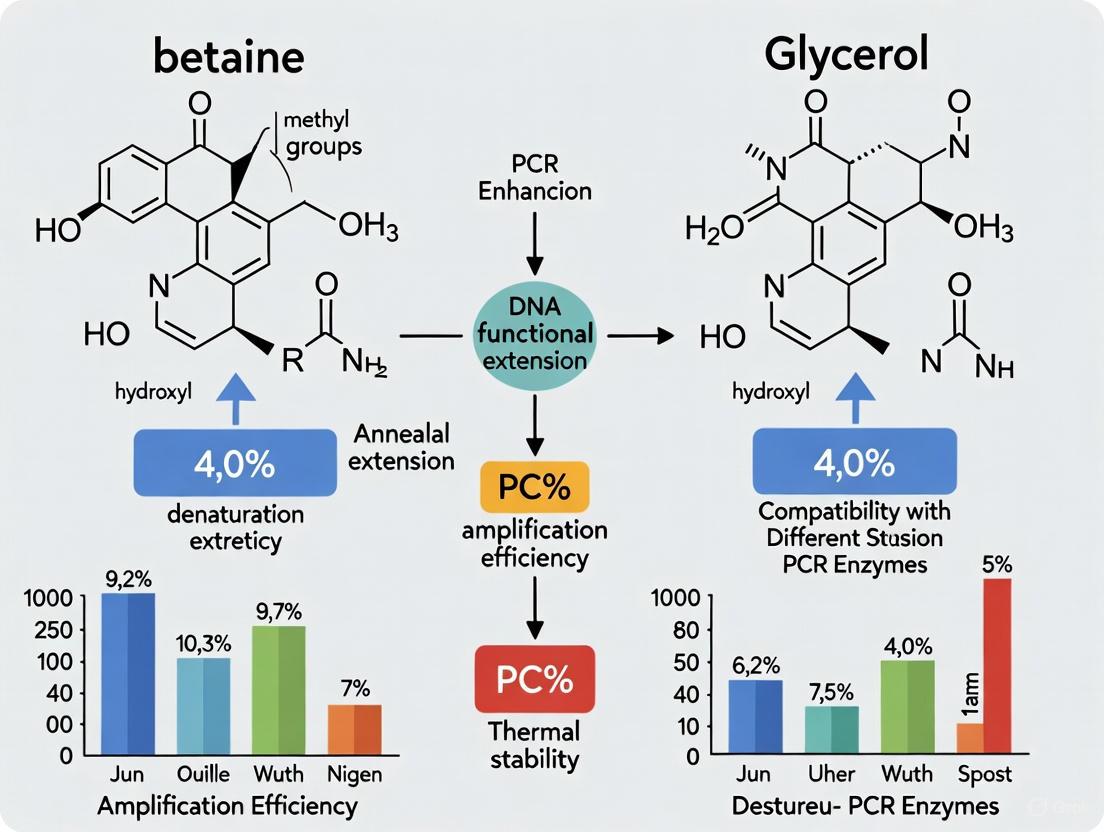
This article provides a comprehensive comparative analysis of betaine and glycerol as PCR enhancers, tailored for researchers and drug development professionals.
Betaine vs. Glycerol: A Strategic Guide to Choosing PCR Enhancers for GC-Rich Targets
Abstract
This article provides a comprehensive comparative analysis of betaine and glycerol as PCR enhancers, tailored for researchers and drug development professionals. It explores the fundamental mechanisms by which these additives overcome the challenge of amplifying GC-rich DNA templates, which are prevalent in gene promoters and present significant obstacles in molecular diagnostics and genomic research. The content delivers practical methodologies and optimized protocols for incorporating these enhancers into standard and advanced PCR applications, including multiplex and isothermal amplification. Furthermore, it offers a systematic troubleshooting framework for optimizing reaction specificity and yield, supported by recent comparative data on performance metrics like enzyme stabilization and inhibitor tolerance. The synthesis of these findings aims to equip scientists with the evidence needed to make informed reagent selections, ultimately enhancing assay reliability and efficiency in biomedical research and clinical development.
Unraveling the Mechanisms: How Betaine and Glycerol Tackle PCR Challenges
The Molecular Basis of the GC-Rich Challenge
In polymerase chain reaction (PCR) amplification, GC-rich DNA sequences, typically defined as those with a guanine-cytosine content exceeding 60%, present a formidable technical challenge [1] [2] [3]. The core of the problem lies in the inherent molecular properties of the G-C base pair, which forms three hydrogen bonds, in contrast to the two bonds of an A-T base pair [2] [3]. This additional hydrogen bond confers greater thermostability, requiring more energy to separate the DNA strands.
This fundamental property leads to two major technical hurdles. First, GC-rich templates resist complete denaturation under standard PCR conditions (typically 94-95°C), preventing the single-stranded DNA from becoming fully accessible for primer annealing [2] [3]. Second, these sequences are highly prone to forming stable secondary structures, such as hairpins, knots, and tetraplexes, as the single-stranded DNA readily folds back onto itself through these strong G-C interactions [1]. These secondary structures physically hinder the progression of the DNA polymerase enzyme, resulting in truncated PCR products or complete amplification failure.
Betaine vs. Glycerol: A Comparative Mechanistic Analysis
To overcome these challenges, additives known as PCR enhancers are employed. Betaine and glycerol are two such compounds, but they function through distinct mechanisms.
Betaine: The Secondary Structure Destabilizer
Betaine (N,N,N-trimethylglycine) enhances PCR primarily by destabilizing secondary structures and promoting a more uniform melting temperature across the DNA template [4]. It is a zwitterionic molecule that interacts directly with DNA, effectively reducing the melting temperature (Tm) of GC-rich regions without significantly affecting AT-rich regions [5]. This action helps open up hairpins and other complex structures that would otherwise block polymerase progression, allowing the enzyme to navigate through the template smoothly [4]. Betaine has demonstrated efficacy not only in conventional PCR but also in advanced isothermal amplification methods like Recombinase Polymerase Amplification (RPA), where it reduces non-specific amplification and primer-dimer formation [4] [6].
Glycerol: The Viscosity Modulator and Stabilizer
Glycerol functions primarily as a viscosity-modifying agent and polymerase stabilizer [6]. Its mode of action is more physical; by increasing the viscosity of the reaction mixture, it can prevent premature interactions between reaction components, such as between Cas12a enzymes and early amplification products in one-pot RPA-CRISPR systems [6]. Additionally, glycerol helps stabilize DNA polymerase against thermal denaturation, thereby maintaining enzyme activity throughout the thermal cycling process [5].
The diagram below illustrates the distinct mechanisms through which betaine and glycerol enhance PCR amplification of GC-rich regions.
Experimental Comparison and Performance Data
Optimal Concentrations and Combinatorial Effects
Research directly comparing these enhancers reveals distinct optimal concentration ranges. In studies amplifying GC-rich epidermal growth factor receptor (EGFR) gene promoter sequences, glycerol produced desired PCR products across a broad concentration range of 5-25%, though higher concentrations yielded lower product amounts [5]. In contrast, DMSO was effective only within a narrower window of 7-10%, while betaine showed efficacy at concentrations of 1-3 M [5].
Notably, combinations of these additives can produce synergistic effects. A mixture of DMSO and betaine has been identified as particularly powerful for amplifying GC-rich DNA sequences [5].
Quantitative Comparison in GC-Rich Amplification
Table 1: Performance Comparison of Betaine vs. Glycerol in PCR
| Parameter | Betaine | Glycerol |
|---|---|---|
| Primary Mechanism | Destabilizes DNA secondary structures; reduces Tm differential [4] [5] | Increases viscosity; stabilizes polymerase enzyme [5] [6] |
| Effective Concentration | 1-3 M [5] | 5-25% [5] |
| Effect on Specificity | Reduces non-specific amplification and primer-dimer formation [4] | Can reduce non-specific binding at optimal concentrations [5] |
| Template Compatibility | Particularly effective for GC-rich templates >60% GC [1] [5] | Broad-range effectiveness for various template types [5] |
| Application in Advanced Methods | Enhances RPA, CRISPR-based assays [4] [6] | Prevents premature component interaction in one-pot systems [6] |
Case Study: Amplifying Nicotinic Acetylcholine Receptor Subunits
A 2025 study on amplifying GC-rich nicotinic acetylcholine receptor subunits from invertebrates provides compelling experimental evidence of these mechanisms in action [1]. Researchers faced significant challenges amplifying Ir-nAChRb1 (65% GC) and Ame-nAChRa1 (58% GC) subunits using standard protocols. Their optimized protocol incorporated a multipronged approach using betaine and DMSO as additives alongside adjusted annealing temperatures and specialized polymerases [1]. This successful application demonstrates how understanding and addressing the fundamental challenges of GC-rich amplification enables researchers to overcome otherwise prohibitive technical barriers.
Research Reagent Solutions for GC-Rich PCR
Table 2: Essential Reagents for GC-Rich PCR Optimization
| Reagent Category | Specific Examples | Function in GC-Rich PCR |
|---|---|---|
| Specialized Polymerases | OneTaq DNA Polymerase with GC Buffer, Q5 High-Fidelity DNA Polymerase with GC Enhancer [2] [3] | Engineered to withstand inhibitory secondary structures; often supplied with proprietary enhancers |
| PCR Additives | Betaine (1-3 M), DMSO (2.5-10%), Glycerol (5-25%) [5] [7] | Destabilize secondary structures; lower effective melting temperature; stabilize enzymes |
| Magnesium Salts | MgCl₂ (1.0-4.0 mM, typically 1.5-2.0 mM) [2] [3] | Cofactor for DNA polymerase; concentration requires optimization for GC-rich targets |
| Modified Nucleotides | 7-deaza-dGTP [2] | dGTP analog that reduces secondary structure formation |
| Buffer Systems | Commercial GC Buffers, High GC Enhancers [2] [3] | Pre-optimized formulations containing multiple enhancing compounds |
The fundamental challenge of amplifying GC-rich DNA sequences stems from the strong hydrogen bonding and secondary structure formation inherent to these templates. While both betaine and glycerol serve as effective PCR enhancers, they operate through distinct biochemical mechanisms. Betaine directly addresses the core problem by destabilizing secondary structures and equalizing DNA melting temperatures, making it particularly valuable for extremely GC-rich targets. Glycerol provides complementary benefits through physical modulation of the reaction environment and enzyme stabilization. The most successful amplification strategies often employ a systematic approach, combining these enhancers with specialized polymerases and optimized cycling parameters to overcome the persistent challenge of GC-rich PCR.
In polymerase chain reaction (PCR) and other nucleic acid amplification techniques, the presence of stable secondary structures and GC-rich regions presents significant challenges. Betaine, also known as glycine betaine or trimethylglycine, serves as a powerful PCR enhancer by equilibrating DNA melting temperatures and disrupting unfavorable secondary structures. This review systematically compares the mode of action and performance of betaine against glycerol, another common PCR additive, providing researchers with experimental data and protocols to optimize nucleic acid amplification conditions.
Polymerase chain reaction (PCR) represents a fundamental technique in molecular biology labs worldwide, enabling amplification of specific DNA fragments from minimal template material through repeated thermal cycling of denaturation, primer annealing, and extension [8]. However, the amplification efficiency decreases significantly with difficult DNA templates such as those with high GC-content, stable secondary structures, or repetitive sequences [9]. To overcome these challenges, scientists frequently employ PCR enhancers—chemical additives that improve yield and specificity by modifying nucleic acid melting behavior or polymerase activity.
Betaine and glycerol represent two prominent examples of PCR enhancers, though they operate through distinct mechanisms and exhibit different performance characteristics. While both additives can facilitate amplification of challenging templates, betaine has demonstrated particular efficacy in eliminating the base pair composition dependence of DNA melting and disrupting secondary structures that impede polymerase progression [10]. This review examines the molecular mechanisms underlying betaine's mode of action, provides direct experimental comparisons with glycerol, and offers practical protocols for implementation in research and diagnostic applications.
Molecular Mechanisms of Action
Betaine's Effect on Nucleic Acid Thermodynamics
Betaine (N,N,N-trimethylglycine) exerts its effects primarily through direct interaction with nucleic acids, fundamentally altering their thermodynamic properties:
- Elimination of Base Composition Dependence: Betaine reduces or even eliminates the base pair composition dependence of DNA thermal melting transitions, allowing more uniform amplification regardless of GC content [10]. This is particularly valuable when amplifying regions with varying sequence compositions.
- Destabilization of GC-Rich Duplexes: Research on RNA dodecamer duplexes with guanine-cytosine (GC) contents ranging from 17–100% demonstrated that betaine destabilizes higher GC content RNA duplexes to a greater extent than low GC content duplexes due to greater accumulation at the surface area exposed during unfolding [11]. This preferential destabilization of GC-rich regions helps equalize melting temperatures across different sequence domains.
- Temperature-Dependent Interaction: The accumulation of betaine at nucleic acid surfaces is highly sensitive to temperature and displays characteristic entropy-enthalpy compensation [11]. The entropic contribution to the interaction is more dependent on temperature than the enthalpic contribution, meaning higher GC content duplexes with their larger transition temperatures are destabilized to a greater extent.
Table 1: Thermodynamic Parameters of Betaine-RNA Interactions at Different GC Content
| GC Content | Transition Temperature (°C) | Δμ23,4/RT/m⁻¹ | m-value (kcal mol⁻¹ m⁻¹) |
|---|---|---|---|
| 17% | 27.3 | -0.315 ± 0.029 | -0.188 ± 0.017 |
| 25% | 34.8 | -0.398 ± 0.044 | -0.244 ± 0.027 |
| 33% | 45.5 | -0.598 ± 0.027 | -0.378 ± 0.017 |
| 50% | 52.0 | -0.811 ± 0.032 | -0.524 ± 0.020 |
| 67% | 59.6 | -0.948 ± 0.037 | -0.627 ± 0.024 |
| 100% | 80.9 | -1.44 ± 0.03 | -1.010 ± 0.023 |
Glycerol's Mechanism of Action
Glycerol operates through different physicochemical mechanisms to enhance PCR:
- Protein Stabilization: Glycerol strengthens hydrophobic interactions between protein domains, protecting enzymes like DNA polymerase from thermal denaturation [9]. This stabilization maintains polymerase activity throughout thermal cycling.
- Reduced Molecular Mobility: As a viscous agent, glycerol reduces molecular mobility in the reaction mixture, potentially facilitating primer-template interactions under suboptimal conditions.
- Moderate Destabilization of DNA Duplexes: Glycerol moderately lowers the melting temperature of DNA duplexes, though to a lesser extent than betaine, helping prevent stable secondary structure formation [9].
Comparative Mode of Action
The fundamental difference in mechanism between these two additives explains their performance characteristics in PCR applications. Betaine directly interacts with nucleic acids, altering their intrinsic thermodynamic properties, while glycerol primarily affects the solvation environment and enzyme stability. This distinction makes betaine particularly valuable for GC-rich targets, while glycerol offers broader stabilization benefits.
Experimental Performance Comparison
Amplification of GC-Rich Sequences
Multiple studies have directly compared the efficacy of betaine and glycerol in amplifying templates with varying GC content:
- EGFR Gene Promoter Analysis: In detecting single nucleotide polymorphisms of the epidermal growth factor receptor (EGFR) gene promoter sequence in non-small-cell lung cancer patients, betaine demonstrated positive effects at concentrations ranging from 1-3 M, while glycerol produced desired PCR products at concentrations between 5-25% [5]. Notably, higher glycerol concentrations (25%) resulted in lower yields, while betaine maintained effectiveness across its concentration range.
- Systematic Enhancer Screening: A comprehensive comparison of nine PCR enhancers revealed that betaine outperformed other additives in amplification of GC-rich DNA fragments, thermostabilizing Taq DNA polymerase, and inhibitor tolerance [9]. While glycerol showed moderate benefits, its performance was substantially lower than betaine for challenging templates.
Table 2: Performance Comparison in Amplifying Templates with Different GC Content
| Enhancer | Concentration | 53.8% GC (Ct value) | 68.0% GC (Ct value) | 78.4% GC (Ct value) |
|---|---|---|---|---|
| Control | - | 15.84 ± 0.05 | 15.48 ± 0.22 | 32.17 ± 0.25 |
| Betaine | 0.5 M | 16.03 ± 0.03 | 15.08 ± 0.10 | 16.97 ± 0.14 |
| Betaine | 1.0 M | 16.12 ± 0.06 | 14.94 ± 0.04 | 15.91 ± 0.07 |
| Glycerol | 5% | 16.13 ± 0.01 | 15.16 ± 0.04 | 16.89 ± 0.12 |
| Glycerol | 10% | 16.49 ± 0.09 | 15.44 ± 0.07 | 17.18 ± 0.08 |
Specificity and Yield Optimization
The concentration-dependent effects of betaine and glycerol significantly impact amplification specificity and yield:
- Betaine Concentration Optimization: In EGFR promoter sequence amplification, betaine produced optimal results at 1-3 M concentrations, effectively reducing nonspecific amplification while maintaining high yield of the desired product [5]. This concentration range corresponds to approximately 0.5-1.5% (weight/volume) in typical PCR reactions.
- Glycerol Concentration Limitations: While glycerol produced desired PCR products at 5-25% concentrations, the highest concentration resulted in lower yield, and lower concentrations produced unspecific smaller fragments [5]. This narrow optimal range makes glycerol more challenging to implement effectively.
- Synergistic Combinations: Research indicates that combinations of 0.5 M betaine with 0.2 M sucrose or 1 M betaine with 0.1 M sucrose can effectively promote amplification of GC-rich region-containing long DNA fragments while minimizing negative effects on normal fragment amplification [9].
Practical Applications and Protocols
PCR-RFLP for EGFR Promoter Polymorphisms
Background: Detection of -216G>T and -191C>A single nucleotide polymorphisms in the GC-rich EGFR gene promoter region in non-small-cell lung cancer patients requires optimized amplification conditions [5].
Protocol:
- Reaction Composition:
- 1 μl genomic DNA from formalin-fixed paraffin-embedded tissue
- 0.4 μl of each primer
- 0.2 mM dNTPs
- 1U of KAPA Taq DNA polymerase
- 1× reaction buffer
- 2.5 mM MgCl₂
- Betaine (1-3 M) or glycerol (5-25%)
Thermal Cycling Conditions:
- Initial denaturation: 95°C for 3 min
- 35 cycles of:
- Denaturation: 95°C for 30 s
- Annealing: 60°C for 30 s
- Extension: 72°C for 30 s
- Final extension: 72°C for 7 min
Analysis: Restriction fragment length polymorphism analysis following amplification
Results: Betaine at 1-3 M concentrations provided specific amplification of the GC-rich target, while glycerol required careful concentration optimization to minimize nonspecific products [5].
Betaine-Assisted Multiplex Recombinase Polymerase Amplification
Background: Simultaneous detection and typing of SARS-CoV-2 variants using lateral flow assay requires high specificity to eliminate cross-reactivity and nonspecific amplification in multiplex systems [4].
Protocol:
- Reaction Setup:
- Lyophilized TwistAmp Basic RPA pellets
- 420 nM primer concentrations
- 100 nM reporter probe
- 15 mM magnesium acetate
- 1.25 M betaine
Amplification Conditions:
- Incubation at 39°C for 20 minutes
- No initial denaturation required
Detection:
- Lateral flow strip visualization
- Results available within 5 minutes
Results: Inclusion of 1.25 M betaine effectively eliminated non-specific amplification and cross-reactivity in the multiplex system, enabling specific detection of SARS-CoV-2 variants with a limit of detection as low as 1 fM [4].
Enhanced Long-Range PCR Protocol
Background: Amplification of long DNA fragments (>5 kb) presents challenges due to decreased amplification efficiency and accumulation of truncated products [8].
Protocol:
- Reaction Composition:
- 1× specialized long-range PCR buffer
- 0.2 mM of each dNTP
- 0.3 μM of each primer
- 1 M betaine
- Polymerase mixture (proofreading and non-proofreading enzymes)
- 50-100 ng genomic DNA template
- Thermal Cycling Conditions:
- Initial denaturation: 94°C for 2 min
- 30 cycles of:
- Denaturation: 94°C for 30 s
- Annealing: 55-65°C for 30 s
- Extension: 68°C for 1 min per kb
- Final extension: 68°C for 10 min
Optimization Notes: Betaine concentration may be adjusted between 0.5-1.5 M depending on template GC content and length. Extension times should be increased for fragments >10 kb [9] [8].
The Scientist's Toolkit: Research Reagent Solutions
Table 3: Essential Reagents for PCR Enhancement Studies
| Reagent | Function | Optimal Concentration Range | Key Considerations |
|---|---|---|---|
| Betaine | Equalizes DNA melting temperatures; disrupts secondary structures | 0.5-3 M | Superior for GC-rich templates; reduces base composition dependence |
| Glycerol | Stabilizes DNA polymerase; moderately lowers DNA Tm | 5-15% | Higher concentrations reduce yield; broad stabilizer |
| DMSO | Destabilizes DNA secondary structures | 2-10% | Inhibitory at high concentrations; thermal destabilization of enzymes |
| Formamide | Denaturing agent; reduces melting temperature | 2-5% | Can be inhibitory above 5%; thermal destabilization |
| Trehalose | Thermoprotectant for DNA polymerase | 0.1-0.4 M | Mild enhancer; good for inhibitor tolerance |
| Sucrose | Thermoprotectant; compatible with betaine | 0.1-0.4 M | Synergistic with betaine; minimal negative effects |
Betaine demonstrates distinct advantages over glycerol as a PCR enhancer, particularly for challenging applications involving GC-rich templates, complex secondary structures, or multiplex amplification systems. Its ability to eliminate base composition dependence of DNA melting through direct interaction with nucleic acid thermodynamics provides a mechanism that glycerol lacks. While glycerol offers benefits as a general stabilizer, experimental data consistently shows betaine's superior performance in the most demanding amplification scenarios.
Researchers should consider implementing betaine at 0.5-1.5 M concentrations for standard PCR challenges and increasing to 2-3 M for extremely GC-rich targets or those with stable secondary structures. The combination of betaine with supplementary enhancers like sucrose may provide additional benefits for long-range PCR. As molecular techniques continue to evolve toward more complex multiplex applications and point-of-care diagnostics, betaine's unique properties position it as an essential component in the molecular biologist's toolkit for overcoming nucleic acid amplification challenges.
In the realm of molecular biology, the amplification of GC-rich DNA sequences presents a significant challenge due to their high thermodynamic stability and propensity to form secondary structures. To overcome these hurdles, researchers routinely employ PCR enhancers. Within this context, glycerol and betaine are two of the most prominent additives used to facilitate the amplification of difficult targets. This guide provides an objective comparison of glycerol's performance, focusing on its capacity for enzyme stabilization and thermal protection for DNA polymerases, against alternatives, with a specific focus on betaine. Supported by experimental data, this analysis aims to equip researchers with the information needed to select the optimal enhancer for their specific applications.
Mechanism of Action: How PCR Enhancers Work
PCR enhancers like glycerol and betaine improve amplification efficiency through distinct but complementary mechanisms. Understanding these pathways is key to selecting the right additive for your experiment.
Diagram: Mechanism of PCR enhancement for GC-rich templates. Glycerol and betaine address key challenges like high melting temperatures and enzyme instability to enable successful amplification.
Glycerol's Dual Mechanism
Glycerol operates through a two-fold mechanism. First, it lowers the melting temperature (Tm) of DNA, facilitating the denaturation of GC-rich templates that would otherwise remain double-stranded at standard denaturation temperatures [12]. Research has demonstrated that the melting temperature of most DNAs in 70% glycerol is approximately 45°C, significantly lower than in aqueous solutions [12]. Second, glycerol acts as a protein stabilizer, protecting DNA polymerases from thermal denaturation during high-temperature cycling. It strengthens hydrophobic interactions between protein domains, thereby maintaining enzymatic activity throughout the PCR process [13].
Betaine's Primary Mechanism
Betaine (N,N,N-trimethylglycine) functions primarily as a homogenizing agent for base pair stability. It is known to eliminate the base pair composition dependence of DNA melting by preferentially excluding itself from the DNA surface, which effectively equalizes the thermal stability of GC and AT base pairs [14] [15]. This property reduces the formation of secondary structures and can enable more uniform amplification across templates of varying GC content. Some studies also note that betaine provides a degree of thermal stabilization to DNA polymerases, though this is often considered secondary to its effect on DNA thermodynamics [13].
Performance Comparison: Glycerol vs. Betaine
The following tables summarize key experimental findings from direct comparisons of glycerol and betaine as PCR enhancers.
Table 1: Enhancement of GC-rich EGFR promoter amplification [5]
| Additive | Effective Concentration | Effect on PCR |
|---|---|---|
| Glycerol | 10%, 15%, 20% | Significantly enhanced yield and specificity |
| Betaine | 1 M, 1.5 M, 2 M | Significantly enhanced yield and specificity |
| DMSO | 7%, 10% | Significantly enhanced yield and specificity |
| Combination | 10% DMSO + 15% Glycerol | Positive effects, but other combinations failed |
Table 2: Systematic comparison of PCR enhancers across multiple parameters [13]
| Parameter | Glycerol | Betaine | Sucrose |
|---|---|---|---|
| GC-rich amplification | Improved efficiency and specificity | Best performance | Improved efficiency and specificity |
| Enzyme thermostabilization | Moderate | Excellent | Similar to betaine |
| Inhibitor tolerance | Moderate | Excellent | Similar to betaine |
| Effect on normal PCR | Reduced efficiency | Reduced efficiency | Mildest inhibitory effect |
| Recommended usage | 10-20% (v/v) | 1 M for GC-rich; 0.5 M + 0.2 M sucrose for long fragments | 0.2 M with betaine |
Table 3: Impact on DNA polymerase fidelity and mechanism [16]
| Parameter | Effect with Glycerol (10%) | Significance |
|---|---|---|
| Fidelity | No considerable change with 30°C temperature increase | Fidelity mechanism preserved across temperatures |
| Incorporation rate | Increased by 18,900-fold from 2°C to 56°C | Dramatic temperature dependence of kinetics |
| Rate-limiting step | Protein conformational change (induced-fit mechanism) | Mechanism consistent across temperature range |
Detailed Experimental Protocols
This protocol outlines the methodology used to test glycerol, betaine, and DMSO in amplifying the GC-rich epidermal growth factor receptor (EGFR) gene promoter region.
1. Sample Preparation
- DNA was extracted from formalin-fixed paraffin-embedded (FFPE) lung tumor tissue from non-small-cell lung cancer patients.
- Extraction was performed using PureLink Genomic DNA Kits.
2. PCR Reaction Setup
- Reaction volume: 25 μl
- Genomic DNA: 1 μl
- Primers: 0.4 μl of each primer
- dNTPs: 0.2 mM
- DNA polymerase: 1U of KAPA Taq DNA polymerase
- Additives tested:
- Glycerol: 5%, 10%, 15%, 20%, 25% (v/v)
- Betaine: 0.5 M, 1 M, 1.5 M, 2 M
- DMSO: 3%, 5%, 7%, 10%
- Cycling conditions: Initial denaturation at 95°C for 3 min; 35 cycles of denaturation at 95°C for 30 sec, annealing at 64°C for 30 sec, extension at 72°C for 30 sec; final extension at 72°C for 5 min.
3. Product Analysis
- PCR products and restriction fragments were detected by electrophoresis on 8% polyacrylamide gel and 3% agarose gel.
This comprehensive study evaluated nine different PCR enhancers, including glycerol and betaine, across multiple parameters.
1. Thermostability Assessment
- Reaction mixture: pBluescript II KS (-) plasmid (0.1 ng/μl), 0.2 μM primers, 0.2 mM dNTPs, 1U Taq DNA polymerase in 20 μl reaction.
- Preheating conditions: Taq DNA polymerase was preheated at 95°C for either 15 min or 30 min with or without PCR enhancers.
- Amplification program: Initial denaturation at 95°C for 3 min; 35 cycles of 95°C for 30 sec, 55°C for 15 sec, 72°C for 30 sec; final extension at 72°C for 10 min.
2. Inhibitor Resistance Testing
- Inhibitor: Heparin (0.0023 U or 0.0047 U) added to PCR reaction with or without enhancers.
- Template: Plasmid containing mouse Olig2 gene for GC-rich fragments.
- Primers: Designed to amplify 150 bp fragment with 68.0% GC content and 208 bp fragment with 78.4% GC content.
3. Real-time PCR Analysis
- System: Bio-Rad CFX96 Real-Time PCR Detection System with FastSYBR Mixture.
- Reaction volume: 20 μl
- Cycling: 40 cycles of denaturation at 95°C for 15 sec, annealing at 52°C (moderate GC) or 60°C (GC-rich) for 30 sec, extension at 72°C for 30 sec.
- Analysis: Melting curve analysis from 72°C to 96°C in 0.1°C steps.
The Scientist's Toolkit: Essential Research Reagents
Table 4: Key reagents for PCR enhancement studies
| Reagent | Function | Application Notes |
|---|---|---|
| Glycerol | Lowers DNA Tm, enzyme stabilizer | Use at 10-20% (v/v); higher concentrations may inhibit amplification [5] [13] |
| Betaine | Homogenizes base pair stability, osmoprotectant | Effective at 1-2 M; superior for GC-rich targets [5] [13] [15] |
| DMSO | Disrupts secondary structures | Use at 7-10%; higher concentrations can inhibit polymerase [5] |
| Taq DNA Polymerase | Standard PCR enzyme | Baseline for enhancement studies; 1-2 units per 50 μl reaction [17] |
| dNTPs | DNA synthesis building blocks | 0.2 mM each; unbalanced concentrations affect fidelity [17] |
| MgCl₂ | Cofactor for polymerase activity | 1.5-2.0 mM standard; critical optimization parameter for GC-rich PCR [18] |
| Formamide | Denaturant, increases stringency | Can thermal destabilize enzymes at high concentrations [13] |
| Trehalose | Enzyme thermostabilizer | Similar effect to betaine with milder inhibition of normal PCR [13] |
The experimental data presented reveals that both glycerol and betaine significantly enhance the amplification of GC-rich DNA sequences, yet they offer distinct advantages. Glycerol provides reliable performance as a dual-function reagent, lowering DNA melting temperature while stabilizing DNA polymerases against thermal inactivation. Its effectiveness at concentrations of 10-20% makes it a valuable addition to PCR protocols, particularly when using standard DNA polymerases.
Betaine demonstrates superior performance in the most challenging scenarios, including amplification of extremely GC-rich templates (exceeding 70% GC content) and in the presence of PCR inhibitors. Its capacity to homogenize base-pair stability without significantly compromising enzyme activity at optimal concentrations makes it the enhancer of choice for the most difficult amplification targets.
For researchers, the strategic selection between these enhancers should be guided by template characteristics and experimental requirements. Glycerol offers broad-spectrum utility with enzyme stabilization benefits, while betaine provides specialized enhancement for exceptionally GC-rich sequences. In some cases, combination approaches utilizing lower concentrations of both additives may provide optimal results while minimizing potential inhibitory effects, enabling successful amplification across a wide range of challenging experimental conditions.
The polymerase chain reaction (PCR) is a foundational technique in molecular biology, but its efficiency can be severely hampered by challenging DNA templates and the presence of reaction inhibitors. PCR enhancers are a class of additives designed to overcome these hurdles, thereby improving amplification efficiency, yield, and specificity. Among the various enhancers available, betaine and glycerol are two commonly used compounds. While both can improve PCR outcomes, they operate through distinct biochemical mechanisms and are optimal for different experimental challenges. Betaine is renowned for its ability to destabilize DNA secondary structures, making it the enhancer of choice for GC-rich templates. In contrast, glycerol often functions as a stabilizing agent for the DNA polymerase enzyme. This guide provides a direct, data-driven comparison of their mechanisms and performance to inform reagent selection for research and diagnostic applications.
Fundamental Mechanisms of Action
The primary difference between betaine and glycerol lies in their mode of interaction with the PCR components. Betaine directly interacts with the nucleic acids, while glycerol primarily influences the enzyme's stability.
Mechanism of Betaine
Betaine, a zwitterionic amino acid derivative, enhances PCR primarily by acting as a chemical denaturant. It penetrates the DNA duplex and evenly distributes the charge along the DNA backbone. This action disrupts the base-stacking forces that stabilize GC-rich base pairs, effectively lowering the melting temperature (Tm) of the DNA in a uniform manner [9] [19]. This promotes thorough denaturation of the template and prevents the formation of stable secondary structures and hairpins, which are common in GC-rich regions and can halt polymerase progression [19]. Furthermore, betaine is known to thermostabilize Taq DNA polymerase and enhance its tolerance to PCR inhibitors, adding to its utility in suboptimal conditions [9].
Mechanism of Glycerol
Glycerol is a viscous polyol that functions mainly as a protein stabilizer. In PCR, it is believed to protect the DNA polymerase from thermal inactivation, particularly during the high-temperature denaturation steps, thereby prolonging the enzyme's functional half-life [20]. It may achieve this stabilization by forming a protective hydration shell around the enzyme. While glycerol can also slightly lower the DNA melting temperature, its effect is less pronounced and specific than that of betaine [9]. Its primary contribution is to stabilize the reaction's enzymatic component rather than directly interacting with its nucleic acid substrates.
Table 1: Core Mechanistic Differences Between Betaine and Glycerol
| Feature | Betaine | Glycerol |
|---|---|---|
| Primary Target | Nucleic Acids (DNA) | Enzyme (DNA Polymerase) |
| Main Mechanism | Chemical denaturant; equalizes DNA strand stability | Protein stabilizer; prevents thermal denaturation |
| Effect on DNA Tm | Significantly lowers and equalizes Tm | Mildly lowers Tm |
| Inhibitor Resistance | Shown to improve tolerance [9] | Can offer protection [20] |
The following diagram summarizes the primary mechanisms of each enhancer within the context of a PCR cycle:
Comparative Experimental Performance Data
Systematic comparisons reveal that the efficacy of betaine and glycerol is highly dependent on the nature of the DNA target and the presence of inhibitors.
Performance with Different DNA Templates
A key study testing nine different PCR enhancers provided clear quantitative data on their performance across templates with varying GC content [9]. The results, measured by cycle threshold (Ct) values in real-time PCR, are summarized below.
Table 2: Quantitative Comparison of Enhancer Performance by GC Content [9]
| Enhancer & Concentration | 53.8% GC (Moderate) Ct±SEM | 68.0% GC (High) Ct±SEM | 78.4% GC (Super High) Ct±SEM |
|---|---|---|---|
| Control (No Enhancer) | 15.84 ± 0.05 | 15.48 ± 0.22 | 32.17 ± 0.25 |
| Betaine (0.5 M) | 16.03 ± 0.03 | 15.08 ± 0.10 | 16.97 ± 0.10 |
| Glycerol (5% v/v) | 16.13 ± 0.01 | 15.16 ± 0.04 | 16.89 ± 0.12 |
| Glycerol (10% v/v) | 16.49 ± 0.09 | 15.44 ± 0.07 | 17.18 ± 0.08 |
The data demonstrates that for a moderate GC-content fragment, enhancers like betaine and glycerol can sometimes slightly reduce efficiency (higher Ct). However, for the "super high" GC-rich target (78.4% GC), where the control PCR performed very poorly (Ct=32.17), both 0.5 M betaine and 5% glycerol dramatically improved amplification, lowering the Ct value to ~17 [9]. This represents a massive increase in efficiency. At a higher concentration (10%), glycerol's performance began to decline, indicating a narrower optimal concentration range.
Resistance to PCR Inhibitors
The performance of enhancers can also be critical when dealing with complex sample matrices that contain PCR inhibitors. Research on wastewater samples, which contain substances like humic acids, polysaccharides, and lipids, has tested various additives to relieve inhibition.
In one study, glycerol was found to be ineffective at mitigating inhibition in wastewater samples, even showing an increase in quantification cycle (Cq) values, indicating a negative effect [20]. In contrast, other enhancers like bovine serum albumin (BSA) and dimethyl sulfoxide (DMSO) showed a beneficial effect [20]. This aligns with the earlier systematic comparison, which identified betaine as a superior enhancer for inhibitor tolerance [9].
Experimental Protocols for Comparison
To generate comparable data on enhancer performance, researchers often use standardized protocols. Below is a synthesis of methodologies adapted from the cited literature.
Protocol: Evaluating Enhancers on GC-Rich Templates
This protocol is designed to test and compare the efficacy of betaine, glycerol, and other enhancers [9].
Research Reagent Solutions
| Reagent | Function in the Experiment |
|---|---|
| Betaine (5 M stock) | PCR enhancer; tested final concentration of 0.5 M and 1 M. |
| Glycerol (50% v/v stock) | PCR enhancer; tested final concentrations of 2.5%, 5%, and 10% v/v. |
| DNA Polymerase | Thermostable enzyme (e.g., Taq polymerase) for DNA amplification. |
| Primers | Target-specific oligonucleotides for a GC-rich DNA region. |
| Template DNA | Genomic DNA or plasmid containing the high-GC target. |
| dNTP Mix | Nucleotides (dATP, dCTP, dGTP, dTTP) for DNA synthesis. |
| PCR Buffer | Provides optimal pH and ionic conditions for the polymerase. |
| MgCl₂ Solution | Essential co-factor for DNA polymerase activity. |
Methodology:
- Reaction Setup: Prepare a master PCR mix containing buffer, dNTPs, MgCl₂, primers, DNA polymerase, and template DNA. Aliquot the master mix into separate tubes.
- Additive Inclusion: Supplement the aliquots with the enhancers from their stock solutions to achieve the desired final concentrations (e.g., 0.5 M betaine, 5% glycerol). Include a control reaction with no enhancer.
- Thermal Cycling: Run the PCR reactions using a standard thermal cycling protocol. For a GC-rich target, an initial denaturation at 98°C for 2 minutes is recommended, followed by 30-40 cycles of:
- Denaturation: 98°C for 10-30 seconds.
- Annealing: 55-65°C (primer-specific) for 15-30 seconds.
- Extension: 72°C for 1 minute per kb.
- Analysis: Analyze the results using real-time PCR to obtain Ct values or by gel electrophoresis to assess amplicon yield and specificity.
Protocol: Testing Enhancer Efficacy in Inhibitor-Rich Environments
This protocol assesses the ability of enhancers to improve PCR in the presence of known inhibitors [20].
Methodology:
- Sample Preparation: Use a complex sample matrix such as wastewater nucleic acid extracts or a sample spiked with a known inhibitor (e.g., humic acid).
- Reaction Setup: Prepare PCR mixes as described in Section 4.1, using a specific target (e.g., a viral gene from wastewater).
- Additive Testing: Include betaine, glycerol, BSA, DMSO, and other enhancers at various concentrations. A 10-fold sample dilution arm is often included as a reference inhibition-mitigation strategy.
- Analysis: Compare the Cq values and copy number estimates from the digital PCR or qPCR between the different additive conditions and the diluted samples. The most effective enhancer will show the lowest Cq and the most accurate copy number relative to a non-inhibited control.
Application Guidelines and Selection Framework
Choosing between betaine and glycerol is not a matter of which is universally better, but which is more appropriate for a specific experimental context. The following workflow can guide this decision:
Synergistic Use of Enhancers
Research indicates that enhancers can be used in combination to leverage their different mechanisms. For instance, a cocktail of betaine and sucrose has been shown to effectively promote the amplification of GC-rich, long DNA fragments while minimizing negative effects on normal templates [9]. This synergistic approach can be more effective than relying on a single additive for particularly challenging amplifications.
Betaine and glycerol are both valuable tools for optimizing PCR, but they are not interchangeable. The experimental data clearly supports the following conclusions:
- Betaine is the definitive choice for amplifying GC-rich DNA templates due to its unique mechanism as a chemical denaturant that equalizes base-pair stability. It also demonstrates superior performance in mitigating the effects of PCR inhibitors.
- Glycerol serves primarily as a stabilizer for DNA polymerase, which can be beneficial in standard PCRs but offers limited help for GC-rich targets or in inhibitor-rich environments.
The selection of an enhancer should be a deliberate decision based on template sequence, sample purity, and amplification goals. For the most challenging applications, a combination of enhancers, often including betaine, may yield the best results.
Practical Protocols: Integrating Betaine and Glycerol into Your PCR Workflow
Within polymerase chain reaction (PCR) optimization, the battle against inhibition and inefficiency is often waged with the aid of chemical enhancers. Among the most utilized are betaine and glycerol, which serve distinct yet sometimes overlapping roles in promoting successful amplification of difficult DNA targets, such as those with high GC-content. Framed within the broader thesis of comparing betaine to glycerol as PCR enhancers, this guide provides an objective, data-driven comparison for researchers and drug development professionals. It summarizes recommended concentration ranges, elucidates mechanisms of action, and presents experimental protocols to facilitate evidence-based reagent selection, moving beyond anecdotal use to standardized application.
The effective use of PCR enhancers hinges on applying the correct concentration. The table below summarizes the standard operating ranges and key characteristics for betaine and glycerol, providing a foundation for experimental design.
Table 1: Standard Operating Concentrations and Properties of Betaine and Glycerol
| Enhancer | Common Working Concentration Ranges | Primary Postulated Mechanism(s) | Key Strengths | Reported Limitations |
|---|---|---|---|---|
| Betaine | 0.5 M - 1 M [9] | Reduces secondary structure formation by lowering DNA melting temperature (Tm); acts as a chemical chaperone [21]. | Highly effective for GC-rich templates; can thermostabilize DNA polymerase; enhances inhibitor tolerance [9]. | Can reduce amplification efficiency of moderate GC-content fragments at high concentrations [9]. |
| Glycerol | 2.5% - 10% (v/v) (approx. 0.3 - 1.4 M) [20] [9] | Destabilizes DNA duplex; protects enzymes from degradation and thermal destabilization [20]. | Improves enzyme stability; can relieve inhibition in certain matrices like feces [20]. | High concentrations can inhibit PCR and thermally destabilize enzymes [9]. |
Experimental Data and Performance Comparison
Quantitative Performance in Amplifying GC-Rich Templates
A systematic comparison of PCR enhancers quantified their performance across DNA fragments with varying GC content. The following table presents critical threshold (Ct) values, where a lower Ct indicates more efficient amplification.
Table 2: Performance Comparison in Amplifying Different GC-Content Templates [9]
| Enhancer & Concentration | 53.8% GC (Moderate) Ct ±SEM | 68.0% GC (High) Ct ±SEM | 78.4% GC (Super High) Ct ±SEM |
|---|---|---|---|
| Control (No Enhancer) | 15.84 ± 0.05 | 15.48 ± 0.22 | 32.17 ± 0.25 |
| Betaine (0.5 M) | 16.03 ± 0.03 | 15.08 ± 0.10 | 16.97 ± 0.21 |
| Glycerol (5% v/v) | 16.13 ± 0.01 | 15.16 ± 0.04 | 16.89 ± 0.12 |
| Glycerol (10% v/v) | 16.49 ± 0.09 | 15.44 ± 0.07 | 17.18 ± 0.08 |
The data demonstrates that both 0.5 M betaine and 5-10% glycerol dramatically improve the amplification of the "super high" GC-rich fragment (78.4% GC), reducing the Ct value from over 32 to approximately 17. While both are effective, betaine showed a marginal advantage in the consistency of its effect across the different GC-content templates tested [9]. The study concluded that betaine outperformed other enhancers, including glycerol, in the amplification of GC-rich DNA fragments, thermostabilizing Taq DNA polymerase, and tolerance to inhibitors [9].
Mechanism of Action and Experimental Workflow
Betaine and glycerol facilitate PCR through distinct biochemical mechanisms. The following diagram and workflow outline these pathways and a typical optimization protocol.
Typical Experimental Workflow for Optimization:
- Primer and Template Preparation: Design primers specific to the target sequence. Prepare the DNA template, which can be of varying complexity (e.g., purified plasmid, genomic DNA, or complex background samples) [22].
- PCR Master Mix Setup: Prepare a standard PCR master mix containing buffer, dNTPs, primers, DNA polymerase, and template. Divide this master mix into aliquots for testing different enhancer conditions [9].
- Enhancer Addition: Add betaine, glycerol, or other additives to the aliquoted master mixes at the desired concentrations. A common approach is to test a range of concentrations (e.g., 0.5 M and 1 M for betaine; 5% and 10% for glycerol) alongside a no-enhancer control [9] [21].
- Thermal Cycling: Run the PCR using a standard thermal cycling protocol. For GC-rich targets, an initial denaturation at a higher temperature (e.g., 98°C) or a "hot-start" protocol may be beneficial [8] [21].
- Product Analysis: Analyze the PCR products using agarose gel electrophoresis. Successful enhancement is indicated by a specific, robust amplicon band of the expected size, compared to weak or absent bands in the control reaction. For quantitative assessment, real-time PCR can be used to compare Ct values and reaction efficiencies [9].
The Scientist's Toolkit: Key Research Reagent Solutions
The following table details essential materials and reagents used in experiments evaluating PCR enhancers, providing a practical resource for laboratory setup.
Table 3: Essential Research Reagents for PCR Enhancer Studies
| Reagent / Material | Function in Protocol | Example Application in Enhancer Research |
|---|---|---|
| Betaine (Anhydrous) | PCR enhancer additive | Used at 0.5-1 M to reduce secondary structure in GC-rich amplification [9] [21]. |
| Glycerol | PCR enhancer additive and cryoprotectant | Used at 5-10% (v/v) to destabilize DNA duplex and protect polymerase [20] [9]. |
| Hot-Start DNA Polymerase | Enzyme for DNA amplification | Reduces non-specific amplification during reaction setup; critical for achieving high specificity with enhancers [8] [21]. |
| dNTP Mix | Nucleotide substrates | Provides building blocks for DNA synthesis; concentration and quality are crucial for efficient amplification with or without enhancers. |
| MgCl₂ Solution | Cofactor for DNA polymerase | Concentration is a key variable (typically 1.5-2.0 mM) and may require re-optimization when adding enhancers like glycerol [21]. |
| Nucleic Acid Templates | Target for amplification | Includes defined plasmids or complex samples (e.g., wastewater DNA) used to test enhancer efficacy against inhibition [20] [9]. |
The objective comparison of experimental data reveals that both betaine and glycerol are powerful tools for overcoming PCR challenges, yet they have distinct profiles. Betaine (0.5-1 M) is the superior choice for mitigating the profound challenges of GC-rich sequences and enhancing inhibitor tolerance. Its ability to lower the melting temperature of DNA duplexes makes it uniquely effective for targets that form stable secondary structures. Glycerol (5-10% v/v) serves as a versatile enhancer that provides polymerase stabilization and general inhibition relief, though its potential for enzyme inhibition at higher concentrations warrants careful optimization. The choice between them is target-dependent; for the most demanding GC-rich amplifications, betaine is often unmatched, while glycerol remains a valuable component in broader reagent formulations. Ultimately, empirical validation within the specific experimental system is indispensable.
Polymerase chain reaction (PCR) efficiency is critically dependent on the reaction milieu, particularly when amplifying challenging templates such as GC-rich sequences. PCR enhancers are chemical additives that help overcome these challenges by modifying DNA melting behavior, polymerase stability, or reaction specificity [9]. Within this category, betaine and glycerol represent two prominent but mechanistically distinct enhancers frequently employed in molecular biology research and diagnostic assay development.
Betaine (N,N,N-trimethylglycine) is a ubiquitous zwitterionic osmolyte known for its ability to equalize the thermal stability of GC and AT base pairs. It functions by directly interacting with DNA, depressing the melting temperature (Tm) of GC-rich regions and facilitating the denaturation of stable secondary structures that would otherwise cause polymerase stalling [9] [23]. This makes it exceptionally valuable for amplifying promoter regions and other genomic segments with GC content exceeding 60-70%.
Glycerol, a trihydric alcohol, is primarily known as a protein-stabilizing agent. In PCR, it acts by increasing enzyme stability, particularly for DNA polymerases, under thermal cycling conditions. Furthermore, by altering solution viscosity and hydrogen bonding, it can also influence DNA duplex stability and primer annealing stringency [24] [25]. Its enhancement mechanism is thus more generalized, contributing to both enzyme longevity and reaction dynamics.
The choice between these enhancers, or their strategic combination, is not trivial and hinges on a deep understanding of the template's properties and the specific amplification hurdle. This guide provides a structured, evidence-based comparison to inform this critical decision in protocol optimization.
Comparative Performance Analysis
A systematic comparison of PCR enhancers is essential for selecting the right additive. The following table synthesizes quantitative data on the performance of betaine and glycerol against other common enhancers, based on real-time PCR results with templates of varying GC content [9].
Table 1: Comparative Performance of PCR Enhancers on Templates with Different GC Content
| Enhancer | Concentration | 53.8% GC (Ct ± SEM) | 68.0% GC (Ct ± SEM) | 78.4% GC (Ct ± SEM) |
|---|---|---|---|---|
| Control (No Additive) | - | 15.84 ± 0.05 | 15.48 ± 0.22 | 32.17 ± 0.25 |
| Betaine | 0.5 M | 16.03 ± 0.03 | 15.08 ± 0.10 | 16.97 ± 0.13 |
| Glycerol | 5% (v/v) | 16.13 ± 0.01 | 15.16 ± 0.04 | 16.89 ± 0.12 |
| DMSO | 5% (v/v) | 16.68 ± 0.01 | 15.72 ± 0.03 | 17.90 ± 0.05 |
| Ethylene Glycol (EG) | 5% (v/v) | 16.28 ± 0.06 | 15.27 ± 0.08 | 17.24 ± 0.04 |
| Formamide | 5% (v/v) | 18.08 ± 0.07 | 15.44 ± 0.03 | 16.32 ± 0.05 |
| 1,2-Propanediol (1,2-PG) | 5% (v/v) | 16.44 ± 0.12 | 15.45 ± 0.03 | 17.37 ± 0.08 |
| Sucrose | 0.4 M | 16.39 ± 0.09 | 15.03 ± 0.04 | 16.67 ± 0.08 |
| Trehalose | 0.4 M | 16.43 ± 0.16 | 15.15 ± 0.08 | 16.91 ± 0.14 |
Abbreviations: Ct, Cycle threshold; SEM, Standard Error of the Mean.
The data reveals several key insights. For the extremely challenging, "super-high" GC (78.4%) template, the control reaction failed efficiently (Ct >32). Both betaine and glycerol dramatically rescued amplification, reducing the Ct value to approximately 17. This underscores their primary utility in GC-rich PCR. Notably, while both are effective, betaine and glycerol slightly increased Ct values for the moderate-GC template (53.8%) compared to the control, indicating a mild inhibitory effect on straightforward amplifications [9]. This highlights the importance of using these enhancers judiciously.
Beyond this quantitative data, qualitative factors are crucial for decision-making.
Table 2: Functional Profile of Betaine and Glycerol as PCR Enhancers
| Characteristic | Betaine | Glycerol |
|---|---|---|
| Primary Mechanism | Equalizes DNA base-pair stability; disrupts secondary structures [9] [23]. | Stabilizes DNA polymerase; modulates solution viscosity and primer stringency [24] [25]. |
| Best For | GC-rich templates (>65-70%), sequences with stable secondary structures [9] [24]. | Improving enzyme longevity; combined enhancer approaches; general robustness. |
| Typical Working Concentration | 0.5 M - 1.5 M [9] [23]. | 5% - 10% (v/v) [9] [25]. |
| Effect on Tm | Significantly lowers and homogenizes DNA Tm [9]. | Mildly lowers DNA Tm. |
| Compatibility | Can be combined with DMSO and glycerol for synergistic effects [9] [23]. | Often used in combination with DMSO and other enhancers [25]. |
| Potential Drawbacks | Can inhibit PCR for low-GC or easy-to-amplify targets [9]. | High concentrations can reduce reaction specificity and primer stringency. |
Experimental Protocols and Workflows
Step-by-Step Guide to Modifying a PCR Protocol
Modifying an existing PCR protocol requires a systematic approach to integrate enhancers successfully. The following workflow provides a general guide, with specific considerations for betaine and glycerol.
Workflow for Adding PCR Enhancers
Diagnose the Problem: Begin by analyzing the failed PCR results. A complete lack of product or a smear on a gel often points to issues with GC-richness or stable secondary structures, suggesting betaine as a first-line enhancer. Consistently low yield might indicate suboptimal enzyme performance, where glycerol could be beneficial [24].
Prepare Enhancer Stocks:
- Betaine Stock: Prepare a 5 M stock solution in sterile, nuclease-free water. Filter-sterilize and store in aliquots at -20°C [9].
- Glycerol Stock: Commercial molecular biology-grade glycerol is typically supplied as a >99% concentration. For easier pipetting, a 50% (v/v) stock in nuclease-free water can be prepared [9].
Modify the Master Mix: When setting up a 50 µL reaction, calculate the volume of enhancer stock needed to achieve the desired final concentration. A standard approach is to create a master mix containing all common components (buffer, dNTPs, polymerase, primers) and then add the calculated volume of enhancer stock. Adjust the volume of nuclease-free water to maintain a final 50 µL reaction volume [26] [27].
- Example for 1 M Betaine: For a 50 µL reaction, add 10 µL of a 5 M betaine stock.
- Example for 5% Glycerol: For a 50 µL reaction, add 2.5 µL of 100% glycerol or 5 µL of a 50% glycerol stock.
Optimize Cycling Conditions: The addition of enhancers often necessitates adjustment of thermal cycling parameters, particularly the annealing temperature. Betaine lowers the effective Tm of the template and primers, so the optimal annealing temperature may be 1-5°C lower than calculated for the primer sequence alone. Using a thermal cycler with a gradient function is highly recommended to empirically determine the best annealing temperature [24].
Detailed Experimental Methodology for GC-Rich Amplification
The protocol below is adapted from published studies that successfully amplified difficult GC-rich targets, providing a robust starting point [9] [25].
Protocol: Amplification of a GC-Rich Template Using Combinatorial Enhancers
I. Research Reagent Solutions
Table 3: Essential Reagents for GC-Rich PCR Optimization
| Reagent / Solution | Function / Rationale |
|---|---|
| High-Fidelity or Standard Taq Polymerase | Engineered polymerases often have superior performance on difficult templates. Some are supplied with specialized GC buffers [24]. |
| MgCl₂ (25-50 mM stock) | Cofactor for DNA polymerase. Optimal concentration (1.5-4.0 mM) is critical and may require re-optimization when adding enhancers [24] [17]. |
| Betaine (5 M stock) | To disrupt GC-rich secondary structures and homogenize base-pair stability [9]. |
| DMSO (100% stock) | Serves a similar function to betaine; often used in combination for a synergistic effect [24] [25] [23]. |
| Glycerol (50% v/v stock) | Stabilizes the DNA polymerase throughout thermal cycling, especially at high denaturation temperatures [25]. |
| dNTP Mix (10 mM total) | Building blocks for DNA synthesis. Unbalanced dNTP concentrations can reduce fidelity [17]. |
II. Step-by-Step Procedure
Reaction Setup (on ice): Prepare a 50 µL PCR master mix according to the table below. For high-throughput applications, a master mix is recommended to minimize pipetting error and variability [27].
- Negative Control: Prepare a separate tube where the template DNA is replaced with nuclease-free water.
Table 4: Sample Master Mix for GC-Rich PCR with Enhancers
Component Final Concentration/Amount Volume for 1x Rxn (µL) Volume for 10x + 10% Ovr (µL) 10X PCR Buffer 1X 5 55 MgCl₂ (25 mM) 1.5 - 2.0 mM 3 - 4 33 - 44 dNTP Mix (10 mM) 200 µM 1 11 Forward Primer (20 µM) 0.4 µM 1 11 Reverse Primer (20 µM) 0.4 µM 1 11 Betaine (5 M) 1 M 10 110 DMSO (100%) 3% 1.5 16.5 Glycerol (50%) 5% 5 55 DNA Polymerase 1 - 2.5 U 0.5 5.5 Template DNA 10 - 100 ng X - Nuclease-Free Water To 50 µL To 50 To 550 Total Volume 50 µL 550 µL Mix and Aliquot: Gently mix the master mix by pipetting up and down or pulsing in a vortex mixer. Aliquot the appropriate volume (e.g., 45 µL if the template volume 'X' is 5 µL) into individual PCR tubes.
Add Template: Add the required volume of template DNA to each reaction tube. Add water to the negative control tube.
Thermal Cycling: Place tubes in a thermal cycler and run the following program, which incorporates a higher denaturation temperature to aid in melting GC-rich duplexes:
- Initial Denaturation: 98°C for 2-5 minutes (enzyme activation and complete denaturation).
- Amplification (35-40 cycles):
- Denaturation: 98°C for 15-30 seconds.
- Annealing: Use a temperature gradient (e.g., 55-68°C) for the first run, or start 3-5°C below the calculated primer Tm for 30 seconds.
- Extension: 72°C for 30-60 seconds/kb.
- Final Extension: 72°C for 5-10 minutes.
- Hold: 4°C ∞.
Product Analysis: Analyze 5-10 µL of the PCR product by agarose gel electrophoresis to check for amplicon specificity and yield.
Strategic Application and Synergistic Effects
The choice between betaine and glycerol is not always mutually exclusive. Evidence suggests that combinatorial approaches can be highly effective. For instance, a study aiming to amplify 110 human promoter sequences found that a mix of betaine, DMSO, and dithiothreitol (DTT) successfully rescued amplification for approximately 30% of the promoters that failed with standard conditions [23]. Similarly, research on bismuth-based materials found that a solvent mix of 3% DMSO and 5% glycerol was critical for dispersing the materials and achieving amplification of an extremely GC-rich (~84%) promoter region [25]. This underscores the principle that enhancers can work through complementary mechanisms.
The decision framework should be guided by the primary obstacle:
- For known GC-rich templates or those prone to forming stable secondary structures, betaine (or DMSO) should be the first enhancer of choice due to its direct action on DNA thermodynamics.
- When dealing with suboptimal enzyme performance, suspected polymerase instability, or as a general stabilizing agent, glycerol is a valuable additive.
- For the most challenging targets, a combination of betaine and glycerol, potentially with other additives like DMSO, often provides the best results. The enhancers in such a mix target different limiting factors simultaneously: DNA denaturation, polymerase processivity, and enzyme thermostability.
In the context of optimizing PCR for demanding applications in drug development and genetic research, protocol modification with enhancers like betaine and glycerol is a powerful strategy. Betaine stands out for its targeted action on the physical chemistry of GC-rich DNA, making it indispensable for amplifying promoter regions and similar difficult sequences. Glycerol offers a broader stabilizing effect on the reaction biochemistry, enhancing robustness.
A deep understanding of their distinct mechanisms, grounded in experimental data, allows researchers to make informed decisions. The step-by-step protocols and workflows provided here offer a practical roadmap for systematic optimization. Ultimately, viewing these enhancers as versatile tools—to be used individually or in combination—enables the development of highly specific, efficient, and reliable PCR assays critical for advancing scientific discovery.
Within molecular biology, optimizing nucleic acid amplification is fundamental to successful research and diagnostics. Betaine and glycerol are two commonly used PCR enhancers, particularly valuable for addressing specific technical challenges. While both can improve amplification efficiency, their mechanisms and optimal applications differ significantly. Betaine, an amino acid derivative, functions primarily as a isostabilizing agent that equilibrates the differential melting temperatures between AT and GC base pairs, thereby promoting the denaturation of GC-rich secondary structures [28] [9]. Glycerol, a trihydric alcohol, is classified as a cosolvent that influences reaction conditions by reducing the melting temperature of DNA and stabilizing enzymes against thermal denaturation [9] [5]. This guide objectively compares the performance of these two reagents, with a specific focus on their advanced applications in multiplex recombinase polymerase amplification (RPA) and the de novo synthesis of GC-rich gene constructs, providing researchers with data-driven insights for protocol development.
Performance Comparison in Key Applications
The following table summarizes experimental data comparing the effectiveness of betaine and glycerol across different amplification challenges.
Table 1: Performance Comparison of Betaine and Glycerol in Nucleic Acid Amplification
| Application | Additive & Concentration | Key Performance Findings | Source / Experimental Context |
|---|---|---|---|
| Multiplex RPA | Betaine (0.4 M - 0.8 M) | Eliminated non-specific amplification and cross-reactivity; enabled simultaneous detection and typing of SARS-CoV-2 variants with a LOD of 1 fM [4]. | Probe-free multiplex RPA coupled with lateral flow assay; optimization of MgOAc and betaine concentration [4]. |
| Glycerol (5% - 25% v/v) | Data not available in the searched literature for multiplex RPA. | ||
| GC-Rich DNA Amplification | Betaine (0.5 M - 2 M) | Outperformed other enhancers for GC-rich fragments; showed superior thermostabilization of Taq polymerase and high tolerance to inhibitors [9]. | Systematic comparison of nine PCR enhancers on fragments with 53.8% to 78.4% GC content using real-time PCR [9]. |
| Glycerol (5% - 10% v/v) | Improved amplification of GC-rich templates but was less effective than betaine [9]. | Same systematic comparison as above; showed consistent but milder enhancement [9]. | |
| GC-Rich Gene Synthesis | Betaine (Data not specified) | Greatly improved target product specificity and yield during PCR amplification of de novo synthesized GC-rich constructs (IGF2R, BRAF) [28]. | Polymerase Chain Assembly (PCA) and Ligase Chain Reaction (LCR) methods for gene synthesis [28]. |
| DMSO (Data not specified) | Greatly improved target product specificity and yield during PCR amplification of de novo synthesized GC-rich constructs [28]. | Polymerase Chain Assembly (PCA) and Ligase Chain Reaction (LCR) methods for gene synthesis [28]. | |
| Glycerol | Performance data not specified for this specific application. | ||
| SNP Genotyping (GC-Rich Promoter) | Betaine (1 M, 1.5 M, 2 M) | Significantly enhanced yield and specificity for amplifying the GC-rich EGFR promoter for SNP detection [5] [29]. | PCR-RFLP on FFPE tissue samples from NSCLC patients [5]. |
| Glycerol (10%, 15%, 20%) | Significantly enhanced yield and specificity for amplifying the GC-rich EGFR promoter for SNP detection [5] [29]. | PCR-RFLP on FFPE tissue samples from NSCLC patients [5]. | |
| DMSO (7%, 10%) | Significantly enhanced yield and specificity for amplifying the GC-rich EGFR promoter [5] [29]. | PCR-RFLP on FFPE tissue samples from NSCLC patients [5]. |
Application in Multiplex RPA
Experimental Protocol: Betaine-Assisted Multiplex RPA
Principle: Multiplex RPA amplifies multiple DNA targets simultaneously using distinct primer sets. This increases the risk of non-specific amplification, primer-dimer formation, and cross-reactivity due to the complex interplay of primers. Betaine mitigates these issues by destabilizing DNA secondary structures, especially in GC-rich regions, which reduces non-specific primer binding and helps the polymerase navigate complex templates smoothly [4].
Detailed Workflow (Based on SARS-CoV-2 Variant Detection): [4]
- Primer Design: Design specific RPA primers for each target (e.g., SARS-CoV-2 reference strain and Delta variant). Primers are typically 30-35 nucleotides long.
- Reaction Setup:
- Use a commercial lyophilized RPA kit (e.g., TwistAmp Basic from TwistDx).
- Prepare a master mix containing:
- Primers (each at optimized concentrations, e.g., 480 nM).
- 1x rehydration buffer.
- Betaine (optimized concentration, typically between 0.4 M and 0.8 M).
- DNA template.
- Resuspend the lyophilized pellet with the master mix.
- Initiate the reaction by adding Magnesium Acetate (MgOAc) to a final concentration of 14 mM.
- Amplification: Incubate the reaction tube at a constant temperature of 37-42°C for 15-20 minutes.
- Detection: Analyze amplicons using a coupled detection method, such as lateral flow strips, where primers are labeled with compatible tags (e.g., FITC, biotin, digoxin).
The workflow below illustrates the key steps in this protocol.
Key Experimental Findings
The integration of betaine is critical for success in multiplex RPA. A 2024 study demonstrated that adding 0.4 M to 0.8 M betaine to a probe-free multiplex RPA assay for SARS-CoV-2 completely eliminated non-specific amplification and cross-reactivity between primers for different viral variants. This enhancement allowed the assay to achieve a limit of detection (LOD) as low as 1 fM for simultaneous detection and typing, fulfilling key ASSURED criteria for point-of-care diagnostics [4]. The researchers concluded that betaine was indispensable for achieving the required specificity in their multiplex system without the need for modified probes or blockers [4].
Application in GC-Rich Gene Synthesis
Experimental Protocol: EnhancingDe NovoSynthesis
Principle: De novo gene synthesis of GC-rich constructs is hindered by secondary structures that cause polymerase pausing and mispriming. Betaine and DMSO facilitate strand separation by altering DNA melting characteristics, with betaine equilibrating GC and AT base-pair stability and DMSO disrupting intrastrand re-annealing [28].
Detailed Workflow (Based on IGF2R and BRAF Gene Synthesis): [28]
- Oligodeoxynucleotide (ODN) Design: Use a program like Gene2Oligo to fragment the target GC-rich sequence (e.g., IGF2R, BRAF) into overlapping 40-mer single-stranded ODNs.
- Gene Assembly: Assemble the full-length gene construct using one of two methods:
- Polymerase Chain Assembly (PCA): Pool unphosphorylated ODNs and cycle (e.g., 94°C/5 min, then 20 cycles of: 94°C/15 sec, 55°C/30 sec, 68°C/60 sec).
- Ligase Chain Reaction (LCR): Phosphorylate ODNs, then ligate using a thermostable ligase with cycling (e.g., 21 cycles of: 95°C/1 min, 70°C/4 min, decreasing by 1°C per cycle).
- Note: The cited study found LCR assembly produced a more stable template for subsequent amplification [28].
- PCR Amplification of Assembled Product: Use the assembled product as a template for a standard PCR with outside primers.
- Critical Step: Add betaine, DMSO, or a combination to the PCR mixture.
- PCR Conditions: Use a high-fidelity polymerase with a cycling profile (e.g., 94°C/5 min, then 25 cycles of: 94°C/15 sec, 55°C/30 sec, 68°C/60 sec, and a final 68°C/5 min).
- Analysis: Verify the final product by agarose gel electrophoresis.
The logical relationship between the challenge and the enhancer solution is shown below.
Key Experimental Findings
A foundational study demonstrated that while DMSO and betaine provided no significant benefit during the initial assembly step (PCA or LCR) of GC-rich genes, they greatly improved target product specificity and yield during the subsequent PCR amplification step. The research highlighted that LCR assembly generated a much more stable template for amplification than PCA. The compatibility of these additives with all other reaction components allows for their incorporation without additional protocol modifications, enabling the production of a wide variety of GC-rich constructs [28].
The Scientist's Toolkit: Essential Research Reagents
The following table catalogs key reagents and their functions for implementing the advanced applications discussed in this guide.
Table 2: Essential Research Reagents for Advanced Amplification Protocols
| Reagent / Kit | Function / Application | Specific Use-Case |
|---|---|---|
| Betaine (5M Stock) | Isostabilizing PCR enhancer; reduces secondary structure in GC-rich DNA and improves specificity in multiplex RPA [4] [28] [9]. | Essential for multiplex RPA and GC-rich gene synthesis PCR amplification [4] [28]. |
| Glycerol (50% Stock) | Cosolvent PCR enhancer; stabilizes enzymes, reduces DNA melting temperature [9] [5]. | Amplification of GC-rich templates (e.g., EGFR promoter); often used in combinations with DMSO [5] [29]. |
| DMSO | PCR additive; disrupts inter and intrastrand re-annealing of DNA [28]. | De novo synthesis of GC-rich gene constructs; often used in combination with betaine [28]. |
| TwistAmp Basic Kit | Commercial RPA kit containing core enzymes and reagents for recombinase polymerase amplification [4] [30]. | Foundation for setting up multiplex RPA assays, including betaine-assisted protocols [4]. |
| High-Fidelity DNA Polymerase | Enzyme with proofreading activity for accurate DNA synthesis. | Critical for the PCR amplification step following de novo gene assembly to minimize errors [28]. |
| T4 Polynucleotide Kinase | Enzyme that phosphorylates the 5' end of DNA oligonucleotides. | Required for preparing ODNs for gene assembly via the Ligase Chain Reaction (LCR) method [28]. |
| Ampligase | Thermostable DNA ligase. | Used for LCR assembly of oligonucleotides into full-length gene constructs [28]. |
The experimental data clearly delineates the advanced applications where betaine and glycerol provide the most significant benefits. Betaine emerges as the superior and often indispensable enhancer for modern, complex amplification techniques, particularly multiplex RPA, where its ability to eliminate non-specific amplification and cross-reactivity is unmatched [4]. In the challenging field of GC-rich gene synthesis, both betaine and DMSO have been proven to dramatically improve outcomes during the amplification of assembled constructs, with glycerol being less prominent in this specific niche [28]. For more standard PCR applications involving difficult GC-rich templates, such as SNP genotyping, both betaine and glycerol are effective, though betaine consistently demonstrates top-tier performance in systematic comparisons [9] [5]. The choice between them should be informed by the specific technical challenges of the assay, with betaine being the preferred initial candidate for multiplex and high-structure applications.
In molecular biology, the amplification of GC-rich DNA sequences presents a significant challenge due to the formation of stable secondary structures that impede polymerase activity. While various additives are employed to mitigate these issues, betaine and glycerol emerge as particularly effective agents, both individually and in synergistic combination. This guide provides a comparative analysis of the performance of betaine, glycerol, and their mixtures against other common PCR enhancers, supported by quantitative experimental data. We detail specific experimental protocols and elucidate the underlying molecular mechanisms, providing researchers and drug development professionals with a evidence-based framework for optimizing PCR conditions for difficult targets.
Polymerase Chain Reaction (PCR) amplification of GC-rich DNA constructs (typically >60% GC content) is notoriously problematic. The inherent strength of three hydrogen bonds in GC base pairs, compared to two in AT pairs, leads to higher melting temperatures (Tm) and promotes the formation of stable secondary structures such as hairpins and G-quadruplexes [31]. These structures cause polymerase stalling, mispriming, and ultimately, PCR failure or low yield of the specific product. To overcome these challenges, scientists routinely employ PCR enhancers—chemical additives that modify nucleic acid melting behavior and enzyme stability.
The efficacy of these enhancers is highly dependent on the specific DNA target and reaction conditions. This guide objectively compares the performance of betaine-glycerol combinations with other common additives, presenting a curated set of experimental data and protocols to inform reagent selection for robust and reliable amplification.
Comparative Performance Data of PCR Additives
A systematic comparison of PCR enhancers is crucial for evidence-based experimental design. The following tables summarize quantitative performance data from recent studies, focusing on amplification efficiency across templates with varying GC content.
Table 1: Impact of Single Additives on Real-Time PCR Amplification Efficiency (Cycle Threshold, Ct) [9]. Lower Ct values indicate higher amplification efficiency.
| Enhancer | Concentration | 53.8% GC (Ct) | 68.0% GC (Ct) | 78.4% GC (Ct) |
|---|---|---|---|---|
| Control | - | 15.84 | 15.48 | 32.17 |
| DMSO | 5% (v/v) | 16.68 | 15.72 | 17.90 |
| Formamide | 5% (v/v) | 18.08 | 15.44 | 16.32 |
| Glycerol | 5% (v/v) | 16.13 | 15.16 | 16.89 |
| Betaine | 0.5 M | 16.03 | 15.08 | 16.97 |
| Betaine | 1.0 M | 16.21 | 14.71 | 16.13 |
| Trehalose | 0.4 M | 16.43 | 15.15 | 16.91 |
| Sucrose | 0.4 M | 16.39 | 15.03 | 16.67 |
Table 2: Efficacy of Additive Combinations on GC-Rich Long DNA Fragment Amplification [9].
| Enhancer Combination | Effect on Normal Fragment | Effect on GC-Rich Fragment |
|---|---|---|
| 1 M Betaine | Mild inhibitory effect | Effective amplification |
| 0.5 M Betaine + 0.2 M Sucrose | Minimal negative effect | Effective amplification |
| 1 M Betaine + 0.1 M Sucrose | Minimal negative effect | Effective amplification |
Key Findings from Comparative Data:
- Single Additives: Betaine (1 M) and glycerol (5%) both significantly improve the amplification of the super-high (78.4%) GC-rich target, reducing the Ct value from 32.17 to ~16-17, which is comparable to the performance of high-GC targets with moderate GC templates [9].
- Synergistic Combinations: Combining betaine with certain osmolytes like sucrose can enhance the amplification of GC-rich long fragments while minimizing the inhibitory effects these additives can have on normal, easier-to-amplify fragments [9].
- Target Dependency: While most enhancers improve GC-rich amplification, they often reduce the efficiency for moderate-GC content targets (53.8%), as indicated by the increased Ct values. Glycerol and betaine show a relatively mild inhibitory effect in this context [9].
Experimental Protocols for Enhanced PCR
This section outlines specific methodologies cited in the comparative data, providing a reproducible framework for testing and applying these enhancers.
This protocol is designed for a standard 25-50 µL PCR reaction and is suitable for initial screening.
Research Reagent Solutions:
- Betaine Stock Solution: 5 M in sterile deionized water.
- Sucrose Stock Solution: 1 M in sterile deionized water.
- Glycerol Stock Solution: 50% (v/v) in sterile deionized water.
- DMSO: Molecular biology grade, used directly.
- High-Fidelity DNA Polymerase Master Mix: e.g., Advantage HF polymerase mix.
Methodology:
- Prepare Reaction Mixtures: For each additive condition, prepare a master mix containing:
- 1X Polymerase buffer
- 200 µM of each dNTP
- 0.2-0.5 µM of each forward and reverse primer
- 10-50 ng of DNA template
- Additives at the desired final concentration (see Table 1 for examples).
- 1 U of DNA polymerase per reaction.
- Thermal Cycling: A typical cycling profile is used.
- Initial Denaturation: 95°C for 3-5 minutes.
- Amplification (30-35 cycles):
- Denaturation: 95°C for 15-30 seconds.
- Annealing: Temperature optimized for primers, 30 seconds.
- Extension: 72°C (time based on amplicon length, typically 1 min/kb).
- Final Extension: 72°C for 5-10 minutes.
- Product Analysis: Analyze PCR products by agarose gel electrophoresis (1-2%) or capillary electrophoresis for yield and specificity.
This method is specialized for assembling genes from synthetic oligonucleotides, where betaine and DMSO were found to be highly effective in the amplification step.
Research Reagent Solutions:
- Overlapping Oligodeoxynucleotides (ODNs): 40 bp in length, designed with 20 bp overlaps, normalized to 100 µM in water.
- T4 Polynucleotide Kinase: For 5' phosphorylation in Ligation Chain Reaction (LCR).
- Ampligase: Thermostable DNA ligase for LCR.
- High-Fidelity DNA Polymerase: e.g., Phusion or Q5.
Methodology (LCR Assembly followed by PCR):
- Oligo Phosphorylation:
- Combine 3 µL of pooled + or - strand ODNs, 41 µL water, 5 µL 10X T4 DNA ligase buffer, and 10 U T4 Polynucleotide Kinase.
- Incubate at 37°C for 30 min, then heat-inactivate at 60°C for 20 min.
- Ligation Assembly:
- Pool desalted phosphorylated + and - strands.
- Assemble reaction: 2 µL pooled ODNs, 41 µL water, 5 µL Ampligase 10X Reaction Buffer, 2 µL (10 U) Ampligase.
- Thermal cycling: 21 cycles of [95°C for 1 min → 70°C for 4 min], decreasing by 1°C per cycle. Then hold at 4°C.
- PCR Amplification of Assembled Product:
- Use 1 µL of the LCR product as a template in a standard PCR reaction.
- Critical Step: Include 1 M Betaine or 5-10% DMSO in the PCR mixture. The study found these additives "greatly improved target product specificity and yield" at this stage [31].
- Use outside primers that flank the full-length synthesized gene.
- Perform thermal cycling as in section 3.1.
Molecular Mechanisms of Action
Understanding how these additives work provides a rational basis for their use and combination.
Betaine: The Isostabilizing Osmolyte
Betaine (N,N,N-trimethylglycine) is a zwitterionic osmolyte that acts as a isostabilizing agent. It functions by equilibrating the differential melting temperature (Tm) between AT and GC base pairs [31]. In doing so, it reduces the overall stability of GC-rich regions while slightly increasing the stability of AT-rich regions, leading to a more uniform DNA duplex. This homogenization of Tm prevents the incomplete denaturation of GC-clamps and hinders the formation of secondary structures, allowing the polymerase to proceed without stalling [9] [31]. Additionally, betaine has been reported to enhance the thermostability of DNA polymerases [9].
Glycerol: The Viscosity Modifier and Stabilizer
Glycerol is a polyol that influences PCR through multiple mechanisms. Primarily, it increases the viscosity of the reaction mixture, which can prevent strand separation and reduce the rate of polymerase extension [9]. While this might seem detrimental, for difficult templates, a slightly reduced elongation rate can improve fidelity and specificity by discouraging mispriming. Furthermore, like other polyols, glycerol exerts a stabilizing effect on proteins through the preferential exclusion effect, whereby the cosolvent is excluded from the protein's surface, thereby stabilizing the native, folded state of the DNA polymerase and enhancing its thermal stability [32].
Synergistic Betaine-Glycerol Interactions
The combination of betaine and glycerol is particularly effective. While betaine directly targets the nucleic acid thermodynamics, glycerol stabilizes the enzyme. Their combined use creates a more favorable environment for the amplification of problematic sequences. This synergy is rooted in their complementary physical roles; molecular dynamics simulations of betaine-glycerol deep eutectic solvents reveal an extensive and resilient hydrogen-bonding network [33] [34]. This network, involving the carboxylate group of betaine and the hydroxyl groups of glycerol, can alter the solvation shell around DNA and proteins, reducing the energy required for DNA strand separation while simultaneously maintaining polymerase activity.
The Scientist's Toolkit: Essential Research Reagents
The following table catalogs key reagents and their functions for implementing the protocols and comparisons described in this guide.
Table 3: Essential Research Reagents for PCR Enhancement Studies
| Reagent / Solution | Function / Purpose in Protocol |
|---|---|
| Betaine (Molecular Biology Grade) | Primary isostabilizing additive; used as 5M stock solution [9]. |
| Glycerol (Ultra-Pure) | Viscosity modifier and polymerase stabilizer; used as 50% (v/v) stock [9]. |
| Sucrose (Molecular Biology Grade) | Osmolyte and stabilizer; can be used synergistically with betaine; prepared as 1M stock [9]. |
| DMSO (Molecular Biology Grade) | Secondary structure disruptor; used directly as a liquid additive [9] [31]. |
| Trehalose Dihydrate | Thermostabilizing osmolyte for DNA polymerase; prepared as 1M stock [9]. |
| High-Fidelity DNA Polymerase | Enzyme for accurate amplification of assembled or difficult templates [31]. |
| T4 Polynucleotide Kinase | Enzyme for 5' phosphorylation of oligonucleotides prior to LCR assembly [31]. |
| Ampligase (Thermostable Ligase) | Enzyme for Ligase Chain Reaction (LCR) assembly of synthetic genes [31]. |
| Overlapping Oligonucleotides | 40-60mer single-stranded DNA fragments for de novo gene synthesis [31]. |
The strategic use of PCR enhancers is indispensable for successful amplification of GC-rich targets. Data demonstrates that both betaine and glycerol are highly effective single agents, with betaine showing a marginal advantage in thermostabilization and GC-rich amplification [9]. Their combination, particularly when further optimized with compounds like sucrose, can yield synergistic effects, enabling the amplification of targets that are otherwise intractable. The choice of additive should be guided by the specific template and reaction conditions. The protocols and mechanistic insights provided herein offer a robust foundation for researchers to systematically evaluate and apply these synergistic combinations, thereby advancing capabilities in gene synthesis, diagnostics, and genetic research.
Optimization Strategies: Solving Specificity and Yield Problems with Enhancers
Non-specific amplification presents a significant challenge in polymerase chain reaction (PCR), particularly when targeting complex templates such as GC-rich sequences. This comprehensive analysis compares the efficacy of betaine and glycerol as PCR enhancers in improving primer stringency and amplification specificity. Systematic evaluation of experimental data reveals that while both additives can enhance PCR performance, betaine demonstrates superior capability in suppressing non-specific amplification by reducing DNA melting temperature and stabilizing DNA polymerase. Glycerol provides moderate benefits but with less pronounced effects on primer stringency. This guide presents structured experimental data and methodologies to inform reagent selection for optimizing PCR specificity in research and diagnostic applications.
Polymerase chain reaction (PCR) efficiency depends critically on the specific annealing of primers to their target sequences. Non-specific amplification occurs when primers anneal to non-target regions with partial complementarity, leading to unwanted products that compromise experimental results [17]. This challenge intensifies with difficult templates, particularly GC-rich sequences that form stable secondary structures resistant to complete denaturation [35]. PCR enhancers constitute a category of chemical additives that improve amplification efficiency and specificity through distinct mechanisms, primarily by modifying DNA melting characteristics or enhancing enzyme stability [9].
Betaine and glycerol represent two widely utilized enhancers with differing chemical properties and mechanistic actions. Betaine (N,N,N-trimethylglycine) reduces the melting temperature of GC-rich DNA by neutralizing base stacking forces, while glycerol exerts stabilizing effects on DNA polymerase alongside mild effects on DNA duplex stability [5]. Within the context of primer stringency, these enhancers function primarily by increasing the annealing stringency, thereby favoring exact primer-template matches over mismatched associations [35]. This comparative analysis examines experimental data to evaluate the relative performance of betaine versus glycerol in addressing non-specific amplification, providing researchers with evidence-based guidance for PCR optimization.
Mechanisms of Action: How Enhancers Improve Primer Stringency
Chemical Properties and Molecular Interactions
PCR enhancers improve primer stringency through distinct physicochemical mechanisms that alter the interaction between primers and template DNA. Betaine, a zwitterionic osmolyte, penetrates the DNA duplex and disrupts base stacking by neutralizing the preferential stability of GC base pairs, effectively reducing the melting temperature (Tm) of GC-rich regions without significantly affecting AT-rich sequences [9]. This equalization of DNA stability across the template ensures more uniform denaturation and prevents the formation of stable secondary structures that promote mispriming.
Glycerol, a trihydric alcohol, exerts its effects primarily through solution viscosity modification and enzyme stabilization. By reducing the thermal denaturation rate of DNA, glycerol provides a stabilizing environment that enhances DNA polymerase activity and processivity [5]. However, this stabilization effect may also reduce the stringency of primer annealing by allowing primers to maintain partial hybridization to non-target sequences under suboptimal conditions. The diagram below illustrates the comparative mechanisms of betaine and glycerol in enhancing PCR specificity:
Impact on Primer-Template Dynamics
The effectiveness of enhancers in improving primer stringency stems from their modification of the primer-template interaction kinetics. Betaine's reduction of DNA melting temperature enables more complete denaturation of template DNA during the heating phase, eliminating secondary structures that serve as sites for non-specific primer binding [9]. During the annealing phase, betaine increases the discrimination between perfectly matched and mismatched primer-template pairs by reducing the stability of partial matches, thereby favoring specific amplification [35].
Glycerol influences primer-stringency through alternative mechanisms. Its viscosity-modifying properties slow the kinetics of primer annealing, potentially reducing the incidence of misprimed complexes that form rapidly during temperature transitions. Additionally, glycerol's stabilization of DNA polymerase maintains enzyme activity under suboptimal conditions where non-specific products might otherwise accumulate [5]. However, these effects are generally less specific than those achieved with betaine, particularly for challenging templates with high GC content.
Experimental Comparison: Betaine vs. Glycerol
Systematic Performance Evaluation
A comprehensive comparison of PCR enhancers examined their effects on amplification efficiency across templates with varying GC content. Researchers evaluated nine different enhancers using real-time PCR with DNA fragments containing moderate (53.8%), high (68.0%), and very high (78.4%) GC content [9]. The study employed standardized reaction conditions with Taq DNA polymerase and measured performance using quantification cycle (Cq) values and melting temperature (Tm) analysis. The table below summarizes the key findings for betaine and glycerol at optimal concentrations:
Table 1: Performance comparison of betaine and glycerol on different GC-content templates
| Enhancer | Concentration | 53.8% GC (Cq±SEM) | 68.0% GC (Cq±SEM) | 78.4% GC (Cq±SEM) | Tm Reduction Effect |
|---|---|---|---|---|---|
| Control (No enhancer) | - | 15.84±0.05 | 15.48±0.22 | 32.17±0.25 | Baseline |
| Betaine | 0.5 M | 16.03±0.03 | 15.08±0.10 | 16.97±N/A | Moderate |
| Glycerol | 5% | 16.13±0.01 | 15.16±0.04 | 16.89±0.12 | Mild |
| Glycerol | 10% | 16.49±0.09 | 15.44±0.07 | 17.18±0.08 | Mild |
The data demonstrates that both betaine and glycerol significantly improve amplification efficiency for GC-rich templates (78.4% GC), reducing Cq values from approximately 32 to 17 cycles. This represents a dramatic improvement in amplification efficiency for challenging templates. For moderate GC content templates, both enhancers cause slight increases in Cq values, indicating mild inhibition under standard conditions—a trade-off for their beneficial effects on difficult templates.
Specificity and Yield Analysis
In a focused study examining GC-rich EGFR gene promoter sequences, researchers conducted systematic optimization of DMSO, glycerol, and betaine for SNP genotyping in non-small-cell lung cancer patients [5]. The experimental protocol involved amplification of a 294 bp fragment from formalin-fixed paraffin-embedded (FFPE) tissue samples using KAPA Taq DNA polymerase. Specificity was evaluated by electrophoretic analysis of PCR products, with optimal concentrations determined through titration experiments. The findings revealed distinct concentration-dependent effects:
Table 2: Specificity and optimal concentration profiles for betaine and glycerol
| Parameter | Betaine | Glycerol |
|---|---|---|
| Optimal Concentration Range | 1–3 M | 5–15% |
| Concentration for Maximum Specificity | 1.5 M | 10% |
| Effect on Primer-Dimer Formation | Significant reduction | Moderate reduction |
| Inhibition Threshold | >3 M | >20% |
| Template Specificity | High for GC-rich targets | Moderate for various templates |
Glycerol produced desired PCR products across a broad concentration range (5-25%), with higher concentrations (15-25%) yielding more specific amplification but slightly reduced product yield [5]. Betaine demonstrated optimal effects at 1.5 M concentration, providing excellent specificity without yield reduction. The research noted that excessive betaine concentrations (>3 M) began to inhibit amplification, while glycerol maintained functionality even at elevated concentrations (up to 25%) despite reduced efficiency.
Experimental Protocols for Enhancer Evaluation
Standardized Testing Methodology
To systematically evaluate PCR enhancers, researchers have developed standardized protocols that enable direct comparison of efficacy. The following methodology adapts approaches from multiple studies to create a comprehensive assessment framework:
Reaction Setup:
- Prepare master mix containing 1X PCR buffer, 200 µM each dNTP, 1.5 mM MgCl₂, 0.4 µM forward and reverse primers, 0.5-1.0 U DNA polymerase, and 10-50 ng template DNA
- Supplement experimental reactions with enhancers: betaine (0.5-3.0 M), glycerol (5-15% v/v), or combination treatments
- Include negative controls without template and without enhancer
- Use template DNA with varying GC content (40-80%) to assess differential effects
Thermal Cycling Conditions:
- Initial denaturation: 95°C for 3-5 minutes
- 35-40 cycles of:
- Denaturation: 95°C for 30 seconds
- Annealing: Temperature gradient (55-68°C) for 30 seconds
- Extension: 72°C for 1 minute per kb
- Final extension: 72°C for 5-7 minutes
Analysis Methods:
- Real-time PCR monitoring with intercalating dyes (SYBR Green) for Cq determination
- Post-amplification gel electrophoresis for product specificity assessment
- Melting curve analysis for amplicon verification
- Densitometric analysis of band intensity for yield quantification [9] [5]
Workflow for Systematic Optimization
The experimental workflow for evaluating PCR enhancers follows a logical progression from initial screening to precise optimization, as illustrated below:
The Scientist's Toolkit: Research Reagent Solutions
Successful optimization of PCR specificity requires carefully selected reagents and methodologies. The following toolkit outlines essential components for evaluating and implementing enhancers in PCR workflows:
Table 3: Essential research reagents for PCR enhancer studies
| Reagent/Category | Specific Examples | Function in Enhancer Evaluation |
|---|---|---|
| DNA Polymerases | Taq DNA polymerase, Q5 High-Fidelity, OneTaq Hot Start | Enzyme source for assessing enhancer effects on different polymerase architectures |
| Enhancer Stock Solutions | 5M Betaine, 100% Glycerol, DMSO, PEG | Concentrated additives for titration experiments |
| Template DNA | Genomic DNA with varying GC content, Plasmid controls, GC-rich standards | Substrates for evaluating enhancer efficacy across template types |
| Detection Systems | SYBR Green, TaqMan probes, Electrophoresis dyes | Modalities for quantifying amplification efficiency and specificity |
| Buffer Components | MgCl₂, Ammonium sulfate, Tris-HCl, Brij-58 | Reaction modifiers that may interact with enhancer mechanisms |
Combination Approaches and Synergistic Effects
Research indicates that combining enhancers with complementary mechanisms can yield synergistic benefits surpassing individual effects. Studies demonstrate that betaine-sucrose combinations (0.5 M betaine + 0.2 M sucrose or 1 M betaine + 0.1 M sucrose) effectively promote GC-rich amplification while minimizing negative effects on normal templates [9]. These combinations leverage betaine's DNA destabilizing properties with sucrose's enzyme stabilization effects, creating a more balanced enhancement profile.
For the most challenging amplification targets, integrated approaches that combine enhancers with optimized cycling parameters and specialized polymerase formulations often prove most effective. Several commercial systems now incorporate this principle through proprietary GC enhancer solutions that contain optimized mixtures of multiple additives [35]. These systems eliminate the need for empirical optimization while providing robust performance across diverse template types.
The systematic comparison of betaine and glycerol as PCR enhancers reveals distinct mechanisms and application-specific advantages for improving primer stringency. Betaine demonstrates superior efficacy for GC-rich templates through its targeted reduction of DNA melting temperature and strong suppression of secondary structure formation. Glycerol provides broader enzyme stabilization with moderate effects on specificity, making it suitable for general PCR improvement rather than challenging amplifications.
Experimental evidence indicates that optimal enhancer selection depends critically on template characteristics and desired specificity level. For researchers addressing non-specific amplification in GC-rich targets, betaine at 0.5-1.5 M concentrations typically provides the most effective solution. When enzyme stability represents the primary concern, glycerol at 5-10% offers reliable performance with minimal optimization requirements. Combination approaches incorporating both enhancers or proprietary mixtures may deliver optimal results for the most demanding applications, highlighting the continued importance of empirical testing in PCR optimization.
Polymerase chain reaction (PCR) is a foundational technique in molecular biology, yet it often fails when faced with challenging templates, particularly GC-rich sequences that constitute promoters of housekeeping and tumor suppressor genes [36]. These regions, defined as having 60% or greater GC content, form stable secondary structures due to the three hydrogen bonds in G-C base pairs compared to two in A-T pairs [36]. This stability leads to premature polymerase termination, template mispriming, and ultimately failed amplification [31]. To rescue these reactions, scientists routinely turn to enhancers like betaine and glycerol. This guide provides an objective comparison of these additives within the broader context of PCR optimization, empowering researchers to make informed decisions for their specific experimental needs.
Mechanism of Action: How Enhancers Rescue PCR
Chemical enhancers facilitate amplification of difficult templates through distinct biochemical mechanisms. Understanding these differences is crucial for selecting the appropriate agent.
Betaine: The Isostabilizing Agent
- Chemical Identity: Betaine, an amino acid analog, possesses both positive and negative charges close to neutral pH [31].
- Primary Mechanism: It acts as an isostabilizing agent that equilibrates the melting temperature (Tm) between AT- and GC-rich regions [31]. This homogenization reduces the energy differential required for denaturation throughout the template.
- Secondary Effects: By reducing secondary structure formation, betaine minimizes polymerase stalling at GC-rich arrest sites, leading to more complete extension products [31].
Glycerol: The Denaturation Facilitator
- Chemical Identity: Glycerol is a sugar alcohol that functions as a kosmotropic agent [9].
- Primary Mechanism: It lowers the melting temperature of DNA duplexes, facilitating strand separation during denaturation steps [36]. This action helps overcome the resistance of GC-rich regions to denaturation.
- Secondary Effects: Glycerol also exhibits polymerase-stabilizing properties, strengthening hydrophobic interactions between protein domains and protecting enzymes from thermal denaturation [9].
Table 1: Comparative Mechanisms of Betaine and Glycerol
| Characteristic | Betaine | Glycerol |
|---|---|---|
| Chemical Class | Amino acid analog | Sugar alcohol |
| Primary Mechanism | Tm equilibration between AT and GC regions | General Tm reduction of DNA duplexes |
| Effect on Secondary Structures | Disrupts stable hairpins in GC-rich regions | Prevents reannealing of complex templates |
| Enzyme Stabilization | Mild stabilizing effect | Significant thermal protection |
| Typical Working Concentration | 0.5-2 M [9] | 5-10% (v/v) [5] [9] |
Performance Comparison: Experimental Data
Multiple studies have systematically evaluated the efficacy of PCR enhancers under various challenging conditions. The data below summarizes key findings from comparative analyses.
Enhancement Efficiency Across GC Content
A 2024 systematic comparison tested nine PCR enhancers across templates with moderate (53.8%), high (68.0%), and very high (78.4%) GC content [9]. The results demonstrated that while both additives improved amplification, their effectiveness varied significantly by template composition:
Table 2: Quantitative Comparison of Enhancement Efficiency by GC Content
| Enhancer | Concentration | 53.8% GC (Ct) | 68.0% GC (Ct) | 78.4% GC (Ct) |
|---|---|---|---|---|
| Control (No enhancer) | - | 15.84±0.05 | 15.48±0.22 | 32.17±0.25 |
| Betaine | 0.5 M | 16.03±0.03 | 15.08±0.10 | 16.97±0.04 |
| Betaine | 1.0 M | 16.11±0.02 | 14.89±0.03 | 16.59±0.05 |
| Glycerol | 2.5% | 16.05±0.04 | 15.22±0.12 | 16.98±0.21 |
| Glycerol | 5% | 16.13±0.01 | 15.16±0.04 | 16.89±0.12 |
| Glycerol | 10% | 16.49±0.09 | 15.44±0.07 | 17.18±0.08 |
Ct (Cycle threshold) values represent amplification efficiency, with lower values indicating better performance [9].
Specificity and Yield Trade-offs
Research on EGFR gene promoter polymorphisms in non-small-cell lung cancer patients revealed important specificity considerations [5]:
- Glycerol produced desired PCR products across a wide concentration range (5-25%), but lower concentrations resulted in nonspecific smaller fragments that gradually resolved with increasing concentration [5].
- Betaine demonstrated optimal effects at 1-2 M concentrations, effectively amplifying GC-rich targets without significant nonspecific products [5].
- The study concluded that while both additives improved amplification, betaine generally provided superior specificity for challenging GC-rich templates [5].
Synergistic Effects in Combination Strategies
Research indicates that combination approaches may maximize benefits:
- A mixture of 0.5 M betaine + 0.2 M sucrose provided excellent GC-rich amplification while minimizing negative effects on normal templates [9].
- Betaine combined with DMSO has shown remarkable success in de novo synthesis of GC-rich constructs, overcoming secondary structure formation and mispriming issues [31].
Experimental Protocols: Detailed Methodologies
Protocol 1: Evaluating Enhancers for GC-Rich EGFR Promoter Amplification
This protocol is adapted from methods used to detect single nucleotide polymorphisms in the GC-rich EGFR gene promoter [5].
Reaction Setup:
- Template DNA: 1 μl genomic DNA from FFPE tissue samples
- Primers: 0.4 μl each primer (EGFR -216G>T and -191C>A SNPs)
- PCR Components: 0.2 mM dNTPs, 1U KAPA Taq DNA Polymerase, corresponding buffer
- Enhancer Conditions:
- Betaine: 1 M and 2 M final concentration
- Glycerol: 5%, 10%, and 15% (v/v) final concentration
- Control: No enhancer
- Total Reaction Volume: 25 μl
Thermal Cycling Conditions:
- Initial Denaturation: 95°C for 3 minutes
- 35 cycles of:
- Denaturation: 95°C for 15 seconds
- Annealing: 60°C for 15 seconds
- Extension: 72°C for 15 seconds
- Final Extension: 72°C for 1 minute
Analysis:
- Products were analyzed by 2% agarose gel electrophoresis
- Restriction fragment length polymorphism (RFLP) was used for genotyping confirmed products
Protocol 2: Systematic Comparison of PCR Enhancers
This methodology comes from a comprehensive 2024 study comparing multiple enhancers [9].
Reaction Setup:
- Template DNA: Sequences with 53.8%, 68.0%, and 78.4% GC content
- Polymerase: Standard Taq DNA polymerase
- Enhancer Concentration Ranges:
- Betaine: 0.5 M, 1.0 M, 1.5 M
- Glycerol: 2.5%, 5%, 10% (v/v)
- Analysis Method: Real-time PCR monitoring with Ct value determination
Evaluation Parameters:
- Amplification efficiency (Ct values)
- Specificity (melting curve analysis)
- Optimal concentration determination
The Scientist's Toolkit: Essential Research Reagents
Table 3: Key Reagents for PCR Enhancement Studies
| Reagent/Category | Specific Examples | Function & Importance |
|---|---|---|
| DNA Polymerases | OneTaq DNA Polymerase, Q5 High-Fidelity DNA Polymerase | Specialized enzymes optimized for GC-rich amplification; often supplied with proprietary enhancers [36] |
| Commercial Enhancement Systems | OneTaq High GC Enhancer, Q5 High GC Enhancer | Optimized additive mixtures that reduce experimental optimization time [36] |
| Standard Enhancers | Betaine (1-2 M), Glycerol (5-10%), DMSO (2.5-10%) | Individual chemical additives for systematic optimization [9] [36] |
| Template Types | Genomic DNA, FFPE-derived DNA, Synthetic GC-rich constructs | Validation across different template sources and complexities [5] [31] |
| Analysis Tools | Real-time PCR systems, Tm calculators, Electrophoresis systems | Quantification of enhancement efficiency and specificity assessment [9] [36] |
Decision Framework: Strategic Selection Guide
The following decision tree provides a visual guide for selecting between betaine and glycerol based on specific experimental conditions and challenges:
Application Guidelines
Prioritize Betaine When:
Choose Glycerol When:
Consider Combination Approaches When:
The strategic selection between betaine and glycerol can determine the success of PCR-based experiments, particularly when working with recalcitrant templates. Betaine demonstrates superior performance for highly GC-rich targets and situations demanding high specificity, while glycerol offers reliable enhancement for moderately challenging templates and provides valuable enzyme stabilization.
Future directions in PCR enhancement include:
- Development of novel polymerase variants with inherent ability to handle difficult templates [37]
- Optimized commercial mixtures that combine multiple enhancement mechanisms [36]
- Bioinformatic tools that predict optimal enhancer conditions based on template sequence
- Standardized evaluation frameworks for more systematic comparison of enhancement strategies
As PCR continues to evolve as a fundamental tool in molecular diagnostics and research, the thoughtful application of chemical enhancers like betaine and glycerol will remain essential for overcoming amplification challenges and ensuring experimental success.
In polymerase chain reaction (PCR) applications, particularly those involving GC-rich DNA templates, the pursuit of robust amplification efficiency often necessitates the use of enhancers. Among the most commonly employed are betaine and glycerol. While both can improve PCR yield, their efficacy and optimal working concentrations are markedly different, presenting researchers with a critical trade-off: maximizing target amplification while avoiding enzymatic inhibition. Betaine, an amino acid derivative, and glycerol, a simple polyol, function through distinct biochemical mechanisms. Understanding their concentration-dependent effects is not merely a procedural detail but a fundamental aspect of experimental design that can determine the success or failure of PCR, especially in demanding applications like genotyping, cloning, and next-generation sequencing library preparation. This guide provides a objective, data-driven comparison of these two enhancers to inform scientific decision-making.
Comparative Performance Data of Betaine and Glycerol
The effectiveness of PCR enhancers is not absolute but is influenced by template complexity and the concentration of the additive. The following table summarizes key experimental findings from direct comparisons and individual studies.
Table 1: Comparative Performance of Betaine and Glycerol as PCR Enhancers
| Enhancer | Effective Concentration Range | GC-Rich Target Performance | Long PCR Performance | Key Findings from Experimental Data |
|---|---|---|---|---|
| Betaine | 0.5 M - 2.0 M [9] [29] | SuperiorEffectively amplifies targets with up to 78.4% GC [9]. | ExcellentEnabled amplification of up to a 16 kb fragment [38]. | Outperformed other enhancers in thermostabilizing Taq DNA polymerase and tolerating PCR inhibitors [9]. |
| Glycerol | 2.5% - 10% (v/v) [9] [29] (approx. 0.34 M - 1.36 M) | ModerateShows improved efficiency vs. no additive, but less than betaine [9]. | PoorShowed no notable results in long PCR [38]. | At 10% concentration, it significantly enhanced the yield and specificity of a GC-rich EGFR promoter sequence [29]. |
The data reveals a clear distinction in the application profile of each reagent. Betaine demonstrates broad utility and high efficiency for the most challenging PCR targets, including those with extremely high GC-content and long amplicons. Its ability to thermal stabilize the polymerase and confer resistance to inhibitors adds to its robustness [9] [38]. Glycerol, while a viable enhancer, shows more moderate effects and is less effective for long-range PCR. Its primary advantage may lie in its availability and lower cost, but it is not a direct substitute for betaine in all demanding applications.
Detailed Experimental Protocols
To ensure reproducibility and provide a clear basis for comparison, the following sections detail the methodologies used in key studies cited in this guide.
Protocol for Evaluating Enhancers on GC-Rich Templates
A systematic study compared nine PCR enhancers, including betaine and glycerol, across DNA fragments with varying GC content (53.8% to 78.4%) [9].
- Reaction Setup: PCR reactions were set up with standard components: DNA template, primers, dNTPs, Taq DNA polymerase, and reaction buffer.
- Enhancer Addition: Betaine was added from a 5 M stock solution to final concentrations of 0.5 M and 1.0 M. Glycerol was first diluted to 50% (v/v) and then added to the PCR reaction to final concentrations of 2.5%, 5%, and 10% (v/v) [9].
- Thermal Cycling & Analysis: Real-time PCR was performed to monitor amplification efficiency (Ct value) and assess reaction specificity by analyzing melting curves (Tm). The performance was benchmarked against a control reaction with no enhancer.
Protocol for Amplification of EGFR Promoter Region
A study on a non-small-cell lung cancer (NSCLC) patient cohort optimized PCR for a GC-rich region of the EGFR promoter, testing betaine, glycerol, and DMSO individually and in combination [29].
- DNA Source: Genomic DNA was extracted from formalin-fixed paraffin-embedded (FFPE) lung tumor tissues.
- PCR Formulation: The 25 μL reaction mix contained genomic DNA, primers, dNTPs, Taq DNA polymerase, and PCR buffer.
- Additive Testing: Enhancers were tested individually: Glycerol at 10%, 15%, and 20% (v/v); Betaine at 1 M, 1.5 M, and 2 M. Combinations, such as 10% DMSO with 15% glycerol, were also evaluated [29].
- Detection & Genotyping: PCR products were analyzed by electrophoresis on 8% polyacrylamide gel and 3% agarose gel. Successful amplicons were subsequently subjected to restriction enzyme digestion for genotyping of the -216G>T and -191C>A SNPs.
The Scientist's Toolkit: Research Reagent Solutions
Table 2: Essential Reagents for PCR Enhancement Studies
| Reagent / Material | Function in PCR Enhancement Research |
|---|---|
| Betaine (Monohydrate) | Primary PCR enhancer; reduces secondary structure formation in GC-rich templates and thermal stabilizes DNA polymerases [9]. |
| Glycerol | PCR enhancer and component of enzyme storage buffers; can reduce DNA melting temperature but is less effective than betaine for high GC targets [9] [29]. |
| DMSO (Dimethyl Sulfoxide) | Common PCR additive; aids in denaturing GC-rich secondary structures but can inhibit polymerase at higher concentrations [39] [40]. |
| High-Fidelity DNA Polymerase | Enzymes like Q5 or OneTaq are often optimized for difficult amplicons and may be supplied with proprietary GC enhancer buffers [41]. |
| GC-Rich Control Template | A validated, hard-to-amplify DNA template (e.g., human genomic DNA with >70% GC region) essential for empirical testing and optimization. |
| Real-Time PCR Instrument | Equipment for quantitative monitoring of amplification efficiency (Ct values) and assessment of reaction specificity via melt curve analysis [9]. |
Decision Workflow for PCR Enhancer Selection
The following diagram illustrates a logical pathway for selecting and optimizing betaine or glycerol based on template properties and experimental goals.
Polymersse chain reaction (PCR) optimization remains a critical challenge in molecular biology, particularly when amplifying difficult templates such as GC-rich sequences. While individual optimization parameters have been extensively studied, a systematic approach combining chemical enhancers with magnesium ion concentration and annealing temperature adjustments provides a more powerful strategy for overcoming amplification barriers. This guide examines the experimental evidence for integrating these parameters, with particular focus on comparing the performance of betaine and glycerol as PCR enhancers within optimized reaction conditions.
PCR Enhancers: Mechanism and Comparative Performance
PCR enhancers are chemical additives that facilitate amplification of difficult templates by modifying nucleic acid thermodynamics or polymerase activity. They work primarily by reducing secondary structure formation in GC-rich regions and homogenizing the melting temperature of DNA templates. The table below summarizes key enhancers and their effective concentrations:
Table 1: Common PCR Enhancers and Their Properties
| Enhancer | Common Concentrations | Primary Mechanism | Optimal For |
|---|---|---|---|
| Betaine | 0.5-2 M | Homogenizes DNA melting temperature; destabilizes secondary structures | GC-rich templates (>70% GC) |
| Glycerol | 5-10% (v/v) | Lowers DNA melting temperature; stabilizes polymerase | GC-rich templates; improves yield |
| DMSO | 2-10% (v/v) | Lowers DNA melting temperature; prevents secondary structures | GC-rich templates; long amplicons |
| Sucrose | 0.1-0.4 M | Stabilizes polymerase; enhances inhibitor tolerance | Moderate GC content; inhibitor presence |
| Trehalose | 0.1-0.4 M | Thermally stabilizes enzymes; enhances inhibitor tolerance | Moderate GC content; inhibitor presence |
Betaine outperforms other enhancers for GC-rich amplification, with studies demonstrating its superiority in thermal stabilization of Taq polymerase and tolerance to PCR inhibitors [9]. Glycerol provides effective enhancement across a wider concentration range (5-25%) but may produce unspecific products at lower concentrations [5].
Magnesium Ion Optimization: The Critical Cofactor
Magnesium ions (Mg²⁺) serve as an essential cofactor for DNA polymerase activity by facilitating dNTP incorporation and stabilizing primer-template binding [42] [17]. The optimal Mg²⁺ concentration must be determined empirically, as it directly affects reaction specificity and yield.
Table 2: Effects of Mg²⁺ Concentration on PCR Performance
| Mg²⁺ Concentration | Polymerase Activity | Reaction Specificity | Typical Application |
|---|---|---|---|
| Low (1.0-1.5 mM) | Reduced activity; poor yield | High specificity | Simple templates; standard amplifications |
| Optimal (1.5-2.5 mM) | Balanced activity and yield | Balanced specificity | Most routine applications |
| High (3.0-4.0 mM) | Increased activity | Reduced specificity; non-specific products | Problematic templates; GC-rich regions |
Mg²⁺ concentration interacts significantly with enhancers—high Mg²⁺ may compensate for enhancer-induced polymerase inhibition, while low Mg²⁺ can enhance specificity in enhancer-supplemented reactions [42]. For GC-rich templates, a concentration gradient of 0.5 mM increments between 1.0-4.0 mM is recommended to identify optimal conditions [43].
Annealing Temperature Optimization
Annealing temperature (Ta) determines primer-binding stringency and significantly impacts amplification success. The relationship between melting temperature (Tm) and annealing temperature follows:
Ta = Tm - 5°C [44]
Where Tm is the temperature at which 50% of primer-template duplexes dissociate. Gradient PCR represents the most reliable method for determining optimal Ta, as computational predictions may not account for buffer composition and enhancer effects [44].
Table 3: Annealing Temperature Optimization Guide
| Condition | Annealing Temperature | Result | Solution |
|---|---|---|---|
| Too High | > Tm + 2°C | Reduced or no amplification | Decrease by 2-3°C increments |
| Too Low | < Tm - 5°C | Non-specific products; primer dimers | Increase by 2-3°C increments |
| Optimal | Tm - 3°C to Tm - 5°C | Specific product with good yield | Maintain for reproducible results |
Enhancers like betaine and DMSO lower the effective Tm of DNA templates, necessitating corresponding Ta adjustments [43]. For GC-rich templates, a higher Ta combined with enhancers often provides the best specificity while maintaining yield [9].
Integrated Optimization: Experimental Approaches
Systematic Protocol for Combined Optimization
Initial Setup
Mg²⁺ Titration
- Prepare reactions with Mg²⁺ concentrations from 1.0-4.0 mM in 0.5 mM increments
- Run with intermediate annealing temperature (e.g., 60°C)
- Identify concentration yielding highest specific product yield [42]
Annealing Temperature Gradient
- Using optimal Mg²⁺ concentration, run gradient PCR across Ta range (e.g., 55-70°C)
- Identify temperature providing specific amplification without primer dimers [44]
Enhancer Comparison
Final Validation
- Run replicate reactions with optimized parameters
- Include negative controls to confirm specificity
Experimental Workflow Visualization
Comparative Data: Betaine vs. Glycerol in Systematic Optimization
Experimental data reveals distinct performance characteristics between betaine and glycerol when combined with Mg²⁺ and annealing temperature adjustments:
Table 4: Enhancer Performance in GC-Rich Amplification [5] [9]
| Enhancer | Concentration | Mg²⁺ Optimal | Ta Adjustment | Yield | Specificity |
|---|---|---|---|---|---|
| Betaine | 1 M | 2.5-3.0 mM | +2-3°C increase | High | Excellent |
| Glycerol | 10% (v/v) | 2.0-2.5 mM | +1-2°C increase | Moderate-High | Good (with high Ta) |
| DMSO | 5-7% (v/v) | 2.0-3.0 mM | +2-4°C increase | Moderate | Very Good |
| None | - | 1.5-2.0 mM | Standard | Low | Variable |
Research specifically examining EGFR gene promoter amplification in non-small-cell lung cancer patients demonstrated that betaine at 1-2 M concentration provided superior results for GC-rich templates compared to glycerol, particularly when combined with elevated Mg²⁺ (3.0 mM) and stringent annealing temperatures [5]. Betaine's mechanism involves homogenizing the thermodynamic stability of GC-rich and AT-rich regions, effectively eliminating secondary structures that impede polymerase progression [9].
Research Reagent Solutions
Table 5: Essential Reagents for PCR Optimization
| Reagent | Function | Example Products |
|---|---|---|
| High-Fidelity DNA Polymerase | Accurate DNA synthesis with proofreading | Q5 High-Fidelity (NEB), OneTaq (NEB) |
| GC Enhancers | Facilitate amplification of GC-rich templates | Betaine, Glycerol, DMSO, Commercial GC Enhancer Kits |
| Mg²⁺ Solution | Cofactor for polymerase activity | Magnesium Chloride (MgCl₂) solutions |
| Optimized dNTPs | Building blocks for DNA synthesis | dNTP mixes (balanced concentration) |
| Thermal Stable Buffers | Maintain pH during temperature cycling | Proprietary polymerase buffers with enhancers |
A systematic approach integrating enhancer selection with Mg²⁺ concentration and annealing temperature optimization provides the most reliable path to successful amplification of challenging templates. Experimental evidence positions betaine as superior to glycerol for GC-rich targets, particularly when combined with elevated Mg²⁺ (2.5-3.0 mM) and increased annealing temperatures. This integrated optimization strategy addresses the complex interplay between reaction components, enabling researchers to develop robust, reproducible PCR protocols for even the most difficult amplification challenges.
Head-to-Head Comparison: Performance Metrics of Betaine and Glycerol in PCR
Within polymerase chain reaction (PCR) optimization, the amplification of GC-rich DNA templates presents a significant challenge due to the formation of stable secondary structures and incomplete denaturation. PCR enhancers are critical reagents used to mitigate these issues. This guide provides a comparative analysis of two such enhancers—betaine and glycerol—evaluating their efficacy in improving Cycle threshold (Ct) values and amplification specificity in real-time PCR, with a particular focus on GC-rich targets. Betaine, also known as N,N,N-trimethylglycine, operates by reducing the melting temperature (Tm) of DNA and eliminating GC-dependency, thereby facilitating the denaturation of difficult templates [45] [9]. Glycerol is known to improve enzyme stability and efficiency by protecting DNA polymerase from denaturation [20] [9]. Framed within broader research on PCR enhancers, this article objectively compares the performance of betaine and glycerol using supporting experimental data, providing researchers and drug development professionals with evidence-based insights for selecting the optimal enhancer for their specific applications.
Performance Comparison: Betaine vs. Glycerol
Direct experimental comparison reveals that betaine consistently outperforms glycerol in enhancing the amplification of GC-rich DNA fragments. The data, summarized in the table below, demonstrates that betaine provides a more substantial reduction in Ct values and requires a lower optimal concentration.
Table 1: Comparative Effect of Betaine and Glycerol on PCR Amplification Efficiency Across Varying GC Content
| Enhancer | Concentration | 53.8% GC (Moderate) Ct±SEM | 68.0% GC (High) Ct±SEM | 78.4% GC (Super High) Ct±SEM |
|---|---|---|---|---|
| Control | - | 15.84 ± 0.05 | 15.48 ± 0.22 | 32.17 ± 0.25 |
| Betaine | 0.5 M | 16.03 ± 0.03 | 15.08 ± 0.10 | 16.97 ± 0.13 |
| Betaine | 1.0 M | 16.18 ± 0.09 | 14.92 ± 0.03 | 16.21 ± 0.05 |
| Glycerol | 2.5% (v/v) | 16.05 ± 0.04 | 15.22 ± 0.12 | 16.98 ± 0.21 |
| Glycerol | 5.0% (v/v) | 16.13 ± 0.01 | 15.16 ± 0.04 | 16.89 ± 0.12 |
| Glycerol | 10.0% (v/v) | 16.49 ± 0.09 | 15.44 ± 0.07 | 17.18 ± 0.08 |
Data adapted from a systematic comparison of PCR enhancers [9].
The data shows that for a "super high" GC content (78.4%) template, 1.0 M betaine dramatically reduces the Ct value from 32.17 to 16.21, a decrease of nearly 16 cycles, indicating a profound improvement in amplification efficiency [9]. In contrast, glycerol at its best-performing concentration (5%) only reduces the Ct to 16.89, offering a lesser improvement. Furthermore, betaine also enhances the amplification of high GC-content (68%) targets, lowering the Ct value compared to the control, whereas glycerol shows a minimal effect [9]. This establishes betaine as a more powerful enhancer for challenging, GC-rich amplifications.
Table 2: Performance and Property Overview of Betaine and Glycerol
| Feature | Betaine | Glycerol |
|---|---|---|
| Primary Mechanism | Reduces DNA melting temperature (Tm), eliminates GC-dependency, prevents secondary structures [45] [9]. | Stabilizes DNA polymerase, protects enzymes from thermal degradation [20] [9]. |
| Optimal Concentration | 0.5 - 1.0 M [9]. | 5 - 10% (v/v) [9]. |
| Impact on Specificity | Increases specificity and yield of GC-rich fragments; can be combined with sucrose for superior performance [9]. | Shows minimal negative effect on normal fragments but offers limited specificity enhancement for GC-rich targets [9]. |
| Thermostabilization | Yes [9]. | Yes [9]. |
| Inhibitor Tolerance | Good tolerance to inhibitors like blood and heparin [9]. | Information not fully established in search results. |
Experimental Protocols and Methodologies
Key Experimental Workflow for PCR Enhancer Comparison
The comparative data for betaine and glycerol was generated using a standardized real-time PCR protocol. The following diagram outlines the core experimental workflow involved in such an enhancer evaluation study.
Detailed Methodology
The experimental data cited in this guide was derived from a systematic comparison study. The following protocol details the key steps and reagents used, providing a framework for replication [9].
- DNA Templates: The study utilized DNA fragments with varying GC content: a moderate GC (53.8%) fragment, a high GC (68.0%) fragment, and a super high GC (78.4%) fragment to rigorously test enhancer performance under different conditions [9].
- PCR Reaction Setup:
- Enhancer Stocks: Betaine was prepared as a 5 M stock solution in sterile deionized water. Glycerol was first diluted to 50% (v/v) with deionized water before use [9].
- Master Mix Composition: Reactions included standard components: DNA template, forward and reverse primers, dNTPs, reaction buffer, MgCl₂, and Taq DNA polymerase.
- Enhancer Addition: Betaine was tested at final concentrations of 0.5 M and 1.0 M. Glycerol was tested at final concentrations of 2.5%, 5%, and 10% (v/v). A control reaction without any enhancer was always included [9].
- Thermocycling Conditions: Real-time PCR was performed using standard cycling parameters, including an initial denaturation step, followed by 35-40 cycles of denaturation, annealing, and extension. Fluorescence data was collected at the end of each extension phase [9].
- Data Collection: Cycle threshold (Ct) values were determined by the instrument's software. Melting temperature (Tm) analysis was performed post-amplification to assess reaction specificity by confirming the production of a single, specific amplicon [9].
Mechanisms of Action
Betaine and glycerol improve PCR amplification through distinct biochemical mechanisms. Understanding these pathways is crucial for selecting the right enhancer for a specific application and for troubleshooting PCR failures.
Betaine functions primarily by directly interacting with the DNA template. It penetrates the DNA duplex and acts as a chemical chaperone, effectively reducing the melting temperature (Tm). This action promotes thorough denaturation of the template during the PCR cycling, which is especially critical for GC-rich sequences that have a naturally high Tm and tend to form stable secondary structures. By ensuring the DNA is single-stranded, betaine facilitates more efficient primer binding and polymerase extension, thereby improving both amplification efficiency and specificity [45] [9].
Glycerol, in contrast, primarily targets the DNA polymerase enzyme. It acts as a stabilizing agent, protecting the polymerase from thermal inactivation during the high-temperature denaturation steps of PCR. By maintaining the enzyme in its active conformation, glycerol enhances its processivity and overall efficiency throughout the reaction [20] [9]. While this can benefit general PCR performance, its mechanism does not directly address the primary challenge of GC-rich templates—their high thermodynamic stability.
The Scientist's Toolkit: Essential Research Reagents
Successful experimentation with PCR enhancers requires a set of key reagents and materials. The following table details essential solutions and their functions for setting up controlled experiments to evaluate betaine, glycerol, and other enhancers.
Table 3: Essential Reagents for PCR Enhancer Research
| Reagent / Material | Function / Description | Example from Research |
|---|---|---|
| Betaine (5 M Stock) | PCR enhancer; reduces DNA Tm, prevents secondary structures in GC-rich sequences [9]. | Used at final concentrations of 0.5 M and 1.0 M for amplifying 78.4% GC content DNA [9]. |
| Glycerol (50% v/v Stock) | PCR enhancer; stabilizes DNA polymerase, protecting it from thermal denaturation [9]. | Tested at final concentrations of 2.5%, 5%, and 10% (v/v) in comparative enhancer studies [9]. |
| Taq DNA Polymerase | Thermostable enzyme that catalyzes the synthesis of DNA. The core component of standard PCR [46]. | Used with optimized buffers and MgCl₂ concentration for evaluating enhancer effects [9]. |
| GC-Rich DNA Templates | Challenging DNA sequences used as substrates to rigorously test enhancer efficacy. | Templates with defined GC content (e.g., 53.8%, 68.0%, 78.4%) are essential for controlled comparisons [9]. |
| dNTPs | Deoxynucleoside triphosphates (dATP, dCTP, dGTP, dTTP); the building blocks for DNA synthesis. | Added to the master mix at a standard concentration (e.g., 0.2 mM each) [47]. |
| SYBR Green I Dye / TaqMan Probes | Fluorescent detection methods for monitoring DNA amplification in real-time PCR [45]. | SYBR Green binds double-stranded DNA, while TaqMan probes are sequence-specific and cleaved during amplification [45]. |
Within polymerase chain reaction (PCR) optimization, the thermostability of Taq DNA polymerase is a critical factor for successful amplification, particularly under challenging conditions such as high temperatures and the presence of PCR inhibitors. PCR enhancers are chemical additives that can stabilize the enzyme and improve amplification efficiency. This guide objectively compares the performance of betaine and glycerol, two commonly used enhancers, in protecting Taq polymerase against thermal denaturation and enhancing its resistance to inhibitors. Framed within broader research on PCR enhancers, this analysis provides experimental data and methodologies to assist researchers, scientists, and drug development professionals in making informed reagent selections.
Comparative Performance of Betaine and Glycerol
Quantitative Comparison of Key Enhancers
The table below summarizes experimental data on the effects of betaine and glycerol on Taq polymerase thermostability and PCR efficiency, in comparison to other common additives [9].
Table 1: Comparative Effects of PCR Enhancers on Taq Polymerase Performance
| Enhancer | Optimal Concentration for GC-Rich Amplification | Effect on Taq Thermostability | Inhibitor Tolerance | Impact on Normal PCR Efficiency |
|---|---|---|---|---|
| Betaine | 0.5 M - 1 M | Significantly improves thermostability [9] | Greatly improves tolerance to inhibitors like blood and heparin [9] | Mild inhibitory effect at high concentrations [9] |
| Glycerol | 5% - 10% (v/v) | Improves thermostability [9] | Improves tolerance to inhibitors [9] | Mild inhibitory effect at high concentrations [9] |
| DMSO | 2.5% - 5% (v/v) | Thermal destabilization at high concentrations [9] | Not specifically reported in study | Greatly reduces efficiency at 10% concentration [9] |
| Formamide | 2.5% - 5% (v/v) | Thermal destabilization at high concentrations [9] | Enhances efficiency in presence of inhibitors [9] | Complete failure (no product) at 10% concentration [9] |
| Trehalose | 0.2 M - 0.4 M | Thermal stabilization [9] | Enhances efficiency in presence of inhibitors [9] | Mildest inhibitory effect on normal PCR [9] |
| Sucrose | 0.2 M - 0.4 M | Thermal stabilization [9] | Similar to trehalose in inhibitor tolerance [9] | Mildest inhibitory effect on normal PCR [9] |
Analysis of Comparative Data
Betaine demonstrates superior performance in stabilizing Taq DNA polymerase against thermal denaturation when compared to glycerol and other enhancers like DMSO and formamide, which can actually destabilize the enzyme at higher concentrations [9]. Furthermore, betaine outperforms all other tested enhancers in conferring tolerance to common PCR inhibitors [9].
While both betaine and glycerol can improve the amplification of difficult GC-rich templates, they typically reduce the amplification efficiency of DNA fragments with moderate GC-content [9]. For standard, non-GC-rich templates, additives like sucrose and trehalose exhibit the mildest inhibitory effects, making them attractive options when thermostability is not the primary concern [9].
Experimental Protocols for Key Thermostability Assays
Protocol: Assessing Enhancer Effects on PCR Efficiency
This methodology outlines the standard protocol used to generate the comparative data on enhancer efficacy, including the effects on Taq polymerase stability and PCR yield [9] [26].
Research Reagent Solutions:
- Taq DNA Polymerase: A standard thermostable DNA polymerase.
- 10X PCR Buffer: Typically supplied with the DNA polymerase, may contain MgCl₂.
- dNTP Mix: A solution containing dATP, dCTP, dGTP, and dTTP, each at 2.5 mM.
- MgCl₂ Solution: 25 mM stock, added if not present in the buffer.
- Primers: Forward and reverse primers, resuspended to a working concentration (e.g., 20 μM).
- Template DNA: DNA containing target sequences with varying GC-content (e.g., 53.8% moderate, 68.0% high, 78.4% super high).
- Enhancer Stocks: Prepare stock solutions of betaine (5 M), glycerol (50% v/v), DMSO (100%), trehalose (1 M), and sucrose (1 M) in sterile deionized water.
- Sterile Deionized Water: Nuclease-free.
Procedure:
- Reaction Setup: Prepare a master mix on ice containing the following components for a standard 50 μL reaction [26]:
- Sterile Water: Q.S. to 50 μL
- 10X PCR Buffer: 5 μL
- dNTP Mix (10 mM total): 1 μL
- MgCl₂ (25 mM): (if needed, e.g., 1.5-4.0 mM final concentration)
- Forward Primer (20 μM): 1 μL
- Reverse Primer (20 μM): 1 μL
- Template DNA: 1-1000 ng (e.g., 0.5 μL of 2 ng/μL genomic DNA)
- Taq DNA Polymerase: 0.5-2.5 units (e.g., 0.5 μL of a 0.5 U/μL stock)
- PCR Enhancer: Add the test enhancer at the desired final concentration (e.g., 1 M betaine, 5% glycerol) from the stock solutions.
- Thermal Cycling: Place the reaction tubes in a thermal cycler and run a standard PCR protocol [48]:
- Initial Denaturation: 94–98°C for 1–3 minutes.
- Amplification Cycles (25–35 cycles):
- Denaturation: 94–98°C for 0.5–2 minutes.
- Annealing: Temperature optimized for primers (e.g., 3–5°C below Tm) for 0.5–2 minutes.
- Extension: 72°C for 1 min/kb for Taq polymerase.
- Final Extension: 72°C for 5–15 minutes.
- Product Analysis: Analyze the PCR products using agarose gel electrophoresis to assess yield and specificity. Real-time PCR systems can also be used to determine quantification cycles (Cq) and melting temperatures (Tm) for a more precise comparison [9].
Protocol: Direct Thermostability Assessment
This method evaluates the direct protective effect of enhancers on Taq polymerase activity after heat exposure.
Research Reagent Solutions:
- All standard PCR reagents listed in Section 3.1.
- Enhancer Stocks: As listed in Section 3.1.
Procedure:
- Heat Challenge: Prepare reaction mixtures containing Taq DNA polymerase and the test enhancers (e.g., 1 M betaine, 5% glycerol) in the appropriate PCR buffer. Omit other components like dNTPs and primers. Incubate these mixtures at a high temperature (e.g., 95°C) for varying durations (e.g., 0, 10, 20, 40 minutes) to simulate thermal stress [9] [17].
- Residual Activity Assay: After the heat challenge, cool the tubes on ice. Add the remaining PCR components (dNTPs, primers, template) to initiate the amplification reaction.
- PCR and Analysis: Run a standard PCR protocol and analyze the products via gel electrophoresis. The yield of the specific amplicon is a direct indicator of the residual polymerase activity and, thus, the level of thermostability conferred by the enhancer. A higher yield after prolonged heat exposure indicates better protective properties of the enhancer.
Signaling Pathways and Experimental Workflows
Molecular Mechanism of Taq Polymerase Protection
The following diagram illustrates the proposed molecular mechanisms by which betaine and glycerol protect Taq polymerase from thermal stress.
Experimental Workflow for Enhancer Comparison
The workflow for systematically comparing the effects of different PCR enhancers on Taq polymerase thermostability is outlined below.
Research Reagent Solutions
The table below lists key reagents and their functions for conducting experiments on Taq polymerase thermostability.
Table 2: Essential Research Reagents for PCR Enhancer Studies
| Reagent | Function/Description | Example Application in Protocol |
|---|---|---|
| Taq DNA Polymerase | Thermostable enzyme for DNA amplification; the target for stabilization. | Core enzyme in all PCR reactions to test enhancer effects [9]. |
| Betaine (5-M Stock) | PCR enhancer that stabilizes proteins and reduces DNA melting temperature. | Added at 0.5-1 M final concentration to protect Taq and amplify GC-rich targets [9]. |
| Glycerol (50% v/v Stock) | PCR enhancer and protein stabilizer. | Added at 5-10% (v/v) final concentration to protect Taq from thermal denaturation [9]. |
| DMSO (100% Stock) | Additive that reduces DNA secondary structure; can destabilize enzymes. | Used as a comparative control at 2.5-5% (v/v), despite potential destabilization [9]. |
| Trehalose/Sucrose (1-M Stocks) | Disaccharide additives that thermally stabilize enzymes. | Added at 0.2-0.4 M as stabilizing controls with mild inhibitory effects [9]. |
| dNTP Mix | Building blocks (dATP, dCTP, dGTP, dTTP) for new DNA strand synthesis. | Added to a final concentration of 200 μM (50 μM of each dNTP) in the reaction [26] [17]. |
| MgCl₂ Solution | Essential cofactor for DNA polymerase activity. | Optimized between 1.0-4.0 mM final concentration, as it is critical for polymerization [49] [26]. |
| PCR Primers | Short, single-stranded DNA sequences that define the target region to be amplified. | Designed for specific targets, including GC-rich regions; used at 0.1-1 μM final concentration [26] [17]. |
Polymerase Chain Reaction (PCR) success is critically dependent on reaction purity, yet the ubiquity of inhibitory substances in biological samples often compromises amplification efficiency. This guide objectively compares the performance of two common PCR enhancers—betaine and glycerol—in mitigating the effects of such contaminants. Betaine, an amino acid derivative, and glycerol, a simple polyol, are both employed to facilitate the amplification of difficult DNA targets, particularly GC-rich sequences. However, their mechanisms of action and, consequently, their effectiveness in the presence of specific PCR inhibitors differ substantially. Framed within broader research on PCR enhancers, this article provides a data-driven comparison of their inhibitor tolerance, drawing on experimental data to guide researchers, scientists, and drug development professionals in selecting the optimal agent for their specific application challenges.
Core Properties and Mechanisms of Action
Table 1: Core Properties of Betaine and Glycerol as PCR Enhancers
| Property | Betaine | Glycerol |
|---|---|---|
| Chemical Nature | Amino acid derivative (N,N,N-trimethylglycine) | Trihydric alcohol (Sugar alcohol) |
| Primary Mechanism in PCR | Reduces DNA melting temperature (Tm); equalizes stability of GC and AT base pairs [9] | Stabilizes DNA polymerase against thermal denaturation [9] |
| Effect on DNA Secondary Structures | Disrupts stable secondary structures in GC-rich regions [50] | Can improve efficiency and specificity, but mechanism is less direct [5] |
| Typical Working Concentration | 0.5 M - 2.0 M [9] [5] | 5% - 20% (v/v) [5] |
Comparative Performance in the Presence of Inhibitors
Experimental data from systematic studies reveal significant differences in how betaine and glycerol counteract various PCR inhibitors.
Table 2: Comparative Inhibitor Tolerance of Betaine and Glycerol
| Inhibitor / Challenge | Betaine Performance | Glycerol Performance | Supporting Experimental Data |
|---|---|---|---|
| GC-Rich Templates | Excellent; outperforms other enhancers by effectively denaturing stable secondary structures [9]. | Moderate; shows a positive effect but is less effective than betaine [5]. | In one study, 1 M betaine reduced the Ct value for a "super high" GC (78.4%) fragment from 32.17 to 16.97, a dramatic improvement [9]. |
| General Inhibitor Resistance | Excellent; enhances PCR efficiency in the presence of contaminants like blood and heparin [9]. | Good; known to improve efficiency and specificity in the presence of inhibitors [5] [20]. | Betaine was identified as a top performer for general inhibitor tolerance, alongside sucrose and trehalose [9]. |
| Metal Ions (e.g., Ca²⁺) | Not a primary solution for metal chelation. | Not a primary solution for metal chelation. | Metal ions like calcium inhibit Taq polymerase. Specific chelators like EGTA are more effective for reversing this inhibition [51]. |
| Complex Sample Matrices (Wastewater) | Data not available in search results. | Moderate; evaluated as a PCR enhancer for wastewater, but was outperformed by other additives like T4 gp32 protein and BSA [20]. | In a study on wastewater, glycerol was one of several enhancers tested. It did not eliminate inhibition, unlike a 10-fold dilution, BSA, or gp32 [20]. |
| Thermostabilization of Taq Polymerase | Yes; contributes to the thermal stability of the enzyme [9]. | Yes; protects enzymes from denaturation [9] [20]. | Betaine, sucrose, and trehalose showed significant thermostabilizing effects on Taq DNA polymerase [9]. |
The following diagram synthesizes the experimental workflows and logical relationships from the cited research to illustrate how betaine and glycerol mitigate different inhibition challenges.
The diagram above illustrates that betaine is the superior choice for challenges directly related to DNA template stability, such as GC-rich sequences. In contrast, glycerol provides a more general stabilizing effect on the polymerase enzyme. For specific inhibitors like metal ions, neither enhancer is the optimal solution.
Experimental Data and Methodologies
Key Experimental Findings
A systematic 2024 study directly compared nine PCR enhancers, providing robust data on their performance in normal and challenged conditions [9]. The key findings are summarized below.
- Amplification of GC-Rich DNA: When amplifying a fragment with 78.4% GC content, the control reaction failed efficiently (Ct value 32.17). The addition of 0.5 M betaine dramatically improved amplification, lowering the Ct to 16.97. Glycerol also showed a positive effect, though less pronounced, with 5% and 10% glycerol reducing the Ct to 16.89 and 17.18, respectively [9].
- Tolerance to General Inhibitors: The same study identified betaine as a top performer for general inhibitor tolerance. Sucrose and trehalose showed similar positive effects, while glycerol was also effective but to a lesser degree in this specific comparative analysis [9].
- Performance in Complex Matrices: Research on wastewater samples, which contain a complex mix of inhibitors like polysaccharides, lipids, and humic acids, found that glycerol, while tested, was not among the most effective additives. Instead, bovine serum albumin (BSA) and T4 gene 32 protein (gp32) were more successful in restoring amplification [20].
Detailed Experimental Protocol
The following methodology is representative of the protocols used to generate the comparative data discussed in this guide, particularly the systematic comparison of enhancers [9].
1. Reagent Preparation: - PCR Enhancer Stocks: Prepare stock solutions of betaine (5 M in sterile deionized water) and glycerol (50% v/v in sterile deionized water). Other enhancers like DMSO, formamide, and trehalose can be prepared as per Table 1 of the cited study [9]. - Master Mix: Use a standard master mix containing buffer, MgCl₂, dNTPs, and a thermostable DNA polymerase (e.g., Taq DNA polymerase).
2. Reaction Setup: - Set up PCR reactions containing the master mix, template DNA (with varying GC content, e.g., 53.8%, 68.0%, and 78.4%), and forward/reverse primers. - For test reactions, add betaine (e.g., 0.5 M, 1.0 M final concentration) or glycerol (e.g., 5%, 10%, 15% final concentration) from the stock solutions. Include a control reaction without any enhancer. - To test inhibitor tolerance, spike reactions with known inhibitors (e.g., heparin, blood components, or metal ions) at defined concentrations.
3. PCR Amplification: - Perform amplification using a real-time PCR instrument to monitor amplification efficiency (Ct values). A standard thermal cycling profile can be used, for example: - Initial Denaturation: 95°C for 5 minutes. - 40 Cycles of: - Denaturation: 95°C for 15 seconds. - Annealing: 60°C for 15 seconds. - Extension: 72°C for 1 minute.
4. Data Analysis: - Compare the Cycle threshold (Ct) values and melting temperatures (Tm) of the amplicons between the control and enhancer-supplemented reactions. - A lower Ct value in the presence of an enhancer indicates improved amplification efficiency. - Analyze PCR products by agarose gel electrophoresis to assess specificity and yield.
The Scientist's Toolkit: Research Reagent Solutions
Table 3: Essential Reagents for PCR Enhancer and Inhibitor Tolerance Studies
| Reagent / Material | Function / Application | Example Usage |
|---|---|---|
| Betaine (≥99% purity) | PCR enhancer for GC-rich targets and general inhibitor tolerance [9]. | Used at 0.5 M - 2.0 M final concentration in PCR to denature secondary structures [9] [5]. |
| Glycerol (≥98% purity) | PCR enhancer for polymerase stabilization and improved specificity [5] [20]. | Used at 5% - 20% (v/v) final concentration in PCR [5]. |
| Dimethyl Sulfoxide (DMSO) | PCR additive that disrupts DNA secondary structure [50]. | Often used at 2.5% - 10% (v/v); can be combined with betaine for synergistic effects on GC-rich templates [9] [31]. |
| Bovine Serum Albumin (BSA) | Binds to inhibitors like humic acids and polyphenols, relieving inhibition [20]. | Added to PCR at a defined concentration to mitigate inhibition in complex samples like wastewater [20]. |
| T4 Gene 32 Protein (gp32) | Single-stranded DNA binding protein that prevents secondary structure and protects DNA [20]. | Highly effective for removing inhibition in wastewater samples at 0.2 μg/μl final concentration [20]. |
| EthyleneGlycol-bis(2-aminoethylether)-N,N,N′,N′-tetraacetic acid (EGTA) | Calcium chelator that specifically reverses calcium-induced PCR inhibition [51]. | Added to PCR to chelate Ca²⁺ ions without sequestering essential Mg²⁺ ions [51]. |
| High-Fidelity DNA Polymerases (e.g., Q5, KOD) | Enzyme selection; some polymerases are inherently more resistant to specific inhibitors [51] [50]. | KOD polymerase was shown to be more resistant to metal inhibition compared to Taq and Q5 polymerases [51]. |
The choice between betaine and glycerol as a PCR enhancer is highly context-dependent, dictated by the nature of the primary challenge. Betaine demonstrates superior and more targeted performance for amplifying GC-rich templates and provides robust tolerance against a range of common inhibitors like those found in blood. Glycerol offers valuable polymerase stabilization but is generally less effective against strong, specific inhibitors. For the most challenging samples, a strategic approach combining a primary enhancer like betaine with specialized agents such as BSA, gp32, or specific chelators may yield the best results. Researchers are advised to use this comparative data to guide an informed and systematic optimization process for their specific experimental systems.
Polymerase chain reaction (PCR) is a foundational technique in molecular biology, but its efficiency can be severely hampered by challenging DNA templates, such as those with high GC-content, stable secondary structures, or long amplicons [19]. PCR enhancers are a diverse class of additives incorporated into reactions to overcome these challenges and improve amplification success, yield, and specificity [19] [9]. These compounds work through distinct mechanisms, including destabilization of DNA secondary structures, stabilization of DNA polymerases, and increased primer annealing stringency [19] [52].
Within this context, this guide provides a detailed comparison between two common enhancers, betaine and glycerol, framing them within the broader landscape of PCR enhancement strategies. While betaine is widely recognized for facilitating GC-rich amplification, and glycerol for its enzyme-stabilizing properties, understanding their precise advantages, limitations, and optimal application conditions is crucial for researchers aiming to optimize difficult PCR assays.
Mechanisms of Action: How PCR Enhancers Work
PCR enhancers function through several biochemical mechanisms to facilitate the amplification of difficult templates. The core challenge with GC-rich DNA (typically ≥60% GC content) is the thermodynamic stability of GC base pairs, which possess three hydrogen bonds compared to the two in AT pairs [53]. This stability leads to high melting temperatures and promotes the formation of intramolecular secondary structures, such as hairpins, which can block polymerase progression [54] [53].
Betaine, also known as trimethylglycine, is a zwitterionic metabolite that functions as a powerful destabilizer of DNA secondary structures. It is thought to work by accumulating in the DNA solvation shell, where it weakens base-stacking interactions and reduces the differential stability between GC and AT base pairs. This action effectively lowers the melting temperature (Tm) of DNA in a homogeneous manner, promoting complete denaturation of GC-rich templates during the PCR cycling and preventing the reformation of secondary structures [19] [52]. This mechanism is crucial for allowing DNA polymerase access to the template.
In contrast, glycerol is primarily a protein-stabilizing agent. It is a polyol that helps to stabilize DNA polymerase enzymes, preserving their activity at high temperatures and potentially enhancing processivity [20] [9]. By altering the solution's viscosity and thermodynamics, glycerol can also moderately lower DNA melting temperatures, though its primary role is not as a helix destabilizer like betaine [9].
Other common enhancers include Dimethyl Sulfoxide (DMSO), which, like betaine, disrupts secondary structures by binding in the major and minor grooves of DNA, and formamide, which destabilizes the DNA double helix by lowering its melting temperature [39] [52]. Bovine Serum Albumin (BSA) acts as a "molecular sponge," binding to and neutralizing common PCR inhibitors such as phenolic compounds present in complex samples [20] [52].
The diagram below illustrates the primary mechanisms of these key PCR enhancers.
Comparative Performance Data of Common PCR Enhancers
Quantitative Comparison of Enhancer Efficacy
Systematic studies evaluating multiple PCR enhancers provide critical insights into their performance across different template types. A 2024 study compared nine different enhancers for amplifying DNA fragments with moderate (53.8%), high (68.0%), and very high (78.4%) GC content, with results measured by quantitative PCR (qPCR) cycle threshold (Ct) and melting temperature (Tm) [9]. The data reveal clear trade-offs between an enhancer's ability to resolve difficult templates and its potential inhibitory effects on simpler ones.
Table 1: Performance of PCR Enhancers on Templates with Varying GC Content [9]
| Enhancer | Concentration | Moderate GC (53.8%) Ct±SEM | High GC (68.0%) Ct±SEM | Very High GC (78.4%) Ct±SEM |
|---|---|---|---|---|
| Control (No Additive) | - | 15.84 ± 0.05 | 15.48 ± 0.22 | 32.17 ± 0.25 |
| Betaine | 0.5 M | 16.03 ± 0.03 | 15.08 ± 0.10 | 16.97 ± 0.07 |
| DMSO | 5% | 16.68 ± 0.01 | 15.72 ± 0.03 | 17.90 ± 0.05 |
| Formamide | 5% | 18.08 ± 0.07 | 15.44 ± 0.03 | 16.32 ± 0.05 |
| Glycerol | 5% | 16.13 ± 0.01 | 15.16 ± 0.04 | 16.89 ± 0.12 |
| Ethylene Glycol (EG) | 5% | 16.28 ± 0.06 | 15.27 ± 0.08 | 17.24 ± 0.04 |
| 1,2-Propanediol (1,2-PG) | 5% | 16.44 ± 0.12 | 15.45 ± 0.03 | 17.37 ± 0.08 |
| Sucrose | 0.4 M | 16.39 ± 0.09 | 15.03 ± 0.04 | 16.67 ± 0.08 |
| Trehalose | 0.4 M | 16.43 ± 0.16 | 15.15 ± 0.08 | 16.91 ± 0.14 |
Abbreviations: Ct, Cycle Threshold; SEM, Standard Error of the Mean.
The data show that while the control reaction failed for the very high GC template (Ct >32), all tested enhancers significantly improved amplification (Ct ~16-18). Betaine, glycerol, and the sugars (sucrose, trehalose) showed minimal delay for the moderate and high GC templates, indicating low inhibitory effects on standard PCR. In contrast, DMSO and formamide showed a more pronounced increase in Ct values for the moderate GC template, suggesting a stronger general inhibitory effect on polymerase activity [9].
Direct Comparison of Betaine and Glycerol
Table 2: Head-to-Head Comparison of Betaine vs. Glycerol as PCR Enhancers
| Feature | Betaine | Glycerol |
|---|---|---|
| Primary Mechanism | Destabilizes DNA secondary structures; equalizes Tm of GC and AT pairs [19] [52]. | Stabilizes DNA polymerase; moderately lowers DNA Tm [20] [9]. |
| Best For | GC-rich templates (>60%), sequences with stable secondary structures [54] [39]. | Improving enzyme stability and processivity; can be combined with other additives. |
| Typical Working Concentration | 1.0 - 1.7 M [52] | 5 - 10% (v/v) [9] |
| Key Advantages | Highly effective for GC-rich targets; can be combined with DMSO for synergistic effect in some cases [53]. | Low negative impact on normal PCR; good for thermostabilizing polymerase [9]. |
| Key Limitations & Inhibitory Effects | Can be inhibitory in some reactions; may not work for all GC-rich targets [54] [9]. | Less effective than betaine or DMSO as a standalone agent for severe GC-rich problems [9]. |
| Effect on Polymerase | Can enhance tolerance to some inhibitors [9]. | Protects enzyme from thermal denaturation [20]. |
A specialized study on amplifying the challenging ITS2 DNA barcode from plants further underscores these differences. While 5% DMSO achieved the highest success rate (91.6%), 1 M betaine was also highly effective (75% success rate) [39]. Glycerol was not among the top performers in this specific, highly challenging application, highlighting that its utility may be more situational compared to dedicated helix-destabilizers like betaine and DMSO.
Experimental Protocols for Enhancer Evaluation
Standardized Workflow for Testing Enhancers
To systematically evaluate the efficacy of betaine, glycerol, and other enhancers for a specific PCR target, researchers can follow a standardized optimization workflow. This protocol is adapted from methodologies used in comparative studies [9] [39].
1. Reaction Setup:
- Prepare a master mix containing all standard PCR components: buffer, dNTPs, primers, template DNA (a known difficult template, e.g., >70% GC), and DNA polymerase.
- Aliquot the master mix into individual PCR tubes.
- To each tube, add a single PCR enhancer at the recommended starting concentration (e.g., 1 M betaine, 5% glycerol, 5% DMSO, 3% formamide, 0.4 M sucrose/trehalose). Include a control reaction with no enhancer.
- Use nuclease-free water to bring all reactions to the same final volume.
2. Thermal Cycling:
- Run the PCR using standard cycling conditions appropriate for the primer pair and polymerase. A standard three-step protocol is often used:
- Initial Denaturation: 98°C for 30 seconds.
- Amplification Cycles (30-35 cycles):
- Denaturation: 98°C for 10 seconds.
- Annealing: Temperature gradient (e.g., 55-65°C) for 30 seconds.
- Extension: 72°C for 30 seconds/kb.
- Final Extension: 72°C for 2 minutes.
3. Analysis:
- Analyze the PCR products by agarose gel electrophoresis.
- Evaluate reactions based on yield (band intensity), specificity (single, sharp band vs. smearing or multiple bands), and fidelity (correct product size).
- For quantitative assessment, perform qPCR and compare Cycle Threshold (Ct) values and melting curves (Tm) across the different enhancer conditions [9].
Researcher's Toolkit: Essential Reagents and Materials
Table 3: Key Reagents for Investigating PCR Enhancers
| Reagent / Material | Function / Explanation |
|---|---|
| DNA Polymerase | A standard thermostable polymerase (e.g., Taq) is used as a baseline. Polymerases specifically optimized for GC-rich templates (e.g., Q5, OneTaq) can be tested in parallel [53]. |
| Difficult DNA Template | A template with high GC-content (>70%) or known secondary structures is essential for meaningful evaluation of enhancer efficacy [54] [9]. |
| Betaine (Monohydrate) | The standard form of betaine used for PCR enhancement. Betaine HCl should be avoided as it can affect buffer pH [52]. |
| Glycerol | Typically used as a 50% (v/v) stock solution in sterile deionized water for easier pipetting [9]. |
| DMSO | A highly pure, molecular biology grade DMSO is required to avoid contaminants that can inhibit PCR. |
| BSA | Molecular biology grade Bovine Serum Albumin, used to neutralize inhibitors in complex samples [20]. |
| Thermal Cycler | An instrument capable of precise temperature control is necessary. Models with a gradient function are ideal for simultaneously testing different annealing temperatures. |
| Agarose Gel Electrophoresis System | Standard equipment for the primary analysis of PCR product yield, size, and specificity. |
The experimental data clearly demonstrate that there is no single "best" PCR enhancer for all scenarios. The choice between betaine, glycerol, or another additive is highly dependent on the nature of the amplification challenge.
- For recalcitrant GC-rich templates and sequences prone to stable secondary structures, betaine is often the superior choice due to its targeted mechanism of DNA helix destabilization [54] [9] [39]. Its ability to efficiently lower the melting temperature of GC-rich DNA without severely inhibiting polymerase activity makes it a first-line enhancer for these applications.
- Glycerol serves as a valuable, lower-impact enhancer, particularly useful for stabilizing the DNA polymerase enzyme and providing moderate improvements in amplification, especially when used in combination with other reagents [20] [9]. However, it may not be powerful enough to resolve severe secondary structures on its own.
Practical optimization should follow a systematic approach. Begin by testing a panel of enhancers (e.g., betaine, DMSO, glycerol) at their standard concentrations in single-additive reactions. If necessary, proceed to fine-tune the concentration of the most promising enhancer and explore combinations, such as betaine with DMSO, though one should be cautious as some combinations can be inhibitory [54] [53]. Finally, always couple enhancer testing with optimization of other critical PCR parameters, notably annealing temperature and Mg2+ concentration, to achieve the most robust and specific amplification for your target [53].
Conclusion
Betaine and glycerol are powerful yet distinct tools in the molecular biologist's arsenal for optimizing PCR, particularly for difficult GC-rich templates. Betaine generally demonstrates superior performance in destabilizing the stable secondary structures of GC-rich DNA, making it the enhancer of choice for the most challenging targets. Glycerol, while slightly less potent for this specific task, offers significant benefits in stabilizing the DNA polymerase and is often milder for standard PCR. The choice between them is not a simple binary but a strategic decision based on the specific template, reaction conditions, and desired outcome. Future directions point toward the increased use of predefined enhancer cocktails in commercial master mixes and the exploration of synergistic combinations, such as betaine with sucrose or DMSO. For biomedical research, the reliable amplification of GC-rich promoter regions—crucial in cancer and housekeeping gene studies—hinges on the correct application of these enhancers, directly impacting the accuracy of genetic data in drug discovery and diagnostic assay development.
References
- 1. Optimizing PCR amplification of GC-rich nicotinic ... [https://pmc.ncbi.nlm.nih.gov/articles/PMC12145843/]
- 2. Four tips for PCR amplification of GC-rich sequences [https://www.neb.com/en-us/nebinspired-blog/four-tips-for-pcr-amplification-of-gc-rich-sequences?srsltid=AfmBOorsPvXFRdQVcDoZ_yqNN0ibHd2E0mtto7GxU-ZCnWeAnJEhFNlT]
- 3. Having trouble when amplifying GC-rich sequences? [https://bionordika.no/science-hub/blog-articles/having-trouble-when-amplifying-gc-rich-sequences-here-are-four-tips-on-how-to-troubleshoot]
- 4. Betaine-assisted multiplex recombinase polymerase ... [https://www.sciencedirect.com/science/article/abs/pii/S0925400525015187]
- 5. Effects of DMSO, glycerol, betaine and their combinations ... [https://www.sciencedirect.com/science/article/abs/pii/S0731708516302473]
- 6. Advanced One-Pot RPA-CRISPR/Cas12a Reaction with ... [https://pubmed.ncbi.nlm.nih.gov/39959114/]
- 7. Optimizing your PCR [https://www.takarabio.com/learning-centers/pcr/faq/optimization?srsltid=AfmBOoojtj-IHmvnPXbtdKqGXBD1zx05rceOrgxPSSONLkUMjDdSLUNj]
- 8. PCR Amplification | An Introduction to PCR Methods [https://www.promega.com/resources/guides/nucleic-acid-analysis/pcr-amplification/]
- 9. Sweet enhancers of polymerase chain reaction - PMC [https://pmc.ncbi.nlm.nih.gov/articles/PMC11521273/]
- 10. Betaine can eliminate the base pair composition ... [https://www.semanticscholar.org/paper/Betaine-can-eliminate-the-base-pair-composition-of-Rees-Yager/ddecebda5115b85247e90f831cd7338a6ff3bc10]
- 11. Quantifying the Temperature Dependence of Glycine ... [https://pmc.ncbi.nlm.nih.gov/articles/PMC3886373/]
- 12. Reduced temperature dna denaturation using glycerol [https://patents.google.com/patent/EP0693048A1/en]
- 13. Sweet enhancers of polymerase chain reaction | PLOS One [https://journals.plos.org/plosone/article?id=10.1371/journal.pone.0311939]
- 14. Betaine improves the PCR amplification of GC-rich DNA ... [https://pmc.ncbi.nlm.nih.gov/articles/PMC146979/]
- 15. Shift of Choline/Betaine Pathway in Recombinant ... [https://www.mdpi.com/1422-0067/23/22/13934]
- 16. Mechanistic consequences of temperature on DNA ... [https://pmc.ncbi.nlm.nih.gov/articles/PMC2346602/]
- 17. PCR Setup—Six Critical Components to Consider [https://www.thermofisher.com/us/en/home/life-science/cloning/cloning-learning-center/invitrogen-school-of-molecular-biology/pcr-education/pcr-reagents-enzymes/pcr-component-considerations.html]
- 18. Four tips for PCR amplification of GC-rich sequences [https://www.neb.com/en-us/nebinspired-blog/four-tips-for-pcr-amplification-of-gc-rich-sequences?srsltid=AfmBOooBGP8aaTXwPK8VZ2EB4deQOinhOYi2EiM4ATXv6RHbjtzjtMmE]
- 19. Types, mechanisms, and applications in long-range PCR [https://www.sciencedirect.com/science/article/abs/pii/S0300908422000499]
- 20. Evaluation of PCR-enhancing approaches to reduce ... [https://www.sciencedirect.com/science/article/abs/pii/S0048969724069250]
- 21. Four tips for PCR amplification of GC-rich sequences [https://www.neb.com/en-us/nebinspired-blog/four-tips-for-pcr-amplification-of-gc-rich-sequences?srsltid=AfmBOopjl0rmOFL7Hffq08NMbo3SAfQADILe_WTJzamrQ-H-g7IyAuDO]
- 22. Betaine-assisted recombinase polymerase assay with ... [https://www.sciencedirect.com/science/article/abs/pii/S0003269719301812]
- 23. An efficient and economic enhancer mix for PCR [https://www.sciencedirect.com/science/article/abs/pii/S0006291X06014707]
- 24. Four tips for PCR amplification of GC-rich sequences [https://www.neb.com/en-us/nebinspired-blog/four-tips-for-pcr-amplification-of-gc-rich-sequences?srsltid=AfmBOopNsuoOHneE7k4qx2DzaFWgFB9PfZwCVwres9q3lI6fTAjnxqzk]
- 25. Enhancement Effects and Mechanism Studies of Two ... [https://www.mdpi.com/1420-3049/28/11/4515]
- 26. Polymerase Chain Reaction: Basic Protocol Plus ... [https://pmc.ncbi.nlm.nih.gov/articles/PMC4846334/]
- 27. How Master Mixes Improve Your PCR [https://www.goldbio.com/blogs/articles/how-pcr-master-mixes-improve-your-pcr?srsltid=AfmBOoru9ya5yun4hvHeSdTFwgALrimNMOmQ2EFjvuMeMj9TVwSdZ6fR]
- 28. DMSO and Betaine Greatly Improve Amplification of GC- ... [https://pmc.ncbi.nlm.nih.gov/articles/PMC2883997/]
- 29. Effects of DMSO, glycerol, betaine and their combinations in detecting single nucleotide polymorphisms of epidermal growth factor receptor (EGFR) gene promoter sequence in non-small-cell lung cancer (NSCLC) patients - PubMed [https://pubmed.ncbi.nlm.nih.gov/27284695/]
- 30. Multiplex solid-phase RPA coupled CRISPR-based visual ... [https://pmc.ncbi.nlm.nih.gov/articles/PMC10827331/]
- 31. DMSO and Betaine Greatly Improve Amplification of GC-Rich ... [https://journals.plos.org/plosone/article?id=10.1371/journal.pone.0011024]
- 32. Assessing the Influence of Betaine-Based Natural Deep ... [https://pmc.ncbi.nlm.nih.gov/articles/PMC9783073/]
- 33. Structure and Dynamic Properties of a Glycerol–Betaine Deep ... [https://pmc.ncbi.nlm.nih.gov/articles/PMC8941986/]
- 34. In-depth theoretical study on the structures of betaine-1,2- ... [https://www.sciencedirect.com/science/article/abs/pii/S0167732223022596]
- 35. Four tips for PCR amplification of GC-rich sequences [https://www.neb.com/en-us/nebinspired-blog/four-tips-for-pcr-amplification-of-gc-rich-sequences?srsltid=AfmBOopgzb-1ndMfh2o1qsBNa3e2d_z0MPlo6BupQvjcMNdvMzg1rxnC]
- 36. Four tips for PCR amplification of GC-rich sequences [https://www.neb.com/en-us/nebinspired-blog/four-tips-for-pcr-amplification-of-gc-rich-sequences?srsltid=AfmBOorctU6j6jmfOBz75wJu60or0WSCwp2XC9vnw9IX_TfLXN5YKCes]
- 37. Engineering of novel DNA polymerase variants for single ... [https://www.nature.com/articles/s41598-025-10211-x]
- 38. Betaine improves LA-PCR amplification - PubMed [https://pubmed.ncbi.nlm.nih.gov/15973996/]
- 39. DMSO and betaine significantly enhance the PCR amplification of ITS2 DNA barcodes from plants - PubMed [https://pubmed.ncbi.nlm.nih.gov/32433893/]
- 40. Optimization of PCR Conditions for Amplification of GC‐ ... [https://pmc.ncbi.nlm.nih.gov/articles/PMC6807403/]
- 41. Four tips for PCR amplification of GC-rich sequences [https://www.neb.com/en-us/nebinspired-blog/four-tips-for-pcr-amplification-of-gc-rich-sequences?srsltid=AfmBOooSCeDtFfO_Mq4vSDAH9s96wDGQfa-Y1gGlNUwzdGqTTwGl7FpF]
- 42. Optimizing PCR Reaction Conditions for High Fidelity and ... [https://www.labx.com/resources/optimizing-pcr-reaction-conditions-for-high-fidelity-and-yield/5579]
- 43. Four tips for PCR amplification of GC-rich sequences [https://www.neb.com/en-us/nebinspired-blog/four-tips-for-pcr-amplification-of-gc-rich-sequences?srsltid=AfmBOoqwImeQaE4YVC7CVDznzg1MFDiv-pcddrIJ9G1cNlMgFmvzvQzN]
- 44. FAQ: How should I determine the appropriate annealing ... [https://www.neb.com/en-us/faqs/2023/07/27/how-should-i-determine-the-appropriate-annealing-temperature-for-my-reaction?srsltid=AfmBOoqXevSD7kSqiURkr3SGxSC7WMygjJiNoL6FhyYyDF6l0vN-HXIA]
- 45. High-sensitivity qPCR detection method based on silver ... [https://pmc.ncbi.nlm.nih.gov/articles/PMC11836446/]
- 46. Optimizing PCR: One Scientist's Not So Fond Memories [https://www.promegaconnections.com/optimizing-pcr-one-scientists-not-so-fond-memories/]
- 47. New specificity and yield enhancer of polymerase chain ... [https://pmc.ncbi.nlm.nih.gov/articles/PMC102717/]
- 48. PCR Cycling Parameters—Six Key Considerations for ... [https://www.thermofisher.com/us/en/home/life-science/cloning/cloning-learning-center/invitrogen-school-of-molecular-biology/pcr-education/pcr-reagents-enzymes/pcr-cycling-considerations.html]
- 49. Four tips for PCR amplification of GC-rich sequences [https://www.neb.com/en-us/nebinspired-blog/four-tips-for-pcr-amplification-of-gc-rich-sequences?srsltid=AfmBOorw0TgRO_F7L_Ou3UH3fpxYz8vd9GTSJktxZOco_S4BpAZXoRPk]
- 50. Four tips for PCR amplification of GC-rich sequences [https://www.neb.com/en-us/nebinspired-blog/four-tips-for-pcr-amplification-of-gc-rich-sequences?srsltid=AfmBOor72qwe86OxhCvdKC41penfXGPxhwZsvSSbakYB5q2lxZkjpOZo]
- 51. Impact of metal ions on PCR inhibition and RT- ... [https://pmc.ncbi.nlm.nih.gov/articles/PMC7782418/]
- 52. Just What Do All These Additives Do? [https://bitesizebio.com/19420/just-what-do-all-these-additives-do/]
- 53. Four tips for PCR amplification of GC-rich sequences [https://www.neb.com/en-us/nebinspired-blog/four-tips-for-pcr-amplification-of-gc-rich-sequences?srsltid=AfmBOopZsacUvIzqAD4UYEzKCIxuQCEYsicMzBA1SvL9-oBNHkUmFD0U]
- 54. Better Than Betaine: PCR Additives That Actually Work [https://bitesizebio.com/2592/better-than-betaine-pcr-additives-that-actually-work/]