Achieving Specificity: A Comprehensive Guide to Validating STAT SH2 Domain Inhibitors Across the STAT Family
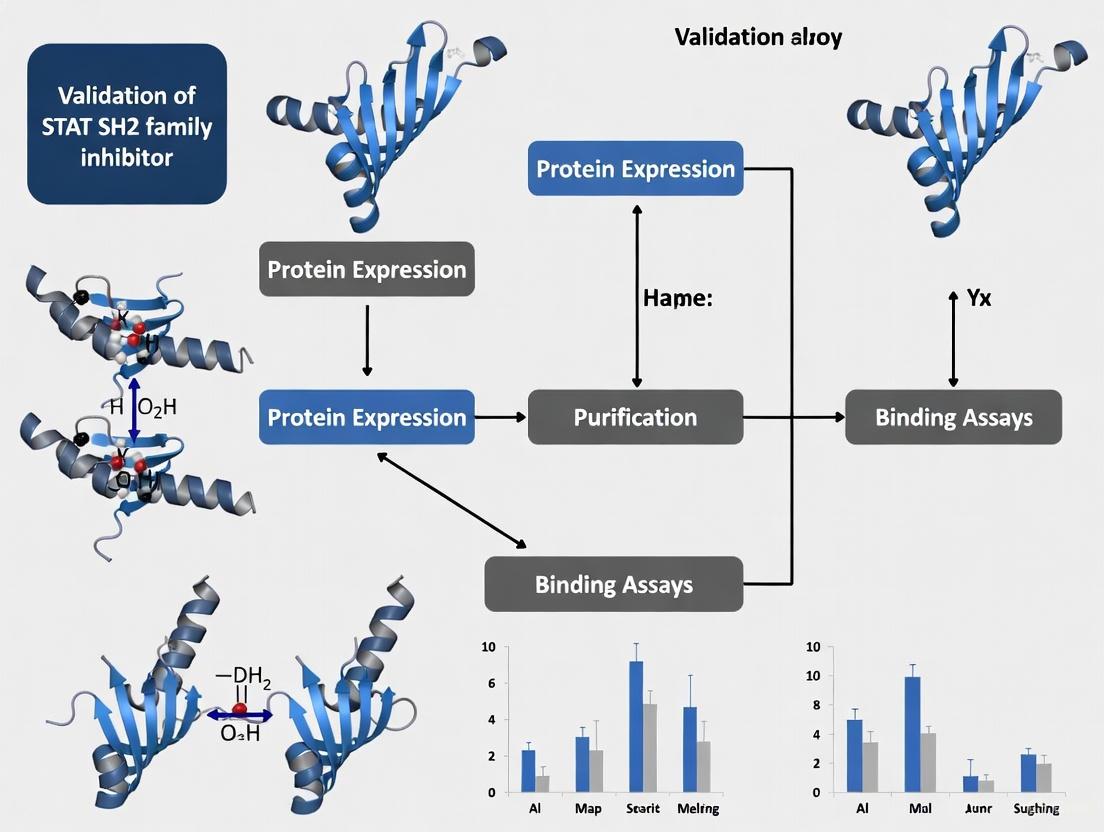
The development of specific STAT SH2 domain inhibitors represents a promising therapeutic strategy for cancers and inflammatory diseases.
Achieving Specificity: A Comprehensive Guide to Validating STAT SH2 Domain Inhibitors Across the STAT Family
Abstract
The development of specific STAT SH2 domain inhibitors represents a promising therapeutic strategy for cancers and inflammatory diseases. However, achieving high selectivity across the highly conserved STAT family is a significant challenge. This article provides a foundational overview of STAT protein structures, explores advanced methodological approaches for profiling inhibitor activity, details troubleshooting strategies for common selectivity issues, and establishes a rigorous framework for cross-family validation. Aimed at researchers and drug development professionals, this guide synthesizes current knowledge and techniques to accelerate the discovery of precise, clinically viable STAT-targeted therapies.
The STAT Family and Its SH2 Domain: Structural Biology and Therapeutic Imperative
The Signal Transducer and Activator of Transcription (STAT) family of proteins are crucial transcription factors that mediate cellular responses to a wide array of cytokines, growth factors, and other extracellular signals [1]. Initially discovered for their role in interferon (IFN) signaling, they provide a direct molecular link from cell surface receptors to the activation of gene transcription in the nucleus [2]. The STAT family comprises seven members: STAT1, STAT2, STAT3, STAT4, STAT5A, STAT5B, and STAT6 [1]. Each member fulfills both unique and overlapping physiological roles, intricately regulating processes such as immune cell development, differentiation, proliferation, and survival [2] [1].
The canonical STAT signaling pathway is initiated when an extracellular ligand (e.g., a cytokine) binds to its cognate transmembrane receptor. This binding event triggers the activation of associated Janus kinases (JAKs), which are tyrosine kinases [1] [3]. The activated JAKs phosphorylate specific tyrosine residues on the receptor's cytoplasmic tail, creating docking sites for latent, cytosolic STAT proteins [4] [3]. STATs are recruited via their Src homology 2 (SH2) domains and are subsequently phosphorylated by JAKs on a conserved C-terminal tyrosine residue [1] [3]. This phosphorylation induces a conformational change, leading to STAT dimerization through reciprocal phosphotyrosine-SH2 domain interactions [3]. The active dimer then translocates to the nucleus, where it binds to specific DNA response elements in the promoter regions of target genes—most often variations of the gamma-activated sequence (GAS)—to activate or repress transcription [1] [4].
Figure 1: Canonical JAK-STAT Signaling Pathway. Extracellular ligand binding activates receptor-associated JAKs, which phosphorylate STAT proteins. Phosphorylated STATs dimerize, translocate to the nucleus, and regulate target gene transcription.
STAT Protein Structures and Functional Domains
All STAT proteins share a conserved multi-domain architecture that facilitates their signal transduction and transcription functions. As illustrated in Figure 2, a typical STAT protein contains six key domains [1]:
- N-terminal domain (NTD): Facilitates protein-protein interactions and is involved in the formation of higher-order STAT oligomers, even in the absence of phosphorylation [1] [3].
- Coiled-coil domain (CCD): Serves as an interaction site for regulatory proteins and contains nuclear localization signals (NLS) that aid in nuclear import [1].
- DNA-binding domain (DBD): Recognizes and binds to specific DNA sequences, such as the GAS element, within the promoter regions of target genes [1].
- Linker domain (LD): Provides structural stability during activation and DNA binding [1].
- Src homology 2 (SH2) domain: A highly conserved module that is critical for function. It mediates the recruitment of STATs to phosphorylated tyrosine motifs on activated receptors and is essential for STAT dimerization through reciprocal phosphotyrosine-SH2 interactions between two STAT monomers [1] [5] [6].
- C-terminal transactivation domain (TAD): Interacts with transcriptional co-activators (e.g., histone acetyltransferases like p300/CBP) and chromatin remodelers to potentiate gene transcription. This domain contains the critical tyrosine phosphorylation site and a serine residue that can be phosphorylated to modulate transcriptional activity [1] [3].
Figure 2: Conserved Domain Structure of STAT Proteins. The SH2 domain is critical for receptor docking and STAT dimerization, making it a primary target for therapeutic inhibition.
The SH2 domain is particularly noteworthy from a therapeutic perspective. It is approximately 100 amino acids long and adopts a characteristic fold comprising a central beta-sheet flanked by two alpha-helices [7] [6]. Despite structural conservation, variations in the sequence and conformation of surface loops (e.g., the EF and BG loops) control access to binding pockets, thereby conferring specificity for distinct phosphotyrosine-containing peptide motifs among different STAT family members [7]. STAT-type SH2 domains are structurally distinct from SRC-type domains, as they lack the βE and βF strands and the C-terminal adjoining loop, which is likely an adaptation that facilitates their specific dimerization for transcriptional regulation [6].
Divergent Roles of STAT Proteins in Oncogenesis and Immunity
STAT proteins are not redundant in function; they play distinct and sometimes opposing roles in cancer and immune regulation, as summarized in Table 1.
Table 1: Divergent Roles of Major STAT Proteins in Oncogenesis and Immune Regulation
| STAT Protein | Primary Activators | Role in Oncogenesis | Role in Immune Regulation | Key Phenotypes in Deficient Mice |
|---|---|---|---|---|
| STAT1 | IFNs (α, β, γ) | Tumor Suppressor: Promotes growth arrest, apoptosis, and anti-tumor immunosurveillance [2] [4]. | Master regulator of antiviral and antibacterial responses; promotes Th1 responses [2]. | Unable to respond to IFNs; highly susceptible to viral/bacterial pathogens [2]. |
| STAT3 | IL-6, IL-10, IL-23, EGF, Src | Oncogenic: Drives proliferation, survival, angiogenesis, and immune evasion; constitutively active in many cancers [2] [4] [3]. | Anti-inflammatory; regulates T cell apoptosis, keratinocyte migration, and IL-10 signaling [2]. | Embryonic lethal; conditional knockouts show defects in immune cell function [2]. |
| STAT5 | IL-2, IL-3, IL-5, IL-7, GM-CSF, Prolactin | Oncogenic: Critical in leukemogenesis (e.g., CML, AML); promotes survival and proliferation [2] [4] [3]. | Essential for T cell proliferation and differentiation; mediates sexually dimorphic liver gene expression [2]. | Stat5A: defective mammopoiesis; Stat5B: defective liver gene expression [2]. |
| STAT4 | IL-12 | Context-dependent, but generally associated with anti-tumor immunity [3]. | Drives Th1 cell differentiation and IFN-γ production [2] [3]. | Defective IL-12-mediated T cell proliferation [2]. |
| STAT6 | IL-4, IL-13 | Context-dependent, can be pro-oncogenic in some cancers [3]. | Essential for Th2 cell differentiation and allergic responses [2] [3]. | Defective IL-4-mediated T cell proliferation [2]. |
The dual roles of STATs in immunity and cancer are intertwined. Chronic inflammation, often mediated by persistent STAT3 activation, can create a tumor-promoting microenvironment [3]. Furthermore, STAT3 activation in tumor-associated immune cells can suppress both innate and adaptive immune responses, thereby facilitating immune evasion [4]. The functional crosstalk between STATs is complex; for instance, the ratio of STAT1 to STAT3 has been identified as a key determinant of clinical outcome in colorectal carcinoma, highlighting the importance of the balance between these two factors [4].
STAT Proteins as Therapeutic Targets: Focus on SH2 Domain Inhibition
The direct involvement of dysregulated STAT signaling, particularly constitutive STAT3 and STAT5 activation, in numerous cancers and inflammatory diseases makes them attractive therapeutic targets [2] [4]. The SH2 domain is a primary focus for drug discovery because of its indispensable role in the activation cascade—mediating both receptor recruitment and, most critically, STAT dimerization [5] [6].
Mechanisms and Challenges of STAT Inhibition
Multiple strategies have been employed to target STAT proteins therapeutically, especially STAT3 [5] [8]:
- Small molecule inhibitors: These compounds typically target the SH2 domain to prevent phosphorylation or dimerization (e.g., OPB-31121, OPB-51602) [8].
- Peptidomimetics and phosphopeptides: These are designed to mimic the phosphotyrosine peptide segment and competitively block the SH2 domain, thereby inhibiting dimerization [2] [5].
- Oligonucleotide-based strategies: This includes antisense oligonucleotides (e.g., AZD9150/danvatirsen) that reduce STAT3 mRNA levels, and decoy oligonucleotides that compete with genomic DNA for STAT binding [8].
- PROTACs and degraders: Novel agents (e.g., KT-333) that hijack the ubiquitin-proteasome system to induce the degradation of STAT proteins [8].
Despite these efforts, developing effective STAT inhibitors faces significant challenges. The high structural homology among STAT SH2 domains makes achieving selectivity for a single STAT member extremely difficult, raising concerns about off-target effects [5] [8]. Furthermore, the SH2 domain binds phosphotyrosine with high affinity, making it challenging to find small molecules that can effectively compete [5]. Issues with pharmacokinetics, bioavailability, and drug delivery, particularly for oligonucleotide-based therapies, also present major hurdles [8].
Clinical Landscape of STAT Inhibitors
The clinical development of STAT inhibitors is an active area of research, with several candidates in various trial phases, as detailed in Table 2. Most advanced efforts focus on STAT3, reflecting its well-validated oncogenic role [9] [8].
Table 2: Select STAT Inhibitors in Clinical Development
| Drug Candidate | Target/Mechanism | Therapeutic Area | Clinical Trial Status (as of 2025) | Key Challenges & Notes |
|---|---|---|---|---|
| AZD9150 (Danvatirsen) | STAT3 Antisense Oligonucleotide | Oncology (Lymphoma, NSCLC) | Phase I/II [8] | Bioavailability and targeted delivery [8]. |
| TTI-101 | Small Molecule STAT3 Inhibitor | Oncology (Breast Cancer, HCC, IPF) | Phase II [9] | - |
| KT-333 | STAT3 Degrader (PROTAC) | Oncology (Lymphomas, Leukemias, Solid Tumors) | Phase I [8] | - |
| OPB-31121 | Small Molecule SH2 Domain Inhibitor | Oncology (Advanced Solid Tumors) | Phase I [8] | Toxicity (peripheral neuropathy, lactic acidosis) [8]. |
| Napabucasin (BBI608) | Cancer Stemness Inhibitor (STAT3 pathway) | Oncology (Colorectal, Pancreatic Cancer) | Phase III [8] | - |
| REX-7117 | Small Molecule STAT3 Inhibitor | Immune/Inflammatory (Th17-driven diseases) | Phase I/II [8] | Designed for high selectivity to reduce off-target effects [8]. |
Experimental Framework for Validating STAT SH2 Domain Inhibitor Specificity
A critical challenge in the field is confirming that a putative STAT inhibitor is both potent and specific for its intended target. The following section outlines a proposed experimental pipeline for the validation of STAT SH2 domain inhibitor specificity, a core requirement of the thesis context.
Comparative In Silico Docking and Selectivity Screening
Objective: To computationally predict the binding affinity and selectivity of small molecule candidates against the SH2 domains of all human STATs (STAT1, STAT2, STAT3, STAT4, STAT5A, STAT5B, STAT6).
Protocol:
- Model Preparation: Generate high-quality 3D homology models for the SH2 domains of all human STATs based on existing crystal structures (e.g., STAT1: 1BF5; STAT3: 1BG1; STAT5A: 1Y1U) [5]. Ensure models are energy-minimized.
- Virtual Library Screening: Dock a multi-million compound library against all STAT-SH2 models using standardized parameters [5].
- Hit Identification & Selectivity Analysis: Rank compounds based on predicted binding energy. A truly selective candidate for, say, STAT3, should show significantly stronger predicted binding to the STAT3 SH2 domain compared to the SH2 domains of STAT1, STAT5, etc. This provides an initial selectivity profile [5].
In Vitro Validation of STAT Phosphorylation and Dimerization
Objective: To experimentally verify that the candidate inhibitor selectively blocks the phosphorylation and dimerization of its intended STAT target in a cellular context.
Protocol:
- Cell Line Panel: Use a panel of cell lines known to be stimulated by specific cytokines to activate different STATs [5]. For example:
- STAT1: Stimulate with IFN-γ.
- STAT3: Stimulate with IL-6.
- STAT5: Stimulate with IL-3 or GM-CSF.
- Treatment and Stimulation: Pre-treat cells with the candidate inhibitor or a DMSO vehicle control, followed by stimulation with the appropriate cytokine.
- Western Blot Analysis:
- Lyse cells and separate proteins by SDS-PAGE.
- Probe membranes with antibodies against:
- Phospho-STATs: Specific for tyrosine-phosphorylated STAT1 (Tyr701), STAT3 (Tyr705), and STAT5 (Tyr694/699).
- Total STATs: To control for protein loading.
- A selective STAT3 inhibitor should markedly reduce IL-6-induced pSTAT3 levels without affecting IFN-γ-induced pSTAT1 or IL-3-induced pSTAT5 [5] [4].
- Electrophoretic Mobility Shift Assay (EMSA):
- Prepare nuclear extracts from treated and stimulated cells.
- Incubate extracts with a radiolabeled DNA probe containing a GAS or specific STAT-binding sequence.
- A successful inhibitor will prevent STAT-DNA binding, visible as a reduction in the gel shift band intensity, confirming functional inhibition of dimerization and DNA binding [5].
Figure 3: Workflow for Validating STAT SH2 Domain Inhibitor Specificity. This integrated pipeline combines computational and experimental methods to assess inhibitor potency and selectivity across the STAT family.
Downstream Functional Validation
Objective: To confirm that the observed inhibition of phosphorylation and dimerization translates into expected functional consequences in disease-relevant models.
Protocol:
- Gene Expression Analysis (qPCR): Measure mRNA levels of canonical STAT target genes.
- Proliferation and Apoptosis Assays:
- Treat STAT-dependent cancer cell lines with the inhibitor.
- Assess anti-proliferative effects using MTT or CellTiter-Glo assays.
- Measure apoptosis induction via Annexin V staining and flow cytometry or caspase-3/7 activity assays [2] [4].
- A potent STAT3 inhibitor should induce growth arrest and/or apoptosis in STAT3-dependent cancer cells (e.g., certain myeloma or head and neck cancer lines) but have minimal effect on cells reliant on other STATs [2].
The Scientist's Toolkit: Key Reagents for STAT Research
Table 3: Essential Research Reagents for Studying STAT Signaling and Inhibition
| Reagent / Tool | Function / Specificity | Key Application in STAT Research |
|---|---|---|
| Phospho-Specific STAT Antibodies | Detect tyrosine-phosphorylated STATs (e.g., pSTAT1-Y701, pSTAT3-Y705, pSTAT5-Y694/699). | Gold standard for monitoring STAT activation via Western blot, flow cytometry, or immunofluorescence [5] [4]. |
| Total STAT Antibodies | Detect STAT proteins regardless of phosphorylation status. | Essential loading controls for Western blot to confirm specific inhibition of phosphorylation, not protein levels. |
| Cytokines (IFN-γ, IL-6, IL-4, etc.) | Specific activators of different STAT pathways. | Used to selectively stimulate STAT1, STAT3, STAT6, etc., in in vitro experiments to test inhibitor specificity [5]. |
| STAT SH2 Domain Inhibitors | Small molecules (e.g., Stattic, OPB compounds) targeting the SH2 domain. | Tool compounds for proof-of-concept studies to dissect the functional role of specific STATs in biological processes [5] [8]. |
| STAT-Dependent Cell Lines | Cancer cell lines with known constitutive or inducible STAT activation (e.g., MDA-MB-231 for STAT3). | Functional models for testing the efficacy of inhibitors in proliferation, apoptosis, and gene expression assays [2] [4]. |
| GAS/Luciferase Reporter Plasmids | Plasmid containing a GAS promoter element driving luciferase expression. | Readout for functional STAT transcriptional activity in cells after inhibitor treatment [4]. |
| JAK Inhibitors (e.g., AG490) | Inhibit upstream JAK kinases. | Useful as controls to distinguish between effects of direct STAT inhibition versus upstream pathway blockade [2]. |
STAT proteins are master regulators of fundamental cellular processes, with their dysregulation being a hallmark of cancer and immune disorders. The SH2 domain represents a critical and validated target for therapeutic intervention due to its indispensable role in STAT activation. While the development of specific inhibitors has been challenging, advanced strategies like degraders (PROTACs) and sophisticated screening pipelines that combine comparative in silico docking with rigorous in vitro validation offer new hope [5] [8].
Future success in this field will likely depend on embracing these integrated approaches to overcome the selectivity hurdle. Furthermore, understanding the functional crosstalk between different STAT family members in specific tumor microenvironments will be crucial for identifying patient populations most likely to benefit from STAT-targeted therapies and for designing effective combination treatment regimens [4]. The ongoing clinical trials will be instrumental in determining whether the potent and selective inhibition of STAT proteins can be safely translated into a transformative clinical reality.
The Src homology 2 (SH2) domain is a modular protein interaction domain that serves as a primary mediator of cellular signal transduction immediately downstream of protein-tyrosine kinases (PTKs). Found in 110 human proteins, SH2 domains specifically recognize and bind to phosphorylated tyrosine (pTyr)-containing peptide sequences, coupling activated PTKs to intracellular pathways that regulate development, immune function, and cellular homeostasis [10]. Among their diverse functions, one of the most critical is facilitating protein dimerization—a fundamental mechanism for activating transcription factors, kinases, and signaling adaptors. The SH2 domain achieves this by engaging in specific pTyr-SH2 interactions that either promote direct dimerization between signaling molecules or recruit monomers to activated receptors for subsequent dimerization [11] [12]. This phosphotyrosine-dependent dimerization represents a crucial regulatory node in multiple signaling pathways, with profound implications for both normal physiology and disease pathogenesis, particularly in cancer and inflammatory disorders [13].
Molecular Mechanisms of SH2 Domain-Mediated Dimerization
Fundamental Binding Principles
SH2 domains fulfill their role in dimerization through biophysical principles that enable specific, regulated protein-protein interactions. These approximately 100-amino acid domains recognize their ligands through a dual recognition mechanism: a conserved binding pocket interacts with the phosphotyrosine residue, while adjacent specificity-determining regions bind to amino acid residues immediately C-terminal to the pTyr, typically spanning 3-5 residues [11] [10]. This creates a highly specific interaction interface where the affinity depends strongly on the flanking sequence surrounding the phosphotyrosine [14]. Structural analyses reveal that SH2 domains achieve selectivity not only through permissive residues that enhance binding but also through non-permissive residues that actively oppose binding through steric hindrance or charge repulsion. This complex recognition linguistics allows SH2 domains to distinguish subtle differences in peptide ligands, substantially increasing the accessible information content embedded in short peptide motifs [10].
Diverse Dimerization Mechanisms
SH2 domains facilitate dimerization through several distinct mechanistic paradigms, each employed in specific signaling contexts:
Reciprocal SH2-pTyr Dimerization: Exemplified by STAT transcription factors, this mechanism involves two STAT monomers that reciprocally engage each other—the SH2 domain of one monomer binds to the phosphotyrosine of the other, and vice versa. This creates stable, active dimers that translocate to the nucleus [11] [12]. The conservation of binding pockets across STAT family members (pY+0, pY+1, and pY-X sub-pockets) underlies this shared dimerization mechanism while presenting challenges for achieving pharmacological specificity [11].
Bridging-Mediated Dimerization: Adaptor proteins like SH2-B and APS employ a different strategy, using an N-terminal dimerization domain (which forms a unique four-helix bundle stabilized by a phenylalanine zipper) to homodimerize, while their SH2 domains bind to kinase molecules such as JAK2. This creates heterotetrameric complexes (e.g., JAK2-(SH2-B)₂-JAK2) that approximate two kinase molecules for transactivation [15]. This mechanism provides direct regulation of kinase activity from inside the cell, with dimerization being essential for SH2-B's cellular functions and its ability to stimulate JAK2 autophosphorylation [15].
Allosteric Regulation of Enzymatic Activity: SH2 domains can regulate the activity of their host proteins through conformational changes. In the protein tyrosine phosphatase SHP-2, the SH2 domains maintain the enzyme in an auto-inhibited state. Phosphotyrosine peptide binding to the N-terminal SH2 domain induces conformational changes, including an unprecedented allosteric transition that stimulates phosphatase activity [16].
Table 1: Comparison of SH2 Domain-Mediated Dimerization Mechanisms
| Mechanism | Representative Proteins | Structural Features | Functional Consequences |
|---|---|---|---|
| Reciprocal SH2-pTyr Dimerization | STAT1, STAT3, STAT5 | Reciprocal pTyr-SH2 interactions between monomers | Transcription factor activation; nuclear translocation |
| Bridging-Mediated Dimerization | SH2-B, APS | N-terminal dimerization domain + SH2 domain | Kinase transactivation (JAK2); signal amplification |
| Allosteric Regulation | SHP-2 phosphatase | SH2 domain binding relieves autoinhibition | Enzyme activation; downstream signaling propagation |
Experimental Analysis of SH2 Domain Dimerization
Methodologies for Investigating Dimerization
Research into SH2 domain-mediated dimerization employs multiple complementary experimental approaches, each providing unique insights into the mechanisms and specificity of these interactions:
Yeast Two-Hybrid and Trihybrid Systems: These powerful genetic systems detect protein-protein interactions in vivo. For studying SH2 domain dimerization, researchers have developed modified yeast trihybrid (Y3H) assays that introduce a third "bridging" plasmid expressing SH2-B constructs alongside bait and prey plasmids expressing kinase domains. This allows detection of complex formation that requires all three components [15]. Transformants are typically selected on synthetic dropout media and interactions quantified through β-galactosidase assays using Galacton Star substrate, with results expressed as relative light units [15].
Fluorescence Polarization and SPOT Analysis: Fluorescence polarization measures direct interactions between SH2 domains and soluble fluorescently-labeled phosphopeptides in solution, providing quantitative binding affinity data [10]. Complementarily, SPOT synthesis on nitrocellulose membranes enables semiquantitative assessment of interactions with hundreds to thousands of addressable peptides simultaneously. In this technique, peptides are synthesized directly on membranes, probed with purified GST-tagged SH2 domains, and detected with specific antibodies [10]. This approach has revealed the remarkable selectivity of SH2 domains for physiological peptide ligands.
Bacterial Peptide Display with Next-Generation Sequencing: This recently developed methodology combines bacterial display of genetically-encoded peptide libraries, enzymatic phosphorylation of displayed peptides, affinity-based selection, and next-generation sequencing (NGS). The enormous sequence diversity of random peptide libraries (10⁶-10⁷ sequences) coupled with NGS allows comprehensive profiling of SH2 domain specificity [14]. When analyzed with computational tools like ProBound, these data yield quantitative sequence-to-affinity models that predict binding free energy across the full theoretical ligand sequence space, updating specificity profiling from classification to quantification [14].
Electrophoretic Mobility Shift Assay (EMSA) and Western Blotting: EMSA detects STAT dimerization and DNA-binding activity by incubating nuclear extracts with ³²P-labeled oligonucleotide probes containing STAT-binding elements (e.g., hSIE from the c-fos gene). Protein-DNA complexes are resolved on non-denaturing polyacrylamide gels and visualized by autoradiography [12]. Complementary Western blotting with phosphospecific antibodies (e.g., anti-pY705-Stat3) confirms phosphorylation status, which is essential for SH2-pTyr dimerization [12].
Diagram 1: Experimental approaches for analyzing SH2 domain dimerization.
Quantitative Binding Affinity Assessment
Advanced methodologies now enable precise quantification of SH2 domain binding properties, moving beyond simple classification toward quantitative predictive models:
Table 2: Quantitative SH2 Domain Binding Profiling Techniques
| Method | Throughput | Measured Parameters | Key Advantages | Applications in Dimerization Studies |
|---|---|---|---|---|
| Bacterial Peptide Display + NGS | 10⁶-10⁷ sequences | Binding free energy (ΔΔG) | Covers full theoretical sequence space; quantitative predictions | Predict impact of phosphosite variants on dimerization |
| Fluorescence Polarization | Medium (10²-10³ peptides) | Equilibrium dissociation constant (K_D) | Solution-phase measurements; precise affinity determination | Validate dimerization interface mutants |
| SPOT Peptide Arrays | High (10³-10⁴ peptides) | Semiquantitative interaction strength | Parallel assessment of many physiological ligands | Identify natural dimerization partners |
| Isothermal Titration Calorimetry | Low (<10 peptides) | Binding enthalpy (ΔH), stoichiometry | Direct measurement of binding thermodynamics | Characterize SH2-pTyr interaction energetics |
The ProBound computational framework has proven particularly valuable for analyzing multi-round affinity selection data from highly diverse random peptide libraries. This method learns an additive model that predicts binding free energy across the entire theoretical ligand sequence space, accounting for challenges such as non-uniform input library representation, non-specific binding, and experimental carry-over [14]. For SH2 domains profiled using this approach, the resulting sequence-to-affinity model can predict novel phosphosite targets or the impact of phosphosite variants on binding—crucial for understanding how mutations might disrupt or enhance physiologically relevant dimerization events [14].
Case Studies in SH2 Domain Dimerization
STAT Transcription Factor Family
The STAT family provides the canonical example of reciprocal SH2-pTyr dimerization. STAT activation begins when receptor-associated JAK kinases phosphorylate a conserved tyrosine residue (e.g., Tyr705 in STAT3, Tyr701 in STAT1) in response to cytokine or growth factor stimulation [13] [12]. This phosphorylation enables two STAT monomers to form a stable dimer through reciprocal interactions where the SH2 domain of one monomer binds the phosphotyrosine of the other. The structural basis for this interaction involves three key sub-pockets within the SH2 domain: (1) the pTyr-binding pocket (pY+0), (2) the pY+1 sub-site, and (3) a hydrophobic side pocket (pY-X) [11]. The high conservation of these pockets, particularly pY+0, across STAT family members explains the challenge in developing STAT-specific inhibitors and the observed cross-binding specificity of compounds like stattic and fludarabine derivatives [11].
Experimental evidence for STAT dimerization comes from multiple approaches. Electrophoretic mobility shift assays (EMSA) using nuclear extracts and ³²P-labeled oligonucleotide probes containing STAT-binding elements (e.g., hSIE from the c-fos gene) demonstrate cytokine-inducible DNA-binding activity that reflects STAT dimerization [12]. Complementary evidence comes from studies with cell-permeable Stat3 SH2 domain mimetics, such as the 28-mer peptide SPI, which replicates Stat3 biochemical properties. SPI binds with similar affinities to known Stat3-binding phosphotyrosine peptide motifs and specifically blocks constitutive Stat3 phosphorylation, DNA-binding activity, and transcriptional function in malignant cells by competing for reciprocal SH2-pTyr dimerization interfaces [12].
SH2-B/JAK2 Signaling Complex
The SH2-B adaptor protein family employs a distinct bridging mechanism for dimerization and kinase activation. SH2-B isoforms readily homodimerize through a unique N-terminal domain that forms a four-helix bundle stabilized by a phenylalanine zipper [15]. Simultaneously, the SH2 domains of SH2-B bind JAK2 at Tyr813. This dual interaction capability creates a model where two molecules of SH2-B homodimerize with their SH2 domains bound to two JAK2 molecules, forming heterotetrameric JAK2-(SH2-B)₂-JAK2 complexes that approximate two JAK2 molecules for transactivation [15].
This dimerization mechanism exhibits concentration-dependent effects on kinase activity. At lower expression levels, SH2-B dimerization approximates two JAK2 molecules to induce transactivation, while at higher relative concentrations, kinase activation is blocked, suggesting a sophisticated regulatory mechanism for attenuating cytokine and growth factor receptor signaling [15]. The functional significance of this mechanism is demonstrated by the finding that dimerization via the novel N-terminal domain is necessary for SH2-B's cellular functions and its ability to stimulate JAK2 autophosphorylation and substrate phosphorylation [15].
Diagram 2: Comparison of STAT reciprocal dimerization versus SH2-B bridging mechanism.
Research Reagent Solutions for SH2 Domain Dimerization Studies
Table 3: Essential Research Reagents for SH2 Domain Dimerization Studies
| Reagent Category | Specific Examples | Research Application | Key Features & Considerations |
|---|---|---|---|
| SH2 Domain Inhibitors | Stattic, Fludarabine phosphate derivatives, S3I-201 | Probe STAT dimerization specificity | Stattic targets conserved pY+0 pocket, affecting STAT1/2/3; fludarabine inhibits STAT1/3; specificity limitations require validation [11] [5] |
| Peptide-Based Tools | SPI (Stat3 SH2 domain mimetic), Phosphorylated peptide motifs (e.g., GpYLPQTV-NH₂) | Competitive inhibition of SH2-pTyr interactions | SPI is cell-permeable, binds pTyr motifs with affinity similar to Stat3 SH2 domain; phosphopeptides used in fluorescence polarization assays [12] |
| Expression Constructs | GST-tagged SH2 domains, His-tagged Stat3/Stat3 SH2 domain, SH2-B isoforms (α, β, γ) | Recombinant protein production and interaction studies | GST fusion facilitates pull-down assays; His-tags enable purification for biophysical studies; SH2-B isoforms show differential effects [15] [10] [12] |
| Antibodies | Phosphospecific STAT antibodies (anti-pY705-Stat3, anti-pY701-Stat1), Anti-Stat3, Anti-GST | Detection of phosphorylation and dimerization status, Western blotting, immunoprecipitation | Phosphospecific antibodies indicate activation status essential for dimerization; validation across species required [11] [12] |
| Cell-Based Reporters | pLucTKS3 (Stat3-dependent), pLucSRE (Stat3-independent), β-Casein-Luc (Stat5-responsive) | Functional assessment of STAT activation and dimerization | Enable quantification of transcriptional activity resulting from dimerization; control reporters essential for specificity determinations [12] |
Implications for Inhibitor Specificity in STAT Family Research
The high structural conservation among STAT family SH2 domains presents significant challenges for developing specific inhibitors that target individual STAT proteins. Research has revealed that many purported STAT3 inhibitors exhibit substantial cross-reactivity with other STAT families. For example, the STAT3 inhibitor stattic primarily targets the highly conserved pY+0 SH2 binding pocket and demonstrates equal effectiveness toward STAT1 and STAT2, questioning its utility as a specific STAT3 inhibitor [11]. Similarly, fludarabine phosphate derivatives inhibit both STAT1 and STAT3 phosphorylation by competing with the highly conserved pY+0 and pY-X binding sites [11].
This cross-binding specificity necessitates more sophisticated approaches to inhibitor development. Comparative in silico docking studies against comprehensive models of human STAT SH2 domains provide a strategy for identifying more specific inhibitors [11] [5]. The pipeline approach combining comparative computational docking with in vitro STAT phosphorylation assays offers promise for screening multi-million compound libraries to identify specific inhibitors for different STATs [5]. Such approaches are essential for developing the next generation of STAT inhibitors with sufficient specificity for therapeutic applications.
The contextual recognition capabilities of SH2 domains—their ability to integrate both permissive and non-permissive residues in a context-dependent manner—suggest that targeting extended interaction interfaces beyond the highly conserved pTyr pocket may yield more specific inhibitors [10]. As structural insights into SH2 domain-ligand interactions deepen, opportunities emerge for designing compounds that exploit subtle differences in the topology and chemical environment of adjacent sub-pockets, potentially enabling specific disruption of pathological dimerization events while preserving physiological signaling.
Signal Transducers and Activators of Transcription (STAT) proteins are critical mediators of cytokine and growth factor signaling, facilitating gene expression in response to extracellular stimuli. The Src Homology 2 (SH2) domain serves as the central hub for STAT function, mediating both receptor recruitment and STAT dimerization—a fundamental step in transcriptional activation. Understanding the conserved features and variations in STAT SH2 domains is paramount for developing specific therapeutic inhibitors, as aberrant STAT signaling is implicated in numerous diseases, including cancer and autoimmune disorders. This guide provides a comparative analysis of STAT family SH2 domains, focusing on their structural conservation, mechanism of action, and the experimental frameworks used to probe their function and inhibit their activity.
Structural Anatomy of STAT SH2 Domains
The SH2 domain is one of six conserved domains in STAT proteins, which include an N-terminal domain (NTD), coiled-coil domain (CCD), DNA-binding domain (DBD), alpha-helical linker domain (LD), SH2 domain, and transactivation domain (TAD) [17]. STAT SH2 domains belong to a distinct structural subclass characterized by a unique architecture that facilitates their primary role in phosphotyrosine-dependent dimerization.
Defining Characteristics of the STAT-Type SH2 Domain
STAT-type SH2 domains exhibit several key structural differences from the more common Src-type SH2 domains [6]:
- Absence of βE and βF strands: Unlike Src-type SH2 domains, STAT SH2 domains lack these two beta strands and their adjoining loops.
- Split αB helix: The single αB helix found in Src-type domains is split into two separate helices in STAT proteins.
- Lack of a conventional P+3/P+4 pocket: The binding surface for peptide recognition is distinct. The conventional hydrophobic pocket that binds the residue at the P+3 or P+4 position (third or fourth residue C-terminal to the phosphotyrosine) in many other SH2 domains is not a defining feature of STAT SH2 domains due to their altered loop architecture [7].
These structural adaptations are evolutionary refinements that support the STAT protein's need to form specific dimers upon activation.
The Phosphotyrosine Binding Pocket and Specificity Determinants
All SH2 domains contain a deeply conserved phosphotyrosine (pY)-binding pocket. This pocket features a critical, invariant arginine residue (Arg βB5) that forms a salt bridge with the phosphate moiety of the phosphorylated tyrosine, providing the fundamental binding energy for the interaction [6] [18]. While this pY-binding site is highly conserved across all STATs and other SH2 domains, specificity for different peptide sequences is achieved through interactions with residues C-terminal to the pY.
STAT SH2 domains typically recognize motifs with the consensus sequence pYxxQ (where "x" is any amino acid) [7]. The glutamine (Q) at the P+3 position is a key specificity determinant. Structural analyses indicate that the molecular basis for this specificity differs from other SH2 domain classes, as STATs lack the EF loop that helps form the conventional P+3 pocket in Src-type domains [7] [6]. Instead, selectivity is governed by the unique surface topography created by the STAT-specific loop configurations.
Table 1: Core Structural Features of STAT and Src-Type SH2 Domains
| Structural Feature | STAT-Type SH2 Domains | Src-Type SH2 Domains |
|---|---|---|
| Central Beta Sheets | βB, βC, βD | βB, βC, βD, βE, βF |
| Alpha Helices | αA, αB (split into two) | αA, αB (single continuous helix) |
| EF Loop | Absent | Present; critical for defining ligand specificity |
| BG Loop | Open conformation | Variable; often controls pocket accessibility |
| Consensus Binding Motif | pYxxQ [7] | Variable (e.g., pY[-][-]ψ for Src) [7] |
| Primary Function in Protein | Dimerization & Receptor Recruitment | Recruitment to signaling complexes |
Comparative Analysis of STAT SH2 Domain Conservation
A sequence alignment of the SH2 domain from STAT1 across multiple species reveals striking evolutionary conservation, underscoring its critical non-redundant functions.
Sequence Conservation Across Species
The SH2 domain of STAT1 is highly conserved from humans to zebrafish, with key residues maintaining near-perfect identity [17]. For instance, the central FLVRES motif and the arginine responsible for pY binding are invariant across all species listed. Furthermore, residues like Tyr-539 and Ser-556 in murine STAT1, which are implicated in hydrogen bonding with the P+3 glutamine in the counterpart STAT molecule, are also completely conserved [17]. This high degree of conservation highlights the structural and functional constraints on the STAT1 SH2 domain.
Variations Across STAT Family Members
While all STAT SH2 domains share the core STAT-type structure and recognize a pYxxQ-like motif, subtle variations in their binding surfaces confer specificity for different cytokine receptors and prevent aberrant heterodimerization. For example, the precise geometry of the binding pocket differs between STAT1, STAT3, and STAT5, which is the fundamental challenge in developing STAT-specific inhibitors [19]. These differences, though minor compared to the overall structural conservation, are sufficient to ensure signaling fidelity within the JAK-STAT pathway.
Experimental Analysis of STAT SH2 Domains
A combination of structural, biophysical, and cellular assays is required to fully dissect STAT SH2 domain function and specificity.
Key Methodologies and Workflows
Researchers employ several core techniques to profile STAT SH2 domains:
- X-ray Crystallography/NMR: Determine high-resolution structures of SH2 domains in their apo state or in complex with phosphopeptide ligands. This reveals the atomic details of the binding interface and conformational changes upon dimerization [17] [6].
- Oriented Peptide Array Library (OPAL) Screening: A high-throughput method to define the precise peptide sequence preferences of an SH2 domain by screening it against a library of immobilized peptides with varying sequences C-terminal to a pY [7].
- Isothermal Titration Calorimetry (ITC) & Surface Plasmon Resonance (SPR): These biophysical techniques quantitatively measure the binding affinity (Kd) and kinetics (on/off rates) of SH2 domain-phosphopeptide interactions, providing data on both the strength and durability of the complex [20].
- Comparative In Silico Docking: A computational approach used to screen virtual compound libraries against 3D structural models of different STAT SH2 domains to predict binding and selectivity of potential inhibitors [19].
The following diagram illustrates a typical integrated workflow for identifying and validating STAT-specific inhibitors, combining computational and experimental approaches.
Essential Research Reagents and Tools
A successful research program in STAT SH2 domain biology requires a toolkit of specialized reagents.
Table 2: Essential Research Reagent Solutions for STAT SH2 Studies
| Reagent / Solution | Function & Application | Example / Description |
|---|---|---|
| Recombinant SH2 Domains | Used in structural studies (X-ray, NMR), in vitro binding assays (ITC, SPR), and screening. | Purified STAT1 SH2 domain protein (100 aa fragment) [17]. |
| Phosphorylated Peptide Ligands | Serve as binding partners, competitors, or standards in affinity and inhibition assays. | Synthetic pYxxQ-containing peptides derived from IFNγ or IL-6 receptors [7]. |
| Cell-Based Reporter Assays | Measure the functional consequence of SH2 domain inhibition on STAT-dependent transcription. | Luciferase reporter gene under control of a GAS (Gamma-Activated Sequence) promoter. |
| Phospho-Specific Antibodies | Detect and quantify activated, tyrosine-phosphorylated STAT proteins in cells and tissues. | Anti-pSTAT1 (Tyr701), Anti-pSTAT3 (Tyr705). |
| Virtual Compound Libraries | Source for in silico screening to identify potential lead compounds that target the SH2 domain. | ZINC database, commercial chemical libraries for virtual screening [19]. |
Targeting STAT SH2 Domains for Therapeutic Intervention
The critical role of the SH2 domain in STAT activation makes it an attractive target for disrupting pathogenic signaling in cancer and inflammatory diseases. The primary strategy has been to develop small molecules that compete with the native phosphopeptide for binding to the SH2 pocket, thereby preventing dimerization [19] [21]. However, achieving selectivity for a single STAT family member has proven challenging due to the high conservation of the pY-binding site. The unique structural features of STAT SH2 domains, particularly their distinct loops and altered binding surface compared to Src-type domains, offer a potential avenue for developing highly specific inhibitors [7] [6]. To date, no STAT-targeting drug has received FDA approval, underscoring the difficulty of this endeavor and the need for the sophisticated comparative analyses outlined in this guide [19].
The STAT family SH2 domains represent a fascinating example of structural conservation coupled with functional specificity. While all STATs utilize a conserved SH2 domain core to perform the essential function of phosphotyrosine-dependent dimerization, subtle variations in their binding interfaces dictate unique partner recognition and pathway specificity. A deep understanding of these commonalities and differences, gained through integrated structural, biophysical, and computational approaches, is fundamental for the rational design of next-generation therapeutics. The ongoing challenge for the field remains translating this structural knowledge into selective inhibitors that can modulate the activity of individual STAT proteins in human disease.
The Signal Transducer and Activator of Transcription (STAT) protein family represents a critical node in cellular signaling, governing processes such as proliferation, differentiation, and immune responses. Dysregulation of STAT signaling, particularly through mutations in the Src Homology 2 (SH2) domain, is implicated in numerous pathologies, especially cancer and autoimmune diseases. This guide compares the therapeutic targeting of STAT proteins, with a focus on validating the specificity of inhibitors designed against the STAT SH2 domain. The SH2 domain is essential for STAT activation, mediating receptor docking and dimerization. We summarize experimental data on STAT-specific inhibitors, provide detailed methodologies for assessing inhibitor specificity, and outline key research tools for advancing this critical field of therapeutic development.
The JAK/STAT signaling pathway is an evolutionarily conserved intracellular pathway that transmits signals from extracellular cytokines, growth factors, and hormones to the nucleus, driving the expression of target genes [13] [22]. The seven STAT family members (STAT1, STAT2, STAT3, STAT4, STAT5A, STAT5B, and STAT6) share a common domain structure, including a conserved SH2 domain that is pivotal for their function [23] [24]. This domain facilitates two crucial steps: recruitment to phosphorylated tyrosine residues on activated cytokine receptors, and reciprocal phosphotyrosine-mediated interaction between two STAT monomers to form active dimers [5] [24]. Upon dimerization, STATs translocate to the nucleus and regulate transcription [23].
Aberrant activation of STAT signaling, particularly of STAT3 and STAT5, is a hallmark of many cancers and immune disorders [25] [23]. In T-cell malignancies, for example, abnormal activation of the γc cytokine JAK/STAT pathway is a unifying feature, often assessed by the presence of phosphorylated STAT3 or STAT5 [25]. Such persistent activation can stem from upstream cytokine dysregulation, gain-of-function mutations in JAK kinases, or directly from mutations within the STAT proteins themselves, many of which are clustered in the SH2 domain [25] [23]. These mutations can enhance STAT dimer stability, lead to constitutive activation, and drive oncogenesis. Consequently, the STAT SH2 domain presents a compelling therapeutic target for inhibiting pathogenic STAT signaling.
Comparative Analysis of STAT-Specific Inhibitors
The development of inhibitors that directly target the STAT SH2 domain aims to disrupt the protein-protein interactions necessary for STAT dimerization and activation. The high degree of structural conservation among STAT SH2 domains presents a significant challenge for achieving selectivity. The table below summarizes the characteristics and experimental data for several documented STAT inhibitors.
Table 1: Comparison of STAT-Specific Inhibitors
| Inhibitor Name | Primary STAT Target | Reported IC₅₀ / Kᵢ | Cellular Activity Evidence | Key Challenges & Cross-Reactivity |
|---|---|---|---|---|
| Stattic | STAT3 | N/A | Induces apoptosis in melanoma and renal cell carcinoma lines [5]. | Limited specificity; questions about SH2 domain binding mechanism [5]. |
| FLLL32 | STAT3 | N/A | Inhibits STAT3 phosphorylation, promotes apoptosis, retains cellular response to other cytokines [5]. | Designed for STAT3, but requires specificity validation against other STATs. |
| HJC0123 | STAT3 | N/A | Orally bioavailable, shows antitumor efficacy in vivo [5]. | Specificity profile across STAT family not fully detailed. |
| AS1517499 | STAT6 | N/A | Ameliorates antigen-induced bronchial hypercontractility in mouse models [5]. | Demonstrates in vivo efficacy for STAT6-driven inflammation. |
| InSilico Candidates | Multiple | Variable (in silico prediction) | Identified via comparative docking against all human STAT SH2 models [5]. | In vitro and in vivo validation is pending. |
As the table illustrates, a primary hurdle is the lack of demonstrated specificity for many inhibitors. Many compounds identified as "STAT3-specific" through initial screening have subsequently been shown to inhibit other STAT family members or upstream kinases, muddying the interpretation of their therapeutic effects [5]. This underscores the necessity for rigorous, comparative validation assays.
Experimental Protocols for Validating Inhibitor Specificity
To address the challenge of specificity, a robust pipeline combining computational and experimental approaches is required. The following section outlines key methodologies.
Comparative In Silico Docking
Purpose: To pre-screen large compound libraries for potential selective binders against the SH2 domains of different STAT family members. Methodology:
- Model Preparation: Generate high-quality 3D structural models for the SH2 domains of all human STATs (STAT1-6). Homology modeling can be used based on existing crystal structures (e.g., STAT1:1BF5; STAT3:1BG1) [5].
- Library Screening: Dock multi-million compound libraries against each STAT-SH2 model.
- Selectivity Analysis: Rank compounds not only by predicted binding affinity for the target STAT but also by a calculated selectivity score, which quantifies the differential binding against non-target STAT SH2 domains. This helps filter out promiscuous binders early in the discovery process [5].
In Vitro STAT Phosphorylation and Dimerization Assays
Purpose: To experimentally confirm that a candidate inhibitor blocks STAT activation and dimerization in a cell-based system. Methodology:
- Cell Stimulation: Treat relevant cell lines (e.g., hematopoietic, carcinoma) with specific cytokines known to activate particular STATs (e.g., IL-6 for STAT3; IFN-α for STAT1) in the presence or absence of the inhibitor [5] [24].
- Cell Lysis and Analysis: Lyse cells and analyze lysates by Western blot.
- Key Measurements:
- Phosphorylation Status: Probe with antibodies against phosphorylated tyrosine residues (e.g., pY705 for STAT3).
- Total STAT Levels: Probe for total STAT protein to control for loading and compound toxicity.
- Dimerization: Use non-reducing gel electrophoresis or co-immunoprecipitation to assess the formation of STAT dimers. Data Interpretation: A specific inhibitor will reduce phosphorylation and dimerization of its target STAT with minimal effect on other STATs activated by different cytokines.
Cellular Fitness and Functional Assays
Purpose: To determine the functional consequences of inhibitor treatment and link target engagement to a phenotypic output. Methodology:
- Viability/Apoptosis Assays: Treat STAT-dependent cancer cell lines with inhibitors and measure cell death using automated Trypan Blue exclusion assays or flow cytometry with Annexin V/7-AAD staining [26].
- Gene Expression Analysis: Use quantitative RT-PCR or reporter gene assays to measure the transcription of specific STAT target genes (e.g., BCL-xL, c-MYC). A selective STAT3 inhibitor should block the expression of STAT3-driven genes but not those regulated by STAT1 (e.g., in response to interferon) [25].
- High-Throughput Fitness Screens: In models like BTK-dependent B-cells, the fitness of chimeric proteins with swapped SH2 domains can be measured via CD69 upregulation assays and high-throughput RNA sequencing, providing a sensitive readout of specific SH2 domain function [27].
Signaling Pathways and Experimental Workflows
The following diagrams illustrate the core STAT signaling pathway and a proposed workflow for validating STAT inhibitor specificity, integrating the experimental protocols described above.
JAK-STAT Signaling Pathway and Therapeutic Inhibition
Diagram Title: JAK-STAT Signaling Pathway and Inhibitor Mechanism.
STAT Inhibitor Specificity Validation Workflow
Diagram Title: STAT Inhibitor Specificity Validation Workflow.
The Scientist's Toolkit: Research Reagent Solutions
Successful research into STAT biology and inhibitor development relies on a suite of critical reagents and tools. The following table details essential materials for the featured experiments.
Table 2: Key Research Reagents for STAT SH2 Domain Studies
| Reagent / Material | Function and Application in Research |
|---|---|
| Phospho-Specific STAT Antibodies | Essential for Western blot and immunofluorescence to detect activated, tyrosine-phosphorylated STATs (e.g., pSTAT1, pSTAT3, pSTAT5). Used in In Vitro Phosphorylation Assays [26]. |
| Recombinant STAT SH2 Domain Proteins | Purified protein domains for in vitro binding assays (SPR, ITC), structural studies (X-ray crystallography), and high-throughput screening of inhibitors. |
| Cytokine Panel (IL-6, IFN-γ, IL-4, etc.) | Used to selectively activate specific STAT family members in cell-based assays to test inhibitor specificity across different signaling pathways [5] [24]. |
| Validated shRNA Plasmids (JAK/STAT genes) | For loss-of-function studies to create genetically defined cellular models and validate "addiction" to specific JAK/STAT pathway components [25]. |
| STAT-Dependent Reporter Cell Lines | Engineered cells with a luciferase or GFP reporter gene under the control of a STAT-responsive promoter. Provide a quantitative and high-throughput readout of STAT transcriptional activity. |
| Annexin V / 7-AAD Apoptosis Kit | Standard flow cytometry-based kit to measure cell death and apoptosis induced by STAT pathway inhibition in sensitive cancer cell lines [26]. |
Dysregulated STAT signaling is a robust therapeutic rationale for a range of human diseases, with the SH2 domain representing a key target for direct pharmacological intervention. While several candidate inhibitors have been identified, the path to the clinic is hampered by the significant challenge of achieving and demonstrating meaningful specificity within the STAT family. Advancing this field requires a concerted effort, leveraging comparative in silico screening, rigorous multi-tiered experimental validation, and the use of standardized, high-quality research tools. By adopting the comprehensive framework outlined in this guide, researchers can more effectively develop and characterize the next generation of STAT SH2 domain inhibitors, ultimately leading to more precise and effective therapeutics for cancer and inflammatory diseases.
Signal Transducer and Activator of Transcription (STAT) proteins are a family of transcription factors that serve as crucial signaling hubs for numerous cytokines, growth factors, and hormones. The seven STAT family members (STAT1, STAT2, STAT3, STAT4, STAT5A, STAT5B, and STAT6) regulate fundamental cellular processes including proliferation, differentiation, apoptosis, and immune responses [28] [29]. Their activation is typically initiated by extracellular ligand binding to cognate receptors, which triggers phosphorylation of specific tyrosine residues by Janus kinases (JAKs) or receptor tyrosine kinases. This phosphorylation event facilitates STAT dimerization via reciprocal Src Homology 2 (SH2) domain-phosphotyrosine interactions, leading to nuclear translocation and modulation of target gene expression [30] [6].
Dysregulated STAT signaling, particularly of STAT3 and STAT5, is implicated in the pathogenesis of diverse human diseases. In oncology, constitutive STAT3 activation promotes tumor growth, survival, angiogenesis, and immune evasion [28]. STAT3 and STAT5 are established therapeutic targets in various hematologic malignancies and solid tumors [28]. In inflammatory and autoimmune diseases, STAT1, STAT4, and STAT6 drive pathological immune responses. STAT6, for instance, is a key nodal transcription factor that selectively mediates downstream signaling of IL-4 and IL-13, central cytokines in type 2 inflammatory diseases such as asthma, atopic dermatitis, and other allergic conditions [31]. The central role of STAT proteins in disease pathogenesis has motivated extensive drug discovery efforts targeting their regulatory domains, with particular focus on the phosphotyrosine-binding SH2 domain that is essential for STAT activation and dimerization [6].
STAT Inhibitor Pipeline Analysis
The current STAT inhibitor development landscape features a diverse array of approaches targeting multiple STAT family members through various mechanisms of action. As of 2025, the pipeline includes over 22 drug candidates being developed by more than 18 companies, spanning discovery through Phase II clinical stages [28] [9] [29]. The following table summarizes key STAT inhibitors in clinical development.
Table 1: STAT Inhibitors in Clinical Development
| Drug Candidate | Company | Target | Mechanism | Development Stage | Key Indications |
|---|---|---|---|---|---|
| TTI-101 | Tvardi Therapeutics | STAT3 | Small molecule inhibitor | Phase II | Breast cancer, idiopathic pulmonary fibrosis, liver cancer [28] |
| KT-621 | Kymera Therapeutics | STAT6 | Oral degrader | Phase I | Atopic dermatitis [28] [29] |
| VVD-850 | Vividion Therapeutics | STAT3 | Small molecule inhibitor | Phase I | Tumors [28] [29] |
| Undisclosed | Recludix Pharma | STAT6 | SH2 domain inhibitor | Preclinical | Asthma, COPD, atopic dermatitis [31] |
The pipeline is characterized by several notable trends. First, there is a predominant focus on STAT3 and STAT6, reflecting their well-validated roles in oncology and immunology, respectively. Second, developers are employing diverse mechanisms including direct SH2 domain binding, protein degradation, and allosteric modulation. Third, the field is transitioning from broad JAK-STAT pathway inhibition toward highly selective STAT-specific therapeutics aimed at improving efficacy and safety profiles [28] [31].
Table 2: Select STAT Inhibitors in Preclinical Development
| Drug Candidate | Company/Institution | Target | Mechanism | Research Focus |
|---|---|---|---|---|
| Pep 19 | Academic | Cbl-b SH2 domain | Phosphorylated peptidomimetic | Cancer immunotherapy [32] |
| Undisclosed STAT3 inhibitor | Multiple | STAT3 SH2 domain | Small molecule inhibitor | Th17-mediated inflammatory diseases [31] |
| BTK SH2 domain inhibitors | Recludix Pharma | BTK | SH2 domain inhibitor | B cell/mast cell-driven diseases [31] |
Targeting the SH2 Domain for Selective STAT Inhibition
Structural and Functional Basis of SH2 Domain Targeting
The SH2 domain is an approximately 100-amino acid protein module that specifically recognizes and binds phosphorylated tyrosine (pY) motifs [6]. This domain adopts a conserved fold consisting of a central three-stranded antiparallel β-sheet flanked by two α-helices, creating a pocket that accommodates the phosphotyrosine residue [6]. Structural analyses reveal that SH2 domains can be broadly classified into two major subgroups: STAT-type and SRC-type. STAT-type SH2 domains lack the βE and βF strands present in SRC-type domains, an adaptation that facilitates the dimerization critical for STAT-mediated transcriptional regulation [6].
The SH2 domain enables two critical functions in STAT activation: (1) recruitment to phosphorylated cytokine receptors via SH2-phosphotyrosine interactions, and (2) reciprocal SH2-phosphotyrosine interactions between STAT monomers that facilitate dimerization and nuclear translocation [6]. This central role in STAT activation makes the SH2 domain an attractive target for therapeutic intervention. Targeting the SH2 domain offers several potential advantages over catalytic kinase inhibition, including greater specificity and the ability to prevent both kinase-dependent and kinase-independent STAT functions [6].
Experimental Validation of SH2 Domain Inhibitor Specificity
Recent advances in SH2 domain inhibitor development have demonstrated the feasibility of achieving high selectivity for individual STAT family members. A key example comes from Recludix Pharma, which has developed selective STAT6 SH2 domain inhibitors that demonstrate picomolar potency for inhibiting STAT6 activation driven by IL-4 while maintaining high specificity over other STAT family members and broader kinome targets [31].
The following diagram illustrates the STAT6 signaling pathway and mechanism of SH2 domain inhibition:
Diagram 1: STAT6 activation pathway and SH2 domain inhibition mechanism. The inhibitor blocks STAT6 dimerization by targeting the SH2 domain, preventing gene expression.
In preclinical models of allergic asthma, Recludix's STAT6 inhibitor demonstrated dose-dependent reduction of airway inflammation comparable to antibody-mediated blockade of the IL-4/IL-13 pathway, while avoiding broad JAK-mediated immune suppression [31]. The inhibitor suppressed phosphorylated STAT6 in blood, spleen, and lung tissues with repeat dosing without impacting total STAT6 protein levels, indicating a reversible, non-degrading mechanism of action [31].
Methodologies for Assessing STAT Inhibitor Specificity and Efficacy
Biochemical and Cellular Assays
Rigorous assessment of STAT inhibitor specificity requires a multi-tiered experimental approach. The following workflow outlines key methodologies for evaluating SH2 domain-targeted inhibitors:
Diagram 2: Experimental workflow for evaluating STAT SH2 domain inhibitors
Fluorescence Polarization (FP) Assays: FP-based competition assays provide a sensitive method for evaluating inhibitor binding to STAT SH2 domains. As demonstrated in the development of Cbl-b SH2 domain inhibitors, optimized FP assays enable high-throughput screening and quantitative assessment of binding affinity [32]. The assay utilizes a fluorescent tracer based on known SH2 domain-binding peptides, with test compounds evaluated for their ability to displace the tracer in a dose-dependent manner.
Selectivity Profiling: Comprehensive selectivity assessment involves profiling compounds against panels of SH2 domains from different STAT family members and related signaling proteins. This can be achieved through dedicated biochemical assays or cellular approaches that monitor phosphorylation states of different STAT proteins in response to specific cytokine stimulation (e.g., IL-4/IL-13 for STAT6, IL-6 for STAT3) [31] [33].
Primary Human Cellular Assays: Compounds with demonstrated biochemical potency and selectivity advance to testing in primary human cells. For STAT6 inhibitors, this includes assessment of thymus and activation-regulated chemokine (TARC) production in peripheral blood mononuclear cells (PBMCs) following IL-4 or IL-13 stimulation [31]. Effective STAT6 inhibitors should replicate the selectivity of IL-4/IL-13 biologics by preventing differentiation of T helper 2 (Th2) cells without impacting other immune pathways [31].
In Vivo Validation Models
Preclinical Disease Models: Statistically robust in vivo models are essential for validating the therapeutic potential of STAT inhibitors. For STAT6-targeted agents in allergic inflammation, murine models of allergic asthma provide critical proof-of-concept data. In such models, inhibitors are evaluated in both prophylactic and therapeutic dosing paradigms, with assessment of airway inflammation, mucus production, and target engagement in relevant tissues [31].
Target Engagement and Biomarker Assessment: Confirming direct target modulation in vivo requires measurement of phosphorylated STAT levels in blood and tissues following compound administration. For STAT6 inhibitors, demonstration of dose-dependent and durable suppression of phosphorylated STAT6 without reduction in total STAT6 protein indicates a reversible, non-degrading mechanism [31]. This differentiated approach potentially offers advantages over degradation-based strategies by preserving non-pathological STAT functions.
Research Reagent Solutions for STAT Inhibition Studies
Table 3: Essential Research Reagents for STAT Inhibitor Development
| Reagent/Category | Specific Examples | Research Application | Key Function |
|---|---|---|---|
| SH2 Domain Binding Assays | Fluorescence polarization (FP) competition assays [32] | Inhibitor screening and Kd determination | Quantifies compound binding affinity to STAT SH2 domains |
| Selective Cytokines | IL-4, IL-13 (STAT6); IL-6 (STAT3) [31] [33] | Pathway-specific cellular activation | Selective stimulation of specific STAT signaling pathways |
| Primary Human Cells | Peripheral blood mononuclear cells (PBMCs) [31] | Cellular target engagement | Assess biomarker modulation (e.g., TARC) in relevant human cell types |
| Phospho-Specific Antibodies | Anti-pSTAT3, anti-pSTAT6, anti-pSTAT1 [31] [33] | Cellular and in vivo target modulation | Detection of phosphorylated (activated) STAT proteins |
| Disease-Relevant Animal Models | Allergic asthma models (STAT6) [31]; Cancer syngeneic models [32] | In vivo efficacy assessment | Evaluation of therapeutic potential in pathologically relevant contexts |
Comparative Analysis of STAT-Targeted Versus JAK-Targeted Approaches
The development of direct STAT inhibitors represents an evolution beyond first-generation JAK inhibitors, which target upstream kinases in the JAK-STAT pathway. While JAK inhibitors have demonstrated clinical utility in autoimmune and inflammatory conditions, their use is limited by mechanism-based toxicities arising from blockade of multiple cytokine signaling pathways [34] [33].
Direct STAT inhibition offers several potential advantages. First, STAT inhibitors provide greater pathway selectivity by targeting the specific transcription factors responsible for pathological gene expression, while preserving signaling through other JAK-dependent cytokines. Second, STAT inhibitors can address non-canonical STAT functions that operate independently of JAK activation. Third, the potential for STAT isoform selectivity may enable more precise therapeutic interventions with improved safety profiles [31].
However, direct STAT targeting presents unique challenges. Achieving high-affinity binding to protein-protein interaction interfaces like the SH2 domain is notoriously difficult, and compound delivery to the nuclear compartment where STATs execute their transcriptional functions adds additional complexity. The emerging clinical data from STAT3 and STAT6 inhibitor programs will be crucial for validating this approach and informing future drug discovery efforts.
The STAT inhibitor field is advancing rapidly, with multiple therapeutic candidates approaching clinical proof-of-concept readouts. The ongoing development of TTI-101 (STAT3), KT-621 (STAT6 degrader), and VVD-850 (STAT3) will provide critical validation for direct STAT targeting in human diseases [28] [29]. Meanwhile, emerging approaches such as Recludix's selective STAT6 SH2 domain inhibitor offer the potential for unprecedented specificity within the STAT family [31].
Key future directions include: (1) elucidating the structural determinants of STAT SH2 domain specificity to enable rational drug design; (2) developing biomarkers for patient stratification and target engagement assessment; (3) exploring combination therapies that leverage STAT inhibition with complementary mechanisms; and (4) addressing challenges in drug delivery to overcome pharmacological barriers.
The expanding toolkit of STAT-targeted therapeutics, particularly those targeting the SH2 domain, holds significant promise for more precise and effective treatments in oncology and immunology. As these candidates progress through clinical development, they will refine our understanding of STAT biology while potentially delivering transformative therapies for patients with limited treatment options.
Methodologies for Profiling Inhibitor Binding and Functional Activity
The Src Homology 2 (SH2) domain is a critical protein module approximately 100 amino acids long that specifically binds to phosphorylated tyrosine (pY) motifs, facilitating signal transduction in numerous cellular processes [35]. In STAT (Signal Transducer and Activator of Transcription) proteins, the SH2 domain mediates both receptor recruitment and the reciprocal phosphotyrosine–SH2 interaction that drives STAT dimerization and activation [36] [12]. Given the role of persistently active STATs, particularly STAT3 and STAT5, in cancer and inflammatory diseases, the STAT SH2 domain has emerged as a promising therapeutic target [12] [37]. However, a central challenge in drug development is achieving selectivity, as the SH2 domains across the STAT family are structurally conserved [36] [11]. This guide objectively compares the performance of computational methodologies—primarily molecular docking and molecular dynamics (MD) simulations—in predicting and validating the specificity of small-molecule inhibitors targeting the STAT SH2 domain, providing a framework for researchers to select appropriate experimental protocols.
Table 1: Core Components of the Computational Toolkit for Predicting SH2 Inhibitor Selectivity
| Research Reagent/ Tool | Type | Primary Function in Specificity Prediction | Key Considerations |
|---|---|---|---|
| STAT SH2 Domain Models | Protein Structure | Serves as the receptor for in silico docking; high-resolution structures (e.g., PDB: 6NJS) are crucial for accuracy. | Structures solved by X-ray crystallography or NMR; missing residues must be modeled [37]. |
| Small-Molecule Libraries | Chemical Database | Source of candidate inhibitors (e.g., ZINC15, natural compound databases) for virtual screening. | Libraries should be processed (e.g., with LigPrep) to generate accurate 3D structures and ionization states [38] [37]. |
| Molecular Docking Software | Computational Algorithm | Predicts the binding conformation and affinity of a ligand within the SH2 domain's binding pocket. | Choice of algorithm (e.g., Glide, AutoDock) and precision mode (HTVS, SP, XP) impacts accuracy/speed trade-offs [39] [40]. |
| Molecular Dynamics Software | Computational Algorithm | Simulates the time-dependent behavior of the protein-ligand complex to assess stability and binding mode. | Programs like Desmond are used to validate docking poses and calculate binding free energy via MM-GBSA [38] [37]. |
| Scoring Functions | Computational Metric | Quantifies the predicted binding affinity (e.g., docking score, ΔGBinding) to rank candidate compounds. | MM-GBSA is considered more accurate than docking scores alone for ranking inhibitors [37] [40]. |
Comparative Performance of Computational Methodologies
Molecular Docking: Initial Screening and Specificity Profiling
Molecular docking is a structure-based computational technique that predicts the preferred orientation and binding affinity of a small molecule within a protein's binding site [39] [40]. Its primary value in specificity prediction lies in its ability to rapidly screen thousands of compounds against multiple highly similar targets.
Performance Data and Protocol: A standard protocol involves a multi-step docking workflow to balance computational time with accuracy. For instance, a study screening 182,455 natural compounds first used High-Throughput Virtual Screening (HTVS), followed by Standard Precision (SP) docking on the top ~30% of hits, and finally Extra Precision (XP) docking on the most promising candidates [38] [37]. This workflow successfully identified specific inhibitors like ZINC67910988, which demonstrated a superior binding affinity and stable interaction profile with the STAT3 SH2 domain [37].
However, docking alone has known limitations in predicting true biological selectivity. A critical study that performed comparative docking of the inhibitors stattic and fludarabine against STAT1, STAT2, and STAT3 revealed a key insight: both inhibitors showed significant cross-binding [36] [11]. Stattic, initially characterized as a STAT3-specific inhibitor, was predicted to bind with similar efficacy to STAT1 and STAT2 because it primarily targets the highly conserved pY+0 binding pocket [11]. This prediction was subsequently confirmed in vitro, demonstrating docking's power to flag potential selectivity issues early in development [36].
Molecular Dynamics Simulations: Validating and Refining Specificity Predictions
While docking provides a static snapshot of binding, molecular dynamics (MD) simulations model the physical movements of atoms and molecules over time, offering a more dynamic assessment of complex stability and binding interactions. This is crucial for confirming that a predicted binding pose is stable under conditions that mimic the physiological environment.
Experimental Protocol and Data: Following molecular docking, the top-ranked protein-ligand complexes are subjected to MD simulations, typically lasting 100 nanoseconds or more. The stability of the system is assessed by calculating the Root Mean Square Deviation (RMSD) of the protein backbone and the ligand itself. A stable or converging RMSD trajectory suggests a reliable binding pose [38] [37].
Furthermore, MD simulations enable more accurate calculation of binding free energy using methods like Molecular Mechanics with Generalized Born and Surface Area Solvation (MM-GBSA). In the study identifying ZINC67910988, MM-GBSA was used to calculate the binding free energy (ΔGBinding), providing a more robust ranking of compounds than docking scores alone [37]. The integration of MD and MM-GBSA helps to minimize false positives from initial docking screens and provides a stronger computational basis for predicting selectivity.
Table 2: Comparison of In Silico Methodologies for Predicting SH2 Inhibitor Selectivity
| Methodology | Key Strengths | Inherent Limitations | Key Performance Metric | Role in Specificity Assessment |
|---|---|---|---|---|
| Molecular Docking | High speed; suitable for virtual screening of large libraries; provides an atomic-level view of potential binding modes. | Treats protein as largely rigid; scoring functions can be inaccurate; provides a static picture. | Docking Score (kcal/mol); ability to reproduce a known co-crystallized ligand pose (RMSD < 2.0 Å). | Initial ranking of compounds and flagging cross-binding via comparative docking against multiple STAT isoforms. |
| Molecular Dynamics (MD) | Models flexibility and solvation effects; provides time-dependent data on complex stability; enables more accurate energy calculations. | Computationally expensive, limiting the number of compounds that can be tested. | Complex stability (RMSD, RMSF); MM-GBSA binding free energy (ΔGBinding). | Validation of docking results and refinement of specificity predictions by assessing the stability of interactions over time. |
| Integrated Docking & MD | Combines the throughput of docking with the accuracy of MD; currently the most reliable in silico workflow for lead optimization. | Still requires final experimental validation; expertise in multiple software suites is needed. | Correlation between favorable ΔGBinding and stable, isoform-specific binding interactions in the MD trajectory. | Provides a multi-faceted computational profile of a compound's selectivity before proceeding to in vitro assays. |
Experimental Protocols for Key Analyses
Protocol 1: Comparative Docking for Cross-Binding Potential
This protocol is designed to assess the potential of a lead compound to inhibit non-target STAT isoforms.
- Protein Preparation: Retrieve high-resolution crystal structures of the SH2 domains for all relevant STAT isoforms (e.g., STAT1, STAT3). A suitable example is PDB ID: 6NJS for STAT3. Using a tool like Schrödinger's Protein Preparation Wizard, add hydrogen atoms, fill in missing side chains or loops, and optimize the hydrogen-bonding network. Finally, minimize the structure using a force field like OPLS3e to relieve steric clashes [37].
- Ligand Preparation: Obtain or draw the 3D structure of the small-molecule inhibitor. Prepare the ligand using a tool like LigPrep to generate likely ionization states at physiological pH (7.4 ± 0.5) and low-energy ring conformations [37] [41].
- Receptor Grid Generation: Define the binding site for each STAT SH2 domain. To ensure consistency in comparative analysis, place the grid center on the centroid of the conserved pY+0 binding pocket or on the coordinates of a co-crystallized ligand [37].
- Docking Execution: Dock the prepared ligand into the defined grid of each STAT SH2 domain structure using a standard precision (SP) or extra precision (XP) protocol. It is critical to use the same docking parameters for all isoforms to allow for direct comparison [36] [41].
- Analysis: Compare the docking scores and binding poses across the different STAT isoforms. A significantly better (more negative) docking score for the intended target versus other isoforms suggests potential selectivity. Conversely, similar scores across isoforms, as seen with stattic, indicate a high risk of cross-binding [36] [11].
Protocol 2: Binding Free Energy Calculation via MM-GBSA
This protocol is used after docking to obtain a more reliable estimate of binding affinity.
- Complex Selection: Select the top poses from the docking experiments for the most promising candidates.
- Trajectory Generation: Run an MD simulation (e.g., 100 ns) for each protein-ligand complex in a solvated system. This generates a trajectory file capturing the motion of the complex over time.
- Energy Calculation: Using the MD trajectory, the binding free energy is calculated with the MM-GBSA method. The formula used is: ΔGBinding = GComplex - (GReceptor + GLigand), where G represents the free energy of each component [37].
- Analysis: More negative ΔGBinding values indicate stronger binding. Researchers can compare the MM-GBSA-derived ΔGBinding for a compound across different STAT isoforms to computationally validate its selectivity profile [37].
Visualization of Workflows and Pathways
The following diagrams illustrate the core concepts and experimental workflows described in this guide.
Diagram 1: A high-level workflow showing the complementary roles of molecular docking and dynamics simulations in classifying inhibitors as specific or cross-binding.
Diagram 2: A detailed workflow for an integrated computational protocol to predict STAT SH2 inhibitor selectivity.
Src Homology 2 (SH2) domains are critical protein interaction modules that recognize phosphotyrosine (pY) motifs, directing signal transduction in numerous cellular pathways, including those mediated by STAT (Signal Transducer and Activator of Transcription) family proteins [42]. For researchers developing inhibitors targeting STAT SH2 domains, discriminating between highly homologous family members is paramount to achieving therapeutic efficacy and avoiding off-target effects. This guide objectively compares three foundational biophysical techniques—Surface Plasmon Resonance (SPR), Isothermal Titration Calorimetry (ITC), and Fluorescence Polarization (FP)—for direct characterization of SH2 domain engagements. Each method provides distinct insights into binding affinity, kinetics, and thermodynamics, forming an essential toolkit for validating inhibitor specificity within the STAT family and related SH2 domain-containing proteins.
The following diagram illustrates the core principles of these techniques and their application in profiling SH2 domain interactions.
Quantitative Comparison of Assay Capabilities
The selection of an appropriate biophysical assay depends heavily on the research question, whether it involves determining full thermodynamic profiles, obtaining kinetic rate constants, or performing high-throughput screening. The following tables summarize the key performance metrics and applications of SPR, ITC, and FP.
Table 1: Performance Metrics and Data Output Comparison
| Parameter | SPR | ITC | FP |
|---|---|---|---|
| Measured Parameters | ka, kd, KD, Stoichiometry | KD, ΔH, ΔS, n (stoichiometry) | KD, IC50 (competition) |
| Affinity Range (KD) | 10⁻³ to 10⁻¹² M [43] | ~10⁻³ to 10⁻⁸ M | ~10⁻⁹ to 10⁻⁶ M |
| Sample Consumption | Low (50–100 µL) [43] | High (cell: 1.4 mL, syringe: 250-500 µL) | Low (µL volumes in microplates) |
| Throughput | Medium to High (Biacore 8K+: 768 interactions/run) [43] | Low (1-2 experiments/day) | Very High (96-/384-well plate format) |
| Key Outputs | Real-time binding kinetics and affinity | Thermodynamic profile and affinity | Binding affinity and competition |
| Typical Experiment Duration | Minutes to hours (real-time monitoring) | 1-2 hours per titration | ~30 minutes post-incubation |
Table 2: Application Strengths and Limitations in SH2 Domain Studies
| Aspect | SPR | ITC | FP |
|---|---|---|---|
| Key Strengths | Label-free, real-time kinetics, versatile immobilization strategies | Direct measurement without labeling, full thermodynamic profile | Homogeneous assay, excellent for inhibitor screening, low sample volume |
| Primary Limitations | Immobilization can alter activity, mass transport limitations possible | High sample consumption, lower affinity range | Requires fluorescent tracer, limited kinetic information |
| Ideal for STAT SH2 Research | Profiling inhibitor kinetics and specificity across STAT paralogs | Understanding binding driving forces for rational inhibitor design | High-throughput screening of compound libraries and specificity profiling |
Experimental Protocols for SH2 Domain Studies
Surface Plasmon Resonance (SPR) Protocol
Application Example: Characterizing the binding kinetics of a novel inhibitor to the STAT3 SH2 domain versus STAT1 SH2.
- Sensor Chip Functionalization: Immobilize the recombinant STAT SH2 domain onto a CM5 sensor chip via amine coupling to achieve a response of 5-10 kRU [43]. For specificity studies, multiple SH2 domains from different STAT family members can be immobilized on different flow cells.
- Ligand Preparation: Serially dilute the peptide inhibitor or small molecule in HBS-EP buffer (10 mM HEPES, 150 mM NaCl, 3 mM EDTA, 0.05% surfactant P20, pH 7.4). A typical concentration series spans from 1 nM to 1 µM.
- Binding Kinetics Measurement: Inject analyte over the functionalized and reference flow cells at a flow rate of 30 µL/min for a 3-minute association phase, followed by a 5-10 minute dissociation phase [43].
- Data Analysis: Double-reference the sensorgrams and fit the data to a 1:1 Langmuir binding model using the instrument's software to determine the association (ka) and dissociation (kd) rate constants, and calculate the equilibrium dissociation constant (KD = kd/ka).
Isothermal Titration Calorimetry (ITC) Protocol
Application Example: Determining the thermodynamic basis of a phosphopeptide binding to the STAT5 SH2 domain.
- Sample Preparation: Dialyze the STAT5 SH2 domain and the phosphopeptide into an identical buffer (e.g., PBS, pH 7.4). Degas both samples to prevent bubbles during titration.
- Instrument Loading: Load the SH2 domain solution (typically 10-50 µM) into the sample cell (1.4 mL). Fill the syringe with the phosphopeptide solution at a concentration 10-20 times higher than the protein.
- Titration Experiment: Program the instrument to perform an initial 0.4 µL injection followed by 18-19 injections of 2 µL each, spaced 150-180 seconds apart [44]. The temperature is typically held constant at 25°C or 37°C.
- Data Analysis: Integrate the raw heat peaks, subtract the heat of dilution, and fit the binding isotherm to a single-site binding model to obtain the binding affinity (KD), enthalpy change (ΔH), stoichiometry (n), and entropy change (ΔS).
Fluorescence Polarization (FP) Competition Assay Protocol
Application Example: High-throughput screening for selective STAT3 SH2 domain inhibitors.
- Tracer Design: Synthesize a high-affinity, fluorescein-labeled phosphopeptide (e.g., FAM-EQTE(pY)ATIVFP-NH₂) based on a known SH2 binding motif [44].
- Assay Establishment: In a black 384-well plate, mix a fixed concentration of the STAT3 SH2 domain (concentration near the KD of the tracer) with the tracer. The final volume is typically 20-50 µL.
- Competition Experiment: Titrate the unlabeled inhibitor compound across a range of concentrations (e.g., 1 nM to 100 µM) into the mixture. Incubate for 30-60 minutes to reach equilibrium.
- Measurement and Analysis: Measure the fluorescence polarization (mP units). Plot the mP value versus the inhibitor concentration and fit the data to a sigmoidal dose-response curve to determine the IC50 value, which can then be converted to Ki using the Cheng-Prusoff equation.
The Scientist's Toolkit: Research Reagent Solutions
Successful profiling of SH2 domain engagements requires a suite of specialized reagents and tools.
Table 3: Essential Research Reagents for SH2 Domain Binding Studies
| Reagent / Tool | Function & Application | Example in SH2 Domain Research |
|---|---|---|
| Recombinant SH2 Domains | Purified, functional protein for binding partner analysis. | Recombinant STAT1, STAT3, and STAT5 SH2 domains for cross-profiling inhibitor specificity [14]. |
| Phosphotyrosine (pY) Peptides | Native binding motifs used as positive controls or competitors. | PD-1 ITSM phosphopeptide (EQTE(pY)ATIVFP) for SHP2 studies [44]. |
| Non-hydrolysable pY Mimetics | Chemically stable tyrosine phosphate analogs for resistant probes/inhibitors. | l-OMT (maintains binding in C-SH2 inhibitors); F₂Pmp (can abolish binding, not a universal binder) [44]. |
| Fluorescent Tracers (e.g., FAM) | Labeled peptides for FP assays to monitor binding events. | FAM-labeled ITSM peptide for direct KD measurement via FP (KD = 48.9 nM for C-SH2) [44]. |
| Combinatorial Peptide Libraries | Profiling domain specificity across vast sequence space. | "One-bead-one-compound" libraries define sequence specificity for SH2 domains and PTPs [42]. |
| ProBound Software | Computational modeling of binding free energy from NGS data. | Builds quantitative sequence-to-affinity models for SH2 domains from peptide display data [14]. |
| Biacore Intelligent Analysis | Machine learning-driven software for automated SPR data analysis. | Automates sample classification and affinity analysis, saving >80% data evaluation time [45]. |
SPR, ITC, and FP each provide unique and complementary insights for characterizing SH2 domain engagements. The choice of assay should be guided by the specific research question, whether it is obtaining kinetic and thermodynamic profiles for mechanistic understanding or performing high-throughput screening for drug discovery. For STAT family research, where specificity is critical, an integrated approach using all three techniques provides the most robust validation of inhibitor specificity, helping to advance the development of targeted therapeutics with reduced off-target effects.
The JAK-STAT signaling pathway serves as a critical communication node in cellular function, transmitting signals from over 50 cytokines to regulate processes including immune response, proliferation, and differentiation [13] [46]. Central to this pathway are the STAT (Signal Transducer and Activator of Transcription) proteins, which upon activation undergo phosphorylation, dimerize via SH2 domain-phosphotyrosine interactions, and translocate to the nucleus to regulate gene expression [47] [13]. Validating the specificity of STAT SH2 domain inhibitors requires precise cellular assays that can monitor these key molecular events across different STAT family members. This guide provides a comprehensive comparison of established methodologies for tracking STAT activation dynamics, supporting drug development efforts targeting this pathway.
The JAK-STAT Pathway and STAT Activation Cycle
The JAK-STAT pathway is initiated when extracellular cytokines bind to their cognate receptors, triggering the activation of associated Janus kinase (JAK) proteins [13]. These kinases then phosphorylate specific tyrosine residues on the receptor cytoplasmic tails, creating docking sites for STAT proteins via their SH2 domains [35]. Subsequent STAT phosphorylation leads to dimerization, nuclear translocation, and DNA binding to regulate transcription [47] [13]. The SH2 domain is therefore fundamental to STAT function, making it an attractive target for therapeutic intervention in autoimmune diseases, inflammatory conditions, and cancers [35] [48].
Figure 1: The STAT Protein Activation Pathway. Following cytokine receptor activation and JAK-mediated phosphorylation, STAT proteins dimerize via SH2 domain-phosphotyrosine interactions and translocate to the nucleus to regulate gene expression [47] [13].
Comparative Assay Methodologies
Researchers employ multiple complementary techniques to monitor distinct stages of STAT activation. The table below compares the primary assays used for tracking STAT phosphorylation, dimerization, and nuclear translocation.
Table 1: Comparison of Cellular Assays for Monitoring STAT Activation
| Assay Type | Key Applications | Key STAT | Throughput | Key Advantages | Main Limitations |
|---|---|---|---|---|---|
| Intracellular Flow Cytometry | Phospho-protein detection, Single-cell resolution, Multi-parameter analysis | All STATs | High | Single-cell resolution, Multiplexing capability (6+ colors) [49] [50] | Requires specific antibodies, Does not directly confirm functional dimerization |
| Electrophoretic Mobility Shift Assay (EMSA) | Detection of STAT dimerization and DNA binding | STAT1 [47] | Low | Confirms functional dimerization capable of DNA binding [47] | Low throughput, Technically challenging, Radioactive labels often used |
| Immunofluorescence Microscopy | Subcellular localization, Nuclear translocation | STAT1 [47] | Low | Visual confirmation of nuclear translocation, Single-cell resolution | Semi-quantitative, Lower throughput, Subjective analysis |
| Western Blotting | Phosphorylation status, Total protein expression | All STATs | Medium | Well-established, Quantitative with proper controls | Population average only, No single-cell data |
Intracellular Flow Cytometry for Phosphorylation Detection
Methodology Overview: This technique enables detection of phosphorylated STAT proteins at single-cell resolution, typically using phospho-specific antibodies conjugated to fluorochromes [49].
Detailed Protocol:
- Cell Stimulation & Fixation: Treat cells with cytokine stimulus (e.g., IFN-γ for STAT1) for 15-30 minutes, followed by immediate fixation using formaldehyde (typically 4% for 10 minutes at 37°C).
- Permeabilization: Permeabilize cells with ice-cold methanol (90%) or commercial permeabilization buffers to allow antibody access to intracellular epitopes.
- Antibody Staining: Incubate cells with fluorochrome-conjugated antibodies specific to phosphorylated STATs (e.g., pSTAT1, pSTAT3, pSTAT5) alongside lineage markers for 30-60 minutes at room temperature.
- Data Acquisition & Analysis: Analyze samples using flow cytometers capable of detecting multiple parameters simultaneously. Use fluorescence minus one (FMO) controls for proper gating [49].
Key Considerations: Multicolor panels (6+ colors) enable simultaneous assessment of phospho-STATs and cell surface markers, allowing cell type-specific analysis of signaling within heterogeneous populations [49] [50]. Spectral flow cytometry further enhances multiplexing capability by resolving highly overlapping fluorochromes [49].
Electrophoretic Mobility Shift Assay (EMSA) for Dimerization
Methodology Overview: EMSA detects functional STAT dimers through their ability to bind specific DNA sequences, demonstrating successful SH2 domain-mediated dimerization [47].
Detailed Protocol:
- Nuclear Extraction: Prepare nuclear extracts from stimulated cells using hypotonic lysis followed by nuclear membrane disruption in high-salt buffers.
- Probe Labeling: Label double-stranded DNA oligonucleotides containing STAT binding consensus sequences (e.g., GAS elements for STAT1) with [γ-32P]ATP or non-radioactive alternatives.
- Binding Reaction: Incubate nuclear extracts with labeled probe in binding buffer (containing MgCl₂, glycerol, poly(dI-dC) as non-specific competitor) for 20-30 minutes at room temperature.
- Electrophoresis & Detection: Resolve protein-DNA complexes on non-denaturing polyacrylamide gels (4-6%), followed by autoradiography or chemiluminescent detection [47].
Key Considerations: Specificity should be confirmed through competition with unlabeled oligonucleotides and supershift assays using STAT-specific antibodies [47]. The STAT1 L407A mutant serves as an important control—this mutant phosphorylates and dimerizes normally but fails to translocate to the nucleus, confirming that DNA binding in EMSA requires proper dimerization but not nuclear import [47].
Immunofluorescence Microscopy for Nuclear Translocation
Methodology Overview: This technique visualizes the subcellular localization of STAT proteins, providing direct evidence of nuclear translocation following activation [47].
Detailed Protocol:
- Cell Culture & Stimulation: Culture cells on glass coverslips, stimulate with appropriate cytokines, and fix at various time points with paraformaldehyde.
- Permeabilization & Staining: Permeabilize with Triton X-100 (0.1-0.5%), block with serum or BSA, then incubate with STAT-specific primary antibodies followed by fluorochrome-conjugated secondary antibodies.
- Nuclear Counterstaining: Include DNA stains (DAPI, Hoechst) to demarcate nuclear boundaries.
- Image Acquisition & Analysis: Capture images using fluorescence microscopy with consistent exposure settings. Quantify nuclear-to-cytoplasmic fluorescence ratios using image analysis software [47].
Key Considerations: The STAT1 L407A mutation provides a critical control—this mutant demonstrates accurate phosphorylation and dimerization but fails to localize to the nucleus, confirming that nuclear accumulation requires specific import machinery interactions beyond dimerization [47].
The Scientist's Toolkit: Essential Research Reagents
Table 2: Key Reagent Solutions for STAT Activation Studies
| Reagent Category | Specific Examples | Research Application | Key Considerations |
|---|---|---|---|
| Phospho-Specific Antibodies | pSTAT1 (Y701), pSTAT3 (Y705), pSTAT5 (Y694) | Detection of activated STATs by flow cytometry, Western blot | Specificity validation essential; lot-to-lot variability possible |
| Fluorochrome-Conjugated Antibodies | BV421, PE, APC, FITC conjugates [49] | Multicolor flow cytometry panel design | Consider spectral overlap; use compensation controls |
| Cytokine Stimuli | IFN-γ (STAT1), IL-6 (STAT3), GM-CSF (STAT5) | Pathway activation controls | Concentration and time course optimization required |
| SH2 Domain Inhibitors | STAT3-SH2 inhibitors [35] | Specificity validation across STAT family | Test multiple concentrations; assess off-target effects |
| DNA Binding Probes | GAS (gamma-activated sequence) elements [47] | EMSA for dimerization detection | Sequence specificity confirmation required |
Experimental Workflow for Inhibitor Validation
A comprehensive approach to validating STAT SH2 domain inhibitor specificity involves orthogonal methodologies that collectively assess compound effects across multiple STAT family members.
Figure 2: Integrated Experimental Workflow for STAT Inhibitor Validation. A multi-assay approach provides complementary data on inhibitor effects across different stages of STAT activation.
Data Interpretation and Technical Considerations
When interpreting results from STAT activation assays, several technical considerations are crucial:
Specificity Controls: Include STAT-specific inhibitors and genetic mutants like STAT1 L407A to distinguish between phosphorylation, dimerization, and nuclear translocation defects [47]. For SH2 domain inhibitors, test against multiple STAT family members to establish selectivity profiles.
Quantification Methods: For flow cytometry, use median fluorescence intensity (MFI) ratios between stimulated and unstimulated samples. For microscopy, employ nuclear-to-cytoplasmic ratio measurements with background subtraction. For EMSA, quantify band intensity using densitometry.
Troubleshooting Common Issues:
- High background in flow cytometry: Optimize permeabilization conditions and antibody titrations
- Weak EMSA signals: Verify nuclear extraction efficiency and probe labeling efficiency
- Inconsistent nuclear translocation: Standardize stimulation time courses and cell density
Comprehensive monitoring of STAT phosphorylation, dimerization, and nuclear translocation through integrated cellular assays provides the rigorous validation necessary for developing specific STAT SH2 domain inhibitors. The complementary methodologies detailed in this guide—intracellular flow cytometry, EMSA, and immunofluorescence microscopy—each contribute unique insights into STAT activation dynamics. As drug discovery efforts increasingly target the JAK-STAT pathway [51] [48] [13], these assay platforms remain essential for characterizing compound specificity and mechanism of action across the STAT family, ultimately supporting the development of more targeted therapeutics for immune disorders and cancers.
Gene Reporter Assays and Transcriptomic Profiling for Downstream Pathway Analysis
The validation of inhibitor specificity is a critical challenge in modern drug development, particularly for highly conserved protein families. In research focused on STAT (Signal Transducers and Activators of Transcription) proteins, this challenge is paramount. STAT activation, mediated by a highly conserved SH2 domain that interacts with phosphotyrosine (pTyr) motifs, is implicated in various human diseases, including cancer, inflammation, and auto-immunity. A major hurdle in this field is that many existing STAT inhibitors lack specificity, potentially leading to off-target effects across different STAT family members. This guide provides a comparative analysis of two fundamental methodological approaches—Gene Reporter Assays and Transcriptomic Profiling—for validating the specificity of STAT-SH2 domain inhibitors and analyzing their effects on downstream pathways, offering experimental data and protocols to inform research and development workflows.
The STAT Specificity Challenge and Analytical Framework
The STAT family comprises seven members (STAT1, STAT2, STAT3, STAT4, STAT5A, STAT5B, and STAT6) characterized by high structural conservation, particularly within their SH2 domains. This conservation complicates the development of specific inhibitors, as compounds designed to target one STAT member often exhibit cross-binding specificity with others. Evidence increasingly questions present selection strategies for SH2 domain-based competitive small inhibitors, highlighting that many do not demonstrate STAT-specificity [5]. This underscores the pressing need for robust, predictive models and validation tools to identify druggable STAT inhibitors with high specificity, potency, and excellent bioavailability [5] [19].
A proposed solution involves a pipeline approach combining comparative in silico docking of newly developed 3D structural models for all human STATs with functional in vitro assays to screen compound libraries and identify specific inhibitors [5]. This guide focuses on the functional validation component, comparing how Gene Reporter Assays and Transcriptomic Profiling can confirm compound specificity and elucidate downstream consequences in the context of this pipeline.
Comparative Technology Analysis
The following section provides a detailed, data-driven comparison of the core technologies used for pathway analysis in inhibitor validation.
Quantitative Performance Comparison of Analytical Methods
Table 1: Key Performance Metrics for Biological Detection Methods [52]
| Classification | Detection Method | Limit of Detection (LOD) | Dynamic Range | Intra-batch CV (%) |
|---|---|---|---|---|
| Transgenic cell-based methods | Reporter Gene Assay (RGA) | ~ 10⁻¹² M | 10² – 10⁶ relative light units | Below 10% |
| New technology-based methods | HTRF Alpha Technology | ~ 10⁻¹² M ~ 10⁻¹¹ M | 10² – 10⁴ 10² – 10⁴ | ~ 2–8% ~ 3–10% |
| Cell-based activity methods | Cell Proliferation Cytotoxicity ELISA | ~ 10⁻⁹ – 10⁻¹² M ~ 100 cells/well ~ 10⁻⁹ – 10⁻¹² M | Varies 10–90% cell death 10² – 10⁵ | Below 10% Below 10% ~ 2–10% |
Table 2: Comparison of Transcriptomics Technologies [53] [54]
| Parameter | RNA-Seq | Microarray |
|---|---|---|
| Throughput | High | Higher |
| Prior Knowledge | Not required; reference genome useful | Required for probe design |
| Quantitation Accuracy | ~90% (limited by sequence coverage) | >90% (limited by fluorescence detection) |
| Sensitivity | High (can detect low-abundance transcripts) | Lower (limited by fluorescence detection and cross-hybridization) |
| Dynamic Range | >10⁵ (limited by sequence coverage) | 10³ – 10⁴ (limited by fluorescence saturation) |
| Ability to Detect eRNAs | Excellent with specific TSS-assays (e.g., GRO-cap) | Limited |
Abbreviations: LOD: Limit of Detection, CV: Coefficient of Variation, HTRF: Homogeneous Time-Resolved Fluorescence, ELISA: Enzyme-Linked Immunosorbent Assay, RNA-Seq: RNA Sequencing, TSS: Transcription Start Site, eRNA: Enhancer RNA.
Interpretation of Comparative Data
- Reporter Gene Assays excel in scenarios requiring high sensitivity and precision for validating a specific, predefined pathway. Their extremely low detection limit (~10⁻¹² M) and excellent reproducibility (CV <10%) make them ideal for high-throughput screening of STAT inhibitor effects on a particular transcriptional pathway, such as one driven by a specific STAT dimer [52].
- Transcriptomic Profiling (particularly RNA-Seq) offers a broader, unbiased discovery power. While some technical parameters like quantitation accuracy may be slightly lower than microarrays, its superior sensitivity and dynamic range allow it to capture the full spectrum of transcriptional changes [54]. The ability of specific TSS-assays like GRO-cap to detect unstable enhancer RNAs (eRNAs) is a particular advantage for identifying all active regulatory elements, providing a more complete picture of pathway activity [53].
Experimental Protocols for STAT Inhibitor Validation
Gene Reporter Assay for STAT-SH2 Inhibitor Screening
This protocol tests the hypothesis that a specific inhibitor will block cytokine-induced STAT dimerization, thereby preventing its binding to DNA and transactivating a reporter gene.
- Stable Cell Line Generation: Generate a reporter cell line using CRISPR/Cas9-mediated gene editing for site-specific integration. The construct should contain a STAT-specific DNA response element (e.g., from an IRF-1 promoter for STAT1/STAT3) cloned upstream of a minimal promoter driving a luciferase reporter gene [52].
- Experimental Treatment:
- Seed stable cells in 96-well plates.
- Pre-treat with the STAT-SH2 inhibitor candidate at varying concentrations.
- Stimulate with the appropriate cytokine (e.g., IFN-γ for STAT1, IL-6 for STAT3) to activate the STAT pathway.
- Include controls: vehicle control (unstimulated), cytokine-only control (no inhibitor), and a reference control (e.g., a known STAT inhibitor like Stattic).
- Signal Detection and Analysis: After incubation, lyse cells and measure luminescence. Specific inhibition is calculated as the reduction in luminescence in inhibitor-treated, cytokine-stimulated samples compared to the cytokine-only control. Dose-response curves are generated to calculate IC₅₀ values.
Transcriptomic Profiling for Specificity and Off-Target Analysis
This protocol assesses the global transcriptional changes induced by an inhibitor to confirm on-target effects and identify potential off-target pathway modulation.
- Experimental Design and RNA Isolation:
- Treat cells with the STAT inhibitor, a vehicle control, and a positive control (e.g., cytokine stimulation). Perform experiments in biological triplicate.
- Isolate total RNA using chaotropic salts and mechanical disruption to inactivate RNases. Enrich for mRNA using poly-A affinity selection or deplete ribosomal RNA. Treat samples with DNase to remove genomic DNA contamination [54].
- Library Preparation and Sequencing:
- For comprehensive pathway analysis, use a TSS-assay like GRO-cap or PRO-cap, which involves nuclear run-on with biotin-labeled nucleotides, cap-selection of transcripts, and preparation of sequencing libraries [53]. This is optimal for capturing the full range of transcriptional regulation, including enhancer regions.
- Alternatively, for standard mRNA expression profiling, prepare standard RNA-Seq libraries from the purified mRNA.
- Data Analysis and Pathway Mapping:
- Align sequence reads to the reference genome.
- Identify differentially expressed genes (DEGs) between treatment and control groups.
- Perform Gene Ontology (GO) analysis and pathway enrichment analysis (e.g., using KEGG PATHWAY, specifically the map04630 JAK-STAT signaling pathway) to identify affected biological processes and signaling pathways [55] [56]. The absence of expected pathway activation (e.g., IFN-γ response for STAT1 inhibition) confirms on-target efficacy, while unexpected pathway alterations suggest off-target effects.
Visualizing Workflows and Signaling Pathways
The following diagrams illustrate the core signaling pathway and experimental workflows using Graphviz DOT language.
STAT Signaling and Inhibitor Mechanism
Validation Workflow Comparison
The Scientist's Toolkit: Essential Research Reagents
Table 3: Key Reagents for STAT Inhibitor Pathway Analysis
| Reagent / Solution | Function in Experiment |
|---|---|
| Reporter Gene Cell Line | Engineered stable cell line (e.g., HEK293T) with a STAT-responsive element driving luciferase. Essential for targeted, high-throughput screening of inhibitor activity [52]. |
| STAT-SH2 Domain Inhibitors | Small molecule compounds (e.g., Stattic) or peptidomimetics designed to block the phosphotyrosine-SH2 domain interaction, preventing STAT dimerization [5]. |
| Cytokines & Growth Factors | Specific activators of STAT pathways (e.g., IFN-γ, IL-6, EGF) used to stimulate signaling in both reporter and transcriptomic assays [5]. |
| Cap-Selection Assay Kits | Kits for GRO-cap/PRO-cap that enrich for capped RNAs, dramatically improving sensitivity for detecting unstable transcripts like eRNAs, providing a more complete picture of transcriptional regulation [53]. |
| Pathway Analysis Software | Bioinformatics platforms (e.g., MetaboAnalyst for multi-omics integration, KEGG for pathway mapping) used for functional interpretation of transcriptomic data [55] [57]. |
| CRISPR/Cas9 Gene Editing System | Enables precise, site-specific integration of reporter constructs into the genome of host cells, ensuring consistent and reproducible experimental conditions [52]. |
The strategic integration of targeted Gene Reporter Assays and global Transcriptomic Profiling provides a powerful framework for overcoming the critical challenge of specificity in STAT-SH2 domain inhibitor development. Reporter assays offer the sensitivity, precision, and throughput needed for initial compound screening and validation of direct target engagement. In contrast, transcriptomic profiling, especially with sensitive TSS-assays like GRO-cap, delivers an unbiased, systems-level view to confirm on-target efficacy and uncover potential off-target effects by capturing the full complexity of downstream pathway alterations.
Employing these techniques in a complementary manner, as part of a comprehensive pipeline that includes computational modeling, allows researchers to de-risk the drug discovery process. This integrated approach paves the way for developing more specific, potent, and druggable STAT inhibitors, ultimately advancing therapeutic strategies for cancer, inflammatory, and autoimmune diseases driven by aberrant STAT signaling.
Leveraging Natural Products and Synthetic Libraries for Inhibitor Discovery
The Signal Transducer and Activator of Transcription (STAT) protein family, particularly STAT3, represents a promising yet challenging target for cancer therapy. These proteins function as critical signal transducers, regulating genes involved in cell proliferation, survival, and immune responses [58]. Among its structural domains, the Src Homology 2 (SH2) domain is indispensable for STAT function; it facilitates receptor docking, tyrosine phosphorylation, and STAT dimerization, which are essential steps for nuclear translocation and DNA binding [58]. Consequently, the SH2 domain is considered a prime target for developing therapeutic inhibitors.
A significant challenge in this field is achieving inhibitor specificity. The SH2 domain is structurally conserved across STAT family members (STAT1, STAT2, STAT3, STAT4, STAT5a, STAT5b, and STAT6), making it difficult to design compounds that selectively inhibit one STAT protein without affecting others [58]. This review will objectively compare two primary compound sources for discovering such inhibitors: naturally derived products and synthetically constructed libraries, framing the discussion within the broader thesis of validating specificity in STAT family research.
The pursuit of STAT SH2 domain inhibitors leverages two complementary reservoirs of chemical diversity. The table below summarizes the core characteristics of each approach.
Table 1: Comparison of Natural Products and Synthetic Libraries for Inhibitor Discovery
| Feature | Natural Product-Derived Inhibitors | Synthetic Methodology-Based Libraries (SMBL) |
|---|---|---|
| Chemical Space | Inherent structural complexity, high stereochemical diversity [59]. | Designed diversity, includes unique scaffolds (e.g., spiro, bridged rings) not found in commercial libraries [59]. |
| Advantages | High "drug-likeness"; proven history as bioactive compounds and drug precursors [58] [60]. | Synthetic accessibility and tractability for optimization; large-scale virtual expansion is feasible [59]. |
| Disadvantages | Complex synthesis and purification can limit supply; may have poor solubility or bioavailability [59]. | Can lack the nuanced complexity of evolved natural bioactives [59]. |
| Specificity Challenges | Many natural products (e.g., Resveratrol, Curcumin) have polypharmacology, targeting multiple pathways beyond STAT3, which can confound specificity assessment [58] [61]. | Specificity must be designed into the library through focused structural motifs and computational pre-screening [59] [60]. |
| Exemplary Inhibitors | Cryptotanshinone, Napabucasin, and derivative 10g [62]. | Compounds identified from SMBL screening, such as spiro-structured inhibitors [59]. |
Experimental Data and Performance Comparison
Rigorous in vitro and in vivo experiments provide a quantitative basis for comparing lead inhibitors from different sources.
Table 2: Experimental Data for Selected STAT3 Inhibitors from Different Sources
| Compound / Source | Experimental Model | Key Results & Potency | Postulated Primary Mechanism |
|---|---|---|---|
| Natural Product-Derived: 10g [62] | - In vitro (TNBC cell lines)- In vivo (TNBC xenograft model) | - Higher antiproliferative activity than Cryptotanshinone & Napabucasin.- KD (Binding Affinity): 8.30 μM (SPR assay).- Potent in vivo antitumor activity. | Direct binding to the STAT3 SH2 domain, inhibiting phosphorylation and dimerization [62]. |
| Synthetic Library-Derived: 14-5-18 [59] | - In vitro (Gastric cancer cells)- In vivo (Gastric cancer metastasis models) | - Identified from a library of >1600实体 compounds and a 14-million-member virtual library.- Effectively inhibited a challenging GIT1/β-Pix PPI and retarded metastasis. | Target engagement with a shallow PPI interface, demonstrating capability for "hard-to-drug" targets [59]. |
| Natural Product: Multiple Compounds [58] [61] | Various cancer cell lines and animal models | - Numerous natural products (e.g., Curcumin, Resveratrol, Cucurbitacin) show STAT3 pathway inhibition and anti-cancer effects in preclinical models. | Mechanisms vary, including upstream inhibition, direct SH2 domain binding, and suppression of phosphorylation/dimerization [58]. |
Detailed Experimental Protocols for Key Studies
Protocol 1: Virtual and Entity Screening of a Synthetic Library
This methodology, adapted from the construction and screening of a Synthetic Methodology-Based Library (SMBL), is applicable for identifying hits against challenging targets like the STAT3 SH2 domain [59].
Library Construction:
- Entity Library (SMBL-E): Collect and purify compounds synthesized via published methodologies. Code, number, and store them at -80°C. The example library contained over 1600 compounds with scaffolds like indoles, quinolines, and spiro rings [59].
- Virtual Library (SMBL-V): Extract core scaffolds from entity library compounds. Identify derivable sites and permissible building blocks based on methodological scope. Use software (e.g., Legion module in Sybyl-X 2.0) for virtual combinatorial expansion, creating a library of over 14 million theoretically accessible structures [59].
Specificity and Uniqueness Validation:
- Perform a 2D fingerprint Tanimoto coefficient (Tc) calculation against commercial libraries (e.g., ChemBridge, TargetMol) to demonstrate low structural similarity and confirm the library's unique chemical space [59].
High-Throughput Docking (Virtual Screening):
- Construct a docking model of the target protein (e.g., the STAT3 SH2 domain from a crystal structure like PDB 6JMT).
- Subject the SMBL-V library to high-throughput docking against the SH2 domain binding pocket using molecular docking software [59].
Entity Screening:
- Screen the physical SMBL-E library using relevant biochemical or cell-based assays to identify initial hits for validation [59].
Protocol 2: Identifying and Validating a Natural Product-Inspired Inhibitor
This protocol outlines the "scaffold-hopping" strategy and subsequent validation used to discover the STAT3 inhibitor 10g [62].
Lead Identification and Optimization:
- Employ a natural product-inspired, scaffold-hopping strategy to design novel chemical series (e.g., naphthoquinone-furo-piperidine derivatives) [62].
- Synthesize a focused library of derivatives and evaluate their antiproliferative activity against relevant cancer cell lines (e.g., triple-negative breast cancer).
Mechanism of Action Studies:
- Phosphorylation Inhibition: Treat cancer cells with the lead compound (e.g., 10g) and analyze cell lysates via western blotting to assess inhibition of STAT3 tyrosine phosphorylation (Tyr705) [62].
- Binding Affinity Determination: Use Surface Plasmon Resonance (SPR) to quantify direct binding between the compound and the recombinant STAT3 protein, obtaining an equilibrium dissociation constant (KD) [62].
- Molecular Docking: Perform computational docking studies to propose a binding mode between the inhibitor (e.g., 10g) and the STAT3 SH2 domain, identifying key interacting residues [62].
In Vivo Efficacy:
- Evaluate the antitumor efficacy of the lead compound in animal models (e.g., a TNBC xenograft model) by monitoring tumor growth and volume [62].
Signaling Pathways and Experimental Workflows
The JAK-STAT signaling pathway is a central regulator of cellular processes, and its dysregulation is implicated in numerous diseases. The diagram below illustrates the core pathway and the points of inhibition by small molecules.
Diagram 1: JAK-STAT Pathway and Inhibitor Mechanisms. This diagram visualizes the canonical JAK-STAT signaling pathway. Small molecule inhibitors can target different steps, such as upstream JAK kinases or directly binding to the STAT SH2 domain to prevent dimerization, a critical step for gene transcription.
The process of discovering inhibitors from natural products and synthetic libraries involves a multi-step workflow, from initial sourcing to final validation.
Diagram 2: Inhibitor Discovery Workflow. This diagram outlines the generalized workflow for identifying and validating small molecule inhibitors, common to both natural product and synthetic library approaches. The process flows from initial compound sourcing through to in-vivo validation of optimized leads.
The Scientist's Toolkit: Essential Research Reagents and Solutions
Successful inhibitor discovery relies on a suite of specialized reagents, tools, and methodologies.
Table 3: Key Research Reagent Solutions for STAT Inhibitor Discovery
| Reagent / Solution | Function and Application | Specific Examples / Notes |
|---|---|---|
| STAT3 SH2 Domain Protein | Recombinant protein for binding assays (SPR, ITC) and high-throughput screening. Critical for studying direct inhibitor binding. | Purified protein, often from E. coli or insect cell expression systems [62]. |
| Phospho-STAT3 (Tyr705) Antibodies | Detect STAT3 activation status in cell-based assays via Western Blot or immunofluorescence. Essential for confirming mechanistic action of inhibitors. | A standard tool for validating that inhibitors block phosphorylation [62] [58]. |
| Cell Lines with High pSTAT3 | Models for cellular screening and efficacy testing. Includes various cancer cell lines with constitutively active STAT3 signaling. | e.g., Triple-negative breast cancer (TNBC) cells, glioblastoma cells [62] [61]. |
| Synthetic Compound Libraries | Pre-plated sets of drug-like small molecules for HTS. Provide a vast source of chemical starting points. | e.g., ChemDiv's libraries; SMBL with unique scaffolds like spiro-heterocycles [59] [60]. |
| Natural Product Extract Libraries | Collections of fractionated plant or microbial extracts for screening bioactive natural compounds. | Sourced from diverse organisms; requires subsequent bioassay-guided fractionation [58] [30]. |
| Fluorogenic Peptide Substrates | Peptides linked to a fluorophore for enzyme activity assays. Used in screening for protease or kinase inhibitors. | e.g., pERTKR-aminomethylcoumarin for proprotein convertase assays [63]. |
| Positional Scanning Synthetic Combinatorial Library (PS-SCL) | A mixture-based library format that efficiently provides structure-activity relationship data from a limited number of assays. | Used to identify precise peptide sequences or pharmacophores for targets like proteases [63]. |
Overcoming Selectivity Hurdles: Troubleshooting Off-Target Effects and Optimization Strategies
The Src Homology 2 (SH2) domain is a structurally conserved protein module of approximately 100 amino acids that facilitates critical protein-protein interactions in cellular signaling by recognizing phosphotyrosine (pTyr) motifs [7]. Within the Signal Transducer and Activator of Transcription (STAT) family, SH2 domains perform the dual essential functions of receptor recruitment through phosphotyrosine binding and STAT dimerization via reciprocal phosphotyrosine-SH2 domain interactions between monomers [5] [12]. While all STAT SH2 domains share this conserved architectural framework, they must achieve functional specificity in transducing signals from different cytokines and growth factors.
The central challenge in developing STAT-specific therapeutics lies in the extreme conservation of SH2 domains across STAT family members. These domains employ highly similar binding pockets for phosphotyrosine recognition, making selective pharmacological intervention difficult [5] [64]. This conservation is particularly problematic for STAT5a and STAT5b, whose SH2 domains share 93% amino acid identity and identical peptide binding preferences despite their non-redundant biological functions [64]. Overcoming this challenge requires targeting unique structural features beyond the primary phosphotyrosine binding pocket—specifically, variable surface loops and accessory sub-pockets that confer distinct specificity profiles to different STAT SH2 domains.
Structural Basis for SH2 Domain Specificity
The Loop Control Mechanism of Binding Pocket Accessibility
Research on SH2 domain specificity has revealed that surface loops play a determinative role in controlling access to binding sub-pockets. A comprehensive analysis of 63 SH2 domain structures demonstrated that selective blockage of binding subsites by variable loops provides a molecular mechanism for the evolution of diverse ligand recognition capabilities within this conserved domain family [7]. These structural studies identified that SH2 domains typically contain three binding pockets that exhibit selectivity for the three residues C-terminal to the phosphotyrosine (P+1 to P+3) in target peptides.
The loops connecting secondary structure elements, particularly the EF and BG loops, define the accessibility and shape of these binding pockets [7]. For example:
- In Group IC SH2 domains (including Grb2), a bulky tryptophan residue in the EF loop physically blocks the P+3 binding pocket, forcing peptides to adopt a β-turn conformation and shifting specificity toward asparagine at the P+2 position [7].
- In BRDG1 SH2 domain, the loops configure a unique hydrophobic "pentagon basket" perfectly suited for accommodating leucine or isoleucine side chains at the P+4 position, a rare specificity among SH2 domains [7].
- STAT family SH2 domains lack a conventional EF loop and feature an open BG loop, resulting in a non-canonical binding surface that does not utilize the typical P+3 or P+4 binding pockets [7].
This loop-controlled access mechanism enables SH2 domains with highly similar core structures to achieve remarkable functional diversity through strategic occlusion or exposure of different binding sub-pockets.
STAT-Specific Structural Adaptations
STAT SH2 domains exhibit specialized structural characteristics that distinguish them from other SH2 domain classes. Unlike many SH2 domains that recognize hydrophobic residues at P+3 or P+4 positions, STAT SH2 domains preferentially bind peptides with glutamine at the P+3 position [7]. This unique specificity stems from structural variations in their loop regions and binding pocket architectures.
Comparative analysis of STAT SH2 domain models reveals subtle but critical differences in the spatial arrangement of residues lining the accessory sub-pockets adjacent to the conserved phosphotyrosine binding site [5]. These differences, though minimal in primary sequence, create distinct electrostatic and hydrophobic environments that can be exploited for selective inhibitor design. For instance, structural modeling suggests that STAT5a and STAT5b, despite their 93% sequence identity, may exhibit differences in secondary structure arrangement near the binding pocket that could account for selective inhibitor recognition [64].
Experimental Approaches for Assessing Inhibitor Specificity
Binding Assays and Specificity Profiling
Robust experimental validation of STAT inhibitor specificity requires a multi-tiered approach combining in vitro binding assays with cellular functional studies. The following methodologies represent core components of specificity assessment:
Table 1: Key Experimental Methods for Evaluating STAT Inhibitor Specificity
| Method | Application | Key Outcome Measures |
|---|---|---|
| Fluorescence Polarization (FP) Assays [64] | Direct binding affinity measurement | Ki (inhibitor constant), Kd (dissociation constant) |
| Competition-Based FP [64] | Competitive displacement of labeled probes | IC50 (half-maximal inhibitory concentration) |
| Electrophoretic Mobility Shift Assay (EMSA) [12] | DNA binding activity of STAT dimers | Inhibition of STAT-DNA complex formation |
| Western Blot Analysis [12] | Phosphorylation status | Reduction of phosphorylated STAT (pY705-STAT3) |
| Reporter Gene Assays [12] | Transcriptional activity | Luciferase expression under STAT-responsive promoters |
Specificity Validation Across STAT Family Members
Comprehensive specificity profiling requires parallel assessment against multiple STAT proteins. The development of Stafib-1, a STAT5b-selective inhibitor, exemplifies this approach. Through systematic evaluation against STAT5a, STAT1, and other SH2 domain-containing proteins, researchers demonstrated that Stafib-1 inhibits STAT5b (Ki = 44 nM) with more than 50-fold selectivity over STAT5a [64]. This specificity was confirmed through:
- Direct binding assays using BODIPY-FL-labeled tracer compounds against wild-type and mutant STAT5b proteins [64]
- Functional analysis of point mutants (Arg618Ala, Arg618Lys, Trp641Ala) to validate the binding site [64]
- Cellular assays using prodrug compounds to confirm selective STAT5b inhibition in tumor cells [64]
Comparative Screening and Validation Pipeline
To address the limitations of current inhibitor selection strategies, a novel pipeline approach combining computational and experimental methods has been proposed [5]. This integrated workflow includes:
- Comparative in silico docking against 3D structure models of all human STAT SH2 domains
- In vitro STAT phosphorylation assays to confirm inhibitory activity
- Cross-validation against multiple STAT family members to assess specificity
- Cellular functional assays to verify biological activity and membrane permeability
This systematic approach enables efficient screening of multi-million compound libraries while prioritizing specificity from the initial discovery phase [5].
Research Reagent Solutions for STAT Specificity Studies
Table 2: Essential Research Reagents for STAT Specificity Investigations
| Reagent/Category | Specific Examples | Research Application |
|---|---|---|
| Recombinant SH2 Domain Proteins | His-tagged Stat3 SH2 domain [12] | In vitro binding assays, biophysical studies |
| Fluorescent Tracers | BODIPY-FL-labeled bisphosphate derivatives [64] | Direct binding measurements via fluorescence polarization |
| Cell-Based Reporter Systems | pLucTKS3 (Stat3-dependent), pLucSRE (Stat3-independent) [12] | Specific monitoring of STAT transcriptional activity |
| Peptide Inhibitors | SPI peptide (Stat3 SH2 domain mimetic) [12] | Cell-permeable tool for probing Stat3-specific functions |
| Small Molecule Inhibitors | Stafib-1 (STAT5b-selective), Stattic (STAT3-specific) [64] [65] | Chemical probes for dissecting specific STAT functions |
| Validated Antibodies | Anti-pY705-Stat3, total Stat3 [12] | Assessment of STAT phosphorylation and expression |
Case Studies in Achieving STAT Specificity
STAT5b vs. STAT5a Selective Inhibition
The development of Stafib-1 represents a landmark achievement in targeting highly similar SH2 domains. Through structure-based optimization of catechol bisphosphate compounds, researchers achieved unprecedented selectivity for STAT5b over STAT5a [64]. Key structural insights driving this specificity included:
- Targeting the phosphotyrosine binding pocket with catechol bisphosphate groups that engage conserved arginine residues (Arg618 in STAT5b) through electrostatic interactions [64]
- Exploiting subtle structural differences in binding pocket architecture between STAT5a and STAT5b, potentially through variations in secondary structure arrangement [64]
- Engaging accessory hydrophobic pockets through aromatic extensions (naphthyl and phenyl carboxamide groups) that interact with residues like Trp641 and adjacent hydrophobic pockets [64]
Table 3: Selectivity Profile of STAT5b-Targeting Compounds
| Compound | Ki STAT5b (μM) | Ki STAT5a (μM) | Selectivity Factor (STAT5a/STAT5b) |
|---|---|---|---|
| 1 | 0.93 ± 0.07 | 34 ± 3 | 37 |
| 7 | 0.45 ± 0.04 | 16.0 ± 0.8 | 35 |
| 9 | 0.21 ± 0.04 | 11 ± 2 | 52 |
| 11 | 0.24 ± 0.01 | 16.1 ± 1.1 | 67 |
| 13 (Stafib-1) | 0.044 ± 0.001 | 2.42 ± 0.05 | 55 |
Stat3-Targeted Inhibition Strategies
Multiple approaches have been employed to achieve Stat3-specific inhibition:
Peptide-based inhibitors: The SPI peptide, a 28-mer derived from the Stat3 SH2 domain, functions as a Stat3 SH2 domain mimetic that binds to phosphotyrosine peptide motifs with similar affinity to native Stat3 [12]. This cell-permeable peptide specifically blocks constitutive Stat3 phosphorylation, DNA binding activity, and transcriptional function in malignant cells without affecting Stat1, Stat5, or Erk1/2 MAPK pathways [12].
Small molecule inhibitors: Stattic represents an early example of a small molecule targeting the Stat3 SH2 domain, demonstrating that this domain is druggable despite conservation challenges [65]. Subsequent optimization efforts have yielded compounds with improved potency and specificity profiles.
Signaling Pathways and Experimental Workflows
STAT Activation and Inhibition Pathway
STAT Activation and Inhibition Pathway
Specificity Validation Workflow
Inhibitor Specificity Validation Workflow
The strategic targeting of unique sub-pockets and variable loops represents a promising approach to overcoming the conservation challenge in STAT SH2 domain drug development. Structural insights into how loops control binding pocket accessibility provide a rational framework for designing selective inhibitors that exploit subtle differences between highly similar SH2 domains. The successful development of STAT5b-selective inhibitors demonstrates that achieving specificity against even 93% identical SH2 domains is feasible through careful structural optimization.
Future advances will depend on continued refinement of comparative screening platforms, improved structural models of all STAT family members, and innovative chemical strategies that target beyond the conserved phosphotyrosine binding pocket. By focusing on the structural determinants of specificity rather than mere binding affinity, researchers can develop the next generation of STAT-targeted therapeutics with enhanced selectivity and reduced off-target effects.
In cellular signaling networks, phosphotyrosine (pTyr) acts as a fundamental regulatory unit, controlling critical processes such as cell growth, differentiation, and immune responses. This post-translational modification is "read" by specialized domains, most notably the Src homology 2 (SH2) domain, which specifically recognizes and binds to phosphorylated tyrosine residues on partner proteins [66]. The interaction between pTyr and SH2 domains is particularly crucial for the activation of Signal Transducers and Activators of Transcription (STAT) proteins—cytoplasmic transcription factors that mediate signaling for numerous cytokines and growth factors [5] [13]. STAT activation occurs when their SH2 domains engage in reciprocal phosphotyrosine-SH2 interactions, leading to dimerization, nuclear translocation, and regulation of target genes [67]. Given that abnormal STAT activation is implicated in various cancers, inflammatory diseases, and autoimmune disorders, the development of inhibitors targeting the pTyr-SH2 interface represents a promising therapeutic strategy [5] [13] [67].
However, directly targeting this interface with native phosphotyrosine motifs presents significant pharmaceutical challenges. The highly conserved nature of the pTyr-binding pocket across different SH2 domains creates major hurdles for achieving selectivity among closely related STAT family members [5] [67]. Furthermore, the enzymatic lability of the phosphate group, which is susceptible to rapid hydrolysis by protein tyrosine phosphatases (PTPs), and its negative charge at physiological pH, which impedes cell membrane permeability, fundamentally limit the drugability of natural phosphotyrosine [68] [66]. This constellation of challenges—often termed "the phosphotyrosine mimetic problem"—has driven extensive research efforts to design and develop stable, bioavailable, and selective phosphotyrosine replacements that can effectively modulate SH2 domain-dependent signaling pathways for therapeutic benefit.
Computational and Experimental Strategies for Assessing Specificity
The Selectivity Challenge in STAT Targeting
A fundamental obstacle in developing effective phosphotyrosine mimetics for STAT inhibition lies in the significant structural conservation across STAT-SH2 domains. These domains facilitate STAT activation through reciprocal phosphotyrosine-SH2 interactions that enable dimerization [67]. When targeting the conserved pTyr-binding pocket, most early inhibitors demonstrated poor selectivity, binding to multiple STATs with similar affinity and thus questioning initial selection strategies [5] [67]. This cross-binding specificity poses a substantial therapeutic challenge, as different STAT proteins play distinct—and sometimes opposing—biological roles; for example, STAT1 often exerts tumor-suppressive effects while STAT3 promotes oncogenesis [67].
Advanced Screening and Validation Methodologies
To address the selectivity challenge, researchers have developed sophisticated screening pipelines that combine computational and experimental approaches:
- Comparative In Silico Docking: This method involves generating 3D structure models for all human STATs (STAT1-6) and performing parallel virtual screening against compound libraries. It introduces the "STAT-comparative binding affinity value" and "ligand binding pose variation" as crucial criteria for identifying STAT-specific inhibitors, moving beyond single-target screening [5] [67].
- Sequence-to-Affinity Modeling (ProBound): An advanced computational approach that employs bacterial peptide display, next-generation sequencing, and machine learning to build quantitative models predicting binding free energy (ΔΔG) across the full theoretical ligand sequence space for SH2 domains [14]. This method generates accurate affinity predictions that help prioritize compounds with desired selectivity profiles.
The complementary application of these computational and experimental techniques provides a powerful framework for addressing the phosphotyrosine mimetic problem, enabling researchers to progress from initial compound identification to validated leads with defined specificity profiles.
Experimental Workflow for Specificity Validation
The following diagram illustrates the integrated experimental-computational workflow for developing specific STAT inhibitors:
Phosphotyrosine Mimetics: Design Strategies and Comparative Analysis
Design Principles and Key Mimetic Scaffolds
The design of phosphotyrosine mimetics focuses on replacing the native phosphate group while preserving key molecular interactions with the SH2 domain binding pocket. Successful mimetics must maintain the double negative charge characteristic of phosphate groups at physiological pH, which is essential for forming salt bridges with conserved arginine residues in the pTyr-binding pocket [66]. Additionally, they must achieve metabolic stability against phosphatase activity and sufficient cell permeability—properties often at odds with the highly polar nature of phosphate groups [68] [66].
Over decades of research, several strategic approaches have emerged:
- Phosphonate-Based Mimetics: These replace the phosphate oxygen with a non-hydrolyzable methylene group (-CH2-), enhancing stability while retaining negative charge. Early examples include phosphonomethyl phenylalanine (Pmp) [69].
- Fluorinated Phosphonate Mimetics: Introducing fluorine atoms to phosphonate groups significantly improves stability and membrane permeability. The most successful example is phosphonodifluoromethyl phenylalanine (F2Pmp), where the -CF2- group mimics the size and electronic properties of the phosphate oxygen while conferring exceptional metabolic stability [68] [66].
- Fragment-Based Design: This approach builds inhibitors by assembling smaller chemical fragments, allowing for optimization of both the pTyr-mimicking moiety and adjacent specificity-determining elements [68].
Comparative Analysis of Phosphotyrosine Mimetics
Table 1: Comparison of Key Phosphotyrosine Mimetics and Their Applications
| Mimetic Compound | Chemical Features | Advantages | Limitations | Demonstrated Applications |
|---|---|---|---|---|
| Native Phosphotyrosine | Phosphate ester group | Natural recognition motif | Enzymatically labile; Poor cell permeability | Study of native protein interactions; Co-crystallization [66] |
| F2Pmp (Phosphonodifluoromethyl phenylalanine) | -CF2- phosphonate group | High metabolic stability; Improved cell permeability; Retains negative charge | May alter binding affinity for some targets | Cell-permeable PTP inhibitors; SH2 domain affinity purification [68] [66] |
| Prodrug Approaches | Masked charged groups | Enhanced cellular uptake | Require enzymatic activation; Potential stability issues | Application with various phosphonate/phosphate mimetics [66] |
| pY-X Site Binders | Target hydrophobic side pocket adjacent to pY site | Potential for enhanced specificity | Limited exploration for STATs | STAT3 inhibitor development [67] |
Research Reagent Solutions for Mimetic Development
Table 2: Essential Research Tools for Phosphotyrosine Mimetic Studies
| Research Tool | Function/Application | Key Features |
|---|---|---|
| Homology Models of STAT-SH2 Domains | Comparative in silico screening | Enables specificity prediction across STAT family [5] [67] |
| Custom DNA-Encoded Libraries (DELs) | High-throughput SH2 domain screening | Facilitates discovery of domain-specific binders [70] |
| ProBound Analysis Platform | Quantitative binding affinity prediction | Generates sequence-to-affinity models from NGS data [14] |
| Bacterial Peptide Display | Experimental profiling of SH2 domain binding | Couples with NGS for high-throughput specificity data [14] |
| Crystallography of SH2-pY Complexes | Structure-based drug design | Reveals atomic-level interaction details [66] |
Case Studies in Specificity and Bioavailability Achievement
STAT-Specific Inhibitor Development
The implementation of comparative screening approaches has yielded promising advances in achieving STAT-specific targeting. In one notable study, researchers developed 3D structure models for all human STATs and applied comparative virtual screening of multi-million compound libraries [67]. This approach identified potential specific inhibitors for STAT1 and STAT3 by introducing two key selection parameters: the "STAT-comparative binding affinity value" (direct comparison of binding scores across all STAT models) and "ligand binding pose variation" (analysis of binding mode consistency across STATs) [67]. The successful identification of STAT1 and STAT3-specific inhibitors through this methodology validates the importance of moving beyond single-target screening approaches when developing SH2 domain-targeted therapeutics.
BTK SH2 Domain Inhibition: A Selectivity Breakthrough
A significant demonstration of the SH2 domain targeting approach comes from Recludix Pharma's development of a Bruton's tyrosine kinase (BTK) SH2 domain inhibitor [70]. This innovative inhibitor exemplifies multiple principles of effective phosphotyrosine mimetic design:
- Exceptional Selectivity: The inhibitor demonstrated >8,000-fold selectivity over off-target SH2 domains in profiling studies, a significant improvement over kinase domain-targeted BTK inhibitors [70].
- Minimized Off-Target Effects: Unlike traditional BTK inhibitors that target the kinase domain and frequently cause platelet dysfunction through TEC kinase inhibition, the SH2 domain inhibitor avoided this toxicity by achieving unprecedented target specificity [70].
- Prodrug Strategy for Bioavailability: Researchers employed a prodrug delivery modality to enhance intracellular exposure, effectively addressing the cell permeability challenge often associated with charged inhibitors [70].
- Durable Pathway Inhibition: In preclinical models, a single dose provided sustained BTK target engagement over 48 hours, demonstrating excellent pharmacokinetic properties [70].
This case study validates that targeting SH2 domains with carefully designed mimetics can overcome the limitations of traditional kinase inhibition approaches.
CDC14 Phosphatase Inhibitor with Bioavailability
The development of a first-in-class, potent, selective, and bioavailable inhibitor of human CDC14 phosphatases further illustrates successful phosphotyrosine mimetic application [68]. Starting from the F2Pmp scaffold, researchers synthesized novel phosphonodifluoromethyl-containing bicyclic/tricyclic aryl derivatives with improved cell permeability and PTP potency [68]. Using fragment- and structure-based design strategies, they advanced the initial compound to a development candidate with demonstrated bioavailability—a notable achievement for phosphatase inhibitors, which typically struggle with this property [68]. This success underscores the importance of integrating advanced mimetic scaffolds with structure-based optimization to overcome the inherent challenges of targeting phosphoryrosine-binding domains.
The development of effective phosphotyrosine mimetics that achieve both bioavailability and selectivity represents a formidable challenge at the intersection of medicinal chemistry and structural biology. Current evidence strongly indicates that overcoming this "phosphotyrosine mimetic problem" requires integrated strategies that address multiple aspects of the challenge simultaneously:
The conserved nature of SH2 domain pTyr-binding pockets necessitates comparative screening approaches across entire protein families rather than single targets, as exemplified by STAT inhibitor development [5] [67]. The implementation of advanced computational methods, such as quantitative sequence-to-affinity modeling [14], provides powerful tools for predicting specificity early in the design process. Furthermore, the demonstrated success of fluorinated phosphonate mimetics like F2Pmp [68] [66], coupled with prodrug strategies [70] [66], offers viable paths to achieving both metabolic stability and cellular bioavailability.
Future advances will likely emerge from several promising directions: First, the continued application of structural biology to elucidate subtle differences in SH2 domain architectures across STAT family members may reveal previously unexploited specificity pockets. Second, the growing sophistication of DNA-encoded libraries and screening technologies [70] [14] will enable more comprehensive exploration of chemical space around privileged mimetic scaffolds. Finally, the successful case studies of BTK and CDC14 inhibition [68] [70] provide valuable blueprint for translating fundamental insights about phosphotyrosine mimicry into clinically relevant therapeutic agents. As these approaches converge, the phosphotyrosine mimetic problem—once considered a nearly insurmountable obstacle in drug development—increasingly appears tractable through thoughtful application of integrated design strategies.
Analyzing and Mitigating Off-Target Effects on Other SH2 Domain-Containing Proteins
The Src Homology 2 (SH2) domain is a protein interaction module that recognizes and binds to phosphorylated tyrosine (pTyr) residues, facilitating signal transduction in numerous cellular pathways. For researchers developing therapeutics targeting STAT (Signal Transducer and Activator of Transcription) proteins, achieving specificity for a single STAT family member represents a significant scientific challenge. This difficulty arises from the high structural conservation among the SH2 domains across different STAT proteins and, indeed, across the entire human SH2 domain-containing proteome. Off-target binding not only confounds experimental results but also poses substantial risks for therapeutic development, potentially leading to unexpected toxicities and diminished efficacy. This guide objectively compares the specificity profiles of various STAT SH2 domain inhibitors, presents experimental approaches for evaluating cross-reactivity, and discusses emerging strategies to mitigate these challenges, providing a crucial resource for validation in STAT family research.
The Problem: Documented Off-Target Effects of Established Inhibitors
Numerous studies have demonstrated that several commercially available and widely cited inhibitors lack the specificity often attributed to them, leading to off-target effects on other SH2 domain-containing proteins.
Off-Target Effects Beyond the STAT Family
The challenge of specificity is not limited to the STAT family. Research on SHP2 (SH2 domain-containing protein tyrosine phosphatase-2) inhibitors reveals a similar pattern. A 2018 study found that active site-targeting SHP2 inhibitors, including IIB-08, 11a-1, and GS-493, exhibited off-target effects on ligand-evoked activation and trans-phosphorylation of the PDGFRβ (platelet-derived growth factor receptor β). GS-493 also directly inhibited purified human PDGFRβ and SRC in vitro [71]. This highlights a critical principle: inhibitors designed for phosphatase SH2 domains can cross-inhibit kinase domains, underscoring the necessity of comprehensive off-target screening beyond immediate protein families.
STAT Inhibitor Cross-Binding Specificity
In silico and in vitro studies provide a molecular basis for the observed lack of specificity among STAT inhibitors. The SH2 domain contains key sub-pockets—pTyr-binding (pY+0), pY+1, and a hydrophobic side pocket (pY-X)—that are targeted by small molecules [11].
Table 1: Documented Off-Target Effects of Common STAT SH2 Inhibitors
| Inhibitor | Intended Target | Documented Off-Target Effects | Experimental Evidence |
|---|---|---|---|
| Stattic | STAT3 | Equally effective on STAT1 and STAT2 | Computational docking; Inhibition of IFN-α-induced phosphorylation of STAT1/2/3 in HMECs [11] |
| Fludarabine | STAT1 | Inhibits STAT3 phosphorylation | Comparative in silico docking; Inhibition of cytokine-induced STAT1/STAT3 phosphorylation in HMECs [11] |
| S3I-201 | STAT3 | Less potent inhibition of STAT3 dimerization than novel compounds | Co-immunoprecipitation assay; Fluorescence polarization assay [72] |
The underlying cause for this cross-reactivity is the high conservation of the targeted binding sites. Stattic primarily targets the highly conserved pY+0 pocket, making it a broad-spectrum STAT inhibitor rather than a STAT3-specific one [11]. Similarly, fludarabine phosphate derivatives compete for the conserved pY+0 and pY-X sites in both STAT1 and STAT3, explaining its observed off-target effects [11].
Experimental Protocols for Evaluating Inhibitor Specificity
To validate the specificity of STAT SH2 domain inhibitors, a multi-faceted experimental approach is required. Below are detailed methodologies for key assays cited in this field.
In Silico Computational Docking
Purpose: To predict the binding affinity and specificity of a small molecule inhibitor to the SH2 domains of different STAT proteins prior to wet-lab experiments.
- Procedure:
- Obtain or generate high-resolution 3D structures of the SH2 domains of target STATs (e.g., STAT1, STAT3).
- Prepare the small molecule inhibitor structure, including energy minimization and determination of protonation states.
- Define the binding pocket on the SH2 domain, typically encompassing the pY+0, pY+1, and pY-X sub-sites.
- Perform molecular docking simulations to generate multiple potential binding poses of the inhibitor within the defined pocket.
- Score the generated poses based on binding energy and analyze interactions (e.g., hydrogen bonds, hydrophobic contacts) [11].
- Key Output: A ranked list of binding poses and predicted binding affinities for each STAT SH2 domain, allowing for comparative specificity assessment.
Fluorescence Polarization (FP) Assay
Purpose: To quantitatively measure the direct binding of an inhibitor to the STAT SH2 domain and its ability to disrupt STAT-phosphopeptide interactions in a competitive manner.
- Procedure:
- Express and purify the recombinant SH2 domain of the target STAT protein.
- Acquire or synthesize a fluorescently labeled phosphopeptide that corresponds to the native sequence bound by the SH2 domain.
- Incubate a fixed concentration of the fluorescent peptide and STAT SH2 domain with increasing concentrations of the test inhibitor.
- Measure the fluorescence polarization of the samples. A high polarization value indicates bound peptide, while a low value indicates displaced (free) peptide.
- Plot polarization vs. inhibitor concentration to generate a displacement curve and calculate the IC₅₀ value [72].
- Key Output: IC₅₀ values representing the potency of the inhibitor in disrupting the SH2 domain-phosphopeptide interaction.
Drug Affinity Responsive Target Stability (DARTS) Assay
Purpose: To identify direct protein targets of a small molecule in a complex cellular lysate without chemical modification of the compound.
- Procedure:
- Prepare a whole-cell lysate from a relevant cell line (e.g., prostate cancer cell line EPT3M1-STAT3).
- Divide the lysate into aliquots and incubate with the test inhibitor or a DMSO vehicle control.
- Digest the lysate-protease mixture with a pronase enzyme for a limited time.
- Terminate the proteolysis reaction and analyze the samples by SDS-PAGE and Western blotting.
- Probe for the protein of interest (e.g., STAT3). A stronger band in the inhibitor-treated sample indicates that the compound bound to and stabilized the protein, protecting it from proteolysis [72].
- Key Output: Evidence of direct binding between the small molecule and the target protein in a native context.
Cellular Specificity Profiling
Purpose: To assess the functional selectivity of an inhibitor for its intended target in a live-cell context.
- Procedure:
- Treat relevant cell lines with cytokines that specifically activate different STATs (e.g., IL-6 for STAT3, IFN-γ for STAT1).
- Co-treat cells with the test inhibitor at various concentrations.
- Lyse cells and analyze lysates by Western blotting.
- Probe with phospho-specific antibodies (e.g., pSTAT3 Tyr705, pSTAT1 Tyr701) to measure pathway inhibition [72] [11].
- Additionally, measure the expression of downstream target genes (e.g., MCL1, Cyclin D1 for STAT3) via qRT-PCR to confirm functional biological impact [72].
- Key Output: Concentration-dependent inhibition of phosphorylation and gene expression for the intended target versus off-target STATs.
Diagram 1: Experimental workflow for validating STAT SH2 inhibitor specificity, integrating computational, biochemical, and cellular assays.
Emerging Strategies and Novel Compounds for Enhanced Specificity
The documented lack of specificity in early inhibitors has driven the development of novel compounds and innovative targeting strategies.
Novel STAT3 Inhibitors with Improved Profiles
Recent research has identified new inhibitor scaffolds with promising specificity. For instance, the delavatine A stereoisomers, 323-1 and 323-2, were identified as novel STAT3 SH2 domain inhibitors. In direct comparisons, these compounds exhibited stronger inhibition of STAT3 dimerization than the commercial inhibitor S3I-201 in co-immunoprecipitation assays. Critically, in cellular models, they demonstrated reduced impact on STAT1 phosphorylation induced by IFN-ɣ, suggesting a more favorable STAT3-over-STAT1 selectivity profile [72].
Targeting Beyond the Kinase Domain: The BTK SH2 Example
A groundbreaking approach to enhance selectivity involves targeting the SH2 domain of kinases rather than their conserved ATP-binding kinase domains. Recludix Pharma has pioneered this with the development of a BTK SH2 domain inhibitor (BTK SH2i). This inhibitor exhibits exceptional selectivity, with a biochemical potency (Kd) of 0.055 nM for BTK and >8000-fold selectivity over off-target SH2 domains. Unlike traditional BTK kinase inhibitors, it avoids off-target inhibition of TEC kinase, which is responsible for adverse effects like platelet dysfunction. This strategy of targeting a regulatory domain rather than the catalytic site represents a promising avenue for achieving deep and durable pathway inhibition with minimal off-target effects [70].
Leveraging Avidity in Tandem SH2 Domains
Theoretical and experimental work is also exploring the principles of avidity in proteins with tandem SH2 domains, such as ZAP70, SYK, and PTPN11/SHP2. Structure-based analyses reveal that despite sequence diversity, tandem SH2 domains have a remarkably conserved three-dimensional spacing, suggesting evolutionary optimization for high-affinity, bivalent interactions with bisphosphorylated partners [73]. Understanding these interaction rules can inform the design of more specific bivalent inhibitors or guide the targeting of unique interfacial epitopes.
The Scientist's Toolkit: Essential Research Reagents
Table 2: Key Reagents for SH2 Inhibitor Specificity Research
| Reagent / Assay | Function in Specificity Analysis | Example Use-Case |
|---|---|---|
| Recombinant SH2 Domains | Provide pure protein for structural studies and in vitro binding assays (FP, SPR). | Comparing direct inhibitor binding to STAT1 vs. STAT3 SH2 domains [72]. |
| Phospho-Specific STAT Antibodies | Detect and quantify phosphorylation of specific STATs in cellular models via Western blot. | Measuring pSTAT1 (Tyr701) vs. pSTAT3 (Tyr705) after inhibitor treatment [72] [11]. |
| Cytokine Inducers | Selectively activate specific STAT pathways in cells for functional inhibitor testing. | Using IL-6 for STAT3 and IFN-ɣ for STAT1 activation [72] [11]. |
| Focused SH2 Domain Library | Screen inhibitors against a panel of SH2 domains to comprehensively profile selectivity. | Identifying STAT5-selective inhibitors over STAT1 and STAT3 [74]. |
| DNA-Encoded Libraries (DELs) | Facilitate the discovery of novel, high-affinity binders to specific SH2 domains. | Discovery platform for the BTK SH2 inhibitor [70]. |
Diagram 2: SH2 inhibitor off-target landscape, showing potential cross-reactivity across different protein families and resulting cellular effects.
Structure-Activity Relationship (SAR) Guided Lead Optimization Cycles
Structure-Activity Relationship (SAR) analysis represents a fundamental pillar of modern medicinal chemistry, providing a systematic framework for transforming biologically active compounds into optimized drug candidates. In lead optimization, researchers methodically modify a compound's structure and analyze how these changes affect its biological activity and physicochemical properties, creating a cyclic design-test-analyze process that progressively improves compound quality. Within the specific context of developing inhibitors for STAT SH2 domains—critical mediators of cellular signaling driven by tyrosine phosphorylation—SAR-guided optimization takes on particular significance. The high structural conservation across STAT family SH2 domains presents a formidable challenge for achieving selective inhibition, making sophisticated SAR approaches indispensable for discriminating between closely related targets and validating specificity [35].
Fundamentals of SAR in Lead Optimization
SAR analysis establishes correlations between a molecule's structural features and its biological effects, creating a knowledge base that guides rational drug design. In practice, SAR is typically evaluated in table format, containing compounds, their physical properties, and biological activities, which experts review by sorting, graphing, and scanning structural features to identify meaningful relationships [75].
The lead optimization process employs several strategic approaches to structural modification:
- Structural simplification: This strategy involves truncating unnecessary groups from complex lead compounds to improve synthetic accessibility, pharmacokinetic profiles, and reduce side effects, effectively avoiding "molecular obesity" [76].
- Functional group manipulation: Direct chemical modification through derivation or substitution of functional groups, alteration of ring systems, and isosteric replacements [77].
- SAR-directed optimization: Using accumulated chemical and biological data to establish meaningful structure-activity relationships that guide more rational optimization [77].
For STAT SH2 domain inhibitors, the primary optimization goals typically include enhancing binding affinity for the target SH2 domain, improving selectivity against other STAT family members, optimizing cellular permeability, and ensuring favorable pharmacokinetic properties [35].
Experimental Protocols for SAR Development
Primary Binding Assays
Fluorescence Polarization (FP) Assay Purpose: Measures direct binding affinity of inhibitors to STAT SH2 domains. Detailed Protocol:
- Prepare recombinant STAT SH2 domains (STAT1, STAT3, STAT5, etc.) via bacterial expression and purification
- Label phosphotyrosine (pY)-containing peptide ligands with fluorescent tags (e.g., FITC, TAMRA)
- Incubate fixed concentration of labeled peptide (5-10 nM) with varying concentrations of SH2 domain (0.1 nM-10 μM)
- Add test compounds at appropriate concentrations (typically 0.1 nM-100 μM)
- Measure polarization values using a plate reader with appropriate filters (excitation 485 nm, emission 535 nm for FITC)
- Calculate inhibition constants (Ki) from competition curves using nonlinear regression analysis Key Reagents: Recombinant SH2 domains, fluorescently-labeled pY-peptides, assay buffer (50 mM HEPES, pH 7.5, 100 mM NaCl, 0.1% BSA, 1 mM DTT)
Cellular Activity Assays
STAT Phosphorylation Inhibition Assay Purpose: Evaluates compound ability to inhibit STAT phosphorylation in intact cells. Detailed Protocol:
- Culture appropriate cell lines (e.g., MDA-MB-231 for STAT3, HEL for STAT5)
- Pre-treat cells with test compounds for 2-6 hours
- Stimulate with appropriate cytokines (IL-6 for STAT3, GM-CSF for STAT5) for 15-30 minutes
- Lyse cells and analyze STAT phosphorylation levels via Western blotting or ELISA
- Quantify band intensity/density and calculate IC50 values Key Reagents: Cell lines, cytokines, phospho-specific STAT antibodies, lysis buffer
Selectivity Profiling Assays
STAT Family Selectivity Panel Purpose: Determines compound specificity across different STAT family members. Detailed Protocol:
- Express and purify SH2 domains from multiple STAT proteins (STAT1, STAT2, STAT3, STAT4, STAT5A, STAT5B, STAT6)
- Utilize competitive FP or SPR assays with appropriate pY-peptide ligands for each STAT protein
- Test compounds at multiple concentrations against each STAT SH2 domain
- Calculate selectivity ratios (e.g., IC50 STATX / IC50 STAT3) Key Reagents: Recombinant STAT SH2 domain proteins, STAT-specific pY-peptides
Table 1: Key Experimental Assays for STAT SH2 Inhibitor Development
| Assay Type | Key Measurements | Throughput | Information Gained | Primary Limitations |
|---|---|---|---|---|
| Fluorescence Polarization | Ki, IC50 | Medium-high | Direct binding affinity | Does not measure cellular permeability |
| Surface Plasmon Resonance | KD, kon, koff | Medium | Binding kinetics | Requires protein immobilization |
| Cellular Phosphorylation Inhibition | IC50 | Medium | Cellular activity, membrane permeability | Indirect measure of target engagement |
| STAT Family Selectivity Panel | Selectivity ratios | Low-medium | Specificity across STAT family | Does not assess other off-targets |
| Cell Proliferation/Viability | GI50 | Medium-high | Functional anti-proliferative effects | Mechanism not necessarily target-specific |
SAR Analysis and Computational Approaches
Quantitative Structure-Activity Relationship (QSAR) modeling provides a theoretical foundation for lead optimization by correlating biological activities with computed physicochemical parameters [78]. Modern QSAR approaches utilize diverse molecular descriptors ranging from simple structural keys to complex 3D-descriptors derived from molecular interaction fields.
Advanced computational methods continue to emerge that enhance SAR analysis:
- Reduced Graph (RG) Representations: These methods group atoms into nodes based on cyclic/acyclic features and functional groups, enabling visualization of closely related compounds with non-identical scaffolds in a single series [79].
- DeepSARM Modeling: Integrates SAR Matrix methodology with recurrent neural networks for compound design, with iterative DeepSARM (iDeepSARM) adding computational hit-to-lead and lead optimization capability through multiple iterations of deep generative modeling and fine-tuning [80].
Table 2: Computational Methods for SAR Analysis of STAT SH2 Inhibitors
| Method | Application | Key Descriptors | Advantages | STAT-Specific Considerations |
|---|---|---|---|---|
| 3D-QSAR (CoMFA/CoMSIA) | Activity prediction | Steric, electrostatic fields | Handles congeneric series | Requires alignment to pY-peptide binding orientation |
| Structure-Based Design | Binding mode prediction | Protein-ligand interactions | Direct visualization of binding | Utilizes available SH2 domain crystal structures |
| - Molecular Dynamics | Selectivity assessment | Binding free energy, interaction stability | Models flexibility and solvation | Can simulate differences between STAT family binding sites |
| Machine Learning QSAR | Activity/selectivity prediction | Diverse descriptor sets | Identifies complex nonlinear relationships | Requires sufficient training data for each STAT protein |
| - Pharmacophore Modeling | Virtual screening | Spatial arrangement of features | Scaffold hopping potential | Based on conserved pY-binding pocket features |
Visualization of SAR-Guided Optimization Workflow
SAR-Guided Lead Optimization Cycle
Case Study: STAT SH2 Inhibitor Optimization
STAT3 represents a particularly compelling target for SH2 domain inhibition due to its frequent activation in cancers and role in oncogenic signaling. The high degree of structural conservation among STAT family SH2 domains (particularly STAT1, STAT3, and STAT5) presents significant selectivity challenges.
Key Structural Considerations for STAT SH2 Domains:
- All SH2 domains contain a deep pocket within the βB strand that binds the phosphate moiety of phosphotyrosine
- An invariant arginine at position βB5 (part of the FLVR motif) directly engages the pY residue through a salt bridge
- The C-terminal region contains greater variability and contributes to specificity determination
- Nearly 75% of SH2 domains interact with lipid molecules, with preferences for PIP2 or PIP3, providing potential additional selectivity determinants [35]
Exemplary Optimization Strategy: Initial phosphotyrosine-mimetic scaffolds often demonstrate potent STAT3 binding but limited cellular activity and insufficient STAT3/STAT1 selectivity. Through iterative SAR cycles, successful approaches have included:
- pY-Mimetic Optimization: Systematic evaluation of carboxylic acid isosteres to maintain key salt bridge interactions while improving cell permeability
- Specificity Pocket Engagement: Exploitation of subtle differences in the hydrophobic binding pockets C-terminal to the pY site to enhance STAT3 selectivity over STAT1
- Lipid Binding Domain Utilization: Targeting the cationic lipid-binding regions near the pY-binding pocket that show greater variability across STAT families
Table 3: Representative STAT SH2 Inhibitor Optimization Data
| Compound | STAT3 FP IC50 (μM) | STAT1 FP IC50 (μM) | Selectivity (STAT1/STAT3) | Cellular pSTAT3 IC50 (μM) | cl.ogP | LE |
|---|---|---|---|---|---|---|
| Initial lead | 0.85 | 1.2 | 1.4 | >50 | -2.1 | 0.24 |
| - Analog A1 | 0.62 | 5.8 | 9.4 | 12.5 | -1.5 | 0.28 |
| - Analog B7 | 0.38 | 15.2 | 40.0 | 5.3 | -0.8 | 0.31 |
| - Analog C4 | 0.21 | 25.6 | 121.9 | 1.7 | 0.2 | 0.35 |
| - Optimized candidate | 0.15 | 35.4 | 236.0 | 0.9 | 1.1 | 0.38 |
The Scientist's Toolkit: Research Reagent Solutions
Table 4: Essential Research Reagents for STAT SH2 Inhibitor Development
| Reagent/Category | Specific Examples | Function/Application | Key Considerations |
|---|---|---|---|
| Recombinant SH2 Domains | STAT1, STAT3, STAT5 SH2 domains | Binding assays, crystallography, screening | Ensure proper folding and phosphorylation state |
| - Phosphospecific Antibodies | pSTAT3 (Y705), pSTAT1 (Y701) | Cellular target engagement, pathway modulation | Verify specificity and appropriate species reactivity |
| Cell Lines | MDA-MB-231, DU145, HEL | Cellular activity assessment, selectivity profiling | Select lines with appropriate STAT activation context |
| - Peptide Ligands | pY-peptides from known STAT interactors | Competition assays, binding studies | Optimize length and sequence for specific STAT proteins |
| Lipid Components | PIP2, PIP3 liposomes | Lipid-binding studies, membrane recruitment assays | Recapitulate physiological membrane environments |
| - Cytokines/Growth Factors | IL-6, IFN-γ, EGF, GM-CSF | Cellular pathway activation | Use at appropriate concentrations and timing |
SAR-guided lead optimization cycles provide a systematic, iterative framework for transforming initial hits into optimized drug candidates with improved potency, selectivity, and drug-like properties. For STAT SH2 domain inhibitors, this approach is particularly critical given the challenging requirement for specificity among highly conserved family members. The integration of robust experimental data generation with sophisticated computational analysis creates a powerful feedback loop that accelerates compound optimization. As new methodologies emerge—including advanced SAR visualization tools, deep learning approaches, and more sophisticated selectivity profiling platforms—the efficiency and effectiveness of these optimization cycles will continue to improve, advancing the development of targeted therapeutics for STAT-dependent diseases.
Src Homology 2 (SH2) domains are protein interaction modules that specifically recognize phosphorylated tyrosine (pY) residues, enabling their host proteins to participate in signal transduction pathways critical for cell growth, differentiation, and survival [14]. The development of inhibitors targeting SH2 domains represents a promising therapeutic strategy for various diseases, particularly cancers driven by aberrant tyrosine kinase signaling [81] [82]. This review examines the inhibitor development campaigns for three prominent targets: SHP2 (containing SH2 domains), Src (interacting with SH2 domains), and Grb2 (an adaptor protein with an SH2 domain). By analyzing the successes and challenges encountered with these targets, we aim to extract valuable lessons applicable to the broader field of SH2-targeted drug discovery, particularly for validating inhibitor specificity across protein families such as STATs.
SHP2 Inhibitor Development
Target Biology and Therapeutic Rationale
SHP2 is a non-receptor protein tyrosine phosphatase encoded by the PTPN11 gene, featuring two N-terminal SH2 domains (N-SH2 and C-SH2) and a C-terminal catalytic PTP domain [81] [83]. In its basal state, SHP2 adopts an autoinhibited conformation where the N-SH2 domain blocks the catalytic site. Activation occurs when the SH2 domains engage with phosphorylated tyrosine residues on signaling proteins, inducing a conformational change that opens the catalytic site [81]. SHP2 plays a pivotal role in regulating the RAS/MAPK and PI3K/AKT signaling cascades downstream of receptor tyrosine kinases (RTKs) [81] [83]. Gain-of-function mutations in SHP2, such as E76D and D61G, destabilize its autoinhibited conformation, leading to constitutive activation and contributing to oncogenesis in leukemia, breast cancer, and non-small cell lung cancer [81]. This established rationale makes SHP2 an attractive target for cancer therapy.
Inhibitor Classes and Development Strategies
The development of SHP2 inhibitors has evolved through distinct strategic phases, summarized in Table 1.
Table 1: Classes of SHP2 Inhibitors
| Inhibitor Class | Mechanism of Action | Key Examples | Affinity/Potency | Advantages | Limitations |
|---|---|---|---|---|---|
| Catalytic Site Inhibitors | Target the highly conserved PTP active site | Early preclinical compounds | Variable, often µM range | Direct enzymatic blockade | Poor selectivity due to conserved active site; unfavorable pharmacokinetics [81] |
| Allosteric Inhibitors | Bind tunnel site, stabilize autoinhibited conformation | SHP099, TNO155, RMC-4630 | Nanomolar range (e.g., SHP099 demonstrated potent inhibition) | Improved specificity and pharmacokinetics [81] | Limited to targets with suitable allosteric sites |
| Natural Product Inhibitors | Catalytic or allosteric inhibition via unique scaffolds | Polyphyllin D (saponin), Dihydrotanshinone I (DHT), Trichostatin A (TSA) | IC~50~ 15.3 µM (Polyphyllin D) [81] | Novel chemotypes, potential for multi-target activity | Often require optimization for potency and drug-like properties [81] [84] |
Key Experiments and Validation Data
High-Throughput Screening of Natural Products: A cooperative biochemical inhibition screen of a natural product library identified novel SHP2 inhibitors. Dihydrotanshinone I (DHT) potently inhibited the wild-type SHP2 PTP domain and gain-of-function variants, while Trichostatin A (TSA) was characterized as an allosteric inhibitor binding to the "tunnel" site [84].
Deep Mutational Scanning: A comprehensive functional analysis of over 11,000 SHP2 mutants quantified the effects of mutations on phosphatase activity. This dataset helps interpret the potential pathogenicity of clinical variants and informs on resistance mechanisms that may arise during inhibitor treatment [85].
Allosteric Inhibition Validation: The first-generation allosteric inhibitor SHP099 was shown to bind the tunnel site at the interface of the N-SH2, C-SH2, and PTP domains, stabilizing the autoinhibited conformation. This was confirmed through structural studies and demonstrated by reduced RAS/MAPK pathway activity in preclinical models [81].
Grb2 SH2 Domain Inhibitor Development
Target Biology and Therapeutic Rationale
Grb2 is a 25 kDa adaptor protein with a central SH2 domain flanked by two SH3 domains [86] [82]. Its SH2 domain specifically binds to pYxN motifs on proteins such as receptor tyrosine kinases (e.g., EGFR), non-receptor tyrosine kinases (e.g., FAK), and adaptor proteins, thereby linking activated receptors to the Ras/MAPK pathway via Sos recruitment by the SH3 domains [82] [87]. This position makes Grb2 a critical node in oncogenic signaling. Its SH2 domain drives tumor-promoting signaling in breast cancer, chronic myelogenous leukemia (through Bcr-Abl), and other malignancies [82]. It also contributes to pathological cardiac hypertrophy by forming a complex with FAK in stressed cardiomyocytes [82].
Inhibitor Classes and Development Strategies
The pursuit of Grb2-SH2 antagonists has progressed through several design strategies, as detailed in Table 2.
Table 2: Evolution of Grb2-SH2 Domain Antagonists
| Inhibitor Class | Design Strategy | Key Examples | Affinity/Potency | Advantages | Limitations |
|---|---|---|---|---|---|
| Phosphopeptide Mimetics | Based on pYXNX consensus motif; incorporating pTyr mimetics | HEpYN peptide derivatives, Pmp/Ac6c-containing peptides | IC~50~ as low as 0.4 nM [82] | High potency and specificity | Poor cell penetration, pharmacokinetic challenges, phosphate ester instability [82] |
| Non-Phosphorus Peptidomimetics | Replacing phosphate with hydrolytically stable, cell-permeable groups | Sulfoxide-cyclized peptidomimetic, OMT/FOMT prodrugs, cyclic peptides with D-Pro-L-Pro | Micromolar to nanomolar range | Improved stability and cell permeability | Can still face challenges with potency or bioavailability [82] |
| Small Molecule Antagonists | Structure-based design of non-peptidic, heterocyclic compounds | CGP78850, CGP85793, NHD2-15, DO71_2 and other novel heterocycles | K~D~ in nanomolar range (e.g., 9.4 nM for DO71_2) [82] | Favorable drug-like properties, oral bioavailability | Requires extensive optimization to achieve potency |
Key Experiments and Validation Data
Structure-Based Virtual Screening and Hit Optimization: A virtual screen of synthesizable analog libraries against the Grb2-SH2 domain, followed by molecular docking and ADMET prediction, identified five promising heterocyclic antagonists. The Grb2-SH2 domain was cloned, expressed as a GST fusion protein, and purified for validation [82].
Binding Affinity and Specificity Validation:
- Surface Plasmon Resonance (SPR): The dissociation constant (K~D~) of the top compound, DO71_2, was measured at 9.4 nM, which was over 50-fold better than the phosphorylated peptide substrate. Other selected compounds also had K~D~ values in the nanomolar range [82].
- Competitive ELISA: All five compounds demonstrated concentration-dependent inhibition of the Grb2-SH2 domain's interaction with its substrate, confirming their specific binding and functional antagonism [82].
Molecular Dynamics (MD) Simulations and Energetics: MD simulations confirmed the stable binding of the selected compounds. MM/PBSA calculations indicated the strongest binding energy for DO71_2. Per-residue decomposition analysis confirmed that charged pocket residues made the maximum contribution to the binding energy, validating the design strategy [82].
Src SH2 Domain and Broader Specificity Profiling
Target Biology and Specificity Challenge
The Src kinase itself contains an SH2 domain that regulates its activity and mediates protein interactions. Beyond Src, the human genome encodes many SH2 domain-containing proteins. A central challenge in targeting any SH2 domain, including those of STAT family proteins, is achieving specificity among highly conserved paralogs. The SH2 domain is one of the largest domain families in the human genome, and many share significant structural homology [14]. Accurately predicting binding affinity across this family is crucial for developing specific inhibitors.
Advanced Specificity Profiling Techniques
Quantitative Affinity Models from Peptide Display: Recent work has moved beyond simple classification of SH2 binders to quantitative prediction of binding free energy. An integrated experimental-computational framework uses bacterial display of highly diverse random peptide libraries, affinity selection, and next-generation sequencing (NGS). The resulting data is analyzed with the ProBound algorithm to build a biophysically interpretable, additive model that predicts the binding free energy (∆∆G) for any peptide sequence in the theoretical library space [14]. This sequence-to-affinity model accurately covers the full theoretical ligand space and is not dependent on library format.
Energetic Coupling and Allosteric Communication: Studies on Grb2 have revealed that adaptor proteins are not merely passive scaffolds but can employ complex allosteric communication between domains. Double-mutant cycle analysis has been used to quantitatively dissect the energetic coupling between the SH2 and C-SH3 domains in Grb2. This research showed that ligand binding to the SH2 domain can influence the interaction of the SH3 domain in a ligand-dependent manner, suggesting that selectivity can be modulated by intradomain allostery [86]. This implies that targeting allosteric sites at inter-domain interfaces could be a viable strategy for modulating SH2 domain function with high specificity [87].
Essential Research Tools and Reagents
Table 3: Research Reagent Solutions for SH2 Domain Inhibitor Development
| Reagent / Assay | Function/Application | Key Features / Example Targets |
|---|---|---|
| GST-Tagged SH2 Domains | Protein purification and in vitro binding studies (SPR, ELISA) | Facilitates purification of functional Grb2-SH2 domain [82] |
| SPR Spectroscopy | Label-free, real-time measurement of binding kinetics (K~D~, k~on~, k~off~) | Validated K~D~ of Grb2-SH2 inhibitors in nanomolar range [82] |
| Competitive ELISA | High-throughput assessment of inhibitor potency and specificity | Confirmed concentration-dependent inhibition of Grb2-SH2/substrate binding [82] |
| Bacterial Peptide Display + NGS | Profiling SH2 domain binding specificity across vast random peptide libraries | Enabled quantitative affinity modeling for SH2 domains [14] |
| Yeast Viability Assay | Deep mutational scanning of protein function in a cellular context | Profiled activity of >11,000 SHP2 mutants [85] |
| Molecular Dynamics (MD) Simulations | Assessing binding stability and calculating interaction energies | AMBER simulations confirmed stable binding of Grb2-SH2 antagonists [82] |
Signaling Pathway Integration
The following diagram illustrates the signaling context of the reviewed SH2 domain-containing proteins, highlighting points of therapeutic intervention.
Signaling Context of SH2 Domain Targets. This diagram shows how SHP2 and Grb2, through their SH2 domains, integrate into the RTK-RAS-MAPK signaling pathway, a key driver of cell proliferation and survival. Approved or experimental inhibitors target these proteins at distinct points.
Experimental Workflow for Specificity Validation
A robust workflow for validating SH2 domain inhibitor specificity is crucial, as demonstrated by the case studies. The following diagram summarizes a comprehensive approach.
Specificity Validation Workflow. A multi-tiered experimental approach is recommended to develop and validate specific SH2 domain inhibitors, integrating in silico, in vitro, and cellular assays.
The development of inhibitors for SHP2, Grb2, and Src SH2 domains provides a strategic roadmap for targeting STAT family SH2 domains. Key lessons emerge:
- Move Beyond Catalytic Sites: For targets lacking enzymatic activity (like Grb2 and STATs), disrupting protein-protein interactions via the phosphotyrosine pocket is the primary strategy. The Grb2 case study shows that high-affinity, non-phosphorylated small molecules are achievable [82].
- Embrace Allostery: The success of SHP2 allosteric inhibitors demonstrates that targeting unique, less-conserved regulatory sites is a powerful method to achieve high specificity, a critical consideration for distinguishing between highly homologous STAT family members [81].
- Quantify Specificity Systematically: Relying on a single assay is insufficient. A combination of biophysical (SPR), functional (ELISA), and cellular assays is essential. The emerging technology of quantitative peptide display with NGS [14] offers an unparalleled method to profile specificity across the entire SH2 family, directly addressing the challenge of STAT cross-reactivity.
- Leverage Energetic and Structural Analysis: MD simulations and energy decomposition (e.g., MM/PBSA) provide atomic-level insights into binding stability and key residues responsible for affinity, guiding the optimization of specificity [82].
- Learn from Natural Products: Natural compounds like saponins and dihydrotanshinone I can provide novel scaffolds with unique binding modes, offering starting points for the development of specific STAT SH2 inhibitors [81] [84].
By applying these lessons—particularly the rigorous, multi-faceted validation of specificity—researchers can navigate the challenges of homology and develop the next generation of selective SH2 domain inhibitors for STAT-driven pathologies.
Rigorous Validation and Comparative Profiling for Clinical Translation
The Signal Transducer and Activator of Transcription (STAT) family proteins are crucial transcription factors that mediate signaling downstream of cytokine and growth factor receptors, playing fundamental roles in immune function, cell proliferation, and apoptosis [88] [5]. The mammalian STAT family comprises seven members: STAT1, STAT2, STAT3, STAT4, STAT5A, STAT5B, and STAT6 [5]. Among these, STAT5 presents a particular challenge for targeted drug development because it is encoded by two separate genes, STAT5A and STAT5B, which produce paralogs with 93% sequence identity at the amino acid level within their Src Homology 2 (SH2) domains [64]. The SH2 domain is essential for STAT activation, facilitating both receptor interactions and STAT dimerization through phosphotyrosine (pTyr) motif recognition [5] [64].
Despite their structural similarity, STAT5A and STAT5B exhibit non-redundant biological functions and tissue-specific expression patterns [88] [64]. Genetically engineered mouse models reveal that STAT5B deficiency leads to more pronounced lymphopenia, dwarfism, and is uniquely necessary for immunological tolerance, while STAT5A deficiency primarily affects mammary function [88] [64]. Furthermore, humans with germline STAT5B mutations display clinical abnormalities that STAT5A cannot compensate for, highlighting their functional distinctions [88]. Consequently, developing inhibitors that can distinguish between these highly homologous paralogs, and across the broader STAT family, represents a significant challenge in molecular therapeutics. Abnormal STAT activation is implicated in various human diseases, including cancer, inflammatory conditions, and autoimmunity, making them attractive therapeutic targets [5]. However, no STAT-targeting drug has yet received FDA approval, partly due to specificity concerns [5]. This guide establishes a comprehensive validation matrix for rigorously testing STAT SH2 domain inhibitor specificity across all human STAT paralogs, providing researchers with standardized methodologies and comparison frameworks to advance the development of selective therapeutic agents.
Comparative Analysis of STAT SH2 Domain Inhibitor Specificity
Quantitative Profiling of Published STAT Inhibitors
Rigorous quantitative assessment is fundamental for establishing inhibitor specificity. The following table summarizes published affinity and selectivity data for representative STAT inhibitors, highlighting the current state of paralog discrimination.
Table 1: Quantitative Binding Affinities and Selectivity Profiles of STAT Inhibitors
| Compound Name | Target STAT | Kᵢ (Target) | Kᵢ (STAT5A) | Kᵢ (STAT5B) | Selectivity Factor | Primary Experimental Method |
|---|---|---|---|---|---|---|
| Stafib-1 [64] | STAT5B | 44 nM | 2.42 µM | 44 nM | 55 (STAT5B>STAT5A) | Fluorescence Polarization |
| Catechol bisphosphate (1) [64] | STAT5B | 0.93 µM | 34 µM | 0.93 µM | 37 (STAT5B>STAT5A) | Fluorescence Polarization |
| Compound 13 [64] | STAT5B | 44 nM | 2.42 µM | 44 nM | 55 (STAT5B>STAT5A) | Fluorescence Polarization |
| Fosfosal [64] | STAT5B | 17.4 µM | Not Reported | 17.4 µM | >10 (STAT5B>STAT5A) | Fluorescence Polarization |
| (-)-Epigallocatechin gallate [89] | STAT3 | Exceptional docking score | Not Tested | Not Tested | Not Reported | Molecular Docking/MD Simulation |
| Kaempferol-3-O-rutinoside [89] | STAT3 | Exceptional docking score | Not Tested | Not Tested | Not Reported | Molecular Docking/MD Simulation |
| Stattic [5] | STAT3 | Small-molecule inhibitor | Not Tested | Not Tested | Specificity questioned | Cell-based assays |
Key Insights from Comparative Data
- Achieving STAT5B Selectivity: The development of Stafib-1 demonstrates that achieving nanomolar affinity with >50-fold selectivity for STAT5B over STAT5A is possible, despite their 93% SH2 domain homology [64]. This proves that the subtle structural differences between these paralogs can be exploited pharmacologically.
- Limited Cross-Paralog Screening: Many reported inhibitors, particularly those targeting STAT3 like (-)-Epigallocatechin gallate and Stattic, lack comprehensive profiling against all STAT family members [5] [89]. This gap in the literature underscores the necessity of the full validation matrix proposed in this guide.
- Structural Basis for Specificity: For catechol bisphosphate derivatives, the selectivity for STAT5B over STAT5A is attributed to interactions with key residues like Arg618 and Trp641 in the phosphotyrosine binding pocket. Functional analysis of point mutants (Arg618Ala, Arg618Lys, Trp641Ala) validated this binding site and the molecular basis of discrimination [64].
Experimental Design for Comprehensive Specificity Validation
Tiered Validation Workflow
A robust specificity assessment requires a multi-tiered experimental approach, progressing from in silico predictions to cellular functional assays.
Detailed Methodological Protocols
Tier 1: Computational Profiling
Comparative Molecular Docking
- Objective: To predict the binding pose and affinity of a compound against the SH2 domains of all human STAT paralogs.
- Protocol: Generate high-quality 3D structure models for the SH2 domains of human STAT1, STAT2, STAT3, STAT4, STAT5A, STAT5B, and STAT6 using homology modeling based on existing crystal structures (e.g., PDB: 1BF5 for STAT1, 1BG1 for STAT3) [5]. Perform molecular docking using software such as AutoDock Vina [64]. Dock each compound into the phosphotyrosine binding pocket of each STAT model. Compare docking scores and binding interactions (e.g., hydrogen bonds, electrostatic interactions with conserved Arg residues, π-stacking with Trp) across all paralogs to identify potential selectivity.
- Key Parameters: Docking score (kcal/mol), predicted Ki, specific residue interactions (e.g., STAT5B Arg618, Trp641).
Molecular Dynamics (MD) Simulation
- Objective: To assess the stability of inhibitor binding and confirm specificity predicted by docking.
- Protocol: For top candidates, run MD simulations (e.g., 100 ns using GROMACS) for the compound bound to each STAT SH2 domain [89]. Monitor root-mean-square deviation (RMSD) of the protein-ligand complex, root-mean-square fluctuation (RMSF), and the number of hydrogen bonds over time.
- Key Parameters: Complex stability (RMSD < 2-3 Å), binding free energy calculated via MM/GBSA, specific interaction persistence.
Tier 2: In Vitro Biophysical Binding Assays
Fluorescence Polarization (FP) Competition Assay
- Objective: To quantitatively measure the binding affinity (Ki) and selectivity of inhibitors for different STAT SH2 domains.
- Protocol: Express and purify the SH2 domains of all STAT paralogs. Use a fluorescently-labeled phosphopeptide tracer (e.g., derived from a native STAT receptor docking site) [64]. Incubate the tracer with a fixed concentration of the target SH2 domain and titrate in the unlabeled inhibitor compound. Measure the polarization change to determine the IC50. Convert IC50 to Ki using the Cheng-Prusoff equation. Perform this assay in parallel for all STAT paralogs.
- Key Parameters: Inhibitory constant (Ki) for each STAT, selectivity factor (Ki(STATX) / Ki(STAT5B)).
Surface Plasmon Resonance (SPR)
- Objective: To characterize the binding kinetics (kon, koff) and affinity (KD) of inhibitors.
- Protocol: Immobilize the SH2 domains of different STATs on a CMS sensor chip. Inject the inhibitor over the chip surface at various concentrations. Monitor the association and dissociation in real-time to determine kon and koff rates. The equilibrium dissociation constant KD is calculated as koff/kon.
- Key Parameters: Association rate (kon), dissociation rate (koff), equilibrium dissociation constant (KD).
Tier 3 & 4: Cellular and Functional Validation
CELLULAR ACTIVITY (Tier 3):
- Phosphorylation ELISA: Treat relevant cell lines (e.g., hematopoietic) with cytokine (e.g., IL-2) to activate specific STATs (e.g., STAT5) in the presence of the inhibitor. Use STAT-paralog-specific phospho-tyrosine ELISA kits to measure inhibition of phosphorylation for STAT5A vs. STAT5B [88].
- Electrophoretic Mobility Shift Assay (EMSA): Assess the inhibitor's ability to prevent STAT dimerization and DNA binding using nuclear extracts and a labeled oligonucleotide probe containing a STAT consensus binding site (e.g., GAS element).
FUNCTIONAL SPECIFICITY (Tier 4):
- qPCR of Target Genes: Quantify mRNA expression of known STAT5B-specific target genes (e.g., from genomic distribution studies [88]) versus STAT5A-specific or shared genes after inhibitor treatment.
- Proliferation/Apoptosis Assays: Test inhibitor effects on cell lines where growth is known to be STAT5B-dependent (e.g., certain leukemias [64]) versus STAT5A-dependent models.
The Scientist's Toolkit: Essential Research Reagents
A successful specificity profiling campaign requires carefully selected reagents and tools. The following table catalogues key solutions for validating STAT inhibitor specificity.
Table 2: Essential Research Reagents for STAT Specificity Profiling
| Reagent / Solution | Function / Application | Key Considerations |
|---|---|---|
| Recombinant STAT SH2 Domains | In vitro binding assays (FP, SPR). Critical for Tier 2 validation. | Require purity >95%. Ensure correct folding. Source from human sequences. |
| Fluorescent Phosphopeptide Tracers | Tracer molecules for FP competition assays. | Must be high-affinity for respective SH2 domain. Common fluorophores: FITC, TAMRA. |
| STAT-Paralog Specific Antibodies | Immunoblotting, ELISA, immunoprecipitation. Cellular validation (Tier 3). | Must be validated for specificity in the application (e.g., p-STAT5A vs p-STAT5B). |
| Active JAK Kinase (e.g., JAK1, JAK2) | In vitro phosphorylation assays to reconstitute signaling steps. | Commercial active kinases ensure consistent phosphorylation of STAT substrates. |
| Cytokine-Specific Cell Lines | Cellular assays. Lines with defined STAT dependency (e.g., IL-2 for STAT5). | Ensures relevant physiological context for inhibitor testing. |
| Homology Modeling Software (e.g., MODELLER) | Generating 3D models for STATs lacking crystal structures. Tier 1 screening. | Critical for STATs like STAT5B where crystal data is limited [5]. |
| Molecular Dynamics Software (e.g., GROMACS) | Assessing binding stability and specificity. Tier 1 validation [89]. | Requires significant computational resources. |
The development of specific STAT inhibitors necessitates moving beyond single-target validation to a comprehensive profiling strategy. The validation matrix and experimental workflows detailed in this guide provide a roadmap for rigorously quantifying inhibitor specificity across all human STAT paralogs. By integrating computational predictions, precise biophysical measurements, and functionally relevant cellular assays, researchers can de-risk the drug discovery process, avoid off-target effects, and ultimately develop more effective and safer therapeutic agents for cancer, autoimmune, and inflammatory diseases. The recent success in achieving nanomolar, selective STAT5B inhibition with Stafib-1 proves that this challenging goal is attainable with the right tools and rigorous approach [64].
Comparative Analysis of Inhibitor Potency and Selectivity in Disease-Relevant Models
The Src Homology 2 (SH2) domain is a critical protein interaction module that recognizes phosphorylated tyrosine residues, serving as a fundamental component in intracellular signaling pathways. Within the JAK-STAT pathway, SH2 domains enable STAT proteins to dimerize and translocate to the nucleus, ultimately regulating genes involved in cell proliferation, differentiation, and immune responses [13] [90]. Given their pivotal role in signal transduction, SH2 domains have emerged as attractive therapeutic targets for various diseases, including cancer, autoimmune disorders, and inflammatory conditions [51] [90].
This comparative analysis examines the current landscape of SH2 domain-targeting inhibitors, with a specific focus on evaluating their potency, selectivity, and therapeutic potential across disease-relevant models. As the field advances beyond traditional kinase domain inhibition, targeting SH2 domains represents a promising strategy to achieve enhanced specificity and overcome limitations associated with conventional therapies [70]. We systematically assess multiple inhibitor classes, their mechanisms of action, and performance across experimental models to provide researchers and drug development professionals with a comprehensive resource for guiding future therapeutic development.
SH2 Domain Structure and Function in Signaling Pathways
Structural Organization and Binding Mechanisms
SH2 domains are approximately 100 amino acids in length and maintain a highly conserved structural fold across diverse protein families. Their architecture consists of a central β-sheet flanked by two α-helices, forming a compact globular domain that specifically recognizes phosphotyrosine-containing sequences [6] [90]. The binding interface features two critical pockets: one that accommodates the phosphotyrosine residue and another that determines specificity by recognizing residues C-terminal to the phosphotyrosine, typically at the +3 position [91].
The invariant arginine residue within the FLVR motif (located at position βB5) forms a salt bridge with the phosphate moiety of phosphotyrosine, constituting a fundamental interaction for most SH2 domain recognitions [6]. Additional specificity is conferred by structural elements including the EF loop (joining β-strands E and F) and BG loop (joining α-helix B and β-strand G), which control access to ligand specificity pockets and contribute to the diverse binding preferences observed across different SH2 domains [6].
SH2 Domains in JAK-STAT Signaling
Within the JAK-STAT pathway, SH2 domains play an indispensable role in signal transduction. JAK proteins themselves contain SH2 domains (JH3-JH4) in addition to their kinase domains (JH1) and pseudokinase domains (JH2) [51] [92]. However, the most critical SH2-dependent step in JAK-STAT signaling involves STAT protein dimerization following phosphorylation by JAKs [13].
Upon cytokine receptor activation, JAKs phosphorylate specific tyrosine residues on receptor cytoplasmic tails, creating docking sites for STAT proteins via their SH2 domains. Subsequent JAK-mediated phosphorylation of STATs induces SH2-mediated reciprocal dimerization, forming either homodimers or heterodimers that translocate to the nucleus and regulate target gene expression [13]. This dimerization mechanism represents a prime therapeutic target for disrupting aberrant JAK-STAT signaling in disease states.
Table 1: Key Structural Elements of SH2 Domains
| Structural Element | Location | Functional Role |
|---|---|---|
| Central β-sheet | Domain core | Structural scaffold |
| FLVR motif arginine | βB strand | Phosphotyrosine binding |
| Specificity pocket | Adjacent to pY site | Recognition of +3 residue |
| EF loop | Variable region | Influences binding selectivity |
| BG loop | Variable region | Controls access to binding pockets |
Comparative Analysis of SH2 Domain Targeting Strategies
Monobodies as High-Precision SH2 Domain Inhibitors
Monobodies represent a class of engineered binding proteins that achieve exceptional selectivity in SH2 domain targeting. In a comprehensive study targeting Src family kinase (SFK) SH2 domains, researchers developed monobodies with nanomolar affinity and remarkable specificity, successfully discriminating between even closely related SH2 domains within the SrcA (Yes, Src, Fyn, Fgr) and SrcB (Hck, Lyn, Lck, Blk) subgroups [91].
The experimental protocol involved phage and yeast display screening from combinatorial libraries based on the fibronectin type III domain scaffold. Binding affinity was quantified using yeast surface display for initial Kd estimations (10-420 nM range), followed by precise thermodynamic characterization via isothermal titration calorimetry (ITC), which confirmed low nanomolar affinities for on-target SH2 domains [91]. Structural analysis through X-ray crystallography of three monobody-SH2 complexes revealed diverse binding modes with only partial overlap, rationalizing the observed selectivity profiles [91].
In cellular validation experiments, monobodies exhibited specific functional effects: those targeting the Src and Hck SH2 domains selectively activated recombinant kinases by disrupting autoinhibition, while an Lck SH2-binding monobody inhibited proximal signaling events downstream of the T-cell receptor complex [91]. This approach demonstrates the potential for achieving unprecedented selectivity in perturbing specific SH2-mediated signaling nodes.
Small-Molecule SH2 Domain Inhibitors
Recent advances have enabled the development of small-molecule inhibitors targeting SH2 domains, offering potential advantages in therapeutic application. A prominent example comes from Recludix Pharma's Bruton's tyrosine kinase (BTK) SH2 domain inhibitor, which demonstrates exceptional selectivity (>8,000-fold over off-target SH2 domains) and potent biochemical activity (Kd = 0.055 nM) [70].
The discovery platform employed custom DNA-encoded libraries combined with structural-guided design and proprietary biochemical screening assays. Cellular assays demonstrated that the BTK SH2 inhibitor robustly suppressed SH2-dependent pERK signaling and downstream CD69 expression in B cells and TMD8 lymphoma cells [70]. In a mouse model of ovalbumin-induced chronic spontaneous urticaria (CSU), a single prophylactic dose of the BTK SH2 inhibitor produced dose-dependent reduction in skin inflammation, outperforming traditional kinase domain-targeted BTK inhibitors like ibrutinib and remibrutinib in suppressing vascular leakiness and inflammatory cell infiltration [70].
Notably, this SH2-targeting approach avoided off-target inhibition of TEC kinase, potentially mitigating bleeding risks associated with conventional BTK inhibitors, and achieved sustained intracellular concentrations and target engagement for over 48 hours following intravenous administration in dogs [70].
Quantitative Specificity Profiling of SH2 Domains
Emerging methodologies now enable quantitative profiling of SH2 domain specificity across extensive ligand libraries. Recent work has combined bacterial peptide display with next-generation sequencing to develop accurate sequence-to-affinity models for SH2 domains [14]. This approach employs multi-round affinity selection on random phosphopeptide libraries, with sequencing data analyzed using the ProBound computational framework to generate additive models that predict binding free energy across theoretical ligand sequence space [14].
The experimental protocol involves:
- Library construction with high sequence diversity (10^6-10^7 sequences)
- Affinity selection under controlled conditions
- Next-generation sequencing of selected pools
- Computational modeling using ProBound for free-energy regression
This methodology represents a significant advancement over traditional position-specific scoring matrix (PSSM) approaches, as it provides quantitative affinity predictions in biophysically meaningful units (ΔΔG) rather than binary classification of binders vs. non-binders [14]. For six profiled SH2 domains, this approach generated accurate models covering the full theoretical sequence space, enabling prediction of novel phosphosite targets and assessment of phosphosite variant impacts on binding [14].
Table 2: Comparison of SH2 Domain Targeting Approaches
| Approach | Advantages | Limitations | Potency Range | Selectivity Mechanism |
|---|---|---|---|---|
| Monobodies | Exceptional specificity, tunable properties | Protein-based therapeutics, delivery challenges | 10-420 nM Kd | Structural complementarity to non-conserved surfaces |
| Small Molecules | Favorable drug properties, oral bioavailability | Discovery complexity, membrane permeability | 0.055 nM Kd (BTK SH2i) | Exploits subtle structural differences in binding pockets |
| Peptide-based | Natural ligand derivatives, design straightforward | Poor pharmacokinetics, proteolytic sensitivity | Variable (μM range typically) | Sequence optimization for specific SH2 domains |
Experimental Models and Methodologies for Evaluating Inhibitor Specificity
In Vitro Binding and Specificity Assays
Rigorous assessment of SH2 domain inhibitor specificity requires multifaceted experimental approaches. Isothermal titration calorimetry (ITC) provides gold-standard measurements of binding affinity and thermodynamics, as demonstrated in characterization of SFK-targeting monobodies where it confirmed nanomolar affinities and precise stoichiometry [91]. For broad specificity profiling, peptide library screening combined with quantitative modeling enables comprehensive mapping of binding preferences across sequence space [14].
Cellular validation employs signaling pathway readouts such as phosphorylation of ERK1/2 (pERK1/pERK2) or CD69 expression to confirm functional inhibition of SH2-dependent processes [91] [70]. For kinetic and stability assessments, surface plasmon resonance (SPR) can characterize binding on/off rates, while cellular thermal shift assays (CETSA) verify target engagement in physiological environments.
Disease-Relevant Animal Models
Animal models of human diseases provide critical platforms for evaluating inhibitor efficacy and selectivity in complex physiological environments. The OVA-induced CSU mouse model has demonstrated differential efficacy between SH2 domain-targeted and conventional kinase domain inhibitors, with BTK SH2 inhibition showing superior suppression of skin inflammation and vascular leakiness [70].
In cancer contexts, xenograft models employing lymphoma cell lines (e.g., TMD8) have validated the functional consequences of disrupted SH2 domain interactions, particularly in B-cell receptor signaling pathways [70]. For immune signaling applications, T-cell receptor activation models have revealed the precision of SH2 domain inhibition, where Lck-targeting monobodies specifically impaired proximal TCR signaling without globally disrupting immune cell function [91].
Research Reagent Solutions Toolkit
Table 3: Essential Research Reagents for SH2 Domain Studies
| Reagent/Category | Specific Examples | Research Application | Key Features |
|---|---|---|---|
| Engineered Binding Proteins | Monobodies (e.g., Mb(Src2), Mb(Lck1)) | Specific SH2 domain inhibition | High affinity (nM range), exceptional selectivity between SFK subgroups |
| Display Libraries | Phage/yeast display libraries (side-and-loop variants) | Binder identification and optimization | Combinatorial diversity, tailored for SH2 domain interfaces |
| Quantitative Profiling Platforms | Bacterial peptide display with NGS | Specificity mapping | High-throughput, quantitative affinity predictions |
| Computational Modeling Tools | ProBound software | Binding free energy prediction | Free-energy regression, handles multi-round selection data |
| SH2 Domain Constructs | Recombinant SFK SH2 domains (Yes, Src, Fyn, Fgr, Hck, Lyn, Lck) | In vitro binding studies | Stable under selection conditions, suitable for structural studies |
| Cell-Based Reporting Systems | pERK signaling, CD69 expression, GoA activation via TRUPATH | Cellular pathway inhibition assessment | Functional validation in physiological contexts |
Signaling Pathway and Experimental Workflow Diagrams
JAK-STAT Signaling and SH2 Domain Function
Diagram Title: SH2 Domain Role in JAK-STAT Signaling and Inhibitor Mechanism
SH2 Inhibitor Discovery and Validation Workflow
Diagram Title: SH2 Inhibitor Discovery Pipeline
The strategic targeting of SH2 domains represents a paradigm shift in therapeutic intervention for signaling pathway-driven diseases. This comparative analysis demonstrates that approaches focusing on SH2 domains—through monobodies, small molecules, or peptide-based strategies—can achieve unprecedented selectivity compared to conventional kinase domain inhibition. The exceptional specificity profiles observed, particularly the ability to discriminate between closely related SH2 domains within the same protein family, highlight the potential for developing precision therapeutics with reduced off-target effects [91] [70].
Future directions in SH2 domain inhibitor development will likely focus on expanding the druggable landscape beyond current targets and addressing challenges in cellular permeability for small-molecule inhibitors. Advances in quantitative profiling technologies [14] and structural characterization of SH2 domain-ligand interactions will enable more rational design strategies. Additionally, the integration of SH2 domain inhibitors with other therapeutic modalities may yield synergistic effects in complex disease contexts. As these approaches progress through clinical development, they hold significant promise for delivering more precise, effective, and safer treatments for cancer, autoimmune disorders, and inflammatory diseases.
Benchmarking Against Tool Compounds and Clinical-Stage Inhibitors
The Signal Transducer and Activator of Transcription (STAT) family of proteins represents a critical node in cellular signaling, governing processes from immune response to cell proliferation. Among their structural features, the Src Homology 2 (SH2) domain stands out as a premier therapeutic target due to its essential role in STAT activation. This domain facilitates phosphotyrosine-dependent protein-protein interactions that drive STAT dimerization, nuclear translocation, and subsequent gene transcription [29] [93]. The dysregulation of STAT signaling, particularly through STAT3 and STAT5, is implicated in numerous pathologies, including cancer, inflammatory disorders, and fibrotic diseases [29].
Validating inhibitor specificity across the STAT family presents a substantial challenge due to structural conservation among SH2 domains. This guide provides a comprehensive benchmarking resource for researchers developing STAT SH2 domain inhibitors, comparing tool compounds against clinical-stage candidates through standardized experimental frameworks. By establishing rigorous assessment criteria and methodology, we aim to advance the development of selective therapeutics that minimize off-target effects while maximizing therapeutic potential across the STAT signaling axis.
STAT Inhibitor Therapeutic Landscape
The STAT inhibitor pipeline has expanded significantly, with over 18 companies developing 22 pipeline drugs spanning clinical to nonclinical stages [29] [93]. These inhibitors employ diverse mechanisms, including direct SH2 domain binding, protein degradation, and allosteric modulation. The following table summarizes key clinical-stage STAT inhibitors and their characteristics:
Table 1: Clinical-Stage STAT Inhibitors in Development
| Drug Name | Company | Phase | Primary Target | Mechanism | Key Indications |
|---|---|---|---|---|---|
| TTI-101 | Tvardi Therapeutics | Phase II | STAT3 | SH2 domain inhibitor | Breast cancer, Idiopathic Pulmonary Fibrosis, Liver Cancer |
| KT-621 | Kymera Therapeutics | Phase I | STAT6 | Oral degrader | Atopic Dermatitis |
| VVD-850 | Vividion Therapeutics | Phase I | STAT3 | Allosteric DNA-binding inhibitor | Solid & hematologic tumors |
| BAY 3630914 | Bayer | Not Specified | Not Specified | Not Specified | Not Specified |
| WP1066 | Moleculin | Not Specified | STAT3 | SH2 domain inhibitor | Not Specified |
Among these candidates, TTI-101 represents the most advanced STAT3 SH2 domain inhibitor, with FDA orphan drug designations in idiopathic pulmonary fibrosis and hepatocellular carcinoma [93]. Its mechanism involves tight binding to the SH2 domain of STAT3, preventing phosphorylation at tyrosine 705 and subsequent dimerization and nuclear translocation [93]. Meanwhile, KT-621 exemplifies an alternative approach as a first-in-class oral STAT6 degrader that demonstrated full inhibition of the IL-4/IL-13 pathway in preclinical models with picomolar potency superior to dupilumab [93].
Specificity Validation Methodologies
Structural and Computational Assessment
Validating STAT SH2 inhibitor specificity requires multi-faceted approaches beginning with computational prediction. Recent advances in machine learning have yielded models with enhanced predictive capability for STAT3 inhibitors. The fingerprint-enhanced graph (FPG) attention network model integrates sequence-based fingerprints and structure-based graph representations to achieve an average area under the curve of 0.897 on test sets [94]. This model processes molecular structures through parallel channels - generating fingerprint vectors from SMILES sequences while encoding structural information via graph attention networks - then concatenates these vectors for final classification [94].
Structural analysis reveals that STAT proteins share conserved domains including N-terminal, coiled-coil, DNA-binding, linker, SH2, and transactivation domains [93]. The SH2 domain specifically recognizes phosphorylated tyrosines and facilitates dimerization through reciprocal phosphotyrosine-SH2 interactions [29] [93]. Targeting the SH2 domain thus represents a strategic approach to inhibit STAT activation, as demonstrated by TTI-101's direct binding to the STAT3 SH2 domain [93].
Experimental Specificity Profiling
Beyond computational predictions, experimental validation employs rigorous biochemical and cellular assays:
Table 2: Key Assays for Specificity Validation
| Assay Type | Experimental Readout | Information Gained |
|---|---|---|
| SH2 Domain Profiling | Binding affinity (Kd) across SH2 domains | Selectivity within SH2 domain family |
| Kinome-Wide Screening | Inhibition percentage at fixed concentration | Off-target kinase interactions |
| Cellular Pathway Analysis | Phosphorylation status of target vs. related STATs | Specificity in cellular context |
| Functional Antagonism | Gene expression profiles of STAT-dependent genes | Functional consequence of inhibition |
Advanced methods for profiling SH2 domain interactions have emerged, combining bacterial display of genetically-encoded peptide libraries, enzymatic phosphorylation, affinity-based selection, and next-generation sequencing [14]. The ProBound computational framework can transform this data into quantitative sequence-to-affinity models that accurately predict binding free energy across theoretical ligand sequence space [14]. For SH2 domains profiled this way, the sequence-to-affinity model can predict novel phosphosite targets or the impact of phosphosite variants on binding [14].
Experimental Protocols for Benchmarking Studies
SH2 Domain Binding Assays
Protocol 1: Quantitative SH2 Domain Binding Profiling
Library Design: Prepare degenerate random phosphopeptide libraries (complexity 10^6-10^7 sequences) using bacterial display systems with enzymatic phosphorylation capability [14].
Affinity Selection: Incubate SH2 domains with the peptide library for 30 minutes at 4°C in physiological buffer. Perform multi-round affinity selection with increasing stringency (e.g., salt concentration, competitor phosphopeptides) [14].
Sequencing and Analysis: Extract DNA from selected pools after each round and perform next-generation sequencing. Analyze data using ProBound to build sequence-to-affinity models covering full theoretical sequence space [14].
Validation: Validate top hits using surface plasmon resonance or isothermal titration calorimetry to determine binding constants (Kd) for key peptide-SH2 interactions.
Protocol 2: Cellular Target Engagement
Cell Line Selection: Choose relevant cell models (e.g., TMD8 lymphoma cells for BTK signaling, primary B cells) expressing target STAT protein [70].
Treatment Conditions: Expose cells to inhibitor compounds across a concentration range (typically 0.1 nM - 10 μM) for 2-24 hours.
Pathway Analysis: Monitor phosphorylation status of downstream effectors (e.g., pERK for BTK inhibition) via Western blot or phospho-flow cytometry [70].
Functional Readouts: Measure expression of activation markers (e.g., CD69 in B cells) using flow cytometry after 16-24 hours of treatment [70].
Specificity Screening
Protocol 3: Kinome-Wide Selectivity Profiling
Panel Design: Utilize comprehensive kinase panels (e.g., 200+ kinase assays) at single concentration (e.g., 1 μM inhibitor).
Binding Assays: Employ competition binding assays with immobilized active-site ligands.
Data Analysis: Calculate percentage control values and identify off-target hits with >50% inhibition at test concentration.
Selectivity Scoring: Determine selectivity scores (S50) based on number of kinases inhibited beyond threshold.
The Scientist's Toolkit: Research Reagent Solutions
Table 3: Essential Research Reagents for STAT SH2 Inhibitor Development
| Reagent/Solution | Function | Application Examples |
|---|---|---|
| DNA-Encoded Libraries (DELs) | High-diversity compound screening | SH2-targeted crystallographic structure-guided design [70] |
| Phosphopeptide Libraries | SH2 domain specificity profiling | Affinity selection experiments for binding specificity [14] |
| Recombinant SH2 Domains | Structural and biochemical studies | X-ray crystallography, NMR, in vitro binding assays |
| Phospho-Specific Antibodies | Cellular signaling assessment | Western blot, flow cytometry for pathway inhibition |
| ProBound Analysis Software | Binding affinity prediction | Building quantitative sequence-to-affinity models [14] |
| FPG Prediction Model | STAT3 inhibitor prediction | Fingerprint-enhanced graph network for activity classification [94] |
STAT Signaling Pathways and Experimental Workflows
STAT Activation and Inhibition Pathway
Diagram 1: STAT Activation and Inhibition Pathway
Specificity Validation Workflow
Diagram 2: Specificity Validation Workflow
Benchmarking STAT SH2 domain inhibitors requires integrated computational and experimental approaches to establish comprehensive specificity profiles. The emerging pipeline of clinical candidates demonstrates diverse strategies for targeting STAT proteins, with SH2 domain inhibitors representing a mechanistically grounded approach. As the field advances, standardized benchmarking protocols and reagent solutions will enable more accurate cross-compound comparisons and accelerate the development of selective therapeutics for STAT-driven pathologies.
The continued refinement of predictive models like FPG for STAT3 inhibition and experimental platforms such as ProBound for SH2 domain profiling will provide increasingly sophisticated tools for specificity validation. Through rigorous application of these methodologies, researchers can navigate the challenges of STAT family homology to develop inhibitors with optimal therapeutic windows for clinical application.
The Signal Transducer and Activator of Transcription (STAT) family of proteins—comprising STAT1, STAT2, STAT3, STAT4, STAT5A, STAT5B, and STAT6—serves as a critical nexus in cellular signaling, translating extracellular cytokine signals into targeted gene transcription programs that govern proliferation, differentiation, apoptosis, and immune responses [46]. These proteins share a conserved domain architecture that includes an N-terminal domain, a coiled-coil domain, a DNA-binding domain, a linker domain, a Src homology 2 (SH2) domain, and a transcriptional activation domain [46]. Among these, the SH2 domain is indispensable for STAT function, mediating specific recognition of phosphotyrosine (pY) motifs on activated cytokine receptors and facilitating STAT dimerization through reciprocal pY-SH2 domain interactions [6] [46]. This dimerization is a prerequisite for nuclear translocation and DNA binding [46].
Given the central role of STATs in numerous pathological processes, including cancer, autoimmune diseases, and inflammatory disorders, the STAT SH2 domain has emerged as a prime therapeutic target [6] [35]. Inhibiting this domain offers a strategic approach to block the downstream signaling of hyperactivated STATs, particularly STAT3, which is frequently associated with tumor survival and immune evasion [46]. However, the high degree of structural conservation among STAT family SH2 domains presents a formidable challenge for drug discovery, as inhibiting one STAT member can inadvertently affect the function of other, non-target STATs, potentially disrupting essential physiological processes [6].
This guide objectively compares the specificity and functional impact of emerging therapeutic strategies targeting the STAT SH2 domain. We focus on evaluating the potential of these inhibitors to disrupt non-target STAT-dependent cellular processes, providing a framework for researchers and drug development professionals to assess specificity in the context of a broader thesis on validating STAT SH2 domain inhibitors.
STAT Signaling Pathway and the Central Role of the SH2 Domain
The canonical JAK-STAT signaling pathway is the primary activator of STAT proteins. The pathway is initiated when extracellular cytokines, interferons, or growth factors bind to their corresponding transmembrane receptors. This event leads to the activation of receptor-associated Janus kinases (JAKs), which subsequently phosphorylate tyrosine residues on the receptor's cytoplasmic tail. The phosphorylated tyrosines then serve as docking sites for the SH2 domains of cytosolic, inactive STAT monomers. Following recruitment, JAKs phosphorylate a conserved tyrosine residue on the STAT protein, triggering a conformational change. Activated STATs then form homodimers or heterodimers via reciprocal phosphotyrosine-SH2 domain interactions. These dimers translocate to the nucleus, where they bind to specific promoter sequences and regulate the transcription of target genes [46].
The SH2 domain is the linchpin in this process, with two critical, non-redundant functions:
- Receptor Recognition and Recruitment: It specifically recognizes and binds to phosphotyrosine motifs on activated receptors, localing STATs to the site of action [6] [46].
- STAT Dimerization: It facilitates the formation of transcriptionally active STAT dimers through a reciprocal pY-SH2 interaction [46].
A key structural feature that influences targeting strategies is the division of STAT SH2 domains into the STAT-type subgroup, which is structurally distinct from the SRC-type SH2 domains found in many other signaling proteins like SRC and SYK. STAT-type SH2 domains lack the βE and βF strands and have a split αB helix, an adaptation that facilitates their primary function in dimerization [6].
The following diagram illustrates the canonical STAT activation pathway and highlights the critical role of the SH2 domain.
Comparative Analysis of SH2 Domain-Targeting Inhibitor Modalities
The pursuit of STAT inhibition has yielded several therapeutic modalities, each with a distinct mechanism of action and specificity profile. The following table provides a high-level comparison of the main approaches.
Table 1: Comparison of STAT-Targeting Therapeutic Modalities
| Modality | Primary Target | Mechanism of Action | Key Specificity Challenge |
|---|---|---|---|
| ATP-competitive JAK Inhibitors (e.g., Tofacitinib) [30] [95] | JAK Kinase Domain | Binds the conserved ATP-binding site of upstream JAK kinases, preventing STAT phosphorylation. | Broad suppression of multiple cytokine signals; associated with opportunistic infections and thromboembolic events [30] [96]. |
| STAT SH2 Domain-Targeting Peptides (e.g., CSIP for SHP2) [97] | SH2 Domain Binding Groove | Uses phosphotyrosine mimetics to compete with native pY-peptides for SH2 domain binding. | Achieving selectivity across different STAT paralogs due to high conservation of the pY-binding pocket [6] [97]. |
| Natural Product JAK/STAT Inhibitors (e.g., Igalan, Myricetin) [30] | Various (JAK1, STAT3) | Diverse compounds from traditional medicine with often incompletely characterized JAK-STAT inhibitory activity. | Polypharmacology; many compounds have multiple weak targets, leading to off-target effects [30]. |
As shown in Table 1, direct SH2 domain targeting presents a promising avenue for achieving high specificity. The core challenge lies in the structural conservation of the pY-binding pocket across all STATs, which contains an invariant arginine residue (from the FLVR motif) critical for phosphate binding [6] [35]. Selectivity must therefore be engineered by designing inhibitors that engage the less conserved regions flanking the core pY-binding site, which determine specificity for the +1, +2, and +3 amino acids C-terminal to the phosphotyrosine [6].
Experimental Data on Inhibitor Specificity and Off-Target Effects
Quantitative Profiling of Inhibitor Activity
Robust assessment of functional specificity requires quantitative data on the potency of inhibitors against different STAT family members. The following table summarizes published inhibitory data for a selection of compounds, highlighting the current scarcity of comprehensive pan-STAT profiling.
Table 2: Experimentally Determined Inhibitory Profiles of Selected Compounds
| Compound Name | Primary Target / Reported Activity | Experimental Model | Potency (IC50/Kd) | Cited Off-Target or Non-Specific Effects |
|---|---|---|---|---|
| Igalan (Sesquiterpene) [30] | JAK1-STAT3 Signaling | In vitro kinase assay; Atopic dermatitis models | < 5 μM (JAK1) | Data limited; classified as a JAK1 inhibitor, but broader STAT profiling not provided [30]. |
| Myricetin (Flavonoid) [30] | JAK1-STAT3 Signaling | In vitro assay | < 20 μM (JAK1) | Reported to have broad effects on "inflammatory responses; cardiovascular pathologies; cancer" suggesting potential multi-target activity [30]. |
| Cevidoplenib [98] | SYK Kinase (SYK also contains SH2 domains) | In vitro & inflammatory disease models | Not specified in results | As a SYK inhibitor, it indirectly affects STAT3/5 activation, demonstrating how non-STAT SH2 domain inhibition can impinge on STAT signaling [35]. |
| SHP2 C-SH2 Inhibitor Peptide (CSIP) [97] | C-SH2 Domain of SHP2 (Phosphatase) | In vitro binding assays; cell culture | Robust binding affinity reported (exact Kd not specified) | The study highlights the critical importance of the pTyr mimetic (l-OMT vs. F2Pmp) for binding, a key consideration for all SH2-targeted drugs [97]. |
A critical insight from the data is that many early-stage inhibitors, particularly natural products, lack comprehensive profiling across the entire STAT family. The reported effects are often confined to a single pathway (e.g., JAK1-STAT3), leaving their impact on other STAT-dependent processes (e.g., STAT1-driven antiviral responses or STAT6-mediated allergic responses) uncharacterized [30]. Furthermore, the case of Cevidoplenib, a SYK inhibitor, illustrates that off-target effects can be indirect; SYK's non-catalytic scaffolding function can activate STAT3/5, meaning its inhibition also perturbs STAT signaling, despite not targeting a STAT protein directly [35].
Documented Clinical and Preclinical Off-Target Effects
The clinical use of JAK inhibitors, which act upstream of STATs, provides a clear window into the consequences of disrupting multiple STAT-dependent pathways. A network meta-analysis of JAK inhibitors in alopecia areata found that baricitinib was linked to an increased likelihood of acne and urinary tract infections, while deuruxolitinib and ritlecitinib were associated with elevated creatine phosphokinase levels [96]. These adverse events are likely manifestations of off-target immunological or metabolic effects stemming from the inhibition of JAK-STAT pathways beyond those therapeutically intended.
At the molecular level, the high degree of structural conservation is the fundamental cause of the specificity challenge. As detailed in a 2025 review, "despite having some family members with as little as ~15% pairwise sequence identity, all SH2 domains assume nearly identical folds," and their binding is characterized by a combination of high specificity for cognate pY ligands with only moderate binding affinity (Kd 0.1–10 µM) [6]. This narrow window makes it difficult to design small molecules that can discriminate between highly similar SH2 domains.
Essential Methodologies for Profiling Inhibitor Specificity
To systematically address the challenge of functional specificity, the following experimental protocols are essential components of a rigorous validation workflow.
Protocol 1: SH2 Domain Binding Affinity and Competition Assays
Objective: To quantitatively determine the binding affinity and specificity of a candidate inhibitor for the SH2 domains of different STAT family members.
Detailed Workflow:
- Protein Production: Recombinantly express and purify the isolated SH2 domains of STAT1, STAT3, STAT5, and STAT6. Full-length proteins may be required for certain functional assays.
- Fluorescent Polarization (FP) Competition Assay:
- Incubate the target STAT SH2 domain with a fluorescently-labelled, high-affinity phosphopeptide corresponding to its native sequence (e.g., for STAT3, a peptide derived from the gp130 receptor).
- Titrate in the unlabeled candidate inhibitor. The inhibitor will compete with the fluorescent peptide for binding to the SH2 domain.
- Measure the decrease in fluorescence polarization as the fluorescent peptide is displaced. The IC₅₀ value (concentration of inhibitor that displaces 50% of the probe) is determined from the resulting curve.
- Surface Plasmon Resonance (SPR) or Isothermal Titration Calorimetry (ITC): Use these label-free techniques to obtain direct measurements of the binding kinetics (kon, koff) and thermodynamics (Kd, ΔH, ΔS) between the inhibitor and each STAT SH2 domain.
- Data Analysis: Compare the Kd or IC₅₀ values across all STATs. A highly specific inhibitor will show a order-of-magnitude better potency for its intended target over non-target STATs.
The following diagram visualizes this multi-step profiling workflow.
Protocol 2: Cellular Functional Specificity and Viability Assays
Objective: To assess the functional consequences of inhibitor treatment on specific STAT-dependent signaling pathways and overall cell health in a physiological cellular context.
Detailed Workflow:
- Cell Line Panel: Establish a panel of cell lines with defined STAT dependencies:
- STAT1: Use a cell line responsive to interferon-gamma (IFN-γ). Readout: Phospho-STAT1 levels (Western Blot) or expression of known STAT1 target genes (e.g., IRF1 via RT-qPCR).
- STAT3: Use cancer cell lines with constitutive STAT3 activation (e.g., MDA-MB-231). Readout: Phospho-STAT3 levels and target genes (e.g., BCL2, MYC).
- STAT5: Use a cytokine-dependent hematopoietic cell line (e.g., TF-1 with IL-3). Readout: Phospho-STAT5 levels and target genes (e.g., PIM1).
- STAT6: Use a cell line responsive to IL-4 (e.g., macrophages). Readout: Phospho-STAT6 levels and target genes (e.g., CD23).
- Treatment and Analysis:
- Treat each cell line with a dose range of the inhibitor under relevant cytokine stimulation.
- Analyze pathway activation 30 minutes to 1 hour post-treatment via Western Blotting for phosphorylated and total STAT proteins.
- Analyze gene expression 4-6 hours post-treatment via RT-qPCR.
- Assess cell viability and proliferation after 48-72 hours using ATP-based (e.g., CellTiter-Glo) or resazurin-based assays.
- Data Interpretation: A specific inhibitor will potently suppress the pathway in the target STAT-dependent cell line with minimal effect on the other lines at the same concentration. Cytotoxicity should be observed only at concentrations significantly higher than the pathway-inhibitory concentration.
The Scientist's Toolkit: Key Research Reagents and Solutions
Successful evaluation of STAT inhibitor specificity relies on a suite of well-characterized reagents. The following table details essential tools for these investigations.
Table 3: Essential Research Reagents for STAT Specificity Profiling
| Reagent / Resource | Function and Application | Key Considerations |
|---|---|---|
| Recombinant STAT SH2 Domains [97] | In vitro binding assays (SPR, ITC, FP) to measure direct inhibitor affinity. | Purity and correct folding are critical. Must include a panel of STATs (STAT1, STAT3, STAT5, STAT6) for cross-reactivity screening. |
| Phospho-STAT Specific Antibodies [99] | Detecting pathway activation/inhibition in cell-based assays via Western Blot or Flow Cytometry. | Must be specific for the phosphorylated form of each STAT (e.g., pY705-STAT3, pY701-STAT1). Validation in specific cell models is required. |
| Validated Phosphopeptide Probes [6] [97] | Serve as reference ligands and competitive probes in FP assays (e.g., pY-peptide from gp130 for STAT3). | Peptide sequence must match the native SH2 domain binding motif for each STAT. purity and correct phosphorylation are essential. |
| Cytokine Panel (IFN-γ, IL-6, IL-4, etc.) [99] [46] | To specifically activate different STAT-dependent pathways in cellular models. | Use defined concentrations and stimulation times to ensure specific pathway activation. |
| Isogenic Cell Line Panels | To test inhibitor specificity in a near-identical genetic background. | Engineered cells with inducible expression of different STATs or their mutants can isolate the variable of interest. |
| Non-hydrolysable pTyr Mimetics (e.g., l-OMT, F2Pmp) [97] | Key components for designing stable and potent peptide-based SH2 inhibitors. | The choice of mimetic drastically affects affinity and selectivity, as demonstrated in the development of CSIP [97]. |
The strategic inhibition of the STAT SH2 domain holds immense therapeutic promise but is fraught with the challenge of achieving functional specificity across a highly conserved protein family. As this comparison guide illustrates, the field is moving beyond simple JAK inhibition towards direct SH2 domain targeting, yet comprehensive profiling of lead compounds against the full STAT panel remains a critical, unmet need. The documented clinical adverse events from broader JAK inhibitors serve as a cautionary tale for the consequences of off-target STAT pathway modulation. Future success in this arena will depend on the systematic application of the described experimental protocols—combining direct binding assays with cellular functional readouts—and a deep understanding of the structural nuances of SH2 domains. This rigorous, data-driven approach is paramount for validating the specificity of next-generation STAT SH2 domain inhibitors and ensuring their therapeutic efficacy while minimizing disruption to non-target, STAT-dependent cellular processes.
Integrating Data for Go/No-Go Decisions in Preclinical Development
The development of therapeutics targeting the Src Homology 2 (SH2) domains of Signal Transducers and Activators of Transcription (STAT) proteins represents a promising frontier in treating cancers, inflammatory diseases, and autoimmune disorders. However, this promise is tempered by a significant challenge: achieving sufficient specificity among highly conserved STAT family members. The STAT family comprises seven members (STAT1, STAT2, STAT3, STAT4, STAT5A, STAT5B, and STAT6) that share structurally similar SH2 domains critical for phosphotyrosine-dependent dimerization and activation [5]. This structural conservation means that inhibitors designed to target one STAT protein often exhibit unintended cross-binding to others, potentially leading to off-target effects and compromised therapeutic efficacy [36].
The high financial stakes of drug development—requiring over $1-2 billion and 10-15 years per approved drug—make early, accurate decision-making paramount [100]. This guide provides a structured framework for integrating multidimensional preclinical data to support Go/No-Go decisions on STAT SH2 domain inhibitor candidates. By implementing a rigorous, data-driven approach before first-in-human (FIH) studies, research teams can mitigate the risk of late-stage failures attributed to inadequate specificity, thereby accelerating the development of safer, more effective targeted therapies.
Experimental Platforms for Specificity Profiling
Comparative In Silico Docking and SH2 Domain Modeling
Purpose: To computationally predict inhibitor binding specificity across STAT SH2 domains before synthesizing compounds, leveraging three-dimensional structural models.
Detailed Protocol:
- Model Preparation: Generate homology models for all human STAT-SH2 domains (STAT1, STAT2, STAT3, STAT4, STAT5A, STAT5B, STAT6) based on existing crystal structures (e.g., PDB: 1BF5 for STAT1, 1BG1 for STAT3). Use molecular modeling software to refine loops and side chains, ensuring accurate geometry optimization [5] [36].
- Library Docking: Screen multi-million compound libraries against all STAT-SH2 models. Employ grid-based docking focused on the conserved phosphotyrosine (pY) binding pocket and adjacent specificity-determining regions [5].
- Binding Affinity Calculation: Calculate binding free energies (ΔG) and inhibition constants (Ki) for top candidate interactions with each STAT-SH2 domain. Prioritize compounds showing >10-fold computed affinity difference between the target STAT and other family members.
- Cross-Binding Simulation: Perform molecular dynamics simulations (50-100 ns) to assess compound stability within binding pockets and identify potential off-target interactions through residue-specific contact analysis [36].
Key Data Interpretation: Candidates with similar computed affinities for STAT1, STAT2, and STAT3 (ΔG difference < 1.0 kcal/mol) likely lack sufficient specificity due to high SH2 domain conservation and should trigger a "No-Go" decision without further experimental evidence of selectivity [36].
In Vitro STAT Phosphorylation Assays
Purpose: To functionally validate computational predictions by measuring inhibitor effects on cytokine-induced STAT phosphorylation in cellular models.
Detailed Protocol:
- Cell Culture and Stimulation: Maintain Human Microvascular Endothelial Cells (HMECs) or other relevant cell lines. Serum-starve cells for 24 hours, then pre-treat with candidate inhibitors (1-50 μM range) for 2-4 hours before stimulating with appropriate cytokines (e.g., IFN-α for STAT1/STAT2 activation, IL-6 for STAT3 activation) [36].
- Cell Lysis and Immunoblotting: Lyse cells using RIPA buffer supplemented with phosphatase and protease inhibitors. Separate proteins (20-40 μg per lane) by SDS-PAGE and transfer to PVDF membranes.
- Phospho-STAT Detection: Probe membranes with phospho-specific antibodies (e.g., anti-pY701-STAT1, anti-pY705-STAT3) followed by HRP-conjugated secondary antibodies. Use chemiluminescence detection and quantify band intensities using densitometry software.
- Normalization and Analysis: Strip and re-probe membranes with pan-STAT antibodies to determine total STAT protein levels. Calculate phosphorylation inhibition percentages relative to cytokine-stimulated, vehicle-treated controls for each STAT family member.
Key Data Interpretation: Selective inhibitors should demonstrate concentration-dependent inhibition of target STAT phosphorylation (IC50 < 10 μM) with minimal effects (<20% inhibition at 10× IC50) on non-target STATs. Non-selective inhibition patterns across multiple STATs indicate promiscuous binding and support a "No-Go" decision [36].
Fluorescence Polarization (FP) Binding Assays
Purpose: To quantitatively measure direct binding interactions between inhibitor candidates and recombinant STAT-SH2 domains.
Detailed Protocol:
- Protein Expression and Purification: Express and purify recombinant N-terminal and C-terminal SH2 domains of SHP2 and STAT proteins in E. coli or insect cell systems. Confirm protein purity (>95%) via SDS-PAGE and concentration via spectrophotometry [44].
- Peptide Probe Design: Synthesize FAM-labeled phosphopeptides based on known STAT-binding motifs (e.g., PD-1 ITSM sequence 'EQTE(pY)ATIVFP' for SHP2 studies). Include non-hydrolyzable pTyr mimetics like L-O-malonyltyrosine (l-OMT) for stability [44].
- Competition Binding Measurements: Incubate fixed concentrations of FAM-labeled probe (at KD concentration) and recombinant SH2 domains with serially diluted inhibitors. Measure fluorescence polarization after 30-minute equilibrium at room temperature.
- Data Analysis: Plot polarization values (mP) versus inhibitor concentration. Fit data to a one-site competition model to determine IC50 values. Convert to inhibition constants (Ki) using the Cheng-Prusoff equation [44].
Key Data Interpretation: Selective C-SH2 inhibitors like CSIP show binding affinities (KD) of ~50-90 nM for target domains with >30-fold selectivity over N-SH2 domains. This level of domain specificity within the same protein highlights the achievable selectivity benchmarks for STAT-family targeting [44].
Quantitative Comparison of Experimental Approaches
The following tables summarize the performance characteristics, advantages, and limitations of key experimental platforms for evaluating STAT SH2 domain inhibitor specificity.
Table 1: Performance Comparison of Specificity Assessment Platforms
| Experimental Platform | Throughput | Cost | Time Required | Specificity Resolution | Key Measured Outputs |
|---|---|---|---|---|---|
| Comparative In Silico Docking | High (1000s compounds/day) | Low | Days | Moderate (Structural models) | Binding energy (ΔG), Inhibition constant (Ki), Binding poses |
| In Vitro Phosphorylation Assay | Medium (10s compounds/week) | Medium | 1-2 weeks | High (Functional cellular response) | IC50 values, Phosphorylation inhibition %, Selectivity ratio |
| Fluorescence Polarization Binding | High (100s compounds/week) | Medium | 3-5 days | High (Direct binding affinity) | KD values, IC50, Ki, Selectivity index |
| Surface Plasmon Resonance | Low (10s compounds/week) | High | 2-3 days | Very High (Real-time kinetics) | Kon, Koff, KD, Specificity mapping |
Table 2: Specificity Profiling Data for Representative STAT Inhibitors
| Compound Name | Intended Target | STAT1 pY701 IC50 (μM) | STAT3 pY705 IC50 (μM) | STAT5 pY694 IC50 (μM) | Selectivity Ratio (STAT3/STAT1) | Cellular Activity | Specificity Conclusion |
|---|---|---|---|---|---|---|---|
| Stattic | STAT3 | 5.2 ± 0.8 | 4.8 ± 0.5 | >50 | ~1.1 | Anti-proliferative in cancer cells | Non-specific [36] |
| Fludarabine | STAT1 | 15.3 ± 2.1 | 22.4 ± 3.5 | >100 | ~0.7 | Enhances apoptosis | Moderate specificity [36] |
| FLLL32 | STAT3 | >20 | 0.8 ± 0.2 | >20 | >25 | Reduces tumor growth in melanoma | Highly specific [5] |
| CSIP (SHP2 C-SH2) | C-SH2 Domain | N/A | N/A | N/A | >30 (C-SH2/N-SH2) | Cell permeable, non-cytotoxic | Domain-specific [44] |
Integrated Go/No-Go Decision Framework
Decision Workflow and Criteria
The following diagram illustrates the integrated multi-stage workflow for making Go/No-Go decisions on STAT SH2 domain inhibitor candidates, incorporating the experimental platforms discussed above.
Quantitative Go/No-Go Thresholds
Establishing clear, quantitative thresholds at each decision point is critical for maintaining objectivity in candidate assessment. The following criteria should be applied:
Structural Specificity (Stage 1): Candidates must demonstrate >10-fold computed binding affinity for target STAT versus other STAT family members in comparative docking simulations. This conservative threshold accounts for inherent inaccuracies in computational predictions [5] [36].
Binding Affinity (Stage 2): Direct binding measurements must show KD < 10 μM for the target STAT-SH2 domain with >5-fold selectivity over non-target STATs. The slightly reduced selectivity threshold (versus computational predictions) reflects experimental variability while maintaining significance [44].
Functional Activity (Stage 3): Cellular inhibition of target STAT phosphorylation must demonstrate IC50 < 10 μM with >5-fold functional selectivity. Additionally, candidates should show <20% cytotoxicity at 10× IC50 in relevant cell models to exclude non-specific toxic compounds [5] [36].
Candidates failing any single criterion should receive a "No-Go" decision, as progression of non-selective compounds risks costly late-stage failures due to off-target effects or insufficient efficacy [100].
STAT Signaling and Inhibitor Mechanism
Understanding the structural and mechanistic basis for STAT inhibitor specificity requires contextualizing the role of SH2 domains in STAT signaling pathways. The following diagram illustrates STAT activation and the strategic targeting by SH2 domain inhibitors.
The Scientist's Toolkit: Essential Research Reagents
Table 3: Key Research Reagents for STAT Specificity Assessment
| Reagent/Category | Specific Examples | Experimental Function | Specificity Considerations |
|---|---|---|---|
| Recombinant SH2 Domains | STAT1-SH2, STAT3-SH2, STAT5-SH2 | Direct binding studies (FP, SPR); crystallography | Require >95% purity; confirm correct folding via CD spectroscopy or functional assays |
| Phosphospecific Antibodies | Anti-pY701-STAT1, Anti-pY705-STAT3, Anti-pY694-STAT5 | Cellular phosphorylation assays; Western blot | Validate specificity via peptide competition; lot-to-lot variability assessment |
| Cell-Based Reporter Systems | STAT-responsive luciferase constructs (e.g., M67-SIE for STAT3) | Functional activity screening | Use STAT-specific reporters; confirm pathway specificity with RNAi controls |
| pTyr Mimetic Compounds | L-OMT, F₂Pmp, Pmp (non-hydrolyzable) | Peptide inhibitor development; stability enhancement | Select based on target SH2 domain; F₂Pmp abolishes binding to some SH2 domains [44] |
| Structural Biology Resources | STAT-SH2 crystal structures (PDB: 1BF5, 1BG1) | Molecular modeling; docking studies | Use multiple structures for each STAT; account for conformational flexibility |
| Validated Inhibitor Controls | Stattic (non-specific), FLLL32 (STAT3-specific) | Assay validation; benchmark comparisons | Include both specific and non-specific controls in each experiment |
Integrating multidimensional data through a structured Go/No-Go decision framework provides a robust methodology for advancing STAT SH2 domain inhibitors with genuine specificity. The experimental platforms and thresholds outlined in this guide enable objective assessment of candidate compounds, minimizing the risk of progressing promiscuous binders that contribute to high attrition rates in clinical development [100]. As structural insights into STAT-SH2 domains advance and screening technologies evolve, these decision frameworks will become increasingly precise, ultimately accelerating the development of targeted therapies that can selectively modulate STAT-dependent pathways in cancer, inflammatory diseases, and beyond.
Conclusion
The path to successful STAT SH2 domain inhibitor development is paved with the challenge of achieving specificity within a conserved protein family. A multilayered validation strategy—spanning from foundational structural understanding and robust methodological application to systematic troubleshooting and rigorous comparative profiling—is non-negotiable. Future directions should focus on exploiting subtle structural differences within STAT SH2 domains, advancing allosteric inhibition strategies, and developing more predictive disease models. As the field progresses, these efforts will be crucial for translating potent inhibitors into precise, safe, and effective therapeutics for cancer and inflammatory diseases, ultimately fulfilling the promise of targeting the JAK-STAT pathway.
References
- 1. STAT proteins: a kaleidoscope of canonical and non ... [https://jhoonline.biomedcentral.com/articles/10.1186/s13045-021-01214-y]
- 2. Stat proteins and oncogenesis - PMC [https://pmc.ncbi.nlm.nih.gov/articles/PMC150969/]
- 3. Signal Transducer and Activator of Transcription (STATs ... [https://www.frontiersin.org/journals/oncology/articles/10.3389/fonc.2019.00048/full]
- 4. Targeting Oncogenic Transcription Factors: Therapeutic ... [https://pmc.ncbi.nlm.nih.gov/articles/PMC5727919/]
- 5. Comparative screening and validation as a novel tool ... [https://www.sciencedirect.com/science/article/abs/pii/S0014299914004099]
- 6. Update on Structure and Function of SH2 Domains [https://www.mdpi.com/1422-0067/26/18/9060]
- 7. Loops Govern SH2 Domain Specificity by Controlling Access ... [https://pmc.ncbi.nlm.nih.gov/articles/PMC6590088/]
- 8. What STAT inhibitors are in clinical trials currently? [https://synapse.patsnap.com/article/what-stat-inhibitors-are-in-clinical-trials-currently]
- 9. STAT Inhibitors Pipeline Market Landscape Report 2025 [https://finance.yahoo.com/news/stat-inhibitors-pipeline-market-landscape-100100382.html]
- 10. SH2 Domains Recognize Contextual Peptide Sequence ... [https://pmc.ncbi.nlm.nih.gov/articles/PMC2984226/]
- 11. In silico simulations of STAT1 and STAT3 inhibitors predict ... [https://www.sciencedirect.com/science/article/abs/pii/S0014299913008224]
- 12. A Cell-permeable Stat3 SH2 Domain Mimetic Inhibits Stat3 ... [https://pmc.ncbi.nlm.nih.gov/articles/PMC2975209/]
- 13. The JAK/STAT signaling pathway: from bench to clinic [https://www.nature.com/articles/s41392-021-00791-1]
- 14. Accurate affinity models for SH2 domains from peptide binding ... [https://pmc.ncbi.nlm.nih.gov/articles/PMC12521615/]
- 15. Kinase Activation through Dimerization by Human SH2-B - PMC [https://pmc.ncbi.nlm.nih.gov/articles/PMC1061652/]
- 16. Revealing mechanisms for SH2 domain mediated ... [https://www.sciencedirect.com/science/article/pii/S0969212698000276]
- 17. CDD Conserved Protein Domain Family: SH2_STAT1 [https://www.ncbi.nlm.nih.gov/Structure/cdd/cd10372]
- 18. SH2 Protein Domain [https://www.cellsignal.com/learn-and-support/protein-domains-and-interactions/sh2-protein-domain?srsltid=AfmBOooNO8m7Xik3yXI1r685g26b_lGSj7IH01Mh7ANcfG70f8QWN4zP]
- 19. Comparative screening and validation as a novel tool ... [https://pubmed.ncbi.nlm.nih.gov/25183399/]
- 20. Specificity and regulation of phosphotyrosine signaling ... [https://www.sciencedirect.com/science/article/pii/S2590152420300088]
- 21. Progress towards the development of SH2 domain inhibitors [https://pubs.rsc.org/en/content/articlelanding/2013/cs/c3cs35449k]
- 22. The role of JAK/STAT signaling pathway and its inhibitors ... [https://pubmed.ncbi.nlm.nih.gov/31972425/]
- 23. JAK/STAT in leukemia: a clinical update - Molecular Cancer [https://molecular-cancer.biomedcentral.com/articles/10.1186/s12943-023-01929-1]
- 24. JAK/STAT pathway: Extracellular signals, diseases ... [https://www.frontiersin.org/journals/bioengineering-and-biotechnology/articles/10.3389/fbioe.2023.1110765/full]
- 25. JAK/STAT pathway directed therapy of T-cell leukemia ... [https://pmc.ncbi.nlm.nih.gov/articles/PMC5469693/]
- 26. Combination of Bortezomib and Mitotic Inhibitors Down ... [https://pmc.ncbi.nlm.nih.gov/articles/PMC3796452/]
- 27. BTK autoinhibition analyzed by high-throughput swaps of ... [https://pmc.ncbi.nlm.nih.gov/articles/PMC12541323/]
- 28. STAT Inhibitors Pipeline Market Landscape Report 2025 [https://www.globenewswire.com/news-release/2025/11/14/3188124/0/en/STAT-Inhibitors-Pipeline-Market-Landscape-Report-2025-Over-18-Companies-and-22-Drugs-in-Various-Stages-of-Development.html]
- 29. STAT Inhibitors Pipeline Market Insights Report 2025 [https://www.businesswire.com/news/home/20250901475308/en/STAT-Inhibitors-Pipeline-Market-Insights-Report-2025-18-Companies-and-22-Pipeline-Drugs-in-Stages-Ranging-from-Clinical-to-Nonclinical---ResearchAndMarkets.com]
- 30. An exhaustive examination of the research progress in ... [https://pmc.ncbi.nlm.nih.gov/articles/PMC12369162/]
- 31. Press Release [https://recludixpharma.com/recludix-pharma-presents-data-demonstrating-potent-efficacy-and-high-selectivity-of-a-stat6-inhibitor-in-preclinical-asthma-model/]
- 32. Discovery of Phosphorylated Peptidomimetics Targeting ... [https://pubmed.ncbi.nlm.nih.gov/40851258/]
- 33. Comparison of anti-inflammatory and anti-angiogenic ... [https://www.nature.com/articles/s41598-025-94894-2]
- 34. Three clinical trials for Long COVID are testing JAK ... [https://thesicktimes.org/2025/08/05/three-clinical-trials-for-long-covid-are-testing-jak-inhibitors-to-treat-immune-dysregulation/]
- 35. Update on Structure and Function of SH2 Domains [https://pmc.ncbi.nlm.nih.gov/articles/PMC12470777/]
- 36. In silico simulations of STAT1 and STAT3 inhibitors predict ... [https://pubmed.ncbi.nlm.nih.gov/24211327/]
- 37. Computational screening and molecular dynamics of ... [https://link.springer.com/article/10.1007/s11030-024-11075-5]
- 38. Computational screening and molecular of natural... dynamics [https://pubmed.ncbi.nlm.nih.gov/39786519/]
- 39. Molecular docking as a tool for the discovery ... [https://www.nature.com/articles/s41598-023-40160-2]
- 40. Molecular Docking and Structure-Based Drug Design ... [https://pmc.ncbi.nlm.nih.gov/articles/PMC6332083/]
- 41. Identifying p56 lck SH2 Domain Inhibitors Using Molecular ... [https://www.mdpi.com/2076-3417/14/10/4277]
- 42. Defining SH2 domain and PTP specificity by screening combinatorial peptide libraries - PMC [https://www.ncbi.nlm.nih.gov/pmc/articles/PMC2041848/]
- 43. Surface Plasmon Resonance ( SPR ) Service - Creative Proteomics [https://www.iaanalysis.com/surface-plasmon-resonance-spr-platform.html]
- 44. Development of a Peptide Inhibitor Targeting the C‐SH2 Domain of the SHP2 Phosphatase - PMC [https://pmc.ncbi.nlm.nih.gov/articles/PMC12118337/]
- 45. Machine learning drives smarter SPR analysis [https://www.selectscience.net/article/machine-learning-drives-smarter-spr-analysis]
- 46. Evolving cognition of the JAK-STAT signaling pathway [https://www.nature.com/articles/s41392-023-01468-7]
- 47. Regulated nuclear import of the STAT1 transcription factor by ... [https://pmc.ncbi.nlm.nih.gov/articles/PMC125956/]
- 48. Small molecule drug discovery targeting the JAK-STAT ... [https://www.sciencedirect.com/science/article/pii/S1043661824001610]
- 49. What is Multicolor Flow Cytometry | Cell Sorting ... [https://www.bdbiosciences.com/en-us/learn/applications/multicolor-flow-cytometry]
- 50. Immunophenotyping Utilizing 6 Color Flow Cytometry [https://wardelab.com/warde-reports/immunophenotyping-utilizing-6-color-flow-cytometry/]
- 51. A Comprehensive Overview of Globally Approved JAK Inhibitors [https://pmc.ncbi.nlm.nih.gov/articles/PMC9146299/]
- 52. Advancements in the application of reporter gene cell lines ... [https://pmc.ncbi.nlm.nih.gov/articles/PMC12460214/]
- 53. A comparison of experimental assays and analytical ... [https://pmc.ncbi.nlm.nih.gov/articles/PMC9288987/]
- 54. Transcriptomics technologies - PMC [https://pmc.ncbi.nlm.nih.gov/articles/PMC5436640/]
- 55. KEGG PATHWAY Database [https://www.genome.jp/kegg/pathway.html]
- 56. Transcriptomic Profiling and Pathway Analysis of ... [https://pmc.ncbi.nlm.nih.gov/articles/PMC9951969/]
- 57. MetaboAnalyst [https://www.metaboanalyst.ca/]
- 58. Inhibiting STAT3 signaling pathway by natural products for ... [https://www.sciencedirect.com/science/article/abs/pii/S1043661822003024]
- 59. Construction of a synthetic methodology-based library and ... [https://www.nature.com/articles/s41467-022-34598-7]
- 60. Screening Libraries. [https://www.chemdiv.com/catalog/screening-libraries/]
- 61. The Role of Natural Products as Inhibitors of JAK/STAT ... [https://pmc.ncbi.nlm.nih.gov/articles/PMC9526628/]
- 62. Natural Product-Inspired Discovery of Naphthoquinone ... [https://pubmed.ncbi.nlm.nih.gov/39226127/]
- 63. Inhibitor screening of proprotein convertases using ... [https://pmc.ncbi.nlm.nih.gov/articles/PMC3845831/]
- 64. Nanomolar Inhibitors of the Transcription Factor STAT5b with ... [https://pmc.ncbi.nlm.nih.gov/articles/PMC4471549/]
- 65. A New Small-Molecule Stat3 Inhibitor [https://www.sciencedirect.com/science/article/pii/S1074552106003905]
- 66. Recent advances in synthetic and medicinal chemistry of ... [https://pubs.rsc.org/en/content/articlehtml/2021/md/d0md00272k]
- 67. Identification of STAT1 and STAT3 Specific Inhibitors Using ... [https://journals.plos.org/plosone/article?id=10.1371/journal.pone.0116688]
- 68. Development of Novel Phosphonodifluoromethyl-Containing ... [https://pubmed.ncbi.nlm.nih.gov/38768084/]
- 69. Design and synthesis of phosphotyrosine mimetics [https://www.sciencedirect.com/science/article/abs/pii/S0960894X03002531]
- 70. Recludix Unveils First BTK SH2 Domain Inhibitor [https://www.dermatologytimes.com/view/recludix-unveils-first-btk-sh2-domain-inhibitor]
- 71. Off‐target inhibition by active site‐targeting SHP2 inhibitors [https://pmc.ncbi.nlm.nih.gov/articles/PMC6120237/]
- 72. Novel STAT3 Inhibitors Targeting STAT3 Dimerization by ... [https://pmc.ncbi.nlm.nih.gov/articles/PMC9196127/]
- 73. Structure-informed theoretical modeling defines principles ... [https://pmc.ncbi.nlm.nih.gov/articles/PMC12132298/]
- 74. Small molecule STAT5-SH2 domain inhibitors exhibit ... [https://pubmed.ncbi.nlm.nih.gov/22148584/]
- 75. SAR | Structure Activity Relationships [https://www.collaborativedrug.com/cdd-blog/what-is-sar]
- 76. Structural simplification: an efficient strategy in lead ... [https://www.sciencedirect.com/science/article/pii/S221138351930320X]
- 77. Strategies for the Optimization of Natural Leads to Anticancer ... [https://pmc.ncbi.nlm.nih.gov/articles/PMC4679534/]
- 78. Modeling Structure-Activity Relationships - NCBI - NIH [https://www.ncbi.nlm.nih.gov/books/NBK6353/]
- 79. Visualising lead optimisation series using reduced graphs [https://jcheminf.biomedcentral.com/articles/10.1186/s13321-025-01002-7]
- 80. Iterative DeepSARM modeling for compound optimization [https://www.sciencedirect.com/science/article/pii/S2667318521000155]
- 81. Targeting SHP2 with Natural Products: Exploring Saponin ... [https://pmc.ncbi.nlm.nih.gov/articles/PMC12109979/]
- 82. Novel potent heterocyclic Grb2–SH2 domain antagonists ... [https://www.sciencedirect.com/science/article/abs/pii/S0006291X25003948]
- 83. Targeting Shp2 as a therapeutic strategy for ... [https://www.nature.com/articles/s41398-024-03222-1]
- 84. Screening of tyrosine phosphatase SHP2 (PTPN11) ... [https://www.sciencedirect.com/science/article/pii/S2095177925001522]
- 85. Deep mutational scanning of the multi-domain phosphatase ... [https://pmc.ncbi.nlm.nih.gov/articles/PMC12216643/]
- 86. Allosteric modulation of Grb2 drives ligand-dependent signal ... [https://biologydirect.biomedcentral.com/articles/10.1186/s13062-025-00656-5]
- 87. GRB2: A dynamic adaptor protein orchestrating cellular ... [https://www.sciencedirect.com/science/article/pii/S2405580824001675]
- 88. Signal transducer and activator of transcription 5 (STAT5 ... [https://pmc.ncbi.nlm.nih.gov/articles/PMC4856466/]
- 89. Screening of potent STAT3-SH2 domain inhibitors from ... [https://link.springer.com/article/10.1007/s11030-022-10490-w]
- 90. SH2 Domains: Folding, Binding and Therapeutical ... [https://www.mdpi.com/1422-0067/23/24/15944]
- 91. Selective Targeting of SH2 Domain–Phosphotyrosine ... [https://pmc.ncbi.nlm.nih.gov/articles/PMC5417323/]
- 92. Identification of Potent and Selective JAK1 Lead ... [https://pmc.ncbi.nlm.nih.gov/articles/PMC9068899/]
- 93. STAT Inhibitors - Pipeline Insight, 2025 [https://www.researchandmarkets.com/report/stat-inhibitor-market?srsltid=AfmBOoqPVbTk9FiZnowHVrOIemCe4H2_6SlEbyrDsrPsFflP1z54-MEy]
- 94. A Multi-input Deep Learning Architecture for STAT3 ... [https://pmc.ncbi.nlm.nih.gov/articles/PMC12489654/]
- 95. Properties of FDA-approved small molecule protein kinase ... [https://www.sciencedirect.com/science/article/pii/S1043661825001483]
- 96. Safety of oral JAK inhibitors in treating alopecia areata [https://www.frontiersin.org/journals/pharmacology/articles/10.3389/fphar.2025.1576553/full]
- 97. Development of a Peptide Inhibitor Targeting the C-SH2 ... [https://pubmed.ncbi.nlm.nih.gov/40318117/]
- 98. SYK Inhibitors Pipeline Outlook Report 2025: DelveInsight ... [https://www.barchart.com/story/news/36314021/syk-inhibitors-pipeline-outlook-report-2025-delveinsight-analyzes-key-rd-progressions-powering-next-generation-therapies]
- 99. Identification of functional roles and therapeutic targets ... [https://pubmed.ncbi.nlm.nih.gov/40424053/]
- 100. Bridging the gap between preclinical and clinical research [https://pmc.ncbi.nlm.nih.gov/articles/PMC10043823/]