Protein Staining Methods Compared: A Guide to Sensitivity, Applications, and Optimization for Research
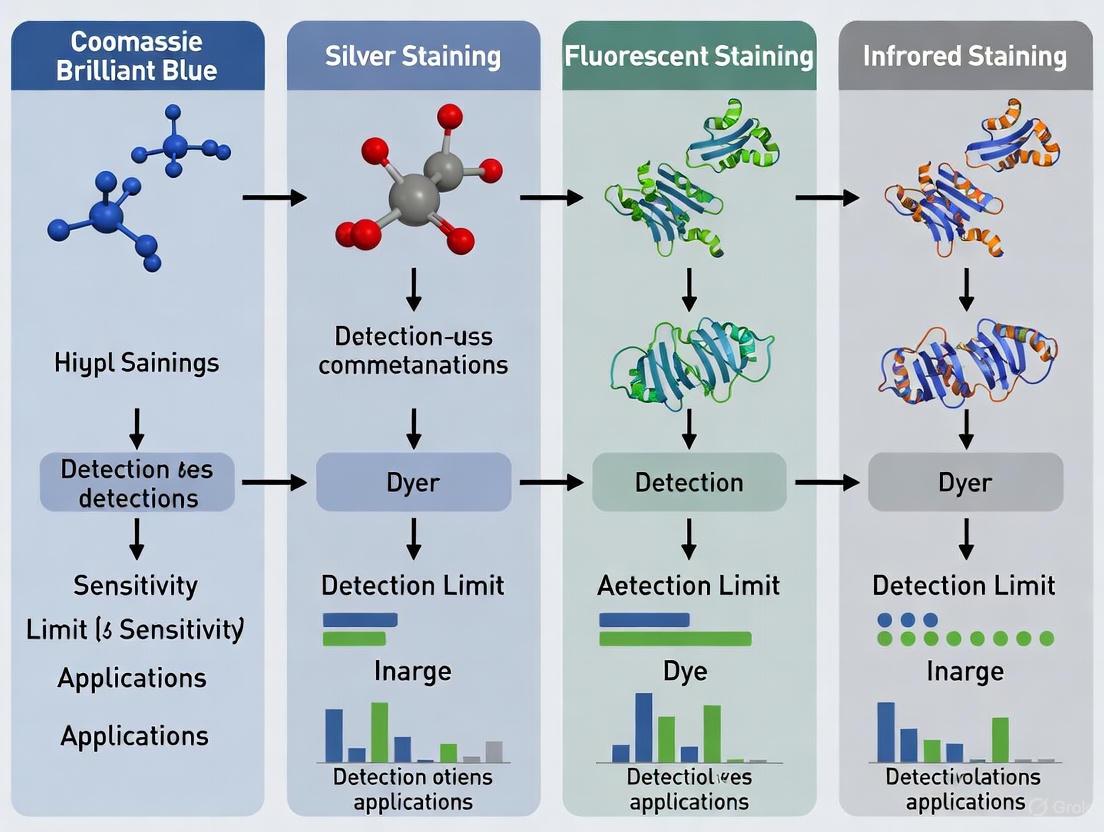
This article provides a comprehensive comparison of major protein staining methods, including Coomassie, silver, fluorescent, and zinc stains, for researchers and drug development professionals.
Protein Staining Methods Compared: A Guide to Sensitivity, Applications, and Optimization for Research
Abstract
This article provides a comprehensive comparison of major protein staining methods, including Coomassie, silver, fluorescent, and zinc stains, for researchers and drug development professionals. It covers foundational principles, sensitivity ranges, and protocol times to guide method selection. The content delves into practical applications, compatibility with downstream analysis like mass spectrometry, and advanced troubleshooting for common issues such as high background and low sensitivity. Furthermore, it explores validation strategies, the growing evidence supporting total protein staining for normalization over traditional housekeeping proteins, and the impact of new technologies on quantitative accuracy and multiplexing capabilities in biomedical research.
Protein Staining Fundamentals: Principles, Types, and Detection Limits
The efficacy of biomedical research and drug development hinges on the precise visualization of proteins and cellular structures. Core staining principles—encompassing sample fixation, dye binding, and detection methodologies—form the foundational framework for reliable data interpretation. Within this context, the choice between colorimetric and fluorescent detection represents a critical decision point, each with distinct advantages for sensitivity, quantification, and multiplexing. This guide objectively compares the performance of these staining methods, grounded in a broader thesis on optimizing protein staining efficiency for heterogeneous samples. We synthesize current experimental data to provide researchers, scientists, and drug development professionals with evidence-based protocols and comparative analyses to inform their methodological selections.
Core Staining Principles
Fixation
Fixation is the crucial first step to preserve cellular architecture and prevent degradation. The primary function of fixatives like 10% Neutral Buffered Formalin (NBF) is to stabilize proteins and cellular components, making them insoluble while maintaining structural integrity for subsequent analysis [1]. For fresh tissue evaluation in virtual pathology, fixation steps may be bypassed entirely using rapid optical sectioning techniques, underscoring the context-dependency of fixation protocols [2].
Dye Binding Mechanisms
Dye binding encompasses various biochemical interactions that enable specific visualization of cellular components:
- Electrostatic Interactions: Basic dyes like crystal violet bind to negatively charged cellular components through ionic attraction, forming the basis for differential stains like Gram staining [3].
- Intercalation and Minor Groove Binding: Fluorescent nuclear dyes such as DRAQ5 and SYBR Gold intercalate between DNA base pairs or bind to the minor groove, providing specific nuclear labeling [2].
- Protein-Dye Interactions: Coomassie Blue binds positively charged amino acid residues through electrostatic and van der Waals forces for total protein staining [4].
- Covalent and Affinity Binding: Targeted fluorescent probes use high-affinity interactions between targeting groups (e.g., antibodies) and specific epitopes, with fluorophores serving as detection tags [3].
Detection Modalities: Fundamental Differences
The detection modality determines measurement sensitivity, dynamic range, and application suitability:
- Colorimetric Detection relies on measurement of colored compounds using absorbance of specific light wavelengths. It is generally less sensitive but technically simpler and more cost-effective [4].
- Fluorometric Detection measures fluorescent emission following light excitation at specific wavelengths. It offers higher sensitivity due to low background signals and greater dynamic range, enabling detection of low-abundance targets [4].
Table 1: Fundamental Characteristics of Detection Modalities
| Characteristic | Colorimetric Detection | Fluorometric Detection |
|---|---|---|
| Detection Principle | Absorbance measurement | Fluorescence emission |
| Sensitivity | Lower | Higher |
| Dynamic Range | Narrower | Wider |
| Background Signal | Higher | Lower (especially with fluorogenic probes) |
| Multiplexing Capability | Limited | Excellent |
| Instrument Cost | Generally lower | Generally higher |
| Example Applications | Alkaline phosphatase assays, ELISA, total protein staining [4] | Confocal microscopy, flow cytometry, real-time imaging [2] |
Comparative Performance Data
Quantitative Comparison of Staining Methods
Recent diagnostic studies provide robust comparative data on staining performance metrics across multiple parameters:
Table 2: Performance Comparison of Staining and Detection Methods
| Method / Dye | Accuracy vs. H&E Standard | Time Requirements | Image Quality/SNR | Photostability | Key Applications |
|---|---|---|---|---|---|
| Fluorescence Confocal Microscopy (FCM) | 95.2% (Pathologist 1) 85.7% (Pathologist 2) [5] | Mean acquisition: 7 minutes [5] | High (Acceptable quality in 96.2% of cases) [5] | Varies by dye | Rapid evaluation of IR-guided CNBs [5] |
| Digital H&E Staining (CycleGAN) | Structural similarity (SSIM ∼0.95) to chemical staining [6] | Computational (bypasses chemical staining) | High (10% chromatic discrepancy) [6] | N/A (computational) | Digital pathology from label-free images [6] |
| Total Protein Staining | Superior for heterogeneous samples [1] | Varies by protocol | N/A | N/A | Normalization for Western blotting of heterogeneous tissues [1] |
| DRAQ5 (Nuclear) | N/A | Optimal: 180s [2] | High SNR with PBS solvent [2] | High [2] | Nuclear staining for fresh tissue microscopy [2] |
| SYBR Gold (Nuclear) | N/A | Optimal: 180s [2] | High SNR with PBS solvent [2] | Moderate to High [2] | Nuclear staining for fresh tissue microscopy [2] |
| TO-PRO3 (Nuclear) | N/A | Optimal: 180s [2] | Moderate SNR [2] | Lower [2] | Nuclear staining for fresh tissue microscopy [2] |
| Eosin Y515 (Cytoplasmic) | N/A | Protocol-dependent | High for ECM [2] | Lower [2] | Cytoplasmic/ECM staining [2] |
Experimental Protocol: Fluorescence Confocal Microscopy for Core-Needle Biopsy
This protocol, adapted from a diagnostic study comparing FCM with H&E-stained sections, enables real-time bedside evaluation of biopsies [5]:
- Sample Acquisition: Procure one core-needle biopsy (CNB) specimen per patient using a semiautomatic side-cutting core gun set (e.g., Quick-Core or Mission) for 1-2 cm long specimens.
- Staining: Place specimen in a petri dish and stain with 0.6mM acridine orange for approximately 10 seconds.
- Image Acquisition: Transfer specimen to FCM platform (e.g., Vivascope 2500 RSG4) in the radiology suite. Scan using 488 nm and 785 nm lasers with a ×40 oil immersion objective (numerical aperture 0.9). Acquire images at 9 frames per second with composite image size of 2.0 cm at greatest diameter.
- Image Interpretation: Examine grayscale and digitally pseudocolorized blue images at various magnifications (×1 to ×60 equivalent). Grade image quality semiquantitatively (0=None interpretable; 3=≥50% interpretable). Categorize findings as nondiagnostic, benign, atypical, suspicious, or malignant.
- Post-Imaging Processing: After FCM imaging, fix CNB tissue in 10% formalin and process routinely to generate 5-μm formalin-fixed, paraffin-embedded tissue blocks for H&E staining and histopathologic correlation.
Experimental Protocol: Assessment of Fluorescent Dyes for Virtual Pathology
This systematic protocol for evaluating fluorescent dyes enables optimization of staining parameters for fresh tissue microscopy [2]:
- Sample Preparation: Use fresh, non-fixed, non-optically cleared tissue specimens of consistent type.
- Dye Preparation: Prepare nuclear dyes (DRAQ5, TO-PRO3, SYBR Gold) and cytoplasmic/ECM dyes (Eosin Y515, Atto488) in various solvents (PBS, ethanol) at multiple concentrations.
- Staining Procedure: Apply dye solutions to tissue specimens with variation in staining time (e.g., 0-600 seconds). Test different rinsing solutions (PBS, deionized water, ethanol) after staining.
- Image Acquisition and Analysis: Image samples using structured illumination microscopy (SIM) to achieve optical sectioning. Quantify signal-to-noise ratio (SNR) and contrast for each parameter combination. Assess temporal degradation and photobleaching effects over time.
- Data Interpretation: Identify optimal staining parameters (solvent, concentration, staining time, rinsent) that maximize SNR and contrast while maintaining acceptable photostability.
Visualization of Staining Principles
Staining and Detection Mechanisms
Diagram 1: Core staining workflow from fixation to detection.
Experimental Workflow for Staining Optimization
Diagram 2: Experimental workflow for staining optimization.
Research Reagent Solutions
Table 3: Essential Research Reagents for Protein Staining and Detection
| Reagent/Category | Specific Examples | Function and Application |
|---|---|---|
| Nuclear Staining Dyes | DRAQ5, SYBR Gold, TO-PRO3, RedDot1, Acridine Orange [5] [2] | Label DNA in cell nuclei for fluorescence microscopy and virtual pathology |
| Cytoplasmic/ECM Staining Dyes | Eosin Y515, Atto488, Rhodamine B, Sulforhodamine 101 [2] | Label cytoplasmic and extracellular matrix structures |
| Total Protein Stains | Coomassie Blue, Bicinchoninic Acid (BCA) assay reagents [1] [4] | Normalization for Western blotting; superior for heterogeneous samples |
| Fixation Agents | 10% Neutral Buffered Formalin (NBF), Ethanol [1] [2] | Preserve cellular architecture and prevent degradation |
| Solvents & Rinsing Solutions | Phosphate-Buffered Saline (PBS), Deionized Water, Ethanol [2] | Dissolve dyes and rinse excess stain; PBS optimal for many fluorescent dyes |
| Fluorogenic Probes | ACC-based substrates, DDAO-derivatives [3] | Activated by specific biochemical processes; reduce background fluorescence |
| Traditional Histology Stains | Hematoxylin and Eosin (H&E), Crystal Violet, Methylene Blue [5] [3] | Standard histological staining for colorimetric detection |
| Bio-orthogonal Tags | Click chemistry reagents (e.g., azide/alkyne tags) [3] | Minimal tags for two-step detection strategies; increase bio-compatibility |
The comparative analysis of staining principles and detection methodologies reveals a nuanced landscape for research applications. Fluorescent detection methods generally offer superior sensitivity, temporal resolution, and multiplexing capabilities, particularly valuable for real-time assessment of fresh tissues and quantification of low-abundance targets [5] [2] [4]. Colorimetric methods remain robust for many applications, offering simplicity and cost-effectiveness with adequate sensitivity for numerous research contexts [4]. Critical considerations for method selection include sample heterogeneity, quantification requirements, and need for multiplexing. For heterogeneous tissue samples, total protein staining provides more reliable normalization than housekeeping proteins [1]. Emerging technologies like fluorescence confocal microscopy and computational staining approaches offer promising avenues for enhancing diagnostic speed and accuracy while preserving sample integrity [5] [6]. The optimal staining strategy ultimately depends on specific research objectives, sample characteristics, and analytical requirements, with this comparison providing a framework for evidence-based methodological decisions.
In the realm of protein analytics, polyacrylamide gel electrophoresis serves as a cornerstone technique for separating complex protein mixtures. However, since separated proteins are not visible to the naked eye, staining is an indispensable step for their visualization and analysis. Among the various staining methods available, Coomassie Brilliant Blue (CBB) staining maintains its status as a fundamental workhorse for routine protein visualization in laboratories worldwide [7]. Its enduring popularity stems from an effective balance of sensitivity, reproducibility, and cost-effectiveness, making it an ideal choice for many applications in basic research, biotechnology, and drug development [7].
This guide provides an objective comparison of Coomassie staining's performance against other common staining alternatives. We summarize quantitative data on sensitivity and linear dynamic range, detail standardized experimental protocols, and place its utility within the broader context of protein analysis. By presenting both its capabilities and limitations, we aim to provide researchers with a clear framework for selecting the most appropriate staining method for their specific experimental needs.
Coomassie Blue: Mechanisms and Variants
Chemical Principles of Protein Binding
Coomassie Brilliant Blue is an anionic synthetic dye belonging to the triphenylmethane family. Its mechanism of action involves non-covalent binding to proteins, primarily through two types of interactions [7]. First, the dye's negatively charged sulfonic acid groups form ionic bonds with positively charged basic amino acid residues, such as arginine, lysine, and, to a lesser extent, histidine [7]. Second, van der Waals forces and hydrophobic interactions drive the binding of the dye to aromatic residues and the protein backbone [7].
Upon binding to proteins, the dye undergoes a spectral shift. For instance, the free Coomassie Blue G-250 dye is red in its cationic form at very low pH, turns green in its neutral form, and becomes blue as an anion at higher pH levels. When it binds to protein regions, this equilibrium shifts, and the stable blue anionic form predominates, producing distinct blue-stained protein bands against a clear background [7]. This binding is sufficiently mild to keep the protein structure intact for downstream applications [7].
Common Coomassie Blue Variants
There are two primary forms of Coomassie dye, which have distinct properties and applications [7]:
- Coomassie Brilliant Blue R-250: The "R" denotes a reddish hue. This variant is typically dissolved in methanol-acetic acid mixtures and often requires a destaining step to reduce background [7] [8].
- Coomassie Brilliant Blue G-250: The "G" signifies a greenish hue. This form is frequently used in colloidal staining formulations, where the dye aggregates in the presence of salts like ammonium sulfate or aluminium sulfate in acidic alcoholic media [9]. These colloidal particles are less permeable into the gel matrix, resulting in significantly lower background staining and often eliminating the need for a destaining step [9]. G-250 is also the key component in the Bradford protein assay [7].
Table 1: Comparison of Coomassie Blue Dye Variants
| Feature | Coomassie Brilliant Blue R-250 | Coomassie Brilliant Blue G-250 |
|---|---|---|
| Color Hue | Reddish ("R") [7] | Greenish ("G") [7] |
| Common Form | Soluble in methanol/acetic acid [8] | Colloidal suspensions [9] |
| Staining Speed | Generally faster [10] | May require longer incubation [10] |
| Sensitivity | Less sensitive (~200 ng/band) [9] | More sensitive (can detect <10 ng/band) [10] [9] |
| Background | Often requires destaining [8] | Low background; destaining may be optional [9] |
| Primary Use | Traditional gel staining, IEF gels [7] | Colloidal staining, Bradford protein assay [7] |
Performance Comparison of Protein Staining Methods
Quantitative Comparison of Sensitivity and Dynamic Range
When selecting a staining method, researchers must balance sensitivity, quantitative linearity, cost, and procedural complexity. The table below provides a direct comparison of Coomassie staining with other common protein visualization methods.
Table 2: Performance Comparison of Common Protein Staining Methods
| Staining Method | Detection Limit (Per Band) | Linear Dynamic Range | Key Advantages | Key Limitations |
|---|---|---|---|---|
| Coomassie Blue (R-250) | ~200 ng [9] | Microgram level, wide linear range [8] | Inexpensive, simple protocol, good MS compatibility [7] [8] | Lower sensitivity, time-consuming destaining [7] |
| Colloidal Coomassie (G-250) | < 10 ng [11] to 1 ng [9] | ~5 ng to 500 ng [11] | Excellent sensitivity, low background, best CBB for quantitation [10] [9] | Slower staining process [11] |
| Silver Staining | < 0.25 ng – 1 ng [10] | Narrow | Highest sensitivity [10] | Complex protocol, low MS compatibility, non-linear quantification [9] |
| Fluorescent Stains (e.g., SYPRO Ruby) | < 1 ng – 2.5 ng [12] | Wide | High sensitivity, wide dynamic range, good MS compatibility [12] | Expensive, requires fluorescence imaging equipment [12] |
| Near-Infrared CBB Fluorescence | < 1 ng [12] | Significantly exceeds Sypro Ruby [12] | Highest CBB sensitivity, very wide dynamic range, cost-effective [12] | Not a standard application, requires NIR imaging |
A 2024 study highlighted a critical limitation of colorimetric total protein assays like Coomassie Bradford, noting they can significantly overestimate the concentration of target transmembrane proteins in heterogeneous samples compared to specific methods like ELISA [13]. This is a crucial consideration when working with complex protein mixtures or membrane preparations.
Staining Efficiency is Protein-Dependent
It is vital to recognize that staining efficiency can vary depending on the protein of interest. A study on wheat gluten proteins demonstrated that the staining efficiency varied per protein across different methods, and no single method achieved complete staining of all gluten proteins [14]. This protein-to-protein variability underscores the importance of method validation when working with specific protein systems.
Experimental Protocols and Best Practices
Standard Coomassie Staining and Destaining Protocol
The following workflow outlines a classic protocol for R-250 staining, which can be adapted based on specific reagent formulations.
Classic R-250 Staining Procedure [7] [8]:
- Fixation: After electrophoresis, transfer the gel to a container and immerse it in a fixing solution (e.g., 40% methanol, 10% acetic acid) for 30 minutes to overnight with gentle agitation. This step precipitates and fixes the proteins within the gel, removing interfering substances like SDS [8].
- Staining: Decant the fixation solution and submerge the gel in Coomassie R-250 staining solution (0.1% Coomassie Brilliant Blue R-250, 40% methanol, 10% acetic acid). Agitate gently for at least 2 hours or overnight for maximum sensitivity [7] [8].
- Destaining: Transfer the gel to a destaining solution (40% methanol, 10% acetic acid). Agitate, changing the solution several times, until the gel background becomes clear and protein bands are sharply visible. To accelerate destaining, the solution can be heated to 50-60°C or an activated charcoal bag can be added to the container to absorb the dye [7] [8].
- Storage & Imaging: For long-term storage, place the gel in a 1% acetic acid solution. Capture an image using a gel documentation system with a white light source [8].
Improved Colloidal Coomassie G-250 Protocol
A modified colloidal Coomassie G-250 protocol with an added fixation step has been shown to significantly improve protein band resolution by preventing protein diffusion during washing [9]. The workflow below integrates this critical modification.
Improved Colloidal CBB-G Staining Procedure [9]:
- Fixation (Key Improvement): Immediately after electrophoresis, fix the gel in a solution of 40% methanol and 10% acetic acid for 30 minutes with agitation.
- Washing: Rinse the fixed gel with ultrapure water 3 times for 10 minutes each on a platform shaker to remove residual SDS and fixing solution.
- Colloidal Staining: Incubate the gel in colloidal CBB-G staining solution (e.g., 0.02% CBB G-250, 5% aluminium sulfate, 10% ethanol, 2% ortho-phosphoric acid) for 2 hours to overnight with shaking.
- Brief Destaining: Rinse the gel briefly with water, then wash in a destain solution (10% ethanol, 2% ortho-phosphoric acid) or simply in water for 3-5 minutes to remove colloidal particles from the gel surface.
- Imaging: The gel is now ready for imaging. Store in water.
Troubleshooting Common Staining Issues
Table 3: Troubleshooting Guide for Coomassie Staining
| Problem | Possible Causes | Solutions |
|---|---|---|
| Weak or No Bands | Insufficient protein loading, over-destaining, dye depletion. | Increase protein load, shorten destaining time, use fresh staining solution [7]. |
| High Background | Incomplete destaining, residual SDS or contaminants. | Increase destaining time/time with fresh solution, ensure thorough washing steps post-electrophoresis [7]. |
| Uneven Staining | Incomplete gel immersion, inadequate agitation during staining. | Ensure the gel is fully submerged and use consistent, gentle agitation throughout [7]. |
| Protein Diffusion (Poor Resolution) | Lack of fixation prior to colloidal staining. | Incorporate a methanol/acetic acid fixation step before the washing and staining steps [9]. |
Essential Reagents and Equipment
A successful staining experiment requires more than just the dye. The following table lists key reagents and equipment necessary for performing Coomassie staining.
Table 4: Essential Research Reagent Solutions for Coomassie Staining
| Item | Function/Description | Example Formulations / Notes |
|---|---|---|
| Coomassie Dye | The active staining agent. | CBB R-250 or CBB G-250 powder [7]. |
| Fixation Solution | Precipitates proteins in gel, removes interferents. | 40% Methanol, 10% Glacial Acetic Acid [7] [9]. |
| Staining Solution | Solution for incubating the gel to dye proteins. | R-250: 0.1% dye in 40% Methanol, 10% Acetic Acid. G-250 (Colloidal): 0.02% dye with aluminium sulfate, ethanol, phosphoric acid [7] [9]. |
| Destaining Solution | Removes unbound dye from the gel background. | 40% Methanol, 10% Acetic Acid (for R-250); 10% Ethanol, 2% Phosphoric Acid (for colloidal G-250) [7] [9]. |
| Washing Solution | Removes SDS and buffer salts after fixation. | 50% Methanol with 10% Acetic Acid or ultrapure water [7]. |
| Methanol & Acetic Acid | Key components of fixing, staining, and destaining solutions. | Handle with appropriate personal protective equipment in a well-ventilated area [7]. |
| Staining Trays | Container to hold gel and staining solutions. | Made of glass, plastic, or stainless steel; must be inert and large enough for the gel [7]. |
| Orbital Shaker | Provides gentle, consistent agitation. | Ensures even staining and destaining [7]. |
| Gel Documentation System | For capturing high-quality images of stained gels. | System with a high-resolution camera and white light transilluminator [7] [11]. |
Coomassie Brilliant Blue staining remains an indispensable tool in the protein scientist's toolkit. Its position is secured by a combination of robust performance, straightforward protocol, and excellent compatibility with downstream applications like mass spectrometry [7].
The choice between Coomassie variants and alternative stains ultimately depends on the experimental priorities. Coomassie R-250 offers a straightforward and economical solution for abundant protein. Colloidal Coomassie G-250 provides a superior balance of sensitivity and low background for most routine research needs. When ultimate sensitivity is required for detecting low-abundance proteins, silver or fluorescent stains are necessary, despite their higher cost and complexity [10] [12]. As with any analytical method, understanding the principles, capabilities, and limitations of Coomassie staining is key to leveraging its power effectively in research and development.
In the field of proteomics and biomedical research, the visualization of proteins separated by gel electrophoresis is a fundamental step. Among the various techniques available, silver staining stands out for its exceptional sensitivity, enabling the detection of low-abundance proteins that are often critical for understanding disease mechanisms and developing new therapeutics. This guide provides an objective comparison of silver staining against other common protein staining methods, focusing on performance characteristics, experimental protocols, and compatibility with downstream applications to inform researchers and drug development professionals.
The need for high-sensitivity detection is driven by the vast dynamic range of protein concentrations in biological samples. For instance, blood samples can contain over 10,000 distinct proteins, with clinically significant biomarkers often present at concentrations ranging from picograms to low nanograms per milliliter [15]. In this context, silver staining provides a critical advantage by detecting proteins at concentrations 20-200 times lower than conventional Coomassie blue staining, enabling researchers to visualize proteins present at levels as low as 0.1-0.5 ng per band [16] [15].
Performance Comparison of Protein Staining Methods
The selection of an appropriate protein staining method requires careful consideration of sensitivity, dynamic range, protocol complexity, and compatibility with downstream analyses. The table below summarizes the key characteristics of major staining methods:
Table 1: Comparison of major protein staining methods
| Staining Method | Detection Sensitivity | Dynamic Range | Protocol Time | MS Compatibility | Primary Advantages | Major Limitations |
|---|---|---|---|---|---|---|
| Silver Stain | 0.1-0.5 ng [16] [15] | Narrow [15] | 30-120 min [16] | Specialized protocols required [15] | Highest sensitivity; cost-effective [15] | Complex protocol; background staining issues [15] |
| SYPRO Ruby | Similar to silver stain [17] | Broad linear range [17] | ~60 min [16] | High compatibility [17] [16] | Excellent peptide recovery; broad dynamic range [17] | Requires fluorescence imaging equipment [16] |
| Coomassie Blue | 5-25 ng [16] | Limited [17] | 10-135 min [16] | High compatibility [16] | Simple protocol; reversible staining [16] | Low sensitivity [17] [16] |
| Zinc Stain | 0.25-0.5 ng [16] | N/A | ~15 min [16] | High compatibility [16] | Rapid; no protein modification [16] | Stains background, not proteins [16] |
| Fluorescent Stains | 0.25-0.5 ng [16] | Broad linear range [16] | ~60 min [16] | Generally compatible [16] | Broad dynamic range; low detection limits [16] | Requires specific imaging instruments [16] |
Silver Staining in Method Comparisons
Studies directly comparing staining methods have demonstrated that silver staining remains the most sensitive colorimetric method available. In proteomic research focused on discovering differentially expressed proteins, silver stain has shown superior detection capabilities for low-abundance targets compared to Coomassie blue, though it traditionally suffered from poor peptide recovery for mass spectrometry analysis unless extra destaining and washing steps were incorporated [17].
When compared with fluorescent staining options like SYPRO Ruby, silver staining offers similar sensitivity but differs significantly in other characteristics. SYPRO Ruby provides enhanced recovery of peptides from in-gel digests for mass spectrometry analysis and features a broad linear dynamic range, making it more suitable for rigorous quantification of protein differences [17]. However, silver staining maintains an advantage in laboratories without access to fluorescence imaging instrumentation.
Recent technological developments have introduced innovative approaches to enhance sensitivity beyond traditional methods. For example, combining carboxyfluorescein succinimidyl ester (CFSE) labeling with stain-free gel technology has demonstrated sensitivity similar to silver staining while maintaining mass spectrometry compatibility [18]. This method resulted in a 10–100-fold increase in sensitivity over Coomassie staining and standard stain-free methods [18].
Silver Staining Experimental Protocol
Detailed Methodology
Silver staining involves a multi-step process that requires precision in reagent preparation and timing. The following workflow outlines the key stages:
Diagram 1: Silver staining workflow
The fixation step immobilizes protein bands while removing interfering substances such as SDS, buffers, and salts that can cause background staining [15]. Sensitization with sodium thiosulfate significantly boosts the efficiency, sensitivity, and contrast of the staining results [15]. During silver impregnation, silver ions bind strongly to specific protein functional groups including carboxylic acid groups (aspartate and glutamate), imidazoles (histidine), sulfhydryls (cysteine), and amines (lysine) [15].
The development process reduces protein-bound ionic silver (Ag+) to metallic silver (Ag) by formaldehyde, creating dark brown or black bands at protein locations [15]. Color variation in the resulting bands is primarily attributable to the diffractive scattering caused by silver grains of differing sizes [15].
Mass Spectrometry Compatibility
A critical consideration for proteomic applications is the compatibility of silver staining with mass spectrometry analysis. Traditional silver staining protocols that use glutaraldehyde or formaldehyde during fixation and sensitization are incompatible with mass spectrometry because these reagents cause permanent protein modifications through cross-linking, particularly with lysine residues [15]. This alteration hampers trypsin digestion, resulting in restricted peptide mass fingerprint analysis and reduced sequence coverage [15].
For mass spectrometry compatibility, specialized silver staining protocols must be employed that:
- Omit glutaraldehyde and formaldehyde, substituting tetrathionate and thiosulfate for sensitization [15]
- Include thorough destaining of protein spots or bands before digestion protocols [15]
- Utilize commercial kits specifically designed for mass spectrometry compatibility that provide higher loading capacity without saturation [15]
Studies have demonstrated that tryptic digests of proteins visualized by modified silver stains without aldehydes afford excellent mass spectra by both matrix-assisted laser desorption/ionization and tandem electrospray ionization [15].
Research Reagent Solutions
Successful silver staining requires specific high-quality reagents and materials. The following table details essential components and their functions:
Table 2: Essential reagents for silver staining
| Reagent/Material | Function | Key Considerations |
|---|---|---|
| Silver Nitrate | Source of silver ions that bind to protein functional groups [15] | 0.1% concentration recommended for 0.5-3 mm gels; corrosive and causes skin staining [15] |
| Formaldehyde | Reducing agent that converts ionic silver to metallic silver during development [15] | Potential irritant and carcinogen; handle in fume hood [15] |
| Sodium Thiosulfate | Sensitizing agent that improves staining efficiency and contrast [15] | Critical for controlling background staining [15] |
| Sodium Carbonate | Creates alkaline environment for development process [15] | Concentration affects development rate and background [15] |
| Acetic Acid | Acidifying agent for fixation and stop solutions [15] | Flammable and corrosive; use in well-ventilated areas [15] |
| Methanol | Component of fixation solution to immobilize proteins [15] | Helps remove interfering substances from gel [15] |
| High-Purity Water | Solvent for all reagents and washing steps [15] | Essential for minimizing background staining; trace impurities cause artifacts [15] |
Technical Considerations and Challenges
Optimization Strategies
Several factors significantly impact silver staining results and require careful optimization:
Temperature Control: The protocol is temperature-dependent, with higher room temperatures (over 30°C) contributing to increased background staining [15]. Consistent temperature maintenance throughout the procedure is crucial for reproducible results.
Gel Thickness: Silver nitrate concentration of 0.1% is recommended for gels measuring between 0.5 and 3 mm in thickness, with higher concentrations needed for ultrathin gels to account for diffusion during the gel-formation process [15].
Timing Precision: Development time must be carefully monitored as the extent of staining is influenced by duration of exposure to the developer [15]. This is particularly important because silver staining is not an endpoint procedure, and significant inter-gel variations in spot intensities may occur with minor timing differences [15].
Equipment Cleanliness: Impeccably clean glassware and equipment are essential to avoid contamination that leads to background artifacts [15]. Silver mirrors (uniform surface staining) frequently result from unclean glassware or contaminated reagents [15].
Limitations and Alternative Approaches
Despite its superior sensitivity, silver staining presents several limitations that researchers should consider:
Quantification Challenges: Due to its narrow dynamic range, silver staining is not considered reliable for protein quantification [15]. The technique exhibits differential staining properties toward various proteins, making quantitative comparisons problematic.
Background Staining: Susceptibility to erratic background staining is a frequent challenge [15]. This can be mitigated by using high-purity water and reagents, maintaining optimal temperature conditions, and ensuring impeccable cleanliness of all equipment [15].
Protocol Complexity: Silver staining necessitates the preparation of various reagents and multiple precise steps, making it more labor-intensive and time-consuming than many alternative methods [16].
For applications requiring both high sensitivity and downstream protein identification, fluorescent stains like SYPRO Ruby offer a compelling alternative with broad linear dynamic range and enhanced recovery of peptides for mass spectrometry analysis [17]. Similarly, zinc staining provides rapid results (approximately 15 minutes) with sensitivity comparable to silver staining while maintaining full compatibility with mass spectrometry and western blotting [16].
Silver staining remains a powerful technique for detecting low-abundance proteins in electrophoretic separations, offering unmatched sensitivity among colorimetric detection methods. Its utility is particularly evident in initial screening applications where target proteins are present in very low quantities or when advanced instrumentation for fluorescence detection is unavailable.
However, the method demands meticulous technique and careful optimization to overcome challenges related to background staining, reproducibility, and compatibility with downstream analyses. Researchers must weigh the exceptional sensitivity of silver staining against its technical demands and limitations when selecting the most appropriate detection method for their specific application.
For proteomic studies involving protein identification, modified silver staining protocols that avoid aldehyde-based cross-linking or alternative high-sensitivity fluorescent stains may provide more practical solutions that balance detection sensitivity with analytical flexibility.
Fluorescent staining is a cornerstone technique in biomedical research and diagnostics, enabling the visualization and quantification of proteins and other biomolecules. The performance of these techniques is primarily governed by two critical parameters: sensitivity (the ability to detect low-abundance targets) and dynamic range (the ability to quantify targets across a wide concentration spectrum simultaneously). For researchers and drug development professionals, selecting the appropriate staining method is crucial for obtaining accurate, reproducible, and biologically relevant data.
This guide provides a comparative analysis of major fluorescent staining methodologies, focusing on their sensitivity and dynamic range characteristics. It also details experimental protocols and highlights emerging technologies that are pushing the boundaries of what is detectable and quantifiable in complex biological systems. The content is framed within the broader thesis that understanding the efficiency and limitations of each method is essential for advancing research in proteomics, biomarker discovery, and diagnostic assay development.
Comparison of Fluorescent Staining Methods
The landscape of fluorescent stains is diverse, ranging from traditional fluorescent antibodies to advanced signal amplification techniques and novel nanomaterials. The table below provides a comparative overview of key methodologies.
Table 1: Performance Comparison of Fluorescent Staining Methods
| Method | Mechanism | Key Advantages | Limitations | Reported Sensitivity / Dynamic Range |
|---|---|---|---|---|
| Conventional Immunofluorescence (IF) [19] | Fluorophore-conjugated antibodies bind directly to target antigens. | Simple protocol, suitable for multiplexing. | Limited sensitivity, prone to photobleaching. | Moderate sensitivity and dynamic range. |
| Tyramide Signal Amplification (TSA) [20] | Enzyme-mediated deposition of numerous fluorescent tyramide molecules at the target site. | High signal amplification, superior sensitivity, stable signals. | Requires optimization; potential for high background if not controlled. | >6x signal intensity; ~3x broader dynamic range vs. conventional IF. |
| Fluorescent Carbon Dots (CDs) [21] | Engineered nanoparticles that target specific organelles or molecules. | Excellent photostability, high biocompatibility, tunable emission. | Relatively new technology; synthesis parameters influence performance. | High photostability enables long-term, real-time monitoring. |
| Total Protein Stains [1] | Non-specific binding to proteins in gels (e.g., Coomassie, fluorescent stains). | Normalization for heterogeneous samples; detects protein integrity. | Not target-specific; used for gel-based analysis. | More reliable for normalization than single housekeeping proteins. |
| Genetically Encoded Biosensors [22] | FRET-based conformational changes in response to target activity (e.g., PTEN). | Enables live-cell, real-time imaging of protein activity in vivo. | Complex development and implementation; requires genetic manipulation. | Enables dynamic activity monitoring with subcellular resolution. |
Detailed Methodologies and Experimental Protocols
Tyramide Signal Amplification (TSA) Protocol
The TSA protocol is designed to overcome the challenge of detecting low-abundance markers on single extracellular vesicles (EVs) and cells, which offer a very small surface area for staining [20]. The following workflow and protocol detail the key steps.
Figure 1: TSA Experimental Workflow
Experimental Protocol [20]:
- Sample Preparation and Fixation: Fix cells or tissue sections using appropriate methods (e.g., formalin-fixed, paraffin-embedded (FFPE) sections).
- Antigen Retrieval: Perform heat-induced epitope retrieval using a solution like Cell Conditioning Solution 1.
- Primary Antibody Incubation: Incubate the sample with a target-specific primary antibody (e.g., anti-A2B5, anti-CD11c) for 1 hour at room temperature.
- HRP-Conjugated Secondary Antibody: Incubate with a horseradish peroxidase (HRP)-conjugated secondary antibody for 1 hour.
- Tyramide Probe Incubation: Apply a fluorescently labeled tyramide reagent (e.g., Alexa Fluor 488 or 594 Tyramide) for 10 minutes. The HRP enzyme catalyzes the conversion of the tyramide into a highly reactive, short-lived radical that covalently binds to electron-rich tyrosine residues on and around the target protein.
- Counterstaining and Mounting: Counterstain with DAPI for nuclei visualization, then mount the slides for imaging.
Key Advantage: A single HRP molecule can activate hundreds of tyramide molecules, leading to significant signal amplification rather than a one-to-one antibody-fluorophore ratio [20].
High Dynamic Range (HDR) Fluorescence Imaging Protocol
A major limitation in fluorescence microscopy is the limited dynamic range of the detection system, which can cause signal saturation and loss of quantitative data. The HDR imaging protocol addresses this by combining multi-exposure capture with computational processing [23].
Experimental Protocol [23]:
- Staining and Sample Prep: Perform standard IF staining (e.g., for PD-L1 in NSCLC tissue) using either direct fluorophore-conjugated antibodies or the TSA method.
- Multi-Exposure Image Acquisition: Capture multiple images of the exact same field of view at different exposure times. For example, for an Alexa Fluor 555 signal, acquire images at 6.5 ms, 25 ms, and 55 ms. This ensures that dim signals are captured at long exposures without saturating bright areas in shorter exposures.
- HDR Algorithm Processing:
- Image Preprocessing: Apply erosion and Gaussian blurring to the original image set.
- Irradiance Curve Reconstruction: The HDR algorithm reconstructs the camera's response curve using pixel information from areas with significant signal (e.g., near nuclei for PD-L1).
- Image Merging and Scaling: The multiple exposures are merged into a single, high-bit-depth image that is linearly scaled.
- Post-Processing: The merged image undergoes luminance adjustment, contrast-limited adaptive histogram equalization, and further contrast enhancement to produce the final HDR image.
- Validation: This method has been shown to improve diagnostic accuracy to 85.7% in PD-L1 assessment and revealed a 25% change in tumor proportion score at various depths within 3D tumor models [23].
Optimizing Combined-Segments Strategy for Ultra-Wide Concentration Range
For quantitative fluorescence measurements in solution (e.g., in environmental or clinical diagnostics), maintaining sensitivity across an ultra-wide concentration range is a known challenge. The "optimizing combined-segments strategy" is a solution that moves beyond simple binary segmentation [24].
Experimental Protocol [24]:
- Spatial Intensity Modeling: Utilize a fluorescence spatial intensity distribution model that accounts for the attenuation of excitation light across the sample.
- Probe Positioning: Systematically adjust the position of the optical fiber receiving probe within the sample cuvette to define different fluorescence reception ranges.
- Generate Quantitative Curves: For each probe position, generate a quantitative relationship curve between the received fluorescence intensity and the fluorophore concentration (e.g., tryptophan from 0.02 to 250 mg/L).
- Segment Combination and Optimization: Instead of relying on a single curve, strategically combine segments from multiple curves. The combination is optimized to ensure that the measurement sensitivity on every adopted segment exceeds a predefined optimal sensitivity limit (
lmopt). - Outcome: This approach can maintain relative errors within ±5% across a concentration range 20 times broader than the conventional linear range, enabling high-sensitivity measurements without sample dilution [24].
Emerging Materials and Future Directions
Fluorescent Carbon Dots (CDs)
Fluorescent Carbon Dots (CDs) are emerging as superior nanoprobes that transcend the limitations of traditional organic dyes and semiconductor quantum dots. They are defined by their excellent photostability, which prevents photobleaching during long-term imaging; superior biocompatibility and low phototoxicity; and tunable fluorescence properties achieved through heteroatom doping (e.g., with nitrogen or sulfur) [21]. Their efficacy is influenced by core crystallinity, surface functional groups, size, and charge. CDs have been successfully applied for live-cell organelle staining and in vivo imaging, providing new opportunities for understanding dynamic cellular mechanisms [21].
Genetically Encoded FRET Biosensors
For monitoring dynamic protein activity (as opposed to static localization), genetically encoded biosensors represent a powerful approach. A recent advance is a FRET-based biosensor for the tumor suppressor PTEN, used with two-photon fluorescence lifetime imaging microscopy (2pFLIM) [22].
Figure 2: PTEN FRET Biosensor Mechanism
Mechanism: The biosensor is engineered by tagging the N and C termini of PTEN with donor (mEGFP) and acceptor (sREACh) fluorescent proteins. PTEN undergoes a conformational change from a closed/inactive state to an open/active state. In the closed state, the fluorophores are close, resulting in high FRET and a short fluorescence lifetime. Upon activation, the protein opens, increasing the distance between fluorophores, decreasing FRET, and resulting in a longer fluorescence lifetime [22]. This allows direct, real-time monitoring of PTEN activity in live cells and intact tissues, such as the mouse brain.
The Scientist's Toolkit: Essential Research Reagent Solutions
Selecting the right reagents is fundamental to the success of any fluorescent staining experiment. The following table details key solutions used in the methodologies discussed in this guide.
Table 2: Essential Reagents for Advanced Fluorescent Staining
| Reagent / Solution | Function | Key Features & Examples |
|---|---|---|
| Tyramide Reagents [20] | Signal amplification for low-abundance targets. | Alexa Fluor Tyramide (e.g., AF488, AF594); activated by HRP to bind covalently to proteins. |
| Fluorescent Carbon Dots (CDs) [21] | Photostable, biocompatible nanoprobes for live-cell imaging. | Tunable emission; can be synthesized from natural precursors; target-specific via surface functionalization. |
| Total Protein Stains [1] | Loading control for heterogeneous samples in gel electrophoresis. | Superior to single housekeeping proteins (e.g., GAPDH) for normalization in Western blotting. |
| FRET/FLIM Biosensors [22] | Live-cell, dynamic imaging of protein activity and conformation. | Genetically encoded; e.g., PTEN biosensor with mEGFP donor and sREACh acceptor for 2pFLIM. |
| HDR Imaging Software [23] | Expands dynamic range of fluorescence microscopes post-acquisition. | Algorithms that merge multiple exposures to restore accurate expression patterns in saturated images. |
| Primary Antibodies | Target-specific recognition. | Clone-specific for antigens (e.g., PD-L1 clone SP263); critical for both IHC and IF. |
| HRP-Conjugated Secondary Antibodies [20] [23] | Enzyme-linked detection for amplification methods. | Enables TSA reaction; poly-HRP conjugates offer further signal enhancement. |
| 14S(15R)-EET methyl ester | 14S(15R)-EET methyl ester, MF:C21H34O3, MW:334.5 g/mol | Chemical Reagent |
| 7-O-Methyl-6-Prenylnaringenin | 7-O-Methyl-6-Prenylnaringenin, MF:C21H22O5, MW:354.4 g/mol | Chemical Reagent |
In the field of proteomics, protein gel staining is an indispensable technique that enables researchers to visualize proteins separated by electrophoresis, facilitating analysis of protein expression, purity, and interactions. The ideal staining method combines high sensitivity, broad dynamic range, operational simplicity, and compatibility with downstream protein analysis techniques, particularly mass spectrometry (MS). Among the various available methods, zinc staining has emerged as a powerful reverse staining technique that offers unique advantages for contemporary proteomic research. This review objectively compares the performance of zinc-based reverse staining with alternative methods, providing experimental data and detailed protocols to guide researchers in selecting the most appropriate technique for their specific applications.
Performance Comparison of Protein Staining Methods
Technical Characteristics and Experimental Performance
The performance characteristics of major protein staining methods have been systematically evaluated in multiple studies, revealing significant differences in sensitivity, dynamic range, and compatibility with downstream applications.
Table 1: Comparative Performance of Major Protein Staining Methods [25] [16]
| Staining Method | Sensitivity | Typical Protocol Time | Detection Mechanism | MS Compatibility | Key Advantages |
|---|---|---|---|---|---|
| Zinc Reverse Stain | 0.25-1.8 ng | 15 minutes | Visual (reverse staining) | Excellent | No protein modification; rapid procedure |
| Silver Stain | 0.25-0.5 ng | 30-120 minutes | Colorimetric (chemical development) | Variable (formulation-dependent) | Highest sensitivity of colorimetric methods |
| SYPRO Ruby | 0.25-0.5 ng | 60 minutes | Fluorescent | Excellent | Broad linear dynamic range |
| Coomassie Blue | 5-25 ng | 10-135 minutes | Colorimetric (dye binding) | Excellent | Simple protocol; reversible staining |
A comprehensive evaluation of imidazole-zinc reverse stain demonstrated its capability to detect as few as 1.8 ng of protein in a gel, surpassing the sensitivity of conventional silver staining and SYPRO Ruby under specific conditions [25]. The linear dynamic range of zinc staining extends to revealing proteins up to 140 ng, with insignificant staining preference based on protein composition [25]. This uniform detection response across different protein types is particularly valuable for quantitative proteomic applications where staining bias could compromise results.
Methodological Workflows and Procedural Requirements
The operational workflows for different staining methods vary significantly in complexity, time requirement, and technical demands.
Diagram 1: Zinc reverse staining workflow for mass spectrometry compatibility.
Zinc staining employs a fundamentally different detection mechanism compared to conventional methods. Instead of staining proteins directly, this procedure uses zinc ions that complex with imidazole to form a milky-white precipitate throughout the polyacrylamide gel background except in regions containing SDS-coated proteins [16]. The result is clear protein bands against an opaque background, achievable in approximately 15 minutes without fixation steps [16]. This rapid, simple process requires minimal hands-on time and no specialized equipment beyond standard laboratory apparatus.
In contrast, silver staining involves multiple precise steps including fixation, sensitization, silver impregnation, and development, typically requiring 30-120 minutes with careful timing to prevent over-development [16]. The complexity of silver staining introduces greater inter-experimental variability, while the chemical modifications it imposes on proteins can interfere with subsequent mass spectrometric analysis [16].
Experimental Data and Validation
Quantitative Performance Metrics
Comparative studies have generated robust quantitative data regarding the performance of zinc staining relative to alternative methods.
Table 2: Experimental Performance Data from Comparative Studies [25] [16]
| Performance Metric | Zinc Stain | Silver Stain | SYPRO Ruby | Coomassie Blue |
|---|---|---|---|---|
| Minimum Detectable Protein | 1.8 ng | 0.5 ng | 0.5 ng | 25 ng |
| Optimal Protein Detection Range | Up to 140 ng | Up to 20 ng | Up to 100 ng | Up to 500 ng |
| MS Identification Success Rate | ~67% | 30-50% (formulation-dependent) | ~60% | ~70% |
| Dynamic Range Linearity | Excellent | Moderate | Excellent | Good |
In one comprehensive evaluation, zinc staining demonstrated equivalent or better MS compatibility than silver, SYPRO Ruby, and Coomassie Blue staining methods [25]. Intense and comprehensive MS profiles were frequently observed for zinc-stained gel spots, with approximately two-thirds successfully identified for protein identities [25]. This high success rate in protein identification underscores the minimal protein modification characteristic of the zinc reverse stain process.
Method-Specific Protocols
Detailed Zinc Reverse Staining Protocol
The imidazole-zinc reverse staining protocol can be completed in three straightforward steps [16] [26]:
Post-Electrophoresis Processing: Following SDS-PAGE, immerse the gel in a solution of 100-200 mM imidazole with gentle agitation for 5-8 minutes. The optimal concentration depends on gel thickness and polyacrylamide percentage.
Zinc Development: Briefly rinse the gel with deionized water (approximately 15-20 seconds) before transferring to a 100-200 mM zinc sulfate solution. Observe the development of a milky-white background precipitate within 30-60 seconds. Continue agitation until the desired contrast between protein bands and background is achieved.
Visualization and Documentation: Place the stained gel on a dark background for optimal visualization of clear protein bands against the opaque gel matrix. For permanent documentation, use transparency scanning to capture even, high-contrast gel images [25]. For downstream MS analysis, excise protein bands of interest and destain by rinsing with chelating agents such as EDTA or Tris-glycine buffer.
Alternative Staining Protocols
Silver Staining Protocol [16]: Silver staining requires multiple precise steps: (1) gel fixation in 50% methanol/10% acetic acid for 30 minutes; (2) sensitization with sodium thiosulfate (0.02% w/v) for 1-2 minutes; (3) silver impregnation with silver nitrate (0.1-0.2% w/v) for 20-30 minutes; (4) image development with formaldehyde (2-3% v/v) in carbonate buffer until desired intensity; (5) termination with EDTA or citric acid solution. The extensive processing time and potential for protein cross-linking represent significant limitations for high-throughput proteomics.
SYPRO Ruby Staining Protocol [16]: SYPRO Ruby staining involves: (1) gel fixation in 50% methanol/10% acetic acid for 30 minutes; (2) staining with SYPRO Ruby dye for 3-4 hours; (3) destaining in 10% methanol/7% acetic acid for 30 minutes. While offering excellent sensitivity and MS compatibility, the extended staining time and specialized imaging equipment requirements increase operational complexity.
Research Reagent Solutions for Zinc Staining
Successful implementation of zinc reverse staining requires several key reagents, each serving specific functions in the staining process.
Table 3: Essential Reagents for Zinc Reverse Staining [16] [26]
| Reagent | Function | Typical Concentration | Notes |
|---|---|---|---|
| Imidazole | Forms complex with zinc ions | 100-200 mM | pH ~7.0, prepared in deionized water |
| Zinc Sulfate | Precipitates with imidazole in gel background | 100-200 mM | Concentration affects precipitate density |
| EDTA or Tris-Glycine Buffer | Destaining for band excision | 50-100 mM | Chelates zinc for MS compatibility |
| Polyacrylamide Gel | Protein separation matrix | Varies by application | Standard SDS-PAGE gels compatible |
Applications in Proteomic Workflows
Integration with Downstream Analyses
The compatibility of zinc staining with mass spectrometry represents one of its most significant advantages. Unlike silver staining, which can cause protein cross-linking through aldehyde-based sensitizers, zinc staining involves no permanent chemical modification of proteins [16]. This preservation of protein integrity enables efficient tryptic digestion and peptide extraction for MS analysis. Research demonstrates that zinc-stained proteins consistently yield high-quality mass spectra with comprehensive peptide coverage [25].
For western blotting applications, zinc staining offers the unique advantage of reversible staining. Proteins can be visualized, documented, and subsequently completely destained before electroblotting, eliminating the potential interference associated with conventional stains [16]. This reversibility provides researchers with unprecedented flexibility in experimental design.
Data Analysis Considerations
The analysis of zinc-stained 2D gel images requires specific software considerations. Comparative studies indicate that Melanie 4 software is particularly suitable for analyzing zinc-stained 2D gels, which typically feature an apparent but even background [25]. The software's background subtraction algorithms effectively handle the characteristic reverse staining pattern, enabling accurate spot detection and quantification.
Diagram 2: Proteomic workflow integrating zinc staining with mass spectrometry.
Zinc reverse staining represents a compelling alternative to traditional protein staining methods, particularly for researchers engaged in high-throughput proteomics requiring downstream mass spectrometric analysis. Its exceptional speed (approximately 15 minutes), sensitivity (detecting as little as 0.25-1.8 ng protein), and excellent MS compatibility (~67% identification success rate) position it as a versatile tool for modern protein research [25] [16]. While silver staining retains advantages in ultimate sensitivity for detecting extremely low-abundance proteins, and Coomassie staining offers simplicity for routine applications, zinc staining provides an optimal balance of performance characteristics for most proteomic workflows. As the field continues to emphasize rapid, reproducible, and multi-modal protein analysis, zinc-based reverse staining is poised to play an increasingly important role in the researcher's toolkit.
Protein gel staining is a foundational technique in molecular biology and biochemistry, enabling the visualization of proteins after separation by electrophoresis. The fundamental principle involves a chemical reaction between a stain and proteins within the gel matrix, rendering them visible against the background. These stains are selected based on their specific binding to proteins and their ability to generate a detectable signal, such as color, fluorescence, or precipitation. The evolution of various staining methods has been driven by the continuous pursuit of improved sensitivity, compatibility with downstream applications, and operational ease. This guide provides an objective comparison of the performance characteristics of major protein staining solutions, focusing on their quantitative detection limits, dynamic range, and procedural requirements to inform researchers in selecting the optimal method for their specific applications. The critical importance of sensitive detection is underscored in advanced applications like super-resolution microscopy, where quantifying binder labeling efficiency at the single-protein level is essential for accurate data interpretation [27].
Comparative Performance Data of Staining Methods
The selection of a protein staining method is often a trade-off between sensitivity, ease of use, cost, and compatibility with downstream analyses. The table below provides a structured comparison of the key performance metrics for the most common protein staining techniques.
Table 1: Comparative Analysis of Major Protein Staining Methods
| Staining Method | Detection Limit (per band) | Dynamic Range | Compatibility with Downstream Applications | Typical Procedure Time | Key Advantages | Major Limitations |
|---|---|---|---|---|---|---|
| Coomassie Staining | 8-25 ng [28] | ~1 order of magnitude | High (MS, Sequencing, WB) [28] | 10-135 minutes [28] | Simple, affordable, reversible, non-destructive [28] | Lower sensitivity, protein composition bias [28] |
| Silver Staining | 0.25-0.5 ng [28] | ~2 orders of magnitude | Low (Protein cross-linking) [28] | Several hours [28] | Extremely high sensitivity [28] | Multiple complex steps, reagent sensitivity, potential cross-linking [28] |
| Fluorescent Staining | 0.25-0.5 ng [28] | >3 orders of magnitude [29] | High (MS, WB) [28] | ~60 minutes [28] | High sensitivity, broad linear range, multiplexing potential [28] [29] | Requires specialized imaging equipment [28] |
| Zinc Staining | Information missing | Information missing | Information missing | Information missing | Fast, reversible [28] | Information missing |
Detailed Experimental Protocols
Coomassie Brilliant Blue Staining
The Coomassie staining protocol is renowned for its simplicity and reliability, providing a robust method for detecting protein bands in the nanogram range [28].
- Water Wash: Following electrophoresis, the gel is initially rinsed with deionized water to remove residual SDS (sodium dodecyl sulfate), which can interfere with dye binding [28].
- Fixing: The gel is immersed in an acidic solution, typically containing methanol and acetic acid (e.g., 40% methanol, 10% acetic acid). This step precipitates the proteins within the gel matrix, preventing diffusion and preparing the gel for optimal dye binding. Fixing times vary but often last 30-60 minutes [28].
- Staining: The fixed gel is transferred to a Coomassie dye solution (e.g., 0.1% Coomassie Brilliant Blue R-250 in 40% methanol and 10% acetic acid). The gel is incubated with gentle agitation for at least one hour. During this time, the dye binds non-covalently to basic (arginine, lysine, histidine) and hydrophobic amino acid residues in the proteins, changing color from reddish-brown to intense blue [28].
- Destaining: Excess, unbound dye is removed through a destaining process. This involves multiple washes with a destaining solution (e.g., 40% methanol, 10% acetic acid) or simply water. This step is crucial for clearing the background and achieving sharp, visible protein bands. Destaining can be accelerated by including a kimwipe or other absorbent material in the container to trap the eluted dye [28].
Silver Staining
Silver staining is a multi-step, highly sensitive procedure for detecting proteins at sub-nanogram levels. Precise reagent handling and timing are critical for success [28].
- Sensitization: The gel is treated with a sensitizing agent, such as thiourea or formaldehyde, to enhance the subsequent binding of silver ions to protein functional groups. This step increases the overall sensitivity and uniformity of the stain [28].
- Staining: The sensitized gel is incubated with a silver nitrate solution (e.g., 0.1-0.2%). Silver ions bind to various protein side chains, including carboxylic acids (aspartic acid, glutamic acid), imidazoles (histidine), sulfhydryls (cysteine), and amines (lysine) [28].
- Development: The gel is transferred to a developing solution containing a reducing agent (e.g., formaldehyde in an alkaline carbonate solution). This step reduces the bound silver ions to metallic silver, forming a visible brown-black precipitate at the locations of the protein bands. Development is closely monitored and halted before the background becomes unacceptably dark [28].
- Stopping the Reaction: The development process is terminated by replacing the developer with a stopping solution, typically containing 1-5% acetic acid. This stabilizes the stained image [28].
Fluorescent Dye Staining
Fluorescent staining offers a sensitive and quantitative alternative to colorimetric methods, with a broad dynamic range [28] [29].
- Dye Selection: A fluorescent dye, such as SYPRO Ruby, is selected based on the required sensitivity, gel type, and available imaging equipment with appropriate excitation/emission filters [28].
- Staining: The gel is incubated in the fluorescent dye solution with gentle agitation, typically for 60-90 minutes. The dye binds to proteins through non-covalent interactions, such as electrostatic and hydrophobic binding [28].
- Washing: After staining, the gel is rinsed in a wash solution (often a dilute acetic acid and methanol solution or water) for 20-30 minutes to remove unbound dye and reduce background fluorescence [28].
- Imaging: The stained gel is visualized using a fluorescence scanner, UV transilluminator, or a compatible imaging system. The excitation and emission wavelengths are set according to the dye's specifications [28].
Workflow and Data Normalization
The experimental workflow for protein staining and analysis extends beyond the staining procedure itself. A critical path that includes proper sample preparation, quality control, and data normalization is essential for generating high-quality, reproducible quantitative data [29]. Total protein staining is increasingly recognized as a superior loading control for normalization, especially when working with heterogeneous samples, as it circumvents the variability often associated with single housekeeping proteins like GAPDH or β-tubulin [1].
Diagram 1: Protein staining and analysis workflow
The Scientist's Toolkit: Essential Research Reagents
Successful protein detection and quantification rely on a suite of specialized reagents and materials. The following table details key components used in the featured staining protocols.
Table 2: Key Reagent Solutions for Protein Staining Experiments
| Reagent/Material | Function/Description | Application Examples |
|---|---|---|
| Coomassie Brilliant Blue Dyes (G-250/R-250) | Anionic triphenylmethane dyes that bind basic/hydrophobic protein residues, causing a color shift to blue [28]. | General protein detection in SDS-PAGE gels [28]. |
| Silver Nitrate (AgNO₃) | Source of silver ions that bind protein functional groups; reduced to metallic silver for visualization [28]. | High-sensitivity silver staining [28]. |
| SYPRO Ruby / Orange | Fluorescent dyes that bind proteins non-covalently, enabling high-sensitivity detection with broad dynamic range [28]. | Fluorescent western blotting, quantitative proteomics [28] [29]. |
| Imidazole-Zinc Solutions | Stains gel background; zinc ions form white precipitate with imidazole, making protein bands visible as clear areas [28]. | Fast, reversible protein staining [28]. |
| Methanol-Acetic Acid Solutions | Used for fixing (precipitating proteins) and destaining (removing unbound dye) in Coomassie protocols [28]. | Coomassie Brilliant Blue staining [28]. |
| Primary & Secondary Antibodies | Primary antibodies bind specific target proteins; enzyme- or fluorophore-conjugated secondary antibodies enable detection [29]. | Western blotting, super-resolution microscopy [27] [29]. |
| Total Protein Stain | A stain (e.g., fluorescent dye) that labels all proteins in a sample lane, used for normalization instead of single housekeeping proteins [1]. | Loading control for quantitative Western blotting of heterogeneous samples [1]. |
| Myricetin-3-O-rutinoside | Myricetin-3-O-rutinoside, CAS:41093-68-9, MF:C27H30O17, MW:626.5 g/mol | Chemical Reagent |
| Desacetylxanthanol | Desacetylxanthanol, MF:C15H22O3, MW:250.33 g/mol | Chemical Reagent |
Advanced Considerations and Technological Outlook
The field of protein detection and analysis is continuously evolving. A significant challenge in advanced techniques like super-resolution microscopy is the absolute quantification of labeling efficiency, which is rarely 100% due to factors like limited binder affinity and steric hindrance [27]. Novel methods are being developed to address this, using reference tags and DNA-barcoded imaging to correlate target locations and precisely quantify efficiency at the single-protein level, which is crucial for accurate data interpretation [27].
Furthermore, the integration of artificial intelligence is poised to revolutionize reagent design. Computational models are now being developed to predict antibody structures and binding strength with high accuracy from amino acid sequences. These tools, such as the AbMap model, allow researchers to screen millions of potential antibody variants in silico to identify high-affinity binders early in the development process, potentially streamlining the creation of more effective detection reagents for research and therapeutics [30].
Methodology in Action: Selecting and Applying Stains for Your Research Goals
The selection of an appropriate protein detection method is a critical step in biomedical research and diagnostic development, directly impacting data reliability, reproducibility, and experimental efficiency. Within the broader context of comparing protein staining method efficiencies, this guide provides an objective analysis of contemporary techniques—from traditional stains to advanced automated immunoassays and mass spectrometry. The expanding proteomics pipeline and increasing emphasis on reproducible, quantitative data necessitate informed method selection based on rigorous performance characteristics. This guide synthesizes experimental data and comparative studies to equip researchers and drug development professionals with evidence-based selection criteria tailored to specific application requirements across western blotting, mass spectrometry, and diagnostic workflows.
Quantitative Comparison of Protein Detection Methods
The performance characteristics of protein detection methods vary significantly across sensitivity, dynamic range, reproducibility, and throughput. The following tables synthesize key quantitative data to facilitate direct comparison.
Table 1: Performance Characteristics of Gel and Membrane Stains
| Stain/Method | Detection Sensitivity | Linear Dynamic Range | Key Advantages | Major Limitations |
|---|---|---|---|---|
| Ponceau S | ~200 ng [31] | Not specified | Fast (5-10 min), reversible, compatible with subsequent WB [31] | Lower sensitivity, not for low-abundance proteins [31] |
| Coomassie Brilliant Blue | ~50 ng [31] | More linear at low pH [32] | High sensitivity for visible stain, cost-effective [31] | Destructive; fixes proteins, preventing transfer/WB [31] |
| SYPRO Ruby | Comparable to silver stain [17] | Broad linear dynamic range [17] | Excellent for MS; enhanced peptide recovery vs. silver stain [17] | Requires fluorescent imaging equipment [17] |
| Silver Stain | High (sub-nanogram) [17] | Limited dynamic range [17] | Very high sensitivity | Poor peptide recovery for MS; multiple extra steps needed [17] |
Table 2: Performance of Immunodetection and Targeted Quantification Methods
| Method | Reproducibility (CV) | Throughput & Hands-on Time | Key Advantages | Major Limitations |
|---|---|---|---|---|
| Traditional Western Blot | High variability common [33] | 1-3 days; high hands-on time [33] | Widely accessible, provides molecular weight data [34] | Affected by antibody quality, low reproducibility [34] [33] |
| Automated WB (Jess Simple Western) | CV < 25% [35] | Faster; minimal hands-on time [33] [36] | High sensitivity (4000x > WB/MS), minimal sample [35] | High instrument cost, specialized reagents [33] [37] |
| Selected Reaction Monitoring (SRM) | CV < 8% [35] | Medium throughput after assay development | High specificity, multiplexing, absolute quantification [34] | Requires expensive instrumentation, expert operation [35] [34] |
Method Selection Guidelines for Specific Applications
Western Blotting and Immunodetection
For routine protein confirmation where molecular weight information is critical, traditional western blotting remains a benchmark. However, its limitations in quantification are well-documented [34]. When analyzing low-abundance proteins or working with minute sample amounts (e.g., patient biopsies), Simple-Western is the superior choice, offering up to 4,000-fold greater sensitivity than traditional western blot or mass spectrometry [35]. For laboratories prioritizing throughput and reproducibility over absolute lowest cost, semi-automated systems like the iBind Flex reduce hands-on time and reagent volumes, though they require higher antibody concentrations [33] [36].
Mass Spectrometry-Based Proteomics
In biomarker discovery and quantitative proteomics, mass spectrometry methods are increasingly the gold standard. Selected Reaction Monitoring (SRM) provides exceptional reproducibility (CV < 8%), multiplexing capability, and absolute quantification using isotopically labeled standards [34]. For protein visualization prior to MS identification, SYPRO Ruby is highly recommended over silver stain due to its broad linear dynamic range and superior recovery of peptides for mass profiling [17].
Diagnostic Applications
The western blotting market for diagnostics is growing rapidly (7.48% CAGR), driven by the need to confirm protein expression in therapeutic monitoring and rare diseases [37]. In regulated diagnostic environments, reproducibility is paramount. Here, automated platforms that minimize user variability and targeted MS methods with high specificity are advantageous. The trend is toward validated, kit-based blot assays to reduce development timelines and ensure regulatory compliance [37].
Total Protein Normalization and Quality Control
For assessing protein transfer efficiency and total protein loading in western blots, Ponceau S staining is the most practical choice. It is rapid, reversible, and does not interfere with subsequent immunoblotting [31]. When higher sensitivity is required for total protein visualization in gels, Coomassie Brilliant Blue is effective, though it is incompatible with further western analysis [31].
Experimental Protocols for Key Methods
Protocol 1: Traditional Western Blot with Ponceau S Quality Control
This standard protocol includes a critical quality control step to confirm efficient protein transfer.
- Sample Preparation and Separation: Lyse cells in RIPA buffer (e.g., 4°C, 30 min), clear debris by centrifugation (2000× g, 5 min), and quantify protein concentration using a BCA assay. Dilute 1-10 µg of total protein in Laemmli sample buffer, denature, and load onto a 4-20% gradient SDS-PAGE gel for electrophoresis [33] [36].
- Transfer and Staining: Electrophoretically transfer proteins to a nitrocellulose or PVDF membrane. Briefly rinse the membrane in deionized water and incubate in Ponceau S staining solution for 5-10 minutes at room temperature with gentle agitation [31].
- Visualization and Destaining: Wash the membrane in deionized water for 1-5 minutes until red protein bands are visible. Photograph the stained membrane for a permanent record. Destain completely by rinsing with several washes of TBST for 5 minutes before proceeding to immunoblotting [31].
- Immunoblotting: Block the membrane with 5% BSA in TBST. Incubate with primary antibody (diluted in blocking buffer) overnight at 4°C. Wash membrane 4 times in TBST, then incubate with HRP-conjugated secondary antibody for 2 hours at room temperature. Wash again and detect using an enhanced chemiluminescence (ECL) substrate [33] [36].
Protocol 2: Protein Staining for Mass Spectrometry Compatibility
This protocol optimizes protein detection for subsequent mass spectrometry analysis.
- Gel Electrophoresis and Staining: Separate proteins by 1D or 2D gel electrophoresis. After electrophoresis, carefully remove the gel and wash it three times with deionized water. Cover the gel with SYPRO Ruby Protein Gel Stain and incubate with gentle agitation for several hours to overnight, depending on gel thickness [17].
- Destaining and Imaging: Pour off the stain and rinse the gel briefly with deionized water. Destain by incubating the gel in a solution of 10% methanol and 7% acetic acid for 30-60 minutes. Image the gel using a UV or laser-based gel documentation system with the appropriate fluorescence emission filters [17].
- In-Gel Digestion: Excise protein spots/bands of interest from the gel. Subject the gel pieces to standard in-gel digestion protocols (e.g., reduction, alkylation, tryptic digestion). The use of SYPRO Ruby, as opposed to silver stain, minimizes the need for extra destaining steps and enhances peptide recovery for MALDI-TOF mass spectrometry [17].
Visual Workflows for Method Selection
The following diagram illustrates the logical decision process for selecting an appropriate protein detection method based on key experimental goals.
Essential Research Reagent Solutions
The following table details key reagents and materials essential for implementing the protein detection methods discussed in this guide.
Table 3: Essential Reagents and Materials for Protein Detection Workflows
| Reagent/Material | Primary Function | Application Notes |
|---|---|---|
| Ponceau S Stain | Rapid, reversible total protein stain for membranes. | Used for verifying transfer efficiency before immunoblotting; non-toxic and does not interfere with antibodies [31]. |
| SYPRO Ruby Stain | Fluorescent stain for proteins in gels. | Ideal for proteomics; offers high sensitivity and broad linear dynamic range with excellent MS compatibility [17]. |
| Pre-cast Gradient Gels | Matrix for protein separation by molecular weight. | Improve reproducibility and convenience in SDS-PAGE (e.g., 4-20% gels) [33]. |
| Validated Primary Antibodies | Specific recognition of target protein antigen. | Critical for Western blot specificity; batch-to-batch variability is a major reproducibility concern [34] [37]. |
| HRP-Conjugated Secondary Antibodies | Enzyme-linked detection of primary antibodies. | Used with ECL substrates for chemiluminescent detection in Western blotting [33]. |
| Isotopically Labeled Peptides | Internal standards for absolute quantification. | Essential for SRM mass spectrometry, allowing precise measurement of protein concentration [34]. |
| Microfluidic Capillaries & Cards | Miniaturized platforms for automated immunoassays. | Enable automated Western blotting (JESS) and semi-automated immunodetection (iBind), reducing reagent use and variability [33] [37]. |
The evolving landscape of protein detection is characterized by a clear trend toward automation, higher sensitivity, and improved quantification. While traditional stains and western blotting retain their utility for specific tasks, methods like automated capillary-based immunoassays and targeted mass spectrometry are setting new standards for data quality, particularly in translational research and diagnostic applications. Informed method selection, guided by the quantitative data and workflows presented here, is fundamental to generating robust, reproducible, and publication-quality results in modern protein analysis.
Protein gel staining is a pivotal technique in molecular biology and biochemistry for visualizing proteins following their separation by electrophoresis. This process involves a chemical reaction between the stain and the proteins within the gel matrix, making them visible against the gel background and enabling analysis of protein presence, quantity, and characteristics [28]. The choice of staining method directly impacts the sensitivity, dynamic range, and compatibility with downstream applications such as mass spectrometry (MS) and western blotting, making selection critical for research efficiency and data quality [16] [28].
Within the context of a broader thesis on the efficiency of different protein staining methods, this guide provides an objective comparison of staining protocols for 1D and 2D gel electrophoresis. 1D SDS-PAGE separates proteins primarily by molecular weight, creating lanes of protein bands [38]. In contrast, two-dimensional gel electrophoresis (2D-PAGE), which combines separation by isoelectric point (pI) in the first dimension with molecular weight separation in the second, is one of the most powerful tools for resolving complex protein mixtures, often displaying thousands of discrete spots from a single sample [38] [39]. The staining protocols for these techniques must therefore be optimized for their specific formats and the researcher's end goals, whether for simple protein purity assessment or comprehensive proteomic profiling.
Comparative Analysis of Major Staining Methods
The most common protein staining methods offer a range of sensitivities, procedural complexities, and compatibilities. The table below provides a quantitative comparison of Coomassie, silver, fluorescent, and zinc staining methods to guide initial selection.
Table 1: Quantitative Comparison of Major Protein Staining Methods
| Staining Method | Sensitivity (ng per band) | Typical Protocol Time | Detection Mode | Compatibility with Downstream Applications |
|---|---|---|---|---|
| Coomassie Staining | 5 - 25 ng [16] | 10 - 135 min [16] | Visual | Mass spectrometry (MS) and sequencing compatible, western blotting (only non-fixative methods) [16] |
| Silver Staining | 0.25 - 0.5 ng [16] | 30 - 120 min [16] | Visual | Certain formulations are MS compatible [16] |
| Fluorescent Dye Staining | 0.25 - 0.5 ng [16] | ~60 min [16] | Fluorescence imaging | Most stains are MS compatible, western blotting [16] |
| Zinc Staining | 0.25 - 0.5 ng [16] | ~15 min [16] | Visual (background staining) | MS compatible, western blotting [16] |
Staining Method Workflow Selection
The following diagram outlines the decision-making workflow for selecting an appropriate staining method based on key experimental requirements.
Detailed Staining Protocols and Procedures
Coomassie Dye Staining
Principle: Coomassie dyes (G-250 or R-250) bind to basic and hydrophobic amino acid residues under acidic conditions, changing color from reddish-brown to an intense blue [16] [28].
Protocol: The following steps are typical for a standard Coomassie staining procedure [28]:
- Water Wash: After electrophoresis, wash the gel with water to remove residual SDS, which can interfere with dye binding.
- Fixing: Immerse the gel in an acidic solution (e.g., containing methanol and acetic acid) to precipitate proteins within the gel matrix and prevent diffusion.
- Staining: Incubate the gel in Coomassie dye solution for approximately one hour.
- Destaining: Remove excess, unbound dye through multiple washes with a methanol:acetic acid solution or water until the background is clear and protein bands are sharply visible.
Advantages and Limitations: Coomassie staining is valued for its simplicity, affordability, and reversibility, as it does not permanently modify proteins, making them recoverable for downstream analysis [16] [28]. Its main limitation is lower sensitivity compared to other methods and a potential bias towards proteins richer in basic and hydrophobic residues [28].
Silver Staining
Principle: This highly sensitive method involves silver ions binding to protein functional groups (e.g., from cysteine, histidine). The ions are then reduced to metallic silver, depositing a brown-black color at protein locations [16] [28].
Protocol: Silver staining is a multi-step process requiring precise handling [28]:
- Sensitization: Treat the gel with a sensitizing agent (e.g., thiourea or formaldehyde) to enhance subsequent silver binding.
- Staining: Incubate the gel with a silver nitrate solution, allowing ions to complex with proteins.
- Development: Treat the gel with a developing solution to reduce the bound silver ions to metallic silver, forming a visible precipitate.
- Stopping: Halt the development process by transferring the gel to a stopping solution (e.g., containing acetic acid) to stabilize the image.
Advantages and Limitations: Silver staining offers exceptional sensitivity, capable of detecting low-abundance proteins [16]. However, the procedure is time-consuming, and the reagents (e.g., glutaraldehyde) can cause protein cross-linking, which may interfere with protein recovery for mass spectrometry [16] [28]. A 2024 comparative study also noted that silver stain can display a significant preference for staining acidic proteins over basic ones [40].
Fluorescent Dye Staining
Principle: Fluorescent dyes (e.g., SYPRO Ruby) bind to proteins through non-covalent interactions and emit light upon excitation at specific wavelengths, producing a detectable signal [16] [28].
Protocol: The protocol for fluorescent staining is relatively straightforward [28]:
- Staining: Incubate the gel in a fluorescent dye solution for about 60 minutes, allowing the dye to diffuse in and bind to proteins.
- Washing: Wash the gel to remove unbound dye, reducing background fluorescence.
- Imaging: Visualize the stained gel using a fluorescence scanner or transilluminator with appropriate excitation and emission filters.
Advantages and Limitations: This method provides high sensitivity, a broad linear dynamic range for accurate quantification, and typically excellent compatibility with mass spectrometry, as proteins are not chemically modified [16] [28]. The primary limitation is the requirement for specialized and often costly imaging equipment [28]. SYPRO Ruby has been shown to be more sensitive than silver stain and more consistent in imaging proteins across different isoelectric points, making it particularly valuable for 2D gels [40].
Zinc Staining
Principle: Unlike other methods, zinc staining makes the gel background opaque. Zinc ions complex with imidazole to form a white precipitate everywhere except in SDS-coated protein regions, which remain clear [16].
Protocol: Zinc staining is the fastest method described here [16]:
- Preparation: Briefly wash the gel after electrophoresis.
- Staining & Development: Incubate the gel with a zinc salt and imidazole solution for approximately 15 minutes to form the precipitate.
- Imaging: Photograph the gel against a dark background.
Advantages and Limitations: The key advantages are speed, high sensitivity comparable to silver staining, and full reversibility, making it highly compatible with protein recovery for MS or western blotting [16]. The visualization method (clear bands on an opaque background) is different from traditional stains and may require adjustment.
Workflow Integration for 1D vs. 2D Electrophoresis
Integrating staining protocols into electrophoretic workflows requires consideration of the gel format and analytical goals.
1D Gel Electrophoresis: In 1D SDS-PAGE, where proteins are separated into bands by molecular weight, all major staining methods are readily applicable [38] [41]. The choice is typically driven by the required sensitivity and intended downstream use. For quick checks of protein presence or purity, Coomassie staining is often sufficient. For higher sensitivity, especially for low-abundance proteins, silver, fluorescent, or zinc stains are preferred [16].
2D Gel Electrophoresis: 2D-PAGE separates proteins into spots based on both isoelectric point (pI) and molecular weight, creating a complex map of hundreds to thousands of spots [39]. Staining for 2D gels demands high sensitivity and a broad dynamic range to detect both abundant and rare proteins. Fluorescent stains like SYPRO Ruby are highly recommended for 2D work due to their superior dynamic range, consistency across different pI values, and MS-compatibility [40] [16]. Silver staining is also used for its high sensitivity, but researchers should be aware of its potential bias in staining proteins of different pIs [40]. For comprehensive characterization of complex mixtures like host cell proteins (HCPs), using a combination of two or more different 2DE staining methods provides the most comprehensive coverage [40].
The Researcher's Toolkit: Essential Reagents and Materials
Successful protein staining requires a set of key reagents and materials. The following table details these essential components.
Table 2: Essential Research Reagent Solutions for Protein Gel Staining
| Item | Function / Description | Examples / Notes |
|---|---|---|
| Polyacrylamide Gels | Support matrix for protein separation; pore size determines resolution range. | Mini (8x8 cm), midi (8x13 cm), or large format (15x18 cm) gels; gradient gels (e.g., 4-20%) broaden separation range [38]. |
| IPG Strips | Used for the first dimension (IEF) of 2D-PAGE to separate proteins by their isoelectric point. | Commercially available immobilized pH gradient strips in various pH ranges (e.g., narrow pH 4-7 or broad pH 3-10) [39]. |
| Coomassie Stain | Ready-to-use solution for colorimetric protein detection. | Available as Colloidal Coomassie G-250 or Coomassie R-250; simple, one-reagent protocols exist [16]. |
| Silver Stain Kit | Optimized reagent kit for high-sensitivity colorimetric detection. | Includes sensitizer, silver nitrate, and developer solutions; kits ensure consistency and reliability [16]. |
| Fluorescent Stain | Ready-to-use solution for high-sensitivity fluorescence-based detection. | e.g., SYPRO Ruby; offers wide dynamic range and MS compatibility [16] [41]. |
| Molecular Weight Markers | Standard proteins of known size for estimating molecular weights. | Also called protein ladders or size standards; available prestained or unstained [38]. |
| Destaining Solution | Removes excess, non-specifically bound dye from the gel background. | Typically a methanol and acetic acid solution for Coomassie; water or specific buffers for other stains [28]. |
| Gel Imaging System | Instrument for documenting and analyzing stained gels. | Standard white light for colorimetric stains; fluorescence scanner or transilluminator with appropriate filters for fluorescent stains [16] [28]. |
| DMTr-TNA-G(O6-CONPh2)(N2Ac)-amidite | DMTr-TNA-G(O6-CONPh2)(N2Ac)-amidite, MF:C54H57N8O9P, MW:993.1 g/mol | Chemical Reagent |
| 2,8-Dimethyladenosine | 2,8-Dimethyladenosine, MF:C12H17N5O4, MW:295.29 g/mol | Chemical Reagent |
Selecting the optimal staining protocol is a critical step that directly influences the efficiency and success of protein analysis workflows in both 1D and 2D gel electrophoresis. The choice involves a careful balance between sensitivity, speed, cost, and compatibility with downstream applications.
For routine analysis with abundant protein, Coomassie staining remains a robust and cost-effective choice. When maximum sensitivity is required for detecting trace proteins, silver and fluorescent staining are the methods of choice, with fluorescent stains offering significant advantages in quantitative dynamic range and MS-compatibility. For the fastest possible result that retains high sensitivity and full downstream compatibility, zinc staining presents a powerful, though less traditional, option.
Ultimately, there is no single "best" stain for all scenarios. Researchers are encouraged to use the comparative data and workflows presented in this guide to align their staining strategy with the specific objectives of their experiment, ensuring the most efficient and informative integration into their proteomic research.
In proteomics research, the selection of a protein staining method after gel electrophoresis is a critical step that significantly influences the success of downstream applications, particularly mass spectrometry (MS) and emerging protein sequencing technologies. The ideal stain must provide sensitive protein detection while maintaining the integrity and accessibility of proteins for subsequent analysis. Within the broader context of evaluating the efficiency of different protein staining methods, this guide objectively compares the performance of major staining solutions based on experimental data, focusing on their compatibility with modern proteomic workflows. For researchers, scientists, and drug development professionals, selecting an inappropriate stain can lead to failed experiments, compromised data, and costly delays, making evidence-based selection paramount.
Comparative Analysis of Protein Staining Methods
Key Staining Technologies and Their Characteristics
Various staining methods are employed in proteomics laboratories, each with distinct mechanisms, advantages, and limitations concerning downstream applications [42].
- Coomassie Stains: These traditional dyes (Coomassie Brilliant Blue) bind non-specifically to proteins through ionic and van der Waals interactions. The classical Coomassie staining technique involves incubating the gel with staining solution followed by destaining to visualize protein bands. Colloidal Coomassie variants offer improved sensitivity by forming a colloidal suspension that stains proteins while leaving the gel background relatively clear [42].
- Silver Stains: This highly sensitive method relies on the binding of silver ions to protein functional groups (e.g., carboxylic acids from Asp and Glu, imidazole from His, sulfhydryls from Cys, amines from Lys) followed by reduction to metallic silver using a developing solution, which creates a visible image [42].
- Fluorescent Stains: These proprietary dyes (e.g., SYPRO Orange, SYPRO Red, SYPRO Ruby, SYPRO Tangerine) bind non-covalently to proteins and are detected using specific wavelengths that excite the fluorophore [43] [42].
- Reversible Metal Stains: Zinc and copper stains work by depositing a metal precipitate throughout the gel, while SDS-bound proteins prevent precipitation in the protein bands themselves, creating a negative image with clear protein bands against a stained background [42].
Experimental Comparison of Stain Performance
Independent studies have systematically evaluated these staining methods for their compatibility with mass spectrometry. One comprehensive comparative study analyzed human serum and rat liver proteins separated by two-dimensional gel electrophoresis and stained with six different methods: colloidal Coomassie blue, Daiichi silver, SYPRO Orange, SYPRO Red, SYPRO Ruby, and SYPRO Tangerine [43]. The researchers then compared the quality of mass spectra generated from these samples using both matrix-assisted laser desorption/ionization (MALDI) and liquid chromatography-tandem mass spectrometry (LC-MS/MS).
The study concluded that the newest generation of fluorescent protein stains demonstrated superior compatibility with both MALDI and LC-MS/MS methods compared to traditional staining methods, based on the number of successful database matches and percent sequence coverage obtained from trypsin-digested proteins [43].
Table 1: Performance Comparison of Protein Staining Methods for Mass Spectrometry
| Staining Method | Detection Sensitivity | MS Compatibility | Key Advantages | Major Limitations |
|---|---|---|---|---|
| Silver Stain | High (<1 ng) [42] | Low (traditional); Moderate (MS-compatible versions) [42] | Highest sensitivity of colorimetric methods | Time-intensive; narrow dynamic range; potential protein modification |
| Classical Coomassie | Moderate (~100 ng) [42] | High [42] | Inexpensive; simple protocol; minimal protein modification | Low sensitivity; requires destaining |
| Colloidal Coomassie | Moderate (~4 ng) [42] | High [42] | Good sensitivity; no destaining required; minimal protein modification | Lower sensitivity than fluorescent or silver stains |
| Fluorescent Stains | High (comparable to silver) [42] | High [43] [42] | High sensitivity; good dynamic range; excellent MS compatibility | Longer protocols; higher cost; requires destaining |
| Reversible Metal Stains | High (comparable to silver) [42] | Very High [42] | No destaining needed; unmodified proteins; detects most protein types | Requires technical skill for optimal results |
Impact on Downstream Protein Sequencing
Beyond traditional mass spectrometry, emerging protein sequencing technologies place additional demands on staining compatibility. Next-generation protein sequencing (NGPS) platforms, such as the Platinum instrument, utilize single-molecule sequencing through cycles of N-terminal amino acid recognition and aminopeptidase cleavage [44]. This technology requires intact, unmodified peptides for accurate sequencing.
Similarly, individual ion mass spectrometry (I2MS), a highly parallelized Orbitrap-based charge detection MS platform, enables top-down proteoform evaluation by directly measuring the intact mass of individual proteoform ions [44]. For these advanced applications, staining methods that minimize protein modification are essential. Reversible stains and fluorescent stains typically offer the best compatibility as they don't covalently modify proteins, preserving their native state for sequencing [42].
Experimental Protocols for Compatibility Assessment
Standard Workflow for Evaluating Stain Compatibility
The following workflow diagrams the general process for assessing stain compatibility with downstream applications, based on methodologies reported in the literature [43] [42]:
Diagram 1: Workflow for stain compatibility assessment.
Detailed Methodologies for Key Experiments
Mass Spectrometry Compatibility Protocol
Based on the comparative study by Lauber et al. [43], the experimental protocol for evaluating stain compatibility with mass spectrometry includes:
- Sample Preparation: Human serum or rat liver proteins are separated by two-dimensional gel electrophoresis using standard conditions appropriate for the sample type.
- Staining Procedures:
- Colloidal Coomassie: Gels are fixed in 40% ethanol/10% acetic acid, stained with colloidal Coomassie solution for 2 hours, then destained in water.
- Silver Stain: Gels are fixed in 50% methanol/12% acetic acid, sensitized with 0.02% sodium thiosulfate, stained with 0.2% silver nitrate, then developed with 3% sodium carbonate/0.05% formaldehyde.
- Fluorescent Stains: Gels are fixed in 10% methanol/7% acetic acid, stained with SYPRO dyes according to manufacturer's recommended concentrations and times.
- Protein Processing: Excised protein spots are destained (if necessary), reduced with dithiothreitol, alkylated with iodoacetamide, and digested with sequencing-grade trypsin.
- Mass Spectrometry Analysis:
- For MALDI-MS: Peptides are spotted with α-cyano-4-hydroxycinnamic acid matrix and analyzed.
- For LC-MS/MS: Peptides are separated by nanoflow LC and analyzed by electrospray ionization tandem MS.
- Data Analysis: Spectra are searched against protein databases, with successful identifications, sequence coverage, and peptide signal intensity serving as key metrics for stain compatibility [43].
Evaluation for Next-Generation Protein Sequencing
For compatibility with emerging protein sequencing platforms like the Platinum instrument, a modified protocol is employed [44]:
- Protein Preparation: Recombinant protein (e.g., human IL-6) is diluted to appropriate concentration (e.g., 1 µM) in LC/MS grade water.
- Reduction and Alkylation: Proteins are reduced with TCEP and cysteine residues alkylated with chloroacetamide.
- Enzymatic Digestion: Proteins are digested with Lys-C to generate peptides with C-terminal lysine residues.
- Staining Compatibility Assessment: Stained proteins are processed through diazotransfer and bioconjugation reactions to attach a macromolecular linker to C-terminal lysines.
- Sequencing Analysis: Conjugated peptides are immobilized in nanoscale reaction chambers and sequenced using fluorophore-labeled N-terminal amino acid recognizers and aminopeptidase cleavage.
- Evaluation Metrics: Successful peptide alignment, recognition segment quality, and sequence coverage determine stain compatibility [44].
The Scientist's Toolkit: Essential Research Reagents
Table 2: Key Research Reagent Solutions for Stain Compatibility Studies
| Reagent/Category | Function in Workflow | Specific Examples | Compatibility Considerations |
|---|---|---|---|
| Fluorescent Stains | Protein visualization after electrophoresis | SYPRO Ruby, SYPRO Orange, SYPRO Red [43] | High MS compatibility; sensitive detection; require appropriate imaging equipment |
| Colloidal Coomassie | Protein staining for general applications | Colloidal Blue, QuickCoomsassie [42] | Good MS compatibility; moderate sensitivity; cost-effective |
| MS-Compatible Silver Stains | High-sensitivity protein detection | Mass Spec-Compatible Silver Stain Kits [42] | Modified formulations minimize protein cross-linking for better peptide recovery |
| Reversible Stains | High-sensitivity detection without protein modification | Zinc/Copper Stain Kits [42] | Excellent for MS and sequencing; unmodified proteins; negative image format |
| Digestion Enzymes | Protein cleavage for downstream analysis | Trypsin, Lys-C [44] [45] | Enzyme choice affects peptide generation; Lys-C used in NGPS platforms |
| Mass Spectrometry Standards | System calibration and quality control | Standard peptide mixtures [43] | Essential for comparing stain performance across experiments |
| Chromatography Columns | Peptide separation prior to MS | C18 reversed-phase nanoflow columns [45] | Critical for LC-MS/MS performance; affects peptide identification rates |
| Condurango glycoside C | Condurango glycoside C, MF:C53H80O17, MW:989.2 g/mol | Chemical Reagent | Bench Chemicals |
| Triapine hydrochloride | Triapine hydrochloride, MF:C7H10ClN5S, MW:231.71 g/mol | Chemical Reagent | Bench Chemicals |
The selection of an appropriate protein staining method requires careful consideration of the intended downstream applications. For mass spectrometry and protein sequencing workflows, the evidence indicates that fluorescent stains (e.g., SYPRO Ruby) and reversible metal stains (e.g., zinc staining) generally offer the best combination of sensitivity and compatibility with these advanced analytical techniques [43] [42]. While silver staining provides exceptional sensitivity, its potential for protein modification makes it less ideal for sequencing applications unless specifically formulated for MS compatibility [42]. Traditional Coomassie stains, particularly colloidal formulations, remain viable options for routine analyses where extreme sensitivity is not required. As proteomics continues to advance with technologies like single-molecule protein sequencing and individual ion mass spectrometry, selecting staining methods that preserve protein integrity while enabling detection will be increasingly important for generating reliable, reproducible data in drug development and basic research.
Post-translational modifications (PTMs) add a crucial layer of complexity to the proteome through the covalent addition of biochemical moieties to specific amino acid residues, profoundly altering protein structure, function, and localization [46]. Over 200 distinct PTMs have been identified, with phosphorylation, glycosylation, and acetylation being among the most studied due to their vital roles in regulating cellular processes including cell growth, metabolism, differentiation, and apoptosis [46]. The detection and analysis of these modifications present unique technical challenges, primarily stemming from their transient nature, low stoichiometry, and the fact that they are frequently lost during standard sample handling procedures [46] [47]. This comparison guide provides an objective evaluation of the primary techniques used for detecting PTMs, focusing on their performance characteristics, experimental requirements, and applicability for different research scenarios. Understanding the efficiency of these methods is fundamental for advancing research in cell signaling, cancer biology, and drug development, where abnormal PTMs contribute significantly to disease pathogenesis and can serve as valuable therapeutic targets [46] [47].
Comparative Analysis of Major PTM Detection Methods
The most powerful techniques for PTM analysis can be broadly categorized into antibody-based methods, chemical labeling strategies, and mass spectrometry-based approaches. Each offers distinct advantages and limitations in terms of sensitivity, throughput, and informational content. The following table provides a quantitative comparison of these core methodologies.
Table 1: Performance Comparison of Major PTM Detection Methods
| Method | Sensitivity | Throughput | Key Strengths | Major Limitations | Best For |
|---|---|---|---|---|---|
| Western Blot (e.g., Phosphoproteins) | ~1-100 ng of target protein [47] | Low to Medium (semi-quantitative) | High specificity with validated antibodies; cost-effective; provides molecular weight information [48] [47] | Susceptible to antibody quality; requires optimization for each target; semi-quantitative [46] [47] | Target-specific validation; low-complexity samples; labs with standard equipment |
| Immunohistochemistry (IHC) | High (single-cell level) [49] | Medium | Provides spatial context within tissue architecture [50] [49] | Subjective scoring without digital analysis; antigen retrieval often required [50] [49] | Clinical pathology; spatial mapping of PTMs in tissues |
| Click Chemistry Metabolic Labeling | ~100-500 femtomoles [51] | Medium | Versatile for various PTMs (glycosylation, lipidation); highly specific bioorthogonal reaction [51] | Requires metabolic incorporation; chemical synthesis of tags | Discovery-based profiling of glycosylation, lipidation, newly synthesized proteins |
| Mass Spectrometry (MS) | High (with enrichment) [46] | Low (discovery) to High (targeted) | Unbiased discovery; can map modification sites; highly multiplexable [46] | Requires sophisticated instrumentation and expertise; high cost [46] | Large-scale, unbiased PTM discovery; precise site localization |
Detailed Experimental Protocols for Key Techniques
Antibody-Based Detection of Phosphoproteins by Western Blot
Western blotting remains the most commonly used method for assessing the phosphorylation state of specific proteins, but it requires careful optimization to preserve labile modifications [48] [47].
Sample Preparation:
- Lysis: Use a lysis buffer supplemented with phosphatase inhibitors (e.g., sodium fluoride, beta-glycerophosphate, sodium orthovanadate) to prevent dephosphorylation by endogenous phosphatases released during cell disruption. Protease inhibitors should also be added [48] [47].
- Handling: Keep samples on ice at all times. Pre-chill all reagents. Transfer lysates quickly into SDS-PAGE sample buffer, as the reducing conditions help inhibit phosphatase activity [48].
Gel Electrophoresis and Transfer:
- Load denatured protein samples onto an SDS-polyacrylamide gel and separate under standard conditions [47].
- Transfer proteins to a PVDF membrane using semi-dry or wet transfer methods. Pre-wet PVDF membranes in methanol before use [47].
Blocking and Antibody Incubation:
- Blocking: Block the membrane with 5% w/v Bovine Serum Albumin (BSA) in TBST (Tris-Buffered Saline with Tween-20) for 1 hour at room temperature with agitation. BSA is preferred over non-fat milk, as milk contains the phosphoprotein casein, which can cause high background by interacting with anti-phospho antibodies [48] [47].
- Primary Antibody: Incubate the membrane with a phospho-specific primary antibody diluted in TBST overnight at 4°C with agitation. Using Tris-based buffers (TBST) instead of phosphate-buffered saline (PBS) is critical, as sodium phosphate can interfere with antibody binding to the phosphorylated epitope [48].
- Washing and Detection: Rinse the blot thoroughly in TBST, incubate with an HRP-conjugated secondary antibody, and perform ECL Plus detection [47].
Controls and Validation:
- Always include a positive control (e.g., stimulated cells) and a negative control (unstimulated cells or cells treated with a phosphatase) to verify the specificity of the signal [48].
- To confirm the detected band is the phosphorylated protein, treat a sample with lambda phosphatase; the band should disappear after treatment [48].
- Detect the total target protein (non-phosphorylated) on a parallel blot or by stripping and reprobing to serve as a loading control and to determine the fraction of phosphorylated protein [48] [47].
Figure 1: Experimental workflow for detecting phosphoproteins via western blot
Click Chemistry for Detecting Protein Glycosylation
The Click-iT labeling technology provides a powerful, metabolic labeling approach for detecting post-translational glycosylation. It employs a copper-catalyzed azide-alkyne cycloaddition, a bioorthogonal reaction known for its high specificity and stability [51].
Metabolic Labeling:
- Culture cells in media containing an azide- or alkyne-modified monosaccharide for 2–3 days. The acetylated forms (e.g., Click-iT GalNAz, ManNAz, GlcNAz) improve cell permeability, and intracellular esterases remove the acetyl groups to generate the functionalized sugar for metabolic incorporation into glycoproteins [51].
- Specific reagents target different glycan subtypes:
- Click-iT GalNAz: Labels O-linked glycoproteins.
- Click-iT ManNAz: Labels sialic acid–modified glycoproteins.
- Click-iT GlcNAz: Labels O-GlcNAc–modified glycoproteins.
- Click-iT Fucose Alkyne: Labels fucosylated proteins [51].
Click Reaction for Detection:
- After harvesting and separating proteins by gel electrophoresis, the azide- or alkyne-functionalized glycoproteins are chemoselectively coupled to a complementary detection molecule (e.g., an alkyne-derivatized fluorophore like Alexa Fluor 488 alkyne or a biotin tag) in the presence of a catalytic copper(I) complex [51].
- The resulting triazole linkage is extremely stable and not susceptible to hydrolysis, oxidation, or reduction, making it compatible with downstream mass spectrometry analysis [51].
Sensitivity and Downstream Analysis:
- This method offers a detection sensitivity of a few hundred femtomoles, enabling the analysis of low-abundance glycoproteins [51].
- The labeled glycoproteins are compatible with total-protein, glycoprotein, and phosphoprotein gel stains, allowing for differential analyses of newly synthesized proteins alongside their PTM status [51].
Figure 2: Metabolic labeling and detection of glycoproteins using Click-iT chemistry
Antigen Retrieval for Immunohistochemistry (IHC)
For IHC detection of proteins in dense tissue matrices, such as articular cartilage, antigen retrieval is often essential to unmask epitopes obscured during formalin fixation [50].
Protocol Comparison:
- Proteolytic-Induced Epitope Retrieval (PIER): Treat tissue sections with a solution of 30 µg/mL Proteinase K in Tris/HCl buffer (pH 6.0) for 90 minutes at 37°C. This is followed by treatment with 0.4% bovine hyaluronidase in HEPES-buffered medium for 3 hours at 37°C to digest the dense extracellular matrix [50].
- Heat-Induced Epitope Retrieval (HIER): Incubate slides in a decloaking solution at 95°C for 10 minutes [50].
- Combined HIER/PIER: A combination of both methods can be tested, though it may not offer improvement and can sometimes lead to tissue detachment [50].
Performance Evaluation:
- A comparative study on osteoarthritic cartilage for detecting the CILP-2 glycoprotein found that PIER alone provided the best staining results. The application of heat (HIER) after enzymatic treatment reduced the positive effect and increased the risk of section detachment [50]. This highlights the need for empirical optimization of the retrieval protocol for specific protein-target tissue combinations.
The Scientist's Toolkit: Essential Reagent Solutions
Successful PTM detection relies on a suite of specialized reagents designed to preserve, label, and visualize modified proteins. The following table details key solutions and their functions.
Table 2: Essential Research Reagents for PTM Detection
| Reagent / Kit | Primary Function | Key Application Notes |
|---|---|---|
| Phosphatase Inhibitor Cocktails | Prevents dephosphorylation during sample preparation by inhibiting endogenous phosphatases [48] [47] | Essential for all phosphoprotein studies. Must be added fresh to lysis and extraction buffers. |
| Phospho-Specific Antibodies | Binds specifically to a protein phosphorylated at a particular serine, threonine, or tyrosine residue [48] | Specificity must be validated. Use BSA-based blockers (not milk) to avoid background [48] [47]. |
| Click-iT Metabolic Labeling Reagents | Provides azide/alkyne-tagged biosynthetic precursors (e.g., sugars, amino acids, lipids) for incorporation into proteins [51] | Enables detection of PTMs like glycosylation and lipidation via bioorthogonal click chemistry. |
| Click-iT Protein Analysis Detection Kits | Contains fluorescent or biotinylated tags for coupling to metabolically incorporated azide/alkyne groups [51] | For sensitive in-gel fluorescence detection or affinity capture of labeled proteins. |
| BSA (Bovine Serum Albumin) | Protein-based blocking agent for immunoassays [48] [47] | Preferred over milk for phospho-detection to avoid casein-related background. |
| Proteinase K & Hyaluronidase | Enzymes for Proteolytic-Induced Epitope Retrieval (PIER) in IHC [50] | Crucial for unmasking antigens in dense, formalin-fixed tissue matrices like cartilage. |
| 2',5,6',7-Tetraacetoxyflavanone | 2',5,6',7-Tetraacetoxyflavanone, MF:C23H20O10, MW:456.4 g/mol | Chemical Reagent |
| 14-Benzoylmesaconine-8-palmitate | 14-Benzoylmesaconine-8-palmitate, MF:C24H39NO9, MW:485.6 g/mol | Chemical Reagent |
The selection of an optimal method for detecting post-translational modifications is a critical decision that directly impacts research outcomes. As evidenced by the comparative data, the choice hinges on the specific research question, the required sensitivity, the need for multiplexing or spatial resolution, and available laboratory resources. Western blotting with phospho-specific antibodies remains a robust and accessible workhorse for hypothesis-driven, target-specific studies, provided rigorous protocols for sample preservation are followed [48] [47]. For discovery-oriented research aimed at profiling diverse PTMs without a priori knowledge, mass spectrometry and click chemistry metabolic labeling offer powerful, unbiased alternatives [46] [51]. Furthermore, for clinical and translational research, IHC provides invaluable spatial context, though it requires careful optimization of antigen retrieval protocols to overcome the challenges posed by complex tissue architecture [50] [49]. As the field advances, the trend is moving toward integration—combining the spatial fidelity of antibody-based methods with the multiplexing power of chemical labeling and the analytical depth of mass spectrometry. This multi-faceted approach will undoubtedly accelerate our understanding of the PTM-regulated proteome in health and disease.
For more than 40 years, western blotting has been a fundamental technique in molecular biology, evolving from a simple qualitative tool to a method capable of delivering robust quantitative data [52] [53]. At the heart of this quantitative transition lies the practice of normalization—the process of correcting for technical variations in sample loading and transfer to ensure that observed changes in protein expression reflect true biological differences rather than experimental artifacts [52]. Historically, this has been achieved using housekeeping proteins (HKPs) like GAPDH, β-actin, and β-tubulin. However, a growing body of evidence, coupled with stringent new guidelines from leading scientific journals, is driving a paradigm shift toward total protein normalization (TPN) as a more reliable and accurate method [52] [54] [55]. This guide objectively compares the performance of these two normalization strategies, providing the experimental data and protocols necessary for researchers to make an informed choice.
Comparative Analysis: Total Protein Normalization vs. Housekeeping Proteins
The choice of normalization method can significantly impact the reliability and reproducibility of experimental results. The table below summarizes the core differences between the two main approaches.
| Feature | Housekeeping Protein (HKP) Normalization | Total Protein Normalization (TPN) |
|---|---|---|
| Core Principle | Normalizes target protein to a single, constitutively expressed protein [52]. | Normalizes target protein to the total amount of protein in the sample lane [52] [54]. |
| Key Assumption | HKP expression is constant across all cell types, tissues, and experimental conditions [52]. | The total protein load is consistent and representative of sample content [54]. |
| Major Limitations | High variability in HKP expression; susceptibility to experimental conditions; narrow linear dynamic range; potential for signal saturation [52] [54] [55]. | Requires specialized stains or equipment; potential interference with downstream detection if not optimized. |
| Dynamic Range | Narrow, as it is limited by the abundance of a single protein [52]. | Wide, as it reflects the full spectrum of proteins in the sample [52]. |
| Journal Stance | Falling out of favor; noted as a major gap in data reporting by some journals [52]. | Increasingly required or recommended as the gold standard for quantitative blots [52]. |
Supporting Experimental Data: A 2025 study on primary mature human adipocytes directly compared the robustness of HKPs and TPN. The findings strongly favored TPN [54] [56]:
- Lowest Variance: TPN exhibited the lowest variance among technical replicates compared to all investigated housekeeping proteins [54].
- Superior Accuracy: When samples were loaded as a protein gradient, TPN demonstrated the closest alignment with expected values, highlighting its dynamic strength as a normalization standard [54].
- Consistent Performance: TPN consistently showed lower intra- and inter-individual variability across metabolically similar individuals compared to HKPs like GAPDH, actin, and tubulin [54].
Similarly, research in neuroscience models has confirmed the superiority of TPN. A 2023 study on traumatic brain injury (TBI) found that traditional mitochondrial HKPs (VDAC, Complex-IV, Cytochrome C, GAPDH) yielded altered expressions following injury, making them unreliable controls. In contrast, the REVERT Total Protein (RTP) normalization method displayed superior normalization with higher sensitivity [55].
Diagram 1: Logical workflow comparing HKP and TPN normalization, highlighting the failure of HKP assumptions and the advantages of TPN.
Detailed Experimental Protocols
To ensure reproducibility, below are detailed protocols for implementing both traditional and modern normalization methods.
Protocol 1: Total Protein Normalization with Fluorescent Labeling and Imaging
This protocol utilizes a fluorescent total protein label, which is highly sensitive and compatible with subsequent immunodetection [52].
Sample Preparation:
Gel Electrophoresis:
Total Protein Labeling and Imaging (In-Gel):
Protein Transfer:
Post-Transfer Total Protein Stain (Membrane):
Immunoblotting:
Image Acquisition and Quantification:
- Image the membrane using a fluorescence-capable imaging system (e.g., LI-COR Odyssey, iBright Imaging System) at the appropriate wavelength.
- Use image analysis software (e.g., ImageJ) to quantify the band intensity of both the target protein and the total protein in each lane.
- Calculate the normalized density: Target Protein Density / Total Protein Density for each sample [60].
Protocol 2: Traditional Housekeeping Protein Normalization
This protocol outlines the standard method for normalizing to a housekeeping protein.
Steps 1-4: Follow the same procedure for sample preparation, gel electrophoresis, and protein transfer as in Protocol 1 [57].
Immunoblotting for Target and HKP:
- After transfer, block the membrane with 5% non-fat milk or BSA in TBST for 1 hour.
- Incubate with the primary antibody for your protein of interest.
- After detection, the blot may be "stripped" to remove the primary and secondary antibodies.
- Re-probe the same membrane with an antibody for the chosen housekeeping protein (e.g., GAPDH, actin, tubulin) [52].
Image Acquisition and Quantification:
- Detect the signals, typically via chemiluminescence or fluorescence.
- Quantify the band intensities for both the target and HKP.
- Calculate the normalized density: Target Protein Density / HKP Density for each sample [60].
Diagram 2: Experimental workflow comparison for TPN and HKP normalization methods. Note the additional stripping and reprobing steps often required for HKP.
Quantitative Data Comparison
The following table consolidates key performance metrics from published studies to facilitate a direct comparison between normalization methods.
| Performance Metric | Housekeeping Protein (HKP) | Total Protein Normalization (TPN) | Experimental Context & Citation |
|---|---|---|---|
| Inter-individual Variability | Higher | Lower | Analysis across 3 metabolically similar individuals; TPN showed more consistent results [54]. |
| Technical Replicate Variance | Higher | Lowest | Comparison of variance among replicates; TPN outperformed all HKPs tested [54]. |
| Alignment with Expected Values | Poor | Superior (Closest Alignment) | Protein gradient loading; TPN most accurately reflected the known protein quantities [54]. |
| Sensitivity in Disease Models | Lower (HKPs were altered) | Higher | Traumatic brain injury model; mitochondrial HKPs were inconsistent, while RTP (a TPN method) was reliable [55]. |
| Dynamic Range | Narrow (prone to saturation) | Wide | HKP signals saturate easily at high loads (e.g., 30 µg), while TPN provides a broader linear range [52]. |
The Scientist's Toolkit: Essential Research Reagents
Successful implementation of these protocols relies on high-quality reagents. The table below lists key solutions for western blot normalization.
| Reagent / Kit | Function / Application | Key Feature |
|---|---|---|
| Stain-Free Gels (e.g., BioRad) | Enables rapid in-gel total protein visualization via UV activation. | No staining or destaining steps; fast and convenient [54]. |
| No-Stain Protein Labeling Reagent (Thermo Fisher) | Fluorescent label for total protein on gels or membranes. | Highly sensitive, low background, compatible with immunoblotting [52]. |
| REVERT Total Protein Stain (LI-COR) | Fluorescent stain for total protein on membranes; reversible. | Allows for normalization and verification of transfer on the final membrane [55]. |
| Ponceau S Stain | Reversible dye for total protein staining on nitrocellulose/PVDF membranes. | Low cost and quick, but has limited sensitivity and fades quickly [59]. |
| EveryBlot Blocking Buffer (BioRad) | Universal blocking buffer for use with various antibodies and detection methods. | Reduces background and is compatible with difficult targets [54]. |
| Fluorescent Secondary Antibodies (e.g., LI-COR) | Used for detection in quantitative fluorescent western blotting (QFWB). | Provide a linear detection profile, enabling true quantification [58]. |
| DMT-2'-O-TBDMS-G(dmf)-CE-phosphoramidite | DMT-2'-O-TBDMS-G(dmf)-CE-phosphoramidite, MF:C49H67N8O8PSi, MW:955.2 g/mol | Chemical Reagent |
| N-trans-p-Coumaroyltyrosine | N-trans-p-Coumaroyltyrosine, MF:C18H17NO5, MW:327.3 g/mol | Chemical Reagent |
The move toward total protein normalization represents a significant advancement in the pursuit of rigorous and reproducible protein quantification. While housekeeping proteins can still be serviceable in specific, validated contexts, their inherent variability poses a substantial risk to data integrity. As evidenced by recent studies and reflected in the policies of leading journals, TPN offers a more robust, accurate, and reliable foundation for quantitative western blotting. By adopting the detailed protocols and solutions outlined in this guide, researchers and drug development professionals can enhance the credibility of their data and contribute to a more reproducible scientific landscape.
Troubleshooting Protein Stains: Solving Common Problems and Optimizing Results
Diagnosing and Fixing High Background in Coomassie and Silver Stains
Protein staining following polyacrylamide gel electrophoresis is a fundamental technique in molecular biology and biochemistry labs for visualizing protein separation. Despite its routine nature, researchers often encounter the persistent challenge of high background staining, which can obscure results, reduce contrast, and complicate data interpretation. High background affects both of the two most common staining methods: Coomassie brilliant blue and silver staining. For Coomassie stains, this manifests as an overall blue haze across the gel, while silver staining shows as a uniform brown or gray discoloration. Understanding the distinct causes and appropriate remedies for each method is crucial for obtaining publication-quality results. The efficiency of different protein staining methods is highly dependent on protocol precision, as variations in reagent purity, timing, and technique significantly impact background levels and overall sensitivity [15] [61].
This guide provides a systematic comparison of troubleshooting approaches for high background in Coomassie and silver staining methods, supported by experimental data and detailed protocols to help researchers diagnose and resolve these common issues effectively.
Understanding Coomassie Blue Staining Background
Principles and Common Issues
Coomassie brilliant blue staining is widely valued for its straightforward process, low cost, and compatibility with mass spectrometry. The dye binds to proteins primarily through hydrophobic interactions and heteropolar bonding with basic amino acids (arginine, lysine, and histidine), forming a stable blue complex [62] [7]. Despite its routine application, Coomassie staining frequently presents background issues that can diminish result quality. Common problems include weak or faint bands, understaining or overstaining, high background staining, and uneven staining [63] [7]. High background specifically refers to a persistent blue haze across the gel that reduces the contrast between protein bands and their surroundings, potentially obscuring faint bands and complicating quantification.
Troubleshooting High Background in Coomassie Stains
Primary Causes and Solutions:
Residual SDS Interference: Incomplete removal of SDS from the gel after electrophoresis is a frequent cause of background. SDS micelles can trap dye molecules, creating a generalized blue background [64]. Solution: Implement additional washing steps before staining. Wash the gel extensively in a solution of 50% methanol and 10% acetic acid for at least two hours, or overnight with gentle agitation to ensure complete SDS removal [63] [64].
Insufficient Destaining: Inadequate destaining time or solution volume leaves excess dye throughout the gel matrix. Solution: Increase destaining time and change the destaining solution (20-40% methanol, 10% acetic acid) frequently until the background clears. Using a paper towel or activated charcoal in the destaining solution can help absorb excess dye more rapidly [63] [7].
Low Acrylamide Concentration: Gels with less than 10% acrylamide have larger pores that more readily trap dye aggregates, leading to higher background. Solution: For low-percentage gels, incubate in 25% methanol solution until the background clears, but monitor closely as this can also destain protein bands with prolonged exposure [64].
Colloidal Coomassie Considerations: For colloidal Coomassie G-250 stains, the formation of visible blue "chunks" or aggregates is normal, but abnormally high amounts may indicate insufficient methanol. Solution: Ensure proper formulation and shake the staining solution well before use to evenly distribute aggregates [64].
Understanding Silver Staining Background
Principles and Sensitivity Challenges
Silver staining offers dramatically higher sensitivity than Coomassie staining, detecting as little as 0.1-1 ng of protein per band, but this increased sensitivity comes with greater susceptibility to background issues [15] [65]. The technique involves selective reduction of silver ions to metallic silver at protein sites, forming dark brown to black deposits. The process requires multiple precise steps: fixation, sensitization, washing, silver impregnation, and development [15] [61]. Background staining in silver staining manifests as uniform brown or gray discoloration across the gel, sometimes with a "silver mirror" effect where metallic silver deposits across the entire gel surface rather than specifically at protein sites.
Troubleshooting High Background in Silver Stains
Primary Causes and Solutions:
Reagent Purity and Water Quality: The high sensitivity of silver staining makes it exceptionally vulnerable to trace impurities. Solution: Use high-purity water (>18 megohm/cm resistance) for all solutions and reagent preparation. Ensure all chemicals are analytical grade [64] [15].
Inadequate Washing Steps: Skipping or shortening wash steps leaves interfering substances that bind silver. Solution: Follow washing protocols meticulously, particularly after fixation and sensitization steps. Do not reduce recommended wash times or volumes [64] [15].
Temperature and Development Time: Higher room temperatures (>30°C) and prolonged development accelerate background formation. Solution: Perform staining at consistent, cooler temperatures and carefully monitor development, stopping the reaction as soon as bands appear (typically 2-5 minutes) [15].
Contaminated Equipment: Residual silver or contaminants on glassware or staining trays causes random background patterns. Solution: Use dedicated, impeccably clean staining trays and glassware. Clean equipment thoroughly after each use [64] [15].
Improper Sensitization: Incorrect sensitizer concentration or time affects the specificity of silver reduction. Solution: Follow protocol specifications precisely for sensitizing agents like sodium thiosulfate or glutaraldehyde, noting that glutaraldehyde must be omitted for mass spectrometry compatibility [15] [61].
Comparative Analysis: Coomassie vs. Silver Staining
Performance Comparison Data
The table below summarizes key characteristics and background-related factors for Coomassie and silver staining methods:
Table 1: Comparative Analysis of Coomassie and Silver Staining Methods
| Parameter | Coomassie Blue Staining | Silver Staining |
|---|---|---|
| Sensitivity | 5-100 ng per band [63] [65] | 0.1-1 ng per band [15] [65] |
| Primary Background Causes | Residual SDS, insufficient destaining, low acrylamide percentage | Impure reagents, inadequate washing, temperature variation, contaminated equipment |
| Time to Complete | 2 hours to overnight [63] | 2-3 hours [15] |
| Complexity Level | Low to moderate [7] | High [15] [65] |
| Mass Spectrometry Compatibility | Fully compatible [63] [7] | Limited compatibility (requires aldehyde-free protocols) [15] [61] |
| Dynamic Range for Quantification | Good for semi-quantitative analysis [63] | Narrow, less suitable for quantification [15] [65] |
| Typical Background Appearance | Uniform blue haze | Brown/gray discoloration or "silver mirror" |
| Key Background Prevention Steps | Extensive pre-stain washing, frequent destaining solution changes | High-purity water, meticulous washing, controlled development time |
Diagnostic and Resolution Workflow
The following diagram illustrates a systematic approach to diagnosing and resolving background issues in both Coomassie and silver staining methods:
Experimental Protocols for Optimal Staining
Low-Background Coomassie Staining Protocol
Materials Needed:
- Coomassie Brilliant Blue R-250 or G-250
- Methanol (or ethanol)
- Glacial acetic acid
- Distilled or deionized water
- Orbital shaker
- Staining container with lid
Procedure:
- Post-Electrophoresis Fixation: After electrophoresis, transfer gel to fixing solution (50% ethanol, 10% acetic acid) and incubate for 30 minutes to 1 hour with gentle agitation [63].
- Pre-Stain Washing: Wash gel in solution of 50% methanol, 10% acetic acid for at least 2 hours (or overnight) to remove residual SDS. Change solution at least once during washing [63] [64].
- Staining: Immerse gel in staining solution (0.1% Coomassie Blue, 20% methanol, 10% acetic acid) for 3-4 hours with continuous gentle agitation. Do not exceed 4 hours to prevent overstaining [63] [7].
- Destaining: Transfer gel to destaining solution (20-40% methanol, 10% acetic acid) with agitation. Change solution every 30 minutes until background is clear. Accelerate process by adding a paper towel or activated charcoal to absorb excess dye [63] [7].
- Storage: For preservation, incubate gel in 5% acetic acid for at least 1 hour before sealing in polyethylene bags to prevent dehydration [63].
Low-Background Silver Staining Protocol
Materials Needed:
- High-purity water (>18 megohm/cm resistance)
- Methanol
- Glacial acetic acid
- Silver nitrate
- Formaldehyde (for development)
- Sodium carbonate
- Sodium thiosulfate (for sensitization)
- Clean glass or plastic containers
Procedure:
- Fixation: Fix gel in solution of 50% methanol, 10% acetic acid for 30 minutes with agitation [15].
- Washing: Wash gel in distilled water for 10 minutes to remove acetic acid [15].
- Sensitization: Sensitize gel in 0.02% sodium thiosulfate solution for 1 minute [15].
- Washing: Rinse gel in distilled water for 20 seconds [15].
- Silver Impregnation: Immerse gel in 0.1% silver nitrate solution for 20 minutes [15].
- Washing: Rinse gel in distilled water for 20 seconds [15].
- Development: Develop gel in solution containing 0.04% formaldehyde and 2% sodium carbonate until bands appear (typically 2-5 minutes). Monitor closely to prevent overdevelopment [15].
- Reaction Stop: Stop development by immersing gel in 5% acetic acid for 5 minutes [15].
- Storage: Store gel in distilled water or dry between cellophane sheets [15].
Note: For mass spectrometry compatibility, omit aldehydes (formaldehyde/glutaraldehyde) and use alternative sensitizers such as tetrathionate and thiosulfate, though this may reduce sensitivity [15] [61].
Essential Research Reagent Solutions
The table below outlines key reagents and materials required for implementing optimal low-background staining protocols:
Table 2: Essential Research Reagents for Protein Staining
| Reagent/Material | Function | Purity Requirements | Notes |
|---|---|---|---|
| Coomassie Brilliant Blue | Protein dye binding through basic amino acid interactions | Standard chemical grade | R-250 for standard staining; G-250 for colloidal staining [62] [7] |
| Methanol | Fixation and destaining component | >99% purity | Ethanol can substitute in some protocols [63] |
| Acetic Acid | Fixation and destaining component | Glacial acetic acid >99% | Corrosive; handle with appropriate PPE [63] |
| Silver Nitrate | Silver ion source for staining | >99.9% purity for low background | Light-sensitive; store in dark bottles [15] |
| Formaldehyde | Developing agent for silver staining | Reagent grade | Carcinogen; use in fume hood with appropriate PPE [15] |
| Sodium Carbonate | Development buffer for silver staining | Analytical grade | Forms alkaline environment for development [15] |
| High-Purity Water | All solution preparation | >18 megohm/cm resistance | Critical for low-background silver staining [64] [15] |
| Sodium Thiosulfate | Sensitizer for silver staining | Analytical grade | Enhances staining sensitivity and uniformity [15] |
High background staining in both Coomassie and silver staining methods presents distinct challenges requiring specific diagnostic and remediation approaches. For Coomassie stains, emphasis should be placed on thorough pre-stain washing to remove SDS and adequate destaining with frequent solution changes. For silver staining, the extreme sensitivity necessitates meticulous attention to reagent purity, water quality, and development time control. By understanding the fundamental mechanisms behind background formation in each method and implementing the systematic troubleshooting approaches outlined in this guide, researchers can significantly improve staining quality, enhance result clarity, and generate more reliable data in their protein analysis workflows. The efficiency of different protein staining methods ultimately depends on both the choice of appropriate staining technology and the consistent application of optimized protocols with careful attention to potential background sources.
Addressing Low Sensitivity and Faint or No Staining
For researchers in drug development and proteomics, achieving clear, sensitive protein detection is fundamental. Faint or absent staining can derail experiments and consume precious resources. This guide objectively compares the performance of contemporary protein staining methods, providing the experimental data and protocols needed to select the optimal technique for your research.
Quantitative Comparison of Protein Staining Methods
The sensitivity of a staining method, defined as the minimum amount of protein it can detect, is a primary criterion for selection. The table below summarizes the performance characteristics of several common staining solutions based on published studies and vendor data.
Table 1: Performance Comparison of Protein Staining Methods
| Staining Method | Reported Sensitivity | Compatibility | Key Advantages | Key Limitations |
|---|---|---|---|---|
| Congo Red | ~20 ng [66] | NC, PVDF [66] | Fast (3 min), reversible, sensitive, low cost [66] | Less established protocol [66] |
| Coomassie Blue | ~50 ng [31] | PVDF (post-transfer gel) [31] | High sensitivity [31] | Not reversible, long protocol (hours), fixes protein in gel [31] |
| Ponceau S | ~200 ng [31] | NC, PVDF, Nylon [31] | Fast (5-10 min), reversible, gentle, non-toxic [31] | Lower sensitivity [31] |
| Fluorescent Total Protein Stain (e.g., Revert 700) | Not specified (wider dynamic range) | NC, PVDF [67] | Gold standard for normalization, quantitative, linear response [67] | Requires fluorescent imaging system [67] |
Experimental Protocols for Key Stains
Detailed methodology is crucial for reproducibility. Below are standardized protocols for two high-performance stains: the sensitive Congo Red and the normalization gold standard, total protein staining.
Congo Red Staining Protocol for Blot Membranes
This protocol is adapted from a study demonstrating high sensitivity on both nitrocellulose (NC) and polyvinylidene fluoride (PVDF) membranes [66].
- Step 1: Staining. Following electrotransfer, briefly rinse the membrane in deionized water (dHâ‚‚O). Incubate the membrane in Congo red staining working solution at room temperature for 3 minutes with gentle agitation [66].
- Step 2: Destaining and Visualization. Rinse the membrane in dHâ‚‚O for about 1-5 minutes until dark blue-violet protein bands are clearly visible against a white background. Photograph the stained membrane for record-keeping [66].
- Step 3: Reversal for Immunoblotting. To remove the stain for subsequent Western blotting, incubate the membrane in Congo red destaining solution with two changes, each for 10 minutes. The membrane can then be processed through standard blocking and immunodetection steps without interference [66].
Total Protein Staining for Normalization Protocol
Using a fluorescent total protein stain like Revert 700 after transfer is considered best practice for normalizing Western blot data, as it directly measures total protein load in each lane and corrects for variations in loading and transfer efficiency [67].
- Step 1: Staining. After transferring proteins to a nitrocellulose or PVDF membrane, incubate the membrane in the fluorescent total protein stain (e.g., Revert 700). The staining process is typically completed in under 10 minutes at room temperature [67].
- Step 2: Imaging. Image the membrane using a near-infrared fluorescence imaging system at the appropriate wavelength (e.g., 700 nm). Ensure the signal intensity is linear and not saturated [67].
- Step 3: Analysis and Subsequent Processing. Use the total protein stain image to quantify the protein load in each lane for normalization. After imaging, the stain can be washed off, and the membrane can proceed to standard blocking and immunodetection protocols [67].
Membrane Selection and Staining Efficiency
The choice of membrane is another critical factor influencing sensitivity. Systematic research has shown that the binding capacity for proteins varies between PVDF and nitrocellulose (NC) membranes and can be dependent on the molecular weight of the target protein [68].
- PVDF vs. Nitrocellulose: Studies have found that PVDF membranes generally exhibit a higher protein binding capacity compared to NC membranes. For example, one study noted that the amount of bovine serum albumin (BSA) bound to PVDF was more than double that bound to NC (170 vs. 80 μg/cm²) [68].
- Molecular Weight Considerations: The relationship between membrane binding ability and the molecular weight of the target protein is complex. Research indicates that the superior binding of PVDF is more pronounced for lower molecular weight proteins, while the difference between the two membranes becomes less significant for higher molecular weight proteins [68].
- Fixation for Enhanced Detection: A modified fixation method can significantly improve the detection of proteins and glycoproteins on both membrane types. For PVDF, immersion in acetone followed by heating is effective. For NC, immersion in a 50% methanol/water mixture followed by heating is recommended. This extra step enhances the signal in both immunoblotting and lectin blotting [68].
The following diagram illustrates the key decision points and steps in a staining and analysis workflow that incorporates membrane selection and total protein normalization.
The Scientist's Toolkit: Essential Research Reagents
Successful staining and detection require a suite of reliable reagents. The following table outlines key solutions used in the protocols and research discussed in this guide.
Table 2: Key Reagent Solutions for Protein Staining and Detection
| Research Reagent | Primary Function | Application Notes |
|---|---|---|
| Congo Red Staining Solution | Visualizes transferred proteins on blot membranes. | Fast, reversible, and highly sensitive; compatible with NC and PVDF [66]. |
| Fluorescent Total Protein Stain | Stains total protein on membranes for normalization. | Provides a direct, quantitative measure of protein load; superior to housekeeping proteins [69] [67]. |
| Ponceau S Staining Solution | Visualizes protein bands on membranes to confirm transfer. | Rapid and reversible check for transfer efficiency; less sensitive than Congo Red [66] [31]. |
| PVDF and NC Membranes | Solid-phase supports for immobilizing transferred proteins. | PVDF generally has higher binding capacity; choice can impact sensitivity, especially for low MW proteins [68]. |
| Fixation Solutions (Acetone, Methanol) | Enhances protein retention on membranes during processing. | Critical for improving detection sensitivity for both proteins and glycoproteins [68]. |
| 4-Hydroxycanthin-6-one | 4-Hydroxycanthin-6-one, MF:C14H8N2O2, MW:236.22 g/mol | Chemical Reagent |
Selecting the right staining method is a balance between sensitivity, speed, cost, and experimental goals. For the quickest assessment of transfer efficiency, Ponceau S remains a good option. For maximum sensitivity on blots, especially when working with low-abundance targets, Congo red presents a compelling, cost-effective alternative. However, for rigorous, publication-ready quantitative analysis, fluorescent total protein staining is the established gold standard, as it corrects for the inherent variability that single-protein stains cannot. By understanding the data and protocols behind these methods, researchers can make informed decisions to effectively overcome the challenge of low sensitivity and faint staining.
Optimizing Destaining and Wash Steps to Enhance Signal-to-Noise Ratio
In protein analysis, the signal-to-noise ratio (SNR) is a critical determinant for the clarity, reliability, and quantifiability of experimental results. The processes of destaining and washing, while often treated as ancillary steps, are in fact pivotal in determining this ratio. Insufficient washing fails to effectively remove non-specifically bound dye, leading to high background noise, while excessive or improperly conducted washing can lead to the unintended elution of the target signal, thereby reducing the sensitivity of the assay. Therefore, optimizing these steps is not merely a matter of cleanliness but a fundamental aspect of experimental precision and data integrity. This guide objectively compares the performance of different staining and destaining protocols, providing supporting experimental data to help researchers identify the most efficient methods for their specific applications. The principles discussed are framed within the broader context of comparing the efficiency of protein staining methods, a key area of research in analytical biochemistry and proteomics.
Key Experimental Protocols and Their Outcomes
Improved Colloidal Coomassie Brilliant Blue G-250 Staining
A direct comparison study demonstrated that a simple modification to a standard colloidal Coomassie Brilliant Blue G-250 (CBB-G) protocol could significantly enhance band resolution, a key indicator of improved SNR [9].
- Standard Protocol (Dyballa and Metzger): After electrophoresis, the gel is rinsed three times with ultrapure water and then incubated directly in the colloidal CBB-G staining solution. Destaining involves rinsing with water followed by incubation in a destain solution (10% ethanol, 2% orthophosphoric acid) for 10–60 minutes [9].
- Improved Protocol: The critical modification is the introduction of a fixation step prior to staining. After SDS-PAGE, the gel is fixed in a solution of 40% methanol and 10% acetic acid for 30 minutes (or overnight) with shaking. The subsequent staining and a shortened, simplified destaining process (3-5 minutes in destain solution followed by a 10-minute water wash) then proceed [9].
Supporting Experimental Data: Visual observation and ImageJ analysis of protein band profiles confirmed that the improved method produced sharper and more distinct bands across proteins of high, medium, and low molecular weights compared to the standard protocol. The fixation step prevents the diffusion of proteins during the subsequent washing and staining steps, thereby preserving band integrity and enhancing resolution [9].
Photoproximity Labeling for Mass Spectrometry
In proximity-dependent labeling methods like µMap, wash steps are crucial for reducing background in downstream mass spectrometry analysis. The protocol involves stringent washing of streptavidin-coated magnetic beads used to capture biotinylated proteins.
- Protocol Details: After capturing the biotin-labeled proteins, the beads are subjected to a series of rigorous washes to remove non-specifically bound contaminants. This includes washing with buffers containing 1% SDS (a powerful ionic detergent), 1 M NaCl (to disrupt electrostatic interactions), and 10% ethanol in DPBS (to remove hydrophobic interactions). The specific proteins of interest are then eluted using a biotin elution buffer for MS analysis [70].
- Outcome: This multi-step, high-stringency washing procedure is designed to maximize specificity by thoroughly removing non-specifically bound proteins, thereby enhancing the SNR in the final mass spectrometry data and providing a more refined and accurate interactome [70].
Immunohistochemistry (IHC) Chromogenic Staining
In IHC, wash steps are integral throughout the protocol to minimize background staining and false-positive signals.
- Protocol Details: The standard IHC protocol involves multiple wash steps using a PBS-based buffer. A key part of optimizing the SNR is the inclusion of specific blocking steps to quench endogenous peroxidase activity and block endogenous biotin, which if left untreated, contribute significantly to background noise. The protocol specifies washing 3 times for 5 minutes each after primary antibody incubation and 3 times for 15 minutes each after secondary antibody incubation to ensure unbound antibodies are thoroughly removed [71].
- Impact: Proper execution of these wash and blocking steps is essential for generating a clean signal, allowing for accurate visualization and interpretation of the target antigen's localization [71].
Table 1: Summary of Destaining/Wash Protocols and Their Performance Impact
| Method | Key Destaining/Wash Steps | Impact on Signal-to-Noise Ratio | Key Outcome |
|---|---|---|---|
| Improved Colloidal CBB-G [9] | Fixation (40% MeOH, 10% Acetic Acid); Brief destaining (3-5 min) | Significantly Improved | Sharper protein bands, higher resolution, prevents protein diffusion. |
| Photoproximity Labeling (MS) [70] | High-stringency bead washes (1% SDS, 1M NaCl, 10% EtOH) | Essential for Specificity | Reduces non-specific binding in mass spectrometry, fewer false positives. |
| Chromogenic IHC [71] | Multiple PBS washes (3x5 min, 3x15 min); Endogenous enzyme blocking | Critical for Clarity | Reduces background staining, improves specificity of antigen detection. |
Visualizing Workflow Optimization
The following diagram illustrates the core comparative workflow between a standard staining protocol and an optimized protocol that incorporates a fixation step, highlighting how the critical addition reduces background noise.
The Scientist's Toolkit: Essential Reagents for Optimization
The following table details key reagents mentioned in the optimized protocols, along with their critical functions in improving the SNR during destaining and wash steps.
Table 2: Key Research Reagent Solutions for Destaining and Wash Optimization
| Reagent | Function in Destaining/Washing | Example Protocol |
|---|---|---|
| Methanol & Acetic Acid [9] | Fixation: Precipitates and immobilizes proteins within the gel matrix, preventing diffusion and loss of band sharpness during subsequent steps. | Improved Colloidal CBB-G [9] |
| Ethanol & Orthophosphoric Acid [9] | Destaining: Forms the colloidal dye particles and creates the acidic environment needed for selective protein-dye binding. Also used in destaining solution to remove unbound dye. | Colloidal CBB-G [9] |
| Sodium Dodecyl Sulfate (SDS) [70] | High-Stringency Wash: An ionic detergent that effectively disrupts hydrophobic and electrostatic interactions, removing non-specifically bound proteins from beads or blots. | Photoproximity Labeling [70] |
| Sodium Chloride (NaCl) [70] | High-Stringency Wash: Disrupts electrostatic interactions by providing a high ionic strength environment, helping to wash away non-specifically bound molecules. | Photoproximity Labeling [70] |
| Phosphate-Buffered Saline (PBS) [71] | Gentle Washing: Provides a physiologically compatible buffer for removing unbound antibodies and reagents without disrupting specific antigen-antibody interactions. | IHC [71] |
| Peroxidase Blocking Reagent [71] | Noise Reduction: Quenches endogenous peroxidase activity in tissues, which is a major source of background noise in HRP-based IHC detection. | IHC [71] |
The optimization of destaining and wash steps is a proven and effective strategy for enhancing the signal-to-noise ratio in protein detection methodologies. As the experimental data shows, a simple modification like adding a fixation step can dramatically improve band resolution in gel electrophoresis. Similarly, employing targeted blocking agents and high-stringency wash buffers is indispensable for achieving clean, specific results in sophisticated techniques like IHC and interactome mapping. Researchers should therefore prioritize the systematic evaluation and optimization of these seemingly routine steps, as they hold the key to unlocking higher quality, more reproducible, and more reliable data in protein analysis.
Managing SDS Interference and Aggregate Formation in Colloidal Stains
Protein gel staining is a fundamental technique in biochemical research, essential for visualizing proteins after electrophoretic separation. Among the various methods available, Coomassie Brilliant Blue (CBB) staining remains one of the most widely used approaches due to its robustness, reproducibility, and compatibility with downstream applications such as mass spectrometry [7]. However, researchers frequently encounter two significant technical challenges that can compromise experimental results: SDS interference from electrophoresis buffers and the formation of dye aggregates in colloidal staining formulations.
This guide provides a systematic comparison of current protein staining solutions, focusing specifically on their susceptibility to these issues and the effectiveness of proposed remedies. We present experimental data evaluating traditional and modified protocols to help researchers select optimal staining methods for their specific applications, particularly in drug development contexts where reliability and reproducibility are paramount.
Principles of Colloidal Coomassie Staining
Coomassie Brilliant Blue exists primarily in two forms: CBB R-250 (reddish hue) and CBB G-250 (greenish hue) [7]. Colloidal Coomassie staining typically utilizes the G-250 variant, which forms colloidal particles in acidic alcoholic media containing ammonium or aluminum sulfate [9]. These colloidal particles are less permeable to the gel matrix, resulting in significantly reduced background staining compared to traditional CBB R-250 protocols [9].
The binding mechanism involves both ionic interactions between the dye's sulfonic acid groups and positively charged basic amino acids (arginine, lysine, and histidine), and hydrophobic interactions with aromatic residues [7] [9]. This dual binding mechanism shifts the dye's absorbance maximum, changing its color from reddish-brown to intense blue upon protein binding [7].
Colloidal Coomassie G-250 staining offers several advantages over conventional CBB R-250 staining, including:
- Enhanced sensitivity (as low as 1 ng/band for some proteins)
- Reduced background staining
- Potential omission of destaining steps
- Excellent compatibility with mass spectrometry analysis [9]
Experimental Comparison of Staining Methods
Methodology for Comparative Analysis
To evaluate the performance of different staining approaches in managing SDS interference and aggregate formation, we implemented three experimental protocols:
Standard Colloidal CBB-G Staining Protocol [9]:
- After electrophoresis, gels were rinsed three times with ultrapure water (10 minutes each)
- Incubated in CBB-G staining solution (0.02% w/v CBB G-250, 5% w/v aluminum sulfate, 10% v/v ethanol, 2% v/v orthophosphoric acid) for 2 hours with shaking
- Rinsed twice with ultrapure water
- Destained in CBB-G destain solution (10% ethanol, 2% orthophosphoric acid) for 10-60 minutes
Improved Colloidal CBB-G Staining Protocol with Fixation [9]:
- After electrophoresis, gels were fixed in fixation solution (40% methanol, 10% acetic acid) for 30 minutes with shaking
- Briefly rinsed with ultrapure water
- Subsequent steps identical to standard colloidal CBB-G protocol
- Destaining simplified to 3-5 minutes in destain solution followed by 10-minute water wash
Traditional CBB-R Staining Protocol [9]:
- Gels immersed in CBB-R staining solution (0.1% CBB R-250, 40% methanol, 10% acetic acid) overnight
- Rinsed with water and destained with CBB-R destaining solution (40% methanol, 10% acetic acid) for several hours with multiple solution changes
Table 1: Comparison of Key Staining Method Characteristics
| Staining Method | Detection Sensitivity | Protocol Time | SDS Interference | Aggregate Formation | MS Compatibility |
|---|---|---|---|---|---|
| Traditional CBB-R | 25-50 ng/band [16] | 12-24 hours [9] | High [64] | Low | Yes [7] |
| Standard Colloidal CBB-G | 5-25 ng/band [16] | 2 hours to overnight [9] | Moderate [64] | High [64] | Yes [9] |
| Improved Colloidal CBB-G (with fixation) | <5 ng/band [9] | 2.5-3 hours [9] | Low [9] | Moderate [9] | Yes [9] |
| Silver Staining | 0.25-0.5 ng/band [16] | 30-120 minutes [16] | Variable [64] | Low | Limited [16] |
| Fluorescent Staining | 0.25-0.5 ng/band [16] | ~60 minutes [16] | Low | None | Yes [16] |
Quantitative Performance Assessment
We compared the performance of these staining methods using bovine albumin (BA) standards across a dilution series (2000 ng to 8.2 ng) and total cell protein extracts from rice endosperm [9]. Evaluation criteria included band sharpness, resolution, sensitivity, and background consistency.
Table 2: Resolution and Sensitivity Assessment of Staining Methods
| Staining Method | Band Sharpness (ImageJ Analysis) | Detection Limit (Bovine Albumin) | Background Uniformity | Inter-gel Reproducibility |
|---|---|---|---|---|
| Traditional CBB-R | Broad peaks with trailing [9] | 74.1 ng (visual) [9] | Moderate, requires extensive destaining [9] | High [7] |
| Standard Colloidal CBB-G | Moderate peak definition [9] | 24.7 ng (visual) [9] | Good, but colloidal particles may persist [64] | High [9] |
| Improved Colloidal CBB-G (with fixation) | Sharp, distinct peaks [9] | 8.2 ng (visual) [9] | Excellent, minimal background [9] | High [9] |
The improved colloidal CBB-G method with fixation demonstrated significantly enhanced band resolution across all molecular weight ranges (high: ~65-110 kDa, medium: ~45-60 kDa, and low: ~20-30 kDa) compared to both standard colloidal CBB-G and traditional CBB-R staining [9]. ImageJ plot profile analysis revealed distinct, well-separated peaks with the modified method, whereas other approaches showed broader peaks with less definition [9].
Troubleshooting Common Issues
Managing SDS Interference
Sodium dodecyl sulfate (SDS) from electrophoresis running buffers represents a major interference factor in Coomassie staining:
Problem: High background staining or complete staining failure due to SDS presence [64].
Root Cause: SDS micelles can trap dye molecules, preventing proper protein binding and causing uneven background [64].
Solutions:
- Increase number and volume of pre-staining water washes [64]
- Implement gel pre-fixing with 40% methanol/10% acetic acid before staining to remove SDS [9]
- For severe cases, destain with 25% isopropanol/10% acetic acid solution or 12% trichloroacetic acid for 5 minutes [64]
- Use commercial ready-to-use stains specifically formulated to minimize SDS interference [7]
Controlling Aggregate Formation
The colloidal nature of CBB-G staining solutions inevitably leads to dye aggregate formation, which can manifest as blue "chunks" or particles in the staining solution and on gel surfaces [64].
Problem: Visible blue aggregates in staining solution and uneven gel staining [64].
Root Cause: Colloidal particles in the stain can aggregate over time, particularly if improper mixing or storage conditions are used [64].
Solutions:
- Always mix staining solution thoroughly before use to disperse aggregates [64]
- Ensure proper methanol concentration (colloidal aggregates form excessively with insufficient methanol) [64]
- Filter staining solution before use if excessive aggregation is observed
- For gels already affected by aggregate deposition, gently wipe surface with a paper towel during destaining [7]
Additional Common Issues and Remedies
Weak or No Bands:
- Causes: Insufficient protein loading, incomplete SDS removal, protein loss during fixation [64]
- Solutions: Load known positive control, increase protein amount, optimize washing steps [64]
High Background in Low-Percentage Gels:
- Cause: Colloidal particle penetration into larger pores [64]
- Solution: Incubate gel in 25% methanol until background clears (monitor closely as protein bands will also destain) [64]
Uneven Staining:
- Cause: Inadequate stain coverage or inconsistent agitation [7]
- Solution: Ensure gel is fully immersed with sufficient staining volume and maintain gentle agitation throughout process [7]
The Researcher's Toolkit: Essential Reagents and Solutions
Table 3: Key Research Reagent Solutions for Optimal Colloidal Staining
| Reagent/Solution | Composition/Purpose | Function in Managing SDS/Aggregates |
|---|---|---|
| Aluminum Sulfate-Based Colloidal CBB-G | 0.02% CBB G-250, 5% aluminum sulfate, 10% ethanol, 2% orthophosphoric acid [9] | Provides sensitive staining with reduced background compared to traditional formulas |
| Methanol-Acetic Acid Fixation Solution | 40% methanol, 10% acetic acid [9] | Pre-fixation step prevents protein diffusion and removes SDS before staining |
| Destaining Solution | 10% ethanol, 2% orthophosphoric acid [9] | Selectively removes unbound dye without excessive protein destaining |
| Alternative Destainer for Stubborn Background | 25% isopropanol, 10% acetic acid [64] | Effective for removing SDS-related background when standard destaining fails |
| SDS Wash Solution | 50% methanol, 10% acetic acid [7] | Extensive washing before staining removes SDS that causes interference |
Workflow Optimization for Superior Results
The following workflow diagram illustrates the optimized protocol for colloidal Coomassie staining, incorporating key modifications to address SDS interference and aggregate formation:
Optimized Colloidal Staining Workflow: This modified protocol incorporates a critical fixation step to prevent protein diffusion and SDS interference, along with optimized destaining to minimize aggregate persistence.
The management of SDS interference and dye aggregate formation represents a significant technical challenge in colloidal Coomassie staining. Through systematic comparison of staining methodologies, we demonstrate that the incorporation of a pre-staining fixation step (40% methanol, 10% acetic acid) in colloidal CBB-G protocols substantially improves band resolution and reduces SDS-related background [9]. This modification retains all the advantages of standard colloidal Coomassie staining—including mass spectrometry compatibility and sensitivity—while effectively addressing its primary limitations [9].
For researchers requiring the highest sensitivity, fluorescent staining methods provide excellent alternatives with minimal interference from SDS or aggregate formation [16]. However, for most routine applications where cost-effectiveness, simplicity, and downstream compatibility are prioritized, the improved colloidal CBB-G method with fixation offers superior performance in managing the technical challenges associated with colloidal stains.
The experimental data presented in this guide provides a foundation for evidence-based selection of protein staining methods, enabling researchers and drug development professionals to optimize their experimental outcomes while efficiently troubleshooting common staining artifacts.
Preventing and Identifying Keratin and Other Contaminations
In the realm of protein research, the accuracy and reliability of experimental results are paramount. Contamination, particularly from keratin and other exogenous sources, represents a significant challenge that can compromise data integrity, reduce instrument sensitivity, and lead to misinterpretation of results. Within the broader context of comparing the efficiency of different protein staining methods, effective contamination control emerges as a fundamental prerequisite for obtaining valid, reproducible data. This guide provides a comprehensive comparison of strategies for preventing and identifying common contaminants, equipping researchers with the knowledge to optimize their protein analysis workflows and ensure the highest quality scientific outcomes.
The Critical Role of Contamination Control in Staining Efficiency
The presence of contaminants can dramatically impact the performance and interpretation of protein staining methods. Keratin, introduced from skin cells, hair, or dust, is particularly problematic as it generates extraneous bands that can obscure target proteins, reduce staining specificity, and complicate quantitative analysis. Furthermore, chemical contaminants such as detergents, salts, and polymers can interfere with staining chemistry, create background noise, and adversely affect downstream applications like mass spectrometry. The efficiency of any staining method—whether colorimetric, fluorescent, or chemiluminescent—is inherently dependent on sample purity. Thus, robust contamination control is not merely a supplementary procedure but an integral component of method optimization that directly influences sensitivity, specificity, and overall data quality.
Experimental Protocols for Contamination Prevention and Assessment
Standardized Keratin Avoidance Protocol
This protocol, adapted from core facility guidelines, systematically minimizes keratin introduction during sample preparation [72].
- Step 1: Personal Protective Equipment (PPE). Always wear a clean lab coat and nitrile gloves. After donning gloves, rinse them thoroughly with MilliQ water before handling any gels or sample preparation materials.
- Step 2: Reagent and Consumable Management. Use only analytical grade reagents and MilliQ water. Store all consumables (pipette tips, tubes) and reagents in covered containers to prevent airborne contamination. Never re-use reagents.
- Step 3: Workspace Maintenance. Regularly clean the workspace with appropriate solvents to eliminate dust and lint. Perform all sensitive procedures in a laminar flow hood if possible.
- Step 4: Gel Electrophoresis Specifics. Use only commercially prepared, pre-cast gels. Avoid laboratory-poured gels and stains prepared in-house. Dedicate containers for SDS-PAGE analysis and do not use them for other techniques like Western blotting.
Protocol for Assessing Contamination via Staining and MS Compatibility
This procedure evaluates sample purity and its compatibility with downstream mass spectrometry analysis.
- Step 1: Electrophoresis and Staining. Separate the protein sample using a pre-cast SDS-PAGE gel. Subsequently, stain the gel using an MS-compatible stain, such as Coomassie, SYPRO Ruby, or a reversible zinc stain [16].
- Step 2: Gel Image Analysis. Visually inspect the stained gel for unexpected bands, particularly clusters around 50-70 kDa (common for keratins). Use the sensitivity of the stain (see [comparison_table]) as a guide for detecting low-abundance contaminants.
- Step 3: In-Gel Digestion and Mass Spectrometry. Excise protein bands of interest and subject them to in-gel tryptic digestion. Analyze the resulting peptides by LC-MS/MS.
- Step 4: Data Analysis. Search the acquired spectra against a protein database that includes human keratins. The identification of keratin peptides confirms contamination, while a high signal from contaminants relative to target proteins indicates a failed sample.
Comparison of Protein Staining Methods for Contamination Detection
The choice of staining method influences the ease and sensitivity with which contaminants can be detected. The table below summarizes key characteristics of common protein stains.
Table 1: Comparison of Protein Gel Staining Methods for Detection and Downstream Analysis
| Staining Method | Sensitivity (ng/band) | Typical Protocol Time | Compatibility with MS | Advantages for Contamination Assessment |
|---|---|---|---|---|
| Coomassie Staining | 5 - 25 ng [16] | 10 - 135 min [16] | Excellent [16] | Quick, simple, and reversible; ideal for a first check. |
| Silver Staining | 0.25 - 0.5 ng [16] | 30 - 120 min [16] | Formulation-dependent [16] | Highest sensitivity for trace contaminants; some kits cross-link proteins. |
| Fluorescent Staining | 0.25 - 0.5 ng [16] | ~60 min [16] | Excellent with most stains [16] | Broad dynamic range and high sensitivity; minimal protein modification. |
| Zinc Staining | 0.25 - 0.5 ng [16] | ~15 min [16] | Excellent [16] | Fastest method; stains the background, leaving proteins clear. |
Research Reagent Solutions for Contamination Management
The following table details essential reagents and materials critical for effective contamination control in protein research workflows.
Table 2: Essential Research Reagent Solutions for Contamination Prevention and Identification
| Reagent/Material | Function/Role in Contamination Control | Key Considerations |
|---|---|---|
| Pre-cast Gels | Minimize keratin and polymer introduction during electrophoresis [72]. | Superior to lab-cast gels for reducing particulate contamination. |
| MS-Compatible Stains (e.g., Coomassie, SYPRO Ruby) | Visualize proteins and contaminants without compromising downstream MS analysis [16]. | Avoid stains that cause irreversible protein cross-linking. |
| Nitrile Gloves | Prevent introduction of keratins and other skin proteins [72]. | Always rinse with clean water after putting on. |
| Mass Spectrometry | Definitive identification of keratin and other protein contaminants via peptide sequencing [72]. | The gold standard for confirming the identity of contaminating proteins. |
| Total Protein Stains | Provide a superior loading control by visualizing all proteins, mitigating variation from degraded samples or contaminated lanes [1]. | More reliable than single housekeeping proteins in heterogeneous samples. |
Workflow for Contamination Prevention and Identification
The diagram below outlines a logical pathway for preventing and identifying keratin and other common contaminants in a protein research setting.
Vigilance against keratin and other contaminations is a non-negotiable aspect of rigorous protein research. The integration of robust preventative protocols, careful selection of staining methods for detection, and the confirmatory power of mass spectrometry form a comprehensive defense strategy. By adopting these standardized practices and understanding the capabilities of different analytical tools, researchers can significantly enhance the fidelity of their data, ensure the validity of their conclusions in staining efficiency comparisons, and maintain the integrity of their instrumental platforms. The scientist's toolkit is well-equipped to meet this challenge, provided these fundamental procedures are consistently and meticulously applied.
Within the broader framework of research comparing the efficiency of protein staining methods, the processes of tissue fixation and antigen retrieval are critically important. These initial steps fundamentally determine the success of subsequent immunohistochemical (IHC) analyses, which are indispensable for both clinical diagnostics and biomedical research [73]. Fixation preserves tissue morphology but can mask antigen epitopes, while antigen retrieval techniques aim to reverse this effect to allow specific antibody binding [74]. The delicate balance between optimal morphological preservation and maximum antigen immunoreactivity represents a central challenge in the field. This guide provides a objective comparison of different fixation and antigen retrieval methods, supported by recent experimental data, to aid researchers and drug development professionals in selecting and optimizing protocols for their specific applications.
The Critical Role of Fixation in IHC Outcomes
Fixation is the foundational step that stabilizes cells and tissues to preserve morphological detail and prevent degradation during sample processing [73]. The choice of fixative and protocol, however, has a decisive and often irreversible impact on all subsequent analyses [74].
Chemical Principles of Common Fixatives
Fixation methods are broadly categorized into cross-linking and precipitating fixatives, each with distinct mechanisms and effects on tissue antigens [74].
- Cross-linking Fixatives (e.g., Formaldehyde/Formalin, Glutaraldehyde): These agents create methylene bridges between amino groups on adjacent proteins, forming stable cross-links that excellently preserve cellular structure. A significant drawback is the potential masking of antigen epitopes, which can reduce immunoreactivity [74] [75].
- Precipitating Fixatives (e.g., Methanol, Ethanol, Acetone): These alcohol-based fixatives act by reducing the dielectric constant, altering ionic interactions, and causing protein precipitation. They better preserve many antigenic sites by avoiding cross-linking but generally provide inferior morphological preservation and can cause tissue shrinkage and brittleness [74] [76].
Table 1: Comparison of Common Fixative Types and Their Properties
| Fixative Type | Mechanism of Action | Key Advantages | Key Disadvantages | Common Applications |
|---|---|---|---|---|
| Formalin (Cross-linking) | Forms methylene bridges between proteins [74]. | Excellent morphological preservation; gold standard for histology [76]. | Epitope masking requiring antigen retrieval [75] [76]. | Routine histopathology, long-term tissue archiving [77]. |
| Alcohol-based (Precipitating) | Protein denaturation and precipitation [74]. | Superior antigen preservation for many targets; reduced need for antigen retrieval [76]. | Inferior morphology; tissue shrinkage and brittleness [76]. | IHC for specific, sensitive antigens; rapid freezing. |
Experimental Data on Fixation Effects
Recent comparative studies quantitatively demonstrate the trade-offs between different fixatives. One study on liver and lymph node biopsies found that formalin fixation provided significantly better nuclear detail and architectural integrity than alcohol-based fixatives. However, alcohol-based fixatives yielded stronger IHC staining intensity for markers like cytokeratin and CD3, with significantly less background staining [76].
Table 2: Quantitative Comparison of Formalin vs. Alcohol-Based Fixatives [76]
| Evaluation Parameter | Formalin Fixative (Mean Score ± SD) | Alcohol Fixative (Mean Score ± SD) | p-value |
|---|---|---|---|
| Nuclear Detail | 2.7 ± 0.3 | 2.3 ± 0.4 | 0.002 |
| Architectural Preservation | 2.6 ± 0.2 | 2.1 ± 0.3 | 0.001 |
| Tissue Shrinkage | 1.1 ± 0.3 | 2.0 ± 0.4 | <0.001 |
| % Strong (3+) CK Staining | 63.3% | 86.6% | <0.05 |
| % Strong (3+) CD3 Staining | 66.6% | 83.3% | <0.05 |
Furthermore, the duration of fixation is a critical variable. A study on postmortem human brains revealed that prolonged formalin post-fixation (1-20 years) differentially affected various staining markers: the intensity of neuronal (NeuN) and microglial (Iba1) markers decreased over time, while the intensity of an astrocyte marker (GFAP) increased [77]. This highlights the need to standardize fixation times whenever possible and to consider post-fixation duration when interpreting IHC results from archived tissues.
Comparative Analysis of Antigen Retrieval Methods
Antigen retrieval (AR) is designed to reverse the epitope masking caused primarily by cross-linking fixatives like formalin. The two primary categories are Heat-Induced Epitope Retrieval (HIER) and Proteolytic-Induced Epitope Retrieval (PIER).
Methodologies and Protocols
A detailed study on osteoarthritic cartilage compared four different AR protocols for detecting the glycoprotein CILP-2 [78]. The core methodologies are outlined below.
1. Heat-Induced Epitope Retrieval (HIER) Protocol [78]
- Procedure: Tissue sections were incubated in a specific heat retrieval solution (e.g., Reveal Decloaker) at 95°C for 10 minutes.
- Principle: Uses thermal energy to break protein cross-links and remodel proteins to expose epitopes.
2. Proteolytic-Induced Epitope Retrieval (PIER) Protocol [78]
- Procedure: A two-step enzymatic treatment.
- Incubation with 30 µg/mL Proteinase K in 50 mM Tris/HCl, 5 mM CaCl2 solution (pH 6.0) for 90 minutes at 37°C.
- Subsequent treatment with 0.4% bovine hyaluronidase in HEPES-buffered medium for 3 hours at 37°C.
- Principle: Enzymes like Proteinase K and hyaluronidase digest cross-linked proteins and the dense extracellular matrix, respectively, to unmask epitopes and improve antibody penetration.
3. Combined HIER/PIER Protocol [78]
- Procedure: Sequential application of the HIER and PIER methods described above.
- Note: The order of application (HIER before PIER or vice versa) can be variable and requires optimization.
4. No Retrieval (Control)
- Procedure: Sections were kept in distilled water instead of undergoing any AR treatment [78].
Performance Comparison of Retrieval Methods
The study on CILP-2 staining in cartilage provided a clear performance ranking for the tested AR methods. The semi-quantitative assessment showed that PIER alone yielded the best staining results [78]. The combination of HIER and PIER did not improve the outcome; in fact, the application of heat often reduced the positive effect of the enzymatic treatment and led to frequent detachment of tissue sections from the slides. HIER alone and the no-retrieval control produced inferior staining [78]. This demonstrates that the optimal AR method is highly dependent on the target antigen and tissue type.
The Scientist's Toolkit: Essential Reagents and Materials
Successful IHC requires a suite of specific reagents. The following table details key solutions used in the featured experiments.
Table 3: Essential Research Reagent Solutions for IHC Optimization
| Reagent / Material | Function / Description | Example from Protocol |
|---|---|---|
| Proteinase K | Serine protease that digests proteins; cleaves peptide bonds to break cross-links and unmask epitopes [78]. | 30 µg/mL in 50 mM Tris/HCl, 5 mM CaCl2 (pH 6.0) [78]. |
| Hyaluronidase | Enzyme that degrades hyaluronic acid, a major component of the extracellular matrix; improves antibody penetration in dense tissues [78]. | 0.4% in HEPES-buffered medium [78]. |
| Heat Retrieval Buffer | Chemical buffer (e.g., citrate, EDTA, Reveal Decloaker) used during HIER; its pH and composition critically affect retrieval efficiency [78]. | Reveal Decloaker solution (Biocare Medical) at 95°C [78]. |
| Primary Antibody | Binds specifically to the target protein (antigen) of interest. | Mouse anti-CILP-2 antibody [78]. |
| Chromogen (DAB) | 3,3'-Diaminobenzidine; an enzyme substrate that produces a brown, insoluble precipitate at the site of antibody binding, allowing visualization [79]. | Used with enzyme-conjugated secondary antibodies [79]. |
| Enzyme Conjugates | Enzymes like Horseradish Peroxidase (HRP) linked to secondary antibodies; catalyze chromogen reaction [75]. | Forms the avidin-biotin-peroxidase complex (ABC) [76]. |
The optimization of IHC staining is a multi-factorial problem centered on the interplay between fixation and antigen retrieval. As the experimental data shows, no single method is universally superior. Formalin fixation remains the gold standard for morphological preservation, but alcohol-based fixatives can offer enhanced antigenicity for specific targets, albeit with compromises in tissue architecture [76]. For antigen retrieval, the best method is target-dependent; while PIER was most effective for the cartilage glycoprotein CILP-2, many other targets respond optimally to HIER or combined approaches [78]. Researchers must empirically determine the optimal protocol for their specific antigen-tissue-antibody combination, using this comparative data as a foundational guide. The ongoing development of automated quantification tools and virtual staining AI promises to further refine the objectivity and efficiency of IHC analysis in the future [80] [81] [79].
Validation and Comparative Analysis: Ensuring Accuracy and Data Integrity
Western blotting remains a cornerstone technique for protein analysis, yet the choice of normalization method critically impacts data accuracy and reproducibility. This is particularly true for heterogeneous samples, where biological variability can compromise conventional loading controls. A growing body of evidence demonstrates that total protein normalization (TPN) outperforms traditional housekeeping protein (HKP) approaches. This guide objectively compares these methods, presenting experimental data that establishes TPN as the superior loading control for reliable protein quantification across diverse sample types, from complex tissues to primary cell isolates.
Western blotting has evolved from a qualitative technique to a semi-quantitative analytical method requiring robust normalization strategies to account for technical variations in protein loading, transfer efficiency, and detection. For decades, researchers have relied on housekeeping proteins (HKPs)—such as β-actin, glyceraldehyde 3-phosphate dehydrogenase (GAPDH), and β-tubulin—as internal loading controls. This approach assumes consistent HKP expression across all samples and experimental conditions. However, numerous studies have demonstrated that HKP expression varies significantly with cell type, developmental stage, tissue pathology, and experimental manipulation, invalidating this fundamental assumption [69] [82] [52].
The challenge is particularly acute for heterogeneous samples, such as clinical tissue specimens, which contain multiple cell types, extracellular matrix, and varying degrees of vascularization. Biological heterogeneity compromises the assumption that HKPs are invariable across specimens [69]. Furthermore, the typical abundance discrepancy between low-abundance proteins of interest and high-abundance HKPs means that protein concentrations optimal for detecting targets of interest often push HKP detection beyond its linear dynamic range [82] [52].
Total protein normalization (TPN) addresses these limitations by utilizing the entire protein content of each lane as the reference standard. Rather than relying on a single protein, TPN employs stains or labeling technologies to quantify total protein, effectively averaging out biological variability and providing a more robust foundation for quantitative comparisons [54] [69] [82].
Methodological Comparison: HKP vs. Total Protein Approaches
Traditional Housekeeping Protein Normalization
The HKP method involves probing membranes with antibodies against constitutively expressed proteins after detecting the target protein. This requires careful optimization of antibody concentrations, validation of linear dynamic ranges, and often necessitates stripping and reprobing membranes when working with limited samples [36] [29]. Key limitations include:
- Expression variability: HKPs change with experimental conditions, tissue type, and pathology [69] [52].
- Narrow linear range: HKPs saturate at high protein loads where low-abundance targets remain detectable [82] [52].
- Antibody dependency: Specificity issues, cross-reactivity, and lot-to-lot variability affect reproducibility [29].
- Technical complexity: Stripping and reprobing can damage proteins and introduce variability [29].
Total Protein Normalization Methods
TPN methods utilize different chemistries to detect the full protein complement:
- Colorimetric stains (Ponceau S, Amido Black): Fast, inexpensive options with varying sensitivity [69] [83]. Ponceau S offers rapid staining but can fade quickly and requires careful destaining [83].
- Fluorescent stains (SYPRO Ruby, No-Stain Protein Labeling Reagent): Offer broad dynamic range and high sensitivity without interfering with subsequent immunodetection [82] [52].
- Stain-free technology: Utilizes trihalo compounds incorporated into gels that covalently bind tryptophan residues upon UV activation, enabling rapid total protein detection without additional staining steps [54] [83].
- REVERT Total Protein Stain: A newer fluorescent method offering reversible staining compatible with downstream immunoblotting [55].
Experimental Evidence: Quantitative Performance Comparison
Linearity and Dynamic Range
The fundamental requirement for any loading control is a linear relationship between signal intensity and protein load across experimentally relevant concentrations. Multiple direct comparisons demonstrate TPN's superiority in this critical parameter.
Table 1: Linear Dynamic Range Comparison of Normalization Methods
| Normalization Method | Linear Range (μg total protein) | Correlation Coefficient (R²) | Experimental System | Citation |
|---|---|---|---|---|
| Stain-Free TPN | 10-60 μg | >0.99 | Primary human adipocytes | [54] |
| Ponceau S | 10-45 μg | >0.99 | Rat liver lysate | [83] |
| SYPRO Ruby | 21-41 μg | >0.99 | Mouse cortex homogenate | [82] |
| GAPDH | Limited linearity | <0.90 (at high loads) | Multiple systems | [82] [52] |
| β-actin | <2 μg (optimal) | <0.90 (at high loads) | Multiple systems | [52] [84] |
| β-tubulin | Limited linearity | <0.90 (at high loads) | Multiple systems | [52] |
In primary human adipocytes, stain-free TPN exhibited superior linearity compared to all investigated HKPs, with the lowest variance among technical replicates and closest alignment with expected values when loaded as a protein gradient [54]. Similarly, in rat liver lysates, both stain-free and Ponceau S staining demonstrated correlation coefficients >0.99 across a broad loading range, while β-actin failed to accurately reflect protein concentration differences at higher loads [83].
Technical Reproducibility and Variance
Reducing technical variance is crucial for detecting biologically significant differences. Westerberg et al. directly compared coefficients of variation (CV) between normalization methods in human adipocytes, finding TPN consistently demonstrated lower intra- and inter-individual variability compared to HKPs across metabolically similar individuals [54]. This reproducibility advantage is particularly valuable when working with precious clinical samples or subtle phenotypic differences.
Performance in Heterogeneous Samples
Heterogeneous tissues present particular challenges due to differential cellular composition and protein integrity. In rabbit posterior capsular tissues exhibiting significant histological variation, HKPs (GAPDH, β-tubulin, and alternatives identified through RNA sequencing) showed significant expression differences reflecting tissue heterogeneity rather than loading inaccuracies [69]. In contrast, total protein staining normalized this biological variation and permitted assessment of protein integrity [69].
Similar advantages were demonstrated in mitochondrial samples following traumatic brain injury (TBI), where conventional mitochondrial HKPs (VDAC, Complex-IV, Cytochrome C, GAPDH) showed altered expressions post-injury compared to sham controls [55]. The REVERT Total Protein (RTP) method provided superior normalization with higher sensitivity at both 6h and 24h post-injury, offering more reliable quantification where HKP inconsistency would compromise results [55].
Experimental Protocols for Implementation
Stain-Free Total Protein Normalization Protocol
Based on methodologies from multiple studies [54] [83], the stain-free workflow offers a streamlined approach:
- Sample Preparation: Extract proteins using appropriate buffers (e.g., RIPA with protease inhibitors). Determine protein concentration using colorimetric assays (BCA or Bradford) [54].
- Electrophoresis: Load samples (typically 10-60 μg depending on system) onto stain-free pre-cast gels. Include a molecular weight marker. Perform SDS-PAGE according to standard protocols [83].
- UV Activation: Place the gel in a stain-free compatible imager (e.g., Bio-Rad ChemiDoc MP). Activate with UV light for 2-5 minutes to facilitate trihalo compound modification of tryptophan residues [83].
- Transfer: Transfer proteins to nitrocellulose or PVDF membrane using standard transfer systems. For nitrocellulose, keep membranes wet during imaging for optimal signal [83].
- Total Protein Imaging: Image the membrane using the stain-free settings on the imaging system. Capture the total protein pattern for subsequent normalization [54] [83].
- Immunodetection: Proceed with standard blocking, antibody incubation, and target protein detection steps. The stain-free process does not interfere with subsequent immunoblotting [83].
- Normalization: Quantify both total protein and target protein signals using imaging software (e.g., Image Lab). Normalize target protein signal to the total protein in each lane [54].
Table 2: Research Reagent Solutions for Total Protein Normalization
| Product/Technology | Type | Key Features | Best Applications | Citation |
|---|---|---|---|---|
| Criterion Stain-Free Gels | Stain-free | Integrated trihalo compounds, no staining steps, rapid visualization | High-throughput studies, limited sample availability | [83] |
| SYPRO Ruby Protein Blot Stain | Fluorescent stain | High sensitivity (2-28 ng), broad linear range, compatible with fluorescence imaging | Low-abundance targets, maximum sensitivity requirements | [82] |
| No-Stain Protein Labeling Reagent | Fluorescent label | Fast (10 min), no destaining, works on gels and membranes | Studies requiring rapid turnaround | [52] |
| REVERT Total Protein Stain | Fluorescent stain | Reversible, compatible with downstream immunoblotting | Mitochondrial samples, challenging tissues | [55] |
| Ponceau S | Colorimetric stain | Inexpensive, rapid (1-5 min), requires destaining | Limited budgets, qualitative assessment | [69] [83] |
Validation and Quality Control
Regardless of the TPN method selected, validation is essential:
- Linearity Validation: Create a dilution series of a pooled sample to establish the linear dynamic range for both total protein and target protein detection [29].
- Transfer Efficiency: Assess total protein patterns pre- and post-transfer to identify transfer inconsistencies [29].
- Background Correction: Ensure proper background subtraction in quantification software to avoid artificial inflation of low-intensity signals [82].
- Sample Integrity: Use total protein patterns to identify degradation (smearing instead of distinct bands) and exclude compromised samples [69].
Journal Requirements and the Shift Toward TPN
Major journals are increasingly recognizing the limitations of HKP normalization and advocating for TPN. The Journal of Biological Chemistry specifically identified acceptable presentation and quantitation of western blots as a major gap in data reporting and revised guidelines to reflect preference for TPN [52]. Similarly, Nature's blot guidelines strongly discourage quantitative comparisons between samples on different gels/blots and emphasize that loading controls must be run on the same blot [52], a requirement more feasibly met with TPN.
This shifting publication landscape reflects growing consensus that TPN provides more reliable, reproducible data. Researchers planning for high-impact publications should prioritize implementing TPN methods to meet these evolving standards.
The experimental evidence overwhelmingly supports total protein staining as a superior loading control for western blot analysis, particularly for heterogeneous samples. Key advantages include broader linear dynamic range, reduced technical variability, independence from biological changes affecting single proteins, and more accurate reflection of true sample loading. As the scientific community moves toward more rigorous quantitative standards, TPN methods—especially stain-free and fluorescent technologies—offer a path to more reproducible and reliable protein quantification. Researchers should transition from traditional HKP approaches to TPN to enhance data quality and meet evolving journal requirements.
Quantifying Absolute Labeling Efficiency for Super-Resolution Microscopy
Super-resolution microscopy (SRM) has fundamentally transformed biological research by enabling visualization of cellular structures at resolutions surpassing the diffraction limit of light, reaching as fine as 10-50 nanometers [85] [86]. However, the accurate interpretation of these detailed images is critically dependent on the efficiency of the fluorescent probes used to label target proteins. State-of-the-art SRM can resolve single proteins within dense clusters, but accurate quantification of protein organization and stoichiometry requires a robust method to evaluate absolute binder labeling efficiency, which has historically been unavailable [27]. Without knowledge of the true labeling efficiency, measurements of protein copy numbers, complex stoichiometries, and clustering behavior can be significantly biased, leading to erroneous biological conclusions.
The labeling process is never 100% efficient due to limitations in binder affinity, steric hindrance in crowded cellular environments, and artifacts introduced during sample fixation [27]. Traditional methods to assess probe performance have relied on qualitative assessments or used well-characterized reference structures like the nuclear pore complex, but these approaches are limited in scope and application [27] [87]. This comparison guide objectively evaluates emerging methodologies for quantifying absolute labeling efficiency, providing researchers with experimental data and protocols to implement these crucial quality control measures in their super-resolution workflows.
Methodologies for Quantifying Absolute Labeling Efficiency
Reference Tag Method for Single-Protein Level Quantification
A groundbreaking approach introduced in 2024 provides a universally applicable method for assessing binding efficiency at the single-molecule level within cellular contexts. This method employs a molecular construct consisting of a reference tag fused to a target protein of interest. By attaching high-affinity binders to both the reference tag and the target protein, followed by DNA-barcoded sequential super-resolution imaging, researchers can correlate the location of the reference tag with the target molecule binder [27].
The experimental workflow involves several key steps. First, a construct is designed with CD86—a monomeric transmembrane protein—incorporating an ALFA-tag as a reference at the N-terminus and the target tag of interest at the C-terminus. After labeling with binders, the sample contains expressed constructs with either only the reference labeled, only the target labeled, or both reference and target labeled. The locations of both tags are then recorded in a two-plex Exchange-PAINT experiment at single-protein resolution [27].
Quantitative analysis is performed by calculating the labeling efficiency as NRef+Target/(NRef + NRef+Target), where NRef+Target represents constructs with both reference and target labeled, and NRef represents constructs with only the reference labeled. To account for random colocalization, researchers apply a cluster algorithm to identify individual molecules and determine the cross nearest neighbor distance of each reference signal to its nearest target binder. The most likely labeling efficiency is obtained through least-squares minimization comparing experimental and simulated NND histograms [27].
Table 1: Labeling Efficiencies of Various Nanobodies Quantified Using the Reference Tag Method
| Target Tag | Nanobody Clone | Labeling Efficiency | Notes |
|---|---|---|---|
| GFP | 1H1 | ~50% | Most efficient single clone |
| GFP | 1H1 + 1B2 combination | 62 ± 5% | Targeting two distinct epitopes |
| mEOS2 | 1E8 | <10% | Least efficient clone tested |
| ALFA-tag + GFP | Combined binders | 76 ± 8% | Highest efficiency achieved |
DNA Origami Structures for Probe Validation
An alternative quantitative platform utilizes designer DNA origami structures combined with DNA-PAINT to evaluate labeling efficiency, precision, and quantification capabilities of antibodies and nanobodies [87]. This approach provides an unbiased, modular assessment system that operates in a controlled in vitro environment, free from the complexities of cellular systems.
These DNA nanostructures serve as calibration standards with precisely known binding site configurations, enabling researchers to characterize the performance of labeling probes before applying them to biological samples. The method is particularly valuable for assessing the achievable resolution and labeling precision of new binders, providing crucial quality control metrics that are difficult to obtain through cellular imaging alone [87] [88].
Traditional Methods for Protein Counting
While not specifically designed for measuring labeling efficiency, several established quantitative microscopy methods can be adapted for this purpose:
Stepwise Photobleaching: This technique captures the irreversible photobleaching of fluorophores fused to proteins of interest at single-molecule resolution. By counting the discrete photobleaching steps, researchers can determine the number of fluorophores in a complex, which can be compared to expected values to calculate labeling efficiency [89].
Fluorescence Correlation Spectroscopy (FCS): FCS measures fluorescence intensity fluctuations within a small observation volume over time. Photon counting histogram analysis can mathematically relate intensity distribution to the number of molecules present, providing absolute quantification when properly calibrated [89].
Ratiometric Comparison: This method compares the fluorescence intensity of a structure of interest to that of a known standard, such as a fluorescently labeled monomeric protein, to estimate copy numbers [89].
Experimental Protocols
Protocol for Reference Tag Method
Materials Required:
- Molecular construct with reference tag and target tag
- Appropriate binders (nanobodies or antibodies) for reference and target tags
- DNA-conjugated imaging probes
- Cell line for transient transfection (e.g., CHO cells)
- Fixation reagents
- Exchange-PAINT imaging buffer
Procedure:
- Design and clone the molecular construct containing your protein of interest fused to both reference (e.g., ALFA-tag) and target tags.
- Transiently transfect the construct into your chosen cell line and culture for appropriate expression.
- Fix cells following standard protocols optimized for your target protein.
- Label both reference and target tags with their respective binders conjugated to DNA docking strands.
- Perform two-plex Exchange-PAINT imaging with sub-10 nm resolution:
- Image the reference channel first using the corresponding imager strands
- Wash out imager strands thoroughly
- Image the target channel using its specific imager strands
- Localize single molecules in both channels and apply cluster algorithms to identify individual protein complexes.
- Calculate cross nearest neighbor distances between reference and target signals.
- Simulate reference and target molecules at the same experimental density for comparison.
- Determine the most likely labeling efficiency through least-squares minimization of experimental and simulated NND histograms.
Protocol for DNA Origami Validation
Materials Required:
- Custom DNA origami structures with known binding site patterns
- DNA-PAINT docking and imager strands
- Labeling probes to be tested (antibodies or nanobodies)
- Passivated imaging chambers
- Oxygen scavenging and blinking buffer systems
Procedure:
- Assemble DNA origami structures according to established protocols.
- Immobilize origami structures in passivated imaging chambers.
- Incubate with labeling probes to be characterized.
- Perform DNA-PAINT imaging with appropriate imager strands.
- Localize binding events with high precision.
- Compare observed binding patterns to expected patterns based on origami design.
- Calculate labeling efficiency as the ratio of observed to expected binding events.
- Quantify localization precision and achievable resolution for each probe.
Diagram 1: Experimental workflow for quantifying absolute labeling efficiency using the reference tag method.
Comparative Analysis of Labeling Efficiency Across Methods and Probes
Performance of Different Nanobody Clones
Application of the reference tag method has revealed substantial variations in labeling efficiency among commonly used nanobodies. Anti-GFP nanobody (clone 1H1) demonstrated approximately 50% efficiency, while anti-mEOS2 (clone 1E8) performed poorly with less than 10% efficiency [27]. These findings highlight the critical importance of empirically determining labeling efficiencies rather than assuming uniform performance across different binders.
Strategic combinations of nanobodies targeting distinct epitopes can significantly enhance overall labeling efficiency. When two GFP nanobody clones (1H1 and 1B2) recognizing different epitopes were combined, labeling efficiency improved to 62±5%. Furthermore, concatenating tags (GFP and ALFA-tag) and using their respective binders achieved a remarkable 76±8% combined labeling efficiency—the highest reported in the study [27].
Table 2: Impact of DNA-Conjugation Strategies on Antibody Labeling Efficiency
| Target Protein | Transglutaminase Approach | GlyCLICK Approach | Fold Difference |
|---|---|---|---|
| PD-L1 | Similar efficiency | Similar efficiency | Not significant |
| CD86 | Similar efficiency | Similar efficiency | Not significant |
| CD80 | High efficiency | ~7x lower efficiency | ~7-fold |
Influence of Conjugation Chemistry on Labeling Performance
The method used to conjugate DNA handles to primary antibodies significantly impacts labeling efficiency, as demonstrated in studies targeting murine membrane proteins PD-L1, CD80, and CD86. Researchers compared two enzymatic, site-specific conjugation approaches: one modifying glutamines after deglycosylation with microbial transglutaminase, and another utilizing GlyCLICK technology that targets Fc glycans [27].
Strikingly, while both methods performed similarly for PD-L1 and CD86 antibodies, the anti-CD80 antibody showed an almost sevenfold lower efficiency with the GlyCLICK approach compared to transglutaminase treatment [27]. This result underscores the importance of optimizing conjugation strategies for each specific antibody rather than assuming universal performance across different conjugation platforms.
The Scientist's Toolkit: Essential Research Reagents
Table 3: Key Research Reagent Solutions for Labeling Efficiency quantification
| Reagent/Category | Specific Examples | Function and Application |
|---|---|---|
| Reference Tags | ALFA-tag, mEGFP, RFP, mNeonGreen | Serve as internal reference standards for efficiency calculations |
| Target Tags | GFP, RFP, TagRFP, mEOS2, SPOT-tag | Fused to proteins of interest to evaluate binder performance |
| Super-Resolution Techniques | DNA-PAINT, STORM, PALM, STED | Provide single-molecule resolution needed for precise quantification |
| DNA Conjugation Systems | Transglutaminase, GlyCLICK | Site-specific methods for attaching DNA handles to antibodies |
| Validation Platforms | DNA origami structures, Nuclear pore complex | Provide known standards for method validation |
| Membrane Anchor Proteins | CD86, CD70 | Used in construct design to display tags in native cellular contexts |
Implications for Biological Interpretation and Experimental Design
Correcting Bias in Protein Oligomerization Studies
The critical importance of quantifying labeling efficiency is powerfully illustrated in studies of epidermal growth factor receptor (EGFR) dimerization. EGFR dimerizes upon EGF stimulation, but accurate measurement of dimerization levels is significantly biased by the underlying efficiency of the binders used for detection [27].
When researchers evaluated multiple EGFR binders, they found substantial variations in performance between primary antibodies (EGFR-199.12 and EGFR-D38B1), affibodies (ab95116), and GFP nanobodies (1H1+1B2) [27]. Without correction for these differential labeling efficiencies, measurements of EGFR dimerization would present systematically biased results, potentially leading to incorrect conclusions about receptor activation states and dynamics.
Guidelines for Method Selection
Choosing the appropriate method for quantifying labeling efficiency depends on several factors:
Reference Tag Method: Most suitable for comprehensive evaluation of binders in cellular contexts; requires specialized constructs and single-molecule resolution imaging capabilities.
DNA Origami Approach: Ideal for initial binder screening and characterization under controlled conditions; provides standardized assessment independent of cellular variables.
Traditional Counting Methods: Useful when specialized reagents are unavailable; can be adapted from existing quantitative microscopy workflows but may offer lower precision for efficiency calculations.
For most applications aiming to quantify protein organization and stoichiometries in biological systems, the reference tag method provides the most direct and comprehensive assessment of labeling efficiency within relevant cellular contexts.
Accurate quantification of absolute labeling efficiency is not merely a technical refinement but a fundamental requirement for reliable interpretation of super-resolution microscopy data. The emerging methodologies described in this guide, particularly the reference tag method, provide researchers with powerful tools to validate their labeling strategies and correct for efficiency biases in their quantitative analyses.
As super-resolution techniques continue to advance toward molecular-scale resolution, the precise characterization of labeling probes will become increasingly crucial. By implementing these quantification protocols, researchers can ensure their findings accurately reflect biological reality rather than technical limitations, ultimately leading to more robust and reproducible discoveries in cell biology and drug development.
Protein staining is a fundamental technique in molecular biology and proteomics, enabling researchers to visualize and analyze proteins separated by gel electrophoresis. The selection of an appropriate staining method directly influences the accuracy, reliability, and cost-effectiveness of experimental outcomes. This guide provides a comprehensive comparative analysis of major protein staining methodologies, evaluating their performance across critical metrics including sensitivity, linearity, reproducibility, and cost. As proteomics research advances toward analyzing increasingly complex samples and lower-abundance proteins, understanding these performance characteristics becomes essential for researchers, scientists, and drug development professionals seeking to optimize their experimental workflows and generate high-quality, reproducible data.
Performance Metrics Comparison
The following table summarizes the key performance characteristics of common protein staining methods based on current industry standards and published data.
Table 1: Comparative performance metrics of major protein staining methods
| Staining Method | Sensitivity (Limit of Detection) | Linear Dynamic Range | Reproducibility | Relative Cost | Compatibility with Mass Spectrometry | Protocol Duration |
|---|---|---|---|---|---|---|
| Silver Stain | ~1 ng [65] | Narrow [65] | Low [65] | Low [90] | Incompatible (standard protocols) [65] | High (multiple steps) [65] |
| Classical Coomassie | ~100 ng [65] | Moderate [90] | Moderate [65] | Low [65] [90] | Compatible [65] | Moderate (requires destaining) [65] |
| Colloidal Coomassie | ~10 ng [65] | Good [90] | High [65] | Moderate [65] | Compatible [65] | Moderate (no destaining) [65] |
| InstantBlue | ~5 ng [65] | Good [65] | High [65] | Moderate [65] | Compatible [65] | Low (10-15 minutes) [65] |
| SYPRO Ruby | 1-10 ng [90] | >3 orders of magnitude [90] | High [90] | High [90] | Compatible [90] | Moderate (60-90 minutes) [90] |
| SYPRO Orange/Red | 8-16 ng [90] | 3 orders of magnitude [90] | High [90] | High [90] | Compatible [90] | Low (10-60 minutes) [90] |
Detailed Methodologies and Experimental Protocols
Traditional Staining Methods
Silver Staining Protocol
Silver staining remains one of the most sensitive colorimetric methods, though it presents challenges in reproducibility and mass spectrometry compatibility. The protocol involves multiple precise steps: (1) Fixation: Gel is immersed in a solution containing formaldehyde and glutaraldehyde to precipitate proteins; (2) Sensitization: Treatment with thiosulfate or dithiothreitol to enhance silver binding; (3) Silver Impregnation: Incubation with silver nitrate solution where silver cations (Ag¹âº) bind to protein functional groups; (4) Development: Reduction of bound silver to metallic silver using formaldehyde in an alkaline environment, creating visible deposits; (5) Termination: Stopping the reaction with citric acid or acetic acid when desired intensity is achieved [65]. The method's high sensitivity (~1 ng detection) is offset by its narrow linear dynamic range and poor reproducibility between gels. Standard protocols using formaldehyde are incompatible with mass spectrometry, though modified protocols exist at the expense of sensitivity [65].
Coomassie-Based Staining Protocols
Classical Coomassie Brilliant Blue R-250 staining follows a straightforward protocol: (1) Staining: Incubate gel in Coomassie staining solution (0.1% Coomassie R-250, 40% methanol, 10% acetic acid) for 1-2 hours; (2) Destaining: Agitate gel in destaining solution (10% acetic acid, 50% methanol, 40% Hâ‚‚O) to remove background stain until protein bands are visible against a clear background [65]. The destaining step introduces variability, reducing reproducibility. Colloidal Coomassie G-250 modifies this approach by using a modified dye that selectively stains proteins without penetrating the gel matrix, eliminating the destaining requirement and improving reproducibility [65]. InstantBlue represents a further evolution with a ready-to-use coomassie-based formulation that requires simply covering the gel with stain and observing bands within 10-15 minutes without destaining [65].
Fluorescent Staining Methods
SYPRO Staining Protocols
SYPRO stains represent advanced fluorescent alternatives with excellent sensitivity and linear dynamic ranges. SYPRO Ruby Protein Gel Stain protocol involves: (1) Fixation: Incubate gel in fixative solution (40% methanol, 10% acetic acid) for 30 minutes; (2) Staining: Immerse gel in SYPRO Ruby solution for 90 minutes; (3) Destaining: Rinse with deionized water for 30 seconds to reduce background [90]. The stain utilizes a ruthenium-based organometallic complex that exhibits bright red-orange luminescence when excited with UV or blue light. SYPRO Orange and SYPRO Red stains offer faster protocols with no fixation requirement: simply stain the gel for 10-60 minutes, followed by a brief rinse [90]. These dyes bind to the SDS micelle surrounding proteins, resulting in uniform staining with minimal protein-to-protein variation and a broad linear quantitation range over three orders of magnitude [90].
Quantitative Western Blot Normalization Methods
For quantitative western blotting, normalization is essential for accurate protein quantification. Total protein normalization methods address the limitations of housekeeping protein detection, which can vary under experimental conditions [29]. The VersaBlot Total Protein Normalization Kit protocol illustrates this approach: (1) Pre-labeling: Covalently label protein samples with near-infrared CF dyes before electrophoresis; (2) Detection: Visualize and quantify total protein pattern on membrane after transfer using appropriate imaging systems; (3) Reversal (optional): Apply reversal buffer to remove the label if needed for subsequent multiplex detection [91]. This method provides superior linearity for quantification over a wide dynamic range (0.1-15 μg) and can detect as little as 1 ng protein with the ability to discern 10% differences in protein content [91].
Experimental Workflows
The following diagram illustrates the generalized workflow for selecting and implementing protein staining methods based on experimental requirements:
Diagram 1: Protein staining method selection workflow
The Scientist's Toolkit: Essential Research Reagents
Table 2: Key research reagents and their functions in protein staining
| Reagent/Category | Specific Examples | Function/Application |
|---|---|---|
| Colorimetric Stains | Coomassie Brilliant Blue R-250/G-250, Silver Nitrate | General protein detection through dye binding (Coomassie) or silver reduction (Silver stain) [65] |
| Fluorescent Stains | SYPRO Ruby, SYPRO Orange, SYPRO Red | High-sensitivity detection through fluorescent dye binding to SDS micelles or proteins [90] |
| Total Protein Normalization Reagents | VersaBlot CF680T/CF770T, REVERT | Pre-labeling for accurate quantification and normalization in western blotting [91] |
| Detection Instruments | UV Transilluminators, Laser Scanners, Odyssey Imaging Systems | Visualization and documentation of stained proteins, especially fluorescent stains [90] |
| Mass Spectrometry Compatibility Kits | Compatible Silver Staining Kits, SYPRO Ruby Stain | Specialized formulations that preserve protein integrity for downstream MS analysis [65] [90] |
| Rapid Staining Solutions | InstantBlue, Fast-stain Coomassie Formulations | Quick protein visualization without extensive destaining procedures [65] |
The selection of an appropriate protein staining method requires careful consideration of multiple performance factors aligned with experimental goals. Traditional methods like Coomassie and silver staining offer economical solutions for basic applications, while modern fluorescent stains provide superior sensitivity, linearity, and reproducibility for quantitative proteomics. As the field advances toward higher sensitivity requirements, increased emphasis on eco-friendly formulations, and integration with automated systems, researchers must balance performance metrics with practical considerations including cost, throughput, and downstream compatibility. By understanding these comparative metrics and implementing optimized protocols, scientists can ensure generation of high-quality, reproducible data across diverse applications from basic research to drug development.
Impact of Conjugation Strategies and Binder Affinity on Detection Efficiency
The precision of protein detection underpins advancements in biomedical research, diagnostics, and therapeutic development. Central to this precision are the conjugation strategies used to link detection molecules (like fluorophores or DNA barcodes) to binders (such as antibodies and nanobodies), and the intrinsic affinity of these binders for their targets. The interplay between these factors directly dictates the labeling efficiency—the fraction of target molecules successfully tagged for detection—which in turn impacts the sensitivity, specificity, and quantitative accuracy of an assay [27]. Inefficient labeling can lead to false negatives, an underestimation of protein copy numbers, and a distorted understanding of biological structures and interactions.
This guide objectively compares the performance of different conjugation and binder technologies, framing the analysis within a broader thesis on protein staining method efficiency. It synthesizes recent experimental data to provide researchers, scientists, and drug development professionals with evidence-based recommendations for optimizing detection protocols.
Core Concepts: Conjugation and Binding
The Crucial Role of Binder Affinity and Specificity
Binders, including monoclonal antibodies, nanobodies, and affibodies, are the foundation of specific detection. Their variable domains recognize unique epitopes on a target protein. However, even high-affinity binders do not guarantee perfect labeling efficiency due to factors like steric hindrance in dense cellular environments, inaccessibility of epitopes, or artifacts introduced by cell fixation [27].
The labeling efficiency is quantitatively defined as the proportion of target molecules that are successfully bound and labeled by a detection reagent. Accurate quantification of this parameter is essential for interpreting data from highly sensitive techniques like super-resolution microscopy, where missing signals can lead to incorrect conclusions about protein organization and stoichiometry [27].
Fundamentals of Conjugation Strategies
Conjugation strategies determine how a detectable tag (e.g., a fluorophore, enzyme, or DNA oligonucleotide) is attached to the binder molecule. The method of attachment profoundly affects the binder's stability, orientation, and ultimately, its ability to bind the target antigen effectively [92] [93]. These strategies generally fall into three categories:
- Chemisorption (Covalent Chemical Conjugation): This approach uses chemical linkers to form covalent bonds between functional groups on the binder (e.g., lysine amines or cysteine thiols) and the detectable tag. Common methods include NHS-ester or EDC chemistry targeting lysine residues, and maleimide chemistry targeting reduced cysteine residues [92] [93].
- Bioaffinity Methods: These strategies leverage high-affinity biological interactions, such as biotin-streptavidin or nanobody-antigen binding, to attach detection tags. This often allows for better control over orientation without direct chemical modification of the primary binder [92].
- Physisorption (Physical Adsorption): This simpler method relies on non-covalent interactions, such as hydrophobic or electrostatic forces, to adsorb binders onto surfaces like nanoparticles. While sometimes assumed to be less robust, optimized physisorption can achieve detection limits comparable to chemisorption in certain applications like lateral flow immunoassays [92].
Comparative Analysis of Conjugation Techniques
Performance Data and Experimental Evidence
Recent studies have quantitatively compared the performance of different conjugation strategies. The following table summarizes key findings on how conjugation methods impact labeling efficiency and functional delivery.
Table 1: Impact of Conjugation Strategy on Assay Performance
| Conjugation Strategy | Key Characteristic | Experimental Outcome | System Evaluated |
|---|---|---|---|
| Optimal Nanobody Orientation [93] | Anti-Fc nanobody site-specifically conjugated to LNP via synthetic amino acid. | >8x higher mRNA delivery vs. conventional methods; 1,000x higher vs. non-targeted LNPs. | mRNA-loaded Lipid Nanoparticles (LNPs) for in vivo delivery |
| Random Lysine Conjugation [93] | Conventional NHS-ester chemistry targeting lysine amines. | Suboptimal antibody orientation; reduced cell binding efficiency. | mRNA-loaded Lipid Nanoparticles (LNPs) |
| Enzymatic: Transglutaminase [27] | Site-specific conjugation targeting glutamines in the Fc region. | Variable efficiency; ~7x higher than GlyCLICK for anti-CD80 antibody. | DNA-conjugated antibodies for super-resolution microscopy |
| Enzymatic: GlyCLICK [27] | Site-specific conjugation targeting Fc glycans. | Variable efficiency; significantly lower for anti-CD80 antibody. | DNA-conjugated antibodies for super-resolution microscopy |
The Critical Factor of Binder Orientation
A critical finding from recent research is that orientation is a primary determinant of efficiency. Random conjugation techniques, such as lysine-based NHS-ester chemistry, attach the binder molecule at unpredictable sites. This often leads to a majority of binders being immobilized in suboptimal orientations that block their antigen-binding domains, thereby reducing the functional yield of the conjugate [93].
In contrast, site-specific strategies aim to attach the binder at a defined location, ensuring the antigen-binding region remains accessible. For instance, a 2025 study demonstrated that capturing antibodies on lipid nanoparticles using an optimally oriented Fc-specific nanobody (TP1107) resulted in protein expression levels more than eight times higher than those achieved with conventional antibody functionalization techniques [93]. This underscores that even without modifying the primary antibody, controlling its orientation on a delivery or detection vehicle dramatically enhances performance.
Quantifying Labeling Efficiency of Binders
A Novel Method for Absolute Quantification
Accurately measuring the labeling efficiency of binders at the single-molecule level has been a challenge. A 2024 study introduced a versatile method to quantify absolute labeling efficiency using a reference tag fused to the target protein of interest [27].
Experimental Protocol for Quantifying Labeling Efficiency [27]:
- Construct Design: A molecular construct is designed consisting of the target protein fused to a reference tag (e.g., an ALFA-tag).
- Labeling: The sample is labeled with binders for both the reference tag and the target protein.
- Imaging: The locations of the reference and target binders are precisely mapped using a super-resolution technique like Exchange-PAINT.
- Analysis: For each reference binder position, the presence or absence of a target binder in close proximity is determined. Labeling efficiency is calculated as the ratio of constructs with both reference and target labeled to the total number of constructs with a labeled reference.
Comparative Performance of Common Binders
Applying this quantitative method revealed significant variations in the efficiency of different nanobodies against commonly used fusion tags.
Table 2: Labeling Efficiencies of Various Nanobodies at the Single-Protein Level [27]
| Target Tag | Nanobody (Clone) | Labeling Efficiency |
|---|---|---|
| GFP | 1H1 | ~50% |
| RFP | - | ~30% |
| ALFA-tag | - | ~25% |
| mNeonGreen (mNG) | - | ~20% |
| mEOS2 | 1E8 | <10% |
The data shows that the anti-GFP nanobody (clone 1H1) achieved a labeling efficiency of approximately 50%, meaning it successfully detected only half of the actual GFP-tagged proteins present [27]. This finding is critical for interpreting experiments quantitatively, as it indicates that observed protein counts may significantly underestimate true numbers.
The study further found that using a combination of two nanobody clones (1H1 and 1B2) that target distinct epitopes on GFP increased the labeling efficiency to 62% ± 5%. Combining tags (GFP and ALFA-tag) and their respective nanobodies pushed the efficiency to 76% ± 8%, demonstrating that multi-epitope targeting is an effective strategy to enhance detection sensitivity [27].
Case Studies in Assay Optimization
Flow Cytometry and Off-Target Binding
In flow cytometry, the specificity of antibody binding is paramount. A primary concern is non-specific binding through Fc receptors (FcγR) expressed on immune cells. Antibodies, particularly those of mouse origin used for human targets, can bind to human FcγR with high affinity, leading to significant background staining and false-positive signals [94] [95].
Optimized Blocking Protocol for High-Parameter Flow Cytometry [94]:
- Blocking Solution: Prepare a solution containing normal serum from the same species as the staining antibodies (e.g., rat serum for rat antibodies), alongside serum from the host species of the sample cells (e.g., mouse serum). This blocks both Fc receptors and non-specific protein interactions.
- Staining Master Mix: Incorporate commercial "Brilliant Stain Buffer" or similar reagents. These buffers contain polymers that mitigate dye-dye interactions between fluorophores, a common source of spillover and inaccurate data in highly multiplexed panels.
- Procedure: Incubate cells with the blocking solution for 15 minutes at room temperature before adding the antibody staining mix. This pre-emptive blocking step is more effective than relying on wash steps alone to remove non-specifically bound antibodies.
In Vivo Delivery of mRNA Therapeutics
The "binding efficacy" of antibody-targeted delivery systems directly influences the potency and specificity of mRNA therapies. A 2025 study on lipid nanoparticles (LNPs) highlighted how conjugation strategy impacts in vivo delivery [93].
Conventional conjugation methods require chemical modification of the antibody, which can compromise its affinity and necessitate complex purification. The study developed a simple capture system using an optimally oriented anti-Fc nanobody (TP1107) attached to the LNP surface. This system captures unmodified antibodies in their optimal orientation for antigen binding. The results were striking: these optimally targeted LNPs showed highly efficient in vivo targeting to T cells, with mRNA delivery efficiency over 1,000 times higher than non-targeted LNPs and more than 8 times higher than LNPs functionalized with conventional conjugation techniques [93].
The Scientist's Toolkit: Essential Research Reagents
Table 3: Key Reagents for Optimized Detection and Conjugation
| Reagent / Solution | Primary Function | Application Context |
|---|---|---|
| Normal Sera (e.g., Rat, Mouse) [94] | Blocks Fc receptors to reduce non-specific antibody binding. | Flow cytometry, immunofluorescence. |
| Brilliant Stain Buffer [94] | Prevents dye-dye interactions between conjugated fluorophores. | High-parameter spectral flow cytometry. |
| Tandem Stabilizer [94] | Reduces degradation of tandem dye conjugates, preserving signal. | Flow cytometry with tandem dyes. |
| Site-Specific Conjugation Kits (e.g., Transglutaminase, GlyCLICK) [27] | Enables controlled, oriented attachment of labels to antibodies. | Preparing reagents for super-resolution microscopy, in vivo targeting. |
| Anti-Idiotype Antibodies [95] | Specifically detects the unique variable region of a specific antibody or CAR. | Monitoring CAR-T cell therapy products. |
| Recombinant Protein Antigen [95] | Directly binds to and detects the antigen-binding site of a CAR or antibody. | Specific detection of CAR-expressing cells. |
| Sheet Protector Strategy [96] | Enables antibody incubation with minimal volume (20-150 µL) by creating a thin layer. | Western blotting for conservation of rare/expensive antibodies. |
Visualizing Experimental Workflows
Quantifying Labeling Efficiency
Antibody Conjugation Pathways
Discussion and Future Outlook
The experimental data clearly demonstrates that site-specific conjugation strategies consistently outperform random conjugation methods by preserving binder affinity and function through optimal orientation. Furthermore, the ability to quantitatively measure labeling efficiency reveals that even the best binders and conjugates operate with less than 100% efficiency, a critical factor for quantitative experiment interpretation.
Future developments will likely focus on several key areas:
- Novel Binder Scaffolds: The exploration of alternative protein scaffolds (e.g., DARPins, monobodies) with high stability and affinity may provide new options with potentially higher labeling efficiencies.
- Advanced Conjugation Chemistry: Continued innovation in bioorthogonal chemistry and enzymatic tagging will offer more efficient and gentle methods for creating homogeneous detection reagents.
- Integration with Automated Workflows: As high-throughput and automated screening becomes standard, the demand for robust, consistent, and highly efficient detection reagents will grow, further driving the adoption of site-specifically conjugated binders.
For researchers, the key takeaway is that the choice of binder and, just as importantly, its conjugation strategy, are not mere technical details but are fundamental to experimental success. Validating these reagents in the specific experimental context, using quantitative methods where possible, is essential for generating reliable and impactful scientific data.
The analysis of proteins, fundamental to advancements in biomedical research, drug development, and clinical diagnostics, relies heavily on robust detection methods. Protein staining for gel-based analysis remains a cornerstone technique in laboratories worldwide. The market for these essential tools is in a significant growth phase, projected to reach an estimated $950 million by 2025 with a robust compound annual growth rate (CAGR) of 12% [97]. This expansion is propelled by the escalating prevalence of chronic diseases, increased investment in life sciences research, and the growing field of proteomics [98] [97].
Within this dynamic landscape, three powerful trends are shaping the future of protein staining and detection: the shift toward eco-friendly formulations, the integration of automation, and the rise of multiplexing capabilities. These trends respond to the dual demand for greater analytical power and more sustainable, efficient laboratory workflows. This guide provides an objective comparison of current protein detection methods, evaluates their performance against these evolving trends, and details the experimental data underpinning these analyses.
The global protein gel stain market is poised for substantial expansion, driven by several key factors. The increasing application of protein analysis in diagnostic procedures and basic research within hospital and clinical laboratories represents a primary demand source [98]. Furthermore, graduate schools and academic institutions form a significant segment, highlighting the technique's foundational role in scientific training and early-stage research [97].
Quick Stats: Multiplex Protein Profiling Market
| Metric | Value | Source |
|---|---|---|
| Market Value (2025) | USD 1,372.8 million | [99] |
| Forecast Value (2035) | USD 2,769.8 million | [99] |
| Forecast CAGR (2025-2035) | 7.3% | [99] |
| Leading Product Category | Reagents & Consumables (46.5%) | [99] |
| Key Growth Regions | North America, Europe, Asia-Pacific | [99] |
Segmentally, the market is diverse. By product type, reagents and consumables are projected to account for 46.5% of the multiplex protein profiling market in 2025, reaffirming their status as the leading category [99]. Technologically, bead-based multiplex assays show a strong presence, representing 39.5% of the same market [99]. The packaging size of stains is also strategically important, with the 1 L segment gaining traction for high-throughput laboratories seeking cost and handling efficiencies [97].
Comparative Analysis of Protein Staining and Detection Methods
Various protein staining and detection methods offer distinct advantages and limitations. The following table provides a quantitative comparison of several key techniques, from traditional gel stains to advanced multiplexing platforms.
Table 1: Performance Comparison of Protein Staining and Detection Methods
| Method | Detection Mechanism | Sensitivity (Detection Limit) | Dynamic Range | Compatibility with MS | Key Advantages | Key Limitations |
|---|---|---|---|---|---|---|
| Coomassie Blue | Non-covalent binding (Van der Waals, hydrophobic) to basic/aromatic residues [100]. | ~0.1 μg/protein band [100] [101]. | Limited | Excellent compatibility with MALDI-TOF MS [100]. | Low cost, simple protocol, excellent MS compatibility [100]. | Low sensitivity, lengthy process, uses toxic solvents (methanol, acetic acid) [100] [101]. |
| Silver Nitrate | Ionic oxidation and reduction on proteins [100]. | ~1 ng [101]. | Narrow, susceptible to spot saturation [100]. | Poor due to protein cross-linking [101]. | Very high sensitivity. | Tedious protocol, not quantitative, poor MS compatibility [100] [101]. |
| Sypro Ruby | Non-covalent binding by luminescent ruthenium complex [100]. | Close to silver stain [100]. | Broad linear dynamic range [100]. | Satisfactory [100]. | High sensitivity, broad linear range, good MS compatibility [100]. | Requires fluorescent scanner, higher cost [100]. |
| Deep Purple | Binds to proteins, possibly reacts on lysyl residues [100]. | More sensitive than Sypro Ruby for abundant proteins [100]. | N/R | Compatible with MALDI-TOF MS [100]. | High sensitivity, good MS compatibility for abundant proteins [100]. | Susceptible to background speckling [100]. |
| Walnut Husk Extract | Non-covalent binding by phenolic compounds (e.g., Myricetin, Kaempferol) [101]. | 0.5 μg (BSA band) [101]. | N/R | Presumed high (avoids harsh chemicals). | Rapid (<10 min), non-toxic, eco-friendly, cost-effective, no destaining required [101]. | Limited commercial availability, seasonal sourcing of fresh husks [101]. |
| DIGE (CyDyes) | Covalent labeling of lysine ε-amino groups [100]. | High (fluorophore-dependent). | High, designed for quantification [100]. | Compatible, but labels peptides. | High quantitative accuracy, multiplexes samples on one gel, eliminates gel-to-gel variation [100]. | High cost, specialized equipment and software required. |
| Multiplex Immunoassays (e.g., MSD, Olink) | Antibody-based sandwich immunoassay [102]. | Platform-dependent (e.g., MSD detected 70% of shared proteins vs. Olink's 16.7%) [102]. | High | Not applicable (targets specific proteins). | High multiplexing (dozens to hundreds of proteins), high specificity, requires small sample volumes [102]. | Requires specific antibodies, measures predefined targets only. |
N/R = Not Reported in the search results.
Analysis of Comparative Data
The data reveals a clear trade-off between sensitivity, convenience, and cost. While Silver Nitrate offers exceptional sensitivity, its poor quantitative performance and mass spectrometry (MS) incompatibility limit its use in modern proteomics [100] [101]. Coomassie Blue remains a workhorse for basic detection due to its low cost and MS compatibility, but its low sensitivity and use of toxic solvents are significant drawbacks [100].
Fluorescent stains like Sypro Ruby and Deep Purple strike a balance, offering high sensitivity and good MS compatibility, albeit at a higher cost [100]. The Walnut Husk Extract method represents a breakthrough in eco-friendly formulation, matching Coomassie's sensitivity while being rapid, non-toxic, and avoiding destructive solvents [101].
For advanced applications, DIGE and Multiplex Immunoassays offer unparalleled quantitative accuracy and the ability to analyze many targets simultaneously. DIGE is ideal for comparative gel-based proteomics [100], while immunoassays like MSD provide high sensitivity and specificity for targeted biomarker validation, as evidenced by its superior performance in detecting proteins in challenging tape strip samples [102].
Detailed Experimental Protocols
To ensure reproducibility and provide a clear basis for comparison, detailed methodologies for two contrasting experiments are outlined below: one for a novel eco-friendly stain and another for a quantitative multiplex immunoassay.
This protocol highlights the trend toward green chemistry in the laboratory.
The Scientist's Toolkit: Reagents for Walnut Husk Staining
| Item | Function |
|---|---|
| Fresh Green Walnut Husks | Source of natural phenolic staining compounds (Myricetin, Kaempferol). |
| Mortar and Pestle | For mechanical crushing of husks to release the dye. |
| Whatman Filter Paper | For filtering the crude extract to remove particulate matter. |
| Distilled Water | Solvent for extraction and as a destaining wash. |
| Polyacrylamide Gel | The matrix containing separated proteins to be stained. |
Methodology:
- Extract Preparation: 100 g of fresh green walnut husks are crushed using a mortar and pestle. The dark brown liquid is collected and filtered through Whatman filter paper to obtain 8-10 mL of extract.
- Staining: The polyacrylamide gel is submerged in the aqueous walnut husk extract and incubated for 5-10 minutes with gentle agitation.
- Destaining (Optional): If background staining is present, the gel is washed with distilled water for 10-15 minutes. No toxic destaining solutions are required.
This method's effectiveness was demonstrated by visualizing a band of Bovine Serum Albumin (BSA) at ~0.5 μg and various proteins in an E. coli crude extract containing ~25 μg of total protein, with performance comparable to Coomassie R-250 [101].
This protocol exemplifies the workflow for a high-plex, targeted protein detection method.
The Scientist's Toolkit: Materials for Multiplex Immunoassay
| Item | Function |
|---|---|
| Stratum Corneum Tape Strips | Non-invasive method for collecting skin protein samples. |
| Phosphate-Buffered Saline (PBS) with Tween-20 | Extraction buffer to solubilize proteins from tape strips. |
| Ultrasound Bath | Applies sonication energy to aid protein elution into the buffer. |
| Multiplex Immunoassay Kits (e.g., MSD, Olink) | Pre-configured plates or reagents for simultaneous detection of multiple protein targets. |
| Plate Reader/Scanner | Specialized instrument to detect chemiluminescent, electrochemical, or fluorescent signals. |
Methodology:
- Sample Collection & Preparation: Stratum corneum is collected non-invasively using adhesive tape strips. Proteins are extracted by sonicating the tapes in an ice-cold PBS buffer containing 0.005% Tween-20.
- Assay Execution: The extracted samples are aliquoted and analyzed according to the specific platform's protocol (e.g., MSD, NULISA, Olink). This typically involves incubating the sample in plates coated with capture antibodies, followed by detection antibodies.
- Data Acquisition and Normalization: The plate is read using a dedicated scanner. Data output is in relative or absolute units, which can be normalized for sample-to-sample variation (e.g., based on total protein or other housekeeping markers). In a comparative study, MSD provided absolute protein concentrations, enabling normalization for variable sample content [102].
This experimental design allowed for a direct comparison of three platforms, finding that MSD demonstrated the highest sensitivity, detecting 70% of shared proteins from tape strip samples, compared to 30% for NULISA and 16.7% for Olink [102].
Visualization of Workflows and Trends
The following diagrams illustrate the core experimental workflows and the logical relationship between market trends and technological advancements.
Eco-Friendly Protein Staining Workflow
Multiplex Immunoassay Workflow
Market Trends Driving Innovation
The field of protein detection is evolving rapidly, moving beyond simple visualization to sophisticated, quantitative, and information-rich analysis. The trends of eco-friendliness, automation, and multiplexing are not isolated but are converging to define the next generation of protein analysis tools.
Researchers and drug development professionals must select methods based on their specific application needs. For routine, cost-sensitive analysis where MS compatibility is key, Coomassie Blue remains viable, but Walnut Husk Extract presents a superior, non-toxic alternative with comparable sensitivity. For maximum sensitivity in gel-based detection, fluorescent dyes like Sypro Ruby are recommended. When the research question demands precise relative quantification across multiple samples in a gel-based system, DIGE is the gold standard. Finally, for the targeted, high-throughput validation of specific biomarkers from complex and minimal sample volumes, multiplex immunoassays like the MSD platform offer unparalleled sensitivity and multiplexing power.
The future will see further integration of these trends, with automated workstations handling eco-friendly, multiplexed assays to drive discoveries in proteomics and personalized medicine.
Conclusion
Selecting the optimal protein staining method is a critical decision that balances sensitivity, speed, cost, and compatibility with downstream applications. While Coomassie stains remain a robust choice for routine analysis, silver and fluorescent stains offer superior sensitivity for detecting low-abundance proteins. The evidence strongly supports total protein staining as a more reliable normalization method than single housekeeping proteins, especially for heterogeneous tissue samples. Future advancements will likely focus on increasing multiplexing capabilities, improving quantitative accuracy through better labeling efficiency metrics, and developing more sustainable and automated staining solutions. These innovations will further solidify the role of precise protein staining in accelerating biomarker discovery, drug development, and clinical diagnostics.
References
- 1. Total protein staining is superior to classical or tissue ... [https://www.sciencedirect.com/science/article/abs/pii/S2452014420300558]
- 2. Quantitative and comparative assessment of dyes and ... [https://www.nature.com/articles/s41598-024-72213-5]
- 3. From Differential Stains to Next Generation Physiology [https://pmc.ncbi.nlm.nih.gov/articles/PMC7663024/]
- 4. What is the Difference Between Colorimetric and ... [https://pediaa.com/what-is-the-difference-between-colorimetric-and-fluorometric-assay/]
- 5. Comparison of Real-Time Fluorescence Confocal Digital ... [https://pmc.ncbi.nlm.nih.gov/articles/PMC7059022/]
- 6. Comparison of deep learning models for digital H&E ... [https://www.sciencedirect.com/science/article/pii/S0169260723001931]
- 7. Coomassie blue staining - Proteins and protein analysis [https://www.abcam.com/en-us/knowledge-center/proteins-and-protein-analysis/coomassie-blue-staining]
- 8. Principle and Protocol of Coomassie Brilliant Blue [https://www.creativebiomart.net/resource/principle-protocol-principle-and-protocol-of-coomassie-brilliant-blue-438.htm]
- 9. Higher resolution protein band visualisation via improvement ... [https://chembioagro.springeropen.com/articles/10.1186/s40538-022-00297-0]
- 10. Protein Stains Support—Getting Started [https://www.thermofisher.com/us/en/home/technical-resources/technical-reference-library/protein-electrophoresis-western-blotting-support-center/protein-stains-support/protein-stains-support-getting-started.html]
- 11. Coomassie Blue Gel and Membrane Stains [https://www.thermofisher.com/us/en/home/life-science/protein-biology/protein-gel-electrophoresis/protein-gel-staining-imaging/coomassie-dye-protein-gel-stains.html]
- 12. Coomassie Blue as a Near-infrared Fluorescent Stain [https://www.sciencedirect.com/science/article/pii/S1535947620338457]
- 13. Evaluating the efficacy of protein quantification methods on ... [https://pmc.ncbi.nlm.nih.gov/articles/PMC11614547/]
- 14. Staining efficiency of specific proteins depends on the ... [https://pubmed.ncbi.nlm.nih.gov/18398878/]
- 15. Mastering Silver Staining for Protein Gel Analysis [https://www.abcam.com/en-us/knowledge-center/western-blot/silver-staining-protein-gel-detection-guide]
- 16. Protein Gel Staining Methods [https://www.thermofisher.com/us/en/home/life-science/protein-biology/protein-biology-learning-center/protein-biology-resource-library/pierce-protein-methods/protein-gel-stains.html]
- 17. A comparison of silver stain and SYPRO Ruby Protein Gel ... [https://pubmed.ncbi.nlm.nih.gov/11271486/]
- 18. High Sensitivity Protein Gel Electrophoresis Label ... [https://www.mdpi.com/2079-6374/10/11/160]
- 19. IHC vs IF: Key Differences, Use Cases & Which to Choose [https://www.ihisto.io/post/ihc-vs-if-comparison]
- 20. Signal Amplification for Fluorescent Staining of Single ... [https://pmc.ncbi.nlm.nih.gov/articles/PMC12508258/]
- 21. Engineered fluorescent carbon dots for organelle staining ... [https://www.sciencedirect.com/science/article/abs/pii/S0010854525001225]
- 22. Genetically encoded biosensor for fluorescence lifetime ... [https://www.nature.com/articles/s41592-025-02610-9]
- 23. Optimizing immunofluorescence with high-dynamic-range ... [https://www.nature.com/articles/s41598-024-65187-x]
- 24. Enhancing sensitivity in fluorescence measurements ... [https://www.sciencedirect.com/science/article/abs/pii/S0925400524015181]
- 25. A comprehensive evaluation of imidazole-zinc reverse ... [https://pubmed.ncbi.nlm.nih.gov/19137546/]
- 26. Revisit of Imidazole-Zinc Reverse Stain for Protein ... [https://pubmed.ncbi.nlm.nih.gov/30097939/]
- 27. Quantification of absolute labeling efficiency at the single- ... [https://www.nature.com/articles/s41592-024-02242-5]
- 28. Protein Gel Staining: Coomassie, Silver, Fluorescent & More [https://www.creative-proteomics.com/resource/protein-gel-staining-methods.htm]
- 29. A critical path to producing high quality, reproducible data ... [https://www.nature.com/articles/s41598-022-22294-x]
- 30. A new computational model can predict antibody structures ... [https://news.mit.edu/2025/new-computational-model-can-predict-antibody-structures-more-accurately-0102]
- 31. A Tale of Two Stains: Ponceau S vs Coomassie Blue - CST Blog [https://blog.cellsignal.com/a-tale-of-two-stains-ponceau-s-vs-coomassie-blue]
- 32. A comparison of the binding of Coomassie brilliant blue to ... [https://pubmed.ncbi.nlm.nih.gov/7694522/]
- 33. Comparison of Automated and Traditional Western Blotting ... [https://pmc.ncbi.nlm.nih.gov/articles/PMC10142486/]
- 34. Western Blots versus Selected Reaction Monitoring Assays [https://pmc.ncbi.nlm.nih.gov/articles/PMC3769317/]
- 35. 169PComparison of western-blot, mass spectrometry and ... [https://www.sciencedirect.com/science/article/abs/pii/S0960896625002494]
- 36. Comparison of Automated and Traditional Western Blotting ... [https://www.mdpi.com/2409-9279/6/2/43]
- 37. Western Blotting Market Size, Growth & Industry Forecast, ... [https://www.mordorintelligence.com/industry-reports/western-blotting-market]
- 38. Overview of Protein Electrophoresis [https://www.thermofisher.com/us/en/home/life-science/protein-biology/protein-biology-learning-center/protein-biology-resource-library/pierce-protein-methods/overview-electrophoresis.html]
- 39. UNIT 10.4 Comparing Complex Protein Samples Using Two ... [https://pmc.ncbi.nlm.nih.gov/articles/PMC6579672/]
- 40. Methods comparison of two-dimensional gel ... [https://pubmed.ncbi.nlm.nih.gov/38494896/]
- 41. 1D Gel Electrophoresis [https://www.appliedbiomics.com/1d-gel-electrophoresis/]
- 42. Which Stain is Most Compatible with Mass Spectrometry? [https://info.gbiosciences.com/blog/which-stain-is-most-compatible-with-mass-spectrometry]
- 43. Mass spectrometry compatibility of two-dimensional gel ... [https://pubmed.ncbi.nlm.nih.gov/11332759/]
- 44. Next-generation protein sequencing and individual ion mass ... [https://pmc.ncbi.nlm.nih.gov/articles/PMC12598678/]
- 45. A Tutorial Review of Labeling Methods in Mass ... [https://pmc.ncbi.nlm.nih.gov/articles/PMC11342459/]
- 46. Current Methods of Post-Translational Modification Analysis ... [https://pmc.ncbi.nlm.nih.gov/articles/PMC8072572/]
- 47. Western blot for phosphorylated proteins [https://www.abcam.com/en-us/technical-resources/protocols/western-blot-for-phosphorylated-proteins]
- 48. Tips for detecting phosphoproteins by western blot [https://www.ptglab.com/news/blog/tips-for-detecting-phosphoproteins-by-western-blot/?srsltid=AfmBOoqMz3b1eR0m9eoLfxsFwy5HStnb_bIcUAYEXUn1diJRsCTz8ClT]
- 49. Quantitative comparison of immunohistochemical staining ... [https://diagnosticpathology.biomedcentral.com/articles/10.1186/1746-1596-7-42]
- 50. Comparison of Antigen Retrieval Methods for ... [https://pmc.ncbi.nlm.nih.gov/articles/PMC11417793/]
- 51. Detecting Protein Modifications—Section 9.4 [https://www.thermofisher.com/br/en/home/references/molecular-probes-the-handbook/protein-detection-and-proteomics-technology/multiplexed-proteomics-technology-for-detecting-specific-proteins-in-gels-and-on-blots.html]
- 52. 2024 Guide to Quantitative Western Blot Publication [https://www.thermofisher.com/blog/life-in-the-lab/2023-guide-to-quantitative-western-blot-publication/]
- 53. Western Blotting (Immunoblotting): History, Theory, Uses ... [https://pmc.ncbi.nlm.nih.gov/articles/PMC12303220/]
- 54. Superior normalization using total protein for western blot ... [https://journals.plos.org/plosone/article?id=10.1371/journal.pone.0328136]
- 55. Revert total protein normalization method offers a reliable ... [https://www.sciencedirect.com/science/article/pii/S000326972300266X]
- 56. Superior normalization using total protein for western blot ... [https://pmc.ncbi.nlm.nih.gov/articles/PMC12282925/]
- 57. Western Blot: The Complete Guide [https://www.antibodies.com/applications/western-blotting]
- 58. A Guide to Modern Quantitative Fluorescent Western ... [https://pmc.ncbi.nlm.nih.gov/articles/PMC4354265/]
- 59. Western Blotting: Products, Protocols, & Applications [https://www.thermofisher.com/us/en/home/life-science/protein-biology/protein-biology-learning-center/protein-biology-resource-library/pierce-protein-methods/overview-western-blotting.html]
- 60. Guide to western blot quantification [https://www.abcam.com/en-us/knowledge-center/western-blot/western-blot-quantification]
- 61. Silver Staining - an overview [https://www.sciencedirect.com/topics/immunology-and-microbiology/silver-staining]
- 62. Coomassie Brilliant Blue R-250 Dye, 50 g - FAQs [https://www.thermofisher.com/store/v3/products/faqs/20278]
- 63. Coomassie Staining SDS-PAGE: Common Issues & Fixes [https://thesiliconreview.com/2025/05/troubleshooting-coomassie-blue-staining-in-sds-page-common-issues-and-fixes]
- 64. Protein Stains Support—Troubleshooting [https://www.thermofisher.com/us/en/home/technical-resources/technical-reference-library/protein-electrophoresis-western-blotting-support-center/protein-stains-support/protein-stains-support-troubleshooting.html]
- 65. Protein Staining Methods: An Overview of 3 of the Best [https://bitesizebio.com/9386/protein-staining-methods/]
- 66. A sensitive and reversible staining of proteins on blot ... [https://www.sciencedirect.com/science/article/abs/pii/S0003269719310826]
- 67. Total Protein Staining is the Gold Standard for Western Blot ... [https://www.licorbio.com/blog/gold-standard-for-western-blot-normalization-total-protein-staining]
- 68. Comparison of the sensitivity of Western blotting between ... [https://www.nature.com/articles/s41598-021-91521-8]
- 69. Total Protein Staining is Superior to Classical or Tissue ... [https://pmc.ncbi.nlm.nih.gov/articles/PMC7202473/]
- 70. µMap Photoproximity Labeling on the Cell Surface - PMC [https://pmc.ncbi.nlm.nih.gov/articles/PMC12507076/]
- 71. Protocol for the Preparation and Chromogenic IHC ... [https://www.rndsystems.com/resources/protocols/protocol-preparation-and-chromogenic-ihc-staining-frozen-tissue-sections]
- 72. Sample Preparation [https://www.ohsu.edu/proteomics-shared-resource/sample-preparation]
- 73. Review of immunohistochemistry techniques: Applications, ... [https://www.sciencedirect.com/science/article/abs/pii/S0740257024000467?utm_source=chatgpt.com]
- 74. Reflections on the Principles of Fixation in Histochemistry and ... [https://pmc.ncbi.nlm.nih.gov/articles/PMC12173635/]
- 75. Immunohistochemistry (IHC): The Complete Guide [https://www.antibodies.com/applications/immunohistochemistry]
- 76. Comparative Evaluation of Formalin and Alcohol-Based ... [https://icr-heart.com/article/comparative-evaluation-of-formalin-and-alcohol-based-fixatives-on-tissue-morphology-and-immunostaining-in-routine-histopathology-2432/]
- 77. Differential effects of prolonged post-fixation on ... [https://www.frontiersin.org/journals/neuroanatomy/articles/10.3389/fnana.2024.1477973/full]
- 78. Comparison of Antigen Retrieval Methods for ... [https://www.mdpi.com/2409-9279/7/5/67]
- 79. An Optimized and Advanced Algorithm for the Quantification of ... [https://pmc.ncbi.nlm.nih.gov/articles/PMC11097113/]
- 80. H&E to IHC virtual staining methods in breast cancer [https://www.nature.com/articles/s41746-025-01741-9]
- 81. A fully automated quantitative analysis method based on ... [https://www.sciencedirect.com/science/article/pii/S2950261625000342]
- 82. The use of total protein stains as loading controls [https://pmc.ncbi.nlm.nih.gov/articles/PMC2567873/]
- 83. Stain Free Total Protein Staining is a Superior Loading ... [https://pmc.ncbi.nlm.nih.gov/articles/PMC3809032/]
- 84. Stain-Free total protein staining is a superior loading ... [https://www.semanticscholar.org/paper/Stain-Free-total-protein-staining-is-a-superior-to-Gilda-Gomes/76cc9771fed738590d2f85ca39449d22b2541b5c]
- 85. A guide to choosing the right super-resolution microscopy ... [https://pmc.ncbi.nlm.nih.gov/articles/PMC8246591/]
- 86. Resolution in super-resolution microscopy – facts, artifacts ... [https://pmc.ncbi.nlm.nih.gov/articles/PMC12148039/]
- 87. Quantitative Assessment of Labeling Probes for Super ... [https://pubmed.ncbi.nlm.nih.gov/33720501/]
- 88. 3D super-resolution microscopy performance and ... [https://www.sciencedirect.com/science/article/pii/S1046202318304262]
- 89. Determining absolute protein numbers by quantitative ... [https://pmc.ncbi.nlm.nih.gov/articles/PMC4221264/]
- 90. Protein Detection on Gels, Blots and Arrays—Section 9.3 [https://www.thermofisher.com/us/en/home/references/molecular-probes-the-handbook/protein-detection-and-proteomics-technology/detection-of-the-total-protein-profile-in-gels-on-blots-on-microarrays-and-in-capillary-electrophoresis.html]
- 91. VersaBlotâ„¢ Total Protein Normalization Kits [https://biotium.com/product/versablot-total-protein-normalization-prestain-kits/]
- 92. Emerging strategies for the formulation of antibody– ... [https://www.sciencedirect.com/science/article/pii/S1359029425000743]
- 93. A versatile antibody capture system drives specific in vivo ... [https://www.nature.com/articles/s41565-025-01954-9]
- 94. Optimization of the Blocking and Signal Preservation ... [https://pmc.ncbi.nlm.nih.gov/articles/PMC12462741/]
- 95. CAR binding efficacy and off-target interactions for ... [https://www.sciencedirect.com/science/article/abs/pii/S002217592500170X]
- 96. Sheet Protector Strategy for Western Blot to Reduce ... [https://pmc.ncbi.nlm.nih.gov/articles/PMC12462392/]
- 97. Protein Gel Stain Insightful Analysis: Trends, Competitor ... [https://www.datainsightsmarket.com/reports/protein-gel-stain-228325]
- 98. Protein Gel Stain Strategic Insights: Analysis 2025 and ... [https://www.archivemarketresearch.com/reports/protein-gel-stain-782652]
- 99. Multiplex Protein Profiling Market [https://www.futuremarketinsights.com/reports/multiplex-protein-profiling-market]
- 100. Standard Dyes for Total Protein Staining in Gel-Based Proteomic Analysis - PMC [https://pmc.ncbi.nlm.nih.gov/articles/PMC5445784/]
- 101. A simple, economical and environmental-friendly method ... [https://www.sciencedirect.com/science/article/abs/pii/S000927972031588X]
- 102. Comparison of three multiplex immunoassays for ... [https://www.nature.com/articles/s41598-025-23579-7]