Protein Separation Showdown: A Modern Guide to Gel Electrophoresis vs. Capillary Techniques
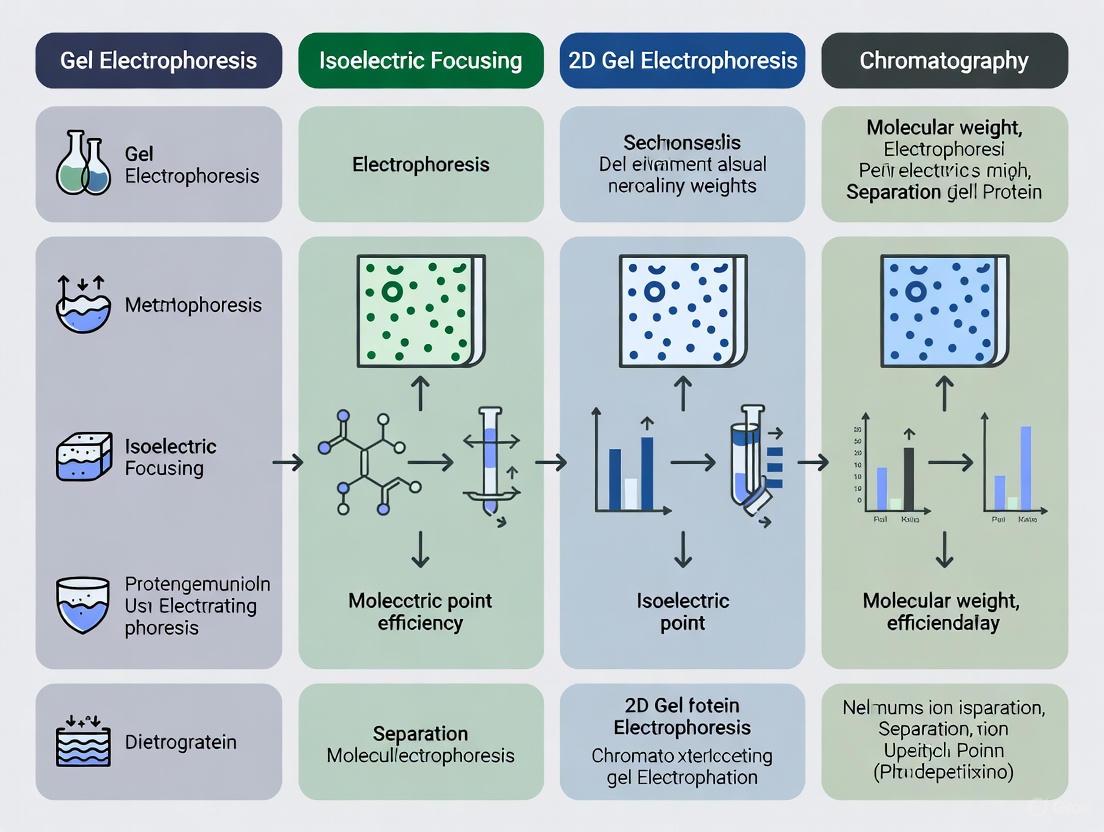
This article provides a comprehensive comparison of foundational and advanced protein separation techniques for researchers and drug development professionals.
Protein Separation Showdown: A Modern Guide to Gel Electrophoresis vs. Capillary Techniques
Abstract
This article provides a comprehensive comparison of foundational and advanced protein separation techniques for researchers and drug development professionals. It covers the core principles of gel electrophoresis (SDS-PAGE) and explores its relationship with complementary methods like capillary electrophoresis, isoelectric focusing, and two-dimensional electrophoresis. The content delivers practical methodological insights, troubleshooting guidance for common optimization challenges, and a critical validation framework for technique selection based on resolution, throughput, and application requirements in modern biomedical research.
The Building Blocks of Protein Separation: Understanding Electrophoresis Fundamentals
Electrophoresis is a foundational technique in biochemistry and molecular biology for separating charged molecules such as proteins, DNA, and RNA. Its core principle relies on the differential migration of these molecules through a conducting medium under the influence of an applied electric field [1] [2]. The mobility of a molecule—how quickly it moves—is determined by its charge-to-size ratio; highly charged, compact molecules migrate faster, while larger molecules with less charge move more slowly [3]. This article provides a detailed comparison of the two dominant electrophoretic techniques—gel and capillary electrophoresis—within the context of protein separation research, offering experimental data and methodologies for scientists and drug development professionals.
Fundamental Principles of Electrophoretic Separation
The motion of a charged molecule in an electric field is characterized by its electrophoretic velocity (νep), which is governed by the equation [3]: νep = μ_ep E
Here, E is the magnitude of the applied electric field, and μep is the solute's electrophoretic mobility. This mobility is a fundamental property of the molecule and is defined by [3]: μep = q / (6πηr)
In this relationship, q represents the solute's charge, η is the viscosity of the buffer, and r is the solute's radius. This equation highlights that mobility is directly proportional to the molecule's charge and inversely proportional to its size and the medium's viscosity. In gel electrophoresis, a porous gel matrix (such as agarose or polyacrylamide) acts as a molecular sieve, enhancing separation primarily based on size and secondarily on charge [4] [1]. In contrast, capillary electrophoresis (CE) occurs within a narrow-bore fused-silica capillary filled with a conductive buffer. A critical differentiator in CE is electroosmotic flow (EOF), a bulk flow of the buffer solution caused by the electric field acting on the charged capillary wall. This EOF sweeps most analytes, including anions and neutral species, toward the detector, enabling high-resolution separation based on a combination of size and charge [4] [3].
The diagram above illustrates the core principles governing the movement and separation of charged molecules during electrophoresis. An applied electric field exerts an electrophoretic force on charged molecules, while a drag force from the medium resists this movement. In capillary systems, electroosmotic flow provides an additional driving force, and the net effect of these forces determines the molecule's velocity and the resulting separation.
Gel Electrophoresis vs. Capillary Electrophoresis: A Technical Comparison
The choice between gel and capillary electrophoresis significantly impacts the resolution, throughput, and data output of protein separation experiments. The table below provides a detailed, point-by-point comparison of these two core techniques.
| Feature | Gel Electrophoresis (GE) | Capillary Electrophoresis (CE) |
|---|---|---|
| Separation Medium | Porous gel slab (agarose or polyacrylamide) [4] | Fused-silica capillary filled with electrolyte buffer or polymer network [4] [5] |
| Separation Principle | Molecular sieving (primarily size-based) [4] | Size-to-charge ratio and electroosmotic flow [4] [3] |
| Resolution & Efficiency | Lower resolution; band broadening occurs [4] | High resolution; minimal band broadening [4] |
| Typical Run Time | Slow (30 minutes to several hours) [4] [5] | Fast (typically 5 to 30 minutes) [4] [6] [5] |
| Automation Level | Manual, labor-intensive process [4] | Fully automated, including sample handling and data collection [4] |
| Sample Throughput | Low to medium (one gel with multiple samples) [4] | High (serial, automated multiple runs) [4] |
| Sample Volume | Microliter (µL) range [4] | Nanoliter (nL) range [4] |
| Data Output Format | End-point analysis via stained gel image [4] | Real-time electropherogram with quantifiable peaks [4] [7] |
| Key Quantitative Performance | Sensitivity: 91% (for M protein detection) [8] | Sensitivity: 92% (for M protein detection) [8] |
| Key Quantitative Performance | Specificity: 81% (for M protein detection) [8] | Specificity: 74% (for M protein detection) [8] |
Experimental Protocols for Protein Separation
SDS-Polyacrylamide Gel Electrophoresis (SDS-PAGE) for Protein Analysis
SDS-PAGE is a workhorse method for separating proteins by molecular weight [9] [7].
- Sample Preparation: Proteins are denatured and linearized by boiling in a buffer containing sodium dodecyl sulfate (SDS) and a reducing agent like β-mercaptoethanol. SDS coats the proteins, imparting a uniform negative charge and masking their native charge, resulting in a constant charge-to-mass ratio [1] [7].
- Gel Preparation: A discontinuous gel system is poured, consisting of a stacking gel (pH ~6.8) and a resolving gel (pH ~8.8) with a specific percentage of polyacrylamide (e.g., 8-16%) to create a pore size suitable for the target protein size range [1].
- Electrophoresis Run: The prepared samples and a molecular weight marker are loaded into wells. An electric field is applied (e.g., 100-200 V). Proteins migrate through the stacking gel where they are concentrated into a sharp line, then enter the resolving gel where separation by size occurs [1].
- Post-Run Analysis: The gel is stained with a dye like Coomassie Brilliant Blue or a silver stain to visualize protein bands. The distance migrated is compared to the standard marker to estimate molecular weight [7].
SDS-Capillary Agarose Gel Electrophoresis (SDS-CAGE) for Therapeutic Proteins
A recent advancement in capillary electrophoresis is SDS-CAGE, which offers a robust solution for analyzing biopharmaceuticals [6].
- Capillary and Matrix Preparation: A fused-silica capillary is filled with a novel sieving matrix composed of tetrahydroxyborate cross-linked agarose. This matrix is key to eliminating baseline disturbances common in traditional polymer networks [6].
- Sample Preparation: Therapeutic protein samples (e.g., an intact antibody or a highly glycosylated fusion protein) are denatured and reduced using SDS, similar to the SDS-PAGE protocol [6].
- Instrumentation and Run: The sample is injected into the capillary inlet. A high-voltage power supply (e.g., 10-30 kV) is applied, driving the SDS-protein complexes through the capillary. Real-time detection occurs via an on-column UV or laser-induced fluorescence detector at the outlet end [6] [5].
- Data Analysis: The detector generates an electropherogram. Peak areas are used for quantification, and migration times are compared to standards for identification. This method has demonstrated excellent run-to-run reproducibility with RSD <0.3% for migration time and <5% for peak area [6].
The workflow above contrasts the fundamental procedural differences between gel-based and capillary-based electrophoretic separation. Gel electrophoresis requires multiple manual steps post-separation, while capillary electrophoresis integrates separation and detection into a single, automated process.
Research Reagent Solutions for Electrophoresis
Successful electrophoresis relies on a suite of specialized reagents and materials. The following table details essential components for setting up and performing electrophoretic separations.
| Reagent/Material | Function in Electrophoresis |
|---|---|
| Agarose | A polysaccharide polymer used to create gels for separating large nucleic acids and some proteins. Pore size is adjusted by changing the agarose concentration [1] [7]. |
| Polyacrylamide | A synthetic polymer formed from acrylamide and bis-acrylamide, used to create gels with very small, uniform pores for high-resolution separation of proteins and small nucleic acids [1] [7]. |
| SDS (Sodium Dodecyl Sulfate) | An ionic detergent that denatures proteins and confers a uniform negative charge, allowing separation based primarily on molecular weight in techniques like SDS-PAGE [1] [7]. |
| Electrophoresis Buffer (e.g., TBE, TAE) | Carries the electric current and maintains a stable pH during the run. Common buffers include Tris-Borate-EDTA (TBE) and Tris-Acetate-EDTA (TAE) [1] [3]. |
| Molecular Weight Marker (Ladder) | A mixture of proteins or DNA fragments of known sizes that is run alongside samples to allow estimation of the molecular weight of unknown analytes [7]. |
| Coomassie Brilliant Blue / Silver Stain | Dyes used to visualize proteins after separation on a gel. Coomassie is a general-purpose stain, while silver stain offers higher sensitivity [7]. |
| Capillary | A narrow-bore fused-silica tube (typically 25-75 μm inner diameter) that serves as the separation chamber in capillary electrophoresis [3] [5]. |
| Sieving Matrix (e.g., linear polymer, cross-linked agarose) | A separation medium filled into the capillary for size-based separations (e.g., SDS-proteins). It can be a replaceable polymer solution or a cross-linked gel [6] [5]. |
Both gel electrophoresis and capillary electrophoresis are powerful techniques rooted in the core principles of electromigration. Gel electrophoresis remains a robust, cost-effective, and intuitive method for qualitative analysis and educational purposes, where visualizing many samples side-by-side is beneficial [4]. However, for applications demanding high throughput, precise quantification, and automation—such as in clinical diagnostics and biopharmaceutical quality control—capillary electrophoresis offers superior resolution, speed, and data quality [4] [6] [10]. The choice between these methods is not a matter of one being universally superior, but rather of strategically matching the technique to the specific analytical needs for protein separation. Modern laboratories often leverage both, using gels for initial checks and CE for definitive, quantitative analyses.
Gel electrophoresis is a standard laboratory technique for separating charged molecules, such as proteins, based on their size and charge, by moving them through a gel matrix under the influence of an electric field [11] [12]. The polyacrylamide gel acts as a molecular sieve, providing resistance so that smaller molecules migrate faster than larger ones [13] [11]. Among the various forms of this technique, Sodium Dodecyl Sulfate Polyacrylamide Gel Electrophoresis (SDS-PAGE) has become the most widely used method for separating proteins and determining their molecular weight [11] [12].
SDS-PAGE is a type of denaturing electrophoresis that utilizes the anionic detergent sodium dodecyl sulfate (SDS) to unfold proteins and impart a uniform negative charge density [11]. This process allows separation based almost exclusively on polypeptide chain length (molecular weight) rather than on the protein's inherent charge or three-dimensional structure [13] [11]. The simplicity, speed, and reliability of SDS-PAGE have made it a fundamental tool in biochemistry, molecular biology, forensics, and drug development for analyzing protein purity, composition, and size [12].
The Core Mechanism of SDS-PAGE
The Role of SDS in Protein Denaturation
The distinctive power of SDS-PAGE lies in the action of the sodium dodecyl sulfate (SDS) detergent. SDS plays two critical, interdependent roles in protein denaturation and preparation for electrophoresis:
Backbone Binding and Unfolding: SDS has a strong protein-denaturing effect. It disrupts hydrophobic interactions and hydrogen bonds that maintain the protein's secondary and tertiary structures [13]. Each SDS molecule consists of a 12-carbon alkyl tail attached to a sulfate group. The hydrophobic tail interacts with the hydrophobic regions of the protein backbone, while the hydrophilic sulfate head group faces outward. Proteins are typically heated to 70–100°C in a sample buffer containing SDS and a reducing agent (like β-mercaptoethanol or DTT). This heat and chemical treatment fully dissociates protein complexes and linearizes the polypeptide chains by cleaving disulfide bonds [11].
Charge Masking and Imparting Uniform Charge Density: As SDS binds to the denatured polypeptide, it coats the protein in a nearly uniform layer of negative charges. Most polypeptides bind SDS in a constant weight ratio of approximately 1.4 g of SDS per 1 g of polypeptide [11]. This binding confers a uniform negative charge to all proteins. Since the intrinsic charge of the amino acids becomes insignificant compared to the overwhelming negative charge from the bound SDS, the result is that all SDS-polypeptide complexes have essentially the same charge-to-mass ratio and a similar rod-like shape [11]. This eliminates the influence of the protein's natural charge and allows separation to occur based solely on molecular size as the complexes migrate through the gel.
The Polyacrylamide Gel Matrix as a Molecular Sieve
The polyacrylamide gel forms the physical medium for separation. It is created by polymerizing acrylamide and a cross-linking agent, usually bis-acrylamide (N,N'-methylenebisacrylamide), in the presence of a catalyst (ammonium persulfate, APS) and a stabilizer (TEMED) [11]. The resulting gel is a three-dimensional meshwork or matrix with defined pores.
The pore size of the gel is determined by the concentration of acrylamide and bis-acrylamide. A higher percentage of acrylamide creates a gel with a smaller pore size, which provides more resistance and is better for separating smaller proteins. Conversely, a lower percentage creates a gel with larger pores, suitable for resolving larger proteins [11]. For most proteins, a gel concentration between 6% and 15% is used [13]. Gradient gels, which have a low acrylamide concentration at the top and a high concentration at the bottom, can separate a much broader range of protein sizes on a single gel [11].
During electrophoresis, the linearized, SDS-coated proteins are drawn through this porous gel matrix toward the positive electrode (anode). Smaller proteins navigate the pores more easily and migrate more rapidly, while larger proteins are impeded by the matrix and migrate more slowly [13] [12]. The final result is a series of protein bands arranged by molecular weight.
The Discontinuous Gel System
A key to the high resolution of SDS-PAGE is the use of a discontinuous gel system, which incorporates two distinct gel layers with different compositions and functions [12]:
- Separating Gel (Resolving Gel): This is the lower, main part of the gel, typically with a higher acrylamide concentration (e.g., 5-15%) and a pH of about 8.8 [11]. It is responsible for the actual separation of proteins based on size.
- Stacking Gel: This is the upper, short layer of gel, with a lower acrylamide concentration (e.g., 4-5%) and a lower pH (about 6.8) [11] [12]. Its purpose is to "stack" or concentrate all protein samples into a very sharp, fine band before they enter the separating gel. This concentration occurs due to differences in the mobility of ions in the sample buffer and running buffer, creating a sharp boundary that compresses the proteins into a tight zone, leading to much clearer and better-resolved bands in the final separation [11].
The following diagram illustrates the workflow and core mechanism of SDS-PAGE:
Comparative Analysis with Alternative Electrophoresis Techniques
While SDS-PAGE is the workhorse for protein analysis, other electrophoretic techniques offer unique advantages for specific applications. The table below provides a direct comparison of SDS-PAGE with its primary alternatives.
Table 1: Comparative Analysis of Protein Gel Electrophoresis Techniques
| Feature | SDS-PAGE (Denaturing) | Native-PAGE (Non-Denaturing) | Blue-Native (BN)-PAGE | NSDS-PAGE (Native SDS-PAGE) |
|---|---|---|---|---|
| Separation Basis | Primarily by molecular mass [11] | By net charge, size, and shape of native structure [11] | By native mass and charge [14] | By molecular mass with retained function [14] |
| Protein State | Denatured and linearized [11] | Native (folded and active) [11] | Native (folded and active) [14] | Partially denatured, but functional for many enzymes [14] |
| Detergent Used | SDS (high concentration) [11] | None or non-denaturing detergents [11] | Coomassie G-250 dye [14] | SDS (very low concentration) [14] |
| Key Applications | - Molecular weight determination- Purity analysis- Western blotting [11] [12] | - Analysis of native charge- Study of oligomeric state- Activity assays post-electrophoresis [11] | - Protein-protein interactions- Analysis of multi-protein complexes [14] | - Metalloprotein analysis- Enzymatic activity assays post-separation [14] |
| Functional Retention | No; enzymatic activity and cofactors are destroyed [14] [11] | Yes; enzymatic activity and subunit interactions are often retained [11] | Yes; functional properties are preserved [14] | Yes (Partial); 7 of 9 model enzymes retained activity in one study [14] |
| Metal Cofactor Retention | Poor (e.g., 26% Zn²⺠retention reported) [14] | Excellent | Excellent | Excellent (e.g., 98% Zn²⺠retention reported) [14] |
| Resolution | High resolution of complex protein mixtures [14] [11] | Lower resolution compared to SDS-PAGE [14] | Lower resolution and can add ambiguities to molecular weight determination [14] | High resolution, comparable to standard SDS-PAGE [14] |
Quantitative Comparison of Metal Retention and Enzyme Activity
The functional trade-offs between these techniques are starkly evident in experimental data comparing metal retention and enzymatic activity. The modified NSDS-PAGE protocol demonstrates that it is possible to approach the high resolution of SDS-PAGE while retaining much of the functionality preserved in BN-PAGE.
Table 2: Experimental Performance Data: Metal Retention and Enzyme Activity Post-Electrophoresis
| Electrophoresis Method | Zinc (Zn²âº) Retention in Proteomic Samples | Enzymatic Activity Retention (Model Zn-Proteins) |
|---|---|---|
| Standard SDS-PAGE | 26% [14] | 0 of 9 enzymes active [14] |
| BN-PAGE | Data not explicitly quantified, but reported as "retained" [14] | 9 of 9 enzymes active [14] |
| NSDS-PAGE | 98% [14] | 7 of 9 enzymes active [14] |
A Framework for Technique Selection
Choosing the right electrophoresis method depends on the primary goal of the experiment. The following decision tree provides a logical framework for researchers to select the most appropriate technique:
Experimental Protocols and Methodologies
Standard SDS-PAGE Protocol
A typical protocol for denaturing SDS-PAGE, as derived from multiple sources [13] [11] [12], involves the following steps:
Gel Casting:
- Assemble glass plates with a spacer to form a cassette.
- Prepare the separating gel solution (e.g., 12% acrylamide, 0.1% SDS, pH ~8.8 Tris-HCl buffer). Add polymerization agents (APS and TEMED), pour the gel, and overlay with water or alcohol to ensure a flat surface. Allow to polymerize completely (15-30 minutes).
- Pour off the overlay. Prepare the stacking gel solution (e.g., 4-5% acrylamide, 0.1% SDS, pH ~6.8 Tris-HCl buffer). Add APS and TEMED, pour over the separating gel, and immediately insert a comb to form the sample wells. Allow to polymerize.
Sample Preparation:
- Mix protein samples with SDS-PAGE sample buffer (containing Tris-HCl, SDS, glycerol, bromophenol blue, and a reducing agent like DTT) [14] [12].
- Heat the samples at 95-100°C for 3-10 minutes to fully denature the proteins [13] [12].
- Centrifuge briefly to bring all condensation to the bottom of the tube.
Electrophoresis:
- Mount the gel cassette in the electrophoresis chamber and fill the upper and lower chambers with running buffer (e.g., Tris-Glycine-SDS buffer, pH ~8.3-8.8) [11].
- Carefully load the denatured samples and a molecular weight marker (protein ladder) into the wells.
- Connect the power supply and run at a constant voltage (e.g., 120-200V) until the dye front (bromophenol blue) reaches the bottom of the gel [13].
Post-Electrophoresis Analysis:
- Disassemble the gel apparatus and carefully remove the gel from the plates.
- Stain the gel to visualize protein bands. Common methods include:
- Alternatively, proteins can be transferred to a membrane for western blotting [11].
NSDS-PAGE Protocol for Functional Retention
The NSDS-PAGE protocol, designed to retain metal ions and enzymatic activity, modifies the standard protocol in key areas [14]:
- Sample Buffer: The sample buffer omits SDS and EDTA (a metal chelator). It typically contains Tris buffer, glycerol, and tracking dyes (Coomassie G-250 and Phenol Red) but no denaturing detergent [14].
- No Heating Step: The protein sample is mixed with the sample buffer without a heating step, preserving the native fold and metal-binding pockets [14].
- Running Buffer: The running buffer contains a greatly reduced concentration of SDS (e.g., 0.0375% instead of the standard 0.1%) and also omits EDTA [14].
- Electrophoresis: The procedure is otherwise carried out similarly to standard SDS-PAGE, using commercially available precast Bis-Tris gels [14].
These modifications create an environment where proteins can be separated by the sieving properties of the polyacrylamide gel without being fully denatured, allowing many to retain their bound metal ions and enzymatic function.
The Scientist's Toolkit: Essential Reagents and Materials
Successful execution of protein electrophoresis requires a set of specific reagents and hardware. The following table details the key components of the SDS-PAGE workflow.
Table 3: Essential Research Reagent Solutions for SDS-PAGE
| Item | Function / Purpose | Key Considerations |
|---|---|---|
| Acrylamide/Bis-acrylamide | Forms the cross-linked polyacrylamide gel matrix that acts as a molecular sieve [11]. | Ratio and total concentration determine gel pore size. Note: Acrylamide is a potent neurotoxin [12]. |
| SDS (Sodium Dodecyl Sulfate) | Ionic detergent that denatures proteins and confers a uniform negative charge [13] [11]. | Critical for masking intrinsic protein charge; purity is essential for consistent results. |
| APS & TEMED | Ammonium Persulfate (APS) and TEMED are catalysts that initiate and accelerate the polymerization of acrylamide [11]. | Freshness of APS solution is crucial for efficient and timely gel polymerization. |
| Tris-based Buffers | Provides the appropriate pH environment for gel polymerization and electrophoresis (e.g., Tris-HCl for gels, Tris-Glycine for running buffer) [11]. | pH and ionic strength are critical for proper protein migration and stacking. |
| Reducing Agents (DTT/β-ME) | Dithiothreitol (DTT) or β-mercaptoethanol cleaves disulfide bonds to fully denature proteins into individual subunits [11]. | Essential for analyzing proteins with quaternary structure or intra-chain disulfide bonds. |
| Molecular Weight Markers | A mixture of proteins of known sizes run alongside samples to estimate the molecular weight of unknown proteins [11]. | Available in pre-stained and unstained varieties. |
| Protein Stains | Coomassie Blue: General purpose staining. Silver Stain: High-sensitivity detection. Fluorescent Dyes: Sensitive and quantitative options [12]. | Choice depends on required sensitivity, quantification needs, and downstream applications. |
| Precast Gels | Commercially prepared, ready-to-use polyacrylamide gels [14] [11]. | Offer convenience, reproducibility, and save time while minimizing exposure to liquid acrylamide. |
| Hsd17B13-IN-10 | Hsd17B13-IN-10, MF:C23H19F3N2O4, MW:444.4 g/mol | Chemical Reagent |
| Brd4-IN-6 | Brd4-IN-6|BRD4 Inhibitor|For Research Use | Brd4-IN-6 is a potent BRD4 inhibitor for cancer research. This product is For Research Use Only, not for human or veterinary diagnostic or therapeutic use. |
SDS-PAGE remains a cornerstone technique in life science research, providing an unparalleled combination of resolution, simplicity, and cost-effectiveness for protein separation based on molecular weight. Its denaturing mechanism, powered by SDS, is ideal for applications like molecular weight estimation, purity assessment, and western blotting. However, this very strength is its primary weakness when the goal is to study native protein function.
The comparative analysis presented here highlights that the choice of an electrophoretic method is not one-size-fits-all. For researchers focused exclusively on protein size and composition, standard SDS-PAGE is the optimal choice. For those requiring full retention of enzymatic activity, oligomeric state, or protein-protein interactions, Native-PAGE or BN-PAGE are necessary, albeit with a trade-off in resolution. The development of NSDS-PAGE and similar hybrid techniques offers a promising middle ground, demonstrating that it is possible to achieve high-resolution separation while preserving critical functional properties like metal binding and enzyme activity for many proteins.
This objective guide underscores that advancements in protein electrophoresis continue to refine this essential toolkit, providing researchers and drug development professionals with a spectrum of validated methods to meet their specific analytical needs.
In the realm of protein science, sodium dodecyl sulfate-polyacrylamide gel electrophoresis (SDS-PAGE) stands as a foundational technique that enables researchers to separate complex protein mixtures based on a single fundamental property: molecular weight. This remarkable specificity is achieved through the critical action of SDS, which performs two essential functions—imparting a uniform negative charge to all proteins and linearizing them into a consistent conformation. Without this dual action, protein separation would depend on multiple variables including intrinsic charge, size, and shape, making interpretation and molecular weight determination nearly impossible [15].
The significance of SDS-PAGE extends across diverse applications in biomedical research and drug development, from assessing protein purity in biopharmaceutical production to analyzing expression patterns in disease states. This article examines the fundamental role of SDS in achieving precise protein separation and compares its performance against alternative electrophoretic techniques, providing researchers with a comprehensive framework for selecting appropriate separation methods for their specific experimental needs.
The Dual Mechanism of SDS Action
Charge Uniformity Through SDS Binding
The primary function of SDS lies in its ability to mask the intrinsic charges of proteins, which vary depending on their amino acid composition and the pH of their environment. SDS is an anionic detergent featuring a hydrophobic hydrocarbon chain (tail) and a hydrophilic sulfate group (head) [15]. When added to a protein sample, SDS binds to the protein backbone in a constant weight ratio of approximately 1.4 g of SDS per 1 g of polypeptide [11].
This uniform binding occurs because the hydrophobic tail of SDS interacts with hydrophobic regions of proteins, while the ionic portion disrupts non-covalent interactions within protein structures [15]. The result is that all SDS-bound proteins gain a consistent negative charge density, effectively nullifying any charge differences that would otherwise cause proteins with similar molecular weights to migrate at different rates during electrophoresis [11] [15].
Protein Linearization for Accurate Separation
Beyond charge normalization, SDS plays an equally crucial role in protein denaturation. The three-dimensional structure of native proteins would cause molecules of identical molecular weight but different shapes to migrate at varying speeds through a gel matrix. SDS resolves this issue by unraveling protein secondary and tertiary structures through several mechanisms:
The hydrophobic region of SDS interacts with and unfolds hydrophobic regions of proteins, while the ionic part disrupts non-covalent interactions within proteins [15]. This action is complemented by other sample preparation steps, including heating at 70-100°C to break hydrogen bonds, and treatment with reducing agents like β-mercaptoethanol (BME) or dithiothreitol (DTT) to break disulfide bridges between cysteine residues [11] [15]. Together, these treatments transform compact, folded proteins into extended, linear polypeptide chains whose migration through the polyacrylamide gel matrix depends solely on molecular weight rather than structural features [15].
The following diagram illustrates this denaturation and linearization process:
Comparative Analysis of Protein Separation Techniques
SDS-PAGE Versus Alternative Electrophoretic Methods
While SDS-PAGE excels at molecular weight-based separation, alternative electrophoretic techniques offer complementary capabilities for protein analysis. The table below provides a systematic comparison of major protein separation methods:
| Technique | Separation Principle | Key Advantages | Key Limitations | Optimal Applications |
|---|---|---|---|---|
| SDS-PAGE [16] [11] [17] | Molecular weight under denaturing conditions | High resolution for size-based separation; excellent reproducibility; broad applicability; cost-effective | Protein denaturation prevents functional studies; cannot distinguish proteins with identical molecular weights | Molecular weight determination; purity assessment; western blotting |
| Native PAGE [11] [14] | Net charge, size, and shape under non-denaturing conditions | Preserves native conformation and enzymatic activity; maintains protein-protein interactions | Lower resolution than SDS-PAGE; complex migration patterns; potential protein aggregation | Enzyme activity assays; protein-protein interaction studies; oligomeric state determination |
| IEF/IPG [18] | Isoelectric point (pI) | Highest peptide detection per protein; separates isoforms with post-translational modifications; complementary to SDS-PAGE | Requires specialized equipment; limited separation range per gel; challenging with extreme pI proteins | Proteoform analysis; 2D-PAGE first dimension; charge variant characterization |
| 2D-PAGE [18] [11] | First dimension: pI (IEF); Second dimension: molecular weight (SDS-PAGE) | Highest resolution for complex mixtures; enables simultaneous analysis of thousands of proteins; visual proteome mapping | Technically challenging; low throughput; limited dynamic range; poor reproducibility between gels | Comprehensive proteomic profiling; biomarker discovery; post-translational modification analysis |
| Blue Native (BN)-PAGE [14] | Size and shape under non-denaturing conditions with Coomassie dye | Retains functional properties and protein complexes; maintains non-covalently bound cofactors | Lower resolution than SDS-PAGE; limited molecular weight accuracy; dye-protein interactions may alter mobility | Membrane protein complexes; mitochondrial respiratory chain analysis; protein oligomerization studies |
Experimental Performance Data
Direct comparison of separation techniques using standardized samples reveals their complementary strengths. Research comparing gel-based protein separation techniques for mass spectrometry-based proteomic profiling demonstrated that while all methods provide complementary identifications, SDS-PAGE and IEF-IPG yielded the highest number of protein identifications [18]. The IEF-IPG technique resulted in the highest average number of detected peptides per protein, potentially beneficial for quantitative and structural characterization, while a combination of orthogonal SDS-PAGE and IEF-IPG improved profiling sensitivity without significant decrease in throughput [18].
The following experimental data from mitochondrial extract analysis highlights these performance differences:
| Separation Technique | Protein Identifications | Relative Dynamic Range | Peptides per Protein | Technical Complexity |
|---|---|---|---|---|
| 1-D SDS-PAGE [18] | Highest | High | Medium | Low |
| IEF-IPG [18] | Highest | High | Highest | Medium |
| 2-D PAGE [18] | Medium | Medium | Low | High |
| Preparative PAGE [18] | Medium | Medium | Medium | Medium |
Methodological Protocols
Standard SDS-PAGE Protocol
Sample Preparation [11] [19] [15]:
- Lysis: Suspend cells or tissue in RIPA buffer (for whole cell extracts) or NP-40 buffer (for cytoplasmic extracts) supplemented with protease inhibitors (e.g., 1 mM PMSF for serine proteases, 1-10 μg/ml aprotinin for trypsin/chymotrypsin) and phosphatase inhibitors (e.g., 1 mM sodium orthovanadate for tyrosine phosphatases) to prevent degradation [19].
- Protein Quantification: Determine protein concentration using BCA assay (compatible with detergents) or Bradford assay (compatible with reducing agents) [19].
- Denaturation: Mix protein sample with 2X Laemmli buffer containing SDS, glycerol, bromophenol blue, and freshly added reducing agent (50 mM DTT or 5% β-mercaptoethanol) [19] [15].
- Heating: Heat samples at 70-100°C for 5-10 minutes to complete denaturation [11] [15].
Gel Electrophoresis [11] [15]:
- Gel Selection: Choose appropriate acrylamide concentration based on target protein size (e.g., 12% for 10-100 kDa proteins, 8% for 50-200 kDa proteins) or use gradient gels (e.g., 4-20%) for broader separation range.
- Loading: Load 20-30 μg of protein per mini-gel well alongside molecular weight markers [20].
- Electrophoresis: Run at constant voltage (150-200V for mini-gels) using MOPS or Tris-glycine-SDS running buffer until dye front reaches gel bottom [11] [14].
Modified NSDS-PAGE for Native Protein Analysis
For applications requiring retention of protein function while maintaining high resolution, Native SDS-PAGE (NSDS-PAGE) offers a valuable alternative [14]:
Sample Preparation Modifications [14]:
- Omit denaturation: Remove SDS and EDTA from sample buffer
- Eliminate heating step: Maintain samples at 4°C throughout preparation
- Modified running buffer: Reduce SDS concentration to 0.0375% and delete EDTA
- Alternative detection: Use Coomassie G-250 (0.01875%) and phenol red (0.00625%) in sample buffer
Validation [14]:
- Metal retention: Zn²⺠retention increases from 26% (standard SDS-PAGE) to 98% (NSDS-PAGE)
- Enzyme activity: Seven of nine model enzymes, including four Zn²⺠proteins, retained activity after NSDS-PAGE separation
- Comparison: All nine enzymes were active after BN-PAGE, but all underwent denaturation during standard SDS-PAGE
The Scientist's Toolkit: Essential Reagents for SDS-PAGE
| Reagent/Category | Specific Examples | Function | Key Considerations |
|---|---|---|---|
| Denaturing Agents | SDS, LDS | Uniform negative charge; protein unfolding | Critical for molecular weight-based separation; incompatible with native analyses [11] [15] |
| Reducing Agents | DTT, β-mercaptoethanol | Break disulfide bonds; complete linearization | Must be fresh; DTT preferred for less odor [19] [15] |
| Protease Inhibitors | PMSF, Aprotinin, EDTA | Prevent protein degradation during preparation | EDTA chelates metalloproteases; PMSF targets serine proteases [19] |
| Gel Components | Acrylamide, Bis-acrylamide, TEMED, APS | Form porous polyacrylamide matrix | Acrylamide concentration determines resolution range; TEMED/APS initiate polymerization [11] [15] |
| Buffers | Tris-HCl, MOPS, Tris-glycine | Maintain pH; conduct current | MOPS preferred for better resolution of lower MW proteins [11] [14] |
| Detection Reagents | Coomassie Blue, Silver stain, SimplyBlue SafeStain | Visualize separated proteins | Silver staining offers highest sensitivity; Coomassie provides excellent routine detection [11] |
| Molecular Weight Markers | Prestained standards, Unstained protein ladders | Size reference for unknown proteins | Prestained markers allow tracking during electrophoresis; unstained better for accuracy [11] |
| FXIIa-IN-2 | Bench Chemicals | ||
| hERG-IN-1 | hERG-IN-1 | Potent hERG Channel Blocker for Research | hERG-IN-1 is a selective hERG potassium channel inhibitor for cardiac safety and ion channel research. For Research Use Only. Not for human or veterinary use. | Bench Chemicals |
Strategic Selection Guide for Protein Separation Techniques
The choice of appropriate separation methodology depends on specific research objectives, sample characteristics, and downstream applications. The following decision pathway provides a framework for selecting optimal techniques:
SDS-PAGE remains an indispensable tool in the protein scientist's arsenal, primarily due to the critical dual role of SDS in achieving uniform charge distribution and linear protein conformation. While the denaturing nature of SDS-PAGE precludes functional analyses, its robust performance in molecular weight-based separation, cost-effectiveness, and technical accessibility ensure its continued prominence in research and diagnostic applications [16] [17].
The expanding repertoire of protein separation techniques, including native modifications like NSDS-PAGE that preserve metal binding capacity and enzymatic activity [14], provides researchers with increasingly sophisticated tools for proteomic analysis. By understanding the fundamental mechanisms of SDS action and the complementary strengths of alternative electrophoretic methods, scientists can make informed decisions to optimize their experimental designs and advance our understanding of protein structure and function in health and disease.
Gel electrophoresis stands as a cornerstone technique in biochemical research for separating macromolecules based on their physical properties. Among the various media employed, the polyacrylamide gel matrix represents a precisely engineerable molecular sieve that facilitates high-resolution, size-based separation of proteins and small nucleic acids. This gel matrix is formed through the polymerization of acrylamide monomers cross-linked by bis-acrylamide, creating a porous network with pore sizes typically ranging from 130 nm for 3.5% gels to 70 nm for 10.5% gels at a constant bis-acrylamide concentration of 3% [21].
The fundamental principle governing separation in polyacrylamide gel electrophoresis (PAGE) is molecular sieving, where the gel matrix acts as a selective barrier that retards the movement of molecules in proportion to their size and shape [21]. When an electric field is applied, smaller molecules navigate through the porous network more readily than larger counterparts, resulting in differential migration distances that enable separation. This mechanism operates distinctly from size exclusion chromatography (SEC), where larger molecules elute first due to limited access to pore volumes [21]. In PAGE, the separation matrix is entirely composed of gel structure without a bulk phase, resulting in faster migration for smaller macromolecules [21].
This guide provides a comprehensive comparison of polyacrylamide gel electrophoresis with alternative separation techniques, supported by experimental data and methodological protocols to inform researchers and drug development professionals in selecting optimal separation strategies for their specific applications.
Fundamental Separation Mechanisms and Gel Engineering
The separation performance of polyacrylamide gels is directly governed by their matrix structure, which can be precisely engineered by modulating acrylamide concentration and cross-linking ratio. These parameters control the pore size distribution within the gel, making it possible to optimize separation for specific molecular size ranges.
The molecular sieving mechanism in PAGE operates through a mesh-like network of polyacrylamide fibers that creates a tortuous path for migrating molecules [21]. As macromolecules move through this network under the influence of an electric field, their mobility becomes inversely proportional to their hydrodynamic volume. This relationship enables size-based separation with resolution sufficient to distinguish molecules differing by only a single base pair in nucleic acids or subtle molecular weight variations in proteins [22].
Diagram 1: Polyacrylamide Gel Formation and Separation Mechanism. The process shows how monomers and crosslinkers form a matrix whose pore size can be engineered to create a molecular sieve that separates molecules based on size [21].
The separation characteristics of polyacrylamide gels can be further modified based on application requirements. Denaturing electrophoresis typically uses sodium dodecyl sulfate (SDS), which binds to proteins and imparts a uniform negative charge, making separation dependent primarily on molecular weight while disrupting native structures and interactions [21]. In contrast, native gel electrophoresis is performed without denaturants, preserving protein structures, complexes, and biological functions, with migration influenced by the protein's intrinsic charge, size, and shape [21]. A modified approach called native SDS-PAGE (NSDS-PAGE) reduces SDS concentration and eliminates heating steps, maintaining functional properties like enzymatic activity and metal cofactor retention while providing high-resolution separation [14].
Comparative Analysis of Separation Techniques
Gel Electrophoresis Techniques: Polyacrylamide vs. Agarose
Table 1: Comparison of Polyacrylamide and Agarose Gel Matrices for Electrophoresis
| Parameter | Polyacrylamide Gel | Agarose Gel |
|---|---|---|
| Composition | Synthetic polymer (acrylamide + bis-acrylamide) [22] | Natural polysaccharide from seaweed [22] |
| Pore Size | Small (e.g., 70-130 nm) [21] | Large (e.g., 0.05-0.1 μm) [21] |
| Optimal Separation Range | Proteins, small DNA/RNA fragments (<1000 bp) [22] | Large DNA fragments (100 bp to >20 kbp) [22] |
| Resolution | High (can distinguish single base pair differences) [22] | Moderate (suitable for larger fragment separation) [22] |
| Handling Safety | Neurotoxic monomer requires careful handling [22] | Non-toxic, safe handling [22] |
| Gel Preparation | Complex polymerization process [22] | Simple dissolution in buffer and cooling [22] |
| Typical Applications | Protein analysis, DNA sequencing, Western blotting [22] | DNA restriction analysis, PCR product verification [22] |
| Cost Factors | Higher cost for specialized formats | Lower cost, simple equipment |
The choice between polyacrylamide and agarose gels depends primarily on the size of the target molecules and the required resolution. Polyacrylamide gels provide superior resolving power for smaller molecules, while agarose gels offer practical advantages for larger nucleic acid fragments [22].
Comparison with Alternative Protein Separation Techniques
Table 2: Comparison of Polyacrylamide Gel Electrophoresis with Other Protein Separation Methods
| Method | Basis of Separation | Advantages | Limitations | Best Use Application |
|---|---|---|---|---|
| Polyacrylamide Gel Electrophoresis | Size, charge, or both [9] | High resolution, versatile, cost-effective [18] | Manual processing, sample loss, limited preparative scale [18] | Analytical protein separation, purity assessment [14] |
| Gel Filtration Chromatography | Molecular size [9] | Gentle, maintains activity, reproducible [9] | Limited resolution, slow, dilution of sample [9] | Separating proteins of different sizes, buffer exchange [9] |
| Ion Exchange Chromatography | Net charge of protein [9] | High resolution, scalable, high capacity [9] | Sensitive to pH and salt conditions [9] | Large-scale purification, capture step [9] |
| Affinity Chromatography | Specific ligand binding [9] | Very high purity, selective, efficient [9] | Expensive, requires specific ligand [9] | Final purification of target protein [9] |
| Slalom Chromatography | Size under shear forces (for nucleic acids) [23] | Fast analysis (<6 min for large DNA), high resolution [23] | Specialized equipment required, primarily for large nucleic acids [23] | Analysis of large nucleic acids (>3 kbp) [23] |
Each separation technique offers distinct advantages and limitations, with polyacrylamide gel electrophoresis providing an optimal balance of resolution, versatility, and cost-effectiveness for analytical applications, particularly when sample amounts are not limiting [18].
Experimental Data and Performance Comparison
Quantitative Comparison of Separation Techniques
Table 3: Performance Metrics of Protein Separation Techniques in Proteomic Analysis
| Technique | Protein Identification Count | Peptides per Protein | Dynamic Range | Sample Throughput | Compatibility with MS Analysis |
|---|---|---|---|---|---|
| 1-D SDS-PAGE | Highest [18] | Moderate [18] | ~2 orders of magnitude [18] | High | Excellent (after digestion) [18] |
| IEF-IPG | Highest [18] | Highest [18] | ~2 orders of magnitude [18] | Moderate | Excellent (after digestion) [18] |
| 2-D PAGE | Lower [18] | Lower [18] | Limited [18] | Low | Moderate [18] |
| BN-PAGE | Moderate [14] | Moderate [14] | Not specified | Moderate | Good for native MS [14] |
| NSDS-PAGE | High (comparable to SDS-PAGE) [14] | High [14] | Not specified | High | Excellent, retains native properties [14] |
Experimental comparisons demonstrate that 1-D SDS-PAGE and IEF-IPG techniques provide the highest number of protein identifications in proteomic analyses, with IEF-IPG particularly excelling in the average number of detected peptides per protein, which benefits quantitative and structural characterization [18]. The complementary nature of these techniques suggests that orthogonal separation approaches can significantly enhance profiling sensitivity and dynamic range.
Functional Preservation in Native Electrophoresis Techniques
Modified electrophoresis conditions such as NSDS-PAGE demonstrate significant advantages for applications requiring preservation of protein function. Research shows that zinc retention in proteomic samples increased from 26% in standard SDS-PAGE to 98% in NSDS-PAGE, with seven of nine model enzymes maintaining activity after separation compared to complete denaturation in conventional SDS-PAGE [14]. This functional preservation enables downstream applications including enzymatic assays and structural studies that are not possible with fully denaturing methods.
Detailed Experimental Protocols
Standard SDS-PAGE Protocol for Denaturing Protein Separation
Sample Preparation:
- Combine 7.5 μL protein sample with 2.5 μL 4X LDS sample loading buffer (106 mM Tris HCl, 141 mM Tris Base, 0.51 mM EDTA, 0.22 mM SERVA Blue G-250, 0.175 mM Phenol Red, 2% LDS, 10% glycerol, pH 8.5) [14]
- Heat samples at 70°C for 10 minutes to denature proteins [14]
- Centrifuge briefly to collect condensed sample
Gel Electrophoresis:
- Load samples onto precast NuPAGE Novex 12% Bis-Tris 1.0 mm minigels [14]
- Include appropriate molecular weight standards in at least one lane
- Fill electrophoresis chamber with 1X MOPS SDS running buffer (50 mM MOPS, 50 mM Tris Base, 1 mM EDTA, 0.1% SDS, pH 7.7) [14]
- Run at constant voltage (200V) for approximately 45 minutes at room temperature until dye front reaches gel bottom [14]
Post-Electrophoresis Analysis:
- Stain with Coomassie Blue, SYPRO Ruby, or silver stain for protein visualization
- For western blotting, transfer proteins to PVDF or nitrocellulose membrane
- For mass spectrometry analysis, excise protein bands for in-gel digestion [18]
NSDS-PAGE Protocol for Native Protein Separation
Sample Preparation:
- Mix 7.5 μL protein sample with 2.5 μL 4X NSDS sample buffer (100 mM Tris HCl, 150 mM Tris base, 10% v/v glycerol, 0.0185% w/v Coomassie G-250, 0.00625% w/v Phenol Red, pH 8.5) [14]
- Do not heat samples to preserve native protein structure [14]
Gel Preparation and Electrophoresis:
- Pre-run precast NuPAGE Novex 12% Bis-Tris 1.0 mm mini-gels at 200V for 30 minutes in ddHâ‚‚O to remove storage buffer and unpolymerized acrylamide [14]
- Replace with NSDS-PAGE running buffer (50 mM MOPS, 50 mM Tris Base, 0.0375% SDS, pH 7.7) [14]
- Load samples and run at 200V for approximately 30-45 minutes at room temperature [14]
Functional Analysis:
- After electrophoresis, proteins can be recovered for activity assays by electroelution or passive diffusion [14]
- In-gel activity staining can be performed for specific enzymes [14]
- Zinc-specific staining with TSQ fluorophore can verify metal retention [14]
Diagram 2: Experimental Workflow for Different PAGE Applications. The flowchart guides researchers in selecting appropriate electrophoresis conditions based on their analytical goals, whether for denaturing analysis or native protein studies [14] [18].
The Scientist's Toolkit: Essential Research Reagents and Materials
Table 4: Essential Reagents and Materials for Polyacrylamide Gel Electrophoresis
| Reagent/Material | Function | Key Considerations |
|---|---|---|
| Acrylamide/Bis-acrylamide | Forms the porous gel matrix | Neurotoxic monomer; pre-mixed solutions reduce handling risk |
| Ammonium Persulfate (APS) | Initiates polymerization | Fresh preparation ensures efficient polymerization |
| Tetramethylethylenediamine (TEMED) | Catalyzes polymerization reaction | Quantity affects polymerization rate and pore structure |
| SDS (Sodium Dodecyl Sulfate) | Denatures proteins and confers uniform charge | Purity affects resolution; critical for mass spectrometry |
| Tris-based Buffers | Maintain stable pH during electrophoresis | Composition affects resolution and protein stability |
| Molecular Weight Standards | Reference for size determination | Pre-stained or unstained formats available |
| Coomassie-based Stains | Protein visualization | Sensitivity varies; compatible with mass spectrometry |
| SYPRO Ruby/Orange | Fluorescent protein staining | Higher sensitivity; broad linear dynamic range |
| PVDF/Nitrocellulose Membranes | Protein transfer for western blotting | Pore size affects protein binding capacity |
| Chemiluminescent Substrates | Antibody detection in western blotting | Sensitivity and signal duration vary |
| Anti-MRSA agent 11 | Anti-MRSA agent 11, MF:C24H18F2N4O3, MW:448.4 g/mol | Chemical Reagent |
| Aicar-13C2,15N | Aicar-13C2,15N, MF:C9H14N4O5, MW:261.21 g/mol | Chemical Reagent |
The electrophoresis reagents market, valued at $1.31 billion in 2024 and projected to reach $1.86 billion by 2029, reflects continued innovation and demand for these essential research tools [24]. Major suppliers including Thermo Fisher Scientific, Bio-Rad Laboratories, and Sigma-Aldrich provide comprehensive systems for polyacrylamide gel electrophoresis, with product innovations focusing on improved reproducibility, sensitivity, and compatibility with downstream analysis [25] [24].
Polyacrylamide gel electrophoresis remains an indispensable tool for size-based separation of proteins and small nucleic acids, offering unparalleled resolution for analytical applications. The engineerable nature of the polyacrylamide matrix enables researchers to tailor separation characteristics to specific molecular size ranges, while modified approaches like NSDS-PAGE extend utility to applications requiring preservation of protein function.
When selecting separation techniques, researchers should consider the specific analytical goals: polyacrylamide gels for high-resolution analytical separation of proteins and small nucleic acids; agarose gels for larger DNA fragments; liquid chromatography methods for preparative-scale purification; and emerging techniques like slalom chromatography for specialized applications with large nucleic acids. The complementary nature of these techniques often makes orthogonal approaches the most powerful strategy for comprehensive biomolecular analysis.
As electrophoresis technology continues to evolve, trends toward automation, improved detection sensitivity, and integration with downstream analysis platforms will further enhance the utility of polyacrylamide gel matrices in biomedical research and drug development.
This guide provides an objective comparison of gel electrophoresis with other protein separation techniques, focusing on the critical roles of buffers, power supplies, and support media. For researchers in drug development, selecting the optimal separation method is crucial for efficiency, cost-effectiveness, and data quality.
Core Components of Protein Separation Systems
The performance of any protein separation technique hinges on three essential components [4]:
- Support Media: The matrix through which separation occurs.
- Buffers: The chemical environment that governs charge and stability.
- Power Supplies: The source of electrical energy that drives the separation.
Support Media: The Separation Matrix
The choice of support media defines the primary separation mechanism.
| Support Media Type | Principle of Separation | Primary Application in Protein Separation |
|---|---|---|
| Porous Gel (Agarose/Polyacrylamide) [4] | Molecular sieving (size-based) | SDS-PAGE (by mass), Native PAGE (by charge & size) |
| Capillary (Fused Silica) with Free Solution [4] [26] | Size-to-charge ratio & electroosmotic flow | Capillary Zone Electrophoresis (CZE) for intact proteins |
| Chromatography Resin (e.g., Ion-Exchange) [27] | Affinity interactions (e.g., electrostatic) | High-resolution purification based on charge characteristics |
| Liquid Phase Systems [27] | Differential solubility in chemical phases | Precipitation and Liquid-Liquid Extraction for initial purification |
Buffers: The Chemical Environment
Buffers maintain a stable pH, ensuring proteins remain charged and stable during separation. In capillary electrophoresis (CE), the buffer composition is also critical for suppressing the adsorption of proteins onto the capillary's inner wall, which can be achieved using specific capillary coatings or buffer additives [26]. For gel electrophoresis, Tris-based buffers are common, while CE and LC methods utilize a wider variety of buffered electrolytes and mobile phases [28] [26].
Power Supplies: The Driving Force
Power supplies provide the controlled electrical field and are characterized by their operational modes.
| Operational Mode | How It Works | Primary Application |
|---|---|---|
| Constant Voltage [29] | Voltage is fixed; current and power can fluctuate. | Standard DNA agarose gel electrophoresis. |
| Constant Current [29] | Current is fixed; voltage and power can fluctuate. | Protein SDS-PAGE, to ensure uniform heating and sharp bands. |
| Constant Power [29] | Power is fixed; voltage and current fluctuate. | Sensitive separations requiring strict temperature control. |
Modern power supplies offer programmable methods, data logging, and multiple outputs for running several gels simultaneously. Key specifications to consider include voltage range (e.g., up to 300 V for mini-gels or over 500 V for high-resolution work), current capacity (mA to A), and total power (W) [30].
Comparative Experimental Data: Separation Performance
A comparative study analyzed the resolution of phosphorylated isoforms of ovalbumin using three different methods [28]. The following table summarizes the quantitative results for resolving the complex isoform pattern.
| Separation Technique | Number of Ovalbumin Isoforms Resolved | Key Experimental Findings |
|---|---|---|
| 1D SDS-PAGE [28] | 3 bands | Limited resolution; unable to resolve the full complexity of post-translational modifications (PTMs). |
| 2D IEF-SDS-PAGE [28] | 11 major spots | Superior capability for resolving highly complex isoform patterns; most suitable for detailed PTM analysis. |
| Reversed-Phase LC [28] | 1 broad peak | Fastest method tested but yielded low resolution for the analysis of specific PTMs. |
Techno-Economic Analysis: Scaling and Cost-Effectiveness
The choice of separation technology has significant economic implications, especially at commercial production scales. A meta-analysis of 290 purification operations compared the cost-effectiveness of phase separation methods (e.g., precipitation) versus conventional chromatography [27].
| Process Scale (kg product/year) | Percentage of Phase Separations More Cost-Effective than Chromatography [27] |
|---|---|
| 10 | ~8% |
| 100 | ~15% |
| 1,000 | ~43% |
The analysis found that cost-effectiveness is highly dependent on the purity of the material entering the purification step. At the 100 kg/year scale, phase separation was cheaper than chromatography in 100% of cases where the input purity was ≤1%, compared to only about 25% of cases across the entire dataset [27]. The mass ratio of reagents to purified product (the "direct materials usage rate") was a major cost driver, explaining up to 58% of cost variation [27].
Essential Research Reagent Solutions
| Item | Function in Protein Separation |
|---|---|
| Precast Protein Gels [31] [30] | Provide standardized, ready-to-use polyacrylamide gels for consistent SDS-PAGE or IEF results. |
| Monolithic PS-DVB LC Columns [28] | Stationary phase for high-performance liquid chromatography of intact proteins. |
| Capillary Coating Reagents [26] | Chemicals used to coat fused-silica capillaries to suppress protein adsorption and control electroosmotic flow in CE. |
| Phase-Forming Agents (e.g., PEG, Salts) [27] | Chemicals used to induce phase separation for protein precipitation or liquid-liquid extraction. |
| Power Supply Accessories [31] | Includes cassette clamps, cam handles, and power adapters to ensure compatibility between gel tanks and power sources. |
Emerging Trends and Method Synergy
Innovation continues to enhance these established techniques. Artificial intelligence is now being applied to gel image analysis, with tools like GelGenie using AI to automatically and accurately identify bands in seconds, surpassing the capabilities of traditional software [32]. Furthermore, the field recognizes that no single method is universally superior. 2D gel electrophoresis remains a powerful tool for resolving complex isoform patterns [28], while LC-MS is often the gold standard for identification and quantification [28] [26]. Capillary electrophoresis is gaining prominence for its high resolution, speed, and minimal sample consumption, proving particularly valuable for the quality control of therapeutic proteins like monoclonal antibodies [4] [26].
The decision to use gel electrophoresis, capillary electrophoresis, or chromatography is not a matter of choosing the "best" technique, but rather the most appropriate one for the specific analytical goal, scale, and economic constraints.
Decision Workflow for Protein Separation Methods
Economic Scaling of Phase Separation Techniques
From Bench to Results: Practical Applications Across Research and Industry
Sodium dodecyl sulfate-polyacrylamide gel electrophoresis (SDS-PAGE) remains a foundational analytical technique for separating proteins based on their molecular weight, decades after its initial development by Ulrick K. Laemmli in 1970 [33]. This method provides a robust, accessible, and cost-effective approach for protein characterization that continues to serve as a benchmark against which newer technologies are evaluated. SDS-PAGE functions by denaturing protein complexes into linear polypeptides coated with negatively charged SDS molecules, which then migrate through a polyacrylamide gel matrix under an electric field, separating according to size rather than native charge or shape [34] [35].
Within the broader context of protein separation methodologies, SDS-PAGE occupies a unique position as both a standalone analytical tool and a preparatory technique for downstream applications including Western blotting, mass spectrometry, and protein purification [18]. While innovative approaches such as capillary electrophoresis (CE-SDS) and microfluidic lab-on-a-chip systems have emerged with advantages in automation, reproducibility, and resolution [33] [36], SDS-PAGE maintains widespread adoption due to its relatively low equipment requirements, operational simplicity, and adaptability to diverse research needs. This protocol guide details the standard SDS-PAGE methodology while objectively comparing its performance characteristics against modern alternatives to provide researchers with comprehensive technical guidance.
Principles and Mechanisms of SDS-PAGE
The fundamental principle underlying SDS-PAGE is the separation of denatured proteins based primarily on molecular size through a polyacrylamide gel matrix acting as a molecular sieve [34]. The protocol employs a discontinuous buffer system that creates two distinct regions within the gel: a stacking gel with larger pores where proteins concentrate into a sharp starting zone, and a resolving gel with smaller pores where actual size-based separation occurs [37].
Three key mechanisms enable this separation process. First, SDS binding uniformly coats proteins with negative charges, masking their intrinsic charge properties and creating a consistent charge-to-mass ratio [35]. Second, protein denaturation through heating in the presence of SDS and reducing agents like β-mercaptoethanol or dithiothreitol (DTT) disrupts secondary and tertiary structures by breaking disulfide linkages and non-covalent bonds, linearizing the polypeptides [35]. Finally, electrophoretic mobility through the gel matrix causes smaller proteins to migrate faster while larger ones encounter greater resistance and move more slowly [34]. The polyacrylamide gel concentration can be optimized for specific molecular weight ranges, with higher percentages providing better resolution for lower molecular weight proteins [34].
Visual Overview of SDS-PAGE Workflow: The process transforms native proteins into linearly separated bands based on molecular weight through discrete stages of denaturation, stacking, and resolution.
Materials and Reagents
Essential Equipment
- Vertical electrophoresis chamber with glass plates, spacers, and comb [35]
- Power supply capable of providing constant voltage/current (typically 50-200V) [35]
- Heating block or water bath for sample denaturation (95°C) [35]
- Gel imaging system or UV transilluminator for visualization [34]
Critical Reagents and Their Functions
Table 1: Essential SDS-PAGE Reagents and Their Functions
| Reagent | Function | Typical Concentration/Formula |
|---|---|---|
| Acrylamide/Bis-acrylamide | Forms porous gel matrix for molecular sieving | 30-40% stock solution (29:1 or 37.5:1 ratio) [35] |
| SDS (Sodium Dodecyl Sulfate) | Denatures proteins and confers uniform negative charge | 0.1-0.5% in gels and buffers [35] |
| Tris-HCl Buffer | Maintains pH for optimal separation | 1.5M pH 8.8 (resolving gel), 0.5M pH 6.8 (stacking gel) [35] |
| Ammonium Persulfate (APS) | Initiates acrylamide polymerization | 10% fresh aqueous solution [35] |
| TEMED | Catalyzes acrylamide polymerization | 0.05-0.1% of total volume [35] |
| Glycine | Leading ion in discontinuous buffer system | 192mM in running buffer [35] |
| Tracking Dye (Bromophenol Blue) | Visualizes migration progress | 0.0025% in sample buffer [35] |
| Reducing Agents (β-mercaptoethanol/DTT) | Breaks disulfide bonds for complete denaturation | 1-5% in sample buffer [35] |
| Coomassie Brilliant Blue | Stains proteins for visualization | 0.1% in methanol:acetic acid:water (4:1:5) [35] |
Step-by-Step SDS-PAGE Protocol
Gel Preparation
Resolving Gel Preparation: Combine appropriate volumes of acrylamide/bis-acrylamide (typically 30% stock), 1.5M Tris-HCl (pH 8.8), 10% SDS, and deionized water to achieve desired gel percentage (e.g., 10%, 12%, or 15% acrylamide depending on target protein size range) [35]. Add 10% ammonium persulfate and TEMED last to initiate polymerization, mix thoroughly without introducing bubbles, and immediately pipette between glass plates, leaving space for stacking gel. Carefully layer isopropanol or water on top to create a flat interface and prevent oxygen inhibition of polymerization. Allow complete polymerization (typically 20-30 minutes) [35].
Stacking Gel Preparation: After removing the overlay liquid, prepare stacking gel mixture (typically 4-5% acrylamide) with 0.5M Tris-HCl (pH 6.8), 10% SDS, water, APS, and TEMED [35]. Pour over polymerized resolving gel, immediately insert appropriate comb avoiding air bubbles, and allow to polymerize completely (15-20 minutes).
Sample Preparation
Protein samples should be mixed with SDS-PAGE sample buffer (typically 2× or 5× concentration) containing SDS, glycerol, bromophenol blue, and reducing agents (β-mercaptoethanol or DTT) in a 4:1 or 9:1 sample-to-buffer ratio [35]. For reduced conditions, heat samples at 95°C for 5-10 minutes to ensure complete denaturation [35]. For non-reduced SDS-PAGE, omit reducing agents to preserve disulfide linkages [38]. Centrifuge briefly to collect condensation before loading. Ensure protein concentration falls within detection limits (typically 0.1-20 μg per band for Coomassie staining) [35].
Electrophoresis Assembly and Running
Assemble the gel in the electrophoresis chamber filled with running buffer (25mM Tris, 192mM glycine, 0.1% SDS, pH 8.3) [35]. Remove comb carefully and rinse wells with running buffer to remove unpolymerized acrylamide. Load prepared protein samples and molecular weight markers in designated wells. Connect power supply with cathode (negative) at the top and anode (positive) at the bottom. Run at constant voltage: 80-100V through stacking gel, then 120-150V through resolving gel until dye front reaches bottom [35]. Maintain cooling during separation to minimize band broadening from Joule heating [39].
Protein Detection and Visualization
Coomassie Staining: Following electrophoresis, carefully remove gel from plates and immerse in Coomassie Brilliant Blue staining solution (0.1% Coomassie R-250 in 40% methanol, 10% acetic acid) with gentle agitation for 20-30 minutes [35]. Destain with multiple changes of destaining solution (40% methanol, 10% acetic acid) until background is clear and protein bands are visible [35]. For enhanced sensitivity, alternative staining methods including silver staining or fluorescent dyes may be employed.
Imaging and Analysis: Document results using gel imaging systems. Estimate protein molecular weights by comparing migration distances to standard curves generated from molecular weight markers [34]. Analyze band intensities quantitatively using densitometry software for semi-quantitative assessment of protein abundance.
Comparative Performance Analysis
SDS-PAGE Versus Modern Separation Technologies
Table 2: Comparative Analysis of SDS-PAGE and Alternative Protein Separation Techniques
| Parameter | Traditional SDS-PAGE | Capillary Electrophoresis-SDS (CE-SDS) | Microfluidic Chip SDS-PAGE | 2D-Gel Electrophoresis |
|---|---|---|---|---|
| Resolution | Moderate; depends on gel homogeneity [18] | High; narrow-bore capillaries minimize band broadening [33] | Very high; single-molecule resolution possible [36] | Very high; separates by pI and MW [18] |
| Reproducibility | Moderate; gel-to-gel variability [33] | High; automated separation ensures consistency [33] | High; controlled microenvironments [36] | Low to moderate; technical complexity [18] |
| Sample Throughput | Low to moderate; manual processing limits scale [40] | High; automated systems process 48-96 samples [33] | Moderate; limited by chip capacity [36] | Low; technically demanding and time-consuming [18] |
| Sample Requirement | 1-20 μg per band (Coomassie) [35] | Nanogram scale [33] | Single-molecule to picoliter volumes [36] | 100 μg-1 mg for preparative gels [18] |
| Analysis Time | 2-4 hours including staining [35] | 5.5-25 minutes per sample [33] | <3 minutes for separation [36] | 1-2 days for complete process [18] |
| Quantitative Capability | Semi-quantitative (densitometry) [35] | Highly quantitative; integrated detection [33] | Quantitative with proper calibration [36] | Semi-quantitative with specialized software [18] |
| Equipment Cost | Low; basic laboratory equipment [40] | High; specialized instrumentation [33] | High; specialized microfluidic systems [36] | Moderate to high; specialized equipment needed [18] |
| Automation Potential | Low; multiple manual steps [33] | High; fully automated systems [33] | High; integratable with automation [36] | Low; highly manual process [18] |
| Key Applications | Teaching labs, protein purity assessment, Western blot sample prep [40] [34] | Biopharmaceutical QC, product release testing [33] | Single-cell proteomics, rare protein detection [36] | Discovery proteomics, post-translational modification analysis [18] |
Technical Considerations for Method Selection
The choice between SDS-PAGE and alternative separation technologies involves multiple practical considerations. SDS-PAGE remains the most accessible option for laboratories with limited budgets or those requiring infrequent protein analysis [40]. It provides visual, intuitive results and maintains sufficient resolution for many routine applications including purity assessment and molecular weight estimation [35]. However, traditional slab gel electrophoresis demonstrates limitations in reproducibility due to manual gel casting and processing variables [33].
CE-SDS systems address many SDS-PAGE limitations through automation, superior resolution, and quantitative precision, making them particularly valuable in regulated environments like biopharmaceutical quality control [33]. The significantly reduced analysis time (as little as 5.5 minutes per sample) and minimal manual intervention make CE-SDS preferable for high-throughput applications [33]. Microfluidic chip-based systems push these advantages further, enabling extremely rapid separations with minimal sample consumption, though at higher equipment costs [36].
Method Selection Guide: Decision pathway for choosing appropriate protein separation technology based on experimental requirements and constraints.
Applications and Limitations in Biopharmaceutical Context
Established Applications in Research and Development
SDS-PAGE serves critical functions across multiple domains of biological research and biopharmaceutical development. In protein purity assessment, it provides visual confirmation of sample homogeneity and detects contaminating proteins or protein fragments [35]. For molecular weight estimation, comparison with standardized markers enables approximate determination of protein size, though with lower accuracy than mass spectrometry [35]. In Western blotting, SDS-PAGE serves as the essential first separation step before protein transfer to membranes for immunodetection [34]. The technique also facilitates post-translational modification analysis when comparing reduced and non-reduced conditions or using specialized staining protocols [38]. Finally, in food science and allergen detection, SDS-PAGE helps characterize protein composition in complex food matrices and identify potential allergens [38].
Recognized Limitations and Complementary Approaches
Despite its utility, SDS-PAGE presents several technical limitations that researchers must acknowledge. The technique offers limited quantitative precision due to variable staining efficiencies among different proteins and the semi-quantitative nature of densitometry [35]. Resolution constraints affect separation of proteins with similar molecular weights, particularly in complex mixtures [18]. SDS-PAGE demonstrates poor sensitivity for low-abundance proteins without specialized staining methods, with detection limits approximately 10-100 times higher than silver staining or fluorescent detection [18]. The method is labor-intensive and low-throughput compared to automated capillary systems, requiring significant hands-on time [33]. Additionally, SDS-PAGE has limited dynamic range and struggles with membrane proteins, extreme pH proteins, and proteins with significant post-translational modifications that affect mobility [18].
For applications requiring higher resolution, reproducibility, or throughput, CE-SDS provides a compelling alternative that maintains the size-based separation principle while offering automation, quantitative precision, and minimal sample consumption [33]. When comprehensive protein characterization is needed, liquid chromatography-mass spectrometry (LC-MS) approaches offer superior identification capabilities and absolute quantification when properly calibrated [18].
SDS-PAGE remains an essential technique in the protein separation toolkit, particularly for applications prioritizing accessibility, visual protein assessment, and educational value. While emerging technologies like CE-SDS and microfluidic systems offer distinct advantages in automation, throughput, and precision for regulated environments and high-throughput screening, the fundamental principles and practical utility of SDS-PAGE ensure its continued relevance in modern laboratories. Researchers should consider their specific application requirements, resource constraints, and quality assurance needs when selecting between traditional SDS-PAGE and its technological alternatives, recognizing that method choice ultimately depends on the balance between information needs and practical laboratory considerations.
Western blotting stands as an indispensable technique in biological research, creating a critical bridge between the separation of complex protein mixtures and the specific identification of individual proteins. First developed in the late 1970s and published in 1981, the technique was named in a geographical tradition following the Southern (DNA) and Northern (RNA) blotting techniques [19]. Its enduring popularity stems from its orthogonal approach to protein identification: combining size-based separation through gel electrophoresis with highly specific antibody-based detection [41]. This dual-mechanism provides a level of specificity and confirmation that methods relying on antibodies alone cannot match, making it a cornerstone in research laboratories and clinical diagnostics worldwide [42] [41].
For researchers and drug development professionals, understanding the integrated workflow from protein separation to specific detection is fundamental for generating reliable, reproducible data. This guide examines the technical execution of Western blotting, its relationship with preliminary separation techniques, and objective performance comparisons with emerging alternatives, providing a comprehensive resource for experimental design and implementation.
Foundational Principles: From Separation to Detection
The Precursor Step: Gel Electrophoresis
Gel electrophoresis serves as the essential first step in the Western blot workflow. This technique separates proteins based on their molecular weight by moving them through a polyacrylamide gel matrix under an electric field [43] [44].
- Separation Mechanism: Proteins are denatured and linearized with sodium dodecyl sulfate (SDS), which coats them with a uniform negative charge. When an electric current is applied, these SDS-bound proteins migrate through the porous gel toward the positive anode, with smaller proteins moving faster than larger ones [43] [19] [41].
- Gel Matrix: Polyacrylamide gel electrophoresis (PAGE) is typically used for protein separation. The gel's porosity can be tuned by adjusting the concentrations of acrylamide and bis-acrylamide, allowing resolution of proteins across a wide molecular weight range [43] [41].
- Visualization: Following electrophoresis, proteins can be visualized directly in the gel using stains like Coomassie Blue, revealing the total protein pattern but without specificity for individual proteins [43].
This separation process is crucial for the subsequent specificity of Western blotting, as it resolves complex protein mixtures into discrete bands according to molecular weight before immunodetection.
The Core Technology: Western Blotting/Immunoblotting
Western blotting builds upon the separation achieved by gel electrophoresis by adding antibody-based specificity for protein identification. Also known as immunoblotting, this technique transfers the separated proteins from the gel onto a solid membrane support, typically nitrocellulose or PVDF (polyvinylidene difluoride), creating a replica of the separation pattern for subsequent probing [43] [19].
The key stages of Western blotting include:
- Protein Transfer: Using electroblotting, proteins are moved from the gel onto a membrane, where they bind strongly, preserving the spatial separation achieved during electrophoresis [43] [41].
- Blocking: The membrane is treated with a protein-rich solution (e.g., bovine serum albumin or non-fat dry milk) to cover any remaining protein-binding sites, preventing nonspecific antibody attachment [43] [19].
- Antibody Probing: The membrane is sequentially incubated with (1) a primary antibody that specifically recognizes the target protein, and (2) a labeled secondary antibody that binds to the primary antibody [43].
- Detection: The labeled secondary antibody facilitates visualization through enzymes like horseradish peroxidase (HRP) with chemiluminescent substrates, or directly via fluorescent tags [19] [45].
This multi-step process harnesses the specificity of antibody-antigen interactions while leveraging the preliminary size-based separation to confirm protein identity, reducing the risk of cross-reactivity and false positives [41].
Figure 1: The complete Western blot workflow integrates protein separation via gel electrophoresis with specific antibody-based detection.
Comparative Performance Analysis: Traditional vs. Advanced Methods
Detection Methodologies: ECL vs. Fluorescence
The detection system chosen for Western blotting significantly impacts sensitivity, dynamic range, and multiplexing capabilities. The two primary detection methods—chemiluminescence (ECL) and fluorescence—offer distinct advantages for different experimental needs [45].
ECL Detection utilizes enzyme-conjugated secondary antibodies (typically HRP) that catalyze a light-emitting reaction when exposed to appropriate substrates. This method offers:
- Very high sensitivity, particularly beneficial for low-abundance targets
- Accessibility for most laboratories with standard imaging equipment
- Cost-effectiveness with affordable substrates and reagents [45]
Fluorescent Detection employs fluorophore-labeled antibodies that emit light at specific wavelengths when excited. Its strengths include:
- Multiplexing capability for detecting 2–4 proteins simultaneously using different dyes
- Superior quantification with a broader linear range and more stable signal
- Re-imaging flexibility as the signal remains stable over time [45]
Table 1: Performance comparison of ECL versus fluorescent detection methods
| Feature | ECL | Fluorescence |
|---|---|---|
| Sensitivity | Very high | High |
| Multiplexing | No | Yes (2-4 targets) |
| Signal Stability | Short-lived (minutes-hours) | Long-lasting (weeks-months) |
| Quantification | Narrow linear range | Broad linear range |
| Equipment Needed | Film or basic gel doc | Fluorescence-capable imager |
| Best Application | Simple, single-target blots | Multiplexing, quantification, normalization |
Normalization Strategies: Housekeeping Proteins vs. Total Protein
Accurate normalization is critical for reliable protein quantification in Western blotting. Traditional methods use housekeeping proteins (e.g., GAPDH, actin, tubulin) as loading controls, but these can introduce variability due to their inconsistent expression across cell types and experimental conditions [46].
Total Protein (TP) Normalization has emerged as a superior alternative, offering:
- Lower variance among technical replicates compared to housekeeping proteins
- Closer alignment with expected values in protein gradient experiments
- Reduced intra- and inter-individual variability in biological samples [46]
Recent studies on human adipocytes demonstrated that TP normalization exhibited the lowest variance among technical replicates compared to all investigated housekeeping proteins and was a superior normalization reference for proteins-of-interest [46]. Stain-free technology, which utilizes trihalo compounds that covalently bind to tryptophan residues upon UV activation, has simplified TP normalization by eliminating additional wash and de-staining steps [46].
Traditional vs. Automated Western Blotting Systems
Automation has transformed Western blotting, addressing limitations in reproducibility, time requirements, and sample consumption. Traditional methods remain valuable but are increasingly complemented by semi-automated and fully automated systems [47].
Table 2: Comparison of traditional and automated Western blotting platforms
| Parameter | Traditional WB | iBind Flex (Semi-Automated) | JESS Simple Western (Fully Automated) |
|---|---|---|---|
| Hands-on Time | High (multiple steps) | Reduced for immunodetection | Minimal (sample prep only) |
| Total Time | 1-3 days | ~3 hours for immunodetection | Rapid full process |
| Sample Requirement | Micrograms (10-20 µg) | Similar to traditional | Significantly less (nanograms) |
| Reproducibility | Variable (manual steps) | Improved for immunodetection | High (full automation) |
| Multiplexing | Limited (sequential stripping) | Similar to traditional | Built-in capability |
| Throughput | Low to moderate | Moderate | High |
| Key Advantage | Flexibility, low equipment cost | Reduced hands-on time | Complete consistency, small samples |
Fully automated systems like JESS Simple Western replace gels and membranes with capillaries where samples are loaded, size-separated, and immunoblotted automatically [47]. This approach reduces the time and amount of sample required for the entire procedure while achieving greater reproducibility through automation of all critical steps [47]. Semi-automated systems like iBind Flex automate the immunodetection process but still require manual gel electrophoresis and transfer steps [47].
Advanced Applications and Methodological Innovations
Microscale and High-Throughput Western Blotting
Recent innovations have addressed key limitations of traditional Western blotting through miniaturization and parallel processing:
- Microfluidic Western Blotting: These systems dramatically decrease time and sample requirements while enabling high-throughput capabilities. Recent platforms have enabled Western analysis down to the single-cell level, opening new opportunities for studying cellular heterogeneity [41].
- Capillary Gel Electrophoresis: SDS-capillary gel electrophoresis (SDS-CGE) replaces traditional SDS-PAGE, offering reduced sample volumes, increased separation efficiency, and more accurate protein sizing. These systems can be integrated with direct blotting arrangements for automated processing [41].
- Microarray Spotting: Advanced printing technologies enable efficient spotting of cell lysates onto polyacrylamide gels in high-density patterns matching conventional multi-well plates. One study demonstrated tracking 91 phosphorylation sites in 67 proteins simultaneously using this approach [41].
Resource-Conserving Techniques
Antibody consumption represents a significant cost in Western blotting. Innovative methods have emerged to reduce reagent requirements:
- Sheet Protector (SP) Strategy: This approach uses common stationery sheet protectors to distribute minimal antibody volumes (20-150 µL for mini-sized membranes) as a thin liquid layer over the nitrocellulose membrane. Research demonstrates this method provides comparable sensitivity and specificity to conventional methods while offering additional advantages including antibody incubation without agitation, room temperature incubation, and faster detection [48].
- Multiplexed Microfluidic Probing: Microfluidic chips with multiple channels can be sealed against PVDF membranes, enabling parallel delivery of different primary antibody solutions to specific regions of the protein bands. This approach uses approximately 1% of the antibody volume required for conventional Western blotting while enabling simultaneous detection of multiple proteins [41].
Essential Research Reagents and Materials
Successful Western blotting requires careful selection of reagents and materials at each stage of the process. The following table outlines key solutions and their functions:
Table 3: Essential research reagents for Western blot experiments
| Reagent Category | Specific Examples | Function | Technical Notes |
|---|---|---|---|
| Lysis Buffers | RIPA, NP-40, Tris-HCl | Solubilize proteins from cells/tissues | Choice depends on protein localization and epitope stability [19] |
| Protease Inhibitors | PMSF, Aprotinin, Leupeptin | Prevent protein degradation | Added fresh to lysis buffer; target specific protease classes [19] |
| Phosphatase Inhibitors | β-glycerophosphate, Sodium orthovanadate | Preserve phosphorylation states | Crucial for phosphoprotein analysis [19] |
| Electrophoresis Buffers | Tris-Glycine-SDS | Conduct current and maintain pH | Standard running buffer for SDS-PAGE |
| Transfer Buffers | Tris-Glycine-Methanol | Facilitate protein movement to membrane | Methanol enhances protein binding to membrane |
| Blocking Agents | BSA, Non-fat dry milk | Prevent nonspecific antibody binding | Choice can affect background and sensitivity |
| Detection Substrates | ECL, ECL Plus, Fluorescent | Generate detectable signal | ECL offers high sensitivity; fluorescence enables multiplexing [45] |
Experimental Protocols: Core Methodologies
Traditional Western Blotting Protocol
The following detailed methodology outlines the standard procedure for traditional Western blotting, compiled from established laboratory protocols [43] [19]:
Sample Preparation:
- Lysis: Suspend cells or tissue in appropriate lysis buffer (e.g., RIPA for whole cell extracts) containing fresh protease and phosphatase inhibitors. Maintain samples on ice throughout to prevent degradation.
- Homogenization: For tissues, use a Dounce homogenizer, sonication, or passage through a 28-gauge needle to ensure complete lysis. For nuclear extracts, additional sonication or endonuclease treatment may be necessary to reduce viscosity.
- Clarification: Centrifuge lysates at 14,000-16,000 × g for 10-15 minutes at 4°C to remove insoluble debris. Transfer supernatant to a new tube.
- Quantification: Determine protein concentration using BCA or Bradford assay, following manufacturer protocols.
- Preparation for Electrophoresis: Dilute protein samples with Laemmli buffer containing reducing agent (DTT or β-mercaptoethanol). Heat samples at 95°C for 5 minutes to denature proteins.
Gel Electrophoresis and Transfer:
- Gel Setup: Use pre-cast or hand-cast polyacrylamide gels appropriate for the target protein size range. Load equal protein amounts (typically 10-50 µg) per lane alongside molecular weight markers.
- Electrophoresis: Run gels at constant voltage (100-150V) until the dye front reaches the bottom of the gel.
- Protein Transfer: Assemble gel and membrane in transfer apparatus. Use wet or semi-dry transfer systems according to manufacturer recommendations. Typical conditions for wet transfer: 100V for 1 hour or 30V overnight at 4°C.
Immunodetection:
- Blocking: Incubate membrane in 5% non-fat dry milk or BSA in TBST for 1 hour at room temperature with gentle agitation.
- Primary Antibody Incubation: Dilute primary antibody in blocking solution or TBST. Incubate with membrane for 1 hour at room temperature or overnight at 4°C with agitation.
- Washing: Wash membrane 3-4 times for 5-10 minutes each with TBST.
- Secondary Antibody Incubation: Incubate with species-appropriate HRP-conjugated or fluorescently-labeled secondary antibody for 1 hour at room temperature.
- Washing: Repeat washing step as above.
Detection and Analysis:
- Signal Development: For ECL, incubate membrane with chemiluminescent substrate according to manufacturer instructions. For fluorescence, image using appropriate wavelength settings.
- Imaging: Capture signal using film, CCD camera, or specialized imaging system.
- Normalization and Quantification: Analyze band intensities using image analysis software (e.g., ImageJ, Fiji). Normalize target protein signals to housekeeping proteins or total protein stain [46].
Sheet Protector (SP) Minimal Antibody Protocol
This resource-efficient method conserves valuable antibodies while maintaining detection sensitivity [48]:
- Standard Steps: Complete sample preparation, gel electrophoresis, and membrane transfer as described in the traditional protocol.
- Blocking: Block membrane with 5% skim milk solution for 1 hour with gentle rocking.
- Membrane Preparation: After blocking, transiently immerse membrane in TBST to wash away excess skim milk. Thoroughly blot membrane with paper towels to absorb residual moisture.
- Antibody Application: Place the semi-dried membrane on a leaflet of a cropped sheet protector. Apply a small volume of primary antibody working solution (20-150 µL depending on membrane size) directly to the membrane.
- Distribution: Gently place the upper leaflet of the sheet protector on the membrane, allowing the antibody solution to disperse as a thin liquid layer by surface tension.
- Incubation: Incubate the SP unit (sheet protector, membrane, and antibody solution) at room temperature. For incubations longer than 2 hours, place the SP unit on a wet paper towel and seal inside a zipper bag to prevent evaporation.
- Completion: Proceed with washing, secondary antibody incubation, and detection as in the traditional protocol.
Western blotting remains a fundamental analytical technique that successfully integrates protein separation with specific detection, offering researchers a powerful tool for protein identification and characterization. For drug development professionals and research scientists, strategic implementation requires matching the appropriate methodology to experimental goals:
- Traditional Western Blotting offers flexibility and accessibility for initial protein screening and standard expression analysis.
- Fluorescent Detection and Multiplexing provide superior quantification and efficiency for complex experimental designs requiring multiple target analysis.
- Automated Systems deliver enhanced reproducibility and throughput for high-volume applications and standardized assays.
- Resource-Conserving Methods like the sheet protector strategy enable cost-effective utilization of precious reagents without compromising results.
The continued evolution of Western blotting technologies—from miniaturization and automation to improved normalization strategies—ensures this decades-old technique will maintain its relevance in protein science, adapting to meet the emerging needs of biomedical research and therapeutic development.
In the field of food science, the precise analysis of proteins is fundamental to ensuring product quality, authenticity, and safety. Protein separation techniques enable scientists to characterize ingredients, detect adulteration, and optimize processing methods. Among these methods, gel electrophoresis stands as a cornerstone technology. This guide provides an objective comparison of gel electrophoresis with other key protein separation techniques, framing the analysis within practical food science applications such as protein profiling, adulteration detection, and quality control. The evaluation is supported by experimental data and detailed protocols to inform the choices of researchers, scientists, and product development professionals.
Core Principles of Key Protein Separation Techniques
Protein separation leverages differences in protein properties such as size, charge, and specific binding affinities. The following techniques are most prevalent in analytical and preparative contexts:
- Gel Electrophoresis (SDS-PAGE): This method separates proteins based on their molecular weight. Proteins are denatured and coated with the negatively charged detergent sodium dodecyl sulfate (SDS), giving them a uniform charge-to-mass ratio. When an electric field is applied, these proteins migrate through a polyacrylamide gel matrix, with smaller proteins moving faster than larger ones. The result is a banding pattern that provides a molecular weight profile of the protein mixture [49] [50].
- Chromatographic Techniques: These methods separate proteins as they are carried by a mobile phase through a stationary phase.
- Size Exclusion Chromatography (SEC): Separates proteins based on their hydrodynamic size or molecular volume. Larger proteins are excluded from the pores of the stationary phase and elute first, while smaller proteins enter the pores and have a longer path, thus eluting later [51] [21].
- Ion Exchange Chromatography (IEX): Separates proteins based on their net surface charge. Proteins bind to a stationary phase with an opposite charge and are eluted by increasing the ionic strength of the mobile phase, which competes for the binding sites [51].
- Affinity Chromatography: Exploits the specific biological interaction between a protein and a ligand immobilized on the stationary phase (e.g., an antibody binding to its antigen). This method offers exceptionally high purity in a single step [51].
- Capillary Electrophoresis (CE-SDS): As a modern evolution of slab gel electrophoresis, CE-SDS performs SDS-based separation within a narrow capillary. It offers automated operation, high resolution, and quantitative data analysis, overcoming several limitations of traditional gel methods [33].
The following diagram illustrates the basic separation mechanics of gel electrophoresis versus size exclusion chromatography, two techniques that separate by size but through different physical principles.
Comparative Performance Data and Applications
The choice of separation technique depends heavily on the analytical goal. The table below summarizes the key characteristics and food science applications of each method, highlighting their respective strengths and limitations.
Table 1: Comparison of Protein Separation Techniques for Food Science Applications
| Technique | Basis of Separation | Key Advantages | Key Limitations | Primary Food Science Applications |
|---|---|---|---|---|
| SDS-PAGE Gel Electrophoresis | Molecular Weight | Low equipment cost; intuitive visual results; high resolution for analysis; widely established [49] [9]. | Semi-quantitative; manual and time-consuming; difficult to scale up for purification [9] [33]. | Protein ingredient characterization; adulteration detection; process impact assessment (e.g., heat, hydrolysis); shelf-life studies [49]. |
| Size Exclusion Chromatography (SEC) | Hydrodynamic Size | Gentle, non-denaturing conditions; maintains protein activity; good for native state analysis [51] [52]. | Limited resolution and sample capacity; requires dilute samples to avoid aggregation [51]. | Analyzing protein oligomerization/aggregation in infant formula or protein drinks; purifying bioactive peptides [52]. |
| Ion Exchange Chromatography (IEX) | Net Surface Charge | High resolution and capacity; highly scalable for production; can be used for concentration [9] [51]. | Sensitive to sample pH and ionic strength; may require buffer exchange before analysis [51]. | Large-scale purification of specific protein fractions (e.g., lactoferrin from whey); separation of charge variants [51]. |
| Affinity Chromatography | Specific Binding Interaction | Extremely high purity in one step; high selectivity and efficiency [9] [51]. | Very expensive; requires specific knowledge of target protein and a suitable ligand [9]. | Isolation of a specific protein using an antibody (immunoaffinity); purification of tagged recombinant enzymes [51]. |
| Capillary Electrophoresis (CE-SDS) | Molecular Weight (SDS) | Automated; high resolution and reproducibility; quantitative precision; minimal reagent use [33]. | Higher instrument cost; limited sample capacity post-separation; capillary clogging risk [33]. | High-throughput, quantitative quality control of therapeutic proteins; precise analysis of protein fragments in complex samples [33]. |
Experimental Protocols for Food Science Applications
SDS-PAGE Protocol for Detecting Plant-Based Protein Adulteration
This protocol is adapted from a food testing laboratory's methodology for comparing protein banding patterns to identify ingredient inconsistencies or potential adulteration [49].
Objective: To determine if a meat sample has been adulterated with a lower-cost plant-based protein by comparing its protein profile to a pure reference sample.
Materials and Reagents:
- SDS-PAGE Gel: Precast polyacrylamide gradient gel (e.g., 4-20%) or hand-cast gel [49] [50].
- Sample Buffer (Laemmli Buffer): Contains SDS (anionic detergent) to denature proteins and impart negative charge, and β-mercaptoethanol (reducing agent) to break disulfide bonds [49].
- Protein Ladder: A mixture of proteins of known molecular weights for calibration [50].
- Electrophoresis Buffer: Tris-Glycine-SDS buffer, pH ~8.3 [50].
- Staining Solution: Coomassie Brilliant Blue or a fluorescent stain for visualizing protein bands [49].
Methodology:
- Sample Preparation: Homogenize 1 g of the test meat sample and the pure reference sample separately. Extract proteins in a suitable buffer. Mix a measured volume of protein extract with an equal volume of 2X Laemmli buffer. Heat the mixtures at 95°C for 5 minutes to fully denature the proteins [49].
- Gel Loading and Electrophoresis: Load equal amounts of protein (e.g., 20 µg) from the reference sample, test sample, and protein ladder into separate wells of the gel. Run the electrophoresis at a constant voltage (e.g., 120-150V) until the dye front reaches the bottom of the gel [49] [53].
- Staining and Visualization: After separation, stain the gel with Coomassie Blue to reveal the protein bands. Destain the gel to remove background stain [49].
- Data Analysis: Compare the banding patterns of the test and reference samples. The presence of unexpected bands in the test sample, or the absence of bands present in the reference, indicates a difference in protein composition, suggesting potential adulteration [49].
Size Exclusion Chromatography Protocol for Analyzing Protein Aggregation
This protocol is used to monitor changes in protein size distribution, such as the formation of aggregates in protein-rich beverages during storage or thermal processing [52].
Objective: To separate and quantify native monomers from aggregated species in a whey protein isolate solution.
Materials and Reagents:
- SEC Column: A column packed with porous beads (e.g., with pores of 2000 Ã… and 500 Ã… in series) suitable for the target protein size range [52].
- Mobile Phase: An aqueous buffer (e.g., 50 mM sodium phosphate, 50 mM NaCl, pH 6.8) to maintain protein stability and prevent non-specific interactions [52].
- LC System: Consisting of an isocratic pump, autosampler, column oven, and a UV detector (set at 280 nm for protein detection) or a multi-detector array (MALS, RI) for absolute size determination [52].
Methodology:
- Column Equilibration: Equilibrate the SEC column with the mobile phase at a constant flow rate (e.g., 0.8 mL/min) and temperature (e.g., 35°C) until a stable baseline is achieved [52].
- Sample Preparation and Injection: Clarify the whey protein solution by centrifugation or filtration to remove any particulates. Inject a precise volume (e.g., 10-20 µL) of the sample onto the column [52].
- Separation and Detection: Elute the sample isocratically with the mobile phase. The UV detector will record the elution profile. Larger aggregates will elute first, followed by the native monomeric proteins [52].
- Data Analysis: Integrate the peak areas corresponding to aggregates and monomers. The percentage of aggregation can be calculated as (Area of aggregate peaks / Total area of all protein peaks) * 100. This provides a quantitative measure of product degradation or the impact of processing conditions [52].
Research Reagent Solutions
Successful protein separation requires a suite of specialized reagents and materials. The following table details essential items for setting up SDS-PAGE experiments.
Table 2: Key Research Reagents for SDS-PAGE Experiments
| Reagent / Material | Function | Key Considerations |
|---|---|---|
| Polyacrylamide Gel | Serves as the molecular sieve that separates proteins based on size. | Precast gels offer convenience and reproducibility; hand-cast gels allow for customization of percentage and additives [54] [50]. |
| SDS (Sodium Dodecyl Sulfate) | Anionic detergent that denatures proteins and confers a uniform negative charge. | Critical for masking the intrinsic charge of proteins, ensuring separation is based primarily on molecular weight [49] [21]. |
| β-Mercaptoethanol or DTT | Reducing agents that break disulfide bonds within and between protein subunits. | Ensures proteins are fully denatured into their polypeptide chains for accurate molecular weight estimation [49]. |
| Protein Molecular Weight Ladder | A standard containing proteins of known sizes for calibrating the gel and estimating sample protein sizes. | Essential for quantitative analysis. Modern ladders offer pre-stained or high-density bands for easy visualization [54] [50]. |
| Coomassie Brilliant Blue Stain | A dye that binds non-specifically to proteins, allowing visualization of separated bands. | Common and cost-effective; however, less sensitive than fluorescent or silver staining methods [49] [53]. |
The workflow for an SDS-PAGE experiment, from sample preparation to analysis, can be visualized as a sequential process as shown below.
No single protein separation technique is universally superior; the optimal choice is dictated by the specific analytical question and context. SDS-PAGE gel electrophoresis remains an invaluable, cost-effective tool for qualitative protein profiling and is widely applied in food science for routine checks of ingredient integrity and adulteration. However, for applications demanding high-throughput, precise quantification, or preparative-scale purification, chromatographic methods and capillary electrophoresis offer significant advantages in reproducibility, scalability, and data quality. A robust analytical strategy in food science often involves using these techniques orthogonally, where SDS-PAGE provides an initial profile, and a method like SEC or CE-SDS delivers quantitative validation for critical quality attributes.
The analysis of serum proteins for biomarker detection is a cornerstone of modern clinical diagnostics and drug development. These biomarkers serve as vital indicators for disease detection, prognosis, and therapeutic monitoring. The separation and analysis of these proteins rely heavily on techniques capable of resolving complex biological mixtures. For decades, gel electrophoresis has been a fundamental tool in this field. However, advancements in technology have introduced powerful alternatives like capillary electrophoresis (CE), each with distinct advantages and limitations. Within the broader thesis of comparing gel electrophoresis with other protein separation techniques, this guide provides an objective comparison of their performance in clinical and diagnostic applications, particularly for serum protein analysis and biomarker detection. Understanding the capabilities of these techniques is essential for researchers and scientists aiming to optimize diagnostic accuracy and efficiency in biomarker discovery and validation.
Technique Comparison: Gel Electrophoresis vs. Capillary Electrophoresis
The choice between gel electrophoresis and capillary electrophoresis is pivotal in shaping the workflow, data quality, and throughput of a diagnostic project. The following table summarizes the core differences between these two techniques.
Table 1: Core Differences Between Gel and Capillary Electrophoresis
| Feature | Gel Electrophoresis (GE) | Capillary Electrophoresis (CE) |
|---|---|---|
| Separation Medium | Porous gel slab (agarose, polyacrylamide) [55] [4] | Narrow-bore capillary filled with electrolyte buffer [55] [4] |
| Separation Principle | Molecular sieving (primarily size-based) [4] | Size-to-charge ratio and electroosmotic flow [4] |
| Resolution & Efficiency | Lower resolution, potential for band broadening [4] | High resolution, minimal band broadening; single-nucleotide resolution for DNA [55] [4] |
| Speed | Slow (typically hours) [55] [4] | Fast (typically minutes) [55] [4] |
| Automation | Manual, labor-intensive [4] | Fully automated, robotic handling [55] [4] |
| Sample Throughput | Low to medium (multiple samples per gel, but manual processing) [55] | High (automated sequential or parallel runs) [55] [4] |
| Sample Volume | Requires larger sample volumes [4] | Requires very small sample volumes (nanoliters) [55] [4] |
| Data Acquisition | End-point analysis (image/scan of bands) [55] [4] | Real-time detection (electropherogram peaks) [55] [4] |
| Quantitation | Semi-quantitative (based on band intensity) [4] | Highly quantitative [4] |
| Multiplexing | High: dozens of samples run in parallel on one gel [55] | Lower: one sample per capillary, though multi-capillary instruments exist [55] |
| Cost | Lower upfront cost, less complex [55] | Higher upfront cost, but potential for long-term labor savings [55] |
Gel electrophoresis, including SDS-PAGE and 2D gel electrophoresis, is a well-established workhorse. Its key advantage in diagnostics is the ability to visually compare multiple samples side-by-side on a single gel, which is useful for initial screening [55] [4]. However, its manual nature introduces variability, and its lower resolution can be a limitation for detecting subtle protein changes [4]. In contrast, capillary electrophoresis offers a significant leap in resolution and speed. The use of high voltages in CE allows separations to be completed in minutes instead of hours, and its automation drastically reduces hands-on time and human error, making it highly suitable for high-throughput clinical settings [55] [4]. Furthermore, CE's small sample volume requirement is advantageous when working with precious clinical samples [55].
Experimental Data and Application in Biomarker Detection
The theoretical differences between these techniques are borne out in their practical application to biomarker discovery and detection. The following case studies and data illustrate their use in real-world clinical research.
Biomarker Discovery Using Mass Spectrometry-Based Approaches
While not a separation technique in itself, mass spectrometry (MS) is often coupled with upstream separation methods for biomarker identification. A study on hepatoblastoma (HB) used Surface-Enhanced Laser Desorption/Ionization Time-of-Flight Mass Spectrometry (SELDI-TOF-MS) to screen serum samples. This approach identified a protein peak with a mass-to-charge ratio (m/z) of 9348 Da that was significantly downregulated in HB patients compared to healthy controls (1546.67 ± 757.81 vs. 3359.21 ± 999.36, p < 0.01) [56]. The protein was subsequently purified and identified as Apolipoprotein A-I (Apo A–I), and its reduced expression was confirmed with ELISA, suggesting its potential as a serum biomarker for HB [56]. This workflow highlights the power of MS when combined with sophisticated separation and purification technologies.
Development of Multimarker Panels with Immunoassays
For validation and clinical deployment, immunoassays are often used. A study on aggressive prostate cancer (PCa) developed a multivariate biomarker panel to improve upon the prostate-specific antigen (PSA) test. Using multiplex immunoassays, researchers evaluated biomarkers like fucosylated PSA (Fuc-PSA), soluble Tie-2, GDF-15, and SDC1 [57]. They found that a panel combining the Prostate Health Index (phi) with Fuc-PSA and SDC1 provided a significant improvement in detecting aggressive cancer compared to phi alone (AUC of 0.934 vs. 0.898) [57]. This demonstrates how high-throughput, multiplexed protein analysis can lead to more accurate diagnostic tools.
Resolving Protein Isoforms for Deeper Analysis
The ability to resolve different forms of a protein, known as isoforms, is critical, as they can have distinct biological functions. A comparative study evaluated 1D gel electrophoresis, 2D gel electrophoresis, and liquid chromatography (LC) for resolving phosphorylated isoforms of the protein ovalbumin [28]. The study found that 2D gel electrophoresis was superior for this purpose, resolving 11 major protein spots and providing a comprehensive view of the isoform pattern. In contrast, 1D gel electrophoresis only resolved three bands, and LC-MALDI-TOF MS, while fast, yielded lower resolution for post-translational modification analysis [28]. This underscores 2D GE's unique strength in characterizing complex protein modifications, which are often key biomarkers.
Table 2: Summary of Key Biomarker Studies and Techniques Used
| Disease / Focus | Key Technique(s) | Identified Biomarker(s) | Key Finding |
|---|---|---|---|
| Hepatoblastoma (HB) [56] | SELDI-TOF-MS, MALDI-TOF-MS, ELISA | Apolipoprotein A-I (Apo A–I) | Apo A-I expression was significantly lower in HB patients and decreased with disease stage. |
| Aggressive Prostate Cancer [57] | Multiplex Immunoassays (Luminex) | Panel: phi, Fuc-PSA, SDC1, (GDF-15 or Tie-2) | The multivariate panel significantly outperformed phi alone in AUC for detecting aggressive cancer. |
| Protein Isoform Resolution [28] | 2D Gel Electrophoresis, LC-MS | Phosphorylated isoforms of Ovalbumin | 2D GE was the most suitable method for resolving highly complex isoform patterns generated by PTMs. |
Essential Research Reagent Solutions
The execution of the experiments cited in this guide relies on a suite of specialized reagents and materials. The following table details key components of the "researcher's toolkit" for serum protein analysis and biomarker detection.
Table 3: Essential Research Reagents and Materials for Serum Protein Biomarker Studies
| Reagent / Material | Function / Application | Example from Research Context |
|---|---|---|
| Protein Chip Arrays | To screen and profile protein samples using SELDI-TOF-MS. | Used to screen serum samples from HB patients and controls [56]. |
| Luminex Bead-Based Multiplex Kits | To simultaneously quantify multiple protein biomarkers in a single, small-volume sample. | Used to measure 47 candidate protein biomarkers in serum for pancreatic and prostate cancer studies [58] [57]. |
| Specific Antibodies (for ELISA/Immunoassays) | To detect and quantify a specific target protein with high specificity. | Used to verify the reduced expression of Apo A-I in the HB cohort [56]. |
| Agarose-Bound Lectin (e.g., AAL) | To isolate and study glycated forms of proteins, which are often cancer-associated. | Used in lectin-based immunoassays to quantify fucosylated PSA (Fuc-PSA) [57]. |
| Chromatography Columns (e.g., HPLC) | To isolate and purify target proteins from complex biological mixtures prior to identification. | Used to purify the target protein (Apo A-I) from serum for further analysis [56]. |
| Enzymes (e.g., Trypsin) | To digest isolated proteins into peptides for identification by mass spectrometry. | Used for in-gel digestion of proteins separated by 2D GE and for on-target digestion in LC-MALDI-MS [28]. |
Experimental Workflow and Signaling Pathways
The process of discovering and validating a serum protein biomarker typically follows a multi-stage workflow, integrating various separation and analytical techniques. The following diagram visualizes this complex process, highlighting key decision points and methodologies.
Diagram 1: Serum Protein Biomarker Discovery and Validation Workflow.
The workflow begins with the collection of serum samples from defined patient and control groups. Proteins are then separated using a core technique—gel electrophoresis, capillary electrophoresis, or liquid chromatography. Each method offers different benefits: 2D-GE excels at resolving protein isoforms, CE offers high-speed, automated analysis, and LC provides versatile separation modes [55] [4] [28]. The separated proteins are then identified using mass spectrometry, which can be coupled directly with the separation method (as in LC-MS or CE-MS) or performed after in-gel digestion [56] [28]. Identified candidate biomarkers proceed to rigorous validation, typically using immunoassays like ELISA or multiplex bead-based assays on larger, independent patient cohorts [56] [57]. Finally, data from multiple biomarkers can be integrated using machine learning to develop a highly accurate diagnostic panel [58].
In the context of serum protein analysis for biomarker detection, both gel electrophoresis and capillary electrophoresis hold vital but distinct roles. Gel electrophoresis remains a robust, accessible, and highly visual method for initial protein separation, quality control, and applications requiring the resolution of complex protein isoforms, as demonstrated in 2D formats [55] [28]. Conversely, capillary electrophoresis offers a modern, automated, and high-resolution platform that is exceptionally well-suited for quantitative, high-throughput clinical diagnostics, offering significant advantages in speed, sensitivity, and data precision [55] [4].
The choice between them is not a matter of absolute superiority but strategic alignment with project goals. For labs requiring high-throughput, quantitative data for clinical validation—as seen in the development of multimarker panels for cancer—CE and immunoassays are often the leading choices [58] [57]. For fundamental discovery research where visualizing the full complexity of a proteome, including post-translational modifications, is the goal, 2D gel electrophoresis remains a powerful tool [28]. Ultimately, the most effective diagnostic pipelines often leverage the complementary strengths of multiple separation and analytical technologies to advance from sample collection to a clinically validated biomarker.
Gel Electrophoresis vs. Other Protein Separation Techniques for Monoclonal Antibody Characterization
The characterization and purity testing of monoclonal antibodies (mAbs) are critical steps in ensuring the safety, efficacy, and quality of biopharmaceutical products. MAbs are complex glycoproteins susceptible to a variety of post-translational modifications that introduce heterogeneity, such as C-terminal lysine modification, oxidation, deamidation, and variations in N-linked glycosylation [59]. These modifications create a complex profile of product-related impurities and variants that can affect the therapeutic protein's binding affinity, half-life, stability, and immunogenicity [59]. Consequently, a comprehensive analytical toolkit is required to separate and analyze these variants based on their physicochemical properties. Gel electrophoresis serves as a foundational technique in this toolkit, but it is increasingly complemented and sometimes superseded by advanced chromatographic and capillary methods that offer superior resolution, automation, and quantitative capabilities [59] [10].
Technical Comparison of Separation Techniques
Separation techniques for mAbs exploit differences in proteins' size, charge, hydrophobicity, or a combination thereof. The following sections and tables provide a detailed comparison of these methodologies.
Techniques for Size-Based Separation
Size variants, including aggregates and fragments, are critical quality attributes monitored throughout mAb development.
Table 1: Comparison of Size-Based Separation Techniques
| Technique | Principle | Key Applications in mAb Analysis | Resolution | Analysis Time | Quantitative Capability |
|---|---|---|---|---|---|
| SDS-PAGE [59] | Separation of denatured proteins by mass-to-charge ratio in a polyacrylamide gel. | Qualitative analysis of size variants (aggregates, fragments). | Moderate | 1-2 hours | Semi-quantitative (via staining intensity) |
| CE-SDS [59] | Capillary-based separation of denatured, SDS-coated proteins using electroosmotic flow. | High-resolution, quantitative sizing for fragments and aggregates. | High | ~20 minutes | Excellent (UV or laser-induced fluorescence detection) |
| SEC [59] [60] | Separation of native proteins by hydrodynamic volume in an aqueous buffer. | Analysis of soluble aggregates and fragments under non-denaturing conditions. | High | 10-30 minutes | Excellent (UV detection) |
Techniques for Charge-Based Separation
Charge heterogeneity, arising from modifications like deamidation or sialylation, is a major contributor to mAb microvariants.
Table 2: Comparison of Charge-Based Separation Techniques
| Technique | Principle | Key Applications in mAb Analysis | Resolution | Analysis Time | Quantitative Capability |
|---|---|---|---|---|---|
| IEF Gel [59] | Separation of proteins in a pH gradient until they reach their isoelectric point (pI) in a gel. | Charge variant profiling, identification of acidic and basic species. | High | 2-4 hours | Semi-quantitative (via staining) |
| cIEF [59] | Capillary-based IEF with whole-column optical detection. | High-resolution, automated charge variant profiling. | Very High | ~20 minutes | Excellent (UV detection) |
| Ion-Exchange Chromatography (IEX) [59] | Separation based on electrostatic interactions with a charged stationary phase. | Preparative and analytical separation of charge variants. | High | 20-60 minutes | Excellent (UV detection, often with salt gradient) |
Techniques for Hydrophobicity-Based Separation
Hydrophobic interaction chromatography (HIC) and reversed-phase liquid chromatography (RPLC) separate mAbs and their variants based on surface hydrophobicity.
Table 3: Techniques for Hydrophobicity and Orthogonal Separation
| Technique | Principle | Key Applications in mAb Analysis | Resolution | Analysis Time |
|---|---|---|---|---|
| Reversed-Phase Chromatography (RPLC) [59] | Separation based on hydrophobicity using a non-polar stationary phase and polar mobile phase. | Analysis of hydrophobic variants, antibody-drug conjugates (ADCs). | Very High | 20-60 minutes |
| 2D-GE [61] | Orthogonal separation: first by pI (IEF), then by molecular weight (SDS-PAGE). | Proteoform resolution, analysis of post-translational modifications. | Very High | 24-48 hours |
Experimental Protocols for Key Techniques
To ensure reproducibility and robust data generation, standardized protocols are essential. Below are detailed methodologies for two fundamental and one advanced technique in mAb characterization.
This protocol is used for the qualitative assessment of mAb size heterogeneity, including fragments and aggregates.
- Sample Preparation: Dilute the mAb sample to a concentration of 0.1–1 mg/mL in a non-reducing or reducing buffer. A reducing buffer typically includes β-mercaptoethanol or dithiothreitol (DTT) to break inter-chain disulfide bonds. All buffers must contain sodium dodecyl sulphate (SDS) to denature the proteins and confer a uniform negative charge.
- Gel Electrophoresis: Load 10–20 µL of the prepared sample onto a pre-cast or hand-cast polyacrylamide gel (e.g., 4–20% gradient gel). Run the gel at a constant voltage (e.g., 150–200 V) for approximately 1 hour or until the dye front reaches the bottom of the gel, using a Tris-Glycine or Tris-Acetate running buffer.
- Detection & Analysis: Following separation, stain the gel with a protein-binding dye such as Coomassie Brilliant Blue or a more sensitive silver stain. Image the gel using a standard gel documentation system. Analyze the banding pattern to identify high-molecular-weight (HMW) aggregates, the main mAb band, and low-molecular-weight (LMW) fragments. Quantification is semi-quantitative based on staining intensity.
This capillary-based method provides a quantitative profile of mAb fragments and aggregates with high resolution.
- Sample Preparation: Denature the mAb sample (at ~1–2 mg/mL) in a sample buffer containing SDS and a reducing agent (e.g., DTT or 2-mercaptoethanol) at 70–100°C for 3–10 minutes. This ensures complete unfolding and reduction of the antibody into its heavy and light chains.
- Instrumental Separation: Perform the analysis using a commercial CE system equipped with a UV or laser-induced fluorescence (LIF) detector. Inject the sample hydrodynamically or electrokinetically into a bare-fused silica or coated capillary. The separation occurs in a sieving polymer matrix under constant voltage with reverse polarity.
- Data Analysis: Identify peaks based on migration time compared to internal or external standards. The resulting electropherogram provides quantitative data on the percentage of pre-peaks (fragments or clipped species), the main heavy and light chain peaks, and post-peaks (aggregates).
Advanced chromatographic techniques enable fast and high-resolution monitoring of critical quality attributes.
- Column Selection: Use a weak cation exchange (WCX) or strong cation exchange (SCX) column designed for mAb separation. Modern columns often feature superficially porous particles (e.g., 2.7 µm) for high efficiency and low backpressure [59] [62].
- Mobile Phase & Elution: Employ a binary buffer system. Mobile phase A is a low-salt aqueous buffer (e.g., 20 mM sodium phosphate, pH 6.0–7.5), and Mobile phase B is the same buffer with a high salt concentration (e.g., 1 M sodium chloride). A shallow linear or nonlinear gradient is used to elute the charge variants.
- Chromatographic Conditions: Utilize an ultra-high-performance liquid chromatography (UHPLC) system capable of withstanding pressures up to 1500 bar. Set the column temperature between 25–40°C and the flow rate to 0.5–1.0 mL/min. Detection is typically by UV absorbance at 280 nm.
- Analysis: The chromatogram will resolve the mAb into three main regions: acidic variants, the main isoform, and basic variants. Integrate the peak areas to obtain a quantitative percentage for each variant group.
Workflow for mAb Purity Analysis
The following diagram illustrates a logical decision workflow for selecting and applying separation techniques in mAb characterization, integrating both gel-based and chromatographic methods.
Essential Research Reagent Solutions
A successful mAb characterization workflow relies on a suite of specialized reagents and materials. The following table details key solutions and their functions.
Table 4: Key Research Reagent Solutions for mAb Characterization
| Item | Function in mAb Characterization | Example Use Cases |
|---|---|---|
| Pre-cast Gel Cassettes [59] | Provide standardized, reproducible polyacrylamide matrices for SDS-PAGE and IEF, minimizing protocol variability. | Routine purity analysis by SDS-PAGE; charge heterogeneity screening by IEF. |
| CE-SDS Optimization Kits [59] | Include sieving matrix, sample buffer, and standards specifically formulated for robust and reproducible CE-SDS analysis. | Quantitative purity analysis for regulatory filings. |
| Superficially Porous HPLC Particles [59] [62] | Chromatographic particles with a solid core and porous shell, offering high efficiency and resolution with lower backpressure compared to fully porous particles. | Rapid UHPLC analysis of charge variants (IEX) and size variants (SEC). |
| Bio-inert/UHPLC Systems [62] | Chromatography systems with flow paths designed to minimize metal-protein interactions, improving recovery for metal-sensitive analytes like mAbs. | Analysis of phosphorylated antibodies or other metal-sensitive mAb variants. |
| Fluorophore-Conjugated Secondaries [45] | Antibodies conjugated to fluorescent dyes (e.g., Cy3, Cy5) for multiplexed detection of different targets on a single western blot. | Simultaneous detection of mAb heavy and light chains or target protein normalization. |
| Chemiluminescent (ECL) Substrates [45] | Enzyme substrates that produce a light signal upon reaction with Horseradish Peroxidase (HRP), used for high-sensitivity detection on western blots. | Highly sensitive detection of low-abundance mAb fragments or impurities. |
Optimizing Resolution and Reliability: Advanced Troubleshooting Strategies
Sodium dodecyl sulfate-polyacrylamide gel electrophoresis (SDS-PAGE) remains a cornerstone technique for protein analysis, providing essential information about protein size, purity, and relative abundance in complex biological samples. Despite its widespread use in research and biopharmaceutical development, technicians frequently encounter technical challenges that compromise data quality, including smiling bands, poor resolution, and background noise. This guide systematically addresses these common issues within the broader context of evolving protein separation technologies. While SDS-PAGE continues to offer simplicity and accessibility for routine analyses, automated alternatives like capillary electrophoresis sodium dodecyl sulfate (CE-SDS) now provide enhanced reproducibility and quantitative precision for regulated environments. Understanding both traditional troubleshooting approaches and modern technological alternatives empowers researchers to select optimal separation strategies based on their specific application requirements, whether for initial protein characterization or rigorous quality control in therapeutic development.
Fundamental SDS-PAGE Principles and Workflow
SDS-PAGE separates proteins based primarily on molecular weight through a multi-step process. Proteins are first denatured and linearized using SDS and reducing agents, which confers a uniform negative charge proportional to their mass. When subjected to an electric field within a polyacrylamide gel matrix, these SDS-coated proteins migrate toward the anode, with smaller proteins moving faster through the porous network. This separation forms the foundation for downstream applications including Western blotting, protein purification analysis, and purity assessment.
The following workflow diagram illustrates the core SDS-PAGE process and its common issues:
Figure 1: SDS-PAGE Workflow and Common Issues
Troubleshooting Common SDS-PAGE Issues
Smiling Bands (Smile Effect)
The "smile effect" describes upward-curving protein bands, most prominent in outer gel lanes. This phenomenon occurs when the center of the gel runs hotter than the edges, creating uneven heating that causes faster migration in warmer central regions [63] [64]. The resulting curved bands complicate molecular weight determination and quantitative analysis.
Primary Causes and Solutions:
- Excessive heat generation: High voltage settings generate uneven heat across the gel
- Electrical field distortion: Empty peripheral wells cause irregular current flow
- Solution: Load protein samples or ladder in all wells to prevent edge effects [63]
Poor Band Resolution
Poor resolution manifests as blurry, overlapping, or poorly separated bands, preventing accurate molecular weight determination and quantification. This multifaceted problem stems from issues across sample preparation, gel composition, and running conditions [63] [64] [65].
Primary Causes and Solutions:
- Incorrect gel concentration: Mismatched pore size for target protein size range
- Incomplete denaturation: Proteins retain secondary/tertiary structure
- Insufficient run time: Incomplete separation of protein species
- Solution: Run gel until dye front approaches bottom, extending for high molecular weight targets [63]
- Improper buffer conditions: Depleted or incorrectly formulated buffers
- Sample overload: Excessive protein causing over-saturation of lanes
Table 1: Comprehensive Troubleshooting for Poor Band Resolution
| Issue Category | Specific Problem | Troubleshooting Solution |
|---|---|---|
| Gel Composition | Incorrect acrylamide percentage | Match gel percentage to protein size: 6-8% for >100kDa, 10% for 30-100kDa, 12-15% for 10-30kDa [65] |
| Incomplete polymerization | Ensure fresh APS and TEMED; allow complete polymerization before use [65] | |
| Uneven polymerization | Mix gel solutions thoroughly; degas before pouring; maintain consistent temperature [64] | |
| Sample Preparation | Incomplete denaturation | Boil samples 5min at 98°C with adequate SDS/DTT; cool immediately on ice [65] |
| High salt concentration | Desalt samples via dialysis, TCA precipitation, or desalting columns [64] | |
| Protein aggregation | Add urea (4-8M) to sample buffer; avoid excessive boiling [64] | |
| Running Conditions | Voltage too high | Reduce voltage by 25-50%; standard practice is ~150V [63] [64] |
| Buffer depletion | Prepare fresh running buffer for each run [65] | |
| Insufficient run time | Extend run time, particularly for high molecular weight proteins [63] |
Background Noise
Background noise presents as uniform haze or non-specific staining that obscures target bands, particularly problematic in Western blotting and gel staining. This issue typically originates from inadequate blocking, antibody optimization, or detection procedures [66] [67] [68].
Primary Causes and Solutions:
- Insufficient blocking: Non-specific antibody binding to membrane
- Excessive antibody concentration: Non-specific antibody binding
- Inadequate washing: Residual unbound antibodies
- Solution: Increase wash number, duration, and include detergent (0.1% Tween-20) [66]
- Membrane handling: Dry membranes causing irreversible binding
- Solution: Keep membranes wet throughout the procedure [66]
- SDS interference in staining: Residual SDS in gels
Table 2: Background Noise Troubleshooting Guide
| Technique | Problem Source | Solution Approach |
|---|---|---|
| Western Blotting | Insufficient blocking | Increase blocking agent concentration (5%) and duration (2 hours to overnight) [66] |
| High antibody concentration | Perform antibody titration; use lowest effective concentration [66] | |
| Inadequate washing | Increase to 4-5 washes of 10-15 minutes each with Tween-20 [66] | |
| Coomassie Staining | Residual SDS | Pre-wash gel in methanol-acetic acid solution before staining [67] [68] |
| Insufficient destaining | Extend destaining with multiple solution changes [67] | |
| Uneven staining | Ensure complete gel submersion with continuous agitation [67] | |
| General Detection | Membrane drying | Keep membrane wet throughout procedure [66] |
| Contaminated reagents | Use fresh, filtered solutions prepared with high-quality water [68] |
Advanced Methodology: Experimental Protocols
Standard SDS-PAGE Protocol
Gel Preparation:
- Prepare resolving gel with acrylamide concentration appropriate for target protein size
- Add ammonium persulfate (APS) and TEMED to initiate polymerization
- Once polymerized, prepare and pour stacking gel, inserting combs immediately
- Allow complete polymerization (typically 30 minutes) [69]
Sample Preparation:
- Mix protein samples with SDS-PAGE sample buffer (containing SDS and reducing agent like DTT or β-mercaptoethanol)
- Denature at 95-100°C for 3-5 minutes
- Centrifuge briefly (10,000 × g, 1 minute) to pellet insoluble material [69] [65]
Electrophoresis:
- Load samples and molecular weight markers into wells
- Fill electrophoresis chamber with running buffer
- Connect to power supply and run at constant voltage (typically 100-150V)
- Stop when dye front reaches bottom of gel (typically 1-1.5 hours) [69]
Visualization:
- Carefully remove gel from plates
- For Coomassie staining: incubate in staining solution (0.1% Coomassie Brilliant Blue, 20% methanol, 10% acetic acid) with agitation for ≥3 hours
- Destain with multiple changes of 20% methanol, 10% acetic acid until background clears
- Document with gel imaging system [67]
Coomassie Staining Protocol Optimization
Fixation:
- Incubate gel in fixative (50% ethanol, 10% acetic acid) for 10 minutes to 1 hour
- This stabilizes proteins in the gel and prevents diffusion [67]
Washing:
- Wash gel in 50% methanol, 10% acetic acid to remove residual SDS
- Agitate gently on orbital shaker for at least two hours or overnight [67]
Staining:
- Incubate in staining solution (0.1% CBB, 20% methanol, 10% acetic acid) with gentle agitation for minimum three hours
- For enhanced sensitivity, extend staining to overnight [67]
Destaining:
- Destain with 20% methanol, 10% acetic acid with multiple solution changes
- For Coomassie G-250, water alone can be used as environmentally friendly alternative [67]
Preservation:
- Incubate in 5% acetic acid for at least one hour
- Seal in polyethylene bags to prevent dehydration [67]
Comparative Technology Assessment: SDS-PAGE vs. CE-SDS
As protein analysis requirements evolve toward higher precision and reproducibility, capillary electrophoresis SDS (CE-SDS) has emerged as a powerful alternative to traditional gel-based methods. Understanding the comparative advantages of each platform enables appropriate technology selection based on application needs.
The following diagram illustrates the key decision factors when choosing between these technologies:
Figure 2: Decision Framework for Protein Separation Methods
Table 3: SDS-PAGE versus CE-SDS Technical Comparison
| Parameter | SDS-PAGE | CE-SDS |
|---|---|---|
| Separation Medium | Polyacrylamide gel slab [4] | Fused-silica capillary with buffer [4] |
| Separation Principle | Molecular sieving (size-based) [4] | Size-to-charge ratio and electroosmotic flow [4] |
| Resolution | Moderate, band broadening [4] | High resolution, minimal band broadening [33] [4] |
| Run Time | 1-2 hours [4] | 5-25 minutes [33] [4] |
| Automation Level | Manual, labor-intensive [33] [4] | Fully automated, robotic handling [33] [4] |
| Sample Throughput | Low (one gel at a time) [4] | High (automated multiple runs) [33] [4] |
| Sample Volume | Microliters [4] | Nanoliters [33] [4] |
| Data Output | End-point analysis (image) [4] | Real-time detection (electropherogram) [33] [4] |
| Quantitative Capability | Semi-quantitative (band intensity) [33] | Highly quantitative (peak integration) [33] |
| Reproducibility | Gel-to-gel variability [33] | High reproducibility [33] |
| Hands-on Time | Significant | Minimal |
| Toxic Waste | Acrylamide (neurotoxin), staining chemicals [33] | Minimal reagents, easier waste disposal [33] |
The Scientist's Toolkit: Essential Research Reagents and Materials
Table 4: Essential Reagents for SDS-PAGE and Troubleshooting
| Category | Specific Reagents | Function | Application Notes |
|---|---|---|---|
| Gel Formation | Acrylamide/Bis-acrylamide | Forms porous gel matrix for molecular sieving | Neurotoxin; use with appropriate safety precautions [33] |
| Ammonium Persulfate (APS) | Initiates polymerization reaction | Prepare fresh solutions for consistent results [64] [65] | |
| TEMED | Catalyzes polymerization reaction | Amount affects polymerization rate; adjust for environmental conditions [64] | |
| Sample Preparation | SDS (Sodium Dodecyl Sulfate) | Denatures proteins and confers uniform negative charge | Critical for linearizing proteins; ensure adequate concentration [65] |
| DTT or β-Mercaptoethanol | Reduces disulfide bonds | Essential for complete denaturation; fresh solutions recommended [64] [65] | |
| Urea (4-8M) | Adds denaturing power for difficult proteins | Helps prevent aggregation of hydrophobic proteins [64] | |
| Electrophoresis | Tris-Glycine Running Buffer | Maintains pH and conducts current | Prepare fresh or use recently made buffer [63] [65] |
| Molecular Weight Markers | Provide size references for unknown proteins | Include in every gel for accurate molecular weight determination [69] | |
| Detection | Coomassie Brilliant Blue | Stains proteins for visualization | R-250 for gels; G-250 for Bradford assay [67] |
| Methanol/Acetic Acid | Fixes proteins in gel and destains | Standard: 20% methanol, 10% acetic acid for destaining [67] | |
| Troubleshooting Aids | Tween-20 | Reduces non-specific binding in Western blotting | Include in wash buffers (0.1% typical) [66] |
| Protease Inhibitor Cocktails | Prevents protein degradation | Essential for labile proteins; add to sample buffer [64] | |
| BSA or Non-Fat Dry Milk | Blocks non-specific binding in Western blotting | BSA preferred for phosphoprotein detection [66] | |
| AuM1Gly | AuM1Gly|NHC-Gold(I) Anticancer Complex|RUO | AuM1Gly is a potent NHC-gold(I) complex for cancer research, showing low nM activity against breast cancer cells. For Research Use Only. Not for human use. | Bench Chemicals |
| Dnmt-IN-3 | Dnmt-IN-3, MF:C37H39N7O, MW:597.8 g/mol | Chemical Reagent | Bench Chemicals |
SDS-PAGE remains an indispensable technique in protein research despite its well-characterized limitations. Effective troubleshooting of common issues like smiling bands, poor resolution, and background noise significantly enhances data quality and experimental outcomes. The persistence of these challenges, however, has driven innovation in protein separation technologies, with CE-SDS emerging as a powerful alternative that addresses many limitations of traditional gel electrophoresis. For applications demanding high precision, reproducibility, and regulatory compliance—particularly in biopharmaceutical development—CE-SDS offers compelling advantages through automation, quantitative output, and minimal sample requirements. Nevertheless, SDS-PAGE maintains relevance for initial protein characterization, educational applications, and laboratories with budget constraints. By understanding both conventional troubleshooting approaches and emerging technological alternatives, researchers can implement optimal protein separation strategies aligned with their specific analytical requirements and quality objectives.
In the realm of protein science and drug development, gel electrophoresis stands as a cornerstone technique for the separation, analysis, and characterization of proteins. The resolution and success of this method are fundamentally governed by the precise optimization of the gel matrix, specifically the acrylamide concentration and the cross-linking ratio. These parameters directly control the pore size of the polyacrylamide gel, which acts as a molecular sieve to separate proteins based on their size and charge [11]. This guide provides a comprehensive comparison of gel composition optimization, situating traditional polyacrylamide gel electrophoresis (PAGE) within the broader context of modern protein separation techniques. For researchers and scientists engaged in biopharmaceutical development, understanding these principles is critical for obtaining reproducible, high-quality data, whether for routine protein analysis or for characterizing complex biologics.
Gel Matrix Types: Agarose vs. Polyacrylamide
The choice of gel matrix is the primary decision in designing an electrophoresis experiment, with agarose and polyacrylamide serving distinct purposes based on their physical properties.
Agarose Gels are derived from seaweed and form a matrix with large pores. They are predominantly used for the separation of large nucleic acids (DNA and RNA fragments), typically ranging from 100 base pairs to over 20 kilobases [70] [22]. Their preparation is straightforward and involves dissolving the agarose in buffer by boiling, with no toxic chemicals required. This makes them suitable for isolating large protein complexes or organelles where their larger pore size facilitates movement [70].
Polyacrylamide Gels, in contrast, are synthetic polymers formed through the chemical reaction of acrylamide and a cross-linker, most commonly N,N'-methylenebisacrylamide (Bis) [11]. The resulting gel has a much smaller and more uniform pore size compared to agarose. This fine matrix provides superior resolving power, capable of separating proteins that differ only slightly in molecular weight, or small nucleic acids that differ by a single base pair [70] [22]. The key advantage of polyacrylamide is the ability to precisely control the pore size by varying the total acrylamide concentration and the cross-linker ratio, enabling customization for specific molecular weight ranges [11]. A significant drawback is the neurotoxicity of unpolymerized acrylamide, requiring careful handling during gel preparation [71].
Table 1: Comparative Analysis of Agarose and Polyacrylamide Gels
| Property | Agarose Gels | Polyacrylamide Gels |
|---|---|---|
| Composition | Natural polysaccharide from seaweed [70] | Synthetic polymer of acrylamide and bisacrylamide [70] |
| Pore Size | Large [22] | Small and uniform [22] |
| Typical Applications | Separation of large DNA/RNA fragments (100 bp - 20 kb); large protein complexes [70] [22] | Separation of proteins and small nucleic acids; high-resolution techniques like SDS-PAGE and DNA sequencing [70] [22] |
| Resolving Power | Moderate | High; can distinguish molecules differing by a single base pair [22] |
| Ease of Preparation | Simple, non-toxic [22] | Complex; involves handling neurotoxic monomers [71] [22] |
| Customizability | Pore size adjusted by agarose concentration only [70] | Pore size finely tuned by both total %T and cross-linker %C [11] |
The following diagram illustrates the decision-making workflow for selecting and optimizing an electrophoresis gel based on the molecule of interest.
Optimizing Acrylamide Percentage
The total concentration of acrylamide and cross-linker in the gel, denoted as %T, is the most critical factor determining the effective size range of protein separation. In SDS-PAGE, the detergent SDS confers a uniform negative charge to all proteins, meaning their migration through the gel is inversely proportional to the logarithm of their molecular mass, solely due to the sieving effect of the matrix [11].
Acrylamide Percentage and Protein Separation Range
The relationship between acrylamide percentage and the optimal separation range is well-established. Lower percentage gels (e.g., 5-8%) have larger pores and are used to resolve high molecular weight proteins, while higher percentage gels (e.g., 15-20%) have smaller pores and are optimal for low molecular weight proteins [11]. For mixtures of proteins with a broad mass range, gradient gels, which increase in acrylamide concentration from top to bottom, provide superior resolution across the entire spectrum [71] [11].
Table 2: Recommended Acrylamide Concentrations for Protein Separation in SDS-PAGE
| Protein Size (kDa) | Gel Percentage (%) |
|---|---|
| 4 - 40 | 20% |
| 12 - 45 | 15% |
| 10 - 70 | 12% |
| 15 - 100 | 10% |
| 25 - 200 | 7.5% |
| > 200 | 5% |
Data adapted from [71] and [11].
Precast Gel Chemistries for Targeted Applications
Modern precast gel systems have evolved with specialized buffering chemistries to extend the utility and robustness of SDS-PAGE. These systems offer tailored solutions for different protein classes, moving beyond the traditional Tris-Glycine system.
Table 3: Comparison of Precast Polyacrylamide Gel Chemistries
| Gel Chemistry | Primary Use Case | Optimal Protein Size Range | Key Features |
|---|---|---|---|
| Bis-Tris | Broad-range standard SDS-PAGE | 6 - 400 kDa | Neutral pH environment minimizes protein degradation [72] |
| Tris-Glycine | Traditional Laemmli-style electrophoresis | 6 - 400 kDa | Well-established, broad application [72] |
| Tris-Acetate | High molecular weight proteins | 40 - 500 kDa | Improved resolution of very large proteins [72] |
| Tricine | Low molecular weight proteins & peptides | 2.5 - 40 kDa | Superior resolution of small proteins and peptides [72] |
Data synthesized from [72].
The Role of Cross-Linking Ratios
While the total acrylamide concentration (%T) defines the gel matrix density, the cross-linker concentration (%C) critically refines the pore structure and mechanical properties. The cross-linker, typically N,N'-methylenebisacrylamide (Bis), bridges linear polyacrylamide chains to form a three-dimensional network [11].
The standard bisacrylamide-to-acrylamide ratio is about 1:29 (e.g., a 30% acrylamide/bis solution in a 29.2:0.8 ratio) [71]. However, this ratio can be altered to modify gel properties. For instance, using alternative cross-linkers like DATD (N,N'-diallyltartardiamide) at low concentrations can create gels with larger effective pore sizes, which has been shown to improve the resolution of high molecular weight proteins, such as mitochondrial complexes, compared to standard Bis-cross-linked gels [73]. The polymerization reaction itself is catalyzed by ammonium persulfate (APS) and TEMED, which must be added last to initiate the formation of the gel matrix [71] [11].
Comparison with Alternative Protein Separation Techniques
While optimized gel electrophoresis is powerful, alternative technologies offer distinct advantages for specific applications in drug development and proteomics.
Capillary Electrophoresis (CE) replaces the slab gel with a narrow-bore capillary tube. The high surface-to-volume ratio allows for exceptional heat dissipation, enabling the use of very high voltages for rapid, high-resolution separations—often in minutes instead of hours [55]. CE provides excellent quantitative data and single-nucleotide resolution for nucleic acids. For proteins, CE-SDS (capillary electrophoresis-sodium dodecyl sulfate) can detect variants like non-glycosylated species that are difficult to resolve by traditional SDS-PAGE [55]. However, CE systems have a higher upfront cost and lack the intuitive visual format of a slab gel, presenting results as an electropherogram rather than visible bands [55].
Denaturing Mass Photometry (dMP) is an emerging single-molecule technique that addresses several limitations of SDS-PAGE. In a recent study, dMP was benchmarked directly against SDS-PAGE for monitoring protein cross-linking reactions [74]. The study found that dMP provided accurate mass identification across a broad range (30 kDa to 5 MDa), required 20-100 times less sample material, and was significantly faster, taking only 3 minutes per triplicate measurement compared to the lengthy process of casting, running, and staining a gel [74]. Furthermore, dMP offers direct label-free relative quantification of all coexisting species in a mixture with single-molecule sensitivity, a feature unavailable to standard SDS-PAGE [74].
Table 4: Comparison of SDS-PAGE with Alternative Protein Separation Methods
| Method | Key Principle | Advantages | Disadvantages |
|---|---|---|---|
| SDS-PAGE | Size-based separation through polyacrylamide matrix [11] | Low cost; visual results; well-established; preparative use [55] | Low throughput; time-consuming; limited mass accuracy and dynamic range [74] |
| Capillary Electrophoresis (CE-SDS) | Size-based separation in a capillary [55] | High resolution and speed; automation; small sample volume; quantitative [55] | Higher instrument cost; less suitable for preparative work; single sample per capillary [55] |
| Denaturing Mass Photometry (dMP) | Single-molecule mass measurement in denaturing conditions [74] | Very fast; minimal sample (100x less); broad mass range (30kDa-5MDa); direct quantification [74] | Emerging technology; requires specialized instrumentation; less accessible [74] |
Experimental Protocols and Reagent Solutions
Detailed Protocol for Casting a Handcast SDS-PAGE Gel
The following methodology outlines the steps for preparing a discontinuous SDS-PAGE gel, which includes a resolving gel and a stacking gel [71] [11].
- Gel Casting Setup: Clean glass plates and spacers thoroughly and assemble them into a cassette on a casting stand.
- Prepare Resolving Gel: Mix the following reagents in order for a standard 10% resolving gel [11]:
- Water: volume as calculated
- 1.5 M Tris-HCl, pH 8.8: 7.5 mL
- 10% SDS: 0.3 mL
- 30% Acrylamide/Bis solution (29.2:0.8): 7.5 mL
- 10% Ammonium Persulfate (APS): 0.3 mL
- TEMED: 0.03 mL
- Note: APS and TEMED are added last to initiate polymerization. Pour the mixture immediately into the gel cassette.
- Overlay and Polymerize: Carefully overlay the resolving gel with water-saturated butan-1-ol or deionized water to create a flat interface. Allow to polymerize completely (15-60 minutes).
- Prepare Stacking Gel: After polymerization, pour off the overlay and rinse. For a 5 mL stacking gel, mix in order [71]:
- Water: 3.05 mL
- 0.5 M Tris-HCl, pH 6.8: 1.25 mL
- 10% SDS: 50 µL
- 30% Acrylamide/Bis solution (29.2:0.8): 650 µL
- 10% APS: 25 µL
- TEMED: 10 µL
- Cast Stacking Gel: Add the stacking gel mixture on top of the polymerized resolving gel, immediately insert a comb, and allow to polymerize for 30 minutes. The gel is now ready for electrophoresis.
The Scientist's Toolkit: Essential Reagents for PAGE
Table 5: Key Reagents for Polyacrylamide Gel Electrophoresis
| Reagent / Material | Function | Key Consideration |
|---|---|---|
| Acrylamide / Bis-acrylamide | Monomer and cross-linker that form the porous gel matrix [11] | Unpolymerized acrylamide is a neurotoxin; handle with gloves [71]. |
| Ammonium Persulfate (APS) | Initiator of the free-radical polymerization reaction [11] | Fresh APS should be prepared regularly for efficient polymerization. |
| TEMED | Catalyst that accelerates the polymerization reaction by producing free radicals from APS [11] | TEMED is hygroscopic and should be stored tightly sealed. |
| SDS (Sodium Dodecyl Sulfate) | Ionic detergent that denatures proteins and confers a uniform negative charge [11] | Essential for SDS-PAGE to ensure separation based primarily on molecular size. |
| Tris Buffers | Provides the appropriate pH for gel polymerization and electrophoresis [71] [11] | Resolving gel uses Tris pH 8.8; stacking gel uses Tris pH 6.8 for discontinuous buffer systems. |
| Precast Gels | Ready-to-use polyacrylamide gels in various chemistries and formats [72] | Offer convenience, reproducibility, and extended shelf-life (e.g., up to 16 months) [72]. |
| WedgeWell Format Gels | Precast gels with wedge-shaped wells [72] | Allow for higher sample loading volumes (up to 100 µL for midi gels), facilitating the detection of low-abundance proteins [72]. |
| Topoisomerase I inhibitor 15 | Topoisomerase I inhibitor 15, MF:C29H29N7O2S, MW:539.7 g/mol | Chemical Reagent |
Antibody validation is a critical process in Western blotting to ensure that results are accurate, reproducible, and reliable. Without proper validation, antibodies may produce false positives or misleading data due to cross-reactivity with non-target proteins or insufficient sensitivity for the intended target. The International Working Group for Antibody Validation (IWGAV) has established guidelines emphasizing that antibodies must be validated in an application-specific manner, as performance can vary significantly across different experimental protocols [75]. This guide examines current methodologies for antibody validation in Western blotting, comparing various approaches and providing practical experimental protocols for researchers.
Core Principles of Antibody Validation
The Five Pillars of Antibody Validation
The IWGAV proposes five principal strategies for antibody validation, which can be adapted for Western blot applications [75]:
- Genetic strategies: Using knockout (KO) or knockdown (KD) cells to confirm absence of signal
- Orthogonal methods: Comparing antibody-based results with non-antibody-based detection
- Independent antibody correlation: Using multiple antibodies against different epitopes
- Capture mass spectrometry: Identifying immunocaptured proteins by MS
- Recombinant expression: Expressing target protein in surrogate cells
These strategies should be used in combination rather than isolation, as no single method can comprehensively demonstrate antibody specificity [76] [75].
Application-Specific Validation
A critical concept in antibody validation is that performance must be established for each specific application. An antibody that shows exquisite specificity in Western blot may perform poorly in immunohistochemistry or other applications due to differences in epitope presentation, sample processing, and detection methods [76] [77]. For Western blot specifically, the denaturing conditions of SDS-PAGE expose linear epitopes that might be hidden in native protein structures, while potentially destroying conformational epitopes that the antibody recognizes [76].
Comparative Validation Strategies
Genetic Approaches (KO/KD Validation)
Genetic knockout or knockdown validation represents one of the most powerful approaches for confirming antibody specificity [76] [78].
Mechanism: This method involves comparing protein detection in wild-type (WT) cells versus genetically modified cells where the target protein has been eliminated or significantly reduced through CRISPR-Cas9, siRNA, or other gene-editing technologies [78] [79].
Experimental Protocol:
- Culture paired cell lines (WT and KO) under identical conditions
- Prepare lysates using appropriate lysis buffers
- Perform Western blotting with standardized protein loading
- Compare band patterns between WT and KO samples
Interpretation: A specific antibody will show a clear band reduction or elimination in the KO sample compared to WT at the expected molecular weight [77] [78]. The HAP-1 TF KO cell line study demonstrated this approach effectively validated antibodies for tissue factor detection [78].
Limitations: Some proteins are essential for cell survival, making complete KO unviable [76]. Additionally, some cell lines are difficult to transfect efficiently with KO reagents [76].
Orthogonal Validation Methods
Orthogonal validation cross-references antibody-based results with data from antibody-independent methods [76] [75].
Table 1: Orthogonal Validation Approaches
| Method | Description | Advantages | Limitations |
|---|---|---|---|
| MS-based Proteomics | Correlation with mass spectrometry data | Direct protein measurement | Requires specialized equipment |
| Transcriptomics | Correlation with mRNA levels | RNA-seq data widely available | Assumes protein-mRNA correlation |
| Targeted PRM | Parallel reaction monitoring mass spectrometry | High sensitivity and specificity | Requires isotope-labeled standards |
Implementation: Researchers select a panel of cell lines with varying expression levels of the target protein and compare Western blot band intensities with quantitative data from proteomics or transcriptomics across the same samples [75]. A strong correlation between antibody signal and orthogonal measurement supports antibody specificity.
The orthogonal approach was systematically applied to 53 antibodies, with 46 showing satisfactory correlation with proteomics data (Pearson correlation >0.5) [75]. However, six antibodies failed validation despite proteomics support when using transcriptomics data, highlighting the importance of method selection and the need for expression variability in the sample panel [75].
Multiple Antibody Strategy
This approach uses two or more antibodies against distinct, non-overlapping epitopes on the same target to produce comparable immunostaining data [76].
Implementation:
- Immunoprecipitation-Western blot: IP with one antibody followed by detection with another antibody against the same target [76]
- Parallel blotting: Probing identical samples with multiple antibodies in parallel [76]
Advantages: Provides relatively quick visual indication of antibody specificity when consistent results are obtained across multiple antibodies [76].
Limitations: All antibodies used for comparison must themselves be validated, and epitope masking or differences in affinity can lead to inconsistent results even with specific antibodies [76].
Experimental Design for Antibody Validation
Sample Preparation Considerations
Proper sample preparation is crucial for meaningful validation:
- Use biologically relevant positive and negative expression systems [76]
- Include cell lines with high, moderate, and low target expression (ranged strategy) [76]
- Account for potential protein modifications (glycosylation, phosphorylation) that affect molecular weight [78]
- For low-abundance targets like tissue factor, optimization of blocking conditions and detection methods is essential [78]
Controls and Normalization
Table 2: Essential Controls for Western Blot Validation
| Control Type | Purpose | Implementation |
|---|---|---|
| Positive Control | Verify antibody detection capability | Lysate from cells known to express target |
| Negative Control | Demonstrate specificity | KO/KO cells or tissue lacking target |
| Loading Control | Normalize for protein loading | Housekeeping proteins (with caveats) or total protein |
| Specificity Control | Confirm target identity | Recombinant protein or peptide competition |
Normalization Methods:
- Housekeeping Proteins (HKP): Traditional approach using GAPDH, β-actin, or tubulin, but falling out of favor due to expression variability under different conditions [80]
- Total Protein Normalization (TPN): Emerging gold standard that normalizes to total protein in each lane, providing larger dynamic range and more accurate quantitation [80]
Leading journals now often require or strongly recommend TPN over HKP normalization for quantitative Western blotting [80].
Case Studies in Antibody Validation
Tissue Factor Detection in Low-Expressing Cells
A recent study optimized Western blot protocol for detecting tissue factor (TF) in low-expressing cells [78]. Researchers tested three different anti-TF antibodies and found significant variability in performance. The Abcam antibody (ab252918) outperformed others in specificity for assessing TF in low-expressing cell lines. Key optimization factors included:
- Blocking conditions (using 5% BSA instead of milk)
- Detection method (fluorescent vs. chemiluminescent)
- Antibody dilution and incubation conditions
This study highlights the importance of contextual validation, as the same antibodies might perform differently depending on the expression level of the target protein [78].
Large-Scale Antibody Validation Initiative
A systematic effort validated over 6,000 antibodies using at least one of the five validation strategies, with 1,630 antibodies validated by at least two pillars and 267 by three or more pillars [75]. This large-scale analysis demonstrated:
- The feasibility of streamlined validation protocols using cell line panels
- The importance of expression variability in the sample panel for correlation-based validation
- That approximately 15% of proteins show major bands far from their predicted molecular weight [75]
Advanced Validation Techniques
Capture Mass Spectrometry
This emerging strategy compares the apparent molecular weight observed by antibody detection with the presence of MS-determined target peptides after excising gel slices [75]. This approach directly confirms the identity of the detected protein.
Recombinant Expression
For targets with very low endogenous expression or unknown expression patterns, recombinant expression in surrogate cell lines can validate antibody binding [76]. This approach also helps verify cross-reactivity with protein isoforms or conserved family members [76].
Implementation Workflow
The following diagram illustrates a systematic workflow for antibody validation in Western blotting:
Table 3: Key Research Reagent Solutions for Antibody Validation
| Reagent/Resource | Function in Validation | Examples/Alternatives |
|---|---|---|
| KO/KO Cell Lines | Gold standard negative controls | HAP-1 TF KO [78], custom CRISPR lines |
| Positive Control Lysates | Verify antibody functionality | Cell lines with known high target expression |
| Recombinant Protein | Confirm direct antibody binding | Commercially available purified proteins |
| Secondary Antibodies | Detection with minimal background | IRDye-conjugated, HRP-conjugated [78] |
| Total Protein Stains | Normalization control | No-Stain Protein Labeling Reagent [80] |
| Reference Antibodies | Comparison standards | Well-characterized antibodies from validation studies |
Antibody validation for Western blotting requires a multifaceted approach combining genetic, orthogonal, and comparative strategies. No single method is sufficient to guarantee specificity, but implementing at least two validation pillars provides significantly greater confidence in antibody performance. As research continues to highlight the importance of antibody validation for reproducibility, researchers should prioritize thoroughly validated reagents and adhere to journal guidelines for Western blot presentation and quantification. The field is moving toward standardized validation protocols that will enhance reliability across biomedical research.
Within the broader field of protein separation techniques, gel electrophoresis stands as a fundamental method for analyzing protein samples based on size, charge, or both. The resolution of this technique, evidenced by the sharpness and accuracy of the separated protein bands, is paramount for downstream analysis in research and drug development. While factors such as gel composition and running conditions are critical, the choice of buffer system is a pivotal, yet sometimes underestimated, determinant of success. The buffer system establishes the chemical environment for the electrophoretic run, directly controlling pH and ionic strength, which in turn governs protein charge, stability, and migration behavior. This guide provides a detailed comparison of common protein electrophoresis buffer systems, evaluating their impact on migration patterns and band sharpness to inform method selection and optimization.
Core Principles of Electrophoresis Buffers
In gel electrophoresis, buffer systems serve multiple essential functions: they carry the electric current, maintain a stable pH to preserve protein integrity and charge, and influence the mobility of molecules through the gel matrix [1]. The system typically employs a discontinuous buffer design, where the gel buffer and running buffer use different ions. The difference in electrophoretic mobility between these ions creates a moving voltage gradient that stacks proteins into sharp bands before they enter the resolving gel, a process critical for achieving high resolution [11] [81].
Several key properties of the buffer system directly impact the outcome:
- pH Environment: The pH of the running buffer affects the ionization of proteins and the gel matrix. Running buffers at a neutral pH help minimize undesirable protein modifications, such as deamination, which can lead to band smearing or degradation artifacts. In contrast, highly alkaline environments can promote such modifications and reduce band sharpness [81].
- Electroendosmosis (EEO): This phenomenon describes the movement of buffer solution relative to the stationary gel matrix. It is influenced by charged groups on the gel matrix itself (e.g., sulfates in agarose) and can retard the migration of molecules or cause band distortion, particularly for large proteins or nucleic acids [1] [82].
- Ionic Strength and Heat Dissipation: Buffers with higher ionic strength conduct current more efficiently but also generate more heat. Excessive heat can cause band diffusion (smearing), denature proteins, and even melt low-percentage gels [1] [83]. Optimal ionic strength balances good conductivity with minimal heat production.
Comparative Analysis of Common Buffer Systems
The selection of a buffer system fundamentally shapes the electrophoresis experiment. The following section compares the performance and applications of traditional and modern buffer systems used primarily with polyacrylamide gels.
Traditional Tris-Glycine System
Tris-Glycine is the most widely used and traditional buffer system for SDS-PAGE. In this system, the gel is cast with Tris-HCl, and the running buffer is composed of tris base and glycine [81]. During the run, the trailing glycine ions create a sharp moving boundary that stacks proteins before they enter the resolving gel. A significant limitation of this system is its highly alkaline operating environment (pH ~9.5 during separation) [81]. This high pH can lead to protein modifications, such as deamination and the cleavage of acid-labile Asp-Pro peptide bonds, especially when samples are boiled in Laemmli sample buffer [81]. These modifications can manifest as extra or smeared bands on the gel, compromising resolution and interpretation. Furthermore, Tris-Glycine gels have a shorter shelf life as the polyacrylamide matrix begins to hydrolyze over time.
Modern Bis-Tris System
Bis-Tris buffer systems were developed to address the shortcomings of Tris-Glycine. These systems use Bis-Tris and HCl in the gel buffer and are paired with either MOPS (3-(N-morpholino)propanesulfonic acid) or MES (2-(N-morpholino)ethanesulfonic acid) in the running buffer [81]. The primary advantage of Bis-Tris is its operation at a neutral pH (pH ~6.5-7), which promotes protein stability and minimizes deamination and cleavage, resulting in sharper bands and a more accurate representation of the protein sample [81]. The system also offers flexibility; using MES running buffer optimizes the separation of smaller proteins (<50 kDa), while MOPS running buffer is better for resolving mid-to-large-sized proteins [81]. Additionally, Bis-Tris gels are more stable and have a longer shelf life.
Table 1: Comparison of Tris-Glycine and Bis-Tris Buffer Systems for SDS-PAGE
| Feature | Tris-Glycine System | Bis-Tris System |
|---|---|---|
| Gel Buffer | Tris-HCl | Bis-Tris / HCl |
| Running Buffer | Tris-Glycine | MOPS or MES |
| Operating pH | Highly Alkaline (~9.5) | Neutral (~6.5-7) |
| Impact on Proteins | Can cause deamination & Asp-Pro cleavage | Minimizes protein modifications |
| Typical Band Sharpness | Good, but can show degradation artifacts | Superior, sharper bands |
| Recommended Sample Buffer | Laemmli (requires boiling, acidic pH) | LDS buffer (milder heating, alkaline pH) |
| Gel Shelf Life | Shorter (prone to hydrolysis) | Longer |
| Optimal Protein Size Range | Broad, but artifacts common | Small proteins (MES), Mid-Large proteins (MOPS) |
Native vs. Denaturing Buffer Systems
The choice between native-PAGE and denaturing SDS-PAGE dictates the type of information gained and requires different buffer conditions.
- SDS-PAGE (Denaturing): This technique separates proteins primarily by mass. The buffer system includes the anionic detergent Sodium Dodecyl Sulfate (SDS), which denatures proteins and confers a uniform negative charge, masking the proteins' intrinsic charge [11]. The loading dye contains a reducing agent (e.g., β-mercaptoethanol) to break disulfide bonds. For this system, the loading buffer should not contain denaturants if the goal is to preserve activity for a downstream assay post-electrophoresis [84].
- Native-PAGE: This technique separates proteins based on their intrinsic charge, size, and shape under non-denaturing conditions [11]. The buffer system lacks SDS and denaturing agents. This preserves protein function, multimeric quaternary structure, and enzymatic activity, allowing for downstream activity assays like the in-gel colorimetric assay used for medium-chain acyl-CoA dehydrogenase [85].
Table 2: Key Characteristics of Denaturing vs. Native Buffer Systems
| Characteristic | SDS-PAGE (Denaturing) | Native-PAGE |
|---|---|---|
| Primary Separation Basis | Molecular Mass | Net Charge, Size, & Shape |
| Detergent in Buffer | SDS (required) | Absent |
| Sample Preparation | Heating with SDS & reducing agent | No heating; non-denaturing buffer |
| Protein State | Denatured into subunits | Native, functional conformation |
| Post-Electrophoresis Analysis | Staining, Western Blot | Staining, In-gel activity assays, Electro-elution |
| Impact on Band Migration | Migration proportional to log(MW) | Migration depends on charge density and size |
Experimental Protocols and Data Presentation
Protocol: Comparing Buffer Systems Using a Standard Protein Lysate
This protocol is adapted from methodology comparing Tris-Glycine and Bis-Tris gel systems [81].
1. Gel Preparation:
- Bis-Tris Gels: Hand-cast 12% polyacrylamide resolving gels using a Bis-Tris/HCl buffer. Use a commercial casting kit or prepare from reagents. Overlay with isopropanol and allow to polymerize.
- Tris-Glycine Gels: Hand-cast 12% polyacrylamide resolving gels using a Tris-HCl buffer.
- After polymerization, pour a stacking gel on top of all resolving gels.
2. Sample Preparation:
- Prepare identical titrations of a standard protein sample (e.g., E. coli lysate) and molecular weight markers.
- For Bis-Tris Gels: Denature samples in LDS sample buffer at 70°C for 10 minutes.
- For Tris-Glycine Gels: Denature samples in Laemmli buffer at 100°C for 5 minutes.
3. Electrophoresis:
- Load identical amounts of prepared samples onto the two different gel types.
- Run the Bis-Tris gel in MOPS running buffer.
- Run the Tris-Glycine gel in Tris-Glycine running buffer.
- Run both gels at a constant voltage (e.g., 150-200V) until the dye front reaches the bottom.
4. Visualization and Analysis:
- Stain gels with a fluorescent stain (e.g., ReadyBlue) for 1 hour [81].
- Destain with deionized water.
- Image gels using a standard gel documentation system or flatbed scanner.
- Compare band sharpness, straightness, and the presence of any degradation products or smearing below the main bands.
Workflow Diagram: Buffer System Comparison
The following diagram illustrates the logical workflow for the experimental protocol described above, highlighting the parallel paths for comparing the two buffer systems.
The Scientist's Toolkit: Essential Reagents for Electrophoresis
Table 3: Key Reagent Solutions for Protein Gel Electrophoresis
| Reagent / Solution | Function / Purpose |
|---|---|
| Bis-Tris/HCl Gel Buffer | Casting resolving gels for neutral pH operation; minimizes protein modifications [81]. |
| MOPS or MES Running Buffer | Provides the ions for conduction and separation in Bis-Tris systems; MOPS for mid-large proteins, MES for small proteins [81]. |
| LDS Sample Buffer | Denatures and charges proteins with SDS for Bis-Tris systems; allows milder heating to preserve protein integrity [81]. |
| Tris-HCl Gel Buffer | Traditional buffer for casting resolving gels; operates at alkaline pH [81]. |
| Tris-Glycine Running Buffer | The standard running buffer for traditional SDS-PAGE; creates a moving boundary for protein stacking [11]. |
| Laemmli Sample Buffer | Denatures and charges proteins with SDS for Tris-Glycine systems; requires boiling which can cause protein cleavage [81]. |
| Ammonium Persulfate (APS) | Initiator of the free radical polymerization of acrylamide gels; best prepared fresh [82]. |
| TEMED | Catalyst that stabilizes free radicals to accelerate acrylamide gel polymerization [11] [82]. |
| Coomassie Stain / Fluorescent Stains | For visualizing protein bands post-electrophoresis; fluorescent stains often offer higher sensitivity [83]. |
The selection of an electrophoresis buffer system is a critical variable that directly influences the quality, reliability, and interpretability of protein separation data. While the traditional Tris-Glycine system is robust and widely used, its alkaline nature can introduce artifacts that compromise band sharpness. Modern alternatives like the Bis-Tris system, operating at a neutral pH, offer superior protection for protein samples, resulting in sharper bands, fewer degradation products, and greater flexibility for resolving different protein size ranges. Furthermore, the fundamental choice between denaturing (SDS-PAGE) and native buffer systems dictates whether separation is based solely on mass or on a combination of native charge, size, and shape—a decision guided by the ultimate goal of the analysis, be it analytical sizing or functional studies. By understanding the principles and trade-offs outlined in this guide, researchers and drug development professionals can make informed decisions to optimize their electrophoretic separations, ensuring data integrity from the gel to the publication.
In protein separation workflows, effective heat management is a critical differentiator between gel electrophoresis techniques. Uncontrolled heat generation during electrophoretic runs can induce protein diffusion and significant gel distortion, compromising data quality and reproducibility. This guide objectively compares heat management across slab gel, capillary, and microchip electrophoresis, providing experimental data and protocols to guide researchers and drug development professionals in selecting optimal separation methods.
Comparative Analysis of Electrophoresis Techniques
The table below summarizes the key characteristics of major electrophoresis techniques, highlighting their inherent relationships with heat generation and management.
| Technique | Principle of Separation | Typical Heat Management Features | Maximum Throughput | Impact of Heat on Performance |
|---|---|---|---|---|
| Slab Gel Electrophoresis [10] | Molecules separated by size/charge in a gel matrix under an electric field. | Passive cooling (cold room, ice packs), reduced voltage, extended run times [86]. | Low (1-12 samples per gel) | High risk of "smiling" bands, diffusion, and smearing due to heat buildup [86]. |
| Capillary Electrophoresis (CE) [10] | Separation occurs in a narrow-bore capillary, dissipating heat efficiently. | Active air/liquid cooling of the capillary cartridge enables high voltage application [10]. | Medium (often single capillary) | Excellent heat dissipation allows for high resolution and minimal band broadening [10]. |
| Microchip Electrophoresis (MCE) [10] | Miniaturized CE on a chip with microfluidic channels. | Ultra-efficient heat dissipation due to high surface-area-to-volume ratio of channels [10]. | High (multiple channels on a single chip) | Minimal thermal effects; enables very fast, high-resolution separations [10]. |
| Isotachophoresis (ITP) [10] | Separation based on analyte mobility in a discontinuous buffer system. | Heat generation varies with setup (capillary vs. slab gel); can leverage cooling methods of the host platform [10]. | Varies | Heat can disrupt the sharpness of the focused analyte zones if not controlled. |
Figure 1: The causal relationship between Joule heating and gel distortion, and the critical role of heat management strategies in determining separation quality.
Experimental Data and Performance Comparison
Quantitative Comparison of Separation Metrics
The following table compiles key performance indicators, demonstrating how heat management directly influences separation quality, speed, and sample integrity.
| Technique | Optimal Resolution Achieved | Typical Run Time | Sample Volume | Protein Band Distortion Observed |
|---|---|---|---|---|
| Slab Gel (SDS-PAGE) | High (with optimal cooling) | 1-1.5 hours [86] | 10-50 μL | Yes (smeared or "smiling" bands at high voltage) [86] |
| Capillary Electrophoresis (CE) | Very High [10] | < 30 minutes [10] | 1-50 nL | Minimal (efficient heat dissipation) [10] |
| Microchip Electrophoresis (MCE) | Very High [10] | < 5 minutes [10] | < 1 nL | Negligible [10] |
| Isotachophoresis (ITP) | High (for focused analytes) [10] | Varies (minutes to hours) | Microliters to milliliters | Possible if temperature gradients exist [10] |
Experimental Protocol: Investigating Heat-Induced Distortion in SDS-PAGE
Objective: To systematically evaluate the effect of applied voltage and external cooling on band distortion and diffusion in SDS-PAGE.
Methodology:
- Sample Preparation: Prepare identical aliquots of a complex protein lysate (e.g., from 293T cells [87]) and a standard protein ladder. Denature samples in Laemmli buffer.
- Gel Electrophoresis:
- Load equal protein amounts across multiple lanes of several pre-cast polyacrylamide gels (e.g., 4-20% gradient gels) [87].
- Run gels under different conditions:
- Condition A (High Heat): 200V constant, at room temperature (22-25°C).
- Condition B (Active Cooling): 200V constant, in a cold room (4°C) or with an ice pack in the tank [86].
- Condition C (Low Voltage): 100V constant, at room temperature, for an extended duration to achieve similar migration distance [86].
- Imaging & Analysis:
- Stain gels with Coomassie or fluorescent stain and image using a standard system like ChemiDoc [87].
- Quantify band sharpness and measure the curvature of bands in outer lanes to assess "smiling."
Expected Outcomes: Condition A will likely show significant band smiling and smearing. Conditions B and C should demonstrate markedly improved band sharpness and reduced distortion, validating the effectiveness of active cooling and lower voltage for heat management [86].
The Scientist's Toolkit: Essential Reagents and Materials
| Item | Function in Heat Management & Separation |
|---|---|
| Pre-cast Polyacrylamide Gels [87] | Ensure consistent gel matrix and pore size, critical for reproducible separation and minimizing heat-related artifacts. |
| Tris-Glycine or Tris-Borate-EDTA (TBE) Buffer [88] | Maintains stable pH and ionic strength during runs; improper buffer ion concentration can exacerbate heating and poor resolution [86]. |
| Ice Packs or Recirculating Chiller [86] | Actively removes heat from the gel apparatus, preventing "smiling" bands and protein denaturation. |
| Low-Melting-Point Agarose [88] | Useful for specific preparative applications; allows for gentle post-separation extraction of biomolecules. |
| Automated Capillary System (e.g., JESS Simple Western) [87] | Integrates separation, immunodetection, and analysis; uses inherent capillary cooling for superior heat management and reproducibility. |
Figure 2: A comparative workflow diagram illustrating the more complex, manual process of slab gel electrophoresis with its inherent heat-related risks versus the streamlined, automated, and thermally efficient process of capillary and microchip systems.
The choice of electrophoresis technique profoundly impacts heat management and data fidelity. While slab gel electrophoresis remains a versatile tool, its susceptibility to heat-induced distortion necessitates careful optimization of voltage and external cooling. In contrast, capillary and microchip electrophoresis platforms offer superior thermal performance by design, enabling faster run times, higher resolution, and greater reproducibility, which is crucial for high-throughput drug development. Isotachophoresis presents a unique focusing capability, but its performance is also contingent on the thermal controls of its underlying platform. The experimental data and comparative analysis provided herein underscore that investing in technologies with inherent advantages in heat dissipation is a strategic imperative for obtaining reliable and quantitative protein separation data.
Technique Selection Framework: Critical Comparison of Separation Platforms
Within the field of protein separation techniques, electrophoresis stands as a foundational method for the analysis of biomolecules. For decades, gel electrophoresis has been the workhorse of molecular biology laboratories. However, the evolution of analytical science has introduced capillary electrophoresis (CE) as a powerful complementary technology. This guide provides an objective, data-driven comparison of these two techniques, focusing on their performance, applications, and suitability for modern research and drug development.
The core principle both methods share is the separation of charged molecules under the influence of an electric field. The fundamental differences lie in their separation medium and operational approach. Gel electrophoresis uses a porous gel slab as a sieving medium, while capillary electrophoresis performs separations within a narrow-bore capillary filled with electrolyte buffer [4]. This distinction in format creates a cascade of differences in resolution, speed, automation, and data output, which this document will explore in detail.
Direct Performance Comparison
The choice between gel and capillary electrophoresis is strategic, balancing factors such as throughput, required data precision, and available laboratory infrastructure. The table below summarizes the key performance characteristics of each technique.
Table 1: Direct performance comparison of gel electrophoresis and capillary electrophoresis.
| Feature | Gel Electrophoresis | Capillary Electrophoresis |
|---|---|---|
| Separation Medium | Porous gel slab (agarose, polyacrylamide) [4] | Fused-silica capillary filled with buffer or replaceable polymer matrix [4] [89] |
| Separation Principle | Molecular sieving (primarily size-based) [4] | Size-to-charge ratio and electroosmotic flow [4] |
| Typical Run Time | Slow (tens of minutes to hours) [4] [89] | Fast (minutes to tens of minutes) [4] [89] |
| Electric Field Strength | ~4–10 V/cm [89] | ~300-600 V/cm [89] |
| Sample Volume | Microliters (μL) [4] [89] | Nanoliters (nL) [4] [89] |
| Detection Method | End-point, post-run staining and imaging [4] | Real-time, on-column detection (UV, LIF) [4] [89] |
| Data Output | Banding pattern (image) [4] | Digital electropherogram (peak data) [4] |
| Resolution | Good for routine size checks; single-percentage mass differences with polyacrylamide [89] | Very high; can resolve single-nucleotide differences and subtle protein isoforms [89] |
| Theoretical Plates | Lower | Can exceed 106 [89] |
| Throughput & Automation | Multiple samples per gel, but largely manual and labor-intensive [4] | Fully automated, including sample injection, run, and capillary rinsing; high-throughput multi-capillary arrays exist [4] |
| Quantitation | Semi-quantitative (band intensity) [89] | Highly quantitative (peak area/height) [4] [89] |
| Preparative Use | Yes (bands can be excised) [89] | Primarily analytical; fraction collection is possible but uncommon [89] |
| Cost & Infrastructure | Low equipment and consumable cost [89] | Higher instrument cost and maintenance fees [89] |
Detailed Methodologies and Experimental Protocols
Gel Electrophoresis for Protein Analysis: SDS-PAGE
Sodium dodecyl sulfate–polyacrylamide gel electrophoresis (SDS-PAGE) is the standard gel method for protein separation based on molecular mass [90]. The basic procedure involves several manual steps that can introduce variability [90].
Protocol Summary:
- Gel Preparation & Apparatus Assembly: A polyacrylamide gel is cast between two glass plates. The gel consists of a stacking gel and a resolving gel with different pore sizes. The gel apparatus is then assembled and filled with running buffer [90].
- Sample Preparation: The protein sample is mixed with a buffer containing SDS and a reducing agent (e.g., β-mercaptoethanol). The mixture is heated (cooked) at an elevated temperature (typically 95-100°C for 5 minutes) to denature the proteins and allow SDS to bind, imparting a uniform negative charge density [90].
- Electrophoresis: The prepared samples are loaded into wells in the stacking gel. An electric current (typically 4-10 V/cm) is applied, driving the negatively charged protein-SDS complexes through the gel matrix. Smaller proteins migrate faster and farther than larger ones [90].
- Post-Separation Analysis: After the run, the gel is fixed, stained with a dye (e.g., Coomassie Brilliant Blue or a fluorescent stain), and de-stained to visualize the separated protein bands. The bands provide qualitative and semi-quantitative data based on their position and intensity [90] [89].
Capillary Gel Electrophoresis for Protein Analysis: SDS-CGE
Capillary gel electrophoresis (CGE), also known as capillary sieving electrophoresis (CSE), automates and enhances the principles of SDS-PAGE. It is recognized as an important tool in the biopharmaceutical industry for the characterization of therapeutic proteins like monoclonal antibodies (mAbs) [90] [26].
Protocol Summary:
- Instrument Setup: A fused-silica capillary (25-75 µm inner diameter, up to 100 cm long) is filled with a sieving matrix. This is often a replaceable, water-soluble linear polymer (e.g., linear polyacrylamide, dextran, or polyethylene oxide) instead of a cross-linked gel [90]. To prevent protein adsorption, the capillary wall often has a covalently bonded or dynamic coating [26].
- Sample Preparation: Similar to SDS-PAGE, proteins are denatured and complexed with SDS [90].
- Automated Operation: The instrument automatically injects a nanoliter-volume sample plug into the capillary, either hydrodynamically or electrokinetically [89]. A high electric field (300-600 V/cm) is applied, and separation occurs within the capillary [89].
- On-Column Detection: As separated protein zones reach the detector (located near the capillary outlet), they are measured in real-time using UV absorption or laser-induced fluorescence (LIF). This generates an electropherogram—a plot of signal intensity versus migration time—which provides quantitative data for peak area and height [4] [89].
- Capillary Regeneration: The capillary is automatically flushed and re-filled with fresh matrix between runs, ensuring reproducibility [90].
The Scientist's Toolkit: Key Research Reagent Solutions
The successful application of electrophoresis relies on a suite of specialized reagents and materials. The following table details essential components for these techniques, particularly in the context of protein analysis.
Table 2: Key research reagents and materials for gel and capillary electrophoresis.
| Item | Function/Description | Primary Technique |
|---|---|---|
| Polyacrylamide Gel | Cross-linked polymer network forming a sieving matrix for size-based separation of proteins and small nucleic acids [89]. | Gel Electrophoresis (SDS-PAGE) |
| Agarose Gel | Polysaccharide polymer matrix with larger pores, used for separation of larger DNA and RNA fragments [89]. | Gel Electrophoresis |
| SDS (Sodium Dodecyl Sulfate) | Anionic detergent that denatures proteins and confers a uniform negative charge, allowing separation primarily by size [90]. | SDS-PAGE / SDS-CGE |
| Coomassie/SYBR Stains | Dyes used for post-separation visualization of proteins (Coomassie) or nucleic acids (SYBR) on gels [89]. | Gel Electrophoresis |
| Replaceable Polymer Matrix | Linear or slightly branched polymers (e.g., linear polyacrylamide, polyethylene oxide) used as the sieving medium in the capillary. Their replaceability enhances reproducibility [90]. | Capillary Gel Electrophoresis (CGE) |
| Capillary Coating | Chemical treatments (covalent or dynamic) applied to the inner capillary wall to suppress protein adsorption and control electroosmotic flow (EOF), which is critical for achieving high-resolution protein separations [90] [26]. | Capillary Electrophoresis |
| Fluorescent Dyes (e.g., FQ) | Used for labeling proteins prior to separation and detection via highly sensitive Laser-Induced Fluorescence (LIF) in CE [90]. | Capillary Electrophoresis |
Application Scenarios in Research and Drug Development
The performance differences between gel and capillary electrophoresis make each technique suited for distinct application scenarios in industrial and academic settings.
Dominant Applications of Gel Electrophoresis
Gel electrophoresis remains indispensable in scenarios where visual validation, simplicity, and low cost are the primary concerns [4] [89].
- Routine Protein Analysis: SDS-PAGE is critical for checking protein purity, estimating molecular weight, and as part of Western blotting for specific protein detection [4].
- Nucleic Acid Analysis: Agarose gel electrophoresis is standard for analyzing PCR products, DNA fingerprinting, and restriction mapping [4].
- CRISPR Edit Genotyping: High-percentage agarose gels offer a rapid screen for identifying successful gene edits by resolving heteroduplex PCR products without the need for sequencing [89].
- Preparative Use: A key advantage is the ability to excise bands from the gel for downstream applications like protein identification by mass spectrometry or cloning of DNA fragments [89].
Expanding Applications of Capillary Electrophoresis
Capillary electrophoresis excels in applications demanding high resolution, quantitative data, automation, and regulatory compliance [4] [26].
- Biopharmaceutical Quality Control (QC): CGE is an established, robust method for monitoring size-based variants (e.g., aggregates and fragments) of therapeutic proteins, including monoclonal antibodies (mAbs) [90] [26]. It provides superior quantification compared to SDS-PAGE.
- Clinical Diagnostics: CE is used for the analysis of hemoglobin variants (e.g., for sickle cell disease) and the characterization of serum proteins for monoclonal gammopathies [4] [91].
- Forensic Science: CE is the gold standard for DNA sequencing and Short Tandem Repeat (STR) analysis, offering the resolution and reproducibility required for evidentiary standards [4] [89].
- mRNA Therapeutic Analysis: Capillary gel electrophoresis is a leading method for assessing the integrity, purity, and stability of in vitro transcribed (IVT) mRNA, which are critical quality attributes for vaccines and therapies [92] [93].
Gel and capillary electrophoresis are not mutually exclusive technologies but rather complementary tools in the scientist's arsenal. The optimal choice is dictated by the specific analytical requirements.
For routine, low-throughput, qualitative analyses where visual confirmation and low operational cost are paramount, gel electrophoresis remains a practical and robust choice. Its simplicity and preparative capabilities ensure its continued relevance in research and educational laboratories.
For applications demanding high resolution, quantitative data, high throughput, and full automation, capillary electrophoresis presents a compelling advantage. Its superior performance is essential in pharmaceutical quality control, clinical diagnostics, and advanced research where precision, reproducibility, and efficiency are non-negotiable.
Modern laboratories often benefit from a hybrid approach, utilizing gel electrophoresis for initial, rapid checks and capillary electrophoresis for definitive, quantitative analysis. As the biopharmaceutical industry continues to advance, with growing emphasis on complex therapeutics like monoclonal antibodies and mRNA vaccines, the role of capillary electrophoresis is poised to expand further, driving the need for increasingly sophisticated and automated analytical solutions [26] [94] [93].
In the field of proteomics, the ability to separate and analyze proteins with high resolution and sensitivity is fundamental to advancing our understanding of biological systems and developing new therapeutics. Traditional gel electrophoresis techniques, such as two-dimensional polyacrylamide gel electrophoresis (2D-PAGE) and SDS-PAGE, have long been the workhorses for protein separation based on molecular weight and isoelectric point [10] [95]. However, a new generation of single-molecule protein sequencing technologies is emerging that offers the potential for single-amino acid resolution, enabling researchers to distinguish between highly similar proteoforms with unprecedented precision [96]. This comparison guide provides an objective analysis of the performance characteristics of these complementary approaches, presenting quantitative data on their resolution, sensitivity, and practical applications to inform researchers, scientists, and drug development professionals in selecting appropriate separation strategies for their specific needs.
Gel-Based Full Protein Separations
Traditional gel electrophoresis techniques separate intact proteins based on their physicochemical properties using a gel matrix as a molecular sieve. SDS-PAGE separates proteins primarily by molecular weight, as the SDS detergent confers a uniform negative charge-to-mass ratio, causing proteins to migrate through the polyacrylamide gel at rates inversely proportional to their size [18] [97]. Two-dimensional electrophoresis (2D-PAGE) enhances separation resolution by combining two orthogonal techniques: isoelectric focusing (IEF) in the first dimension, which separates proteins based on their isoelectric point (pI), followed by SDS-PAGE in the second dimension to separate by molecular weight [98] [95]. This approach allows for the resolution of thousands of protein spots on a single gel, making it particularly valuable for expression proteomics and biomarker discovery [95].
Single-Amino Acid Resolution Technologies
Single-molecule protein sequencing represents a paradigm shift from separating intact proteins to sequencing individual amino acids within polypeptides. The Platinum single-molecule protein sequencer (Quantum-Si) exemplifies this approach, utilizing fluorophore-labeled recognizers that reversibly bind to cognate N-terminal amino acids (NAAs) within nanoscale apertures of a semiconductor chip [96]. This technology enables direct reading of amino acid sequences by monitoring characteristic pulse durations (PDs) and discrete recognition segments (RSs) that produce unique "kinetic signatures" for different amino acids [96]. Unlike gel-based methods that separate intact proteins, this approach sequences individual polypeptide molecules, allowing for identification of specific proteoforms with single-amino acid resolution.
Table 1: Fundamental Principles of Protein Separation Techniques
| Separation Technology | Separation Principle | Resolution Level | Key Measured Parameters |
|---|---|---|---|
| SDS-PAGE | Molecular weight/size | Full protein | Migration distance relative to standards |
| 2D-PAGE | pI (1D) & molecular weight (2D) | Full protein | Spot position on 2D coordinate system |
| 2D DIGE | pI & molecular weight with multiplexing | Full protein | Fluorescent signal intensity and spot position |
| Single-molecule sequencing | Amino acid binding kinetics | Single-amino acid | Pulse durations, recognition segments |
Resolution and Sensitivity Comparison
Sensitivity Analysis
Sensitivity, defined as the minimum amount of protein detectable, varies significantly between separation techniques. Traditional staining methods for gel-based approaches have well-established sensitivity limits, while fluorescent detection methods offer substantially improved sensitivity.
Table 2: Sensitivity Comparison of Protein Separation and Detection Methods
| Technique | Detection Method | Sensitivity | Dynamic Range |
|---|---|---|---|
| 1D/2D SDS-PAGE | Coomassie blue staining | 50 ng/spot [99] | ~40-fold [18] |
| 1D/2D SDS-PAGE | Silver staining | 1 ng/spot [99] | ~40-fold [18] |
| 1D/2D SDS-PAGE | Sypro Ruby staining | 1 ng/spot [99] | ~40-fold [18] |
| 2D DIGE | Fluorescent dyes (CyDye) | 0.2 ng/spot [99] | >1000-fold [99] |
| Single-molecule sequencing | Single-photon fluorescence | Single molecules [96] [36] | Not quantified |
Single-molecule sequencing technologies achieve the ultimate sensitivity threshold—detection of individual protein molecules [36]. This exceptional sensitivity enables applications requiring minimal sample input, such as analysis of rare proteoforms or limited clinical samples.
Resolution Capabilities
Resolution refers to the ability to distinguish between closely related protein species. Gel-based methods effectively separate proteins differing by approximately 2-5 kDa in molecular weight or 0.1 pH units in pI [95]. Microchip-based SDS-PAGE systems have demonstrated separation of proteins ranging from 14-70 kDa in less than three minutes with clear resolution between different molecular weight species [36].
Single-molecule sequencing technologies achieve substantially higher resolution, enabling discrimination of proteoforms differing by single amino acid substitutions, including challenging isobaric residues such as leucine and isoleucine [96]. This technology has also demonstrated sensitivity to post-translational modifications, such as phosphotyrosine, which alters recognizer binding affinity [96]. Such resolution enables researchers to distinguish between paralogous proteins with high sequence identity (e.g., TPM1 and TPM2, which share 85% sequence identity) and identify tissue-specific splice variants [96].
Table 3: Resolution Capabilities of Separation Techniques
| Technique | Genetic Variants | Splice Variants | Post-Translational Modifications |
|---|---|---|---|
| SDS-PAGE | Limited resolution | Limited resolution if molecular weight differs | Limited resolution if molecular weight differs |
| 2D-PAGE | Moderate resolution if pI differs | Moderate resolution if pI/molecular weight differs | Detectable if modification alters pI/molecular weight |
| Single-molecule sequencing | High resolution (single AA changes) | High resolution (sequence-specific) | High resolution (binds modified residues) |
Experimental Protocols and Methodologies
Gel-Based Separation Protocols
Standard SDS-PAGE protocol involves several key steps: (1) sample preparation including protein extraction and denaturation in SDS sample buffer (63 mM Tris HCl, 10% glycerol, 2% SDS, 0.0025% bromophenol blue, pH 6.8) with 50 mM DTT; (2) loading onto polyacrylamide gels (typically 8-16% gradient); (3) electrophoresis at constant current (10-40 mA/gel); (4) protein detection using appropriate staining methods [18]. For GeLC-MS/MS applications, the gel is sliced into multiple bands after separation, followed by in-gel enzymatic digestion and nanoLC-MS/MS analysis of the resulting peptides [18].
The 2D-PAGE protocol is more complex: (1) sample preparation using lysis buffer (7M urea, 2M thiourea, 4% CHAPS) with reduction and alkylation; (2) first-dimension isoelectric focusing using immobilized pH gradient strips (e.g., nonlinear pH 3-10) for approximately 100 kVh; (3) strip equilibration in SDS-containing buffer; (4) second-dimension SDS-PAGE; (5) protein detection, typically by silver staining or fluorescent methods [18] [98]. For 2D DIGE, samples are labeled with fluorescent CyDye tags before mixing and running on the same gel, minimizing gel-to-gel variation and enabling accurate quantitation [99].
Single-Molecule Sequencing Protocol
The single-molecule protein sequencing workflow on the Platinum instrument involves: (1) protein digestion using LysC to generate peptides with C-terminal lysine; (2) peptide conjugation to linker molecules via strain-induced click chemistry (incubation in 100 mM HEPES, pH 8.0 with 20% acetonitrile overnight at 37°C); (3) immobilization of conjugated peptides in nanoscale reaction chambers on a semiconductor chip; (4) sequencing through exposure to a mixture of NAA recognizers and aminopeptidases; (5) detection of recognizer binding events to determine amino acid sequence [96]. Critical to this technology is the selection of peptides containing C-terminal lysine, recognition by ≥3 different recognizers, and length of 5-25 amino acids [96].
Figure 1: Experimental workflows for gel-based and single-molecule protein analysis
Research Reagent Solutions
Successful protein separation requires specific reagents and materials optimized for each technology. The following table details essential research solutions for both approaches.
Table 4: Essential Research Reagents and Materials for Protein Separation Techniques
| Reagent/Material | Function/Purpose | Technology |
|---|---|---|
| Polyacrylamide gels | Molecular sieve for size-based separation | SDS-PAGE/2D-PAGE |
| Immobilized pH gradient (IPG) strips | First-dimension separation by isoelectric point | 2D-PAGE |
| SDS (Sodium dodecyl sulfate) | Protein denaturation and charge uniformity | SDS-PAGE/2D-PAGE |
| DTT (Dithiothreitol) | Protein reduction, disulfide bond cleavage | SDS-PAGE/2D-PAGE |
| Iodoacetamide | Cysteine alkylation, prevents reformation of disulfides | SDS-PAGE/2D-PAGE |
| Urea/Thiourea/CHAPS | Protein denaturation and solubilization | 2D-PAGE |
| CyDye fluorescent tags | Multiplexed labeling for differential analysis | 2D DIGE |
| Silver/Coomassie stains | Protein visualization after separation | SDS-PAGE/2D-PAGE |
| NAA recognizers | Fluorophore-labeled amino acid binders | Single-molecule sequencing |
| Semiconductor chips | Nanoscale reaction chambers for sequencing | Single-molecule sequencing |
| Aminopeptidases | Controlled peptide processing during sequencing | Single-molecule sequencing |
Application Scenarios and Suitability
Expression Profiling and Biomarker Discovery
For comprehensive expression profiling of complex samples, 2D-PAGE remains a valuable tool, capable of resolving thousands of protein spots simultaneously [95]. Its application in clinical research has been demonstrated in studies of rheumatoid arthritis, where synovial fluid proteins were analyzed to monitor disease progression and treatment response [98]. The technology's ability to provide a global view of protein expression changes makes it well-suited for biomarker discovery, particularly when coupled with mass spectrometry for protein identification [98] [95]. 2D DIGE offers enhanced reproducibility and quantification for these applications, with the ability to detect expression differences as small as 10% [99].
Proteoform Characterization and Variant Analysis
For applications requiring precise characterization of protein variants, single-molecule sequencing provides unparalleled capabilities. This technology has been successfully used to distinguish tropomyosin paralogues (TPM1 and TPM2) differing by single amino acid substitutions, identify tissue-specific splice variants, and detect post-translational modifications such as phosphorylation [96]. Such precise characterization is crucial for understanding the functional diversity of proteoforms and their roles in health and disease. The single-molecule approach is particularly valuable for targeted analysis of specific proteoform biomarkers that may be difficult to distinguish with mass spectrometry-based methods due to similar physicochemical properties [96].
Specialized Applications
Microchip-based SDS-PAGE systems bridge conventional gel approaches and single-molecule technologies, offering rapid separation (minutes versus hours) with single-molecule sensitivity [36]. These systems are particularly valuable when sample is limited or when integration with downstream single-molecule analysis is desired. Their low-profile fluidic design (~650 nm deep) enables real-time monitoring of single-protein migration, making them suitable for analyzing protein expression dynamics in rare cell populations or clinical samples with minimal material [36].
Figure 2: Application suitability of different protein separation technologies
The choice between single-amino acid resolution technologies and full protein separation methods depends largely on the specific research questions and applications. Gel electrophoresis techniques, particularly SDS-PAGE and 2D-PAGE, remain powerful tools for global protein expression analysis, offering robust, cost-effective separation with well-established protocols accessible to most laboratories. Their ability to resolve complex protein mixtures and provide quantitative expression data makes them ideal for biomarker discovery and comparative proteomics. Single-molecule sequencing technologies represent a transformative approach for targeted proteoform analysis, offering unprecedented resolution to distinguish single amino acid variants, splice isoforms, and post-translational modifications. While currently more specialized in application, these technologies provide unique capabilities for characterizing protein diversity with single-molecule sensitivity. As both approaches continue to evolve, researchers are increasingly equipped with complementary tools to address the complex challenges of proteome analysis, each with distinct strengths in resolution, sensitivity, and application suitability that can be strategically leveraged based on specific research needs.
In the context of protein separation techniques, the choice between manual gel electrophoresis and automated high-throughput systems is a critical decision that directly impacts research efficiency, reproducibility, and scalability. This guide provides an objective comparison of these approaches, focusing on their performance in throughput and automation for researchers, scientists, and drug development professionals. Gel electrophoresis remains a cornerstone technique in molecular biology and proteomics for separating proteins based on their size, charge, or conformation [100]. While traditional manual methods are widely used for their simplicity and low cost, automated systems are increasingly adopted in laboratories seeking enhanced efficiency, precision, and throughput for protein analysis [101] [102]. The global electrophoresis market, valued at USD 2.15 billion in 2024, reflects this transition, with projections indicating growth to USD 3.42 billion by 2032, driven significantly by technological advancements and increasing automation in pharmaceutical and biotechnology sectors [103]. This assessment synthesizes current data and experimental protocols to provide a comprehensive comparison framework for selecting appropriate protein separation methodologies based on specific research requirements and operational constraints.
Performance Comparison: Quantitative Data Analysis
The quantitative differences between manual processing and high-throughput systems are substantial across multiple performance metrics. The following tables summarize key comparative data to facilitate objective evaluation.
Table 1: System Performance Metrics Comparison
| Performance Metric | Manual Gel Electrophoresis | Automated High-Throughput Systems |
|---|---|---|
| Sample Processing Time | 1.5-4 hours (including hands-on time) [100] | Minutes (e.g., 15-30 minutes for capillary electrophoresis) [100] [102] |
| Throughput Capacity | Low to moderate (typically 10-30 samples per run) [100] | High (hundreds to thousands of samples daily) [101] [102] |
| Sample/Reagent Consumption | Higher volumes (mL range) [100] | Minimal volumes (nL-μL range) [26] [100] |
| Resolution | Moderate [100] | High with sharp, well-defined peaks [100] |
| Data Reproducibility | Moderate (due to manual handling variability) [104] | High (CV < 5% with automated processing) [101] [102] |
Table 2: Operational and Economic Considerations
| Consideration | Manual Gel Electrophoresis | Automated High-Throughput Systems |
|---|---|---|
| Initial Equipment Cost | $500-$5,000 [100] | $10,000-$100,000+ [103] [102] |
| Personnel Time Requirement | High (hands-on throughout process) | Low (minimal intervention after setup) [101] |
| Training Requirements | Basic laboratory skills | Specialized instrument operation training [102] |
| Error Rate | Higher due to manual steps | Reduced through automation [101] |
| Operational Cost Per Sample | Lower for small batches | Higher for small batches, lower for large volumes [101] |
Experimental data from implementation studies demonstrates that automated electrophoresis systems can reduce sample processing time by 25-28% while improving throughput efficiency by approximately 35% compared to manual methods [102]. This efficiency gain is particularly valuable in pharmaceutical quality control and clinical diagnostics where high-volume repetitive testing is required [103] [26]. However, manual systems maintain advantages for certain applications, including the analysis of large protein complexes and situations where visual output provides sufficient analytical value [100].
Experimental Protocols for Performance Assessment
Standardized Methodology for Manual Gel Electrophoresis
The following protocol for manual SDS-PAGE establishes a baseline for comparing protein separation performance with automated systems:
- Sample Preparation: Protein extracts are mixed with Laemmli buffer containing β-mercaptoethanol and denatured at 95°C for 5 minutes. Complex biological samples (e.g., cell lysates, tissue homogenates) require protein concentration determination via Bradford or BCA assay prior to loading [104].
- Gel Casting: A discontinuous gel system is prepared with stacking gel (pH 6.8) and separating gel (pH 8.8). Polyacrylamide concentration in the separating gel varies from 8% to 15% based on target protein size range [104] [61].
- Electrophoresis Conditions: Samples are loaded into wells with appropriate molecular weight standards. Electrophoresis is performed at constant voltage (80-150 V) using Tris-glycine-SDS running buffer until the dye front reaches the bottom of the gel (typically 1-1.5 hours) [104].
- Post-Separation Analysis: Proteins are fixed and visualized with Coomassie Brilliant Blue or silver staining. For western blotting, proteins are transferred to PVDF membranes using wet or semi-dry transfer systems, then probed with specific antibodies [104].
Critical considerations for manual protocols include controlling for sample preparation variability, ensuring consistent gel polymerization, and standardizing staining/detection methods to improve reproducibility [105] [104]. A 2025 study demonstrated that implementing a dynamic loading paradigm, which varies total protein load across different age groups to ensure antigen detection remains in the linear dynamic range, significantly improves quantitative accuracy in western blot analyses [104].
Automated High-Throughput Electrophoresis Protocol
Automated capillary electrophoresis systems employ standardized protocols with minimal manual intervention:
- System Initialization: Capillaries are preconditioned with appropriate rinsing solutions (NaOH, HCl, or water) followed by separation matrix. For protein analyses, coated capillaries or dynamic coatings with additives in the background electrolyte are used to prevent adsorption [26].
- Sample Loading: Samples are automatically loaded from 96-well or 384-well plates via hydrostatic or electrokinetic injection. Sample volumes are typically in the nanoliter range [26] [100].
- Separation Parameters: Separation occurs at high voltage (5-30 kV) in narrow-bore fused silica capillaries (10-100 μm internal diameter) with effective length of 10-50 cm. Capillary temperature is precisely controlled (20-25°C) [26].
- Detection and Analysis: On-capillary UV (280 nm) or laser-induced fluorescence detection provides real-time data collection. Automated data analysis software quantifies peaks and generates reports [26] [102].
Method validation studies demonstrate that automated systems can achieve run-to-run reproducibility with coefficient of variation <2% for migration time and <4% for peak area [26]. The implementation of microfluidics-based electrophoresis can further reduce reagent consumption by 30% while maintaining separation efficiency [102].
Workflow Visualization: Manual vs. Automated Processes
The fundamental differences between manual and automated electrophoresis workflows are visualized in the following diagrams, highlighting critical divergence points in complexity, hands-on time, and potential bottlenecks.
Electrophoresis Workflow Comparison
The automated workflow demonstrates significantly reduced manual intervention points, with parallel processing capability enabling higher throughput. A 2024 case study implementation at a U.S. university demonstrated a 28% reduction in total sample processing time through automated electrophoresis implementation, with the most significant efficiency gains occurring in the post-separation analysis phase [102].
Research Reagent Solutions for Protein Separation
Successful implementation of either manual or automated protein separation requires appropriate selection of reagents and materials. The following table details essential components and their functions in electrophoresis workflows.
Table 3: Essential Reagents and Materials for Protein Electrophoresis
| Reagent/Material | Function | Manual System Specifications | Automated System Specifications |
|---|---|---|---|
| Separation Matrix | Provides molecular sieving for size-based separation | Agarose (0.8-3%) or polyacrylamide gels (5-20%) [100] [61] | Polymer solutions (e.g., linear polyacrylamide, cellulose derivatives) [26] |
| Buffers | Maintain pH and conductivity during separation | Tris-glycine-SDS, Tris-acetate-EDTA [100] | Proprietary optimized buffers, often with dynamic coating additives [26] |
| Staining Dyes | Visualize separated proteins | Coomassie Brilliant Blue, silver stain, SYPRO Ruby [61] | Fluorescent dyes compatible with laser-induced detection [26] [102] |
| Molecular Weight Standards | Reference for size determination | Pre-stained or unstained protein ladders | Fluorescently labeled standards with internal size markers [26] |
| Capillaries/Cassettes | Separation chamber | Glass plates with spacers and combs [100] | Fused silica capillaries (10-100 μm ID) or microfluidic chips [26] [102] |
Recent innovations include the development of novel polymer chemistries and specialized gels for improved resolution and sensitivity in protein separation [106]. For automated systems, dynamic coating additives in background electrolytes have proven effective in suppressing protein adsorption to capillary walls, a historical challenge in capillary electrophoresis of proteins [26]. Additionally, trends toward sustainable laboratory practices are driving adoption of environmentally friendly gel alternatives and buffer recycling systems that reduce chemical waste by 20-25% [102].
The choice between manual processing and high-throughput automated systems for protein separation involves careful consideration of throughput requirements, available resources, and research objectives. Manual gel electrophoresis remains a valuable, cost-effective approach for lower-volume applications, educational settings, and qualitative analyses where visual output provides sufficient information [100]. Its simplicity, flexibility, and minimal equipment requirements maintain its position in diverse laboratory environments. In contrast, automated high-throughput systems deliver superior efficiency, enhanced reproducibility, and significant time savings for laboratories processing large sample volumes, particularly in pharmaceutical, clinical diagnostic, and proteomics applications [101] [102].
The evolving landscape of protein separation technologies indicates continued innovation in miniaturization, integration with complementary analytical techniques like mass spectrometry, and AI-assisted data analysis [26] [102]. These advancements will further expand the capabilities of both manual and automated systems, providing researchers with increasingly sophisticated tools for protein analysis. The decision framework presented in this assessment enables researchers to align their protein separation methodology with specific experimental requirements, operational constraints, and desired outcomes, ultimately optimizing research efficiency and data quality in the rapidly advancing field of protein science.
In the field of protein separation, the selection of an appropriate technique is a critical decision guided by both scientific and practical considerations. Beyond resolution and analytical performance, researchers and drug development professionals must weigh tangible factors such as the volume of precious sample required and the comprehensive economic footprint of a method. These considerations—encompassing initial capital investment, recurring consumable costs, and the labor expenses associated with manual steps—directly impact workflow efficiency, operational feasibility, and long-term sustainability. This guide provides an objective comparison of common protein separation techniques, with a focused analysis on gel electrophoresis and key alternatives like capillary electrophoresis (CE) and liquid chromatography (LC), based on sample volume requirements and life-cycle cost factors.
The following table summarizes the core sample and cost characteristics of major protein separation techniques, providing a baseline for comparison.
Table 1: Sample Volume and Cost Profile of Protein Separation Techniques
| Technique | Typical Sample Volume Requirement | Upfront Instrument Cost | Recurring Consumable Cost | Labor Intensity & Automation Potential |
|---|---|---|---|---|
| Gel Electrophoresis (SDS-PAGE) | Moderate (microliters per well) [11] | Low [55] | Low (gels, stains, buffers) [55] | High (manual casting, loading, staining) [55] [4] |
| Capillary Electrophoresis (CE) | Very Low (nanoliters) [55] [4] | High [55] [106] | Moderate (capillaries/cartridges, buffers) [55] | Low (highly automatable) [55] [4] |
| Liquid Chromatography (LC) | Low to Moderate (microliters) [107] | High [107] | Moderate to High (columns, solvents) [108] | Low (highly automatable) |
| Slalom Chromatography | Low (e.g., 1 µL) [107] | High (UPLC systems) [107] | High (specialized columns) [107] | Low (automated, high-throughput) [107] |
Detailed Cost-Benefit Analysis by Technique
Gel Electrophoresis: The Established Workhorse
Gel electrophoresis, particularly SDS-PAGE, is a cornerstone of protein analysis due to its relatively low cost and straightforward methodology.
- Sample Requirements: The technique requires moderate sample volumes, typically in the microliter range per well for a standard mini-gel [11]. While this is suitable for many applications, it can be a limiting factor when sample material is scarce or precious.
- Economic Considerations: The primary advantage of gel electrophoresis is its low barrier to entry.
- Upfront Cost: The equipment required (gel tanks, power supplies) is generally inexpensive and available in most laboratories [55].
- Consumable Cost: The recurring costs for gels, stains, and buffers are relatively low. Pre-cast gels can increase convenience but also increase per-sample cost compared to laboratory-cast gels [55].
- Labor Cost: A significant hidden cost is labor time. The process involves multiple manual steps—gel casting, sample loading, running, and staining—which are time-consuming and limit throughput [55] [4]. This makes it less suitable for high-throughput environments like drug development where personnel time is a major cost driver.
Capillary Electrophoresis: The Automated Alternative
Capillary electrophoresis modernizes electrophoresis by automating the process within a fine capillary, offering distinct advantages in sample consumption and labor efficiency.
- Sample Requirements: CE is characterized by its very low sample consumption, requiring only nanoliters for analysis [55] [4]. This makes it exceptionally valuable for analyzing irreplaceable or limited-quantity samples, such as those from micro-scale purifications or single-cell analyses.
- Economic Considerations: The economics of CE shift the cost burden from labor to equipment and specialized consumables.
- Upfront Cost: Commercial CE instruments represent a significant capital investment, often far exceeding that of a basic gel electrophoresis setup [55] [106].
- Consumable Cost: Recurring costs include specialized capillaries or cartridges and high-purity buffers [55].
- Labor and Throughput: The high degree of automation in CE systems drastically reduces hands-on time and the potential for human error. This, combined with rapid separation times (minutes instead of hours), leads to higher overall throughput and can result in lower cost-per-sample in high-volume settings, despite the higher initial investment [55] [4].
Chromatographic Techniques: LC and Slalom
Liquid chromatography encompasses a family of high-resolution techniques that compete directly with electrophoresis in many proteomic applications.
- Sample Requirements: Standard LC and the emerging Slalom Chromatography typically require low microliter sample volumes [107]. Slalom Chromatography, a technique designed for large nucleic acids and protein complexes, has been demonstrated with sample volumes as low as 1 µL [107].
- Economic Considerations: Chromatography systems are typically high-cost, high-performance investments.
- Upfront and Consumable Cost: Both traditional HPLC/UPLC and newer Slalom Chromatography require expensive instrumentation and specialized columns, which are a significant recurring cost [107] [108].
- Labor and Throughput: These systems are highly automated and capable of high-throughput operation, including the ability to run hundreds of injections reproducibly [107]. This makes them economically viable for pharmaceutical and biotechnology quality control and process development, where speed, precision, and robustness are paramount.
Experimental Protocols for Technique Evaluation
To objectively compare these techniques, standardized experimental protocols are essential. Below are simplified workflows for key methods that highlight steps impacting sample use and cost.
Protocol: Denaturing SDS-Polyacrylamide Gel Electrophoresis (SDS-PAGE)
This is a standard protocol for separating proteins by molecular weight [11].
- Gel Casting: Prepare a discontinuous gel system comprising a resolving gel (e.g., 10-12% acrylamide) and a stacking gel (e.g., 4-5% acrylamide). The resolving gel is cast first with Tris-HCl buffer (pH ~8.8). After polymerization, the stacking gel is cast on top with Tris-HCl buffer (pH ~6.8).
- Sample Preparation: Mix protein samples with a Laemmli buffer containing SDS and a reducing agent (e.g., β-mercaptoethanol). Heat the samples at 70-100°C for 5-10 minutes to denature the proteins and ensure uniform SDS binding.
- Loading and Electrophoresis: Load microliter volumes of the prepared samples and protein molecular weight markers into the wells. Submerge the gel in a running buffer (e.g., Tris-Glycine-SDS) and apply a constant voltage (e.g., 100-200V) until the dye front reaches the bottom of the gel.
- Detection: Following electrophoresis, proteins are visualized using stains such as Coomassie Brilliant Blue or silver stain. This final step is necessary for detection but adds to the total analysis time and cost.
Protocol: Capillary Electrophoresis-Sodium Dodecyl Sulfate (CE-SDS)
This protocol describes a typical CE-based protein analysis, highlighting its automated nature [55].
- Instrument Setup: Install a coated capillary (e.g., neutral coating for SDS-based separations) into the instrument. The capillary dimensions are typically 50 µm inner diameter and 20-50 cm in length.
- Buffer and Sample Preparation: Prepare the required sieving matrix and running buffers according to the manufacturer's specifications. Protein samples are denatured with SDS and a fluorescent dye (if using laser-induced fluorescence detection) and heated.
- Automated Run Sequence: Using the instrument software, program a sequence that includes capillary rinsing, electrokinetic or pressure injection of the sample (nanoliters), application of the separation voltage, and on-capillary detection via UV absorbance or fluorescence.
- Data Analysis: The detector generates an electropherogram (a plot of signal vs. migration time) in real-time. Software is used to integrate peaks for quantification and determine apparent molecular weights based on migration time relative to standards.
Workflow Visualization: Gel vs. Capillary Electrophoresis
The diagram below illustrates the key procedural and resource differences between Gel Electrophoresis and Capillary Electrophoresis workflows, highlighting factors that influence both time and cost.
The Scientist's Toolkit: Essential Research Reagent Solutions
Successful execution of protein separation experiments relies on a set of key reagents and materials. The following table outlines these essential components and their functions.
Table 2: Key Reagents and Materials for Protein Separation Experiments
| Item | Function in Experiment | Example Use-Case |
|---|---|---|
| Acrylamide/Bis-Acrylamide | Forms the cross-linked polyacrylamide gel matrix, creating a porous sieve for size-based separation [11]. | SDS-PAGE, Native PAGE. |
| Sodium Dodecyl Sulfate (SDS) | Ionic detergent that denatures proteins and confers a uniform negative charge, allowing separation primarily by mass [109] [11]. | SDS-PAGE, CE-SDS. |
| Molecular Weight Markers | A mixture of proteins of known molecular weights run alongside samples to enable mass estimation of unknown proteins [11]. | SDS-PAGE, CE-SDS. |
| Capillary / Gel Cartridge | The core separation medium. In CE, it is a fused-silica capillary; in gel systems, it is a pre-cast gel cassette [55] [4]. | CE, Gel Electrophoresis. |
| Sieving Matrix / Running Buffer | The conductive medium that supports the electric field. Can be a polymer-based sieving matrix for CE or a standard Tris-Glycine buffer for gels [55] [11]. | All electrophoretic techniques. |
| Detection Reagents | For gels: stains like Coomassie or Silver Stain. For CE: often intrinsic UV absorbance or fluorescent dyes [55] [11]. | Post-separation analysis. |
The choice between gel electrophoresis, capillary electrophoresis, and liquid chromatography for protein separation involves a direct trade-off between initial financial outlay and long-term operational efficiency.
- For low-budget operations, infrequent analysis, or educational purposes where visual validation is key, gel electrophoresis remains a cost-effective and reliable choice, despite its higher manual labor requirements.
- For high-throughput laboratories, applications with limited sample volumes, or those requiring precise quantification (e.g., in drug development and clinical diagnostics), the automation, speed, and low sample consumption of capillary electrophoresis and liquid chromatography justify their higher capital investment. The reduced hands-on time and higher data quality can lead to a lower cost-per-sample at scale.
There is no universally superior technique; the optimal decision must be grounded in a clear-sighted evaluation of sample availability, required throughput, data quality needs, and the full lifecycle costs of the technology.
Protein analysis is a cornerstone of biological research and drug development, yet no single technique can provide a complete picture of the complex and dynamic proteome. Each method, from foundational gel electrophoresis to advanced mass spectrometry, possesses inherent strengths and specific biases that influence the subset of proteins observed and characterized. Gel electrophoresis, particularly SDS-PAGE, separates proteins primarily by molecular weight, providing an excellent tool for initial profiling but limited in its ability to resolve complex mixtures or identify specific proteins. Western blotting adds specificity through antibody-based detection but is constrained by antibody availability and typically focuses on a single or few proteins per experiment. In contrast, mass spectrometry (MS)-based proteomics enables the identification and quantification of thousands of proteins in an unbiased manner but requires sophisticated instrumentation and data analysis, and its effectiveness is heavily influenced by sample preparation techniques, including the choice of lysis buffers and detergents.
The integration of these complementary techniques creates a powerful synergistic effect, mitigating the limitations of individual methods and providing a more holistic view of the proteome. This guide objectively compares the performance of these core techniques and demonstrates through experimental data how their strategic combination significantly enhances the depth, breadth, and reliability of protein analysis, ultimately providing researchers with a more robust framework for comprehensive protein characterization.
Core Techniques and Their Comparative Performance
The foundational techniques for protein separation and detection follow parallel but distinct workflows. The logical relationship and standard procedures for these core methods are summarized in the diagram below.
Quantitative Performance Comparison
The selection of an appropriate protein analysis technique depends heavily on the specific research objectives. The table below provides a structured comparison of key performance metrics across the major methods.
Table 1: Performance Comparison of Major Protein Analysis Techniques
| Technique | Primary Separation Principle | Detection Method | Multiplexing Capacity | Sensitivity | Key Applications |
|---|---|---|---|---|---|
| SDS-PAGE | Molecular mass (denatured) [11] | Protein staining (e.g., Coomassie, silver stain) | Low (limited by stain differentiation) | Moderate (nanogram range) | Protein purity assessment, molecular weight estimation, sample preparation for downstream analysis |
| Western Blot | Molecular mass (denatured) | Antibody-based (colorimetric, chemiluminescent, fluorescent) [19] [110] | Low to moderate (typically 1-3 targets per blot) | High (picogram range) [19] | Target protein validation, post-translational modification analysis, relative quantification |
| 2D-PAGE / 2D-DIGE | Isoelectric point (pI) then molecular mass [11] [111] | Protein staining or fluorescent dyes [111] | Moderate (2D-DIGE allows for multiple samples with different dyes) [111] | High (femtomole range for 2D-DIGE) | Complex proteome profiling, biomarker discovery, post-translational modification analysis |
| LC-MS/MS (Bottom-Up Proteomics) | Chromatography (LC) then mass-to-charge ratio (MS) | Mass spectrometry | Very High (1000s of proteins) [112] | High (femtomole to attomole range) | Global protein identification and quantification, protein-protein interactions, post-translational modification mapping |
The Critical Role of Sample Preparation and Lysis Buffers
The efficacy of any protein analysis technique is fundamentally dependent on the initial sample preparation, particularly the efficiency of cell lysis and protein solubilization. The choice of lysis buffer and detergents creates a significant bias in the subset of proteins that are successfully extracted and made available for downstream analysis [112]. Different detergents exhibit varying efficiencies for solubilizing proteins from different cellular compartments or with specific physicochemical properties.
Recent research has systematically compared detergent-based lysis buffers for challenging applications like metaproteomics. One study found that a combination buffer containing SDS, DDM (n-dodecyl β-D-maltoside), and urea was most effective for extracting diverse microbial proteins from human fecal samples, leading to the identification of a greater number of microbial species and functional insights into dietary interventions [113]. Furthermore, innovative hybrid detergents, which fuse ionic and nonionic detergent headgroups, have demonstrated a unique capacity to increase the observable proteome. A 2025 study showed that combining proteomics datasets from screens using canonical detergents (SDS, DTAB) and related hybrid detergents increased unique protein identifications from E. coli from 1,604 to 2,169, highlighting the profound impact of detergent chemistry on proteome coverage [112]. This underscores the importance of lysis buffer selection as an integral part of experimental design.
Integrated Workflows for Enhanced Proteome Coverage
Gel Electrophoresis and Western Blotting as a Foundational Pair
The combination of SDS-PAGE for separation and western blotting for specific detection represents one of the most established hybrid approaches in protein biology. In this workflow, SDS-PAGE serves as a high-resolution separation step that fractionates a complex protein lysate by molecular weight. The proteins are then transferred to a stable membrane, which is subsequently probed with antibodies specific to the protein(s) of interest.
This pairing is particularly powerful for validating specific targets identified in large-scale, discovery-mode experiments like mass spectrometry. While MS can identify hundreds or thousands of potential candidate proteins or biomarkers, western blotting provides an orthogonal method for confirmation, offering information on protein size (a check for splice variants or degradation products) and relative abundance in a set of samples [19]. For low-abundance proteins such as GPCRs, an enrichment step like immunoprecipitation or incubation with wheat germ agglutinin (WGA) beads can be incorporated prior to electrophoresis to increase the effective concentration of the target and enable detection [19].
Integrating 2D-Gel Electrophoresis with Mass Spectrometry
Two-dimensional gel electrophoresis (2D-PAGE) and its more advanced quantitative variant, 2D-Difference In-Gel Electrophoresis (2D-DIGE), separate proteins in two dimensions based on independent physicochemical properties: first by their isoelectric point (pI) and second by their molecular mass. This provides one of the highest resolutions of any gel-based separation technique, capable of resolving thousands of protein spots, including different post-translationally modified forms of the same protein.
The spots of interest, which differ in abundance between experimental conditions, are then excised from the gel, digested with a protease like trypsin, and the resulting peptides are identified by LC-MS/MS. This integrated workflow was successfully applied in a 2021 study to identify serum biomarkers for endometrial cancer. The 2D-DIGE analysis of depleted serum samples revealed 16 proteins with significantly different abundance between cancer and control subjects. Following western blot validation, a mathematical model based on four of these proteins (CLU, ITIH4, SERPINC1, and C1RL) demonstrated excellent diagnostic sensitivity and specificity [111]. This case exemplifies how the high-resolution separation power of 2D-PAGE can be coupled with the definitive identification power of MS for successful biomarker discovery.
Direct Integration of Advanced Lysis with LC-MS/MS Proteomics
The most comprehensive hybrid approach for proteome analysis directly combines optimized, detergent-based lysis methods with high-performance LC-MS/MS. This bypasses gel-based separation altogether, moving from a solubilized lysate directly to enzymatic digestion and liquid chromatography coupled to tandem mass spectrometry. The experimental workflow for this powerful approach is detailed below.
The critical innovation in this workflow is the use of parallelized detergent screens to maximize proteome coverage. As demonstrated in a 2025 study, employing a panel of detergents with diverse chemical properties—including anionic (SDS), cationic (DTAB), nonionic, and novel hybrid detergents—for independent lysis and protein digestion, followed by the merging of the resulting protein identification lists from LC-MS/MS, led to a 35% increase in the number of unique protein identities observed from E. coli compared to any single detergent [112]. This "hybrid approach" in sample preparation effectively leverages the unique solubilizing strengths of each detergent class, demonstrating that maximizing the chemical diversity of detergents in such screens is a powerful strategy to minimize analytical bias and achieve a more complete proteome reconstruction.
Research Reagent Solutions for Hybrid Workflows
Successful implementation of hybrid protein analysis methods relies on a suite of specialized reagents and materials. The following table details key solutions and their functions in the experimental pipeline.
Table 2: Essential Research Reagents for Integrated Protein Analysis
| Reagent / Material | Function / Application | Key Considerations |
|---|---|---|
| Hybrid Detergents | Cell lysis and protein solubilization with reduced bias [112] | Covalently fuse ionic and nonionic headgroups; shown to increase unique protein IDs when combined with canonical detergents. |
| SDS (Sodium Dodecyl Sulfate) | Strong anionic detergent for denaturing lysis; core component of SDS-PAGE and RIPA buffer [19] [11] | Excellent for solubilizing membrane and nuclear proteins; can interfere with downstream MS and must be removed. |
| CHAPS | Zwitterionic detergent for protein solubilization [111] | Effective for solubilizing membrane proteins while maintaining protein function; compatible with isoelectric focusing. |
| Urea / Thiourea | Chaotropic agents for denaturing lysis [111] | Disrupts hydrogen bonding to solubilize difficult proteins; used in 2D-PAGE sample buffers; avoid heating to prevent protein carbamylation. |
| Protease & Phosphatase Inhibitors | Prevent protein degradation and dephosphorylation during lysis [19] | Essential cocktails including PMSF (serine proteases), Aprotinin, EDTA (metalloproteases), Sodium Orthovanadate (phosphatases). |
| S-Trap Micro Columns | Efficient digestion and cleanup for MS; compatible with SDS-containing samples [112] | Overcomes detergent interference in sample preparation for proteomics. |
| Anti-mouse/rabbit HRP-conjugated Secondary Antibodies | Detection for western blotting [19] [110] | Provides signal amplification; used with chemiluminescent substrates for high-sensitivity detection. |
The pursuit of a comprehensive understanding of complex proteomes necessitates moving beyond reliance on any single analytical technique. As the experimental data demonstrates, hybrid approaches that integrate multiple methods—from the strategic combination of different detergent chemistries in sample preparation to the sequential application of gel-based separation, antibody-based detection, and mass spectrometry—consistently yield more profound and reliable insights than any single method alone. The documented 35% increase in unique protein identifications achieved by combining datasets from diverse detergents is a powerful testament to this principle [112].
For researchers and drug development professionals, the strategic integration of these complementary techniques provides a robust framework for overcoming the inherent limitations and biases of individual methods. By adopting these hybrid workflows, the scientific community can accelerate biomarker discovery, deepen the functional characterization of proteins, and ultimately advance our understanding of biology and disease mechanisms with greater confidence and comprehensiveness.
Conclusion
Gel electrophoresis remains an indispensable, cost-effective tool for qualitative protein analysis and preparative applications, while capillary electrophoresis offers superior resolution, speed, and quantification for high-throughput environments. The choice between techniques is not a matter of superiority but strategic alignment with project goals—balancing resolution needs, sample availability, throughput requirements, and economic constraints. Future directions point toward increased automation, hybrid methodologies that leverage the strengths of multiple techniques, and enhanced integration with downstream analytical platforms like mass spectrometry, driving innovation in proteomic research and biopharmaceutical development.
References
- 1. Electrophoresis - StatPearls - NCBI Bookshelf - NIH [https://www.ncbi.nlm.nih.gov/books/NBK585057/]
- 2. Electrophoresis [https://en.wikipedia.org/wiki/Electrophoresis]
- 3. 12.7: Electrophoresis [https://chem.libretexts.org/Bookshelves/Analytical_Chemistry/Analytical_Chemistry_2.1_(Harvey)/12%3A_Chromatographic_and_Electrophoretic_Methods/12.07%3A_Electrophoresis]
- 4. Capillary Electrophoresis vs. Gel Electrophoresis: A Comprehensive Guide [https://www.labx.com/resources/capillary-electrophoresis-vs-gel-electrophoresis-a-comprehensive-guide/5548]
- 5. Capillary Gel Electrophoresis: An Alternative to SDS-PAGE? [https://bitesizebio.com/24080/capillary-gel-electrophoresis-an-alternative-to-sds-page/]
- 6. Rapid baseline hump-free analysis of therapeutic proteins ... [https://www.sciencedirect.com/science/article/pii/S0003267025005410]
- 7. Overview of Electrophoresis [https://www.creative-proteomics.com/resource/overview-of-electrophoresis.htm]
- 8. Performance comparison of capillary and agarose gel electrophoresis for the identification and characterization of monoclonal immunoglobulins - PubMed [https://pubmed.ncbi.nlm.nih.gov/18285269/]
- 9. Comparison of Protein Purification Methods: Stepwise ... [https://superchemistryclasses.com/comparison-of-protein-purification-methods/]
- 10. Trends development and applications on electrophoresis ... [https://www.sciencedirect.com/science/article/abs/pii/S0039914025005193]
- 11. Overview of Protein Electrophoresis [https://www.thermofisher.com/us/en/home/life-science/protein-biology/protein-biology-learning-center/protein-biology-resource-library/pierce-protein-methods/overview-electrophoresis.html]
- 12. Sds-Page | PPTX [https://www.slideshare.net/slideshow/sdspage/34655298]
- 13. The principle and method of polyacrylamide gel ... [https://www.mblbio.com/bio/g/support/method/sds-page.html]
- 14. Native SDS-PAGE: High Resolution Electrophoretic ... [https://pmc.ncbi.nlm.nih.gov/articles/PMC4517606/]
- 15. Protein Electrophoresis Using SDS-PAGE: A Detailed ... [https://www.goldbio.com/blogs/articles/protein-electrophoresis-sds-page-overview?srsltid=AfmBOoqyXBIBZ6f88Y-CaBNL8no3raveQjQaWcZxhEpt3mD5s5wrMlFi]
- 16. Advantages and Disadvantages of SDS-PAGE for Protein ... [https://www.mtoz-biolabs.com/advantages-and-disadvantages-of-sds-page-for-protein-separation.html]
- 17. Advantages and Disadvantages of SDS-PAGE Based ... [https://www.mtoz-biolabs.com/advantages-and-disadvantages-of-sds-page-based-protein-separation.html]
- 18. Comparison of in-gel protein separation techniques ... [https://pmc.ncbi.nlm.nih.gov/articles/PMC4234072/]
- 19. Western Blot: The Complete Guide [https://www.antibodies.com/applications/western-blotting]
- 20. 7 Tips For Optimizing Your Western Blotting Experiments [https://www.ptglab.com/news/blog/7-tips-for-optimizing-your-western-blotting-experiments/?srsltid=AfmBOoo1zhQzYp6vh0-RAG9k6wf3ydnjzrivxJGD6Pk6ii8Nx3PTwMhm]
- 21. Polysaccharide as a Separation Medium for Gel ... [https://www.mdpi.com/2673-4176/5/3/24]
- 22. Gel Electrophoresis 101: How to Choose Between Agarose ... [https://synapse.patsnap.com/article/gel-electrophoresis-101-how-to-choose-between-agarose-and-polyacrylamide]
- 23. A New Alternative to Gel Electrophoresis: Higher ... [https://www.waters.com/nextgen/us/en/library/application-notes/2025/a-new-alternative-to-gel-electrophoresis-higher-resolution-and-faster-analysis-of-large-nucleic-acids-by-rigorously-designed-gtxresolve-250-slalom-columns.html?srsltid=AfmBOoqPfW57QQKacozZxhALGaesrMt2Ims6gTh_qGLO9dLFisXdRIeM]
- 24. Electrophoresis Reagents Global Market Report 2025 [https://www.thebusinessresearchcompany.com/report/electrophoresis-reagents-global-market-report]
- 25. Top Gel Electrophoresis Companies & How to Compare ... [https://www.linkedin.com/pulse/top-gel-electrophoresis-companies-how-compare-bbnue/]
- 26. Separation and analysis of proteins by capillary ... [https://www.sciencedirect.com/science/article/abs/pii/S0003267025007172]
- 27. Phase Separation Methods for Protein Purification: A Meta- ... [https://pmc.ncbi.nlm.nih.gov/articles/PMC11076012/]
- 28. Comparison of different separation technologies for ... [https://www.sciencedirect.com/science/article/abs/pii/S0021967306011319]
- 29. Electrophoresis Power Supplies: Key Features and Buying ... [https://www.labx.com/resources/electrophoresis-power-supplies-key-features-and-buying-tips/5538]
- 30. Electrophoresis Power Supplies [https://www.thermofisher.com/us/en/home/life-science/protein-biology/protein-gel-electrophoresis/power-supplies-protein-electrophoresis.html]
- 31. Protein Gel Electrophoresis Chambers, Power Supplies ... [https://www.thermofisher.com/us/en/home/technical-resources/technical-reference-library/protein-electrophoresis-western-blotting-support-center/protein-gel-electrophoresis-chambers-power-supplies-accessories-support/protein-gel-electrophoresis-chambers-power-supplies-accessories-support-getting-started.html]
- 32. GelGenie: an AI-powered framework for gel ... [https://www.nature.com/articles/s41467-025-59189-0]
- 33. The Evolution of SDS-Based Protein Separation [https://www.bio-techne.com/resources/blogs/advantages-of-ce-sds]
- 34. Mastering Electrophoresis: Techniques, Equipment, and ... [https://www.labx.com/resources/mastering-electrophoresis-techniques-equipment-and-applications-in-dna-rna-and-protei/5535]
- 35. SDS-PAGE Electrophoresis [https://www.bocsci.com/blog/sds-page-separation-of-proteins-based-on-size/?srsltid=AfmBOopjt5x8XmKDkcx19FEV9C76phacnO-fyGobgKpDvFRAEvPifXF0]
- 36. On-chip protein separation with single-molecule resolution [https://www.nature.com/articles/s41598-020-72463-z]
- 37. SDS-PAGE Analysis of proteins: Principles, methodology ... [https://deepscienceresearch.com/dsr/catalog/book/107/chapter/407]
- 38. Deciphering food proteins: The applications of SDS-PAGE ... [https://www.sciencedirect.com/science/article/abs/pii/S2212429225003025]
- 39. Improved Separation in Horizontal Protein SDS-PAGE with ... [https://www.mdpi.com/2409-9279/6/6/106]
- 40. What is SDS-PAGE? Uses, How It Works & Top Companies ... [https://www.linkedin.com/pulse/what-sds-page-uses-how-works-top-companies-2025-clearsedge-research-kztwf]
- 41. Recent Advances in Microscale Western Blotting - PMC [https://pmc.ncbi.nlm.nih.gov/articles/PMC5383213/]
- 42. Protein purification and analysis: next generation Western blotting techniques - PubMed [https://pubmed.ncbi.nlm.nih.gov/28974114/]
- 43. Gel Electrophoresis vs. Western Blot: A US Researcher's Guide - Answerpoint.blog [https://answerpoint.blog/gel-electrophoresis-vs-western-blot-researcher-guide]
- 44. How is Protein Electrophoresis Different from Western Blotting? [https://info.gbiosciences.com/blog/bid/152438/how-is-protein-electrophoresis-different-from-western-blotting]
- 45. ECL western blot vs. fluorescent detection [https://www.abcam.com/en-us/stories/articles/ecl-western-blot-vs-fluorescent-detection]
- 46. Superior normalization using total protein for western blot ... [https://journals.plos.org/plosone/article?id=10.1371/journal.pone.0328136]
- 47. Comparison of Automated and Traditional Western Blotting ... [https://www.mdpi.com/2409-9279/6/2/43]
- 48. Sheet Protector Strategy for Western Blot to Reduce ... [https://pmc.ncbi.nlm.nih.gov/articles/PMC12462392/]
- 49. SDS-PAGE in Food Science: Elevating Protein Insight and ... [https://www.eurofinsus.com/food-testing/resources/sds-page-in-food-science-elevating-protein-insight-and-product-integrity/]
- 50. SDS-PAGE Electrophoresis Market - Global Forecast 2025- ... [https://www.researchandmarkets.com/reports/6140756/sds-page-electrophoresis-market-global?srsltid=AfmBOoq4FMR6RyzNHOYreBW-XbN386i3V6vk8D2hYwhIx_9EvjpmRItl]
- 51. Ultimate Guide to Protein Purification Methods [https://chromtech.com/blog/ultimate-guide-to-protein-purification-methods/]
- 52. Size-exclusion chromatography with post-column nucleic ... [https://pmc.ncbi.nlm.nih.gov/articles/PMC12325474/]
- 53. Sodium dodecyl sulfate-polyacrylamide gel electrophoresis ... [https://www.sciencedirect.com/science/article/pii/S000326972200207X]
- 54. SDS-PAGE Electrophoresis Market Size & Share 2025-2032 [https://www.360iresearch.com/library/intelligence/sds-page-electrophoresis]
- 55. Tech Compare: Capillary vs. Gel Electrophoresis [https://www.labcompare.com/10-Featured-Articles/585409-Tech-Compare-Capillary-vs-Gel-Electrophoresis/]
- 56. Detection of Serum Protein Biomarkers for the Diagnosis ... [https://pmc.ncbi.nlm.nih.gov/articles/PMC4490467/]
- 57. A panel of selected serum protein biomarkers for the ... [https://www.thno.org/v11p6214.htm]
- 58. Development of a serum protein biomarker panel for the ... [https://www.nature.com/articles/s41598-025-19631-1]
- 59. Advances in monoclonal antibody purity control [https://www.sciencedirect.com/science/article/abs/pii/S1046592825000671]
- 60. GPC vs SEC: A Simple Comparison [https://resolvemass.ca/gpc-vs-sec-a-simple-comparison/]
- 61. Gel electrophoresis-based proteoform separation and ... [https://pubmed.ncbi.nlm.nih.gov/40645673/]
- 62. Innovations in Liquid Chromatography: 2025 HPLC ... [https://www.chromatographyonline.com/view/innovations-in-liquid-chromatography-2025-hplc-column-and-accessories-review]
- 63. Troubleshooting SDS-PAGE Gel Running Issues [https://www.goldbio.com/blogs/articles/troubleshooting-sds-page-gel-running-issues?srsltid=AfmBOorEoEne61xelhx3kO4sup4KH2F9lAsl76becMO8sDfbN6SjgYcT]
- 64. Troubleshooting Sodium Dodecyl Sulfate- Polyacrylamide ... [https://www.hycultbiotech.com/sds-page/troubleshooting/]
- 65. 6 Best Tips for Troubleshooting Poor Band Separation on ... [https://azurebiosystems.com/blog/6-tips-for-troubleshooting-poor-band-separation-on-sds-page-gels/]
- 66. A Scientist's Guide to Conquering High Background in ... [https://www.clyte.tech/post/guide-to-conquering-high-background-in-western-blotting?srsltid=AfmBOorZHDOGrIhdhAdw_Jsc1ck66Ko61G69xlawGUk4oZxTRQOaUWS0]
- 67. Coomassie Staining SDS-PAGE: Common Issues & Fixes [https://thesiliconreview.com/2025/05/troubleshooting-coomassie-blue-staining-in-sds-page-common-issues-and-fixes]
- 68. Protein Stains Support—Troubleshooting [https://www.thermofisher.com/us/en/home/technical-resources/technical-reference-library/protein-electrophoresis-western-blotting-support-center/protein-stains-support/protein-stains-support-troubleshooting.html]
- 69. SDS-PAGE Protocol & Troubleshooting - Creative Biolabs [https://www.creativebiolabs.net/sds-page.htm]
- 70. Agarose vs Polyacrylamide: A Comparative Analysis [https://www.assaygenie.com/blog/agarose-vs-polyacrylamide?srsltid=AfmBOoohYgFJfXd4bO0Iomq9smdw-oeyURHvc1uNGWt7V8NaGSoGUD6n]
- 71. How to choose an acrylamide gel concentration for western ... [https://hellobio.com/how-to-choose-an-acrylamide-gel-concentration-for-western-blot/]
- 72. Precast Protein Gels | Thermo Fisher Scientific - US [https://www.thermofisher.com/us/en/home/life-science/protein-biology/protein-gel-electrophoresis/protein-gels.html]
- 73. Properties of acrylamide gels cross-linked with low ... [https://www.sciencedirect.com/science/article/abs/pii/0166093487900474]
- 74. Denaturing mass photometry for rapid optimization of ... [https://pmc.ncbi.nlm.nih.gov/articles/PMC11045720/]
- 75. Enhanced validation of antibodies for research applications [https://www.nature.com/articles/s41467-018-06642-y]
- 76. Tools to Confirm Antibody Specificity | Validation - CST Blog [https://blog.cellsignal.com/tools-to-confirm-antibody-specificity]
- 77. Inside our application testing [https://www.abcam.com/en-us/stories/articles/inside-our-application-testing]
- 78. Optimization of a Western blot protocol for the detection ... [https://pmc.ncbi.nlm.nih.gov/articles/PMC12455089/]
- 79. A guide to selecting high-performing antibodies for VCP ... [https://pmc.ncbi.nlm.nih.gov/articles/PMC12547379/]
- 80. 2024 Guide to Quantitative Western Blot Publication [https://www.thermofisher.com/blog/life-in-the-lab/2023-guide-to-quantitative-western-blot-publication/]
- 81. Bis Tris Polyacrylamide Gel Electrophoresis Technology [https://www.merckmillipore.com/AL/en/technical-documents/technical-article/protein-biology/gel-electrophoresis/bis-tris-polyacrylamide-gel-electrophoresis-technology]
- 82. Five Considerations for the Nucleic Acid Gel ... [https://www.thermofisher.com/us/en/home/life-science/cloning/cloning-learning-center/invitrogen-school-of-molecular-biology/na-electrophoresis-education/na-electrophoresis-considerations.html]
- 83. Mastering Gel Electrophoresis: 10 Tips and Tricks for ... [https://americanlaboratorytrading.com/mastering-gel-electrophoresis-10-tips-and-tricks-for-successful-results/?srsltid=AfmBOooM975IAyYWcrjy6n3fmDFHKpj5p2gNC8N3T6a-mweOSPfJwDXZ]
- 84. Nucleic Acid Gel Electrophoresis Troubleshooting [https://www.thermofisher.com/us/en/home/life-science/cloning/cloning-learning-center/invitrogen-school-of-molecular-biology/na-electrophoresis-education/na-electrophoresis-troubleshooting.html]
- 85. High-resolution native electrophoresis in-gel activity assay ... [https://www.nature.com/articles/s41598-025-24684-3]
- 86. Troubleshooting SDS-PAGE Gel Running Issues [https://www.goldbio.com/blogs/articles/troubleshooting-sds-page-gel-running-issues?srsltid=AfmBOorQk-yqwJMEK3bjb75xAqGPbmE4ksLukC_tGIPZjQWbitv6oZHW]
- 87. Comparison of Automated and Traditional Western Blotting ... [https://pmc.ncbi.nlm.nih.gov/articles/PMC10142486/]
- 88. Steps in Nucleic Acid Gel Electrophoresis [https://www.thermofisher.com/us/en/home/life-science/cloning/cloning-learning-center/invitrogen-school-of-molecular-biology/na-electrophoresis-education/na-electrophoresis-workflow.html]
- 89. Capillary vs. Gel Electrophoresis: Differences, Advantages, ... [https://www.bostonind.com/blog/capillary-vs-gel-electrophoresis-differences-advantages-and-applications?srsltid=AfmBOoqdkrBQRSicXF6ktlvOLBT6s-vuWDPAzV_bofBUMRWJZff4QrhQ]
- 90. Protein Separation by Capillary Gel Electrophoresis [https://pmc.ncbi.nlm.nih.gov/articles/PMC3227876/]
- 91. A Comparison of gel (Hydragel 30) and capillary ... [https://www.sciencedirect.com/science/article/pii/S2352551721000330]
- 92. Analytical factors for optimization of chain-length ... [https://www.sciencedirect.com/science/article/pii/S002196732500367X]
- 93. Comparison of capillary electrophoresis-based methods for ... [https://www.sciencedirect.com/science/article/pii/S0731708524003923]
- 94. Capillary Electrophoresis Market Size 2025-2029 [https://www.technavio.com/report/capillary-electrophoresis-market-industry-analysis]
- 95. Two-dimensional gel electrophoresis in the light of new ... [https://www.sciencedirect.com/science/article/abs/pii/S0165993613002380]
- 96. Protein Sequencing with Single Amino Acid Resolution ... [https://pmc.ncbi.nlm.nih.gov/articles/PMC12322949/]
- 97. Results - | HK-HCY-PCMS - iGEM 2025 [https://2025.igem.wiki/hk-hcy-pcms/results]
- 98. Use of Two-Dimensional Gel Electrophoresis To Measure ... [https://pmc.ncbi.nlm.nih.gov/articles/PMC96017/]
- 99. 2D DIGE vs 2D Gel [https://www.appliedbiomics.com/support/2d-dige-vs-2d-gel/]
- 100. Capillary Electrophoresis vs Gel Electrophoresis [https://www.labmanager.com/capillary-electrophoresis-vs-gel-electrophoresis-comparing-separation-techniques-33684]
- 101. Automated Electrophoresis 2025-2033 Trends [https://www.archivemarketresearch.com/reports/automated-electrophoresis-494624]
- 102. Electrophoresis Equipment and Supplies Market Size & ... [https://www.congruencemarketinsights.com/report/electrophoresis-equipment-and-supplies-market]
- 103. Electrophoresis Market 2025 Forecast to 2032 [https://www.24chemicalresearch.com/reports/247278/global-electrophoresis-forecast-market]
- 104. A reliable Western blot workflow with improved dynamic ... [https://www.sciencedirect.com/org/science/article/pii/S0829821125000164]
- 105. Why qPCR and WB results are not consistent 2025- ... [https://www.antibodysystem.com/archive/380.html]
- 106. Gel Electrophoresis Market's Technological Evolution [https://www.marketreportanalytics.com/reports/gel-electrophoresis-311259]
- 107. A New Alternative to Gel Electrophoresis: Higher ... [https://www.waters.com/nextgen/us/en/library/application-notes/2025/a-new-alternative-to-gel-electrophoresis-higher-resolution-and-faster-analysis-of-large-nucleic-acids-by-rigorously-designed-gtxresolve-250-slalom-columns.html?srsltid=AfmBOooa1fwIO0RJSEpQl4iMb4LhEOyPzdtWbAU_h_AUC4Tjr5sfS8JG]
- 108. Exploring Different Methods of Chromatography [https://blog.edvotek.com/2025/07/10/exploring-different-methods-of-chromatography/]
- 109. Gel Electrophoresis vs SDS Page: Key Differences Explained [https://dev.housing.arizona.edu/gel-electrophoresis-vs-sds-page]
- 110. What are the differences between Northern, Southern and ... [https://www.enzo.com/note/what-are-the-differences-between-northern-southern-and-western-blotting/]
- 111. Two Dimensional-Difference in Gel Electrophoresis (2D-DIGE ... [https://pmc.ncbi.nlm.nih.gov/articles/PMC8305989/]
- 112. Detergent Screening With Hybrid Detergents Increases ... [https://pmc.ncbi.nlm.nih.gov/articles/PMC12329390/]
- 113. Comparing and optimizing protein extraction methods with ... [https://www.sciencedirect.com/science/article/pii/S0167701225001605]