Protein Purity Assessment: A Comprehensive Guide to SDS-PAGE vs. Native PAGE
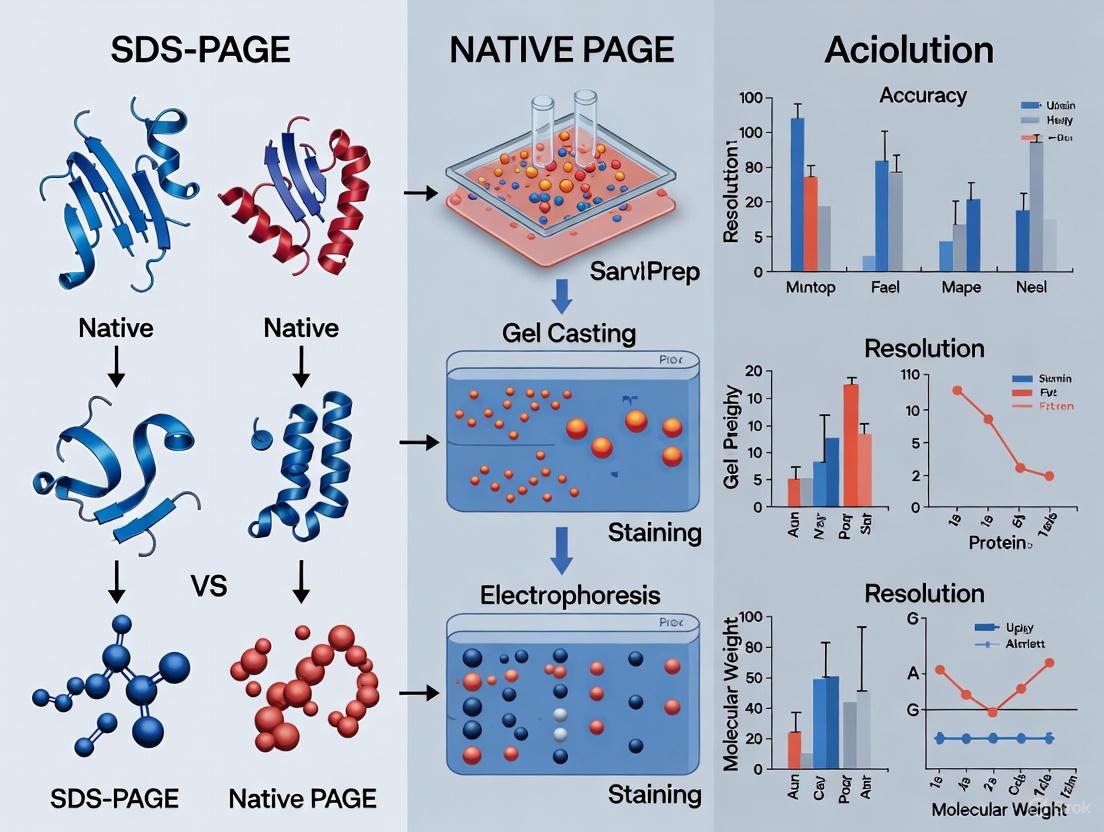
This article provides researchers, scientists, and drug development professionals with a comprehensive framework for assessing protein purity, quality, and functionality through electrophoretic techniques.
Protein Purity Assessment: A Comprehensive Guide to SDS-PAGE vs. Native PAGE
Abstract
This article provides researchers, scientists, and drug development professionals with a comprehensive framework for assessing protein purity, quality, and functionality through electrophoretic techniques. Covering foundational principles, methodological applications, troubleshooting protocols, and validation strategies, we compare SDS-PAGE and Native PAGE to help professionals select the optimal approach for their specific research goals—whether determining molecular weight, studying native protein complexes, or ensuring sample integrity for downstream applications.
Understanding PAGE Fundamentals: How SDS-PAGE and Native PAGE Work
Core Principles of Protein Separation by Electrophoresis
Polyacrylamide Gel Electrophoresis (PAGE) is a foundational technique in biochemistry and molecular biology laboratories for separating protein mixtures based on their physical properties [1]. The method utilizes a gel matrix created from polymerized acrylamide, which acts as a molecular sieve [2]. Under the influence of an electric field, charged protein molecules migrate through this porous network at different rates, enabling their separation [3]. The polyacrylamide gel's pore size can be precisely controlled by adjusting the concentrations of acrylamide and bisacrylamide, allowing researchers to tailor the separation for specific protein size ranges [2] [3].
Two principal variants of this technique—SDS-PAGE and Native PAGE—have become standard tools for protein analysis, each with distinct mechanisms and applications [1] [4]. While SDS-PAGE denatures proteins to separate them primarily by molecular weight, Native PAGE maintains proteins in their native, folded state, preserving their biological activity and enabling separation based on charge, size, and shape [5]. The choice between these methods is crucial and depends directly on the research objectives, particularly in the context of assessing protein purity, structure, and function [1].
Fundamental Principles and Mechanisms
SDS-PAGE: Separation by Molecular Weight
Sodium Dodecyl Sulfate-Polyacrylamide Gel Electrophoresis (SDS-PAGE) operates on the principle of denaturing proteins to separate them exclusively by their molecular mass [6] [2]. The anionic detergent SDS plays a pivotal role by binding to hydrophobic regions of proteins at a nearly constant ratio of 1.4 g SDS per 1 g of protein [2]. This binding achieves two critical functions: it linearizes the proteins by disrupting hydrogen bonds, hydrophobic interactions, and ionic bonds, and it coats them with a uniform negative charge [6] [2]. This process masks the proteins' intrinsic charges, resulting in a consistent charge-to-mass ratio across all polypeptides [1] [3]. Consequently, when an electric field is applied, all SDS-bound proteins migrate toward the anode, with smaller proteins moving faster through the gel matrix than larger ones [6] [3].
The gel structure in SDS-PAGE is typically discontinuous, consisting of two distinct parts: a stacking gel and a separating gel [2]. The stacking gel, with a lower acrylamide concentration (4-5%) and pH (~6.8), concentrates the protein samples into sharp, thin bands before they enter the separating gel [2]. The separating gel has a higher acrylamide concentration (often 7.5%-20%) and pH (~8.8), which provides the resolving power to separate proteins based on size [2]. Sample preparation is a key denaturing step; proteins are heated to 70-100°C in a buffer containing SDS and a reducing agent like β-mercaptoethanol or dithiothreitol (DTT), which breaks disulfide bonds to ensure complete denaturation into polypeptide subunits [6] [2] [3].
Native PAGE: Separation by Charge, Size, and Shape
In contrast to the denaturing approach of SDS-PAGE, Native PAGE (also known as non-denaturing PAGE) separates proteins in their native, folded conformation without the use of denaturing agents [1] [4]. This technique preserves the protein's higher-order structure, including secondary, tertiary, and quaternary architectures, as well as any bound cofactors [1] [3]. Since SDS is absent, proteins are not uniformly charged; instead, they retain their intrinsic charge, which is determined by their amino acid composition and the pH of the running buffer [4] [5].
In Native PAGE, separation depends on a combination of the protein's net charge, size, and three-dimensional shape [1] [3]. Proteins with higher negative charge density migrate faster toward the anode, while the gel matrix creates a sieving effect that retards larger or more structurally complex proteins more than smaller, compact ones [3]. This multi-parameter separation means that a protein's migration rate is not directly proportional to its molecular weight, making Native PAGE unsuitable for precise molecular weight determination [1]. However, it is exceptionally valuable for studying functional properties, as proteins frequently retain their enzymatic activity and protein-protein interactions throughout the electrophoresis process and can be recovered in an active state for downstream applications [1] [4].
Table 1: Core Principles of SDS-PAGE versus Native PAGE
| Feature | SDS-PAGE | Native PAGE |
|---|---|---|
| Separation Basis | Molecular weight (mass) of polypeptide subunits [4] [2] | Native size, net charge, and 3D shape [1] [3] |
| Protein State | Denatured and linearized [6] [2] | Native, folded conformation [1] [4] |
| Key Reagent | SDS (Sodium Dodecyl Sulfate), an anionic detergent [6] [2] | No denaturing agents; may use Coomassie dye (BN-PAGE) [7] [4] |
| Charge | Uniform negative charge from SDS binding [6] [3] | Intrinsic charge of the protein [4] [5] |
| Sample Prep | Heating with SDS and reducing agents [4] [2] | No heating; no denaturing/reducing agents [4] |
| Functional Activity | Destroyed [1] [7] | Preserved [1] [4] |
Experimental Protocols and Methodologies
Standard SDS-PAGE Protocol
The following protocol outlines a standard denaturing SDS-PAGE procedure for analyzing protein samples based on molecular weight [6] [2].
Sample Preparation:
- Dilution: Dilute the protein sample in an appropriate buffer.
- Mixing with Loading Buffer: Mix the protein solution with an equal volume of 2X Laemmli sample buffer. A standard 1X final concentration contains: 1% (w/v) SDS, 10% (v/v) glycerol, 0.02% (w/v) bromophenol blue, and 50 mM DTT or 5% (v/v) β-mercaptoethanol as a reducing agent in Tris buffer at pH ~6.8 [6] [2].
- Denaturation: Heat the mixture at 70-100°C for 5-10 minutes to ensure complete denaturation and reduction of disulfide bonds [2] [3].
- Centrifugation: Briefly centrifuge the samples to collect condensation.
Gel Preparation:
- Resolving Gel: First, prepare and cast the resolving gel. For a 10% gel, a typical formulation includes: 1.5 M Tris-HCl (pH 8.8), acrylamide/bis-acrylamide solution (30% acrylamide, 0.8% bis), 0.1% (w/v) SDS, 0.1% (w/v) ammonium persulfate (APS), and 0.05% (v/v) TEMED [3]. Pour the solution between glass plates, leaving space for the stacking gel. Carefully overlay with isopropanol or water to ensure a flat interface.
- Polymerization: Allow the resolving gel to polymerize completely (approximately 15-30 minutes).
- Stacking Gel: After polymerization of the resolving gel, prepare the stacking gel solution containing: 0.5 M Tris-HCl (pH 6.8), a lower percentage of acrylamide (e.g., 4-5%), 0.1% SDS, 0.1% APS, and TEMED. Pour off the overlay, add the stacking gel solution, and immediately insert a well-forming comb [2] [3].
- Final Setup: Once polymerized, remove the comb and place the gel cassette into the electrophoresis chamber.
Electrophoresis:
- Buffer Preparation: Fill the inner and outer chambers with running buffer, typically Tris-Glycine-SDS buffer (25 mM Tris, 192 mM glycine, 0.1% (w/v) SDS, pH ~8.3) [2].
- Loading: Load the prepared protein samples and molecular weight markers into the wells.
- Running Conditions: Apply a constant voltage of 100-150 V for a mini-gel. Run until the bromophenol blue tracking dye reaches the bottom of the gel (typically 40-60 minutes) [6].
Post-Electrophoresis Analysis:
- Visualization: After electrophoresis, proteins are visualized using stains like Coomassie Brilliant Blue (detection limit ~100 ng) or more sensitive silver stain (detection limit ~1 ng) [6] [2].
- Western Blotting: For immunodetection, proteins can be transferred from the gel onto a membrane for western blotting [1] [6].
Standard Native PAGE Protocol
This protocol describes a basic Native PAGE procedure for separating proteins while maintaining their native structure and function [4] [3].
Sample Preparation:
- Non-Denaturing Buffer: Dilute the protein sample in a non-denaturing buffer compatible with protein stability, such as 20-50 mM Tris-Cl or Bis-Tris at a neutral pH [7].
- No Denaturants: Crucially, the sample buffer must not contain SDS, reducing agents, or other denaturants.
- No Heating: The sample is not heated prior to loading [4].
- Additives: Glycerol (5-10%) may be added to increase sample density for easier loading, and a tracking dye like bromophenol blue can be included [7].
Gel Preparation:
- Gel Composition: Cast a polyacrylamide gel without SDS or other denaturants. The acrylamide concentration is chosen based on the target protein size, similar to SDS-PAGE.
- Buffer System: The gel and running buffers are typically at a neutral or slightly basic pH (e.g., 7.2-8.0) to maintain protein stability and native charge [7] [3]. Tris-Glycine or Tris-Borate are common choices.
- Blue Native (BN)-PAGE Variant: For difficult-to-separate complexes like membrane proteins, Coomassie G-250 dye can be added to the cathode buffer and sample. The dye binds to proteins, imparting a negative charge and improving solubility and resolution without full denaturation [7].
Electrophoresis:
- Running Conditions: Load the native samples and run the gel. To minimize heat-induced denaturation, electrophoresis is often performed at 4°C [4].
- Buffer Polarity: Verify the polarity of the electrodes based on the net charge of your proteins at the running buffer's pH. For most proteins at basic pH, the net charge is negative, so they will migrate toward the anode [3].
Post-Electrophoresis Analysis:
- Visualization: Standard protein stains (Coomassie, Silver) are used.
- Functional Assays: Since functionality is retained, proteins can be eluted from the gel for activity assays, or activity stains can be performed directly on the gel [1] [3].
Comparative Analysis for Protein Purity Assessment
Performance in Purity Evaluation
Assessing protein purity is a critical step in protein research and biopharmaceutical development. SDS-PAGE and Native PAGE offer complementary perspectives, each with distinct strengths and limitations for this application [1].
SDS-PAGE for Purity Analysis: SDS-PAGE is the most commonly used method for assessing the purity of a protein sample [2]. By denaturing the protein into its constituent polypeptides, it reveals the number and size of different polypeptide chains present. A pure, single-subunit protein will appear as a single, sharp band on the gel, while the presence of additional bands indicates contaminating proteins or protein fragments [2]. This technique is highly effective at identifying non-covalently bound impurities, as the denaturing conditions will dissociate them. However, SDS-PAGE cannot distinguish between a pure sample of a single protein and a mixture of different proteins that happen to have identical molecular weights. Furthermore, it provides no information about whether the protein is properly folded or functionally active [1].
Native PAGE for Purity Analysis: Native PAGE provides a different kind of purity assessment by separating proteins based on their native charge and size [1]. It is particularly valuable for detecting inactive or misfolded protein variants that may have a different surface charge or conformation than the active protein, even if their molecular weight is identical. This makes it ideal for assessing the homogeneity of a protein preparation in its functional form [3]. For multi-subunit complexes, Native PAGE can analyze the integrity and stoichiometry of the complex, which is destroyed in SDS-PAGE [3]. A single band in Native PAGE suggests a homogeneous population of proteins with identical charge and conformation. The key advantage is that the protein can often be recovered in an active state from the gel for further functional studies [1] [4].
Supporting Experimental Data and Applications
The practical differences between these techniques are underscored by experimental data. A study focusing on metalloproteins demonstrated that while standard SDS-PAGE resulted in a near-total loss (only 26% retention) of bound zinc ions, a modified Native SDS-PAGE protocol preserved 98% of the metal ions [7]. Furthermore, enzymatic activity assays showed that all nine model enzymes were inactive after standard SDS-PAGE, but seven of the nine retained their activity when subjected to Native SDS-PAGE, with all nine remaining active in BN-PAGE [7].
Table 2: Comparative Analysis for Protein Purity and Characterization
| Aspect | SDS-PAGE | Native PAGE |
|---|---|---|
| Purity Indicator | Single band suggests a single polypeptide species [2]. | Single band suggests a homogeneous native conformation [1]. |
| Detects Contaminants | Effective for contaminants of different molecular weight [2]. | Effective for contaminants with different charge or conformation [1]. |
| Multi-Subunit Complexes | Dissociates complexes; shows individual subunits [2] [3]. | Preserves intact complexes; assesses quaternary structure [3]. |
| Functional Correlation | Poor; denatured proteins are inactive [1] [7]. | High; proteins often retain function [1] [3]. |
| Key Applications | - Molecular weight determination [6] [2]- Assessing polypeptide purity [2]- Western blotting [1] [6] | - Studying oligomerization state [1]- Analyzing protein-protein interactions [1]- Purification of active proteins [3] |
| Quantitative Data (from [7]) | - Zn²⺠retention: ~26% [7]- Enzyme activity: Denatured/Destroyed [7] | - Zn²⺠retention: Up to 98% [7]- Enzyme activity: Preserved in 7/9 model enzymes [7] |
Research Reagent Solutions
Successful electrophoresis relies on a set of essential reagents, each serving a specific function in the separation process.
Table 3: Essential Reagents for PAGE Experiments
| Reagent / Material | Function / Purpose |
|---|---|
| Acrylamide / Bis-acrylamide | Forms the cross-linked polymer matrix of the gel, creating a porous sieve for separation [2] [3]. |
| SDS (Sodium Dodecyl Sulfate) | (SDS-PAGE only) Anionic detergent that denatures proteins and confers a uniform negative charge [6] [2]. |
| Tris-HCl Buffer | Provides the buffering system for maintaining the correct pH during gel polymerization and electrophoresis [2] [3]. |
| Ammonium Persulfate (APS) & TEMED | Catalysts for the free-radical polymerization of acrylamide and bis-acrylamide into a gel [2] [3]. |
| DTT or β-Mercaptoethanol | (SDS-PAGE only) Reducing agents that break disulfide bonds to ensure complete protein denaturation [6] [2]. |
| Glycine | Component of the running buffer; its ion mobility creates the discontinuous buffer system for effective stacking [2]. |
| Coomassie Brilliant Blue / Silver Stain | Dyes used to visualize separated protein bands after electrophoresis [6] [2]. |
| Molecular Weight Markers | A mixture of proteins of known sizes run alongside samples to estimate molecular weights [2] [3]. |
| Coomassie G-250 | (BN-PAGE only) Binds to proteins superficially, providing charge for electrophoresis without full denaturation [7]. |
SDS-PAGE and Native PAGE are indispensable yet complementary tools in the protein scientist's arsenal. SDS-PAGE excels in providing high-resolution separation based purely on molecular weight, making it ideal for determining subunit size, assessing polypeptide purity, and preparing samples for western blotting [1] [2]. In contrast, Native PAGE separates proteins based on a combination of their native charge, size, and shape, thereby preserving protein complexes, enzymatic activity, and functional states [1] [3].
The choice between these techniques is not a matter of superiority but is dictated by the specific research question. For a broad assessment of polypeptide composition and molecular weight, SDS-PAGE is the standard workhorse. When the goal is to probe functional integrity, study protein-protein interactions, or characterize native complexes, Native PAGE is the unequivocal method of choice [1]. A comprehensive strategy for assessing protein purity often involves employing both techniques to gain a complete picture of both compositional homogeneity (via SDS-PAGE) and conformational/functional integrity (via Native PAGE).
In the field of protein analysis, the assessment of protein purity is a fundamental task. Two primary electrophoretic techniques, SDS-PAGE and Native PAGE, serve as cornerstone methods for this purpose, yet they operate on opposing principles. SDS-PAGE employs denaturing conditions to dismantle protein structures, providing a precise measure of molecular weight and subunit composition. In contrast, Native PAGE preserves the protein's native, functional state to study activity and complex formation. This guide provides an objective comparison of these techniques, framing them within the context of protein purity assessment for researchers and drug development professionals.
Principles of Protein Separation: A Tale of Two Techniques
SDS-PAGE: Denaturation for Molecular Weight Determination
Sodium dodecyl sulfate polyacrylamide gel electrophoresis (SDS-PAGE) is an analytical technique designed to separate proteins based almost exclusively on their molecular weight. [2] This is achieved through a deliberate denaturation process. The anionic detergent SDS binds uniformly to polypeptide chains at a ratio of approximately 1.4 grams of SDS per gram of protein, linearizing the proteins by disrupting hydrogen bonds, hydrophobic interactions, and ionic bonds. [2] This binding confers a uniform negative charge density, masking the protein's intrinsic charge and ensuring that migration through the polyacrylamide gel matrix is determined solely by polypeptide chain length. [1] [4] The process typically includes a reducing agent, such as dithiothreitol (DTT) or β-mercaptoethanol, to break disulfide bonds, ensuring complete denaturation into individual subunits. [2] The gel itself consists of two distinct regions: a stacking gel (pH ~6.8) that concentrates proteins into sharp bands, and a separating gel (pH ~8.8) where size-based separation occurs, with smaller proteins migrating faster than larger ones. [2]
Native PAGE: Preserving Native Structure and Function
Native PAGE (Polyacrylamide Gel Electrophoresis) separates proteins under non-denaturing conditions, maintaining their folded conformation, biological activity, and interactions with cofactors. [1] [4] In this method, SDS is absent, and samples are not heated. [4] Consequently, separation depends on a combination of the protein's intrinsic charge, size, and shape. [4] This technique is ideal for studying functional properties, such as enzymatic activity, protein-protein interactions, and oligomeric state composition. [1] [7] Because it preserves functionality, proteins separated via Native PAGE can often be recovered in an active form for downstream assays. [1] [4] Variants like Blue Native PAGE (BN-PAGE) use Coomassie dye to impart charge for separation, while Clear Native PAGE (CN-PAGE) relies on the protein's inherent charge in a gradient gel. [4]
Comparative Analysis: Technique Selection for Research Goals
The choice between SDS-PAGE and Native PAGE is dictated by the specific research objectives. The table below summarizes the core differences to guide method selection.
Table 1: Key Technical and Application Differences Between SDS-PAGE and Native PAGE
| Criteria | SDS-PAGE | Native PAGE |
|---|---|---|
| Separation Basis | Molecular weight (size) only [4] [2] | Molecular size, intrinsic charge, and shape [4] |
| Protein State | Denatured and linearized [1] [2] | Native, folded conformation [1] [4] |
| SDS Presence | Present in sample and running buffers [4] | Absent [4] |
| Reducing Agent | Present (e.g., DTT, β-mercaptoethanol) [4] [2] | Absent [4] |
| Sample Preparation | Heated (typically 85-100°C) [4] [8] | Not heated [4] [8] |
| Net Protein Charge | Uniformly negative [1] [2] | Positive, negative, or neutral (based on native charge) [4] |
| Functional Recovery | Proteins lose function; cannot be recovered post-separation [1] [4] | Proteins retain function; can be recovered post-separation [1] [4] |
| Primary Applications | Molecular weight estimation, purity assessment, subunit composition, western blotting [1] [4] [2] | Studying protein structure, oligomerization, enzymatic activity, protein-protein interactions [1] [4] [7] |
Experimental Protocols for Protein Purity Assessment
Denaturing SDS-PAGE Protocol
The following protocol is adapted from standard procedures for pre-cast Tris-Glycine gels. [8]
Sample Preparation:
- Mix protein sample with an equal volume of 2X Tris-Glycine SDS Sample Buffer. This buffer contains SDS for denaturation and glycerol to increase sample density. [8]
- For reduced conditions, add a reducing agent like DTT to a final concentration of 1X. [8]
- Heat the sample at 85°C for 2 minutes to ensure complete denaturation. [8]
Electrophoresis:
- Load prepared samples and molecular weight standards into the wells of a pre-cast polyacrylamide gel. [8]
- Assemble the gel apparatus filled with 1X Tris-Glycine SDS Running Buffer. This buffer provides the ions necessary for the discontinuous buffer system and contains SDS to maintain protein denaturation. [8] [2]
- Run the gel at a constant voltage of 125 V until the tracking dye (e.g., bromophenol blue) front reaches the bottom of the gel. [8]
Post-Electrophoresis:
- Proteins are visualized using stains like Coomassie Brilliant Blue or silver stain. [2]
- For western blotting, proteins are transferred to a membrane after gel separation. [1]
Non-Denaturing (Native) PAGE Protocol
Sample Preparation:
- Mix protein sample with an equal volume of 2X Tris-Glycine Native Sample Buffer. This buffer lacks SDS and reducing agents. [8]
- Do not heat the sample. [4] [8]
Electrophoresis:
- Load the prepared native sample into the gel.
- Use 1X Tris-Glycine Native Running Buffer in the electrophoresis apparatus. This buffer does not contain SDS or other denaturants. [8]
- Run the gel at a constant voltage of 125 V. The run time may be longer than for SDS-PAGE. [8]
Post-Electrophoresis:
- Proteins can be visualized with stains compatible with activity assays.
- For functional analysis, the gel can be used in an activity stain or specific assay to detect enzymatic function. [1] [7]
Supporting Experimental Data and Hybrid Approaches
Experimental data underscores the functional consequences of each method. A key study demonstrated that subjecting nine model enzymes to standard SDS-PAGE conditions resulted in the denaturation and complete loss of activity for all nine. [7] In contrast, all nine enzymes retained their activity when separated via BN-PAGE. [7] This starkly highlights the trade-off between resolution and functionality.
To bridge this gap, modified protocols like Native SDS-PAGE (NSDS-PAGE) have been developed. This method reduces the SDS concentration in the running buffer from 0.1% to 0.0375%, removes EDTA from the buffers, and omits the sample heating step. [7] The results are promising: under these modified conditions, seven of the nine model enzymes, including four zinc-binding proteins, retained their activity after electrophoresis. [7] Furthermore, the retention of bound zinc ions in proteomic samples increased dramatically from 26% with standard SDS-PAGE to 98% with NSDS-PAGE, confirming the preservation of native metalloprotein structure. [7] This hybrid approach offers a path to high-resolution separation while retaining certain functional properties.
Table 2: Experimental Outcomes: Metal Retention and Enzyme Activity
| Electrophoresis Method | Zn²⺠Retention in Proteomic Samples | Enzymatic Activity Retention (Model Systems) |
|---|---|---|
| SDS-PAGE | 26% [7] | 0 out of 9 enzymes active [7] |
| BN-PAGE | Not explicitly stated, but method preserves native state | 9 out of 9 enzymes active [7] |
| NSDS-PAGE | 98% [7] | 7 out of 9 enzymes active [7] |
The Scientist's Toolkit: Essential Research Reagents
Successful electrophoresis relies on a suite of specialized reagents, each with a critical function in the separation process.
Table 3: Essential Reagents for SDS-PAGE and Native PAGE
| Reagent / Solution | Function | Key Consideration |
|---|---|---|
| SDS (Sodium Dodecyl Sulfate) | Denatures proteins, imparts uniform negative charge. [2] | Critical for SDS-PAGE; absent in Native PAGE. [4] |
| Reducing Agent (DTT, BME) | Breaks disulfide bonds for complete denaturation. [2] | Used in reducing SDS-PAGE; omitted for non-reduced SDS-PAGE and Native PAGE. [8] |
| Polyacrylamide Gel | Sieving matrix that separates proteins based on size. [2] | Pore size is adjusted via acrylamide concentration. [2] |
| Tris-Glycine Running Buffer | Provides ions for conductivity and establishes pH for separation. [8] [2] | SDS-containing vs. Native formulations are not interchangeable. [8] |
| Coomassie Blue / Silver Stain | Binds to proteins for visual detection post-electrophoresis. [2] | Silver staining is more sensitive than Coomassie Blue. [2] |
| Molecular Weight Standards | Proteins of known size for molecular weight calibration. [2] | Essential for accurate molecular weight estimation in SDS-PAGE. [2] |
| Ptp1B-IN-25 | PTP1B Inhibitor | Ptp1B-IN-25 is a potent PTP1B inhibitor for research into type 2 diabetes, obesity, and cancer. This product is For Research Use Only. Not for human or veterinary use. |
| (Rac)-PDE4-IN-4 | (Rac)-PDE4-IN-4|Potent PDE4 Inhibitor|RUO |
Workflow and Logical Pathway for Method Selection
The following diagram illustrates the decision-making pathway for selecting the appropriate electrophoretic method based on research goals, leading to the corresponding experimental workflow.
SDS-PAGE and Native PAGE are complementary, not competing, techniques in the protein scientist's arsenal. SDS-PAGE is the unequivocal method for determining molecular weight, assessing purity, and analyzing subunit composition under denaturing conditions. Native PAGE is indispensable for probing the functional, native state of proteins, including their interactions and enzymatic activity. The emergence of modified techniques like NSDS-PAGE demonstrates ongoing innovation, offering potential pathways to reconcile high resolution with the preservation of biological function. A deep understanding of the principles and applications of both methods, as detailed in this guide, is fundamental to designing robust experimental strategies for protein purity assessment and characterization in research and drug development.
In the field of protein research, the analytical technique chosen can fundamentally shape the experimental outcomes. Within the context of assessing protein purity, the choice between Sodium Dodecyl Sulfate-Polyacrylamide Gel Electrophoresis (SDS-PAGE) and Native PAGE represents a critical methodological crossroad. SDS-PAGE, a denaturing technique, has long been a workhorse for determining molecular weight and assessing sample homogeneity [1] [6]. In contrast, Native PAGE serves a different, equally vital purpose: it preserves the native, three-dimensional structure of proteins throughout the separation process [1] [3]. This preservation is paramount when the research objective extends beyond mere protein size to encompass the understanding of biological function, protein-protein interactions, and enzymatic activity. For researchers and drug development professionals, selecting the appropriate technique is not a trivial matter; it is a decisive factor that determines whether proteins are analyzed as inert chains or as dynamic, functional biological entities. This guide provides a comprehensive comparison of these two foundational techniques, with a focused examination of how Native PAGE enables the study of proteins in their biologically active state.
Core Principles: A Tale of Two Techniques
The fundamental difference between SDS-PAGE and Native PAGE lies in their treatment of the protein's native structure. SDS-PAGE employs the anionic detergent sodium dodecyl sulfate (SDS), which denatures proteins by binding to the polypeptide backbone and masking intrinsic charges. This process unfolds proteins into linear chains, imparting a uniform negative charge that causes separation to occur almost exclusively on the basis of molecular weight [1] [6] [3]. Consequently, quaternary structures are disrupted, subunits dissociate, and biological activity is invariably lost.
Native PAGE, conversely, is a non-denaturing technique. It forgoes denaturing agents like SDS, allowing proteins to retain their folded conformation, multimeric state, and cofactors. Under these conditions, separation depends on a combination of the protein's intrinsic charge, size, and shape as it migrates through the gel matrix [1] [3] [5]. The higher the negative charge density and the smaller the size, the faster a protein will migrate. This preservation of native state is the very feature that enables the recovery of functional proteins from the gel for downstream activity assays or interaction studies [1].
Comparative Analysis: Native PAGE vs. SDS-PAGE
The choice between Native PAGE and SDS-PAGE has profound implications for the type of information that can be obtained from an experiment. The table below provides a systematic comparison of their characteristics, applications, and outcomes.
Table 1: Comprehensive comparison of Native PAGE and SDS-PAGE
| Analysis Criteria | Native PAGE | SDS-PAGE |
|---|---|---|
| Separation Principle | Based on protein's intrinsic charge, size, and 3D shape [1] [3] | Based primarily on molecular weight [1] [6] |
| Gel Condition | Non-denaturing [5] [4] | Denaturing [5] [4] |
| Protein State | Native, folded conformation; multimeric complexes intact [1] [3] | Denatured, linearized polypeptide chains [1] [6] |
| Biological Activity | Retained post-separation [1] [7] | Destroyed [1] [7] |
| Key Reagents | Coomassie G-250 (in BN-PAGE), no SDS [7] | SDS, reducing agents (DTT, β-mercaptoethanol) [9] [6] |
| Sample Preparation | No heating; mild buffers [7] [4] | Often includes heating (70-100°C) in SDS-containing buffer [7] [6] |
| Typical Applications | Study of protein complexes, enzymatic activity, oligomerization [1] [3] | Molecular weight determination, purity assessment, western blotting [1] [9] |
| Protein Recovery | Functional proteins can be recovered [1] [5] | Proteins are denatured and inactive [1] |
The functional consequences of these technical differences are significant. For instance, experimental data shows that seven out of nine model enzymes, including four zinc-binding proteins, retained their activity after separation via a modified Native SDS-PAGE protocol. In contrast, all nine enzymes were denatured and inactivated during standard SDS-PAGE [7]. Furthermore, the retention of bound metal ions—critical for the function of many metalloproteins—increased from 26% in standard SDS-PAGE to 98% under native conditions [7]. This quantitative data underscores the superior capability of Native PAGE in preserving functional protein properties.
Experimental Data and Protocol
The quantitative superiority of Native PAGE for functional analysis is demonstrated in studies comparing metal retention and enzymatic activity post-electrophoresis. The following protocol and resulting data highlight the practical application of Native PAGE for researchers requiring preservation of biological activity.
Detailed Native (N)SDS-PAGE Protocol
This protocol, adapted from PMC4517606, outlines a modified approach that balances good protein resolution with the retention of native properties [7]:
- Sample Preparation: Mix 7.5 μL of protein sample (5-25 μg) with 2.5 μL of 4X NSDS sample buffer. The buffer composition is critical: 100 mM Tris HCl, 150 mM Tris base, 10% (v/v) glycerol, 0.0185% (w/v) Coomassie G-250, 0.00625% (w/v) Phenol Red, pH 8.5 [7].
- Key Difference: Do not heat the samples. This is a fundamental distinction from denaturing SDS-PAGE, where heating at 70-100°C is standard practice to ensure complete denaturation [7] [6].
- Gel Preparation: Use standard precast NuPAGE Novex 12% Bis-Tris 1.0 mm mini-gels (or equivalent). Prior to sample loading, pre-run the gel at 200V for 30 minutes in double-distilled Hâ‚‚O to remove the storage buffer and any unpolymerized acrylamide [7].
- Running Buffer: Prepare the NSDS-PAGE running buffer: 50 mM MOPS, 50 mM Tris Base, 0.0375% SDS, pH 7.7. Note the significantly reduced SDS concentration compared to standard SDS-PAGE running buffer (0.1% SDS) [7].
- Electrophoresis: Load the prepared samples and run the gel at a constant voltage of 200V for approximately 45 minutes, or until the dye front reaches the bottom of the gel [7].
Quantitative Outcomes
The efficacy of this native approach is confirmed by direct comparison with standard techniques, as summarized in the table below.
Table 2: Quantitative comparison of protein function and metal retention post-electrophoresis (Data sourced from PMC4517606) [7]
| Analysis Parameter | Standard SDS-PAGE | BN-PAGE | Native (N)SDS-PAGE |
|---|---|---|---|
| Zinc (Zn²âº) Retention | 26% | Not Specified | 98% |
| Enzymatic Activity Retention | 0 out of 9 enzymes | 9 out of 9 enzymes | 7 out of 9 enzymes |
| Protein Resolution | High | Lower than SDS-PAGE | High, comparable to SDS-PAGE |
This data demonstrates that Native PAGE, and particularly the NSDS-PAGE variant, offers a compelling compromise, providing high-resolution separation while retaining a high degree of biological function and cofactor integrity. Confirmation of metal retention can be further performed using techniques like laser ablation-inductively coupled plasma-mass spectrometry (LA-ICP-MS) or in-gel staining with metal-specific fluorophores such as TSQ [7].
The Scientist's Toolkit: Essential Reagents and Materials
Successful execution of Native PAGE requires specific reagents designed to maintain protein structure and function. The following table details key solutions and their critical functions in the protocol.
Table 3: Essential research reagents for Native PAGE experimentation
| Reagent / Material | Function / Purpose | Example Composition / Notes |
|---|---|---|
| NSDS Sample Buffer | Maintains protein in native state; provides density for gel loading [7] | 100 mM Tris HCl, 150 mM Tris base, 10% glycerol, 0.0185% Coomassie G-250, pH 8.5 [7] |
| Native Running Buffer | Conducts current while preserving weak protein interactions [7] | 50 mM MOPS, 50 mM Tris Base, 0.0375% SDS, pH 7.7 [7] |
| Coomassie G-250 | Imparts mild negative charge for electrophoresis (in BN-PAGE); does not denature proteins [7] | Used in place of SDS in Blue Native PAGE (BN-PAGE) |
| Pre-cast Bis-Tris Gels | Provides consistent polyacrylamide matrix for separation; Bis-Tris gels are stable over a wide pH range [7] | e.g., NuPAGE Novex 12% Bis-Tris Gels; preferred for native techniques |
| Protease Inhibitors (e.g., PMSF) | Prevents proteolytic degradation during sample prep, crucial for preserving intact protein complexes [7] | Added to cell lysis buffers |
| Glycerol | Increases density of sample for well loading; can help stabilize protein structure [7] [5] | Standard component of native sample buffers (e.g., 10% v/v) |
| Mcl-1 inhibitor 12 | Mcl-1 inhibitor 12 is a potent and selective MCL-1 blocker that induces apoptosis in cancer cells. For research use only. Not for human use. | |
| Antileishmanial agent-26 | Antileishmanial agent-26, MF:C23H27FN4O2, MW:410.5 g/mol | Chemical Reagent |
Within the broader thesis of protein purity analysis, Native PAGE and SDS-PAGE are not competing techniques but rather complementary tools that answer fundamentally different questions. SDS-PAGE excels at answering the question, "What is the size and purity of the polypeptide chains in my sample?" In contrast, Native PAGE addresses the more complex question, "What is the functional state, oligomeric composition, and interactive capacity of the native proteins in my sample?" For drug development professionals, this distinction is critical. The assessment of a therapeutic protein's activity, the characterization of a target protein complex, or the study of a metalloenzyme's function all necessitate the use of Native PAGE to obtain biologically relevant data. While SDS-PAGE remains an indispensable first step for routine purity checks and molecular weight estimation, Native PAGE provides a unique window into the dynamic, functional world of proteins as they exist in their physiological context. The choice between them should be guided by a clear understanding of the scientific question at hand, ensuring that the methodology aligns with the ultimate goal of the research.
Key Differences in Buffer Composition and Sample Preparation
In the assessment of protein purity for research and drug development, the choice of electrophoresis method is a critical decision that directly impacts experimental outcomes. SDS-PAGE and Native PAGE represent two fundamental approaches with divergent methodologies for protein separation, primarily distinguished by their buffer composition and sample preparation techniques. While SDS-PAGE denatures proteins to separate them purely by molecular weight, Native PAGE preserves protein structure and function by maintaining native conditions throughout the electrophoretic process. This comparison guide examines the key technical differences between these methods, providing researchers with the experimental protocols and data necessary to select the appropriate technique for specific protein purity assessment applications.
Core Principles and Separation Mechanisms
The fundamental divergence between SDS-PAGE and Native PAGE begins with their underlying separation mechanisms, which dictate their respective applications in protein analysis.
In SDS-PAGE, the anionic detergent sodium dodecyl sulfate (SDS) plays a pivotal role by denaturing proteins and imparting a uniform negative charge density. When proteins are heated with SDS and reducing agents, they unfold into linear polypeptides that bind SDS in a constant weight ratio (approximately 1.4 g SDS per 1 g protein) [10] [3]. This process masks the proteins' intrinsic charges and eliminates structural differences, resulting in separation based almost exclusively on molecular mass as proteins migrate through the polyacrylamide gel matrix [11] [3]. This denaturing approach makes SDS-PAGE particularly effective for determining molecular weight, analyzing subunit composition, and assessing protein purity in pharmaceutical development.
Conversely, Native PAGE maintains proteins in their native, folded conformation throughout the separation process [1]. Without denaturing agents, proteins retain their higher-order structure, enzymatic activity, and interactions with cofactors [4] [3]. Separation occurs based on a combination of factors including the protein's intrinsic charge, size, and three-dimensional structure [1] [11]. This preservation of native properties makes Native PAGE invaluable for studying functional protein complexes, oligomerization states, and protein-protein interactions in their physiological conformations [1].
Comprehensive Buffer Composition Comparison
The buffer systems for SDS-PAGE and Native PAGE differ significantly in their components and functions, reflecting their distinct approaches to protein separation.
Table 1: Comparative Buffer Compositions for SDS-PAGE and Native PAGE
| Component | SDS-PAGE | Native PAGE | Functional Purpose |
|---|---|---|---|
| Detergent | SDS (0.1-1%) [7] [10] | None or mild non-ionic detergents [4] | Denatures proteins & imparts uniform charge (SDS) [3] |
| Reducing Agent | DTT (40-160 mM) or β-mercaptoethanol [10] | None [4] | Reduces disulfide bonds [10] |
| Buffering Agent | Tris-HCl (50-200 mM, pH 6.8-8.7) [10] [3] | Tris-HCl/Bis-Tris (50-375 mM, pH ~7.0-8.8) [12] [13] | Maintains appropriate pH [10] |
| Chelating Agent | EDTA (1-2 mM) [10] | None [4] | Chelates divalent cations to inhibit proteases [10] |
| Tracking Dye | Bromophenol Blue [10] | Bromophenol Blue or Coomassie Blue [12] [13] | Visualizes migration progress [10] |
| Glycerol | 10-20% [10] | 10-25% [12] | Increases density for well loading [10] |
| Additional Components | - | 6-aminocaproic acid (BN-PAGE) [13] | Stabilizes protein complexes & improves resolution [13] |
SDS-PAGE buffer systems are designed for complete protein denaturation. The standard sample buffer contains SDS (0.1-1%), a reducing agent (DTT or β-mercaptoethanol), Tris-HCl buffer, EDTA, glycerol, and tracking dye [10]. The running buffer typically includes Tris, glycine, and 0.1% SDS [3]. The discontinuous buffer system creates stacking and separating phases that initially concentrate proteins before separation by size [3].
Native PAGE buffer systems avoid denaturing components. The sample buffer typically contains Tris buffer, glycerol, and tracking dye without SDS or reducing agents [12]. The running buffer consists of Tris-glycine at pH 8.3-8.8 [12]. Specialized variants like Blue Native PAGE (BN-PAGE) incorporate Coomassie dye in the cathode buffer, which binds proteins and imparts negative charge without denaturation [13]. BN-PAGE buffers also include 6-aminocaproic acid to stabilize protein complexes and improve resolution [13].
Sample Preparation Protocols
Sample preparation methods for these techniques differ dramatically in their treatment of proteins before electrophoresis.
SDS-PAGE Sample Preparation Protocol
- Dilution: Dilute protein sample to 2 mg/mL final concentration in appropriate solvent [10]
- Buffer Addition: Mix 1:1 with 2X concentrated sample buffer (containing 2% SDS, 20% glycerol, 20 mM Tris-Cl pH 6.8, 2 mM EDTA, 160 mM DTT, 0.1 mg/mL bromophenol blue) [10]
- Denaturation: Heat samples at 70-100°C for 10 minutes to ensure complete denaturation [10] [3]
- Centrifugation: Briefly centrifuge at high speed (16,000 x g) to pellet any insoluble material [10]
- Loading: Load 10-20 μL per well (corresponding to 10-40 μg total protein) [10]
The heating step is critical for membrane proteins or those with extensive hydrophobic regions, as it increases molecular motion to allow SDS penetration [10]. DTT or β-mercaptoethanol reduces disulfide bonds that might resist denaturation by SDS alone [10].
Native PAGE Sample Preparation Protocol
- Preparation: Keep samples and buffers at 4°C throughout preparation to maintain protein stability [4] [12]
- Buffer Addition: Mix sample with non-denaturing sample buffer (62.5 mM Tris-HCl pH 6.8, 25% glycerol, 0.01% bromophenol blue) [12]
- No Heating: Avoid any heating of samples to prevent denaturation [4] [12]
- Loading: Load 5-20 μL immediately onto pre-cooled gel [13]
For BN-PAGE, additional steps include:
- Solubilizing mitochondrial or membrane samples with n-dodecyl-β-D-maltoside (2% final concentration) [13]
- Incubating on ice for 30 minutes followed by centrifugation at 72,000 x g to remove insoluble material [13]
- Adding Coomassie blue G to the supernatant before loading [13]
Experimental Data and Performance Metrics
Recent studies have quantified the functional outcomes of these different preparation methods, particularly regarding protein activity retention and metal cofactor preservation.
Table 2: Experimental Performance Comparison Between Electrophoresis Methods
| Performance Metric | SDS-PAGE | Native SDS-PAGE | BN-PAGE |
|---|---|---|---|
| Zn²⺠Retention | 26% [7] | 98% [7] | >98% [7] |
| Enzyme Activity Retention | 0/9 model enzymes [7] | 7/9 model enzymes [7] | 9/9 model enzymes [7] |
| Protein Recovery Post-Separation | Not feasible [4] | Possible with partial function [7] | Fully functional recovery [4] |
| Resolution of Complex Mixtures | High resolution [7] [3] | High resolution [7] | Moderate resolution [7] |
| Molecular Weight Determination | Accurate for polypeptides [3] | Accurate for native proteins [7] | Affected by shape & charge [1] |
A modified approach called Native SDS-PAGE (NSDS-PAGE) demonstrates how buffer adjustments can bridge these techniques. By reducing SDS in the running buffer from 0.1% to 0.0375%, removing EDTA, and eliminating the heating step, researchers achieved 98% Zn²⺠retention compared to 26% with standard SDS-PAGE [7]. Furthermore, seven of nine model enzymes retained activity after NSDS-PAGE, while all were denatured in standard SDS-PAGE [7]. This hybrid approach maintains high resolution while preserving some native protein properties.
Electrophoresis Workflow and Experimental Design
The following workflow diagrams illustrate the key procedural differences between SDS-PAGE and Native PAGE methodologies:
Research Reagent Solutions and Essential Materials
Successful implementation of either electrophoretic method requires specific reagent systems optimized for each technique's requirements.
Table 3: Essential Research Reagents for PAGE Techniques
| Reagent | Function | SDS-PAGE Specific | Native PAGE Specific |
|---|---|---|---|
| SDS | Denatures proteins & imparts charge | Required [10] [3] | Not used [4] |
| DTT/β-mercaptoethanol | Reduces disulfide bonds | Required [10] | Not used [4] |
| Coomassie Blue G | Stains proteins & imparts charge (BN-PAGE) | Not used in buffers | BN-PAGE essential [13] |
| n-dodecyl-β-D-maltoside | Solubilizes membrane proteins | Sometimes used | BN-PAGE essential [13] |
| 6-aminocaproic acid | Stabilizes protein complexes | Not used | BN-PAGE buffer component [13] |
| Protease inhibitors | Prevents protein degradation | Optional | Recommended [13] |
| Acrylamide/bis-acrylamide | Forms gel matrix | Standard (e.g., 12%) [7] | Gradient recommended (6-13%) [13] |
| Molecular weight markers | Size calibration | Denatured standards [3] | Native standards [13] |
Technical Considerations for Protein Purity Assessment
When assessing protein purity within research and development contexts, several technical factors must be considered:
Temperature Control: Native PAGE requires maintenance at 4°C throughout the procedure to preserve protein stability, while SDS-PAGE is typically performed at room temperature [4] [12]. For Native PAGE, placing the entire electrophoresis system on ice is recommended to prevent protein degradation during separation [12].
Gel Composition: While both techniques use polyacrylamide gels, Native PAGE often employs gradient gels (e.g., 6-13%) to resolve protein complexes of varying sizes, whereas SDS-PAGE frequently uses single-percentage gels appropriate for the target protein size range [13] [3].
Post-Electrophoresis Analysis: Proteins separated by Native PAGE can be recovered in functional form for activity assays or interaction studies, while SDS-PAGE separated proteins are typically used for western blotting, mass spectrometry, or immunodetection after denaturation [1].
The selection between SDS-PAGE and Native PAGE for protein purity assessment hinges on the specific research objectives and the nature of the information required. SDS-PAGE provides superior resolution for molecular weight determination and subunit analysis under denaturing conditions, making it ideal for routine protein characterization and purity assessment. Conversely, Native PAGE preserves native protein structure and function, enabling studies of protein complexes, oligomeric states, and functional interactions. The recently developed Native SDS-PAGE offers a promising intermediate approach, maintaining high resolution while preserving some functional properties. Understanding these fundamental differences in buffer composition and sample preparation allows researchers to strategically select the most appropriate methodology for their specific protein analysis requirements in drug development and basic research applications.
In the field of protein research, the assessment of protein purity, structure, and function is a fundamental requirement, particularly for researchers and drug development professionals engaged in biopharmaceutical characterization. Polyacrylamide gel electrophoresis (PAGE) serves as a cornerstone technique for these analyses, primarily through two divergent methodological approaches: denaturing SDS-PAGE and native PAGE. These techniques operate on fundamentally different separation principles—mass versus charge-to-mass ratio—each offering distinct advantages and limitations for specific research applications. This guide provides an objective comparison of these methodologies, supported by experimental data and detailed protocols, to inform appropriate technique selection within the context of protein purity analysis and broader thesis research.
Core Principles of Separation
Separation by Mass: SDS-PAGE
Sodium dodecyl sulfate–polyacrylamide gel electrophoresis (SDS-PAGE) separates proteins primarily by molecular mass [14] [3]. This is achieved through a denaturing process where proteins are unfolded and complexed with the anionic detergent SDS. The SDS binds to the polypeptide backbone in a constant weight ratio (approximately 1.4 g SDS per 1 g of protein), conferring a uniform negative charge density across all proteins [3]. Consequently, the intrinsic charge of any protein becomes negligible compared to the overwhelming negative charge provided by SDS, resulting in a relatively consistent charge-to-mass ratio for all protein-SDS complexes [15].
The separation mechanism relies on the sieving properties of the polyacrylamide gel matrix. When an electric field is applied, all proteins migrate toward the anode. Smaller proteins navigate the porous network more easily and migrate faster, while larger proteins are hindered and migrate more slowly [14] [3]. The gel pore size, controlled by the polyacrylamide concentration, can be optimized to resolve different molecular weight ranges [3].
Separation by Charge-to-Mass Ratio: Native PAGE
In contrast, native PAGE (or non-denaturing PAGE) separates proteins based on their intrinsic properties in the absence of denaturants [3]. Separation depends on the combined influence of the protein's net charge, size, and three-dimensional shape [3]. In alkaline running buffers, most proteins carry a net negative charge and migrate toward the anode, with the migration rate proportional to their charge density (net charge per unit mass) [3]. Simultaneously, the gel matrix exerts a frictional, sieving effect that regulates movement according to the protein's size and shape [3]. Therefore, a small, highly charged protein will migrate fastest, while a large, minimally charged protein will migrate slowest.
Table 1: Fundamental Principles of SDS-PAGE vs. Native PAGE
| Feature | SDS-PAGE | Native PAGE |
|---|---|---|
| Primary Separation Principle | Molecular mass [14] [3] | Net charge, size, and shape (charge-to-mass ratio) [3] |
| Protein State | Denatured and linearized [14] | Native, folded structure preserved [3] |
| Detergent | SDS present [14] | No denaturing detergents [3] |
| Charge Profile | Uniform negative charge from SDS [3] | Intrinsic net charge of the protein [3] |
| Impact on Function | Functional properties and non-covalently bound cofactors are destroyed [7] | Enzymatic activity and functional properties are often retained [7] [3] |
Experimental Protocols and Methodologies
Standard SDS-PAGE Protocol
Sample Preparation:
- Proteins are diluted in a sample buffer containing SDS (an ionic detergent) and a reducing agent (e.g., β-mercaptoethanol or dithiothreitol) [14].
- The sample is heated to 95°C for 5 minutes to denature the proteins, disrupt hydrogen bonds, and cleave disulfide bonds, fully dissociating the protein into its subunits [14] [3].
Gel Composition and Electrophoresis:
- A discontinuous gel system is typically used, comprising a stacking gel (lower % acrylamide, pH ~6.8) and a resolving gel (higher % acrylamide, pH ~8.8) [14].
- The running buffer and gel contain SDS to maintain protein denaturation and charging [14].
- Electrophoresis is performed at constant voltage (e.g., 100-200V) until the dye front reaches the gel bottom [7] [14].
Standard Native PAGE Protocol
Sample Preparation:
- Proteins are prepared in a non-denaturing sample buffer that lacks SDS, reducing agents, and does not involve a heating step [7] [3].
- The buffer often contains glycerol to facilitate gel loading and a pH indicator [7].
Gel Composition and Electrophoresis:
- Gels are cast in the absence of SDS [3].
- The running buffer is a mild, non-denaturing solution (e.g., Tris-Glycine, Tris-Borate) that maintains a pH (typically alkaline) where most proteins carry a net negative charge, driving electrophoresis without denaturation [3].
- To preserve native protein structure and function, the electrophoresis apparatus is often kept cool, and pH extremes are avoided [3].
Advanced Hybrid Protocol: Native SDS-PAGE (NSDS-PAGE)
A modified technique, NSDS-PAGE, has been developed to bridge the gap between the high resolution of SDS-PAGE and the native-state preservation of BN-PAGE (Blue-Native PAGE) [7]. The protocol involves key modifications to standard SDS-PAGE:
Sample Preparation:
- SDS and EDTA are removed from the sample buffer, and the heating step is omitted [7].
- The sample buffer includes Coomassie G-250 and glycerol [7].
Electrophoresis Conditions:
- The SDS concentration in the running buffer is significantly reduced (e.g., from 0.1% to 0.0375%), and EDTA is deleted [7].
- This method demonstrated a dramatic increase in the retention of bound Zn²⺠in proteomic samples from 26% (standard SDS-PAGE) to 98%, with seven out of nine model enzymes retaining activity post-electrophoresis [7].
Performance Comparison and Experimental Data
The choice between SDS-PAGE and native PAGE significantly impacts the outcome of an experiment and the type of information that can be obtained.
Table 2: Comparative Performance of PAGE Techniques
| Performance Characteristic | SDS-PAGE | Native PAGE | NSDS-PAGE |
|---|---|---|---|
| Resolution | High resolution separation of complex protein mixtures by mass [7] | Lower resolution as a one-dimensional method compared to SDS-PAGE [7] | High resolution, similar to SDS-PAGE [7] |
| Mass Determination | Excellent, with minimal effect from protein composition [3] | Poor, due to influence of native charge and shape [7] | Not explicitly stated |
| Metal Cofactor Retention | Very low (e.g., 26% Zn²⺠retention) [7] | High (inherently preserves non-covalent interactions) [7] | Very High (e.g., 98% Zn²⺠retention) [7] |
| Enzymatic Activity Retention | Destroyed (0 out of 9 model enzymes active) [7] | Preserved (9 out of 9 model enzymes active) [7] | Largely Preserved (7 out of 9 model enzymes active) [7] |
| Quaternary Structure Analysis | No (dissociates complexes) [14] | Yes (generally retains multimeric proteins) [3] | Likely limited |
| Applications | Purity assessment, immunoblotting, mass estimation [7] [3] | Protein-protein interactions, enzyme activity assays, purification of active proteins [7] [3] | Metalloprotein analysis, functional proteomics where high resolution and activity are needed [7] |
The Scientist's Toolkit: Essential Research Reagents
Successful execution of electrophoretic methods requires specific reagents and materials. The following table details key components and their functions.
Table 3: Essential Reagents for PAGE Experiments
| Reagent / Material | Function | Key Considerations |
|---|---|---|
| SDS (Sodium Dodecyl Sulfate) | Denatures proteins and confers a uniform negative charge; essential for SDS-PAGE [14] [3]. | Monomers bind to proteins; micelles do not. A concentration > 1mM is sufficient for denaturation [14]. |
| Acrylamide/Bis-acrylamide | Forms the cross-linked porous gel matrix that acts as a molecular sieve [3]. | The ratio and total concentration determine gel pore size and rigidity [3]. |
| APS & TEMED | Ammonium persulfate (APS) is a radical initiator and TEMED is a catalyst; together they trigger polymerization of the gel [14] [3]. | Freshness impacts polymerization efficiency and gel quality. |
| Reducing Agents (β-ME, DTT) | β-mercaptoethanol (β-ME) or Dithiothreitol (DTT) cleave disulfide bonds to fully dissociate protein subunits [14]. | Critical for analyzing proteins with quaternary structure stabilized by disulfide bridges. |
| Molecular Weight Markers | A set of proteins of known mass run alongside samples to enable estimation of protein molecular weights [3]. | Available in various size ranges; pre-stained markers allow tracking during electrophoresis. |
| Coomassie Blue | A dye used for staining proteins post-electrophoresis to visualize separated bands [14]. | Can be used in the sample buffer of NSDS-PAGE [7]. |
| Tris-based Buffers | Provide the conductive medium and maintain the pH required for electrophoresis and protein stability [14] [3]. | Different buffers (e.g., Tris-Glycine, Bis-Tris) are used for different gel chemistries and pH requirements. |
| Tegeprotafib | Tegeprotafib, MF:C13H11FN2O5S, MW:326.30 g/mol | Chemical Reagent |
| AChE-IN-44 | AChE-IN-44, MF:C31H38ClN3OS2, MW:568.2 g/mol | Chemical Reagent |
Application Workflows and Decision Pathways
The following diagram illustrates the logical decision-making process for selecting the appropriate electrophoresis method based on research goals, particularly in the context of assessing protein purity and quality.
Electrophoresis Method Selection Workflow. This chart guides the selection of SDS-PAGE, Native PAGE, or NSDS-PAGE based on research objectives such as mass determination, complex analysis, and functional retention.
The comparative analysis of SDS-PAGE and native PAGE reveals a fundamental trade-off in protein separation science: the high resolution and mass-based separation of SDS-PAGE comes at the cost of native protein structure and function, while native PAGE preserves activity but offers lower resolution and more complex separation parameters. The development of hybrid techniques like NSDS-PAGE demonstrates the ongoing innovation in the field to overcome these limitations. For researchers assessing protein purity, the choice is clear-cut: SDS-PAGE is the definitive tool. However, for a comprehensive thesis that extends beyond purity to encompass functional characterization, protein-protein interactions, and the analysis of metalloproteins, a combination of these techniques, selected via a logical workflow, is essential for building a complete and defensible scientific narrative.
Method Selection and Practical Applications: Choosing the Right PAGE Approach
In the realm of protein analysis, sodium dodecyl sulfate-polyacrylamide gel electrophoresis (SDS-PAGE) remains a foundational technique for determining molecular weight and assessing sample purity. This guide objectively compares its performance against a key alternative—Native PAGE—within research and biopharmaceutical contexts. While SDS-PAGE excels in denaturing separation by molecular weight, Native PAGE preserves native protein structure and function, making the choice between them application-dependent [4] [1]. Understanding their distinct capabilities, supported by experimental data, enables researchers and drug development professionals to select the optimal method for their specific purity assessment goals.
Core Principles and Comparative Workflows
The fundamental difference between these techniques lies in sample treatment. SDS-PAGE uses the anionic detergent SDS to denature proteins, mask their intrinsic charge, and impart a uniform negative charge-to-mass ratio. This simplifies separation to primarily molecular weight [4] [16]. In contrast, Native PAGE employs non-denaturing conditions, separating proteins based on their combined native charge, size, and shape [4] [5].
The following diagrams illustrate the key procedural differences and logical decision-making pathway for selecting the appropriate method.
Direct Performance Comparison: SDS-PAGE vs. Native PAGE
The choice between SDS-PAGE and Native PAGE involves trade-offs between resolution, structural preservation, and application suitability. The table below summarizes their core differentiating characteristics.
| Criteria | SDS-PAGE | Native PAGE |
|---|---|---|
| Separation Basis | Molecular weight (mass) only [4] [16] | Native size, overall charge, and 3D shape [4] [5] |
| Gel Condition | Denaturing [4] | Non-denaturing [4] |
| Sample Preparation | Heated with SDS and reducing agents (e.g., DTT) [4] | Not heated; no denaturing/reducing agents [4] |
| Protein State | Denatured and linearized [1] | Native, folded, and functional [1] |
| Protein Recovery/Function | Proteins lose function; cannot be recovered [4] | Proteins retain function; can be recovered post-separation [4] [1] |
| Primary Applications | Molecular weight determination, purity analysis, protein expression checking [4] [9] | Studying protein complexes, oligomerization state, enzymatic activity, and protein-protein interactions [4] [1] |
| Typical Running Temperature | Room Temperature [4] | 4°C [4] |
Experimental Data and Case Studies
Case Study 1: Analysis of PEGylated Proteins
Protein PEGylation creates a mixture of modified proteins, unmodified proteins, and free PEG, making characterization challenging. A comparative study used RP-HPLC, SE-HPLC, SDS-PAGE, and Native PAGE to analyze HSA PEGylated with different PEG sizes (5k, 10k, 20k) [17].
- SDS-PAGE Results: While capable of running all PEGylation samples, SDS-PAGE produced smeared or broadened bands, attributed to undesirable interactions between PEG and SDS. This compromised resolution and clarity [17].
- Native PAGE Results: This method eliminated the PEG-SDS interaction problem and provided better resolution for all samples. Various PEGylated products and unmodified protein migrated differentially under native conditions, making it a robust alternative for characterizing the PEGylation reaction mixture [17].
Case Study 2: Purity Analysis of Therapeutic Antibodies
Antibody purity analysis is critical in biopharmaceutical development. A direct comparison of SDS-PAGE and Capillary Electrophoresis-SDS (CE-SDS) for analyzing a normal and heat-stressed IgG sample revealed limitations of the traditional gel method [16].
Table: Quantitative Comparison of SDS-PAGE vs. CE-SDS for Antibody Purity Analysis
| Analysis Feature | SDS-PAGE | CE-SDS |
|---|---|---|
| Resolution | Lower resolution separation of impurities [16] | High-resolution separation, easy quantitation of degradation species [16] |
| Signal-to-Noise Ratio | Lower, making autointegration of impurity bands difficult [16] | Significantly higher [16] |
| Detection of Nonglycosylated IgG | Not resolved or detected [16] | Easily detected and quantified [16] |
| Reproducibility | Subject to staining/destaining variability and manual interpretation [16] | Excellent overall reproducibility (data from 4 consecutive runs) [16] |
| Quantitation | Semi-quantitative via band intensity [16] | Fully quantitative via UV detection [16] |
This data shows that while SDS-PAGE is useful for initial assessments, higher-resolution techniques like CE-SDS are superior for critical purity assessments in quality control, especially for detecting species like nonglycosylated antibodies which are functionally important [16].
Case Study 3: Native SDS-PAGE (NSDS-PAGE) – A Hybrid Approach
A modified method termed NSDS-PAGE demonstrates the ongoing innovation in electrophoresis. It reduces SDS in the running buffer (to 0.0375%) and removes EDTA and the heating step from sample preparation [7].
Table: Retention of Native Properties in PAGE Methods
| Method | Protein Resolution | Enzyme Activity Retention | Metal Cofactor Retention (Zn²âº) |
|---|---|---|---|
| Standard SDS-PAGE | High | 0 out of 9 model enzymes [7] | 26% [7] |
| BN-PAGE | Lower than SDS-PAGE [7] | 9 out of 9 model enzymes [7] | Not Specified |
| NSDS-PAGE | High (comparable to SDS-PAGE) [7] | 7 out of 9 model enzymes [7] | 98% [7] |
This hybrid technique offers a powerful compromise, providing the high resolution of traditional SDS-PAGE while preserving most functional properties, which is particularly valuable for metalloprotein analysis [7].
The Scientist's Toolkit: Essential Reagents and Materials
Successful execution of these techniques relies on specific reagent solutions. The following table details key materials and their functions.
| Reagent/Material | Function | Key Consideration |
|---|---|---|
| SDS (Sodium Dodecyl Sulfate) | Denatures proteins and confers a uniform negative charge, enabling separation by mass [4] [18]. | Critical for SDS-PAGE; omitted in Native PAGE. Purity is essential for consistent results. |
| Reducing Agents (DTT or β-Mercaptoethanol) | Breaks disulfide bonds in proteins, ensuring complete unfolding and accurate molecular weight determination in reducing SDS-PAGE [4] [9]. | Omitted in non-reducing SDS-PAGE to study disulfide bridges, and in Native PAGE to preserve structure. |
| Polyacrylamide Gel | Forms a porous matrix that acts as a molecular sieve. The acrylamide concentration determines pore size and resolution range [4] [9]. | Can be hand-cast or purchased as precast gels for convenience and reproducibility. Gradient gels can resolve a wider MW range. |
| Coomassie Blue Stain | A dye that binds nonspecifically to proteins, allowing visualization of separated bands after electrophoresis [9]. | Common for general protein detection. More sensitive fluorescent or silver stains are available. |
| Tris-based Running Buffer | Provides the conductive ionic medium necessary for electrophoresis and maintains a stable pH during the run [4]. | Buffer composition varies between SDS-PAGE (contains SDS) and Native PAGE (no SDS) [7]. |
| Molecular Weight Standards | A mixture of proteins of known sizes run alongside samples to estimate the molecular weight of unknown proteins [9]. | Essential for molecular weight calibration. |
| Ret-IN-25 | Ret-IN-25, MF:C22H17N3O5S, MW:435.5 g/mol | Chemical Reagent |
| GLS1 Inhibitor-7 | GLS1 Inhibitor-7, MF:C20H17F3N4O3S2, MW:482.5 g/mol | Chemical Reagent |
SDS-PAGE is an indispensable, robust tool for routine molecular weight determination and initial purity assessment, particularly when protein denaturation is acceptable or desired. However, the experimental data clearly shows that for applications requiring the preservation of native structure, activity, or complex composition—such as characterizing PEGylated proteins, active enzymes, or protein-protein interactions—Native PAGE is the superior choice [17] [1] [7]. Furthermore, for critical biopharmaceutical purity analysis, advanced capillary electrophoresis methods are increasingly outperforming traditional SDS-PAGE in resolution and quantitation [16]. A sophisticated approach to protein purity analysis involves selecting the method whose strengths are best aligned with the specific analytical question.
In the field of protein research, selecting the appropriate electrophoretic method is crucial for obtaining accurate and biologically relevant data. While SDS-PAGE (sodium dodecyl sulfate-polyacrylamide gel electrophoresis) has become a standard workhorse in molecular biology laboratories for determining molecular weight and assessing purity, Native PAGE serves distinct purposes that are equally vital for comprehensive protein characterization. This guide provides an objective comparison of these techniques, focusing specifically on the applications where Native PAGE offers unique advantages, particularly in the analysis of protein complexes and functional studies.
The fundamental distinction lies in how proteins are prepared and separated. SDS-PAGE denatures proteins into linear polypeptides, masking intrinsic charges and enabling separation primarily by molecular weight [1] [2]. In contrast, Native PAGE maintains proteins in their folded, native state, allowing separation based on a combination of size, charge, and shape [1] [4]. This critical difference in approach dictates their respective applications in research and drug development.
Key Differences Between Native PAGE and SDS-PAGE
Table 1: Fundamental differences between Native PAGE and SDS-PAGE
| Parameter | Native PAGE | SDS-PAGE |
|---|---|---|
| Protein State | Native, folded structure preserved | Denatured, linearized polypeptides |
| Separation Basis | Size, intrinsic charge, and shape | Molecular weight primarily |
| Detergent Usage | No SDS or other denaturing detergents | SDS required for denaturation |
| Sample Preparation | No heating; may include protease inhibitors | Heating at 70-100°C with reducing agents |
| Protein Function Post-Separation | Retained (enzymatic activity, binding capability) | Lost due to denaturation |
| Protein Recovery | Functional proteins can be recovered | Proteins cannot be recovered in functional form |
| Primary Applications | Studying protein complexes, oligomerization, functional assays | Molecular weight determination, purity assessment, subunit analysis |
Native PAGE Methodologies and Protocols
Core Native PAGE Protocol
The fundamental Native PAGE protocol maintains proteins in their native state throughout the process. Protein samples are typically prepared in non-denaturing buffers without SDS or reducing agents [4]. The gel system lacks SDS, and samples are not heated before loading [1] [5]. Separation occurs under mild conditions, often at 4°C to further preserve protein stability [4]. The running buffer composition varies but typically includes Tris-glycine or Bis-Tris systems at neutral pH without denaturing agents [7].
Specialized Native PAGE Variants
Blue Native PAGE (BN-PAGE)
BN-PAGE represents a powerful refinement of native electrophoresis for analyzing membrane protein complexes and supercomplexes. This method utilizes Coomassie Brilliant Blue G-250, which binds to proteins and confers additional negative charge while maintaining native structure [7] [4]. The dye-protein interaction allows for improved resolution of complex mixtures while preserving protein-protein interactions. BN-PAGE has been particularly valuable in mitochondrial research and respiratory chain analysis [19].
Clear Native PAGE (CN-PAGE)
CN-PAGE employs a charge-shift method without Coomassie blue, relying on the intrinsic charge of protein complexes for separation [4]. This approach minimizes potential interference from the dye while still maintaining native conditions, though it may offer slightly lower resolution for some protein complexes compared to BN-PAGE.
Native SDS-PAGE (NSDS-PAGE)
A hybrid approach called NSDS-PAGE demonstrates how modified conditions can preserve certain functional properties while maintaining high resolution. By reducing SDS concentration in running buffers from 0.1% to 0.0375%, eliminating EDTA, and omitting the heating step, researchers achieved 98% retention of bound Zn²⺠compared to only 26% with standard SDS-PAGE [7]. Under these conditions, seven of nine model enzymes retained activity after electrophoresis, whereas all were denatured during standard SDS-PAGE [7].
Experimental Data Supporting Native PAGE Applications
Quantitative Comparison of Complex Analysis Capabilities
Table 2: Performance comparison in protein complex analysis based on experimental data
| Analysis Parameter | Native PAGE Approaches | SDS-PAGE |
|---|---|---|
| Protein Complex Preservation | Maintains quaternary structure and interactions [1] | Disassembles complexes into subunits [1] |
| Metalloprotein Metal Retention | 98% Zn²⺠retention with NSDS-PAGE [7] | 26% Zn²⺠retention [7] |
| Enzyme Activity Post-Electrophoresis | 7/9 model enzymes active with NSDS-PAGE; all active with BN-PAGE [7] | 0/9 enzymes active [7] |
| Proteomic Coverage (HBSMC) | 4,323 proteins assigned [20] | 2,552 proteins assigned [20] |
| Membrane Protein Analysis | Effective for membrane protein complexes [19] | Requires solubilization; loses native interactions |
Case Study: Complexome Profiling with CN-PAGE
Recent research demonstrates the power of Native PAGE in comprehensive complexome analysis. In a study of Arabidopsis thaliana proteins, CN-PAGE coupled with mass spectrometry enabled the identification and quantification of 2,338-2,469 proteins across biological replicates [19]. The approach showed high reproducibility with Pearson's correlation coefficients exceeding 0.9 between replicates. Notably, 89% of identified proteins peaked in fractions corresponding to size ranges larger than their monomeric masses, indicating successful preservation of protein complexes [19]. This methodology allowed researchers to track changes in protein complex abundance between different diurnal time points, revealing metabolic adaptations in plants.
Research Reagent Solutions for Native PAGE
Table 3: Essential reagents and materials for Native PAGE experiments
| Reagent/Material | Function | Example Application |
|---|---|---|
| Bis-Tris or Tris-Glycine Buffers | Maintain neutral pH for native conditions | Standard Native PAGE running buffer [7] |
| Coomassie G-250 | Imparts charge for BN-PAGE without denaturation | BN-PAGE for membrane protein complexes [7] [4] |
| Protease Inhibitor Cocktails | Prevent protein degradation during extraction | Cell lysate preparation for native analysis [21] |
| Glycerol | Increases sample density for loading | Sample preparation buffer component [7] |
| Nonionic Detergents (Digitonin, DDM) | Solubilize membrane proteins gently | Membrane protein complex isolation [21] |
| Molecular Weight Standards | Native protein markers for size estimation | Calibration for native molecular weight [7] |
Workflow Comparison: Native PAGE versus SDS-PAGE
Native PAGE serves as an indispensable technique in scenarios where protein function, complex formation, or native structure are paramount. The experimental data clearly demonstrates its superiority for studying metalloprotein metal retention, enzymatic activity preservation, and protein-protein interactions. While SDS-PAGE remains the method of choice for molecular weight determination and purity assessment, Native PAGE provides complementary information that is crucial for comprehensive protein characterization.
For researchers and drug development professionals, integrating Native PAGE into analytical workflows enables the identification of native protein complexes, assessment of functional integrity, and detection of biologically relevant oligomeric states. The technique's ability to preserve protein function after separation makes it particularly valuable for downstream applications, including activity assays and complex purification. When used strategically alongside SDS-PAGE, Native PAGE provides a more complete understanding of protein systems, ultimately strengthening research outcomes and therapeutic development.
While SDS-PAGE has long been the workhorse for protein analysis in molecular weight determination and purity assessment, its denaturing nature destroys native protein structure and function [7] [1]. For researchers studying functional protein complexes, enzymatic activity, or protein-protein interactions, native electrophoresis techniques are essential. Blue Native (BN)-PAGE and Clear Native (CN)-PAGE have emerged as powerful alternatives that preserve proteins in their native state, enabling the study of intact protein complexes, enzymatic function, and sophisticated structural analyses that are impossible with standard denaturing methods [22] [23].
Core Principles and Comparative Analysis
Fundamental Separation Mechanisms
Blue Native PAGE utilizes the anionic dye Coomassie Blue G-250, which binds to hydrophobic protein surfaces and imposes a uniform negative charge shift [22]. This charge shift forces even basic proteins to migrate toward the anode while preventing aggregation of membrane proteins during electrophoresis. The result is separation primarily based on molecular mass under native conditions [22] [24].
Clear Native PAGE represents a refinement where non-colored mixtures of anionic and neutral detergents replace Coomassie dye in the cathode buffer [25]. These mixed micelles similarly induce a charge shift to enhance protein solubility and migration while eliminating dye interference [25] [23]. High-resolution CN-PAGE (hrCN-PAGE) offers resolution comparable to BN-PAGE while being milder and better retaining labile supramolecular assemblies [25] [23].
Comparative Technical Specifications
Table 1: Direct comparison of BN-PAGE, CN-PAGE, and SDS-PAGE characteristics
| Parameter | BN-PAGE | CN-PAGE | SDS-PAGE |
|---|---|---|---|
| Protein State | Native & functional | Native & functional | Denatured & linearized |
| Separation Basis | Molecular mass & shape | Intrinsic charge & molecular mass | Molecular mass only |
| Key Additive | Coomassie Blue G-250 | Mixed detergent micelles | SDS & reducing agents |
| Enzyme Activity | Preserved (post-electrophoresis) | Preserved (post-electrophoresis) | Destroyed |
| Protein Complex Stability | Maintains most oligomeric states | Maintains even labile assemblies | Dissociates to subunits |
| Membrane Protein Resolution | Excellent | Good to excellent | Good for denatured subunits |
| Downstream Applications | Western blot, mass spectrometry, 2D-PAGE | Fluorescence studies, activity assays, FRET | Western blot, mass spectrometry |
| Interference Concerns | Coomassie dye may affect some assays | Minimal interference | Complete structural disruption |
Experimental Protocols and Methodologies
Sample Preparation for BN-PAGE and CN-PAGE
Proper sample preparation is critical for successful native electrophoresis. For mitochondrial oxidative phosphorylation (OXPHOS) complexes, which are frequently studied using these techniques:
Membrane Protein Solubilization: Use mild, nonionic detergents such as n-dodecyl-β-D-maltoside (for individual complexes) or digitonin (for supramolecular assemblies/supercomplexes) [22] [26].
Stabilization: Include 6-aminocaproic acid (a zwitterionic salt) in the extraction buffer to support solubilization without affecting electrophoresis [22].
Protease Inhibition: Add protease inhibitors (e.g., PMSF, leupeptin, pepstatin A) to prevent protein degradation during extraction [26].
Sample Buffer Composition: For BN-PAGE, include Coomassie Blue G-250 in the sample buffer. For CN-PAGE, this dye is omitted [22] [25].
Electrophoresis Conditions
Table 2: Standard buffer compositions for BN-PAGE and CN-PAGE
| Component | BN-PAGE | CN-PAGE | Function |
|---|---|---|---|
| Sample Buffer | 50 mM BisTris, 50 mM NaCl, 10% glycerol, 0.001% Ponceau S, pH 7.2 | Varies; typically imidazole or bis-tris based | Maintains native state, provides density for loading |
| Cathode Buffer | 50 mM BisTris, 50 mM Tricine, 0.02% Coomassie G-250, pH 6.8 | 50 mM BisTris, 50 mM Tricine, mixed detergents, pH 6.8 | Provides charge shift, enables protein migration |
| Anode Buffer | 50 mM BisTris, 50 mM Tricine, pH 6.8 | 50 mM BisTris, 50 mM Tricine, pH 6.8 | Completes circuit, maintains pH |
| Gel System | 4-16% linear gradient polyacrylamide | 4-16% linear gradient polyacrylamide | Size-based separation of complexes |
Procedure:
- Gel Preparation: Linear gradient gels (typically 4-16% acrylamide) provide optimal separation across a broad molecular weight range [26].
- Electrophoresis: Run at constant voltage (150V for BN-PAGE) at 4°C until the dye front migrates to the gel bottom [22].
- Post-Electrophoresis Processing: Gels can be used for western blotting, in-gel activity assays, or second-dimension SDS-PAGE [22] [26].
Applications and Experimental Data
Functional Analysis of Protein Complexes
In-Gel Enzyme Activity Staining: Both BN-PAGE and CN-PAGE enable direct functional assessment after separation. For mitochondrial complexes:
- Complex I (NADH dehydrogenase): Detection via NADH nitroblue tetrazolium oxidoreductase activity [22] [26]
- Complex II (Succinate dehydrogenase): Staining with succinate, nitroblue tetrazolium, and phenazine methosulfate [22]
- Complex IV (Cytochrome c oxidase): Staining with cytochrome c and diaminobenzidine [22] [26]
- Complex V (ATP synthase): Detection via ATP hydrolysis lead phosphate precipitation [22] [23]
CN-PAGE offers particular advantages for activity staining as it eliminates Coomassie dye interference, enabling more sensitive detection and even revealing previously undetectable enzymatically active oligomeric states of mitochondrial ATP synthase [23].
Analysis of Disease-Associated Enzymes
Recent applications demonstrate the power of high-resolution CN-PAGE for studying metabolic enzymes. In medium-chain acyl-CoA dehydrogenase (MCAD) deficiency research, hrCN-PAGE enabled separation of active tetramers from inactive aggregates and fragmented forms, providing insights impossible with standard spectrophotometric assays [27]. The in-gel activity assay showed linear correlation between protein amount, FAD content, and enzymatic activity, detecting activity in less than 1 μg of protein [27].
Membrane Protein Complex Analysis
BN-PAGE has proven invaluable for studying the mitochondrial oxidative phosphorylation system, enabling:
- Resolution of individual OXPHOS complexes and their assembly intermediates [22]
- Identification of respiratory chain supercomplexes (respirasomes) [22]
- Investigation of pathogenic mechanisms in mitochondrial disorders [22]
Table 3: Quantitative performance comparison of electrophoresis techniques based on experimental data
| Performance Metric | BN-PAGE | CN-PAGE | SDS-PAGE | NSDS-PAGE |
|---|---|---|---|---|
| Metal Retention | ~98% [7] | Not reported | ~26% [7] | ~98% [7] |
| Enzyme Activity Preservation | 9/9 model enzymes active [7] | Comparable to BN-PAGE [23] | 0/9 model enzymes active [7] | 7/9 model enzymes active [7] |
| Supramolecular Assembly Preservation | Moderate (may dissociate labile complexes) [23] | Excellent (retains labile assemblies) [23] | None | Limited |
| Detection Interference | Coomassie dye may interfere with fluorescence and some activity assays [25] | Minimal interference [25] | Not applicable (proteins denatured) | Not reported |
| Resolution | High | High with hrCN-PAGE [25] | Very high | Similar to SDS-PAGE [7] |
Essential Research Reagent Solutions
Table 4: Key reagents for BN-PAGE and CN-PAGE experiments
| Reagent | Function | Application Notes |
|---|---|---|
| n-Dodecyl-β-D-maltoside (DDM) | Mild nonionic detergent for membrane protein solubilization | Used for extracting individual OXPHOS complexes [22] [26] |
| Digitonin | Mild nonionic detergent | Preserves supramolecular assemblies like respiratory supercomplexes [22] |
| Coomassie Blue G-250 | Anionic dye for charge shift induction | Critical for BN-PAGE; binds hydrophobic protein surfaces [22] |
| 6-Aminocaproic Acid | Zwitterionic salt | Stabilizes extraction buffer without affecting electrophoresis [22] |
| Bis-tris | Buffer compound | Common buffer for native electrophoresis; compatible with downstream applications [22] [26] |
| Mixed Detergent Micelles | Charge shift in CN-PAGE | Replaces Coomassie dye in hrCN-PAGE; various compositions [25] |
| Nitrobue Tetrazolium (NBT) | Electron acceptor in activity stains | Forms insoluble purple formazan precipitate in activity assays [27] [26] |
| Protease Inhibitor Cocktails | Prevent protein degradation | Essential for preserving intact complexes during extraction [26] |
BN-PAGE and CN-PAGE represent sophisticated electrophoretic techniques that complement traditional SDS-PAGE by preserving native protein structure and function. While BN-PAGE offers robust performance and excellent resolution for most applications, CN-PAGE provides distinct advantages for functional studies, fluorescence applications, and preserving labile protein assemblies. The choice between these techniques depends on specific research objectives, with BN-PAGE preferred for standard molecular weight analyses and CN-PAGE excelling in functional proteomics applications where dye interference must be eliminated. Both techniques have significantly expanded our ability to study protein complexes in their functional states, providing insights that are unattainable through denaturing electrophoretic methods.
For researchers and drug development professionals, the choice of an electrophoretic method is a fundamental strategic decision in protein analysis. The core dilemma is this: should one prioritize the high resolution of protein separation or the preservation of native function? On one hand, traditional Sodium Dodecyl Sulfate-Polyacrylamide Gel Electrophoresis (SDS-PAGE) provides excellent resolution and molecular weight determination by completely denaturing proteins, masking their intrinsic charge, and imparting a uniform negative charge with SDS detergent [1] [16] [14]. However, this process destroys higher-order structure, enzymatic activity, and protein complexes [7] [1]. On the other hand, Blue-Native PAGE (BN-PAGE) maintains proteins in their native, functional state but at a significant cost to resolution and separation quality [7].
This guide examines a hybrid approach—Native SDS-PAGE (NSDS-PAGE)—which aims to strike a balance between these competing advantages. We will objectively compare its performance against standard SDS-PAGE and BN-PAGE, supported by experimental data, to provide a clear framework for selecting the appropriate analytical method based on specific research goals in protein purity assessment and functional characterization.
Methodological Comparison: Principles and Procedures
Fundamental Separation Mechanisms
The three techniques operate on different principles, which directly dictate their applications and limitations.
- SDS-PAGE relies on thorough protein denaturation. Samples are heated in the presence of SDS and a reducing agent (e.g., β-mercaptoethanol or DTT), which linearizes the proteins and confers a uniform negative charge [14] [2]. Separation in the polyacrylamide gel matrix is therefore based almost exclusively on polypeptide chain length or molecular mass [1] [14].
- BN-PAGE uses the mild, non-ionic detergent Coomassie G-250, which donates its charge to protein complexes without causing significant dissociation or denaturation. This preserves protein-protein interactions, oligomeric states, and enzymatic activity, with separation depending on the protein's native charge, size, and shape [7].
- NSDS-PAGE represents a modified approach. It utilizes SDS but at a significantly reduced concentration. Crucially, the protocol omits the heating step and removes the chelating agent EDTA from the sample buffer [7]. This partial denaturation allows many proteins to retain their native conformation and bound cofactors (such as metal ions) while still leveraging the superior sieving properties of the polyacrylamide gel that give SDS-PAGE its high resolution [7].
The diagram below illustrates the core decision-making workflow for selecting an electrophoresis method based on research goals.
Comparative Experimental Protocols
The distinct outcomes of these methods are a direct result of their specific buffer compositions and sample preparation workflows. The table below details the key differences in a standard experimental setup.
Table 1: Comparative Experimental Protocols for SDS-PAGE, BN-PAGE, and NSDS-PAGE
| Parameter | SDS-PAGE | BN-PAGE | Native SDS-PAGE (NSDS-PAGE) |
|---|---|---|---|
| Sample Buffer Key Components | SDS, EDTA, Reducing Agent [7] | Coomassie G-250, NaCl [7] | Low SDS, Coomassie G-250, No EDTA [7] |
| Sample Preparation | Heating (70-95°C) [7] [14] | No heating [7] | No heating [7] |
| Running Buffer Key Components | 0.1% SDS, EDTA [7] | Coomassie G-250 (Cathode Buffer) [7] | 0.0375% SDS, No EDTA [7] |
| Separation Basis | Molecular mass of polypeptide chains [1] [14] | Native charge, size, & shape of protein complexes [7] [1] | Molecular mass, with retention of some\nnative structure [7] |
| Critical Protocol Modifications | Full denaturation is essential | Maintenance of native state is essential | Reduced SDS, omission of heating and EDTA |
Performance and Applications Analysis
Quantitative Performance Metrics
The ultimate test of any hybrid method is its performance against established techniques. Studies comparing NSDS-PAGE with standard methods have quantified its effectiveness in preserving protein function, with results summarized in the table below.
Table 2: Quantitative Performance Comparison Based on Experimental Data
| Performance Metric | SDS-PAGE | BN-PAGE | Native SDS-PAGE (NSDS-PAGE) |
|---|---|---|---|
| Zn²⺠Retention (Pig Kidney Proteome) | ~26% [7] | Not Reported | ~98% [7] |
| Enzymatic Activity Retention\n(Model Zn²⺠Proteins) | 0 out of 9 active [7] | 9 out of 9 active [7] | 7 out of 9 active [7] |
| Protein Resolving Power | High [7] [1] | Low [7] | High (comparable to SDS-PAGE) [7] |
| Primary Application Scope | Purity, Molecular Weight, Subunit Composition [1] [2] | Protein-Protein Interactions, Oligomeric State, Enzymatic Assays [7] [1] | Metalloprotein Analysis, Functional Screens\nwith High Resolution [7] |
Application Scenarios in Research and Development
The data in Table 2 translates directly into specific application advantages:
- SDS-PAGE is the undisputed choice for determining protein purity, subunit composition, and molecular weight, making it indispensable for quality control in biopharmaceutical manufacturing (e.g., antibody analysis) [16] [9] and confirming recombinant protein expression [28].
- BN-PAGE is critical for studying intact protein complexes, oligomerization, and for any downstream application requiring full enzymatic activity, such as functional studies of mitochondrial respiratory chains [7].
- NSDS-PAGE finds its niche in scenarios where both high resolution and the preservation of certain native properties are required. This is particularly valuable in metallomics for analyzing metal-binding proteins [7], for high-resolution initial screens of enzymatic activity, and for studying proteins where mild denaturation is sufficient to maintain function.
Essential Reagents and Research Solutions
Successful implementation of these electrophoretic methods relies on the use of specific, high-quality reagents. The following table details the key materials required for the experiments cited in this guide.
Table 3: Research Reagent Solutions for Electrophoresis Experiments
| Reagent / Material | Critical Function | Example Use-Case |
|---|---|---|
| SDS (Sodium Dodecyl Sulfate) | Denatures proteins and imparts uniform negative charge; concentration is a key differentiator between SDS-PAGE and NSDS-PAGE [7] [14]. | Standard SDS-PAGE (0.1-1% SDS) vs. NSDS-PAGE (0.0375% SDS) [7]. |
| Coomassie G-250 | Mild anionic dye used in BN-PAGE and NSDS-PAGE sample buffers; binds to proteins, providing charge for electrophoresis without full denaturation [7]. | Serves as the charge source in BN-PAGE and is part of the NSDS-PAGE sample buffer [7]. |
| DTT or β-Mercaptoethanol | Reducing agents that break disulfide bonds, ensuring complete protein unfolding in SDS-PAGE [14] [2]. | Included in standard SDS-PAGE sample buffer for full denaturation [14]. |
| EDTA (Ethylenediaminetetraacetic acid) | Chelating agent that binds metal ions. Its presence or absence is a critical experimental variable [7]. | Omitted from NSDS-PAGE buffers to preserve metalloprotein metal cofactors [7]. |
| His-tag Purification System | Affinity purification method (e.g., Ni-NTA spin columns) for isolating recombinant proteins, often used in conjunction with PAGE analysis [28]. | Used to purify recombinant Repebody proteins for binding assays post-electrophoresis [28]. |
The choice between SDS-PAGE, BN-PAGE, and Native SDS-PAGE is not a search for a single "best" method, but rather a strategic decision based on the primary objective of the analysis. SDS-PAGE remains the gold standard for analytical resolution and molecular weight determination of denatured proteins. BN-PAGE is the preferred tool for the functional analysis of native complexes and interactions.
The experimental data presented here confirms that Native SDS-PAGE (NSDS-PAGE) successfully occupies a hybrid space, offering a viable compromise. By modifying standard SDS-PAGE conditions—primarily through reduced SDS concentration and the omission of heating and EDTA—researchers can achieve high-resolution separation while preserving a significant degree of native protein function, as evidenced by near-complete metal retention and maintained enzymatic activity in most tested proteins. For research and drug development workflows focused on metalloproteins or requiring functional screening with high resolution, NSDS-PAGE presents a powerful and refined alternative.
In the pipeline of protein analysis, the choice of electrophoresis method—SDS-PAGE or Native PAGE—fundamentally dictates the scope and success of all downstream applications. This decision hinges on a core trade-off: SDS-PAGE provides high-resolution separation based predominantly on molecular weight by denaturing proteins, while Native PAGE maintains proteins in their native, functional state by preserving their higher-order structure [1] [4]. This article provides a comparative guide for researchers navigating this critical choice, focusing on the performance of each technique in three key downstream areas: western blotting, functional activity assays, and protein recovery for further analysis. The selection is not a matter of which technique is superior, but rather which is appropriate for the specific biological questions being asked, whether they relate to protein size, purity, and expression levels, or to protein function, complex assembly, and enzymatic activity.
Core Principles and Mechanism of Separation
A deep understanding of the fundamental principles behind each technique is essential for selecting the correct method.
SDS-PAGE: Separation by Molecular Weight
Sodium dodecyl sulfate-polyacrylamide gel electrophoresis (SDS-PAGE) is a denaturing technique. The anionic detergent SDS binds uniformly to proteins at a ratio of approximately 1.4 g SDS per 1 g of protein, unfolding them into linear chains and masking their intrinsic charge [2]. This SDS coat imparts a uniform negative charge, meaning the charge-to-mass ratio is nearly identical for all proteins. Consequently, when an electric field is applied, separation through the polyacrylamide gel matrix occurs almost exclusively based on molecular weight [29] [6]. Smaller proteins migrate faster through the pores, while larger ones are impeded [2].
Native PAGE: Separation by Size, Charge, and Shape
In contrast, Native PAGE is a non-denaturing technique. It omits SDS and other denaturing agents from the sample preparation and running buffers [4]. Proteins therefore retain their native conformation, including secondary, tertiary, and quaternary structures. Their migration through the gel depends on a combination of their intrinsic electrical charge, molecular size, and three-dimensional shape [1] [30]. A small, tightly folded protein with a high charge may migrate differently than a larger, loosely folded protein with a lower charge.
The table below summarizes the key methodological differences.
Table 1: Fundamental Differences Between SDS-PAGE and Native PAGE
| Characteristic | SDS-PAGE | Native PAGE |
|---|---|---|
| Separation Basis | Molecular weight | Size, charge, and shape |
| Protein State | Denatured and linearized | Native, folded |
| Key Reagent | SDS (denaturing detergent) | No denaturing agents |
| Sample Preparation | Heated with SDS and reducing agents | Not heated; no denaturants |
| Typical Buffer Additives | DTT or β-mercaptoethanol (reducing agents) | Non-reducing buffers |
| Protein Function Post-Separation | Lost | Retained |
| Information on Oligomeric State | Lost; separates subunits | Preserved |
Comparative Performance in Downstream Applications
The choice of electrophoresis method has profound implications for the types of downstream analyses that are possible.
Western Blotting
Western blotting is a cornerstone technique for detecting specific proteins using antibodies.
- SDS-PAGE is the standard and preferred method for western blotting [30]. The complete denaturation and linearization of proteins exposes epitopes that might otherwise be buried within the native structure, leading to more consistent and reliable antibody binding [1]. Furthermore, because migration is based on molecular weight, it provides a predictable framework for identifying target proteins based on their expected size.
- Native PAGE is rarely used for standard western blotting. The preservation of complex structures can hide epitopes from antibodies raised against linear sequences, potentially leading to weak or false-negative signals. Additionally, the migration pattern is less predictable, complicating protein identification.
Activity and Function Assays
When the goal is to study protein function, the methods diverge significantly.
- SDS-PAGE is unsuitable for activity assays. The denaturing process destroys enzymatic activity, disrupts protein-protein interactions, and strips away non-covalently bound cofactors [1] [7]. Proteins resolved by SDS-PAGE are functionally inert.
- Native PAGE is the definitive choice for functional analysis. Since proteins remain folded and active, gels can be used directly in activity assays. A prominent application is zymography, where the gel is incubated under conditions that allow an enzyme, such as a protease or dehydrogenase, to act on a substrate, revealing its location as a clear band or colored product [1]. This allows researchers to directly link a protein band to a biological function.
Protein Recovery and Further Analysis
The recovery of proteins from gels for subsequent experiments is another key differentiator.
- SDS-PAGE allows for protein identification via mass spectrometry (MS) after in-gel digestion, but the recovered proteins are denatured and cannot be used for functional studies [1].
- Native PAGE enables the recovery of active proteins. Bands of interest can be excised, and the native protein can be eluted for use in downstream kinetic studies, ligand binding assays, or other functional characterizations [1] [4]. It also allows for the analysis of metal-binding proteins, with one study showing 98% zinc retention in a modified "Native SDS-PAGE" protocol compared to 26% in standard SDS-PAGE [7].
The following workflow diagram illustrates the decision path for selecting the appropriate electrophoresis method based on the desired downstream application.
The quantitative performance differences for key functional assays are summarized in the table below.
Table 2: Quantitative Comparison of Downstream Application Performance
| Downstream Application | SDS-PAGE Performance | Native PAGE Performance | Supporting Data |
|---|---|---|---|
| Enzymatic Activity Assay | Not possible; 0/9 model enzymes retained activity in one study [7]. | High success; 7/9 model enzymes retained activity post-electrophoresis [7]. | Direct in-gel activity detection (zymography) is possible. |
| Metal Cofactor Retention | Poor; only 26% Zn²⺠retention reported in one proteomic sample [7]. | Excellent; 98% Zn²⺠retention reported with modified protocols [7]. | Confirmed via laser ablation-ICP-MS and in-gel fluorophore staining. |
| Western Blotting | Excellent; ideal for immunodetection due to exposed linear epitopes. [30] | Poor; potential for weak/no signal due to hidden conformational epitopes. | Standard method; reliable and predictable migration. |
| Protein Recovery for Re-use | Not functional; proteins are denatured. | Possible; native, active proteins can be eluted from excised gel bands [1]. | Recovered proteins can be used in kinetic studies or binding assays. |
Essential Reagents and Experimental Protocols
Research Reagent Solutions
The following table details key reagents required for each method.
Table 3: Essential Reagents for SDS-PAGE and Native PAGE
| Reagent / Material | Function | Usage in SDS-PAGE | Usage in Native PAGE |
|---|---|---|---|
| SDS (Sodium Dodecyl Sulfate) | Denatures proteins and confers uniform negative charge. | Critical component in sample buffer and running buffer. | Omitted. |
| Reducing Agents (DTT, β-mercaptoethanol) | Breaks disulfide bonds for complete denaturation. | Critical component in sample buffer. | Omitted to preserve native structure. |
| Polyacrylamide Gel | Acts as a molecular sieve for separation. | Used (e.g., 4-20% gradient or fixed %). | Used (e.g., 4-16% gradient common). |
| Coomassie Blue Dye | Stains proteins for visualization. | Used in post-electrophoresis staining. | Used in post-electrophoresis staining; sometimes included in sample buffer (BN-PAGE). |
| Tris-Glycine Buffer | Common electrophoretic running buffer. | Standard running buffer (with SDS). | Can be used as running buffer (without SDS). |
| Molecular Weight Markers | Provides size standards for calibration. | Pre-stained or unstained standards. | Native (non-denatured) protein standards. |
Detailed Experimental Protocols
Protocol: Western Blotting After SDS-PAGE
This is the gold-standard workflow for immunodetection of a specific protein.
- Sample Preparation: Mix protein lysate with 2X or 4X Laemmli sample buffer (containing SDS, glycerol, a tracking dye, and a reducing agent like DTT) [2] [6]. A common recipe is 62.5 mM Tris-HCl (pH 6.8), 2% SDS, 10% glycerol, 0.01% bromophenol blue, and 50 mM DTT.
- Denaturation: Heat the samples at 95-100°C for 5-10 minutes to ensure complete denaturation [30].
- Gel Electrophoresis: Load samples and a molecular weight marker onto a discontinuous polyacrylamide gel (e.g., 4-12% Bis-Tris). Run at constant voltage (e.g., 150-200 V) in MOPS or Tris-Glycine-SDS running buffer until the dye front reaches the bottom [7] [6].
- Protein Transfer: Use a wet or semi-dry transfer apparatus to electrophoretically transfer proteins from the gel onto a nitrocellulose or PVDF membrane.
- Immunoblotting: Block the membrane, then incubate with a primary antibody specific to your target protein, followed by an HRP- or fluorophore-conjugated secondary antibody.
- Detection: Visualize using chemiluminescent or fluorescent substrates on a compatible imaging system [30].
Protocol: In-Gel Activity Assay (Zymography) After Native PAGE
This protocol allows direct detection of enzymatic activity post-electrophoresis.
- Sample Preparation: Mix the protein sample with a non-reducing, non-denaturing Native PAGE sample buffer (e.g., containing 50 mM BisTris, 50 mM NaCl, 10% glycerol, pH 7.2) [7]. Do not heat the sample.
- Native Gel Electrophoresis: Load the sample onto a suitable Native PAGE gel (e.g., 4-16% Bis-Tris). Run with anode and cathode buffers specific to Native PAGE (lacking SDS) at constant voltage (e.g., 150 V) at 4°C to maintain protein stability [7] [4].
- Gel Incubation (Renaturation & Development):
- After electrophoresis, gently remove the gel.
- For proteases, incubate the gel in an appropriate activity buffer (e.g., 50 mM Tris-HCl, pH 7.5, containing 10 mM CaClâ‚‚ for metalloproteases) for 30 minutes to allow protein renaturation if needed.
- Replace the buffer with fresh activity buffer containing the substrate. For example, incorporate 0.5% gelatin or casein for proteases.
- Incubate at 37°C for several hours or overnight.
- Staining and Visualization: Stain the gel with Coomassie Blue. Areas of enzymatic activity will appear as clear bands against a dark blue background, where the enzyme has digested the substrate [1].
SDS-PAGE and Native PAGE are not competing techniques but rather complementary tools in the protein scientist's arsenal. The decision flowchart and data presented herein provide a clear framework for selection. For routine analysis where molecular weight determination, purity assessment, and immunodetection are the goals, SDS-PAGE is the unequivocal method of choice. However, when the experimental question shifts to understanding protein function—enzymatic activity, protein complex stoichiometry, or ligand interactions—Native PAGE is indispensable as it preserves the native state of the protein. By aligning the electrophoretic method with the desired downstream application, researchers can design more efficient and informative experiments, ultimately accelerating discovery in biochemistry, cell biology, and drug development.
Troubleshooting Common PAGE Problems and Optimization Strategies
Addressing Poor Band Separation and Smeared Bands
In the context of assessing protein purity, the choice between SDS-PAGE and Native PAGE represents a fundamental trade-off between resolution and native functionality. Sodium dodecyl sulfate polyacrylamide gel electrophoresis (SDS-PAGE) serves as the cornerstone technique for analytical protein separation, providing high-resolution separation based primarily on molecular mass [7] [2]. This denaturing method employs an anionic detergent that imparts a uniform negative charge to proteins, effectively linearizing them and enabling separation strictly by size [30] [2]. Conversely, Native PAGE preserves proteins in their natural state, maintaining enzymatic activity, protein-binding interactions, and non-covalently bound cofactors like metal ions, albeit at the cost of reduced resolving power [7] [30]. This comparison guide objectively evaluates the performance of these techniques alongside emerging alternatives when addressing the common challenge of poor band separation and smearing, providing researchers with strategic approaches for optimal experimental outcomes.
Performance Comparison: Resolution Versus Native Integrity
Technical Principles and Separation Mechanisms
The fundamental distinction between these electrophoretic methods lies in their treatment of protein structure. SDS-PAGE achieves exceptional resolution by completely denaturing proteins through a combination of SDS, which disrupts non-covalent bonds and confers uniform negative charge, and reducing agents like β-mercaptoethanol or DTT, which break disulfide bonds [2] [31]. This process ensures separation occurs almost exclusively based on molecular weight rather than intrinsic charge or protein shape [30] [2]. In standard SDS-PAGE protocols, samples are typically heated (70-100°C) in buffer containing SDS and EDTA before electrophoresis, resulting in full denaturation and loss of native functional properties [7].
Native PAGE employs fundamentally different conditions, omitting SDS and reducing agents entirely [30]. This preservation of native structure allows separation based on a combination of intrinsic charge, hydrodynamic size, and molecular shape [30]. Consequently, multimeric structures remain intact, and enzymatic activities are preserved, but separation complexity increases while resolution typically decreases compared to SDS-PAGE [7] [30]. A documented limitation of Native PAGE includes difficulty resolving certain proteins, potentially resulting in smeared or poorly defined bands as noted in researcher observations [32].
Quantitative Performance Metrics
Table 1: Direct Performance Comparison of Electrophoretic Methods
| Performance Metric | Standard SDS-PAGE | Native SDS-PAGE (NSDS-PAGE) | Blue-Native (BN)-PAGE |
|---|---|---|---|
| Band Resolution | High resolution separation [7] | High resolution separation comparable to SDS-PAGE [7] | Lower resolution compared to SDS-PAGE [7] |
| Metal Retention (Zn²âº) | 26% retention [7] | 98% retention [7] | High retention (method designed for native state) [7] |
| Enzyme Activity Retention | 0 out of 9 model enzymes active [7] | 7 out of 9 model enzymes active [7] | 9 out of 9 model enzymes active [7] |
| Separation Basis | Molecular mass only [2] | Structural stability under mild SDS conditions [33] | Native charge, size, and shape [7] [30] |
| Multimeric Structure | Dissociates non-covalent complexes [31] | Potentially preserves some complexes [33] | Preserves multimeric structures [30] |
Emerging Hybrid Approaches
Recent methodological developments have sought to combine benefits from both conventional approaches. Native SDS-PAGE (NSDS-PAGE) represents one such innovation, eliminating SDS and EDTA from sample buffers, omitting heating steps, and substantially reducing SDS concentration in running buffers (from 0.1% to 0.0375%) [7]. This modified approach maintains high resolution comparable to standard SDS-PAGE while dramatically improving retention of functional properties, including bound metal ions and enzymatic activity [7].
Semi-native PAGE provides another intermediate approach, involving separation of non-denatured protein samples in gels containing SDS, resulting in separation based on differences in structural stability rather than purely molecular weight [33]. This method has proven particularly valuable for screening metal complex-protein interactions without relying on spectral changes of the metal complex upon protein interaction [33].
Experimental Protocols for Band Separation Optimization
Standard SDS-PAGE Protocol for Maximum Resolution
Sample Preparation:
- Mix protein sample with SDS-containing loading buffer (typically 1:4 ratio) [7]
- Include reducing agent (β-mercaptoethanol or DTT) to break disulfide bonds [2] [31]
- Heat samples at 70-100°C for 5-10 minutes to ensure complete denaturation [7] [30]
- Keep salt concentrations below 500 mM to prevent smearing [30]
Gel Electrophoresis:
- Use discontinuous gel system with stacking gel (pH ~6.8) and resolving gel (pH ~8.8) [30] [2]
- Apply constant voltage (200V for minigels) for approximately 45 minutes [7]
- Maintain appropriate buffer pH above proteins' isoelectric points to maintain net negative charge [30]
- Include molecular weight standards in parallel lanes for size calibration [30] [2]
Native SDS-PAGE (NSDS-PAGE) Protocol
Sample Buffer Modification:
- 100 mM Tris HCl, 150 mM Tris base, 10% glycerol, 0.0185% Coomassie G-250, 0.00625% Phenol Red, pH 8.5 [7]
- Omit SDS and EDTA from sample buffer [7]
- Eliminate heating step to preserve native structure [7]
Running Buffer Modification:
- 50 mM MOPS, 50 mM Tris Base, 0.0375% SDS, pH 7.7 [7]
- Significantly reduced SDS concentration compared to standard SDS-PAGE (0.1%) [7]
- Electrophoresis performed at constant voltage (200V) for 30 minutes [7]
Troubleshooting Protocol for Smeared Bands
Table 2: Troubleshooting Common Band Separation Issues
| Issue | Potential Causes | Recommended Solutions |
|---|---|---|
| Smeared Bands | Incomplete denaturation [30] | Add fresh reducing agent to sample buffer [30] |
| High salt concentration [30] | Ensure boiling for 5-10 minutes at 100°C [30] | |
| Desalt samples to keep salt concentrations below 500 mM [30] | ||
| Multiple/Unexpected Bands | Protein degradation [30] | Use protease inhibitors during preparation [30] |
| Protein modifications (oxidation, dephosphorylation) [30] | Add phosphatase inhibitors to buffer [30] | |
| Include sodium azide to prevent microbial growth [30] | ||
| "Smiling" Bands | Buffer composition errors [30] | Verify running buffer composition and pH [30] |
| Excessive voltage causing heat accumulation [30] | Reduce voltage or perform electrophoresis at 4°C [30] [32] | |
| Weak/Faint Bands | Incorrect protein concentration [30] | Calculate protein concentration using Bradford, Lowry, or BCA assay [30] |
| Optimize loading concentration based on gel sensitivity [30] |
Method Selection Workflow and Technical Diagrams
Method Selection Decision Pathway
Method Selection Guide: A decision pathway for selecting appropriate electrophoretic methods based on experimental priorities between resolution and preservation of native protein properties.
SDS-PAGE Separation Mechanism
SDS-PAGE Mechanism: Visual representation of the protein denaturation and separation process in SDS-PAGE, highlighting key transformation stages from native structure to size-based separation.
Research Reagent Solutions for Optimal Separation
Table 3: Essential Reagents for PAGE Experiments
| Reagent/Category | Function/Purpose | Implementation Examples |
|---|---|---|
| Denaturing Agents | Disrupt protein structure for uniform charge | SDS (1.4g per gram protein) [2] |
| Reducing Agents | Break disulfide bonds between subunits | β-mercaptoethanol, DTT [2] [31] |
| Protease Inhibitors | Prevent protein degradation during preparation | PMSF (500 μM) [7] |
| Gel Matrix Components | Create molecular sieve for separation | Acrylamide/bis-acrylamide (7.5-20% for resolving gel) [30] [2] |
| Buffering Systems | Maintain optimal pH for separation | Tris-glycine (pH ~8.3), MOPS-Tris (pH 7.7) [7] [30] |
| Tracking Dyes | Monitor electrophoresis progress | Bromophenol blue, Coomassie G-250, Phenol Red [7] [2] |
| Molecular Weight Standards | Calibrate gel and estimate protein size | Prestained or unstained protein ladders [30] |
The comparative analysis of SDS-PAGE, Native PAGE, and emerging hybrid methods reveals a sophisticated toolkit for addressing band separation challenges while balancing resolution requirements with functional preservation needs. Standard SDS-PAGE remains the optimal choice for maximum resolution and molecular weight determination when native structure preservation is not essential [7] [2]. For researchers requiring retention of enzymatic activity or metal cofactors, Native SDS-PAGE provides a compelling alternative, offering high resolution separation with dramatically improved functional retention compared to denaturing conditions [7]. Blue-Native PAGE serves specialized applications requiring complete preservation of multimeric complexes and enzymatic function, despite its lower resolution limitations [7] [30]. Through strategic method selection and systematic troubleshooting of common artifacts like smeared bands, researchers can optimize electrophoretic separations to advance protein purity assessment in both basic research and drug development contexts.
In protein analysis, the choice of electrophoretic technique fundamentally shapes experimental outcomes. Sodium dodecyl sulfate-polyacrylamide gel electrophoresis (SDS-PAGE) and Native PAGE represent two foundational approaches with distinct philosophies: the former denatures proteins for separation by molecular weight, while the latter preserves native structure to study function [1] [4]. For researchers and drug development professionals, selecting the appropriate method and optimizing its sample preparation protocol is critical for obtaining reliable, interpretable data on protein purity, size, and activity. This guide provides a detailed, evidence-based comparison of these techniques, focusing on the pivotal roles of denaturation, reduction, and loading in assessing protein purity.
Core Principles: A Tale of Two Techniques
The fundamental difference between these methods lies in their treatment of the protein's native structure.
- SDS-PAGE employs the anionic detergent sodium dodecyl sulfate (SDS) to denature proteins. SDS binds uniformly to the polypeptide backbone, masking the protein's intrinsic charge and unfolding it into a linear chain [1] [6] [2]. This process confers a uniform negative charge-to-mass ratio, ensuring separation is based almost exclusively on molecular weight [2] [34]. Consequently, protein function, interactions, and cofactors are destroyed, but high-resolution size-based separation is achieved [1] [7].
- Native PAGE is performed under non-denaturing conditions without SDS. Proteins retain their folded conformation, biological activity, and interactions with other molecules [1] [4]. Separation depends on a complex combination of the protein's intrinsic charge, size, and shape [1]. This makes it ideal for studying functional protein complexes, oligomerization states, and enzymatic activity [1] [35].
The following workflow illustrates the key decision points and procedural differences in sample preparation for these two methods:
Detailed Methodologies and Experimental Protocols
The divergent paths in the workflow above translate into specific, non-interchangeable laboratory protocols. Below are detailed methodologies for key experiments.
Protocol 1: Standard SDS-PAGE Sample Preparation
This protocol is designed to fully denature proteins for accurate molecular weight determination [6] [2].
- Prepare Sample Buffer (Laemmli Buffer): A standard 2X or 4X sample buffer contains:
- SDS: Typically 2-4% (w/v) to denature proteins and impart uniform charge [2].
- Reducing Agent: Dithiothreitol (DTT) or β-mercaptoethanol (2-5%) to break disulfide bonds [2].
- Glycerol: (10-20%) to increase sample density for easy gel loading.
- Tracking Dye: Bromophenol blue to monitor electrophoresis progress.
- Tris-HCl Buffer: (e.g., 62.5 mM, pH ~6.8) to maintain pH.
- Mix Sample: Combine protein sample with an equal volume of sample buffer.
- Denature and Reduce: Heat the mixture at 70-100°C for 5-10 minutes [7] [2]. This step is critical for complete unfolding.
- Centrifuge: Briefly spin down the tube to collect condensation.
- Load Gel: Load the denatured sample into the well of a polyacrylamide gel.
Protocol 2: Native PAGE Sample Preparation
This protocol maintains proteins in their native, functional state [1] [4].
- Prepare Native Sample Buffer: A non-denaturing buffer contains:
- Mild Buffer: Tris or Bis-Tris (e.g., 50-250 mM, pH ~7.2-8.5) without SDS or EDTA [7].
- Glycerol: (10-20%) to increase sample density.
- Tracking Dye: Such as Phenol Red.
- Note: The buffer contains no SDS and no reducing agent.
- Mix Sample: Gently combine protein sample with the native sample buffer.
- Do NOT Heat: The sample is kept on ice or at 4°C to preserve protein structure [4].
- Load Gel: Load the native sample into the well of a non-denaturing polyacrylamide gel. The gel and running buffers also lack SDS [7].
Protocol 3: A Hybrid Approach - Native SDS-PAGE (NSDS-PAGE)
To address the need for high-resolution separation with partial retention of function, a modified method called Native SDS-PAGE (NSDS-PAGE) has been developed [7]. This protocol demonstrates how slight alterations in standard preparation can yield different results.
- Objective: To separate proteins with high resolution while retaining some native functional properties, such as bound metal ions or enzymatic activity [7].
- Sample Buffer Modification: The sample buffer excludes SDS and EDTA, and the loading mixture is not heated [7].
- Running Buffer Modification: The running buffer contains a significantly reduced SDS concentration (e.g., 0.0375% instead of 0.1%) and no EDTA [7].
- Experimental Data: In a study comparing these methods, retention of Zn²⺠bound to proteins increased from 26% in standard SDS-PAGE to 98% in NSDS-PAGE. Furthermore, seven out of nine model enzymes, including four Zn²⺠proteins, retained activity after NSDS-PAGE, whereas all were denatured during standard SDS-PAGE [7].
Comparative Performance Data and Analysis
The choice of method directly impacts the experimental data you obtain. The table below summarizes quantitative and qualitative outcomes from comparative studies.
Table 1: Comparative Experimental Data: SDS-PAGE vs. Native PAGE
| Analysis Parameter | SDS-PAGE | Native PAGE | Experimental Context & Citation |
|---|---|---|---|
| Metal Ion Retention | ~26% (Zn²âº) | >98% (Zn²âº) | Retention of Zn²⺠in proteomic samples; NSDS-PAGE showed ~98% retention [7]. |
| Enzymatic Activity Post-Electrophoresis | Lost (0/9 model enzymes active) | Retained (9/9 model enzymes active) | Assay of enzyme activity after separation; NSDS-PAGE showed 7/9 enzymes active [7]. |
| Separation Basis | Molecular weight | Size, charge, and shape | Core principle of the techniques [1] [4] [34]. |
| Impact on Protein Complexes | Dissociates subunits | Preserves oligomeric state | Reducing SDS-PAGE can break disulfide-linked quaternary structures [34]. |
| Protein Purity Assessment | High resolution for size-based impurities | Reveals charge variants and native complexes | SDS-PAGE is standard for purity; Native PAGE detects different impurity profiles [1] [35]. |
| Compatibility with Downstream MS | Excellent (after in-gel digestion) | Possible, but complex intact | SDS-PAGE-MS assigned 2552 proteins from a cell fraction [20]. |
The data in Table 1 highlights a critical trade-off: SDS-PAGE offers superior resolution for molecular weight determination and purity assessment, but at the cost of protein function and native structure. In contrast, Native PAGE preserves function but provides a lower-resolution, more complex separation profile [1] [7] [20].
Essential Research Reagent Solutions
The following table catalogs the key reagents required for these experiments, explaining their critical functions in the preparation process.
Table 2: Key Reagents for PAGE Sample Preparation
| Reagent | Function in SDS-PAGE | Function in Native PAGE |
|---|---|---|
| SDS (Sodium Dodecyl Sulfate) | Denatures proteins; imparts uniform negative charge [6] [2] | Not used |
| DTT or β-mercaptoethanol | Reducing agent; breaks disulfide bonds [2] | Not used |
| Glycerol | Increases sample density for easy loading into wells [2] | Increases sample density for easy loading into wells |
| Tris-based Buffer | Maintains pH in sample and running buffers [2] | Maintains a non-denaturing pH environment |
| Coomassie Dye | Used for post-electrophoresis staining and visualization [2] | Used in Blue Native (BN)-PAGE for charge shift during run [7] |
| Heat | Critical step for complete protein denaturation | Not applied, as it would denature proteins |
The journey from a crude protein sample to a clear band on a gel is dictated by the deliberate choices made during preparation. There is no single "best" method; rather, the optimal path is defined by the research question.
- For determining molecular weight, assessing subunit composition, and achieving high-resolution separation for purity analysis, SDS-PAGE with its rigorous denaturation and reduction is the unequivocal choice.
- For studying enzymatic activity, protein-protein interactions, oligomeric states, or the presence of metal cofactors, Native PAGE, which forgoes denaturants and heat, is the necessary approach.
The emergence of hybrid techniques like NSDS-PAGE further empowers researchers to fine-tune conditions, potentially balancing resolution with the retention of certain native properties [7]. By understanding the profound impact of denaturation, reduction, and loading strategies, scientists can strategically select and optimize their electrophoretic toolkit to generate robust, meaningful data in drug development and basic research.
In the field of protein research and drug development, accurate assessment of protein purity and integrity is fundamental to successful outcomes. Polyacrylamide gel electrophoresis (PAGE) serves as a cornerstone technique for this purpose, with SDS-PAGE and Native PAGE representing two fundamentally different approaches with distinct advantages and limitations [1]. While SDS-PAGE denatures proteins to separate them primarily by molecular weight, Native PAGE maintains proteins in their folded, functional state, preserving biological activity and complex formation [4]. The choice between these methods significantly impacts the interpretation of protein migration patterns, particularly when addressing common issues such as protein aggregation and improper band movement that can compromise experimental results.
Understanding the underlying mechanisms of these electrophoretic techniques is essential for troubleshooting migration anomalies that may indicate problems with protein sample quality, including misfolding, aggregation, or degradation [35]. Such issues can lead to inaccurate molecular weight determinations, misinterpretation of protein complex composition, and ultimately, flawed scientific conclusions. This guide provides a comprehensive comparison of SDS-PAGE and Native PAGE methodologies within the context of protein purity assessment, offering detailed experimental protocols, quantitative data analysis, and practical solutions for resolving migration issues encountered in research settings.
Fundamental Principles: How SDS-PAGE and Native PAGE Work
Core Mechanisms of Separation
The fundamental distinction between SDS-PAGE and Native PAGE lies in their treatment of protein structure during the separation process. In SDS-PAGE, the anionic detergent sodium dodecyl sulfate (SDS) binds extensively to protein backbone at a relatively constant ratio of approximately 1.4g SDS per 1g protein [7]. This SDS coating masks the proteins' intrinsic charge and imposes a uniform negative charge density, while simultaneously denaturing the proteins into linear chains [11]. Consequently, separation occurs primarily according to molecular weight rather than native charge or structure [5]. The denaturing process typically involves heating samples to 70-100°C in the presence of SDS and reducing agents like DTT or β-mercaptoethanol to break disulfide bonds [7] [30].
In contrast, Native PAGE employs non-denaturing conditions without SDS or reducing agents, preserving proteins in their folded, functional states [4]. Separation depends on both the intrinsic charge of the protein at the running buffer pH and the hydrodynamic size, which reflects the protein's three-dimensional structure [30]. This means that a small but loosely folded protein might migrate more slowly than a larger, tightly folded protein, and multimeric complexes remain intact during separation [1]. The preservation of native structure allows for subsequent functional analyses, including activity assays and interaction studies, on proteins recovered from the gel [4].
Key Technical Differences
Table 1: Fundamental Differences Between SDS-PAGE and Native PAGE
| Parameter | SDS-PAGE | Native PAGE |
|---|---|---|
| Gel Conditions | Denaturing | Non-denaturing |
| SDS Presence | Present (0.1% in running buffer) | Absent |
| Reducing Agents | DTT or β-mercaptoethanol commonly used | No reducing agents |
| Sample Preparation | Heating at 70-100°C for denaturation | No heating, samples kept at 4°C |
| Separation Basis | Molecular weight primarily | Size, charge, and 3D structure |
| Protein Charge | Consistently negative due to SDS | Native charge (positive or negative) |
| Protein State | Denatured, linearized | Native, folded conformation |
| Protein Recovery | Non-functional after separation | Functional proteins can be recovered |
| Primary Applications | Molecular weight determination, purity assessment, western blotting | Protein complex analysis, activity studies, native purification |
Common Migration Issues and Their Solutions
Protein Aggregation in Wells
Protein aggregation represents one of the most frequent challenges in PAGE analysis, manifesting as proteins clumping in the wells and failing to migrate properly into the gel matrix [36]. This issue is particularly problematic in Native PAGE where the absence of denaturants preserves protein-protein interactions that can lead to aggregation. In SDS-PAGE, incomplete denaturation or reduction can produce similar issues.
Solutions for aggregation issues:
- Optimize protein loading: Reduce the total protein load to approximately 10µg per well to prevent overloading and saturation of the gel matrix [36].
- Enhance denaturation (SDS-PAGE): For SDS-PAGE, ensure complete denaturation by heating samples at 70-100°C for 5-10 minutes in the presence of fresh reducing agents (DTT or β-mercaptoethanol) to break disulfide bonds [30].
- Improve sample solubility: For hydrophobic proteins prone to aggregation, consider adding 4-8M urea to the lysis buffer to maintain solubility without denaturing the proteins in Native PAGE applications [36].
- Adequate sample preparation: Implement proper homogenization and sonication of samples followed by centrifugation to remove insoluble debris before loading [36].
Irregular Band Patterns and Smiling Effects
Irregular band patterns including smiling (bands curving upward at the edges), smearing, and distorted migration present significant challenges for accurate protein analysis. These artifacts can stem from various sources, including buffer composition issues, excessive heat generation during electrophoresis, or improper sample preparation.
Solutions for irregular band patterns:
- Address "smiling" effects: "Smiling" bands where bands curve upward at the edges typically result from uneven heat distribution across the gel. Verify running buffer composition and ensure electrophoresis is performed at the appropriate voltage to prevent excessive heating [30].
- Eliminate smearing: Smeared bands often indicate improper sample preparation, including insufficient reduction or denaturation in SDS-PAGE. Add fresh reducing agent to sample buffer and boil for minimum 5 minutes at 100°C. Additionally, maintain salt concentrations below 500mM to prevent high ionic strength effects [30].
- Prevent sample leakage: Ensure loading buffer contains sufficient glycerol (typically 5-10%) to increase density, allowing samples to settle properly in wells without leaking. Remove air bubbles from wells by pre-rinsing with running buffer, and avoid overfilling wells beyond 3/4 capacity [36].
Unexpected Banding Patterns
Unexpected banding patterns including multiple bands from a single protein, missing bands, or bands at incorrect molecular weights can indicate various issues ranging from protein degradation to improper electrophoretic conditions.
Solutions for unexpected bands:
- Prevent proteolytic degradation: Include protease inhibitor cocktails in sample preparation buffers to minimize protein degradation during processing [30].
- Control for post-translational modifications: Add phosphatase inhibitors to prevent variable migration due to phosphorylation states, and use fresh reducing agents to prevent oxidation [30].
- Employ appropriate controls: Always run positive controls with proteins of known behavior under the specific electrophoretic conditions to confirm proper system function [30].
- Optimize gel density: Match gel percentage to protein size range (e.g., 15% for 10-50kDa proteins, 12% for 40-100kDa, 10% for >70kDa) to ensure optimal resolution [30].
Experimental Comparison: Methodologies and Data Analysis
Protocol for Standard SDS-PAGE
Sample Preparation:
- Mix 7.5μL protein sample (5-25μg total protein) with 2.5μL 4X LDS sample loading buffer (106mM Tris HCl, 141mM Tris Base, 0.51mM EDTA, 0.22mM SERVA Blue G-250, 0.175mM Phenol Red, 2% LDS, 10% Glycerol, pH 8.5) [7].
- Denature samples by heating at 70°C for 10 minutes [7].
- Centrifuge briefly to collect condensed sample.
Electrophoresis Conditions:
- Load samples onto precast NuPAGE Novex 12% Bis-Tris 1.0mm minigels alongside 5μL pre-stained molecular weight standards [7].
- Fill electrophoresis chamber with 1X MOPS SDS running buffer (50mM MOPS, 50mM Tris Base, 1mM EDTA, 0.1% SDS, pH 7.7) [7].
- Run electrophoresis at constant voltage (200V) for approximately 45 minutes at room temperature until dye front reaches gel bottom [7].
Protocol for Native PAGE
Sample Preparation:
- Mix 7.5μL protein sample with 2.5μL 4X Native PAGE sample buffer (50mM BisTris, 50mM NaCl, 16mM HCl, 10% Glycerol, 0.001% Ponceau S, pH 7.2) [7].
- Do not heat samples; maintain at 4°C to preserve native structure [7].
- Centrifuge briefly to remove any aggregates.
Electrophoresis Conditions:
- Load samples onto precast Native-PAGE Novex 4-16% Bis-Tris 1.0mm minigels with 5μL NativeMark unstained protein standards [7].
- Use specialized anode (50mM BisTris, 50mM Tricine, pH 6.8) and cathode (50mM BisTris, 50mM Tricine, 0.02% Coomassie G-250, pH 6.8) running buffers [7].
- Perform electrophoresis at constant voltage (150V) for 90-95 minutes at room temperature until dye front migrates to gel end [7].
Hybrid Approach: Native SDS-PAGE (NSDS-PAGE)
Recent methodological developments have introduced hybrid approaches that combine advantages of both techniques. The NSDS-PAGE method modifies traditional SDS-PAGE conditions to preserve certain functional properties while maintaining high resolution separation [7].
NSDS-PAGE Protocol:
- Prepare samples in modified NSDS sample buffer (100mM Tris HCl, 150mM Tris base, 10% v/v glycerol, 0.0185% w/v Coomassie G-250, 0.00625% w/v Phenol Red, pH 8.5) without heating [7].
- Pre-run gels at 200V for 30 minutes in ddH2O to remove storage buffer and unpolymerized acrylamide [7].
- Use modified running buffer with reduced SDS concentration (0.0375% instead of standard 0.1%) and omission of EDTA [7].
- Perform electrophoresis at 200V for optimized duration based on protein size.
Quantitative Comparison of Performance Metrics
Table 2: Quantitative Performance Comparison of PAGE Methodologies
| Performance Metric | SDS-PAGE | Native PAGE | NSDS-PAGE |
|---|---|---|---|
| Zn²⺠Retention | 26% | Not Reported | 98% |
| Enzyme Activity Retention | 0/9 model enzymes | 9/9 model enzymes | 7/9 model enzymes |
| Typical Run Time | ~45 minutes | ~90-95 minutes | ~30 minutes pre-run + separation |
| Resolution | High | Moderate | High |
| Protein Size Range | 5-250 kDa | Varies with complex size | Similar to SDS-PAGE |
| SDS Concentration | 0.1% in running buffer | 0% | 0.0375% in running buffer |
| Metal Cofactor Preservation | Poor | Excellent | Excellent (98% Zn²âº) |
The data reveal that NSDS-PAGE offers a compelling compromise between standard SDS-PAGE and Native PAGE, providing high metal retention (98% Zn²⺠compared to 26% with standard SDS-PAGE) while maintaining the high resolution of traditional SDS-PAGE [7]. Furthermore, the majority of model enzymes (7 of 9) retained activity after NSDS-PAGE separation, compared to complete denaturation in standard SDS-PAGE [7].
Research Reagent Solutions
Table 3: Essential Reagents for PAGE Experiments
| Reagent/Category | Function/Purpose | Specific Examples |
|---|---|---|
| Detergents | Denature proteins and impart charge | SDS (SDS-PAGE), Coomassie G-250 (BN-PAGE) [7] |
| Reducing Agents | Break disulfide bonds | DTT, β-mercaptoethanol [36] [30] |
| Protein Solubilization Aids | Prevent aggregation and improve solubility | Urea (4-8M for hydrophobic proteins), glycerol (5-10% for density) [36] |
| Protease Inhibitors | Prevent protein degradation during processing | PMSF, commercial protease inhibitor cocktails [7] [30] |
| Buffering Systems | Maintain pH for optimal separation | Tris-based buffers (MOPS, Bis-Tris, Tricine) [7] [30] |
| Staining Dyes | Visualize proteins post-electrophoresis | Coomassie Brilliant Blue, Silver stain, fluorescent dyes (TSQ) [7] |
| Molecular Weight Standards | Calibrate gel and estimate protein size | Pre-stained protein ladders, unstained native markers [7] [30] |
Strategic Selection Guide
The choice between SDS-PAGE, Native PAGE, and hybrid approaches like NSDS-PAGE should be guided by specific research objectives and the nature of the information required. The following workflow diagram provides a systematic approach to method selection based on experimental goals:
Concluding Recommendations
SDS-PAGE remains the gold standard for molecular weight determination and purity assessment when protein function preservation is not required [4]. Its denaturing conditions provide high-resolution separation ideal for western blotting and expression analysis. However, researchers should be vigilant for aggregation artifacts caused by incomplete denaturation and implement appropriate heating and reduction steps to mitigate these issues.
Native PAGE offers unique capabilities for functional studies and complex analysis but requires careful optimization to prevent aggregation and ensure proper migration [1]. The absence of denaturants means that native protein-protein interactions are preserved, which can both advantage and complicate analysis depending on research goals.
Hybrid approaches like NSDS-PAGE represent a promising middle ground, particularly for metalloprotein research where metal cofactor preservation is essential [7]. The significantly improved metal retention (98% versus 26% with standard SDS-PAGE) and maintained enzyme activity in most cases makes this modified approach valuable for specific applications where both resolution and function matter.
For researchers addressing migration issues, systematic troubleshooting should include evaluation of sample preparation conditions, buffer composition, electrophoretic parameters, and appropriate control selection. By understanding the fundamental principles and practical considerations of each electrophoretic method, scientists can select the optimal approach for their specific protein characterization needs and effectively resolve aggregation and band migration problems that compromise data quality.
Gel Composition and Buffer Formulation for Optimal Resolution
For researchers, scientists, and drug development professionals assessing protein purity, the choice between sodium dodecyl sulfate-polyacrylamide gel electrophoresis (SDS-PAGE) and native PAGE is foundational. This decision hinges on the experimental goal: SDS-PAGE provides superior resolution of protein subunits by molecular weight under denaturing conditions, while native PAGE preserves native structure, function, and multi-subunit interactions for analyzing protein complexes [9] [3]. The resolution required to accurately assess purity, identify contaminants, or characterize post-translational modifications is not inherent to the technique itself but is critically dependent on the precise formulation of the gel composition and running buffers [37] [6]. This guide objectively compares the performance of predominant gel and buffer systems, providing the experimental data and protocols necessary to select the optimal conditions for high-resolution protein analysis.
Comparative Analysis of Gel and Buffer Systems
The resolution of complex protein mixtures is significantly influenced by the pH and composition of the gel matrix and electrophoresis buffers. Traditional and modern systems offer distinct advantages and limitations.
Traditional Laemmli (Tris-Glycine) System
The widely used Laemmli method is a discontinuous buffer system operating at a highly alkaline pH [38]. While effective for a broad range of proteins, its limitations include:
- High pH Limitations: The operating pH of approximately 9.5 can lead to protein deamination, alkylation, and the cleavage of aspartic acid-proline bonds, creating artifact bands and reducing reliability [38].
- Gel Instability: The high gel casting pH (~8.7) causes hydrolysis of the polyacrylamide matrix, resulting in a short shelf-life of just 4-6 weeks [38].
- Disulfide Bond Reoxidation: The system does not maintain a constant redox state, allowing for reoxidation of reduced cysteine disulfide bonds and potential protein aggregation [38].
Modern Bis-Tris System
The NuPAGE Bis-Tris system operates at a neutral pH (pH ~7.0), offering substantial improvements [38]:
- Enhanced Protein and Gel Stability: The neutral pH environment maximizes stability for both proteins and the gel matrix, leading to sharper band resolution and more accurate results [38].
- Extended Shelf Life: Improved gel stability provides a shelf life of 12 months when stored between 4-25°C [38].
- Superior Band Resolution: The neutral pH suppresses cysteine reoxidation during electrophoresis, minimizing protein cross-linking and smearing, which is particularly beneficial for western blotting and low molecular weight proteins [38] [39].
Tris-Acetate System for Large Proteins
For resolving very large proteins (>100 kDa), Tris-Acetate gels are the system of choice. With a higher pH (7.0 for the gel, ~8.1 during operation) and the use of acetate as a leading ion, this system provides larger pore sizes, facilitating the separation of protein complexes in the range of 36-400 kDa [38].
Quantitative System Comparison
Table 1: Key Characteristics of SDS-PAGE Gel Systems
| System | Optimal Buffering pH | Key Advantages | Key Limitations | Best For |
|---|---|---|---|---|
| Tris-Glycine (Laemmli) | ~9.5 (Operating pH) [38] | Widely adopted protocol; suitable for a broad protein range [6] | Short gel shelf life (4-6 wks); protein modifications at high pH; band artifacts [38] | Routine separation of standard molecular weight proteins |
| Bis-Tris | ~7.0 (Operating pH) [38] | Long shelf life (12 mos); sharper bands; better protein stability; minimal smearing [38] [39] | Higher cost; chelates metal ions [39] | High-resolution gels, western blotting, low MW proteins, tricky samples [39] |
| Tris-Acetate | ~8.1 (Operating pH) [38] | Ideal for resolving very large proteins; larger pore sizes [38] | Specialized use case; not optimal for standard or low MW proteins [38] | Large proteins and protein complexes (36-400 kDa) [38] |
Table 2: Running Buffer Compositions for Different Gel Systems
| Gel System | Running Buffer | Leading Ion | Trailing Ion | Composition |
|---|---|---|---|---|
| Tris-Glycine | Tris-Glycine-SDS | Chloride (Clâ») | Glycinate [3] | 25 mM Tris, 192 mM Glycine, 0.1% SDS [6] |
| Bis-Tris | MOPS-SDS or MES-SDS | Chloride (Clâ») | MOPSâ» or MESâ» [38] | 50 mM MOPS/MOPS, 50 mM Tris Base, 0.0375%-0.1% SDS [38] [7] |
| Tris-Acetate | Tris-Acetate-SDS | Acetate (CH₃COOâ») | Tricineâ» [38] | Tris, Tricine, SDS [38] |
Experimental Protocols for Optimal Resolution
Protocol: Standard SDS-PAGE with Bis-Tris Gels
Sample Preparation:
- Denaturation: Mix protein sample with an SDS-based sample buffer (e.g., LDS sample buffer). For denaturing conditions, include a reducing agent like dithiothreitol (DTT) or 2-mercaptoethanol to break disulfide bonds [9] [6].
- Heating: Heat samples at 70°C for 10 minutes to ensure complete denaturation. Avoid boiling (100°C) when using Bis-Tris systems to prevent acid-catalyzed cleavage of peptide bonds [38].
Gel Electrophoresis:
- Gel Selection: Choose a Bis-Tris gel with an acrylamide percentage appropriate for your target protein size (see Table 3). Pre-cast gels are recommended for consistency [38].
- Buffer Setup: Fill the electrophoresis tank with 1X running buffer. For Bis-Tris gels, use MOPS-SDS buffer for proteins ≥50 kDa or MES-SDS buffer for proteins ≤50 kDa [39].
- Loading and Run: Load 15-40 µg of total protein per mini-gel well [40]. Include an appropriate protein molecular weight marker. Run at a constant voltage of 150-200V until the dye front reaches the bottom of the gel [38] [6].
Table 3: Acrylamide Gel Percentage Selection Based on Protein Size [6] [40]
| Protein Size (kDa) | Recommended Acrylamide % |
|---|---|
| 4 - 40 | 20% |
| 12 - 45 | 15% |
| 10 - 70 | 12.5% |
| 15 - 100 | 10% |
| 25 - 200 | 8% |
Protocol: Native SDS-PAGE (NSDS-PAGE) for Native Protein Analysis
A modified SDS-PAGE method allows for high-resolution separation while retaining protein function and metal cofactors, bridging the gap between denaturing SDS-PAGE and low-resolution native PAGE [7].
Sample Preparation (Non-denaturing):
- Sample Buffer: Use a non-denaturing sample buffer (100 mM Tris HCl, 150 mM Tris base, 10% glycerol, 0.0185% Coomassie G-250, 0.00625% Phenol Red, pH 8.5). Omit SDS and EDTA, and do not heat the sample [7].
Gel Electrophoresis:
- Gel Pre-run: Pre-run a standard Bis-Tris precast gel at 200V for 30 minutes in ddHâ‚‚O to remove storage buffer and unpolymerized acrylamide [7].
- Running Buffer: Use a modified running buffer with reduced SDS (50 mM MOPS, 50 mM Tris Base, 0.0375% SDS, pH 7.7) and no EDTA [7].
- Execution: Load samples and run at constant voltage (200V). Retained enzymatic activity can be confirmed post-electrophoresis using in-gel activity assays [7].
Experimental Workflow and Pathway Visualization
The following diagram illustrates the key decision-making pathway for selecting the appropriate electrophoresis method and conditions based on research goals.
The Scientist's Toolkit: Essential Research Reagent Solutions
Table 4: Key Reagents for SDS-PAGE and Native PAGE
| Reagent / Kit | Function | Example Use Case |
|---|---|---|
| SDS (Sodium Dodecyl Sulfate) | Anionic detergent that denatures proteins and confers uniform negative charge [6]. | Essential for standard denaturing SDS-PAGE. |
| LDS Sample Buffer | Prepares protein samples for loading by denaturing and providing density and color [38]. | Used with Bis-Tris gel systems under mild heating (70°C). |
| DTT or 2-Mercaptoethanol | Reducing agents that break disulfide bonds between cysteine residues [9]. | Critical for "reducing SDS-PAGE" to analyze monomeric subunits. |
| NuPAGE Antioxidant | Maintains proteins in a reduced state during electrophoresis and blotting [38]. | Added to running buffer to prevent reoxidation of cysteines. |
| Optiblot SDS-PAGE Kit | Concentrates protein samples and removes interfering substances [6]. | Sample preparation for electrophoresis in under ten minutes. |
| Coomassie, Silver, Fluorescent Stains | Visualizes resolved proteins in the gel post-electrophoresis with varying sensitivity [37] [6]. | Coomassie for general use; silver/fluorescent for low-abundance proteins. |
| MES or MOPS Running Buffer | Provides the trailing ions and maintains pH for Bis-Tris gel electrophoresis [38] [39]. | MES for low MW proteins (≤50 kDa); MOPS for higher MW proteins. |
| AChE-IN-60 | AChE-IN-60, MF:C24H29N3O4S3, MW:519.7 g/mol | Chemical Reagent |
Temperature and Electrophoresis Parameters for Consistent Results
In the context of assessing protein purity, the choice between SDS-PAGE and Native PAGE represents a fundamental methodological crossroads in biochemical research. These techniques serve complementary roles: while SDS-PAGE excels at determining molecular weight and assessing subunit purity under denaturing conditions, Native PAGE preserves higher-order protein structures, enabling functional analysis and evaluation of native complex integrity [1] [3]. The reliability of conclusions drawn from either method hinges profoundly on the precise control of experimental parameters, with temperature management standing as a particularly critical yet frequently underestimated variable.
This guide objectively compares the performance of SDS-PAGE and Native PAGE, with particular emphasis on how temperature and key electrophoretic parameters influence separation quality, band resolution, and analytical consistency. The following sections provide detailed experimental methodologies, quantitative performance comparisons, and practical frameworks for parameter optimization to support researchers in selecting and implementing the most appropriate electrophoretic technique for their specific protein characterization needs.
Fundamental Principles: How Temperature Influences Electrophoretic Separation
The Molecular Basis of Electrophoretic Separation
Polyacrylamide gel electrophoresis (PAGE) separates proteins through a molecular sieving mechanism within a cross-linked polyacrylamide matrix. In SDS-PAGE, proteins are denatured and uniformly coated with the anionic detergent sodium dodecyl sulfate (SDS), which masks intrinsic protein charges and confers a net negative charge proportional to molecular weight [1] [6] [3]. This results in separation driven primarily by polypeptide chain length rather than native charge or structural features.
Conversely, Native PAGE maintains proteins in their folded, biologically active state without denaturants. Separation depends on a combination of intrinsic charge, hydrodynamic size, and molecular shape [1] [3]. This preservation of native structure enables the study of protein complexes, oligomerization states, and functional activities but introduces greater complexity in migration behavior and parameter optimization.
Temperature Effects on Electrophoretic Performance
Temperature influences electrophoretic separations through multiple interconnected mechanisms. Gel viscosity exhibits inverse temperature dependence, with lower viscosities at elevated temperatures reducing resistance to protein migration [41]. The electrophoretic mobility of proteins increases with temperature due to decreased buffer viscosity, potentially improving separation speed but risking compromised resolution if uncontrolled [41].
Perhaps most critically, protein stability during electrophoresis is highly temperature-dependent. In SDS-PAGE, incomplete denaturation at suboptimal temperatures can result in anomalous migration, while in Native PAGE, even moderate temperature increases may disrupt weak non-covalent interactions essential for maintaining native structure and function [7] [3]. The Joule heating effect—heat generated by current flow through resistive buffer systems—creates temperature gradients that cause band distortion, smiling effects, and reduced reproducibility if not properly managed [30] [6] [41].
Table 1: Fundamental Characteristics of SDS-PAGE versus Native PAGE
| Characteristic | SDS-PAGE | Native PAGE |
|---|---|---|
| Protein State | Denatured, linearized | Native, folded |
| Separation Basis | Molecular weight | Size, charge, and shape |
| Detergent Used | SDS (anionic) | None or mild non-denaturing detergents |
| Charge Modification | Uniform negative charge from SDS | Intrinsic protein charge maintained |
| Temperature Sensitivity | Moderate (affects denaturation) | High (affects native structure) |
| Structural Information | Primary structure, subunit composition | Quaternary structure, functional state |
Comparative Experimental Data: Quantitative Performance Analysis
Resolution and Band Sharpness
The separation resolution between SDS-PAGE and Native PAGE differs substantially. SDS-PAGE typically provides superior band sharpness and resolution because proteins are unfolded into linear chains with consistent charge-to-mass ratios, migrating as discrete bands with minimal diffusion [1] [3]. The denatured state eliminates conformational heterogeneity that might otherwise contribute to band broadening.
Native PAGE often produces broader, sometimes diffused bands due to structural microheterogeneity and multiple charge states within protein populations [7] [41]. This inherent limitation of native separations can be mitigated through optimized buffer conditions and precise temperature control, but rarely matches the band sharpness achievable with denaturing conditions.
Molecular Weight Determination Accuracy
SDS-PAGE enables accurate molecular weight estimation by comparing protein migration distances against standard curves generated with known molecular weight markers [6] [3] [29]. The logarithmic relationship between molecular weight and migration distance remains reliable across appropriate acrylamide percentages when proteins are fully denatured.
In Native PAGE, molecular weight determination is considerably less accurate because migration depends on both size and charge [1] [3]. A protein with high negative charge density may migrate faster than a smaller protein with less negative charge, confounding molecular weight interpretation without additional characterization.
Impact of Temperature Variations
Controlled studies demonstrate that SDS-PAGE exhibits moderate temperature sensitivity, with optimal separation typically occurring at standard laboratory temperatures (20-25°C) [42]. Incomplete denaturation at temperatures below 70°C during sample preparation can cause aberrant migration, while excessive heating during electrophoresis creates band smiling and decreased resolution [6] [42].
Native PAGE displays significantly greater temperature sensitivity, with optimal results often requiring maintained temperatures of 4-10°C to preserve protein structure and function [3] [41]. Even moderate heating can disrupt weak non-covalent interactions, leading to protein aggregation, complex dissociation, or irreversible denaturation during separation.
Table 2: Quantitative Performance Comparison Under Standard Conditions
| Performance Metric | SDS-PAGE | Native PAGE |
|---|---|---|
| Band Resolution | High (sharp, discrete bands) | Moderate (broader bands) |
| MW Determination Accuracy | High (5-10% error) | Low to moderate (15-30% error) |
| Optimal Run Temperature | 20-25°C | 4-10°C |
| Sample Denaturation Temperature | 70-100°C (during prep) | Not applicable |
| Typical Run Time | 30-90 minutes [42] | 1-12 hours [42] |
| Protein Loading Capacity | 0.1-20 µg/protein | 0.5-10 µg/protein |
| Structural Preservation | None (denatured) | High (native state) |
Methodological Protocols: Detailed Experimental Procedures
SDS-PAGE Protocol for Consistent Results
Sample Preparation:
- Dilute protein samples in Tris-Glycine SDS Sample Buffer (2X) to achieve final 1X concentration [42].
- Add reducing agent (DTT or β-mercaptoethanol) to final concentrations of 50 mM or 2.5%, respectively, to break disulfide bonds [42].
- Heat samples at 85°C for 2-5 minutes to ensure complete denaturation while minimizing protein degradation [42]. Avoid boiling at 100°C which can promote proteolysis [42].
Gel Electrophoresis:
- Use pre-cast Tris-Glycine gels (8-16% acrylamide depending on protein size) with 12% suitable for most applications (40-100 kDa) [42].
- Prepare 1X Tris-Glycine SDS Running Buffer (25 mM Tris, 192 mM glycine, 0.1% SDS, pH 8.3) [42].
- Load 5-25 µg total protein per lane for analytical separations [7].
- Apply constant voltage of 125-150V for mini-gel systems until dye front reaches bottom (approximately 60-90 minutes) [42].
- Maintain temperature at 20-25°C using cooling apparatus if necessary to prevent "smiling" artifacts from Joule heating [6].
Native PAGE Protocol for Consistent Results
Sample Preparation:
- Dilute protein samples in Tris-Glycine Native Sample Buffer (2X) to achieve final 1X concentration [42].
- Do not heat samples and avoid reducing agents to maintain native structure [42].
- Include protease inhibitors (e.g., PMSF) in samples to prevent degradation during separation [7].
Gel Electrophoresis:
- Use pre-cast Tris-Glycine native gels (4-16% gradient recommended for broad molecular weight range) [42].
- Prepare 1X Tris-Glycine Native Running Buffer (25 mM Tris, 192 mM glycine, pH 8.3) without SDS [42].
- Load 2-10 µg total protein per lane to prevent overloading while maintaining detection sensitivity [7].
- Apply constant voltage of 125V for mini-gel systems with significantly longer run times (1-12 hours) due to lower conductivity [42].
- Maintain temperature at 4°C using refrigerated circulation or cold room to preserve protein structure and activity [3].
Advanced Technique: Native SDS-PAGE (NSDS-PAGE)
A hybrid approach called Native SDS-PAGE (NSDS-PAGE) has been developed to balance resolution with functional preservation [7]. This method modifies standard SDS-PAGE by:
- Removing SDS and EDTA from sample buffer
- Omitting the heating step
- Reducing SDS concentration in running buffer to 0.0375%
- Including Coomassie G-250 in sample buffer [7]
This protocol preserves enzymatic activity in 7 of 9 model enzymes tested and increases zinc retention in metalloproteins from 26% to 98% compared to standard SDS-PAGE, while maintaining high resolution separation [7].
Diagram 1: Experimental workflow for SDS-PAGE versus Native PAGE
Temperature Optimization Strategies: Practical Approaches
Temperature Control Equipment and Methods
Effective temperature management requires appropriate instrumentation and strategic implementation. For SDS-PAGE, standard room temperature operation suffices for most applications, but recirculating cooling systems become necessary when running multiple gels simultaneously or at higher voltages to dissipate Joule heating [6]. Pre-cast gels should be stored at 4°C but equilibrated to room temperature before use to ensure consistent polymerization and migration properties [42].
For Native PAGE, more stringent temperature control is essential. Refrigerated circulation units that maintain 4°C throughout electrophoresis are recommended for optimal results [3]. When such equipment is unavailable, performing Native PAGE in a cold room provides a practical alternative, though buffer recirculation may be limited. For both methods, thermocouple monitoring of buffer temperature during runs helps identify developing heating issues before they compromise separations.
Troubleshooting Temperature-Related Artifacts
Common electrophoretic artifacts frequently originate from improper temperature management. "Smiling" bands (curved bands with ends migrating faster than center) result from uneven heating across the gel, with warmer edges near the apparatus walls causing faster migration [30] [6]. Remedies include decreasing voltage, improving buffer circulation, or using thinner gels to enhance heat dissipation.
"Frowning" bands (opposite curvature) often indicate excessive cooling or temperature gradients with cooler edges, while vertical band streaking typically signals protein aggregation or precipitation due to inappropriate temperatures for native separations [6]. Incomplete separation with compressed bands can indicate insufficient denaturation temperature during SDS-PAGE sample preparation or inadequate cooling during Native PAGE, both altering migration kinetics [6] [41].
Table 3: Temperature Optimization Guide for Consistent Results
| Condition | SDS-PAGE | Native PAGE |
|---|---|---|
| Sample Prep Temperature | 85°C for 2-5 min [42] | 4°C (no heating) [42] |
| Optimal Run Temperature | 20-25°C [42] | 4°C [3] |
| Maximum Tolerable Temperature | 30°C (with band artifacts >30°C) | 15°C (with activity loss >15°C) |
| Cooling Method | Passive or active (for high voltage) | Active refrigeration required |
| Critical Temperature-Sensitive Step | Sample denaturation | Entire separation process |
| Impact of Low Temperature | Incomplete denaturation, aberrant migration | Reduced migration, longer run times |
The Scientist's Toolkit: Essential Research Reagent Solutions
Successful electrophoresis requires specific reagents and materials optimized for each technique. The following table details essential solutions for both SDS-PAGE and Native PAGE methodologies.
Table 4: Essential Research Reagents for Protein Electrophoresis
| Reagent/Material | Function/Purpose | SDS-PAGE Specifics | Native PAGE Specifics |
|---|---|---|---|
| Acrylamide/Bis Solution | Gel matrix formation | Standard 29:1 or 37.5:1 acrylamide:bis ratio | Standard 29:1 or 37.5:1 acrylamide:bis ratio |
| SDS Sample Buffer | Protein denaturation and charging | Contains SDS, Tris, glycerol, pH indicator [42] | Not used |
| Native Sample Buffer | Protein stabilization without denaturation | Not used | Tris, glycerol, pH indicator, no SDS [42] |
| Reducing Agents (DTT/β-ME) | Disulfide bond reduction | 50 mM DTT or 2.5% β-mercaptoethanol [42] | Avoid (disrupts native structure) |
| SDS Running Buffer | Conducting medium for electrophoresis | Tris, glycine, SDS (0.1%), pH 8.3 [42] | Not used |
| Native Running Buffer | Conducting medium for electrophoresis | Not used | Tris, glycine, no SDS, pH 8.3 [42] |
| Molecular Weight Markers | Size calibration | Pre-stained or unstained SDS-treated standards | Native protein standards |
| Protease Inhibitors | Prevent protein degradation | Optional for most applications | Essential for activity preservation [7] |
| Coomassie Stain | Protein detection | Standard protocol | Standard protocol (mild fixation) |
The choice between SDS-PAGE and Native PAGE fundamentally depends on research objectives: SDS-PAGE provides superior molecular weight determination and resolution for purity assessment under denaturing conditions, while Native PAGE enables functional analysis and native complex characterization. Both techniques demand precise parameter control, with temperature management standing as a critical determinant of success.
For drug development professionals requiring absolute protein characterization, a complementary approach utilizing both techniques often yields the most comprehensive understanding. Initial purity assessment via SDS-PAGE establishes subunit composition and homogeneity, followed by Native PAGE to verify functional integrity and higher-order structure maintenance. The emerging methodology of NSDS-PAGE offers a promising intermediate approach, balancing resolution with native feature preservation for specific applications [7].
Through systematic implementation of the optimized protocols, temperature controls, and troubleshooting strategies outlined in this guide, researchers can achieve consistent, reproducible electrophoretic results that support robust protein characterization across diverse biochemical and pharmaceutical applications.
Validation Techniques and Comparative Analysis for Protein Quality Assessment
In the field of protein research, the choice of analytical technique is paramount, shaping the quality and type of information researchers can obtain. For decades, polyacrylamide gel electrophoresis (PAGE) has been a foundational tool, with SDS-PAGE and Native PAGE representing two philosophical approaches: one that denatures proteins for size-based separation, and another that preserves native structure for functional analysis [43]. While indispensable, these electrophoretic methods provide a limited view when used in isolation. This guide examines three powerful complementary techniques—Mass Spectrometry, Dynamic Light Scattering (DLS), and Activity Assays—that, when integrated with PAGE methodologies, provide a multidimensional understanding of protein samples. For researchers and drug development professionals, mastering this integrated analytical strategy is crucial for comprehensive characterization of protein purity, integrity, and function throughout the development pipeline.
Core Principles: SDS-PAGE Versus Native PAGE
The fundamental distinction between SDS-PAGE and Native PAGE lies in their treatment of protein structure, which dictates their applications and limitations in research.
SDS-PAGE (Sodium Dodecyl Sulfate Polyacrylamide Gel Electrophoresis) employs an anionic detergent to denature proteins into linear polypeptide chains. The SDS coating imparts a uniform negative charge, causing separation to be governed primarily by molecular weight rather than intrinsic charge or shape. This makes it ideal for determining molecular weight, assessing purity, and analyzing complex protein mixtures [43]. However, this process destroys higher-order structure, rendering proteins non-functional and unable to be tested for activity or native interactions [43] [7].
Native PAGE maintains proteins in their native, functional state throughout the separation process. Without denaturation, separation depends on a combination of the protein's intrinsic charge, size, and three-dimensional shape [43]. This preservation enables the study of functional attributes, including enzyme activity, protein-protein interactions, and the integrity of non-covalently bound cofactors such as metal ions [7]. The trade-off is that molecular weight estimation is less straightforward, and resolution is generally lower compared to SDS-PAGE [7].
Table 1: Core Characteristics of SDS-PAGE and Native PAGE
| Parameter | SDS-PAGE | Native PAGE |
|---|---|---|
| Protein State | Denatured | Native |
| Separation Basis | Molecular weight | Charge, size, and shape |
| Functional Analysis | Not possible | Preserved |
| Molecular Weight Determination | Excellent | Challenging |
| Resolution | High | Moderate |
| Detection of Complexes | Only covalent | Non-covalent and covalent |
A modified approach known as Native SDS-PAGE (NSDS-PAGE) has been developed to bridge these methodologies. By significantly reducing SDS concentrations and eliminating heating and EDTA from sample preparation, this technique maintains the high-resolution separation of traditional SDS-PAGE while preserving the functional properties and metal cofactors of many proteins [7].
Complementary Analytical Techniques
Mass Spectrometry
Mass spectrometry (MS) has emerged as a cornerstone technology for detailed protein characterization, providing information that extends far beyond the capabilities of electrophoretic techniques. Modern MS, particularly liquid chromatography-mass spectrometry (LC-MS), offers exceptional sensitivity, specificity, and the ability to analyze complex mixtures [44]. Its key applications in protein analysis include identifying low-abundance impurities, verifying sequence integrity, and detecting post-translational modifications (PTMs) that are invisible on gels [45] [35].
In biopharmaceutical development, MS plays a critical role in monitoring host cell proteins (HCPs)—process-related impurities that can compromise product safety and efficacy. MS provides sequence-specific detection of individual HCPs, complementing and extending the capabilities of traditional immunoassays [45]. Furthermore, advanced MS techniques like time-of-flight secondary ion mass spectrometry (ToF-SIMS) can characterize surface properties of complex formulations, such as the PEG coating density on liposomal nanomedicines—a critical quality attribute that influences stability and pharmacokinetics [46].
The integration of artificial intelligence with MS data interpretation is enhancing reliability by reducing false results and improving spectral analysis, making MS an increasingly robust tool for quality control in regulated environments [45].
Dynamic Light Scattering (DLS)
Dynamic Light Scattering (DLS) serves as a vital complement to electrophoretic methods by providing rapid assessment of hydrodynamic radius and size distribution of proteins in their native solution state. The technique measures fluctuations in scattered laser light caused by Brownian motion of particles in solution, deriving size information from these diffusion characteristics [35].
DLS excels at detecting protein aggregation—a common problem that can affect activity, immunogenicity, and stability. Unlike SDS-PAGE, which requires denaturation, or Native PAGE, which has limited resolution for heterogeneous mixtures, DLS can reveal the presence of small populations of aggregates in native conditions [35]. This makes it particularly valuable for monitoring protein stability over time and under different storage conditions.
However, DLS has notable limitations: it is highly sensitive to large particles, meaning that trace aggregates can dominate the signal from predominantly monodisperse samples. Additionally, it cannot distinguish between different quaternary structures (e.g., monomers versus dimers) with similar hydrodynamic radii [35]. Despite these constraints, its speed, minimal sample consumption, and non-destructive nature make DLS an essential tool for initial sample quality assessment.
Activity Assays
While structural techniques characterize physical attributes, activity assays provide unique insight into biological function—the ultimate measure of a protein's integrity, particularly for enzymes, receptors, and therapeutic proteins. These assays measure a protein's ability to perform its specific biochemical function, typically by monitoring substrate conversion or ligand binding [35].
Activity assays offer the distinct advantage of quantifying the fraction of active protein in a preparation, a critical quality parameter that cannot be determined by electrophoretic or spectroscopic methods alone [35]. A pure protein sample with compromised activity indicates improper folding, inactivation, or the presence of specific inhibitors—information crucial for interpreting experimental results and ensuring product quality.
The primary limitation of activity assays is their target-specific nature—each protein requires a customized assay, which may not be readily available for all proteins of interest [35]. Additionally, they provide no information about the structural basis of functional defects unless coupled with other analytical techniques.
Comparative Technical Performance
Table 2: Comprehensive Comparison of Protein Analysis Techniques
| Technique | Key Measured Parameters | Sample Requirements | Throughput | Key Strengths | Principal Limitations |
|---|---|---|---|---|---|
| SDS-PAGE | Molecular weight, purity | 0.1-2 mg/mL [35] | Medium | High resolution, molecular weight estimation | Destructive, no functional data |
| Native PAGE | Native charge, oligomeric state | Similar to SDS-PAGE | Medium | Preserves function, detects complexes | Lower resolution, complex interpretation |
| Mass Spectrometry | Molecular weight, sequence, PTMs, impurities | Low (μg range) | Low to Medium | Detailed structural information, identifies modifications | Extensive sample prep, denaturing conditions [35] |
| DLS | Hydrodynamic radius, aggregation state | ~10 μg/mL [35] | High | Rapid, native state, minimal sample prep | Sensitive to aggregates, no mass precision |
| Activity Assays | Functional activity, specific activity | Varies by assay | Medium to High | Measures biological relevance, quantifies active fraction | Target-specific, no structural information [35] |
Integrated Experimental Workflows
Basic Protein Characterization Workflow
The following diagram illustrates a logical workflow for comprehensive protein analysis, integrating multiple techniques to leverage their complementary strengths:
Host Cell Protein Analysis by MS
For biopharmaceutical applications, monitoring process-related impurities like host cell proteins (HCPs) is critical. Mass spectrometry provides a detailed approach that complements traditional immunoassays, as shown in this workflow:
Research Reagent Solutions
Table 3: Essential Reagents and Materials for Protein Analysis
| Reagent/Material | Primary Function | Application Notes |
|---|---|---|
| SDS (Sodium Dodecyl Sulfate) | Protein denaturation and charge masking | Critical for SDS-PAGE; concentration affects denaturation efficiency [7] |
| PAGE Gels (Bis-Tris) | Matrix for electrophoretic separation | Choice of gel percentage affects resolution range [7] |
| LC-MS Columns | Chromatographic separation prior to MS | Column chemistry affects resolution of complex mixtures [44] |
| Mass Spectrometry Standards | Instrument calibration and quantification | Essential for accurate mass determination and quantification [45] |
| Enzyme Substrates | Detection of functional activity | Must be specific to the target enzyme with detectable signal output [35] |
| Buffers (Tris, MOPS) | pH maintenance and ionic environment | Buffer composition affects both separation and protein stability [7] |
The comprehensive characterization of protein samples requires moving beyond single-method approaches to embrace integrated strategies that leverage the complementary strengths of multiple analytical platforms. While SDS-PAGE and Native PAGE provide fundamental information about protein purity and native state, their true power emerges when combined with the detailed structural insights from mass spectrometry, the solution-state aggregation profiling from DLS, and the functional verification from activity assays.
For researchers in both academic and industrial settings, establishing workflows that systematically employ these complementary methods provides a robust framework for protein analysis—ensuring that critical attributes including structural integrity, compositional purity, and biological function are thoroughly assessed. This multidimensional approach is particularly vital in biopharmaceutical development, where comprehensive understanding of product attributes directly impacts safety, efficacy, and regulatory approval [45] [46].
In the meticulous assessment of protein purity, the appearance of multiple bands or unexpected migration during electrophoresis can present a significant interpretive challenge. These complex results are not merely artifacts; they are often critical clues about a protein's true nature. The broader thesis of protein purity assessment posits that SDS-PAGE and native PAGE are not interchangeable tools but complementary techniques that, when used in concert, provide a more complete and accurate picture of protein composition [1] [47].
This guide provides an objective comparison of SDS-PAGE and native PAGE performance in interpreting complex electrophoretic results, supported by experimental data and detailed methodologies to equip researchers with a robust analytical framework.
Core Principles of Electrophoretic Techniques
To decipher complex results, one must first understand the fundamental separation mechanisms of each technique. The table below summarizes their core operating principles.
Table 1: Fundamental Differences Between SDS-PAGE and Native PAGE
| Feature | SDS-PAGE (Denaturing) | Native PAGE (Non-Denaturing) |
|---|---|---|
| Separation Basis | Molecular mass of polypeptide chains [11] | Net charge, size, and shape of the native structure [3] [47] |
| Protein State | Denatured and linearized [1] | Native, folded, and active [1] [47] |
| Sample Treatment | Heated with SDS and a reducing agent (e.g., DTT) [47] | Prepared in non-denaturing, non-reducing buffer [47] |
| Key Reagents | SDS, DTT or β-mercaptoethanol [47] | Native buffers (e.g., Tris, Bis-Tris), often without SDS [3] |
| Impact on Activity | Destroys enzymatic activity [1] | Often preserves enzymatic activity and quaternary structure [1] [3] |
The following workflow outlines the process of using these two techniques to investigate a protein sample and troubleshoot complex results:
Direct Comparison: Resolving Common Complex Scenarios
The choice of electrophoresis method directly impacts the experimental observations for a given protein sample. The table below provides a comparative analysis of how each technique handles common complexities.
Table 2: Technique Performance in Resolving Complex Protein Scenarios
| Experimental Scenario | SDS-PAGE Result & Interpretation | Native PAGE Result & Interpretation |
|---|---|---|
| Multimeric Protein Complex | Separates into individual subunits based on molecular mass; multiple bands appear [1] [47]. | The intact complex migrates as a single entity based on its native size, shape, and charge; a single high-molecular-weight band may be observed [1] [47]. |
| Protein Degradation | Reveals lower molecular weight fragments (ladder of bands) below the main band, indicating proteolysis [1]. | May show smearing or additional bands with altered mobility, but cannot distinguish fragments from intact protein as clearly [1]. |
| Isoforms or PTMs | Insensitive to charge changes from modifications like phosphorylation; may not show mobility differences if mass change is minimal [1]. | Highly sensitive; different net charge from modifications causes isoforms to separate into multiple distinct bands [3]. |
| Presence of Contaminants | Effective at identifying contaminants with different polypeptide masses as distinct bands [47]. | Can identify contaminants, but co-migration is possible if contaminants have a similar native charge/size ratio to the target. |
Supporting Experimental Data and Protocols
To ensure reproducibility and provide a foundation for the comparisons above, detailed methodologies for key experiments are provided.
Experimental Protocol 1: Standard SDS-PAGE
This protocol is adapted from the widely used Laemmli method [48] [47].
- Sample Preparation: Dilute protein sample in a loading buffer containing 1% SDS and a reducing agent such as 50 mM dithiothreitol (DTT). Heat the mixture at 70–100°C for 5–10 minutes to denature the proteins [3] [47].
- Gel Casting: Use a discontinuous gel system with a stacking gel (e.g., 5% acrylamide, pH 6.8) and a resolving gel (e.g., 10-12% acrylamide, pH 8.8). The stacking gel concentrates the proteins before they enter the resolving gel, improving resolution [3].
- Electrophoresis: Load samples and molecular weight markers onto the gel. Run at a constant voltage (e.g., 200V) using a running buffer containing 0.1% SDS (e.g., MOPS or Tris-Glycine-SDS buffer) until the dye front reaches the bottom of the gel [7] [3].
- Post-Processing: Visualize proteins by staining with Coomassie Brilliant Blue or silver stain. For western blotting, transfer proteins to a PVDF or nitrocellulose membrane [3].
Experimental Protocol 2: Standard Native PAGE
This protocol preserves protein native structure and function [3] [47].
- Sample Preparation: Dilute the protein sample in a non-denaturing loading buffer (e.g., containing glycerol and a tracking dye, but no SDS or reducing agents). Do not heat the sample [47].
- Gel Casting: Cast gels without SDS. Both stacking and resolving gels are typically prepared with buffers at a neutral to mildly alkaline pH (e.g., Tris-HCl, pH 7.5-8.8) to maintain protein stability and charge [3] [49].
- Electrophoresis: Use running buffers without SDS or denaturants (e.g., Tris-Glycine, pH 8.3-8.8). Run at a constant voltage (e.g., 150-200V), keeping the apparatus cool to prevent heat-induced denaturation [7] [3].
- Post-Processing: Stain the gel to detect protein bands. To assess function, activity stains (zymography) can be performed directly on the native gel [3] [47].
Quantitative Data from Modified Techniques
Innovative modifications to these core techniques provide quantitative data on functional retention, crucial for a full assessment of protein integrity beyond mere presence.
Table 3: Quantitative Performance of a Modified Electrophoretic Method
| Parameter | Standard SDS-PAGE | Native SDS-PAGE (NSDS-PAGE)* |
|---|---|---|
| Zn²⺠Retention (Model System) | ~26% [7] | ~98% [7] |
| Enzyme Activity Retention | 0 out of 9 model enzymes active [7] | 7 out of 9 model enzymes active [7] |
| Key Methodological Changes | Sample heated with SDS and EDTA [7] | No heating step; SDS and EDTA removed from sample buffer; running buffer SDS reduced to 0.0375% [7] |
NSDS-PAGE is a modified technique designed to balance resolution and native state preservation [7].
The Scientist's Toolkit: Essential Research Reagent Solutions
The following table details key reagents and materials critical for successfully performing these electrophoretic analyses.
Table 4: Essential Reagents for Protein Electrophoresis
| Reagent/Material | Function in Experiment |
|---|---|
| SDS (Sodium Dodecyl Sulfate) | Anionic detergent that denatures proteins and confers a uniform negative charge, enabling separation by mass in SDS-PAGE [1] [47]. |
| DTT (Dithiothreitol) | Reducing agent that breaks disulfide bonds within and between protein subunits, ensuring complete denaturation [47]. |
| Bis-Tris Gels | A gel matrix with a neutral pH buffer system. Preferred for its stability and reduced risk of protein degradation artifacts, especially in native PAGE [49]. |
| Tris-Glycine Buffer System | A common, versatile alkaline buffer system used for both SDS-PAGE and native PAGE running buffers [3] [49]. |
| Coomassie Brilliant Blue | A dye that binds nonspecifically to proteins, allowing for visualization of separated bands after electrophoresis [48]. |
| Acrylamide/Bis-Acrylamide | Monomer and crosslinker that polymerize to form the porous gel matrix, which acts as a molecular sieve during electrophoresis [3]. |
| Molecular Weight Markers | A mixture of proteins of known sizes, run alongside samples to estimate the molecular mass of unknown proteins, primarily in SDS-PAGE [3]. |
Advanced Applications and Integrated Workflows
For the most challenging purity assessments, advanced two-dimensional (2D) techniques combine the strengths of both native and denaturing electrophoresis.
Native/SDS 2D-PAGE
This powerful workflow separates proteins first by their native properties and then by their subunit molecular weight [50].
- First Dimension: Proteins are separated by native PAGE, preserving complexes and interactions [50].
- Strip Incubation: The entire lane from the native gel is excised and incubated in a solution containing SDS and a reducing agent [50].
- Second Dimension: The strip is placed on top of an SDS-PAGE gel, and electrophoresis is performed perpendicularly to the first dimension. This step denatures the complexes and separates their individual subunits by mass [50].
This method is particularly powerful for detecting protein-protein interactions within complex mixtures. Proteins that interact in solution will migrate together in the first dimension (native PAGE) but will be separated into their constituent subunits in the second dimension (SDS-PAGE), revealing the specific composition of the complex [50].
Interpreting multiple bands and unexpected migration requires moving beyond a single-method approach. SDS-PAGE excels in revealing the molecular weights of polypeptide chains, making it indispensable for identifying subunits and degradation. Conversely, native PAGE provides critical insights into native state, charge, and functional oligomerization. The experimental data and protocols presented here demonstrate that an integrated, orthogonal strategy is the most robust path to an accurate assessment of protein purity, composition, and ultimately, function.
The accurate assessment of protein purity is a cornerstone of biochemical research and biopharmaceutical development. The choice of electrophoretic method can significantly influence the interpretation of protein composition, homogeneity, and functionality. This guide provides an objective comparison of SDS-PAGE and Native PAGE for purity assessment across diverse protein types, supported by experimental data and case studies. By understanding the distinct applications and limitations of each technique, researchers can select the optimal approach for their specific protein characterization needs.
Fundamental Principles: SDS-PAGE versus Native PAGE
Table 1: Core Differences Between SDS-PAGE and Native PAGE
| Criteria | SDS-PAGE | Native PAGE |
|---|---|---|
| Separation Basis | Molecular weight only [1] [4] | Size, charge, and shape/3D structure [1] [3] |
| Protein State | Denatured (unfolded, linearized) [1] [3] | Native (folded, functional) [1] [4] |
| SDS Presence | Present (denaturing agent) [4] | Absent [4] |
| Sample Preparation | Heating with SDS and reducing agents [4] | No heating; no denaturing agents [4] |
| Net Protein Charge | Uniformly negative [1] [3] | Depends on native charge and buffer pH [4] |
| Functional Recovery | Function destroyed [1] [7] | Function often retained [1] [4] |
| Primary Applications | Molecular weight determination, purity check, expression analysis [1] [4] | Studying oligomeric state, protein-protein interactions, enzymatic activity [1] [3] |
Case Study 1: Purification of Recombinant Amelogenin via SDS-PAGE
Experimental Context and Challenge
The production of high-purity, His-tag-free recombinant amelogenin is crucial for studying enamel biomineralization and the pathobiology of amelogenesis imperfecta (AI). A significant challenge arose when traditional nickel column affinity chromatography failed to remove contaminating proteins and uncleaved His-tagged amelogenin efficiently. This was because the cleaved, tag-free amelogenin still exhibited a high affinity for nickel columns due to its intrinsic histidine content, including a tri-histidine motif [51].
Methodology: Preparative SDS-PAGE Protocol
- Protein Expression: His-tagged recombinant amelogenin (both wild-type and p.Y64H mutant) was expressed in E. coli [51].
- Initial Purification: Acetic acid extraction followed by a single round of nickel affinity chromatography was performed [51].
- His-Tag Cleavage: The purified, tagged amelogenin was subjected to enzymatic cleavage to remove the His-tag [51].
- Final Purification: The cleavage mixture, containing both tag-free and residual His-tagged amelogenin, was loaded onto a preparative SDS-PAGE gel. The high resolving power of SDS-PAGE successfully separated the cleaved recombinant amelogenins to single-band purity on silver-stained SDS-PAGE, making a second nickel column purification redundant [51].
Results and Data Interpretation
Table 2: Purity Assessment of Recombinant Amelogenin
| Purification Step | Purity on Silver-Stained SDS-PAGE | Key Observation |
|---|---|---|
| Acetic Acid Extraction + Nickel Affinity | Less than single-band purity | Background contaminants and inefficient His-tag cleavage noted [51]. |
| Second Nickel Affinity (Post-Cleavage) | Unsatisfactory | Inability to separate cleaved from uncleaved amelogenin due to intrinsic nickel affinity [51]. |
| Preparative SDS-PAGE | Single-band purity | Successful separation of His-tag-free amelogenin from contaminants and uncleaved protein [51]. |
This case demonstrates that SDS-PAGE is not merely an analytical tool but can also be a powerful preparative method for achieving high purity when tag-based purification fails, especially for proteins with specific chemical properties that interfere with standard protocols [51].
Preparative SDS-PAGE Workflow for Amelogenin
Case Study 2: Native SDS-PAGE for Functional Metalloprotein Analysis
Experimental Context and Challenge
Standard SDS-PAGE denatures proteins, destroying functional properties like enzymatic activity and stripping away non-covalently bound cofactors such as metal ions [7]. While Blue-Native PAGE (BN-PAGE) preserves function, it sacrifices the high resolution for complex protein mixtures that SDS-PAGE offers [7]. There was a need for a method that combines the high resolution of SDS-PAGE with the ability to retain native protein functions.
Methodology: Native SDS-PAGE (NSDS-PAGE) Protocol
This modified electrophoretic method was designed to balance resolution and protein native state [7].
- Sample Buffer: SDS and EDTA were removed. The sample was not heated [7].
- Running Buffer: The SDS concentration was drastically reduced from the standard 0.1% to 0.0375%, and EDTA was omitted [7].
- Electrophoresis: Performed using pre-cast NuPAGE Novex 12% Bis-Tris mini-gels. The gel was pre-run in ddHâ‚‚O to remove storage buffer and unpolymerized acrylamide [7].
- Analysis: Protein separation was visualized, and function was assessed via enzymatic activity assays and metal retention analysis using laser ablation-inductively coupled plasma-mass spectrometry (LA-ICP-MS) and in-gel staining [7].
Results and Data Interpretation
Table 3: Quantitative Comparison of SDS-PAGE vs. NSDS-PAGE
| Parameter | Standard SDS-PAGE | BN-PAGE | NSDS-PAGE |
|---|---|---|---|
| Retention of Zn²⺠| 26% [7] | Not Specified | 98% [7] |
| Enzymatic Activity | 0 out of 9 model enzymes active [7] | 9 out of 9 model enzymes active [7] | 7 out of 9 model enzymes active [7] |
| Resolution | High [7] | Lower [7] | High, comparable to SDS-PAGE [7] |
The data shows that NSDS-PAGE successfully bridges the gap between traditional methods, offering a unique combination of high resolution and preservation of functional properties for most proteins.
Method Comparison for Functional Analysis
The Scientist's Toolkit: Essential Research Reagents
Table 4: Key Reagents for Protein Electrophoresis
| Reagent Solution | Function in SDS-PAGE | Function in Native PAGE |
|---|---|---|
| SDS (Sodium Dodecyl Sulfate) | Denatures proteins and confers uniform negative charge [1] [3]. | Not used [4]. |
| Reducing Agents (DTT, BME) | Breaks disulfide bonds for complete denaturation [52]. | Not used [4]. |
| Coomassie Dye | Staining agent for protein visualization post-electrophoresis [4]. | Staining agent; also used in BN-PAGE running buffer (Coomassie G-250) to confer charge [7]. |
| Polyacrylamide Gel | Sieving matrix that separates proteins based on size [3]. | Sieving matrix that separates based on size, charge, and shape [3]. |
| Tris-based Buffers | Provides conductive medium and maintains pH [7] [3]. | Provides conductive medium and maintains pH for native separation [7]. |
| Molecular Weight Markers | Standards for estimating protein molecular weight [3]. | Less accurate for MW determination due to native conformation [1]. |
The case studies presented here underscore that the choice between SDS-PAGE and Native PAGE for protein purity assessment is not a matter of one technique being superior to the other, but rather of selecting the right tool for the specific research question. SDS-PAGE, including its preparative application, is unparalleled for determining subunit molecular weight and achieving high purity of denatured proteins. In contrast, Native PAGE and its advanced variants like NSDS-PAGE are indispensable for analyzing proteins in their functional, native state, preserving complexes, enzymatic activity, and metal cofactors. A comprehensive purity assessment strategy often requires the complementary use of both techniques to obtain a complete picture of protein identity, purity, and function.
Limitations of Each Method and When to Use Complementary Techniques
In the critical field of protein research, accurately assessing protein purity, structure, and function is fundamental to successful outcomes in drug development and biochemical analysis. Gel electrophoresis serves as a cornerstone technique for these analyses, with Sodium Dodecyl Sulfate-Polyacrylamide Gel Electrophoresis (SDS-PAGE) and Native PAGE representing two fundamentally different approaches. While SDS-PAGE separates denatured proteins primarily by molecular weight, Native PAGE separates proteins in their native state based on size, charge, and shape [1] [4]. This guide provides an objective comparison of these techniques, detailing their limitations, optimal applications, and how they can be used complementarily to provide a more comprehensive protein analysis within a purity assessment framework.
Core Principles and Technical Differentiation
Fundamental Mechanisms of Separation
The primary distinction between these methods lies in their treatment of protein structure, which directly dictates their separation mechanisms and the type of information they yield.
SDS-PAGE employs the anionic detergent sodium dodecyl sulfate (SDS) and heat to fully denature protein samples. SDS binds uniformly to the polypeptide backbone at a ratio of approximately 1.4 g SDS per 1 g of protein, masking the protein's intrinsic charge and imparting a uniform negative charge density [14] [2] [3]. This process linearizes the proteins, ensuring their migration through the polyacrylamide gel matrix is determined solely by molecular weight [11]. Smaller proteins migrate faster, while larger ones are retarded by the sieving effect of the gel.
In contrast, Native PAGE is performed without denaturing agents. Proteins remain in their folded, native conformation, retaining their biological activity, subunit interactions, and bound cofactors [1] [4]. Consequently, separation depends on the protein's intrinsic charge, size, and three-dimensional shape [3]. The net charge, determined by the buffer pH and the protein's isoelectric point (pI), influences migration direction and speed, while the gel sieves proteins based on their hydrodynamic volume and shape.
Direct Comparative Analysis: SDS-PAGE vs. Native PAGE
The table below summarizes the key technical and practical differences between the two methods.
| Analysis Criteria | SDS-PAGE | Native PAGE |
|---|---|---|
| Separation Basis | Molecular weight [4] [5] [11] | Size, overall charge, and shape [4] [5] [11] |
| Protein State | Denatured and linearized [1] [2] | Native, folded conformation [1] [4] |
| Detergent (SDS) | Present (essential for denaturation) [4] [5] | Absent [4] [5] |
| Sample Preparation | Heated with SDS and reducing agents [4] [14] | Not heated; no denaturing agents [4] |
| Charge on Proteins | Uniformly negative [2] [3] | Intrinsic charge (positive or negative) [3] |
| Functional Recovery | Proteins inactive; cannot be recovered [4] [5] | Proteins often retain activity; can be recovered [4] [3] |
| Primary Applications | Molecular weight estimation, purity check, subunit composition [4] [2] | Study of protein complexes, oligomerization, enzymatic activity [1] [4] |
Limitations and Drawbacks in Protein Purity Assessment
A thorough understanding of the limitations of each technique is crucial for accurate data interpretation and method selection.
Limitations of SDS-PAGE
- Loss of Structural and Functional Information: The denaturing conditions destroy non-covalent interactions, dissociating protein complexes and quaternary structures [1] [7]. This renders separated proteins biologically inactive, making SDS-PAGE unsuitable for functional studies like enzyme activity assays immediately after separation [1].
- Inaccurate Sizing of Unusual Proteins: Proteins with extensive post-translational modifications (e.g., glycosylation), atypical amino acid compositions, or those that do not bind SDS uniformly may migrate anomalously, leading to inaccurate molecular weight estimates [14].
- Masked Purity Assessments: A single band on an SDS-PAGE gel confirms homogeneity in molecular weight but not in function or native state. A sample containing a mixture of different proteins with identical molecular weights would appear pure, while a sample with a single protein existing in multiple active oligomeric states might show multiple bands, incorrectly suggesting impurity [1].
Limitations of Native PAGE
- Complex Data Interpretation: Since migration depends on multiple factors (size, charge, shape), the resulting bands are more challenging to interpret. A single pure protein could potentially show up as multiple bands if it carries different net charges or exists in different conformational states [1].
- Lower Resolution for Complex Mixtures: The lack of charge homogenization can lead to broader bands and lower resolution compared to SDS-PAGE, especially for complex protein mixtures [7].
- Protein Solubility and Aggregation Issues: Without detergents, some proteins may precipitate or aggregate during electrophoresis, particularly membrane proteins, which require special handling like SMA-PAGE nano-encapsulation for analysis [53].
- Difficulty in Mass Determination: Without a uniform charge-to-mass ratio, mobility cannot be directly correlated with molecular weight. Specialized techniques like Blue Native PAGE (BN-PAGE) are required for mass estimation, and even then, the resolution is lower than in SDS-PAGE [7].
Experimental Data and Protocol Considerations
Supporting Quantitative Data
Research highlights the functional trade-offs between these methods. A study investigating metalloproteins demonstrated that while standard SDS-PAGE denatured all nine model enzymes tested, a modified "Native SDS-PAGE" (NSDS-PAGE) with reduced SDS and no heating allowed seven of the nine enzymes to retain activity, similar to the performance of BN-PAGE [7]. Crucially, the retention of bound Zn²⺠ions increased from 26% in standard SDS-PAGE to 98% under the modified native conditions [7], underscoring the profound impact of protocol details on preserving native properties.
Key Reagent Solutions for Experimental Setup
The choice of reagents is fundamental to the success of either method. The table below outlines essential materials and their functions.
| Reagent / Material | Function in SDS-PAGE | Function in Native PAGE |
|---|---|---|
| SDS (Sodium Dodecyl Sulfate) | Denatures proteins and confers uniform negative charge [2] [3] | Typically omitted to preserve native structure |
| Reducing Agents (DTT, β-ME) | Breaks disulfide bonds for complete denaturation [14] [54] | Omitted to maintain subunit interactions |
| Polyacrylamide Gel | Acts as a molecular sieve; separating gel (e.g., 10-12%) resolves by size, stacking gel (4-5%) concentrates samples [2] [3] | Acts as a molecular sieve; pore size determines separation range based on protein size/shape |
| Tracking Dye (Bromophenol Blue) | Monitors electrophoresis progress [2] | Monitors electrophoresis progress |
| Coomassie Blue / Silver Stain | Visualizes separated protein bands post-electrophoresis [2] | Visualizes separated protein bands post-electrophoresis; some dyes (Coomassie in BN-PAGE) can also aid charge shift [4] |
| Molecular Weight Markers | Essential for estimating protein molecular weight [2] | Not useful for direct mass estimation; native markers can indicate relative migration |
When to Use Complementary Techniques and Workflow Integration
Choosing between SDS-PAGE and Native PAGE depends entirely on the research question. A synergistic approach often yields the most comprehensive understanding, particularly for assessing the purity of a protein preparation in both its denatured and native states.
Decision Workflow for Method Selection
The following diagram illustrates a logical pathway for selecting the appropriate electrophoretic method based on research goals.
Strategic Complementary Use Cases
- Purity and Complexity Analysis: For a comprehensive purity assessment, run the same sample on both SDS-PAGE and Native PAGE. A single band on SDS-PAGE indicates no contaminating proteins of different molecular weights. A single band on Native PAGE suggests the sample is homogeneous in its native oligomeric state and charge. Discrepancies between the two gels (e.g., one band on SDS-PAGE vs. multiple on Native PAGE) can reveal the presence of different oligomeric forms or isozymes [1].
- Orthogonal Verification of Complex Identity: To confirm the subunit composition of a protein complex, first separate the native complex via BN-PAGE. Then, excise the band, treat it with SDS, and run it in a second dimension via SDS-PAGE. This 2D approach identifies the individual polypeptide components that make up the native complex [7] [3].
- Functional Follow-up from Analytical Separation: After separating a protein mixture using Native PAGE, the gel can be assayed for a specific enzymatic activity (zymography) to identify which band corresponds to the active enzyme. The active protein can then be electro-eluted from the gel for further functional studies, an option not available with SDS-PAGE [1] [3].
Both SDS-PAGE and Native PAGE are indispensable yet fundamentally different tools in the protein scientist's arsenal. SDS-PAGE excels in providing high-resolution separation by molecular weight, making it ideal for determining subunit composition, checking expression, and estimating purity based on size homogeneity. Its key limitation is the destruction of native structure and function. Native PAGE preserves the functional, folded state of proteins, enabling the study of complexes, oligomerization, and activity, but at the cost of resolution and straightforward interpretation. A rigorous assessment of protein purity often requires the complementary application of both techniques. By understanding their respective limitations and strategically integrating them into an analytical workflow, researchers and drug development professionals can obtain a more holistic and accurate understanding of their protein samples.
Establishing a Comprehensive Protein Quality Assessment Pipeline
In the fields of biochemistry, drug development, and proteomics, accurately assessing protein quality—encompassing purity, structural integrity, and functional activity—is a fundamental requirement. Polyacrylamide gel electrophoresis (PAGE) serves as a cornerstone technique for this purpose, with SDS-PAGE and Native PAGE emerging as the two principal, yet fundamentally different, methodological approaches [1] [3]. The choice between these techniques is not trivial, as it directly dictates the type and quality of information obtained about a protein sample. This guide provides a detailed, objective comparison of SDS-PAGE and Native PAGE, equipping researchers with the data necessary to select the optimal technique for their specific protein quality assessment pipeline. We will dissect their principles, applications, and performance, supported by experimental data and clear protocols, to inform decision-making for research and development professionals.
Fundamental Principles and a Direct Comparison
To understand their applications, one must first grasp the core mechanistic differences between these two techniques.
SDS-PAGE (Sodium Dodecyl Sulfate-Polyacrylamide Gel Electrophoresis) is a denaturing technique. The anionic detergent SDS binds uniformly to proteins, masking their intrinsic charge and unfolding them into linear chains. This process ensures that separation occurs primarily based on molecular weight [1] [3] [55]. The resulting protein bands provide high-resolution information on subunit size and sample purity, but all information on the protein's native conformation, biological activity, and multi-subunit interactions is lost [1] [55].
In contrast, Native PAGE is a non-denaturing technique. It separates proteins in their folded, native state based on a combination of properties, including their intrinsic charge, hydrodynamic size, and three-dimensional shape [1] [3]. This method preserves protein complexes, enzymatic activity, and cofactor binding, making it ideal for functional studies and interaction analysis [3] [27]. However, the separation complexity can make interpretation more challenging and resolution for mass determination less clear compared to SDS-PAGE [1].
Table 1: Core Principle Comparison Between SDS-PAGE and Native PAGE.
| Feature | SDS-PAGE | Native PAGE |
|---|---|---|
| Protein State | Denatured and linearized [1] | Native, folded structure [1] |
| Separation Basis | Molecular weight of polypeptides [3] | Charge, size, and shape of native protein [3] |
| Quaternary Structure | Disrupted; separates subunits [1] | Preserved; can separate protein complexes [3] |
| Biological Activity | Lost [1] | Retained [7] [3] |
| Information Obtained | Purity, subunit composition, molecular weight [1] [9] | Oligomeric state, protein-protein interactions, enzymatic function [1] [27] |
Experimental Data and Performance Comparison
Quantitative data and specific experimental applications highlight the distinct strengths and limitations of each method, guiding their use in a quality pipeline.
Quantitative Performance and Applications
A 2019 study directly compared the performance of 1D SDS-PAGE-MS with nondenaturing 2DE-MS for analyzing proteins from human bronchial smooth muscle cells. The findings underscore their complementary nature [20]. SDS-PAGE-MS was advantageous for comparative quantitation of individual proteins across samples, assigning over 2,500 proteins from a supernatant fraction. Conversely, nondenaturing 2DE-MS, which includes a native separation in the first dimension, provided superior insights into protein interactions and complexes, assigning over 4,300 proteins and revealing native protein maps [20].
The critical importance of Native PAGE for functional analysis is demonstrated in a 2025 study on Medium-Chain Acyl-CoA Dehydrogenase (MCAD) deficiency. Researchers used a high-resolution clear native PAGE (hrCN-PAGE) in-gel activity assay to separately quantify the activity of functional MCAD tetramers from other, inactive protein forms caused by pathogenic variants [27]. This method provided novel insights into the molecular basis of the disease that would be impossible with SDS-PAGE, as the denaturing conditions destroy enzymatic activity [27].
Furthermore, a modified technique known as Native SDS-PAGE (NSDS-PAGE) has been developed to bridge the gap between the two methods. By reducing or omitting SDS and EDTA in sample buffers and eliminating the heating step, this approach aims to retain some native properties while maintaining high resolution. In one study, NSDS-PAGE increased the retention of bound Zn²⺠in proteomic samples from 26% (standard SDS-PAGE) to 98%, and seven out of nine model enzymes retained their activity after separation [7].
Table 2: Experimental Performance and Application Comparison.
| Aspect | SDS-PAGE | Native PAGE |
|---|---|---|
| Metalloprotein Analysis | Poor metal retention (e.g., 26% Zn²âº) [7] | Excellent metal retention (e.g., 98% Zn²⺠with NSDS-PAGE) [7] |
| Enzymatic Activity Post-Separation | Typically lost [7] | Often retained (7/9 model enzymes active in NSDS-PAGE) [7] |
| Proteomic Coverage (LC-MS/MS) | Effective for subunit assignment (≥2,500 proteins) [20] | Broader for native complexes (≥4,300 proteins with 2DE) [20] |
| Diagnostic Application | Limited to size-based variant analysis | Enables study of oligomeric state and in-gel activity (e.g., MCAD deficiency) [27] |
A clear understanding of the pros and cons of each technique is essential for pipeline design.
SDS-PAGE Advantages and Disadvantages:
- Advantages: It offers high resolution for separating proteins by size, high sensitivity for detecting low-abundance proteins, broad applicability across various sample types, and is relatively cost-effective [55].
- Disadvantages: Its primary drawback is the complete loss of the protein's native structure and function. It also has limited capability for separating based on properties other than size and presents challenges for precise quantitative analysis [55].
Native PAGE Advantages and Disadvantages:
- Advantages: The key benefit is the preservation of native structure, interactions, and biological activity. It is indispensable for studying functional protein complexes, oligomerization, and enzyme kinetics directly within the gel [1] [27].
- Disadvantages: Separation is more complex, depending on multiple factors, which can lead to lower resolution for mass determination. The method may also be less robust for very hydrophobic proteins and requires careful optimization to maintain native conditions [1].
Detailed Experimental Protocols
Below are generalized protocols for standard SDS-PAGE and a Native PAGE method adapted for in-gel activity assays.
Protocol 1: Denaturing SDS-PAGE for Protein Purity and Molecular Weight Analysis
This is a standard protocol for analyzing protein purity and subunit molecular weight [9] [3].
Sample Preparation:
Gel Preparation:
- Use a discontinuous gel system consisting of:
- Pour the gels using a chemical polymerization system with acrylamide/bis-acrylamide, ammonium persulfate (APS), and TEMED [3].
Electrophoresis:
Post-Electrophoresis Analysis:
Protocol 2: Native PAGE for In-Gel Enzyme Activity Assay
This protocol is adapted for detecting enzymatic activity after separation, as demonstrated in studies of dehydrogenases [27].
Sample Preparation (Non-Denaturing):
Gel Preparation and Electrophoresis:
- Cast a native polyacrylamide gel (e.g., 4-16% gradient gel) without SDS.
- For Clear Native PAGE (CN-PAGE), pre-run the gel in ddHâ‚‚O to remove storage buffers [7].
- Use a running buffer without or with minimal SDS (e.g., 0.0375% for NSDS-PAGE) and without EDTA to preserve metal cofactors [7].
- Load samples and run at constant voltage (e.g., 200V) at 4°C to maintain protein stability.
In-Gel Activity Staining:
- After electrophoresis, gently incubate the gel in an activity stain solution containing the enzyme's physiological substrate (e.g., octanoyl-CoA for MCAD) and a colorimetric electron acceptor (e.g., Nitro Blue Tetrazolium - NBT) [27].
- Monitor the development of insoluble, colored formazan precipitate at the location of active enzyme bands [27].
- Stop the reaction by washing with an appropriate solution once bands are clear.
The Scientist's Toolkit: Essential Research Reagent Solutions
A successful protein quality pipeline relies on key reagents and materials. The following table details essential solutions for electrophoresis-based analysis.
Table 3: Key Research Reagent Solutions for Protein Electrophoresis.
| Reagent / Material | Function / Purpose | Key Considerations |
|---|---|---|
| Sodium Dodecyl Sulfate (SDS) | Denatures proteins and imparts uniform negative charge for separation by size in SDS-PAGE [1] [3]. | Critical for mass-based separation; incompatible with native function studies. |
| Acrylamide/Bis-Acrylamide | Forms the cross-linked porous gel matrix that acts as a molecular sieve during electrophoresis [3]. | Concentration determines pore size; higher % for smaller proteins. |
| Reducing Agents (DTT, β-Mercaptoethanol) | Breaks disulfide bonds in proteins for complete denaturation in reducing SDS-PAGE [9]. | Essential for analyzing subunit structure; omit for native studies. |
| Coomassie Blue G-250 | Anionic dye used in Blue Native (BN)-PAGE to confer charge and solubilize membrane proteins [22]. | Can interfere with downstream in-gel activity assays [22]. |
| Molecular Weight Markers | A set of proteins of known sizes run alongside samples to calibrate and estimate molecular weight [30] [3]. | Available in pre-stained (for tracking) and unstained (for accuracy) forms. |
| Tris-Based Buffers | Provides the appropriate pH environment for electrophoresis and protein stability [30] [3]. | pH of stacking and resolving gels is critical for discontinuous systems. |
| Non-Ionic Detergents (n-Dodecyl β-D-maltoside, Digitonin) | Mild solubilization of membrane proteins while preserving native complexes for Native PAGE [22]. | Digitonin is milder, often used for supercomplex analysis [22]. |
| Activity Stain Components (e.g., NBT) | Enables visualization of enzymatic activity directly in the gel after Native PAGE [27]. | Requires specific physiological substrate for the enzyme of interest. |
SDS-PAGE and Native PAGE are not competing techniques but rather complementary pillars of a comprehensive protein quality assessment pipeline. SDS-PAGE remains the undisputed method for initial characterization of protein purity, subunit composition, and molecular weight at the polypeptide level. Conversely, Native PAGE is the definitive choice for any analysis that requires the protein to remain in its functional, native state, such as studying oligomerization, protein-protein interactions, and enzymatic function.
The emerging development of hybrid techniques like NSDS-PAGE [7] and the refined use of high-resolution clear-native gels for in-gel activity assays [27] demonstrate the ongoing evolution of this field. These advancements are expanding the possibilities for analyzing proteins with high resolution while retaining critical functional data. For researchers and drug development professionals, a thorough understanding of both techniques—including their principles, capabilities, and limitations—is essential for designing robust experimental strategies, accurately interpreting data, and ultimately ensuring the highest quality of protein-based research and therapeutics.
Conclusion
SDS-PAGE and Native PAGE serve as complementary pillars in protein analysis, each offering distinct advantages for specific research objectives. SDS-PAGE provides superior resolution for molecular weight determination and purity assessment under denaturing conditions, while Native PAGE preserves native structure and functionality for studying protein complexes and enzymatic activity. A strategic approach combining both methods, along with complementary validation techniques, offers the most comprehensive framework for protein characterization. Future directions include hybrid methods like Native SDS-PAGE that balance resolution with functional preservation, advancing capabilities for drug development and clinical research where both purity and biological activity are critical.
References
- 1. How Is Native PAGE Different from SDS-PAGE? [https://synapse.patsnap.com/article/how-is-native-page-different-from-sds-page]
- 2. Overview of SDS-PAGE [https://www.creative-proteomics.com/resource/overview-of-sds-page.htm]
- 3. Overview of Protein Electrophoresis [https://www.thermofisher.com/us/en/home/life-science/protein-biology/protein-biology-learning-center/protein-biology-resource-library/pierce-protein-methods/overview-electrophoresis.html]
- 4. Differences between SDS PAGE and Native PAGE [https://www.geeksforgeeks.org/biology/differences-between-sds-page-and-native-page/]
- 5. SDS PAGE vs Native PAGE [https://byjus.com/biology/difference-between-sds-page-and-native-page/]
- 6. SDS-PAGE guide: Sample preparation to analysis [https://www.abcam.com/en-us/knowledge-center/western-blot/sds-page-guide]
- 7. Native SDS-PAGE: High Resolution Electrophoretic ... [https://pmc.ncbi.nlm.nih.gov/articles/PMC4517606/]
- 8. One-Dimensional SDS and Non- Denaturing Gel Electrophoresis of... [https://www.thermofisher.com/eg/en/home/references/protocols/proteins-expression-isolation-and-analysis/sds-page-protocol/one-dimensional-sds-and-non-denaturing-gel-electrophoresis.html]
- 9. Deciphering food proteins: The applications of SDS-PAGE ... [https://www.sciencedirect.com/science/article/abs/pii/S2212429225003025]
- 10. Preparing protein samples for sds-page [https://www.ruf.rice.edu/~bioslabs/studies/sds-page/denature.html]
- 11. What is the difference between PAGE and SDS-PAGE? [https://www.aatbio.com/resources/faq-frequently-asked-questions/What-is-the-difference-between-PAGE-and-SDS-PAGE]
- 12. Native-PAGE [http://www.assay-protocol.com/molecular-biology/electrophoresis/native-page.html]
- 13. Blue native electrophoresis protocol [https://www.abcam.com/en-us/technical-resources/protocols/blue-native-electrophoresis]
- 14. SDS-PAGE - Wikipedia [https://en.wikipedia.org/wiki/SDS-PAGE]
- 15. experimental chemistry - Gel electrophoresis separates proteins on the basis of what property? - Chemistry Stack Exchange [https://chemistry.stackexchange.com/questions/54189/gel-electrophoresis-separates-proteins-on-the-basis-of-what-property]
- 16. Comparing SDS-PAGE and CE-SDS for Antibody Purity ... [https://www.bioprocessintl.com/qa-qc/comparing-sds-page-and-ce-sds-for-antibody-purity-analysis]
- 17. Native PAGE eliminates the problem of PEG-SDS ... [https://pubmed.ncbi.nlm.nih.gov/17702059/]
- 18. What is SDS-PAGE? Uses, How It Works & Top Companies ... [https://www.linkedin.com/pulse/what-sds-page-uses-how-works-top-companies-2025-clearsedge-research-kztwf]
- 19. Protein Complex Identification and quantitative ... [https://www.nature.com/articles/s41598-019-47829-7]
- 20. Comparison of the performance of 1D SDS-PAGE with ... [https://www.sciencedirect.com/science/article/abs/pii/S1570023218312546]
- 21. High-Sensitivity Detection and Quantitative Analysis of ... [https://pmc.ncbi.nlm.nih.gov/articles/PMC3913565/]
- 22. Validation of blue- and clear-native polyacrylamide gel ... [https://pmc.ncbi.nlm.nih.gov/articles/PMC12445495/]
- 23. Advantages and limitations of clear-native PAGE [https://pubmed.ncbi.nlm.nih.gov/16220535/]
- 24. Mass Estimation of Native Proteins by Blue ... [https://www.sciencedirect.com/science/article/pii/S1535947620345199]
- 25. High Resolution Clear Native Electrophoresis for In-gel ... [https://www.sciencedirect.com/science/article/pii/S153594762031690X]
- 26. and clear-native polyacrylamide gel electrophoresis and in ... [https://www.protocols.io/view/characterisation-of-mitochondrial-oxidative-phosph-d7qa9mse.html]
- 27. High-resolution native electrophoresis in-gel activity assay ... [https://www.nature.com/articles/s41598-025-24684-3]
- 28. Results | iGEM Freiburg 2025 [https://2025.igem.wiki/freiburg/results/]
- 29. How SDS-PAGE Separates Proteins [https://azurebiosystems.com/blog/how-sds-page-separates-proteins/]
- 30. Western blotting guide: Part 2, Protein separation by SDS- ... [https://www.jacksonimmuno.com/secondary-antibody-resource/technical-tips/western-blotting-guide-part-2/]
- 31. SDS-PAGE Strategies: Videos & Practice Problems - Pearson [https://www.pearson.com/channels/biochemistry/learn/jason/protein-techniques/sds-page-strategies]
- 32. Can't resolve protein with native PAGE [https://biology.stackexchange.com/questions/30642/cant-resolve-protein-with-native-page]
- 33. A screening method for binding synthetic metallo ... [https://www.sciencedirect.com/science/article/pii/S0003269722002445]
- 34. Gel Electrophoresis, PAGE, SDS - Biochemistry [https://www.medschoolcoach.com/gel-electrophoresis-page-sds-page-mcat-biochemistry/]
- 35. Five Methods for Assessing Protein Purity and Quality [https://bitesizebio.com/41757/five-methods-for-assessing-protein-purity-and-quality/]
- 36. Troubleshooting SDS-PAGE Sample Preparation Issues [https://www.goldbio.com/blogs/articles/troubleshooting-sds-page-sample-preparation-issues?srsltid=AfmBOor5UTfN8qyfdDP4nzpvjrm48LyqY3kLJzJjupD2cLCCCbQ66zI9]
- 37. SDS PAGE [https://www.bostonbioproducts.com/research-and-discovery/sds-page/]
- 38. One-Dimensional SDS Gel Electrophoresis of Proteins with ... [https://www.thermofisher.com/us/en/home/references/protocols/proteins-expression-isolation-and-analysis/sds-page-protocol/one-dimensional-sds-gel-electrophoresis-of-proteins-pre-cast-gels-.html]
- 39. How to Prepare Bis-Tris Gels and Why They Are so Great! [https://bitesizebio.com/82474/bis-tris-gels-2/]
- 40. Electrophoresis in western blot [https://www.abcam.com/en-us/technical-resources/guides/western-blot-guide/electrophoresis]
- 41. Controlling the separation of native proteins with ... [https://pmc.ncbi.nlm.nih.gov/articles/PMC10033466/]
- 42. One-Dimensional SDS and Non-Denaturing Gel ... [https://www.thermofisher.com/us/en/home/references/protocols/proteins-expression-isolation-and-analysis/sds-page-protocol/one-dimensional-sds-and-non-denaturing-gel-electrophoresis.html]
- 43. What's the Difference Between SDS-PAGE and Native ... [https://synapse.patsnap.com/article/whatE28099s-the-difference-between-sds-page-and-native-page]
- 44. Recent Advances in Liquid Chromatography–Mass ... [https://pmc.ncbi.nlm.nih.gov/articles/PMC12204688/]
- 45. Advanced mass spectrometry techniques for monitoring ... [https://www.sciencedirect.com/science/article/pii/S0167779925003117]
- 46. Secondary ions mass spectrometric method for assessing ... [https://www.nature.com/articles/s41598-025-03947-z]
- 47. Should I Use A Native Or Denaturing Gel? [https://info.gbiosciences.com/blog/should-i-use-a-native-or-denaturing-gel]
- 48. On the Applicability of Electrophoresis for Protein ... [https://pmc.ncbi.nlm.nih.gov/articles/PMC8625784/]
- 49. A Guide to Choosing the Right Gel for Protein Gel ... [https://biobasic-asia.com/choosing-guide-protein-gel/]
- 50. Using native gel in two-dimensional PAGE for the detection ... [https://www.sciencedirect.com/science/article/abs/pii/S0165022X99000093]
- 51. Preparative SDS PAGE as an Alternative to His-Tag ... [https://www.frontiersin.org/journals/physiology/articles/10.3389/fphys.2017.00424/full]
- 52. SDS-PAGE in Food Science: Elevating Protein Insight and ... [https://www.eurofinsus.com/food-testing/resources/sds-page-in-food-science-elevating-protein-insight-and-product-integrity/]
- 53. SMA-PAGE: A new method to examine complexes of ... [https://www.sciencedirect.com/science/article/pii/S0005273619301087]
- 54. SDS-PAGE and Western Blot Protocol [https://www.bostonbioproducts.com/resources/western-blotting-protocol/]
- 55. Advantages and Disadvantages of SDS-PAGE for Protein ... [https://www.mtoz-biolabs.com/advantages-and-disadvantages-of-sds-page-for-protein-separation.html]