Preserving Protein Truth: A Strategic Guide to Preventing Denaturation in Native PAGE for Functional Analysis
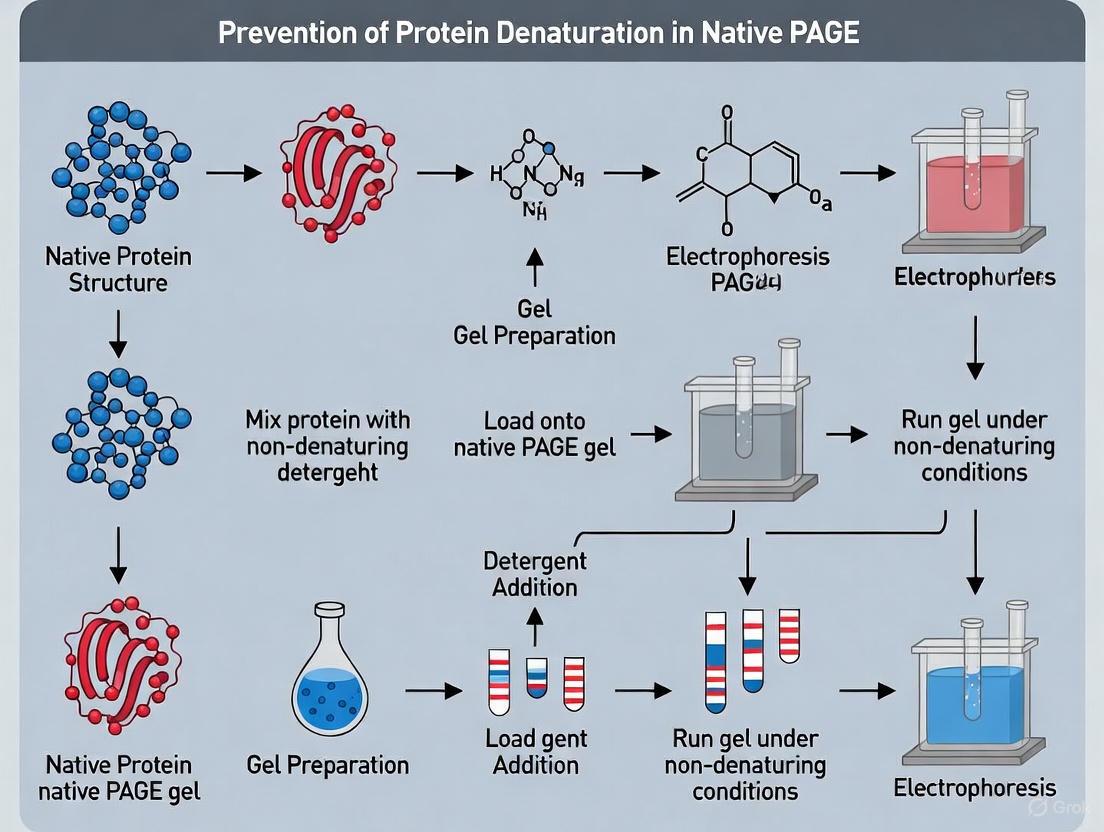
This article provides a comprehensive guide for researchers and drug development professionals on preventing protein denaturation during Native Polyacrylamide Gel Electrophoresis (PAGE).
Preserving Protein Truth: A Strategic Guide to Preventing Denaturation in Native PAGE for Functional Analysis
Abstract
This article provides a comprehensive guide for researchers and drug development professionals on preventing protein denaturation during Native Polyacrylamide Gel Electrophoresis (PAGE). Covering foundational principles to advanced applications, it details methodological strategies for preserving native protein structure, quaternary complexes, and biological activity. The content explores optimized protocols for Blue-Native (BN-PAGE) and Clear-Native (CN-PAGE) electrophoresis, troubleshooting common pitfalls, and validation techniques through in-gel activity assays and comparative analyses. By synthesizing current best practices, this guide empowers scientists to obtain reliable, functionally relevant data for studying protein complexes, interactions, and metabolic diseases, ultimately enhancing the translational impact of their research.
The Native State Imperative: Understanding Protein Structure and Denaturation Threats in PAGE
Native Polyacrylamide Gel Electrophoresis (Native PAGE) is a fundamental technique for analyzing proteins in their biologically active states. Unlike denaturing methods, Native PAGE allows researchers to separate protein complexes based on their intrinsic charge, size, and shape while preserving their higher-order structures [1]. This preservation is crucial for studying protein-protein interactions, enzymatic activity, and multiprotein complexes in drug development and basic research. This technical support center provides comprehensive guidance on the principles, methodologies, and troubleshooting of Native PAGE within the critical context of preventing artificial protein denaturation during analysis.
Frequently Asked Questions (FAQs)
1. What is the fundamental difference between Native PAGE and SDS-PAGE?
The core difference lies in the preservation of protein structure. SDS-PAGE uses the denaturing detergent sodium dodecyl sulfate (SDS) and heat to unfold proteins into linear chains, destroying tertiary and quaternary structures and separating subunits based almost solely on molecular weight [1]. In contrast, Native PAGE is run in the absence of denaturing agents, allowing proteins to maintain their native conformation, charge, and subunit interactions [1]. This makes Native PAGE the preferred method for studying functional protein complexes.
2. How does Native PAGE preserve a protein's tertiary and quaternary structure?
Native PAGE preserves structure by omitting harsh reagents. The key is the use of non-denaturing, non-reducing sample buffers that do not contain SDS, urea, or reducing agents like beta-mercaptoethanol or DTT [1]. By avoiding these chemicals, the non-covalent interactions (e.g., hydrogen bonds, hydrophobic interactions, van der Waals forces) and disulfide bonds that hold a protein's three-dimensional shape and multi-subunit assemblies remain intact during the electrophoretic process.
3. Why is my protein band smeared or poorly resolved?
Band smearing in Native PAGE is a common challenge and often relates to protein denaturation or aggregation. Potential causes include:
- Denaturation at Air-Water Interfaces: Simply pipetting or vortexing a protein sample can introduce air bubbles, creating air-water interfaces where proteins can adsorb and partially unfold [2].
- Protein Instability: The protein complex may be inherently unstable in the electrophoresis buffer conditions (e.g., incorrect pH, salt concentration).
- Overloading: Loading too much protein can overwhelm the gel matrix, leading to poor separation and smearing.
- Incorrect Gel Percentage: Using a gel pore size that is not optimal for the size of the native protein complex can result in poor resolution.
4. Can I determine molecular weight accurately with Native PAGE?
No, accurate molecular weight determination is a key limitation of Native PAGE. A protein's migration depends on its size, its inherent charge, and its shape [1]. Since different proteins have different charge densities and shapes, they will migrate at different rates even if they are the same size. For molecular weight determination, SDS-PAGE is the appropriate technique [1].
Troubleshooting Guide
The following table outlines common issues, their probable causes, and solutions focused on preventing denaturation.
| Problem | Probable Cause | Solution |
|---|---|---|
| Smeared Bands | Protein denaturation/aggregation at air-water interfaces [2]. | Avoid foaming during sample preparation. Use additives like 5-10% glycerol or sucrose to stabilize proteins. |
| Protein instability in buffer. | Optimize buffer pH and salt composition. Include stabilizing cofactors (e.g., Mg²âº, Ca²âº). | |
| No Bands or Faint Bands | Loss of protein activity/structure. | Ensure the running buffer and gel are kept cold (4°C) during electrophoresis to maintain stability. |
| Protein has migrated in the wrong direction. | Check the native charge (pI) of your protein versus the buffer pH; a positively charged protein will migrate towards the cathode. | |
| Poor Separation Resolution | Inappropriate gel pore size. | Use gradient gels or optimize the acrylamide percentage for your target protein complex size. |
| Incomplete entry into the gel. | Use a low-percentage stacking gel to pre-concentrate the proteins before separation. |
Experimental Protocol: Standard Native PAGE
This protocol is designed to minimize the risk of protein denaturation during analysis.
Research Reagent Solutions
| Reagent | Function in Native PAGE |
|---|---|
| Acrylamide/Bis-acrylamide | Forms the porous gel matrix for size-based separation. |
| Non-denaturing Detergent (e.g., Digitonin) | Solubilizes membrane proteins while preserving some protein-protein interactions. |
| Glycerol/Sucrose | Increases sample density for gel loading and can help stabilize protein structure. |
| Coomassie Blue G-250 | Anionic dye used in "Blue Native PAGE" to impart charge and color to proteins for visualization. |
| Pluronic F-127 Thermal Gel | A temperature-responsive polymer used as a matrix to control separation viscosity and improve resolution [3]. |
| Tris-Glycine or Tris-Bicine Buffer | Provides the pH and ion environment for electrophoresis and protein stability. |
Methodology
- Gel Casting: Prepare a non-denaturing polyacrylamide gel (e.g., 4-20% gradient). Do not add SDS to any gel or buffer solutions.
- Sample Preparation: Mix the protein sample with a non-denaturing loading buffer. Crucially, do not boil the sample. Simply mix and centrifuge briefly. Avoid vigorous pipetting to prevent introducing air bubbles [2].
- Electrophoresis: Load the samples and run the gel in a cold room (4°C) or using a cooling apparatus. Use a constant voltage as recommended for your specific setup. The running buffer must also be free of SDS and reducing agents.
- Detection: After electrophoresis, proteins can be visualized using Coomassie staining, or if fluorescently labeled, imaged directly.
Native PAGE Workflow and Separation Mechanism
The following diagram illustrates the critical steps where protein structure is preserved, from sample preparation to separation.
Mechanism of Native PAGE Separation
This diagram contrasts the principles of Native PAGE with denaturing SDS-PAGE to highlight how structure is preserved.
In native polyacrylamide gel electrophoresis (Native PAGE), the ultimate goal is to separate protein complexes while preserving their delicate higher-order structures, functional activities, and intricate interactions. This stands in direct contrast to denaturing SDS-PAGE, where proteins are deliberately unfolded into uniform linear chains. The success of your native PAGE research hinges on a single, critical factor: preventing unintended denaturation throughout your experimental workflow. Unwanted denaturation sabotages your results, leading to loss of enzymatic activity, disrupted protein-protein interactions, and erroneous conclusions about a protein's true state within the cell. This guide identifies the common adversaries of protein integrity in the lab and provides targeted troubleshooting strategies to ensure your research remains uncompromised.
Common Culprits of Denaturation in Native PAGE
The enemies of protein integrity can be introduced at nearly every stage of sample preparation and analysis. The table below summarizes the most frequent offenders and their consequences.
Table 1: Common Sources of Denaturation and Their Effects in Native PAGE
| Source of Denaturation | Mechanism of Action | Observed Effect in Native PAGE |
|---|---|---|
| Detergents (SDS) | Binds to polypeptide chains, masking intrinsic charge and unfolding the protein [4] [5] [6] | Altered migration, loss of activity, smeared or anomalous bands [7] |
| Reducing Agents (β-mercaptoethanol, DTT) | Cleaves disulfide bonds essential for tertiary and quaternary structure [6] | Dissociation of multi-subunit complexes, loss of native conformation [6] |
| Heat Treatment | Disrupts weak forces (e.g., hydrogen bonds) stabilizing the 3D structure [6] | Protein aggregation, incomplete entry into gel, or smeared bands [7] |
| Extreme pH Conditions | Alters the ionization state of amino acids, disrupting electrostatic interactions and hydrogen bonding [5] [7] | Protein precipitation, unfolding, or loss of native charge, leading to poor separation [5] |
| Proteolytic Enzymes | Cleaves peptide bonds, leading to protein fragmentation [7] | Multiple unexpected bands, disappearance of full-length protein, smearing [7] |
Troubleshooting FAQs: Identifying and Solving Common Problems
Why are my protein bands smeared?
Smeared bands are a common indicator of protein degradation or incomplete focusing.
- Primary Cause: Proteolytic degradation is a leading cause. Proteases present in the sample can cleave proteins during extraction or while the sample is on ice.
- Solution: Always include a broad-spectrum protease inhibitor cocktail in your lysis and storage buffers. Keep samples on ice at all times to slow enzymatic activity [7].
- Secondary Cause: The ionic strength of your sample may be too high due to high salt concentrations.
- Solution: Keep salt concentrations in your sample below 500 mM, and ensure your sample buffer is compatible with your running buffer system [7].
Why are my bands at unexpected molecular weights?
When proteins migrate to positions that do not align with their predicted size, it often points to issues with protein state or complex composition.
- Cause: In native PAGE, proteins separate based on their native charge, size, and shape, not purely on molecular weight. A large, tightly folded protein might migrate faster than a smaller, less compact one [5] [7]. Furthermore, multimeric complexes will be much larger than their individual subunits.
- Solution: This is not necessarily a problem but a feature of the technique. Compare your sample to native molecular weight markers, not denatured ones. Confirm the identity of the bands using an activity assay or a specific antibody.
Why is there little to no protein activity after elution from the gel?
Recovering active protein is a key advantage of native PAGE, but failure can occur if denaturants are present.
- Cause: Contamination of your gel system or buffers with SDS or reducing agents. Even trace amounts can be sufficient to denature proteins. This can occur from improperly rinsed equipment [6].
- Solution: Dedicate a set of gel-casting and running apparatus exclusively for native PAGE. Clean all equipment thoroughly before use to remove any residual SDS [6]. Also, avoid pH extremes during the elution process, as these can cause irreversible denaturation [5].
Why are my bands "smiling" or bulging?
Artifacts in band shape are often related to the conditions during the electrophoresis run itself.
- Cause ("Smiling" Bands): The buffer was made incorrectly, or the voltage is too high, causing the gel to overheat. This changes the buffer pH and impedes the migration of proteins at the warmer edges of the gel [7].
- Solution: Check the composition and pH of your running buffer. Run the gel at a lower voltage to reduce heating [7].
- Cause (Bulging Bands): The protein concentration loaded into the well is too high [7].
- Solution: Before electrophoresis, determine the total protein concentration using an assay like Bradford or BCA, and load an optimal, pre-determined amount of protein per well [7].
Proactive Protocols for Preserving Integrity
Sample Preparation Workflow for Native PAGE
Adhering to a disciplined, cold-based protocol is essential for maintaining proteins in their native state.
Critical Buffer Compositions
Using the correct buffers is non-negotiable. The table below outlines the key components for native PAGE systems.
Table 2: Essential Reagents for Native PAGE and Their Functions
| Reagent | Function in Native PAGE | Critical Considerations |
|---|---|---|
| Non-denaturing Detergents(e.g., n-dodecyl-β-D-maltoside) | Solubilizes membrane proteins without disrupting protein-protein interactions [8]. | Must avoid ionic detergents like SDS. Use mild, non-ionic, or zwitterionic detergents. |
| Protease Inhibitor Cocktail | Prevents proteolytic degradation by inhibiting a broad spectrum of proteases [7]. | Essential for all steps before electrophoresis. Must be added fresh to buffers. |
| Native Loading Dye | Provides color to visualize loading and glycerol to weigh down the sample [6]. | Must not contain SDS or reducing agents. Often contains Coomassie G-250 [9]. |
| Tris-Based Running Buffers(e.g., Tris-Glycine, Tris-Borate) | Conducts current and maintains a stable pH above the protein's pI to ensure a net negative charge [5] [6]. | pH is critical; it must be above the protein's isoelectric point to drive migration toward the anode [7]. |
| Glycerol | Increases the density of the sample, allowing it to sink to the bottom of the well during loading [6] [10]. | A standard component of native sample buffer. |
| Coomassie Dye (in BN-PAGE) | Binds to proteins, imparting a negative charge proportional to mass for separation by size in Blue Native PAGE [8] [9]. | Used in the cathode buffer and sample buffer for first-dimension BN-PAGE. |
The Scientist's Toolkit: Key Research Reagent Solutions
- NativePAGE Novex Bis-Tris Gels (Invitrogen): Pre-cast gels optimized for a wide range of native proteins and complexes, providing excellent resolution and reproducibility.
- Halt Protease Inhibitor Cocktail (EDTA-Free) (Thermo Scientific): A versatile, concentrated cocktail that inhibits a wide range of serine, cysteine, aspartic, and metalloproteases. The EDTA-free formula is ideal for metal-dependent proteins.
- NativeMark Unstained Protein Standard (Invitrogen): A set of seven native proteins for estimating the molecular weight of soluble non-denatured proteins and complexes in the range of 20 to 1236 kDa.
- n-Dodecyl-β-D-Maltoside (DDM): A high-purity, non-ionic detergent effective for solubilizing membrane protein complexes while maintaining their stability and native interactions.
- Coomassie G-250: The key dye used in Blue Native PAGE (BN-PAGE) to impart charge to proteins without denaturation, enabling separation based on size and shape [8] [9].
By understanding these enemies of protein integrity and implementing the recommended defensive strategies, you can significantly enhance the reliability and biological relevance of your Native PAGE research.
Native polyacrylamide gel electrophoresis (Native PAGE) is a fundamental technique for separating proteins based on their intrinsic physical properties while maintaining their native conformation. Unlike denaturing methods such as SDS-PAGE, which dismantles protein structure and imparts a uniform charge, Native PAGE preserves the protein's higher-order structure, enzymatic activity, and interaction capabilities [1]. This technical support center focuses on the core principles of how a protein's net charge, size, and shape collectively govern its migration in native gels, all within the critical context of preventing artifactual denaturation. Mastering these principles is essential for researchers and drug development professionals who rely on accurate analysis of protein complexes, oligomeric states, and functional isoforms.
Troubleshooting Guide: Common Native PAGE Issues
Diagnosing and resolving issues in Native PAGE requires a systematic understanding of how native protein properties interact with electrophoretic conditions. The following guide addresses common problems, their root causes, and proven solutions to ensure data integrity.
Table 1: Troubleshooting Band Distortion and Migration Issues
| Problem Observed | Potential Cause | Recommended Solution |
|---|---|---|
| Smiling or Frowning Bands (curved bands) | Uneven heat distribution across the gel (Joule heating) [11] [12]. | Run the gel at a lower voltage; use a constant current power supply; perform electrophoresis in a cold room or with ice packs [11] [12]. |
| Smeared Bands | Sample degradation by proteases; excessive voltage causing local heating; protein aggregation [11] [7]. | Keep samples on ice; use fresh, sterile buffers; include protease inhibitors; run the gel at a lower voltage; ensure buffer composition is correct [11] [7]. |
| Poor Band Resolution | Suboptimal gel concentration for the target protein size; overloading of wells; insufficient run time [11]. | Optimize the acrylamide percentage for your protein size range; load a smaller amount of sample; adjust the run time for sufficient separation [11]. |
| Edge Effect (distorted bands in peripheral lanes) | Empty wells at the periphery of the gel, leading to an uneven electric field [12]. | Load a control protein or sample buffer into any unused wells to ensure a uniform electric field across the gel [12]. |
| Unexpected Migration (e.g., larger protein migrates faster) | Protein's native charge influences mobility more than its size [13]. | Remember separation is based on charge, size, and shape. A highly charged large protein may migrate faster than a small, low-charge protein. Analyze results considering all three factors. |
| Fmoc-Gly-OH-1-13C | Fmoc-Gly-OH-1-13C|13C-Labeled Glycine Derivative | Fmoc-Gly-OH-1-13C is a 13C-labeled Fmoc-protected glycine for peptide synthesis. For Research Use Only. Not for human or veterinary use. |
| Fmoc-Glu(OtBu)-OH-15N | Fmoc-Glu(OtBu)-OH-15N, MF:C24H27NO6, MW:426.5 g/mol | Chemical Reagent |
Table 2: Troubleshooting Faint, Absent, or Aberrant Bands
| Problem Observed | Potential Cause | Recommended Solution |
|---|---|---|
| Faint or No Bands | Protein concentration too low; incomplete transfer (if blotting); sample degradation [11] [7]. | Confirm protein concentration pre-loading; use a positive control/ladder; check sample handling and storage conditions [11] [7]. |
| Protein Samples Migrated Out of Well Before Run | Significant delay between sample loading and applying electric current, allowing diffusion [12]. | Minimize the time between loading the first sample and starting the electrophoresis run [12]. |
| Yellow Sample Color | Running buffer is at an incorrect, often acidic, pH [7]. | Prepare a fresh running buffer, ensuring the correct pH according to the protocol [7]. |
Frequently Asked Questions (FAQs)
Q1: What is the fundamental difference between Native PAGE and SDS-PAGE?
A1: The key difference lies in the preservation of protein structure. SDS-PAGE uses the denaturing detergent sodium dodecyl sulfate (SDS) and heat to unfold proteins, giving them a uniform negative charge and allowing separation based almost exclusively on molecular weight [7] [1]. Native PAGE uses non-denaturing conditions, allowing proteins to retain their native 3D structure, charge, and enzymatic activity. Separation depends on the protein's intrinsic charge, size, and shape [1] [13].
Q2: Why does my protein not enter the resolving gel or migrate in the wrong direction?
A2: In Native PAGE, a protein's migration is determined by its net charge at the running buffer's pH. A protein will not enter the gel if it has a net charge of zero (it is at its isoelectric point, or pI). If it migrates towards the cathode (the negative electrode), it means the protein has a net positive charge at the operating pH, which occurs when the buffer pH is below the protein's pI [13]. Check the pI of your protein and the pH of the running buffer.
Q3: How can I prevent protein denaturation during Native PAGE?
A3: To prevent denaturation:
- Avoid Denaturants: Do not use SDS, urea, or reducing agents like DTT or β-mercaptoethanol in your buffers unless specifically required for a modified protocol [1].
- Control Temperature: Run the gel at lower voltages or in a cold room to minimize heat generation, which can cause denaturation and aggregation [11] [12].
- Use Compatible Buffers: Ensure your sample and running buffers are at an appropriate pH and ionic strength to maintain protein stability and solubility.
- Consider Charge-Shift Reagents: For basic proteins or membrane proteins prone to aggregation, using a system like NativePAGE Bis-Tris with Coomassie G-250 can help maintain solubility and confer negative charge without denaturation [14].
Q4: My protein is active after Native PAGE, but the band pattern is complex. Why?
A4: This is a common and advantageous outcome of native electrophoresis. The complex banding pattern likely reflects the native state of your protein sample, showing different oligomeric states (e.g., dimers, tetramers), functional isoforms with different post-translational modifications, or complexes with other proteins or ligands [14] [1]. Each of these states has a unique combination of size, charge, and shape, leading to distinct migration positions.
Experimental Protocols & Methodologies
Protocol: Determining Protein Charge via Native Gel Electrophoresis
This protocol is adapted from studies on cytochrome c, which demonstrated that measured charge in solution can differ significantly from theoretical calculations due to ion binding [15].
1. Sample Preparation:
- Dialyze the purified protein into a desired low-concentration buffer (e.g., 10 mM BIS-TRIS propane, pH 7.0) to standardize ionic conditions.
- Adjust the ionic strength of the sample and running buffer to a defined level (e.g., 100 mM) using salts like KCl. Avoid sulfates if studying cation-binding proteins, as they can neutralize charge [15].
- Do not heat or add denaturants to the sample.
2. Gel Electrophoresis:
- Use a pre-cast native gel system (e.g., Tris-Glycine, Bis-Tris) appropriate for your protein's size and pI [14].
- Load the dialyzed protein sample alongside a native marker.
- Run the gel at a constant voltage (e.g., 150V) at 4°C to minimize heat-induced artifacts. Stop the run when the dye front approaches the bottom.
3. Analysis:
- After staining, measure the migration distance of your protein and the markers.
- The relative mobility can be used to assess the protein's effective charge under the experimental conditions. A protein with a higher negative charge density will migrate faster towards the anode than a similar-sized protein with a lower charge [14] [13].
Protocol: Native SDS-PAGE (NSDS-PAGE) for Metalloprotein Analysis
This modified protocol allows for high-resolution separation while retaining bound metal ions and, for many enzymes, biological activity [9].
1. Modified Buffer Preparation:
- Sample Buffer: Omit SDS and EDTA from the standard Laemmli buffer. A suggested formulation is 100 mM Tris HCl, 150 mM Tris Base, 10% glycerol, 0.01875% Coomassie G-250, 0.00625% Phenol Red, pH 8.5 [9].
- Running Buffer: Reduce SDS concentration to 0.0375% and omit EDTA. A suggested formulation is 50 mM MOPS, 50 mM Tris Base, 0.0375% SDS, pH 7.7 [9].
- Crucially, do not heat the samples.
2. Gel Electrophoresis:
- Use standard pre-cast polyacrylamide gels (e.g., 12% Bis-Tris).
- Pre-run the gel in ddHâ‚‚O for 20-30 minutes to remove storage buffers and unpolymerized acrylamide.
- Load samples mixed with the NSDS sample buffer.
- Run the gel at constant voltage (e.g., 200V) at room temperature.
3. Post-Electrophoresis Analysis:
- Proteins can be visualized with standard stains like Coomassie.
- Retained metal ions can be detected using techniques like LA-ICP-MS (Laser Ablation-Inductively Coupled Plasma-Mass Spectrometry) or specific in-gel fluorescent stains (e.g., TSQ for Zn²âº) [9].
- Enzymatic activity can be assayed via in-gel zymography techniques.
Research Reagent Solutions: Essential Materials
Selecting the correct reagents is critical for successful Native PAGE and preventing undesired denaturation. The table below summarizes key solutions and their functions.
Table 3: Essential Reagents for Native PAGE
| Reagent / Material | Function & Importance |
|---|---|
| Tris-Glycine Native Gels | Traditional system for separating smaller proteins (20-500 kDa) in a high pH range (8.3-9.5), ideal for proteins stable at alkaline pH [14]. |
| Tris-Acetate Native Gels | Provides better resolution for larger molecular weight proteins (>150 kDa) in a slightly lower pH range (7.2-8.5) [14]. |
| NativePAGE Bis-Tris Gels | A versatile system using Coomassie G-250 dye in the cathode buffer to confer a net negative charge on all proteins, including those with basic pIs. Crucial for studying membrane proteins and preventing aggregation [14]. |
| Coomassie G-250 Dye | A charge-shift molecule that binds non-specifically to hydrophobic protein patches, imparting a negative charge without denaturation. This allows all proteins to migrate toward the anode regardless of their native pI [14]. |
| Protease Inhibitor Cocktails | Added to sample preparation buffers to prevent proteolytic degradation during isolation and electrophoresis, which can cause smearing or loss of signal [7]. |
| Glycerol | A common component of sample buffers to increase density, allowing samples to sink neatly into the wells without diffusing [9]. |
Visualization: Workflow and Decision Pathway
Native PAGE Separation Workflow
Native PAGE Gel Selection Guide
Frequently Asked Questions (FAQs)
Q1: What is the fundamental difference between native PAGE and SDS-PAGE, and why does it matter for function? Native polyacrylamide gel electrophoresis (PAGE) separates proteins under non-denaturing conditions, preserving their higher-order structure (quaternary and tertiary), post-translational modifications, and biological activity. In contrast, SDS-PAGE denatures proteins into their primary structure, coating them with sodium dodecyl sulfate (SDS) to impart a uniform negative charge, separating them primarily by molecular weight. For functional studies, native PAGE is critical because a protein's biological function depends entirely on its intact three-dimensional conformation [7].
Q2: My protein is not migrating as expected in native PAGE. What could be wrong? Protein mobility in native PAGE depends on both the protein's intrinsic charge and its hydrodynamic size, which is dictated by its folded shape. Unlike SDS-PAGE, where migration is proportional to molecular weight, a small but loosely folded protein could migrate slower than a larger, tightly folded one in native PAGE [7]. Ensure your buffer pH is appropriate to maintain the protein's native charge, and consider that multimeric complexes will be preserved, affecting their migration [7].
Q3: How can I verify that my protein's native structure and function are intact after separation? A powerful emerging technique is in-gel refolding and fluorescence detection. For fluorescent proteins like GFP, fully denatured samples can be refolded within the gel by cyclodextrin-mediated removal of SDS in the presence of 20% methanol, enabling direct fluorescence detection of the properly folded protein [16]. This confirms the protein has regained its functional conformation.
Q4: What are the key considerations for buffer selection in native PAGE?
- pH: The running buffer pH must be above the isoelectric points (pI) of the proteins being separated to maintain a net negative charge, ensuring migration towards the anode [7].
- Composition: A Tris-glycine buffer is typically used. For specialized applications, Tricine buffers are ideal for separating very low molecular weight proteins or peptides [7].
- Additives: To maintain reducing conditions and prevent disulfide bond formation, adding a reducing agent to the buffer is recommended [7].
Troubleshooting Guide: Common Native PAGE Issues and Solutions
The following table outlines common problems, their potential causes, and solutions to help you maintain native protein structure during your experiments.
| Problem Observed | Potential Cause | Solution |
|---|---|---|
| Smiling or bulging bands | Buffer composition error or incorrect running voltage causing overheating [7]. | Check running buffer composition and run at a lower voltage to prevent heating [7]. |
| Smeared bands | Sample insufficiently prepared; may contain aggregates or be partially denatured [7]. | Ensure sample is not overly concentrated. Keep salt concentrations below 500 mM where possible [7]. |
| Multiple or unexpected bands | Protein degradation, oxidation, or dephosphorylation [7]. | Use protease and phosphatase inhibitors in buffers. Include sodium azide to prevent microbial growth [7]. |
| Poor or no separation | Gel density is inappropriate for the target protein size [7]. | Use a gradient gel to resolve a wider range of protein sizes or adjust the acrylamide percentage (e.g., 10% for >70kDa proteins) [7]. |
| Loss of protein function | Protein denaturation during sample preparation or electrophoresis. | Avoid heating and denaturing detergents like SDS. Use mild, non-denaturing detergents if necessary for solubility. |
Research Reagent Solutions for Native Structure Analysis
This table details essential reagents and materials for successful native PAGE experiments aimed at preserving biological function.
| Reagent / Material | Function in Native PAGE |
|---|---|
| Polyacrylamide Gel Matrix | A strong, hydrophilic, and inert matrix that separates proteins based on charge, size, and shape without denaturing them [7]. |
| Tris-Glycine Buffer | A common discontinuous buffering system that stacks and then resolves proteins, maintaining a pH that keeps proteins charged and native [7]. |
| Cyclodextrin | Used in post-electrophoresis refolding protocols to remove SDS from gels, enabling denatured proteins like GFP to regain their native, fluorescent structure [16]. |
| Molecular Weight Markers | Proteins of known molecular weight and native state used to calibrate size separation; prestained markers can monitor migration in real-time [7]. |
| Protease & Phosphatase Inhibitors | Added to buffers to prevent protein degradation or modification (e.g., truncation, dephosphorylation) that can alter native structure and create artifactual bands [7]. |
Experimental Workflow for Maintaining Native Structure
The diagram below outlines a general workflow for a native PAGE experiment, highlighting key decision points for preventing denaturation.
Advanced Techniques: Linking Structure to Function
Modern structural biology leverages advanced visualization and analysis tools to directly link a protein's native structure to its function. The following diagram illustrates an integrative workflow.
Native Top-Down Mass Spectrometry (nTDMS) is a breakthrough for characterizing intact proteoforms and their complexes. It preserves the critical link between protein modifications and their biological interactions [17]. The precisION software package enables the detection of "hidden" post-translational modifications (PTMs) like phosphorylation and glycosylation that are essential for function but can be missed by standard methods [17]. This allows researchers to connect specific proteoforms directly to their functional states in a way that denaturing methods cannot.
Essential Controls for Valid Experimental Results
- Negative Tissue Controls: Use a cell or tissue sample known not to express your target protein. A signal in this control indicates non-specific detection by your primary antibody [7].
- No-Primary Antibody Control: Omit the primary antibody during detection. A positive signal shows direct binding of the secondary antibody to proteins in your sample [7].
- Loading Controls: Use housekeeping proteins (e.g., β-actin) expressed in your sample to confirm consistent loading across wells and normalize quantification [7].
Practical Protocols for Pristine Proteins: BN-PAGE, CN-PAGE, and Activity Staining
In the study of proteins, function is dictated by structure, and often, by the intricate quaternary structures of protein complexes. For researchers investigating vital systems like the mitochondrial oxidative phosphorylation (OXPHOS) machinery or photosynthetic supercomplexes, preserving these native structures during analysis is paramount. Blue-Native and Clear-Native Polyacrylamide Gel Electrophoresis (BN-PAGE and CN-PAGE) are two powerful techniques that fulfill this need, allowing for the separation of intact protein complexes under non-denaturing conditions. BN-PAGE, originally developed by Schägger and Von Jagow in the 1990s, has become an indispensable tool for gaining insights into the structure and function of multi-protein complexes [18] [19]. The core challenge in native electrophoresis is to solubilize and separate complexes while minimizing denaturation, thereby maintaining enzymatic activity and native protein-protein interactions. This guide provides a strategic comparison of BN-PAGE and CN-PAGE, empowering you to select the optimal technique for your experimental goals, whether they involve assembly pathway analysis, supercomplex composition, or pathological mechanism investigation in genetic disorders [18].
Core Principles and Historical Development
Both BN-PAGE and CN-PAGE are designed to separate native protein complexes based on their size and shape, but they employ different strategies to achieve this.
BN-PAGE relies on the anionic dye Coomassie Blue G-250. This dye binds non-covalently to the hydrophobic surfaces of proteins, imparting a uniform negative charge shift. This charge shift forces even basic proteins to migrate towards the anode at neutral pH and, crucially, prevents the aggregation of hydrophobic proteins by keeping them soluble in the absence of detergent during electrophoresis [18] [19]. The characteristic blue color of the complexes during separation gives the technique its name.
CN-PAGE, a more recent variant, replaces the Coomassie dye with mixtures of anionic and neutral detergents in the cathode buffer. These mixed micelles similarly induce a charge shift on membrane proteins, enhancing their solubility and migration. A key distinction is the absence of the blue dye, hence "clear-native," which eliminates potential interference with downstream applications like in-gel enzyme activity staining [20] [19].
BN-PAGE vs. CN-PAGE: A Direct Technical Comparison
The choice between BN-PAGE and CN-PAGE is not a matter of one being superior to the other, but rather which is better suited for a specific application. The following table summarizes their core characteristics to guide your decision.
Table 1: Strategic comparison between BN-PAGE and CN-PAGE
| Feature | BN-PAGE | CN-PAGE |
|---|---|---|
| Charge Agent | Coomassie Blue G-250 dye [19] | Mixtures of anionic and neutral detergents [19] |
| Key Advantage | Robust separation of individual OXPHOS complexes; widely used and validated [18] | No dye interference, superior for in-gel activity assays [20] [19] |
| Ideal For | Western blot analysis, studying assembly pathways, resolving individual complexes [18] | In-gel enzyme activity staining (Complexes I, II, IV, V), analyzing labile supercomplexes [18] [19] |
| Limitations | Dye can interfere with activity staining and mass spectrometry [19] | Can be less robust for some complexes; may not resolve all complexes as well as BN-PAGE [18] |
| Visual Output | Blue bands during electrophoresis [8] | Clear/colorless bands during electrophoresis [19] |
Decision Framework: Selecting the Right Technique
To make an informed choice, align the fundamental strengths of each technique with your primary experimental objective. The following workflow diagram provides a visual guide for this decision-making process.
Guidance for Specific Research Scenarios
- Studying Mitochondrial Respiratory Complexes: For initial characterization and assembly studies of OXPHOS complexes from mitochondria, BN-PAGE is the robust and standard choice [18]. If your focus shifts to quantifying the enzymatic activity of specific complexes like Complex V (ATP synthase), switching to CN-PAGE is highly recommended, especially as recent protocols include enhancement steps that markedly improve the sensitivity of in-gel Complex V activity staining [18] [19].
- Analyzing Photosynthetic Supercomplexes: Research on thylakoid membrane complexes, such as Photosystem I and II supercomplexes in plants, benefits from the mild conditions of CN-PAGE or optimized BN-PAGE protocols. Using detergent mixtures like n-dodecyl-β-d-maltoside with digitonin for solubilization in BN-PAGE can help preserve fragile mega- and supercomplexes for analysis [21].
- Troubleshooting Poor Resolution: If you encounter smearing or poor band resolution in BN-PAGE, consider the following. First, optimize the detergent-to-protein ratio during solubilization [8]. Second, ensure the use of a linear gradient gel (e.g., 4-16%) instead of a single-concentration gel to better resolve complexes of vastly different sizes [8] [21]. For CN-PAGE, the composition and concentration of the detergent charge mix are critical parameters to optimize.
Essential Methodologies and Protocols
Core Sample Preparation Workflow
A critical first step in both techniques is the proper isolation and solubilization of protein complexes to preserve their native state. The workflow below outlines the key steps, highlighting points of divergence between BN-PAGE and CN-PAGE.
Detailed Step-by-Step Protocol:
- Sample Isolation: It is highly recommended to isolate mitochondria or chloroplasts from cells or tissues before analysis. While whole-cell extracts can be used, they may result in a weaker signal and lower resolution due to the high abundance of cytosolic proteins [8].
- Membrane Solubilization: Resuspend the isolated membrane fraction in a buffer containing 0.75 M 6-aminocaproic acid and 50 mM Bis-Tris, pH 7.0, supplemented with protease inhibitors [8]. Add a mild, non-ionic detergent.
- For individual complexes, use n-dodecyl-β-d-maltoside (e.g., 1-2% w/v) [18] [8].
- For supercomplexes, use the milder detergent digitonin (e.g., 1-4% w/v) [19] [21]. A mixture of 1% n-dodecyl-β-d-maltoside and 1% digitonin has also been successfully used for resolving large photosystem I megacomplexes [21].
- Incubation and Clarification: Mix and incubate on ice for 30 minutes to allow for complete solubilization. Centrifuge at high speed (e.g., 72,000 x g for 30 minutes, though 16,000 x g in a microcentrifuge can suffice for small volumes) to pellet insoluble material [8].
- Sample Preparation:
The Scientist's Toolkit: Key Research Reagents
Successful native PAGE requires specific reagents to maintain protein complexes in their functional, folded state.
Table 2: Essential reagents for BN-PAGE and CN-PAGE
| Reagent | Function | Technical Considerations |
|---|---|---|
| n-Dodecyl-β-d-maltoside | Mild, non-ionic detergent for solubilizing individual protein complexes [18] [8]. | Optimal for resolving Complexes I-V; harsher than digitonin. |
| Digitonin | Very mild, non-ionic detergent for preserving supercomplexes [19]. | Use for studying respirasomes or photosynthetic supercomplexes. |
| Coomassie Blue G-250 | Anionic dye providing charge for electrophoresis in BN-PAGE [18] [19]. | Can interfere with in-gel activity assays and MS; handle accordingly. |
| 6-Aminocaproic Acid | Zwitterionic salt; supports solubilization and prevents aggregation [18] [19]. | Zero net charge at pH 7.0; does not interfere with electrophoresis. |
| Bis-Tris Buffer | Primary buffer component for native gels and running buffers [8] [19]. | Provides stable pH (~7.0) crucial for native conditions. |
| Protease Inhibitors | Prevents protein degradation during sample preparation [8]. | Essential for preserving labile subunits and assembly factors. |
| Pde IV-IN-1 | Pde IV-IN-1, MF:C20H23ClN4O2, MW:386.9 g/mol | Chemical Reagent |
| Pemetrexed-d5 | Pemetrexed-d5|Isotope-Labeled Antineoplastic Standard | Pemetrexed-d5 is a deuterated isotope-labeled internal standard for LC-MS/MS research. This product is For Research Use Only. Not for diagnostic or therapeutic use. |
Advanced Applications and Downstream Analyses
The true power of native PAGE is unlocked by coupling it with various downstream techniques.
- In-Gel Enzyme Activity Staining: This is a major application where CN-PAGE excels. After CN-PAGE, the resolved complexes in the gel remain active and can be assayed for function. Established histochemical methods can detect the activities of Complexes I, II, IV, and V directly in the gel [18] [19]. A limitation is the comparative insensitivity for Complex IV and the lack of a reliable assay for Complex III activity [18].
- Two-Dimensional Electrophoresis (2D-PAGE): Both BN-PAGE and CN-PAGE can be followed by a second dimension of denaturing SDS-PAGE. In this 2D setup, the first dimension separates the native complexes by size, and the second dimension denatures and separates the individual subunits of each complex by molecular weight. This powerful combination, known as BN/SDS-PAGE or CN/SDS-PAGE, is invaluable for determining the subunit composition of complexes and identifying assembly intermediates [18] [8].
- Western Blotting and Mass Spectrometry: Bands from one-dimensional native gels can be transferred to membranes for immunodetection with specific antibodies, or excised and analyzed by mass spectrometry to identify component proteins [19] [21].
Frequently Asked Questions (FAQs)
Q1: Can I use commercial pre-cast gels for BN-PAGE and CN-PAGE? Yes, for greater convenience, pre-cast native linear gradient polyacrylamide gels (e.g., 3–12% or 4–16%) and buffers for BN-PAGE are commercially available. For CN-PAGE, these commercial native gels can be combined with the cathode and anode buffers recommended in specific CN-PAGE protocols [19].
Q2: Why is there no in-gel activity stain for Complex III? The lack of a reliable in-gel activity stain for Complex III (cytochrome bc1 complex) is a recognized limitation of the technique [18]. The specific reagents and electron transfer pathways required for its activity are difficult to implement in the gel matrix post-electrophoresis.
Q3: My protein complexes are not resolving clearly and appear smeared. What could be the cause? Smearing is often a sign of protein degradation or suboptimal solubilization. Ensure your samples are kept on ice, use fresh protease inhibitors, and check the viability of your isolated organelles. Additionally, titrate the detergent-to-protein ratio, as too little detergent causes incomplete solubilization and aggregation, while too much can dissociate complexes [8].
Q4: How does the choice of detergent impact the analysis of supercomplexes? The choice of detergent is critical. Dodecyl maltoside is effective for solubilizing individual OXPHOS complexes but can disrupt the weaker interactions in supercomplexes. Digitonin, being milder, is the detergent of choice for studying supercomplexes (e.g., respirasomes containing Complexes I, III, and IV) as it preserves these higher-order structures [19] [21].
FAQs and Troubleshooting Guides
FAQ 1: Why is maintaining the native state of membrane protein complexes crucial for my research, and what are the primary challenges?
Maintaining the native state is essential for studying the true structure, function, and interactions of membrane protein complexes, which are often disrupted by traditional denaturing methods. The primary challenges include their inherent hydrophobicity, which makes them prone to aggregation and loss of activity when removed from their lipid environment, and their sensitivity to harsh detergents and physical conditions that can dismantle complex subunits and post-translational modifications [22]. Success in native analysis hinges on preserving these delicate non-covalent interactions throughout the entire sample preparation workflow.
FAQ 2: How do I choose the correct native PAGE system for my specific membrane protein complex?
The choice of native PAGE system depends on the protein's isoelectric point (pI), size, and hydrophobicity. There is no universal system, and selection is critical for maintaining protein stability and achieving high-resolution separation. The table below summarizes the key characteristics of common native gel chemistries:
Table: Guide to Native PAGE Gel System Selection
| Gel System | Operating pH Range | Key Features | Ideal Use Cases |
|---|---|---|---|
| Tris-Glycine | 8.3 - 9.5 | Traditional Laemmle system; proteins separate based on native charge and size. | Keeping the native net charge; studying smaller proteins (20-500 kDa) [14]. |
| Tris-Acetate | 7.2 - 8.5 | Provides better resolution for larger proteins. | Keeping the native net charge; studying larger molecular weight proteins (>150 kDa) [14]. |
| NativePAGE Bis-Tris | ~7.5 | Uses Coomassie G-250 dye to confer a uniform negative charge. | Membrane/hydrophobic proteins; separating by molecular weight regardless of pI; analyzing oligomeric states [14]. |
FAQ 3: What are the most critical steps in sample preparation to prevent denaturation of my membrane protein complex?
The most critical steps involve using the correct lysis buffer, avoiding denaturing agents, and carefully controlling temperature.
- Lysis Buffer Selection: Use mild, non-ionic detergents like NP-40 or Triton X-100 to solubilize membrane proteins while preserving protein-protein interactions. For highly hydrophobic membrane proteins, zwitterionic detergents like CHAPS are more effective [23]. Radioimmunoprecipitation assay (RIPA) buffer can be used but may disrupt some protein complexes due to its SDS content [23].
- Inhibitors: Always include a fresh protease inhibitor cocktail to prevent protein degradation and phosphatase inhibitors if studying phosphorylated proteins [23] [24].
- Temperature: Perform all lysis and preparation steps on ice or at 4°C to minimize enzymatic activity and denaturation [23].
- Sonication: For nuclear and membrane-bound proteins, sonication is a crucial step to break up cellular components and enrich the target protein. Keep samples on ice during the process to avoid heat denaturation [24].
FAQ 4: I am observing poor transfer efficiency or high background in my western blot after native PAGE. What could be the cause?
Poor transfer and high background are common issues that can often be traced to the membrane, buffer conditions, or detection steps.
- Membrane Choice for NativePAGE: When using NativePAGE Bis-Tris gels, you must use a PVDF membrane. Nitrocellulose is incompatible as it tightly binds the necessary Coomassie G-250 dye [14].
- Transfer Buffer Optimization: The composition of your transfer buffer significantly impacts efficiency. For large proteins (>100 kDa), adding a small amount of SDS (0.01-0.02%) to the transfer buffer can facilitate elution from the gel. However, too much SDS can prevent binding to the membrane. Methanol concentration (typically 10-20%) helps bind proteins to the membrane but can reduce pore size and transfer efficiency; it must be balanced carefully [25].
- High Background: This can result from insufficient blocking, antibody concentrations that are too high, or inadequate washing. Optimize your blocking buffer (avoid milk if cross-reactivity is an issue) and ensure antibodies are diluted in buffer containing detergent (e.g., 0.1-0.2% Tween 20). Always handle membranes with clean forceps to avoid contamination [26].
Optimized Step-by-Step Experimental Protocol
Protocol: Preparation of Membrane Protein Complexes for Native PAGE and Western Blotting
This protocol is designed for the extraction of membrane-bound proteins from cultured cells under native conditions.
Solutions and Reagents:
- Extraction Buffer: 10 mM Tris-HCl (pH 7.4), 10 mM KCl, 1.5 mM MgClâ‚‚.
- Protease Inhibitor Cocktail: Add fresh to all buffers.
- Phosphatase Inhibitors: Add if studying protein phosphorylation.
- RIPA Buffer: For final solubilization of the membrane fraction.
- Native Sample Buffer: Compatible with your chosen native PAGE system (e.g., Tris-Glycine Native Sample Buffer or NativePAGE Sample Buffer) [14].
Procedure:
Cell Lysis and Homogenization:
- Harvest cells and wash twice with cold PBS by centrifugation (100–500 x g, 5 min, 4°C).
- Resuspend the cell pellet in adequate cold Extraction Buffer containing inhibitors.
- Gently homogenize the suspension 20-30 times with a Dounce homogenizer. Avoid generating bubbles to prevent sample loss and potential denaturation [24].
Isolation of Membrane Fraction:
- Centrifuge the homogenized suspension at 2,000 x g for 5 min at 4°C. This pellets nuclei and cell debris.
- Carefully transfer the supernatant (S1) to a new tube. Centrifuge S1 again at a high speed of 17,000 x g for 20 min at 4°C.
- The resulting pellet contains the membrane fraction [24].
Solubilization of Membrane Proteins:
- Add RIPA buffer (or another suitable mild detergent buffer) to the membrane pellet to solubilize the proteins. Gently pipette or vortex to mix.
- Incubate on ice for 15-30 minutes to allow for complete solubilization [24].
Sonication (Critical Step):
- To fully disrupt membranes and release proteins, sonicate the lysate on ice. Use short pulses to avoid heating (e.g., 3 seconds on, 10 seconds off, for 5-15 cycles at 40 kW). Optimization of time and intensity for your specific instrument is required [24].
Clarification and Concentration Measurement:
Sample Preparation for Native PAGE:
- Dilute the lysate with the appropriate 2X Native Sample Buffer. Do not boil the samples.
- For multi-pass transmembrane proteins, heating can cause aggregation. Instead, incubate samples at room temperature for 15-20 minutes or on ice for 30 minutes to prepare for loading [24].
Workflow Diagram
The following diagram illustrates the logical workflow and critical decision points for preparing membrane protein complexes, highlighting steps essential for preventing denaturation.
The Scientist's Toolkit: Research Reagent Solutions
Table: Essential Reagents for Native Membrane Protein Analysis
| Reagent / Material | Function / Purpose | Key Considerations |
|---|---|---|
| Mild Detergents (NP-40, Triton X-100, CHAPS) | Solubilizes membrane proteins while preserving native protein-protein interactions and complex integrity. | NP-40/Triton for whole cell extracts; CHAPS for hydrophobic membrane proteins; avoid SDS for native complexes [23]. |
| Protease & Phosphatase Inhibitor Cocktails | Prevents co-purified proteases and phosphatases from degrading the target protein or altering its modification state. | Must be added fresh to all lysis and extraction buffers to maintain efficacy [23] [24]. |
| NativePAGE Bis-Tris Gels & Coomassie G-250 | Native gel system that uses dye to confer uniform negative charge, allowing separation by size and shape regardless of pI. | Essential for membrane proteins and analyzing oligomeric states; requires PVDF membrane for blotting [14]. |
| PVDF Membrane | Microporous membrane used to immobilize proteins after electrophoresis for western blotting. | Required for use with NativePAGE systems; pre-wet in 100% methanol before use [14] [26]. |
| Phosphate Buffered Saline (PBS) & PBST | Isotonic buffer for washing cells and sample preparation. PBST (with Tween-20) is used for washing blots to reduce background. | Maintains isotonicity and pH; PBST is crucial for effective immunoassay washing [27]. |
| RIPA Buffer | Effective lysis buffer for total cellular extracts, including membrane and nuclear fractions. | Contains ionic detergents and may disrupt some weak protein complexes; use with caution for native work [23] [24]. |
| 3-Cyclopropoxy-5-methylbenzoic acid | 3-Cyclopropoxy-5-methylbenzoic Acid|Research Chemical | High-purity 3-Cyclopropoxy-5-methylbenzoic acid for research use. A versatile benzoic acid derivative for medicinal chemistry. For Research Use Only. Not for human use. |
| Abz-Thr-Ile-Nle-p-nitro-Phe-Gln-Arg-NH2 | Abz-Thr-Ile-Nle-p-nitro-Phe-Gln-Arg-NH2, MF:C43H65N13O11, MW:940.1 g/mol | Chemical Reagent |
Troubleshooting Guides
Troubleshooting Common Solubilization Issues in BN-PAGE
| Problem | Possible Causes | Recommendations |
|---|---|---|
| No or poor separation of complexes on BN-PAGE gel | Incorrect detergent choice for target complex; Insufficient detergent concentration; Overly harsh solubilization damaging complexes; Low abundance of target complex masked by abundant proteins. | Perform a detergent screening assay (see Experimental Protocol 1); Increase detergent-to-protein ratio empirically [28]; Include low ionic strength salts (e.g., aminocaproic acid) to support solubilization [28]; Pre-fractionate sample or use affinity chromatography to enrich low-abundance complexes [28]. |
| Unexpected band patterns or absence of expected bands | Detergent choice influencing complex stability (e.g., disruption of supercomplexes); Coomassie dye disrupting some protein-protein interactions [29]; Partial denaturation of complexes. | Use digitonin to preserve supercomplexes instead of dodecylmaltoside [28]; Consider Colorless Native-PAGE (CN-PAGE) if dye is suspected of disrupting interactions [29]; Verify complex integrity and activity via enzymatic assays or other native techniques post-solubilization. |
| Protein smearing on the gel | Presence of interfering salts or solutes; Incomplete solubilization; Protein aggregation. | Desalt sample or change buffer using dialysis or ultrafiltration [28]; Optimize solubilization time and temperature; Ensure mild, non-ionic detergents are used and that harsh ionic detergents like SDS are avoided [28] [29]. |
| Weak or no signal for immunodetection | Antibody raised against denatured epitopes may not recognize native protein [29]; Target abundance too low. | Use antibodies validated for native protein detection [29]; Combine BN-PAGE with a second dimension SDS-PAGE (2D-BN/SDS-PAGE) for immunodetection of subunits [30]; Increase sample loading and employ more sensitive detection methods (e.g., silver stain). |
Troubleshooting Detergent-Related Issues in Structural Biology
| Problem | Possible Causes | Recommendations |
|---|---|---|
| Protein denaturation during Cryo-EM grid preparation | Denaturation at the air-water interface [31]; Destabilization of protein by detergent micelles. | Use supports like hydrophilized graphene to prevent contact with the air-water interface [31]; Screen alternative detergents (e.g., GDN, LMNG) or non-detergent amphiphiles (amphipols, nanodiscs) [32]. |
| Protein compaction or deformation in Cryo-EM | Vacuum-induced dehydration during cryo-landing for native MS-Cryo-EM hybrid methods [33]. | Employ laser-induced rehydration techniques to restore native structure post-landing [33]. |
| Heterogeneity and poor resolution in Cryo-EM | Detergent micelle size and heterogeneity interfering with image processing [32]; Protein instability in detergent. | Use detergents with small, uniform micelles like LMNG [32]; Transfer protein into a more native environment like nanodiscs or SMALPs for grid preparation [32]. |
Frequently Asked Questions (FAQs)
Q1: What is the fundamental difference between using dodecylmaltoside and digitonin for solubilization?
The key difference lies in their mildness and the type of information they can reveal. Dodecylmaltoside is effective for solubilizing individual, stable protein complexes [28]. In contrast, digitonin is even milder and is the detergent of choice for preserving larger, more delicate assemblies known as supercomplexes, where several individual complexes associate stably [28]. Using dodecylmaltoside might lead you to conclude that only individual complexes exist, while digitonin can uncover a more native, higher-order organization.
Q2: How do I determine the optimal detergent concentration for my membrane protein sample?
The optimal concentration is both protein and complex-specific. A standard approach is to perform a detergent titration, testing a range of detergent-to-protein ratios (w/w or v/w) while keeping other conditions constant [28]. The functionality and integrity of the solubilized complex should then be assessed, for example, through an enzymatic activity assay or by analyzing the band pattern on a BN-PAGE gel. The goal is to find the lowest concentration that achieves complete solubilization without dissociating the complex of interest.
Q3: My protein is prone to denaturation. What alternatives exist beyond traditional detergents?
Several innovative alternatives can maintain protein stability:
- Nanodiscs: Use a membrane scaffold protein (MSP) to encase your membrane protein within a small patch of lipid bilayer, providing a near-native environment [32].
- Amphipols: These are amphiphilic polymers that adsorb onto the hydrophobic surfaces of membrane proteins, keeping them soluble without forming large micelles [32].
- SMALPs (Styrene Maleic Acid Lipid Particles): These polymers directly solubilize membranes, forming nanodiscs that contain your protein surrounded by its native lipids, hence "native nanodiscs" [32].
Q4: Why might my antibody fail to detect a protein on a BN-PAGE gel, and how can I address this?
This is a common issue. BN-PAGE separates proteins in their native state. If your antibody was generated using a denatured antigen (common with SDS-PAGE), it may recognize linear epitopes that are buried or folded in the native complex. The solution is to use an antibody validated for native applications. If such an antibody is unavailable, a powerful workaround is to perform two-dimensional electrophoresis (2D-BN/SDS-PAGE), where the native complexes from the BN-PAGE gel are denatured and separated in a second dimension by SDS-PAGE. You can then perform immunodetection on this second gel, where the subunits are denatured [30] [29].
Experimental Protocols
Experimental Protocol 1: Detergent Screening for Optimal Complex Solubilization
Purpose: To identify the most suitable detergent and conditions for solubilizing a native membrane protein complex without disrupting its integrity.
Background: The choice of detergent is critical for the success of BN-PAGE and downstream structural studies. This protocol outlines a systematic approach for detergent optimization [28] [34].
Materials:
- Membrane sample (e.g., isolated mitochondria, chloroplasts, or cellular membranes)
- Selection of mild, non-ionic detergents (e.g., Dodecylmaltoside, Digitonin, Triton X-100)
- Solubilization buffer (e.g., containing 50 mM NaCl, 10% Glycerol, and 20-50 mM Bis-Tris or Imidazole buffer, pH 7.0)
- BN-PAGE gel equipment
Method:
- Prepare Detergent Stocks: Create stock solutions of each detergent to be tested. Ensure digitonin is fully dissolved by warming to 90-100°C and then keeping it on ice [35].
- Aliquot Membrane Sample: Dispense equal amounts of membrane protein (e.g., 50-100 µg) into separate microcentrifuge tubes.
- Solubilization: Add solubilization buffer to each aliquot. Then, add different detergents at various detergent-to-protein ratios (e.g., for digitonin, test 1-10 g/g protein; for dodecylmaltoside, test 0.5-2.0% (w/v)) [28]. Include a low ionic strength salt like 500 mM aminocaproic acid to support the process.
- Incubate: Mix gently and incubate on ice for 30 minutes.
- Clarify: Centrifuge the samples at high speed (e.g., 100,000 x g for 30 min at 4°C) to pellet unsolubilized material.
- Analyze: Collect the supernatant and analyze by BN-PAGE. Assess the solubilization efficiency and integrity of the complexes by the banding pattern, followed by activity assays or immunoblotting.
Experimental Protocol 2: Two-Dimensional BN/SDS-PAGE for Subunit Analysis
Purpose: To separate native protein complexes in the first dimension and their denatured constituent subunits in the second dimension.
Background: This powerful technique combines the complex-level separation of BN-PAGE with the high-resolution subunit separation of SDS-PAGE, ideal for immunodetection of low-abundance proteins [30].
Materials:
- Solubilized protein sample (from Protocol 1)
- Equipment for BN-PAGE and SDS-PAGE
- Equilibration buffer (1% SDS, 1% β-mercaptoethanol)
Method:
- First Dimension (BN-PAGE): Perform BN-PAGE according to standard protocols [28] [29].
- Gel Strip Excison: After electrophoresis, carefully excise the lane of interest from the BN-PAGE gel.
- Equilibration: Incubate the gel strip in equilibration buffer for 30-60 minutes with gentle agitation. This denatures the proteins and coats them with SDS.
- Second Dimension (SDS-PAGE): Place the equilibrated gel strip horizontally on top of a standard SDS-polyacrylamide gel. Seal it with agarose.
- Electrophoresis: Run the SDS-PAGE gel.
- Analysis: Visualize the separated subunits using Coomassie or silver staining, or proceed to immunoblotting [30].
Research Reagent Solutions
Essential Detergents and Amphiphiles for Native Protein Studies
| Reagent | Function & Application | Key Characteristics |
|---|---|---|
| Dodecylmaltoside (DDM) | Mild, non-ionic detergent for solubilizing individual membrane protein complexes [28] [32]. | Considered a standard "mild" detergent; effective for solubilizing many complexes but can disrupt weaker supercomplexes [28]. |
| Digitonin | Very mild, non-ionic detergent purified from natural sources; ideal for preserving supercomplexes [28] [35]. | Complex mixture; requires heating to 90-100°C for solubilization before use [35]; key for revealing supercomplex organization in respiratory chains [28]. |
| Lauryl Maltose Neopentyl Glycol (LMNG) | Synthetic detergent widely used in Cryo-EM for enhanced stability [32] [34]. | Has smaller, more uniform micelles than DDM; low critical micelle concentration (CMC) improves image quality [32]. |
| Glycodiosgenin (GDN) | Synthetic detergent increasingly popular for Cryo-EM studies of challenging targets [32] [34]. | Known for its efficacy in stabilizing a variety of membrane proteins, including GPCRs [32] [34]. |
| Coomassie Blue G-250 | Anionic dye used in BN-PAGE to provide charge for electrophoresis [28] [29]. | Binds to protein surfaces, imparting negative charge; can potentially disrupt some labile protein interactions [29]. |
Workflow Visualizations
Detergent Selection and Troubleshooting Logic
BN-PAGE and Downstream Analysis Workflow
In the analysis of protein complexes, Blue Native Polyacrylamide Gel Electrophoresis (BN-PAGE) and related native techniques serve as a critical bridge between protein separation and functional validation. These methods separate intact protein complexes according to their size, charge, and shape while preserving their native state, thereby maintaining enzymatic activity, subunit interactions, and essential cofactors [36] [14]. This preservation enables researchers to perform in-gel enzymatic assays, a powerful approach for directly linking a separated protein band to its biological function. This technical support center is designed to help you overcome common challenges in these assays, with a consistent focus on the overarching thesis of preventing protein denaturation to obtain biologically relevant functional data.
Core Principles: Why Enzymes Remain Active in the Gel
The Foundation of Native Electrophoresis
Unlike denaturing SDS-PAGE, which uses anionic detergents to linearize proteins and mask their intrinsic charge, native PAGE separates proteins based on a combination of their net negative charge, inherent size, and three-dimensional shape in alkaline running buffers [14] [7]. The key to maintaining activity lies in the omission of denaturing agents. This allows multimeric proteins to retain their quaternary structure and cofactors, such as metal ions, to remain bound [9] [36].
Charge-Shift Molecules: Coomassie vs. SDS
A pivotal distinction lies in the charge-shift molecule used. In standard SDS-PAGE, SDS denatures proteins and confers a uniform negative charge. In BN-PAGE, the dye Coomassie G-250 binds non-specifically to hydrophobic patches on the protein surface [14]. This binding provides two critical advantages for functional studies:
- It confers a net negative charge even to basic proteins (with high isoelectric points), allowing them to migrate toward the anode.
- It does so while maintaining the protein in its native, folded state, which is a prerequisite for enzymatic function [14].
The following workflow illustrates the critical path for successfully conducting an in-gel activity assay, highlighting steps essential for preventing denaturation.
Troubleshooting Guide: FAQs for In-Gel Activity Assays
FAQ 1: My in-gel activity assay shows no signal. What could be the cause?
Answer: A lack of signal can stem from issues at multiple stages of the experiment.
Protein Denaturation During Preparation:
Loss of Essential Cofactors:
- Cause: Standard electrophoresis buffers may contain EDTA, a chelating agent that can strip essential metal ions from metalloenzymes (e.g., Zn²âº, Cu²âº), rendering them inactive [9].
- Solution: Utilize modified protocols like NSDS-PAGE, which omits EDTA from buffers. Research shows this can increase zinc retention in the proteome from 26% to 98% compared to standard methods [9].
Incompatible Assay Conditions:
- Cause: The reaction buffer components (pH, salt concentration, substrate) may be unsuitable for the specific enzyme after electrophoresis.
- Solution: Optimize the assay buffer composition post-electrophoresis. Ensure the substrate can penetrate the gel matrix and that the product (e.g., a precipitate) is efficiently trapped at the site of activity [36].
FAQ 2: I see high background precipitation throughout my gel, obscuring specific bands. How can I fix this?
Answer: Background precipitation is often related to the assay conditions and can be managed.
- Cause: Non-enzymatic, spontaneous oxidation of the substrate (e.g., diaminobenzidine for Complex IV) can occur throughout the gel [36].
- Solutions:
- Filter and Circulate: Use a custom reaction chamber that continuously circulates and filters the assay medium to remove soluble precipitates and reduce turbidity [36].
- Optimize Substrate Concentration: Increase the dilution or reduce the concentration of the substrate to lower the rate of non-specific background reaction.
- Include Inhibitor Controls: Always run control lanes where a specific enzyme inhibitor (e.g., cyanide for Complex IV, oligomycin for Complex V) is added to the assay buffer. The absence of a band in the inhibited lane confirms the specificity of the activity signal [36].
FAQ 3: My protein complexes appear smeared or show poor resolution on the native gel. What steps can I take?
Answer: Poor resolution typically indicates aggregation or suboptimal electrophoresis conditions.
- Cause: Membrane proteins and hydrophobic complexes are prone to aggregation when not properly solubilized.
- Solution: Ensure adequate solubilization with a compatible non-ionic detergent. The Coomassie G-250 dye in BN-PAGE helps by binding to hydrophobic sites, converting them to negatively charged sites and reducing aggregation [14].
- Cause: Incorrect buffer or gel system.
- Solution: Use the recommended buffer and gel system. For example, NativePAGE Bis-Tris gels are specifically designed for this application and are not interchangeable with buffers for Tris-Glycine or Tris-Acetate gels [38] [14]. The near-neutral pH (~7.5) of the Bis-Tris system is crucial for preserving a wide range of enzymatic activities.
FAQ 4: How can I obtain kinetic data from my in-gel assay instead of just an endpoint measurement?
Answer: Traditional endpoint measurements after gel fixation lack temporal resolution. For kinetics, a continuous monitoring system is required.
- Solution: Implement a system with a reaction chamber that allows for media recirculation and filtering, coupled with time-lapse high-resolution digital imaging [36]. This setup permits the continuous collection of data, enabling the analysis of complex kinetic behaviors such as initial linear rates and lag phases, as demonstrated for mitochondrial Complex V [36].
Quantitative Data and Protocols
Protocol: Standard In-Gel Activity Assay for Mitochondrial Complex IV
This protocol is adapted from studies on mitochondrial oxidative phosphorylation complexes (MOPCs) [36].
- Sample Preparation: Solubilize mitochondrial pellets (10-50 µg protein) in a native-compatible buffer containing 50 mM BisTris (pH 7.2), 50 mM NaCl, 10% glycerol, and 1% dodecyl maltoside. Do not heat. Centrifuge to remove insolubles.
- BN-PAGE: Mix the supernatant with NativePAGE Sample Buffer and 5% G-250 Additive. Load onto a NativePAGE Novex 4-16% Bis-Tris gel. Run with Anode (clear) and Cathode (blue) buffers at 150V for about 90-95 minutes at 4°C [36] [14].
- In-Gel Incubation: Immediately after electrophoresis, incubate the gel in the dark in a solution of 0.05% DAB (diaminobenzidine), 1 mg/mL cytochrome c, and 0.1 M phosphate buffer, pH 7.0.
- Kinetic Imaging (Optional): Place the gel in a custom chamber with recirculating and filtered assay medium. Capture images at regular intervals using a time-lapse system [36].
- Analysis: Use image processing software to quantify the intensity of the brownish indamine precipitate formed in the Complex IV band over time.
The table below summarizes key quantitative data comparing different electrophoretic methods, highlighting the superiority of native protocols for functional studies.
Table 1: Comparison of Electrophoretic Methods for Functional Analysis
| Method | Key Characteristic | Retention of Zn²⺠in Proteome | Enzymes Retaining Activity (from a 9-enzyme model) | Primary Application |
|---|---|---|---|---|
| SDS-PAGE [9] [7] | Denaturing; uses SDS and heat | ~26% | 0 out of 9 | Analysis of protein size and purity; western blotting |
| BN-PAGE [9] [36] [14] | Native; uses Coomassie G-250 | N/A | 9 out of 9 | Separation of intact complexes; in-gel activity assays |
| NSDS-PAGE [9] | Native; modified SDS-PAGE (no heat, low SDS) | ~98% | 7 out of 9 | High-resolution separation with retained metal cofactors/activity |
The Scientist's Toolkit: Essential Reagents and Materials
Successful in-gel activity assays depend on using the correct reagents and materials designed for native electrophoresis.
Table 2: Essential Research Reagent Solutions for In-Gel Activity Assays
| Item | Function / Rationale | Example Product / Composition |
|---|---|---|
| Non-Ionic Detergent | Solubilizes membrane proteins while preserving protein-protein interactions and activity. | Dodecyl maltoside [36] |
| Coomassie G-250 Additive | Binds proteins, imparting negative charge for electrophoresis without denaturation. Essential for BN-PAGE. | NativePAGE 5% G-250 Sample Additive [36] [14] |
| Specialized Running Buffers | Maintain a pH (~7.5) that is compatible with a wide range of protein stabilities and activities. | NativePAGE Running Buffer & Cathode Buffer Additive [14] |
| Compatible Gel System | Provides the correct matrix and pH environment for native separation. | NativePAGE Novex 4-16% Bis-Tris Gels [38] [14] |
| Activity Assay Substrates | Enzymatic substrates that yield an insoluble, colored precipitate upon reaction. | Diaminobenzidine (DAB) for Complex IV [36]; Lead nitrate/ATP for Complex V ATPase [36] |
| PVDF Membrane | Required for western blotting after NativePAGE. Nitrocellulose binds Coomassie dye too tightly. | PVDF Membrane [14] |
| 1-(4-Ethylphenyl)ethane-1,2-diamine | 1-(4-Ethylphenyl)ethane-1,2-diamine for Research | High-purity 1-(4-Ethylphenyl)ethane-1,2-diamine for research applications. This product is for Research Use Only (RUO). Not for diagnostic, therapeutic, or personal use. |
| C31H26ClN3O3 | C31H26ClN3O3, MF:C31H26ClN3O3, MW:524.0 g/mol | Chemical Reagent |
The relationships between the core components in the toolkit and the quality of your experimental output are summarized below.
Frequently Asked Questions (FAQs)
FAQ 1: What are the most critical steps to prevent protein denaturation when preparing samples for Native PAGE?
Protein denaturation during sample preparation can be mitigated by paying close attention to the following:
- Avoid Detergents and Denaturing Agents: Do not use SDS, DTT, or other reducing agents in your sample buffer or gel system, as they disrupt non-covalent interactions and unfold the protein.
- Control Sample Ionic Strength: The ionic strength of your sample should not be higher than 0.1 mmol/L to prevent band deformation and disruption of the electrophoretic field [39].
- Maintain Low Temperature: Keep samples on ice at all times prior to loading to preserve complex integrity and prevent thermal aggregation.
- Pre-run the Gel: A pre-run of the gel (30-60 minutes) under running conditions is preferred to establish a stable pH gradient and remove residual ammonium persulfate (APS) that could oxidize and inactivate proteins [39].
FAQ 2: How does the air-water interface contribute to protein denaturation, and how can I avoid it?
Research has shown that the air-water interface is a hostile environment where proteins can adsorb and partially or completely denature within milliseconds of contact [2]. During plunge-freezing for techniques like cryo-EM, up to 90% of complexes can be damaged at this interface, with unfolded regions facing the air [2].
- Solution: The use of a stable substrate like hydrophilized graphene on EM grids has been shown to completely avoid denaturation by preventing protein contact with the air-water interface [2]. For Native PAGE, while not directly transferable, this underscores the importance of minimizing bubble formation and surface agitation during gel casting and sample loading.
FAQ 3: My protein bands are smeared or show poor resolution. What could be the cause?
Poor band separation, or smearing, is a common issue with several potential causes, which are summarized in the table below.
| Cause | Solution |
|---|---|
| Sample Overloading | Load less protein into each lane. Validate the optimal amount for each protein-antibody pair [40] [41]. |
| Incorrect Gel Percentage | Use a lower percentage polyacrylamide gel for high molecular weight complexes and a higher percentage for low molecular weight proteins [41]. |
| Protein Aggregation | Ensure proper sample preparation without boiling. Centrifuge samples before loading to pellet any insoluble material [39]. |
| Incomplete Gel Polymerization | Confirm all gel ingredients are fresh and added in correct concentrations, especially TEMED. Use pre-made gels to avoid this issue [41]. |
| Incorrect Buffer System | For Native PAGE, use a high-pH system for acidic proteins and a low-pH system for basic proteins, inverting the cathode and anode for the latter [39]. |
FAQ 4: I observe unexpected or multiple bands in my Native PAGE gel. What does this indicate?
Unlike SDS-PAGE, which separates denatured polypeptides by mass, Native PAGE separates proteins by their native charge, size, and shape. Multiple bands can indicate:
- The Presence of Different Oligomeric States: Your protein complex may exist as a monomer, dimer, trimer, etc.
- Isoforms or Post-Translational Modifications: Different glycosylation or phosphorylation states can alter the protein's migration.
- Stable Protein-Protein Interactions: The bands may represent distinct, native supercomplexes, such as the respirasome (CI, CIIIâ‚‚, CIV) or other assemblies [42] [43]. This is a common and informative finding when studying respiratory complexes.
The following table consolidates key quantitative parameters from experimental protocols to assist in troubleshooting and experimental design.
| Parameter | Optimal Condition / Value | Protocol Context / Rationale |
|---|---|---|
| Sample Boiling Time | 5 minutes at 98°C | For denaturing SDS-PAGE sample preparation; boiling too long can degrade proteins [41]. |
| Voltage for Gel Running | 100-200 V | For Native PAGE; running outside this range can cause poor separation [39]. |
| Gel Pre-run Time | 30-60 minutes | For Native PAGE; establishes stable pH and removes residual APS [39]. |
| Sample Ionic Strength | ≤ 0.1 mmol/L | For Native PAGE; prevents band deformation [39]. |
| Transfer Buffer Freshness | Freshly made before each run | Protein separation is hindered by overused or improperly formulated electrophoresis buffers [41]. |
| Respirasome Stoichiometry | CI + CIIIâ‚‚ + CIV | The most abundant supercomplex in mammalian mitochondria [43]. |
Experimental Protocol: Analysis of Respiratory Supercomplexes via BN-PAGE/Native PAGE
This protocol outlines the key steps for resolving intact mitochondrial respiratory supercomplexes, such as the respirasome, using Blue Native PAGE (BN-PAGE), a variant of Native PAGE.
Principle: BN-PAGE uses the anionic dye Coomassie G-250 to impart a negative charge on protein complexes without denaturing them, allowing their separation by molecular weight in their native state.
Methodology:
- Mitochondrial Isolation: Isolate intact mitochondria from tissue or cell culture using differential centrifugation in an isotonic buffer (e.g., containing sucrose or mannitol) with protease inhibitors.
- Membrane Solubilization: Solubilize the isolated mitochondrial membranes with a mild, non-ionic detergent (e.g., digitonin). The digitonin-to-protein ratio is critical and must be optimized (e.g., 4-8 g/g) to preserve supercomplex associations while solubilizing the membrane [43].
- Sample Preparation: Mix the solubilized lysate with a loading buffer containing Coomassie G-250 and a glycerol gradient for dense loading.
- Gel Electrophoresis: Load samples onto a native polyacrylamide gradient gel (e.g., 3-12%). Run the gel at low temperatures (4°C) and constant voltage (e.g., 100 V) with cathode buffer (blue) and anode buffer (colorless). The cathode buffer is often exchanged for a colorless, Coomassie-free buffer midway to improve resolution as complexes enter the separating gel.
- Downstream Analysis:
- Western Blotting: Transfer proteins to a membrane and immunoblot with antibodies against specific complex subunits (e.g., NDUFS3 for CI, Core 2 for CIII, COX I for CIV) to identify supercomplexes.
- In-gel Activity Staining: The gel can be incubated with specific substrates and dyes to visualize the catalytic activity of individual complexes or supercomplexes.
Visual Guide: Respiratory Supercomplex Assembly and Analysis
The following diagram illustrates the organization of respiratory complexes into supercomplexes and the workflow for their analysis.
The Scientist's Toolkit: Research Reagent Solutions
This table lists key reagents and materials essential for successful Native PAGE analysis of protein complexes.
| Item | Function in the Protocol |
|---|---|
| Digitonin | A mild, non-ionic detergent critical for solubilizing mitochondrial membranes while preserving the fragile interactions within respiratory supercomplexes [43]. |
| Coomassie G-250 | The anionic dye used in BN-PAGE sample and cathode buffers to impart charge on native protein complexes, enabling their migration during electrophoresis. |
| Protease & Phosphatase Inhibitors | Added to all isolation and solubilization buffers to prevent proteolytic degradation and maintain the native phosphorylation state of proteins. |
| NativeMark Unstained Protein Standard | A pre-stained marker is not used. This specific unstained marker provides size estimates for native proteins and complexes. |
| Hydrophilized Graphene Grids | While primarily for cryo-EM, this represents an advanced solution to the universal problem of air-water interface denaturation, preventing protein unfolding during grid preparation [2]. |
| Specific Blocking Buffer (e.g., Protein-free) | For downstream Western blotting, used to block the membrane to lower background noise and stabilize antibody interaction without interfering with detection [41]. |
| C.I. Disperse Blue A press cake | C.I. Disperse Blue A Press Cake |
| Hydroxyzine-d8 | Hydroxyzine-d8, MF:C21H27ClN2O2, MW:383.0 g/mol |
Troubleshooting Native PAGE: Solving Smears, Aggregation, and Lost Activity
Within the context of preventing protein denaturation in native PAGE research, understanding and troubleshooting gel artifacts is not merely a technical exercise—it is fundamental to preserving the native conformations, functions, and interactions of proteins. Artifacts such as smearing, distorted bands, and unexpected multiple bands can compromise data integrity, leading to misinterpretations of protein complex stoichiometry, activity, and post-translational modifications. For researchers, scientists, and drug development professionals, a systematic approach to identifying and rectifying these issues is essential for generating reproducible, high-quality data that accurately reflects the biological system under investigation. This guide provides a detailed roadmap for diagnosing and resolving common electrophoresis problems while maintaining the integrity of native protein structures.
Essential Reagents for Native PAGE Research
The following reagents are crucial for successful Native PAGE experiments aimed at preserving native protein structure [10] [44]:
| Research Reagent | Function in Native PAGE | Key Consideration |
|---|---|---|
| Polyacrylamide | Forms the sieving matrix for separation; pore size dictates resolution. | Concentration must be optimized for target protein size/complex. |
| Non-Denaturing Buffer | Maintains native protein conformation and biological activity. | Lacks SDS and reducing agents; often contains mild detergents. |
| Coomassie Blue (for BN-PAGE) | Imparts negative charge for separation while preserving complexes. | Does not denature proteins; allows functional recovery. |
| NativeMark Protein Standard | Provides accurate size estimation under non-denaturing conditions. | Mobility depends on both size and intrinsic charge. |
| Glycerol | Increases sample density for improved well loading. | Does not denature or negatively charge proteins. |
| Glycine/Tris Buffers | Common buffer systems that maintain appropriate pH and conductivity. | Composition critical for preserving protein function and interactions. |
Troubleshooting Guide: Common Gel Artifacts and Solutions
Distorted Bands ("Smiling" or "Frowning")
Problem Identification: Bands curve upward ("smiling") or downward ("frowning") instead of running straight [11].
Root Causes and Corrective Actions [11]:
- Uneven Heat Dissipation (Joule Heating): The center of the gel becomes hotter than the edges, causing samples in the middle to migrate faster, resulting in "smiling" bands.
- Solution: Run the gel at a lower voltage, use a power supply with constant current mode, or ensure efficient cooling of the gel apparatus.
- Incorrect Buffer Concentration or Depletion: Alters system resistance, leading to inconsistent heating.
- Solution: Always use fresh running buffer at the correct concentration.
- High Salt Concentration in Samples: Creates a local region of high conductivity, distorting the electric field.
- Solution: Desalt samples or dilute them to reduce salt concentration before loading.
- Improper Gel Tank Setup: Uneven buffer levels or crooked electrodes create a non-uniform electric field.
- Solution: Verify the gel is properly seated, electrodes are straight, and buffer levels are even across the tank.
Protein Smearing and Fuzziness
Problem Identification: A distinct band appears as a continuous smear down the lane [11].
Root Causes and Corrective Actions [45] [11]:
- Sample Degradation: Proteases in the sample can digest proteins, creating a continuum of fragment sizes.
- Solution: Handle samples gently, keep them on ice, and use protease inhibitors during preparation. For SDS-PAGE, heat samples immediately after adding lysis buffer to inactivate proteases [45].
- Incomplete Denaturation (for SDS-PAGE only): Proteins not fully denatured migrate in folded states, causing smearing.
- Solution: Ensure samples are properly heated with SDS and reducing agents [11].
- Excessive Voltage: High voltage causes localized overheating, leading to protein denaturation and aggregation.
- Solution: Run the gel at a lower voltage for a longer duration.
- Overloading of Wells: Too much protein can overwhelm the gel's capacity, leading to poor resolution and smearing [45] [11].
- Solution: Load less protein. For crude samples, 40–60 µg is typically sufficient for Coomassie staining [45].
- Incorrect Gel Concentration: A gel pore size inappropriate for the target protein size can cause smearing.
- Solution: Use a higher percentage gel for smaller proteins and a lower percentage for larger proteins/complexes.
Poor Band Resolution
Problem Identification: Bands are too close together and difficult to distinguish [11].
Root Causes and Corrective Actions [11]:
- Suboptimal Gel Concentration: This is the most critical factor for resolution.
- Solution: Optimize the polyacrylamide percentage for the specific size range of the proteins or complexes being separated.
- Overloading the Wells: Excessive sample causes bands to become thick and merge.
- Solution: Reduce the amount of protein loaded per well.
- Incorrect Run Time: Running too short a time prevents sufficient separation; running too long causes bands to diffuse.
- Solution: Optimize the run time and voltage for the specific gel system.
- Voltage Too High: While faster, high voltage can reduce resolution by increasing diffusion.
- Solution: Use a lower voltage for a longer, more controlled separation.
Unexpected Multiple Bands or Contaminants
Problem Identification: Extra bands appear that do not correspond to the target protein [45].
Root Causes and Corrective Actions:
- Keratin Contamination: Bands appear as a heterogeneous cluster around 55-65 kDa on reducing SDS-PAGE, often from skin or dander [45].
- Solution: Wear gloves, clean surfaces, and run a sample buffer-only control. Remake buffers if contaminated and store aliquots at -80°C [45].
- Protein Cleavage: Asp-Pro bonds can be cleaved by prolonged heating at high temperatures (e.g., 100°C) [45].
- Solution: Heat samples at 75°C for 5 minutes instead of 95-100°C to avoid this cleavage while inactivating proteases [45].
- Carbamylation: Urea in buffers can decompose to ammonium cyanate, which carbamylates lysine residues, altering charge and mass [45].
- Solution: Use fresh urea solutions, treat with mixed-bed resins, or include scavengers like glycylglycine. Replace some NaCl with ammonium chloride to push the equilibrium away from cyanate formation [45].
- Leaching from Plasticware: Chemicals like oleamide can leach from disposable plastic tubes into buffers [45].
- Solution: Wash plasticware with methanol or DMSO before use [45].
Faint or Absent Bands
Problem Identification: Little to no protein is detected after staining [11].
Root Causes and Corrective Actions [11]:
- Sample Degradation or Loss: The sample may have been degraded by proteases or lost during preparation.
- Solution: Re-check sample preparation protocols, ensure proper handling and storage.
- Insufficient Sample Concentration: The amount of protein loaded was below the detection limit of the stain.
- Solution: Concentrate the sample using precipitation or centrifugal concentrators, and increase the loading amount [45].
- Incorrect Staining Protocol: The staining solution may be expired, improperly prepared, or the staining time was too short.
- Solution: Prepare fresh staining solutions and optimize staining duration.
- Electrophoresis Setup Error: The power supply was not correctly connected or activated.
- Solution: Always verify that current is flowing and a voltage is displayed on the power supply.
Experimental Protocol: Diagnosing Protease Degradation
A common artifact in both SDS-PAGE and Native PAGE is the appearance of multiple bands or smearing due to protease activity. The following protocol allows you to systematically diagnose this issue [45].
Objective: To determine if protease activity during sample handling is causing protein degradation and smearing on gels [45].
Materials:
- Protein sample
- Standard SDS-PAGE sample buffer (with SDS)
- Heating block
- Electrophoresis system
Methodology [45]:
- Sample Division: Add your protein of interest to two equal portions of SDS sample buffer. Mix well.
- Immediate Heat Treatment: Heat one portion immediately at 75°C for 5 minutes. This heat treatment inactivates most proteases.
- Delayed Heat Treatment: Leave the other portion at room temperature for 2-4 hours. Then, heat it at 75°C for 5 minutes.
- Electrophoresis: Analyze both samples on the same SDS-PAGE gel.
- Interpretation: Compare the two lanes. If the sample that was left at room temperature shows signs of degradation (e.g., additional lower molecular weight bands, smearing) compared to the immediately heated sample, this indicates protease activity in your sample.
Prevention: Based on the results, incorporate protease inhibitors into your lysis buffer, handle samples on ice, and proceed with denaturation immediately after sample preparation.
Best Practices for Publication-Quality Gels
Adhering to journal guidelines and best practices for image presentation is crucial for publication success and scientific integrity.
Image Acquisition and Processing [46] [47]:
- Capture High-Resolution Images: Save images with at least 300 dpi resolution and a minimum width of 190 mm [46].
- Save Raw Images: Always save an original, unprocessed version of the image with no adjustments [46] [47].
- Record Settings: Document all image capture settings (e.g., exposure time, resolution) [46].
- Minimal Processing: Adjustments like brightness and contrast must be applied evenly across the entire image and equally to controls. Never adjust contrast to the extent that data disappears [47].
- Avoid Unacceptable Manipulations: The use of touch-up tools (e.g., cloning, healing) or any feature that deliberately obscures manipulations is strictly unacceptable. It is never acceptable to digitally alter the data itself [46] [47].
Gel and Blot Presentation [47] [48]:
- Lane Organization: Avoid re-arranging lanes from different parts of the same gel. If absolutely necessary, the rearrangement must be clearly indicated with a dividing line and explicitly stated in the figure legend [47].
- Cropping: Cropped gels must retain all important bands. High-contrast images are discouraged as they can mask additional bands [47].
- Loading Controls: Loading controls (e.g., actin, GAPDH) must be run on the same gel or blot as the experimental samples [47].
- Include Molecular Weight Markers: Always include size markers in your gels and blots, and ensure they are visible in the published figure [46].
- Provide Original Data: Many journals, including Nature Portfolio journals, require the submission of unprocessed original images of gels and blots as part of the supplementary information [47].
Frequently Asked Questions (FAQs)
Q1: Why are my bands "smiling" and how can I fix it? A: "Smiling" bands are primarily caused by uneven heating across the gel (Joule heating), where the center becomes hotter and migrates faster. To fix this, run the gel at a lower voltage, use a constant current power supply, and ensure the gel tank is properly set up with even buffer levels [11].
Q2: How can I avoid smearing in my protein gel? A: Smearing often indicates sample degradation or improper denaturation. To avoid it: keep samples on ice, use fresh reagents and protease inhibitors, ensure proper denaturation (for SDS-PAGE), avoid overloading wells, and run the gel at a lower voltage [45] [11].
Q3: What is the single most important factor for improving band resolution? A: The gel concentration is the most critical factor. You must select a polyacrylamide percentage with a pore size optimized for the specific size range of the proteins or complexes you are separating [11].
Q4: My gel run failed completely with no bands visible, even for the ladder. What should I check first? A: First, verify your electrophoresis setup. Ensure the power supply is turned on and correctly connected, the electrodes are not reversed, and there is no short circuit. If the ladder is visible but your samples are not, the issue lies with the sample itself (e.g., degradation, insufficient concentration) [11].
Q5: What is the key difference between SDS-PAGE and Native PAGE that affects artifact interpretation? A: The key difference is that SDS-PAGE denatures proteins, separating them primarily by mass, while Native PAGE maintains proteins in their folded, functional state, separating them by both size and charge. Consequently, artifacts in Native PAGE can more profoundly impact the interpretation of native structure, complex formation, and biological activity [10] [44]. The table below summarizes the core differences:
| Criteria | SDS-PAGE | Native PAGE |
|---|---|---|
| Gel Nature | Denaturing | Non-denaturing |
| Separation Basis | Molecular Weight | Size, Charge, and Shape |
| Protein State | Denatured and linearized | Native, folded conformation |
| Protein Function | Lost after separation | Preserved |
| Common Artifacts | Protease cleavage, keratin contamination, carbamylation | Incorrect complex stoichiometry, loss of activity, charge-based anomalies |
For researchers in drug development and basic science, maintaining protein integrity during native polyacrylamide gel electrophoresis (PAGE) is fundamental to obtaining reliable data. Protein denaturation can compromise experimental results, leading to incorrect conclusions about protein size, charge, interactions, and function. Unlike denaturing SDS-PAGE, native PAGE seeks to preserve protein structure and biological activity throughout the electrophoretic process. This technical support center provides targeted troubleshooting guides and FAQs to help you optimize buffer systems—the cornerstone of pH stability and charge control—to successfully prevent protein denaturation in your native PAGE research.
Frequently Asked Questions (FAQs)
Q: Why is pH control so critical in native PAGE experiments? A: Precise pH control is vital because many biological and chemical processes are highly sensitive to pH. In biological systems, enzymes and other biomolecules function optimally within specific, often narrow, pH ranges. During native PAGE, the correct pH environment is essential to maintain protein solubility, native charge, and structural integrity, preventing aggregation or denaturation that would alter migration [49].
Q: How do buffer solutions function to prevent protein denaturation? A: Buffer solutions resist changes in pH when an acid or base is introduced. A buffer typically consists of a weak acid and its conjugate base, or a weak base and its conjugate acid. This equilibrium allows the buffer to absorb excess hydrogen ions (Hâº) or hydroxide ions (OHâ») from the solution without a significant shift in pH, thereby providing a stable environment for proteins [49].
Q: What is a common, non-chemical source of denaturation during sample preparation? A: A significant and often overlooked source of denaturation is the air-water interface. When proteins in a dilute solution are exposed to this interface, they can adsorb and undergo partial or complete denaturation. This can happen at any stage of specimen preparation and is a major risk in thin, unsupported layers of solution [31].
Q: How can I prevent denaturation at the air-water interface? A: Research indicates that using a stable substrate of hydrophilized graphene on cryo-EM grids can completely avoid denaturation by preventing protein contact with the air-water interface. While this specific method is from electron microscopy, the principle remains: minimizing a protein's exposure to large air-water interfaces during sample handling is crucial [31].
Q: What is the "edge effect" and how does it relate to buffer issues? A: The "edge effect" refers to the distortion of bands in the peripheral lanes of a gel. This is often caused when empty wells are left on the sides of the gel. While primarily an electrical field issue, it underscores the importance of a uniform buffer environment. To prevent this, load all wells with samples, ladders, or a non-reactive protein to ensure even current and buffer distribution across the entire gel [50].
Troubleshooting Guides
Problem 1: Protein Denaturation or Unusual Migration
| Symptom | Possible Cause | Solution |
|---|---|---|
| Protein aggregation or smearing in wells. | Denaturation at the air-water interface during sample preparation [31]. | Minimize vortexing and bubbling; use narrow-bore tips for pipetting. |
| Inconsistent or unexpected migration patterns. | Incorrect buffer system or pH, leading to loss of native structure. | Re-prepare running buffer; ensure pH is optimal for your protein's stability. |
| Smeared bands throughout the gel. | Running the gel at excessively high voltage, generating too much heat [50]. | Run the gel at a lower voltage (e.g., 10-15 V/cm) for a longer duration. |
Problem 2: Poor Buffer Performance and pH Instability
| Symptom | Possible Cause | Solution |
|---|---|---|
| Rapid pH drift during electrophoresis. | Incorrect buffer concentration or outdated buffer components. | Prepare fresh buffer at the correct concentration; check reagent quality. |
| Inconsistent results between runs. | Temperature fluctuations affecting buffer pH and performance [49]. | Run gels in a temperature-controlled environment or a cold room. |
| Low buffer capacity, unable to maintain pH. | Wrong buffer system selected for the desired pH range. | Select a buffer with a pKa within 1 unit of your desired pH (see Table 1). |
Optimized Experimental Protocols
Protocol 1: Selecting and Preparing an Effective Buffer System
Principle: The choice of buffer is foundational for success in native PAGE. Different buffer systems operate optimally within specific pH ranges.
- Selection: Refer to Table 1 to choose a buffer system appropriate for your protein's required pH.
- Preparation:
- Weigh out the precise amounts of the weak acid and its conjugate base (or the salt forms) as required for your chosen buffer.
- Dissolve the components in high-purity water (e.g., Milli-Q).
- Use a calibrated pH meter to adjust the solution to the exact final pH. Note that buffer pH can be temperature-sensitive.
- Bring the solution to the final volume and filter sterilize if necessary for long-term storage.
- Verification: Always check the pH of the buffer immediately before use.
Protocol 2: EMSA for Detecting Protein-DNA Interactions (Native Condition)
This protocol, adapted from a study on genomic DNA, combines native and denaturing PAGE to identify protein-binding regions and is a classic example of a native electrophoresis application [51].
- DNA Preparation: Digest your DNA of interest with an appropriate restriction enzyme. Isolate a size-specific fraction (e.g., 30-300 bp) via gel extraction.
- End-labeling: Radioactively label the purified DNA fragments (e.g., 400 ng) using [α-³²P]dCTP and Klenow polymerase in a 10 µL reaction. Incubate at 37°C, then add unlabeled dNTPs to a final concentration of 0.1 mM each to complete the reaction [51].
- Binding Reaction: Incubate the ³²P-labeled DNA fragments (e.g., 80 ng) with your nuclear or purified protein extract (e.g., 1 µg) in a binding buffer containing:
- 3 mM Hepes-KOH (pH 7.9)
- 60 mM KCl
- 0.15 mM EDTA
- 1.5 mM DTT
- 1.5% Glycerol
- Poly (dI-dC) as a non-specific competitor (200-400 ng/µL)
- Incubate at room temperature for 20 minutes [51].
- Native PAGE: Load the samples onto a pre-run 3% or 4% native polyacrylamide gel. Run the gel in 0.5-1x TBE or similar native buffer at room temperature for 1-2 hours at a constant voltage (e.g., 150-200V), avoiding excessive heat.
- Analysis: Visualize the shifted DNA-protein complexes and unbound DNA using a phosphoimager or autoradiography.
Data Presentation
Table 1: Common Buffer Systems for Biological Applications
This table summarizes key buffer systems, their effective pH ranges, and common applications to guide your selection.
| Buffer System | Effective pH Range | Key Characteristics & Common Applications |
|---|---|---|
| Phosphate | 6.1 - 7.5 | Effective in the physiological pH range; suitable for biological applications, stabilizes pH between 5.5-6.5; promotes VFA utilization [52] [49]. |
| Citrate | 3.0 - 6.2 | Mildly acidic buffering range; possesses metal-chelating properties [52]. |
| Carbonate | 9.2 - 10.6 | Alkaline buffering range; expected to counteract acidification in systems with rapid VFA accumulation [52]. |
Table 2: Research Reagent Solutions for Native PAGE
This toolkit lists essential reagents and their functions for successful native PAGE experiments.
| Reagent | Function in Experiment |
|---|---|
| Hepes-KOH Buffer | Provides a stable pH environment in the physiological range for binding reactions [51]. |
| Poly (dI-dC) | A non-specific competitor DNA that reduces background by binding to non-specific DNA-binding proteins [51]. |
| Dithiothreitol (DTT) | A reducing agent that maintains a reducing environment, preventing protein oxidation and disulfide bond formation that could lead to aggregation [53]. |
| Glycerol | Adds density to samples for easier gel loading and helps stabilize protein structure [51]. |
| Klenow Polymerase | Used for the 3' end-labeling of DNA fragments with radioactive or modified nucleotides for detection [51]. |
| Lithium Bromide (LiBr) | A potent denaturant for protein extraction studies; research shows it may denature via entropy-driven mechanisms by disrupting water structure [53]. |
Visualization of Workflows
Diagram: Native PAGE Workflow for Protein Analysis
The diagram below outlines the logical workflow for a native PAGE experiment, highlighting key decision points and steps to preserve native protein structure.
Diagram: Buffer Selection and Optimization Logic
This diagram illustrates the logical process for selecting and optimizing a buffer system to prevent protein denaturation.
Frequently Asked Questions (FAQs)
Q1: My protein appears to aggregate during sample preparation for Native PAGE, leading to smeared bands. What are the primary causes? Protein aggregation during Native PAGE sample preparation typically stems from two key areas: exposure to denaturing interfaces and suboptimal buffer conditions.
- Air-Water Interface Denaturation: A major cause is inadvertent denaturation at the air-water interface. When proteins are exposed to the atmosphere in thin, unsupported liquid films, they can adsorb to the interface and partially or completely unfold. One study found that around 90% of yeast fatty acid synthase (FAS) complexes adsorbed to this interface were partly denatured, with unfolded regions facing the air [31]. This can happen at any stage of specimen handling.
- Improper Buffer Conditions: The absence of appropriate stabilizers, incorrect pH, or the wrong detergent-to-protein ratio can promote aggregation. For instance, research on solubilizing oil body proteins demonstrated that an incorrect SDS/protein mass ratio was detrimental to effective solubilization, with an optimal ratio of 1.52/1 (w/w) identified for that specific system [54].
Q2: How can I prevent my protein from denaturing at the air-water interface? Using a stable, hydrophilic physical support is an effective strategy to prevent contact with the air-water interface. Research has shown that denaturation at the air-water interface can be completely avoided when protein complexes are plunge-frozen on a substrate of hydrophilized graphene [31]. While this specific study was in the context of cryo-EM, the principle of using a protective physical barrier is broadly applicable.
Q3: What is the difference between Native PAGE and SDS-PAGE in the context of studying aggregation? The choice of electrophoresis method is crucial and depends on the information you seek.
- Native PAGE: This technique separates proteins based on their intrinsic charge, hydrodynamic size, and molecular shape while preserving their native, folded structure and multi-subunit complexes (quaternary structure) [55] [7]. It is ideal for detecting native aggregation, studying protein-protein interactions, and isolating enzymes in their active form [55] [56].
- Denaturing SDS-PAGE: This method uses the detergent Sodium Dodecyl Sulfate (SDS) and heat to completely denature proteins into linear chains. Separation is based almost exclusively on molecular mass, destroying functional properties and higher-order structure [55] [7] [57]. It is used for establishing sample purity, protein sequencing, and western blotting, but cannot distinguish between native oligomers and aggregated species [55].
Q4: Are there modified electrophoresis methods that offer a compromise between resolution and native state preservation? Yes, advanced electrophoretic methods can bridge this gap. Native SDS-PAGE (NSDS-PAGE) is a modified version of traditional SDS-PAGE that omits EDTA and reduces SDS concentration while also eliminating the heating step. This method results in high-resolution separation while allowing many proteins to retain their native enzymatic activity and bound metal cofactors. One study demonstrated that Zn²⺠retention in proteomic samples increased from 26% to 98% when shifting from standard SDS-PAGE to NSDS-PAGE, and seven out of nine model enzymes retained activity [9].
Troubleshooting Guide
Problem: Smearing or High-Molecular-Weight Streaks in Native Gels
Potential Cause 1: Denaturation at the Air-Water Interface
- Solution: Minimize the creation of bubbles and thin films during pipetting and sample handling. For highly sensitive proteins, consider the use of specialized substrates like hydrophilized graphene to shield the protein from the interface [31].
- Protocol:
- When pipetting, avoid introducing air bubbles into the protein solution.
- Use low-protein-binding tubes and tips.
- Prepare samples fresh and load them onto the gel immediately.
Potential Cause 2: Ineffective or Absent Solubilizing Agents
- Solution: Systematically screen and incorporate appropriate detergents, salts, or other cosolvents into your sample and running buffers.
- Protocol for Detergent Screening:
- Prepare a series of sample buffers containing different non-denaturing detergents (e.g., CHAPS, Triton X-100) at concentrations above their critical micelle concentration (CMC).
- Incubate your protein sample with each buffer for a short period on ice.
- Analyze all samples on the same Native PAGE gel. The condition with the sharpest bands and least smearing indicates the most effective solubilizing agent.
Potential Cause 3: Non-Optimal pH or Ionic Strength
- Solution: Ensure the buffer pH and composition are compatible with your protein's stability and the Native PAGE system.
- Protocol for Buffer Optimization:
- Consult literature or use bioinformatics tools to determine your protein's isoelectric point (pI).
- Prepare a series of buffers with pH values that will maintain your protein's solubility (typically a pH above the pI for most proteins in Native PAGE).
- Test these buffers, also varying the ionic strength (e.g., 50-200 mM NaCl), to find conditions that minimize aggregation.
Problem: Protein Does Not Enter the Gel or Migrates Incorrectly
Potential Cause: Protein is Too Large or Has an Incompatible Surface Charge
- Solution: Use alternative native gel systems or adjust the charge-to-mass ratio. Some basic proteins may require inverse polarity during electrophoresis.
- Protocol for Clear Native Electrophoresis (CN-PAGE) with Inverse Polarity:
- Prepare a HEPES-imidazole buffered gel at pH 7.0 [56].
- Set up the electrophoresis cell with the cathode and anode swapped compared to a standard setup (inverse polarity).
- Run the gel as usual. This allows basic proteins, which would not enter a standard gel, to migrate into the gel matrix towards the cathode [56].
Experimental Protocols
Protocol 1: Assessing Native Oligomeric States using Clear Native Electrophoresis (CN-PAGE)
This protocol is adapted from studies on triosephosphate isomerase (TIM) aggregation [56].
- Gel Preparation: Cast a 4-16% or 6% polyacrylamide gradient gel using a HEPES-imidazole buffer system (e.g., 50 mM HEPES, 19 mM imidazole, pH 7.0).
- Sample Preparation: Mix the purified protein sample with a native sample buffer (e.g., 50 mM NaCl, 10% glycerol, 0.001% Ponceau S). Do not use denaturing agents like SDS or reducing agents.
- Electrophoresis Setup:
- For acidic to neutral proteins: Use normal polarity (proteins migrate from cathode to anode).
- For basic proteins: Use inverse polarity (anode to cathode) [56].
- Running Conditions: Run the gel at a constant voltage (e.g., 150V) at 4°C until the dye front reaches the bottom.
- Analysis: Visualize protein bands using Coomassie staining or activity stains. Compare migration against native molecular weight markers.
Protocol 2: Implementing Native SDS-PAGE (NSDS-PAGE) for High-Resolution Native Analysis
This protocol is based on a method developed to retain metal cofactors and enzyme activity [9].
- Sample Buffer Preparation: Prepare a 4X NSDS-PAGE sample buffer to achieve the following final concentrations: 100 mM Tris HCl, 150 mM Tris base, 10% (v/v) glycerol, 0.0185% (w/v) Coomassie G-250, 0.00625% (w/v) Phenol Red, pH 8.5. Do not add SDS, EDTA, or reducing agents. Do not heat the sample.
- Running Buffer Preparation: Prepare running buffer to final concentrations of: 50 mM MOPS, 50 mM Tris Base, 0.0375% SDS, pH 7.7 [9].
- Sample Preparation: Mix your protein sample with the NSDS sample buffer and incubate on ice for 10 minutes.
- Electrophoresis: Load samples onto a pre-cast Bis-Tris polyacrylamide gel (e.g., 12%). Run at a constant voltage of 200V for approximately 45 minutes at room temperature.
- Downstream Analysis: The gel can be used for in-gel activity assays, western blotting under non-denaturing conditions, or further processing for metalloprotein analysis.
Data Presentation
Table 1: Comparison of Electrophoretic Methods for Analyzing Protein Aggregation
| Method | Principle | Resolves By | Preserves Native Structure? | Best for Detecting... |
|---|---|---|---|---|
| Native PAGE | Native charge & size | Charge, hydrodynamic size, oligomeric state | Yes | Native oligomers, functional complexes, enzymatic activity [55] [56] |
| SDS-PAGE | Mass after denaturation | Molecular mass | No (Fully denaturing) | Purity, subunit molecular weight, presence of degradation products [55] [57] |
| Blue Native (BN)-PAGE | Charge & size (Coomassie dye) | Oligomeric state & molecular mass | Yes | Protein complexes, membrane protein supercomplexes [9] |
| Clear Native (CN)-PAGE | Native charge & size | Charge & hydrodynamic size | Yes | Basic or acidic proteins (with polarity swap) [56] |
| Native SDS-PAGE | Limited SDS, no heat | Molecular mass & folding | Partial (Retains activity for many proteins) | High-resolution separation with retained function and metal cofactors [9] |
Table 2: Optimization of Solubilizing Agents
| Reagent / Strategy | Function | Example Application / Optimal Ratio | Key Consideration |
|---|---|---|---|
| Mild Non-Ionic Detergents | Solubilizes membrane proteins without significant denaturation | Concentrations above CMC (e.g., 0.1-1% Triton X-100) | Can interfere with downstream analysis; screen for compatibility. |
| Ionic Detergents (SDS) | Powerful solubilizer, denatures proteins | SDS/Protein mass ratio of 1.52/1 (w/w) for efficient solubilization of oil body proteins [54] | Highly denaturing; not suitable for native work unless used in low concentrations as in NSDS-PAGE [9]. |
| Hydrophilic Substrates | Physical barrier against air-water interface | Hydrophilized graphene grids [31] | Prevents interfacial denaturation during sample handling prior to electrophoresis. |
| Buffer Additives | Stabilizes protein structure, prevents aggregation | Glycerol (5-10%), salts, specific ligands | Screen for optimal pH and ionic strength for your specific protein. |
The Scientist's Toolkit: Research Reagent Solutions
| Item | Function in Combating Aggregation |
|---|---|
| HEPES-Imidazole Buffer | Buffering system for Clear Native PAGE (CN-PAGE), allowing resolution of both acidic and basic protein aggregates at pH 7.0 [56]. |
| Coomassie G-250 | Used in Blue Native (BN)-PAGE to impart charge for electrophoresis, and in NSDS-PAGE sample buffer as a tracking dye and mild charge modifier [9]. |
| Hydrophilized Graphene | A physical support substrate that prevents protein denaturation by eliminating contact with the air-water interface during sample preparation [31]. |
| Glycerol | A common additive in sample buffers (e.g., 10% v/v) to increase viscosity and stabilize protein structure, reducing aggregation during handling [9]. |
| Non-Denaturing Detergents | Agents like CHAPS and Triton X-100 solubilize hydrophobic patches and keep proteins in solution without destroying their native structure. |
| Fmk-mea | Fmk-mea, CAS:1414811-15-6, MF:C21H26FN5O2, MW:399.5 g/mol |
Experimental and Strategic Workflows
Diagram 1: Native Electrophoresis Experiment Workflow
Diagram Title: Native Electrophoresis Experiment Workflow
Diagram 2: Strategy to Combat Protein Aggregation
Diagram Title: Strategy to Combat Protein Aggregation
FAQs: Addressing Core Challenges
This section answers frequently asked questions about preserving weak, labile interactions during the analysis of protein complexes and their assembly pathways using Native PAGE.
How does the air-water interface threaten my native samples, and how can I prevent denaturation? During cryo-EM grid preparation, proteins in a thin aqueous film are exposed to the air-water interface thousands of times before vitrification. At each encounter, the protein is at risk of partial or complete unfolding, with an estimated 90% of proteins adsorbing to this interface [33] [31]. The unfolded regions consistently face the air-water interface [31]. To prevent this, use a physical support like a monolayer of hydrophilized graphene on your EM grid. This provides a hydrophilic surface that spreads the protein solution evenly while preventing direct contact with the denaturing interface [31].
What causes the compaction of proteins observed in some native MS-cryoEM workflows, and how can it be reversed? Compaction is attributed to vacuum-induced dehydration that occurs when proteins are landed onto cryogenically cooled grids for cryo-EM analysis [33]. A practical solution is post-landing rehydration. A method has been developed that uses a 532 nm laser to briefly liquefy the precisely deposited amorphous ice on the grid, rehydrating the particles and restoring their solution structure prior to rapid revitrification. This technique has been shown to reconstruct cryo-landed β-galactosidase particles that are comparable in resolution and conformation to those obtained with traditional plunge freezing [33].
Can I detect and characterize assembly intermediates of protein complexes in a cellular context? Yes. The assembly processes of paralogous complexes in cellulo can be compared using a protein stability-guided method [58]. This approach is based on the widespread phenomenon of cooperative stabilization, where subunits of a complex are degraded if they remain unincorporated. By defining these cooperative stabilization interactions, you can infer the modular building blocks and assembly pathways of complexes. This method has been applied to map the assembly of PCI and LSm/Sm paralogous complex families [58].
My complex is unstable in solution. Are there additives to help stabilize it for Native PAGE? Yes, the use of zwitterionic amino acids, such as tricine, in the running buffer can be beneficial for Native PAGE [7]. Furthermore, for cryo-EM, saturation of the air-water interface with surfactants like fluorinated detergents has been explored to minimize denaturation, though this requires careful screening to avoid interfering with protein structure [31].
How can I distinguish between different oligomeric states and aggregated forms of my protein? High-resolution clear native PAGE (hrCN-PAGE) can separate active tetramers from inactive, lower molecular mass forms or aggregates. This is particularly useful for analyzing pathogenic variants that destabilize quaternary structure. An in-gel activity assay can then be applied to confirm which of the separated bands retains enzymatic function, allowing you to distinguish subtle differences in protein shape and oligomeric state [59].
Troubleshooting Guide
This guide outlines common problems, their potential causes, and solutions for experiments focused on labile complexes.
Table: Troubleshooting Labile Complex Analysis
| Problem | Primary Cause | Solution |
|---|---|---|
| Protein Denaturation at Air-Water Interface [31] | Exposure of unsupported vitrified solution to air during cryo-EM grid preparation. | Use a hydrophilized graphene substrate on EM grids to create a supportive, hydrophilic surface that prevents contact with air [31]. |
| Vacuum-Induced Compaction [33] | Dehydration of samples during exposure to vacuum in integrated native MS-cryoEM systems. | Implement a laser-induced rehydration step post-cryo-landing to liquefy amorphous ice and restore native structure before revitrification [33]. |
| Unspecific Banding in Native PAGE [7] | Protein degradation, oxidation, or dephosphorylation; high ionic strength in sample. | Use fresh protease, phosphatase, and antioxidant inhibitors in buffers. Keep salt concentrations below 500 mM where possible [7]. |
| Fragmentation of Complexes [59] | Pathogenic variants or conditions that destabilize subunit interactions in multimeric proteins. | Use hrCN-PAGE to separate fragments from intact complexes, coupled with an in-gel activity assay to identify functional oligomers [59]. |
| In-Gel Activity Staining Failure | Incorrect substrate, low protein amount, or suboptimal reaction conditions. | Ensure linear correlation between protein amount and activity; for MCAD, the assay was sensitive enough for less than 1 µg of protein [59]. |
Quantitative Data for Experimental Design
The following table summarizes key quantitative findings from recent research, providing benchmarks for your experimental designs.
Table: Key Quantitative Findings from Recent Studies
| Protein / Complex | Key Measured Parameter | Quantitative Finding | Experimental Context |
|---|---|---|---|
| Fatty Acid Synthase (FAS) [31] | Percentage of denatured complexes at air-water interface. | ~90% of complexes were partly denatured. | Cryo-ET of unsupported vitrified solution. |
| HUS1-RAD1 Heterodimer [58] | Fold-increase in subunit half-life upon complex formation. | HUS1: 7.94-fold; RAD1: 5.04-fold. | GPS assay measuring cooperative stabilization in cellulo. |
| β-galactosidase [33] | Resolution achieved after laser rehydration. | Comparable to conventional plunge freezing. | Cryo-landing with native MS and laser-induced rehydration. |
| Recombinant MCAD [59] | Protein amount for in-gel activity detection. | Less than 1 µg of protein. | hrCN-PAGE coupled with octanoyl-CoA:NBT oxidoreductase stain. |
Detailed Experimental Protocols
Protocol 1: Laser-Induced Rehydration for Cryo-Landed Proteins
This protocol mitigates vacuum-induced dehydration and compaction when coupling native mass spectrometry with cryo-EM [33].
- Cryo-Landing: Land your protein ions (e.g., β-galactosidase) onto a cryogenically cooled (liquid nitrogen) R 2/2, 200 mesh UltrAuFoil grid coated with amorphous carbon. Use a controlled DC potential gradient to direct ions onto the grid.
- Amorphous Ice Deposition: Precisely deposit a layer of amorphous ice onto the grid with a molecular water doser inside the vacuum chamber.
- Laser Rehydration: Precisely irradiate the grid with short pulses from a 532 nm laser. This liquefies the amorphous ice, rehydrating the landed particles. The small laser spot size ensures the liquefied region is rapidly revitrified by the thermal mass of the grid itself, restoring the solution structure.
- Grid Storage and Imaging: Transfer the grid to cryo-storage and proceed with standard cryo-EM data collection.
Protocol 2: High-Resolution Clear Native PAGE for In-Gel Activity
This protocol separates native protein forms and assesses their activity directly within the gel, ideal for analyzing oligomeric state and variant impact [59].
- Sample Preparation: Prepare your protein sample (e.g., recombinant MCAD or mitochondrial-enriched fractions) in a non-denaturing buffer without SDS or reducing agents.
- Gel Electrophoresis: Load the sample onto a 4–16% high-resolution clear native polyacrylamide gel (hrCN-PAGE). Run the gel at 4°C to maintain complex stability.
- In-Gel Activity Staining: Immediately after electrophoresis, incubate the gel in a reaction mixture containing:
- Physiological Substrate: e.g., octanoyl-CoA for MCAD (as a reductant).
- Colorimetric Electron Acceptor: Nitro blue tetrazolium chloride (NBT), which forms an insoluble purple diformazan precipitate upon reduction.
- Visualization and Quantification: Incubate the gel for 10–15 minutes at room temperature until purple bands appear. Capture an image of the gel and perform densitometric analysis on the active bands. The assay shows a linear correlation between the amount of protein loaded and the resulting enzymatic activity.
Protocol 3: Mapping Assembly Paths via Cooperative Stabilization
This method uses Global Protein Stability (GPS) assays to deduce protein complex assembly pathways in living cells by identifying mutual stabilization partners [58].
- GPS Reporter Construction: Clone the cDNA of your protein complex subunit of interest into a bicistronic GPS vector, creating an N- or C-terminal fusion with GFP. The vector uses an IRES to co-express a stable RFP as an internal control for protein synthesis.
- Cell Transfection and Analysis: Transfect the GPS reporter construct into appropriate cells (e.g., HEK293T). Use Fluorescence-Activated Cell Sorting (FACS) to measure the fluorescence intensities of GFP and RFP for millions of individual cells.
- Data Interpretation: The GFP/RFP fluorescence ratio for each cell is a proxy for the lifespan/stability of your GFP-fusion protein. A low ratio indicates an unstable, unassembled subunit.
- Identify Stabilizing Partners: Co-express potential interacting partners and measure the GFP-fusion protein's stability. A significant increase in the GFP/RFP ratio (i.e., protein stabilization) upon co-expression indicates a direct cooperative stabilization interaction, identifying a key building block in the complex's assembly path.
The Scientist's Toolkit
Table: Essential Reagents and Materials
| Item | Function in Experiment |
|---|---|
| Hydrophilized Graphene Grids [31] | Provides a thin, conductive, hydrophilic physical support for cryo-EM that prevents sample contact with the denaturing air-water interface. |
| UltrAuFoil Holey Gold Grids [33] | Cryo-EM support grids with a gold foil containing a holey film, used as a substrate for cryo-landing and rehydration protocols. |
| High-Resolution Clear Native Gels (4-16%) [59] | A polyacrylamide gel matrix with a gradient pore size for separating native protein complexes based on charge, size, and shape. |
| Nitro Blue Tetrazolium (NBT) [59] | A colorimetric electron acceptor used in in-gel activity assays; it turns purple upon reduction, visualizing enzymatic activity. |
| Zwitterionic Buffers (e.g., Tricine) [7] | Used in Native PAGE running buffers to help maintain protein stability and native state during electrophoresis. |
| Octanoyl-CoA [59] | A physiological substrate for medium-chain acyl-CoA dehydrogenase (MCAD), used in in-gel activity assays to probe specific enzyme function. |
| GPS (Global Protein Stability) Vector [58] | A bicistronic expression vector for expressing a GFP-tagged protein of interest and an RFP internal control, enabling high-throughput measurement of protein stability in cellulo. |
Workflow and Pathway Visualizations
Native MS-cryoEM Integration with Rehydration
Cooperative Stabilization in Assembly
Technical Support Center
Frequently Asked Questions (FAQs)
What is the fundamental difference between native and denaturing gel electrophoresis? In native PAGE, proteins are run in their natural, folded state, preserving their complex structure, multimeric interactions, and biological activity. Separation depends on the protein's intrinsic charge, molecular mass, and overall 3D shape. In contrast, denaturing PAGE (such as SDS-PAGE) uses detergents and sometimes heat to unfold proteins into linear chains, destroying their higher-order structure and activity. Separation is based primarily on molecular weight alone [55] [7].
When should I use native PAGE versus denaturing PAGE? The choice depends on your downstream application [55]:
| Application | Recommended Gel Type |
|---|---|
| Studying protein-protein interactions / quaternary structure | Native PAGE |
| Isolating enzymes for functional assays | Native PAGE |
| Western Blotting | Denaturing PAGE (SDS-PAGE) |
| Establishing sample purity | Denaturing PAGE (SDS-PAGE) |
| Protein sequencing | Denaturing PAGE (SDS-PAGE) |
What are the main methods for eluting proteins from a gel matrix? There are three primary techniques for recovering proteins from gel slices [60]:
| Method | Principle | Key Applications / Notes |
|---|---|---|
| Passive Diffusion | Incubating crushed gel slices in buffer; proteins diffuse out over time. | Simpler; works best for proteins < 60 kDa; can take 4-24 hours [60]. |
| Electroelution | Applying an electric field to drive proteins out of the gel into a trap or membrane. | More efficient for larger proteins and complexes; requires specialized devices [60]. |
| Gel Dissolution | Dissolving the gel matrix around the protein using harsh chemicals or specific cross-linkers. | Can cause protein damage; not commonly used with standard bis-acrylamide gels [60]. |
Can denatured proteins be refolded after electrophoresis? Yes, refolding is possible and is often essential for regaining function, especially for enzymes. A common and effective workflow involves eluting the protein in a buffer containing SDS to keep it soluble, followed by SDS removal via acetone precipitation. The final step is renaturation, which may involve gradually removing the denaturant [60]. Novel methods also show promise; for example, one study demonstrated that fully denatured Green Fluorescent Proteins (GFPs) could be refolded within the gel by using cyclodextrin to remove SDS, successfully restoring fluorescence [16].
Troubleshooting Guides
Problem: Low Protein Yield After Elution
| Possible Cause | Recommended Solution |
|---|---|
| Insufficient protein in original sample | Load a known amount of purified protein as a control. Load more total protein on the gel [61]. |
| Inefficient elution from gel | For passive diffusion, crush the gel slice and incubate with 0.1% SDS for 4-24 hours on a rotator. For larger proteins, use electroelution [60]. |
| Protein degradation | Use protease inhibitors during the entire process to prevent degradation [7]. |
Problem: Recovered Protein Lacks Enzymatic Activity
| Possible Cause | Recommended Solution |
|---|---|
| Irreversible denaturation | Avoid harsh conditions. For native gels, do not use SDS or heat. Keep samples cold and process quickly [55]. |
| SDS interference | If SDS was used during elution, remove it effectively via acetone precipitation or dialysis before attempting renaturation [61] [60]. |
| Improper renaturation | Renaturation conditions are protein-specific. Optimize the buffer, pH, and temperature for your specific protein. Refolding may require slow removal of denaturants [60]. |
Problem: High Background Staining in Gel or on Membrane
| Possible Cause | Recommended Solution |
|---|---|
| Incomplete destaining | Increase destaining time or use a fresh destaining solution. For Coomassie stains, washing with large volumes of water can help lower background [61]. |
| SDS not completely removed | Wash the gel more extensively with buffer before staining. For colloidal Coomassie stains, a pre-fixing step can reduce background [61]. |
| Gel-related issues | Background is typically higher in low-percentage acrylamide gels. Remove excess background by incubating the gel in 25% methanol [61]. |
Experimental Protocols
Protocol 1: Passive Diffusion and Renaturation for Enzymes
This protocol is adapted from a review on extracting proteins from gels and is suitable for recovering enzymatically active proteins [60].
- Localize and Excise: After native PAGE, locate your protein band of interest using a non-fixing stain or by comparing to an unstained guide lane. Excise the band with a clean scalpel.
- Elute Protein:
- Crush the gel slice with a small Teflon pestle in a microtube.
- Add an elution buffer containing 0.1% SDS.
- Incubate the crushed gel fragments for 4 hours (for a ~36 kDa protein) to 16-24 hours (for a ~150 kDa protein) on a tube rotator at 4°C.
- Separate and Concentrate:
- Separate the protein solution from the gel pieces by centrifugation or filtration.
- Precipitate the protein using acetone to remove SDS and concentrate the sample.
- Renature:
- Solubilize the acetone-precipitated protein in an appropriate renaturation buffer.
- The renaturation buffer should be optimized for your specific protein but generally involves a physiological pH and ionic strength. Dialysis may be used to gradually remove any remaining denaturants.
Protocol 2: In-Gel Refolding of Fluorescent Proteins After SDS-PAGE
This advanced protocol allows for the fluorescence detection of fully denatured GFP-fusion proteins after SDS-PAGE, enabling detection without western blotting [16].
- Separate by SDS-PAGE: Prepare and run your samples as usual for denaturing SDS-PAGE, including heat denaturation.
- Wash and Refold:
- After electrophoresis, wash the gel with a solution containing 20% methanol to remove the running buffer.
- Incubate the gel with a refolding buffer containing cyclodextrin (e.g., 1% methyl-β-cyclodextrin) and 20% methanol. Cyclodextrin acts as a molecular scavenger to remove SDS from the proteins, allowing them to refold into their fluorescent state.
- Incubate with gentle agitation for 1-2 hours.
- Visualize: Place the gel on a UV transilluminator or use a laser scanner to visualize the refolded, fluorescent GFP bands.
The Scientist's Toolkit: Research Reagent Solutions
| Item | Function in Recovery/Downstream Processing |
|---|---|
| n-Dodecyl-β-D-maltoside | A mild, nonionic detergent used to solubilize membrane proteins for native PAGE without dissociating protein complexes [20]. |
| Coomassie Blue G-250 | In BN-PAGE, this dye binds hydrophobic protein surfaces, imposes a negative charge shift, prevents aggregation, and keeps proteins soluble during electrophoresis [20]. |
| 6-Aminocaproic Acid | A zwitterionic salt used in sample extraction for BN-PAGE. It supports solubilization without affecting electrophoresis due to its zero net charge at pH 7.0 [20]. |
| Digitonin | A very mild, nonionic detergent. When used for membrane solubilization, it allows respiratory enzyme supercomplexes to remain intact for analysis via BN-PAGE [20]. |
| Cyclodextrin | Used in novel refolding protocols to remove SDS from proteins within the gel matrix after SDS-PAGE, enabling the refolding of fluorescent proteins like GFP [16]. |
| Trichloroacetic Acid (TCA) | Used in fixing and destaining steps for protein gels. It must be rinsed off thoroughly, as it can lower the pH and cause stain aggregation [61]. |
| Protease Inhibitors | Added to buffers to prevent protein degradation during the lengthy extraction and elution processes, thereby protecting yield and function [7]. |
Experimental Workflow for Protein Recovery
The following diagram illustrates the core decision-making pathway for selecting the appropriate protein recovery method based on the initial electrophoresis technique and the final analytical goal.
Validating Native Complexes: From In-Gel Assays to Orthogonal Techniques
Frequently Asked Questions
Q1: What are the primary causes of loss of enzymatic activity after native PAGE? The loss of activity can stem from several factors:
- Protein Denaturation at Interfaces: Exposure to air-water interfaces during sample handling can cause partial or complete protein unfolding, destroying functional properties [31].
- Incorrect Electrophoretic Conditions: The use of denaturing detergents like SDS or the omission of essential cofactors (e.g., metal ions like Zn²âº) in buffers can disrupt native structure [9].
- In-Gel Dehydration: Staining procedures that use high concentrations of alcohols (e.g., in some Coomassie protocols) can dehydrate the gel and irreversibly denature proteins [61].
Q2: My in-gel activity stain shows high background. How can I resolve this? High background is often related to detergent interference.
- For Colloidal Coomassie-based Stains: Ensure SDS is completely removed from the gel by washing extensively with water before starting the staining procedure [61].
- General Tip: Using high-resolution clear native electrophoresis (hrCNE) instead of blue native (BN)-PAGE can eliminate background from Coomassie dye, which is necessary for sensitive fluorescence-based activity assays [62].
Q3: Can I recover proteins for downstream analysis after an in-gel activity assay? Yes, but the method must be chosen carefully.
- Coomassie Staining: Proteins stained with non-fixative Coomassie methods can be destained and recovered for downstream applications like mass spectrometry, as the dye binding is non-covalent [63].
- Silver Staining: Typically not compatible due to protein cross-linking by aldehydes (e.g., glutaraldehyde) in the sensitization step, which makes protein recovery difficult [63].
Q4: How can I detect a fluorescent protein after electrophoresis if it gets denatured by SDS? A protocol for in-gel refolding of fully denatured green fluorescent proteins (GFPs) after SDS-PAGE has been developed. This involves using a cyclodextrin solution to effectively remove SDS from the gel, followed by a refolding step in the presence of 20% methanol to restore fluorescence, enabling detection [16].
Troubleshooting Guides
Problem: No Activity Signal Detected After Staining
This occurs when the protein of interest has lost its enzymatic function or is present in insufficient quantities.
| Possible Cause | Troubleshooting Steps |
|---|---|
| Protein Denatured During Preparation | Avoid air-water interfaces; use hydrophilized graphene supports during sample handling to prevent unfolding [31]. |
| Insufficient Protein Loaded | Increase the amount of total protein loaded on the gel. Run a parallel Coomassie-stained gel to confirm protein presence and quantity [61]. |
| Loss of Essential Cofactor | Use "native SDS-PAGE" (NSDS-PAGE) conditions (very low SDS, no EDTA, no heat) to retain metal ions; one study showed Zn²⺠retention increased from 26% to 98% [9]. Ensure assay reagents include necessary cofactors (e.g., metal ions, substrates). |
| Enzyme Inactivated by Staining Reagents | Review staining solution components. Omit Coomassie dye by using High Resolution Clear Native Electrophoresis (hrCNE), which replaces the dye with non-colored detergent mixtures to maintain solubility without interference [62]. |
Problem: Smeared or Distorted Activity Bands
This indicates poor resolution during electrophoresis or diffusion of the reaction product.
| Possible Cause | Troubleshooting Steps |
|---|---|
| Protein Aggregation During Electrophoresis | Use hrCNE. The mixed micelles of anionic and neutral detergents impose a charge shift and enhance protein solubility, preventing aggregation and band broadening [62]. |
| Electrophoresis Run at Too High Voltage | Run the gel at a lower voltage (e.g., 10-15 V/cm) for a longer duration. High voltage causes overheating, leading to smeared bands [64]. |
| Improper Gel or Buffer Composition | Ensure the acrylamide percentage is appropriate for your protein's size and that running buffers are prepared with the correct pH and ion concentration [64]. |
| Edge Effect (Distorted Peripheral Lanes) | Avoid leaving the outermost wells of the gel empty. Load a dummy sample or ladder in all peripheral wells to ensure an even electric field across the gel [64]. |
Problem: High Non-Specific Background Staining
A cloudy or uniformly stained gel can obscure specific activity bands.
| Possible Cause | Troubleshooting Steps |
|---|---|
| SDS Interference | Perform multiple extensive washes with water or a mild methanol/acetic acid solution after electrophoresis to remove all residual SDS before the activity assay [61]. |
| Over-development of Stain | Closely monitor the development of the colorimetric reaction. If a stop solution is available, use it promptly once bands become visible. Reduce development time if the background is consistently high [61]. |
| Contaminated Reagents | Use ultrapure water (≥18 MΩ·cm) for all solutions. Wear gloves to prevent keratin contamination from fingertips [61]. |
Research Reagent Solutions for Functional Native PAGE
This table lists key reagents essential for successful in-gel activity assays, focusing on preserving native protein structure.
| Reagent / Material | Function in Preventing Denaturation |
|---|---|
| Mixed Detergent Micelles (hrCNE) | Substitute for Coomassie dye; provides charge shift for migration and keeps membrane proteins soluble without inhibiting in-gel fluorescence or activity assays [62]. |
| Hydrophilized Graphene Support | A physical grid support that prevents protein contact with the denaturing air-water interface during sample preparation, preserving native structure [31]. |
| Cyclodextrin-based Refolding Solution | Removes SDS from gels after electrophoresis, enabling the refolding of denatured proteins (e.g., GFPs) to restore function and allow fluorescence detection [16]. |
| NSDS-PAGE Running Buffer | A modified running buffer with low SDS concentration (0.0375%) and no EDTA, enabling high-resolution separation while retaining metal ions and enzymatic activity [9]. |
Experimental Workflow for Robust In-Gel Activity Assay
The following diagram outlines a generalized protocol designed to maximize the retention of protein native structure and function throughout the process.
Workflow for Preserving In-Gel Protein Activity
Key Protocol Details:
Sample Preparation (NSDS-PAGE Conditions):
hrCNE Electrophoresis:
Pre-stain Gel Wash:
- Wash the gel in large volumes of ultrapure water, twice for 5 minutes each, to remove SDS and other interfering substances [61].
In-Gel Activity Assay:
- Perform the functional assay by incubating the gel in an appropriate reaction buffer containing the necessary substrates and cofactors (e.g., metal ions). The specific protocol will depend on the target enzyme.
Detection & Validation:
Blue Native Polyacrylamide Gel Electrophoresis (BN-PAGE) has become an indispensable technique for studying native protein complexes, preserving protein-protein interactions that are often disrupted by denaturing methods. This technique relies on mild non-ionic detergents for solubilization and the dye Coomassie Blue G250 to provide negative charge to protein complexes during electrophoresis, enabling separation under native conditions [66]. The true power of BN-PAGE emerges when it is correlated with Western blotting and mass spectrometry (MS), creating a comprehensive cross-validation workflow that combines the separation capability of BN-PAGE, the specificity of Western blotting, and the identification power of MS.
When investigating protein complexes, researchers often begin with BN-PAGE separation, which maintains complexes in their native state. Subsequent Western blotting provides specific detection of known complex components using antibodies, while mass spectrometry enables unbiased identification of both known and novel interacting partners [67] [66]. This multi-technique approach is particularly valuable for studying respiratory chain complexes, signalosomes, and other multi-protein assemblies where understanding the native architecture is crucial for determining biological function.
A critical consideration throughout this workflow is preventing protein denaturation, which can lead to loss of weak interactions, dissociation of complex subunits, and ultimately unreliable data. Maintaining native conditions requires careful attention to buffer composition, detergent selection, temperature control, and sample handling at every stage from initial preparation through final analysis.
Essential Methodologies and Protocols
BN-PAGE Separation of Native Protein Complexes
Sample Preparation Protocol:
- Isolation of Native Complexes: Begin with fresh tissue or cells. For mitochondrial complexes, isolate organelles using differential centrifugation. For cytoplasmic complexes, proceed directly to gentle lysis [66].
- Solubilization: Use mild non-ionic detergents such as n-dodecylmaltoside (1-2%), digitonin (1-4%), or Triton X-100 (0.5-1%) in a buffer containing 50 mM NaCl, 10% glycerol, and 20-50 mM Bis-Tris/HCl, pH 7.0 [66]. The optimal detergent and concentration must be determined empirically for each protein complex.
- Clearing: Centrifuge the solubilized sample at 18,000 × g for 15 minutes at 4°C to remove insoluble material.
- Addition of Coomassie Dye: Add Coomassie Blue G250 to the sample to a final concentration of 0.25-0.5% (w/v) [66].
Electrophoresis Protocol:
- Gel Preparation: Cast gradient gels (3-13% or 4-16% acrylamide) with a 0-0.5% glycerol gradient to improve stability [66].
- Running Conditions: Run the gel at 4°C with cathode buffer (50 mM Tricine, 15 mM Bis-Tris, 0.02% Coomassie Blue G250, pH 7.0) and anode buffer (50 mM Bis-Tris, pH 7.0) [66].
- Voltage Settings: Start at 100 V for 30 minutes, then increase to 200-400 V for 2-4 hours, maintaining the temperature at 4°C throughout.
Western Blot Transfer and Detection from BN-PAGE Gels
Semi-Dry Transfer Protocol:
- Membrane Preparation: Activate PVDF membrane in methanol for 1 minute, then equilibrate in transfer buffer.
- Transfer Stack Assembly: Soak filter papers and fiber pads in anode buffer I (0.3 M Tris, 20% methanol) and anode buffer II (25 mM Tris, 20% methanol). Soak the BN-PAGE gel and membrane in cathode buffer (25 mM Tris, 20% methanol, 0.05% SDS) [68].
- Transfer Conditions: Use constant current of 0.5-1 mA/cm² for 60-90 minutes, with cooling to prevent overheating.
Immunodetection Protocol:
- Blocking: Block membrane with 5% non-fat milk or 3% BSA in TBS-T (Tris-buffered saline with 0.05% Tween 20) for 1 hour at room temperature [69] [68].
- Primary Antibody Incubation: Incubate with primary antibody diluted in blocking buffer overnight at 4°C with gentle agitation [70].
- Washing: Wash membrane 3-5 times for 5 minutes each with TBS-T.
- Secondary Antibody Incubation: Incubate with species-appropriate HRP-conjugated secondary antibody diluted in blocking buffer for 1 hour at room temperature [69].
- Detection: Develop with enhanced chemiluminescence (ECL) substrate, ensuring reagents are fresh and sodium azide-free if using HRP-conjugated antibodies [69].
In-Gel Digestion for Mass Spectrometry Analysis
Protein Digestion Protocol:
- Gel Excision: Excise protein bands of interest from BN-PAGE gel using clean scalpel or biopsy punch.
- Destaining: Wash gel pieces with 50% acetonitrile in 50 mM ammonium bicarbonate until Coomassie stain is removed.
- Reduction and Alkylation: Reduce with 10 mM DTT at 56°C for 30 minutes, then alkylate with 55 mM iodoacetamide at room temperature for 20 minutes in the dark.
- Digestion: Add trypsin (10-20 ng/μL) in 50 mM ammonium bicarbonate and incubate at 37°C for 4-16 hours.
- Peptide Extraction: Extract peptides with 60% acetonitrile/0.1% formic acid, dry in vacuum concentrator, and reconstitute in 0.1% formic acid for MS analysis.
Affinity Purification of Protein Complexes for Downstream Analysis
FLAG Affinity Purification Protocol [67]:
- Antibody Immobilization: Crosslink 10 μg M2 anti-FLAG antibody to 50 μL Protein G magnetic beads using 20 mM dimethyl pimelimidate in 0.2 M triethanolamine, pH 8.2.
- Cell Lysis: Lyse cells in 50 mM Tris-HCl pH 8, 150 mM NaCl, 0.1% NP-40, 1 mM EDTA with protease inhibitors. Homogenize with 20-30 strokes in a Dounce homogenizer.
- Incubation: Incubate cleared lysate with antibody-coated beads for 1-2 hours at 4°C with rotation.
- Washing: Wash beads 3 times with IPP150 buffer (10 mM Tris-HCl pH 8, 150 mM NaCl, 1 mM EDTA, 0.1% NP-40).
- Elution: Competitively elute with 200 μg/mL 3× FLAG peptide in native elution buffer (20 mM Bis-Tris pH 7, 20 mM NaCl, 0.02% NP-40, 1 mM EDTA, 200 mM ε-aminocaproic acid).
- Concentration: Concentrate eluate to 25 μL using a 10 kDa molecular weight cut-off centrifugal filter.
Troubleshooting Common Experimental Challenges
BN-PAGE Specific Issues and Solutions
Table 1: Troubleshooting BN-PAGE Separation Problems
| Problem | Possible Causes | Solutions |
|---|---|---|
| Smearing or poor resolution | Inappropriate detergent concentration; protein aggregation; incorrect salt concentration | Test different detergents and detergent-to-protein ratios; reduce sample load; include aminocaproic acid in solubilization buffer [66] |
| Missing or weak complexes | Overly harsh solubilization; protein degradation; complex dissociation | Use milder detergents like digitonin; add protease inhibitors; work quickly at 4°C; reduce Coomassie dye concentration [66] |
| Abnormal migration | Incorrect gel porosity; incomplete solubilization; overloading | Use appropriate acrylamide gradient (3-13%); ensure complete solubilization; reduce protein load [66] |
| No bands visible | Insufficient protein; inefficient transfer; inactive antibodies | Confirm protein concentration; verify transfer efficiency with Ponceau S staining; check antibody activity [69] |
Western Blotting Challenges After BN-PAGE
Table 2: Troubleshooting Western Blot Issues After BN-PAGE
| Problem | Possible Causes | Solutions |
|---|---|---|
| High background | Inadequate blocking; antibody concentration too high; insufficient washing | Extend blocking time to 1+ hours; titrate antibody concentrations; increase wash frequency and volume with TBS-T [69] [68] |
| Weak or no signal | Insufficient antigen; inefficient transfer; antibody incompatibility | Increase protein load; verify transfer with Ponceau S; ensure primary-secondary antibody compatibility [69] [70] |
| Multiple non-specific bands | Antibody cross-reactivity; protein degradation; overloading | Include negative controls; use protease inhibitors; reduce protein load; titrate antibody [69] [71] |
| Uneven staining | Uneven antibody distribution; membrane drying out | Use shaker or roller during incubations; ensure membrane remains wet throughout [69] |
Mass Spectrometry Correlation Difficulties
Table 3: Troubleshooting MS Correlation with BN-PAGE
| Problem | Possible Causes | Solutions |
|---|---|---|
| Poor protein identification | Inefficient in-gel digestion; Coomassie interference; low protein abundance | Optimize digestion time; ensure complete destaining; concentrate samples or use enrichment strategies [67] |
| Contaminant identification | Keratin contamination; polymer leaching; non-specific binders | Wear gloves; use clean equipment; pre-wash plasticware with methanol; include appropriate controls [45] |
| Inconsistent results between replicates | Sample handling variation; digestion efficiency differences; instrumental variance | Standardize protocols; use internal standards; normalize MS data using spectral counting or label-free quantification [67] |
Frequently Asked Questions (FAQs)
Q1: Why should I use BN-PAGE instead of standard SDS-PAGE for studying protein complexes?
BN-PAGE preserves native protein-protein interactions that are disrupted by SDS in traditional PAGE. This allows separation of intact complexes by size and charge while maintaining enzymatic activity and interaction networks, making it ideal for studying multi-protein assemblies [66].
Q2: What controls are essential when correlating BN-PAGE with Western blot and MS?
Essential controls include: (1) Positive control lysate known to express your target complex, (2) Negative control lysate lacking the target protein (e.g., knockout tissue), (3) Secondary antibody-only control to check for non-specific binding, and (4) Beads-only control for affinity purification experiments [71] [72].
Q3: How can I prevent protein denaturation during BN-PAGE sample preparation?
Maintain samples at 4°C throughout preparation, use mild non-ionic detergents at the lowest effective concentration, include protease inhibitors, avoid freeze-thaw cycles, and minimize processing time. For sensitive complexes, consider adding stabilizing agents like glycerol (5-10%) to buffers [66].
Q4: Why do I get different complex sizes between BN-PAGE and gel filtration?
Different solubilization conditions can affect complex integrity. BN-PAGE typically uses mild detergents that may preserve different interactions compared to gel filtration buffers. Additionally, the charge provided by Coomassie dye in BN-PAGE can affect migration compared to size-based separation in gel filtration [66].
Q5: How can I distinguish between direct and indirect protein interactions in this workflow?
Direct interactions require additional validation through techniques like cross-linking MS, yeast two-hybrid, or functional complementation assays. The BN-PAGE/Western/MS approach identifies co-migrating proteins but cannot distinguish direct from indirect interactions without additional experiments [72].
Q6: What is the best way to quantify results from this cross-validation approach?
For Western blot, use densitometry with appropriate normalization. For MS correlation, employ label-free quantification methods like spectral counting or MS1 intensity-based approaches. Always normalize to internal controls and validate with biological replicates [67].
Research Reagent Solutions
Table 4: Essential Reagents for BN-PAGE Cross-Validation Studies
| Reagent | Function | Key Considerations |
|---|---|---|
| n-Dodecylmaltoside | Mild non-ionic detergent for membrane protein solubilization | Preserves individual complexes but may disrupt supercomplexes; use at 1-2 g/g protein [66] |
| Digitonin | Plant-derived detergent for native solubilization | Preserves supercomplexes but variable composition; use at 4-8 g/g protein [66] |
| Coomassie Blue G250 | Charge conferral dye for BN-PAGE | Can dissociate some complexes if used at high concentration; typically 0.02-0.05% in cathode buffer [66] |
| FLAG Tag System | Epitope tagging for affinity purification | Minimal tag (DYKDDDDK) with high-affinity antibodies; enables competitive elution under native conditions [67] |
| Protease Inhibitor Cocktails | Prevent protein degradation | Essential for preserving complex integrity; use broad-spectrum cocktails without affecting complex stability [45] |
| Cross-linking Reagents | Stabilize transient interactions | Formaldehyde or DSS can capture weak interactions but may affect complex migration; optimize concentration [67] |
| HRP-conjugated Secondary Antibodies | Western blot detection | Highly sensitive but inhibited by sodium azide; use azide-free buffers and fresh ECL reagents [69] |
Workflow Visualization
BN-PAGE Cross-Validation Workflow - This diagram illustrates the integrated workflow for correlating BN-PAGE with Western blot and mass spectrometry, highlighting key decision points and analysis pathways.
The correlation of BN-PAGE with Western blotting and mass spectrometry represents a powerful approach for comprehensive analysis of native protein complexes. Success in these experiments hinges on maintaining native conditions throughout the workflow, from gentle cell lysis and appropriate detergent selection to careful transfer and detection conditions. By understanding the troubleshooting principles outlined in this guide and implementing the appropriate controls and optimization strategies, researchers can overcome common challenges and obtain reliable, reproducible data on protein complex composition, stoichiometry, and function.
The cross-validation aspect is particularly crucial, as Western blotting provides specificity for known complex components while mass spectrometry offers an unbiased approach for discovering novel interactions. Together, these techniques complement each other's limitations and create a more complete picture of native protein assemblies. As research continues to emphasize the importance of protein complexes in cellular function and dysfunction, this multi-technique approach will remain essential for advancing our understanding of biological systems and developing targeted therapeutic interventions.
For researchers and scientists in drug development, selecting the appropriate polyacrylamide gel electrophoresis (PAGE) technique is crucial for obtaining accurate and biologically relevant data. This technical support guide provides a comparative analysis of Native PAGE and Denaturing SDS-PAGE, focusing on their applications for gaining functional insights into protein behavior. The core distinction lies in their treatment of protein structure: Native PAGE preserves proteins in their folded, functional state, while SDS-PAGE denatures proteins, providing information primarily about molecular weight [44] [73]. Understanding this fundamental difference is key to designing experiments that align with your research objectives, particularly when the goal is to study native protein conformation, complexes, and interactions without inducing denaturation.
Core Principles and Comparative Analysis
The following table summarizes the key operational differences between the two techniques, which form the basis for their respective applications.
| Criteria | Native PAGE | Denaturing SDS-PAGE |
|---|---|---|
| Separation Basis | Protein size, overall charge, and 3D shape [44] [73] | Molecular weight only [44] [73] |
| Gel State | Non-denaturing [44] [73] | Denaturing [44] [73] |
| Key Reagents | Native buffer (no SDS or reducing agents) [44] | SDS and reducing agents (e.g., DTT, BME) [44] |
| Protein State | Native, folded conformation [44] | Denatured, linearized [44] |
| Protein Function | Retained post-separation [44] | Lost post-separation [44] |
| Protein Recovery | Possible post-separation [44] [73] | Not possible [44] [73] |
| Primary Applications | Studying structure, subunit composition, function, and protein-protein interactions [44] | Determining molecular weight, checking purity, and analyzing protein expression [44] |
Experimental Protocols
Standard Protocol for Native PAGE
Objective: To separate protein complexes based on their native charge, size, and shape while preserving protein function and interactions.
Materials:
- Resolving Gel Buffer: Tris-HCl or Bis-Tris, pH 6.8-7.5.
- Stacking Gel Buffer: Tris-HCl, pH ~6.8.
- Polyacrylamide Stock: 30-40% acrylamide/bis-acrylamide solution.
- Ammonium Persulfate (APS) and Tetramethylethylenediamine (TEMED).
- Running Buffer: Tris-Glycine or Tris-Borate, pH ~8.3-8.8, without SDS or reducing agents [51].
- Sample Buffer: Non-denaturing buffer containing glycerol and a tracking dye (e.g., Bromophenol Blue).
Methodology:
- Gel Casting: Prepare a non-denaturing polyacrylamide gel (typically 4-10% for protein complexes) by mixing the resolving gel components. After polymerization, cast a stacking gel on top.
- Sample Preparation: Mix the protein sample with a native sample buffer. Crucially, do not heat the samples [44].
- Electrophoresis: Load the samples into the wells. Run the gel in a cold room (4°C) to maintain protein stability and prevent heat-induced denaturation or aggregation during the run [44]. Apply a constant voltage until the dye front reaches the bottom of the gel.
- Post-Run Analysis: Proteins can be visualized by staining (e.g., Coomassie Blue) or transferred for native Western blotting. Functional proteins can often be recovered from the gel by electroelution [44].
Standard Protocol for SDS-PAGE
Objective: To separate polypeptide chains based almost exclusively on their molecular mass.
Materials:
- Resolving Gel Buffer: Tris-HCl, pH ~8.8.
- Stacking Gel Buffer: Tris-HCl, pH ~6.8.
- Polyacrylamide Stock.
- APS and TEMED.
- Running Buffer: Tris-Glycine buffer containing 0.1% SDS.
- Sample Buffer: Laemmli buffer containing SDS, a reducing agent (e.g., β-mercaptoethanol or DTT), glycerol, and a tracking dye.
Methodology:
- Gel Casting: Prepare a denaturing polyacrylamide gel. The percentage of acrylamide determines the resolution range (e.g., 12% for 10-100 kDa proteins).
- Sample Preparation: Mix the protein sample with the SDS-PAGE sample buffer. Heat the samples at 95-100°C for 5-10 minutes to fully denature the proteins and allow SDS binding [44].
- Electrophoresis: Load the samples. The run is typically performed at room temperature [44]. SDS provides a uniform negative charge, driving migration toward the anode.
- Post-Run Analysis: Proteins are visualized by staining. Recovery of functional protein is not possible due to denaturation.
Advanced Application: A Combined Native/Denaturing PAGE Workflow
For sophisticated analyses, such as identifying protein-binding regions in DNA, the two techniques can be combined. The following workflow, adapted from a study on genomic DNA, illustrates this powerful approach [51].
Workflow for Identifying Protein-Binding DNA Regions
Objective: To isolate and identify specific DNA fragments that bind to proteins from a complex mixture of genomic DNA fragments [51].
Protocol:
- DNA Preparation: Digest genomic DNA with a restriction enzyme and separate the fragments by size [51].
- Labeling: Radiolabel the DNA fragments (e.g., with ³²P) [51].
- Binding Reaction: Incubate the labeled DNA fragments with a nuclear protein extract to form DNA-protein complexes [51].
- First Dimension - Native PAGE: Resolve the reaction mixture on a native polyacrylamide gel. Protein-bound DNA fragments will exhibit a slower mobility ("shift") compared to unbound DNA (Electrophoretic Mobility Shift Assay, or EMSA) [51].
- Complex Elution: Excise the region of the gel containing the shifted bands and elute the DNA-protein complexes.
- Denaturation: Treat the eluted complexes with heat and formamide to dissociate the protein from the DNA [51].
- Second Dimension - Denaturing PAGE: Analyze the denatured sample on a denaturing polyacrylamide gel containing urea. This step separates the DNA fragments purely by size, allowing for their precise identification by comparison to markers [51].
The Scientist's Toolkit: Essential Reagents
The following table details key reagents used in these electrophoretic techniques and their specific functions.
| Reagent / Material | Function | Technical Notes |
|---|---|---|
| SDS (Sodium Dodecyl Sulfate) | Denatures proteins and confers a uniform negative charge, masking intrinsic charge [44] [73]. | Used only in SDS-PAGE. Critical for molecular weight-based separation. |
| DTT / β-mercaptoethanol | Reducing agents that break disulfide bonds to fully unfold polypeptides [44] [73]. | Essential for complete denaturation in SDS-PAGE. Omitted in Native PAGE. |
| Lithium Bromide (LiBr) | A denaturant for protein extraction (e.g., from keratin). Research suggests it may work by disrupting the water network rather than direct protein binding [53] [74]. | An example of an alternative denaturant with a potentially different mechanism. |
| Polyacrylamide Gel | Forms a porous matrix that acts as a molecular sieve for separating proteins [44]. | Pore size is adjusted via acrylamide concentration to suit the target protein size. |
| Coomassie Blue Dye | A stain used to visualize proteins in the gel after electrophoresis. | Common for both techniques. BN-PAGE uses a specific blue dye to aid separation [44]. |
| Non-denaturing Detergents | Solubilize membrane proteins while preserving native complexes (e.g., for BN-PAGE) [22]. | Detergents like DDM are chosen to maintain protein function, unlike SDS. |
Troubleshooting Guides and FAQs
FAQ 1: My protein of interest is a membrane protein. Can I use Native PAGE to study its functional complexes?
Answer: Yes, but it requires careful optimization. Membrane proteins are embedded in lipid bilayers and are inherently hydrophobic. To study them using Native PAGE, you must first solubilize them using non-denaturing detergents (e.g., Dodecyl-β-D-maltoside - DDM) that can extract the protein from the membrane while preserving its native conformation and protein-protein interactions [22]. Specialized techniques like Blue Native PAGE (BN-PAGE) are specifically designed for this purpose and are powerful tools for analyzing intact membrane protein complexes [44] [22].
FAQ 2: I see a smeared band instead of a sharp one in my Native PAGE gel. What could be the cause?
Answer: Smearing in Native PAGE can result from several factors related to protein state and buffer conditions:
- Protein Aggregation: The protein may be partially aggregating. Ensure your buffer contains compatible salts and a mild non-denaturing detergent to keep proteins soluble.
- Sample Overloading: Too much protein can overload the gel, leading to smearing.
- Improper pH: The pH of the running buffer is critical as it determines the protein's charge. An incorrect pH can cause inconsistent migration.
- Heterogeneous Protein Populations: If your sample contains proteins with varying degrees of post-translational modifications (like glycosylation) or exists in multiple oligomeric states, this inherent heterogeneity can manifest as a smear or multiple bands [22].
FAQ 3: Why is it critical to run Native PAGE at 4°C?
Answer: Running Native PAGE in a cold environment (4°C) is a standard practice to maintain protein stability [44]. The electrophoresis process generates heat, which can destabilize proteins, leading to:
- Denaturation and unfolding, defeating the purpose of a native analysis.
- Aggregation of sensitive proteins.
- Dissociation of weak protein-protein complexes. Cooling the system minimizes these thermal effects, helping to preserve the native, functional state of your protein samples throughout the run.
FAQ 4: How can I determine if my protein has retained its function after Native PAGE?
Answer: Functional recovery is a key advantage of Native PAGE. To assay function post-electrophoresis:
- Electroelution: The protein can be carefully eluted from the excised gel slice into an appropriate buffer.
- In-gel Activity Assays: For enzymes, specific activity stains can be applied directly to the gel. For example, incubating the gel with a substrate that produces a colored or fluorescent precipitate can reveal the location of active enzyme bands.
- Western Blot Transfer: Proteins can be transferred to a membrane under native conditions for probing with antibodies or binding partners to confirm biological activity.
Technical Support Center
Troubleshooting Guides
Problem: Smeared Bands on Blue Native (BN)-PAGE Gel
Issue: Protein bands appear diffused, blurry, and poorly resolved, hindering accurate analysis of OXPHOS complexes.
| Possible Cause | Troubleshooting Recommendation | Underlying Principle |
|---|---|---|
| Protein Denaturation at Air-Water Interface [31] | Use a physical support like hydrophilized graphene on EM grids during sample preparation. | Prevents protein unfolding by eliminating contact with the denaturing air-water interface. |
| Sample Overloading [75] | Load a maximum of 0.1–0.2 μg of protein per millimeter of gel well width. | Prevents over-saturation of the gel matrix, which leads to trailing and smeared bands. |
| Suboptimal Voltage [76] | Run the gel at 10-15 V/cm. For standard mini-gels, a constant 150V is often appropriate. | Excessively high voltage generates heat, causing band distortion and smearing. |
| Inefficient Solubilization [77] | Optimize detergent type and concentration (e.g., n-dodecyl β-d-maltoside for individual complexes, digitonin for supercomplexes). | Ensures complete and gentle solubilization of hydrophobic OXPHOS complexes from the mitochondrial membrane. |
Problem: Faint or Absent Bands
Issue: Bands are weak, fuzzy, or completely absent after staining, making detection difficult.
| Possible Cause | Troubleshooting Recommendation | Underlying Principle |
|---|---|---|
| Low Protein Concentration [75] | Concentrate the mitochondrial sample. Ensure at least 0.1–0.2 μg of protein per mm of well width is loaded. | Increases the signal-to-noise ratio, ensuring the target protein is detectable. |
| Protein Degradation [75] | Always work on ice, use fresh protease inhibitors, and ensure labware is nuclease-free. | Preserves the integrity of the protein complexes by inhibiting endogenous proteases. |
| Incorrect Electrode Connection [75] | Confirm the gel wells are near the negative electrode (cathode) when setting up a horizontal gel. | Proteins must migrate toward the anode; reversed polarity will cause proteins to run off the gel. |
| Low Stain Sensitivity [75] | Increase stain concentration or duration. For high-percentage gels, allow more time for stain penetration. | Ensures sufficient dye binds to the protein complexes for visualization. |
Problem: Poor Resolution of OXPHOS Complexes
Issue: Complexes are not well-separated, appearing as closely stacked or overlapping bands.
| Possible Cause | Troubleshooting Recommendation | Underlying Principle |
|---|---|---|
| Incorrect Gel Percentage [75] | Use an appropriate gradient gel (e.g., 3-12% or 4-16% Bis-Tris) for separating large complexes. | A gradient gel provides a wider range of pore sizes, effectively separating proteins of vastly different molecular weights. |
| Gel Run Time Too Short [76] | Run the gel until the dye front is near the bottom. For high MW complexes, a longer run may be needed. | Allows sufficient time for complexes to separate based on their molecular size and charge. |
| Improper Running Buffer [76] | Remake the running buffer to ensure correct ion concentration and pH (e.g., 50 mM BisTris, 50 mM Tricine, pH 6.8). | Proper ion concentration ensures consistent current flow, and correct pH is critical for maintaining protein stability and migration. |
Frequently Asked Questions (FAQs)
Q1: Why is a muscle biopsy often the preferred tissue for diagnosing mitochondrial disorders? A1: Muscle biopsies are highly valuable because skeletal muscle is a post-mitotic tissue with high energy demands, making it a primary site where OXPHOS defects manifest. Biochemical examination of muscle tissue to evaluate mitochondrial function is considered the cornerstone of diagnosis [78].
Q2: What is the key difference between BN-PAGE and SDS-PAGE, and why is BN-PAGE critical for OXPHOS analysis? A2: BN-PAGE uses mild detergents and Coomassie dye to separate protein complexes in their native, functional state, preserving their activity and subunit interactions. SDS-PAGE, in contrast, denatures proteins into individual subunits using SDS and heat. BN-PAGE is essential for studying the integrity, assembly, and activity of intact OXPHOS complexes and supercomplexes [77] [9].
Q3: My sample was intact before BN-PAGE, but the complexes appear denatured on the gel. What happened? A3: A likely cause is denaturation at the air-water interface during sample preparation. Proteins in thin aqueous films can adsorb to the surface and partially unfold. Mitigation strategies include using supports like hydrophilized graphene to prevent contact with air or saturating the surface with fluorinated detergents [31].
Q4: Can we use alternatives to BN-PAGE to analyze native OXPHOS complexes? A4: Yes, Native SDS-PAGE (NSDS-PAGE) is a developed alternative. This method uses greatly reduced SDS concentrations and omits heating and EDTA from the sample preparation. It aims to balance high resolution with the retention of native functional properties, such as enzymatic activity and bound metal ions [9].
Q5: After identifying a deficient OXPHOS complex, how do we pinpoint the specific genetic defect? A5: A multidisciplinary approach is used. The biochemical phenotype from BN-PAGE (e.g., a specific complex I assembly defect) guides the selection of candidate genes for molecular genetic testing, such as whole-exome sequencing. A compatible biochemical phenotype is often required to firmly establish the pathogenicity of an unknown genetic variant [78] [79].
Experimental Protocols
This protocol is adapted for high-resolution separation of OXPHOS complexes from mitochondria-rich tissues.
I. Mitochondria Isolation
- Dissection: Isolate 20 fly thoraces (or equivalent tissue) and place them in a tube with Zirconium Oxide Beads.
- Homogenization: Add 500 μL of ice-cold Mitochondria Isolation Medium (MIM: 250 mM Sucrose, 10 mM Tris-HCl, 0.15 mM MgCl2, pH 7.4) supplemented with protease inhibitors.
- Blending: Homogenize the tissue using a Bullet Blender for 2-minute intervals at 4°C, repeating 3-5 times.
- Centrifugation: Transfer the homogenate to a new tube and centrifuge at 800 × g for 10 minutes at 4°C to remove debris and nuclei.
- Pellet Mitochondria: Transfer the supernatant to a new tube and centrifuge at 12,000 × g for 15 minutes at 4°C. The resulting pellet is the mitochondrial fraction.
II. Protein Solubilization and Preparation
- Resuspend Pellet: Resuspend the mitochondrial pellet in a small volume (e.g., 50-100 μL) of MIM.
- Determine Protein Concentration: Use a Bradford or BCA assay.
- Solubilize Complexes: Add a solubilization buffer containing 1-1.5% n-dodecyl β-d-maltoside (DDM) or digitonin to the mitochondrial sample. Use 4-5 mg of detergent per gram of protein.
- Incubate: Incubate on ice for 15-30 minutes with occasional gentle mixing.
- Clarify: Centrifuge at 20,000 × g for 30 minutes at 4°C. Collect the supernatant, which contains the solubilized OXPHOS complexes.
- Add Loading Buffer: Mix the supernatant with a 1/10 volume of 5% G-250 Coomassie Blue Sample Additive (or BN-PAGE sample buffer).
III. BN-PAGE Electrophoresis
- Gel Casting: Cast a 3–12% or 4–16% gradient polyacrylamide gel. Alternatively, use a commercial pre-cast BN-PAGE gel.
- Load Sample: Load 20-100 μg of solubilized protein per well.
- Run Electrophoresis:
- Anode Buffer (1X): 50 mM BisTris, 50 mM Tricine, pH 6.8 (Light-sensitive, keep in dark bottle).
- Cathode Buffer (1X): 50 mM BisTris, 50 mM Tricine, 0.02% Coomassie G-250, pH 6.8.
- Run the gel at a constant voltage of 150V for about 90-95 minutes or until the dye front reaches the bottom. Maintain the gel at 4°C during the run.
IV. Post-Electrophoresis Analysis
- In-Gel Activity Staining: Specific assays can be performed to visualize the activity of individual complexes (e.g., using Nitrotetrazolium Blue (NBT) and NADH for complex I).
- Western Blotting: Transfer the proteins to a membrane and probe with antibodies against specific OXPHOS subunits.
- Two-Dimensional (2D) BN/SDS-PAGE: Excise a lane from the BN-PAGE gel, incubate it in SDS and β-mercaptoethanol, and place it on top of an SDS-PAGE gel for a second dimension separation to analyze individual subunits.
Workflow Diagram: Mitochondrial Disease Diagnosis via OXPHOS Analysis
The Scientist's Toolkit: Key Research Reagents
The following reagents are essential for the successful analysis of OXPHOS complexes using native electrophoresis.
| Reagent | Function in Experiment | Key Consideration |
|---|---|---|
| n-Dodecyl β-d-maltoside (DDM) [77] | A mild, non-ionic detergent used to solubilize OXPHOS complexes from the mitochondrial inner membrane while preserving their native state and supercomplex associations. | Concentration is critical; too little leads to incomplete solubilization, too much can disrupt supercomplexes. |
| Digitonin [80] [77] | A mild detergent used at specific concentrations to preserve and study the higher-order organization of OXPHOS complexes, known as supercomplexes or respirasomes. | The digitonin-to-protein ratio must be optimized for different tissues and experimental goals. |
| Coomassie G-250 Dye [77] [9] | Imparts a negative charge to the protein complexes, allowing them to migrate toward the anode during electrophoresis under native conditions. | The dye is a key component of the BN-PAGE sample and cathode buffers. |
| Protease Inhibitor Cocktail [80] | Prevents proteolytic degradation of OXPHOS complexes during the isolation and solubilization process, which is crucial for obtaining accurate results. | Must be added fresh to all isolation and solubilization buffers. |
| Sucrose [80] | Used in the mitochondrial isolation medium (e.g., 250 mM) to maintain osmotic pressure and prevent organelle rupture during homogenization and centrifugation. | Provides an isotonic environment for preserving mitochondrial integrity. |
| Nitrotetrazolium Blue (NBT) [80] | A colorimetric substrate used in in-gel activity assays for Complex I (NADH:ubiquinone oxidoreductase). The reduction of NBT by the enzyme produces an insoluble purple formazan precipitate. | Allows for direct visualization of Complex I activity on the BN-PAGE gel after electrophoresis. |
| Hydrophilized Graphene [31] | A physical support used during sample preparation for techniques like cryo-EM to prevent protein denaturation at the air-water interface, a concept that can be applied to other sensitive protein analyses. | Avoids the need for denaturing detergents and preserves the native structure of fragile complexes. |
Frequently Asked Questions (FAQs)
Q: What is the fundamental difference between native and denaturing gel electrophoresis, and why does it matter for assessing robustness? A: Native gels maintain the protein's native structure, allowing separation based on molecular mass, intrinsic charge, and overall bulk or cross-sectional area. In contrast, denaturing gels use agents like urea or SDS to unfold the protein into a string of amino acids, separating based largely on molecular mass alone. The choice is critical for robustness; native gels are necessary to study protein complexes, binding, and hierarchical states, while denaturing gels are better for establishing sample purity or preparing for sequencing [55].
Q: During cryo-EM specimen preparation, my protein complex appears to denature. What is a likely cause and how can I prevent it? A: A primary cause is adsorption and denaturation at the air-water interface. Research on yeast fatty acid synthase showed around 90% of complexes adsorbed to this interface were partly denatured [31]. A robust method to prevent this is to plunge-freeze the complex on a stable substrate of hydrophilized graphene, which physically prevents protein contact with the hostile air-water interface and avoids denaturation completely [31].
Q: I am not getting any binding of my His-tagged protein to the Ni-NTA resin. What could be wrong? A: Several factors can affect robust binding [81]:
- The His-tag is inaccessible: The tag might be hidden due to protein folding. Trying a denaturing purification protocol can help.
- The conditions are too stringent: High imidazole or salt concentrations in the binding/wash buffer can prevent binding. Use lower concentrations (e.g., 10 mM or less imidazole, 250 mM or less NaCl).
- The protein is not present: Ensure your protein is expressed and in the soluble fraction. Check for protein degradation by working at 4°C and using protease inhibitors.
Q: My protein appears to be degrading during or after purification. How can I make my results more reproducible? A: Protein degradation severely impacts the robustness and reproducibility of your data. To prevent it [81]:
- Perform all purification steps at 4°C.
- Include a cocktail of protease inhibitors in your lysis and purification buffers.
- Use protease-deficient strains for expression if working with recombinant proteins.
- Avoid repeated freeze-thaw cycles by preparing aliquots for storage.
Troubleshooting Guides
Table 1: Troubleshooting Protein Denaturation in Native Techniques
| Observed Problem | Potential Cause | Recommended Solution for Robust Results |
|---|---|---|
| Unexpected bands on Native PAGE | Partial denaturation or dissociation of protein complexes. | - Perform cell lysis using freeze-thaw cycles instead of vortexing [81].- Include mild, non-ionic detergents (e.g., NP-40, Triton X-100) in lysis buffer to stabilize complexes [81]. |
| Protein aggregation/precipitation | Loss of native folding; exposure to hydrophobic interfaces. | - Use a physical support like hydrophilized graphene during cryo-specimen preparation to avoid the air-water interface [31].- Add fusion partners (e.g., MBP) or molecular chaperones to improve soluble expression [82]. |
| Low or no protein recovery | Denaturation at air-water interface; adsorption to surfaces. | - Use continuous carbon supports or hydrophilized graphene on EM grids [31].- Add low concentrations of non-denaturing detergents to buffers. |
| Inconsistent enzymatic activity | Loss of native conformation and essential cofactors. | - Ensure the protein is in a reducing environment if it has essential cysteine residues [81].- Co-purify with essential cofactors and use gentle elution methods (e.g., gentle Ag/Ab elution buffer) for affinity purification [81]. |
Table 2: Criteria for Assessing Technical Robustness and Reproducibility
| Assessment Criteria | Operational Definition | Semi-Quantitative Measurement Approach |
|---|---|---|
| Repeatability | Obtaining consistent results using the same measurement procedure, same operators, same system, and same location over a short period of time [83]. | Statistical significance (e.g., p-value < 0.05) of the expected result in a single set of automated experiments using the same protocol and cell line [83]. |
| Reproducibility | Obtaining consistent results across different locations, operators, and measuring systems, using the same basic biological system [83]. | Statistically significant evidence for the expected result using a standard experimental approach and the same cell line as the original study [83]. |
| Robustness (Ruggedness) | The capacity of an analytical procedure to remain unaffected by small, deliberate variations in method parameters [84]. | Measure the impact of controlled variations (e.g., in pH, temperature, buffer salts) on key assay responses. Effects are estimated and analyzed statistically (e.g., using Plackett-Burman experimental designs) [84]. |
Experimental Protocols
Detailed Protocol: Robustness Test for an HPLC Assay
This methodology evaluates the influence of small variations in method parameters, providing an indication of reliability during normal usage [84].
- Selection of Factors and Levels: Choose factors most likely to affect results (e.g., mobile phase pH, column temperature, flow rate). For each quantitative factor, select a nominal level and extreme levels (high and low) that represent small, deliberate variations expected during method transfer [84].
- Selection of Experimental Design: Use a two-level screening design, such as a Plackett-Burman design, which allows for the examination of
ffactors in a minimal number of experiments (f+1). For example, 8 factors can be examined in a 12-experiment design [84]. - Selection of Responses: Select relevant assay and system suitability test (SST) responses. For an HPLC assay, this could include the percent recovery of an active compound and the critical resolution between two related compounds [84].
- Execution of Experiments: Execute the experiments according to the design matrix. To account for potential time-dependent drift (e.g., HPLC column aging), include replicated experiments at the nominal level at regular intervals and correct responses relative to the initial nominal result [84].
- Estimation and Analysis of Effects: For each factor (
X) and response (Y), calculate the effectExas the difference between the average responses when the factor was at its high level and the average responses when it was at its low level. Statistically analyze these effects (e.g., using a half-normal probability plot) to identify which factors have a significant influence on the method [84].
Detailed Protocol: Preventing Denaturation at Air-Water Interface for Cryo-EM
This protocol uses hydrophilized graphene to avoid the denaturation of protein complexes during plunge-freezing [31].
- Hydrophilization of Graphene: Render the graphene support hydrophilic. This can be achieved via plasma etching or through non-covalent chemical doping using a compound like 1-pyrenecarboxylic acid, which exploits π-π stacking interactions [31].
- Application of Protein Solution: Apply a small volume of the purified, homogeneous protein solution to the hydrophilized graphene substrate on an EM support grid.
- Plunge-Freezing: Blot and vitrify the grid by plunge-freezing it in liquid ethane. The graphene substrate prevents the protein from adsorbing to the air-water interface.
- Validation: By cryo-electron tomography (cryo-ET) and single-particle processing, confirm that the complexes are intact and have not undergone the partial unfolding characteristic of interface adsorption [31].
Visualizations
Diagram: Experimental Workflow for Robustness Testing
Diagram: Protein Denaturation at Air-Water Interface
The Scientist's Toolkit: Research Reagent Solutions
Table 3: Essential Materials for Robust Native Protein Analysis
| Research Reagent | Function in Preventing Denaturation & Ensuring Robustness |
|---|---|
| Hydrophilized Graphene | A monomolecular crystalline carbon support for cryo-EM that, when hydrophilic, prevents protein contact with the denaturing air-water interface during plunge-freezing [31]. |
| Mild Non-Ionic Detergents | Detergents like NP-40 or Triton X-100 help solubilize membrane proteins and stabilize native protein complexes during lysis and purification without denaturing them [81]. |
| Protease Inhibitor Cocktails | A essential mixture of chemicals added to lysis and purification buffers to inhibit serine, cysteine, metallo-, aspartic, and other proteases, preventing protein degradation and ensuring reproducible results [81]. |
| Molecular Chaperones | Proteins that can be co-expressed with the target protein to assist in proper folding in vivo, improving soluble expression and the yield of natively folded protein for analysis [82]. |
| Gentle Elution Buffers | Near-neutral pH, high-salt buffers used in affinity purification to elute proteins without the denaturing effects of low pH, helping to preserve antigen-binding capacity and native structure [81]. |
| Plackett-Burman Experimental Design | A statistical screening design used to efficiently test the robustness of an analytical method by evaluating the effects of multiple factors simultaneously with a minimal number of experiments [84]. |
Conclusion
Preventing protein denaturation in Native PAGE is not merely a technical goal but a fundamental requirement for extracting biologically meaningful data on protein function, complex assembly, and interaction networks. By integrating foundational knowledge of protein chemistry with refined methodological protocols—such as the strategic use of BN-PAGE for robust complex separation and CN-PAGE for superior in-gel activity assays—researchers can faithfully preserve native states. Proactive troubleshooting and rigorous validation through functional assays are paramount for reliability. The future of biomedical research, particularly in understanding metabolic disorders like MCAD deficiency and OXPHOS pathologies, hinges on these advanced Native PAGE techniques. Their continued evolution and integration with cutting-edge structural biology methods like native mass spectrometry and cryo-EM will unlock deeper insights into cellular mechanisms and accelerate therapeutic discovery.
References
- 1. Should I Use A Native Or Denaturing Gel? [https://info.gbiosciences.com/blog/should-i-use-a-native-or-denaturing-gel]
- 2. Protein denaturation at the air-water interface and how to ... [https://pmc.ncbi.nlm.nih.gov/articles/PMC6443348/]
- 3. Controlling the separation of native proteins with ... [https://pmc.ncbi.nlm.nih.gov/articles/PMC10033466/]
- 4. How Is Native PAGE Different from SDS-PAGE? [https://synapse.patsnap.com/article/how-is-native-page-different-from-sds-page]
- 5. Overview of Protein Electrophoresis [https://www.thermofisher.com/us/en/home/life-science/protein-biology/protein-biology-learning-center/protein-biology-resource-library/pierce-protein-methods/overview-electrophoresis.html]
- 6. Polyacrylamide Gel Electrophoresis, How It Works, ... [https://www.technologynetworks.com/analysis/articles/polyacrylamide-gel-electrophoresis-how-it-works-technique-variants-and-its-applications-359100]
- 7. Western blotting guide: Part 2, Protein separation by SDS- ... [https://www.jacksonimmuno.com/secondary-antibody-resource/technical-tips/western-blotting-guide-part-2/]
- 8. Blue native electrophoresis protocol [https://www.abcam.com/en-us/technical-resources/protocols/blue-native-electrophoresis]
- 9. Native SDS-PAGE: High Resolution Electrophoretic ... [https://pmc.ncbi.nlm.nih.gov/articles/PMC4517606/]
- 10. SDS PAGE vs Native PAGE [https://byjus.com/biology/difference-between-sds-page-and-native-page/]
- 11. Troubleshooting Common Electrophoresis Problems and ... [https://www.labx.com/resources/troubleshooting-common-electrophoresis-problems-and-artifacts/5539]
- 12. Troubleshooting SDS-PAGE Gel Running Issues [https://www.goldbio.com/blogs/articles/troubleshooting-sds-page-gel-running-issues?srsltid=AfmBOoodTvz1PVttxfZR6Adqj6XuSdaPE1OySVbj6ceAhgdvu2Pvsw7j]
- 13. Native Gel Electrophoresis: Videos & Practice Problems [https://www.pearson.com/channels/biochemistry/learn/jason/protein-techniques/native-page]
- 14. Native PAGE Gels | Thermo Fisher Scientific - US [https://www.thermofisher.com/us/en/home/life-science/protein-biology/protein-gel-electrophoresis/protein-gels/specialized-protein-gels/nativepage-bis-tris-gels.html]
- 15. Protein charge determination and implications for ... [https://pmc.ncbi.nlm.nih.gov/articles/PMC5275725/]
- 16. In-gel refolding allows fluorescence detection of fully ... [https://www.sciencedirect.com/science/article/pii/S0003269725000995]
- 17. Uncovering hidden protein modifications with native top-down mass spectrometry | Nature Methods [https://www.nature.com/articles/s41592-025-02846-5]
- 18. Validation of blue- and clear-native polyacrylamide gel ... [https://pubmed.ncbi.nlm.nih.gov/40966204/]
- 19. Validation of blue- and clear-native polyacrylamide gel ... [https://pmc.ncbi.nlm.nih.gov/articles/PMC12445495/]
- 20. and clear-native polyacrylamide gel electrophoresis protocols ... [https://journals.plos.org/plosone/article?id=10.1371/journal.pone.0332065]
- 21. Qualitative and quantitative evaluation of thylakoid complexes ... [https://plantmethods.biomedcentral.com/articles/10.1186/s13007-022-00858-2]
- 22. Advances and challenges in preparing membrane proteins ... [https://www.sciencedirect.com/science/article/abs/pii/S0734975024001770]
- 23. Western Blot: The Complete Guide [https://www.antibodies.com/applications/western-blotting]
- 24. Sample preparation of membrane-bound and nuclear ... [https://www.abcam.com/en-us/technical-resources/protocols/sample-preparation-of-membrane-bound-and-nuclear-proteins-for-western-blot]
- 25. Western Blotting Support—Troubleshooting [https://www.thermofisher.com/us/en/home/technical-resources/technical-reference-library/protein-electrophoresis-western-blotting-support-center/western-blotting-support/western-blotting-support-troubleshooting.html]
- 26. Troubleshooting Quantitative Western Blots Hints and Tips [https://www.licorbio.com/applications/quantitative-western-blots/troubleshooting]
- 27. Overview: Phosphate Buffered Saline (PBS) [https://www.bostonbioproducts.com/overview-phosphate-buffered-saline-pbs/]
- 28. Blue-native PAGE in plants: a tool in analysis of protein ... [https://pmc.ncbi.nlm.nih.gov/articles/PMC1308860/]
- 29. Principles of Blue Native-PAGE [https://blog.benchsci.com/principles-of-blue-native-page]
- 30. One- and two-dimensional blue native-PAGE ... [https://pubmed.ncbi.nlm.nih.gov/21863435/]
- 31. Protein denaturation at the air-water interface and how to ... [https://elifesciences.org/articles/42747]
- 32. PMC - PubMed Central [https://pmc.ncbi.nlm.nih.gov/articles/PMC12466997/]
- 33. Laser-Induced Rehydration of Cryo-Landed Proteins ... [https://pmc.ncbi.nlm.nih.gov/articles/PMC12171540/]
- 34. Impact of novel detergents on membrane protein studies [https://www.sciencedirect.com/science/article/pii/S2451929422000924]
- 35. CUT&RUN Troubleshooting Guide [https://www.cellsignal.com/learn-and-support/troubleshooting/cutandrun-troubleshooting-guide?srsltid=AfmBOorLKmLX9SoZnCNWZe1ralGqXrxnWFSo-x7aUUbUcetWSGOzwa1n]
- 36. Continuous monitoring of enzymatic activity within native ... [https://pmc.ncbi.nlm.nih.gov/articles/PMC3478437/]
- 37. Native-PAGE [http://www.assay-protocol.com/molecular-biology/electrophoresis/native-page.html]
- 38. NativePAGEâ„¢ Sample Prep Kit - FAQs [https://www.thermofisher.com/order/catalog/product/BN2008/faqs]
- 39. Tips for native PAGE [http://www.assay-protocol.com/molecular-biology/electrophoresis/tips-for-native-PAGE.html]
- 40. Western Blot Troubleshooting Guide [https://www.bio-techne.com/resources/protocols-troubleshooting/western-blotting-troubleshooting]
- 41. 6 Best Tips for Troubleshooting Poor Band Separation on ... [https://azurebiosystems.com/blog/6-tips-for-troubleshooting-poor-band-separation-on-sds-page-gels/]
- 42. Respiratory supercomplexes: structure, function and ... [https://pmc.ncbi.nlm.nih.gov/articles/PMC4708086/]
- 43. Respiratory chain supercomplexes: Structures, function ... [https://www.sciencedirect.com/science/article/pii/S1084952117300721]
- 44. Differences between SDS PAGE and Native PAGE [https://www.geeksforgeeks.org/biology/differences-between-sds-page-and-native-page/]
- 45. Common artifacts and mistakes made in electrophoresis [https://pmc.ncbi.nlm.nih.gov/articles/PMC7295095/]
- 46. 2024 Scientific Publication Requirements for Western Blots ... [https://azurebiosystems.com/blog/publication-requirements-for-western-blots-and-gels/]
- 47. Image integrity and standards | Nature Portfolio [https://www.nature.com/nature-portfolio/editorial-policies/image-integrity]
- 48. 2024 Guide to Quantitative Western Blot Publication [https://www.thermofisher.com/blog/life-in-the-lab/2023-guide-to-quantitative-western-blot-publication/]
- 49. Mastering pH Control: Unveiling the Secrets of Effective pH ... [https://labproinc.com/blogs/chemicals-and-solvents/mastering-ph-control-unveiling-the-secrets-of-effective-ph-buffer-solutions?srsltid=AfmBOooQHiZcHclCxVg21DktZz-62NHxZt2hAgM63IGyDwRxOT-q56P2]
- 50. Troubleshooting SDS-PAGE Gel Running Issues [https://www.goldbio.com/blogs/articles/troubleshooting-sds-page-gel-running-issues?srsltid=AfmBOorrnducBHwFDvbfsWB4iOUXwdmzVsIkMbJOKBc1ikNOANe6FgUH]
- 51. Combination of native and denaturing PAGE for the detection ... [https://pmc.ncbi.nlm.nih.gov/articles/PMC2435560/]
- 52. Optimization of buffer adjustment strategies for enhancing ... [https://www.sciencedirect.com/science/article/abs/pii/S221334372504000X]
- 53. Entropy-driven denaturation enables sustainable protein ... [https://www.nature.com/articles/s41467-025-61959-9]
- 54. Solubilization of proteins in extracted oil bodies by SDS: A ... [https://www.sciencedirect.com/science/article/pii/S0308814615002782]
- 55. Native Versus Denaturing Gels [https://bitesizebio.com/27332/native-versus-denaturing-gels/]
- 56. Native aggregation is a common feature among ... [https://www.nature.com/articles/s41598-020-58272-4]
- 57. Protein Electrophoresis Using SDS-PAGE: A Detailed ... [https://www.goldbio.com/blogs/articles/protein-electrophoresis-sds-page-overview?srsltid=AfmBOorks6v75zNIUNJScDlwK7MVmhcjQMoIoZvAsDmsVZyDM37_r_Ug]
- 58. Altered assembly paths mitigate interference among ... [https://www.nature.com/articles/s41467-024-51286-w]
- 59. High-resolution native electrophoresis in-gel activity assay ... [https://www.nature.com/articles/s41598-025-24684-3]
- 60. Extraction of proteins from gels-A brief review - PMC [https://pmc.ncbi.nlm.nih.gov/articles/PMC7295094/]
- 61. Protein Stains Support—Troubleshooting [https://www.thermofisher.com/us/en/home/technical-resources/technical-reference-library/protein-electrophoresis-western-blotting-support-center/protein-stains-support/protein-stains-support-troubleshooting.html]
- 62. High Resolution Clear Native Electrophoresis for In-gel ... [https://www.sciencedirect.com/science/article/pii/S153594762031690X]
- 63. Protein Gel Staining: Coomassie, Silver, Fluorescent & More [https://www.creative-proteomics.com/resource/protein-gel-staining-methods.htm]
- 64. Troubleshooting SDS-PAGE Gel Running Issues [https://www.goldbio.com/blogs/articles/troubleshooting-sds-page-gel-running-issues?srsltid=AfmBOopsDfgR2OTNXat_-eeWhwFEwUkd5Aew-BfCkig9jwGWzruI4eX7]
- 65. Protein Detection on Gels, Blots and Arrays—Section 9.3 [https://www.thermofisher.com/us/en/home/references/molecular-probes-the-handbook/protein-detection-and-proteomics-technology/detection-of-the-total-protein-profile-in-gels-on-blots-on-microarrays-and-in-capillary-electrophoresis.html]
- 66. Blue-native PAGE in plants: a tool in analysis of protein ... [https://plantmethods.biomedcentral.com/articles/10.1186/1746-4811-1-11]
- 67. Resolving Affinity Purified Protein Complexes by Blue ... [https://pmc.ncbi.nlm.nih.gov/articles/PMC5564443/]
- 68. Western Blot Troubleshooting [https://www.thermofisher.com/us/en/home/life-science/protein-biology/protein-biology-learning-center/protein-gel-electrophoresis-information/western-blot-troubleshooting.html]
- 69. Western blot troubleshooting guide! [https://www.jacksonimmuno.com/secondary-antibody-resource/technical-tips/western-blot-trouble-shooting/]
- 70. How to Troubleshoot Western Blot Monoclonal Antibodies ... [https://www.neobiotechnologies.com/resources/western-blotting-monoclonal-antibodies-troubleshooting/?srsltid=AfmBOorKELYUvcFMZY7cdRsXPe5sV9cg1A3015fnSTwYCVIQXB0nRHBq]
- 71. Common Troubleshooting Tips for Western Blot Results [https://www.bosterbio.com/blog/post/common-troubleshooting-tips-for-western-blot-results-part-1?srsltid=AfmBOooyc8dMifty5NVTKwkI19zoI9pModfpDjeQoZI01b4HrF5VH-Xj]
- 72. Co-immunoprecipitation (Co-IP): The Complete Guide [https://www.antibodies.com/applications/co-immunoprecipitation]
- 73. Difference between SDS and PAGE - Testbook.com Native PAGE [https://testbook.com/key-differences/difference-between-sds-page-and-native-page]
- 74. Revisiting Protein Denaturation through Water Network [https://communities.springernature.com/posts/revisiting-protein-denaturation-through-water-network]
- 75. Nucleic Acid Gel Electrophoresis Troubleshooting [https://www.thermofisher.com/us/en/home/life-science/cloning/cloning-learning-center/invitrogen-school-of-molecular-biology/na-electrophoresis-education/na-electrophoresis-troubleshooting.html]
- 76. Troubleshooting SDS-PAGE Gel Running Issues [https://www.goldbio.com/blogs/articles/troubleshooting-sds-page-gel-running-issues?srsltid=AfmBOoq-j6MSsSx_x-NnGOSpW41TntTEuYvxjvH5wovfu7QchBllLN_3]
- 77. Electrophoresis techniques to investigate defects in ... [https://www.sciencedirect.com/science/article/abs/pii/S1046202308001837]
- 78. Biochemical diagnosis of mitochondrial disorders - PMC [https://pmc.ncbi.nlm.nih.gov/articles/PMC3063578/]
- 79. Investigation of oxidative phosphorylation activity and ... [https://www.sciencedirect.com/science/article/abs/pii/B9780128217511000087]
- 80. Analyzing the integrity of oxidative phosphorylation ... [https://pmc.ncbi.nlm.nih.gov/articles/PMC8683765/]
- 81. Protein Purification Support—Troubleshooting [https://www.thermofisher.com/us/en/home/technical-resources/technical-reference-library/protein-purification-isolation-support-center/protein-purification-support/protein-purification-support-troubleshooting.html]
- 82. General Troubleshooting Guide for Protein Synthesis [https://www.cusabio.com/m-306.html?srsltid=AfmBOooPCZ7SHkusasvgG_bPxL3qZcV6Wg2xGguoOoYLv7I898SUuNDJ]
- 83. Testing the reproducibility and robustness of the cancer ... [https://pmc.ncbi.nlm.nih.gov/articles/PMC8984295/]
- 84. Robustness Tests [https://www.chromatographyonline.com/view/robustness-tests]