Optimizing PCR for Difficult Templates: A Comprehensive Guide to DMSO and PCR Enhancers
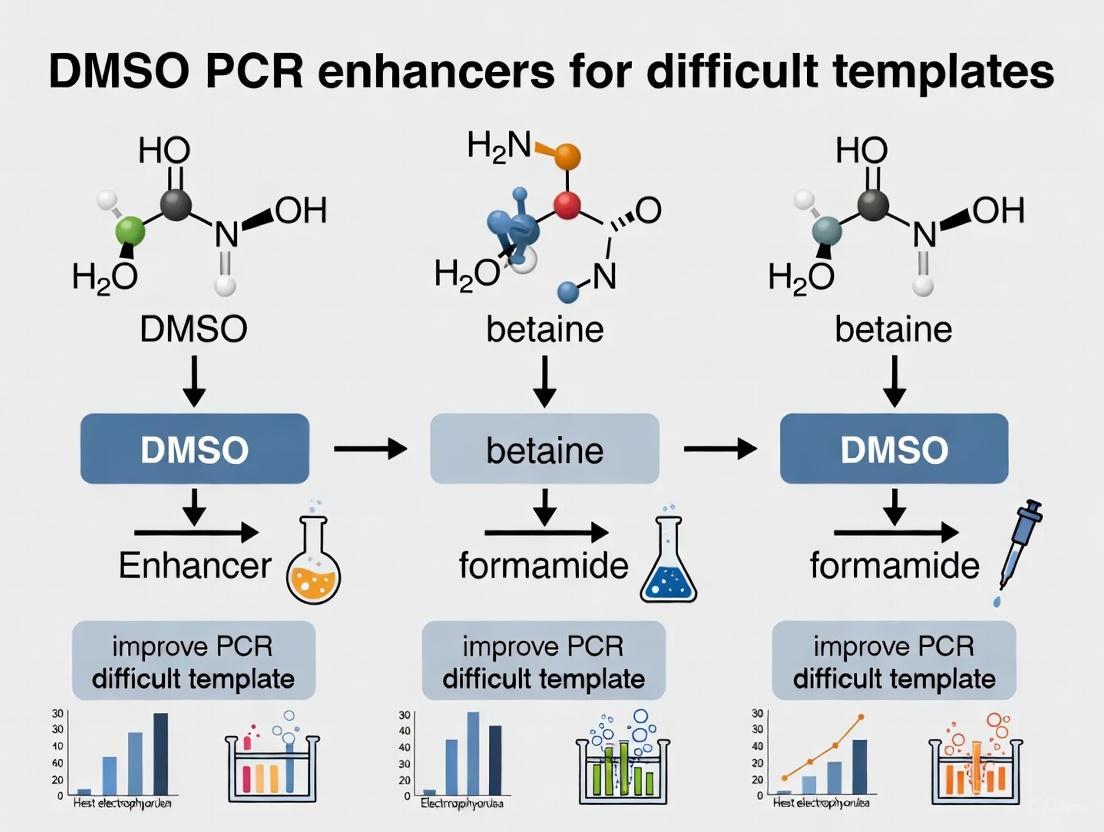
Amplifying challenging DNA templates, particularly those with high GC content (>60%), is a common hurdle in molecular biology and diagnostic assay development.
Optimizing PCR for Difficult Templates: A Comprehensive Guide to DMSO and PCR Enhancers
Abstract
Amplifying challenging DNA templates, particularly those with high GC content (>60%), is a common hurdle in molecular biology and diagnostic assay development. This article provides a systematic guide for researchers and drug development professionals on using DMSO and other PCR enhancers to overcome these obstacles. We cover the foundational science behind why GC-rich sequences and complex secondary structures impede amplification, detail methodological protocols for applying organic additives and specialized polymerases, offer a troubleshooting framework for optimizing reaction conditions, and discuss validation strategies to ensure assay robustness. By integrating proven tips and the latest advancements, this resource aims to equip scientists with a multipronged strategy to achieve reliable amplification of even the most recalcitrant targets, thereby accelerating research and diagnostic workflows.
Understanding the Challenge: Why GC-Rich and Complex Templates Hinder PCR
Technical Support Center
Troubleshooting Guides
Issue: Poor or No PCR Amplification of GC-Rich Templates
- Q: My GC-rich template is not amplifying, or yield is very low. What could be wrong?
- A: GC-rich sequences form stable secondary structures (e.g., hairpins) and have high melting temperatures (Tm), which can prevent complete denaturation and primer binding during standard PCR cycles. The strong triple hydrogen bonds in GC base pairs are a primary contributor to this stability.
- Troubleshooting Steps:
- Verify Template Quality: Ensure the DNA is intact and free of contaminants.
- Check Primer Design: Primers should have balanced Tm and avoid complementarity. For GC-rich targets, primers with a slightly higher Tm may be necessary.
- Increase Denaturation Temperature: Raise the denaturation step to 98°C from the standard 95°C.
- Incorporate PCR Enhancers: Additives like DMSO, formamide, or betaine can disrupt hydrogen bonding and lower the effective Tm of the DNA duplex. See Table 1.
- Optimize Thermocycling Protocol: Implement a touchdown or step-down PCR protocol to favor specific annealing in early cycles.
- Switch Polymerase: Use a polymerase blend specifically engineered for amplifying high-GC content or difficult templates.
Issue: Non-Specific Amplification or Smearing
- Q: I am getting multiple non-specific bands or a smear with my difficult template. How can I improve specificity?
- A: This often occurs when the annealing temperature is too low, or when the polymerase mis-incorporates due to stable secondary structures. Enhancers that reduce duplex stability can help.
- Troubleshooting Steps:
- Perform a Gradient PCR: Empirically determine the optimal annealing temperature.
- Use a Hot-Start Polymerase: This prevents non-specific amplification during reaction setup.
- Adjust Enhancer Concentration: Titrate DMSO or other additives (see Table 1). Too much can inhibit the polymerase.
- Reduce Extension Time: Over-extension can allow non-specific products to be amplified.
- Increase Primer Specificity: Re-design primers using software to ensure they are unique to the target.
Frequently Asked Questions (FAQs)
Q: Why do GC base pairs have a higher melting temperature (Tm) than AT base pairs?
- A: GC base pairs are stabilized by three hydrogen bonds, while AT base pairs only have two. This increased hydrogen bonding, combined with more favorable base-stacking interactions, results in greater duplex stability and a higher Tm.
Q: How does DMSO work as a PCR enhancer for GC-rich templates?
- A: DMSO is a polar aprotic solvent that disrupts hydrogen bonding networks. By interfering with the standard hydrogen bonding between DNA strands, it destabilizes secondary structures and lowers the overall Tm of the DNA duplex, facilitating denaturation and primer access.
Q: Are there alternatives to DMSO for amplifying difficult templates?
- A: Yes. Betaine (trimethylglycine) is a common alternative that equalizes the contribution of GC and AT base pairs to duplex stability. Other additives include formamide, glycerol, and commercial specialized PCR enhancer solutions.
Q: Can I use multiple enhancers together in a single PCR reaction?
- A: It is possible, but careful optimization is required as they can have synergistic or inhibitory effects. For example, a combination of DMSO and betaine is often effective. Start with lower concentrations of each when combining.
Q: What is the downside of using PCR enhancers like DMSO?
- A: High concentrations can inhibit Taq polymerase activity and reduce fidelity. It is crucial to titrate the enhancer to find the optimal concentration that aids amplification without inhibiting the reaction.
Data Presentation
Table 1: Comparison of Common PCR Enhancers for GC-Rich Templates
| Enhancer | Typical Working Concentration | Mechanism of Action | Key Consideration |
|---|---|---|---|
| DMSO | 1-10% (v/v) | Disrupts hydrogen bonding, reduces DNA Tm | Can inhibit polymerase at >10%; titrate carefully. |
| Betaine | 0.5 - 1.5 M | Equalizes base pair stability, prevents secondary structure formation | Less inhibitory than DMSO at high concentrations. |
| Formamide | 1-5% (v/v) | Denaturant that lowers DNA Tm | Can be more potent than DMSO; requires precise optimization. |
| Glycerol | 5-10% (v/v) | Lowers DNA Tm and stabilizes polymerase | Often used in combination with other enhancers. |
| Commercial Enhancer Solutions | As per manufacturer | Proprietary blends often containing surfactants and stabilizing agents | Optimized for specific polymerases; minimal need for titration. |
Experimental Protocols
Protocol: Optimized PCR Amplification of a High-GC Template
Objective: To amplify a DNA fragment with >70% GC content using DMSO as a PCR enhancer.
Materials:
- Template DNA
- Forward and Reverse Primers
- High-Fidelity or GC-Rich Polymerase Master Mix
- Molecular Grade DMSO
- Nuclease-Free Water
- Thermal Cycler
Methodology:
- Prepare a master mix on ice according to the table below. It is recommended to set up a titration of DMSO (e.g., 0%, 3%, 5%, 7%).
- Aliquot the master mix into PCR tubes.
- Add template DNA to each tube.
- Gently mix and briefly centrifuge to collect the contents at the bottom of the tube.
- Place tubes in a thermal cycler and run the following program:
- Initial Denaturation: 98°C for 2 minutes.
- Amplification (35 cycles):
- Denaturation: 98°C for 20 seconds.
- Annealing: (Primer Tm + 3-5°C) for 20 seconds.
- Extension: 72°C for 1 minute/kb.
- Final Extension: 72°C for 5 minutes.
- Hold: 4°C.
- Analyze the PCR products by agarose gel electrophoresis.
Reaction Setup:
| Component | Volume (50 µL rxn) | Final Concentration |
|---|---|---|
| Polymerase Master Mix (2X) | 25 µL | 1X |
| Forward Primer (10 µM) | 2.5 µL | 0.5 µM |
| Reverse Primer (10 µM) | 2.5 µL | 0.5 µM |
| DMSO | Variable (e.g., 1.5 µL) | 3% (v/v) |
| Template DNA | X µL | < 500 ng |
| Nuclease-Free Water | to 50 µL | - |
Mandatory Visualization
Diagram 1: GC vs AT Bond Stability
Diagram 2: PCR Enhancer Workflow
The Scientist's Toolkit
Table 2: Research Reagent Solutions for GC-Rich PCR
| Reagent | Function | Application Note |
|---|---|---|
| DMSO (Dimethyl Sulfoxide) | Hydrogen bond disruptor; reduces DNA melting temperature (Tm). | Titrate between 1-10%. Start at 3-5%. Avoid high concentrations. |
| Betaine | Homogenizes base pair stability; prevents formation of secondary structures. | Often used at a final concentration of 1.0 M. Compatible with many polymerases. |
| GC-Rich Polymerase Blends | Specialized enzyme mixes with enhanced processivity on structured templates. | Follow manufacturer's instructions. Often includes proprietary enhancers. |
| 7-deaza-dGTP | Nucleoside analog that weakens base pairing by reducing hydrogen bonding. | Can be used to partially replace dGTP in the reaction (e.g., 3:1 dGTP:7-deaza-dGTP). |
| Q-Solution (Qiagen) | Proprietary reagent that facilitates denaturation of template DNA. | Used as a supplement to the PCR master mix. Simplifies optimization. |
What are hairpin and stem-loop structures? Hairpins, or stem-loops, are secondary structures that form when two regions of the same single-stranded nucleic acid molecule base-pair to form a double-stranded stem, capped by a loop of unpaired nucleotides [1] [2]. These structures are ubiquitous in both DNA and RNA, but are particularly common in RNA, where they serve as fundamental building blocks for complex secondary structures and play critical roles in gene regulation [1] [2].
Why do they pose a problem in PCR? During polymerase chain reaction (PCR), these stable intramolecular structures can form within single-stranded DNA templates, especially in GC-rich regions or palindromic sequences [1] [3]. When a DNA polymerase enzyme encounters such a structure during the extension phase, it struggles to unwind the stable stem, leading to several experimental issues:
- Premature Termination: The polymerase may dissociate from the template before completing the synthesis of the full amplicon [4].
- Reduced Processivity: The number of nucleotides a polymerase can incorporate per binding event is significantly lowered [5] [6].
- Low Yield and Specificity: Failed or incomplete amplification results in faint or absent bands on a gel, alongside smears or multiple non-specific products [3] [7].
This challenge is a central focus in the broader research on using enhancers like DMSO for difficult templates, as these structures represent a common class of "difficult" amplification targets.
Frequently Asked Questions (FAQs)
Q1: What specific experimental outcomes suggest I have a hairpin problem? You should suspect hairpin interference if you observe:
- A complete absence of a PCR product despite verified primer and template quality.
- A prominent smear on the agarose gel instead of a clean, distinct band.
- Multiple non-specific bands indicating that the polymerase is falling off and re-initiating at incorrect sites.
- A product band that is shorter than expected, suggesting premature termination at the structure [3] [7].
Q2: How do PCR enhancers like DMSO and betaine actually work? PCR enhancers combat secondary structures through different physical mechanisms:
- DMSO (Dimethyl Sulfoxide): Acts as a duplex-destabilizing agent. It interferes with base stacking and hydrogen bonding, thereby lowering the melting temperature (Tm) of DNA. This facilitates the denaturation of stable hairpin stems during the PCR denaturation step [8] [4].
- Betaine (also known as trimethylglycine): Functions as a helix destabilizer in PCR. It equalizes the contribution of GC and AT base pairs to DNA stability by preferentially hydrating AT base pairs. This action prevents the formation of stable secondary structures without significantly altering the Tm of the primer-template interaction [8] [4].
- Sucrose and Trehalose: These disaccharides are known to thermostabilize the DNA polymerase enzyme itself, helping it remain active and processive even in the presence of obstacles [8].
Q3: Besides additives, what polymerase properties are most important? The processivity of a DNA polymerase is critical. Processivity is defined as the average number of nucleotides added by the polymerase per single association/disassociation event with the template [5] [6]. A high-processivity polymerase is less likely to dissociate when it encounters a physical barrier like a hairpin. Engineered polymerases fused to non-specific DNA binding proteins (e.g., Sso7d) exhibit dramatically enhanced processivity and are excellent choices for such challenging targets [5] [6].
Troubleshooting Guide
Problem: Amplification Failure Due to Suspected Secondary Structures
| Troubleshooting Action | Rationale and Specific Protocol Adjustments | Key References |
|---|---|---|
| Incorporate PCR Enhancers | Additives destabilize secondary structures, allowing the polymerase to traverse through. Start with these single agents:• Betaine: Use at a final concentration of 0.5 M - 1.5 M.• DMSO: Use at a final concentration of 2% - 10% (v/v).For extreme cases, consider a cocktail:• 1 M Betaine + 0.1 M Sucrose has been shown to be highly effective while minimizing negative effects on simpler templates. | [8] [4] [7] |
| Optimize Thermal Cycling | Adjusting temperatures and times can help denature stubborn structures.• Increase Denaturation Temperature: Raise from the standard 94°C to 98°C.• Increase Denaturation Time: Extend from 15-30 seconds to 45-60 seconds.• Use a "Touchdown" PCR protocol to increase specificity during initial cycles when templates are most prone to forming secondary structures. | [3] [4] |
| Select a High-Processivity Polymerase | Specialized enzymes are less likely to stall or fall off at blockage sites.• Choose polymerases marketed for "GC-rich" or "difficult" templates.• Look for enzymes engineered with DNA-binding domains (e.g., Sso7d fusions) for superior performance on structured templates. | [5] [3] [6] |
| Redesign Primers | Primers that form structures themselves or bind near template structures compound the problem.• Use primer design software to avoid self-complementarity and hairpin formation within the primer.• Design primers to anneal outside of the predicted structured region if possible.• Ensure a G or C at the 3' end (GC clamp) to improve priming efficiency. | [3] [7] [9] |
| Adjust Mg²⁺ Concentration | Mg²⁺ is a essential cofactor, but its concentration can influence duplex stability.• Perform a Mg²⁺ titration (e.g., from 1.5 mM to 4.0 mM in 0.5 mM increments).• Note that some PCR enhancers may require re-optimization of Mg²⁺ concentration. | [3] [7] [9] |
Experimental Protocols
Protocol 1: Systematic Optimization Using PCR Enhancers
This protocol provides a method to test and compare different enhancers for resolving hairpin-induced amplification failure.
Materials:
- Your standard PCR master mix (polymerase, buffer, dNTPs, primers, template)
- Sterile, nuclease-free water
- PCR enhancers: Betaine (5M stock), DMSO (100%), DMSO (100%), Formamide (100%), Sucrose (1M stock)
- Thin-walled PCR tubes and thermal cycler
Method:
- Prepare Stock Solutions: Ensure all enhancer stock solutions are freshly prepared or properly stored.
- Set Up Reaction Tubes: Label a series of PCR tubes for the different conditions you wish to test, including a no-enhancer control.
- Create Master Mixes: For each condition, prepare a master mix containing all standard PCR components except the enhancer. Aliquot this mix into the labeled tubes.
- Add Enhancers: Add the calculated volume of each enhancer to its respective tube according to the table below. Adjust the volume of water to keep the final reaction volume constant.
- Run PCR: Use your standard thermal cycling protocol, but consider incorporating a higher denaturation temperature (e.g., 98°C) as suggested in the troubleshooting guide.
- Analyze Results: Resolve the PCR products on an agarose gel. Compare the yield and specificity of the target band across the different conditions.
Protocol 2: Evaluating Polymerase Processivity on Structured Templates
This advanced protocol assesses the performance of different DNA polymerases on a known structured template.
Materials:
- DNA template containing a documented, stable hairpin (e.g., a GC-rich region >70%).
- Two or more different DNA polymerases: a standard polymerase (e.g., Taq) and a high-processivity polymerase.
- PCR reagents as in Protocol 1.
- Agarose gel electrophoresis equipment.
Method:
- Design Primers: Design primers that flank the structured region to generate an amplicon of defined length.
- Parallel PCRs: Set up identical PCR reactions that differ only in the type of DNA polymerase used. Use the optimal enhancer and cycling conditions identified in Protocol 1.
- Amplification: Run the PCRs simultaneously in the same thermal cycler to ensure identical conditions.
- Gel Analysis: Analyze the products. A higher-processivity polymerase should show:
- A stronger, cleaner band of the correct size.
- Fewer or fainter shorter, non-specific bands resulting from premature termination.
- Quantitative Analysis (Optional): Use real-time PCR to calculate cycle threshold (Ct) values. A lower Ct value with the high-processivity polymerase indicates more efficient amplification [8].
Visualization and Workflows
Hairpin Impact and Solution Workflow
The Scientist's Toolkit: Research Reagent Solutions
The following table details key reagents used to overcome challenges posed by secondary structures in PCR.
| Reagent | Function / Mechanism of Action | Example Use Case & Concentration |
|---|---|---|
| Betaine | Helix destabilizer; reduces secondary structure stability by equalizing GC and AT base pair contribution. | GC-rich templates. Use at 0.5 - 1.5 M final concentration. Often the first-choice enhancer. [8] [4] |
| DMSO (Dimethyl Sulfoxide) | Duplex destabilizer; disrupts base stacking and hydrogen bonding, lowering DNA melting temperature (Tm). | Stable hairpins and complex templates. Use at 2% - 10% (v/v). High concentrations can inhibit polymerase. [8] [4] [7] |
| Sucrose/Trehalose | Polymerase thermostabilizer; helps maintain enzyme activity and processivity at high temperatures. | Long amplicons or inhibitor-containing samples. Use at 0.1 - 0.4 M. Often used in combination with betaine. [8] |
| Formamide | Strong denaturant; powerfully lowers DNA Tm, effectively melting stable secondary structures. | Extremely stubborn structures. Use at 1.25% - 5% (v/v). Can be highly inhibitory to polymerases. [8] [7] |
| High-Processivity Polymerase | Engineered enzyme with higher affinity for DNA template; adds more nucleotides per binding event. | All difficult templates with structure. Use as per manufacturer's instructions. Essential for long or highly structured targets. [5] [3] [6] |
| MgCl₂ | Essential cofactor for DNA polymerase activity; concentration influences enzyme fidelity and DNA duplex stability. | Required for all PCRs. Titrate from 1.5 - 4.0 mM for optimization, especially when using enhancers. [3] [7] [9] |
► FAQ: What Defines a 'Difficult Template' in PCR?
In PCR, a 'difficult template' is a DNA or RNA sequence that is challenging to amplify efficiently and faithfully due to its specific physicochemical properties. These properties can prevent the DNA polymerase from smoothly traversing the template and generating the correct product. The primary characteristics that define a difficult template are its GC content, secondary structures, and overall sequence complexity [3].
Templates with very high GC content (typically >60-65%) form stable, intrastrand secondary structures due to the three hydrogen bonds in G:C base pairs. Conversely, sequences with very low AT content can also be problematic. These structures, such as hairpins and stem-loops, can block the progression of the DNA polymerase. Furthermore, long templates and sequences with complex repeats also fall into the difficult template category, as they can cause polymerase slippage or stalling [3] [7].
► FAQ: What are the Specific GC Content Thresholds for Problematic Templates?
While the exact thresholds can vary depending on the specific sequence context and polymerase used, general guidelines are well-established in molecular biology practice. The following table summarizes the quantitative thresholds that typically define a difficult template based on GC content:
| Template Characteristic | Threshold / Definition | Primary Issue Caused |
|---|---|---|
| High GC Content | >60% - 65% [7] | Promotes formation of stable secondary structures and requires higher denaturation energy. |
| Optimal GC Content | 40% - 60% [7] | Provides a balance for stable primer binding without excessive structure. |
| Low GC / High AT Content | <40% [7] | Can lead to less stable primer-template complexes and "DNA breathing" at the 3' ends. |
| Sequence Complexity | Presence of direct repeats, dinucleotide runs, or single-base runs of >4 bases [7] | Can cause polymerase slippage, mispriming, or the formation of hairpin loops. |
► Troubleshooting Guide: Overcoming Challenges with Difficult Templates
Problem: No Amplification or Low Yield of Specific Product
Possible Causes and Solutions:
- Cause: Inefficient Denaturation. Stable secondary structures, common in GC-rich regions, prevent the DNA strands from fully separating during the denaturation step.
- Solution: Increase the denaturation temperature (up to 98°C) and/or time [3]. Use a DNA polymerase with high processivity, which has a stronger affinity for the template and can better unwind tough structures [3].
- Solution: Incorporate PCR enhancers or co-solvents. DMSO (at 1-10%) [7] or proprietary GC Enhancer solutions help denature GC-rich DNA by interfering with hydrogen bonding [3]. Other additives include formamide (1.25-10%), or Betaine (0.5 M to 2.5 M) [7].
- Cause: Poor Primer Binding. The primers themselves may be GC-rich or the annealing conditions may be suboptimal.
- Solution: Follow optimal primer design rules. Primers should be 15-30 bases long, have a GC content between 40-60%, and should not contain complementary sequences to each other or within themselves [7]. The 3' end should ideally end with a G or C to increase priming efficiency [7].
- Solution: Optimize the annealing temperature. Use a gradient thermal cycler to test a range of temperatures in 1–2°C increments [3].
Problem: Non-specific Amplification or Smear on Gel
Possible Causes and Solutions:
- Cause: Mispriming at Low Temperatures. At lower annealing temperatures, primers can bind to non-perfectly complementary sequences.
- Cause: Excessive Mg2+ Concentration. High Mg2+ can reduce the specificity of primer binding.
The Scientist's Toolkit: Research Reagent Solutions
| Reagent / Material | Function in Amplifying Difficult Templates |
|---|---|
| High-Processivity DNA Polymerase | Displays high affinity for templates and is more suitable for amplifying difficult targets like those with complex secondary structures [3]. |
| Hot-Start DNA Polymerase | Prevents non-specific amplification and primer-dimer formation by remaining inactive until a high-temperature activation step [10] [3]. |
| DMSO (Dimethyl Sulfoxide) | A common co-solvent that helps denature GC-rich DNA templates by disrupting base pairing [7]. |
| Proprietary GC Enhancer | A solution often supplied with specific DNA polymerases to help denature GC-rich sequences and sequences with secondary structures [3]. |
| Betaine | An additive that can equalize the thermodynamic stability of AT and GC base pairs, helping to amplify sequences with high GC content or long homopolymer runs [7]. |
| Molecular Biology Grade Water | Used to suspend DNA and in reaction mixtures; its purity is critical to avoid nuclease contamination or PCR inhibitors [3]. |
► Experimental Protocol: Optimizing PCR with DMSO for a GC-Rich Template
This protocol provides a detailed methodology for testing the effect of DMSO on the amplification of a known difficult template.
1. Reagent Preparation:
- Template DNA: 1-100 ng of your difficult template (e.g., a plasmid or genomic DNA with >65% GC content in the target region).
- Primers: Resuspend lyophilized primers to a stock concentration of 100 µM. Prepare a working solution of 10 µM for each primer [12].
- Master Mix: A commercial 2X PCR master mix containing buffer, dNTPs, and a hot-start, high-fidelity DNA polymerase (e.g., Q5 or Phusion) [11].
- DMSO Stock: Molecular biology grade, 100% DMSO.
- Sterile Water: Nuclease-free.
2. Reaction Setup:
- Prepare a master mix for all reactions to minimize pipetting error. For a 25 µL final reaction volume, combine:
- 12.5 µL of 2X Master Mix
- 0.5 µL of forward primer (10 µM)
- 0.5 µL of reverse primer (10 µM)
- 1.0 µL of template DNA
- X µL of DMSO (see table below)
- Y µL of sterile water to bring the total volume to 25 µL.
- Set up the following reactions in individual 0.2 mL PCR tubes:
| Tube # | DMSO Concentration | Volume of 100% DMSO | Volume of Sterile Water |
|---|---|---|---|
| 1 | 0% (Control) | 0 µL | 10.5 µL |
| 2 | 2% | 0.5 µL | 10.0 µL |
| 3 | 5% | 1.25 µL | 9.25 µL |
| 4 | 8% | 2.0 µL | 8.5 µL |
3. Thermal Cycling:
- Use the following cycling conditions, which are a starting point for a ~500bp GC-rich amplicon:
- Initial Denaturation: 98°C for 2 minutes (activates hot-start polymerase).
- Amplification (35 cycles):
- Denaturation: 98°C for 15 seconds.
- Annealing: Test a gradient from 60°C to 72°C for 30 seconds.
- Extension: 72°C for 30 seconds.
- Final Extension: 72°C for 5 minutes.
- Hold: 4°C.
4. Product Analysis:
- Analyze 5-10 µL of each PCR product alongside a suitable DNA ladder using agarose gel electrophoresis.
- Compare the intensity and specificity of the correct band across the different DMSO concentrations and annealing temperatures. The optimal condition will show a strong, discrete band of the expected size with minimal to no background smearing.
► Experimental Protocol: Workflow for Systematic PCR Optimization
This workflow provides a logical sequence for diagnosing and resolving issues with difficult templates.
► FAQ: How Do PCR Enhancers Like DMSO Work on a Molecular Level?
PCR enhancers like DMSO function by altering the physical environment of the DNA template to make it more accessible to the polymerase. For difficult templates, particularly those with high GC content, the primary mechanism is the destabilization of DNA secondary structures [3].
DMSO is a polar aprotic solvent that interferes with the hydrogen bonding network and base stacking interactions that stabilize DNA duplexes and secondary structures. By doing so, it effectively lowers the melting temperature (Tm) of the DNA, making it easier to denature the template strands during the PCR denaturation step. This allows the primers and polymerase better access to their target sequences. Other enhancers, like Betaine, work by acting as a stabilizing osmolyte that can reduce the differential in stability between GC-rich and AT-rich regions, promoting more uniform amplification [7].
What are PCR enhancers and when should I consider using them? PCR enhancers are chemical additives included in the PCR reaction mixture to improve the amplification efficiency, specificity, and yield of "difficult" DNA templates. You should consider using them when amplifying challenging targets such as templates with high GC content (typically >60%), long amplicons, or sequences prone to forming stable secondary structures [4] [13]. These problematic regions can cause polymerases to stall, resulting in failed amplification, non-specific products, or significantly reduced yield.
The core mechanism shared by many PCR enhancers involves lowering the melting temperature (Tm) of DNA and disrupting secondary structures that form within GC-rich sequences [14] [4]. Due to the three hydrogen bonds between G-C base pairs (versus two for A-T pairs), GC-rich DNA fragments have higher thermal stability and are more prone to forming strong intramolecular structures like hairpins after the denaturation step [13]. These structures prevent primers from annealing properly and block polymerase progression during extension.
Core Mechanisms of Action
How do PCR enhancers actually work at the molecular level? PCR enhancers employ several distinct biochemical mechanisms to facilitate amplification of difficult templates, with the most common being reduction of DNA melting temperature and disruption of secondary structures.
Table 1: Primary Mechanisms of Common PCR Enhancers
| Enhancer | Primary Mechanism | Effect on DNA | Considerations |
|---|---|---|---|
| DMSO | Interacts with water molecules on DNA strands, reducing hydrogen bonding [14] | Lowers melting temperature (Tm), facilitates DNA strand separation [14] | Reduces Taq polymerase activity; optimal concentration 2-10% [14] [15] |
| Betaine | Interacts with negatively charged groups on DNA, reducing electrostatic repulsion [14] | Destabilizes secondary structures, eliminates base pair composition dependence during denaturation [14] | Also thermally stabilizes DNA polymerases; recommended concentration 0.5-1.7M [14] [8] |
| Formamide | Binds to grooves in DNA, disrupting hydrogen bonds and hydrophobic interactions [14] | Reduces DNA double helix stability, lowers Tm [14] | Promotes specific primer binding; typical concentration 1-5% [14] |
| 7-deaza-dGTP | dGTP analog that incorporates into nascent DNA strands [13] | Destabilizes GC pairs by replacing standard guanine bases [13] | May not stain well with ethidium bromide [16] |
The following diagram illustrates how these enhancers overcome the challenges of GC-rich amplification:
How do these mechanisms translate to practical performance improvements? Recent systematic comparisons reveal how different enhancers affect amplification efficiency across templates with varying GC content. The data below shows cycle threshold (Ct) values from real-time PCR, where lower Ct indicates better amplification efficiency [8]:
Table 2: Performance Comparison of PCR Enhancers Across Different GC Content Templates
| Enhancer | Concentration | Moderate GC (53.8%) Ct±SEM | High GC (68.0%) Ct±SEM | Super High GC (78.4%) Ct±SEM |
|---|---|---|---|---|
| Control (No enhancer) | - | 15.84±0.05 | 15.48±0.22 | 32.17±0.25 |
| DMSO | 5% | 16.68±0.01 | 15.72±0.03 | 17.90±0.05 |
| Betaine | 0.5 M | 16.03±0.03 | 15.08±0.10 | 16.97±0.12 |
| Formamide | 5% | 18.08±0.07 | 15.44±0.03 | 16.32±0.05 |
| Ethylene Glycol | 5% | 16.28±0.06 | 15.27±0.08 | 17.24±0.04 |
| Sucrose | 0.4 M | 16.39±0.09 | 15.03±0.04 | 16.67±0.08 |
The data demonstrates that while most enhancers slightly reduce efficiency for moderate GC content templates (higher Ct values), they provide substantial benefits for GC-rich targets, with betaine and sucrose showing particularly strong performance [8].
Experimental Protocols and Optimization
What is a systematic protocol for testing PCR enhancers with my difficult template? Follow this step-by-step optimization protocol to identify the ideal enhancer conditions for your specific GC-rich target:
Prepare enhancer stock solutions:
Set up initial test reactions:
- Use your standard PCR protocol with 25-30μL final volume
- Create a master mix containing all standard components (buffer, dNTPs, primers, template, polymerase)
- Aliquot equal volumes to individual tubes
- Add enhancers to test concentrations (include a no-enhancer control)
- Consider testing combinatorial approaches (e.g., 0.5M betaine + 0.2M sucrose) [8]
Thermal cycling conditions:
Analysis and optimization:
- Run products on agarose gel to assess specificity and yield
- For non-specific products, increase annealing temperature in 2°C increments
- If yield remains low, increase MgCl₂ concentration (1.0-4.0mM in 0.5mM increments) [16]
- Consider polymerase choice: Specialized polymerases like Q5 High-Fidelity or OneTaq are optimized for GC-rich templates [16]
What concentration ranges should I test for each enhancer? Systematic optimization should cover these effective concentration ranges, as performance is highly template-dependent:
Table 3: Optimal Concentration Ranges for Common PCR Enhancers
| Enhancer | Stock Concentration | Tested Concentration Range | Typically Optimal Concentration |
|---|---|---|---|
| DMSO | 100% | 2.5-10% (v/v) | 5% (v/v) [8] |
| Betaine | 5 M | 0.5-1.7 M | 0.5-1.0 M [14] [8] |
| Formamide | 100% | 1-5% (v/v) | 2.5-5% (v/v) [14] [8] |
| Sucrose | 1 M | 0.1-0.4 M | 0.2-0.4 M [8] |
| Trehalose | 1 M | 0.1-0.4 M | 0.2-0.4 M [8] |
| Glycerol | 50% (v/v) | 2.5-10% (v/v) | 5% (v/v) [8] |
Troubleshooting Guide
I'm still not getting good amplification after trying enhancers. What else should I consider? When enhancers alone don't resolve amplification issues, implement this systematic troubleshooting approach:
Verify template quality and concentration: Run an aliquot on a gel and check spectrophotometer readings for contamination or degradation [17]. Even if DNA appears non-degraded, clean it up or prepare a fresh sample.
Optimize primer design: Ensure primers are 18-25 nucleotides with GC content of 40-60% [18]. Include a couple of G or C residues at the 3' end to increase annealing strength [17]. Check that primers lack strong secondary structures and have Tm values within 5°C of each other.
Adjust thermal cycling parameters: Implement touchdown or touchup PCR protocols that start at high or low annealing temperatures for several cycles, then adjust temperature [17]. Increase the number of cycles from 30 to 40, and consider adding more enzyme after 20 cycles [17].
Try specialized polymerases: Standard Taq may be insufficient. Use polymerases specifically engineered for difficult templates, such as Phusion for long targets or OneTaq and Q5 polymerases for GC-rich regions [17] [16].
Combinatorial enhancer approaches: Some challenging templates require multiple enhancers. Research shows that combinations like "1 M betaine + 0.1 M sucrose" can effectively promote amplification while minimizing negative effects on normal fragments [8].
The following workflow outlines a comprehensive troubleshooting strategy:
What specific reagents and resources should I have available for working with difficult templates? Maintain these essential reagents in your laboratory to address various PCR challenges:
Table 4: Essential Research Reagent Solutions for Difficult PCR Templates
| Reagent Category | Specific Examples | Primary Function | Notes |
|---|---|---|---|
| Standard Enhancers | DMSO, Betaine, Glycerol, Formamide | Reduce DNA melting temperature, disrupt secondary structures | Test individually first, then in combination [14] [8] |
| Sugar-Based Enhancers | Sucrose, Trehalose | Thermal stabilization of DNA polymerases, mild effect on normal PCR | Show excellent inhibitor tolerance and enzyme stabilization [8] |
| Specialized Polymerases | Q5 High-Fidelity, OneTaq, Phusion | Optimized for GC-rich, long, or difficult amplicons | Often supplied with proprietary GC enhancers [17] [16] |
| Buffer Components | MgCl₂, BSA, Tetramethylammonium chloride (TMAC) | Cofactor provision, inhibitor neutralization, increased specificity | Mg²⁺ is essential polymerase cofactor (1.0-4.0mM optimal) [14] [16] |
| Nucleotide Analogs | 7-deaza-dGTP | Destabilizes GC pairs by incorporating into nascent DNA | May require adjustment of staining methods [16] [13] |
Frequently Asked Questions
Can PCR enhancers negatively affect my reactions? Yes, most PCR enhancers can inhibit PCR when used at excessive concentrations. DMSO and formamide thermally destabilize enzymes, while even beneficial enhancers like betaine and trehalose can decrease efficiency at high concentrations [8]. Systematic concentration testing is essential, as the optimal level is template-specific. For instance, while 5% DMSO may help one GC-rich target, it might inhibit amplification of another [14] [16].
Which enhancer is most effective for extremely GC-rich templates (>80% GC)? For extremely GC-rich templates, betaine typically outperforms other single enhancers. Research shows that 1M betaine effectively promotes amplification of super high GC content (78.4%) fragments, reducing Ct values from 32.17 to 16.97 [8]. For the most challenging targets, combinatorial approaches work best - a mixture of "1M betaine + 0.1M sucrose" can effectively promote amplification while minimizing negative effects on normal fragments [8].
How do I choose between DMSO and betaine for my experiment? The choice depends on your specific template and tolerance for polymerase inhibition. DMSO is particularly effective at reducing DNA melting temperature by interacting with water molecules on the DNA strand [14], but it also reduces Taq polymerase activity. Betaine acts as an osmoprotectant that reduces formation of DNA secondary structures and also thermally stabilizes DNA polymerases [14] [8]. Empirical testing is recommended, starting with 5% DMSO or 0.5-1M betaine.
Are there any commercial master mixes specifically designed for GC-rich templates? Yes, several manufacturers offer specialized master mixes. New England Biolabs provides OneTaq Hot Start 2X Master Mix with GC Buffer and Q5 High-Fidelity DNA Polymerase with GC Enhancer, both specifically formulated for challenging GC-rich amplicons [16]. These proprietary mixes often contain optimized combinations of enhancers that address multiple challenges simultaneously.
Recent Advances and Future Perspectives
What recent innovations have emerged in PCR enhancement technology? Recent research has focused on sugar-based enhancers and combinatorial approaches. Studies demonstrate that sucrose and trehalose provide excellent thermal stabilization of DNA polymerases with minimal negative impact on normal PCR efficiency [8]. These enhancers also show promising resistance to PCR inhibitors, expanding their utility to direct amplification from complex samples.
The emerging understanding of DNA structural mechanics, including how DMSO moderately and linearly decreases DNA's bending persistence length [19], provides deeper insight into the biophysical principles underlying enhancer function. This knowledge enables more rational selection and development of next-generation PCR enhancers specifically tailored to overcome the most stubborn amplification challenges in modern molecular biology and diagnostic applications.
A Practical Toolkit: Protocols for DMSO, Betaine, and High-GC Enhancers
Dimethyl sulfoxide (DMSO) is a polar aprotic solvent with exceptional properties that make it invaluable across biological and chemical research disciplines. With the chemical formula (CH₃)₂SO, this colorless liquid possesses a unique ability to dissolve both polar and nonpolar compounds, rendering it a versatile solvent for a wide array of applications [20]. In biomedical research, DMSO is widely utilized for cryopreservation, as a penetration enhancer in topical formulations, and as a vehicle for both in vitro and in vivo drug discovery screening programs [21] [22]. Its capacity to readily penetrate biological membranes enables it to enhance the diffusion of other substances through skin and tissues, a property that has been exploited in pharmaceutical formulations and research applications [23] [21].
In molecular biology, DMSO serves a critical role as a PCR enhancer, particularly for difficult DNA templates [20]. When added to PCR mixtures, DMSO interferes with DNA self-complementarity, thereby minimizing secondary structure formation and spurious priming events that can compromise amplification efficiency and specificity [7] [20]. This application is especially valuable for amplifying GC-rich sequences or supercoiled plasmids that would otherwise present significant challenges using standard PCR protocols. Despite its widespread use, researchers must exercise careful consideration with DMSO, as its biological effects are concentration-dependent and not entirely inert, even at low concentrations [22].
Molecular Mechanisms of Action
Membrane Interactions and Permeability Enhancement
The molecular mechanism through which DMSO exerts its effects on biological membranes has been elucidated through atomic-scale molecular dynamics simulations. Research indicates that DMSO exhibits three distinct modes of action, each dependent on concentration range [24]. At low concentrations (typically below 0.1 mol fraction), DMSO induces membrane thinning and increases fluidity within the hydrophobic core of phospholipid bilayers [24] [25]. This fluidizing effect reduces membrane rigidity and general structural integrity, which facilitates the membrane fusion processes essential to various cellular functions and experimental applications [24].
At higher concentrations (approximately 0.1 to 0.2 mol fraction), DMSO induces the formation of transient water pores within the membrane structure [24] [25]. These pores serve as conduits for hydrophilic molecules and ions that would otherwise be unable to cross the lipid bilayer, thereby explaining DMSO's significant enhancement of membrane permeability [25]. At still higher concentrations, DMSO prompts the desorption of individual lipid molecules from the membrane, ultimately leading to complete disintegration of the bilayer structure [24]. The amphiphilic nature of DMSO appears fundamental to this pore-forming capability, as DMSO molecules accumulate beneath phospholipid headgroups, acting as spacers between lipids and creating structural defects that enable water penetration into the membrane interior [25].
Effects on Nucleic Acids and Protein Interactions
In the context of molecular biology applications, DMSO exerts specific effects on nucleic acids that make it particularly valuable for PCR applications. DMSO interferes with the self-complementarity of DNA by reducing the thermal stability of DNA duplexes [20]. This property proves especially beneficial when amplifying GC-rich templates that tend to form stable secondary structures, which can impede polymerase progression and primer annealing [3] [20]. By decreasing the melting temperature of these problematic structures, DMSO facilitates more efficient and specific amplification of challenging targets.
Despite its utility, recent evidence suggests that DMSO is not biologically inert, even at concentrations as low as 0.1% [22]. Transcriptome analyses of 3D cardiac and hepatic microtissues exposed to 0.1% DMSO revealed thousands of differentially expressed genes affecting similar biological processes across both tissue types [22]. Furthermore, DMSO exposure caused large-scale deregulation of microRNAs and alterations in the epigenetic landscape, particularly in maturing cardiac models [22]. These findings underscore the importance of careful DMSO concentration optimization and appropriate control design in experimental planning.
Table 1: Concentration-Dependent Mechanisms of DMSO Action
| Concentration Range | Primary Mechanisms | Research Applications |
|---|---|---|
| Low (≤0.1 mol fraction) | Membrane thinning, increased fluidity of hydrophobic core | Cryopreservation, membrane fluidity studies |
| Medium (0.1-0.2 mol fraction) | Transient water pore formation | Permeability enhancement for hydrophilic compounds |
| High (≥0.3 mol fraction) | Lipid desorption, bilayer disintegration | Cell fusion, tissue disruption |
| PCR concentrations (1-10%) | Reduced DNA thermostability, interference with secondary structures | Amplification of GC-rich templates, supercoiled plasmids |
Visualizing DMSO's Mechanism of Action
DMSO in PCR: Guidelines and Optimization
Optimal Concentration Ranges for Different Applications
The effective use of DMSO in PCR requires careful concentration optimization, as the ideal amount varies depending on template characteristics and specific application requirements. For standard PCR applications with moderately challenging templates, DMSO concentrations typically range from 1% to 5% (v/v) [7]. When working with extremely GC-rich sequences or supercoiled plasmids that present substantial amplification challenges, concentrations may be increased up to 10%, though higher concentrations can potentially inhibit polymerase activity [20]. Research indicates that a 10% final concentration of DMSO in PCR mixtures with Phusion DNA polymerase decreases the primer annealing temperature by approximately 5.5-6.0°C [20], highlighting its significant effect on reaction thermodynamics.
For biological applications beyond PCR, concentration optimization remains critical. In cryopreservation protocols, DMSO concentrations of 10% are commonly employed to protect cells during freezing [22]. For in vitro cell culture studies, DMSO concentrations below 10% (v/v) are generally considered nontoxic [22], though recent evidence suggests biological effects even at 0.1% concentration [22]. When used as a penetration enhancer in topical formulations, concentrations greater than 60% are often required for optimum efficacy [26], though these higher concentrations may cause skin irritation, erythema, and wheals [26].
Table 2: Recommended DMSO Concentration Ranges for Various Applications
| Application | Recommended Concentration | Purpose | Considerations |
|---|---|---|---|
| Standard PCR | 1-3% (v/v) | Reduce secondary structures | Balance between specificity and yield |
| GC-rich PCR | 5-10% (v/v) | Lower melting temperature of stable templates | Higher concentrations may inhibit polymerase |
| Cryopreservation | ~10% (v/v) | Prevent ice crystal formation | Standard for cell storage in liquid nitrogen |
| In vitro assays | 0.1-1% (v/v) | Solubilize compounds | Can affect cell growth and viability |
| Topical formulations | >60% (v/v) | Enhance skin penetration | May cause skin irritation at high concentrations |
Troubleshooting DMSO in PCR: FAQs
Q: Why does my PCR reaction produce smeared bands or multiple products when using DMSO?
A: Smearing or multiple bands often indicate non-specific amplification. While DMSO should reduce secondary structures, excessive concentrations can decrease reaction specificity. First, optimize DMSO concentration in 1% increments from 1% to 5%. Simultaneously, adjust the annealing temperature upward in 1-2°C increments, as DMSO lowers the effective annealing temperature [20]. Ensure that your primer design follows best practices—primers should be 15-30 bases long with 40-60% GC content and minimal self-complementarity [7]. Consider using hot-start DNA polymerases to prevent non-specific amplification during reaction setup [3].
Q: I'm getting no amplification product with my GC-rich template, even with DMSO. What should I try next?
A: For extremely challenging GC-rich templates, implement a multi-faceted approach. Increase DMSO concentration to 8-10% while complementing with other additives such as betaine (0.5-2.5 M) [7]. Extend the initial denaturation time to 3-5 minutes and increase denaturation temperature to 98°C if your polymerase tolerates it [3]. Implement a touchdown PCR protocol where the annealing temperature is gradually decreased in subsequent cycles. Verify that your template DNA is of high quality and free from inhibitors, and consider increasing the number of PCR cycles to 35-40 when targeting low-copy templates [3].
Q: How should I properly prepare and add DMSO to my PCR reactions?
A: Always use high-purity, molecular biology-grade DMSO. Aliquot DMSO to minimize repeated freeze-thaw cycles and water absorption, as DMSO is hygroscopic [20]. When preparing PCR master mixes, add DMSO after the buffer but before the polymerase. Mix reactions thoroughly by pipetting, as DMSO's viscosity can lead to uneven distribution. Include a negative control with DMSO but without template DNA to identify any contamination issues. When testing DMSO optimization, prepare a master mix without DMSO and aliquot it before adding varying DMSO concentrations to individual tubes to maintain consistency across reactions.
Q: Can DMSO affect my downstream applications?
A: Yes, DMSO can interfere with various downstream applications if carried over in sufficient quantities. For enzymatic downstream steps such as restriction digestion or cloning, DMSO concentrations above 1% may inhibit enzyme activity. For sequencing applications, DMSO is often intentionally included to resolve compressions, but inconsistent amounts can cause problems. It's recommended to remove DMSO through purification methods such as ethanol precipitation, column-based cleanups, or gel extraction before proceeding to downstream applications. Always include appropriate controls to distinguish between template-specific issues and DMSO-related effects.
Experimental Protocols and Methodologies
Systematic Optimization of DMSO in PCR
A methodical approach to DMSO optimization ensures robust and reproducible PCR results, particularly when working with challenging templates. Begin by preparing a standard PCR master mix without DMSO, containing 1X polymerase buffer, 200 μM dNTPs, 0.5-1.0 μM of each primer, 0.5-2.5 units of DNA polymerase, and template DNA (1-100 ng for genomic DNA) [7]. Aliquot equal volumes of this master mix into individual PCR tubes. Prepare a DMSO dilution series (0%, 1%, 2%, 3%, 4%, 5%, 7%, and 10%) using molecular biology-grade DMSO and sterile water. Add the corresponding DMSO solutions to each tube, maintaining a constant final reaction volume (typically 25-50 μL).
When setting up thermal cycling parameters, begin with standard conditions for your polymerase but incorporate flexibility for optimization. Use an initial denaturation at 95-98°C for 2-5 minutes, followed by 30-35 cycles of denaturation (95°C for 20-30 seconds), annealing (start 3-5°C below the calculated Tm of your primers for 20-30 seconds), and extension (72°C for 1 minute per kb of amplicon) [7]. Consider implementing a gradient thermal cycler to test a range of annealing temperatures simultaneously with your DMSO concentration series. After amplification, analyze products by agarose gel electrophoresis to identify the DMSO concentration and annealing temperature combination that yields the strongest specific product with minimal background.
The Scientist's Toolkit: Essential Research Reagent Solutions
Table 3: Essential Reagents for DMSO-Enhanced Molecular Biology
| Reagent | Function | Considerations for Use with DMSO |
|---|---|---|
| Molecular Biology Grade DMSO | High-purity solvent for sensitive applications | Aliquot to prevent repeated freeze-thaw cycles; store desiccated to prevent water absorption |
| Hot-Start DNA Polymerase | Reduces non-specific amplification during reaction setup | Compatible with DMSO; check manufacturer's recommendations for maximum DMSO tolerance |
| dNTP Mix (2.5 mM each) | Building blocks for DNA synthesis | Maintain balanced concentrations (200 μM each) to prevent incorporation errors |
| MgCl₂ or MgSO₄ Solution | Cofactor for polymerase activity | Optimize concentration (1.5-4.0 mM) as DMSO can affect magnesium availability |
| Betaine (5M Solution) | Additional additive for GC-rich templates | Can be used in combination with DMSO (0.5-2.5 M final) for challenging templates |
| Gradient Thermal Cycler | Enables simultaneous testing of multiple annealing temperatures | Essential for systematic optimization of DMSO with temperature parameters |
| PCR Purification Kit | Removes DMSO and other reaction components from products | Critical for downstream applications sensitive to DMSO carryover |
DMSO represents a powerful tool in the molecular biologist's arsenal, particularly when confronting challenging PCR templates characterized by high GC content, secondary structures, or complex architecture. Its dual mechanism of action—both at the membrane level in biological systems and through direct interaction with nucleic acids in PCR—underscores its versatility across research applications. The concentration-dependent effects of DMSO highlight the critical importance of systematic optimization, as improper usage can compromise experimental outcomes rather than enhance them.
When incorporating DMSO into PCR protocols, researchers should adopt a methodical approach to concentration optimization, typically beginning within the 1-5% range and adjusting based on template characteristics. The integration of DMSO with other strategic approaches, including adjusted thermal cycling parameters, complementary additives like betaine, and well-designed primers, creates a powerful multifaceted solution for amplifying difficult templates. Furthermore, awareness of DMSO's potential effects on downstream applications ensures that researchers can plan appropriate purification steps when necessary.
As research continues to reveal the subtle yet significant biological effects of DMSO even at low concentrations, the scientific community must maintain rigorous standards for its use, including appropriate control experiments and careful documentation of concentrations in methodological descriptions. Through such disciplined application, DMSO will continue to serve as a valuable asset in advancing molecular biology research and diagnostic applications.
Within the broader research on PCR enhancers like DMSO for difficult templates, betaine (trimethylglycine) has emerged as a powerful homostabilizing agent. Amplification of GC-rich DNA sequences is a major challenge in molecular biology, often resulting in inefficient amplification, nonspecific products, or complete PCR failure [27] [28]. These difficulties arise because GC-rich templates form stable secondary structures, such as hairpins and stem-loops, due to the three hydrogen bonds between guanine and cytosine. These structures can cause polymerase pausing, mispriming, and premature termination during amplification [29] [27]. Betaine functions as an isostabilizing agent by disrupting these secondary structures, effectively equilibrating the melting temperature (Tm) difference between AT and GC base pairs, thereby facilitating more efficient and specific amplification of challenging templates [29] [27].
Troubleshooting Guide: Common Issues and Solutions
This section addresses specific, frequently encountered problems when amplifying GC-rich DNA and provides targeted solutions based on the application of betaine.
Table 1: Troubleshooting Common PCR Problems with Betaine
| Problem | Possible Cause | Recommended Solution |
|---|---|---|
| Nonspecific bands/smearing [28] | Primer annealing to incorrect sites; high template secondary structure. | Add 1.3 M betaine alone or in combination with 5% DMSO to reduce mispriming [28]. |
| Weak or no target amplification [29] [28] | Extreme GC content (>70%) causing polymerase stalling. | Use a combination of 1.3 M betaine, 5% DMSO, and 50 µM 7-deaza-dGTP to fully destabilize secondary structures [28]. |
| Inconsistent results between replicates | Inefficient denaturation of GC-rich templates. | Include 1.3 M betaine in the master mix to ensure consistent template denaturation and primer annealing across cycles [29]. |
| Preferential amplification of shorter alleles [28] | PCR bias against longer, GC-rich alleles in heterozygotes. | Employ betaine-containing reagent mixes to ensure balanced amplification of all alleles for accurate genotyping [28]. |
Frequently Asked Questions (FAQs)
Q1: What is the precise mechanism by which betaine improves PCR of GC-rich DNA? Betaine acts as a homostabilizing agent and an osmolyte. It accumulates in GC-rich regions and disrupts the base-stacking interactions that stabilize DNA secondary structures. By binding in the minor groove, betaine increases the hydration of GC pairs, which destabilizes GC-rich DNA and prevents the formation of hairpins and stem-loops that impede polymerase progression [27]. This action effectively lowers the melting temperature of GC-rich regions, making the template more accessible to primers and polymerase.
Q2: At what concentration should I use betaine in PCR? The widely used and effective concentration for betaine in PCR is 1.3 Molar (M) [28]. It is typically prepared as a 5M stock solution and added to the PCR mix to achieve this final concentration.
Q3: Can betaine be used with other PCR enhancers like DMSO? Yes, betaine is highly compatible with other additives. In fact, for extremely GC-rich templates (e.g., >75% GC), a powerful and commonly recommended mixture is 1.3 M betaine, 5% DMSO, and 50 µM 7-deaza-dGTP [28]. While DMSO also helps disrupt secondary structures, 7-deaza-dGTP is incorporated into the nascent DNA strand, preventing the reformation of stable secondary structures and allowing the polymerase to read through efficiently [28].
Q4: Does betaine need to be added during the assembly step in gene synthesis? Research indicates that the primary benefit of betaine is during the PCR amplification step. One study found that while DMSO and betaine greatly improved target product specificity and yield during PCR, there was no significant benefit to employing them during the initial assembly steps (e.g., polymerase chain assembly or ligase chain reaction) of gene synthesis [29].
Q5: Are there any drawbacks to using betaine in PCR? When used at the standard concentration of 1.3 M, betaine is generally reliable and does not require protocol modifications [29]. However, its effectiveness can be template-dependent. For some exceptionally difficult templates, it may not be sufficient alone and performs best in a multi-additive cocktail [28].
Detailed Experimental Protocols
Protocol 1: Standard PCR with Betaine for GC-Rich Templates
This protocol is adapted from methods used to successfully amplify GC-rich gene fragments like IGF2R and BRAF [29].
Research Reagent Solutions:
- Betaine (5M stock solution): Used at a final concentration of 1.3 M to disrupt DNA secondary structures [28].
- High-Fidelity DNA Polymerase (e.g., Advantage HF): Essential for accurate amplification of long or difficult templates [29].
- dNTP Mix: Standard deoxynucleotide solution.
- Primers: Forward and reverse primers designed for the specific GC-rich target.
- Template DNA: Genomic DNA, cDNA, or other sample containing the target sequence.
Procedure:
- Prepare a PCR master mix on ice with the following components for a 25 µL reaction:
- 1x High-Fidelity Polymerase Reaction Buffer
- 200 µM of each dNTP
- 0.4 µM of each forward and reverse primer
- 1.3 M Betaine (from 5M stock)
- 1.25 units of High-Fidelity DNA Polymerase
- 10-100 ng of Template DNA
- Nuclease-free water to 25 µL
- Run the PCR with the following cycling conditions, optimized for a 500-600 bp GC-rich target [29]:
- Initial Denaturation: 94°C for 5 minutes
- 35 Cycles:
- Denaturation: 94°C for 15 seconds
- Annealing: 55°C for 30 seconds
- Extension: 68°C for 60 seconds (adjust based on amplicon length, ~1 min/kb)
- Final Extension: 68°C for 5 minutes
- Hold: 4°C
Protocol 2: Powerful Three-Additive Mixture for Refractory Templates
This protocol is designed for the most challenging templates, such as the RET promoter region (79% GC), and uses a potent combination of additives [28].
Research Reagent Solutions:
- Betaine (5M stock): Final concentration of 1.3 M.
- Dimethyl Sulfoxide (DMSO): Final concentration of 5%.
- 7-deaza-dGTP (50 mM stock): Final concentration of 50 µM. Added as a substitute for a portion of the dGTP. Note: Standard dGTP concentration should be reduced accordingly.
- Taq DNA Polymerase: Standard polymerase is sufficient with this additive mix.
Procedure:
- Prepare a PCR master mix on ice for a 25 µL reaction [28]:
- 1x PCR Buffer (supplemented with 2.5 mM MgCl₂)
- 200 µM each of dATP, dCTP, dTTP
- 150 µM dGTP
- 50 µM 7-deaza-dGTP
- 0.4 µM of each primer
- 1.3 M Betaine
- 5% DMSO
- 50 µM 7-deaza-dGTP
- 1.25 units of Taq DNA Polymerase
- 100 ng of Genomic DNA
- Water to 25 µL
- Run the PCR with cycling conditions suitable for your primer pair, for example [28]:
- Initial Denaturation: 94°C for 3 minutes
- 25-40 Cycles:
- Denaturation: 94°C for 10-30 seconds
- Annealing: 60°C for 30 seconds
- Extension: 72°C for 45-60 seconds
- Final Extension: 72°C for 5 minutes
Mechanism and Workflow Visualization
Figure 1: Workflow of Betaine Action in PCR. The diagram illustrates how GC-rich DNA templates form problematic secondary structures that impede standard PCR, and how the addition of betaine disrupts these structures to enable successful amplification.
The Scientist's Toolkit: Essential Research Reagents
Table 2: Key Reagents for Amplifying GC-Rich DNA with Betaine
| Reagent | Function in GC-Rich PCR | Example Usage |
|---|---|---|
| Betaine (1.3 M) | Homostabilizing agent; disrupts secondary structures by equilibrating Tm of AT and GC pairs [29] [27]. | Used as a standard additive for most GC-rich targets. |
| DMSO (5%) | Co-solvent that disrupts intermolecular and intramolecular re-annealing of DNA strands [29] [28]. | Often used in combination with betaine for enhanced effect. |
| 7-deaza-dGTP | dGTP analog that is incorporated into DNA, reducing hydrogen bonding and preventing secondary structure formation in nascent strands [28]. | Added to a potent three-component mix for the most refractory templates. |
| High-Fidelity Polymerase | Enzyme with proofreading activity for accurate amplification of long or complex templates [29]. | Preferred for gene synthesis or sequencing applications. |
| dNTPs | Building blocks for DNA synthesis. | Standard component; concentration may be adjusted when using analogs. |
Polymerase chain reaction (PCR) amplification of difficult DNA templates, particularly Guanine-Cytosine (GC)-rich sequences, remains a significant challenge in molecular biology. GC-rich templates (typically defined as ≥60% GC content) present obstacles due to their stable secondary structures and higher melting temperatures, often resulting in failed or non-specific amplification [30] [31]. To address these challenges, researchers routinely employ PCR enhancers—chemical additives that improve amplification efficiency and specificity. This technical support center provides comprehensive guidance on leveraging commercial enhancer solutions, with particular focus on Q5 High GC Enhancer and other proprietary formulations, framed within broader research on DMSO and other enhancers for difficult templates.
Understanding the Challenge: GC-Rich Templates
Why are GC-rich templates problematic?
GC-rich sequences pose two primary challenges for PCR amplification:
- Stable hydrogen bonding: G-C base pairs form three hydrogen bonds compared to the two bonds in A-T pairs, creating more thermostable DNA duplexes that require higher denaturation temperatures [30] [31].
- Secondary structure formation: GC-rich regions readily form stable secondary structures such as hairpins and loops that can block polymerase progression and prevent proper primer annealing [30] [32].
These factors often lead to incomplete amplification, non-specific products, or complete PCR failure, necessitating specialized enhancement strategies.
Commercial Enhancer Solutions: Q5 High GC Enhancer
What is Q5 High GC Enhancer and when should I use it?
Q5 High GC Enhancer is a specialized additive formulated by New England Biolabs (NEB) for use with their Q5 High-Fidelity DNA Polymerase. It is specifically designed to amplify particularly difficult or high GC-content templates [33].
Key Application Guidelines:
- Intended Use: Specifically formulated for difficult-to-amplify GC-rich templates with the stand-alone Q5 High-Fidelity DNA Polymerase (NEB #M0491 and M0493) [33].
- Compatibility Notes:
- Mechanism of Action: Works primarily by reducing complex template secondary structures, thereby increasing target amplification and improving yield of hard-to-amplify products [33].
How does Q5 High GC Enhancer compare to traditional additives?
Traditional additives like DMSO and betaine operate through well-characterized mechanisms, while commercial formulations like Q5 High GC Enhancer often utilize proprietary combinations optimized for specific polymerase systems.
Table: Comparison of PCR Enhancement Approaches
| Enhancer Type | Mechanism of Action | Optimal Concentration | Key Advantages | Limitations |
|---|---|---|---|---|
| Q5 High GC Enhancer | Proprietary formulation that reduces secondary structures [33] | Manufacturer-optimized for Q5 polymerase | Simplified optimization, high compatibility | Restricted to specific polymerase systems |
| DMSO | Reduces DNA melting temperature, binds to cytosine bases [30] [34] | 3-10% [30] | Well-characterized, widely available | Inhibits Taq polymerase at high concentrations [34] |
| Betaine | Reduces DNA secondary structure, eliminates base composition dependence [8] [34] | 0.5-2.5 M [7] [34] | Effective for high GC content, thermal stabilizer | Concentration-dependent inhibition [8] |
| Commercial GC Buffers | Pre-optimized additive combinations [31] | Ready-to-use | No optimization required | Limited flexibility for customization |
Troubleshooting Guide: Common Issues and Solutions
Problem: No amplification or poor yield with GC-rich templates
Potential Causes and Solutions:
Suboptimal Enhancer Concentration
Incorrect Polymerase Selection
Insufficient Denaturation
Problem: Non-specific amplification or multiple bands
Potential Causes and Solutions:
Excessive Enhancer Concentration
Suboptimal Annealing Temperature
Excessive Magnesium Concentration
Problem: Inconsistent results between experiments
Potential Causes and Solutions:
Enhancer Stability Issues
- Prepare fresh aliquots of additives like DMSO that can oxidize over time [30].
- Follow manufacturer storage recommendations for commercial enhancers.
Template Quality and Quantity
Experimental Protocols and Methodologies
Protocol: Systematic Optimization of PCR Enhancers for GC-Rich Templates
This protocol adapts methodologies from published research on enhancing amplification of GC-rich templates [32] [8].
Materials Needed:
- Template DNA (GC-rich target)
- PCR reagents: polymerase, buffer, dNTPs, primers
- Tested enhancers: DMSO, betaine, commercial GC enhancers
- Molecular grade water
- Thermal cycler
Step-by-Step Procedure:
Prepare Master Mix Base:
- Create a master mix containing all standard PCR components except enhancers
- Include polymerase at manufacturer-recommended concentration
Set Up Enhancement Screening:
Thermal Cycling Conditions:
- Use modified cycling parameters for GC-rich templates:
- Extended denaturation: 95°C for 30-60 seconds
- Higher annealing temperature: 65-72°C depending on primer Tm
- Additional cycles: 35-40 cycles instead of standard 25-30
- Use modified cycling parameters for GC-rich templates:
Analysis and Optimization:
- Analyze results by gel electrophoresis for product yield and specificity
- Select optimal enhancer condition based on specific band intensity and absence of non-specific products
- Further refine concentration if necessary
Protocol: Using Q5 High GC Enhancer with Q5 High-Fidelity DNA Polymerase
Recommended Procedure [33]:
Reaction Setup:
- Combine Q5 Reaction Buffer (1X final concentration)
- Add Q5 High GC Enhancer at recommended concentration
- Include dNTPs (200 μM each), primers (0.5 μM each), and template DNA
- Add Q5 High-Fidelity DNA Polymerase (0.02 U/μL)
- Adjust volume with nuclease-free water
Thermal Cycling:
- Initial denaturation: 98°C for 30 seconds
- 35 cycles of:
- Denaturation: 98°C for 5-10 seconds
- Annealing: primer-specific temperature for 10-30 seconds
- Extension: 72°C for 20-30 seconds/kb
- Final extension: 72°C for 2 minutes
Important Notes:
- Do not add this enhancer to Q5 Master Mix formulations
- Annealing temperature typically does not require adjustment when using this enhancer
- For particularly challenging templates, extension times may be increased
Frequently Asked Questions (FAQs)
Q: Can I combine Q5 High GC Enhancer with traditional additives like DMSO or betaine?
A: New England Biolabs does not recommend combining Q5 High GC Enhancer with traditional additives, as the enhancer is specifically formulated as a complete solution for the Q5 polymerase system. Adding further additives may disrupt the optimized formulation and potentially inhibit the reaction [33].
Q: What is the difference between commercial enhancer formulations and traditional additives?
A: Commercial enhancers like Q5 High GC Enhancer are proprietary formulations specifically optimized for their corresponding polymerase systems, often containing multiple components that work synergistically. Traditional additives like DMSO and betaine are single components that require user optimization but offer greater flexibility across different polymerase systems [31] [33].
Q: Why does my PCR work better with commercial enhancers than with DMSO or betaine alone?
A: Commercial enhancers often contain multiple additives in optimized ratios that address different aspects of PCR inhibition simultaneously. For example, they may include components that reduce secondary structure formation while also stabilizing the polymerase and increasing primer specificity [31] [33]. This multi-target approach often proves more effective than single additives.
Q: Can I use Q5 High GC Enhancer with polymerases from other manufacturers?
A: No, Q5 High GC Enhancer is specifically formulated and optimized for the Q5 High-Fidelity DNA Polymerase system. Using it with other polymerases may yield suboptimal results or complete failure, as enzyme-additive interactions are polymerase-specific [33].
Q: What should I do if neither traditional additives nor commercial enhancers work for my GC-rich target?
A: Consider these additional strategies:
- Redesign primers to target less GC-rich regions if possible
- Use polymerase systems specifically designed for difficult templates
- Try alternative additives such as ethylene glycol or 1,2-propanediol [36]
- Implement touchdown PCR or slow-ramping protocols
- Evaluate template quality and consider additional purification [3]
Research Reagent Solutions Toolkit
Table: Essential Reagents for PCR Enhancement of Difficult Templates
| Reagent | Function | Example Applications | Considerations |
|---|---|---|---|
| Q5 High GC Enhancer | Proprietary formulation for reducing secondary structures in GC-rich DNA [33] | Amplification of high GC templates (>80% GC) with Q5 polymerase | Specific to Q5 polymerase system only [33] |
| DMSO | Reduces DNA melting temperature, disrupts secondary structures [30] [34] | GC-rich templates, typically at 3-10% concentration [30] | Can inhibit polymerase at high concentrations; may reduce fidelity [30] |
| Betaine | Equalizes base-pair stability, reduces secondary structure formation [8] [34] | GC-rich templates, typically at 0.5-2.5 M concentration | Monohydrate form recommended over hydrochloride [34] |
| OneTaq GC Enhancer | Supplemental enhancer for OneTaq DNA Polymerase for difficult amplicons [31] | Amplification of templates with complex secondary structures | Specific to OneTaq Polymerase system |
| 7-deaza-dGTP | dGTP analog that reduces hydrogen bonding in GC pairs [32] | Extremely GC-rich templates when combined with other enhancers | Requires partial substitution for dGTP; may affect downstream applications [32] |
| BSA | Binds inhibitors, stabilizes proteins [35] [34] | Reactions with potential inhibitors or difficult templates | Typically used at 0.8 μg/μL [35] |
| Commercial GC Buffers | Pre-optimized buffer systems with enhancers [31] | Routine amplification of GC-rich templates without optimization required | Limited flexibility for further optimization |
Decision Workflow for PCR Enhancement Selection
The following diagram illustrates the systematic approach to selecting appropriate enhancement strategies for difficult templates:
Mechanism of Action of PCR Enhancers
This diagram illustrates how different categories of PCR enhancers interact with DNA to facilitate amplification of difficult templates:
Effective amplification of GC-rich templates requires a systematic approach to enhancer selection and optimization. Commercial solutions like Q5 High GC Enhancer offer pre-optimized, convenient options specifically designed for compatible polymerase systems, while traditional additives like DMSO and betaine provide flexible, well-characterized alternatives for broader applications. Understanding the mechanisms, appropriate applications, and limitations of each enhancement strategy enables researchers to effectively troubleshoot and overcome the challenges associated with difficult templates. As PCR technologies continue to advance, the development of increasingly sophisticated enhancer formulations promises to further expand the boundaries of amplifiable genomic targets.
Selecting the appropriate high-fidelity DNA polymerase is fundamental to successful PCR, especially when working with difficult templates. High-fidelity polymerases are characterized by their proofreading ability, which corrects misincorporated nucleotides during amplification, ensuring exceptional accuracy for downstream applications like cloning, sequencing, and mutagenesis [37]. This guide provides a structured approach to matching polymerase features to specific experimental challenges, with a focus on integrating enhancers like DMSO for problematic templates.
Comparative Analysis of High-Fidelity DNA Polymerases
The table below summarizes key performance characteristics of several commercially available high-fidelity DNA polymerases to inform your selection process.
| Polymerase Name | Relative Fidelity (vs. Taq) | Proofreading Activity | Key Features | Ideal for Difficult Targets |
|---|---|---|---|---|
| Platinum SuperFi II DNA Polymerase | >300x [37] | Yes | Buffer enables primer annealing at 60°C; high tolerance to common PCR inhibitors; robust for GC-rich and long targets [37]. | GC-rich sequences, long amplicons (>10 kb), DNA with suboptimal purity [37]. |
| Q5 High-Fidelity DNA Polymerase | ~280x [38] | Yes | Fused to Sso7d domain for high processivity; supplied with a separate GC Enhancer for targets ≥65% GC [38]. | Broad range, from high-AT to high-GC content [38]. |
| Herculase II Fusion DNA Polymerase | Equivalent to Pfu [39] | Yes | Includes ArchaeMaxx polymerase-enhancing factor; can amplify targets with up to 84% GC content; fast extension times [39]. | Extremely GC-rich targets (up to 84% GC) [39]. |
Targeting Troubles: Polymerase Solutions for Specific Challenges
GC-Rich Templates (>60% GC content)
GC-rich regions form strong secondary structures due to triple hydrogen bonds, hindering polymerase progression [13] [40]. A multi-pronged strategy is required:
- Polymerase Selection: Choose a high-processivity enzyme with demonstrated success, such as Herculase II Fusion or Platinum SuperFi II [37] [39].
- PCR Enhancers:
- Betaine (1-2 M): Homogenizes the thermodynamic stability of DNA, preventing secondary structure formation [13] [41].
- DMSO (2-10%): Lowers the melting temperature of DNA, helping to denature stable GC-rich regions [13] [41].
- 7-deaza-dGTP: A modified nucleotide that can be used to partially replace dGTP; it destabilizes GC pairs by reducing hydrogen bonding [13].
- Protocol Adjustments: Use a "slowdown PCR" technique or incorporate high-temperature denaturation pulses during cycling [13].
Long-Range Amplification
Amplifying long targets requires polymerases with high processivity and stability.
- Polymerase Selection: Use enzymes designed for long PCR, which often have fused processivity-enhancing domains (e.g., Sso7d in Q5) [37] [38].
- Protocol Adjustments: Increase extension time according to amplicon length (e.g., 7 minutes for a 14 kb fragment) and consider reducing the extension temperature to 68°C to maintain enzyme stability [37] [3].
Complex and Low-Quality Templates
For templates with secondary structures or those derived from inhibitor-heavy samples (e.g., soil, blood):
- Polymerase Selection: Select enzymes with high inhibitor tolerance, such as Platinum SuperFi II, which shows resilience to humic acid, hemin, and bile salts [37].
- Protocol Adjustments: Increase denaturation time and/or temperature. Diluting the template DNA can also reduce the concentration of co-purified inhibitors [3].
The Scientist's Toolkit: Essential Research Reagent Solutions
| Reagent / Material | Function | Example Use Case |
|---|---|---|
| Platinum SuperFi II DNA Polymerase | High-fidelity amplification with superior success for difficult targets. | One-tube amplification of multiple fragments of varying lengths using a universal 60°C annealing temperature [37]. |
| Q5 High GC Enhancer | A specialized additive to improve amplification of GC-rich targets. | Used with Q5 polymerase for targets ≥65% GC content [38]. |
| DMSO (Dimethyl Sulfoxide) | Additive that reduces DNA melting temperature, disrupting secondary structures. | Added at 2-10% to facilitate denaturation of GC-rich templates [13] [41]. |
| Betaine | Additive that equalizes the stability of GC and AT base pairs. | Used at 0.5 M to 2.5 M to prevent secondary structure formation in GC-rich sequences [13] [7]. |
| 7-deaza-dGTP | Modified nucleotide analog that destabilizes GC-rich regions. | Partial replacement for dGTP in the PCR reaction to ease amplification of difficult templates [13]. |
Experimental Protocol: Optimized Workflow for GC-Rich Targets
This protocol provides a detailed methodology for amplifying GC-rich targets, integrating polymerase selection, enhancers, and cycling conditions.
Materials and Reagents
- High-Fidelity DNA Polymerase: e.g., Platinum SuperFi II, Q5, or Herculase II Fusion, with corresponding buffer.
- PCR Enhancers: DMSO, Betaine, and/or 5X Q5 High GC Enhancer.
- Primers: Designed with a Tm of ~65°C and GC content of 40-60%.
- Template DNA: 1-1000 ng of high-quality DNA.
- dNTP Mix: Including a standard mix or one with 7-deaza-dGTP for challenging cases.
- Nuclease-Free Water.
Step-by-Step Procedure
Reaction Setup (50 µL total volume):
- 5 µL of 10X reaction buffer (polymerase-specific)
- 1 µL of 10 mM dNTP mix (or a dATP/dCTP/dTTP/7-deaza-dGTP mix)
- 2.5 µL of 20 µM forward primer
- 2.5 µL of 20 µM reverse primer
- 1-1000 ng of template DNA
- 5 µL of 5X GC Enhancer (if using Q5) OR a combination of 2.5 µL DMSO (5%) and 12.5 µL Betaine (2.5 M)
- 0.5-2.5 units of high-fidelity DNA polymerase
- Nuclease-free water to 50 µL
Thermal Cycling Conditions:
- Initial Denaturation: 98°C for 30 seconds.
- Amplification (35 cycles):
- Denaturation: 98°C for 5-10 seconds.
- Annealing: 60-68°C (polymerase-dependent) for 10-20 seconds.
- Extension: 72°C for 15-30 seconds/kb. For very long or complex targets, increase the time.
- Final Extension: 72°C for 2-5 minutes.
Workflow Diagram
The following diagram illustrates the logical decision-making process for optimizing PCR of difficult targets.
Frequently Asked Questions (FAQs)
What defines a "difficult" PCR template, and how do I identify one?
A "difficult" template typically includes DNA with a high GC content (generally >60%), long amplicons, or sequences prone to forming complex secondary structures [13]. These challenges are often identified by failed amplification, smeared or absent bands on a gel, or low yield despite optimized standard protocols. Local regions of extreme GC content can also be problematic even if the overall GC percentage is moderate [13].
When should I use DMSO versus Betaine as a PCR enhancer?
Both DMSO and Betaine aid in amplifying GC-rich templates but through different mechanisms. DMSO (used at 2-10%) helps by lowering the DNA melting temperature, facilitating the denaturation of strong secondary structures [41]. Betaine (used at 0.5 M to 2.5 M) acts by homogenizing the thermal stability of GC and AT base pairs, preventing the formation of these structures in the first place [13] [41]. They can be used individually or in combination for a synergistic effect, as noted in studies where a mixture of DMSO and betaine proved powerful for GC-rich sequences [13].
My high-fidelity PCR has low yield. What are the main causes and solutions?
Low yield in high-fidelity PCR can result from several factors:
- Suboptimal Annealing Temperature: This is a common cause. Use a gradient thermal cycler to determine the optimal temperature, which is typically 3-5°C below the primer Tm [3] [41].
- Insufficient Mg²⁺ Concentration: Mg²⁺ is an essential cofactor. Titrate Mg²⁺ concentration (typically between 1.5-4.0 mM) to find the optimum, as excessive amounts can reduce fidelity while insufficient amounts yield little product [3] [7].
- Inactive Enzyme or Inhibitors: Ensure your polymerase is active and check for PCR inhibitors in your template. Diluting the template or using a polymerase with high inhibitor tolerance can help [3].
Can I use a universal annealing temperature for all my primers with high-fidelity polymerases?
Some modern high-fidelity polymerases are formulated to work with a universal annealing temperature, which significantly simplifies experimental setup and enables co-cycling of different assays. For example, Platinum SuperFi II DNA Polymerase is designed for primer annealing at 60°C regardless of their sequence, and Q5 Polymerase is compatible with a universal annealing protocol at 62°C [37] [38]. Always consult the manufacturer's instructions for specific recommendations.
Why is my PCR product showing multiple bands or smearing, and how can I improve specificity?
Non-specific amplification (multiple bands or smearing) is often due to low primer annealing stringency or enzyme activity at low temperatures.
- Increase Annealing Temperature: Raise the temperature in 1-2°C increments to increase stringency [3] [41].
- Use Hot-Start Polymerases: Enzymes like Platinum SuperFi II employ hot-start technology, which inhibits polymerase activity until the initial denaturation step, preventing primer-dimer formation and mispriming during reaction setup [37] [3].
- Optimize Primer Design: Ensure primers are specific, have matched Tm, and lack secondary structures or self-complementarity [3] [7].
Technical Support Center
Frequently Asked Questions (FAQs)
Q1: Why is amplifying high-GC content DNA like the nAChR gene so challenging? A1: High-GC regions (typically >65%) form stable secondary structures, such as hairpins and G-quadruplexes, which prevent the DNA polymerase from progressing efficiently. This results in incomplete or non-specific amplification.
Q2: What is the role of DMSO in this protocol? A2: DMSO is a chemical additive that interferes with the hydrogen bonding and base stacking of DNA. This helps to destabilize the strong secondary structures formed by GC-rich templates, allowing the polymerase to read through the region more effectively.
Q3: Are there alternatives to DMSO if it doesn't work for my specific template? A3: Yes. Other common PCR enhancers include formamide, betaine, glycerol, and commercial high-GC enhancer solutions. Betaine is particularly effective as it equalizes the contribution of GC and AT base pairs, reducing the melting temperature of GC-rich regions.
Q4: My PCR yield is still low after using enhancers. What should I check next? A4: Focus on polymerase choice. Specialized polymerases engineered for high-GC and difficult templates often provide the most significant improvement. Also, re-optimize the annealing temperature using a gradient PCR and consider using a two-step PCR protocol or a touchdown program.
Q5: What does a "two-step PCR" protocol entail and why is it used? A5: A two-step PCR combines the annealing and extension steps into a single, longer step performed at a temperature between 60-72°C. This prevents the polymerase from pausing at lower temperatures where secondary structures are most likely to re-form.
Troubleshooting Guide
| Symptom | Possible Cause | Solution |
|---|---|---|
| No Amplification | Inhibitors in template, insufficient denaturation, polymerase inactive. | Increase initial denaturation time (5-10 min), perform template cleanup, use a fresh aliquot of polymerase. |
| Smear on Gel | Non-specific binding, annealing temperature too low. | Increase annealing temperature, use a hot-start polymerase, optimize Mg²⁺ concentration. |
| Multiple Bands | Secondary priming sites, mispriming. | Use touchdown PCR, increase annealing temperature, redesign primers to have higher specificity. |
| Weak or Faint Band | Poor polymerase processivity, high secondary structure. | Switch to a specialized high-GC polymerase, add 3-5% DMSO or 1M betaine, increase extension time. |
Table 1: Efficacy of Common PCR Enhancers for High-GC Amplification
| Enhancer | Typical Working Concentration | Key Mechanism | Relative Yield Improvement* |
|---|---|---|---|
| DMSO | 3-10% | Disrupts secondary structures by interfering with H-bonds. | 2-5x |
| Betaine | 0.5 - 1.5 M | Reduces melting temperature differential; denatures secondary structures. | 5-10x |
| Formamide | 1-5% | Denaturant that lowers DNA melting temperature. | 2-4x |
| Glycerol | 5-10% | Increases enzyme stability and reduces DNA melting temperature. | 1-3x |
| Commercial GC Enhancer | As per manufacturer | Proprietary mixes often containing combinations of the above. | 5-15x |
*Improvement is relative to a standard PCR with no enhancer and is template-dependent.
Experimental Protocol
Step-by-Step Workflow for High-GC nAChR Subunit Amplification
Template Preparation:
- Use high-quality, minimally degraded DNA.
- If using genomic DNA, perform a standard phenol-chloroform extraction and ethanol precipitation. For plasmid DNA, use a commercial cleanup kit. Quantify DNA using a spectrophotometer.
PCR Reaction Setup (50 µL volume):
- Prepare the following master mix on ice:
- 10-100 ng Template DNA
- 1x Buffer (supplied with polymerase, often with Mg²⁺)
- 200 µM of each dNTP
- 0.5 µM of each forward and reverse primer
- 1.25 U of specialized high-GC polymerase (e.g., KAPA HiFi, Q5, or GC-Rich Solution)
- PCR Enhancers: 5% DMSO or 1 M Betaine
- Nuclease-free water to 50 µL
- Prepare the following master mix on ice:
Thermal Cycling Conditions:
- Initial Denaturation: 98°C for 2-5 minutes.
- Amplification (35-40 cycles):
- Denaturation: 98°C for 20 seconds.
- Annealing & Extension: 68°C for 1 minute/kb. (This is a two-step protocol).
- Final Extension: 72°C for 5-10 minutes.
- Hold: 4°C.
Post-Amplification Analysis:
- Run 5-10 µL of the PCR product on a 1% agarose gel to check for a single, sharp band of the expected size.
Visualization Diagrams
High-GC PCR Workflow
PCR Enhancer Mechanism
The Scientist's Toolkit
Table 2: Research Reagent Solutions for High-GC PCR
| Item | Function & Rationale |
|---|---|
| Specialized High-Fidelity Polymerase (e.g., KAPA HiFi, Q5) | Engineered for superior processivity through difficult secondary structures and high GC regions. |
| DMSO (Dimethyl Sulfoxide) | A polar solvent that disrupts DNA secondary structures by reducing the melting temperature. |
| Betaine (Trimethylglycine) | A zwitterionic compound that homogenizes the melting temperature of DNA, preventing secondary structure formation. |
| GC-Rich Resolution Buffer (Commercial) | Proprietary buffers that often combine co-solvents like DMSO, glycerol, and other stabilizers. |
| Touchdown PCR Program | A thermal cycling method that starts with a high annealing temperature and gradually decreases it, favoring specific primer binding early on. |
| Proofreading Agarose | A type of agarose gel that provides better resolution for confirming the size and purity of high molecular weight amplicons. |
Troubleshooting Failed Amplification and Fine-Tuning Your Reaction
Frequently Asked Questions
Q1: My PCR reaction shows no product on the gel. What are the first parameters I should check? Start by verifying that all essential PCR components were added to the reaction, and always include a positive control to confirm reagent functionality [42]. If the setup is correct, try increasing the number of PCR cycles by 3-5 cycles at a time, up to 40 cycles, to overcome issues with low-abundance template [42]. Other initial steps include lowering the annealing temperature in 2°C increments, increasing the extension time, or increasing the amount of template DNA [42].
Q2: I see multiple bands or bands of the wrong size on my gel. How can I improve amplification specificity? Non-specific amplification often occurs when PCR conditions are not sufficiently stringent [42]. Increase the annealing temperature stepwise in 1-2°C increments [3] [42], reduce the number of PCR cycles [3], or use touchdown PCR to enhance specificity [42]. Also, ensure you are not using too much template DNA; reducing the amount by 2-5 fold can help [42]. For primers that anneal non-specifically at low temperatures, use a hot-start DNA polymerase that is only activated after a high-temperature initial denaturation step [3] [42].
Q3: My gel shows a smear instead of a clean, discrete band. What does this indicate and how can I fix it? A smear often indicates non-specific amplification or the presence of DNA fragments of many different sizes [43]. First, run positive and negative controls to rule out contamination [42]. If contamination is not the issue, optimize your PCR conditions by reducing the amount of template, increasing the annealing temperature, reducing the number of cycles, or redesigning your primers [42]. Smears can also be caused by highly fragmented template DNA; in such cases, re-extract DNA from the original sample, taking care to cause less fragmentation [43].
Q4: What are primer dimers and how do I prevent them? Primer dimers are short, amplifiable artefacts formed when two primers hybridise to each other, typically producing bands of 20-60 bp on a gel [43]. They compete with your target amplicons and reduce PCR efficiency. To prevent them, reduce primer concentration, set up reactions on ice to reduce mispriming during setup, or use a hot-start polymerase or PCR mastermix [43] [3]. Primer dimers should not be confused with unused residual primers, which form a diffuse hazy band at the very bottom of the gel [43].
Q5: My PCR product is stuck in the gel well. Why does this happen? This can occur due to several reasons: malformed wells, issues with the electrophoresis gel itself, carryover of genomic DNA, proteins, salts or other substances from the DNA extraction into the PCR, or overloaded PCR product [43]. To resolve this, check that the gel is functioning properly by examining the DNA ladder, try diluting your DNA extract 10x to 100x prior to PCR to reduce carryover, or confirm that your PCR reagents and protocol are working by using a positive control [43].
Troubleshooting Guide: Common PCR Problems and Solutions
Table 1: Troubleshooting No Amplification Products
| Possible Cause | Recommended Solution |
|---|---|
| PCR inhibitors in template | Dilute template or re-purify using a cleanup kit; use polymerases with high inhibitor tolerance [3] [42]. |
| Insufficient template quantity or quality | Increase amount of input DNA; evaluate integrity by gel electrophoresis; use DNA polymerases with high sensitivity [3]. |
| Suboptimal cycling parameters | Increase number of cycles (up to 40); lower annealing temperature; increase extension time [42]. |
| Complex templates (e.g., high GC-content) | Use a polymerase formulated for GC-rich templates; add PCR enhancers like DMSO or betaine [44] [42]. |
| Insufficient Mg²⁺ concentration | Optimize Mg²⁺ concentration; ensure it is higher than the total dNTP concentration [3] [42]. |
Table 2: Troubleshooting Non-Specific Bands and Smears
| Possible Cause | Recommended Solution |
|---|---|
| Excess template or primers | Reduce template amount by 2-5 fold; optimize primer concentrations (usually 0.1–1 μM) [3] [42]. |
| Low annealing temperature | Increase annealing temperature stepwise (1-2°C increments); use gradient cycler for optimization [3]. |
| Poor primer design | Verify primer specificity using BLAST; redesign primers to avoid complementarity at 3' ends [42]. |
| Excessive cycle number | Reduce number of cycles to prevent accumulation of non-specific amplicons [3]. |
| High Mg²⁺ concentration | Review and lower Mg²⁺ concentration to prevent non-specific products [3]. |
Table 3: The Scientist's Toolkit - Essential Research Reagents for Difficult Templates
| Reagent / Solution | Function | Application Notes |
|---|---|---|
| DMSO (Dimethyl sulfoxide) | Disrupts DNA secondary structures, reduces DNA melting temperature, and weakens GC-rich base pairing [44]. | Use at low concentrations (≤10%); crucial for amplifying GC-rich regions (>65% GC) [19] [44]. |
| Betaine | Equalizes melting temperatures across DNA regions by destabilizing secondary structures [44]. | Often used in combination with DMSO for synergistic effect on difficult templates [44]. |
| Hot-Start DNA Polymerase | Remains inactive at room temperature to prevent non-specific priming and primer-dimer formation prior to thermal cycling [3]. | Essential for improving specificity and yield; activates only after high-temperature initial denaturation [3] [42]. |
| Magnesium Salts (MgCl₂, MgSO₄) | Essential cofactor for DNA polymerase; activates enzyme and facilitates nucleotide binding [44]. | Concentration requires careful optimization; too little causes low yields, too much leads to non-specificity [3] [44]. |
| Ammonium Sulfate ((NH₄)₂SO₄) | Disrupts weak hydrogen bonds between mismatched base pairs, enhancing primer specificity [44]. | Particularly beneficial in multiplex or degenerate primer reactions [44]. |
Optimizing PCR with DMSO and Enhancers for Difficult Templates
PCR enhancers like DMSO are particularly valuable for amplifying challenging templates. DMSO moderates DNA mechanics by moderately reducing the bending persistence length of DNA and aiding in the denaturation of stable secondary structures [19]. This is especially critical for GC-rich templates, where strong secondary structures such as hairpins or G-quadruplexes resist denaturation [44]. Buffer systems containing DMSO and betaine work synergistically to weaken these structures, ensuring better primer access and polymerase progression [44].
For researchers working with difficult templates, using a specialized buffer system that incorporates these enhancers can dramatically improve success rates. For instance, while standard buffers may show only 50–60% success with GC-rich templates (>70% GC content), optimized buffers with DMSO and betaine can achieve >90% success [44].
Systematic PCR Troubleshooting Workflow
Advanced Considerations for Complex Templates
For particularly challenging PCR applications, consider these advanced strategies:
Long Amplicon Amplification: Use DNA polymerases with high processivity specifically designed for long targets. Reduce annealing and extension temperatures to help primer binding and enzyme thermostability, and prolong extension time according to amplicon length [3].
Multiplex PCR: Employ buffer systems with dual-ion systems (Mg²⁺ and NH₄⁺) to enhance primer binding discrimination and ensure equal amplification across all targets [44].
High-Fidelity Applications: When accuracy is critical (e.g., cloning, sequencing), use high-fidelity DNA polymerases, ensure equimolar concentrations of dNTPs, and avoid overcycling, which increases misincorporation [3] [42].
Proper laboratory practices are also essential for preventing contamination, which can cause false positives or smears. Establish physically separated pre-PCR and post-PCR areas, use dedicated equipment and reagents for each area, and always include a no-template control to detect contamination [42].
Frequently Asked Questions
What are the most critical thermal cycler parameters to optimize? The most critical parameters are the annealing temperature, denaturation temperature and time, and extension time and temperature. Optimization is essential for amplifying difficult templates, such as those with high GC-content, to prevent ineffective amplification due to stable secondary structures [45] [46].
How do I optimize the annealing temperature for my primers? The annealing temperature is primarily based on the primer melting temperature (Tm). The optimal annealing temperature is typically 3–5°C below the calculated Tm of the primers [3] [15]. For primers with a Tm above 68°C, a two-step PCR (combining annealing and extension) can be used [46]. If the optimal temperature is unknown, use a gradient thermal cycler to test a range of temperatures in a single run. For a GC-rich EGFR promoter region, the optimal annealing temperature was found to be 63°C, which was 7°C higher than the initial calculation [45].
What denaturation conditions are needed for GC-rich templates? GC-rich templates require more stringent denaturation conditions. It is recommended to use a higher denaturation temperature (e.g., 98°C) and to keep the denaturation time short to prevent polymerase inactivation and DNA depurination, especially for long targets [46] [47]. A higher temperature ensures complete separation of the tightly bound DNA strands.
How do I determine the correct extension time? Extension time is dependent on the length of the amplicon and the processivity of the DNA polymerase. A general guideline is 1 minute per kilobase (kb) of product [15] [46]. However, high-speed polymerases can significantly reduce this time to 10–20 seconds per kb [46]. For long genomic targets (>4 kb), a lower extension temperature of 68°C is preferred as it reduces the rate of depurination and improves yields [46].
When should I use a two-step versus a three-step PCR protocol?
- Three-step PCR (denaturation, annealing, extension) is standard and should be used when the primer Tm is significantly lower than the extension temperature [46].
- Two-step PCR (denaturation followed by a combined annealing/extension step) is recommended when the primer Tm is close to (e.g., within a few degrees of) the extension temperature, or for amplifying GC-rich or long sequences (>10 kb) [46].
Troubleshooting Guide
| Problem | Possible Cause | Recommended Solution |
|---|---|---|
| No Amplification | Too few cycles for low-abundance template | Increase cycle number to 35–40 [3] [47]. |
| Excessively high annealing temperature | Lower temperature in 2°C increments; ensure it is ~3–5°C below primer Tm [3] [47]. | |
| Inefficient denaturation of GC-rich template | Increase denaturation temperature to 98°C [46]. | |
| Non-Specific Bands / Smearing | Annealing temperature too low | Increase annealing temperature stepwise [3] [47]. |
| Too many cycles | Reduce the number of cycles [3] [47]. | |
| Excessive template or primers | Reduce template amount by 2–5 fold; optimize primer concentration (0.1–1 µM) [3] [47]. | |
| Low Product Yield | Insufficient template or degraded template | Check DNA integrity; use 10 pg–1 µg per 50 µL reaction depending on template complexity [15] [48]. |
| Suboptimal extension time | Increase extension time according to amplicon length and polymerase speed [3] [47]. | |
| PCR inhibitors present | Dilute template, re-purify it, or use a polymerase with high inhibitor tolerance [3] [47]. |
Optimizing with PCR Enhancers for Difficult Templates
PCR enhancers are crucial for amplifying difficult templates, such as GC-rich sequences, by destabilizing secondary structures and stabilizing the polymerase [8]. The following table summarizes the optimal concentrations and applications of common enhancers, based on quantitative studies.
Table 1: Common PCR Enhancers and Their Optimal Use
| Enhancer | Recommended Concentration | Primary Function | Key Considerations |
|---|---|---|---|
| DMSO | 2.5% - 5% [45] [46] | Lowers DNA Tm; reduces secondary structures in GC-rich templates [8] [15]. | Higher concentrations (e.g., 10%) can inhibit polymerase [8]. |
| Betaine | 0.5 M - 1 M [8] | Equalizes the stability of AT and GC base pairs; thermal stabilizer [8]. | Outperformed other enhancers for GC-rich fragments and inhibitor tolerance [8]. |
| Formamide | 2.5% - 5% [8] | Weakens base pairing; increases primer specificity [8] [15]. | Can thermal destabilize enzymes at high concentrations [8]. |
| Sucrose | 0.2 M - 0.4 M [8] | Thermal stabilizer for DNA polymerase; improves inhibitor tolerance [8]. | Shows minimal inhibitory effect on normal PCR [8]. |
| BSA | 10-100 µg/mL [7] | Binds to inhibitors present in biological samples, reducing their effect [15]. | Useful for dirty samples (e.g., from blood or plants). |
Experimental Protocol: Optimizing PCR with Enhancers for a GC-Rich Target
This protocol is adapted from a study that successfully amplified an 88% GC-rich EGFR promoter region [45].
- Reaction Setup:
- Thermal Cycling Conditions:
- Analysis:
- Detect PCR products on a 2% agarose gel [45].
The diagram below illustrates the logical workflow for troubleshooting and optimizing your PCR reaction.
Research Reagent Solutions
Table 2: Essential Materials for PCR Optimization Experiments
| Item | Function in Optimization |
|---|---|
| Hot-Start DNA Polymerase | Reduces non-specific amplification and primer-dimer formation by inhibiting polymerase activity at low temperatures [3] [15]. |
| Gradient Thermal Cycler | Allows empirical determination of the optimal annealing temperature for a primer set by testing multiple temperatures in a single run [45] [49]. |
| PCR Additives (e.g., DMSO, Betaine) | Critical for denaturing difficult templates like GC-rich sequences; betaine also stabilizes enzymes against PCR inhibitors [45] [8]. |
| Magnesium Chloride (MgCl₂) | An essential cofactor for DNA polymerases; its concentration must be optimized (typically 0.5-5.0 mM) for each primer-template system to maximize yield and specificity [45] [7] [46]. |
| High-Fidelity DNA Polymerase | Possesses 3'→5' exonuclease (proofreading) activity, which corrects misincorporated nucleotides, resulting in higher accuracy and lower error rates—crucial for cloning and sequencing [3] [15]. |
The following diagram summarizes the mechanism of action for different types of PCR enhancers.
Troubleshooting Guide: Common PCR Problems and Solutions
Q1: I see no amplification or a very faint band for my target DNA. What should I do first?
A: This common problem, "no or low yield," can have several causes. Begin by systematically checking the following:
- Verify Reagents: Confirm all PCR components were added, including template DNA, primers, dNTPs, and polymerase. Check reagent expiration dates and avoid multiple freeze-thaw cycles [50].
- Check Template DNA: Assess the quality and quantity of your template DNA. For genomic DNA, use 1 ng–1 µg per 50 µL reaction; for plasmid DNA, use 1 pg–10 ng [50]. Poor quality or degraded template will not amplify.
- Optimize Mg²⁺ Concentration: Magnesium ions (Mg²⁺) are essential cofactors for DNA polymerase. The standard starting concentration is 1.5 mM, but the optimal concentration can vary. Perform a titration from 0.5 mM to 5.0 mM to find the ideal concentration for your specific reaction [7] [51].
- Review Thermal Cycling Conditions: Ensure the annealing temperature is appropriate for your primers' melting temperature (Tm). Also, verify that the extension time is sufficient for your polymerase to synthesize the full amplicon [50].
Q2: My gel shows multiple bands instead of one clean, specific product. How can I improve specificity?
A: Non-specific amplification occurs when primers bind to unintended sites. To address this:
- Increase Annealing Temperature: The most common fix is to incrementally increase the annealing temperature by 2-3°C to promote stricter primer binding [51] [50].
- Use a Hot-Start Polymerase: These enzymes are inactive until a high temperature is reached, preventing primer-dimer formation and mis-priming during reaction setup [51].
- Employ PCR Enhancers: Additives like DMSO, betaine, or formamide can help denature complex templates and improve specificity. A novel combination like TMA oxalate has also been shown to powerfully suppress non-specific fragments [52] [4].
- Optimize Primer Design: Ensure your primers are specific, have similar Tm values, and lack self-complementarity or complementarity to each other (which causes primer-dimers) [7] [51].
Q3: What causes a smeared background on my agarose gel, and how can I fix it?
A: A smeared appearance can result from several factors:
- Too Much Template DNA: Excessive template can lead to incomplete amplification products and smearing. Titrate your template concentration to find the optimum [50].
- Contamination: The gradual accumulation of "amplifiable DNA contaminants" specific to your primers can cause smearing. The most efficient solution is to switch to a new set of primers with different sequences [51].
- Nuclease Contamination: Degraded reagents or nuclease contamination can cause random DNA degradation. Use fresh, aliquoted reagents and work in a clean, dedicated pre-PCR area [50].
Frequently Asked Questions (FAQs) on PCR Enhancement
Q: What is the mechanistic basis for using Mg²⁺ in PCR?
A: Mg²⁺ is a critical cofactor for DNA polymerase activity. It facilitates the nucleotidyl transfer reaction by coordinating the interaction between the dNTPs and the polymerase's active site. Recent structural studies reveal that a third Mg²⁺ ion is captured in a transient site during catalysis, providing the "ultimate boost" for the chemical reaction of DNA synthesis. The concentration of Mg²⁺ directly influences the binding of this third ion and thus the efficiency of the reaction [53].
Q: Besides DMSO, what other enhancers can I use for difficult templates like GC-rich regions?
A: A variety of additives can help with difficult templates. The table below summarizes key options, including their proposed mechanisms and effective concentrations.
Table 1: Common PCR Enhancers and Their Applications
| Additive | Proposed Mechanism | Effective Concentration | Key Applications |
|---|---|---|---|
| Betaine | Equalizes the stability of AT and GC base pairs; thermal stabilizer [4] [54]. | 0.5 M - 2.5 M [7] [54] | GC-rich templates; improves specificity and yield [54]. |
| DMSO | Destabilizes DNA secondary structure by disrupting base pairing [4]. | 1-10% [7] or 1.4 M [52] | GC-rich templates, long amplicons. Can inhibit polymerase at high concentrations [4]. |
| Formamide | Lowers DNA melting temperature, denaturing stable secondary structures [4]. | 1.25-10% [7] or 1 M [52] | GC-rich templates. |
| TMA Oxalate | Increases specificity and yield, though the precise mechanism is not fully detailed [52]. | ~2 mM [52] | Suppression of non-specific products. |
| BSA | Binds to inhibitors present in the reaction, shielding the polymerase [51] [4]. | 10-100 µg/mL [7] | Reactions with potential inhibitors (e.g., from blood, plants). |
Q: Can I combine different enhancers for a synergistic effect?
A: Yes, combining enhancers is a common and effective strategy, especially for extremely challenging amplifications. For instance, a cocktail of betaine and sucrose has been shown to be highly effective. Recent research indicates that while 1 M betaine alone works well, a combination of 0.5 M betaine + 0.2 M sucrose or 1 M betaine + 0.1 M sucrose can effectively promote the amplification of GC-rich, long DNA fragments while minimizing the negative effects a single enhancer might have on normal PCRs [54]. The synergy arises from betaine's action on DNA duplex stability and sucrose's role in thermally stabilizing the DNA polymerase [4] [54].
Experimental Protocols for Optimization
Protocol 1: Standard Mg²⁺ Titration
Purpose: To determine the optimal MgCl₂ concentration for a specific primer-template system.
Materials:
- 10X PCR Buffer (without MgCl₂)
- MgCl₂ stock solution (e.g., 25 mM)
- Standard PCR reagents: dNTPs, primers, template DNA, DNA polymerase, sterile water.
Method:
- Prepare a master mix containing all PCR components except MgCl₂ and template DNA.
- Aliquot the master mix into 8 PCR tubes.
- Add MgCl₂ to each tube to create a concentration series (e.g., 0.5, 1.0, 1.5, 2.0, 2.5, 3.0, 4.0, 5.0 mM).
- Add template DNA to each tube.
- Run the PCR using your standard cycling program.
- Analyze the results by agarose gel electrophoresis. The condition with the brightest specific band and least background is optimal.
Protocol 2: Testing PCR Enhancer Cocktails
Purpose: To systematically evaluate the effect of single enhancers and combinations on amplifying a difficult template.
Materials:
- Stock solutions of enhancers (e.g., 5 M Betaine, 100% DMSO, 1 M Sucrose, 2 mM TMA Oxalate).
- GC-rich or other difficult template DNA.
- Standard PCR reagents.
Method:
- Set up a series of PCR reactions with a fixed, suboptimal Mg²⁺ concentration.
- Add enhancers individually and in combination. For example:
- Tube 1: No additive (control)
- Tube 2: 1 M Betaine
- Tube 3: 5% DMSO
- Tube 4: 0.2 M Sucrose
- Tube 5: 1 M Betaine + 5% DMSO
- Tube 6: 1 M Betaine + 0.2 M Sucrose
- Tube 7: 2 mM TMA Oxalate
- Run the PCR and analyze the products by gel electrophoresis. Compare the yield and specificity against the control.
Diagrams for PCR Enhancement Strategies
PCR Enhancement Workflow
Mg²⁺ Titration Logic
The Scientist's Toolkit: Research Reagent Solutions
Table 2: Essential Reagents for PCR Optimization with Difficult Templates
| Item | Function / Rationale |
|---|---|
| Hot-Start DNA Polymerase | Prevents non-specific amplification and primer-dimer formation during reaction setup by remaining inactive until the initial denaturation step [51]. |
| MgCl₂ Stock Solution (25 mM) | The source of Mg²⁺ ions, which are essential cofactors for DNA polymerase activity. Must be titrated for each new primer-template system [7] [53]. |
| Betaine (5 M Stock) | A versatile enhancer that destabilizes secondary structures in GC-rich templates and can also stabilize the polymerase [4] [54]. |
| DMSO (100%) | Helps denature DNA with high secondary structure by interfering with hydrogen bonding. Use at low concentrations to avoid inhibiting the polymerase [7] [4]. |
| TMA Oxalate (2 mM Stock) | A potent specificity enhancer that can suppress non-specific product formation, sometimes more effectively than traditional additives [52]. |
| dNTP Mix | The building blocks for DNA synthesis. Ensure the stock is not degraded and that all four dNTPs are at equal concentrations to prevent misincorporation [50]. |
| Nuclease-Free Water | Used to prepare all reagents and reactions to prevent degradation of nucleic acids by environmental nucleases [7]. |
FAQs and Troubleshooting Guides
FAQ 1: What are the primary primer design rules for ensuring a successful PCR, especially for difficult templates?
Answer: Effective primer design is the foundation of a successful PCR. Adhering to the following core parameters significantly increases the likelihood of specific amplification, particularly for challenging templates like those with high GC-content [55] [56].
Table 1: Core Primer Design Parameters and Guidelines
| Parameter | Optimal Range | Rationale |
|---|---|---|
| Primer Length | 18 - 30 nucleotides [55] [56] | Balances specificity (longer) with efficient hybridization and yield (shorter) [55]. |
| Melting Temperature (Tm) | 60°C - 64°C (Optimal: ~62°C); Forward and reverse primers should be within 2°C [56]. | Ensures both primers bind simultaneously and efficiently. The annealing temperature (Ta) should be set no more than 5°C below the primer Tm [56]. |
| GC Content | 40% - 60% (Ideal: 50%) [55] [56] | Provides sufficient sequence complexity and binding strength without promoting non-specific binding or secondary structures [55]. |
| GC Clamp | Presence of G or C bases in the last 5 bases at the 3' end; avoid more than 3 G/C residues [55]. | Promotes strong, specific binding at the 3' end where elongation initiates, but too many can cause mis-priming [55]. |
| Self-Complementarity | ΔG for hairpins and dimers should be weaker (more positive) than -9.0 kcal/mol [56]. | Minimizes primer-dimer formation and intramolecular hairpins that reduce amplification efficiency and yield [55] [56]. |
FAQ 2: My target is a GC-rich region (>60%). Despite well-designed primers, my PCR yield is low or non-existent. What can I do?
Answer: GC-rich templates (>60%) are problematic because they form stable secondary structures that DNA polymerase cannot unwind [13]. Overcoming this requires a combination of optimized primer design and the use of PCR enhancers in your reaction cocktail [4] [13].
Troubleshooting Guide:
- Verify Primer Design: Ensure your primers do not have high GC content themselves, and avoid long stretches of consecutive G or C bases [55] [56].
- Incorporate PCR Enhancers: Add chemical additives that facilitate the denaturation of GC-rich DNA.
- DMSO (Dimethyl Sulfoxide): Reduces the melting temperature of DNA, helping to prevent the formation of secondary structures [13] [57]. Typical working concentration is 3-10% [57].
- Betaine: Equalizes the stability of AT and GC base pairs, promoting more uniform melting [4] [13].
- Glycerol: Acts as a stabilizer for the DNA polymerase and can also help with difficult amplifications [57]. It is often used in combination with DMSO [57].
- Use Enhancer Cocktails: A combination of enhancers often works synergistically. A powerful mixture for GC-rich sequences is betaine, DMSO, and 7-deaza-dGTP [13]. The modified nucleotide 7-deaza-dGTP incorporates into the nascent DNA strand but destabilizes GC pairings, preventing reassociation of secondary structures [13].
Experimental Protocol: Amplifying a GC-Rich Template
This protocol is adapted from research on amplifying the human GNAS1 promoter region (~84% GC content) [57].
- Reaction Setup:
- DNA Polymerase: Use a standard polymerase like Taq or a blend designed for long or difficult amplifications.
- Primers: 0.2 - 0.4 µM each [57].
- Enzyme: 1.25 - 2.5 U [57].
- Mg²⁺: 1.5 - 2.0 mM (optimization is critical) [57].
- PCR Enhancers: 3% DMSO and 5% Glycerol [57]. Alternatively, test a cocktail of 1 M Betaine, 3% DMSO, and 7-deaza-dGTP (substitute for dGTP in the dNTP mix) [13].
- Thermal Cycling Conditions:
- Consider "slowdown PCR" or touchdown PCR protocols, which use gradual temperature changes to improve specificity [13].
- Ensure a complete initial denaturation step at a high temperature (e.g., 98°C for 2-5 minutes).
FAQ 3: How can I prevent primer-dimer formation and other secondary structures that ruin my reaction?
Answer: Primer-dimer and hairpin loops are formed by intra- or inter-primer complementarity, which steals primers from the intended reaction [55]. Prevention is key through careful design and screening.
- In-Silico Screening: Always analyze your primer sequences using software tools like the OligoAnalyzer Tool (IDT) or Primer-BLAST (NCBI) to check for self-dimers, cross-dimers, and hairpins [58] [56]. The parameter "self 3′-complementarity" is critical for assessing hairpin risk [55].
- Follow ΔG Rules: The ΔG value for any predicted secondary structure should be weaker (more positive) than -9.0 kcal/mol [56].
- Optimize Annealing Temperature: If secondary structures still form, increase the annealing temperature in increments of 2-3°C. A higher Ta prevents primers from annealing to off-target sequences, including themselves [55].
- Balanced Concentration: Use a balanced DNA-to-primer concentration. Too much primer can increase the chance of primer-dimer formation [55].
FAQ 4: I need to amplify very long DNA fragments. How does primer design and reaction setup differ from standard PCR?
Answer: Long-range PCR places additional demands on both primer design and reaction composition to ensure the polymerase can synthesize the entire length without falling off [4].
- Primer Specificity: Primers must be highly specific to avoid internal priming events that truncate the amplicon. Use tools like Primer-BLAST to ensure uniqueness [58].
- Polymerase Choice: Use a high-fidelity DNA polymerase with proofreading activity (e.g., a blend containing Pfu). This is crucial for accurately synthesizing long sequences [4] [59].
- Enhanced Processivity: PCR additives are often essential. Betaine, DMSO, and other enhancers can help by stabilizing the polymerase and preventing the template from re-folding into secondary structures mid-synthesis [4]. A combinatorial approach using multiple enhancers is frequently necessary [4].
FAQ 5: How do I use NCBI's Primer-BLAST to design specific primers and check for off-target binding?
Answer: Primer-BLAST is a powerful tool that combines primer design with specificity analysis against a database of your choice [58].
Experimental Protocol: Designing Specific Primers with Primer-BLAST
- Input Template Sequence: Provide your target DNA sequence in FASTA format or as an accession number.
- Set Primer Parameters: Under the "Primer Parameters" section, input the optimal ranges from Table 1 (e.g., Primer Size: 18-24, Tm: 60-64°C, GC%: 40-60%).
- Specificity Check (Crucial Step):
- In the "Specificity Check" section, select the appropriate database (e.g.,
RefSeq mRNAorGenome (reference assemblies from selected organisms)). - Enter the scientific name of your organism (e.g.,
Homo sapiens). This restricts the search and is strongly recommended for speed and relevance [58].
- In the "Specificity Check" section, select the appropriate database (e.g.,
- Exon-Exon Junction (for cDNA): If amplifying from cDNA, select the option "Primer must span an exon-exon junction" to ensure amplification of spliced mRNA and not genomic DNA [58].
- Run and Analyze: Click "Get Primers." The tool will return a list of candidate pairs ranked by quality and show their predicted amplification products on your target and any off-target sequences in the database.
Research Reagent Solutions
Table 2: Key Reagents for PCR of Difficult Templates
| Reagent / Category | Specific Examples | Function & Application |
|---|---|---|
| PCR Enhancers (Chemical) | DMSO, Betaine, Glycerol, Formamide [4] [13] | Reduces DNA melting temperature, disrupts secondary structures, stabilizes polymerase. Essential for GC-rich templates [13] [57]. |
| Modified Nucleotides | 7-deaza-2'-deoxyguanosine (7-deaza-dGTP) [13] | A dGTP analog that destabilizes GC base pairing, facilitating the amplification of GC-rich sequences when used as a substitute for dGTP [13]. |
| High-Fidelity Polymerase Blends | Phusion, Platinum SuperFi [59] | Polymerases with proofreading (3'→5' exonuclease) activity for high accuracy, crucial for long-range PCR and minimizing errors [4] [59]. |
| In-Silico Design Tools | Primer-BLAST (NCBI) [58], PrimerQuest (IDT) [60], Eurofins PCR Primer Design Tool [61] | Automates primer design according to customizable parameters and checks for specificity against genomic databases to avoid off-target amplification. |
| Secondary Structure Analysis Tools | OligoAnalyzer Tool (IDT) [56], UNAFold Tool [56] | Calculates Tm, predicts hairpin formation, self-dimers, and heterodimers to screen out problematic primers before ordering [56]. |
This technical support guide provides a systematic framework for troubleshooting and optimizing polymerase chain reaction (PCR) protocols, with special emphasis on resolving challenges associated with difficult DNA templates. Within the context of research on DMSO and other PCR enhancers for challenging templates, this resource offers researchers, scientists, and drug development professionals a comprehensive checklist to methodically improve PCR performance through evidence-based optimization strategies.
PCR Component Optimization Table
Table 1: Systematic Optimization of Core PCR Components
| Component | Optimal Concentration/Value | Common Issues | Optimization Strategies |
|---|---|---|---|
| Template DNA | Genomic: 5-50 ng; Plasmid: 0.1-1 ng [9] | Degradation, inhibitors, secondary structures | Evaluate integrity by gel electrophoresis; dilute to reduce inhibitors; use high-processivity enzymes for crude samples [3] |
| DNA Polymerase | 1-2 units/50 µL reaction [9] | Non-specific products, low yield, errors | Use hot-start for specificity; proofreading enzymes (Pfu) for fidelity; increase amount for long targets [9] [62] [15] |
| Primers | 0.1-1 µM each [9] [15] | Primer-dimers, mispriming, self-complementarity | Design primers with Tm 55-70°C, GC content 40-60%, avoid complementarity at 3' ends [9] [15] |
| dNTPs | 20-200 µM each (equimolar) [9] [15] | Misincorporation, inhibition, Mg²⁺ chelation | Maintain balanced concentrations; reduce to 0.01-0.05 mM with proofreading enzymes for higher fidelity [9] [62] |
| Mg²⁺ | 0.5-5.0 mM (typically 1.5-2.0 mM) [62] [15] | Non-specific binding, reduced enzyme activity | Optimize concentration relative to dNTPs; use MgSO₄ for some proofreading enzymes [3] [62] |
PCR Enhancers for Difficult Templates
Table 2: Optimization of PCR Enhancers for Challenging Templates
| Enhancer | Recommended Concentration | Primary Applications | Mechanism of Action |
|---|---|---|---|
| DMSO | 1-10% (typically 5%) [15] [63] | GC-rich templates (>60%), secondary structures | Lowers DNA melting temperature, prevents stable secondary structure formation [8] [15] |
| Betaine | 0.5-1 M [8] | GC-rich templates, super high GC content (>70%) | Equalizes Tm of AT and GC base pairs, thermal stabilizer for DNA polymerase [8] |
| Formamide | 1.25-10% [15] | GC-rich templates, improves specificity | Weakens base pairing, increases primer annealing specificity [8] [15] |
| BSA | ~400 ng/µL [15] | Samples with PCR inhibitors (e.g., fecal matter) | Binds to inhibitors, alleviates their effect on polymerase activity [15] |
| Trehalose/Sucrose | 0.1-0.4 M [8] | GC-rich fragments, inhibitor tolerance | Thermal stabilization of DNA polymerase, mild effect on normal PCR [8] |
PCR Troubleshooting FAQs
Why is there no amplification product in my PCR?
Consider these potential causes and solutions:
- Insufficient template: Increase template amount; for low copy numbers (<10 copies), extend cycles to 40 [3]
- PCR inhibitors: Dilute template 100-fold; repurify with ethanol precipitation; use inhibitor-resistant polymerases [3] [64]
- Suboptimal cycling parameters: Lower annealing temperature in 2°C increments; increase extension time [64]
- Enzyme issues: Verify polymerase activity with positive control; ensure proper storage and handling [64]
How can I reduce nonspecific amplification bands?
- Increase specificity: Raise annealing temperature 3-5°C below primer Tm; use hot-start DNA polymerases [3] [15]
- Optimize components: Reduce primer concentration (0.1-0.5 µM); decrease Mg²⁺ concentration; reduce template amount [9] [3]
- Modify cycling: Shorten annealing time (5-15 sec); implement touchdown PCR; reduce cycle number [3] [64]
- Primer redesign: Verify primer specificity using BLAST; avoid complementary sequences at 3' ends [64]
How do I optimize PCR for GC-rich templates?
- Use appropriate enhancers: Implement DMSO (5%), betaine (0.5-1 M), or proprietary enhancers [8] [63]
- Modify cycling parameters: Increase denaturation temperature and time; use a 2-step protocol with combined annealing/extension at 68-72°C [3] [63]
- Select specialized enzymes: Use polymerases with high processivity and formulations specifically designed for GC-rich templates [3] [64]
- Optimize buffer systems: Use GC-specific buffers; supplement with additional Mg²⁺ if needed [63]
What causes smearing in PCR products and how can it be resolved?
- Overcycling: Reduce number of cycles; for high yields, limit to 25-30 cycles [3] [63]
- Excessive enzyme: Reduce polymerase amount (0.5 U/25 µL reaction) [63]
- Long extension times: Shorten extension time to 15-30 sec/kb [63]
- Contamination: Run no-template control; decontaminate workstations with UV and 10% bleach [64]
How can I improve PCR fidelity for cloning applications?
- Use high-fidelity enzymes: Implement proofreading polymerases (Pfu, Q5) with 3'→5' exonuclease activity [62] [15]
- Optimize dNTP balance: Ensure equimolar dNTP concentrations; avoid excess dNTPs [3] [62]
- Limit cycle number: Reduce to 25-30 cycles to minimize misincorporation accumulation [3]
- Optimize Mg²⁺: Avoid excessive concentrations that increase error rates [3]
Experimental Protocols for PCR Optimization
Protocol 1: Magnesium Titration for Reaction Specificity
Purpose: To determine the optimal Mg²⁺ concentration for specific amplification [3] [63]
- Prepare a master mix containing all reaction components except Mg²⁺ and DNA polymerase
- Aliquot equal volumes into 8 tubes
- Add MgCl₂ to achieve final concentrations of: 0.5, 1.0, 1.5, 2.0, 2.5, 3.0, 4.0, and 5.0 mM
- Add DNA polymerase and initiate PCR
- Analyze products by gel electrophoresis to identify concentration yielding strongest specific product with minimal background
Note: Mg²⁺ requirements vary with dNTP concentration, template, and primers [62]
Protocol 2: Annealing Temperature Optimization
Purpose: To establish ideal annealing temperature for primer specificity [3] [64]
- Prepare a single master mix with all components
- Use a gradient thermal cycler to simultaneously test annealing temperatures
- Set a gradient spanning at least 10°C range, centered on calculated Tm of primers
- Run PCR and analyze results by gel electrophoresis
- Select the highest temperature that provides strong specific amplification
Note: Optimal annealing temperature is typically 3-5°C below the primer Tm [3] [15]
Protocol 3: Enhancer Screening for Difficult Templates
Purpose: To identify optimal enhancers for GC-rich or structured templates [8] [63]
- Prepare separate master mixes with:
- No enhancer (control)
- DMSO (2.5%, 5%, 10%)
- Betaine (0.5 M, 1 M)
- Formamide (2.5%, 5%)
- Proprietary enhancers (e.g., KAPA Enhancer 1 at 1X) [63]
- Run PCR with identical cycling conditions
- Compare yields and specificity by gel electrophoresis or real-time PCR Ct values
- Select enhancer providing best combination of yield and specificity
Systematic PCR Optimization Workflow
Research Reagent Solutions
Table 3: Essential Reagents for PCR Optimization
| Reagent Category | Specific Examples | Function & Application |
|---|---|---|
| High-Fidelity DNA Polymerases | Pfu, Q5, KOD [62] [15] | Cloning, sequencing; provides 3'→5' proofreading for reduced error rates |
| Hot-Start DNA Polymerases | Antibody-mediated, chemically modified [3] [15] | Reduces non-specific amplification; improves yield by preventing primer degradation |
| Specialized Buffers | GC buffers, proprietary enhancer systems [63] | Optimized chemical environment for difficult templates (GC-rich, long amplicons) |
| PCR Additives | DMSO, betaine, trehalose, BSA [8] [15] | Modifies DNA melting behavior; stabilizes enzymes; counteracts inhibitors |
| Purification Systems | Silica membrane kits, ethanol precipitation [9] [64] | Removes contaminants, enzymes, salts that inhibit amplification |
Systematic optimization of PCR requires methodical investigation of each reaction component, with particular attention to the complex interplay between template characteristics, enzyme properties, and buffer composition. For difficult templates, strategic implementation of DMSO and other PCR enhancers can dramatically improve amplification efficiency and specificity. This comprehensive checklist provides researchers with an evidence-based framework for troubleshooting and optimizing PCR protocols to achieve robust, reproducible results across diverse applications.
Ensuring Robustness: Validating Enhanced PCRs and Comparing Method Efficacy
Frequently Asked Questions (FAQs)
1. What are the most effective PCR additives for amplifying GC-rich templates or templates with stable secondary structures? Dimethyl sulfoxide (DMSO) and betaine are among the most effective additives for difficult templates [65] [66] [15]. DMSO works by reducing the secondary structure stability of DNA, which lowers the melting temperature (Tm) and facilitates primer binding and polymerase elongation [65]. Betaine, an osmoprotectant, reduces the formation of DNA secondary structures by eliminating the dependence on base pair composition during denaturation, making it particularly useful for GC-rich sequences [65]. For the ITS2 plant DNA barcode, adding 5% DMSO increased the PCR success rate from 42% to 91.6% [67]. A combination of 1 M betaine and 5% DMSO has been shown to improve the uniform amplification of random sequence DNA libraries [66].
2. How can I reduce non-specific amplification and primer-dimer formation in my PCR? Non-specific products and primer-dimers can be reduced by several methods:
- Optimize Annealing Temperature: Increase the temperature in small increments; the optimal annealing temperature is typically 3–5°C below the lowest primer Tm [3] [15].
- Use Hot-Start Polymerases: These enzymes remain inactive at room temperature, preventing premature priming and extension [51] [3].
- Optimize Primer Design and Concentration: Ensure primers are specific, have minimal 3'-end complementarity to each other, and are used at an optimal concentration (typically 0.1–1 μM) [51] [3] [15]. High primer concentrations promote dimer formation [3].
- Employ Additives: Additives like formamide can increase primer binding specificity [65].
- Try Touchdown PCR: This technique starts with a high annealing temperature and gradually reduces it, favoring the amplification of the specific target in the initial cycles [68].
3. Why is there no amplification or low yield in my PCR, and how can I fix it? No or low yield can result from multiple factors. First, confirm that all PCR components were added and that the template DNA is of sufficient quality, purity, and quantity [51] [50] [3]. Then, consider the following optimizations:
- Component Concentrations: Optimize the concentrations of Mg²⁺ (a crucial polymerase cofactor), dNTPs, and primers [51] [3].
- Polymerase Activity: Ensure you are using an appropriate and active DNA polymerase. For difficult templates, a polymerase with high processivity is recommended [3].
- Cycling Conditions: Adjust the number of cycles, and ensure denaturation, annealing, and extension times and temperatures are optimal for your template and primers [50] [3].
- Use Additives: For templates with complex secondary structures, additives like DMSO can be critical for achieving amplification [65] [15].
4. My PCR produces smeared or multiple bands on a gel. What does this indicate and how can it be resolved? Smeared or multiple bands often indicate non-specific amplification [51] [50]. This can be caused by low annealing temperature, excessive Mg²⁺ concentration, too much DNA polymerase, or contaminated reagents [51] [3]. To resolve this:
- Increase Stringency: Raise the annealing temperature and/or reduce the Mg²⁺ concentration [3].
- Use Hot-Start Polymerase: This suppresses non-specific activity during reaction setup [51] [3].
- Reduce Cycle Number: Lowering the number of cycles can prevent the accumulation of non-specific products [3].
- Check Template DNA: Degraded DNA can contribute to smearing. Re-purify the template if necessary [51] [3].
Troubleshooting Guides
Problem: Amplification Failure of a Difficult Template (e.g., High GC Content, Stable Secondary Structure)
Background: Templates with high GC content or intrinsic secondary structures, such as those found in AAV plasmid ITR regions, are prone to PCR failure due to inefficient denaturation and primer binding [65] [69].
Investigation and Resolution:
- Confirm Template Quality and Integrity: Verify template concentration and purity (A260/280 ratio). Analyze by gel electrophoresis to check for degradation [3].
- Primer Design Check: Re-assess primer design. Ensure primers are specific, have appropriate length (15-30 bp) and GC content (40-60%), and do not form secondary structures or dimers [15].
- Systematic Optimization of Reaction Conditions:
- Add PCR Enhancers: Incorporate DMSO (2-10%), betaine (1-1.7 M), or a combination of both. A recommended starting point is 5% DMSO and 1 M betaine [67] [65] [66].
- Optimize Mg²⁺ Concentration: Perform a titration of Mg²⁺ (e.g., from 1.0 mM to 4.0 mM) to find the optimal concentration [3].
- Use a High-Processivity Polymerase: Select a DNA polymerase engineered for high affinity to difficult templates [3].
- Adjust Thermal Cycler Protocol:
- Increase Denaturation Temperature/Time: Use a higher denaturation temperature (e.g., 98°C) or a longer denaturation time to ensure complete separation of DNA strands [3].
- Employ a Temperature Gradient: Use a gradient thermal cycler to empirically determine the ideal annealing temperature for your primer-template pair [3].
- Implement Touchdown PCR: Start with an annealing temperature 5-10°C above the estimated Tm and decrease it by 1°C per cycle for the first 10-15 cycles, followed by remaining cycles at the lower temperature [68].
Problem: Non-Specific Amplification and Primer-Dimer Formation
Background: Non-specific amplification occurs when primers bind to unintended sites, while primer-dimers form due to complementarity between the primers themselves. Both reduce the yield of the desired product [51].
Investigation and Resolution:
- Assess Primer Specificity: Use software to check for off-target binding sites in your template. Redesign primers if necessary [51] [3].
- Optimize Reaction Components:
- Lower Primer Concentration: Reduce primer concentration to the optimal range of 0.1-0.5 μM [3].
- Use Hot-Start Polymerase: This is critical to prevent activity during reaction setup [51] [3].
- Adjust Mg²⁺: High Mg²⁺ can reduce specificity; titrate to find the lowest concentration that supports robust specific amplification [3].
- Increase Reaction Stringency:
- Revise Thermal Cycling Profile:
Experimental Data and Protocols
Table 1: Efficacy of PCR Additives on Challenging Templates
| Additive | Recommended Concentration | Mechanism of Action | Observed Effect / Success Rate |
|---|---|---|---|
| DMSO | 2% - 10% (5% optimal in many studies) | Reduces DNA secondary structure stability; lowers melting temperature (Tm) [65]. | Increased PCR success rate for plant ITS2 barcodes from 42% to 91.6% [67]. |
| Betaine | 1 M - 1.7 M | Reduces formation of DNA secondary structures; equalizes the stability of AT and GC base pairs [65]. | 75% success rate for plant ITS2 barcodes [67]. |
| DMSO + Betaine | 5% DMSO + 1 M Betaine | Combined effect of reducing secondary structures and destabilizing GC-rich regions [66]. | Improved uniform amplification of random sequence DNA libraries; increased ratio of full-length products [66]. |
| Formamide | 1% - 5% | Binds to DNA grooves, disrupting H-bonds and hydrophobic interactions; reduces Tm and increases specificity [65]. | 16.6% success rate for plant ITS2 barcodes [67]. |
| 7-deaza-dGTP | 50 μM | Analog of dGTP that disrupts Hoogsteen base pairing in GC-rich regions [67]. | 33.3% success rate for plant ITS2 barcodes [67]. |
Table 2: Optimization of LAMP Assay Using DMSO and Touchdown Protocol for Listeria monocytogenes Detection [68]
| Method / Condition | Parameter Optimized | Result / Detection Limit |
|---|---|---|
| DMSO Concentration | 7.5% DMSO determined as optimal | Lower concentrations (5%) did not inhibit non-specific amplification; higher concentrations (10%) inhibited polymerase activity. |
| Reaction Temperature | 57°C chosen as optimal temperature | Threshold time for detection was shorter at 57°C compared to 53°C, 55°C, 59°C, and 61°C. |
| Conventional LAMP | - | Detection limit: 1000 fg DNA |
| Touchdown LAMP | Pre-heating steps: 63°C (5 min), 61°C (5 min), 59°C (5 min), then 57°C (60 min) | Detection limit: 10 fg DNA (100-fold more sensitive than conventional method) |
| Commercial Kits (Comparison) | - | Detection limit: 100 fg DNA |
Detailed Protocol: Enhancing LAMP Sensitivity and Specificity with DMSO and Touchdown [68]
- Primer Design: Design LAMP primers (FIP, BIP, F3, B3, LF, LB) targeting six or eight distinct regions within the target gene (e.g., prfA for L. monocytogenes). Avoid primers with 3-4 complementary bases at their 3' ends to minimize primer-dimer formation.
- Reaction Mixture:
- 1.0 - 1.6 μM each of FIP and BIP primers
- 0.2 - 0.4 μM each of F3 and B3 primers
- 0.4 - 0.8 μM each of LF and LB loop primers
- 1.4 mM dNTPs
- 20 mM Tris-HCl (pH 8.8)
- 10 mM KCl
- 10 mM (NH₄)₂SO₄
- 8 mM MgSO₄
- 0.1% Tween 20
- 7.5% DMSO
- 0.32 U/μL Bst 2.0 WarmStart DNA Polymerase
- Template DNA (e.g., serial dilutions for sensitivity testing)
- Touchdown LAMP Protocol:
- Initial Denaturation: 95°C for 5 min.
- Touchdown Phase:
- 63°C for 5 min
- 61°C for 5 min
- 59°C for 5 min
- Isothermal Amplification: 57°C for 60 min.
- Enzyme Inactivation: 80°C for 5 min.
- Detection: Analyze products using real-time fluorescence, gel electrophoresis, or colorimetric indicators.
The Scientist's Toolkit: Research Reagent Solutions
Table 3: Essential Reagents for PCR Enhancement
| Reagent | Function in PCR | Recommended Use |
|---|---|---|
| DMSO (Dimethyl Sulfoxide) | Reduces secondary structure in GC-rich templates; lowers DNA melting temperature (Tm) [65] [15]. | Test concentrations from 2% to 10%; 5% is a common starting point. Note: Can inhibit polymerase at high concentrations [68] [65]. |
| Betaine (Monohydrate) | Osmoprotectant; reduces secondary structure formation; improves amplification of GC-rich targets [65]. | Use at 1 M to 1.7 M final concentration. Avoid betaine hydrochloride as it may affect pH [65]. |
| Hot-Start DNA Polymerase | Polymerase is inactive at room temperature, preventing non-specific priming and primer-dimer formation prior to thermal cycling [51] [3]. | Essential for improving specificity. Follow manufacturer's instructions for activation temperature and time. |
| MgCl₂ or MgSO₄ | Essential cofactor for DNA polymerase activity. Concentration critically affects specificity, yield, and fidelity [65] [3]. | Optimize for each primer/template set (typical range: 1.0 - 4.0 mM). Excess Mg²⁺ can cause non-specific amplification [3]. |
| dNTP Mix | Building blocks for DNA synthesis. | Use balanced, equimolar concentrations of dATP, dCTP, dGTP, dTTP (e.g., 200 μM each). Unbalanced dNTPs increase error rate [3] [15]. |
| Formamide | Denaturant that weakens DNA duplex stability, increasing primer binding specificity [65]. | Use at 1-5% concentration. Can be combined with other additives for difficult templates. |
| BSA (Bovine Serum Albumin) | Binds and neutralizes common PCR inhibitors found in biological samples (e.g., phenols, salts) [65] [3]. | Use at ~0.8 mg/mL (or 400 ng/μL) to stabilize the reaction and overcome inhibition [3] [15]. |
Workflow and Mechanism Visualizations
Within the context of thesis research on optimizing PCR for difficult templates, this guide provides a technical support framework for scientists confronting amplification challenges. Difficult DNA templates, particularly those with high GC-content (>60%), are problematic due to the formation of stable secondary structures and higher melting temperatures, which hinder complete denaturation and efficient primer annealing [13] [70]. PCR enhancers are chemical additives designed to mitigate these issues. This resource offers a comparative analysis, detailed protocols, and troubleshooting advice for the most common enhancers—DMSO, betaine, and formamide—as well as commercial solutions, enabling researchers to make informed, evidence-based decisions for their experimental workflows.
Technical Comparison of PCR Enhancers
Quantitative Performance Data
Systematic comparisons of PCR enhancers are crucial for selecting the right additive. The following table summarizes real-time PCR cycle threshold (Ct) values for targets with varying GC content, demonstrating the relative performance of different enhancers and concentrations. Lower Ct values indicate more efficient amplification [8].
Table 1: Effect of Enhancers on Amplification Efficiency (Mean Ct ± SEM)
| Enhancer | Concentration | 53.8% GC (Moderate) | 68.0% GC (High) | 78.4% GC (Super High) |
|---|---|---|---|---|
| Control | - | 15.84 ± 0.05 | 15.48 ± 0.22 | 32.17 ± 0.25 |
| DMSO | 5% | 16.68 ± 0.01 | 15.72 ± 0.03 | 17.90 ± 0.05 |
| Formamide | 5% | 18.08 ± 0.07 | 15.44 ± 0.03 | 16.32 ± 0.05 |
| Betaine | 0.5 M | 16.03 ± 0.03 | 15.08 ± 0.10 | 16.97 ± 0.04 |
| Sucrose | 0.4 M | 16.39 ± 0.09 | 15.03 ± 0.04 | 16.67 ± 0.08 |
| Trehalose | 0.4 M | 16.43 ± 0.16 | 15.15 ± 0.08 | 16.91 ± 0.14 |
Data adapted from PLOS One, 2024 [8].
Mechanisms of Action and Optimal Use
Each enhancer operates through a distinct mechanism. Understanding these modes of action is key to their effective application.
Table 2: Mechanisms and Application Guidelines
| Enhancer | Primary Mechanism | Optimal Concentration | Key Advantages | Key Drawbacks |
|---|---|---|---|---|
| DMSO | Lowers DNA melting Tm; disrupts secondary structures [30]. | 3–10% (v/v); start at 5% [30]. | Proven effectiveness for GC-rich templates; widely available. | High concentrations inhibit polymerase, reduce fidelity, and cause nonspecific binding [8] [30]. |
| Betaine | Equalizes Tm of GC- and AT-rich regions; destabilizes secondary structures [4]. | 0.5–1.5 M [8] [70]. | Excellent for GC-rich and long templates; thermal stabilizer for polymerase [8]. | High concentrations can reduce PCR efficiency [8]. |
| Formamide | Denaturant that lowers DNA Tm [4]. | 2.5–5% (v/v) [8]. | Effective denaturation at lower concentrations. | Strong polymerase inhibitor at higher concentrations (e.g., 10% causes failure) [8]. |
| Commercial Enhancer Cocktails | Proprietary mixtures (e.g., GC enhancers, inhibitor-resistant buffers). | As per manufacturer. | Optimized, pre-tested combinations; saves optimization time. | Cost; undisclosed compositions can limit troubleshooting [4]. |
Experimental Protocols
Workflow for Optimizing PCR with Enhancers
The following diagram outlines a systematic workflow for testing and selecting PCR enhancers for a difficult template.
Detailed Protocol: Amplifying GC-Rich nAChR Subunits
This protocol exemplifies a multi-pronged approach that successfully amplified challenging GC-rich nicotinic acetylcholine receptor subunits [70].
1. Template and Primer Preparation
- Template: cDNA reverse-transcribed from Ixodes ricinus (tick) or Apis mellifera (honeybee) RNA. For highly GC-rich targets, consider adding 1 M betaine and/or 5% DMSO during the cDNA synthesis step [70].
- Primer Design: Use primer design software (e.g., Primer-BLAST). Aim for primers with a melting temperature (Tm) of 55–70°C and avoid 3' ends with more than three G or C bases [9]. For GC-rich targets, longer primers (e.g., 25-30 nt) may improve specificity [70].
2. PCR Reaction Setup
- DNA Polymerase: Select a high-fidelity, proofreading enzyme known for amplifying GC-rich templates (e.g., Phusion High-Fidelity or Platinum SuperFi II) [70].
- Reaction Mix (50 µL):
- 1x Manufacturer's GC Buffer (if provided)
- Enhancers: 5% DMSO (v/v) and/or 1 M Betaine
- 200 µM of each dNTP
- 0.5 µM of each forward and reverse primer
- 1.0–2.0 U of DNA polymerase (consider higher end for inhibitors)
- 50 ng cDNA template
- Nuclease-free water to volume
- Positive Control: A template known to amplify well with standard conditions.
- No-Template Control (NTC): Water instead of template to check for contamination.
3. Thermal Cycling Conditions
- Initial Denaturation: 98°C for 30–60 seconds.
- Amplification (35–40 cycles):
- Denaturation: 98°C for 5–10 seconds.
- Annealing: Use a gradient thermal cycler to test temperatures 3–5°C above and below the calculated primer Tm. For the nAChR subunits, temperatures in the range of 60–68°C were effective [70].
- Extension: 72°C (adjust time based on amplicon length and polymerase speed).
- Final Extension: 72°C for 5–10 minutes.
4. Analysis
- Analyze PCR products by agarose gel electrophoresis for expected amplicon size and specificity.
- For quantification, use real-time PCR to compare Ct values and melting curve analysis to confirm product specificity [71] [8].
Troubleshooting Guide & FAQs
Frequently Asked Questions
Q1: My PCR with a GC-rich template shows no product. Which enhancer should I try first?
- A: Betaine (1 M) is an excellent first choice, as it consistently demonstrates high efficiency in amplifying GC-rich templates and also thermostabilizes the DNA polymerase [8] [70]. DMSO (5%) is also a very common and effective starting point [30].
Q2: I am getting non-specific bands (smearing or multiple bands) after adding DMSO. What is wrong?
- A: This is a classic sign of excessive DMSO concentration. High amounts of DMSO can overly reduce the effective annealing temperature, leading to mis-priming [30]. Titrate the DMSO concentration downward (test 3%, 4%, 5%) and/or increase the annealing temperature by 1–2°C.
Q3: Can I combine different PCR enhancers?
- A: Yes, combination strategies are often highly effective. Studies show that cocktails like "0.5 M betaine + 0.2 M sucrose" or "betaine + DMSO" can successfully amplify difficult long or GC-rich fragments where single additives fail, as they act through complementary mechanisms [8] [70]. Always optimize the concentrations when using combinations.
Q4: Why did my PCR work with a pure DNA template but fail with a direct blood lysate?
- A: Blood contains potent PCR inhibitors like hemoglobin and immunoglobulin G [71] [72]. While diluting the sample can help, you may need enhancers that specifically counteract inhibitors. Proteins like BSA (0.1–0.5 µg/µL) or T4 gp32 (0.2 µg/µL) can bind to inhibitors and have proven effective for direct PCR from blood and complex matrices like wastewater [71] [73].
Q5: Are there any risks in using DMSO for PCR products intended for sequencing?
- A: Yes. Evidence suggests that high concentrations of DMSO can reduce the fidelity of some DNA polymerases, potentially introducing mutations during amplification that would lead to inaccurate sequencing results [30]. If sequencing is the goal, betaine is often a safer alternative, or ensure DMSO is used at the minimum effective concentration.
The Scientist's Toolkit: Research Reagent Solutions
Table 3: Essential Reagents for PCR Enhancement Experiments
| Reagent / Material | Function / Application | Example / Note |
|---|---|---|
| High-Fidelity DNA Polymerase | Amplification of long/complex templates with high accuracy. | Phusion SuperFi II, Platinum SuperFi [70]. |
| DMSO (Molecular Grade) | Disrupts DNA secondary structures; reduces Tm. | Use at 3–10% (v/v); titrate for optimal results [70] [30]. |
| Betaine (Mol. Biol. Grade) | Homogenizes base-pair stability; prevents secondary structure. | Often used at 1 M final concentration [8] [70]. |
| Commercial GC Enhancer | Proprietary buffer for GC-rich targets. | Often included with polymerase kits; a good starting point. |
| BSA or T4 gp32 Protein | Binds inhibitors in complex samples (blood, tissue, wastewater). | BSA at 0.1–0.5 µg/µL; T4 gp32 at 0.2 µg/µL [73]. |
| dNTP Mix | Building blocks for new DNA strands. | Use balanced 200 µM of each dNTP; unbalanced mixes can reduce fidelity [9]. |
| MgCl₂ Solution | Cofactor for DNA polymerase; critical for efficiency. | Concentration must be optimized; often starts at 1.5–2.0 mM [9]. |
| Gradient Thermal Cycler | Essential for optimizing annealing temperature simultaneously. | Allows empirical determination of the ideal Ta [70]. |
Troubleshooting Guides
FAQ: Addressing Common PCR Challenges for Demanding Applications
1. What are the primary causes of no PCR product, and how can I resolve them?
No amplification is often related to suboptimal reaction conditions or poor template quality [3] [74].
- Possible Cause: Incorrect Annealing Temperature
- Solution: Recalculate primer Tm values and test an annealing temperature gradient, starting at 5°C below the lower Tm of the primer pair [74].
- Possible Cause: Poor Template Quality or Presence of Inhibitors
- Possible Cause: Complex Template (e.g., GC-rich sequences)
2. How can I reduce nonspecific amplification and primer-dimer formation?
Nonspecific products indicate a lack of reaction specificity, which is critical for applications like cloning and sequencing [3] [74].
- Possible Cause: Premature Replication and Primer Annealing Temperature Too Low
- Possible Cause: Excess Primer or Mg²⁺ Concentration
- Possible Cause: Problematic Primer Design
- Solution: Verify that primers are specific to the target and do not contain complementary sequences to each other, especially at the 3' ends, to prevent primer-dimer formation [3].
3. How do I improve results when working with complex DNA templates?
GC-rich sequences or those with secondary structures are challenging due to inefficient denaturation [3] [74].
- Primary Solution: Use PCR Enhancers
- Secondary Solution: Optimize Thermal Cycling and Polymerase Selection
- Solution: Increase denaturation time and/or temperature. Choose a DNA polymerase with high processivity, which displays high affinity for complex DNA templates [3].
4. What steps can I take to ensure high fidelity for cloning and sequencing?
Low fidelity leads to sequence errors in the final product [74].
- Possible Cause: Low Fidelity Polymerase
- Solution: Choose a polymerase with a high proofreading ability (e.g., Q5 or Phusion DNA Polymerases) [74].
- Possible Cause: Unbalanced dNTP Concentrations or Excess Mg²⁺
- Solution: Prepare fresh, equimolar dNTP mixes. Review and optimize Mg²⁺ concentration, as excessive amounts favor nucleotide misincorporation [74].
- Possible Cause: High Number of Cycles
- Solution: Reduce the number of amplification cycles to minimize the accumulation of replication errors, especially when template input is sufficient [74].
Experimental Protocol: DMSO-Enhanced One-Pot HDA-CRISPR/Cas12a Assay
This protocol, adapted from a study on Monkeypox virus detection, outlines a method for ultrasensitive nucleic acid detection, integrating DMSO-enhanced isothermal amplification with CRISPR-based detection [75].
1. Principle: The target DNA is first amplified using Helicase-Dependent Amplification (HDA) enhanced with DMSO. The amplification products then activate the trans-cleavage activity of CRISPR/Cas12a, which cleaves a reporter probe to generate a fluorescent signal [75].
2. Reagents:
- HDA Reaction Mix (see "Research Reagent Solutions" table below)
- CRISPR/Cas12a reagents: Cas12a enzyme, crRNA specific to the MPXV B6R gene target, and single-stranded DNA fluorescence quencher reporter probe [75].
- Target DNA (e.g., synthetic B6R gene DNA or MPXV pseudovirus) [75].
3. Procedure:
- Step 1: HDA Reaction Setup
- Step 2: One-Pot Assembly
- Pre-aliquot the CRISPR/Cas12a reagents into the cap of the reaction tube. This physically separates the amplification and detection reagents until a centrifugation step, enabling a one-pot reaction [75].
- Step 3: Amplification and Detection
- Incubate the assembled tubes in a heating block at 59°C for 45 minutes for the HDA reaction [75].
- Briefly centrifuge the tubes to combine the HDA products with the CRISPR/Cas12a reagents.
- Continue incubation for an additional 10-15 minutes to allow for Cas12a activation and fluorescence generation [75].
- Step 4: Analysis
- Monitor fluorescence in real-time using a fluorescence reader or use a lateral flow biosensor for visual readout. The total sample-to-answer time is less than 1 hour [75].
Workflow Diagram: DMSO-Enhanced One-Pot HDA-CRISPR/Cas12a Biosensor
Research Reagent Solutions
Table: Key Reagents for DMSO-Enhanced HDA-CRISPR/Cas12a Assay [75]
| Reagent | Function in the Protocol | Example/Note |
|---|---|---|
| Tte UvrD Helicase | Unwinds dsDNA to enable isothermal amplification, mimicking in vivo DNA replication. | Core enzyme in HDA. |
| Bst DNA Polymerase | Synthesizes new DNA strands after helicase unwinds the template. | 20 U per reaction. |
| DMSO (Dimethyl sulfoxide) | PCR enhancer; improves amplification efficiency and specificity by reducing secondary structures in DNA. | Optimized at 5% concentration. |
| Cas12a Enzyme | CRISPR-associated protein; upon activation by target DNA, cleaves reporter probes. | Generates detection signal. |
| crRNA | CRISPR RNA; guides Cas12a to the specific target DNA sequence. | Designed for MPXV B6R gene. |
| ssDNA Reporter Probe | Fluorescently quenched probe; cleavage by activated Cas12a produces a detectable signal. | For fluorescence or lateral flow readout. |
| dNTPs | Deoxyribonucleotide triphosphates; building blocks for DNA synthesis. | 1 mM in reaction. |
| ATP | Adenosine triphosphate; provides energy for the helicase enzyme. | 4 mM in reaction. |
Digital PCR (dPCR) represents a significant advancement in nucleic acid quantification, offering a powerful alternative to traditional real-time quantitative PCR (qPCR). Unlike qPCR, which relies on standard curves and cycle threshold (Ct) values for relative quantification, dPCR provides absolute quantification of target DNA or RNA molecules without the need for external calibration [76] [77]. This technology operates by partitioning a PCR reaction into thousands of individual reactions, effectively creating a digital array where each partition functions as a separate PCR microreactor [78]. Following endpoint amplification, the partitions are analyzed to count those containing the target molecule (positive) and those without (negative), enabling absolute quantification through Poisson statistical analysis [78].
The fundamental advantage of dPCR lies in its precision and sensitivity, particularly for applications requiring exact copy number determination. This technique demonstrates reduced sensitivity to PCR inhibitors commonly found in complex sample matrices, making it particularly valuable for analyzing challenging clinical and environmental samples [76] [77]. Furthermore, dPCR excels in multiplexing applications, allowing researchers to simultaneously quantify multiple targets with high accuracy [76] [79]. These technical advantages have established dPCR as a preferred method for various applications, including genetically modified organism (GMO) quantification [76], viral load monitoring [77], and sophisticated gene editing analysis [79].
Experimental Protocols: Platform Comparison and Validation
Platform-Specific Workflows
The performance of dPCR systems varies across platforms, each with distinct technological approaches to sample partitioning and analysis. A recent comparative study evaluated two prominent dPCR platforms—the Bio-Rad QX200 Droplet Digital PCR System and the Qiagen QIAcuity Digital PCR System—for quantifying GM soybean events [76].
Table: Comparison of Digital PCR Platforms
| Platform Feature | Bio-Rad QX200 | Qiagen QIAcuity |
|---|---|---|
| Partitioning Method | Water-oil emulsion droplets | Microfluidic nanoplate with 26,000 wells |
| Workflow | Requires separate droplet generation, thermocycling, and reading steps | Fully integrated partitioning, thermocycling, and imaging |
| Throughput | 96-well plate format | 24 reactions per nanoplate |
| Partition Count | ~20,000 droplets per reaction | ~26,000 partitions per well |
| Analysis Software | QX Manager | QIAcuity Software Suite |
The QIAcuity system offers a streamlined workflow where reaction mixtures are loaded into nanoplates, which are then sealed and processed through an integrated instrument that handles partitioning, thermocycling, and imaging automatically [76] [80]. This integrated approach reduces hands-on time and potential contamination risks. In contrast, the QX200 system employs a droplet-based workflow requiring separate instruments for droplet generation, thermocycling, and droplet reading [76]. Despite these differences, both platforms demonstrated equivalent performance when evaluating validation parameters including specificity, dynamic range, linearity, and accuracy [76].
Sample Preparation and DNA Extraction
Proper sample preparation is critical for reliable dPCR results. In the GMO quantification study, DNA was extracted from certified reference materials using either the RSC PureFood GMO kit with the Maxwell RSC Instrument (for Bio-Rad platform) or a CTAB buffer-based method as described in ISO21571:2005 (for Qiagen platform) [76]. DNA concentration was measured by dPCR to evaluate the copy number of the endogenous reference gene lectin (lec), with inhibition tests performed using three serial dilution levels, each measured in duplicate [76]. The study established that the average absolute copies per reaction measured in diluted samples multiplied by the dilution factor should not differ more than 25% from the average measured at the highest concentration [76].
For samples with specific GM levels not available as certified reference materials, researchers created custom mixtures by combining positive GM material with non-GM material. These mixtures were prepared considering the absolute copy number of the lec reference gene measured by dPCR [76]. This meticulous approach to sample preparation and quantification ensures accurate and reproducible results across different experimental setups.
Assay Design and Optimization
The GMO detection study utilized duplex dPCR methods involving MON-04032-6 and MON89788 events with the lectin reference gene [76]. Assay optimization followed established guidelines including the dMIQE (Minimum Information for Publication of Quantitative Digital PCR Experiments) guidelines [78] [81], which provide a comprehensive framework for conducting high-quality dPCR experiments. These guidelines emphasize the importance of clear discrimination between positive and negative partitions, proper partition volume consistency, and adequate partition numbers for statistical validity [78].
The dMIQE guidelines recommend essential information that must be reported, including experimental design, sample description, nucleic acid extraction methods, target sequence information, primer sequences, PCR protocol details, and validation data [81]. Following these guidelines ensures the transparency and reproducibility of dPCR experiments, which is particularly important when comparing performance across different platforms and applications.
Performance Data and Quantitative Comparison
Comparative Sensitivity and Precision
Digital PCR demonstrates superior accuracy and precision compared to real-time RT-PCR, particularly across different viral load ranges. A 2025 study comparing dPCR and real-time RT-PCR for respiratory virus detection revealed notable performance differences [77].
Table: Performance Comparison of dPCR vs. Real-Time RT-PCR by Viral Load Category
| Viral Load Category | Virus Types | dPCR Performance | Real-Time RT-PCR Performance |
|---|---|---|---|
| High (Ct ≤25) | Influenza A, Influenza B, SARS-CoV-2 | Superior accuracy | Lower accuracy relative to dPCR |
| Medium (Ct 25.1-30) | RSV | Superior accuracy | Reduced precision in quantification |
| Low (Ct >30) | Multiple viruses | Greater consistency | Higher variability and reduced reliability |
This study analyzed 123 respiratory samples stratified by cycle threshold (Ct) values and found that dPCR provided more consistent and precise quantification, especially for intermediate viral levels [77]. The technology's partitioning approach reduces the impact of inhibitors commonly present in complex respiratory samples, contributing to its enhanced reliability across diverse sample types [77].
Dynamic Range and Linearity
The GMO quantification study established that both dPCR platforms (QX200 and QIAcuity) exhibited excellent dynamic range and linearity across various GM concentrations [76]. The evaluated parameters aligned with acceptance criteria according to JRC Guidance documents and technical reports [76]. The duplex dPCR methods demonstrated equivalent performance to singleplex real-time PCR methods while offering the advantage of multiplexing capability [76].
A critical factor in dPCR performance is the number of partitions generated. The Poisson distribution model governing dPCR quantification becomes more accurate with increasing partition numbers [78]. Research indicates a significant improvement in relative uncertainty at the 10,000 partition point, with further enhancements becoming more gradual beyond this threshold [78]. Modern dPCR systems typically generate 20,000-26,000 partitions per reaction, providing sufficient statistical power for accurate quantification across a broad dynamic range [76] [80].
Applications in Complex Analysis
Digital PCR technology has enabled sophisticated analytical approaches in specialized research areas. The CLEAR-time dPCR (Cleavage and Lesion Evaluation via Absolute Real-time dPCR) method represents an advanced application for quantifying genome editing outcomes [79]. This multiplexed dPCR ensemble systematically quantifies:
- Wildtype sequences, indels, and non-indel aberrations through "Edge" assays with cleavage and distal probes [79]
- Double-strand breaks, large deletions, and structural mutations via "Flanking" assays that measure linkage between probed sequences [79]
- Aneuploidy through chromosomal arm quantification [79]
- Target-integrated and episomal donor templates in gene editing experiments [79]
This comprehensive approach demonstrates dPCR's capability to provide absolute quantification of complex genetic events that challenge conventional PCR methods, particularly for detecting large deletions and unresolved double-strand breaks that may be missed by standard amplification-based techniques [79].
Troubleshooting Guides and FAQs
Common dPCR Issues and Solutions
Question: What are the primary causes of low or no amplification signal in dPCR experiments?
Answer: Low or no amplification signal can result from several factors:
- Poor template quality: DNA with significant shearing or nicking can reduce amplification efficiency. Evaluate template integrity by gel electrophoresis and ensure proper storage in molecular-grade water or TE buffer (pH 8.0) to prevent nuclease degradation [3] [50].
- Insufficient template quantity: Increase input DNA amount or choose DNA polymerases with higher sensitivity for amplification. For very low copy numbers, increasing the number of PCR cycles may be necessary [3].
- PCR inhibitors: Residual salts, phenol, EDTA, or proteinases can inhibit amplification. Repurify DNA using ethanol precipitation or specialized cleanup kits, and consider polymerases with higher tolerance to inhibitors [3] [82].
- Suboptimal reaction conditions: Verify primer concentrations (typically 0.1-1 μM), optimize Mg2+ concentration, and ensure proper thermocycling parameters [3] [82].
Question: How can I address poor partition separation or excessive "rain" in dPCR data?
Answer: Poor separation between positive and negative populations and intermediate fluorescence ("rain") can be mitigated by:
- Optimizing probe design and concentration: Ensure probes are specific and used at appropriate concentrations [78].
- Adjusting thermal cycling parameters: Optimize annealing temperature and extension times to improve amplification efficiency [3] [82].
- Verifying partition quality: For droplet-based systems, ensure proper droplet generation without coalescence or degradation [78].
- Using adequate controls: Include positive and negative controls to establish appropriate threshold settings [78] [81].
Question: What steps can improve accuracy in absolute quantification?
Answer: To enhance quantification accuracy:
- Ensure adequate partition numbers: Aim for at least 10,000-20,000 partitions to improve statistical confidence [78].
- Verify partition volume consistency: Equal volume in each partition is critical for Poisson distribution validity [78].
- Perform inhibition testing: Use serial dilutions to identify potential inhibition; the measured concentration should remain proportional across dilutions [76].
- Follow dMIQE guidelines: Report essential information including partition characteristics, sample quality metrics, and validation data [78] [81].
Template-Specific Troubleshooting
Question: How can I optimize dPCR for difficult templates (GC-rich, secondary structures)?
Answer: For challenging templates:
- Use specialized polymerases: Select enzymes with high processivity that display better performance with complex templates [3] [82].
- Incorporate PCR enhancers: Additives like DMSO, GC enhancers, or betaine can help denature GC-rich regions and resolve secondary structures [3] [82].
- Adjust thermal profiles: Increase denaturation temperature and/or time to efficiently separate double-stranded DNA templates with high secondary structure [3].
- Optimize Mg2+ concentration: Fine-tune magnesium levels to stabilize amplification without promoting non-specific products [3] [82].
Question: What are common sources of quantification error in dPCR?
Answer: Major sources of error include:
- Inadequate partition numbers: Insufficient partitions reduce statistical power, particularly for low-copy targets [78].
- Poor partition quality: Uneven partition volumes or damaged partitions violate Poisson distribution assumptions [78].
- Template degradation: Sheared or nicked DNA templates may amplify inefficiently, leading to underestimation [3] [50].
- Inhibition carryover: Residual inhibitors from sample processing can cause partial inhibition and inaccurate counting [3] [77].
- Threshold setting errors: Improper classification of positive and negative partitions introduces systematic error [78].
The Scientist's Toolkit: Essential Research Reagents
Table: Key Reagents for Digital PCR Experiments
| Reagent Category | Specific Examples | Function and Importance |
|---|---|---|
| Nucleic Acid Extraction Kits | RSC PureFood GMO Kit, MagMax Viral/Pathogen Kit | Isolate high-quality DNA/RNA with minimal inhibitors; critical for accurate quantification [76] [77] |
| Polymerase Systems | Hot-start DNA polymerases, High-fidelity enzymes | Provide specific amplification with reduced non-specific products; hot-start enzymes prevent primer degradation [3] [82] |
| PCR Enhancers | DMSO, GC Enhancer, Betaine | Improve amplification efficiency for difficult templates (GC-rich, secondary structures) [3] [82] |
| Reference Materials | Certified Reference Materials (CRMs), ERM-BF410 series | Provide standardized controls for assay validation and quantification accuracy [76] |
| Probe Systems | Hydrolysis probes (FAM, HEX), Double-dye probes | Enable specific target detection and multiplexing capabilities [76] [79] |
| Partitioning Reagents | Droplet generation oil (Bio-Rad), Nanoplates (Qiagen) | Create stable microreactions for digital amplification and quantification [76] [80] |
Experimental Workflow and Signaling Pathways
The following diagram illustrates the complete dPCR workflow, from sample preparation through data analysis, highlighting key decision points and quality control measures:
dPCR Experimental Workflow
This workflow emphasizes the integrated nature of dPCR experiments, where each step builds upon the previous one to ensure accurate quantification. The process begins with rigorous sample preparation and assay design, proceeds through platform-specific partitioning and amplification, and concludes with statistical analysis based on Poisson distribution principles [76] [78] [80].
Digital PCR technology represents a significant advancement in nucleic acid quantification, offering absolute quantification without standard curves and demonstrating enhanced robustness to inhibitors compared to traditional real-time PCR [76] [77]. The performance comparison between leading dPCR platforms reveals that while implementation approaches differ—with droplet-based and nanoplate-based systems offering distinct workflows—both can deliver equivalent performance when properly validated [76].
The application of dPCR continues to expand into increasingly complex analytical challenges, from GMO quantification [76] and viral load monitoring [77] to sophisticated gene editing verification [79]. By adhering to established guidelines such as the dMIQE criteria [78] [81] and implementing appropriate troubleshooting protocols [3] [82], researchers can leverage the full potential of this powerful technology for their specific application needs.
As dPCR platforms evolve toward greater automation and integration [80], the technology is poised to become more accessible to broader research communities, potentially enabling new applications in both basic research and clinical diagnostics. The continued refinement of dPCR methodologies, particularly for challenging templates requiring specialized enhancers [3] [82], will further expand the technology's utility across diverse scientific disciplines.
Dimethyl sulfoxide (DMSO) is widely employed in molecular biology to overcome challenges associated with amplifying difficult templates, such as GC-rich sequences. While it can significantly enhance amplification efficiency, understanding its impact on sequencing fidelity and downstream applications is crucial for generating reliable data. This technical support guide provides troubleshooting advice and FAQs to help researchers navigate the use of DMSO and other PCR enhancers.
Quantitative Effects of DMSO on Assay Sensitivity
The following table summarizes key quantitative findings on how DMSO can enhance the sensitivity of molecular detection methods.
Table 1: Quantitative Impact of DMSO on Detection Sensitivity
| Application | DMSO Concentration | Performance Improvement | Key Findings |
|---|---|---|---|
| Mutation Scanning (HRM) [83] | Not specified (added post-PCR) | 2 to 5-fold increase in sensitivity | Detection sensitivity increased from 3-10% to ~1% mutation abundance. |
| COLD-PCR-HRM [83] | Not specified (added post-PCR) | ~20-fold overall improvement | Enabled detection of mutations at 0.2-0.3% abundance. |
| CRISPR/Cas9 HDR Efficiency [84] | 1% (v/v) in cell culture media | Up to 10-fold increase | Improved homology-directed repair (HDR) efficiency for single base-pair substitutions in non-coding DNA. |
| GC-Rich Construct Amplification [85] | Varying concentrations tested | Greatly improved specificity and yield | Facilitated de novo synthesis of GC-rich genes (e.g., IGF2R, BRAF) by disrupting secondary structures. |
Experimental Protocol: Using DMSO to Improve HRM Mutation Scanning
This protocol is adapted from a study that significantly increased mutation detection sensitivity by combining DMSO with High-Resolution Melting (HRM) analysis [83].
Materials & Reagents
- Template DNA: Serial dilutions of mutant cell line DNA (e.g., SW480 for TP53 R273H) in wild-type DNA.
- Primers: Designed for the target region (e.g., TP53 exon 8).
- PCR Master Mix: Includes High-Fidelity DNA Polymerase (e.g., Phusion), corresponding buffer, dNTPs, and LCGreen Plus+ fluorescence dye.
- DMSO: >99% purity.
- Equipment: Real-time PCR system (e.g., Bio-Rad CFX Connect) and a High-Resolution Melting instrument (e.g., LightScanner from Idaho Technology).
Procedure
PCR Amplification:
- Set up conventional or full-COLD-PCR reactions on a real-time PCR system to amplify the target sequence. The use of full-COLD-PCR provides mutation enrichment prior to HRM analysis [83].
- Example Cycling Conditions (Conventional PCR):
- Initial Denaturation: 98°C for 2 min.
- 45 Cycles:
- Denaturation: 98°C for 10 sec.
- Annealing: 58°C for 20 sec.
- Elongation: 72°C for 10 sec.
- Final melting curve: from 65°C to 95°C with 0.2°C step increments.
Post-PCR DMSO Addition:
- Transfer 10 µL of the PCR product to a 96-well plate suitable for the HRM instrument.
- Add DMSO to each well and mix thoroughly to achieve the desired final concentration (e.g., 5%, 7%, or 10%). A control without DMSO should be included on the same plate.
- Overlay each sample with 20 µL of mineral oil to prevent evaporation.
High-Resolution Melting Analysis:
- Perform HRM on the prepared samples using the instrument's standard settings.
- Set the software sensitivity to an appropriate level (e.g., 1.2) for computing DNA variant groups.
- Analyze the normalized and difference plots to distinguish mutant from wild-type samples based on their melting profiles.
The Scientist's Toolkit: Essential Research Reagents
Table 2: Key Reagents for Experiments with DMSO and Difficult Templates
| Reagent / Solution | Function / Explanation |
|---|---|
| DMSO (High Purity) | A polar aprotic solvent that disrupts DNA secondary structures, improves amplification of GC-rich templates, and can enhance HRM sensitivity [83] [85]. |
| Betaine | An isostabilizing agent that equilibrates the melting temperature difference between AT and GC base pairs, often used in conjunction with DMSO for GC-rich targets [85]. |
| Full-COLD-PCR | A PCR method that enriches low-abundance mutations during amplification by exploiting differential melting temperatures of heteroduplexes, boosting downstream detection sensitivity [83]. |
| LCGreen Plus+ Dye | A saturating DNA dye that is ideal for HRM analysis due to its high stability and ability to detect subtle differences in DNA melting behavior [83]. |
| High-Fidelity DNA Polymerase | Engineered enzymes (e.g., Phusion, Q5) with proofreading activity that reduce misincorporation errors, ensuring higher sequencing fidelity during PCR [83] [86]. |
Troubleshooting Guide: FAQs on DMSO Use
Q1: I am sequencing a GC-rich plasmid region and getting poor results. Can DMSO help? Yes, DMSO is a standard additive for mitigating challenges with GC-rich templates in sequencing. It helps denature stable secondary structures and minimizes band compressions, leading to cleaner sequencing reads [87] [85]. A modified sequencing protocol that includes a heat-denaturation step of the template in low-salt buffer in the presence of DMSO can be particularly effective [87].
Q2: Can the use of DMSO in PCR introduce errors that affect sequencing fidelity? The evidence is mixed and can be polymerase-dependent. DMSO can reduce the melting temperature of DNA, which may potentially promote mispriming if the annealing temperature is not optimized. Furthermore, some studies suggest that DMSO can alter the error rate of certain DNA polymerases. It is crucial to use a high-fidelity proofreading enzyme and balance the benefits of improved amplification with the potential for increased misincorporation. Always verify critical results by sequencing multiple clones or using high-fidelity validation methods [3] [86].
Q3: What are the critical considerations for cell culture experiments involving DMSO? DMSO is a potent solvent that can profoundly affect cellular processes. Key considerations include:
- Purity: Always use a high-grade, sterile DMSO suitable for cell culture.
- Cytotoxicity: Even low concentrations (e.g., 0.1%) can induce cell differentiation or apoptosis in some cell lines. Conduct dose-response studies.
- Metabolic Interference: DMSO can be metabolized by cells and may interfere with studies on sulfur metabolism or redox biochemistry, as it can serve as a source of sulfur atoms [88].
- Vehicle Control: When using DMSO as a solvent for drugs, ensure the vehicle control group is treated with the same concentration of DMSO.
Q4: What is the recommended way to incorporate DMSO into a PCR protocol?
- Start Low: Begin with a final concentration of 3-5% DMSO and optimize from there. Typical effective ranges are 1-10% [7].
- Adjust Annealing Temperature: Because DMSO lowers the effective melting temperature (Tm) of the DNA, you may need to lower the annealing temperature in your PCR protocol by 1-2°C for every 1% DMSO added [3].
- Check Polymerase Compatibility: Verify that your chosen DNA polymerase is tolerant of DMSO. Some enzymes are supplied with proprietary enhancers that may be more effective.
- Balance with Other Additives: DMSO is often used successfully with other additives like betaine, but combinations require careful optimization to avoid inhibiting the reaction [85].
Workflow: Decision Pathway for Using DMSO
The following diagram outlines a logical workflow for deciding when and how to use DMSO in your experiments.
Conclusion
Successfully amplifying difficult templates requires a holistic strategy that moves beyond single-factor adjustments. As demonstrated, a multipronged approach—combining mechanistic understanding, judicious use of enhancers like DMSO and betaine, careful polymerase selection, and systematic parameter optimization—is key to unlocking robust and reproducible PCR results. The validation of these optimized methods is non-negotiable for generating reliable data, especially in clinical and diagnostic settings where accuracy is paramount. Future directions will likely see the increased integration of these enhanced PCR protocols with point-of-care diagnostics and advanced techniques like digital PCR, pushing the boundaries of sensitivity and enabling the direct analysis of nucleic acids from complex clinical samples. By mastering these techniques, researchers and drug developers can overcome a significant technical barrier, accelerating discoveries in genomics, personalized medicine, and infectious disease diagnostics.
References
- 1. Stem-loop (Hairpin loop): Properties, Types, Examples, Uses [https://microbenotes.com/stem-loop-hairpin-loop/]
- 2. Stem-loop [https://en.wikipedia.org/wiki/Stem-loop]
- 3. PCR Troubleshooting Guide | Thermo Fisher Scientific - US [https://www.thermofisher.com/us/en/home/life-science/cloning/cloning-learning-center/invitrogen-school-of-molecular-biology/pcr-education/pcr-reagents-enzymes/pcr-troubleshooting.html]
- 4. Types, mechanisms, and applications in long-range PCR [https://www.sciencedirect.com/science/article/abs/pii/S0300908422000499]
- 5. Two Approaches to Enhance the Processivity and Salt ... [https://pmc.ncbi.nlm.nih.gov/articles/PMC6486907/]
- 6. DNA binding strength increases the processivity and ... [https://www.nature.com/articles/s41598-017-02578-3]
- 7. Polymerase Chain Reaction: Basic Protocol Plus ... [https://pmc.ncbi.nlm.nih.gov/articles/PMC4846334/]
- 8. Sweet enhancers of polymerase chain reaction - PMC [https://pmc.ncbi.nlm.nih.gov/articles/PMC11521273/]
- 9. PCR Setup—Six Critical Components to Consider [https://www.thermofisher.com/us/en/home/life-science/cloning/cloning-learning-center/invitrogen-school-of-molecular-biology/pcr-education/pcr-reagents-enzymes/pcr-component-considerations.html]
- 10. PCR Amplification | An Introduction to PCR Methods [https://www.promega.com/resources/guides/nucleic-acid-analysis/pcr-amplification/]
- 11. PCR Troubleshooting Guide [https://www.neb.com/en-us/tools-and-resources/troubleshooting-guides/pcr-troubleshooting-guide?srsltid=AfmBOorL9YO_OzloNIyVJPRH7OBy4pxAKhrPoNqF_QuTtIbYwS2vF9bQ]
- 12. PCR Troubleshooting Tips [https://www.sigmaaldrich.com/US/en/technical-documents/technical-article/genomics/pcr/pcr-troubleshooting-tips?srsltid=AfmBOopvecpEluOHlKX5fPMxBAJf5iaKnj6Cs_zYxtCd7Ct6DxP2rVAJ]
- 13. PCR enhancers. IV. Amplification of GC-rich templates - Biomics [https://biomicsj.ru/en/archive-of-issues/2025/volume-17,-no-2/articles/932.html]
- 14. Enhancement of DNA amplification efficiency by using ... [https://www.bocsci.com/blog/enhancement-of-dna-amplification-efficiency-by-using-pcr-additives/?srsltid=AfmBOoqBZto6-HQ108jiQysmtaPQqGm1HX21oXVdsLBGmPZ4JJGYANF6]
- 15. Optimizing PCR: Proven Tips and Troubleshooting Tricks [https://www.the-scientist.com/optimizing-pcr-proven-tips-and-troubleshooting-tricks-71660]
- 16. Four tips for PCR amplification of GC-rich sequences [https://www.neb.com/en-us/nebinspired-blog/four-tips-for-pcr-amplification-of-gc-rich-sequences?srsltid=AfmBOoppILqDBinERS5uQwPXzmZxrjA9g2ABIKkjNHjxXJZhKsjazNP4]
- 17. How to Amplify Difficult PCR Substrates [https://bitesizebio.com/9331/tips-for-amplifying-difficult-pcr-substrates/]
- 18. Some Optimizing Strategies for PCR Amplification Success [https://www.creative-biogene.com/blog/some-optimizing-strategies-for-pcr-amplification-success]
- 19. The effects of DMSO on DNA conformations and mechanics [https://www.sciencedirect.com/science/article/pii/S0006349525004187]
- 20. Dimethyl sulfoxide [https://en.wikipedia.org/wiki/Dimethyl_sulfoxide]
- 21. Dimethyl sulfoxide: Uses, Interactions, Mechanism of Action [https://go.drugbank.com/drugs/DB01093]
- 22. DMSO induces drastic changes in human cellular ... [https://www.nature.com/articles/s41598-019-40660-0]
- 23. Dimethyl Sulfoxide: History, Chemistry, and Clinical Utility ... [https://pmc.ncbi.nlm.nih.gov/articles/PMC3460663/]
- 24. the molecular mechanism of action of dimethyl sulfoxide [https://pubmed.ncbi.nlm.nih.gov/17661513/]
- 25. Dimethyl Sulfoxide - an overview [https://www.sciencedirect.com/topics/pharmacology-toxicology-and-pharmaceutical-science/dimethyl-sulfoxide]
- 26. Dimethyl Sulfoxide - an overview | ScienceDirect Topics [https://www.sciencedirect.com/topics/neuroscience/dimethyl-sulfoxide]
- 27. A fundamental study of the PCR amplification of GC-rich ... [https://www.sciencedirect.com/science/article/abs/pii/S1476927108000881]
- 28. Betaine, Dimethyl Sulfoxide, and 7-Deaza-dGTP, a Powerful ... [https://pmc.ncbi.nlm.nih.gov/articles/PMC1876170/]
- 29. DMSO and Betaine Greatly Improve Amplification of GC- ... [https://pmc.ncbi.nlm.nih.gov/articles/PMC2883997/]
- 30. Role of DMSO in PCR: DMSO a PCR enhancer [https://geneticeducation.co.in/role-of-dmso-in-pcr/]
- 31. Four tips for PCR amplification of GC-rich sequences [https://www.neb.com/en-us/nebinspired-blog/four-tips-for-pcr-amplification-of-gc-rich-sequences?srsltid=AfmBOopXgthfQ9EaLbSpqX6NZBG4Fpy7m9qCVbw2VEIZvFRP9664LSWT]
- 32. Polymerase chain reaction optimization for amplification of Guanine-Cytosine rich templates using buccal cell DNA - PMC [https://pmc.ncbi.nlm.nih.gov/articles/PMC3722634/]
- 33. When and how should I use the Q5® High GC Enhancer? [https://www.neb.com/en-us/faqs/2023/08/02/when-and-how-should-i-use-the-q5-high-gc-enhancer?srsltid=AfmBOooQoQ532XkIKnnFlXByHmDryrSUtrbtz-7mgogOx5mcgJCM-MSG]
- 34. Enhancement of DNA amplification efficiency by using ... [https://www.bocsci.com/blog/enhancement-of-dna-amplification-efficiency-by-using-pcr-additives/?srsltid=AfmBOoqKkMvr5RI4DSZu99nmqn3I_hNSIgkGVwF2l1MUpdh6Ah-4nCl0]
- 35. Screening of Additive Formulations Enables Off-Chip Drop ... [https://pmc.ncbi.nlm.nih.gov/articles/PMC10016143/]
- 36. Better Than Betaine: PCR Additives That Actually Work [https://bitesizebio.com/2592/better-than-betaine-pcr-additives-that-actually-work/]
- 37. Platinum SuperFi II DNA Polymerase-High Fidelity PCR ... [https://www.thermofisher.com/us/en/home/life-science/pcr/pcr-enzymes-master-mixes/platinum-high-fidelity-pcr-enzyme.html.html]
- 38. Q5® High-Fidelity DNA Polymerase [https://www.neb.com/en-us/products/m0491-q5-high-fidelity-dna-polymerase?srsltid=AfmBOorBqERIG013u5vLU_WY2_Edrt3wg0ursmqh7xntYpBluRYo7FK_]
- 39. High Fidelity PCR Enzymes reviews [https://www.selectscience.net/product/high-fidelity-pcr-enzymes]
- 40. Optimizing PCR amplification of GC-rich nicotinic ... [https://www.sciencedirect.com/science/article/pii/S2405580825001396]
- 41. Optimizing PCR Reaction Conditions for High Fidelity and ... [https://www.labx.com/resources/optimizing-pcr-reaction-conditions-for-high-fidelity-and-yield/5579]
- 42. Troubleshooting your PCR [https://www.takarabio.com/learning-centers/pcr/faq/troubleshooting?srsltid=AfmBOoqYTs3roeyPTuD_0vLePTPEc2Sg24OE-vGXpytKOu59VuVifPof]
- 43. Troubleshooting Non-Specific Amplification [https://bento.bio/resources/bento-lab-advice/troubleshooting-non-specific-amplification-with-bento-lab/]
- 44. Understanding the Buffer Chemistry in PCR Kit V2 [https://thearkdb.org/understanding-the-buffer-chemistry-in-pcr-kit-v2-how-it-improves-amplification-of-difficult-templates/]
- 45. Optimization of PCR Conditions for Amplification of GC‐ ... [https://pmc.ncbi.nlm.nih.gov/articles/PMC6807403/]
- 46. Optimizing your PCR [https://www.takarabio.com/learning-centers/pcr/faq/optimization?srsltid=AfmBOop2BURaCIIO0pcZ2aRRbJjNxdID9oQ_vGe07RwgxcspAEp_VdEt]
- 47. Troubleshooting your PCR [https://www.takarabio.com/learning-centers/pcr/faq/troubleshooting?srsltid=AfmBOopZkyqZFmKhUOMjHdt2ubqCb1K66CtlZxcZT3KHQVAhNqXLMWJl]
- 48. PCR Troubleshooting Guide [https://www.genscript.com/pcr-troubleshooting-guide.html]
- 49. PCR Thermal Cyclers Support - Troubleshooting [https://www.thermofisher.com/us/en/home/technical-resources/technical-reference-library/pcr-cdna-synthesis-support-center/pcr-thermal-cyclers-support/pcr-thermal-cyclers-support-troubleshooting.html]
- 50. PCR Basic Troubleshooting Guide [https://www.creative-biogene.com/blog/pcr-basic-troubleshooting-guide]
- 51. PCR Troubleshooting: Common Problems and Solutions [https://www.mybiosource.com/learn/pcr-troubleshooting-common-problems-and-solutions/]
- 52. New specificity and yield enhancer of polymerase chain ... [https://pmc.ncbi.nlm.nih.gov/articles/PMC102717/]
- 53. Capture of A Third Mg2+ is Essential for Catalyzing DNA ... [https://pmc.ncbi.nlm.nih.gov/articles/PMC6320252/]
- 54. Sweet enhancers of polymerase chain reaction | PLOS One [https://journals.plos.org/plosone/article?id=10.1371/journal.pone.0311939]
- 55. guide - 5 tips for best PCR results Primer design [https://the-dna-universe.com/2022/09/05/primer-design-guide-the-top-5-factors-to-consider-for-optimum-performance/]
- 56. Rules and Tips for PCR & qPCR Primer | IDT Design [https://sg.idtdna.com/page/support-and-education/decoded-plus/how-to-design-primers-and-probes-for-pcr-and-qpcr/]
- 57. Enhancement Effects and Mechanism Studies of Two ... [https://www.mdpi.com/1420-3049/28/11/4515]
- 58. Primer designing tool - NCBI - NIH [https://www.ncbi.nlm.nih.gov/tools/primer-blast/]
- 59. Impact of Polymerase Fidelity on Background Error Rates ... [https://www.nature.com/articles/s41598-019-39762-6]
- 60. PrimerQuest PCR & qPCR Primer Design Tool | IDT [https://www.idtdna.com/pages/tools/primerquest]
- 61. PCR Primer Design Tool [https://eurofinsgenomics.eu/en/ecom/tools/pcr-primer-design/]
- 62. - Wikipedia Polymerase chain reaction optimization [https://en.wikipedia.org/wiki/Polymerase_chain_reaction_optimization]
- 63. General protocol for PCR on difficult templates Clinisciences [https://www.clinisciences.com/pt/read/pcr-on-difficult-templates-kapa-839/general-protocol-for-pcr-on-difficult-1209.html]
- 64. Troubleshooting your PCR [https://www.takarabio.com/learning-centers/pcr/faq/troubleshooting?srsltid=AfmBOop-4SMaoqtyILh8iF2eIEKk2rE3O_kvf9uFnt_8WHBLCauWyw7t]
- 65. Enhancement of DNA amplification efficiency by using PCR additives [https://www.bocsci.com/blog/enhancement-of-dna-amplification-efficiency-by-using-pcr-additives/]
- 66. The enhancement of PCR amplification of a random sequence DNA library by DMSO and betaine: Application to in vitro combinatorial selection of aptamers - ScienceDirect [https://www.sciencedirect.com/science/article/abs/pii/S0165022X05000825]
- 67. DMSO and betaine significantly enhance the PCR amplification of ITS2 DNA barcodes from plants - PubMed [https://pubmed.ncbi.nlm.nih.gov/32433893/]
- 68. Two Methods for Increased Specificity and Sensitivity in Loop-Mediated Isothermal Amplification - PMC [https://pmc.ncbi.nlm.nih.gov/articles/PMC6272222/]
- 69. Optimizing AAV Plasmid Preparation and ITR Sequencing [https://blog.genewiz.com/optimizing-aav-plasmid-preparation-and-itr-sequencing]
- 70. Optimizing PCR amplification of GC-rich nicotinic ... [https://pmc.ncbi.nlm.nih.gov/articles/PMC12145843/]
- 71. A simple and cost-effective real-time PCR method using ... [https://www.nature.com/articles/s41598-024-78802-8]
- 72. Nanomaterials in PCR: exploring light-to-heat conversion ... [https://www.nature.com/articles/s41378-025-00898-3]
- 73. Evaluation of PCR-enhancing approaches to reduce ... [https://www.sciencedirect.com/science/article/abs/pii/S0048969724069250]
- 74. PCR Troubleshooting Guide [https://www.neb.com/en-us/tools-and-resources/troubleshooting-guides/pcr-troubleshooting-guide?srsltid=AfmBOoqTbJaStRn5LI_Hg2gbuy_IMeaIasu9C5f72TJEP8HlXcu95r60]
- 75. DMSO enhanced one-pot HDA-CRISPR/Cas12a biosensor ... [https://www.sciencedirect.com/science/article/abs/pii/S0039914025001468]
- 76. Comparison of two digital PCR platforms for quantification ... [https://pmc.ncbi.nlm.nih.gov/articles/PMC12622311/]
- 77. Comparative Performance of Digital PCR and Real-Time RT ... [https://pmc.ncbi.nlm.nih.gov/articles/PMC12474457/]
- 78. Mastering dMIQE Guidelines for the Publication of dPCR ... [https://www.thermofisher.com/us/en/home/life-science/pcr/digital-pcr/education/basic-research/mastering-dmiqe-guidelines.html]
- 79. Unveiling the cut-and-repair cycle of designer nucleases in ... [https://www.nature.com/articles/s41467-025-65182-4]
- 80. Digital PCR workflow and products [https://www.qiagen.com/us/applications/digital-pcr/workflow-and-products]
- 81. MIQE Guidelines for Digital PCR [https://bitesizebio.com/20356/miqe-guidelines-for-digital-pcr/]
- 82. PCR Troubleshooting Guide [https://www.neb.com/en-us/tools-and-resources/troubleshooting-guides/pcr-troubleshooting-guide?srsltid=AfmBOoqW99EBqfjO7l3NnUSHqSnTaPl2yEVKGSn72W42Z2JO1Y6dExbu]
- 83. DMSO increases mutation-scanning detection sensitivity in ... [https://pmc.ncbi.nlm.nih.gov/articles/PMC5156568/]
- 84. DMSO increases efficiency of genome editing at two non ... [https://pmc.ncbi.nlm.nih.gov/articles/PMC5986138/]
- 85. DMSO and Betaine Greatly Improve Amplification of GC-Rich ... [https://journals.plos.org/plosone/article?id=10.1371/journal.pone.0011024]
- 86. PCR Troubleshooting Guide [https://www.neb.com/en-us/tools-and-resources/troubleshooting-guides/pcr-troubleshooting-guide?srsltid=AfmBOookbQXAnKDW2t1CbSaayesIam94xC2zECXax6QoZEU0AKIGj7Ht]
- 87. Fundamentals of Sequencing of Difficult Templates—An ... [https://pmc.ncbi.nlm.nih.gov/articles/PMC2291785/]
- 88. Dimethyl Sulfoxide (DMSO) as a Potential Source of ... [https://pmc.ncbi.nlm.nih.gov/articles/PMC11117631/]